Green Vinyl
Have you ever wondered what would happen if the Spice Girls smoked crack and joined forces with the Power Rangers on acid? Meet BĘÃTFÓØT. These punk-infused electronic poltergeists and big-beat acid trio are Udi Naor, drummer and founding member of electronic duo Red Axes, Adi Bronicki (who also fronts Israeli garage-punk-folk band Deaf Chonky) and ace of all trades guitarist Nimrod Goldfarb.
The band have been launching warped stoner-acid-pop out of Tel Aviv with maniacal intent and are producing post-punk rave bangers that will scorch every dance floor with a huge lethal smile. BĘÃTFÓØT
are a DIY supergroup who describe themselves as sitting somewhere between Aqua, Beastie Boys and The Prodigy.
Their music endeavours feel akin to being hurtled through a kaleidoscopic waterslide, overflowing with the spirit of 90’s youth culture. The radioactive trio are DJ’s, musicians, songwriters and producers with a diverse range of individual projects and talents, their combined sonics map your journey across the hazy astral spectrum of hip-hop, big beat and rave music. Morph these radioactive pieces with the no New Release Informationnonsense attitude of punk-rock and the venomous spitting flow of golden-era rap and you might just come close to fabricating the freakish sound of BĘÃTFÓØT.
The band’s self-titled debut is set for release on 17th September on Manfredi Romano aka DJ Tennis’ Life and Death. Founded in 2010, the imprint curates soulful dance music with a post-rock aesthetic.
This refreshingly original and experimental LP from BĘÃTFÓØT marks a new direction for Life and Death this year and beyond.
“BĘÃTFÓØT” takes unsuspecting listeners on a wild ride of unprecedented musical madness (firmly without seatbelts). Fizzy synthesiser programming stimulates you effervescently through the album like the welcomed sting of sour sweets, surprising accompaniments appear in the form of manipulated vocal lines and quirky samples, all jovially mixed together in a gummy melting pot of wild conceptualisation and starry eyed rhythms.
Thirteen tracks of unprecedented dancefloor mutations send us triumphantly into the candy-covered kingdom of BĘÃTFÓØT with open arms and infinite imagery of fanciful gutter-glam escapades. This project fulfills the role of a musical bulldozer, flattening all previous conceptions of what it means to belong to a genre and leaving behind a hot mess trail of anarchic musical fragments in its wake. The undying spirit of the nineties.
With fans that include legendary Irish born singer, songwriter and producer Roisin Murphy, BĘÃTFÓØT are a breath of fresh air set to be igniting dancefloors this summer.
Поиск:journey into the sound
Все
- A1: The Fate Of The World On Our Shoulders
- A2: Existential Terror
- A3: Necromantic Fantasies
- A4: Crawling King Chaos
- B1: Here Comes A Candle.. (Infernal Lullaby)
- B2: Black Smoke Curling From The Lips Of War
- B3: Discourse Between A Man And His Soul
- B4: The Dying Of The Embers
- C1: Ashen Mortality
- C2: How Many Tears To Nurture A Rose?
- C3: Suffer Our Dominion
- C4: Us,Dark.invincible
- D1: Sisters Of The Mist
- D2: Unleash The Hellion
Black vinyl[30,71 €]
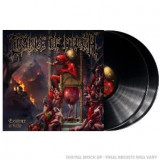
Belched from Hell’s depths into the rustic charms of the Witch County, Suffolk thirty long and disturbing years ago, CRADLE OF FILTH are undisputed giants of the heavy metal realm. Imperious purveyors of a perennially unique strain of dark, dastardly and wilfully extreme metal, with deep roots in the worlds of gothic horror and occult curiosity, the band led by Dani Filth has weathered three decades of tumult and trial, earning a formidable reputation as both a singular creative force and one of the most riotously entertaining live bands the metal world has ever produced.
From primitive early works like 1992 debut »The Principle Of Evil Made Flesh« to more expansive and theatrical classics like ‘Cruelty And The Beast’ and ‘Midian’, CRADLE OF FILTH defied trends and constructed their own idiosyncratic world of foul grandeur, becoming one of the UK’s most notable metal bands in the process. Since then, they have traversed the world countless times, hoovering up plaudits and praise from an ever-expanding international fan base. Resolutely prolific, the band’s catalogue has grown in depth and stature all the while, irrespective of line-up changes or the whims of the faithful.
In more recent times, CRADLE OF FILTH have hit an unmistakable hot streak of creativity and urgency. As a new line-up coalesced around the creation of 2015’s »Hammer Of The Witches«, fresh impetus propelled the band to new heights, as the revitalised crew became more in demand around the world than ever before. 2017’s ‘Cryptoriana - The Seductiveness Of Decay’ repeated the trick with even more explosive flamboyance. Until a global pandemic brought the music industry to a jarring halt, CRADLE OF FILTH were almost permanently on the road and absolutely fucking flying. As a result, it should surprise no one that the band’s brand new album, ‘Existence Is Futile’, is yet another monumental and electrifying journey through the dark.
Buoyed by these recent triumphs, CRADLE OF FILTH recorded »Existence Is Futile« during 2020, piecing the record together in isolation, at Grindstone Studios in Suffolk with studio guru Scott Atkins (Devilment/Benediction/Vader). Although instantly recognisable as the work of these veteran blackhearts, the thirteenth CRADLE OF FILTH album is a wholly different beast from its immediate predecessors. Pitch-black, perverse and at times absurdly brutal and extreme, it hangs together with mesmerising fluidity. It is also absolutely rammed with giant, rousing melodies and moments of jaw-dropping invention. No one could mistake the venomously catchy likes of ‘How Many Tears To Nurture A Rose?’ or monstrous ballad ‘Discourse Between A Man And His Soul’ for anything other than CRADLE OF FILTH, of course, but ‘Existence Is Futile’ confirms that the band’s exploratory instincts remain as sharp as ever.
Underpinned by its huge and disarmingly organic production, »Existence Is Futile« is plainly the darkest and most unsettling album CRADLE OF FILTH have made in a while. Eschewing the band’s trademark twisted storytelling in favour of horrified glimpses into the mortal void and ruminations on the inevitable destruction of life on Earth, its poignancy and relevance to the cluster of nightmares facing humanity in 2021 is impossible to ignore, even if Dani Filth insists, not unreasonably, that he didn’t anticipate a global pandemic when the news songs were being written.
With the best possible timing, CRADLE OF FILTH were already due to make a new album during those long, lonely months of lockdown in 2020. Having grabbed the opportunity with both hands, Dani avows that unavoidable isolation from the rest of the world was the best possible incentive to get the job done, while also adding plenty of eerie atmosphere to the whole experience.
Sonically speaking, ‘Existence Is Futile’ is easily the most powerful and dramatic record CRADLE OF FILTH have ever made: it’s the sound of band’s enviable onstage chemistry spilling over into the studio, propelling each member of the band to new levels of intensity. Combined with the expected labyrinthine arrangements and moments of spellbinding bombast, ‘Existence Is Futile’ may be the most vivid representation of the CRADLE OF FILTH experience yet.
Also, diehard fans will be thrilled to learn that horror icon Doug 'Pinhead' Bradley makes a welcome return to the CRADLE fold, lending his dulcet tones to the epic ‘Suffer Our Dominion’, and to one of the forthcoming new record’s bonus tracks, as Dani explains.
“There are also two bonus tracks in addition to the album, one of which is the culmination to the ‘Her Ghost In The Fog’ trilogy, which began on »Midian«.
For this we had little hesitation in enlisting our friend and actor Doug Bradley to reprise his narrative role. Doug lives in Pittsburgh, which he refers to ‘The Pit’, thus we directed his narrative over Skype from his local studio. He adopts this almost David Attenborough-ish role on ‘Suffer Our Dominion’, which is possibly the most politically astute song we’ve written of late. As a band we usually shy from branching into politics, but it’s something that needed spouting. The fact we’re fucking our ecology up and desperately need to address the situation pronto…”
So, if we’re all going to perish in the fire of our own stupidity, we might as well have a suitably deranged and destructive soundtrack to do it by.
A bewitching, fearless nosedive into the abyss, the band's thirteenth studio album confirms the ferocious efficacy of CRADLE OF FILTH in 2021. Bold, brave, wildly imaginative and heavy as hell, the band’s latest runaway train-ride through the flames is the perfect album for these most imperfect of times. As Dani concludes, “Be like the virus! Mutate and survive!”
- A1: The Fate Of The World On Our Shoulders
- A2: Existential Terror
- A3: Necromantic Fantasies
- A4: Crawling King Chaos
- B1: Here Comes A Candle.. (Infernal Lullaby)
- B2: Black Smoke Curling From The Lips Of War
- B3: Discourse Between A Man And His Soul
- B4: The Dying Of The Embers
- C1: Ashen Mortality
- C2: How Many Tears To Nurture A Rose?
- C3: Suffer Our Dominion
- C4: Us,Dark.invincible
- D1: Sisters Of The Mist
- D2: Unleash The Hellion
Purple/Black Marbled Vinyl[39,62 €]
Belched from Hell’s depths into the rustic charms of the Witch County, Suffolk thirty long and disturbing years ago, CRADLE OF FILTH are undisputed giants of the heavy metal realm. Imperious purveyors of a perennially unique strain of dark, dastardly and wilfully extreme metal, with deep roots in the worlds of gothic horror and occult curiosity, the band led by Dani Filth has weathered three decades of tumult and trial, earning a formidable reputation as both a singular creative force and one of the most riotously entertaining live bands the metal world has ever produced.
From primitive early works like 1992 debut »The Principle Of Evil Made Flesh« to more expansive and theatrical classics like ‘Cruelty And The Beast’ and ‘Midian’, CRADLE OF FILTH defied trends and constructed their own idiosyncratic world of foul grandeur, becoming one of the UK’s most notable metal bands in the process. Since then, they have traversed the world countless times, hoovering up plaudits and praise from an ever-expanding international fan base. Resolutely prolific, the band’s catalogue has grown in depth and stature all the while, irrespective of line-up changes or the whims of the faithful.
In more recent times, CRADLE OF FILTH have hit an unmistakable hot streak of creativity and urgency. As a new line-up coalesced around the creation of 2015’s »Hammer Of The Witches«, fresh impetus propelled the band to new heights, as the revitalised crew became more in demand around the world than ever before. 2017’s ‘Cryptoriana - The Seductiveness Of Decay’ repeated the trick with even more explosive flamboyance. Until a global pandemic brought the music industry to a jarring halt, CRADLE OF FILTH were almost permanently on the road and absolutely fucking flying. As a result, it should surprise no one that the band’s brand new album, ‘Existence Is Futile’, is yet another monumental and electrifying journey through the dark.
Buoyed by these recent triumphs, CRADLE OF FILTH recorded »Existence Is Futile« during 2020, piecing the record together in isolation, at Grindstone Studios in Suffolk with studio guru Scott Atkins (Devilment/Benediction/Vader). Although instantly recognisable as the work of these veteran blackhearts, the thirteenth CRADLE OF FILTH album is a wholly different beast from its immediate predecessors. Pitch-black, perverse and at times absurdly brutal and extreme, it hangs together with mesmerising fluidity. It is also absolutely rammed with giant, rousing melodies and moments of jaw-dropping invention. No one could mistake the venomously catchy likes of ‘How Many Tears To Nurture A Rose?’ or monstrous ballad ‘Discourse Between A Man And His Soul’ for anything other than CRADLE OF FILTH, of course, but ‘Existence Is Futile’ confirms that the band’s exploratory instincts remain as sharp as ever.
Underpinned by its huge and disarmingly organic production, »Existence Is Futile« is plainly the darkest and most unsettling album CRADLE OF FILTH have made in a while. Eschewing the band’s trademark twisted storytelling in favour of horrified glimpses into the mortal void and ruminations on the inevitable destruction of life on Earth, its poignancy and relevance to the cluster of nightmares facing humanity in 2021 is impossible to ignore, even if Dani Filth insists, not unreasonably, that he didn’t anticipate a global pandemic when the news songs were being written.
With the best possible timing, CRADLE OF FILTH were already due to make a new album during those long, lonely months of lockdown in 2020. Having grabbed the opportunity with both hands, Dani avows that unavoidable isolation from the rest of the world was the best possible incentive to get the job done, while also adding plenty of eerie atmosphere to the whole experience.
Sonically speaking, ‘Existence Is Futile’ is easily the most powerful and dramatic record CRADLE OF FILTH have ever made: it’s the sound of band’s enviable onstage chemistry spilling over into the studio, propelling each member of the band to new levels of intensity. Combined with the expected labyrinthine arrangements and moments of spellbinding bombast, ‘Existence Is Futile’ may be the most vivid representation of the CRADLE OF FILTH experience yet.
Also, diehard fans will be thrilled to learn that horror icon Doug 'Pinhead' Bradley makes a welcome return to the CRADLE fold, lending his dulcet tones to the epic ‘Suffer Our Dominion’, and to one of the forthcoming new record’s bonus tracks, as Dani explains.
“There are also two bonus tracks in addition to the album, one of which is the culmination to the ‘Her Ghost In The Fog’ trilogy, which began on »Midian«.
For this we had little hesitation in enlisting our friend and actor Doug Bradley to reprise his narrative role. Doug lives in Pittsburgh, which he refers to ‘The Pit’, thus we directed his narrative over Skype from his local studio. He adopts this almost David Attenborough-ish role on ‘Suffer Our Dominion’, which is possibly the most politically astute song we’ve written of late. As a band we usually shy from branching into politics, but it’s something that needed spouting. The fact we’re fucking our ecology up and desperately need to address the situation pronto…”
So, if we’re all going to perish in the fire of our own stupidity, we might as well have a suitably deranged and destructive soundtrack to do it by.
A bewitching, fearless nosedive into the abyss, the band's thirteenth studio album confirms the ferocious efficacy of CRADLE OF FILTH in 2021. Bold, brave, wildly imaginative and heavy as hell, the band’s latest runaway train-ride through the flames is the perfect album for these most imperfect of times. As Dani concludes, “Be like the virus! Mutate and survive!”
Einen schönen Fang hat das Chicagoer Label Trouble In Mind vor Kurzem mit DUMMY gemacht: Das Quintett aus Los Angeles verblüfft auf seinem Debüt ,Mandatory Enjoyment" mit einem derart ausgereiften Noise-Pop-Entwurf, das man kaum glauben mag, dass es sich hier um ein Erstlingswerk handelt. Nach gerade einmal zwei veröffentlichten EPs aus dem letzten Jahr, haben DUMMY ihren mit einem wundervollen Groove ausgestatteten Sound auf ,Mandatory Enjoyment" sichtlich gefunden und bis zur Perfektion destilliert. Das spielfreudige Debüt kombiniert geschickt Einflüsse aus Krautrock, Dream-Pop, Ambient, Psychedelic und Shoegaze zu einem Soundgebräu, das sowohl avantgardistisch als auch immer noch genug im Pop verwurzelt ist. Songs wie "Daffodils" und "Fissured Ceramics" zeichnen sich durch unerbittlich treibende Energie und reichlich psychedelischen Lärm aus. An anderer Stelle gleicht Dummy die Aggression mit meditativen Synthesizerlandschaften aus, die sich auf Sounddesign und Studioexperimente konzentrieren, wie bei dem motorischen "X-Static Blanket". Das Herzstück "H.V.A.C." und der letzte Track des Albums, "Atonal Poem", versuchen schließlich, diese beiden Pole miteinander zu verbinden und bieten mehrteilige Reisen durch unbekanntes Klangterritorium. Im Gegensatz zu der glückseligen Instrumentierung untersuchen Dummys sardonische Texte die Last des modernen Lebens, den Konsumismus, den Zusammenbruch der Umwelt, die Entfremdung und andere Ängste, die aus dem Leben in diesem absurden Moment der Geschichte entstehen. Innenarchitektur, Meeresverschmutzung, die Psychologie kommerzieller Architektur und Atomtests sind Themen, die aufgegriffen werden. Die rastlose Kreativität von Dummy treibt die Band immer weiter voran, sie fordern sich selbst ständig heraus und treiben ihren Sound in aufregende und erheiternde Bereiche. Dies ist - wie der Albumtitel schon sagt - "Mandatory Enjoyment". ENG Los Angeles band Dummy refuses to slow down. After releasing two cassette EP's in 2020 (on Popwig and Born Yesterday respectively), Dummy's debut full-length album arrives via Chicago's Trouble in Mind Records. Employing pummeling guitars and celestial ambience within the same breath, the band folds a myriad of reference points into their drone-pop style. Influence from '60s melodicism and '90s UK noise pop can be found woven in with inspiration from spiritual jazz, Japanese new age, and Italian minimalism. Dummy dodges the brooding, dark, dramatic tropes of contemporary "artistic" music often found in punk, experimental, and electronic, instead insisting on joyous and euphoric sonic palettes. They refuse to be artistically stagnant, continuously shifting their approach to writing across 12 tracks. Shaped by performances around Los Angeles in 2019, songs like "Daffodils" and "Fissured Ceramics" feature relentless driving energy and ample psychedelic noise. Elsewhere, Dummy counterbalances the aggression with meditative synthscapes focused on sound design and studio experimentation, like on the motorik "X-Static Blanket". Finally, centerpiece "H.V.A.C." and the album's final track, "Atonal Poem", seek to synthesize these two poles, offering multi-part journeys through uncharted sonic territory. In contrast to blissed-out instrumentation, Dummy's sardonic lyricism examines "the burden of modern life, consumerism, environmental collapse, alienation, and other anxieties born out of living in this absurd moment in history". Interior design, marine pollution, the psychology of commercial architecture, and nuclear testing are all featured subjects. Dummy's restless creativity keeps them moving ever-forward, continuously challenging themselves and pushing their sound into exciting and exhilarating places. This is - as the album title suggests - "Mandatory Enjoyment".
- A1: Lighthouse (Feat Zara Kershaw)
- A2: Fall Awake
- A3: How You Went So Long
- A4: Swans (Feat Sigrun Stella)
- B1: Dhalia
- B2: The Current (Feat Drs)
- B3: They're Here
- B4: Water In Your Veins
- C1: Caliban
- C2: I Will Wave To You
- C3: Nebula (Feat Fred V)
- D1: Belorama
- D2: Follow The River (Feat Lily Budiasa)
- D3: We Shine Amongst The Lights
- E1: Akasha
- E2: All Underwater (Feat Lily Budiasa)
- E3: Light & Dark
- F1: Okusha
- F2: The Map Of My Inside World
- F3: Into Oblivion
”Neon Dust describes the essence of a world just beyond reach, one we often glimpse but can’t sustain. An Ocean in which we rarely dip our feet. When writing this album, I felt in tune with something special, an energy I hadn’t previously known. I was submerged and engulfed in its creation. For me, it’s a journey beyond; into that dancing,
shimmering glow of neon dust.” - Etherwood Melodic master and drum & bass extraordinaire Etherwood makes his album
debut on Hospital Records with his fourth long player, ‘Neon Dust’, following on from the successes of his Med School works ‘In Stillness’, ‘Blue Leaves’, and ‘Etherwood’.
Across twenty tracks, expect signature liquid drum & bass and Etherwood’s own vocal performances with a fusion of folk, rock, indie-pop, techno, downtempo and ambient delights. Alongside his vast range of musical inspiration, Etherwood’s creativity is evoked through his free spirited mindset, exploring the world in his converted van, dedicated to mindfulness and meditation.
With frequent radio support from top-end tastemakers including Annie Mac, MistaJam and Charlie Tee, as well as countless club spins from the likes of Netsky, Sub Focus, Makoto, Degs and Lens, Etherwood’s hugely popular sound takes another step forward in 2021 with his most recent body of work. From topping the iTunes Electronic chart with his second album ‘Blue Leaves’ to performing his very own live session at the prestigious Maida Vale studios, you’ll also be able to find Etherwood at Hospitality Weekend In The Woods, Sundown Festival 2021, ADE Hospitality and Hospitality Bristol this yea
Freestyle Records will release Dan Berkson's debut LP, Dialogues, on September 17th on LP & digital.
Following a move to London and an immersion in the city's deep house scene, Dan Berkson's subsequent rediscovery of his earliest musical foundations and the drawing of inspiration from London's buzzing contemporary jazz scene would lead to Dialogues - an accomplished and rewarding body of work pulled together during his final days in London before relocation to California.
"It was inevitable that Dan Berkson would make a jazz album like Dialogues: joyful, danceable, entertaining, driven by the pleasure principle, and filled with virtuosity. It represents Berkson's experiences in London, where jazz is a living, breathing, dancing scene. It's his love letter to the city, bristling with British talent such as bassist Andrea di Biase (Heidi Vogell, Maria Chiara Argiro, Bruno Heinen) and drummer Jon Scott (Kairos 4Tet, Sons Of Kemet, Mulatu Astatke) and recorded in his final days in the city before relocating to California. It's also rich with history: the musical journey that brought him to this point covers almost 40 years and 4,000 miles.
Berkson received lessons from Chicago boogie-woogie veteran Erwin Helfer - who in turn had learned alongside foundational legends such as Mahalia Jackson and Glover Compton. In 2001 he came to the UK, throwing himself into the deep house scene of East London, his duo with James What signing to Steve Bug's legendary Poker Flat.
But eventually he felt that he'd achieved what he could in the house format. Rediscovering the piano and discovering that jazz provided him the opportunity to keep learning, he enrolled in Trinity College in South London just as South London's jazz scene was exploding into the public consciousness.
Dialogues is a jazz album, not an electronic one – but all the groove-based influences, from the rootsy blues and ragtime of his youth, through the funk he played at college and the house he imbibed in London can be heard, as can his love of the studio as an instrument and mixdowns that suit a club soundsystem. Detroit dons Theo Parrish and Moodymann are every bit as important to this record as Charlie Haden, Carla Bley, Keith Jarrett, Ornette Coleman, Jimmy Giuffre, and Herbie Hancock. There's 50s and 60s cool modernism (just listen to the elegant ripples of "Sketches"), there's 70s funk fusion ("Unity" kicks things off with a spring in its step), and of course there's the pumping blues heart of "Live Bait". Above all else, though, it's a personal document: a life of music and collaboration crystalised in a magical, transitional moment. Where Dan goes next musically is as uncertain as anything in these times... but this one record tells you everything you need to know about where he's been."
Repress
Finnish sound scientist Aleksi Perälä presents 'Paradox', a double EP landing 15 th of December on . Using a microtonal tuning method known as Colundi - with which his work is now synonymous - he guides us through a ritualistic journey of ten formidable tracks.
Glistening scales cascade over peculiar tones. Aleksi Perälä explores the powers of an alternative tuning system in dance-floor structures, tapping into the veiled potential of his sound palette with stunning physical consequences.
Saccharine and mysterious, 'Paradox' channels elements of Electro, Techno and Italo, ultimately achieving a transcendental form of its own.
"Pianist Nate Morgan (1964-2013) was a central figure on the Los Angeles jazz undergound. A core member of the circle around the legendary bandleader, pianist and community organiser Horace Tapscott, Morgan had been part of Tapscott’s U.G.M.A.A. (Union Of God’s Musicians and Artists Ascension) since he was just a teenager, and was a key member of the Pan Afrikan People’s Arkestra, known as ‘The Ark’. Through the 1980s and 1990s he kept the PAPA flame alive, organising the Ark’s sprawling songbook, running legendary jam sessions, and keeping LA’s deep jazz roots well watered. By the early 2000s he was bringing hard won knowledge to a new generation as part of the Build The Ark collective. He was a musician’s musician, at the beating heart of the radical, community-minded Los Angeles jazz network that Tapscott and his associates had first put together in the early 1960s.
Retribution, Reparation was the second of the two LPs Morgan recorded for Tom Albach’s storied Nimbus West imprint. His first, Journey Into Nigritia had been a declaration of arrival laced with energies drawn from Cecil Taylor and Coltrane. One year later, with nods to Herbie Hancock (‘One Finger Snap’) and Ellington (‘Come Sunday’), Retribution, Reparation was a confident statement of purpose. Politically charged with pan-Africanist and Black nationalist sentiments inspired by Marcus Garvey, and titled with uncompromising directness, the album focusses the sound world of the Ark into a surging, restless masterpiece of spiritualised modal jazz. With Danny Cortez on trumpet and Ark stalwart Jesse Sharps on saxophones the frontline is explosive (this set is also one of the few places the extraordinary Sharps can be heard in a small group setting), while Fritz Wise and Ark regular Joel Ector hold down the rhythm section. Morgan’s forceful, Tyner-like chords and virtuosic solos and bind the music together. From the poised drama of the opening dedication to Tapscott’s U.G.M.A.A. (‘U.G.M.A.A.GER’) to the propulsive militancy of the title track, Retribution, Reparation spreads the word: ‘Advance to Victory, Let Nigritia Be Free!’"
2021 sees the release of the long-awaited third album from Pola & Bryson - ‘Beneath the Surface’. Since their debut release in 2015, Pola & Bryson have transitioned from the exciting ones to watch to the unquestionable leaders of new school liquid drum and bass, grabbing the attention of the scene's greats in the process.
“Masterful production and musicality throughout, I love that the album has been made just as much for the home listener as for the clubs. For me, these guys are leading the new wave of liquid drum & bass.” Sub Focus
As digital streaming services continue to dominate as the primary source of music consumption, the wildly contested ‘death of the album’ debate continues to burn throughout the industry. To counteract the current trend of single tracks and playlist placements, Pola & Bryson wanted to experiment with a concept album.
“We envisioned a landscape to act as inspiration to us whilst writing this album. The landscape is made up of 4 distinct sections, each representing a different emotional state. The first being Shinrinyoku (a Japanese term for forest bathing), represented by a dense, peaceful forest environment. Mangata (loosely translates to moon river) takes you to the edges of a cold, misty lake which eventually leads you to Toska, representing a dark and endless cave. All transpiring with Yuugen, a vast and epic mountain range. The album, paired with bespoke animated visuals, paints the perfect reflection of the journey.” - Pola & Bryson
‘Beneath the Surface’ features collaborations with the drum and bass scene's hottest vocal talents, with each being selected to effortlessly meld with the respective soundscapes. After previously working with both Lauren Archer and Ruth Royall with beguiling success, Pola & Bryson knew that they wanted to send some ideas to both artists. This resulted in the creation of two beautifully blissful tracks ‘Under’ and ‘Friend’, which became the first two singles to be released from the album. While Solah and Kojo were specifically picked with their tracks in mind, Manchester favourite Strategy’s appearance on the release was an altogether more organic stroke of serendipity. The duo were unsure whether 'Anaesthetist' was going to make the cut as an instrumental, and were floating the idea of working with a vocalist when Strategy messaged them seemingly out of the blue. They knew in an instant that his sound was the perfect fit for the track.
Over the last five years, Pola & Bryson have steadily ascended from promising newcomers to well-respected leaders of the next liquid generation. The London based pair’s production credentials are now so well-respected that they have recently been commissioned for huge remix projects for Sub Focus x Wilkinson and Camo & Krooked and released a collaborative EP with Brazil’s legendary DJ Marky. Since their debut album ‘This Time Last Year’ on Soulvent Records and then 2018’s award-nominated Shogun Audio LP “Lost in Thought'', punters and peers have been on tenterhooks, anticipating what the duo would bring to the plate next. Effortlessly living up to its hype, anyone who journeys through the ever-changing soundscapes of ‘Beneath the Surface’ will be immersed into a new world of sonic expression.
Honing your skills is under-appreciated in times of instant gratification and the continuous stream of music. Rotterdam-based producer Kofi The Unknown subverts this idea and took time for spiritual introspection, studying rhythms and sound production. Where being a late bloomer normally is seen as a sobriquet, the producer, composer and beatmaker wears it as a badge of honour and solidifies it as an honorary title by pinning it to his debut EP on Wicked Wax: The Late Bloomer. Wearing his heart on his sleeve, Kofi The Unknown shares his journey that led to The Late Bloomer, an emotional journey through sophisticated dance music, straight from the heart, aimed at the soul and feet.
Highly influential to Kofi’s sound and this EP is London’s Broken Beat scene. Syncopated drums, soulful chords and heavy bass lines work in tandem to emphasise the danceability the genre is known for. This is further solidified by the track Kofi released leading up to this release: One for Motet, an ode to the Broken Beat MC and Jazz Refreshed host Jason Hicks. The Late Bloomer further develops Kofi’s ode, but provides his Rotterdam flavour and brings his Hip Hop and Funk lineage into the mix.
Embrace Mistakes sets the stage for what’s to come in various ways. It is a textbook case of how dance music can tell a story and be introspective. Kofi’s honesty shines bright on the entire EP and strikes from the first kick drum on. It also shouldn’t be hard to recognise and feel the emotion the producer shares on the title track The Late Bloomer. The emotionally-laced chords and crushing drums are reminiscent of late nights at a warehouse or emotional sequences from a dystopian movie.
Staying true to his ethos ’exploring the university that music holds’, Kofi finds this beyond music production as The Late Bloomer provides an audible experience through creative mixing. Stuttering analog synths, enveloping leads, multiple percussion rhythms and off-beat snare rolls hit from all directions of the stereo spectrum, further underlining the sophistication of his merit. While the EP follows the Broken Beat accents on dance, it is an equally mindful listening experience.
Kofi The Unknown is a Rotterdam native producer with a knack for rhythms. His keen ear is informed by mentor and Dutch enigma Trian Kayhatu. While Kofi has taken the time to perfect his skills under the guidance of Trian, the two are simultaneously working on the exciting follow-up project to this debut EP. Without looking too far ahead, enjoy The Late Bloomer. It’s not only a crown jewel Kofi proudly wears, it is also establishing him as a future household name in the sophisticated dance scene. "
Aukai is a Hawaiian word meaning ‘seafarer’ or ‘traveller’. It’s also used as a proper name, and people who are called Aukai tend to have a mystical, philosophical, introspective nature. All of which makes Aukai the perfect name for the new album and project by multi-instrumentalist and composer Markus Sieber.
It’s a collection of ambient acoustic soundscapes that take the listener on an inward journey to a place of peaceful stillness and tranquil beauty. “This album has a lot to do with memories from travel,” says Sieber, “but also memories from childhood and nature. How did the river smell in summer? I wanted to create a sonic space where music guides the listener into some imaginative inner world.”
Contemporary and historical Porest recordings channelled from behind the somnambulistic event horizon. The now sound... The bleak oblique. The minimal and the maximal. Filmic chamber drones, meditative radio massage and forged spiritual violence bury pop ephemera into the swirling murk of de facto instrumental nihilism and orchestral context-free drama.
Side A: A harmful journey into sickness and despair. You get sick and die.
Side B: You are healed. You stand erect and live forever.
Layered field and radio recordings back electro-acoustic experiments via electric saz, strings, balypso, reeds & synths. Big drones, small ensembles and mood-anthems recorded by Porest and friends between 1995 and 2020 in West Oakland, Germany, Sumatra, Syria, Hanoi and London.
With 10 years in the 'biz' firmly under his belt, Jiah Wells is poised to release the first full-length LP of his Galtier project, Pulchra Es Elementis. Whilst Galtier is arguably one of the originators of the percussive style that would eventually fall under the Hard Drum label, the heightened theatrics of his recent output have seen him channel Blade Runner-styled sonics and move further away from absolute club functionality. Whilst Galtier's output often seems to soundtrack hypothetical, off-planet words, Pulchra Es Elementis turns the focus inwards: towards Wells' own emotional constellation, his evolving spirituality and his attempts to tap into planes of existence beyond the tangible. The album's Latin title translates to 'Elements are Beautiful' and encapsulates the artist's belief that there is grace in all of life's aspects; pushing past what we deem as good or bad, minuscule or massive.
Pulchra Es Elementis begins with Crystalised Larva, a brooding opener of breathy pad synths and expansive kick drums which reverberate through the mix as if the hits originate from the bottom of a valley. There's an indistinct sense of tension on this track, in part due to a central melody, which never resolves but only descends lower in pitch. This tension turns to explorative wonder on Wilfull Saviour, where a mirage of musical ideas come in and out of focus. Although the sonic worlds Galtier explores are internal to him, Wilfull Saviour still possesses that sense of a cosmic journey we've come to expect from Wells; an ardent fan of dystopian films and literature.
Continuing this emotional odyssey, Bruised, But Not Broken sees the artist push deeper into the psychological undergrowth; its murky tonality juxtaposes crisp, Reggaeton-inspired drum patterns with a heavily compressed one-note synth line that modulates wildly - cutting through the mix like a nagging thought that won't leave your mind. Next up is U Were, U Are & What U Will Be, one of the more club-ready tracks of the LP, which gets us moving with a snarling bassline and layers upon layers of percussive hits and inflections.
At Pulchra Es Elementis' mid-point is the LP's title track, a drumless interlude where blissful, shimmering synths create a patchwork of intensities. Galtier's approach to songwriting shines through here; ignoring musical pragmatics, he opts to feel his way through his compositions without knowing where they might end up. Following on from that weightless breather, Phantasiai turns up the freneticism with its head-spinning mix of drum programming and a glitched-out synth line that yo-yos up and down octaves. Things get even more furious on the Superficie-featuring Cavernam, a hollow Hard Drum banger inspired by Eskibeat sensibilities and designed to create a sense of self-implosion.
The album's penultimate track, (U Are) Beautiful, is a tale of two halves: beginning with a moment of serenity as synthesizers swell like an ocean tide before evolving into a marching crescendo of raw energy. Rounding off the album, Shine Forth hurtles through pacey drum work and all manner of strange zaps and klaxons before giving way to a final dose of nebulous ambience.
A musical journey unlike any other 'club music' albums, Pulchra Es Elementis is an LP that demands to be consumed in one sitting. Reflecting on his place within the universe and the musical landscape, the album could be viewed as a musical exorcism which sees Galtier working through and shedding huge chunks of his ego that stuck to him out of fear of the unknown. Pulchra Es Elementis begins on an insecure, overwhelming or, even, existential note before rounding off with a related sense of vastness seen with new, more positive eyes. It's a voyage we hope you will join him on.
The Altered Hours have just announced details of their second full length album ‘Convertible’. The Irish group have just signed with Pizza Pizza Records and the 8 track album is set for release in May 2021. Following on from some successful headline tours across Europe supporting their debut album & some blistering EP’s along the way, the group found themselves looking for the next step in their ever- evolving journey. Having previously recorded in Anton Newcombe’s Berlin studio for their debut singles & ending up in the infamous Funkhaus studios to lay down what would become their debut album ‘In Heat Not Sorry ’, the band decided once again to
change the approach & take their new songs back to the privacy of their own studio space on the outskirts of Cork City. The new LP ‘Convertible’ is the result of countless late night/early morning sessions that took place over the past 2 years. Choosing to self produce and engineer this record was a conscious choice as the band felt an urge to take what they had learned on the road & in various studios previously, and condense all of this energy back into the boiling pot of their own rehearsal space.
The group have been a part of some exciting movements since the beginning and their path has been an organic one. They quickly became known in their hometown for taking over an ex-government building in the heart of Cork city, turning into a studio and creating a hub for the scene that surrounded them. The years that follow shine a light on the relentless energy of this group and unwavering love for playing shows anywhere & everywhere. Having been invited to perform at Liverpool Psych Fest numerous times, supporting the Brian Jonestown Massacre, selling out venues, churches & clubs, playing rip-roaring DIY shows in friends’ basements, getting joined by members of Spacemen 3 on stage and more recently, being invited by fellow Irish rockers Fontaines D.C to join them on their 2019 European tour playing sold out shows in venues like The Bataclan, Paris & Paradiso, Amsterdam. It’s been a wild ride for The Altered Hours so far & their music keeps evolving & growing as the experiences build. This is a group with the spirit of music deeply ingrained in them and a passion for making rock music something that you can believe in.
Their second full length album ‘Convertible’ is a window into the band’s idiosyncratic tendencies, a closer look into how their writing & sound continuously moves forwards while somehow remaining rooted in their own unique world all at once. The Altered Hours seem born to be an underground affair, something that they wear with pride and this album is a wonderful culmination of their DIY upbringing, their unfiltered rock ‘n’ roll spirit along with a confident stride into personal songwriting.
UK multi-instrumentalist and story-teller Mara Simpson's new album In This Place will be released on September 24th, 2021. A heady blend of alt-folk, analogue synth and classical composition, In This Place is a tale of quiet rebellion, and taking back control. Fittingly, the new album marks the start of another new journey for Mara. In This Place will be the first record to be released on Downfield Records, a non-profit imprint set up by Simpson, placing artists at it’s centre. “I want to try and promote transparency and equality, assist other artists to get public funding and to ‘pay’ forward the time and resources I’ve benefited from,” she says. The label’s mission is to see musicians paid fairly and release records through a creative and joyous process.
Whilst the struggles of 2020 will go down in history, for Mara it was 2019 that was the tough one. A year spent consumed by worry, whilst in and out of hospital with her one year old daughter, had left Mara feeling like she was playing a constant game of catch up with a world that wouldn’t slow down. With songs ready to be recorded for her new album, she headed into the studio. “I stepped into the studio not needing my hand held, just my voice heard” explains Mara, who quickly came to the realisation that she was working in a toxic environment. Enough was enough
It was whilst waiting for a train that she had the sudden realisation that the album she was recording would never see the light of day. Struck by an overwhelming feeling of failure, Mara began to ruminate on the time and money she had wasted but then something clicked. “Perhaps it’s something about train stations, the coming and the goings, that allows a stagnating frame of mind the grace and space to clear” she says. “The funny thing is, upon realising failure, the despair I’d been feeling was now replaced with something else...Relief”.
Feeling re-energised, Mara called her dream producer Ellie Mason, of Voka Gentle, and together the pair began working on a new record. “I’ve been more hands-on with this album than I’ve ever been, taking a much more active role in production. Throughout the whole process Ellie has heard my voice, and been open to any possibility” explains Mara. “We’ve stumbled across golden moments, recording four part harmonies in Brighton’s oldest church, using every drum there is in Brighton Electric, layering New Zealand bird song with tape delayed piano, all thanks to her nurture, playfulness and kindness” she continues.
Album opener ‘Serena’, named after the apartment building in Brighton where Mara’s daughter was born, is based on the experience of becoming a mother and the responsibility of making important healthcare decisions. “How will I know how to love you” she sings over undulating synths and sparse piano chords. Title-track ‘In This Place’ is about the confrontation between mother and new-born child. The ‘sizing-up’ of one another as they embark on a new journey together. “When I left home to travel around the world and was so worried about breaking my Mum’s heart,” says Mara. “I just remember her saying that your children are never yours to keep. This is a song about the rawest of loves, and the fact that however much we love someone, they are never ours, and the beauty in that.”
In addition to the experience of motherhood, the songs on In This Place take inspiration from a wide range of places, including Mara’s ‘second home’ New Zealand. ‘Christchurch’, written in response to the Christchurch Mosque shootings in 2019, layers New Zealand birdsong on top of swirling piano and moving choral vocals. ‘Fault Lines’ was inspired by The Waitangi treaty. Signed in 1840 in New Zealand by the British Crown and Maori chiefs. The British understood that the Maori were signing over land that the British could now govern and effectively ‘own’, however to the Maori people it is impossible to own land, in the same way that you can’t ‘own’ air. “We live and die, the land remains and we are just it’s keepers for the very short time we are here. This song is about us not owning this earth - how can we? We are only the guardians of it while we are here” says Mara.
Backed by a band of accomplished musicians (Jools Owen (Bears Den) on drums, James Smith (Anaïs Mitchell) on banjo, Alexandra Hamilton-Ayres on clarinet and strings by Poppy Ackroyd) on In This Place, Mara sounds the most confident she’s ever sounded. With her new material, Mara Simpson hopes to promote a gentle, yet radical shift toward kindness and it’s this warmth that can be both heard and felt across her new record.
TLM025 kicks off with Erik Escobar and his cover version of Memories by Caruso. Erik is from Campinas in Brazil and a very well respected and talented musician. Taking the track into a completely different direction to the original this cover version is written for the dancefloor. Onto the AA side and Cormac Fulton (one half of Caruso) gives us a very deep track called Perplexed, a very moody affair with Matt Cox and Steve Conry on production duties. Next up is Time Machine from Detroit's Lorenzo Dewberry, another deep journey taking influences from the cities sound for another dancefloor piece. Lastly Gee W finishes off the EP with his track MarshMellow, a very nice laid back deep house track from the UK based multi-instrumentalist.
4 artists to watch over the coming years.
- A1: Ghetto Priest - Hercules (North Street West 'Late Night Tales' Dub) *Exclusive Remix
- A2: Prince Fatty &Shniece Mcmenamin - Black Rabbit
- A3: Wrongtom Meets The Rockers - Dub In The Supermarket *Exclusive Remix
- A4: Gaudi Meets The Rebel Dread Ft. Emily Capell - E = Mc2 *Exclusive Track
- A5: Rude Boy - Superstylin' *Exclusive Remix
- B1: Capitol 1212 Ft. Earl 16 - Love Will Tear Us Apart (Full Vocal Dub) *Exclusive Remix
- B2: Quantic Presenta Flowering Inferno - All I Do Is Think About You (Far East Dub) *Exclusive Remix
- B3: Zoe Devlin Love Ft. Tim Hutton - Caroline No
- B4: John Holt - You'll Never Find Another Love Like Mine (Mad Professor 2021 Dub) *Exclusive Remix
- B5: Cornell Campbell - Ital City Dub *Exclusive Remix
- B6: Matumbi - (I Can't Get Enough Of) That Reggae Stuff (Dennis Bovell Remix) *Exclusive Remix
- C1: Gentleman's Dub Club Ft. Kiko Bun - Use Me (Ben Mckone Dub)
- C2: Black Box Recorder - Uptown Top Ranking
- C3: Obf - Sixteen Tons Of Dub
- C4: Yasushi Ide - Ain't No Sunshine (Space Dub Mix) *Exclusive Remix
- D1: The Tamlins - Baltimore
- D2: 15 16 17 - Emotion (Dennis Bovell Remix) *Exclusive Remix
- D3: Ash Walker - There's Nothing Like This *Exclusive Track
- D4: The Senior Allstars - Slipping Into Darkness
- D5: Easy Star All-Stars - Within You Without You
- D6: Khruangbin - Dern Kala (Khruangbin Dub Mix) *Exclusive Remix
Born in Brixton, a child of the Windrush Generation, Letts’ slippery and unorthodox career is somewhat hard to define, without taking a few detours around London, New York and Jamaica. He began his working life managing the dauntingly hip Acme Attractions on Chelsea’s Kings Road, where he made a mark with his attitude, dress and, especially, the pounding dub reggae that vibrated the shop’s walls. His first gig as a DJ at the short-lived Roxy in Neal Street, became mythical for turning a generation of punks on to reggae. They in turn hipped him to their DIY ethos resulting in his reinvention as a filmmaker. This led to a shed-load of music videos (Linton Kwesi Johnson, The Clash, Bob Marley) not
to mention documentaries on the likes of Gil Scott-Heron, George Clinton and Sun Ra.
In the ’80s, he was part of Mick Jones’ new venture, Big Audio Dynamite and his innovative use of samples were a core part of their sound. Listeners of his weekly 6 Music radio show are taken on a musical safari that moves seamlessly between time, space and genre. It’s not called Culture Clash Radio for nothing. So this latest bulletin from Letts HQ is merely one angle of a multifaceted personality, his take on the JA tradition of the cover version.
The history of Caribbean music owes a debt to R&B as many of the early island releases were cover versions of US 45s. Ska’s breakthrough commercially, Millie Small’s ‘My Boy Lollipop’, was originally recorded by Barbie Gaye in ’50s New York. Cover versions became quite a thing in Jamaica and Don, following in that tradition, has dug deep with a selection of interesting dubbed out covers including thirteen exclusives.
“A disciple of sound system, raised on reggae n’ bass culture my go to sound was dub. Besides being spacious and sonically adventurous at the same time, its most appealing aspect was the space it left to put yourself ‘in the mix’ underpinned by Jamaica’s gift to the world - bass. But that’s only half the story as the duality of my existence meant I was also checking what the Caucasian crew were up to not to mention the explosion of black music coming in from the States. That’s why this version excursion crosses time space and genre, from The Beach Boys to The Beatles, Nina Simone to Marvin Gaye, The Bee Gees to Kool & The Gang, The Clash to Joy Division and beyond. You’d think it impossible to draw a line between ‘em but not in my world. Fortunately, the ‘cover version’ has played an integral part in the evolution of Jamaican music and dub covers were just a natural extension.”
There’s a diverse mix of classic and new, with legendary figures like John Holt, The Tamlins and Cornell Campbell, mixed in with British veterans Mad Professor and the irrepressible Dennis Bovell, while (relatively) young striplings Kiko Bun, Emily Capell and Prince Fatty deliver the goods, with laidback Texan groovers Khruangbin also offering an exclusive bass heavy-delight.
The song choices are diverse, from French dubsters’ OBF’s renditions of ‘Sixteen Tons’, the miners’ paean popularised by Tennessee Ernie Ford in the 1950s, to Ash Walker’s refix of Omar’s ‘There’s Nothing Like This’ and ‘All I Do Is Think About You’, immortalised by the ill-fated Tammi Terrell and preserved here by Quantic (the latter two both exclusives). Being a Rebel Dread compilation, there’s a cover (by Wrongtom Meets The Rockers) of The Clash’s ‘Lost In The Supermarket’ while Don’s exclusive, naturally, is a rendition of Big Audio Dynamite’s debut hit, ‘E = MC2’.
“Truth be told I’ve wanted to work with the Late Night Tales crew from the get go. We’re talking nearly two decades such was the allure of their musical aesthetic typified by curators like Nightmares on Wax, The Flaming Lips, MGMT, Trentemoller, Khruangbin and countless others. Now being as old as rock n’ roll (born in ‘56) and having nearly 20 years of Culture Clash Radio under my belt I figured I was tooled up to musically juggle with the best of ‘em. But I wanted to carve out a space that was distinctly my own - something that reflected my musical journey and the culture clash that’s made me the man I am today.”
Take One is the cinematic debut release from the minds of Hampshire born emcee Deeflux and seminal producer Kraze. Created through a chaotic and turbulent life journey, the project was born out of the collective need to change direction musically by both artists.
The results are an accomplished and often brutally honest prose, overlaid across a wide range of soundscapes sca-ling the spectrum of alternative rap music. Themed around cinema, each track tells a story like a window into the ar-tists lives covering a range of topics and emotions with Deeflux’s trademark labyrinthine wordplay weaving effortlessly over Kraze’s diverse production.
The LP, originally intended as a mixtape and picked up and pressed by Broke Records was fraught with tragedy. From faulty metal work, lost livelihoods and the eventual loss of all stock it sadly never saw the proposed release until now. Certain Sound received a phone call out of the blue after the stock was
re discovered and have re packaged with the full intended “Directors Cut” as downloadable content in a limited run of coloured and heavy weight black vinyl.
Take your seats and enjoy the show! Artist Bio - Deeflux
Deeflux comes from a diverse musical background. After falling in love with heavy metal at 6 years old he spent his early years as a song writer and guitarist in ska, punk and metal bands before re discovering hip-hop in college where he used the college computers to start his journey beat making.
Finding his voice at 18 he began to craft his style. Influenced by his home town stable of graffiti writers, MCs and beatmakers. he went from working with Reklews (BLAH) to collaborating worldwide on projects such as Oddio Kin.
He has a number of physical releases with his group C O R N E R S (Deeflux, Beit Nun and Benny Diction), live group Natural Selection and last year released 52 singles with his long running DJ Miracle (Boot Records).
Kraze is somewhat of a musical prodigy. In his early teens he was at the epicentre of the first wave of grime and Began DJing on pirate radio & producing music. He eventually landed an artist development deal with EMI & later Sony/ATV.
He was responsible for Devlin’s standout London City and earned two cuts on
his Bud, Sweat and Beers album. During his time with EMI & Sony, he worked with producers such as Naughty-boy, Mojam & Stargate and a variety of artists before eventually leaving the industry to pursue other opportuni-ties. Take One will be his first solo release.
HIGHLIGHTS: Two head-nodding psych anthems from Peru mixing surf guitars with fuzz effects, fierce Latin percussion_ making them sound as if Hendrix and Santana would have joined a cumbia combo! Another exciting dig into the hidden musical treasures of late '60s Peru. DESCRIPTION: Los Sideral's were a Peruvian band founded in 1967. Their first recordings are heavily influenced by the surf intrumentals and tropical sounds, mastering the cumbia guitar like few others. At the edge of the new decade, psychedelic and funk ingredients were also incorporated. 'Dongoh' is the result of this musical journey, as if Hendrix and Santana would have joined a cumbia combo, mixing surf guitars with fuzz effects, fierce Latin percussion_ 'Vírgenes del Sol' is a surf-guitar driven dancefloor anthem that became their most popular song. Both recordings see now their reissue on a 7" vinyl for the first time. Another exciting dig into the hidden musical treasures of late '60s Peru.
Mission Escape: signal incoming...Escaping Earth - file loaded...press enter --> program launched! When things become too much, escaping might help. Take a seat and join the ride with CYRK's first full length musical player on CHILDHOOD. After having released outstanding records on labels such as Running Back, Rawax, Burial Soil, Vakant, Avoidant, Dred, Science Cult, Lone Romantic and their own Time Zero imprint, the seminal Berlin machine funk duo launched their analog spaceship studio once again to tell their most advanced and versatile intergalactic tale to date. Escaping Earth is a story that comes in 8 episodes and showcases Sam and Pascals mastered skills in detailed sound design and arrangement, while always keeping a focus on powerful dancefloor oriented electro grooves. Ranging from Detroit influenced bassline bouncers to slower acid variations, this album will let you dive deeply into CYRK's beautiful musical language and range: a soulful journey from the light to the darkness and back. Above all, this album is at all times pure analog electronic funk and won't let you go from beginning to end. Sometimes escaping helps. This musical story will make you travel the stars with ease. The album is pressed DJ friendly on 2 x 12" vinyl and includes a download copy. A limited edition of 100 numbered copies comes in double colored (red/green) records and will be exclusively sold via CHILDHOOD's bandcamp page as well as the CLONE store. Vinyl to be released on September 13th 2021, followed by the digital release on September 24th 2021.
South African born, London based producer Kai van Dongen follows up two killer releases on 1Ø PILLS MATE and Ei8ht Records with a massive four tracker on CYBERDOME spanning lo-fi electro, gabber-influenced techno and Detroit acid.
‘Command’ gets started with the typical Cyber-aesthetic; a bruising, otherworldly electro cut that sounds like it was sampled from an intergalactic star-ship battle on a galaxy not so distant. Spooky, raw and uncompromising - classic horror synth lines creating a haunting atmosphere before its pulsating rhythm brings the listener back down to earth. ‘Losing Power’ again makes use of Kai’s knack for crafting emotionally captivating synth patterns, but this time under a lo-fi identity with hefty influence from the synthwave golden era; neon shapes and patterns blooming in the night as we continue our journey into darkness.
What sounds like an angry swarm of bees approaches on ‘Body Moving’ - a track title fit for purpose. Face-melting, brain-spinning techno creates a dark, psychedelic environment where sweat drips from the ceiling and faces react with a blend of euphoria and disgust, before we head to the Motor City on ‘Breathe’ - a cut of acid techno-electro that borrows from the icons of the past for a typically punchy and raw experience.
- A1: Glokenspiel Riddim
- A2: Away (Feat Vonn )
- A3: Icarus
- B1: Already Disappeared (Feat Amy J Pryce)
- B2: Poison
- B3: Gezellig
- B4: Atmosphere (Feat Lottie Jones)
- C1: Morning Eclipse (Feat Vio.let)
- C2: Trust Me (Feat Sayah)
- C3: Harmonise
- C4: 12 Years Ago
- D1: Program And Control
- D2: Too Familiar (Feat Zara Kershaw)
- D3: Radiate (Feat Lottie Jones)
- D4: Outro
Stepping up with an astounding collection of first-class sonics, Fred V’s
highly anticipated debut solo album, ‘Radiate’ is on the horizon for the
summer of 2021, on Hospital Records.
Consisting of 15 tracks that feature exciting collaborations with Millbrook, Zara
Kershaw, Vonn , Lottie Jones and SAYAH. Fred V’s first-ever standalone longplayer is everything you’d hope for and more, built from an infusion of electronic
influences from the past, present and future.
Expect an up-close and intimate insight into the Exeter-based multi-instrumentalist, as he continues to carve out his unique musical identity through ethereal
soundscapes and melancholic climates.
With his debut album marking a fresh chapter in his career as a solo artist, Fred
V’s journey so far has been a remarkable one. From his decade-long collaborative project alongside Grafix which saw many world tours, live shows and three
studio albums.
Since embarking on his individual venture Fred V has put out a string of successful releases which have drawn support from airwave tastemakers Annie
Mac, Ren LaVice, MistaJam, Charlie Tee and more.
Diving deep into the exploration of his own sound, expect to find Fred V playing at Hospitality Bristol BBQ in August, Hospitality Weekend In The Woods and
Sundown Festival in September.
From the depths of an ancient dark underworld, Nigh/T\mare has conjured a powerful offering of burning emotions that light the fires of one's demons and invite the beginning of an epic journey through the unknown. Via Threnes Records from Switzerland, this offering is on point with their consistent releasing of top quality industrial/experimental techno. Entitled "Katharsis", this artistically crafted set of tracks in the form a debut album twists and turns its way over tribal rhythms with dynamic feels and beating drums that break down anything standing in the way. A powerful offering from the depths of the soul.
"Impure" is a powerful opener, like an army banging its drums and marching towards the fight, this track sets the stage from the drama to come. Like a speeding train through dystopia the injection of adrenaline comes in the form of "Self Immolation" which makes the heart beat with the force of a 100 pounding drums. Tribal percussion keeps banging its way through "Anti Balaka" before slowing into a deep melancholic track by the name of "Unarmed". Slowly building out of the calm "Unavoidable Unveiling" creates tension with droning notes and broken industrial percussion laying the soundscapes. "Doomed to Struggle" Feat. Prophan is a dramatic pushing and pulling of the hard hitting sounds and ritualistic chanting before diving into the galvanic rhythms of "The Summoning" Feat. LAIR. "The Path of Moans" brings the mood to a sombre place where the whispers from the demons below can be heard alongside the chiming of distant bells. Pact Infernal's remix of "Impure" demands attention as it offers chaos into the fold along with viciously delicious synths. Torn Relics remix of "The Summoning" builds into an onslaught of relentless percussion and deep howls from the underworld which leave you with chills running down your spine. A fitting ending to an impressive array of dynamic tracks, this is an experience never to be forgotten.
Deluxe Edition[33,57 €]
Portuguese experimental trio 10 000 Russos are gearing up for the release of their fifth album ‘Superinertia’, which is due out September 10th on Fuzz Club Records. Following on from 2019’s ‘Kompromat’ LP and tour dates around the UK, Europe and Mexico in support, the Porto-based band describe ‘Superinertia’ as a record addressing the “state of inertia that humans live in the West nowadays. It isn’t a record about the past or future. It’s about now.” For all that ‘Superinertia’ might take aim at a world without motion, however, the same cannot be said of 10 000 Russos themselves.
On the one hand, since their 2013 debut LP and the three that have followed on Fuzz Club since (2015’s self-titled, 2017’s ‘Distress Distress’ and ‘Kompromat’), 10 000 Russos’ music has always been about as kinetic as it gets: a truly unrelenting and motorik sonic force. On the other hand, ‘Superinertia’ also sees the band itself move into whole new musical territories – aided especially by the recent addition of synth player Nils Meisel to the line-up (who replaces former bassist André Couto.)
“The synths really opened up the sound of the band and gave more routes for the music to journey down. The most important thing on this album was to not repeat ourselves. A new arc in our sound is coming to life”, drummer and vocalist João Pimenta explains. On said arc, the Russos sound is expanded to include moments that invoke Ry Cooder’s ‘Paris, Texas’ soundtrack (‘Mexicali/Calexico’), dancey outbursts that transport you to the 90s Summer of Love (‘Super Inertia’), the closest thing Russos have ever done to a pop song (‘A House Full of Garbage’) and even a touch of banjo (albeit one that sounds like a country band on amphetamines playing over a feedback-blasted Stooges beat.)
“10 000 Russos are bizarre and excellent in equal measure.” - The Quietus
“Songs drip with heavy echo, relentless beats and bass and a sense of charging into the ultimate infinite.” - Bandcamp Daily
“Something unholy has indeed been summoned out of the ground, and it is a power trio from the Iberian Peninsula.” - Clash Magazine
Blue vinyl[26,43 €]
Portuguese experimental trio 10 000 Russos are gearing up for the release of their fifth album ‘Superinertia’, which is due out September 10th on Fuzz Club Records. Following on from 2019’s ‘Kompromat’ LP and tour dates around the UK, Europe and Mexico in support, the Porto-based band describe ‘Superinertia’ as a record addressing the “state of inertia that humans live in the West nowadays. It isn’t a record about the past or future. It’s about now.” For all that ‘Superinertia’ might take aim at a world without motion, however, the same cannot be said of 10 000 Russos themselves.
On the one hand, since their 2013 debut LP and the three that have followed on Fuzz Club since (2015’s self-titled, 2017’s ‘Distress Distress’ and ‘Kompromat’), 10 000 Russos’ music has always been about as kinetic as it gets: a truly unrelenting and motorik sonic force. On the other hand, ‘Superinertia’ also sees the band itself move into whole new musical territories – aided especially by the recent addition of synth player Nils Meisel to the line-up (who replaces former bassist André Couto.)
“The synths really opened up the sound of the band and gave more routes for the music to journey down. The most important thing on this album was to not repeat ourselves. A new arc in our sound is coming to life”, drummer and vocalist João Pimenta explains. On said arc, the Russos sound is expanded to include moments that invoke Ry Cooder’s ‘Paris, Texas’ soundtrack (‘Mexicali/Calexico’), dancey outbursts that transport you to the 90s Summer of Love (‘Super Inertia’), the closest thing Russos have ever done to a pop song (‘A House Full of Garbage’) and even a touch of banjo (albeit one that sounds like a country band on amphetamines playing over a feedback-blasted Stooges beat.)
“10 000 Russos are bizarre and excellent in equal measure.” - The Quietus
“Songs drip with heavy echo, relentless beats and bass and a sense of charging into the ultimate infinite.” - Bandcamp Daily
“Something unholy has indeed been summoned out of the ground, and it is a power trio from the Iberian Peninsula.” - Clash Magazine
Swarm Intelligence’s new album is a remarkable homage to decay and bleakness. He has spent the last year gathering recordings of abandoned power stations and factories, corroded metal and found objects. The source material was rearranged, processed and woven into intense, distorted landscapes and sharp, metallic drums. With “Rust”, Swarm Intelligence has taken the cold hard elements of metal and forged them into a warmer, more organic sound, resulting in a strikingly stark, dissonant and immersive journey. Originally released October 6, 2015 All tracks recorded and produced by Simon Hayes Cover art by Victor Mark Photography by Michelle Hughes Mastered by Angelos Liaros at 4Be
In the fleeting moments between the state of being awake and reaching the doors of dreamworld lies a borderland whence comes the mood music of ancient stories told – the celestial unison of three creative souls known as AURI.
Originally born in 2011 from the special connection of Johanna Kurkela, Tuomas Holopainen and Troy Donockley, AURI was first introduced to the world as late as 2018. Now complemented by the dynamic percussive talents of Kai Hahto, the threesome carves fantastical worlds entirely their own.
Comprised by Tuomas’ keys and infinite imagination, Troy’s arsenal of flutes, other folk instruments and magical touch, and Kurkela’s youthful and tender voice full of childlike wonder – fragile and gossamer, yet powerful and moving beyond words – the flow of AURI’s celestial, uplifting mood music captures from the first notes and does not let go.
To its key members AURI is a creative outlet unconfined by the preconceptions caused by their other bands and their respective audiences. Leaning to Celtic folk and cinematic pop yet not shackled by any specific genre, AURI isn’t the kind of music that can be described by words alone. No, an equal effort of the enchanted three, AURI runs a lane of completely their own. Unburdened by anyone’s expectations but their own. This is the sort of music that taps directly into emotions.
Embrace the atmospheric auditory imagery of fantastical valleys of other fairytale dimensions and soon gone fireside bards. Dwell for just a moment in treasuries of dreamlands and ponderings that see mundane things turning into otherworldly miracles.Feel welcomed to embark on endless adventures on long roads untrodden and ships never sailed.
As if frozen in time, you’ll be captivated by heart-burstingly elating fare-thee-wells for those dearly departed.
Hear the soft words that empower those feeling inadequate and reassurance to others fearing death.AURI’s are the keys to a dimension of awe no one else sees. Only theirs to offer are the mystical, soundscapes and ethereal vocals.
Theirs to hold are the magical powers that can melt the steeliest of hearts and make grown men cry. AURI invites the listener along for journeys no other band can provide.
Come, my love – now it‘s calm enough to go.
Working his mellow magic on the Growing Bin, Sorcerer entertains your inner child with eight tracks of instrumental west coast pop suitable for dancing, dreaming and surfing a wave or two.
While Basso sat in a Teutonic treehouse, feeding his head with the sounds of the woodland, Dan Judd danced on the sands of San Francisco's Baker Beach. Stretching between them, like the world's longest tin can radio, was the Dream Chimney. This legendary forum, run by Ryan Bishop, better known as The Beat Broker, helped to launch a thousand labels, and the Growing Bin is one of them - all hail the Chim!
Here, Dan, naturally mystic in his Sorcerer guise, satisfies all our sensory needs with a Kinder Surprise of sweet melodies, coastal cool and playful rhythms inspired by his children's earliest responses to music. Following his feelings and avoiding overthinking, he creates open, enticing and accessible cuts; each living and breathing that mellow magic you only get on the West Coast.
'Kids World' kicks into gear with the spheric bass of '2000 Studio', a bouncy embodiment of that spacious San Francisco sound. There's a nod to nu disco but the dreamy dubiness takes the track much deeper, especially as those surf guitars start to detune in the summer heat. The breezy fretwork continues on 'Disco Drums', topping a wriggling groove tailor made for the terrace. Shades of rave refract through a healing crystal at the midpoint, encouraging al fresco dancing from sunrise to sunset. The A3 sees Sorcerer get into the groove of 'Bahia Brothers', rolling that rubberised B-line out of his own Paradise Garage before putting the top down for the carefree Balearic pop of 'Spray Paint.'
The B-side glides into being via the night dubbing grooves of 'Fire Feel', a reverb laden journey though glassy tones, off beat perx and gorgeous chord progressions. Next up, the new wave inspired 'Crunchy' translates Sheffield's daring synth pop into a wide eyed blast of psychedelic house, boosting our mana ahead of the loose limbed and light footed 'First Wave'. Ringing guitars reference Ghanaian highlife, shimmering in the heat haze as Dan funks up the drum kit ready for the broken beat and blissed out energy of sundowning set closer 'Escape Route'.
New York City 4-piece deliver a modern blues rock masterclass on their feisty debut album.
“A timeless classic rock sound that revels in lean riffs and raw emotion.” – Afropunk
In an age where artistic merit is awarded to those who shout the loudest, Dakota Jones pride themselves on an unwavering ability to leave a lasting impression. Spearheaded by Tristan Carter-Jones fierce and unashamedly uncensored songwriting, the band’s fast-growing reputation as formidable live act has stamped Dakota Jones with the hell-hath-no-fury power of Chaka Khan, the wild spontaneity of Janis Joplin, and the honey-dripping sensuality of Marvin Gaye. Their debut album’s message of proud black heritage and triumphant queerness manifests itself in Carter-Jones’ ability to challenge norms of adulthood and femininity as she takes a deep dive into some of life’s most visceral emotions.
Tristan Carter-Jones: “I’m a black, queer woman expressing myself through love and music. Some folks still find that to be a transgressive act in and of itself. I work to fight that idea. I write a lot about my
Continued over…
sexuality and the ways in which I express it. Songs about sex and love bounce back and forth between songs about heartache, hangovers and self-medication, and the pleasure and pain of truly finding yourself. I don’t think we get to hear these things from a woman’s mouth as often as we should.”
Serving as an instant tone setter, the album opens with the line "Stretch marks from growing pains" with Carter-Jones lamenting the woes of adjusting to adulthood on lead single ‘Did It To Myself’ - her husky and commanding vocal instantly asserting its place in the spotlight. The atmosphere soon turns steamy on the flirtatious title track ‘Blacklight,’ whilst fantasising over a modern-day Bonnie & Clyde love affair the funk-laden ‘We Playin Bad Games’ packs a punch with its tale of free spirits entwined in a haze of late-night revelry.
Elsewhere, stories of caustic heartache twist the knife into wounded blues guitar riffs on ‘Like That’ and ‘Black Magic (That Power)’, in which Carter-Jones’s stoical voice never once faulters as she mourns the memories of a previous flame. Personal prayer ‘Lord Please’ recites empowered words of reassurance, and solidarity in the face of injustice erupts into a rallying cry for change on the classic sounding ‘Noise’ – written as a reaction to the 2016 US election. “I woke up after the election feeling pure panic and fear in my body,” remembers Tristan. “I wanted people in a place of privilege to stand up for what I was feeling, stand up for injustice, stand up for all of the things we need to change as a country. I wanted their rage, and I wanted their noise.”
Finally, the band’s tender tropes of togetherness eventually boil into gritty, guitar-slung balladry on hidden bonus track, ‘California,’ where, knees buckling under the weight of past trials and tribulations, Carter-Jones sets out on one final journey of self-discovery, hastily pulling out from reality and leaving only a dust cloud in her wake.
Production comes courtesy of the Grammy-winning John Wooler, ex Virgin Records A+R and founder of the Blues label Pointblank who has worked with everyone from John Lee Hooker and John Hammond to Isaac Hayes and Van Morrison. The album also features a wealth of hugely talented and accomplished musicians, including backing vocalist Kudisan Kai, former backing vocalist for the likes of Elton John, Chaka Khan, Anita Baker, Natalie Cole, Beck, Sting, Mary J. Blige and Jill Scott. Also present; Grammy winning keyboardist Jon Gilutin, who has spent years working with some of the industry’s most respected and iconic artists including Linda Ronstadt, James Taylor, Lady Gaga, Willie Nelson, Aretha Franklin, Diana Ross, Jackson Browne, Celine Dion, Bonnie Rait and Carole King. You’ll also hear the talents of acclaimed guitarist Michael Toles. Most well-known for being a part of the Stax Records group The Bar Kays, and for his contributions on famous records by Issac Hayes, Al Green, BB King, Johnny Taylor, Rufus Thomas, Albert King to name just a few.
Dakota Jones are a rising funk, soul and blues rock band from Brooklyn, New York City. Comprising of Tristan Carter-Jones (vocals), Scott Kramp (bass) Steve Ross (drums), and acclaimed musician Randy Jacobs (guitar) - former member of Was(Not Was) who has recorded for Seal, Bonnie Raitt, Tears for Fears, Elton John and many others. Though Carter-Jones and Ross first met in 1999 whilst at primary school, the band formed years later following a series of home jam sessions in 2016. The band’s collective alias originates from Carter-Jones’s middle name, ‘Dakota’. Dakota Jones have since released a string of acclaimed singles and EPs as well as received international attention for their track, ‘Have Mercy’ after it featured on Netflix’s 2019 film, Always Be My Maybe starring Ali Wong and Randall Park – and now after years of hard work and determination, the band are finally set to reveal their long awaited debut album. “We’d been regularly releasing EPs, waiting for our chance to come, and wondering what that would look like,” says Carter-Jones. “We didn’t realise until we started making this record that we needed to stop waiting for some break to come along, and just do it ourselves, independently.”
“Black Light really dives into a place of funk soul and everything that comes with it. There’s joy and dancing, sleek guitar licks and funky bass slaps. There’s pain and longing, and there’s the feeling of relief when you come out of that place and find your joy and purpose again. Black Light is my story.”
Double Ultra Clear LP, Gatefold Jacket, Insert, Printed Inner Sleeves
A graduate from the prestigious Berklee College of Music, Ashe has been lauded by the likes of The FADER who raved about her ‘effortless voice’; People called her music, ‘deeply emotional yet so fun,’ Consequence of Sound
described her songs as, ‘accessible yet emotional’ and NME declared she’s ‘a
formidable new force in the pop world,’ among other accolades. Ashe’s touring resume includes performances at Coachella with Big Gigantic, and opening
slots for The Chainsmokers, LAUV, Louis The Child, Lewis Capaldi and more.
On TikTok Ashe gained 1 million followers, hitting over 2.5 billion video views
and 2.5 million videos created. On Instagram she has over 950K followers and
growing, approaching 520K followers on Twitter, and over 7.3 million monthly
listeners on Spotify. Her double EP Moral of the Story Chapters 1 & 2 is out now.
In 2020, Ashe also released the single ‘Save Myself,’ which garnered over a
million streams a week last summer, while the official music video saw #SaveMyselfMV trend on Twitter worldwide after its debut, including the U.S. at #5.
She recently contributed an original song, ‘The Same,’ to the new film and
soundtrack, To All The Boys I’ve Loved Before, her second placement in the
wildly popular Netflix franchise.
Ashe made her stunning late-night TV debut alongside Niall Horan on The Late
Late Show with James Corden, taped at London’s famed Royal Albert Hall and
her daytime debut on Ellen at the top of 2021. ‘Till Forever Falls Apart’ is the
first hint of more exciting new music which Ashe and FINNEAS recently performed on Jimmy Kimmel Live! Ashe’s debut album Ashlyn includes 14 songs
which she describes as ‘...deeply reflective and honest, full of stories of my
experiences with fear and pain and turning those hard things into joy and independence.
I’m an experiential writer and there was no way I was going to make an album
that didn’t address my personal journey, from my brother’s death this last year
to my own experiences with emotional abuse. I think you have to be vulnerable
to create something really great and I believe I did that. Writing this album was
also an opportunity to show that I’m not just a songwriter and a singer but a
producer and a musician with a very clear vision for my art.
Joni Mitchell refers to herself like a bee, gathering stories like pollen and trying
to make honey from it, ‘whether or not the flavor suits people is something
beyond my control.’ I really tried to take that approach to writing this album,
making something I loved above everything else. I couldn’t be more proud of
Ashlyn and I hope many people happen to love it too.”
- A1: Apartment Loop #1
- A2: Apartment Loop #2
- A3: Apartment Loop #3
- A4: Apartment Loop #4
- A5: Apartment Loop #5
- A6: Apartment Loop #6
- A7: Apartment Song #1
- A8: Apartment Song #2
- A9: Apartment Song #3
- A10: Apartment Song #4
- A11: Apartment Song #5
- A12: Apartment Song #6
- A13: Apartment Song #7
- A14: Apartment Song #8
- A15: Apartment Song #9
- A16: Apartment Song #10
- A17: Apartment Song #11
- A18: Apartment Song #12
- A19: Apartment Song #13
In the early months of 2020, when the COVID-19 outbreak ravaged his home country of Italy, prolific composer Bruno Bavota did what we all would eventually do: isolated and waited. What followed was a year of fear, anxiety, and dread. Eventually, fear gave way to fatigue, and the anxiety metamorphosized into nervous energy. The compulsion to create became more powerful than the compression and weight. And so were born Apartment Songs and Apartment Loops. Representing two separate but intersecting paths of Bavota's creative journey, Apartment Songs is a suite of sparse solo acoustic piano works, while Apartment Loops are expansive explorations for synthesizers and outboard effects processors. Though in theory the two sets should sound disconnected and unrelated - given their disparate creative approaches and instrumentation - it's Bavota's uncanny sense of melody and space that easily unites them as two halves of a singular vision.
Ten songs, ten exorcisms of negative energy, ten lifesavers:
Before the last sounds of the gripping finale ‘Mountains’ have faded you have
become aware that this could be the new gold standard for contemporary metal, a journeyman’s piece that in a just world will propel VENUES up the ladder.
And then, at some point in the future, we can all say: Well, I always knew they’d
get that big!
- A1: Miguel A Ruiz - Transparent
- A2: Camino Al Desvan - La Contorsion De Pollo
- A3: Mecanica Popular - Impresionistas 2
- A4: Finis Africae - Hybla
- A5: Orfeon Gagarin - Ultima Instancia
- B1: Victor Nubla - 2000 Lenguas
- B2: Javier Segura - Malaguenas 2
- B3: Jabir - Vuelo Por Las Alturas De Xauen
- B4: Miguel A Ruiz - Trivandrum
- B5: Mecanica Popular - Impresionistas 1
- C1: Finis Africae - Hombres Lluvia
- C2: Esplendor Geometrico - Sheikh
- C3: Victor Nubla - Chandernagor
- C4: Luis Delgado - El Llanto De Nouronihar
- C5: Camino Al Desvan - Adjudicado A La Danza
- D1: Mataparda - Me Llena La Cachimba
- D2: Suso Saiz - Horizonte Paseo
- D3: Camino Al Desvan - Fock Intimida A Gordi
- D4: Mataparda - La Papa Suave
- D5: Eli Gras - Flu
Following “La Contra Ola” (BJR015), Bongo Joe presents 'La Ola Interior', a compilation exploring the ambient side of the Spanish electronic music produced in the 80’s, bringing together 19 little-known and innovative pieces from the golden age of Spanish electronic music !
It gathers musicians from various horizons and of many generations, who shared the desire to create an immersive soundscape and to combine electronic music with non-Western musical traditions. As a general rule, the Anglo-Saxon tropism did relate the spanish peninsula’s ambient music to the Balearic Sound, that is to say to the relaxing music played in Ibiza’s nightclubs. But this music takes place in the productive territory of experimental musics, and particularly in its two main breeding grounds: the tape recording underground and the independent musicians-producers scene.
Inseparable from the processes of self-publishing, distribution and exchange of music that were then taking place in Spain in an artisanal way, the vast underground movement of cassettes was divided between an "ethno-trance" combining industrial beats and oriental sounds on the one hand (Esplendor Geométrico, Miguel A. Ruiz / Orfeón Gagarin) and unclassifiable low-fi tinkerers on the other hand (Camino al desván, Eli Gras, Mataparda, Victor Nubla). Hyperactive, this scene is radical and strongly dominated by the hardest musical styles, but the ambient, influenced by the German Kosmische Musik and "krautrock", also develops here.
The second vein of Spanish ambient comes from some of the independent labels of the peninsula (DRO, GASA, El Cometa de Madrid, EGK) whose activity will mark the return of some of the most adventurous musicians-producers of the 70s. Some were influenced by American minimalism (Luis Delgado / Mecánica Popular, Suso Saiz, Javier Segura), others by Fourth-World Music conceived by Jon Hassell and Brian Eno (Finis Africae, Jabir). Having passed through folk, ancient, traditional or contemporary music, and being familiar with improvisation and studio techniques, these artists come from a mutant hippie culture, capable of phagocyting many musical styles from electronic ambient to ethnic improvisation and modal jazz.
These two scenes and generations that make up LA OLA INTERIOR intersect around a common interest in non-Western musical traditions. Their exploration may be that of the tribal origins of electronic rhythms or the Arab heritage of Spain. Above all, it is a dreamy exoticism, an immobile journey as the sounds, rhythms or instruments of these traditions are scrutinized by Western practices (avant-garde music, electronic technology). The result is a hybrid music, filtered and reinvented, neither Western nor extra-Western, with a pronounced taste for the fusion of opposites, which we have called "Acid Exoticism" because of its permanent search for trance or contemplation. Atmospheric, contemplative and serial, these musics still plunge us today into a sensorial journey, at the same time interior and distant, organic and technological, between exotic reminiscences and interior visions.
Words can't fully express how honored we are to launch our label with this timeless masterpiece of a tune. And honestly, words will never do this monumental piece justice. Just focus, and the music will effortlessly take you further, and further, and further, into the beyond within. Deep and serious, yet light and uplifting, and so, so powerful. Truly devotional music.
On the B-side we find Deepbass taking the essence of the original into his signature trance-techno hybrid, suitable at any sequence of a DJ-set. We have already seen the track work wonders on dance floors up north.
Toffes Varld ends the journey perfectly with his unique eco-friendly style. The sound of an early, misty morning deep into the Varmland forests. where innocence and play still rule the environment. Wynja energy at its purest.
- 1: All I Need
- 2: Kiss Like The Sun
- 3: About Last Night
- 4: Downtown
- 5: Rabbit Hole
- 6: Lost
- 7: Scene
- 8: Lonely Hours
- 9: Maybe It’s Today
- 10: Screaming
- 11: Hold Tight
It may be his fifth album, but Saturday Night, Sunday Morning marks the start of chapter two for Jake Bugg. Arguably his most complete and coherent record to date, Saturday Night, Sunday Morning manages to combine a love of ABBA, the Beach Boys, Supertramp and the Bee Gees, with a contemporary pop sound: one that’s already spawned his most ubiquitous song in years via euphoric lead single, All I Need. “I knew what I was looking for this time around,” the 27-year-old says, firmly. “And I feel like I accomplished it.” It’s almost 10 years since a two-fingered Bugg burst onto the scene with his eponymous debut, one that topped the UK album charts and saw the then 18-year-old from Nottingham fêted as the next Bob Dylan. A Rick Rubin-produced follow up, Shangri La, quickly followed. But progress stalled with Bugg’s third, largely self-produced, record, On My One, in 2016. “I was having a hard time on that third record,” Bugg admits, five years removed. “The support from the industry wasn’t what it was. All those people telling you how great you are weren’t there anymore. It does feel like the rug’s been swept from under your feet.” What that record provided, however – along with its comparatively stripped-back follow up, Hearts That Strain (2017) – was a much-needed course corrector: one that set Bugg on the upward trajectory he finds himself on today. “When I came to terms with that was when I left the ego at the door,” he says. “It didn’t work out. But it led here. And this is probably my strongest record." It’s testament to Bugg’s rediscovered confidence that Saturday Night, Sunday Morning – a nod to the debut novel by Nottingham author Alan Sillitoe – sees him working with some of his highest profile collaborators to date, most notably American songwriters Andrew Watt and Ali Tamposi, best known for their work with pop heavyweights Post Malone, Dua Lipa, Miley Cyrus, Camila Cabello. “I was looking for how I can incorporate my sound for a more modern era. And I kind of struck gold working with Andrew Watt and Ali Tamposi,” Bugg says. Convening in LA, the first track the trio wrote together is the jealousy-inflected About Last Night, a song about the “insecurities you go through as a young person in a relationship with someone.” “It’s got such dark undertones, which I love,” Bugg says, of a song that showcases a newly discovered, Beach Boys-esque falsetto. “But it’s also very, very pop. That’s what I’ve always loved. With ABBA, with Supertramp. I love pop music. But when you can get it to be dark, I love it even more.” It’s a trick the trio repeated again on Scene, Bugg’s personal favourite from the album and a song that best encapsulates the combination of old and new: Watt’s George Harrison-esquire guitar brushing up against contemporary melodic choices by Tamposi. “I love writing with her,” Bugg says of the Havana hitmaker. “She brought that women’s perspective. And I knew that I’d got that balance of what I wanted. That old school chorus with contemporary verses. That to me was my favourite song when I wrote it, and it still is.” Perhaps the biggest example of Bugg’s newfound ego-less approach to writing, however, came in the shape of Downtown, a song that grew from an idea by Jamie Hartman (Celeste, Lewis Capaldi, Rag'n'Bone Man), and sees Bugg deploy the higher range of his voice to ethereal, ’60s Bee Gees effect. “Usually, the initial spark of an idea comes from me. And when it doesn't, it sometimes loses my attention,” Bugg admits. On Downtown, however, he relished his role as arranger: “Because there were a lot of moving parts and chords, it was almost like a puzzle,” he says. “I’d never approached a song like that before. “What I’ve been enjoying on this record is the collaborative process,” he continues. Working with people, writing with people. Because I’ve realised all I really want to achieve is to be the best writer I can possibly be. And I think by working with other people, it allows you to learn a lot as well.” It’s a theory Bugg has put to the test during lockdown, when he was approached by his manager about writing the soundtrack to an upcoming documentary, The Happiest Man In The World, about Brazilian footballer Ronaldinho. “It’s kind of a completely different experimental outlet,” Bugg explains of his first ever score. “I approach my own work quite professionally. But with this I can just switch off and go into a different world. And it’s been brilliant – I’ve had to learn different styles of guitar: bossa nova, samba. It’s a bit Vangelis, who’s probably my favourite artist – which may surprise people.” Possibly. But you get the impression that surprising is what Bugg likes to do. “I don’t like to be stuck doing the same thing,” he admits. “And that’s what this record Saturday Night, Sunday Morning was. I wanted to push myself. I’m always learning new influences. I’m careful not to get stuck on the same thing. “It’s not going to be right every time. It’s not going to be good every time,” he continues. “But if that’s the process it takes to get to this record, where people are loving the songs again, then that’s the journey we have to take.” For Jake Bugg, chapter two starts now. New album ‘Saturday Night, Sunday Morning’ is out August 20th on RCA Records
With or without a drink in hand, moderate temperature, no need to jump into the wet. One night AT the pool, not inside. Palm trees or succulents - not far from here, the vegetation has adapted to the situation. A soft rustling: Possibly crickets, probably also the wind. No traffic and certainly no civilization, which right now would probably only disturb with its long agenda of responsibilities. HYPNOSIS AND MUD - Healing hypnosis, healing mud. The half-frustrating, half-liberating feeling of saturated soil between the toes. A state of inner peace. Instead of a voice, you hear primitivist percussive explorations. A groping and grasping of the bare feet, with delicate toes. Abstraction is followed by the concrete: a walk through the ORCHIDEENGARTEN RUSE, an orchid garden close to the Bulgarian town and not far from the Romanian border. Digitally, but not unreal. Perhaps even better than reality - anyone can do that. The (unofficial) soundtrack to this would not only make the Canadian composer Mort Garson happy. A lady‘s shoe kindly looks at us. If you turn around, you arrive on the other side: A LINE HAS TWO SIDES. Conundrum-like images, dissolved one-dimensionality. Candid narrative ambiance. A clarinet calls to duty. Civilization and traffic after all? SUNBEAMS ON YOUR CAR. Urgency, a clamor of voices - both in their best form. Yet again – the clarinet, the blunt reality: ONE NIGHT AT THE POOL. We are still standing here, we probably never left. A three-part journey – with delicate transitions. Three destinations: Now forever united. Dissonant and yet pensive. In the far distance the advertisement for the collected works of Meredith Monk. Hair erect, the little skin nerves contract, goosebumps - at last!
Concentric Records presents Radiant, the third compilation of its introductory release trilogy. Featuring music by ASWA, HOLOVR, Max Loderbauer, Petre Inspirescu, Supply, The Waves, William Selman, the album evokes luminous, iridescent and ethereal sonic spaces - a journey that overcomes struggles, spinning upward towards the light.
The album opens with calm, bright and assertive tonalities, evoking mental spaces prone to exploration and wondering. Molecular textures and real-world sounds bring us closer to an intimate and physical sphere, a voice. Ultimately everything dissolves into a synthetic domain of acid-like washes, in a cinematic sense of departure.
MAX LODERBAUER has been an active engineer, producer, and musician across four decades. He first came to notice in the late ‘80s as a member of Fischerman’s Friend. Known then as Daimler Max, Loderbauer’s associates included Stephan Fischer and Tom Thiel, as well as producer Thomas Fehlmann. Once the group went dormant, Loderbauer and Thiel established Sun Electric; one of the leading sources of entrancing downtempo and ambient techno through the ‘90s. During the 2000s and 2010s, Loderbauer collaborated in numerous settings, including NSI with Tobias Freund, Chica & the Folder with Paula Schopf, and Moritz von Oswald Trio with Vladislav Delay and Moritz von Oswald. Loderbauer was partly responsible for some of the most progressive and experimental electronic music released during these years. In 2011, he and contemporary Ricardo Villalobos assembled Re: ECM, a project that involved radical transformations of ECM label recordings by the likes of Bennie Maupin, Christian Wallumrød, John Abercrombie, and Arvo Pärt. More recently he consolidated the collaboration with Ricardo Villalobos via the Vilod project, and with Samuel Rohrer and Claudio Puntin as Ambiq - both described as ‘a fertile patch of inspiration, shaking up the principles of minimal techno with the loose, expressive qualities of jazz’. The album opening track - ‘Harmonic’ - feels like a glowing dream. Composed of stunning electronics in a polychromatic, blinding and shimmering light; harmonious interwoven melodies calmly wind down invoking a serene mental state and grounding peace.
WILLIAM SELMAN was the very first artist ever approached by Concentric Records prior to the label’s birth, back in 2018, following his defining release ‘Musica Enterrada’. A musician and multimedia artist currently based in Portland, Oregon, his work employs analogue and digital synthesis techniques, live percussion and instrumentation, and his own rich field recordings to create compositions and sound art focused on the ideas of place and environment. Selman's recent works have been released on Mysteries of the Deep and Hausu Mountain.
PETRE INSPIRESCU is an extremely versatile composer. As co-founder of the legendary RPR Soundsystem together with Rhadoo and Raresh, he mostly produced club-ready, heavily textured takes on tech-house and minimal techno. In 2015 he released his first album on Mule Musiq, considered a significant departure from his previous work, scoring piano, strings and woodwind instruments for the first time, resulting in a set that sat somewhere between ambient and neo-classical. Since then, he continued to explore further sonic territories, adding in vintage synthesizers and occasional nods to dub techno, resulting in melodious sequences of musical movements that relate to the work of classical composers, American minimalists and ambient legends. ‘The Garden’ is a dreamy, intimate and nature inspired composition, recorded in his home studio in Ibiza sometime in the Summer.
DJ and producer SUPPLY (youngest so far on the label) was born and raised in Gießen, within sight of the skyscrapers of Frankfurt am Main, and has been living in Berlin since 2017. Musically socialised through hip hop, he found his connection to electronic music produced in Chicago and Detroit in the 90s by moving to FFM in 2013. For almost 6 years he has hosted his own events in his hometown. His productions connect the dots between hip hop, retro futuristic movie soundtracks and techno, he recently released on YAY Recordings. ‘Inhale / Exhale’ was created during a time of stress and mental tension, partly self-inflicted, partly result of my surroundings, as it turned out in retrospect. The track tries to capture a moment of taking a deep breath by releasing that tension for a moment. I came up with the first sketch one night around 4am, the final arrangement found its way onto a C60 Chromoxid Cassette - inhale - exhale.’ - Supply
THE WAVES is a post-punk and synthwave-inspired project led by Maayan Nidam, that places her vocals at its front and centre. As a musician obsessed with sound and the technology behind its creation, her workflow places a strong focus on the studio environment. Triggering chain reactions between guitar pedals, drum machines, modular synths and acoustic instruments, generating sounds in unpredictable ways. Drum machines keep a steady groove as to give support to an array of guitars and synthesisers, all topped with The Waves own, mostly unmasked, lyrics and voice. ‘Hold On’ was written by Maayan during the 2020 pandemic as she dived deeply in studio work in Berlin. Her lyrics are featured as part of the art print insert, and have became a central statement to the LP and its narrative - the power to hold on and break through.
Jimmy Billingham's HOLOVR project has racked up various releases on some of the most forward-thinking electronic music labels over the past few years, including Firecracker Recordings, Likemind, Further Records, Opal Tapes and his own Indole Records. Though best known for melodic, drifting acid techno and electronica, he's equally at home crafting textured ambient soundscapes. HOLOVR's deeply emotional synth passages and pads will take you on a journey into the outer. 'Melancholy of Time came out of a period exploring ways of producing and recording outside of the grid-based structures that I was previously working with. I wanted to strip it back to what I often find to be the emotional core of a piece of electronic music - ebbing and flowing synth pads - but to push and pull it a bit to create a slight disjointedness, unpredictability and shop-worn texture, as if it's coming apart and fraying, yet retaining a sonic clarity. I recorded it live using looped and layered synth phrases, underpinned by a layer of hiss and pin-prick textures. I find reflections on time and its passing to be a recurrent feature of my work, both in a more straightforward way of harking back to music of a certain period or pieces of equipment but also in a more abstract sense of creating a feeling where time doesn't matter - a deep feeling of now; that escape that you find in music and other ecstatic experiences. Though of course we’re always in - and running out of - time, and hence the melancholy.’ - Jimmy Billingham
Hailing from the German underground scene, ASWA aka Attila Fidan has an intricate, hypnotic style of electro, techno and ambient. Coming from visual arts and not primarily a trained musician, Attila produces under various and multiple monikers: ‘I never really start out knowing which moniker the track will be made under’. Since 2017 he runs a boutique Berlin label named ‘Tape Archive’. ‘Dust Palace’ is a synthetic piece that resonates with a cinematic vastness, closing the LP in an uplifting tone that evokes new departures and new beginnings.
The weird world of Wombo is a kaleidoscopic journey of sharp turns and
surprising visions, a melting pot of influences with a cheeky cheshire-cat
grin that coalesce into a trippy but infinite universe of the band’s own, and
a portal into their unique vantage point without limitation.
Already committed to living outside the traditionally-heralded country sound
of the music scene in their hometown of Louisville, Sydney Chadwick (vocals)
and Cameron Lowe (guitar) had previously played in punk pop band the Debauchees, and with the addition of Joel Taylor (drums) in 2016 they found a
winning combination of more straightforward indie rock combined with Chadwick’s pitched up, oscillating vocals and unpredictable shifts in melody that see
the band moving forward at an impressive pace.
Their 2020 Blossomslookdownuponus LP is a snapshot of Wombo’s wide-ranging aspirations that careen across avant pop, post punk and warbly indie interludes with a sky’s-the-limit approach to translating the mundanity of regular
life into their own high-frequency language. Lemon Yellow Vinyl w/printed inner sleeve.
Fake Laugh & Tarquin first became acquainted a very long time ago, before they were either Fake Laugh or Tarquin. Two humans in their late teens with a keen interest in sound, they would indulge each other in whatever conversation they could muster while loitering in the corridors of their sixth-form college. Their place of learning existed in a sleepy Sussex town where once a year, the skies are filled with explosions, while burning effigies are carried through the cobbled streets by inebriated locals. The two did not suspect that much would become of their light friendship - but in good time that would all change…
In the years that followed, the two young artists moved to London and embarked upon their own totally distinct musical journeys - Fake Laugh was playing in venues with ‘rock bands’, while Tarquin was carving out a niche for himself in the bubbling, lava-like instrumental grime scene, which brought a new kind of heat to the clubs of the city. His vibrant, unapologetically obtuse (and at times absurd) brand of club-music delighted the ears of listeners, the feet of dance-floor dwellers and the brains of music theorists - all in one fell swoop. Having released with Mr. Mitch’s crucial Gobstopper imprint as well as big-guns Rinse, Tarquin has become a household name in the homes of those that know. All the while, Fake Laugh was in his bedroom writing scores of songs and occasionally releasing collections of the strongest cuts on a variety of indie labels who believed in his talent for timeless melody, focussed through his own rose-misted, yet modern lens.
It wasn’t until the fabled summer of 2019 that Fake Laugh & Tarquin would make music together in the same room. The first session resulted in album opener Slow, a song which for the previous two years, lay dormant in an acoustic form on a dusty Fake Laugh hard-drive. Fake Laugh had the idea that perhaps the song could be transformed into something far bigger and better in the hands of Tarquin - a theory which was proven correct.
Throughout Fake Laugh & Tarquin the pair continuously confound the listener, fusing sharp and glacial synthetic elements with warm organic tones and heartfelt vocal performances. Money was written at the start of the global pandemic, a time in which people had more financial concerns than usual. Rejecting total doom and gloom, Fake Laugh & Tarquin turn this dystopian angst on its head and create a one-of-a-kind club mover that pulls inspiration from the super-slick grooves of early noughties stalwarts Moloko and Groove Armada. The album twists, turns, morphs and mutates until it’s peaceful conclusion in the form of existential piano-ballad Meaningless Thin
After the exploration of snowy mountains of Alpestres, released on Hands in the Dark in 2018, French composer Matthias Puech ventures into new territories, sketching a cartography of the invisible where the journey, in chiaroscuro, is announced as a rite of passage. A Geography of Absence, as introspective as unpredictable, immerses the listener into a unique sensory whirlwind where organic matter becomes almost palpable. A researcher in theoretical computer science and an engineer at GRM, Matthias Puech constructs a dialog between synthetic music and field recording, capturing sounds that surround him and creating his own sonic language with the help of synthesizers he designs and develops; notably the Oscillator Ensemble and the Tapographic Delay, made by the American company 4ms.
Composed during a moment marked by ordeal and mourning, A Geography of Absence retraces an inner journey where the physicality of sound leads the listener into an initiatory tunnel filled with apparitions, ghosts, visions. With sound oscillations as a navigational map, we progress, step by step, through the meanders of an unknown world, dazzled by the prospect of a new synthetic horizon, an electronic biotope teeming with life and incarnations. Playing with time, space and matter in an approach similar to that of musique concrète, Matthias Puech combines ambient and noise, floating sounds and electroacoustic experimentations, thus shaking up our listening perspective, which finds itself walking through a parallel universe, strata after strata, sequence after sequence.
The trip begins with “Hollow”, as if on board a night train travelling at full speed through ghost towns. Or is it a spaceship? Removed from their original habitat, sounds – picked up during walks or moduled by synths – are free to be interpreted differently by everyone, according to the memories that shape us. Granular and metallic, this first piece takes us to an elsewhere in orbit. "Work Song" is built around the pulsation of the void, of space, where strange creatures and liquid emanations abound. We become fetus, cocoon coiled in the placenta, heart beating to the rhythm of the gooey choreography of the human body. "Chrysalis" awakens the racket that lies dormant in us, when the skin changes, when the transition takes place. One seems to recognize certain sounds stemming from nature but they could also be mirages, imitating reality to render the barely perceptible engulfing. “Tunnel Vision” brings out a herd of haunted bells, slowly swelling in a pastoral maelstrom, ending in a deafening buzz. Further on, the chirping of an animatronic bird mixes with the hooting of an owl: "A Faint Beacon" invokes a nocturnal vigil that mixes the crackling of a fire and icy gusts of wind blowing everything away. Like an epic, sucking the listener into the breach of a black hole in the center of the Milky Way, it's up to "Homeostasis" to conclude in the high spheres and contemplative vapors, where the balance of dawn announces a rebirth.
A Geography of Absence is a meticulous and sensitive piece that constructs a delicate symphony of extremes, between introspection and desire for the unknown. Accompanied by the ink work of the artist Léa Neuville, whose folds of prints sketch this imaginary atlas, Matthias Puech becomes a narrator of mental adventures. And succeeds once again in transcending reality to dig a path to the unspeakable.
Joshua is the follow-up album to Olympic. While the second album, typically, often shows what critics call “maturity”, here Simon has released instead an album of adolescence. The musician opened up his own memory box to contemplate his childhood souvenirs, and dust them off of all nostalgia. At that time, he would VHS-record movies from TV and tape record soundtracks directly from the TV speaker, so he could listen to them in his bedroom. This is when he “discovered the power of music, the way it makes you enter another world, far from reality. I wanted to pay tribute to the era I shaped myself in – the ’80s and ’90s”. Tangerine Dream, Kraftwerk and Soft Machine. Logically, these are the sonic signatures that seem to haunt the album. The timeless pioneers of synthetic music constitute the sound references, without any established chronological timeline, that blend with the atmosphere of typically “French Touch” movie soundtracks – long before the term was even coined. “I use a musical palette that acts as a flashback to my favourite teenage movies: the synth sounds of Close Encounters of the Third Kind; the synth pads in Jean-Jacques Cousteau’s fascinating documentaries about the sea world; the melodies in the manner of François De Roubaix; the themes that evoke the soundtracks of late-night TV sessions (those by Verneuil, those with Belmondo, Depardieu, etc.); and the sci-fi ambiences like in Blade Runner.” In short, an aesthetic was decided on by Simon very early on: French analog synths instead of North American symphonic orchestras.
The name Joshua has two meanings for French 79: one is linked to the idea of nostalgia, the other to adventure. On the one hand, the computer in the 1983 movie Wargames, and on the other, the boat of French sailor Bernard Moitessier.
The track titled Joshua synthesizes the spirit of the album – an odyssey, a neverending crossing of the world in search of oneself, a spontaneous escape into the future, under the benevolent eye of the past. This epic invites everyone of us to a specific place in our imagination, which is also the source of an indescribable pleasure for French 79: a gust of wind, a sailboat ride, a skateboarding trick, the smell of freshly fallen snow, or the dull roar of an impatient audience.
The same aesthetic preferences are found in the videos that illustrate Joshua’s first tracks: for Hold On, the skateboarder chose to recall the cult ’90s skate videos that he would watch on repeat as a teenager, while Hometown hints at Close Encounters of the Third Kind. Although he now calls Marseille home, Simon continuously draws with passion from the anachronic contemporaneity of his childhood in the Eastern French region.
“I need escape to be able to create. A two or three-day sailing trip gives me enough inspiration to lock myself in the studio for a week when I’m back on dry land.” His boat takes him far away from everything, far from the Old Port where she moors, the rest of the time Simon would escape by walking the streets of his city or climbing the Alpine mountains.
Not only does the new version French 79 reveal a few biographical pieces of Simon henner's history, but it also inaugurates the first vocal track for the musician. One feels a guilty pleasure when hearing him take the lead on the first track, The Remedy. The electronic fugue that opens the album sets the tone: Simon has found the cure for his inner turmoil and wants us to discover our own treatment too. Hold On is a sonic explosion that celebrates the feeling of freedom - what's more of a teenage dream than this feeling - and it eventually command one to feel the same way too. Echoing Olympic, the electronic argonaut invites his muse again, singer Sarah Rebecca. On By Your Side and Touch The Stars, the native of Ocean Springs, Mississippi, now based in Paris, hoisted the mainsail of dream pop. First, though a dialogue that surfaced their unfailing attachment to the bonds of friendship, then through the light hearted atmosphere that leaves us with no choice but to believe in our own dreams and do anything possible to fulfill them. The quest for peace in the midst of the daily din is heard in both Code Zero and the title track Joshua, two majestic journeys in search of hedonism, combined with introspection.
- A1: Here We Go!
- A2: On The Run
- A3: Journey To Bastion
- A4: I Think He’s Dead
- A5: A Walk Alone
- A6: Jordan’s Return
- A7: Getting Intimate 1
- A8: Manhunt
- A9: Making Plans
- A10: Downstream
- B1: Thinking Of Bastion
- B2: Get Ready
- B3: Get Rid Of Him
- B4: Let’s Get Out Of Here
- B5: Dream
- B6: Anger Builds Inside Jordan
- B7: Did They Catch Him?
- B8: Getting Intimate 2
- B9: Seeing Things
- B10: Tooling Up
- B11: Bastion’s Revenge
- B12: Here We Go Again!
Adam Gibbons, the artist & producer behind Lack of Afro and The Damn Straights, is set to release The Last Bastion OST, a cinematic, funk & soul soundtrack to a film that has yet, and may never, be made. Encompassing lush string and horn arrangements, the project will be released in three parts, with the full soundtrack coming out on limited edition, red vinyl this summer. Having originally got into music with the idea of scoring for films, The Last Bastion sees Adam fulfilling something of a long-held ambition.
"Long before all the Lack of Afro stuff took over, being a film composer was all I wanted to do. All my heroes were composers - guys like John Barry, John Williams & Thomas Newman and more recently David Holmes, Daniel Pemberton and Ludwig Goransson. There is something magical about a great film score - it adds so much to the cinematic experience in every way imaginable. I was always drawn to what the music was doing and I was fascinated by the guys who were the composers of the magic.”
Tape
"Precision ambient might be a suitable genre description for metra.vestlud's work. Every element has a clearly delineated meaning and purpose, and the precise interaction between these elements makes the musical pieces seem more like songs rather than Eno-style ambiences. From flowing water, to nervous birds and rich emotional textures, ∞ sends us onto a deep and thoughtful sonic journey about the flow of life and the many springs therin."
Artem Dultsev was born in 1993, in Revda, Russia. In 2010 he started to write music and later released under different aliases: Artem Dultsev, Moon Rabbit, Virusmoto. In 2017 he founded with a friend Daniil the label Faktura, where they began to release records from the Urals region. The history of metra.vestlud began In 2019 with the release of the album - Hydrogen Lifeforms (Faktura).
metra.vestlud began as a protest against the standard principles of sound recording and musical theory. All the rules and boundaries were shifted towards the unconscious - that something unique would emerge. But on the album ∞ - the other side of this sub-personality showed itself, the sensual side. The music of metra.vestlud is inspired by the eco-futurism and new age of the 80's-90's.
“The album is dedicated to my wife. In April 2021 we had a son.”
"Two days before the birth of our first child, I was sitting at home alone while my partner was already in the hospital. I wasn't able to visit due to Covid restrictions. Anxiously waiting for any updates, while Germany being in complete lockdown, searching for distraction, I did something I rarely do: look into the public-facing email account of my previous label. Normally, I only find spam in there, but this time there was an email that looked different, it was a demo I was supposed to consider for release. I could tell this person had listened to previous music I had been involved with and deliberately chose to send this to me. I could also tell right away that something special was being sent to me. I downloaded the music, listened to it, and to my surprise, was moved to tears. This was on a Friday night in Leipzig, around 32 hours before our child was born.
Sometimes this world can be incredibly strange but in the most beautiful way. For some reason, someone from Yekaterinburg in Russia, close to where the European and Asian continental plates meet, decided to send me an unspeakably beautiful album for release on my new label (which I technically hadn't even founded yet). The album is centered around love and birth, and it sounds like emotion-fueled beginnings, like a meta-version of spring you can visit any season you like. And I received it less than two days before the birth of our child and a couple of months before the birth of their child - what are the odds? And not just that, I had visited Yekaterinburg many years ago with my parents due to a somewhat mysterious obsession my father had with the place and it had left quite an impression on me. There are some moments in life where you think: "please just pinch me". I am just not sure anymore how much of all of this can be attributed to chance. Probably a lot, but if so, it also means incredibly unlikely and beautiful things do happen even if they probably shouldn't.
In any case, I am grateful metra.vestlud reached out to me at this very special moment in time and I am grateful we have created something that will forever document a very special time in our lives. And we are incredibly happy that we are able to share this document with the world." - kofla tapes
∞ is dedicated to metra.vestlud's wife, In April 2021 they had a son.
- A1: Peach Of Immortality
- A2: Umbrella Spinner
- A3: Dialogue Between A Grandmaster Of The Knights Hospitaller & A Genoese Sea-Captain
- A4: Vulning
- A5: Lathe Of Heaven
- A6: Sirin
- A5: Nowhere Much Narrower
- A6: Charioteers
- A7: Milk Street
- B1: Magic Mountain
- B2: Ophir
- B3: Paradigm & Places
- B4: Threadneedle
- B5: Ferae
- B6: Forest Of Materials
Black Truffle is pleased to present Sylva Sylvarum, an epic new work from Ora Clementi, the collaborative project of crys cole and James Rushford. Primarily conceived and recorded over several months together in Melbourne, Sylva Sylvarum is a stunning step forward from the mumbled, creaking sound world of the duo’s debut, Cover You Will Softer Me (Penultimate Press, 2014). From the opening ‘Peach of Immortality’, which takes an unpredictable journey from layers of chiming bells, vocal harmonies and lush synth pads to a desolate landscape of half-animal, half-digital wooshes and cries, it is immediately clear that cole and Rushford are working here with an entirely unique sound palette. Throughout the record’s four sides, we hear a large array of carefully detailed synthesizer sounds (many of them recorded at the remarkable Melbourne Electronic Sound Studio), sparse drum machine hits, wind instruments and field recordings of animals, often with a twistedly late 80s/early 90s flavour that at various points calls up New Age references, Robert Ashley’s later operas or the thinned-out textures of early digital GRM.
Threaded through this distinctive array of sounds are the two musicians’ voices, sometimes singing, sometimes speaking through varying degrees of manipulation. A guiding thread through the pair’s collaboration, beginning with their initial experiments with lip-readings, the presence of these two voices – cole’s crisp and sibilant, Rushford’s rich and low – reinforces the sense that the music is immersed in itself, less performed by two people than occurring between them. On Sylva Sylvarum, these voices first come to the forefront on the third piece, ‘Dialogue Between a Grandmaster of the Knights Hospitaller and a Genoese Sea Captain’, where in unison they intone fragments of a description of an imaginary space taken from a 17th century utopian text. The two voices resurface periodically thereafter, most stunningly in the unexpected turn into cushiony dream pop on ‘Magic Mountain’. At other points, the subtle manipulation of pitch and intonation in the close-miked vocal performances filters the recitations through a fog of abstraction that climaxes with the almost incomprehensible alternating syllables of the side-long closer ‘Forest of Materials’. Like the album’s title, these textual elements are drawn from various literary descriptions of utopias, a theme that also informed the pair’s musical approach. Far from anything dryly illustrative, utopia figures into Sylva Sylvarum as an invitation to inhabit otherworldly spaces that, like the empirical details that proliferate in these literary utopias, are grounded in mundane reality but shot through with the eldritch. Admirably framed by the abstracted digital topographies of Sabrina Ratté’s artwork, the uncanny sweep of the album’s fifteen pieces is expansive enough to take in stretches of crackling austerity, warped microtonal keyboard etudes and moments of stunning beauty, the latter most strikingly when cole and Rushford are joined by Callum G’Froerer on trumpet and Joe O’Connor on trombone for a series of dream-like moments moving from growling overtones to poignant lyricism.
Presented in a deluxe gatefold sleeve with stunning artwork by Sabrina Ratté and pressed on mint green vinyl. Mixed and mastered by Joe Talia at Good Mixture, Berlin.
- A1: Dandara's Purpose
- A2: Gap Between Worlds
- A3: A New Hope
- A4: Their Pleas Echoed Through Time
- A5: No More Singing Birds
- A6: Once A Beautiful Horizon
- A7: Remain In Oblivion
- A8: Weight Of A Doubt
- A9: Mãe
- B1: A Leap Towards Freedom
- B2: Crumbling Memories
- B3: Eternal Sigh
- B4: Lingering Question
- B5: Hidden In Logic
- B6: Hopefully A Nightmare
- B7: Golden Menace
- C1: Golden Fortress
- C2: The Relentless Choir
- C3: Stories Of Freedom
- C4: Dandara's Legacy
- C5: Hidden Thoughts Beyond The Crimson Maw
- C6: Resolutely Unimpressed
- C7: Not Born For This
- C8: Not Made For This
- C9: Not Ready For This
- C10: Restless Machines
- D1: The Defeated Crone
- D2: Rushed Ouroboros
- D3: That Party You Can't Miss
- D4: Violent Ambush
- D5: Chained Wings
- D6: Hesitant Salt
- D7: Menina
- D8: Tormented Mind
- D9: Weight Of A Change
- D10: Stories Of Peace
- D11: Dandara's Fanfare
The Dandara: Trials of Fear Edition Original Soundtrack features over one hour of ethereal, surreal and organic music created specifically for the exploration of the Salt's surreal world. Blending eclectic electronic scores with sweeping, melodious soundscapes, Thommaz Kauffmann's score is like taking a ride into a new, wonderous land.
Dandara's light but incredibly strong presence was the starting point for all the sound presented in this album, consisting of a soundtrack that sounds hopeful and melancholic at the same time. Her lonely journey into the corrupted regions of Salt narrates each gesture made to fight the fears deep inside the Salt's most uncharted caves.
The textures and musical aesthetics in this soundtrack match a world that suffers from its abandonment to spontaneity, creativity, and vitality. It is with the presence of Dandara that there is a break in these standards imposed in Salt by an authoritarian regime.
Wrapped up in a beautiful, sturdy tip-on gatefold with a rough, black and white aesthetic, this vinyl 2xLP comes with two "Salt" white 180g in two printed inner sleeves.
Composed, produced and mixed by Thommaz Kauffmann
Artwork by Luísa Almeida
Game developed by Long Hat House
Published by Raw Fury
John R. Miller is a true hyphenate artist: singer-songwriter-picker.
Every song on his thrilling debut solo album, ‘Depreciated’, is lush with
intricate wordplay and haunting imagery, as well as being backed by a band
that is on fire.
One of his biggest long-time fans is roots music favourite Tyler Childers, who
says he’s “a well-travelled wordsmith mapping out the world he’s seen, three
chords at a time.” Miller is somehow able to transport us to a shadowy honkytonk and get existential all in the same line with his tightly written compositions. Miller’s own guitar-playing is on fine display here along with vocals that
evoke the white-waters of the Potomac River rumbling below the high ridges
of his native Shenandoah Valley.
‘Depreciated’ is a collection of eleven gems that take us to John R. Miller’s
home place even while exploring the way we can’t go home again, no matter
how much we might ache for it. On the album, Miller says he was eager to combine elements of country, blues, and rock to make his own sound. He wanted
‘Depreciated’ to conjure references to recently lost heroes like Prine, Walker,
and Shaver without sounding derivative.
Miller has certainly achieved his own sound here with an album that is almost
novelistic in its journey not only to the complicated relationship Miller has with
the Shenandoah Valley but also into the mind of someone going through transitions. “I wrote most of these songs after finding myself single and without a
band for the first time in a long while,” Miller says. “I stumbled to Nashville and
started to figure things out, so a lot of these have the feel of closing a chapter.”
Repress!
When the award-winning producer, and an internationally beloved DJ, Guy Mantzur, started a new concept, he promised to open his new label with his work. It was worth it to wait! Guy intended to create a series of events under the same name as the label releasing the music by the artists performing at those events. Moments! After Amsterdam, Tel Aviv, and Ibiza parties, Guy started a platform with the releases going hand in hand with the concept. Mantzur wanted a repertoire with artists respecting and expanding the musical identity of Moments. The first release on the label represents its manifesto!
Guy manages to keep the elementary basis of his signature sound but makes a quantum leap into the future. The audio quality of his two-track release delivers a technical precision of scientific research. However, Mantzur achieves to make over 15 minutes of hypnotic journey exceptionally thrilling. Both tracks fuse percussive and tribal influence, spiced by the Middle-Eastern melodic flavors. The material is more than just a powerful dancefloor launcher stimulant but an intelligent and highly efficient doorway to emotional inner space.
Moments! Every one of them matters, but only the first one makes history!
Thomas Köner is one of the most influential modernist minimal composers. Alongside Wolfgang Voigt's "Gas" project, Köner has been centrally responsible for electronic music's fascination with depth and reduction. His signature sound is vast, seemingly endless, which at first seems homogenous and infinite, but once exposed to it, when our senses calibrate to the fine nuances of changes, we discover and immerse into abundance of textures, richness of modulations and almost infinite range of sonic titilations. Köner's work was inspired by his frequent travels in the Arctic, and listeners feel his music as a journey to mysterious worlds of the Arctic region. The experience of being exposed to the extreme cold, the hightening of our senses and ability to notice even the slightest changes in color, sound, light or density that creates this dangerously reductive environment, is like an immersion in the sonic world of this German artist, where masterfully crafted layers of sound open into colossal spaces, teeming with aural life, waiting to be discovered by those who venture into it. The titles of Köner's highly regarded albums from the 90's ever so often play with this affinity - Nunatak, Permafrost, Teimo - all reference to the world of the Artic region, just as his album Nuuk that points us to the capital of Greenland. Subdued and minimal at first glance, this album is brimming with low-end frequences, shadowy resonances and boreal ambience, but at the same time, constant fluctuation and vulnerability of sonic events, makes it very organic, human and almost comforting, like the tiny harbour existing in the sea of ice, it is named after.
Beautifully presented translucent blue heavyweight vinyl LP, cased in 4 panel printed outer and inner sleeves.
Subexotic Records presents our first project with talented producer Onepointwo. Konstantinos Giazlas (aka Onepointwo) hails from Thessaloniki, Greece, and sites influences from the late 50s electronic experimental sounds, motorik,krautrock, lush shoegaze melodies and modern electronica. Talking about hiscreative outlook, Kostas says: "I continually look to emulate a musical journey into space, time, memories and frequencies". This journey is conducted with the use of minimal electronics, abstract and distorted shortwave radio signals, dystopian soundscapes, all carefully wrung out from criss-crossing digital and analogue sources, fused with a passion for heavyeffects and percussive sounds. Fashioned from a collection of tracks hitherto believed to be lost to a cruel computer malfunction, Synchronization was salvaged from a final reboot. No editing, no tweaking, no second chance - these tracks have reached terminal velocity. Luck is on our side, as what remains reveals a series of intricate yet powerful soundscapes, with finely wrought motifs that repeat and build to create Onepointwo's trademark shimmering psychedelic impact. His previous discography includes Keene (Poeta Negra) / SANS (Lotus RecordShop Editions) and various appearances & remixes on domesticlabel compilations. 2020 brought about 2 album releases on highly regarded cult UK labels Miracle Pond and Woodford Halse, garnering a slew of positive reviews, including warm praise in Electronic Sound Magazine.
Etruria Beat founder Luca Agnelli unveils his long-awaited debut album, ‘Source Drops’ – presenting a ten-track journey through techno and beyond.
A name at the centre of Italy’s rich house and techno scene for over a decade, Etruria Beat head-honcho Luca Agnelli continues to showcase his talent as a leading DJ, producer and label boss on the international stage. With releases via a host of globally renowned labels, plus standout remixes including Moby’s iconic ‘Porcelain’, the Tuscany native’s reputation has seen him become of the genre’s leading artists when combining energetic, entrancing productions throughout his powerful DJ sets. Yet, the core of his work has always found a perfect home on his own Etruria Beat imprint, with July now welcoming the arrival of his highly-anticipated debut album ‘Source Drops’ – an in-depth musical story presenting growth, development, self-reflection and raw emotions via a collection of ten tracks ranging from powerful peak-time anthems through to EBM influenced cuts and slower, hypnotic productions.
“This is the journey that traces my musical evolution of the last 20 years, discovering more conceptual, deeper musical territories; taking inspiration from what influenced me in my career as a DJ and from my continuous research without musical barriers. A journey always in equilibrium, at times dark and sharp, solar and fluid, that develops a different creative vision in each track trying to convey my most intimate and strongest emotions". – Luca Agnelli
Opening via the slow-blooming builds and atmospheric and waves of ‘Black Mirror’, before diving into the heady and menacing tones of ‘Mutant Circle’, the ten-track project quickly showcases a wide-reaching range of influences and nuances central to Agnelli’s development as an artist over his career. Productions such as ‘Balance’ and ‘Oxigen’ contrast with one another whilst bringing space to proceedings, guided by breaks-influenced percussion, minimal arrangements and warping leads, whilst the driving ‘Resistance’ harnesses classic techno tendencies to provide an energetic and lively, snaking journey through rich soundscapes.
Title cut ‘Source Drops’ brings that trademark Luca Agnelli energy to the heart of the project, merging scintillating melodies, acid-tinged stabs and icy hats to unveil a high-octane ride into the peak-time, whilst ‘Raw Surface’ keeps the tempo high with sweeping leads, oscillating basslines and resonant lasers. Next, ‘Omega’ spirals into an off- kilter ride through glitchy echoed vocals, crunchy percussion and rumbling low-ends, with the epic ‘Losing Control’ welcoming an infectious lead melody at its core guided by punchy kicks and slick drum licks. To close, the package veers to an eerie yet ethereal close as hazy, celestial vocal chants meet panning sirens and swooping electronics – punctuating an expansive and diverse offering from the Italian favourite and shaping up an impressive debut LP in the process.
As one half of Red Axes, Dori Sadovnik could perhaps already stake a claim as one of the most prolific men in electronic music. A natural artist, Sadovnik is the sort of musician who never stops recording, a creator ahead of a consumer, well-adapted to a frenetic lifestyle.
This particular impulse has been funneled into a project known as Kapitan, an already expansive collection of tracks clocking in anywhere between 130 and 150 beats-per-minute.
As for a home, it just so happened that DJ Tennis, friend, collaborator and founder of Life and Death, was processing similar instincts, borne out of his love and association with the nineties heyday of IDM, pioneered by labels such as Warp and Rephlex.
“I don't really know what led me there but I had a feeling that I needed to be in the mountains”, explains Sadnovik. “I'm not a nature guy, nor do I feel particularly spiritual, but I was always struck by the harmony of it all. Everything is in the mix.”
This all-encompassing, blissful philosophy is deeply felt throughout this journey, a fluid blend of analogue and digital sounds rendered as organic as the landscape that inspires the album. Interlocking rhythms evolve into unexpected chamber pieces and bubbling acid lines blossom into rave psychedelia on opening tracks such as ‘Weird Day’ and ‘Flowers’, progressing to the sound of ‘Takak’, which inspires meditations on enormous bass weight, as mantras creep in from the surrounding forest of sound.
In the album’s second-half, this sincere sense of awe expands further still. Centrepiece tracks ‘In The Valley’ inspires a true sense of wonder and transcendence, complex rhythms blending with wide-eyed reverence. ‘Smile’ is trippy and innocent while ‘Elleven’ crackles with whispering energy over whiplash breakbeats. Concluding with ‘Heart’, Sadnovik reduces the pace to a stepping, heavy rhythm, commanding a deep sense of respect for the untamed wilderness that has served as such a unique muse.
LIMITED UCKE YELLOW VINYL.
Xardinal Coffee is a debut album that is a strikingly contemporary record of slick hip hop, rich textures, idiosyncratic grooves and electronic-tinged wonky R&B. It’s an album that feels intricate and busy but also manages to retain a sense of space and looseness, allowing hypnotic rhythms to unfurl with grace. EXUM, aka Antone Chavez Exum Jr. credits the 'genius' of his two producers, Erik Samkopf and Dex Barstad, who he works closely with.
Samkopf being the producer responsible for Xardinal Coffee respectively. 'Sam and I don’t really like doing anything that doesn’t have an ückean effect. We’re not from here you know, we’re just getting adjusted’, says EXUM of the album’s eclectic sonic palate. 'We love to push the envelope on what is considered quirky, but try not to think about it too much. If me and another are walking down a street, who's going to be first to try something spectacular? Them. My walk will speak.’
However, any sense of weirdness is also married with an infectious and accessible quality. Tracks such as Arrest the Dancer - 'a David Bowie/Lady Gaga-type beat we got from YouTube by a producer named Raixsa' - comes alive with an irresistible funk strut, almost recalling Prince in the swaggering bounce of it. On top of this, EXUM’s vocals offer versatility and flexibility, moving from caramel smooth croons to tight rap flows and to enthusiastic bursts of singing.
A sense of texture is palpable throughout too. Portabella Mushroom was recorded on a rare magic mushrooms trip and retains a lysergic and psychedelic quality, sucking the listener up into its swirling atmospheres. Whereas the sparse, minimal and slightly eerie beats of Wolves Eat Wolves was recorded in pitch black and the song takes on that kind of crepuscular vibe, which interspersed with the song’s dark lyrical content - touching upon sex trafficking - further cements this. ‘I take no form’, the artist says, and his formless nature speaks to his willingness to constantly recreate himself as an artist.
A love of words is also clear in EXUM’s delivery, with them being carefully placed and sequenced amidst the ambitious soundscapes of the record. 'Writing is precious to me', he says. 'The vulnerability to bleed on paper. While playing with words, styling the same outfit for the 7th day in a row.'
Initially EXUM looked up producer Erik Samkopf to work with when he’d had a temporary falling out with his previous producer Barstad. In love with Samkopf’s work with Pen Gutt, EXUM took a punt and flew from his hometown of Richmond, Virginia to Oslo, Norway to work with him. As EXUM and Barstad patched things up, EXUM and Samkopf were building chemistry, creating something truly unique. 'Dex and Sam never cease to amaze me', he says. 'They’re versed and creative beyond measure, they both have an immense amount of musicality, and most of all, their love for music is sweaty.’
However adding to the legend, EXUM took a little detour on his musical journey, spending years as a professional footballer in the NFL, for teams such as the San Francisco 49ers and the Minnesota Vikings. Now leaving that chapter of his life behind, EXUM has returned to the true love held dear to him ever since he can remember: music.
EXUM is not simply trying his hand at music though; he is crafting every part of his artistic journey, from carefully selected contributors (such as string composer Christian Balvig) and overseas producers, to shaping his own brilliant music videos with directors such as Allison Bunce and Rosabel Ferber. Both of whom occupy creative space in his art world, which goes by the name of ücke. He has effectively created his own musical ecosystem. 'You’ve got to create your own world and live highly in that first', he says. 'Making it inevitable for other worlds to not be touched by what’s vibrating through you. In my world I’m already a massively iconic artist.'
“Montreal’s genre-defying post-rock combo BIG|BRAVE could very well be the most noteworthy recent heavy curiosity to come out of the city in recent years.” - NOISEY
“…combines elements of Björk, Neurosis and Sunn O))) into a cohesive whole; but this whole is an ever evolving and challenging sonic mass.
- THE QUIETUS
Minimalism and instinct, structure/freedom and meticulous timing form the cornerstones of their precise, rhythmical sound.
Lyrically, the album explores the weight of race and gender, endurance and navigating other people’s behaviours, observation and protest. The band further comment “this album involves what it means navigating the outside world in a racialized body and what it does to the psyche as a whole while finding individual worth within this reality.”
This time featuring the core trio Robin Wattie, Mathieu Ball and Tasy Hudson, for their most collaborative record they’ve made so far. The band elaborate “having cut our teeth in very different musical backgrounds respectively, our intuitions vary, which has an interesting effect on our individual approaches and ears.”
For this record, BIG | BRAVE once again made the trek down to Rhode Island to record with Seth Manchester at Machines with Magnets. They remark “we fully trust his instinct as an engineer and his creative output, getting to experiment with textures, concepts, layers, and with pretty much every single recorded sound, the process of making records with Seth is an absolute journey and pleasure.”
With the initial seeds planted in 2012, with no other goal than simply experimenting with the instruments in their possession, Robin Wattie and Mathieu Ball started writing subtle ambient/minimalistic folk songs together. When long time friend Louis Alexandre Beauregard joined on drums, the goal still remained to play as tranquil as possible. After an incident where Wattie’s acoustic guitar broke, and having borrowed a friend’s electric as a replacement, larger amps that Ball had in storage from previous bands started to get incorporated to the outfit. Now with amplitude as a compositional tool, BB never lost interest in the power of minimalism and fragility. It became clear that loud volume would become just as effective as the lowest possible ones and the juxtaposition of both would become something BB still uses as their main MO to this day.
After self-releasing Feral Verdure in 2014, the band had the opportunity to open for Thee Silver Mt Zion in Montreal QC. After which, Efrim Manuel Menuck found something meaningful in the members and the band and invited them to open on future shows with Mt Zion and with Godspeed! You Black Emperor.
In 2015, the band entered the studio with Menuck and recorded “Au De La”. With no home for the record, they decided to take a chance in writing to Southern Lord. As luck would have it, Greg Anderson happened upon their email among hundreds and responded. Since then, the band has had a home with Southern Lord Records. (Along with Au De La, Southern Lord has released Ardor in 2017, A Gaze Among Them in 2019 and VITAL in 2021).
After Beauregard’s departure in 2018, the band traveled down to Rhode Island with Loel Campbell on drums to make a first record with Seth Manchester at Machines with Magnets. After the album’s release, with Campbell unable to tour, Tasy Hudson joined the ranks and the band spent most of the year touring their 2019 album “A Gaze Among Them”.
In 2020, the core trio of Ball, Wattie and Hudson once again made the trek down to Machines with Magnets to record their 5th LP “VITAL”.
Since their inception, the band has had many honours and privileges of touring a number of times in North America and Europe with bands such as Sunn O))), MY DISCO, The Body, Thou, Primitive Man and Thee Silver Mt Zion.
The infamous MAYHEM return this year with an EP called “Atavistic Black Disorder / Kommando” that presents the band in a way that has never been heared before! The lords of darkness have dug deep and reflected their influences to create a musical odyssey that shows them multifaceted in several ways. For this goal, cover versions of bands like Discharge, Dead Kennedys, Rudimentary Peni and Ramones were chosen, which in typical MAYHEM manner impressively fit into their bursting and darkenened sound. Nevertheless, MAYHEM would not be MAYHEM, if this musical creation would do without own composed songs. In addition to named cover versions, a brand new track called “Voces Ab Alta” was recorded to continue the musical journey alongside previously released tracks “Black Glass Communion” and “Everlasting Dying Flame”, which were used as bonus tracks for the 2019 album “Daemon”. The EP comes as a 180g LP format which features a two-sided cover artwork and two-page insert, as well as a Ltd. CD Digipak with sleeve and 12-page booklet.
- A1: Fantas Variation For Voices (Feat Evelyn Saylor, Lyra Pramuk, Annie Garlid &Amp; Stine Janvin)
- A2: Fantas For Saxophone And Voice (Feat Bendik Giske)
- A3: Fantas For Two Organs (Feat Kali Malone)
- A4: Fantas For Electric Guitar (Feat Walter Zanetti)
- B1: Singeli Fantas (Feat Jay Mitta)
- B2: Fantas Hardcore (Feat Baseck)
- B3: Fantas Resynthesized For 808 And 202 (Feat Carlo Maria)
- B4: Fantas Morbida (Feat Kara-Lis Lis Coverdale)
Fantas is the epic opening track on Caterina Barbieri’s acclaimed 2019 release Ecstatic Computation. The original Fantas laid out a magical path of patterns leading the listener on a journey into the sound itself. Fantas Variations maps out eight new potentials sprung from this initial path as constructed by a diverse mix of artists lending to a wide spectrum of new works extrapolated from the original work. For this project Barbieri invited friends and long time collaborators from a variety of musical backgrounds to create a more sustainable and inclusive landscape in terms of stylistic, geographical, gender and generational balance. The results are a diverse array of approaches and instrumentation which blur the boundaries between the acoustic and electronic.
Fantas Variations embraces a platform for mutual exchange and support between like-minded artists, where active and collective re-imagination is prioritised over the traditional model of remixes, which is often strategic, functional and more passive.
Longtime friend and collaborator Kali Malone rearranged Fantas to a slowed-down, austere and eerie version for two Organs. Evelyn Saylor created a piece for a vocal ensemble consisting of her, Lyra Pramuk, Stine Janvin and Annie Garlid, joining forces to express the choral, psychedelic and vitalistic nature of the piece. Barbieri’s former guitar professor at the Conservatory in Bologna, Walter Zanetti, composes Fantas for electric guitar, by translating every single gesture of the original electronic piece into a personal, nuanced and detailed interpretation. Bendik Giske’s reinterpretation for Saxophone and Voice captures the atmospheric essence of Fantas and its psychic meteorology. Longtime collaborator and along with Barbieri the other half of the outfit Punctum, Carlo Maria, resynthesizes Fantas for TR808 and MC202, bringing a more club-oriented dimension of the piece to life whilst unveiling the sonic continuum between rhythm and pitch through a sensitive timbral approach. Jay Mitta’s Singeli reinterpretation of Fantas transpires with pitched-up percussion and turbo-fast polyrhythmic patterns unleashing the frenetic, shifting, transformative matter within the piece to a higher plain of euphoric dance. Baseck’s variation is a rave fantasia, where the prismatic trance of the original is channeled into fierce, uncompromising hardcore, whilst Kara-Lis Coverdale’s take is a phantasmagoria for piano that gently, yet inexorably, captures the relentlessness chimerical qualities of the original, unveiling its spectral backbone.
Evelyn Saylor (feat. Lyra Pramuk, Annie Garlid & Stine Janvin) - Fantas Variation for Voices (7’38’’)
Composed by Evelyn Saylor. Performed by Evelyn Saylor, Lyra Pramuk, Stine Janvin and Annie Garlid. Recording, mix and additional production by Bridget Ferrill at Real Surreal Studio, Berlin 2021.
Bendik Giske - Fantas for Saxophone and Voice (7'31'')
Adapted and performed by Bendik Giske. Recorded, mixed, and produced by Bendik Giske in Funkhaus, Berlin 2020.
Kali Malone - Fantas for two Organs (10'21'')
Arranged for The Utopa Baroque Organ, The Sauer Organ and tuned sine waves. Recorded by Benny Nilsen at Orgelpark, Amsterdam 2020.
Walter Zanetti - Fantas for Electric Guitar (7'27'')
Recorded by Walter Zanetti, Bologna 2020.
Jay Mitta - Singeli Fantas (12'03'')
Recorded by Jay Mitta in Sisso Studios, Dar Es Salaam 2020.
Baseck - Fantas Hardcore (4'44'')
Mixed by Anthony Baldino, Los Angeles 2020.
Carlo Maria - Fantas resynthesized for 808 and 202 (4'29'')
Recorded by Carlo Maria, Milano 2020.
Kara-Lis Coverdale - Fantas Morbida (3'04'')
Performed, recorded and mixed at The Shop in Valens, Ontario by Kara-Lis Coverdale, January 2021. Engineering assistance from Robert Coverdale and Adam Feingold.
xpressed by synthetic voices, they present a futuristic take on modern electronic music.
Lush sounds of classic analog synths, modular drum machines, and digital sources merge into unheard soundscapes within their voltage driven root system. Six tracks combining various paths of the electronic landform into a musical journey framed by Kris Wellings’
uncanny chants. Garden Scene is a trip from the aesthetics of Detroit electro to complexity of IDM to harmonic outbursts from the abyss of contemporary pop culture.
- A1: Giovanni Lami - Stories From The Dotted Indian Whale (Part 1 Soap Wolf)
- B1: Giovanni Lami - Stories From The Dotted Indian Whale
- C1: Hannibal Chew Iii - Stories From The Dotted Indian Whale (Part 2 La Ballena Punteada)
- D1: Hannibal Chew Iii - Stories From The Dotted Indian Whale
- E1: Bardo Todol - Stories From The Dotted Indian Whale (Part 3 Mis Suenos Son Ballenas Con Un Punto Rojo En La Frente)
- F1: Bardo Todol - Stories From The Dotted Indian Whale
3xtape pack
* Three Cassette pack shrinkwrapped together therefore no returns for opened items *
Three part journey into an imaginary Indian Sub-Continent from three artists working on the fringes of Field recordings. Stories of the Dotted Indian Whale features italian artist Giovanni Lami, Hannibal Chew III aka Gonçalo F Cardoso and Argentinean noise prankster Bardo Todol.
First part from Italian sound artist Giovanni Lami, entitled Soap Wolf Giovanni presents a collection of ghost recordings from several places in India.
Second part from Hannibal Chew III is a collection of re-assembled recordings and in situ jams made in Arambol, Jaipur, Pushkar, Varanasi, Thar Desert, Pondicherry & Auroville between 2009 - 2019. Re-assembled in 2020.
The third and final part from Bardo Todol contains abrasive tape and digital field recordings manipulation made by Pablo Pico in Nepal, Kolkata, Varanasi and NewDelhi in 2012.
A new weird collection of re-interpreted field recordings from artists connecting the dots between musique concrete, naive improvisation and field recordings processing.
Artwork by Pablo Picco
DJ Sotofett and LNS have teamed up with Tresor Records for Sputters. The double-vinyl album with 15 cuts spans a hybrid of warped electro and psychedelic hypnosis, all the while remaining fixed in an unmistakable dance release. Recorded between 2017 – 2020, and bookmarked throughout by intros and interludes dug out from archival material, it's a deconstructed yet classic compound of techno-sonics.
LNS from Calgary, Canada, is rooted in braindance, electro and acid. Releasing 12inches on both her self-titled imprint LNS and Sotofett’s Wania - LNS, whilst in the studio, has often pointed out “the lacking blend of dub and electro in dance music”.
DJ Sotofett, hailing from Moss, Norway, is among a myriad of things commonly known for the extended work of his Sex Tags Mania and Wania labels, without forgetting his afro, dub and jazz releases on Honest Jon's London.
Together both artists give space to a guest appearance by E-GZR, a fellow Wania artist, to open the Sputters journey. The sinus bending drum stutter of K.O. by E-GZR collisions flanging basses and chronic-inducing synth pads to blueprint the technoid atmosphere to come. LNS & DJ Sotofett take control with El Dubbing, evoking an effect-heavy demeanour, typical of the Sex Tags Mania soundworld that DJ Sotofett is responsible for, this time rubbing up against solid electrified rhythms. The hypnotic moods carry over to Dúnn Dubbing's deep delays, freely running over a surprisingly minimal skeleton retaining a solid direction. Crafting a warmly emotive end of Side-A with sparse rhythms to perfection.
A meaner turn introduces Side-B. Hints of electro are scattered everywhere, fat basslines, ricocheting drums and synths that mourn and drift in and out of harmony. Vitri-Oil exposes a tumbling sound design, fog-lit chords of material fragility and nosedives - with an alive mix that wallows and grows in equal measures. The side closes with Shim, a classic drift between house and techno releasing sensual euphoria with the albums first big surprise – grand strings.
“LNS wanted to sell her TR-606, while my reply was for us to make a track with the 606 sounding so fresh that she'd never even think about selling it again” Sotofett states. Side-C proves the artists to be some of the most singular producers around with album centrepiece The 606. Clocking in over 10 minutes, it kicks off as a driving techno banger, chugging bass and big chords. Midway through everything falls away, and out of the void enter scattered drums and improv piano lines emerge, while twisted dubs lead us back in an enduringly warm groove.
Side-D sets the clock back to the original electroid foundation of the album, casting fires with alien vibrations. Synchronic Bass Blort is a hard-hitting electro track, steaming sonics and thrills, its melodic hook diving in subterranean motions. On Sputtering the duo raspily beams into outer space, with fizzy motives that disfigure and dazzle while the harmonies of the closing track is for yourself to experience.
DJ Sotofett and LNS deliver an album inhabiting a world full of sci-fi sonics and fierce groove. Their sound is free and live, simultaneously wondrous and sharp.
I first discovered khroniky – Ukranian folk songs – in the Highlands of Scotland. I was watching a screening of Bajka, a mesmerising documentary made by the filmmaker Lucia Nimcová and sound artist Sholto Dobie. I knew nothing about these ballads beforehand, but I was fascinated by these odd, beautiful songs, especially the easy way in which they mixed misery and levity, where gentle melodies blend with tales of dark violence. The folk songs describe hardship, murder, torture, death in gulags, heavy drinking, outsmarting men, love affairs. But they’re often very funny too – many of the songs make fun of marriage, and there’s an amazing subcategory of khroniky songs called potka (vagina) songs.
The khroniky have never been properly documented because they were considered too crude, or contained lyrics that were problematic, politically. When Ukrainian folk songs have been archived in the past, it’s normally a sanitised, more polite version of the ones that Lucia remembers from her childhood. Lucia grew up on the other side of the Ukrainian border in Slovakia. She is part of the Rusyn (Ruthenian) minority ethnic group found in the borderlands of Slovakia, Hungary, Romania, Ukraine and Poland. Rusyn is a centuries-old Slavic language, looked down upon as a poor, uneducated dialect by the neighbouring Ukraine and Slovakia. It was forbidden to talk about Rusyn culture at Nimcova’s primary school, but the khroniky stayed in her memories.
“I remember weddings when I was young,” says Lucia, who now lives in Addis Abeba, Ethiopia. “At the end of the night, when everyone was drunk and the young couple would go around their guests, people would sing in Rusyn. There was singing and dancing, and songs about being in prison or falling in love. I picked up the lyrics and sometimes my mum would make my sister and I sing them for people we met on the train. I was about five or six but the lyrics still come back when I sing to my kids.”
Determined that these rich, nuanced, unique songs shouldn’t be forgotten, she decided to record them. Over two years, Lucia, joined by experimental musician Sholto Dobie, visited Rusyn villages high in the Carpathian mountains to rediscover the songs and make the documentary. It was at the beginning of war breaking out in Ukraine in 2014.
“The Rusyn community is a very closed one,” explains Lucia. “Sometimes we’d have to wait several days to hear someone sing; we had to earn their trust before they shared something very personal to them. We’d stay up ‘til 5am at a wedding, then go straight to a morning baptism, or collect haystacks with the villagers, hoping they’d sing while they were working.”
DILO is named after an important independent Ukrainian daily newspaper that was shut down when the Red Army entered Lviv in 1939. The four long tracks on DILO blur field recordings with song; an unpolished, privileged glimpse into a private world. We hear dogs barking and insects buzzing in the summer heat, then a blast of hurdy gurdy or violin will drift in, or a plaintive song soars softly over the rural background noise, with casually harrowing lyrics about a cuckoo, “lifeless in a world of misery”, as translated in the album’s booklet.
For both Lucia and Sholto, it was important not to tamper too much with what they heard. “When you think about ethnography,” Lucia explains, “you have to have a lot of time, love and respect to document it with sensitivity.”
“The songs all have their own atmosphere and intimacy from the spaces they were recorded in and it was important to maintain these particularities and move with them,” adds Sholto, who now lives in Vilnius, Lithuania. “They guide and sometimes interrupt a journey between interiors – domestic spaces; in kitchens, by the fire – and exteriors; marketplaces, cow sheds. We used contact microphones to record metal bridges and fences, and we spent one afternoon recording a wool processing machine, the details of the rattling and tuning wheels are the ground layer for the third track.”
Lucia took rough notes and diary entries during the recording process, which are now shared in the booklet alongside a selection of lyrics, loosely translated, but revealing the depth and astonishing beauty that sometimes lies in the language of these folk songs.
The feel of the album is intimate, flipping between laughter, where a woman sings about selling her pussy to buy a cow in one track, then shifts to a raw, painful truth; an adult son asks his mother why his dad won’t be back for dinner, as he’s gone to war.
Since Lucia and Sholto began working together in 2014, they have shared the audio recordings on radio and film and shown photos in gallery spaces, making sure these special, smutty, poignant songs don’t get lost. This new record and booklet joins that same continuum, another glorious fruit from the same rare tree.
Re-mastering by: Ray Staff at Air Mastering, Lyndhurst Hall, London
Morgan was one of the most active artists in the Los Angeles underground jazz scene, and a member of the late great Horace Tapscott‘s artist collective Union of God’s Musicians and Artists Ascension (UGMAA). He performed alongside Tapscott, and other Nimbus recording artists like Jesse Sharps, who he introduced to Tapscott. He also performed with Arthur Blythe, Gary Bartz, Azar Lawrence, as well as soul icons Willie Hutch (notably on the Foxy Brown soundtrack) and Rufus & Chaka Khan. Most recently he contributed to Carlos Niño’s 2016 album Flutes, Echoes, It’s All Happening!, and was a part of Niño and vocalist Dwight Trible’s soul-jazz group Build An Ark (which also featured Tribe’s Phil Ranelin).
Journey Into Nigritia was Morgan’s debut as a leader, and the first of three recordings he released for Nimbus West. The album has a strong post-Coltrane spiritual feel, with some modal-based melodies, and some fiery solos from saxophonist Dadisi Komolafe. The record also features a solid rhythm section featuring bassist Jeff Littleton and drummer Fritz Wise.
Review by T J Gorton
At the dawn of the Reagan years, LA jazz pianist Nate Morgan recorded his first album for Nimbus West. Journey Into Nigritia portrays an artist marked by the icons of his day, and striving for reinvention. Although he came from a solid jazz background, coming up through the Pan Afrikan People's Arkestra, Morgan found more exciting work with pop bands in the seventies, including glory years with Rufus w/Chaka Khan. On Journey into Nigritia, Morgan re-embraces jazz. Included in the band are Jeff Littleton on bass, Fritz Wise on drums, and Dadisi Komolafe on alto sax.
The collection opens with the Trane-ish Mrafu. Komolafe blasts off in short order, and while the modal chording recalls Tyner, Morgan shows flashes of the nimble loquacious gift that define him. While Alice Coltrane incense perfumes "Morning Prayer, Morgan's devotional sincerity and personnel expression triumph.
Suitably complex with yearning minors, Mother features the trio performing a memorable composition. Littleton's deep-note sustain contrasts Wise's shimmering cymbals, while Morgan tells heart-wrenching truth. With a somewhat solemn theme, He Left Us a Song regularly bursts through into straight-ahead fast break sprints up and down the court. The unexpected "Study in C.T. offers an homage to Cecil Taylor and Morgan's musical roots with free improvisations on a dense and spiky theme. The exhilarating result has Morgan exploring his own way, with a winking slinging of jagged bass chords halfway through.
While a quarter century's experience has nurtured Morgan's prodigious gifts beyond this ambitious debut, Journey Into Nigritia offers enjoyable insights into his artistic evolution, while adding another precious title to the discography of one of the most woefully under-recorded greats of our time.
In 2018, way before we established our quirky little label & our ears were still young and unspent, in the deep sound forrest that is soundcloud we discovered an unpolished gem of a track, courtesy of Rebecca B, upcoming scottish born and berlin based banger producer.
Some years and life changing times later we are holding in our hand Rebecca’s first vinyl, dubbed „Murphy’s Law“, in accordance with the previously mentioned times.
Step right in with the A1 „Militant Margaret“ which rolls you off straight into Rebecca’s world, followed by A2 „Bionic Butterfly“, that certain gem we talked about earlier. On the B side you can follow Rebecca on a journey back to her roots. B1 „Odd World“ is a downtempo anthem with an infamous influence and B2 „Old Rapper“ its upbeat twin sibling. Welcome, Rebecca
Over the past decade, Egyptian-born, Barcelona-based DJ and techno producer Raxon, known to friends and family as Ahmed Raxon, has popped out a steady stream of twelve-inch singles, precision-tooled, for labels like Cocoon, Drumcode, Diynamic, Truesoul, and Ellum Audio. An alumni of Kompakt’s Speicher series – check the insistent, vibrating pulses of “The Ancient” and “Dark Light” on 2019’s Speicher 107 – with Sound Of Mind, Raxon has produced a long-awaited debut album that’s ready and aching both for the dancefloor and the boudoir, traversing the heat of the club and the warmth of the home.
“The idea of an album has always floated around in my head for the past few years,” Raxon confirms, “but it was never the right moment in my mind.” Instead, he’s been insistently pursuing his vision of deep, elegant techno, taking him from early DJ gigs in Dubai, including the legendary audio tonic night, then relocating to Europe on the recommendation of Herman Cattaneo, all the while allowing his experiences to inform and transmute his producer’s thumbprint. He’s an architect by training (though he gave architecture up for electronic music), which might explain why Raxon productions are so sturdy and well-designed; but remember also that architecture is a field filled with brave experimentation, something Raxon definitely draws on throughout Sound Of Mind.
Like many albums from the past twelve months, Raxon’s debut developed partly thanks to the unique social situation the planet has found itself caught within. “In the beginning of 2020 I started working on a few tracks with the album in mind,” he recalls, “with no idea of what’s to come in the next few months. As catastrophic as the situation was/is, I found myself in the studio; in a way the lockdown gave me that creative freedom in the studio, to try to tell my story through sound.” And indeed, there is something in the way of ‘life writing’ about Sound Of Mind, particularly in the way Raxon’s productions pay subtle homage, perhaps, to his formative listening experiences in the late nineties.
It’s no retro trip, but there’s plenty of variety here, and a few moments that’ll tickle the collective memory – see the prowling pulsations of the opening “Majestic”, the alien breakbeat action of “Vice” and “Journey Mode”, where the interstellar tones feel like Foul Play or Steve Gurley, the leaking gas and woozy keys that make “Droid Solo” so subtly destabilising, or the strobelight drones that sputter and flare throughout “El Multiverse”, where dappled organ tones fight it out with interdimensional transmissions, all sucked into the vortex of a late-night techno mantra. Beautifully sculpted, Sound Of Mind feels consummate, an elegant set that pulls Raxon’s vision into its sharpest focus. Alive with possibilities, it’s a fever dream of creativity.
In den letzten zehn Jahren hat der in Ägypten geborene und in Barcelona lebende DJ und Techno-Produzent Raxon, der Freunden und Familie auch als Ahmed Raxon bekannt ist, eine ganze Reihe von 12inch-Singles auf Labels wie Cocoon, Drumcode, Diynamic, Truesoul und Ellum Audio veröffentlicht. Wir kennen Raxon außerdem durch seinen Beitrag zur Kompakt Extra/Speicher-Reihe – man höre sich nur mal "The Ancient" und "Dark Light" auf dem 2019 erschienenen Speicher 107 an. Nun hat Raxon mit “Sound Of Mind“ sein lang erwartetes Debütalbum produziert, das sowohl für den Dancefloor als auch für die eigenen vier Wände geeignet ist und dabei sowohl die Hitze des Clubs als auch die Wärme des eigenen Zuhauses durchmisst.
"Die Idee eines Albums schwebte in den letzten Jahren immer in meinem Kopf herum", bestätigt Raxon, "aber es gab nie den richtige Moment." Stattdessen verfolgte er leidenschaftlich seine Vision von tiefem, elegantem Techno, die ihn von frühen DJ-Gigs in Dubai, einschließlich der legendären Audio-Tonic-Nacht, dann auf Empfehlung von Hernan Cattaneo nach Europa führte. Im Laufe dieser Zeit sammelte er unzählige Erfahrungen, die es ihm erlaubten, seinen Stil als Produzent mehr und mehr zu transformieren. Raxon ist gelernter Architekt (obwohl er die Architektur für die elektronische Musik aufgegeben hat), was vielleicht erklärt, warum seine Produktionen so robust und gut durchdacht sind; aber man sollte auch nicht vergessen, dass Architektur bestenfalls immer ein Feld mutiger Experimente ist, etwas, worauf Raxon in “Sound Of Mind“ definitiv zurückgreift.
Wie viele andere Alben der letzten zwölf Monate auch wurde Raxon’s Debüt von der einzigartigen gesellschaftlichen Situation, in der sich der Planet momentan befindet, beeinflusst. "Anfang 2020 habe ich angefangen, an ein paar Tracks für das Album zu arbeiten", erinnert er sich, "ohne zu wissen, was in den nächsten Monaten auf uns zukommen würde. So katastrophal die Situation auch war/ist, ich fand mich im Studio wieder; in gewisser Weise gab mir der Lockdown auch eine kreative Freiheit im Studio, um zu versuchen, eine Geschichte durch meinen Sound zu erzählen." Und in der Tat gibt es auf “Sound Of Mind“ so etwas wie eine "Lebensgeschichte", besonders in der Art und Weise, wie Raxon’s Produktionen eine subtile Hommage an seine prägenden musikalischen Erfahrungen in den späten Neunzigern darstellen.
Es ist fürwahr kein Retro-Trip, aber es gibt hier viel Abwechslung und ein paar Momente, die das kollektive Gedächtnis kitzeln werden - zum Beispiel der sich langsam heran pirschende Pulsschlag im Eröffnungstrack "Majestic", oder die außerirdischen Breakbeats von "Vice" und "Journey Mode", in denen sich die interstellaren Sounds ein wenig wie Foul Play oder Steve Gurley anfühlen. Dann das ausströmende Gas und die wummernden Tasten, die "Droid Solo" subtil destabilisieren, oder die Strobo-Drones, die in "El Multiverse" herum sprudeln und flackern, wo einzelne Töne einer Orgel mit interdimensionalen Transmittern um die Wette strahlen und schließlich in den Strudel eines nächtlichen Techno-Mantras gesogen werden. “Sound Of Mind“ fühlt sich formvollendet an, wie ein elegantes Set, das Raxon’s Vision verstärkt in den Fokus rückt. Ein Fiebertraum voller Kreativität und Möglichkeiten.
Tape
Tekanan is the full-length debut of Melbourne-based Indonesian-Australian drummer and sound artist, Rama Parwata. A thorough exploration of rhythmic capabilities and percussive improvisation under ever-shifting timbral and stylistic environments, Tekanan is Parwata’s examination and documentation of his vast musical influences in electro-acoustic improvisation, Indonesian gamelan music, free jazz, electronic music, R&B, and noise music, whilst still maintaining an entirely unique non-idiomatic musical voice. Tekanan sees Parwata experimenting with not only the drum kit, but additionally implementing no-input mixing boards, musique-concréte sampling techniques, junk percussion, electric guitar, and computer music production to create a relentlessly metamorphosing soundscape that abruptly, yet seamlessly oscillates between ethereal ambiances to turbulent barrages of rhythm and noise through five unique movements.
Aptly named after the Indonesian word for pressure and stress, Tekanan was composed by Parwata with the intent of it being a listening experience which would pressure the listener to have no clear indication of the direction of the music and where it will ultimately settle, leading the listener on a sinuous, yet intriguing aural journey. This title additionally applies to the pressure of the challenging nature of the music, in a performative sense, which pushed Parwata to his physical and mental limits to perform and compose.
“As cliche or banal this might sound, I tried to make a record that was purposely made to be hard to put into a box. I didn’t want to make a “drumming” record or a noise record or anything of the type, but a record that just contained "good” music (or what I constitute as being good). Many aspects of my musical life were injected into this release: gamelan music (the first music I was exposed to), noise, hip-hop, free-improvisation, Xenakis, jazz, electronic music. Ultimately this record is a homage to those musical influences.” - Rama Parwata
-
An active figure in Australia’s experimental music and art scenes, Parwata has worked with the likes of Marco Fusinato, Robin Fox, and Robbie Avenaim, and choreographers Stephanie Lake, Juliet Burnett, and Melanie Lane. He is also a member of seminal long-running Melbourne Doom Metal band, Whitehorse.
As of 2019, Parwata has been a co-curator and committee member of Melbourne’s legendary concert series, Make It Up Club, which has been presenting weekly avant-garde improvised performances since 1998.
Produced by long-time friend Cate Le Bon, ‘Boy from Michigan’ is Grant’s most
autobiographical and melodic work to date. Grant stopped being a boy in Michigan aged
twelve, when his family moved to Denver, Colorado, shifting rust to bible belt, a further
vantage point to watch collective dreams unravel. Across 12 tracks, Grant lays out his
past for careful cross-examination.
In a decade of making records by himself, he has playfully experimented with mood,
texture and sound, all the better for actualizing the seriousness of his thoughts. At one
end of his musical rainbow he is the battle-scarred piano-man, at the other a robust
electronic auteur. ‘Boy from Michigan’ seamlessly marries both.
With Le Bon at the helm, Grant pared back his zingers, maximizing the emotional impact
of the melodies. A clarinet forms the bedrock of a song. One pre-chorus feels lifted from
vintage Human League. There is a saxophone solo.
‘Boy from Michigan’ ultimately swings between ambient and progressive, calm and livid.
The album’s narrative journey opens with Grant at his artistic prettiest, three songs drawn
from his pre-Denver life (the Michigan Trilogy, as Grant calls them): the title track, ‘The
Rusty Bull’ and ‘County Fair’. Each draws the listener in to a specific sense of place,
before untangling its significance with a rich cast-list of local characters, often symbolizing
the uncultivated faith of childhood.
Elsewhere, tracks like ‘Mike and Julie’ and ‘The Cruise Room’ offer an affecting plunge
deep into Grant’s late teenage years in Denver, while the midpoint of the album is
highlighted by ‘Best In Me’ and ‘Rhetorical Figure’, a pair of skittish, scholarly dance tunes
that build on the lineage of Grant’s electropop heroes, Devo.
Childhood as a horror narrative is the theme of ‘Dandy Star’, which observes a tiny Grant
watching the Mia Farrow horror movie ‘See No Evil’ on an old family TV set and finally, on
‘The Only Baby’, Grant removes his razor blade from a pocket to cleanly slit the throat of
Trump’s America, authoring a scathing epitaph to an era of acute national exposition.
Though he has lived in Iceland since 2011 - the same year he was also diagnosed HIVpositive - Grant spent his childhood and formative years in the US and maintains US
citizenship. Growing up, Grant was subjected to a deeply ingrained hatred of anyone
perceived as homosexual at school. Following the demise of his first band The Czars,
Grant left music entirely for over five years, only to achieve greater success as a solo
artist (his acclaimed 2015 solo LP ‘Grey Tickles, Black Pressure’ went Top Five in the
UK). Grant has sold out Royal Albert Hall, performed at Glastonbury, Latitude and more
and his song ‘Snug Snacks’ was featured on Pitchfork’s Songs That Define LGBTQ Pride.
BBC Radio 6 host Mary Anne Hobbs described Grant’s music: “Most songwriting, even if
it’s based on a true story ... is embellished in some way. But John's lyrics - they’re so true
they might as well be written in blood.”
Deluxe 2LP pressed on 140g black vinyl in inner sleeves with paintings by Gil Corral, 2
unique prints, 36-page photo booklet, pull out lyric sheet and digital download card, all
housed in a beautiful black velvet O-Card gatefold sleeve with Glitter Spark Eye.
Produced by long-time friend Cate Le Bon, ‘Boy from Michigan’ is Grant’s most
autobiographical and melodic work to date. Grant stopped being a boy in Michigan aged
twelve, when his family moved to Denver, Colorado, shifting rust to bible belt, a further
vantage point to watch collective dreams unravel. Across 12 tracks, Grant lays out his
past for careful cross-examination.
In a decade of making records by himself, he has playfully experimented with mood,
texture and sound, all the better for actualizing the seriousness of his thoughts. At one
end of his musical rainbow he is the battle-scarred piano-man, at the other a robust
electronic auteur. ‘Boy from Michigan’ seamlessly marries both.
With Le Bon at the helm, Grant pared back his zingers, maximizing the emotional impact
of the melodies. A clarinet forms the bedrock of a song. One pre-chorus feels lifted from
vintage Human League. There is a saxophone solo.
‘Boy from Michigan’ ultimately swings between ambient and progressive, calm and livid.
The album’s narrative journey opens with Grant at his artistic prettiest, three songs drawn
from his pre-Denver life (the Michigan Trilogy, as Grant calls them): the title track, ‘The
Rusty Bull’ and ‘County Fair’. Each draws the listener in to a specific sense of place,
before untangling its significance with a rich cast-list of local characters, often symbolizing
the uncultivated faith of childhood.
Elsewhere, tracks like ‘Mike and Julie’ and ‘The Cruise Room’ offer an affecting plunge
deep into Grant’s late teenage years in Denver, while the midpoint of the album is
highlighted by ‘Best In Me’ and ‘Rhetorical Figure’, a pair of skittish, scholarly dance tunes
that build on the lineage of Grant’s electropop heroes, Devo.
Childhood as a horror narrative is the theme of ‘Dandy Star’, which observes a tiny Grant
watching the Mia Farrow horror movie ‘See No Evil’ on an old family TV set and finally, on
‘The Only Baby’, Grant removes his razor blade from a pocket to cleanly slit the throat of
Trump’s America, authoring a scathing epitaph to an era of acute national exposition.
Though he has lived in Iceland since 2011 - the same year he was also diagnosed HIVpositive - Grant spent his childhood and formative years in the US and maintains US
citizenship. Growing up, Grant was subjected to a deeply ingrained hatred of anyone
perceived as homosexual at school. Following the demise of his first band The Czars,
Grant left music entirely for over five years, only to achieve greater success as a solo
artist (his acclaimed 2015 solo LP ‘Grey Tickles, Black Pressure’ went Top Five in the
UK). Grant has sold out Royal Albert Hall, performed at Glastonbury, Latitude and more
and his song ‘Snug Snacks’ was featured on Pitchfork’s Songs That Define LGBTQ Pride.
BBC Radio 6 host Mary Anne Hobbs described Grant’s music: “Most songwriting, even if
it’s based on a true story ... is embellished in some way. But John's lyrics - they’re so true
they might as well be written in blood.”
Deluxe 2LP pressed on 140g black vinyl in inner sleeves with paintings by Gil Corral, 2
unique prints, 36-page photo booklet, pull out lyric sheet and digital download card, all
housed in a beautiful black velvet O-Card gatefold sleeve with Glitter Spark Eye.
The four Scottish-Irish musicians Conor Dalton, David Donaldson, Greame Reedie and Ian Maclennan are Island People. After their highly acclaimed debut from 2017, they have now finished their second album with the simple and consistent title »II«. Compared to their debut, »II« sounds more mature and complex. The arrangements unfold like the long tracking shots of an early Antonioni film - time seems to stand still, circling the moment. Impressionistically, one feels transported into the Scottish island landscape with its contrasting lights and harsh elements. Gloomy, darker, richer textures have conquered their space on »II« as much as the more present acoustic components. As much as its predecessor, also this record was skilfully produced, the musicians’ entire experience is audible (Conor Dalton is a sought-after mastering engineer; David Donaldson a Grammy Award-winning producer) – but anything fashionable or sensationalist has been intentionally waived. The musical serenity, holding up a craft that neither has to show itself off every minute nor wants to respond to the latest trends impressed us the most. The cover photo was contributed by the Scottish artist Helena Ohman. She also provided the video for the track »Crash«. Furthermore, singer Alice Hill-Woods was invited to contribute the lyrics and vocals to »Stalling«. Island People »II« will be released as gatefold double LP as well as on CD and digitally. In advance we asked Island People about the creative process behind the album and quote as follows: This album reflects on the destination we have in common before us, and celebrates the longer road while also considering paths not taken and journeys that ended too soon. It has been said that »art is how we decorate space; music is how we decorate time.« For us the writing of this album has been a great journey through both, shared with friends. While our first album acknowledged our own spaces and borders as individuals, the new album seemed to grow very quickly from our travels together as a band. Periods spent on the road playing live afforded extra time together and while we didn’t feel constrained to a concept at the start, more and more of the tracks evolved to reflect these journeys and experiences together.
Perila (Aleksandra Zakharenko) left her native Russia six years ago, landing in Berlin. Finding her place almost immediately - first at Berlin Community Radio and through that amongst a group of like-minded creative individuals (including her current flatmates Special Guest DJ and exael) - she started a regular practice of working on an expressionistic "sonic diary" of field recordings and electronic sound research for her own pleasure. When the opportunity arose to create her own podcast series, WET (or Weird Erotic Tension) was born. Upon hearing her evocative and atmospheric music layered with friends Nat Marcus and Inger Wold Lund's erotic spoken word poetry, Sferic Records asked to release it, and Perila - a project name originally used for her BCR show - truly came to be. Aleksandra, who was raised in St. Petersburg, has been involved in music since childhood thanks to her melomaniac father. She's been both drummer and singer in local bands in Russia, and is also the co-founder of radio.syg.ma - one of the first online stations in Russian focusing on experimental sounds - but Perila is something else entirely. You could loosely describe it as ambient, but her soundworld is so specific and transportative, filled with detail and movement, it's more akin to hauntological musique concrète, touched by song. Her fascination with voice and language - she studied English literature at university - is still evident, although that's now her voice, her texts, her crooning you can hear on the Everything Is Already There cassette (Boomkat Editions, 2020), her processed breaths on the Meta Door L cassette (Paralaxe Editions, 2020). The Wire Magazine got it right when they said about Irer Dent that, "Sensuality is presented as a secret pass to a higher consciousness." For her debut album, How Much Time it is Between You and Me?, released via Smalltown Supersound on June 11th, Aleksandra takes inspiration from the concept of time, which she felt keenly during the pandemic. Recorded primarily in September 2020 in a rural village in France - her only travel during the first year of the pandemic period - surrounded by mountains but otherwise alone with no internet, her perception of time there differed immensely. She describes the trip as, "an immersive experience into self," viewed through a "silence prism" where everyday sounds usually ignored felt amplified. While her work has always dealt in intimacy - be it the private thrills of WET or the audible closeness of our surroundings - the organic response and consistent feedback she gets for Perila made Aleksandra recognize a longing, a need for it in today's world. Intent on creating work based in honesty and tenderness, Perila's practice also explores how we feel music and emotion throughout the body and how sound can help to release it. How does the sound enter a body and travel through it? Where does movement start? How do you reach and unblock emotional clusters with the help of sound and deep listening of the body responses? Aleksandra likes to describe her music and performances as trips - thick narratives drifting along sound to get closer to self. Let Perila guide you through this journey.
MADVILLA steps out on FUSE’s LOCUS imprint for the first time as he reveals his four-track ‘Old Flame’ EP.
London-based, American-born DJ and producer MADVILLA is a name making serious waves within house music at present, with his driving and slick take on the genre via the likes of ANOTR’s No Art, Seb Zito’s Seven Dials and his own Hot Wings imprint welcoming supporters in Jamie Jones, Stacey Pullen and FUSE head-honcho Enzo Siragusa to name just a few. Up next, the surging talent steps out on FUSE sister imprint LOCUS for the very first time, following his recent appearance at their London home of 93 Feet East, as he delivers his four-track ‘Old Flame’ EP this May.
Lead cut ‘So Bad’ kicks things off as crisp drums meet resonant stabs, sweeping melodies and infectious vocal coos, before introducing the spacey soundscapes and hypnotic pads of title track ‘Old Flame’, accented by Shyam P’s tripped-out vocals throughout. Next, ‘Orbit’ takes things up a gear as skipping percussion arrangements go to work beneath spiralling lasers and jacking hats, whilst closing track ‘Takeout’ dives into the afters as rubbery bass licks, hazy synths and rumbling low-ends take listeners on a warping UK-tinged journey through entrancing sounds.
This journey, this slowly drifting sonic meditation, is an 'inner soundscape', a dialogue between the senses, the conscience and the world, inside / outside, interconnected. Like waking up from a long dream, and being stuck into its echo. The April Sessions immerges the listener into a drone-ish universe, full of random acousmatic events, inner monologues and a vast and unwritten subjective map to be drawn.
The April Sessions has been living in a seedy hotel in Brussels for a few months. She listens to the sparse traffic outside her window, locked in and locked down. 'Everything is constructed', she says to herself, 'even the sound of a solitary aircraft at 25,000 feet traverses the sky no further out than the inside of my skull'. Other weird sonic phenomena criss-cross the inner cosmos of her brain and streak across her private sky like comets. And then there is the unshakeable presence of that inner monologue, known to her variously as the Tacit Dictator, the Subvocaliser and, nightmarishly enough, the voice of the Merlucid Hake. (Anthony Moore, St Leonards, 10th of March 2021)
Anthony Moore, Dirk Specht and Tobias Grewenig have known each other and worked together since the early 2000s. They have collectively participated in a number of projects including live performances and recordings. In 2016, as part of The Missing Present Band, they released the live LP 'The Present Is Missing' on A-Musik. The following year they released 'Ore Talks', a double LP, realised in collaboration with Therapeutische Hörgruppe Köln.
Anthony Moore was born in 1948, founded the band Slapp Happy (circa 1972) with Peter Blegvad and Dagmar Krause, then worked alongside a.o. Fred Frith and Tim Hodgkinson in the unclassifiable band Henry Cow. He released several solo albums, composed soundtracks for experimental movies. His path also crossed Kevin Ayers's, Pink Floyd's, Richard Wright's. He was appointed professor for research into sound and music in the context of new media at the Academy of Media Arts in Cologne, Germany. He still continues to write and perform.
Dirk Specht is a sound artist, musician and curator. He studied architecture and media art and is active in the fields of sound works for choreography, radio drama, sound art, film and video art soundtracks. He published releases with several bands and projects. He has been an assistant for research into sound from 2011 to 2016 at the Academy of Media Arts in Cologne, and is a founding member of Therapeutische Hörgruppe Köln.
Tobias Grewenig studied at the Academy of Media Arts in Cologne. He primarily deals with non-linearity in his audiovisual installative works and performances, including projects with the artist group 'Therapeutische Hörgruppe Köln', the ensemble 'The Knob, The Finger & The It' and the improvisation collective "Frequenzwechsel". The conception and development of electronic instruments and code is a key component of his artistic work. He lives and works in Cologne.
Weaving its way through the tapestry of influences from Lonnie Liston Smith, Softmachine and Ravi Shankar, the title track takes a more contemporary approach merging U.K. urban / spoken word, with a meandering melancholic melody, driving home the message that it’s a 'Matter of Urgency’.
Opening the recording, 'Jazz Emergency' has a laid back vibe, coasting on a hypnotic bass line, with layered wailing trilled horns, creating a blanket of tenor sax, delayed Rhodes and pianos over and around.
Crooked Urge (Part 1 & 2) (Trk: A2, B1) came about from a first time session with drummer Sergiu Fanica, Ozan and pianist Aziz. Although a jam, the band were keen to share the spirit of this recording!
The track 'Matter of Urgency' is a call to the inner self, to take care of the world around us and to pave a better world for the generations ahead. It is an enchanting fusion of wailing horns with spoken word poetry over the top.
'Sound of Pulsar' is another spaced out journey that came about from a jam night in the studio, bass line looped and off into the musical cosmos...
Once again we thank all the amazing musicians and friends sharing their creativity on this album and to those who inspire us to create!
Following ‘Heirloomʼ, which came out on E. Sagglia and Death Kneelʼs now defunct Summer Isle label in 2018, ‘The Cormorantʼ is the latest album by Australian native Jason Campbell.
After taking exactly a year to complete, Campbell perceives the work on ‘The Cormorantʼ as “a document of small-town Australia, concerned with the natural environment and the rugged coastline that I call home.”
The sounds of his native Australian domain, located by the coastlines of New South Wales, are meticulously explored and dissected throughout the entire album, where ocean swells or conversations at the local food court are layered onto sequences of violin tremolos, detuned cymbals and delayed piano chords.
Throughout the albums run time, ‘The Cormorantʼ encompasses a destructive sonic realm of its own, and yet the pieces also manages to stands out individually; from the highly emotive opening ‘Emerge Againʼ, which features an accelerative volley of machine clatter and pitch shifted choruses, slowly merging into a bed of candid breaths and piano chords, to the deeply emotive, corrosive title track ‘The Cormorantʼ and the albums pre-culminating reprieve ‘A Fallen Eucalyptʼ, each piece showcases a unique, riveting sonic investigation of J. Campbellʼs coastal home.
In the end, ‘The Cormorantʼ is the culmination of a sincere, introspective and deeply invigorating journey, resulting in an album that is not merely about the examination of oneʼs topography, but about passion, existence and self- discovery.
First Word Records is extremely proud to welcome back Children of Zeus with their sophomore album, 'Balance'.
Following the release of their debut album 'Travel Light' in 2018 (which featured in numerous 'Album of the Year' lists), Tyler Daley and Konny Kon spent the next two years extensively touring the UK, Europe, Australia and South Africa.
With shows on ice over the last 12 months, Children of Zeus took the time to mature their sound; 'Balance' is 50 minutes of future-classic British soul music encompassing hip hop, neo-soul, gospel and r&b. Konny's laidback flow once again merges with Tyler's unmistakable buttery vocals across a set of bass-heavy backdrops and smoothed-out keys, taking the blueprint from their debut and evolving it into a deeper, more-refined sound.
As with previous material, the album is largely produced by the duo themselves, though we also see the return of Grammy-winner Beat Butcha, whose previous production credits include Jay Z, Beyonce, Nipsey Hussle, & Griselda (one of Butcha's productions graces first single 'No Love Song'). Title track 'Balance' comes from upcoming producer & Soulection regular, cay caleb and also features the only vocal feature on the album, from rising UK soul talents Akemi Fox and Georgie Sweet.
The Children of Zeus journey began with a mutual love of 90s Manchester pirate radio; consuming hip hop and beats, r&b and street soul, lovers rock and dancehall, garage and bass music. Then followed decades of performing, creating and collaborating in different guises. Over the past few years, the hip hop soul duo have garnered props far and wide; from Jazzie B to Jazzy Jeff. They've done performances for the likes of Soulection and BBC, in addition to hosting their monthly NTS Radio show and collaborating with artists like Black Milk and Goldie.
From travelling light, to travelling nowhere, it's been a time where we've all had to reflect on the lives we lead. This album is about equilibrium; walking the thin line of life and striving to keep your footing firm at all times, ever pushing forward. Balancing the rough with the smooth and the work with the play.
The Children of Zeus sound is now fully grown. It's time to bring 'Balance' into the universe. This is unashamedly big people music to be played out of big speakers. The definitive sound of UK street soul in 2021. The story continues..
"Music gives a soul to the universe, wings to the mind, flight to the imagination, and life to everything." - Plato.
Music is an innate sense that taps into our very core. It exists on a prism, and the range is infinite, for anyone to think they've heard everything would be imprudent. Inspiration strikes in a myriad of waves, acting as a cascading waterfall in which each idea is a droplet converging into one stream. Music doesn't know the rigid constraints of exclusivity. Preferences and ideologies can mould an individual; circumstance and fleeting moments require different melodies throughout the part being played by each being in the cosmos.
As each moment calls for an explicit sound, so too does Axis with it's latest release from the heterogeneous Raffaele Attanasio. The multifaceted Italian has delivered an eclectic sound over the years, from devious techno to melodious rhythmic beats. Attanasio delivers a jazz-tinged, angular, progressive and championing album by coalescing influential factors: a musician father, a multifarious palate in music, and prowess as a multi-instrumentalist.
Nuovo Futuro is creating a new future by travelling to the past. Digging into the Zeitgeist of Naples post-second world war, Attanasio extrapolates the sound to present day, combining modern flair with an enriched sound. The influence of American blues and jazz is felt in his hometown, celebrating the lore of Neapolitan musicians through the track 'Parlesia'. The history comes to life through these compositions, influenced by 70s spaghetti films and rich Italian exuberance. Ardour, lust and avidity ensnare the listener in 'Indagini Sospette'. This album is a journey through the streets where he grew up, but also, encapsulates a wandering mind, meandering into the harmonious Mediterranean under the watchful eye of Mount Vesuvius. 'Equilibrio Dinamico' is a snapshot of the working mind of Attanasio, balancing the impromptu of jazz with a gentle caress of his honed craft. Melodies are soft, smooth, progressive and fulminating the constraints of contemporary music. It emanates a renaissance for a sound that Axis is espousing in their releases.
- A1: Presente Grego
- A2: Swallow
- B1: Troupeau Bleu
High Pulp returns with a brand new instalment of covers, on Mutual Attraction Vol 2. A spiritual jazz journey, interpreting arrangements by Arthur Verocai, Cortex and Casiopea. The 8-piece fusion band pays homage to tracks and artists that have woven themselves into the DNA of their band.
The Mutual Attraction series is about paying homage and looking back to influences that have paved the way for informing the band’s sound. It was important to the band to find 3 different significant spaces to record each volume. MA Vol. 2 was recorded at a house that the group’s drummer, Bobby Granfelt holds many fond childhood memories. It is the house that his father grew up in, and a house that his grandfather built. A house that would eventually become Granfelt’s current residence and also is the band’s homebase for rehearsing and hanging out. It is a reflection of the past and the present, as are these interpretations of songs. Rich textures and cinematic grooves alongside trippy guitars, lush Rhodes keys, and soulful horns. Covering tunes that may have flown under the radar, but have impacted the group immensely.
High Pulp are an 8-piece band that emerged from the Royal Room, a legendary Seattle Jazz club where they held “Funk Church” jam sessions in 2017. Their signature sound is a Psychedelic fusion of Hip-Hop, Funk, Jazz, and Soul which come together with complex, well thought out arrangements and progressive style. After successful sessions and premieres with prestigious station KEXP, and being at the forefront of the Seattle music scene, they are now branching out and taking their sound worldwide.
Growing Bin switches back into reissue mode with an off-kilter obscurity from Austrian eccentrics Molto Brutto. Equal parts amateur funk, indie jangle, art rock and idiot pop, "2" is a real weird bastard with a whole lot of charm. As the Bin continues to grow in all directions, there's plenty of space for new sounds to take root. Alongside patches of Ambient, Balearic, Kosmische and Jazz, Hamburg's audio allotment now stretches to accommodate the strange waves of Molto Brutto.
Basso dug their first LP a decade back in Stuttgart's Second Hand Records, embracing their abrasive style of sandpaper sonics and experimental urges. Interest piqued, he made the journey through their DIY catalogue, capturing excellent collaborations under the Ganslinger alias before bumping into the second of their two LPs. Originally released on their Golfdish imprint in 1988, "2" walks into the pub with an air of accessibility, but quickly unravels into glorious chaos - pissing in the corner and passing out on the bar. Pop structures are suggested then subverted.
Pints of Paisley slosh out of a broken Glass, tape loops spool onto shabby Material, and indie janglers are just a couple of stamps short of a Postcard.
Turning you tipsy, this loveable rogue starts to tell you his life story, but you're going to have to fill in some blanks. They miss 'Blackie', but who is he - a dog? What happened on the 'Deadly Vacation'? Is that song really about a 'Goldfish', or did they find out the name of America's horse? Words repeat until they lose all meaning, awkward poetry masks a lost laureate and a drunken Wurlitzer sends the room into a spin.
The pubs are shut, so get happy drunk with Molto Brutto.
Patrick Ryder
What began as a challenge to fight creative stagnation, soon grew into a fully-fledged audio-visual project for Belgian DJ, producer and live artist, Biesmans. Setting himself the goal of making three tracks per week for a month, he re-scored ‘80s pop culture moments – including films, TV shows and games, resulting in a brilliant 12-track work encompassing new wave, indie, dark wave, electro and
disco.
Moving his modular-heavy studio to Berlin in 2014, the ensuring years saw Joris Biesmans drop heat on Correspondent, Disco Halal, AEON, 17 Steps and Future Disco. He’s been a core member of Watergate
family since his arrival in the capital, working as the club’s sound technician. He made his debut on Watergate Records in 2020 with the well-received ‘Electric Love’ EP.
The ‘Planes, Trains & Automobiles’ album took shape in April last year as the lockdown was starting to take grip and Biesmans needed a positive distraction. Ensconced in the music of his childhood and ‘80s
pop cultural fodder, he locked himself in his studio and set about creating, later digging through archival footage to match the music. Biesmans, who previously undertook work scoring films, was so absorbed by the process, he’d sometimes do it in reverse; allowing the vintage media be the guide. Throughout the period, the clips were shared each Monday, Wednesday and Friday on his Instagram, building up a firm following from fans, friends and colleagues. And thus, the project found its wings, developing into an album.
Throughout the dozen tracks, highlights are plentiful; from the neon ambience of the Kraftwerk-inspired ‘ ‘Cosmic Cruise’, which later accompanied a smoky scene between Tom Cruise and Rebecca de Mornay in ‘Risky Business’; the sun-soaked, retro-pop title track, which became the album’s first single, and was paired with a jubilant dance scene from the Breakfast Club; ‘Cold Void’, the album’s second single, which saw Biesmans link up with fellow Belgians Boi Wonder and Tom the Bomb for a dark wave creation built around a heavy guitar solo and set against a backdrop of Blade Runner clips; and the silky electro funk of ‘Another World’ that soundtracks scenes from Miami Vice.
Biesmans explains about ‘Planes, Trains and Automobiles’: “I started this as a lockdown challenge, in which I would make three tracks per week for a month, alongside providing videos where I re-scored
footage of 80s pop culture moments. Inspired by the movie of the same name, I picked the title because it ties to the theme of ‘mobility’. Our society is based upon being mobile and when Corona hit us, we
could taste a bit of being immobile. As an artist that meant, I could focus on making music 100%. No distractions, no weekend gigs, no parties just making music. This new lifestyle resulted in my first album.
A journey into the past but looking forward to the future, experimenting with other genres and techniques to make a real album that goes beyond club music.”
For fans of AMON DÜÜL, CAN, FAUST, NEUBAUTEN, BRIAN ENO, CLUSTER, CULT OF LUNA, NINE INCH NAILS, MASSIVE ATTACK OR - Norwegian for "dizzy, confusing" - is the third album from Italian avant-rock trio OSLO TAPES, and the album keeps what the word promises: a dizzying ride through a feverish dreamscape of imaginary Norwegian highlands painted in cubistic shapes. Hypnotic basslines, repetitive drum patterns, new wave synths and psychedelic guitar textures covering the full width of the stereo room, all seamlessly woven into a gloomy Kraut - tapestry which sounds refreshingly_ modern, while paying tribute to the aged genre. Marco Campitelli, born and raised in Lanciano on the Southern Adriatic coast of Italy, founded OSLO TAPES in the early 2010s after a trip to the Norwegian Capital left him deeply impressed. Under the influence of this infatuation, he composed and produced OSLO TAPES' first record "OT (un cuore in pasto a pesci con teste di cane)" within a week in 2013. Supervised and supported by friend Amaury Cambuzat (faUSt / Ulan Bator), Campitelli's first attempt to capture the mystical vibe of Norway was released on DeAmbula Records (Ulan Bator, The Marigold, 7C). In 2015 he was joined by Mauro Spada and Federico Sergente (Zippo) and together they recorded OSLO TAPES' sophomore album "Tango Kalashnikov", also released on DeAmbula Records. "OR" is a much more collaborative effort for OSLO TAPES than the first two records. Next to Campitelli, the album was co-produced by Amaury Cambuzat (Ulan Bator) and James Aparicio (house engineer for Mute Records and mixing and mastering engineer for Depeche Mode, Mogwai, Nick Cave). During production, Campitelli became friends with Emil Nikolaisen of Serena Maneesh w h o guided him "through the Norwegian imagination". As a result, the record's title is also courtesy of Nikolaisen. During this journey spanning over eight songs, OSLO TAPES, completed by Mauro Spada (bass) and Davide Di Virgilio (drums and percussions) construct a dense and ever so dark atmosphere that is captivating, brooding and imaginative. After a spiraling takeoff with "Space is the place", we find ourselves floating weightlessly above the nocturnal Norwegian highlands through "Zenith" and "Kosmik Feels", an airy circulation of jazzy drums, pulsating bass lines and shimmering guitar clouds. We saddle up, gallop across the sky on "Bodo Dakar" and drift back into the night on "Cosmonaut". The trifecta of "Norwegian Dream", "Exotic Dreams" and "Obession Is The Mother of All" conclude this agitated fever dream journey. There is a sense of solitude in OSLO TAPES' compositions which makes it easy to imagine them as interstellar jam sessions between cosmonauts, each in their own isolated space capsule. Every spin of "OR" brings new discoveries: sometimes it is a noise that we did not notice before, sometimes a slight change in the drum groove, sometimes just a piece of the lyrics, meandering through our mental space. "OR" is a vertiginious journey to be remembered - and repeated. "The focus of Oslo Tapes is to harmonize the noise" says Marco Campitelli.
The second solo album on Jazzland (and fourth in total) by Tortusa, a NorwegianAmerican electronic musician and producer from Stavanger, Norway. The album has
taken three years to create, and features
contributions from some of Norway’s finest musicians, including three of his idols:
Arve Henriksen, Eivind Aarset and Erland Dahlen.
‘Bre’ is composed of ambient experimental music heavily inspired by nature, and takes
the listener on an emotional journey. Tortusa paints with sounds, and the music inspires
inner visualisation of the story he tells through his weaving and blending of abstract sonic
material.
The sampling of acoustic instruments forms the foundation of the album. Tortusa takes
essentially familiar instrumental sounds, and warps, mangles, distorts and modulates
them, defamiliarising them, repositioning them both in the context of themselves and
other sounds, creating a new sonic vocabulary that is neither exclusively organic nor synthetic, but is an aesthetically balanced combination of both.
This process is the source of the album’s originality and distinction from more conventional approaches to sampling and synthesis. Tortusa composes his music with an array
of hardware and software samplers, that are then fed into various effects or effects chains
for further manipulations. His draws inspiration from producers like Biosphere, Flying Lotus, Teebs, and Nils Frahm. Field recordings are an important part of the production and
lend additional dimensions to the music and extend the textures and moods.
- That’s Me, Just A Sweet
- Melody
- Side Effects
- Religion (U Can Lay Your
- Hands On Me)
- The Stage
- Bklynldn
- Tommy
- Princess Leia
- Flyin’
- Forever
- Control
- Skyline, Be Mine
- Magazine Launch (Demo)
- Elevator Girl Ft. Ivy Sole
- Obsession
- T-Shirt
- Side Effects (Acoustic)
- Religion (U Can Lay Your
- Hands On Me) (Acoustic)
- The Stage (Acoustic)
- Bklynldn (Acoustic)
- Forever (Acoustic)
Shura announces a deluxe version of her acclaimed 2019 album
‘forevher’, released via Secretly Canadian.
‘forevher: Deluxe Edition’ is released on cassette and features the
eleven original album tracks with nine extras. These include acoustic
versions of five album tracks recorded and produced with Sam Evian
and featuring Hannah Cohen on backing vocals, previous Bandcamp
single ‘magazine launch (demo)’, last year’s collaborative single
‘elevator girl’ featuring Ivy Sole and two unreleased tracks including
‘obsession’.
On ‘obsession’, Shura explains: “‘obsession’ was one of the songs I
wrote whilst I was writing ‘forevher’. I always wanted it to be a duet
between two women but it never came to fruition during the recording
process. Then, when I toured ‘forevher’ in Europe, Rosie Lowe came
with us and we’d always spoken about wanting to collaborate on
something together and I suddenly remembered this song, which I loved
but had somehow never finished. I sent the track across to Ro and when
she sent back her rough take I was like ‘YES. this is it.’”
With ‘forevher’, Shura’s immediately identifiable way with love, touch and
how we talk about it reached even greater creative heights. Having
moved from West London to New York following her adored 2016 debut,
,Nothing’s Real,, it’s all mirrored in a lyrical journey from rejection and
loss to desire, long-distance love and the prospect of how we make
something real actually work.
In 2020, Shura emerged as one of contemporary pop’s accidental
trailblazers. A frank, funny voice in the LGBTQ+ community whose
contribution to the paradigm-shift in the cultural landscape cannot be
underestimated.
Written primarily about Shura’s relationship with her girlfriend and their
long-distance conception, ‘forevher’ traces everything from the initial pull
of desire to that first real life meeting (‘the stage’), before recognising
when the connection develops into something scarily meaningful. It’s a
classic NYC-to-London love story but one told through the totally modern
filter of dating apps, unanswered texts, Skype chats and MUNA gigs.
And whilst how to live - and love - as a queer woman has always been
integral to Shura, it’s remarkable to hear these stories twisted through
such a gorgeous amalgam of influences: Joni Mitchell and Minnie
Riperton, Bon Iver and Frank Ocean, Prince and Ariel Pink. Through
these inspirations, Shura’s own modern, outlier perspective found a
newer, more daring approach to sound and song.
Aparde’s new album, Alliance sees the German
musician retreat from his recent experimentations
with avant-gard pop music back into the world of
deep, and oftentimes dark, electronica. For his
previous album, Hands Rest, Aparde ventured
outside Berlin’s club scene through the use of his
voice, which gave his music a softer and more
intimate edge. Alliance is no less intimate, except
this time the musician’s vulnerability seeps through
the cracks rather than taking center stage.
As impressive sonically as it is technically, Aparde
used a mixture of electronic sounds, analogue
equipment and his own voice either as a sound
element or lyrical component to explore this duality
of sound. “This album was about focusing on
something that calmed me down and brought me
away from reality,” says Aparde. When the musician
says ‘away from reality’, he doesn’t mean into
dreamy, ethereal soundscapes, but rather a deep
dive into dystopian atmospheres of drone sounds
and chewed-up drum machines. Alliance’s second
track, Allies has a dire beginning and one might
even be tempted in skipping it if it weren’t for
Aparde’s hushed voice shining through the
shadows, melancholic yes, but also warm. Despite
the album’s focus on electronic gear the music isn’t
exactly dance-able, tracks have a ruminative pace,brooding even, “I wanted to make the tracks with
more breathing space between the atmosphere
and silence. There are fewer elements but more
impact, I think,” says Aparde.
Things change gears toward the middle of
Alliance, with both Lined and The Shift representing
the colder, club-ier tracks of the album. For
both of these tunes, any emotionality gets
converted into a dense and thumping energy that
is released in a cathartic fashion. It is, as Aparde
describes, music “for you to move to when you
have a good moment or a mental crisis”. But
Aparde doesn’t leave it at that frequency; he closes
off the album courageously by letting listeners in,
once again, to his own world and emotions. While
still a driving electronic track, Hole is framed
around melancholic piano keys that bring the
mood down, and prepare listeners for Know you,
the album’s most intimate, and vulnerable piece. “I
never felt alright,” Aparde admits open-heartedly
on the track.
With Alliance, Aparde brings listeners deep into
his soul, a soul that is at times conflicted and
agitated and at times low-key and solemn. And as
he does so, the listener’s own mood is muted and
lifted in a journey of quest, dance and healing.
The trio of fiddle player Erlend Apneseth with guitarist Stephan Meidell and drummer Oyvind Hegg-Lunde follows up their Nordic Prize-nominated album of 2019, ‘Salika, Molika’, with a remarkable suite of tunes inspired by the rhythms and physicality of the human body in motion.
Originally commissioned by FRIKAR Dance Company to accompany the performance of a new work, ‘Skaut’, dealing with the covering of the body in different cultures, the music of ‘Lokk’ takes the trio further than ever before into completely fresh areas of electro-acoustic improvisation.
The sounds of their original instruments are integrated with electronic beats and treated textures to form a kind of enhanced digital-folk style whose influences stretch from traditional south Asian ragas to contemporary dance culture from around the globe.
The result is intense, and intensely rhythmic, music where the normally separate realms of the cerebral and the corporeal can appear to fuse into one irresistible groove.
As the trio rocks on - in a dream of perfect interplay between instruments and players, soloists and ensemble - deep, trembling sub-bass intersects with ethereal ambient soundscapes. Elsewhere, the twittering of birdsong - from both real bird-calls and the uncanny imitation of them by Apneseth’s Hardanger fiddle - meets archival recordings of Norwegian herdswomen.
“Our musical idea for this project was to unite different extremes, connections that felt “forbidden” in one form or another”, says Stephan Meidell. “For example, by using the sampled recording of traditional herd-calling, blended together with aesthetics from more contemporary music styles. This exploration has led us further into a rhythmic and danceable landscape than in previous releases. We also wanted to use this opportunity to deliberately make more dance-related music. As regards the original commission, were pretty free to do what we wanted, but there was one specific dance in mind, ‘Valdresspringar’, for which Erlend wrote the melody. It’s a traditional, asymmetrical dance and has a very particular form. The melody is on the track called ‘Springar’, which we then messed around with.”
This “messing around with” element is key to the sound of ‘Lokk’, whose playful experimentation over the nine separate tracks creates a beguiling, constantly surprising sense of adventure and intrigue that both draws the listener in, and then keeps them on their toes as to where the next stage of the journey will take them. It also becomes inescapably obvious that this is a group of three equals.
The contributions of Stephan Meidell and Oyvind Hegg-Lunde, as musicians, co-composers and producers, appear every bit as important as that of Erlend Apneseth, who performs superbly throughout. “Even though the trio carries Erlend’s name, it’s a band in every sense of the word”, says Stephan Meidell. “We make the music together, where everyone brings their ideas and we build on each other’s input and output. This is not our “coming out” as a band, but the group is sometimes interpreted as having a hierarchical structure, as a soloist and accompaniment.”
As is evident from the trio’s live performances, where each member seamlessly integrates the acoustic and the electronic elements in their respective sounds through constant monitoring and tweaking, Apneseth, Meidell and Hegg-Lunde are also pioneers,
creating real-time effects that in the past were only available through post-production or the intervention of a sympathetic engineer and a truck-load of kit. ‘Lokk’ translates this fleet-footed improvisational approach, and the players’ lightning-speed reaction times, back into the environment of the recording studio, where the music composed for the original FRIKAR dance piece was further embellished and adapted. Played live, it will continue to change again, as improvised music always does.
Known for the soulful jazz-grooves of their self-titled 2020 debut album, Matti Klein’s Soul Trio actually began as an idea rather than a group.
However, in early 2018 three master musicians met in Berlin’s Lovelite Studio with producer/engineer Jochen Str h (Tony Allen, Ebo Taylor, Pat Thomas, Jimi Tenor) and recorded a set of well-planned and even better executed live sessions, each finding their desired space live and direct, locking into the immediacy of the groove. ‘Soul Trio Live On Tape’ contains these very first sessions of the Matti Klein Soul Trio and comprises new arrangements of songs that had primarily been composed for Klein’s band Mo’ Blow; favourites already back then, timeless classics now thanks to these exciting ‘deep-fried contemporary soul jazz’ versions.
Their leader, known for his work as musical director for the Brazilian superstar Ed Motta as well as Mo ‘Blow, can be heard on Wurlitzer and Rhodes Bass; Lars Zander (The Ruffcats, El Cartel, Lucasonic, STEREOFYSH) not only proves he is the most soulful tenor saxophonist in Berlin, but also why he has earned kudos for a bass clarinet sound that is enhanced with analog tape delays, Wah-Wah and Harmonizer-sweetenings; and drummer Andr Seidel also shows his chops, incorporating elements of rock, hip-hop, odd meter fusion and the sound of New Orleans into his own unique groove jazz style.
As for the music, ‘Rocket Swing’ is a tenor sax feature in which a hip-hop vibe meets a jazzy fifth fall, while ‘Ray’ (dedicated to Mr. Charles) is a Meters-inspired shuffle in 7/8 time. ‘No Particular Way’ showcases the funky side of the band, with singer Pat Appleton in top form over a wonderfully creaky Rhodes bass. ‘Sunsqueezed’ is created in a wide compositional arc, evoking a ray of sunshine peeking through the clouds during a long and grey 10-month Berlin winter, giving hope for the next two months.
‘Eleven Feels Like Heaven’ is a joyful, uproarious gospel blues with a brilliant odd meter drum solo. ‘Grandpa’s Fairytale’ is a hitherto unreleased piece that is dedicated to the bandleader’s grandfather, a former school headmaster who loved to read him stories and is a Wurlitzer-warmth meets bass clarinet groove in an atypical dynamic arc. Summarising their efforts, Klein states somewhat cryptically that “the band rolls in a warm, soft couch whenever there is a risk of having to sit between the chairs.”
Initially available as a limited fan item only at live shows, this document is now being released officially with the addition of ‘Grandpa’s Fairytale’. It is a journey through time, absolutely contemporary and yet wonderfully back to the future.
Louisahhh releases her debut LP The Practice of Freedom, via HE.SHE.THEY. The Practice of Freedom heralds the evolution of Louisahhh as she delivers her most exposing work yet, conceived as an exploration of the unorthodox archetype of “feminist submissive,” based on the mantra “sin is not being true to yourself.” Like her uncompromising musical heroes Karen O, Siouxsie Sioux and Shirley Manson before her, Louisahhh’s bold, raw, anti-establishment message on The Practice of Freedom will mark her as punk’s essential new heroine at the forefront of the new dawn of musical feminism.
The Practice of Freedom was born from experiences of loss and love, told through a journey of brutally beautiful electronics, electro and techno colliding with industrial, rock and alternative sounds. On the polysexual polymath label HE.SHE.THEY.’s inaugural album release, Louisahhh captures a record of our times, covering themes ranging from eroticism and empowerment to addiction and apocalypse, and influences ranging from Nine Inch Nails to Patti Smith to Judith Butler. The album, produced by American musician, music video director and photographer Vice Cooler, hears ideas and lyrics by Louisahhh re-contextualised into revolutionary experimental sounds, formed through the pair’s shared love of American alternative rock. Louisahhh’s music fights for and provides a voice for others, rooted equally in the intensity of the dancefloor and the mosh pit.
RNXRX returns to VEYL for his debut album, 'Impreciso'. No stranger to the label, the artist first made an appearance on 'Previously Undisclosed Rituals' and then again with 'Sigil', a collection of B-sides which act as the perfect prelude to this offering.
Derived from an alchemy of inspiration, the album is the result of endless nights unearthing samples, vinyl oddities, effects databases from a bygone era and the artist’s own post-processed vocals - imprecise components which all combine perfectly to form this LP.
Unconstrained by genre, 'Impreciso' journeys through strains of body music, psychedelic rock, soundtrack and more, delivering electronic experimentations which expose the artist’s darkest tendencies while
revealing a long admiration of post-punk, hip hop and science fiction’s finest.
Twelve tracks falling somewhere between homage and reinvention, 'Impreciso' operates with 80’s circuitry, throws back to 90’s beat nostalgia and drills into a cyber-verse for a familiar yet unexpected trip perfect for this moment.
In 1970 Barney Wilen assembled a team of filmmakers, technicians and musicians to travel to Africa for the purpose of recordi ng the music of the native pygmy tribes. Upon returning to Paris two years later, he created Moshi, a dark, eccentric effort fusing avantjazz sensibilities with African rhythms, ambient sound effects and melodies rootedin American blues traditions. Cut withFrench and African players including guitarist Pierre Chaze, pianist Michel Graillier and percussionist Didier Leon , this is music with few precedents or followers, spanning from extraterrestrial dissonance to earthbound, streetlegal funk. Wilen pays little heed to conventional structure, assembling tracks like "Afrika Freak Out" and "Zombizar" from spare parts of inde terminate origins. (Jason Ankeny, AMG)
Revelatory reissue of Barney Wilen’s ambitious jazz-fusion journey, Moshi (1972), presenting the legendary French jazzman and Miles Davis-sideman’s wildly ambitious effort fusing recordings of Pygmy tribes with African rhythms and stellar avantjazz leanings, sounding little like anything before or since its release. (boomkat)
Super rare and long out of print, the ground-breaking 1972 album from saxophonist Barney Wilen receives a reissue treatment of the highest order. Complete with a 20-page booklet and a never before seen DVD chronicling Wilen’s trip to Africa, this one is sure to be a delight for fans old and new. The deepest spiritual jazz grooves meet field recordings from the Upper Volta and b eyond, whilst psych rock influences collide with hypnotic and shamanistic percussion work. Truly one of the most out -there jazz records we’ve stocked for a long time! (bleep)
Originally issued by the seminal imprint Saravah in 1972, and among the most uncategorizable and sought after artefacts of the French avant-garde, Barney Wilen’s Moshi is nothing short of a masterpiece - long holding a coveted spot in the hearts of adventurous listeners and record collectors alike. A wild unkept cultural collage. A series of sonic experiments. A spiritual, psychedelic pilgrimage into the unknown - darting from one continent to the next, each of its tangents building toward a more optimist world view through ordered sound. Its scope remains as difficult to understand today as it was when it was released. Now brought back into the light by Souffle Continu, this is a moment to be celebrated far and wide. (Soundohm)
Deluxe reissue with additional artwork & remastered audio. 20-page booklet including rare pictures, sheet music & original liner notes. Bonus DVD with exclusive artwork of Caroline de Bendern’s movie « à l’intention de Mlle Issoufou à Bilma » documenting this incredible african journey.
In 1970 Barney Wilen assembled a team of filmmakers, technicians and musicians to travel to Africa for the purpose of recordi ng the music of the native pygmy tribes. Upon returning to Paris two years later, he created Moshi, a dark, eccentric effort fusing avantjazz sensibilities with African rhythms, ambient sound effects and melodies rootedin American blues traditions. Cut withFrench and African players including guitarist Pierre Chaze, pianist Michel Graillier and percussionist Didier Leon , this is music with few precedents or followers, spanning from extraterrestrial dissonance to earthbound, streetlegal funk. Wilen pays little heed to conventional structure, assembling tracks like "Afrika Freak Out" and "Zombizar" from spare parts of inde terminate origins. (Jason Ankeny, AMG)
Revelatory reissue of Barney Wilen’s ambitious jazz-fusion journey, Moshi (1972), presenting the legendary French jazzman and Miles Davis-sideman’s wildly ambitious effort fusing recordings of Pygmy tribes with African rhythms and stellar avantjazz leanings, sounding little like anything before or since its release. (boomkat)
Super rare and long out of print, the ground-breaking 1972 album from saxophonist Barney Wilen receives a reissue treatment of the highest order. Complete with a 20-page booklet and a never before seen DVD chronicling Wilen’s trip to Africa, this one is sure to be a delight for fans old and new. The deepest spiritual jazz grooves meet field recordings from the Upper Volta and b eyond, whilst psych rock influences collide with hypnotic and shamanistic percussion work. Truly one of the most out -there jazz records we’ve stocked for a long time! (bleep)
Originally issued by the seminal imprint Saravah in 1972, and among the most uncategorizable and sought after artefacts of the French avant-garde, Barney Wilen’s Moshi is nothing short of a masterpiece - long holding a coveted spot in the hearts of adventurous listeners and record collectors alike. A wild unkept cultural collage. A series of sonic experiments. A spiritual, psychedelic pilgrimage into the unknown - darting from one continent to the next, each of its tangents building toward a more optimist world view through ordered sound. Its scope remains as difficult to understand today as it was when it was released. Now brought back into the light by Souffle Continu, this is a moment to be celebrated far and wide. (Soundohm)
Deluxe reissue with additional artwork & remastered audio. 20-page booklet including rare pictures, sheet music & original liner notes. Bonus DVD with exclusive artwork of Caroline de Bendern’s movie « à l’intention de Mlle Issoufou à Bilma » documenting this incredible african journey.
Kurt Wagner's signature brittle baritone is back, but that doesn't mean we're going to get a nostalgic Alt Country album. Showtunes is a continuation of Lambchop's explorations of new sound worlds and opens up another chapter. Each track is an exciting journey with an uncertain destination.
With Showtunes, as he has done so many times throughout his varied and fascinating career, Kurt in late 2019 was experimenting with something new. He took simple guitar tracks and converted them into midi piano tracks. It was a revelation that from those
conversions he was able to manipulate each note and add, subtract, arrange the chords and melody into a form that didn't have any of the limitations he had with his previous methods of writing with a guitar.
Removing these limitations led to a surprising new sound, something akin to showtunes but with edges sanded down and viewed through Kurt's own specific lens. it's a genre he was none too fond of with the exceptions of a few Great American Songbook type of stuff or some of the works of artists like Tom Waits, early Randy Newman or even Gershwin or Carmichael. “I’d always wanted to make songs with a similar feel but my skills were limited until now” says Wagner.
The Savonian occult rock behemoth Jess and The Ancient Ones have emerged with a new album! Their brand of heavy guitar and organ-led swagger has progressed from the twin guitar metal blast of yesteryear to Jess and The Ancient Ones’ very own take on soulful late sixties garage psychedelia. Titled Vertigo, the new record is set for release on Svart Records on May 21st this year with a foreboding sound of lysergic doom. What began on the previous record, ‘The Horse & Other Weird Tales’ is taken further and deeper, towards a conclusion on Vertigo. Songwriter and guitarist Thomas Corpse comments, “To me this album sounds like a dark horse – a brother to the previous album. There’s a strange ominous feeling that hovers upon the entire album, maybe it’s the feeling of nostalgia that’s arising from the lyrics.” Wrapped in a crude tornado-adorned old school sleeve, the album’s eight tracks bubble in a boiling cauldron of vintage pop culture influence and occult-tinged paranoia. Ranging from the softly fiery opening track ‘Burning of The Velvet Fires’ to the almost heavy metal -ish nihilistic banger ‘Born To Kill’, Vertigo is a spiraling journey of heavy Finnish psych rock at its finest. The first single cut “Summer Tripping Man” is a heavy hitting prophecy of doom condensed into the classic three minute garage format, and it has already become a steady part of the band’s live set long before it was captured on tape. The single comes accompanied by an animated music video, created by Giuliano Di Girolamo.
Lux' is what we use to measure the intensity of light as we perceive it, when it's hitting or passing through a surface.
The first track, that gives the EP its name, embodies exactly that - the fluctuating, ever-changing nature of light; from fragile and fleeting to overwhelming and powerful. 'Lux' kicks off with warm synths creeping in, like rays of sunlight breaking through the clouds. Dreamy crescendos take you for a ride and build up until they melt into a comforting blanket of piano chords, accompanied by a propelling hi-hat pattern that will make you want to move. The track is hopeful, the start of a journey, with compelling break downs, industrial rhythm elements and powerful build-ups such as the one to the final section, dominated entirely by its fusion between techno-beat and dance-feel.
Next up is 'Odyssee'. An unapologetic track that picks up the pace. Kicking off boldly with harmonic tension and enticing drum sounds, it's hard not to surrender to the rich and fast-moving soundscape. Proud drums meet steel sounds and tentative piano figures, all glued together by the driving beat, determined to get to the next stop of this lifelong voyage. Striking accents, in the form of short-lived breaths or staccato bass lines take you through a labyrinth of growing gritty synths. A track that easily leads you through space and time and makes it feel like the most natural thing in the world. We're greeted with standalone bright and sparkly synth movements as 'Phoenix' rises and wraps us in warmth. Gently, like raindrops, a rhythmic pattern starts dripping in. Definition, like in many of his other works, blends rhythmical sounds that couldn't be more different into one, making them sound like they were never meant to exist unless next to each other. The track is a symbiosis of modern and classical sounds, lets us bathe in analogue warmth but always rolls along with digital precision.
'Phoenix' starts softly and ends in roaring flames: in a repetitively enchanting party, fabricated out of dark, pumping beats and gritty synths. 'Raven', the final of the four tracks and the lead single (released alongside the Jonas Ratshman remix just 1 week ago), intrigues with chants and empowerment just as much as with its determination and fragility. Falling from the highest heights, Raven lets you rediscover who you are when you hit the ground. Carried by a throbbing four-on-the-floor kick drum and covered in a synth-haze that is hard to resist, you'll float along, fall and rise with the everlasting wave-like movement of human existence.
Throughout his vast career, the New York based Australian composer JG Thirlwell has adopted many masks as a means of infiltrating and subsequently subverting a wide range of pop cultural forms. His work under the Foetus moniker has taken on everything from big band to opera to noise-rock. Steroid Maximus embraced exotica and the world of soundtracks, while his Manorexia project continued his quest to the outer limits of contemporary composition and musique concrete. Thirlwell has also carved out a significant output in the field of the soundtrack via the large body of work created for the animated television shows Archer and The Venture Bros. In addition he has been commissioned to create compositions by such notables as Kronos Quartet, Bang On A Can, Alarm Will Sound, String Orchestra of Brooklyn and many others.
Now we have ‘Omniverse’, the second release under the moniker Xordox. Xordox is a synthesizer-based project, and on this evocative album we see the project branch into many new avenues. The science fiction element brushes up against crime noir, even veering into areas that could well fit in the video game soundtrack genre. With an audacious attitude and an arsenal of machines Thirlwell serves up a selection of thrilling retro-future mind capsules. This is music made from a life saturated in culture, both underground and mainstream, high and low. Tense sequencing and noir tinged keyboard lines invoke a powerful visual image of films and memory, of screens and speakers, of sound and space, all entering the cosmos and the subsequent galactic race. Thirlwell’s decades long exploration of sampling and sequencing, composing and ingesting a daunting amount of audio and visual artworks speaks volumes for the bold assimilations exposed here. ‘Between Dimensions’ lays out a tense theme which starts off like a score to a a crime thriller before morphing into a simulacra of Kraftwerk scoring a video game. The living ghosts of Giorgio Moroder and John Carpenter haunt ‘Oil Slick’ as it permeates wormholes, updating lifeforms with its stealth sequencing and tense momentum.
‘Omniverse' is a synthesised soundtrack journey, one which embraces past forms whilst reshaping them for the new unknown. ‘Omniverse' is a thrilling liquid ride through fear and hope, and like all the best of Thirlwell’s output, is simply one hell of an enjoyable journey to take.
Backed by members of the David Nance Group, Rosali (Long Hots, Wandering Shade, Monocot) wades through the emotional mire with infectious, earworm melodies led by her luminous voice. With their rich, raw instrumentation, these rock ballads sound like the resilience discovered in facing one’s darkest moments, the assurance of the calm and clarity that comes after the storm. As she sings on the second track, “Bones,” “Through the darkness of the field / I walk through without yielding / To the rest of the feelings / I’m carrying.” With her confident song craft, Rosali illustrates the ability to push through, moving toward something greater without being destroyed by the weight of trauma.
Engineered by James Shroeder and featuring Kevin Donahue (Simon Joyner), James Shroeder (Simon Joyner, DNG, Connor Oberst), David Nance, Noah Sterba, Colin Duckworth, and Daniel Knapp, the album was recorded in ten days and the raw immediacy of the music is palpable across these ten tracks. Added adornment was contributed by Philadelphia's Robbie Bennett (War on Drugs) on organ and keys, and Matt Barrick (The Walkmen, Jonathan Fire Eater, Muzz) makes a percussion cameo on “Whisper,”which was tracked at Philly’s Silent Partner Studio, where No Medium was mixed by Quentin Stoltzfus (Mazarin, Light Heat). The open creative collaboration elevated the songs, resulting in the exciting, vibrant sound of the album.
Rosali wrote the bulk of these songs in January of 2019 while on a self-imposed two week residency in the hills of South Carolina. Alone in an old farmhouse, she experienced supernatural events and faced her own demons in the deepest darkness. Perhaps as a result, there is a boldness that permeates the album, a daring vulnerability in both the lyrical themes and their musical accompaniment. Rosali says, “I approach guitar playing the same intuitive way I sing, which is profoundly spiritual for me. Where words fail, the guitar becomes the conduit for raw feelings, providing a direct connection to them. I’m constantly working on being fearless in my work, which means showing the rough side, the mistakes along with the triumphs.”
While writing No Medium, Rosali was inspired by harmonographs—swinging pendulums that create beautiful illustrations of the mathematics of music—considering how the mind, too, creates images through song. She imagined herself as the swinging pendulum—“a body suspended from a fixed point” (Encyclopedia Britannica), governed by the forces surrounding her. She thought about the pendulum’s relationship to time, movement, and even its use in divination practices. The album’s title, lifted from Charlotte Brontë’s, Jane Eyre, resonated with this vision: “I know no medium: I never in my life have known any medium in my dealings with positive, hard characters, antagonistic to my own, between absolute submission and determined revolt. I have always faithfully observed the one, up to the very moment of bursting, sometimes with volcanic vehemence, into the other.” With the multiple meanings of “medium”—as middle ground, a term for psychics, and as the material of artistic expression—No Medium felt like the appropriate name, describing how the self is shaped by the patterns of life .
The influences for the sound of No Medium reflect this pairing of assured vulnerability, in the stylistic coherence of Bob Dylan’s Desire, the tender delivery in Iain Matthews’ Journey From Gospel Oak, the strut and swagger of Bowie’s Hunky Dory, the ambition and beauty of Gene Clark’s No Other, and the playful catharsis of Harry Nilsson’s Nilsson Schmilsson. The Richard and Linda Thompson-esque album opener “Mouth,” places Rosali within both a physical and emotional space. “East of the river I was travelling on / watch me lie, undone / rest me in a forest, overgrown / until I am free of all that I’ve known,” she sings. There is movement, both within a cityscape, and in her outlook on love. Speaking of her thought process when writing the song, she says, “I imagine confidently walking away from the past, toward a new approach to love and intimacy to achieve a closer relationship with myself.”
In “Pour Over Ice,” Rosali explores her relationship with alcohol and her former reliance upon it as a social lubricant to quell her social anxiety, an energizer to keep moving, a means to cope and self-medicate, and most addictively, to lure out her wild side as a free flowing, good time girl. While drinking helped her through some shitty times, it eventually got the upper hand and became an insatiable hole within. She says, “The ‘you’ in the song is really me, talking to that component of myself struggling with drinking and self-sabotage, caught up in the cycle, and all the bad choices I made.” She sings, “Maybe I didn’t care enough / or can’t remember / chasing small pleasures / making fire from embers.” Rosali wanted her lead guitar on this track to simultaneously sound like a slow motion car crash propelling her through the day, and the sound of a gnawing hunger for something more.
Rosali’s alliance with the Omaha musicians that orbit David Nance Group (including Nance himself) came about while on a Long Hots / DNG tour in the summer of 2019. Great friendships formed and one night after playing in Detroit, Dave suggested they be her backing band. The pairing was effortless and natural, and in November of the same year, they were recording No Medium in a basement in Omaha.
Pioneers of the British music scene, ‘Blackest Blue’ will be the band's 10th studio album in a discography that spans three decades. 2020 saw Morcheeba unable to tour or perform live, which gave Skye Edwards & Ross Godfrey “time to write songs and really get to hone them,” as Godfrey puts it. “There weren’t so many pressures so we could really take our time getting the songs right,” adds Edwards.
The result of this time is a refined 10 track album that fuses previous incarnations and sound of the band - such as downbeat, chill, electro-pop & soul - into one cohesive record that dives deep into the soul of the band’s genre-mashing musical heritage. As usual, the band didn’t approach the album with any pre-conceptions, and instead created an organic journey that represents everything great about Morcheeba.
Edwards’ lyrics are primarily focused on positivity and overcoming personal adversity that lies within. ‘Sounds Of Blue’, is a stunning cut that puts Skye Edward's sultry vocals to the forefront, floating high above an ethereal backdrop.
The album includes features with Duke Garwood (known for his work with Mark Lanegan, amongst others) and Brad Barr (The Slip, The Barr Brothers). “
Morcheeba’s global reach is impressive, taking them to every corner of the world . Their signature chilled electronic/organic sound has been border-hopping ever since the London-based band emerged as a household name. The past year has been one of introspection for the duo, as they take stock of their renewed global fan base and look forward to being able to play the new album live in the not too distant future. “This was the first time since I was a teenager that I’d spent a year off the road and I enjoyed the tranquility, although I missed playing my guitar in far off lands,” says Godfrey.
‘Voyager’, the seventh album from Current Joys, rattles with the
live-wire feeling that’s thrummed through all of Rattigan’s previous
releases: quavering, scream-itself-hoarse vocals and selfinterrogation via song. But here, that bristling, sentimental rock ‘n’
roll cacophony is overlaid with a soundtrack orchestra guiding it
along. It’s an odyssey, a grand-sounding journey of self-discovery
spread across sixteen tracks.
Part ekphrasis, part personal, it’s Rattigan learning new ways to
understand his own feelings and identity while inspired by the
highly-stylized, striking storytelling of filmmakers like Alfred
Hitchcock, Terrence Malick, Agnès Varda and Andrei Tarkovsky.
‘Voyager’ is unlike anything Current Joys has released before.
On his new album, Rattigan eschews lo-fi home recordings for a
full band and recording sessions at Stinson Beach Studios. As a
vocalist/drummer in his other band Surf Curse, Rattigan had finally
opened up to the possibility of working in a professional studio.
It’s all held together by the fervour of Rattigan’s creative process.
He believes in the premonitory power of music and he latches onto
the song ideas that strike him in the moment, propelled by an
abstract existentialism or burst of feeling more than anything else.
It imbues ‘Voyager’ with an intensity and intimacy - with the sense
that you’re getting to hear, all at once, the disparate parts that
make a project - or person - into a sprawling, cinematic whole.
Similar to Tame Impala or Mac Demarco in their early days,
Current Joys is singular and with a fanbase that extends far
outside of traditional indie fans. The band managed to establish an
indie and mainstream audience while flying under the radar of
DSPs and nearly all other industry levers. They are one of the first
indie bands to have their place fully created and cemented by
TikTok.
Double LP packaged in a gatefold sleeve
Sam Goku returns to Atomnation with a stunning debut album titled East Dimensional Riddims. The 11 tracks record is a journey into his hugely characterful club sound complete with ambient and subtle use of instruments from his Chinese heritage. Sam Goku - born Robin Wang - was born in Düsseldorf, yet his upbringing was Chinese for the most part. It is the contrasting influences of those two cultural backgrounds that play out in his music and lend it a truly unique character. The album is a fine fusion of East and West, house and techno, power and emotion that really showcases the unique production talents of Sam Goku. Following up on the EPs Tanggu, Every Step and Paradise Drum, this new album is the sound of an artist evolving, maturing and finding his own sound. It’s a cohesive work that is as emotional as it is physical and thought provoking.
- 1: Shelter Song
- 2: High & Hurt
- 3: Love Kills Slowly
- 4: Vendetta
- 5: Drink Rain
- 6: Gold City
- 7: Dear Saint Cecilia
- 8: The Wider Powder Blue
- 9: The Holding Hand
A decade on from their first record, Iceage continue to harness their lives together through music. This journey, in music and life, has never progressed in a linear fashion. Seek Shelter — Iceage’s fifth LP and first for Mexican Summer — is proof that their lives are still happening through their music, and that they remain determined to harness it. Enrolling Sonic Boom (Pete Kember of Spacemen 3) to produce, Seek Shelter sees Iceage’s propulsive momentum pushing them in new, expansive, ecstatic directions. The sound of an emotional core unwound, Seek Shelter radiates warmth and a profound desire for salvation in a world that’s spinning further and further out of control. In an extraordinary and unexpected run following the release of their debut LP, Iceage went from the fertile hyperlocal Copenhagen scene to stages all over the world. Their recordings reflect their journey: 2012’s You’re Nothing was hard, fast and raw, a bold doubling-down on the aggression of youth in the first record as well as the weight of expectation. Plowing Into the Field of Love (2014) and Beyondless (2018) saw a softening of the band’s hardest edges and the arrival of a certain world-weary vaudeville in the Iceage sound. The band’s past two records — all filtered twangy guitar riffs, sparse piano arrangements, and slinky, slow-moving rhythms — ventured into an intoxicated but knowing swirl, surveying the party at the end of the night. They’d seen it all, at least once, and their music rode the crest of that chaos. Seek Shelter, the band’s first record made with an outside producer, is the place they have been called to next. The LP was recorded at Namouche, a dilapidated wood-paneled Lisbon radio studio of 1960s vintage where the band set up for 12 days. It is the longest time they have spent recording a record. Steady rain dripped through the ceiling; they had to arrange their equipment around puddles and slowly-filling buckets covered in cloth so that the sound of droplets wouldn’t reach the mics. Sonic Boom arranged garden lamps from a nearby party store for mood lighting in the high-ceiling space. A choir, the Lisboa Gospel Collective, joined the band for two tracks on the final day in the studio providing a new scale to Rønnenfelt’s incantations. Singer and primary songwriter Elias Rønnenfelt casts their new producer as a sparring partner, another wayward mind to bounce ideas off of. “We wanted a partner that had some noise that we didn’t have, more a wizard than a producer. “When we started, I think we were just lashing out, completely blindfolded with no idea as to why and how we were doing anything. For Seek Shelter, we had a definite vision of how we wanted the album to be carved out, yet still the end result came as a surprise in terms of where we sonically were able to push our boundaries.” He’s speaking of the new record and also of their entire existence as a band, a travelogue that has catapulted these four friends far past the horizons of punk. “Some of that we wanted to remain intact. We try to keep the mystery. If there's no sense of mystery in it for us, then it's not fun.” Seek Shelter is a record that now exists at a moment of a collective unknown, when every beating heart wonders what will happens next.
The Süddeutsche Zeitung hailed Johanna Summer’s performance
at the Young Munich Jazz Prize in 2018 as “a small sensation.”
The pianist, born in Plauen in Saxony in 1995, had encompassed
the whole gamut, from jazz freedom to classical rigour. The critic
from this respected newspaper marvelled at her “amazing gift to
make well-known melodies sound so convincingly her own, they
develop a real sense of creative urgency.” Summer’s winning of
the prize itself became almost incidental; far more significant was
the fact that this competition heralded the arrival of one of the
most interesting new pianists in European jazz.
For her debut album, Summer has chosen to make compositions
by Robert Schumann the point of departure for her journeys into
pianistic fantasy. Schumann’s cycles of piano pieces
‘Kinderszenen’ (scenes from childhood) and ‘Album für die
Jugend’ (album for the young) had been familiar to her since
childhood, not just as player and listener but also - because
Schumann was from nearby Zwickau - as works by someone from
her region of Germany. From an early age she was enchanted by
both the melodic and the pictorial aspects of these short pieces.
And yet, to make her own adaptations of seven of the pieces was
a far from a simple task: “I worked for a long time on re-casting
them, trying out all of the pieces in all keys and in a lot of different
time signatures, creating several miniature interpretations and
finally arrived at this selection, which I shaped into a cohesive
sequence with a single arc.”
The depth of her involvement with the original Schumann pieces
comes across strongly on the album. As does her impressive and
complex personality as a jazz musician with a very wide range of
expression: romantic passages and an instinct for melody but also
powerful grooves and exciting innovations. And all imbued with a
sense of how to tell stories through music, a mature and clear
vision of dramaturgy, dynamics, tension and atmosphere. A
sentence written by Schumann seems to predict exactly the kind
of new life that Johanna Summer has breathed into these pieces:
“How infinite is the realm of forms, with everything that can be
used and worked on for centuries to come.”
‘Archive Series Volume no. 5: Tallahassee Recordings’ is the lost-in-time debut
album from Iron & Wine. A collection of songs recorded three years prior to his
official Sub Pop debut, ‘The Creek Drank the Cradle’ (2002). A period before the
concept of Iron & Wine existed and principal songwriter Sam Beam was studying
at Florida State University with the intent of pursuing a career in film.
‘Archive Series Volume no. 5’ documents the very first steps on a journey that
would lead to a career as one of America’s most original and distinctive singersongwriters. ‘The Creek Drank the Cradle’ arrived like a thief in the night with its
lo-fi, hushed vocals and intimate nature, while almost inversely Tallahassee
comes with a strange sense of confidence. Perhaps an almost youthful discretion
that likely comes from being too young to know better and too naïve to give a
shit.
The recordings themselves are more polished than ‘The Creek Drank the Cradle’
and give a peak into what a studio version of that record might have offered up.
‘Archive Series Volume no. 5’ was recorded over the course of 1998-1999 when
Beam and future bandmate EJ Holowicki moved into a house together. Beam
had not been performing publicly however, he was known for playing an original
song or two in the early morning glow of a long night. Holowicki - also in the film
program and who would go onto a career as a sound designer at Skywalker
Sound - had a mobile recording device and after some prodding convinced his
friend to record these late-night meditations.
Together they would record close to twenty-four songs, ideas and sketches, with
EJ on bass and Sam on vocals, guitar, harmonica and drums. The recordings -
all captured in the house where they lived - have a ‘live in the room’ feel akin to
say Neil Young’s ‘Harvest’ or Nick Drake’s ‘Five Leaves Left’, rather than the
homespun lo-fi 4-track home recording experiment taking place at the time.
These recordings, minus one track, have never been made available and were
instead left preserved on a hard drive for the last twenty years. The one track
that floated out there, called ‘In Your Own Time’ was shared without a title to
childhood friend Ben Bridwell (Band of Horses) at some point. The song became
known as the ‘Fuck Like A Dog’ song and Ben shared it with more than a few
folks during the golden era of mix CDs. Two of those folks were Jonathan
Poneman from Sub Pop and journalist Mike McGonigal, who included it on his
best songs of 2001 mix CD, passed out to friends and acquaintances. And for
many that is where the Iron & Wine story begins, until now.
‘Archive Series Volume no. 5’ is the foreword to your favourite book that you’ve
somehow skipped over time and time again. It’s an alternative history mixed with
some revisionist history told over the course of eleven songs. It’s also the debut
record by Iron & Wine some twenty years after the fact.
Pekka Laine is leading a double life. There is his daytime persona, a longstanding journalist and maker of award-winning documentary series for radio and television. Then there is the other side to him that comes out at night: the guitar player and DIY-composer. As a driving force of The Hypnomen, a band with a cult following, Laine has explored the world of instrumental music since the 1990s. In his intrepid journeys from primitive noise art to the spheres of soulful psychedelia, he has now reached one important milestone. As a result of a series of unpredictable twists and turns, Pekka Laine’s first solo album was born. The making of the album has been a highly personal journey. It is a declaration of his undying love of the enchanted instrument that is the electric guitar and the cosmic echoes that tie together the primal 1960s space sounds, psychedelia, dub music and weird film soundtracks to form one futuristic continuum. What started as an innocent and unexpected email in last March has turned into a process mentored by Esa Pulliainen, the fearless leader of the legendary band Agents. From his seat behind the mixing console, the guitar legend captured the sound waves and created the right mood. Multi-instrumentalist and producer Toni Liimatta, a serious alchemist in the world of instrumental music, added his invaluable expertise and experience. The spirit during the sessions where Laine’s compositions were transformed from dreamy ideas into reality was free and almost childlike in zeal. No holds were barred and nothing could stop the stream of influences, associations and sounds ricocheting off the studio walls. Joe Meek, electronic space sounds, Spaghetti Westerns, experimental tape music, London, California, Moscow, Jane Birkin, library music, Björn Olsson, Link Wray, early hip hop, the Wrecking Crew, folk, Roy Anderson’s films – there was no end in sight when the party started raving about all things inspiring. The music, however, is authentic. It came straight from the composer’s own head and heart.
Maya Dunietz is a prodigy pianist, an avant-garde sound artist, an award winning composer and mom to four.
A dubious character, a local legend and an inspiration for a generation of musicians. This is a unique kind of jazz. Glimpses of folk lullabies, African scales and rhythms, moments that border with free jazz, and homage to the old school traditions of stride, blues and to the great Thelonious Monk. Maya blends her infinite influences into a mind expanding groovy, never-dull journey.
This EP is Maya’s first solo release; with her as the leading voice and visionary.
Magical is a fusion of a dozen genres, where every song opens up like a Russian doll, splitting into real songs within the song.
Hundreds of details are part of the different sonic worlds in which each song progresses.
Magical is no doubt hard to decipher for very good musicians, but it's easy to dance to for very normal people.
Since the orchestral introduction of the first song your senses will be automatically taken on a journey between irony and sadness, emotional intensity and vibing, extreme nerding and introspection. Magical is a dream that, through sound illusion, makes you meditate on the meaning of life, death and love, three fundamental topics in the album lyrics.
The album is a leap into a future where no tradition is missing.
Just a perfect way to discover the surprising world of Ze in the Clouds.
Ze in the Clouds is a cutting edge multi-instrumentalist and producer.
He created his own compositional style as the result of his jazz origins and his continuous studying and evolution. He shares his thousand faces without any stylistic boundaries with people and musicians who have the same vision.
Born in the Po Valley of Northern-Italy at the end of the last millennium, from a very young age Ze attracted the attention of promoters and artistic directors of the new avant-garde scene linked to jazz and electronic music. JazzMi and Jazz:Re:Found, the two most influential Italian festivals to focus on this kind of artistic proposal, immediately understood the potential of his amazing talent, showcasing him in their lineup. Jazz:Re:Found, captivated by his unique and inimitable style, decided also to reward his genius by inaugurating the catalog of the new record label project "Time is The Enemy" with his debut album.
At first glance, Sarah Louise might seem an unlikely candidate
to credit technology as inspiration for her new album, Earth Bow.
After all, she has lived in rural Appalachia for the last decade,
foraging numerous species of wild mushroom, concocting
medicine from plants she gathers, and performing what she
terms “Earth Practices” to deepen her relationship with the
natural world. But it is precisely her ability to find connections
between false binaries that makes this album so novel and richly
immersive.
Louise conceived Earth Bow as an interconnected ecosystem,
meant to evolve, interact and grow. Known for her inventive
guitar playing, vocal harmonies and electronic experiments,
it was her use of the SP-404SX sampler that became a primary
inspiration for the album’s woven nature. “Improvising with the
404 during live shows allows me to collaborate with the music
as a living system, almost the way generative music works,” she
says. “I kept finding more and more samples that worked together
and realized I wanted to connect the entire record—and
that there were many ways it could be connected.”
Through this process, what began as eight core songs
blossomed into two sweeping suites. Samples—denizens of
her electronic forest—move around the record with changing
context like words in a sestina or phrases in the I Ching,
revealing new connections with each listen. Mesmeric sounds
abound on Earth Bow, from analog synth tones, to digitally
manipulated sonics that she stretches and layers with a painterly
touch. These electronic sounds inhabit the same environment as
field recordings, ceremonial percussion, guitars and empathic
vocals, weaving together her vast and borderless influences into
an enveloping world. “I want this record to take people on a
journey through the wonders of our incredible planet, to help
people feel held by the mysteries of nature,” she enthuses. “I
believe music can heal.” After a string of celebrated releases on
Thrill Jockey, Sarah Louise is self-releasing Earth Bow on her
new imprint of the same name.
A reliable traditionalist with a penchant for bittersweet songs of heartbreak and loss, Ashley Monroe pulled a complete 180 for her spectacular new album, Rosegold, riding the joyful emotional wave that followed the birth of her son to create her most ecstatic, blissed-out collection yet. Written and recorded over the past two years, the record finds the GRAMMY-nominated Nashville star pushing her sound in bold new directions, drawing on everything from Kanye West and Kid Cudi to Beck and The Beach Boys as she layers lush vocal harmonies atop dreamy, synthesized soundscapes and sensual, intoxicating beats. Monroe worked with a variety of producers on the album, letting the tracks dictate her direction rather than any arbitrary adherence to genre or tradition, and the result is a record as daring as it is rewarding, an ecstatic, revelatory meditation on happiness and gratitude that tosses expectation to the wind as it celebrates our endless capacity to love, and to be loved, even in the midst of chaos and tragedy.Born in Knoxville, TN, Monroe first began turning heads in Nashville as a teenager, when she arrived in town with a notebook full of mature, emotionally sophisticated songs that belied her young age. A jack-of-all-trades, she picked up work behind the scenes at first, singing on sessions at Jack White’s Third Man Studios and penning tunes that would appear on albums by the likes of Guy Clark, Carrie Underwood, Jason Aldean, and Miranda Lambert. Monroe and Lambert forged a close personal bond through their collaborations, and in 2011, they teamed up with fellow Nashville journey woman Angaleena Presley to launch the critically acclaimed trio Pistol Annies, which would go on to top the Country Album charts, crack the Top 5 on the Billboard 200, and earn a GRAMMY nomination for Best Country Album. Monroe’s solo output was equally lauded, with NPRhailing her work as “subtle and breathtaking” and Rolling Stone praising her writing as “riveting and sharp-witted.” Over the course of three studio albums, Monroe would land her own GRAMMY nomination for Best Country Album, share bills with the likes of Vince Gill and John Prine, and perform everywhere from The Tonight Show and Conan to Late Night and The View.
Formerly of the legendary band Liquid Liquid, Dennis Young is proud to announce his new vinyl recording titled ‘Open Roads.’
The new record is a proud testament of Young’s talent and ability to expand the boundaries of his music, excelling in all facets. The vocal acoustic recording consists of 14 new and original tracks, accompanied by cello/viola and bass guitar.
The exciting new recording shows that Dennis Young isn’t able to be locked into any boundary, and is continuing to surprise new listeners whilst satisfying his current audience with the sounds they have grown to adore, and embrace.
Best known as the marimba player and percussionist for Liquid Liquid, Dennis Young is a self-taught musician who started his music journey at a young age, picking up drums first – which led him to other instruments, later on.
Liquid Liquid was an American no wave and dance-punk group that only lasted 3 years, but released many legendary hits like ‘Cavern’ and ‘Optimo’ which have granted the band a cult-like status within music history. Originated in New York in 1980, the quartet consisted of members Sal Principato, Scott Hartley, Dennis Young, and Richard McGuire.
Dennis Young believes ‘Open Roads’ will become one of your favourite albums as it easy to consume in one sitting, whilst being intoxicating enough to draw you back in for continuous listens.
TRANSVITAEXPRESS is a psycho-phonic tale of the afterlife. Maybe one of the weirdest italian albums ever released.
'TRANSVITAEXPRESS is the sonorous realization of an idea that had been developing in me for some time and to which the encounter with the poet Barbarino gave the decisive push. I used the "tape-sound" technique, that is the organization and integration of sounds, noises, speech, song and rhythm, of which the resulting sound, being the result of electronic manipulation of the sound events themselves, is audible, therefore repeatable, only by means of magnetic tape. The sound material is, in part, reportage, so the work often takes on the character of a “disc-truth”, in part it is a faithful reconstruction of parapsychological events. We have defined this work "Psycho-phonic tale" in fact it is a sound experience, that is, a journey into the world of sounds of an "afterlife", rooted in us due to childhood, ancestral reminiscences, superstitions, legends, anxieties, utopias and above all fear. Fear of the mystery, fear of the unknown.
TRANSVITAEXPRESS is therefore the sound representation of these cultural and existential limits, and is therefore a critical, liberating, provocative work. I certainly do not expect, and perhaps I do not want someone after having listened to tell me that it is "beautiful".
TRANSVITAEXPRESS is the name of a train full of ... that travels in an afterlife so "beyond" that it coincides with the most central point of my ego. Perhaps the most logical "end-continuation" of life, the least imaginative, the least corrupt. The distortions, things that are too, or too little, defined, realistic situations, clichés, monotheisms and captions are embedded in the most traditional dream fabric, the most suitable in my opinion to promote approaches with the mysterious, with the esoteric, with the magical.'
M. GIOMBINI
Coming in the form of a beautiful antique pink and dark green
3-shutter digipack and gatefold double LP, ‘Two Roses’ is, in
Avishai’s words, “a once in a lifetime project.”
Associating his core trio (Mark Guiliana, Elchin Shirinov) with
the Gothenburg Symphony Orchestra, Avishai Cohen offers a
very cinematic project between jazz, Mediterranean folklore
and classical music, re-exploring a part of his musical journey.
As well as offering new orchestrations of his most successful
works, ‘Two Roses’ also features ‘When I’m Falling’, an original
composition showing how far the sound of Avishai Cohen has
developed.
The 180g double vinyl edition features two exclusive tracks,
including a symphonic version of ‘Seven Seas’, which is one of
Avishai’s most beloved compositions.
“For many years I had thought of writing some of my existing
music and new compositions for a full orchestra. Though it
seemed more like a fantasy for a while, at a certain point it felt
like the right time. So I decided to contact some good
orchestrators and begin the journey. Diving into the assignment
getting deeper and deeper into it and within a few years this
incredible body of work was ready to be performed and
recorded.
“As soon as we finished recording, it was clear something
special had been achieved and now I can’t wait for more.
“Playing and singing with an orchestra is pure magic. I’m
feeling very fortunate for this incredible opportunity and wish to
thank everyone who is a part of it, especially my manager Ray
Jefford who was the main anchor behind this wonderful
production.
“Enjoy” - Avishai Cohen
12" Vinyl with Download Code. Expanding their rich sound palette Forbidden Dance moves on to the next plateau with their third release. After releasing two legends Alton Miller and Vick Lavender, new EP is signed by a young and sound broad producer from Naples - The Mechanical Man. Drawing influences from the sound of Chicago, Philadelphia and Motor City he achieved to catch the multi essence of the house sound into a four-track journey marked with slow and fast-paced soulful corners dominated by toned vocals and stripped-down beats all the way to the underexposed lounge sections and playful intermissions.
Drum programming is a strong point for The Mechanical Man and it can be clearly heard in "A1 - The Streets Of Revelation". Infused with most probably vintage Linn Drum hits, the track intertwines numerous elements in a hoppy and gentle swirl riding on double vocals. Everything takes a full sonic conclusion in the third quarter when the main synth starts to breathe fully.
Residing on almost the same rhythm hits, "A2 - I Keep Thinking" is more of a deep dive into love dreams. Emotional and subtle pads and chords progression are really felt here as the track rubs under soft vocals in need of a response.
The light essence is captured on "B1 - What Your Eyes Don't See". While the delayed vocals are cutting the motion and the rhythm is rougher, it still manages to keep the terrace vibe movement. Rhode-like section carries the track all the way with occasionally reduced percussion hits spicing up the background.
On the other note, "B2 - Take Her In Your Arms" is a gentle dance of maracas and rhodes. The acoustic bass is quite seductive and inviting whilst flutes and other elements riddle the track with a toned-down lounge feel and sway into hypnotic slow-motion.
Diverse, rich and enchanting tunes by The Mechanical Man!
Composed by Auvinen
Mastered by Denis Blackham at Skye Mastering, June 2020
Cut by Andreas Kauffelt at Schnitstelle, Berlin, June 2020
Johannes Auvinen has been a one man acid king for over a decade producing a wealth of acid and acid house under the moniker Tin Man. For this new release on Editions Mego he navigates an entirely different zone. Drawing on the history of electronic musik Akkosaari is a transcendental journey far from the sensual frenzy of sweaty acid drenched dancefloors we are accustomed to with his work. Akkosaari lies in the middle of the kosmic komische of Ash Ra Temple's Jenseits, the weightless transcendentalism of Eliane Radigue's Trilogie De Morts and the more glacial output of the Sähkö catalogue. The pace is gentle as the listener is drawn further into a world unlike the one we inhabit, these machines are more second life than one's emulating real life. The fantastic potential for audio induced visions are at play in this adventure in music as mind travel. On Kyläläiset Tanssii a measured pulse acts as a means of navigation before Susi spirals out clouds of sound. By the time we get to Kelluminen we are deeply within an unfamiliar state prior to landing in the heavenly plateau of Akkosaari. Throughout Akkosaari we are bathed in enrapturing and enveloping mists of psychedelic haze which take the listener on a vivid mental journey. This is intoxicating head music unfolding like an astral ascension and like any trip warrants repeat visitation.
Hailing from Los Angeles, Jimmy Tamborello has been a key figure in refining what today is considered electronica for over 20 years. "The Seas Trees See" is the first of two Dntel albums to be released in 2021 by Morr Music in collaboration with Les Albums Claus: a free-floating and rather loose stroke of musical genius, giving ambience a whole new meaningful context. It combines crackles and hiss with deep, yet modest, synths and poignant, yet elegant, vocals and lyrics. "Away", its counterpart album, will follow later in 2021. It will showcase Dntel’s unapologetic love for pop music from a long-gone era, presenting yet another aspect of his multi-faceted personality. Dntel has always covered many musical grounds – from the pop-infused hits on "Life Is Full Of Possibilities" (Plug Research, 2001) to his much more abstract works on "Aimlessness" (Pampa Records, 2012), "Human Voice” (Leaving Records, 2014), and his electronics for The Postal Service (Sub Pop). Whatever his style – Tamborello has retained his very own musical voice.
When it comes to producing music, it can be a good idea to get away from the studio and find a more relaxed environment. Inspiration does not necessarily require huge bass bins. Fewer pieces of gear make it easier to really focus on ideas first and let them be. After recording "Hate In My Heart" – his most recent album, released in 2018 – this way, Tamborello continued working in that fashion, mainly jamming and getting ideas together for upcoming live shows. One of the first results of this creative process was the opening track of "The Seas Trees See" – a cover version of "The Lilac and the Apple", originally recorded by Californian folk singer Kate Wolf in 1977. Tamborello turns the acapella song into a vocoder-like extravaganza. Working with the original recording, the track perfectly sets the tone for what "The Seas Trees See" turns out to be – a quiet yet mesmerizing journey through sound and emotion, bringing together his very own sound design, disguised samples and an incredible feel for moods and atmospheres.
"I thought a lot about making an album that you would find in a thrift store", Tamborello remembers. Something "like a mysterious collection of sketches that leaves a lot unanswered. It doesn’t beg for attention or have any big moments." Despite its perfect and gentle flow, it is worth digging deeper, to surrender oneself to all the painstakingly placed details. Whether the beautiful and haunting piano work on "Movie Tears" or the almost sidechained-sounding "Yoga App" – every aspect of this album has been beautifully crafted, often bringing one of life’s biggest questions to the table: What if? What would have happened if Tamborello would have done this on that track or that on this track? It is good that he did not. Small things add up to something great, diverse and riveting.
The subtlety of his latest endeavor is fascinating. It opens up a new world, in which small musical sketches mean at least as much as perfectly produced pop anthems – if not more.
Over the course of four albums, Manchester based trumpeter, composer, arranger and band-leader Matthew Halsall has carved out a niche for himself on the UK music scene as one of it's brightest talents. His languid, soulful music has won friends from Jamie Cullum and Gilles Peterson to Jazz FM and Mojo as well as an ever-growing international following. His label Gondwana Records is home to GoGo Penguin and his own albums have found Halsall exploring the modal jazz of John and Alice Coltrane, paying tribute to the hard bop of the late '50s and early '60s or most recently on Fletcher Moss Park drawing on Eastern influences in his most personal statement yet. His latest album When The World Was One is something of a companion piece to Fletcher Moss Park (much of the music was written at the same time) but draws more explicitly on Halsall's love of spiritual jazz and Eastern music as well as his own studies in meditation and travels in Japan. Beautifully recorded at Hasall's favourite studio, 80 Hertz in Manchester, and engineered by Brendan Williams and George Atkins it features the recording debut of Halsall's large ensemble, The Gondwana Orchestra, which utilises the exotic flavours of harp, koto and bansuri flute and Eastern scales to create a global palate for Halsall's life-affirming sounds.
The Gondwana Orchestra features long time collaborators Nat Birchall, saxophone, Gavin Barras, bass and Rachael Gladwin, harp as well as Taz Modi on piano. Modi who also plays with Halsall in their more electronic trio shares his passion for spiritual jazz and plays the music with real feeling while the role of the harp here is to bring a touch of 'magical reality' a floating dreaminess that is a vital part of Halsall's elegiac and beautiful music. The drummer Luke Flowers is perhaps best known as part of Cinematic Orchestra, and Halsall describes him as 'one of the best drummers in the world' and hails him for 'playing the music exactly as I heard it in my head', Keiko Kitamura is a Japanese Koto player who is becoming an increasingly important part of the Gondwana Orchestra, her role is similar to Gladwin's in that the koto helps free up the music while also bringing a real sound of the East. Finally, flautist Lisa Mallett brings a love of Indian music to the orchestra, much travelled on the continent she brings all of her knowledge and experience to play offering a unique texture to Halsall's dreamy melodies.
The album opens with the title track, When The World Was One, an expansive ascending tune that nods to Art Blakey and McCoy Tyner and draws the listener in before giving way to the dreamy, meditative A Far Away Place which features great work from Gladwin on harp and draws on Eastern influences alongside the music of Alice Coltrane and Yusef Lateef. Falling Water which features the beautiful soprano of Nat Birchall nods to classic spiritual jazz as well, but mixes in the more contemporary influences of Nostalgia 77 and Cinematic Orchestra, while the hard-driving Patterns conjures an up-lifting celebratory vibe with fine work from pianist Modi to set the mood. The beautiful Kiyomizu-Dera is inspired by Halsall's travels in Japan and in particular his visit to the Buddhist temple of the same name. Likewise Sagano Bamboo Forest is named for another place that left a deep imprint on Halsall and aims to capture his feelings as he worked through the vast maze of bamboo trees. Finally the album closes with the self-explanatory Tribute To Alice Coltrane a grooving tribute to one of Halsall's key influences. Driven by a powerful bass line and featuring wonderful work from Mallet on bansuri flute and harpist Gladwin, the band all really find their way into Halsall's groove before the leader plays a beautiful wistful solo of his own and it is the oneness of the Gondwana Orchestra that makes it such a powerful vehicle for Halsall's music as the leader takes you on his very own journey through his musical and spiritual world.
"To The End" is a tremendous demonstration of power that impressively unites all elements of its predecessors and paints a frightening picture of war, death and destruction at the end of which nothing remains but ashes and the realization of a masterpiece. It is the beginning of a new era. Since early October 2020, smoke is laying over Northampton near London. The machinery is well-oiled, the plan excellent - MEMORIAM have recorded their fourth studio album! The speed the British machinery has been working at since their early days is just enormous and equally amazing. Only back in 2016 the band inaugurated the public about their existence. Since those days the machines never stood still. The British Death Lead Commando caused a big rumble shortly after the first rumors about where the journey would go. "The Hellfire Demos" hit the worldwide scene with their old school Death Metal and left speechlessly torn open mouths which are still raving about the enthusiasm of this achievement today. When "For The Fallen", the debut album, is unleashed on mankind via Nuclear Blast Records in 2017, the impression is even more powerful – Truly an historic act for metal history. But as mentioned, there is no stand still in MEMORIAM. Meanwhile emancipated from other bands, they write their very own piece of history. While the first album was still heavy, oppressive and marked by grief, the second album "The Silent Vigil" (2018) showed a more merciless and aggressive side. The same applies to the third strike "Requiem For Mankind", which stands unmistakably in the short but impressive tradition of all previous MEMORIAM works. After this concentrated Death Metal trilogy, all signs were pointing to upheaval. As if the band wanted to completely break away from their old roots, they looked for a new home and signed a worldwide record deal with the upcoming label Reaper Entertainment Europe. While drummer Andy Whale had to take a forced break due to health reasons, Spike T Smith - a close friend of the band - took over the job in the rhythm section. Nevertheless "To The End" follows the tradition of its predecessors without leaving any doubt that one of the strongest albums of 2021 lurks here. Once again the groove is monstrous, the riffs deadly merciless and the atmosphere oppressive, paralyzing, even overwhelming. Willett's aggressive vocals give the sound the proverbial icing on the cake.
Just two months after the release of his seminal album After The Gold Rush, Neil Young played a solo show at The Shakespeare Theater, Stratford, CT on January 22 1971. The show was filmed and recorded, and the concert shown on German TV later in 1971.
In 2020, while Neil and his team were reviewing his Archive for future projects, Neil re-visited the 16mm film and audio recording of this show that had been preserved in the Archive for almost 50 years. Piecing together the tapes and footage, Neil realized that he had the full concert – the film of which is the earliest live footage of Neil performing that is known to exist.
Neil has written on NYA that this show is “superior to our beloved “Massey Hall”. A more calm performance, without the celebratory atmosphere of Massey Hall, captured live on 16mm. “Young Shakespeare” is a very special event. To my fans, I say this is the best ever.”
As an insight into Neil’s prolific song writing at the time, the concert features two songs from the recently released After The Gold Rush but four songs from the classic Harvest album that was still over a year away from being released. The wonderful set list also includes acoustic renditions of favorites such as “Ohio”, “Cowgirl In the Sand”, “Helpless”, “Down By The River” and “Sugar Mountain”.
The ancient analog tapes have been lovingly restored – resulting in (as Neil says on NYA) “one of the most pure sounding acoustic performances we have in the Archive”.
Young Shakespeare is being released almost exactly 50 years after the original performance.
Just two months after the release of his seminal album After The Gold Rush, Neil Young played a solo show at The Shakespeare Theater, Stratford, CT on January 22 1971. The show was filmed and recorded, and the concert shown on German TV later in 1971.
In 2020, while Neil and his team were reviewing his Archive for future projects, Neil re-visited the 16mm film and audio recording of this show that had been preserved in the Archive for almost 50 years. Piecing together the tapes and footage, Neil realized that he had the full concert – the film of which is the earliest live footage of Neil performing that is known to exist.
Neil has written on NYA that this show is “superior to our beloved “Massey Hall”. A more calm performance, without the celebratory atmosphere of Massey Hall, captured live on 16mm. “Young Shakespeare” is a very special event. To my fans, I say this is the best ever.”
As an insight into Neil’s prolific song writing at the time, the concert features two songs from the recently released After The Gold Rush but four songs from the classic Harvest album that was still over a year away from being released. The wonderful set list also includes acoustic renditions of favorites such as “Ohio”, “Cowgirl In the Sand”, “Helpless”, “Down By The River” and “Sugar Mountain”.
The ancient analog tapes have been lovingly restored – resulting in (as Neil says on NYA) “one of the most pure sounding acoustic performances we have in the Archive”.
Young Shakespeare is being released almost exactly 50 years after the original performance.
With his new album Rhapsodic, Nicolas Repac gives life to the archives of the hunter-gatherer of sounds: Charles Duvelle Nicolas Repac is pursuing the dreamlike magic of his art of sampling with his new album "Rhapsodic". The musician plunged into musicologist Charles Duvelle's pioneering field recordings, in order to deconstruct and revisit rare music archives gleaned from all over the world. Repac ventures into the craziest sonic and stylistic pileups - adding voices, rhythms and traditional music from "every world". He offers some "Rhapsodies" of multicoloured sounds and instrumentals, revisited through the prism of electronic music. He liberates himself from all ethnomusicological coherence to speak directly to the soul and imagination of his listeners - beyond the frontiers of time and space. Grafting heady grooves of traditional percussion from Benin onto sub-Saharan violin refrains, interweaving them with Mongolian morin khuur on a bed of pygmy mouth-bow, Nicolas Repac leads us on the most captivating of immobile journeys, to the heart of the most intimate impulses, the most human pulse.
‘In Praise Of Shadows’ is a delirious dreamland of soulful
vocals, D’Angelo-ish guitars and muted electronic beats.
Its fourteen tracks are a contemplation on “the balance
of light and dark, the painful things you have to heal
from or accept, that bring you through to a better
place,” says the 25-year-old Puma Blue, real name Jacob
Allen. “It’s about finding light in darkness - and realising
that it’s what got me here today.”
Puma Blue’s nocturnal, soul-searching sound was born
from a decade in which the 25-year-old was plagued
with insomnia, “for literally a decade, I just couldn’t
sleep,” says the cult-acclaimed London
songwriter/producer. That certainly helps to explain the
hazy, late-night “voicemail ballads” of the early EP
releases that propelled him to prominence, 2017’s
‘Swum Baby’ and 2018’s ‘Blood Loss’ earning him a
reputation as affecting chronicler of unrequited love and
inner turmoil.
It’s an intimacy still present across ‘In Praise Of
Shadows’ but there’s also a new maturity and lucidity to
the way in which Allen deals with his demons and
celebrates beauty across his debut album, influenced no
doubt by his journey over the last two years in which a
blossoming romance has finally helped him to sleep
whilst a burgeoning career forced the previously
bedroom-bound songwriter out into the open, driving
him to find new perspectives on loss, love and
everything in-between.
2LP pressed on 180g milky clear vinyl (first pressing
only).
Tape
After tapes on Steep Gloss and Cruel Nature, we are happy that Stuttgart-based collective Zebularin join the OM family with their new release “Hermetic Topography“.
The album, a product of weekly recording sessions between March and July 2020, just when the pandemic slowed a bit down, might be the closest approach to what communal experiences sounded throughout 2020. It‘s a bold design of how collective improvisation can work in the post-covid era.
The first minute of „Budenzauber“ sets the tone for the whole record. Synth waveforms get joined by a drumset, both settling into a vivid conversation between digital noise and analog free jazz, finding a shared rhythm for this journey.
Daniel Vujanic, known to some from his recordings with Höhlenmusk Ensemble, Ixtar or E Jugend and the driving force behind Zebularin, had this urge to layer electro-acoustic solo material, synths, prerecorded audio meditations, without bending the sounds into detailed harmonic structures, but to build up dense, morphing atmospheres. In came Daniel Kartmann, a combatant in many of Vujanic‘s musical endeavours, his percussions, wind instruments and some deep musical talk - from obscure black metal to brazilian psychedelica, from Scott Walker to Gustav Mahler. The duo laid down basic tracks, kept arrangements vague, creating a perfect environment for a range of other players and instruments to walk in: piano, woodwinds, electronics, ebowed guitars and a vibraphone. The resulting record is a tender, affectionate take on jazz and electroacoustic composition. One can hear the routine of the involved cast as well as the fun, deep listening and correspondence that took place; even though this album was not recorded live in big-band-style, musical ideas interlock on an intuitive level and complement each other.
Take „Peljuga“ as a perfect example, a loosened jazz improv reminding of The Notwist‘s more psychic enhanced moments, which blends into a conversation between a contact mic and heavily manipulated synths and turns into a minimalist piano composition, which melds into a climactic peak and is interrupted only to rise again. And as complex as this description sounds, as uplifting is the actual song. Or the album‘s last track, „Holmen“, which starts out as an underwater ambient piece and evolves pretty organically into cosmic power electronics.
Despite its name and the Heideggerian flair of some song titles, „Hermetic Topography“ is all but hermetic. It‘s rich in musical colours without melting into a quagmire of maximalist noise. It‘s sophisticated but never top-heavy. It might be one of your favourite tapes of 2021.
Elmo Sarpaniemi (El Mono) and Roope Karhunen (Kaltstam) met at a local Helsinki radio station in 2005, and linked up soon again in 2018 at an afterparty. Fueled by their mutual passion towards only the best genres ever they squeezed out a blend of goa trance, techno, electro, breakbeats and sort of IDM. This steamy session gave birth to the track, “Positive”.
The other ER original ”2G”, sounds more like traditional goa trance, but still… it hardly is. Clocking the rhythm around 140 bpm like the opening track, it kicks in the club doors with a robust bassline, enchanting the cultured dancer with its peculiar melodies, leaving the purists absolutely cold evicting them for a cigarette. Because who gives an oink about purists, right?
This record is also fortunate enough to be blessed with two spectacular remixes. Neri J’s approach is a more dancefloor friendly, yet aetheric version of “Positive”, but don’t get it twisted. It still possesses something very psychedelic and raw. Ilev Luna wraps up the release nicely with his touch, that sounds like an interpretation of modern techno, but in fact this just could be a journey deep into your psyche. BOOM! This slaps.
Mastered by Gabriel Markus
Cover art by Wezardo
Nils Petter Molvær and Mino Cinelu had both come a long way in their careers before they met. Cinelu gained international renown on Miles Davis’ albums We Want Miles and Amandla, also noted for his playing with the likes of Weather Report, Gong, Herbie Hancock, Pat Metheny, Sting, Santana, Lou Reed and Laurie Anderson, to name just a few. He has also released 3 solo records and collaborated with Dave Holland and Kevin Eubanks on the World Trio album. Nils Petter Molvær, meanwhile, is one of the most outstanding figures in European jazz. In 1997, he made his debut on ECM Records with the album Khmer, combining the Nordic feeling of nature with the Southeast Asian philosophy of sound. His journey into the uncharted areas of music spans almost a dozen records, on which he explores various combinations of acoustic and electrical sounds. He collaborated with Berlin’s electronic producer Moritz von Oswald in 2013, with the reggae philosophers Sly & Robbie in 2018 and with Bill Laswell on several occasions.
Cinelu and Molvær in some senses represent two worlds, which – at first glance – could hardly be more different. Their musical home is the entire planet, but while Molvær's hoarse and cloudy trumpet sound evokes boreal cold, Cinelu stands for the rhythmic fire of Latin America and Africa. On ‘SulaMadiana’, they’ve found their common playground - the album’s title itself a tribute to the two musicians’ heritage. Sula is the Norwegian island from where Molvær grew up, and Madiana is a synonym for Martinique, from where Cinelu's father hails.
SulaMadiana is a cornucopia, spilling out reverberations of Miles Davis, Gong, and previous works of Molvær, and yet Molvær and Cinelu open up doors to entirely new worlds. Cinelu becomes a singer on his percussion, while Molvær's electronically distorted sounds create a driving pulse. Cinelu plays acoustic guitar, Molvær conjures up drones on the electric guitar. The interplay between the two musicians is key, Molvær observing; “We are different, but what we have in common is that we like to give some space to things. I create space for him, he creates space for me, and we both create space for music.” Cinelu adds: “It doesn't matter who has what share in music. We both know each other’s cultures, we find bridges and crossings, and often we walk these paths that lead in the same direction. We wrote everything together and followed our feelings. There are no limits or barriers.”
La Musica is a dreamy track for the perfect Balearic experience. Written by the "Balearicos" it comes with 2 great remixes, one from the chillout legend Cris Coco and another one from Rudy's Midnight Machine .
The original version comes with a long and chill intro of over 2 minutes where echoes and synthetic pads build up the atmosphere to a heavenly happy place until the beloved classic combo of tr 909 and Korg M1 Pianos send all us back to 90s open air dance floor in Ibiza.
There is where the journey starts, accompanied by the piano chords and Brazilian sounding voices, saying: "La Musica".
After the Hype we go back to a chill place, and a soft ending of the track.
Perfect for a set on the beach or as a warm up record, will fit perfectly in your Balearic session.
Rudy's Midnight Machine takes the elements written by R.B. and shakes everything into a Disco dimension.
All the elements for the perfect track are in place: Funky Bassline, Open Hi Hats and muted guitar plus an exploding chorus with a great melodic hook.
You can't miss this tune if you are into Disco with a classy and modern feeling.
Chris Coco's remix is a classic take made with great taste.
He keeps the harmonic elements as well as the bass line almost intact, plays around with the vocals and adds melodic bits that almost give a tropical feeling.
Don't be fooled by a soft intro because the rhythm is soon coming in and taking the listener to the dancing zone. It may generate good moods and generally happiness.
Lingering at the remains of a campfire before dawn, with the politics of the personal burnt into ash, running his stick through what’s left, Wand singer/guitarist Cory Hanson is reflecting on a series of moments in which he steps farther into himself, finding the ultimate big sky country on the inside of his skull. It’s a combination of songs and sounds that journey
through bleak and broken territory and places of sweet, lush remove and it adds up to the best record he’s been involved in yet: his second solo album, ‘Pale Horse Rider’.
Cory’s first solo, ‘The Unborn Capitalist From Limbo’, was an intense affair, a grand experiment that produced inspiring,
nconventional music - but this time around, he wanted to breathe a bit easier, to feel that breath in the music as well. So he and his band drove out to the desert to record in a lowstress environment: Brian Harris’ Cactopia, a house surrounded by 6ft tall sculptural psychotropic cacti. They built a studio inside and then they made music and lived off pots of coffee and chili and cases of Miller High Life as they played guitars, bass, keyboards and drums in what seemed increasingly like a living biomech, their tech made out of fungal networks and cacti needles.
It was loose and flowed onto tape well. Recorded by Robbie Cody and Zac Hernandez (who assisted on Wand’s ‘Laughing Matter’), the sounds were great from the get-go. First takes were mostly best takes. Fuelled with DNA lifted from country-rock cut with native psych and prog strands, Cory guided his craft toward the cosmic side of the highway, a benevolent alien in ambient fields hazy with heat and synths, early morning fog and space echo spreading the harmonies wide.
‘Pale Horse Rider’’s got a lot to get out of its mind, looking around and seeing that, on the surface, things don’t always look like much. A lifelong Californian, Cory’s naturally found himself standing to the left of most of the
country. The west may be only what you make it; these days, the roadside view looks exceptionally sunbleached and left behind. ‘Pale Horse Rider’ eyes the city, the country and the fragile environment that holds them both in its hands - a record as much about Los Angeles as it can be with its back to the town and the sun in its eyes; as much about
ostalgia as new music can be with the apocalypse over the next rise.
On ‘Pale Horse Rider’, Cory Hanson moves ceaselessly forward. The old myths weave and waft, the shadows of tombstones flickering in the mirages and the light that lies dead ahead.
Lingering at the remains of a campfire before dawn, with the politics of the personal burnt into ash, running his stick through what’s left, Wand singer/guitarist Cory Hanson is reflecting on a series of moments in which he steps farther into himself, finding the ultimate big sky country on the inside of his skull. It’s a combination of songs and sounds that journey
through bleak and broken territory and places of sweet, lush remove and it adds up to the best record he’s been involved in yet: his second solo album, ‘Pale Horse Rider’.
Cory’s first solo, ‘The Unborn Capitalist From Limbo’, was an intense affair, a grand experiment that produced inspiring,
nconventional music - but this time around, he wanted to breathe a bit easier, to feel that breath in the music as well. So he and his band drove out to the desert to record in a lowstress environment: Brian Harris’ Cactopia, a house surrounded by 6ft tall sculptural psychotropic cacti. They built a studio inside and then they made music and lived off pots of coffee and chili and cases of Miller High Life as they played guitars, bass, keyboards and drums in what seemed increasingly like a living biomech, their tech made out of fungal networks and cacti needles.
It was loose and flowed onto tape well. Recorded by Robbie Cody and Zac Hernandez (who assisted on Wand’s ‘Laughing Matter’), the sounds were great from the get-go. First takes were mostly best takes. Fuelled with DNA lifted from country-rock cut with native psych and prog strands, Cory guided his craft toward the cosmic side of the highway, a benevolent alien in ambient fields hazy with heat and synths, early morning fog and space echo spreading the harmonies wide.
‘Pale Horse Rider’’s got a lot to get out of its mind, looking around and seeing that, on the surface, things don’t always look like much. A lifelong Californian, Cory’s naturally found himself standing to the left of most of the
country. The west may be only what you make it; these days, the roadside view looks exceptionally sunbleached and left behind. ‘Pale Horse Rider’ eyes the city, the country and the fragile environment that holds them both in its hands - a record as much about Los Angeles as it can be with its back to the town and the sun in its eyes; as much about
ostalgia as new music can be with the apocalypse over the next rise.
On ‘Pale Horse Rider’, Cory Hanson moves ceaselessly forward. The old myths weave and waft, the shadows of tombstones flickering in the mirages and the light that lies dead ahead.
Following on from the likes of Goat, Josefin Öhrn, Hills, Flowers Must Die, Centrum and GÅS - VED continue to be among the wonderful plethora of Swedish bands to release their exploratory music on Rocket Recordings. With 3 albums, 3 EPs (including one on Rocket), a compilation on labels like Höga Nord and Adrian Recordings already behind them this Malmö 5 piece are famed for creating trance inducing, repetitive, psych. Their ever evolving sound has always taken in many global influences, from Middle Eastern to African to the monotonous explorations of composers like Steve Reich and Terry Riley. Rhythmically driven like the jittered ecstasy of a Post Punk band covering a Oriental Surf a track, “Ett visst fängelse” (translated as ‘A Certain Prison’) establishes a pulsating
clink clack shimmer that is as hyper actively addictive as CAN in full animated instrumental groove. “The Embrace Of The Oarfish” the lead track, advances the propulsive pummeling to a more aggressive sound centred around a repetitive single bass note that masquerades like an menacingly deep percussive outlaw. The looming ribbon like nature of the track slithers like the giant sea serpent the title alludes too - some say the Oarfish can forecast earthquakes themselves, maybe its the resonance of the bomb shelter in
Malmö that is the bands rehearsal space that imposes itself tremor like through their oscillating work. The firewood that is VED’s work has reminiscent echoes of the primal work of UK act Snapped Ankles, but VED’s journey is a wholly unique controlled burn where rapid oxidation devours any listener into a blaze of restorative enchantment.
Mondo, in collaboration with Back Lot Music, is proud to present a vinyl pressing of James Newton Howard's Golden Globe Nominated score to Universal Pictures’ powerful new film from acclaimed filmmaker Paul Greengrass, News of The World.
Set five years after the end of the Civil War, News of the World follows Captain Jefferson Kyle Kidd (Tom Hanks), a veteran of three wars, who now moves from town to town as a non-fiction storyteller, sharing the news of presidents and queens, glorious feuds, devastating catastrophes, and gripping adventures from the far reaches of the globe.
In the plains of Texas, Kidd crosses paths with Cicada, aka Johanna Leonberger (Helena Zengel, System Crasher), a 10-year-old taken in by the Kiowa people six years earlier and raised as one of their own. Johanna, hostile to a world she’s never experienced, is being returned to her biological aunt and uncle against her will. Kidd reluctantly agrees to deliver the child to where the law says she belongs. As they travel hundreds of miles into the unforgiving wilderness, the two will face tremendous challenges of both human and natural forces as they search for a place that either can call home.
The film is a moving exploration of our present through the lens of our past, and the music by eight-time Academy Award® nominee James Newton Howard (The Hunger Games, The Sixth Sense, Signs, The Fugitive) is innovative, emotional, and beautiful, as it follows Captain Kidd’s journey from regret to redemption. A haunted, and healing sound of vintage Americana floods from your speakers as the tender strings and piano guide you over gorgeous landscapes.
Recorded in late 1996 and released in early 1997, this first album from the power Brussels based trio Rawfrücht, defies and questions the definition of genres, eras and musical movements. Ranging from minimal meditative dronish soundscapes, perfect for introspective journeys, to more 'groovy' moments, from noise rock to free rock-but-not-postrock unstable patterns - sometimes even within a single track - this album is a ride on undefined roads, no maps allowed, just instinct and the energy to always go further and deeper into charting new sonic territories
After the release of this first untitled album, names like those of Marc Ribot, Sonic Youth or King Crimson were frequently associated to it.
But this doesn't really define what this album, released for the first time on LP, really is about. Two guitars and drums. Swell Maps meet Parliament, shades of Hendrix. Can-erisms catching up with the ramblings of Gastr Del Sol. Secret & reserved side in the best tradition of the Chicago School: Tortoise, Rome etc.
Rawfrücht was: Hugues Warin and Teuk Henri (Sharko, Juniper Boots) on guitars and Thomas Van Cottom (Cabane, Venus) on drums. First time released on vinyl!
- A1: Wolfwalkers Theme
- A2: Wolves
- A3: Running With The Wolves (Wolfwalkers Version)
- A4: Mechanical
- A5: Wolf Or Girl
- A6: I'm A Wolfwalker
- A7: Howls The Wolf (Moll's Song Wolf Run Free) (Moll's Song Wolf Run Free)
- A8: Our Forest
- B1: What Are You Doing Here?
- B2: This Is Intolerable
- B3: Please Mummy
- B4: My Little Wolf
- B5: Our Victory
- B6: Follow Me
- B7: Mebh's Tune
- B8: Robyn's Tune
In the cinema, the composer must go to meet the filmmakers, enter their world, but without giving up his own. This is the difficulty or the paradox of music for the image. By collaborating with directors from a wide variety of backgrounds, I think I have indirectly discovered a lot about myself. It helped me to progress, to explore territories that were not naturally mine. Cinema is a laboratory where I have sought to construct original orchestral formulas combining Corsican polyphonies, musicians from jazz, variety, classical, or even rappers. Like the world today, a fragmented world where all cultures mingle. So said Bruno Coulais, one of the most innovative composers of contemporary cinema, during the tribute paid to him in 2011 at the Cinémathèque de Paris
In 1978, Bruno Coulais, a young composer of concert works, discovered in film music a new means of expression, a way of bringing the demands of his writing to the masses. François Reichenbach, then Josée Dayan, Jacques Davila, Souleymane Cissé or Laurent Heynemann, first on television and then in the cinema, lead him of his own accord in the discovery of this new world.
In 1995, he composed the music for Microcosmos. This centimeter-scale initiatory journey offers him the opportunity to reveal the full dimension of his writing. He injects into his score a strange lyricism, between wonder and fantasy, confirming the lesson learned from François Reichenbach: "to any documentary image, music brings a part of fiction".
The success of Microcosmos established the musician and made him the indispensable composer of other natural tales, notably alongside Jacques Perrin (Le Peuple migrateur, Oceans, Les Saisons, etc.). Other long-term relationships will be forged, in particular with Benoît Jacquot, with whom he has worked for more than a decade, not to mention Frédéric Schoendoerffer, James Huth or Jean-Paul Salomé.
In addition to great popular successes such as Les Choristes, Brice de Nice or Sur La Piste Du Marsipulami, it is hardly surprising that this insatiable curiosity has found in the animated cinema the most inspiring playgrounds, in particular through his collaboration with two exceptional designers, Henry Selick and Tomm Moore.
The first, American director of The Nightmare Before Christmas produced by Tim Burton, invites Bruno Coulais to sign in 2009 the magnificent score of Coraline (film nominated for the Oscars). 10 years later, he is about to find him for a new and beautiful Wendell & Wild adventure. For Irishman Tomm Moore, Bruno Coulais has already composed the music for two Oscar-nominated films, The Secret of Kells (2009) and Song Of the Sea (2014), and in 2020 he will sign the score for Wolfwalkers.
Whether it is about author's films or more mainstream films, Bruno Coulais maintains the same standards, always considering his art as a window open to the world. Much less wise than it seems, he reveals in it a gift of a modern alchemist and a very personal way of mixing the most diverse cultures in universal harmony at work.
"Dreamwalks" as well as the other songs on "A Dive Into the Subconscious" musically reflect the emotional level of memories and experiences of the producer. Drips Zacheer deals with central issues of his life, such as family, friends, travel and also fears and tries to reach the subconscious of his listeners through this sound game. The appropriately playful cover designs come from the Berlin artist and illustrator Rahel Süßkind.
Drips Zacheer is a real beatgeek on the midi controller. The 25-year-old musician has been producing hip-hop instrumentals for almost ten years, which are based on LoFi, Chill-Hop, BoomBap, jazz and also progressive rock and Bossanova. Until he was 19 he grew up in Chalkida, the capital of the Greek island of Evia, until he moved to Rhethymno on Crete to study audio engineering. He started out in 2011 as a producer for a befriended hip-hop crew, and in 2016 he began producing beats for himself. Since then he has established himself as one of the most relevant producers in the Greek beat scene and with his choice of sounds shows that he has a knack for vinyl samples and harmonic arrangements. His upcoming album "A Dive Into the Subconscious" makes it clear that instrumentals are not only used as a background for rappers, but have earned their own standing in the scene. Drips Zacheer produces beats to listen and linger - a little journey into your own subconscious.
- 01: Stained Glass Body (2020 Remaster)
- 02: Star Garden (20 Remaster)
- 03: Loving Love (2020 Remaster)
- 04: Where I End _ You Begin (2020 Remaster)
- 05: Body Within Body (2020 Remaster)
- 06: Where You End _ I Begin (2020 Remaster)
- 07: Orbiting Love _ White Dwarf Butterfly (2020 Remaster)
- 08: Womb Night (2020 Remaster)
- 09: River Like Spine (2020 Remaster)
- 10: Wild Moon And Sea (2020 Remaster)
- 11: Mirrors Death (2020 Remaster)
Limited
LOVE IS A STREAM :: 10 year anniversary edition. Remastered by Stephan Mathieu. Design by Farbod Kokabi.
Jefre Cantu on Guitar & Electronics. With Lisa McGee, John Twells, and Maxwell August Croy on vocals. Orginally released October, 2010 on TYPE records, UK.
From the original press release: As a member of San Francisco legends Tarentel and Type’s premier astral travellers The Alps, Jefre Cantu-Ledesma is hardly a new addition to the label, so it’s hard to believe that ‘Love Is A Stream’ is his first Type solo album. Previously releasing on Arbor, Spekk and his own Root Strata imprint, this latest album marks his journey into the beautifully cacophonous world of dream pop. Shoegaze music has been much maligned in recent years, probably due to its rebirth and subsequent explosion of popularity (which gave rise to hundreds of young bands aping the over twenty-year-old sound). However it was only a fragment of the genre that these bands attempted to re-create, and on ‘Love Is A Stream’ Cantu, instead of focusing on tired weeping melancholy ballads, focuses solely on expansive, almost noise-ridden hopefulness. This is the kind of noise we fell in love with when My Bloody Valentine blew our ear drums performing ‘Loveless’, or the kind of harmonic excess we heard on hundredth listen to Catherine Wheel’s ‘Ferment’, but taken into deeper, more abstract realms. ‘Love Is A Stream’ is dedicated to love itself, and the dreamy, shimmering blown-out textures might at first sound like white noise before they ultimately give way to blissful harmony and hidden melody. Underneath the grit and growl are hidden guitar parts, synthesizer drones and even vocals (provided by Lisa McGee, John Twells and Maxwell August Croy) that succeed in swelling the dense, tape-saturated songs to heady new heights and belie any influences they might have. On each listen the mind strips away another layer of dust and bones to reveal haunting and deeply moving beauty. The world might be spiralling into despair, but Jefre Cantu-Ledesma has brought us a record that isn’t afraid to share the love. All that’s left to do is drown in it.
Jon Hester returns to Radio Slave’s Rekids label with the second instalment of his ‘Converge’ LP, ‘Converge - Part II’.
The second part of 2020’s ‘Converge - Part I’, a body of music which saw enthusiastic responses from the likes of Surgeon, Lauren Flax, DJ Bone, Anthony Parasole and Jus-Ed to name just a few, sees the Berlin-based DJ/Producer and dancer generously expand on and refine his slick vision of techno on one of electronic music’s key labels.
By encompassing warm and soulful textures within club focussed grooves, Hester continues to explore the far reaches of both the musical cues picked up from his years as a dancer and formative time spent in the Midwest US, connecting influences from Chicago, Minneapolis, and Detroit.
Stretched across a double LP, the album opens with the spacious and icy ‘Stealth’ followed by the machine communications of ‘Artificial Intelligence’. The B-side sees a whirlwind of the synthetic in ‘Instant’ before ‘Contact’ swiftly picks up the pace with it’s warbling pads and slippery percussion.
On the second disc, ‘Circadian Slip’, custom-built for dancefloor pandemonium, continues with off-kilter leads and vocal snippets before ‘Shadows’ brings eerie syncopation to the proceedings. In the final stretch, ‘Silver’ maintains steady energy into the twilight hours, and the gorgeous ‘Wonder’ closes out the LP beautifully, providing a soft landing to an exceptional journey through Hester’s sound.
In collaboration with Brooklyn-based artist RDO/ATK, Sophia Saze makes her long-awaited return to her Dusk & Haze imprint with four slamming cuts on a release entitled ‘Stalker’.
Born in Tbilisi and now residing in Philadelphia after years living a nomadic lifestyle, Sophia Saze began her creative journey in her formative years with classical music and dance training. With a solid and natural musical foundation, Sophia became engulfed by electronic music leading to the launch of her Dusk & Haze imprint in 2017, before dropping a remix of Heathered Pearls on Ghostly International and the release of her much lauded debut album on Kingdoms. ‘Stalker’ sees her team up with old friend RDO/ATK who has been soaking up the dancefloor since the early 90s. With much of his influence stemming from the early east coast rave and club scene, his sound maintains a homage to the past without getting stuck in it. A sucker for a dirty 303, a breakneck amen, or a crushed 909, RDO/ATK’s style spans across genres from jungle to acid to broken beat and everything in-between.
The EP kicks off with a dynamic, jungle roller entitled ‘Stalker’ featuring old-school, amen breaks, stirring yet intriguing synths and hefty bass shatters balancing styles of glitch and funk together with pure class whilst ‘Fucking Crazy B’ lays focus on cold, syncopated grooves, chopped up shrieks and screams from a video of a traumatic personal incident and shimmering pads moving into ominous territories.
On the flip, ‘Talk To You In Your Brain’ delivers relentless kicks and spiralling acid squelches peppered with chilling vocal samples and frazzled fx that pulsates strikingly throughout until ‘Acid B’ rounds off proceedings with an effervescent, warehouse techno cut as the electrifying modulations bounce gracefully off the menacing percussion and slashing, 303 tones.
- A1: A Shell Immerse In The Dark
- A2: Back To Chambi Lake
- A3: Sepik Dream
- A4: The Frogs Of Darana
- A5: Virgin Of The Dawn
- A6: Dance Of Heinghene
- B1: Kaluli Crayfish Song
- B2: Voices Of The Spirits
- B3: Vaihiti
- B4: Wahnui, The Guardian Of The Yam
- B5: Incantation Chant
- B6: Kaluli Storm Song
- B7: Twilight In The Low Tide
A journey back in time, maybe thousands of years ago, somewhere in the isolated islands of Melanesia. Here, just like a sound alchemist, Roberto Musci transforms organic nature elements into a unique sound performance of self-estrangement.
In the artists’ laboratory, we will discover a melting pot of ancestral ceremonial sounds collided with contemporary chamber music and experimental-electronic methods based on music research. Among these, ethnical music of the populations of Kanaki, Itamul, Kaluli, Niugini, Abelam, Huli, Enga unconventionally search for an intrinsic connection between humankind and music, part of our lives since the dawn of times. Several studies have highlighted in the DNA of the people of Melanesia genetic traits that trace their origins back to the man of Neanderthal and Denisova (about 70,000 years ago). Their isolation has preserved primitive culture and, perhaps, music.
Roberto Musci composed “Melanesia” based on the Plunderphonics technique mixing traditional ethnic music with contemporary chamber music and concrete music. Mastered by Kassian Troyer at Dubplates & Mastering, “Melanesia” is released in a limited edition 12", 180g vinyl, with a cover artwork created by Giuseppe Lo Schiavo.
Roberto Musci is an Italian music composer, performer, saxophonist and guitar player, born in 1956 in Milan, Italy. From 1974 to 1985 he traveled around the world to research African, Indian, Near East, and Far East music. During his travels, he recorded on-field music, studied and collected ethnic music instruments from across many countries and cultures.
His LP “Water messages on desert sand” composed and performed with Giovanni Venosta was Grammy-nominated in the UK in 1987. Roberto Musci released LPs and CDs with many European labels, including Raw Material, Island Records, Music from Memory, and Recommended Records. He collaborated with musicians and researchers from all over the world, composed and performed music for films, live soundtracks for silent movies, audio-video installations, poems, dance, and theatre.
His latest project, "Melanesia", is composed based on the Plunderphonics technique mixing traditional ethnic music with contemporary chamber music and concrete music. The artist puts together live recordings of tribal ethnic music of indigenous people from the Pacific islands of Melanesia, performed with the body and with archaic instruments. Along with these, contemporary chamber music collides with the sea, wind, rain, thunderstorms of the Melanesian islands, modified according to the techniques of Concrete Music, in homage to Pierre Schaeffer and Pierre Henry, two of the artists who shaped his way of experiencing sound.
US based label, Lurid welcomes Spanish producer Señora for a stunning new double gatefold album entitled ‘Fósil’ that showcases his unique take on hypnotic rhythm, found sounds and sampling.
Señora became a firm favourite with the likes of Andrew Weatherall (R.I.P.) and Sean Johnston for his rugged grooves and innovative approach to production, melding the sounds of machines, animals, electricity and other weird noises in a flurry of FX and sonic experimentation. He debuted on this label in 2017 and has also landed on Shango Records, Night Noise and LNDKHN since then. Now based in Berlin and a regular at clubs and festivals round Europe he offers up a debut album that features nine stunning pieces that ”aim to reflect on the next evolutionary steps of the human race".
The otherworldly ‘Preludio: Ocaso Hominido’ kicks off with a swampy bass sound overlaid with cosmic details and downtempo drums. It’s a brilliantly mysterious opener than leads on to ‘Antropoceno’, a spacious soundtrack with bubbling synths, undulating drums and plenty of sonic details that paint a picture of a starry night sky up above. The tumbling drums of ‘Segundo Sexo’ sink you into a dubby reverie with bird calls and wordless vocal sounds mixing with percolating percussion.
The excellent ‘El Elefante Que Siempre Andaba Solo’ is a perfectly flabby and chugging dark disco cut with bright chords and scintillating drum work while ‘Código y Marfil’ is a futurist landscape in outer space with modulated synths and deft astral details making it colourful and cinematic. This most escapist of listens then plays out through the supple bass warbles and spacecraft sound effects of the entrancing ‘Papaver Somniferum’ and churning drums and twisted bass funk of the brilliantly slow burning ‘El Último Discurso’ before closing on ‘Fuga: La Gran Desconexión’ a downbeat offering with myriad pads circling the skies above a deeply rooted rhythm.
This is a hugely atmospheric album of perfectly realised inter planetary sounds, the whole thing taking you on a cerebral and evocative journey far away from here.
Supported by: Tim Sweeney (Beats In Space), Dr. Rob (Ban Ban Ton Ton), Balearic Mike, Elena Colombi (NTS), Andrew Wowk (Decoded Magazine), Faze Magazine Germany, DJ Mag Espana, Future Music UK, ClubbingSpain, and others.
As has often been noted, psychedelic music can involve causal links between getting out of it and getting into it. Conversely, expansion of consciousness can be found by heading deep into the roots that a band explores, and journeying to the centre of their inspiration. Thus, a curious paradox is attained, whereby the traditional elements of an outfit’s sound are superseded by them blasting their core vibrations into unchartered territory. Such is the case with the new opus from third-eye visionaries Hills, a dizzying journey that traverses through the band’s origins and beyond to new dimensions.The Gothenburg-based Hills are entering their ninth year of existence, in which they’ve released two full-length albums, the second of which, ‘Master Sleeps’ saw a vinyl outing on Rocket last year. Part of a rich scene in their homestead also including friends and Rocket Recordings label mates Goat, they form the new chapter in a tradition of Swedish psychedelia that found its origins in late-’60s and early ‘70s freakouts and mind-melts by the likes of Baby Grandmothers and Älgarnas Trädgård - not to mention the unholy trinity of Pärson Sound, International Harvester and Träd Gräs och Stenar - before being developed by the likes of The Spacious Mind and Dungen in the last two decades. These inspirations make their mark on ‘Frid’ by journeying inward, via mantric repetition and hip-shaking pulsations as on the ten-minute monolith, ‘ Och Solen Sänkte Sig Röd’, yet they can also lurch into the unknown via the fuzz/wah odysseys of the aptly monikered ‘National Drone’ and the ceremonial exhortations of the closing ‘Death Will Find A Way.’As they also showed recently at a rare and spellbinding appearance at Liverpool International Festival Of Psychedelia, Hills have landed on a rich and intoxicating sound that sidesteps the cliches and humdrum stylistic foibles that often plague modern-day psych, in the process breathing new life into an approach that can sometimes seem in danger of appearing redundant through lack of imagination. ‘Frid’, their most out-of-mind and out-of-sight effort to date, crystallises everything that makes these Scandinavian satyrs stand out from the global herd; adventurous experimentation and fearless hallucinatory intensity, rendered with brass-knuckle fortitude. The end result is 38 minutes that translate into a feast for seasoned crate-diggers and fresh-faced converts alike. There is, indeed, gold in these here Hills.
"Over the years, I have had the absolute pleasure of meeting countless wonderful people in every corner of this beautiful planet, and a lot of times these music enthusiasts have expressed a very similar-sounding story. That our presence – whether it be via a studio recording or our ferocious show – is capable of transporting them to a better place and washing away all earthly worries. Doesn't this sound amazing – especially during these challenging times?"
This gentle voice belongs to the vocalist-guitarist Jonne Järvelä, who happens to be the creative force behind the unique Finnish ensemble KORPIKLAANI. Having experienced multiple triumphant years within the inner circle of folk-influenced heavy metal, Jonne now acknowledges his position as one of the most recognisable artists ever coming from the land of a hundred thousand lakes.
KORPIKLAANI – preceded by Jonne's own project SHAMAANI DUO (1993-1997) and the band SHAMAN (1997-2003) – was founded somewhere deep in the primeval northern forests in 2003. Ten celebrated studio albums, numerous world tours and hundreds of millions of digital streams alongside multiple other releases, have established KORPIKLAANI’s status as one of the leaders of innovative heavy music. For their diehard legion of fans, they are known as Folk Metal Superstars.
"I have always been fascinated by ancient Lappish/Samish culture and the infectious melodies of aged folk songs. However, that's only one side of the coin as I have loved rip-roaring metal since I was a frantic kid looking for some rebellious sounds. My butt was kicked by the likes of MOTÖRHEAD, IRON MAIDEN and JUDAS PRIEST", says Jonne.
"Since the early 2000s, KORPIKLAANI has combined these elements as we have tirelessly attempted to pump new life into the ancient tales of joy and heartbreak, and added the enormous energy of current heavy metal into that folk metal melting pot.We have always been on a mission to create something new and unprecedented."
Here and now, KORPIKLAANI’s fearless journey continues on – and this time, the journey is powered by rather serious subject matter. Their eleventh full-length studio record "Jylhä" (which has no direct translation but can be described as majestic, or wild and rugged in a beautiful way) brings all the well-known and essential ingredients to the table: heavy-duty guitar riffing, rhythmic folk melodies and more.
What about the tales of the wilderness then? The fascinating and miscellaneous tales have always been a crucial part of KORPIKLAANI’s journey within the realms of unspoiled Finnish nature, ancient Scandinavian myths, shamanistic voyages and beyond. "Did I already mention that "Jylhä" offers some new angles?", the singer/guitarist laughs. "Well, lyrically, there are definitely some previously unknown passages – such as fables connected to the infamous Lake Bodom murders in Southern Finland in early 1960s."
KORPIKLAANI’s long-time lyricist Tuomas Keskimäki – the renowned Finnish poet and author, comments: "When I am coming up with narratives, interesting wordplays and other ideas for KORPIKLAANI, I often feel like I am diving into some absorbing fantasy world. I would describe this state of mind as some kind of a deep trance", says Keskimäki.
"As a whole textual piece, "Jylhä" is rather widespread. For example, there are stories about the fragility of life, revealed by using nature metaphors. ‘Miero’ is one of these tales: after all, it's a fact that the lifetime of a human being is just one blink of an eye compared to the eternal aeons of the cosmos."
"On the darker side, there are several murder songs - I wasn't really planning these rather untraditional lyrics, they just happened... One of these is ‘Kiuru’, and that story is inspired by a famous Finnish double homicide case, which took place in the small village of Tulilahti in 1959. In these lyrics, the character called Kiuru – Skylark in English – acts as eyewitness and a prophet, but at the same time, this creature also functions as an allegory of many things... All in all, I am really happy with the lyrics and all these new themes!"
When asked about his current sentiment regarding the new KORPIKLAANI opus "Jylhä", the commander of the forest clan sighs and smiles. "Using "Jylhä" as our solid steppingstone, we are able to reach completely new heights. For me, it's crystal clear that KORPIKLANI has never been better."
It is a fitting album for our dark times, summed up well by the song ‘Huolettomat’ (The Careless). It talks about living in the present moment, alongside a story of joy and celebration. Today is today, tomorrow is uncertain.
You could think of the collection of tracks here as a library record of sorts, and each track inhabits its own universe. Tropical fits various moods and situations, and it could soundtrack any number of activities at home or on a dancefloor - whether real, imaginary, or hallucinated. Strangely enough, it sounds like it could have been constructed from obscure Italian library breaks, when instead every instrument has been played and panned, several times over, across magnetic tape.
The genesis of many of these tracks began when CV Vision moved to Berlin in 2014. His flat had a small chamber where he could fit a drum set, so he treated the walls with foam, and in true DIY style, dived headfirst into recording these tracks. It was the natural next step on an audio adventure that first began when CV Vision picked up the guitar in his teens, and a couple years later started recording with friends in his home town of Bayreuth. Fast forward ten years and here is his debut - a culmination of practising chops and learning instruments, mastering recording techniques and fine-tuning the CV Vision sound.
It’s a sound that condenses elements of acid rock, psych soul, library funk and new wave oddities into a movie soundtrack for your mind. It’s a journey from ‘60s west coast LSD-drenched excursions to ‘80s synth and post-punk mutations. Tropical is a plunge into another time, another music you can simply swim around in and explore.
Side A opens up with Tropical Tune In, which rides in on a clave and a warm wind, blowing a distinctly herbal aroma and recalling exotica dons like Les Baxter and Martin Denny. Following on with the aural equivalent of a sea breeze through your mind, Spaziergang am Meer blows away the cobwebs and conjures some nice library moments like Stringtronics or F eelings . Next, Ba_c_k(Lava) bounces out of a cold wave post-punk melting pot and crashes through the speakers like a blazed Zebedee, with some sweet eastern synths for added flavour, before the rolling bass licks of Der Böse Schamane take us into another dimension, landing somewhere between a psych rock freak out and a Black Ark dub session. Mr Maze channels the arpeggiators of synth outsiders like Mort Garson and Bruce Haack, creating a glorious interlock of robotic electronics and freakbeat vocals. The side comes to a close with the guitars of Der Strand (außer Rand und Band) letting loose like syrupy springs, and setting a languid mood like the bedroom scene in Bedazzled (1967 version). Side B kicks off with Parallel Universum, which comes through like a woozy krautrock workout, all ducking synths with big chord shifts to create an epic deranged beehive of a soundtrack. Im Land der Ameisen evokes the spirit if not the sound of White Rabbit, when logic and proportion have fallen sloppy dead, before waking up and wandering through the side alleys of Marrakech with the West Coast Pop Art Ensemble and the Electric Prunes, as Ritual (No. 4) blares out the speakers of passing tuk tuks. Ein Wasserfall plumbs the deep synth depths, like Raymond Scott in scuba gear, modular rack strapped to his back delivering oxygen as he swims between connector cables and seaweed forests through a watery underworld. Banana King sounds like a lost soundtrack to Donkey Kong or Mario Cart, if the cart radio was tuned into a synth
documentary hosted by James Pants, while Das Kloster am Berg takes the baton from Brenda Ray and her Naffi cohorts, all dubbed-out niceness and post punk swagger. The LP closes out with Tropical Drop Out, a dreamscape rather than a wake up call, coaxing you deeper into the trek across the desert of your mind.
And that’s Tropical in its essence: capsules from another time, snapshots of another sound, messages from another mind - all in the service of inducing the visions in your head.
written by Max Cole
Hot on the heels of our tentacular project "The Most Famous Unknown", Planet Phuture is proud to welcome rising French talent Cuften to the fold. A most fitting match for PP's phuture-facing vision, Damien Peltier has been pushing some of the finest techno around over the last couple of years, landing a handful memorable cuts via the likes of Parisian label Tripalium and his own imprint, Purusu. Cloaked in dim-lit atmospheres and open-ended post-apocalyptic narratives, his debut solo 12" blends in all of the elements that made his sound stand out from the crowd of releases coming up these days - traversed by dogged primitive rhythms and reassessed 303-infused Detroit'isms, but also stamped with his signature no-frills rave elegance.
Speeding up the cosmic highway like Deckard roams San Fran's neon-splattered alleys on the hunt for replicants, Cuften takes us on a full-immersion journey into dystopian electronic soundscapes. Full-beam on, "Solar Ashes" has us drifting amidst ruins of a devastated city - its lysergic bass languidly threading its way across brutalist concrete facades and cold ember set for reignition. A more martial affair, "The Black Rain Order" pulls out the rattling drums, slo-boiling arpeggios and moebius-strips of wistful acid to score a supremely tense crescendo, both optimally tasted on and off the dance floor.
Moving up closer to the free-spirited vibe of the '90s open-air raves, "Rise Of The Neo-Humans" unleashes a baroque firestorm of sucker-punchy toms and hyperventilating shuffle, woven against an endlessly expanding corolla of hallucinogenic shapes and fluttering harmonics. Sinking further deep into all-dark dubby grounds, "Lasttt Batttle" extrudes its obsessive melody out a thick gangue of squelchy chords and bleepin' engineering to form the kind of brain-washing hybrid pumper that'll roast your last remaining neurones. Trouble-brewing isn't over though and the droney "Kjhfskjoize" shall take you to places unknown through eleven minutes of envelope-shifting shamanism, thinking noise bake-off and gravity-defying arrangements. Bend your mind.
South London-based band Soothsayers are set to release their ninth studio album 'We Are Many'. Held together by heavy basslines, solid grooves, and socially and politically charged lyrics; the album takes the listener into different sonic spaces with elements of dub, Afrobeat, improvisational jazz and electronica.
The initial steps in recording 'We Are Many' came in January 2019 when the band's founders - saxophonist Idris Rahman and trumpeter Robin Hopcraft - set out on a journey to Brazil. With executive production in the Sao Paulo studio by renowned music journalist and author David Katz, they hooked up with bass player and producer Victor Rice who they'd met sharing the bill at Freedom Sounds festival in Cologne, Germany a year earlier. Victor organised a session in Studio Traquitana, home of acclaimed Brazilian band Bixiga 70, and invited a selection of local musicians. Percussionist and singer Ligia Kamara contributed lyrics and melodies written in the studio, and drummer Bruno Buarque, guitarist Joao Erbetta and bassist Victor provided some solid, personality-driven input. Fresh and vital, what came out was a fascinating blend of Soothsayers' dub and Afrobeat mixed with distinctly Brazilian inflections.
After arriving back in the UK, Idris and Robin set about creating the remainder of the album in a different, yet complimentary way, and called on the services of Wu-Lu and Kwake at their The Room studio in South London. Things started to take shape very quickly, Wu-Lu and Kwake combining Soothsayers' music with electronic elements, while also referencing elements of the current UK jazz scene.
When lockdown hit in March 2020, there was still a lot of work to do in order to complete a full album and Robin and Idris set about working on tracks with their musicians remotely. Having time to consider the album as a whole, they found strong connections between the music recorded in Brazil and the tracks recorded in London and they set about fusing and combining these elements further into a satisfying whole.
UK based Sengalese singer Modou Toure was enlisted to guest on one track while percussionists Satin Singh and Maurizio Ravalico were engaged to help affirm a sound-world where Brazilian flavours, such as the low-end Surdo drum, were combined with sounds more readily associated with reggae and Afrobeat.
Soothsayers' three part vocal harmony is a defining factor in this album. With strong references to the vocal styles of reggae legends such as The Gladiators, Mighty Diamonds, Heptones, and Abyssinnians; it has benefited from the long-standing friendship between Robin, Idris and Julia Biel. Lyrics, melodies and harmonies were presented, discussed, explored and recorded at Idris' and Julia's home studio in Streatham in a relaxed and positive way, with concepts from social and political commentary turned into powerful songs.
Themes cover political observations of Trump and beyond alongside Brazil's president Bolsanaro (Rat Race), speaking out against increasing levels of violence from the Brazilian government towards its native and indigenous people (Love And Unity) and keeping hopeful despite the impending horrors of a no-deal Brexit (We Won't Lose Hope).
Elsewhere they discuss striving to create space for meditation and reflection against the background noise of 24/7 news and social media (Move In Silence), the daily grind (No Sacrifice) and workers' rights (Slave), while highlighting those that fall through the cracks in society and end up without a permanent address, what led to this and how close we all are from this happening (One Step Away).
'We Are Many' represents a positive and uplifting statement in the face of challenging times - the overriding force, power and positivity of the music to continue forward, pushing the boundaries of musical concepts into the future.
"Whilst heavy questions of life and death and the future of our species surround us all, music is a guide that can help us perceive the challenges in a different way - a guide that can help us towards a deep inner peace. If we listen, music can help light the way. We hope you will listen, and we hope you will experience the joy, meditative power and beauty in the connection of different musical cultures that was experienced in the creation of this album."
‘Giants of All Sizes’ was recorded at Hamburg’s Clouds Hill Studio, The Dairy in Brixton, 604 Studios in Vancouver and Blueprint Studios in Salford with additional recording taking place at various band member’s home studios spread across Manchester. As with their previous four studio albums, ‘Giants’ was produced and mixed by Craig Potter. Guests across the album include Jesca Hoop, The Plumedores and South London newcomer Chilli Chilton.
Given such bleak, if ultimately redeemed, subject matter, it is also, perversely, the most relaxed record which elbow have made in some time. On ‘Giants of All Sizes’, each band member extended their usual process of working on demos alone and followed their vision to its conclusion rather than, as Craig Potter puts it, ‘taking the edges off things to find compromise’. In tandem with this, they returned to playing live in the studio, encouraged to experiment with the banks of analogue equipment at Clouds Hill in Northern Germany, giving songs a looser, more live feel. The result is the most starkly dynamic record from the band in recent times, “Sonically unabashed”, as Guy would have it. Whilst album closer ‘Weightless’ has the gossamer melodies and communal harmonies for which the band have latterly been known, this album echoes earlier elbow work at times whilst also breaking new ground.
‘White Noise White Heat’ is motorik, metal machine soul driven by a vocal that is rage incarnate, ‘Doldrums’ mixes John Carpenter with The Plastic Ono Band to brilliantly disturbing effect and ‘On Deronda Road’ hitches stark bass beats and glitches to an ad-hoc choir. ‘Empires’ delivers dark resignation via an insidious melody and ‘Seven Veils’ continues the subversion by inverting the perception of elbow as a band for lovers into a band for haters, a double-barrelled fuck-you song par excellence. ‘The Delayed 3:15’ marries mariarchi guitars to jazz dynamics, Morricone via Buddy Rich, and ‘My Trouble’ is a clockwork, analogue shuffle housing a delicate melody that builds over the course of the song into a fragile monolith to the power of love.
Lead track, ‘Dexter & Sinister’, released on 10” ahead of the album, encapsulates the whole. A seven-minute musical journey that blends deep bass grooves, sudden keyboard stabs, dislocated piano and guitar runs and soul stylings then abruptly shifts gear, parts the storm clouds and takes wing, flying towards the heat of the sun. It is the soundtrack for these ‘hope free, faith free, charity free days’, a denial of the divine and a reconciliation, two songs in one song, two emotions for one emotion, human, fragile and brilliant like the album which it opens.
Unique composer duo Rebekka Karijord & Jon Ekstrand create compelling, hybrid score to intimate portrait of teenage climate activist Greta Thunberg `I Am Greta', the intimate Hulu documentary by Swedish director Nathan Gross-man, tells the story of teenage climate activist Greta Thunberg through compel-ling, never-before-seen-footage. Starting with her one-person school strike for cli-mate action outside the Swedish Parliament, Grossman follows Greta in her rise to prominence. The film culminates with the extraordinary wind-powered voyage across the Atlantic to speak at the UN Climate Action Summit in New York. To musically accompany Greta and the children of the Fridays for Future movement on their journey, composers Rebekka Karijord and Jon Ekstrand spent time searching for the right balance when it comes to how much emotional triggers the music should of-fer: "With the music for `I Am Greta' we aimed to find a sonic counterpoint to the friction between the shy, contemplative inner world of Greta, and the unbounded ener-gy of the natural world and climate change movement. From the start we found it useful to separate the score into three distinct voices: Greta's Voice, the voice of the natural world, and the voice of the climate change movement." "We choose to work with repetition and persistent musical patterns, often illustrated through energetic string arpeggios. This we felt helped underline the remarkable persistence and focus of Greta has on the climate issue, as well as that of the re-lentlessness of nature. Then we found a few places throughout the score, where more melodic aspects could be introduced and carry the story through its dramaturgical journey. It allowed the melodic aspects to shine through when they are introduced." "The score consists of a string octet, modular synthesisers and a voice instrument built by Rebekka of 25 unique singers sampled in their full range. Our soloist on the soundtrack is the cellist Linnea Olsson, whom has a very specific airy and organ-ic tone." "Rebekka and Jon's dynamic score to `I Am Greta' is huge and intimate, uplifting and melancholic, and manages to carry the emotional nuance of Greta's story. The score forms a musical parallel to Greta's journey and narrative voice throughout the film. It's energy, urgency and emotional depth reminds us that the time for climate action is now." - Nathan Grossman, director of `I Am Greta'
South London-based band Soothsayers are set to release their ninth studio album 'We Are Many'. Held together by heavy basslines, solid grooves, and socially and politically charged lyrics; the album takes the listener into different sonic spaces with elements of dub, Afrobeat, improvisational jazz and electronica.
The initial steps in recording 'We Are Many' came in January 2019 when the band's founders - saxophonist Idris Rahman and trumpeter Robin Hopcraft - set out on a journey to Brazil. With executive production in the Sao Paulo studio by renowned music journalist and author David Katz, they hooked up with bass player and producer Victor Rice who they'd met sharing the bill at Freedom Sounds festival in Cologne, Germany a year earlier. Victor organised a session in Studio Traquitana, home of acclaimed Brazilian band Bixiga 70, and invited a selection of local musicians. Percussionist and singer Ligia Kamara contributed lyrics and melodies written in the studio, and drummer Bruno Buarque, guitarist Joao Erbetta and bassist Victor provided some solid, personality-driven input. Fresh and vital, what came out was a fascinating blend of Soothsayers' dub and Afrobeat mixed with distinctly Brazilian inflections.
After arriving back in the UK, Idris and Robin set about creating the remainder of the album in a different, yet complimentary way, and called on the services of Wu-Lu and Kwake at their The Room studio in South London. Things started to take shape very quickly, Wu-Lu and Kwake combining Soothsayers' music with electronic elements, while also referencing elements of the current UK jazz scene.
When lockdown hit in March 2020, there was still a lot of work to do in order to complete a full album and Robin and Idris set about working on tracks with their musicians remotely. Having time to consider the album as a whole, they found strong connections between the music recorded in Brazil and the tracks recorded in London and they set about fusing and combining these elements further into a satisfying whole.
UK based Sengalese singer Modou Toure was enlisted to guest on one track while percussionists Satin Singh and Maurizio Ravalico were engaged to help affirm a sound-world where Brazilian flavours, such as the low-end Surdo drum, were combined with sounds more readily associated with reggae and Afrobeat.
Soothsayers' three part vocal harmony is a defining factor in this album. With strong references to the vocal styles of reggae legends such as The Gladiators, Mighty Diamonds, Heptones, and Abyssinnians; it has benefited from the long-standing friendship between Robin, Idris and Julia Biel. Lyrics, melodies and harmonies were presented, discussed, explored and recorded at Idris' and Julia's home studio in Streatham in a relaxed and positive way, with concepts from social and political commentary turned into powerful songs.
Themes cover political observations of Trump and beyond alongside Brazil's president Bolsanaro (Rat Race), speaking out against increasing levels of violence from the Brazilian government towards its native and indigenous people (Love And Unity) and keeping hopeful despite the impending horrors of a no-deal Brexit (We Won't Lose Hope).
Elsewhere they discuss striving to create space for meditation and reflection against the background noise of 24/7 news and social media (Move In Silence), the daily grind (No Sacrifice) and workers' rights (Slave), while highlighting those that fall through the cracks in society and end up without a permanent address, what led to this and how close we all are from this happening (One Step Away).
'We Are Many' represents a positive and uplifting statement in the face of challenging times - the overriding force, power and positivity of the music to continue forward, pushing the boundaries of musical concepts into the future.
"Whilst heavy questions of life and death and the future of our species surround us all, music is a guide that can help us perceive the challenges in a different way - a guide that can help us towards a deep inner peace. If we listen, music can help light the way. We hope you will listen, and we hope you will experience the joy, meditative power and beauty in the connection of different musical cultures that was experienced in the creation of this album."
- Idris Rahman and Robin Hopcraft
“The Vale” is in immersive electronic album of dark soundtrack work. It’s the first of several Everyday Dust releases scheduled for Castles in Space in 2021.
Everyday Dust is RJ McConnell. Based in Scotland, RJ ditched piano lessons when he realised I had no interest in being an instrumentalist. Instead he wanted to create his own musical works from the ground up. He goes on, “I was much happier working my way through music theory books on my own and applying my learning to my own music. We had a little home studio when I was a child. My Dad was also a musician and was involved in local amateur theatre where he prepared and operated all the sound cues on reel to reel tape. So from an early age I was messing around with tape machines, making tape loops and recording music. For years I tried to make the most interesting tones I could from a Yamaha home keyboard by passing it through my Dad’s guitar pedals, or recording to tape and playing it back at different speeds etc. My first proper synth was the Roland SH101.” He went on to study music and sound for theatre and worked for many years as a theatre composer before branching into larger events and eventually film and documentary work.
The Vale story starts in 2018. RJ again, “I was brought in as composer for an independent horror short that was being filmed in Istanbul. The film was a vampire movie, very atmospheric and beautifully shot. I was aware of being a Scottish composer on a Turkish film and therefore didn’t want to attempt in any way to make anything that sounded traditionally Turkish. I wanted to represent the idea of these ancient beings who had existed in one of the oldest cities in the world for centuries. I wondered how I could imply this “ancient” world with the instruments I had to hand. I recorded various old metal whistles, which were slowed right down to become eerie arcane horn blasts that sounded like they had come from another time. I also recorded lots of melodica, which was again slowed down to sound like wheezing old harmonium drones. I spent another day recording inside an old piano, plucking individual strings and also hammering them percussively with wooden beaters. Using synthesizers and effects as the “glue” to bring these sounds together I started to work on the cues for the film. I had scored most of the film by the time I heard it was being cancelled. The concept and story had been taken over by a streaming site who wanted to make it into a series - with a drastically different tone and style.
“Later that same year I had worked on a project that incorporated the folklore of a celtic water sprite who kept the waterfalls and streams running smoothly so they could turn the mills of the local village. In return the villagers would bring the water sprite bannocks (Scottish flatbreads) each day. I started to daydream about a darker, Lovecraftian twist on this story. Some Ancient One dwelling in the forests and controlling the water - the very life essence of the village - in return for offerings of the soul. The concept was filed away in the back of my mind for some months.
“The following year I was on a flight to visit my friend in Bodrum. He had been the producer and editor on the original disbanded Vampire film, and I found myself thinking about the project again. I wondered if the sound cue files were still on my laptop, which they were. It had been a year since I’d even heard them. Hearing the eldritch folk-tinged sounds of the whistles and plucked strings my mind instantly returned to the idea of the Lovecraftian folk horror story. I started jotting down notes and musical ideas and by the time I landed in Bodrum I already had the album title - The Vale. Having the album concept and prototype ideas to work with was a huge head start in making the album. Although all of the original cues were so dramatically developed and transformed that they really just served as the initial clay on the wheel.
“I used a Doepfer A100 modular synth to create the animalistic yelps, conches and horns that were improvised over the original cues as a response to the arcane “folk” world of the acoustic instruments. This half-acoustic half-modular landscape was the sonic scene-setter I needed to move onto the composition and musical journey of the album. I composed and developed most of the musical parts on an Oberheim Matrix 6 synthesizer. However all the percussion, rhythmic sequences and ornamental synth sounds were created from improvised modular sessions multitrack recorded. A lot of editing later, the soundtrack to the movie in my mind was finally there.
- 1: Prologue: Rain
- 2: A Trail Of Wind And Fire
- 3: Second Born Child
- 4: Tokyo Music Experience
- 5: The Rise And Fall Of The Plague
- 6: Another Year
- 7: Fragments
- 8: The Disappearance Of Dr. Duplicate
- 9: Excerpt Taken From Chapter 3
- 10: Where Is My Dream?
- 11: Part One: The Long Drought
- 12: Part Two: Crossing The Desert
- 13: Epilogue: Big Poisonous Shadows
BLACK vinyl with deluxe origami fold out sleeve & obi strip & DL Card. CD Wallet. The third album from Dutch punk-laced noiseniks adds new maturity and a conceptual feel that pulls the extremes of their sound together. A psyche-fuelled journey into the id punctuated with rhythmic kabuki modal mood swings, thunderstorms, digital beeps, traffic noise, and just plain old beautiful cacophonous reverb-drenched sound when needed. The 'third chapter' refers to the last five years that the Dutch band have spent creating their "difficult" third album. Each song spins a yarn; there are plagues, dreams, wind and fire, 'mythical' characters, and the search for the secret government warehouse. Lead single, Tokyo Music Experience, resonates with a conveyor belt-propelled modal guitar, reflecting the halcyon days of Japanese super-productivity; a mesmerising mantra, infected with news bulletin on-the-hour bleeps underlining its time-sensitive nature; a pristine super-commercial anthem to drive loyalty and reinforce solidarity with the party! Having been described as creating "underground noise with a bracing, warped pop appeal" (Mojo), their new album is a coming-of-age post-classic with a unique worldview - inspired by Van Dyke Parks (Song Cycle) Scott Walker (3 & 4), Moondog (Elpmas), White Noise (An Electric Storm) and Beach Boys (Smile). If their previous effort (Tape Hiss) was their very own sketch of a sketch for an incomplete concept album, a noisy reaction to their previous life, then 'Excerpts From Chapter 3..', with all its interlaced intricacies, is the realisation of their transition from punk-spiked-pop to psyche-pop protagonists. Evolving, testing, infectious...
“The earth shall rise again...”
AMOR/LEMUR finds the Glasgow quartet AMOR in partnership with Norwegian improvising ensemble LEMUR to hopeful and ecstatic effect. Conceived before the onset of Covid 19 but finished during spring lockdown, their eponymous EP is the most loose, alive and elevated recording in AMOR’s catalog. AMOR/LEMUR takes the template of throbbing avant disco expanded upon on previous recordings for Night School and lifts it into new
territories, with new tonalities and unexpected turns on the journey. More than anything, the expanded, near- cinematic expression of human connectivity feels like a lightning new energy to grasp in the dark.
Following a revelatory concert in Glasgow in January 2020 wherein the two sets of musicians met and performed together for the first time, a recording session was arranged the following day, resulting in the most elevated permutation of AMOR’s art to date. Each track was built upon a rhythmic bedrock of percussion and drums performed by Paul Thomson and samples/synthesizer by Luke Fowler. Thomson used bamboo Javanese gamelan (most notably on For You) and scrap metal, as well as traditional percussion and drums while Fowler incorporated processed ambient field recordings recorded in enclosed acoustic spaces around Glasgow. Singer/pianist Richard Youngs contributes some of the most bright and mindful work of his career. Acoustic bass player Michael Francis Duch, whose lush playing as ever provides the elastic spine to each song, scored the string parts for LEMUR on piano at home in Norway. The addition of swelling strings and drones fills out the AMOR sound significantly, lending a sonorous tone to 8 minute, epic closer For You or an ascending melodic introduction to Stars Burst that feels like a new morning dawning on a world saved from certain death. With the circumstances of lockdown forcing the musicians to work differently, a thread of optimism and utopia grounded in the moment weaves through these tracks. Unravel reveals a spine tingling vocal from Youngs. It’s a song about the simultaneously grounding and ecstatic effect of love, feeling connected to others. It’s a simple message, “I’m finding myself in your smile, always unravels me” speaks of ego death, the dissipation of the material into a nirvana of pure energy, the power of surrender. This isn’t a quasi-religious message, this is the power of each other, a love song to connection in a temporary age of isolation. Stars Burst is a play on the inner and outer cosmos, with narrator Youngs exploring wonder to a pounding galloping rhythm and snake-charming synth. It’s an open dance, with the group locked in together for the wild ride. Fear is the centerpiece of the record, starting with drones and scraped overtones before swirling synth notes filter upwards to meet reverberating minor chords. Over 8 minutes of tight but loose playing, Youngs is the shaman instructing us to use Fear as a celebration of the moment, embrace it and jump into the unknown. The only way to overcome your fear is to feel it, use it as an energy. The use of the studio as an instrument throughout side 2 is particularly important, with the dubbing and mixing prowess of engineer Paul Savage (who mixed unattended due to lockdown restrictions) and tape manipulations performed by Jason Lescallet coming into play. For You closes out with a largely instrumental, evolving composition that uses many of the abstract and novel aspects of this permutation to aid the trance. It’s massive, an unfurling creature with unexpected tonalities and serious heft.
Four albums in, the convenient and generalized catchphrase for Here Lies Man’s erudite sound — if Black Sabbath played Afrobeat — might seem a little played out. But Ritual Divination is perhaps the best rendering of the idea so far. Particularly on the Sabbath side of the equation: The guitars are heavier and more blues based than before, but the ancient rhythmic formula of the clave remains a constant.
“Musically it’s an opening up more to traditional rock elements,” says vocalist/guitarist/ cofounder Marcos Garcia, who also plays guitar in Antibalas. “It’s always been our intention to explore. And, as we travelled deeper into this musical landscape, new features revealed themselves.”
The L.A. based band comprised of Antibalas members have toured relentlessly following their breakout 2017 self-titled debut. Their second album, You Will Know Nothing and an EP, Animal Noises, both followed in 2018. Third album No Ground To Walk Upon emerged in August 2019. All of them were crafted by Garcia and cofounder/drummer Geoff Mann (former Antibalas drummer and son of jazz musician Herbie Mann) in their L.A. studio between tours. Ritual Divination is their first album recorded as the full 4-piece band, including bassist JP Maramba and keyboardist Doug Organ.
Ritual Divination continues with an ongoing concept of HLM playing the soundtrack to an imaginary movie, with each song being a scene. “It’s an inward psychedelic journey, the album is the trip,” Garcia says. “The intention and purpose of the music is to create a sonic ritual to lift the veil of inner space and divine the true nature of reality.”
Likewise, musically and sonically, the album is self-reflexive. “On this album the feel changes within a song,” Garcia says. “Whereas before each song was meant to induce a trancelike state, now more of the songs have their own arc built in.” Similarly, the guitar sounds themselves herein eschew the fuzz pedals of previous recordings, going for the directness of pure amp overdrive and distortion using an interconnected rig of 4 amplifiers. And, here, the well-versed live band is able to record as a unit, giving it much more of a live and dynamic feel.
Rough Trade named the band’s self-titled debut in their prestigious Top 10 Albums of 2017. BBC 6 & Classic Rock Magazine deemed it among the year’s best, as well as countless other press outlets singing its praises. Each subsequent album furthered the band’s reputation for genre-smashing rhythmic experimentation, topping many year-end lists as well as earning features from countless metal and indie rock outlets, plus cover stories in weekly papers.
“We’re very conscious of how the rhythms service the riffs,” Garcia explains. “Tony Iommi’s (Black Sabbath) innovation was to make the riff the organizing principle of a song. We are taking that same approach but employing a different organizing principle: For Iommi it was the blues, for us it comes directly from Africa.”
Ritual Divination will be available on LP, CD and download on January 22nd, 2021 via RidingEasy Records.
Four albums in, the convenient and generalized catchphrase for Here Lies Man’s erudite sound — if Black Sabbath played Afrobeat — might seem a little played out. But Ritual Divination is perhaps the best rendering of the idea so far. Particularly on the Sabbath side of the equation: The guitars are heavier and more blues based than before, but the ancient rhythmic formula of the clave remains a constant.
“Musically it’s an opening up more to traditional rock elements,” says vocalist/guitarist/ cofounder Marcos Garcia, who also plays guitar in Antibalas. “It’s always been our intention to explore. And, as we travelled deeper into this musical landscape, new features revealed themselves.”
The L.A. based band comprised of Antibalas members have toured relentlessly following their breakout 2017 self-titled debut. Their second album, You Will Know Nothing and an EP, Animal Noises, both followed in 2018. Third album No Ground To Walk Upon emerged in August 2019. All of them were crafted by Garcia and cofounder/drummer Geoff Mann (former Antibalas drummer and son of jazz musician Herbie Mann) in their L.A. studio between tours. Ritual Divination is their first album recorded as the full 4-piece band, including bassist JP Maramba and keyboardist Doug Organ.
Ritual Divination continues with an ongoing concept of HLM playing the soundtrack to an imaginary movie, with each song being a scene. “It’s an inward psychedelic journey, the album is the trip,” Garcia says. “The intention and purpose of the music is to create a sonic ritual to lift the veil of inner space and divine the true nature of reality.”
Likewise, musically and sonically, the album is self-reflexive. “On this album the feel changes within a song,” Garcia says. “Whereas before each song was meant to induce a trancelike state, now more of the songs have their own arc built in.” Similarly, the guitar sounds themselves herein eschew the fuzz pedals of previous recordings, going for the directness of pure amp overdrive and distortion using an interconnected rig of 4 amplifiers. And, here, the well-versed live band is able to record as a unit, giving it much more of a live and dynamic feel.
Rough Trade named the band’s self-titled debut in their prestigious Top 10 Albums of 2017. BBC 6 & Classic Rock Magazine deemed it among the year’s best, as well as countless other press outlets singing its praises. Each subsequent album furthered the band’s reputation for genre-smashing rhythmic experimentation, topping many year-end lists as well as earning features from countless metal and indie rock outlets, plus cover stories in weekly papers.
“We’re very conscious of how the rhythms service the riffs,” Garcia explains. “Tony Iommi’s (Black Sabbath) innovation was to make the riff the organizing principle of a song. We are taking that same approach but employing a different organizing principle: For Iommi it was the blues, for us it comes directly from Africa.”
Ritual Divination will be available on LP, CD and download on January 22nd, 2021 via RidingEasy Records.
- A1: Ainie - Swoosh
- A2: Georgia Anne Muldrow - Babyhoneybee
- A3: Josi Miller - Drunk Text
- A4: Lisa Vazquez - Do Right
- A5: Saltyyyy V - York Blvd
- A6: Aygyul - I'm Alright (Instrumental)
- A7: Usagi - Bloom
- B1: Da Chick - Flow For Miles
- B2: Gnarly - Karapincha
- B3: Jillesque - Hit That Bongo
- B4: Sadiva - I Don't Wanna Leave You
- B5: Julie Schatz - She Sauce
- B6: Courtney Hawkins - Lost In Paris
- B7: Sowall - Hummingbird
Clear Vinyl
It is the year 2020, a year that addresses our awareness of diversity, tolerance and sustainability in an assorted, socio-cultural way. We translate this demand into music. "Nuthin' But A She Thang" focuses on a marginalised view of instrumental beat music.
This sampler, reflects a cross-section of the international female producer scene: 14 female artists, 8 countries, 4 continents, one language - music! The 14 instrumentals take the listener on a musical journey, which creates a tension between classic sample sound and modern current productions.
The many facets of female beat producing are presented by exclusive contributions by Ainie (DE) o Aygyul (AT) o Courtney Hawkins (US) o Da Chick (PT) o Georgia Anne Muldrow (US) o Gnarly (UK) o Jillesque (US) o Josi Miller (DE) o Julie Schatz (US) o Lisa Vazquez (US) o Sadiva (AUS) o Saltyyyy V (DE) o SOWALL (KOR) o USAGI (JP). Together with Stylefile as a cooperation-partner, we were able to persuade none other than HERA (DE). She implanted an even more artistic approach and added an exclusive artprint to this piece of music.
Our latest Release DDCT003 is in the end not only a musical project, it is a statement, it is an attitude.
Without warning, a group of young girls from a remote region of Benin is shaking up the world of garage rock with breathtaking freshness, ingenuity and energy, playing spot-on, loud and clear.
A musician named André Baleguemon decided to form an exclusively female band rooted in the concerns of its time. He puts the spotlight on the guitar, drums and keyboard, instruments he has admired since his childhood, symbols of modernity in this remote region. His observation is simple: “In the North, girls have no room to advance and women are put aside. I simply wanted to show the importance of women in the societies of North Benin by forming a female orchestra “.
On July 25th, 2016, with the support of the city of Natitingou, André launched a press release on Nanto FM offering to help train girls in music for free. A few days later, dozens of aspiring musicians showed up at the Youth Center. “The girls who came didn’t know anything about music. We selected seven girls of the Waama and Nabo ethnic groups from the surrounding villages, some had never even seen these types of instruments before. “
The girls quickly became passionate about their new musical activities, learning how to play drums, guitar, piano and sing vocal harmonies. Their progress was astounding. An intense work of musical training took place, starting with drum workshops, their favorite instrument. Angelique and Urrice on drums and vocals, assisted by Marguerite, the third drummer. Sandrine is on keyboards, as is Grace, who also sings vocals. Julienne is on bass and Anne on guitar.
André’s determination is one of the key elements of this human and artistic success. The girls have already performed dozens of concerts in the region, forging and expanding an already solid repertoire, while attracting an ever-increasing local audience. In addition to musical progress, he has been personally involved with each family, showing them the importance of his project, both musically and humanly and in particular the fact that each girl must remain in school and not be forced into marriage.
At the end of 2018, their encounter with the young French sound engineer Jérémie Verdier accelerated the course of things. On a mission in the region, he called on his Spanish friends Juan Toran and Juan Serra who showed up with their recording equipment in order to record the band’s first songs in the annex of the local museum. Random encounters and fate led Jean-Baptiste Guillot to hear the tapes. He decided to go meet them at the end of 2019. This short but memorable journey sealed the fate of the record you are now holding in your hands.
Utter presents the debut album ‘Taiyō’ by Vādin, a new collaborative project from Lucie Štěpánková (Avsluta) and Christian Duka.
They describe the record:
“Vādin is a shapeshifter formed through sound, a seismic energy. ‘Taiyō’ is Vādin’s first word. It was improvised and recorded in the Welsh wilderness over three days within a makeshift yurt studio using analogue and digital synthesizers, voice, location field recordings and amplified objects. ‘Taiyō’ is an entity emerging from the process of opening up, inviting, curiously exploring and being vulnerable; it is inspired by the flow of life in all its finite magic, intangibility and imperfection.
The album opens with the drizzling drone scenery interweaved with shivering whispers of ‘The Seven Laws’ followed by the disintegrated rhythms and warm ripples of ‘First Contact’. ‘Merging’ is a multi-layered organism of spiralling undulations, astral droplets and hypnotic pulsations while ‘The Forest’ narrates a sensuous connection with the world where the suggestive monologue and extra-terrestrial pearls float atop galloping liquid rhythms. ‘Sufi Trance’ is a slow-burning cyclone, an ecstatic rite, a hypnotic pilgrimage into the centre of the Sun - ‘Taiyō’ - which brings the journey to a stirring climax with its morphing drops and electrifying trills.”
Second installment of the Parisians Get a Room! on Insane Dances label.
This time the duo deliver two original tracks on the A side and have given the task of two remixes to I:Cube on the B side.
A1:The EP opens with an exotic dubby slow-mo track with a Cajun vocal sample gimmick supported by a heavy acid bass-line.
A2: New-beat is the key word here! A late mid tempo 80's Belgian beat style is mixed with Eastern influence to remind us of the Belgian good times sound.
B1: I:Cube gives us two different remixes of A1 "Cochon Toi Même" on the B side. The tempo rises into a dubby ethnic tribal vibe. Perfect for the late DJ set.
B2: A reinterpretation of "Cochon Toi Même" again, but this time with a more 90's feel. A fast light break-beat rhythm takes us on a psychedelic space journey, full of fxs and spacey pig sounds for the more adventurous
Nkumba System, new project led by guitarist Guillo Cros (Romperayo) provides a vibrant fusion of catchy percussions, Afro-Colombian songs and Cameroonian guitar picking style linking Central Africa to the Caribbean! Nkumba System is about to fill the dancefloors with debut album ¡Bailalo Duro!, recorded between Bogotá and Paris.
On the imaginary highway of Guillo Cros, makossa crosses paths with cumbia, Zairean rumba combines with that of Cuba and last but not least, currulao melts into Malian desert blues. Cros' journeys led him to meet the Cameroonian singer Mama Ohandja, alongside whom he trained for several years. Thereafter, he resided in Bogotá from 2014 to 2019, collaborated with Pedro Ojeda in the band Romperayo and “Los Propios Bateros” (7” NYCT). His current project Nkumba System was born in 2018, inside Colombia's effervescent tropical music scene. The original line-up includes bassist Jhon Socha (Romperayo, la Makina del Karibe), singerpercussionist Leonel Merchan (La Phónoclórica) and Kike Narvaez on drums. Several singles were
released on local labels Tambora Records and Palenque Records, preceeding the arrival of Cameroonian guitarist Simba Daniel Evousa in the band. The drummer Pedro Ojeda, travelling companion in Romperayo, is invited on the track “Mujer hermana”, as well as the Malian singer Mamani Keita on “Paisano”. The album is mixed in
Amsterdam by sprawling musician Alex Figueira (Fumaça Preta, Conjunto Papa Upa, Music With Soul), in his studio Barracão Sound, and comes as a Limited Pressing.
Big Crown Records is proud to present Ekundayo, Liam Bailey’s debut record on the label. This album is a long time in the making, and after listening, clearly worth the wait. It didn’t take a long time to record, but it did take years for all the stars to line up.
Bailey, born and raised in Nottingham, England, the son of an English mother and Jamaican father got his early influences from his mom’s record collection. Bob Marley and Dillinger, Stevie Wonder and The Supremes, The Beatles and Jimi Hendrix would eventually shape the singer/songwriter we know today.
Fast-forward to 2005, Liam is in London and doing the whatever-gig-you-can-get musician hustle with hopes of landing a record deal. And it was through this time that Liam first teamed up with Leon Michels, musician / producer luminary, and the co-founder of Brooklyn's own Big Crown Records. Liam flew out to New York and those first sessions together produced the now classic tunes “When Will They Learn” and “I’m Gonna Miss You” which still get spins at reggae spots around the globe. That trip helped kick off what was to follow next for Liam: a slew of record releases, label deals, and working with some wildly-notable mainstream producers. Even a just-famous Amy Winehouse heard one of Liam's apartment-made, lo-fi recordings through a friend and liked what she heard. Regardless of the audio quality, Liam's particular sound shone through—all guitar, warm-rough and genuine soul. She signed him to her label shortly after.
But, as the story can go with major labels, they already had an idea of the Liam they wanted to make, promote, and push. With the typical pay-day enticement, Liam did his best to fit into whatever shape they put him to. "'Maybe I can make it work,' that's what you're thinking," Liam remembers, "but, you quickly find out that you can't."
While Liam’s career went through a bunch of record industry twists and turns he and Michels stayed in touch and would regularly connect and collaborate. Finally, in 2019, the time was right to do a full-length album together. And this time, it would be free of any restricting major label presumptions and opinions. "This is the record we always wanted to make," says Michels. Set to release in November 2020, the album is called Ekundayo. And the word's meaning may be all you need to know to get to the essence of this project. It means "sorrow becomes joy" in Yoruba, a language spoken mostly in Western Africa. On the surface, Ekundayo is a weighty Reggae record, full of new and old textured riddims. But listen more in-depth, and you'll find subject matter that's more recognizable from a modern-day R&B record. An example of the former is the first single off the album. Sung to the most beautiful woman at the nightspot, "Champion" is a joyous anthem powered by a silly-thick Juno-bass throb and 808-proof drums. In short, "Champion" is dancehall-ready. But then there's a song like "Don't Blame NY." Moody and sparse with a somber drive, you might have to resist the urge to compare it to a Frank Ocean-ish type vibe. Liam's voice is in a different but fitting element here, showing stripped-back emotion and soulful restraint. Anyone who has lived and tried to thrive in New York won't have a hard time relating to the lyrics but they may join the masses who blame the city, while Liam points the finger at himself and sings praises to The Big Apple.
Credit to Leon's hand, elements of Jamaican production are everywhere, peppered throughout the record. Like the pitch-perfect organ stabs that push through the authentically positive "White Light," or the muted, percussive guitar strums that chug along in the back of "Fight." In the same vein of any fantastic singer/songwriter album, Ekundayo is a reflection of who Liam Bailey is, taking on topics and approaches he never would think of just a few years ago. Some evidence: "Ugly Truth" is about reconnecting with his biological father, a subject he once thought would be too personal to address. The journey from conforming to major labels to this latest record has been a long one for Liam, and a bit of a struggle. But struggle may be the only way we truly grow and evolve. With a new clarity of purpose, sound, and life, Liam has found joy out of those struggles. And it's called Ekundayo.
clear red & blue mixed vinyl
- "Gut-churning bass" - The Wire
- "a deep dive into UK soundsystem forms, half-time bass pressure and lucid electronics" - DjMag
- "a hell of a journey through a subaquatic scape" - Backseat Mafia
- "evoking oceanic stillness and violence, the song ebbs and flows between delicate rippling and powerful waves" - Fuxwithit
- Plays on Rinse FM France and UK & Tom Ravenscroft BBC Radio 6
30% of profits on this record go to an ocean cleanup organisation TBA
Big Crown Records is proud to present Ekundayo, Liam Bailey’s debut record on the label. This album is a long time in the making, and after listening, clearly worth the wait. It didn’t take a long time to record, but it did take years for all the stars to line up.
Bailey, born and raised in Nottingham, England, the son of an English mother and Jamaican father got his early influences from his mom’s record collection. Bob Marley and Dillinger, Stevie Wonder and The Supremes, The Beatles and Jimi Hendrix would eventually shape the singer/songwriter we know today.
Fast-forward to 2005, Liam is in London and doing the whatever-gig-you-can-get musician hustle with hopes of landing a record deal. And it was through this time that Liam first teamed up with Leon Michels, musician / producer luminary, and the co-founder of Brooklyn's own Big Crown Records. Liam flew out to New York and those first sessions together produced the now classic tunes “When Will They Learn” and “I’m Gonna Miss You” which still get spins at reggae spots around the globe. That trip helped kick off what was to follow next for Liam: a slew of record releases, label deals, and working with some wildly-notable mainstream producers. Even a just-famous Amy Winehouse heard one of Liam's apartment-made, lo-fi recordings through a friend and liked what she heard. Regardless of the audio quality, Liam's particular sound shone through—all guitar, warm-rough and genuine soul. She signed him to her label shortly after.
But, as the story can go with major labels, they already had an idea of the Liam they wanted to make, promote, and push. With the typical pay-day enticement, Liam did his best to fit into whatever shape they put him to. "'Maybe I can make it work,' that's what you're thinking," Liam remembers, "but, you quickly find out that you can't."
While Liam’s career went through a bunch of record industry twists and turns he and Michels stayed in touch and would regularly connect and collaborate. Finally, in 2019, the time was right to do a full-length album together. And this time, it would be free of any restricting major label presumptions and opinions. "This is the record we always wanted to make," says Michels. Set to release in November 2020, the album is called Ekundayo. And the word's meaning may be all you need to know to get to the essence of this project. It means "sorrow becomes joy" in Yoruba, a language spoken mostly in Western Africa. On the surface, Ekundayo is a weighty Reggae record, full of new and old textured riddims. But listen more in-depth, and you'll find subject matter that's more recognizable from a modern-day R&B record. An example of the former is the first single off the album. Sung to the most beautiful woman at the nightspot, "Champion" is a joyous anthem powered by a silly-thick Juno-bass throb and 808-proof drums. In short, "Champion" is dancehall-ready. But then there's a song like "Don't Blame NY." Moody and sparse with a somber drive, you might have to resist the urge to compare it to a Frank Ocean-ish type vibe. Liam's voice is in a different but fitting element here, showing stripped-back emotion and soulful restraint. Anyone who has lived and tried to thrive in New York won't have a hard time relating to the lyrics but they may join the masses who blame the city, while Liam points the finger at himself and sings praises to The Big Apple.
Credit to Leon's hand, elements of Jamaican production are everywhere, peppered throughout the record. Like the pitch-perfect organ stabs that push through the authentically positive "White Light," or the muted, percussive guitar strums that chug along in the back of "Fight." In the same vein of any fantastic singer/songwriter album, Ekundayo is a reflection of who Liam Bailey is, taking on topics and approaches he never would think of just a few years ago. Some evidence: "Ugly Truth" is about reconnecting with his biological father, a subject he once thought would be too personal to address. The journey from conforming to major labels to this latest record has been a long one for Liam, and a bit of a struggle. But struggle may be the only way we truly grow and evolve. With a new clarity of purpose, sound, and life, Liam has found joy out of those struggles. And it's called Ekundayo.
Vinyl Only
They say journey can take you to so many roads full of experience and lessons, to learn ideas to achieve, and that’s when you translate that into musical notes and rhythms.
ÓbaidlÍ records come along the way from the heart of the desert to set the right tone with a particular style. The idea behind the label is to experiment with a wide range of sounds and textures to give it a feel of the organic sounds.
ÓbaidlÍ records are glad to present their first vinyl release ’Down the road’, a selective, four-track EP. This EP is a collaboration between two talented producers, the founder of "ÓbaidlÍ records" Bídlee and the head of "Deep in you Music” Zohki. Each track brings its unique touch and deep perception.
Leading off on Side A are tracks by Zohki, that will set you up into a deep rhythm and harmony.
Side B tracks by Bídlee will take you to a long journey of nostalgic tone with symphonic soul, and minimal serve with proper texture.
- A1: Sookie - Love Beat
- A2: Give It Up
- A3: Disco Madonna
- A4: Lovers Concerto (Vocal)
- A5: Don't Fight The Feeling
- B1: Play Me Desires/I Wanna Love/You Are Loving Me/Burning (Parts 1-4)
- B2: Midnight
- C1: The Mystery With Me
- C2: Don't Think About It
- C3: Choco Date
- C4: Tonight
- D1: Love Somebody (Part 1)
- D2: Your Love (With Venise)
- D3: Let's Keep It Together
Cameroonian Joe Bisso's earliest musical influences didn't come primarily from his homeland, but more from the neighbouring Congo, where the kind of early 60's Congolese Rumba played by the likes of Franco / TP Ok Jazz, and Tabu Ley Rochereau was establishing itself as a musical force in the region.
Alongside this exuberant, swinging, jazz influenced sound, the growing impact of the all conquering US soul titans became inescapable, and sprinkled with a bit of Johnny Halliday & Co's smooth chanson over the top, we get a snapshot of where Jo Bisso and friends post school musical experimentation was headed in the late 60's.
As that decade drew to a close, the single minded Bisso headed off to France to begin his quest for the future, and by 1972 could afford the journey to the US that he'd long dreamed of.
Enrollment at the Berkeley School of Music in Boston soon lead to a new band coming together, and by 1974 the all conquering, multi faceted approach that marks Bisso's musical career, meant he'd written, produced and sung on his debut single for the mighty Decca Records. 'Flying To The Land Of Soul' drew heavily from James Brown's propulsive dancefloor funk, whilst wearing it's African colours loud and proud via 'African Express' chants, and drums front and centre.
At the same time, Bisso and friends had started to immerse themselves in the fast emerging disco sound pulsing outwards from Downtown NYC into the Boston nightclubs, and by the time his debut album 'Dance To It' was released on France's influential Le Disques Esperance in 1976, it was the driving, 4/4 floor power of disco that was to define Bisso's sound on that, and the following two albums.
Whilst Bisso's immersion in Disco was based around it's energy and musicality (rather than any associated hedonism), 'African Disco Experimentals (1974 to 1978)' paints a picture of an artist dedicated to the underground club side of the scene, rather than focused exclusively on the fast emerging pop potential of the sound at the time.
The album's tone is set by 3.20 mins of building, tribal percussion and rolling rhythms of the opener 'Love Beat', a 'strictly dancefloor' approach mirrored in the near 11 mins of 'Love Somebody', building from soulful keys to deep bass funk, extended percussion breaks, joyous squelchy Moog licks, breathy vocals and more (interesting footnote : Bisso is credited as Producer / Writer / Arranger, but 'Recorded by' is attributed to Joe Chiccarelli, better known in recent years for his work with The White Stripes, Shins, and Broken Social Scene.)
Still clocking in at a healthy 6 mins plus, "The Mystery With Me" (1978) makes a nod towards more radio friendly waters with it's hooky, floaty choruses and tight structures (a then 22 year old Arthur Baker is credited as sole writer on Discogs - Bisso himself doesn't seemed convinced by this idea, but that's another story...)
'Let's Keep it Together' (1977) loops the song title over a slower groove, with free form electric guitar licks adding new textures, whilst 'Disco Madonna' (1976) showcases Bisso at his most playful, combining spoken word Hispanic vocals, rattling percussion and more of the always welcome Moog, switching up keys at the end for an unselfconsciously camp finale.
And if anything sums up the ambition of Bisso's work in the field at the time, 'Play Me' (1978) can lay claim to being the magnum opus. It's presented here as a continuous 16 minute extravaganza (as opposed to the 4 parts it came in originally) : lush strings, hypnotic vocal sections, irresistible basslines, crisp drums, the odd Barry White style interjection, disco moans, the occasional nod to a chorus vocal. None of it seeming in much of a hurry to go anywhere in particular, choosing instead to joyfully revel in the expansiveness of the form.
- A1: Is He Trying To Tell Us Something? (Instrumental)
- A2: Rhapsody In Green
- A3: Baroque No 2
- A4: This Is My Beloved
- A5: Music For Advertising #1
- A6: Music For Advertising #2
- A7: Music For Advertising #3
- A8: Killers Of The Wild
- A9: Realizations Of An Aeropolis
- A10: Music For Advertising #4
- A11: Music For Advertising #5
- A12: Z Theme From "Music For Sensuous Lovers" (Part 1 - Instrumental)
- A13: The Blobs Son Of Blob Theme
- B1: Cathedral Of Pleasure
- B2: Ode To An African Violet
- B3: The Time Zone Space Walker
- B4: Dragonfly
- B5: The Lords Of Percussion Geisha Girl
- B6: The Electric Blues Society Our Day Will Come
BLACK VINYL[21,97 €]
Mort Garson’s road to cool cultural caché and the sublimity of Plantasia meant a decades’ long journey through an underworld of sophisticated, international, string-laced dreck (i.e., your great-grandparents’ record collection) to arrive at Music from Patch Cord Productions, this set of queasy-listening you now hold.
Music from Patch Cord Productions shows that Garson’s knack was to exist in both worlds, super-commercial and waaay out. He cut delirious minute-long blasts for commercials (as to whether or not they were actually ever aired remains unknown) and spacecraft-hovering études. Were there really account managers out there in the early ’70s that gave the greenlight to these commercial compositions which seemed to anticipate everyone from John Carpenter to Suicide? What were these campaigns actually for, Soylent Green? Regardless, Mort’s jingle work laid the groundwork for the future. As Robert Moog himself noted: “The jingles were important because they domesticated the sound.” Via Garson’s wizardry, the synthesizer transcended novelty to ubiquity and dominance.
Other curios and questions abound. How did Garson’s arrangement work for Arthur Prysock’s satiny body worship album This Is My Beloved transmogrify into the body-snatcher pulses of “This is My Beloved”? Are the two pieces even related? What is the IATA code for the airport of “Realizations of an Aeropolis”? What denomination is the “Cathedral of Pleasure”? If “Son of Blob” sounds like a hallucinatory melted ice cream truck theme, what on earth does Blob’s father sound like? Every sound wrangled out of that Moog by Garson pushes things further and further out.
Of course, these are all questions that may never get answers, as Garson wasn’t the most organized modern day composer, busy as he was conjuring strange new realms with his circuit boards and synths. He worked and wrote right up until his death in 2008, his daughter and Sacred Bones still going through all of the material left behind. He wouldn’t live to see it, but his renaissance was just around the corner, the seeds that had been scattered in record bins around the world suddenly coming to bear fruit. Take a bite!
“Easy rider, come and take me higher”. When the world seemingly crumbles around, music can provide an escape few other mediums can. For their debut self-titled LP, Velour effortlessly levitate you above the madness below, each track taking a new turn, cruising over hazy flecked skylines, bustling walkways and bleary eyed bedlam. A trajectory that takes in all of jazz’s vibrancies, blending elements of neo soul, broken beat and hip hop coupled with a much-needed sense of hope across nine deep, soul-searching tracks released via WOLF Music Recordings.
A style and sound taking influence from genres and moods, environments and experiences, Essen-based Velour stretch their legs for this, their first full length album. From the off, they nestle you under their wing with the rustling sax washes of opener ‘CLP’ before diving into an epic slo-mo burner, swooping down into the chaos as singer, Eva Czaya, wistfully narrates the scenes beneath.
Unafraid to shift pace within songs, the likes of ‘Pose’, sauntering from soulful summer groove into woozy late night affair, and ‘Tom's Garage’, that progresses from roadside recounting to grungy basement blowout, finished with a sample of jazz-tinged dusty beats, show that accomplished and adept heads rest on the shoulders of these relative newcomers.
WOLF Music mainstay Mr Fries continues to head up production for Velour, his trademark touch capturing the intimacy of Velour’s sound presenting it in a way that’s considered yet raw - nothing feeling rushed, nor cluttered. A separation and space that gives each element the room it deserves to breathe, with short interludes and skits providing the perfect bridge between tracks, guiding you through smokey jazz bars and twilight whisperings.
Moving through the album, Czaya at points wanders in a serene spoken dialogue, at others letting her voice loose, but always with an ethereal demeanour that comes off with natural ease. One of many highlights, ‘Anthony Davis’ shows off this celestial prowess whilst perfectly embodying Velour’s dream-like escapism. A pent up release of creativity, as moody bass tones mix with deft keys, rolling snares sit behind swirling saxophones.
The journey ends with ‘Luminate’, a transcendent closer laced with space-echoed vocals that reverberate around over-driven Rhodes and feverish drums. Cymbals crash, as modulated synths rise, building and building before easing you off into the night and on your way to a parallel universe.
As a body of work, ‘Velour’ is a shining example of the freedom, energy and enthusiasm of the new school of jazz that’s been captivating minds the world over. An instant on repeat staple - let go, feel the flow, it’s what we need in a time like this.
Follow-up EP for Multi Culti from this Berlin duo merging sleek Krautrock influences, decades long production experience, jazz-percussion chops and funky German vocals.
‘Kometenschweif’ will sound the most familiar to fans of Sascha Funke’s club-ready tracks, with percussive and vocal flourishes from Niklas Wandt. ‘Kreidekreis’ takes the tempo down while ramping up the trippiness, a circular journey into funk bass, synth prog, and again, a percussion masterclass.
Finally, ‘Weg Vom Leder’ sounds like a lost Falco tune, brought up to date. On the remix side, Alexander Arpeggio somehow manages to swing ‘Kreidekreis’ into a digital reggae slowburner, while Whodamanny turns Kometenschweif toward indie-kraut-wave bop.
Fischgeist was recorded in a former water tank in Berlin-Prenzlauer Berg in August 2019. The nineteenth-century brick building consists of five layered circles, with a spiral staircase in the middle leading up to an exit to a hilltop. Inside, it’s humid and cold, the temperature always around 8–10 C°. The building’s acoustics produce a long reverberation that lasts up to 20 seconds.
‘One day between recording sessions, a man, a passerby, wanted to look inside the building. He told me that it used to be full of fish. For a second I imagined a huge round aquarium with loads of fish swimming around in circles. Then I realized that he meant dead fish were kept there, to be sold on markets during the GDR era. But the image of fish swimming in the space stayed with me.’
In conversation with the space of the water tank, Tomoko Sauvage searches beyond the limits of her self-invented ‘natural synthesizers’: porcelain and glass bowls, filled with water and amplified with hydrophones.
While she continues to develop some of the classic techniques heard on her previous album Musique Hydromantique (Shelter Press, 2017) – hydrophonic feedback (Kinetosis Study) and ‘fortune biscuits’ (porous pieces of terracotta that emit tiny singing bubbles) (Deluge) – here new elements are combined with delicate gestures to make curious noises: stroking bowls’ surfaces to imitate the voices of sea mammals (Metamorphosis), drawing dots and circles by rubbing stones against stones underwater (Exit) … The underwater amplification of quasi-inaudible sound is even more magnified in the air by the echo of the water tank. Not only tiny bubbles, but also micro-movements of the bones and veins of the hand holding the sonorous objects in the water, are intensely amplified – sounding like a tempest on the opening Deluge. Sauvage’s longtime research into hydrophonic feedback develops with her new obsession with natural harmonics and sympathetic resonance. In Flying Vessels, the percussive notes of struck bowls resonate and turn into feedback loops before decaying, fueled by electric signal gain. Kinetosis Study is a sonic etude on fluid dynamics – the flow velocity, pressure and density of manually shaped water waves directly controlling the aquatic synthesizer’s parameters.
August, when the mid-summer Ghost Festival is held, is traditionally known as the Ghost Month throughout East Asia. The spirits of the dead visit their living families, who welcome them with feasts, dancing and music. Miniature lantern-laden boats are released in rivers, to help lost ghosts find their way home.
Animated by formless matter – water, electricity, sound – Fischgeist celebrates a phantasmagoric journey, as the souls of aquatic lifeforms find their way out of the labyrinth of the water tank.
Credits
Composed, performed and mixed by Tomoko Sauvage
Recorded and produced by bohemian drips prior to ‘Speicher’ festival in Berlin, August 2019 (binaural recording with a KU-100 dummy head microphone)
Mastered by Andreas Kauffelt in Berlin
Cover drawings by Baien Mōri (1798-1851)
© Tomoko Sauvage and bohemian drips – all rights reserved