NEW LP PRESSING on Opaque Yellow Wax
Released in September 1978, a mere two months before YMO’s debut, Cochin Moon is a clear precursor to the groundbreaking synth and sequencer-dominated sounds that would come to define the iconic trio. Huge tip!
Credited to Hosono and Pop Art legend Tadanori Yokoo (who created the cover art), Cochin Moon is a fictional soundtrack to a journey into unknown worlds, inspired by Hosono and Yokoo’s trip to India.
The unbelievably prolific Haruomi Hosono is one of the major architects of modern Japanese pop music. With his encyclopedic knowledge of music and boundless curiosity for new sounds, Hosono is the auteur of his own idiosyncratic musical world, putting his unmistakable stamp on hundreds of recordings as an artist, session player, songwriter and producer. Born and raised in central Tokyo, his adolescent obsession with American pop culture informed his early forays into country music, which he would revisit later in his career. Hosono made his professional debut in 1969 as a member of Apryl Fool, whose heavy psychedelia was somewhat at odds with his influences, which leaned towards the rootsy sounds of Moby Grape and Buffalo Springfield. The latter was one of the main inspirations for his next group, Happy End, whose unique blend of West Coast sounds with Japanese lyrics proved to be highly influential over the course of three albums. After the band’s amicable break up in 1973, Hosono began his solo career with Hosono House, an intimate slice of Japanese Americana recorded inside a rented house with recording gear squeezed into its tiny bedroom. Hosono’s solo career would take many twists and turns from this point forward, with forays into exotica, electronic, ambient, and techno, culminating in the massive success of techno pop group Yellow Magic Orchestra (YMO).
Released in September 1978, a mere two months before YMO’s debut, Cochin Moon is a clear precursor to the groundbreaking synth and sequencer-dominated sounds that would come to define the iconic trio. Credited to Hosono and Pop Art legend Tadanori Yokoo (who created the cover art), Cochin Moon is a fictional soundtrack to a journey into unknown worlds, inspired by Hosono and Yokoo’s trip to India. Initially the album was to be a kind of ethnographic musical document, using found sounds and field recordings made by Hosono himself. Instead, after Yokoo introduced Hosono to the sounds of Kraftwerk and krautrock during the trip, Cochin Moon became something much stranger. Created almost entirely on synthesizers and sequencers with the help of future YMO collaborators Ryuichi Sakamoto and Hideki Matsutake, the music on the album is the perfect encapsulation of Hosono’s concept of “sightseeing music,” transporting the listener to an exotic place that may or may not exist. This highly sought-after album sees its first-ever official release outside of Japan.
Buscar:leâo
Emotional Especial returns to the music of Peter Reilly aka Persian, with a second EP diving into his extensive catalogue to celebrate this cult artist and evaluate his recent decision to retire from music production.
For over 20 years Reilly has been an exemplary electronic producer, a producer’s producer, a DJs producer, releasing over 50 EPs that crossed genres, from Breaks to Digidub, Electro to Garage, House to Jungle and on and on.
If this release is to act as an epitaph, then its exploration of Reilly’s wonderful programming, sampling and understanding of emotions is laid bare. Spread across a series of self-released edits hidden within limited run EPs, Questions appeared as something akin to beats interludes, across numerous releases over the last 10 years.
Bringing the best versions together on one EP, Questions 1, 2, 5, 3 and 7 have been re-edited, extended and sequenced into a continuous mix especially for this finale. Starting with the ambient breaks of Questions 1, this is a Balearic beginning where bubbling acid meets haunting refrain, before segueing effortlessly into the sunrise breaks of Questions 2. A nod to Carl Craig’s classic Incognito remix, the solo keys add a touch of jazz to a glide by shooting melody.
Side 2 rises. Question 5 heralds a half stepper Dub bassline riding the Amen breaks, the now familiar Brando sample, a wormhole in your brain that ties the EP together, joining the dots as strings float skywards, allowing Questions 3 break it all back down. Herbie Handcock inspired Funk Boogie beat, shouts out to his own Existence To Resistance label, leads to the pure ambient closing of Questions 7. A showcase again of Persian’s multi-genre dexterity and maybe, just maybe brings an influential music chapter to a close.
After a Classic/Defected release and a string of edit projects/remix work Snips returns to his own Barbershop Records for his latest release "Blasphemy", a project drawing solely on Gospel samples from Snips' personal collection. Barbershop sticks with the theme of re-imagining the past to create something new while continually offering an alternative to todays mainstream. With Gospel music being the least commodified of its contemporaries yet the most essential element of them all, it would seem the perfect sample source for a Barbershop release and a sonically perfect fit for Snips' brand of Hip Hop, Soul & House inspired beats. From future club friendly anthems like "Feed The People" and "Feel The Spirit" to the true school Boom Bap sensibilities of "Pattersons Pilgrims" and "Never Waltz Alone" this release has all bases covered.
The story of So-Do is both familiar and completely unique. A classically trained multi-instrumentalist with a poet’s sensibility and a passion for folk music meets a worldly bar owner with a love for psychedelia, post-punk and dub in the small town neither could bring themselves to leave. Over two years, they play dozens of shows in independent live houses across Japan, cut and self-release three singles – two 7”s and a 12” – and leave behind just eight tracks, all of which are set to be reissued for the first time forty years on.
So-Do’s Studio Works ’83-’85 collects the full output of this iconoclastic post-punk phenomenon, whose sparse, syncopated arrangements were infused with a dubbed-out flair that owed more to Dennis Bovell’s productions of Orange Juice, the Jah Wobble basslines of Public Image Limited or Adrian Sherwood’s live dubs of Mark Stewart than even they knew at the time.
Because for lead songwriter Hideshi Akuta, music offered an escape from the existential malaise of small-town life, folding a melancholy nihilism into tracks like ‘Kakashi’ and ‘Hashiru’ (which translates as ‘run’), or taking aim at the inequalities and creeping apathies of the middle classes, as he does on ‘Get Away’ and ‘Nothing’.
And if Talking Heads had CBGBs, Sex Pistols had the Roxy, then So-Do had Buddha. Influenced by Buddha venue owner and amateur producer Atsuo Takeuchi, Akuta turned So-Do’s sound towards dub, crafting playful, ironic and funky compositions that crackle with live energy at the vanguard of Japan’s nascent independent music scene.“So-Do is hard to explain,” Takeuchi says. “It’s been a struggle for years to try to find the words for our music.” The answer perhaps, is just to listen.
Both familiar and completely unique, So-Do extend Time Capsule’s genre-defining exposition of Japan’s reggae-inspired music of the ‘70s and ‘80s, as collected on the label’s two critically acclaimed Tokyo Riddim compilations, and London-based live outfit Tokyo Riddim Band.
Embracing the rip-it-up-and-start-again ethos of the early ‘80s, So-Do burned bright for a short time and then burned out. Their legacy is about to be reignited. Expect it to catch alight once more.
All songs are written & composed by Hideshi Akuta
Produced by Atsuo Takeuchi
Artwork by Ben Arfur
Liner Notes by Anton Spice, Ayana Honma, Kay Suzuki
Curated by Kay Suzuki
Licensed from Atsuo Takeuchi (Oregano Cafe)
Tape Restoration and Mastered by Mike Hillier at Metropolis Studios, London, UK
Time Capsule | TIME023 | 1983-1985 → 2025
The Bombillas have emerged with two new original compositions in their recognizable sound of psychedelic eclectic soul meets world funk. "Hatif" b/w "Kidi Bloom" takes you on a narrative journey into the unknown.
Imagine speeding down Highway 10 into the desert at sunset, top down with one hand on the wheel; you end up all alone at night and hear a mysterious voice calling, screaming in your ear, but nowhere in sight. This imagery sets the stage for Side A, "Hatif." Lead by a driving phased-out strumming acoustic guitar and interweaving melodic lines from David Michael Celia on Keys and Tyler Nuffer on Electric Guitar, "Hatif" takes inspiration from the psychedelic funk and rock sounds of North Africa and The Middle East in the 1970s. Held together by the steady groove of Bassit Josh Wiener and Drummer Joey Campanella, The Bombillas explore sonic imagery and imagination in their interpretation of the Arabian Folklore, Hatif.
Then, on Side B, The Bombillas bring it down a notch with "Kidi Bloom." Featuring Patrick Bailey (Jungle Fire) on lap steel, "Kidi Bloom" continues with the desert imagery and mystical encounters one may find at night, strolling through the endless open landscape. Again, held together by Wiener and Campanella's solid groove, Celia and Bailey weave their melodic voices, creating a conversation of question and answer, or human and higher power. "Kidi Bloom" takes an ethio-inspired groove and flavors it with stoned-out psychedelic funk and country twang for a truly unique cinematic experience.
Will You joins the roster of Philipp Priebe’s Stólar this February with his ‘Is It 2 Late?’ EP accompanied by remixes from Lb Honne and Orion. Producer, DJ and Oleeva Records label boss Will You has been slowly unveiling his take on contemporary deep house and dub-tinged techno over the past few years via solo material and remixes on his own imprint and most recently a remix of Philipp Priebe’s ‘Movements In An Empty Department Store’ on Stólar. Here we see Will You returning to the latter aforementioned imprint with his latest EP.
Leading the release is ‘Santé’, a six and a half minute excursion through snaking sub bass tones, a crisp, shu®ed rhythm section, dreamy synth chimes, squelchy 303 licks and spoken word vocal lines. Title-cut ‘Is It 2 Late’ follows next and deviates into more dubbed out territory via expansive, unfurling echoes, cinematic atmospherics and robust, intricate percussion. Opening the ¬ip-side is Zurich’s Lb Honne’s interpretation of ‘Is It 2 Late’, the Project Indigo artist extracts the essence of the original and reshapes it into a subtly nuanced, loop-led and hypnotic workout. Italian duo Orion then conclude the package with their take on ‘Santé’, reshaping the original with their signature deep techno style, fuelled by grainy textural components and bumpy saturated drums.
ascha Funke is creating a long overdue monument to an almost forgotten cultural artefact of the GDR: the ‘Germina Speeder’ was the only skateboard made in East Germany before reunification and was launched in 1986. It was produced by VEB Schokoladen-Verarbeitungsmaschinen (a state-owned chocolate processing machine factory) in Wernigerode and was therefore affectionately known as the ‘chocolate board’. However, it was hardly suitable for actual skateboarding due to technical inadequacies. It is not known whether Sascha himself owned such a board, but the tracks on the ‘Germina Speeder’ EP definitely roll better than the original. The opener ‘Blaupunkt’ breathes the euphoric spirit of the legendary Berlin club ‘E-Werk’, while the title track would have been more at home at the ‘Dubmission’ parties in the Turbine. Sascha leaves the 90s behind with radiant positivism; ‘Bo Knows’ sounds more like a 2000s open air at Café Schönbrunn. The EP closes with ‘Mastermind’, a high-octane psy-proghouse banger that, like all four tracks, quotes the past but still has both feet on today’s dance floors. Or rather, is dancing. 4:1 for love!
Sascha Funke setzt einem nahezu vergessenen Kulturgut der DDR ein längst überfälliges Denkmal: Der “Germina Speeder” war vor der Wende das einzige in Ostdeutschland hergestellte Skateboard und kam im Jahre 1986 auf den Markt. Es war ein Erzeugnis des VEB Schokoladen-Verarbeitungsmaschinen aus Wernigerode und wurde daher liebevoll auch als “Schoko-Board” bezeichnet. Zum eigentlichen Skateboardfahren war es allerdings aufgrund von technischen Unzulänglichkeiten kaum zu gebrauchen. Ob Sascha selbst ein solches Board besaß ist nicht überliefert, aber die Tracks auf der “Germina Speeder” EP rollen allemal besser als das Original. Der Opener “Blaupunkt” atmet den euphorischen Geist des legendären Berliner Clubs “E-Werk”, während der Titeltrack eher bei den “Dubmission” Parties in der Turbine gelaufen wäre. Mit strahlendem Positivismus verlässt Sascha die 90er; “Bo Knows” klingt eher nach einem 2000er Open Air am Café Schönbrunn im Volkspark Friedrichshain. Die EP schließt mit “Mastermind”, einem hochoktanigen Psy-Proghouse Knaller, der wie alle vier Tracks zwar das Vergangene zitiert, aber dennoch mit beiden Füßen auf den Tanzflächen von heute steht. Beziehungsweise tanzt. 4:1 für die Liebe!
A 90s house staple from Nu Groove pioneer Rhano Burrell as Aphrodisiac, ‘Song Of The Siren’, is rereleased alongside three new edits and remixes from industry tastemakers.
First up on this four-track vinyl package, British underground leader Bushwacka! adds his production expertise to the iconic record, followed by two transformative remixes; the first from Japanese hip-hop DJs Dazzle Drums and the next from Girls of the Internet frontman Tom Kerridge’s electronic project The Gospel of Thomas. Rounding out this must-have collection is Rhano Burrell’s original Mediterranean Mix, ensuring audiences are reintroduced to ‘Song Of The Siren’.
Some of Stay True Sounds most celebrated hits of 2024 assemble on Stay True Cutz Vol. 8, the eighth vinyl edition of the label’s compilation series featuring standout sonics that defined a year. Opening with a record that fuses deep house and neo-soul, Jimpster’s remix of ‘Say Yes’ by SA torchbearer beatsbyhand, featuring Rona Ray on vocal duty, was the bestselling release of 2024 on the Traxsource Deep House chart. What follows is the compelling collaboration from two leaders of the Afro scene, China Charmeleon and Hypaphonik with ‘We R 1’ - plus jazz and house maestro Crackazat’s 3-step release ‘Can’t Blame A Soul’ (Mana’s Dub). Closing out this curation of four tracks that capture Stay True Sounds’ unique aesthetic is ‘SARS’, an original also from the mind of talented DJ and producer beatsbyhand.
Berlin-based producer EDE returns with the Odyssey EP, a forward-leaning release that stays true to house music’s roots while carving its own path. Following his Poptroit EP, known for its pop sensibilities and Detroit-inspired grit, EDE refines his dancefloor-focused sound with a cinematic edge.
“I Am Wavy” featuring Nowa is a true highlight of the EP, it digs into the core aspects of the genre—bass, groove, and an unrelenting "four-to-the-floor" drive—brought to life by a melody and vocal combination that makes the track a hot piece of music.
The title track, “Odyssey,” ramps up the tempo with bubbling, wafting elements and subtle acid touches. Closing track of the EP is “Paradox,” a collaboration between EDE, Nowa, and Samet Günal, delivering tool-like textures and energy to leave a lasting impression.
Celestial Echo returns with a divine new release to kick off what will be a strong 2025, highlighting two iconic tracks from West Virginia’s 'The Swan Silvertones'. This 7-inch vinyl features the dancefloor hitter, 'If You Believe Your God Is Dead, (Try Mine),' backed with the soul-soothing 'He's Sweet I Know.'
Originally recorded during their golden era in the early 70s, this has to be some of the funkiest gospel to ever be pressed, once it’s in your record bag, it wont be leaving in a hurry.
Now reissued on 7-inch vinyl for the first time in years, this release features carefully remastered audio and presented in a freshly designed sleeve with updated original labels, it’s a must-have for fans of gospel and soul.
Pressed and distributed by Prime Direct Distribution—buy or cry!
- A1: Christy Y Ogbah - Advice
- A2: Johnny O Bazz - Xmas Eve
- A3: Mike Umoh - Look At Me
- B1: Mike Umoh - Shake Your Body
- B2: Bindiga - Disco Connection
- B3: Christy Christy - Aimiuug Wia
- C1: Bindiga - Perfect Disco Machine
- C2: Bassey Black And The Natty Messiah - On My Mind
- C3: Christy Ogbah - Azomonfe
- D1: Godfrey Odili - You Do Good For Yourself
- D2: Eunice Mokus Arimoku - Ariro
Humphrey Aniakor started Duomo Sounds after a trip to Milan. The idea was to produce a new sound for the emerging generation. A sleek funky but refined, Nigerian disco sound. This compilation captures all of that intention with a broad array of artistes. The music is sometimes sung in local Nigerian languages and sometimes in English but always with an African Accent. Modern grooves for an African market.
After several months spent hanging out at studios in Los Angeles and New York, observing the musicians, producers and engineers at work. He went to nightclubs to study what kind of sonic textures made the crowd move. And when he felt he had gotten the hang of it, he returned to Nigeria to set up his record label. A label that would showcase the au courant, cosmopolitan face of the Nigeria’s emerging young generation. That would encompass the boundlessness of imagination, focus, persistence and craftsmanship. That would deliver music that touched the soul.
There was hardly a shortage of available musical talent by 1980, as Duomo was preparing to launch. The seventies had seen a massive flowering of bands offering a wide array of sounds and styles. But 1980 proved to be the year that would change the topography of the music landscape and its approach to packaging talent. Artistes like Mike Umoh (erstewhile drummer with Bongos Ikwue and the Groovies), Bindiga (Ghanian afrofunk musicians), Christy Ogbah (who worked as a policewoman) bring their personal artistry to create the new sound.
And he would call it—what else?—Duomo. Duomo Sounds Limited.
This combination created high-quality Nigerian music but it also marked the end of bands as the focal point for the popular music marketing. After Okotie’s breakthrough, it became clear that the eighties would be the era of the solo artist. And this would lead to the fracture of established bands as members opted to roll the dice on solo careers.
DJ Support: Frank Rizardo, Capriati Bros, Dice, Marco, Bibi, Pawsa, Rossi, Richy Ahmed, Jamie Jones, Illario Alicante, Blondish
The Leeds/Hull born DJ has always championed new and younger artists. But with Nature his aim was to begin to develop the careers of next-gen talent alongside already established tech-house figures. After overseeing a steady stream of serious tech-house numbers as the Nature head, wAFF will take back the reigns for the label’s 12th release.
‘Leaving You’ sets off with an addictive groove that vigorously permeates throughout the 7-minute opener. Like many of Nature’s releases, the track features a vocal lead that will remain with you long after leaving the dance. Its vibrant sound design is underpinned by a tough bassline and simmering percussion.
wAFF employs a taut and squelchy pad combo on ‘Underbite’ to accompany a tumbling bass. The track unrolls like a coiled spring, steadily expanding into a hi-energy, foot stomper that oozes with a sugary ambience despite its somewhat hard-edged undertone.
The snappy claps and zig-zagging synths that open ‘Fat Couch’ are a constant throughout the EP’s final number. It’s another playful but sharply presented track that switches up late on as an ominous, Jaws like melody circles before a chopped vocal – which is instantly recognisable – signals the last few measures of oscillating bass, hypo hats and snares.
Born in 1989 in Bamako, Mali, Nfaly Diakité is a member of the Donsow, Bambara animist hunters. Nfaly Diakité is named after his grandfather, the late Nfaly Diakité, one of Mali’s most respected donso chiefs. His grandfather did not play, but as a leading figure in the donso brotherhood, he was always accompanied by musician Yoro Sidibé. Nfaly grew up alongside Yoro Sidibé, who became his first master of the donso ngoni, a type of eight-stringed antelope skin harp. After leaving school to devote himself to his instrument, Nfaly continued his apprenticeship with Diakaria Diakité and Oumar Sidibé, two donso masters from the Wassolo region.
He quickly made a name for himself in the donso community and was much asked to play at the traditional ceremonies of his brotherhood. He then met percussionist Ibrahim Sarr and joined the BKO Quintet, with whom he recorded an album and toured Europe and the United States. His virtuosity on the donso ngoni soon attracted attention, and he took part in numerous music and dance festivals in Mali and abroad, with the aim of raising awareness of this little-known traditional instrument.
Nfaly Diakité is also a Kônô, meaning that he is responsible for passing on the history and culture of the Bambara people through music and song. He pursues his mission by combining tradition with more contemporary sounds and by collaborating with artists from a wide range of musical backgrounds. For him, music is a means of conveying messages of peace, love and harmony, and his compositions evoke the values of respect, tolerance and open-mindedness.
‘Tribute to Toumani Koné’ is Nfay Diakité’s first solo album, recorded in Bamako in June 2020. On the album, Nfaly is the only singer, providing backing vocals and playing the donso ngoni and keregne. The album is a tribute to the storyteller and poet Toumani Koné, the greatest donso ngoni player since N’gonifo Bourama. Nfaly Diakité is a representative of the new generation of donso ngoni players and he wishes to pay tribute to Toumani Koné, who throughout his long career has been a symbol of courage, daring, loyalty and honesty.
The nine-track of this solo album leaves no room for hesitation. Three instruments (donso ngoni, voice and keregne) manage to carry one into another dimension without ever tiring. The fitting and precise rhythm is a deep but melodious transe. Nfaly’s voice plays between expressive urgency and calm wisdom, and the choruses with his own voice multiply the planes of dimension of the music. The donso n’goni, of which Nfaly is an excellent player, sounds rough and earthy but always clear and sharp. All the strength of a music that does not belong to a single musician but to a long cultural tradition of which he is the spokesman is expressed here. The young Nfaly, thanks to his experience and sensitivity, succeeds on his own in pushing us into this world without feeling the weight of tradition but only the liberation of music that sounds all the more contemporary. This album is to be listened to in its entirety as one tight journey between repeated formulas, highlights and moments of rest within the same relentless rhythm. The densest moment is probably found in the heart of the album, between the tracks Nankama (the predestined one) and Mogote Diabeye (no one can please everyone). Here, the message, which can be deciphered from the translation of the lyrics, seems to transcend language barriers and intepret us directly about our human condition, urging us to move our bodies to the dense rhythm of life.
Legendary French DJ and producer The Hacker debuts on Radio Slave’s Rekids with the ‘Laser & Smoke’ EP on 21st February 2025. The two-track ‘Laser & Smoke’ EP harkens back to The Hacker’s early 90s roots in Detroit-inspired Electro & Techno. First, he starts with ‘Turborave’, a tasteful, bleepy cut with an unignorable bassline and muted dub chords that wash over its snappy groove. ‘Turborave’ is the kind of heads-down, lose-yourself dancefloor moment for the later hours before ‘Harmonia’ sees The Hacker play with high-voltage cables on the B-side. Charged-up zaps and zippy acid call and respond while bodied drum hits keep the rhythm moving, whistles and pads occasionally joining in.
Pioneering DJ and producer The Hacker is renowned for being a leading proponent of Electroclash in the early 2000s, his Techno and EBM-infused sound, and iconic collaborations with Miss Kittin. With releases on labels like Dark Entries, Mannequin Records, and Turbo, as well as remixes for Air, Soft Cell, Dave Clarke, and Front 242, The Hacker remains a vital force in electronic music. He now adds Radio Slave’s Rekids to his extensive discography for the first time via the ‘Laser & Smoke EP.
Radio Slave’s Rekids was founded in 2006 and has since spawned successful offshoots with the Techno-focused Rekids Special Projects in 2017 and its newest sublabel, REK’D, in 2024. With Matt Edwards as the sole A&R, Rekids has been crucial in developing early artist careers and has become a haven for established acts operating in House and adjacent genres, having recently featured the likes of Harry Romero, Hilit Kolet, William Kiss, Bushwacka, Mathias Kaden, Tiger Stripes, Tal Fussman, and many more.
- A1: Tyler (5:51)
- A2: Burden Of Shame (6:29)
- A3: I Think It's Going To Rain Today (3:41)
- A4: Food For Thought (4:09)
- A5: Don't Do The Crime (4:10)
- B1: One In Ten (4:33)
- B2: Sardonicus (4:26)
- B3: Please Don't Make Me Cry (3:22)
- B4: Cherry Oh Baby (3:16)
- B5: Red Red Wine (3:01)
- B6: If It Happens Again (3:40)
- B7: Don't Slow Down (4:31)
- C1: I Got You Babe (Feat Chrissie Hynde) (3:08)
- C2: Don't Break My Heart (3:45)
- C3: Sing Our Own Song (3:57)
- C4: Rat In Mi Kitchen (3:03)
- C5: All I Want To Do (5:27)
- C6: Maybe Tomorrow (3:21)
- C7: Afrika Bambaataa & Family - Reckless (Feat Ub40) (3:51)
- D1: Breakfast In Bed (Feat Chrissie Hynde) (3:13)
- D2: Homely Girl (3:22)
- D3: Kingston Town (3:46)
- D4: Robert Palmer - I'll Be Your Baby Tonight (Feat Ub40) (3:23)
- D5: Tears From My Eyes (3:44)
- D6: Here I Am (Come & Take Me) (4:17)
- D7: (I Can't Help) Falling In Love With You (3:26)
Early 1980, UB40 scored their first success with Food For Thought', reaching high in the charts. By the time they released their first album they were already so successful that they had signed off on unemployment benefit, leading to the stamped Signing Off featured on form 40, for the sleeve of their debut album. The first dub album ever to reach the album charts in the U.K. included One In Ten' and Don't Slow Down'.
In 1983 the band put on a new project, boasting ten cover versions of Jamaican hits and, contrary to low expectations, it became a huge hit and the band's first number one album. Tracks included are Cherry Oh Baby' and Please Don't Make Me Cry' and Red Red Wine'. The latter was a rather poppy song and became the band's biggest selling single ever, entailing their definitive worldwide break through.
There have been lots of collaborations through the years and most of these became huge hit songs. Together with Chrissie Hynde UB40 recorded two singles: I Got You Babe' (1985) and Breakfast In Bed' (1988). They teamed up with Afrika Bambaataa for Reckless' (1988) and with Robert Palmer the band released I'll Be Your Baby Tonight' (1990), just to name a few.
UB40 - COLLECTED has captured all the different phases of the band in one complete album, from classic hits combined with the new!
- A1: The Soul Leaders & Carib Beats - Pour On The Sauce 2 45
- A2: Lynn Taitt & The Jets - I Spy 2 50
- A3: The Kilowatts - Real Cool Operator 2 20
- A4: Sir Collins & The Black Diamonds - Black Diamonds 2 43
- A5: Clive’s All Stars & George Murphy - San Sebastian 2 05
- A6: Eric Monty Morris - Cinderella 2 2
- A7: Dell Williams - Searching For Your Love 2 52
- B1: Derrick Morgan - I Who Have Nothing 3 45
- B2: Chenley Duffus - To Be A Lover 3 10
- B3: Lloyd Charmers - President Version 2 49
- B4: Tony Bins - Musical Shower 3 49
- B5: Annette Clarke - Just One Look 2 20
- B6: The Jay Boys - Del Gago 2 45
- B7: Desmond Riley - Tear Them 2 58
Here is our Hot Sauce Volume 5 showcasing some seriously groovy and rare Rocksteady,
Boss and Reggay tracks mixed expertly for yet another thrilling early Reggae experience on vinyl.
Here is the much anticipated volume 5 of the HOT SAUCE compilation LPs dedicated to the Trojan related labels between 1965 and 1975.
HOT SAUCE volume 5 features outstanding original Rocksteady, Boss Reggae and early Reggae (“Reggay”) tracks including rare songs, overlooked gems, hidden treasures and a couple of hits. The record labels showcased on this fourth volume are Amalgamated, Bread, Downtown, Duke, Explosion, Grape, Harry J Records , JJ Records, Rio, Splash, Upsetter and Techniques.
The tracks here have been selected according to their musical interest firstly, their rarity, and their complementarity.
These tracks are all outstanding tracks, “killer tracks”, there is no “filler” whatsoever.
Particular attention has been paid to the way the songs are sequenced (or “mixed”) so that the album builds up nicely and gradually, generally starting
with the Rocksteady songs on the A side and the 70s songs on the B side.
The HOT SAUCE series is a musical journey across Trojan and its labels showcasing early Jamaican Reggae’s diverse musical genres and outstanding artists.
Since the early 70s’ “Tighten Up” and “Club Reggae” series, no compilations have really explored these labels in depth on vinyl.
It might be the last volume of the series as we know it so we wanted to make a splash for volume 5.
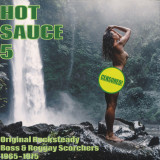
It is a nod to self-censored lewd Reggae covers from Trojan and Pama in early 70s. So don't fret,
a collectible yellow sticker has been strategically applied on the shrink-wrap to cover Miss Rocksteady's bottom!!
With its striking cover and its thrilling Reggay selection, volume 5 is bound to become another successful album in the Hot Sauce series...
Oversized custom cut LP jackets (13” / 33.02 cm width)
Silkscreened with bespoke iridescent citrus green ink by Mark Rice
Short story by Natalia Zuluaga
Flexi 7”:
steaming mescaline (extended mix by bad lsd trips)
Citrus green metallic foil stamp
Pressed in full stereo
Edition of 150
I.
bad lsd trips is the collaborative duo of makers doris dana and domingo castillo flores. Respectively the two have fostered practices that have sprawled out through various approaches and, whether in the lanes of the musical or the contemporary arts, the phenomenology of the social and inclusive prevails. On ultrafest, this motif continues through the psychedelia of its eight time-defying recordings, welcoming the listener into an open temporal architecture of the stereo field as a signifier of environment. It is worth noting that the group began collaborating in Miami, Florida with longer form improvisations recorded to a stereo cassette deck. In these recordings, the paved geographical sprawl and oceanic view permeated the approach to amassing long swaths of sound material. Listening back on that work at the time of this writing, each track feels as though one is walking into an active space, arriving to an event already in full swing and finding your place inside of it. On ultrafest (this album) something different occurs. The space and events are built around you as you move through the record.
II.
The name of the album is ultrafest, which should effectively provoke your mind's eye the imagery of young people dancing, salivating, grinding, and imbibing chemical compounds to the perversely formalized musical genres of “Electronic Dance Music” and latter-era Dubstep often heard in European Uber rides and energy drink commercials. A far distance from the icy and machinic reverie of Techno’s finest rave eras or the notable historical contributions of Miami’s cerebral producers to IDM’s global output, ultrafest is a libidinal catharsis as festival scaled to a multinational corporation of hedonistic excess. The festival has been a hallmark of Miami cultural industry production and optical enticement for tourism, purportedly bringing in nearly a billion dollars in revenue to the city since 2012. Scores of documentation exist wherein this decadent escapism leaves the concertgoer, usually in some neon garment on a near nude body potentially adorned with fluffy faux fur leg warmers, facing a comedown from the combination of volume, sun, dehydration, and methylenedioxy-methylamphetamine. This MDMA experience characterizes an aspect of the way bad lsd trips employs vocals and pitch on this album. The detached, high octaved longing of a high pitched vocal is decoupled from its typical auditory body of song. High-pass clicks and pops touch the (h)air on the back of the neck, promising goosebumps and teasing towards euphoric rushes of dopamine, yet also exist decoupled from the body of song. As the dopamine depletes and the sun imposes itself, Miami’s downtown of skeleton real estate is your company as you meander towards your parked vehicle to rest your fatigued senses, elevated heart rate, and quench the need for air conditioning on your skin. The immediacy of bombastic social immersion to architectural alienation palpable here.
III...
- Nick Klein
Since launching her own club night, “Motivation,” back in 2018, B.AI has played a key role in bringing the underground’s club sounds to her home country, China. While introducing some of the scene's most exciting artists to her local audiences, she emerged as one to look out for as well: first as a DJ and quickly thereafter as a producer. Her original takes – a sensitive, highly personal approach to melody and a knack for playing with expectations – crystallized in a slew of A+ releases and a couple of international tours. This trajectory, shaped by taking matters into her own hands and self-empowerment, now sees a logical next step, with the inception of a label that will also operate under the “Motivation” banner and features her own “Hope” EP as its first release.
Sparkling mallets, with synth-pop quality catchiness, open the title track. Rather than further evolving, their two-bar arrangement gets looped over and again, serving as the foundation for a slick FM bass rhythm and a variety of hooks. Although these incline to the bright, the overall vibe is melancholic. In vintage B.AI style, the aptly titled “Hope” is more ambiguous than its patches suggest. Similarly, the vocal this type of palette would call for ultimately comes in the form of aloof, covert musings. A bit buried in the mix, they are most efficient – just like the tension that keeps brooding underneath the surface.
“Murderbot Diaries 1991” turbocharges four-to-the-floor synthetic drums with an arpeggiated rolling bass. The blue note melody on top feels sequenced via a pocket calculator, and the dissonant, electroclash-reminiscent stabs that follow might sound even more angular. The tune is frantic, sinister – and perhaps above all tongue in cheek. It reaches fever pitch with the arrival of a tubular bell theme between the two breaks.
“Once”’s slomo cutoff modulation on the 16th note mid-bass instantly creates a sultry atmosphere that meshes greatly with the pastel cool of the gently delayed DX7 leads. The energy drifts between effortless control and uncertain outcome. These contrasts are amplified as the drums alternate amidst moderation and beat-repeat rendered havoc.
On “Only We Know,” a progressive sine lead lays out the central motif. Yet as briskly as it appears, it makes way for detuned, gliding square waves taking on the same theme. This outlines the track’s structure: as slightly morphed repetitions keep getting introduced almost haphazardly, a dreamlike, mesmerizing ambience unfolds. Techy drum rhythms and a 101-type bass make sure everything stays fuelled. Within the ingenious tapestry of melodies and new twists, it never loses touch with the dance floor. It illustrates B.AI’s club savvy neatly and is therefore a perfect closer for this EP.