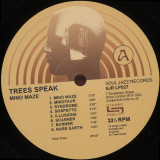
Afroterraneo Music founder Kiko Navarro joins forces with old friends and fellow Balearic heroes DJ Pippi and Willie Graff for the 'Tempistica Mistica EP', comprising two percussive, Afro-Latin flavoured prime cuts of dancefloor-ready House music.
Kiko Navarro met DJ Pippi and Willie Graff in the early 2000's, when he was resident at Pacha Mallorca. Making a pilgrimage to Pacha's Ibizan mothership to make sure two venues were musically aligned, he quickly became friends with Pippi, who was resident at the club, and Graff, who was hosting the Funky Room upstairs. Unbelievably, the three had never collaborated together before until December 2022, when Graff and Pippi finally visited Kiko's Mallorca studio and 'Tempistica Mistica' was born.
Heavily inspired by Cuban conga rhythms, opening track 'N'Fumbei' deftly blends live percussion, horns and vocals with pristine rhythmic synths and warm electronic touches to summon up a cosmic carnival taking place somewhere between the past and the future...
The floaty, piano-led 'Esanah' raises the tempo into timeless Latin House territory, paying homage to the fusion sounds pioneered by the likes of Julien Jabre & Dj Gregory in the late 90s, while updating the sonics and arrangements to sound completely fresh.
Finally, 'N'Fumbeats' strips 'N'Fumbei' down to bare bones and lets the percussion ride out, making an essential DJ weapon for those serious dancers.
Mal- One’s new single tells us about the punk fanzines that initially appeared in late 1976, but really exploded in 1977.They provided vital information on the scene and later became a great artefact of the time. A quick, fast, format, put together by fans of the music. It provided a great way to communicate with likeminded people. A couple of interviews with band members, that were keen to encourage the support. Culled together with some reviews of gigs attended and reviews of new releases, then quickly photocopied, stapled together and away you go. It’s amazing how many fanzines there were. Some examples are listed in the lyrics of this track. If you got your fanzine copies to Rough Trade, who seemed to take them all !!!, man you got it made. The hard copy these days seems a thing of the past and is sadly missed. Today’s messages arrive mainly in digital format. To take another example from the lyric ..Punk Rock Fanzines way to go…. and only 25p a go…
Bar Musica is a brand new label that promises to inject plenty of charm and originality into the underground house and techno world. The first release kicked up quite a storm from label owner Bartolomeo, and the second release features a trio of great originals by J Paraguai, with a remix from long time electronic talent Bruno Pronsato.
Rumba is up first and is a full fat, corrugated house track with tribal percussion, punchy drums that swing down low and Afro vocals. It is a dynamite groove with roughshod tin pot hits that are carefully treated and bring a lovably wild side to the track. Thesoundsays founder and Berlin based New Yorker Bruno Pronsato has been on the fringes of the underground for more than a decade with inventive EPs and LPs on labels like Hello repeat and Bosconi. His remix is stripped back to a forceful and rubbery techno groove. Blistered synths rip up the middle and spooky voices, trippy effects and manic loops all make it a freaky late night or after-hours tune that will send floors wild.
Ble is then another J Paraguai, and this one is again unhinged and urgent, with intense synths exploding above shuffling, tightly knotted minimal drums and sweeping pads. It's pure WTF music for brave DJs and dancers and is a truly original production.
Then last original Atles is rugged and impactful in the way in combines house and techno into new ideas. It is stripped back to little chopped loops that bury deep in your brain and have you in a trance in no time. As such, it rounds out a fine EP and keeps this exciting new label going off in great style.
"BASELINE CAVI" is a collaboration album between Inland Empire/Los Angeles rapper Trizz and producer MIKE SUMMERS (aka Seven) from Kansas City. The album has that classic Westcoast Hip-Hop sound and the intro track gives that feeling right away. Guest features on the album are from Bino Rideaux, XV, T.F, ICECOLDBISHOP, John Givez and Bale.
Though fans may not know it, this collaboration between Inland Empire California emcee Trizz and Kansas City production ace MIKE SUMMERS has been brewing for close to a decade. Back in 2013 SUMMERS (then known as Seven) was already a prolific producer signed to Tech N9ne's Strange Music label and Trizz was part of horrorcore legend Brotha Lynch Hung's Madesicc Muzic roster. The two connected while working on Lynch Hung's "Mannibalector" album and a spark for future work was laid.
Linking up in spring of last year, the two creatively fed off each-other with the resulting album evoking classic West Coast melodicism and car-rattling thump. As Trizz states "this sh*t is so f*ckin authentic. It got bounce, it's swangin' and bangin! When you hear this album, you can feel it and damn near smell the palm trees and bomb ass weed."
As SUMMERS relayed "It's probably different for a lot of my fans to hear a more classic West Coast style of production from me, but that style of production has always been embedded in my sound. I grew up on 90's West Coast Hip-Hops studying producers like DJ Quik and Dr. Dre. The only reason I started using lots of live musicians on my tracks was because I watched Quik do it. BASELINE CAVI really let me dig into that classic L.A. sound that I've always wanted to build with.
Lyrically Trizz's immediately distinctive flow and storytelling abilities are at a new plateau with the emcee admitting "The lyrics on this album are probably more refined and defined because I just turned 30 and I have no more time to waste."
IZIPHO SOUL are thrilled to announce the 7” release of the Modern Gospel Soul Banger JESUS MAKES ME HAPPY by RICHARD HARTLEY & SOUL RESURRECTION - Presented on vinyl is ‘The Joyful Exaltation
Edit’, this excludes the rap from the original version.
On the flip side, HEART AND SOUL, a ballad of epic proportions that builds and builds with the finale possessing some of the most gut wrenching vocals you are ever likely to hear. Richard states towards the end that ‘I should be fading
right now’, but finds the strength to come back one more time!
These tracks are taken from the album Face II Face from 2007, the CD is virtually invisible - Discogs history reveals no sales.
Richard Hartley has had a prolific career as a singer and musical director, travelling across the world to work with choirs and musical icons such as Aretha Franklin and Diana Ross. He is pastor
at Haven International Ministries, New York and star of his own reality television show ‘The Rev’.
A collection of unreleased themes and scores from 18 short animated films from the world famous Zagreb School Of Animated Film. Includes Oscar winning short cartoon Ersatz / Surogat by Dusan Vukotic (1961) and many other jazz, electronica and experimental scores by composer Tomislav Simovic. Coined by the famed film theorist Georges Sadoul at the 1959 Cannes Festival, The Zagreb School of Animated Film(s) or The Zagreb School of Animation, was defined as an artistic and philosophical world-view that set its mark on the history of animation in the 60's and 70's. The key feature of the Zagreb School (not educational facility in any kind), was commitment to stylization in contrast with the Disney-style canon of realistic animation. Among many composers that worked in Zagreb Film productions, the name of Tomislav Simovic (1931 - 2014) stands out. In his oeuvre of 300+ film scores (not counting compositions and arrangements for pop singers and jazz orchestras), many were made exclusively for Zagreb film documentaries, fiction shorts, features and animation. Simovic was particularly adept at writing music for cartoons. He skillfully synchronized movement and sound and mixed different musical genres, although, like his peers at the time, he leaned towards jazz. 'The Zagreb School of Animated Film (Original Soundtracks 1961-1982)' is compiled by Leri Ahel (Mutant Disco Radio Show) and Zeljko Luketic (Electronic Jugoton, Ex-Yu Electronica III). Master tapes were considered lost, now found and restored for this epic 2 x LP release celebrating Yugoslavia's animated art shorts. Double vinyl gatefold with extensive liner notes, photographs from the films and exclusive cover artwork by Dejan Krsic (NEP / Nova Evropa).
After picking up a camera in 2006 to shoot events at London superclub Fabric, Sarah Ginn started her journey of documenting the dance music scene. With exclusive, behind-the-scenes access at the likes of Fabric, Ultra Festival, Boomtown, Glastonbury, Outlook, Printworks, Creamfields and Hospitality, Sarah captured the sights of UK rave and
dance culture in the 2000s, 2010s and 2020s.
Super Sharp Shooter is a carefully curated selection of over 800 photographs from Sarah’s extensive archives, many never before seen. Spanning drum & bass, dubstep, house and techno, the book showcases festivals, clubs, press shots and record covers, providing an unsurpassed document of electronic music in a colourful celebration of beats and bass.
This deluxe book features artists like Andy C, Skream, Chase & Status, Shy FX, Carl Cox, Fatboy Slim, Goldie, Chemical Brothers, Jon Hopkins, Sub Focus, DJ Zinc, Ben UFO, Craig Richards, Erol Alkan, Miss Kitten, Dusky and many more. Also contained is Sarah’s essay,
The Feedback Loop Theory. A demonstration of how music affects time and energy and makes it a magic entity. Set in colour order to reflect the visible light spectrum, this gorgeous book is a must-have for all music and photography enthusiasts. It has 480 pages in full colour on heavyweight 150 gsm paper. It's available as a book only and as a bundle with an exclusive A2 poster.
“‘I’m looking forward to publishing this book because these actually are my only memories!Research shows that when you take photos it actually affects the way you remember things. So on that note, I hope you all enjoy my crazy spectral journey into sound, the many sights of the rave and everything in between.” - Sarah Ginn
Voted DJ Mag’s Underground Hero in 2022, DJ & producer Lauren Flax has been a fixture in Brooklyn’s electronic scene for two decades. On her latest project Liz & Lauren EP, she teams up with Liz Wight of shoegaze techno duo Pale Blue, whose sultry vocals explore questions of love and isolation to the tune of Detroit house and acidic techno.
Flax and Wight became fast friends in 2021 after being introduced by Pale Blue member & 2MR co-founder Mike Simonetti, who’d enlisted Flax to remix Pale Blue’s “Breathe.” Naturally, when Flax needed a vocalist for some tracks she was working on shortly after, she knew just who to call. “I was in my last year of grad school doing an internship in community mental health helping kids cope with the trauma of the pandemic,” Wight says of the time. She channelled this experience as she wrote and recorded the lyrics to Liz & Lauren EP from her home in Los Angeles.
As a result, the lyrics on Liz & Lauren EP are open-ended musings on connection, isolation, and convention. Lead single “Fix Everything” can be read both as an indictment of the trappings of marriage or, on Flax’s view, a rousing call to action, applicable to issues ranging from the degradation of the environment to the attack on LGBTQ+ rights in America. As the EP progresses, Wight’s airy vocals consider the pitfalls of love, from the destructive power of infatuation to the pain of outgrowing a relationship.
Sonically, Liz & Lauren EP feels like a natural progression from Flax’s first release on 2MR, 2021’s Out Of Reality, which saw her exploring a more minimalist production style for the first time in her work. “I Don’t Want To Hurt You” and “Fix Everything” pulse with bright, dynamic production, while slow burner “Return To Love” takes a sparser approach, anchored by a muted drumbeat and a simple, earworm synth refrain. “I’d Risk It All To Be With You” is a masterful balance of both; it even gets the club treatment on the EP’s closing remix, courtesy of Flax’s friends Mark Archer and Simon Neale (Shadow Child) of MASC.
Liz & Lauren EP is an impassioned collection that showcases both Flax and Wight’s artistry in equal measure. For both artists, it’s a testament to stepping outside the norm (DJing for Flax, performing in Pale Blue for Wight) and collaborating with others, the fruits of which are sure to be felt on the dancefloor for years to come.
Pellegrino & Zodyaco, with their new single 'Malìa', continue the aesthetic and sonic journey of the project led by the Neapolitan producer, with a mixture of Neapolitan disco-funk and fusion steeped in Latin flavour that already explored the innermost corners of the soul with 'Quimere'. This new work captures the frenzy and vibrant character of Naples, with its rarefied atmospheres and infectious groove that evoke the beating heart of the city and take us on a journey through the wonder of life in search of the Mediterranean essence.
The 'Malìa' is enchanting, it’s that mysterious force that hides deep inside, transforming itself into a vortex of emotions through the fusion of involving rhythms and reflections on inner battles, on the importance of finding the 'light' to overcome conflicts and difficulties that hinder the ability to choose, a dreamlike mirage that opens a window on human vulnerability, a hymn to authenticity, to self-acceptance.
The celebration of dance in the Caribbean Escapade version is also an exhortation to escape from everyday life; it takes us into a sonic imagery that plays with the Neapolitan musical tradition and the freshness of Caribbean and Latin sounds. This summer single becomes an ode to the vital energy of dance music: there is no more time for hesitation, one must let oneself be carried away by the enthralling embrace of 'Malìa', like a call to awareness and the search for authenticity in life. Malìa becomes the guiding thread, the mystery that urges us to go beyond the confines of everyday life, to explore and celebrate the complexity of existence.
Pauline Hogstrand's music – and Áhkká, in particular – is deeply inspired by both inner and outer influences, by the mystical as well as the rock-solid, by fictitious conversations and the queen mountain of Lappland (Áhkká).
Meaning "the old lady" in Lule Sámi, Áhkká is a barren, wild, exciting, beautiful, and sometimes grumpy mountain regardless of the season. Over the years, the mountain peaks, moss, birch forests, paths, streams, birds and people have shaped the surroundings, and the massif changed them in return - a reflection of a constantly ongoing development and emerging into greatness, surrounding and within. Speaking about why this mountain is so dear to her, the Denmark-based musician shares: "The nature there is harsh and raw and you can easily feel how it's so much bigger than you. Some people might feel overwhelmed or intimidated, but I feel that when acknowledging the greatness and the power nature consists, I can feel one with it. We come from the same source: I am a part of universe, and universe a part of me."
The music appearing on Áhkká (the album) simulates the dualities of ascent and descent, tension and release, inhale and exhale. Through implementing extended structures for analog and digital synthesis and processed acoustic instrumentations – strings, recorder, pipes and field recordings – Hogstrand expertly navigates these dual motions across two side-long pieces.
The opening "Herein" is slow, difficult, at times jagged and unwelcoming; just like climbing up a mountain early in the morning. Hogstrand shares that this piece is "about surrendering and letting go of control", especially during the last 10 minutes of the track which consist almost solely of an insistent and pulsating drone leading you to no man's land. "Magnitude" offers a release, glimpses of beauty, a softer, easier presence; descending, you're able to see beauty where previously you saw obstacles, perhaps the sun is up, breathtaking views in every direction... This piece is "about all that becomes available after letting go. Suddenly sight clears up in front of your eyes," shares the Swedish composer.
The magic ultimately lies in Hogstrand's perception and portrayal of contrasts – she does not view the two as opposites, but as one reality. "One greatness is not compromised by another greatness." In fact, the opposite is true – one without the other loses meaning, depth and context.
It's not because one might have worked with people like Jimi Hendrix, John McLaughlin and Rod Stewart throughout their career that Italo-Disco wouldn't get the best of your work. A great example of the Italian phenomenon's infectiously widespread grip is British rock keyboardist Brian Auger's path, when he found himself in a Milanese recording studio during the mid 80's and recorded his last known release in that decade. Powerfully fusing decades of rock and jazz education with the synthetic hysteria of the time (and culture), the result is a classic downtempo number that has found its way into some of our favorite DJ sets for a while now. Vocal and instrumental are featured on the A-side and in addition the B-side offers a new remix where things take somewhat of a catastrophic turn into what sounds like Brian getting on the wrong train to a K-hole, probably not for most dance floors. Meticulously remastered at manmade mastering in Berlin.
The latest Greyscale vinyl release is here and is destined to be a dub techno club staple. Featuring one of the best current dub techno producers in Federsen. This physical release is jam packed with club tracks as the flip side features remixes by the amazing Deadbeat and our own grad_u.
Federsen is elite with making catchy grooves like in the first featured track 'Penumbra'. The hypnotic sounds work terrifically in unison to form one of the most seductive tracks we have heard recently. Subtle movements and engrossing tribal rhythm make this a sure-fire dancefloor groover.
'Viridis' focuses more on the melodic chord side while it balances a wonderful deep dub bassline. Spatial and hypnotic are words that come to mind when we heard this for the first time. This is one of those tracks you sway and close your eyes too. Pure dream state stuff.
Deadbeat's dancehall dub Penumbra is magic. This has classic stamped all over it. The Dancehall description might put some classic dub techno fans off. Just come listen and experience this unique song. You just can't deny this! Sick.
Knowing that he is sharing a side with legendary Deadbeat, grad_u puts some extra muscle into his remix of 'Viridis'. Flighty and techy, we just love this futuristic fast-moving sound and we can't get enough of it. An awesome way to end the record.
Also, for an extra treat, there will be a 2 special remixes by Basicnoise of each main track added as bonuses to those who purchase the vinyl.
Greyscale vinyl #11 is sure to be one of the hottest techno records out this year!
You never have to guess what Tink’s thinking. The Chicago-born songstress and rapper says it all in her music. She spits, speaks, and sings straight from the heart without filter or apology. At the same time, she breaks boundaries, dropping off bars with uncontainable charisma and belting out hooks with show-stopping range. She can be romantic in one crescendo before getting raw in a bout of wild wordplay. This versatility consistently affirms her as a force in her own lane. Following her 2011 debut mixtape, “Winter’s Diary,” she dropped projects at a prolific pace, including “Alter Ego,” ‘Blunts & Ballads,” and “Boss Up.” 2014 saw “Winter’s Diary 2: Forever Yours” arrive to widespread critical acclaim, landing on year-end R&B album lists from Billboard and Rolling Stone. It also yielded “Treat Me Like Somebody,” which gathered 64 million Spotify streams and counting. A year later, XXL touted her among its coveted “Freshman Class.” Following a stint in the major label system, she embraced independence again with “Winter’s Diary 4” 2016, “Voicemails” 2019, “Hopeless Romantic” 2020, “A Gift And A Curse” 2020, and “Pillow Talk” (2023).
Oliver Rosemann is a DJ and producer from Leipzig, who has been active since the 90’s. During this time, he has made his experience with timeless techno exactly in the time of its creation, which can be seen later in his productions and DJ Sets.
In the Leipzig scene he played numerous live sets in the early 2000s, including at the 1040, one of the legendary clubs of the time. Increasingly, he began to show himself in public not only as a pure live act but also as a track producer. With the collaboration with MasCon called "dualit" he had first big releases on labels like Earwiggle, CLR or Fith Wall Records and also international gigs e.g. in Antwerp.
To date, there are close to 180 tracks and remixes, including 3 LPs, released on labels such as MindTrip, MORD Records, Warm Up Recordings, Pole Group, Stockholm LTD and many more. Pfirter and Oliver started producing together in 2019 and presented their first joint 4 tracker “Alpha EP” in 2020 on MindTrip Music.
Whether as a live act or as a DJ, he knows how to create a dark, driving, ecstatic atmosphere on dance floors. He has already proven this in clubs like Tresor Berlin, Distillery, Institut für Zukunft, About Blanc and also in other countries in Europe. Numerous podcasts recorded by him or live cuts from parties, which were released over the years by renowned crews such as "Reclaim Your City" or "Staub", show this.
And now follows Oliver’s next release on NEXT DOOR with the ND006. The a side is Olivers side with A1-Surface- a track with deep impact and to dance. A2-your highscore- is Olivers remix, grandiosely interpreted to immerse yourself in the universe of patterns. The B side belongs to TC/CM or written out- the computer controlled minds. B1-your highscore- comes in the original danceable and playful at the same time from the turntable. B2-Surface- remix by TC/CM hammers through the PA straight onto the floor.
Duality Trax first opened its books in 2020 with an EP featuring Radiant Love regular Fio Fa and a remix of the year contender coming from Lisbon’s Violet. Since then the label has become known for its acute attention to detail, giving each release the shine it deserves while avoiding disposable practices and challenging the industry through its dedication to duality and balance, whether that be sonically or surrounding gender identity. It’s really no surprise that one of house music's leading label ¦gures Tywi was destined to make an appearance. Having started the Haŵs imprint in his home city of Cardiff, the label’s wide-spread popularity began to gain the attention from some of the industry’s most respected heads and became a breeding ground for new artists to emerge. A shared love of music resulted in tracks being shared over time and eventually DUALITY6 was born. In what will be his ¦rst full length EP, Tywi continues to join
the dots between 90’s house, prog, breaks and trance, with a huge remix coming from Frankfurt-based artist Maruwa. Title track ‘Reality Checkpoint’ connects various styles with a modern take on progressive trance. Sonics feel as if they’ve been projected from space in a kaleidoscopic mind-warping ride, coupled with the producer's impressive ear for world building soundscapes. A child of the ‘90s, Maruwa combines her classically trained ear with the nostalgia of her upbringing in the remix; channeling early trance records and deep, chugging rhythms into a wave of euphoria ¦t for peaktime. It’s the ¦rst time the label has also delved head ¦rst intofull trance territory, turning the intensity levels up while paying homage to both label owner and artist’s early musical in§uences. The B side opens up with ‘Spellbound’ which feels like a guided tour around the cosmos, sat beside trusted travelers and embraced by everything-will-be-alright energy . The track’s interior is built around synths that feel both effortless and light as our tour guide brings us towards our ¦nal destination. The EP comes to a close with ‘Laws Of Motion’, building slowly with shades of leafy greens and deep oceanic blues as it gently brings us back down to earth.
For Fans Of: Laibach, Trepaneringsritualen, Ulver, Skinny Puppy, industrialized Dead Can Dance, Celtic Frost. FORGOTTEN SUNRISE is a band both legendary and current; inventors in one era, and innovators in the present day. Celebrating their 30th anniversary this year, the group has evolved and morphed over time into its current formation of Anders Melts, Kadri Sammel, and Jaan Pullerits. A huge part of the Estonian cultural landscape that comprises dark music, Forgotten Sunrise began life as a death metal band in the early 90s, part of the movement that spawned groups such as Amorphis, Beherit, Anathema, My Dying Bride, and Katatonia. As styles converged, and electronics entered the picture, the group incorporated newer techniques and a more industrial approach over time, consolidating their methods into a unique strain they call “OUTDUSTRIAL” – outsider industrial. elu is the first album in the “HALL-ELU-JAH” trilogy. Starting in the middle, the band has an expansive story arc set across 3 albums. In this first presentation of the trilogy, elu synchronizes the classic Death Metal style vocal with ethereal female voice, horror atmosphere, and pounding EBM rhythyms to create 8 memorable and visceral tracks. From high-energy dancefloor-fillers like “Orthotoxic Waste” and “Deep Emoceans” to heavy industrial grinders like “Near Bye” and “iSaid” to the emotional close of “Meating 8:08” into “Elukas”, the album provides a serene metamorphosis, guiding the listener through the many-worlds-as-one experience of Forgotten Sunrise. – Forgotten Sunrise are: Anders Melts – Vocals, bass, guitars, cymbals, djembe, thunder tube, knife and fork. Kadri Sammel – Vocals, bass, keyboards, shaman drum Jaan “Suva” Pullerits – Controlling the arrangements of chaos Ants “Ank” Lill – B(l)ack vocals on “Elukas” Recorded, mixed, and mastered at In Dreams 2020-2022 Artwork by Rene 13 Cover Picture by hellish.cav Executive Producer for Ohm Resistance – Alexandra Portaluppi
The bright new duo, Marcel Vogel & LYMA, triumphantly returns to Boogie Angst with their sizzling new EP offering, No Time.
Following the recent release of their lead single, Free Time, we're proud to introduce four new, unique tracks to their burgeoning collection of juicy tunes.
Funkiness and abstraction take center stage on this EP. Opening up with the previously released Free Time, featuring filtered vocals and an unconventional structure that blends rich synths with dusty analog stabs and 1990s rave plucks.
The tempo slows down on Easy, a gorgeous song that sounds like a lost Sade demo, featuring subtle beatbox textures, tiny synth plucks, all ending up in a delightful culmination of delayed textures.
Broken Wings begins with a captivating vocal performance, leading to a sturdy Roland bass drum, sustained chords, and resonant arp sequences, with hints of Freestyle.
Flame On creates an almost tropical atmosphere with looping, scattered vocals and an abundance of cowbells. All before the EP closer, You're A Star, rounds things off with clunky basslines, a steady groove and hypnotic pitched vocals.
No Time follows the duo's debut Boogie Angst EP, Games Change, and is a powerful step forward in their young, yet promising catalogue.
A special vinyl edition of No Time will also grace our stores soon.
Having released several solo projects, numerous collaborations and a series of LP's, EP's and singles with his band Ruby Rushton that centred on original compositions, he wanted to take a moment to focus his energy on exploring the classic jazz material that has inspired him over the years.
Players like Jackie McLean, Duke Pearson, Clifford Jordan and Wayne Shorter have all played significant roles in Tenderlonious' life and provide a constant source of inspiration for his development as a musician and composer. 'You Know I Care' is a tribute to those musicians and for this reason a landmark album - his first recording that purely delves into the American jazz songbook. Plus it's a way of encouraging a new generation of jazz listeners to explore some of the most significant contributors, and in some cases unsung heroes, to this everevolving genre.
This long player clearly follows in the footsteps of Tenderlonious' spiritual jazz hero's, paying particular attention to the original performers of these six masterpieces - Jackie McClean, Clifford Jordan, Wayne Shorter and Duke Pearson. This is also the first time that Tenderlonious has recorded on alto saxophone, a more recent love affair for this talented multi-instrumentalist, and hopefully the first of many.
There is something for everyone on this album, from brooding ballads to fullsteam ahead modal delights - and an opportunity to enjoy a fresh take on these timeless compositions.
Tenderlonious: alto saxophone, flutes
Hamish Balfour: piano
Pete Martin: bass
Tim Carnegie: drums
1 december 1944, Thiaroye military camp, right outside of Dakar, Senegal.
1600 French soldiers of West African origin (Benin, Mali, Ivory Coast, Tchad, Senegal , Gabon, Togo etc.) have been quickly evacuated by the French Army during what was subsequentially called the ‘whitening of the colonial troops’ that happened before the armistice signature. The soldiers are awaiting to be paid for their war effort. Things go sideways, protests erupt, and the French military staff decides to open fire. The official number of casualties is 35, although various sources claim several hundred people died on that fatal day.
Since then, several artists have grasped that difficult topic, screaming for recognition and reparation.
Such is the case with a young Senegalese musician and singer named Maxidilick Adioa, with his very first single ever released, ‘Toubab Bile’, in 1987.
At that time, Adioa had been living in France for a few years. He was considered a master percussionist, playing, recording and touring alongside the great Ivorian artist Alpha Blondy. He had just written a beautiful tune, ‘Nao’, for Aminata Fall, one of the biggest actress and singers in Senegal. It seemed like a good time to launch his solo career.
Toubab Bilé remains Adioa’s biggest hit to this day, and one of the best African reggae tune ever recorded.
Adioa ended up signing an album deal with Chris Blackwell’s Island records and toured the world endlessly during the following years.
In 2012, François Hollande was the first French President to officially mention and pay tribute to the Thiaroye massacre in a speech.
Reissue of the 2011 album Tao of the Dead by American alternative rock band ...And You Will Know Us By The Trail Of The Dead. First time available on vinyl since its release year. Features a replica of the original comic book insert. Tao of the Dead is their seventh album. The band stripped down to its core four-piece lineup for the record, deviating from the past two records that featured a filled-out six-piece band. This resulted in a stripped-down record with heavy emphasis on guitar. It’s a two-part record, each side with a specific musical tuning; Part One in D and Part Two in F. The album can be listened to as 16 different movements or two lengthy tracks. Part One: Tao Of The Dead is split into eleven tracks, whereas Part Two: Strange News From Another Planet is five songs combined into one. Lead singer Conrad Keely described the album's composition; "It's the way I listened to albums when I was a kid, seeing as some of my favorite records were Pink Floyd's Dark Side of the Moon, Yes' Relayer and Close to the Edge... I always liked listening to records that were just a continuous piece, like an orchestra or a symphony."
Mysteries Of The World is the stunning final studio album from legendary Philly supergroup MFSB. Expertly co-written and produced with the mighty Dexter Wansel, it features the untouchable, sparkling masterpiece "Mysteries Of The World". The whole album is truly exquisite; a stylish, classy collection of pure Philly soul and orchestral jazz-funk.
MFSB, an acronym for Mother, Father, Sister, Brother, was formed by producers Gamble & Huff of Philadelphia International Records. The band's roots can be traced back to the house band at the legendary Sigma Sound Studios, where they played on numerous hit records by artists like The O'Jays, Harold Melvin & The Blue Notes and The Stylistics. Mysteries Of The World comprises slick jazz-funk grooves, mostly penned by Wansel, who produced a fair chunk of the album in a similar style to his space-funk records. MFSB's smooth sound is retained but it receives a fresh, elegant and jazzy upgrade. While this album is as mellow as the rest of the latter-period MFSB recordings, it never forgets the group's soul music underpinnings.
Swaggering, well-timed horn blasts, sweeping strings and a percolating, hard thumping slap-bassline combine to devastating effect on amazing opener "Manhattan Skyline". It's a sexy mid-tempo instrumental which sets us up nicely for what follows. Essays could be written analysing the perfection of title track. Arguably the finest jazz-funk instrumental ever made, it's absolutely magnificent. Featuring musicianship of the highest calibre, the band play with their trademark tight discipline, cooking up a syncopating rhythm with an array of exploratory keyboard riffs wrapped around a punchy bassline sent from heaven. It sounds like house music, it's that ahead of its time. The string intro is sumptuous, hypnotic and divine and that's all before the beat hits. The track fuses classical, jazz and funk into a musical journey that you never want to end. Absolutely flawless, it's a dramatic disco dancefloor killer.
Says Dexter Wansel himself: "You know, of all the songs I wrote/produced/arranged for MFSB, this is for me the most different. I think it's an experiment in rhythmic, soft sonic synth and live string and harp combinations. I composed it in an effort to blend a funky groove, along with synthesis, and orchestral sounds. There are 3 synthesizers: Oberheim 4 voice, Polymoog, and of course Arp 2600v. And, as I remember, I recorded the track with the rhythm section, string, harp and flute players first. Then I added synthesis."
The profound elegance remains in abundance on the slinky, harp-laced "Tell Me Why"; Carla Benson's beautiful voice truly shines on this sophisticated cut. The side closes out in dramatic style with the string-drenched "Metamorphosis". It's a staccato, Blaxploitation groove workout featuring wah-wah guitar, creeping basslines, rich horn solos and soulful vocals drifting in and out of the mix. The bouncy, irrepressible "Fortune Teller" opens the B side in the bass-heavy orchestral funk style before the beautiful "Old San Juan" glides in, a Balearic-adjacent track with intricate arrangements, building its mellow soul groove around an atypical flamenco guitar hook. Melancholy, guitar-led instrumental "Thank You Miss Scott" is a real highlight, with gorgeous flute, string and percussive elements whilst closer "In the Shadow" works an otherworldly synth line into its bossa nova groove.
An essential record for fans of Philly soul and groovy jazz-funk, Mysteries Of The World was mastered for vinyl by Simon Francis and cut by Cicely Ralston for Alchemy at AIR Studios. The stunning artwork, the work of renowned illustrator Robert Giusti, was restored at Be With HQ to round out this beautiful reissue.
Life has changed in the eight years since the release of II. In ours, yours and Gala Drop themselves. Most times without noticing it, partly due to those two years of a semi-existence that still resonates and with the ongoing predatory gentrification process changing the landscape and life of Lisbon, home to the band since ever. Close to a decade and a half of existence, with various mutations along the way enacting new perspectives and moments of stillness and reflection to a sound that's been mutating itself to its own internal rhythm and agency under the guiding light of the core duo of Afonso Simões and Nélson Gomes. Now a trio, with Rui Dâmaso transitioning from II after the departure of Jerry the Cat and Guilherme Canhão, Gala Drop sound even more focused as a working band, with their new album title Amizade – friendship in Portuguese – making perfect sense in a celebration of their, by now, patented soundworld of cosmic inspiration: krautrock's endless and hypnotic potential, dub's sense of transient space, the throb of house, balearic dreams, polyrhythms and a communal sense of belonging.
Again, this sprawling sphere of influence opens itself to new shapes and inspirations, but there's a deeper sense of accuracy and direction, with the band channeling those legacies into something we can only grasp as the Gala Drop sound. An organic outcome of working steadily as a trio, made possible by a residency promoted by gnration in Braga, Amizade dwells on the psychedelic nature of the group through seven tracks made up of dreamy synth washes, loads of percussion, echoes, chilled guitars under a radiant aura. Gala Drop have never sounded as openly dubby as on 'Dub da Meia Noite' and 'Areal Dub' or capable of converging different tropes of the hardcore continuum – rave stabs and cut up vocals – on a slow burner as memorable as 'Monte do Ouro'. Or given free reign to electricity as on the narcotic guitars of 'Guitarra Voadora' – excepting the one off with Ben Chasny on 2012's Broda. 'Amizade' points towards all of that with comforting escapism and wrapping things up 'Raio' turns dubstep's original bass weight meditations into a cosmic funk workout. One last hug before we leave. An album that feels like a collective moment of celebration, just when we most need it.
Afonso Simões - Drums, percussion and synthesizers
Nelson Gomes - Electric guitar and electronics
Rui Dâmaso - Electric bass & guitar and synthesizer
Recorded by Budda Guedes at Estúdio Mobydick, Braga
Mixed by Gala Drop and Hugo Valverde at Estúdio Cão Andaluz, Lisboa
Mastered by Anne Taegert at Dubplates & Mastering, Berlim
Cover photo by Sara Graça
Design by Nicolai Sarbib
More than a decade after the release of ´Land Lines', the mythical Humboldt County, California based duo of Brian Pyle and Merrick McKinlay reappears seemingly out of nowhere with 'Atheistsaregods'. With past releases on such cult-like labels as Root Strata, Weird Forest, Blackest Rainbow or Digitalis, Starving Weirdos were an indelible part of a sprawling and loose network of artists in Northern America whose DIY work ethic and extreme activity revolved around shoestring-budget constant touring, numerous limited editions on CDR, tape and vinyl and a relentless drive to push the boundaries of genre.
Out of that cauldron, Starving Weirdos stood out as one of the most persistent and visionary acts, developing a mind altering body of work that went from warm soundscapes through droney digressions, freeform improvisation and raucous noise summoned from a myriad of instrumentation and low budget processing - vocals, keyboards, violin, flute, percussion and an assortment of less identifiable sound sources. 10 years on their legacy remains a timeless and wildly under-appreciated one, but hopefully this new album will shine a light on their idiosyncratic approach. As time itself was never a constraint. This is music suspended outside of it.
Right from the start with the echoing percussion, dissonant keys and processed vocals of 'Haiku Nagasaki', 'Atheistsaregods' draws a continuous flux of psychedelic elevation that goes from the gloomy electronic motifs not unlike the early Cluster vibes of 'Invocation' into the dank percussive maze of the appropriately titled 'Barulho do Samba'. The self titled track induces a sense of post-apocalyptic vertigo via hallucinatory scraps of voice, suspended synth tones and reverberating field recordings, connecting into the droney mystics of 'Dudukahar (Reed Prayer)'. Coming full circle, 'For Vinny' brings back the echoing percussion amidst hypnotic cello lines until it drifts off into the unknown. With the same palpable sense of urgency, Starving Weirdos feel as vital as ever. And even if we didn't realize it we were in need of them. Welcome back.
‘The Nature of Nature’ is the debut LP by Hanegi Koen, the Japan-based creative duo composed of British ¦lmmaker Sam King and Canadian label head Sean Mallion (ADSR Collective). Picking up where they left off with their 2021 EP ‘Well Worth A Visit’, this album continues the legacy of spaced-out ambient guitars and driving analog beats the band nicely cued up for us. It has continuity from their previous work, going even deeper this time, further de¦ning the contours of their sound. As the title suggests, Nature was a big influence on the record. Many of the track titles are from the season they were recorded in – for example, ‘Hanafubuki’, when the cherry blossoms fall, ‘Tsuyu’, the rainy season, or ‘Kaminari’ which was written during a crazy thunderstorm. The sights and sounds of those times are reflected in the tracks, with ¦eld recordings helping to supplement the atmosphere. Hanegi’s founding ethos of only using analog instruments and drum machines to compose and perform, minimizing the need for the computer as an interface, is alive and well in this album. The tracks got tested in front of an audience and improved on, based on feedback from playing them live, leading to a psychedelic, synth-rich, analog journey. “We like all things analog. We both use computers and digital screens a fair amount in our day job, so it’s nice to give our eyes a rest from that and allow the music to be created from everything we have on the table.
Similarly vinyl records, ¦lm photography, and simply walking around outside in the forest – all these things are a way of slowing down and escaping the digital world.”
Greatly influenced by the wild contrasting outdoors of their home in Japan, the mountains, forests, and ocean, ‘The Nature of Nature’ is an open invitation to unplug to reconnect, a feeling that Hanegi Koen want to share with you. Released on August 18th, on vinyl and digital via Subtempo. Credits: Written and composed by Sean Mallion and Sam King Mixed by Aoki Takamasa Mastering by Manmade Mastering Album art by Laine Butler Design by Rocco Tyndale
Carved out from between the cracks of life over a 2 year period, Low Flung presents his eighth full length album ‘The Wheel’. Together, the 11 tracks provide a space to process and sit with difficult change. This takes the form of microscopic minimalist landscapes. Presented in both audio and physical form as micro grooves on a 12” vinyl.
At times the sound wanders and walks, other times it remains still, clear and precise. The omni-present artifacts found in ‘The Wheel’ are left to breathe a different life during each listen. Drones act like familiar trails losing their path as space transforms like a breeze over a table of sand. Hyper focused spores evolve around blurred waves of time. Electronic tones are captured flowing to the rhythm of a decaying natural world.
‘The Wheel’ is a patchwork of sonic experiments made using modular synthesis, fixed architecture synthesis, Buchla Music Easel (replica), outboard effects, cassette manipulation techniques, samplers and field recordings taken along the texturally rich and historically questionable eastern coastline of Australia.
The tracks have been composed with a materiality that embraces the acoustics of different listening environments. Much like mood, this means each listening experience is unique due to the natural acoustics of your listening space. The sounds on this album embrace this phenomena, creating a rich, visceral listening experience that slowly scratches away at discrete moments of time
Rather than attempting to traverse new sonic fields of experimentation in ‘The Wheel’, the album touches on the various spaces Danny has explored over the past ten years as an Audio Visual artist. Although technically eighth, it would be more fitting to say this album draws a clear line from ‘Blow Waves (2018)’ to ‘Outside The Circle (2020)’ to become the third and final chapter in the expanded non linear, unintentional landscape series. Serendipitous that each was conceived over 2 year periods of time.
While the key focus is sitting with difficult change, this album is also a celebration of any moment you might find yourself in. Good, bad, easy or hard, this album is an attempt to help with feeling content wherever you are along your path. With each cycle a new context.
Effortlessly dismantling the barriers between R&B, soul, funk, disco and jazz sounds, MF Robots present long player ‘Break The Wall’, on BBE Music. Astonishing musicianship, pristine production and top-tier songwriting, ‘Break The Wall’ immediately calls to mind those iconic American rhythm sections of the 70s and 80s. The music is energising, uplifting and the potent result of a highly accomplished musical partnership maturing, growing and hitting their stride together in lock-step. Jan Kincaid and Dawn Joseph met as members of one of the UK’s most successful Acid Jazz bands, which influenced Mark Ronson, D’Angelo, Jamiroquai, Erykah Badu and The Roots to name a few. Founding the Brand New Heavies was an important chapter for Jan, but once he and vocalist and songwriting partner Dawn began working together, the chemistry was instant and irresistible. It was time to turn the page, and soon MF Robots was born. “When we made our first album, we didn’t have a band as such. We basically made a lot of the record at home and called on other musicians as and when we needed them. Our sound was developing organically, and when we finally released the record to great critical acclaim, it was time to get out on the road,” says Jan. “We put together a band of like-minded young musicians, playing intimate gigs and big festivals all over Europe and beyond, growing tight as a unit, so that when it came time to think about making this, our second album, we knew we had an extra level of musicianship full of personality that could realise our vision.” Inviting band members Alex Montaque (keys), Naz Adamson (bass), Mark Beaney (guitar), Jack Birchwood (trumpet), Ben Treacher (sax) to improvise and contribute their own ideas over song-sketches laid out by Jan and Dawn gives ‘Break The Wall’ a special sense of off-the-cuff brilliance. Even on the polished final product you can detect a collaborative, fluid and unhurried approach to production that’s all-too rare these days. There’s guest performances from bassist Gail Ann Dorsey (‘The Love It Takes’, ‘Make Me Happy’) and guitarist Cory Wong ('Shine', 'Make Me Happy'), the former a top-flight session player who’s collaborated with Lenny Kravitz and David Bowie among others, the latter a member of the incredible Vulfpeck collective and an accomplished solo artist in his own right.
David Byrne & Fatboy Slim’s acclaimed 2010 album Here Lies Love receives its first-ever vinyl release to coincide with a new production opening on Broadway this summer. Here Lies Love is a double-disc song cycle – improbably poignant, decidedly surreal, surprisingly thought provoking – about the rise and fall of the Philippines' notorious Imelda Marcos. It was conceived by David Byrne; composed by Byrne and DJ/recording artist Fatboy Slim, AKA Norman Cook; and performed by a dream cast drawn from the worlds of indie rock, alt country, R&B and pop. Byrne's taste in collaborators is as imaginative as it is impeccable, including Cyndi Lauper (who recounts, to lighthearted disco beats, Imelda's courtship with Ferdinand Marcos), Steve Earle (as the power-hungry Ferdinand), Dap-Kings vocalist Sharon Jones (recalling Imelda's introduction into New York society) and Natalie Merchant (as spurned Imelda confidante Estrella, anticipating the onset of martial law). Along with vocals turns from such stars as Tori Amos and the B-52's Kate Pierson, Byrne works with rising indie rockers St. Vincent and My Brightest Diamond; New York chanteuses Nellie McKay and Martha Wainwright; and dance-music divas Róisín Murphy and Santigold. Byrne himself appears as the voice of imperialistic America on ‘American Troglodyte’, a send-up that wouldn't have seemed out of places in Talking Heads' True Stories.
Byrne originally envisioned this as a musical theatre piece, to be mounted in disco and nightclub settings, reflecting the globe-trotting Marcos' taste for such velvet-roped spots as Studio 54 and Regine's. In 2006, he performed work-in-progress versions to enthusiastic audiences at New York City's Carnegie Hall and the Adelaide Festival in Australia. While plans for a US theatrical production continued to evolve, he delivered this unique recording. The award-winning theatrical production eventually premiered at The Public Theater in New York in 2013, travelled to London’s National Theater for a sold-out run (2014–15), and was remounted at the Seattle Repertory Theater (2017).
Here Lies Love has an effervescent disco feel, redolent of Fatboy Slim's own dance-floor anthems, with warm undercurrents of the Latin rhythms that have percolated through Byrne's recent solo work. The sunny arrangements act in counterpoint to the reality of the Marcos' increasingly repressive regime, reflecting the imagined inner life of the glamour-obsessed Imelda. Explains Byrne, "For me, the darker side of the excesses are, for the most part, a matter of record. A lot of the audience is going to come with that knowledge already. What's more of a challenge is to get inside the head of the person who was behind all of that, and understand what made them tick." Byrne offers no judgment and avoids the obvious – there is no mention of Imelda's infamous shoe collection.
Many of Byrne's lyrics are, astonishingly enough, constructed from actual Imelda quotes, including the project's title, the words that Imelda, now returned to the Philippines from US-assisted exile in Hawaii, would like to have inscribed on her gravestone. In addition to his new liner note, Byrne illustrates the story with archival photos. In a detailed preface, he reveals what drew him to this subject and the bumpy route he took to launch the project and, ultimately, record this album. The booklet is indeed a page-turner, just as Here Lies Love is a wonderfully old-school album that rewards start-to-finish listening. Once again, Byrne – beloved as musician, thinker and bicyclist-about-town – reveals the breadth and singularity of his vision.
The new production of Here Lies Love will premiere at the Broadway Theatre in New York City. Performances begin June 17, ahead of an official opening night on July 20. Tony Award winner Alex Timbers (direction) and Olivier Award nominee Annie-B Parson (choreography) reunite with Byrne (concept, music, and lyrics) and Fatboy Slim (music) to bring Here Lies Love to Broadway, continuing a ten-plus year collaboration on the project. Tom Gandey and J Pardo contribute additional music. Here Lies Love is produced on Broadway by Hal Luftig, Patrick Catullo, Diana DiMenna for Plate Spinner Productions, Clint Ramos, and Jose Antonio Vargas. The staging at the Broadway Theatre will transform the venue’s traditional proscenium floor space into a dance club environment, where audiences will stand and move with the actors. A wide variety of standing and seating options will be available throughout the theatre’s reconstructed space. The producers of Here Lies Love said, “As a team of binational American producers – Filipinos among us – we are thrilled to bring Here Lies Love to Broadway! We welcome everyone to experience this singularly exuberant piece of theatre. The history of the Philippines is inseparable from the history of the United States, and as both evolve, we cannot think of a more appropriate time to stage this show. See you on the dance floor!”
David Byrne’s recent works include the launch of Reasons to be Cheerful, an online magazine focused on solutions-oriented stories about problems being solved all over the world (2019); Joan of Arc: Into the Fire, a theatrical exploration of the historical heroine that premiered at the Public Theater in New York (2017); The Institute Presents: NEUROSOCIETY, a series of interactive environments created in conjunction with PACE Arts + Technology that question human perception and bias (2016); Contemporary Color, an event inspired by the American folk tradition of color guard and performed at Brooklyn’s Barclays Center and Toronto’s Air Canada Centre (2015); Here Lies Love; Love This Giant, a studio album and worldwide tour created with St. Vincent (2012); and How Music Works, a book about the history, experience, and social aspects of music (2012).
Byrne curated Southbank Centre’s annual Meltdown festival in London in 2015. A co-founder of the group Talking Heads (1976–88), he has released eight studio albums as a solo artist and worked on multiple other projects, including collaborations with Brian Eno, Twyla Tharp, Robert Wilson, and Jonathan Demme, among others. He also founded the highly respected record label Luaka Bop. Recognition of Byrne’s various works include Obies, Drama Desk, Lortel, and Evening Standard awards for Here Lies Love; an Oscar, Grammy, and Golden Globe for the soundtrack to Bernardo Bertolucci’s The Last Emperor; and induction into the Rock and Roll Hall of Fame with Talking Heads. Byrne’s work as a visual artist has been published and exhibited since his college days, including photography, filmmaking, and writing. He lives in New York City. In addition to 2019’s cast album for American Utopia on Broadway, Nonesuch has released eight other David Byrne records since 2003, including 2018’s American Utopia studio album and two versions of his musical Here Lies Love.
Water Machine is an office romance between Hando Morice (they/them), Flore de Hoog (she/her), Jimmy Gage (he/him) and Goda Ilgauskaitė (she/her). An unassuming supergroup formed out of Glasgow institutions including Goth GF, Passion Pusher, Brenda and Soursob, their sound careens between punk, country and alt-rock underpinned by the unique quality they call “Raw Liquid Power”.
Following last year’s self-titled demo tape on Gold Mold Records, and fresh off of shows with the likes of Holiday Ghosts, The Cool Greenhouse and The Orielles, as well as a rollicking Viagra Boys afterparty, the four-piece will release their highly-anticipated first studio effort ‘Raw Liquid Power’ on Upset The Rhythm on August 4th.
The EP opens with a menacing, modulating synth melody. Gage’s guitar enters with a mighty bend before breaking into the chugging rhythm of ‘Water Machine Pt. 2’. This timely reminder to refill your water bottle - “don’t be late, hydrate!” less a wellness mantra than a threat - builds to a spacey outro with flashes of the art-punk weirdness of Suburban Lawns. ‘Stilettos’ marches on indignantly with a spiky riff punctuated by Ilgauskaitė’s cowbells. Staccato talk-singing tells a playful tale of stray cats following you home, but belies a darker subtext as the breakdown gives way to paranoid duelling guitars evoking The Fire Engines.
The anti-anthem ‘At the Drive In’ skewers joyless DIY crowds, reminiscent of much-missed Glasgow punks Breakfast Muff. Water Machine’s irrepressible sincerity can’t help but shine through in the final moments though, as jibes about “late night trade potential” give way to plaintive vocal harmonies. Morice tears public transport a new one on closer ‘Bussy’, a First Bus diss track bemoaning precarious employment amidst crumbling infrastructure. “That’s why I’m not on time!” they roar over de Hoog’s frantic, pounding bass, bringing the record to a skidding, screeching halt.
Italian DJ and producer Sourires (aka Andrea Antognoli) joins the Samosa stable for his debut with an explosive release that will take your breath away.
The EP kicks off with the title track, Pampasosa - a furiously groovy number which gets up right in your face from the get-go. Like an unstoppable train, Pampasosa hurtles along at 127bpm with its horns blaring and furnace blazing. De Gama is on the Re-Groove here, expertly applying the bells and whistles to this all powerful locomotive stomper.
A2 brings us ‘Liam’, which sounds like a track very close to Sourires heart. Think of glorious evening sunshine after the rain for this emotionally charged piece of music. The bass has you hypnotised, the strings make you soar and the vocal haunts your dreams. It bares its soul to you and you can’t help but love it for that.
On the B-side, ‘Keep Rolling’ (De Gama Re-Groove) gives no illusions as to what its intentions are. A rolling, bass-driven start builds to filtered vocals and punchy brass - we’re in house territory but it’s so much more than that. A prime-time fist pumper of a tune, this will have dance floors offering their souls to Sourires in exchange for good times.
Finishing off this four tracker is ‘Flavor’ (De Gama Re-Built). At 124bpm, it sneaks past you and taps you on the shoulder. Continuing the house vibe, Sourires brings us a swinging beat accompanied by dreamy vocals and subtle filtered keys. Strings and delicate guitar licks build to a glorious breakdown which reveals itself in full technicolour. Summery, sassy and sexy stuff.
Sourires has deliverdd a modern classic with the Pampasosa EP. This has to be in your record box for the summer - just watch the dance floor go!
Blending ambient, drone, krautrock, psychedelic, house music elements into a unique sonic universe... that's what Cloudland Canyon is known for! This American experimental music project led by Kip Uhlhorn comes with the release of their new self-titled LP on the always trustworthy Medical Records! The band continues to explore the boundaries of sound and space, taking the listener on a journey through lush soundscapes and immersive textures. Formed in 2002, Cloudland Canyon has released several critically acclaimed albums, including "Fin Eaves," "Lie In Light," and "An Arabesque."
Their recent releases have been produced by Sonic Boom from Spacemen 3/Spectrum. With each release, Uhlhorn has pushed the envelope of experimental pop music, collaborating with various musicians and producers to create intricate and otherworldly compositions. This time around Uhlhorn collaborated primarily with AI to generate and create a compositions that sound like they are meant for an alternate realm where both beauty and suffering are both present, but not at odds with one another. AI has helped Uhlhorn take one step further into the transfigurative looking glass.
The new LP, marks a new chapter in Cloudland Canyon's journey, expanding their sonic palette to include elements of techno and electronic music while still retaining their signature dreamy atmospheres. The album is a journey through a sonic landscape that is at once futuristic and nostalgic, evoking the feeling of driving down an endless highway into the sunset. Past musical collaborators have included some of the most exciting musicians working today, including Sonic Boom from Spacemen 3, Wayne Coyne & Kliph Scurlock of Flaming Lips, David Scott Stone of the Melvins, Unwound,& LCD Soundsystem, Dean & Britta from Galaxie 500 & Luna, and Jody Stephens from Big Star to name a few. "S/T" is a testament to Cloudland Canyon's ability to collaborate and create music that is both innovative and accessible. Whether you are a longtime fan or a newcomer to Cloudland Canyon's music, "S/T" is a must-listen for anyone interested in the possibilities of experimental music in the 21st century. With its combination of analog and digital textures, hypnotic rhythms, and expansive soundscapes, it is a journey you won't soon forget.
Last summer saw youANDmedelivered his “Diva 2022” mix of "PPPPP" a track that would ignite dancefloors across Ibiza and become one of the smashes of the summer in the process. The label was always certain the record was a hit and the response that followed justified their faith.
The track went on to be championed across the globe by the likes of Ame, Dixon, Matthias Tanzman and Pete Tong (Radio 1) leaving a succession of dancefloors demolished in its wake. Fast forward to 2023 and the Cult brings in a smorgasbord of house music’sfinest to breathe fresh verve into what is rapidly becoming a future house classic.First, comes the unmistakable dancefloor call of the “Diva” mix, with its fierce retro vocal and contagiously looping house sound. Its raw undeniable groove shook dancefloors for a reason the first time around and here it is to do the damage all over again. Next, house music legend Ian Pooley hops on board to serve up a delicious slab of fat analogue deepness.
A rework for the real house heads, it drenches the original vocals in reverb and creates a tough sub-laden groove bound to work deeper floors. House music’s producer of the moment Cinthie delivers a red-hot reinterpretation that ups the bpm count and zones in on the drums. The Berlin-based producer creates a colossal house-breaks crossover that is bound to tear apart dancefloors. Reese subs fill out the lows while organs deliver the original rave flavour and take the track into orbit.
Finally, Tel Aviv’s Yotam Avni turns out a remix that delivers shades of the pure old-school house with piano stabs sitting alongside deep chords before he puts his tougher-edged modern techno stamp onto it. Rhythm Cult is on a roll now returning with one of the most hyped tracks of 2022. This package delivers the goods with fresh remixes for 2023 from some of the best in the industry who are now added to the label's impressive roster.
As it celebrates its 50th anniversary, Bill Withers' Still Bill remains true to its title – and stands as the greatest male-fronted soul album not made by a singer named Marvin, Al, Sam, James, or Ray. Though the saying "keeping it real" did not exist in popular parlance when Withers released his sophomore effort on Sussex Records, no words better capture the music's approach, mindset, and value. Every facet of Still Bill radiates honesty, truth, and emotion.
These characteristics – along with Withers' strong singing, hybrid arrangements, and deceptively simple songwriting – have allowed the album to endure to the point where it sounds as fresh today as in 1972.
After rising into the Top 5 of the Billboard Album charts and attaining gold status within a year of release, Still Bill has long been evaluated not by sales – but according to its merit, spirit, and agelessness. Included by The Guardian on its "1,000 Albums to Hear Before You Die" list (2007) as well as in Tom Moon's 1,000 Recordings to Hear Before You Die book (2008), its contemporary standing as one of history's most venerated soul efforts eclipses the positive reception it enjoyed in the early ‘70s.
Still Bill walks the same hallowed ground as What's Going On, Call Me, Night Beat, and Genius + Soul = Jazz. Like those landmarks, Still Bill plays with a mix of consistency, effortlessness, and complexity that rewards repeat listening and transcends categorization.
In combining four of the era's predominant styles – Philly soul, sweaty funk, Southern-reared blues, acoustic-based folk – and melding them with standout production borrowed from both minimalist affairs and sophisticated singer-songwriter albums, Still Bill occupies a distinct universe.
Its rhythmic fare is equally laidback and invigorating; relaxing and rollicking; eloquent and muscular; soft and tough. Withers' calm, self-assured voice hovers above it all, doubling as a warm blanket that adds comfort and grace to lyrics steeped in maturity, perspective, and compassion.
Withers' balanced outlook on human desires, needs, and situations stem from his own existence as a former blue-collar employee who believed his time as a musician would soon end. That grounding forever separates Withers from other contemporary soul greats – and stamps Still Bill with a conversational nature and egoless approachability.
"I mean look, I'm really a factory worker," said Withers in 1972. "That's a real job." There's that word again: real. The songs on Still Bill are tethered to modesty and actuality, wedded to a belief in simplicity, and connected to universal truths that link us all – independent of our economic or social standing. No track better exemplifies those principles than "Lean on Me," a feel-good paean to brotherhood and community that hit No. 1 on the pop and R&B charts en route to becoming a mainstream staple.
Withers approaches the plainspoken insight on "Lonely Town, Lonely Street" and heartbreaking vulnerability of "I Don't Want You on My Mind" with similar sincerity and straightforwardness. His proclivity for authenticity extends to the record's other big hit: the sexual, funk-laden "Use Me," which reached No. 2 and reflects the singer's everyman persona. It's an identity couched in keeping it real, the very inclination that ultimately led Withers to retire in the mid-'80s rather than bend to industry pressures or risk credibility.
That commitment to truthfulness and realism helps make Still Bill feel as unaffected as the air we breathe. Looking back on "Lean on Me" years later, Withers said it seemed like "something that was there before I got here" – the kind of song that could be 100 or 10 years old, or one we encounter anew 10 years into the future. The same can be said for every note on Still Bill.
Intergenerational trio Dry Speed is one of the best-kept secrets of the Belgian free jazz and improvisation scene. Formed in the early 2000’s, trumpet player Joachim Devillé and saxophonist Thomas Olbrechts were in their twenties at that time, while drummer – their teacher at the art school in Brussels - Dirk Wauters was already in his fifties. Logically, twenty years later the first one are in their forties and the third one in his seventies. They only released a couple of CDs before “Indium” but never stopped to play, for themselves and for audiences, in concerts.
'Too often we describe music using classifications; genres like “jazz,” “experimental,” “avant- garde” are an easy shorthand to relay the rough parameters of the music to another person who may not have heard it. But these words are useful because they’re so vague, and they are most often used when the impression the music makes is equally vague. But when a group makes sounds that move the listener, these terms don’t hold up.
Dry Speed has released a record that is, at turns, futuristic and organic. It feels alien and new, like plastic or titanium, but at the same time as if it is shrouded in the natural, growing like moss or amplifying the sound of a great tree’s roots. ‘Indium’ gives the listener multiple entry points into the trio’s music: from a broad soundscape to a densely knitted series of minute and exacting musical gestures.'
- Nate Wooley
“This device isn’t a spaceship, it’s a time machine. It goes backwards, and forwards… it takes us to a place where we ache to go again. It’s not called the wheel, it’s called the carousel. It lets us travel the way a child travels - around and around, and back home again, to a place where we know we are loved.”
(Don Draper)
Call Back Carousel is an audio time-travelogue, a slideshow of the mind’s eye - projecting Kodachrome memories directly into the listener’s mind by means of sound alone. It is a way of travelling without ever having to leave the home. A vicarious vacation for the imagination. Pure audio escapism.
Each episode is based on a found tape of a pre-recorded slideshow commentary. Most of these tapes were made by amateur tape recording enthusiasts and hobbyist photographers of the 60s and 70s. Their recorded commentaries would at one time have been used in conjunction with a sequence of 35mm slides but only the taped voices now remain. The recordings themselves come from Vernon's own archive of found reel-to-reel tapes that he has collected over the past twenty years.
Using these found slideshow commentaries as a framework, a series of musical soundscapes have been created to bring the absent images to life, activating the listeners’ imagination in the classic tradition of ‘cinema for the ears’. It’s a little like looking through a family photo album where only the hand written captions and mounting corners remain; the photographs themselves have all been removed. The evocative rattle and clack of the projector shuffles through different slides as the fragile voices of our tour guides accompany us on a sonic journey that fractures time - and through the cracks, the past bleeds through into our present.
The album follows her two previous collections released by French-Canadian shadow ambient imprint Cyclic Law. Betti's output has been strongly shaped by the juxtapositional nature of the island she calls home. A beautiful Mediterranean island that is also home to a petroleum refinery's and its significantly haunting presence. There is conflict in that ideal, and Betti's music has always displayed a sense of beauty, yet with ominous undertones.
With Before the Last Light is Blown, Betti focused on the transience of life as a means of inspira- tion. It is human nature to move forward, consume, and always reach the next goal and to never give much thought to the briefness of our time here. The impermanence of life may seem like a dark topic, but to the contrary, pausing to think of such brevity could allow us to see the beauty we are missing in our endless need to fulfill and consume.
Betti takes us to a dark place only to show us the beauty within, a vital constant in her output as shedir.
Nice Coordinated Outfit is a journey through history to a time before the internet and social media and before inner city gentrification, when Fitzroy was the beating heart of Australia's avant-garde music and culture. Musically, it showcases the band's incredible range from deep minimal dub to bizarre electronica with elements of shoegaze and experimental noise.
Back then, High Pass Filter were the kings of the Fitzroy underground. Dark, weird improvisers who aimed for something new each performance. Whilst electric guitars and rock n roll dominated Australian airwaves and stages, High Pass Filter were pioneering a sonic revolution in the shadows. The band's indefinable sound saw them sharing lineups with artists from hardcore and punk luminaries like Fugazi and The Boredoms and to dub heavyweights such as Lee Scratch Perry and The Mad Professor.
After the inevitable success of L'Hiver des crêtes (aka season 1 of their major new project celebrating 40 years of approximate punk), Ludwig Von 88 are back for new adventures in a second season entitled Le Printemps du Pogo. This second vinyl album (of the four planned this year) is this time illustrated by LauL (iconic graphic designer of the 80s - Bérurier Noir, Ludwig Von 88, Mylène Farmer, Patrick Topaloff).
Fourteen tracks packed with love, joy, shitty jobs, noisy neighbours, flowery pogos, fried chicken, unsanitary dungeons and a negative carbon footprint.
There are some good traditional Keupon numbers, but also ska, reggae, yodelling (Yodel to Hell), a universal anthem of destructive punk (Youplapunk), swing, the follow-up to Fistfuck Playa Club (New Club) and Kaliman (Kaliman saves the world), and the long-awaited conclusion, 38 years later, to their interstellar hit J'ai tué mon père (J'ai sauvé mon père). Or the hit Let it burn, which we'll probably be able to sing along to during the long hot days to come.
Thirteen of these songs have already been released on the internet (at a rate of one a week, because the Ludwigs like periodicity, and that's why they keep coming back and coming back) but the fourteenth track, Casques Rouges, is completely new to the galaxy.
So here's something to liven up the weeks of holiday that are just around the corner. On the beach, in the mountains or in the forest, approximate punk remains salvific and Ludwig Von 88 are its most faithful servants.
Eli Escobar returns for his 9th full length LP. While his last few projects found him exploring downtempo beats, EBM and ambient in§uences, this latest offering of Eli's studio craftsmanship marks a return to the sound of his early releases like Up All Night and Happiness. Warm samples expertly woven into classic drum machine rhythms and searing synth lines, The Beach Album takes listeners on a journey through golden era hip hop beats, feel-good NYstyled house grooves into sweaty techno bangers. Similar to Eli's DJ sets, the 16 track long player has something for everyone. Created during the uncertainty of the pandemic when as Eli put it, "It didn't feel like the right time to release dance music," The Beach album celebrates the return of NY nightlife and optimism for the future.
The colossal Caposile Music strike once more with a heavy hitting house EP. This sought after summertime jam comes from resident and long time family member, Maggio. The flourishing Italian talent enforces the driving force that is After Caposile with three driven and animated grooves for the peak hours of the party. Accompanying him with a stellar remix is acclaimed live performer and producer, Vitess, the Frenchman showcasing his consistent sound, living up to the Caposile ethos with great effect.
This is “Discoline”.
Title track “Discoline” cruises on an irresistible elastic groove, shimmering synths and pads shine bright, breathing life into the rolling structure of the track. This one living and breathing a pure and infectious summer time energy. Packing a serious punch is “Vertigo”, built upon crisp drum arrangements and another dynamite bass line for the heads. If you are looking to go up a gear on the floor then you are in the right place.
On the B side Maggio’s “Outer Space” leads the way. The aptly named track prepares you for lift off with its distinctive chugging, sub heavy bass. Sprinkles of spaced out vocals tease you down a path of curiosity. Vitess rounds off the EP with another recipe for dance floor frenzy in his remix of “Discoline”, playful yet effective frequencies to ignite the flight, an essential for the record bags of many in the coming months.
CPSL005 lands off the back of the “Sound Of Garden” volumes 1 and 2, and with this latest addition to the catalogue it ensures the label and club continue to cement themselves at the forefront of the scene for underground minimal and house, continuing to spread like wildfire. Become part of the Caposile family this summer with some sincere day time action from within their circle.
"We find ourselves venturing into the depths of a rugged terrain. In our hands, we hold stones and minerals, each possessing its own distinct texture, weight, and sonic potential. It is through the artistic touch and through the musical instruments that these earthly treasures, once dormant, are awaken to life." — Sara Oswald + Feldermelder
The 3rd collaboration of prolific cellist Sara Oswald and electronic musician Feldermelder evokes captivating sensations that oscillate between impending doom and hope. The albums' sonic journey is highly immersive, transporting the listener from one cerebral landscape to another. The transformative nature of metallic elements being integrated in sustained orchestral tones weaves the sonic tapestry, resulting in a captivating experience for the listeners. The organic sounding — reminiscent of minerals' timbres — brings a touch of brightness and a distinctive edge, while the orchestral harmonic structures lend a sense of grandeur and continuity. The origins of this music remain enigmatic, while the tracks of the album gradually unveil concealed aspects and the hidden truth.
One can step into a realm where melodies are reborn, as Sara Oswald's cello spins tales and emotions burst forth. Nature's eternal splendor intertwines with the essence of music, as she infuses harmonies with the soul of mountains. Vibrant hues come alive with delicate strokes, and cascading notes resonate with a select few. Feldermelder conjures profound echoes that swirl like ancient whispers of the earth's primordial past. He sculpts textures, from fragmented glitches to expansive atmospheres, that warp the fabric of reality. The two musicians merge together harmoniously, blending the acoustic and electronic worlds into a transcendent unity. This fusion of contrasting elements adds a unique and intriguing quality to the music. The cello's warmth merges with pulsating electronic beats, creating a symphony of contrasts and sonic upheaval. Each composition is woven in intricate layers, combining electroacoustic architecture with delicate precision. A subtle balance of chaos and control permeates the music as it meanders through the labyrinth of the mind. The soundscape unfolds like a grand tapestry, distant echoes murmuring like grains of sand.
Trained in baroque cello and advocating improvised music, Sara Oswald is the perfect match for sound artist and electronic musician Feldermelder. She plays solo, composes for film and theatre and collaborates with musicians like The Young Gods, Pascal Auberson, Sophie Hunger and Julian Sartorius. Feldermelder is a polymathic creative whose artistry spans composition, sound design, installation and code. He is co-founders of -OUS and part of Encor.studio, a collective of artists who specialise in creating immersive audio-visual installations. Through his work, he explores the idea of secrecy and its impact on our lives, using music and sound to create a thought-provoking and immersive experience for his audience.
This latest instalment of ARTHUR BAKER Presents DANCE MASTERS finds the production/ song-writing/ remixing maestro taking the spotlight for a long overdue snapshot of his own classic 12” mixes during a crucial evolution of dance music, club
and pop culture.
“I’ve always felt like I was on a mission to make music from the time I heard Motown, Philly and Sly and the Family Stone. My mission started as a hobby and still feels like one now. You’ve got to keep on pushing and hustling. It can be a drag sometimes but
if you really love what you’re doing, it’s worth the work. I still really love what I do.”
Arthur Baker helped codify the remixer as artist. His genre-fluid approach to projects
has resulted in a joyous myriad of classics that spans many decades. This ’80’s focused DANCE MASTERS collection offers a welcome glimpse at Baker’s illustrious career and many long out-of-print 12” versions and previously unavailable mixes.
This 35-track, six LP expanded edition includes a wide array of selections from the likes of Robbie Nevil’s “C’est La Vie,” Fleetwood Mac’s “Big Love,” Neneh Cherry’s “Buffalo Stance”, Jeffrey Osborne “Soweto”, Freeez “I.O.U”, Rockers Revenge “Walking On Sunshine” and of course the juggernaut “Planet Rock” with Afrika Bambaataa & Soulsonic Force.
Complete with in-depth liner notes by Bill Coleman, track by track notes written by Arthur Baker himself, previously unseen session photos from Arthur’s personal archives and a signed insert.
All tracks remastered by Nick Robbins at Sound Mastering
Mahalia is set to release her brand-new, sophomore album titled ‘IRL’ on July 14th with the pre-order set to go live on May 11th.The album will feature the singles ‘Terms and Conditions’, ‘Cheat’ and ‘In My Bag’ with album features including Stormzy, JoJo, Joyce Wrice and Kojey Radical.
Aptly titled IRL, Mahalia is particularly incessant on doubling down on vulnerability, internal reflection, and a desire to feel, in the realms of love specifically as demonstrated on her last project. “I feel like there’s even more personality on IRL. I want people to see me how I see myself.” Emboldened by her inflections, insights and young adulthood, Mahalia is not only breaking the mould on IRL, but determined to live life cognizantly. “This is a real reflection of the journeys I've had, what actually happened and a celebration of everyone who got me there. There are names and family members I mention because it all helped in shaping who I am,” Mahalia rationalises. With an innocent, yet assured gleam appearing on her face, “I’m so proud of this project, and so proud of how much I challenged myself to just let those stories out.”
Christened in many Grammy, BRIT, Soul Train and MTV Push nominations over the years, as well as two MOBO-wins for Best Female Act, and Best R&B/Soul Act, Mahalia still proves that beyond the accolades, an overarching dedication to persistence is what’s driven her to look inward, grow and ultimately challenge herself with each and every release to date. Standing as one of British R&B’s most successful contemporary faces, Mahalia continues to grow and establish herself in both her tact as an artist, but in building more robust ruminations sonically. As she evolves, her success becomes even more bonafide, both on home turf, but abroad too (she’s cracked the US Adult R&B Charts three times to date).
With her legion of 3.3M monthly Spotify listeners, the penultimate Saturday slot on the West Holts stage at this year’s Glastonbury festival and an opener performance for Adele at Hyde Park last summer, as well as a stellar prime-time Commonwealth Games closing ceremony set, there’s more territory to break. “I’m almost glad Love and Compromise didn’t go completely sky high, it’s given me room to keep developing, keep growing and go higher than I’ve ever been before. I’m so ready to bridge the gap now, I feel like I’m absolutely playing the long-game.”
Mind Maze is, amazingly, Trees Speak’s fifth album to be released on Soul Jazz Records in the space of little over two years– an output matched only by the intensity of their music created during this short time.
The first pressing only of the album comes with a bonus seven-inch single containing two tracks that are not available on vinyl anywhere else.
As with all their previous releases, ‘Mind Maze’ is a mind-boggling tightrope walk across an array of musical influences that seamlessly create the unique present-day world of Trees Speak.
The band’s sound is characterized by a combination of German krautrock motoric-beat rhythms, angular New York post-punk attitude, 60s spy soundtracks, psych, rock, jazz, and 70s synthesizers and vocoders. There is also a cosmic spatial awareness to their sound; both personal inner space and galactic outer space, as well as a wilful pushing of sonic boundaries.
Trees Speak are a musical duo based in Tucson, Arizona, composed of Daniel Martin Diaz and Damian Diaz. Their music is heavily influenced by the cosmic magic of the natural desert landscapes of Arizona, creating a unique and captivating sound that is both experimental and innovative.
Here you will find the myriad sounds of 1970s German electronic music (everything from Can to Cluster, Popul Vuh to Tangerine Dream); 1980s New York post-punk and synthcore (from No Wave to Suicide); John Barry’s 1960s movies, John Carpenter’s 1970s horror. You will also hear the influences of French and Italian progressive rock (Magma, Goblin) as well as cosmic, new age and experimental space soundscapes …. an almost endless list of diverse influences that ebb and flow like an ocean of sound, in the process creating a truly unique soundscape that Trees Speak have made wholly their own.
The name Trees Speak reflects their interest in the concept of using future technologies to store information and data in trees and plants, with the idea that trees communicate collectively. This interest in nature and technology, combined with their passion for experimentation, has led Trees Speak to create a truly one-of-a-kind listening experience that is both unique and engaging.
If you ever wanted to hear Can, Neu!, Destroy All Monsters, Pere Ubu, electric eels, John Cage, Liquid Liquid, Tangerine Dream, Suicide, Laurie Spiegel, Art Ensemble of Chicago, John Barry, Mother Mallard’s Portable Masterpiece Company, Sun Ra, Stockhausen, John Carpenter, Electro-Acoustic and Musique Concrete and Mars in one band - then this is it! Trees Speak are a band that defies categorization and offer an eclectic listening experience, both exciting and memorable.
The two bonus tracks (‘Seraphim’ and ‘Orpheus’) included with the album give us a further window into the complex mind maze of the group - two stunning acoustic tracks that explore a distinct early 70s sound of Yes, Argent and other progressive rock accolytes.
Montreal duo Bas Relief present a collection of rough-cut IDM and pitch-corrected emo on Insulary, a five-song EP out June 2023 on Brooklyn imprint Quiet Time. Written and compiled long distance from threads of bass music-inspired alt pop and guitar recorded in isolation, Insulary is the duo’s first substantial release since 2018. Granulated microglitches fill out the digital drum arrangements, calling on influences Baths and Loraine James, overlaid with warm piano progressions, melancholic guitar loops, and collaged vocal production.
These self-reckoning, forlorn vocals form a patchwork narrative, hazed like a shapeshifted memory, long reconfigured with each conjuring, coherence inconsistent but still there. Recurring dreams find home among recursive passages, self-referencing lyrically and with samples churned through plugins, recorded on loop until you fall upon the most satisfying aha! moment and lock it to the grid. At certain moments all the pieces combine to reminisce in sentimental shards of Porter Robinson or The Postal Service, while never straying from Bas Relief’s own vernacular.
Visiting the past in person simply by walking the routes you took in a life long past, that reenactment of memory, that attempt to capture that which you can’t – it might even be a future – is a central bolt of Insulary’s lyrical content. It’s sentimental, it longs for some past which might not even have existed, and it’s hopeful too, never capitulating to traditional structures in its embrace of unusual stylistic combinations. Insulary – brim-packed with fragments of drum and bass, uptempo electronica, and emo – is but a preview of Bas Relief’s exciting near future
5th release coming next, the 8th district is now the subject.
We're super excited to welcome estonian duo Abdul Raeva for the first time on the label and to have close friends like Ginko, Max Cohle, MLM and Takadoum
First nug is the Abdul's bomb, Concorde, which is a track with a lot of energy and starts the release with high notes. Synths, drums and the rumbling techy loops give an original energy to this track.
Second one is the Ginko's track Jungle Palazzo which is a very nice and powerful house track.
To close this side, we welcome our friend Takadoum with a very melancholy track, almost like a lo-fi track but very fast.
On the other hand, murdering tracks with MLM & Max Cohle and their acid groovy track, and the Ginko's one which is a breaky dancefloor killer.
We hope you'll enjoy it :)
Born under August sun,
in year of the dog,
brings luck for great times,
like a pup in summer.
D.Dan launches his own label, summerpup, as a home for his unique blend of deep, groovy, rolling sounds steeped in psychedelia. The label's playful name and mantra derives from heritage knowledge from his Korean roots passed down by his mother, based on his time of birth.
The new Hunter Complex album Airports and Ports arrives today Friday 2 September 2022 on Burning Witches Records and features contributions from Aquiles Navarro (trumpet, Irreversible Entanglements), new age legend Kat Epple (flute, Emerald Web), Alexander Hawkins (piano, Louis Moholo-Moholo), Justin Sweatt (aka Xander Harris, guitar) and Coen Oscar Polack (field recordings). Airports and Ports is the follow-up to the critically acclaimed synth albums Dead Calm and Zero Degrees (Burning Witches, 2020) and Open Sea (Death Waltz, 2019) and takes a new direction with influences from new age, ethereal jazz and krautrock.The gorgeous artwork was created by Luke Insect.For Airports and Ports,
Lars Meijer of Hunter Complex invited musicians from all around the globe to contribute to the album.Meijer: ‘I wanted to know what they would come up with, what new sounds and styles they would bring to my music. My previous album Dead Calm and Zero Degrees came out at the beginning of the Covid crisis in March 2020. I didn’t create music for months, it felt like time stood still. I missed the energy I got from being around people, from seeing concerts, from traveling. Those musicians gave that back to me and inspired me to create and discover new grounds.
"We entered the shadowy mouth of a new space, descending into a realm that precedes the underworld, the arcane, far from our time. We met beasts that gave us lessons about their language which we started learning without grammar."
'The animal world is a constant in the work of Milan improvisational duo Rosso Polare. If Cani Lenti was guided by the diaphanous birdsong integrated into their sparkling mix of folklore, ambiences and occasional humming, on Bocca D’ombra the themes go darker, textures are harder to pin down and the animal presence takes on new connotations.
Instead of an anonymous, patchworked outdoors we enter a cavernous space that invokes the collective unconscious with bestial and funereal undertones, as the animals take on the role of the psychopomps, ancient guides through the shadow realm.
The album is influenced by Timothy Morton’s Dark Ecology, a thinker who sees the constant exchange between the human and natural world as an ongoing dialogue, the two influencing each other, in a series of reverberating loops. This looping is also reflected in their compositions, where improvisations with traditional instruments like electric and acoustic guitars, monophonic synths, horns or flutes meet natural noise-making tools like branches, rocks or nuts that amount to lugubrious, often dissonant textures. Bocca D’ombra is built on a series of whispers, breaths, panting and rustling, creating a feeling of closeness sometimes verging on the claustrophobic, ingeniously set against sounds evoking space – fireworks crackling, crows echoing, church bells reverberating, indistinct cries from a children’s playground.
Distance and repetition are deeply ingrained in their own understanding of sound and their surroundings, becoming the building blocks of their practice. Just like Gregory Bateson in the ‘70s, the duo believes in a more romantic approach to ecology, seeking a porous border between self and environment, human and animal, internal monologue and external ambient hum.
If earlier releases were noisier and denser, Bocca D’ombra is tight and focused - every sound and melody is given room to breathe and develop on its own, enhancing the haunting, otherworldly aspect of the music. The result is heady, intoxicating mix which sublimates chaos into sparkling compositions of contemporary animism.'
The Belgian vibraphonist Guy Cabay has played with Toots Thielemans, Philip Caherine or Raoul Faisant. Composer, arranger, musicologist and singer, he also wrote and recorded two extraordinary albums in Liege Walloon. Tricatel is happy to make them available at last, 46 years after their publication.
"Gravity kills us. Perhaps that is the meaning of Adam's Fall. We are condemned to be Newton's apple, not the balloon carried away by the wind. But it happens nevertheless that, by the grace of music in particular, we escape gravity, that time escapes time, that another breath inflates our lungs, so much lighter than the one that usually suffocates us.
We don't take light music seriously, and that's good. Only serious music deserves to be treated so badly. Guy Cabay's music flows from a purer source and speaks to us in a more tender voice. One can obviously describe it as one labels export product. Origin: Belgium. Ingredients: jazz, bossa nova, tropicalism, song - proportions may vary. Calorific value: none.
Non-perishable product. But this would say as much about what this music really is as if, in. order to evoke what the foggy blue of a Norman sky inspires, one were to take note of the variations in the percentage of humidity in the atmosphere at Etretat and make a learned presentation on the laws of refraction.
Guy Cabay did pass through Brazil and still lives there a little, a Brazil that is not the one ofcartographers or travel agencies, a Brazil that is as real as the Far West in which Fenimore Cooper's child readers lived, as blurred and limpid as a dream. It is not the Amazon thatflows through this Brazil, but the Ourthe, a tributary of the Meuse, which makes it morefamiliar, stranger and even more poetic.
To let oneself be bathed in this melancholichappiness, to let oneself be carried by this river is sweet, as sweet as the fluid consonants of the Walloon language, this 'd' which becomes 'dj' in his mouth, as in Portuguese, by the way. To know how to create melodies that hold on a note like Jobim's samba, like a fildeferist above a waterfall of chords, is not given to everyone. It is a gift. Knowing how to lace others on dozens of points, as on Tot a-fet rote cou d'zeur cou d'zos, a poignant encounter between Randy Newman and Robert Wyatt, is another. These are not the only ones that the fairies offered to Guy Cabay and that, by an almost miracle, he offers us again today. Hearts up."
Anyone who has followed Kniteforce and KFA for any length of time will know of Empyreal. His music is unlike anyone else's, being totally unique in sound and style.
Blending classical elements and unusual structure with a wide variety of old skool and banging kick drums, this is his first EP on vinyl, and it absolutely smashes it. A refined taste? Maybe. But there is nothing like this on the planet.
Debut album by Akane, a new bedroom solo project by Tenerife's Carolina Machado - best known for her role as drummer and singer in space rock psychedelic outfit Gaf y La Estrella de la Muerte.
Cooked and slowly matured over the last couple of years, Carolina opens up her heart to present an intimate collec-tion of dreamy avant pop songs under the banner title Night-Time Birds.
With various nods to David Lynch’s dreamlike imagery and weird americana landscapes, Carolina gracefully merges her own local sensibilities to re-imagine a panoramic, fictional soundtrack to an unmade road movie, creating a per-sonal musical language made up of vintage pop songs, lush ambient soundscapes and West Coast lo-fi electronica. Her pursue of sonic exploration through modular synthesis techniques pushes her sound further out into a wider realm as she blends exotic alien-like melodies with her trademark soothing, shoe-gaze style voice. An album that seems to be floating gracefully and frozen in time…
The album’s seven tracks were recorded live during her performance in a disused gas tank at the Keroxen festival in 2022 and counts with the special collaboration of her bandmate in Gaf César Chinarro on guitar. No doubt, Night-Time Birds is not the last we’ll hear from Carol demonstrating once again the varied and eclectic creative energy currently flowing from the Canary archipelago shows no sign of slowing down.
Rossi. invites Mad.Again to HOMEGROWN. as the first guest artist on the label for his ‘Beware Of The Dog’ EP, accompanied by a remix from Liquid Earth.
Home to two stand-out releases from the label boss himself to launch the project, Rossi. now opens the doors of his bubbling HOMEGROWN. imprint for the first time as he welcomes an emerging talent making plenty of early noise. Introducing Mad.Again, a DJ/producer from East London whose early support from the likes of tINI, Enzo Siragusa, and Jamie Jones has already seen him lining up alongside artists such as Dungeon Meat and Tania Vulcano. Following material on Dansu Discs and his Kennel Club Records imprint, he arrives on the label with three powerful originals across his ‘Beware Of The Dog’ EP, with Los Angeles’ Liquid Earth stepping up on remix duties.
Opener ‘Steppin’ is a lively, rave-drenched production as vibrant stabs work on top of a bumping bassline and skippy percussion, while ‘Dolce Far Niente’ draws for tough-hitting drums and bendy synths. On the B-Side, ‘Point5’ is a skippy effort guided by hip-hip samples and spaced-out breakbeats, before Liquid Earth closes the show in style with a trippy, wonky and off-kilter take on the lead track as he journeys deep into the hazy early morning hours.
DJ Support
Sally C
Pete Tong (Radio 1 Support)
Chris stussy
Enzo Siragusa
Raresh
Cristi Cons
Voigtmann
Reiss
Archie Hamilton
Rich Nxt
Nu zau
Sepp
Sit
Dennis Quin returns to his own self-titled imprint with the ‘Temptation’ EP, comprised of four sturdy original House cuts from the Dutch producer and DJ.
Throughout the past decade, Dutch artist Dennis Quin has amassed widespread support from many leading figures in the underground house scene through material on the likes of PIV, Cecille, Defected, Jerome Sydenham’s Iconic Ibadan and Kaoz Theory, as well as collaborating with the latter label’s founder, Kerri Chandler, and yet another icon of House, Todd Terry amongst others. Here though, Dennis tips the focus towards his own label to deliver more of his raw grooves, crisp beats, and bouncy bass lines.
Title-track ‘Temptation’ leads and lays down a choppy bass line, euphoric piano keys, classic rave stabs and a hooky vocal lick alongside his signature swinging, robust drum style. ‘Ascending’ follows next and sees Quin lean towards a more percussive led feel via heavily shuffled drums, dubbed out vocal chants and twitchy stab sequences.
Opening the flip side of the EP is ‘Odessey’, this time bringing a wavey, elongated bass line into the limelight, subtly nuanced throughout for hypnotic effect while a bouncy drum workout carries the groove throughout. ‘Love Fiyaa’ then rounds out the EP on a raw and reduced tip, fusing ethereal pad swells and murky bass flutters with a stripped-back and sporadic dub vocals.
DJ Support:
Enzo Siragusa
Archie Hamilton
Chrissy
Okain
Freedom
Severino
Jimpster
Mr. V
Bingo Club demands no rules for entry. Everyone knows your name. The hours are endless and the dress code remains
unspoken.
Martin Rousselot opened the doors to the Bingo Club at the dawn of the 2020's. Joined by Neysa Barnett, Vassili
Yatchinovsky, Marie-Paule Bargès and Emile Larroche, Bingo Club puts down its signature sound-stamp and juggles with
styles of different kinds; if five songs throb to the clank-clank of New York trains, five more drift lazily like Marseille's sailspotted waves.
Group signifiers and visual tropes are reduced to a molten wash of melodies and images that, whether heard or seen, unite
kindred spirits.
Whether as a duo or as a soloist, in English or in French, a warm mix of soothing voices is blanketed by soft rock
instrumentation. The videos are filmed with an analogue camera across the four corners of the globe.
A first EP, "Separated," released in 2020, sees a collaboration with Al Carson (Weyes Blood, Ariel Pink, Jessica Pratt...). In
2021 the single "Someday," featuring Annie Lime & Jonas San, comes out. In 2022, Bingo Club presents its debut album «
Better Lucky Than Beautiful », produced and mixed in Paris at Studio CBE by David Mestre (Sebastien Tellier, Chassol, ...).
The album is a collection of ten songs, written in different times and places, like a musical travel diary or sound-postcards.
Très toxique is the first ever recording of Un Drame Musical Instantané as a trio, three weeks before Trop d’Adrénaline Nuit, but already a year and a half after Défense De by Birgé Gorgé Shiroc (Nurse With Wound List). On December 21, 1976, it was the first time the three musicians met together in the basement of Studio GRRR. They had no idea what they were going to play, but the session was full of energy. Jean-Jacques Birgé plays the ARP 2600 synthesizer, the cassettes and many other instruments, as does Bernard Vitet, mainly on percussion, but also on sax and violin, while Francis Gorgé supports the backbone on electric guitar. Half a century has passed. Birgé creates the cover of Très toxique entirely by hand, using a white pencil and two acid-burnt images he had created in 1969 and printed two years later by the art printer of Picasso, Dubuffet and the Collège de Pataphysique. The 85 numbered and signed copies of this limited edition have only one side of 19 minutes, already a collector! But can anyone tell me what this music sounds like?
The third vinyl release from CUE Music invites Jiggy (IT) to deliver three fresh tracks in the form of “Delinquentes EP” alongside Reboot on remix duties. The record delivers a solid dose of tech house and minimal techno, definitely adding even more magic to the imprint’s discography, which includes titles signed by artists like Butane & Riko Forinson, Elchinsoul, Sascha Dive, Aney F., Dubphone, Christian Burkhardt, Sascha Sonido, Bee Lincoln, Danilo Schneider, Nektar Agu, Triad, CL-ljud and, of course, label head Sven Jaeger, among many others.
Jiggy (IT) started mixing in 2008, exploring various genres and slowly creating his own style. For 8 years he lived in Ibiza, going from playing at small clubs and underground villas parties to memorable performances at Space, Privilege, Sankeys and Bora Bora while hosting weekly shows at Ibiza Global Radio. Throughout time, he released some of his works with labels like Innocent Music, Psicodelica, Variety Music, Ole Rec, Eisenwaren, Moan, Play Groove Recordings, Basswalk, Pild, Quanticman, Natural Rhythm, Konzept:Musique and his own Be Water Recordings which is more than just a label, it’s also a deeply spiritual lifestyle for him.
Josh Milan has been recording music professionally for over 30 years.He's played every role from artist to engineer in the studio.This project, Honeysweet, focuses on his production and musicianship.Utilizing only one musician on sax, Josh plays every instrument and sings every note on this project. His songs are packed with soulful dance floor grooves inspired by iconic, soulful groups like Brian Auger, Cymande, Pleasure, Africano, Santana and others.
"I wanted to do music that made me and my family feel good when I was growing up. It's the kind of music that families dance to at gatherings with a record player and no DJ”, says Josh. “Intros, Accents, Breakdowns, Bridges, and endings were all part of the music.” This music will transport Josh's audience to a place of musical freedom. This is music with, seemingly, no rules.
Josh Milan describes each track on the Honeysweet EP “Exodus” in his own words :
"Last Night Changed It All featuring Lawrence Clark on sax is the kind of groove that keeps its dance floor value while holding up the banner of true musicianship. This song was written after hearing a DJ set,where the DJ didn’t seem to be concern about staying within a musical box. He played all sorts of music in one set. I knew then that I’d branch out musically when recording.Rhodes, picked bass guitar, rhythm guitar and drum kit is all that's needed on this one.”
"Exodus the manipulation of major and minor chords in this groove make it complex and interesting. The listener is lead by the organ solo featured here. The song is a mental escape. A mental exodus complete with bongo section.”"Being Free is a message that captures the point of this entire project. Musical freedom and expression is where this project gets its
fuel. Horns, are included on this production. A true expression of soulful music. Being free should be all the time I'm your mind all the time.”
“Cranberries and Cream is my tribute to funk grooves as they were featured on records in 70’s. I’m a fan of that sound and I like to play by own funk grooves when I’m alone. This is one of the tracks on the ep I prefer to rock.”
“And So She Waits has eerie sounding pads in the background. They linger throughout the track. Popping in and out, as though they’re waiting for something. You will hear the change in mood once she is no longer waiting. The groove returns to it’s original state. Only she is no longer waiting, he is.”
“Crazy is me bringing the funk to dirty house music. Complete with house piano in the mix. The chords are unsettling. They are, in fact,Crazy. I though adding a horn arrangement to a house track like this would sound interesting and different.”Honeysweet “Exodus” out at all digital outlets and double pack vinyl set.
The decade of the 80s is revived through recordings like "Eyes" that allow you to travel through the music and trigger those old emotions of innocence, joy and adventure. It's possible you don't understand a word of what they're singing in the chorus, but the song is very catchy! Maybe not even Maria Chiara Perugini knows what she sings about, but she makes you hang on to every word of her like a nursery rhyme of synths, beach and bubblegum. "Eyes" is so amazing, so mesmerizing and more and more people are discovering this italo-disco masterpiece that usually satisfies and makes fun of you at the same time. If you try playing it at 75% speed gives a hypnotic vapor wave vibe! And even more, the song would have fit well in the dance club scenes from Scarface. Beyond the words - difficult to find a text that makes sense, sometimes out of context, unundestandable even for a French listener - the piece is so surprisingly likeable for the unique tone of Clio's voice, a strange cross between teenager and adult, and the part where she spoke another language, with some really cool synthesizers, are people's favorite parts. 0:31 "Je suis bien heureuse" , 0:47 "La nuit a ses merveilles", 0:57 "Il y a de quoi y perdre la tete, pour toi, sha, pour toi", 1:36 "Je n'ai plus de bulles", 1:52 "Je vous prie applaudissement". "Eyes" by Clio contains all the emotions that a dance-pop song should contain plus the essential element of mystery, a kind of magic that takes place between the chorus and the bass line, a shot in the dark drizzly night of the Italo-Disco. made by Roberto Ferrante, a guarantee for the perfect productions of the 80s, when he was only 20 years old.
"Speaker-bangin' before all else" (XLR8R) with "some of the smartest ears in the game" (Chicago Reader), "few can make a room explode like Maga Bo" (Flavorpill). A purveyor of "international sonic weaponry and rhythm knowledge" (Rough Trade), the Rio de Janeiro-based DJ/producer is a veteran pioneer of global bass music, with 20+ years of dedicated experience searching out unheralded music bumping from speaker-boxes in the world's grittiest corners, from Addis Ababa to Zanzibar.
Simultaneously, Amor (É Revolução), the new album from Maga Bo, is statement of hope through change, a call to arms, a lament, a proclamation of resistance, a shout of resilience, an exuberant yell and a deep therapeutic groove all at once. The result of a multi-decade search for rhythmic common denominators with an Afro-Brazilian-centric focus. It joins raw, natural, acoustic timbres and textures with the grit, weight and power of modern electronic production. It is where heavy dub bass pulsations sync with rhythms coaxed from drums heated over an open flame and ancestral voices rise and fall in call and response.
Recorded in Rio de Janeiro, Salvador, Recife, Arcoverde and Porto Alegre, the album counts amongst many illustrious talents from the Brazlian music scene, long time collaborators, Russo Passapusso and Roberto Barreto of Baianasystem, the legendary singer, BNegão and São Paulo based, Rosângela Macedo. Grupo Bongar and Samba de Coco Raízes de Arcoverde provide backing percussion and vocals. It also brings newer collaborators, from Recife, the amazing voice of Isaar, the fabulous guitarist, Felipe Cordeiro, as well as long-time friends, ex-Digitaldubs, Jeru Banto and Jota 3, the Mestre of Tambors de Olokun, Alexandre Garnizé, on percussion, fellow nomadic electronic roots explorer, Teleseen and the rock solid percussionist from Salvador, Icaro Sá.
Fruit Express is here! This is their debut EP and "they" are Roma and Madis. A mellow electronica producer meets multi-instrumentalist and old time guitar hero. The outcome? Funky shit with its roots in dub and what seems like some smoky country music.
The title track is prominently catchy & poppy, while "Harlan County Line" crosses the border jamming away with a heavy spaghetty western feel. "Samurai" jam holds the mystique levels high, all spacey and mushy in its dub sauce.
The 12" is spotlessly sewn together by Tapes who throws the original "No Secret" into a 8-bit blender and out comes... well a sensational 8 bit version "The Secret"."
Heiko returns to his own imprint with his new single Procrastinator. As the name suggests, it included moving the release date of this project multiple times.
From the 1st lock-down on I didn't really feel like putting kick-drums in my music, like someone was suddenly pulling a plug. Well, I found the switch and flicked it back.
Beat In Me is back for its second release. Recognized for bringing some of the most cutting-edge Romanian DJs to his event series under the same name in Tokyo, RAHA keeps pushing the envelope with Beat in Me. This time he introduces, with sincere confidence, two Japanese artists he has long supported: Tomohiro Yano and Yuji Kobayashi.
"Sazae EP" features two original tracks from Tomohiro and Yuji, respectively, and a collaborative work from both, perfectly displaying their raw talent and individual styles. Displaying a unique knowledge of house and techno music with minimal character, "Sazae EP" seems like the perfect alternative for those thirsty for the type of tracks hailing from Romania, with an added Japanese sensibility that perfectly fits those dancefloors craving for intensely hypnotic grooves.
Active in the mid-80’s and heavily influenced by the British post-punk dissonant style and the Belgian cold-wave melancholic atmosphere, The Ultimate Dreamers resurrected during the COVID lock-down, releasing a selection of good old demo songs on their “Live Happily While Waiting For Death” release. A dynamic impulse that brought them not only back on stage but also into the studio to work on new material. The magic is back!
The Ultimate Dreamers feel stronger than ever and enjoy uniting past, present and future on this exciting “Echoing Reverie” album, on which they reach a subtle balance between light and darkness: a poignant cold wave fusion of futuristic danceable dream pop with a retro noisy post-punk attitude with surrealistic introspective cynical lyrics dealing with fleeting life, melancholic solitude and other inner demons..
The new songs intelligently merge nostalgic cold wave chills and alluring poignant vocals with carrying basslines and irresistible danceable beats to become “less is more” addictive tunes that capture you in no time. If you like bands such as New Order, The Cure, Minimal Compact, Trisomie 21 or yet Section 25, “Echoing Reverie” comes highly recommended for a timeless dusk sonic experience at the crossroads of darkness and brightness.
See the magic operate and let The Ultimate Dreamers carry you in their echoing reverie…
Awesome Latin jazz-funk self-titled LP from Venezuelan band La Retreta Mayor —founded and led by guitarist Alex Rodríguez— originally released in 1976 on Discomoda. The short-lived 10-piece band and numerous guest musicians created a jazz-funk & fusion gem considered a reference in Venezuelan music history. The group unfortunately disbanded right after the recording and did not play live or record any more music together. The album contains quite a few heaters for the dance floor like ‘Zambo’ and ‘Líquido Elemento’, blazing with the rich brass section and percussion. First time reissue. 180g vinyl.
Altered Circuits dives deeper in the world of playful and versatile club music with roots in the early 90's! There's an obvious parallel between Ildec's DJ performances and his own music.
Part of a scene with a focus on extended, broad-minded sets, the Ibiza-based artist lets his yearning to unearth and play obscure gems flood into his production process. The "Ahora Si EP" is testament to this adventurous spirit as it tackles a wide array of tempos, styles and moods.
Opener "El Principio" and closer "Grt Plschr" display Ildec's fondness of hazy, recondite atmospherics. With its sustained ambient chord, delay-washed newsreader samples and manipulated themes, the former sounds like a fever dream radio bulletin.
On the latter, a broody motif meanders alongside loosely played drums, while a buried bass guitar occasionally reveals itself. "El Break Del Dia" furtherly explores some of these elements, but this time with the dance floor front of mind.
Languidly morphing bass sequences and staccato synth salvos build up anticipation. When a slowly emerging, ceaselessly arpeggiating organ lead finally materialises, the track explodes. Natural flow is partly traded for sturdier form on the remainder of the EP. "El Break De La Noche" lets an ever-modulating lead groove alongside rigid, dry drum beats.
Descending tom fills, truncated squeaks and a top layer LFO gone haywire complete this sparse yet exciting cut. "La Nueva Version" has a similarly efficient bassline as its bedrock. An interplay of zaps, risers, transposed percussion, and other dusty cartridge samples pulls it left and right while subtle disorienting hints of speech thicken the mix.
On "Modificacion", Ildec moulds his take on progressive and tech house into its toughest shape. A druggy, bleepy lead twirls in and out of the track, carried by the road-tested combo of a taut drum pattern and a piercing backbeat bass. Ominous chords and equally menacing vocals mark its aim: to create tension in the club. It is a standout on a diverse, daring EP we are delighted to present as the fifth release on our label.
"Drums from heaven, keys from Mars, a bass made from mother earth's soil and guitars from a guy who's time-traveling from German Kraut in the last 60ies into the next 60ies and who happens to gift us today with this funky, dirty, pulsating, delicious music that's everything which music is supposed to be: ALIVE! (Note to self: Always keep a copy of this record in your suitcase!)." (Malakoff Kowalski)
"Afrokraut" is a stylistic expression of Krautrock, primarily associated with Can, and their creative use of time and space in music. "A Guide To Afrokraut III" is David Nesselhauf´s third and last contribution to the dusty shrine of this long forgotten style.
Next to "Afrokraut" (2016) and "Afrokraut II: The Lowbrow Manifesto" (2018), this album completes a humble sonic Trypticon in honour of David Nesselhauf's musical heroes. Experimentation was key in the immersive process of producing this album, which encompasses elements of Funk, Afrobeat and Krautrock as well as otherworldly Drones, early Elektronische Musik and even field recordings.
Inspired by the unfinished manuscript 'History Deletes Itself' by the late science fiction author Joseph Sabiers, Nesselhauf decided to produce a b-movie soundtrack to the original plot, ignoring the fact that there will likely never be a movie to this music.
In the original script, a virus has infected history, the resulting changes of historical facts leading to an unpredictable present and future for mankind. Every attempt to solve the problem – including time travelling – only worsens the situation. But three planets at the end of the known universe seem to be unaffected by the phenomenon, they become a sanctuary known as 'Afrokraut III'. Three brothers arrive there to start new lives. They are introduced to The Guide, their mysterious advisor...
The striking parallels to today's uncertainties, a strong feeling of hope and the idea to never stop exploring (come what may) certainly have encouraged the making of this album, which sees a belated release due to the obstacles everyone faces right now.
David Nesselhauf lives in Hamburg/Germany and appears as a bass player/songwriter in bands like Hamburg Spinners, The Drawbars, Diazpora, and Angels Of Libra.
American rapper from Oak Park, Sacramento, California. He started rapping in 2004 under the name Lil Tim. The artist eventually changed his stage name to Mozzy in 2012. Until 2015, he had received little
attention until the release of this album which Rolling Stone magazine ranked as the 22nd best rap album of 2015. The same year also saw Mozzy being recognized by Complex as having "the best run of 2015." And 2018 found him appearing on the “Black Panther” soundtrack which introduced him to a mainstream audience. He has evolved over the years to become one of the most influential voices in his era of West Coast hip-hop.
*MILKY CLEAR VINYL - 300 COPIES ONLY FOR WORLD!!* Technology + Teamwork’s fizzling synths, interweaving textures and punchy rhythms are beguiling on their long-awaited debut album We Used To Be Friends. However, at the heart of it all it’s the connection between the group’s two members, Anthony Silvester and Sarah Jones, the friendship the much-travelled duo have managed to maintain for nearly 15 years and a showcase of the slow-burning construction of the electronic world that they’ve surrounded themselves with. We Used To Be Friends is ultimately the tale of two storied artists in their own right, holding onto each other through personal and career twists and turns, relocations and broader movements through respective phases of their lives. Silvester and Jones first met and then collaborated as part of biting post-punk five-piece XX Teens in 2008, eventually breaking off to forge their own path together even as the latter’s demand as a drummer grew. Performing with everyone from Hot Chip, Harry Styles and Bloc Party among many others, Jones has been a constant percussive presence across the sphere of alternative UK pop music – she’s also found time for her own solo project Pillow Person and played on records by the likes of Puscifer and Kurt Vile. Silvester meanwhile has performed in art galleries across Europe including: Fridericianum in Kassel, Kölnischer Kunstverein in Cologne, and Vleeshal in Middelburg, as well as providing sound design and composing work for several art films. Technology + Teamwork is the constant throughout all of that though. “Technology + Teamwork's name perfectly describes how we work” Silvester explains. “Sometimes the teamwork is between each other and sometimes it’s between us and the technology.” Although going by the name Technology + Teamwork as far back as 2014, two events conspired that pulled the project into focus for the pair of them: firstly, Silvester spent a year constructing a soundproof studio shed on the border of London and Essex where he lives. Secondly, inevitably, the pandemic brought the globe-trotting Jones back home to just seven miles away from her long-time collaborator and friend. “We probably hung out more than we had for a few years” says Silvester. “Also, after all her Pillow Person releases Sarah had gotten really good with recording vocals and knowing what did and didn’t work and had a really good home studio set up. We still worked separately though, exchanging ideas via email and WhatsApp.” As with many artists through 2020 and early 2021, working separately was a new necessity that they were forced to adapt to. However, it became clear that there were creative benefits to it. “It really changed our sound and our sounds became a lot more focused as a result” Jones says. “I wanted to use the same ideas of improvisation that I might use while playing the drums for myself and apply that to melodies and lyrics.” The album bristles with hyperpop modernity. You can hear it in the manipulated vocals most prominently on Big Blue’s disco strut and on Moving Too’s heady mix of pitched up voice and burrowing sub bass. However, the pair also looked to San Francisco and the West Coast synthesis movement of the 60s, Silvester inspired by the likes of Suzanne Ciani and Don Buchla. The plaintive lo-fi and melancholy of Amsterdam incorporates Mutable Instrument’s Marbles by Émilie Gillet which – inspired by Buchla’s own synthesis work – outputs random voltages to give the track an air of unpredictability. It’s something that occurs throughout the album, the duo revelling in the happy accidents that disrupt the flow of their hook-laden pop. “The ‘Buchlian’ ideas of music having randomness and uncertainty, completely freed us up” Silvester explains. “It felt a bit like having more members in the band, machines that didn't do what you expected or intended.” Perhaps more subtly, is the influence of 17th and 18th century Baroque music, with Silvester drawing a line between it and the 90’s R’n’B he and Jones both love – exemplified perhaps best on K+B’s percussive claps and sultry grooves. The portentous juddering synthpop of the title track, meanwhile, alludes specifically to Handel’s Sarabande. It’s typical of an album that only needs a scratch of its seemingly glossy surface to unearth a myriad of contorted touchstones and reference points that’ve fermented beneath it. Thematically there’s an anxious sense to the record, with tracks often balancing above a quiet sense of unerring tension even at their most bombastic. Moving Too is the result of an existential doubt that hit Silvester while out cycling, with the outro refrain "it's not enough to die you also have to be forgotten" a take on something Samuel Beckett once said. These worries are echoed on the album’s closing track What A Year, which borrows a lot of lines from the late drag performer and fashion designer Dorian Corey including the grimly defiant "you're gonna leave your mark somewhere in this world just by getting through it”. Those clouds offer a counter point to We Used To Be Friends, but then isn’t that what great pop albums do? Technology + Teamwork undoubtedly love the craft of the hook and the song, but they always position themselves left of centre, prepared to scuff things up, pull something out of shape or manipulate something to leave it sounding warped. Much like their friendship, nothing here is particularly linear – and it’s all the better for it. Bio: Anthony Silvester & Sarah Jones first collaborated as part of biting post-punk five piece XX Teens in 2008, eventually breaking off to forge their own path together even as the latter's demand as a drummer grew. Performing with everyone from Hot Chip, Bat for Lashes, Harry Styles and Bloc Party (among many others), Jones has been a constant percussive presence across the sphere of alternative UK pop music - she's also found time for her own solo project Pillow Person and played on records by the likes of Puscifer and Kurt Vile. Silvester meanwhile has performed in art galleries across Europe including Fridericianum in Kassel, Kölnischer Kunstverein in Cologne, and Wleeshal in Middelburg, as well as providing sound design and composing work for several art films. Technology & Teamwork is the constant throughout all of that though. "We Used To Be Friends" proves that Technology & Teamwork undoubtedly love the craft of the hook and the song, but they always position themselves left of centre, prepared to scuff things up, pull something out of shape or manipulate something to leave it sounding warped. Much like their friendship, nothing hear is particularly linear - and it's all the better for it.
Harold McNair was a Jamaican born saxophonist and flautist who settle in London in 1960. He played regularly at Ronnie Scott's club and with contemporary UK Jazz musicians like John Cameron and was a member of Donovan's band in the mid to late 60s. His most famous recording 'The Hipster' comes from his second UK album and was issued on RCA as a 45 in 1968, which is now very in demand and sells for approx £300.
The track has become one of the most iconic 60s British Jazz dance tracks and was featured on Gilles Peterson Impressed Vol 2 compilation.
It's influence can be heard on recent UK Jazz recordings by Chip Wickham and others .
We are delighted to release this great track on 45 for the first time since its original issue 55 years ago, it still sounds remarkable ‘Hip’. It has been remastered from the original tapes with a look a like 4 prong centre image label. The single is likely to be met with significant demand.
the EP FACE I is an evolution from the previously released album JAHRE. it fits into the narrative of urban life and our own personal development. both chronology and emotions are explored here and adapted with lyricism and atmospheric digital and analog sound.
it starts with 1984, beginning of our emotional journey and also literary (GEORGE ORWELL) fixpoint of the electronic adaptation. we feel a kind of lightness in our society, upswing and freedom determine everyday life for a large part of germany. we are free, everything seems possible! almost we move through an utopia. new prosperity and contentment let us blossom, no digital friends and in-between worlds alienate our seemingly naive and peaceful being.
in TMV a first individual emotional world comes to the fore, the mood is mixed and seems fragile. euphoria and melancholy mix to an undefined state of emotional and musical confusion. LYRIK gets a first big space here and carries from the part of confusion into a part of detachment. despite the ambivalence of the first moment, the scene ends in a transcendental, positively driving state of letting go and rest ...
the next part takes us away from the familiar and seemingly peaceful MOMENTS. we jump into the year 2184! 200 years later we are sitting here now, society has turned into an emotional desert like in ORWELLS fiction. a lonely CYBORG sits in the ruins of our once joyful cathedrals and sings about his tearing apart. he can't be without, but also can't be with his own anymore. like a cursed of two worlds he sits stranded in space and time.
the conclusion is made by TMVA, here we get into a very intimate emotional farewell to a lost and unfulfilled love. the calm tempo lets everything flow out that has confused and driven us for years. who or what do we want to become emotionally? are we even capable of letting ourselves fall after decades of searching and disruption? are we already dying? in the end only art and the love of it remains to save us.
‘At the turn of the 1990s, there were few more successful New York house producers than Victor Simonelli. Under a dizzying array of aliases – Solution, NY’s Finest, Groove Committee, Critical Rhythm and Cloud 9 being amongst the better-known – the Brooklyn-born DJ/producer delivered a string of underground club hits during the city’s early ’90s house boom.’
BTG presents “Victor Simonelli: The Early Years Vol 1” a collectors edition double Vinyl release - 2 X 12’s in each Vol
Launching the first Behind The Groove collectors edition vinyl series is New York’s finest Victor Simonelli with ‘The Early Years Vol 1 & 2’ double Vinyl releases. Featuring seminal house tracks such as Cloud 9’s ‘Do You Want Me’, Solution’s ‘Feel So Right’, Instant Exposure’s ‘Wanna Be With You’ and rare mixes of Raiana Page and EZ-AL, this collection brings together classic and rare Victor Simonelli cuts that reflect the early raw energy and buzz of the New York House scene. With ‘Vol 2” scheduled to follow shortly after, this is the most comprehensive collection of rare Simonelli cuts that firmly establishes his esteemed role in 90s House Music as well as introducing new fans to his inimitable sound.
Victor Simonelli is one of the early kings of NYC sampling In house music. The real deal - Victor danced at the legendary David Mancuso’s Loft sessions and developed a serious appreciation for good music. He interned for Arthur Baker at his renown Shakedown Studios (where Arthur worked with the iconic Afrika Bambatta on the seminal dance floor ’Planet Rock’ track) and went on to release hugely influential releases on seminal NYC labels 4th Floor and Nu Groove. Victor’s music was championed by the hugely celebrated iconic House Music DJ pioneers, Larry Levan and Tony Humphries at Paradise Garage & Zanzibar/WBLS/Kiss FM respectively.
Revered as a New York house heavyweight and prolific producer since the turn of the 1990s, Victor Simonelli grew up in Brooklyn, NYC, nurtured by a music loving family, with an avid record collecting father who also worked as a local party DJ. He took music lessons in piano, drums, guitar and bass, before discovering his first love, tuning into NY’s Radio Mix Shows on WBLS, WKTU and WRKS,98.7 Kiss FM) where he discovered the art of mixing and in his own words, ’I just simply got lost in the music’.
Graduating from NYC’s Centre For Media Arts, Victor got an internship in the legendary producer, Arthur Baker’s Shakedown Studios. Soon graduating to editing, mixing and then producing he worked for artists David Bowie, Quincy Jones, Debbie Harry, Sinead O’Connor and Talking Heads. Teaming up with fellow NYC producer Lenny Dee to become the Brooklyn Funk Essentials, they released records ‘Critical Rhythm’ and ‘Subliminal Aurra’ on 4th Floor before Victor went solo as Groove Committee releasing the classic ‘I Want You To Know’ on the legendary Nu Groove Records. Paradise Garage legend, Larry Levan broke ‘I Want You To Know’ rocking 2 copies on his last tour of Japan whilst King of NY House Music,Tony Humphries broke Victor’s new ‘Feels So Right’ across New York on his WBLS/Kiss FM Mastermix show and at his legendary Zanzibar club sessions. It was only a matter of time before Victor’s name became synonymous with quality House music ensuring a worldwide platform for his productions.
In the early 90s alongside his own productions, Victor Simonelli worked on high profile projects, including James Brown’s album, “Love Overdue” BeBe and CeCe Winans single featuring Mavis Staples “I’ll Take You There” and Quincy Jones’ “I’ll Be Good To You” featuring Chaka Khan and the legendary Ray Charles. Never straying too far from his clubland roots, Victor worked with Danny Tenaglia on his classic “The Harmonica Track”.
DJ gigs across the world started flooding in and Victor found himself recording for a dizzying array of labels including Tribal America, Sub-Urban, Bassline, King Street Sounds and Vibe, under a wide range of aliases. He also produced, wrote and remixed for artists such Nile Rodgers (Chic), Afrika Baambata, Hall & Oates, Frankie Knuckles, Kerri Chandler, Madonna and Michael Jackson. Famed for his own productions “It’s So Good” by Creative Force, “I Know A Place” as Sound Of One - the first release on Roger Sanchez One Records -, “Dirty Games” as well as the “Street Players Vol 1 EP”, Victor went on to set up Suburban Records with Tommy Musto and Bassline Records with two other partners. Notable releases on this label include “Do You Feel Me”, Connie Harvey’s gospel inspired, “Thank You Lord”, Urban Blues Project’s “Deliver Me”, Colonel Abrams “Not Gonna Let”, and Mone’s “Better Way”. Never ceasing to produce, DJ, run his own label and host radio shows like Groove Lift, Victor has worked with virtually every NYC producer and has nurtured a next generation talents including Angel Moraes, Jazz ‘N’ Groove, Urban Blues Project, Harlem Hustlers, Jay Jay and Julius Papp. Victor’s releases have also been used on M&S’s “Salsoul Nuggett” hit and Eddie Amador’s underground smash ‘House Music’.
In the late 90’s Victor launched his new Westside Productions, notable for the “Latin Impressions 1 & 2” releases, opened up a studio in Italy as he found himself increasingly working in Europe and now divides his time between New York and Italy. Suffice to say his unique sound of uplifting and spiritual music has kept him at the forefront of House Music and he is credited as one of its leading exponents with his string of classic releases and remixes.
Behind the Groove, branches out from its digital platform to embark on a programme of releases from the iconic pioneer producers of House Music. Esteemed for their high quality features and mixes that continue to explore, celebrate and venerate the contributions of highly respected, scene-shaping Labels, Artists, DJs and Special Events, BTG seeks to bring these talents and tales to the attention of the wider community. Unlocking the stories surrounding the pivotal roles they played and continue to play today in shaping the underground music scene we have come to know and love.
BTG presents “Victor Simonelli: The Early Years Vol 1” a collectors edition double Vinyl release, released on May 12th 2023. ‘Vol 2” follows on May 26th 2023 . These releases are the most comprehensive collection of rare Victor Simonelli cuts that firmly establish his esteemed role in 90s House Music and introduces new fans to his carefree sound.
Loved by parents and children for its heartfelt and funny portrayal of young family life and celebration of play, the season follows Bluey, a six-year-old Blue Heeler dog, who loves to play and turns everyday family life into extraordinary adventures that unfold in unpredictable and hilarious ways, bringing her family, friends and community into her world of fun.
Bluey ‘The Album’ was released in January 2021 in Australia and the US and was a phenomenal success reaching #1 in the Australian ARIA charts and #1 in the US Billboard Kids Album Charts.
The initial pressing of the vinyl exclusive to Australia Record Store Day 2021 sold out.
Now the chart topping album is available on vinyl globally for the first time. Pressed on 140g blue coloured vinyl, the album features 17 songs, all original compositions from Season 1. Housed in the original album artwork this release includes an A3 colour poster of the
family neighbourhood.
Highlights include music from fan favourite episodes such as ‘Keepy Uppy’, ‘Here Come The Grannies!’, ‘Pool’ and ‘The Creek’. Two versions of the catchy theme tune are included – as an
extended version and ‘Instrument Parade’.
Side A features upbeat songs to get the whole family dancing like ‘The Claw’ and ‘Taxi’. Side B takes a tranquil tone with highlights ‘I Know A Place (The Creek Song)’, vocals by Helena Czajka & Jazz D'Arcy, and ‘Camping’. This is the perfect album for Bluey fans of any age.
Nachdem er in den späten Sechzigern als Frontmann des beliebten jamaikanischen Gesangstrios The Paragons eine Reihe von erfolgreichen Rocksteady-Singles aufgenommen hatte, wurde John Holt zu einem der beliebtesten jamaikanischen Solokünstler, der eine Reihe von Reggae-Hits für viele der führenden Plattenproduzenten der Insel produzierte.
Der internationale Durchbruch gelang ihm 1974 mit dem äußerst populären Album "1000 Volts of Holt", das raue Reggae-Rhythmen mit raffinierten Orchesterarrangements verband.
Der Höhepunkt des Albums war die Bearbeitung von Kris Kristofferssons Country-Hit "Help Me Make It Through The Night", der im darauf folgenden Jahr zu einem weltweiten Hit wurde und als Single Platz 6 der britischen Charts erreichte.
In den folgenden Jahren blieb Holt ein Gigant der Reggae-Szene mit weiteren Bestsellern und zahlreichen ausverkauften Shows auf der ganzen Welt.
Das Beste aus seinem Solowerk wurde auf dieser "Essential Artist"-Compilation zusammengestellt, der neuesten Veröffentlichung in der neu eingeführten Reihe von Trojan Records, die die Arbeit von Jamaikas beliebtesten Foundation-Künstlern vorstellt. Erhältlich als
28-Track-Doppel-Vinyl-LP und als umfassende 2CD-Compilation, veranschaulicht die Sammlung auf hervorragende Weise das Talent, das John Holt zu einem der beliebtesten und beständigsten Sänger der Reggae-Musik gemacht hat.
yet is a slippery word in English. Amorphous, these three letters in dierent contexts can define contrast or emphasis, set a place in time, show an expectation that something will occur or, paradoxically, that it is likely to stop.
It is this mercurial nature that makes yet the perfect title for Tresor’s latest compilation: the label follows on from the more explorative sections of 2021’s landmark Tresor 30 boxed set with a compilation, featuring 13 artists making music that resists easy definition.
Every track hints at and borrows from the familiar yet none follow the expected path: halfway through Deserto, Nandele & A-Tweed dramatically reveal a very dierent sonic landscape that was initially suggested; DJ Sotofett collaborates with Sri Lankan artist Kavadi with results that are unlike anything in the Norwegian producer’s catalogue as yet.
Further invention can be found as Jean Redondo’s Hypersonic moves across spaces inhabited by digital hardcore and hyperpop before swerving o-road and into a futuristic hip-hop section; on No Longer Human, Ireen Amnes takes a dierent path at the crossroads melding hyperpop, trance, and sci-fi soundtrack atmospherics, Significant Other heads towards UK Bass and Dubstep, and France’s Willis Anne skims by the outskirts of footwork with a piece that is almost completely uncategorisable.
Yet more sonic experimentation comes from E-Saggila, Nadia Struiwigh, NVST, Solid Blake, and Viikatory who oer unique takes on the well-established electro blueprint, while Ryan James Ford, and Nit. both find ways to blend elements normally found in ambient pieces with those heard on a dancefloor.
The feel of the compilation is yet again reflected in the enigmatic artwork by Malik Arbab, where shapes and colours suggest animals and plants but in a world that appears to be transient and constantly evolving.
Bog Bodies - the band consisting of Robert Stillman, Anders Holst and Seán Carpio delve into deep time to carve sonic abstractions across their self-titled new album on MIC.
Navigating the “liminal territory between noise and signal, chaos and control, form and abstraction,” the trio recorded and mixed the album on an
8-track cassette machine. Bog Bodies is a searching inquiry into the mythologies and magical undercurrents that knit together our existence in the information age.
Bog Bodies opens with a leftfield homage to Superman III, exploring the mythical qualities of technology through a series of angular horn lines that dissolve into the mire of feedback noise on the album’s raking, anthemic title track. Reverberating in tectonic sheets of sound on ‘One That Is Reflected In The Image Becomes All’ and Bog Bodies reaches its climax on the 11-minute ‘Cave Painting 2019’ - a subterranean epic of mystic force, drawn up from the earth in sweeping drones.
Bringing together their combined experiences playing with the likes of Manuel Göttsching, Luke Temple, The Smile and more recently Coby Sey.
fter 1 EP, 2 albums acclaimed by the national press and a marathon tour around the world, the French band Grand Blanc decided to take some time.
Time to recharge their batteries, time to rethink the band, time to strengthen their ties even more by isolating themselves for almost a year in a house in the Picardy countryside. It is this new place and the daily contemplation of nature that gave the band this new mutation.
A new album carried by a renewed instrumentation like harp, folk guitar, pedal-steel, electronic goldsmiths in the service of a dystopian tale, of a quest for colour in a world that has become pale. Here is the return of Grand Blanc, on new territories that they have patiently tamed, signed on their own label called PARAGES.
Luke's Anger is someone we've wanted to release for a long time. He's an act whose playful production style has been wiggling our ears for nearly 20 years, through releases on Don't, Uglyfunk, Sneaker Social Club, Tigerbeat 6, his own Bonus Round, and many more. Wearing various influences on his sleeve - like Neil Landstrumm, Paul Johnson (RIP), Daniel Bell, DJ Hyperactive, Thomas Bangalter, Subhead, Jerome Hill - the "Rear Wiggle EP" is Luke's ode to bleep techno at its intersection with swinging '90s Chicago. But it's more than that too. Over 5 tracks he encompasses many elements that modern techno needs more of: shuffle, screaming riffs, phat pumping bass, FUNK, hypnotism, the list goes. No matter what your taste, there's likely to be a dancefloor detonator here to make your night a memorable one. Big release from Luke, which we're very excited to put out.
KAU is an instrumental project based in Brussels consisting of André Breidlid (drums), Matteo Genovese (bass) & Jan Janzen (keys). Representing various European backgrounds, their coming-together is in the spirit of the city they grew up in.
Taking inspiration from jazz, they create a head-bobbing atmosphere using bassy beats and catchy melodies. By implementing acoustic instruments, the trio stays true to an organic and rich sound, granting themselves the liberty for improvisation & spontaneous happenings. Influenced by artists like BADBADNOTGOOD & Christian Scott, their music is contemporary, powerful, and audacious.
The EP "III" is the collaboration between the three core members of the band and Maxime Dereux, talented French saxophonist already guested on "II". Having built strong musical ties over the course of the last years, the idea to make more music together arose naturally without a shadow of a doubt.
The result is a 4 track EP with a high concentration of powerful riffs and sharp themes. The title song 'Mad Max' perfectly represents madness incarnated. On "Moonwalker" they go to new places with ever-changing melodies and sax lines. 4 minutes of holding on to your seat in anticipation of the next measure.
This EP also features Brussels born and bred rapper "Jay MNG" who has made a name for himself around many concert halls & festivals in Belgium. Having collaborated notably with Commander Spoon and Kuna Maze, the polylinguistic rhymes of Jay MNG left a mark on this emerging music scene. Enraged, banging in whatever language that may be, Dutch, French or English, he manages to make a massive impact on the atmosphere of the tracks and add his own flavour.
Flautist Johanna Orellana teams up with Carmen Villain for a collection of horizontal, pastoral field recordings and close mic-ed flute sounds that zero in on the instrument’s unstable resonance and levitational magic. There’s no cringe virtuoso business or fourth world firewalking here - just sonic purity, sublime minimalism and the precise capture of time, place and poetry.
You might have come across Johanna Orellana before if you’ve listened to Carmen Villain’s music (or seen her perform live), and Villain appears here in a producer’s role, using her engineering expertise to impart a level of restraint and sonic fidelity that’s quite startling. There are only really two central elements to the album: environmental recordings and flute. There’s no psychedelic delay, no cavernous reverb; no audible treatments at all - Orellana and Villain instead force us to consider the flute and its musical lineage.
‘El Jardín I’ introduces the instrument as a physical conduit; Orellana allows her breath to distort the sound - the padded pat pat of the keys forms a kind of rhythm, closely recorded so it’s amplified and jarring, linking to primal wind instruments like conch shells, bamboo flutes and wooden whistles. Recalling the way in which Debit interfaced with the ancient world using AI- assisted tech on last year’s ‘The Long Count’, Orellana uses a comparatively modern contemporary transverse flute, an instrument with roots that stretch back through the baroque era, into Medieval Europe, back to the Byzantine era and into Asia. The component that connects the instruments and eras is breath, and its amplification and modification through differently shaped pipes and vessels.
Orellana lets the environment sing: insects, rushing water and zephyr-like winds form a stage that presents her mortal energy, suggesting a harmony between our use of breath and its environmental ubiquitousness. Her technique is steeped in folk history and decouples itself from expectation by rooting itself in nature. It allows her to bridge the gap between equal temperament and less ordered (less commercially-focused) microtonality without overstating the concept. Other sounds waft in from the sidelines; what might be an Indian bansuri, stray notes, a gust of air.
There’s a link to the foundational new age recordings that Joanna Brouk made with Maggi Payne back in 1980, but Orelanna also absorbs the outdoor folk magic of Fonal or Stroom, and the improvisational grist of Bendik Giske or legendary US horn duo Nmperign.
Omni AM presents the long-awaited reissue of “Can We Get / Keep Doing That.” This timeless record sent dance music in a new direction. Euphoria Record’s vaults are open and finally, for the first time since 1997, this seminal tech-house classic is available to everyone for the very first time in over 25 years. This 1997 indie record was Euphoria Records second release – and their first international record. Whether you agree with it or not, many people consider this one of the pioneering records of American Tech-House. Both sides and several mysterious alternate versions have graced the decks of DJs like Evil Eddie Richards, Terry Francis, Derrick Carter, Tyler Stadius, and Magda. The list goes on.
We were lucky. Curve Pusher lovingly remastered the original four tracks from the 1997 studio masters. Then, he went a step further, and remastered some previously unreleased versions – including a live version in Chicago that encapsulates what Omni AM was back then: ambient house. There’s a bit of Chicago, a bit of London, a bit of New York, and a bit of Tokyo in every second of these classic, genre-defining tracks.
A1.
“Can We Get” happily sits with the finest works of Ron Trent, Chez Damier, and Mood II Swing – and goes further, as Omni AM has never feared genre definitions. It opens with classic deep house chords, floating synth pads, and sparse vocals. The bassline is deep and warm. Marky Star and Adam Collins expertly work the percussive effects but always keep the theme simple and clear. Everyone knows this is a classic house track because it hypnotizes you.
A2.
“Keep Doing That” continues the theme with another classic late-night killer. However, this one is totally different – almost industrial, yet clearly housey and ambient. It drives deep into a tough groove that just builds and builds. The dub-influenced bass line gives way to a more angular synth riff that both offsets and adds to the track's forward thinking sound design. It’s dark and dirty, yet terribly sexxxy at the same time. It was and always will be mesmerizing. Once again, musical magic by Marky Star and Adam Collins.
B-Sides
The flip side features two remixes of “Keep Doing That” by UK tech-house legend Mark Ambrose. His bubbly, psychedelic take on the track pumps up the percussive Chi-town groove while going in a distinctly London afterhours direction. Trippy, for sure. Fun for all, for sure. These remixes are guaranteed to make your afterhours weird.
Jazz music has more than its fair share of overshadowed figures that whilst contributing much to the music have little presence in its collective conscious. One such musician is the talented multi-reedist, Sahib Shihab. Born Edmond Gregory, as he was known before he adopted the Muslim faith in 1946, Sahib Shihab's music background shows a deep and significant evolution, influenced by Thelonious Monk, Dizzie Gillespie (his experience in Dizzie's band marked Sahib's switch to Baritone, the instrument he became most readily associated with), and above all by Charlie Parker's Bop. Had it not been for the post-war migration of many top American jazz musicians to Europe, it is quite likely that the legendary Clarke-Boland Big Band might never come into existence. Sahib, one of this musicians disillusioned with the politics and racism of the United States, accepted to join the band of Quincy Jones for an European tour in 1959. When the tour ended, Shihab he remained in Europe where he joined, in 1961, the Clarke-Boland Big Band. The collection 'Companionship', whose line up consists of seven elements which derives from this original band, spotlights the consummate musicianship and individuality of Sahib Shihab and is testimony to his special musical gifts - not only as a top-rank flautist and baritone saxophone but also as a composer. Furthermore, it provides a welcome reminder of the high quality of the Clarke-Boland Big Band's rhythm section, the lively style of vibraphonist Fats Sadi and the power and personality of two of the C-BBB's horn-playing stalwarts, Benny Bailey and Ake Persson. Here's a real rarity, surely a desert island disc. This double album has it all from frantic banging percussive workouts to modal numbers to beautiful ballads. It's a staggeringly good piece of music and worth every penny of the price tag it commands. Let's have a look to the most significant pieces. Francy Boland's "Om Mani Padme Hum", taken from a Tibetan prayer, shows Shihab in exuberant mood, playing against a vigorous percussion background and making dramatic use of his special technique of combining voice and flute. Boland contributes an incisive, effervescent solo. "Bohemia After Dark", a classic original by bassist Oscar Pettiford which he first recorded back in August 1955, finds Shihab in exultant form on baritone. "Companionship" has a Bossa Nova beat and features Bailey on flugelhorn and Shihab on flute, playing with a limpid, floating sound. Bailey's minor-key original, "Stoned Ghosts" was, he says, inspired by listening to some music written by Bela Bartok before he emigrated to the United States. The piece has an infectious back-beat pulse and showcases the superb walking technique of Jimmy Woode. In "Con Alma" Shihab's mellow flute set against a churning 12/8 beat in this stylish Boland arrangement. Woode's performance of the superb Mei Torme ballad, "Born To Be Blue", reveals his great affection for the song. "lt is the perfect combination," he says, "a beautiful melody married to a great lyric. I really love that tune." It is a song of rueful resignation, putting a brave face on the blues. "Balafon" is an up-tempo Francy Boland original written for the French mime artist, Marcel Marceau. The rhythm section really cooks on this track with Kenny Clarke's cymbal work outstanding. Boland's solo here is notable for its neat, left hand punctuations. "Calypso Blues" has been written by Nat King Cole and Don George. lt tells the wry and wistful tale of a Trinidadian in New York desperately homesick for the land where everything 5 so much cheaper (in New York "a dollar buy, a cup of coffee and a ham on rye") and the girls more natural than the artificial, painted beauties of New York. Woode's composition, "Sconsolato" is a haunting theme in A minor and it brings to a close a truly fascinating album. This is dynamic music played with vigour, verve and vitality - and it is an enormous pleasure to rediscover it. A shadowy fugitive from his home in the land of jazz, Sahib Shihab remains a true unsung figure, worthy of more attention. With his equally expert technique on Baritone, Flute, Alto and Soprano saxophones and his capacity to adapt easily to a variety of musical settings. His warm, individual, singsong sound in improvisation and his unusual and interesting compositions mark him out as a hidden treasure in the dusty corners of jazz archive.
After the successful 7-inch release of Agip, Roman producer and composer Azzurro 80 is back on Four Flies with another triple-single that continues his love affair with dreamy synth-pop and Italian Eighties culture and society.
"Notte Inchiesta", on side A, could be the title music to an imaginary '80s investigative/true-crime program broadcast on late-night television. Clearly reminiscent in mood and texture of the soundtracks of late-70s/early-80s Italian detective-action films, it brings back the jazz-funk, post-prog and fusion overtones that characterized the music of those films. In short: a contemporary-retro sound nestled somewhere between Goblin's funk-oriented recordings, Azymuth's "Jazz Carnival", and electronic disco with a sprinkle of new wave.
Side B opens with "Equilibrio", which could serve as additional, more dynamic music for the same TV program mentioned above. The style is once againelectronic jazz-funk, but here we have abreak built upon a trail of notes chasing each other.
In contrast, "Sambuca", the single's closer, is deliberately nostalgic and melancholy. Perfectly suitable for visual narratives of an Italy that no longer exists, it sounds like one of those great Italian soundtrack themes that are able to convey tension and calm at the same time. The track is titled after the anise-flavoured liqueur that Italians often drink after their espresso, because "making references in my music to things that are part of our national popular culture is really important to me", as the artist has explained.
Far Out Recordings proudly presents the self-titled debut album by Rio de Janeiro born multi-instrumentalist, composer and arranger Tunico. Honing Brazilian roots rhythms like maracatu, xanadu, and samba, to combine with a global contemporary jazz outlook, the newcomer adds a modern classic to the ever rich vein of Brazilian instrumental music.
Consider it a natural evolution from the legacies of greats like Quarteto Novo, Hermeto Pascoal, Banda Black Rio, Tamba Trio, and Dom Um Romão, Tunico’s debut brings together an eye catching ensemble of talents from the Rio jazz community, with whom he performs on a weekly basis at celebrated live sessions and jam’s at venues like Macuna and Comuna Lapa, which often go on all night.
Released in 2022, the album’s rip-roaring lead single “Galope” features the effervescent vocals of Katerina Assef, as well as consummate solos from all over the band, as Sounds & Colours put it “…it exudes distinction and promise”. “Sambola” calls on the signature swagger of Far Out favourite Antonio Neves, indulging us in irresistible swinging samba-funk, undeniably reminiscent of the aforementioned Banda Black Rio in their late 70s heyday.
Born and raised in an artistic Rio household, Antonio Secchin aka Tunico’s father was the painter Guilherme Secchin, whose original work is lovingly repurposed to create the album’s cover. Antonio learned his trade on guitar from a young age, which remains his primary method for composition, but at the age of eighteen he started to gravitate towards the saxophone, and in particular the soprano sax, from which he now leads bands despite being entirely self taught. He would develop his skills busking on curbsides and metro stations before becoming a mainstay player in venues and clubs around the city.
When the pandemic struck, Antonio retreated to his family home in the Rio countryside. With time and space to breathe and reflect in a natural environment, he set to work at fleshing out the compositions he’d written throughout his musical life into full bodied works. His affinity with his rural surroundings is reflected in the luscious, blossoming feel of this groovy, mystical and poignant instrumental debut album.
Tunico will be released on vinyl, CD and digital platf
Mind Maze is, amazingly, Trees Speak’s fifth album to be released on Soul Jazz Records in the space of little over two years– an output matched only by the intensity of their music created during this short time.
The first pressing only of the album comes with a bonus seven-inch single containing two tracks that are not available on vinyl anywhere else.
As with all their previous releases, ‘Mind Maze’ is a mind-boggling tightrope walk across an array of musical influences that seamlessly create the unique present-day world of Trees Speak.
The band’s sound is characterized by a combination of German krautrock motoric-beat rhythms, angular New York post-punk attitude, 60s spy soundtracks, psych, rock, jazz, and 70s synthesizers and vocoders. There is also a cosmic spatial awareness to their sound; both personal inner space and galactic outer space, as well as a wilful pushing of sonic boundaries.
Trees Speak are a musical duo based in Tucson, Arizona, composed of Daniel Martin Diaz and Damian Diaz. Their music is heavily influenced by the cosmic magic of the natural desert landscapes of Arizona, creating a unique and captivating sound that is both experimental and innovative.
Here you will find the myriad sounds of 1970s German electronic music (everything from Can to Cluster, Popul Vuh to Tangerine Dream); 1980s New York post-punk and synthcore (from No Wave to Suicide); John Barry’s 1960s movies, John Carpenter’s 1970s horror. You will also hear the influences of French and Italian progressive rock (Magma, Goblin) as well as cosmic, new age and experimental space soundscapes …. an almost endless list of diverse influences that ebb and flow like an ocean of sound, in the process creating a truly unique soundscape that Trees Speak have made wholly their own.
The name Trees Speak reflects their interest in the concept of using future technologies to store information and data in trees and plants, with the idea that trees communicate collectively. This interest in nature and technology, combined with their passion for experimentation, has led Trees Speak to create a truly one-of-a-kind listening experience that is both unique and engaging.
If you ever wanted to hear Can, Neu!, Destroy All Monsters, Pere Ubu, electric eels, John Cage, Liquid Liquid, Tangerine Dream, Suicide, Laurie Spiegel, Art Ensemble of Chicago, John Barry, Mother Mallard’s Portable Masterpiece Company, Sun Ra, Stockhausen, John Carpenter, Electro-Acoustic and Musique Concrete and Mars in one band - then this is it! Trees Speak are a band that defies categorization and offer an eclectic listening experience, both exciting and memorable.
The two bonus tracks (‘Seraphim’ and ‘Orpheus’) included with the album give us a further window into the complex mind maze of the group - two stunning acoustic tracks that explore a distinct early 70s sound of Yes, Argent and other progressive rock accolytes.
CHRIS CLARK
Ms. Clark is often cited as the Dusty Springfield of Motown, a white soul singer with a black Southern voice. And she is no stranger to the Northern Soul scene with songs like “Love’s Gone Bad”, her version of Frank Wilson’s “Do I Love You” and the unreleased “Something’s Wrong”. But Clark’s Motown legacy continues surprise with the 2018 discovery – “Whenever I’m Without You” – originally recorded in 1968. Finally making its vinyl debut 55 years on!
THE TEMPTATIONS
The Temps need no introduction, they were, of course, Motown’s most successul male vocal group scoring 18 No.1 R&B/Hot 100 singles and 3 Grammy’s. “All I Need Is You Love To Me” is another 1968 recording that eluded release at the time and is one their best, how could this slice of Motown magic escape. Finally making its vinyl debut 55 years on!
No doubt, Komakino´s „Outface“ has co-written the history of rave, trance and techno in the early 90s. Originally released in 1993 and produced by Detleff Hastik and Ralph Fritsch this tune was played by any DJ at any festival like Mayday, Love Parade and Tribal Gathering big time.
After 30 years it´s for sure time for a re-release and this package comes along with the remastered original G60-Mix plus next versions by the "creme de la creme" of techno universe, saying Egbert (Cocoon), Petar Dundov (Music Man) and Robert Babicz (Systematic Recordings). Enter the time machine and enjoy the good old days and futuristic sounds at the same time.
Angelo is an LP, named after a car, featuring nine songs Brijean have crafted and carried with them through a period of profound change, loss, and relocation. It finds percussionist/singer Brijean Murphy and multi-instrumentalist/producer Doug Stuart processing the impossible the only way they know how: through rhythm and movement. The months surrounding the acclaimed release of Feelings, their full-length Ghostly International debut in 2021 which celebrated tender self-reflection and new possibilities, rang bittersweet with the absence of touring and the sudden passing of Murphy’s father and both of Stuart’s parents. In a haze of heartache, the duo left the
Bay Area to be near family, resetting in four cities in under two years. Their to-go rig became their traveling studio and these tracks, along with Angelo, became their few constants. Whereas Feelings formed over collaborative jams with friends, Angelo’s sessions presented Murphy and Stuart a chance to record at their most intimate, “to get us out of our grief and into our bodies,” says Murphy. They explored new moods and styles, reaching for effervescent dance tempos and technicolor backdrops, vibrant hues in contrast to their more somber human experiences. Angelo beams with positivity and creative renewal — a resourceful, collective answer to “what happens now?”
Angelo the car is a 1981 Toyota Celica they got off Craigslist during their first stint in Los Angeles, where Murphy and Stuart have since settled. “Such a bro-y, ‘80s dude car, it’s been super fun to drive around in a new town,” Murphy says. “He’s older than us, he’s a classic, he’s got a story.” It is a spiritual vehicle with a cinematic appeal, first dropping them off in an alleyway for the scene-setting intro, “Which Way To The Club.” The question is quickly resolved by “Take A Trip” as a cruising bassline mingles with crowd sounds, hand-claps, cuíca hiccups, whip-cracks, even a horse neigh. Brijean have found some club on this cross-dimensional trip — the kind of
imagined space or chamber within one’s self capable of “shifting a fraction of who you are,” says Murphy. They wrote the track with the simple intention to be “as free as we could be,” adds Stuart, likening the flip on the B section to a realm unlocked: ”What if the world changed completely? You open the door to a new room.”
Next is “Shy Guy,” a motivational anthem for the wallflowers among us. Murphy sets up the daydream: “We are in junior high, we’re on the dance floor, what’s going down, who is dancing, who is not, how are we gonna make them dance?” The narrator, the MC, hypes up the room as conga-driven rhythms bounce between languid synth and guitar lines. “Show me how to move...I feel something...I know you feel it too,” Murphy sings sweetly, calling back to the opening lines of Feelings, and this time the audience chants it back. It is easy to picture Brijean performing this one — something they only got to do a handful of times until more recently, opening shows for Khruangbin and Washed Out, an experience they found informative. Murphy explains, “It was inspiring to be out there and let loose more. To see how people can expand their expression on stage gave me more liberty with how I viewed my musicianship. My role for so long was to be a backup percussionist, so why would I ever leave the drums, you know? But then after playing all these runs, you see these artists and realize you can, you have permission.”
“Angelo” and “Ooo La La” deliver the danciest stretch in Brijean’s catalog to date. The title track adopts a deep house pulse replete with strings, hi-hats, and kicks. The latter opts for a funkier groove that foregoes verses in favor of warbled hums and extended breakdowns. What follows is perhaps the duo’s dreamiest run, a comedown initiated with the honey-hued interlude “Colors” drifting into “Where Do We Go?”, a tropicália reverie where Murphy contemplates the passage of time and space.
It all culminates in “Caldwell’s Way,” a fond farewell to their Bay Area community — “a part of my life that I knew couldn’t come back,” says Murphy. Above shimmering organ sounds, lush strings, and the birdcall of their former neighborhood, she wistfully articulates the uncertainty of moving on by remembering the characters dear to them. There’s the wisdom of their neighbor, Santos, who refused payment when helping them move out: “I’d rather have 100 friends than 100 dollars.” And the song’s namesake, Benjamin Caldwell Brown, a friend and club night cohort for many years. “I’m only miles away, maybe I’m just feeling lonely,” the line resigns to warm nostalgia, and “Nostalgia” runs the closing credits to this healing and transportive collection.
One of Drumcode's solid MVP's Wehbba comes strong with a sci-fi themed trio of tracks to kick off 2023.
The Brazilian enjoyed another stellar year in 2022, with highlights include the excellent 'Dynamo' EP on Drumcode in April, a contribution to A-Sides ‘The Next Step' and collaborating with Adam Beyer to remix the classic Planetary Assault Systems cut ‘In From The Night’.
He likewise played Drumcode's WHP, our NYC event at Avant Gardner and Drumcode São Paolo to round out the year.
His latest EP on Drumcode ‘Premonition’ is an atmosphere-rich, intergalactic-themed trip that plays out deliciously over three cuts. The title track is imagined as a kind of travel through space and time, propelled by sci-fi synths, Wehbba’s trademark full bodied basslines and a cleverly placed sample from a David Bowie interview.
‘The Message’ is a dynamic beast of a track driven by robotic synth stabs, a catchy melodic riff and memorable vocal refrain ‘Mars Needs Women’ sampled from a 1950s sci-fi film. It has all the ingredients to be another classic addition to Wehbba’s discography. ‘Inertia’ is led by a hypnotising riff that builds over six minutes.
“I love to play this track after a series of rave bangers to keep the energy levels up while taking people on a trip,” shares Wehbba.
On April 7th electronic luminary Nathan Fake presents the new longplayer ‘Crystal Vision’ on his own Cambria Instruments imprint, which features collaborations with Clark and Wizard Apprentice.
This is music for music’s sake – recorded without angles, agendas and themes – so Fake was free to simply continue honing his craft and express himself non-literally. Aptly titled, there’s a clarity of execution and ambition, and a peak effectiveness to the record that just sounds right.
Continuing to set a personal bar higher and topping his own best, the mark of master craftsperson is everywhere, but that doesn’t mean it’s polished; There’s plenty of rawness evident, with spiky sonics keeping ears on high alert – full of endorphin-flooded rave energy.
Following a short, scene-setting ‘Arrival’ – a simple major chord arpeggio played on a Jupiter 6 which sounds like curtains opening at dawn, things begin apace with ‘The Grass’, which hurtles like a precision-tuned bullet train through Arctic tundra. The undulating effect of compression is emphasised by the classic techno trope where 2 rhythms jar yet interlock, creating an exquisitely disorientating strobe-like flutter. On the track’s guest, Fake comments, “I fell in love with Wizard Apprentice's ‘I Am Invisible’ and felt our musical styles were similar. Their vocals are smooth and clear and sharp at the same time. They’re like a calm within the storm.”
Inspired by Italo disco but sounding wholly alien and futuristic, ‘Vimana’’s fizzing buzzsaw arpeggiated bassline, popping snares and bright whirling melody are equally an electro trance melange, with an effervescent major chord Arp that kicks in midway.
Reminiscent of what used to be called ‘funky techno’ but with sparklier sounds, ‘Boss Core’ blinds like sunshine bouncing off ice. Using his trusty Boss DR550 drum machine, and inspired by Autechre's ‘Vose In’, the track peaks by reaching that melancholic/euphoric axis for which he is loved.
With chugging slow breakbeats not a million miles from Board Of Canada or trip hop, ‘Crystal Vision’ rolls along, with the melody opening up, revealing more hidden notes as it progresses, building into a fractal, kaleidoscopic mosaic.
An emotional outpouring with serotonin surging through the circuitry, classic breakbeats and layers of lazers, ‘Bibled’ has all the hallmarks of a classic. This is a bonafide festival-set closing, hugging-your-mates, moment – or, with its guitar solo, “a power ballad” – as Nathan calls it.
A minimalistic moment of calm midway through the album, ‘CMD’’s gently comforting dreamscape is conjured with FM stacked and detuned sine waves which are left to breathe, whilst the chunky Chicagoan house jack of ‘Hawk’ brings to mind classic Relief records, but even more detuned and wibbly, and laden with synths.
As the title suggests, ‘Amen 96’ is in Fake’s own words, “me having a go at jungle. I grew up listening to it, and I remember as a teenager it sounded like the most intense and otherworldly music ever. It still does. This track is an experiment to see how my melodic style works against amen breaks”. Closer to the braindance end of the spectrum than ‘proper’ jungle (and all the more interesting for it), Fake channels the spirit of Squarepusher but makes it his own, brimming with melodious twinkle.
A collaboration with Nathan’s close friend and genuine musical hero Clark. ‘Outsider’ finds this dream team alchemising pure gold that’s bigger than the sum of their parts. Skittering, intense, far-reaching end epic, the pair close proceedings on a grandly dramatic note. In 2020 Nathan released the album ‘Blizzards’, which was described by The Quietus as “his best work”, and “his best LP yet” yet by Resident Advisor. The equally well received ‘Blizzards Remixes’ EP which featured Afrodeutsche and Irene Dresel followed in 2021, as did a nationwide UK tour.
An in-demand remixer, Fake has added his magic to tracks by Radiohead, Clark, Perc, Jon Hopkins, GoGo Penguin, Dominik Eulberg, Christian Löffler and Damian Lazarus, working for labels including Ninja Tune, Domino, Warp, Blue Note and Kompakt.
A lost MPB gem from rural Finland! We Jazz presents the first ever reissue of this rare 1990 local release by Brazilian duo Rosanna & Zelia. 7" EP with inside out 3mm spine sleeve. RIYL: Gilberto Gil, Joyce, Musica Popular Brasileira, bossa nova, bossa jazz
Liner notes by Mikko Mattlar:
"Rosanna & Zélia were a Brazilian duo of singers and musicians Rosanna Guimarães Tavares and Zélia Nogueira da Fonseca. They moved from Minas Gerais, Brazil to Europe in 1988, released five albums in Germany between 1993–2004 and featured vocals on an Ian Pooley house track Coração Tambor before Rosanna died of cancer in 2006. Zélia still continues her career in Germany, touring actively and releasing new music.
The duo's journey from Brazil to Germany also included two brief visits to Finland. In the years 1989–1990, they spent time in the small town of Seinäjoki in Ostrobothnia. Rosanna & Zélia performed Brazilian music in Finnish clubs and festivals and recorded a 7" EP for local label Maumau Music. The record was distributed mostly in the Seinäjoki area, but the three songs are well-performed and authentic Brazilian MPB, so the largely unknown record now gets its first reissue for a wider audience on We Jazz Records.
But how did two Brazilian women find their way to a small Finnish town to record an EP? The main reason for this was music journalist and promoter Risto Vuorinen, who was on a holiday in Albufeira, Portugal, where a friend of his lived. The streets were almost empty that evening, but Vuorinen and his friend heard fine guitar playing and singing from a bar. There were Rosanna and Zélia performing on a small stage, and the two Finnish men happened to be the only customers. When the artists ended their performance, Vuorinen's friend, who spoke Portuguese, went to talk to them. Rosanna and Zélia told him they had recently come from Brazil and are trying to gain ground in Europe with their music.
Because Rosanna and Zélia didn't know where they would head next, and because Vuorinen liked their music, he thought of bringing the duo to his hometown, Seinäjoki. They immediately liked the idea, and in the autumn of 1989 they arrived in Finland. The national Finnish jazz festival was held in Seinäjoki, and Vuorinen thought Rosanna & Zélia's Brazilian music would fit right in. They performed at the festival and in November 1989, also made recordings in a local studio with backing musicians from Seinäjoki.
Music enthusiast Pertti Hakala had a record shop and label Maumau Music in Seinäjoki releasing music from local artists. He released a three-track EP from the sessions. with two tracks written by Rosanna & Zelia themselves and their cover version of Extra (Brazilian Reggae), written and originally performed by Gilberto Gil in 1983. A small pressing was made for the Finnish market, and Hakala also sent a box of records to Brazil, but for some reason it was sent back.
After their first visit to Finland, Rosanna & Zélia headed back to central Europe, but Vuorinen decided to organize more performances for them for the next summer. Maybe he also wanted to show them the beautiful Finnish summer, as Rosanna and Zélia had so far seen the country only during the darkest autumn. The duo came back to Finland for the summer of 1990 and performed at the Womad world music festival organized as a part of local Provinssirock. They also played in Nummirock and Puistoblues, both respected music festivals, and performed on TV in Helsinki.
Rosanna and Zélia lived in a small apartment in Seinäjoki and played two to three gigs per week all summer. Because there were only two of them, even small pubs could afford to book them, and in 1990 the economic situation in Finland was good. It was before a major economic depression hit the country. The duo travelled by bus or train, and because they were an acoustic duo, they could easily carry their instruments in public transport. Vuorinen got excellent feedback from organizers. Rosanna and Zélia were good performers, but also really nice people.
With the income from their summer gigs, Rosanna and Zélia could buy a PA mixer and other musical equipment. When the summer 1990 turned to autumn, they continued their journey from Seinäjoki to Germany where they settled down."
Free-roaming French techno talent Angioma lands on Lady Tazz's Mind Medizin with a new single that comes remixed by the legendary Kaiser, Fixon and Toru Ikemoto.
Angioma does it all from peak time and hypnotic techno to jacking house, all with his own signature exotic twist. He is currently Berlin-based and has released on Made of Concrete, but also co-runs with BLANKA the Room Trax label and Room Lab, contemporary local art and networking space. With increasingly high-profile sets in clubs like Egg London and Anomalie Berlin, Angioma is an ever more crucial part of the modern techno landscape.
The brilliant 'Unusual Suspect' is darkly seductive with its high-pressure techno rhythms and silky synth lines. Pulsing keys bring late-night hypnosis, and the icy hi-hats draw you in further to this shadowy and tunnelling groove. It's a warm, Mills-inspired sound that is stylish and dynamic.
The A Side also features a heart stopping Detroit infused remix courtesy of Mexican based Fixon (part of the Illegal Alien crew). On the flip and Gianluca Caiati aka Kaiser has been tearing up the techno scene for 15 years. His superb remix pairs things back but the pummeling, rubbery drums remain the focal point as whip-snapping snares lash about up top, incendiary hi-hat pressure grows, and the sleek synths intensify the trip. Finally, Japanese Techno hero Toru Ikemeto delivers an off-kilter slice of driving take on the original.
Before MF DOOM donned his mask and became one of the most prolific MC-producers of modern Hip-Hop, he was a member of KMD, an early ‘90s rap group whose work still goes criminally under-appreciated to this day.
Following their 1991 debut album, Mr. Hood, the former trio shed one member leaving only two remaining – Subroc and his brother, Zev Love X (better known today as MF DOOM). Originally scheduled for release in 1994, their sophomore album Black Bastards showed clear progression from their debut. It was a truly amazing record, both sonically and lyrically, full of youthful creativity and tinged with the stresses of growing up as Black men in urban America. Songs like the lead single “What A N*gga Know”, the slippery, bass-driven “Get U Now”, and the album’s title track explore Black consciousness viewed through young-but-experienced eyes. Musically alternating between bouncy and raw – many times both, concurrently – the tracks gave the MC’s the springboard they needed to express themselves clearly.
Sadly, Subroc would face a sudden and untimely death in 1993, just as the duo were finishing the album. Grief-stricken, his brother Zev Love X – now the sole remaining member of the group – was determined to carry the legacy of KMD onward, but Elektra Records unceremoniously shelved the project in the eleventh hour, due to controversy surrounding the album’s provocative cover art. Following the fallout with Elektra, Zev tried for years to release the album on other labels, but he was continually met with dead ends. Struggling through the pain of losing his brother, coupled with the inability to release their final project together, a discouraged Zev Love X quietly withdrew from the scene and began quietly plotting his revenge on an industry that had broken him spiritually. Thus, in order to understand the true origin story of the super-villain, MF DOOM, one must recognize and appreciate the evolution of his former group, KMD, and the backstory of their pivotal album, Black Bastards.
This is another piece to my musical puzzle. After "The Forced..." album, I still felt there was further I could go in... So again, with David's support, we ended up here...what a place! Never stops amazing, what happens while making music from the soul. This album is dedicated to my amazing Mum Sylvia (all I am)! Pearls Don't Lay On The Shore will be released physically as 2 x 12" vinyl LP - each single copy coming in a unique coloured pressing - on March 27th 2023, followed by the digital release on March 31st 2023.
Inner Zone’s latest project marks the launch of their brand new eponymous label - the first EP in what’s set to be a run of self-released work. Kicking things off in style, Neurolink arrives with supercharged energy thanks to sizzling breaks, wonky rave chords and blissed-out vocal samples. Next up, My Mind is a winding journey through signal-firing, synapse-stimulating percussion - this time the breaks are faster, more vortex-like. Fragmented vocals and a nostalgia-tinged melody combine to create the gloomy euphoria of the third track, Dark Night. The Final track, Crystal Cut, is spell-casting - a heady potion of ethereal chimes, paired with a delicate melody, guides us into a state of hypnosis. Inner Zone’s latest release offers a contemporary re-imagining of the much-loved sound of breaksy, rave-hued, 90s dance floors.
Emotional Rescue dives back in the world of post punk experiments and early synthesised electronics to present another of the labels iconoclastic 7" 'collectors specials', with a look at Stockholm's Staalfagel.
Born in 1977, Erik Fritjofsson and Petter Brundell merged and formed Staalfagel out of the suburbs of Jakobsberg. Like so many at the time, the duo was tired of Prog, Jazz and Symphonic Rock and formulated something new and against at the same moment; a time where drummers were jettisoned in place of drum machines and the inspirations of artists like Creedence Clearwater Revival, Devo and Pere Ubu were thrown in the mix to fervent results.
With Micke Kjell soon joining on bass, they toured Sweden constantly, the manic machine beat, beating guitars and strange synth sounds defeated the throng and led to a considerable following. Recorded live to tape with no overdubs or mixing, the faithful CR 78 drum machine, the results radiate energy.
Release just 4 records in 2 years (1980 - 1982), Utan Rymddrakt Pa Uranus appeared as their last ever release. Jettisoning the punky-funk vocals of previous releases, the single is a pure electronic groove. Funk bass and guitar atop, its short form simplicity is perfection distilled in 2 parts of less than 3 minutes, conjoined like some reggae dream, with 'Uranus II' acting the dub 'version' counterpoint.
Discovered and shared by long-time friend, DJ and collector, Gary The Tall steps out from behind the decks and microphone of his long running NTS show to present an exemplary "Reversion". Teaming up with master producer and label affiliate, Timothy J Fairplay on engineering duties, they keep the originals' straightforward charm, deceptively editing, looping and reversing with aplomb, for a killer flip side.
»Love As Projection« is the new album by Frankie Rose, her fifth studio LP and second for Night School following the reissue of her interpretation of The Cure’s »Seventeen Seconds«. Frankie Rose has forged an enviable musical legacy, from playing with bands like Crystal Stilts and The Vivian Girls but on »Love As Projection« she takes a bold step into electronic pop production. A sumptuous recorded statement, it dances in ecstasy and broods on the tumult of the western world’s decay in equal proportion. At the heart of the album is glowing, confident songwriting, resplendent in hooks and choruses but still touched with an optimism undimmed.
After spending nearly two decades establishing herself across New York and Los Angeles independent music circles, Rose re-emerges after six years with a fresh form, aesthetic, and ethos. Celebrated over the years for her expansive approach to songwriting, lush atmospherics, and transcendent vocal melodies and harmonies, »Love As Projection« is a reintroduction of her established style through the lens of contemporary electronic pop. Recorded with producer Brandt Gassman and mixed with long-term collaborator Jorge Elbrecht this is the album Frankie Rose has been building up to her entire career.
More than a rebirth, a refinement, a resurgence, »Love As Projection« boasts a widescreen scope: a long- form project heavily considered for half of a decade, culminating in the most personal and accessible collection of art-pop that Frankie has ever written. When Rose aims for the pop jugular as in first lead track »Anything«, the result is unstoppable. A majestic pop song built for radio, it erupts into an irresistible chorus that marries classic epic 80s American pop with the cult effervescence of Strawberry Switchblade »It’s like a prom scene in a John Hughes movie. It’s a hopeful song about abandoning fear even if the world is quite literally on fire.. In the end, at least we have each other,« says Rose. »Sixteen Ways« further boasts a propulsive, massive chorus, though tempered by a cynicism built in global post-truth, global malaise. »It’s about getting your hopes up, but simultaneously making lists in your head about how it will never work out in your favour.«
The big anthems don’t let up there. On »DOA« some massive, rolling drums lathered in big mid-80s gated reverb dovetail with a syncopated baseline for the ages as Rose’s vocal sails effortlessly above. The effect isn’t unlike ethereal vocalists Clannad circa Howard’s Way or Enya jamming with Simple Minds in their stadium-conquering heyday. Rose tempers the adrenalin with heart-tugging bittersweet tones and there are plenty of them. »Sleeping Night And Day« takes its time with an off-the-cuff chorus, swirling around in harmony and chorus-bass. »Saltwater Girl« picks up the balladeering baton with another nod to album track-mode Switchblade, deep space opening up in the mid-tempo drum track and soupy, digital atmospherics. Album closer »Song For A Horse«, reimagines modern Pop production a-la-PC Music but shorn of the meta-atmosphere. Pianos, swelling synths, minor keys cut through with major. These moments, also seen in Feel Light offer ballast to the soaring pop choruses. Moments like these are big oceans of emotion to fall into before being led out by Rose into a bright new day.
»Love As Projection« is released in the USA by Slumberland.
In the mid-70s, Bob Shad’s cult New York Jazz label Mainstream Records turned to the burgeoning underground Disco scene and released a handful of great singles produced by the likes of Tommy Stewart, Jimmy Roach or Bert DeCoteaux. Featuring artists from the early Disco hotbed including South Side Coalition, Chocolate Syrup and Three Ounces of Love, these singles, proving Shad's great flair, accompanied the rise of the New York club and block party culture that was going to revolutionise the musical landscape a few years later. Most of the singles are officially reissued here on vinyl for the first time, with Three Ounces of Love's "Disco Man" full mix previously unissued on vinyl. Remastered by Colorsound Studio in Paris, with liner notes by Charles Waring and artwork by Thomas C. Bradley
Funk and Soul in the early 70s were mutating to a new sound spearheaded by such labels as Philadelphia International Records (PIR), Scepter and Salsoul: Early Disco was taking off and Its sound was earthier and more urban, mixing the nascent Disco beat with strong funk and soul elements. New York was at the epicentre of the phenomenon, thanks to its thriving club scene and also to a new wave of DJs from the Bronx who started playing the music at block parties along with James Brown and Mandrill. bubbling under was a cohort of small independent labels that released some great music on 7" singles to meet the growing demand. Industry veteran Bob Shad and his label Mainstream Records started investigating this new scene and asked his circle of independent producers to bring him their latest production for release. For the occasion, he set up two sub labels, IX Chains and Brown Dog.
Among the producers who'd heard Shad's call were Tommy Stewart who came up with The South Side Coalition's funky '(Don't You Wanna) Get Down Get Down' in 1975 and Prophecy's 'What Ever's Your Sign' a year later. Seasoned arranger/producer Bert DeCoteaux (Patti Austin, Maxine Brown, The Main Ingredient) brought Lenny Welch's soulful 'A Hundred Pounds of Pain' and the superb mid-tempo instrumental 'Nothing Between Us' by The Electric Ladies. Arranger Jimmy Roach came with his latest single with The Dramatics ('No Rebate on Love') whom he'd worked with at Volt and with Three Ounces of Love on their aptly titled single 'Disco Man,' whose unissued long version merging Side 1 and 2 is released here on vinyl for the first time. The sister group would go on to sign with Motown in 1978 and release their sole album self-titled 'Three Ounces of Love.'
Other highlights on 'Mainstream Disco Funk' include The Grand Jury's 'Music is Fun To Me' with its languid funky rhythm arranged by Ted Bodnar, a producer and studio engineer who'd work with Sir Joe Quarterman, Blair and Al Johnson. Also featured on the set is Crystal Image's superb 'Gonna Have a Good Time (part 1 & 2) which typifies the blend of urban funk, glitzy strings and metronomic beat that were signature elements of early Disco.
The style would keep getting more commercial over the years and reach overkill in the late 70s but the block party scene which more than embraced this breakbeat-filled genre would soon morph into hip hop in the second half of the 70s with the help of a few key industry figures such as Sylvia Robinson (Sugar Hill Records). By that time, Bob Shad had ceased releasing records and relocated in Los Angeles but he left behind a small treasure trove of superb obscure singles which are now making their LP debut on 'Mainstream Disco Funk' for the delight of all funk and disco lovers.
'The album is composed by Cerys Matthews with Hidden Orchestra and features 10 UK poets: MA.MOYO, Raymond Antrobus, Lemn Sissay, Liz Berry, Anthony Anaxagorou, Adam Horovitz, Cia Mangat, Imtiaz Dharker, Kim Moore and Kayo Chingonyi “We are living in extraordinary times, I wanted to respond but had the urge to offer more than one voice, more than one perspective. Not an echo chamber” – Cerys Matthews. In February 2020 Abbey Road studios welcomed each of the 10 poets to record pieces from their collections. Then lock down hit…. But remotely and with the additional help of field recordists and musicians around the world, Cerys and Joe Acheson (Hidden Orchestra) created a sound journey for these poems with the theme of: Genesis: Birth, heritage, a journey about to begin.
From samba and bossa nova through to baile funk, with carioca expressions of jazz, rock and hip hop in between, the sound of Rio de Janeiro, while continually evolving, has always held an unnameable quality which reflects the magic and mystique of the city itself. Multi-instrumentalist and arranger Antonio Neves is the city’s newest trailblazer: the enfant-terrible of Rio’s music scene, leading a vital and diverse constellation of both emerging and well-known artists advancing the city’s musical legacy.
“It all started one sleepless night, after watching a Quincy Jones documentary”. Inspired by the legendary music magnate, Neves began writing a list of artists residing in Rio de Janeiro “people that I admire, that I consider geniuses of their instruments, who share with me affinities, anxieties and projects.” The list included some of Brazil’s most revered living musicians who Neves has worked with in recent years: Hamilton de Holanda, Leo Gandelman and Dorival Caymmi. Neves also called on some of Brazil's most exciting emerging talents including Alice Cayymii and Ana Frango Eletrico.
A Pegada Agora É Essa (The Sway Now) is Neves’ second album: a vibrant portrait of the current Brazilian music scene. From the regional to universal, popular to erudite, samba to rap, Latin rhythms to jazz, MPB and pop to good old rock'n'roll, Neves walks with fluency and mastery amongst all the musical genres that Brazil has to offer.
“My offer to the musicians was complete freedom to express themselves through the songs I proposed – classics like “Summertime”, “Luz Negra” and “Noite de Temporal”, and compositions of my own – creating a space of authorship for the band and the guests. A space for inventions, purges, delusions, laughter. The idea was to bring the freedom of jazz crossed by Brazilian rhythms, such as the traditionals Partido Alto (A Pegada Agora É Essa) and Jongo (Jongo no Feudo and Luz Negra); rhythms of African-Brazilian religions like Candomblé (Noite de Temporal) and Umbanda (Forte Apache); and a tribute to newest Rio de Janeiro’s contribution to Brazilian music, the Funk Carioca (Simba)”.
Coming from a musical family, Antonio’s father, Eduardo Neves, was a renowned conductor and a professor at Juilliard School of Music and the California Jazz Conservatory. In the bohemian neighbourhood of Lapa, aged 14, Antonio began his career as a drummer, before experimenting with brass. He would soon become a skilled trombonist and arranger achieving the recognition of his teachers and peers. It wasn’t long before he would be playing with some of the biggest names in Brazilian music, such as Hamilton de Holanda, Leo Gandelman, Moreno Veloso, Kassin and Elza Soares.
His debut album as a trombonist was PA7 (2017, Rock It), released at the same time he was travelling the world playing with artists like Moreno Veloso, Kassin and Leo Gandelman, and recording the albums Jobim, Orquestra e Convidados (2017, Biscoito Fino), with Mário Adnet and Paulo Jobim; and Elza Soares Canta e Chora Lupi (2017, Coqueiro Verde Records). More recently, Neves was the arranger for the acclaimed Little Electric Chicken Heart album, by Ana Frango Elétrico, which has been nominated for a Latin Grammy and voted 2019’s ‘Brazilian Music Revelation’ by The Art Critics Association of São Paulo.
In 1975, under the oppressive air of military dictatorship in Brazil, brothers Lelo and Zé Eduardo Nazario invited bassist Zeca Assumpção to join their musical experiments in a basement under Sao Paulo’s Teodoro Sampaio Street. As teenagers, the trio had already been playing together in Hermeto Pascoal’s Grupo, alongside guitarist Toninho Horta and saxophonist Nivaldo Ornelas, and it was while working together under Hermeto’s direction that the Paulista rhythm section (as they were then known) began to realise their own potential.
With many nightclubs and venues closed in the mid-70s and government censors dictating the output of radio, TV and art galleries, many Brazilian artists fled during the years of dictatorship. But underground, Grupo Um were fusing avant garde ideals with contemporary jazz and Afro Brazilian rhythm; making phenomenally free and expressive music - in stark contrast to the sterile, conservative conditions being imposed above ground.
Just like Hermeto Pascoal’s Viajando Com O Som from the following year, Starting Point was recorded over two days at Vice-Versa Studios, by revered engineer Renato Viola. The studio was one of the best in Sao Paulo and musicians communicated with engineers through cameras and a monitor, allowing the group complete immersion in the process. They also made use of the studio’s hemispherical tiled room, which served as an acoustic reverberation chamber.
The album begins with Zé Eduardo Nazario’s thunderous drum solo on “Porão da Teodoro”, before clearing the clouds with the lone Berimbau which opens “Onze Por Oito”. Built around a hypnotic electric bass line, heady Fender Rhodes improvisations, and more rip-roaring drums, it’s a rapturous, electrifying freak-jam in 11/8.
Like some invertebrate deep-sea curiosity, the free-form “Organica” is made up of Lelo Nazario’s playfully eerie prepared piano, with Zé Eduardo’s percussion flurries darting around Assumpçao’s double bass. The equally non-conformist, percussion-only piece “Jardim Candida” features many of Zé Eduardo’s home-made instruments, including a long saw blade played with vibraphone sticks and violin bow. While working with Hermeto, Zé Eduardo famously built his own all-in-one percussion set-up known as the “Barraca de Percussão” (Percussion Tent) - the first of its kind in Brazil, which he would also use on Hermeto Pascoal’s Viajando Com O Som and throughout his career.
“Suite Orquidea Negra'' (Black Orchid Suite) was written by Lelo Nazario as the score for an imaginary movie - the story of a rare, black orchid which produced a substance meant to cure all diseases, but which had mysteriously disappeared from the laboratory… “As a screenplay it’s not very good” reflects Lelo in jest, “but the music ended up being very interesting, the way its parts are chained to one another carries a little of the mystery I imagined for the movie.”
The album closes with the triumphant “Cortejo dos Reis Negros” (Procession of Black Kings) - a groovy variation on the Maracatu rhythm, with a two-note bassline underpinning piano improvisations, exultant wordless vocals, cuicas, slide-whistles and a very special guest appearance from Zé’s dog Bolinha.
Starting Point was to mark the inception of one of Brazil’s most daring instrumental groups. Their debut now sits in the lofty echelon of otherworldly 70s Brazilian music, alongside the likes of Marcos Resende & Index’s self-titled debut, Cesar Mariano & Cia’s Sao Paulo Brasil, Azymuth’s debut and indeed Hermeto Pascoal’s Viajando Com O Som. But just like all of those titles, which were either shelved or largely ignored at the time, Grupo Um - so radically ahead of their time - struggled to find a label to release their debut album. So Lelo kept the tapes safe in his archives, which is where they sat for almost half a century. Finally, almost fifty years later, this mesmerising piece of history is here, and it was only the beginning...
Grupo Um’s Starting Point will be released by Far Out Recordings, on vinyl LP, with an insert featuring unseen photos and liner notes by the Nazario brothers, as well as a CD on 17th February 2023.
You Can Can is an echoed affirmation, an album which traces song forms around silence, field recordings, and degraded analog memories. This is folk music transmogrified and mutated, as if recorded and reconstructed in Pierre Schaffer’s GRM studio.
Not your typical Mariposa folk duo, the group is comprised of Toronto avant-music scene stalwarts, vocalist Felicity Williams (Bernice, Bahamas) and bricolage artist and synthesist Andrew Zukerman (Fleshtone Aura, Badge Epoch). The album feels like a somnambulant conversation, fragmented and half-remembered with Williams’ vocals traveling through a landscape of field recordings and Zukerman’s saturated concrète topographies. It is an electro-acoustic assemblage, both analog and digital, comprised of air, electricity, minerals, wood, and water. Although the album nods towards traditional forms of folk and musique concrète (if at this point it can be called a traditional form), it is outwardly and inwardly contemporary; non-linear, citational, opaque, and sui generis. In a way it feels like a sonic index of the narrative experiments found on the infamous Language school-related publisher The Figures, in the work of Lyn Hejinian, Clark Coolidge, and Lydia Davis. In the musical continuum, the album picks up where Linda Perhacs left off in the early 70’s—explored by Gastr Del Sol in the ‘90s—a convergence of rural acoustic idioms and urban avant-electronics. This is country music for the discerning cosmopolitan citizen of the 21st Century.
RIYL: Luc Ferrari, Brannten Schnüre, William Basinski, Oval, Eric Chenaux, Emmanuelle Parrenin About Everything In Time and Failure Figures, Felicity Williams says:
Everything In Time is indebted to the language of Brazilian author Clarice Lispector (as translated by Alison Entrekin). Drawing on insights from psychoanalysis, we trace the roots of melancholy to render them available to consciousness; words from the ghostly realm of the transpersonal filter through dreams and shine a beam of light onto a lone trillium in a forest at night. Other influences include the experience of not knowing, of being subject to a gestation outside of one’s control. This is an ode to the power of naming to obliterate, to set free.
Failure Figures is a meditation on the radical contingency of reality and the vicissitudes of the will. With Slavoj Zizek as my guide (think: “Hegel for dummies” - I’m the dummy in this scenario), I wander through the valley of the shadow of death, and take heart. The last verse refers to an experience I had recording at a studio in Brussels. I was singing in French, with which I have some fluency, and the producer was complaining to the artist whose song it was that my delivery was not convincing. Thinking I was out of ear shot, he said in French, “c’est comme elle n'est pas là”; I was pronouncing the words correctly, but I failed to express anything. So what or whom is responsible for conveying meaning, if not the form of the word itself? And if the connection between meaning and form is broken, how do we fix it?
Gratitude to Thom Gill (guitar) and Daniel Fortin (bass) who joined us on the recording of Failure Figures. Thanks as well to my old roommate Christopher Willes, who unwittingly left behind his hand bells deep in the hall closet. We unearthed them by accident, and the bells became an important sound element. Thanks to other past roomies Robin Dann and Claire Harvie, whose childhood piano and guitar respectively still reside with us, and were used in the recording. Field recordings were made in Toronto, Canada and Celestún, Mexico in 2020.
Alvars Orkester was formed in 1987 in Johannishus, a small village in the south-east of Sweden by a group of young boys interested in the mysteries of psychic sickness, mental institutions, industrial music culture and the power of sound. For the first very creative years, Alvars was very active within the independent cassette culture scene releasing their stuff (that quite soon drifted from the industrialism inspired by Test Dept, TG, SPK and z'ev to an atmospheric, psychedelic and quite ambient version of noise) on small labels in Italy, Portugal, USA etc.
Joachim Nordwall writes: "1990-1991. In the middle of all teen confusion going on, me and Zwarre had a long creative time together. Recording every weekend, connecting with like-minded (or at least we thought so) people around the world and trading tapes with whoever. Our world was analogue synths, Party Zone late Friday nights on MTV, zines and out-there experimental music. By then, we had a few tapes out and had "Nobody Finds Nothing" being released on the Italian super-label (in our opinion) Biotope Art Organization. We were in the midst of something and recorded "Nuthull" for another Italian top level label called Old Europa Café. However, they did not like it and the tape was abandoned and forgotten. Then years and years later, close to present time, Zwarre was in touch with OEC for some reason and had the master returned." - Joachim Nordwall, Gothenburg, 21 February 2023
Daje Funk Records is back with Vol. 4 of the legendary ‘Slam Dunk’ series of EPs, this time featuring Souldynamic - Musta - Les Inferno - Groovemasta !!!
On the A-side, the supremely talented Souldynamic kicks things off with ‘Tales From Q.J.’ - a delicious chunk of late summer grooves bathing in sun-drenched keys and strings. The rolling bassline acts as the hook, and what follows is a gloriously constructed melodic masterpiece sprinkled with heavenly vocals. Fall in love with this, you will.
A2 sees Italian maestro Musta crack open the deep reggae vibes with ’Soup’. You’ll find it hard to resist this bubbling broth of twisted, rhythmic precision bass, ‘one drop’ beats and tight, short skanking guitar riffs. With ‘Soup’, Musta demonstrates his complete understanding of this genre. Darkened room or bar sun terrace - you decide.
On the B-side, label co-owner Les Inferno spices things up several notches with the aptly titled ‘Hot Burn’. And boy, does this track sizzle. A hustling rhythm that takes over your dance nodes from the get go, Les Inferno lovingly sprinkles Latino and Afro vibes all over this searingly hot dish. It’s furious, intense and relentless - and the brass breakdown acts as the tabasco sauce. Drink water. Plenty of water.
Closing Vol. 4 out on B2 is Groovemasta with ‘That Funk’. A track that treats its funky beats and chunky bass like royalty, this 118bpm monster wastes no time in demanding ‘Gimme that funk’. And you’re gonna hand it over. The swirling, gyrating sexiness of ‘That Funk’ can’t be understated - impossible not to lose yourself in this guaranteed dance floor time bomb.
Slam Dunk Vol. 4 seriously raises the bar for this already excellent series, and has to be in any self-respecting vinyl junky’s record box. Grab it while you can!
From New Jersey via The Netherlands: longstanding US craftsman Joey Anderson makes his debut on Deeptrax with his inspiring new album… ‘Exotic Sequence’
His fourth LP to date, ‘Exotic Sequence’ is a fully instrumental deep dive into both Joey’s machines and mindset, as he explains himself… “The title ‘Exotic Sequence’ stood out to me because throughout the LP I tended to use a sequencer for the main melody of most of the tracks. Almost every time I approach a track with techno intentions it eventually ends up being deep / housey,” states the artist who broke through 15 years ago on Qu’s Strength Music and has worked closely with the likes of Dekmantel and, more recently, Avenue 66.
Now at home on the relatively new and positively thriving label arm of Dutch record store institution Deeptrax, Joey tells us where he’s at with a body of work that poignantly reminds us that it’s not the destination that counts; it’s the journey we endure to get there.
In this sense, ‘Exotic Sequence’ is the sound of Joey letting his instruments guide, inform and inspire him. Cuts like the constantly rising and hopeful ‘Sky Children’, the deep 808 bubbles and dreamy reflections of ‘Behind The Valley’ and the emotionally rich ‘Stop’ are just a handful of examples of Joey being lost in deep flow, channeling the creative energy in his studio.
It lands exactly three years after his last album ‘Rainbow Doll’, neatly bookending the strangest and most surreal start to any decade we’ve lived through since house and techno culture took root in the 80s. A timeless document that looks forward and back and remains unhurried, thoughtful and crafted with longevity, ‘Exotic Sequence’ is arguably the most honest and frank side to Joey Anderson we’ve heard in his extensive career so far.
ENARCHY is the debut album by Leipzig-based producer and singer Maria die Ruhe. It is the result of a deep and thorough look the
artist took into both her own inner workings and the world around her. In 14 tracks, she explores different types of energy,
oscillating between head and heart. Final destination of this sometimes painful process of self- exploration is the embodiment of
her own power and creativity; the realization, that she manifests her role as catalyst, healer, and fighter for freedom and equality
by reporting on her experiences. These songs are about nothing less than that. And you can also dance to them.
In a musical sense, Maria surpasses herself compared to previous releases. She is bolder, more explorative and dissolves genre
boundaries. Acoustic instruments like the cello and the piano unite playfully with electronic beats. Her expressive voice speaks and
sings from the lowest lows to the loftiest heights. Her self-disclosing lyrics communicate the deepest messages of the soul. One can
tell right away: something is at stake here, this is about a real human living through something real, and now reporting from the
front lines of the human experience.
With lines like „Things are changing all the fucking time“ (ENARCHY) she posts a reminder for the current zeitgeist and the resulting
global uncertainty. „Some things need to be destroyed before they can heal“ is a demand for openness towards change, even if it is
challenging, requires energy, and leaves behind some scars.
In ART IS THE ONLY REAL TRANSLATION OF LIVING FOR ME, Maria uses sentences like „I’ve been trying to please you, I got headaches
and I still don’t fit“ to express her desperation with existing structures of injustice and the lack of livability of the artist lifestyle.
„Ah, you’re an artist - and what do you do professionally?“ Everyone loves music and art! When, o when, will the understanding
follow that there need to be people who make this art as a central part of their lives?
Frustration takes turns with hope and a growing acceptance of the self. In EQUALISTA, Maria discusses antiquated conditions like the
inequality between the sexes in a kind of manifesto, with a simple proposal for solution: „Let’s both be selfish and raise our
energies, to create a whole world with all the things we need.“
In WE BELONG TO NEVER, Maria sings about the everyday horror of toxic relationships. Lines like „Disengagement and rage, I’ve become such a slave.“ express the despair of the emptiness that results from a lack of affection. She also describes treacherous
narcissistic manipulation: „You cut me small just to feel tall.“
In SKIN, she confesses: „I’m not as enough as everyone else.“ and describes the long and painful way from rejecting her own body
to loving herself unconditionally. „I hate what I feel, while I pretend to be free“ means she doesn’t want to be reduced down to
her body, doesn’t want to be seen as an instagrammable, thoroughly designed product; she wants to be acknowledged as an
individual.
In LOST, she poses a question that many are currently forced to ask themselves: „What do we do with all this solitude?“ Maybe
making use of the reclusion by exploring the shadow self. „Can you cope with the truth?“
The conclusion: energy is being freed up through the means of self-experience and living through the personal darkness -
ENARCHY. The realization: every human being is self-determined and should simply do what they feel. It is everyone’s right to
choose their own life’s path. Here, intuition serves as a signpost. This is both feminine and strong.
ENARCHY celebrates an embodied anarchy by working through the personal shadow and the genuine, healthy integration of the
struggle survived - not as a destructive rebellion, but as a testament of shameless, joyful self-empowerment.
„In the end, I want to be alive, because in reality, I’m free.“
Dynamite cuts release a first-time masterpiece The George Semper Music Archives & Dynamite Cuts Records
“Knowbody’s Gonna Love You” is a masterpiece vocal demo written by George Semper almost 50 years ago. Lost and almost forgotten, lying dormant on a master tape recorded late 60s. Such a wonderful and fresh song, perfect swing and groove.
Finding this demo completed the puzzle with an unknown one-off press acetate record. That was within Georges collection, now we know he had wrote it. The acetate was titled “Knowbody’s Gonna Love You” Joanne. With a little more investigation Joanne became the lesser known soul singer Joanne Vent. She recorded one LP on the label A&M back in the late 60s, which just happened to be the same time George worked for the label… One off press limited edition x400 copies with heavy card sleeve
No Rush second release is a split EP that includes Arapu and Simone Adinolfi, each of them expressing a personal feeling about the antithesis of time, seen like infinite as much as just a moment.
While Arapu is showing elegance in Morning Clue with its deep and airy melodies and a more decisive and funky touch in End Of That using his special bassline blended with outstanding scratchy sounds, Simone Adinolfi gives a more melodic and warm imprint in Levantyne, where hypnotic pads are permeated by dreamy piano chords, and then gets more gloomy and raw in Relapse, showing his introspective side.
The next issue in the on-going Mastermix series features a centerpiece of Frankfurt’s club history: Wild Pitch Club.
A predecessor to the esteemed Robert Johnson and a stepping stone for Panorama Bar’s very own nd_baumecker.
Founded by Playhouse masterminds Ata and the late Heiko M/S/O it was a Thursday club night that heavily featured house music as a prescription to the ongoing techno fever. Enamored with the US-American roots of it and all things deep, it not only presented the right records, but also their creators and protagonists. With a string of guest DJs from Robert Hood and Claude Young to Kerri Chandler and Theo Parrish as well as talent from the UK and Europe, it was one of the culture’s hubs at the time.
Here you have its testimony. Selected and mixed by Ata and nd_baumecker, it’s an authentic snapshot of the club’s vibe and spirit, spread over two 2x12” volumes, a collectable tape (download included) and a pleasant streaming version, it’s the full dosage. Like Roach Motel confessed: Wild Pitch, I love you.
In order to celebrate the disco legend, Editions Miliani presents a
magnificent double album of remastered tracks by performer and
songwriter David Christie.
David Christie, a.k.a Jacques Pepino, passed away 25 years ago and for the anniversary of his death, Editions Miliani has compiled these tracks to bring to life timeless music that continues to make people dance! Carefully selected, the tracks include the "Saddle Up" version by Bon Entendeur.
David Christie has composed for artists such as Sylvie Vartan, Joe Dassin, Demis Roussos, Morris Albert, Gloria Gaynor, Jimmy James, Grace Jones and Tina Charles, for whom Christie wrote the 1976 hit "I Love to Love" that topped the UK charts. The album pays tribute to the career of this musical genius.
After previous releases by Todd Modes, the mysterious K-6000 and long-time Urban Tribe member Kemetrix, 100 Limousines from Detroit presents this new album by DUNN.
A wonderful and deep sound exploration, ranging from peaceful meditative states to echoing sounds from outer space and even some warm Detroit house vibes in between.
In other words, a perfect release to expand 100 Limousines’ off-the-beaten-track catalogue. Bending genres and not sticking to any rules... Just as we like it.
Available to pre-order now! Also some very limited quantities left of 100LIM001 and 100LIM002…
Music From Memory is delighted to be turning 50 with a special release: MFM050 - V/A - Virtual Dreams: Ambient Explorations In The House & Techno Age, 1993-1997 (3xLP/2xCD). The first in a series of compilations, alongside more in depth artist-focused releases, Virtual Dreams will delve into music produced during the 1990’s that redefined the boundaries of ‘Ambient’. This was music that explored the possibilities of Ambient music within a new setting, created often by House & Techno music producers for a world beyond dance floors but made very much with the pre and post-clubbing listener in mind.
When House and Techno exploded out of America in the mid 1980s a whole generation was redefined not only musically but also culturally and chemically speaking. Peaking, quite literally, with a second ‘Summer of Love’ in 1988, millions of young people across the world would experience the life-changing ups of a brave new world but with it of course came the downs; enter the concept of a ‘Chill-out’ room. Whilst early Chill-out rooms lacked a specific sound and were often soundtracked by music such as reggae and soul, slowly young Techno and House producers themselves would become increasingly interested in developing a futuristic ‘Ambient’ soundtrack to a world beyond the thud of the main room.
‘Ambient’ in this new age now though had sharper teeth than in Brian Eno's key text for ‘Music for Airports’, instead here the sounds were the mode of transport rather than the backdrop. While the melodies were pretty, the soundscape steered away from the pastoral, dreaming of outer-space and technology as opening up exciting new dimensions. Much like in the first Summer Of Love; the musicians were again exploring psychedelic, mind-altering and transcendental possibilities of music. And also much as in the first Summer Of Love, a psychedelic visual language would accompany the music. Though now the tracks could be accompanied by music videos, utilising early CGI techniques, they would look almost entirely to the future: envisioning technology, nature and humanity intertwined in a new Utopian future. Virtual Dreams of a better world.
From Ambient and early Chill-out classics, to lesser known one-off projects, as well as Ambient deviations by some of House and Techno’s leading producers, Volume One of Virtual Dreams features tracks by Bedouin Ascent, LA Synthesis, LFO, Marc Hollander, Mark Pritchard & Kirsty Hawkshaw, Richard H. Kirk and more.
To celebrate our 50th release the first 1000 copies include a holographic 'Virtual Dreams' sticker plus a special insert poster with artwork by Victoria Pacheco and design by Steele Bonus.
London's Lilas Records has been going from strength to strength following the recent sell out of Swoy’s Essence EP. This time they welcome German based Daniel Broeseck to Lilas who showcases two sides to his personality with a pair of straight up dance floor killers sitting comfortably alongside two hypnotic breakbeat groovers. The release has seen early support from the likes of Nu Zau, Cristi Cons, Miroloja and Techu to name just a few.
For this uniquely personal retrospective spread over twelve vinyl discs, Sven Väth takes us back to the early days of his DJ career. On What I Used To Play we meet great pioneers of electronic music, gifted percussionists, obscure wave bands, and innovative producers of a bygone 'new electronic' era. Rough beats and irresistible grooves from the identification stage of house, techno, and acid remind us not just how far electronic music has evolved over the past four decades, but how great it was to dance to EBM, techno, and house for the very first time.
If there is one protagonist of the electronic music scene who has remained curious, innovative and at the very cutting edge of music for over four decades, it's Sven Väth. His multi-layered artist albums and Sound of the Season mix compilations have been defining the genre for over two decades, and even today, he is constantly on the lookout for the next top tune to add to the highlights of his next set. At least, that's the case when he's not producing them himself as an artist or remixer. "Actually, it's always been part of my DNA to think ahead," and nothing had been further from his mind than looking back at his past, but when in spring of 2020 the international DJ circuit had to be scaled down to virtually zero, the 'restless traveler' suddenly had time. Time to stop and reflect on "how it actually was back then, at the very beginning of my career..."
"It was a great trip and with every track, beautiful memories came flooding back".
In the London apartment, he had just moved into, Sven has set up a "little music room", where he cocooned himself for several days, "to look way back for the first time and review my musical journey through the eighties, so to speak."
The interim result was six thematically oriented playlists with a grand total of 120 tracks from 'early 80s' to 'Balearic late 80s', together with excursions into afrobeat, European new wave, and EBM sounds and a few epochal techno/house tracks from the USA in between. From these 'Best of Sven Väth's favorites', the project What I Used To Play crystallized. Sven remembers how the Cocoon team reacted to his proposal: "They found the idea of making a compilation out of it MEGA from the beginning and everyone said 'Sven, go for it', but then, of course, the work really started, namely, to clear the rights and to get clean sounding masters of the up to 40-year-old tracks. There was also disappointment, of course. We couldn't clear certain titles because the rights holders in the USA had fallen out with each other or simply disappeared from the scene. In short, it wasn't easy, but now I can safely say we got the most important tracks."
Finally, after two years of research, curation, design, and administrative fine-tuning, the "little retrospective" from 1981 to 1990 is available. The exquisitely packaged, and three-kilo heavy box set is not only physically impressive, WIUTP is also the definitive record of Sven Väth's musical development. On each of the twenty-four sides of vinyl, you can trace track by track, what influenced him during which phase, and how he took off as a DJ from his parents' Queen's Pub straight into the spotlight at Dorian Gray. There and at Vogue (later OMEN), Sven became the style-defining player in the DJ booth that he still is today.
1981 - 1990: Future Sounds of Now
In the early eighties, the crowd in clubs like Vogue and Dorian Gray danced to what nowadays we call 'dance classics' - mainly disco, funk, soul, and chart pop. It was up to a new generation of DJs, including Sven Väth, the youngest protagonist in the Rhine-Main area at the time, to create their own club-ready music mix. Good new tracks and potential floor-fillers were rarities that had to be sought out and found, in order to prove oneself worthy.
Without MP3s, internet streaming, or other digital download possibilities, music didn't just gravitate to the DJ, instead, it had to be tracked down. In well-stocked record stores in Frankfurt and Wiesbaden or even in Amsterdam, London, or New York, Sven and friends sourced the material for countless magical nights. On WIUTP we can follow Sven's very personal journey through this wild, innovative era in which synth-pop, funk, hip-hop, and disco were successively replaced as 'club music' by house, techno, acid, and breakbeat. By the end of the decade, it was clear to see that these once exotic 'fringe' phenomena would soon become 'mass' phenomena.
Early 80s
Dirty Talk by the Italian-American duo Klein & M.B.O. represents the most innovative phase of the Italo-disco genre in the early eighties like no other track. Mario Boncaldo (I) and Tony Carrasco relied entirely on the original synthetic drum and percussion sounds of the Roland TR-808, coupled with the raunchy vocals of Rossana Casale and guitar accents of Davide Piatto. Of course, other tracks from this period were also influential in style, most notably Unit by Logic System, which worked as the perfect soundtrack to the laser lighting system at the legendary Dorian Gray club. With stomping beats and robotic rap interludes, Bostich by Yello also belongs on Sven's eternal playlist - after all, it caught the attention of Afrikaa Bambaataa, who invited the Swiss duo to perform at the Roxy in New York in 1983.
EBM Wave - Mid 80s
From today's point of view, the almost ten-minute-long, downtempo track Giant by Matt Johnson's band project The The, would probably not be considered an obvious club classic. However, a closer (re)listen reveals the rhythmic intricacies of the percussion overdubs by JG Thirlwell (aka Foetus) on Johnson's composition, and it becomes clear why this exceptional piece of music is one of Sven's absolute favorites. Other classics from this phase include Kaw-Liga by the mysterious The Residents, the hypnotic-synthetic Our Darkness by Anne Clark (and David Harrow), and last but not least, the somber, monotonous anthem Where Are You? by 16Bit, one of Sven Väth's projects together with Michael Münzing, Luca Anzilotti from 1986.
US House - Late 80s
You certainly can't talk about Chicago house without mentioning Frankie Knuckles. The resident DJ at the Warehouse not only gave the name to an entire genre, but also produced epochal floor fillers on the Trax label like the timeless Your Love, sung (and moaned) by Jamie Principle. Acid house protagonists Phuture also hail from Chicago, and on We Are Phuture (also released on Trax) we hear the chirping acid sounds of the legendary Roland TB-303 in full effect. Another featured classic is No UFO's by Detroit's Model 500 aka Juan Atkins, who is rightly considered the 'Godfather of Techno' even if the genre-defining track from 1985 still breathes with the spirit of hip-hop and electro from the first breakdance era.
Afrobeat
Le Serpent, by Algerian-born Abdelmadjid Guemguem, is a track that sounds completely different from everything else on WIUTP. Made in 1978, it's a monumental, rousing groove created without bass or synths, just with five congas! Even though Guem sadly passed away in 2021, his immortal, acoustic beats are understood all over the world and will continue to enrich many thousands of DJ sets for years to come. Another classic that not only Sven appreciates beyond measure is Hugh Masekela's Don't Go Lose it, Baby. In addition to being one of the most important jazz pioneers, the trumpeter and freedom fighter from Johannesburg was very experimental, integrating electronic sounds into his music in later years, in a similar vein to Miles Davis and Herbie Hancock. Dutch jazz pianist Jasper van't Hof's afrobeat project Pili Pili has also aged well. The trance-like, almost sixteen-minute-long track of the same name, manages to fill a whole side on the seventh of twelve vinyl discs in the WIUTP box.
UK-US-Euro - Late 80s
Time for a change of scene, in the truest sense of the word, and from a musical perspective, this section is like landing on another planet. First up is Andrew Weatherall's classic remix of Primal Scream's Loaded, featuring the iconic Peter Fonda sample (lifted from the 1966 biker film Wild Angels) that came to personify the mood triggered by the British Second Summer of Love in the late eighties: "We wanna be free to do what we wanna do, and we wanna get loaded...". This period also saw the emergence of M/A/R/R/S whose only single, 1987's Pump Up The Volume, became a club classic with support from DJ legend CJ Mackintosh. In this most eclectic of sections, we also encounter New York house and reggae producer Bobby Konders and his seminal Nervous Acid.
Balearic - Late 80s
Those who know him, know that Sven had already lost his heart to the 'magic island' of Ibiza as a teenager, so with that in mind, the WIUTP project couldn't end without a Balearic chapter. Inspired by Manuel Göttsching's E2-E4, the immortal, eponymously titled Sueño Latino belongs in there without question. Equally popular on the island was, and still is Break 4 Love by Raze, which thinking about it, would also fit perfectly into the house chapter. Last, but not least, there's an overdue reunion with Sven Väth himself, in his role as frontman of the successful Frankfurt trio OFF. Together with Michael Münzing and Luca Anzilotti (later of Snap!) this 'Organization For Fun' created the off-the-wall club hit Electric Salsa in 1986 which incidentally turned into an international chart smash, putting Sven in the enviable position of having to decide between pop stardom and a DJ career. Well, we all know how that decision turned out and the rest, as they say, is history. A not insignificant part of his story is What I Used To Play. Enjoy!
Tod Dockstader's Aerial series, an electronic/drone masterpiece, is cherished among fans of the artist's work and this second volume is available in an audiophile quality double LP edition.
Tod Dockstader's Aerial series is sourced from his life long passion for shortwave radio. Dockstader collected over 90 hours of recordings, made at night, and comprised of cross signals and fragments plucked from the atmosphere.
Opening with airwave drones, Dockstader gradually allows elements to slowly come and go, summoning an ominous atmosphere of ethereal cloud clouds. Malignant placidity continues, giving the feeling of eavesdropping upon late-night audio activity not unlike discovering number stations while sweeping the dials. These sounds pull you in as their density and rhythms come and go.
Backward voices, deep echoing choruses of conversations flowing under the surface, ocean sounds, pulsing electro-rhythms, all seem to be created via the collaging of many hours of source recordings. A masterwork of collage and juxtaposition by an overlooked pioneer of American electronic music.
Artwork by John Brien (Imprec) is inspired by the propagation of shortwave radio signals throughout the earth's atmosphere.
"This return of Dockstader is something to cherish, not just because his output has been so limited and scarce but because what we do have is so intriguing, persuasive and cliche-free; the music of an inspired explorer who trails in nobody's slipstream." The Wire
"One of the great figures of musique concrete composition." Dusted
The Aerial project
I've written before of my interest in shortwave radio, in the notes to the Quatermass CD. Also, in the notes to the Omniphony CD (which has my first "Aerial" mix, "Past Prelude," in it), I mentioned "The Aerial Etudes," which was my working title for what became the three CDs you have. And, at the end of an interview with Chris Cutler (which can be found in the "Unofficial TD Website"), the piece I mentioned I was starting to work on at the time became Aerial.) When I was very young, people got most of their entertainment from radio. They called it "playing the radio," as if it were a musical instrument. That's what I've tried to do in this piece. About this time, a few people encouraged me to look into using a computer for this work.
I'd never used one, but I saw it would allow me to keep my mixes digital - no more transfer losses. So, at the end of 2001, I got a computer and an editing program for it, and spent what seemed a long time learning it. I began selecting mixes and loading them into the computer in late March, 2002. Out of the 580, I selected 90 "best" mixes - eventually reduced to 59, the ones on the CDs. Finally, in assembling the CDs, I followed David Myers' suggestion to allow each piece to flow into the next - making a continuous journey to the end. Tod Dockstader, 14 september 2003
About Tod Dockstader: Dockstader moved to New York in 1958 and became a self-taught sound engineer and sound effects specialist and apprenticed as a recording engineer at Gotham Recording Studios. It was around this time that he started to use his off-work hours to experiment with mixing and manipulating sounds on magnetic tape (musique concrète). By 1960 he had amassed enough material to assemble his first record Eight Electronic Pieces which was released on the Folkways label in 1961 (this would later be used in the soundtrack of Fellini’s Satyricon). The last of the eight pieces was later re-worked into his first stereo piece. In 1961 he applied to use the facilities at the Columbia-Princeton Electronic Music Center and was denied access by Vladimir Ussachevsky. Ussachevsky’s official reason was the “overstrained” scheduling of the studios, although many suspect that Dockstader’s lack of academic training was a factor in the decision. He continued to create music throughout the first half of the 60s, working principally with tape manipulation effects. His last piece at Gotham was Four Telemetry Tapes in 1965, after which he left to work as an audio-visual designer on the Air Canada Pavillion at Montreal’s Expo ‘67. It was around this time in 1966 that some of Dockstader’s pieces were released on three Owl L.P.s, and his work became known to a larger audience. He achieved modest recognition and radio play alongside the likes of Karlheinz Stockhausen, Edgard Varèse, and John Cage.
On behalf of re:discovery records, it is with great excitement that we announce the release of Stryke – The Introspection Trilogy (1994-2022). rd011 features a track that is very close to my heart. My senior year in high school. I was heavily into chill-out music at the time. Labels like FAX, Instinct Ambient, Reflective, Astralwerks, em:t, Silent, Moonshine, Rising High, Warp, Exist Dance, Visible, Eye Q and others were giving me such a wide array of beautiful sounds of more subdued techno and rhythmic ambient music. I was buying every compilation I could at the time that looked remotely different based on the artwork, the unusual artist names or the tracks. I was soaking in everything I could under the chill-out style. That year 1994 I picked up the 2nd edition of Moonshine's 'United State of Ambience 2'.
It has so many good tracks on it. One track that always held a special place in my heart was Stryke's 'Introspection pt.1'. The simple but catchy melody layering. The easy atmosphere made me feel like I was floating in the ocean. The deep 808 bass notes (I hope one day you and I will hear this on an amazing sound system). The amazing strings reach a crescendo nearing the end. This track has so many simple but beautiful sounds on it. It's a great example of what I call sequencer-styled electronic music. At a time when producers layered tracks in more of a sequence then building or placing sounds. In 2021 I was able to get a hold of Greg Chin to see if he was interested in putting the track on my label and letting it breathe freely on its own side alone as the highlight of an EP. Greg was enthusiastic about the opportunity and told me that he always wanted to complete the trilogy he had in mind of a part 2 and 3. The ominous and eerie part 2 adds a terrific tension to the finale of part 3. The last being almost an updated part 1 really concluded the trilogy for me. Both parts melded together on side B pushing near 17 minutes. I want to thank Greg for letting us be a home to complete his journey.
August Greene culminates years of mutual respect and friendship, channeling the musicians’ various talents into a cohesive project. The perfect marriage of jazz, hip-hop and soul, it’s music that just is. This is black expression the way God intended: earnest, unfiltered, and harmonious. Throughout August Greene, you feel the abundance of Glasper’s rolling keys, the sheer honesty of Com’s lyrics, and the nuanced subtlety of Riggins’ drum work. It’s a fluid sound that’s sorely needed in today’s landscape, and a teachable moment for the next wave of creators. “I feel like we need to set the bar for this generation of musicians and producers,” Riggins says. “There’s a lot of computer-driven music. This is the opposite of that. We’re showing you can still use your creative muscle on an instrument to generate your own sound.” August Greene is a meditative offering that stands tall against the era of “fake news.” “They body snatching black girls in D.C. / Politics and propaganda on the TV,” Common observes on the opening track. On “Nirvana,” the lyricist uses a stuttering percussive loop and faint piano chords to search his inner being: “Thought I was gonna fly when Obama became the king … when it’s all done, will I have heaven’s dress code, and been able to let God and let go.” As Com puts it, Glasper and Riggins’ soundtrack allowed him to open up in ways he hadn’t done previously. Like on “Fly Away,” for instance, where he riffs on the public relationships he’s had. Other songs, like “Black Kennedy,” feel spacious and scenic. “I got to go new places with the music, and it didn’t have to fit within a genre for me to participate on it,” he says. “This gave me an experience I haven’t had in a long time, so I want people to feel that. I want this to be a cleansing of whatever doesn’t feel good or inspiring.” In the end, August Greene speaks to those pushing through the dark for brighter days. It's a masterpiece from which virtue can shine. “I want people to go on the ride and be open,” Glasper says. “We just created and it became a sound. I want people to approach this with an open mind and without expectations.” —Marcus J. Moore
Nous'klaer audio presents Oceanic's debut album Choral Feeling. A rhythmically diverse electronic album full of sonic explorations and beautiful moments, all bound together by a sense of colour. The album touches on the core of what music can be for: a sense of togetherness, finding meaning in moments, a way to cope with loss and soundtracking dreams about a different future. The music on this album reflects that in the most personal way. Each track consists almost entirely of his friends' voices, recorded and transformed into the sounds you'll hear. No, you can But how Just think of anything How can it just be anything Why does it need to be more Because they're afraid of it. They're not afraid of the words Then what are they afraid of The power behind the words How can words have power If you say something, only you, maybe I can hear it. Perhaps someone sitting over near that tree can hear it too. If we say it together, maybe we can reach past that tree and reach that rock. But if us and a million others say them same thing, all at the same time. Then every tree and every rock everywhere will hear us. Trees and rocks don't have ears. No they don't but they do. Why don't they just cover their ears Because then they need to do that every time we use our voice. And use them we did and use them again we shall. They got tired of covering their ears, so they decided to cover our mouths. Won't they hear us now? We're safe here. For how long will we be safe? For now. Perhaps until later. Just try. Read the words like I've written, but do so like the birds in the trees. You are my sunshine A little louder You are my sunshine, my only sunshine, you make me happy When skies are grey You'll never know dear How much I love you Please don't take my sunshine away Beautiful. Shall we go teach the others When will we have enough to free ourselves We'll always have more than they do. We only need to not forget I'll never forget Sing it again. Artwork by Bob Verhoeven. Text by Gregory Markus.
Bernard Szajner is a French composer, musical theorist, visual artist. He is credited with the invention of the laser harp, which he patented.
Between 1979 and 1983, Szajner released five albums of innovative and Avant-garde electronic music. He became renowned as a light and visual effects technician with artists such as Magma, Gong, Stomu Yamashta and The Who.
During the 1970s, he became a pioneer in the field of using laser technology as an artistic tool. As a measure of his success, he became renowned by his work with companies such as Cartier and Renault. In 1980, inspired by the novel, Nova, by Samuel R. Delany, he first created the laser harp. The laser harp became so successful that Jean-Michel Jarre ordered a version from Bernard Szajner for his tour of China. Despite all this, Szajner would only occasionally use this instrument in his own performances. He has stated that he would rather the public not know him solely for his work on the laser harp, and that it not be allowed to take precedence over his work in musical composition that it enables. This is also why he continues to develop other instruments which use other innovative methods of interaction, such as tactile or holographic.
Towards the end of the 1980s and disgusted with the music industry, he chose to abandon music entirely, and shifted his focus towards digital and visual arts, and theatre.
From Bernard Szajner : “These tracks are my preferred ones .... Ever ! ... For a long time I've been waiting for a record label to release what corresponds to what I like playing these days... Until Sleepers records decided to release this compilation which contains most of the tracks I enjoy playing live on stage ! At last my wish is fulfilled !”
With ´Future Romance´ a new chapter of storytelling house & techno music is opened. After running the mighty Parquet Recordings label for 15 years, german DJ and producer ´Solee´ is starting an additional vinyl & digital imprint with focus on quality deep & expressive sounds.
Future Romance starts off with „Reboot“ a new single by the labelboss himself showcasing once again his ability to build up a track like no other and combine extensive melodies with big basslines & clever invented synth-work. As remixers for this promising debut release we could win no less than one of the greatest icons of melodic techno worldwide ´Recondite´ (wellknown for his releases on labels like Afterlife or Innervisions) and italian master of organic deep and emotional house sound ´Lehar´, member of the Diynamic family and owner of the ´Multinotes´record label together with Musumeci and Olderic.
Early DJ support by DJ Hell, Innellea, Kevin De Vries, Fur Coat, Pig & Dan, Timo Maas, Quivver, Musumeci, Oliver Huntemann, Dave Seaman, Mira, Rinzen, Markus Kavka, Nick Warren, Eelke Kleijn, Nhar, Martin Roth and more.
Robert Babicz started his musical career under the Rob Acid moniker in 1992 and this triple 12“ vinyl pack is a compilation of 12 of his most essential tracks of all times. In this bundle you can find the iconic club tracks like „Homeless Part 1“ and „Android“, rare material like „Herz aus Gold“ Rob released on Force Inc. and his melodic acid UK chart hit „Happy answer“. But also Rob´s collaboration with Marc Romboy „Wall of sound“ and of course the deep, dark and pumping Detroit techno influenced „Acid Warrior“.
This vinyl package was drafted in collaboration between Rob, Marc Romboy and their Marotopia community who were responsible for the tracklisting and name of this release.
Fresh off the heels of 2021’s collaborative LP, Gotham from Talib Kweli and Diamond D, the BX icon returns with his sixth studio album, The Rear View. Comprised of 13 tracks, the album proves that without a shadow of a doubt, Diamond D’s reputation as the best producer on the mic remains unrivaled.
Never one to bogart the spotlight, Diamond is joined by a supporting cast of guest appearances that include Westside Gunn, Dre (Cool & Dre), Posdnuos (De La Soul), Ashtin Martin, Stacy Epps and KP, with a momentous introduction from the great Chris Rock. To boot, Diamond adds to the unblemished production value with additional board work from the likes of Nottz, Focus, D.R.U.G.S. Beats and Mr. Brady.
"I took my time crafting this LP to make sure every track could stand on its own as a possible single,” says Diamond. “Every feature and track was carefully selected from an elite group of artists and producers that I had the honor of working with. The end result is top tier bar work over pristine production,” he concludes.
Orizont is back for its second release. And just like its predecessor, "Orizont 02" introduces four tracks from different artists, each with its own style, circling the worlds of atmospheric minimal and deep tech-house: Dragusanu, Calinie, Andrei Voica and Cata.
Dragusanu kicks off the EP with 'Asa Dar', a thoroughly atmospheric minimal track drenched in dark tones and menacing grooves. Calinie's 'Substance' is the logical continuation to Dragusanu's darker tones, expertly expanding and emotionally charging the sonic space into the morning hours with finesse. Andrei Voica's 'Colors' entirely switches the colour of the EP, opting for warmth and a particular focus on groove and feel-good sounds. Cata's contribution, 'Morning Dew,' provides an adequately named (and particularly groovy) deep house track for the closing of the EP, fulfilling the desires of those looking for an EP that they can play at any given time, from dusk till dawn.
Flexi Cuts is pleased to introduce Lazy Snail's new EP, Lucky Life. A truly valuable work, the result of time and research, where Alessandro (aka Lazy Snail) wanted to explore different sides of electronic music of an inner and mature nature at the same time.
Lucky Life is like going up to the attic and finding something precious to take care of; it sums up a long musical journey, from the past to the present, in five tracks full of meaning.
The first track, Remèrcier, is a tribute to 'dance' music, an intense talk over a hypnotic moog bass.
This is followed by Vagrants, dedicated to his hometown (Cudgnola), where we find an 808 rhythmic patterns as involving and beating as a walk in the rain.
The B-side opens with One Place, which features a vocal stunning collaboration with Flicker Fox, who brings the track into a techno universe with percussion and intimate echoes.
Climbin' High was inspired by Alessandro's passion and admiration for the mountains. He composed it imagining an extreme climb, and immediately afterwards an equally dangerous but necessary descent. Just like in reality.
The record ends with No Evil, an ambient-flavoured gem that opens on the climax in a riot of expert snares and synths.
Presented together for the first time, American composer John McGuire’s Pulse Music series (1975-1979) blurs the popular narrative that Minimalism was a reaction against Europe’s angular, intellectual, inscrutable high-modernism. McGuire, born in California, studied at Occidental College in Los Angeles and UC Berkeley before going to Europe to study with Karlheinz Stockhausen, Krzysztof Penderecki, and Gottfried Michael Koenig. His compositions lock serialism’s warped geometries onto an evenly spaced grid, perfectly preserving serial music’s multi-dimensionality while smoothing its wildest disjunctures and sharpest angles. If serialism is Montreal’s Habitat 67 modular housing complex, McGuire’s Pulse Music compositions are the primary-colored grids of Le Corbusier’s L’Habitation apartment complex — an exuberant expression of the same materials and principles.
Every layer of pulses is made distinct through its timbre, register, and tempo. We hear them as a plurality, organized like stars in the sky. Every so often the sky rotates and the stars appear in a different arrangement. Our ear naturally starts to draw connections and, as it sweeps between one layer and another, what was discrete becomes continuous. Pulses become flows; quantitative reality becomes qualitative experience.
Following up 2021’s compilation 'and felt like...', ' ...it wasn't really me' can be seen as the missing part of a diptych, only separated by the passage of time, yet whole in spirit. Again, a familiar company of singular artists showcase remarkable unity in diversity. Similar to its predecessor, a rustic gloom glues everything together into a seamless whole, enabling the collective to transcend each unique contributors' musical voice elegantly.ambient
11 track album by Patrick Cowley. Perhaps one of the most revolutionary and influential people in the cannon of disco music, Cowley created his own brand of Hi-NRG dance music coined 'The San Francisco Sound.' By the mid-70ies, Patrick's synthesizer skills landed him a job composing and producing songs for disco superstar Sylvester such as 'You Make Me Feel (Mighty Real)', 'Dance Disco Heat' and 'Stars.' This helped Patrick obtain more work as a remixer and producer. Of particular note was his 18-minute long remix of Donna Summer's 'I Feel Love'. By 1981 Patrick released a string of dance 12inch singles, like 'Menergy' and 'Megatron Man', creating the soundtrack for a generation. Prior to his passing on November 12, 1982, he recorded two more Hi-NRG hits, 'Do You Wanna Funk' for Sylvester and 'Right On Target' for Paul Parker. In 1981 Patrick was contacted by John Coletti, owner of famed gay porn company Fox Studio in Los Angeles. John had heard about Patrick's music from the legendary Sylvester and proposed he write music for his films. Patrick jumped on this offer and sent reels of his college compositions from the 70s to John in LA. Coletti then used a variable speed oscillator to adjust the pitch and speed of Patrick's songs in-sync with the film scene. 'School Daze' is a collection of Cowley's instrumental songs recorded between 1973 and 1981 found in the Fox Studio vaults. Influenced by Tomita, Wendy Carlos and Giorgio Moroder, Patrick forged an electronic sound from his collection of synthesizers, modified guitars and self-constructed equipment. The listener enters a world of dark forbidden vices, introspective and reflective of Patrick's time spent in the bathhouses of San Francisco. The songs on 'School Daze' range from sparse prototechno to high octane funk to somber post-punk to musique concrete, revealing the depth of Cowley's unique talent.
(Produced, Arranged and Conducted by Claus Ogerman)
Not long after the dawn of her career, as a teenager in Rio de Janeiro, Joyce was declared “one of the greatest singers” by Antonio Carlos Jobim. Yet despite reputable accolades and the fact that she has since recorded over thirty acclaimed albums, Joyce never quite achieved the international recognition of the likes of Jobim, João Gilberto and Sergio Mendes, all of whom became global stars after releasing with major labels in the US.
There was a moment when it seemed she might be on the cusp of an international breakthrough. While living in New York, Joyce was approached by the great German producer Claus Ogerman. Ogerman had already played a pivotal role in the development and popularisation of Brazilian music in the 1960s, recording with some of the all-time greats like Jobim and João Gilberto, as well as North American idols like Frank Sinatra, Billie Holiday and Bill Evans.
"I met him in New York City, in 1977”, recalls Joyce. “I was living and playing there, and João Palma, Brazilian drummer who used to play with Jobim, introduced me to Claus. We had an audition, he liked what we were doing and decided to produce an album with us.”
Featuring fellow Brazilian musicians Mauricio Maestro (who wrote/co-wrote four of the songs), Nana Vasconcelos and Tutty Moreno, and some of the most in-demand stateside players including Michael Brecker, Joe Farrell and Buster Williams, the recordings for Natureza took place at Columbia Studios and Ogerman produced the album, provided the arrangements and conducted the orchestra.
But mysteriously, Natureza was never released, and what should have been Joyce’s big moment never happened. As Joyce remembers, “I returned home, but Claus and I remained in contact, by letters and phone calls. He was very enthusiastic about the album and tried to hook me up with Michael Franks. He wanted me to go back to NYC in order to re-record the vocals in English with new lyrics, which I actually wasn’t too happy about. But then I got pregnant with my third child and could not leave Brazil. And little by little our contact became rare, until I lost track of him completely. And that was it. I never heard from him again."
While Claus was known to be something of an elusive character, the album’s disappearance might also have been a result of timing. The Brazilian craze was coming to an end, making way for disco and new wave at the end of the seventies, and Ogerman struggled to find a major label interested in a new Brazilian sensation. Additionally, as Joyce mentions, it wasn’t quite finished. Ogerman wanted to add finishing touches to the mix and to record alternative English lyrics for the US and international markets - a critical artistic difference between Joyce and Ogerman.
As the military dictatorship’s grip on Brazil began to subside in the 1980s, Joyce had a handful of hits in her home county, including a tribute to her daughters ‘Clareana’, and the iconic ‘Feminina’ - an intergenerational conversation between mother and daughter about what it means to be a woman. But already a feminist pioneer, these successes were hard fought. Joyce had caused controversy as a nineteen-year-old when she became the first in Brazil to sing from the first-person feminine perspective, and the institutional sexism she faced was worsened by the dictatorship who would often censor her music. Even once the Junta was out of the way, Joyce found herself up against the male-dominated major record companies in Brazil, who sought to dictate her career and sexualise her image, before dropping her for refusing to play along.
A few years after the success of her albums Feminina and Agua E Luz in Brazil, Joyce’s music began to find its way to the UK, Europe and Japan, and “Feminina” and “Aldeia de Ogum” became classics on the underground jazz-dance scenes of the mid to late-eighties and early-nineties.
The full-length version of “Feminina” from the Natureza sessions was first heard on a Brazilian Jazz compilation in 1999 and “Descompassadamente” was licensed for a CD compiling the work of Claus Ogerman in 2002. Following these, word began to get out about an unreleased Joyce album with Claus Ogerman and the legend of Natureza grew.
Forty-five years since it was recorded, Natureza finally sees the light of day, as Joyce intended: with her own Portuguese lyrics and vocals. Featuring the fabled 11-minute version of ‘Feminina’, as well as the never before heard ‘Coração Sonhador’ composed and performed by Mauricio Maestro, Natureza’s release is a landmark in Brazilian music history and represents a triumphant, if overdue victory for Joyce as an outspoken female artist who has consistently refused to bow to patriarchal pressure.
***Disclaimer! While “Feminina” and “Descompassadamente'' were mixed by legendary engineer Al Schmitt and mastered from the original master tapes, the remaining five tracks are unmixed. Due to significant deterioration of the master-tapes, the best audio source for these tracks was an unmixed tape copy Joyce had kept of the recordings. The best care has been taken in the restoration and mastering of this release, but the sound quality may differ from other releases on Far Out Recordings. We advise listening to sound clips before buying where possible.
3xLP, Widespine Jacket
Yellow & Black Translucent Smoke Vinyl
Yellow Tape 2 is the follow-up to Key Glock's 2020 debut album, Yellow Tape, and like it's predecessor, remains distinctly featureless. The album showcases Glock, at times alongside his alter ego, Glizock, floating over trap-heavy production with the authentic tone his fans have come to know. Featuring the singles, "Toolie," "Ambition for Cash," & "Da Truth," the album sees production from Tay Keith, Juicy J, Sosa 808, Budda Bless and more. The Deluxe version features 10 new tracks, including the standout single, Proud, dedicated to the late Young Dolph.
For their sixth instalment, Lowlife Cartel follow up to their last two compilations (“Pimps Improvisations” in 2018 and “Omnia Vanitas” in 2020) with a new six-track VA named “Kodoku”; a vortical release, both bold and forward-looking, while fully geared for the club environment. Taking its title from a poisonous magic from the medieval Japanese era obtained by placing several venomous insects in a jar and letting them kill one another until only one survives, “Kodoku” - which interestingly also translates as “solitude” - features a cast of producers old and new to the fold including Saverio Celestri, the faceless △, Prince de Takicardie, Tundramane & Ko$te, Solar Alliance and Shampoo.
A staple element of the Lowlife Cartel bunch, Saverio Celestri paves the way and dishes out one of his signature jagged, EBM-informed weapons in “Sundays”. Through this hotchpotch of acid-steeped bass entangled with a frantic newbeat-ish swing and razor-sharp synthwaves, the Italian producer shows off the raw and playful facets of his craft to optimal effect. Unknown contributor △ clocks in with “Crachats de Lune”, a proper ominous banger going straight for the jugular with its clever mix of dusty, drum-laden churn, processed vox stabs and sci-fi-indebted laser bursts flashing by unrelentingly. Tailored for hi-octane action at the defunct Boccaccio or Hacienda, Prince de Takicardie “Jam’on’Acid (House Mix)” blows the winds of euphoria across the club like it was done in 1995. Vibing to a pulsating mix of rabid snares, 303-vehicled charges and mangled vocal samples on a classic free rave tip, throwback material that packs a punch.
Flip it over and here is North-American duo Tundramane & Ko$te shifting the scope to Memphis chopped-and-screwed in true hardcore fashion. Straight-out aggression, “Brick To The Face” lives up to its title, so expect leaving the place with a few teeth out your mouth and a good concussion, though more side effects could appear over repeated listens. A radical U-turn from the previous, Ute.- related triplet Solar Alliance - alias Ekkel, Oprofessionell and Mikkel Rev - bring their dashing trance touch to the comp with “Quest for Kiba”, an uptemp maelstrom for the senses, swirling and whirling up until space and time make no damn sense any more. Topping off that versatile tour de force, Japanese producer Shampoo adds his delectably sensuous spin on the record with the lush, sample-heavy lo-fi appeal of “四季ノ歌”. Unpolished feelgood vibes, sun- streaked soulfulness and deft-handed MPC wizardry are on the menu for this ultimate ride and jolly finale.
Quoth is the brainchild of Alex Egan (Utter) and Mike Smaczylo (Half Edge). Singular in focus, this newly minted (sub)label harnesses the pair’s diverse and expansive tastes in weird and hallucinatory sonics, aimed squarely at the dancefloor. We're very proud to present ‘Barney’s Maze’, a four-track EP of twisted techno, drawing influence from IDM, bass, and older strains of textural music.
‘Barney’s Maze’ is the work of Nottingham producer Coralie (aka Steven Randall). It fell on our ears strangely dislocated from time and place. Its sound world is utterly modern, technical and weird; mangled sonics slip deftly out of reach of easy categorisation. But the spirits evoked feel ancient, spectral resonances of a psychedelic continuum older than memory.
Haunting voices predominate: human, not too human, but captured and distorted by technology, cut from any source of context and voided of meaning. The sonic spaces conjured here are cavernous; great cathedral-like structures resonating with the collapsed centuries of digital time. Broken techno rhythms roll echoing in an artificial void with synthetic voices, raised to synthetic heavens. Strains of the sacred glimmer within a form that’s entirely profane, the most human of constructs.
It’s a stunning EP - moody, atmospheric and gorgeous, each track a world unto itself, but fully primed for the dance. We recommend it wholeheartedly.
Coralie tells us it’s dedicated to his dog.
Available on hand stamped vinyl, limited to 200 copies (including insert), and digital formats. Mastered by Beau Thomas at Ten Eight Seven.
The moons of Saturn are the inspiration for this brooding, often soaring and searching odyssey of dark electronica.
The second largest planet in the solar system after Jupiter, and the sixth planet from the sun, Saturn is orbited by 53 confirmed moons, with another 29 that are unnamed and still being studied.
Saturnian is a suite of thirteen choral tracks taking their names from some of Saturn's known moons; Dione, Daphnis, Phoebe, Prometheus, Rhea, Janus, Titan, Enceladus, Tethys, Telesto, Mimas, Hyperion and Iapetus, all named after figures from Greek and Roman mythology, each loaded with their own turbulent back stories. It is the debut release by Holmes + atten Ash, written, recorded and produced remotely in Edinburgh and Bristol by the duo Simon Holmes and Paul Nash.
Their project began during the 2020 lockdown. For Simon, time was spent exploring the Pentland Hills south of Edinburgh. For Paul, the Mendip Hills, south of Bristol. Both would experience the darker side of our human impact on the environment. Simon observed the wilderness as a wasteland, finding discarded, rusting metal littering the Pentland Hills while Paul witnessed the decimation of the ancient woodland of the Mendips' King's Wood due to the destructive tree fungus ash dieback.
These field trips fuelled a desire to navigate not just the landscape, but the duo's emotional place within it. Their collaboration led to a concept album that explores the outer reaches of the solar system, while simultaneously grounding them in a specific place. Looking inwards as much as outwards, theycreated soundscapes based on deeply imagined and felt connections to their surroundings.
After Simon had created a choral piece to accompany Luke Jerram's enormous, world touring artwork Museum of the Moon, Saturnian was a natural progression. When Simon was sent an initial score for the ethereal track Enceladus, composed by Paul in Bristol, he added choral arrangements recorded in Edinburgh. Their shimmering, tense opus continued to evolve from there. Just as the discarded bed springs and abandoned car parts that Simon stumbled upon in the Pentland Hills seemed to him at once "horrible but also oddly beautiful", Saturnian melds together melancholy and levity, fusing moments of dark angst with a celestial calm.
Opening with the glistening, hopeful brightness of Dione, increasingly urgent rhythms give way to digital, otherworldly calls from what might be rainforest creatures chirping into life with robotic squawks and delicate keyboard lines on Phoebe, followed by slowed down, monastic song on Rhea. Tethys is a hypnotic blur of synthesiser and soft chanting, while Rhea is a mysterious, echoing chasm, lifted by melodic, gentle male vocals. Janus has a glowing, effervescent energy, swiftly followed by a sense of tension on Titan, which throbs with driving percussive unease.
The album artwork is a pencil drawing created by Edinburgh artist Simon Kirby. It was made by a robot drawing machine, using custom algorithms that bring to life recordings of the sound of magnetic waves near Saturn's icy moon, Enceladus. The lines in the centre of the drawing are distorted by sound captured by the Cassini spacecraft which studied Saturn for over a decade.
Much like Saturn and its frozen, rocky moons, this debut album from Holmes + atten Ash is mysterious and beguiling, with a hint of foreboding in the depths of its powerful beauty and epic scale.
Josh Burke is a guitarist/keyboardist/programmer from Chicago, USA, who specialises in a music that could, perhaps, best be described as an amalgamation of drone, kosmische and ambient, all with a distinctly euphoric flavour, as though these sounds were channelled rather than thoroughly composed.
He has over 30 solo releases to his name as well as splits with Jeffrey Astin (of Xiphiidae), Spirals and Body Morph, and also - like most of his peers - operates under several additional aliases - Ocean Diamond, Futuresport, The Masque, Silk Fountain, 56K, Sky Limousine and Nehal Shah - as well as ensemble and collaborative projects including Bermuda Link, Cartoon Drips, White Prism, Practical Applications Of The Chaossphere, Starfox, Camp Crystal Lake and Holographic Communications Of The Third Sky.
MUSTA presents an elaborate six track EP project, titled 'Tamburi
Parlanti' which translates to 'Talking Drums' in English. The body of
work marks a turning point in his career to make more than electronic
music, and delves into a plethora of live music and field recordings
recorded for the EP, ranging from polyrhythmic tribal drum-patterns to
Afro-funk bass chords, congas and jazz-keyboard, played by local
musicians as well as himself.
Musta's love for music began during his 11 years spent living in the
Dominican Republic. This encounter of Latin rhythms started the musical
genre contamination that to this day distinguishes his productions. In
this EP, like the rest of his releases, the music is diverse, tribal and
hypnotic. Respectful of the past yet constantly innovative. This love of
the past and future has led him to release edits and originals on staple
labels such as Nervous Records, Samosa Records.
Music aside the EP artwork has significant meaning, the mask shown is
that of the ancient Mamuthone icon of Sardinian folklore which goes back
further than 2000 years, defined as a representation of the collective
soul of Sardinia, the ancient ritual of the Mamuthone creatures is that
of a rhythmic dance where 12 of the creatures dance together,
representing the 12 months of the year. With this theme, Musta aims to
connect the dots of this pastime tradition into the EP, reflecting it
visually as well as through the music itself.
"Tamburi Parlanti EP is a collection of songs that I've made myself
around the world, recording and collaborating with various musicians of
many different nationalities. The music reflects my musical path in
recent years which draws strong inspiration from afro-funk and latin
disco from the 70s and 80s. My intent is to create music that presents a
journey between the hottest Latin sounds, over to more African disco
rhythms.
BART & THE BEDAZZLED: PEOPLE PERSON + CARBOARD MAN (7")
Bart & The Bedazzled return with a sensational AA-side 45 with the highlife-vibed-plaintive pop of 'People Person' and the layered 'Cardboard Man', featuring the gorgeous guest vocals of Earth Girl Helen Brown. "World dance pop meets '80s indie" LA's northeast side is home to a dizzying number of independent artists and bands. One of the scene's most distinctive sounds emanates from Bart & The Bedazzled, a collaborative group led by talented songwriter Bart Davenport. After debuting in 2018 with the Blue Motel album Bart reconnects with the stellar musicians that make up the Bedazzled for two exclusive new songs of, what he terms, "world dance pop meets 80s indie". Consisting of Los Angeles' highly respected players, the collective are undoubtedly a "musicians' band" playing for joy, performing for and with other artists that inhabit underground haunts such as Zebulon or Permanent Records Roadhouse. This is their sound!
With these new tracks The Bedazzled usher in a new phase, adding a small dose of drum machinery to the mix, resulting in an uplifting, danceable endeavour. On top of this, hand played congas and shakers blend with ultra clean guitars to form a rich context for Bart Davenport's patented, smooth vocal. Newcomer band member and producer Nic Hessler (Catwalk, Captured Tracks) fits these pieces together in seamless mixes.
People Person celebrates the collective human experience, while subtly acknowledging that people often are "the worst". It's an upbeat ode to a beautiful world that sadly may never be saved. Meanwhile, the semi-fictional Cardboard Man critiques a society desperate for truth and a way out of dark times only to find omnipresent, puppet-like heroes offering nothing real. Featuring guest singer Heidi Alexander aka Earth Girl Helen Brown her distinctive tone and phrasing add a much needed weirdo energy to a decidedly consonant pop track.
It comes as no surprise the group have gravitated towards world-dance-ish sounds. Andrés Renteria is an accomplished crate-digger and DJ, as is bassist Jessica Espeleta. She kicks off People Person with a dubby bass line, setting the stage for Wayne Faler's African highlife inspired guitars. It's still Bart & The Bedazzled, but this time they come with a sound somewhat reminiscent of '80s bands that also incorporated international flavors, such as the post Young Marble Giants project Weekend or French electro-obscuros Antena. Like those bands, Bart & The Bedazzled have a wide range of influences and the artistic intention to make something contemporary with them.
Above all, they're a group of friends who enjoy the creative process together. For them the journey is as important as the finished work.
We call it EBM Electro Acid! The ND 005 is Dark and Groovy at the same time!
MAN2.0 is a DJ and producer from London and has graced the decks in Berlin, Edinburgh Manchester and recently at the closing party of London clubbing institution the Cause, playing on the same bill as Optimo, Kink and Ben Sims among others.
Mark (as he’s known to his friends), has also released on Nein, Wonder Stories, Hypnotic Connection amongst others and has remixed for numerous artists such as Zakmina, Ali X (of Azari & III fame) and DDM boss Black Light Smoke, he has also picked up plaudits over the years from artists like Rex the Dog, DJ Sundae and has had his music described as ‘Dark but Ultimately redemptive by the late great Andrew Weatherall.’
After our last release titled “jazz Baileys” we are back with House Experience Vol.2., this time in Ep format, presented by Bs As deep.
The previous volume was clearly dedicated to being a various artists, also with the participation of Bs As deep.
We have been working since vinyl number 4 with musicians, who have a participation in almost all the tracks released.
When we talk about musicians, we are including keyboardists, saxophonists, percussionists, guitarists or bassists.
Our goal or common thread has always been to achieve a warm and forceful sound, so that it can be heard in any environment, and at the same time be used at any time of the night, on a dance floor.
With those involved in both past and current releases, we share a common idea, which guides us in the interpretation of each song.
We also base ourselves on house influences from the late 90s (96,97,98,99)
Personally, we are moved by those times in which the sounds become more sophisticated, more elaborated in detail, and that is when we believe that the house that we listen to today with soul and jazz sounds, take on more relevance.
They also promote Afro and Latin percussion, leaning towards that New York and Puerto Rican fusion.
For all this, we like to include classic instruments, such as roland rhodes, the much-loved Juno, or korg packages with their inevitable M1.
Many shots are made live through a session expressed by the musician, who improvises for a while, from there we extract some part, which can be used several times in several tracks.
It is always necessary to do an editing job to adapt and correct any dissonance or variation in time that implies desynchronization in the beat. All this working in the sequencer of the daw to use.
On this album you will be able to hear soulful house sounds strongly impacted by keyboards, flutes and session basses, as well as some perfectly adapted percussion samples.
Todd Terje's 2012 EP It's the Arps rumbled the floors of warehouse parties and hedonistic sleepovers alike with lead single 'Inspector Norse' leading the vanguard of electro fun.
Please welcome: It's The Arps! Oslo's magic music maker Todd Terje has already gained a wunderkind like reputation for his gentle yet potent productions (we won't mention the 'E' word here) on labels like Full Pupp, Permanent Vacation and Running Back on top of being one of the best remixers money can buy (Shit Robot, Bryan Ferry, Dølle Jllle etc etc). What is there left for him to do Establish a label of his own! 'It's The Arps' is the starting signal for Olsen. And what a splendid one it is. Created from scratch and solely on the mythical synthesizer ARP 2600, it features four tracks (reads instant classics) that couldn't be a better follow-up to his 2011 super hit EP 'Ragysh'. Towering over the assortment is the laser crime scene called 'Inspector Norse'. Defying genres and blinkers, this is finest goose bumps dance music that makes you whistle along, laughing and crying all at the same time - but the rest isn't half bad either. The short, but sweet 'Myggsommer' gives away Terje's secret love for quirky exotika, whereas 'Swing Star Pt 1' and its brother have a (balearic) brilliance and witchery to them that is rarely found nowadays. Released on Olsen Records and housed in a beautiful sleeve courtesy of Bendik Kaltenborn. 100% Arp 2600 and 200% Todd Terje.
(Late Nite Tuff Guy & Farley 'Jackmaster' Funk Remixes)
An ‘80s dance classic from the legend John Rocca, gets a fresh new take from Aussie edit king Late Nite Tuff Guy alongside a remastered reissue of Chicago house royalty Farley 'Jackmaster' Funk’s 1987 Hot House Piano Remix.
The main man behind jazz funk favourites, Freeez, John Rocca took to the studio in ’84 and whipped up an electro-fied steamer in the form of ‘I Want It To Be Real’. Tantalizing synthwork, beefed up basslines, gated snares and pure ‘80s vocals, it’s a melting pot of influences with a catchiness that caused a serious stir.
This special double header of remixes kicks off with a brand new mix from Late Nite Tuff Guy. He builds up the brilliance with masterful effect, keeping the vocal in the back pocket till the final frontier whilst adding in some buttery new synth magic and deft filtering to the mix.
On the flip, Chicago house don Farley 'Jackmaster' Funk’s 1987 remix homes in on those blissful piano and vocal stabs for a dubbed out ‘Hot House Piano Mix’. Spiritual keys laid down with passion that will be sure to get any dancefloor hot under the collar.
DJ Feedback:
OPTIMO/ JD TWITCH
Nice! The Farley mix is an all time classic. Lovely version from LNTG.
GERD JANSON
I have love for this.
GRAEME PARK/ THE HACIENDA
I vividly remember playing this record the day it was released while working at Selectadisc in Nottingham like it was yesterday. I played it the same night at The Garage club not long after I started DJing there. It brings back some great memories and this superb remix is just wonderful. Its made me get all bleary eyed and tingly. Absolutely tremendous stuff.
AXEL BOMAN
Love this
KAI ALCE / NDATL
This is a HOT EDIT from Late Nite Tuff Guy!
A LOVE FROM OUTER SPACE/ SEAN JOHNSON
Killer - love it
NORM TALLEY
I love this!
CROSSTOWN REBELS
Nice one!!
JACQUES RENAULT / LETS PLAY HOUSE
LOVE the classic Farley piano mix and the LNTG version is a fun take too!
OSUNLADE/ YORUBA
LOVE THIS!!
DANIELE BALDELLI
Love this classic, and now more love for both new remixes
DANNY TENNAGLIA
I really like this remix
DANNY KRIVIT/ BODY & SOUL
Nice
DJ KEMIT/ ARRESTED DEVELOPMENT
An incredible beefed up edit of an international dance floor classic. 10/10
HELENA STAR / NTS
Amazing record, those chords!!
LOUISE CHEN/ NTS
I’d love to play this.
ERIC DUNCAN/ RUB N TUG
This ones cool.
MAKE A DANCE / BEN
Yes yes yes pease love the original so much.
HOT TODDY/ CRAZY P
The Farley mix is a total winner which is a new one on me, LNTG mix is pretty tasty also
TERRY FARLEY
Yes please. A big early House lesson for me BITD
SUB CLUB HARRI
Realy diigin this.
GROOVE ARMADA / TOM FINDLAY
Love this, production is so good!
The absolute Don of Italo piano house, Don Carlos brings his legendary sound to RNT with an EP of classic floor fillers. Don (Carlo Troya) and S-Tone (Stefano Tirone) released two records on Bologna label Calypso in the early 90s under the artist name Montego Bay.
Incredibly, the four tracks on this EP were also produced 30 years ago, then shelved and forgotten about until recently when a connection with RNT inspired to Don dig up their rare vintage! From pumping melodic house jams like Music All Night and Waited So Long, to sampled disco house cuts Keep Dancing the Boogie and Gotta Keep Dancing, this EP is a veritable time capsule, dripping with the swag and sonics of the golden era of 90s club music.
Home is a powerful concept with an abstract definition. This solo album takes those subjective ideas and unifies them under one roof. Evolving from Jerve’s #dailypiano posts in 2019, ‘The Soundtrack of My Home’ relays thoughts and improvisations that trace his journey from childhood home to adult and now, father. Nurturing a mood or feeling, each song begets a sonorous story of someone close to him, expressed through the language of piano playing.
Jerve makes use of his hands as a human step sequencer, often programming two or more motifs of varying lengths in a polymetric fashion. These melodic patterns and arpeggios evolve at varying rates but grow around clear progressions with standard 8-bar forms.
The first track - ‘Kjetil’ enters with an earnest, gentle and endearing character - like a young river near its source. As with such a river, it will grow to varied sizes throughout the album but must begin as a humble expression from the source. The following titles sketch his interpretations of the people that have made up his home.
There is a theme across the album that unites the songs, so much so that differentiating tracks can at times be difficult. Though, Jerve punctuates this overarching mood with a few distinct structures, as found in tracks ‘Karoline’ (wife), ‘Espen’ (brother) and ‘Sven’ (father). ‘Turid’ (daughter) and ‘Jon Eirik’ (brother) seem less directive and welcome more intrigue, reminiscent of a curious child wandering through the dappled light of a forest.
‘Iben’ (daughter) and ‘Eivor’ (daughter) have a hypnotic, three-pointed melodic structure that leaves the listener suspended; transfixed - while ‘Sussi’ (cat) carries unique momentum and suitably feline autonomy. ‘Mette’ (mother) has a mood of ascending, like that of a child's upward gaze at their maternal carer. Utterly nuanced in structure, Jerve leaves ample space for subjective interpretation and allows the listener to weave their own life into the tones.
As expected from the founder of Dugnad rec - this album signifies a deeply personal sentiment. Sometimes we are forced to confront the music and other times, we are left to wonder. Here, we find a balance and unity that allows little thoughts and worries to drift away, bringing us warmly to rest in the present. The LP edition's bonus track features producer/performer extraordinaire Stian Balducci, drawing a line to the next chapter of piano-based music from Dugnad rec: TOKYO TAPES: PIANO RECYCLE.
How do you breathe new life into a treasured, classic track? Answer: let Danny Krivit loose on it!
Who better to inaugurate our Mr Bongo Edit Series than one of the bosses of the art of the edit. More than just simple re-touches or loops to make the track easier to mix, Danny works his magic by employing all those years of studying and working with music as a remixer, producer and DJ. He has been honing his craft since the art form began and he seems to have a natural intuition for what works on the dancefloor.
When we asked Danny if he would be interested in reworking some tracks from Mr Bongo's back catalogue we knew the edits would be special, but Danny has outdone himself with these beauties, and arguably they are more than just edits.
By sheer chance, Danny had already worked on a rough personal mix of Sabu Martinez's 'Hotel Alyssa-Sousse, Tunisia’, a track taken from the treasured 'Afro Temple' album originally released in 1973. Danny just needed to freshen and tighten it up to a standard he was happy with, and the result is pure Latin fire.
The Belgian / Dutch orchestra leader Nico Gomez's 'Lupita' from 1971 is an undisputed banger, this underground Latin-crossover favourite has been causing mayhem on dancefloors for years. Here Danny takes it into another sphere adding extra drama and build-ups, adding and overlaying fresh percussion which sounds like it could have been taken from lost outtakes. Even those who may have heard 'Lupita' countless times, are sure to be impressed by the new lease of life that Danny has breathed into it.
2 huge tracks and 2 killer edits from a master of the craft.
The new record by Tropa Macaca brings together two pieces, Animais Sintéticos and Aerossol, which were previously presented in an exhibition context, at gnration in Braga and at PADA in Barreiro, in the years 2022 and 2020, respectively. Both exhibitions, which took the title of the pieces, presented themselves as immersive installations that allied music to Joana da Conceição's paintings and videos. These two exhibitions are different pacts between the audible and the visible, and of both with the world.
Here are the texts that accompanied the exhibitions, as well as links to visual report.
Animais Sintéticos, gnration, Braga, 2022
The exhibition Animais Sintéticos exists like a landscape, the kind we remember
when we are not there, alive, but suspended inside us. Enigmatic for us who created
them, they accompany us, and if we imagine that one day they had a beginning, an
original referent outside of us, the time they have already spent with us forces us to
doubt that this is so. Time has uprooted them, torn them from that place. We look
closer, we reflect, we examine, we meditate, and when, as in a quantum leap, we
originate what becomes there, we believe that it has always been there, that we have
crossed the glass, that we have come close to the mystery. It is a landscape like this
that is offered in this exhibition. One of those that say more about us than about the
world, at a time when we already know what we already felt, that we are not the
world. An exercise in quantum paleontology, where the painting, the music, and the
moving image are echoes of this place we inhabit, between promise and ruin. A
confrontation, in the form of an elegy, in search of reconciliation.
Red Hot Chili Peppers announce their brand new studio album, Return of the Dream Canteen which will be released October 14th on Warner Records. The surprise announcement was dropped at Denver’s Empower Field to rapturous response as the North American leg of their critically and commercially acclaimed global stadium tour kicked off.
The news of Return of the Dream Canteen's imminent release marks the band’s second album of 2022, hot on the heels of the platinum-selling chart topper Unlimited Love which was released in April debuting at #1 in the UK. It will also be the band's second Rick Rubin produced album of 2022, and reinforces their reputation as a band at their absolute peak, riding the crest of an undeniable creative wave.
Continuing to win over audiences across the generations, the band performed a run of sold-out UK/EU dates earlier this year, including two nights at London Stadium. "A scorching European touch-down from the California legends" – CLASH
We went in search of ourselves as the band that we have somehow always been. Just for the fun of it we jammed and learned some old songs. Before long we started the mysterious process of building new songs. A beautiful bit of chemistry meddling that had befriended us hundreds of times along the way. Once we found that slip stream of sound and vision, we just kept mining. With time turned into an elastic waist band of oversized underwear, we had no reason to stop writing and rocking. It felt like a dream. When all was said and done, our moody love for each other and the magic of music had gifted us with more songs than we knew what to do with. Well we figured it out. 2 double albums released back to back. The second of which is easily as meaningful as the first or should that be reversed. 'Return of the Dream Canteen' is everything we are and ever dreamed of being. It’s packed. Made with the blood of our hearts, yours truly, the Red Hot Chili Peppers.
Another Classic reissue by Back To Life !!!
This time Orlando Voorn with his unmistakable touch.
The 2020 official license release include:
The Todd Terry like 'Damn Right' with funky drums and samples. The real killerdancefloors track 'Dance' and two others cuts with off strings and Herbie Hancock approach 'Reckless' and 'Soundclash'.
Originally released on E.S.P. this EP can satisfy any Detroit House and Techno lover.
Amsterdam via Wales DJ & producer Maroki unveils a darker, more eccentric side to his productions, this time opting for four bass heavy, left-leaning cuts of idiosyncratic dance-floor experimentation on LTFIRE. Nestled amongst the trees along the river lJ, Maroki is surrounded by influence, from the city's bustling streets to the tranquility of nature's boundless beauty; Maroki's work walks the tight-tope between these two spaces, a place where machines and human complexity meet.
'Pots & Pans & Handstands' opens up the A-Side with a highoctane journey, meshing breaks and shape-shifting bass with hoovering pads that sound like landing UFOs. 'Hasnoot'
continues this menacing theme, providing an immersive experience that feels compulsive and raw. Yet, there's elements of fun and flashes of colour, adding to the almost audio visual vibe Maroki can create.
The B side opens with 'Boiler' a nocturnal groove that sways ominously in the wind; If the UFOs were landing on the records A side, this is the soundtrack to their dystopian future. Maroki completes his metamorphosis with 'San Andras', visuals of large spaces with high concrete ceilings come to mind, where the track's mechanics can thrive, reverberating beautifully amongst the looming shadows of dancers.
Despite the title sounding like an archive collection, 1994 is actually the debut album from OKRAA. It has an emphasis on live performance and makes for a gorgeously immersive and even evolving listen from the aways excellent A Strangely Isolated Place label. All four pieces are over with minutes but they are worthy of their playing time for the way so much unfolds in such engaging fashion. Synths are cold and innocent on 'Ola De Luz' while 'Heartless' is more textural, dark, heavy in its mood. The title track is another heavy and introspective one while 'Plasma' has a more optimistic feel that lifts the spirts.
A vibrant and powerful performer, Danny Toeman seamlessly blends the classic vibes of Funk and Soul's golden age with his own inimitable London edge that modernises his work, giving it a fresh 'neo-vintage' flavour. His gravel tones combined with an altitude-defying falsetto set him apart, creating a sound oozing with character and emotion. With his backing band 'The Love Explosion', Danny Toeman stages an electrifying show filled to the brim with feel-good funky soul, designed to make everyone get on up! Born in London, Danny was well acquainted with the Soul, Funk, and Rhythm and Blues of artists such as James Brown, Aretha Franklin, and Ray Charles from an early age, before graduating onto the hard hitting Souther Soul of artists like Wilson Pickett and Bobby Womack, and the refined uptown Philly Soul of artists like the O'Jays and the Spinners. A guitarist since the age of seven, and a singer before that, he grabbed any opportunity to perform his songs on stage for an audience. Danny Toeman truly set out to on his musical career after graduating University (where he won the regions official Battle of the Bands contest). Soon after, he was in demand as a supporting act for a number of great Soul artists, including Charles Bradley of Daptone, Michael Kiwanuka, Queen of Rare Groove Betty Wright, and 4-time Grammy winner Robert Cray. Around the same time, Danny's music reached a worldwide audience when a song of his was discovered on Soundcloud by scouts, and placed on the in-store playlists of Abercrombie & Fitch. Since then, his music has appeared in film and television shows around the world, most notably Saturday Night Live (NBC). Danny continued to perform nonstop around the UK, occasionally travelling to continental Europe for appearances. From 2019-2021, he hosted and promoted a series of headline shows at the famous Pizza Express Jazz Club, which garnered sold out crowds every night. The pinnacle of the support slots came in 2019, when Danny was chosen as the primary support act for Kool and the Gang at their o2 Arena show in London, in front of 10,000 spectators.
In Mid-2020, as the world was shutting down, Danny was approached by LRK Records to release his track 'She's Got Something About Her' on vinyl.
Within 3 months of release, the disc completely sold out due to demand, taking the European Soul Scene by storm. It garnered multiple radio plays, including from BBC 6 Music's Craig Charles, and veteran BBC DJ Robert Elms pronounced it 'his new favourite song'.
In 2022, Danny received his first spin on BBC Radio 2 for the single, 'Shake the Blues Outta Your Shoes', and was chosen out of thousands of competitors by industry professionals to act as the opening act for the legendary Diana Ross at one of her rare UK performances!
As the world starts to open up, Danny looks forward to releasing more new music, and taking his show across Europe and around the World.
Like in a fever dream she’s calling out to you to let you know… She loves you…
Original copies of this feel-good evergreen are few and far between but now it’ll finally make its way to your bag as for the first time in 30 years, KSM’s “Te Quiero” will see an official reissue. Originally released on X-Energy Records, one of Italy’s OG independent dance labels, it has everything you’re looking for in Italian deep house: silky pads, pianos, flutes, a killer vibraphone solo, and of course a sultry vocal. Non dormire, molto bene!
How do you follow up an EP like Champion Sound? By going even darker and harder, that’s how! And that is exactly what Q project did with this incredible EP. In 1993 the burgeoning jungle sound was coming into its own, and this EP encapsulates that perfectly. The sound is very dark yet still has great musicality and a sound that is clearly defined as jungle music today. This is one of the most sought after records from the Q Project back catalogue and with just a quick listen you’ll hear why.
Club / DJ Support
Jay Cunning, Billy Bunter, the Fat Controller, Liquid, Hyper On Experience, Glowkid, Slipmatt, Dj Jedi, Dj Luna-C, Dj Brisk, Paul Bradley, Jimni Cricket, Bustin, Jimmy J, Doughboy, Lowercase, Dave Skywalker, Ponder and many others
Mr Bongo are delighted to present an officially licensed re-issue of this underground Japanese rock rarity 'Uganda (Dawn of Rock)' by Akira Ishikawa & Count Buffaloes. This album has become highly sought-after amongst psych, prog and acid rock collectors and due to the rare nature of original copies they come at a hefty price tag.
The respected Japanese jazz drummer Akira Ishikawa was not messing around when he recorded the 'Uganda (Dawn of Rock)' album with his band the Count Buffaloes. For this offering, originally released in 1972 on Toshiba Records, Akira Ishikawa takes us on a deep tripped-out journey. 'Uganda (Dawn of Rock)' is a fusion of progressive and psych rock with African percussion workouts, dergy-wah wah blues-funk, and jazzy sensibilities; with different genres morphing and uniting as they progress.
A long way from his funk and afrobeat album 'Back To Rhythm’, re-issued on Mr Bongo in 2019, this record has a darker, deeper, abstract and experimental stoned tone with the listener being pulled into its vortex for the ride. This record doesn’t pull any punches.
For this album, Akira is joined by Hideaki Chihara on bass, guitarist Kimio Mizutani, sounding at times like an early 70s Peter Green, percussionist Larry Sunaga and composer Takeru Muraoka.
The album has become highly sought-after amongst psych, prog and acid rock collectors and due to the rare nature of original copies they come at a hefty price tag.
We are delighted to present an officially licensed re-issue of this underground Japanese rock rarity.
Available in 2 formats: Original LP in Box version & Tip-on Sleeve with OBI version.
• Highly sought-after underground Japanese rock rarity, originally released in 1972.
• Feat. Hideaki Chihara, Kimio Mizutani, Larry Sunaga and Takeru Muraoka.
• Available as the original LP in Box version & Tip-on Sleeve with OBI version.
Originally Re Eff (pronounced Ri Èf) was a bunch of texts. One hundred and fifty pages that Julien Gasc wrote by trying his hand at the art of cut-up: a literary and political act of counter-fiction based on William Burroughs’s method. It was also Julien Gasc’s response to the isolation of 2020, while he was seeking refuge in the Southwest of France, with time as far as the eye could see, and a piano.
For a long while, it hadn’t been about songs, but about expressing the indescribable by cutting randomly from books and his own notes, attempting to fleetingly strike a balance, find a beauty, a happy accident. Incidentally, it was almost by accident, while recycling a piece that he’d composed for steel guitar pedal, that Julien Gasc sketched the first draft of “Ce soir les bouteilles dansent” (“Tonight the Bottles Are Dancing”). This was combined with a version of “Rosario Bléfari”, recorded on an inexpensive Casio synthesizer. These were Re Eff’s baby steps.
While everything was at a standstill, in stasis, Julien Gasc wanted to send a group message to some friends, to his family, a message from a confinee to those who weren’t answering, friend or foe, imaginary or otherwise. It was this collective recipient that he nicknamed Re Eff. The name comes from “re” (re-) and “effacer” (erase), words found during a cut-up and transformed into ri èf for added euphony, like a facetious grief (grievance, reproach in French) without the “g”.
Like its title, a kind of serious joke, the album is one long interplay between humour and gravitas, sense and nonsense, shadow and light, aiming to fully describe feelings in terms of their ambiguous and contradictory elements.
Through a return to regular piano practice, calm recovered at a holiday resort town, and literary experimentations, to which he added transcribed dreams, as in “La scie de la vision modern” (“The Saw of Modern Vision”), Julien Gasc composed ten demos on his computer. These demos were then rerecorded at Syd Kemp’s Haha Sound studio in London, in December 2021. The mix was completed there again, in February 2022, by Syd and Julian.
Play to play and write to write, those are the keywords of Re Eff, in which memories are freely combined (“À travers le regard de l’indienne” / “Through the Amazon’s Eyes”), the theme of enclosure and passion (“Amour velours” / “Velvet Love”), melodrama ("Délivrance"), and romantic novella (“Tout ne peut pas nécessairement donner quelque chose” / “Not Everything Leads to Something”). Music resolutely oriented towards the piano, towards bold and filmic harmonic movements that make a successful form of lyrical poetry possible. Because all in all, by singing about current events – his own and those of the world – in an elegiac tone, like bards, Julien Gasc was gradually transformed from pop singer into poet.
This boxset features remastered versions of all of Sade’s studio albums to date, on pure 180 gram black vinyl the first complete collection of their studio work up to the present day All six of the band’s acclaimed albums Diamond Life 1984 Promise 1985 Stronger Than Pride 1988 Love Deluxe 1992 Lovers Rock 2000 and Solder Of Love 2010 are packaged into the beautifully finished, white case bound box Revisiting the audio, the band worked from high resolution digital transfers of the stereo master mixes, from the original studio recordings, remastered at half speed at Abbey Road Studios The elaborate, half speed mastering process has produced exceptionally clean and detailed audio whilst remaining faithful to the band’s intended sound No additional digital limiting was used in the mastering process, so the six albums benefit from the advantage of extra clarity and pure fidelity, preserving the dynamic range of the original mixes for the very first time The six album sleeves have been meticulously reproduced in exact detail with authentic paper and printing methods, perfectly replicated for the first time since their original release.
Over an exceptional career spanning more than three decades, Sade’s six albums have amassed over 60 million worldwide sales and have been certified platinum 24 times over Producing singles such as ‘Your Love Is King’, ‘Smooth Operator’ and ‘By Your Side’, Sade have gone on to achieve Number 1 albums across the world, collected several Grammys, MTV Video Music Awards, and a BRIT Award along the way, quietly taking their "place in the pantheon of cultural influence” New York Times, October 2017. Their most recent studio album, Soldier Of Love, charted at number one in 15 countries, including the US, upon release in 2010.
London’s SlothBoogie records welcomes Subjoi to its roster with his four-track ‘Reflections’ EP.
Hailing from Warsaw in Poland and now residing in Adelaide, Australia, Subjoi has been gaining steady traction in the House scene over the past five years, racking up releases on the likes of clipp.art, Shall Not Fade’s Lost Palms sub-label, Lobster Theremin sub-label Distant Hawaii and 13th Hour amongst others. Here we see him joining the roster of SlothBoogie Records with some more soul-infused and sun-drenched house cuts.
Up first on the EP is ‘At A Time’, seeing Subjoi lay down an amalgamation of disco string, brass and vocal samples atop a swinging drum groove, dynamically evolving with filter sweeps and a loopy feel throughout. ‘Gone’ follows next and employs more classic house tropes courtesy of a bouncy piano line, robust drums and hooky vocal chops.
Opening the B-side is ‘What You Do’, shifting things aesthetically to 2-step drums alongside airy stab sequences, bubbling synth melodies and processed R&B style vocal lines. ‘Sapporo Nights’ completes the EP next on a deeper tip, journeying through hazy string lines, warm bell chimes, heavy doses of sub bass and stripped-back, bumpy drums.
For the very rst time Blintmusik welcomes two artists to remix tracks from the label’s back catalogue. Keeping the tradition of two tracks per release - on the A side we meet the french grandmaster of Electro, Umwelt. His remix of ‘Chauncey Street‘ is a pure dark whirlwind with bitter-sweet synth-strings oating over a set of forward pushing drums
and a drilling bassline. On the ipside is Sonae, best known for her immersive albums on labels like Monika Enterprise.
Her Remix of ‘92 Avenue‘ opens the gates to a distorted synth-utopia. In a total deconstruction, the Cologne based artist turns the original club banger into a nightmarish noise staccato which spirals down your spine before dropping into a heavyweight kickdrum-inferno. Truly unsettling club music at its best.
Wooohaaa! The figure 8 always meant more to us than just a symbol on your screen. For this very reason on our eighth vinyl release from Minor Notes Recordings we’re featuring non other than the legendary producer BMB SpaceKid. Stemming from St. Petersburg and from an early age, BMB proved himself to be an extraordinary musician. Able produces top quality compositions with ease, and in any style, but all with his unique twist.
To date BMB is best known in hip-hop circles as he made album beats for many key underground rap artists. He also went international and produced joint tracks with Dj Premier, Anderson Paak, Raekwon, GoldLink and many others.
BMB has also performed at the Fabric Club in London, the Outlook Origins festival, live on Boiler Room and BBC Radio 1. He also participated in the Red Bull Bass Camp and the Hip-Hop Academy.
On the record "Taste Booster" BMB SpaceKid showcases his taste and skills in the production of house style dance music. A tribute to the traditions of African-American music, the virtuoso mastery of MPC and sampling techniques, and an outstanding approach to melodic rhythms.
We are convinced that this record will appeal to everyone who loves true house music, acting as a breath of fresh air. To enhance the overall effect we invited one of our favorite French producers Art Of Tones, who for a long time, and just like us, has been promoting the organic sound of electronic music 4x4.