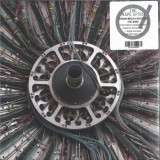
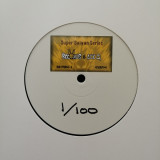
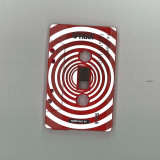
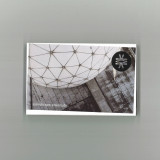
This isn’t an actual vinyl record, but a piece of playable artwork made from machined card and spot UV especially created by Haroon Mirza, and is packaged in a record sleeve. Comes with a unique download code to download the full visual movie and audio files.
Intro
hrm199,the studio of artists Haroon Mirza and Gaia Fugazza, is pleased to announce OUTPUTS, a new label run in association with musician and artist Nik Void (Factory Floor). OUTPUTS will launch with the release of The Wave Epoch, the long-awaited concept album by Haroon Mirza and Jack Jelfs featuring GAIKA.
The Label
OUTPUTS will initially focus on releasing projects by artists already associated with hrm199, starting with The Wave Epoch. This will be followed by two long form compositions, created by Gaia Fugazza and Nik Void. As well as developing new collaborations, the label will also delve into hrm199’s archive containing previous collaborative works with artists such as Okkyung Lee, Shiva Feshareki, Beatrice Dillon and Mark Fell.
Available as a limited edition playable artwork made from machined card and foil especially created by Haroon Mirza.
The product will come with a download code and a download for the full visual film created by Haroon.
Originally conceived by artists Haroon Mirza and Jack Jelfs during their 2018 residency at CERN – the largest particle physics laboratory in the world, and home of the iconic Large Hadron Collider – The Wave Epoch is an album and film developed in collaboration with artist and musician GAIKA amongst others who joined them on the residency. An immersive and multimedia live performance version of The Wave Epoch has previously been performed at the Brighton Festival, Lisson Gallery and the Ministry of Sound nightclub.
Incorporating music, poetry, incantation, archive and original video footage and homemade electronic instruments (including some built from discarded scientific equipment from CERN), the album imagines a distant future in which the forgotten remains of the Large Hadron Collider have been rediscovered. How would a civilisation several thousand years from now interpret this vast octa-circle carved into the landscape, with its miles of underground tunnels, cathedral-like spaces and forbiddingly complex machinery?
Taking this scenario as a starting point, the album and accompanying film are a visually-led sci-fi exploration of knowledge and belief, matter and consciousness, scientific activity and shamanic ritual, and of our quest to find patterns and order amidst the endlessly shifting realities of human experience.
Editors notes
hrm199 is a studio founded in 2004 by artist Haroon Mirza as a platform for collaborative artistic production. Today the studio is run by Mirza and the visual artist Gaia Fugazza, from where they make their own work, as well as facilitating collaborative projects and residencies. They work in a wide range of disciples spanning visual arts, music, architecture, design, physics, fashion, neuroscience and bioecology. The studio has collaborated with Factory Floor, Okkyung Lee, Assemble, Wayne McGregor, OSMAN and scientists from Imperial College, to name but a few.
Gaika Tavares, better known simply as GAIKA, is an artist and writer who describes his sound as Ghettofuturism. His creative output has always straddled different worlds, taking influence from academia, philosophy and political theory. His debut album Basic Volume (2018, Warp Records) was described as "gothic dancehall and industrial electronics" while The Guardian have said that his music blends "Caribbean dancehall tradition and London grime but also nod to R&B, trip-hop, grunge and Prince."
Jack Jelfs is a British artist whose work combines sculptural, video and text elements with electronics and live performance. His interests include questions about the nature of consciousness, ontology, ritual, divinatory systems and the limits of language. He has released music under various aliases and performed or exhibited at venues including Tate Modern, the Barbican, Serpentine Gallery, FACT and CCCB.
Haroon Mirza has won international acclaim for installations that test the interplay and friction between sound and electrical signals. He devises sculptures, performances and immersive constellations of objects, moving image, light and sound. An advocate of interference (in the sense of electro-acoustic or radio disruption), he creates situations that purposefully cross wires. He describes his role as a composer, manipulating electricity, a live, invisible and volatile phenomenon. Exploring myriads of socio-political, scientific and theological discourses, Mirza invites us to become aware of our physical experience, which engages our systems of belief as opposed to a notion of truth.
Mirza lives and works in London and is recipient of several prestigious prizes such as the Silver Lion at the 54th Venice Biennale, The Calder Prize and The Nam June Paik Art Centre Prize. He has been presented internationally including Tate Modern, MoMA, Lisson Gallery, The Paris Opera and The Australian Centre of Contemporary Art.
Nik Void is a composer and performer whose work blurs the lines of techno, ambient, avant-garde, and noise. Her interests lie in unconventional encounters with her tool, both analogue and digital as a means of expression. Voice, Guitar, and Modular are her key instruments, engaging in a new language using extended technique and cut-up sampling through synthesis. She has released critically acclaimed albums as Factory Floor, Carter Tutti Void and NPVR, on record labels that include Mute, DFA, Editions Mego and Blast First. Void's improvisational nature led her to explore the intersection between electronic composition and visual art interpretation, with visual artists, including Haroon Mirza, Gaia Fugazza, Hannah Sawtell, Phillip Parreno, and Francisco Lopez.