Orange Vinyl
Support from Lane 8, Timo Jahns, Shane / Fish Go Deep, Adana Twins, Yves Tomas, Audiosmith, Florian Kruse, Kirill Slider / Goom Gum, Dave202, David Granha, Avidus, Sasha c/o, Claptone c/o, Rich Vom Dorf, Argia, Nick Wessaert, Dennis Ferrer c/o, Super Flu, Holger /
Smash TV, GLOWAL, Ruede Hagelstein, Riva Starr c/o, Peter Kruder, Chaim, Paul C, Paco Osuna, Alfa Romero, Adriatique, Rauschhaus, Elif (TR), Cammora, Mr.Diamond, John Digweed, Franco De Mulero, VONDA7, Nico Morano, Jerome Price, Nhar, Beatamines, Angelo
Ceci, Anthony Pappa, Undercatt, Praveen Achary, Ruben Mandolini, Marco Faraone, Sobek, Tocadisco, Rodg, and Eelke Kleijn
Search:marco c
- A1: Big City
- A2: Good Ol Love
- A3: Da Grind (Feat Apocalypse)
- A4: Hood
- B1: Beautiful
- B2: Fay (Feat Stricklin)
- B3: Soda & Soap (Feat Jean Grae)
- C1: Do It Man (Feat Big Noyd)
- C2: Bklyn Masala (Feat Leschea)
- C3: Travelocity (Feat Punchline & Wordsworth)
- C4: The Ways
- D1: Wutuwankno (Feat Edo G)
- D2: Oh My God (Feat The Beatnuts & Rahzel)
- D3: Revelations
color vinyl edition[39,37 €]
A Long Hot Summer is the fifth studio album of Masta Ace, and follow up album to Disposable Arts. The album is about Masta Ace's journey as an underground rapper through his "Long Hot Summer" in Brooklyn, together with his unofficial manager and pal Fats Belvedere. This album includes fan favorites such as "Good Ol Love", "Da Grind", "Beautiful", "Bklyn Masala" and guest appearances like Jean Grae, Big Noyd, Wordsworth, Edo G, The Beatnuts, Rahzel and more, along with production from 9th Wonder, Khrysis, DJ Spinna, Dug Infinite, Marco Polo and others. A Long Hot Summer is a classic Ace album through and through.
The third compilation EP to commemorate the 20th anniversary of the establishment is Coastal Haze under the umbrella of Church,
An up-and-coming duo from New Zealand, Manuel Darquart, released on Wolf Music and others. The long-awaited first vinyl version of the popular song released digitally only in 2016.
The dense sound world with a wide range, including the impressive synth bass that penetrates the song, is unique to vinyl release. Including mastering by
Mr. KUNIYUKI, this work that realized a thick groove that is different from the time of digital sound source, there is no doubt that it will shake the entire space.
The up-and-coming French beatdown house S3A, whose long-awaited first album from Dirt Crew was well received. It's no wonder that he grew up listening to Detroit house,
and his unique sense of exquisite combination of sleezy beats, muffled texture and breathing such as disco funk is an excellent work.
The space is gradually filled with layers of euphoria that folds down, and the feeling of exhilaration and sophistication is irresistible!
The Japanese twin duo SATOSHI & MAKOTO, whose two albums released from YOUNG MARCO's label attracted a lot of attention, remixed the songs of SATOSHI FEAT and KUNIYUKI.
It is a remix of the work that was recorded in the label's 20th anniversary edition "20 YEARS SOUND OF SPEED RECORDS VOL.2" and was well received, but it seems that they were strongly influenced by early techno, and there is a melancholic synth work that drifts. The finish that is drawn into. It's a wonderful remix with respect for the original and a fusion of your own colors.
KUNIYUKI is in charge of mastering
Beyond their highly sought after 1978 album Festa Para Um Novo Rei - home to the mystical jazz-funk classic ‘Vidigal’ and released on Philips’ iconic Musica Popular Brasileira Contemporanea series (MPBC) - little is known about Marcos Resende & Index, even to aficionados of obscure Brazilian music. Far Out Recordings is immensely proud to present their previously unreleased self-titled debut album from 1976, contributing a crucial missing work from the glory days of progressive Brazilian instrumental music.
Born in Cachoeiro de Itapemirim, Brazil in 1947, Marcos Resende was a prodigious child who learned to play the accordion at the age of two, and the piano aged six. In spite of his immense musical potential, he travelled to Lisbon in the 60s to study medicine. Yet continuing to explore his musical passion on the side, he formed a trio which went on to open for Dexter Gordon at the Cascais Jazz Festival in 1971. From here he formed the electronic oriented prog-jazz group Status, who opened shows for the likes of Elton John, Phil Woods, Stan Getz, Art Blakey & The Jazz Messengers, but in spite of their relative live success they have no known recordings.
Now established as a highly regarded keyboardist, composer, and innovative electronic musician, Resende returned home to Brazil following Portugal’s Revolução dos Cravos in 1974. Inspired by US jazz and British progressive rock he’d experienced while residing in Europe, Resende went all out acquiring a keyboard arsenal to be reckoned with, which included the Prophet 5, Yamaha CP-708 and Mini Moog. Determined to integrate his newfound inspirations with Brazilian rhythms and jazz traditions, he formed a new quartet with Rubão Sabino (bass), Claudio Caribé (drums) and the late great Oberdan Magalhães, of Banda Black Rio and Cry Babies fame. Marcos Resende & Index recorded their self-titled debut at Sonoviso Studios with the legendary sound engineer Toninho Barbosa, known as the ‘Brazilian Rudy Van Gelder’ whose impressive resumé includes the era defining classics Light As A Feather by Azymuth, Previsão Do Tempo by Marcos Valle, and Quem É Quem by João Donato. Marcos Resende & Index fits perfectly amongst these masterpieces, sharing both the timeless ethereal qualities as well as the progressive and futuristic ideals of Light As A Feather in particular.
Rare Groove Spectrum Vol. 2 is another solid collection of re-works and re-imaginings taking in a broad range of classic tracks, traversing jazz funk rarities, balearic digs, latin groovers and more. Backed by a stellar group of Melbourne musicians including members of The Bamboos & Menagerie, Lance continues the tradition of creating "live re-edits" demonstrated on the initial volume - all pulled off with an inimitable style and playfulness, though always with an obvious love for the foundations.
As Lance says: "Some of these versions can almost be looked at as DJ re-edits, sometimes we're extending what may be a really short track into something longer, or teasing out the elements in a song that really make it work on a dance-floor. It's essentially what someone does with a club re-edit, except we went the extra step and re-recorded the whole thing with a live band"
From Carly Simon through to Mongo Santamaria via Marcos Valle and Pat Metheny - and following the championing of Rare Groove Spectrum Vol. 1 by the likes of Gilles Peterson, Craig Charles, Jazz FM and more - this second volume of Lance Ferguson's Rare Groove Spectrum is sure to hit the sweet spot.
We Are Proud To Announce A New Artist From Italy. Simone Have Released One Single On Superconscious Records Which Is Running By Fantastic Man. Our Friend Marco From Milano Has Sent This Demo And We Are Facinated. All Tracks Are First Class Tropival, Obscure Deep House! ENJOY!
REPRESS!
Marcos Valle - Mentira
Valle is a Brazilian singer, instrumentalist, songwriter and record producer of the highest order. His roots lie in Bossa Nova and he was one of the youngest talents in the scene, extensively touring the USA and residing there for many years. Valle's music crosses touches many styles including samba, rock, soul, jazz, boogie and disco.
Signed by Odeon in 1963, he recorded ten studio albums for them between 1964 and 1974. He also recorded for Verve, Warner and Som Livre among others.
Mentira is a re-record of his own song 'Mentira Carioca' - released four years earlier by Odeon - and appears on his 1973 LP 'Previsão Do Tempo' on Odeon.
Toni Tornado - Me Libertei
This is the second track that we have re-issued by the one and only Toni Tornado, master of Brazilian Funk.
His career began as 'Tony Checker', lip syncing to rock 'n' roll hits and touring extensively outside of Brazil. Whilst in New York he met Tim Maia and became involved in the 'Black Rio' movement. Toni also worked with Ed Lincoln and Antonio Adolfo amongst many others. He had a successful acting career and starred in many soap opera's.
It appears alongside 'O Jornaleiro' on his sought after BR-3 LP from 1971 on Odeon. 'Me Libertei' has never been released on a 7.
It is with great joy that we present the Mr Bongo edition of Marcos Valle's 1983 self-titled masterpiece. A pure vintage that features the ultimate Brazilian-boogie cult-classic ‘Estrelar’ and iconic 80s cover art that sees a gloriously sun-drenched Marcos dressed in a pink v-neck t-shirt surrounded by a generous selection of deadly-looking neon cocktails.
The album was produced by the legendary Lincoln Olivetti and Marcos' brother Paulo Sérgio Valle. It showcases a real who's who of Brazilian music at the time, with stellar performances from vocalists and musicians such as Rosana, Serginho Do Trombone, Robson Jorge and Oberdan Magalhães to name but a few. This was Marcos’ second album, after having moved back to Brazil from his time living in Los Angeles, and that US influence is evident through its prominent boogie, soul and funk sounds. It also features collaborations with the US singer-songwriter, composer, pianist, keyboardist, and record producer, Leon Ware, who co-penned three tracks including 'Estrelar'. To complete the album there are tracks such as 'Fogo Do Sol', which is pure AOR / Balaeric vibes, and tracks that are more MPB and pop-inspired, making a well-balanced track list for both home-listening pleasure and dancefloor business.
What could we do to give one of Marcos' most celebrated albums the treatment it deserved and produce the most definitive re-issue possible? The answer was to enlist the services of Miles Showell, Abbey Road Studios Mastering and lacquer-cutting engineer and all-around audio-magician, to cut a special half-speed master edition. Miles had previously worked his half-speed magic on our Arthur Verocai album re-issue, and once again we are totally blown away by the richness which Miles has brought out in his mastering technique. He has enhanced the listening experience and taken this wonderful album to another level.
To celebrate the release we have pressed up several vinyl versions; both standard master, and Miles' half-speed mastering editions on Black vinyl, alongside special limited edition Rose and Mint-Green coloured vinyl variants that were inspired by the audacious-looking cocktails on the cover - sheer 80s excess!
Pink Vinyl
It is with great joy that we present the Mr Bongo edition of Marcos Valle's 1983 self-titled masterpiece. A pure vintage that features the ultimate Brazilian-boogie cult-classic ‘Estrelar’ and iconic 80s cover art that sees a gloriously sun-drenched Marcos dressed in a pink v-neck t-shirt surrounded by a generous selection of deadly-looking neon cocktails.
The album was produced by the legendary Lincoln Olivetti and Marcos' brother Paulo Sérgio Valle. It showcases a real who's who of Brazilian music at the time, with stellar performances from vocalists and musicians such as Rosana, Serginho Do Trombone, Robson Jorge and Oberdan Magalhães to name but a few. This was Marcos’ second album, after having moved back to Brazil from his time living in Los Angeles, and that US influence is evident through its prominent boogie, soul and funk sounds. It also features collaborations with the US singer-songwriter, composer, pianist, keyboardist, and record producer, Leon Ware, who co-penned three tracks including 'Estrelar'. To complete the album there are tracks such as 'Fogo Do Sol', which is pure AOR / Balaeric vibes, and tracks that are more MPB and pop-inspired, making a well-balanced track list for both home-listening pleasure and dancefloor business.
What could we do to give one of Marcos' most celebrated albums the treatment it deserved and produce the most definitive re-issue possible? The answer was to enlist the services of Miles Showell, Abbey Road Studios Mastering and lacquer-cutting engineer and all-around audio-magician, to cut a special half-speed master edition. Miles had previously worked his half-speed magic on our Arthur Verocai album re-issue, and once again we are totally blown away by the richness which Miles has brought out in his mastering technique. He has enhanced the listening experience and taken this wonderful album to another level.
To celebrate the release we have pressed up several vinyl versions; both standard master, and Miles' half-speed mastering editions on Black vinyl, alongside special limited edition Rose and Mint-Green coloured vinyl variants that were inspired by the audacious-looking cocktails on the cover - sheer 80s excess!
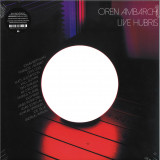
Black Truffle is pleased to announce Live Hubris, documenting the hypnotic and electrifying live performance of Oren Ambarchi’s 2016 LP Hubris by a fifteen-strong band at London’s Café Oto. Over three days in May 2019, Oto toasted Oren Ambarchi at 50/Black Truffle at 10 with Ambarchi and a large group of close friends and collaborators in a series of performances that interspersed existing projects with new collective endeavours, culminating with this: fourteen members of the extended Black Truffle family together on stage, joined by one special virtual guest, to translate the intricately studio-constructed layers of Hubris into a muscular live band workout.
Operating with only the bare minimum of pre-gig preparation after the planned afternoon rehearsal had to be wrapped up prematurely due to noise complaints, the gargantuan group lurches into motion with a 21-minute rendition of ‘Hubris Part 1’, powered by the pulsating electronics of Konrad Sprenger (the ‘ringmaster’ at the ensemble’s core) and no less than seven electric guitars spinning a web of intricately interlocking palm-muted polyrhythms. The layers of closely related but metrically distinct lines create ripples of shifting accents, flickering changes in emphasis that ricochet along the endless central pulse. Gradually building in density, this motorik continuum becomes the backdrop for the haunting tones of Eiko Ishibashi’s processed flute and an extended feature from long-distance guest Jim O’Rourke on guitar synth.
After the brief interlude of the second part, where Albert Marcoeur-esque guitar arpeggios accompany a halting attempt at phone conversation, the full ensemble gears up for the epic side-long rendition of ‘Hubris Part 3’. Now joined by the astonishing triple drum line-up of Joe Talia, Will Guthrie and Andreas Werliin, the layered pulse of the opening piece becomes a burning funk-fusion groove. Beginning on a medium simmer, the ensemble initially stick to its pulsating one-note mantra, over which Ambarchi unfurls a beautiful example of his signature shimmering Leslie-toned guitar harmonics, eventually joined by Ishibashi’s flute and some brooding, distorted dissonance from Julia Reidy’s guitar. Building steadily for the first nine minutes, the heat then rises dramatically with a first, gloriously loose chord change: with the all drummers now rolling and tumbling like a twice-cloned Jack DeJohnette circa 1970, Mats Gustafsson enters on baritone, his tortured roars and shrieks driving the band to peaks of insane intensity. Finally, the exhausted ensemble drops out, leaving only the jagged, skittering fuzz of Ambarchi’s guitar, brought to an abrupt conclusion at the command of crys cole. Arriving on hot pink vinyl with artwork by Lasse Marhaug and an extensive selection of live photos by Ivan Weiss and Fabio Lugaro, Live Hubris brings this ambitious and outrageous evening of music to the safety of the home stereo.
Stargazing from the sands of the Niterói beach, Tempos Futuros is low-end-led Brazilian futurism from one of Brazil’s most prolific and influential bassmen. As one third of legendary trio Azymuth, Alex Malheiros has pioneered a unique fusion of space-funk, samba and jazz since the early seventies. His playing can be heard on the records of Jorge Ben, Milton Nascimento, Roberto Carlos, Marcos Valle, and Mark Murphy (to name a few), and he’s performed and toured with everyone from Stevie Wonder to Chick Corea.
Written and recorded in Niterói, Brazil, overlooking Guanabara and the beaches, mountains and forests of Rio de Janeiro, Tempos Futuros has deep roots in Brazilian soil. The rhythms of Malheiros’ homeland have always permeated his music. But just like the Oscar Niemeyer designed Niterói Contemporary Art Museum which stands spaceship-like over the water, Tempos Futuros - while inspired by terrestrial forms, reaches out, deep into the great unknown.
Produced by acclaimed London-based producer Daniel Maunick, who has worked with Marcos Valle, Azymuth, Terry Callier, and Ivan Conti, the funk comes full circle. Daniel’s father Jean-Paul “Bluey” Maunick and Alex Malheiros shared a reciprocal stream of influence throughout the 80s, between London and Rio; Azymuth and Incognito; brit-funk and samba-funk. But just as with Azymuth’s music, you can also hear the influence of stateside jazz-funk masters like Roy Ayers, Weather Report, Lonnie Liston Smith, Mtume and Pleasure.
Tempos Futuros features Alex’s daughter, a Brazilian star in her own right, vocalist Sabrina Malheiros, Brazilian percussion master Sidinho Moreira, London based saxophonist Sean Khan, Marcos Valle’s go-to drummer Massa, and Brazilian keyboard player Dudu Viana. Featuring the late Azymuth keyboard maestro Jose Roberto Bertami on Fender Rhodes, the title track “Tempos Futuros” was originally recorded as a demo in 1995. On this finished version, Alex Malheiros used Bertami’s original keyboard take, explaining the posthumous release.
« Half of Tiger & Woods on a brillant release for SKYLAX RECORDS » If you ever wondered what it might be like to have a 707 or a Sampler instead of a pacemaker, you could always ask Valerio del Prete aka Delphi, who has been setting dancefloors around the world on fire for years. Delphi has displayed his mastery of acidized arpeggios and deep electronic tropes via an EP on Pigna, before linking up with Roman techno don dada Marco Passarani as the discotech duo Tiger & Woods. Several EPs and two albums of stripped back disco on Editainment and Running Back encapsulate their winning approach – reimagined loops from heady discotheques mixed through the axis of Rome, Chicago and Detroit. In 2016 he released the house/Italo/EBM stomper Blue Tuesday on a split 12” on Tiger & Woods own label T&W Records. For this new release, the brilliant producer (half of tiger & woods we repeat) kicks off the show with the very Italo-discoïde "donuts for dinner", nourished throughout by a monstrous kick and soaring synths. He poses as a worthy heir to the Italian masters of 80s pop who often used the B-side of their songs to experiment with their most adventurous ideas. Zequenz immediately made us think of an imaginary orgy between Ron Hardy and the members of Kraftwerk, this sound is incredibly sharp and would not have denoted on the decks of the legendary DJ. Which leads us straight to the most brawling track on the EP, the aptly named "Ron's lesson" and it is indeed a lesson. This crazy track (obviously dedicated to the legendary chicago DJ) seems to have come straight out of an imaginary session, we must remember how much at that time naivety and therefore distortion (!) Reigned over productions, giving an incredibly raw and edgy side on the dancefloor. Again, this song could have been released 30 years ago. And finally, to come full circle, the very graceful overheat joins the aesthetic of the first track in an elegant and dreamy way. Note that on the label's bandcamp, with the purchase of the vinyl, you can get 3 exclusive bonus tracks (Clutch play, Runinng in place, Sucker). The magic is here, CLEARLY.
Another disco production from the genius mind of the great arranger and bass-player Pino Presti now rediscovered by Best Record Italy.This captivating disco boogie did not go unnoticed by the Emergency Records of Sergio Cossa, who immediately gave it to the crowd of the U.S. clubs in the 1979, but for some reasons the B-side saw only the "mono" version rather than the outstanding "disco version" by the beloved New York DJ Tee Scott. Now, after 37 years we can finally appreciate it fully restored from the original master tapes by co-producer Marco Salvatori.
Xenia Rubinos, is a New York City based artist who's been revered for her innovative voice and maze-like knack for melody. Una Rosa is Rubinos' third album , her second on Anti- Records, following up her critically acclaimed Black Terry Cat (2016). Xenia Rubinos dips in and out of genre and structure to create movingly powerful songs. Her powerhouse vocals stem from a combination of R&B, Hip-Hop and Jazz influences, all delivered with a soulful punk aura. Pitchfork has lauded the radiant singer as "a unique new pop personality" while The New Yorker described her work as "rhythmically fierce, vocally generous music that slips through the net of any known genre." Having previously collaborated and toured with acts as diverse as Battles, Deerhoof, Man Man and Tune-Yards, Rubinos' energetic live show echoes some of the larger than life icons she admired as a child like Nina Simone and Erykah Badu, while wielding a space in music that is utterly her own. "I think my sound is a collage of different music coming together on a visceral level, connecting the dots with my voice and imagination," she said. Una Rosa is produced by Rubinos along with her longtime collaborator and drummer Marco Buccelli, and is full of color- drawing much of its multichromatic sound from the bright colors of pop art, which Xenia was immersed in during the writing process.
- 1: O Mar
- 2: I_Still Hear_The Roar Of A Distant Crowd
- 3: Small Piece With Walfisch And Autodrum
- 4: ??
- 5: Icaro
- 6: Cycloïd-E
- 7: Móbil
- 8: Escucha Para Acelerador De Partículas, Parancatadora Y Voz
- 9: Música Nocturna
- 10: Tripa Con Dientes
- 11: Uma Isis Esfera
- 12: Aerodrones
- 13 1: Prepared Dc-Motor, 1 Mdf Wheel, Touch Fasterner, Mdf Box 25X25X9Cm
HIGHLIGHTS: Objetos Musicais is a collection of 13 sound pieces created by artists from South America and Switzerland, who work in an intermediate zone among the craft of luthiers, visual arts and experimental music. Their works evoke the visionary ideas of Walter Smetak, a Swiss composer who lived in Salvador, Bahia (Brazil) Smetakian spirit tunes in with a new community of contemporary artists, who relate to the work of the so-called "experimental luthiers": artists who build their own instruments, lead them towards radical extended versions or take the exploration towards the building of resonant machines. DESCRIPTION: Objetos Musicais is a collection of 13 sound pieces created by artists from South America and Switzerland, who work in an intermediate zone among the craft of luthiers, visual arts and experimental music. Their works evoke the visionary ideas of Walter Smetak, a Swiss composer who lived in Salvador, Bahia (Brazil). Smetak was a pioneer of musical experimentation in that country and developed, in the 60s and 70s, a musical poetics that was captured in two seminal albums, Smetak (1974) and Interregno (1980), both of which, after being out of print for a long time, have been reissued today, hence the motivation for this tribute. On those two albums, Smetak combined Afro-Brazilian ritual traditions, theosophy, microtonality studies, collective improvisation and the use of unconventional musical instruments, which he called Plasticas Sonoras. Smetak came to build around 150 acoustic instruments, many of which are true sound sculptures of great visual impact. This latter aspect is the most directly evoked one on this album-and it so happens that the Smetakian spirit tunes in with a new community of contemporary artists, who relate to the work of the so-called "experimental luthiers", artists who build their own instruments (Marco Scarassatti, Phillipp Laeng, Maria Anália), lead them towards radical extended versions (Ruben Dhers, Claudio Merlet), develop hybrid projects involving instruments and sound sculpture (Javier Bustos, Alvaro Icaza and Verónica Luyo, Juan Pablo Egúsquiza, Edgardo Rudnitzky) or take the exploration towards the building of resonant machines (Nicole L'Huillier, O Grivo, Zimoun, Cod.Act), without these categories being mutually exclusive, but rather tending to mix, thereby opening up new sonic possibilities. This new community of artists has begun to create a whole new field of research and, in a way, a new discipline, understandable within the context of this new paradigm opened by the maker culture, which has pushed creators and developers from all over the world to conceive alternative-anti-hegemonic and DIY-forms of production. Therefore, this collection allows the artists to evoke Walter Smetak but also to connect his work to this new scene-to which it precedes-a link for this new art that makes its way at some point among the work of experimental luthiers, sound art, experimental music and the DIY ethics. Curated by Luis Alvarado and Chico Dub. Art by René Sánchez. Limited edition of 300 copies on vinyl. This project is part of the experimental music and sound art platform Incidencias Sonoras: COINCIDENCIA, by the Swiss Arts Council Pro Helvetia.
- 1: Worlds Beyond (English Version)
- 2: Adrenaline Oasis (English Version)
- 3: Let Go (English Version)
- 4: City Life (English Version)
- 5: If I Had Wings (English Version) 00:04:23
- 6: Electric Sheep (English Version)
- 7: Daily Heroes (English Version)
- 8: Kindred Souls (English Version)
- 9: Transhumance (English Version)
- 10: Transhumance Jam (English Version)
- 1: Mondi Paralleli (Italian Version)
- 2: Umani Alieni (Italian Version)
- 3: Ombre Amiche (Italian Version)
- 4: La Grande Corsa (Italian Version)
- 5: Atmospace (Italian Version)
- 6: Pecore Elettriche (Italian Version)
- 7: Mr. Non Lo So (Italian Version)
- 8: Il Respiro Del Tempo (Italian Version)
- 9: Transumanza (Italian Version)
- 10: Transumanza Jam (Italian Version)
The making of “I Dreamed of Electric Sheep” was heavily influenced by the situation everyone had to face lately. “We were forced to work under very peculiar circumstances, often interrupting our studio activity because of the lockdown”, says Franz Di Cioccio (lead vocals, drums). The whole process took one year spent mostly working at home, sharing ideas and meeting at Patrick Djivas’ (bass, keyboards) home studio, before the band was able to record the album at White Studios in Milan, Italy. Being the rhythm section Cioccio and Djivas make a perfectly working team. “We both have a great passion for SciFi movies. In the past we watched many of them together. In the case of ‘Blade Runner’ we were hit by the question: Do Androids dream of Electric Sheep? - The world has been changing around us. Computers are taking over and Covid has accelerated the process. However, we strongly believe in the power of people to use their imagination and fantasy. To us this is what really makes the difference between human beings and androids.” The band considers themselves being in a similar place when it comes to music that Impressionists were in when it comes to painting: They didn’t paint fixed somatic traits for their figures with their brush strokes while PFM (Premiata Forneria Marconi) do not consider themselves limited to a specific genre. While the album tells multiple stories they are all linked to passion, love and the power of imagination. As a real treat PMF invited a couple of musicians they have been friends with for a long time: Ian Anderson (Jethro Tull) on flute and Steve Hackett (ex-Genesis) on electric guitar. “I Dreamed of Electric Sheep” is simultaneously released in both English and Italian versions, hence the Italian subtitle, “Ho Sognato Pecore Elettriche". PMF’s “I Dreamed of Electric Sheep” is available in the following formats: Special 2 CD Digipak with O-Card, Gatefold 2LP+2CD & Special LP-Booklet and Digital Album.
After a trilogy of spectacular explorations of relentlessly driving rhythms – Sagittarian Domain (2012), Quixotism (2014) and Hubris (2016) – Simian Angel finds Oren Ambarchi renewing his focus on his singular approach to the electric guitar, returning in part to the spacious canvases of classic releases like Grapes from the Estate while also following his muse down previously unexplored byways. Reflecting Ambarchi's profound love of Brazilian music – an aspect of his omnivorous musical appetite not immediately apparent in his own work until now – Simian Angel features the remarkable percussive talents of the legendary Cyro Baptista, a key part of the Downtown scene who has collaborated with everyone from John Zorn and Derek Bailey to Robert Palmer and Herbie Hancock. Like the music of Nana Vasconcelos and Airto Moreira, Simian Angel places Baptista's dexterous and rhythmically nuanced handling of traditional Brazilian percussion instruments into an unexpected musical context. On the first side, 'Palm Sugar Candy', Baptista's spare and halting rhythms wind their way through a landscape of gliding electronic tones, gently rising up and momentarily subsiding until the piece's final minutes leave Ambarchi's guitar unaccompanied. While the rich, swirling harmonics of Ambarchi's guitar performance are familiar to listeners from his previous recordings, the subtly wavering, synthetic guitar tone we hear is quite new, coming across at times like an abstracted, splayed-out take on the 80s guitar-synth work of Pat Metheny or Bill Frisell. Equally new is the harmonic complexity of Ambarchi's playing, which leaves behind the minimalist simplicity of much of his previous work for a constantly-shifting play between lush consonance and uneasy dissonance. Beginning with a beautiful passage of unaccompanied percussion dominated by the berimbau, the side-long title piece carries on the first side's exploration of subtle, non-linear dynamic arcs, taking the form of a gently episodic suite, in which distinctive moments, like a lyrical passage of guitar-triggered piano, unexpectedly arise from intervals of drifting tones like dream images suddenly cohering. In the piece's second half, the piano tones becomes increasingly more clipped and synthetic, scattering themselves into aleatoric melodies that call to mind an imaginary collaboration between Albert Marcoeur and David Behrman, grounded all the while by the pulse of Baptista's percussion. Subtle yet complex, fleeting yet emotionally affecting, Simian Angel is an essential chapter in Ambarchi's restlessly exploratory oeuvre. --- Oren Ambarchi - guitars & whatnot Cyro Baptista - percussion & voice Recorded by Randall Dunn, Joerg Hiller, Iuri Oriente and Oren Ambarchi. Edited by Joerg Hiller and Oren Ambarchi at Choose Studios, Berlin. Mixed by Joe Talia and Oren Ambarchi at Good Mixture, Tokyo. Cut by Rashad Becker at D&M, Berlin. Executive Producers: Konrad Sprenger & Dick Wolf. Photography by Traianos Pakioufakis. Design by Lasse Marhaug.
Due for release October 8th on Fuzz Club Records, 'Ungrateful Heart' is the fourth album from Milan-based group The Gluts. Whilst their previous releases traded in an explosive psychedelic noise-rock, 'Ungrateful Heart' sees the Italian four-piece hone in a more post-punk-indebted sound. Although no less abrasive and confrontational in its utlising of ear-piercing feedback and hard-hitting riffs, the band say that the songs here primarily take cues from the likes of Fugazi, Gang of Four, the PiL-Pistols canon and the Campana brothers' long adoration of Italian and American hardcore punk. The album arrives off the back of 2019's 'Dengue Fever Hypnotic Trip' LP and tours and festival dates around the UK, Europe and South Africa. Laid down over a tireless week living side by side and working in the studio around the clock, The Gluts - comprised of Claudia Cesana (bass/vocals), Dario Bassi (drums) and Nicolò and Marco Campana (vocals/synths and guitar, respectively) - recorded 'Ungrateful Heart' with Dutch producer and close collaborator Bob de Wit (A Place To Bury Strangers, Gnod, The Sonics). On the sessions, the intensity of which is mirrored in the fierce uncompromising attitude of the music itself, the band said: "Bob's contribution to this album was essential. He pushed us beyond our limits. It was difficult, we can't hide it, but it really was worth it." Although the album is still shot through with moments of lacerating noise-rock ('Mashilla' and 'Eat Acid See God'), songs like 'Love Me Do Again' and 'Bye Bye Boy' deal in a timeless hedonistic punk sound. Elsewhere, the politically charged 'Breath' and 'FYBBD' see The Gluts turn their sonic belligerence towards fascists and systemic racial violence to rallying effect. Standard LP is on Ultra-clear vinyl, standard sleeve
- A1: Hey Lover Feat. Roy Ayers (Instrumental)
- A2: Oi Feat. Marcos Valle (Instrumental)
- A3: Visions Of Love Feat. Gary Bartz (Instrumental)
- A4: Aquarius (Why Do You Cry) Feat. Joao Donato (Instrument
- A5: Soulful And Unique Feat. Roy Ayers (Instrumental)
- A6: Isso É Que Eu Sei Feat. Marcos Valle (Instrumental)
- A7: Nao Negue Seu Coracao Feat. Joao Donato (Instrumental)
- A8: Sunflowers Feat. Roy Ayers (Instrumental)
- A9: Queira Bem Feat. Marcos Valle (Instrumental)
- B1: Day By Day Feat. Gary Bartz (Instrumental)
- B2: Gotta Love Again Feat. Marcos Valle (Instrumental)
- B3: Forever More Feat. Joao Donato (Instrumental)
- B4: Synchronized Vibration Feat. Roy Ayers (Instrumental)
- B5: Viajando Por Ai Feat. Marcos Valle (Instrumental)
- B6: Gravity Feat. Roy Ayers (Instrumental)
- B7: Nao Saia Da Praca Feat. Marcos Valle (Instrumental)
- B8: Beauty Feat. Joao Donato (Instrumental)
- B9: African Sounds Feat. Roy Ayers (Instrumental)
- B10: A Gente Volta Amanha Feat. Marcos Valle (Instrumental)
Ali Shaheed Muhammad and Adrian Younge are best known for their collaborations with vocalists and MCs, but these two multi-instrumentalists and producers excel in their ability to conjure musical moods with or without vocal accompaniment. Similarly, the musical legends that these two handpicked to collaborate with across this series are all jazz legends equally at home crafting unadorned compositions as they are collaborating with vocalists. This collection presents exclusive instrumental versions of songs originally released on the Jazz Is Dead albums; Roy Ayers JID002, Marcos Valle JID003, Gary Bartz JID006, and Joao Donato JID007. More than the previous eight Jazz Is Dead releases Instrumentals JID009 delivers on Adrian and Ali's original promise of showcasing the music made with their heroes, laying bare the inspired compositions created when different generations of musicians come together to collaborate in the studio. For nearly all of these songs, Adrian and Ali began with sketches and elements of songs that they developed alongside the featured musicians live in Adrian Younge's Linear Labs studio located in the Highland Park neighborhood of Los Angeles.