Back to the 80s: A Holy Grail of Italo Disco Returns on Vinyl
Oh, those magical 1980s… an era forever entwined with iconic music that still stirs the soul. For the young, it’s a source of fascination; for those who lived it, a flood of unforgettable memories. And when you combine that nostalgia with a collector’s thrill and the magic words “Italo Disco”, only a handful of legendary labels come to mind. One of them? Sensation Records: the experimental sub-label of the iconic Disco Magic, headquartered at Via Mecenate 78/A in Milan. Known for its distinctive blue label, Sensation was home to less commercial, often bold and boundary-pushing releases – tracks that dared to be different.
Today, Vintage Pleasure Boutique dives deep into the vaults of Sensation Records to revive one of the genre’s most coveted treasures: Marylinlove – “Another Love.”
Produced by none other than Bruno Mosti – a mastermind behind some of the most sought-after Italo tracks of the era. This is more than a reissue. It’s the return of a true cult classic, a holy grail for collectors and genre lovers alike.
If you know, you know. And if you don’t, this is your moment to own a piece of history. Don’t miss your chance to grab this stunning vinyl reissue, before it disappears again.
out of Stock
Last delivered 13 months ago available to reorder, subject to availability
Revered as one of London’s ‘leading disco labels’, The Disco Express slows no signs of slowing down. Steaming in HOT with with seven Summer sizzlers, the much loved label serves up certified dance floor heat ahead of the sunny season.
Oozing in top tier quality, the Summer Heatwave vinyl compilation encompasses the best new music forthcoming on The Disco Express. Including superb remixes by the scintillating Bosq and Dr Packer, Summer Heatwave features 100% original music by label regulars Magnolia, Maryag, Rayowa, Third Attempt and label boss Bustin’ Loose.
Pulsating with pure infectious Summer grooves, this compilation is truly essential for Disco, Nu-Disco and House music lovers worldwide
out of Stock
Last delivered 9 months ago available to reorder, subject to availability
Ein Album zum Schlafen und Wachen, zum Gehen und Fahren, zum Jagen und Fischen, zum Herumlungern vor einer Raststätte in der verwunschenen Tundra. In Fahrstühlen okay, zum Abendessen nicht so toll. Auf Caveman Wakes Up, dem neuen Album von Friendship und ihrem zweiten für Merge Records, wird die historisch weit gefasste Definition von Country-Musik noch weiter gefasst. Shambolische Gitarren werden durch Flötenpads ausgeglichen, trübe Poesie trifft auf eine Motown-Rhythmusgruppe, ein Song über Jerry Garcia und die First Lady Betty Ford wird mit einem Schlagzeugsolo ausgeblendet, als käme Talk Talk aus einem schmuddeligen Keller in Philadelphia und würde von James Tate gespielt. Der zerklüftete Bariton des Songwriters Dan Wriggins schneidet durch elf düstere, wirbelnde Country-Rock-Songs mit tiefgründiger lyrischer Substanz und Aufrichtigkeit. Wie ein Wecker, der am Rande eines Traums eingebaut ist, gehört "Caveman Wakes Up" gleichermaßen zum bewussten und zum unterbewussten Verstand, voller Hintergründe, durchdrungen von Referenzen und Experimenten, beiläufig und als düstere Warnung vorgetragen und vor allem der kreativen Seele der Musik gewidmet. Im Laufe der Jahre hat sich diese Hingabe ausgezahlt. Friendship ist zu einer Art umgekehrter Supergroup geworden, in der die Band selbst und jedes einzelne Mitglied im Zentrum einer zunehmend prominenten Szene junger Folk- und Country-Musiker und Songwriter steht. Der Schlagzeuger Michael Cormier O'Leary leitet das Instrumentalkollektiv Hour und betreibt zusammen mit dem Bassisten Jon Samuels das Label Dear Life Records, das Freunde und Kollegen beherbergt, die Friendship zu einem wichtigen Einfluss zählen, darunter MJ Lenderman, Florry, und Fust. (Samuels spielt auch die Leadgitarre bei MJ Lenderman and the Wind). Die Band 2nd Grade des Gitarristen Peter Gill ist ebenfalls aktiv und macht zahlreiche Aufnahmen. Wriggins begann mit dem Schreiben der Songs von "Caveman Wakes Up" auf einer verstimmten klassischen Gitarre von Lenderman und beendete es auf einem kaum gestimmten Klavier in einer Wohnung, die er mit G DeGroot von Sadurn teilte. Im Sommer 2023 hatte Wriggins gerade den Iowa Writers' Workshop verlassen, wo seine Liebe zur Poesie und sein Misstrauen gegenüber der akademischen Poesiewelt gleichzeitig wuchsen. Eine Beziehung ging in die Brüche, und Wriggins übernachtete mehrere Wochen in North Carolina im Haus von Lenderman und Karly Hartzman (von Wednesday ), wo er die ersten Demos von "Resident Evil", "All Over the World" und "Love Vape" aufnahm. Wriggins kehrte nach Philadelphia zurück, und die Band machte sich an die Arbeit, um neue Ideen zu entwickeln. Schließlich nahmen sie das Album in fünf Tagen mit Tontechniker Jeff Ziegler (Mary Lattimore, War On Drugs) auf, den Gesang mit Bradford Kreiger, dem Techniker von Love the Stranger. Orgel, Geige (Jason Calhoun) und Flöte (Adelyn Strei) wurden von Lucas Knapp in einer Kirche in West Philadelphia aufgenommen. Textlich bewegt sich "Caveman Wakes Up" auf vertrautem Friendship Terrain - das Heilige wird profaniert und das Profane geheiligt. "Caveman Wakes Up" zeigt Friendships besonderes Genie für visionäre Arrangements, die über Generationen hinweg dem Folk-Rock-Kanon von Neil Young, Joni Mitchell und Emmylou Harris ebenso verpflichtet sind wie Indie-Größen wie Yo La Tengo und den Merge-Labelkollegen Lambchop oder Zeitgenossen wie Lomelda und ML Buch. Mehrere der Songs verwenden Fade-Outs, die im Text von "Love Vape" scherzhaft erwähnt werden, und es gibt andere Elemente, die von Motown und 70er-Jahre-Balladen übernommen wurden: festgefahrene Schlagzeugmuster, Bassintervalle, gefühlvolle Streicherarrangements. Jede Referenz wird über das Genre hinausgeschoben, verwirbelt und wiederholt, zu etwas Neuem, das eindeutig zum Friendship-Sound gehört. Bei "Free Association", "Artex" und "Wildwood in January" ist der Groove so festgelegt, dass andere Klänge nahtlos kommen und gehen können: Mellotron-Flächen, Klavierwirbel und -stiche und klare Gitarrenmelodien, wimmelnde Texturen, die sich als Einheit tarnen. "Caveman Wakes Up" das bisher am weitesten fortgeschrittene Werk von Friendship, ein weiterer Beweis für die Hingabe und Sorgfalt der Band.
OONA Recordings is proud to announce the upcoming release of the soundtrack for The Girl With The Needle by Frederikke Hoffmeier. Hoffmeier, whom performs under the stage name Puce Mary, brings a raw, intense and atmospheric score to this Oscar-nominated film, which is contending for Best International Feature. Known for her bold, experimental approach to sound, Hoffmeier’s composition immerses listeners in the film’s dark, emotionally-charged world. Directed by Magnus von Horn, The Girl With The Needle premiered at the Cannes Film Festival, where it earned praise for its uncompromising vision. The film went on to receive a Golden Globe nomination for Best Non-English Language Film and won two prestigious awards at the European Film Awards, including Best Score for Hoffmeier’s hauntingly powerful work. The score to The Girl With The Needle is as dark as it is compelling, a masterclass in creating tension, unease, and raw emotional weight. Hoffmeier’s sound design is equal parts abrasive and intimate, drawing the listener into a world of fractured beauty. Her use of organic textures, electro-acoustic undertones, and dissonant, atonal melodies challenges traditional notions of film music, offering something deeply visceral and unpredictable. The Guardian described Hoffmeier’s score as "nerve-abrading," highlighting the relentless, uncomfortable energy that underpins the film. The Chicago Reader similarly calls the score haunting, noting how it amplifies the film’s stark atmosphere. Drawing comparisons to the intense works of composers like Mica Levi, Awards Radar Magazine praises Hoffmeier for pushing the film’s emotional core to its breaking point, deepening the agony of the protagonist. Throughout the film, Hoffmeier’s score becomes as much a character as the people on screen. Her collaboration with von Horn is marked by a shared vision of pushing the limits of cinema and sound. Screen Daily describes the score as "daring," with its aggressive, contemporary tones standing in stark contrast to conventional film scores. The result is a uniquely modern, avant-garde work that reflects the film's visceral and unsettling nature. Hoffmeier crafts a world of sound that lingers long after the credits roll. The soundtrack’s fusion of organic instrumentation with electro-acoustic elements and bold industrial sounds sets it apart from the ordinary. The British Film Institute notes how Hoffmeier’s "atonal score" creates an "enervating effect," pulling listeners deeper into the film’s raw emotional depths. The combination of brutal sound design and haunting melodies builds a layered, evocative listening experience, one that grows increasingly intense with every listen.
An album for sleeping and waking, walking and driving, hunting and fishing, for loitering outside a roadhouse on the haunted tundra. Okay in elevators, not great for dinner. On Caveman Wakes Up, Friendship’s new album and second for Merge Records, the band’s historically capacious definition of country music grows wider still. Shambolic guitars are offset by flute pads, bleary poetry is set against a Motown rhythm section, a song about Jerry Garcia and First Lady Betty Ford fades out with a drum solo, like if Talk Talk came from a dingy Philadelphia basement and was fronted by James Tate. Songwriter Dan Wriggins’ ragged baritone cuts through eleven murky, swirling country-rock songs with profound lyrical substance and sincerity. Like an alarm clock incorporated into the edge of a dream, Caveman Wakes Up belongs equally to the conscious and subconscious mind, fraught with background, steeped in reference and experimentation, delivered casually and as a dire warning, dedicated, above all, to music’s creative soul. Over the years, dedication has paid off. Friendship has become a kind of reverse supergroup,
wherein the band itself and each individual member are located centrally in an increasingly prominent scene of young folk and country musicians and songwriters. Drummer Michael Cormier O’Leary leads the instrumental collective Hour and, along with bassist Jon Samuels, runs Dear Life Records, home to friends and peers who count Friendship as a major influence including MJ Lenderman, Florry, and Fust. (Samuels also plays lead guitar in MJ Lenderman and the Wind). Guitarist Peter Gill’s band 2nd Grade records prolifically. Wriggins began writing the songs of Caveman Wakes Up on a downtuned classical guitar of Lenderman’s and finished on a barely tuned piano in an apartment he shared with Sadurn’s G DeGroot.
In the summer of 2023, Wriggins had just left the Iowa Writers’ Workshop, where his love for poetry and mistrust for the academic poetry world grew in tandem. A relationship fell apart, and Wriggins crashed for several weeks at Lenderman and Wednesday’s Karly Hartzman’s home in North Carolina, where he recorded the first demos of “Resident Evil,” “All Over the World,” and “Love Vape.” Wriggins returned to Philadelphia, and the band got to work on new ideas, finally tracking the album in five days with engineer Jeff Ziegler (Mary Lattimore, War on Drugs). Wriggins recorded vocals with Love the Stranger engineer Bradford Kreiger, and organ, violin (Jason Calhoun), and flute (Adelyn Strei) were recorded by Lucas Knapp in a West Philadelphia church.
Chiminyo is a UK-based jazz/electronic artist and the founder of the new label NRG Discs (having previously released on Brownswood, Nightdreamer, Gearbox, and Astigmatic, with artists such as Gary Bartz, Shabaka Hutchings, Maisha, Nubya Garcia, Cykada, Uniri, as well as solo). Chiminyo is a versatile musician who blends the raw energy of live drums and percussion with cutting-edge electronic production.
His early solo releases showcased his knack for unique approaches to making music, using self-coded software to trigger synths and samples from every cymbal crash and drum hit, eliminating loops and click-tracks. This DIY, tech-driven methodology allowed Chiminyo complete, spontaneous control over his music—all from the stool behind his drum kit—creating a sound that is both daring and innovative.
Chiminyo's latest project, NRG, continues this trend of innovative thinking. Born from discussions around the UK jazz scene, Chiminyo concluded that this musical expression is less about "jazz" and more about the energy (NRG) that fuels it. As a result, NRG has evolved into a semi-regular event where Chiminyo brings together some of London's finest musicians for live, improvised performances that encapsulate the spirit of the scene. These live recordings are then given the magic production treatment by Chiminyo and co-producer Aviv Cohen, transforming them into the masterpieces we get to hear on wax.
The first three NRG LPs were a massive success, generating over 600,000 streams, selling over 800 copies (without distribution support), and receiving airplay on BBC Radio, Jazz FM, NTS, Soho Radio, and many more. High-profile DJs like Gilles Peterson and Jamz Supernova championed the albums, which were also covered in print by The Guardian, Jazzwise, Echoes Magazine, and various online channels. This success led to an invitation to record a live album at Ronnie Scott's, one of London's most iconic jazz venues—an incredible opportunity for any artist.
NRG 4 brings together some of the best jazz and electronic musicians in London. The album features Marisia Osu (harp), James Akers (tenor saxophone), Daniel Casimir (double bass), Lyle Barton (synthesizers), and Tilé Gichigi-Liperé (live electronics)—an all-star lineup whose members have released multiple records on Concord, Brownswood, Jazz Re:freshed, Astigmatic and more, and have collaborated with artists such as Laura Misch, Nubya Garcia, Blue Lab Beats and Emma-Jean Thackray. Three tracks are graced with features from Jorja Smith's backing vocalist BAELY and Cuban saxophone maestro Regis Molina.
Originally released on Ben Chasny's own Pavilion imprint in 2011.
"I was invited by the Incubate Festival and the city of Tilburg to participate in an artist residency where I would explore the region’s unique chapels built for the Virgin Mary. After writing the music for about six months by drawing on memories of the encounters with the chapels and using techniques inspired by Gaston Bachelard’s Poetics Of Reverie, I flew back to Tilburg to perform the music at the Incubate Festival. We recorded the evening and I released the result on my Pavilion label. Each cover was hand painted white on white in the old Pavilion style. I created a stencil and used graphite powder to make the design that is inspired by the sun imagery in Athanasius Kircher diagrams."
Roadside chapels express the identity of the inhabitants of North Brabant, a Dutch province, bordering on Belgium. Roman Catholicism has been the dominant religion in this southern part of the Netherlands since the eighth century. For about a century and a half this religion was strongly suppressed. Only when the French revolutionaries preached freedom of belief around 1800 could the people of North Brabant exercise their faith again. This was the start of a very strong emancipatory development from which a special form of the Roman Catholic faith arose that fully determined everyday life of the people here. This faith was the determining factor in life and the measure of all things. After the second Vatican Council (1962-1965) the reins of the catholic faith in Brabant were loosened as well. This was the start of a revolutionary process of secularisation. Within a decade hardly anything was left of the almighty influence of the Roman Catholic Church and this situation has lasted up to the present day.
In spite of the almightiness of the official, Vatican ruled, Roman Catholic faith, North Brabant has always and perhaps notoriously fostered an undercurrent of popular belief as well. This is a kind of belief in which elements of the official faith and age-old pre-Christian traditions are combined. Worshipping relics, holding pilgrimages and processions, the use of water from holy wells, popular art, recitations and songs, festivals, rituals, folk traditions, superstition and the like are all examples of popular devotion. These matters have strongly influenced and formed the identity of the present-day population of North Brabant. It is part of their immaterial heritage.
An obvious and still very much visible form of popular devotion are the roadside chapels. In Brabant some 400 can be found, most of which have been devoted to Mary. Chapels are small buildings in which Mary or other saints are worshipped. They can be found within villages or towns or in natural surroundings. Always at the finest spots! The beauty of the environment adds a primary religious or mystical feeling to the visitor. Local people attach great value to their chapels. In spite of the overall secularisation in society they are still at the centre of cultural and social life. Where people in North Brabant can hardly be found in the churches nowadays, this doesn’t mean at all they are no longer religious. On the contrary, religious feelings are perhaps stronger than ever, but now people have to find their own expression of them. That’s why they fall back on the age-old popular belief in which chapels play an important role. We can even witness new forms of popular belief with chapels as their focal point. An example of this is the scattering of ashes of people who have been cremated. Chapels clearly also play a role in the lives of young people. On an average five new chapels are added every year.
I have studied the popular culture and belief and the identity of the inhabitants of North Brabant for over thirty years. I have published over forty books on these subjects. In 2010 I was approached by the organisation of the Incubate Festival in the North Brabant town of Tilburg. Their request was for me to lead the American composer and guitarist Ben Chasny around a number of chapels in the province devoted to Mary. He had been invited to North Brabant to write some new compositions. Ben Chasny then chose to be inspired by these chapels and that’s how we met. I was especially curious how an American would react to something as specific and small as a roadside chapel in North Brabant, since we tend to think here of (people in) America in terms of ‘big-bigger-biggest’. Would an inhabitant of this enormous country with this prevailing culture be able to grasp and respect the identity of some 2.5 million people in North Brabant with their chapels? The answer to this question lies hidden in the compositions he made and that can be listened to on this album. Yes, Ben Chasny has been able to convert the phenomenon of a simple chapel devoted to Mary into music. The physical and the spiritual have found each other. What a beautiful world…just listen! - Paul Spapens
FABRICLIVE’s new incarnation as an artist-focussed label continues, with a stunning two-track 12” by the Hong Kong-born, Netherlands-based rising star Kiana Li, aka gyrofield.
Rooted in drum & bass but distinctly the sound of now, this single sparkles with freshness, and stands-out with an exquisite verve for detail and craft. Balmy and comforting, atmospheric and melodic, the cloudsurfing breakbeats and celestial propulsion of ‘Akin’ is pure friendly pressure, whilst on ‘Mother’ big vocals, low-end precision and techno swathes soar even higher.
“'Akin' and 'Mother' remind me of my earliest days writing dance music. These are two free-spirited, transportive pieces that feel like spreading my wings and letting the air take me. Brought skyward in the hand of fate, nurturing yet weathered by my very own ideals. We all wish for better days. And toil to heal.” gyrofield
gyrofield has released music on prominent labels including Critical, Overview and Noisia's Vision. Last year she released the album A Faint Glow of Bravery on Metalheadz, and the EP These Heavens for XL’s prestigious house bag series, which has previously showcased music by Blawan, Joy Orbison and Overmono.
gyrofield is a regular on NTS and an in-demand DJ, whilst radio/club support has come from Mary Anne Hobbs, Objekt, Special Request and DJ Flight. Press fans include Rolling Stone, Crack, The Quietus, The Fader, DJ Mag and Resident Advisor.
“Scintillating - a sonic portrait of heaven that takes drum & bass and imbues it with the divine” Resident Advisor
“An artist whose journey and sound are quite unlike those of anyone else” The FADER
“Her vivid productions are a breath of fresh air in the scene” DJ Mag
“Merging the atmospheric and experimental with the melodic and emotional” Crack
“Packed with shapeshifting sounds that examine the universe and beauty of nature. Fusing atmospheric and spaced-out sounds with danceable sonics” Dummy
"She will never sit comfortably in any one genre or play to expectations or rely on any standard production formulae” UKF
Back with a bang for 2025, FABRICLIVE re-enters the fabric Records fold, which also incorporates Houndstooth and fabric Originals.
out of Stock
Last delivered 15 months ago available to reorder, subject to availability
The Scream, Siouxsie & the Banshees' first album, was released late enough in the punk era to bear some claim as the first post-punk album, with only a minor traces of 'punk' (one lingering early song, "Carcass" comes to mind) and enough hints of what had come even earlier, Andy MacKay-like saxophone flourishes - to feel utterly new. Not to mention the effort producer Steve Lillywhite must have put into the album, his first fully-credited major label production. Siouxsie was clearly the focus of the band, with her unique vocal style and lyrics, but the real star, we've always known, was John McKay, who wrote most of the album's music (as well as singles like "Hong Kong Garden"), creating a wholly new guitar sound - harsh and brittle, yet melodically intoxicating . . . best articulated by a somewhat confounded Steve Albini years later ". . . only now people are trying to copy it, and even now nobody understands how that guitar player got all that pointless noise to stick together as songs". McKay's influence lives on; many of the most influential guitarists of the past four decades credit him as a major influence - Geordie from Killing Joke, Jim Reid of The Jesus And Mary Chain, U2's The Edge, Thurston Moore, Johnny Marr and even the two guitarists - The Cure's Robert Smith and Magazine's John McGeoch - who followed him in The Banshees. McKay's burgeoning status as the anti-guitar hero was halted when he and Banshees drummer Kenny Morris - at odds with Siouxsie and bassist Steve Severin - fled the band just after the start of a tour supporting the group's second album, Join Hands. It was a weekly music paper scandal, later the subject of a BBC documentary, and Siouxsie's vitriol working its way into the lyrics of a later Banshees b-side, "Drop Dead / Celebration". Aside from a solitary single on Marc Riley's In Tape label nearly a decade later, no music was heard from McKay again. So it comes as a major surprise to learn of a pile of excellent recordings made in the years just after he left The Banshees, unheard by all but a very few, some of which feature drummer Kenny Morris, plus Mick Allen from Rema Rema, Matthew Seligman of the Soft Boys and longer-term collaborator Graham Dowdall and John's wife Linda . . . the latter three of whom now all sadly deceased. Sixes And Sevens is an historic lost album. Brazenly genius and bearing fair claim as the lost treasure of the post-punk era, the album collects eleven studio tracks, carefully mastered from original tapes. It's a masterpiece which best speaks for itself.
DMV-by-way-of-the-U.K. punk duo Teen Mortgage have announced their debut album, Devil Ultrasonic Dream, out May 9th on vinyl via Roadrunner Records.
Produced by the band alongside longtime collaborator Kenny Eaton, the album’s first single, “BOX,” is a two-minute sprint of seething defiance, packed with hooks and unrelenting energy.
The album’s title, Devil Ultrasonic Dream, leans into the 1980s-era satanic panic in rock and roll. “The Devil Ultrasonic Dream,” explains frontman James Guile, “is about realizing a fantasy that Christian fascists don’t understand or want you to have. The devil—Satan—has always been a symbol of counterculture.”
Originally from England, Guile had been toying with the Teen Mortgage project under various monikers for years, crafting a sound steeped in sociopolitical commentary and built for the mosh pit, heavily influenced by classic ’80s punk. After relocating to Maryland five years ago, he connected with drummer (and former nurse) Edward Barakauskas via a Craigslist ad. Since then, the duo have spent years building Teen Mortgage’s presence in the DMV scene. In between a global pandemic and Barakauskas serving as an ER frontline worker, they managed to drop an EP and a string of singles before signing to Roadrunner Records in 2024.
Teen Mortgage has earned support slots with a stacked list of artists, from Weezer, Smashing Pumpkins, OFF!, and Alkaline Trio and return to the UK in June to play Download Festival and support Weezer at their Halifax Piece Hall show.
The Scream, Siouxsie & the Banshees' first album, was released late enough in the punk era to bear some claim as the first post-punk album, with only a minor traces of 'punk' (one lingering early song, "Carcass" comes to mind) and enough hints of what had come even earlier, Andy MacKay-like saxophone flourishes - to feel utterly new. Not to mention the effort producer Steve Lillywhite must have put into the album, his first fully-credited major label production.
Siouxsie was clearly the focus of the band, with her unique vocal style and lyrics, but the real star, we've always known, was John McKay, who wrote most of the album's music (as well as singles like "Hong Kong Garden"), creating a wholly new guitar sound - harsh and brittle, yet melodically intoxicating . . . best articulated by a somewhat confounded Steve Albini years later ". . . only now people are trying to copy it, and even now nobody understands how that guitar player got all that pointless noise to stick together as songs". McKay's influence lives on; many of the most influential guitarists of the past four decades credit him as a major influence - Geordie from Killing Joke, Jim Reid of The Jesus And Mary Chain, U2's The Edge, Thurston Moore, Johnny Marr and even the two guitarists - The Cure's Robert Smith and Magazine's John McGeoch - who followed him in The Banshees.
McKay's burgeoning status as the anti-guitar hero was halted when he and Banshees drummer Kenny Morris - at odds with Siouxsie and bassist Steve Severin - fled the band just after the start of a tour supporting the group's second album, Join Hands. It was a weekly music paper scandal, later the subject of a BBC documentary, and Siouxsie's vitriol working its way into the lyrics of a later Banshees b-side, "Drop Dead / Celebration". Aside from a solitary single on Marc Riley's In Tape label nearly a decade later, no music was heard from McKay again. So it comes as a major surprise to learn of a pile of excellent recordings made in the years just after he left The Banshees, unheard by all but a very few, some of which feature drummer Kenny Morris, plus Mick Allen from Rema Rema, Matthew Seligman of the Soft Boys and longer-term collaborator Graham Dowdall and John's wife Linda . . . the latter three of whom now all sadly deceased.
Sixes And Sevens is an historic lost album. Brazenly genius and bearing fair claim as the lost treasure of the post-punk era, the album collects eleven studio tracks, carefully mastered from original tapes. It's a masterpiece which best speaks for itself. John McKay will be made available for a limited number of interviews . . . and yes, there are surprises in store.
The first release to document the solo cello work of musician and composer Lucy Railton, the 40-minute composition Blue Veil recorded at Église du Saint-Esprit in Paris invites listeners into the realm of precision-tuned states of resonance: states made manifest through Railton's careful traversal of her cello's most subtle acoustic characteristics as they harmonically interlock with mind's embodied modalities of attention and imagination. Blue Veil arises out of, is sustained in and finally dissolves back into Railton's momentary presence with her intimate connection to the cello, a way of hearing that allows for a deeper engagement with harmonic resonance, one that opens a space for immediate encounters of mind and sound. Railton's exploratory practice of harmonic perception emerges from a focus on the physical qualities of intervallic and chordal sounds, their textural qualities, degrees of friction, and inner pulsations. Composing in the moment guided by resonances within the cello's body, her own, and their shared vibrational space, Railton moves through Blue Veil by giving sounds what they ask for: sounds of pure texture manifesting as a move through temporal transparency, sounds of rough texture marking regions of dimensionally dense space. Railton's creative and highly refined use of just intonation harmony deforms sound's inner movements in ways that suggest a mode of listening that actively supplies imagery of sounds implied or completely absent rather than merely savouring those fully present. This active mode of "listening-with", playfully and semi-metaphorically referred to by Railton as "sing-along music", allows listening to reflexively participate in the music's movement as it gradually passes through richly saturated domains of harmonic imagination. And just as the precision-tuned tones of Blue Veil lose their individuality when fusing multifaceted uniformity, listening's structures of reference and recognition dissolve into nameless waves of intensity, continuously unfolding themselves upon and merging with the listener. Blue Veil is the result of a deep exploration of the inner worlds of tuning, an undertaking in turn informed by and emerging out of Railton's realisations of the music of Catherine Lamb and Ellen Arkbro, her collaborative work with Kali Malone and Stephen O'Malley as well as her interpretive practice in performing the work of Maryanne Amacher, Morton Feldman and others.
out of Stock
Last delivered 11 months ago available to reorder, subject to availability
"The Way We Were Vol. 1" ist eine Sammlung bisher unveröffentlichter Demo-Aufnahmen aus Francis Rossis persönlichem Archiv. Das Album vereint frühe Aufnahmen für sein vielbeachtetes zweites Soloalbum "One Step At A Time" (2010) sowie Songs, die später in ihrer endgültigen Version auf einer Reihe von Status Quo-Alben erschienen sind: "Heavy Traffi c" (2002), "XS All Areas" (2004), "The Party Ain't Over Yet" (2005), "In Search Of The Fourth Chord" (2007). Francis Rossi zeigt auf diesem Album eine Vielzahl an Stilen und Ideen. Was die Songs eint, ist, dass sie in der Art und Weise präsentiert werden, in der sie zuerst entstanden sind - roh, aufrichtig und direkt aus dem Herzen vorgetragen, ohne den Einfl uss von Studioveredelung oder kommerziellen Überlegungen. Unter den 17 Songs befi nden sich mit "Scary Mary", "Why I’m Walking", "Load On My Mind", "Can’t Change The World" und "Life Has Changed" zudem fünf Tracks, die nie zuvor außerhalb des Studios zu hören waren.
The Great Dismal, NOTHING’s new full-length album explores existentialist themes of isolation, extinction, and human behavior in the face of 2020’s vast wasteland. Closing in on the band’s ten-year mark, frontman Domenic Palermo finds himself stringing together songs of misanthropic tales of Philadelphia with a refined and refreshed take on NOTHING's classic sound. “The Great Dismal refers to a swamp, a brilliant natural trap where survival is custom fit to its inhabitants,” Palermo states. “The nature of its beautiful, but taxing environment and harsh conditions can’t ever really be shaken or forgotten too easily.” The ever progressive NOTHING keep true to their chaotic outlook on life, keeping a keen eye to avoid repetition. With a radical cast of talented contributors such as harpist Mary Lattimore, classical musician Shelley Weiss, and singer/songwriter/producer Alex G., The Great Dismal showcases yet another essential side of the band’s trademark American Post-Shoegaze.
Northern soul is in the news again, as once more this most resilient of dance floor cults is discovered by a new generation. For four decades now Ace Records has been a natural home for the music and using that experience we are bringing you our first ever all classics collection of some of the scene's greatest hits. All on one LP.
The recordings featured on this release are tried and tested, often in the hot forge of the scene's earliest day, when new discoveries were coming thick and fast, and only the strong survived. These did.
So we have 14 tracks which filled floors in Wigan, Blackpool, Cleethorpes, London's 100 Club and many other legendary venues. From West Coast Mirwood and Kent/ Modern label classics by Jackie Lee, Bobby Garrett, Mary Love and Danny Monday, to the big City Chicago soul of Darrow Fletcher via the super rare recordings by Rita & The Tiaras and Little Ann, which are now accepted standards of the scene.
This is an album for the beginner, those who want to know what all the fuss is about, or those older hands who just want to relive some exceptional memories.
Moor Mother is an American musician, poet, and interdisciplinary artist known for her avant-garde and experimental work. The Great Bailout is an expansive meditation that acts as a non-linear word map about colonialism, slavery, and commerce in Great Britain. Featuring guest contributions from Lonnie Holley, Angel Bat Dawid & Sistas of the Nitty Gritty, Vijay Iyer, Mary Lattimore, and more, it"s Moor Mother"s most uncompromising vision to date. Moor Mother has gained recognition for her unique blend of spoken word, noise, and electronic music, addressing themes of race, gender, and socio-political issues. She hails from Philadelphia and has been an influential figure in the city"s vibrant arts and music scene. She has received critical acclaim for her albums, with reviewers praising her fearless approach to sound and her thought-provoking lyrical content on albums like "Jazz Codes" and "Analog Fluids of Sonic Black Holes", showcasing her boundary-pushing sonic experiments.
out of Stock
Last delivered 17 months ago available to reorder, subject to availability
Jungle master Krak In Dub’s new album Catleya is a vibrant hommage to Colombia and its incredibly diverse musical culture. Entirely recorded in Bogotá with the who’s who of today’s Colombian music scene, the album casts a brand new light on the fusion of beats and Latin-American traditional rhythms and instruments, blending reggae, hip-hop, breaks and house with cumbia , afrobeat, ska, and bullerengue.
Standing out on this sun-soaked yet heavy-on-the-beats-and-bass adventure is the appearance of female modern folk trio La Perla, the Afro-Colombian combo Absalon & Afropacifico, and Bermudian singer Troy Berkley.
out of Stock
Last delivered 17 months ago available to reorder, subject to availability
" Pickled Eggs and Sherbet is the sole album by English electronic group All Seeing I - the production trio of Dean Honer, Jason Buckle and Richard Barrett (aka DJ Parrot).
" Part of the late nineties big beat / trip hop scene, it brought together many disparate threads of the Sheffield's music scene past (and then) present including contributions from the likes of cabaret crooner Tony Christie, Human League frontman Phil Oakey and Pulp's Jarvis Cocker.
" Lead single "The Beat Goes On" which had a huge viral moment on TikTok and social media in 2022, becoming one of the most widely used 'Sounds' in recent years accruing 2.4 billion views and 162k creations.
" The follow up 'Walk Like A Panther' peaked at #10 in the UK Singles Chart. Featuring vocals from Tony Christie, it became his first hit single in 25 years.
" London Records have remastered & re-issued the cult-classic album :
1. for the very first time on vinyl ! As collector Red & Yellow Double LP.
2. with an expanded and remastered 2CD edition to boot, including rare b-sides from lost CD singles, new mixes from DJ Parrot and more.
'Sexy Tears' is a bold departure from Tristanne's (fka Tristan) critically acclaimed pop-jazz debut Wellif and lets you veer into uncharted territory, from the first tone, the bittersweet and haunting violin tones fade in on opener 'Steady Mouth'. In a split second, Tristanne lets you vanish in a dazzling matrix deep down a rabbit hole, a place where Piero Umiliani's 70s sleazy giallo era sensually resonates with Oneothrix Point Never goldwave frequencies. With a whisper of panting tension, her soothing voice and sonic subliminal temptation she unravels her own lush love secret domain, unlocking deeply hidden lost emotions and mutated feelings.
While mellifluous harp chords in 'If Only' set a scene for a tantalizing new world utopia the percussive clutter of 'Whordus' syncopes and mutate this future dream with a chiastic slide into a videodrome for a jilted generation.
With the help from her musician friends Elisabeth Klinck (violin), Indr? Jurgelevi?i?t? (kanklès), Kaat Vanstralen (flute) and Gert Malfliet (drums), Tristanne's 'Sexy Tears' will hit you straight in the heart, like a modern-day Cupido with a well aimed dazzling sonic arrow. Ready to stay there forever.
Under her stage name Tristanne (formerly known as Tristan), Isolde Van den Bulcke makes music she defines as sitting in a 'grey zone'. By valorizing self-reliance and learning as much as possible from the get-go, the musician and producer hasn't let hardship nor pursuing a niche genre hold her back. She studied jazz vocals for 8 years, released 2 ep's before her debut album 'Wellif' in 2022.
Recommended if you like Piero Umiliani on a Sunday morning, Broadcast on the beach, Oneohtrix Point Never in a romantic mood, Autechre on Ice, Ennio Morricone on LSD, and Pierro Piccioni popping perks.
- 180 GRAM AUDIOPHILE VINYL
- PVC PROTECTIVE SLEEVE
- SCORE BY JOHN DEBNEY
- CONTAINS A 8-PAGE BOOKLET
- LIMITED 15TH ANNIVERSARY EDITION OF 500 INDIVIDUALLY NUMBERED COPIES ON TRANSPARENT RED VINYL
Passion Of The Christ (2004), composed by John Debney, is the original score for Mel Gibson's controversial film The Passion Of The Christ. The soundtrack received an Academy Award nomination for Best Original Score and it was on the first place in both Top Christian Albums and Top Soundtracks in 2004. In 2005, the album won a Dove Award for Instrumental album of the year at the 36th GMA Dove Awards.
The soundtrack succeeds as a coherent, moving, well-executed musical statement whether or not has seen the film. The album is a combination of folk instruments, Eastern-tinged harmonics, solo, and choral voices. Debney has used the Indian master violinist and vocalist L. Shankar, and singer/double-violinist Gingger Shankar.
Debney's soundtrack is an interesting and highly recommended work. It will offer those who choose to encounter it a far-reaching and deeply affective listening experience that is as aesthetically beautiful and unsetting as it is evocatively familiar.
Available as a limited 15th anniversary edition of 500 individually numbered copies on transparent red vinyl.
out of Stock
Last delivered 18 months ago available to reorder, subject to availability
Footshooter is the moniker of Barney Whittaker, a south London-based producer and DJ. His production style takes in influences from broken beat, jazz, house and more, working with rappers, poets and vocalists to create a soulful sound referencing the past while being firmly future-facing in its approach. His records as Footshooter and SAUL have earned airplay and support on BBC Radio 1 & 1xtra, BBC 6 Music, NTS Radio, Jazz FM and Rinse FM, from the likes of Gilles Peterson, Bradley Zero, Errol (Touching Bass), Alex Nut (Eglo Records) Shy One, Virgil Abloh, Zakia, Jyoti, Nabihah Iqbal, Bonobo, Jamz Supernova, Maryanne Hobbs, Mr Scruff and more.
His musically diverse live band sets and DJ sets over the past seven years have taken him to Boiler Room London, Tate Modern, Alexandra Palace, The Jazz Cafe and the Barbican Centre, as well as performances at Brainchild, We Out Here and Love Supreme Festivals. A Balamii Radio resident for the past 5 years with his monthly show 'Sonic Fruits', Footshooter's DJ sets are as versatile and wide ranging as his production credits, spanning the finest soulful house, broken beat, UK Rap, soul, jazz and beyond.
"This is the sound of London right now, and it is fantastic" - Juno Records
out of Stock
Last delivered 16 months ago available to reorder, subject to availability
Daniel Higgs vocals , Asa Osborne guitar, Sean Meadows bass, Mitchell Feldstein drums.
The Lungfish band from Baltimore, Maryland performed and released albums on the Dischord Records label for more than 20 years. The group's consciousness alternately/simultaneously coalesced and dispersed creating a continuous quasi-musical pulse, which reached climax at semi-monthly public performances.
Lungfish is now, as it often has been, quasi, if not entirely, defunct. However, after the release of Feral Hymns in 2005, singer Daniel Higgs (who is also an accomplished visual artist) embarked on a solo career, releasing albums on Northern Liberties, Thrill Jockey, and Holy Mountain and showing his artwork both in the States and the United Kingdom. Asa Osborne is currently recording and performing solo material under the name, The Zomes.
An exclusive 7" re-release of this psychedelic funk ballad from Tulsa's "Outback" Band. As featured on Now-Again's 'More Loving On The Flipside' compilation, "Strangers (In Our Homeland)" epitomises the expression of social & political change during an era of psychedlia infused music. In partnership with the two surviving members of Outback, both Symphonical & Now-Again are proud to showcase the voice of independent artists.
----------
The origin of "Outback" dates back to the late 50s, a five-piece blues outfit named "Little Lo and the Rest of Us" included music educator & bass guitarist Edward "Cha-Cha" Cherry, saxophonists Eugene "Buggy" Roach & James "Flab" Farley whom, alongside drummer Roscoe J. Dabney III "Roach", Ronnie Wilson on trumpet, guitarists Roy "Rochester" Walker & Michael Collins, would form The Magnificent Seven, the house band for Tulsa's 'Rose Room'.
Alumni of Booker T. Washington High School, The Magnificent Seven influenced & set the standard for the Tulsa sound, as demonstrated through their only single, recorded in 1966, the two part 'Pluck-A-Pluck'. 'The Sevenettes', the groups' female vocal trio, included the rotation of Lena Luckey Wilson, Gwendolyn French, Rose Brewer Lewis, Jeanetta Williams & Maxayn. The Magnificent Seven, led by "Cha-Cha", toured nationally throughout the 60s with their infectious, raw R&B sound, and were the platform for many of Tulsa's talent including Ronnie & Charlie Wilson who would later create the GAP Band.
Roscoe J. Dabney III, the first Black Panther to establish the Tulsa chapter in 1969 known as the NCCF (National Committee to Combat Fascism), proposed the name change to "Outback" in the early 70s. Their sound & formation was changing from R&B to Psychedelic, from the grit to the phase, epitomised by their unique line-up of having two bassists playing simultaneously, both Reggie Cherry & "Chilly" Willie Lewis, the musical foundation to their only recorded single, "Strangers (In Our Homeland)" & "Reggie's Thang".
Song writer & band affiliate, Maurice Pope, produced the lyrics to "Strangers (In Our Homeland)" and handed over the musical attributes to Willie Lewis & Outback to convey his message, as sung by Lena Luckey Wilson. Dabney recalls the song is based on religious scriptures, whilst highlighting the parallel of Black slavery in the U.S.
"Reggie's Thang", written by Dabney's cousin, bassist Reggie Cherry, provides a psychedelic instrumental, a sound which Lena recalls is what set apart Outback from other Tulsa groups. As well as playing clubs, the seated shows provided an environment for the group to showcase their musicianship to those who wanted to be immersed & listen.
Their single, released on Empathy, was recorded in 1972, and are the only known recordings by Outback. Recorded live onto 8-track at a studio located at on East Pine St in the heart of Tulsa's Black community, an independent & unknown studio located on a strip mall.
The Outback members who recorded are:
Lena Luckey Wilson - Vocals
Roscoe J. Dabney III "Roach" - Drums
"Chilly" Willie Lewis - Bass
Reggie Cherry - Bass
Edward "Cha-Cha" Cherry - Keys
Joyce Daws - Trumpet
Roy Walker "Rochester" - Guitar
Robert Luckey "Uncle Bobby"- Percussion
Fredy Berry "Freddy" - Tenor Sax
Band leader & group manager: Edward "Cha-Cha" Cherry
Booking Agent: Ernie Fields Sr.
In 1973 whilst performing in Ft. Worth, TX, Buck Ram approached Willie Lewis backstage and invited him to join The Platters, Lewis accepted. Supposedly, a recording deal was offered to Outback in exchange, which never happened.
The group continued in various formations after Lewis left, however as an integral member, the feeling never equalled their original form and soon after dissolved.
Leon Russell approached Lena Lucky Wilson in 1974 to go on tour with the GAP Band as their backing singer, upon returning Tulsa Lena moved to Los Angeles to pursue her musical career with Leon & Mary Russell amongst various others.
Dabney continued music and became a TV producer & director in 1976.
The only surviving members of Outback today are Lena Luckey Wilson & Roscoe J. Dabney III.
Black Country, New Road veröffentlichen ihr neues Studioalbum „Forever Howlong“ auf Ninja Tune! Das Album ist ihre erste Studioveröffentlichung seit ihrem Album, „Ants From Up There“, aus dem Jahr 2022, neben ihrem für den Mercury Prize nominierten Debüt, „For The First Time“ und folgt auf „Live At Bush Hall“ aus dem Jahr 2023. Jetzt, auf dem dritten Studioalbum, beginnt die Band wieder von Grund auf und vollzieht eine weitere wundersame musikalische Verwandlung.
Das lang erwartete neue Album wurde von James Ford (von Simian Mobile Disco, der u.a. bereits mit Arctic Monkeys, Depeche Mode und Blur zusammenarbeitete) produziert und zeigt Black Country, New Road in einer neuen Form, in der die Gesangsaufgaben - und der Großteil des Songwritings - zwischen Tyler Hyde, Georgia Ellery und May Kershaw aufgeteilt sind. „Forever Howlong“ ist ein ehrgeiziges, detailliert ausgearbeitetes Album, das von Folk über Prog und Barock-Pop bis hin zu einem Hauch von Alt-Rock alles enthält - mit Anklängen an Joanna Newsom, Randy Newman, Fiona Apple und Janis Ian - und dabei doch diesen unverwechselbaren, einzigartigen Sound beibehält, den nur diese Kombination von Musiker:innen hervorbringen kann. Obwohl das Album sehr vielfältig und umfangreich ist, fühlt es sich auch sehr kohärent und fokussiert an, da es drei verschiedene Stimmen und Stile aufnimmt und sie nahtlos in einen neuen kollektiven Sound einfließen lässt.
out of Stock
Last delivered 18 months ago available to reorder, subject to availability
Black Country, New Road veröffentlichen ihr neues Studioalbum „Forever Howlong“ auf Ninja Tune! Das Album ist ihre erste Studioveröffentlichung seit ihrem Album, „Ants From Up There“, aus dem Jahr 2022, neben ihrem für den Mercury Prize nominierten Debüt, „For The First Time“ und folgt auf „Live At Bush Hall“ aus dem Jahr 2023. Jetzt, auf dem dritten Studioalbum, beginnt die Band wieder von Grund auf und vollzieht eine weitere wundersame musikalische Verwandlung.
Das lang erwartete neue Album wurde von James Ford (von Simian Mobile Disco, der u.a. bereits mit Arctic Monkeys, Depeche Mode und Blur zusammenarbeitete) produziert und zeigt Black Country, New Road in einer neuen Form, in der die Gesangsaufgaben - und der Großteil des Songwritings - zwischen Tyler Hyde, Georgia Ellery und May Kershaw aufgeteilt sind. „Forever Howlong“ ist ein ehrgeiziges, detailliert ausgearbeitetes Album, das von Folk über Prog und Barock-Pop bis hin zu einem Hauch von Alt-Rock alles enthält - mit Anklängen an Joanna Newsom, Randy Newman, Fiona Apple und Janis Ian - und dabei doch diesen unverwechselbaren, einzigartigen Sound beibehält, den nur diese Kombination von Musiker:innen hervorbringen kann. Obwohl das Album sehr vielfältig und umfangreich ist, fühlt es sich auch sehr kohärent und fokussiert an, da es drei verschiedene Stimmen und Stile aufnimmt und sie nahtlos in einen neuen kollektiven Sound einfließen lässt.
“Sometimes They Come Back” is not just the title of a horror movie based on a macabre tale by Stephen King, it is also a summary of what happened to UK death etal veterans BENEDICTION, yet you might ke to add a “better than ever before”. While never officially disbanded, 2020’s Scriptures, the group’s eighth studio album achieved what is usually not an easy feat. It connected well with classics like Transcend the Rubicon (1993) and its immediate and memorable songwriting, the heavy-as-a-brick Grind Bastard (1998), and also saw legendary vocalist Dave Ingram return with his merciless roar and knack for morbid, twisted lyrics. After two albums with Dave Hunt on vocals, Scriptures was BENEDICTION’s first record in over a decade impressing with aggressive up-tempo attacks like ‘Iterations of I’ and ‘Rabid Carnality’ or the neck-breaking mid-tempo barrage of ‘Stormcrow’, songs that became live staples alongside ‘evergreens’ such as ‘I Bow to None’, ‘Magnificat’, ‘Subconscious Terror’ or ‘Vision in the Shroud’ in no time. With Scriptures, BENEDICTION even almost cracked Germany’s top ten by entering at a phenomenal #11 of the Official German Charts showing that the death metal veterans founded 1989 in Birmingham, England, offered an extremely well received sonic catharsis when due to the pandemic, people were locked down and pissed off.
When the shroud of Covid-19 lifted, the quintet finally could start to promote the album onstage with numerous festival gigs including Summer Breeze (DE), Copenhell (DK), Mystic Festival (PL), UK Deathfest, Alcatraz (BE), Party.San (DE), Obscene Extreme (CZ), Eindhoven Metal Meeting (NL) and Rock Hard (DE) to name but a few, played triumphant shows in South and Middle America as well as in their home country and all over Europe.
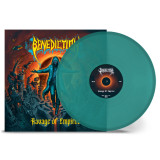
Kicking in the door without further warning, fast paced opener ‘A Carrion Harvest’ that mounts in a vicious Slayer-style break, starts with Ingram growling ‘Brace for impact, go!’ giving an unmistakable hint at what to expect during the following 47 minutes and 11 songs. With tremolo riffs and hammering grooves in spades, tracks like ‘Engines of War’, ‘Genesis Chamber’, ‘Crawling over Corpses’, ‘In the Dread of the Night’, and ‘Psychosister’ show a remarkable consistency and Scott Atkins, who produced the record at Grindstone Studio once again, ensures with a crisp and massive sound that the aforementioned impact leaves no bone unshattered. Garnered with artwork by Wolven Claws Artist, Ravage Of Empires continues BENEDICTION’s flawless discography on Premier League level and promises to become one of 2025’s undisputable old school death metal highlights!
With their brilliant new record in tow, founding members and guitarists Darren Brookes and Peter Rew, longtime vocalist Dave Ingram, drummer Giovanni Durst, and Nik Sampson (bass) will travel far and wide once more. Already confirmed are the Tales of the Triple Death Tour with Jungle Rot and Master kicking off on album release date as well as confirmed appearances at Wacken Open Air and Maryland Deathfest. More to be announced soon!
“Sometimes They Come Back” is not just the title of a horror movie based on a macabre tale by Stephen King, it is also a summary of what happened to UK death etal veterans BENEDICTION, yet you might ke to add a “better than ever before”. While never officially disbanded, 2020’s Scriptures, the group’s eighth studio album achieved what is usually not an easy feat. It connected well with classics like Transcend the Rubicon (1993) and its immediate and memorable songwriting, the heavy-as-a-brick Grind Bastard (1998), and also saw legendary vocalist Dave Ingram return with his merciless roar and knack for morbid, twisted lyrics. After two albums with Dave Hunt on vocals, Scriptures was BENEDICTION’s first record in over a decade impressing with aggressive up-tempo attacks like ‘Iterations of I’ and ‘Rabid Carnality’ or the neck-breaking mid-tempo barrage of ‘Stormcrow’, songs that became live staples alongside ‘evergreens’ such as ‘I Bow to None’, ‘Magnificat’, ‘Subconscious Terror’ or ‘Vision in the Shroud’ in no time. With Scriptures, BENEDICTION even almost cracked Germany’s top ten by entering at a phenomenal #11 of the Official German Charts showing that the death metal veterans founded 1989 in Birmingham, England, offered an extremely well received sonic catharsis when due to the pandemic, people were locked down and pissed off.
When the shroud of Covid-19 lifted, the quintet finally could start to promote the album onstage with numerous festival gigs including Summer Breeze (DE), Copenhell (DK), Mystic Festival (PL), UK Deathfest, Alcatraz (BE), Party.San (DE), Obscene Extreme (CZ), Eindhoven Metal Meeting (NL) and Rock Hard (DE) to name but a few, played triumphant shows in South and Middle America as well as in their home country and all over Europe.
Kicking in the door without further warning, fast paced opener ‘A Carrion Harvest’ that mounts in a vicious Slayer-style break, starts with Ingram growling ‘Brace for impact, go!’ giving an unmistakable hint at what to expect during the following 47 minutes and 11 songs. With tremolo riffs and hammering grooves in spades, tracks like ‘Engines of War’, ‘Genesis Chamber’, ‘Crawling over Corpses’, ‘In the Dread of the Night’, and ‘Psychosister’ show a remarkable consistency and Scott Atkins, who produced the record at Grindstone Studio once again, ensures with a crisp and massive sound that the aforementioned impact leaves no bone unshattered. Garnered with artwork by Wolven Claws Artist, Ravage Of Empires continues BENEDICTION’s flawless discography on Premier League level and promises to become one of 2025’s undisputable old school death metal highlights!
With their brilliant new record in tow, founding members and guitarists Darren Brookes and Peter Rew, longtime vocalist Dave Ingram, drummer Giovanni Durst, and Nik Sampson (bass) will travel far and wide once more. Already confirmed are the Tales of the Triple Death Tour with Jungle Rot and Master kicking off on album release date as well as confirmed appearances at Wacken Open Air and Maryland Deathfest. More to be announced soon!
The Passion of the Christ is a 2004 biblical drama film by Mel Gibson with music composed by John Debney. The soundtrack received an Academy Award nomination for Best Original Score and it was on the first place in both Top Christian Albums and Top Soundtracks in 2004. In 2005, the album won a Dove Award for Instrumental album of the year at the 36th GMA Dove Awards. The soundtrack succeeds as a coherent, moving, well-executed musical statement whether or not one has seen the film. The album is a combination of folk instruments, Eastern-tinged harmonics, solo, and choral voices. Debney worked together with Indian master violinist and vocalist L. Shankar, and singer/double-violinist Gingger Shankar. The Passion of the Christ is available as a limited edition of 750 numbered copies on gold coloured vinyl and includes a 4-page booklet.
Kneading dough is tricky – you should know how it’s supposed to feel. If you try too hard you could make it worse. It’s a beautiful practice – creation with a gentle touch, to work at something so it can be left alone. “If it’s too drawn out it’s awful. It’s easy to give too much.” Dance in the mirror. Contemplate your veiny hands. Who do they remind you of?
You begin by mixing flour and water. “What happens when your people die? Why’d they move the rock to the other side of Ulster Park?” Eliza Niemi asks two seemingly unrelated questions in a rising melody with guitar accompaniment, like fingers playing spider up to the nape of your neck. Gentle pressure. Strands of gluten form to bind the mix. A new question lingers in the binding. When she admits “but I don’t know how to tell if I’m feeling it or not,” that question surfaces through the text. It is reiterated throughout the album. When I’m working with dough I think the same thing to myself.
On Progress Bakery, her second album as a solo artist, Eliza knows to leave some questions alone – to let juxtaposition and tension be the proof. It doesn’t have to be hard. The feelings and revelations they provoke rise in the heat. The smell is sweet. Crispy on the outside and soft all the way through. She playfully slip-slides through words and sounds and images, delighting in surprise, skimming ideas like stones cast across clear water, touching down briefly with uncommon grace.
The question provoked between those opening lines resurfaces in the strands between songs – “Do U FM” is fully formed and beautifully layered, while “Novelist Sad Face” is a short, acapella rendering of gentle curiosity. What is holding these ideas together? Some songs demand more, seem to carry a whole load – eventually the skipping stone will halt to sink and resume its idle duty – while others drift in and out of focus, the way thoughts and dreams become interwoven before the mind is sunk into true sleep.
Music and words don’t always have to interact. Where she decides to keep them apart gives a new contour to where and how she puts them together. The kind of thing you’re supposed to take for granted with songs and their singers comes alive in Eliza’s hands – the little miracle of mixing, kneading, stretching, and stopping.
So often on Progress Bakery, Eliza teases out truth and meaning by asking questions. “Do I wanna be crying?” “Do you want me good or do you want me bad?” “Do I need an eye test?” “I’m writing songs in my head while you’re going over stuff with me — is that cruel??” In “Pocky” Eliza ends with a question that feels to me like the actual biography, succinct and revealing:
I don’t wanna be made to see
I just wanna ask “what’s that?”
Grace that ought to be rare, but in its care and precision is offered humbly, with great generosity, and without announcing itself. Eliza’s simple, miraculous music is given further form and shape by a group of collaborators – invaluable guest musicians Jeremy Ray, Evan Cartwright, Steven McPhail, Kenny Boothby, Ed Squires, Carolina Chauffe, Dorothea Paas, Louie Short, and Avalon Tassonyi. Together with Louie Short, who recorded, mixed, and produced the album along with Jeremy Ray and Lukas Cheung, Eliza has cultivated a richness in sound and texture that prods and provokes the ticklish ear. Barely audible guitar tinkering, a brief lo-fi field recording of trumpets, the harmonic clicking of a looped synthesizer, a flourish of reeds, a child’s conversation, each uncanny sound perfectly placed, rippling out under a soft breeze.
Lay in bed alone at night and ask aloud to the stillness,
“What were you doing at the Albuquerque Airport?
What were you doing there??”
And hear your question answered by a dream of swelling, undulating cellos. Try to grasp at the melody and structure. It’s not an answer (if there could be one), but it moves deeper, closer to the weird layer of fleeting moments and disconnected images, barely perceptible at its core. Wait for the dream reel to click into place.
Eliza took me for a ride in Nicole (her beloved Dodge Grand Caravan) and told me she’d been thinking of the album as an embodiment of transition – and I think every transition, known or unknown, carries the weight of new meaning, skittering off the surface tension of life as you know it, creating ripples, sometimes bouncing off and sometimes breaking through. There is a trick you can use to tell if a dough is glutinous enough. You’re supposed to stretch it out as thin as you can without breaking it and hold it up to the light. If you can see through, even if it renders the world murky and uncertain, you should leave it alone. I love this trick. It’s one that Eliza seems to know intuitively: work gently and ask questions and don’t always expect answers, and when you can, take a glimpse at something new, and then leave.
Kneading dough is tricky – you should know how it’s supposed to feel. If you try too hard you could make it worse. It’s a beautiful practice – creation with a gentle touch, to work at something so it can be left alone. “If it’s too drawn out it’s awful. It’s easy to give too much.” Dance in the mirror. Contemplate your veiny hands. Who do they remind you of?
You begin by mixing flour and water. “What happens when your people die? Why’d they move the rock to the other side of Ulster Park?” Eliza Niemi asks two seemingly unrelated questions in a rising melody with guitar accompaniment, like fingers playing spider up to the nape of your neck. Gentle pressure. Strands of gluten form to bind the mix. A new question lingers in the binding. When she admits “but I don’t know how to tell if I’m feeling it or not,” that question surfaces through the text. It is reiterated throughout the album. When I’m working with dough I think the same thing to myself.
On Progress Bakery, her second album as a solo artist, Eliza knows to leave some questions alone – to let juxtaposition and tension be the proof. It doesn’t have to be hard. The feelings and revelations they provoke rise in the heat. The smell is sweet. Crispy on the outside and soft all the way through. She playfully slip-slides through words and sounds and images, delighting in surprise, skimming ideas like stones cast across clear water, touching down briefly with uncommon grace.
The question provoked between those opening lines resurfaces in the strands between songs – “Do U FM” is fully formed and beautifully layered, while “Novelist Sad Face” is a short, acapella rendering of gentle curiosity. What is holding these ideas together? Some songs demand more, seem to carry a whole load – eventually the skipping stone will halt to sink and resume its idle duty – while others drift in and out of focus, the way thoughts and dreams become interwoven before the mind is sunk into true sleep.
Music and words don’t always have to interact. Where she decides to keep them apart gives a new contour to where and how she puts them together. The kind of thing you’re supposed to take for granted with songs and their singers comes alive in Eliza’s hands – the little miracle of mixing, kneading, stretching, and stopping.
So often on Progress Bakery, Eliza teases out truth and meaning by asking questions. “Do I wanna be crying?” “Do you want me good or do you want me bad?” “Do I need an eye test?” “I’m writing songs in my head while you’re going over stuff with me — is that cruel??” In “Pocky” Eliza ends with a question that feels to me like the actual biography, succinct and revealing:
I don’t wanna be made to see
I just wanna ask “what’s that?”
Grace that ought to be rare, but in its care and precision is offered humbly, with great generosity, and without announcing itself. Eliza’s simple, miraculous music is given further form and shape by a group of collaborators – invaluable guest musicians Jeremy Ray, Evan Cartwright, Steven McPhail, Kenny Boothby, Ed Squires, Carolina Chauffe, Dorothea Paas, Louie Short, and Avalon Tassonyi. Together with Louie Short, who recorded, mixed, and produced the album along with Jeremy Ray and Lukas Cheung, Eliza has cultivated a richness in sound and texture that prods and provokes the ticklish ear. Barely audible guitar tinkering, a brief lo-fi field recording of trumpets, the harmonic clicking of a looped synthesizer, a flourish of reeds, a child’s conversation, each uncanny sound perfectly placed, rippling out under a soft breeze.
Lay in bed alone at night and ask aloud to the stillness,
“What were you doing at the Albuquerque Airport?
What were you doing there??”
And hear your question answered by a dream of swelling, undulating cellos. Try to grasp at the melody and structure. It’s not an answer (if there could be one), but it moves deeper, closer to the weird layer of fleeting moments and disconnected images, barely perceptible at its core. Wait for the dream reel to click into place.
Eliza took me for a ride in Nicole (her beloved Dodge Grand Caravan) and told me she’d been thinking of the album as an embodiment of transition – and I think every transition, known or unknown, carries the weight of new meaning, skittering off the surface tension of life as you know it, creating ripples, sometimes bouncing off and sometimes breaking through. There is a trick you can use to tell if a dough is glutinous enough. You’re supposed to stretch it out as thin as you can without breaking it and hold it up to the light. If you can see through, even if it renders the world murky and uncertain, you should leave it alone. I love this trick. It’s one that Eliza seems to know intuitively: work gently and ask questions and don’t always expect answers, and when you can, take a glimpse at something new, and then leave.
aya's incredibly inventive Hyperdub debut album im hole distilled the incisive sonic experimentation of her early run of releases, the tongue-in-cheek giggles of her DJ sets and radio show, and the identity-fluxing lyricism of her live shows into a delirious tug of war between pleasure and dysmorphia. The album was championed from all corners, 'Best New Music' in Pitchfork to Radio 6 DJ Maryanne Hobbs 'Album of the Year', followed by a run of incredible live shows which drew new listeners further into her world. hexed!, aya's second album, confronts the desperation and dysfunction of addiction. Internalised phobias and suppressed traumas haunt the corridors and golden hours once romanticised on 2021's im hole; daymares concealed by nocturnal afters-hopping and key bag circles. Opener `I am the pipe I hit myself with' exposes the gray portrait secreted somewhere between the 8th and 9th floors of her previous record. `I used to say some shit for sure', `I used to say it when I was me-less'. hexed! is about what happens when aya turns the lights on.
out of Stock
Last delivered 13 months ago available to reorder, subject to availability
15 Years Of Dame-Music Vol.1 is an ode to the unmistakable sound of the TB-303, a core element of Bloody Mary’s widely respected sound and label. Above all, it celebrates fifteen years of quality dance music, set to continue across its three excellently curated volumes in 2025.
The first volume, releasing 28th March 2025, features a track from Bloody Mary and welcomes back Thomas P. Heckmann, E-Bony, and Hardfloor to the imprint.
15 Years Of Dame-Music Vol. 1 with label regular Thomas P. Heckmann’s ‘Days Of Buzz’ electrifying the dancefloor with waves of mind-melting acid over a resolute beat.
Label head Bloody Mary then drops ‘Fractal Waves’, playful, 303-licked, and comfortably switching between straight 4/4 and raw, crunched-up breaks; this is a raveready cut showing Mary at her best.
On the flip, artist E-Bony returns to Dame-Music after closing the label’s 2024 schedule with the ‘Machine Code’ EP. His ‘303 Elements’ builds from a low-slung groove to an intense climax as acid drips, oozes and rains over crisp drums while hoover sounds create an otherworldly atmosphere at its peak. Closing out the first volume is 90s Acid Techno duo Hardfloor with ‘I’ll Never Own A Helicopter’, providing a hands-in-the-air club track to work the dancefloor into a frenzy.
Mastered by Thomas P. Heckmann
Artwork by Philip Mercieca
(c) Dame-Music 2025, all right reserved
out of Stock
Last delivered 10 months ago available to reorder, subject to availability
Apollo / R&S are delighted to welcome back The Primitive Painter, aka the duo of Roman Flügel and Jörn Elling Wuttke for a timely reissue of their 1994 lost classic self-titled album of sonorous IDM.
Growing up in Frankfurt, in the 80s and 90s the duo met at an indie rock club in their home town of Darmstadt, bonding over their shared obsession with the first wave of acid, Chicago house and early Detroit techno as well as their patronage of now iconic Frankfurt club nights like The Omen or Dorian Gray or the infamous Delirium Record shop run by scene stalwarts Ata (Robert Johnson) and Heiko MSO (Playhouse).
Taking inspiration from the likes of The Black Dog and Transmat as well as seminal compilations such as Planet E’s Intergalactic Beats and Warp’s Artificial intelligence compilation the duo honed their inventive take on the Detroit techno blueprint under the monicker Acid Jesus, debuting on their freshly minted Klang Elektronik label. The label was started in conjunction with Ata and Heiko after Fluegel & Wuttke (regular patrons of the Delirium store) pressed a demo on them, muttering the immortal line; “Please listen to the tape, we are big Mr. Fingers fans.”
Through the mid ’90s the project flourished giving rise to a classic album and a brace of singles that number amongst the best of the era’s techno, winning them a influential fans most notably Sven Väth, David Holmes and Andrew Weatherall who invited them to play live at one of the legendary Sabresonic parties in London.
Alongside the success of the Acid Jesus project, the duo found great inspiration in outside of the club, including an ambient happening when the KLF came to play Frankfurt; “There were live sheep eating grass on stage while they played at Mark Spoon’s club XS”, as well as cinematic influence from the likes of Jim Jarmush and Wim Wenders. It was however the euphonic IDM grandeur of Apollo Recordings self titled compilation of 1993 that really got their creative juices flowing: “It was a ten track compilation with artists like David Morley, Model 500, Aphex Twin which still sounds so good today,” Jörn enthuses. “ It was really the trigger to go away from the Detroit sound and more towards the big melodies of B12 etc.”
Deciding to make their tribute to this style of music the duo turned out 10 tracks of gauzy, melodious electronica in a white hot fever, one after another over the ensuing months. Settling on a name for the new project they picked ‘The Primitive Painters’ taking inspiration from the band Felt. “We are both children of the C86 movement,” explains Jörn. “this attitude of noisy art school influenced rock like Primal Scream, MBV, The Jesus & Mary Chain really inspired us to take a DIY approach to our music.”
They sent the resulting demo cassette to Renaat at R&S / Apollo. “We really had no expectations,” Jörn explains. “So we were shocked and delighted when we received a fax saying that he wanted to release it”.
The resulting release was bungled by an R&S mix up that attributed the album to the duo’s own Klang Elektronik label which confused both fans and distributors alike, denying the release the critical boost and attention that it so richly deserved. Accordingly the release slipped out without much fanfare, with a chastened Fluegel & Wuttke returning to their Acid Jesus activities which would eventually lead to their blockbusting success as Alter Ego.
Over the ensuing years the reputation of The Primitive Painter album has only grown, with second hand copies (only 500 vinyl were pressed) changing hands for exorbitant amounts on Discogs, leading us to this opportune moment of a richly deserved ‘first’ release on the label for which the project was started, Apollo / R&S.
“This really brings us full circle,” says Jörn. “Apollo / R&S meant and means so much to us as artists and so it was bittersweet to not have the official release - to put that right all these years later feels really good.”
This new vinyl release comes in re-created original gatefold artwork and includes all original 10 tracks (Stoned Soul Picnic was previously on the CD only).
out of Stock
Last delivered 14 months ago available to reorder, subject to availability
Saracen's initial reign was in the late 70s and early 80s, which saw the release of their now legendary debut album “Heroes, Saints & Fools”. Some twenty years later, in 2003, they surprised & delighted fans with the release of Red Sky. Both albums, plus bonus tracks, featured in a special boxed set, with new artwork and mastering, released in January 2006 on the Escape Music label. The main focus of the signing, however, was Saracen's eagerly awaited release of their 2006 album – “Vox In Excelso”. “Vox In Excelso” is a concept album, based on the mysterious and controversial history of the Knights Templar – a medieval body of warrior monks, who grew to become one of the most powerful military & financial organizations in Europe. Their story goes far beyond battlefield exploits – the Knights Templar were guardians of Ancient Knowledge; secrets that had major implications for the nations and religions of the western world... secrets that are still cherished and protected even to this day. “Vox In Excelso” (pronounced Ex-chel-so) is laced with poignant narration, linking the tracks, and thereby helping the listener to navigate this turbulent yet touching epic story. The combination of original members, vocalist Steve Bettney and guitarist Rob Bendelow, new blood, former HELLOWEEN drummer Mark Cross amongst others, proved to be an exciting combination on this now classic album.
Mit ihrem achten Studio Album präsentiert das von Journalisten oft als "Deutschlands unterbewertetste Punk-Rock Band" bezeichnete Berliner Trio ein Cover-Album das es in sich hat. Im klassischen "K-Tel" Gewand werden hier 12 Kracher der 50er, 60er, 70er und 80er Jahre abgeliefert. Allerdings nicht im üblichen, "wir spielen einfach mal alles doppelt so schnell-Hauruck Sound", nein, hier wurde mal richtig tief in die musikalische Trickkiste gegriffen. So kommen die ,Rubettes" im Gewand der ,Ramones" daher, ,Slade" im Sound der ,Stranglers" und ,Jimi Hendrix" sogar als waschechte Southern Rock Nummer a la ,Lynyrd Skynyrd". Von Uli Confidence dem Mastermind der Band und Betreiber des Berliner Kult-Clubs ,Wild At Heart" im hauseigenen Studio produziert, wird auf dieser Scheibe völlig ungeniert von klassischem Rock`n`Roll, über 70s Rock, Glam und sogar New Wave alles zelebriert, was der Kirche des Vertrauens lieb und heilig ist. Spaß-, Party-, und Unterhaltungsfaktor bis zum Anschlag auf Maximum gedreht, zündet hier ein Kracher nach dem anderen... 500 Stück weltweit, klassisch schwarzes Vinyl, durchnummeriert.
"Tonky" ist Lonnie Holleys fünftes Studioalbum und enthält Gastauftritte von Isaac Brock, Angel Bat Dawid, Billy Woods, Alabaster de Plume, Mary Lattimore und anderen. Bei der Leadsingle "Protest With Love" ist Jacknife Lee, der auch das gefeierte Vorgängeralbum "Oh Me Oh My" produziert hat, als Bassist, Keyboarder, Synthesizer, Schlagzeuger, Programmierer, Flötist, Percussionist und Sänger zu hören. Weitere Mitwirkende sind The Legendary Ingramettes am Gesang, Kelly Pratt an den Bläsern und Flöten, Jordan Katz an den Bläsern und natürlich Holley am Gesang. Holley fordert die Zuhörer auf, "mit Liebe zu protestieren" und "die Liebe zu deiner Waffe zu machen". Es gibt Dichter wie die große Mary Oliver, die vorschlagen, dass die Hauptfunktion des Menschen, wenn er sich durch die Welt bewegt, solange er Leben und die Fähigkeit hat, sich durch die Welt zu bewegen, darin besteht, dem Aufmerksamkeit zu schenken, was andere törichterweise als klein oder alltäglich bezeichnen mögen. Das Gehirn und das Herz sind beides Gefäße, die so viel Platz haben, wie man ihnen zugestehen möchte, und zu leben bedeutet, Sammlungen von gefundenen Zuneigungen zu schaffen. Die Geräusche der geliebten und vertrauten Häuser, die Bewegungen der Bäume und der Menschen unter ihnen, die Art und Weise, wie jemand, den man verehrt, einen ein paar Sekunden lang umarmt, bevor er sich aus der Umarmung löst und in einer überfüllten Fußgängerzone verschwindet. Wenn wir unser Leben, unser Schaffen und unsere Liebe auf diese Weise betrachten, bedeutet das, dass wir, zumindest für einige von uns, durch die Aussicht auf das, was als Nächstes kommt, vorwärts getrieben werden können. Welchen Moment wir festhalten und in unsere überquellenden Taschen stecken können. Die Arbeit von Lonnie Holley ist ein Werk dieser Art von Anhäufung und genauer Aufmerksamkeit. Das Vergnügen, einen Klang zu finden und ihn gegen einen anderen gefundenen Klang und einen weiteren zu pressen, bis der Hörer, bevor er es merkt, von einer Klangsinfonie überflutet wird, die sich anfühlt, als würde sie sich zusammenfügen, während sie über einen hinwegspült. "Tonky" ist ein Album, das seinen Namen von einem Spitznamen aus der Kindheit hat, der Holley anhaftete, als er einen Teil seiner Kindheit in einem Honky Tonk verbrachte. Lonnie Holleys Leben des Überlebens und der Ausdauer erforderte - und erfordert zweifellos immer noch - eine Art Erfindung. Eine Erfindung, die auch in Holleys Liedern reichhaltig und präsent ist, die auf "Tonky" voll und eindringlich sind, einem Album, das mit seinem längsten Lied beginnt, einem neunminütigen, erschöpfenden Marathon eines Stücks namens "Seeds", das mit einem einzigen spärlichen Klang beginnt und sich dann ausdehnt. Gesänge, schwache Tasten, Streicher und als Krönung Holleys Stimme, die nicht singt, sondern klar und deutlich von der Arbeit auf der Erde erzählt, als er jung war, und von der Gewalt, die er dabei ertragen musste, als er blutig und mit Schmerzen von Schlägen ins Bett ging. Der Song weitet sich zu einer Metapher über den Ort aus, über das Versagen des Zuhauses oder eines Ortes, der einen beschützen soll, der nicht das hält, was er zu sein vorgibt, selbst wenn man unermüdlich daran arbeitet, daran arbeitet, daran arbeitet, etwas Sinnvolles daraus zu machen. "Seeds" gibt nicht nur den Ton für ein Album an, das sich um Wiedergeburt, Erneuerung und die Grenzen von Hoffnung und Glaube dreht, sondern unterstreicht auch, was Holleys größte Stärke als Musiker ist, nämlich sein Engagement für Fülle und Großzügigkeit. Er ist ein unglaublich begabter Geschichtenerzähler, der sich der mündlichen Tradition verschrieben hat, so dass viele Hörer völlig zufrieden wären, wenn sie zu Füßen einer Lonnie-Holley-Platte säßen und seinen robusten, ausladenden Erzählungen lauschen könnten. Aber "Tonky" ist ein Album, das sowohl klanglich als auch in Bezug auf die vielen verschiedenen Künstler, die auf dem Album vertreten sind, einen Platz bietet, an dem sie sich zu Hause fühlen können, ganz gleich, wie sie die Zeit verbringen, die sie für einen Song brauchen.
Kneading dough is tricky – you should know how it’s supposed to feel. If you try too hard you could make it worse. It’s a beautiful practice – creation with a gentle touch, to work at something so it can be left alone. “If it’s too drawn out it’s awful. It’s easy to give too much.” Dance in the mirror. Contemplate your veiny hands. Who do they remind you of?
You begin by mixing flour and water. “What happens when your people die? Why’d they move the rock to the other side of Ulster Park?” Eliza Niemi asks two seemingly unrelated questions in a rising melody with guitar accompaniment, like fingers playing spider up to the nape of your neck. Gentle pressure. Strands of gluten form to bind the mix. A new question lingers in the binding. When she admits “but I don’t know how to tell if I’m feeling it or not,” that question surfaces through the text. It is reiterated throughout the album. When I’m working with dough I think the same thing to myself.
On Progress Bakery, her second album as a solo artist, Eliza knows to leave some questions alone – to let juxtaposition and tension be the proof. It doesn’t have to be hard. The feelings and revelations they provoke rise in the heat. The smell is sweet. Crispy on the outside and soft all the way through. She playfully slip-slides through words and sounds and images, delighting in surprise, skimming ideas like stones cast across clear water, touching down briefly with uncommon grace.
The question provoked between those opening lines resurfaces in the strands between songs – “Do U FM” is fully formed and beautifully layered, while “Novelist Sad Face” is a short, acapella rendering of gentle curiosity. What is holding these ideas together? Some songs demand more, seem to carry a whole load – eventually the skipping stone will halt to sink and resume its idle duty – while others drift in and out of focus, the way thoughts and dreams become interwoven before the mind is sunk into true sleep.
Music and words don’t always have to interact. Where she decides to keep them apart gives a new contour to where and how she puts them together. The kind of thing you’re supposed to take for granted with songs and their singers comes alive in Eliza’s hands – the little miracle of mixing, kneading, stretching, and stopping.
So often on Progress Bakery, Eliza teases out truth and meaning by asking questions. “Do I wanna be crying?” “Do you want me good or do you want me bad?” “Do I need an eye test?” “I’m writing songs in my head while you’re going over stuff with me — is that cruel??” In “Pocky” Eliza ends with a question that feels to me like the actual biography, succinct and revealing:
I don’t wanna be made to see
I just wanna ask “what’s that?”
Grace that ought to be rare, but in its care and precision is offered humbly, with great generosity, and without announcing itself. Eliza’s simple, miraculous music is given further form and shape by a group of collaborators – invaluable guest musicians Jeremy Ray, Evan Cartwright, Steven McPhail, Kenny Boothby, Ed Squires, Carolina Chauffe, Dorothea Paas, Louie Short, and Avalon Tassonyi. Together with Louie Short, who recorded, mixed, and produced the album along with Jeremy Ray and Lukas Cheung, Eliza has cultivated a richness in sound and texture that prods and provokes the ticklish ear. Barely audible guitar tinkering, a brief lo-fi field recording of trumpets, the harmonic clicking of a looped synthesizer, a flourish of reeds, a child’s conversation, each uncanny sound perfectly placed, rippling out under a soft breeze.
Lay in bed alone at night and ask aloud to the stillness,
“What were you doing at the Albuquerque Airport?
What were you doing there??”
And hear your question answered by a dream of swelling, undulating cellos. Try to grasp at the melody and structure. It’s not an answer (if there could be one), but it moves deeper, closer to the weird layer of fleeting moments and disconnected images, barely perceptible at its core. Wait for the dream reel to click into place.
Eliza took me for a ride in Nicole (her beloved Dodge Grand Caravan) and told me she’d been thinking of the album as an embodiment of transition – and I think every transition, known or unknown, carries the weight of new meaning, skittering off the surface tension of life as you know it, creating ripples, sometimes bouncing off and sometimes breaking through. There is a trick you can use to tell if a dough is glutinous enough. You’re supposed to stretch it out as thin as you can without breaking it and hold it up to the light. If you can see through, even if it renders the world murky and uncertain, you should leave it alone. I love this trick. It’s one that Eliza seems to know intuitively: work gently and ask questions and don’t always expect answers, and when you can, take a glimpse at something new, and then leave.
Born out of the early 1980's Austin noise punk scene, Scratch Acid deliberately eschewed the loud, fast rules of hardcore as everything they didn't want to be and embraced a weirder, artier sound. Prior to the release of their 1984 debut S/T EP, someone gave Touch and Go Records owner Corey Rusk a cassette of the recording, and he was instantly a huge fan. Rusk was immediately interested in releasing the EP and contacted the band to express his admiration. At the time, Scratch Acid had already committed to working with Rabid Cat Records. The group quickly developed a riveting performance aesthetic, and, as the debut S/T EP made its way around the country via fanzines, college radio, and word-of-mouth, the band mounted short tours to the Midwest and the East Coast. While he was not able to work with Scratch Acid directly through Touch and Go, Rusk had begun booking shows with Scratch Acid in Detroit, so he could see them live and meet them. A friendship formed, and Touch and Go Records would eventually release the band's second EP, Berserker, in 1987.