Before "Svengali" came to describe any vaguely megalomaniacal personality in the entertainment industry-from the genuinely evil Phil Spector and Colonel Tom Parker all the way to their Diet Rite equivalent Jack Antonoff-he was a literary character who was probably the prototypical megalomaniacal personality in the entertainment industry. The antagonist in the famously mid and otherwise unmemorable 19th century novel Trilby, Svengali is depicted as a machiavellian manipulator who transforms the guileless titular character into a famous singer. Mo Troper's Svengali is a deeply psychological record with the throbbing heart of a fragile giant. It is a meditation on evil-ness. At certain points across Svengali's 13 tracks, Troper relishes his own innate evil-ness; just as often he's repulsed by it. Like any Mxo Troper album, Svengali is a collection of razor-sharp pop songs that sound like they were written yesterday, or in 1990 by Paddy McAloon, or in 1966 by Brian Wilson, or in 1936 by some unheralded Tin Pan Alley great. Troper has always belonged in the Pop Hook Hall of Fame but his latest and sixth LP of original material is, lyrically, a "look, there are levels to this" moment.
quête:mate u
Red Vinyl[26,26 €]
Deluxe edition Tan and Black Marble Vinyl[28,36 €]
Cassette[14,50 €]
It's been a decade since John Carpenter recorded the material that would become Lost Themes, his debut album of non-film music and the opening salvo in one of Hollywood's great second acts. Those vibrant, synth-driven songs, made in collaboration with his son Cody Carpenter and godson Daniel Davies, kickstarted a musical renaissance for the pioneering composer and director. In the years since, Carpenter, Carpenter, and Davies have released close to a dozen musical projects, including a growing library of studio albums and the scores for David Gordon Green's trilogy of Halloween reboots. With Lost Themes IV: Noir, they've struck gold again, this time mining the rich history of the film noir genre for inspiration. Since the first Lost Themes, John has referred to these compositions as "soundtracks for the movies in your mind." On the fourth installment in the series, those movies are noirs. Like the film genre they were influenced by, what makes these songs "noirish" is sometimes slippery and hard to define, and not merely reducible to a collection of tropes. The scores for the great American noir pictures were largely orchestral, while the Carpenters and Davies work off a sturdy synth-and-guitar backbone. The noir quality, then, is something you understand instinctively when you hear it, as in connected in an emotional way. The trio's free-flowing chemistry means Lost Themes IV: Noir runs like a well-oiled machine_the 1951 Jaguar XK120 Roadster from Kiss Me Deadly, perhaps, or the 1958 Plymouth Fury from John's own Christine. It's a chemistry that's helped power one of the most productive stretches of John's creative life, and Noir proves that it's nowhere near done yielding brilliant results.
Black Vinyl[24,79 €]
Deluxe edition Tan and Black Marble Vinyl[28,36 €]
Cassette[14,50 €]
It's been a decade since John Carpenter recorded the material that would become Lost Themes, his debut album of non-film music and the opening salvo in one of Hollywood's great second acts. Those vibrant, synth-driven songs, made in collaboration with his son Cody Carpenter and godson Daniel Davies, kickstarted a musical renaissance for the pioneering composer and director. In the years since, Carpenter, Carpenter, and Davies have released close to a dozen musical projects, including a growing library of studio albums and the scores for David Gordon Green's trilogy of Halloween reboots. With Lost Themes IV: Noir, they've struck gold again, this time mining the rich history of the film noir genre for inspiration. Since the first Lost Themes, John has referred to these compositions as "soundtracks for the movies in your mind." On the fourth installment in the series, those movies are noirs. Like the film genre they were influenced by, what makes these songs "noirish" is sometimes slippery and hard to define, and not merely reducible to a collection of tropes. The scores for the great American noir pictures were largely orchestral, while the Carpenters and Davies work off a sturdy synth-and-guitar backbone. The noir quality, then, is something you understand instinctively when you hear it, as in connected in an emotional way. The trio's free-flowing chemistry means Lost Themes IV: Noir runs like a well-oiled machine_the 1951 Jaguar XK120 Roadster from Kiss Me Deadly, perhaps, or the 1958 Plymouth Fury from John's own Christine. It's a chemistry that's helped power one of the most productive stretches of John's creative life, and Noir proves that it's nowhere near done yielding brilliant results.
Karate Boogaloo aus Melbourne, Australien präsentieren mit Stolz "Hold Your Horses", ihre fesselnde neue Langspielplatte mit originalen Instrumentalstücken. Henry Jenkins, Hudson Whitlock, Callum Riley und Darvid Thor sind das Herzstück von Melbournes aufkeimender Instrumental-Soul-Bewegung und machen seit ihrer Schulzeit gemeinsam Musik. Die vier Freunde lernten sich in der Highschool kennen und haben die großen Instrumental-Bands wie Booker T & The MG's und The Meters genau studiert. "Hold Your Horses" ist Karate Boogaloos eigene Interpretation von instrumentalem Funk. Eine echte Reise vom Anfang bis zum Ende, bei der jedes Stück nahtlos in das nächste übergeht und eine Welt mit kinematischen Momenten, skurrilen Melodien und unheimlichen Dissonanzen erschafft, und von unbestreitbarem Super Heavyfunk untermauert wird. Alle Songs für "Hold Your Horses" wurden gemeinsam im Studio geschrieben, ohne dass eines der Mitglieder vorgefertigtes Material einbrachte. Es ist ein Prozess, der speziell darauf ausgelegt ist, die Stärken der Band und ihre Beziehung zueinander zu maximieren. Um das Erlebnis noch zu verstärken, erzeugt das LP-Cover (entworfen von dem in Melbourne lebenden visuellen Künstler Drez) ein interaktives optisches Kunsterlebnis, wenn die Innenhülle aus dem Umschlag entfernt wird. Karate Boogaloo ist ein Quartett, das mehr ist als die Summe seiner Teile; und die Teile allein sind sehr, sehr gut.
- A1: 1000 Light Years Ft. High Times Players, Lloyd Obeah Denton
- A2: In The Shadow Ft. Vin Gordon, Glen Dacosta, Sheldon "Atiiba" Bernard
- A3: Whitewater Ft. Ibo Cooper, Lew Chang
- A4: Memories Of Old Ft. Ernest Ranglin, Tyrone Downie
- A5: Rose Hall’s Birds Ft. Vin Gordon, Glen Dacosta
- B1: Squirrel Inna Barrel Ft. Ernest Ranglin, Vin Gordon, Karl Bryan
- B2: Under The Cotton Tree Ft. Glen Dacosta, Ibo Cooper, Cat Coore
- B3: 45 Charles Street Ft. Roots Radics, Dwight Pickney, Dean Fraser
- B4: Everlasting Love Ft. Sly & Robbie, Dean Fraser, Peace Diouf
Bringing together over 50 of Jamaica's greatest session musicians, whose work spans from the birth of reggae in the late 1960s until today, Roots Architects is the largest gathering of Jamaican musical talent on one all-instrumental album. Never before have so many veterans, who helped create the immortal rhythms that made reggae internationally successful, been assembled to play on new material without vocals. This album aims to celebrate and pay tribute to the unsung heroes of reggae music: the rhythm builders or Roots Architects.
The project is the brainchild of Swiss keyboardist and producer Mathias Liengme. In 2013, he travelled to Kingston, Jamaica, to produce The Inspirators project, an all-star album gathering Leroy ”Horse-mouth” Wallace, Lloyd Parks, Earl ”Chinna” Smith and Sangie Davis, the four of them acting both as musicians and vocalists. This first experience in Kingston studio life paved the way to what would become the Roots Architects project. In February and March 2017 Mathias Liengme travelled for the fifth time to Kingston to record as many of reggae’s greatest living veteran musicians as he could. With the help of a few of these Architects like Robbie Lyn, Fil Callender or Dalton Browne, he managed to gather over 50 session musicians aged 60 to 85 on nine instrumental songs.
Roots Architects are legends back together in Kingston studios doing what they do best: creating in-strumental music all together!
Brazilian singer and composer Arthur Melo turns to the ‘70s & ‘80s, to the musical greats like Caetano Veloso and Milton Nascimento, channelling his love of director Brian de Palma and old detective films, and positioning himself amongst a new generation of contemporary musicians
Arthur Melo, a young Brazilian composer, guitarist and singer returns to releasing music, with his second single after a 3 year break, with a new album Mirantes Emocionais, set for release on British label Wonderfulsound. Backed by his band O Ministério da Consciência it’s a work that pays homage to Arthur’s heroes of Brazilian music from the ‘70s and ‘80s yet goes much beyond throwback. Like his previous post-tropicalia, psychedelic and percussive material, it honours Brazil’s divergent musical history but always looking forward, treading new paths and placing Arthur in a venerable category of explorative, young Brazilian artists alongside the likes of Sessa & Ana Frango Elétrico.
Nuron continues to make his mark on De:tuned with the long-awaited new 3-track EP 'Blanchimont'. Nurmad Jusat aka Nuron, one of the key figures from the golden era of 90s electronic music and UK techno, extends his legacy by swinging back into gear. On 'Blanchimont' Nuron combines his signature drum programming with uniquely lush and highly emotional synth arrangements. Futuristic aesthetics and mystic sounds to take over your senses. New and essential material!
Ian Anderson at The Designers Republic created all the graphic work. Mastered by Matt Colton at Metropolis. A separate digital release will also be available at the usual digital shops. Stay tuned!
Nuron continues to make his mark on De:tuned with the long-awaited new 3-track EP 'Blanchimont'. Nurmad Jusat aka Nuron, one of the key figures from the golden era of 90s electronic music and UK techno, extends his legacy by swinging back into gear. On 'Blanchimont' Nuron combines his signature drum programming with uniquely lush and highly emotional synth arrangements. Futuristic aesthetics and mystic sounds to take over your senses. New and essential material!
Ian Anderson at The Designers Republic created all the graphic work. Mastered by Matt Colton at Metropolis. A separate digital release will also be available at the usual digital shops. Stay tuned!
Scriabin · Scarlatti creates a dreamlike meditation in which the boundaries between pieces, eras and states of mind fade away. Asal’s full performance of the Sonata is framed by a selection of Scriabin’s etudes and preludes, six sonatas by Scarlatti and two improvisatory Transitions by the pianist himself. Julius Asal chose two different Steinways for the recording, one for its sumptuous dark sonorities, the other for its clear, crisp sound. “These miniatures by Scriabin and Scarlatti are like mythical creatures from another dimension, with their own character, their own life, their own past, present and future.” Everything’s possible in a dream”, says the 27-year-old artist, who has a rare talent for innovative programme curation. “Even seemingly different materials from different times and with different densities can merge and create a new substance that’s never existed before.
Legendary Swiss punk band from the late 70s - "You can't dispute Liliput's status as pioneers of feminist art-punk - Along with fellow travelers like the Slits and the Raincoats, this (mostly) female Swiss group took advantage of punk's anything-goes attitude and created jittery, spirited pop that was both in step with the times and completely singular. The early material is a riot of exuberant energy, taking stylistic cues from peers like Gang of Four and Wire-- propulsive bass, skittering pop rhythms, slashing guitars-- and adding distinctive overlapping vocal patterns, which are sung, shrieked, and hiccupped in three languages and made- up dadaistic slang. More than 20 years on, it still sounds fresh." - Lisa Gidley
- Love Somebody
- Didn't Anybody Tell You
- Ain't No Easy Way
- Memories
- You Don't Live Here Anymore
- (Keep Chasing) Blue Skies
- Take It Back
- No One Does It Like You
- Life Is Like A Mountain
- Thought I Knew You
Limited to 1000 copies for RSD 2024. The Flirtations are poised to release 'Still Sounds Like the Flirtations' - their first album of new material in 55 years. They are best known for their 1969 signature song, "Nothing But A Heartache", off their debut album 'Sounds Like the Flirtations'. That song spent 14 weeks on Billboard's Hot 100, and its success saw the group tour with Stevie Wonder, Tom Jones, The Four Tops and The Temptations. "Nothing But a Heartache" remains an undeniable Northern Soul classic; it has been streamed over 13 million times, and in 2022 was remixed by Tobtok and Oliver Nelson. On their forthcoming album, which was produced, engineered, mixed, and co-written by Ben Rice (Joan Osborne, Valerie June), Earnestine Pearce, Shirley Pearce, and Viola Billups aka Pearly Gates tell the stories of their lives. Drawing inspiration from the churn of personal, social, and political situations that they have lived through over the past five decades, they capture a timeless and well-earned perspective on love and life. The record, which features the Dap King horns, contains standout tracks, including the reflective call to action "Memories", co-written by Stevie Wonder; the hopeful love song "Ain't No Easy Way" and the instant dance floor hit "Didn't Anybody Tell You", both co-written by Grammy-nominated songwriter Gian Stone (John Legend, Meghan Trainor); the uplifting groover "Love Somebody"; and the roaring "Take It Back", co-written by Dave Sherman (Nick Cave & the Bad Seeds, Elle King). The recording process was a transatlantic adventure, with sessions at Abbey Road and Resident Studios in London, Degraw Sound in Brooklyn, and Creative Workshop in Nashville. Retaining the classic soul sound and melodic harmonies The Flirtations are known for, the album will not disappoint long-time fans, while also promising to bring their authentic, inimitable sound to a new generation of music.
Black Vinyl 2024 Repress
Polygonia & MTRL - Division / Taris EP incl. Remixes by Claudio PRC and Mary Yuzovskaya
A1. Polygonia - Division
Right from the start the listener is cast into orbit with driving percussion and abstract sound effects. Soon they are followed with a morphing bass sound and cymbals which lock the groove into place, cranking the drive to the max. As the track progresses the landscape of sound reveals its nature with metallic quality, like schrapnel from a barren city. Truly a Deep Techno banger which will without a doubt fill a dance floor.
A2. MTRL - Taris
The listener is slowly submerged into the waves of percussive bass sounds and menacing sweeps of noise which remind of a storm in a desert, the horizon only slightly glimmering behind the veil of sand. Soon the listener is introduced with a pounding kick drum, almost making the landscape seem even more ruthless as the track progresses.
Quality, heady Deep Techno.
B1. Polygonia - Division Claudio PRC Remix
The hypnotic Techno maestro Claudio PRC twists the idea of the original track into a mind explorative voyage with a triplet feel. The remix is shrouded in melancholy with distant pad sounds, which add a nice tension to the track. As usual, a brilliant remix from Claudio PRC.
B2. MTRL - Taris Mary Yuzovskaya Remix
On the remix the Berlin based producer is molding the source material into a driving and psychedelic track, functional yet synapse tingling. Now the bass has a bit more liquid-like quality and the overall soundscape is more abstract. Hallucinatory effects of noise are filling the spaces between the sounds, almost like being surrounded with faint whispers. Driving and psychedelic Deep Techno done with finesse.
Words by Latmos
Warehouse Find
As well as being able to introduce and push brilliant up and coming artists such as Ben Sun or Tornado Wallace, we're equally proud to bring you brand new material from a bona fide master of his trade here on Delusions Of Grandeur. Someone who has been releasing amazing music for almost two decades and a man whose integrity, ingenuity and raw talent have seen him rise to the upper echelons of underground dance music. With releases on esteemed labels such as Rush Hour, Peacefrog, Planet E and Sonar Kollektiv, Matt 'Recloose' Chicoine continues to impress ensuring he stays in demand whether it be as a DJ, live as Recloose or as part of Carl Craig's Innerzone Orchestra. On top of this he still manages to find time to provide the revered weekly radio show Hit It And Quit It on his home town of Auckland's George FM.
Based in Paris, exciting producer and live act Vitess is part of the new generation of house talent emerging from France, gaining support from global heavyweights while establishing and shaping his take on the genre. Having released his breakthrough ‘Red World’ EP via Chris Stussy’s Up The Stuss imprint in 2022 alongside further material via the likes of LOCUS, Shall Not Fade, and Phonogramme, to name just a few, plus his own Retro Futura imprint, he now becomes the second guest invited to Rossi.’surgeoning HOMEGROWN. imprint as he unveils his five-track ‘Visions’ EP.
A staple of label boss Rossi.’s sets, with additional heavy support from Enzo Siragusa and Chris Stussy, A1 ‘Blue Vision’ has quickly become one of the scene’s most-requested track IDs of late, bringing a slice of synth-fuelled house music to kick off proceedings.
Fusing resonant leads and skippy percussion with the track’s warped vocals, it’s a perfect peak-time anthem set for big moments in the months ahead. Next, ‘Drive Me Crazy’ ups the tempo and launches into playful, driving realms, while B1 ‘First Night’ opens the flip of the record with a sun-soaked slice of electronic funk.
Vinyl exclusive ‘Jammi Rocaille’ strips things back and tumbles into a classy, jazz and disco-tinged journey, before the all-action and zipping ‘Big Sound’ ups the energy levels as the Frenchman launches back into the peak time and beyond to close the show with authority.
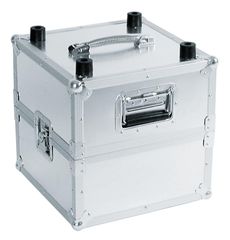
Record case in aluminum housing
For 100 LPs
Pragmatic 50/50 separation
Interior upholstered with foam (10 mm, black)
High-quality workmanship with plywood multilayered glued, aluminum-colored laminated
Aluminum profile frames (22 mm) with rounded edges
Three-leg, medium sized steel ball corners
Chromium plated corners and locks
2 high-quality butterfly locks
8 steel-enforced rubber feet
3 rugged carrying handles
Maximum load: 20 kg
Material: Glued plywood, 7 mm
Color: Alu colored, laminated
Outer dimensions/corners approx.: 50 mm
Dimensions: Width: 37,5 cm
Depth: 37,5 cm
Height: 44 cm
Weight: 6,60 kg
- Für 100 LPs
- Praktische 50/50 Teilung
- Schaumstoffgepolsterter Innenraum (10 mm, schwarz)
- Hochwertige Verarbeitung mit 7 mm mehrschichtig verleimtem Holz, aluminiumfarben laminiert
- Aluminiumprofilrahmen (22 mm) mit abgerundeten Ecken
- Dreischenklige, mittelgroße Stahlkugelecken
- Ecken und Schlösser verchromt
- 2 hochwertige Butterfly-Schlösser
- 4 stahlverstärkte Gummifüßen
- 3 robuste Tragegriffe
Maximalbelastung: 20 kg
Wandstärke: 7 mm
Außenmaße (BxTxH): ca. 375 x 375 x 430 mm
Innenmaße:
Einbaubreite: 322 mm
Einbauhöhe: ca. 370 mm
Einbautiefe: ca. 325 mm
Außenmaß der Ecken: ca. 50 mm
Gewicht: ca. 7,8 kg