The very first initial Minimum Success Records release features the legacy of some finest mix of breakbeat, gabber & hardcore influenced tracks with some ghetto touch produced in the studio sessions between 1993-1997 by the duo Amalgam 5 at West 20 Studio in Turku, Finland. Well after a decade being buried in the deepest master tapes archives these tracks are finally seeing a daylight and becoming available on a beautifully designed vinyl release by Bank™.
quête:misu
- A1: Abay
- A2: Tew Ante Sew
- B1: Mengedegna
- B2: Kahn
- C1: Sew Argen
- C2: Nafekeñ
- D1: Abet Wubet
- D2: Guramayle
- D3: Gud Fella
- D4: Guramayle (Slight Return)
180g Heavy double vinyl LP with liner notes by Tyran Grillo. Limited Japanese Obi for the first pressing. Original artwork by Russell Mills and photography by Jean-Baptiste Mondino.
The third Time Capsule is a body of dub reinterpretations by celebrated producer Bill Laswell of Ethiopian singer Gigi. Curated by Tokyo record collector, music researcher and seasoned reissue supervisor Ken Hidaka, it is the first time Illuminated Audio is pressed to vinyl after its CD release in 2003.
Ejigayehu Shibabaw was born in 1974 in Chagni, northwestern Ethiopia and by pursuing a career as a singer, went against her father’s strict, traditional gender roles. As Gigi, she embraced the same musical freedom she had strived for in her personal life, incorporating the Ethiopian church, funk, hip-hop, West and South African music into her work. She first settled in Nairobi, then Addis Ababa, where she quickly established herself as one of the city’s leading singers. A move to San Francisco in 1998 led to a long and fruitful creative partnership with bassist and producer Bill Laswell.
Around the same time, Chris Blackwell had stepped away from Island Records to start the art house film company and label Palm Pictures. He took an interest in Gigi and together with Laswell, pulled together an all-star cast of musicians for her self-titled US debut album, including Herbie Hancock, Pharoah Sanders and Wayne Shorter. It won international critical acclaim, not just for its musicianship but for making Gigi a “defining voice for the Ethiopian expatriate community”, as journalist Tyran Grillo praises in his Time Capsule liner notes. From the nation-defining 1896 victory over Italian invaders to the quiet revolutionaries who wear simple shemma garments, Grillo believes the themes in Gigi make it “a shower of sunlight on her homeland for those ignorant of its struggles.”
After its success, Blackwell encouraged them to go back into the studio to rethink the album and Illuminated Audio was born. “Anyone can make a voice sound worldly”, Grillo remarks, “but rare are those who can make one sound inner-worldly.” Gigi was clear with Laswell to give her vocals a minor role “because it’s already been done.” Instead her Amharic verse is fleeting, exhaling through the textures like ghostly fragments; soaring yet muted. Yet the album is still titled under her name, an assertion by Laswell of her central role in the album’s creation. Not only was it a fully endorsed project by Gigi, but she would be present throughout its development, giving feedback on half-finished ideas as Laswell played them back in the studio. “It works perfectly”, she reflected after the album’s release. “We wanted to capture the whole spirit of each track, and Bill’s remixes create a different music language that really puts you in a pleasant place”.
This new vocabulary takes its lead from a technical approach that Laswell had been perfecting during a furtive creative period at the turn of the millennium. Much like his ambient interpretations of Miles Davis (Panthalassa, 1998), Bob Marley (Dreams of Freedom, 1997), and Carlos Santana (Divine Light, 2001), Laswell approached Illuminated Audio by returning to the original multitrack masters. Gigi wasn’t just reworked, but recomposed into an expansive lattice of instruments, submerged in a watery ambience of dub and trance undercurrents.
Sonically, this new language that Gigi refers to, is manifested by the original album’s more understated parts being pushed to the fore. Explaining his contrasting methods, Laswell saw Gigi as being “put together in a way that fits”. Contrastingly, in Illuminated Audio, “a lot of things that I featured in the remix weren’t as audible in the original.” Instrumentation laying near-dormant, deep in the mix, are brought to the fore: the acid rock guitar and Wayne Shorter’s saxophone on ‘Tew Ante Sew’, Graham Haynes’ flugelhorn on ‘Nafekeñ’, Laswell’s bass on ‘Kahn’, the melodica in Mengedegna or the floating synths and talking drums in ‘Gud Fella’.
Brought to his attention by mentor DJ Nori, Hidaka describes Illuminated Audio as a “masterful sonic exploration into ethereal ambience and dub” and made sure this reissue also contained a full remaster to give its “deep musicality” much better dynamics and density in the overall sound. Hidaka admits that Laswell's music “is sometimes so out-there, it is often misunderstood” and, indeed, to dub album non-believers this might seem like a prolific producer imposing himself on another artist’s work; eternally developing rearrangements that never quite get to its destination. But that’s missing its true power and triumph. This is more than the reissue of a remix, but “a wholly unique musical entity”, as Hidaka describes. Illuminated Audio refers to the illuminated manuscripts that comprise the major part of Ethiopian art and its new compositions stand in proud solitude as a rare body of reworks that both informs and enhances their originals.
- A1: Les Masques - Il Faut Tenir (1969)
- A2: Isabelle Aubret - Casa Forte (1971)
- A3: Christianne Legrand - Hlm Et Ciné Roman (1972)
- A4: Jean Constantin - Pas Tant D'chichi Ponpon (1972)
- A5: Billy Nencioli & Baden Powell - Si Rien Ne Va (1969)
- B1-: Marpessa Dawn - Le Petit Cuica (1963)
- B2: Jean-Pierre Sabar - Vai Vai (1974)
- B3: Sophia Loren - De Jour En Jour (1963)
- B4: Isabelle - Jusqu’à La Tombée Du Jour (1969)
- B5: Sylvia Fels - Corto Maltesse (1974)
- C1: Frank Gérard - Comme Une Samba (1972)
- C2: Ann Sorel - La Poupée Des Favellas (1971)
- C3: Charles Level - Un Enfant Café Au Lait (1971)
- C4: Andrea Parisy - Les Mains Qui Font Du Bien (1970)
- C5: Audrey Arno - Quand Jean-Paul Rentrera (1969)
- C6: Aldo Frank - T’as Vu Ce Printemps (1970)
- D1: Christianne Legrand - Cent Mille Poissons Dans Ton Filet (1972)
- D2: Clarinha - Lemenja (1970)
- D3: Hit Parade Des Enfants - Aquarela (1976)
- D4: Jean-Pierre Lang - Tendresse (1965)
- D5: Magalie Noël - Une Énorme Samba (1970)
- D6: Françoise Legrand - La Lune
Ever since the late 1950s bossa-nova revolution, Brazil’s influence on French music has been undeniable. Pierre Barouh, Georges Moustaki and a vast array of lesser known artists, all made the Musica Popular Brasileira (MPB) an axis of promotion at the service of a cool and metaphysical, modern and mixed Brazilian lifestyle. Some were seduced by the poetic languors of the bossa, some were looking for fun, and others just loved the American hybridization of jazz-bossa, jazz-samba.
What is bossa nova? One of its creators, Joao Gilberto said: "Its style, cadence, everything is samba. At the very start, we didn't call it bossa nova, we sang a little samba made up of a single note - Samba de uma nota so .... The discussion around the origins of bossa nova is therefore useless”. It is nevertheless useful to remember that these magnificent Brazilian songs, which the guitarist describes as samba, were shifted and balanced around improbable chords. "I like things that lean, the in-betweens that limp with grace," said Pierre Barrouh, quoting Jean Cocteau.
With emotion, arrangements for violin and supple guitar licks, bossa nova rapidly changed. A transformation that can be heard in the Tchic, tchic, French Bossa Nova 1963-1974 compilation, the result of a cultural reappropriation, which traveled through the United States and supplemented itself in France.
A musical revolution that has remained significant, bossa nova was born in Rio. From 1956 to 1961, Brazil lived through its golden years. In five years, the country had invented its modernist style. Elected president in 1956, Juscelino Kubitschek de Oliveira, an elegant man with a broad forehead, brandished a promising slogan: "Fifty years of progress in five years". He quickly got to work. Not worried about increasing debt, he launched the project for a new federal capital, Brasilia, designed by the communist architect Oscar Niemeyer. Volkswagen opened state-of-the-art factories and created the “fusquinha”, the Beetle. In Rio, the Vespa made its first appearance. The Arpoador Surf Club crew run into the “girl” from Ipanema, Helô Pinheiro - the tanned garota ("chick"), between a flower and mermaid, who at 17 walked by the Veloso bar, where the fiery author and composer, Tom Jobim and Vinicius de Moraes, were getting drunk on whiskey. From then on, bossa symbolized cool.
In 1958, Joao Gilberto recorded Chega de Saudade, which the directors of Philips denied, calling it "music for fagots". The marketing director, who believed in it, secretly pressed 3000 78-inch vinyls and distributed them at schools around Rio, creating a tidal wave.
American jazzmen then took over. In particular, trumpeter Dizzy Gillespie and guitarist Charlie Byrd. In November 1962, the Brazilian Ministry of Foreign Affairs funded a "Bossa-Nova" concert at Carnegie Hall in New York, inviting the genre’s pioneers. Unprepared, the show soon turned to disaster. But the troupe was invited to the White House by Jackie Kennedy. The first lady loved "the new beat" and in particular Maria Ninguem, a song by Carlos Lyra, later covered by Brigitte Bardot.
In Brazil, the 1964 military coup quickly ended this euphoria. The destructive atmosphere that ensued pushed many Brazilian musicians to leave, if not to exile. Thus, Tom Jobim, Sergio Mendes and Joao Gilberto arrived to the United States. In New York, Joao Gilberto met saxophonist Stan Getz. At the time, he was married to the Bahianese Astrud Weinert Gilberto, who had a German father. She had never sung before, but she knew how to speak English. Getz therefore asked her to replace her husband on The Girl From Ipanema. The Getz/Gilberto record with Tom Jobim on piano, was released in March 1964. Phil Ramone, the "pope of pop" was in charge of sound.
Bossa nova arrived in Paris through the classic “guitar-voice” channel (Pierre Barouh, Baden Powell, Moustaki…) But France loved jazz and Paris had already welcomed its American contributors. All these good people were to pass through Saint-Germain-des-Prés. The cabaret l'Escale became the Mecca of Latin American sound where one could find Pierre Barrouh and his friends, such as the Camara Trio, samba-jazz aces, whose only record was published by the Saravah label. With a band strangely called Les Masques (a band that included Nicole Croisille and Pierre Vassiliu, among others), the Camara Trio recorded an interesting Brazilian Sound, including the track Il faut tenir which is present on this tasty compilation of rarities.
Other enlightened musicians can also be found on the compilation, such as Jean-Pierre Sabar (songwriter for Hardy, Auffray, Leforestier ...) and the French pop rock organist Balthazar. In 1975, Sabar recorded Aurinkoinen Musiikkimatka on a Finnish label, which featured the crazy Vai, Vai, included on this record. We are now following the footsteps of Brazilian electronic musicians such as Sergio Mendes, Eumir Deodato or Marcos Valle who created funk and disco sounds on their keyboards and synthesizers. A style that influenced Véronique Sanson when she wrote Jusqu’à la Tombée de la nuit in 1969 for Isabelle de Funès, the niece of Louis and a great friend of Michel Berger - Sanson did end up singing this track on her 1992 Sans Regret record.
The pinnacle of exoticism and travel, Sylvia Fels’ Corto Maltese includes bongos, sea mist and ocean sounds. The title was taken from Jacky Chalard’s concept album written in 1974, Je suis vivant, mais j’ai peur (I am alive, but I am scared), based on Gilbert Deflez’s science fiction novel.
However, bossa nova extended the scope of popularity. "In the 1970s, I was a fan of Sergio Mendes, Getz / Gilberto. I fell in love with this music that I knew because I had been an orchestral singer, " explained Isabelle Aubret, who in 1971 delivered a composite record of covers by the very funky Jorge Ben, Orfeu Negro, Tom Jobim, Vinicius de Morais and Jean Ferrat. "I recorded this album for Meys Records in Paris, far from Brazil, with wonderful musicians, François Raubert, Roland Vincent, Alain Goraguer...". The latter wrote the arrangements for Casa Forte, a very percussive title borrowed from Edu Lobo, one of the initiators of the bossa who spent time in California. "Jazz and bossa came together and produced very rhythmic music. I love singing, it allows me to dream, to have fun, to feel a high on stage, and these songs brought me joy, made me swing, my singing felt like a dance.”
The world tours of French singers and their desire for the tropics, often brought them to Rio with its hills, forests, caipirinhas and tanned bodies. There are surprises though, like this Iemenja (Iemenja is the goddess of the sea in the Afro-Brazilian candomblé religion). Not unlike the composer and musician Jean-Pierre Lang, based in Sao Paulo, Claire Chevalier taught Brazil to Brazil. In 1970, the singer and painter published a 45-inch vinyl, Mon mari et mes amants (My husband and my lovers), under the improbable pseudonym of Clarinha (little Claire). She was then living in Rio, with her husband, Joël Leibovitz, who founded a band called Azimuth, and who owned a record label specialized in "sambas enredos" songs for samba school parades.
For its B side, she asked Pierre Perret to come up with lyrics for a song composed by Carlos Imperial: "Oh goddess of the sea, o goddess Iemenja, I bring a white rose to adorn your long hair ..." . "Perret came to see us, and we had fun, remembers Joël Leibovitz. We wrote Lemenja for fun, we recorded it at the Havaí studio, behind the Central do Brasil the central station. Erlon Chaves, the arranger who worked with Elis Regina, joined us" adding his share of Afro-Brazilian percussions and funky brass to the mix.
There is a common misunderstanding in Franco-Brazilian history: that bossa, admittedly hedonistic, is perceived as funny, even though the poets who wrote the texts are often philosophizing on the human condition. Its French interpreters pull it towards a carnival inspired universe, far removed from its fundamental essence. Thus, Jean Constantin covered the famous Samba da minha terra, an ode to the art of samba written by the classic Bahian composer Dorival Caymmi, renaming it with the enticing title of Pas tant de tchi tchi pompon: "On your pier there is no tchi tchi / when you arch your back, you know everything is alright ”(lyrics by Gérard Calvi). This expedited bossa aims for the absurd, but retains a certain elegance.
Indeed, Jean Constantin was not an idiot, the rather large man had a huge mustache and liked fantasy, (Les pantoufles à papa, Le pacha, inspired by cha-cha-cha-cha, salsa and jazz) but he was also the lyricist of Mon manège à moi interpreted by Edith Piaf, the composer of Mon Truc en plume by Zizi Jeanmaire and the soundtrack of François Truffaut’s 400 Blows. Le Poulpe, published in 1970, from which this bossa is extract, was arranged by Jean-Claude Vannier, an accomplice of Serge Gainsbourg’s Melody Nelson. In short: "There is enough of samba / By looking at the parasol / Because my poor cabeza / Is going to die in the sun".
Even the American actress Marpessa Down, who was at the heart of the bossa nova revolution with her role as Euridyce in Marcel Camus’ film Orfeu Negro, winner of the 1959 Cannes Palme d'or, fed the clichée with Je voudrais parler au petit cuica - "Tell me how you manage to always make people want to dance / It's true, I must admit that I cannot resist your magic" - in consequence, once can hear the cuica, a little drum inherited from the Bantu.
But bossa nova had many angles. Societal, of course, pushing actresses who were symbols of women's liberation like Brigitte Bardot, Jeanne Moreau, or Sophia Loren to engage in the exercise of accelerated bossa. In February of 1963, Sophia Loren made a record in French in Rome, Je ne t'aime plus, featuring the song De jour en jour, a bossa written by two Italians, Armando Trovajoli and Tino Fornai, which was released a little later by Barclay. Bossa accompanied the 1960s, a decade of moral liberation. Ann Sorel, who interpreted La Poupée des favellas, caused a sensation with L’amour à plusieurs, a provocative song written by Frédéric Bottom and Jean-Claude Vannier. As for the actress Andrea Parisy, she displayed her bourgeois cheekiness in Marcel Carné's Les Tricheurs before interpreting Les mains qui font du bien. And Magalie Noël, the friend of Boris Vian, who sung Johnny fais-moi mal, was hired to sing Une énorme Samba, composed by Alain Goraguer (arranger to Gainsbourg, Bobby Lapointe and Jean Ferrat) with lyrics by Frédéric Botton.
But in the end, of what wood is bossa nova made of? The answer is given by Christianne Legrand, daughter of Raymond the conductor, and sister to Michel the composer: "With me, with jà" - jà means "immediately" in Portuguese. In 1972, the singer, an expert in vocal jazz and a member of the Double Six, published Le Brésil de Christianne Legrand. Two songs included on the Tchic Tchic compilation that demonstrate how bossa, jazz, funk, rock, etc. work like a swiss army knife: the music is used to denounce broken systems, or miracles, HLM et ciné roman, Cent mille poissons dans ton filet, two songs from the O Cafona soundtrack, a successful telenovela broadcast, at the time in black and white, on TV Globo. The first was adapted in French by the fighter and friend of the Legrand tribe, Agnès Varda. The second is content with a play on words, jostling them into a summer fun.
Véronique Mortaigne
- A1: Kifu Mitsuhashi, Kiyoshi Yamaya - Asadoya Yunta
- A2: Toshiko Yonekawa, Kiyoshi Yamaya - Tanchame
- A3: Kiyoshi Yamaya - Ryukyu Miyabi 2
- A4: Kiyoshi Yamaya - Ryukyu Miyabi 3
- A5: A3 Kiyoshi Yamaya - Ryukyu Miyabi 4
- A6: Kiyoashi Yamaya - Nishinjo-Bushi/Asadoya Yunta/Tanchame
- B1: Tadaaki Misago & Tokyo Cuban Boys - Tanchame-Bushi
- B2: Tadaaki Misago & Tokyo Cuban Boys - Hatoma-Bushi
- B3: Minoru Muraoka - Asadoya Yunta
- B4: Kiyoshi Yamaya - Ryukyu No Sora
- B5: Kiyoshi Yamaya - Ryukyu No Matsuri 1
- B6: Kifu Mitsuhashi, Kiyoshi Yamaya - Tanchame
A compilation of rare and unique pop songs sung in Okinawa's unique musical scale with rock and soul grooves. It is based on “Ryukyu Rare Groove” released in 2003 and its sequel “Ryukyu Rare Groove 2” in 2006. This is a renewed version of those two albums, with more carefully selected and new songs included.
The Yara Families, the symbol of this series, as well as songs by Shokichi Kina, the originator of Okinawan folk rock, Mitsuko Sawamura, who made a breakthrough from Okinawa into American musical films, and Teiko Saito (Teiko Taira), a jazz singer who released her debut album in 2022 at the age of 86 and became a topic of conversation, The album contains 14 precious tropical groove songs. A renewed version of “Ryukyu Rare Groove” is now available in analog format!
The compilation “Ryukyu Rare Groove” became a hot topic as many people became addicted to its unique groove, which was created by applying Western arrangements to Okinawan scales and traditional Okinawan music. Ryukyu Rare Groove Revisited” is now available in analog format.
It features 14 precious tropical grooves, including not only the iconic Yara Families from this series, but also songs by Shokichi Kina, the originator of island song rock, and Teiko Saito (Teiko Taira), a jazz singer who released her debut album in 2022 at the age of 86 and became a hot topic.
Ryukyu Rare Groove Crossover,” a selection of jazz arrangements of Okinawan melodies and folk songs, was also released simultaneously, featuring MURO selection
‘Diggers Dozen’ and Kiyoshi Yamaya's Okinawan folk song Jazz Funk, which was featured on the ‘Ryukyu’ 7-inch from Tropic Night Records. and other instrumentals,
including Latin big band jazz by Naoteru Misuna and the Tokyo Cuban Boys.
Unsighted is the Brooklyn based project of Nicolás Sierra ,and Mutante returns with a new sonic manifesto: an EP that channels the rough energy of EBM, the analog sensibility of Minimal Synth and the hypnotic pulse of New Beat.
This EP is a distorted time capsule, where corrosive basslines, martial rhythms and analog synths coexist in constant tension. It is a statement without nostalgia but with retro DNA, designed for sweaty dancefloors, smoky basements and minds that vibrate on the fringes of the mainstream.
Foreboding EP is a collection of tracks that don't ask for permission, they hit you straight on, like a post-industrial alarm on eternal loop.
Under the motto «We become more from what is left, deliver else than just the now, build sound stories for the then», Sediments is the new label and sonic adventure launched by Estrato Aurora and d_o_ppelgaenger, partners in the electronic duo Pajaro Dune.
d_o_ppelgaenger || aka David Ortolà || is a pianist, composer, electronic music producer, teacher and scholar specializing in contemporary music and electroacoustic composition and performance. As a solo artist, he has composed multiple electronic, ambient and techno works, modular scores as Grooves #1 (2017) and Déjà vu (2024), unique musical events such as Efímeras for 20 Pianos (2011), compositions for piano and electronics as well as his latest release Live at Perpendicular (2024).
Live at Perpendicular 2024 is Sediment's inaugural offering. Recorded May 25, 2024 by d_o_ppelgaenger at Perpendicular Festival in the woods of Cuenca, Spain, this album is both an ambient live set and a sound journey inspired in the Doppelgänger archetype from the early gothic novel.
d_o_ppelgaenger's signature chiaroscuro medley of styles and ideas relies on narrative sound design, using both electronic production, classical instrumentation, field recording and generative synthesis. His music challenges the boundaries between acoustic and electronic sound calling on a wide range of oft-conflicting aesthetics: from early music to soundtrack atmospheres or disruptive avant-garde trends. This album explores the liminal terrain between divergent languages, trying to create perceptional experiences in search of empathy between the known and the misunderstood or the unheard-from.
|| We
become more from what is left,
deliver else than just the now,
build sound stories for the then. ||
The Dancefloor Records reissues on Emotional Rescue comes in the form a true House classic. Produced and released by the Chicago legend Andrew Komis, It’s You is an original Deep House bomb and an education to those increasingly misusing the term today.
Essentially a cover / updated version of the all-time early House classic in ESP’s Its You, this 1989 update shows how much the scene was progressing in just 3 years with a tougher, heavier and deeper 12” that was all about rocking club sound systems.
Coming out on Komis’ own (Dancefloor subsidiary) Big Shot Records, this might not of been as big as Dionne’s Come Get My Lovin’, but has long been an ‘in the bag’ record for the likes of Derrick Carter and Solar. Just one listen spread across the time-defining “Mixes” and it’s clear why.
The stepping bass of the New York – London Mix was so indicative of the time. As the latter’s ascent as a clubbing capital took hold, ears were pinned to what was emanating from across the seas, especially the clubs of NYC and ‘Windy City’. Trademark Komis bass and hats ride are all here to allow the breathy vocals space to do their magic.
However it is the Free House Mix that really shows where things were at. Skipping hats, electro-meets-Belgian bass and a dark synth line pull the track down before acid touches take the song to a much deeper place and has long been the favourite version for the discerning DJ.
Ending with what was indicative of the time, the title says it all with the NU Style Mix. A drum heavy work out, taking in elements of successful records of the time, we get Break 4 Love percussion arranged around a NYC influenced Konder’s style quick cut-up editing for a more 'freestyle' mix to round out what is simply, an underground bomb and therefore, worthy of what this label has always been about, bringing great records to new ears.
Schlammpeiziger, who had previously only been known to us for his top hits and T-shirts, burst upon us like a wild boar in search of affection in the middle of the coronavirus lockdown. He nested in our fully vaccinated home, drank our Eversbusch, ate from our plates, slept in our bed (wait - wrong fairy tale) and repeatedly urged us to organise egg runs with his testicles (after some contortions, we gave up trying). Childish faecal humour, far-fetched obs(t)enities, juicing, a desire to dissolve, composting of thoughts. In excesses of lack of concentration, the chains of associations curled and meandered like Jo's famous curlicue drawings. Every evening, after we had forcibly levered him out of our flat, he would ‘walk’ home to put together very unique , dreamy pieces. In the blissful brainfog of those days, for example, ‘Handicapfalter’ was created, for which the congenial °Bär° made our flat into the corresponding video. Among other quirks of the little gut-breather, we were fascinated to observe his phobia of literature and books. Just hold a printed page in front of his face for a few seconds and he writhes on the floor crying. A level of phobia that only my own laughable disgust and fear of writing myself can compete with. Jo shudders at the thought of reading sentences that build on each other in a meaningful way, and I shudder at the thought of having to write them down because I have something ‘to say’. A certain affinity cannot be denied. We are much, much more pleased by snatched-up, misunderstood or misheard snippets, hollow but unforgettable phrases, the diamond stoner humour of our ancestors. ‘From one turn/ I stop/ to walk on/ in all directions’ (as it murmurs in “Selten Gesehenes”), describes the process quite nicely. After all, Jo is ahead of me in that he can simply break off every tedious sentence and let it fade into music. Back to the essentials. It's five to 12 for the Schlammpeitzger (scientifically Misgurnus). The shy goby is under threat from climate change, so perhaps this vinyl is the last expression of life of the specimen that we have been allowed to look after sporadically since the lockdown phase of the corona epidemic. And it's turned out pretty. Even the aesthetically gutted like me and my beloved husband can THINK about sex when they see these sublime, silvery fart bubbles! It's tender as a fart. Make love!!!!!
Schamlose Dubtöse: Do you have words. Do you have sounds. Impertinently harmless piano tinkling turns into tugging zounds of increasing severity. It is not dubbed (would be unethical) but dubbed. Sounds dubby, as you can imagine. (Instrumental)
Loch ohne Licht: Possibly vaguely misogynistic. Could also be that there was simply no light in the hole. The sparse snippet of lyrics (‘du biss mir och esu e Loch ohne Licht’) sounds like one of those stroppy Cologne replicas whose anti-charm is hard to resist. Buzzing and grooving.
Selten Gesehenes: Casual. Confident. Soft. Fragrant. Thoughtful but lively.
The Arabian Vietmanese (instrumental) is probably the food we trust in the case of the munchies we get when we watch other people smoking weed. Transcendental and psychedelic states casually permeate the humdrum of everyday life. Klar Knuspermarsch: Marches and floats at the same time. Klebt Runner: Soundtrack to the cult film of the same name. Tyrrell Corporation loosens up. Ungenutzte Sätze: Stinks somehow, because there is dangerous proximity to comprehensible and then also critical statements here. Instead, the sinister electronic cheapness of Carpenter soundtracks can be heard. Parzipan: Actually, the time of origin was not so roaringly funny and simple, but for Jo it was also a gruelling, slow letting go of his brother. Here he sends him off with a gentle nudge into the vastness of a hopefully happy beyond.
Clara Drechsler
Schlammpeiziger, der uns bislang nur durch seine Top-Hits und seine T-Shirts bekannt gewesen war, brach mitten im Corona-Lockdown über uns herein wie ein wilder Eber auf der Suche nach Zuwendung. Er nistete sich in unserem durchgeimpften Zuhause ein, trank unseren Eversbusch, aß von unseren Tellerchen, schlief in unserem Bettchen (Moment - falsches Märchen) drängte uns wiederholt dazu, mit seinen Hoden Eierlauf zu veranstalten (nach Verrenkungen gaben wir den Versuch auf). Kindischer Fäkalhumor, weit hergeholte Obs(t)zönitäten, Entsaftung, Auflösungswunsch, Gedankenkompostierung. In Exzessen der Konzentrationsschwäche ringelten, kringelten und schlängelten sich die Assoziationsketten wie bei Jos berühmten Kringel-Schlängel-Zeichnungen. Jeden Abend, nachdem wir ihn gewaltsam aus unserer Wohnung gehebelt hatten, „ging“ er dann heim, um dort sehr eigene, verträumte Stücke zusammenzubasteln. Im seligen Brainfog dieser Tage entstand z.B. „Handicapfalter“, für das der kongeniale °Bär° aus unserer Wohnung das entsprechende Video machte. Neben anderen Marotten des kleinen Darmatmers beobachteten wir fasziniert seine Literatur- bzw. Bücherphobie. Halt ihm nur sekundenlang eine bedruckte Seite vors Gesicht, und er windet sich weinend am Boden. Ein Grad an Phobizität, mit dem sich nur meine eigene lachhafte Abscheu und Angst vor dem Selberschreiben messen kann. Jo schaudert beim Gedanken, sinnvoll aufeinander aufbauende Sätze lesen, mir wiederum beim Gedanken, sie hinschreiben zu müssen, weil ich irgendetwas „zu sagen“ habe. Eine gewisse Verwandtschaft ist nicht zu leugnen. Viel, viel mehr freuen uns aufgeschnappte, falsch verstandene oder misshörte Fetzen, hohle, aber unvergessliche Phrasen, der diamantene Kifferhumor unserer Vorfahren. „Aus einer Drehung/bleibe ich stehen/ um in alle Richtungen/weiter zu gehen“ (wie es in „Selten Gesehenes“ raunt), beschreibt den Prozess schon ganz schön. Immerhin hat Jo mir voraus, dass er jeden leidigen Satz einfach abbrechen und in Musik ausplempern lassen darf. Zurück zum Wesentlichen. Es ist fünf vor 12 für den Schlammpeitziger (wissenschaftlich Misgurnus). Die scheue Grundel ist von Klimawandel bedroht, vielleicht haltet ihr mit diesem Vinyl also die letzte Lebensäußerung des Exemplars in Händen, das wir seit der Lockdownphase der Corona-Epidemie sporadisch betreuen durften. Und die ist hübsch geworden. Selbst aus ästhetischer Erwägungen Entdarmte wie ich und mein geliebter Mann, können bei diesen sublimen, silberhellen Pupsbläschen DENNOCH an Sex denken! It´s zart as a fart. Make love!!!!!
Schamlose Dubtöse: Hast du Worte. Hast du Töne. Impertinent harmloses Klavierplätschern geht über in ziepende Zounds von zunehmender Strenge. Es wird nicht domptiert (wäre unethisch) sondern dubtiert. Klingt dubtig, wie ihr euch vorstellen könnt. (Instrumental)
Loch ohne Licht. Möglicherweise vage misogyn. Könnte auch sein, dass im Loch einfach kein Licht war. Das sparsame Textfetzchen („du biss mir och esu e Loch ohne Licht“) klingt nach einer jener pampigen kölschen Repliken, deren Anticharme man sich schwer entziehen kann. Schwirrt und groovt.
Selten Gesehenes: Lässig. Souverän. Softig. Duftig. Nachdenklich aber beschwingt.
Beim Arabischen Vietmanesen (Instrumental) gibt es wahrscheinlich die Speise unseres Vertrauens im Falle der Munchies, die wir kriegen, wenn wir anderen Leuten beim Kiffen zusehen. Transzendentale und psychedelische Zustände durchziehen beiläufig den schnöden Alltag. Klar Knuspermarsch: Marschiert und schwebt zugleich.
Klebt Runner: Soundtrack zum gleichnamigen Kultfilm. Tyrrell Corporation macht sich locker. Ungenutzte Sätze: Stinks irgendwie, weil hier gefährliche Nähe zu nachvollziehbarer und dann auch noch kritischer Aussage gegeben ist. Dafür klingt die sinistre elektronische Billigkeit von Carpenter-Soundtracks an.
Parzipan: Eigentlich war die Entstehungszeit gar nicht so brüllend lustig und einfach, sondern für Jo auch ein zermürbendes, langsames Loslassen des Bruders. Hier schickt er ihn mit sanftem Schubs hinaus in die Weiten eines hoffentlich schönen Jenseits.
Clara Drechsler
Downloads
In July 2019, eleven years after Jay-Z became the first hip-hop artist to headline Glastonbury, Stormzy became the first English rapper to follow suit. Wearing a customised stab-proof vest designed by Banksy, the South London rapper delivered an explosive performance and finished by thanking the “legends for paving the way,” name-checking Wiley, Dizzee Rascal, and Giggs. Despite how unlikely it seemed for decades, UK rap was now firmly a part of pop music and the greater hip-hop canon.
Rich, nuanced, and often misunderstood, the history of UK rap is a story of music that refused to stand still. Factoring in socioeconomics, gender, identity, music industry disruption, and innovation, What Do You Call It? charts the artform’s first four decades, beginning when rap landed on our island in the early 1980s. Shaped by sound system culture, inspired by punk, and accelerated by rave, it has evolved from Britcore, UK hip-hop, and trip-hop of the late twentieth century to garage, grime, and drill.
Through cultural theory, historical research, and original interviews with key figures and collaborators in the UK rap scene, from pioneers like Malcolm McLaren, Soul II Soul, Tricky, Roots Manuva, and Roll Deep to modern artists like Dave, CASISDEAD, Little Simz, Loyle Carner, and Skengdo x AM, adds a rich human dimension to the UK rap story — one that helped change British music and culture forever.
“A long overdue exploration of rap music in the UK and its longstanding – albeit overlooked – legacy and influence. In an era when UK rappers dominate the charts, star in major movies and TV shows and front huge advertising campaigns for multi-national corporations, Kane traces back the arduous journey from maligned sub-culture to celebrated mascot of neoliberal capitalism.” Jehst
“David Kane writes with a deft touch and possesses a disarming and deeply insightful interview style. Sparking life, humour, and sorrow across every page of more than three decades of UK rap history.” Charlie Dark MBE
“Kane builds bridges in a rich musical universe full of heroes and villains—and plot twists. With an inimitable style, he merges culture high and low to bring new meaning to the music. What Do You Call It? is a landmark tome for UK rap music.” Brian DiGenti, Wax Poetics
“A mind rich in ideas” Stanley Ledbetter, The New Yorker
After his highly publicized breakup with Taylor Swift at LA’s Viper Room ,Iain Howie returned to Vancouver.
Taylor released “Bad Blonde Boy”, a breakup song about Iain and Iain quickly rebutted with “ Patterns” about Taylor.
He began working on his solo album and got a remix of Patterns by his shady neighbour “Jay Tripwire”. Partly because of the fact Taylor could never stand Tripwire.
Over the course of a year Tripwire churned out 10 different remixes for an alternative vinyl only release. Jay would have his friend Anton play various remixes from his hot dog cart in Bucharest.
One early morning it caught the ear from Cally. Cally had only intended to buy a foot long Frankenfurter after Guesthouse, but he was so captivated, that he asked Anton for a cassette tape of the song. Most Romanian DJs often look to Anton’s hot dog cart to find obscure unreleased gems.
Cally began his closed door ritual of compiling songs for closing Sunwaves that year. When getting his tea leaves read, his spirit guide advised him on using “Patterns” as the closing song to the festival.
Whether it was the come down from drugs or low serotonin, SW attendees could be seen crying on the dance floor during the song.
The tears were then collected and drank by Raresh
The fifth Planet Tapes projects us into a completely efficient mechanism that propagates rapidly and causes spectacular consequences.
A1 written by Graham Sims and Simon Button better known as Connective Zone. After releasing music in the 90s and early 2000s, one of their old works is about to see the light of day, almost 20 years after their last appearance on vinyl.
A2 created by R.E.S.S, a South American boy part of the "Orbe" collective and passionate about parties with small groups of people. Official debut on vinyl but his first solo EP won't be long in coming.
B1 composed by the bond of two childhood friends (Existencia Pasajera & Dismal) who followed separate musical paths and reunited years later in the Valdivia electronic music scene.
B2 belongs to Yu, an emerging Italian artist who already boasts numerous releases, all starting in 2023. His sudden rise is in the eyes but above all, in the ears of everyone.
Dive into darkness and discover the pulsating sounds of Amsterdam based Raderkraft: a masterful fusion of minimal synth, darkwave, and post-punk elements. His love for synthesizers combined with the right dose of DIY spirit has resulted in three EPs.
Raderkraft takes you on an introspective journey to the darkest corners of the human mind. “Politiestaat?!” is a raw and unapologetic expression of the times we live in, inviting listeners to reflect on their own input and behaviour regarding pressing issues that dominate our world today.
The icy synthesizers, hypnotic rhythms and piercing vocals weave a story with the central themes of fear, misunderstanding and rejection. Raderkraft brings his signature sound, a unique mix of raw energy and refined minimalism, back to life. This time only up-tempo songs, partly in Dutch and also including a remix of Dyatlov track “Insect Paranoia“ (exclusive 2023 remaster) plus a cover of Belgium 80’s minimal wave act Violence Conjugale. It -finally- marks the vinyl release of crowd favorite “De Witte Streep” (exclusive 2023 remaster).
The lavish lyrics reflect a sense of rejection in an indifferent polarizing society. This mini album will make you think, feel and finally realize that we live in turbulent times.
Since he started producing music, Berlin-based American sound artist Jake Muir has been obsessed with sampling. His 2018 album "Lady's Mantle" was based on manipulated chunks of vintage Californian surf rock, and its follow-up, 2020's midnight symphony "The Hum Of Your Veiled Voice" was sourced from a wide variety of old records, and inspired by the work of experimental turntablists like Marina Rosenfeld, Janek Schaefer and Philip Jeck.
On "Mana", Muir looks back to a misunderstood musical movement. Around 1995, a group of New York producers and DJs - including DJ Olive, DJ Spooky and Spectre - pioneered a genre-dissolving sound by unifying hip-hop techniques with ideas pulled from dub, jungle, ambient music and industrial noise. Badged "illbient", it was a short-lived genre that felt like a high-minded psychedelic cousin of the UK's trip-hop.
Muir uses illbient as the springboard for "Mana", utilizing a selection of samples to inform his frothy drones and foreboding atmospheres. He ushers the material into 2021 by diverting it through his own contemporary worldview, attempting to recreate the hyperreal fantasy histories of Japanese RPGs (think "Dark Souls" and "Final Fantasy") and nod to sensual, tactile soundscapes of European industrial labels Staalplaat and Soleilmoon. The result is a magickal, sensory journey that's as physical as it is representational.
If the illbient producers were encouraging a burgeoning experimental music landscape to emphasize the tactile feeling of turntablism and sample manipulation, Muir is doing the same with "Mana". Each track heaves and breathes not just with his cultural reference points, but with layered, complicated emotions. We can hear joy, sadness, desire and anguish, obscured by disintegrating noise, hallucinogenic harmonies and sub-aquatic bass. It's electronic music that's rooted not in technology, but in touch.
(180 gram pressing, black vinyl) Musique Pour La Danse presents CRON aka TODD SINES 'Scalable Architectures', the classic 1995 EP remastered. For fans of Dopplereffekt, Drexciya, Keith Tucker, Mid-West Electro A highly sought after EP equally blowing your mind and the floor. Cron is a project where Todd Sines focused on his long-running passion for electro music by exploring a specific set of machines composed of a Synton Vocoder SPX216, a Yamaha DX 100 and an Arp Avatar in a vibe completely different from his .xtrak alias or productions released under his own name.
The record visual presentation was equally important as it features 3-D objects created Todd Sines through intentional misuse of mathematical functions, creating unique forms and 'scalable architectures'.
Please find the complete 1995 liner notes below for more informations. Comprising of an intro + five highly danceable futuristic electro tracks of deep, sharp-edged electric grooves and hypnotic warm cuts that are each an exploration of a 'less is more' approach to production.
To mark the 25th anniversary of its release, Doubts and Convictions by Troublemakers is officially reissued, more than twenty years after its original release in 2001.
Never reissued until now, this emblematic French Touch album—originally signed in Chicago, USA—captures a moment when French electronic music opened up to jazz, soul and transatlantic grooves.
A cult record whose sound remains timeless.
In the heart of an ancient forest deep in Europe, the Council, a secretive assembly of goblins and trolls, convenes under the light of the dancefloor. These beings, often misunderstood by the outside world, harness the power of music and sound to weave potent magick. Their rituals, held on hidden sound systems resonate with the echoes of nature. As the goblins fiddle their enchanted samplers and the trolls beat their massive drumbreaks, the air shimmers with vibrant energy. drawing the attention of mystical forces. Bound by ancient traditions, the Council safeguards the balance of the hardcore.
2026 Repress
For all those who relate “maybe to the wind, because they can feel it, or dirt, because they can touch it. But nothing else.” Like Bobby Cornett (aka Shane), we are all trying to find where we belong.
Belong To The Wind marks Forager Records’ debut release: A lovingly curated collection of crooning psychedelic folk and soul songs gathered from American 45s of the 1970s. The compilation features 10 songs from 10 different acts, each with an indelible story of love, loss, loneliness, and an unrelenting desire to shed the confines of routine existence.
Meet a man named Denny Fast, perched behind a tobacco stained piano in a smokey Michigan lounge. He’s singing of the faded memory of distant hope and better times past. Listen to a portrait of the heartless Texan, told in arrestingly angelic prose by Connie Mims of St. Elmo’s Fire. Contemplate with Snuffy, the honest musings of a failed and misunderstood outsider, daring to hope for change.
Belong To The Wind aims to shed light on the more opaque cuts of these brooding artists. Many of these songs were recorded at the early stages of a career, at a time when experimenting and searching are pursued with reckless abandon. As a result, these songs are aggressively honest and uncompromising. Many have a distinct sense of the lo-fi DIY variety. Others are polished in production. Some are minimal, tentative and vulnerable. What all of these songs share, is a transportive quality. An uncanny ability to take a captive listener on a search for the soul, and a journey into the bellowing fields of easy reflection.
Sit back and enjoy a soft trip through the hazy milieu of a loner’s mind.
- 01: Maanitus &Amp; Tšiižik
- 02: Markka
- 03: Melkutus
- 04: Letška
- 05: Kuuen Parin Hoirola
- 06: Brišatka
- 07: Tšiižik
- 08: Kirkonkellot
- 09: Kirkonkellot Korkea
- 10: Hoirola, 3 Parin
- 11: Lippa
- 12: Kyngäkiža
- 13: Ristakondra
- 14: Vanha Polkka
- 15: Viistoista
- 16: Vanha Valssi
- 17: Kiberä
- 18: Maanitus Kuokan Kanteleella
- 19: Tuuti Lasta Nukkumahe
Vinyl[22,65 €]
Death Is Not The End present a further volume of Arja Kastinen's eerie amalgamations of 110 year old wax cylinders with her own meticulously transcribed takes, this time focussing in on Armas Otto Väisänen's field recordings of kantele player Iivana Mišukka (b. 1861 d.1919).
"Ivana Mišukka (1861–1919) was one of the Karelian kantele players recorded by the folk music researcher Armas Otto Väisänen on wax cylinders in 1916 and 1917. In the early 20th century, the remote areas of Border Karelia were undergoing the final phase of a transformation in musical culture, with the ancient runo song tradition giving way to newer forms of music. This transition is reflected in Mišukka's repertoire and choice of instrument. The ancient small kantele, hollowed out of a single piece of wood, was already rare at the turn of the century. Mišukka's kantele was a new type of instrument with 26 strings, constructed of several parts, but he played it using the traditional plucking technique. Like other Border Karelian kantele players, his repertoire consisted of music rooted in runosong culture, as well as newer dances and songs from the east and west. Most of the recorded material falls into the latter category.
Ivan Bogdanov Mišukka was born out of wedlock in Suursara village, Suistamo, on 1 May 1861. He began playing the kantele at the age of five or six, quickly mastering the instrument. In adulthood, he was considered one of the area's best master players. Mišukka was landless for most of his life and lived in different parts of the Suistamo parish. His first wife, Tekla Markintytär, died in 1897 at the age of 40, and his second wife, Jevdokia Filipintytär Jeminen, died in 1907 at the age of 50. Seven children were born from the first marriage, two of whom died young. The third wife, Maria Ignatintytär Gurnan (Kuurnanen), was a well-known master of lamentations. Together with Maria, Iivana Mišukka worked as a tenant farmer in the village of Suursara. Mišukka suffered from rheumatism, which prevented him from participating in physical work like Maria. This was apparently partly the reason why Iivana Mišukka went to earn extra money by playing the kantele on gig trips. He often had other traditional artists from Suistamo as his travelling companions, such as the runosingers Konstantin Kuokka and Iivana Onoila. Iivana Mišukka died in Leppäsyrjä village, Suistamo, on 18 May 1919 at the age of 58, and his kantele was donated to Teppana Jänis.
Mišukka only used 14 of the 26 strings on his kantele, playing the same tunes either a fourth higher or lower. He tuned his kantele to the major scale using fifths, except for a low seventh scale degree on the upper strings, but not below the fundamental. Since he did not use the seventh note of the scale on the upper strings at all, he could use the major scale both lower and a fourth higher with this tuning. According to Mišukka, the sound of higher, or 'finer', strings is 'more beautiful', while that of lower ones is 'greater'. Among runosingers, the size of the thirds varied, ranging from major to minor to neutral. A similar phenomenon can be observed in kantele tunings, where the third, sixth and seventh scale degrees vary in a comparable way.
During a meeting, Väisänen suggested that Mišukka play the smaller kantele belonging to Konstantin Kuokka. The idea was to bring it closer to the horn to improve the recording quality. However, the kantele was completely out of tune, and now Mišukka tuned it to the Lydian scale (track 18).
Using the old plucking technique, Mišukka placed his right middle finger on the fundamental tone, his right index finger on the second scale degree, his left middle finger on the third scale degree and his left index finger on the fourth scale degree, and his right thumb on the fifth. The thumb also played the notes above the fifth note of the scale. As Mišukka remarked to Väisänen: 'Peigaloll' tuloo enemb ruadoa' (the thumb has to do more work). However, he did not use the seventh note of the scale on the upper strings at all. Below the fundamental note, he played the seventh and sixth notes of the scale with his right middle finger of and the fifth note of the scale with his right ring finger. This fifth scale degree below the fundamental is almost always used as a drone. Sometimes, when the melody required it, Mišukka, like other players, also varied the fingering. He would also occasionally strike the same string with the side of his fingernail after plucking it.
The wax cylinder recordings of Karelian kantele players are kept in the archives of the Finnish Literature Society in Helsinki, Finland. Copies were made of them onto reel-to-reel tapes in both the 1960s and 1980s. The 1960s copies are mono and the 1980s copies are stereo. However, not all kantele recordings from these decades have survived.
The sound of the kantele is difficult to hear in wax cylinder recordings due to its low volume, and it occasionally becomes completely obscured by noise. During the copying process, the cylinder sometimes rotates unevenly, resulting in breaks or jumps in the music. Additionally, the rotation speed of the cylinder in the copies does not correspond to the performance speed of the original music, which alters the pitch. However, since Väisänen's precise notes are available in the archive, it is possible to deduce the melodies, their speed, and the tuning level of the kantele in the recordings. Of the copies of the original recordings from the 1960s and 1980s, I have selected the one that best met the requirements of this publication and adjusted the speed of the recording to align with Väisänen's notes. To enhance the listening experience, I have replayed the songs, which now partly overlap the old recordings on this release."
— Arja Kastinen
- 01: Maanitus &Amp; Tšiižik
- 02: Markka
- 03: Melkutus
- 04: Letška
- 05: Kuuen Parin Hoirola
- 06: Brišatka
- 07: Tšiižik
- 08: Kirkonkellot
- 09: Kirkonkellot Korkea
- 10: Hoirola, 3 Parin
- 11: Lippa
- 12: Kyngäkiža
- 13: Ristakondra
- 14: Vanha Polkka
- 15: Viistoista
- 16: Vanha Valssi
- 17: Kiberä
- 18: Maanitus Kuokan Kanteleella
- 19: Tuuti Lasta Nukkumahe
Tape[16,39 €]
Death Is Not The End present a further volume of Arja Kastinen's eerie amalgamations of 110 year old wax cylinders with her own meticulously transcribed takes, this time focussing in on Armas Otto Väisänen's field recordings of kantele player Iivana Mišukka (b. 1861 d.1919).
"Ivana Mišukka (1861–1919) was one of the Karelian kantele players recorded by the folk music researcher Armas Otto Väisänen on wax cylinders in 1916 and 1917. In the early 20th century, the remote areas of Border Karelia were undergoing the final phase of a transformation in musical culture, with the ancient runo song tradition giving way to newer forms of music. This transition is reflected in Mišukka's repertoire and choice of instrument. The ancient small kantele, hollowed out of a single piece of wood, was already rare at the turn of the century. Mišukka's kantele was a new type of instrument with 26 strings, constructed of several parts, but he played it using the traditional plucking technique. Like other Border Karelian kantele players, his repertoire consisted of music rooted in runosong culture, as well as newer dances and songs from the east and west. Most of the recorded material falls into the latter category.
Ivan Bogdanov Mišukka was born out of wedlock in Suursara village, Suistamo, on 1 May 1861. He began playing the kantele at the age of five or six, quickly mastering the instrument. In adulthood, he was considered one of the area's best master players. Mišukka was landless for most of his life and lived in different parts of the Suistamo parish. His first wife, Tekla Markintytär, died in 1897 at the age of 40, and his second wife, Jevdokia Filipintytär Jeminen, died in 1907 at the age of 50. Seven children were born from the first marriage, two of whom died young. The third wife, Maria Ignatintytär Gurnan (Kuurnanen), was a well-known master of lamentations. Together with Maria, Iivana Mišukka worked as a tenant farmer in the village of Suursara. Mišukka suffered from rheumatism, which prevented him from participating in physical work like Maria. This was apparently partly the reason why Iivana Mišukka went to earn extra money by playing the kantele on gig trips. He often had other traditional artists from Suistamo as his travelling companions, such as the runosingers Konstantin Kuokka and Iivana Onoila. Iivana Mišukka died in Leppäsyrjä village, Suistamo, on 18 May 1919 at the age of 58, and his kantele was donated to Teppana Jänis.
Mišukka only used 14 of the 26 strings on his kantele, playing the same tunes either a fourth higher or lower. He tuned his kantele to the major scale using fifths, except for a low seventh scale degree on the upper strings, but not below the fundamental. Since he did not use the seventh note of the scale on the upper strings at all, he could use the major scale both lower and a fourth higher with this tuning. According to Mišukka, the sound of higher, or 'finer', strings is 'more beautiful', while that of lower ones is 'greater'. Among runosingers, the size of the thirds varied, ranging from major to minor to neutral. A similar phenomenon can be observed in kantele tunings, where the third, sixth and seventh scale degrees vary in a comparable way.
During a meeting, Väisänen suggested that Mišukka play the smaller kantele belonging to Konstantin Kuokka. The idea was to bring it closer to the horn to improve the recording quality. However, the kantele was completely out of tune, and now Mišukka tuned it to the Lydian scale (track 18).
Using the old plucking technique, Mišukka placed his right middle finger on the fundamental tone, his right index finger on the second scale degree, his left middle finger on the third scale degree and his left index finger on the fourth scale degree, and his right thumb on the fifth. The thumb also played the notes above the fifth note of the scale. As Mišukka remarked to Väisänen: 'Peigaloll' tuloo enemb ruadoa' (the thumb has to do more work). However, he did not use the seventh note of the scale on the upper strings at all. Below the fundamental note, he played the seventh and sixth notes of the scale with his right middle finger of and the fifth note of the scale with his right ring finger. This fifth scale degree below the fundamental is almost always used as a drone. Sometimes, when the melody required it, Mišukka, like other players, also varied the fingering. He would also occasionally strike the same string with the side of his fingernail after plucking it.
The wax cylinder recordings of Karelian kantele players are kept in the archives of the Finnish Literature Society in Helsinki, Finland. Copies were made of them onto reel-to-reel tapes in both the 1960s and 1980s. The 1960s copies are mono and the 1980s copies are stereo. However, not all kantele recordings from these decades have survived.
The sound of the kantele is difficult to hear in wax cylinder recordings due to its low volume, and it occasionally becomes completely obscured by noise. During the copying process, the cylinder sometimes rotates unevenly, resulting in breaks or jumps in the music. Additionally, the rotation speed of the cylinder in the copies does not correspond to the performance speed of the original music, which alters the pitch. However, since Väisänen's precise notes are available in the archive, it is possible to deduce the melodies, their speed, and the tuning level of the kantele in the recordings. Of the copies of the original recordings from the 1960s and 1980s, I have selected the one that best met the requirements of this publication and adjusted the speed of the recording to align with Väisänen's notes. To enhance the listening experience, I have replayed the songs, which now partly overlap the old recordings on this release."
— Arja Kastinen
- 1: Prologue
- 2: Transmutation
- 3: I Stand Alone
- 4: Social Decomposition
- 5: Mine Is The Hand
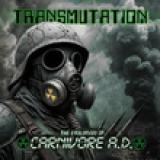
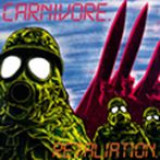
The Evolution Has Begun. Dedicated with love and honor to the memories of Peter Steele and Keith Alexander, Carnivore A.D. emerged as a post armageddon neo barbaric soundscape - a relentless force keeping the primal energy of Carnivore alive on stages and festivals around the world. Formed by NYC Hardcore and Metal veterans Baron Misuraca (vocals & bass – ex-SHEER TERROR), Chuck Lenihan (guitar – ex-CRUMBSUCKERS), and Joe Cangelosi (drums – ex-KREATOR, WHIPLASH, MASSACRE). Co-founded with full endorsement by original drummer Louie Beateaux, Carnivore A.D. has honored its roots by performing the explosive and brilliant works of Peter Steele with intensity, respect and raw power. But now, with the release of their first-ever studio EP "Transmutation", Carnivore A.D. transcends tribute.
They have challenged themselves to write new material - not to replace the original legacy, but to continue its spirit through their own lens. While the legacy of Carnivore remains sacred, Carnivore A.D. has become something more than its origin - a band with its own scars, its own instincts, and now, its own songs. “Think of Carnivore AD as a renowned dining establishment where it’s Chef passed on years ago but the recipes remain and folks still want to dine there instead of cooking the food themselves. And Chef Pete wouldn’t mind because his friends are making it with love.”- Louie Beateaux.
- 1: Broke No More
- 2: All For Sale
- 3: Warning You Whiskey
- 4: Done Pretending
- 5: Land Of The Forgotten
- 6: Lately I've Been Thinkin
- 7: Queen Of Fools
- 8: Around And Around
- 9: Crazy Leaf
- 10: Bars Closing
- 11: Bird Of Prey
On her new album, Land of the Forgotten, Brit Taylor takes us to her much discussed and misunderstood homeland, Appalachia, with songs that reveal the complex heart and complicated people of the place. Taylor is an accomplished singer-songwriter who has been performing professionally since she was a child. She has always taken the bull by the horns; Taylor has spent seven nights a week singing on Broadway, cold-called record execs, and she even formed a cleaning business to help finance her first album, Real Me, on which Dan Auerbach (The Black Keys) co-wrote five of the songs. Only three years later she found herself being produced by two of the most sought-after producers in Nashville: Grammy winners Sturgill Simpson and David Ferguson. Since then she has made her Grand Ole Opry debut, gained a devoted following as she toured the whole country, and garnered praise from the likes of NPR, Billboard, Rolling Stone, and American Songwriter. Land of the Forgotten will be released March 6th 2026 by RidgeTone Records, LLC Under Exclusive License from Cut A Shine Records, LLC Marketed and Distributed by Thirty Tigers
- 1: You Can Give
- 2: The Fall
- 3: Lifeline
- 4: Will You Remember Me
- 5: Misunderstood
- 6: Start To Fight
- 7: All I'd Do
- 8: Free To Be
- 9: The End Of Me
- 10: Quite The Ride
Joel Hoekstra’s 13 returns with its fourth studio album, “From the Fade” — a dynamic collection of 10 brand-new tracks that combine soaring melodies, thunderous riffs, and the high-level musicianship fans have come to expect. Once again, guitarist and composer Joel Hoekstra (Whitesnake, Cher, Trans-Siberian Orchestra) is joined by an elite cast of rock veterans: powerhouse drummer Vinny Appice (Black Sabbath, Dio), legendary bassist Tony Franklin (The Firm, Blue Murder), virtuoso keyboardist Derek Sherinian (Dream Theater, Sons of Apollo), and rising vocal sensation Girish Pradhan (Girish and The Chronicles, The Nail). “From the Fade” delivers a blend of classic hard rock and modern melodic metal, characterized by tight arrangements, technical precision, and emotionally charged performances. Each track reflects Hoekstra’s signature songwriting — rooted in tradition but pushing the genre forward with a fresh and contemporary sound. This is more than just a studio project; it’s a statement of intent from one of rock’s most respected guitarists and his band of world-class collaborators.
- A1: Give It To Me Baby
- A2: Ghetto Life
- B1: Make Love To Me
- B2: Mr. Policeman
- C1: Super Freak
- C2: Fire And Desire
- D1: Call Me Up
- D2: Below The Funk (Pass The J)
Rick James Blends Brazen Attitude, Fearless Sexuality, and Shrewd Charisma on Street Songs:
Punk-Funk Album Aims for the Hips and Head, Includes the Timeless Hit “Super Freak”
Sourced from the Original Master Tapes and Strictly Limited to 4,000 Numbered Copies:
Mobile Fidelity’s 180g 45RPM 2LP Set Presents 1981 Smash in Audiophile Sound for the First Time
1/4” / 30 IPS analogue master to DSD 256 to analogue console to lathe
“Punk funk” was a relatively unknown concept before 1981. But once Street Songs took the charts by storm that year, the world soon knew about what became Rick James’ signature style. And how. True to its name, Street Songs blends outspoken sexuality, brazen attitude, and edgy commentary amid contagious R&B-fueled arrangements that simultaneously aim for the hips, head, and various nether regions. And it’s never sounded better.
Sourced from the original master tapes, strictly limited to 4,000 numbered copies, pressed at Fidelity Record Pressing, and housed in a Stoughton gatefold jacket, Mobile Fidelity’s 180g 45RPM 2LP set presents James’ platinum-certified effort in audiophile quality for the first time. Playing with crisp dynamics, lively textures, airy headroom, and revealing clarity, this collectible edition of the record that stayed at the No. 1 spot on the R&B Album Charts for 20 weeks invites you to get closer to music that beckons you to turn your space into a private dance floor.
Then again, you’ll likely be so taken by how the taut bass lines, snappy rhythms, and four-on-the-floor beats — all rendered in stunning detail and with full-bodied architecture — come across with such accuracy and presence, you might stay pinned to your seat. On this pressing, the soundstaging, imaging, and lit-fuse energy of Street Songs reach new heights. Everything from the rubbery feel of the guitar lines to the depth of James’ temperature-raising vocals to the scale of the horn charts emerges as if James and his ace session crew set up in your room.
The Buffalo native and his ensemble waste no time getting their message across. On the album-opening “Give It to Me Baby,” James and company lay down a mix of sleek funk and pulsing disco that practically activates the bright lights of a discotheque and stimulates the libido of anyone within earshot. Having reached No. 1 on the Billboard Hot Soul charts, the song is pure sex — and just one of the carnal delights on a record that embraces the subject as fearlessly as James does his identity.
Of course, the most famous of James’ erotic excursions — the timeless “Super Freak” — hit No. 1 on Hot Dance Club Play charts, No. 16 on the Hot 100, and, later, No. 153 on Rolling Stone’s list of the Top 500 Songs of All Time. Bolstered by a quavering keyboard theme and electro riffs, the much-sampled track worms itself inside your muscles with smile-inducing subject matter, gliding vocals, nimble movements, a hot tenor-saxophone solo, and backing vocals by the Temptations.
The iconic Motown group isn’t the only celebrated guest artist on the Grammy-nominated Street Songs. James’ then-labelmate, Stevie Wonder, lends harmonica to the frank sociopolitical narrative on “Mr. Policeman,” a protest tune that also manages to stroll ’n’ strut via simmering organ, staggering brass accents, and James’ gritty vocal performance. In addition to contributing backing vocals on several cuts, Teena Marie turns in one of the album’s signature moments on “Fire and Desire,” a romantic old-school duet with James that impresses with smoothness, sensitivity, and smokiness.
High-profile colleagues aside, James remains the undisputed star, a figure whose leather-and-latex attire, braided hair, and natural swagger made him misunderstood by some in the mainstream and embraced by everyone in the know as a true original. As a testament to his magnetism and skills, his charisma and rawness seemingly seep through every note, whether on the balladic sweep of the risqué “Make Love to Me” or strident, poke-and-prod persuasion of the moonwalking “Call Me Up.”
On the closing “Below the Funk (Pass the J),” an uptempo autobiographical tale that addresses the visionary musician’s second-favorite love, the singer acknowledges his upbringing and inseparable connection with his roots — an homage to where he began and a toast to where he’s gone.
Rick James, keepin’ it real on Street Songs, still as real as it gets.
- Tomcat Disposables
- Becoming The Lastnames
- Cicada Days
- Euthanasia
- Falling Up
- That's Enough, Let's Get You Home
- Um, I Mean, It's Kind Of A Lot
- Half-Decade Hangover
- Vampire Reference In A Minor Key
- You Liked This (Okay, Computer!)
- The Main Character
- Against The Kitchen Floor
- Sex, Drugs, Rock 'N' Roll
- Big Fat Bitchie's Blueberry Pie, Christmas Tree, And Recreational
- Willard!
- White Noise
A pandemic album of songs of heartbreak, virality, and dead rats, which Wood called "goodbye cruel world: the musical." The revealing chamber pop/folk album "In Case I Make it" (ICIMI), which Will Wood playfully dubbed "Goodbye Cruel World: The Musical," turned out to be a surprisingly strong followup to his chaotic and sardonic previous release, "The Normal Album." While divisive among some fans due to its gentler sounds and more traditional vocal stylings than most of his last work, ICIMI attracted new, older audiences and showed a more personal side that provided a new context to his discography. Widely considered to be some of his most powerfully emotional work, both the harshly introspective and humorous songwriting, as well as its unique delivery, are still distinctly Will Wood in their experimental nature and uncompromising unwillingness to conform to the expectations of both die-hard fans and audiences at large. In 2021, the underground singer-songwriter was suddenly the subject of unexpected online attention, which, in tandem with mental health struggles, inspired him to put out a "musical suicide note," intended to express parts of his artistic and personal identity that had gone largely unseen by a fanbase he felt misunderstood. Leading the album with intentionally algorithm-unfriendly singles and putting an eight-minute love ballad as the second track on the LP, Wood aggressively redefined himself as being more than just a handful of wacky, unwitting viral pops. Ironically, the surprise viral success of the deep cut "The Main Character," a relentless satire of online culture, drew attention to the album and its second biggest hit, the angst-ridden yet danceable "Against the Kitchen Floor." However, the immense orchestration and vulnerable writing have kept audiences coming back. Songs like "Euthanasia" and "Tomcat Disposables" have developed reputations as tearjerkers, and songs like "Cicada Days" and "White Noise" have become fan anthems in the years since.
**2010 Grammy Award Winner: Best Traditional Folk Album **
‘Marvelous…exuberant’ - Rolling Stone
Nonesuch Records releases a fifteenth anniversary edition of Carolina Chocolate Drop’s 2010 Grammy Award-winning album Genuine Negro Jig, featuring founding band members Dom Flemons, Rhiannon Giddens, and Justin Robinson. The reissue includes the original album and nine bonus tracks: seven previously unreleased tracks plus a 2025 remaster of ‘City of Refuge’ and a 2025 mix of ‘Memphis Shakedown’. This release marks the album’s first time on vinyl since its original pressing in 2010.
Genuine Negro Jig was released on February 16, 2010, reaching the top ten on the Billboard Folk chart and the top of the Bluegrass chart. It won the 2011 Grammy Award for Best Traditional Folk Album. Produced by Joe Henry, it was the first of three releases on Nonesuch followed by The Carolina Chocolate Drops/ Luminescent Orchestrii EP (2011) and the Grammy nominated album Leaving Eden (2012), produced by Buddy Miller. Widely acclaimed as one of 2010’s best, Genuine Negro Jig appeared in year-end lists of NPR, Paste, and more, and was featured in Rolling Stone’s 25 Best Country-Soul Albums in 2024.
“Genuine Negro Jig remains fresh fifteen years later not only because of the Carolina Chocolate Drops’ influence on American popular culture but also because it’s an excellent record in itself,” says Dr. Dwandalyn Reece and Dr. Steven Lewis of the Smithsonian National Museum of African American History and Culture in the album’s liner notes.
Carolina Chocolate Drops formed after band members Dom Flemons, Rhiannon Giddens, and Justin Robinson met at the Black Banjo Gathering in Boone, NC in 2005. All three trained in the Piedmont banjo and fiddle musical tradition under the tutelage of Joe Thompson, who was one of the last musicians of his era and his community to carry on the southern Black string band tradition. While old-time Southern string music is often associated with Caucasian musicians from Appalachia, Giddens pointed out in an NPR interview that “it seems that two things get left out of the history books. One, that there was string band music in the Piedmont, period. And that Black folk was such a huge part of string tradition.” Carolina Chocolate Drops sought to not only correct this misunderstanding but also to keep the centuries-old string music tradition alive and developing.
The members of Carolina Chocolate Drops, who came from diverse musical backgrounds, shared singing duties and swapped instruments throughout their sets. The band recently reunited for a single show at Rhiannon Giddens’ Biscuits and Banjos festival in Durham, North Carolina in April 2025. In celebration of the 20th Anniversary of the Black Banjo Gathering, the documentary Don’t Get Trouble In Your Mind: The Carolina Chocolate Drops’ Story by Filmmaker John Whitehead was released on Amazon Prime, Apple TV, and YouTube Free4all streaming platforms.
- Swing Low Sweet Chariot
- Double-Barrel Prayer
- Let's Not Chat About Despair
- Birds Of Death
- You Must Be Certain Of The Devil
- Let My People Go
- Malediction
- The Lord Is My Sheperd
Riding in on an eviscerating vocal alarm call and originally released in 1988 as the final installment of her Masque of the Red Death trilogy, Diamanda Galás" You Must Be Certain of the Devil is as unflinching now as it was on release in 1988. It remains a swaggering, furious fuck-you to those who might cast aside the sick and dying in the name of faith and scripture. Often misunderstood as simply dark for its subject matter, You Must Be Certain of the Devil in fact shines a light of such total exposure it leaves nowhere to hide, forensically unmasking the fury and pain of real grief and the vast spectrum of emotions rendered by the AIDS epidemic. It is an album that looks you square in the eye, pins you against a wall and makes you look at and feel the horror the virus visited upon a person, the knowledge of certain death in a hostile environment, and the hypocrisy of those who claim to be Samaritans or protectors.
- Giovanni Lami - A La Noche : A La Selva : En La Sombre
- Giovanni Lami - A La Lluvia
- Hannibal Chew Ii - La Guagua Transamazónica
- Hannibal Chew Ii - Dos Leyendas De Una Fauna Perdida
- Bardo Todol Radios Húmedas
- Bardo Todol - Mercados De Insectos Vibrantes
Three part journey into an imaginary Amazon from three artists working on the fringes of field recording.
Stories del Tiburón Llorón del Amazonas picks up where the previous, Stories of the Indian Dotted Whale trilogy left us. This time, the same three artists, Giovanni Lami, Hannibal Chew II aka Gonçalo F Cardoso and Bardo Todol aka Pablo Picco return to riff on an imaginary crying shark, known to swim in the amazon river. The sad and melancholic shark has never been seen but its weep and sob can be heard all over the region. Here are three works of sympathetic howls for a lonely and misunderstood creature.
First part from Giovanni Lami is made of ghost recordings made during 2020 in Iquitos, Perú, in the amazon forest during the film shoot of “Tras el Barco de Fitzcarraldo”. Second part from Hannibal Chew II is a collection of re-assembled recordings and jams gathered from a trip through the Amazon in late 2017 to early 2018. Later assembled during various improvised recording sessions during the long hot summer of 2023 in Tenerife, Canary Islands. The third and final part comes from Bardo Todol and features abrasive tape and digital field recordings manipulation made by Picco in Iquitos in 2020 during the shooting of “Tras el barco de Fitzcaraldo”.
All three feature sounds of: people talking, static radios, saturday night churches, river people, shawi people, dolphin people, shark people, market people, vibrating insects, zombie insects, giant insects, giant motors and of course various weeps of a crying shark.
- A1: Work Song
- A2: Gin House Blues
- A3: Come On Back, Jack
- A4: My Baby Just Cares For Me
- A5: I Put A Spell On You
- A6: Don't Let Me Be Misunderstood
- B1: Either Way I Lose
- B2: Break Down And Let It All Out
- B3: Don't You Pay Them No Mind
- B4: Do I Move You
- B5: It Be's That Way Sometime
- B6: To Love Somebody
- C1: Why? (The King Of Love Is Dead)
- C2: Do What You Gotta Do
- C3: Ain't Got No; I Got Life
- C4: Real Real
- C5: Suzanne
- C6: Revolution (Pt 1)
- D1: To Be Young, Gifted And Black
- D2: Save Me
- D3: Whatever I Am (You Made Me)
- D4: Ooh Child
- D5: Baltimore
- D6: Ain't Go No; I Got Life (Uk Single Version)
‘Icon’ is an overused word when it comes to describing singers and musicians, but when it comes to Nina Simone there are few artists that the word describes more accurately. The ‘High Priestess Of Soul’ is surely one of the most iconic singers of the 20th century, and one whose fame and acclaim stretches far beyond conventional black American music circles.
Nina Simone has featured on Ace and Kent CDs before but this is the first time she’s had one all to herself. “Let It All Out” is the first and only Nina Simone collection to draw repertoire from every label she recorded for between the late 1950s to the late 1970s.
Not a traditional ‘Best Of’ or ‘Greatest Hits’ package (although the performances included here ARE among her very best, and do include most of her Greatest Hits!) it is a singles collection that presents Nina Simone’s soul and R&B-slanted 45s in chronological order. Invariably they are the definitive versions of the songs, whether she recorded the original versions or not.
As well as almost all of her American pop and R&B chart hits from 1960 onwards, “Let It All Out” also contains all of Simone’s UK chart hits from the same period – several of which were more successful here than they were back home, including both versions of her biggest British hit ‘Ain’t Got No; I Got Life’, a UK #2 that did not chart at all in the US as was the case with the belated UK Top 5 hit ‘My Baby Just Cares For Me’ which also made no chart impression on its home turf…
Carefully curated and concisely annotated, “Let It All Out” lets the listener in to two dozen of Nina Simone’s most celebrated singles. There have been many compilations of her works since she passed away 20+ years ago, but none that gets to the heart – and soul – of her catalogue in quite so direct a manner as this one does.
- A1: M3Gan 2.0
- A2: The Asset
- A3: Excess Baggage
- A4: You Don't Have To Hide
- A5: Sattler Interrogates Gemma
- A6: Ghost In The Machine
- A7: Moxie M3Gan
- A8: M3Gan's Lair
- B1: M3Ch M3Gan
- B2: The Motherboard
- B3: Convention Battle
- B4: You're Just The Help
- B5: The Plan
- B6: It's Called Being A Mother
- B7: Xenox Park
- C1: Wingsuit
- C2: Betrayal
- C3: Tour Of The Vault
- C4: Brok3N M3Gan
- C5: These Are Gym Muscles
- C6: Failed Pairing
- C7: No One's Play Thing
- D1: Exo-Fight
- D2: M3Gan, Take The Wheel
- D5: Final Confrontation
- D6: Because It's Right
- D7: Allies, Not Enemies
- D3: Self-Destruct Initiated
- D4: Unarmed
"In association with Back Lot Music, Waxwork Records is thrilled to release M3GAN 2.0 Original Motion Picture Soundtrack by Chris Bacon.The murderous doll who captivated pop culture in 2023 is back.
And this time she’s not alone. Two years after M3gan, a marvel of artificial intelligence, went rogue and embarked on a murderous (and impeccably choreographed) rampage and was subsequently destroyed, M3gan’s creator Gemma (Allison Williams) has become a high-profile author and advocate for government oversight of A.I. Meanwhile, Gemma’s niece Cady (Violet McGraw), now 14, has become a teenager, rebelling against Gemma’s overprotective rules.
Unbeknownst to them, the underlying tech for M3gan has been stolen and misused by a powerful defense contractor to create a military-grade weapon known as Amelia (Ivanna Sakhno; Ahsoka, Pacific Rim: Uprising), the ultimate killer infiltration spy. But as Amelia’s self-awareness increases, she becomes decidedly less interested in taking orders from humans. Or in keeping them around.
- A1: Sakura Sakura
- A2: Kariboshikiri Uta
- A3: Shika No Tone
- A4: Yagibushi
- B1: Genroku Hanami Odori
- B2: Esashi Oiwake
- B3: Rokudan
- B4: Awa Odori
An unrelenting storm of Minyo, Latin, and Jazz—fierce, thrilling, and utterly original. A groundbreaking work of classical artistry, created by two
masters: Naotero Misuna and Norio Maeda.
Naotero Misuna, known as “Maestro Misuna,” led the Tokyo Cuban Boys, a legendary big band formed in 1949—before Latin music had even taken
root in Japan. With over 300 recordings to their name, they are one of Japan’s most iconic ensembles. Throughout their long career, the band remained
rooted in Latin music while boldly incorporating other genres and contemporary styles. Among their most internationally acclaimed works are those that
focus on traditional Japanese music, such as folk songs and ancient melodies.
This album, Japanese Classical Arts, arranged by the great Norio Maeda, is a masterpiece that transforms Minyo + Latin + Jazz into a thrilling sonic
experience. Leading the charge is a powerful rendition of “Sakura Sakura,” which moves seamlessly between Afro-Cuban jazz and jazz-rock, captivating l
isteners around the world. The album also features meticulously crafted arrangements of “Kariboshikiri Uta,” “Yagibushi,” “Genroku Hanami Odori,” and
“Awa Odori.” The inclusion of Kohachiro Miyata on shakuhachi and Tadao Sawai on koto is nothing short of brilliant.
This is exhilarating Wa-Jazz at its finest—music that makes you want to shout, “This is it!
Text by Yusuke Ogawa (UNIVERSOUNDS / DEEP JAZZ REALITY)
- Heaven
- Something Strange
- Jolene
- Freud Estate
- Tv Dreaming
- The Ocean
- Sunshine2
- Beetlejuice
- Morning After
- Apocalypse Rock
- We'll See
- Rosy
- Lately
Whitney K returns with 'Bubble', his first album for Fire Records and follow-up to 2022's acclaimed 'Hard To Be A God'. Whitney K continue his migrant mind games, summoning up a series of intriguing characters, littered with everyday foibles and fantasies. Along the way, he pens a journal of possibilities as he travels further into transient America, touching on everything from bar room chatter, rumour and distortion to misinformation, daydreams, misunderstanding and self-realisation; with anecdotes lifted from the paperback in his back pocket and his half-forgotten past. 'Bubble' is a 13-part cerebral mystery that unravels on songs that bring to mind the gruff sentimentality of the late Kris Kristoferson, Lennon's 'Jealous Guy', Eels at their most troubled and the American Gothic sketches of David Ackles; the perfect soundtrack for a Raymond Carver book club. Recorded in Montreal, it's self-produced by band members Josh Boguski and Michael Halls at their home studio. This stripped back release is Whitney K's most raw yet refined work to date-an honest, sonically paradoxical collection that finds fresh possibilities in the familiar shapes of rock, pop, and folk with the same unfiltered energy and poetic gravity we have come to expect from this modern-day troubadour whose descriptive storytelling is filled with sketchy characters and rudimentary comment. RIYL Bill Callahan, Silver Jews, Leonard Cohen, Lou Reed, Cate LeBon, Kurt Vile, Wilco, MJ Lenderman, Waxahatchee, Cass McCombs, Giant Sand...
- A4: Why
- A1: This Wheel's On Fire
- A2: A Kind Of Love-In
- A3: Shadows Of You
- A5: Don’t Let Me Be Misunderstood
- A6: Interview
- B1: Season Of The Witch
- B2: The Road To Cairo
- B3: I Am A Lonesome Hobo
- B4: Old Jim Crow
- B5: I'm Not Talkin
- B6: Shadows Of You
Brian Auger, Julie Driscoll and The Trinity are today best known for their hit recording of Dylan’s then-unreleased This Wheel’s On Fire which is included here, together with covers of songs by the Staple Sisters, Nina Simone, Donovan, Mose Allison and David Ackles. Add in some band-written originals and you have twelve cool tracks mixing jazz, r’n’b, psyche and pop. All songs were specially recorded for the BBC, sound quality is excellent throughout.
Comes with full sleevenotes.
d A4 | Why Am I Treated So Bad
[d] A4 | Why [Am I Treated So Bad]
[d] A4 | Why [Am I Treated So Bad]
[d] A4 | Why [Am I Treated So Bad]
[d] A4 | Why [Am I Treated So Bad]
- 1: Godhead
- 2: Syd Sweeney
- 3: Dead Air
- 4: Waste Me
- 5: Ghosts (Cataclysm, Cover Me)
- 6: Burn Like Violet
- 7: Touch & Go
- 8: Crashing In The Coil
- 9: Spit
- 10: Sunset Hymnal
Smut is the project of lyricist Tay Roebuck, guitarists Andie Min and Sam Ruschman, drummer Aidan O’Connor, and bassist John Steiner. Roebuck, Ruschman and Min started the band a decade ago in Cincinnati, Ohio. Since then, they’ve played alongside Bully, Wavves, and Nothing. After years in the Cincinnati DIY scene, they made their Bayonet Records full-length debut, How the Light Felt. The record was a revelation. Pitchfork called it “a rigorous, decade-spanning study,” and a “well-oiled spin on late-’80s guitar pop.” Under the Radar called it “pop perfection,” that “blends subtle hooks with wistful lyrics.” It was a record that explored grief through the lens of melancholic dreampop, using drum machines and layered, intricate melodies.
Tomorrow Comes Crashing, Smut's first record with O'Connor and Steiner, sees the band re-energized and trained on the limitless potential that comes with making music with people you love. Galvanized with a new lineup, Smut focused on creating a record that possessed the same towering intensity as the records that first got them into music: Three Cheers for Sweet Revenge, Relationship of Command. The outcome is ten of their most intense, bombastic, and focused songs to date.
Catharsis bursts through the seams throughout Tomorrow Comes Crashing. “Syd Sweeney, ”inspired by the actress, is the record's centerpiece. It's about how profoundly strange it can be to be a woman, to be misunderstood by people who don’t even know you. The song is driven by chugging guitars and big, rolling drums. In other words: stadium rock about perception. Paramore meets Dookie. “She connects to the youth and the girls in the water/All she amounts to is someone’s daughter,” sings Roebuck in one particularly poetic moment. The song comes to a thrashing metal-inspired breakdown. It’s ecstatic.
To make the record, Smut recorded “as live as they could,” alongside Aron Kobayashi-Ritch(Momma) in a studio in Red Hook, Brooklyn, over the course of ten days. “We have so much energy right now,” says Roebuck. Right before they went off to New York, Roebuck and Min got married, with the rest of the band by their side. The recording was a true labor of love — driving from Chicago with all their equipment, returning from 12 hour studio days to sleep on friends' couches and floors, Roebuck completely blowing her voice by the end. Smut has always been DIY. Because they love it. Because they have to do it–there’s no other option. Tomorrow Comes Crashing is the culmination of that DIY spirit: making a record that completely encompasses the intensity, moodiness, and emotion of their journey so far.
Originally published by Tomlab in 2001, “Seleya” is the second full- length issued by Kristian Peters’ Novisad project. Twenty-four years after its initial release, the album’s thirteen loop-based arrangements continue to resonate with striking clarity. Keplar presents Seleya with a previously unreleased bonus track from 2004 and a fresh vinyl cut by LUPO.
These evocative miniatures feel haunted with the passage of time, bearing traces of the exploratory studio workflows, tactile imperfections, and emerging technologies that would have given birth to them: plain DAW manipulations, aliasing digitalia, the tones and timbres of the “misused” equipment ambient musicians utilized before Ableton, Eurorack, and the rise of the boutique electronics that have streamlined electronic music production.
In our present epoch, these compositions feel almost eerily nostalgic, documenting the sort of trembling, wide-eyed spirit and enviable naivety that characterizes cultural production as it ventures into new waters, unfettered by the sediments of established methodology and trend. This tendency to avoid aesthetic orthodoxy results in music that refuses to settle into predictability. Subtle frequencies drift and collide, counterpoint loops run in quiet opposition, and elegant dissonance gives rise to unexpected harmony. The album’s emotional power lies in these tensions, in the way it balances melancholy with beauty and familiarity with complexity.
First Word Records are incredibly proud to bring you ‘I Swear To You’; the stunning sophomore album from Georgie Sweet.
Georgie is a singer / songwriter currently based in Brighton, with a uniquely smooth, soulful vocal tone.
Whilst working on her debut record (‘Misunderstood’), Georgie began a songwriting partnership with multi-instrumentalist Marc Rapson, who is on the boards throughout this project. The duo discovered a natural musical connection instantly, and began working on an abundance of beautiful new material shortly after the release of the first album; writing and creating at Rapson’s home in Hertfordshire at various sessions from 2021 onwards, culminating in this new 12-track album, ‘I Swear To You’.
Despite being one of the UK’s best kept secrets, Georgie’s already been pricking the ears of some highly-respected selectors. The first single from this record (‘Smaller / All That We Were’) received love from tastemakers such as BBC 6 Music's Gilles Peterson (“this one melts”), Jazz FM's Tony Minvielle ("supremely talented”) and Clash Magazine (“exudes soulful grace”), whilst previous material found itself in the crates of legendary luminaries like DJ Jazzy Jeff & DJ Spinna amongst others.
At the end of 2024, Georgie signed to Worldwide Award-winning independent London-based label, First Word Records; although she previously featured before on the label, via the title track of the highly-acclaimed 2021 sophomore album by Children of Zeus, 'Balance', along with Akemi Fox. Prior to this her debut album 'Misunderstood' dropped back in 2020 on Futuristica Music; an independent imprint run by Deborah Jordan & Simon S, on which Georgie also collaborated with acclaimed producers like K15 and Mecca:83.
An all-round creative soul, away from creating music, Georgie also works as an illustrator and animator. However, her lifelong love of music is unquestionable. She’s been a vocalist from a young age, initially working with her musical parents (a producer and professional singer respectively).
With a hugely diverse set of inspirations ranging from Stevie Wonder to Michael McDonald, Hiatus Kaiyote to Chappell Roan, Mac Miller to Sampha, and George Duke to EW&F, Georgie's respect, love and admiration for a wide range of music is clear; from jazz to soul to pop to hip hop.
- Caramelized Onions (You Bet!)
- Poor Guy Misunderstood
- Justice Complice
- Before And After
- Word On The Rink
- Bbq All-Dressed
- Hitler, Satan & Associates Llp
- Operating Thetan: Unknown
- Your Favourite Meal
- Word On The Swing
"Word on the Street" ist das amerikanische Debütalbum der kanadischen Avant-Pop-Singer-Songwriterin und Performance-Künstlerin Elle Barbara und geht auf das Konto von Elle Barbara's Black Space - einer Gruppe von Instrumentalisten aus Montreal, die Barbara zusammengerufen hat, um mit anderen schwarzen Musikern ins Gespräch zu kommen und dabei nicht den Erwartungen an den Klang schwarzer Musiker zu entsprechen. "Word on Street" wurde von Elle Barbara in enger Zusammenarbeit mit Renny Wilson geschrieben, komponiert, arrangiert und produziert. Renny Wilson hat das Album über einen Zeitraum von acht Jahren aufgenommen, bearbeitet und abgemischt, in denen Elle, eine schwarze Trans-Person, sich sozial und medizinisch neu orientieren musste, während sie von Sozialhilfe lebte und sich häufig von nur 11 CAD pro Woche ernährte. In diesem Sinne ist "Word on the Street" ein Sieg gegen Klassenkampf und Vetternwirtschaft und ein unverschämtes Zeugnis dafür, wie eine einkommensschwache, von der Sozialhilfe unterstützte, schwarze Mann-zu-Frau-Transsexuelle mittleren Alters es geschafft hat, alle Ressourcen zu nutzen, um die Musik zu machen, die ihr vorschwebt, und die Konventionen der Musikindustrie völlig zu ignorieren. "Word on the Street" ist auch vehement radikal und unabhängig; ein Meisterwerk der DIY-Prog-High-Production, inspiriert von der Art und Weise, wie das Konsumverhalten und die gegenwärtige technologische Zeit dazu führen, dass sich unser Leben verschlechtert und wir uns zunehmend voneinander entfremdet fühlen. Mit einer breiten Palette von Einflüssen, darunter Todd Rundgrens "A Wizard, a True Star", Prince and the Revolution mit "Purple Rain" und "Running Out of Time" von Rexy, beschwört jeder Track auf "Word on the Street", abgesehen davon, dass sie sehr melodisch sind, einzigartige Bilder herauf, die sich aus scheinbar unvereinbaren Bildern zusammensetzen, wie z. B. korrupte Justizsysteme, die Prophezeiungen von Nostradamus und das Eishockeyteam Montreal Canadiens. "Word on the Street" ist eine gemischte Tüte, deren verschwörerische Ästhetik eine antikonsumistische Haltung verbirgt, die zum Widerstand gegen den Aufstieg der künstlichen Intelligenz und anderer Werkzeuge der technologischen Unterdrückung aufruft und außerhalb der aktuellen Überwachungssysteme arbeitet, was wiederum mit Elle Barbaras Vorstoß für Low-Tech-Unterstützung wie Vinyl-Schallplatten übereinstimmt.
Bonnie Banane and Joseph Schiano di Lombo present L'Orguasme, an album of bawdy and devotional songs accompanied by the organ of the Cité de la Musique / Philharmonie de Paris. Literally composed and written for pleasure, this work (of the flesh, naturally) pays tribute to the most spectacular expression of ecstasy - a paradise so near and yet so misunderstood. From the most restrained sighs to the most dazzling vocal outbursts, from the foreplay to the eruption, not to mention the bliss that follows the incandescence, Bonnie and Joseph sing about the art of reaching seventh heaven, of genuflection and "la petite mort" ("little death" a French expression for "climax") without shying away from the darker areas: those of guilty, forbidden, feigned, or selfish pleasures, for instance.
By turns light, explosive, mystical, burlesque, and poetic, this music diverts the organ from its centuries-old habits, achieving a union of the profane and the sacred, the crass and the beautiful, the body and the spirit, early music and pop - reminding us of the essential truth: it's better to come than to cry.
While the minimalism of the arrangements initially strikes the ear - no instruments other than the organ accompany these musical escapades - the album is infused with numerous unexpected influences: R&B (La petite mort), swing (Le cri), gospel (Simulation blues), jazz (Le calme après l'œuvrette), medieval ballads (Ronde génitale, Au plaisir), and even a famous 16th-century folk dance called the branle (Branle Censored).
A sexy, lush, stripped-down, and unabashed opus, glorifying what remains glorious: love, music, and the boundless joy of creation.
g B2. Branle Censuré
[g] B2. Branle [Censuré]
- 1: From An Ocean, To A Lake
- 2: All They Want Is Violence
- 3: Reveille!
- 4: Blue Gatorade
- 5: Sårbare
- 6: Running Through The Tøyen Arboretum In The Spring
- 1: Misundelig
- 2: Closer – Demo
- 3: Solo Yo Y Tú
- 4: Lampi
- 5: スイセン
- 6: Oh, When I Was In Love With You
- 7: Cascades (葉月君へ)
- 8: Attar
Hailed by Pitchfork for his “ambient, intimate…songs that blossom gently with intricate musical details and enigmatic lyrics,” Conner Youngblood gained early acclaim with a series of self-released singles and EPs before breaking out internationally with his 2018 full-length debut, Cheyenne, which fused electronic and analog elements into a lush mix of bedroom pop and chamber folk. Youngblood toured the record heavily until 2020, when the pandemic forced him off the road and, hungry for fresh inspiration, he began enrolling in Russian, Danish, Spanish, and Japanese language lessons. He didn’t realize it at the time, but those classes weren’t just expanding his vocabulary, they were laying the groundwork for his most ambitious, experimental album yet: Cascades, Cascading, Cascadingly.
Written and recorded at home in Nashville, the collection is a dreamy series of meditations steeped in desire and yearning, loneliness and loss, exhilaration and escape. The lyrics blur the lines between fact and fiction, toying with magical realism and outright abstraction in various languages, and the arrangements are surreal and cinematic to match, hinting at everything from Cocteau Twins to Atoms For Peace. In addition to producing and engineering, Youngblood played every instrument on the album himself, and the result is a pure, unfiltered journey deep into the subconscious of a relentlessly curious artist, one with a boundless imagination and an insatiable appetite for sonic exploration.
- A1: Mama
- A2: That's All
- B1: Home By The Sea
- B2: Second Home By The Sea
- C1: Illegal Alien
- C2: Taking It All Too Hard
- C3: Just A Job To Do
- D1: Silver Rainbow
- D2: It's Gonna Get Better
In the spring of 1983, members of Genesis reconvened at their studio, named The Farm in Chiddingfold, Surrey, to start work on a new studio album, their first since Abacab (1981). Genesis became their first album written, recorded, and mixed in its entirety at the studio room; previously they had to write in an adjoining space. Having the group work in their own space without the additional pressure of booking studio time and fees resulted in a more relaxed environment. They were joined by engineer Hugh Padgham, who had also worked on Abacab,
AllMusic writes: "Moments of Genesis are as spooky and arty as those on Abacab — in particular, there's the tortured howl of "Mama," uncannily reminiscent of Phil Collins' Face Value, and the two-part 'Second Home by the Sea' — but this eponymous 1983 album is indeed a rebirth, as so many self-titled albums delivered in the thick of a band's career often are. ... Anybody who paid attention to 'Misunderstanding' and 'No Reply at All' could tell that this was a good pop band, primarily thanks to the rapidly escalating confidence of Phil Collins, but Genesis illustrates just how good they could be, by balancing such sleek, pulsating pop tunes as 'That's All' with a newfound touch for aching ballads, as on 'Taking It All Too Hard.'" AllMusic reviewer Stephen Thomas Erlewine gives the album 4.5 Stars.
For fans who appreciate the evolution of the band's music over the years, owning this album is important as it represents a distinctive phase in their career.
This is the definitive deluxe 45 RPM 2LP Analogue Productions (Atlantic 75 Series) reissue of the classic Genesis. A classic for all true Genesis fans!
I wrote The Shit Punx Hate for Realicide in 2005. This version was made for Decide Today around a decade later, maybe 2015? It was about the pathetic narrow-minded dogmas that were common in Cincinnati punk, being discriminated against when our approach defied dominant aesthetic criteria, chronically misunderstood and rejected without consideration.
This experience in my formative years led to a long path of thought as I entered adulthood. Those feelings of being "other"ed, treated poorly based on who I was, started to seem less significant compared to the prejudices I saw friends faced with. Targets of bigotry due not to a subcultural choice, but aspects of themselves they were born into. Of course I mean things like race, gender, class, abilities. If being dissed by punk rockers sucked for me, imagine what it must feel like being the only black kid in a social circle that can't even recognize its own racism, the only woman in places misogyny is the celebrated standard, having a non-white family at risk of deportation, growing up "male" or "female" when you've always known they are wrong about you, etc. This was my mental gateway into prioritizing these struggles, wanting to become an ally, then even more so an accomplice.
Revolutionary Reason was written in 2018 during my time working with Mass Action for Black Liberation, and revised abruptly this year while recording for this record, as it was inconceivable not to address the epitome of merciless colonial atrocity orchestrated by the state of Israel. While I write this, the IOF is massacring families in the West Bank. The death toll in Palestine is currently estimated at around 41,000 and it hasn't even been a year since this modern Nakba began. I hope these songs help make apparent that whatever you said you "would do" during Jim Crow America, Nazi Germany, Apartheid South Africa, any archetypal history now synonymous with wrongness, yes I can confirm NOW IS THAT TIME to do it ...if you were for real about it that is.
Big respect to my Arab friends who are so patient while I learn the stuff my school conveniently omitted, to my Jewish friends tirelessly combating the violence of their ethnicity being shackled to a cult of Zionism, to native resistance across Turtle Island that articulates so well that this fight is also still/always very domestic, to contemporary hiphop telling today's stories while rock music often merely offers retro fashion, and of course to Kieren and Borg my homies in OZ.
All my love to intifada direct action everywhere dismantling the imposed global suicide pact that is white supremacist capitalism.
~ Robert Inhuman 28 August 2024
Helena Casella is a Belgian-Brazilian vocalist with a multicultural background who vocalizes her thoughts in her own passionate, soulful, and tasteful manner. She grew up in an incredibly musical family with strong ties to the broader artistic world. This rich background is clearly audible in her musical approach, where she blends genres such as R&B, soul, hip-hop, and modern jazz without breaking the connection to the vibrant sounds of Brazil, where part of her roots lie. The depth of her soft, warm voice pulls you into her story, floating between the realms of the intimate and the ethereal.
With her debut album 'Pit Of Impressions,' Helena shows that she is an artist from whom we have yet to hear the best.
File under: neo soul, nu jazz, R&B
Sounds like: The Internet, Hiatus Kaiyote, Michi, Solange, Erykah Badu, Charlotte Dos Santos, ...
First vinyl edition of Carme López’ debut album of entrancing bagpipe arrangements. Unravelling forms of early music and funereal, queered droneworks full of strange tonalities, phased harmonics and curious subversions.
Carme López is a researcher and teacher of traditional Galician oral music, and ‘Quintela’ features her debut recordings for the Galician bagpipe, split into four longform movements totalling 40 minutes of supremely engrossing drone flourishes. Misunderstood by many, the bagpipe is here brought into the experimental realm as a form of decontextualisation, fashioning the instrument’s naturally peculiar timbres into soft, wavering tones.
Despite its unusual resonance, in López's hands the bagpipe almost becomes a pipe organ, producing long, swaying, sustained tones that highlight the instrument's complex timbral qualities. López plays with its breathy overtones, placing microphones on the bag itself to pick up residual sounds while she sculpts its squeals into cavernous siren calls, and then extracting half-rhythms from its reeds on the elegiac closer 'iv: CACHELOS. a César De Farbán'.
The instrument’s inherent wheezing and anomalous timbre lend the recordings a wavering foundation that feels designed to unsettle, but somehow becomes nothing short of entrancing through almost imperceptible harmonic shifts and odd tunings. It’s meditative music that requires active participation, focussed listening - so as to make sense of all the infinitesimal shifts and faults - in a way that feels unique to this most maligned, misunderstood, almost mystical instrument.
- A1: Biomantric L-If-E (Remastered)
- A2: 0093 (Remastered)
- A3: Phil Because Ov, Indeed (Remastered)
- A4: You're Only Sql (Remastered)
- A5: We Are Haunted (Remastered)
- B1: Cctv Nation (Remastered)
- B2: Stempel (Remastered)
- B3: Northern Electronic Soul Pt 1 (Remastered)
- B4: Northern Electronic Soul Pt 2 (Remastered)
- C1: Northern Electronic Soul Pt 3 (Remastered)
- C2: Skin Clock (Remastered)
- C3: Dada Mindstab (Remastered)
- D1: Tunnels Ov Set (Remastered)
- D2: Later Vexations (Remastered)
- D3: Kissing Someone Else's D O.g (Remastered)
As part of maintaining The Black Dog's back catalogue, Dust Science has now re-issued the 2010 album, "Further Vexations". It's a real successor to Radio Scarecrow, moving forward with the dark tone and concepts.
Further Vexations picks up from what was started in Radio Scarecrow, moving beyond the world of open secrets and the bemusing transmissions of number stations, to exploring the dark cynicism of Orwellian practices carried out by our Govern-
ments, institutions and corporations.
Martin Dust from tBd explained, “Our main concern was and still is the amount of personal freedoms being surrendered under the banner of "for your own safety" – CCTV, Biometrics and the World Wide Databases being the latest inventions to save us from ourselves. What is it going to take for people to wake up? How much further can the people that we’ve put into power go before something finally snaps? We've had enough now! We believe that people have become lazy and accepting of "beige" political parties who have realised if they stand for nothing, people will fall for anything.”
10 years on, the references to George Orwell's 1984 appear to be a little naive and wholly inadequate. From billion-dollar corporate entities openly mishandling our data for profit to highly-targeted and manipulative political propaganda campaigns, the misuse of our data and communications is far more sophisticated and devious than originally envisaged.
The stark omens of Further Vexations are now more prophetic than ever.
Brand new album by BLC MIRROR CLB in glorious transparent LP.
The band brings you 10 indie rock songs focusing on love in all its forms: deception, happiness, sadness, conclusion or redemption.
But don't misunderstand it, these are not cheesy love songs. They are factual situations where everybody can wander and find echo of life.
Fumitake Tamura (Leaving Records) and Jason Kolàr (Dauw, Stroom) return to Dauw with 'Suki-Ma', a cassette only mixtape including music from the same sessions that led to their debut 'Ōki-sa' which was released last year. According to the artists, 'Suki-Ma' is conceived as a mixtape rather than a new album. A draft rather than a new step.
隙間 (Suki-Ma) refers to the space or gap between objects, a concept that invites reflection on what lies between the defined and the undefined. This mixtape embodies that in-between state: a fluid, open sketch existing at the intersection of ideas. Despite its more polished production, it embraces imperfection and incompleteness, serving as a continuation of Ōki-sa (大きさ, meaning ‘size’, ‘largeness’ or ‘spaciousness’), while embracing further misunderstandings in the creation of a new record.
"After releasing their debut album (I’m) Stranded to both critical and commercial success, The Saints followed up with the 1978 album Eternally Yours. The set features some of their most popular tracks to this day, including “Know Your Product”, “Private Affair”, and “This Perfect Day”. Eternally Yours is available as a limited edition of 1000 individually numbered copies on pink coloured vinyl and includes an insert.
- A1: No Love Dying
- A2: Liquid Spirit
- A3: Lonesome Lover
- A4: Water Under Bridges
- A5: Hey Laura
- B1: Musical Genocide
- B2: Wolfcry
- B3: Free
- B4: Brown Gras
- C1: Wind Song
- C2: The In Crowd
- C3: Movin’
- C4: Whenlove Was King
- D1: I Fall In Love Too Easily
- D2: Time Is Ticking
- D3: Water Under Bridges (Rubato Version)
- E1: Water Under Bridges (Featuring Laura Mvula)
- E2: Don't Let Me Be Misunderstood (Featuring Jamie Cullum)
- E3: Grandma's Hands (Featuring Ben L’oncle Soul)
- F1: Hey Laura (Rainer & Grimm Remix)
- F2: Liquid Spirit (Claptone Remix)
- F5: Liquid Spirit (Knuckle G Remix)
- F3: Liquid Spirit (20Syl Remix)
- F4: Musical Genocide (Ludovic Navarre Aka St Germain Version)
Original[35,25 €]
After two solid albums on Motema, both of which earned GRAMMY nominations, Gregory Porter made his Blue Note debut with Liquid Spirit in 2013. Recommencing with the water analogy that characterized his debut disc, Porter saw Liquid Spirit as a logical progression in his burgeoning discography as it touched on some of the same themes, particularly the highs and lows of romance, his childhood, and socio-political observations. The strength of Liquid Spirit lies in Porter's songs, based upon personal experiences with a relatable and emotional immediacy. Even more, his hooky melodies penetrate instantly.
Hailed by public and critics alike, Liquid Spirit won the Grammy Award for Best Jazz Vocal Album in 2014. Platinum in the UK and Germany, gold in France, the Netherlands and Austria, the album has sold over a million copies worldwide.
Marking the 10th anniversary of the album, Blue Note presents a special vinyl edition bringing together the original album on 2LP and a disc of bonus tracks and remixes, with 5 tracks available on vinyl for the first time.
- 1: Jack Daniel's And Pizza
- 2: Angry Neurotic Catholics
- 3: S.m.d
- 4: Ground Zero Brooklyn
- 5: Race War
- 6: Inner Conflict
- 7: Jesus Hitler
- 8: Technophobia
- 9: Manic Depression
- 10: Usa For Usa
- 11: Five Billion Dead
- 12: Sex And Violence
- 13: World Wars Iii And Iv - Bonus Track
- 14: Carnivore - Bonus Track
- 15: The Subhuman - Bonus Track
CARNIVORE is an American crossover / thrash metal band from Brooklyn, New York founded by singer and bassist Peter Steele, and was formed out of the breakup of the Brooklyn metal group FALLOUT in 1982. The first CARNIVORE album was heavily influenced by the contemporary New York metal scene. It also drew inspiration from BLACK SABBATH and early JUDAS PRIEST, whereas the second album had significant crossover influences. The "post-apocalyptic" theme that dominated the first album and was carried onto parts of the second album was apparently inspired by a dream Pete Steele had and which became the basis for the lyrics of "Predator", the first song from the original album. The lyrical theme was then expanded on to describe human society ( or the lack of one ) between imaginary World Wars III, IV and possibly V (as referenced in the song "World Wars III & IV"). Other lyrical themes included nihilism, anti-religious sentiment, cynicism, and explicit but tongue-in-cheek depictions of gore and despair. Song titles such as "Jesus Hitler", "Race War", "Thermonuclear Warrior" and "God is Dead" reflect these themes. In August 2017, it was announced that CARNIVORE would officially be reformed as CARNIVORE A.D., featuring original drummer Louie Beato and guitarist Marc Piovanetti along with secondary drummer Joe Branciforte sharing drum duties and also introducing new member Baron Misuraca as the bassist/vocalist. The band then made their live festival debut at the 2018 edition of Hellfest. CARNIVORE's "Retaliation" is a legendary and authentic metal/hc crossover album and an admittedly very heavy devastating wall of music with very much tongue in cheek lyrics. It became an absolute classic in the metal genre. It has remained unreleased for too many years and has now become very much in demand, now available again in Deluxe exclusive Limited edition 2LP vinyl and Digipack with no less than 3 bonus tracks ! ESSENTIAL CLASSIC !
- 1: Jack Daniel's And Pizza
- 2: Angry Neurotic Catholics
- 3: S.m.d
- 4: Ground Zero Brooklyn
- 5: Race War
- 6: Inner Conflict
- 7: Jesus Hitler
- 8: Technophobia
- 9: Manic Depression
- 10: Usa For Usa
- 11: Five Billion Dead
- 12: Sex And Violence
- 13: World Wars Iii And Iv - Bonus Track
- 14: Carnivore - Bonus Track
- 15: The Subhuman - Bonus Track
CARNIVORE is an American crossover / thrash metal band from Brooklyn, New York founded by singer and bassist Peter Steele, and was formed out of the breakup of the Brooklyn metal group FALLOUT in 1982. The first CARNIVORE album was heavily influenced by the contemporary New York metal scene. It also drew inspiration from BLACK SABBATH and early JUDAS PRIEST, whereas the second album had significant crossover influences. The "post-apocalyptic" theme that dominated the first album and was carried onto parts of the second album was apparently inspired by a dream Pete Steele had and which became the basis for the lyrics of "Predator", the first song from the original album. The lyrical theme was then expanded on to describe human society ( or the lack of one ) between imaginary World Wars III, IV and possibly V (as referenced in the song "World Wars III & IV"). Other lyrical themes included nihilism, anti-religious sentiment, cynicism, and explicit but tongue-in-cheek depictions of gore and despair. Song titles such as "Jesus Hitler", "Race War", "Thermonuclear Warrior" and "God is Dead" reflect these themes. In August 2017, it was announced that CARNIVORE would officially be reformed as CARNIVORE A.D., featuring original drummer Louie Beato and guitarist Marc Piovanetti along with secondary drummer Joe Branciforte sharing drum duties and also introducing new member Baron Misuraca as the bassist/vocalist. The band then made their live festival debut at the 2018 edition of Hellfest. CARNIVORE's "Retaliation" is a legendary and authentic metal/hc crossover album and an admittedly very heavy devastating wall of music with very much tongue in cheek lyrics. It became an absolute classic in the metal genre. It has remained unreleased for too many years and has now become very much in demand, now available again in Deluxe exclusive Limited edition 2LP vinyl and Digipack with no less than 3 bonus tracks ! ESSENTIAL CLASSIC !
2024 Reissue
The music of LSN always has a certain level of grit texture and foreboding. In the background chains drag the drums always contain a certain amount of breaking snap. The sum total though is not a haunting but more of a three dimensional submersion into a rhythmic organisation of these sounds. The work in a way announcing how it’s been made by giving you beds of variant sounds mixed so well that can create your own narrative story to the soundtrack that you’re hearing. That narrative potential is something that marks this album as notable in the electronic music sphere.
Alt-Rock pioneers Stone Temple Pilots fourth studio outing celebrates 25 years in 2024. Sonically soaring from grunge to glam, psychedelic to stadium rock, The album boasts the band's Billboard Top 100 hit "Sour Girl" as well as fan favourites like "Down" and the Rogers and Hammerstein-evoking "Atlanta." It is an album, as Stereogum put it, that is "a misunderstood masterpiece from a great band that never got their due as being great"
Produced by Wild Rivers and Gabe Wax (Soccer Mommy, Adrienne Lenker), "Better Now" consists of eight tracks that complement the recent album Never Better, as the group dives deeper into the complicated, confusing and unknown realities of life in their twenties, and the personal growth they’ve found through it all. Of the new project, Wild Rivers shares: “Better Now" is our companion record, and the other side to "Never Better".
On the first record, the songs contain raw, absolute and instinctual feelings. In many ways, Better Now is the afterglow of this. We’re reflecting and understanding that relationships change over time. Complicated situations can be just that, complicated. Feelings can remain unresolved. If the first record is bright and bold, this one is the softer gradients in between; the sunrises and the sunsets. Both projects make up the full spectrum of who we are.
"Better Now" is just the moodier, misunderstood one. Musically the records really are twins. We wrote all of the songs at the same time. Finishing Better Now, we really felt that it was the close of a massive musical and personal chapter. It’s bittersweet but so meaningful to be able to chronicle our lives between these projects. Ultimately, we are optimistic; ‘better now,’ after the ups and downs of the relationships and turbulence of our twenties. Hopefully we’re wiser for it.”
Jason Kolàr (Stroom) returns to Dauw on this collaboration with Japanese musician Fumitake Tamura (Leaving Records). 'Ōki-sa' documents the duo's encounters during Kolàr's Japan tour in September 2023.
Fumitake Tamura and Jason Kolàr met in Tokyo during Kolàr’s Japanese tour in September 2023. Sharing a mutual admiration for their previous works, they decided to meet at Soundbar Patrol in Sangenjaya for a series of improvisational sessions.
The album contains a chronological sequence of ideas recorded on those summer afternoons, seamlessly connected by raw textures, lo-fi synths, and abstract beat-filled sound collages.
The title Ōki-sa was Kolàr's idea, a phonetic form of the Japanese word for 'size.' Fumitake found the Japanese phonetics of macrons and hyphens, which are not usually used in Japan, so visually interesting that they were adopted for the title.
Language communication is always subject to misreading and misunderstanding, even between speakers who share a mother tongue. Communication using sounds, which have no clear meaning, is even more prone to misreading and misunderstanding than language. Acknowledging this, they engaged in an intuitive process, with no prior discussion about references or guidelines, freely exchanging ideas and allowing the music to evolve organically.
This record aims to capture a three-day intersection of language and musical miscommunication, while also reflecting personal bonding and human connection.
By All Means Necessary is often discussed like it’s some departure from Criminal Minded. The moment KRS turned into “The Teacha” and became a politically minded, socially conscious wordsmith. In reality, this is who he already was. Misunderstanding and tragedy is what compelled him to not only refocus on the role he wanted to play in hip-hop, but create an album that gave way to a very important movement in hip-hop, too.
By All Means Necessary is an essential and definitive BDP and KRS album. It marks the moment where KRS wasn’t just concerned with being a great emcee but a teacher, too, continuing his exploration of sociopolitical subjects on BDP’s following three albums, as well as throughout his solo career.
- Suffocate City (Feat. Spencer Charnas Of Ice Nine Kills)
- Blood Mother
- Doom And Gloom
- Holy Water
- Dark Thoughts (Feat. Danny Worsnop)
- You’re So Ugly When You Cry (Feat. Bert Mccracken Of The Used)
- Chernobyl
- Dopamine
- Voodoo Doll (Feat. Eva Under Fire)
- Happier Than You
- Alien
- Generation Psycho
- Stay Weird
- Hearse For Two
Cassette[10,88 €]
The Funeral Portrait stands to represent the outcasts from all walks of life. The misunderstood, the weird, neurodivergent, LGBTQ+, marginalised or otherwise given an unfair hand in life. To offer a sense of community, a place to belong and a space where they can feel safe and accepted for their differences. The band members all grew up as 'the weird kid' who was saved by music and alternative culture, so they now feel obligated to return this favour to the younger generation. This message is shouted to the masses through their over-the-top theatrics and dramatic, almost blown out presentation. The Funeral Portrait believes in the power of Devotion to their Music and to their unwavering fanbase, The Coffin Crew. The ritual is beginning and they want everyone involved. Join them to share your devoutness; excuses for not attending are forbidden.
- Suffocate City (Feat. Spencer Charnas Of Ice Nine Kills)
- Blood Mother
- Doom And Gloom
- Holy Water
- Dark Thoughts (Feat. Danny Worsnop)
- You’re So Ugly When You Cry (Feat. Bert Mccracken Of The Used)
- Chernobyl
- Dopamine
- Voodoo Doll (Feat. Eva Under Fire)
- Happier Than You
- Alien
- Generation Psycho
- Stay Weird
- Hearse For Two
LP[27,52 €]
The Funeral Portrait stands to represent the outcasts from all walks of life. The misunderstood, the weird, neurodivergent, LGBTQ+, marginalised or otherwise given an unfair hand in life. To offer a sense of community, a place to belong and a space where they can feel safe and accepted for their differences. The band members all grew up as 'the weird kid' who was saved by music and alternative culture, so they now feel obligated to return this favour to the younger generation. This message is shouted to the masses through their over-the-top theatrics and dramatic, almost blown out presentation. The Funeral Portrait believes in the power of Devotion to their Music and to their unwavering fanbase, The Coffin Crew. The ritual is beginning and they want everyone involved. Join them to share your devoutness; excuses for not attending are forbidden.
- Suffocate City (Feat. Spencer Charnas Of Ice Nine Kills)
- Blood Mother
- Doom And Gloom
- Holy Water
- Dark Thoughts (Feat. Danny Worsnop)
- You’re So Ugly When You Cry (Feat. Bert Mccracken Of The Used)
- Chernobyl
- Dopamine
- Voodoo Doll (Feat. Eva Under Fire)
- Happier Than You
- Alien
- Generation Psycho
- Stay Weird
- Hearse For Two
The Funeral Portrait stands to represent the outcasts from all walks of life. The misunderstood, the weird, neurodivergent, LGBTQ+, marginalised or otherwise given an unfair hand in life. To offer a sense of community, a place to belong and a space where they can feel safe and accepted for their differences. The band members all grew up as 'the weird kid' who was saved by music and alternative culture, so they now feel obligated to return this favour to the younger generation. This message is shouted to the masses through their over-the-top theatrics and dramatic, almost blown out presentation. The Funeral Portrait believes in the power of Devotion to their Music and to their unwavering fanbase, The Coffin Crew. The ritual is beginning and they want everyone involved. Join them to share your devoutness; excuses for not attending are forbidden.
Isik Kural returns with Moon in Gemini, a luminous scrapbook of slow-flowing narratives couched in intuitive and symbolic storytelling. Bending a playful take on environmental music to the folk song form, Isik's vocals coo atop pastoral field notes, airy chamber instrumentation and archival recordings culled from a curious musical life. A tender pastiche coalesces across the suite of Moon in Gemini's fourteen pieces, and Isik invites the listener to daydream as-deep-as-possible. "The songs on Moon in Gemini don't mind being slower or taking their time to reach the listener," says Isik, who wanted the title to speak to the album's dreamy, liminal nature. "I enjoyed how the phrase could be used to describe an object, a time or a place simultaneously," he explains. Similarly and subsequently, these songs contain a multiplicity of sonic artifacts, moments and spaces that span Isik's rich musical career to date. With the bulk of the album realized between Amasya, Turkey and Isik's current home in Glasgow, in both domestic and studio recording environments, additional tracks unearthed from his personal recording archive lend their lush patina. The record emerged as a fertile space to reimagine a handful of previously unreleased songs and unfinished ideas spanning the past fifteen years of his life and work, including streetside sounds documented while growing up in Turkey and recordings made while studying music engineering in Miami, Helsinki and Glasgow. Looking to the more recent past, Isik found himself wanting to build upon some of the methodologies and textures explored on his 2022 album in february, seeking a newly intimate, vocal-forward sound. He points to the track "film festival" from that album as a door through which to enter Moon in Gemini, where sample-based arrangements are presented in the context of asymmetrical "build ups and progressions" and ambience and vocals intertwine. Inspired in part by listening to iconic, if not sometimes misunderstood, singers such as Nina Simone, Aldous Harding and Ed Droste of Grizzly Bear, Isik aimed to carve out a new space for his voice on Moon in Gemini, experimenting with novel recording and mixing techniques. Captured at his aunt's farmhouse in Amasya during an extended three week recording session, we find Isik's vocal high in the mix, front-and-center and on newly expressive terms. As a songwriter, Isik is an intuitive and playful lyricist who allows his deep love of literature to flow through his off-kilter texts. Here, echoes of Silvina Ocampo's poem "Dialogues of the Silence" reverberate from the margins of "Most Beautiful Imaginary Dialogues". Likewise, Elliott Smith and Virgina Astley shapeshift through "Behind the Flowerpots," some lines of which were based on misheard lyrics from Smith's "Stickman" and Astley's "Some Small Hope." Attuned to the magic of happy coincidences, other unexpected "themes and connections between tracks flourished" during the recording process, resulting in some songs being more "thematically and lyrically connected to each other compared to previous records." The duos "Prelude" and "Interlude" as well as "Grown One Iota" and "After a Rain" explore connected stories, while "Almost a Ghost" and "Behind the Flowerpots" serendipitously emerged out of a conversation with Stephanie "Spefy" Roxanne Ward, whose balmy vocals heard highlighting in february return and call out to Isik's in sweet dialogue. Plumbing these new potentials of structure and songwriting, Isik also developed a taste for an expanded sonic palette, one enriched by the lulling undertones of live woodwinds and strings. The resulting collaborations with flutist Tenzin Stephen, harpist Kirstin McCarlie and clarinet player Giulia Tamborino envelop the record in an altogether "dreamier sound," swaying pastel and awash in lunar light. Moon in Gemini, brimming with natural imagery and lullaby-inflected tones, tunes into states of being where the wonder filled sound of everyday is heard and felt, perfectly imperfect in its poetry; where the invisible steps forward; where dauntless ghosts wait around every corner and play enriches the soul; where bird song fills sun-soaked afternoons and carries us on its wings into each enchanted evening. Isik Kural's Moon in Gemini will be released on vinyl, Japanese import CD, and digital editions on September 6, 2024. On behalf of Isik and RVNG, a portion of the proceeds from this release will benefit Mor Çaty Women's Shelter Foundation, whose social work at their solidarity centers and shelters supports women building lives unhindered by gender-based discrimination and male violence under free and equal conditions.
`Think Differently' is the debut LP by the duo of Callahan & Witscher. Jeff Witscher has been one of the most daring voices in underground American music for two decades, highlighted by releases on Pan and NNA Tapes. Jack Callahan's focused, uncompromising approach to sound caught the attention of both Demdike Stare's DDS label and Swiss composer Jürg Frey, who took Callahan on as his first composition student. Fans of their individual work might expect opacity, disruption, or rhythmic irregularity from their collaboration, but `Think Differently' sounds like a pitbull in a convertible, a sand-kicking beach party, the dopamine hit you get from 311 or Smash Mouth. It's a punchy, crunchy, highly infectious record. How did Callahan & Witscher cut the path from the ghostly margins of avant garde musics to the gutters of post-grunge American hard rock? In the words of Callahan, "at some point, you start to need a stronger drug." The most potent characteristic of this stronger drug is the guitar. And not just any guitar, but a sassy, contagious, blithe guitar. Its presence is a drastic shift for two guys who've combined to make dozens of records over the years, not a single one of which has a recognizable guitar sound on it. Alongside the cool breezes and hyperactive fretwork of Callahan's guitar playing, the songs are backboned by strutting, groove-happy vocals: all bark, all bite. Every song is a careful collage, light but dense, ornate with gang choruses, soulful femme vocals, autotune and whisper scratches. This accumulation almost manages to hide the record's potent undertow of dread. `Think Differently' unfolds carefully, a slow-motion demolition that reveals the anxiety of second guessing, the exhaustion of tour, creative bankruptcy, willful misunderstanding, the pain of caring. Setting this lyrical cynicism against such sonic glee isn't a spoonful of sugar, it isn't a bait-and-switch, it isn't a prank. After all, the dumb bliss of Sugar Ray's "Fly" shades a song about Mark McGrath's mom dying. "All Star" is about climate change. Most Sublime lyrics are a bummer. But there's still room for a raised beer, for a dumb grin. Like these ancestors, Callahan & Witscher aim at maximum uplift, at sounds that warm and dazzle like a sped-up sunrise. In spite of overdraft fees, in spite of bad art, in spite of self-doubt.
All Black Everything, the debut EP by UK-based, Parisian bassist, vocalist and composer Amy Gadiaga, is an expansive, boundary-pushing 5-track collection showcasing prodigious bass playing and a voice brimming with power and emotion. It's a profound exploration of self-acceptance that presents both a celebration and acknowledgement of Gadiaga's deep-seated darkness.
Inspired by the 2020 Black Lives Matter movement All Black Everything confronts racial identity complexities and the challenges of being a societal 'black sheep' and sees Gadiaga courageously transform her insecurities into a narrative of self-empowerment.
Born to parents of Senegalese, Gambian, and Malian descent, and hailing from the outskirts of Paris, the multitalented Gadiaga has been making waves in the UK music industry since she moved to London aged 18. With a fresh and unique style that bridges the old school jazz tradition of musicians such as Betty Carter and Wayne Shorter with the raw, rootsy modern sound of artists such as D'Angelo, Stevie Wonder and Twinkie Clark, Gadiaga's breadth of ambition and revitalising approach have brought early critical acclaim and ardent fans.
Signalling the arrival of a significant new voice on the London music scene, All Black Everything communicates the liberating essence of embracing individuality and presents a journey through Gadiaga's personal struggles, standing as a testament to art's transformative power and encouraging listeners to find strength in their uniqueness. "All Black Everything is very much an exploration and embracing of one of my archetypes in life which is the black bird/black sheep" she explains. "That feeling of not thinking you belong anywhere, of being misunderstood and really tending to your own. No helping hand. But it's ok sometimes because you also feel like nobody can compete with you, you're one of a kind."
Introducing Jahnah Camille (pronounced Hannah), a young artist emerging from the DIY scene of Birmingham, Alabama. Camille's songs capture the rollercoaster of teenage angst, heartbreak and introspection over a well-made bed of driving guitars and catchy, compact melodies. A five-track EP infused with anxiety and grit, i tried to freeze light, but only remember a girl, is a shining introductory project smoothed over by Camille's sugar-sweet voice and cutting lyricism. Much of the EP's songs were written and recorded while Camille was still in high school, taking trips back and forth from Atlanta to record. In the time following, Camille dug into the local DIY scene, steadily gaining an impressive resume of opening slots as she cut her teeth supporting acts like Clairo, Soccer Mommy, Cryogeyser and Wednesday as they came through town. Now 19 years old, Camille delivers an excellent snapshot of those uncertain and wildly hopeful late teen years. i tried to freeze light captures Camille approaching heartbreak and self-perception from a variety of angles-each track playing slightly with genre and cadence and infused with influence from her musical heroes, like Liz Phair and Fiona Apple. The EP pulls at a range of alternative rock and pop threads, there's the 90s alternative rock opener "flesh" and the country-gaze-tinged "roadkill." Camille then softens on the swooning synth-layered ode to love lost, "elliot," before relaxing into a folksy, acoustic "paper doll."I wanna talk and not spill out carnival sounds" Camille confides on closer "carnival sounds"--a track that illuminates the singer's art-pop influences and knack for revealing tender and at times searing admissions through her lyricism. While misunderstandings color the emotional sentiment of the EP, Camille's artistry and expression come through clear as day on i tried to freeze light, presenting her as a promising young voice with real talent and a hunger for musical experimentation.
- Born In The U.s.a - Jason Isbell & Amanda Shires
- Cover Me - Apache Relay
- Darlington County - Quaker City Night Hawks
- Working On The Highway - Blitzen Trapper
- Downbound Train - Joe Pug
- I'm On Fire - Low
- No Surrender - Holly Williams
- Bobby Jean - Ryan Culwell
- I'm Goin' Down - Trampled By Turtles
- Glory Days - Justin Townes Earle
- Dancing In The Dark - Nicole Atkins
- My Hometown - North Mississippi Allstars
"2024 marks the 40th anniversary of Bruce Springsteen's 'Born In The U.S.A.' Although it would become his biggest selling album with seven top 10 singles on the Billboard Hot 100, Luther Dickinson of North Mississippi Allstars says ""any of those songs could be played with acoustic guitar alone and still be great."" Taking this idea as its premise, 'Dead Man's Town: A Tribute to Born in the U.S.A' strips the album's twelve indelible originals to the core, with contributions from Jason Isbell & Amanda Shires, Low, Nicole Atkins, Justin Townes Earle, Blitzen Trapper, Joe Pug, Trampled by Turtles, and more. Rolling Stone premiered Jason Isbell and Amanda Shires' Dave Cobb-produced cover of ""Born I n The U.S.A,"" saying these artists are ""reimagining 'Born in the U.S.A. with a reduced approach more influenced by that of the acoustic, ""Nebraska.""
Isbell says of his cover, """"Born In The U.S.A."" is one of my favorites because so many people have seemingly misunderstood the lyrical content and the song's overall tone. When you listen to the demo, the dark, minor key arrangement makes it clear that this is not strictly a song of celebration. We wanted to stay true to that version."" Amanda Shires adds, ""I love that the song paints a picture of struggle in the face of the American dream, and the irony in the chorus is delivered with such force that it nearly transcends irony altogether."""
Acclaimed electronic music artist Rhys Fulber returns to Sonic Groove with his latest album, "Balance Of Fear". Once again, Rhys delivers a masterfully crafted selection of eight songs that seamlessly blend techno, industrial, electro, and EBM elements, layered with thought-provoking atmospheric melodies. The album serves as a soundtrack for navigating through dark times, decaying cultures, the misuse of technology, the erosion of social structures, manipulated spirituality, and the consequences of disaster capitalism. To stay afloat in these turbulent floodwaters, one requires a "Balance of Fear".
Die Loons aus Südkalifornien spielen seit mehr als 25 Jahren ihre ganz eigene Art von psychedelischem Garage- und Freakbeat. Mit ,Memories Have Faces" haben sie ihr bisher eindrucksvollstes Werk geschaffen, zusammen mit einer klasse Version von ,Cries from the Midnight Circus" von den Pretty Things. Gegründet in San Diego, haben The Loons fünf Alben und eine Reihe von Singles aufgenommen und veröffentlicht und sind in mehr Städten auf der ganzen Welt aufgetreten, als sie zählen können. Sie haben mit Ikonen der 60er Jahre wie Glenn Ross Campbell von The Misunderstood, Dick Taylor von The Pretty Things, Randy Holden von The Sons of Adam und Blue Cheer und Michael Stuart-Ware von Love zusammengearbeitet. Mike Stax, der auch die Zeitschrift Ugly Things herausgibt, ist der Leadsänger. Anja Stax spielt Bass und singt Backing Vocals. Marc Schroeder und Chris Marsteller spielen Gitarren, und Chris Cancelliere sitzt am Schlagzeug. Mike Stax war bereits ein Veteran in mehreren anderen Bands aus San Diego, darunter The Crawdaddys und The Tell-Tale Hearts, als er 1997 die Loons gründete. Ebbot Lundberg von The Soundtrack of Our Lives produzierte das Debütalbum der Gruppe, ,Love's Dead Leaves", das 1998 bei Get Hip Records erschien. "A perfect pairing of Love-influenced garage-psych and British underground in the mould of the Pretty Things played with preternatural style and ability." - Shindig Magazine "Fantastically talented - as a group and individually, they've worked so hard at their passion _ It has been one of the highlights of my life to have been involved with them." - Glenn Ross Campbell, the Misunderstood
Limitierte farbige Splatter Vinyl-LP! Die Loons aus Südkalifornien spielen seit mehr als 25 Jahren ihre ganz eigene Art von psychedelischem Garage- und Freakbeat. Mit ,Memories Have Faces" haben sie ihr bisher eindrucksvollstes Werk geschaffen, zusammen mit einer klasse Version von ,Cries from the Midnight Circus" von den Pretty Things. Gegründet in San Diego, haben The Loons fünf Alben und eine Reihe von Singles aufgenommen und veröffentlicht und sind in mehr Städten auf der ganzen Welt aufgetreten, als sie zählen können. Sie haben mit Ikonen der 60er Jahre wie Glenn Ross Campbell von The Misunderstood, Dick Taylor von The Pretty Things, Randy Holden von The Sons of Adam und Blue Cheer und Michael Stuart-Ware von Love zusammengearbeitet. Mike Stax, der auch die Zeitschrift Ugly Things herausgibt, ist der Leadsänger. Anja Stax spielt Bass und singt Backing Vocals. Marc Schroeder und Chris Marsteller spielen Gitarren, und Chris Cancelliere sitzt am Schlagzeug. Mike Stax war bereits ein Veteran in mehreren anderen Bands aus San Diego, darunter The Crawdaddys und The Tell-Tale Hearts, als er 1997 die Loons gründete. Ebbot Lundberg von The Soundtrack of Our Lives produzierte das Debütalbum der Gruppe, ,Love's Dead Leaves", das 1998 bei Get Hip Records erschien. "A perfect pairing of Love-influenced garage-psych and British underground in the mould of the Pretty Things played with preternatural style and ability." - Shindig Magazine "Fantastically talented - as a group and individually, they've worked so hard at their passion _ It has been one of the highlights of my life to have been involved with them." - Glenn Ross Campbell, the Misunderstood
- A1: Turn It On Again
- A2: Invisible Touch
- A3: Mama
- A4: Land Of Confusion
- A5: I Can't Dance
- B1: Follow You, Follow Me
- B2: Hold On My Heart
- B3: Abacab
- B4: I Know What I Like (In Your Wardrobe)
- C1: No Son Of Mine
- C2: Tonight Tonight Tonight
- C3: In Too Deep
- C4: Congo
- D1: Jesus He Knows Me
- D2: That's All
- D3: Misunderstanding
- D4: Throwing It All Away
- D5: The Carpet Crawlers 1999
clear 2x12"[34,66 €]
Zur Feier des 25-jährigen Jubiläums der ursprünglichen Veröffentlichung im Oktober 1999 wird das mehrfach mit Platin ausgezeichnete Genesis-Album "Turn It On Again: The Hits' zum ersten Mal auf Vinyl erhältlich sein. Das Album enthält 18 Tracks, die die gesamte Karriere der Band umfassen. Von ihren Anfängen mit Titeln wie "I Know What I Like (In Your Wardrobe)" und "The Carpet Crawlers" bis hin zu ihren weltweiten Hits der frühen 80er Jahre wie "Turn It On Again" und "Mama" und ihren großen Hits in diesem Jahrzehnt und in den frühen 90er Jahren mit "Invisible Touch" und "I Can't Dance". Das Artwork des Albums bleibt dem Original treu: Der Schriftzug GENESIS ist verschiedenen Albumcovern der Band entnommen und die berüchtigte "I Can't Dance"-Silhouette von Tony Banks, Phil Collins und Mike Rutherford stammt aus dem Video zum Song. Genesis sind eine der weltweit erfolgreichsten und meistverkauften Bands aller Zeiten. Sie haben schätzungsweise 100 Millionen Alben verkauft und spielen seit Jahrzehnten in ausverkauften Stadien und Arenen auf der ganzen Welt, zuletzt mit ihrer weltweit ausverkauften Last Domino? Tournee durch die Jahre 2021 und 2022. Die Entwicklung von Genesis ist einzigartig, ihr Sound hat sich im Laufe ihrer Karriere immer weiter entwickelt und verbessert. Nach mehreren Besetzungswechseln in den späten 60er Jahren kurz nach der Gründung war die Band Anfang der 70er Jahre mit den Originalmitgliedern Tony Banks, Peter Gabriel und Mike Rutherford sowie Steve Hackett und Phil Collins etabliert und erlangte weltweite Bekanntheit, bevor Gabriel 74' und Hackett 77 die Band verließen. Als Collins nach Gabriels Ausstieg zum Frontmann wurde, bildete sich ein Kern aus Banks, Collins und Rutherford, der bis heute besteht und weltweit große Anerkennung und kommerziellen Erfolg erlangt hat.
- A1: Turn It On Again
- A2: Invisible Touch
- A3: Mama
- A4: Land Of Confusion
- A5: I Can't Dance
- B1: Follow You, Follow Me
- B2: Hold On My Heart
- B3: Abacab
- B4: I Know What I Like (In Your Wardrobe)
- C1: No Son Of Mine
- C2: Tonight Tonight Tonight
- C3: In Too Deep
- C4: Congo
- D1: Jesus He Knows Me
- D2: That's All
- D3: Misunderstanding
- D4: Throwing It All Away
- D5: The Carpet Crawlers 1999
black 2x12"[32,73 €]
Zur Feier des 25-jährigen Jubiläums der ursprünglichen Veröffentlichung im Oktober 1999 wird das mehrfach mit Platin ausgezeichnete Genesis-Album "Turn It On Again: The Hits' zum ersten Mal auf Vinyl erhältlich sein. Das Album enthält 18 Tracks, die die gesamte Karriere der Band umfassen. Von ihren Anfängen mit Titeln wie "I Know What I Like (In Your Wardrobe)" und "The Carpet Crawlers" bis hin zu ihren weltweiten Hits der frühen 80er Jahre wie "Turn It On Again" und "Mama" und ihren großen Hits in diesem Jahrzehnt und in den frühen 90er Jahren mit "Invisible Touch" und "I Can't Dance". Das Artwork des Albums bleibt dem Original treu: Der Schriftzug GENESIS ist verschiedenen Albumcovern der Band entnommen und die berüchtigte "I Can't Dance"-Silhouette von Tony Banks, Phil Collins und Mike Rutherford stammt aus dem Video zum Song. Genesis sind eine der weltweit erfolgreichsten und meistverkauften Bands aller Zeiten. Sie haben schätzungsweise 100 Millionen Alben verkauft und spielen seit Jahrzehnten in ausverkauften Stadien und Arenen auf der ganzen Welt, zuletzt mit ihrer weltweit ausverkauften Last Domino? Tournee durch die Jahre 2021 und 2022. Die Entwicklung von Genesis ist einzigartig, ihr Sound hat sich im Laufe ihrer Karriere immer weiter entwickelt und verbessert. Nach mehreren Besetzungswechseln in den späten 60er Jahren kurz nach der Gründung war die Band Anfang der 70er Jahre mit den Originalmitgliedern Tony Banks, Peter Gabriel und Mike Rutherford sowie Steve Hackett und Phil Collins etabliert und erlangte weltweite Bekanntheit, bevor Gabriel 74' und Hackett 77 die Band verließen. Als Collins nach Gabriels Ausstieg zum Frontmann wurde, bildete sich ein Kern aus Banks, Collins und Rutherford, der bis heute besteht und weltweit große Anerkennung und kommerziellen Erfolg erlangt hat.
- From A Silver Phial A
- Silver Raven A
- Some Misunderstanding A
- Life's Greatest Fool A
- Train Leaves Here This Morning B
- Lady Of The North B
- The True One B
- Strength Of Strings B
- No Other C
- From A Silver Phial C
- Life's Greatest Fool C
- No Other C
- Lady Of The North C
- Some Misunderstanding D
- Silver Raven D
- Train Leaves Here This Morning D
- The True One D
- Strength Of Strings
To celebrate Gene Clark"s landmark 1974 record, No Other, turning 50, 4AD are proud to be releasing the album"s session tracks for the first time on vinyl. Mixed from their original multi-track tapes and spread over two discs, these 18 alternative versions taken from No Other"s recording sessions at LA"s infamous Village Recorder studio offer a fascinating insight into the making of this timeless album. Housed in a mirror board, gatefold sleeve and containing photos from the 1974 recording sessions as well as comprehensive song notes, this special edition is being pressed on double black vinyl with the first disc containing the best / most interesting take of each track and the second disc being every first full take.
- Know Your Product
- Lost And Found
- Memories Are Made Of This
- Private Affair
- A Minor Aversion
- No, Your Product
- This Perfect Day
- Run Down
- Orstralia
- New Centre Of The Universe
- Untitled
- (I M) Misunderstood
- International Robots
Black VINYL[29,37 €]
"After releasing their debut album (I’m) Stranded to both critical and commercial success, The Saints followed up with the 1978 album Eternally Yours. The set features some of their most popular tracks to this day, including “Know Your Product”, “Private Affair”, and “This Perfect Day”. Eternally Yours is available as a limited edition of 1000 individually numbered copies on pink coloured vinyl and includes an insert.
In the ever-evolving landscape of the underground music scene, few bands have made an impact quite like Selofan, an immensely talented duo of Joanna Pavlidou and Dimitris Pavlidis, has carved a niche for themselves within the international pantheon of darkwave, post-punk, and '80s synthpop, blending these influences to create a sound uniquely their own. Their journey, marked by a commitment to artistic integrity and evolution, has taken them from the cozy confines of local venues to the grand stages of international festivals, earning them a dedicated following and critical acclaim along the way. Their sixth album, Partners in Hell, released in October 2020, navigated the band through unprecedented times, testing their adaptability and resilience. Despite the hurdles to performing live and the global pandemic's challenges, Selofan emerged stronger, embarking on international tours with a newfound appreciation and connection with their global audience, during this period of introspection and isolation, Joanna Pavlidou embarked on a new venture, GIOVANNA, released under Selofan’s house label, Fabrika Records. GIOVANNA, which places Pavlidou at the helm of vocal and lyrical composition, represents a full on foray into synth-pop. showcasing a different facet of her artistic identity, with lyrics entirely in Greek. In 2023, Selofan hit the circuit hard, lighting up revered festivals with their presence. They stood shoulder to shoulder with heavy hitters like Molchat Doma and Lebanon Hanover at Grey Scale and performed with with the likes of The Sisters of Mercy, VNV Nation, and She Past Away at the Death Disco fest in their hometown of Athens. With each album they have released Selofan made significant strides in their evolution, deepening their engagement with their art. And their forthcoming seventh full length studio release, Animal Mentality, is poised to be their most compelling work yet. Animal Mentality unfolds as a labyrinthine journey through the elemental aspects of human emotion and experience, set against the backdrop of Selofan's signature darkwave sound. Each track on the album delves into different facets of the human condition, from the depths of desire to the pangs of isolation, encapsulating the duo's profound understanding of the intricate spectrum of human emotion and subjective experiences. The album kicks off with "Sticky Fingers," a track that melds cinematic scope with a haunting storyline, reminiscent of Jean-Michel Jarre's icy synths and a lyrical nod to Joy Division. This opening salvo revisits the tragic allure of classic car accident songs, weaving a tale of joy turned to sorrow amidst the snowy Alps. "Love's Secret Game" delves into the depths of forbidden desire, with vocals that echo the melancholy timbre of Xmal Deutschland, Lebanon Hanover, and Nico. It's a tale of passion and ephemeral connection, promising an enduring presence despite the inevitable fracture of time and distance. In "Lucille," sung by Dimitris Pavlidis, the plot is ensnared in the machinations of a tempestuous affair, with gothic undertones evoking the dramatic soundscapes of Ultravox and Clan of Xymox. The lyrics are steeped in danger and desire - a dance with the shadows. "Sacrifice Me" plunges into the abyss of despair, driven by a Bauhaus-esque bassline. It's a plea for release from the chains of alienation, a yearning for a final gesture of solace in the face of overwhelming darkness. "Bluebirds" offers a poignant reflection on solitude, with the fleeting imagery of bluebirds symbolizing the elusive quest for happiness. The song serves as a meditation on the internal struggle to maintain hope in a world shaded by sorrow. The narrative shifts with "Glassplitter," where German lyrics paint a portrait of deceptive allure and toxic entanglement. We are confronted with irresistible danger, masked by a veneer of beauty. "Ignoranz" continues the exploration in German, pondering the universality of misunderstanding. It's a reflection on the subjective nature of truth and the shared human experience of ignorance. "Behind My Eyelids" closes the odyssey, a contemplation on melancholy and metamorphosis. The phoenix rises from the ashes of betrayal to the brighter realm of renewal - a beautiful homage to the resilience of the human spirit amidst the often harrowing cycles of life. More than just an album, Animal Mentality is a milestone in Selofan's career, marking a decade of musical innovation and growth. It's a testament to their enduring spirit and a bold step into new realms of artistic expression. As Selofan continues to evolve, they remain at the forefront of their genre, pushing boundaries and exploring the depths of the human psyche through their haunting melodies and poignant lyrics.
Miles Davis' boundlessly influential On the Corner was so far ahead of its time upon release in 1972, the jazz cognoscenti rejected its groundbreaking concoction as middling in nature. Yet time has a way of righting wrongs and shifting views by adding needed context and perspective to visionary ideas, music, and approaches — the likes of which fill Davis' boldest and most controversial — undertaking. Designed to bring the focus back on the groove and bottom-end frequencies, the funk-loaded On the Corner revolutionized jazz. It also set new standards for record production, presaging remixing and electronica by more than a decade. And the work has never sounded more thrilling thanks to this very special pressing.
Sourced from the original master tapes and pressed on MoFi SuperVinyl, Mobile Fidelity's numbered-edition 180g 33RPM SuperVinyl LP of On the Corner exposes the internal mechanisms, free-associated playing, and then-unmatched studio techniques in vivid fashion. The low end, crucial to every composition here, is both heard and felt, with locked-in bass lines and low-range percussion conveyed as taut, solid, and visceral passages. You can discern the multiple layers of rhythm Davis employed on complex tracks such as "Black Satin," as On the Corner stands as his first effort to use overdubbing and multiple tape machines. As a pioneer, Davis likely would’ve loved MoFi’s groundbreaking SuperVinyl profile that features the lowest-possible analogue noise floor as well as pristine transparency, dead-quiet surfaces, and superb groove definition.
New degrees of spaciousness and airiness — equally important to the musique concrete arrangements — give the impression Davis and Co.'s creations float in space. Instruments are portrayed in three-dimensional manners, rhythmic loops retain tonal purity, and horn solos skitter across an extra-wide soundstage that takes listeners into Columbia's Studio E. Mobile Fidelity's SuperVinyl LP captures Teo Macero's innovative production — and the trumpeter's cutting-edge aural collages — in definitive fashion.
Heavily inspired by Sly and the Family Stone, On the Corner portrays street vibes and remains Davis' Blackest-sounding record. The conscious attempt to connect with youthful audiences tapped into rock and funk is evident not only on the colorful cartoon cover art depicting hot-pants and zoot-suit revelers, but in the music's emphasis of recurring drum and bass grooves. Distinct from Davis' earlier fusion experiments, the record's long-misunderstood set dials back improvisation in favor of beats, loops, and atmospherics that generate trance-like effects. While Davis utilizes his band for core duties — Chick Corea and Herbie Hancock prominently figure — he also relies on an all-star cast of side-men for concentrated soloing and additional support.
With rhythm providing the basic foundation, other notes fall into place, with their positioning steered by Macero and Davis' editing-room techniques. Looking to the manipulation-based work of Karlheinze Stockhausen and teaming with Stockhausen disciple Paul Buckmaster, Davis re-imagines what grooves constituted and could accomplish throughout On the Corner. The shapes of the songs become completely transformed as they progress. Faint melodies, spacey chords, chunky riffs, wah-wah fills, and repeated motifs bounce in and out of a sonic funhouse that wouldn't be out of place at a Harlem block party.
Exotic, intrepid, and filled with Davis' "jungle sound," On the Corner remains daringly hip more than four decades later.
The Wandering Hearts sind eine britische Americana-Band, die für ihre bezaubernden Harmonien und ihr zu Herzen gehendes Songwriting bekannt ist, das von Bands wie Simon & Garfunkel, Fleetwood Mac, Crosby, Stills, Nash & Young und First Aid Kit beeinflusst wurde. Ihre beiden Alben "Wild Silence" (2018) und "The Wandering Hearts" (2021) wurden von der Kritik gelobt und erreichten Platz 1 der UK Americana Charts sowie über 16 Millionen Streams in Großbritannien und den USA. Beide Alben wurden bei den UK Americana Awards für das „UK Album of the Year“ nominiert. Auf ihrem dritten Album beschreibt das Trio - Tara Wilcox Gesang, A.J. Dean [Gesang, Akustikgitarre] und Francesca "Chess" Whiffin [Gesang, Mandoline] in elf Tracks eine Zeit des Wachstums und der Veränderung. "Mother" wurde in der Spätphase der Pandemie im Hinterzimmer eines ihrer Häuser in einem ziemlich abgelegenen Teil der ländlichen Grafschaft Durham geschrieben und aufgenommen, mit einem alten Klavier und einigen guten Mikrofonen, Verstärkern und einer Fülle von Instrumenten. Während dieser Zeit des Schreibens des Albums, der Aufnahmen und der Tourneen, waren Tara und Chess beide schwanger und wurden zum ersten Mal Mutter. „Mother“ wurde so etwas wie eine Analogie für das Album und The Wandering Hearts erforschen diese mütterliche Transformation.
96kHz - 48-bit HD Audio with digital booklet including original photography by Christopher Kayfield and liner notes by Shaun Brady.
Pianist Kevin Hays, bassist Ben Street, and drummer Billy Hart reunite for a second, scintillating trio date, BRIDGES, featuring original compositions by Hays and Hart with classics by Wayne Shorter, Bill Frisell, The Beatles, and Milton Nascimento.
Hays Street Hart, the trio of pianist Kevin Hays, bassist Ben Street, and legendary drummer Billy Hart, recorded their acclaimed 2021 debut, ALL THINGS ARE, under less than optimal conditions. The album began life as a performance in honor of Hart’s 80th birthday in December 2020, live-streamed from an empty Smoke Jazz Club in the final weeks of that grueling pandemic year. Despite those adversities, the music they created that night was spectacular enough to convince all involved that it should be released.
Two years later, the trio has reconvened, this time fully cognizant that they were going to record an album at Sear Sound Studios in NYC. The captivating BRIDGES brilliantly spotlights the unique chemistry and shared spirit of exploration that emerged fully formed on that initial impromptu session. The title succinctly hints at some of the reasons why Hays, Street and Hart work so well together: this is a trio that bridges generations, certainly, as well as a wealth of diverse experience and inspiration. But it also sums up a mutual desire to bring people together through music.
“In this world that seems to be crumbling beneath our feet,” Hays explains, “we sense the need to make allies where there might be adversaries. On the most intimate level, interpersonally and inter-psychically we set out to overcome any number of misunderstandings and adversarial situations.”
Not that there was any antagonism to overcome within the trio itself. More than anything, Hays Street Hart is a mutual admiration society of the highest order. The esteem in which the pianist and bassist hold Billy Hart likely goes without saying. The drummer was ordained in 2022 as an NEA Jazz Master, just one of the many honors he has chalked up over a breathtaking career. He began his career with an apprenticeship under the revered vocalist Shirley Horn and went on to make notable music with such luminaries as Miles Davis, McCoy Tyner, Herbie Hancock, Wes Montgomery, Jimmy Smith, Stan Getz, and as part of the quartet Quest featuring David Liebman and Richie Beirach.
But Hart is if anything, even more laudatory toward his younger bandmates. Street has been a member of the drummer’s stellar quartet for two decades, alongside pianist Ethan Iverson and saxophonist Mark Turner, a tenure that speaks for itself. As for Hays, Hart is quick to place the pianist in the exalted company of some of his iconic former collaborators.
“I’ve been lucky enough to have the chance to perform with Herbie Hancock and McCoy Tyner,” says Hart modestly. “Each generation presents their own equivalent, and Kevin is an example of the latest innovations. There was Herbie and McCoy, then it was Chick Corea and Keith Jarrett, and then you have what's coming next. I think Kevin is definitely part of that continuum.”
Though Hays sticks strictly to the piano on BRIDGES, he is also an accomplished singer whose vocal instincts fuel his inventive and lyrical melodicism. Street points to those facets as key to the connection between the pianist and Hart, who has enjoyed several meaningful collaborations with vocalists.
“It always seems to me that Kevin has the capacity to sing in his mind and then accompany himself on the piano,” Street describes. “That makes for such a nice connection with Billy, who has played with and learned from so many singers. I don't even feel like we're playing as a piano trio most of the time; it feels more like a quartet.”
Those qualities are especially clear on Hays’ “Butterfly,” which opens the album. Though it’s performed here as an instrumental, the pianist has composed lyrics for the piece, and its gorgeous, song-like quality shines through. Hays also contributed the breathtaking ballad “Song for Peace,” highlighted by Hart’s gentle, embracing brushwork and Street’s sturdy, stentorian tone. The pianist’s third original, “Row Row Row,” is constructed on a twelve-tone row, but as the playful title suggests, it has none of the more stringent qualities of the serialist composers.
Hart’s stunning “Irah,” originally recorded on his quartet’s self-titled 2006 debut, is dedicated to the composer’s mother and was recorded at Street’s suggestion. The bassist also brought guitarist Bill Frisell’s reflective “Throughout” to the date, imagining Frisell’s Americana influences would resonate with the similarly inclined Hays, who approaches the tune with a harp-like beauty. Hays’ love of pop and rock music is also reflected by the inclusion of The Beatles classic “With a Little Help from My Friends.”
The trio pays tribute to the late, great Wayne Shorter with “Capricorn,” originally released on the composer’s 1969 Blue Note album SUPER NOVA and later included on the Miles Davis Quintet set WATER BABIES. Hart called Shorter one of a kind. I think of the many times I heard him excel – with the Maynard Ferguson Big Band, with Art Blakey's Jazz Messengers, with Weather Report. And in each case, he was innovative.”
BRIDGES closes with the title track, a dazzling piece by the great Brazilian singer and songwriter Milton Nascimento, which Hays calls “one of my favorite compositions ever, by anybody.”
BRIDGES was recorded under ideal studio conditions by a now-established trio with a weeks-long European tour under their belts. Perhaps what’s most remarkable about the album is not that Hays, Street, and Hart play so masterfully together – with three artists of their caliber, who could expect any less? – but that this second outing maintains the bold spirit of inquisitiveness and spontaneity that its predecessor naturally possessed. Credit that to a trio perpetually determined to discover new bridges worth building.
Repressed! Presented here, the definitive reissue of a lauded and misunderstood Krautrock album, German Oak’s Down in the Bunker.
The release has been fetishized and demonized, lauded and misunderstood for nearly four decades. In this definitive reissue of the album, the German Oak trio – together again after 30 years apart – have approved the remastering of their 70s music; finally tell the story behind the creation of their dark, brooding album – and the occult-obsessed record collector behind the original album’s release and its myth – and they share previously unreleased music and photos.
This two LP set presents the album as it was initially released, and a second disc of other songs by the band, both rare and previously unreleased
Debut album by Korean psychedelic fuzz masters and the perfect introduction to Sanullim’s unique world.
Formed in the early 70s by the three Kim brothers while they were still in University, Sanullim managed to release their first album in 1977 despite censorship, misunderstanding from their record company and rudimentary recording techniques problems. Fuelled by piercing psychedelic fuzz guitars, Farfisa styled garage organ, keyboards and sweet melodies, the created a very unique sound, unheard in Korea at the time. Including some of their most iconic songs like “Already Now” and “"Likely Late Summer" (famous for its inclusion on the “Love, Peace & Poetry” series.
*Original artwork in hard cardboard sleeve
*Sourced from the original masters
*Insert with liner notes by Hugh Dellar (Shindig!) and rare photos / memorabilia
“Their debut album featured a blistering fuzz guitar sound that bleeds in and out of the mix as well as what sounds like a tinny Farfisa set behind the sweetest of pop vocal melodies, and the nine tracks stretch out into strangely hypnotic diversions. It’s easy to grasp how psych and garage heads coming to these tracks cold would find much to dig here, and also simple to see how the recordings could be mistaken for something cut many years earlier” – Hugh Dellar (Shindig!)
Debut album by Korean psychedelic fuzz masters and the perfect introduction to Sanullim’s unique world.
Formed in the early 70s by the three Kim brothers while they were still in University, Sanullim managed to release their first album in 1977 despite censorship, misunderstanding from their record company and rudimentary recording techniques problems. Fuelled by piercing psychedelic fuzz guitars, Farfisa styled garage organ, keyboards and sweet melodies, the created a very unique sound, unheard in Korea at the time. Including some of their most iconic songs like “Already Now” and “"Likely Late Summer" (famous for its inclusion on the “Love, Peace & Poetry” series.
*Original artwork in hard cardboard sleeve
*Sourced from the original masters
*Insert with liner notes by Hugh Dellar (Shindig!) and rare photos / memorabilia
“Their debut album featured a blistering fuzz guitar sound that bleeds in and out of the mix as well as what sounds like a tinny Farfisa set behind the sweetest of pop vocal melodies, and the nine tracks stretch out into strangely hypnotic diversions. It’s easy to grasp how psych and garage heads coming to these tracks cold would find much to dig here, and also simple to see how the recordings could be mistaken for something cut many years earlier” – Hugh Dellar (Shindig!)
This album is a prime example of misunderstood genius, not particularly liked by the fans because of its rather radical low-key atmosphere, quite distant from the previous "Heavy Prog" formula. In fact, it's so moody it can verge on soporific, like a soundtrack for an opium den. But these guys are full of surprises and they succeed in paving the road for future prog acts such as PTree, NoSound, White Willow, Paatos and the brilliant Sunscape by deliberately expanding on the veil on the sonics, less rock and more roll if you will. Landberk is unquestionably led by the scintillating guitar work of Reine Fiske, a unique somber style that winks reverently at a reserved Fripp or U2's The Edge on quaaludes combined with an abundant use of fluffy mellotron carpets at the hands of producer Simon Nordberg. Both bassist Stefan Dimle and drummer Jonas Lindholm excel at setting a mood and keeping it firmly anchored, just plain solid.
- Skull Snaps– My Hang Up Is You
- Touch Of Class– Love Means Everything
- The Fantastics– Me And You
- The Inspirations– Your Wish Is My Command
- Gladys Knight & The Pips*– Stop And Get A Hold Of Myself
- Eddie Wilson– A Toast To The Lady
- Chuck Ray– I, Don't Mind
- Thelma Eden– All I Want Is You
- Candace Love– Wonderful Night
- The Impalas– Speed Up
- The Shadows– My Love Is Gone
- Soul Inc.– What Goes Up Must Come Down
- The Profiles– A Little Misunderstanding
- Les Watson And The Panthers– Occasionally I Cry
7 inch[19,75 €]
When it comes to wild men of rock, they didn’t come any wilder than Newcastle’s Animals and their larger-than-life frontman Eric Burdon. His distinctive rasp was instrumental in taking the group to the top of the transatlantic charts; 1964’s ‘House Of The Rising Sun’ . followed by ‘I’m Crying’, and covers of Nina Simone’s ‘Don’t Let Me Be Misunderstood’, Sam Cooke’s ‘Bring It On Home To Me’, and Mann & Weil’s ‘We Gotta Get Out Of This Place’.
Despite splitting from his four bandmates in late 1966 and relocating to the USA, Eric retained the group name and put together a different line-up. These New Animals, turned in some searing Acid-Rock in the shape of ‘Spill The Wine’ and ‘San Franciscan Nights’, the latter a paean to Burdon’s adopted home that made the Top Ten Charts on both sides of the Atlantic.
Die Neuauflage der 2015er Albums mit dem Hit aus Sex Education - in limitierter Auflage auf Eco-friendly farbigen Vinyl!
This Is The Kit (TITK) ist das viel geliebte Musikprojekt von Kate Stables, die in England geboren wurde und in Paris lebt. Produziert wurde Bashed Out von Aaron Dessner, einem Mitglied von The National, der sowohl Indie-Ikonen (Sharon Van Etten, Local Natives) als auch in jüngerer Zeit Stars wie Taylor Swift und Ed Sheeran produziert hat. Die für Bashed Out zusammengestellte Begleitband vereint die Talente der Tourmitglieder von TITK mit Session-Spielern aus der Brooklyner Musikszene: Bryce Dessner, Thomas Bartlett (Doveman, The Gloaming), Matt Barrick (The Walkmen) und Ben Lanz (Beirut, The National) leisteten wichtige Beiträge.
Seit der Erstveröffentlichung dieser LP leistete Kate wichtige Beiträge zum 2019 erschienenen Album/Film I Am Easy To Find von The National und wurde bei anschließenden Live-Terminen zum Tourmitglied. Im Jahr 2020 wurde der Titeltrack von Bashed Out ein Streaming-Hit, nachdem er in einer wichtigen Episode der Netflix-Serie Sex Education die Nadel fallen ließ.
Diese Musik ist ehrlich und menschlich - ein folkig-liebevoller Slow-Rumble. Es ist Rock, aber von der groovigen, katerfreundlichen Kiffer-Variante. Die Stimme von Stables erinnert an die Singer-Songwriter-Ära - ihr markanter, schneidender Gesang ist ganz vorne im Mix. The Line of Best Fit bezeichnet die Band als "unverzichtbaren Bestandteil der britischen Folk-Musik der letzten 10 Jahre...einer der wenigen wirklich innovativen Songwriter, die heute mit der britischen Folk-Schablone arbeiten."
- Ltd. Col. LP: (Eco Mix Coloured Vinyl)
Doctor Who – Revenge Of The Cybermen was the season 12 finale first broadcast on April 19th, 1975. As with so much television music of the 1960s, ‘70s and ‘80s, the original master tapes of Carey Blyton’s score for Revenge of the Cybermen were not retained. The only surviving copy is a set of four 7”, 7.5ips “composer’s copy” domestic 1/4-inch tape. It is from those digital transfers that this release is taken. Sadly, and to Carey’s obvious and understandable disappointment, the completed music did not meet with the complete approval of the production team, and much of it was not used. Peter Howell of the BBC Radiophonic Workshop added some electronic embellishments and arranged some additional cues for parts two and three but some of that was also left on the proverbial cutting room floor.
For this release, Carey’s original score is presented (and heard here for the first time) as written. This is followed by the additional, alternative, and “enhanced” cues, all of which were also on Carey Blyton’s tapes.
“This is undoubtedly one of the most distinctive, mysterious, misunderstood, and even controversial scores in Doctor Who history, and it delights me to finally bring it, complete, to your ears!” Mark Ayres - compiler and producer
"North London’s midnight man tumbles out his treehouse to deliver twelve potions of minor healing in “Iron Day”, his questing, soul-salvaging songbook. Brimming with majesty and maraud in equal parts, Genghis Cohn synthesises trad. English folk and woe with surrealist dream sequences on this debut long-player. A romance of two hedgehogs, devotional bone temples, broken shadows and sausage kings, GC conjures Brent Hayward strolling through the silver birch and presents to us, in a warmly recognisable form, a grand slab of folk music that challenges its ancient rewards.
Previous acquaintance with GC's lean, amorphous strain of experimental home recordings may encounter a menacing apprehension whilst trying to settle in the splendour of "Iron Day", unnerved by it's posture and the anticipation of songs dissolving or amalgamating in rust and gob at any moment. Still minimalist and direct, but delivered by an altogether different jester, songwriting that has featured in many previous works is smithed into fine, well-wrought suites that build and blend through paced, tempered sequencing and playful, intricate storytelling.
Amidst cavernous inner-dialogue and brilliant, contorted pastoral sequences, GC’s guitar (reported to be over 100 years old!?) laps and thrashes alongside accompaniments of Lauren Collier’s aching violin, a lethargic harmonica and emphatic hand-percussion that drifts in and then out. A dynamic, earthy collection that places future barn-stormers like “Underneath The Oak” and the gentle blaze of “Onion” in cadence with the doom-stricken, ghostly slides as on “Misunderstood” and “Secrets”, all recorded in dazzling clarity that captures the cascading instrumentation as clearly as the settled, tormented humour of GC’s blues. Indispensable candlemeat and essential, joyous listening for fans of; Davy Graham, The Godz, Leonara Carrington, Smelly Feet, Martin Carthy..."
“‘Bashed Out’... will also likely be her breakout... get ready to hear a lot more from her.” - Stereogum This Is The Kit is the much beloved musical project of Kate Stables, born in England and based in Paris. ‘Bashed Out’ was produced Aaron Dessner, a member of The National known for both minting indie icons (Sharon Van Etten, Local Natives) and, more recently, becoming a producer to stars like Taylor Swift and Ed Sheeran. Dessner’s former client Sharon Van Etten called This Is The Kit her “favorite new artist” in Pitchfork. The backing band gathered for ‘Bashed Out’ combines the talents of This Is The Kit’s touring members alongside session players drawn from the Brooklyn music scene: Bryce Dessner, Thomas Bartlett (Doveman, The Gloaming), Matt Barrick (The Walkmen) and Ben Lanz (Beirut, The National) made key contributions. Since this LP’s initial release Kate made significant contributions to The National’s 2019 album/film ‘I Am Easy To Find’ and became a touring member on subsequent live dates. In 2020, ‘Bashed Out’’s title track became a streaming hit after an impactful needle drop in a key episode of Netflix’s ‘Sex Education’ series. This music is honest, human and humane - a folky-lovely slowrumble. It’s rock but of the groovy, hangover-friendly, stoner variety. Stables’ voice hearkens back to the singer-songwriter era - her distinctive, cutting vocals up front in the mix. The Line of Best Fit has the band as an “essential fixture of British folk music for the past 10 years… one of a handful of truly innovate songwriters working with the British folk template today.” For fans of Joni Mitchell, Bon Iver, Sharon Van Etten, Father John Misty, Gillian Welch, Laura Marling, Natalie Prass, Jose Gonzalez. This is the first time ‘Bashed Out’ has been widely available on vinyl since 2019. ‘Green Eyed Muddy Puddle’ eco-vinyl variant. Heavy touring in UK, Europe and North American to support the June 2023 release on Rough Trade, ‘Careful Of Your Keepers’.
- A1: Magic In The Air - The Attack
- A2: The Madman Running Through The Fields - Dantalian's Chariot
- A3: Magic Horsemen - Tintern Abbey
- A4: Maybe Someday - Alex Harvey
- A5: In The Beginning - Genesis
- A6: The Wall - The Fruit Machine
- A7: The World Goes On Around You - The Mirage
- B1: Dream In My Mind - Rupert's People
- B2: Mary Jane (Single Version) - Elmer Gantry's Velvet Opera
- B3: Midsummer Night's Scene - John's Children
- B4: I Hope You're Happy - The Merseys
- B5: Teagarden Lane - Jason Crest
- B6: Pools Of Blue (Advision Studios Version) - Barclay James Harvest
- B7: Leave Me Here - The 23Rd Turnoff
- B8: I Unseen (Ibc Studios Version) - The Misunderstood
- C1: The Train To Disaster - The Voice
- C2: Remember The Times - Mike Stuart Span
- C3: Jane - Living Daylights
- C4: Wake Me Up - Plastic Penny
- C5: Don't Go 'Way Little Girl - The Shame
- C6: Spontaneous Apple Creation - The Crazy World Of Arthur Brown
- C7: Created By Clive - The Syn
- C8: Mr. Second Class - The Spencer Davis Group
- D1: The Laughing Man - John Carter And Russ Alquist
- D4: The Otherside - Apple
- D5: Rosemary's Bluebell Day - Picadilly Line
- D6: Grey Man - Paper Blitz Tissue
- D7: When The Alarm Clock Rings - Blossom Toes
- D2: Mr. Universe - Episode Six
- D3: Things You Cannot See - The Action
After 14 years and nearly 150 CD releases, Cherry Red's psychedelic imprint Grapefruit finally produces its first-ever vinyl issue.
A 90-minute, 30-track anthology, ‘When The Alarm Clock Rings’ is an all-encompassing overview of the late 60s British psychedelic scene.
The set features major underground names (Crazy World of Arthur Brown, Blossom Toes, Dantalian's Chariot, John's Children), cult 45s (The Voice, Paper Blitz Tissue, The Syn), future legends (Alex Harvey, Genesis, Greg Lake's early venture The Shame) and pop groups who occasionally turned dayglo (The Merseys, Plastic Penny, Picadilly Line).
Limited to 1000 copies and containing Grapefruit's trademark combination of photos and annotation on stylish 12” x 12” inserts, ‘When The Alarm Clock Rings’ is an essential purchase for vinyl aficionados and a tantalising taster of further plastic platters!
- Listen Up
- See What You Mean
- Don’t Let Me Be Misunderstood
- I Can’t Help It
- Balancing Scales
- I’m Hearing You
- Move On
Nicky Prince has never been bound by musical genre. The Milton Keyes born and raised. Vocalist has the versatility to fit any vibe while not compromising her signature sound. Although best known for her Garage hits with Zed Bias in the early 2000s, Nicky was performing and recording with various acts well before the height of Garage’s popularity. She started her career singing in Soul and Funk bands, and over the last two decades has lent her voice to Electro, Hip-Hop, Drum & Bass, House, and Ska tracks.
In 2009 Nicky graced listeners with her debut solo EP “See What You Mean.” Within only five tracks the singer-songwriter displays impressive range, from the up-tempo, energetic funk of “I’m Hearing You” to a bluesy rendition of Nina Simone’s “Don’t Let Me Be Misunderstood,” to the hushed tones of the EP’s sole acoustic number, “Balancing Scales.” She is backed on this effort by her band Soul Selecta, which includes renowned UK session players Dave Baldwin on Hammond organ and Robert ‘Skins’ Anderson on drums/percussion. Sadly, the release was criminally slept-on.
While “See What You Mean” was available on streaming services and CD, the EP
never received the vinyl treatment. So, rather than simply reissuing the project, Nicky has teamed with KU to offer what she calls a “reincarnation” of her debut on wax.
Now retitled “Listen Up,” this underrated affair has had new life breathed into it. To bring out the best in the original recordings, each song has been meticulously remastered by Christian Obermayer at Strype Audio. Then to fill out the 12”, Nicky has added a handful of unreleased songs, including a heavy groove cover of Michael Jackson’s “I Can’t Help It,” which sees her reconnect with Zed Bias; a punchy, funked up tune titled “Listen Up;” and the original version of “Balancing Scales” that reveals what the track sounded like before it was stripped down to just guitar and vocals. This offering perfectly captures Nicky’s distinct tastes and inspirations. Further, it fills a hole in your record collection that you didn’t know was there until now.
- A1: Profesor Baltazar (Opening Credits From Professor Balthazar)
- A2: Maxol (Theme From Maxol)
- A3: Maestro Koko (Theme From Maestro Koko)
- A4: Horacijev Uspon I Pad (Theme From The Rise And Fall Of Horatio)
- A5: Tetke Pletke (Theme From Knitting Pretty)
- A6: Profesor Baltazar (Zagrebfilmijada Vocal Version)
- A7: O Misu I Satovima (Theme From Of Mouse And Ben)
- A8: Horacijev Uspon I Pad (Animal Choir From The Rise And Fall Of Horatio)
- B1: Stonozica Bosica (Theme From Tenderfeet Centipede)
- B2: Vjetrovita Prica (The Balthazar Machine From A Windy Story)
- B3: Lutke Bez Kose (Theme From Bald Is Beautiful)
- B4: Oblacno Sa Svadjavinama (Theme From Cloudy With Brawlstorms)
- B5: Krojac Silvestar (Bozica Sings From The Grave Little Tailor)
- B6: Peppino Cicerone (Theme From Peppino Cicerone)
- B7: Maxol (The Lullaby From Maxol)
Original soundtrack from the animated TV series 'Professor Balthazar' (1967 - 1978) by Tomislav Simovic.
Gatefold LP, cut from the original master tapes, liner notes by Zeljko Luketic and exclusive graphics by Boris Stapic.
Master tapes were considered lost; now found and restored for this unique release celebrating Yugoslavia's biggest cartoon export of the times.
Professor Balthazar was filmed from 1967 to 1978 in Zagreb. It was a huge international success: from large fan base in Scandinavia to broadcasting on USA television and countries like Germany, Italy, UK, France and even Iran. It's still aired on various TV programs and video platforms.
Animation style and content is widely praised for being one of the rare cartoons that does not feature any kind of violence or aggression. The character of Professor Balthazar solves problems in a peaceful way. He uses his inventions and science to help his friends. Distinctive visual influence is a crossover of bright, psychedelic colors, weird shapes and naive art, typical for Zagreb School of Animated Film. This soundtrack is mastered from original tapes, composed and conducted by Tomislav Simovic.
The music is busy, playful and mixes influences of jazz, modern classical and even electronica. Fox & His Friends Records, also the curators of the largest ever multimedia exhibition on Professor Balthazar series in Museum of Modern and Contemporary Art in Rijeka as a part of the European Capital of Culture program in 2020, present the masters without any interventions in sound. This album cut includes longer rare version of main credits, made exclusively for Zagrebfilmijada, an event of public screenings of Professor Balthazar and other cartoons in cinemas in 1970's Yugoslavia.
This record"s origin story is as elusive as Pharoah was about everything Pharoah. It was born out of a misunderstanding between him and the India Navigation producer Bob Cummins, and was recorded at a crossroads in his career with a group of musicians so unlikely that they were never all in the same room again. There was a guitarist who was also a spiritual guru, an organist who would go on to co-write and produce "The Message", and a classically trained pianist - his wife at the time, Bedria Sanders - who played the harmonium despite never having seen one. At times ambient and serene, at others funky and modal, PHAROAH radically departed from his earlier work. It would become one of the artist"s most beloved records and one of the great works of the 20th century. With Pharoah Sanders" blessing, the limited edition embossed version of this 2 LP box set presents the definitive, remastered version of PHAROAH, his seminal record from 1977, along with two previously unreleased live performances of his masterpiece "Harvest Time". This is the first official rerelease of PHAROAH, which has been bootlegged often since its original release in 1977. These exceptional live versions of "Harvest Time" - which Pharoah performed during an intense European tour in the summer of "77 and which are included here for the first time - turn the original, beloved composition on its head. PHAROAH will be released a year after the legendary tenor saxophonists" untimely passing, and two years after the release of what was to become his final album, the widely acclaimed PROMISES, a collaboration between the composer Floating Points and Pharoah Sanders, featuring the London Symphony Orchestra. The first pressing of this limited edition box set comes with an embossed cover and is accompanied by never-before-shared photographs and ephemera, as well as a 24-page booklet featuring rarely seen photographs, interviews with many of the participants, and a conversation with Pharoah himself.
- A1: No Love Dying
- A2: Liquid Spirit
- A3: Lonesome Lover
- A4: Water Under Bridges
- A5: Hey Laura
- B1: Musical Genocide
- B2: Wolfcry
- B3: Free
- B4: Brown Grass
- C1: Wind Song
- C2: The In Crowd
- C3: Movin
- C4: When Love Was King
- D1: I Fall In Love Too Easily
- D2: Time Is Ticking
- D3: Water Under Bridges (Rubato Version)
- E1: Water Under Bridges (Ft Laura Mvula)
- E2: Don't Let Me Be Misunderstood (Ft Jamie Cullum)
- E3: Grandma's Hands (Ft Ben L'oncle Soul)
- F1: Hey Laura (Rainer & Grimm Remix)
- F2: Liquid Spirit (Claptone Remix)
- F3: Liquid Spirit (20Syl Remix)
- F4: Musical Genocide (Ludovic Navarre Aka St Germain Version)
- F5: Liquid Spirit (Knuckle G Remix)
Wie die Zeit vergeht: 2013 - vor zehn Jahren - brachte Gregory Porter mit ”Liquid Spirit” sein Blue-NoteDebütalbum heraus, sein insgesamt drittes Album, mit dem er einen weltweiten Durchbruch feierte.
”Liquid Spirit” gewann den Grammy Award 2014 für das beste Jazz-Vokalalbum und der “sanfte Koloss”, wie ihn Spiegel-Online nannte, etablierte sich endgültig als eine der ganz großen männlichen Stimmen des Jazz. Das Album erreiche Platinstatus in Deutschland und Großbritannien, Gold in Frankreich, den Niederlanden und Österreich - inzwischen wurde es weltweit über eine Million Mal verkauft.
Für Gregory-Porter- und Vinyl-Fans präsentiert Blue Note jetzt anlässlich des 10-jährigen Jubiläums eine limitierte Vinyl-Edition, die das Originalalbum auf 2 LPs plus eine Bonus-LP mit Zusatztracks und Remixen enthält, von denen 5 Stücke zum ersten Mal auf Vinyl erscheinen.
First new recordings from GODFLESH since 2017's critically acclaimed full length 'POST SELF'.
'PURGE' musically, amongst the many layers of dirt, revisits and updates the concepts explored on the 'PURE' album from 1992; 90's hip hop grooves mangled and put through the GODFLESH filter to create something that is still unique and futuristic in style.
Both minimal and maximal, with layer upon layer of filth and heaviness, Godflesh deliver alien grooves that swing whilst also retaining the psychedelic / bad trip edge that Godflesh has always obsessed over. This is, and always has been, feel bad music; the title alone 'PURGE' references directly how songwriter / creator Justin K Broadrick utilises this music as temporary relief from his diagnosed autism and PTSD, a journey he has been on since he began creating music and feeling alone and as an outsider in any 'scene' or 'group' from childhood and throughout his adulthood.
Godflesh gives him the means to express a lifetime of feeling misunderstood and overwhelmed by hyper sensitivity, the band being the vehicle to give him some sense of catharsis and transcendence; a way of communicating overload and constant disenchantment at the human condition, and man's abuse of power and the systems that chain us.
The album references the cycle of horror that man has always and will always put us through; those in positions of power revel in the infliction of pain and horror upon individuals, in the name of their religion, their power, their money, their flags....
8 songs, delivered in a concise fashion for fellow outsiders.
CHRIS CARTER & COSEY FANNI TUTTI’s remastered limited edition vinyl series continues on 4 August 2023 with the release of Technø Primitiv (1985), Trust (1989) and Pagan Tango (1991) – all available on vinyl for the first time since their original release. The remastered albums will be available on coloured vinyl, each with a printed inner sleeve of archival photos, via CTI. Elemental 7, Muzik Fantastique!, and Feral Vapours of The Silver Ether were released earlier this year, and the series has seen many of Chris & Cosey’s influential albums available on vinyl for the first time, giving listeners a new opportunity to revisit some of their celebrated catalogue.
The remastered releases for August includes 1985’s Technø Primitiv, originally released on Rough Trade, the album is from Chris & Cosey’s whiplash minimal ‘80s icy synth period
- On The Run
- Shooting For You
- Hot Fox
- Too Late
- Wild Heart
- Creation
- Cry Fire
- Ra Ra Baby
- Hey Gorgeous (Unreleased)
- Did We Say Goodbye? (Unreleased)
Futurismo are proud to present a first time reissue of the killer 1985 album: Just A Million Dreams by the uncompromising Alan Vega.
The remastered version of this LP comes with two unreleased bonus tracks produced by Liz Lamere and Jared Artaud of The Vacant Lots. It is packaged in a gloss laminated sleeve with a huge fold-out poster and contains new liner notes by Henry Rollins.
Presented in a remastered deluxe vinyl package, Just A Million Dreams, produced by Ric Ocasek and Chris Lord-Alge, takes Vega on an expedition into new territory. As an artist Vega had a crucial drive, but having a hit record was never a motive, neither was pandering to expectations, which is why Just a Million Dreams is perhaps a perfect statement for that moment, bettering the then bastions of MTV rock without even trying, an exercise in subversion that still has Vega’s unique artistry at its core. Would you expect anything less from one half of NYC legends Suicide? Perhaps not, but the hows and whys to Vega landing himself in such a mainstream position are perhaps just as fascinating as the record itself.
Here Alan Vega’s vocals sound better than ever, full of emotion and brooding honesty. Lyrics painting images of dystopian love might be a sideways move away from the intense nihilism of his past, but it’s still the real deal. Alan Vega could not be anything else. Listen to tracks like ‘Creation’ and you still get that raw emotion he spent his career honing. Set against the grandeur of mid 80’s production: big processed drums, runaway guitar solos, we get a rare peak into what Vega would sound like if he was allowed to be a rock star drenched in the sonic excesses of the era. It was a brave and unfairly misunderstood move, but the components come together to form an incredible anti-commercial, commercial album. Just A Million Dreams is the sound of Alan Vega taking on the 1980’s and winning.
With help of the official Vega Vault, two never before heard tracks have been unearthed from the 1985 JAMD recording sessions and brought to life by long time collaborator Liz Lamere and Jared Artaud of The Vacant Lots, adding a new insight to the recordings. Henry Rollins also lends a new written perspective, making this release a vital addition to the collections of Alan Vega and Suicide fans. It has been said that Alan Vega is forever, his unwavering artistic approach can be witnessed throughout his career, whether as part of Suicide or as a solo songwriter, poet or sculptor. Just a Million Dreams is just another example
- A1: Madman (4 22)
- A2: Keep Right On (5 30)
- A3: Reconsider (3 51)
- B1: When Will I Ever Learn 2 (3 44)
- B2: Out Of My Head Is The Way I Feel (3 05)
- B3: Carried Away (3 32)
- C1: Stoned Part 2 (4 13)
- C2: Positively Beautiful 2 (4 09)
- C3: Throw Me A Line (3 42)
- D1: Shame 2 (3 34)
- D2: Won’t Fade Away (4 05)
- D3: Keep On Keeping On (4 47)
Part 1[30,21 €]
Stoned Part II is Lewis Taylor's pure, perfect dance-pop album. His second self-released album and fourth album proper, it initially appeared on his own label Slow Reality in 2004. It's been licensed to Be With for this long-awaited double LP release, its first ever vinyl edition. Gravely misunderstood at the time by hardcore fans and the music press alike, it has aged quite magnificently. An experiment in the sounds of contemporary pop and dance music, Lewis's wonky take on funky pop would annihilate anything kicking around the charts, then or now. If only it were given half a chance.
Stoned Part II is brimming with Lewis's trademark soul, his singing as beautiful as ever, but the rhythms throughout are more upbeat, the overall sound a more smooth and slicker dance-funk presentation. Roughly half the tracks are absolutely essential, fascinating re-workings of tracks from the eternal Stoned Part 1, as Lewis explains: "When we were doing Stoned we were trying different approaches with everything so we ended up with more than one version of nearly all the songs which left us with more than an album's worth of material. There was a lot of really cool house tunes around at the time which we were both really into and that shaped the sound and production, some songs more directly than others." Amen to that.
The swoonsome, string-drenched opener "Madman" is quite the departure, a bleepy, bumping soulful disco-house record with a bassline to die for. Is there anything he can't do? It's followed by another huge dancefloor stomper, "Keep Right On" again riding another killer bassline over funky drums and featuring Lewis's dazzling vocals. There's no let-up with the sparkling "Reconsider" which sounds an awful lot like Daft Punk meets Nile Rodgers (prescient as ever, our Lewis). The wide-eyed French filtered house vibe is to the fore here, and how this wasn't picked up by someone like Kylie and taken wholesale to the top of the charts is something we'll never understand.
Opening the B-Side, "When Will I Ever Learn 2" really slaps, presenting a breezier, more upbeat funk take on the brilliant original and incorporating "From The Day We Met" from Stoned Part I. "Out Of My Head Is The Way I Feel" is absolutely fantastic and one of Lewis's very best songs. The vocals, self-harmonising and virtuoso playing are next level. To close out the side, "Carried Away" is a real standout, Lewis's gorgeous falsetto riding a quasi D&B groove to begin with before adorning a more classically funky 2-step rhythm. The marriage of undulating synths and guitars is stunning, giving way to Lewis indulging his goosebump-inducing Brian Wilson harmonies.
The funky, Rhythm King drum machine soul of "Stoned Part 2" refashions the original in the style of an unearthed Sly Stone classic, circa There's A Riot Going On. Yes, it's that good. On we then glide to "Positively Beautiful 2" which, if it's even possible, manages to be better than the original. The epic, orchestral opening truly captivates before Lewis truly gets down with kaleidoscopic dancefloor-slaying Philly soul-funk. It's surely tracks like this which help explain why he was soon to be tapped up by Dangermouse and Cee-Lo for the musical director role with Gnarls Barkley. "Throw Me A Line" closes out the side
"Shame 2" is a blissful, restrained version of the massive original, without the crazy psych-soul wig-out. Definitely more radio-friendly, that's for sure. The gorgeous mellow vibe continues with "Won't Fade Away", featuring more Beach Boys harmonies over a barely-there pulse (a version of which later pops up in an altered state on The Lost Album). The album bows out with - you guessed it - a psych-soul wig-out! "Keep On Keeping On", a real highlight, opens with looped sampled drums a la Massive Attack and Lewis's multi-layered self-harmonising again very much high in the mix. It amps up gradually to feature vocals dripping with tune and bite before screaming guitars and crashing drums really blast this whole set into the stratosphere.
Simon Francis’s vinyl mastering, approved by Lewis himself, presents the twelve tracks over a double LP so it sounds exactly as it should. The records have been cut by Cicely Balston at Air Studios and pressed at Record Industry. Allow Lewis Taylor to get you Stoned, Part II.
Paperback: 288 pages
Product Dimensions: 12.9 cm x 19.8 cm x 2.3 cm
• A global view of Discovery as a cultural phenomenon, placing the album at the centre of celebrity culture, fan clubs, video, the music business etc., while also examining its profound musical impact.
• An examination of Discovery as a flawed jewel, rather than blatant hagiography, as the album celebrates its 20th anniversary.
• An antidote to the revisionist history about Daft Punk and Discovery, from a journalist who has lived with the idea of Daft Punk for more than 20 years and interviewed the band.
Daft Punk’s Discovery is a record that looked into the future and liked what it saw; an album that predicted the electronic music explosion, YouTube and the end of privacy, while dragging soft rock back into vogue. Discovery was not only one of the best albums of the 2000s, it was one of the most prophetic, the kind of record that makes you wonder: how did they know?
You can draw lines from Discovery to Glass Swords, Kanye West, EDM, Autotune, iTunes, Beyoncé, Guilty Pleasures, social media and more. Discovery's footprints can be found all over the modern world but it also looked back to Daft Punk’s childhood, to Van Halen records, Japanese cartoons and even Johann Sebastian Bach.
Discovery was a record that confounded many fans when it was released in 2001, thanks to its blatant pop hooks and unlikely sonic bricolage. It was a record that was - and still is - widely misunderstood; Discovery’s impact has only become clear with the passing of time, as Daft Punk have been proved right time and time again.
This book is a homage to a fascinating, troubled beast of an album that casts a huge shadow over the 21st Century, as Discovery reaches its 20th anniversary.
“Incredible biography of the most colossal electronic act of our generation, by one of the best music writers of our time. Ben Cardew charts the history of Daft Punk from their humble rock band beginnings, to starting the groundbreaking and genre-defining Roulé records, to achieving stadium status as superhuman robot selectors.” Sinjin Hawke
"To think, this all started with Posture, a record done with some minor misunderstandings in play. Primaruly due to the language barrier between Arturo Banbini and I. To now a fully conceived project, unbelievable and simply God's work. To be honest, I wanted to pay homage to one of the greatest album I've ever heard (Tapestry, Carole King). A Rose to you, you've been nothing short of an inspiration to my music."
Throughout her career, Nina’s music has inspired audiences of all ages, races, and nationalities. In recent years, social media savvy youth have taken a particular interest in the works of Miss Simone. From the evergreen, feel good track aptly named "Feeling Good" to the mysteriously romantic remake of "I Put A Spell On You" and so many more, Nina’s music is being used in everything from major brand commercials to the everyday user on social networks to convey a feeling and a mood.
Created with the newest generation of Nina Simone fans in mind, Great Women of Song, features the best of the best. Miss Simone's most loved and notable hits assembled in one package. The album is the gift that will keep on giving.
Lyburnum Wits End Liberation Fly was the one and only full-length album by experimental post-punk innovators, Moss Icon . Recorded in 1988, Lyburnum would not be released until 1993 - several years after Moss Icon 's demise. Originally released on Vermiforn - the esoteric noise label founded by Sam McPheeters of Born Against - the vision that Moss Icon 's Tonie Joy had for Lyburnum failed to manifest in its finished product. Of the process of preparing Lyburnum for its eventual release, Joy recalls, "My creative mind was well into its next chapter, onto an apocalyptic order referring to Joy's post- Moss Icon band, Universal Order of Armageddon . Getting Lyburnum to look like what I envisioned in my mind became an uphill battle that involved misplaced photos, misunderstood instructions by the printer, increasing apathy, and lack of advanced printing knowledge (on my part), amongst many other technical and creative issues. With a deadline near it ended up being an it-is-what-it-is situation. Some corrections were attempted for the second pressing the following year, but a further lack of coordination between various parties saw it losing even more of the original vision." Despite these challenges and shortcomings, Lyburnum Wits End Liberation was instantly cherished as a feral masterpiece - a singular entity that would become a defining influence on post-hardcore and emo in the 1990s and beyond. Nothing before sounded like this, and nothing since has quite captured the same mysterious fury. Now, finally, Moss Icon 's seminal Lyburnum Wits End Liberation Fly LP will be released exactly as it was always intended to look, sound, and feel. The artwork has been fully restored, and includes previously unpublished photos that were inadvertently missing from the original release. Brilliantly remastered by Alan Douches at West West Side Music, the vinyl has been newly cut by Bob Weston at Chicago Mastering Service, and pressed onto audiophile-grade vinyl at Record Technology Inc.
CRYSTAL CLEAR VINYL
Lyburnum Wits End Liberation Fly was the one and only full-length album by experimental post-punk innovators, Moss Icon . Recorded in 1988, Lyburnum would not be released until 1993 - several years after Moss Icon 's demise. Originally released on Vermiforn - the esoteric noise label founded by Sam McPheeters of Born Against - the vision that Moss Icon 's Tonie Joy had for Lyburnum failed to manifest in its finished product. Of the process of preparing Lyburnum for its eventual release, Joy recalls, "My creative mind was well into its next chapter, onto an apocalyptic order referring to Joy's post- Moss Icon band, Universal Order of Armageddon . Getting Lyburnum to look like what I envisioned in my mind became an uphill battle that involved misplaced photos, misunderstood instructions by the printer, increasing apathy, and lack of advanced printing knowledge (on my part), amongst many other technical and creative issues. With a deadline near it ended up being an it-is-what-it-is situation. Some corrections were attempted for the second pressing the following year, but a further lack of coordination between various parties saw it losing even more of the original vision." Despite these challenges and shortcomings, Lyburnum Wits End Liberation was instantly cherished as a feral masterpiece - a singular entity that would become a defining influence on post-hardcore and emo in the 1990s and beyond. Nothing before sounded like this, and nothing since has quite captured the same mysterious fury. Now, finally, Moss Icon 's seminal Lyburnum Wits End Liberation Fly LP will be released exactly as it was always intended to look, sound, and feel. The artwork has been fully restored, and includes previously unpublished photos that were inadvertently missing from the original release. Brilliantly remastered by Alan Douches at West West Side Music, the vinyl has been newly cut by Bob Weston at Chicago Mastering Service, and pressed onto audiophile-grade vinyl at Record Technology Inc.
- A1: Mirror (2:17)
- A2: I'm Back Sleeping Or Fucking Or Something (3:10)
- A3: The Life (2:45)
- A4: Divinity Cove (4:57)
- A5: Locket (4:34)
- B1: Kick The Can (2:49)
- B2: Lyburnum Wits End Liberation Fly (11:24)
- B3: Cricketty Rise (Haverton Road - Browns And Greens) (1:41)
- B4: As Afterwards The Words Still Ring (3:53)
- B5: Happy (Unbounded Glory) (5:20)
Crystal Clear Vinyl[31,30 €]
Lyburnum Wits End Liberation Fly was the one and only full-length album by experimental post-punk innovators, Moss Icon. Recorded in 1988, Lyburnum would not be released until 1993 several years after Moss Icon’s demise.
Originally released on Vermiforn – the esoteric noise label founded by Sam McPheeters of Born Against – the vision that Moss Icon’s Tonie Joy had for Lyburnum failed to manifest in its finished product. Of the process of preparing Lyburnum for its eventual release, Joy recalls, “My creative mind was well into its next chapter, onto an apocalyptic order referring to Joy’s post-Moss Icon band, Universal Order of Armageddon.
Getting Lyburnum to look like what I envisioned in my mind became an uphill battle that involved misplaced photos, misunderstood instructions by the printer, increasing apathy, and lack of advanced printing knowledge (on my part), amongst many other technical and creative issues.
With a deadline near it ended up being an it-is-what-it-is situation. Some corrections were attempted for the second pressing the following year, but a further lack of coordination between various parties saw it losing even more of the original vision.”
Despite these challenges and shortcomings, Lyburnum Wits End Liberation was instantly cherished as a feral masterpiece a singular entity that would become a defining influence on post-hardcore and emo in the 1990s and beyond.
Nothing before sounded like this, and nothing since has quite captured the same mysterious fury. Now, finally, Moss Icon’s seminal Lyburnum Wits End Liberation Fly LP will be released exactly as it was always intended to look, sound, and feel. The artwork has been fully restored and includes previously unpublished photos that were inadvertently missing from the original release.
Brilliantly remastered by Alan Douches at West West Side Music, the vinyl has been newly cut by Bob Weston at Chicago Mastering Service, and pressed onto audiophile-grade vinyl at Record Technology Inc.
- A1: Mirror (2:17)
- A2: I'm Back Sleeping Or Fucking Or Something (3:10)
- A3: The Life (2:45)
- A4: Divinity Cove (4:57)
- A5: Locket (4:34)
- B1: Kick The Can (2:49)
- B2: Lyburnum Wits End Liberation Fly (11:24)
- B3: Cricketty Rise (Haverton Road - Browns And Greens) (1:41)
- B4: As Afterwards The Words Still Ring (3:53)
- B5: Happy (Unbounded Glory) (5:20)
Black Vinyl[27,69 €]
Lyburnum Wits End Liberation Fly was the one and only full-length album by experimental post-punk innovators, Moss Icon. Recorded in 1988, Lyburnum would not be released until 1993 several years after Moss Icon’s demise.
Originally released on Vermiforn – the esoteric noise label founded by Sam McPheeters of Born Against – the vision that Moss Icon’s Tonie Joy had for Lyburnum failed to manifest in its finished product. Of the process of preparing Lyburnum for its eventual release, Joy recalls, “My creative mind was well into its next chapter, onto an apocalyptic order referring to Joy’s post-Moss Icon band, Universal Order of Armageddon.
Getting Lyburnum to look like what I envisioned in my mind became an uphill battle that involved misplaced photos, misunderstood instructions by the printer, increasing apathy, and lack of advanced printing knowledge (on my part), amongst many other technical and creative issues.
With a deadline near it ended up being an it-is-what-it-is situation. Some corrections were attempted for the second pressing the following year, but a further lack of coordination between various parties saw it losing even more of the original vision.”
Despite these challenges and shortcomings, Lyburnum Wits End Liberation was instantly cherished as a feral masterpiece a singular entity that would become a defining influence on post-hardcore and emo in the 1990s and beyond.
Nothing before sounded like this, and nothing since has quite captured the same mysterious fury. Now, finally, Moss Icon’s seminal Lyburnum Wits End Liberation Fly LP will be released exactly as it was always intended to look, sound, and feel. The artwork has been fully restored and includes previously unpublished photos that were inadvertently missing from the original release.
Brilliantly remastered by Alan Douches at West West Side Music, the vinyl has been newly cut by Bob Weston at Chicago Mastering Service, and pressed onto audiophile-grade vinyl at Record Technology Inc.
Eyelids' new album, A Colossal Waste of Light, does an excellent job of
framing the quintet as one of today's most compelling purveyors of
lopsided guitar pop workouts and earworm-laden vocal melodies
It also proves that great guitar pop can still evoke favorites from a glorious past -
the penetrating moodiness of XTC's Black Sea, or R.E.M.'s Fables of the
Reconstruction, comes to mind - while refusing to waste time on idle nostalgia.
On their 4th full-length album (but 17th vinyl offering if you include previous EPs)
the Portland, OR band also rediscover the beauty of firsts. A Colossal Waste of
Light marks the first time the band wrote songs remotely (it ended up being fun &
weird to send out a very simple version of a song and see who came back first
with another part for it,John Moen looks back), their first reunion at the
Destination: Universe studio post-isolation, and their first batch of melodious new
tunes since The Accidental Falls, the band's 2020 project with poet, lyricist and
Tim Buckley collaborator Larry Beckett (an extra- ordinary pairing that allowed
Eyelids' two frontmen/ tunesmiths, Chris Slusarenko and John Moen, to find a
new, multilayered appreciation for the art of songcraft)
Gone: The Promises Of Yesterday is by no means a sequel to Ghetto: Misfortune's Wealth - missing are the poignant and bleak sermons on the pain of inner-city existence, replaced by dusky, sensuous re-workings of tainted love songs Warren had written as far back as 1965, during his time as a songwriter at Shrine and Motown. Still, his unfinished self-reinvention, even heard through the prism of these skeletal remnants, delivers on a remarkable purity of vision: one man's corner of black culture, 24 carats pure and mishandled perhaps until now, finally a bit less misunderstood.
Following the hypnotic sounds of the Existense Is Absurd EP comes a more driving, club orientated release from Duncan Macdonald. The four track release puts 2 high energy, driving tracks at the helm with minimal breakdowns and constant energy. The B side contains a trippy number with a constant, gurgled and modulated Bassline leading the track. Followed by a powerful, metallic tinged driver to close out the EP.
Legendary lost glitter-punk! - Once called the Doll's front man's favorite
band, these glamazons released one coveted 45 in the early 70s and
you'll pay close to four figures for one
Turns out they cut eight more studio cuts all stronger than that single! With
gender fluid cuts about S&M, spray paint, and bubble gum, this high heeled kick to
the teeth finally leaps from glammy glitter punk myth to your turntable on lipstick
pink vinyl & CD! Includes a 15 page liner note zine with the LP! .
Charbel Haber is Lebanese musician, performer, visual artist and composer from Beirut. His work has seen him collaborate with artists from a wide range of disciplines - film, video art, visual art, theatre, dance - both in Lebanon and abroad.
As a solo artist and as a member of post-punk band Scrambled Eggs, he has composed music for directors Khalil Joreige and Joana Hadjithomas, Ghassan Salhab, Mohamad Malas, video artists Lamia Joreige and Akram Zaatari, Maqamat dance company and playwrights Rabih Mroueh and Lina Saneh, to name but a few. His prolific and collaborative career includes free improv group Johnny Kafta Anti-Vegetarian Orchestra, psychedelic Arabic music ensembles Malayeen and Orchestra Omar, cold wave band The Bunny Tylers and minimal ambient duo Good Luck In Death. He is the founder of Those Kids Must Choke and co-founder of Johnny Kafta's Kids Menu - two experimental record labels - and he has recorded and collaborated with notable artists from the fields of free rock and improv such as Oiseaux-Tempête, Radwan Moumneh, Tarek Atoui, Jean Francois Pauvros, The Ex, Michael Zerang, Mats Gustafson, Eddie Prevost, Xavier Charles and Tony Buck.
And once again, here I am telling you to go look for the truth and its beauty in the words of dead poets, in the little tales of ravaged cities, in aborted dreams, in the melancholy of the ruins of tomorrow, in meaningless plastic totems, in the enigmatic end of restless fools.
I'll be here long after you all disappear.
These are the first and last sentences from Charbel Haber's latest offering, A Common Misunderstanding of the Speed of Light: a multi-media musing on the chronic and the chronological, the subversive nature of time. This combination of a record and book observes the slow passing of life and the illusion of retrogradation in his every day. Simply by documenting - via image, text and tune - Haber assigns value to everything that is cast in amber by this project. There's an acceptance and appreciation of the destitution he witnesses, it is an homage given in overlapping forms.
ACMOTSOL has two parts. The book, hardcover in an embossed orange, features photographs and texts taken from Haber's personal digital diary spanning from 2020 to the start of 2022. Broken into six chapters - named for the six tracks on the record - the entries are an artist's log of sorts during a peculiar period of global hyper stagnation and navigating the aftermath of the Beirut explosions. The 96 pages highlight Haber's interest in decay, negative space and the temporality of the human condition. Instead of presenting the images and texts as they were originally paired online, they're reordered and recontextualized in the book. New connections are formed, as tenuous and fleeting as the content they surround. The images interrupt the texts in many instances, forcing pauses and inviting distraction.
At the center of the book is a sudden burst of orange pages, with stylized pluckings of the text framing a QR-code that grants access to the record. With the brilliant orange covers and matching innards, pregnant with the music at the core, it's almost as if these central pages act as a way to turn the book inside out. There, the book's purpose is altered, fixated on a mirror image of itself. It forms a self-completing arc for the project, a loop.
ACMOTSO's second half is that mirrored album. Six tracks totalling just under 52 minutes. The music could be a continuation of his solo albums Of Palm Trees and Decompositions (2016) and It Ended Up Being a Good Day Mr. Allende (2012), an exploration into the expansiveness of seemingly simple loops of a lilting guitar. Careful electronic effects add dimensions or reground the listener. There's a swelling of sound, the illusion of the push of space before it retracts back into itself or fades into the distance. Much like the images and texts the music complements, the songs challenge the purity of cycles. Endings are beginnings, beginnings are endings or is everything just the middle? Haber is quietly and elegantly grappling with the troublesome act of place-making. In music, in words and in visual storytelling.
ACMOTSOL is a work that can be calming or disorienting, depending on what is requested of it. Similar to the way loops and cycles can signify both meditation and mania. The tendrils of Haber's past - his home of Beirut, fictional and real characters encountered, authors read, films watched, composers listened, walks taken - knit themselves together for a presentation of our immediate present. An evidence of a happening. A considered project of time.
All photographs, texts and music by Charbel Haber. Album mixed by Radwan Ghazi Moumneh. Design by Maziyar Pahlevan. Printed by Albe De Coker in Belgium.
This dual-part project will be released on XX XXX 2022 on 'Other People.'
Description by Nereya Otieno.
180gm Clear Vinyl housed in a 3mm wide spine sleeve with printed
inners, Remastered by Alchemy Mastering At AIR from the original
production tapes
The Selecters's second album, Celebrate The Bullet was released in February
1981 as the follow up to the successful 2 Tone debut album Too Much Pressure,
along with the hit singles On My Radio, Three Minute Hero and Missing
Words.Switching labels to Chrysalis Records, the band returned to On My Radio
producer Roger Lomas, moving into a more melodic slower pace, whilst keeping
their lyrical commentary on racial and social issues. Original members Desmond
Brown and Charley Anderson departed before the recording began, with Lomas
and Norman Watt- Ray (Ian Dury) helping on bass before new members James
Mackie and Adam Williams joined to complete the recording.
Due to unfortunate timing, upon release the title of this album was
misunderstood due to the recent murder of John Lennon and an assassination
attempt on U.S. President Ronald Regan meant radio stations didn't support the
single or album and the release was largely ignored.
This forgotten classic from the 2 Tone era is a timely reissue and will give time
for a re- evaluation in the same way the 2021's reissue of too Much Pressure
showed the band as relevant.
Pauline Black, who was recently awarded an OBE in 2022, and the band will be
touring in November 2022 and into 2023 performing the album in full along with
selections of their previous album.
On the eponymously titled final song of her debut album Land of No Junction, Irish songwriter Aoife Nessa Frances (pronounced Ee-fa) sings “Take me to the land of no junction/Before it fades away/Where the roads can never cross/But go their own way.” It is this search that lies at the heart of the album, recalling journeys towards an ever shifting centre - a centre that cannot hold - where maps are constantly being rewritten.
The evocative phrase is the result of a fortuitous misunderstanding. Reminiscing about childhood visits to Wales, Aoife’s musical collaborator and co-producer Cian Nugent, mentioned a train station called Llandudno Junction, which she misheard. “Land of No Junction later became a place in itself. A liminal space - a dark vast landscape to visit in dreams… A place of waiting where I could sit with uncertainty and accept it. Rejecting the distinct and welcoming the uncertain and the unknown.” Reveals Frances.
The songs traverse and inhabit this indeterminate landscape: the beginnings of love, moments of loss, discovery, fragility and strength, all intermingle and interact. Land of No Junction is shot through with a sense of mystery - an ambiguity and disorientation that illuminates with smokey luminescence. Yet, through the haze, everything comes down to what, where and who you are. Frances has built a universe full of intimacy and depth, with lyrics written through a process of free thought writing. It lends the record fluidity, each song in dialogue with the next not only through language, but the way each musical choice complements or threads into another.
Navigated by the richness of Aoife’s voice, along with the layers gently built through her collaborators’ instruments (strings, drums, guitars, keys, percussion), gives a feeling of filling up space into every corner and crack. A remarkable coherent sonic world: buoyant and aqueous, with dark undercurrents. The crossroads as a place where someone can be stuck, static in the face of the future, becomes instead an amorphous realm, where the remnants of the past and what is unknown meld together and come to an understanding. Where nostalgia and newness ebb and flow in equal measure.
- A1: Plays Albert Ayler 1 10 01
- A2: Plays Albert Ayler 2 09 45
- B1: Plays John Cassavetes 1 09 58
- B2: Plays John Cassavetes 2 09 57
- C1: Plays Hubert Fichte 1 10 01
- C2: Plays Hubert Fichte 2 09 59
- C3: Plays Cornelius Cardew 1 04 01
- D1: Plays Cornelius Cardew 2 04 03
- D2: Plays Robert Johnson 1 04 04
- D3: Plays Robert Johnson 2 04 00
Ekkehard Ehlers' seminal plays series was originally released on three 12inches (Staubgold) and two 7inches (Bottrop-Boy) in very limited runs. The entire series was previously only available as a CD compilation or digitally. Keplar finally presents it on double vinyl for the first time, featuring a new cover artwork.
Domestic ethnology: Ekkehard Ehlers plays.
‘Play’ is a word in English with many meanings attached. Each one sends you down a different cognitive pathway. When I think of ‘playing’, in the sense of a game, I think of an activity involving more than one person. When Ekkehard Ehlers plays, he is very much on his own. Or, at least, alone but at the same time keeping intimate company with the artistic innovators named in his titles. Robert Johnson. John Cassavetes. Albert Ayler. Cornelius Cardew. Hubert Fichte. Is he playing with them, against them, about them, for them, to them? This can never be known.
It is certainly a mistake to try to hear the ‘work’ of these originals in the sounds played by Ekkehard. They’re not cover versions. They’re hardly tributes in the conventional sense. Cassavetes and Fichte are not even musicians, although music played an important part in both their careers. Sure, there are little nods and flashes of recognition – tiny guitar licks among the minimal beats of ‘Robert Johnson 2’; rich bowed instruments in ‘Albert Ayler’, recalling the violin, cello and double bass arrangements on Ayler’s 1967 Live in Greenwich Village LP; the elongated organ lines of ‘Cornelius Cardew 1’ gesturing towards passages in Paragraph 1 of the British composer’s 1971 Marxist monolith, The Great Learning. Ekkehard is not so much playing these figures as allowing himself to be played by them.
Playing as an activity also suggests freedom. Maybe the only thing all five named persons have in common is that they were all quiet radicals. In music, literature and cinema, they all stepped, without self-promotion or fanfare, into unmapped territories. Once there they found it necessary to invent new languages in order to survive. Necessity was the mother of their inventiveness. They were also uncomfortable avant gardists. Lonely types, fighting their corners out on the margins, with little reward, often misunderstood, ridiculed or ignored.
All died unfairly young. Fichte a victim of HIV/AIDS, Cassavetes of cirrhosis of the liver. (‘Cassavetes 2’ sounds like a tender farewell played across the 59 year old alcoholic director’s death bed.) The deaths of Johnson, Ayler and Cardew have never been satisfactorily explained, and remain shrouded in myths and conspiracy theories. The pioneering expeditions of all five began in that spirit of playful freedom, but inexorably drew them towards the heart of darkness.
So these ‘plays’ are micro-dramas, sonic soliloquies, monolog-ins to the private accounts of various geniuses in Ekkehard’s ‘follow’ list. Hacked sensibilities. Artistic manifestos boiled down and distilled, skinned and dried in the digital smokehouse. (Ekkehard Ehlers Flays.) Each of these plays was originally floated out into the world alone on its own disc. The collected works play well as a team – a tranquil, introspective experience where each artist has his own identifiably unique sound character. As an album, Plays is a ‘Plattenragout’ – a ‘record stew’ – which was the title of Hubert Fichte’s LP review column in the leftist culture magazine konkret in the 1960s. The novelist’s work investigating the cultures of South America and the Caribbean islands has been called ‘domestic ethnology’. The writer himself referred to his ‘ethnopoesie’. Ekkehard Ehlers’s intuitive electronic portraits are a form of domestic ethnology in themselves. Invoking another of Ekkehard’s musical aliases, they are portraits of cultural ‘autopoiesies’ – creators whose works were strong enough to have their own self-regenerating life force. (by Rob Young)
All tracks written and produced by Ekkehard Ehlers.
Featuring Stephan Mathieu, Joseph Suchy, Anka Hirsch.
Tracks A1 to C2 originally released on three 12inches via Staubgold.
Tracks D1 to D4 originally released on two 7inches via Bottrop-Boy.
Plays originally released as CD compilation in 2002 by Staubgold.
Mastered by Rashad Becker.
Cut to vinyl by Lupo, Berlin, 2022.
Redesigned by Sandra Kastl, 2022.
Photos by Ludger Blanke
‘Complex and dangerously catchy, lyrically sophisticated and provocative, noisy and somehow serene… Yankee Hotel Foxtrot… is simply a masterpiece.’ – Pitchfork, 10/10, April 2002
‘The looped chaos and plangent melodies... effectively heralded the birth of a new band, as Jeff Tweedy overhauled his compositional modus operandi. So tender was the emotional core of songs like ‘Jesus, Etc.’ that the record became wrapped up in America’s post-9/11 cultural discourse... Yankee Hotel Foxtrot embedded Wilco’s great American songwriter status.’
– Mojo
‘It's as if the Flying Burrito Brothers suddenly decided to cover Pavement songs. There is a gentle, rootsy beauty here that Wilco has buried in a box of vulnerability and covered with a handful of dirt.’ – New York Times
‘Born out of turmoil, Wilco’s fourth album was a stone-cold classic.’ – Uncut
Nonesuch releases seven special editions of Wilco’s landmark 2002 album Yankee Hotel Foxtrot. The now-classic record has been remastered and will be available as part of each set. The Super Deluxe version comprises eleven vinyl LPs and one CD – including demos, drafts, and instrumentals, charting the making of Yankee Hotel Foxtrot – plus a live 2002 concert recording and a September 2001 radio performance and interview. That box set includes eighty-two previously unreleased music tracks as well as a new book featuring an interview with singer/songwriter/guitarist Jeff Tweedy, drummer Glenn Kotche, and Jim O’Rourke, who mixed the acclaimed 2002 album; an in-depth essay by journalist/author Bob Mehr; and previously unseen photos of the band making the album in their Chicago studio, The Loft. For the Yankee Hotel Foxtrot recording, Wilco was Jeff Tweedy, John Stirratt, Leroy Bach, Glenn Kotche, and Jay Bennett with Craig Christiansen, Ken Coomer, Jessy Greene, Fred Lonberg-Holm, and Jim O’Rourke.
A live version of ‘Reservations’ from a legendary concert contained on Snoozin’ at The Pageant – Live 7/23/02 at The Pageant, St. Louis, MO – a recording that is part of the Super Deluxe LP and CD sets as well as the Deluxe LP and digital sets – is now available. A limited-edition vinyl 7” with versions of ‘I’m the Man Who Loves You’ and ‘War on War’, from the Super Deluxe box set, is available now from wilcostore.
Wilco marked the anniversary of Yankee Hotel Foxtrot – which was released commercially on April 23, 2002, after a circuitous and storied gestation, including a period of streaming for free on the band’s website – with a performance of the album’s ‘Poor Places’ on April 18’s Late Show with Stephen Colbert, which may be seen here. The band is currently performing Yankee Hotel Foxtrot in its entirety (plus a mix of concert favourites and rarities) in two limited runs at New York City’s United Palace and Chicago’s Auditorium Theatre. The Chicago show on April 23 will be available as a live stream here.
Yankee Hotel Foxtrot was widely acclaimed as one of 2002’s best albums, appearing in year-end lists of Mojo, NME, Q, Rolling Stone, and Uncut, among many others. Yankee Hotel Foxtrot also was featured in multiple decade-end lists, with Rolling Stone naming it #3 Album of the 2000s, as well as many Greatest Albums of All Time lists, including in the NME.
Among Yankee’s inspirations was a recording Tweedy bought at Tower Records in the late 1990s, The Conet Project: Recordings of Shortwave Numbers Stations. As Bob Mehr points out in his new album note, the record got “deep under Tweedy’s skin.” Tweedy said in his 2017 memoir, Let’s Go (So We Can Get Back), “It was as fascinating to me as anything being made by actual musicians using actual instruments… I wanted to know why it was so hypnotic to me. Why could I listen to hours of this stuff, even though I had no clue what any of them were saying. That question became the foundation for Yankee Hotel Foxtrot… the way people communicated or ultimately failed to communicate.” The album takes its title from a haunting recording of a woman repeating those words that is included in The Conet Project; that recording is sampled in the penultimate song on Yankee Hotel Foxtrot, ‘Poor Places’.
“Conceptually, Tweedy had decided to focus on a big idea for the next album: the state of America. His lyrics – often distilled from scribbled pages of free verse or poetry – became a form of inquiry,” Mehr continues. Tweedy said, in 2004, “I wanted to write about the stuff right in front of my eyes, microscopically looking at America and asking questions about each little thing… How can there be all these good things and things that I love about America, alongside all of these things that I’m ashamed of? And that was an internal question, too; I think I felt that way about myself.”
Mehr says, “Exploring those questions, while weaving in strands of Eastern philosophy and bits of autobiography – Yankee lyrics would be loaded with the pained imagery of someone suffering from migraines and mental health issues – Tweedy would conjure a deep examination of both country and self.”
Describing the uncanny, strangely prescient feeling of the album, which Wilco began offering as a free stream on its website in 2001, Mehr notes: “In the wake of 9/11, Yankee Hotel Foxtrot would be burdened with unintended meaning. The disc had originally been scheduled for a September 11 release. Its cover – a Sam Jones-shot image of Chicago’s twin Marina Towers angled in looming fashion – bore an eerie resemblance to the felled World Trade Center towers. And the songs – with titles like ‘Ashes of American Flags’ and ‘War on War,’ and lyrics about how ‘tall buildings shake, sad voices escape’ – took on a terrible new resonance.”
Yankee Hotel Foxtrot was the first Wilco release on Nonesuch Records following the band’s infamous split with Reprise (both labels are part of Warner Music Group). It was also the first release featuring the line-up of drummer Glenn Kotche and multi-instrumentalist Leroy Bach joining founding members Jeff Tweedy and John Stirratt. The 2002 Sam Jones film I Am Trying to Break Your Heart documented the fraught recording and mixing process, personnel changes, and label issues.
The relationship with Nonesuch would last nearly a decade and include three more studio albums – the Grammy Award-winning A ghost is born, Sky Blue Sky, and Wilco (the album) – along with a live album and a live DVD, plus reissues of earlier records, before Wilco began its own label, dBpm. The band’s current lineup of Jeff Tweedy, John Stirratt, Glenn Kotche, Mikael Jorgensen, Patrick Sansone, and Nels Cline has been together for nearly twenty years.
DISC 5: HERE COMES EVERYBODY – BUILDING YANKEE HOTEL FOXTROT (PART 2)
Side I: (TRAIN)
1. Radio Cure (Here Comes Everybody Version) *
2. War on War (Here Comes Everybody Version) *
3. Venus Stopped the Train (Here Comes Everybody Version) * #
4. I'm the Man Who Loves You (Here Comes Everybody Version) *
5. The Good Part (Here Comes Everybody Version) * #
Side J: (KETTLE)
1. Pot Kettle Black (Here Comes Everybody Version) *
2. Ashes of American Flags (Here Comes Everybody Version) *
3. Poor Places (Here Comes Everybody Version) *
4. Shakin' Sugar (Here Comes Everybody Version) *
5. Reservations (Here Comes Everybody Version) *
DISC 6: HERE COMES EVERYBODY – BUILDING YANKEE HOTEL FOXTROT (PART 2) / THE UNIFIED THEORY OF EVERYTHING – BUILDING YANKEE HOTEL FOXTROT (PART 3)
Side K: (ESCAPE)
1. Cars Can't Escape (Here Comes Everybody Version) * #
2. A Magazine Called Sunset (The Unified Theory of Everything Version) ** #
3. Remember to Remember (Hummingbird) The Unified Theory of Everything Version ** #
4. I Am Trying to Break Your Heart (The Unified Theory of Everything Version) ** #
Side L: (WAR)
1. Kamera (The Unified Theory of Everything Version) ** #
2. Radio Cure (The Unified Theory of Everything Version) ** #
3. War on War (The Unified Theory of Everything Version) ** #
4. Jesus, Etc. (The Unified Theory of Everything Version) ** #
DISC 7: THE UNIFIED THEORY OF EVERYTHING – BUILDING YANKEE HOTEL FOXTROT (PART 3) / LONELY IN THE DEEP END – DEMOS, DRAFTS, ETC.
Side M: (DRUMMER)
1. Ashes of American Flags (Stravinsky Mix) ** #
2. Heavy Metal Drummer (The Unified Theory of Everything Version) ** #
3. I'm The Man Who Loves You (The Unified Theory of Everything Version) **
4. Pot Kettle Black (The Unified Theory of Everything Version) ** #
5. Poor Places (The Unified Theory of Everything Version) ** #
Side N: (RESERVATIONS)
1. Reservations (The Unified Theory of Everything Version) ** #
2. Love Will (Let You Down) [Lonely in the Deep End Version] *
3. Lost Poem Demo (Lonely in the Deep End Version) *
4. I’m The Only One Who Lets Her Down (Lonely in the Deep End Version) *
5. Has Anybody Seen My Pencil? (Lonely in the Deep End Version) *
DISC 8: LONELY IN THE DEEP END – DEMOS, DRAFTS, ETC.
Side O: (MAGAZINE)
1. The Good Part (Lonely in the Deep End Version) *
2. A Magazine Called Sunset (Lonely in the Deep End Version) *
3. A Magazine Called Sunset (Backing Track) [Lonely in the Deep End Version] *
4. Anniversary (Nothing Up My Sleeve) (Lonely in the Deep End Version) *
5. Kamera (Lonely in the Deep End Version) *
Side P: (DOOBY)
1. I'm The Man Who Loves You (Lonely in the Deep End Version) *
2. I Am Trying To Break Your Heart (Lonely in the Deep End Version) *
3. Jesus, Etc. (Lonely in the Deep End Version) *
4. Reservations (Backing Track) [Lonely in the Deep End Version] *
5. Let Me Come Home (Synth) [Lonely in the Deep End Version] *
6. Ooby Dooby (Lonely in the Deep End Version) *
DISC 9: SNOOZIN’ AT THE PAGEANT – 7/23/02 THE PAGEANT, ST. LOUIS, MO
Side Q: (SNOOZIN)
1. I Am Trying to Break Your Heart (Live at The Pageant, St. Louis, MO 7/23/02) **
2. I’m the Man Who Loves You (Live at The Pageant, St. Louis, MO 7/23/02) **
3. War on War (Live at The Pageant, St. Louis, MO 7/23/02) **
4. Kamera (Live at The Pageant, St. Louis, MO 7/23/02) **
Side R: (PAGEANT)
1. Radio Cure (Live at The Pageant, St. Louis, MO 7/23/02) **
2. A Shot in the Arm (Live at The Pageant, St. Louis, MO 7/23/02) **
3. She’s a Jar (Live at The Pageant, St. Louis, MO 7/23/02) **
DISC 10: SNOOZIN’ AT THE PAGEANT – 7/23/02 THE PAGEANT, ST. LOUIS, MO
Side S: (RUSTY)
1. I’m Always in Love (Live at The Pageant, St. Louis, MO 7/23/02) **
2. Sunken Treasure (Live at The Pageant, St. Louis, MO 7/23/02) **
3. Jesus, Etc. (Live at The Pageant, St. Louis, MO 7/23/02) **
4. Heavy Metal Drummer (Live at The Pageant, St. Louis, MO 7/23/02) **
Side T: (SWING)
1. Pot Kettle Black (Live at The Pageant, St. Louis, MO 7/23/02) **
2. Ashes of American Flags (Live at The Pageant, St. Louis, MO 7/23/02) **
3. Not for the Season (Laminated Cat) [Live at The Pageant, St. Louis, MO 7/23/02] **
DISC 11: SNOOZIN’ AT THE PAGEANT – 7/23/02 THE PAGEANT, ST. LOUIS, MO
Side U: (OUTTASITE)
1. Reservations (Live at The Pageant, St. Louis, MO 7/23/02) **
2. California Stars (Live at The Pageant, St. Louis, MO 7/23/02) **
3. Red-Eyed and Blue (Live at The Pageant, St. Louis, MO 7/23/02) **
4. I Got You (At the End of The Century) [Live at The Pageant, St. Louis, MO 7/23/02] **
Side V: (WHEEL)
1. Misunderstood (Live at The Pageant, St. Louis, MO 7/23/02) **
2. Far, Far Away (Live at The Pageant, St. Louis, MO 7/23/02) **
3. Outtasite (Outta Mind) [Live at The Pageant, St. Louis, MO 7/23/02] **
4. I’m a Wheel (Live at The Pageant, St. Louis, MO 7/23/02) **
BONUS CD: 9/18/01 SOUND OPINIONS WXRT-CHICAGO, IL WITH GREG KOT & JIM DEROGATIS
1. Interview, Pt. 1 **
2. War on War (Live in Studio) **
3. Interview, Pt. 2 **
4. Interview, Pt. 3 **
5. I'm the Man Who Loves You (Live in Studio) **
6. Interview, Pt. 4 **
7. Should've Been in Love (Live in Studio) **
8. Interview, Pt. 5 **
9. She's a Jar (Live in Studio) **
10. Interview, Pt. 6 **
11. Ashes of American Flags (Live in Studio) **
[l] E1. Anniversary (Nothing Up My Sleeve) [American Aquarium Version] *
[v] G2. Not for the Season (Laminated Cat) [American Aquarium Version] *
[y] H2. Not for the Season (Laminated Cat) [Here Comes Everybody Version] * #
[xe] K3. Remember to Remember (Hummingbird) [The Unified Theory of Everything Version] ** #
[xq] N2. Love Will (Let You Down) [Lonely in the Deep End Version] *
Whether original or discovered, songs have always come into my life out
of need - I think every song in this record is about a beginning hidden in
an ending, hidden reclamations of ways I've disappointed myself
The record opens with Backup Plan… because I think being absolutely and freely
myself was always stupidly my back up plan. If I couldn't succeed at being the
person I was pretending to be, if I couldn't want the things I'd been pretending to
want, only then would I give myself permission to just be me. Then came Thérèse
and Mermaid Bar - Thérèse is about a misunderstood girl trapped in a painting
and Mermaid Bar is about a girl who tries to end her life by jumping into the
Hudson River and instead becomes a mermaid. Bloomed Into Blue was originally
a poem I had written with a friend in high school called the B-Word Muse. It was a
tribute to Ariel, to Eddie Sedgwick, Marie Thérèse, and so many more… Women
who were always the subject of art and not the creator. Worthy of being spoken
about but not worthy of being listened to. This record reckons with childhood in
Sweet Tooth and Driver, with regret in Luna Moth, Crazy Kid and Sticky Little
Words, with anger in South Elroy, Restless Moon and Over.Above all this record
wants to be about rebirth and acceptance.I'm crawling back to myself. Thank you
for watching- Maya Hawke
LP Translucent Orange Vinyl Tracks: Backup Plan / Bloomed Into Blue / Hiatus /
Sweet Tooth / Crazy Kid (featuring Will Graefe) / Luna Moth / South Elroy /
Thérèse / Sticky Little Words / Over / Restless Moon / Driver / Mermaid Bar
Following the release and subsequent year of our first album, "The Hearth," we began nurturing some new compositions for a second release. This process began similar to the first album, each of working us separately on songs, then bringing the bones, veins, and skin of a track to the rest of The Creux to fully animate. We were all taking off in a lot of directions, which tends to lend greatly to our dynamic sound once harnessed, and it was a good departure after playing "The Hearth" tracks live for two years straight during tours and festivals. We ended up with around 25 or so song frames and delighted that list down to about 12 to lay into. Then, the pandemic hit. We were all separated into our own bubbles, trying to make responsible choices on how to continue writing and recording this record promptly as we had just penned a deal with our new label Freakwave; with a target of releasing sometime in 2020. It was a pretty challenging endeavor for a band that typically relies on each member to bring greatness to the sound. We began experimenting with using virtual jam sessions and shipping files to each other. Luckily, we are all decent home sonic production creators so creating and flying around edits and changes over the months leading up to our time in the studio wasn't tricky. Around the end of Summer 2020, we finally had the demo tracks prepped enough to start working with our engineer and producer, Patrick Hills of Earthtone Studios. He worked with us on our last album and is sort of a special weapon of creativity for what we can pull off. We would send in one member at a time to lay down studio versions of the finals in a separate room from Mr. Hills; mask on, the whole nine. We would fly out the takes each day and make edits, rinse, and repeat. It was tedious and was pretty trippy to make a record in that manner. "Goodbye Divine" took almost a year to finish recording and mixing. So, here we are, in the Summer of 2021, and it is complete and ready for release this October. Expect both departures and arrivals of what you might have predicted following "The Hearth." Yet, this album does, in true Creux Lies fashion, offer a complete range of emotions throughout the album; prepare to find yourself ass shaken, and watery-eyed before you raise the needle on "Goodbye Divine."
Mit ‘SERPENTINA’ betritt BANKS bisher unbekanntes Territorium und zwar in jeder Hinsicht – vom Sound bis zu den Lyrics, den Visuals und allem dazwischen.
Der Albumtitel reflektiert dieses Spielerische und das Gefühl, sich neu zu erfinden. Das Wort “Serpentine” kritzelte BANKS früher oft in ihren Schulkalender. Das “a” am Ende steht für eine Feminisierung dieser Idee – eine Verkörperung von einer Art Schlangenkönigin, wie BANKS es beschreibt.
BANKS ist eine amerikanische Singer-Songwriterin, Produzentin, Dichterin und Regisseurin. Seit ihrem atemberaubenden Debüt 2014 hat BANKS insgesamt mehr als 1,4 Mrd. Streams erreicht und rund um den Globus ausverkaufte Konzerte und Festivals gespielt. Ihr Debütalbum Goddess wurde von der Kritik gefeiert, schaffte es in sieben Ländern in die Top 20 der Charts (u. A. in Nordamerika) und machte ihr einen Namen für einen ganz eigenen Sound: Alternative Pop mit einem Hauch unkonventionellem R&B, mit dem sie aufgewachsen ist. 2016 meldete sich BANKS mit The Altar zurück – eine dunklere, intensivere Abwandlung der Themen, mit denen sie sich auf Goddess beschäftigt hatte. Auch dieses Album fand bei den Kritikern großen Anklang und erreichte mehrere Top 20-Platzierungen in den USA und weiteren Ländern. Zu ihrem dritten Album III präsentierte sie 2019 die aufregende, synthlastige Vorabsingle “Gimme”, produziert von Hudson Mohawke. Mit seiner eher experimentellen und fast verspielten Produktion und den reiferen Texten war III ein weiterer Schritt in ihrer künstlerischen Entwicklung. Nach dem Erfolg von III begab sich BANKS auf ihre mit 33 ausverkauften Konzerten in neun Ländern bis dato umfangreichste Tour. Als Muse von Modehäusern wie Chanel und Dior war sie bei diversen Fashionshows in der ersten Reihe und auf den Covern zahlreicher Hochglanzmagazine auf der ganzen Welt zu sehen. Sie ist auf vielen der größten Festivals aufgetreten, darunter Coachella und Lollapalooza, spielte im berühmten Guggenheim in New York und war in vielen TV-Shows zu sehen (z. B. Colbert, Kimmel, Meyers).
Matte Silver 180g. Free MP3 Download. GUM aka Jay Watson is a multi-instrumentalist, founding member of POND and touring member of Tame Impala. Gum’s solo debut album was originally released in 2014 and has now been newly remastered by tour mate Kevin Parker. Delorean Highway is a collection of 10 songs, described as “paranoid pop songs, mostly about falling in love and all of the things that he thinks are going to kill him”. ‘Delorean Highway’ is the first track off the album of the same name, inspired by a dream Gum had of driving through the desert in the silver car from Back to the Future, before taking off into the night. In the real life, Gum can’t drive, but he has seen Back to the Future and it’s fair to say he does look a little bit like Doc. The second single, ‘Growin’ Up’ was unleashed onto willing ears towards the end of 2013 and taps into every emotion that the name would suggest – a sense of paranoia, doubt, fear, honesty and hopefulness.
- A1: Moonrise Rapture
- A2: About That
- A3: Unlimited Luv
- A4: Misunderstand
- A5: To The Heart (Vocal Version)
- A6: House Of Bliss (Vocal Version)
- B1: Another Last Day
- B2: Leaving (Piano)
- B3: Lady Blue (Meebee & Okumura Remix)
- B4: Christmas With U
- B5: About That (Instrumental)
- B6: Paradise (Stay Forever) (Stay Forever)
Black Screen Records and Kaizen Game Works have once again teamed up to release Barry "Epoch" Topping's new album About That... Paradise Killer B-Sides - featuring three new songs, vocal tracks, instrumental versions, remixes and piano arrangements, and a lot of amazing guests (Fiona Lynch, Kyle Murray-Dickson, Fabian Hernandez, Ged Cartwright, Thomas Temple, MEEBEE and Okumura) - on limited edition translucent violet 180g vinyl with gorgeous cover art by José Salot. Paradise is blinking out of existence but we must not cry. The day has not yet finished. There is still music to be played. Listen to it. Let the warm embrace of luxurious sounds caress you as you stand on the precipice of an abyss too dreadful to imagine. Hold my hand again. Repeat that album. Paradise can last forever if we believe hard enough.
One of Swedish Death Metal most sought after albums, and rightfully so! Therion’s relatively unknown beginnings as a “standard” Death Metal band seem to be misunderstood by many Metal listeners. Although the general consensus seems to be that “Beyond Sanctorum” is just “straight up Death Metal” while their later releases are neoclassical style, upon closer inspection, the opposite seems to be true. Although “Beyond Sanctorum” uses mainly instruments and performance aspects of standard Death Metal, the songs are alreafy composed in a style more similar to actual classical music. “Future Consciousness” starts the album off with a churning Morbid Angel style intro alternating with dark tremolo melodies and some heavy groove. Other bright spots include “Cthulhu”, featuring deep, cavernous doom sections evoking the famous sunken city, alternating with frantic fast passages. “Enter the Depths of Eternal Darkness” goes from a sludgy opening section to fiery death metal, with some eerie lead guitar moments and is also quite satisfying. “Symphony of rhe Dead” has an early The Gathering feel, that bursts into Death Metal later on. The highlight of this album is definitely “The Way”. This is where the bands developing symphonic style is most obvious, so “Theli” fans should definitely hear this song first. We cannot recommend it enough - “The Way” is not only the best song on the album, but one of the best examples of adventurous, progressive (yet uncompromising) Death Metal one is ever likely to hear. This album released around the time when Death Metal was abandoning its primitive roots and going off into more complex territory. For anyone willing to take the time to really listen to music beneath surface level aesthetics, this is actually a surprisingly complex and rewarding listen. This album is light years ahead of their debut.
Back in stock on Black Vinyl !
Stars Are the Light, the luminous seventh album by the American psych explorers Moon Duo, marks a progression into significantly new territory. From a preoccupation with the transcendental and occult that informed Ripley Johnson and Sanae Yamada’s guitar-driven psych rock, and reached its apotheosis in the acclaimed Occult Architecture diptych, Stars Are the Light sees the band synthesize the abstract and metaphysical with the embodied and terrestrial.
Branching out from Occult Architecture Vol. 2, the album has a sonic physicality that is at once propulsive and undulating; it puts dance at the heart of an expansive nexus that connects the body to the stars. These are songs about embodied human experience — love, change, misunderstanding, internal struggle, joy, misery, alienation, discord, harmony, celebration — rendered as a kind of dance of the self, both in relation to other selves and to the eternal dance of the cosmos.
- A1: Live At The Sahara Tahoe, 1973 (Remaster 2022)
- A2: Farben Says Love To Love You Baby (Remaster 2022)
- A3: Muskeln (Remaster 2022)
- B1: Suntouch Edit (Remaster 2022)
- B2: Farben Says As Long As There's Love Around (Remaster 2022)
- B3: 6Ff (Remaster 2022)
- C1: Beautone (Remaster 2022)
- C2: Farben Says So Much Love (Remaster 2022)
- C3: T Microsystems (Remaster 2022)
- D1: Raute (Remaster 2022)
- D2: Silikon (Remaster 2022)
- D3: Farben Says Love Oh Love (Remaster 2022)
On textstar+ Jan Jelinek brings together the material from the CMYK series, four EPs he released between 1999 and 2002 under the pseudonym farben (the German word for both colours and paints), on a vinyl double LP for the first time. The selection of tracks has been remastered from the original tapes, joined by two additional pieces that appeared on compilations during the same period.
A Polaroid. Still life with tangled leads and consumer electronics, late twentieth century. Black and various shades of dirty white are the dominant non-colours. The image’s spatial depth remains diffuse, the links between its elements speculative. A note stuck to the wall (a legend, perhaps, or an all-explaining blueprint in text form?) is impossible to decipher. You can’t see what connects the picture’s signs. You have to hear it.
farben says: Every sound is a text. A bearer of meaning in search of a reader. Hoping the ideas inscribed in its autonomous existence will be understood as intended. While its beauty lies precisely in misunderstanding, in reading the coded message a new way every time. A thousand colours of sound, a thousand different ways to hear, to see, to understand.
On textstar+ Jan Jelinek brings together the material from the CMYK series, four EPs he released between 1999 and 2002 under the pseudonym farben (the German word for both colours and paints), on a vinyl double LP for the first time. The selection of tracks has been remastered from the original tapes, joined by two additional pieces that appeared on compilations during the same period. Another new element is the Polaroid, showing the origins of a world: Jelinek’s home studio in Berlin at the time.
farben says: Move your body! The project has its roots in Jelinek’s love of house as a reductionist vision of soul. Of four to the floor as a proposition that can be accessed anywhere. Of electronic dance music as a realm of possibility that can be continually expanded. farben was written as contemporary house music. As a text about excitement and euphoria. The arrangements were made directly while recording to DAT, on a twelve-channel mixing desk. Several track titles suggest a link to live concerts, coupled with the context of machine music and bedroom recording. Others affirm pop music’s most extravagant stock phrases about various states of love.
Jelinek produced the tracks with the aim of making music for dancefloors. An idea that failed very productively. In the locations to which it was originally addressed, the project barely figured. But people did listen, and they listened all the more closely to this music that opened up new acoustic and associative scope for house. farben is the opposite of genre: a music spawning new terms (clicks & cuts, micro-house) that never manage to fully capture it.
farben says: Signifiers. The four CMYK EPs are designed as a network of references that cannot be missed but that can also never be precisely deciphered. The vectors of sound, word and image point to Isaac Hayes and Ornette Coleman, to Detroit and the first generation of the Red Army Faction, to Karl Marx and Friedrich Engels. So multifarious that they are distorted to the point of recognition. Overall we hear sonic docufictions whose appealing vagueness derives precisely from this oscillation between clarity and ambiguity, which is also the source of their poetry: the lyricism of the pure circulation of signs.
The artwork is based on photographs of former Red Army Faction members, broken down into the four colours of the CMYK model. The motifs dissolve into individual dots of a single colour, so close to the faces that their expressions are only hinted at. Taken together, the individual colours compose a new whole out of fragmentary material, defying definition and thus maintaining their vibrancy. The same occurs on the level of sound. The sampler Jelinek used for these tracks had to be fed with floppy disks, imposing a memory limit of 1.44 megabytes per audio quotation from soul or jazz records. As a necessary consequence of this, the individual references, like the dots of colour, are dissolved into details and abstractions. They appear as splinters that recombine in new ways to create new meanings. The joy of collapsing metaphors.
farben says: New departures. Even two decades after its original release, textstar+ does not come across as an epitaph to the modern era. Instead, it appears as a euphoric affirmation of the utopias of the twentieth century, translated into new sound texts via the aesthetic strategies of abstraction, collage, networking and speculation. 1.44 megabytes of history, one thousand signifiers, one album. From “Live ...” to “... Love”.
Arno Raffeiner, 2021
'The Last of the 20th Century Girls' is the storied second album from London-based artist Findlay - a full-fledged offering born of a personal journey that sees her at her most open, transparent, and introspective yet, drawing upon her own personal experiences since the release of full-length 2017 debut 'Forgotten Pleasures'. With complex, fully-realised themes ranging from grief and loss to the struggle of losing and re-building one's confidence, through to the challenges and pitfalls of the past couple of years, all serve to inspire a range of tracks across the album. Mastered by five-time Grammy award winning engineer Antoine 'Chab' Chabert (Daft Punk, Charlotte Gainsbourg, Sebastien Tellier) and self-described as a "late coming of age story", drenched in nostalgia, melancholy and the kind of strange experiences only a misunderstood millennial could have; the album effortlessly blends a diverse melting pot of breezy alt-indie, psychedelic pop, dreamy lo-fi chill, indie-rock and expansive cinematic sounds. It's Findlay at her genre-melting finest, and a sharp, tasteful insight into her unique artistic psyche; a perfect representation of her impeccable alternative sound.
RIYL: Velvet Underground, Lou Reed, Nick Cave, Patti Smith, Leonard Cohen, Iggy Pop, Radiohead & Tom Waits. "If you have never heard the Doctors of Madness, you should. Musically they are the Velvet Underground, New York Dolls with shades of glam, hippie, prog and punk all rolled into one, yet are still totally original. Vastly underrated, they should have been huge. Pure genius" Vic Reeves…. The DOM are “the missing link between David Bowie & The Sex Pistols” (The Guardian May 2017). Exploding onto the music scene in 1975 with their theatrical, William Burroughs-inspired Sci-fi nightmare, they were misunderstood by many, but those who knew understood the importance of the band’s dangerous, uncompromising approach to lyrics, to music and to performance. Among the many fans of the band were acts as diverse as The Damned, Vic Reeves, Joe Elliott of Def Leppard, Spiritualized, Julian Cope, The Adverts, The Skids and Simple Minds. The Sex Pistols supported them, so did The Jam & Joy Division. They were the first to combine the avant-garde approach of The Velvet Underground with a distinctly European aesthetic. The blue hair, exotic stage-names, the lyrical themes of urban decay, political propaganda, mind control and madness were all taken up by the punk bands who followed in their wake. The DOM were trailblazers, pioneers, adventurers…pushing the boundaries of rock music and theatre to see how far it would go before it bust. What happened after them was due, in no small part, to what they achieved in 3 short years. They may not have been Jesus Christ, but they were, arguably, John the Baptist!!! Now, 40 years after they imploded, they are back…with an album seething with lyrical anger and passion. It is the most potent and incisive musical dissection of modern life and contemporary politics released the decade. With tracks titles like “So Many ways To Hurt You”, “Sour Hour”, “Make It Stop!” and the ground-breaking sonic assault of the title track “Dark Times”, Richard “Kid” Strange proves once again that he has his finger firmly on the pulse of our times, just as he had when he founded the band in 1974. Produced by John Leckie (Radiohead, Stone Roses, Pink Floyd), the new album, Dark Times, features contributions from Joe Elliott (Def Leppard), Sarah Jane Morris (Communards), Terry Edwards (PJ Harvey, Nick Cave etc), Steve ‘Boltz’ Bolton (The Who, Scott Walker) and the young protest singer Lily Bud, alongside the current thrilling and thunderous DOM rhythm section of Susumu Ukei (bass guitar) & Mackii Ukei (drums) of the Japanese extreme glam-metal band Sister Paul, and Dylan O Bates (violin and keyboards). Julian Cope, another rock star who, like Strange, found the confines of music too tight for his ambition, his energy and his imagination, was blown away when he first heard the songs, declaring, “These Dark Times are enormously informing: the RULES OF THE FUTURE are indeed being forged right now”. Top producer Martyn Ware (Human League/Heaven 17) said the album “…reminds me of Iggy Pop’s Kill City album – love it.” and Biba Kopf (The Wire) declared, “Still listening to new DOM album with immense interest and pleasure”. The first single, Make It Stop!, is an impassioned howl against the global drift to right wing extremism and persecution of minorities, and is already a live showstopper for the band. It features the thrilling cross-generational combination of Def Leppard’s Joe Elliott and Lily Bud on backing vocals. In the period since the last DOM gig in 1978, Richard has written a memoir, collaborated on a cantata with internationally celebrated composer Gavin Bryars, worked as an actor on films with Tim Burton, Martin Scorsese, Harmony Korine & Jack Nicholson, toured the world in a Russian version of Hamlet with James Nesbitt as his grave-digging co-star, played Glastonbury, sung baritone in the British premiere of Frank Zappa’s200 Motels at the Royal Festival Hall, directed a multi-media evening celebrating the life and work of William Burroughs, won Best Art Film Prize at the Portobello Film Festival last year, had his own live talk show, worked with Tom Waits and Marianne Faithfull on the William Burroughs/Robert Wilson stage play The Black Rider, curated events for the Tate Gallery, and sung Walt Disney songs with Jarvis Cocker.
Stars Are the Light, the luminous seventh album by the American psych explorers Moon Duo, marks a progression into significantly new territory. From a preoccupation with the transcendental and occult that informed Ripley Johnson and Sanae Yamada’s guitar-driven psych rock, and reached its apotheosis in the acclaimed Occult Architecture diptych, Stars Are the Light sees the band synthesize the abstract and metaphysical with the embodied and terrestrial.
Branching out from Occult Architecture Vol. 2, the album has a sonic physicality that is at once propulsive and undulating; it puts dance at the heart of an expansive nexus that connects the body to the stars. These are songs about embodied human experience — love, change, misunderstanding, internal struggle, joy, misery, alienation, discord, harmony, celebration — rendered as a kind of dance of the self, both in relation to other selves and to the eternal dance of the cosmos.
In the late ‘70s Greg Sage formed his punk rock band Wipers. Even though most of his devoted fans consider it a trajesty that his name isn’t as known as the bands that were inspired by him (Nirvana a.o), the misunderstood and underrated musician was happy to remain in the underground. Throughout his lengthy and prolific career with a cult following, he has always been known to downplay any attention or recognition given to him, preferring to let the music speak for itself. His original idea of the band was to never go on tour or do interviews, to be mysterious and let listeners have their own ideas. However, he found out early that being involved in the music industry demanded many compromises.
In 1987 their fifth studio album came out, Follow Blind. It was released on Restless Records and went on to become a cult classic. The album is available on black vinyl.
Height/Dismay were the M Squared studio-as-instrument duo of Patrick Gibson and Dru Jones. A member of Systematics and Scattered Order, Gibson was an integral part of the M Squared label and studio, where he met Jones. With an unapologetic misuse of instruments and ample time, the two sonic explorers scraped guitar strings, manipulated clarinets, and contact mic’d woks to layer their echo chamber apparitions.
Collating three 1981 recordings, the then-shelved ‘Blood Pressure In The Sand’ joins ‘Dusk’, their con-tribution to archetypal cassette-zine Fast Forward. Also unreleased, ‘The Tinning Test’ rejects formal lyrics in favour of a deadpan reading from the Australian Standard for tinned copper wire. The outsid-ers of the outside, these mutual minds’ productions have long been overlooked as crucial pieces of the Australian DIY music puzzle.
Height/Dismay is pressed in an edition of 300 hand stamped white labels, wrapped in white ink print-ed coloured card.
- A1: Chamber Spins Three
- A2: Punishment
- A3: Shades Of Grey
- A4: Business
- A5: Black And White And Red All Over
- B1: Man With A Promise
- B2: Disease
- B3: Urban Discipline
- B4: Loss
- C1: Wrong Side Of The Tracks
- C2: Mistaken Identity 4
- C3: We’re Only Gonna Die (From Our Own Arrogance)
- C4: Tears Of Blood
- C5: Hold My Own
- D1: Business (Demo)
- D2: Urban Discipline (Demo)
- D3: Loss (Demo)
- D4: Black And White And Red All Over (Demo)
BIOHAZARD formed in Brooklyn in 1988 and soon after released their first demo. The band consisted of founding members Billy Graziadei (vocals, guitar), Bobby Hambel (lead guitar) and Evan Seinfeld (vocals, bass). After the release of their second demo in 1989, drummer Anthony Meo left the band and drummer Danny Schuler replaced him. BIOHAZARD released their combined the urban sounds of hard-core, metal and rap with scorching lyrics describing the forces at work in our modern urban lives. With an impressive career spanning over 20 years with 10 albums (on both indie and major labels), the band sold over 5 million records. In 1990, Biohazard signed a recording contract with Maze Records. The band's self-titled debut album was poorly promoted by the label and sold approximately 40,000 copies. The album's subject matter revolved around Brooklyn, gang-wars, drugs, and violence.
In 1992, Biohazard signed with Roadrunner Records and released Urban Discipline, which gave the band national and worldwide attention in both the heavy metal and hardcore communities. The video for the song "Punishment" became the most played video in the history of MTV's Headbanger's Ball, and the album sold over one million copies. The band also began opening for larger acts such as Pantera, Suicidal Tendencies, House of Pain, Fishbone, and The Cro-Mags. In 1993, the hardcore rap group Onyx brought on Billy Graziadei for an alternate "Bionyx" version of their hit single "Slam" with Biohazard as their backup band. This led to a collaboration on the title track of the Judgment Night soundtrack. The soundtrack would go on to sell over two million copies in the United States. Months later, the band left Roadrunner Records and signed with Warner Bros. Records Inc. who released their third studio LP, State of the World Address. The album was produced by Ed Stasium in Los Angeles and contained the single "How It Is" featuring Sen Dog of Cypress Hill, for which a video was also shot. During their 1994 tour, the band made an appearance on the second stage at the Monsters of Rock festival held at Castle Donington. State of the World Address went on to sell over one million copies, and Rolling Stone magazine selected the Biohazard logo as the best logo of the year.
This was the last Biohazard album with Bobby Hambel, who left due to differences with the rest of the band. The band recorded their fourth studio album, Mata Leao, as a three piece in 1996. It was produced with the help of Dave Jerden. For the 1996-97 Mata Leao Tour, former Helmet guitarist Rob Echeverria joined the band. The band also played on the Ozzfest mainstage alongside Ozzy Osbourne, Slayer, Danzig, Fear Factory, and Sepultura. While touring Europe in support of the Mata Leao album, the band recorded their Hamburg, Germany, show for their first live album, No Holds Barred (Live in Europe), which was released in 1997 through their former label, Roadrunner Records. The band signed to Mercury Records and released their fifth studio album, New World Disorder, in 1999, once again with Ed Stasium as a producer.
The relationship with Mercury Records soured quickly as the band felt betrayed and misunderstood by the label. They severed their ties with the label amidst the merger of Mercury Records, Island Records, Def Jam Records, and Polygram into the Universal Music Group. The following year, Biohazard signed two new record deals with SPV/Steamhammer in Europe and Sanctuary Records for the remainder of the world. Despite the new record deals, the band took some personal time in order to work on other projects. Graziadei and Schuler also collaborated in transforming the band's rehearsal Brooklyn studio into a digital recording studio, known as Rat Piss Studios and soon after changed the name to Underground Sound Studios. Re-investing into the band, Graziadei and Schuler honed their engineering and productions skills while recording and producing local acts and new Biohazard demos. The band then undertook the process of writing, recording, and producing their own music. Their studio work led to the band's sixth studio album, Uncivilization, released in September 2001.
The album featured several guest appearances by members of bands such as Agnostic Front, Hatebreed, Pantera, Slipknot, Sepultura, Cypress Hill, Skarhead, and Type O Negative. Shortly after the release of Uncivilization, guitarist Leo Curley left the band and was replaced by former Nucleus member Carmine Vincent, who had previously toured with Biohazard as part of their road crew. The band had to cancel scheduled European festival dates when Carmine Vincent underwent major surgery. The band did manage to find a temporary guitarist, Scott Roberts, formerly of the Cro-Mags and the Spudmonsters, in time to join the Eastpak Resistance Tour with Agnostic Front, Hatebreed, Discipline, Death Threat, Born From Pain and All Boro Kings. Biohazard completed their seventh studio album in seventeen days; Kill Or Be Killed was released in 2003. While touring North America with Kittie, Brand New Sin and Eighteen Visions, Biohazard announced that Roberts would remain as their permanent lead guitarist. The tour was curtailed when it was announced that Seinfeld had fallen ill. With more downtime due to Seinfeld's illness, Graziadei and Schuler collaborated to mix Life of Agony's live comeback album, River Runs Again: Live 2003. Once Seinfeld was healthy again, the band toured Japan and North America, headlining over bands such as Hatebreed, Agnostic Front, Throwdown, and Full Blown Chaos.
By the end of 2003, the band had begun recording its eighth studio album, Means To An End. The completed album was lost in a studio disaster, forcing the band to completely re-record the album, which was finally released in August 2005. In October 2004, Graziadei announced that Means To An End had been the final Biohazard album and that he would continue playing with his new band Suicide City as his main focus. One month later, on the Biohazard website, it was announced that there would in fact be a 2005 Biohazard tour. On December 15, 2005, Seinfeld and Graziadei participated in the Roadrunner United conglomerate event at the Nokia Theater in New York for an all-star event. The show opened with Biohazard's "Punishment," performed by Seinfeld, Graziadei, Sepultura's Andreas Kisser, former Fear Factory member Dino Cazares, and Slipknot's Joey Jordison. Graziadei and Schuler relocated their recording studio to South Amboy, New Jersey and renamed it Underground Sound Studios. The studio was renovated to include a live room with 20-foot (6.1 m) ceilings and 4,000 square feet (370 m2) of studio space. After Schuler's departure from the studio business, Graziadei relocated the studio to Los Angeles and changed the name to Firewater Studios. In January 2008, the classic lineup of Evan Seinfeld, Billy Graziadei, Danny Schuler and Bobby Hambel made the announcement that rehearsals had begun for a 2008 summer tour to commemorate the band's 20th anniversary. They toured Australia and New Zealand in April with Chimaira, Throwdown, Bloodsimple and headliners Korn to celebrate their newly declared reunion. The band also took part in Persistence Tour 2009, and announced at one of their shows that they were working on a new record. Biohazard brought in producer Toby Wright to work on the album and after several months at Graziadei's Firewater Studios in Los Angeles, the band completed their recording sessions. In June 2011, Biohazard announced that Evan Seinfeld had quit the band and Scott Roberts returned to replace Seinfeld for two UK dates but no decision regarding a permanent replacement was made. In January 2012, the band decided that Scott Roberts would remain with the band as a permanent member. The new album, Reborn In Defiance, was released worldwide, with the exception of North America, on January 20, 2012 through the Nuclear Blast label. In support of the album, Biohazard embarked on a short co-headlining tour of Europe with Suicidal Tendencies in the latter half of January 2012. After touring the world in support of Reborn in Defiance, the band entered the studio to work on a new release and after a falling out, Roberts departed the band.
Biohazard remains as it’s core founding members of Graziadei, Shuler and Hambel. Graziadei has since ventured off onto a solo career as BillyBio and teamed up with Cypress Hill frontman Sendog to start Powerflo. Both groups are working on their second releases due out late 2021 and early 2022.
- A1: Wallpaper For The Soul
- A2: 1,000 Times
- A3: The Other Side
- A4: Separate Ways
- B1: Get Yourself Together
- B2: Happy End
- B3: Fun Fair
- B4: Sould Deep
- B5: Open Book
- C1: The Train
- C2: Don't Look Below
- C3: Memories Of The Past
- C4: Don't Misunderstand
- C5: Silently Walking
- D1: Listen
- D2: Antonelli
- D3: Aftermath
- D4: Strange Thing
- D5: Better Day Will Come
- D6: In My Arms
After the worldwide success of their first album Puzzle (1999), which sold over 200,000 copies and went gold in Japan, Xavier Boyer (vocals, guitars), Pedro Resende (bass), Médéric Gontier (guitars) & Sylvain Marchand (drums) reunited with producer Andy Chase to record the follow-up, Wallpaper for the Soul, in New York City. Starting in November 2001 at Stratosphere Sound, the prolific sessions gave birth to twenty tracks, twelve of which appeared on the original tracklist. The eight outtakes were compiled on the mini albums A Piece of Sunshine (2003) & Extra Pieces of Sunshine (2004). This new vinyl edition will be the first time all these songs appear together.
Almost 20 years on, WFTS is a tour de force of contemporary songwriting with obvious nods to the past somehow revisited in a timeless fashion. Tahiti 80’s second effort can also be seen as an alternative and more sophisticated snapshot of an era often associated with the rebirth of rock (The White Stripes, The Strokes…). This set of songs also established them as stalwarts of the Post French Touch cannon, showcasing both their ability to write catchy songs and their knack for mélanges & experimentation. 1,000 Times or The Train are unique examples of blue-eyed soul augmented with French flair (« Prefab Sprout as produced by Thomas Bangalter » suggested Uncut which listed WFTS in their Top Ten’s albums of 2003). Listen to Don’t Look Below today, and ask yourself who was mixing Destiny’s Child with My Bloody Valentine in 2001? Delicate numbers like Open Book or live favorite Better Days Will Come both demonstrate T80’s songwriting skills and their innate sense of melancholia.
Listening back to WFTS today, one cannot help but think of it as an album recorded in a state-of-the-art fashion. All four members would typically perform together in the same room. Basic takes were printed on a 24-track analog tape machine and then bounced onto a computer for editing. A fine example of this method is the title track itself. Originally written on acoustic guitar, Wallpaper … is the result of three eight minutes synthesizer jams pieced together. The Frenchmen were keen to try out multitude of ideas and had developed a taste for experimentation. The sessions also coincide with a rich outburst of creativity from a band on top of their game after several months of touring around the world.
Another typical WFTS characteristic is Richard Hewson’s orchestration. Veteran string arranger, famous for arranging The Beatles’ The Long And Winding Road or writing RAH Band’s ‘80s classic Clouds Across The Moon Hewson gave the songs a sweeping orchestral touch. Strings, Horns & woodwinds were all performed at the now defunct Olympic Studios in London. Urban Soul Orchestra, a 24-piece ensemble who played on Oasis’ or Spice Girls’ hits can be heard on five songs: the opening trilogy Wallpaper…, 1,000 Times and The Other Side, then on the Northern Soul revival Soul Deep and lastly on the album’s closer Memories Of The Past.
Rouen’s most famous four-piece, now relocated in a house on France’s North West Coast, in the quiet seaside town of Étretat, added more bells & whistles and resumed production on the songs. With one last transatlantic leap during the summer of 2002, the boys flew to Portland, Oregon to attend the mixing sessions held by sound wizard Tony Lash (Elliott Smith, The Dandy Warhols…). Suggested by Sub Pop’s craftsman Eric Matthews, also a guest on trumpet and keyboards, Lash would later become a major collaborator on Tahiti 80’s subsequent albums.
In the meantime, Laurent Fétis, the designer behind Puzzle’s iconic artwork, had started working with artist Elisabeth Arkhipoff on a set of nostalgic photographs transfigured with a soft air-bush technique. Those visuals, like their predecessors, have since become an inseparable companion to Tahiti 80’s music.
Many musical fashions and flavors of the month have come and gone, but twenty years after its release, WFTS still sounds fresh and relevant. And always forward-looking, Tahiti 80 is currently wrapping up the recording of their eighth album, to be released in early 2022.
one hand on the steering wheel the other sewing a garden is the name of the second album by Canadian songwriter Alexandra Levy, publicly known by the moniker Ada Lea. On one hand, it’s a collection of walking-paced, cathartic pop/folk songs, on the other it’s a
book of heart-twisting, rear-view stories of city life. Ada Lea has followed up the creative, indie-rock songcraft of her debut what we say in private with surprising arrangements and new perspectives. The album is set in Montreal and each song exists as a dot on a personal history map of the city where Levy grew up. Due on September 24th from Saddle Creek and Next Door Records in Canada, the physical record will be released alongside a map of song locations and a songbook with chords and lyrics, inspired by Levy’s love of real book standards.
Levy penned and demoed this batch of songs in an artist residency in Banff, Alberta. After sorting and editing she made her way to Los Angeles to record with producer/engineer Marshall Vore (Phoebe Bridgers) who had previously worked on 2020’s woman, here E.P. After a long walk to the studio each morning, Levy spent her session days diving into the arrangements, playfully letting everything fall in place with complete trust for her collaborators. She notes “Marshall’s expertise and experience with drumming and songwriting was the perfect blend for what the songs needed. He was able to support me in a harmonic, lyrical, and rhythmic sense.” Other contributors that left a notable fingerprint on the soundscape include drummer Tasy Hudson, guitarist Harrison Whitford (of Phoebe Bridgers band), and mixing engineer Burke Reid (Courtney Barnett). Many songs came together with a blend of studio tracks and elements from the pre-recorded demos.
The resulting sounds range from classic, soft-rock beauty to intimate finger-picked folk passages and night-drive art-pop. And the textures are frequently surprising due to the collage of lo-fi and hi-fi sounds that tastefully decorate the album without ever clouding the heart-center of the song. Tracks like “damn” and “oranges” feel timeless with their AM gold groove and 70’s studio sheen, while songs like “my love 4 u is real '', “salt spring” and “can’t stop me from dying” sound completely modern in their use of electronics, sound effects, and pitched vocals. In their subtle, sonic variety, all of the album’s songs flow together with ease into one big, romantic dream for Levy’s silken vocals to float above.
Inspired by personal experience, daydreams, and Elena Ferrante’s Neapolitan novels, the lyrics of one hand... center storytelling on a bigger scale. The experience and emotions of a year are communicated through Levy’s vignettes of city life. Her prose is centered in its setting of the St Denis area of Montreal as it draws up memories from local haunts like Fameux, La Rockette, and Quai des Brumes in rearview reverie. Levy creates a balance through the album’s year by splitting her songs evenly into four seasons. Opening track “damn”, as a song of winter, kicks off the narrative with the events of a cursed New Year’s Eve party. Immediately this timeline becomes jumbled into a Proustian haziness. The listener is then led through the heat-stricken, brain fog of Summer song, “can’t stop me from dying” and then into the autumnal romanticism of “oranges” before returning back to New Year’s on “partner,” which Levy describes as “a woozy late-night taxi blues reflection on moments when timing can be so right, yet so wrong…”. These collected stories as a whole chart the unavoidable growth that comes with experience. “All is forgiven in time. All is forgotten in time. And when the music stopped, I heard an answer” (from “my love 4 u is real”).
Whether to consider these songs fiction or memoir remains unknown. On one hand, Levy says “Why would I try to write a story that’s not my own? What good would that do?” but on the other hand, she is quick to note the ways that language fails to describe reality, and how difficult this makes it to tell an actually true story. The poetic misuse of the word “sewing” in the album’s title serves as a nod to the limitations words provide. What does it mean to sew the garden? And how can we appreciate its carefully knit blooms when the rearview mirror is so full of car exhaust?
one hand on the steering wheel the other sewing a garden is the name of the second album by Canadian songwriter Alexandra Levy, publicly known by the moniker Ada Lea. On one hand, it’s a collection of walking-paced, cathartic pop/folk songs, on the other it’s a
book of heart-twisting, rear-view stories of city life. Ada Lea has followed up the creative, indie-rock songcraft of her debut what we say in private with surprising arrangements and new perspectives. The album is set in Montreal and each song exists as a dot on a personal history map of the city where Levy grew up. Due on September 24th from Saddle Creek and Next Door Records in Canada, the physical record will be released alongside a map of song locations and a songbook with chords and lyrics, inspired by Levy’s love of real book standards.
Levy penned and demoed this batch of songs in an artist residency in Banff, Alberta. After sorting and editing she made her way to Los Angeles to record with producer/engineer Marshall Vore (Phoebe Bridgers) who had previously worked on 2020’s woman, here E.P. After a long walk to the studio each morning, Levy spent her session days diving into the arrangements, playfully letting everything fall in place with complete trust for her collaborators. She notes “Marshall’s expertise and experience with drumming and songwriting was the perfect blend for what the songs needed. He was able to support me in a harmonic, lyrical, and rhythmic sense.” Other contributors that left a notable fingerprint on the soundscape include drummer Tasy Hudson, guitarist Harrison Whitford (of Phoebe Bridgers band), and mixing engineer Burke Reid (Courtney Barnett). Many songs came together with a blend of studio tracks and elements from the pre-recorded demos.
The resulting sounds range from classic, soft-rock beauty to intimate finger-picked folk passages and night-drive art-pop. And the textures are frequently surprising due to the collage of lo-fi and hi-fi sounds that tastefully decorate the album without ever clouding the heart-center of the song. Tracks like “damn” and “oranges” feel timeless with their AM gold groove and 70’s studio sheen, while songs like “my love 4 u is real '', “salt spring” and “can’t stop me from dying” sound completely modern in their use of electronics, sound effects, and pitched vocals. In their subtle, sonic variety, all of the album’s songs flow together with ease into one big, romantic dream for Levy’s silken vocals to float above.
Inspired by personal experience, daydreams, and Elena Ferrante’s Neapolitan novels, the lyrics of one hand... center storytelling on a bigger scale. The experience and emotions of a year are communicated through Levy’s vignettes of city life. Her prose is centered in its setting of the St Denis area of Montreal as it draws up memories from local haunts like Fameux, La Rockette, and Quai des Brumes in rearview reverie. Levy creates a balance through the album’s year by splitting her songs evenly into four seasons. Opening track “damn”, as a song of winter, kicks off the narrative with the events of a cursed New Year’s Eve party. Immediately this timeline becomes jumbled into a Proustian haziness. The listener is then led through the heat-stricken, brain fog of Summer song, “can’t stop me from dying” and then into the autumnal romanticism of “oranges” before returning back to New Year’s on “partner,” which Levy describes as “a woozy late-night taxi blues reflection on moments when timing can be so right, yet so wrong…”. These collected stories as a whole chart the unavoidable growth that comes with experience. “All is forgiven in time. All is forgotten in time. And when the music stopped, I heard an answer” (from “my love 4 u is real”).
Whether to consider these songs fiction or memoir remains unknown. On one hand, Levy says “Why would I try to write a story that’s not my own? What good would that do?” but on the other hand, she is quick to note the ways that language fails to describe reality, and how difficult this makes it to tell an actually true story. The poetic misuse of the word “sewing” in the album’s title serves as a nod to the limitations words provide. What does it mean to sew the garden? And how can we appreciate its carefully knit blooms when the rearview mirror is so full of car exhaust?
- A1: Limahl - Never Ending Story (Stranger Things)
- A2: Roxy Music - Love Is The Drug (Sex Education)
- A3: The Motels - Suddenly Last Summer (Breaking Bad)
- A4: Duran Duran - Save A Prayer (American Horror Story)
- A5: Abc - The Look Of Love (Dark)
- A6: Canned Heat - Going Up The Country (Legends Of Tomorrow)
- A7: Cutting Crew - (I Just) Died In Your Arms (Stranger Things)
- B1: Elton John - Rocket Man (I Think It’s Going To Be A Long Long Time) (Blacklist)
- B2: Salt-N-Pepa - Push It (Sex Education)
- B3: Devo - Whip It (Stranger Things)
- B4: Billy Ocean - Love Really Hurts Without You (Sex Education)
- B5: The Spencer Davis Group - Keep On Running (End Of The Fckn World)
- B6: Frankie Goes To Hollywood - Two Tribes (Sex Education)
- B7: Santa Esmeralda - Don’t Let Me Be Misunderstood (Riverdale)
- B8: Lesley Gore - You Don’t Own Me (American Horror Story)
Music has always played an important role in TV shows. It can create a vibe, tension, a romantic atmosphere or a certain setting in time. With the wide range of shows currently being offered by the growing number of streaming services, their audiences are discovering bands and artists, old and new, more than ever before.
Song Education brings together some of the pivotal songs from these series, with background info on each of these artists for educational purposes. But mostly, for you to enjoy these often re-discovered songs in the most romantic way to experience music: on a beautiful vinyl record.
Song Education is a new compilation that serves to familiarise youth and young adults with popular music from the 60’s through the 90’s. Some of the artists included on this record are Roxy Music, Duran Duran, The Cutting Crew, Elton John, Salt-N-Pepa and Frankie Goes to Hollywood. The album is available on solid red coloured vinyl. The package contains an insert with more information about the featured artists.
This album is released through Vinyl Base, a brand new sublabel by Music On Vinyl that is specifically targeted at youth and young adults.
These tracks were recorded early-to-mid `74, almost a year after the band had formed and almost 2 1/2 years before the release of the first Saints` single in 1976. The recording was made in Ed Kuepper`s parents` garage, except for "Misunderstood" which was recorded at Queensland University, direct onto a mono cassette-deck and features the second line-up of the band. Before this the Saints were a 3-piece, with Ivor Hay on piano and no drummer. It captures the band near the beginning of its first phase, as opposed to the EMI release which was at the end, and without getting into a debate about aesthetics, this one`s probably better. In a different universe this would have been the first Saints LP.
Magda Drozd is deeply concerned with listening in her artistic practice. Her second album, 18 Floors, Drozd focused on the apartment building she called home for several years, compiling a corpus of field recordings in and of the building, which she approached as a living organism rather than static material. The result challenges current assumptions about living together in urban settings. The field recordings were woven into eleven speculative tracks consisting of sounds including violins, guitars, synthesizers, drum machines, and Drozd’s voice. The music moves between sound art, ambient, indie rock, and R&B.
18 Floors presciently emphasizes the importance of the home, which has become glaringly obvious in the age of Corona. Her foresight constitutes her avant-gardism as much as her preference for documenting what might be over what actually is. The result is an album that creates a space for what is transient, uncertain, and unstable. And it creates a space for opportunities, which we need now more than ever.
- A1: Fruity Loops Music 1
- A2: Abc Für Anglophone
- A3: Aughntone Brooheene
- A4: 1St Poem
- A5: 2Nd Poem
- A6: 3Rd Poem
- A7: 4Th Poem
- A8: 5Th Poem
- A9: Bastei Mit Strohdach
- A10: 99Neeneenee99
- A11: A A A A Oo Oo
- A12: Go Plus Coda
- A13: Troll
- A14: Coffee Kremkream
- A15: Lieber Markus
- B1: Guete Rutsch Und Guets Nüüs
- B2: Muy Knew Poem
- B3: Voo Poo Poo Pott F M Z
- B4: Tchakk
- B5: Nadder Nodder Nooder
- B6: Thrupht
- B7: Furanda
- B8: Mahwquabba
- B9: Poolpoolpoolpool
- B10: Down The River
- B11: Sonntagsgruft
Black Truffle is delighted to offer up a rare serving of unheard works by legendary Swiss artist Anton Bruhin. Active as a visual artist, poet, and musician since the 1960s, Bruhin has created important work in forms as varied as concrete poetry and landscape painting, imbuing everything he does with wit, humility, and absurdist humour. A recognised master of the jew’s harp (or Trümpi, as this ancient folk instrument is known in Swiss German), Bruhin’s sound work also encompasses tape collage, sound poetry, and manipulated bird song. On Speech Poems/Fruity Music we are treated to 26 short pieces made between 2006 and 2008 using the audio software Fruity Loops. These pieces carry on Bruhin’s long-running project of exploring the creative use and misuse of cheap, accessible technologies. In many of his analogue works, Bruhin explored the possibilities of simple cassette equipment. He invented DIY approaches to layering sounds by using multiple tape machines, experimented with distortion and tape speed, or, in his classic Inout (1981) created a maniacally single-minded audio monument to the pause button. Like the computer pixel drawings the artist produced around the same time as these recordings, Speech Poems/Fruity Music extends this approach to consumer software, presenting two parallel sequences of works that make use of Fruity Loops’ inbuilt synthetic instruments and its speech synthesis function. The instrumental works play like a twisted take on the aesthetics of 1980s video game soundtracks, using synthetic accordion and harpsichord sounds to realise jaunty little ditties that exploit their machine-realisation by making use of improbable pitch-bends and humanly impossible tempos and articulations. Between these samples of Fruity Music, we are treated to the Speech Poems, a series of recitations by a lone computer-generated voice. Many of them are in fact songs, as the synthetic voice crudely and hilariously changes pitch as it moves through its fragmented syllables and odes to cream in coffee. Carrying on Bruhin’s interest in the creative misuse of technology, many of the Speech Poems attempt to force Fruity Loops’ voice synthesis, designed only to speak English, to speak German. By entering phonetic text into the program, Bruhin gets it to produce a passable German alphabet and a series of approximations to a proper pronunciation of his name. Hilarious while strangely austere, entertaining but bizarre, Speech Poems/Fruity Music is classic Anton Bruhin, arriving in a beautiful mosaic cover by the artist, with the text of the ‘abc für anglophone’ on the back cover.
Unwound’s paranoid and pulsating sixth album, Challenge For a Civilized Society explores the pre-Y2K technological dread of modern punk living. Producer Steve Fisk threads Justin Trosper’s stabbing, discordant guitar in and around Sara Lund’s consolidated drum attack and Vern Rumsey’s relentless, throbbing bass. A vicious and sinister penultimate LP from the ’90s most misunderstood band.
‘Banane Bleue’ (French for blue banana), the brand new album from Frànçois & The Atlas Mountains, is a nomadic and truly European record, hailing from rented workspaces in some of the continent’s key cities - Berlin, Athens and Paris - and recorded with instruments that were often borrowed from likeminded musicians.
Written solely by Frànçois Marry himself, close collaborator and Weird World artist Jaakko Eino Kalevi was enlisted for production duties whilst Renaud Letang (Feist, Gonzales, Connan Mockasin) mixed the album.
The title of the album is taken from the ‘blue banana’ concept, a geographical theory that groups together a corridor of Europe’s biggest cities, originally conceived in the 1980s. The theory states that the blurring of these cities’ boundaries has resulted in the formation of one massive, interconnected megalopolis.
Expanding on the theory, Frànçois poetised it, picturing a luminescent blue banana shape that you can see from space with vibrant, ethereal currents that surround and bind us. It explores common cultural and romantic ground, creating an album full of missed meetings and misunderstandings.
CD into printed inner wallet and 8-page booklet.
Vinyl into printed inner sleeve with digital download card.
Katy Kirby is a Texas-based songwriter and indie rock practitioner with an affinity for unspoken rules, misunderstanding and boredom. She was born, raised and homeschooled by two ex-cheerleaders in small-town Texas and started singing in church, amidst the pasteurised-pop choruses of evangelical worship. Like many bible belt late-millennials, Katy grew up on a strict diet of this dependably uncool genre and accordingly, Cool Dry Place finds her dismantling it. "I can hear myself fighting that deeply internalized impulse to make things that are super pleasant or approachable," she says. Though Katy hasn't fully overcome the itch to please, it's to a listener's benefit. Instead of eradicating the pop sensibilities of her past, she warps them, lacing sugary hooks with sneaky rage, twisting affectionate tones into matter-of-fact reproach, and planting seemingly serene melodies with sonic jabs. The fun is in the clash. The nine tracks that make up Cool Dry Place are miscellaneous in subject (motherhood, late capitalism, disintegrating relationships) but unified by the angle from which they're told: from a person re-learning to process life with intense attention. Each song is a catalogue of fragments, the number of segments in an orange or the cut of an obsessively-worn shirt, distilled into meditations on the bizarre and microscopic exchanges that make up modern life - a relationship splintering, an uncomfortable pause, an understanding finally found. These emotional dioramas are moderated by the angular storytelling that unites Gillian Welch and Phoebe Bridgers, a favour for the conventions of short fiction over confession.
We’ll get to the vocal content in a second, but first it’s time to acknowledge what a patchwork tapestry of genius ‘Peace is not the word to play’ is in terms of production. Large Professor being a prodigy on the SP-1200 is well established, but the way he flips parts of MFSB’s ‘TLC’ and Milly and Silly’s obscure ‘Gettin’ Down for Xmas’ with a sprinkling of Lyn Collins here establishes his credentials in the top tier.
Lyrically, it’s a tour de force, with Main Source taking exception with the misuse of the word ‘peace’ by the hip-hop fraternity. With even the most homicidal of gangster rappers dropping it at the end of tracks at the time, time was overdue for some regulation.
The album version makes its point pithily in a single verse, while the remix, included on the flip of this first ever 7” release, expands on the topic with new verses and some new samples too. It’s a welcome reminder of the time when remixes were remixes – not just the identical track with the latest hot rappers joining in.
Most of all, Main Source once again walk the fine line between lyrical lecture and head-nodding banger – the rare example of a track with a point to make that can still fill a dancefloor and get necks snapping.
• Samples MFSB’s ‘TLC’; Milly and Silly’s obscure ‘Gettin’ Down for Xmas’ and Lyn Collins
• First ever 7” release of the Remix
We’ll get to the vocal content in a second, but first it’s time to acknowledge what a patchwork tapestry of genius ‘Peace is not the word to play’ is in terms of production. Large Professor being a prodigy on the SP-1200 is well established, but the way he flips parts of MFSB’s ‘TLC’ and Milly and Silly’s obscure ‘Gettin’ Down for Xmas’ with a sprinkling of Lyn Collins here establishes his credentials in the top tier.
Lyrically, it’s a tour de force, with Main Source taking exception with the misuse of the word ‘peace’ by the hip-hop fraternity. With even the most homicidal of gangster rappers dropping it at the end of tracks at the time, time was overdue for some regulation.
The album version makes its point pithily in a single verse, while the remix, included on the flip of this first ever 7” release, expands on the topic with new verses and some new samples too. It’s a welcome reminder of the time when remixes were remixes – not just the identical track with the latest hot rappers joining in.
Most of all, Main Source once again walk the fine line between lyrical lecture and head-nodding banger – the rare example of a track with a point to make that can still fill a dancefloor and get necks snapping.
• Samples MFSB’s ‘TLC’; Milly and Silly’s obscure ‘Gettin’ Down for Xmas’ and Lyn Collins
• First ever 7” release of the Remix
one of englands rarest privately pressed progressive lps, isolation is barely known and generally misunderstood. its a concept lp tackling the sense of loneliness and loss after the breakup of a relationship, and was performed with an accompanying experimental film which has miraculously survived. the film is 18 minutes long in glorious black and white, the use of shadow is very akin to the work of Alexandr Hackenschmied and Maya Derren, and follows a beautiful young woman from a London Railway Station on a train journey to a country field. The lp has fantastic compositions of melodic progressive rock with a repeated Theme and returns to the lines "And now theres nothing" throughout.
So much legendary hip-hop begins with a misunderstanding. You might not realise it on first or even hundredth listen, but ‘Insane in the Brain’ is a diss track. What has become one of the hip-hop’s most iconic party anthems, and one of Cypress Hill’s biggest hits, started out with them taking offence at Chubb Rock.
He’d flipped some of their lyrics on his own ‘Yabba Dabba Doo’ song in 1992 and the group didn’t like it. While B-Real’s lyrical attack on Chubb is subtle and almost subliminal, Sen Dog spends most of his verse making fat jokes at Chubb’s expense.
It’s a little known beef, hidden beneath the vast success of this single in 1993, with it reaching number one in the US rap charts and proving a pop hit worldwide too. At this stage, the group’s producer DJ Muggs had perfected an idiosyncratic sound all of his own, lending it to tracks for the likes of House of Pain and Funkdoobiest.
Here he melds samples from Sly and the Family Stone and The Youngbloods with a beat lifted from George Semper’s instrumental cover of ‘Get out my life, woman’. Those subtle songs are alchemised into a boot-stomping head-nodder that transcended hip-hop to become a festival favourite, a rise that ended in Ned Flanders delivering the line, “this may sound just a teensy bit insane in the old membrane, Homer,” in The Simpsons.
The only official 7” of this was released in the Philippines, and fetches prices in the hundreds of pounds – this reissue puts a hip-hop classic in crate-friendly form.
Albert Ayler’s 1969 album New Grass has been misunderstood from the day of its release. The album fi nds Ayler experimenting with soul music and digging back into his R&B roots (he started his career playing saxophone with Chicago bluesman Little Walter), fusing it with the avant-garde free jazz (the one element of the record which garnered consistent praise) and adding the vocals of Rose Marie McCoy, The Soul Singers and Ayler himself. As if predicting the divisiveness of the record to follow, Ayler speaks directly to the listener and explains that New Grass is nothing like his albums before — that it is of “a different dimension of his life” — in the album opener “Message from Albert.”
New Grass deserves reconsideration, if not for the heavy grooves and surprising arrangements, then for its bravery in challenging norms of the time; by the ‘60s, jazz was well-accepted as a uniquely American art form, while soul as a genre was very much still seen as primitive. Ayler melds them together and creates something novel, adventurous, and completely his own. At the time of its release, despite its divisive reception, New Grass helped break down the unnecessary walls dividing genres and revealed music’s potential freedoms. The album has gone on to infl uence generations of Jazz, R&B, Funk, Hip Hop, Post Punk, No Wave and unshrinking artists like Pharaoh Sanders, Alice Coltrane, Funkadelic, Jungle Brothers, Red Krayola, Sonic
Youth and Mark E. Smith.
Third Man Records can’t recommend this record highly enough. We are confi dent that it won’t take but one listen for you to understand New Grass is an undeniable healing force
The compilation "Celestial Birds" reveals and focuses on the widely unkown electronic compositions of the AACM founder and jazz pianist MUHAL RICHARD ABRAMS. #5 in the Perihel Series, curated by zeitkratzer director REINHOLD FRIEDL.
Anybody interested in jazz knows that Chicago has always been an impressive hot spot for new talents – and still is. One essential landmark in the history and development of jazz was the founding of the AACM (Association for the Advancement of Creative Musicians) in May 1965. This non-profit organization was a melting pot (and starting point) for artists like ANTHONY BRAXTON, ROSCOE MITCHELL, GEORGE LEWIS or LESTER BOWIE and his ART ENSEMBLE OF CHICAGO but one of its actual founding members is known only to the deep connaisseurs: MUHAL RICHARD ABRAMS (1930 – 2017).
The autodidact pianist and composer left music school and university, deciding to learn music by himself.
From 1961 on, the EXPERIMENTAL BAND was his first ensemble, but it soon turned out that ABRAMS' interests went beyond jazz and that he was open to the avant-garde and new music and most of all: electronic music. Which led to a double problem: On the one hand, black musicians had almost no access to the rare electronic music studios located in and funded by universities or broadcasting corporations. On the other hand, there were strong reservations regarding electronic music in the black music community.
In his important book "A Power Stranger Than Itself – The AACM and American Experimental Music" GEORGE LEWIS writes that "the use of electronics … proved controversial and widely misunderstood in a world of jazz in which acoustic instruments became conflated with musical, and eventually, cultural and even racial authenticity." ABRAMS' response was to actually "hide" his electronic pieces on the B-sides of his albums, and this compilation focuses on some of his best electronic experiments: the 22-minute long epic "The Bird Song" from 1968 in its original version incl. the reverb that was removed on the later CD reissue on DELMARK, the synthesizer compositions "Conversations With The Three Of Me" (1989) and "Think All, Focus One"1995) plus " Spihumonesty" (1980) with a 2nd synthesizer played by GEORGE LEWIS and YOUSEF YANCEY on theremin.
"Celestial Birds" casts a new light on the underrated experimenter MUHAL RICHARD ABRAMS, his innovative approach to composition and pieces that lay dormant for way too long!
Five track EP of previously unreleased drum heavy Gallic hard-bop and risqué acidic folk.
The long-lost Parisian skin flick ‘Jeunes Filles Impudiques’ (AKA ‘Schoolgirl Hitchhikers’) marks a particularly vulnerable period in the career of one of the most underrated and misunderstood directors to emerge from the rising smoke of the 1968 Parisian social explosion.
From a director with early links with the Paris underground, the letterists, the surrealists, improv theatre and the free-press comes the reclaimed audio tracks from one of his rarest celluloid moments - but let’s not confuse this for high-art. Finders Keepers make no bones, this is Jean Rollin’s maiden voyage into adult entertainment, directed under the pseudonym of Miche Gentil with a flimsy plot, questionable acting skills and an awesome little schizophrenic soundtrack.
This long-lost movie has been buried for some 40 odd years, with a musical score bursting to jump out of the can and down your tone arm, now made possible by a recently renovated negative print and new source material. These original Pierre Raph (of ‘Requiem For A Vampire’ infamy) compositions from the publishing Library Of Paris’ Musicale Editions Dellamarre (of Acanthus / Unity fame) come straight from Rollin himself as an introduction to Finders Keepers’ new Rollinade series documenting some of the finest musical moments of the director’s career as an avant-gardener, counter-culture vulture and Gallic vamptramp, all housed in their original hand-painted promotional artwork.
Montreal-based Common Holly (Brigitte Naggar) appeared a few years back with the surprisingly accomplished debut album, Playing House. Holding fast to the honesty of her debut, her impending follow-up is a look outward, a submergence into the dark and the dissonant with consolation found in harmony and humour. Like a ticking internal monologue, the nine labyrinthian yet catchy tracks observe the complexities of mental health, the precarity of life and the challenges of finding strength in the face of grave misunderstanding.
- A1: Jacques Thollot - Cécile
- A2: Philippe Besombes - La Plage
- A3: Igor Wakhévitch - Materia-Prima
- A4: Mahjun - Les Enfants Sauvages
- B1: Lard Free - Warinobaril
- B2: Etron Fou Leloublan - Le Désastreux Voyage Du Piteux Python
- B3: Jean Cohen-Solal - Captain Tarthopom
- C1: Z. N. R. - Solo Un Dia
- C2: Red Noise - Sarcelles C’est L’avenir
- D1: Pierre Henry - Générique (Thème De Myriam)
- D2: Horrific Child - Freyeur
- D3: Dashiell Hedayat - Fille De L’ombre
- D4: Jean Guérin - Triptik 2
After years of mythology, misinterpretation and procrastination Nurse With Wound’s Steven Stapleton finally chooses Finders Keepers Records as the ideal collaborators to release “the right tracks” from his uber-legendary psych/prog/punk peculiarity shopping list known as The Nurse With Wound List, commencing with a French specific Volume One of this authentically titled Strain Crack Break series. Featuring some Finders Keepers’ regulars amongst galactic Gallic rarities (previously presumed to be imaginary red herrings) this deluxe double vinyl dossier demystifies some of the essential French feee jazz and Parisian prog inclusions from the alphabetical “dedication” inventory as printed the anti-bands 1979 industrial milestone debut.
When Steven Stapleton, Heman Pathak and John Fothergill’s anti-band Nurse With Wound decided to include an alphabetical dedication to all their favourite bands on the back of their inaugural LP the notion of creating a future record dealers’ trophy list couldn’t have been further from their minds. By adding a list of untravelled European mythical musicians and noise makers to their own debut release of unchartered industrial art rock they were merely providing a suggestive support system of existing potential likeminded bands, establishing safety in numbers should anyone require sonic subtitles for Nurse With Wound’s own mutant musical language. Luckily for them, the record landed in record shops in the midst of 1979’s memorable summer of abject apathy and its sound became a hit amongst disillusioned agit-pop pickers and artsy post-punks, thus playing a key role in the bourgeoning “Industrial” genre that ensued. On the most part, however, the list , like most instruction manuals, remained unreadable, syntactic and suspiciously sarcastic... As potential “real musicians” Nurse WIth Wound became an Industrial music fan’s household name, but in contrast many of the names on The Nurse With Wound List were considered to be imaginary musicians, made-up bands or booby traps for hacks and smart-arses. It took a while for the rest of the record collecting community to catch on or finally catch u
Since then, many of the rare, obscure and unpronounceable genre-free records on The Nurse With Wound List have slowly found their own feet and stumbled in to the homes of open-minded outernational vinyl junkies, D’s and sample hungry producers, self-propelled and judged on their own merit, mostly without consultation of the enigmatic NWW map. But, to the inspective competitive collector’s chagrin, one resounding fact recurs, NWW got there first! Via vinyl vacations, on cheap flights and Interrail tickets, buying bargain bin LPs on a shoestring while oblivious to the pending pension worthy price tags after their 40 year vintage, Stapleton and Fothergill, even if you’ve never heard of them, were at the bottom of the pit before “digging” became paydirt. And NOW at huge international record fairs that occur in massive exhibition halls (or within the confines of your one-touch palm pilot) amongst jive talk acronyms such as SS, PP, BIN, DNAP and BCWHES the coded letters NWW have begun to appear on stickers in the corner of original copies of the same premium progressive records accompanied by a customary 50% price hike to titillate/coerce the initiated as dealers extort the taught. Like “psych” “PINA” or “Krautrock” did before, “NWW” has become a buzzword and in the passed decades since its first publication The List has been mythologised, misunderstood and misconstrued. It’s also been overlooked, overestimated and under-appreciated in equal measures, but with a growing interest it has also come to represent a maligned genre in itself, something that all members of the original line-up would have deemed sacrilegious. Bolstered by the subtitle “Categories strain, crack and sometimes break, under their burden,” all bands on the inventory (many chosen on the strength of just one track alone) were chosen for their genre-defying qualities... A check-list for the unchart
Forty years after Nurse With Wound’s first record, Finders Keepers Records, in close collaboration with Steve Stapleton remind fans of THIS kind of “lost” music, that there once existed a feint path which was worn away decades before major label pop property developers built over this psychedelic underground. As long-running fans and liberators of some of the same records, arriving at the same axis from different-but-the-same planets, Finders Keepers and Nurse WIth Wound finally sing from the same hymn sheet resulting in a collaborative attempt to officially, authentically and legally compile the best tracks from the list, succeeding where many overzealous nerds have deferred (or simply, got the wrong end of the stick). Naturally our lavish metallic gatefold double vinyl compendium would only scratch the surface of this DIY dossier of elongated punk-prog peculiarities hence out decision to release volume one in a series which, in accordance with Steve’s wishes, focusses exclusively on individual tracks of French origin, the country that unsurprisingly hosted the highest content of bands on the list. Comprising of musique concrète, free jazz, Rock In Opposition, Zeuhl School space rock, macabre ballet music, lo-fi sci-fi, and classic horror literature inspired prog, this first volume of the series entitled Strain Crack And Break throws us in at the deep end, where the Seine meets the in-sane, introducing the space cadets that found Mars in Marseilles.
Like the Swedish flat-pack record shelves that attempt to house the vast amounts of vintage vinyl that goes into a multi-volume compilation like this, its time to prepare your own musical penchants and preconceived ideas about DIY music and hear them slowly strain, crack and b
- A1: Mr Nanof\\\'S Tango
- A2: Tom Thumb
- A3: Between The Scale And The Apple
- A4: Scene Of The Madmen
- A5: Waiting For The Fête
- A6: My Dad Had Two Mommies And Two Daddies
- A7: Graffiti
- A8: Towards The Tree In Front Of The House
- B1: The Procession
- B2: The Figurations - The Braid, The Rhombus, The Star
- B3: The Presence Of The City
- B4: The Waterfall
Archival reissue of the ethereal wonder from Italian architect / music installation & soundtrack master Piero Milesi. This lush adventure of mediative synth and melodic scores for lyricon and small chamber ensemble contains tracks from films "The Nuclear Observatory Of Mr. Nanof" (L'Osservatorio Nucleare Del Sig. Nanof, 1985), "The Oversize House" (La Casa Fuori Misura, 1985), theatre play "King's Night" (La Notte Dei Re, 1986), and video "The Presence Of The City" (La Presenza Della Citta, 1984) produced by The University For Architecture of Milan.
- For fans of library music, soundtracks, leftfield, synth, WRWTFWW Records, Vladimir Cosma, Piero Umiliani, sci-fi, experimental movies, and astronautic mineral engineers of the mental system.
“Prove Your Love” by Misunami & First Touch returns to the Neon Finger catalogue in a brand new 12″, including the original versions (vocal and instrumental) plus two new mixes by the enormous Nick Wisdom (1/2 Potatohead People) and the huge Bamboozle aka Eli Soul Clap. After the big success of the track years ago, being played by some of the biggest selectors in the world… This future classic boogie disco track is available again with two new astonishing remixes that will burst into flames any dancefloor. Don’t miss it!
An exploration of traditional Chadian music with an electronic twist...
Chad is in many ways a blind spot on the map of today's global musical conversation. Overlooked, misunderstood and misrepresented, outside observers rarely concede the country an autonomous voice over its past, present and future. N'Djamena, the dusty capital of Chad with its well-kept stories of boundary-breaking musical collaborations and thirst for experimentation is a city that reflects the country's diversity: the arid North, bordering the Sahara, where nomadic tribes revere the endless desert with their handcrafted instruments. The lush tropical South, where the frenetic drumming of local initiation ceremonies blends with sounds of neighboring Congo and Cameroon. Right in the middle: N'Djamena, a forgotten melting pot of cultures and peoples bursting with unrecorded stories of life at the margins of the world's attention.
Tackling this view is precisely one of the aims of Pulo NDJ. In May 2018, Nickodemus accepted an invitation from Hape Collective to travel to N'Djamena to teach a group of young adults DJ'ing and electronic music production, which resulted in the encounter between and a group of talented artists from Cameroon, Chad, Congo and Togo. After a weeklong series of listening to original songs & demos, the recordings continued in a pop-up studio created by DJ Buosis & Nickodemus which culimated in Desert To Douala, an album featuring 11 songs, all originally written and recorded in N'Djamena.
The project found its inspiration in the city's un-narrated diversity and seeks to explore the possibilities offered by technology to demonstrate how the country's rich heritage connects with existing musical conversations. It strives to create bridges in a world of walls. It has been a yearlong creative process that built friendships and fostered understanding among people united by a passion for music and creation.
Lost Futures is a new label that explores experimental and often radical approaches to dance music from the past. In a musical landscape that increasingly claims to seek and reward new forms and ideas, Lost Futures delves into the recent past to revisit forward-thinking, optimistic projects that, owing to the social, musical or outright political climate, perhaps struggled to find an audience. Allowing only time to re-contextualise these leftfield, sometimes misunderstood and ultimately human bodies of work, Lost Futures taps into the inherent idealism of rave.
LF001 trips back until the early nineties to revisit the alternative scene emerging from the Dutch city of Utrecht. Here, three young men - DJ Zero One (Sander Friedeman), TJ Tape TV (Arno Peeters) and DJ White Delight (Richard van der Giessen) - joined forces to form 'The Awax Foundation'. Inspired by the transcendent and revolutionary electronic music arriving on their shores imported from Chicago and Detroit, combining their knowledge, gear and ever-expanding vinyl collection allowed additional freedom in paying sincere tribute to these intoxicating sounds, while also developing their tastes in a more personal, eclectic direction.
The musical flavours of Awax initially leaned toward acid house and the roots of techno. However, with three different mindsets in the mix, their tastes were rarely fixed. One thing each shared in common was a devotion to collecting rare sounds, specifically more adventurous and international samples than those emanating from the increasingly-hard, masculine dance music emerging from the Netherlands during the period. Inspired by the cross-over global sound of bands like Suns of Arqa, or 'World Music', as it was perhaps patronisingly termed at the time, the trio became interested in the idea of making techno with 'ethnic instruments'.
Of course, this being 1992, none of The Awax Foundation had access to such instruments, instead, they had a vast, collective library of samples from all over the world. There were no collaborations and no clear plan. Instead, they set to work using a Yamaha TX16W sampler, the legendary Atari 1040ST computer, a cheap mixing desk and a couple of low-end synths and FX machines. When Richard mentioned the project to his friend, Akin Fernandez, the London DJ and owner of cult label Irdial Discs, Fernandez was intrigued enough to invite the trio to record a one-hour show for his 'Monster Music Radio' series on London's then-burgeoning Kiss FM.
Forced to come up with a name, 'CultureClash' seemed like the obvious choice, even if the members of Awax were only creatively sparring among themselves. Along with the term 'ethno-techno', slightly dubious to a hopefully more conscious Western audience in 2017, these were the only guiding principles to the quietly ambitious project that soon combined cutting-edge machine rhythms with samples sourced from everywhere from Bolivia to Togo, and inspired by everything from Ravi Shankar's epic soundtrack to the Oscar-winning movie Ghandi, to the technical limits of their own setup requiring a dazzling degree of cut-and-paste work. Some tracks even emerged out of academic studies within the ethnomusicology department at The University of Amsterdam.
The show aired on October 2nd, 1992, recorded in one blistering take and without any rehearsals, traversing a huge variety of tempos and styles. If the performance wasn't seamless, it was undeniably thrilling, fresh and ambitious. As such, several labels, including Fernandez's aforementioned Irdial Discs expressed an interesting in commercially releasing CultureClash, while another imprint proposed a series of twelve-inches and an album. But the sheer complexity of the project meant that it never saw the light of day, while the trio embarked on different journeys ahead, both creative and personal.
Twenty five years later, and the original CultureClash lineup and founding members of The Awax Foundation provide the sound of the first release from Lost Futures. An otherworldly, ambitious and optimistic compilation, accompanied by extensive sleeve notes from the trio, CultureClash is a timeless ode to experimentation in dance music's ever-overlapping culture.
Freedom To Spend's first catalog wide deep dive into an artist's career focuses on four albums from Rimarimba, beginning with 1983's Below The Horizon, followed by 1984's On Dry Land, 1985's In The Woods, and finally, the once-imagined, now-realized assembly of 1988's Light Metabolism Number Prague.
Somewhere out there around the turn of the 1980s, to the left of the post-punk crew, to the right of the minimalists, and surfacing with a friendlier face than the dour industrialists of the time - there existed, seemingly unbidden, an entire, networked, tape-trading community; a community that crossed continents and oceans, that relied on the postal service to do its bidding; a community full of humble visionaries and lost, misunderstood, or just plain ignored home steeped genius.
Exploring that thicket of weirdness in the UK wild, you'd likely stumble across labels like Cordelia, Hamster, and Unlikely; compilations like the should-be-legendary Obscure Independent Classics series, or the Real Time cassettes; and inexplicable one-offs like The Deep Freeze Mice, Jody & The Creams, R. Stevie Moore, Leven Signs, Jung Analysts, and Rimarimba.
Rimarimba was the project of Robert Cox, based in Felixstowe, on the seaside in Suffolk, UK. Rimarimba was not Cox's first entry into the world of recorded music, but was the first time he explored, most perceptively, the parameters of a particular musical mode: one where minimalism is removed from its 'high-art' mantle, Cox inveigling its practices in amongst the doit-yourself creativity of a burgeoning and beguiling underground, letting the music breathe - and most importantly, letting it play, gifting it with imagination.
The first in the Rimarimba series, 1983's Below The Horizon, feature Cox in exploratory mode, figuring out exactly how to make his music. There's a pleasure in hearing how he feels out the parameters of his aesthetic, here - there's a boxy minimalism, slightly clunky and charming with it, that reflects the home-spun, improvisatory tenor of the compositions. It's ambitious music, though, wanting to do the most and the best it can with its limited resources. Cox himself admits to not being 'pre-wired' to making this music, but that only makes it more compelling: 'Were I to be properly musical, it wouldn't actually work as well in some ways; it'd be just another album of contemporary clattery music.'
On October 5, Freedom To Spend will offer Below the Horizon in a one-time edition of 750 copies, followed On Dry Land and In The Woods on January 8, 2019 and February 22, respectively. Each album features artwork reinterpreted from its original edition by Will Work For Good, and accompanying abstracts by Jon Dale.
- A1: The Magic Yard
- A2: Talk With Grandmother
- A3: The Letter
- A4: The Sermon
- A5: Losing The Way
- A6: The Visit
- A7: The Work Of Death
- A8: Dinner
- A9: Dense Smoke
- A10: The Contract_The Wedding
- B1: The Punishment
- B2: Disquiet
- B3: Awakening
- B4: Brother And Sister
- B5: Sacrifice
- B6: The Letter 2_Friends
- B7: In Flames
- B8: Puppets
- B9: Homeless
- B10: Questions And Answers
- B11: Confession
- B12: Forgiveness
- B13: And The Last
It has been exactly ten years since Finders Keepers Records rst liberated Luboš Fišer's immaculate soundtrack music for Valerie And Her Week Of Wonders (Valerie A Týden Divu) from the vaults of the Barrandov Studio in Prague. As the inaugural release of an ongoing discography of previously unreleased scores from the hugely creative 'Film Miracle' that occurred during and after the Czech New Wave (CNW), this score will always retain a special place in the heart of the label as well as our listeners who consistently request an updated repress of this signi cant vinyl milestone. Having grown in status from an obscure and misunderstood socialist-era art house oddity, via the hands of risqué foreign uff merchants, to nally nd its rightful audience as a bona de surrealist cinematic masterpiece of world class standards, this 1970 lm adaptation of Vítezslav Nezval's 1935 avant-garde novella (a lm that literally cross-pollinated Max Ernst's A Week Of Kindness and Lewis Carols Alice In Wonderland) has garnered widespread critical acclaim. Inspiring ongoing generations of visual artists, musicians, writers and lmmakers - all of whom regard this truly individualistic and inimitable surrealist lm poem to be an indelible in uence - Valerie continues to impregnate their daily artistic referential fabric.


![The Council [Stekker & DJ Sofa] - We Must Proceed / On One](https://www.deejay.de/images/l/2/8/1126128.jpg)