Captea opens the door to the asian wizard DOTT.
Highly respected artist in the oriental electronic scene, even here in Europe, his name has been echoing in many of the most famous spots such Houghton festival, Vbx and many other top parties.
He will be the first artist to release an EP on the label:
consisting of three tracks ranging from minimal to quality tech house, and for the occasion the rmx of the label owner Jamahr.
Don't miss catalogue number six of the Captea series.
Suche:mos famous
Senegalese singer Youssou N'Dour, once described by Rolling Stone as ""perhaps the most famous singer alive in Senegal and much of Africa"" and ranked 69th on the magazine's list of the greatest singers of all time. It is easy to say that Youssou N'Dour is an icon. ""The Guide (Wommat)"" is his most successful work commercially. The duet with Neneh Cherry, ""7 Seconds"", is still one of the most successful and important protest songs of the 20th century. The Guide (Wommat) is for the first time available as a 2LP-set. The album is available as a limited edition of 1500 individually numbered copies on yellow, red & orange marbled vinyl and includes an insert.
The Guide (wommat) by Youssou N Dour, released 19 April 2024, includes the following tracks: "Without A Smile (Same) ", "7 Seconds (Duet with Neneh Cherry)", "Generations (Diamono)" and more.
This version of The Guide (wommat) comes as a 2xLP. This release comes with (a) Insert(s).
The vinyl is pressed as a yellow disc. Another vinyl is pressed as a marble, red & orange disc.
Finland's own Otto Taimela, a pro-skateboarder-turned-producer-pianist, makes his Cold Blow debut with "Sunflower Seeds”, merging jungle breaks with Boards-of-Canadaesque nostalgia with mesmerizing results. Led by the streaming hit "Sunflower," the EP feels like a hazy, late spring morning sun filled with childlike energy, abandoning the roots of its inspirations in favor of his native landscapes.
Limited to just 175 copies, this release is bound to be in high demand. Don’t miss out on the vinyl-only B3 track; grab your copy while you can!
Looking at Otto's discography, he could be described as one of the most versatile and prolific contemporary artists in Finland. His debut vinyl, "Kimmeltie," launched in 2020 under the famous avant-garde label Ultraääni Records. Word spread globally, and records sold out quickly, making Kimmeltie a rare collectible among experimental music lovers. Since then, Otto's cassettes and vinyl records have been distributed, sold and played all around the globe.
Yuko Kureyama returns to TAL with the album Heart Fresh, her first ever full length release under her Kopy moniker. All tracks for the album were recorded in Tokyo in June 2023 at the famous live house Ochiai Soup. For the recordings of the ten tracks, Ochiai Soup was swiftly converted into a recording studio as the intimate atmosphere of the club and its perfect room acoustics gave Kopy the chance to record her music like in a live situation.
Amazingly Kopy‘s instrumentation on Heart Fresh consists only of a Jomox x Base 09 rhythm machine and an Elektron Digitakt mini sampler. In the hands of Kopy this fairly basic and common gear creates an unmistakeably intuitive and original approach to drum programming, which is recognizably her very own.
Due to extensive live playing in the past two years, Kopy has garnered a lot of admiration for her consistently unpredictable and fearless club performances and has easily become one of the most exciting and inventive live acts from the ever vibrating electronic music scene in Japan.
However, Heart Fresh seems even more focused, urgent and ambitious than its predecessors, the Paredo EP (TAL12 including a remix by Lena Willikens), the Eternal EP (TAL 24 featuring a remix by Elena Colombi) and the split album Super Mild (TAL15). Nothing on Heart Fresh is subdued. The entire production is resonating with its peculiar frequencies, it is wonderfully evocative, open hearted, full of life and intelligence.
The album opens with Night Sarkas with quirky snare rolls played against slashing, nervy chunks of melody. Samples of organ and chimes evoke an rollercoaster spinning out of tune and synch. Hole Hole is a beat driven and melody free short story for bass drum, snare and hi hat with constantly changing bpm‘s. Tir Tone marks the arrival of annunciatory rhythm patterns and a lovely sprinkling of distorted synths. The album's final track Moonlight Pool is the perfect closer for an album of taut, free wheeling figurations of meter and tone, a nod to classical ambient music as well as to contemporary more experimental digressions.
However, the album’s most startling and unexpected moments come when Kopy follows her futuristic inclinations and matches them with dissonant excoriations that shuttle the mind into a completely different place where all kinds of different activities seem to follow their own individual compasses. Imagine to walk down the noisy streets in Tokyo and you hear all kinds of different sounds infiltrating your ears independently from different sources and directions. In that sense Heart Fresh is the most appropriate soundtrack we can imagine for the contemporary era.
"Humble Pie was formed by ex- band member of the Small Faces' Steve Marriott, former Spooky Tooth's Greg Ridley, Peter Frampton, and Jerry Shirley. The supergroup recorded eleven studio albums in total, including the 1970 self-titled album. They recorded it with producer Glyn Johns, who worked with many of the most famous rock artists including the Rolling Stones, the Beatles, Led Zeppelin, the Who and many more. The material was darker than their previous two albums and includes Peter Frampton's gentle ""Earth and Water Song"", a cover of ""I'm Ready"" originally by Willie Dixon, and ""One Eyed Trouser-Snake Rumba"". The front cover features artwork by English illustrator-author Aubrey Beardsley, who is known for his Japanese woodblock influenced grotesque and erotic illustrations. Humble Pie is available in its original gatefold sleeve. "
Humble Pie by Humble Pie, released 29 March 2024, includes the following tracks: "One Eyed Trouser-Snake Rumba", "I'm Ready", "Red Light Mamma, Red Hot!" and more.
This version of Humble Pie comes as a 1xLP in a(n) Gatefold Sleeve packaging.
Black Truffle is thrilled to announce a major archival release from legendary American composer and live electronics innovator Richard Teitelbaum, centred around his soundtrack for Suzan Pitt’s cult 1978 animation Asparagus. Best known to some listeners for introducing Europe to the Moog synthesizer as a founding member of Musica Elettronica Viva in Rome, Teitelbaum’s extensive and radically experimental body of work includes collaborative recordings with master improvisers like Anthony Braxton, Andrew Cyrille and George Lewis, intercultural experiments combining electronics with non-Western instruments such as the shakuhachi, works for computer controlled piano, and large-scale multi-media operas. Recorded at York University, Toronto in 1975–1976, ‘Asparagus (European Version)’ sprawls across both sides of the first LP. Discovered by composer Matt Sargent in Teitelbaum’s tape archive, this is a previously unheard major work for Moog modular and Polymoog synthesizers, unique in Teitelbaum’s oeuvre for its lushness and gently melodic quality. The music unfolds slowly, submerging lyrical melodies and burbling arpeggios into uneasy, glacially shifting harmonic swells, the luscious texture thickened with subtle changes of modulation and phase, calling up the shifting layers of Costin Miereanu’s classic Derives or the kosmische Musik tradition more than any academic synthesizer exercise. Teitelbaum incorporated much of this material into his soundtrack for Suzan Pitt’s Asparagus, which receives its first official release here. Asparagus, famously paired with David Lynch’s Eraserhead for a two-year run of midnight screenings at New York’s Waverly Theatre, uses hand-drawn and stop animation to unfurl an oneiric succession of images, beginning with a sequence in which the female protagonist defecates two stalks of asparagus, which multiply and float out of the toilet bowl to form the letters of the title. Teitelbaum’s soundtrack interweaves delicate drifting tones from the ‘European Version’ with contributions from Steve Lacy and Steve Potts on saxophones, George Lewis on trombone and Takehisa Kosugi on violin. Edited closely to the film, even without images the soundtrack proposes a surreal journey through floating synth tones, squealing horns, propulsive arpeggios, distant chatter, and an old-timey waltz. The final side of the set presents a new realisation of Teitelbaum’s text score ‘Threshold Music’, performed at a memorial concert at Roulette, New York in 2022 by Leila Bourreuil (cello), Alvin Curran (sampler and objects), Daniel Fishkin (daxophone), Miguel Frasconi (glass objects) and Matt Sargent (lap steel). The piece asks musicians to match their instrumental volume to that of the sounds of the environment in which they play, sometimes with the addition of recorded environmental sounds, reinforcing frequencies they encounter in listening deeply to their surroundings. Here the players use a field recording taken at Teitelbaum’s home in Bearsville, New York, their long tones and shimmering, glassy textures delicately emerging from the white noise of the location recording. Released with the full approval of both Richard Teitelbaum and Suzan Pitt’s estates, Asparagus is illustrated with striking images from Pitt’s film and accompanied by detailed liner notes by Francis Plagne. These previously unheard pieces shed new light on the work of a key composer in the American experimental tradition, offering up some of Teitelbaum’s most beautiful and engaging music.
Vladimir Sivc (Funky Destination a.k.a. Mr. Louie) was born on August 19, 1979 in Osijek (eastern Croatia). With dedication to the retro sound of pure funky instinct, he set out to create a wild and groovy sound with this project. Louie took his first step into the world of music by taking guitar lessons. Later he devoted himself to rock singing and playing rhythm guitar.
At the end of the 90s the move from the eastern part to the western coast of Croatia (on the Adriatic Sea). The encounter with the turntable makes him experiment working as a DJ.
Subsequently he begins to produce his own music, traveling through various styles, using house and tribal elements trying to avoid artificial sound processing as much as possible. By using live instruments, the sound remains fresh and alive, resulting in a musical product whose vibrations contain an indestructible power of movement.
He has collaborated with several European labels including IRMA Records, Timewarp Music and Sound Exhibition Records.
In this single we find two of his most famous songs in remix version: Take It Down by LTJ Xperience and Mr. Bong by himself under his pseudonym Louie. Plus the original versions of Take It Down and another of his classics Praise Me Now. While compiling these notes and preparing the release of the single for distribution, we received the terrible news of his sudden passing at just 44 years old. We are completely shocked by this news and we plan to honor him in any case by publishing this EP to which he was very attached.
Arguably one of the most memorable house music moments, born out of the black LGBT scene in Chicago at the legendary Warehouse and known as one of Frankie Knuckles earliest productions; ‘Your Love’ is a stone cold classic. A record that is up there with the greats, instantly recognisable and a song that only get better with time.
Written by Jamie Principle and originally released in 1986, ‘Your Love’ has become a seminal recording over the past 34 years. Originally an underground club anthem, famously borrowed on the crossover hit ‘You’ve Got The Love’ (The Source feat. Candi Staton), and most recently re-produced by as part of the Director’s Cut project which aimed to update a number of classic cuts for the modern dancefloor, this is a record that endures the test of time. Working alongside The Frankie Knuckles Foundation and Eric Kupper, SoSure Music now releases two new remixes for 2020 from Darrius Syrossian and Alan Dixon.
First up, House music aficionado and legendary Sankey’s resident Darius Syrossian offers his unique blend of beats to the remix package. With releases on the likes of Get Physical, Viva Music and Hot Creations, Darius’ production is heavily influenced by some of the greats – think of the finest spinners from Detroit, New York and Chicago – and is well placed to approach this huge task. Darius introduces a rolling house beat and some old skool breakbeats into his mix, keeping the energy high throughout; bringing a feeling of a euphoria and hitting the peak time moment.
Charting a rapid rise through the ranks in a relatively short time Alan Dixon is already building a name for himself in House and Nu Disco scene and has recently released on labels including Glitterbox, Permanent Vacation, Running Back and True Romance. Alan’s remix aims directly at the centre of the disco dancefloor. A strong beat dominates a unique energy through the mix along with a slightly nostalgic vibe. With a beautiful floaty interlude and a raw emotion this remix updates a classic with respect while also giving a fresh new twist.
Re-release of this timeless electronic anthem. A track that defies any classification. The perfect mix between Belgian techno, trance and EBM. “Sundown” was released as single in 1991 and instantly became a techno classic in Germany and all over the globe selling over 200,000 copies.
‘The Sunshine And The 909’ is without any doubt the most famous mix and a master piece remixed by Kenneth Baker, one of the pioneers of techno & house music movement in Denmark and founder of labels like Coma Records and Flex Records.
“…when I played Sundown for the first time at the Techno-Club in Dorian Gray, more than 25 people came to the DJ box and asked what it was…” (Talla 2XLC)
- Love Is In The Air
- What You Gonna Do
- Lucy Brown Is Back In Town
- Fix Your Hair Darling
- Send Me A Postcard
- Harley Davidson
- Long And Lonesome Road
- Fireball Of Love
- Venus
- Hot Sand
- Mighty Joe
- Wild Wind
- Never Marry A Railroad Man
- Roll Engine Roll
- Hello Darkness
- Pickin Tomatoes
- Shocking You
- Waterloo
- Blossom Lady
- Is This A Dream
- Out Of Sight Out Of Mind
- I Like You
- Inkpot
- Give My Love To The Sunrise
- Eve And The Apple
- When I Was A Girl
- Rock In The Sea
- Broken Heart
"One of the most famous Dutch bands ever is Shocking Blue. The band released some of their best-selling hits all around the world, including the still standing ""Venus"". It´s one of the many songs which can be found on the double LP Single Collection Part 1. This collection was originally released in 1997 and consisted of 28 of their best tracks, including ""Pickin' Tomatoes"", ""Never Marry a Railroad Man"", and ""Mighty Joe"". Also included are Robbie's powerful B-sides like ""Fireball of Love"", ""Hot Sand', ""Wild Wind"", and ""Roll Engine Roll"". Single Collection Part 1 is available as a limited edition of 1000 individually numbered copies on white coloured vinyl, housed in a gatefold sleeve. "
Single Collection Part 1 by Shocking Blue, released 22 March 2024, includes the following tracks: "Lucy Brown Is Back In Town", "Send Me A Postcard", "Long And Lonesome Road", "Venus" and more.
This version of Single Collection Part 1 comes as a 2xLP in a(n) Gatefold Sleeve packaging.
The vinyl is pressed as a white disc. Another vinyl is pressed as a white disc.
- Overture
- Toot Toot Tootie Toot (Dance Of The Reed-Pipes)
- Peanut Brittle Brigade (March)
- Sugar Rum Cherry (Dance Of The Sugar-Plum Fairy)
- Entr'acte
- The Volga Vouty (Russian Dance)
- Chinoiserie (Chinese Dance)
- Dance Of The Floreadores (Waltz Of The Flowers)
- Arabesque Cookie (Arabian Dance)
- Morning Mood
- In The Hall Of The Mountain King
- Solvejg's Song
- Ase's Death
- Anitra's Dance
Featuring jazz interpretations of Tchaikovsky's ‘The Nutcracker’, the album has come to be recognized as one of Duke Ellington's most important albums of the 1960s. Award winning New York based conductor Steven Richman has done a great job with the winning combination of Tchaikovsky and Duke Ellington & Billy Strayhorn (the hippest cats of jazz-a-tooty) on the one album. Bonus tracks on this album are selections from ‘Peer Gynt’ suites No. 1 and 2 written by Edward Grieg adapted by Duke Ellington including five movements: "Morning Mood," "Hall of the Mountain King," "Solvejg’s Dance," "Ase’s Death," and "Anitra’s Dance."
Miles Davis created just one studio album with his original sextet: Milestones. And he made every moment count. Pairing with Cannonball Adderley, John Coltrane, Red Garland, Paul Chambers, and Philly Joe Jones, Davis not only laid the groundwork for the modalism that immediately followed but tailored a genuine modern-jazz masterwork laden with performances among the most explosive of his distinguished career. Sandwiched between the more famous 'Round About Midnight and the epochal Kind of Blue, Milestones remains a seminal work of art.
Sourced from the original master tapes and pressed on dead-quiet SuperVinyl, Mobile Fidelity's numbered-edition 180g LP grants each musician their own space amid broad soundstages. Afforded the benefits of a nearly non-existent noise floor and supreme groove definition, this vinyl reissue doubles as a time machine back to the February-March 1958 recording sessions.
Colors, shapes, and dimensions appear in the manner that resembles what you'd glean from behind a studio control room's window. Davis' burnished trumpet is rendered in three-dimensional perspective and seemingly coaxes the band to play with unburdened zest. Coltrane's trademark saxophone teems with lifelike tonality and images with specificity; his solos work in tandem with and against the driving rhythms. Garland's swaggering piano lines? Visualize the keys as he hits full stride, the chords and fills slithering around skeletal frameworks.
Inducted into the Grammy Hall of Fame and selected as a "Core Collection" record by the Penguin Guide to Jazz, Milestones is as famous for its title track – widely considered ground zero for modalism and bolstered by Jones' hallmark "Philly Lick" rim shot – as the players that produced it. The launching pad for many of Davis' improvisational flights, the album teases the explorations Coltrane would soon chase. Davis' own solo work broaches territories that far exceed what he had done in his bop-rooted past. Every song is a highlight.
Take the bravado "Dr. Jackle," featuring a hot-foot pace and bebop strains, or "Sid's Ahead," which continues the album's blues theme while juggling edgy harmonics and inside-out structures. On "Billy Boy," distinguished with an arco bass solo from Chambers, Garland gets a turn in the spotlight and channels the openness practised by one of his heroes, Ahmad Jamal. Even more instructive is the band's reading of Dizzy Gillespie's "Two Bass Hit." Three years removed from the version Davis and company recorded for the trumpeter's Columbia debut, this interpretation demonstrates the extent to which the group had jelled in a relatively short amount of time.
Then there's "Straight, No Chaser," the definitive rendition of Thelonious Monk's signature piece. Coltrane's marbled playing pulls at the tune's borders, Adderley takes liberty with solos, and Davis dances around his mates, at one point quoting "When the Saints Go Marching In" while demonstrating his knowledge of tradition and casting an eye towards the future.
About that future. Garland already had one foot out the door during the Milestones sessions to the extent Davis spells him on "Sid's Ahead." Jones would stick around for a bit longer but soon plot his exit. History proves Davis navigated the changes with visionary aplomb. Yet the chemistry, excitement, and beauty the sextet achieves on Milestones cannot be overstated. This reissue helps put the album in proper perspective – and presents the music the fidelity it deserves.
Most audiophiles know Alan Parsons Project's I Robot by heart. Engineered by Parsons after he performed the same duties on Pink Floyd's Dark Side of the Moon, the 1977 record reigns as a disc whose taut bass, crisp highs, clean production, and seemingly limitless dynamic range are matched only by the sensational prog-rock fare helmed by the keyboardist and his creative partner, Eric Woolfson. Not surprisingly, it's been issued myriad times. Can it be improved? Relish Mobile Fidelity's stupendous UltraDisc One-Step 180g 33RPM box set and the question becomes moot.
Mastered from the original master tapes and pressed at RTI on MoFi SuperVinyl, I Robot comes to life with reference-setting realism on this numbered, limited-edition reissue. Boasting immaculate highs and lows, generous spaciousness, and see-through transparency that takes you into the studio with Parsons and Woolfson at Abbey Road, this definitive edition is designed to demonstrate the full-range capabilities of the world's best stereo systems while offering listeners the convenience of having all the music on one LP.
Featuring a nearly inaudible noise floor, this transcendent UD1S edition functions as a repeat invitation to savor reference-grade soundstages, immersive smoothness, sought-after instrumental separation, three-dimensional imaging, and consummate tonal balances. Able to be played back at high volumes without compromise or fatigue, it is a demonstration record for the ages – the likes of which are no longer being made. This is the very reason you own and invest in high-end audio gear.
The special characteristics of this UD1S version extend to the premium packaging. Housed in an elegant slipcase, the reissue features special foil-stamped jackets and faithful-to-the-original graphics. Aurally and visually, it is made for discerning listeners who prize sound quality and production, and who desire to fully immerse themselves in everything about this conceptual landmark. The Alan Parsons Project's most famous record deserves nothing less.
Inspired by and loosely based around the Isaac Asimov stories of the same name, I Robot delves into themes of artificial intelligence and technological dominance that make the record extremely relevant in the 21st century. Indeed, Parsons and Woolfson's pinnacle creation dovetailed with the ascendency of Star Wars, which itself is experiencing a rebirth in an age of self-driving cars, smart devices, and mindless automation. Lyrically, songs such as "The Voice" call into question human behavior – and their relationship to increasing robotic supremacy – in everyday life. Parsons and Woolfson reflect the associated paranoia, dichotomy, and transformation via shifting sci-fi arrangements steeped in drama and moodiness.
The absorbing tunes on I Robot also continue to fascinate due to their perfectionism and innovation. Borrowing from Pink Floyd's strategies, Parsons and Woolfson utilize a looped sequence on the title track to create new downbeats. "Some Other Time" employs two different lead vocalists and yet gives the illusion that only one is involved. Captivating strings, a piccolo trumpet, and bona fide pipe organ grace "Don't Let It Show." The origins of "Nucleus" stem from a unique analog keyboard concoction dubbed "the Projectron," devised by Parsons and electronic engineer Keith Johnson. Andrew Powell's orchestral and choral arrangements top it all off, with "Total Eclipse" arriving as a frightening track that presages the climactic "Genesis Ch. 1 V. 32."
Does man or machine win in the end? Decide as you get lost in Mobile Fidelity's UltraDisc 180g 33RPM LP pressing. Secure your numbered copy today!
More About Mobile Fidelity UltraDisc One-Step and Why It Is Superior
Mobile Fidelity Sound Lab's UltraDisc One-Step (UD1S) technique bypasses generational losses inherent to the traditional three-step plating process by removing two steps: the production of father and mother plates, which are created to yield numerous stampers from each lacquer that is cut. For UD1S plating, stampers (also called "converts") are made directly from the lacquers. Since each lacquer yields only one stamper, multiple lacquers need to be cut. Mobile Fidelity's UD1S process produces a final LP with the lowest-possible noise floor. The removal of two steps of the plating process also reveals musical details and dynamics that would otherwise be lost due to the standard multi-step process. With UD1S, every aspect of vinyl production is optimized to produce the best-sounding vinyl album available today.
MoFi SuperVinyl
Developed by NEOTECH and RTI, MoFi SuperVinyl is the most exacting-to-specification vinyl compound ever devised. Analogue lovers have never seen (or heard) anything like it. Extraordinarily expensive and extremely painstaking to produce, the special proprietary compound addresses two specific areas of improvement: noise floor reduction and enhanced groove definition. The vinyl composition features a new carbonless dye (hold the disc up to the light and see) and produces the world's quietest surfaces. This high-definition formula also allows for the creation of cleaner grooves that are indistinguishable from the original lacquer. MoFi SuperVinyl provides the closest approximation of what the label's engineers hear in the mastering lab.
- Mar Vista - Visions Part 1 Her Eyes Are Closed
- Kennlisch - Kennlisch
- Crystal Eyes - Crystalzed
- Warlus - Girl Like You
- Gerard Alfonsi - Fana Stickle
- Geoffroy - Viking
- Amphyrite - Symphonie Pour 3 Oeufs Brouilles
- Eole - Friendship
- Capucine - Les Elephants
- Rictus - Flashes
- Inscir Transit Express
- Polaris - Polaris
- Joel Boutolleau - Force
- Spotch Forcey - Frustre
- Demon Wizard - Black Witch
- Temple Sun - Voyage Sans Retour
- Chantal Weber - Ballade Aux Chataignes Tombees
- Jean-Claude Zemour - X Kmh
- Rhodes Co - Baoum
- Guidon Edmond Et Clafoutis - Stormy Sunday
"For a long time, I'd come across these discs without really understanding what connected them, apart from a button and that famous logo designed by René Dessirier. Then, with a little more digging, I discovered the "self-production" link. For choirs, schools, folk singers, young pop groups, popular homes and even great composers who engraved unique copies of certain recording sessions...
The French equivalent of the English "Derby Service", the Kiosque d'Orphée, formerly at 7 Rue Grégoire de Tours in the 6th arrondissement, was taken over by Georges Batard in 1967 and moved to 20 Rue des Tournelles in the 4th arrondissement of Paris. The adventure lasted until 1991. Georges Batard was a sound engineer who used a Neumann tube engraver to engrave acetates from the tapes he received, before printing the precious vinyls in the press factories of the day, where he was able to produce very small runs of between 50 and 500 copies.
Of course, there were other structures for releasing his records, such as Voxigrave or, later, FLVM, but none of them had so many records in their catalog. Le Kiosque d'Orphée was neither a label nor a publisher, but a structure that allowed you to press your own vinyl, at a time when it was quite an adventure to get your first 45 rpm or 33 rpm album released!
Georges Batard was described as passionate and conscientious. His son, bassist Didier Batard, wrote of him:
"Georges was passionate about recording and reproducing the stereo sound of his great passion, music. He paid close attention to distortion rates, signal-to-noise ratios, response curves, rise times and other damping factors in audio equipment. He was looking for the exact reproduction of concert hall sound in his living room (with the same sound level, if possible...). In the late '50s/early '60s, he found other sound enthusiasts in AFDERS (Association Française pour le Développement de l'Enregistrement et de la Reproduction Sonores). He became its honorary president. Every Saturday afternoon, its members met to test au- dio equipment. Their opinions were published in the monthly Revue du Son.
All you had to do was send in your tapes and choose the number of record copies you'd like to take home with you, so you could finally share your creations and, in a way, exist. You could opt for a generic sleeve, available in several colors, directly customizable with your name and credits, or you could design your dream sleeve yourself in your living room or at a printer's.
This "Do It Yourself" temple gave birth to some superb pouches. Stencilled, hand-written, illustrated with paintings, drawings, illustrations by friends or girlfriends of the time, photo prints hastily stuck in the middle of a blank, white sleeve, on which the traces of time would leave their imprints, so that collectors and the curious would come and buy them decades later, with the promise of a musical discovery, unfortunately not always fulfilled...
What most of these records have in common is the youth of their songwriters, whether or not they've had a career. Stories of buddies, of getting by and dreams of glory made up this catalog. Most of them were amateur productions, both in terms of the level of the musicians and the quality of the recordings, made on a two-track or, the ultimate luxury, a 4-track in a teenager's bedroom or parents' living room.
It was the beginning of the home studio, thanks to the advent of the Revox portable tape recorder. A bit of a shaky DIY system, but, in return, the luxury of setting no limits: one-sided tracks, no outside censorship, no artistic director, no manager, no Barclay or EMI/Pathé Marconi logos...
When you finally had your own record, you could give it away or sell it to friends, family or after concerts. You could also drop it off at the nearest record shop, with undisguised pride.
It was also a calling card that could be sent to radio stations or music labels, in the hope of launching a career...
Many of the protagonists in this story tried to sign with labels, but in those days, bridges were not so easy to build between one's hometown, or even one's village, and the major or more specialized label that might have released these records. At the time, the advertisements published in the press by the Kiosque d'Orphée opened up the field of possibilities for provincial composers. It was now possible to make their own record, without having to go through the process of signing with a label.
Some of the composers who have gone on to make a career have used this channel to release their first record or parallel projects (Claude Engel, Dominique A, Andy Emler, Michel Deneuve, Claude Mairet, Mick Piellard, Tristan Mu- rail...) and sometimes even single or very limited pressings of work or promotional copies (Bernard Parmegiani, Jef Gilson...).
This album is the conclusion of a long investigation, begun six years ago. It took a long time to find the records, scattered all over the place, in the homes of collectors and sometimes the musicians themselves, and then to listen to them, sometimes painstakingly, to unearth these moments of grace.
From this work, 23 tracks remain, but there are dozens of others that could have been included, so we had to choose, and the choice had to be as universal as possible. This selection is obviously not objective, but I hope you'll like it.
Today's music is raw, touching and powerful. "
Jean-Baptiste Guillot - Born Bad Records
Rock & Roll, indeed. Ruth Brown’s sizzling full-length debut — also known by its eponymous title — symbolizes what was exciting, fresh, invigorating, and raw about the burgeoning style in its halcyon days. Originally released in 1957, and reissued here in audiophile quality for the first time in partnership with Atlantic Records’ 75th anniversary, the set remains a testament to one of the most pioneering and talented vocalists to ever command a stage.
Mastered on Mobile Fidelity Sound Lab's renowned mastering system in California, pressed at RTI, housed in a Stoughton jacket, and strictly limited to 2,000 numbered copies, Mobile Fidelity’s 180g mono LP of Rock & Roll plays with an immediacy, vibrancy, and fullness that showcase the reach, power, and emotionalism of Brown’s voice. The sound of her support musicians — brassy horns, swinging rhythm combos, echoing backing vocalists, rollicking pianists, jaunty guitarists — is made clear and vivid, helping the upbeat fare to jump, juke, and jive with newfound energy and exuberance. In a related manner, Brown’s slower, more understated material crackles with an intimacy and passion that let you know you're in the presence of a woman who has lived what she sings. The longtime Rock and Roll Hall of Fame member deserves nothing less.
In an era dominated by big-throated vocalists, few — if any — came grander than Brown. The singer, whose repeat million-selling ‘50s success with Atlantic Records led many to call the then-indie label “The House That Ruth Built,” charted two dozen R&B hits in the span of a decade for the fledgling imprint. Rightly coined “Miss Rhythm,” the extroverted Brown put Atlantic on the national map, became the best-selling female musician of the ‘50s, and established a precedent that would ultimately lead to Grammy and Tony Awards. Her early works have lost none of their fire or flair.
Akin to many full-length LPs of its era, Rock & Roll doubles as a collection. Its 14 tracks comprise some of the more famous sides Brown recorded for Atlantic, beginning in 1949 with the all-time-great rendition of the ballad “So Long,” and continuing through 1956. After the song caught the public’s ear, the Virginia native briefly became known for her smoldering style with lovelorn material and torch songs, approaching them (see “Oh What a Dream,” “Old Man River”) with a combination of pained sadness and hardened resilience that had no contemporary equal. Encouraged to pursue the style by Atlantic Records co-founder Ahmt Ertegun, her R&B-driven material soon made her a constant chart presence.
Demonstrating what fellow legend Bonnie Raitt deemed “sex with class and dignity,” Brown merges blues and jazz, swing and gospel in electrifying fashion. She dares you not to move, dance, and get on your feet. A majority of Rock & Roll explodes with uptempo runs and jaunty readings of hot-blooded R&B numbers. Sweaty and sultry, bawdy and bold, Brown eclipses the anthemic blare of the saxophones and joyful clatter of the 88s, singing with a slight catch in her voice and hurricane-gale force that threatens to blow the roof off whatever room her voice occupies.
Evidence abounds. Listen to her prod the band and encourage the band members to blow a fuse on a sizzling “Hello Little Boy,” complete with cries and wails; stretch her phrasing to the heavens on the swaying “Wild Wild Young Men,” laden with romp-and-stomp beats; plead and persuade on the snaking “5-10-15 Hours,” which flips the script on the age’s notions of dominance; use her raspy tones, high notes, and breath control to mesmerizing effect on the smash “Mama He Treats Your Daughter Mean,” recorded with a group led by Ray Charles; survey the scene and take charge on the steaming “As Long as I’m Moving”; and tap a classy albeit flirtatious vein on “Lucky Lips,” which dented the pop charts as her first crossover hit.
Throughout Rock & Roll, Brown knows the lyrical connotations and spirited architecture of the songs inside-out. Her assertive voice — never harsh, strident, or false — is the epitome of the passionate desires and sonic strains that turned into nascent rock ’n’ roll. Brown played a pivotal role in helping the style develop, the record a timeless reminder of a lasting legacy that will never be forgotten.
Debut album by Korean psychedelic fuzz masters and the perfect introduction to Sanullim’s unique world.
Formed in the early 70s by the three Kim brothers while they were still in University, Sanullim managed to release their first album in 1977 despite censorship, misunderstanding from their record company and rudimentary recording techniques problems. Fuelled by piercing psychedelic fuzz guitars, Farfisa styled garage organ, keyboards and sweet melodies, the created a very unique sound, unheard in Korea at the time. Including some of their most iconic songs like “Already Now” and “"Likely Late Summer" (famous for its inclusion on the “Love, Peace & Poetry” series.
*Original artwork in hard cardboard sleeve
*Sourced from the original masters
*Insert with liner notes by Hugh Dellar (Shindig!) and rare photos / memorabilia
“Their debut album featured a blistering fuzz guitar sound that bleeds in and out of the mix as well as what sounds like a tinny Farfisa set behind the sweetest of pop vocal melodies, and the nine tracks stretch out into strangely hypnotic diversions. It’s easy to grasp how psych and garage heads coming to these tracks cold would find much to dig here, and also simple to see how the recordings could be mistaken for something cut many years earlier” – Hugh Dellar (Shindig!)
Debut album by Korean psychedelic fuzz masters and the perfect introduction to Sanullim’s unique world.
Formed in the early 70s by the three Kim brothers while they were still in University, Sanullim managed to release their first album in 1977 despite censorship, misunderstanding from their record company and rudimentary recording techniques problems. Fuelled by piercing psychedelic fuzz guitars, Farfisa styled garage organ, keyboards and sweet melodies, the created a very unique sound, unheard in Korea at the time. Including some of their most iconic songs like “Already Now” and “"Likely Late Summer" (famous for its inclusion on the “Love, Peace & Poetry” series.
*Original artwork in hard cardboard sleeve
*Sourced from the original masters
*Insert with liner notes by Hugh Dellar (Shindig!) and rare photos / memorabilia
“Their debut album featured a blistering fuzz guitar sound that bleeds in and out of the mix as well as what sounds like a tinny Farfisa set behind the sweetest of pop vocal melodies, and the nine tracks stretch out into strangely hypnotic diversions. It’s easy to grasp how psych and garage heads coming to these tracks cold would find much to dig here, and also simple to see how the recordings could be mistaken for something cut many years earlier” – Hugh Dellar (Shindig!)
Numa Crew and the ’London City Warlord’ Riko Dan join forces on this dancefloor banger called ‘Babylon’.
When it comes to the influence of Ragga in the MCing styles of Grime, one of the undisputed pioneers is Riko Dan - most famously associated with Roll Deep, one of the most important collectives in the history of Grime.
The original track is an explosive mix of Grime and Dubstep sounds spiced with a Dancehall flavor that gives Riko the perfect platform to spin raw and punching lyrics.
The flip side is a remake of the original ‘Babylon’ in a pure Dub stepper style, heavyweight bassline, hypnotic skanks and mystical atmospheres that fuse the two worlds of Grime and Dub in a unique sound. Certified sound system material.
- A1: Wear Your Love Like Heaven
- A2: Mad John's Escape
- A3: Skip-A-Long Sam
- A4: Sun
- A5: There Was A Time
- B1: Oh Gosh
- B2: Little Boy In Corduroy
- B3: Under The Greenwood Tree" (Words By William Shakespeare, Music By Leitch)
- B4: The Land Of Doesn't Have To Be
- B5: Someone Singing
- C1: The Enchanted Gypsy
- C2: Voyage Into The Golden Screen
- C3: Isle Of Islay
- C4: The Mandolin Man And His Secret
- C5: Lay Of The Last Tinker
- D1: The Tinker And The Crab
- D2: Widow With A Shawl (A Portrait)
- D3: The Lullaby Of Spring
- D4: The Magpie
- D5: Starfish-On-The-Toast
- D6: Epistle To Derrol
Donovan’s Original
A Gift From a Flower to a Garden made for a few firsts: the first double LP of Donovan’s
career, one of the first box sets in pop and, most importantly for Donovan himself; the first
pop album for the children of tomorrow.
He resolved to make A Gift From a Flower to a Garden an album of two halves. The first,
Wear Your Love Like Heaven, was intended for his own generation as they started to think
about the kind of world they wanted to leave behind. The second, For Little Ones, was for
the children they had or would have in the years to come. The result was a kaleidoscopic
folk-jazz suite on the power of love, imbued with all the romance and mystery of an Arthur
Rackham illustration for an ancient English fairy tale. The songs, remarkably adventurous
given Donovan was a globally famous singer at his commercial height, combined the
influences he had amassed so far.
There is something about A Gift From a Flower to a Garden that could never be repeated,
though. It is such an innocent evocation of the childlike imagination, so redolent of its time,
yet set apart from it too. All these years later, the peaceful qualities of this pioneering,
enchanting, deeply unusual album feel more valuable than ever.
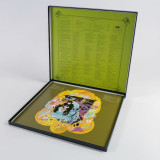
The state51 Box Set
With authenticity core to the project, The state51 Conspiracy engaged one of the UK’s
leading experts in box set design, Daniel Mason at Something Else, to painstakingly recreate
the box, records and accompanying ephemera. The first challenge was to find the deep blue
leatherette paper the original box set was covered in; a problem since it was no longer in
production. “I knew people who had stacks of it, gathering dust on top shelves, so I bought it
up wherever I could find it,” says Mason. Then came the reproduction of 12 loose leaf lyric
sheets on fine art watercolour paper, each of them featuring a watermark and a fairytale-like
illustration by Donovan’s artist friends Sheena McCall and Mick Taylor. Where, though, to
find the same paper stock? “I found out that it was made at a paper mill in North Wales
called Abbey Mills. Unfortunately the mill dissolved in the early 70s and very little of the
paper remained. However enough paper remained to allow us to produce the numbered
certificate also signed by Donovan that sits within the box.”
Then to the iconic cover image. Donovan and Jimi Hendrix’s personal photographer Karl
Ferris, used infra-red film to achieve the psychedelic effect on the cover, but the original
negatives couldn’t be found. Mason then used digital technology to ramp up the colour levels
on a reproduction from an original copy of the album while allowing it to remain a little bit
faded, as it would be after half a century. The same labour of love and care has gone into
producing all elements of the box; from the rebuilding of the famous front cover font to the
hand-numbered and signed certificate; letterpress printed on the original paper stock of the
1968 UK release lyric sheets.
To cap it all off the original mono master tapes were waiting safely in the EMI Donovan
Archive and transferred from tape to digital by Abbey Road Studios where new lacquers
were cut, ensuring Donovan's favoured mono version of the album would be presented both
physically (and digitally for the very first time) in striking audiophile quality. The final touch to
- 1: Dali De Saint Paul & Maxwell Sterling
- 2: Dali De Saint Paul & Maxwell Sterling
- 3: Dali De Saint Paul & Maxwell Sterling
- 4: Dali De Saint Paul & Maxwell Sterling
- 5: Dali De Saint Paul & Maxwell Sterling
- 6: Dali De Saint Paul & Maxwell Sterling - Interlude
- 7: Dali De Saint Paul & Maxwell Sterling - Late Junction
Cassete comes with 3 extra panels of artwork from Ciaran Birch
Outerwordly collaboration between two great artists at the forefront of their scene, a release that was sparked by a commission from the BBC!
Dali de Saint Paul is known for her vast amount of collaborations, most notably with Moor Mother & Valentina Magaletti.
Maxwell Sterling's previous work includes sublime & diverse albums on The Death Of Rave & AD93.
When they met to create an improvised session for the famous experimental music radio show Late Junction on BBC Radio 3. Their encounter was so prolific that day that a lot of their music was not played on the show, so they have decided to give their audience the chance to listen to the fragile, brilliant and dark composition they have produced together.