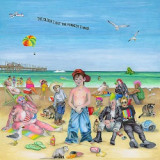
We used to enjoy presenting Chapelier Fou's work using the idea of music in the form of a treasure hunt. However, while the phrase in itself it still just as relevant today, we would never have imagined that it would become such an integral part of one of his albums. Or two of his albums to be perfectly exact - Méridiens and Parallèles. Two records with twelve songs each which answer each other back in the form of anagrams. They are like the two sides of the same planet - similar but simultaneously so different. They need to be discovered one after the other taking the time necessary to travel through the sound territories produced by his imagination. The starting point is a sombre night in Uqbar… Chapelier Fou's opening reference to Borgès was obviously not made by chance. He subsequently confided in us the objective of his diptych, namely to combine reality with fiction to question certainties and our relationships with the imaginary sphere. He has continued with his traditional classical-contemporary electronic approach which, although now known to a wide audience, has the advantage of opening up a whole range of possibilities right up to the infinite scale. Moving away from an "État Nain" (Dwarf State) to take refuge on an asteroid...Throughout Méridiens, each composition can be seen as a universe in itself or a specific landscape with its own temporality. Proof of this is the introduction to the chamber music format composed for and performed by only strings which can only be given the date we want to give it. This is "État Nain" in which violins are played like guitars. In some parts we find the spirit of the Penguin Cafe Orchestra and the idea of cheering up classical instruments and not taking everything too seriously. In other parts, we find something close to a mischievous and childish unplugged grunge anthem that could be from the French series Les Shadoks. This mischievous view of things is shown to full effect in Am Scharchtensee. The introduction shows Chapelier Fou's whole classical universe and mastery of orchestration in which "modular" electronics provide a subtle and discreet backdrop. Then, the record suddenly switches to a surrealist dialogue between these classical sounds and modular synthesizers with the flavour of the German pioneers Kluster/Harmonia to name but one example. Timelessness and imaginary places. La vie de cocagne confirms this choice of total freedom. It's traditional music with old sounds, a kind of forgotten bourrée (old French dance) in which electronic sounds disturb the established order and thus reach another musical dimension. Le méridien du Péricarde followed by Désert de Sonora push this idea of a trompe l'oreille and a hall of mirrors even further. The latter track ends almost like a catchy 80s melody and we can no longer find any logical meaning. We let ourselves be carried away by this profusion of madness and are a little amazed by this mastery of sound, composition and space. It sometimes all seems like a succession of conjuring tricks. Chapelier Fou takes not being serious very seriously indeed. The end song Everest trail is the perfect conclusion, a deadpan track in which the primary aspect of a totally classical melody in all its straightness is underpinned by a permanent exchange of electronic tweets which mocks the main musical posture. This impertinence harks back to Pierre Schaeffer who directed the ORTF's very serious experimental department in another era and allowed the development of Jacques Rouxel's series Les Shadoks thus introducing the general public to the notion of concrete music. This is also perhaps why Louis Warynski's stage name is French – because he has opted to use his French musical heritage. Thus the first singles selected from this album, Constantinople with its groovy and jazzy allure and Le Triangle des Bermudes evoke composers like Michel Magne or Michel Colombier both of whom have totally open minds and consider all music to have the same importance, namely that of sound. In absolutely all the tracks that make up Méridiens, you will find at least one detail - a pattern, melody, sometimes a simple sound - that will draw you back to explore it a little more. And the words are carefully weighed for sure. It's quite simple. This is undoubtedly his most hypnotizing and catchy album. Chapelier Fou has become a complete master of his own universe. He draws the start and finish lines himself and no one can follow him in a field that now belongs to him alone. Composed imaginary spheres, illustrated territories...Music is just as meaningful as the more visual arts. Therefore the artwork of Méridiens had to project each of the twelve tracks considered individually and not just the whole album as such. Chapelier Fou therefore asked his old friend the contemporary artist Corentin Grossman to create twelve windows to represent glimpses of the twelve worlds composed for the record. Windows or mirrors when it comes to that? You can never be sure of anything...Space OK. But what about time? The years go by and sometimes we forget that fact. But a simple glance back is often enough to gently touch the time that has passed. It is over 10 years since his first official record and he has been composing, recording and sharing his music for almost 20 years. 20 years is a long time. It makes some people look old while others fall into reassuring but sterile nostalgia. Chapelier Fou, on the other hand, has released his most ambitious project and tried to take a higher view of his discography that was itself nevertheless irreproachable. Although the journey is over we can see Parallèles universes on the horizon. Chapelier Fou has announced 12 additional tracks which are like echoes of the compositions on Méridiens' and will be released on the album Parallèles next spring. They are neither twins nor opposites – they are instead totally original new compositions which go further in exploring a universe which is already richly abundant.
quête:moving still
The Fabulous Counts were originally a teenage instrumental group of five musicians, Mose Davis (Organ and Piano), Demetrius ‘Demo’ Gates (Alto Saxophone and vocals), Jim White (Tenor Sax), Andrew T. Gibson (Drums) and Raoul Keith Mangrum (Percussion and Flute) who were later joined by the older, more experience Leroy Emanuel (Guitar and vocals). Emmanuel was invited into the group as it’s band leader by the groups manager Fred McClure, a former Detroit boxing champion who also happened to be the manager of another popular Detroit group the singing Metro’s of the hit recording “Sweetest One” fame and their subsequent respected RCA album of the same name. The Fabulous Counts would often perform at shows as the Metro’s backing band.
The Fabulous Counts first big break came after knocking several Detroit Record labels doors. They were eventually invited in by Ollie McLaughlin’s Moira studio to record, under the tutelage of Popcorn Wylie the one take hit “Jan, Jan (Moira-103). A further two Moira 45’s followed of which “Get Down People/Lunar Funk “(Moira-108) also scored high on the R&B charts. Through a deal arranged by McLaughlin The Counts released their respected “Jan, Jan” album on the Atlantic distributed Cotillion label in 1969. Moving on to Armen Boladian’s Westbound label, during 1970 the group simply changed their name to The Counts and charted with their 1971 “What’s Up Front” Westbound album, also releasing a solitary 45 “Thinking Single/Why Not Start All Over Again”. In 1972 while still part of the Westbound set up The Counts recorded two major label 45’s under the pseudonyms of Bad Smoke “Crawl Ya’ll Part 1&2” (Chess-2124) and Lunar Funk “Mr Penguin Part 1&2” (Bell 45-172), the latter being thier biggest hit. A subsequent move to Atlanta, GA saw The Counts sign with Michael Thevis’s Aware records where they recorded a further two successful albums “Love Sign” (1973) and “Funk Pump” (1975), plus a string of 45’s. In 1976 although officially never breaking up The Counts members went their separate ways to explore different life opportunity’s.
During 1978 and while still in Atlanta Leroy Emanuel borrowed money from his family and reuniting with his fellow Counts, Mose, Demo, and Jimmy Jackson Jr, they, accompanied by a local strings section recorded a session of material that spawned two songs “What’s It All About” and “Motorcity”. Which Leroy later made a deal with Terry Mendelson to release on a 45 on his TM label. The Counts had previously known Mendelson through his brother Bernie at Westbound. The TM 45 made very little noise with many of the copies having mispressed labels. Although later reissued and mistakenly credited as two previously unissued Westbound recordings on several latter Cd compilations it came to light that quite a few avid European soul collectors actually owned copies of this high quality, very elusive and desirable 45! With demand still seemingly high it seems a good time for Soul Junction to reissue it. The A-side, “What’s It All About” features its composer Leroy Emanuel on lead vocals with the other Counts adding to the backing chorus. The flipside of this 45 from the same session is the previously unreleased Mose Davis penned “Watch The Clock” which is more in keeping with the Counts traditional funk groove, enjoy.
Diving into the archives of Alter Ego - the experimental ensemble of Manuel Zurria, Paolo Ravaglia, Aldo Campagnari, Francesco Dillon, Oscar Pizzo, Fulvia Ricevuto, and Eugenio Vatta - Die Schachtel is thrilled to present Pranam - A(Round) Giacinto Scelsi, a never before released body of recordings interpreting the works of the legendary Italian composer Giacinto Scelsi, made with Matmos (Martin Schmidt and Drew Daniel) in 2005. Resting at the outer reaches of avant-garde chamber and electronic music - moving at a glacial pace of tightly wound energy - Pranam’s two sides radically rethink the terms electroacoustic music in ways that still feel radically ahead of their time, more than 15 years after they were first laid to tape.
A modular chamber ensemble with a pointedly anti-academic approach to music, over the course of its activities - running roughly between 1990 and 2010 - Alter Ego developed a devoted following among some of the most forward thinking voices in experimental music, all the while collaborating widely with artists spanning a vast range of practices and disciplines, including Robin Rimbaud, Philip Jeck, Pan Sonic, Matmos, Gavin Bryars, Andrew Hooker, William Basinski, David Moss, Alvin Curran, Terry Riley, and near countless number of others.
Alter Ego’s diverse activities can be understood as interventions with the disposition toward formality within contemporary chamber music, often pairing themselves with artists working well beyond their own context as a means to develop highly original interpretations of a specific composer’s work. In 2005, this process led them to invite Matmos, the American duo of Drew Daniel, Martin Schmidt - acclaimed for a body of visionary albums at the vanguard of electronic process and sampling - to collaborate on a series of interpretations of works by the legendary Italian composer Giacinto Scelsi.
Realized in collaboration with The Fondazione Isabella Scelsi, which holds Giacinto Scelsi’s archives, and performed at the Festival Roma Europa and the Festival Aeterforum during May of 2005, the album’s four works - Estratti dal Quartetto per archi n.3 (1963), Ko-Lho (1966), Riti: I Funerali di Carlo Magno A.D. 814 (1976), Aitsi (1974) - shift the boundaries of 20th Century chamber music toward markedly new and contemporary terms, incorporating everything from the sounds of the Revox tape machine that Scelsi used to record his own improvisations and processed electronics, to the plastic trumpets used by fans during football matches.
From intertwining, shifting lone-tones that render startling resonances and dissonances, to passages guided by a vast pallet of electronics and flurries of acoustic sounds, joined as a single ensemble, across the two sides of Pranam, Alter Ego and Matmos infuse these four works by Scelsi with humor and playfulness, while retaining all the urgency and rigour with which they were initially composed.
Delicate and meditative, while tightly wound and brooding, Pranam brings the works of Giacinto Scelsi to life in ways that almost no group ever has. Riveting and immersive from start to finish, Die Schachtel is thrilled to present these never before heard recordings from the archives of Alter Ego. Pranam is available on black vinyl, in a limited edition of 350 copies.
Horace Tapscott's Pan-Afrikan Peoples Arkestra (P.A.P.A.) was one of the most transformative, forward-thinking and straight-up heavy big bands to have played jazz in the 1960s and 1970s. If P.A.P.A. doesn't have the interstellar rep of that other famous Arkestra, and if the name Tapscott doesn't ring bells like Monk or Tyner, there's a reason why: in an industry dominated by record labels, a band that doesn't record doesn't count. And the Pan-Afrikan Peoples Arkestra didn't record for nearly twenty years. But recording success was never their concern -- they weren't about that. First formed as the Underground Musicians Association in the early 1960s, Tapscott always wanted his group to be a community project.
From their base in Watts, UGMA got down at the grassroots. The group was renamed the Pan-Afrikan Peoples Arkestra in 1971, and soon after they established a monthly residency at the Immanuel United Church of Christ which ran for over a decade, while still playing all over LA and beyond. But they never released a note of music. It was the intervention of fan Tom Albach that finally got them on wax. Determined that their work should be documented, Albach founded Nimbus Records specifically to release the music of Tapscott, the Arkestra, and the individuals that comprised it. The first recording sessions in early 1978 yielded enough material for two albums, and the first release was Flight 17. The album commences with the magnificent title track. It is effectively in three parts. It begins with unaccompanied pianos. Then the ensemble embark on a dense, circular and mechanical movement, a platform for horns and pianos to swoop and dive. We return to Earth with a beautiful solitary flute. The second track, the piano-centric, ‘Breeze’ is different to ‘Flight 17’ in intensity and also brevity but it is quietly as daring as the title track. It concludes with a moving lush wash from the full Arkestra, which sound almost like strings only more substantial. These first two tracks take full advantage of the texture of the unusual mix of the various instruments. Next though, it’s a significant change with ‘Horacio’, which is an exuberant Latin infused jingle. It’s unlike anything else on the album. I like to think it was named after the conductor’s Cuban alter-ego! ‘Clarisse’ gracefully switches between slow blues and bop and is bookended with a grand vaguely East Asian theme. The busy bass line introduces ‘Maui’. As with the previous track, it moves between a number of contrasting melody lines and rhythms but there’s still space for a tuneful sax solo.
This is a must-have album. I think the first two tracks on their own make this release essential. Kevin Ward/UK Vibe/Boomkat
Truly, the luscious, soulful new album from Manchester singer-songwriter Caoilfhionn Rose (pronounced Keelin) moves through a tapestry of curious musical inflections; nods towards folk, jazz, ambient, electronica and even a subtle influence of psychedelia, it never stands still to take a breath, despite its ethereal and delicate core. Out April 9th on Gondwana Records (Mammal Hands, Portico Quartet, Matthew Halsall, Hania Rani), in Truly, the young singer-songwriter has accomplished a body of work that is both sonically and lyrically wise beyond her years.
Co-produced by Kier Stewart of The Durutti Column following Rose's collaborative endeavours with them on their album Chronicle LX:XL, the musician's song writing draws from a diverse palette of influences, including Building Instrument, Rachel Sermanni, Alabaster dePlume and Broadcast. Rose also professes to a love for beautiful, stripped back, piano based music, such as Dustin O'Halloran and label mate Hania Rani.
Truly came to exist due to a deep-routed need to create – even though its conception was interrupted as Caoilfhionn Rose recovered in hospital from an illness, she found strength within writing music. "In Spring 2019 I took part in a gig swap with my good friend and fellow musician Kristian Harting who is from Denmark. We played several gigs in the UK but unfortunately the Denmark part of the tour was cut short as I was taken ill. I was hospitalised for several weeks and have taken the last year out to recover" says Rose. "I gradually returned to finishing my second album" she continues. "Coming back to creating after being unwell was challenging but also therapeutic. This record marks a difficult time of my life and writing it helped get me through that. I am really grateful to have music as an outlet." It may be this tremendously challenging period that has abetted its characterising qualities.
Rose's beautifully restrained vocal is all at once soothing yet mesmerising. She demands and holds attention through her evident talent yet hypnotises the listener into a trance with her experimental tendencies. "After being unwell, getting back to recording helped me recover my voice after not singing for so long. Finishing bits of songs, writing lyrics and recording vocals helped me get back on my feet and get better."
Lead single from the album – 'Flourish' – is an intoxicating song that meditates on being present in the moment, allowing peace to come to you. "The song 'Flourish' is about looking forwards with hope and possibility, 'let it flow away, let it turn around and flourish'. It's about finding peace and feeling wonder again" says Rose about the track. "'Flourish' hints at the ideas of what could be, how things can unfold if you let go 'and just be here'."
A message of hope is instilled throughout the record, echoed again in 'Fireflies', a song inspired by a campsite in France, which became filled with fireflies at night. "To me 'Fireflies' has a nostalgic and comforting feel. It's about feeling hopeful about the future 'though there may be dark clouds the sun will always come'. There are references to older lyrics I have written. The line 'free from all the chaos' is a nod to a song I collaborated on with The Durutti Column. The song is about acknowledging the past and moving on as 'time is always healing'."
A recurring theme of reflection and being grounded in the present, acknowledging the past and looking forwards with courage is one that envelopes 'Truly', and is something that is echoed in its beautiful swelling flourishes and its tranquillity – resonating with atmosphere, the album all at once sounds so large and yet so subdued. "The line on Every Waking Minute; 'we forget what lies behind the eyes' is about remembering that everyone has their own things going on and challenges to face but we should 'feel every waking minute', become aware of what's unfolding around us outside of our own stories. It's a self-reflective song really, reminding myself that 'life can take you bysurprise', there are going to be ups and downs along the way"
Elsewhere on the album, Rose explores the connection between nature and life on single To Me. "I love going on long walks and the healing power of nature is a recurring theme in a lot of my lyrics. I have a very optimistic outlook and I find solace in the small things like being outdoors."
Caoilfhionn's debut Awaken, co-produced with label mate Matthew Halsall, saw the singer, songwriter and producer tie together remnants of Manchester's musical past with its evolving present. Prior to this, the artist collaborated with one of her biggest musical influences, Vini Reilly of The Durutti Column. The musician worked with the Manchester band on four songs on their album Chronicle LX:XL. "I've learnt a lot from collaborating with musicians like Vini Reilly, Matthew Halsall and my bandmates" says Rose. "This is reflected in my current style and approach to making music. I no longer just write as a therapeutic or reflective process; I can write more abstractly and outwardly."
Kier Stewart of The Durutti Column co-produced her latest offering, Truly, following his band's collaborations with Rose. "I befriended Kier after we worked together. Collaborating with The Durutti Column was my first experience of recording music with other people in a studio." Together, the pair have created something expansive yet fragile – and altogether unique. "He's brought so much to this project" she says. "I feel Keir has brought out the best in the songs, adding really intricate and subtle details and effects. It was inspiring getting to work with Keir and I've learnt a lot from his approach of just experimenting and seeing what works."
- A1: Back Street Kids
- A2: You Won’t Change Me
- A3: It’s Alright
- A4: Gypsy
- B1: All Moving Parts (Stand Still)
- B2: Rock ‘N’ Roll Doctor
- B3: She’s Gone
- B4: Dirty Women
- C1: Back Street Kids (Steven Wilson Mix)
- C2: You Won’t Change Me (Steven Wilson Mix)
- C3: It’s Alright (Mono Version)*
- C4: Gypsy (Steven Wilson Mix)
- D1: All Moving Parts (Stand Still)
- D2: Rock ‘N’ Roll Doctor (Steven Wilson Mix)
- D3: She’s Gone (Steven Wilson Mix)
- D4: Dirty Women (Steven Wilson Mix)
- E1: Back Street Kids (Alternative Mix)
- E2: You Won’t Change Me (Alternative Mix)
- E3: Gypsy (Alternative Mix)
- E4: All Moving Parts (Stand Still) (Alternative Mix)
- F1: Rock ‘N’ Roll Doctor (Alternative Mix)
- F2: She’s Gone (Outtake Version)
- F3: Dirty Women (Alternative Mix)
- F4: She’s Gone (Instrumental Mix)
- G1: Symptom Of The Universe
- G2: War Pigs
- G3: Gypsy
- H1: Black Sabbath
- H2: All Moving Parts (Stand Still)
- I1: Dirty Women
- I2: Drum Solo / Guitar Solo
- J1: Electric Funeral
- J2: Snowblind
- J3: Children Of The Grave
Technical Ecstasy by Black Sabbath, limited edition, remastered, new mix, 90 mins of unreleased outtakes, alt mixes, live tracks from Ozzy, Tony, Geezer and Bill plus extensive book, tour program and poster. LP set on 180g vinyl.
In the summer of 1976, Ozzy Osbourne, Tony Iommi, Geezer Butler and Bill Ward headed to Miami to record Technical Ecstasy at the famed Criteria Studios. The band was coming off a world tour for their previous album, Sabotage, that had found their live performances evolving to include keyboards and synthesizers. These newly incorporated instruments and sounds were then introduced into the recording process on Technical Ecstasy. The new songs encompassed a wide range of styles from the hard charging “Back Street Kids” and single ballad “It’s Alright,” to the funky “All Moving Parts (Stand Still)” and progressive rock “Gypsy.” The Deluxe Edition presents a newly remastered version of the eight-track album, along with an entirely new mix of the album created by Steven Wilson using the original analogue tapes.
With eight previously unreleased outtakes and alternative mixes. Among those are different mixes of “You Won’t Change Me” and “Rock ’n’ Roll Doctor,” as well as both outtake and instrumental versions for “She’s Gone.” The collection concludes with 10 previously unreleased live tracks recorded during the 1976-77 World Tour. The songs touch on different eras of the band’s history with early tracks like “Black Sabbath”, “War Pigs” (from Paranoid), “Symptom Of The Universe”, “Snowblind” and “Children Of The Grave” alongside new songs “Gypsy” and “Dirty Women.”
The collection comes with an extensive hardback book featuring artwork, liner notes, rare memorabilia and photos from the era, plus a replica of the 1976-77 world tour concert book and a large colour poster of the iconic Hipgnosis (Storm Thorgerson/Aubrey Powell/Peter Christopherson) futuristic robots image which is perfect for framing.
Black Sabbath embraced change in 1976 when the heavy metal innovators started managing themselves and began exploring different sounds on the band’s seventh studio album, Technical Ecstasy.
BMG honours this daring album with a collection that includes a newly remastered version of the original, a brand-new mix by Steven Wilson, plus more than 90 minutes of previously unreleased outtakes, alternative mixes and live tracks. TECHNICAL ECSTASY: SUPER DELUXE EDITION will be available as a 4CD box set and 5LP box set on 180g black vinyl.
Contents:
Vinyl box set includes:
Original album newly remastered
New Mix LP
Outtakes and Alternative Mixes LP
2LP live concert from the World Tour 1976 - 77
40-page book with photos, artwork and liner notes
Technical Ecstasy colour poster
Razen are back with a second album on Blue Rot, follow up to last year's release Robot Brujo on HITD.
On Blue Rot, the band introduces a softer palette and a new quartet, as the core duo of multi-instrumentalists Brecht Ameel and Kim Delcour is augmented with new band member Berlinde Deman on Serpent and guest Thomas Bloch on Glassharmonica and crystal Baschet. Drawing inspiration from late 19th-Century Symbolist art, Blue Rot summons heartbreak and the perils of isolation in languid, hypnotic modes, laying bare the beauty of stillness, the solitary gaze at drifting clouds.
Notwithstanding its hushed and melancholy tone colours, the album provides the listener with the customary disorientation, instrument clashes and tension between stasis and slow-moving development so firmly entrenched in the sound world of Razen. These five improvised pieces offer another testimony to the uniqueness of this outfit, their esoteric ancient-modern approach and to their dedication to explore new ground on each release while managing to sound only like themselves.
With 10 years in the 'biz' firmly under his belt, Jiah Wells is poised to release the first full-length LP of his Galtier project, Pulchra Es Elementis. Whilst Galtier is arguably one of the originators of the percussive style that would eventually fall under the Hard Drum label, the heightened theatrics of his recent output have seen him channel Blade Runner-styled sonics and move further away from absolute club functionality. Whilst Galtier's output often seems to soundtrack hypothetical, off-planet words, Pulchra Es Elementis turns the focus inwards: towards Wells' own emotional constellation, his evolving spirituality and his attempts to tap into planes of existence beyond the tangible. The album's Latin title translates to 'Elements are Beautiful' and encapsulates the artist's belief that there is grace in all of life's aspects; pushing past what we deem as good or bad, minuscule or massive.
Pulchra Es Elementis begins with Crystalised Larva, a brooding opener of breathy pad synths and expansive kick drums which reverberate through the mix as if the hits originate from the bottom of a valley. There's an indistinct sense of tension on this track, in part due to a central melody, which never resolves but only descends lower in pitch. This tension turns to explorative wonder on Wilfull Saviour, where a mirage of musical ideas come in and out of focus. Although the sonic worlds Galtier explores are internal to him, Wilfull Saviour still possesses that sense of a cosmic journey we've come to expect from Wells; an ardent fan of dystopian films and literature.
Continuing this emotional odyssey, Bruised, But Not Broken sees the artist push deeper into the psychological undergrowth; its murky tonality juxtaposes crisp, Reggaeton-inspired drum patterns with a heavily compressed one-note synth line that modulates wildly - cutting through the mix like a nagging thought that won't leave your mind. Next up is U Were, U Are & What U Will Be, one of the more club-ready tracks of the LP, which gets us moving with a snarling bassline and layers upon layers of percussive hits and inflections.
At Pulchra Es Elementis' mid-point is the LP's title track, a drumless interlude where blissful, shimmering synths create a patchwork of intensities. Galtier's approach to songwriting shines through here; ignoring musical pragmatics, he opts to feel his way through his compositions without knowing where they might end up. Following on from that weightless breather, Phantasiai turns up the freneticism with its head-spinning mix of drum programming and a glitched-out synth line that yo-yos up and down octaves. Things get even more furious on the Superficie-featuring Cavernam, a hollow Hard Drum banger inspired by Eskibeat sensibilities and designed to create a sense of self-implosion.
The album's penultimate track, (U Are) Beautiful, is a tale of two halves: beginning with a moment of serenity as synthesizers swell like an ocean tide before evolving into a marching crescendo of raw energy. Rounding off the album, Shine Forth hurtles through pacey drum work and all manner of strange zaps and klaxons before giving way to a final dose of nebulous ambience.
A musical journey unlike any other 'club music' albums, Pulchra Es Elementis is an LP that demands to be consumed in one sitting. Reflecting on his place within the universe and the musical landscape, the album could be viewed as a musical exorcism which sees Galtier working through and shedding huge chunks of his ego that stuck to him out of fear of the unknown. Pulchra Es Elementis begins on an insecure, overwhelming or, even, existential note before rounding off with a related sense of vastness seen with new, more positive eyes. It's a voyage we hope you will join him on.
Effortlessly hopscotching between vintage acid and 80s Rn’B, insouciant Francophone pop and twinkling electro house, Lou Hayter has delivered something at once utterly unique and defiantly timeless with her much anticipated debut solo LP, released on Skint Records. It has been a long time coming for London native Hayter, who first made her mark professionally as keyboardist for New Young Pony Club, one of THE bands at the epicentre of the white hot day-glo nu rave scene alongside the likes of the Klaxons and Test Icicles in 2006. But, to fully place her debut album in context, it is necessary to rewind a little bit – to the very beginning in fact, with Hayter growing up on a diet of Bowie, Prince, Human League and Jellybean-era Madonna while concomitantly learning classical piano from the age of five. The flames of this deliciously varied musical palette were further stoked by trips to record shops in Soho with her brother (Soul Jazz was a particular obsession), but it was while studying in Cambridge that the match was well and truly struck – she used her student grant to buy a set of Technics and started putting on club nights, before moving to London and working at Trevor Jackson’s seminal Output Recordings, placing Hayter smack bang in the middle of all the action, with disco punk fever hitting full force and bands like the Rapture and LCD Soundsystem first breaking out.
The hugely successful, Mercury-nominated New Young Pony Club followed shortly after, but it’s through her subsequent output that she started to distil and refine her idiosyncratic tastes. And certainly, you can hear hints of both the New Sins, the 80’s New Wave duo she formed with Nick Phillips, and Tomorrow’s World, the swooning Gallic pop act she fronts alongside Air’s JB Dunckel, in her remarkable debut. Full to bursting with evocative electro-soul love letters to her home town of London alongside addictive disco torch ballads, it’s like Kylie meeting Mr Fingers or, Jam & Lewis producing Jane Birkin – something beautiful and melancholic yet sharply modern and new. From the warm, woozy, lysergic harmonies of opener “Cherry on Top”, which sound like a beloved old cassette unravelling, to the fizzy, infectious “Cold Feet”, which calls to mind Lisa Lisa & Cult Jam at their most heartworn, taken in toto the album perfectly nails the essence of gorgeously nostalgic synth-pop with a twist; crisp, stylish and sophisticated music which heralds the next chapter of Lou Hayter quite nicely, actually. Her retro-futuristic results will give 2021 the pop fix it so desperately needs.
Produced by and featuring Aesop Rock. “I wrote half of these songs when my energy was either headed in the wrong direction or already there. I wrote the other half while my energy was moving in a direction I’m more excited about, that I find to be more enriching. They’re all still my songs though. My mother, and lots of my relatives, used to call me “Angelito.” Little Angel. The taijitu is the symbol for yin and yang. Opposites that make a whole. Given the dualistic/duelistic nature of the songs on the record, put it all together and what do you get, Anjelitu.” - Homeboy Sandman
Originally released on cassette by Good Person Recordings in 2016, Impressive Almanac is the culmination of Dan Shaw's bedroom experiments making minimalist post-punk. The entire album was tracked by himself at home shortly after moving from Seattle to his hometown of Holyoke, Massachusetts. Dan did not yet have any backing band at the time. The album shines with his raw and unfettered creativity, repetitive DI'ed guitars, and disaffected yet deeply personal lyrics about the banality of modern life.
Shaw says of the record: "Sharing this tape with friends in the Western Mass DIY scene soon led to the formation of Landowner as a full band. Even though we're a real band now with a real drummer and everything, the drum machines and repetitive riffs of these songs still serve as an important reference point for the vibe we strive to attain in our music today."
The album was quite formative for Born Yesterday Records. Co-owner and now Deeper bass player Kevin Fairbairn met Dan at a show in Western Massachusetts. Dan gave him a cassette of Impressive Almanac. When Kevin returned from tour, he was eager to show it to me and I quickly became obsessed with it. A year or so later when we were discussing starting a record label, we both knew that Landowner had to be one of the bands we talked to first. This release will roughly mark the three year anniversary of Born Yesterday's first release, Landowner's Blatant.
- 1: All I Need
- 2: Kiss Like The Sun
- 3: About Last Night
- 4: Downtown
- 5: Rabbit Hole
- 6: Lost
- 7: Scene
- 8: Lonely Hours
- 9: Maybe It’s Today
- 10: Screaming
- 11: Hold Tight
It may be his fifth album, but Saturday Night, Sunday Morning marks the start of chapter two for Jake Bugg. Arguably his most complete and coherent record to date, Saturday Night, Sunday Morning manages to combine a love of ABBA, the Beach Boys, Supertramp and the Bee Gees, with a contemporary pop sound: one that’s already spawned his most ubiquitous song in years via euphoric lead single, All I Need. “I knew what I was looking for this time around,” the 27-year-old says, firmly. “And I feel like I accomplished it.” It’s almost 10 years since a two-fingered Bugg burst onto the scene with his eponymous debut, one that topped the UK album charts and saw the then 18-year-old from Nottingham fêted as the next Bob Dylan. A Rick Rubin-produced follow up, Shangri La, quickly followed. But progress stalled with Bugg’s third, largely self-produced, record, On My One, in 2016. “I was having a hard time on that third record,” Bugg admits, five years removed. “The support from the industry wasn’t what it was. All those people telling you how great you are weren’t there anymore. It does feel like the rug’s been swept from under your feet.” What that record provided, however – along with its comparatively stripped-back follow up, Hearts That Strain (2017) – was a much-needed course corrector: one that set Bugg on the upward trajectory he finds himself on today. “When I came to terms with that was when I left the ego at the door,” he says. “It didn’t work out. But it led here. And this is probably my strongest record." It’s testament to Bugg’s rediscovered confidence that Saturday Night, Sunday Morning – a nod to the debut novel by Nottingham author Alan Sillitoe – sees him working with some of his highest profile collaborators to date, most notably American songwriters Andrew Watt and Ali Tamposi, best known for their work with pop heavyweights Post Malone, Dua Lipa, Miley Cyrus, Camila Cabello. “I was looking for how I can incorporate my sound for a more modern era. And I kind of struck gold working with Andrew Watt and Ali Tamposi,” Bugg says. Convening in LA, the first track the trio wrote together is the jealousy-inflected About Last Night, a song about the “insecurities you go through as a young person in a relationship with someone.” “It’s got such dark undertones, which I love,” Bugg says, of a song that showcases a newly discovered, Beach Boys-esque falsetto. “But it’s also very, very pop. That’s what I’ve always loved. With ABBA, with Supertramp. I love pop music. But when you can get it to be dark, I love it even more.” It’s a trick the trio repeated again on Scene, Bugg’s personal favourite from the album and a song that best encapsulates the combination of old and new: Watt’s George Harrison-esquire guitar brushing up against contemporary melodic choices by Tamposi. “I love writing with her,” Bugg says of the Havana hitmaker. “She brought that women’s perspective. And I knew that I’d got that balance of what I wanted. That old school chorus with contemporary verses. That to me was my favourite song when I wrote it, and it still is.” Perhaps the biggest example of Bugg’s newfound ego-less approach to writing, however, came in the shape of Downtown, a song that grew from an idea by Jamie Hartman (Celeste, Lewis Capaldi, Rag'n'Bone Man), and sees Bugg deploy the higher range of his voice to ethereal, ’60s Bee Gees effect. “Usually, the initial spark of an idea comes from me. And when it doesn't, it sometimes loses my attention,” Bugg admits. On Downtown, however, he relished his role as arranger: “Because there were a lot of moving parts and chords, it was almost like a puzzle,” he says. “I’d never approached a song like that before. “What I’ve been enjoying on this record is the collaborative process,” he continues. Working with people, writing with people. Because I’ve realised all I really want to achieve is to be the best writer I can possibly be. And I think by working with other people, it allows you to learn a lot as well.” It’s a theory Bugg has put to the test during lockdown, when he was approached by his manager about writing the soundtrack to an upcoming documentary, The Happiest Man In The World, about Brazilian footballer Ronaldinho. “It’s kind of a completely different experimental outlet,” Bugg explains of his first ever score. “I approach my own work quite professionally. But with this I can just switch off and go into a different world. And it’s been brilliant – I’ve had to learn different styles of guitar: bossa nova, samba. It’s a bit Vangelis, who’s probably my favourite artist – which may surprise people.” Possibly. But you get the impression that surprising is what Bugg likes to do. “I don’t like to be stuck doing the same thing,” he admits. “And that’s what this record Saturday Night, Sunday Morning was. I wanted to push myself. I’m always learning new influences. I’m careful not to get stuck on the same thing. “It’s not going to be right every time. It’s not going to be good every time,” he continues. “But if that’s the process it takes to get to this record, where people are loving the songs again, then that’s the journey we have to take.” For Jake Bugg, chapter two starts now. New album ‘Saturday Night, Sunday Morning’ is out August 20th on RCA Records
2023 Repress
Black Truffle is pleased to announce the first-ever vinyl reissue of Alvin Curran’s classic Fiori Chiari, Fiori Oscuri, originally issued in 1978 on Ananda, the cooperative label run by Curran, Roberto Laneri, and Giacinto Scelsi. Fiori Chiari, Fiori Oscuri (Light Flowers Dark Flowers) – its title inspired by an intersection in Milan – is the second in the series of four solo recordings Alvin Curran issued in the 1970s and early 1980s, preceded by Songs and Views from the Magnetic Garden (1975), followed by The Works (1980) and Canti Illuminati (1982).
Each of these solo works combines field recordings with performances on synthesiser, various acoustic instruments, and voice, arranged in languorously paced, dreamy sequences. Far from the bracing pointillism of much musique concrete, the elements encountered on the meandering course followed by Fiori Chiari, Fiori Oscuri – whether a frenetic piano improvisation, dense layers of Serge synthesiser and ocarina, or a monologue from Frederic Rzewski’s five-year old son, Alexis – often occupy the foreground of our attention for minutes at a time. As Curran explains, his approach is like that of a filmmaker in the editing process, working with “whole blocks of recorded time”. The purring of a cat, toy piano, a child counting, plaintive synthesiser tones, the cacophony of exotic birds at the London Zoo – each disappears into the next, until, on the LP’s second side, a solo piano performance takes centre stage, moving unexpectedly from percussive minimalist permutations to a halting rendition of Georgia on My Mind. A subtle yet stunning work that more than forty years on still seems charged with possibility, Fiori Chiari, Fiori Oscuri arrives in a loving reproduction of the original sleeve, featuring Edith Schloss’ beautiful cover painting, remastered audio and with new liner notes by Alvin Curran and Francis Plagne.
Repress !
Where We're Calling From
The Liminal Zone: Reflections on Duval Timothy’s Sen Am
Lamin Fofana
Sen Am is an enduring and tender album, rich and beguiling and generous in a quiet way. Over the last few years, I find myself returning to it, listening and absorbing, reflecting on the voices and working through the multiple layers of feelings and themes it announces with confidence and equanimity. Notions of care and contradiction, expressions of joy and desire and the underlying feeling of unease and turmoil; there is an urgent appeal to the listener for generosity, to strengthen our capacity to hear multiple voices simultaneously, to exist in multiple places at once.
Duval Timothy’s music was dropped into our world from another realm sometime in the spring of 2017. We received the call and we answered it. The rhythm and spirit was transmitted via London’s NTS Radio on the Do!! You!!! Breakfast Show with Charlie Bones and a short while later we were listening to the first vinyl edition of Sen Am in our living room in Berlin. The record got a lot of plays (at home and at some shows, before and after performances). It was like sunlight filtering through a cracked window and remaining there for a moment, dancing. Blue music emanating from a liminal zone, an in-between space, somewhere on the outskirts of Freetown, or rural Sierra Leone, or the outer edges of South London, or Bath, UK, or some undisclosed orbit, unfixed location. The music is soaked in diasporic experiences. It refuses to settle but still invites us to enter and stay awhile in that zone, where multiple forms exist (all) together with jazz, hip-hop, various strands of expressive electronics and experimental music all breathing together and moving around. It is a portal to a place of possibilities, a space for building and repairing possible and lost connections. But life in that liminal zone is precarious; it is life under duress; under pressure – not merely the pressure to produce a presentable, categorizable, and salable body of work, but the pressure that compels us to experiment and create new concepts and things that will help us imagine a different existence, a way out of the turbulence.
Freetown is a marvellous and sometimes sad place. It is one of those unmistakable locations inscribed diasporic memory; a place that touches you, a place that holds you and demands you bear witness: witness to pain, poverty, joy and desire. You remember the voices and the eyes of people even in momentary encounters. In Sen Am, you hear not only Duval’s recollections and sounds of Freetown, you hear family and friendship, people coming together and forming bonds, creating surrogate families. Forging community wherever you go is a practice, and community is at the core of this music. It’s in all the voices, from Emmerson and 6pac to Aminata and Aruna. It opens up a space for Black voices, for Sierra Leonean voices, and those voices extend through the succeeding projects, the 2 Sim EP and the album Help, and all that radiates from Duval’s Carrying Colour imprint.
Thank you for the invitation to write about the album Sen Am, on the occasion of its re-release which also coincides with the release of the exquisite double 7” Smɔl Smɔl with cktrl — a wonderful piece which calls on the listener to play both records at the same time to hear the music or play them separately and hear different versions. Duval is strengthening us, encouraging us to feel comfortable with discomfort, with incompleteness, with the hard-to-understand. This is a beautiful thing.
'The inventive record producer and vocalist Lee 'Scratch' Perry was involved in every musical shift of note in his native Jamaica, from the rhythm and blues that pre-dated the arrival of ska in the early 1960s through the slower and more spacious rocksteady style that appeared middecade and, of course, the frenetic sound of reggae, which he helped to birth as an independent producer during the late 1960s. Operating as 'The Upsetter' from his base in a downtown Kingston record shop, Perry found his greatest success with instrumental music during this phase, the organ and saxophone re-castings of standard vocal issues proving exceptionally popular overseas.
'Scratch The Upsetter Again surfaced early in 1970 as a largely instrumental set, but with dreamy reverb a hefty feature and keyboards veering away from standard organ motifs. Dave Barker, who was soon to hit the pop charts as part of Dave & Ansel Collins, tackles The Shirelles' 'Will You Still Love Me' in soul reggae mode, only for Perry to shift things towards the emerging dub spectrum with 'Take One.'
'As Perry inched ever closer to the dub experimentation he would turn into an art form at his own Black Ark studio later in the decade, Scratch The Upsetter Again shows him moving away from the standard approaches of his competitors in his quest to test the very limits of recorded sound. And reggae was all the richer for it.'
—David Katz (excerpt from the liner notes)
- A1: Better You
- A2: Start The Day With A Beat
- A3: Sharks Smell Blood
- B1: Pardon Me
- B2: All Of That Said (Feat Boldy James)
- B3: Won't Give Up The Danger (Feat Murkage Dave)
- B4: Moving On Up (Feat Conway The Machine)
- C1: Talking To The Audience
- C2: All Money 1983
- C3: Pray With An A (Feat Navy Blue)
- C4: Lost In Time (Park James)
- D1: Delay The Issue (Feat Fly Anakin)
- D2: Only Got One
- D3: Where We Going From Here
In March 2020, right as the whole world was entering into a transitional phase, Evidence released a single titled "Unlearning". Now, a year later, Evidence launches the campaign for his upcoming album, Unlearning Vol. 1, picking up where the single of the same name left off, and going beyond. Throughout his career, Evidence has always been adept at both staying true to his roots and evolving as he grows and learns from life experiences, including recognizing when the time comes to unlearn. During the campaign for his last album, Weather or Not (2018), he expressed a desire to close the chapter on the weather-related theme that had been a staple of his solo career to that point. Unlearning Vol. 1 not only sees that vision come to life, but shines brilliantly in the process. Unlearning Vol. 1 pairs Evidence's own production with works from The Alchemist, Nottz, Sebb Bash, Animoss, Mr. Green, V Don, Daringer and EARDRUM (QThree). This highlights perhaps an undervalued skill of Ev's - his ability to collaborate with a multitude of producers on a project, while still creating an album with a cohesion and consistency rarely found in such extensive collaboration. While the album's musical soundscape sets the scene, it's Ev's gift for relatable yet inventively clever writing that really paints the picture, continually pulling the listener in. That said, a small but powerful cast of guest appearances also decorate the landscape, courtesy of stellar performances from Boldy James, Conway The Machine, Fly Anakin, Navy Blue, and Murkage Dave. Unlearning Vol. 1 embodies the sound and feeling of pure artistic expression, capturing a moment in time where marketability, album sales & streaming potential, and the desire to please anyone other than the artist themselves, are all just an afterthought. As one could expect, such freedoms allowed Evidence to tap into something special that sounds engaging and unique, and also remains true to his foundation. In essence, Unlearning Vol. 1 finds Evidence at yet another creative peak, creating a listening experience poised to catch the attention of new listeners while strengthening his core fanbase.
JANA IRMERT – THE SOFT BIT
"The compositions for this album were shaped over the course of one year, at first without a concept or storyline as a starting point. Yet what I became increasingly interested in was a kind of sensory aspect of sounds. I felt I wanted to get closer so the sounds, feel their structure and surface and how they contrast each other."
stick your hands into the sand and feel the grains against your skin.
"Throughout the musical process, I used materials like metal, water, sand and air in a very direct and maybe more raw way to create and record sounds than I did in previous works, where I had often manipulated field recordings that had a more ambient character and thus strongly carried the location of origin in them.So in a sense, for the compositions of this album, I used sounds without a place, or just an expression of the sound of the particular material itself."
submerge yourself in water and listen to the sounds you hear.
"It turned out the processed sounds resulting from hard materials would often have soft and tonal qualities whereas those made from "soft" materials like water or air would ultimately be of percussive or harsh and noisy character. Finishing the compositions was like feeling along the surfaces of the single pieces with closed eyes, making out their shape and outline inch by inch. Maybe this is why to me, some of the compositions feel solidified like pieces of rock, while others seem to be ready to evaporate into air."
stand as still as you can and feel the air moving against your face.
Repress
Punctual like a Swiss watch, Driftmachine presents a new album that once again astounds and delights. We know their trademark: solid mechanical percussions, forceful bass and melodies systematically built around circular patterns. "Spume & Recollection" is the sixth Umor Rex album by the Berlin duo, and what better way to celebrate the label's 15th anniversary than with a new record from the masters of labyrinthine cables and patches. Regarding "Nocturnes" (UR 2014), their debut album, we described their sound as precise and symmetrical, identical concrete blocks mounted and articulated in a random order. Their already obsessive style continued to evolve with their third record, "Colliding Contours" (UR 2016), now pushing further into abstract dub, ultra-tense grooves, and even more kinetic loops, moving further away from conventional musical structures. Between these two albums they released the remarkable "Eis Heauton" (UR 2015), a kind of hypnotic experiment informed by shadowy atmospheres, chance, and an intuitive dialogue with their musical machines, a unique situation in which they acted as bemused observers in hunt for epiphanies, resulting in an exquisite amalgamation of lucid dream-logic and mechanical precision. A one-of-a-kind soundtrack for minute and wordless scenes unfolding in pitch-black back alleys and hidden, alchemical basements. A similar map was explored with "Shunter" (UR 2018), a superb secret meeting between avant-garde phantasmagoria and concrete experimentation. "Radiations" (UR 2017) offered B-sides and bonus tracks, in addition to collaborations with Shackleton and The Sight Below, a kind of preamble that united Driftmachine’s different expressions and leanings.
When Andreas Gerth and Florian Zimmer come up with new material, one listens with high expectation. Looking back on their discography, one could safely anticipate a high quality album densely layered with their familiar leitmotifs. And yet, "Spume & Recollection" takes us by surprise and finds a new way to transfix. Fresh methods and ideas are introduced to their dynamics and formula. Yes, of course, you can still expect a healthy dose of kosmische, which is one of the dominant features in Driftmachine’s DNA; but this is now entwined with novel materials, semi-material patterns of alien code stretching over exhilaratingly tense and detailed grooves, clouds of gas shifting on top of deep dub architecture and blocking out the sun for prismatic effect. Even more of a surprise is the immediate, streamlined nature of these tracks, making "Spume & Recollection" their most accessible record and, perhaps, the most addictive (and this without sacrificing the essential mystery and strangeness at the core of Driftmachine’s sound).
We have previously described their work as post-industrial-dub; right now, we might just call it hypno-music for man and machine to dance and dream together. "Spume & Recollection" takes this concept as far as it can go without breaking, and finds some strange new feelings, and weirdly danceable grooves, to shed some light on this dark and dazzling ride.
All songs written & produced by Andreas Gerth & Florian Zimmer in Berlin Mastered by John Tejada Artwork & Photos by Daniel Castrejón
Everything has its right moment in space and time. And Rhode & Brown’s debut album “Everything in Motion” is no exception to this rule.
But first things first:
Hailing from Munich, Germany, Friedrich Trede and Stephan Braun are the DJ and producer duo Rhode & Brown. Growing up in two neighbouring villages near Munich both of them had been music enthusiasts since their early childhood. Friedrich played drums in punk bands at school and recorded rap songs in his bedroom, while Stephan, as childhood friend of Harold Faltermeyer's son, had the chance to experiment in the impressive studio of the legendary Donna Summer producer in his early teens.
By the late 2000s older friends started supplying them with DJ mixtapes and helped them sneak into clubs they weren’t allowed to visit, yet – cultivating their love for electronic music and club culture. And, of course, the Internet was their go-to source for finding the latest blog house tunes back then, too.
It wasn’t until October 2009 that their paths would cross for the very first (but almost last) time when introduced by a mutual friend: Back then Stephan was selling his old CDJ-player and Friedrich, who wanted to hone his DJ skills, ended up buying it: „When I got home and unpacked the player I realized that it was the wrong model. I thought Stephan was trying to rip me off - so I called him in a rage and demanded my money back.“ Friedrich laughs. To cut a long story short, the two met again the same evening, money and CD-players were exchanged, but luckily so was their passion for house and disco music. It was at that very moment that Rhode & Brown was born.
A lot has happened since the two played their first gigs together and made baby steps in music production. In the past 10 years they established themselves as one of the most reliable house producers around with rock solid releases on Toy Tonics, Shall Not Fade, Public Possession or their own Slam City Jams imprint. As well as becoming a household name in the DJ world, sharing the booth with the likes of Palms Trax, Dam Swindle, Jamie Tiller or Octo Octa - spreading their infectious "Dancing Deejays" vibes around the globe.
Following the great reception of last years „Aku Aku“ EP, June 2021 will see the release of Rhode & Brown’s debut album on Permanent Vacation. A record that showcases their open minded approach to making music and a passion for the nuances between genres - „We found inspiration for this album in all corners of our record collection. That means we are as much influenced by disco or 80s synth-pop as by house and techno of the last decades or the latest viral trap hit on Spotify“, the guys say.
On "Everything In Motion" you'll hear piano house / Italo disco hybrids alongside dreamy Balearic soundscapes and '90s-infused acid breakbeats flawlessly accompanying '80s synth pop anthems. Always infused with that signature Rhode & Brown magic. The album also finds them collaborating with some of the finest vocalists of the moment: Peaking Lights' own Indra Dunis is lending her voice to the title track for this special laid back California vibe, while Berlin's hottest export DJ City evokes a neon light romance affair on "Memory Palace", with a longing poem that makes you wander the rainy streets at night with your walkman on.
At a time when suddenly everything seems to be standing still, Rhode & Brown undeterred moving forward... true to their LP’s title.
What future? What futures? When fear substitutes truth / Misinformation obscures reality / And speculation prevails on experience / Brutality seems necessary / And empathy appears naïve.
One. Simple. Direct. Question. Quale Futuro? What Future? Obliterated by a tumultuous year with lingering anxiety, uncertainty and a city ready to break any strand of hope, Qlowski, resorted to what they know best, turning frustration into dreams, stockpiling possibilities, fabricating desire and simply, living. This is Quale Futuro? their debut LP for Maple Death Records
London based twee-punks Qlowski entered the studio in late January 2020, basically before everything. Crammed in a small studio room in Tottenham Hale with producer Lindsay A. Corstorphine (Sauna Youth, Cold Pumas, Middex) they created a striking, full blown manifesto, where their early post-punk nuances are heightened by an extremely poetic and compelling vision that encapsulates words, imagery and noise. Propulsive rhythms, a modern spin on kiwi-pop and a weird combination of dark punk, noise rock and flower pop are still the foundation of their sound but it’s the combination of bandleaders Mickey and Cecilia’s voices that creates an eerie effortless sense of familiarity. It’s no wonder they’ve known each other since they were young kids. ‘A Woman’ shines bright with Cecilia’s intimate and prismatic approach that unites Poly Styrene’s fierce delivery with the ethereal vocal melodramas produced by Joe Meek in the 60s. Mikey’s howl is confrontational and direct, moving from the motto-induced style of Italian new wave art-punks CCCP on ‘Lentil Soup’ to a deep commanding calm steadiness on ‘Lotta Continua’ and frenetic frenzy on ‘To Be True’. The stabilizing presence of Danny and Christian’s rhythm section has freed the band to develop and expand furious kraut-punk assaults like on deep cut ‘The Wanderer’. Les Miserable from London punks Italia 90 lends his snarl on the sci-fi 50s tinged romantic closer ‘In A Cab To Work’.
What future? What futures? When fear substitutes truth / Misinformation obscures reality / And speculation prevails on experience / Brutality seems necessary / And empathy appears naïve.
One. Simple. Direct. Question. Quale Futuro? What Future? Obliterated by a tumultuous year with lingering anxiety, uncertainty and a city ready to break any strand of hope, Qlowski, resorted to what they know best, turning frustration into dreams, stockpiling possibilities, fabricating desire and simply, living. This is Quale Futuro? their debut LP for Maple Death Records
London based twee-punks Qlowski entered the studio in late January 2020, basically before everything. Crammed in a small studio room in Tottenham Hale with producer Lindsay A. Corstorphine (Sauna Youth, Cold Pumas, Middex) they created a striking, full blown manifesto, where their early post-punk nuances are heightened by an extremely poetic and compelling vision that encapsulates words, imagery and noise. Propulsive rhythms, a modern spin on kiwi-pop and a weird combination of dark punk, noise rock and flower pop are still the foundation of their sound but it’s the combination of bandleaders Mickey and Cecilia’s voices that creates an eerie effortless sense of familiarity. It’s no wonder they’ve known each other since they were young kids. ‘A Woman’ shines bright with Cecilia’s intimate and prismatic approach that unites Poly Styrene’s fierce delivery with the ethereal vocal melodramas produced by Joe Meek in the 60s. Mikey’s howl is confrontational and direct, moving from the motto-induced style of Italian new wave art-punks CCCP on ‘Lentil Soup’ to a deep commanding calm steadiness on ‘Lotta Continua’ and frenetic frenzy on ‘To Be True’. The stabilizing presence of Danny and Christian’s rhythm section has freed the band to develop and expand furious kraut-punk assaults like on deep cut ‘The Wanderer’. Les Miserable from London punks Italia 90 lends his snarl on the sci-fi 50s tinged romantic closer ‘In A Cab To Work’.
Debut solo album by the Red River Dialect songwriter. Recorded at the Hotel2Tango, Montreal, by Howard Bilerman. Featuring Thor Harris (Swans, Thor & Friends, Shearwater) on drums and Thierry Amar (GYBE!, ASMZ) on bass, with guest appearances from Tom Relleen (RIP) (Tomaga, Melos Kalpa), Catrin Vincent (Another Sky) and Coral Rose (The Silver Field, Red River Dialect).
David has written five critically acclaimed collections of songs under the Red River Dialect name. The last two albums (released by Paradise of Bachelors) achieved a glowing Pitchfork review and a Folk Album of the Month award from the Guardian. Selected press below.
“Folk Album of the Month. Alert, anti-colonialist folk. Songwriter David Morris brings alternate seduction and disquiet on this worldly album steeped in the British landscape... a wide-eyed, curious creature, willingly alert to the world.” – 4/5 The Guardian
“Animated with a new intensity, the Cornwall band’s fifth album may be its most ingenious and immersive mix of folk and rock yet. It’s also Morris’ most compelling set of songs. He invests small sensations with outsize power, finding joy in sensory pleasures as well as in the mystical inquests that music allows. Even as the record is steeped in the long history of British folk music, that balance of the tactile and the spiritual anchors these songs in the present moment.” – Pitchfork
“The most underrated folk-rock band in Britain. The idea of them as a Cornish-born, Buddhist-inclined Waterboys is more potent than ever. Their fifth album of elementally-battered, rueful and rousing folk-rock ... is as stirringly anthemic as they've managed thus far.” – MOJO
“A beguilingly atmospheric record… imagine Steve Gunn transplanted to Kernow.” – Clash
“Gorgeous and moving, anchored by the heft of the physical but reaching for more. The epic spareness, the way it manages to be both still and an enveloping swirl, reminds me most of Talk Talk. There’s a prayerful intensity to the quiet bits, a listening, wondering awe, that makes the rock payoffs more powerful. The album works as a restless, searching, gorgeous whole. Morris and his band have never been better.” – Dusted
“It’s not often that a band comes along and over the course of nine songs both plays to the tradition and stands it on its ear. RRD has taken the challenge of playing with reckless abandon to heart, generating an album that stands on the shoulder of giants showing no fear.” Folk Radio
Monastic Love Songs continues the tradition that David has established over the course of five albums with Red River Dialect: using a song cycle to articulate a relationship with inner and outer landscapes, inspired by the Taoist approach of observing the movement of the heavens in order to understand the cosmos within, and vice versa. The joyful closing track Inner Smile was initially written as a poem of thanks to his Tai Chi teacher Hollis and takes its name from a Taoist practice.
The songs were written during the final weeks of a nine-month retreat at Gampo Abbey, a Buddhist monastery in Nova Scotia where David took ordination as Buddhist monk. The album title is sincere, with a little tongue-in-cheek. The songs mostly explore human relationships within the community, with outliers: Gone Beyond shimmers with cosmic devotion, in Rhododendron a reverie grows from the shadow of a flower. Steadfast concerns the love to be found beyond the urge to like and be liked, when you can’t avoid that difficult person. Leonard Cohen, on his six years living in a monastery:
“You know, there’s a Zen saying: ‘Like pebbles in a bag, the monks polish one another.’
David considers this album to be a follow up to 2015’s Tender Gold and Gentle Blue. The cover of that lp featured an image of him on top of Skellig Michael, in the years before the island was made famous as the home of the Jedi. He considers the visit to that abandoned Celtic monastic site to be one of the influences that stirred up his motivation. Skeleton Key speaks of what was given up to go, and what he was giving up to leave, referencing the Tibetan concept of the ‘bardo of becoming’.
The album came about through a series of fortunate encounters. David’s friend Tom Relleen visited him at the Abbey in May 2019, mentioning a postponed plan to visit the Hotel2Tango. A spark was sown: this studio had long figured in David’s imagination. Many of the releases on Constellation Records, which he had become a die-hard fan of in his teens, were recorded there. Tom contributed some Buchla synthesizer to the opener New Safe, which concerns healing in emptiness and light.
In May David was given permission by the senior monastics to acquire a guitar, which was swiftly baptised as “Malibu Barbie”. Having let the identity of being a songwriter loosen up, not playing an instrument in six months, he was unsure what would happen. In the single hour he was permitted to practice each day, songs began to cascade. The first, Purple Gold, concerns a reacquaintance with first love. David wrote to the Hotel2Tango asking if they had any days available in mid-July?
Engineer and studio co-owner Howard Bilerman replied that they did, and a date was set. Did Howard know any local drummers or bass players who might do a session? He did, too many to choose from, what kind of style? David decided to ask for his ideal: did Thierry from Godspeed ever do sessions? Howard sent him the demos. Thierry was up for it. On the day he went deep into the cover of traditional song Rosemary Lane, his double bass singing on this and on Circus Wagon.
David asked if there were any local drummers he would recommend? Thierry said “many, what style?” David tried his luck again, “two of my favourite drummers are Thor Harris and Jim White.” Thierry said let’s invite them. Thor, having met David a decade earlier, flew from Austin to Montreal for that July day in the studio. Nine months of watching thoughts come and go in meditation helped David recognise this as an opportunity to practice enjoying the day without expectations.
He is, however, grateful that this album came out the way it did, channelling some of what it was like to live those nine months in a monastery overlooking the Gulf of St Lawrence, frozen and flowing.
Mixed by Jimmy Robertson at SNAFU, London, mastered by DenisBlackham.
- 1: Shelter Song
- 2: High & Hurt
- 3: Love Kills Slowly
- 4: Vendetta
- 5: Drink Rain
- 6: Gold City
- 7: Dear Saint Cecilia
- 8: The Wider Powder Blue
- 9: The Holding Hand
A decade on from their first record, Iceage continue to harness their lives together through music. This journey, in music and life, has never progressed in a linear fashion. Seek Shelter — Iceage’s fifth LP and first for Mexican Summer — is proof that their lives are still happening through their music, and that they remain determined to harness it. Enrolling Sonic Boom (Pete Kember of Spacemen 3) to produce, Seek Shelter sees Iceage’s propulsive momentum pushing them in new, expansive, ecstatic directions. The sound of an emotional core unwound, Seek Shelter radiates warmth and a profound desire for salvation in a world that’s spinning further and further out of control. In an extraordinary and unexpected run following the release of their debut LP, Iceage went from the fertile hyperlocal Copenhagen scene to stages all over the world. Their recordings reflect their journey: 2012’s You’re Nothing was hard, fast and raw, a bold doubling-down on the aggression of youth in the first record as well as the weight of expectation. Plowing Into the Field of Love (2014) and Beyondless (2018) saw a softening of the band’s hardest edges and the arrival of a certain world-weary vaudeville in the Iceage sound. The band’s past two records — all filtered twangy guitar riffs, sparse piano arrangements, and slinky, slow-moving rhythms — ventured into an intoxicated but knowing swirl, surveying the party at the end of the night. They’d seen it all, at least once, and their music rode the crest of that chaos. Seek Shelter, the band’s first record made with an outside producer, is the place they have been called to next. The LP was recorded at Namouche, a dilapidated wood-paneled Lisbon radio studio of 1960s vintage where the band set up for 12 days. It is the longest time they have spent recording a record. Steady rain dripped through the ceiling; they had to arrange their equipment around puddles and slowly-filling buckets covered in cloth so that the sound of droplets wouldn’t reach the mics. Sonic Boom arranged garden lamps from a nearby party store for mood lighting in the high-ceiling space. A choir, the Lisboa Gospel Collective, joined the band for two tracks on the final day in the studio providing a new scale to Rønnenfelt’s incantations. Singer and primary songwriter Elias Rønnenfelt casts their new producer as a sparring partner, another wayward mind to bounce ideas off of. “We wanted a partner that had some noise that we didn’t have, more a wizard than a producer. “When we started, I think we were just lashing out, completely blindfolded with no idea as to why and how we were doing anything. For Seek Shelter, we had a definite vision of how we wanted the album to be carved out, yet still the end result came as a surprise in terms of where we sonically were able to push our boundaries.” He’s speaking of the new record and also of their entire existence as a band, a travelogue that has catapulted these four friends far past the horizons of punk. “Some of that we wanted to remain intact. We try to keep the mystery. If there's no sense of mystery in it for us, then it's not fun.” Seek Shelter is a record that now exists at a moment of a collective unknown, when every beating heart wonders what will happens next.
Over the course of a career that so far spans 48 years, KAYAK have established themselves as one of Holland's most successful progressive rock bands, with a loyal, international fanbase. And now there’s ‘Out Of This World’, the band’s eighteenth studio album, with 15 new tracks, spanning 70 minutes of energetic and incredibly diverse material- though still very much recognizable as Kayak. The tracks on the album could hardly be more diverse, showing Kayak’s broad musical horizon, while still deeply rooted in prog. Moving ballads, adventureous epics, solid rock and sophisticated melodies- it’s all there, and more. Just what Kayak is all about. The album will arrive as a Limited CD Digipak, Gatefold 180g 2LP + CD & as Digital Album.
Optimo Music presents “Janara” the new album from Italy’s José Manuel. We always have our ears open for music that is unique, powerful and that can conjure up a ritualistic atmosphere, and this meistrerwerk did all that, and then some. We knew we had to release it after the first listen.
We’ll let José tell you about it….
This album is a result of the necessity of exploring and opening my mind to new musical horizons, by testing the main traditional instrument of the Italian region Campania, whose name is “Tammorra”. It is a big drum, which must not be confused with the typical tambourine, made from a wrap of wood shaped in a circle and covered with dried skin (almost always goatskin or sheepskin). This instrument was used during playful events, especially during rituals and ceremonies, such as the frequent devotional pilgrimages in honour of the Virgin Mary. By using this instrument, the sound, the rite and the magic could take possession of the mind and the body creating a perfect union. Also, the dancers, as if they were bitten by a tarantula and possessed by a strange evil, launched themselves to an uncontrolled dance by moving every part of their body.
In addition to the Tammorra, I also inserted some texts, which have been written by some Neapolitan friends and interpreted with Neapolitans voices, in honour of the “JANARA”. The Janara represents a popular belief of the Southern Italian regions, particularly of the Benevento area. The Janara is one of the many types of witches represented by folktales belonging to the rural tradition.
The Janara was expert in medical herbs, which were also be used for her magical practices, such as the manufacturing of ointment. The ointment gave her the power to become incorporeal with the same nature as the wind. According to the tradition, in order to snatch the Janara it was necessary to grab her by the hair. It was also said that if anyone was able to capture the Janara during her incorporeal moment then Janara herself would offer protection to them and their family for seven generations, in exchange for her freedom.
With this work I hope that the listener might get carried away by the spirit of this pagan and popular legend that can be still be considered as current. As a matter of fact, the folk tales speak of a probable comeback of the Janara, who after being burned at the stake seems to be thirsting for revenge for the evil suffered.
Freddy Cole's 'The Cole Nobody Knows' is available as digipack-CD & limited vinyl-LP / Holy Grail soul jazz album by Freddy Cole, singer, pianist, Nat 'King' Cole's youngest brother and uncle of Natalie. Privately pressed LP recorded 1976 in Atlanta, including famous version of 'Brother Where Are You' and nine more excellent rare groove tracks, most of them suitable for the jazz dance scene. Outstanding quartet takes throughout with stunning jazz ballad performances of 'Live For Life' and 'Miss Otis Regrets', jazz dance pearls 'Wild Is Love', 'Moving On - Place In The Sun' plus rough blues tracks like 'A Man Shouldn't Be Lonely' and 'Waiter Ask The Man To Play The Blues'. First 1:1 reissue of an extremely rare and highly sought after vinyl LP on the small imprint 'First Shot' from Georgia, remastered and with original first press cover art. Sonorama is proud to release a legendary and sought after soul jazz LP that will send shivers down your spine. 77-year-old singer & pianist Freddy Cole, youngest brother of Nat 'King' Cole and uncle of Natalie Cole, is a truly unique interpreter with an impressive career from 1952 until 2010. This very rare and privately pressed LP was recorded back in 1976 and finally gets its first remastered 1:1 reissue with original cover artwork (First Shot label), including such greats as 'Wild Is Love', 'Brother Where Are You' and 'Live For Life'. The original press album is highly sought after all over the world and fetches ridiculous prices at auctions. Even another LP release of the same set of recordings with different cover art, pressed 1977 on the Audiophile label, is nearly impossible to find today. 'Freddy Cole has had a great career, wether or not you've ever heard of him' (Pittsburgh Post-Gazette 2006) and he is still going strong: His quartet is currently touring the U.S., Switzerland, Germany or Lebanon and will come back to Europe for more shows in May 2010. Check 'freddycole' to find out about the man who 'just might be the most attractively understated jazz singer currently at work' (The Chicago Sunday Times 2000).
Songwriter and fingerstyle guitarist, Jason McNiff releases his 7th full length album, Dust Of Yesterday, on April 16th. Produced and engineered by Roger Askew (Joe Strummer, Wilko Johnson, Christy Moore) the album was recorded throughout the summer and autumn of 2020 in Roger's home studio in Eastbourne, UK. It features McNiff's signature acoustic guitar work throughout with significant contributions from Beth Porter (of Eliza Carthy's band) on cello and Basia Bartz (most London based folk bands) on violin.
His first album since leaving London - McNiff is now based in Hastings - Dust of Yesterday is an elegy on moving away from a beloved place and a lament for lost youth. We are treated to a musical tour of McNiff's life to date, from his 8-year residency as a Flamenco guitarist in a Spanish bar in Waterloo (Damaged Woman) to hopping the northbound train from King's Cross, hiding in the lavatory up to Nottingham (A Load Along). All the songs on Dust of Yesterday, in one way or another, speak of the past. But it is not bleary-eyed nostalgia.
"I read somewhere that it is possible to literally change the past and I became very interested in this idea. It so happened around the same time that I discovered the Greek/Egyptian poet, Cavafy. In his poems he would talk about the past, but the memory is not a thing of the past, but something that is still part of him in the present. I could relate to that. "
Musically, Jason is influenced by the British acoustic guitarists (Jansch, Graham, Wizz Jones) and the great folk/rock troubadours of the 60s and 70s. He loves Mark Knopfler in the early days; the English teacher turned reluctant rock star, singing about Leeds and Newcastle and sounding like JJ Cale. For McNiff, the lyrics are central, and he has been especially captivated by those considered poets and writers as well as musicians. He loves literature and cites Hemingway, Chekhov and the aforementioned Cavafy, as major influences in his work. ( He has 'translated' Hemingway's 'For Whom the Bell Tolls' into a song on a previous album, 'Nobody's Son')
Jason McNiff was born in Bradford, Yorkshire in 1974 to an Irish father and Polish mother. Academically gifted, he did well at school and went to the University of Nottingham to study French and Russian. He fell in with the Folk & Blues scene in that city before moving to London in the mid-nineties to do another degree in English Lit. He was just in time to catch the Bert Jansch residency at the 12 Bar club. For 6 months, every Wednesday night, McNiff would be in the front row of Soho's tiny club learning fingerstyle from the master. He would later sign his first record deal with Snowstorm Records, a label run by Bert's brother-in-law and found himself opening for Bert on numerous occasions.
There followed a string of albums on various labels, including 2003's Nobody's Son (Americana UK album of the year) and 2011's April Cruel (nominated for best alt-country album at the Independent Music Awards in the US.)
- A1: The Only Way Is Up
- B1: Messing With My Mind
The Only Way Is Up” has long been regarded as a dance floor anthem and with its uplifiting lyric couldn’t be more appropriate as the soundtrack to current times as we slowly return to a more normal way of life. It has taken 40 years for this magnificent, original version of the song to finally see a reissue and our thanks go to Otis Clay’s daughter, Ronda, for helping to make this possible.
The song was written by George Jackson and Johnny Henderson and originally recorded by Otis Clay in 1980 on his own ‘Echo’ imprint. Incredibly it was a non-hit at the time and came towards the end of a long and prolific career for the Chicago R&B singer. Clay had previously recorded for the Leaner brothers at ‘One-derful!’ before moving on to ‘Cotillion’, ‘Atlantic’ and ‘Hi’ (amongst others). George Jackson also worked as a staff writer for ‘Hi’, after a successful run at Goldwax, but it was while he was with the Muscle Shoals Sound Studio that he wrote “The Only Way Is Up” for Clay.
In 1988 Jackson hit paydirt when his song was reinveted by the dance duo Coldcut for Yazz and the Plastic Machine. It was an immediate hit and spent five weeks at the top of the U.K. pop charts. It also became a No.1 hit across Europe although barely scraped into the Hot 100 in the U.S.A. In recent times it has been used as the theme to the popular TV show The Only Way Is Essex.
But, of course, it is Otis’ ‘soulful’ original that we all want to hear and it is still packing the dancefloors across the country as witnessed at last years fabulous ‘International Soul Festival’ at the Blackpool Winter Gardens! With prices in 3-figures and rising its time to grab a bargain… “the only way is up”!
The mighty Channel One Studios,Kingston, Jamaica, has its place set in Reggae's Musical History.Its distinctive sound the studio created on opening its doors in 1972 to its closure in the early 1980's made it the Producers, Singers and Musicians studio of choice during this furtive period. Achieving that vibe and clarity, separated it from the other Kingston establishments.
Run by the Hookim Family's four sons, Jo Jo the eldest followed by Paulie, Ernest and Kenneth. Their father originally came from China and married a Chinese Jamaican lady and settled in the St Andrews district before moving to Kingston Town itself. The family business was built on jukeboxes and one armed bandit machines in and around Kingston. A lucrative venture until the gaming laws changed in 1970, outlawing the gaming machines. So the music side of the business would have to be expanded. So it was decided to open a studio to make the music to supply their already established Jukebox enterprise. The four brothers opened Channel One Recording Studios in 1972 at 29 Maxfield Avenue, Kingston 13. Initially as we stated the purpose of the studio was for the brothers use only, but this would soon change when the various Producers all looking for that Channel One sound came asking for studio time.
The brothers had used the services of Bill Garnet a renowned and well respected technical engineer on setting up the studio. They spent a lot of time laying out the space to get the right acoustics and picking the right quipment. They went with a four track API desk and the best quality microphones such as Neuman, Sony and AKG, vital in obtaining the quality sound and track separation that would prove so worthwhile after the music was recorded to give the best flexibility on the final mix downs. Jo Jo would take over the production duties after the initial hiring of Syd Bucknor a producer who had worked closely with Coxonne Dodds Studio 1 stable. The first release on the Channel One label would be 'Don't Give Up The Fight' by Stranger Cole and Gladstone 'Gladdy' Anderson.The initial two thousand run being swallowed up by their Jukebox interests and so the steady flow of hits would run up to the brake through hit of 1975 'Right Time' by the Mighty Diamonds.
1977 saw Jo Jo extending his stays in New York to a semipermanent status, returning mainly to oversee recording sessions and then taking the results back to America for worldwide distribution. His brother Paulies senseless killing in that year also added to Jo Jo's decision to spend more time with his Hit Bound Manufacturing set up in New York. The Channel One studio would be upgraded in 1979 to sixteen tracks and although Jo Jo and Ernest still covered the mixing and engineering duties Kenneth would now supervise sessions. An often untold part of Channel Ones history is the involvement of Producer Niney The Observer. The mid to late 1970's were heavy times both musically and politically and Maxfield Avenue was in the heart of this crossfire. Some artists and musicians were weary of using the establishment especially when sessions ended late at night and exiting the studio at these times could be somewhat dangerous. But Niney’s fearlessness seen him over running and in many cases running the all night sessions with his trusted set of musicians loosely called The Soul Syndicate. Having the run of the mighty Channel One studio's allowed Niney to build up and work on a stockpile of rhythms that he still has yet to unleash on the world. We have been lucky to select a bunch of material from Niney's vaults for this release. Some great unreleased rhythms and some different cuts to some tracks you might already know. Niney's work with Dennis Brown and his own distinctive heavy roots style productions have been documented and indeed his work on Channel Ones Yellowman releases stand tall also. We hope this fine set of Niney Productions set inside the hollowed walls of Channel One will sit beside them as they so richly deserve.
Cool Ghouls - a band fledged in San Francisco on house shows, minimum wage jobs, BBQ's in Golden Gate Park and the romance of a city’s psychedelic history turns 10 this year. What better a decennial celebration than the release of their fourth album, At George's Zoo!
How did San Francisco's fab four arrive at George's Zoo? The teenage friendship of complimentary spirits Pat McDonald (Guitar/Vox) and Pat Thomas (Bass/Vox) serves as square one. The Patricks were munching on Eggo-waffle-sandwiches and downing warm vokda in suburban Benicia (San Francisco bay) years before McDonald would hear George Clinton address his fans as "Cool Ghouls". The boys played their debut gig as Cool Ghouls at San Francisco's legendary The Stud in 2011, but there's no doubt the musical moment cementing the band's trajectory was much earlier at the 18th birthday party for boy-wonder Ryan Wong (Guitar/Vox) - at the Wong household.
You might remember the Ghouls' earliest days... McDonald’s hair hung luxuriously past his waist, Thomas dreamt of no longer having to crash on friends' couches to call SF home and Wong looked forward to turning 21. Cool Ghouls' Pete Best, Cody Voorhees, thrashed wildly – but briefly - on the drums and Alex Fleshman (Drums), who still claims he's not really "a drummer", turned out to be a really good drummer. Thomas would sleep pee on tour. Those were golden days!
Flash forward to today and everything is up in flames. No shows, parties or bars. Cool people are streaming out of SF. It's been 2 years since the last time Cool Ghouls have even played. The STUD is gone, The Eagle Tavern is for sale and The Hemlock has been demolished for condos. Your boss is an app. Fascism is no-knocking down the door. There's a pandemic.
Fortunately for us, the Ghouls got an album in before it all went to shit, and they made it count. At George's Zoo includes 15 of the 27 tunes they managed to eke out while simultaneously working through major life moves. It was a 5-month, all out, final sprint down the homestretch (to Ryan's moving day) with affable engineer Robby Joseph, at his makeshift garage studio in the Outer Sunset (pictured on the cover). Instead of recording the entire album over a few consecutive days - like they'd done with Tim Cohen, Sonny Smith and Kelley Stoltz for the first three LPs - the band took it slow by working through a few songs each weekend after rehearsing them the week before. Robby would cue up the tape, McDonald would throw some steaks on the grill and they'd get to work - much to the neighbor, George's, chagrin.
These guys have a real commitment to elevating as songwriters, musicians and ensemble players. It's always been for the music with Cool Ghouls and this long-awaited self-produced outing is a track by track display of the ground they've covered and heights they can achieve. Their vocals and trademark harmonies are front and center and out-of-control-good. Ryan's guitar solos are incredible. The horns by Danny Brown (sax) and Andrew Stephens (trumpet) hit in all the right places. Maestro, Henry Baker (Pat Thomas Band / Tino Drima), plays keys throughout. There's even a mesmerizing string section ("Land Song") by sonic polyglot, Dylan Edrich.
None of this growth is to the detriment of the fun, natural, feeling that fans have come to expect from the band. This is a fully realized Cool Ghouls album. It paints a remarkable portrait of SF's homegrown heroes and the many corners they've explored over the last decade. The songwriting, harmony and playing are nothing if not solid. The lyrics are keen. Robby's recording and mixing sound great start to finish and even better after mastering by Mikey Young. It's a triumphant addition to their catalogue. Recommended for Stooges and Beach Boys fans alike. Listen and see!
Yes, many things have changed since 2011. Who knows what the 20's will have in store for life on Earth, let alone the Cool Ghouls? We at least know that 2021 has At George's Zoo for us, a beautiful keepsake from the Before Times when we used to stand in living rooms together while bands played.
- 1: Gripsweats Theme
- 2: I Don't Wanna Wait
- 3: My God Has A Telephone
- 4: It Is What It Is
- 5: Supermoon
- 6: Judgement
- 7: Tiger Trot
- 8: Big Day
- 9: Nusau
- 10: Don't You Know
- 11: Famous Last Words
- 12: Give Love A Try
- 13: Sure Don't Miss You
- 14: Aragon
- 15: War Room
- 16: What A Shame
- 17: He's On Time
- 18: Concussion
- 19: Happiness
- 20: It Was Only A Dream
- 21: America
- 22: Featherbed Lane
- 23: Light Of My Life
- 24: Rise Up
- 25: Bang Bang
- 26: High Costa Living
- 27: Rugged Walk
Soul Slabs Vol. 2 is a collection of A-sides from the 7-inch catalog of Loveland Ohio's Colemine Records. Specializing in heavy soul, funk, and R&B, Colemine prides itself on authenticity and an old school production style, while still making songs that seem fresh and are moving the genre of soul forward. This 3LP collection of 27 tracks puts their diverse catalog on full display, many of these songs being presented for the first time on an LP. Featuring artists such as Durand Jones & The Indications, KellyFinnigan, Ben Pirani, Jr. Thomas & The Volcanos, Delvon Lamarr Organ Trio, Monophonics, Ikebe Shakedown, The Dip, The Sure Fire Soul Ensemble, Soul Scratch, and more!
‘Instant Opaque Evening’ is an epic offering from The Underflow, the new trio of Mats Gustafsson, David Grubbs and Rob Mazurek. It makes vast strides on the heels of their self-titled 2019 debut (Corbett vs. Dempsey/Underflow Records) with nearly 90 minutes of intensely focused live performances from January 2020 shows in France, Belgium, Italy and Poland. That tour was a revelation for all three members, experienced as they are, with this still-new group’s freedom to walk onstage each night determined to surprise one another, moving from long instrumental improvisations into and out of songs and covering a terrific amount of ground at each of these concerts.
‘Instant Opaque Evening’ conveys this broad sweep, from the full-tilt electronics of ‘Self-Portrait As Interference Pattern’ and the climax of the seventeen-minute ‘Instant Opaque Evening’ to the inspired, alternate universe chamber music of ‘Planks’ and ‘A Thin Eternity’ and the group’s spontaneous arrangements of three previously recorded songs by Grubbs, ‘Gethsemani Night’, ‘An Optimist Declines’ and ‘Cooler Side Of The Pillow’.
The short version of the long tale of intersecting paths bringing together these three musicians begins in Chicago in the 1990s, with all three active participants in numerous convergences among jazz, free improvisation, experimental rock and more. Both Gustafsson and Mazurek appear as guests on Gastr del Sol albums (‘Upgrade & Afterlife’ and ‘Camoufleur’ respectively; that’s Rob’s cornet taking ‘The Seasons Reverse’ to new heights) and shortly thereafter Grubbs and Gustafsson recorded two duo albums, including the deep minimalism of ‘Apertura’, a talismanic favourite of both musicians.
David Grubbs has played in Gastr del Sol, the Red Krayola and Squirrel Bait and performed with Tony Conrad, Susan Howe, Pauline Oliveros, Will Oldham and many others. He’s the author of the books The Voice in the Headphones, Now that the audience is assembled and Records Ruin the Landscape.
Saxophone player, improviser and composer Mats Gustafsson is known as a solo artist and for international tours and projects with, among many others, Sonic Youth, Merzbow, Jim O’Rourke, Barry Guy, Otomo Yoshihide, Yoshimi, Peter Brötzmann, Neneh Cherry, Christian Marclay, Albert Oehlen, Ken Vandermark and the working groups FIRE!, THE END, LUFT, ANGUISH and Gush, as well as collaborations with contemporary dance, theatre, art, poetry and projects with noise.
Rob Mazurek is a multidisciplinary artist with a focus on electro-acoustic composition, improvisation, performance, painting, sculpture, video, film and installation, who spent much of his creative life in Chicago and then Brazil. He currently lives and works in Marfa, Texas. He leads/co-leads many ensembles of various sizes and shapes including his flagship large ensemble Exploding Star Orchestra, Chicago Underground and São Paulo Underground. He has
collaborated with Bill Dixon, Pharoah Sanders, Roscoe Mitchell, Jeff Parker, Nicole Mitchell, Chad Taylor, Jim O’Rourke, Naná Vasconcelos and many others.
- A1: You Tear Me Up
- A2: Friends
- A3: Operator's Manual
- A4: Isolation
- A5: Running Free
- A6: Reconciliation
- A7: Whatever Happened To?
- B1: I Don't Mind
- B2: You Say You Don't Love Me
- B3: Moving Away From The Pulse Beat
- B4: Strange Thing
- B5: Love You More
- B6: Soul On A Rock
- B7: What Do I Get?
- C1: E.s.p
- C2: Hollow Inside
- C3: Why She's A Girl From The Chainstore
- C4: Speed Of Life
- C5: 369
- C6: No Reply
- C7: Totally From The Heart
- D1: Times Up
- D2: Autonomy
- D3: Promises
- D6: Harmony In My Head
- D7: Orgasm Addict
- D4: Boredom
- D5: Ever Fallen In Love (With Someone You Shouldn't've)
RECORDED LIVE ON THE BAND’S 30TH ANNIVERSARY TOUR. LIVE AT THE FORUM, LONDON, DECEMBER 2006. INCLUDES THE CLASSICS ‘EVER FALLEN IN LOVE’, ‘ORGASM ADDICT’, ‘WHAT DO I GET?’, ‘HARMONY IN MY HEAD’, ‘WHY SHE’S A GIRL FROM THE CHAINSTORE’ AND TRACKS FROM ACROSS THE BAND’S EXTENSIVE BACK CATALOGUE.
NEVER BEFORE ON VINYL.
PRESSED ON RED VINYL.
LIMITED TO 1,000 COPIES WORLDWIDE.
Join Buzzcocks as they celebrate the 30th Anniversary of the band’s formation in front of a ravenous London audience. Recorded in December 2006, and never before released on vinyl, ‘30’ captures the band on excellent form, performing twentyeight songs from across their back catalogue, including the seminal late ‘70s hits and highlights from the rest of their career. Still wired, still buzzing with punk energy and still playing loud, fast and unapologetically, this is the sound of a band on unstoppable form, led, as ever, by the inimitable combination of Pete Shelley and Steve Diggle.
This red vinyl edition promises to be a must-have for die-hards and collectors, and a brilliant primer for those not yet in the know.
“Instead of landscape sketches I wanted to go into more personal areas of my reality,” says Jim Ghedi of his third album In The Furrows Of Common Place. “To hold up certain aspects of society that were laying bare in front of me.”
Whilst Ghedi’s previous idiosyncratic take on folk has often been instrumental, exploring the natural world and his relationship to it through his music as seen on 2018's A Hymn For Ancient Land. His new album In The Furrow Of Common Place is a deeper plunge inside himself to offer up more of his voice to accompany his profoundly unique and moving compositions. “There were things I was seeing around me and being affected by in my daily life,” he says. “Socially and politically I saw defiance but also hopelessness. I wanted to be honest with the frustration and turmoil I was experiencing.”
The decision to include more of Ghedi’s vocals was a conscious one and driven by a need to say something. However, this isn’t a brash raging political polemic. As is now customary with Ghedi’s work, it is rich in nuance, history, poetry and allegory. Musically, the album is equally locked into this ongoing sense of evolution. Ghedi’s intricate yet deft guitar playing still twists and flows its way through the core, weaving in and out of gliding double bass, sweeping violin, gentle percussion and vocals that shift from tender solos to overlapping harmonies.
As with much of Ghedi’s work, there’s a rich connection between the past and the current. Musically, he continues to sit in a singular position of sounding distinctly contemporary yet also with a touch of traditional flair. This expands itself into the lyrical terrain here too. “I've been exploring contemporary issues and in that process discovering sources that correlate with similar issues in the past,” he says. “Which proves that these issues throughout history - environmental destruction, working class poverty etc - are ongoing.”
For all the socio-political and historical backdrop to the record it is not one that feels overwhelmed by it. Much like Ghedi’s work when it was largely instrumental - and some of it still is here - it flows and unfurls thoughtfully, with space still being utilised masterfully, creating room to pause and reflect. It’s another inimitable record from an artist that truly sounds like nobody else right now.
Amsterdam based Spill Gold ( who previously released on Portland's Beacon Sound) with a jaunty 7 track mini album for Knekelhuis. sleeve art from Jacob Hoving.
The label say:
"The summer breeze has gradually turned into a cold wind and the trees showcase their typical variegated color palette; autumn has clearly arrived in all its golden glory, a transition exemplary for Spill Gold’s work. The Amsterdam duo’s music is every bit as colorful and moving as its seasonal counterpart, where one moment a cold and stormy wind swarms the air and other times calm and stillness prevail.
On Highway Hypnosis, their first album on vinyl, Spill Gold masterfully juxtaposes darkness and light, playfulness and control, enhancing the transcendental character of the material at hand. Based on strong pop structures, the songwriting here traverses a world of Krautrock and cosmic influences at once catchy and alienating, opening the possibility for catharsis.
They’re a wonderful addition to the versatile nature of Knekelhuis. And they’re crazy good live as well."
Mow Records proudly presents L’enfants De Kita, the third album from a series of five, all produced by label owner Mowgan. Each album features vocalists and performers with African heritage, channeling Mowgan’s passion for the continent’s diverse sounds into vibrant, highly emotive productions. On L’enfants De Kita he teams up with Fanta Sayon Sissoko, a female performer from West African nation Mali. Based in Toulouse, where the album was recorded, Fanta’s musical roots go deep - her father played guitar and ngoni for Baaba Maal and her grandmother is Kandia Kouyaté, one of Mali’s best-known griot singers.
Mowgan always dreamed of working with a female singer from Mali, enchanted by their vocal style. After moving back to France a few years ago he bumped into Eric Diaouré, an old friend who he worked with in his teens. Eric is also a musician and just so happens to be from Mali. Mowgan revealed his ambitions to Eric and a meeting with Fanta was arranged - within a few days they were in the studio together.
Like the other albums in this series, L’enfants De Kita is a fusion of Mowgan’s love for African music and his penchant for electronic sounds. Fanta’s raw, affecting vocals are complemented by Mowgan’s considered production throughout with additional instrumentation from a range of performers, including a group of schoolchildren on ‘Tubani’. Featured artists include Solo Sanou (whose album ‘Soya’ was the second release on Mow Records) playing percussion, Mamadou ‘Madou’ Dembele, a multi-instrumentalist who plays ngoni, Yohan Hernandez on guitar and bass plus Madani Touré aka Chanana (a famous Malian rapper from the nineties) contributing to lead vocals on the album’s title track, with Tim Xavier handling mastering.
Mowgan’s approach to creating albums is to get a vibe going with the singer, produce a batch of songs and then select the best seven for each LP. It’s a pressure-free attitude that has led to some truly heartfelt productions, which encapsulate the purity of the creative process when it’s liberated from rigid constraints. You can hear this freedom of expression throughout L’enfants De Kita, Fanta in her element as she sings with passion and grace across all seven tracks.
The album begins with the title song ‘L’enfants De Kita’, which pays homage to Fanta’s hometown, Kita, in Mali. It is the centre of griotism, the local style of passing on knowledge from one generation to the next via spoken-word storytelling. Chanana joins Fanta on this one, which is the most ‘western’ sounding cut on the LP, Mowgan’s deft touch taking us to the dance floor, while Chanana adds extra depth with his rapid-fire vocal refrain. The glorious ‘Tubani’ tells the story of Djene Tubani, a girl who thought she was a bird. She disobeys her parents and neglects her friends, but eventually learns the error of her ways. Fanta’s vocals are amplified by the voices of a group of schoolchildren, including her own daughter.
‘Mobaya’ is a reminder that we can possess wisdom and deep knowing, but we can also enjoy ourselves; dance, sing and party. This is a club-focused production with 4x4 beats and a traditional house feel, which provide a wonderful accompaniment to Fanta’s uplifting vocals. Next up is ‘Dakan’, a cut which is all about destiny: Everyone has been put on Earth for a reason and by working together we can all achieve our destiny. Layers of percussion skip over the warm low end, with a lively trumpet appearing in the second half.
‘Dounouya’ explores the notion that we live in a world where everyone faces negative criticism. Fanta encourages us to take responsibility and move forward no matter what others think of us with this inspiring guitar-led cut. ‘Djonya’ highlights the fact that slavery still exists in today’s world - modern slavery, hidden from public view but still very much alive. “Our Africa is going to be okay if we all hold hands, if we are all together, all united,” she says. Finally,‘Badeya’, a great outtro which focuses on unity. We are all one family on this planet and this song speaks of people coming together but also respecting ourselves above everything else. The pace is slow and the instrumentation perfectly balanced to allow Fanta’s vocals to flourish.
Automatic Tasty (Jonny Dillon) has been away from Central Processing Unit for five years now, releasing on labels such as AC Records and Furthur Electronix in the intervening time. However, new EP The Future Is Not What It Used To Be shows that the chemistry between label and artist is still in good nick by offering up four tracks of contemplative electro-boogie.
While the preceding CPU/Automatic Tasty drop may be 2015's The Life Parochial, The Future Is Not What It Used To Be actually has more in common with Sentimentalist's Choice, Automatic Tasty's CPU debut which came out back in 2013. This is not due to a huge stylistic shift - all three records bring together classic electro, techno and boogie sounds to create charming and melodious tracks - but more to do with the tone of the record. You see, while The Life Parochial was a squelchy machine-funk delight, The Future Is Not What It Used To Be is a more pensive affair befitting its title.
This isn't to say that The Future Is Not What It Used To Be is a muted EP. Far from it - this record contains some of the most gorgeous electro joints you'll hear all year. The vibe is established on its eponymous opening jam, a vocoder-laced production pitched somewhere between the more ruminative tunes on Posthuman's 2018 LP Mutant City Acid and contemporary boogie acts such as Funkineven/Steven Julien and Galaxians. The track is made by the beautiful, bittersweet timbre of its synths, and these are maintained on following number 'Romance In The Old Country'. Given the offbeat skip in its groove and sunset-glow ruefulness of the keys, 'Romance In The Old Country' is a cut which invokes the instrumentals of Jessy Lanza LPs - and even (whisper it) a little Sade.
The Future Is Not What It Used To Be is an EP of evocative track titles, but there may be none more accurate than first B-side 'Rising Sun'. Here, Automatic Tasty tweaks the wistfulness of the A-side cuts into something more uplifting. While a thoughtful quality remains in 'Rising Sun's soft synths and skittering 808s, the track is driven by the exuberant energy of the 'Woo! Yeah!' drum break to become the sort of tune you drop as dawn begins to break over the rave. 'Rising Sun's afterglow falls over the closing track 'Adventures In The World Of Becoming', a steady IDM-electro pulse that channels the spirit of Aphex Twin's seminal Selected Ambient Works 85-92.
'The future is not what it used to be - no past, no memory'. With this robo-voiced intonation, Automatic Tasty returns to Sheffield's Central Processing Unit with four moving, poignant machine-funk tracks.