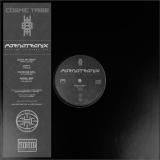
This new series is an atemporal series: Spicy Electro. Sexy vibes. Ecstatic sounds.
PORNOTRONIX brings together Dark Vektor, X-Truder, DJ Overdose and Calagad 13, turning this concept into music through machine funk, raw grooves and contemporary Electro. Four distinctive artists, four different approaches and one shared language where attitude, rhythm and underground spirit converge into a timeless Electro experience.
Planet Trip Records presents Sydney underground heroes Hugh B & Setwun’s first album, 2020’s Yeah Definitely, and its long-awaited follow-up, 2026’s Nah Maybe, as a deluxe vinyl LP package. Underpinned by the low-end heft of dub and soundsystem culture, their albums draw deeply from an expansive array of sensibilities: tones, textures and patterns shaped by post-punk and ambient music dovetail with abstract, sampledelic hip-hop drum loops. Meanwhile, Setwun’s mysterious neo-soul/modern R&B vocals glide on the beat. Punctuated by dialogue snippets, these songs feel like exploring the multiverse with an interdimensional boombox.
Yeah Definitely began as a batch of instrumentals. Having previously worked with an MPC, drum machines, instruments and Logic Audio, Hugh used a borrowed PC and Renoise, a tracker DAW associated with 21st-century jungle/drum & bass production. Afterwards, he sent them over to Setwun, who sketched vocals on top with ease.
If Yeah Definitely came together quickly, Nah Maybe was a longer process. Still inspired, Hugh B knocked out a second folder of beats with neon-lit city-pop references, slow-jam grooves, and elegant guitar figures. This time, however, something wasn’t clicking for Setwun. The only cure here would be the passage of time.
Over the next six years, Hugh and Setwun continued to collaborate while pursuing solo projects. Hugh released jungle, ambient house, dub and post-punk records through Planet Trip Records, Not Not Fun, and his OTIS Records label, while performing live, DJ, and leading the Modern Pop Ensemble. Similarly, Setwun, also a multi-instrumentalist, producer, and DJ, released a series of records that explore jazz, soul, house, and broken-beat electronica, forming a loose constellation for Mandarin Dreams and Extra Soul Perception. Alongside these efforts, he played shows and began performing with his backing band, The Soulstranauts.
Early in 2026, something clicked, and Setwun drafted vocals for the second batch of beats over an evening. Not long after, he invited Hugh to mix Nah Maybe, every bit as special as Yeah Definitely. By waiting for the right moment and putting themselves outside of their comfort zone, Hugh B and Setwun have bottled lightning twice. We’re very pleased to be able to share Yeah Definitely and Nah Maybe with you.
With a new alias, TM404, Andreas Tilliander has created enjoyable ambient dub simmering with life and details. The songs have all been recorded live, in real time in the studio. A unique way of operating within today's electronic music. - Everything is recorded in one take. Nothing is post arranged, says Andreas Tilliander, and adds that this might be his most ambitious album ever. The project's name is also a tribute to Roland, although of the more intricate kind. - When they made these machines in the eighties, they avoided the 404, since the sound for four, 'chi', is the same as the sound for death in Japanese. At that time it was therefore taboo and the 404 was never launched. Not until now, due to my album!
WRWTFWW Records is very excited to announce the first ever release for the Cyberpunk 2077: Future Sound of Night City soundtrack - atmospheric music from one of the most celebrated video games of the decade! The compilation, showcasing a who's who of Polish electronic underground, is available as a limited edition 45rpm-cut yellow vinyl 3LP in heavyweight 3-panel gatefold with a sticker sheet. The album is also available on CD with super jewel case, and in digital formats.
Dive deep into the pulsating world of Cyberpunk 2077 with an immersive soundscape perfectly capturing the gritty and neon-soaked streets of Night City. Curated by Rafa? Grobel and Wojtek Sokó? of Most Records, the epic 15-track compilation features a diverse offering of electrifying Polish beats, cohesively flowing between techno, ambient, synthwave, bass music, industrial, and IDM. Ominous, powerful, evocative, and filled with futuristic nostalgia, the music of Night City is a thrill ride in a dystopian urban landscape, heavy hearts riding through the night, menacing streets surrounded by infinite skyscrapers. The music transports you, soul-stirring, cinematic, and timeless, the most beautiful kind of escapism.
The award-winning Cyberpunk 2077 action role-playing game was developed by CD Projekt Red and published in 2020 and has since become one of the most recognized and best selling video games of all time. With a cast including Keanu Reeves and Idris Elba, unmistakable visuals, music, and atmosphere, CP77 has earned a spot in the pantheon of 2020s pop culture.
Points of interests
- For fans of video game soundtracks, ambient, techno, synthwave, vaporwave, industrial, dark electronic music, retro-futuristic moods, neon lights, Tech Noir, Keanu Reeves, bass music, All Foods, cities by night, skycrapers, urban adventures, dystopian universes.
- The soundtrack for Cyberpunk 2077: Future Sound of Night City available for the first time everrrr !
The legendary Charlemagne Palestine returns to Black Truffle with KKKAAARRREEENNNIIINNNAAA, capturing a 2025 performance in London alongside two close collaborators of recent years, multi-instrumentalist Daniel O’Sullivan and guitarist Oren Ambarchi. While perhaps still best known for the ecstatic piano clouds of his ‘strumming music’ performances, Palestine’s life-long search for what he calls the ‘golden sound’ has taken in an enormous variety of methods of sound production. Now stretching back an incredible six decades, his exploration of continuous sound forms has led him to mega-instruments from the carillon bells of the Saint Thomas Episcopal Church to the synthesizer armada of the Moog Sound Lab, with stops along the way at many of Europe’s grandest church organs. Just as important, though, has been Palestine’s practice as a singer, beginning with his childhood experience of sacred Jewish music and growing through his studies of Indian and Javanese musical traditions in the 1970s.
KKKAAARRREEENNNIIINNNAAA reimagines a key work showcasing Palestine’s voice, the haunting ‘magic song’ Karenina for falsetto singing and harmonium, recorded in Paris in March 1997 to honour the spirit of Palestine’s recently departed black labrador. In this trio version, which Palestine describes as the ‘karaoke’ version, O’Sullivan controls three cassette machines playing the original recording, their slow drift out of phase creating complex patterns of delays and ricochets as the recorded voice chants the syllables of Karenina’s name and other trance words. Beginning with a held organ tone that gradually expands to fill out the frequency spectrum, the piece soon grows into a dense psychedelic mass, as Palestine’s electric organs and the echoing pre-recorded voices are joined by Ambarchi’s swirling Leslie guitar tones and O’Sullivan’s viola, synthesizer and additional vocals. Atop it all sits Palestine’s live voice, in an extraordinary performance of keening, shamanic intensity, sometimes delivered in melodic unison with his keyboard playing.
Though clearly a work of Palestine’s design that sits squarely within his oeuvre, Ambarchi and O’Sullivan are far from simple accompanists on KKKAAARRREEENNNIIINNNAAA. As the elements of the teeming, emotionally charged stew writhe and twist, different elements come momentarily to the surface, O’Sullivan’s spaced-out viola taking the lead in moments that recall Kosugi’s Catch Wave, Ambarchi’s gliding chords and signature stuttering tones enriching the details of many of the quieter episodes. Throughout all its transformations, the music is buoyed up by a sacred aura, as Palestine intones his hypnotic prayer for the soul of his departed pet. Arriving emblazoned with a striking labrador painting by O’Sullivan on the cover, KKKAAARRREEENNNIIINNNAAA is an essential slice of modern ritual music.
DIVA AS TECHNOLOGY
Arca announces the details of her highly anticipated new studio album, XXXXX, arriving via XL Recordings. Five years after the twice GRAMMY-nominated KiCk i and subsequent KICK pentalogy, the Venezuelan-born musician, producer, vocalist, and visual artist returns with her first full-length album since concluding one of the most ambitious chapters in contemporary music.
If the KICK era expanded Arca's universe outward, XXXXX turns inward and fractures it apart. Across 16 tracks, the album excavates vastly different emotional landscapes to deliver a body of work that is darker, more aggressive, more experimental, and unwilling to settle into fixed form. Initially conceived as a mixtape before revealing itself as an album, XXXXX embraces contradiction as a core methodology. In the spirit of her previous mixtapes @@@@@ (2020)—released as a 62-minute single—and &&&&& (2013), XXXXX thrives on raw exploration and instinct. It arrives as a deliberate interruption of expectation.
“It seems playful, also mischievous, to interrupt that autopilot,” says Arca.
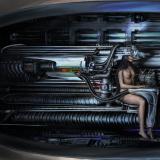
The album's striking artwork depicts Arca as a biomechanical entity, accompanied by two owls—symbols of protection and the underworld in Greek mythology. Like the music itself, the imagery inhabits a space between worlds where transformation is both terrifying and liberatory. Suspended between posthuman augmentation and raw emotion, XXXXX exposes the mainframe. It is a record born from uncertainty, contradiction, instinct, and surrender—a becoming-machine that continues Arca's lifelong project of redefining what it means to be human both in, and against, the machine.
For Arca, rebirth has never been a metaphor, but a practice. She continues to exist in multiple states simultaneously, collapsing boundaries between human and machine, high and low culture, and experimental noise and pop music. Following her first-ever painting exhibition at London’s ICA earlier this year, XXXXX arrives as the latest transmission from a continuously evolving creative process. Over the last year, Arca has remained prolific: unveiling the double-sided single "Puta" / "Sola"; remixing tracks for Addison Rae, Robyn, and Hikaru Utada; collaborating with Tokischa on “Chama”; and contributing production to Madonna’s CONFESSIONS II. She walked the runways and made appearances at major international fashion weeks, while also composing the original motion picture soundtrack for Stillz’s film, Barrio Triste.
Now, after years of transformation beneath the surface, her next musical evolution reveals itself.
POD & Edward Richards return for the third and final of their series of hand stamped vinyl with a very unique outing. In contrast to the slower tempo of the the Polar Phase and Temporal Loop Trascendance EP’s, the pair up the ante with a blend of bass music meets dub techno. With the addition of drummer Miles Henry, the sound transcends basic genre descriptions into a liminal space between live music and the repetitive machine form of electronic music. Miles contributes both acoustic kit and electronic drums to the title cut and Nautilus, and in his own words he seeks to capture the impossibility of playing like a machine. On the flip side Quadratic Illumination progressively builds, with layers of hardware synths atop a foundation of deep sub-bass, broken beat drums, and hints of electro. And to cap of proceedings there is an incredible remix by Evigt Mörker that embodies a sense of serene bliss, and is a near perfect end to not only this record, but to the series as a whole.
This November, Brownswood Recordings will release Mek Do & Mend, the debut album from self-taught producer, multi-instrumentalist, composer and artist Wonky Logic. Although his name may not yet be familiar to everyone, Wonky Logic (AKA Dwayne Kilvington) has spent the past two decades quietly becoming one of the UK's most respected musical collaborators. His career has moved comfortably between London's jazz, electronic and contemporary music scenes, performing and recording with artists including Nala Sinephro, Yussef Dayes, Nightmares On Wax, Shabaka Hutchings and Emma-Jean Thackray. Alongside his work as a producer and composer, he's been musical director for projects with Eddie Chacon, John Carroll Kirby and I.G Culture's LCSM, scored the feature documentary Zandra With A Zed, contributed music to A24's The Smashing Machine, and continues to lead music workshops with young people, refugees and people experiencing incarceration.
Far more than a collection of compositions, Mek Do & Mend is a deeply personal reflection on the people, places and experiences that have shaped Kilvington throughout his life. It's the story of growing up on a Leeds council estate, where music became both a creative outlet and a way of understanding the world. Making music often meant working with whatever was available: a second-hand keyboard, a makeshift studio desk or ageing equipment that simply had to last a little longer. The title itself came from a conversation with his mother, capturing the resourcefulness that defined his upbringing and continued into the making of the album itself, which was written and produced to a tight deadline around touring, family life and Kilvington's work as a musician and educator.
Built from material spanning more than fifteen years, Mek Do & Mend brings together some of Wonky Logic's earliest compositions alongside brand new pieces written during the making of the record itself. Childhood ideas sit alongside music conceived only months before recording, creating an album that draws together a lifetime of writing rather than documenting a single moment. Running throughout are voice notes from family members, teachers, friends, mentors and collaborators—not simply as interludes, but as a reminder that no creative life is ever self-made. Rather than telling his own story outright, Kilvington invites listeners to discover him through the people who've shaped him: an aunt remembering him playing in church as a child, lifelong friends recalling early experiments making beats together, fellow musicians from different stages of his career and his mother describing him in her own words. Together they reveal the invisible network of relationships, philosophies, communities and experiences behind the music. "The album exists somewhere between being a biography and an autobiography," says Dwayne. "The biography is in the voice notes and how other people see me. The autobiography is in the music."
That same philosophy extends to the musicians who appear on the record. Every contributor has played a meaningful role in Wonky Logic's life beyond the studio. Long-time collaborator Luke Wynter, Steam Down drummer Benji Appiah, partner Vanessa Rani, Jonathan Enser, Joe Bristow, Brother Portrait and Nubiya Imani all feature not simply because of their musicianship, but because they form part of the album's story.
Across its fourteen tracks, Mek Do & Mend moves effortlessly between dynamic jazz arrangements, pulsating broken rhythms, delicate, twinkling piano passages, interstellar synth textures and elegant brass lines. Album opener and first single 'Strange Attractor' begins with a shimmering introduction before unfolding into an exhilarating surge of rhythm and momentum. Named after the mathematical concept of the same name, it serves as the conceptual point of origin for the album. Written when Kilvington was just seventeen, the composition reflects the idea that even the most unpredictable lives are guided by hidden patterns that often only become visible with time. Second single 'A Thousand Hands' features the unmistakable vocal tones of Brother Portrait, whose cerebral lyricism drifts over a low-slung, constantly shifting groove as woozy synth lines ebb and flow overhead. At its heart, the track celebrates the family, friends, mentors and collaborators whose often unseen influence shapes who we become, echoing the album's belief that every achievement is, in some way, a collective one. LP focus track 'BAME (Beyond All Marginalised Expectations)' is a lush, spiralling composition, brimming with both emotion and resolve. Reclaiming an acronym long imposed on racialised communities in the UK, the piece transforms it into a statement of possibility rather than limitation: a defiant rejection of stereotypes and a refusal to let identity be defined by other people's expectations.
The album itself only exists because other people believed in it. Isabel Gracefield made the RAK sessions possible, Rick David brought the record together with his characteristically thoughtful mix, and Gilles Peterson committed to releasing it on Brownswood before hearing any of the music. Away from the stage, Kilvington works with the charity Finding Rhythms, writing and producing original records with people experiencing incarceration, while also leading workshops with Arts Train and Dovetail Orchestra.
Recorded live in a single day in Studio One at RAK, Mek Do & Mend was mixed by Rick David through an analogue Cadac console before being mastered by Stuart Hawkes at Metropolis. The aim wasn't nostalgia or audiophile perfection, but to create a record people could return to throughout their lives, discovering something new with each listen.
As Dwayne puts it: "I don't want this body of work to be reduced to a jazz record. It's more like a novel about life told through music."
Tony Price returns with NAME?, a new LP on his Maximum Exposure label delivering 10 tracks of red-hot house music realness.
Following two releases in 2025, the brutalist cybernetic jazz reveries of Requiem for the Ontario Science Centre and the ferocious machine funk of Street Theatre, NAME? keeps its crosshairs aimed straight at the dancefloor.
NAME? showcases Tony’s undying affinity for the sound of New York City and New Jersey house: Tony Humphries’ cybernetic gospel dubs, the crude, Todd Terry-style 12-bit hip-hop explosives, the cracking garage swing of early Strictly Rhythm, Mood II Swing and Masters At Work, the psychotic bleep-funk bombast of the Bomb Squad, and the deep, ecstatic machine soul pioneered by the likes of Blaze and the Burrell Brothers.
Produced in his Greektown studio in Toronto using an array of drum machines and samplers, these recordings are pure Tony: rude, crude and elemental. House music stripped down to its core principles and defining primordial textures. No nonsense, no junk, no varnish, no nothing. Just the funk.
The Tango N'Vectif: Sessions 2LP contains tracks from the original CD version, the 2001 2CD reissue, remixes and alternate versions of album tracks, music from the Phi*1700 u/v EP on R&S and other exclusives, selected by Mike, completely remastered from DATs by Beau Thomas. µ-Ziq's Tango N'Vectif was released in 1993, a classic year for auteurist electronic music that didn't always fit on the dancefloor. Written by Mike Paradinas in his late teens with some help from Frank Naughton, it still stands up really well today and its influence on electronic music in the decades since is obvious. Across an expanse of ideas, taking influences from early Aphex, Detroit Techno and UK Hardcore, Mike created this spirited, funky, jerry-rigged, lo-fi version of rave; with crunchy drums and a knack for melody that fell somewhere between John Barry and classic TV themes. Without owning a computer, Mike had been writing techno, house and industrial tracks on and off since 1990, playing live keys alongside drum machine rhythms on his 4-track recorder. µ-Ziq started when Mike linked up with Frank who was also writing dance-influenced music, and importantly owned an Atari 1040ST computer with Cubeat software. They pooled their equipment and Mike would travel up to Frank's house a couple of miles away in Wimbledon to record together. By 1992, and after a false start when a proposed EP for Mark Pritchard and Tom Middleton's Evolution label got shelved, Mike had started at Kingston University where he deejayed and met like-minded people including a couple of guys who knew Aphex Twin who was also a student at Kingston too, and they passed Aphex a demo of Mike's material. A few days later Mike got a message from his mum to 'call Aphex Twin' and he gave Mike some advice, and seemed interested in releasing something. So when Frank and his family went on holiday that summer Mike borrowed his Atari and synths and wrote the majority of the Tango N'Vectif album during that 2 weeks. By the end of 1992 a release with Aphex Twin and Grant Wilson Claridge's Rephlex label had been agreed - Aphex had moved to the house in Clissold Crescent where he recorded a lot of his early classic albums and Mike went over to collect his advance, in the form of his very own Atari computer.
As Shadow Pressings hits its 10th release the fledging vinyl-only label bring us five heavyweight basement jams, hand-picked from DJ Split’s own circle of friends and musical conspirators including one track from Split himself. Dusty machines creating stripped back grooves, strange frequencies, and raw, late-night club pressure. A little Chicago, a little Detroit, a little somewhere else entirely.
Revelling in adventurous, malleable synthesis and a strong melodic instinct, long-standing techno heavyweight Oscar Mulero brings his Trolley Route alias to Dekmantel. Across four rush-inducing cuts of studio exploration the Spanish veteran showcases a lighter side to his muse without sacrificing maximal dancefloor impact.
Oscar Mulero first debuted Trolley Route back in the early 00s through albums and EPs for Pure Plastic, Minuendo and others, offering a more playful strain of machine music to contrast with the steely output under his own name. Embracing dub textures and Detroit-coded synth leads, the recently-revived alias has become a haven for the looser styles that spill out of his studio. It just so happens these outliers are as crucial as any of Mulero's primary club smashers.
From the swampy chord sequence that dominates 'New Visual Order' to the meaty sub-bass and delay-soaked synth sweeps of 'Relativity Of The Vision', the whole EP is spilling over with madcap charm and a casual boss-level quality that can only come from a true legend letting their hair down.
Three Stripe Records, the original ‘Bristol Sound’ label release their first vinyl in 30 years.
Founded in 1988 by Smith & Mighty, the label was set up to release music from local talent as well as the pair’s own recordings, and in the late eighties released a string of underground hits.
The label’s first venture in ’88, a cover of Dionne Warwick’s ‘Anyone Who Had A Heart’, featured local singer Jackie Jackson alongside rappers M.C. Kelz and Krissy Kriss and stayed at the top of the indie charts for several weeks.
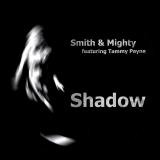
Now after a long hiatus, a new three-track 12” vinyl featuring Tammy Payne performing a cover of the ’60s Mandel & Webster classic, ‘The Shadow Of Your Smile’ is due to be released on 13th November 2026.
The vinyl’s three tracks capture different variations of breakbeat, dub and soul.
The A side is a break driven, dynamic bond-esque version with orchestral drops and rises, over a tough hiphop rhythm.
AA1 is a head nodding, rolling breakbeat affair with a digi dub style bassline, while Tammy’s vocal floats in and out on a sea of echo.
AA2 is the original mello mix with sparse beat machine style patterns and 303 bass line. Tammy’s full vocal carrying the flow in contrast to the urgent backbeat, occasionally joined by keys, guitar melodies and fx.
Each version having it’s own identity while all remaining very ’Smith & Mighty’
Pulsinger & Irl is the collaboration between Austrian producer and techno pioneer Patrick Pulsinger and Bavarian producer and sound engineer Sam Irl.
After ten years of dub-driven live explorations, Pulsinger & Irl are now focusing on a raw, uptempo, and sample-driven take on techno.
Their new album and live set is stripped to the essentials — two classic samplers, the SP-1200 and MPC2000XL, and a 16-track mixer. By pushing these machines beyond their intended boundaries, they craft a gritty and textural sound.
This is first of two 4-track EPs that will make up the entire album („AALLIIAASS“).
The duo met in 2012 at Pulsinger's Feedback Studio in Vienna, where Sam began as his assistant engineer before becoming a studio partner.
Coming from different musical backgrounds, they found common ground in experimental techno, dub, sampling culture, and analogue gear.
Since their debut album Mud (2016), they've released the EPs Function Creep/Woodpecker (2017), Exu (2018) and Retrieval (2019), along with several remixes — most recently a rework of iO's 1994 classic Claire (2024). Their music has received support from Move D, Gilles Peterson, Mr. Scruff, Lefto, among others.
They've performed at Berghain/Panorama Bar (2016–2018), Sonar Barcelona, ://about blank, Golden Pudel, Blitz, Sziget, Elevate Graz, Lighthouse Croatia, Rote Sonne, Ars Electronica Linz, Zukunft, and more.
Over the past three decades, Patrick Pulsinger has released music on his own label Cheap Records as well as R&S, M Plant, Disko B, Compost, and has produced for DJ Hell, Hercules & Love Affair, Elektro Guzzi, Fennesz and others.
Sam Irl has released music since 2007 on labels such as Freerange, Jazz & Milk, Brownswood, Pulver and Frank Music.
DiG Records’ latest release is a reissue of one of the most remarkable Russian electronic albums of the 90s. Available on vinyl for the first time, 100 Photography Lessons is the 1993 debut album by the duo Block Four, with a rich sound spanning a wide range of genres, from downtempo and experimental electronics to trance and techno.
Block Four was formed by Oleg Salkhov and Konstantin Smirnov in the early 1990s at Moscow’s SNC Studio. Salkhov was the studio’s first recording engineer, working with bands including Moralny Kodeks and Megapolis, while Smirnov came from Nikolai Kopernik, where he had already been experimenting extensively with electronic instruments.
The album is built around sampling, experimentation, and a broad range of influences. Block Four drew sounds from jazz, classical music, rock, hip-hop, folk and electronic music, as well as films, VHS tapes, and radio broadcasts, gradually assembling their own extensive library of samples and loops. Combined with synthesizers, samplers, drum machines, unconventional rhythms, and harmonic ideas, the duo brought all these elements together to create their own distinctive sound.
100 Photography Lessons captures a brief but important period when Russian electronic music was still developing its own language. Freely blending sampling, electronic instruments, and influences from a wide range of musical traditions, Block Four created an album that still sounds compelling more than three decades later.
Disco Collected celebrates the dance music which originally developed from R&B, soul, and funk from the late 60s and 70s and turned into a mighty subculture in discotheques, with Studio 54, Manhattan, New York as one of the most famous and extravagant discos all over the world. Disco used a steady four to the floor beat, string sections, horns which created a perfect setting for DJs who mixed their special 12 inches to an eager dance crowd.
Movies like Saturday Night Fever and Thank God It’s Friday contributed to disco’s mainstream popularity. Compiled on Disco Collected are some of the best, well-known and great disco hits by Rose Royce, Chic, Kool & The Gang, The Trammps, Thelma Houston, KC & The Sunshine Band and 16 more guaranteed floor fillers.
The 2LP Disco Collected is available as a limited edition on disco ball silver vinyl and includes an insert.
A single track, four hands. Damage Music puts Alexander Kowalskis "Sinee" through the machine and lets three producers find their own way in. The original stands. The remixes do what good remixes should, not explain, but reinterpret. SMBR, Sven Köhne and GZI each bring a different angle to the same raw material, keeping the record tense and coherent from first groove to last.
In the seclusion of a house in the Bavarian Forest, something unfolded that felt less like a conventional album production and more like an internal process of condensation. This house wasn’t a studio - it was a retreat. Its 1960s-inspired interiors, creaking wooden stairs, and crackling fireplace shaped the sound of Carl Gari as much as the instruments themselves. Though the house no longer exists, its atmosphere remains present in the recordings.
The music of Carl Gari - Jonas Yamer, Till Funke, and Jonas Friedlich - resists easy categorization, a trait that continues on this monumental new album. From the friction between electronic music and guitar textures, the trio forges a distinctive, idiosyncratic sound. Distorted electric guitars and pulsating basslines intertwine with analog drum machines, tape delays, and intricate effect chains, creating music that is raw, organic, and psychedelic. A new element on the album is the trio’s first use of vocals: Jonas Yamer, usually on bass, raises his voice in a punk-tinged, invented language that hints rather than narrates, unsettling more than it explains.
The guest artists do not merely decorate the sound - they alter its very structure at critical points. Polygonia contributes layered vocals that mesh seamlessly with the album’s technoid architecture. Will Brooks of Dälek delivers a dark rap feature on ‘Poison Shyness (Anti-Social)’, his words carving the sonic space with precision. Coby Sey adds introspective vocals that hover between experimentation and restraint on ‘Inner Link’. New York rap pioneer Sensational introduces a deliberately rough, individual counterpoint on ‘Disco Lights’, while the German percussionist Simon Popp drives the album forward with an uncompromising drum performance that insists rather than accompanies on ‘Zeitesser’.
The cover photographs, taken by Jonas Yamer, project images of corridors onto paintings located in the now demolished house where the album was recorded. Visually, this reflects a key motif of the album: spaces exist only as overlays and echoes - not mystical ghosts, but traces of a place that has physically vanished.
Recorded between 2016-2024 in Neunburg vorm Wald and Munich. With kind support by Kulturreferat der Landeshauptstadt München.
Mixed by Johannes Wagner aka J.Manuel at Apollo Studio, Berlin (A1, D1 w/ Fadi Mohem). Mastered & cut by Stefan Betke at Scape Mastering.
Photography by Jonas Yamer. Packaging design by Sepehr Mokhtarzadeh.
Greer delivers a hyper textural masterclass in experimental sound design through their debut album, 'Seven Wise Dogs Bless You With Their Kindness'. Originally hailing from Meanjin, a scene known for outstanding musical output and consistently interesting variety, Greer has brought this spirit into Naarm's musical landscape with careful consideration and style. Organic entities meet machine rumbles, from tense drone hums to easing ambient soundscapes. Greer navigates these territories in a way that feels uncharted and perfectly at home with Oomycota.