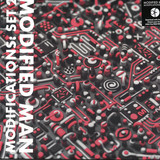
Kingswood Drive and Accidental Return were an early teaser of this new set, due in April. Displaying their signature analogue sounds and arpeggios, alongside broken beats and soul, you wouldn't be alone in hearing the influences of Dam Funk, Herbie Hancock or Bugz In The Attic coming through on these two.
Elsewhere more jittery, playful rhythms underpin Croydon Rooftop Café Culture. As well as in the calming and ethereal Prints On The Heath, a subtle tribute to mutual hero Prince, who passed away on the unusually prolific day this and two other, currently unreleased, tracks were written and recorded.Throughout the EP the duo nod at their London home from the "Heath" to Kingswood Drive and more obviously Croydon itself. The sound of South London is threaded throughout this record with pride.
Even down to the mechanical sunset sound of EP finale Thorns, capturing some of the essence of the studio view over London from their high point on the hill in Thornton Heath.
The first EP from Albert's Favourites co-founders and synth-production duo Modified Man focused on throwing out heavy editing, recording music with as few processes as possible and grabbing performances as single takes. Blending warped cassette recordings that touched upon early jazz-funk/brit-funk influences with the energy of broken beat and experimental electronica, won them support from Patrick Forge, Osunlade, Thris Tian, Yam Who and Titeknots to name a few.
Since that release they premiered new track Thorns live on Boiler Room, going on to deliver a full, three-hour live performance and DJ set for the infamous global community.They also provided remixes for Dele Sosimi, Amp Fiddler, Makadem & Behr and Hector Plimmer, meanwhile, busily preparing a series of four, six-track vinyl EPs which will be released over the next 18 months.
- Latest ambient work from Fred Welton Warmsley III, formely known as Lee Bannon (hip hop producer and collaborator with Joey Bada$$, Souls Of Mischief, Hieroglyphics, and others)
- Former albums on labels such as Hospital Productions, Ninja Tune, NON
- Has received praise from Pitchfork, NPR, Boomkat
- Northern California electronic producer Fred Welton Warmsley III's solo work as Dedekind Cut
(pronounced dead-da-ken cut') has evolved from fractured industrial design into increasingly subdued and sublime ambient meditations across two years of dedicated activity. His second full-length collection, Tahoe—so named after the mountain lake town he now calls home—swells with widescreen grandeur, evoking vistas both inner and outer. There are echoes of his earlier, more tempestuous mode in tracks like MMXIX' and Spiral' but overall the album skews panoramic and pensive, muted synthetic mists contoured with choral melody, field recordings, and radiant drone. His compositional instincts feel alternately classical, contemporary, and conflicted, befitting an artist whose discography spans labels as divergent as Hospital Productions, Ninja Tune, and NON.
- Warmsley characterizes Tahoe as a time peace,' sifting through the past, the present, future, and fantasy.' Recorded primarily in New York, with additional sessions sourced from Berlin, Cambridge, and Placer County, California.
out of Stock
Last delivered 7 months ago available to reorder, subject to availability
Belgium-based Composer Christina Vantzou's Fourth Full-length For Kranky Ventures Further Into The Uniquely Elusive And Evocative Mode Of Ambient Classical Minimalism Which Has Become Her Signature: A Fragile Synthesis Of Contemplative Drift, Heady Silences, And Muted Dissonance. In Regards To The New Album She Speaks Of Focusing Particular Attention On The Effects Of The Recordings On The Body, And Of 'directing Sound Perception Into An Inner Space.'
No. 4 Took Shape Across Roughly Two Years, Incorporating A Diverse Array Of Musical And Conceptual Collaborators, Including Fellow Kranky Artists Steve Hauschildt And John Also Bennett (of Forma) As Well As Angel Deradoorian (ex-dirty Projectors), Clarice Jensen, Beatrijs De Klerck, And Members Of Belgium's Echo Collective. During The Creation Process Vantzou Wanted To 'blur Lines Of Hierarchy,' And Thus Allowed All Ensemble Members And Technical Assistants To Add Or Delete Elements. Despite Such A Spectrum Of Input The Eleven Tracks Feel Distinctly Cohesive, Weaving Elegant Textures And Resonant Open Spaces Within A Twilit Landscape Of Eclectic Instrumentation: Piano, Harp, Vibraphone, Voice, Strings, Marimba, Synthesizers, Gong, And Bells.
Vantzou Describes The Recording Process As One Of Prepared Spontaneity: That Is, 'having Plenty Of Ideas Ready To Explore Going Into The Session, But With Enough Time To Depart From Those Ideas And See What Happens.' This Mindset Of Premeditated Exploration Informs The Album's Emotive Textural Intuition, With Hushed Drones And Delicate Gestures Eliding In The Periphery Of The Mix. She Cites Sleep And 'the Loosening Of Time' As Two Formative Practices In Her Private And Professional Life, Which Manifests In The Quietly Hallucinatory Properties Of Vantzou's Music. No. 4 Feels Both Endless And Ephemeral, Immersive And Immaterial. It's A Music Of Horizon Lines And Half-light, Mapped With Feeling And Foresight.
Recorded In New York City And Brussels. Mixed In Berlin.
A Portion Of This Work Was Funded By A Generous Grant From The Flemish Community In Belgium.
Tinfoil is the project of DeFeKT and Sunil Sharpe. Initially forged as a studio collaboration in 2014 (and later as a live show), the pair have since racked up an impressive catalogue of 12s on their own self-titled label. Tinfoil's sound is unique in today's scene, reflecting the versatility of both artists, plus a combined know-how of techno and electro. Their music comes primarily from live studio jams, enforced by a desire to get quickly to the point in what they do. This is no surprise given the fast, technical way in which they each perform solo.
For their debut album, Tinfoil provide a varied but cohesive collection of tracks. Following the intro's epic synth blasts, they open with a bang through 'Caravan Life' - a sinister, bassline-driven destroyer that builds and builds over a blend of claps, filter zaps and crying feedback. 'Beads' continues in a heads-down vein, this time with a more musical EBM type bass and knocking rimshots that mark the first appearance of Sunil's role-playing, haunting lead vocals.
'Friendly Safe Fumes' marries playful bass notes to a singing lead line, as fizzling closed hats and busy claps whip things into a frenzy. Next enter the otherworldly mutant electro of 'Meadow Pulse', signaling a well-timed lull in mood to explore a silkier side to Tinfoil's production. 'Every Saturday Night' starts with a taxi conversation about horses and carbolic soap in bygone Dublin days, before launching into a volley of clattering beats and hip-shaking FM sequences.
'Multi-DOMINATION' retains some of the FM wonk and treads a broken-beated path, featuring vocals this time akin to a ritualistic chant or perhaps the murmurings of a possessed baby. 'Both Roads To Triogue' meanwhile, brings us to a short intersection, splicing odd voices with a dense tribal rhythm. 'The Wolves Of Hellfire' is Tinfoil in more minimal dancefloor mode, as drones filter in and out under a resonating bass that detonates at all the right times.
Closing with 'Resting Point', the climax becomes deadly. The beats are stepped and the bass boisterous, while pained screams become quickly uncontrolled, setting up for a crescendo of roughneck rhythms, ricocheting kicks and turbulent modular wails.
Tinfoil have been on a roll since the beginning but maybe 'On A Roll' emphasizes this a little bit more now.
Over the past few years orchestral instrumental music from outside the classical establishment has become huge, and Neil Leiter and Margaret Hermant of the Belgian Echo Collective have witnessed the evolution and extraordinary rise of this movement right up close. They've worked with some of the most important players, including Stars Of The Lid, Dustin O'Halloran and Adam Wiltze's A Winged Victory For The Sullen and O'Halloran's solo projects, as well as Jóhann Jóhannsson. And though the Echo Collective members themselves very much do come from within the classical music establishment, they don't care which side of the fence they are seen to be on. It was this which grabbed the attention of German music hub !K7's new sub-label 7K! - who have signed them for a two album deal: first to release the Amnesiac reinterpretation, then for a record of Echo Collective's own compositions. Not only that but they have been signed for publishing by Mutesong, which led to a hook-up with Mute mainstays Erasure, re-arranging and re-recording their latest album World Be Gone with classical instrumentation backing Andy Bell's vocals. This ability to flow easily from black metal to Radiohead, from Erasure to Stars Of The Lid shows exactly what kind of musicians Echo Collective are. The album, which features artwork by the renowned photographer and artist Roger Ballen, will be released on 30 March on CD, 2LP and digital platforms.
- New album by belgian band Echo Collective covering Radiohead's classic Amnesiac'.
- Perfect balance between classical, neoclassical & indie.
- Past and ongoing collaborations include Erasure, A Winged Victory for the Sullen, Stars of the Lid, Johann Johannsson and Dustin O'Halloran.
- Echo Collective have produced, arranged and performed on Erasure's upcoming album due to release early March on Mute.
- Artwork by renowned photographer / artist Roger Balle.
Having recently relocated to the remote redwood forests of Northern California in order to set up a satellite mixing studio for his old stomping ground, Glasgow's Green Door Studio, Sordid Sound System returns to Invisible Inc with 4 cuts of Psychedelic Dungeon Disco.
The EP opens with his most blissed out track to date 'Die Ewige Nacht', an eight and a half minute inverted sun ritual based around shimmering cascades of dubbed up electronic percussion and an overdriven tintinnabulated FM arp.
Hi-NRG meets 80s B-Boy electro on 'Crescent City' with a careering off-road excursion into tripped out mutant carnival cavalcade territory.
Dia De Muertos's offbeat eerie percussion and driving low frequencies are met with spectral buzzing melodic refrains from the furthermost reaches of a decaying Oaxacan cemetery.
The acid drenched ambient lullaby 'You & Me' brings proceedings to a fittingly fucked up close.
Sordid Sound System's last release on Invisible Inc, 2017's 'Fear Eats The Soul', received plays and praise from the likes of Manfredas, Trevor Jackson, Sascha Funke, Optimo's JD Twitch and Thomas Von Party.
Toby Tobias has a lengthy history of disturbing the peace. This is his second offering for the ESP Institute. On side A, Second Stimulus stirs shimmering staccato chords, roaming pipes and detuned robotic sighs into quite the disorienting stew—the loose arrangement remaining fragmented over 9 minutes of touch-and-go 808 programming, picking up a pseudo bassline assembled from sub toms, introducing a gritty break loop and eventually blissing out into oblivion. With side B's Synchro Surfer, Toby plays with the notion of suspense by gently teasing a muted kick and percussion rhythm under washes of white noise, bleeps and sirens that are tape-dubbed and which, over time, begin a dialogue with each other, as if the machines have declared mutiny on the garage. Toby continues to stretch his limits with his output for the ESP Institute, possibly headed toward a full-fledged devolution of conventional dance music. These two songs may have you arrested for public nuisance.
Das norwegische, in Berlin lebende Electro-Pop-Duo Soft As Snow, bestehend aus Oda Egjar Starheim und Oystein Monsen, präsentiert mit "Deep Wave" auf Houndstooth sein Debütalbum, co-produziert von WIFE (Tri Angle Records). Die 13 Tracks bestechen durch einen frischen, originären und innovativen Leftfield-Pop, inspiriert von Cabaret Voltaire, Throbbing Gristle, Detroit Techno, 1990er IDM, Fever Ray, Cold-Wave und den 1980er "Mutazione" Compilations.
Das erste Album von Chris Carter seit 17 Jahren! Als Gründungsmitglied von Throbbing Gristle - gemeinsam mit Cosey Fanni Tutti, Peter 'Sleazy' Christopherson und Genesis Breyer P-Orridge -, spielte Chris Carter eine signifikante Rolle in der Entstehung elektronischer Musik, eine Reise, die Carter als Teil von Chris & Cosey und Carter Tutti respektive Carter Tutti Void und in seinen Soloarbeiten bis heute fortsetzt. Die Verknüpfung von traditioneller Musik und Elektronik sind jene Momente, die die Musik von CCCL Volume 1 an das Schaffen von Throbbing Gristle rückbinden.
Since composer Sean McBride unveiled his first utterance as Martial Canterel almost 2 decades ago, he has produced a body of work both substantial and alluring within the field of live analogue electronic music. Effortlessly fusing a variety of styles and influences, Martial Canterel is one of the premiere outfits utilizing analogue electronics and modular synthesizers. In particular FM synthesis is employed to produce clustered polyphonies and organic atmospheres - a staple of his signature style.Three years have passed since Martial Canterel's last full length album Gyors, Lassù was released on Dais Records. During this down time, McBride found himself in a state of flux, ebbing back and forth between material displacement and musical aestheticism. His expert pedigree in electronic sound and arrangement bridges the gap created by an undecidability between life at home and abroad - his new album, Lost At Sea, is an attempt for the artist to locate common ground, mutating fable with reality, exteriority and interiority.
The album's introductory track, Giving Up, has all of the hallmarks that Martial Canterel has utilized in the past...melodic chorus, upbeat rhythm and classic sequential dynamism. Where the song diverges is in its core theme of nature: nature's return to a period of restoration after the failures and recklessness of humankind. Although this first glance refamiliarizes one with the tight, upbeat appeal typically found within the genre, Lost at Sea quickly takes a more serious and sobering tone.The slower pace of songs like Scampia and Puszta yearn for McBride's complex love affair with far flung destinations. Re-evaluating the political strife and social unrest in these historical locations, McBride delves deeper into political and geological reference points creating symbolic representations using mechanized percussion, white noise and various sine waves.The conceptual nature of Lost at Sea reaches even deeper depths within the waveforms of Astralize, a track based upon academic Donna Haraway's pre-civilized theories of human neglect after the 'azstralization'.
* From the pumping heart of The Magnetic System comes the 'dirtiest' Da-Da-dancefloor anti-jams with this lost 1979 blueprint of Italian conceptual cosmic disco played by the cream of the Goblin studio band. Ultra-rare and unscrubbed,Finders Keepers finally snip the trip from the cash machine to the trash machine.
* Carving its own grubby niche as an early prototype of cosmic disco cum Italo space funk whilst simultaneously harbouring Dada hat stand satire with a junkshop glam aesthetic, this ecological illogical poplitical crab cabaret clearly broke the mould before way before the jelly had set.
* Fans of 'other' obtuse outernational agit-camp might find a fantasy fusion between France's JP Massiera and Sweden's enviroMENTAL marvel Kaptain Zoom while trying to unravel the Madfilth tangle - but rest assured there were method men behind this madness and a portal to Italian funk royalty still festers
at the bottom of the psych rap scrapheap.
* Originally drip-fed out of Cesare Andrea Bixio's Cinevox stable as one of a tight grip of non-soundtrack LPs, made to test the label's commercial potential, Madfilth would follow the band Goblin (and their non-cinematic Roller) as well as the hens' teeth eponymous long player by the group The Motowns in what was perhaps the last-ditch attempt at custom built popsploitation - combining the skills of overqualified composers with undercooked conceptual mind belches. Naturally, after almost 40 years in the barrel, this micro-brewed oddity finally quenches the acquired taste of a new breed of shambolic psychotropic guzzlers proving that 1979 was obviously good year for fool's gold. The Madfilth medicine has finally come to cure your psychic ills so open wide and don't bite the spoon.
* It is beneath the flamboyant rhythm rants and vari-speed osric slop of alt-comedic sarcy-satirist Alberto Macaro (a genetic beneficiary of a vaudevillian comic bloodline) that we find The Magnetic System maestros Franco Bixio and Vince Tempera as the sonic driving force behind this unmarked treasure trove of
B-musical diamanté discoids. It will also come as little surprise that
Cinevox/Dario Argento favourites Goblin were not too distant from the whiff of this curate's egg with the men who many consider to be the group's greatest assets - bass player Fabio Pignatelli alongside sports rock drummer Agostino Marangolo. It was this unison that remained consistent throughout Goblin's career, weathering the temporary departure of Claudio Simonetti and
maintaining the stylistic heartbeat of the group. Madfilth's inclusion of Goblin synth Maverick Maurizio Guarini and the band's mid-period guitarist Carlo Penessi (founder of the band Etna) pinpoints the jobbing Goblin session group during the time they recorded the soundtracks for the films 'Buio Amiga' and 'Squadra Antigagsters'. This lesser-celebrated late 70s era also witnessed the mutating Goblin rhythm section providing discoid backbeats for records such as Giorgio Farina's 'Discocross' album, Simonetti's own Capricorn alter-ego and the homoerotic nightclub spin-off Easy Going - all of which, alongside Madfilth,
provide a strong mutual stylistic support system for their claim to cosmic disco's deep red bloodline.
Alien Ensemble's trombone man Mathias Goetz caused quite a splash when he released his eponymous debut LP under his Le Millipede moniker back in 2015: The multi-instrumentalist's initial offering was clearly something else, impossible to grasp, a musical vessel beyond genre, beyond style or era, seemingly beyond space and time even, a vessel that carried an almost cosmic kind of song-craft - music with no fixed stamp of origin, though it did somehow feel like an Alien Transistor release. Followed by remix album Mirror Mirror, which comprised reworks by 1115, Protein, LeRoy, Olaf Opal, and Saroos, to name a few, it's now time for album #2: The Sun Has No Money.Let's face it: There's nothing as majestic as the sun. At least not in our world. If it runs out of juice one day, it's game over: The End. Light's out. For everyone. At that point, it wouldn't even matter if you're rich or poor. We're all equal under the sun. Same level. And yeah, this might not be major news, but then again... we're talking about the sun. The sun! Guess it's about time to acknowledge its power and superiority, right In fact, you can feel it on your bicycle: pedaling at night, when it's on duty in other hemispheres, and you're working hard at the dynamo, sweating, you can actually feel how powerful it is. In the end you get off the bike all recharged, a tune on your lips - and somehow feeling like a miniature version of the sun yourself. And whenever you feel like that, that's exactly the right moment to grab a melodica and get to work.Following an initial warm-up round sans electricity, this new album soon begins to glow: Mathias Goetz aka Le Millipede doesn't need pedals, he boosts circulation by single-handedly* playing tons and tons of different instruments - it actually feels like thousands, easily. And thus begins a show that has countless levels to it: There are various sonic illusions... and yet Le Millipede doesn't hide anything: He's also willing to show the inner workings, the actual recording process and everything else. In short: he goes meta. Makes songs about making songs. That's right: why not use all these beautiful means to address the issue of money It's not the sun that casts shadows, all it does is recharge, fuel: growth & thriving, that's the sun's area of responsibility. And yet there came a man whose plan was simple: steal the fruit from your garden, only to sell it right back to you, for money. We can hear the sea gulls crying in the distance, as somebody is throwing breadcrumbs up into the wind that carries their voices...It's not the sun that casts shadows - all it does is radiate light. And yet there came a time when someone blocked those rays of light. Now if you're some kind of Diogenes, you'll simply say, Move at least a little out of the sun.' But if you're a teacher, you'll maybe light up your pipe and use that to lighten up. What matters is that the percussion parts, in this case, resemble some serious musique concréte. The sun doesn't know shadows - all it knows, is itself. And yet somebody entered the picture and built an entire city. A city full of streets, so that houses can cast shadows into these avenues. Plus, there's music in the streets, music originally written inside the walls of said houses.One of those streets is known as the Tin Pan Alley: a place that got its name from a music writer who compared the sound of so many pianos to the banging of tin pans. That sound: that's one side of the road that is this album. Some of these melodies appear to be shadows of earlier tunes, dating back to, say, 1898 or even before that, melodies that were first registered in the Tin Pan Alley publishers' offices back in 1912 or 1917. We actually get to see this Alley at that point in time. We see the ropes, the workings. How things come together, the actual act of creation. Suddenly, we can hear the shadows!
Okay, so one side of this street is America. The US of A. The opposite side: Russia. And smack dab in the middle: Europe. A pothole in the center. All the back-and-forth that occurs between these two poles ultimately depends on the movement of the sun. Night and day, taking turns, commuting in and out of sight. We get to meet Prokofiew's and Scriabin's ghost, among other spirits, reframed and published by Le Millipede's own imaginary label imprint on the historic Tin Pan Alley. Indeed there are moments on this album when Le Millipede seems to be playing Scriabin's clavier a` lumie`res (tastiera per luce), when his performance seems to be based on synesthesia, a wild cross-pollination of colors and sounds. In case you didn't know this: In the States, Prokofiew goes by the name Brian Wilson, and Scriabin's also known as Sun Ra - yet another guy who's usually broke, but gets to spend a lot of time out in the sun. Together, these assorted protagonists ask the people of the Antilles for Mutabor dance-tokens and send postcards to Moondog in Germany, right back into the darkness. On the postcards you can see people dancing the Biguine...Firing foreign fossil fuels from all pipes (Brennelementsteuer!), Le Millipede controls the very center of this hustle and bustle: going as far as to employ some southern Chopped & Screwed styles, he's 100% current and zeitgeisty! Houston, we've got a problem: there's some kind of myriapod, centi- or millipede on the loose! Well, give me another sip of lean, sizzurp, dirty Sprite, and on goes the journey in the Pullman coach. Let's follow the sun! Keep on moving, keep things motorik! Here comes the Trans-Eureka-Express. Cherish the backpacking days! A piercing rhapsody of sound (bohrende Rhapsodie), we'll remember them fondly! And thus things move on, the sun, the days, the earth: rise, set, action, round and round... onwards eternally. The sun: the biggest loop known to mankind. As if it was some kind of sonic Rube Goldberg contraption, time seems to be stretching out while listening to that hmmm. After all: time is a lot (a lot!) more than just money. And yeah, the sun is the real big shot on (or rather: above) Planet Earth. Le Millipede's live line-up also includes Markus & Micha Acher (The Notwist etc.), Nico Sierig (Joasihno), and Manuela Rzytki (G. Rag & die Landlergschwister, Kamerakino etc.).
*sole exception: Evi Keglmaier (Zwirbeldirn, Hochzeitskapelle) plays the viola. Words/sun worship: Pico Be
Mit "NOMC15" erscheint nun eine Art Deluxe Album des letzten Studioalbums "Music Complete" von New Order als Live-Version. Zum VÖ des Albums spielte die Band aus Manchester zwei Shows in der Brixton Academy London. Eine wahrlich großartige Live-Aufnahme eines der beiden ausverkauften Konzerte erscheint nun als Doppel-CD und 3-fach LP auf MUTE!
Wicked 4 tracker of
.
Old Shady Grady & The Neighbourhood Character (OSGATNC for short) is the result of a chance meeting in Berlin the fall of 2013 between Eric Douglas Porter a.k.a. Afrikan Sciences, one of the most expansive and intensive musical torch bearers of modern experimental electronics and jazz, and Ari Robey-Lawrence, producer, vocalist, and DJ a.k.a. The Neighborhood Character, who began as a jazz guitarist and drummer. They quickly found a mutual bond and a musical partnership emerged soon thereafter, and debuted on Uzuri's The Wilderness Sessions with their EP, Tales from Caturday'.
Via their collaboration, Porter and Robey-Lawrence explore the intersections of diverse musical and emotional territories through improvisational, long format jam sessions-- experimenting both with a wide range of sampled sounds and expressive original vocals, sustained by pronounced, yet fluid rhythmic backbones.
Jordan GCZ says: I walked into their sound check at freerotation festival last year and was blown away. I feel privileged to be a part of putting this music out there'
Mouse on Mars is recognised as one of Germany's most defning and versatile electronic music projects. With their
anarchic mixture of sound that oscillates between uncontrollable chaos and meticulously arranged structures,
Jan St. Werner and Andi Toma have forged a unique musical language, which is readily decomposed by the
unpredictability of its myriad mutations. Free from schools of thought, genre conventions, and from the constraints
of the music establishment, they have worked under the Mouse on Mars alias for 24 years, mapping their own
idiosyncratic trajectory through a no man's land between pop, art, club music, and the avant-garde. - Jan Rohlf
Idiology takes the acoustic experiments of Niun Niggung even further, and it's this combination of electronic
and 'traditional' music -- melding keyboards and synthesizers with french horns and guitars and trumpets into a
seamless whole -- that points the way through the dead-ends of most electronica.'
- PopMatters
Andi Toma and Jan St. Werner continue to create soundscapes that blur the line between programming and live
musicianship, and sometimes between Earth and outer space.' - The A.V. Club
On April 13th Mouse on Mars will release Dimensional People,
their brand new studio album on Thrill Jockey.
The album features Werner and Toma joined by a number of
prolifc guests: Justin Vernon (Bon Iver), Zach Condon (Beirut),
Spank Rock, Aaron and Bryce Dessner (The National), Swamp
Dogg, Eric D. Clarke, Lisa Hannigan, Amanda Blank, Sam
Amidon, Ensemble Musikfabrik, and about 20 more musical
collaborators.
After a series of notorious dance oor releases, Dimensional
People reveals them working deep within their own vernacular,
digging into fertile terrain of their inexhaustible vault of digital
and acoustic experimentation, and charismatically making
elemental components new again. This album makes clear how
their craft is of discovery, of fnding new contexts for places,
sounds, memories, sensations, ambiences, technologies,
relationships, and of course, people.
Paper Recordings' Ben Davis takes off his Flash Atkins cape and mask to launch a new project exploring things left of centre and balearic.
In these disposable times, Stubb will celebrate community and DIY with a limited run of 300 vinyl screen-printed kraft card sleeves of commissioned illustrations by artist Rachel Johns plus hand-drawn labels by Hebden Bridge's The Egg Factory.
We Are Launching is a journey in to psychedelic balearia with one of the most exciting artists of recent years, Jane Weaver
Her Mercury Music Prize long-listed album 'Modern Kosmology' was described by The Guardian as "a lean and thrillingly addictive slice of unearthly pop".
The Stubb collaboration is a sublime head trip to the deep reaches of space and electronica with hallucinatory guitars, burbling synths and arpeggiators that are beautifully set off by Jane's ethereal vocals.
Mike Lindsay is founder and producer of folktronica pioneers Tunng and his distinctive tones sing the praises of doing nothing on Boring Days, which is psychedelic leftfield pop at its finest.
The track is locked down by a nagging fifth bass with vocal pops, hand claps, muted afro guitar, washed synths and arps that build before the choruses hit in a wave of analogue keyboards and fuzz guitar.
After that, a gloriously stretched outro takes you straight to the mediterranean. There's also an edited instrumental that brings out the sunshine...
Hopeton Brown, better known as Scientist, has been a pioneering figure in the world of dub for nearly 40 years. His early love of electronics proved fruitful when (still a teenager) he was hired at King Tubby's studio in Kingston. Brown quickly ascended the ranks and became heir to Tubby's throne, producing imaginative and technically impressive mixes that solidified his forward-looking nickname.
Introducing Scientist - The Best Dub Album In The World, his 1980 debut LP, lives up to its boastful title. Recorded with Sly & Robbie at Channel One Studio and mixed at King Tubby's, the album features hypnotic basslines, reverb-drenched keyboards, and fluid, start-stop rhythms. Opening track "Steppers," with its well-balanced phrasing and organic contours, shows Scientist's mastery of the studio-as-instrument concept. On "Scientific," the effects-laden guitars are stretched to their outer limit to create magnificent, spaced-out textures and muted tension. Introducing Scientist displays the talents of a man obsessed with every element of production, drawing out the very best of the dub form.
Mutant jungle forms, hazy glitch experiments and trance inducing downtempo collide with sharp percussion and dense low end on this latest Alter 12'. Helm's recent 'World In Action' EP for The Trilogy Tapes is reworked by a whole host of favourites including Laurel Halo and Parris who offer up two distinctly different takes on 'Blue Scene'. No Symbols boss Beneath turns his hand to title track 'World in Action' with that typically murky, deconstructed club aesthetic whilst Parisian mainstay Low Jack gets deep on the A2, his five and a half minute version of 'Candy' sounding like a cross between Nuno Canavarro and Whitehouse. Delivering what might well be the records most subdued moment, Brussels' Sky H1 slows 'After Dark' way way down with some barely there auto-tuned vocals helping to bring things into the fold.'
Syncopated percussion and murky atmospherics form the basis of 'Mutual Romance' before Dicicco introduces an ominous melody to generate the duskiest track on the package. 'Virgo Love Affair' then meanders forward with tight kicks and a hypnotising chord sequence before making way for the deep and scintillating 'Filling Pieces'. Concluding the release, 'How We Live' combines organic drums with sweeping effects whilst distorted keys operate throughout.
Unhuman, founder of Liber Null Berlin, presents 3 twisted cuts of Proto-EBM turbulence with acidic peak, enhanced by a 'seek&destroy' remix from the inimitable Charles Manier. The EP closes with a grotesque Synth-Punk track by Aktion Mutante, the upcoming project of Unhuman himself and Violet Poison.
This 12' begins with Collocutor ripping into Miles Davis' 'Black Satin', from the benchmark On The Corner LP, and owning it from the off. A respectful homage is paid to the original with sensational improvised parts being added with a hip groove from the percussive wonders of Magnus Mehta (Magnus P.I.), Maurizio Ravalico and bassist Suman Joshi. The sparks fly as guitarist Marco Piccioni channels the spirits of late '60s psychedelic fires. The melodic riff of Miles' classic is stripped down by Simon 'Shwaa' Finch and Mike Lesirge who subtly encapsulate the original's atmosphere.
The A-side is completed with the label's latest signing, DJ Khalab delivering a sharp, warped assault on Collocutor's 'The Search', just in time for the LP's repress.
On the flip is a live version of 'The Search' recorded during the 'Live at the Fish Factory' Session in 2016 which, have so far resulted in two collector's edition dubplates that are as rare as hen's teeth. The invigorated far out sound has been mixed on this recording by producer Sam Jones who has entrenched himself with the On the Corner approach and brought his 'Sam Jones Construct' vision to the label. Marco Piccioni sold his soul at a highway crossroads on the way to the recording. There are spirits riding on the backs of the ensemble guiding this version of 'The Search' out into cosmic oceans.
The 12' ends with bassist Ruth Goller (Melt Yourself Down, Let Spin, Gufo and Bug Prentice) stewarding her virtuosic groove sensibilities into the twilight zone with this brooding off -kilter abstraction of 'Everywhere'. The stripped backbones of the tracks rhythm are punctuated by a dialogue and mantra summoned by Goller that moves menacingly over a synth bass augmented b-line.
As label founder Pete OntheCorner describes the release: 'This EP ushers in a string of releases that embody the label's vision. The futuristic concept first realised by Miles Davis with On The Corner and more generally during his electric period is at the heart of our collaborative, genre-less burning chalice. Analogue genius being mutated with a charge into something other, a vanishing point of ethereal musical feeling where the space for fresh narratives can be formed beyond genre and out On the Corner.
Victoria's artwork is always stunning and for this series of works she has already conquered the sublime with the sleeve for Black Satin".
* Fully embracing its penchant for explorative music, DAC Records invites Alex Augier.
* His work offers a cross-cutting musical perspective, allowing hybrid aesthetics that includes sound and visual components. These components interact within the stage area, taking the form of singular audiovisual performances.
* This time, Germination, his first solo EP, is purely musical work composed of organic, visceral, living sounds, both fragile and mighty. The electronic music is free of constraints imposed by the dedicated instruments. Embodied by large dynamic ranges and a constantly moving temporality, Germination tells an evolving process, in full bloom, with its share of mutations and strange directions.
* Germination is composed of four tracks, including one remix by Roly Porter. In the same vein as Alex Augier, the co-founder of Subtext Recordings explores the experimental music boundaries, both electronically and instrumentally
*The No Man Is An Island EP is a single cut from the debut album of the same name by Aalko, a new project by Kebko Music founder Akiko Kiyama. Renowned for her minimal techno track featured in Richie Hawtin's seminal DE9 Transitions album, the Japanese producer reveals her another side under this new alias. The project has already created a stir as Aalko has garnered support from Gilles Peterson on his BBC 6 Music radio show and premiered a live performance at MUTEK's Tokyo launch, where she drew the audience into an inspiring frenzy.
Aalko is a culmination of Kiyama's recent practices in a wider musical spectrum that go beyond the confines of her minimalistic techno characteristics. It conjures her distinctive soundscape where a variety of styles coexists: she demonstrates her knack for breaks, ambient and irregular time signatures, her acute ears for unadulterated tone and texture of sounds standing out in sharp relief.
Taking a floor-oriented side out of the No Man Is An Island cassette album, this single cut features three tracks that work wonders in a DJ context. "Body & Soul" is an erratic rhythm experiment jumping between several beat styles. "Mixture" offers Kiyama's unique interpretation on syncopated dynamics of breaks. Wrapping up the EP is 'B.I.C', a long-awaited exclusive track that ranked among Gilles Peterson's top 20 tracks of 2017. Its dubby functionality makes it a powerful tool that can work at various stages of the night.
These tracks give the nod to Kiyama's peculiar self full of sonic idiosyncrasies, showing no fear of breaking accepted conventions.
Tachyon Audio is a new vinyl label that's focused on forward-thinking sounds in the techno realm targeting sweaty, dark places, with large, high-quality sound systems.
Inhabitants make a strong offering with their first EP as a duo, IGC. These two primates are often found inhabiting dark spaces, forging ahead on complex math equations. Their distinct, driving, mathematical, and drumming techno is a result. Expect more solid work from these two mysterious beings on Tachyon Audio as the label continues its progression.
Tachyon Audio is coming out of the gates strong with a diverse EP that touches on three techno sounds that are helping to lead the march forward into the future of sound production. The first Tachyon release comes from the mysterious dark studio of Inhabitants, who's inaugural release as a collaboration is sure to move feet on a diversity of dance floors. The A-side track, Mut14 (sc8.18 Mix) (A1) is a futuristic pounder that weaves its way into a frenzy with subtle yet penetrating synths that sweep through the soundscape. The simple and sound drumline will keep even the pickiest selectors satisfied. Side A ends with two separate open-source NASA space samples. The first, Iota_20_0.998_h (A2), is the repeating sound of two orbiting neutron stars. The second sample (A3) is two 50 solar mass black holes spiraling into an inevitable collapse, eventually becoming one. These samples are poised for reuse in production and make for good intro and looping material for performances.
The second side of the EP starts with the dark broken beat track, Mut7 (B1), that starts with a solid groove and works its way into a breakdown that captures the mind with a chopped and effected late 1990's Frankie Bones vocal. By the end of the track you'll be left wanting it to forge on, as it can flow well with a wide range of techno sub-genres, especially the dark, more broken beat tip. Inhabitants then continue to make their impression with Mut10 (B2), a track molded around an originally crafted 303 line that morphs and builds throughout and creates an atmosphere that separates itself from the remainder of the EP with a lighter, yet heady feel.
Mastered and cut by Rashad Becker at Dubplates & Mastering in Berlin.
Hana's first and self-titled LP was recorded in Autumn 2010 at Facta non Verba and consists out of 5 tracks which are techno oriented with disposal of experimental and abstract elements.
Reviews
OMG Vinyl
Hana s S/T LP is easily the best promo records we ve gotten in months. This Greek duo has somehow, almost entirely below the radar, released one of the most exciting electronic records of 2011. Their wobbly brand of techno sometimes chugs ahead at full-speed, other times easing back into a wider waver, almost resembling some weird, warped IDM. I will be shocked if this record doesn t get wider appreciation very soon. Whether that happens or not, we fully recommend it, track one down.
Cyclic Defrost by Oliver Laing
Granny Records duo Hana come correct with their first album, offering a refreshing take on techno and IDM variants in the vein of Jan Jelinek, Raime, Actress and hints of the mighty Chain Reaction label. Mastered at Berlin s Dubplates and Mastering by none other than Rashad Becker, a name that often appears in the run-out groove of artists who inhabit a curiously funky techno-not-techno netherworld Hana s debut self-titled release grows in stature and listening enjoyment with every spin. With a sense of fun and adventure inhabiting the grooves, Hana (who are also part of label-mates, Good Luck Mr Gorsky), explore experimental timbres and ghostly vocalisations with a lightness of touch that belies their recording credentials.
Starting off with an abstract, Clicks and Cuts style intro, Liv slowly finds the sweet spot between mutant Detroit electro funk, a hint of the indie/dance territory of Matthew Dear and the abstract, yet rhythmic 12 releases on the Beatservice label, by Norwegian duo Information from the mid 90s. Obermaier implies the groove to begin with, until a wrong-footed man-with-two-left-feet rhythm leads into minimal acidic flourishes. Album opener SM heads in a Ricardo Villalobos vs. Nonplace Urban Field direction, as the lopsided rhythm and sepulchral vocals add a haunted edge to proceedings. CR80 uses beautifully syncopated live drums and urgent female vocals, and adds a driving, belligerent synth riff falling somewhere in between DMZ and Gary Numan. Echoic, boingy sounds threaten to derail the beat, but somehow it manages to maintain, reminding me of Shed and A Made Up Sound; more in overall feel than in the specific sounds. For those that enjoy abstract electronics that work just as well on headphones as on the dance floor, Greece s Hana are a duo to watch.
Textura
Hana's self-titled debut album arrives saddled with a (literally) cheeky front cover one would more associate with a 70s band like Wild Cherry than a Greece-based techno outfit formed in Thessaloniki last summer. Recorded in fall 2010 at Facta non Verba, the five-cut release finds Good Luck Mr Gorsky members Thanasis Papadopoulos and Thanos Bantis hunkered down in their chemical lab concocting formulae to go along with their material's stripped-down techno beats. Using analogue synths, samplers, and sequencers, the duo brings a decidely experimental edge to their productions, sprinkling as they do liberal doses of burble and flutter over bass-heavy techno rhythms.
The opening track, Sm, sets the scene with a heavy low-end pulse thudding alongside a steady kick drum and joined by acidy synths and percussive effects that suggest a lighter being repeatedly flicked open. On a slightly more aggressive tip, the B-side's Cr80 adds truncated vocal yelps to its bleepy, elephantine throb. A dubby dimension emerges in the track, too, when echoing waves drift repeatedly across the huge bass that slithers across the track's underbelly. The album's most elaborate track comes last. Liv opens beatlessly with flickering shudders and what could pass for the amplified workings of an ant community but then progressively fills in the dots with an insistent beat pattern, voice fragments, and even the demented meander of accordion playing. Though Hana hardly rewrites the techno guidebook on the release, it's nevertheless a pleasurable listen, in part due to the multi-dimensional experience provided by the vinyl format and the always superb mastering work done by Rashad Becker at Berlin's Dubplates & Mastering.
Granny13 opens with Nicola Ratti's 'Odd Doubt'. With the use of a modular system and tape loops, a broken rhythm is obtained by parallelism between single sound signals as LFO one or processed tapes.On the second side, Giovanni Lami's 'Johnny Leech' is made with a small bunch of equipment, just a chaotic hand-made synth (cacophonator) and a memoryman, working mainly on static electricity and leakage current in the synth used without any kind of power supply.
Reviews
The Wire
''Two Italian mucisians share a split single of glitchy fun and everyone goes some happy. Lami s piece uses a defective unplugged synthesizer to make huzzing chitters that have a kind of rhythm in spots. Ratti s contribution is a bit more structured it sounds like a record of accordion miniatures broken into pieces, then glued back together with little pieces of felt stuck onto it. Which would definitely be a pretty hep thing to hear.''
Textura
''Some releases qualify as art objects as much as musical collections, a case in point this recent seven-inch vinyl outing featuring material by Nicola Ratti on one side and Giovanni Lami on the other. That shouldn't be interpreted to mean that the musical content isn't worthy of one's time, as it assuredly is, but more to emphasize how striking the sleeve artwork by Opora is and how effectively it complements the musical content.Mastered by Giuseppe Ielasi and issued in an edition of 150 copies, the release opens with Odd Doubt, a concise experimental setting by the Milan-born Ratti, who's issued material on labels such as Anticipate, Preservation, Die Schachtel, and Entr'acte and who's presently working with Ielasi in the project Bellows, with Attila Faravelli as Faravelliratti, and with Enrico Malatesta and Faravelli in ~Tilde. Though Ratti started out as a guitar player, his current focus is more on beat-analog experimentation and sound installation. In Odd Doubt, Ratti's modular system and tape loops generate broken rhythms that varyingly call to mind dub-techno, even if dub-techno of an extremely wonky variety. Off-beat chords, crackle, and snare strikes add to the dubwise flavour of the material, though ultimately it registers as more of an experimental exploration than straight-up dub exercise.The flip side features Johnny Leech by Lami, a one-time photographer now known as both a field recordist and a musician focusing on soundscaping and sound-ecology. In his contribution to the seven-inch, Lami's chaotic hand-made synth (cacophonator) and memoryman give birth to blustery smears of static electricity that ultimately mutate into an Oval-like array of ripples and scratches. Johnny Leech is so removed from anything conventionally musical, it makes Odd Doubt sound like a Top 40 pop song. Like Ratti's piece, Lami's is short, so short, in fact, it gives the impression of being an excerpt from a larger sound art work. Here's a release where the abstract nature of the musical content matches its visual presentation.December 2014''
Vital Weekly 951
''Granny Records is from Greece, but the two musicians here are from Italy, of which I don't I heard from Giovanni Lami before. His piece is called 'Johnny Leech' and he uses a hand-made synth known as the cacophonator and a memory man (a delay machine), 'working mainly on static electricity and leakage current in the synth used without any kind of power supply'. It makes up for a nice piece of chaotic lo-fi sound, which is put forward through methods of improvisation. Quite a nice piece and it fits the format very well. The crackling of vinyl surely adds an extra layer. Nicola Ratti uses a modular synth and tape loops, of what seems to be percussive material, but the rhythm is broken down and the whole thing has a nice gentle feel to it, even when it bumps, clicks and glides, but the synth makes it more subtle. Here too one could say this perfect for a 7": one doesn't have the idea that this is cut from a longer part as is not unusual with this kind music. Especially Ratti seems to have worked out his music as a composition, which is very nice. (FdW)''Vital Weekly 951''Granny Records is from Greece, but the two musicians here are from Italy, of which I don't I heard from Giovanni Lami before. His piece is called 'Johnny Leech' and he uses a hand-made synth known as the cacophonator and a memory man (a delay machine), 'working mainly on static electricity and leakage current in the synth used without any kind of power supply'. It makes up for a nice piece of chaotic lo-fi sound, which is put forward through methods of improvisation. Quite a nice piece and it fits the format very well. The crackling of vinyl surely adds an extra layer. Nicola Ratti uses a modular synth and tape loops, of what seems to be percussive material, but the rhythm is broken down and the whole thing has a nice gentle feel to it, even when it bumps, clicks and glides, but the synth makes it more subtle. Here too one could say this perfect for a 7": one doesn't have the idea that this is cut from a longer part as is not unusual with this kind music. Especially Ratti seems to have worked out his music as a composition, which is very nice. (FdW)''Vital Weekly 951''Granny Records is from Greece, but the two musicians here are from Italy, of which I don't I heard from Giovanni Lami before. His piece is called 'Johnny Leech' and he uses a hand-made synth known as the cacophonator and a memory man (a delay machine), 'working mainly on static electricity and leakage current in the synth used without any kind of power supply'. It makes up for a nice piece of chaotic lo-fi sound, which is put forward through methods of improvisation. Quite a nice piece and it fits the format very well. The crackling of vinyl surely adds an extra layer. Nicola Ratti uses a modular synth and tape loops, of what seems to be percussive material, but the rhythm is broken down and the whole thing has a nice gentle feel to it, even when it bumps, clicks and glides, but the synth makes it more subtle. Here too one could say this perfect for a 7": one doesn't have the idea that this is cut from a longer part as is not unusual with this kind music. Especially Ratti seems to have worked out his music as a composition, which is very nice. (FdW)''
Every story has to come to an end at some point. The final chapter of this piece of musical literature is written and wrapped.
The third release on HET is deliverd by Hagen Richter.
The 4-track-EP has a wide range, which spans from industrial soundscapes, elektrotechnoid tunes up to the classic types of techno vibes.
The mutual basis of all cuts is the approach of storytelling, which is the artists' goal as a DJ as well.
Im September 2017 haben der DIY-Tausendsassa Angela Aux alias Florian Kreier und der Downbeat-Slacker Leroy Miller eine Kassette mit dem Titel "Grain In Vain" veröffentlicht. Nun, nur wenige Monate später, schiebt das Label Schamoni Musik die gleichnamige LP der Supergroup der Münchner Subkultur hinterher. Leroy kennt man zum Beispiel aus den Bands Das Hobos und Chat Group sowie solo als DJ und Produzent. Angela Aux ist Teil von Aloa Input, veröffentlicht als Heiner Hendrix Kurzgeschichten sowie Gedichte und organisiert das multimediale Kulturfestival Panama Plus. "Grain In Vain" zelebriert mit knisternden Gitarrenakkorden und analogen Beats anrüchige Lo-fi-Hymnen auf das Leben zwischen Grundeinkommen und Überschwang. Das Ganze siedelt mit Mut zur Lücke irgendwo zwischen Blues, Americana, Folk und Indiepop einerseits sowie Freak Brothers und Donald Duck andererseits. Dem Vernehmen nach verbrachten die beiden Künstler nur zwei Stunden im Studio, um so den berühmten Moment auch wirklich einzufangen. Das Experiment scheint geglückt.
A Certain Ratio aus Manchester repräsentieren beispielhaft die Ästhetik und Kultur der Postpunk-Explosion der späten Siebziger. Mute schickt sich nun an, den Katalog der Band in einer mindestens länger währenden Veröffentlichungsoffensive erneut verfügbar zu machen. Die Reihe beinhaltet das Debüt "The Graveyard And The Ballroom", das im Original im Dezember 1979 auf Factory Records veröffentlicht wurde. Es erscheint als limitierte Vinyl-Edition mit einem farbigen PVC-Sleeve inklusive CD- und, analog zur Erstveröffentlichung, Kassettenbeilage. Gleichzeitig erscheinen die Alben "To Each" (1981) und "Force" (1986) auf farbigen Vinyl und als CD.
Berlin based Japanese industrial synth duo group A make their debut on Mannequin Records with a killer 3-tracks self titled EP.
.
Tommi Tokyo (synth, drum machine, vocals) and Sayaka Botanic (violin, tapes and sampler) released 2 studio albums and 1 live album in Tokyo, before to move in Berlin in 2016. With their mixture of dark minimal synth, avant-noise, striking visuals and performance art, the duo still carries on the very breath of early industrial pioneers such as Throbbing Gristle, Die Form, Klinik, Cabaret Voltaire.
The EP was recorded in Tommi's bedroom and later mixed together with Mannequin Records head Alessandro Adriani in his own studio in Berlin. The first two tracks of the EP, 'T.O.P.' and 'Ketabali' represents the duo personal reaction against the current economy, an up yours to capitalism, news and politics, all permeated by industrial rhytmic-noises and words with no meaning.
The B2 'Alibi' instead was inspired by an autobiography of Hi-Red Centre(Japanese avant-grade art group in the 60-70's) written by one of the members, Genpei Akasegawa. Tommi found the word "Alibi" in the book and she just started singing about the group. As she never wrote lyrics for that, during their live performances they are always improvised, so changing and mutating every time.
Russian producer Nocow debuts on Rekids with five murky tracks this December. Based in St. Petersburg, Nocow is undoubtedly one of Russian electronic music's
most remarkable protagonists having released on Clone, Figure, Fauxpas Musik, Gost Zvuk and Styrax. Recognised for maintaining consistency whilst traversing various sub-genres, Nocow is as comfortable producing intricate IDM and robust
techno as he is calm ambient and melancholic electronica.
In 'Soul Connection' a spoken word vocal mutters over metallic percussion and ominous stabs whilst a dense pad washes over everything. An undulating synth and ethereal effects make up 'Disappear' before moving onto syncopated drums
and shadowy atmospherics in 'Samaya Dolgaya Noch'. Next up, 'Stop' is comprised of mesmerising melodies, sturdy kicks and a looped vox until Nocow concludes the package with a short 2-step cut titled 'Aesthetic Mind'.
Most of the musicians who gathered to record this fantastic spiritual jazz record for the Strata-East label on May 24th, 1974 had crossed each other's paths in various musical pairings over the preceding few years. Husband and wife team Dee Dee Bridgewater (vocals) and Cecil Bridgewater (trumpet) had been working together on albums like Frank Foster's "Loud Minority", and Roy Ayers' "Coffy" and "Virgo Red". Ten weeks before the "Freedom Of Speech" session, the couple had been joined in Tokyo by Cecil's brother Ronald Bridgewater (tenor saxaphone) to record Dee Dee's debut album, the beautiful "Afro Blue". Also in the studio on May 24th, 1974 was Donald Smith, (piano, vocals), fresh from recording on his older brother Lonnie Liston Smith's "Cosmic Funk" - on which Ronald Bridgewater had also played percussion. Cecil McBee (bass) was also there - just two weeks before, he'd completed his own Strata East date "Mutima", and in February he'd played on Mtume's "Rebirth Cycle" - with both albums also featuring Dee Dee Bridgewater on vocals. He'd also played on Lonnie Liston Smith's "Astral Travelling".
So 1974 was a huge year for all five of these people. Donald Smith and Cecil McBee were six months away from recording on Lonnie Liston Smith's massive "Expansions", with McBee fitting in a few Pharoah Sanders albums in between.
AND THEN, THE MYSTERY ... So with all this fervent activity, the question has to be asked ...Who was Billy Earl Parker Jr (drums), the leader of this session
Billy Parker remains unlisted as a musician on all major jazz sites. His only other recording appears to be as a percussionist on Charles Tolliver's "Impact" in 1975. Then there's nothing.
Finally, by backtracking one of those Zoom info pages, I found a summary of a "SUNY Rockland Community College" 2002 press release that no longer exists :
"Billy Parker's Fourth World Legacy Concert ...The concert, Billy Parker's Fourth World Legacy, is the eighth annual tribute honouring the late percussionist and RCC educator, Billy Parker. A long-time Rockland County resident, Parker began his affiliation with RCC in 1987, building its jazz program and maintaining his life-long tradition of teaching and inspiring others. A lifelong student himself, Parker was near completion of his doctorate in music education at New York University when he died in 1996.
But then people began to read this blog post, and in the comments, Aaron Fuller said :
"Billy Parker was my uncle. He was an incredibly talented, smart, and kind man. I'm very happy to see that folks are still enjoying his masterpiece. Just to give you a bit more information about him... He was born and raised in Buffalo, NY and then attended college at Michigan State University. He met my aunt in Lansing. They lived in NY and toured in Europe for quite a while. Sometime later they relocated to Nyack, NY and he ended up on the faculty of the community college while he pursued advanced degrees from NYU. He was an Ellington scholar. Although his name isn't well-known even among the most avid jazz fans, I think that if you were to talk to some of the great NY musicians that were around in the late 60s and 70s you would find that most knew him. He also had a huge impact as a music educator and I have no doubt that his former students are all over the place, continuing to put his love of the art into practice."
Re-issued again, with new liner notes. A wonderful, rare record wrapped in a mysterious yet playful ambiance. Or maybe it's just the impression that the Japanese language often gives me. ''Suiren'' is an odd jazz-fusion-wave tune that sounds like its boiling, waiting to burst but somehow manages to stay in control. Like the nervous tick of a leg fidgeting under the table of a restaurant on a first date. Yasuaki Shimizu is a Japanese composer, producer and saxophone player born in 1954. He worked with Ryuchi Sakimoto on certain arrangements, with the South Korean artist Nam June Paik on art+sound installation pieces and even DJ Towa Tei (of Deee-Lite fame). ''Suiren'' was released in 1981 and is the opening title on the sought-after ''Kakashi'' album and is my personal favorite on this overall brilliant record. It weaves behind new wave, jazz, fusion, ambient and experimental music.Repetitive and hypnotizing, punctuated by exclamation marks on most first mesures, the muted triangle percussion hits me straight in the heart. About 90 seconds into the song, the saxophone makes its appearance and the song goes from ''this is cute'' to ''oh, this is some serious shit!''. Shimizu's saxophone frees the song from the rest of the elements which are more calculated and repetitive.A joyful, mysterious slow-moving train ride led by the artist's mellow voice that rocks us with this calming but funky lullaby. Every phrase is punctuated by the xylophone there to energize the piece, albeit very subtely.
The Passage EP brings together two of the chief champions of far reaching sounds in AYBEE, and Lars Bartkuhn. Bartkuhn best known for his work with his iconic (NEEDS) imprint, and AYBEE for his boundary pushing ethos at (Deepblak). A project spawned of mutual love, and respect the two met at an impromptu jam performance at the Xjazz Fest where the seeds were planted for further collaboration. Committed to stretching out beyond tight parameters they sought to capture the spirit of the dance. As "The Astral Walkers" they set out to combine the fearless freedom of the Jazzfunk era with the endless possibilities within electronic music.
Experimental Dancefloor music, unformated and still ... exploring sweet and sour... First tune, called Oppression is a Revered techno kick Doom tune. Secodn track is a sweet shy volumed kick at 220 BPM still...And third A side track, Lobotomie Croissante is an obsessional Industrial broke npsychedelic track, a bit in the Olschool little 7'' witch i cant remember the name of^^ B side opens on Mutation, a 170 BPM speed techno/trie dark tune very new wavy ambiance... Special and precise ! Then comes an ambient dark indus tune called Ondes Robotiques. Terminal is a break electronica hard tune, in a AFX Ant-zenized style. Terminal is the name... good anme to close this EP. A record in a rare style nawadays , offering a real variety of unformated sounds, not so hard but still hard enough to be dancefloor ! MASTERPIECE !!
out of Stock
Last delivered 6 years ago available to reorder, subject to availability
Apart from their own works composers, musicians and producers Brandon Wolcott and Emil Abramyan already had a joint release with YouAndTheSpace Between, the opener on the Don't Break My Love release on Nicolas Jaar's Clown & Sunset label in 2012. In the same year the two have approached by theater artists Michael Silverstone and Abigail Browde of 600 Highwaymen to compose music for a new work of live performance called The Record. Aside from a simple series of prompts and directions, the music was composed independently of the choreography. Drawing from backgrounds in theatrical sound design, classical composition and experimental electronic music, Brandon Wolcott and Emil Abramyan sought to create a diverse tapestry of sound, striving for a dynamic emotional arc that might elude a sense of genre or recognizable form. The music is performed live, with Emil on cello and structured into six songs on the Mini-LP Music of The Record to be released at the end of November 2017. Brandon Wolcott is a Brooklyn based sound artist, composer and theatrical sound designer. His work has been heard at venues including The Pubic Theater, Lincoln Center, Park Avenue Armory, Mass Moca, Museum of Contemporary Art Chicago and Centre Pompidou. He has released music with Wolf + Lamb Music, Archipel Records and Nicolas Jaar's Other People. His dance-music project Smirk, has been presented at venues and festivals around the world, including Communiky, Mutek, Save, Dispatch, and UnSound.
Moodoïd is a psychedelic rock band founded in 2013 by Pablo Padovani, the project's leader and mastermind. Early nicknamed the 'new prodigy of French pop music", Pablo wrote and conceived a first very peculiar, pop and psychedelic album. They notably toured with Phoenix and played with renowned musician and producer Damon Albarn. Soaked in psychedelic pop and world music, the songs written by Pablo Padovani evoke just as much Os Mutantes tropicalism, Connan Mockasin dreamy atmospheres and Gong progressive liberties. Supported by French lyrics, Moodoïd blasts genres, times and horizons. 'Reptile' EP is a natural evolution of the project towards a more modern sound, without losing its so peculiar synthetic and funky touch. The very composition of the tracks clearly indicated the need for studio musicians, in order to develop every disco/funk aspect of the record. The recording of the album happened in two times : first, Pablo set up the band and directed their recording (with experimented sound engineer Yann Arnaud), and then this 'live' matter was reworked and integrated to Pierre Rousseau more electronic production. The track 'Reptile' is a new proof of Moodoïd's sloughing. Only passion and lust have resisted the project's solitary soul Pablo Padovani's metamorphosis. Moodoïd changes skin, but skins keep on caressing. More erotic than toxic, Moodoïd's new venom progresses through funky guitar and synthetic arpeggios, with Pierre Rousseau and Pablo's producing, and David Wrench (The XX, Hot Chip, LA Priest) mixing.
A wild solo project from Rita Lee - done after the breakup of Os Mutantes, and offered up almost as some sort of commentary on mainstream rock in the 70s! There's a much more straightforward approach to the music here - a sometimes-glammy sound that's echoed by the band's space-style costumes and makeup - but there's also some weirdly old-style rock instrumentation too, almost like the way that an artist like Gary Glitter could fold the 50s and 70s together in his music, and come across making something very weird and new. Here, the keyboards are almost stronger than the guitars - and Rita herself plays moog, melotron, organ, and piano - on titles that include "Tem Uma Cidade", "Menino Bonito", "Mame Natureza", and "Eclipse Do Cometa".