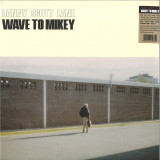
Wave to Mikey, the fourth album from the Los Angeles-based actor, musician and photographer Danny Lane is a nocturnal, neon-lit ode to the friendships that shape us. “I made this album for my friend Mikey from back home,” Danny explains. “We were pretty much inseparable for a large part of our lives, and our musical and social minds were always in sync in a special way. Then with age, we drifted apart, especially since I moved to Los Angeles. This album is just a little wave hello to an old friend and a kindred spirit.”
Equal parts avant-garde composition, instrumental city-pop, ambient, Kankyō Ongaku (environmental music) and Fourth World music, Wave to Mikey is an impressionistic and reflective cycle of eleven richly detailed memory portraits. Throughout the album, the influence of Jon Hassell, Arthur Russell, Hiroshi Yoshimura and Yellow Magic Orchestra hangs in the air like late-night mist, adding character but never overshadowing the rhythmic ambience of Danny’s musical visions.
Wave To Mikey began as a series of sketches on analog synthesisers, guitar, sample and found percussion sketches, initially recorded in Danny’s home studio. Once he’d located the vibe, Danny called on his friends E Talley II, Solange collaborator John Carroll Kirby and Destroyer session musician Joseph Shabason, who respectively added flute, spiritual synth textures and saxophone to the record.
For Glossy Mistakes founder Mario G.R., who originally discovered Danny through his photography, Wave To Mikey captures a vivid feeling of melancholy and peace. “He's able to encapsulate emotions in a very straightforward way, either in his portrait or songs,” Mario says. “I think that's a kind of virtue or skill given to talented artists, no matter the field.”
Born and raised in Staten Island, New York, Danny began playing music with his friends when he was thirteen, before putting that passion on pause to study Fine Arts (Theatre) at Rider University in Lawrence Township in pursuit of an acting career. Acting led him to photography, after playing a photographer in a film, he was inspired to pursue the medium. Danny began shooting photos on film for magazines and lifestyle brands, spent a stint living in New York’s Chinatown neighbourhood, and eventually relocated to Los Angeles in 2017.
Four years ago, Danny started recording and releasing music under his own name, leading to the trilogy of releases that preceded Wave To Mikey, How To Empty A Cup (2019), Memory Record (2019) and CAPUT (2021). Over the course of these releases, he’s revealed himself to be a sophisticated composer and producer with a studied ear from years spent digging through record bins for ambient, experimental, new age, jazz and electronica records from around the globe, with a particular emphasis on Japan.
“Music is something that’s always been involuntary for me,” Danny reflects. “It’s unconditional, always there. It’s something I just have to do. I’ve taken breaks and it’s always gloomy when I’m not playing. I just want to get better and better and understand more and more.”
Here at Glossy Mistakes, Wave To Mikey marks our second contemporary album release, following on from Evenings by Japanese composer Metoronori. We’re proud to be able to present Danny, Metoronori and other modern musicians' work alongside reissues of classic works from Stevia aka Susumu Yokota, Akira Ito, Yuji Toriyama & Ken Morimura, and Takashi Kokubo.
Mastered by Damian Schwartz, Wave To Mikey will be released on Vinyl LP Glossy Mistakes on June 27 2022. Besides the regular black vinyl, a limited clear vinyl will be available in an edition of 100 copies. Both editions come packaged with original cover art photography shot by Danny.
Поиск:my friend sam
Все
Clear Vinyl
I met Thomas Roussel in 2017 at a Pigalle fashion show in Paris. As always with Stéphane Ashpool, the designer of Pigalle, casting is perfect and the clothes are modern and groundbreaking. But my eyes and ears were intrigued by this retro-futuristic instrument next to me, the Cristal Baschet. French composer and conductor Thomas Roussel wrote the soundtrack of the show.
He add this magnificent instrument in his "not very classical" orchestra, this is what I immediately loved with him!
He invited us into his world of classical music with a fresh twist, simplicity and audacity.
At the same time I was scratching my head to find something different to celebrate the 15th anniversary of Ed Banger records.
For a long time I had this idea of mixing both electronic and classical music together. Exactly like my heroes Metallica did in 1999 with the Symphonic orchestra of San Francisco! Thomas Roussel seems the perfect man for this crazy idea. We did Ed Banger 15 together and we became friends.
Thomas Roussel grew up in Dijon, spent his days at the conservatory and his nights at L’An-Fer, one of the most respected Techno club in France. Probably the reason why he ended up working with Jeff Mills, on two projects mixing Jeff’s 909 and a classical orchestra.
By experimenting new ways of using an orchestra, by creating state-of-the-art scenography and producing more ambitious music he quickly became the man in charge of everything "classica". The list of his collaborations is too long and will ruin this little introduction.
It could sounds like this : Chanel, Apple, Cartier, Kenzo, Nike, Dior…
Performing from Paris to Macau, from Monte Carlo to Dubai and from New York to Beijing!
In 2017 Thomas Roussel released his first album as Prequell with Universal Music.
A successful collaboration that really allows Thomas Roussel to become an artist.
In 2022 Ed Banger records is proud to release Thomas Roussel "LATE METAL" a 3 tracks EP.
Where uplifting orchestration and electronic music composing collide. The perfect soundtrack of a block buster movie mixing George Lucas & Christopher Nolan generations. It’s also a marker of our time, music boundaries are explosing. It’s time to hear the London Symphony Orchestra’s strings battling with a Drum’n’Bass beat, a way to DEIFIED classical music.
It’s also a record for your eyes. Art director Andy Picci created an algorthym and gave life to a mercury abstract form. This collaboration
marks the need for Thomas Roussel to always push the boundaries and take his project to another LEVEL.
- 1: The Moomins (Occarina Theme)
- 2: Raft Journey The Cave
- 3: Climbing The Lonely Mountain
- 4: The Moomin Hornpipe (Part One)
- 5: Woodland Band (Parade)
- 6: The Observatory (Unabridged)
- 7: Locusts
- 8: The Moomin Hornpipe (Part Two)
- 9: Indigenous Woodland Band
- 10: The Tornado
- 11: The Moomins End Titles (Occarina Theme)
From deep in the heart of Moomin Valley, frozen in time for many
midwinters passed, comes a genuine treasure chest of never
heard Moomin melodies and instrumental comet songs composed
for the continued animated adventures of our Fuzzy-Felt freak folk
friends who disappeared from UK TV pastures in the mid-1980s.
From the top of the Hobgoblin’s Hat and the bottom of Snufkin’s
satchel, original Moomins composer Graeme Miller (‘The Carrier
Frequency’) kindly shares this patchwork selection of spellbinding
sound poems and percussive peons made using the very same
selection of ocarinas, kalimbas, miniature squeak boxes, Waspy
synths, cornflake box shakers and a seemingly endless array of
talent and lo-fi home studio trickery.
Regarded as one of the most enigmatic, beguiling and haunting
imported children’s programmes to ever grace UK TV screens,
‘The Moomins’ was one of the first-ever commissions by Anne
Wood (‘The Teletubbies’) who ingeniously replaced the original
Polish/Austrian/Finnish soundtrack with homemade music
experiments by unknown post-punk theatre students Graeme
Miller and Steve Shill (aka The Commies From Mars) who, after
the screening of two unforgettable series in 1983 and 1985, were
left in eager anticipation of rescoring further Moomin adventures
with new melodies, arrangements and sound designs, which then
lingered in the ether waiting until the Groke awoke and
Snorkmaiden sang once more.
With future felt adventures screened exclusively in Poland and
Germany for many years (often as feature films) these unheard
recordings are the only genuine musical sequel to the bizarre UK
version of ‘The Moomins’ and stand as important inclusions in
Graeme Miller’s own portfolio of theatrical theme music and sound
installations as part of The Impact Theatre Cooperative, including
collaborations with artists and writers such as Russell Hoban.
Witnessed in fragmented form during a short run of incredible rare
live screenings at The Barbican Theatre and various film festivals,
this record marks the first time this music has been heard in its
original full-length form, free from sound effects, dialogue and
whimpers of euphoric joy and nostalgia from those who have
continued to crave the company of our Moomintrolls and their
mysterious music over the last five decades.
- A1: Sleepwalkers
- A2: Money For All
- A3: Do You Know Me Now?
- A4: Angels
- B1: World Citizen - I Won't Be Disappointed
- B2: Five Lines
- B3: The Day The Earth Stole Heaven
- B4: Modern Interiors
- C1: Exit - Delete
- C2: Pure Genius
- C3: Wonderful World
- C4: Transit
- D1: World Citizen
- D2: The World Is Everything
- D3: Thermal
- D4: Sugarfuel
- D5: Trauma
REMASTERED
Grönland Records announce a revised, remastered reissue of “Sleepwalkers” by DAVID SYLVIAN. Available as a gatefold 2LP with exclusive art print and as a gatefold digipack CD, this new edition also features the previously unreleased track “Modern Interiors”.
in the 00s, DAVID SYLVIAN produced two of his strongest and most solitary statements, BLEMISH and MANAFON. but those records don’t tell the whole story. during that the same period, SYLVIAN created an alternate body of work: a series of collaborations and side projects with leading talents of pop and improv, electronic and contemporary classical music. the best of these recordings are gathered here on SLEEPWALKERS, meticulously sequenced and remixed: the fruits of one-off meetings and lifelong partnerships, they jump from bliss to intrigue, romance to sensuality, as arch experiments lead into the lushest pop.
the single ‘world citizen – i won’t be disappointed,’ written with RYUICHI SAKAMOTO, is a sublime example, with an impeccable melody and lyric warmed by SYLVIAN’S gorgeous tenor. SYLVIAN has worked with SAKAMOTO for close to three decades. by contrast, on ‘pure genius,’ a collaboration with CHRIS VRENNA aka tweaker, he sounds like he’s walked into a heist flick, singing the part of a delusional, dangerous bedroom genius. as sylvian explains, tracks like this ‘give me a chance to write in a way that’s completely non-personal, playful. it’s an exercise of some kind, working within the parameters of a given assignment.’
intrigue of a different kind drives ‘sugarfuel,’ with music by JEAN-PHILIPPE VERDIN, aka READYMADE FC. the lyrics offered ‘an opportunity to grapple with a more overt sexual theme than anything i’d previously attempted, as suggested by a vocal sample in the original track provided, a threateningly insistent ‘i’m on your side.’ so i took that as my point of entry and ran with it. i would love to write more on this subject should i find the right context. you’re always aware of walking a thin line exploring sexuality with language alone. the failings of the great and the good are strewn all around.’
NINE HORSES’ ‘wonderful world’ strolls in on a black tie bassline and the echoing coos of swedish chanteuse STINA NORDENSTAM, whose high chirps brush hands with SYLVIAN’S lead; there’s the blistering ‘money for all’ by FRIEDMAN and SYLVIAN, an oblique response to the fallout of 9/11 and the war on iraq. this is followed by the last known recording of SYLVIAN’S singing voice in over a decade, ‘do you know me now?’, a live studio recording later augmented by JAN BANG, EIVIND AARSET and ERIK HONORÉ. it’s certainly a title that’s become more relevant over time as SYLVIAN, in the latter stages of his career, repeatedly comes face to face with a new generation of admirers fixated on the life and times of the band formed by his younger self. SYLVIAN is one of only a handful of musicians to have successfully moved on from overt pop beginnings into a domain all his own but is consistently plagued by the misguided desires or expectations of some unfamiliar with his evolution to do a u-turn, pick up where he left off in the late 90s. although this compilation, as well as his writing for NINE HORSES, adequately shows SYLVIAN’S traditional love of melody is
intact, that it’s consistently remained part of his output, there’s no denying his focus has shifted, evolved.
the refusal to embrace complacency, the need to cover new ground ‘as older generations of popular musicians have a moral duty to explore despite, or because of, the greater possibility of failure’ will, i believe, lead to a reassessment of his later work that embraces a sightly more complex relationship with what we’re referring to as ‘melodic’, accompanied by an exploration of improvisation without dogma or beholden to any ‘givens’ for which he’s not infrequently been castigated. for SYLVIAN, there are no such boundaries. it’s obvious that different facets of his work co-exist without conflict but not necessarily for the majority of his audience. again, this places SYLVIAN in the odd, rare, unenviable(?) position of moving forwards leaving many in his devoted audience behind as, should he decide to return to music, it’s unlikely he’ll be aiming to placate an audience in love with work that preceded the 00s. in fact we’ve no idea where new work, should it surface, may lead.
SLEEPWALKERS also spotlights the innovators who contributed to MANAFON and BLEMISH. CHRISTIAN FENNESZ hangs a crackling, shimmering curtain behind the vocal on ‘transit,’ matching his signature mass of sui generis sounds to sylvian’s stately performance. and the title track began with an instrumental handed to SYLVIAN by MARTIN BRANDLMAYR of POLWECHSEL, soon after the first recording session for MANAFON. spite crackles in the gaps between the percussion, and onkyo artists TOSHIMARU NAKAMURA and SACHIKO M set the stage for the scathing lyrics in the chorus.
it cuts close to the bone and so do the two spoken word cuts, ‘angel’ and ‘thermal,’ produced by SAMADHISOUND recording artists JAN BANG and ERIK HONORÉ (and featuring ARVE HENRIKSEN on trumpet). SYLVIAN describes the latter work as a ‘love poem’ to his daughter. ‘‘thermal’ reflects on a period when our time in sonoma, ca was coming to an end. we’d stayed in temporary accommodation which had lulled us into a false sense of security. we had pear, apple, lemon, and figs trees growing in the yard. a small but exotic paradise. a cocoon. but the cracks were beginning to show in the relationship between ex-wife INGRID CHAVEZ and i which is where i think this underlying sense of anxiety, which runs throughout the poem, is derived from, coupled with the need to provide physical and spiritual stability to the children, the youngest of whom was just under two at the time. the poem is addressed to her. our world was dissipating, coming apart at the seams, but we were an island unto ourselves.’
‘five lines’ marked the start of a new partnership with acclaimed young composer DAI FUJIKURA, who at the time of recording was also working on remixes of MANAFON for what became DIED IN THE WOOL. the string quartet was performed by the celebrated ICE ENSEMBLE and written for SYLVIAN, who FUJIKURA cites as an early influence. says SYLVIAN, ‘the composition moves through numerous changes in time signature but as i had no knowledge of what these were i just relied on my gut instinct, and responded, as i always do, with what felt right to me, composing an entirely new melody in the process. some months later i was working in a studio in london and dai dropped by. i rather tentatively asked if he’d like to hear a rough mix of the song as it stood, painfully aware that my contribution might make no sense to him at all but, to my relief he loved the result.’
there’s one further new addition to this collection, the first official release of a track composed in response to the tsunami in fukushma, ‘modern interiors’, featuring SYLVIAN once again in collaboration with BANG and AARSET.
like 2000s EVERYTHING AND NOTHING, SLEEPWALKERS is a retrospective of a particular decade when SYLVIAN was free of major label interference and could follow his own instincts without having to explaining himself – but it’s also an eye-opening complement to his solo releases. as SYLVIAN explains, ‘some collaborations seem to be a one-off exchange but you can never be too certain of that fact. others have been long term. in this respect, RYUICHI comes to mind. there’s others with whom you hope to continue working as you feel you’ve barely scratched the surface. other times offers come out of the blue, welcome, inspired. regardless, it’s wonderfully explorative to have so many possibilities to juggle with. each collaboration seems timely. it’s as if there’s a rightness to the exchange at a given moment in time.’
in the meantime, we hope you enjoy the work presented here, personally selected, remixed and sequenced and entirely remastered. these are the orphans, abused, estranged, exotic, migrating from diverse corners of the globe, brought together under one roof which they're learning to share despite their differences.
‘as many of you will already be aware, despite relatively continuous work on solo albums, i’ve maintained strong ties with a number of musicians throughout my life in one context or another. on this new collection, let’s call it SLEEPWALKERS 2.0, a selection of collaborative work produced over the period encompassing blemish through to manafon, i’ve included compositions by nine horses as well as more fleeting flirtations and one-offs. neglected offspring. represented also is long term friend and writing partner, RYUICHI SAKAMOTO, as well as more recent but potentially equally productive partnerships such as CHRISTIAN FENNESZ, ARVE HENRIKSEN and contemporary classical composer DAI FUJIKURA.
i hope you enjoy the work presented here, personally selected, remixed and sequenced and entirely remastered. these are the orphans, abused, estranged, exotic, migrating from diverse corners of the globe, brought together under one roof which they're learning to share despite their differences.
we contain multitudes. we’re nothing if not contradictory.’
DAVID SYLVIAN, 2010
(consistency is contrary to nature, contrary to life: aldous huxley)
- 1: The Rain Drops
- 2: Another Time
- 3: Melted Car (Feat. Karina Gill)
- 4: Deep In Squalor (Feat. Griffin Jones)
- 5: Hey There Flower
- 6: Cliché (Feat. Kati Mashikian)
- 7: Say It Now (By Françoise Hardy)
- 8: Uneasy
- 9: Ode To Little Bird (Feat. Alexis Harper)
- 10: September Skies (Feat. Karina Gill)
- 11: The Portal
- 12: The Word
- 13: Unled Lives (Feat. Hannah Lew)
- 14: Saint Matthew
Solo bedroom-pop project of Michael Ramos (Flowertown, April Magazine, Hectorine). Mostly recorded between last Christmas and New Year's during a window of isolation at home, “Hey There Flower” preserves Tony Jay’s prowess at making beautifully eerie lo-fi pop; like a hazy memory where your favorite Sixties girl-group melody is perpetually slowed down. Without a band to practice with, Tony Jay recorded the music alone, but recruited a slew of friends to remotely record backing vocals: Karina Gill (Cindy), Griffin Jones (Galore), Kati Mashikian (Mister Baby), Alexis Harper (Al Harper), & Hannah Lew (Cold Beat). "Hey There Flower", the most recent release from the prolific and mysterious Tony Jay delivers real melodies -- both lacey with vocal harmonies and dusty with layered guitars -- as fans have come to expect. This release also carries forward and elaborates on Tony Jay's tradition of songs that express a kind of naked honesty about things we all know -- love and loneliness and all that -- while communicating at the same time a wry edge of skepticism, so that the songs are like coins spinning on edge before landing heads, tails, or lost under the couch. Tony Jay brings us into a nostalgia where we recognize moods from music of the past -- Marc Boland definitely comes to mind, as well as Velvet Underground of the Nico era, and Tony Jay even covers Francoise Hardy on this collection -- but the songs create a three dimensional space with what feels like a thousand layers so that instead of being thrown back in time, it's like stepping into a little world with its own laws of nature, of which the listener gets just a few hints. - Karina Gill, Cindy/Flowertown. “Hey There Flower” is introduced by thudding snare beats eliciting reverb-stained tattered noisy guitar scrapes, to weave abrasive shimmery emotive vibrations, imbued with shattered nostalgic dreams, lit by brittle yet dazzling forsaken keyboard flows, over submerged and distorted male vocal’s whispery deluge of obsessive longing, lonely melancholy, and dark desire to exude a hazy gritty concoction of awkward sadness and brooding unrest.” White Light // White Heat // “What Tony sketches are concise commentaries on love, loneliness and a few things in between. His mode of expression is sparse, intense, and captivating. The arrangements are invariably lo-fi and slow tempo, blanketed with a fuzzy hiss. And it only took one listen to decide that it is a very special album. It has a '60s feel, albeit washed in an eerie slowcore machine. An ace example is "September Skies", which could be the 1965 'last dance' at the prom for the introverted students.” - When You Motor Away
LIMITED TO 500 COPIES // HIGH-QUALITY TIP-ON COVER // INCL. DOWNLOAD CODE
OFFICIAL RE-ISSUE, DONE IN COOPERATION WITH THE FAMILY OF BOBBY COLE !!!
If you lived in New York during the 1950s through the 1990s and liked jazz, you knew about Bobby Cole. He played piano, sang, composed, arranged and, in 1967, released an album of original compositions titled "A Point of View" (Concentric Records). He had fans but avoided becoming mainstream. He stayed contemporary without becoming current. Jazz, folk, rock, modern dance scores…he wrote and performed them all. He smoked too much, drugged too much, drank too much. He was also cerebral, curious, a prodigious reader of poetry, philosophy, theology, and an uncommonly intelligent and literate lyricist.
On a December night in 1996, he had a heart attack while walking to work. An ambulance brought him to New York Hospital where, a few hours later, he died. Bobby Cole performed throughout Manhattan for forty years, but he spent most of the 1960s headlining at Jilly's, the midtown bistro owned by Frank Sinatra and his friend Jilly Rizzo. Sinatra called Bobby "my favorite saloon singer."
Bobby Cole caught the attention of Judy Garland, who visited Jilly's one night in 1964. She was hosting a weekly television show, and in the midst of a feud with her special materials arranger, Mel Torme. Three weeks later, Mel was out, and Bobby was in. He performed on Judy's show with his Trio. Bobby was scarcely 30 years old and it was his first time on television, but he was unruffled, sophisticated, and so damn cool. After Judy's show ended, Bobby occasionally arranged and conducted for her until she died.
Today, Jilly's is called the Russian Samovar and the piano is in the same spot. My husband and I ate there a few years ago. As we enjoyed our meal, I talked about Jilly's in the Sinatra era. Jilly had an apartment on the upper floor. I pointed up to the apartment and the balcony, where Jilly and Frank would sometimes drop water-balloons on unsuspecting pedestrians below. Another story described Jilly's as "tough, and you had to be tough to work there. Bobby Cole was tough. Frank and Jilly used to throw firecrackers at him to see if they could rattle him, but nothing rattled Bobby Cole. He ignored them and kept on playing." In the 1980s, Bobby headlined at a club called the Café Versailles. His daughter sometimes visited with her friends. She recalled that when she and her father would exit the club after work, a panhandler would be waiting for him. Bobby, who fought his own losing battle with the bottle, would slip the guy twenty dollars and wryly admonish him, "Be sure not to spend it on food." The night my husband and I visited the Russian Samovar there was a guy playing piano there, very young, and trying hard. I talked to him a little bit between his numbers about Bobby and the history of Jilly's and he was sweet, but I could tell he didn't care. I felt like one of those old people who bore young people to death with stories about things that happened before they were born – which, let's face it, is what I was. Nonetheless, when we were ready to leave, I put twenty dollars in his tip jar and said, "This is with compliments from Bobby Cole." After we left my husband said I should have added, "Be sure not to spend it on food."
Marie Hegeman (December 2021)
Iconic singer Mavis Staples is an alchemist of American music, and during her 70+ year career one of her most beloved musical mo?ments was her riveting performance in Martin Scorsese's film' The Last Waltz,' performing "The Weight" with The Band, a moment that forged a life-long friendship between her and Levon Helm. Staples came to Woodstock, NY to perform as part of Helm's re?nowned Midnight Ramble series, and the ensuing concert-available now for the first time on the rousing new ANTI- Records release Carry Me Home-would mark a personal high watermark for both artists. Captured live in the summer of 2011, Carry Me Home showcases two of the past century's most iconic voices coming together in love and joy, tracing their shared roots and celebrating the enduring power of faith and music. The setlist was righteous that night, mixing vintage gospel and soul with timeless folk and blues, and the performances were loose and playful, fueled by an ecstatic atmosphere that was equal parts family reunion and tent revival. Read between the lines, though, and there's an even more poignant story at play here. Nei?ther Staples nor Helm knew that this would be their last performance together-the collection marks one of Helm's final recordings before his death-and listening back now, a little more than a decade later, tunes like "This May Be The Last Time" and "Farther Along" take on new, bittersweet meaning. The result is an album that's at once a time capsule and a memorial, a blissful homecoming and a fond farewell, a once-in-a-lifetime concert-and friendship-preserved for the ages. Staples and the night's soulful crew of backup singers handle the vast majority of the vocal work here, but it's perhaps album closer "The Weight," which features Helm chiming in with lead vocals for the first time, that stands as the concert's most emotional moment. "It never crossed my mind that it might be the last time we'd see each other," says Staples. "He was so full of life and so happy that week. He was the same old Levon I'd always known, just a beautiful spirit inside and out." "My dad built The Midnight Rambles to restore his spirit, his voice, and his livelihood," says Helm's daughter, Amy, who sang backup vocals with her father and Staples at their performance. "He'd risen back up from all that had laid him down, and to have Mavis come sing and sanctify that stage was the ultimate triumph for him."
- 1: Panspermie
- 2: No One Around
- 3: Blob On The Lawn
- 4: The Gardener
- 5: They Shoot Horses
- 6: Blob Lands
- 7: Sisyphus
- 8: Perseids
- 9: Anabolic Alien
- 10: Magnetic Kiss
- 11: Alien Lullaby
- 12: Pink Pool
- 13: Meat Carpet
- 14: Liminal Ménage À Trois
- 15: Wraith
- 16: Gerasene Demoniac
- 17: Crawling Tentacles
- 18: Venutian Offspring
- 19: Face Sponged
- 20: Xenomorph Killing
- 21: Chasing Heather
- 22: Chasing Dee
- 23: O! Bad Shot
- 24: Black Matter Tears
- 25: Squid Lady
- 26: Leonids' Temple
Lucrecia Dalt’s debut film score to ‘The Seed’, a sci-fi horror
film directed by Sam Walker on Shudder.
Pressed on black vinyl and housed in a deluxe spined sleeve
with printed insert with digital download card included.
“The score is heavily based on pulses that I made from tape
loops from my Copicat tape delay, using various pieces of
metal to create the sound of the horror parts by bowing them
alongside digital synths and the Korg Monologue.” - Lucrecia
Dalt
“I wanted to play with the feeling of multiple paces in it, a
voice pulse that keeps us grounded in the subjectivities of
the women who are losing their sanity, a synth line that
places us in the sci-fi side of the film,” she explains.
‘The Seed’’s release follows the Colombian artist’s
collaboration with Aaron Dilloway, Lucy & Aaron, her
acclaimed 2020 album ‘No era sólida’ (RVNG Intl), a site
specific performance for the Mies van der Rohe Pavilion in
Barcelona, plus sound installations for CTM Festival and
Medellín’s Museum of Modern Art. Often seeking inspiration
in the worlds of fiction, poetry, geology and desire,
excavating nuanced references to untangle and respond to
in her music, Dalt’s debut score is incredible stand-alone
piece of work.
In ‘The Seed’, lifelong friends Deidre (Lucy Martin / Vikings),
Heather (Sophie Vavasseur / Resident Evil: Apocalypse) and
Charlotte (Chelsea Edge / I Hate Suzie) travel to the Mojave
Desert for some time away, with the upcoming meteor
shower as the perfect social media backdrop. But what starts
out as a girls’ getaway descends into a battle for survival with
the arrival of an invasive alien force whose air of mystery
soon proves to be alluring and irresistible to them.
Much in demand album from 1986.
Not much is known about the mysterious pop sensation Vumani or his short musical career. Originally from KwaZulu Natal he made his way to Johannesburg in the mid 80’s to follow his dream of becoming a recording artist. He was able to make that dream come true when talent scouts from Decibel Music came across the charismatic youngster. At the time Decibel was still a small fish trying to make waves and the label believed in Vumani they had found the star they were looking for. Being a label with mostly groups signed to the catalog they needed a Front Man to push into the growing demand for Solo Artists that were dominating the airwaves and catching the hearts of youngsters.
Up to this point Decibel had one major hit record. In 1986 they released a single by an artist named David Thanzwane. The music was a direct rip off of the first hit Single by Shangaan Disco pioneer Paul Ndlovu. Copying the music of both sides of the original single the “covers” offered different lyrics and hooks also sung in xiTsonga. This was enough to trick the masses and the single led to record sales for the small label. The unintentional outcome of the single was that from then on the producers and label had one sound they wanted to pump out in hopes of recreating that magic. This desire to create another Shangaan Disco hit would be the backbone of the Vumani sound and what makes his music so special and collectable after all these years.
That same year Vumani would release two Singles, Black Mampatile and Guy Fawkes. Musically these playful and fun singles would have great appeal to youngsters as they sung of daily life in the Townships. Black Mampatile being a game of Hide and Seek, Banana Kari referring to the trucks that would go around the Township exchanging chips and snacks for glass bottles and of course every child’s favourite reason the dress up on November 5th, Guy Fawkes Day. Both singles were received well and a few more tracks were later recorded to create the full album Isiqedakoma. Although he would sing in Zulu the music was unmistakable for Shangaan Disco. The synth heavy bass lines and happy melodies along with relatable fun lyrics were a perfect blend for an album that would make people dance if they were out at a Tavern or Shabeen on a weekend or just enjoying at home with family and friends.
Vumani quickly became the Label’s top priority with managers making sure he always had the freshest clothing styles to go along with his persona, and he never missed any performances or opportunities to impress a crowd. His popularity grew in the Township’s but with that came the unfortunate and all too common problems with fame. He started getting mixed with wrong crowds. He would record another album for Miracle Music, the Decibel sub label that had emerged to focus on the more underground sounds of the post synth pop era. Musically things were going well for Vumani but it would be his life off the stage that would catch up with him. Always known for his commitment to his music and fans one day he uncharacteristically failed to show up and was never heard from again. His body would later be found in a burnt car on the outskirts of Soweto. What led to his tragic death was never known but with the company he kept it is not hard to imagine what one of the many situations that led to that horrific ending could be. His funeral was attended by the entire Township it seemed as people packed the service and flowed out onto the streets, a testament to his popularity and the love the people had for one of their own.
French finest synth-pop band Bon Voyage Organisation release his second opus after a feature on Cocktail d'Amore 10 Years compilation.
"La Course" is a cinematic, synthesized and library-esque journey that could be a mixed-up between Italian early 80's productions and french 00's disco.
"This record marks the beginning of a new attitude towards recording," says Bon Voyage Organisation's Adrien Durand. "Switching from a busy studio that I shared to having my own very quiet cabin in the North West of Paris has inspired me to adopt a more meditative approach."
Whilst it's fair to say Durand has been constantly on the move for some time - be it touring or producing records for the likes of Amadou & Mariam, Papooz and Bagarre - there's a sense of new momentum, as well as stillness, that hangs over this record. One that's fully instrumental and as he describes being more free.
The band's trademark glistening production, disco flair, shimmering electronics and incandescent melodies still remain but a more intuitive and striped back approach was favoured this time around. Some of this attitude stemming from an evening opening for Kamasi Washington. "Because of the constraints of being an opening act we played as an instrumental quintet instead of our usual 9-piece band," says Durand. "We rehearsed the day before, our set opened with John Coltrane's 'Naïma' followed by a hard-bop ish version of Kraftwerk's 'Trans Europe Express'. It felt so good to perform that repertoire in that configuration that I had the vision of bringing this aspect of the band in the studio."
There was also a removed sense of pressure with this record - no major label expectation of a radio friendly record, combined with a deconstructed approach to songwriting. "Since 2014 I've been working mostly on projects involving a lot of conventional songwriting," Durand says. "I was keen on producing a record based on performance and atmospheres more than repertoire." He also sought inspiration from a perhaps unlikely source: The Arctic Monkeys. "I was really encouraged by them going out of their comfort zone on their last album - it really caught my attention in a Bowie / Berlin period way."
The result of the album is one that oozes the natural momentum of experimentation, texture, mood and intuition while managing to retain a sonic coherence. In a none-obvious and zeitgeist clichéd way, there is perhaps a more jazz-leaning approach to the record that weaves between soft subtle moments to the more atonal and experimental, all underpinned by sweeping, engulfing soundscapes and the usual touch of non-Western musical flourishes. This vibe came from a distinct lack of editing, says Durand. "In the studio we had everyone sitting in the same room - sometimes up to 6 players - and I never edited the playing. I just went on to record some additional synth and percussion, insert the soundscapes, and mix the record."
This less is more approach, avoiding indulgence and superfluousness, is something Durand can't help but feel is an artistic response to the pace of modern life. "There is a frenetic approach to everything," he says. "People want to binge on everything, expect ultra fast changes on any political cause etc. The response is a big comeback of things like the practice of meditation, yoga and ambient music." There are times when this record falls into the territory of meditative ambience, as on the immersive plunge one takes swimming through the beautiful 'Un Am Ricain En Danger'. It's an album to bathe in and to be carried along by, it's gripping by being so rather than fighting for your attention
Ultimately the record is one that feels it's been allowed room to breath, a sonic sphere in which musicians have been allowed to roam as freely and thoughtfully as the listener. "This record is about welcoming the music and being able to let each musician express themselves during the recording process," says Durand. "This is a valuable trade that takes time."
New York-based duo Bottler, Pat Butler and Phil Shore, are the vanguard of their own distinctly eclectic sound. Raw, emotive, bold and highly creative, the duo has successfully carved out their own path with a series of EPs that represent the broad scope of their production prowess. Over the last five years Bottler have been working on their debut album, ‘Journey Work’, a milestone achievement that marks a pivotal moment in their music career. The LP is a distillation of the duo’s multifaceted upbringing, blending a variety of styles together bound together by an overarching attitude and approach that embraces creative freedom and self-acceptance.
Pat and Phil are childhood friends whose bond is akin to that of blood relatives. Their parents are best friends and they grew up side by side, developing their deep love for music together; sharing discoveries and inspirations, learning to play and perform, and nurturing their creativity together. Now formally ordained as Bottler, they channel their eclectic tastes into a sound that encapsulates the love and trust that forms the foundation of the friendship. The duo blends a myriad of styles to create songs that emanate warmth, joy, sorrow, pain and the full spectrum of human emotion.
The album title, like their music, is open to interpretation. The duo reveals themes related to chronicling life’s many ups and downs, the deep preparation that must be taken ahead of a spiritual ceremony or psychedelic experience, and, simply, the journey taken during the conception and creation of an album. A quote from Walt Whitman also partly inspired the title; “every leaf of grass is no less than the journey work of the stars”. However, the intention behind the title is to allow for ambiguity, giving the listener an opportunity to write their own narrative.
Across 11 cuts Bottler illustrate their distinct take on electronic music, weaving in elements of indie, pop, rock, house and techno with confidence and panache. ‘Journey Work’ starts at ‘Home’, a song that is fizzing with positive energy, Pat’s vocals welcoming the listener to the start of this meandering audio adventure.
‘Chrysalis’ opens with delicate piano keys that guide us into a bombastic bassline and energising drum beats. As it progresses, scintillating layers of synth and strings are added, creating a highly affecting, uplifting atmosphere.
‘Melatonin’ follows up next, merging heartfelt vocal delivery with a sombre instrumental, and a stirring guitar riff. A glorious demonstration of Bottler’s songwriting capabilities, which are also evident on ‘Vinyl’, an uptempo dance number with an unbelievably catchy chorus. Here we see the duo channel their experience of playing in multi-member bands, as the breaks and arrangement feel perfectly suited to a festival-sized crowd.
On ‘Tacoma’, Pat and Phil channel their appreciation of house and techno into a haunting cut that utilises reverse strings and extended vocal refrains to chilling effect. A heady club track for the twilight hours. ‘Meds’ incorporates muted singing, mystical pad work and a mesmerising riff to produce a captivating slice of uncomplicated dance music.
This is followed by ‘Hot Water’, which feels like a trip to a Californian beach, circa 1965. The vocals drift over a bouncing bassline with a complementary guitar riff. ‘Mako’ features Samurai Velvet singing about fireflies and afterlife in a wonderfully heartrending manner, Bottler’s instrumental keeping things simple, yet highly effective.
We head back underground with ‘Weed’, a dense, gloomy cut with inspired use of chopped up vocal clips, stuttered throughout, alongside a mean bassline. ‘You’re Old’ is the soundtrack to an explosion of festival euphoria, dancing shoulder to shoulder with your best friends, forgetting all your troubles and living in the moment. An anthemic song that transposes Bottler’s idiosyncratic style onto the pop blueprint. Finally, ‘Cicada Rhythm’ closes the LP with a pensive, yet joyful feeling. A chunky bassline is juxtaposed with Pat’s angelic vocals cascading over the top. A hint of tribalism comes through, as we approach the end of the Journey Work…
Five years in the making, fuelled by the desire to express their deep love for music of all varieties, Journey Work is symbolic of the long road it takes to accept oneself and be comfortable expressing one’s truth. Diverse, dynamic and daring with a rawness and honesty that is rare to find, the album marks a triumphant debut for Bottler and one that crystalises their unique identity.
First release in 1999 by Don One Records
12 Beautiful songs by Dennis Brown of which most was recorded in the late nineteen ninety on the Studio One Rhythm
All of the songs on the single LP are Produced by Don Moodie/Noel Alphanso/Dennis Brown/Bill Sample
There are only 120 copies in stock
“They were so solid. They meant what they said, they did what they did… here’s two guys, a guitar player and a harmonica player, and they could make it sound like a whole orchestra.” – Taj Mahal
“It was perfect. What else can you say?” – Ry Cooder
Nearly sixty years after they first played together, Ry Cooder and Taj Mahal, longtime friends and collaborators, reunite with an album of music from two Piedmont blues masters who have inspired them all their lives: GET ON BOARD: THE SONGS OF SONNY TERRY & BROWNIE MCGHEE, on Nonesuch Records.
With Taj Mahal on vocals, harmonica, guitar, and piano and Cooder on vocals, guitar, mandolin, and banjo – joined by Joachim Cooder on drums and bass – the duo recorded eleven songs drawn from recordings and live performances by Terry and McGhee, who they both first heard as teenagers in California.
Explaining where Terry and McGhee took him musically, Cooder says, “Down the road, away from Santa Monica. Where everything was good. ‘I have got to get out of here,’ was all I could think. What do you do, fourteen, eighteen years old? I was trapped. But that first record, Get on Board, the 10” on Folkways, was so wonderful, I could understand the guitar playing.”
Taj Mahal adds, “I started hearing them when I was about nineteen, and I wanted to go to these coffee houses, ‘cause I heard that these old guys were playing. I knew that there was a river out there somewhere that I could get into, and once I got in it, I’d be all right. They brought the whole package for me.”
Taj Mahal and Ry Cooder originally joined forces in 1965, forming The Rising Sons when Cooder was just seventeen. The band was signed to Columbia Records but an album was not released and the group disbanded a year later. The 1960s recording sessions, widely bootlegged, were finally issued officially in 1992. GET ON BOARD is Taj Mahal and Ry Cooder’s first recording together since then.
Harmonica player Sonny Terry and guitarist Brownie McGhee, both originally from the southeastern United States, had active solo careers as well as collaborating with some of the most celebrated musicians of their time. But they were best known for their forty-five-year partnership, which began in 1939 and included mesmerising live performances around the world and numerous acclaimed recordings.
Their Piedmont blues style became popular during the folk music revival of the 1940s and ’50s, centered in New York City’s flourishing club scene for jazz, boogie-woogie, blues and folk music. Terry and McGhee traveled in the same circles as Woody Guthrie, Pete Seeger, Leadbelly, and Josh White, among others in a rich mix of writers, actors and musicians. As a new generation emerging in the 1960’s drew inspiration from folk and blues, Terry and McGhee toured the world as the foremost exponents of the acoustic music of the Piedmont. They were named National Heritage Fellows in 1982 in recognition of their distinctive musical contributions and accomplishments.
“You got the south on steroids, when you got the music of the south, the culture of the south, the beauty of the south, through Brownie and Sonny,” Taj Mahal says. He describes McGhee as a “solid rhythm player. To really play behind the harp like that. He would set stuff up. He wasn’t making many notes. Sonny had all the notes, running around. But Brownie, he laid it down.” Cooder adds: “This thing of squeezing the thumb and first finger and a little bit of the second finger, which I still do. I’d forgotten where it came from. That’s what Brownie did. I saw him do that and said, ‘I think I can do that.’”
Taj Mahal calls Terry “a wizard harmonica player”. Cooder says, “Sonny had incredible rhythm for one thing. Making sounds with his voice and the harmonica so you couldn’t tell quite which was which. He was good at that.”
“We’ve been doing this a while,” Cooder says. “Perhaps we’ve earned the right to bring it back. Taj Mahal concludes. “We’re now the guys that we aspired toward when we were starting out. Here we are now… old timers. What a great opportunity, to really come full circle.”
The Covid Pandemic hit Germany in March 2020 and by the 15th of March all of the public life was shut down. It was the same day where my son Rio was born.
For me, this early stage of the pandemic had something very intimate and private, since I was forced to stay at home with my young family for weeks. In Mai 2020 I started to leave the house, for other occasions then just going to the shop or taking a walk and that was the time I started working on “Hotel Solaris”. It was an intense creative rush: in 8 weeks the album was written, performed and produced in one flow. I had two days every week, where I could go to the studio for 4 hours and that time the album was done. It had a corpus in a sense that I
knew I wanted a faster or a slower track at points, but the whole hotel idea came when I saw photos of the old Hotel Arkada on the Croatian island Hvar, that my extremely talented friend Marcella Zanki shot on her holidays.
They show a well preserved socialist-brutalist hotel architecture in the middle of the beautiful Adriatic and for me it was like looking at pictures from a timeless place, without knowing where and when it exactly was, totally surreal.
I liked that idea of a hote that stands as an escape symbol from the real world, which was something everyone needed when the pandemic was building stronger and stronger. I decided to call it Hotel Solaris, inspired by the novel from Stanislav Lem, where Solaris is a planet covered by an ocean which triggers our subconscious mind to
become reality. It all fit at the end and “Hotel Solaris” was done.
This album doesn't blurt it out: There is no loud "Ta-Dah!", no exclamation mark. "The ghost that carried us away" flatters in a rather unobtrusive way. However, it has encircled you after the third song at the latest. Fragile hymns of nonchalant casualness, created by the 24-year-old Sindri Már Sigfússon. Guitars, piano, his almost bashful and yet so present voice. "Nature, mortality, love", these are the topics of his debut album. Even the one who listens only briefly, is able to make them out within the sounds. "Do you remember how the things look when you were young."
Reykjavik again. Iceland, the musical heartland. On top of that, there is a violinist with her voice in the clouds: Gudbjörg Hlin Gudmundsdóttir (violine, vocals, harmonica). There further are musicians Sindri shared his hometown and his passion: Orn (guitar, lapsteel) who forms together with Sindri and Gudbjörg the inner triangle of Seabear. Or Eiki, Orvar, Gudni and Dóri. One plays the flugelhorn, the slide-guitar or upright-bass. One belong to the live line-up of Sigur Rós (Eiki). Another is part of the sensational múm (Orvar). Some are stage members of Benni Hemm Hemm's Band - the other Icelandic artist on morr music. Sindri Már Sigfusson has invited them into his small studio, placed them in front of the only microphone, let them think about his musical thoughts. He likes the notion and the feeling of LoFi, Sindri says. Only for the recording of the drums three microphones were used. The result is reminiscent of the reduced stereo recordings of the 1960ies.
Libraries is the most direct promise that pop music is able to make. Tiny and gigantic, unobtrusive and exciting at the same time. A song like a blink into the most beautiful sunrise. A tumbling piano, swinging drums. Melodies, melancholy: "My little bird flew away from me". Or "hands remember", the singing being close to one's ear. "The voice of an old friend", a murmur, two violins. There is later "summer bird diamond", birds twitter to the accords of an old banjo, a glockenspiel. It is almost a radio play, chamber folk. And "seashell" at last, a pocket symphony, arranged around jumping drums. Sufjan Stevens would have done it in a very similar way.
- A1: Renee - Change Your Style
- A2: Joe Simon - Love Vibration
- A3: Dennis Parker - Like An Eagle
- A4: Stereolab - The Black Arts
- B1: Bibio - Don't Summarise My Summer Eyes
- B2: Sbtrkt - Hold On (Feat Sampha)
- B3: Friendly Fires - Why Don't You Answer? (Exclusive Cover Version)
- B4: Sonna - One Most Memorable
- C1: Laurel Halo - Embassy
- C2: Dj Sprinkles - House Music Is A Controllable Desire You Can Own
- C3: Grouper - Invisible
- C4: Melody's Echo Chamber - Endless Shore
- D1: Cocteau Twins - Cherry-Coloured Funk
- D2: Slowdive - Shine
- D3: Nils Frahm - Over There, It's Raining
- D4: Benedict Cumberbatch - Flat Of Angles (Part 1 - Exclusive Spoken Word Piece)
- A1: Enter The Dojo Feat. Starrlight
- A2: Inner Peace Feat. Distantstarr
- A3: Wu Feat. Racecar
- A4: The Path Feat. Racecar
- A5: Chi
- B1: Beautiful Feat. Bibi Tanga
- B2: Beyond Feat. Racecar & Elodie Rama
- B3: Following The White Clouds Feat. Racecar
- B4: Shaolin's Monk
- B5: The Way Of The Ronin Feat. Ta-Ti
- B6: Moon's Samurai
Attracted by a mysterious force that prompts him to leave his studio den, the Waxidermist embarks on a mystical quest, a hip hop adventure on the screen of which funk and soul collide, sampling and live.
Against the backdrop of an Asian fresco, The Waxidermist traces a musical journey that draws in its wake long-time friends and new crusaders along the way. United and united, becoming one to stay the course until the final revelation ...
"Tribe" is the new chapter in Waxidermist story : his journey cross the world & will be tell by all members of his tribe : From US with MC's RacecaR or DistantStarr, through France with Female singer Elodie Rama, the journey shines to the world : Netherland with wicked Female MC Starrlight, Africa with famous afro-soul singer Bibi Tanga, but also Japan with MC Ta-Ti.
After many adventures with famous musician (Erik Truffas, Gut, Versus, UHT°, The Herbaliser, Anna Kova…), The Waxidermist strikes back with a brand-new Hip-Hop Adventure, such an Imaginary Soundtrack and invite people to meet his "Tribe"…
7" Black Vinyl limited to 1000 copies.
Teenagehood, brotherhood and a genuine love for alternative music has united THE GOA EXPRESS from the off. Hailing from the industrial town of Burnley and adopted by the Manchester culture carriers, their teenage years can be viewed as something of a hedonistic pilgrimage into the underbelly of suburban rock and roll- their first gig having been 3 songs blasted out their mates garage, the next on top of a local vintage shop where the floor nearly caved in: “when there’s fuck all, you make do with what you got”. The intensity of this friendship has resulted in the occasional bust up along the way, yet it only adds to the burning chemistry that the band offer on record and on stage. Together, brothers James Douglas Clarke (Guitar + Vocals) and Joe Clarke (Keys), along with Joey Stein (Lead Guitar), Naham Muzaffar (Bass) and Sam Launder (Drums) all contribute to a fuzzy wall of diverse sound, becoming harder to pin down with their constantly evolving, psych-umbrella’d, rock and roll. What sets THE GOA EXPRESS apart from other musicians who sit comfortably within scenes is that their identity as a band has been growing organically long before the 5 of them decided to pick up instruments and teach themselves art of killing time. Their genuine joy in the everyday; their attitude and antics seem to hark back to the glory days of the NME- if they talk about a night out, you want to be there because these lads ooze charm and wreak havoc. This purist, old school approach to creating music through unified experiences and stimulated good times is married with the plain fact that they are very much young people of this generation, and while they see its flaws its hyperreality, its sheep-like tendencies, they still understand the importance in the immediacy of pop music: of a banging riff, or a glorious chorus and how effective this can truly be, and they want everyone along for the ride. With influences ranging from Spacemen 3 and The Brian Jonestown Massacre to French existentialism, from Beat Literature to long hours working at the Bookies to the journey into the sunrise on the night bus home, it is their ability to be all these things at once which makes THE GOA EXPRESS a guitar band for the 21st Century. Nothing is ever a compromise because they are so unapologetically themselves in everything they do- proud Northerners with a DIY foundation that aren’t afraid to look into the often dim future and see themselves shining brightly in it, unforgiving and unpretentious. So far, the band have released 3 singles with great success. The first: ‘Be My Friend’, produced by Ross Orton right next Sheffield’s famous ‘City Sauna’ brothel, presents itself to us as a cheeky, snarling pop song, holding undertones of raw cynicism laden with psychedelic sunshine. Ross Orton’s studio was also right next door to where the band recorded their last single ‘The Day’ with Nathan Saoudi of Fat White Family at ‘Champ Zone.’ Both these producers have been able to give these instant pop classics a grittier feel, capturing the essence of the unfettered lifestyle the band were living at the time that they were able to capture themselves in the music video for ‘Be My Friend’. After signing with Ra-Ra Rok, (WU-LU/Bingo Fury) the band released anthemic summer hit ‘Second Time’, that went straight to the 6 music B-List before quickly heading up to the A-List 2 for 2 weeks. This was followed by the release of its B-Side ‘Overpass’ that almost immediately caught the eyes and ears of BBC Radio 1’s Jack Saunders, who had the band on his ‘Next Wave’ Segment. Closing the year that saw them play to 1000 strong crowds at festivals like Latitude & End of the Road, the band headlined their biggest headline show to date at Manchester’s Gorilla. Its fair to say that this really is only the beginning.
Recorded in 1991 by the quintet of vocalist Billie Ray Martin and Birmingham-based electronic musicians Brian Nordhoff, Joe Stevens, Les Fleming and Roberto Cimarosti, Electribal Soul was conceived as the sequel to the band’s 1990 debut album, Electribal Memories.
Electribal Memories had yielded the hits ‘Talking With Myself’ and ‘Tell Me When The Fever Ended’ and pushed Electribe 101 to the forefront of a crossover electronic scene that fused dance music with pop savvy. They were snapped up by Phonogram, managed by Tom Watkins and hailed as “the next band to meet the Queen” by i-D. The band took the coveted support slot for Depeche Mode on their epochal World Violation tour and supported Erasure at Milton Keynes Bowl. Seen as the next big thing, everything pointed toward enduring critical success for Electribe 101, and the band settled into putting their second album together.
“There was a degree of confidence among us when we came to write the second album,” recalls Billie Ray Martin. “To me, the songs we put down sound like some of our finest moments.” More immediately lush and warm than the dancefloor-friendly structures of Electribal Memories, the clue to the sound of Electribal Soul lies in the second word in its title: soul. Songs like the aching sensuality of opening track ‘Insatiable Love’ or the emboldened defiance of ‘Moving Downtown’ showcase Billie Ray Martin’s distinctive vocal range as it moves from haunting quiet to dramatic, euphoric rapture. Lyrics from ‘Moving Downtown’ had found their way into ‘Pimps, Pushers, Prostitutes’ by S’Express, and the song would appear as ‘Running Around Town’ on Martin’s 1996 solo album. The strikingproduction on the version of the song presented on Electribal Soul suggests classic late sixties soul influences, such as those of legendary Motown producer Norman Whitfield, with the long shadow cast by Kraftwerk never being far away.
‘Deadline For My Memories’, the song that provided the title for Martin’s first solo album, was originally intended for the second Electribe 101 album. Its lyrics document a sense of freedom and liberation from the darkness of a bad relationship, accompanied by jazzy piano and organ sounds over a quiet rhythm and discrete electronics. In contrast, ‘A Sigh Won’t Do’ finds Martin in soothing vocal mode, despite its devastating message about the final ending of a strained relationship, her lyrics framed by restrained and subtle beats and sounds.
To spend time with Martin’s voice on Electribal Soul is to find yourself moved deep into the ordinarily impenetrable emotional corners of your own psyche. “I was into big ballads at the time and listening to all kinds of US and UK singers, and I was also young enough to want to prove myself as a belter of ballads,” explains Martin of the classic soul edge the album showcased.
Electribal Soul heads into darker territory with ‘Hands Up And Amen’. Originally written by Martin in Berlin in the period before moving to London and forming Electribe 101, the song was then perfected and enhanced by the band’s production nous. ‘Hands Up And Amen’ savagely documents the mugging of a woman in Queens, NY at gunpoint, only to resolve itself with a middle section that nods reverently toward gospel tradition. The song coalesces around a regimented break and burbling synths, finally ending with layers of urgent synth sounds.
Meanwhile, a cover of Throbbing Gristle’s ‘Persuasion’ takes us into a seedy world of sexual coercion and creepy infatuation, predating Martin’s chilling version of the track with progressive house unit Spooky two years later. Supported by a minimal, nagging rhythm and barely-fluctuating sounds, Electribe 101’s take on ‘Persuasion’ makes for uneasy listening, even though Martin manages to inject a sort of twisted sympathy for the protagonist as the song progresses.
That Electribe 101 were as comfortable offering complicated, nuanced tracks like ‘Persuasion’ alongside pop house bangers like ‘Space Oasis’ – written by Billie Ray Martin with Martin King before Electribe 101 was formed – is testament to the way the band wove their way effortlessly through electronic music reference points. Framed by light, jazzy piano melodies and string sounds, the energy of ‘Space Oasis’ soars so high that it could easily reach the moon, while highlighting how well-suited Martin’s voice has always been to club music. We hear the same reminder of her dance music credentials on ‘True Memories Of My World’, finding her describing a Hollywood actress who reflects on being used by directors to sell her ‘tears’.
Hooking up with the Birmingham-based Nordhoff, Stevens, Fleming and Cimarosti after placing a Melody Maker ad in 1988 (“Soul rebel seeks musicians – genius only”), it was clear that Martin had found a group that recognised the unique power and importance of her voice. Having worked with genres as diverse as reggae, rock and R&B, the four producers proved to be perfect collaborators, presenting carefully-sculpted backdrops that emphasised the towering emotional dexterity of her voice.
“Listening back to these tracks now, I was reminded of what a bunch of great musicians they were,” says Martin. “They had a rule that if a part still sounded good after a day or two then it could stay. If it bothered the vocals, it would go.” Even more so than on Electribal Memories, Electribal Soul places Martin at the captivating centre of these pieces, surrounding her voice with everything from dubby rhythms to chunky R&B beats to nascent trip hop breaks; wiry, acid-hued synths uncoil gently without ever dominating, while horn samples and lush, disco-inflected strings provide a rich, naturalistic accompaniment for Martin’s emotional outpourings.
The band finished mixing the album at London’s Olympic Studios in 1991. They were assisted by Apollo 440’s Howard Gray on production duties for ‘Deadline For My Memories’, ‘Insatiable Love’ and ‘Space Oasis’, with Gray supported by talented engineer Al Stone. Pre-release promo tapes were issued and an enthusiastic energy started to build around the band’s anticipated second album.
It was not meant to be. Against a backdrop of a worsening relationship with Tom Watkins, and a disinterested Phonogram, instead of receiving a positive reaction to the new tracks, Electribe 101 were swiftly dropped by their label. Electribal Soul languished, unreleased, and the band yielded to pressures that had been building and split up. After collaborating with Spooky and The Grid, Billie Ray Martin went on to release her seminal debut solo album in 1996, with it securing the era-defining hit ‘Your Loving Arms’, while the other group members continued to work together as The Groove Corporation.
Thirty years after the songs were recorded, we’re now finally able to hear what the second and final chapter of Electribe 101’s story sounded like. Electribal Soul shows that the band had really only just got started when they dropped their first album in 1990. Heard only by a select and privileged few, what followed elevated the band’s music to a completely new level, making Electribal Soul musical buried treasure of the most precious and rare variety.
Electribal Soul will be released on LP, CD and digital formats on 18th February 2022 through Electribal Records. The physical formats include extensive liner notes from Billie Ray Martin, and the album sleeve features unseen archive photographs by Lewis Mulatero from the original 1990 sessions with the band that were never used in the sleeve designs for Electribal Memories.
'All That's Been Lost' is the debut album from Glasgow based singersongwriter Steve Grozier.The album's title, chosen before the pandemic, has turned out to be strangely prophetic
Recorded at 'The Ranch', home studio of friend, producer and bandmate, Roscoe Wilson.Grozier was all set to record before being abruptly halted by lockdown.
When it was safe to continue, the dynamic of the recording process had changed dramatically. Given the size of the studio, the musicians playing on the record all had to record their parts separately or remotely.
Despite the constraints, 'All That's Been Lost' is a fully realised piece of work. The themes of loss, darkness and emotional pain find parallels in the work of Phosphorescent or Richmond Fontaine.
'Sam, I Know You Tried' is a dark, layered rocker, featuring excellent guitar work from producer and multi- instrumentalist Roscoe Wilson. It was written in response to losing a close friend. 'Blue and Gold' and 'When the Darkness Comes' are Grozier at his best,his effortless vocal sitting in contrast to the heart-breaking lyrics. The beautiful 'I Miss My Friend' is dedicated to Neal Casal and is a touching tribute to one of Grozier's heroes.
The two singles taken from the album, 'Memories' and 'Power in the Light', showcase Grozier's range as a songwriter. On 'Memories' we find Grozier coming to terms with ageing and the pain and beauty in doing that with someone you love, but at the same time aware of all that has been lost along the way. It features some intricate dobro work from Nathan Golub (Mandolin Orange, Mountain Goats). On the second single 'Power in the Light', Grozier is at his most hopeful. He sings,"I'm strong in the fight, there's grief and anger, but there's power in the light". Grozier says that light is "whatever you need it to be or wherever you find the strength to go on. To keep trying"
.Ultimately, this is the underlying theme of 'All That's Been Lost'. Hope.
Emerging DJ and producer Yemi brings the soulful groovers to the Time Is Now white label series.
Having already received support from the likes of UKG mainstays Sammy Virji, Conducta and Smokey Bubblin' B during his relatively youthful career, Yemi is certainly an artist to watch. For justification, look no further than the vibrant, uplifting 6-track EP which combines luscious vocals and blissful piano chords to create a sound which is at once nostalgic and fiercely forward-facing.
Its two opening tracks get things off to a buoyant start, with a bouncing 4x4 rhythm and the syrup-smooth vocals of emerging artist and long-time friend, Bria Keely. Pair these with rattling bongos on "Never Let You Go" and the gleeful trumpets of "Smooth Talkin" and you have two tracks which make it impossible to keep still.
"My Heart" welcomes a change in mood with a loose two-step swing and moody vocals: a track made for the feels. But before you get too self-indulgent, the deep bass grooves of "Soul Food" bring the energy right back and "Tension"'s euphoric piano chords leave things on an ecstatic high.
- A1: Blood Of The Sun (Feat Zakk Wylde)
- A2: Nantucket Sleighride (To Owen Coffin) (To Owen Coffin)
- A3: Theme For An Imaginary Western (Feat Dee Snider, Eddie Ojeda, Rudy Sarzo, Mike Portnoy)
- A4: For Yasgur's Farm (Feat Joe Lynn Turner)
- A5: Why Dontcha (Feat Steve Morse)
- A6: Sittin' On A Rainbow (Feat Elliot Easton)
- B1: Never In My Life (Feat Dee Snider)
- B2: The Doctor (Feat Robby Krieger)
- B3: Silver Page (Feat Charlie Starr)
- B4: Money (Whatcha Gonna Do)/By The River (Whatcha Gonna Do)
- B5: Long Red (Feat Yngwie Malmsteen)
- B6: Mississippi Queen (Feat Slash)
'Legacy: A Tribute to Leslie West' will be released on CD, Silver vinyl and digitally.When Leslie West passed away in December of 2020, he left behind a towering legacy of epic recordings that few rock guitarists can match
But there was more to West than great songs (although, to be sure, he created a ton of them); there was his brilliant, idiosyncratic sound, a gargantuan earthmover that razed arenas and stadiums across the globe. More than just paralyzing tone, though, he also had a touch nobody could beat. Stinging, swooning and sensual melodies leapt from his fingertips – with a deft flick of his wrist, he sounded like a Delta bluesman had picked up a violin. These elements and more helped to make West one of the most significant, influential and
irreplaceable guitarists of the rock era.Originally, the album was intended to be a retrospective celebration of West's music on which the guitarist himself would perform some of his best-loved cuts with notable guests, along with a collection of new tracks. Two weeks before recording was set to commence, however, the guitarist passed away. While grieving the loss of her husband, Jenni was comforted by the constant stream of phone calls from famous musicians who
expressed their condolences, and without fail, each one said the same thing: "If you do any kind of tribute to Leslie, please let me know."An astonishing array of West's admirers – who also happened to be friends and peers – came together to celebrate the trailblazing musician on the aptly titled 'Legacy: A Tribute to Leslie
West'. Executive produced by Jenni West, Bob Ringe and John Lappen, the album features dizzying, heartfelt performances by Slash, Zakk Wylde, Dee Snider, Bachman & Bachman, Martin Barre, Joe Lynn Turner, Charlie Starr, Elliot Easton, Robbie Krieger, Mike Portnoy, Eddie Ojeda, George Lynch, Marty Friedman, Steve Morse and Yngwie Malmsteen, among others. Each track on its own is a corker,
but taken together the 12 cuts on 'Legacy: A Tribute to Leslie West' are a stunning and heartfelt testament to the true impact the guitarist had on musicians of all stripes, and as such, it's essential listening for both longtime fans and newbies.
Print coverage in Guitar Techniques, Rock Candy, Record Collector
On the tribute album Songs for Tres, Psychic Ills band members come together to commemorate the late Tres Warren who passed away just as the world turned upside down in March of 2020. Isolated, feeling helpless and lost by the death of her musical soul mate and collaborator of 18 years, bassist Elizabeth Hart found making music to be her only outlet in a time where people were unable to be physically together to mourn. So, she reached out to Adam Amram, Jon Catfish DeLorme and Brent Cordero, the main players in the Ills line up since the release of their last full length album Inner Journey Out (2016), to ask if they would embark on this cathartic journey with her. This was a different kind of production endeavor for Hart driven solely by “the aching need and urgency” to do something to honor her friend.
Hart, Amram, DeLorme and Cordero reunited for the first time five months after losing Warren at Amram’s loft – the same spot where they’d rehearsed countless times before – although this time with a different objective. In an effort to share, support and create, the old friends joined in the painful and healing experience of making this tribute album to cope with their loss. The band members wrote, arranged, and rehearsed for months and the result of their work culminated in a weekend of recording in the southern Catskill mountains at the end of 2020. This isolated and intimate environment was a perfectly serene and fitting location to finalize their story.
Throughout the album, Hart, Amram and DeLorme take turns as the vocal lead on each of the songs while Cordero showcases his finger-picking guitar skills in addition to his piano and organ playing, which he is known for. Along with the core band members, a number of other musicians played on the album, many of whom had collaborated on prior Psychic Ills releases and wanted to be a part of this last collaboration in memory of Warren. Keeping the project in the Ills family, Hart produced the album alongside Iván Diaz Mathé, the long-time Psychic Ills sound engineer.
The album consists of five original tracks and four cover songs. Initially, learning the covers was just a method for the musicians to “break the ice” and play together again for the first time without their band leader. However, those tracks became just as important to include as the originals because of their essential role in the process of coming together to make the album. The cover songs were chosen because of their unique connections to the band’s memories of Warren. Dennis Wilson’s "Rainbows" and Fleetwood Mac’s "Station Man" come from two of Warren’s favorite albums, Pacific Ocean Blue and Kiln House. The band also recorded Blaze Foley’s "Clay Pigeons" and Powell St. John’s "Right Track Now." The idea for the latter was suggested by Amram. Warren once sent him a clip of Roky Erikson singing a moving rendition of that song in the film Demon Angel and it had stuck with him ever since.
Hart wrote "I’ll Walk With You" on the day of Warrens’ passing, at the time not knowing what it meant. When she got the call with the heartbreaking news, it became clear to her what the song was about. Relying on a gently lilting string arrangement to set the tone, this duet features Mazzy Star vocalist Hope Sandoval alongside Hart. Sandoval previously collaborated with Psychic Ills accompanying Warren on "I Don’t Mind" (2016). The ideas for "Home" and "Walk Around," two other songs on the album by Hart, started simply with an acoustic guitar and lyrics, a hopeful exercise to connect with her lost friend. Brent Cordero’s instrumental "Whole Lotta Piece of Mind" is nothing short of a transcendental experience. By running his pedal steel through a Leslie speaker, Jon Catfish DeLorme crafts the unique tone showcased on Wonderful Feeling, a moving example of studio experimentation combined with old school techniques. DeLorme describes it as “an attempt to highlight the musical experience I shared with Tres both sonically and thematically. What resulted is the unguarded exaltation I feel lucky to have shared with my fellow bandmates.” Adam Amram’s “Into the Sea” was composed spontaneously the week Warren passed. The melodic tune has a hopeful lightness and Amram describes it simply as “a song to my brother”. Their connection shines through.
In fact, the entire album is one that radiates the layers of friendship, love and music that will forever exist between this family of musicians. As the band themselves state: “This album was made out of love and a commitment to honor our dear friend and bandmate.” A portion of the proceeds from the album will be donated to RAICES, a charity who aids children who have been displaced at the Texas/Mexico border.
Nearly 24 years ago, on 7th July 1998, the first Hefner LP was released, it garnered some great reviews, ensured the band were to become one of Peel’s favourites (they had 5 entries in 1999’s festive 50!), and cemented their reputation as Britain's largest small band. NME - “truly independent, unassuming and painfully honest: the sound of thin, white indie dukes in spectacles.” Melody Maker - “heart-skeweringly astute” combination of “grimly sweet lyrics and delicate, tentative tunes.” Time Out - “awe-inspiring in their naked honesty” More recently, the album was number 25 in Pitchfork’s 50 greatest Britpop albums, above A Northern Soul (Verve), Fuzzy Logic (Super Furry Animals), Vauxhall and I (Morrissey) and Tellin’ Stories (the Charlatans) Breaking God’s Heart now gets the essential 20th anniversary vinyl re-issue, accompanied by some shows where Hefner frontman, Darren Hayman, will play the album in full Here’s what Darren has to say about the record now: Breaking God's Heart is an awkward, over confident start to my career. I have yet to get to grips with it again properly in preparation for these anniversary shows. It's so far away in my past that I have some difficulty in relating to the person who made it. Mostly when I hear it I'm just amazed at the confidence, and possibly arrogance, I had then. I insisted on mostly first takes being used, vocals being recorded live in the room with the instruments, a ban on any reverbs or ambience being used. It was like I was trying to sabotage my career at the first hurdle. Many of those decisions were based on half understood, interviews with my idols from the American Lo-Fi scene but I really didn't know what I was doing. It does make a bizarre and caustic record though, and I know there are plenty of people who think this is my best work and I never got back to the blunt energy of these recordings. I do see their point. Quotes - Hefner's is a bedsit world of spindly guitar and towering passions; of skewwhiff ideals and surprisingly smooth melodic surges; of awkward outbursts and slow-burning lo-fi for lovers… 'Breaking God's Heart' is all about sparkling melodies, twinkly-eyed poetry, intimate confessions, a thrillion knowing references to sex, soul and sadness and the sort of chipper attitude that says: 'This is a record you will relish for years to come'. So save yourself time, start treasuring it now. 8/10 NME // Hefner are running on the same rock-not-rock fuel as early Violent Femmes or The Modern Lovers, and like those groups are expert at building emotionally charged arrangements by adding or subtracting at precisely the right time. 8/10 Drowned In Sound
In an era where technology is increasingly shaping music, 'The Garden Of Eve explores the opposite: it's an organic album, made by real musicians recording simultaneously, giving it a live mood while at the same time having wonderfully brilliant sound. It has been a long time since a contemporary artist has made such a beautiful homage to the blues.
"Blues has always been dear to my heart: it's a cathartic experience, precious and profound, whether it's playing it or listen to it on the radio. When I first heard Billie Holiday sing 'Blue Moon', I could feel it with every cell of my body. She had such a powerful effect on me. Sentimental blues, originating from tragic situations, sometimes even reflecting my own experiences... No matter how bad family, friends, politics, lovers, governments or society might be, they can never destroy the forces for good in this world. And as time passes by, I more and more find the truth that is rooted in my soul. And I finally feel mature enough to understand this wonderful musical tradition - because blues means life."
And if blues means life, Malia is the energy that allows the blues to have a soul, a voice. Characterised by her unique timbre - that doesn't need any further explaining - Malia gives us a thrill throughout the 12 tracks of this album, that has everything to become a classic.
Mattiel, the Atlanta based group made up of Mattiel Brown and Jonah Swilley, announce
the release of their third album, ‘Georgia Gothic’, on Heavenly Recordings. ‘Georgia
Gothic’, a magic third in Mattiel’s run of full-length albums, was shaped in the quiet
seclusion of a woodland cabin in the north of the Atlanta duo’s mother-state; “Some
faraway place that just Jonah and I could go where there would be no distractions,
nothing else going on, and we could turn everything off and only focus on writing songs,”
reflects Brown.
Where 2017’s self-titled debut and its 2019 follow-up Satis Factory were written with what
Swilley refers to as a “hands-off” approach - he arranging the music and Brown the lyrics
and vocals, the two working largely separately - the making of ‘Georgia Gothic’ was, for
the first time, a truly collaborative undertaking. “This was the first time we made a point to
just be together and work out ideas in the same room. That was the initial intention... it
was about learning what each other wanted to accomplish on a sonic level, and then just
trying different things out,” Swilley continues. “Everything happened backwards. Normally,
you’d have friends that make a band... with us, we started making music from the jump,
and then became homies.”
Cultivated by time spent together on the road touring the first two albums, it is this
newfound sense of intimacy between Mattiel’s members that enabled the writing of
‘Georgia Gothic’ not as two separate musicians, but rather as one creative entity. The
album remained within the four walls of Brown and Swilley’s private world for much of its
evolution - with recording taking place in a simple studio set up by the pair in the
borrowed room of a dialysis centre, Swilley in the producer’s seat - until, nearing
completion, it was transferred into the trusted hands of the Grammy award-winning John
Congleton (whose extensive list of credits includes artists as diverse as Angel Olsen, Earl
Sweatshirt, Erykah Badu and Sleater Kinney) for mixing.
Not only does the affinity between its creators translate into an electric synergy between
‘Georgia Gothic’s words and music - the brine-shock of Brown’s taut lyricism cut against
the bourbon-smoothness of Swilley’s instrumentation - but here too are the palpable
spoils of experimentation, each party trustful enough of the other to trial and error their
practices into new geometries. Swilley puts this wide palate, in part, down to the place
they call home. “I definitely feel like being from Georgia allows us to have a certain way of
approaching music.” Brown chimes in: “We haven’t really highlighted where we’re from in
the past two records, even though those were also written in Georgia. There’s so much
great art and great music that’s come from Georgia, from all different types of genres and
all over the state - but take R.E.M. and OutKast: there’s this weirdness that I can’t really
put my finger on.” Swilley concurs: “It’s the same with the B-52s, the Black Lips... it
doesn’t feel like L.A., it doesn’t feel like New York, it feels like another planet. We’re not
really in a ‘scene’ here in the same way. You have to make your own sound, create your
own identity.”
And it is precisely the forging of Mattiel’s distinct musical identity that ‘Georgia Gothic’
signals; its members guiding each other ever-homewards not just in a geographical or
sonic sense, but spiritually, too.
Initial LP pressing on Red Hot coloured 140g vinyl with digital download code. (Once this
format has sold out, a black 140g vinyl edition with digital download - HVNLP202 - will be
made available.)
- A1: Are You My Woman (Tell Me So)
- A2: Stoned Out Of My Mind
- A3: (For God's Sake) Give More Power To The People
- A4: We Are Neighbours
- A5: I Found Sunshine
- A6: Inner City Blues (Make Me Wanna Holler)
- B1: Oh Girl
- B2: Have You Seen Her
- B3: It's Time For Love
- B4: Homely Girl
- B5: Too Good To Be Forgotten
- B6: You Don’t Have To Go
On June 17, 2020, the Hollywood Chamber of Commerce and the City of Los Angeles, announced that the iconic multi-million selling
soul/R&B band, THE CHI-LITES, would be honoured in their Class of 2021, by receiving a star on Hollywood Boulevard on the
Hollywood Walk of Fame.
• On 30th September 2021, with family friends and other soul legends in attendance, including their legendary label mate, Gene
Chandler, Marshall Thompson, co-Founder and last surviving member of THE CHI-LITES, accepted the honour on behalf of the Band.
• Although they had formed nine years earlier, it was when the Band met record producer Carl Davis in 1968 that they signed a
contract with Brunswick Records. They began to achieve commercial recognition and success, with songs predominantly written and
composed by band member Eugene Record, who was also their lead singer, although their first charting song, ‘Give It Away’ (US
R&B Chart #10) was co-written by Record, with producer Carl Davis.
• THE CHI-LITES released more than 15 studio albums and registered on the UK chart on nine occasions, with five Top 10 entries, one
of them being the Double-A sided reissue ‘Have You Seen Her’/’Oh Girl’.
• In 1976, THE CHI-LITES switched labels from Brunswick to Mercury and recorded two albums ‘Happy Being Lonely’ (1976) and ‘The
Fantastic Chi-Lites’ (1977), before teaming-up again with Carl Davis on his own Chi-Sound records label, to record 1980’s ‘Heavenly
Body’ and 1981’s ‘Me And You’.
• This 12-track vinyl LP set focuses on their Brunswick Records period and includes all of their UK hits, opening with their barnstorming ‘Are You My Woman (Tell Me So)’, the intro from which, being famously and expertly sampled by Beyoncé (and featuring
Jay-Z), for her worldwide 2003 hit and Transatlantic #1,‘Crazy In Love’.
Athlete Whippet return to Toy Tonics with an EP showcasing emotionally layered dance tracks and their refusal to stick to genre conventions. The duo are synonymous with sublime cuts that are just as suited to late nights and early mornings on the dancefloor, as they are to home-listening, this perfectly exhibited on the "Noguiera" EP.
The four-tracker is named after a remote place in the mountains around Rio de Janeiro where it was made on a creatively fruitful getaway in 2021. It's sentimental, joyful, bouncy, and futuristic, and showcases the duo’s musicality combining bass guitar and piano, with hardware synths, loops and fragmented vocal samples.
Robin explains - "Spending time in Brazil in recent years was a blessing. The nature, culture and musical heritage over there is beautiful. Mostly in solitude, as I ended up spending most of my time in a remote place in the mountains around Rio, music became the only real emotional outlet for a while. So in a way this is a record of dance music created as far away as we’ve ever been from the dance floor!"
Both from a live performance background, Robin and Avi met studying at Goldsmiths London and found their way to the dance floor via playing in bands, Robin a guitarist, Avi classically trained in trumpet and later on picking up the keys. Absorbing the community of South London, they eventually set up artist collective and record label Squareglass - a proudly established home for new artists coming out of the area. They’ve remixed for the likes of Rhythm Section, collaborated with Olugbenga, and their releases have come with reworks from Ross from Friends, Cameo Blush, Baltra and Seb Wildblood. In 2021, their hybrid sound found a new home with tastemaker German label Toy Tonics who released their "Vesta" EP in May, followed by a run of European tour dates including Funkhaus Berlin, Phonox London and Amsterdam Dance Event.
The Equations Collective is an experimental sound project formed by a multi-disciplinary group of artists, active in the fields of music, photography, sound design & software development.
In 2018, the collective set up a temporary outdoor recording studio, 1130 meters above sea level, on the slopes of Mount Helicon in Greece, with the ambition of recording their work in a natural environment. A 'mobile and modular' construction, fully powered by solar panels, the design of the studio showcases the possibilities of a progressive, environmentally sustainable future through renewable energy.
Embodying ecological incentives, and representing an immersive engagement with the landscape, the 'Helicon Sessions' document this extraordinary residency, capturing a profound dialogue with the eponymous mountain region.
Situated in Boeotia, Central Greece, Mount Helicon has a prominent archaic significance. A historic location where stories of sacred springs and the epic origins of the Muses and Narcissus converge. Steeped in the heritage of ancient narratives, Helicon is seen as a principal symbol of poetic inspiration.
On the 'Helicon Sessions' the collective draw upon the inspiring topography and fabled mythological resonances of the area, unfurling an expansive, hypnotic suite of abstract electronics. Liberated by an open-ended, improvisational dynamic, the collective move through a mysterious, elemental cycle that mirrors the imposing scale and dramatic atmospheres of the setting.
Across an entrancing, fluid sequence of five designated 'cuts', the collective traverse the borderlands of drone, techno, dub, and acid, amplifying the acoustic traces of Helicon by integrating field recordings collected at the site into this arresting body of work. With these recordings, the collective delineate an odyssey of subverted 303s, sputtering drum machines and formidable, oscillating low end that drifts and coalesces like an amorphous mirage; a spellbinding sound world of clarity and shadow.
The 'Helicon Sessions' signify a symbiosis (between the terrestrial and the engineered, between wildlife and futurism, between the intrinsic and the synthetic, between the innate and the manmade) And with their conception of a portable, eco-friendly studio The Equations Collective focalize valuable ideas centred on ingenuity and evolution. The outcome of this project illustrates a unique collaborative exchange which acknowledges the deep nuances of environment and the enduring echoes of history.
The Equations Collective is a collaboration between Artefakt, Aroma Pitch, Aphelion and Sphera De Noumenon across Berlin, Amsterdam, Cologne and Hamburg. Together they have established an all night long live event in Berlin, starting at Sameheads and Acud Macht Neu, which eventually lead to their residency at OHM (Tresor).
For this format they have collaborated with the following artists: Alex The Fairy, Anna Z, D-IX, Eliad Wagner, Jón Friđgeir Sigurđsson, Orson Wells, Phillip Jondo, Philipp Matalla, PRSMC, Rabih Beaini, Sabrina Gricourt, Sébastien Robert, and Vida Vojić.
The respective members of The Equations Collective have released a range of output on the likes of Field Records, Delsin, Semantica Records, De Stijl, & Soul People Music.
Since 2018 their visual identity has been shaped by Elias Hanzer.
The 'Helicon Sessions' is their debut release.
Curtis Godino’s first album producing for The Midnight Wishers. Mastered by Shimmy-Dic’s Kramer. “Golden Wish” Yellow Vinyl LP ltd edition of 500. RIYL: the Shangri-Las, the Chiffons, the Crystals, the GTOS, Ween. What if a cute girl group scored a hit song about a car crash, then actually died in a car crash, but decades later, David Lynch conjured their spirits for a beach-themed Halloween special? That’s a feeble attempt to describe the fun, spooky universe evoked by musician, songwriter and producer Curtis Godino with his latest project, Curtis Godino Presents the Midnight Wishers. “I’ve always been a fan of girl groups and old generic love songs,” says the Brooklyn-based artist, previously known around town for his psychedelic band Worthless and his ’60s-style light projection shows. “No matter how cheesy, they always get stuck in my head, so I decided I would try to make some of my own, with the help of my friends.” Chief among those friends are the Midnight Wishers: lead vocalist Jin Lee and backing singers Rachel Herman and Jessica McFarland, all of whom Godino recruited for the project. Lee also contributed lyrics, which she tends to recite as often as she sings in a dreamy, earnest voice. The trio are the perfect messengers for Godino’s tunes, visually as well as sonically. In photos, they pose before bubble-gummy backgrounds, playing with a ouija board by candlelight, elemental like a cartoon crime-fighting team with their respective black, red and blonde hair. But make no mistake: This project belongs to Godino, a musical ringmaster in the tradition of Phil Spector or more aptly Shadow Morton, whose noir sensibilities spawned such uncanny pop marvels as the Shangri-Las’ “Leader of the Pack” and “Remember (Walking in the Sand).” In this case, Godino built the wall of sound almost entirely by himself, recording on his eight-track tape machine during the pandemic shutdown. Starting with drum tracks from Andrew Max and Adam Amram, he would add picked bass guitar in the style of L.A. studio legend Carol Kaye, then go bonkers with fuzzy guitars, Farfisa organ, mellotron, analog synthe- sizers, glockenspiel, an arsenal of other percussion instruments and an array of mysterious electronic effects. To fully realize the vision, however, Godino knew he needed more firepower. The Wishers’ multilayered harmonies and other vocal tracks were recorded and engineered by his roommate, Paul Millar, at Millar’s Bug Sound East studio. “I'm sure all those incredible old records were recorded on a four-track or whatever, but I don’t have the same discipline,” says Godino, whose stated goal was to create “songs so sweet they’ll give you a cavity
Lia Ices was pregnant with her first child when she started writing her forthcoming record, Family Album, a stunning collection of psychedelic-tinged Americana. She was living with her husband, a wine-maker, on Moon Mountain in Sonoma, CA, where she walked from house to studio through a rose garden with an orchard at its center every day to sit at her piano and see what fell out. It was a “total Eden,” Ices describes. “I got pregnant in January, and Una was born in September, so I was on the same ripening mode as all the fruit.” “This album is terroir,” she says, using a wine-making term used for the complete natural environmental factors that make something taste the way it does. Fully, spiritually connected to the soil on which it was made, to the air Ices breathed. Ices hasn’t released music for six years, since her last album, Ices, in 2014. It’s been a long personal journey to get to Family Album, which she’s putting out on her own label, Natural Music. The first song Ices wrote for Family Album was “Young on the Mountain,” a breezy folk-rock track about life and death and freedom that’s the album’s highest energy. “The more real life gets, the more mystical it feels,” she explains. This idea reaches throughout the album, like on “Anywhere At All,” which is essentially an ode to “how psychedelic it is to be a first time mother,” Creating a life and creating this record at the same time is only part of the story. Those two acts also brought Ices closer to who she really is, and to the music she’s supposed to make. There’s a holistic energy around Family Album, epitomized by the opening track, “Earthy,” a gorgeous, dynamic song that begins with Ices solo on the piano, and midway through becomes a total psych-Americana jam. Though it starts the album off, even by the end it’s clear this is the record’s centerpiece, both its introduction and its heart; she sings about the Muse, about life and death, about both being here and giving herself away in order to find herself. She worked with producer JR White (Girls) all over California: three studios in LA, one in Stinson Beach, and one in San Francisco. Ices describes White as a “Brian Wilson type” with a singular mastery over gear; she says even just the way he rigged the mic while she was singing allowed her to get some of her best-ever vocal performances. And for the album’s accompanying visuals, she entrusted good friend and filmmaker Conor Hagen to follow her and her band around the west coast of California on tour over the course of 9 months for the album’s first single ‘Hymn’, as well as director Aaron Brown (Cass McCombs, Arctic Monkeys) to help her make the aura-themed video for the record’s title track. Ices says of Family Album. There’s a “universal timing” to this record that it’s had since its beginning, with Ices’ ripening. “It keeps being a teacher to me, it has its own energy field around it.”
4 Hands, an intimate and surreal musical conversation on the piano from German sound pioneer Hans-Joachim Roedelius and American composer Tim Story, is an example of all the warm yet otherworldly beauty that can come from approaching a shared love for a singular instrument from overlapping directions.
Recorded sequentially but on one and the same grand piano, Roedelius laid down a few impromptu piano études in May 2019 whilst visiting his transatlantic friend Story. Tim then learned all their intricate phrasings to add his own parts in the following months.
"Together we shaped the basic compositions, sometimes carefully preparing the piano with various materials (including my own hands), and Achim’s performances were committed to tape. I continued to compose and refine my parts in the following months. Because it was all recorded on the same piano, the result has a very appealing consistency of sound, and hopefully blurs our individual contributions into a single integrated voice,” Story explains.
4 Hands encapsulates rippling minimalistic patterns and delicate, ghostly interactions with surprising harmonic twists. Roedelius’ intuitive and instinctive approach based in improvisation, paired hand in hand with Story’s deliberate distilling of ideas over time, creates two sides of an engaging and thought provoking conversation that seems to evolve and deepen with each successive listen.
"4 Hands is not just a new album — the logical continuation of the long-standing friendship between two composers. It’s our tribute to awareness and listening, coaxing a new sound language from the endless possibilities of a single piano played by our four hands. For me, these pieces express a different kind of beauty, they evoke more than the sum of their parts, they are a wordless dialogue, a bridge across the great water that separates our cultures from one another. Allons enfants des deux patrie, haha!” adds Roedelius.
- 1: Summer's Children
- 2: Joyous Lake
- 3: Treetops
- 4: The Big Deep
- 5: Mumbly-Peg
- 6: Slow Fawns
- 7: Camp Sunfrost
- 8: Overlook Mountain House
- 9: Saw Teeth
- 10: Witch Water
- 11: Magic Meadow
- 12: Summer's End
A Letter from TreeTops is the debut album from Pneumatic Tubes, the solo project of multi-instrumentalist Jesse Chandler. Grounded here in his own bucolic makings, Chandler opens his imagination to the world with this very personal and contemplative album. It’s a kind of American Kosmiche Music, a paean to the wild landscapes of the Adirondacks and Catskills of Upstate New York where he grew up. (TreeTops is the name of a summer camp, fondly remembered by several generations of the Chandler family.)
The album came to Chandler almost as an automatic transmission. Shortly after the death of his father, he holed up alone in the old family home with a few synths, a couple of vintage keyboards, percussion instruments and of course his beloved flutes and clarinets - the “pneumatic tubes” of his nom de plume. Channelling raw memory and landscape, Chandler laid down most of the material for this mystical and elegiac suite of music in just a few days. He later called on some talented friends to flesh out the final recordings; Paul Alexander on bass, Bill Campbell on drums, Marissa Nadler backing vocals and Robert Gomez on electric guitar.
The result is a series of beautifully faded musical photographs. Gentle melodies are propelled along by synth arpeggiators or laidback sidestick and felt beater drums. Chandler’s wind instruments are woven throughout like wild vines binding the elements together. Towards the end of the album an underlying note of melancholy swells into grief during the very moving Witch Water, which is subtly underpinned with Marissa Nadler’s haunting voice. The clouds soon clear, the mountains reappear, and the wheel of the year and of the generations turns again as A Letter from TreeTops signs off with the same lilting melody on which it began.
Originally hailing from Woodstock, New York and now living in Denton, Texas, Jesse Chandler is the keyboard and woodwinds player for the bands Midlake and Mercury Rev. His particular warmth as a composer and improviser is informed by a childhood ensconced in the mystical Catskill mountains, where he absorbed the area’s rich musical history and developed a fascination with keyboard and woodwind instruments.
A Letter from TreeTops is not his first appearance on Ghost Box, he also contributed organ and flute on the Soundcarriers’ incredible Entropicalia album.
Evocative liner notes are provided by Justin Hopper, author of Old Weird Albion and writer of the Ghost Box spoken word album Chanctonbury Rings. By happy coincidence Hopper also grew up in New York State and has his own deep connection to the landscapes there.
Together, sisters Noa, Naomi and Nataja form the band Velvet Volume. Things have moved quickly for the trio since their first concert in 2013. They have already released two albums, played at a myriad of festivals such as Northside, Tinderbox, Smukfest, Reeperbahn, Eurosonic, JA JA JA, Musik i Lejet, Rolling Stone weekender and Alive Festival. They have also performed at both The Crown Prince Couple's Awards, Gaffa Award and several times at P6 Beat Rocker. Velvet Volume has always been the guarantor of a fantastic live experience, where the audience gets to feel the sibling-energy, with all its synergy, love, and temperament - they are sisters with the same origin, but they are also three women, three individuals, and three personalities, unfolding the second they enter the stage. With new music on the way, they continue the study of their own musicality, which stands as an independent and unique sound in the Danish music landscape. What started as three girls playing rock music has now evolved into three young women who are so much more than that and who challenge the genre melodically and musically. Deep engagement to their different instruments – Bas, Guitar and Drums taking their playing to new heights and also now dareing to thing and work with more melody and listener friendly productions. Their third album “nest”will be released in Feb. 2022.
2023 Repress
Life At Robert Johnson is a natural home for Superpitcher, and this two tracker shows his sense of belonging.
Lush Life featuring vocals by Fantastic Twins was inspired by Corsican polyphony, an epiphany after a church concert though as ever with Superpitcher, simplicity is multi-layered: the track itself could be a trip back to the golden (rave) days of deep electronic US house à la François K, dubby yet peacefully driving the ecstasy home. No religious gospel euphoria though, the lyrics are a pagan hymn to Eventide presets. You can’t take the geek out of the schatzi.
Diario stretches its 10 minutes in a misleading laidback groove: Sueno Latino languid clichés are blown away by a smoothly unforgiving acid line. This is a trip, not a journey, a trip dedicated to the young raver in all of us and to a friend too soon departed. As Pasolini said in the poem of the same name: “That’s why I've never abandoned happiness, that’s why in the anxiety of my sins I’ve never been touched by real remorse. Equal, always equal, to the inexpressible at the very source of what I am”
In other words, kids, keep faith out there.
Back in stock!
Brent’s pop melodies summon the restrained beauty of his native Midwest. A fixture in Kansas City music, Windler’s pacific harmonies and intricate vocal and instrumental structures capture the polite malaise of Americana as it is lived everyday in mid-sized cities of the heartland. For more than a decade, Windler has explored this terrain that has grown into a more expansive identity that perfectly captures both the sticky sameness of a Midwestern evening, and Windler’s own embrace of a sound that is uniquely his own. Brent’s first solo album “New Morning Howl” is an old friend joining you cross-country. As Windler narrates the tender sameness of the landscape, his arrangements and harmonies reveal hidden depths, casting the familiar in a sound that is lush, layered, and new.
- A1: Baptism
- A2: Sacred
- A3: What's A Shelly (Skit)
- A4: Shellys (It's Chill)
- A5: Magic Featuring – Iamsu
- B1: No Samples
- B2: Run Me My Money Featuring – Jay Park
- B3: Feelin' It
- B4: Dunk Off (Skit)
- B5: Hungover With You
- C1: Another Meeting (Skit)
- C2: Talk About It
- C3: Un Deux Trois
- C4: Hot Damn (Remix) Featuring – Method Man
- C5: My Way Featuring – Bahamadia
- C6: Breast Friends (Skit)
- D1: Come Correct
- D2: Nasty
Two years in the making, “Talk About It” delivers on all the hype and promise of Blimes and Gab's 20-million-view YouTube sensation “Come Correct,” which blew up the Internet. (It’s included here as a vinyl-only bonus song on side D!) Hip-hop heavyweights Method Man, Jay Park, Bahamadia, and Iamsu! each drop by for features. The song “Feelin It” appeared on HBO’s Insecure. Single "Hot Damn" was featured in the soundtrack for the movie Cut Throat City. Uproxx Music named "Talk About It" one of their top albums of the year. Billboard says “Blimes and Gab drip with pure swagger: Seducing the listener with entrancing melodies and hot-and-heavy lyrics,” while Variety describes “Feelin It" as "the perfect summer song.” This deluxe double LP is pressed on yellow and black vinyl and includes liner notes by Miss Casey Carter. Only 500 individually numbered copies have been made.
- A1: Kaiser Chiefs - Ruby
- A2: P!Nk - Just Like A Pill
- A3: Owl City - Fireflies
- A4: Melee - Built To Last
- A5: Nelly Furtado - I'm Like A Bird
- A6: Orson - No Tomorrow
- A7: Elbow - Grounds For Divorce
- B1: The Script - Breakeven
- B2: Amy Winehouse - Back To Black
- B3: Daniel Bedingfield - Gotta Get Thru This
- B4: Keane - Everybody's Changing
- B5: Uncle Kracker - Follow Me
- B6: Gabriella Cilmi - Sweet About Me
- B7: The Black Eyed Peas - I Gotta Feeling
- C1: La Roux - Bulletproof
- C2: Groove Armada - My Friend
- C3: Joss Stone - Super Duper Love
- C4: The Dandy Warhols - Bohemian Like You
- C5: Corinne Bailey Rae - Put Your Records On
- C6: Train - Drops Of Jupiter
- C7: Duffy - Warwick Avenue
- D1: The Feeling - Fill My Little World
- D2: Sia - The Girl You Lost To Cocaine
- D3: Hoobastank - The Reason
- D6: Mika - Grace Kelly
- D7: Amy Macdonald - This Is The Life
- D8: The Fratellis - Chelsea Dagger
- D4: Alphabeat - Fascination
- D5: Tatu - All The Things She Said
Black Vinyl[38,45 €]
The Decades Collected compilations are part of the new Collected compilation series, which is a collaboration between Universal Music and Music On Vinyl. The compilations bring together the biggest names of each decade, combined with forgotten hits and less discovered gems, giving the listener an experience of listening to their favorite tunes while uncovering new musical grounds at the same time.
Various Artists - Zeroes Collected features Nelly Furtado “I’m Like A Bird”, The Script “Breakeven”, The Black Eyed Peas “I Gotta Feeling”, Alphabeat “Fascination”, T.A.T.U. “All The Things She Said” and Mika “Grace Kelly” amongst others.
- A1: The Link Is About To Die
- A2: I Enjoy It
- A3: Pista (Fresh Start)
- A4: Ffs
- A5: Tropico
- B1: Las Panteras
- B2: Good To Go!
- B3: Change Of Heart
- B4: Tripping At A Party
- B5: Try The Circle!
- B6: Lindsay Goes To Mykonos
Panthers prowling through a desert. Cowgirls swaggering into a saloon and kicking up dust. Riding shotgun with a Tarantino heroine. Having the fiesta of your lives under a giant piñata with all your friends. Los Bitchos’ hallucinatory surf-exotica is as evocative as it is playful: the London-based pan-continental group could well be your new favourite party band with their instrumental voyages that are the soundtrack to setting alight to a row of flaming sambucas and losing yourself to the night. They’ve got a bun-tight knack for a groove – and they’ve got the best fringes in rock’n’roll too.
Serra Petale (guitar), Agustina Ruiz (keytar), Josefine Jonsson (bass) and Nic Crawshaw (drums) hail from different parts of the world but met via all-night house parties, or through friends, in London. Their unique sound binds them together, though, taking in a
retrofuturistic blend of Peruvian chicha, Argentine cumbia, Turkish psych and surf guitars. They are London’s answer to Khruangbin, if Khruangbin spent all weekend getting slammed on cheap tequila in
a Dalston dive bar.
Forenzics is an exciting new project from former Split Enz members Eddie Rayner and Tim Finn. The project saw two artistic endeavours meet in the middle and started like when Eddie and Tim had been revisiting some of their favorite sections from lesser-known Split Enz works, using them as inspiration and the basis for new songs.
Along with Tim Finn and Eddie Rayner, there are musical contributions from Noel Crombie of Split Enz, Phil Manzanera of Roxy Music, Harper Finn and Elliot Finn. (the latter 2 being Tim’s children). Noel Crombie and Phil Manzanera; both dialled their parts in during Covid lockdown. And even though Eddie and Tim live in the same city they followed the same process. Tim says: “I love working this way, sharing files. You work when you want to, and my singing has an unforced intimacy that is very hard to achieve when there is someone else in the room.”
The Forenzics repertoire, like paintings in an exhibition, is an album of individual works that together form an immersive and cohesive whole. It is a genuine sabbatical journey into the artistic unknown, mapped out by two artists at the height of their creative powers.
''I wanted to rock this time,'' says the multi-talented musical and literary
artist, and local Nashville hero, Tommy Womack, sitting making love to an
early morning cup of coffee at Bongo Java in East Nashville, ''they've
called me an Americana artist for over twenty years now, and it's a great
important genre; I've got nothing against it - I've had a great time being
part of the movement
But one day a while back, I had an epiphany. I thought, hey, I hate dobros
anymore! And if I hear another song about a train in the key of G, somebody's
gonna get hurt.'' ''I Thought I Was Fine' has more in common with the
Replacements than 'Car Wheels on a Gravel Road''' Womack continues as the
caffeine begins to kick in, ''It's up-tempo, and sometimes totally in your face. Look,
I'm 58 years old, I nearly died in a car accident on the way to a gig in 2015, I've
beaten back cancer three times since 2017. I've seen musician friends of mind
die before they hit my age, so I want to go back to my first love, rock and roll,
while I still have time.''Womack enjoys a tremendous affection in Nashville and
some among the rest of the world, for his (often intensely personal) songs that
are sometimes funny, sometimes sad, and have been noted by journalists and
fans of having songs able to raise laughter and tears within the same song. From
1985-1992, he played in the legendary post- punk college radio darlings
Government Cheese. Then came the bis-quits, from '92 to '94, who did a critically
acclaimed record for Jon Prine's 'Oh Boy!.' Womack has also written several
books, his first band, 'Cheese Chronicles', is a cult classic among both musicians
and fans.
Second album from The Datsuns now available on vinyl at a cheaper price. The Datsuns lead the adrenalin-charge into the sheer unadulterated stomach-churning joys of rocking and rolling. The same energy and abandon which pulsed through their eponymous 100k plus selling debut album in 2002 is present and amplified but, with ‘Outta Sight/Outta Mind’, The Datsuns’ take you on a wild and unpredictable rock’n’roll rocket-ride, a ringside seat, if you will, for two years of inspirational madness, guitar wielding in the big wide world.
Many of you will be aware of the band Homegrown Syndrome (we released the single a few years ago). They were also known locally as Homegrown Funk & the band Memphis that put out one extremely rare two sider. A party Side 'Shake and Rock' flipped with a top of the rung ballad 'Inside My Love', it has everything collectors want, Rarity & Quality so sells for 500+ all day long, below Robert Garcia gives us the history....
"Memphis" were members of the Memphis based group "Home Grown Funk." Home Grown Funk was also known as "Homegrown Syndrome," a controversial name bestowed to them. Before heading to LA they gigged all over Memphis. Some of the members were from an earlier 70s group called "Brothers Unlimited" and had earlier ties during the 60s with the "Memphis Invaders" (a peaceful civil rights activist group).
With aspirations of pushing Homegrown further, a few members including Jerry Jones made the move out west. It was LA 1977 when they were introduced to Ike Tuner through a mutual friend "Ricky G". It was a casual meetup. Then one night Ike had his son Ike Jr. go check them out while performing at the Soul Train hangout spot "Maverick Flats". Ike Jr. praised their performance to Ike and he had them come out to his Inglewood studio. The group walked into the studio with a funky track already playing and that's when Jerry Jones improvised this opportunity and started singing. Ike then turned and said… "Who is that singing?" Jerry said, "Thats me." Then Ike replied " YOU BIG MUTHAF***A! You could be my new Tina." From that point the group cut bunch of tracks with Ike over the years up until they're feature on his 1980 album "The Edge."
In 1981 Perry Kibble (Keyboardist for Taste Of Honey) was at "Concerts In The Park" and heard Home Grown Funk performing. He linked up with the group and got them a deal with Arista. During this time they recorded their hit track " Confrontation." Perry suggested that the group change their name because he didn't want another group with the work "Funk" in it and hence "Homegrown Syndrome." They also use the Arista studio to cut an unreleased acetate with tracks "Got the love" and "Party Vibes" soon to be reissued on ATON.
Around the same time they were introduced to a fella named Roger Green. Green asked the group to come over to his home studio to cut the track "Inside My Love." Upon naming the record Roger Green suggested to go by "Memphis" since they were all from there. This record was eventually pressed in 1982 as small run becoming extremely hard to find.
Words by: Robert Garcia
Many of you will be aware of the band Homegrown Syndrome (we released the single a few years ago). They were also known locally as Homegrown Funk & the band Memphis that put out one extremely rare two sider. A party Side 'Shake and Rock' flipped with a top of the rung ballad 'Inside My Love', it has everything collectors want, Rarity & Quality so sells for 500+ all day long, below Robert Garcia gives us the history....
"Memphis" were members of the Memphis based group "Home Grown Funk." Home Grown Funk was also known as "Homegrown Syndrome," a controversial name bestowed to them. Before heading to LA they gigged all over Memphis. Some of the members were from an earlier 70s group called "Brothers Unlimited" and had earlier ties during the 60s with the "Memphis Invaders" (a peaceful civil rights activist group).
With aspirations of pushing Homegrown further, a few members including Jerry Jones made the move out west. It was LA 1977 when they were introduced to Ike Tuner through a mutual friend "Ricky G". It was a casual meetup. Then one night Ike had his son Ike Jr. go check them out while performing at the Soul Train hangout spot "Maverick Flats". Ike Jr. praised their performance to Ike and he had them come out to his Inglewood studio. The group walked into the studio with a funky track already playing and that's when Jerry Jones improvised this opportunity and started singing. Ike then turned and said… "Who is that singing?" Jerry said, "Thats me." Then Ike replied " YOU BIG MUTHAF***A! You could be my new Tina." From that point the group cut bunch of tracks with Ike over the years up until they're feature on his 1980 album "The Edge."
In 1981 Perry Kibble (Keyboardist for Taste Of Honey) was at "Concerts In The Park" and heard Home Grown Funk performing. He linked up with the group and got them a deal with Arista. During this time they recorded their hit track " Confrontation." Perry suggested that the group change their name because he didn't want another group with the work "Funk" in it and hence "Homegrown Syndrome." They also use the Arista studio to cut an unreleased acetate with tracks "Got the love" and "Party Vibes" soon to be reissued on ATON.
Around the same time they were introduced to a fella named Roger Green. Green asked the group to come over to his home studio to cut the track "Inside My Love." Upon naming the record Roger Green suggested to go by "Memphis" since they were all from there. This record was eventually pressed in 1982 as small run becoming extremely hard to find.
Words by: Robert Garcia
There’s an ancient Japanese legend in which a horde of demons, ghosts and other terrifying ghouls descend upon the sleeping villages once a year. Known as Hyakki Yagyō, or the Night Parade of One Hundred Demons, one version of the tale states that anyone who witnesses this otherworldly procession will die instantly—or be carried off by the creatures of the night. As a result, the villagers hide in their homes, lest they become victims of these supernatural invaders.
Such is the inspiration for the latest album from EARTHLESS. “My son is really into mythical creatures and old folk stories about monsters and ghosts,” bassist Mike Eginton explains. “We came across the ‘Night Parade of One Hundred Demons’ in a book of traditional Japanese ghost stories. I like the idea of people hiding and being able to hear the madness but not see it. It’s the fear of the unknown.”
Whereas 2018’s Black Heaven featured shorter songs and vocals from guitarist Isaiah Mitchell on much of the album—an unprecedented move for the San Diego power trio—their latest is a return to the epic instrumentals EARTHLESS made their unmistakable name on. Night Parade Of One Hundred Demons is comprised of two monster songs—the 41-minute, two-part title track and the 20-minute “Death To The Red Sun.”
The scenario that allowed for this kind of exploration was a stark contrast to that of Black Heaven. At that point, Mitchell was living in the Bay Area, which made it difficult for the band to get together and work on the type of long instrumental pieces they’re known for. But in March 2020, the guitarist moved back to San Diego. More specifically, he moved back the night the pandemic lockdown kicked in. Bad timing, perhaps—or maybe perfect timing.
Plus, they were all on the same page about not wanting to do another record with vocals. “In a way, I think this album was a reaction to our last record,” Eginton says. “Black Heaven was outside our comfort zone. I think it was a good record, but it was challenging to write songs in a more traditional verse-chorus-verse format. This one was more enjoyable. I’m sure we’ll do more vocal tracks in the future, but for the time being I see that album as a one-off.”
Given the record’s inspiration, it should come as no surprise that Night Parade of One Hundred Demons strikes a more sinister tone than the rest of the band’s catalogue. “It definitely has a darker, almost evil kind of vibe compared to stuff we’ve done in the past,” Rubalcaba says. “There’s more paranoia and noise, and some of Isaiah’s whammy-bar stuff kind of reminds me of these Jeff Hanneman moments in Reign In Blood, where it just seems like everything is going to hell. It’s pretty fun.”
Night Parade of One Hundred Demons was recorded in San Diego with Rubalcaba’s childhood friend Ben Moore, who’s worked with everyone from DIAMANDA GALAS and BURT BACHARACH to CEREMONY and HOT SNAKES. When Eginton wasn’t tracking his bass parts, he worked on the album’s incredible sleeve art. “He really dedicated himself to the project,” Rubalcaba says. “He’d be drawing in the studio with, like, a coal-miner’s lamp on his head while we were doing overdubs. He really knocked it out of the park.”
All told, Night Parade of One Hundred Demons isn’t just a return to the band’s traditional format—it’s a return to their very beginnings. “This album actually has the very first Earthless riff in it,” Eginton reveals. “We just recorded it 20 years after we wrote it. But we’re really happy with how this record came out. We feel it might be our finest to date.”
When the world shut down in March 2020, Charlotte Cornfeld was in the
middle of an artist residency in the Rocky Mountains, hunkered down in a
hut with a baby grand piano, sketching ideas for a followup album to her
Polaris-Longlisted 2019 LP The Shape of Your Name - In a matter of
hours, she found herself back home in Toronto with months of touring
cancelled and a wide swath of time ahead of her
She began to write feverishly, mining her memories and dreams and recounting
them with vivid detail. When the songs were fnished, she headed to Montreal to
record with producer/ engineer Howard Bilerman (Arcade Fire, Leonard Cohen),
drummer Liam O'Neill (Suuns), bassist Alexandra Levy (Ada Lea), and guitarist
Sam Gleason (Tim Baker). The group tracked the album in 5 days, mostly live off
the foor, seeking to capture the raw emotion of the songs. The result is Highs in
the Minuses, a memoir in fragments. Here Cornfeld fully embraces the role of
narrator, moving from one vignette to another in a colourful collage. We see her at
21, heartbroken and lost, carrying a friend's 3-legged cat back to her apartment in
a box; then as a teenager, playing a new song for a group of friends on a
trampoline. She sings of a magical frst date, an ex with a mean streak, two
skateboarders gliding in a lakeside parking lot. The brutal honesty in her lyrics
brings to mind writers like David Berman and Adrianne Lenker, while musically
she conjures a Zuma-era Neil Young, leaping from crunchy guitar rock to piano
ballads with effortless grace. Highs in the Minuses is Charlotte Cornfeld's
strongest offering to date, each song a gem in and of itself.
- A1: A King Of Comets (Feat New Composers & Lovvlovver)
- A2: Sikao Qi Yun (Feat Jimi Tenor, Minako Sasjima & Lovvlovver)
- A3: Sergio Leone (Feat Lovvlovver, Gadzhi, Roman Englisgh & Juravlove)
- B1: Talking In My Dreams (Feat Wolfram & Lovvlovver)
- B2: Untitled Ritual (Feat Noteless)
- B3: Time Traveller
- C1: Your Ghost In Me (Feat Hard Ton, Noteless & Ruf Dug)
- C2: After The Storm (Feat Maajo)
- C3: Why You Guys Broke? (Feat Rich Thair)
- D1: A Mirage Seen At Buffalo (Feat Gadzhi, Lovvlovver, Lipelis, Roman English, Noteless & Jimi Tenor)
- D2: Et Que Je Dorme (Feat Miriam Sehhon & Lovvlovver)
- D3: Every Minute Is Too Late
The acclaimed Kito Jempere joins Cherrystones and DJN4 on the label for 2020, with an album full of international minds. Working with array of collaborators across a cast of friends including Jimi Tenor, Wolfram, Hard Ton, Lipelis, Rich Thair (Red Snapper), Ruf Dug, Cedric Gasaida (Azari & III) and many more, presenting this, his third long play.
A hail of freedom of thoughts and voices before these changed times, recorded and shared across continents. Kito - following releases with DFA, Lo Recordings, Bordello A Parigi, Hell Yeah and Duca Bianco - acts as curator rather than conductor, the idea not to transform the contributions but allow them absolute.
Sending music and receiving back, nothing was touched to keep the truth and honour. From Tokyo to London, Berlin to his base in St Petersburg, trusting the chosen artists led to a broad palette, as his 4/4 driven funk expands with Jazz horns to Motorik percussion, Avant-Reich vocals to White Isle melodies, J Pop Balearics to Chanson stories wrapped around Club memories.
A true world meeting, crossing borders and genres. An eye on the dance floor and week long chill outs. With remixes from the likes of Samo DJ, Lipelis, Cable Toy and more to follow, this is more than Yet Another Kito Jempere Album.
Miles Kane is back with brand new album 'Change the Show', set for release on 21st January 2022 via BMG.
Following a chance “no frills session” with psych-rock duo Sunglasses For Jaws at the band’s Hackney studio, Miles’ fourth solo album ‘Change the Show’ really began to take shape. “I saw myself in their energy, but also their taste and their knowledge of music,” Miles explains. “It was the first time I’d felt old!”
Opening with the honest soft croon of ‘Tears are Falling’, the album is a joyous ride from start to finish and features a surprising, but spectacular appearance from Grammy-nominated singer Corinne Bailey Rae for a duet on ‘Nothing’s Ever Gonna Be Good Enough’. ‘Don’t Let It Get You Down’, the first track released from the record, is Miles Kane at his very best: energetic, infectious and full of swagger, the track opening with a sample from fellow Wirral alumnus Paul O’Grady. It's an album that best represents Miles himself: charmingly authentic, and like nothing else you'll hear in pop music today.
“This album was born out of an intense period of self-reflection; having all this unexpected time on my hands,” Miles said of the last 18 months. “I wrote songs about big highs, big lows, daydreams, true friends and deep feelings. I learnt to let the future unfold of its own accord, while staying true to myself and that has led to what feels to me like a really uplifting album!”
A record for fans both new and old, ‘Change the Show’ is the Miles Kane album we’ve all been waiting for. The apotheosis of his previous works, incorporating those classic rock and glam influences, but focusing more closely on Motown, soul, and Fifties R&B.
Fickle Friends are an English indie pop band from Brighton, East Sussex, England. Natti (Natassja) met Sam at Liverpool Institute for Performing Arts and met Harry and Jack the following year in BIMM Brighton. Natassja (Natti) Shiner – vocals, keyboard Jack Wilson – keyboard, guitar, backing vocals, samples, programming Jack 'Harry' Herrington – bass guitar, backing vocals Sam Morris – drums, percussion After two years touring the UK and Europe without a label or publisher and playing 53 festivals across 2 years, Fickle Friends signed to Polydor Records. The band recorded their debut album in Los Angeles with Mike Crossey and it was released on 16 March 2018 entering the UK Albums Chart at No. 9.
For a number of years now, A Guy Called Gerald has largely made music only for himself. But this special EP is borne from Gerald’s unique and long-lasting friendship with Analog Room founders Mehdi Ansari, Siamak Amidi and Salar Ansari. They first met in 2013 when Siamak booked Gerald to play his Analog Room party in Dubai – a leading underground light in the UAE’s then emergent scene. Away from the glossy VIP hotels and expensive bottle service parties
typically associated with Dubai, Analog Room only deals with quality bookings of the caliber of Move D, Roman Flügel, Moritz Von Oswald and the likes. Gerald immediately fell in love with the party. Its strict music-first, no-nonsense policy appealed to him and he’s returned many times over the years.
By then, of course, A Guy Called Gerald’s musical legacy was already assured. The Manchester icon is best known for his 1988 hit single Voodoo Ray – the touchstone of his hometown’s dawning acid house scene. As well as being an early member of 808 State, Gerald embraced breakbeat and jungle, ran his own Juice Box Records label and worked with the likes of Columbia, Perlon, K7! and many other vital labels. His skills on everything from synths to keys, samplers to
drum machines stood him apart then – and still do today.
“This release is based on a real friendship,” Gerald explains. “I feel part of the Analog Room family. Back in the early days, that’s how it was. These days, it’s like, ‘Oh, you’re famous, let’s do something.’ I’m not interested in that. I’m not interested in being a celebrity or living that life. I’m the same as I was 30 years ago, all I care about is the music. With Mehdi, we have spent hours jamming in private in Dubai, we have partied together. We’ve vibed together for so long and he’s shown me new parts of the world I should be making and playing music in, away from the trendy scenes in other places. So this is an exclusive just for him.
I’m not looking at doing anything else with anyone, and the music is just about celebrating individuality rather than trying to fit in anywhere.”
When Iranian-born Mehdi decided to start Moozikeh Analog Room – which translates from Farsi as “the music of the Analog Room” – Gerald was one of the first artists he asked to release on the label. It might have taken some time for Britain’s Dirty Little Secret to materialize, but boy it’s been worth the wait.
Says Mehdi, “The magic comes through proper relationships and friendships.
That’s why Analog Room worked. It was a great room, an amazing sound system, with amazing artists doing their thing. Bookings were so on-point because we had agents around the world, on the dancefloors, spying up artists who were killing it,
and Gerald was one of them. He was a perfect fit from the first gig and our friendship grew from there. He’s always been very kind to me. We have this common language of music without any bullshit, and that is where this EP comes from.”
The EP is a mixture of different things. Some of it is unreleased material from the vaults revisited, some of it is brand new. It opens up with the devastating Old Skool – a writhing, physical track with naughty bass. The drums hark back to Gerald’s early days of making jungle but reimagined through a modern perspective. As the synths spray about the mix and the percussion bounces atop the jostling drums, muttered vocals draw you in deeper. Sugoi is an experimental
track that fuses ambient synth design with the spacious and eerie atmospheres of jungle. Nimble drums get you on your toes as the spangled synths twist and turn in all directions. It is a thrillingly original, impossible to define track.
Flash Fight is built on a captivating rhythm that sits in the area where house, techno and jungle intersect. It is warm and cavernous, physical yet elegant as it bounces on rubbery kicks and lithe synths roam in and out of earshot. Perfect for those sweaty, cozy back rooms, it’s another masterclass from Gerald. Closing out the EP is False Religion, a deep-rooted house track with elastic drums and
haunting, wispy pads. As a subtle acid bassline rises and falls way down below,
Gerald’s own mystic whispers leave listeners hypnotized.
Following on from Analog Room co-founder Salar Ansari’s debut release on the label, this EP is a statement of intent. More releases will follow from some of Analog Room’s most frequent international guests, but only when the time is right. Moozikeh Analog Room is a label of love, one that is focused on putting out the best possible music at all times rather than chasing hype.
A timely reminder of why A Guy Called Gerald is one of the world’s most enduring electronic artists.
- A1: Yvré-L'evêque Feat. C.a.r, Tolouse Low Trax Broken Pleasure Remix
- A2: Les Mystères De Lorient Feat. Narumi Herisson, Khidja Remix
- A3: Marilyn Drum, Golden Bug & In Fields Remix
- B1: Yvré-L'evêque Feat. C.a.r, Krikor Remix
- B2: Bar A Gwin Feat. Macdara, Rubin Steiner Remix
- B3: Les Mystères De Lorient Feat. Narumi Herisson, Marvin & Guy Remix
- B4: Phare Ouest Feat. Yula Kasp, Narumi Rework
After the release of their first album, Il Est Vilaine ask to artists and friends to deliver a series of high-flying remixes: Tolouse Low Trax, Krikor, Khidja, Marvin & Guy, Golden Bug, Rubin Steiner, C.A.R…
Tolouse Low Trax opens the ball with a destructured version of Yvré- L'évêque while keeping the darkness of the track. We can hear a nod to the track "Holland Tunnel Dive" anthem of the Salon des Amateurs.
For the eponymous track Khidja were inspired by the sounds of the land of the rising sun which is a good thing to accompany the song of Narumi Hedgehog! A bright version and influenced by YMO's era Sakamato.
Golden Bug & In Field proposes an alternative just as trippy as the original version of Marilyn Drum, a trip between neighborhood hospitals and crazy guru.
Another version of Yvré-l'Evêque this time Krikor takes care of it and takes out his sampler for a digi-dancehall version that only he has the secret, Faya !
Rubin Steiner delivers a version back to the roots of Bar à Gwin mixing deep house texture and 80's-NY-hip-hop/electro.
The two Italians of Marvin & Guy bring out the hits, the guitars and the arpeggios for an epic version of Mystères de Lorient.
To close the album, we find Narumi Hérisson at the controls of her piano for a dreamy and sensitive version of Phare Ouest where her voice and that of Yula Kasp are mixed in the greatest harmony!
repressed !
Biogen's a different kind of musician, always travelling the road less trodden. All law's broken - no chords, no build-ups and no traditional drum patterns. Instead Biogen offers listener's fragmented shredding's, constant irritations, glitches, imbalance—and enough creative ideas to supply a whole battalion of electronic musicians. His works are full of contrast. Occasionally soft and mellow - like a cloud in trousers - Biogen would call that 'sofa-trance'. Other times the music's harsh and uncompromising with uncomfortable, irrational beats and glitches - 'Weird-core' - a vast uncharted territory. Some might be tempted to connect the contrast and contradictions in his music to his long battle with manic-depressive disorder. But the disparity in his music is its strength, confounding and delighting the listener.
It's five years since Biogen passed away, but his influence is keenly felt among Icelandic electronic musicians. In the early '90s, Sigurbjörn 'Bjössi' .orgrímsson was a pioneer of the modern electronic scene as a member of the old skool hardcore band Ajax, who for a short time counted Goldie as vocalist, and cemented his reputation for pushing the limits under his Biogen pseudonym. His musical creations weren't made to serve the past or the present, but the future.
Each release and concert offered something different. Concerts were supposed to be challenging and engaging. His releases were not easy to come by and often he'd sell his music on Laugavegur - to unsuspecting tourists intrigued by his Viking-like appearance or mesmerised by his big blue eyes. He was a friend and a mentor to many; in 1995 he was a founding member of Thule Records, and in 2007 one of the leading forces in the Weird-core movement, a group of artists focusing on the unconventional. He'd encourage young artists to release their music into the cosmos - to make mistakes and learn from them - and that wouldn't be done while sitting in a basement. Many have memories of their first gig, watching a tall and comforting figure hovering above everyone else in the crowd. That was him, and it happened rarely that he wasn't there.
A fair amount of tracks on 'Halogen Continues' are previously unreleased, or self-released in very small amounts. The music moves from 'Irrelevant Information' where Biogen illuminates on 'Stabastab" a mysterious international institute he dreamt up, originally on the 'Mutilyn' LP that he handmade and sold himself. It was an anti-LP, a non-linear album of drones, crackles and weirdness. 'Bliss' is from the 1996 double CD compilation entitled "Icelandic Dance Sampler' that he helped compile. '303 Ambient' one of the recent works of the "Weird-core" era - also a regular event showcasing abstract electronica. He was the front man of the movement; regularly performing in Reykjavik with shows included lots of break-beats and 303's.
His creativity and freedom from tradition have seen Biogen gathering appreciation as an artist with the passing of time, and are hand in hand with the concept of . The artwork by Tombo is inspired by the idea of eternity and reverence after death. Nina compiled the tracks much like other album journeys on - 'I was in the car driving in the middle of nowhere in Iceland when I heard Biogen's music for the first time. Dramatic weather conditions outside probably influenced that instant emotional connection that I had with his music. Later navigating through a large archive of his recordings it took me some time until the album took form. I picked the most idiosyncratic cuts that show his creative approach most brightly. Some of them are short cuts ending obnoxiously with a lot of temper and others gorgeous atmospheric narratives - so deep and haunting that it feels like they are not familiar with a notion of time and dissolve slowly into the eternity. It's been an honour and felt exciting to have complied his work, a responsibility I feel keenly, and I hope he would like his music together in this album.'
Biogen's friend the Icelandic musician Ruxpin (Jonas Gudmundsson) who has worked to collect together Biogen's musical legacy through his DAT recordings and hard drives, and kindly granted Nina access to the files, provided much of the text for the press release. Following the album release of 'Halogen Continues', a further album of Biogen's ambient and experimental works will be released on GALAXIID later this year.
- 1: Chapter One: The Sleeping Giant
- 2: Beautiful Liar
- 3: My Own Monster
- 4: Adrenaline
- 5: Bullshit
- 6: Chapter Two: Enter The Shadow
- 7: Conversations With My Friends
- 8: I Can See The Light
- 9: Palo Santo
- 10: Theater Of War
- 11: A Brief Word From Our Sponsors
- 12: Love Is Death
- 13: Somebody Who Knows You
- 14: Okay
- 15: Reincarnated
- 16: Author's Note
"Multi-platinum-selling rock band X Ambassadors have released their third studio album The Beautiful Liar. On The Beautiful Liar, X Ambassadors pay homage to the supernatural radio dramas and books-on-tape brothers Sam Nelson Harris and Casey Harris listened to as kids – sharing a selection of songs that together tell the tale of a blind teenage girl discovering her long-dormant superpowers.
X Ambassadors augmented the album’s storytelling component by weaving in a series of interludes that propel its wildly original plot forward. Featuring previously released singles ‘Adrenaline’, ‘Okay’, and ‘My Own Monster’, The Beautiful Liar is available now on a 1LP release."
- 1: Chapter One: The Sleeping Giant
- 2: Beautiful Liar
- 3: My Own Monster
- 4: Adrenaline
- 5: Bullshit
- 6: Chapter Two: Enter The Shadow
- 7: Conversations With My Friends
- 8: I Can See The Light
- 9: Palo Santo
- 10: Theater Of War
- 11: A Brief Word From Our Sponsors
- 12: Love Is Death
- 13: Somebody Who Knows You
- 14: Okay
- 15: Reincarnated
- 16: Author's Note
"Multi-platinum-selling rock band X Ambassadors have released their third studio album The Beautiful Liar. On The Beautiful Liar, X Ambassadors pay homage to the supernatural radio dramas and books-on-tape brothers Sam Nelson Harris and Casey Harris listened to as kids – sharing a selection of songs that together tell the tale of a blind teenage girl discovering her long-dormant superpowers.
X Ambassadors augmented the album’s storytelling component by weaving in a series of interludes that propel its wildly original plot forward. Featuring previously released singles ‘Adrenaline’, ‘Okay’, and ‘My Own Monster’, The Beautiful Liar is available now on a 1LP release."
Turquoise Vinyl
The "Tetragonal EP" marks the fourth and final release of the Stone Techno series for this year. Together with the Ruhr Museum foundation we were able to create a very unique concept which refers to the notable history of the Ruhr Area. The collaboration with each artist was a great pleasure and experience for us and as you might already know if you're following this project since the first release: all of the results that reached us were impressively various and ingenious.
On the "Tetragonal" EP you will find a nicely curated mixture of artists and tracks, which takes you on a mesmerizing journey. In the beginning our dear friend Dax J delivers a straightforward 6-minute banger that he's known for. Followed by an anthemic and yet percussive piece of Hadone which reminds us of the long raving nights we all have missed so much.
On the B-side Colin Benders ennobles mineralogy with a carefully composed arrangement which drives you deep into modular synthesis, while Felix Fleer takes you on a late night trip with oscillating tones and harmonies.
We hope you enjoy our last Stone Techno release for this year and don't worry: there's a lot more to come in 2022 with a new sample library as well. Stay tuned!
Each release is limited to 300 copies (180gr marbled 12" Vinyl, Full Cover Print).
Following the success of the label's Cassiopeia reissue, Mysticisms presents a second EP from Nail with four previously unreleased tracks of gliding deep house, dub techno and Balearic sunrise anthems, highlighting this respected talent.
Recorded between 1993 to 1999, predominately at the DiY collective's Strictly 4 Groovers studio in Nottingham, with the ever reliable Damian "Deadbeats" Stanley engineering. While edits and overdubs were completed at home, some were mixed down to DAT and cassette to became part of Nail and friends after party soundtrack, as much for pure enjoyment as appraisal.
Still a teenager for the early years of these recordings, Nail was honing his craft. Utilizing the ever faithful S1000 sampler, Juno 106, Oberheim Matrix 1000 and Roland SH101, influences from Future Sound Of London, the emerging 'West Coast Sound' rising in the US, Maurizio's dub fusion, through to the bouncing free party sounds emanating out from the Midlands to a now nationwide party scene embed in to machines.
Unreleased until now, the Cassiopeia release ignited an interest in these old cassettes and DATs, bringing them to life and offering further proof of Nail's place as one of the UK's best House producers.
Ghost the Mystery.
Enter the Island is the new Concept EP of Daniel Monaco. Is the story of a group of friends who have ventured on a mysterious Island with the only mission to enter its infamous Reptilian Club. The tracks are a mix of Disco, Tropical and Dub an obscure psychedelic trip performed and recorded live at Daniel’s studio, but the adventure is not over yet because Enter The Island is not only a long trip into a mystical place is also a Board Game for two to four players. The idea was born during the first lockdown. Due to the big crisis brought by Covid-19 there were no chances to print Vinyl for this EP therefore Daniel thought to design a game made exclusively for this concept, its rules are unique as well as its design reflecting perfectly the spirit of the music.
Alessandro Rosa is the artist who made the design. The Board Game is the same size of a Vinyl cover made on Forex printed white on black. An unprecedented concept unique in its genre, a creative reaction against hard times.
Time fortifies the bonds between us. Since emerging in 2018, Light The Torch have grown stronger in lockstep together as a band and as friends. Through this growth, the Los Angeles, CA trio—Howard Jones vocals, Francesco Artusato [guitar], and Ryan Wombacher [bass]—only enhanced every aspect of their signature sound. Upheld by head-spinning seven-string virtuosity, yet also anchored to skyscraping melodies, the group crafted twelve no-nonsense and no-holds-barred metallic anthems on their 2021 second full-length album, You Will Be The Death of Me [Nuclear Blast].
“The past few years have helped me to become much more personal in my writing,” explains Howard. “Even though I’m kind of a loner, this band became real family. My experiences with Ryan and Fran inside and outside of the band truly bonded us. I think it shows in this album, it truly represents who we are as a group.”
“Every second on this record was thought-out,” adds Fran. “Howard’s performance gives me chills, because it feels so alive. There’s so much emotion in it. I know the guy very well at this point, and our friendship is a big part of Light The Torch.”That friendship cemented over the course of the past three years. The group shot out of the gate as a contender on their full-length debut, Revival. It bowed at #4 on the Billboard US Independent Albums Chart and at #10 on the Hard Rock Albums Chart in addition to receiving acclaim from Revolver, Outburn, and many more. “Calm Before the Storm” racked up a staggering 14.5 million Spotify streams, while “The Safety of Disbelief” remains one of SiriusXM Octane’s all-time most requested songs. They also crisscrossed North America and Europe on tour with the likes of Trivium, Avatar, In Flames, Ice Nine Kills, Killswitch Engage and August Burns Red to name a few.
In late 2019, an idea for the title track “Death of Me” kickstarted the creative process. The guys returned to Sparrow Sound in Glendale, CA to once again work with the production team of Josh Gilbert and Joseph McQueen [Bullet for My Valentine, As I Lay Dying, Suicide Silence].This time around, they also welcomed Whitechapel’s Alex Rudinger on drums. “He’s incredible,” says Fran. “He was exactly what we needed.”Now, they kick down the door for You Will Be The Death of Me with the single “Wilting In The Light.” Howard’s instantly recognizable vocals soar over a sweeping riff and rolling beat before culminating on a massive luminous hook, “Over and over again we struggle. We’re wilting in the light, and we stumble in the dark.”“It has a different vibe and a very interesting riff,” observes Howard. “I love it when listeners can take what they want from a song. This was a special one for us.”
“More Than Dreaming” opens up the record with gut-punching guitar and another knockout hook. Elsewhere, airy keys wrap around chugging distortion on the title track “Death Of Me.” Regarding the latter, the frontman goes on, “Most people have some source of grief in their lives. It’s relatable, and it was appropriate for the song.”After the melodic melancholia of “Come Back To The Quicksand,” Light The Torch recharge the 1987 Terence Trent D’Arby classic “Sign Your Name” as the record’s climax. Shimmering keys bleed into an overpowering verse before it snaps into the immortal chorus beefed up with thick distortion. “Howard stayed at my house with me and my wife for the entire recording of the album,” recalls Fran. “I like to cook, and one night during the first week of pre-production I made everyone dinner. A compilation with ‘Sign Your Name’ started playing, and I thought, ‘I can do a version that would sound awesome!’ Howard knew and loved the song too. For as crazy as it sounded, it worked so well.”
In the end, the bond between Light The Torch burns brighter than ever in the music as they deliver a definitive statement with You Will Be The Death Of Me.
“We wanted to make a fully listenable and fun album that doesn’t let up,” Howard leaves off. “At the same time, we’re showing some heart, passion, and connection. It’s what we’ve always intended to do with this band.”
"‘Arise, Dan Sartain, Arise’, the latest studio album by America’s infamous rock ‘n’ roll troubadour Dan Sartain, will be released by One Little Independent Records. Made up of thirteen wickedly wisecracking, vintage surf-rock bangers, this concise and classic record incorporates everything that’s made Dan Sartain the genres favourite underdog over the last two decades.
Seeped in obsidian black humour with tracks like ‘Glasses Houses’, ‘Rooster In The Henhouse’ and ‘I Heard Laughing’ ruthlessly calling out those who would slight him while also riding the hard line of self-awareness, the biting witticism of these tracks pair wonderfully with the playful tone of Sartain’s slick-back dark doo-wop. Elsewhere on the likes of ‘True Love’ and ‘Fires and Floods’ the crooner gets a chance to flex his punk muscles, pushing the guitars further into distorted territory taking the late 50s garage-rock influence via the late 70s in much the same way The Ramones and The Damned did. But we’re transported right back again when Sartain slows down for ballad standouts such as ‘Kisses In The Morning’ and ‘Personal Injury Law’. Throughout ‘Arise, Dan Sartain, Arise’ searing surf guitars intertwine with beautifully haunted organ jabs, with rhythms pulled straight from saloon bars way out west, and cheeky wink-to-the-camera lyrical whimsy."
- A1: Temporal Control Of Light Echoes
- A2: Mangrove (Feat Elucid & Antonia Gabriela)
- A3: Race Function Limited (Feat Brother May)
- A4: Shekere (Feat Lojii)
- A5: Vera Hall (Feat Bfly & Orion Sun)
- A6: Obsidian (Feat Pink Siifu)
- A7: Iso Fonk
- B1: Rogue Waves
- B2: Made A Circle (Feat Nappy Nina & Maassai & Antonia Gab
- B3: Tarot (Feat Yatta & Dudu Kouate)
- B4: Nighthawk Of Time (Feat Black Quantum Futurism)
- B5: Zami
- B6: Clock Fight (Feat Elaine Mitchner & Dudu Kouate)
Get yo ass in the house, robot-- you cyber-spectre, you outhouse prime minister, you hard-headed mirror ninja, snapping selfies, living in the pixelated seams between bursts the of flashing images, birthed in a pool of TV static and Tik Tok dust. BLACK ENCYCLOPEDIA OF THE AIR is here, not to save but to drown you. Heads better learn how to swim cause listen, this record is beat soup, hearty yet still minimal, a sonic mirage of prophetic soul that drop kicks your "chill beats to study to" Youtube playlist and hyper-intellectual rap podcasts into a hadron collider; it's only black matter on the other side-- 13 mesmerizing tracks about memory and imprinting and the future, all of them wafting through untouched space like the ghostly cinders of a world on fire, unbound and uncharted, vast and stretching across the universe. Moor Mother is a holographic figment of an Afrotopian dream, all at once goddess and warrior, mystic and cyborg, griot and future time traveller, etching noisy pieces of reverie into our consciousness for decades now. But check it: on BLACK ENCYCLOPEDIA she's joined by a wide-range of friends, collaborators and co-conspirators on a trip through the murky cosmos, navigating the black universe with stardust as currency. In these times, they'll say, as they click and mash their way through the same inter-webs that seek to strangle them, BLACK ENCYCLOPEDIA OF THE AIR is just what we need: a post-everything, 12:01 on the doomsday clock, anti-trip hop type of situation. "We ain't gotta fight no more," they'll say; the rest of us, we'll put this record on and imagine again that it's real.
New Universe 4 tracks sampler with finest house cuts. This essential record bag filler, is a fresh jacking groove that the artists packs in this amazing production. What a bunch of absolute slammers!
Does returning to a place have a sound? Can the ear have a memory? And what if places which we return to are just empty shells? Choreographed rooms which we need to play, fill from scratch each time with fragments from the past and present, layer upon layer, familiar and still somehow always new and differently assembled. Paula Schopf’s Espacios en Soledad are acoustic walks around present day Santiago de Chile, the city where she was born - which she always left, had to leave and to which she always returns - but more than anything also through her own memories which resonate throughout the public places, squares, streets though still in their own way remain strange.
„Every immigrant in the world has a piece like this - a kind of missing link, something which is incomplete. And every time one returns to the home country you are looking for it. For me it was a matter of sound.“ (Paula 2019).
In the mid 70s leaving Santiago was a flight of exile as a child with her family. Leaving in 1990 was an autonomous decision to head for Europe, Berlin, where the wall fell, where the heavens opened up all at once and electronic music became a kind of new home to so many. Paula Schopf belonged there. For her the Ocean Club at Tresor club was a central place where friends and mentors like Gudrun Gut and Thomas Fehlmann made it possible for her to get really into it. Dancing, being and feeling your body, forgetting oneself in the bass and beats, who one is and where one’s from, to becoming the DJ Chica Paula. Chile was very far away during this time, Latin America was more just a code, a musical and habitual cliche to be cautious of. This was especially true for the culture of the Chilean exile, the pathos of the “Canto Nuevo”, the sound and ideologically charged instruments of the „música andina“, for example the Zampoña, Quena or Charango. Techno was the greatest thinkable alternative to this even if or perhaps because so many kids exiled from Chile became key figures in the German and European scene: Ricardo Villalobos, Dandy Jack, Cristian Vogel, Matias Aguayo and many more.
How does returning to a place sound? Does the ear have its own memory? The field recordings which were recorded in Santiago de Chile in 2016 and form the central sonic material for Espacios en Soledad represent the paradox for Schopf’s return to her home country after emigrating: the inevitable drifting apart of her own lived time from that of her former home. Already the Venezuelan and Colombian hawkers are unmistakable signs of the deep change in Chilean society which has happened in recent years due to immigration. Which is in contrast to the old lady who sits on the floor in a pedestrian zone and without break sings the same three songs by Violeta Parra and then keeps falling asleep while doing so. The fragile presence of her voice is joined with a repertoire which is almost mythologically timeless in Chile in a particularly moving way.
By layering, ordering and conjoining such found sounds from modern day Santiago this piece become about the urban sound of Chile’s present. But more than anything by doing this Paula Schopf becomes an arranger of her own sonic memory or sound-triggered memories of returning to this city. Just as techno and Berlin helped her for such a long time to get away from too strong of an identification as a Chilean in exil, now with Espacios en Soledad she has found a way to bring these two seemingly disparate lives and remembered worlds together.
Matthias Pasdzierny
There are records with empathy, records which are your friends and then there's the others... There might be little difference between them, a certain "je ne sais quoi", an "almost nothing but still something" which makes the difference between almost pointless and vital records. Despite, or rather thanks to his cynical despair, Matt Elliott's music never holds up a moralizing mirror to us - on the contrary, it creates a compassionate dialogue with listeners like the rhythm of two steps that synchronize to become as one. In 2016, Matt Elliot brought out his seventh solo album The Calm Before whose obscure title is neither exactly threatening nor comforting... the calm before what? Before the storm for sure but maybe also before the great record, the immediate classic we felt might be coming for a long time in the dual discography of the Bristol-born artist working under his own name and his electronic alias Third Eye Foundation. The elegant details and perspectives of Little Lost Soul (2000) already hinted at the upcoming masterpiece from the English singer-songwriter. The Mess We Made (2003) was Matt Elliott's first solo album and portrayed a universe in a kind of flight towards Balkan horizons made up of visceral despair. With the Songs trilogy, he put aside the electronic side of his work to continue working with a minimalist, stark and lucid style of writing. The Broken Man (2012) was full of tears and long laments sometimes carried by Katia Labèque's piano on a record which painted new shades of grey. On this record Matt began working with the producer, arranger and multi-instrumentalist David Chalmin (La Terre Invisible) who has kept on collaborating with the Bristol-born singer since then. Their partnership continued on Only Myocardial Infection Can Break Your Heart (2013) and The Calm Before (2016). Stéphane Grégoire is the head of the Ici D'Ailleurs label which has accompanied Matt Elliott since 2005 and perhaps he describes this album the best: "This new record by Matt is without a doubt his best album to date, a record that takes him into another dimension where he fully asserts himself as a songwriter and singer of the calibre of artists like Bill Callahan, Leonard Cohen or Johnny Cash." Matt Elliott's other records all seemed like empathic links between each other. Farewell To All We Know is an instant classic based on the sensitive piano and superb arrangements of David Chalmin, the sensitive cello of Gaspar Claus, the subtle bass of Jeff Hallam (who has also played with Dominique A and John Parish). There is a clear form of alchemy in all of this and still we find Matt Elliott's usual atmospheres and scenery, the same Eastern European folk music, long songs that take time to settle over time. Everything is the same but also is transfigured. By making his music stark and purifying and redefining the subject matter, Matt Elliott's work became so much more delicate. However this work is never frail nor really turned in on himself and thus becomes like a vital tune that vibrates and unfolds. The opening song Farewell To All We Know seems torn between the fear of what tomorrow may bring, inevitability and hope for the future in a permanent and progressive dramatic tension expressed by his Spanish guitar, the impressionist style piano and Matt's voice teetering on the edge of whispers. A funereal tribute to endless twilights and the dawns we all dream of seeing. There are touches of Leonard Cohen from Songs from a Room or Thanks For The Dance in The Day After That with Gaspar Claus's counterpoint cello. There is no spirit of resignation in Matt Elliott's work - life's path has to be followed against all odds. We have to follow the river's flow to reach the immense ocean and its infinite freedom. The haunted instrumental Guidance Is Internal harks back to the atmospheres of Howling Songs (2008) with its guitar parts full of scansions and muted threats. The music is transcendental but never seems afraid of the risk of falling. This is also what Bye Now tells us with its quasi-obsolete simplicity and sunburst melancholy reminiscent of the work of Luiz Bonfá, Bill Evans on Peace Piece or laidback crooners of the 50s. In Farewell To All We Know, Matt Elliott incessantly alternates between the dual desires to face up to the world or to protect himself from it. Hating The Player, Hating The Game is a lucid statement about the dullness of our daily lives sometimes, our right to get out of the game and no longer want to be part of it. Matt Elliott is tender but spares no one, particularly himself. Aboulia speaks of the tiredness of living and of looming death while Crisis Apparition says that there is always a time for reconstruction after chaos. This is like initially wearying wandering in the ruins of Aleppo with the slow dilution of the melody into a hallucinated drone. However the smell of great fires always fades and the earth always regenerates. Matt Elliott seems to suggest that the survival instinct is stronger than any cold winds could ever be. Matt Elliott never sings of certainties and prefers possibilities. Possibly the worst is over? Maybe... Maybe the storm has passed and devastated everything, now we just have to rebuild and live again. Farewell To All We Know shows us the distance that still needs to be walked and he walks next to you - right next to you, he is the friend who doesn't spare you the truth like all true friends really do.
- A1: Que Bolá (Feat. Oldjay, Buddy Sativa)
- A2: Luchando (Feat. Dela, Medline, Oldjay
- A3: La Sombra De La Palma (Feat. Niko Coyez, Florian Pellissier)
- A4: Luna Habanera (Feat. Obsession)
- B1: El Café De María Y El Baile De Celso (Feat. Buddy Sativa)
- B2: Oda (Feat. Jorge Bolaño, Florian Pellissier, Dan Amazig)
- B3: La Lanchita De Regla (Feat. Oldjay, Dan Amazig)
- C1: Babalawo Y Caracoles (Feat. Niko Coyez, Dan Amazig)
- C2: Caminando Tu Lumbre (Feat. Florian Pellissier, Dan Amazig)
- C3: Planchao Y Criollos (Feat. Oldjay, Medline)
- C4: Batido De Trigo (Feat. Niko Coyez)
- D1: Taínos (Feat. Fulgeance)
- D2: La Danza De Mis Muertos
- D3: Ella Y El Resto De Mis Dias (Feat. Vinczdef)
You have to know how to move away from the rich, strong and noisy streets, if you want to discover another Havana. A Havana far from the tourist circuits and preconceived images. A Havana where one discovers bucolic, but hard and stripped too after slow journeys in the crowded buses, a Havana with which Al Quetz maintains a passionate history since more than fourteen years.
Installed in one of those neighborhoods that can only be reached by going deeper into the alleys, from the open window of the studio comes the sound of banging drums and thumping bass. The sound reaches the streets on which the day rises.
The place wakes up in a growing tumult, with some rare engines coughing, conversations under the windows, songs of the street vendors , an urban ballet sets up as the sun darts its rays.
Far from the musical clichés with percussions and horns, Cuba is an island bombarded with influences that one discovers.
An island which vibrated for the jazz, the soul, the psychedelic rock , from the waves coming from the Caribbean to those of the bulky neighboring ogre.
A musical flowering as varied as abundant that the glorious post-revolutionary label Areito has on thousands of recordings,
and that Al Quetz has designated as the sole source of his samples to compose Habanologia.
From the ambiences that punctuate the local daily life caught by his samplers, he let the melancholy infiltrate his hip hop beats, the nostalgia melting in the depths of his grooves. Nostalgia in the Cuban air, even during moments of intense laughter, which never totally disappears.
Habanologia restores these moments when the song of the birds has extinguished those of the cars. Where, sitting on a doorstep, we comment on the life of the neighborhood, we watch the women's swaying at eye level. The whole day if necessary, the coffee at one peso, after a certain hour, which leaves its place to the Planchao rum. Wandering through its streets where a chance encounter can itself bring others and lead to the essence of the habanera life. From Regla, after a short trip on the bus-boat that crosses the bay, savor the end of the day, observe the capital from afar, let the nocturnal insects ensure some arrangements and drift towards mysterious horizons, bringing to the contemplation of the place and the moment.
A flute, a keyboard, percussions or a voice. Al Quetz also invited his friends from the island or elsewhere to decorate his productions with their live touch. To share with him this Havana for which he covered his tracks, mixed times and distorted space-time to make it timeless.
To write with Habanalogia, a declaration of love to the Cuban capital, to make Havana, His Havana.
- A1: Have Yourself A Merry Little Christmas
- A2: Mon Beau Sapin
- A3: Holly Jolly Christmas
- A4: Il Est Né Le Divin Enfant
- A5: O Holy Night
- A6: Petit Papa Noël
- B1: Let It Snow! Let It Snow! Let It Snow!
- B2: The First Noel
- B3: Ave Maria (Charles Gounod)
- B4: Santa Claus Is Coming To Town
- B5: Winter Wonderland
- B6: Silent Night
- B7: Jingle Bells
- B8: It’s Beginning To Look A Lot Like Christmas
- C1: Hark! The Herald Angels Sing
- C2: I'll Be Home For Christmas
- C3: White Christmas
- C4: Ave Maria
- C5: All I Want For Christmas Is You
- C6: Shubho Lhaw Qolo
- C7: What A Wonderful World
- D1: Light A Candle In The Chapel
- D2: Adeste Fideles
- D3: God Rest Ye Merry, Gentlemen
- D6: Christmas 2009
- D7: The Last Christmas Eve
- D4: We Wish You A Merry Christmas Bonus Tracks
- D5: Noel For Nael
"First Noel is a Christmas album including 25 of the greatest classics as well as three exclusive new tracks I composed especially for the very first Christmas of my son, and in honor of my grandma Odette's last one, past year. The Christmas memories I have are full of wonderful moments, so I insisted on recording this album staying true to the magic of these instants.
First thing, I surrounded myself with 3 great friends of mine and long-time collaborators: François Delporte (guitar), Frank Woeste (piano) and Sofi Jeannin (choirmaster). Sofi has selected 8 singers with celestial, sublime voices. We recorded in two magical places: the studio of my friend Armand Amar - where I had the chance to work on my first albums (Babel Studios in Montreuil) - and the Church of Saint-Julien-le-Pauvre. The latter being the most ancient church in Paris - only a few meters away from the Notre-Dame Cathedral - has always been at the center of significant moments in our family history in France. My father was a sacristan there in the '60s. It is in the sacristy that he elaborated and worked on his trumpeter career. My aunt Hind - whom I loved - also a pianist, and my beloved grandmother, Odette, both had their funeral in this church. It is also in this same church that I got engaged and married… So many milestones.
After recording many albums, I felt it was the right time for me to share my versions of those great Christmas classics, by giving them a much less childish dimension and a more musical, also spiritual one, but still preserving their subtle and necessary fragility, specific of children's music or of those great classics renowned and sang all over the world. I was hoping that First Noel would not be yet "another" Christmas album, with Frank Sinatra-like crooners and Hollywood-style arrangements. Instead, a simple, humble, instrumental album, in the original meaning, without lyrics, allowing the melody to be at the center of it all. Soothing music to dream, to reunite us, regardless of our mother tongue, our age, our culture and more importantly regardless of our religion.
That is how Odette viewed things, and this is also the way I wish Nael and Lily, my children, would listen to the world."
- 1: Chances Are #
- 2: Generation 13 (Theme #1)
- 3: All Wil Change (Goodbye And Good Luck)
- 4: The Cross (Home #3)
- 5: Danger Whistle
- 6: Leave Her Alone
- 7: I'll Never Be Like You
- 8: My Name Is Sam (Finding A Friend)
- 9: The 13Th Generation
- 10: The Cross
- 11: The Learning Tree
- 12: I'll Never Be Like You (Once Again)
- 13: Snake Oil
- 14: We Hope Youre Feeling Better (The Test)
- 1: My Name Is Sam (Your Time Is Up)
- 2: Generation 13 (Theme #)
- 3: Where Are You Now?
- 4: Screw' Em
- 5: No Strings Attached
- 6: All Will Change (It's Happening To Me)
- 7: The Victim
- 8: One Small Step
- 9: Sams New Friend
- 10: We Hope Youre Feeling Better
- 11: Chances Are #2
- 12: Gotta Love It (1991 Single)
Their eleventh studio recording “Generation 13“ saw SAGA release a concept album for the first time in their career. Inspired by the book ‘13 Gen Abort Retry Ignore Fail’ by Neill Howe and Bill Strauss, keyboardist Jim Crichton developed the (fictitious) story of young Jeremy, a member of what is known as the 13th Gen – the generation born between 1961 and 1981, identified as the 13th generation in the US since the founding fathers – whose future prospects, according to Strauss/Howe, were full of uncertainties despite the nation’s huge wealth, and whose daily life would be marked by violence and chaos. The result was a versatile album featuring haunting rock songs and an ambitioned story full of social criticism. Reissued as a Double Heavyweight Black Vinyl Gatefold Edition, “Generation 13” will be available for the first time ever on vinyl and features the acclaimed 1991 single „Gotta Love It“ as an exclusive bonus track as well as personal liner notes by Jim Crichton.
- A1: Love Is The Same
- A2: I Want You Dear
- A3: Paula Marie
- A4: A Woman Was Made To Be Loved
- A5: Reincarnation Of Love
- B1: Love Is The Same (Alternate Instrumental)
- B2: Paula Marie (Alternate Instrumental)
- B3: Move Your Body (Alternate Instrumental)
- B4: Funkin' Coast To Coast
- B5: Love Is The Same (Alternate Take)
Our second LP this month is an unreleased magical modern soul LP from the band Coast To Coast, the full story below by band leader Mark Beiner...
I met Ben iverson in 1976 when I was 17 years old. I was a junior at Newtown High School in Elmhurst, Queens. At that time, I took a part time job as a Produce Clerk at Walbaum's Supermarket on Northern Boulevard in Jackson Heights, Queens, where I met Ben Iverson who was the "Frozen Food Manager." In between the music, this job was steady income, and he and his Wife, Diane, started a family and raised two Daughters, Tonia and Cytherea, whom I am still in contact with today.
Back then, I remember going to work early just to talk to him about his musical background and his time spent in the 50's and 60's with the Ohio Doo Wop Group, "The Hornets", or better known as, "Ben Iverson and The Hornets." However, Ben was somewhat quiet and at a loss for words when I questioned him with regard to "Ben Iverson and the Nue Dey Express", as well as his short career as Manager and Songwriter for Brooklyn's own, "Crown Heights Affair" in the early 70's.
Between the 50's and 60's, "Ben Iverson and The Hornets" shared billing at music events with recording artists such as, The Drifter's, Bill Haley and The Comets, Pat Boone, Etta James, Mary Wells, Nancy Wilson, Jackie Wilson, Sam Cooke, Aretha Franklin, Lloyd Price and Al Green. Many of these names got their start in the 50's, which Ben met at music concert events hosted by Radio Disc Jockey, Alan Freed. Alan was truly the first Concert Promoter for Doo Wop, Rhythm & Blues, and early Rock & Roll.
In 1978 after Ben and I discussed getting together and composing music, I started writing poetry and expressing in writing my break up with my college girl friend, Paula Vasta. Paula's middle name was Marie, so in kidding around, I would call her "Paula Marie." Ben thought my lyrics were "powerful" and wanted to put them in music. Thus our first recorded 45 rpm record called "Paula Marie", backed with "I Want You Dear." This launched our musical partnership and within a year, the Coast to Coast Band was formed. Ben and I went on to writing two albums worth of material, which in turn gave us a lot of time and presence on stage at our live gigs.
The regular Coast to Coast Band members consisted of Ben Iverson on Lead Vocals, Rhythm Guitarist and Co-Executive Producer, Joe Crowley, who is known today as "New York Congressman Joe Crowley." Carl (Woody Wood) Morton on Bass Guitar, Jimmy Johnson on Keyboards. Woody and Jimmy used to hang and play rap in its early days with "Run DMC" in St. Albans, Queens. Lead Guitarist, Lou Jimenez, currently owns his own recording studio, Music Labs in Elmont, Long Island. On Drums, Eddie Byam, on Alto Sax, Jay Cohen, who in the 70's used to record for "Gary U.S. Bonds." Gary Pevols on Trumpet. On Bone, Scott Burrows, Trumpet player, Steve Becker, whom we lost to Testicular Cancer at the age of 25, along side Neil Levine, Stan Stockley, Tom Russo and additional members that came and went that we used for live gigs and studio recordings.
In addition, special recognition goes out to our Producer, Recording Engineer and Multi-sound Recording Studio, Owner, Dave Weiner and staff. Dave and I launched Multi-Sound Records under the Multi-Sound label in 1980.
Last, of course myself, Mark Beiner, where I served as Executive Producer, Songwriter, Business/Marketing Manager, and background vocals.
Unfortunately, Ben Iverson passed away on March 21, 2008, and cannot be here to share this with us, but his music and voice still lives on!
- A1: Father Bird, Mother Bird (Sunbirds)
- A2: Connaissais De Face (Tiger?)
- A4: Dearest Alfred (Myjoy)
- A4: First Class (Soul In The Horn Remix)
- B1: If There Is No Question (Soul Clap's Wild, But Not Crazy Mix)
- B2: Pelota (Cut A Rug Mix)
- C1: Time (You And I) (Put A Smile On Dj's Face Mix)
- C2: Shida (Bella's Suite)
- D1: So We Won't Forget (Mang Dynasty Version)
- D2: One To Remember (Forget Me Nots Dub)
"The art of the remix has been around for several decades, from the fervid imaginations of JA pioneers like Coxsone Dodd, Duke Reid or King Tubby to the disco enthusiasts of New York, such as Tom Moulton, who bequeathed us the modern iteration of the remix and provided a template from which most remixers still work. Moulton's first commercial remix, a reworking of BT Express' appropriately-named `Do It 'Till You're Satisfied', which stretched it from three minutes to a luxurious five, assisted the band in securing its first Billboard R&B Number One, as well as providing a pathway for remixers like Walter Gibbons, Larry Levan, Richie Rivera and Tee Sott, to completely reinvent the concept of a remix (and in some instances, deconstructing the idea of what comprised a song). It has subsequently been used as a marketing tool, a dancefloor-devastator, a gimmick (both cheap and expensive) or even as a way of reaching a different audience (think Tori Amos' `Professional Widow'). Khruangbin are no slouches when it comes to the remix themselves. They've been reworked before, in 2016, with the highly collectible EP on Boogiefuturo. But this time, they're taking it a step further with an album dedicated to the art. Entering the tight-knit world of a Khruangbin song can be a little daunting. They have created this entire universe in which the trio seem to function telepathically in the way the music is composed, arranged and played. To mess with their delicate eco-system can invoke feelings similar to that of an unwanted guest crashing a good-time party. "We write our music to be interpreted; this is another wonderful interpretation of the music," reassure Khruangbin. "There is something very vulnerable about letting others work on your music. But through the correspondence with the different artists, we gained a bigger connection to the songs themselves." The choice of remixers for this album is neither arbitrary nor accidental. They're not names picked randomly out of a hat or chosen via a throw of the dice. All have some connection to the band, sometimes personal friendships, musical connections, or simply mutual musical appreciation. Harvey Sutherland and Ginger Roots have both toured with the band, Kadhja Bonet and Ron Trent had their own mutual fan club going on, Knxwledge sampled `White Gloves' on a recent mixtape, Natasha Diggs and Soul Clap's Eli's are recent buddy-ups, Quantic is a mutual friend of Bonobo (crucial in the KB origin story), while I've known Laura for number of years; plus she is also godmother to one of Felix Dickinson's kids. Doesn't get much more intimate than that, right? Some of these remixes were specifically made so you can dance your ass off while getting down to the Khruangbin sound, while some might better be appreciated horizontally with headphones on, wearing fashionably loose clothes. The choice is yours. But all were made with love and respect for Khruangbin. "A good remix deconstructs, recontextualizes, or simply extends a good time," say the band. Amen and out." - Bill Brewster
Biffy Clyro will release the surprise new project ‘The Myth of the Happily Ever After’ on October 22nd. The record is a homegrown project that represents a reaction to their #1 album ‘A Celebration of Endings’ and a rapid emotional response to the turmoil of the past year. It is the ying to the yang of ‘A Celebration’, the other-side-of-a-coin, a before-and-after comparison: their early optimism of 2020 having been brought back to earth with a resounding thud. It’s the product of a strange and cruel time in our lives, but one that ultimately reinvigorated Biffy Clyro.
“This is a reaction to ‘A Celebration of Endings’,” says vocalist / guitarist Simon Neil. “This album is a real journey, a collision of every thought and emotion we’ve had over the past eighteen months. There was a real fortitude in ‘A Celebration’ but in this record we’re embracing the vulnerabilities of being a band and being a human in this twisted era of our lives. Even the title is the polar opposite. It’s asking, do we create these narratives in our own minds to give us some security when none of us know what’s waiting for us at the end of the day?”
Grounded by lockdown, Biffy Clyro recorded ‘The Myth’ in a completely different way to how they approached ‘A Celebrations’. Rather than spending months in Los Angeles, they traded one West Coast for another by recording for just six weeks in their rehearsal room (converted DIY style into a fully functional studio by rhythm section brothers James and Ben Johnston) in a farmhouse closer to their homes.
The trio went in with the intention of completing some unfinished songs from ‘A Celebration’, but instead ‘The Myth’ took over as it started to take shape late in 2020, with everything written and recorded within a ten-mile radius. Traditionally, 90% of Biffy songs have been written in Scotland before the band head to London or Los Angeles for recording, but this represented the first time they’ve ever recorded in their homeland. As Simon jokes, “It’s our first full-on tartan album!”
‘The Myth’ blends experimental flourishes with flashes of old school Biffy. ‘Existed’ is the moment that shaped the record an elegant expression of self-doubt that redefines the sonics of the band’s catalogue of vulnerable slowburners, while ‘DumDum’ is an even bigger departure, having been constructed primarily around soft synths sampled from Simon’s voice. And ‘Slurpy Slurpy Sleep Sleep’ is just as audacious a closer as ‘Cop Syrup’ from ‘A Celebration’. It also represents one of a selection of “easter eggs” or “turns of phrase” that subtly complement and contrast the two records.
At the other extreme, devoted fans will connect with the feral anger of ‘A Hunger In Your Haunt’, the arena-scaled drama of ‘Errors In The History of God’ and the sheer catchiness of ‘Witch’s Cup’.
‘The Myth’ has been launched alongside the new track ‘Unknown Male 01’. In six adventurous minutes, the band explore every facet they’re renowned for, taking in the unguarded emotion of its introduction, a skewed off-kilter breakdown, and a jagged, spiralling riff that builds towards a cataclysmic crescendo. The song reflects on friends who have taken their own lives.
“When you lose people that you love deeply and have been a big part of your life, it can make you question every single thing about your own life,” he says. “Like a lot of creative people, I struggle with dark thoughts. If you’re that way inclined you realise you’re staring at darkness, but you don't want to succumb. Those moments don’t stop. As the song says, ‘The devil never leaves.’ There’s never a day where you wake up thinking, ‘I feel great, it won’t cross me ever again.’”
A recurring concept of the album is the power of personal convictions, which have taken on an almost religious fervour via the echo chambers of social media and news platforms. But that idea has the nuance to rise above contrasting sides of an argument, arguing that greater unity and open-mindedness is the only way forward. Elsewhere, it spans everything from gaslighting to the ultimate devotion of cults and the beautiful failure of a Japanese racehorse.
‘The Myth of the Happily Ever After’ is now available to pre-order here, with ‘Unknown Male 01’ provided as an instant download. It will be released on CD and digital formats, as well as a limited edition red vinyl which is packaged with a must-have bonus CD for fans: full audio of the acclaimed livestream show that Biffy Clyro performed at Glasgow Barrowland in August 2020 to commemorate the release of ‘A Celebration of Endings’.
After headlining Reading and Leeds in August, Biffy Clyro will also play further large-scale outdoor gigs this summer at Cardiff Bay and Glasgow Green. Plans for 2022 are also taking shape, with April’s long sold-out ‘Fingers Crossed’ intimate tour and a huge Saturday night headline set at Download. Please see the band’s official website for a full list of shows and ticket information.
Für sein neuem Album, Kiefers zweites für Label Stones Throw, hat sich der gefeierte GRAMMY-preisgekrönte Künstler mit anderen dekorierten Musikern, darunter DJ Harrison, Andy McCauley, Josh Johnson, Will Logan und Sam Wilkes, zu einer Band zusammengetan. Live eingespielt in nur ein bis zwei Takes, lebt das Album von Spontanität.
Auch wenn sich das Album thematisch mit Trauer und Verlust auseinandersetzt, so bleibt der Tonfall positiv, zumindest größtenteils.
Zweifellos einer der aufregendsten neuen Künstler, die die LA Jazzszene derzeit zu bieten hat.
45er Vinylschnitt für beste Audioqualität
Exklusiver Bonustrack nur erhältlich auf Vinyl
DeLaChaud is the home and record label of krewcial.
A young veteran in the game, krewcial released solo albums on PlayItAgainSam and UK’s BBE in the early 2000’s. With longtime friend Lefto, he sampled jazz’s greats for a beatdriven album on the legendary Blue Note label. He's also released records on Nervous, Lumberjacks In Hell, We Play House, Mysterious Works, Midnight Riot and GAMM.
krewcial's DJ-sets reflect his broad musical tastes: centered around disco and house and adding touches of latin, funk, boogie, hiphop classics and afrobeat anthems into the mix. As long as it’s soulful and keeps the dancefloor in motion, there’s a chance he’ll play it. He has shared decks with disco legend John Morales, Marcel Vogel, Mr Mendel, Lefto, DJ Suspect, Mr. Leenknecht and opened for Hiatus Kaiyote, Sergio Mendez, Angie Stone, Cassandra Wilson, Common, Jill Scott, and many many more.
- A1: Not The Forgiving Type (2 00)
- A2: That Fortress Is The Worstest (Bakaneko) (1 17)
- A3: That Fortress Is The Worstest (Akkoro Kamui) (1 19)
- A4: That Fortress Is The Worstest (Mizuchi & Dodomeki) (1 08)
- A5: Nobody's Getting In (0 48)
- A6: The Forgiving Type (1 54)
- A7: Flu-Ouise (0 50)
- A8: Beyond The Sea (3 06)
- A9: Witchy Witchy (0 35)
- A10: Here Comes The Meat Plane (0 57)
- A11: The Briefest Of Glances (1 45)
- A12: You've Got The Guts (1 47)
- A13: You Can't Spell Christmas Without Us (1 19)
- A14: Watching You From A Distant Place (0 40)
- A15: Sky Kiss (Intro) (0 32)
- A16: Sky Kiss (Extended) (2 19)
- A17: Cat Trainin' (1 01)
- A18: Chunky Blast Offs (0 53)
- A19: Dad-Chelor Party (0 46)
- A20: Tuscaloosa Twister (0 41)
- B1: Meat Man (1 02)
- B2: Street Life (0 55)
- B3: Winthorpe Manor (0 45)
- B4: Attention Humans Of America (0 52)
- B7: Fortress Of Inzanity (1 35)
- B8: Let My People Rock (Part 2) (0 55)
- B9: Roll A Rock To Rock & Roll (0 52)
- B10: Don't Rock In, Rock Out (0 49)
- B11: (I've Had) The Time Of My Life (3 03)
- B12: Mombo (0 35)
- B13: I Sure Would Like A Mom (2 03)
- B14: Hot Pants Rain Dance (2 52)
- B15: I Want To Take You Higher (1 10)
- B16: Sexy Little Tiger (0 43)
- B17: Playdates (1 03)
- B18: Who's A Fun Mom On Halloween? (1 39)
- B19: Bad At Being A Nun (1 15)
- B20: Give It To Teddy (1 12)
- C1: Christmas Of My Dreams (1 31)
- C2: Teddy's Bleaken Story (1 01)
- C3: The Bleaken (1 30)
- C4: Art Song (1 36)
- C5: O Christmas Tree (0 40)
- C6: The Bleaken (Reprise) (0 55)
- C7: Do You Hear What I Hear? (1 37)
- C8: Twinkly Lights (2 27)
- C9: Girl Power Jam (0 59)
- C10: Ga Ga (0 57)
- C11: Makin' It By Hand (1 00)
- C12: Bfot On The Kiss Spot (0 54)
- B5: General Inzanity (Intro) (1 19)
- C13: See Something Sing Something (0 51)
- C14: Sleepovers (0 45)
- C15: Best Couple Friends (0 43)
- C16: Weasel Weasel (0 57)
- C17: Happy Birthday We Forgot (1 07)
- C18: Sugar Cookies (1 25)
- C19: Bat Out Of Hell (1 20)
- C20: Mommies Are The Best (0 40)
- C21: Burobu (0 47)
- C22: This Wedding Is My Warzone (1 16)
- D1: Napkining (0 39)
- D2: Gumboy (0 32)
- D3: Friend Zone (1 34)
- D4: Hate The Way I Love You (2 06)
- D5: No Pants In Space (1 44)
- D6: The Right Number Of Boys (1 32)
- D7: Wheelie Mammoth (1 20)
- D8: Quarter Assin' (0 39)
- D9: Business Monster (0 53)
- D10: Trick Or Treat, Sticky Sweets (0 34)
- D11: None Of Your Business (1 03)
- D12: Let's Swap Eyes So We Can Empathize (0 51)
- D13: Radar Love (0 46)
- D14: Saving The Bird (1 23)
- D15: Alone (1 19)
- D16: Rollin' With Me (0 48)
- B6: Let My People Rock (Part 1) (1 31)
- D17: Doot Doo I Love You (1 02)
- D18: Snowballs & Sledding (0 44)
- D19: Hey Ange (0 42)
- D20: Bruce The Goose (1 06)
- D21: Pesto In My Pants (0 43)
- D22: Nothing Makes Me Happy (1 42)
- D23: Nothing Makes Me Happier (1 22)
- D24: How Many Sandwiches Can You Name? (0 41)
- D25: Bioluminescence (0 45)
- D26: Puppet Battle (0 58)
- D27: Regular Fries (Cruel To Be Kind) (1 04)
- D28: Cake (0 47)
The second volume of music from the hit Fox TV show ‘Bob’s Burgers’. The Emmywinning, top-rated show was named one of the 60 Greatest TV Cartoons of All Time
by TV Guide.
In addition to the show’s cast, the album features high-profile guests including Adam
Driver, Tiffany Haddish, Jenny Slate, Daveed Diggs, Max Greenfield, Toddrick Hall,
Aparna Nancherla and Matt Berninger (of the National).
The ‘Bob’s Burgers’ audience is wide-ranging: strong performance with 15-25 year
olds, median viewing age of 37, 35 share among males 35-54 and a 16 share of
females in the same group.
Campaign will include promotion from the cast and show production team.
‘The Bob’s Burgers Music Album Vol. 2’ includes nearly every single musical morsel
from Seasons 7 through 9.
This 90-song smorgasbord will feature the Belcher family - Bob (H. Jon Benjamin),
Linda (John Roberts), Tina (Dan Mintz), Gene (Eugene Mirman) and Louise (Kristen
Schaal) - as well as the show’s numerous recurring and special guests.
For fans of the show, enjoying the music of Bob’s Burgers on its own is both an
irresistible to-go bag and ultimately a world unto itself. Lose yourself in the strangely
epic disco celebration ‘Hot Pants Rain Dance’, sing along with the musical theatre
gem ‘The Wedding Is My Warzone’, or do whatever you’re gonna do to ‘Sexy Little
Tiger’ but don’t miss ‘The Bob’s Burgers Music Album Vol. 2’.
- A1: Ok Not Perfect
- A2: Durbin Was A Trap House
- A3: Johann
- A4: I Don't See You
- A5: 54 Spaceships
- A6: Coffee
- A7: I Miss My Friend Scraps
- A8: Talk To Friendly Walls
- A9: What Am I Gonna Do
- A10: Small Towns
- A11: Delonte Needed Help
- A12: Che's Theme
- A13: Someone You Can See
- A14: I Am Different
- A15: Lori Saved Me
- A16: Enjoy Your Little Philosophy
- A17: The Sun It Hurts
- A18: Spin Art
- A19: Dreaming
- A20: 5Htp
- A21: The Difference Between Dust & Powder
- A22: I Feel Better
Simultaneously a tribute to depression & wellness, L’Orange’s “The World Is Still Chaos, But I Feel Better” shows a musical & emotional growth from the North Carolina producer. Tension is built & released throughout the 23 track album. The album features guest narration from comedian Nish Kumar & Jeremy Scott (CinemaSins) as well as musicians Marc Rebillet, Solemn Brigham (Marlowe) & Jeremiah Jae. As the narrator closes the album, “The world is the same as always is. The only difference is that I feel better.”
Blind, Chicago soul singer Willie Williams was first discovered performing in clubs in and around the Windy City. He was signed to ABC records by their A&R Director for the Midwest Johnny Pate a former Jazz bassist, independent producer, arranger and songwriter in his own right. Pate was a friend and colleague of fellow musician, songwriter and founding member of one of ABC’s prolific vocal groups The Trends, Tom Dorsey. Pate and Dorsey would contribute heavily as writers and producer throughout Willie’s recording career, beginning with his first ABC 45 release in 1966 “Have You Ever Been Played For A Fool/With All My Soul”. The release’s b-side became a popular radio play at the time with Willie becoming known as Willie “Soul” Williams for a while. Two further ABC releases were to follow “It Doesn’t Pay/Just Because” (1967) and “I’m Through With You/Strung Out” (1968).
Willie’s next 45 release although recorded in Chicago under Johnny Pate’s supervision found it’s way to another major label, RCA, although credited as a GWP Production (Gerrard W. Purcell). The 45 in question being the excellent Tom Dorsey penned songs “Just To Be Loved By You/Name It” released during 1969.
Two Willie Williams 45 releases did appear on the Gamma label but I’m unsure if one or both of these are by the same Willie Williams in question.
Throughout his recording career Willie continued to work the clubs with his own band which was led by his bass guitarist and confidant Bradley (Brad) Bobo a man who featured as a session musician on many recording sessions including the creation of The Notation’s album of the same name for Curtis Mayfield’s Curtom subsidiary label Gemigo.
On the 22nd of December 1970 a recording session was held in RCA’s Studio B, on North Wacker Drive, Chicago with sound engineer Russ Vestuto. The session was financed by Tom Dorsey who amongst other song writing gratuities had been paid handsomely for the 3 songs “Love Machine”, “My Baby’s Love” and “How Are You Fixed For Love” which he had wrote and contributed to the blue-eyed hit group, The O’Kaysion’s “Girl Watcher” ABC album. The result of this session yielded four Willie Williams tracks. Brad Bobo played bass guitar on the session, the composer of the four songs Tom Dorsey supplied the arrangements and Tom’s wife Carolyn (also a former group members of The Trends) joined both he and Brad on backing vocals.
The four songs were then offered to Eddie Thomas who chose two of them to release on a 45 single. The two songs being “Must Mean Love” which was later renamed “The Baa Baa Song “and “Psyched Out” which Eddie then released on his own Lakeside label, thus leaving the two other songs to remain unissued in the can.
Willie has now sadly passed away but in his later life once the opportunity’s for performing artists began to dwindle he chose a different path in his life, gaining a Doctors degree, he went on to become a College Lecturer. Tom Dorsey too turned his back on the music industry apart from his publishing company to concentrate on his family life as well as founding a very successful business involving one of his other great life passions, photography. Luckily for us he never lost the master tape of Willie’s sessions and after several years of tentative enquiries he graciously relented to my request to put them out. So now before you we have the two excellent previously unissued Willie Williams songs that Eddie Thomas passed on, the delightfully soulful “Give It All I Got” backed with the funky, social conscience themed “Do You Understand”, lost early 1970’s Chicago Soul at its finest.
When his mother brought Stanley Turrentine’s Salt Song LP back from a trip to Canada, Julien Lourau, then a teenager, was impressed by the scope of the sound and the groove of the saxophone. He was also charmed by the lush arrangements and funky sound of the record, typical of releases on the CTI label. Created by producer Creed Taylor, CTI left an imprint in the minds of 70s jazz fans much like Blue Note did in the 60s, and it even ended up releasing work by artists who started out on this mythical label such as Stanley Turrentine and Freddie Hubbard. The two even shared the same sound engineer, the great Rudy van Gelder.
Yet CTI, though highly prolific during its 15 years of activity, has not benefitted from the same aura as its predecessor. “To breathe life into this album, I listened to a wealth of CTI releases and discovered some I had never heard before. I noticed, oddly, that many of today’s musicians know very little about CTI - a label unfairly considered as minor.”
The choice of tracks was determined by Julien’s personal tastes, always keeping in mind a desire to help people discover them yet focusing on the joy of actually playing them too.
"The album is made up of 9 pieces. Mathieu Débordes got everything down to the nearest note before we even attempted to play them. CTI didn’t hold back in fuelling their compositions with brass and violins, but I erased this aspect and pared things down to a bass, drums and two keyboards."
English drummer Jim Hart, someone Julien worked with during his London years, propels the group - from hard-bop polyrhythms with “drum & bass” inflections to a reworking of classic Red Clay.
Sylvain Daniel on the bass and Arnaud Roulin on the analogue keys are two musicians close to the saxophonist, and that he met when they were students in 1999 while organising a master class at the Conservatoire de Nantes. Since then, they have become his esteemed companions.
The collaboration with young pianist Léo Jassef began on this recording, where he also plays the Prophet 5. The dynamic and overlap of the many keyboards played by Arnaud and Léo bring the record a richness of timbre and harmony that the strings and brass provided on the CTI recordings.
For the final track on the record, Julien called upon his friend of 30 years, guitarist Bojan Z, for a fresh, Gospel take on Love and Peace, a track recorded by Quincy Jones in 1969, which here, is dedicated to Bojan’s recently departed brother.
“When it comes down to it, this album really is as I had imagined it, with, luckily, a few unexpected turns. I created a playlist I then claimed as my own. But in the end, I must admit that I would have loved to have composed some of these tracks.”
Desmond Dekker is a Jamaican ska, rocksteady and reggae singer-songwriter and musician. He was originally a welder by profession, and it was his colleagues that encouraged him to pursue a career in music when they heard him singing in the workplace. He eventually signed a record deal with Beverley’s, and grew into one of Jamaica’s biggest stars. He is also credited with launching the career of fellow former welder Bob Marley.
In the 1993, he released the collaborative album King of Kings with English ska band The Specials through the famous reggae label Trojan Records. Released under the name Desmond Dekker and The Specials, King of Kings consists of songs by Dekker’s musical heroes including Byron Lee, Theophilus Beckford, Jimmy Cliff, and his friend and fellow Kong label artist, Derrick Morgan.
Rage, confusion, despair, self-deception, and introspection Madi Diaz cycles
through the full spectrum of emotions on History Of A Feeling,
her debut on ANTI-.
It’s an album that undeniably marks Diaz’s status as a first-rate songwriter, a
craft she’s spent years refining, and one wherein Diaz establishes herself as an
artist capable of distilling profound feelings with ease.
Diaz pulls from a range of folk, country, and pop leanings she is as much influenced by Patty Griffin and Lori McKenna as she is the sonics of PJ Harvey
and directness of Kathleen Hanna. On History Of A Feeling, the Nashville based
songwriter comes to terms with the dissolution of a meaningful relationship.
By the end of it, she wills herself into a self-reflective state where she doesn’t
hate herself for being so heartbroken.
The songs on History Of A Feeling, are the most direct and introspective songs
Diaz has ever written. In the few times she’s gotten to perform them live in
front of an audience, Diaz describes the experience as one where she feels
acutely present even though she’s singing about emotions that started to take
root years ago.
It’s relatable to anyone who has experienced heartbreak and great change in
some manner, and this profound sense of intimacy and camaraderie she seamlessly weaves into the songs was important to her.
“I wanted it to sound conversational, like I had just walked over to your house
and we’re sitting and at the end of your driveway talking just like we’re hashing it out in the same way that you’d call a best friend at one in the morning
because you needed to talk about what just happened.”
Fractal City, the latest Cubenx album is a collection of terrestrial jams and arachnean ambient ballads that are particularly apt for urban listening. If its predecessors cracked the musical codes in force and shone by the versatility of their references, this new opus offers its listener an intense and symbolic sound environment.
The raw material of Fractal City was first conceived as a series of sound patches, designed to run in parallel with Canadian digital artist Maotik's installation. Broadcasted in real-time by generative patches reacting to various external and non-human data, those musical excerpts have been rendered in hundreds of nuances and extended over infinite durations. This unusual approach confers to the recording of the finished album's outstanding immersive strength.
Recorded live on a single track over a short period of a few weeks, the nine compositions of Fractal City capture the obsessions of its author for postmodern urban landscapes, and the revelation of new perspectives on the city of Paris.
The opening piece `Ssarg´ seems to hide the figure of the Mexican ambient producer Jorge Reyes. Cubenx built a cocoon of energetic layers, a new home of the mystical kind harmoniously integrated in a flourishing rainforest ecosystem.
`Transect ´refers to the urban development model of the same name, which is based on a division of the city into autonomous "fractal" zones. It also echoes the concept of "metro polarities" which considers the city as a mosaic of social groups. "By cycling in the evening with a friend, we could get away from the city centre to the suburbs of Paris. The contrasts are striking. You move from chic districts to bedroom communities, from industrial zones to improvised caravan camps. But there is a kind of energy in this heterogeneity that pushes you to always pedal further."
A few miles away, it would look like Art and urbanism have tried to level the cultural and social discrepancies of the outskirts of Paris. "Architectural sites like the Arcades of Bofill are splendid. There are completely extravagant projects, which seem to emerge from nowhere."
These buildings with ambitious aesthetics off the beaten tourist track, deteriorate over time and often remain far from the expectations of the local population. A feeling of nostalgic beauty is particularly perceptible on the slowest and most introspective ballads of the album as 'Urban Decay', 'Hagel' or 'Axe Majeur'. The producer leaves nonetheless no room for melancholic emptiness. "Every time, I have the impression that urban culture is taking its rights back and that young people appropriate the places in one way or another."
Just like `Transect', ` Quantified' and `Fractal City' present themselves as mirrors of a daily urban life in constant motion. All three are empowered by an overheated factory, which dispatches hypnotic beats and burst of analogue compressors with a clinical precision and direct them straight away to the reptilian areas of their listener's brains.
The sequencing leaves however space and time to take breath and makes way for aerial sonic excursions of spiritual and enlightened nature. On `Human Dilemma', Cubenx shows some concerns to opening the Pandora's box of transhumanist theories. While a long cosmic wave gives the listener a feeling of perfect fullness, a dizzying guitar distortion cast doubts on long term outlooks. `Smash Other' on the other way alternates gentle dissonances over an ocean of white noise and concludes the album on ethereal note.
With ´Fractal City", Cubenx eludes his irreconcilable love for shoegaze pop song and techno to concentrate exclusively on the production of mutant experimental materials. The result is an uncanny musical object, rich in image and sensation. Cubenx give us a guiding framework, enthralling enough to engage the listener to a tour of town. But he leaves it to the sole listeners to design their own projection of the city.
- (I've Had) The Time Of My Life
- Mombo
- I Sure Would Like A Mom
- Hot Pants Rain Dance
- I Want To Take You Higher
- Sexy Little Tiger
- Playdates
- Who’s A Fun Mom On Halloween
- Bad At Being A Nun
- Give It To Teddy
- Christmas Of My Dreams
- Teddy’s Bleaken Story
- The Bleaken
- Art Song
- O Christmas Tree
- The Bleaken Reprise
- Do You Hear What I Hear?
- Twinkly Lights
- Girl Power Jam
- Ga Ga
- Makin’ It By Hand
- Bfot On The Kiss Spot
- See Something Sing Something
- Sleepovers
- Happy Birthday We Forgot
- Sugar Cookies
- Bat Out Of Hell
- Mommies Are The Best
- Best Couple Friends
- Weasel Weasel
The second volume of music from the hit Fox TV show ‘Bob’s Burgers’. The Emmywinning, top-rated show was named one of the 60 Greatest TV Cartoons of All Time
by TV Guide.
In addition to the show’s cast, the album features high-profile guests including Adam
Driver, Tiffany Haddish, Jenny Slate, Daveed Diggs, Max Greenfield, Toddrick Hall,
Aparna Nancherla and Matt Berninger (of the National).
The ‘Bob’s Burgers’ audience is wide-ranging: strong performance with 15-25 year
olds, median viewing age of 37, 35 share among males 35-54 and a 16 share of
females in the same group.
Campaign will include promotion from the cast and show production team.
‘The Bob’s Burgers Music Album Vol. 2’ includes nearly every single musical morsel
from Seasons 7 through 9.
This 90-song smorgasbord will feature the Belcher family - Bob (H. Jon Benjamin),
Linda (John Roberts), Tina (Dan Mintz), Gene (Eugene Mirman) and Louise (Kristen
Schaal) - as well as the show’s numerous recurring and special guests.
For fans of the show, enjoying the music of Bob’s Burgers on its own is both an
irresistible to-go bag and ultimately a world unto itself. Lose yourself in the strangely
epic disco celebration ‘Hot Pants Rain Dance’, sing along with the musical theatre
gem ‘The Wedding Is My Warzone’, or do whatever you’re gonna do to ‘Sexy Little
Tiger’ but don’t miss ‘The Bob’s Burgers Music Album Vol. 2’.
Concentric Records presents Radiant, the third compilation of its introductory release trilogy. Featuring music by ASWA, HOLOVR, Max Loderbauer, Petre Inspirescu, Supply, The Waves, William Selman, the album evokes luminous, iridescent and ethereal sonic spaces - a journey that overcomes struggles, spinning upward towards the light.
The album opens with calm, bright and assertive tonalities, evoking mental spaces prone to exploration and wondering. Molecular textures and real-world sounds bring us closer to an intimate and physical sphere, a voice. Ultimately everything dissolves into a synthetic domain of acid-like washes, in a cinematic sense of departure.
MAX LODERBAUER has been an active engineer, producer, and musician across four decades. He first came to notice in the late ‘80s as a member of Fischerman’s Friend. Known then as Daimler Max, Loderbauer’s associates included Stephan Fischer and Tom Thiel, as well as producer Thomas Fehlmann. Once the group went dormant, Loderbauer and Thiel established Sun Electric; one of the leading sources of entrancing downtempo and ambient techno through the ‘90s. During the 2000s and 2010s, Loderbauer collaborated in numerous settings, including NSI with Tobias Freund, Chica & the Folder with Paula Schopf, and Moritz von Oswald Trio with Vladislav Delay and Moritz von Oswald. Loderbauer was partly responsible for some of the most progressive and experimental electronic music released during these years. In 2011, he and contemporary Ricardo Villalobos assembled Re: ECM, a project that involved radical transformations of ECM label recordings by the likes of Bennie Maupin, Christian Wallumrød, John Abercrombie, and Arvo Pärt. More recently he consolidated the collaboration with Ricardo Villalobos via the Vilod project, and with Samuel Rohrer and Claudio Puntin as Ambiq - both described as ‘a fertile patch of inspiration, shaking up the principles of minimal techno with the loose, expressive qualities of jazz’. The album opening track - ‘Harmonic’ - feels like a glowing dream. Composed of stunning electronics in a polychromatic, blinding and shimmering light; harmonious interwoven melodies calmly wind down invoking a serene mental state and grounding peace.
WILLIAM SELMAN was the very first artist ever approached by Concentric Records prior to the label’s birth, back in 2018, following his defining release ‘Musica Enterrada’. A musician and multimedia artist currently based in Portland, Oregon, his work employs analogue and digital synthesis techniques, live percussion and instrumentation, and his own rich field recordings to create compositions and sound art focused on the ideas of place and environment. Selman's recent works have been released on Mysteries of the Deep and Hausu Mountain.
PETRE INSPIRESCU is an extremely versatile composer. As co-founder of the legendary RPR Soundsystem together with Rhadoo and Raresh, he mostly produced club-ready, heavily textured takes on tech-house and minimal techno. In 2015 he released his first album on Mule Musiq, considered a significant departure from his previous work, scoring piano, strings and woodwind instruments for the first time, resulting in a set that sat somewhere between ambient and neo-classical. Since then, he continued to explore further sonic territories, adding in vintage synthesizers and occasional nods to dub techno, resulting in melodious sequences of musical movements that relate to the work of classical composers, American minimalists and ambient legends. ‘The Garden’ is a dreamy, intimate and nature inspired composition, recorded in his home studio in Ibiza sometime in the Summer.
DJ and producer SUPPLY (youngest so far on the label) was born and raised in Gießen, within sight of the skyscrapers of Frankfurt am Main, and has been living in Berlin since 2017. Musically socialised through hip hop, he found his connection to electronic music produced in Chicago and Detroit in the 90s by moving to FFM in 2013. For almost 6 years he has hosted his own events in his hometown. His productions connect the dots between hip hop, retro futuristic movie soundtracks and techno, he recently released on YAY Recordings. ‘Inhale / Exhale’ was created during a time of stress and mental tension, partly self-inflicted, partly result of my surroundings, as it turned out in retrospect. The track tries to capture a moment of taking a deep breath by releasing that tension for a moment. I came up with the first sketch one night around 4am, the final arrangement found its way onto a C60 Chromoxid Cassette - inhale - exhale.’ - Supply
THE WAVES is a post-punk and synthwave-inspired project led by Maayan Nidam, that places her vocals at its front and centre. As a musician obsessed with sound and the technology behind its creation, her workflow places a strong focus on the studio environment. Triggering chain reactions between guitar pedals, drum machines, modular synths and acoustic instruments, generating sounds in unpredictable ways. Drum machines keep a steady groove as to give support to an array of guitars and synthesisers, all topped with The Waves own, mostly unmasked, lyrics and voice. ‘Hold On’ was written by Maayan during the 2020 pandemic as she dived deeply in studio work in Berlin. Her lyrics are featured as part of the art print insert, and have became a central statement to the LP and its narrative - the power to hold on and break through.
Jimmy Billingham's HOLOVR project has racked up various releases on some of the most forward-thinking electronic music labels over the past few years, including Firecracker Recordings, Likemind, Further Records, Opal Tapes and his own Indole Records. Though best known for melodic, drifting acid techno and electronica, he's equally at home crafting textured ambient soundscapes. HOLOVR's deeply emotional synth passages and pads will take you on a journey into the outer. 'Melancholy of Time came out of a period exploring ways of producing and recording outside of the grid-based structures that I was previously working with. I wanted to strip it back to what I often find to be the emotional core of a piece of electronic music - ebbing and flowing synth pads - but to push and pull it a bit to create a slight disjointedness, unpredictability and shop-worn texture, as if it's coming apart and fraying, yet retaining a sonic clarity. I recorded it live using looped and layered synth phrases, underpinned by a layer of hiss and pin-prick textures. I find reflections on time and its passing to be a recurrent feature of my work, both in a more straightforward way of harking back to music of a certain period or pieces of equipment but also in a more abstract sense of creating a feeling where time doesn't matter - a deep feeling of now; that escape that you find in music and other ecstatic experiences. Though of course we’re always in - and running out of - time, and hence the melancholy.’ - Jimmy Billingham
Hailing from the German underground scene, ASWA aka Attila Fidan has an intricate, hypnotic style of electro, techno and ambient. Coming from visual arts and not primarily a trained musician, Attila produces under various and multiple monikers: ‘I never really start out knowing which moniker the track will be made under’. Since 2017 he runs a boutique Berlin label named ‘Tape Archive’. ‘Dust Palace’ is a synthetic piece that resonates with a cinematic vastness, closing the LP in an uplifting tone that evokes new departures and new beginnings.
Bjarki’s bbbbbb records welcomes its first-ever non-electronic project as Icelandic rock band Skrattar joins the label to unveil their thirteen-track album, ‘Hellraiser IV’.
Four-piece outfit Skrattar can be described as cigarette rock with an electronic vibe that makes your upper lip sweat. Having already developed a loyal fanbase in Iceland as a powerful live act with an energetic and provocative stage presence, the band now look further afield to global horizons as they reveal their latest album, ‘Hellraiser IV’.
With the release of ‘Hellraiser IV’, bbbbbb broadens its catalogue beyond dance and electronic music. While the label’s primary focus will remain electronic, several other genres will also feature - the connecting factor being that the music is Icelandic, experimental and fresh... the best that grassroots has to offer.
‘Good music should be heard, and this is my take on delivering probably the best music coming from Iceland at the moment. It’s an honest, wild love story of true friendship and creativity coming together in one album’ - Bjarki
‘Hellraiser IV’ contains thirteen tracks written over three years, with the oldest songs composed the year the band was founded, 2016. In 2019, when a good foundation for an LP had been laid as the band gained followers and honed its sound, they locked themselves in the studio until they completed the album. With many of the tracks composed in the dead of night, containing both lyrics written over a long period as well as improvisation, the final product is a record made by them from A to Z, in line with the band’s endearing DIY ethos.
‘Skrattar’ is Icelandic for a specific type of demon that you can’t control, but in Swedish, it means ‘to laugh’ - with laughter involved across many of the tracks on ‘Hellraiser IV’ as if to mock the dualism of seriousness. Their subject matter is chaos and anarchism - but their humour and satire are never far away. The music is an ode to the eternal void, while at the same time laughing in its face.
In addition, a remix album will be released digitally alongside Hellraiser IV, reimagined and reworked by a host of fellow musicians, producers, and artists. Among them, label regular Kuldaboli, bbbbbb boss Bjarki, DJ Flugvél og Geimskip, russian.girls, KGB and Anton Newcombe - the founder of The Brian Jonestown Massacre.
Joshua is the follow-up album to Olympic. While the second album, typically, often shows what critics call “maturity”, here Simon has released instead an album of adolescence. The musician opened up his own memory box to contemplate his childhood souvenirs, and dust them off of all nostalgia. At that time, he would VHS-record movies from TV and tape record soundtracks directly from the TV speaker, so he could listen to them in his bedroom. This is when he “discovered the power of music, the way it makes you enter another world, far from reality. I wanted to pay tribute to the era I shaped myself in – the ’80s and ’90s”. Tangerine Dream, Kraftwerk and Soft Machine. Logically, these are the sonic signatures that seem to haunt the album. The timeless pioneers of synthetic music constitute the sound references, without any established chronological timeline, that blend with the atmosphere of typically “French Touch” movie soundtracks – long before the term was even coined. “I use a musical palette that acts as a flashback to my favourite teenage movies: the synth sounds of Close Encounters of the Third Kind; the synth pads in Jean-Jacques Cousteau’s fascinating documentaries about the sea world; the melodies in the manner of François De Roubaix; the themes that evoke the soundtracks of late-night TV sessions (those by Verneuil, those with Belmondo, Depardieu, etc.); and the sci-fi ambiences like in Blade Runner.” In short, an aesthetic was decided on by Simon very early on: French analog synths instead of North American symphonic orchestras.
The name Joshua has two meanings for French 79: one is linked to the idea of nostalgia, the other to adventure. On the one hand, the computer in the 1983 movie Wargames, and on the other, the boat of French sailor Bernard Moitessier.
The track titled Joshua synthesizes the spirit of the album – an odyssey, a neverending crossing of the world in search of oneself, a spontaneous escape into the future, under the benevolent eye of the past. This epic invites everyone of us to a specific place in our imagination, which is also the source of an indescribable pleasure for French 79: a gust of wind, a sailboat ride, a skateboarding trick, the smell of freshly fallen snow, or the dull roar of an impatient audience.
The same aesthetic preferences are found in the videos that illustrate Joshua’s first tracks: for Hold On, the skateboarder chose to recall the cult ’90s skate videos that he would watch on repeat as a teenager, while Hometown hints at Close Encounters of the Third Kind. Although he now calls Marseille home, Simon continuously draws with passion from the anachronic contemporaneity of his childhood in the Eastern French region.
“I need escape to be able to create. A two or three-day sailing trip gives me enough inspiration to lock myself in the studio for a week when I’m back on dry land.” His boat takes him far away from everything, far from the Old Port where she moors, the rest of the time Simon would escape by walking the streets of his city or climbing the Alpine mountains.
Not only does the new version French 79 reveal a few biographical pieces of Simon henner's history, but it also inaugurates the first vocal track for the musician. One feels a guilty pleasure when hearing him take the lead on the first track, The Remedy. The electronic fugue that opens the album sets the tone: Simon has found the cure for his inner turmoil and wants us to discover our own treatment too. Hold On is a sonic explosion that celebrates the feeling of freedom - what's more of a teenage dream than this feeling - and it eventually command one to feel the same way too. Echoing Olympic, the electronic argonaut invites his muse again, singer Sarah Rebecca. On By Your Side and Touch The Stars, the native of Ocean Springs, Mississippi, now based in Paris, hoisted the mainsail of dream pop. First, though a dialogue that surfaced their unfailing attachment to the bonds of friendship, then through the light hearted atmosphere that leaves us with no choice but to believe in our own dreams and do anything possible to fulfill them. The quest for peace in the midst of the daily din is heard in both Code Zero and the title track Joshua, two majestic journeys in search of hedonism, combined with introspection.
Repress !
Where We're Calling From
The Liminal Zone: Reflections on Duval Timothy’s Sen Am
Lamin Fofana
Sen Am is an enduring and tender album, rich and beguiling and generous in a quiet way. Over the last few years, I find myself returning to it, listening and absorbing, reflecting on the voices and working through the multiple layers of feelings and themes it announces with confidence and equanimity. Notions of care and contradiction, expressions of joy and desire and the underlying feeling of unease and turmoil; there is an urgent appeal to the listener for generosity, to strengthen our capacity to hear multiple voices simultaneously, to exist in multiple places at once.
Duval Timothy’s music was dropped into our world from another realm sometime in the spring of 2017. We received the call and we answered it. The rhythm and spirit was transmitted via London’s NTS Radio on the Do!! You!!! Breakfast Show with Charlie Bones and a short while later we were listening to the first vinyl edition of Sen Am in our living room in Berlin. The record got a lot of plays (at home and at some shows, before and after performances). It was like sunlight filtering through a cracked window and remaining there for a moment, dancing. Blue music emanating from a liminal zone, an in-between space, somewhere on the outskirts of Freetown, or rural Sierra Leone, or the outer edges of South London, or Bath, UK, or some undisclosed orbit, unfixed location. The music is soaked in diasporic experiences. It refuses to settle but still invites us to enter and stay awhile in that zone, where multiple forms exist (all) together with jazz, hip-hop, various strands of expressive electronics and experimental music all breathing together and moving around. It is a portal to a place of possibilities, a space for building and repairing possible and lost connections. But life in that liminal zone is precarious; it is life under duress; under pressure – not merely the pressure to produce a presentable, categorizable, and salable body of work, but the pressure that compels us to experiment and create new concepts and things that will help us imagine a different existence, a way out of the turbulence.
Freetown is a marvellous and sometimes sad place. It is one of those unmistakable locations inscribed diasporic memory; a place that touches you, a place that holds you and demands you bear witness: witness to pain, poverty, joy and desire. You remember the voices and the eyes of people even in momentary encounters. In Sen Am, you hear not only Duval’s recollections and sounds of Freetown, you hear family and friendship, people coming together and forming bonds, creating surrogate families. Forging community wherever you go is a practice, and community is at the core of this music. It’s in all the voices, from Emmerson and 6pac to Aminata and Aruna. It opens up a space for Black voices, for Sierra Leonean voices, and those voices extend through the succeeding projects, the 2 Sim EP and the album Help, and all that radiates from Duval’s Carrying Colour imprint.
Thank you for the invitation to write about the album Sen Am, on the occasion of its re-release which also coincides with the release of the exquisite double 7” Smɔl Smɔl with cktrl — a wonderful piece which calls on the listener to play both records at the same time to hear the music or play them separately and hear different versions. Duval is strengthening us, encouraging us to feel comfortable with discomfort, with incompleteness, with the hard-to-understand. This is a beautiful thing.
‘Royal’ is the long awaited second full-length album from Jesse Royal, an artist who has been helping to return Jamaica to its rightful place at the top of the worldwide reggae scene. Along with his peers and friends Protoje, Chronixx, Koffee, Kabaka Pyramid, Jah9, Lila Ike, and others, Jesse Royal has brought back many of the soulful elements of the genre, while remaining at the cutting edge of the moment. The record’s 3rd single, “Rich Forever,” a collab with dancehall superstar Vybz Kartel, perfectly illustrates this with a modern roots sound that surprises at every turn. Recent major hits, “LionOrder” (with Protoje) and “Natty Pablo,” are both included here, along with a host of new songs that are destined to become favorites in the Jamaican diaspora and well beyond. The album also features prominent guest turns by Stonebwoy, Kumar (formerly of GRAMMY winning band Raging Fyah), and rising stars Samory I, and Runkus.
Before there was Rimarimba, Suffolk-born, Felixstowe-based musician and home recording enthusiast Robert Cox assembled a cast of friends, some musicians and some not so much, for an experiment in group exploration and ecstatic expression under the name The Same. Sonically and gravitationally defined by Cox's collaboration with guitarist Andy Thomas (a partnership which formed in 1976 to record as General Motors), Sync or Swim, The Same's one and only album, also featured keyboards by Florence Atkinson and Paul Ridout, and vocals by Robert's sister Rebecca. Originally released in small cassette and vinyl quantities on Unlikely Records, Cox's imprint and a meeting point for many other musicians found at the fringe, the back cover of the original album jacket is as much a map of the personnel, place, and process fundamental to Sync or Swim as it is a table of contents for DIY music-making at the beginning of the 80s: "Recorded in peaceful Wiltshire between September 18th and October 6th 1981 (using a miscellany of home made devices) onto a Teac A-3300SX via a Teac A-3440. No noise reduction systems were used." Cox's own definition of British psychedelia is "folk music meeting technology and going bonkers." It's by this definition that Sync or Swim takes unexpected forms, from tape-speed tomfoolery, concrète sound collage and analog delayed marimbas, to the colorful spectrum of interwoven guitar play between Cox and Thomas reminiscent of Ghanaian Highlife but more accurately indebted to Jerry Garcia. On the album's culminating final track, "E Scapes," all of these elements are brought together in twenty-minute journey through layers of chiming guitar loops and spritely solos, keyed percussion, and tape experiments, all played as though the sun were rising over the standing stones of Salisbury Plain. Cox would later go to similarly greath lengths with certain solo sound endeavors, but the confluence of musicians on "E Scapes" pushes the piece to exceptional, unforgettable heights. Transferred and remastered from the original tapes, The Same's Sync or Swim arrives on LP July 16th, 2021 on Freedom To Spend, just in time for the album's 40th anniversary.
- 1: Moanin' Of The Midnight Train
- 2: Long Time Gone
- 3: Snowin' On Raton
- 4: She Smiles Like A River
- 5: Love, Please Come Home
- 6: Give My Love To Rose
- 7: Treasure Of Love
- 8: Satin Shoes
- 9: The Ballad Of Honest Sam
- 10: Mama Does The Kangaroo
- 11: She Belongs To Me
- 12: I Don't Blame You
- 13: Mobile Blue
- 14: Ramblin' Man
- 15: Sittin' On Top Of The World
We’ve all been fans of each other from the start, says Jimmie Dale Gilmore, “but the thing that’s always struck me about The Flatlanders is that, first and foremost, it’s a band rooted in friendship. Beyond the music, we just connect with each other in these deep and personal ways, and that’s been a lifelong treasure.” Take a listen to Treasure of Love, The Flatlanders’ first new album in more than a decade, and it’s clear that those bonds are deeper and stronger now than ever before. Completed during COVID-19 lockdowns with the help of longtime friend and collaborator Lloyd Maines, the record finds the iconic Texas trio of Joe Ely, Jimmie Dale Gilmore, and Butch Hancock in classic form, serving up a rollicking collection of twang-fueled, harmony-laden performances full of wry humor and raw heartbreak. While a few of the songs here are never-before-heard originals, the vast majority of the tracklist consists of vintage tunes the band picked up during their 50-year career, some stretching as far back as the group’s earliest performances in the honkytonks around Lubbock, TX, where you might have spotted Willie Nelson or Townes Van Zandt in the audience on any given night.
Not Waving renders his pop soul on a definitive album opus ‘How To Leave Your Body’, starcrossed with guest appearances by Jim O’Rourke, Jonnine Standish, Marie Davidson, Spivak and Mark
Lanegan
An escapist parable for the times, Alessio Natalizia marks a career high with his most sensitive production and songwriting illuminated by a coterie of notable collaborators. Its 11 songs deal with the necessity of friendship, the fragility of loss and spiritual transcendence via a spectrum of strategies that ultimately arrive at a mutual conclusion: love is the message. It packs sample amounts of nostalgia into a fantasy sequence of elegiac pop, skewed rave and midnight lullabies that fine-tune over 20 years of devotion to his craft, perfectly matching experimental restlessness with enduring pop appeal.
Perhaps unavoidably, circumstances had a hand in the creation of ‘How To Leave Your Body’, forcing Natalizia to work with collaborators remotely. Yet the strength of his bonds bleeds through in the album’s handful of poignant vocal pieces, none more so than the hushed intimacy of Marie Davidson on the bewitching downbeat trance hymn ‘Hold On’, but also in the bruised blush of ‘My Sway’ featuring Jonnine’s spine-tracing lilt over hovering organ and dembow bumps, while the hook-up with Mark Lanegan once again yields bittersweet fruit on ‘Last Time Leaving Home Part 2’, with gravelly blues vox diffused into detuned, miasmic cello that really tugs.
Effortless and made for rinsing, the whole album is testament to the humility and pathos of Natalizia’s oeuvre, which has gotten better with age. It plays out like a lovingly crafted mixtape, decanting all original material with a classic cadence and fleeting play of styles, from aerial jazz notes in ‘You Are Always Younger Than The Future’, to the gnawing club grind of ‘Define Normal’, a noisily gurning ‘Self-Portrait’, and the lushly resolved admittance of ‘My Best Is Good Enough.’
Comparisons don’t really work with this one, it’s just Not Waving.
- A1: All Ausländer Go To Heaven (Reprise) 05 42
- A2: Deutsche Pässe 02 01
- A3: Professional People 01 53
- A4: The Price Of Teilhabe 03 02
- A5: Automobile Love 02 27
- B1: Bürogebäude In Und Um Frankfurt 04 57
- B2: Dark Boys 01 52
- B3: Freizeit ´20 03 15
- B4: The Good Policeman 03 01
- B5: Proposal For A Worker`s Anthem At Dmu2 Daglfing 02 44
- C1: Doggerland 03 43
- C2: All We'll Ever Need 03 18
- C3: In Every City, In Every Aldi The Blood Of My Brothers And Sisters Taints Your Spargel 03 11
- C4: The Crowd 02 12
- C5: Home 02 59
- D1: Soziokultur 02 10
- D2: Transatlantic Ideology 02 58
- D3: Mjunikcentral Is A Dangerous Place, We Need More Guns To Keep You Safe 3 45
- D4: Wohlfahrt 03 45
In view of the immense Black Lives Matter mobilisation in reaction to the murder of George Floyd and the comparatively meagre societal reaction to the attack in Hanau, the question arises: How come our society does not show the same empathy and solidarity towards its own fellow citizens with Kurdish, Turkish, Bulgarian, Bosnian, Afghan migrant backgrounds or members of the Roma and Sinti?
How limited is our postcolonial discourse if we are unable to address the racist exploitation of those who repair our cars, deliver our parcels or harvest our asparagus?
It’s all a sham. Shake it off like a biometric photograph. Shake off that false consciousness. The Black Diaspora is a transatlantic lie invented by music curators and journalists. Embrace this nuanced return to structures and superstructures, to articulations and historical constellations as analytical tools.
Allow me to dampen your expectations. This is not the sound of decolonisation. This is no compilation of BLM protest songs. This is no celebration of Black emancipatory struggles. You will not be able to play this at your hip post-pandemic house party. This will not go down well with your woke friends. This is music for the square in the room. For that reluctant BAME/Person of Color repelled by your fetishisation of the African-American experience.
This is music for gated communities. This is Fehler Kuti singing of class relations, not of identities and positionalities. This is Fehler Kuti resisting.
Listen to these songs of infrastructure and appraisal of the welfare state. Join me in mourning the broken promises of prosperity for all. Send that “Ausländer“ of your mind to heaven. Colonialism fucked you up. Platform Capitalism is keeping you in chains. Are we to unionise all human and non-human workers at Amazon? Will modernity always have that "forever nigger“? What about those dispossessed field hands harvesting your asparagus?
All is lost. The system is rigged. Because all histories, gestures and identities have been absorbed into this late capitalist apparatus we call diversity. It can integrate anything and anyone. It made me. It is the price of the ticket. And it is unable to challenge its own premise of an atomised society. As if you and I had so little in common.
They will try and help you. They will build a museum for your history and a scholarship program for your future. I warn you. Don‘t let them give you a name. Resist appellation. Don’t get that German passport. Don‘t eat asparagus.
Fehler Kuti, Spring 2021
All songs by Julian Warner. Produced by Markus Acher and Tobias Siegert.
Markus Acher – drums, percussion, backing vocals Micha Acher – sousaphone, trumpet Cico Beck – synthesizer Jenny Bohn – backing vocals Pacifico Boy – vocals Katja Kobolt – spoken word Theresa Loibl – bass clarinet, backing vocals Sascha Schwegeler – steeldrum, kalimba, percussion, backing vocals Tobias Siegert – bass, synthesizers, percussion, backing vocals Julian Warner – piano, memotron, vocals
recorded and mixed by Tobias Siegert at Minga Records, july – december 2020 mastered by Moritz Illner at Duophonic
Cover art and photography by Andreas Neumeister. Layout by Sascha Schwegeler.
Fehler Kuti “Professional People” is part of the same multiverse as “The History of the Federal Republic of Germany as told by Fehler Kuti und die Polizei”. A production by Julian Warner. In cooperation with Münchner Kammerspiele. Funded by the Department of Arts and Culture of the City of Munich. Released by Alien Transistor.
Over the past decade, Egyptian-born, Barcelona-based DJ and techno producer Raxon, known to friends and family as Ahmed Raxon, has popped out a steady stream of twelve-inch singles, precision-tooled, for labels like Cocoon, Drumcode, Diynamic, Truesoul, and Ellum Audio. An alumni of Kompakt’s Speicher series – check the insistent, vibrating pulses of “The Ancient” and “Dark Light” on 2019’s Speicher 107 – with Sound Of Mind, Raxon has produced a long-awaited debut album that’s ready and aching both for the dancefloor and the boudoir, traversing the heat of the club and the warmth of the home.
“The idea of an album has always floated around in my head for the past few years,” Raxon confirms, “but it was never the right moment in my mind.” Instead, he’s been insistently pursuing his vision of deep, elegant techno, taking him from early DJ gigs in Dubai, including the legendary audio tonic night, then relocating to Europe on the recommendation of Herman Cattaneo, all the while allowing his experiences to inform and transmute his producer’s thumbprint. He’s an architect by training (though he gave architecture up for electronic music), which might explain why Raxon productions are so sturdy and well-designed; but remember also that architecture is a field filled with brave experimentation, something Raxon definitely draws on throughout Sound Of Mind.
Like many albums from the past twelve months, Raxon’s debut developed partly thanks to the unique social situation the planet has found itself caught within. “In the beginning of 2020 I started working on a few tracks with the album in mind,” he recalls, “with no idea of what’s to come in the next few months. As catastrophic as the situation was/is, I found myself in the studio; in a way the lockdown gave me that creative freedom in the studio, to try to tell my story through sound.” And indeed, there is something in the way of ‘life writing’ about Sound Of Mind, particularly in the way Raxon’s productions pay subtle homage, perhaps, to his formative listening experiences in the late nineties.
It’s no retro trip, but there’s plenty of variety here, and a few moments that’ll tickle the collective memory – see the prowling pulsations of the opening “Majestic”, the alien breakbeat action of “Vice” and “Journey Mode”, where the interstellar tones feel like Foul Play or Steve Gurley, the leaking gas and woozy keys that make “Droid Solo” so subtly destabilising, or the strobelight drones that sputter and flare throughout “El Multiverse”, where dappled organ tones fight it out with interdimensional transmissions, all sucked into the vortex of a late-night techno mantra. Beautifully sculpted, Sound Of Mind feels consummate, an elegant set that pulls Raxon’s vision into its sharpest focus. Alive with possibilities, it’s a fever dream of creativity.
In den letzten zehn Jahren hat der in Ägypten geborene und in Barcelona lebende DJ und Techno-Produzent Raxon, der Freunden und Familie auch als Ahmed Raxon bekannt ist, eine ganze Reihe von 12inch-Singles auf Labels wie Cocoon, Drumcode, Diynamic, Truesoul und Ellum Audio veröffentlicht. Wir kennen Raxon außerdem durch seinen Beitrag zur Kompakt Extra/Speicher-Reihe – man höre sich nur mal "The Ancient" und "Dark Light" auf dem 2019 erschienenen Speicher 107 an. Nun hat Raxon mit “Sound Of Mind“ sein lang erwartetes Debütalbum produziert, das sowohl für den Dancefloor als auch für die eigenen vier Wände geeignet ist und dabei sowohl die Hitze des Clubs als auch die Wärme des eigenen Zuhauses durchmisst.
"Die Idee eines Albums schwebte in den letzten Jahren immer in meinem Kopf herum", bestätigt Raxon, "aber es gab nie den richtige Moment." Stattdessen verfolgte er leidenschaftlich seine Vision von tiefem, elegantem Techno, die ihn von frühen DJ-Gigs in Dubai, einschließlich der legendären Audio-Tonic-Nacht, dann auf Empfehlung von Hernan Cattaneo nach Europa führte. Im Laufe dieser Zeit sammelte er unzählige Erfahrungen, die es ihm erlaubten, seinen Stil als Produzent mehr und mehr zu transformieren. Raxon ist gelernter Architekt (obwohl er die Architektur für die elektronische Musik aufgegeben hat), was vielleicht erklärt, warum seine Produktionen so robust und gut durchdacht sind; aber man sollte auch nicht vergessen, dass Architektur bestenfalls immer ein Feld mutiger Experimente ist, etwas, worauf Raxon in “Sound Of Mind“ definitiv zurückgreift.
Wie viele andere Alben der letzten zwölf Monate auch wurde Raxon’s Debüt von der einzigartigen gesellschaftlichen Situation, in der sich der Planet momentan befindet, beeinflusst. "Anfang 2020 habe ich angefangen, an ein paar Tracks für das Album zu arbeiten", erinnert er sich, "ohne zu wissen, was in den nächsten Monaten auf uns zukommen würde. So katastrophal die Situation auch war/ist, ich fand mich im Studio wieder; in gewisser Weise gab mir der Lockdown auch eine kreative Freiheit im Studio, um zu versuchen, eine Geschichte durch meinen Sound zu erzählen." Und in der Tat gibt es auf “Sound Of Mind“ so etwas wie eine "Lebensgeschichte", besonders in der Art und Weise, wie Raxon’s Produktionen eine subtile Hommage an seine prägenden musikalischen Erfahrungen in den späten Neunzigern darstellen.
Es ist fürwahr kein Retro-Trip, aber es gibt hier viel Abwechslung und ein paar Momente, die das kollektive Gedächtnis kitzeln werden - zum Beispiel der sich langsam heran pirschende Pulsschlag im Eröffnungstrack "Majestic", oder die außerirdischen Breakbeats von "Vice" und "Journey Mode", in denen sich die interstellaren Sounds ein wenig wie Foul Play oder Steve Gurley anfühlen. Dann das ausströmende Gas und die wummernden Tasten, die "Droid Solo" subtil destabilisieren, oder die Strobo-Drones, die in "El Multiverse" herum sprudeln und flackern, wo einzelne Töne einer Orgel mit interdimensionalen Transmittern um die Wette strahlen und schließlich in den Strudel eines nächtlichen Techno-Mantras gesogen werden. “Sound Of Mind“ fühlt sich formvollendet an, wie ein elegantes Set, das Raxon’s Vision verstärkt in den Fokus rückt. Ein Fiebertraum voller Kreativität und Möglichkeiten.
Kojaque follows his critically acclaimed cult concept record, ‘Deli Daydreams’, with an
expansive, urgent debut album. In this landmark debut, Kojaque mines both his
emotional interior as an artist, and the external forces of a love triangle barrelling
towards chaos. ‘Town’s Dead’ is a mind-bending, explosive and expansive trip,
documenting a tumultuous love triangle that unfolds across New Year’s Eve in a
place where gentrification poses as much a threat as the violence of street dealers.
Sonically, the record smashes any previous expectations, stretching an aural palate
that leaps from rage to solace, from clattering musical combustions to tender
ruminations. The tremendous scope and scale of ‘Town’s Dead’ demonstrates an
artist utterly untethered to assumptions about what a particular voice or genre should
be, and instead explores radical musical territory. Dark corners of parks, bedrooms,
clubs, streets and psyches are excavated and pouring over the rubble is an artist
who refuses to conform, unafraid of the vulnerabilities that are exposed when the
voice rings true, because there’s just no point in being anything else.
Kojaque is part of a new wave of Irish artists flooding the world with blistering and
sophisticated literature, film and music - ideas and work that emerged from a social
revolution stonewalled by late-stage capitalism. Welcome to that state of mind, where
the path less travelled is the only one worth taking.
On the announcement of his debut album Kojaque has said: “‘Town’s Dead’ comes
from the potential that I see in Dublin and in the people I’m surrounded by day in and
day out. There’s nothing but talent and ambition among young people, I’m constantly
reminded of that through the art and music that I see being made but I think so often
the city grinds you down, it takes your hope and your ambition. I know that it can
change because so many of my friends express the exact same wants, desires and
frustrations with living in Ireland. If so many of us are on the same page then I know
that things can change, there just needs to be some sort of catalyst to kick start that
change and for me that’s always been art and music. Time and time again, amazing
art continues to be made in spite of the struggles and setbacks that are presented
when living here. The title track and the album is a fight against what can sometimes
feel inevitable, it’s a rejection of what people tell you is your destiny as a young
person in the city, Town’s NOT dead it’s just Dormant.”
CD housed in digisleeve containing 12-page lyric and photo booklet.
Black double vinyl housed in 5mm wide spine single sleeve with 12-page lyric and
photo booklet.
“Hints of Odd Future and its offspring... Kojaque is not your average rapper” - i-D
“Dublin’s hip-hop community are making waves right now... an intimate introduction
to the world this bold artist inhabits” - Clash
“Social realist rhymes set to silky hip-hop” - NME
“Likeable and funny” - Trench
“The Dublin MC forcing us to face real life; both the gory and the glory” - Wonderland
“Ireland’s freshest hip-hop hope, Kojaque, serves ‘soft hip hop’ with a side order of
poetry and performance art” - Notion
Transmeridian is the first album from Departure Lounge (ex-Bella Union) in 19 years. It features all four original members plus a guest appearance from legendary REM guitarist, Peter Buck, one of many long-standing admirers of a band that embodied a lost age of reflective, experimental pop music coming to the fore at the turn of the Millennium alongside The Beta Band, Tunng, Boards Of Canada and Gorky’s Zygotic Mynci.
The surprise new album, named after the defunct ‘golden age of aviation’ cargo airline for which singer/guitarist Tim Keegan’s dad was chief pilot, is released on Violette Records (formed by Michael Head (Shack, The Pale Fountains) and Matt Lockett ) on digital and vinyl formats on Fri 26 March 2021.
Originally scooped up by Simon Raymonde’s Bella Union label (labelmates with John Grant’s Czars) following the self-funded release of their debut album Out Of Here (1999), Departure Lounge’s sophomore outing, Too Late To Die Young (2002) was equally acclaimed and was honoured as the first ever Album Of The Week on the emergent BBC 6 Music. The band toured extensively in the UK, Europe and the US, including outings with The Go-Betweens, Morcheeba, Paul Heaton and Robyn Hitchcock, peers whose stylistic contrasts reflect the eclectic nature of Departure Lounge themselves.
Calling a halt in late 2002, citing family and geographical reasons (drummer Lindsay lives in Nashville, where their second album Jetlag Dreams (2001) was recorded), the four members remained firm friends and occasional collaborators, before reuniting in late 2019 for shows at The Green Door Store, Brighton and The Lexington, London, ostensibly to support the digital reissues of their first three cult-classic albums. With no plans other than to make some new music, the next day they set off for Middle Farm Studios, Devon.
Tim Keegan (vocals/guitar), Chris Anderson (lead guitars/keyboards/bass), Lindsay Jamieson(drums/keyboards) and Jake Kyle (bass/guitar/drums) channelled their evident joy at being back together into a complete 13-track album, largely conceived and recorded in just one 24-hour session in the company of studio owner and co-producer, Peter Miles. Ranging from soulful Americana to piano and mellotron-fuelled melancholia via pastoral musings on the nature of post-youth and eerie Spaghetti Western-tinged instrumentals, the next leg on the Departure Lounge journey is a multi-mood expression of pure artistic freedom.
The ‘leak’ of instrumental track Al Aire Libre (remixed by Parisian groovemeister Kid Loco) in October 2020 gave little away as to what fans could expect from a new Departure Lounge record, the track going gracefully everywhere and nowhere on a whistled Latino breeze. First single proper, Mercury In Retrograde, covered in the twinkling lights of a music box Casio CZ101 melody, turned the clock back - this was an old live favourite that never got past the studio door. Unfinished business brought to a happy conclusion, the single returned Keegan’s honest and distinctive lyrical voice back to British music at just the time listeners needed it.
It was an emotional thread, rather than one musical style, which gave the first three Departure Lounge albums their coherence. The songs told the story of the band. Transmeridian has the same sense of deeply connected musical energy. The purring, campfire acoustica of Timber and So Long bear no obvious resemblance to the ethereal, end-of-the-evening, piano-led interlude Paging Marco Polo, whilst the quasi-glam stomp of Mr Friendly would normally have no business sharing space with the strange, spacey Gurnard Pines (named after an abandoned holiday camp on the Isle Of Wight). Yet the journey’s ebb and flow, accelerations and pauses make for compelling, grown-up listening. Australia, showcasing the chiming Rickenbacker 12-string of Athens, GA’s finest guitar slinger, leaves no doubt that Departure Lounge’s pop sensibilities also remain solidly intact.
These four friends from different musical backgrounds came together originally with the stated aim of ‘creating music to soothe the troubled soul’. Citing their love of (and placing on record their debt to) influences including Robert Wyatt, Nick Drake, Talk Talk, Lou Reed, Arvo Pärt and Cocteau Twins, the band’s diversity of taste is reflected in the music they create.
Transmeridian is only the second full-length LP released by Violette Records, formed by Michael Head (Shack, The Pale Fountains) and Matt Lockett as a platform for Head’s work and developing into a respected independent label as well as multi-disciplinary event organiser, drawing in outsiders working in music, literature, art and design. The label continues to host live events whenever possible and recently initiated an ELP (halfway between and EP and an LP) vinyl series, putting out acclaimed releases by The Pistachio Kid and Studio Electrophonique.
- 1: Bonjour Klaus - Jeff Özdemir & Daniel Raymond Gahn 03:58
- 2: He's A Woman - Jeff Özdemir With Knarf Rellöm & Dj Patex 03:51
- 3: I Follow My Heartbeat - F.s.blumm & Jeff Özdemir 0:25
- 4: Saatler, Dakikalar Ve Saniyeler Gelip Geçiyor - Jeff Özdemir & Ertan Doğancı 02:29
- 5: Kleistpark - Vackrow 04:22
- 6: Love Letters - Jeff Özdemir & Joanna Gemma Auguri 03:31
- 7 52: Nd Street Und Dann Die Erste Rechts - Jeff Özdemir 05:14
- 8: Campagne (Band Version) - Désolé Léo 04:46
- 9: Disco - Beige Gt 03:40
- 10: Losin' - Jeff Özdemir & Zap 04
- 11: Complètement Perdu - Jeff Özdemir & Alexandre Thiercelin 02:18
- 12: Zu Viele Erinnerungen - Otto Von Bismarck 08:23
- 13: That's Not What Friends Are For - Jeff Özdemir's New Hard Drive 02:58
- 14: Bremerhaven, Das Kann Ich Dir Nicht Antun - Jeff Özdemir 03:26
- 15: The Day - Eng°N Featuring Jeff Özdemir 05:43
- 16: Güneș - Jeff Özdemir & Treetop 01:51
- 17: Bored - Elke Brauweiler & Jeff Özdemir 04
- 18: Die Quelle Von Hermidas - Jeff Özdemir With Elmer Kussiac 02:19
In the past years, the multi-instrumentalist, composer, producer and music enthusiast Jeff Özdemir had been focusing on organising the Live-Mixtape series in Berlin, inviting numerous artists to join him on stage for every single event. However, the year 2020 put an end to this for all the painfully obvious and obviously painful reasons. Undeterred, he instead put together the third instalment of the »Jeff Özdemir & Friends« series, working with singers, musicians and groups such as Knarf Rellöm & DJ Patex, F.S. Blumm, Joanna Gemma Auguri, Elke Brauweiler and Elmer Kussiac for an 18-track … Now, is this a compilation or an artist album? Well, why just either this or that when it can just be both at once? This is »Jeff Özdemir & Friends Vol. 3« after all, emphasis on »&«.
Released on Karaoke Kalk like its two predecessors from the years 2015 and 2017, respectively, »Jeff Özdemir & Friends Vol. 3« sees the man behind Kreuzberg’s 33rpm record store and the 33rpm Records label showcase his qualities as a people remixer, songwriter and versatile musician. He put together a collection of groovy tunes picking up on funk and afrobeat rhythms, introspective ballads, a musically channeled punk attitude, shoegaze sentiments, spoken word passages, drones, glockenspiel sounds, seriously fun experimentation and much more. Just like on the cover artwork - courtesy of Marion Eichmann, Özdemir’s favourite visual artist - everything here seems to discreetly exist for itself while being tightly connected to everything else at same time.
While artists like Ertan Doğancı, Désolé Léo, eng°n, F.S. Blumm and Zap have been long-term collaborators of Özdemir and were featured on previous instalments of the »Jeff Özdemir & Friends« series, new faces and forces also enter the mix. The melancholic »Love Letters« for example marks the first (though hopefully not last) collaboration with singer Joanna Gemm Auguri, while Knarf Rellöm & DJ Patex’s appearance has been dreamt of collectively but hasn’t been fully realised until now.
Whether it’s Désolé Léo’s French crooner soul, the lo-fi synth pop song »Bored« featuring former Commercial Breakup singer Elke Brauweiler or the many different sounds and styles presented under the name Jeff Özdemir: no decision is ever made between either that or this musical direction, but all are being joyfully enjoyed together. Thus, throughout its 70 minutes, the stylistic diversity of »Jeff Özdemir & Friends Vol. 3« does not once border on randomness. Instead, these sometimes very different songs are marked by a shared atmosphere - a direct result of these very different musicians approaching their studio time together less as a chance to make music but more of a chance to carefully listen to and interact with each other.
Just like you’d expect it from someone deeply connected with the local music community who also happens to run a record store, Özdemir is also the kind of person who’ll hand you the worn copy of a record he has just fished out from the bargain bin because he knows about its potential to change your life. The contributions by Vackrow (»Kleistpark«), Gebrüder Teichmann’s old band BeigeGT (»Disco«), and Otto von Bismarck (»Zu viele Erinnerungen«, produced by The Whitest Boy Alive’s Daniel Nentwig) do not even feature Özdemir, but are simply musical pearls that were (almost) lost in the shuffle of music history and unearthed for this very special occasion. That’s just what friends do, don’t they?
Everything has its right moment in space and time. And Rhode & Brown’s debut album “Everything in Motion” is no exception to this rule.
But first things first:
Hailing from Munich, Germany, Friedrich Trede and Stephan Braun are the DJ and producer duo Rhode & Brown. Growing up in two neighbouring villages near Munich both of them had been music enthusiasts since their early childhood. Friedrich played drums in punk bands at school and recorded rap songs in his bedroom, while Stephan, as childhood friend of Harold Faltermeyer's son, had the chance to experiment in the impressive studio of the legendary Donna Summer producer in his early teens.
By the late 2000s older friends started supplying them with DJ mixtapes and helped them sneak into clubs they weren’t allowed to visit, yet – cultivating their love for electronic music and club culture. And, of course, the Internet was their go-to source for finding the latest blog house tunes back then, too.
It wasn’t until October 2009 that their paths would cross for the very first (but almost last) time when introduced by a mutual friend: Back then Stephan was selling his old CDJ-player and Friedrich, who wanted to hone his DJ skills, ended up buying it: „When I got home and unpacked the player I realized that it was the wrong model. I thought Stephan was trying to rip me off - so I called him in a rage and demanded my money back.“ Friedrich laughs. To cut a long story short, the two met again the same evening, money and CD-players were exchanged, but luckily so was their passion for house and disco music. It was at that very moment that Rhode & Brown was born.
A lot has happened since the two played their first gigs together and made baby steps in music production. In the past 10 years they established themselves as one of the most reliable house producers around with rock solid releases on Toy Tonics, Shall Not Fade, Public Possession or their own Slam City Jams imprint. As well as becoming a household name in the DJ world, sharing the booth with the likes of Palms Trax, Dam Swindle, Jamie Tiller or Octo Octa - spreading their infectious "Dancing Deejays" vibes around the globe.
Following the great reception of last years „Aku Aku“ EP, June 2021 will see the release of Rhode & Brown’s debut album on Permanent Vacation. A record that showcases their open minded approach to making music and a passion for the nuances between genres - „We found inspiration for this album in all corners of our record collection. That means we are as much influenced by disco or 80s synth-pop as by house and techno of the last decades or the latest viral trap hit on Spotify“, the guys say.
On "Everything In Motion" you'll hear piano house / Italo disco hybrids alongside dreamy Balearic soundscapes and '90s-infused acid breakbeats flawlessly accompanying '80s synth pop anthems. Always infused with that signature Rhode & Brown magic. The album also finds them collaborating with some of the finest vocalists of the moment: Peaking Lights' own Indra Dunis is lending her voice to the title track for this special laid back California vibe, while Berlin's hottest export DJ City evokes a neon light romance affair on "Memory Palace", with a longing poem that makes you wander the rainy streets at night with your walkman on.
At a time when suddenly everything seems to be standing still, Rhode & Brown undeterred moving forward... true to their LP’s title.
What began as a challenge to fight creative stagnation, soon grew into a fully-fledged audio-visual project for Belgian DJ, producer and live artist, Biesmans. Setting himself the goal of making three tracks per week for a month, he re-scored ‘80s pop culture moments – including films, TV shows and games, resulting in a brilliant 12-track work encompassing new wave, indie, dark wave, electro and
disco.
Moving his modular-heavy studio to Berlin in 2014, the ensuring years saw Joris Biesmans drop heat on Correspondent, Disco Halal, AEON, 17 Steps and Future Disco. He’s been a core member of Watergate
family since his arrival in the capital, working as the club’s sound technician. He made his debut on Watergate Records in 2020 with the well-received ‘Electric Love’ EP.
The ‘Planes, Trains & Automobiles’ album took shape in April last year as the lockdown was starting to take grip and Biesmans needed a positive distraction. Ensconced in the music of his childhood and ‘80s
pop cultural fodder, he locked himself in his studio and set about creating, later digging through archival footage to match the music. Biesmans, who previously undertook work scoring films, was so absorbed by the process, he’d sometimes do it in reverse; allowing the vintage media be the guide. Throughout the period, the clips were shared each Monday, Wednesday and Friday on his Instagram, building up a firm following from fans, friends and colleagues. And thus, the project found its wings, developing into an album.
Throughout the dozen tracks, highlights are plentiful; from the neon ambience of the Kraftwerk-inspired ‘ ‘Cosmic Cruise’, which later accompanied a smoky scene between Tom Cruise and Rebecca de Mornay in ‘Risky Business’; the sun-soaked, retro-pop title track, which became the album’s first single, and was paired with a jubilant dance scene from the Breakfast Club; ‘Cold Void’, the album’s second single, which saw Biesmans link up with fellow Belgians Boi Wonder and Tom the Bomb for a dark wave creation built around a heavy guitar solo and set against a backdrop of Blade Runner clips; and the silky electro funk of ‘Another World’ that soundtracks scenes from Miami Vice.
Biesmans explains about ‘Planes, Trains and Automobiles’: “I started this as a lockdown challenge, in which I would make three tracks per week for a month, alongside providing videos where I re-scored
footage of 80s pop culture moments. Inspired by the movie of the same name, I picked the title because it ties to the theme of ‘mobility’. Our society is based upon being mobile and when Corona hit us, we
could taste a bit of being immobile. As an artist that meant, I could focus on making music 100%. No distractions, no weekend gigs, no parties just making music. This new lifestyle resulted in my first album.
A journey into the past but looking forward to the future, experimenting with other genres and techniques to make a real album that goes beyond club music.”
Outside Ludlow / Desert Disco is the first major solo release from Australian performer-composer Sam Dunscombe, now based in Berlin after residing for the past decade in San Diego and Tokyo. A virtuoso clarinettist who has performed in composed and improvised settings with artists such as Klaus Lang and Taku Sugimoto, their practice also embraces computer music, lo-fi electronics and field recordings, in addition to their long-term commitment to archiving, studying and performing the work of Romanian spectralist composer Horatiu Radulescu.
The two side-long pieces presented on this LP began from a chance encounter in a specific geographic location (documented in the photographs that grace the record’s sleeve). Exploring California’s Mojave desert with a friend, Dunscombe made the unlikely discovery of a tangle of quarter-inch tape snared on a cactus. The digitised version of this tape, variously edited and processed, as well as Dunscombe’s own transcription and embellished performance of some of its material on Hammond organ, makes up one of the main ingredients of the LP’s first side. The other is a field recording of the area outside the ghost town of Ludlow, where the tape was found, where haunted silence is punctuated by freight trains and clusters of explosions from gold mines and the local marine corps. Far from any kind of documentary approach, the resulting composition reaches back to the smeared atmospherics and overdriven tape crunch of Hands To, Small Cruel Party or Joe Colley, before the Hammond organ rises up to cast a spectral shimmer reminiscent of 1960s tape music classics like Arne Nordheim’s ‘Warszawa’.
On ‘Desert Disco’ (its title perhaps a clue to the content of the mysterious tape), Dunscombe zeroes in on a single fragment of the tape, accompanying it with analogue synthesis to craft an immersive work based on a single chord. Throughout the course of this work, the monolithic opening sonority gradually splits apart, revealing an infinity of rhythmically phasing lines that swarm like a cloud of insects and patter like falling rain, placing Dunscombe’s piece in a lineage of patient electronic exploration that includes landmarks like Costin Miereanu’s Derives and the contemporary work of Jim O’Rourke.
Limited edition vinyl with images by Sam Dunscombe and design by Lasse Marhaug. Mastered by Joe Talia at Good Mixture, Berlin.
- A1: Enola Holmes (Wild Child)
- A2: Gifts From Mother
- A3: Mycroft & Sherlock Holmes
- A4: Cracking The Chrysanthemums Cypher
- A5: The Game Is Afoot
- A6: Train Escape
- A7: Nincompoop
- A8: Marquis
- B1: Fields Of London
- B2: London Arrival
- B3: Dressing Up Box
- B4: Messages For Mother
- B5: The Limehouse Puzzle
- B6: Limehouse Lane
- B7: Fight Combat
- B8: Edge Of A Cliff
- C1: Basilwether Hall
- C2: Forest Clues
- C3: Tewkesbury’s Trail
- C4: Escaping Lestrade
- C5: Making A Lady
- C6: School Escape
- C7: Tick Tock
- D1: For England
- D2: Ha!
- D3: Enola & Tewkesbury Farewell
- D4: An Old Friend
- D5: Mother
- D6: Enola Holmes (The Future Is Up To Us)
England, 1884 - a world on the brink of change. On the morning of her 16th birthday, Enola Holmes (Millie Bobby Brown) wakes to find that her mother (Helena Bonham Carter) has disappeared, leaving behind an odd assortment of gifts but no apparent clue as to where she’s gone or why. After a free-spirited childhood, Enola suddenly finds herself under the care of her brothers Sherlock (Henry Cavill) and Mycroft (Sam Claflin), both set on sending her away to a finishing school for “proper” young ladies. Refusing to follow their wishes, Enola escapes to search for her mother in London. But when her journey finds her entangled in a mystery surrounding a young runaway Lord (Louis Partridge), Enola becomes a super-sleuth in her own right, outwitting her famous brother as she unravels a conspiracy that threatens to set back the course of history.
Enola Holmes was released on September 23, 2020. The film received positive reviews from critics, who praised Brown’s performance. Daniel Pemberton composed the film’s score. Pemberton described it as “unashamedly melodic and emotional orchestral music” with some “messy quirky oddness thrown in as well”.
RELEASE: 4-6-2021
• 180 GRAM AUDIOPHILE VINYL
• PVC PROTECTIVE SLEEVE
• CRITICALLY ACCLAIMED 2020 MOVIE ABOUT THE TEENAGE SISTER OF THE ALREADY-FAMOUS SHERLOCK HOLMES
• STARRING MILLIE BOBBY BROWN (STRANGER THINGS “ELEVEN”), HENRY CAVILL, SAM CLAFLIN & HELENA BONHAM CARTER
• MUSIC BY DANIEL PEMBERTON
• INCLUDES INSERT WITH PICTURES AND LINER NOTES BY DIRECTOR HARRY BRADBEER (KILLING EVE)
• LIMITED EDITION OF 500 INDIVIDUALLY NUMBERED COPIES ON SOLID TURQUOISE VINYL
This is a limited edition contains of 500 individually numbered copies on solid turquoise vinyl. The package includes an insert with pictures and liner notes by director Harry Bradbeer (Killing Eve).
The award-winning storytellers at DONTNOD invite you on another twisting adventure with Twin Mirror.
In this psychological thriller, Sam Higgs is coming back to Basswood, his childhood town, to attend his best friend’s funeral. It quickly becomes obvious that this little West Virginian city holds numerous dark secrets. The former investigative journalist will employ his deductive skills to uncover the mysteries surrounding the city and its inhabitants. Confronted with his past, Sam will be torn between his quest for truth and his desire to reconnect with loved ones. Who can he really trust?
Twin Mirror™ is available on PlayStation®4 (PlayStation®Store), Xbox One™ (Microsoft®Store), PC (on Epic Games Store) and compatible with PlayStation®5, Xbox Series X, and Xbox Series S.
David Wingo got his start composing music for films on David Gordon Green's debut 2000 feature GEORGE WASHINGTON and since that time he has worked with Green on a majority of his films, including collaborations with the band Explosions In The Sky on PRINCE AVALANCHE and MANGLEHORN. In 2010 he scored Jeff Nichols' TAKE SHELTER and has since scored all of Nichols' films, including MUD, MIDNIGHT SPECIAL, and the Academy Award-nominated LOVING. 2018 saw Wingo moving into television, providing the score for both Showtime's KIDDING and HBO's Emmy Award-winning BARRY, for which he received an Emmy Nomination in 2019 for Outstanding Music Composition for a Series.
“Vax!” – Reminiscent of all the slippery vinyl that glitched under so many sweaty wet fingers in a steamy basement before time – a picture that seems highly illegal in our current antiseptic climate of hopefully germ free adolescents. Vax-inate! Give them the needle! It’s time.
Deti Vechnosti – Pered Rassvetom opens the gates to plug into the socket of our collective deranged consciousness, generating frisky and flamboyant specks to brightening darkness that confines our lives. Offering glimpses of the great unknown we also carry within. The Track introduces Chikiss & Mustelide’s new group “Deti Vechnosti”.
Alexander Arpeggio & OhLandy’s “Der Anruf”, wich originally appeared as a French language version on a previous Sameheads / Diapason tape release tells those tales of hot and hotter heat. Karmic payback for the sweaty and long nights enveloped in the halo of resonating frequencies of silly and high-spirited mischief.
Rouge Mécanique – Down the Line – follows suite in the odyssey that is a demented night out, sitting in front of a club, realising that the leatherjacket you picked up a few streets ago from the ground doesn’t smell like adventure but like spew.
The B-Side opens with Automatenfall – a hardware electronic 3 piece, previously appearing live at Sameheads during a “My Friend calls it K-Jazz” event. A yearning that eventually gets us on a spiritual path and headed toward enlightenment through the meandering melange of chimes, that little sounds that usually overcome us in the weirdest of times.
Das Kinn – the new project from Toben Piel, who’s part of Frankfurt’s MMODEM family, and one half of Les Trucs evokes memories of better days, black leatherpants – think Falco meets DAF – Überpop for the Untergrund.
Stopping for a final coup d’œil is Alessandro Adriani’s – Preserved Data Space. A persuasive case of brutally but lovingly worked machines serenading sawtooth waves of an infinite Weiter, a dissolving timeframe – the longest after hour I’ve been to, it lasts more than a year now already and counting.
Written by Michael Aniser.
For our 7th release we are delighted to be reissuing a single that has brought us a lot of joy in recent times. We first came to hear Delores Fuller’s beautiful single One More Chance Lord in the same way we have heard a lot of new music over the last year and a half – through a friend’s lockdown recommendation. Ever since, the single has been a staple in our collection and permanently on our turntable.Perfectly transcending the genres of gospel, modern soul and disco. One More Chance Lord kicks it off with a piano riff that’ll be stuck in your head for days, building to a soaring chorus with lyrics that would fit any uplifting category. My Greatest Desire on the flip, is a ballad reflecting Delores’ vocal talents. Stripped back with only the piano for accompaniment. Delores singing about values of life - “not searching for riches, not hungry for fame”. Perhaps inadvertently explaining why this single has never had the prominence it so deserves.
The single was originally released in 1983 on Intro Records, a US based label predominately active throughout the 1980s. After a little diggin’ we reached out to Dwain Jones who duly licensed us the both sides and informed us that the single features a truly amazing arrange of musicians. Stanley Banks; bassist on classics albums such as George Benson’s Breezin’, Jonathan DuBose, guitarist with renowned gospel group The Clark Sisters and not to mention Pee Wee Ellis; James Browns band leader in the late 1960s who’s sax can be found peppered throughout Delores’ album God’s Love.Remastered and now available again on the teal green label of Miles Away. Limited 500 pressing and set for release on 21st May. Get one quick!
- A1: There Is No End
- A2: Rich Black (Feat Koreatown Oddity)
- A3: Coonta Kinte (Feat Zelooperz)
- A4: One Inna Million (Feat Lava La Rue)
- B1: Stumbling Down (Feat Sampa The Great)
- B2: Crushed Grapes (Feat Lord Jah-Monte Ogbon)
- B3: Gang On Holiday (Em I Go We?)
- C1: Mau Mau (Feat Nah Eeto)
- C2: Tres Magnifique (Feat Tsunami)
- C3: Hurt Your Soul (Feat Nate Bone)
- D1: Cosmosis (Feat Okri & Skepta)
- D2: My Own (Feat Marlowe)
The wisdom of Tony Allen's words was as deep as his grooves, and these two sentences, which announce the dozen songs that follow, truly capture the spirit of There is No End. Tony’s motivating concept and desire was to work with younger artists, and especially the new generation of rappers, and give them voice in a time of global turmoil when music has never been more important – not necessarily as a "weapon" for the future in the manner of Fela's violently political songs, but also as medicine to heal a fractured world today.
For all those who knew him, he was a deeply spiritual man whose life's mission was not just to create a new musical language, but to pass it on to subsequent generations. In thinking back on the incredible process of creating this album without Tony physically present to guide him, producer Vincent Taeger remarked that his friend and mentor "was a teacher without speaking... a drummer and a guardian, with a great artistic vision and that vision filled the songs even after he had left us." Ben Okri, like everyone else involved in this valedictory album, had a very similar experience, declaring in awe that "this man could have lived another 150 years and kept creating new worlds. He had become the master shaman of his art. He knew himself and his mind. He wanted the album to be open to the energies of a new generation... but like a great mathematician or scientist who found a code of for a new world, with just a few beats, he created this extraordinary canvas." Featured artists include Skepta, Sampa The Great, Lava La Rue, Danny Brown, Damon Albarn and many others
Canadian born and Naarm (Melbourne) based Jennifer Loveless returns one year on from her debut releaseHard/Soft(Pure Space Records) withWater, a 12" EP presented by Butter Sessions. Bestowing us with five tracks of dystopian dance-floor thump,Wateris a bustling showcase of Jenn's breadth as an artist. Reflecting on the contrast ofWaterwith her first EP, Loveless comments "I wanted a hard contrast to theHard/Softrelease. I always had a plan to release an energetic frivolous fun type EP afterHard/Soft. I had a feeling people might see me as an ambient producer (although I wouldn't really categoriseHard/Softas that), and I guess this EP,Water, is my response".
At its core,Wateris a hyper-charged cetacean maelstrom of electronic music, sampling weddell seals, humpback whales, pacific walruses and water itself.Waterkicks off with the rumbling patter ofOut/Underbefore moving into the unabatingSyzygy(Scissor Me).Jenn stamps a joyful yet skittish imprint ontoECC,while fly on the wallBackroll Buddysits on a sound bed of audio Jenn recorded at parties, capturing friends chattering and an edit of a Whitney Houston earworm she heard a DJ playing, paying ode to a night out.B L U YOUis a charming endnote; a fusion of fluorescent pop and a catchy bassline. The verdict here is thatWaterallows Jennifer Loveless to prove herself truly as a jack of all trades.Watertakes shape as an engrossing palette of bold dance music.
Jazzanova released their 3rd album “The Pool” on Sonar Kollektiv in 2018. It evolved from various loose jam sessions, mixing up synthesised sounds, samples and real instrumentation. Many singers where involved incl. Edward Vanzet from Australia, who was also asked to provide lyrics. Which he did creating the song “I’m Still Here” giving the tune a Yacht-rock west coast feeling. I always felt the song was one of the strongest of the whole album so I asked some peeps to do remixes for my label Best’s Friends. German A-List remixer Larse gives the whole thing a pop feeling with an Italo-disco touch in his both versions. While Winnie & Somow from Berlin go for a more organic approach looking for that sun-rise House tune on a beach-rave or wherever. I think this remix package has something for every one in it -
Backed by members of the David Nance Group, Rosali (Long Hots, Wandering Shade, Monocot) wades through the emotional mire with infectious, earworm melodies led by her luminous voice. With their rich, raw instrumentation, these rock ballads sound like the resilience discovered in facing one’s darkest moments, the assurance of the calm and clarity that comes after the storm. As she sings on the second track, “Bones,” “Through the darkness of the field / I walk through without yielding / To the rest of the feelings / I’m carrying.” With her confident song craft, Rosali illustrates the ability to push through, moving toward something greater without being destroyed by the weight of trauma.
Engineered by James Shroeder and featuring Kevin Donahue (Simon Joyner), James Shroeder (Simon Joyner, DNG, Connor Oberst), David Nance, Noah Sterba, Colin Duckworth, and Daniel Knapp, the album was recorded in ten days and the raw immediacy of the music is palpable across these ten tracks. Added adornment was contributed by Philadelphia's Robbie Bennett (War on Drugs) on organ and keys, and Matt Barrick (The Walkmen, Jonathan Fire Eater, Muzz) makes a percussion cameo on “Whisper,”which was tracked at Philly’s Silent Partner Studio, where No Medium was mixed by Quentin Stoltzfus (Mazarin, Light Heat). The open creative collaboration elevated the songs, resulting in the exciting, vibrant sound of the album.
Rosali wrote the bulk of these songs in January of 2019 while on a self-imposed two week residency in the hills of South Carolina. Alone in an old farmhouse, she experienced supernatural events and faced her own demons in the deepest darkness. Perhaps as a result, there is a boldness that permeates the album, a daring vulnerability in both the lyrical themes and their musical accompaniment. Rosali says, “I approach guitar playing the same intuitive way I sing, which is profoundly spiritual for me. Where words fail, the guitar becomes the conduit for raw feelings, providing a direct connection to them. I’m constantly working on being fearless in my work, which means showing the rough side, the mistakes along with the triumphs.”
While writing No Medium, Rosali was inspired by harmonographs—swinging pendulums that create beautiful illustrations of the mathematics of music—considering how the mind, too, creates images through song. She imagined herself as the swinging pendulum—“a body suspended from a fixed point” (Encyclopedia Britannica), governed by the forces surrounding her. She thought about the pendulum’s relationship to time, movement, and even its use in divination practices. The album’s title, lifted from Charlotte Brontë’s, Jane Eyre, resonated with this vision: “I know no medium: I never in my life have known any medium in my dealings with positive, hard characters, antagonistic to my own, between absolute submission and determined revolt. I have always faithfully observed the one, up to the very moment of bursting, sometimes with volcanic vehemence, into the other.” With the multiple meanings of “medium”—as middle ground, a term for psychics, and as the material of artistic expression—No Medium felt like the appropriate name, describing how the self is shaped by the patterns of life .
The influences for the sound of No Medium reflect this pairing of assured vulnerability, in the stylistic coherence of Bob Dylan’s Desire, the tender delivery in Iain Matthews’ Journey From Gospel Oak, the strut and swagger of Bowie’s Hunky Dory, the ambition and beauty of Gene Clark’s No Other, and the playful catharsis of Harry Nilsson’s Nilsson Schmilsson. The Richard and Linda Thompson-esque album opener “Mouth,” places Rosali within both a physical and emotional space. “East of the river I was travelling on / watch me lie, undone / rest me in a forest, overgrown / until I am free of all that I’ve known,” she sings. There is movement, both within a cityscape, and in her outlook on love. Speaking of her thought process when writing the song, she says, “I imagine confidently walking away from the past, toward a new approach to love and intimacy to achieve a closer relationship with myself.”
In “Pour Over Ice,” Rosali explores her relationship with alcohol and her former reliance upon it as a social lubricant to quell her social anxiety, an energizer to keep moving, a means to cope and self-medicate, and most addictively, to lure out her wild side as a free flowing, good time girl. While drinking helped her through some shitty times, it eventually got the upper hand and became an insatiable hole within. She says, “The ‘you’ in the song is really me, talking to that component of myself struggling with drinking and self-sabotage, caught up in the cycle, and all the bad choices I made.” She sings, “Maybe I didn’t care enough / or can’t remember / chasing small pleasures / making fire from embers.” Rosali wanted her lead guitar on this track to simultaneously sound like a slow motion car crash propelling her through the day, and the sound of a gnawing hunger for something more.
Rosali’s alliance with the Omaha musicians that orbit David Nance Group (including Nance himself) came about while on a Long Hots / DNG tour in the summer of 2019. Great friendships formed and one night after playing in Detroit, Dave suggested they be her backing band. The pairing was effortless and natural, and in November of the same year, they were recording No Medium in a basement in Omaha.
- A1: Esther Phillips – That’s All Right With Me
- A2: Al Green – I Wish You Were Here
- A3: Eddie Kendricks – Intimate Friends
- A4: Sylvia – Sweet Stuff
- A5: Betty Wright – Girls Can’t Do What The Guys Do
- A6: The Ambassadors – Ain’t Got The Love Of One Girl (On My Mind)
- B1: The Dynamics – Get Myself High
- B2: Carolyn Sullivan – Dead ! / B3. Brenton Wood – Trouble
- B4: The Floaters – Float On / B5. Faze-O – Riding High
- C1: Ernie Hines – Our Generation
- C2: Jerry Butler – I’m Your Mechanical Man
- C3: J.j. Johnson – Keep On Movin’ (Vocals By Martha Reeves & The Sweet Things)
- C4: Monk Higgins & Alex Brown – A Good Man Is Gone (Vocals By Barbara Mason)
- C5: The East St. Louis Gospelettes – Have Mercy On Me
- D1: Jean Plum – Here I Go Again
- D2: The Staple Singers – Let’s Do It Again
- D3: The Sylvers – Only One Can Win
- D4: Della Humphrey – Don’t Make The Good Girls Go Bad
- D5: Freda Payne – I Get High (On Your Memory)
- D6: Carla Thomas – What The World Needs Now
Duke Ellington once said that there are 2 kinds of music: the good one and the bad one. With the compilation series “Shaolin Soul” we are always certain to be on the right side of the line since its 1st episode released in 1998 and which compiled two dozens of tracks sampled by RZA and the Wu-Tang Clan. Following a second episode in 2001 and a third one in 2014, the famous curator Uncle O is back to celebrate the 20th anniversary of the Shaolin Soul series with a fourth episode compiling 22 tracks among the rarest and finest treats of soul music, because “everybody’s talking about the good ol’ days !”.
In many ways, DJ Black Low's debut album, Uwami, shows the signs of an artist's first offering in any musical genre. Showcasing fluency in a broad range of styles and stuffing a number of ideas to the record's brim is the 20 year-old producer's attempt to both introduce himself to a wide listenership and stamp a recognizable sound in their minds. In other ways, somewhat out of the young South African producer's control, Uwami goes against the grain. The album comes at a time when South African electronic music is being fundamentally disrupted. Amapiano, the electronic music movement which first gained popularity with a small, core group of followers, now dominates the mainstream. Well-known and pervasive, amapiano borrows from a diverse palette of musical styles which are popular in South Africa's largely Black townshipsjazz, kwaito, dibacardi, deep and afro house among them. Instead of pandering to the seemingly insatiable local appetite and growing global penchant for amapiano though, on Uwami DJ Black Low seeks out the limits of the sound du jour and tries to stretch them. On his solo productions, he uses the samples and compositional norms that make amapiano hits the bedrock on which to experiment and improvise. With collaborators, DJ Black Low improvises within the boundaries of listener-friendly grooves. The sound he creates has foundations of what could easily have progressed into captivating amapiano songs on their own. But he uses improvised but structured electronic percussion and distortion sounds to drive the tracks in a particular direction. What remains is something like a deconstructed amapiano. For a young producer living in the townships of the greater Pitori area of South Africa's Gauteng province, there were few avenues available for Radebe to pursue a career in music. His trajectory shows the vulnerability of this pursuit. "I had started producing in 2013 and it so happened that I lost my equipment in 2014. I couldn't afford to buy equipment. In 2017, a friend of mine who had been making music found a job and decided to quit music. He gave me his equipment and I was able to start producing again. That's when I started getting back to it. I tried to pick up where I had left off, with hip hop and commercial house but I found that amapiano was the popular music. I liked it, so I started producing it."
Wah Wah 45s make a welcome return to the world of re-issues. Having started out over two decades ago releasing dance floor funk from Benny Poole, Cheyenne Fowler and The Googie Rene Combo, and later re-releasing obscure Kompa-funk from Haitian pianist Henri Pierre Noel, they now turn their attention to an overlooked early 90s acoustic soul gem.
About thirty years ago, music teacher and budding producer Alex Boyesen found himself working as part of the Haringey Music Workshop - a community programme and outreach project funded by the local council in Haringey, North London (coincidentally the area in which the Wah Wah head office is now based!).
"Anyone could come and get lessons for free - ranging from piano, sax, guitar, drums, bass, singing and workshops including choral, jazz band and more." Alex Boyesen
It was during that time that Alex came across a young Sam Edwards.
"One day I went into one of the rehearsal rooms and there, by herself, was this girl playing a piano and singing. It was the most incredible voice I had ever heard."
Before long, the pair were playing all over London as a duo with Alex on guitar and Sam on vocals.
"Sam had never had professional training, she was simply an utter natural."
The Haringey Music workshop was connected with other projects in the borough, in particular a community project called the Selby Centre. Here they ran training programs for young people and one of these was a music business course. The idea was that they found an artist, recorded them and then promoted them. One way or the other they ended up picking Alex and Sam to be on their roster.
"My good friend Nixon Rosembert was brought in to oversee the recordings and they hired the Islington Music Workshop to do the recording. We got musicians from the Haringey Music Workshop to play on the sessions and spent a day recording two songs -American CarsandLife. The training workshop had created a label called Progression Music and out the record went."
Three decades later and out of the blue Alex started to get interest again in the record he'd almost forgotten about all those years ago. It had become something of a sought after gem on Discogs, and there seemed to be an interest in that 'acoustic soul' sound once again.
"I got three people asking if they could re-release it and finally here we are with Wah Wah 45s doing the business after all these years."
It was Hospital Records and Wah Wah 45s founder, Chris Goss, who first brought the idea of releasing this record to the table.
"This is a really special record for me, picked up 30 years ago, from a young James Lavelle at Honest Jon's in Ladbroke Grove. Sam Edwards would go on to perform and write songs with North London's Izit, the acid jazz collective fronted by Tony Colman - with whom I have built a music company, these past 25 years. Alex Boyeson worked with Tony at the Haringey Arts Project, who produced a one-off vinyl release of Alex's two compositions back in 1991. Thanks to Alex and Tony, we have been able to clean-up the original audio, uncover photos and lyric sheets to present, with real love and affection, these two lost gems from a bygone era." Chris Goss, Feb 2021.
The project was then expanded by Dom Servini, who got heavy disco legend Ashley Beedle and co-label owner and erstwhile producer Adam Scrimshire in to take on remix duties.
"When approached by Dom Servini to reworkAmerican CarsI had no idea about the history of the original song. After a good listen myself and studio partner Darren Morris set to work and all I can say that it was a lovely experience keeping the vibe of the original but giving it a spaced out feel in true Afrikanz On Marz fashion." Ashley Beedle, Feb 2021.
"Remixing without multi-tracks always brings a bunch of challenges, getting the balance between the bass and drums in the original and what you want to do with your own version. The song really dictates certain things to you.
But it was such a pleasure to explore that with this beautiful song and vocal performance. So many ways to approach it. I just wanted to draw out more of the melancholy in the original and make it an absorbing experience." Adam Scrimshire, Feb 2021.
Perhaps the last word should be given to Alex himself, who's very much enjoying the new lease of life that his music with Sam is getting.
"As I write this we are trying to locate her, she's somewhere singing something, that's all she ever did. Thanks for being part of my life Sam and I am so glad that this small bit of that time is being remembered." Alex Boyesen, Feb 2021.
One of the most demanded vinyl from diggers, PEOPLE'S PLEASURE "Do You Hear Me Talking To You?" is still shining brightly in the rare groove scene. AP-VINE is proudAof releasing the super killer track "World Full Of People" and the instrumental version of the same song that was not released at the time in the original LP as reissue 7inch for the first time in the world!!AIn addition, this ep includes a special download code for the bonus track that is sung by the producer BILLY BROWN with the same instrumental track!A
Optimo Music presents “Janara” the new album from Italy’s José Manuel. We always have our ears open for music that is unique, powerful and that can conjure up a ritualistic atmosphere, and this meistrerwerk did all that, and then some. We knew we had to release it after the first listen.
We’ll let José tell you about it….
This album is a result of the necessity of exploring and opening my mind to new musical horizons, by testing the main traditional instrument of the Italian region Campania, whose name is “Tammorra”. It is a big drum, which must not be confused with the typical tambourine, made from a wrap of wood shaped in a circle and covered with dried skin (almost always goatskin or sheepskin). This instrument was used during playful events, especially during rituals and ceremonies, such as the frequent devotional pilgrimages in honour of the Virgin Mary. By using this instrument, the sound, the rite and the magic could take possession of the mind and the body creating a perfect union. Also, the dancers, as if they were bitten by a tarantula and possessed by a strange evil, launched themselves to an uncontrolled dance by moving every part of their body.
In addition to the Tammorra, I also inserted some texts, which have been written by some Neapolitan friends and interpreted with Neapolitans voices, in honour of the “JANARA”. The Janara represents a popular belief of the Southern Italian regions, particularly of the Benevento area. The Janara is one of the many types of witches represented by folktales belonging to the rural tradition.
The Janara was expert in medical herbs, which were also be used for her magical practices, such as the manufacturing of ointment. The ointment gave her the power to become incorporeal with the same nature as the wind. According to the tradition, in order to snatch the Janara it was necessary to grab her by the hair. It was also said that if anyone was able to capture the Janara during her incorporeal moment then Janara herself would offer protection to them and their family for seven generations, in exchange for her freedom.
With this work I hope that the listener might get carried away by the spirit of this pagan and popular legend that can be still be considered as current. As a matter of fact, the folk tales speak of a probable comeback of the Janara, who after being burned at the stake seems to be thirsting for revenge for the evil suffered.
Minimal Wave presents ‘Recordings 1980-1982’ (MW077), a triple 7” box set by pioneering south Florida synth-punk band Futurisk, in honor of their 40th anniversary. Founded by Jeremy Kolosine in 1978, Futurisk recorded many songs and performed live throughout the early 1980s. Though they had released two 7”s that sold out, had a legendary live show, and even some videos, by 1984 Futurisk was history. Eventually, the main core of Futurisk would be the Jeremy Kolosine, Richard Hess, and Jack Howard line-up though much happened leading up to this point.
In 1979, the teenage Jeremy Kolosine won studio time and money in a competition with his drum-machine-triggered guitar-synth act called ‘Clark Humphrey & Futurisk’. He decided to form a band around the name to record a more punk release titled The Sound of Futurism 1980 / Army Now. It was an ambivalent anti-war anthem with Jack Howard on drums, Frank Lardino on synth, and Kolosine on vocals and guitar synth. Many live shows ensued with the line-up which included Jeff Marcus on bass and Vinnie Scrimenti on drums but in 1981 a rift between the band caused them to part ways. They continued for a bit as ‘Radio Berlin’ (no relation to the Vancouver act) and Kolosine, who had gotten absorbed in a new analog synthesizer with sequencer continued as Futurisk.
He recruited synthesist and recording engineer Richard Hess who had a myriad collection of Moogs, Oberhieims, and CATs. Jack Howard returned on drums and syn-drums and the lineup for the Player Piano EP was cast. The EP, like the live show, was a strange blend of punk, minimalist, and disco-influenced electro-pop, with drum machine triggered synths and often frantic real drums all led by Kolosine’s schizophrenic Bowie / Ferry / Foxx adulations. It was recorded by Richard Hess and the band in the rooms of a friend’s house. The drum sound, recorded in a bathroom, rocks, even today. Reportedly, Futurisk may have been the first synth-punk band in the American South, and their 1981 track ‘Push Me Pull You (Pt. 2)’ was an early pre- ‘Rockit’ excursion into electro-funk.
The ‘Recordings 1980-1982’ box set includes three 7”s, an Army Now (1982) Flexi 5” x 7” postcard, and a 16-page full-color booklet featuring unpublished photographs of the band, the history of the band, and an interview with founder Jeremy Kolosine. The three 7”s are The Sound of Futurism 1980 / Army Now which includes an unreleased track from the same session, the Player Piano five-song 7” EP from 1982, and the Ocean Sound 7”, which has not been released in this format until now. All three 7”s are remastered, pressed on heavyweight 70-gram vinyl, and housed in heavy color printed matte sleeves featuring the band’s original artwork. The box is case wrapped and depicts an early illustration of the band printed in black on white with a spot gloss. Limited edition of 600 copies.
REPRESS!!
These tracks were recorded by Kevin Low and Fiona Carlin in Kevin’s bedroom in Gayfield Square, Edinburgh, in 1986. Me and my dad, Kevin, dug out a huge bunch of his tapes over the lockdown (about 80 of the them at first). Some were…better than others, however, the Gayfield Square demos were the pick of the lot. Previously Kevin and Fiona were part of the Post Punk / indie band ‘Wild Indians’, whose first release “Stolen Courage” had come out in 1983 – released on Flexi Disc via the Edinburgh fanzine Deadbeat. Throughout the mid-1980s they performed across Edinburgh’s clubs, including at the Hoochie Coochie Club (name checked on track 7), where they played alongside bands and close friends Pop Wallpaper and Visitors. The band went on to release two 12” singles, “Love of My Life” in 1984 and “Penniless” in 1986.
After the band broke up Kevin sold his guitar amp and 7inch collection, Fiona her saxophone and they went out and got themselves a Yamaha RX-5 drum machine, Yamaha QX7 sequencer and a Yamaha DX-100. These bedroom tracks are the fruits of their first venture with this hardware, combining their experimentation with synthetic sounds (mostly the DX-100’s famous pre-sets) with a post-punk vocal style.
These eight tracks are also, in part, the fruit of the “Enterprise Allowance scheme” - a policy venture of Margaret Thatcher’s UK government that gave unemployment claimants access to an extra £40 to top up the basic dole money. Following Thatcher’s election victories in 1979 and 1983, the policy sought to reduce the figures of mass unemployment which hung over Britain well into the 1980s. This policy, according to Kevin, helped to keep up the credit payments. He notes that, “when Fiona and I turned up at the DHSS office with the sure-fire money-making plan of making a business as a ‘song-writing’ duo they signed us up. However, I still think they thought we said, sign writing as they were filling out the form.”
Kevin and Fiona stopped making music together shortly after these tracks were recorded so unfortunately, they never saw the light of day…until now!
Fiona went on to work in Film and Television sound. Kevin became a photographer, working mostly in theatre. He is now an artist/painter working in Glasgow.
- A1: Need Somebody To Love
- A2: Quarter Moon
- A3: One More Chance
- A4: Things Aren’t What They Used To Be
- A5: Love Is A Golden Word
- A6: Causing Complications
- A7: Just Can’t Let You Go
- A8: Hippy Hippy Shake
- A9: I’m Perfect
- B1: I Thought You Were My Friend
- B2: Stuttgart Special
- B3: Run Run Belinda
- B4: Who Knows
- B5: Janine
- B6: I Believe
- B7: Boy Of The City
- B8: Can’t4Lieve It’s True
17 Track compilation of all of their studio recordings, remastered and pressed on Electric Blue Vinyl. Presented in gatefold sleeve with never seen before photographs ,a printed lyric inner sleeve and poster.
The VIP’s were formed in 1978 while at Warwick University. Within weeks they were gigging at clubs in the Midlands, often on the same bill as THE SPECIALS in Coventry. Soon they found a manager, Clive Solomon, who with Timmy Mallet (now a TV and Radio presenter) and both students at the university, financed the group’s first single the EP ‘Music For Funsters. In the summer of 1978 they built up a loyal following in London. The single was picked up by John Peel, who played it constantly on his BBC radio show through the year. The 3 track EP, featuring ‘I’m Perfect’, ‘I Believe’ and ‘Boys of the City’ was released on Clive Solomon’s own ‘Bust’ label.
In 1979 the VIP’s could be found playing all over the country, frequently on the same bill as Squire, stablemates on Clive Solomon’s label.
In early 1980 they went into Olympic Studios in Chiswick to record some tracks with ex-THE ANIMALS bass player and SLADE/Jimi Hendrix manager Chas Chandler. The track ‘I Thought You Were My Friend’ was recorded at these sessions A few weeks later a major record deal was agreed with Gem Records/RCA and ‘Causing Complications’ came out in March. To coincide with the release the VIP’s went on tour supporting SECRET AFFAIR.
After the tour the single ‘The Quarter Moon’ was released, another track produced by Mike Leander. It received extensive airplay around the UK and beyond, and was also picked as BBC Radio 1’s Record of The Week by DJ Mike Reid on his Morning Show, as well as being Radio Luxembourg’s ‘Power Play’ for two weeks. The constant touring, recording and radio play had earned them a spot on Top of The Pops but they were suddenly told -on the afternoon that they were due to appear - that an industrial dispute at the BBC had resulted in the show being cancelled. Disappointed, they continued to record and tour, this time with MADNESS, THE BEAT and DEXYS MIDNIGHT RUNNERS amongst others. This time Bob Seargent (of The BEAT and HAIRCUT 100 fame) was recruited to give ‘Need Somebody To Love’ that sparkle and edge to capture The VIP’s live sound on vinyl. Although perhaps the most representative of the band’s sound, Top of The Pops again eluded them.
By the end of 1980 the VIP’s were selling in Spain, Germany, Italy and France through the RCA label but they seemed to be losing heart with the business. Illness -Jed had been touring with a collapsed lung - and tensions saw the band play their last concert at Leicester University. A fourth and final GEM single, ‘Things Aren’t What They Used To Be’ (a song taken from their earlier Mike Leander recording sessions) proved to be their last. With several songs still to be recorded, it was a frustrating time for all.
Paul Shurey and Guy Morley has already made alternative plans for THE NEW VIP’s and recruited Simon Smith from THE MERTON PARKAS to play drums while Paul returned to his native keyboards. With Tony Conway on guitar and Andy Godfrey on bass they became MOOD SIX.
Paul Shurey played a central part in the birth and proliferation of the Rave movement in the 80’s, 90’s and 2,000’s, initiating a great a great many DANCE RAVES all around the world. Very sadly he died in 2017. He was also a gifted artist/cartoonist, and it’s his picture which graces the album’s sleeve. He is a brother very greatly missed.
Guy Morley works in film editing and Andrew Price is involved in developing community projects in and around his native Bristol.
“We became lifelong friends and shared a great and very exciting rock and roll dream.”
- Rumble, Young Man, Rumble! - Terence Blanchard
- Sam Cooke Comes To Stage / Copacabana Introduction - One Night In Miami Band
- Tammy - Leslie Odom Jr
- Howl For Me Daddy - Terence Blanchard, Keb’ Mo’ And Tarriona ‘Tank’ Ball
- Do Us All Proud - Terence Blanchard
- I Believe To My Soul - One Night In Miami Band
- Salah Time - Terence Blanchard
- I'm King Of The World! - Terence Blanchard
- Put Me Down Easy - Hampton House - Leslie Odom Jr
- Put Me Down Easy - L.c. Cooke
- Greazee - Billy Preston
- Ain't Yo Stuff Safe Here - Terence Blanchard
- Malcolm Looks Out The Window - Terence Blanchard
- You Send Me - Leslie Odom Jr
- (I Love You) For Sentimental Reasons - Leslie Odom Jr
- Brother, What Is Going On? - Terence Blanchard
- I Wanna Damn Party - Terence Blanchard
- Lonely Teardrops - Jeremy Pope
- Chain Gang - Leslie Odom Jr
- Good Times - Leslie Odom Jr
- A Change Is Gonna Come - Leslie Odom Jr
- Speak Now - Leslie Odom Jr
One Night in Miami is a 2020 American drama film directed by Regina King (in her feature directorial debut), from a screenplay by Kemp Powers, based on his stage play of the same name.
It had its world premiere at the Venice Film Festival on September 7, 2020 and was the first film directed by an African-American woman to be selected in the festival’s history. It received overwhelmingly positive reviews, with critics praising King’s direction, the performances and the writing.
It is scheduled to be released in a limited release on December 25, 2020, followed by digital streaming on Prime Video on January 15, 2021
On one incredible night in 1964, four icons of sports, music, and pop culture gather to celebrate one of the biggest upsets in boxing history. When underdog Cassius Clay, soon to be called Muhammed Ali, (Eli Goree), defeats heavy weight champion Sonny Liston at the Miami Convention Hall, Clay memorialized the event with three of his friends: Malcolm X (Kingsley Ben-Adir), Sam Cooke (Leslie Odom Jr.) and Jim Brown (Aldis Hodge).
Based on the award winning play of the same name, One Night In Miami is a fictional account of the actual night that these formidable figures spent together in the hotel. It looks at the struggles these men faced and the vital role they each played in the civil rights movement and cultural upheaval of the 1960s.
More than 40 years later, their conversations on racial injustice, religion, and personal responsibility still resonate.
Conceived at the heel of Italy's boot-shaped peninsula in Apulia, Patrick Belaga's Blutt makes music for the unruly imagination. The title is an old German word for 'naked', 'bare', but it can also mean 'blood' when spelt blut. Take away another letter and it makes 'butt'. None of these definitions and adaptations were what prompted the classically-trained composer and cellist to name his second album with a word simulating the sound of a punctured artery. That came later. Blutt's nine woozy compositions are inspired by a contemplative road trip with a friend, and the mysterious muffled music heard from an unidentified source. It was a combination of jazz and classical music that haunted Belaga's wanderings through the Byzantine town Gallipoli, and soon infected his dreams of long-gone civilizations. This record is its outcome, where organic instrumentals and electronic production merge into a sound that's both contemporary and ancient. Samples of mewing incantations and tape hiss sway atop the waltzing thud of piano chords on "Sigh". Composite layers of Belaga's cello play in downcast harmony on "Rust". There's a wistful sense for the romantic, in the eerie rhythm of a piece like "Momentum". The quarter tones of an Eastern European and Middle Eastern folk scale probe a profound melancholy via Kai Knight's violin. Its notes are haunted by a field recording of running water on "Unsoft", echoes of panpipes and a Jew's harp on opener "Lilt". As a consummate composer and performer known for his work with artists Wu Tsang, boychild, Josh Johnson and Asma Maroof, Belaga's Blutt is itself marked by flawless collaborations. Vocalist and instrumentalist Jazmin Romero sings and composes the surreal melodies of "Grey Eye". Multidisciplinary dance artist and producer Riley Watts contributes to the muted, motorik movement of "The Tunnel is a Tower". Together, the record plays as a stunning soundtrack to the strangeness of sleeping, and the heartbreaking transience of time. Like an intense dream half-remembered, the emotions persist after waking but for the sharp machinations just outside of the mind's reach. The album is mastered by Rashad Becker, featuring artwork by Giovanni Furlino & design by N MRE 08.
Following on from the success of ‘For the Rest of My Days’ (Obese records, Fat
Beats NYC, 2011) , ‘Outer Circle Movements’ (Obese Records , Soulspazm , 2013)
and more recently Pegz & Silent Titan - ‘Equilibrium’ ( HydroFunk records), The Silent
Titan returns in 2019 with his forthcoming solo EP, ‘Quiet Elevation’.
Titan, who has been making a name for himself as a producer in Australia for the past
15 years, is eager to see how worldwide Hip Hop fans will take to his sound.
“I always want to make records that can’t be pin-pointed or linked directly to one corner
of the globe”, he says. His production style sees him carrying on the legacy of iconic
sample-based producers such as Pete Rock and Madlib, building on the tradition that
the greats have established before him.
He comments, “As a producer who has great honor and devotion for Hip Hop culture,
I'm here to express to the world through my music what these pioneers have taught me
through their production, build on that style and bring something new and fresh to the
table.”
‘Quiet Elevation’ includes collaborations with MED, Blu, Kota the Friend, Raff Alpha
and Ozay Moore, alongside the Australian-based talents of Minx, Luke Dubber
(Hermitude) and world class saxophonist E.Baker.
The drums hit hard, the sample chops are tight and the synths are heavy.
‘Quiet Elevation’ is less reserved than his previous releases and sees The Silent Titan
really coming out of his shell and exploring new sonic landscapes and arriving at a
point where hip hop heads from around the globe will be forced to stop and take
notice.
- A1: Fink - Covering Your Tracks
- A2: Alfa Mist -Mulago
- A3: Charlotte Day Wilson - Mountains
- A4: Moreton Feat Jordan Rakei - Count A Heart (Exclusive Track)
- B1: Puma Blue -Untitled 2
- B2: Connan Mockasin - Momo's
- B3: C Duncan - He Came From The Sun
- B4: Oso Leone -Virtual U
- B5: Joe Armon-Jones & Maxwell Owin - Idiom Ft Oscar Jerome
- C1: Snowpoet - Everternity
- C2: Maro - Forever & Always
- C3: Homay Schmitz - Speak Up
- C4: Bill Laurence - Singularity
- D1: Jordan Rakei - Lover, You Should've Come Over (Exclusive Jeff Buckley Coverversion)
- D2: Cubicolour - Counterpart
- D3: Jordan Rakei - Imagination(Exclusive New Track)
- D4: Alejandro González Iñárritu - Imagination (Exclusive Spoken Word Piece)
“I wanted to try and showcase as many people as I knew on this mix. My idea of Late Night Tales was to distil a series of relaxing moments; the whole conceptual sonic of relax- ation. So, I was trying to think of all the collaborators and friends that I knew, who’d recorded stuff with this horizontal vibe. Plus, I was also trying to help my friends' stuff get into the world. I know the story of Khruangbin blowing up after appearing on the series (in fact, I think that's how I discovered them). So, the main idea was to create a certain atmosphere, but also to help some of my favourite collaborators and bud- dies to give their songs a little push out into the world. Hope you like it” Jordan Rakei
Due for release on 9th April, Late Night Tales celebrate their 20th anniversary with the release of multi-instru- mentalist, vocalist and producer Jordan Rakei’s majestic compilation. The 28-year-old modern soul icon effortlessly stamps his own jazz and hip-hop driven sound all over this gorgeous array of handpicked tracks. A beautifully layered blend that is mirrored in the music he’s made, itcomes as no surprise that such a supremely gifted songwriter should deliver a mix that is all about the song.
Rakei, born in New Zealand, but raised in Australia, moved to the UK in 2015; he released his debut album, Cloak, with Oz label Soul Has No Tempo, but his two subsequentLPs, Wallflower and Origin, came out on Ninja Tune, the former#2 in Album Of The Year for Gilles Peterson’s Worldwide poll, while Origin was nominated for Best Album at the AIM Awards. Jordan had this to say on his upcoming mix:
As Jordan says,there’s so much more to the song selection on Late Night Tales’latest outing than a random collection of artists. Many have some sort of personal connection, so just as Bonobo provided a platform for the breakout of Khruangbin on a previous LNT, this may have the same ef- fect for Rakei’s friends. After a soothing opener from Fink, good friend and big influence Alfa Mist (part of the Are We Live collective) delivers ‘Mulago.’ “I want to champion their sound and show the world how good he is, and I thought it’d be fitting to start the mix with family,” says Jordan.
Next up is Charlotte Day Wilson with ‘Mountains,’ followed by ‘Count A Heart’ from Moreton, an exclusive collab- oration with Jordan, who grew up on the same street in Brisbane, Australia. “She was the first artist I ever collabo- rated with, and one of the first artists to be involved in mycareer,” he explains. Elsewhere we hear Scottish producer and multi-instrumentalist C Duncan’s haunting ‘He Came from the Sun,’ Barcelona collective Oso Leone deliver a dreamy ‘Virtual U’ and Bill Lauren’s ‘Singularity,’ which evokes a striking sense of time and place.
Snowpoet’s ethereal ‘Evitenity’ is a “long mediative nar- rative over a beautiful soundscape,” which at times seems chaotic, nicely juxtaposed with undeniable beauty, and Maro’s kooky songwriting shines on ‘Always And Forever.’ Long-time buddy Armon-Jones contributes ‘Idiom,’ and Jordan’s exclusive cover version is a two-for-one, Radio- head’s ‘Codex’ merging with ‘Lover, You Should’ve Come Home’ by Jeff Buckley and another exclusive,original com- position by Jordan, ‘Imagination.’ The latter works as a piece with the spoken (Spanish) word voiced by movie director Alejandro González Iñárritu (Babel, Birdman, and The Reve- nant,) who is a big fan of Jordan’s. “He messaged me when I went to L.A and asked to come to my show. I was in such shock and we hung out after. I thought it would be nice to get him to do this in his native tongue, because I don’t think that’s been done yet on the series.” It certainly is a familyaffair. Not theblood is thicker than water kind, but certainly musical kindred spirits.
- A1: Pilot: The Fire
- A2: Will I Remember To Remember?
- A3: My New Foster Parents
- A4: No Friends, Just Visions
- A5: Her Love Interest
- A6: His Love Interest
- A7: The Future Is Bright, The Future Is Orange
- B1: I, Robot?
- B2: The Ballad Of Loss And Self-Doubt
- B3: The Domestic Accomplices
- B4: Mastering My Powers
- B5: Infinite Versions Of Myself, Same Old House Fire
- B6: Let’s Run Into The Flames Together
- B7: Epic Plot Twist: Extinguished
For Fans Of: The Burning Hell; Belle & Sebastian; Iron & Wine.
Following swiftly on from last year’s Tiny Men Parts EP, Quiet Marauder re-enter the sonic fray with their latest Bubblewrap Collective long-player, The Gift, on 9th April 2021. Taking a strong divergence from the bombastic pop-punk of its predecessor, The Gift sees backing vocalist Kadesha Drija step to the foreground for the majority of the album, standing afront a richly crafted, multi-instrumental acoustic-folk backdrop.
Recorded pre-pandemic, January 2020, in The Burning Hell’s (Canada) pop-up Snowbird Studios, aka an art deco villa in Riofreddo, near Rome (Italy), this release marks another chapter in the ongoing international collaboration between the bands. For this album, Quiet Marauder’s (Wales) contributions of acoustic guitar, bass, trumpet and layered lead and backing vocals are granted further textural depth from their Canadian counterparts. These include minimalist harmonic splashes of flute, piano, organ (Jake Nicoll), electric guitar, bouzouki (Darren Browne) and bass clarinet (Ariel Sharratt).
Returning to the conceptual songwriting approach of previous releases MEN and The Crack And What It Meant, The Gift charts the narrative of a troubled teenage girl (Willow) haunted by visions of a mysterious house fire. Willow’s path is traced through well-meaning foster parents, teenage love interests, time-bending superpowers, distrust of domestic appliances and, ultimately, her own memories; covering themes of self-identity and the fallibility of human recall. Though the album marks a more overtly serious tone for the band, the sensitive subject matter is delicately handled through their trademark low-key, observational and, sometimes, darkly humorous lyrics.
There’s something new under the sun. If you look at it closely,
something new is only (and always) created at crossroads –
when different and signi¦cant traditions are connected and
combined. On their own, these traditions have often existed
for a while. However, in this new form they have never
appeared together. The latest manifestation of something
new can now be found on the album “No Future Dubs”, the
interpretations of “No Future Days” – the most recent album
by German band Messer – by Finnish producer and old
friend of the group Kimmo Saastamoinen aka Toto Belmont.
The intentional traditions that merge on this grand and
digni¦ed album are post-punk, dub and techno. A new
chapter in the culturally constant narrative of dub is written
here. Through their past and parallel activities in hardcore
and post-punk bands, Messer drummer Philipp Wulf met and
befriended Kimmo, originally a drummer too. In their
continuous dialogue discussing their musical journey, Philipp
and Kimmo over the years more and more immersed
themselves in the aesthetic possibilities of dub and reggae.
Indeed, lots of musicians do not listen to the type of music at
home that they write and play in their respective projects
(Take me as an example: House is the music that I produce
and put on as a DJ. On my own, I listen to various stuff,
music by Monk and Messer for example). The same applies
to the protagonists involved here. By discussing dub und
through Toto Belmont’s steadily increasing producingexpertise, the idea of creating dub versions of selected
Messer tracks was born. The Messer album “No Future
Days”, released in 2020, proved to contain the perfect raw
material as the songs on this album are already produced in
a much more transparent way than on previous LPs – and
are hence more suitable for dub. Still, it’s a giant leap from
the originals to the dubs. These add a third dimension to the
described character of the post-punk/dub amalgam: techno.
The result is a sound that hasn’t existed before, especially
not with German lyrics (which scarcely, however, carry
meaning or messages here. Hendrik Otremba’s voice is used
more like an instrument, as if he was the ghostly ¦gure which
he often sings about and which now §oats and screams
through the sound space). The history of mutual contact and
in§uence of (post-)punk and dub (reggae), which Messer
have kept on writing, is glorious and reaches back far in
musical history. Still, it has always been a rather marginal
chapter not only in punk but also in dub history. But already
in the beginnings of punk (the British version, less the
American one), the presence and in§uence of reggae was
obvious in many places as both are united in their resolute
attitude as rebel music. This is how the two genres
recognized each other – especially the punks regarded
reggae as rebellious. As is known, already Johnny Rotten
mainly listened to dub in private. By using the name John
Lydon, he then – together with bass player Jah Wobble –
established the group PiL as one of the most exemplary
bands at the crossroads of dub and punk. The Slits, Pop
Group, Killing Joke, The Ruts and last but not least The Clash
along with the Mick Jones offshoot Big Audio Dynamite –
the thriving British music scene in the early 80s was full of
dub-in§uenced acts. The echoes meandered everywhere. In
the USA, it took longer until the in§uence of dub became
noticeable and it has never been as distinctive as in the UK.
The history of US hardcore, however, cannot be told without
bands like Bad Brains from Washington D.C. who on their
albums occasionally inserted conscious reggae and dub
tracks between breakneck hardcore tracks. Another
important group is Blind Idiot God who similarly included
dub tracks on their LPs – the contrast between densely
droning rock tunes and widely breathing dub versions can be
experienced very vividly here. In the 90s, dub’s in§uence on
post-punk decreased while turning up even more distinctively
somewhere else: Techno was in many respects susceptible
to dub, to say nothing of the music from the so-called British
hardcore continuum (jungle, drum & bass etc.), which directlydeveloped from dub and reggae. But also “pure” techno –
meaning techno without breakbeats – discovered its a¨nity
for the possibilities of dub at an early stage, in England for
instance in projects like Left¦eld or The Orb. In addition, the
project Rhythm & Sound was established in Berlin with close
ties to the Hardwax record store. With regard to this project,
you can’t really say where dub ends and where techno begins
(or vice versa) because of the interconnection of the two
genres here – everything is based on the steppers pulse
which links the two styles like a common DNA. With dub
techno a new genre was created. Until the present day, there
are producers who don’t produce anything else and DJs who
don’t put on any other music. The Messer dubs are
characterized by a grand majestic manner and force that
presumably someone like Mad Professor is able to produce
and that is also inherent in many Scandinavian productions
of the last 15 years; a crystal-clear aesthetic which locates
itself far away from Kingston or Brixton, but features a pulse
referring clearly to Berlin and Helsinki. The songs appear in a
completely new and deconstructed form, the instruments are
exclusively used as particles and raw material, not as riffs;
merely glaring guitar textures ¦ll the wide dub space. There
are many new elements that were added by Toto Belmont,
especially synthesizer sounds and drums. The ¦nal result
creates an enormous aesthetic power and dignity, and an
atmosphere you don’t want to leave anymore. “No Future” is
a well-chosen title as a reference to the protagonists’ punk
association; as a main thrust of the album, however, a
comma between these two words is imaginable as well.
Over the course of four albums, Manchester based trumpeter, composer, arranger and band-leader Matthew Halsall has carved out a niche for himself on the UK music scene as one of it's brightest talents. His languid, soulful music has won friends from Jamie Cullum and Gilles Peterson to Jazz FM and Mojo as well as an ever-growing international following. His label Gondwana Records is home to GoGo Penguin and his own albums have found Halsall exploring the modal jazz of John and Alice Coltrane, paying tribute to the hard bop of the late '50s and early '60s or most recently on Fletcher Moss Park drawing on Eastern influences in his most personal statement yet. His latest album When The World Was One is something of a companion piece to Fletcher Moss Park (much of the music was written at the same time) but draws more explicitly on Halsall's love of spiritual jazz and Eastern music as well as his own studies in meditation and travels in Japan. Beautifully recorded at Hasall's favourite studio, 80 Hertz in Manchester, and engineered by Brendan Williams and George Atkins it features the recording debut of Halsall's large ensemble, The Gondwana Orchestra, which utilises the exotic flavours of harp, koto and bansuri flute and Eastern scales to create a global palate for Halsall's life-affirming sounds.
The Gondwana Orchestra features long time collaborators Nat Birchall, saxophone, Gavin Barras, bass and Rachael Gladwin, harp as well as Taz Modi on piano. Modi who also plays with Halsall in their more electronic trio shares his passion for spiritual jazz and plays the music with real feeling while the role of the harp here is to bring a touch of 'magical reality' a floating dreaminess that is a vital part of Halsall's elegiac and beautiful music. The drummer Luke Flowers is perhaps best known as part of Cinematic Orchestra, and Halsall describes him as 'one of the best drummers in the world' and hails him for 'playing the music exactly as I heard it in my head', Keiko Kitamura is a Japanese Koto player who is becoming an increasingly important part of the Gondwana Orchestra, her role is similar to Gladwin's in that the koto helps free up the music while also bringing a real sound of the East. Finally, flautist Lisa Mallett brings a love of Indian music to the orchestra, much travelled on the continent she brings all of her knowledge and experience to play offering a unique texture to Halsall's dreamy melodies.
The album opens with the title track, When The World Was One, an expansive ascending tune that nods to Art Blakey and McCoy Tyner and draws the listener in before giving way to the dreamy, meditative A Far Away Place which features great work from Gladwin on harp and draws on Eastern influences alongside the music of Alice Coltrane and Yusef Lateef. Falling Water which features the beautiful soprano of Nat Birchall nods to classic spiritual jazz as well, but mixes in the more contemporary influences of Nostalgia 77 and Cinematic Orchestra, while the hard-driving Patterns conjures an up-lifting celebratory vibe with fine work from pianist Modi to set the mood. The beautiful Kiyomizu-Dera is inspired by Halsall's travels in Japan and in particular his visit to the Buddhist temple of the same name. Likewise Sagano Bamboo Forest is named for another place that left a deep imprint on Halsall and aims to capture his feelings as he worked through the vast maze of bamboo trees. Finally the album closes with the self-explanatory Tribute To Alice Coltrane a grooving tribute to one of Halsall's key influences. Driven by a powerful bass line and featuring wonderful work from Mallet on bansuri flute and harpist Gladwin, the band all really find their way into Halsall's groove before the leader plays a beautiful wistful solo of his own and it is the oneness of the Gondwana Orchestra that makes it such a powerful vehicle for Halsall's music as the leader takes you on his very own journey through his musical and spiritual world.
Indie rockers The Ordinary Boys, team up with ska vocalist Ranking Junior
on brand new single ‘Legacy’, a poignant yet jubilant tribute to Murphy’s
father the late Ranking Roger, front man of legendary
Birmingham band The Beat.
This limited edition 7” single also includes “Jump and Skank” on the flip side.
The Ordinary Boys first met Ranking Junior way back in 2005 at a festival in
Japan, when Junior was performing with his father as part of The Special Beat,
a band made up of members of 2 Tone heavyweights The Specials and The
Beat. The Ordinary Boys were fresh from chart success following the release
of their celebrated single ‘Boys Will Be Boys’.
After sharing the stage and performing together, the two bands bonded over
their love of ska, rock and being on the road, sparking a close friendship between The Ordinary Boy’s front man Samuel Preston and Ranking Junior.
It was when Junior called Preston to inform him of his father’s death on 26th
March 2019 at the young age of 56, that they decided to get into the studio,
both feeling the need to pay homage to Ranking Roger and mark his passing
by working together on new songs.
The result is ‘Legacy’, a catchy and accessible track that is both deep and euphoric in equal measure, that perfectly showcases Ranking Junior’s powerful
vocal and highlights the songwriting skills of Samuel Preston, who had been
penning hits for artists as diverse as Cher, Enrique Eglesias and Liam Payne
prior to recording.
Ranking Junior comments: “This song is a celebration of my father’s life and it
seems a fitting tribute to release it on the anniversary of his passing.”
"To The End" is a tremendous demonstration of power that impressively unites all elements of its predecessors and paints a frightening picture of war, death and destruction at the end of which nothing remains but ashes and the realization of a masterpiece. It is the beginning of a new era. Since early October 2020, smoke is laying over Northampton near London. The machinery is well-oiled, the plan excellent - MEMORIAM have recorded their fourth studio album! The speed the British machinery has been working at since their early days is just enormous and equally amazing. Only back in 2016 the band inaugurated the public about their existence. Since those days the machines never stood still. The British Death Lead Commando caused a big rumble shortly after the first rumors about where the journey would go. "The Hellfire Demos" hit the worldwide scene with their old school Death Metal and left speechlessly torn open mouths which are still raving about the enthusiasm of this achievement today. When "For The Fallen", the debut album, is unleashed on mankind via Nuclear Blast Records in 2017, the impression is even more powerful – Truly an historic act for metal history. But as mentioned, there is no stand still in MEMORIAM. Meanwhile emancipated from other bands, they write their very own piece of history. While the first album was still heavy, oppressive and marked by grief, the second album "The Silent Vigil" (2018) showed a more merciless and aggressive side. The same applies to the third strike "Requiem For Mankind", which stands unmistakably in the short but impressive tradition of all previous MEMORIAM works. After this concentrated Death Metal trilogy, all signs were pointing to upheaval. As if the band wanted to completely break away from their old roots, they looked for a new home and signed a worldwide record deal with the upcoming label Reaper Entertainment Europe. While drummer Andy Whale had to take a forced break due to health reasons, Spike T Smith - a close friend of the band - took over the job in the rhythm section. Nevertheless "To The End" follows the tradition of its predecessors without leaving any doubt that one of the strongest albums of 2021 lurks here. Once again the groove is monstrous, the riffs deadly merciless and the atmosphere oppressive, paralyzing, even overwhelming. Willett's aggressive vocals give the sound the proverbial icing on the cake.
‘PEACEMEAL’ is yet another reinvention for Ron
Gallo - a human being on a lifelong chase of
himself and using music as the main vehicle.
On his third LP, he exits the noisy confines of the
garage and goes outside where there’s no limit to
embracing all aspects of himself.
The result is a colourful hodgepodge of 90’s hiphop, r&b, weirdo pop, jazz and punk. The sounds
change but the sense of humanity, humour and a
truly eccentric worldview is the common thread in
all of Gallo’s music.
Mostly written and recorded during a period of
self-isolation in summer 2019, it’s an uncanny
foreshadowing of the global situation that was to
come and give all the songs a new meaning. This
is feel-good music that attempts to confront and
understand human existence.
Ron Gallo just wants to be himself, destroy
expectations and encourage you to do the same in
a world that does just about everything to try and
box us in - not to mention, this is his best most
fun one yet.
Frontman of Nottingham punk band Kagoule, Cai Burns, returns as Blood Wizard. Arriving with no fixed direction, Blood Wizard is a project that sees Burns explore himself as a brand new entity, an artist beyond boundaries and preconceptions.
First single ‘Breaking Even’, showcases Burns’ impeccable songwriting skills and acts as the perfect introduction to this exciting project. With jangled, stop-and-go instrumentation, it is sheer artistic satire with an added charm.
Burns says about ‘Breaking Even’: “Breaking Even is a song about doing a lot for someone, changing yourself to fit their ideas of you but not getting the same in return. It's a satirical commentary on the effect that can have on a friendship or relationship”
Western Spaghetti, out 5th March 2021 via Moshi Moshi Records. Filled with crisp hooks, it is an album that has a predominant folk undertone that also expertedly navigates through various textures and dark melodies. There was not an album in
mind when Burns first started recording with Tom Towle at Random Recording Studio - just fragments of songs that all came together when the world paused in the spring and Burns realised that what he had been working on over the last few months could become a full record. The structure of the album follows suit, chopping and changing between harder-edged sounds and acoustic meanderings.
There is a forward honesty and a witty wryness to Blood Wizard. “Hooray to the big news, got my mouth around the spoiled fruit” he sighs on Fruit, a song about keeping happy for your friends’ achievements while your life feels static. Meanwhile, Total Depravity’s stand-out, bittersweet lyric “I’m never going to get that jacket back” pinpoints a singular moment amongst an anxious blur and a time he cannot return to. The infectious and fuzzy Carcrash draws on the weird ways love can be displayed, whilst in stark contrast, the subdued Somehow I Knew tells of the people you’ve never got to know.
Move D has seen a massive career over the years, starting with his early days as a German pioneer of House Music. In 1993 this was one of his first 12“ records on TIME UNLIMITED which was mostly known for Trance and Hard Trance. This surely is a cult record and has become highly sought after over the last ten years. Its unique style of sampling comined with an uplifting, basement style production is still mindbending and timeless. This reissue was remastered by David's long-term friend LOPAZZ for a full range sound experience.
Born in Newtownards, County Down, Northern Ireland, singer/songwriter/guitarist Ricky Warwick was cut from the cloth of a mill workers’ jacket. Raised on a diet of Patsy Cline, Johnny Cash, Thin Lizzy, Stiff Little Fingers, Motown and everything in between. Saving his money from a newspaper round and a little help from his father, Ricky got his first electric guitar at age 13. “That cheap electric guitar changed my life....it saved me, it was more than just notes on a fretboard, it was the deepest breath of life I ever experienced.“ explains Warwick.
At age 14 Ricky and his family relocated to Strathaven, Scotland. It was here that Warwick fully immersed himself in the sonic seas of Rock n Roll. Writing and practicing every free moment he wasn’t working on his father’s farm, Ricky got a call to join acclaimed U.K. Punk/Folk band New Model Army as rhythm guitarist on their 1987 ‘Ghost Of Cain‘ World Tour. Following New Model Army, Ricky went on to form The Almighty in Glasgow who enjoyed ten top forty singles and four top twenty albums in the U.K. during the late 80’s/early 90’s, touring worldwide with such iconic bands as The Ramones, Motorhead, Megadeth and Iron Maiden.
In 2002, after relocating back to Ireland, Ricky recorded his first solo album ‘Tattoos & Alibis‘ in Joe Elliott of Def Leppard’s studio in Dublin with Joe also handling production duties. It marked a shift in direction “I realized that I didn’t need to yell over a wall of sound to make my point...less is more, stripped back instrumentation could achieve the same goal just as effectively. I learned so much making that record, primarily about myself”. Warwick would go on to release two more solo albums between 2002 -2010 and tour globally opening for the likes of Def Leppard, Cheap Trick, Bryan Adams and Lynyrd Skynyrd.
In January 2010 Ricky received a call from his old friend Scott Gorham who was spearheading a reformation of Ireland’s favourite sons Thin Lizzy and wanted Ricky to front the new line up. ”I was shocked, terrified, excited and extremely humbled when I got that call. Phil Lynott was my hero and Thin Lizzy were the soundtrack of my life. I realized that I could never hope or even dare to try and stand in Phil’s shoes. All I could do was try and stand beside them and sing his songs with as much heart, soul and passion possible. In late 2012, with a necessity to write and perform new material, out of respect for the Thin Lizzy name, Black Star Riders were born. Warwick is the frontman and main songwriter for the band and 2013 saw the release of Black Star Riders acclaimed debut album
‘All Hell Breaks Loose‘.
Black Star Riders have now released four critically-acclaimed and commercially successful albums, the most recent being 2019’s ‘Another State Of Grace‘. They have achieved two U.K. top 15 albums and one U.K. top 10 album as well as mainstream radio play which includes claiming two “singles of the week” on BBC Radio 2.
Following 2016’s lauded ‘When Patsy Cline Was Crazy... And Guy Mitchell Sang The Blues’, Warwick is getting ready to unleash his 5th solo album in 2021. Titled ‘When Life Was Hard And Fast‘, it was recorded in Los Angeles and produced by Keith Nelson (ex-Buckcherry), who also co-wrote the majority of the songs on the record with Warwick. “Keith Nelson and I share a passion for good, honest, rock ‘n’ soul. Making the album with Keith who shares a similar outlook and work ethic as myself was a no brainer ....also the fact that he has a killer collection of vintage guitars contributed greatly”
“I wanted to create an album that had the simplistic melodies of Tom Petty and the Heartbreakers charged with the electric hedonistic fury of Johnny Thunders And The Heartbreakers. Recording the album as live as possible with a full band was requisite to achieving the desired effect”. Xavier Muriel (Ex-Buckcherry) on drums and Robert Crane (Black Star Riders) on bass completed the core band and turned in stellar performances, giving the songs a real lease of life.
Also, once again, Warwick tapped some of his closest friends for guest appearances on the record, including Andy Taylor (Duran Duran & Power Station) Luke Morley (Thunder), Joe Elliott (Def Leppard), Dizzy Reed (Guns n Roses). Ricky also duets with his daughter Pepper on the song ‘Time Don’t Seem To Matter‘. “I can’t wait for people to hear this album and to hit the road touring it whether it’s with my band The Fighting Hearts or just myself and my acoustic - it will be amazing. I’m grateful that after 30 years of making records my appetite for writing and playing is the same as it was that day all those years ago when I got my first electric guitar”
For those intrigued by the album cover, it depicts a crash scene from the famous Ards TT Motor Car Race in County Down Northern Ireland. The race ran from 1928 until 1936 was watched by over 250,000 spectators annually. The embankment in the photograph that the spectators are on is actually a field belonging to Ricky’s Great Grandfather’s Farm, which he grew up on for the first fourteen years of his life.
- A1: I’d Tell You But
- A2: The Press Corpse
- A3: Emigre
- A4: The Project For A New American Century
- A5: Hymn For The Dead
- A6: This Is The End (For You My Friend)
- B1: 1 Trillion Dollar$ (Dirty Version)
- B2: State Funeral
- B3: Confessions Of An Economic Hit Man (Dirt V)
- B4: War Sucks, Let’s Party!
- B5: The W.t.o. Kills Farmers (Dirty Version)
- B6: Cities Burn
- B7: Depleted Uranium Is A War Crime
For Blood and Empire is the fifth studio album by American punk band Anti-Flag, released in 2006. In the same year, the song “The Press Corpse” entered the Hot Modern Rock Tracks Chart. Anti- Flag are known for their politically charged songs, often criticising right wing policies and conservative ideologies. For Blood and Empire was released during the reign of George W. Bush, so naturally the album boils over with vehement anti-Bush attacks and confrontational lyrics that overwhelmingly target the war in Iraq. Featuring classic Anti-Flag songs “The Press Corpse”, “This is the End (For You My Friend)” & “Depleted Uranium Is A War Crime (feat. Tom Morello)” and “1 Trillion Dollar$”. The LP set includes an 8-page booklet, which contains short essays for all but two songs, providing more in-depth perspective on the inspirations for the song subjects.
Hunt & Gather’s debut vinyl release comes by way of Pezzner’s cryptic moniker “The Native Language”. Written as a quasi-homeless man living off the rich in the San Juan Islands who writes music once per year to suffice his own delusions.
Walking the streets in these damp, anxious days that all run together lately, I was approached by a man who would blend right into the neighborhood, layered in flannel and sweatshirts for sleeping.
Rough, but for his shoes. (Never cheap out on anything that separates you from the ground.) “Pezzner,” he called out, from a safe distance. “What did the mangrove say to the marauding hordes.” My soul left my body for a moment and my voice responded on its own. “Petrichor.”
He caught my eye, nodded, left a padded envelope on the ground and vanished. The envelope had passed through many hands, slipped into the bed of a ferry-bound truck, passed from one fellow traveler to another, stashed under the counters of anarchist bookstores, left tucked between books at Little Free Libraries. The greenish stains suggested that at one point it had been swum across a lake. Another DAT, contents encoded here unabridged, and a letter from someone who called himself The Sentinel.
The Vessel lived out his days on Shaw Island, under a canopy of trees that gets smaller and smaller every season. His condition the same, any electricity lit his brain on fire, could only bring himself to compose one day a year, only at night, out of sight. Until he met The Angel, an eccentric with means, who built for him a device.
A Faraday Cage to block all electromagnetic emissions. Burlap walls, for atmosphere. A system of pulleys and levers, wood and rope, all running into a box that sat outside. An entirely mechanical control surface. No electrons in here. The Vessel lit fires, watched the shadows dance, closed his eyes and disappeared into the motion for hours at a time. The Sentinel came every morning to change the tapes. The Angel watched and pondered, his plans unknown.
The box sat sealed, bare except for another set of ideograms, scratched in day by day over time. Inside, the usual bedroom-producer shit. Outside, the ideograms told a story, passed from the Vessel to the Sentinel and drawn by the Angel, of a man who became another creature. Alert to the lowest frequencies, feeling music deep in the soil below their feet. Music that brings messages, from distant friends, warning of new creatures and the danger they brought. Skin alive to the world, so sensitive it can detect the landing of a single fly. A mind capable of keeping a map of the world inside. A mind that can look in a mirror and see a soul it knows well. A mind that can grieve.
After processing its contents, I filled the envelope with granola bars and walked it down to the market. The clerk gave me a knowing look as I placed it on the counter behind a stack of pork rinds from the previous century. As I walked out, a young man carrying a plastic bag and wearing impeccable shoes walked in.
Ethno-alternative lo-fi absurdism from the mind of London based multi-instrumentalist & Primordial Soup member, Samuel Huxley. Expect everything from Hindu ceremonial music to dark lounge, post-punk & avant-garde, to Kabuki theatre score & world electronica, any number of which can be found within a single track.
The Romance of Baba Loco is the union of wisdom & madness, eastern mysticism & western folly, absurdism to catch you with yer pantaloons down… Bang bang smash to perennial illumination. Cling clang for funk monkeys. The bejewelled vistas beyond, nihilism be gone… The donkey was not ill-tempered after many blows, on the ass, from the stick. He smiled like a gentleman, and kept on clip cloppin’ towards the promised land…
The Romance of Baba Loco is the latest iteration of a recording project by Samuel Huxley that originally made ambient soundscapes for psychotropics (Paradise Dose). In 2017 Samuel was curating infamous venue and scene of a multitude of glories & horrors, The Five Bells in New Cross, SE London. One of his first acts to play was Primordial Soup, at that time a 3 piece absurdist art rock band. They quickly became friends & began performing semi-improv shows as a 5 piece, and later went on to form Primordial Soup Collective who’s main focus was esoteric experimental theatre & film, and rare multidisciplinary exhibitions.
This changing focus of Soup away from sound provoked Samuel to channel his musical compulsions in to his solo project which had by then ventured far away from ambient soundscapes to shrieking Indian and Moroccan oboes over African & Indian tribal rhythms, with the desire to create the raw lo-fi atmospheres of street music. Gradually guitar styles of South East Asia & Latin America were introduced, leading to backing track solo performances & outrageous live improv freakouts with Craig Deporto (ex-Flamingods) & Luke Bell (Ex-Wild Birds of Britain).
Finally two days before the glorious pandemic lock down, Samuel signed to Faith & Industry, which birthed new moniker “The Romance of Baba Loco” and 3 months worth of ceaseless creation. From the Hindu Ceremonial music of the Shehnai & Nadaswaram to post-punk, absurdism & experimental art, The Romance of Baba Loco finally united two seemingly dissonant sides of his personality in a manner he had not previously achieved. The old material was cast off, and these peculiar fruits of imprisonment, can be found on his first release, “Cling Clang For Funk Monkeys”.
- A1: Korridor - Dyson Sector (Cassegrain Swarm Vinyl Edit)
- A2: Korridor - Dyson Sector (Cassegrain Stellar Version)
- A3: Korridor - Binocular Observer (Ness Remix)
- B1: Blndr - The Untitleds (Svreca Remix)
- B2: Korridor - Vacuum Decay (Mike Parker Remix)
- C1: Blndr - Mental Stretching (Incantation 2) (Alan Backdrop Remix)
- C2: Ntogn & Luigi Tozzi - Wsjr (Orphx Remix)
- D1: Blndr - Untitled 1 (Cio D'or Trilogy Remix) (Cio D'or Remix)
- D2: Luigi Tozzi - Sub-Photic Zone (Edit Select Remix)
Repress
Arnaud le Texier (Cocoon Records): "Top quality! Really nice.." 10/10
Cio D'Or (Telrae): "An amazing double Vinyl of different interpretations from some music friends in techno for Hypnus! Thank you!" 9/10
David Att (ATT Series): "SUPER VARIOS ARTIST. THANKS: D" 10/10
Deepbass (Informa Records): "Great remix package here! Will be using most of them, a true showcase of the love for Hypnus" 10/10
Etapp Kyle (Klockworks): "Edit Select and Mike Parker are winners!" 8/10
Exium (PoleGroup): "Great stuff, thanks!" 8/10
Francois X (Dement3d): "Perfect Package of Remix!" 10/10
I/Y: "wow.. really good.. too many of them to choose one favourite" 10/10
Kwartz (Shapeless Records): "Congratulations for this great work, I love every song of the release" 10/10
Mattias Fridell (Gynoid): "This is a very solid compilation congrats." 8/10
MTD (Sonntag Morgen): "AMAZING release! hard to choose a favorite..." 10/10
Mod21 (Prologue): "No words for this release.. Hypnus is flying high!!" 10/10
Nima Khak (H-Productions): "Great bits! The Ness mix is outstanding, but a lot of great stuff in this package! Will play for sure!" 9/10
Nobody Home (Home Records): "Very nice release with many of my favorite musicians! Thank you very much :-)" 8/10
Reggy van Oers (Affin): "Some crazy stuff in here! love it!" 9/10
Samuli Kemppi (M_REC Ltd.): "Fan boy likes. Brilliant release. Full support." 10/10
Svreca (Semantica Records): "Excellent release. Full support." 8/10
Takaaki Itoh (Phobiq): "what a great trks. im sure to play all of them. full support!" 10/10
Terence Fixmer (CLR): "Top release, difficult to choose a favourite here...all are nice." 10/10
The Noisemaker (Par Recordings): "Hypnus is going to be one of the best label on earth! full support! all tracks have his own personality and are well designed.. top for opening a djset" 10/10
Tommy Four Seven (Stroboscopic Artefacts): "Big!" 8/10
Also supported by:
Dimi Angelis, Unam Zetineb, Antonio de Angelis, Artefakt, DARS, Gianluca Meloni, Jonas Kopp, Hector Oaks, Juho Kahilainen, Vilix, Eric Cloutier, Brendon Moeller (Echologist), Iori, Jose Pouj, VSK, AnD, Rasmus Hedlund, Victor Martinez, Antonio Vazquez, BLNDR, Luigi Tozzi and many more.
MSG is a legendary name. After two phenomenal records under the guise of Michael Schenker Fest, a true guitar hero is returning to his roots. By forming Michael Schenker Group (MSG) back in 1979, Michael Schenker laid the foundations for one of hard rock’s most glorious solo careers of all times. And while nobody expected anything less from a former guitarist for Scorpions and UFO, it’s close to impossible mentioning everything Michael has built over the past 50 years, or the countless people he influenced or played with. This, truly, is the stuff that hard rocking myths are made of.
“I never looked back,” is how Michael dryly sums up an extraordinary career. Due to this mindset, he only realised much later what a huge impact his playing had made on the world of metal and hard rock. Very few guitarists can be cited as a primary influence for the likes of James Hetfield, Kirk Hammett, Dave Mustaine, Dimebag Darrell, Slash or Kerry King. However, to understand Michael Schenker means to understand one primary thing: he’s not here to be worshipped or adored, he’s not here to get rich, he’s here to play. And at 65, he’s doing it with the same swagger, verve and dizzying artistry as always. “I’m still 16 in my head,” he laughs.
Right in time for his 40th anniversary as a solo artist and his 50th birthday as a musician, he resurrects the immortal Michael Schenker Group. “Immortal” is also the name of his new album, recorded by likely the strongest line-up in his long history. Its a lightning bolt of an album that sounds fresh, bloodthirsty and agile. “Immortal” showcases the gargantuan vocal talents of Chilean hard rock prodigy Ronnie Romero (Rainbow), backed by singers Ralf Scheepers (Primal Fear), Joe Lynn Turner (ex-Deep Purple) as well as Schenker’s brother in arms, Michael Voss (Mad Max) who again produced the record alongside Michael Schenker – flawlessly, punchy and at full steam as if their very lives depended on it.
Next to Michael Schenker caressing his iconic black and white Dean Flying V, we hear bass player Barry Sparks (Dokken), keyboard player Steve Mann as well as the three drummers Bodo Schopf, Simon Phillips (ex-Toto) and Brian Tichy (ex-Whitesnake) pumping gallons of fresh blood through the tracks. And that’s not all, keyboard wizard extraordinaire Derek Sherinian (Dream Theater, Black Country Communion) gives the listener a baptism of fire in the blistering, heavy hitting opener “Drilled to Kill”, powered by Ralf Scheepers’ unbelievable vocal tornado.
Michael Schenker doesn’t live to play, he plays to live, and there’s no better way of summing up his relationship to his music than this – now for half a century and counting. The most emblematic representation of this relationship is the monumental closing track “In Search Of The Peace Of Mind”, a new recording of the very first song he ever wrote. “I composed this track in my mother’s kitchen back when I was 15,” he looks back half a century and smiles broadly: “The solo is just so perfect, I wouldn’t change a single note even today. This is the most important song of the last 50 years for me. It’s what started it all.”
When it finally got released in 1972 on the Scorpions’ debut “Lonesome Crow” Schenker had already moved on to UFO. What followed were several decades of pure hard rock ecstasy on and off stage, featuring a rotating cast of stellar players, always pressing the pedal to the metal. Now, in 2020, he reaps what he sowed. Alongside many of his peers, friends and contemporaries, he is celebrating 50 years of hard rock – fittingly with an album that is something like a zeitgeisty reminiscence of everything he’s ever done. The massive midtempo smasher “Don’t Die On Me Now” sees Joe Lynn Turner going all in, Ronnie Romero works his magic in “Knight Of The Dead” while Michael Voss cuts a grand figure before the microphone as well as behind the mixing desk on the furious second single “After The Rain”.
Towering above them all, Michael Schenker and his guitar prove they’re truly and utterly invincible. The celebrated icon pulls out all the stops – including his legendary “howler”, the fabled magnet he’s used on his fingerboard for a while now. And here’s yet another thing that’s just so archetypically Schenker, when bringing up his fiery and dedicated performance on “Immortal” he nonchalantly shrugs it off: “I simply played from the heart, as always.” This, dear Michael, is the understatement of the year – all the more so for a record that is already one of the top contenders for hard rock/metal album of the year.
MSG is a legendary name. After two phenomenal records under the guise of Michael Schenker Fest, a true guitar hero is returning to his roots. By forming Michael Schenker Group (MSG) back in 1979, Michael Schenker laid the foundations for one of hard rock’s most glorious solo careers of all times. And while nobody expected anything less from a former guitarist for Scorpions and UFO, it’s close to impossible mentioning everything Michael has built over the past 50 years, or the countless people he influenced or played with. This, truly, is the stuff that hard rocking myths are made of.
“I never looked back,” is how Michael dryly sums up an extraordinary career. Due to this mindset, he only realised much later what a huge impact his playing had made on the world of metal and hard rock. Very few guitarists can be cited as a primary influence for the likes of James Hetfield, Kirk Hammett, Dave Mustaine, Dimebag Darrell, Slash or Kerry King. However, to understand Michael Schenker means to understand one primary thing: he’s not here to be worshipped or adored, he’s not here to get rich, he’s here to play. And at 65, he’s doing it with the same swagger, verve and dizzying artistry as always. “I’m still 16 in my head,” he laughs.
Right in time for his 40th anniversary as a solo artist and his 50th birthday as a musician, he resurrects the immortal Michael Schenker Group. “Immortal” is also the name of his new album, recorded by likely the strongest line-up in his long history. Its a lightning bolt of an album that sounds fresh, bloodthirsty and agile. “Immortal” showcases the gargantuan vocal talents of Chilean hard rock prodigy Ronnie Romero (Rainbow), backed by singers Ralf Scheepers (Primal Fear), Joe Lynn Turner (ex-Deep Purple) as well as Schenker’s brother in arms, Michael Voss (Mad Max) who again produced the record alongside Michael Schenker – flawlessly, punchy and at full steam as if their very lives depended on it.
Next to Michael Schenker caressing his iconic black and white Dean Flying V, we hear bass player Barry Sparks (Dokken), keyboard player Steve Mann as well as the three drummers Bodo Schopf, Simon Phillips (ex-Toto) and Brian Tichy (ex-Whitesnake) pumping gallons of fresh blood through the tracks. And that’s not all, keyboard wizard extraordinaire Derek Sherinian (Dream Theater, Black Country Communion) gives the listener a baptism of fire in the blistering, heavy hitting opener “Drilled to Kill”, powered by Ralf Scheepers’ unbelievable vocal tornado.
Michael Schenker doesn’t live to play, he plays to live, and there’s no better way of summing up his relationship to his music than this – now for half a century and counting. The most emblematic representation of this relationship is the monumental closing track “In Search Of The Peace Of Mind”, a new recording of the very first song he ever wrote. “I composed this track in my mother’s kitchen back when I was 15,” he looks back half a century and smiles broadly: “The solo is just so perfect, I wouldn’t change a single note even today. This is the most important song of the last 50 years for me. It’s what started it all.”
When it finally got released in 1972 on the Scorpions’ debut “Lonesome Crow” Schenker had already moved on to UFO. What followed were several decades of pure hard rock ecstasy on and off stage, featuring a rotating cast of stellar players, always pressing the pedal to the metal. Now, in 2020, he reaps what he sowed. Alongside many of his peers, friends and contemporaries, he is celebrating 50 years of hard rock – fittingly with an album that is something like a zeitgeisty reminiscence of everything he’s ever done. The massive midtempo smasher “Don’t Die On Me Now” sees Joe Lynn Turner going all in, Ronnie Romero works his magic in “Knight Of The Dead” while Michael Voss cuts a grand figure before the microphone as well as behind the mixing desk on the furious second single “After The Rain”.
Towering above them all, Michael Schenker and his guitar prove they’re truly and utterly invincible. The celebrated icon pulls out all the stops – including his legendary “howler”, the fabled magnet he’s used on his fingerboard for a while now. And here’s yet another thing that’s just so archetypically Schenker, when bringing up his fiery and dedicated performance on “Immortal” he nonchalantly shrugs it off: “I simply played from the heart, as always.” This, dear Michael, is the understatement of the year – all the more so for a record that is already one of the top contenders for hard rock/metal album of the year.
MSG is a legendary name. After two phenomenal records under the guise of Michael Schenker Fest, a true guitar hero is returning to his roots. By forming Michael Schenker Group (MSG) back in 1979, Michael Schenker laid the foundations for one of hard rock’s most glorious solo careers of all times. And while nobody expected anything less from a former guitarist for Scorpions and UFO, it’s close to impossible mentioning everything Michael has built over the past 50 years, or the countless people he influenced or played with. This, truly, is the stuff that hard rocking myths are made of.
“I never looked back,” is how Michael dryly sums up an extraordinary career. Due to this mindset, he only realised much later what a huge impact his playing had made on the world of metal and hard rock. Very few guitarists can be cited as a primary influence for the likes of James Hetfield, Kirk Hammett, Dave Mustaine, Dimebag Darrell, Slash or Kerry King. However, to understand Michael Schenker means to understand one primary thing: he’s not here to be worshipped or adored, he’s not here to get rich, he’s here to play. And at 65, he’s doing it with the same swagger, verve and dizzying artistry as always. “I’m still 16 in my head,” he laughs.
Right in time for his 40th anniversary as a solo artist and his 50th birthday as a musician, he resurrects the immortal Michael Schenker Group. “Immortal” is also the name of his new album, recorded by likely the strongest line-up in his long history. Its a lightning bolt of an album that sounds fresh, bloodthirsty and agile. “Immortal” showcases the gargantuan vocal talents of Chilean hard rock prodigy Ronnie Romero (Rainbow), backed by singers Ralf Scheepers (Primal Fear), Joe Lynn Turner (ex-Deep Purple) as well as Schenker’s brother in arms, Michael Voss (Mad Max) who again produced the record alongside Michael Schenker – flawlessly, punchy and at full steam as if their very lives depended on it.
Next to Michael Schenker caressing his iconic black and white Dean Flying V, we hear bass player Barry Sparks (Dokken), keyboard player Steve Mann as well as the three drummers Bodo Schopf, Simon Phillips (ex-Toto) and Brian Tichy (ex-Whitesnake) pumping gallons of fresh blood through the tracks. And that’s not all, keyboard wizard extraordinaire Derek Sherinian (Dream Theater, Black Country Communion) gives the listener a baptism of fire in the blistering, heavy hitting opener “Drilled to Kill”, powered by Ralf Scheepers’ unbelievable vocal tornado.
Michael Schenker doesn’t live to play, he plays to live, and there’s no better way of summing up his relationship to his music than this – now for half a century and counting. The most emblematic representation of this relationship is the monumental closing track “In Search Of The Peace Of Mind”, a new recording of the very first song he ever wrote. “I composed this track in my mother’s kitchen back when I was 15,” he looks back half a century and smiles broadly: “The solo is just so perfect, I wouldn’t change a single note even today. This is the most important song of the last 50 years for me. It’s what started it all.”
When it finally got released in 1972 on the Scorpions’ debut “Lonesome Crow” Schenker had already moved on to UFO. What followed were several decades of pure hard rock ecstasy on and off stage, featuring a rotating cast of stellar players, always pressing the pedal to the metal. Now, in 2020, he reaps what he sowed. Alongside many of his peers, friends and contemporaries, he is celebrating 50 years of hard rock – fittingly with an album that is something like a zeitgeisty reminiscence of everything he’s ever done. The massive midtempo smasher “Don’t Die On Me Now” sees Joe Lynn Turner going all in, Ronnie Romero works his magic in “Knight Of The Dead” while Michael Voss cuts a grand figure before the microphone as well as behind the mixing desk on the furious second single “After The Rain”.
Towering above them all, Michael Schenker and his guitar prove they’re truly and utterly invincible. The celebrated icon pulls out all the stops – including his legendary “howler”, the fabled magnet he’s used on his fingerboard for a while now. And here’s yet another thing that’s just so archetypically Schenker, when bringing up his fiery and dedicated performance on “Immortal” he nonchalantly shrugs it off: “I simply played from the heart, as always.” This, dear Michael, is the understatement of the year – all the more so for a record that is already one of the top contenders for hard rock/metal album of the year.
“The Vale” is in immersive electronic album of dark soundtrack work. It’s the first of several Everyday Dust releases scheduled for Castles in Space in 2021.
Everyday Dust is RJ McConnell. Based in Scotland, RJ ditched piano lessons when he realised I had no interest in being an instrumentalist. Instead he wanted to create his own musical works from the ground up. He goes on, “I was much happier working my way through music theory books on my own and applying my learning to my own music. We had a little home studio when I was a child. My Dad was also a musician and was involved in local amateur theatre where he prepared and operated all the sound cues on reel to reel tape. So from an early age I was messing around with tape machines, making tape loops and recording music. For years I tried to make the most interesting tones I could from a Yamaha home keyboard by passing it through my Dad’s guitar pedals, or recording to tape and playing it back at different speeds etc. My first proper synth was the Roland SH101.” He went on to study music and sound for theatre and worked for many years as a theatre composer before branching into larger events and eventually film and documentary work.
The Vale story starts in 2018. RJ again, “I was brought in as composer for an independent horror short that was being filmed in Istanbul. The film was a vampire movie, very atmospheric and beautifully shot. I was aware of being a Scottish composer on a Turkish film and therefore didn’t want to attempt in any way to make anything that sounded traditionally Turkish. I wanted to represent the idea of these ancient beings who had existed in one of the oldest cities in the world for centuries. I wondered how I could imply this “ancient” world with the instruments I had to hand. I recorded various old metal whistles, which were slowed right down to become eerie arcane horn blasts that sounded like they had come from another time. I also recorded lots of melodica, which was again slowed down to sound like wheezing old harmonium drones. I spent another day recording inside an old piano, plucking individual strings and also hammering them percussively with wooden beaters. Using synthesizers and effects as the “glue” to bring these sounds together I started to work on the cues for the film. I had scored most of the film by the time I heard it was being cancelled. The concept and story had been taken over by a streaming site who wanted to make it into a series - with a drastically different tone and style.
“Later that same year I had worked on a project that incorporated the folklore of a celtic water sprite who kept the waterfalls and streams running smoothly so they could turn the mills of the local village. In return the villagers would bring the water sprite bannocks (Scottish flatbreads) each day. I started to daydream about a darker, Lovecraftian twist on this story. Some Ancient One dwelling in the forests and controlling the water - the very life essence of the village - in return for offerings of the soul. The concept was filed away in the back of my mind for some months.
“The following year I was on a flight to visit my friend in Bodrum. He had been the producer and editor on the original disbanded Vampire film, and I found myself thinking about the project again. I wondered if the sound cue files were still on my laptop, which they were. It had been a year since I’d even heard them. Hearing the eldritch folk-tinged sounds of the whistles and plucked strings my mind instantly returned to the idea of the Lovecraftian folk horror story. I started jotting down notes and musical ideas and by the time I landed in Bodrum I already had the album title - The Vale. Having the album concept and prototype ideas to work with was a huge head start in making the album. Although all of the original cues were so dramatically developed and transformed that they really just served as the initial clay on the wheel.
“I used a Doepfer A100 modular synth to create the animalistic yelps, conches and horns that were improvised over the original cues as a response to the arcane “folk” world of the acoustic instruments. This half-acoustic half-modular landscape was the sonic scene-setter I needed to move onto the composition and musical journey of the album. I composed and developed most of the musical parts on an Oberheim Matrix 6 synthesizer. However all the percussion, rhythmic sequences and ornamental synth sounds were created from improvised modular sessions multitrack recorded. A lot of editing later, the soundtrack to the movie in my mind was finally there.
Since bitten by the Techno bug some twenty years ago, Sammy Goosens aka Sierra Sam has been following the steady pulse of the kick drum. Soon his solo tracks caught the attention of legendary R&S Records label who signed him in 1997. James Pennigton aka Suburban Knight started to work with him, co-producing Suburban Knight's classic album - My Sol Dark Direction' for Peacefrog as well as as well as other remixes and singles.
More releases on renowned labels like Dirt Crew, Supplement Facts,Serialism, Upon You or Souvenir followed and resulted in a busy schedule, performing analogue live sets at some of the world's most revered clubs such as Fabric, Rex, Wood, Watergate or Berghain.
In May 2014, Sam teamed up with KiNK for a very special 3h20 improvised live jam at Watergate club Berlin which resulted in the - Live at Watergate' release in 2015. Apart from this, Sam has been busy producing tracks for Upon.You, Sound of Vast, Holic Trax and proveded a 32 tracks retrospective to Best's Friends.
In 1978 Pharoah Sanders went into the studio with pianist, Ed Kelly, who was an important figure in the local San Francisco and Oakland jazz scene. The two of them recorded six tracks which ranged from covers of standards, through soul jazz through to two real gems. The album was originally released as Ed Kelly and Friend due to Pharoah being contracted to Arista Records at the time. Indeed, as you can see, the cover shows Kelly playing next to Pharoah’s hat, shoes and Selmer tenor saxophone.
Rainbow Song, a Kelly composition, opens matters in a manner far removed from Pharoah’s work on his Impulse albums (although there had been a dramatic change of course when he signed with Arista and recorded). This is firmly in Grover Washington Junior territory with a liberal sprinkling of oh so tasteful strings. The Master’s sound is full and mighty as ever.
With the radio track out of the way it is business as hoped for and Newborn is a Sanders composition that burns with intensity. The power of his solo is as good as anything he has produced and he runs over the full span of the tenor’s range and onwards into territory lesser known or explored by 99% of sax players.
Sam Cooke’s You Send Me is treated with reverence and respect, with Pharoah delivering a sensitive and heartfelt rendition and ending with some extraordinary phonics, which we will meet again on later albums. Kelly’s accompaniment complements Sander’s playing before he receives his own space for a shimmering yet restrained solo which discloses what this non-pianist assumes to be an agile right hand.
Answer Me My Love is an early 50’s ballad with a fascinating back story. On its initial release in post-war Britain, covers of this fine melody stirred sufficient controversy for the song to be banned by the BBC. What led to it being barred from broadcast on the Light Programme and treated like Anarchy For The UK, Wet Dream and Give Ireland Back To The Irish? I can reveal that the reason for this draconian action was that the original version was entitled ‘Answer Me, My Lord’. In the olden days, it seems that a direct appeal to God was considered to be blasphemous- especially if set in a secular or selfish. Further research indicates that Nat King Cole made the most celebrated recording and that Bob Dylan used to sing it live in the 1990’s, presumably during his overtly Christian phase. Anyway, it is a grand tune.
Pharoah went on to record at least three studio versions of his great anthem You’ve Got To Have Freedom but the one here is the earliest incarnation that I am aware of. It is also the most restrained treatment of the theme, although Pharoah’s solo shows his ability to play with fire and power over the entire range of the horn. There’s plenty of space for Kelly’s piano too and he provides an elegant setting for Sanders’ exploratory work.
- A1: Une Plage Sur La Lune
- A2: Jacqueline
- A3: Run X Rêverie
- A4: Crétin De Terrien
- B1: Tigerz X Johaz
- B2: Darling
- B3: Peanut X Dj Olegg X Kill Emil
- B4: Baile De Sol
- C1: East Raw X Aaron Cohen X Chip Fu
- C2: Sin Jaza X Paz
- C3: Boogi Dola X Troy Berkley X Killa P
- C4: Watch Me Dance
- D1: Rêve
- D2: Royom X Fliptrix
- D3: Nulle Part X Ours Samplus
""Dad! Look, we can see the moon through the window."
Record made on Earth. All children, young and old, you will hear my heart here without a stethoscope. This record is "home-made with a window open to the world". Inspired by my family and friends, these music tracks are dedicated to them!" The Architect
The Architect takes us on a trip through the world and styles: Hip Hop, Jazz, Electro, Soul, Funk... A true vinyl lover and real digger, turntables have always been his favorite playground. Hyperactive beatmaker, he is also engaged with different side projects such as L’Entourloop and Bloc.
The success of his first EP "Foundations" released in 2013, including several hits such as "Les Pensées" (8M views) or "Dreader Than Dread (ft. Skarra Mucci & L'Entourloop)" (15M views), led him to do more 200 shows around the world and accumulate more than 35M of streams on the platforms.
Seven years later, The Architect finally returns with a new single "Darling", the first single from his long-awaited new album entitled “Une plage sur la lune” to be released on June 12th, 2020. A "home-made album with a window open to the world" as he describes it himself.
Joshua Abrams’ first album Natural Information from 2010, superb avant-jazz, newly remastered at Dubplates & Mastering.
In his book Powershift, published in 1990, writer and businessman Alvin Toffler predicted that the century ahead would be defined by speed and that time itself is destined to become our most valuable commodity. When Joshua Abrams recorded Natural Information, originally released by Eremite in 2010, he was reacting against such commodification of time and the diminishing attention span that accompanies it by offering music with an irresistible groove, rooted in the sinuous rhythms of the human body and the full play of our senses.
At the heart of this music is the sound of the guimbri, a North African three-stringed bass lute, which Abrams started to play following a visit to Morocco during the late 90s. Traditionally the instrument has a key role in mystical healing ceremonies. Abrams, already a well-established figure in Chicago’s vibrant musical communities, had no desire to repackage tradition. He recognized however that the involving, springy and percussive sound of the guimbri was just the right voice to communicate vital data, to relay the natural information we all need in order to get back in touch with the pulsating continuities of a world we all share.
With Natural Information Abrams entered a new phase of his musical life, extending an invitation to the trance, where time intersects with timelessness. He carried with him a wealth of playing and listening experience. As a bass player he had worked with a host of notable musicians including guitarist Jeff Parker and percussionist Hamid Drake, and had been a member of back porch minimalism outfit Town And Country and the improvising trio Sticks And Stones.
The guimbri is a shaping presence on this remarkable recording, but Abrams also plays bass, bells, kora, sampler and synthesizer. Sympathetic friends including guitarist Emmett Kelly, vibraphonist Jason Adasiewicz and drummers Frank Rosaly and Nori Tanaka join him for the project. They set out not to contrive some neat hybrid but to enable coordinated energies and enriching influences to pulse and flow through living, breathing music. Ten years further into a century seemingly dedicated, as Toffler foresaw, to the survival of the fastest, the deep involving groove of Natural Information seems still more relevant, more illuminating, more vital.
Joshua Abrams: guimbri, mpc, percussion, harmonium, bass, bells, dulcimer, donso ngoni, ms20
Jason Adasiewicz: vibraphone
Emmett Kelly: guitar
Frank Rosaly & Noritaka Tanaka: drums
Despite current circumstances, Speedy have had a busy year. The London-based label run by producer Dan Carey alongside Alexis Smith and Pierre Hall were recently coveted with the Best Small Label Award by AIM after being nominated for the second year in a row. Carey also picked up UK Producer Of The Year earlier in the year at the prestigious Music Producer Guild Awards. He also produced the critically acclaimed sophomore album ‘A Hero’s Death’ by Fontaines D.C. which landed a welldocumented No. 2 position in the official album charts.
Speedy Wunderground released their fastest ever selling 7” - The Lounge Society’s timely tour de force ‘Generation Game’, the second band to be signed to the label for a forthcoming EP release following Squid’s ‘Town Centre’ EP in 2019. They also announced the label’s first ever full album release - Tiña’s ‘Positive Mental Health Music’, with recent single ‘Golden Rope’ having just come off the A-list at 6 Music.
Bringing bands into the studio wasn’t an option so the label started an ongoing project called ‘The Quarantine Series’ in which Carey under his Savage Gary techno/electronic alter ego collaborated with artists and friends, old and new over the internet and then uploaded them to the label’s Soundcloud/socials with little or no fanfare - no PR-ing or radio pluggers, just let the bands do their own thing, organically.
The common thread throughout all is Carey, whether it be in his regular name or his Savage Gary guise. However, collaborators in the series so far have included a wide range of people: Kae Tempest, PVA, Willy Mason, Heartworms, Warmduscher, Charlotte Spiral, Boxed In, Stephen Fretwell, Goat Girl and more.
“We chose two tracks/artists that I think we really wanted to shed some more light on” says label co-runner Pierre Hall. “Two that we really didn’t want to go under the radar - and in our opinion reflect this parallel strand of the label that’s forming - with new artists we’re really excited about - and that will hopefully draw people in to explore the series as a whole.”
First on the release is ‘Wait & See’ from rising Bajan artist RoRo. A hypnotic masterful flow which meanders seamlessly around Carey’s pulsating electronics. It’s bursting with attitude and originality. “I saw Dan Carey play with Kate Tempest on one of my first few times ever being out in London” she says, “it was such an amazing show. I was extremely excited to then get the chance to work with him. I’d been trying to do so while in London, but it didn't quite work out that way. We did manage to make it happen remotely whilst I was back in Barbados though, and we knocked it out!”
Second is ‘Cigarettes Pt. 2’ from the enigmatic Londoner youngblackmale AKA Rutare Savage: “It’s a poem, transformed into a song by the ever amazing Dan Carey. It touches (lightly) upon the topics of fear of the police, drug and alcohol abuse, family, and pulling oneself out of a nihilistic worldview driven by a newfound lust for life. This is me trying to reason with the void.”
- A1: Ponty Mython - Slippin' Into Darkness (5 35)
- A2: Zhut & Kapote - Afro Rico (2020 Version) (5 24)
- A3: Whomadewho - Keep Me In My Plane (Dj Koze Remix) (7 03)
- B1: Munk - Nigerian Jam (6 20)
- B2: Jad & The - Gervinho (5 05)
- B3: Hyenah Feat Kissey – Fire (6 41)
- C1: The Deadstock 33S - The Circular Path (Asphodells Remix) (5 02)
- C2: Daniel Haaksman Ft Spoek Mathambo - Akabongi (Kapote Remix) (2020 Version) (5 07)
- C3: Daniel Avery & The Deadstock 33S - Eric Zann Revisited (6 06)
- C4: Baldelli - Phobos (2020 Version) (2 28)
- D1: Munk & Rebolledo - Surf Smurf (5 59)
- D2: Auntie Flo Feat Samuel Nalangirla - Kampala Boda Boda Ride (4 51)
- D3: Drrtyhaze - Hey Mama (5 57)
The MUSHROOM HOUSE compilation is a collection of balearic, afro and cosmic tracks that have been released on Toy Tonics EPs over the last 5 years. Original tracks and remixes by friends of the label: Auntie Flo, Rebolledo, Hyenah, Daniel Avery, WhoMadeWho & DJ Koze, Munk … and there is also legendary italian cosmic DJ Baldelli featured.
All these tracks are exclusively produced for Toy Tonics. A few had been already released before on Gomma records. The now sleeping indie-electronica label that was the „mother“ of Toy Tonics. It’s fun to see that these tracks seem not to get old. They sound still fresh and ace. Like the DJ Koze remix of WhoMadeWho or Munk’s Nigerian Jam. Now they all come together on double vinyl. Vinyl comes Including the new 60 page TOY TONICS MAGAZINE no 1.
- A1: Sookie - Love Beat
- A2: Give It Up
- A3: Disco Madonna
- A4: Lovers Concerto (Vocal)
- A5: Don't Fight The Feeling
- B1: Play Me Desires/I Wanna Love/You Are Loving Me/Burning (Parts 1-4)
- B2: Midnight
- C1: The Mystery With Me
- C2: Don't Think About It
- C3: Choco Date
- C4: Tonight
- D1: Love Somebody (Part 1)
- D2: Your Love (With Venise)
- D3: Let's Keep It Together
Cameroonian Joe Bisso's earliest musical influences didn't come primarily from his homeland, but more from the neighbouring Congo, where the kind of early 60's Congolese Rumba played by the likes of Franco / TP Ok Jazz, and Tabu Ley Rochereau was establishing itself as a musical force in the region.
Alongside this exuberant, swinging, jazz influenced sound, the growing impact of the all conquering US soul titans became inescapable, and sprinkled with a bit of Johnny Halliday & Co's smooth chanson over the top, we get a snapshot of where Jo Bisso and friends post school musical experimentation was headed in the late 60's.
As that decade drew to a close, the single minded Bisso headed off to France to begin his quest for the future, and by 1972 could afford the journey to the US that he'd long dreamed of.
Enrollment at the Berkeley School of Music in Boston soon lead to a new band coming together, and by 1974 the all conquering, multi faceted approach that marks Bisso's musical career, meant he'd written, produced and sung on his debut single for the mighty Decca Records. 'Flying To The Land Of Soul' drew heavily from James Brown's propulsive dancefloor funk, whilst wearing it's African colours loud and proud via 'African Express' chants, and drums front and centre.
At the same time, Bisso and friends had started to immerse themselves in the fast emerging disco sound pulsing outwards from Downtown NYC into the Boston nightclubs, and by the time his debut album 'Dance To It' was released on France's influential Le Disques Esperance in 1976, it was the driving, 4/4 floor power of disco that was to define Bisso's sound on that, and the following two albums.
Whilst Bisso's immersion in Disco was based around it's energy and musicality (rather than any associated hedonism), 'African Disco Experimentals (1974 to 1978)' paints a picture of an artist dedicated to the underground club side of the scene, rather than focused exclusively on the fast emerging pop potential of the sound at the time.
The album's tone is set by 3.20 mins of building, tribal percussion and rolling rhythms of the opener 'Love Beat', a 'strictly dancefloor' approach mirrored in the near 11 mins of 'Love Somebody', building from soulful keys to deep bass funk, extended percussion breaks, joyous squelchy Moog licks, breathy vocals and more (interesting footnote : Bisso is credited as Producer / Writer / Arranger, but 'Recorded by' is attributed to Joe Chiccarelli, better known in recent years for his work with The White Stripes, Shins, and Broken Social Scene.)
Still clocking in at a healthy 6 mins plus, "The Mystery With Me" (1978) makes a nod towards more radio friendly waters with it's hooky, floaty choruses and tight structures (a then 22 year old Arthur Baker is credited as sole writer on Discogs - Bisso himself doesn't seemed convinced by this idea, but that's another story...)
'Let's Keep it Together' (1977) loops the song title over a slower groove, with free form electric guitar licks adding new textures, whilst 'Disco Madonna' (1976) showcases Bisso at his most playful, combining spoken word Hispanic vocals, rattling percussion and more of the always welcome Moog, switching up keys at the end for an unselfconsciously camp finale.
And if anything sums up the ambition of Bisso's work in the field at the time, 'Play Me' (1978) can lay claim to being the magnum opus. It's presented here as a continuous 16 minute extravaganza (as opposed to the 4 parts it came in originally) : lush strings, hypnotic vocal sections, irresistible basslines, crisp drums, the odd Barry White style interjection, disco moans, the occasional nod to a chorus vocal. None of it seeming in much of a hurry to go anywhere in particular, choosing instead to joyfully revel in the expansiveness of the form.
In the mid 90's, Julee Cruise and Eric Kupper were signed to the same music publisher, Warner Chappell. Patrick Conseil, who signed both, thought it would be a good idea for them to get together and collaborate. He was correct in that assumption, and this has lead to an enduring relationship, both creatively and as friends. These two tracks were originally intended as demos, but somehow got leaked onto YouTube, with positive response. Eric thought it would be a great idea to remaster the demos, keeping the raw edge, and give them a proper release, some 20 plus years later. Julee enthusiastically agreed.
Having been influenced by the likes of Roni Size, 4 Hero, Jacob’s Optical Stairway, LTJ Bukem and DJ Die (the latter of whom Eric did a collaboration with), Kupper was experimenting with drum and bass. He could often be spotted in London clubs 'The End' and 'The Globe' checking out and enjoying the music and the vibes.
'My Blue Yonder' is one of the few tracks Kupper has ever written lyrics to. They were inspired by his then toddler daughter, Zoe. One day, Eric found his 3 year old on the floor, wrapped up in a blue blanket, looking blissful. When he asked her what she was doing, she replied 'I'm in my blue yonder'. She had heard the phrase in a song from a children's video. Eric then sat down and wrote a moody yet childlike song about a utopia, based on his daughter's likes and dislikes, her joys and her fears. A compelling blend of orchestral arrangements, frenetic beats, and Julee's unique vocal approach. Julee has often commented that it is one of her favourite tracks she has ever recorded.
This collaboration also led to 'Satisfied', with lyrics and melody written by Julee. An ethereal somewhat existential track, with jazzy chords and pulsating arpeggios, it still has Eric's vibe, within a different music style. Julee's beautifully phrased vocals and lyrics bring the track to life, giving it a clear vision.
This is the first release on Kupper's new 'Hysteria misc.' label. A label for all kinds of music, electronic to acoustic, rock to experimental, and 'misc.'...
In Julee’s words, 'Thanks Eric, for doing this. I really love what we did'.
The story of how Transatlantyk came to be is, in many ways, one typical of our times. We've grown accustomed to being isolated, even stranded, in recent months, and Technology has become our means of overcoming these aspects of quarantine.
For Lübeck-based producer David Hanke, a.k.a. Keno, and Los Angeles-based musician Tristan de Liège, their intercontinental relationship began long before the days of lockdowns and social distancing. The pair 'met' on-line through mutual friends back in 2018 and quickly realised they were, in a musical sense, kindred spirits. Their shared tastes meant that what started out as a single track quickly morphed into an EP, and finally the full length album that you're enjoying right now.
Tristan's experience as a neo-classical musician was the ideal foil for Hanke's skills with a sample and production expertise. Both shared a love of the more lush and cinematic end of instrumental Hip-Hop and Downtempo music. This sound partnership is evident throughout the album, but particularly on tracks like Nkosi, and the title track, where luscious string sections dance playfully with fractured, programmed beats; or the melancholic opener, Kouyou, where more laid back drums underpin muted horns and joyous harps.
The pair's perfectly formed fusion isn't the end of the story though, as French chanteuse Elodie Rama is on hand to provide not only some impeccable vocals, but also irresistible melodies to this already mellifluous long-player. Speak The Language sees this brilliant vocalist drift seamlessly between euphonious song and spoken word whilst delivering one of the ariose moments of the whole album. Elsewhere, on Dancing In The Dark, Elodie gives a slightly more sombre performance, combining with lavish strings and driving rhythms to a tee; and on To Find A Way offers up an even more emotional and almost heart-breaking performance, aided by wistful and forlorn instrumentation.
Transatlantyk is a body of work from an amalgamation of rare talents who combine beautifully to take us through myriad emotions; from the urgent and compelling Off The Mark via the pensive Forever We Were, and finally find their Way Across thanks to a shared love of graceful and refined musicality and a good song.
To this day the three have never actually met in person, but here's a last hopeful thought that one day soon, as we emerge out of the darkness, they can finally join together in a physical, as well as a musical, embrace.
- A1: Love Is A Friend
- A2: Spanish Lament
- A3: Somewhere
- B1: Somebody’s Party
- B2: Requiem For My Mother
- B3: Remember
- C1: Vigil
- C2: Blue
- C3: No More Hurt
- C4: Spasmic Fairy
- D1: American View
- D2: Drinking Time
- D3: Woman
- D4: Goodbye
Demon Records presents the first ever vinyl pressing of The Durutti Column’s 2003 studio album “Someone Else’s Party”.
Formed in Manchester in 1978, The Durutti Column were one of the first acts signed to the iconic Factory Records by Tony Wilson. Primarily the project of guitarist and vocalist Vini Reilly, the group have a cult following with notable fans including Brian Eno and John Frusciante.
Recorded after the passing of Reilly’s mother, the melancholic “Someone Else’s Party” explores themes of loss and reflection. Highlights include the trip-hop influenced ‘Vigil’, and ‘Spanish Lament’ which weaves together Reilly’s signature shimmering guitar sounds with a sample from David Lynch’s Mulholland Drive.
Pressed on two 140g clear vinyl, housed in printed inner sleeves.
Charlotte de Witte mints her new KNTXT label with a suitably epic collaboration, joining forces with techno royalty Chris Liebing for ‘Liquid Slow’, due for release on 27th September. The CLR boss and German techno pioneer has been a regular at KNTXT parties over the years, not least at the sold-out stadium event at Antwerp's Sportpaleis last year where he will be returning to once again this November, alongside de Witte, just after the release of this new EP.
The influential pair spent time hanging out together at Awakenings Festival last year when they had the idea to collaborate. “I field-recorded the sound of a crane that was already taking stuff down next to us and thought it would be a good starting point“ says Chris. Whilst he admits the sample didn't made it on to this release, he teased a future collaboration saying "who knows, maybe there is more in the pipeline, I still have the recording". Current BBC Radio 1 resident Charlotte de Witte is once again in the midst of a non-stop summer that finds her taking her dark, stripped and powerful sounds to the biggest clubs and festivals in the world. She adds, “we have shared a lot of laughs, a couple of beers and a million different mixdown versions of both tracks. I consider Chris to be my friend and I’m very proud and honoured to have worked with him on this EP". Opener ‘Liquid Slow’ is seven minutes of heavy and hypnotic techno. It is stripped back to an acid bassline and earth rumbling kicks, with a meandering lead synth line and a darkly absorbing spoken word vocal over the top sure to lock in the dance floor for the duration. ‘In Memory’ ups the pressure with rumbling drums and bass sweeping you up as more acid twitches and tough hits nail down the groove. It is another powerful and compelling piece of techno from this vital pair.
This is the latest fascinating development in the story of Charlotte de Witte and her KNTXT brand. Now a label as well as a radio show and event series, KNTXT strives to be a progressive player within the vibrant techno scene.
So much legendary hip-hop begins with a misunderstanding. You might not realise it on first or even hundredth listen, but ‘Insane in the Brain’ is a diss track. What has become one of the hip-hop’s most iconic party anthems, and one of Cypress Hill’s biggest hits, started out with them taking offence at Chubb Rock.
He’d flipped some of their lyrics on his own ‘Yabba Dabba Doo’ song in 1992 and the group didn’t like it. While B-Real’s lyrical attack on Chubb is subtle and almost subliminal, Sen Dog spends most of his verse making fat jokes at Chubb’s expense.
It’s a little known beef, hidden beneath the vast success of this single in 1993, with it reaching number one in the US rap charts and proving a pop hit worldwide too. At this stage, the group’s producer DJ Muggs had perfected an idiosyncratic sound all of his own, lending it to tracks for the likes of House of Pain and Funkdoobiest.
Here he melds samples from Sly and the Family Stone and The Youngbloods with a beat lifted from George Semper’s instrumental cover of ‘Get out my life, woman’. Those subtle songs are alchemised into a boot-stomping head-nodder that transcended hip-hop to become a festival favourite, a rise that ended in Ned Flanders delivering the line, “this may sound just a teensy bit insane in the old membrane, Homer,” in The Simpsons.
The only official 7” of this was released in the Philippines, and fetches prices in the hundreds of pounds – this reissue puts a hip-hop classic in crate-friendly form.
limited vinyl
The Sweethearts is a project by Tyler Thacker together with Sam Mehran (ex Test Icicles).
Songs were written on a tiny casio between Sam and Zak Mering. Tyler pretty much played all the instruments.
As Tyler explains:
This album was recorded a decade ago underneath a bunkbed in a crowded apartment we shared in Brooklyn. At the time, ‘The Sweethearts’ was just another anonymous moniker among many, intended as a pop-minded musical outlet between primary contributors myself, Zak Mering and Sam Mehran, featuring whatever friends happened to be passing though that day including but not limited to Morgan Whirledge, James Ferraro, Zak Davis, Aaron Frankle, Ian Drennan, Ariel Pink, Ryan Howe.
Like so many of the collaborations from those years, these songs and many more floated to the wayside as we each barreled through various other configurative projects, eventually retired to failing hard drives. But the specter of this specific catalogue always haunted me despite shifting primary focus to painting shortly thereafter. Two years ago in July, the world lost one of its most fearless creators, Sam Mehran , and I lost one of my best friends who oozed melody as effortless as breath.
These songs are letter bombs to adolescence in the information age: reterritorializing the tropes of heteronormative psycho-sexuality proliferated throughout western pop music on top of self-deprecation, heartbreak, disappointment, indulgence, and loss of innocence.
At one point, I caught myself singing harmony to Zak and Sam on a song called ‘Tonight’s the Night’ and it was in that meeting place between the metaphysical and the spirit world, that I finally got to say goodbye to Sam.
- A1: Radar Bol (Main Theme)
- A2: Verlaten Dierentuin Wassenaar
- A3: Geheimzinnige Helikopter Basis/Regen
- A4: Liquidatie Bij Albert's Corner
- A5: Men Spreekt Over Atlantis
- B1: Valscherm Malfunction (Ongeluk) (Ongeluk)
- B2: Spannings Bas
- B3: Albert Helpt Met Inpakken
- B4: Nachtelijk Konvooi Op De N44
- B5: Moord Op De Kagerplas
- C1: Verdwaald In De Waddenzee
- C2: Schaduw Horizon (Aktie) (Aktie)
- C3: Land In Zicht
- D1: Voor Een Grotere Zaak
- D2: Duinvallei (Bonus Track)
- D3: Man's Land (Bonus Track)
- D4: Verdwenen Weg (Bonus Track)
Utter presents Danny Wolfers' aka Legowelt's cult spywave album 'Schaduw Horizon' on vinyl for the first time. Initially released on CDR on Wolfers' Strange Life label back in 2008, this DX7-drenched soundtrack was influenced by real locations near Wolfers' coastal dune studio in The Hague.
Set in the depths of the cold war at an abandoned zoo, it scores the imaginary story of Percival, a NATO animal parapsychologist researching the extra-sensory powers of a Siamese cat and a chess-playing chimpanzee named Albert. After the Soviets discover the project, Percival's team members are assassinated one by one, forcing him and his animal friends to escape in a small sailboat towards a mysterious island...
The album has been remastered by Wolfers then transferred and cut by Helmut Erler at D&M. It is housed in a deluxe gatefold sleeve that opens to reveal detailed stories behind each track, while the entire back cover is a life-size chess board for any budding Alberts wishing to play a game. A special 'confidential documents' envelope completes the package and contains a map of the abandoned zoo, a top secret letter including coordinates of the locations featured in the story, DX7 schematics, foldable chess pieces and a 'Schaduw Horizon' sticker.
Sublime, unique, sexy and peculiar unreleased scores by electronic and jazz pioneer Ron Geesin, made for the sublime, unique, sexy and peculiar films by maverick director Stephen Dwoskin. There. we’ve said it. And if you have not heard of one or either of these two dudes it doesn’t really matter. Geesin made great music and worked with Pink Floyd. Dwoskin made odd films, most of them are in the BFI permanent collection. They are great and a bit strange.
These superb unreleased soundtracks come from a fascinating, progressive and important period in British film history. They represent an intriguing collaboration between the lively Ron Geesin from Scotland and the American Stephen Dwoskin, who both met in London.
Musically they are minimal, charismatic and quite groundbreaking. Here is the story…
HISTORY:
Steve Dwoskin arrived in London in 1964, aged 25, with several 16mm films in his trunk, shot in the cold-water flats of Greenwich Village. He had been on the fringe of the Factory scene, and some of his films starred Beverly Grant, ‘the queen of the underground’. But they had scarcely been seen, and they didn’t have soundtracks. For almost a year they stayed in the trunk, and stayed silent. Then he met Ron Geesin, somewhere around Portobello Road.
‘Slept last night, completely dressed after working over 12 hours on sound tracks at Ron’s,’ wrote Dwoskin in his diary for 29 July 1965. ‘My films are not anywhere near being anything. I need more energy, more concise and positive ideas and less inhibition. And of course space, money and people.’ Dwoskin, who taught and practised graphic design by day, had recently decided to stay in London beyond the term of the Fulbright scholarship that had brought him there.
Ron, living with Frankie in a basement flat in Elgin Crescent – they would marry the next year, with Dwoskin as best man – was about to leave the Original Downtown Syncopators, the trad jazz band he had joined aged seventeen-and-a-half, and was trying to go solo. On stage he would make vigorous use of piano and banjo; at home Frankie had bought him a new kind of instrument – a tape recorder. ‘Soon I had one tape recorder, two tape recorders, three tape recorders.’
Ron, wrote Dwoskin in his unpublished autobiography, ‘loved to record, and to cut and splice the quarter-inch recording tape to make new sounds. This triggered in me the idea of getting back to my films and finishing them’. Soon he was living in a dank basement in Denbigh Road, a few minutes’ walk from Elgin Crescent. Ron’s soundtracks for Dwoskin’ films, recorded in the Geesins’ flat, encompassed Ron’s very eclectic range of styles – madcap piano and fretted banjo as well as tape manipulation.
Aside from Ron’s soundtracks, some of which belong to films that no longer exist (including Pot Boiler), Frankie would act in one of the films that Dwoskin either lost or never finished during these years. He was disabled, having contracted polio as a child, and Ron and Frankie were both carers and collaborators; Ron had met him when he was struggling into his car.
There was no London equivalent to the underground film scene that Dwoskin had known in New York, and his films remained unseen until such a scene began to come into being, in the autumn of 1966. Some of them made their debut at the Mercury Theatre, near Notting Hill Gate, that September. Dwoskin wrote that Alone, starring Zelda Nelson (from Ron Rice’s Chumlum), and Chinese Checkers, with Beverly Grant and Dwoskin’s friend Joan Adler, went over best.
Soon both Dwoskin and Geesin became involved in the nascent London Film-Makers’ Co-op, which put on screenings in Better Books on Charing Cross Road – ‘if you can call them screenings,’ Ron recalls; ‘I’d call it fifteen blokes in various stages of disarray, peering through the smoke’. One or more of the films had been ‘striped’ with magnetic audiotape; with others ‘we had no means of direct syncing to the picture, so he started the film and I started the tape recorder’.
In the same autumn, Dwoskin moved into a flat almost opposite the Geesins on Elgin Crescent. More collaborations followed, including Naissant, on which Gavin Bryars, whom Geesin had met during a stint on the northern club circuit with novelty act Dr Crock and His Crackpots, played double bass.
Around the end of 1967 Geesin released his first solo LP, A Raise of Eyebrows, and Dwoskin won recognition the Fourth Experimental Film Competition, aka EXPRMNTL 4, an occasional film festival staged at Knokke-le-Zoute in Belgium. By now the films had optical soundtracks.
It was only after this that Dwoskin completed his first ‘British’ films, including Me Myself and I, with Barbara Gladstone, an American dancer who had appeared in Barbara Rubin’s Christmas on Earth, and with whom Dwoskin and Geesin had at one point devised a stage show, never produced. For Moment, a single-shot film, Geesin provided his most experimental score yet. At the time of its debut in 1970, Dwoskin and the Geesins were sharing a house in Ladbroke Grove.
By then, Ron was working with Pink Floyd, and soon afterwards he and Frankie moved out to the country, to be replaced by Bryars both in the house and as Dwoskin’s principal collaborator.
Until now these scores have remained part of the Geesin Archive and have never been issued.
Rivage was one of the records during my early days into Modern Soul I was desperate to get hold of, 'Strung Out On You're Love' is up there in my top ten and I managed to pick a copy of the 45 when in the USA in the Early 2000s for a decent price. I only found out there was a rarer LP with a longer version of the track around the same time, with the bonus of a pile of solid Funk, modern and sweet soul tracks. Fast-forward to 2019 and friend Angelo Angione hooked me up with the band who were excited to work with me on a reissue. Now those who know the LP will know it's rather odd cover, this was a marketing idea by someone at the Label, despite the band not wanting to use it that's the way it ended up. We decided to put things right and have reinstated the original cover shot of the band. This LP is simply one of the finest 70s LPs, it's mad that it has not been reissued before now…enjoy.
The late engineer and producer Paul C’s fingerprints are all over this single from Ultramagnetic MC’s, perhaps the defining release of their career. While earlier records gave notice of their strange and unique talents, they were loveably messy affairs. This, however, is the real deal, as polished as their early sound would ever be.
‘Give the Drummer Some’ grabs a fistful of different elements – from James Brown, Dee Felice Trio and James Brown – but bends them to its own purpose. This is a song with a momentum of its own and endlessly quotable lyrics. One of which, of course, was sampled by The Prodigy – huge hip-hop fans – for ‘Smack My Bitch Up’ in 1997. The now hugely rare 7” of ‘Give the Drummer Some’ edits this out to make it more radio-friendly, but this reissue reverses that cut, giving you the original lyrics. If anyone knows why Kool Keith also changes the word ‘rappers’ to ‘monkeys’ for that edit, answers on a postcard…
The brilliant B-side harks back to the time when every group had a song dedicated to their DJ. ‘Moe Luv’s Theme’ sees Kool Keith at his most straightforward, singing the praises of the turntable skills of Moe Luv. It would be throwaway were it not for the effortless repurposing of Jackie Robinson’s oft-sampled ‘Pussyfooter’. That – and the presence of one of the world’s great MC’s at the height of his powers – elevates it far above a footnote.
White vinyl, picture sleeve, limited pressing of 500 copies, includes Peaking Lights remix
Montaine’s “Mount Nod” is a delicate, shimmering slice of DIY pop music. The lo-fi charm sits on that knife-edge between happy and sad, its repeated “I’m on the bottom line but I’m doing fine” changing meaning as the song goes on, plotting the course of Mr Montaine’s sensitivity. What starts out small gently unfolds into an understated English confidence by the end. On the B side Peaking Lights dive into the mysterious undercurrents beneath the surface of Montaine’s worldview. Like all good remixes it sets the artist in a parallel universe, this one a utopian disco slowscape, complete with bubbling clouds and dayglow fountains. We have to sincerely thank Sam Potter of 00s band Late of the Pier for coming to Be With with the story of February Montaine back in the spring of 2017. When we first heard “Mount Nod” our jaws dropped. We immediately thought of all the people that would love it. Of friends and family, far and wide. Of fans of timeless, soulful pop music everywhere. Championed by Trevor Jackson and Efficient Space, it’s perfect, addicitve pop which generously gifts the listener eternal goosebumps. Three years later, we are absolutely delighted to finally bring this out as the second release in our Be Pop series of 12″s. In Be Pop fashion it’s pressed on white vinyl and this time limited to 500 copies for the World.
Nils Frahm, born in 1982, had an early introduction to music. During his childhood he was taught to play piano by Nahum Brodski a student of the last scholar of Tschaikowski. It was through this that Nils began to immerse himself in the styles of the classical pianists before him as well as contemporary composers. Today Nils Frahm works as an accomplished composer and producer in Berlin. In early 2008 he founded Durton Studio, where he has worked with Peter Broderick and Dustin O' Halloran amongst other fellow musicians.
The three instrumentals, which make up his debut release 'Wintermusik' are piano led pieces, coloured with occasional celeste and reed organ parts. The record's equal measures of sorrowful refrains and uplifting passages, combined with a real intimacy that makes for an album you'll want to return to again and again.
The songs were originally intended as a Christmas present for friends and family, hence its winter release via London-based cinematic music label Erased Tapes. As the curator of the Swedish boutique label Kning Disk's Piano Series, Peter Broderick invited Nils to record a new Nils Frahm, born in 1982, had an early introduction to music.
During his childhood he was taught to play piano by Nahum Brodski a student of the last scholar of Tschaikowski. It was through this that Nils began to immerse himself in the styles of the classical pianists before him as well as contemporary composers. Today Nils Frahm works as an accomplished composer and producer in Berlin. In early 2008 he founded Durton Studio, where he has worked with Peter Broderick and Dustin O' Halloran amongst other fellow musicians.
The three instrumentals, which make up his debut release 'Wintermusik' are piano led pieces, coloured with occasional celeste and reed organ parts. The record's equal measures of sorrowful refrains and uplifting passages, combined with a real intimacy that makes for an album you'll want to return to again and again. The songs were originally intended as a Christmas present for friends and family, hence its winter release via London-based cinematic music label Erased Tapes.
As the curator of the Swedish boutique label Kning Disk's Piano Series, Peter Broderick invited Nils to record a new album of piano improvisations the result is 'The Bells', which will now be released on Erased Tapes in the UK, Ireland and North America. Perhaps the most stunning aspect of what on the surface appears to be an entirely pre-planned and composed body of work comes with the discovery that these pieces were in fact improvised.
These two friends share a common affinity in that they both possess an absolute mastery of melody, composition and performance able to deliver with devastating effect. The modest Mr. Broderick states 'I remember thinking to myself as I lay there stunned, that I could spend ten years trying to write an amazing piece of piano music, and still it would never be half as good as these improvisations!'
Recorded in a rented, beautiful old church in the heart of Berlin over two nights, Nils 'just played' with the occasional instruction from Peter 'I spouted "Make a song using only the notes C, E, and G", or "Make a song that you could imagine me rapping over the top of" (Track 8 'My Things'). At one point I was even inside the piano, laying on the strings, asking him to make a song called 'Peter Is Dead In The Piano'. The resultant work 'The Bells' shares the same excitement and air of playfulness.
For a musician this early in his career, Frahm displays an incredibly developed sense of control and restraint in his work. As the recognition continues to grow for both, 'Wintermusik' and 'The Bells', we are pleased to announce that 2010 will also see his next album release on Erased Tapes.
On his new record "Companionship", London-based Soft-Rock, Soul and Disco artist Joel Sarakula keeps the mood easy and the grooves deep. Ten new songs see Sarakula develop a deeper, more introspective lyrical style from his previous works as he celebrates and laments friendships, love and loneliness. Interspersed with a few standout up-tempo tracks to keep the ship sailing, "Companionship" is a chill-out album and listening experience of the highest order.
"Companionship" opens with "Midnight Driver", a driving soft-rock fantasy where the narrator laments his partner's nocturnal habits: 'When she's coming up, it gets me down'. The Californian sun-kissed guitars, vocal stylings and percussion all help to set a cinematic mood which unsurprisingly also makes it a great driving song. On the introspective "King Of Clowns", Sarakula creates a pop song that calls to mind the craftmanship of Hall & Oates and Elvis Costello. Both an admission of guilt and an unapologetic statement of intent, his low vocal careens in the dangerous divide between self-pity and self-parody: "My bad decisions worked out for a while, I'd do my dance tried to make you smile, I'll never wise up it's just the way I am". These confessions all occur over a down-tempo funk groove complete with some vintage synthesizer musings that makes the track ready to be sampled for a hip-hop record.
"Sunshine Makes Me" steps straight out of its mid-1970s swimming pool, heavily dripping in jazz fusion to dry off in the cold light of today's sunshine. The chorus is a mantra of desire, needs and reality that sees Sarakula sing 'Sunshine makes me lose my mind, thirty degrees and my eyes get so wide. Dreaming big and living slow, don't you know that time is on our side". On "Companionship", Joel Sarakula, prolific writer, producer, performer and multi-instrumentalist finally unleashes his chill-out pretensions. In this follow up to the critically acclaimed "Love Club" (2018) he develops a deeper and more mature compositions and production style. His love of all things vintage extends to a devotion to analog synthesizers and on "Companionship" you can hear a genuine love of synthesis that at moments is reminiscent of 70s synth production pioneers Todd Rundgren and George Duke.
Joel Sarakula will tour "Companionship" through Europe and the UK this Spring and Summer 2020 with his musical companions. Born in Sydney, based in London and a true internationalist, Sarakula tours with pickup bands sourced from each territory he plays in: a Barcelona band for Spain, a Berlin band for Germany and so forth. This cross-cultural exchange is a sly nod to the golden era of the 1960s and 1970s when travelling US pop, soul and blues artists would do the same.
2 more floor-friendly 45's from the Deptford Northern Soul Club’s Record Box. Featuring Fifty quid’s worth of excellent brass-powered psyche soul that originally turned up on Buddah Records in 1969.
An absolutely huge Blackpool Mecca 45 with a backflip moment at around 40 seconds moment that repeats for all stomping excessives.
Backed with the legendary Lee Dorsey’s mighty ‘Give It Up’ from the same year. A swampy soul stew with a funky feel by the hugely under rated singer. An Allen Toussaint production with The Meters providing the chops.
Thembisa’s Hot Soul Singers were formed in 1975 by promoter and producer Sam “Jiza Jiza” Mthembu. In the early years the trio was called the Thembisa Happy Queens and consisted of sisters Ntombifuthi and Nombuso Mabaso and Lindiwe Ndlovu. The trio would start out playing Jive, Zulu Disco and other popular sounds of the 70s . In 1979 they became the Hot Soul Singers and would begin a career in the emerging Disco scene which their group name was now more fitting for.
Their first single under the new name was a tribute to their producer Sam, and their first album “Together” would come 2 years later in 1981. It contained their Lamont Dozier rip off from a year earlier, and biggest hit to date “ Give Me My Love Back” which was playing in jukeboxes across the country. At this time the Hot Soul Singers were also gaining popularity due to their demand as an opening act for American groups. Sam’s ongoing pursuit to be a successful promoter also helped to ensure they were always in the headlines and playing shows. It would be in 1983 that the group would temporarily step away from a major label and go onto record their first Maxi single with the independent Raintree Records new Lyncell Imprint.
Like most places in the world the early 80s was a fast changing time in music for South Africa. Although the Maxi had a disco standard for years in other parts of the world it had only recently been popularized in South Africa. Thanks to the Brenda and the Big Dudes smash, Weekend Special, the maxi took over as the preferred format for pop music, replacing the cheaper but time restricting 7” single. Singles were being pushed to the limits in the early 80’s with running times of 4+ minutes a sides by some labels. The Maxi allowed for groups to extend their grooves onto a full side and later album art containing smiling musicians infant of cheesy backdrops became the norm. Synthesizers had been used in pop music for years already but the DX7 wouldn’t land in the country for another year. Drum machines were being used but had yet to fully replace live drummers like would happen in the years to come. The recording of this new single would require a full band resulting in it being one of the gems of the crossover period before the complete midi takeover. Durban’s Graham Handley was recording some of the best upcoming Disco sounds for labels like Heads Music and groups like Kabasa and Masike Mohapi and was tasked as engineer. Other known musicians in the session would be Jimmy Mgwandi from the group Image, who’s signature bass playing can be heard on both songs. A young Daniel Phakoe aka “sox” was also present and took care of the male parts of the vocal line. Both musicians have writing credits along with lead singer Nombuso. Other possibilities of musicians would be Thami Mduli aka Professor Rhythm who had been with the group since their early days as well as a young Chicco who was best friends with Jimmy at the time.
The single, which was packaged in a customized but simple company disco sleeve, went on to do quite well. Less than a year later they would feature on a track with Sunset which would lead to them singing with Sounds of Soweto records label. The group would enjoy the growing fame when tragedy struck in 1984. On their way to a show in Mpumalanga they were involved in a car accident which took the life of Nombuso and left her husband Sam with a leg injury he limps with to this day. Upon recovering Sam would organize a tribute concert at Soweto’s Jabulani Amphitheatre. Even though the tragedy left the group broken and without a member the band went back to work to record their second full length album. They worked with Mac Mathunjwa who had written Nombuso’s favourite song “Going Crazy”. This album would be released with two different names and covers. One took the former singer’s favourite song as the album name and used a photo consisting of all three girls where the other released under the name “ A Tribute” and would only have the remaining members on the cover.
Although the tragedy never halted the group, moving forward the trio of singers would see a few members change. Lindiwe would leave to join Freeway and then become Linda “Babe” Majika so by the time they were ready to record in1986, now with Teal records, the only original member was Ntombifuthi. She would also shortly leave the group and provide backing vocals to other artists including her old band mate Linda. The Hot Soul Singers would be kept alive by Jiza Jiza and go on to record 5 more albums before calling it quits in 1990 after a successful 15 year career. Today the only core member left is Sam Mthembu who still lives in Thembisa and is occasionally promoting live events. Even though he did produce a handful of artists back in the 70s, his most significant additions to the music industry were the Hot Soul Singers and his event promotions, which is what he is best known for and will most likely be the legacy of his career.
Entitled ‘My Heart Is Hungry And The Days Go By So Quickly’ Danish singer and songwriter Jacob Bellens presents his fifth solo album. Thanks to his unique voice and his talent for heartfelt melodies, over the years Jacob, also known as frontman of I Got You On Tape and Murder, has become one of the most distinctive figures on the Scandinavian music scene. Slightly darker in tone than its predecessors ‘Trail Of Intuition’ (2018) or ‘Polyester Skin’ (2016), the new album lets us see the world through Jacob’s eyes.
Somewhere between left-field pop and a classical singer/songwriter approach, the songs were recorded in two sessions with producer Mads Brinch, drummer Tobias Laust, bass player Jonas Westergaard, keyboardist Malthe Rostrup and guitarist Tobias Fuglsang. “So many good friends and amazing instrumentalists have contributed to the sound“, explained Jacob. “And mostly, people were playing what they felt the song needed, which was an incredibly inspiring way of just letting the process develop naturally, and take on a life of its own.” As such, the recordings give off a distinct light-footed and organic feel. Rich in metaphors, the lyrics deal with personal perceptions based on everyday life occurrences that at the same time hint at the meaning of life in general - or at least suggest a higher perspective. The sonical expression is timeless but also modernistic and the lyrical point of view is refreshingly diverse, never just black or white. The sad songs have uplifting, often surreal qualities, and the lighter, uptempo songs also invite to a certain darkness. A flower basket full of difficult emotions, sprinkled with magical fairy dust that somehow makes everything worthwhile.
It's been a long, winding road to Hailu Mergia's sixth decade of musical activity. From a young musician in the 60's starting out in Addis Ababa to the 70's golden age of dance bands to the new hope as an emigre in America to the drier period of the 90s and 2000s when he mainly played keyboard in his taxi while waiting in the airport queue or at home with friends. More recently, with reissue of his classic works and a re-assessment of his role in Ethiopian music history, Mergia has played to audiences big and small in some of the most cherished venues around the world. With 2018's critical breakthrough "Lala Belu" Mergia championed himself and consolidated his legacy, producing the album on his own and connecting with listeners through the sheer creative power of his version of modern Ethiopian music. His subsequent performances revealed an artist who is in no way stuck in the nostalgia for the "golden age" sound. The press agreed, including the New York Times, BBC and Pitchfork, calling his music "triumphantly in the present" in its Best 200 Albums of the 2010's list. Mergia's new album "Yene Mircha" ("My Choice" in Amharic) encapsulates many of the things that make the keyboardist, accordionist and composer-arranger remarkable_elements that have persisted to maintain his vitality all these years, through the ebb and flow of his career. The rock solid trio with whom he has toured the world most recently, DC-based Alemseged Kebede (bass) and Ken Joseph (drums), forms the nucleus around which an expanded band makes a potent response to the contemporary jazz future "Lala Belu" promised. "Yene Mircha" calcifies Mergia's prolific stream of creativity and his philosophy that there is a multitude of Ethiopian musical approaches, not just one sound. Enlisting the help of master mesenqo (traditional stringed instrument) player Setegn Atenaw, celebrated vocalist Tsehay Kassa and legendary saxophone player Moges Habte from his 70's outfit Walias Band, Mergia enhances his bright, electric band on this recording with an expanded line up on some songs. Mergia produced the album which features several of his original compositions along with songs by Asnakesh Worku and Teddy Afro. An artist still reinventing his sound every night on stage during his marathon live sets, this 74-year-old icon refuses to make the same album twice. The album feels as urgent and risky as his concerts can be, pushing the band to the outer limits of group improvisation and back with chord extensions during his exploratory solos. "Yene Mircha" captures this live experience and fosters an expansive view of what else could be in store for this tireless practitioner of Ethiopian music.
- A1: Let's Shake Hands
- A2: When I Hear My Name
- A3: Jolene
- A4: Death Letter
- A5: Cannon
- A6: Astro/Jack The Ripper
- A7: Hotel Yorba
- B1: I'm Finding It Hard To Be A Gentleman
- B2: Screwdriver
- B3: We're Going To Be Friends
- B4: You're Pretty Good Looking
- B5: Boll Weevil
- B6: Hello Operator
- B7: Baby Blue
- C1: Lord, Send Me An Angel
- C2: Dead Leaves And The Dirty Ground
- C3: I Think I Smell A Rat
- C4: Let's Build A Home/Goin' Back To Memphis
- C5: Little Room
- C6: The Union Forever
- C7: The Same Boy You've Always Known
- D1: Look Me Over Closely
- D2: Looking At You
- D3: St. James Infirmary Blues
- D4: Apple Blossom
- D5: Do
- D6: Rated X
- D7: Jumble, Jumble
- D8: Little People
Come Away With "ESG". 35-year anniversary release of the classic genre-busting debut album by the Bronx sisters ESG. The sample-friendly opus that's the inspiration for hip-hop, house and post punk. Music that falls outside of the no wave, new wave and post punk library, it's for the dance floor but it's not funk, there's no horns, no driving organ; it's the opposite of Sly And The Family Stone but no less cool and no less groovy. 'A lasting document of their unique brand of minimal funk that would influence subsequent post-punk, hip-hop, and dance music acts. Stripped down to the most basic of drumbeats and rudimentary bass lines, 'Come Away' confirms the notion that the real rhythm is what happens between the beats. - AllMusic // 'This is dub disco with a punk edge.' Paste // 'Uncut punk-funk straight off the streets of the South Bronx.' Record Collector // 'ESG are that rare thing' Guardian // 'Come Away with ESG sounds so shockingly current.' Paste // 'A musical snapshot of New York City at the beginning of the '80s.' - Allmusic.
First Word Records is incredibly proud to present 'Starts Again', the debut album from Tawiah.
The latest signing to the Worldwide Award-winning indie label, Tawiah is somewhat of a trailblazer in the world of alt-soul. Despite this being her debut album, she's long-established in the UK music scene, having previously self-released two EPs and a mixtape, as well as high-profile collaborations with Cinematic Orchestra, Blood Orange, Mark Ronson, Kindness, Cee-Lo, Wiley, Zed Bias and Eric Lau. Additionally being championed by the likes of Zane Lowe, Gilles Peterson and The Guardian, and supporting Moses Sumney on his recent EU tour, it's finally time to unleash a full solo project into the world.
'Starts Again' is an exploration of her identity as a queer woman of colour, raised in a pentecostal family, and a determination to express her musicianship in all its raw glory, free of the constraints of major label wrangles from before.
Co-produced with Sam Beste (Hejira), the album also features vocals from Sharlene Hector, Vula Malinga, Ladonna Young, Ade Omotayo and Rahel Debebe-Dessalegne, as well as glorious string arrangements composed by Miguel Atwood-Ferguson, with a series of field recordings from Ghana, amongst the varied components.
In Tawiah's words; "the process of creating this record independently has taken years!! From self-produced demos to live recording sessions with my good friends; Blue May, Sam Beste, Alex Reeve, Alex Bonfanti, Nathan Allen and Lewis Wright. Sam and I then had two years of long joyful studio sessions working on the post production. With no external deadlines or briefs we had the freedom to create whatever came. It was a privilege to collaborate in this way".
A triumphant 10-piece opus, the music seamlessly blends avant-garde sensibilities with low-slung beats and layered harmonies. The vestiges of Tawiah's early church vocal training contrast subtly against a distinctive South London accent, which has helped place her firmly at the vanguard of the British alternative soul movement, and establish a rep as one of the country's most exciting live performers. Time Out even saying "she slays so hard, you better hope there's a doctor in the house".
With a series of immersive live shows being planned in collaboration with spatial artist, Studio Myrrh, the latter half of 2019 headed into 2020 is looking to be a busy time for Tawiah. A decade on from her debut EP, 'Starts Again' is a creative reset of-sorts, though she is already highly revered within the music industry. A unique talent, this debut album should rightly cement her status as one of the UK's finest recording artists and songwriters.


![Various - [U] Are My Friend 01](https://www.deejay.de/images/l/8/5/982785.jpg)