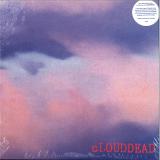
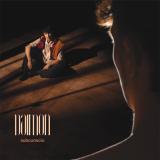
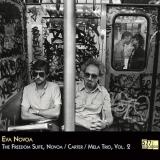
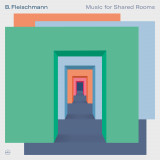
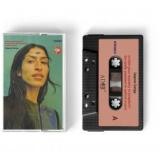
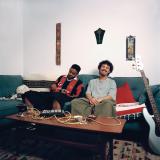
Seoul duo Salamanda arrive on Wisdom Teeth with their latest and most focused LP yet: 'In Parallel' - a vividly textural and immersive record that brings a new level of clarity to their typically psychedelic, expansive approach. Since arriving in 2019, the pair - comprised of friends Uman Therma (aka Sala) and Yetsuby (aka Manda) - have been fast at work mapping out their elaborate, dream-state sonic world - prolifically honing their sound across four albums and over a dozen singles to date. Across their already-extensive discography the pair have established a few key calling cards. Mallet instruments and tuned drums play out playful music-box melodies. Thick washes of gaseous ambience invoke otherworldly or ancient soundscapes. And buried fragments of found sound and manipulated vocal give their otherwise synthetic compositions a warm sense of first-person narrative. Ambient and Reich-school minimalism are the music’s most obvious sonic touchstones - yet the pulse of contemporary club and pop music have never been totally out of earshot. All of these themes come in to play here - but 'In Parallel' signals a step well beyond Salamanda’s work to date. Since 2022’s 'ashbalkum' (released on Wisdom Teeth alumni Tristan Arp’s label, Human Pitch), the duo have toured extensively: at classical institutions like London’s Kings Place as well as DIY club dens like Manchester’s White Hotel, all via a series of globally renowned festivals like Mutek, Nachti and Dekmantel. Their creative set-up has grown steadily alongside to incorporate a whole suite of new machines, processes and perspectives, taking their music in bold new directions in the process. The clearest development here is in the duo’s use of vocals - a shift that has been slowly taking place over their last few records, but that comes to a head on In Parallel. The album’s lead single 'Homemade Jam' is the closest the duo have come to writing an all-out pop track: its buoyant beat and autotuned vocals sounding like something SOPHIE and Charli XCX could have written after a particularly potent batch of mushroom tea. It’s a razor-sharp slice of alt-pop that offers a mouthwatering first look at what happens when Salamanda’s sprawling, unbridled creative energy is distilled right down into something concentrated and polished. At other points their sonic explorations lead them to embrace a more upfront approach to rhythm, skirting closer than ever before to the dancefloor in the process. The meandering drums and vocal chops on 'Paper Labyrinth' are underpinned by a firm 4x4 pulse, while the dembow groove of 'Tonal, Fluid' would feel right at home in a Nick León or DJ Plead set. 'In Parallel' is a record about connection, and the warmth and nostalgic simplicity of friendship is felt vividly throughout. Its title refers to the harmony the duo have found between them as friends and collaborators - and sonic parallels are traced throughout the record as testament to this. Motifs come and go before reappearing at later points: take, for example, the melody underpinning ‘Sun Tickles’, which returns in a different key and tempo on album closer ‘Mysterious Wedding’. Parallel lines are traced between each artist and through their music, linking back to their past and pointing ahead to the future. Only Salamanda know where these will take us next.
Cerca:new sense
Growing up in the 90s in rural upper Austria, Jakobin spent his time with skateboarding and listening to lots of hip hop before witnessing the halcyon days of the Vienna downbeat era and later being introduced to Austrias club culture. Pursuing his growing passion for collecting vinyl, he started spinning his first records in the region and later moved to the Austrian capitol.
There he quickly connected with likeminded people. Quickly getting immersed in the Viennese electronic music scene, he started producing and DJing with his longtime friend Domino under the moniker Jakobin & Domino and became founding members of Luv Shack Records in 2011. After a number of successful releases he started his solo career and began working on his live setup. His growing collection of analog gear helped shaping his productions. An overview of his current sound is expressed on his new record ‚Forever More‘. Heavily influenced on 90s UK house productions this 3-track EP will activate your senses and move your body with its groovy basslines and drums, creating an irresistible rhythm.
Building on their shared exploration of forward-leaning UK club sounds, EM + STAV herald the arrival of their new label JoyLift with the Endless EP. Having entrenched themselves within the free-spirited landscape of Bristol’s music community, the pair home in on a focused sound which draws on the city’s storied bass mutations as a springboard for their own take on modernist dance music.
There’s a tough, brooding quality to Endless EP which speaks to the meditative pressure of soundsystem immersion, but equally EM + STAV build out evocative, shifting narratives within that club-ready framework. From dubwise processing to deft sound design, a broad church of processes are wielded to shape out these pieces, and physicality comes in many forms whether in weightless sub lines or pointed, angular drum programming. Given their long-standing connection to developments within the underground music scene, there’s a keen instinct for the dynamic shifts which can set a dance alight, while the ill- defined shape of the wider genre-not-genre allows plenty of space for movement and experimentation.
Alongside the three original productions from EM + STAV, kindred spirit Forest Drive West steps up for a remix of ‘Odd' which aligns with the aesthetic intentions of JoyLift while demonstrating the idiosyncratic qualities associated with the scene’s most vital artists. The cohesive feel of Endless EP extends to Luke Griffin’s artwork, in which natural source material undergoes heavy processing to wind up in a striking new form, shot through with colour but ultimately shrouded in a moodiness that harks back through the lineage of hardcore-rooted UK dance music.
By its very nature the future is unwritten for JoyLift, but EM + STAV’s new project commits itself to an ever-evolving palette of sound, rendered as music with a strong sense of identity - tracks to shake the dance without resorting to obvious tropes, responding to and feeding into the inspiring tides of ideas emanating from the environment around them.
- A1: Held By Trees - In The Trees - Ambient
- A2: Stanley Clarke - Desert Song
- A3: Jan Akkerman - Ode To Billy Joe
- A4: Alain Debray - Concierto De Aranjuez
- B1: The Hightower Set - Departure Lounge (Nothing To Declare)
- B2: J Walk - Cool Bright Northern Morning
- B3: Canyons - Akasha (Begin Remix)
- B4: Waves - Summer Sunday
- B5: Mudd - Summer In The Wood
- C1: Trevor Heiron - Love Chains (Instrumental)
- C2: Korallreven - Honey Mine (Lissvik Remix)
- C3: Giorgio Tuma - Through Your Hands Love Can Shine (Feat. Laetitia Sadier)
- C4: The Superimposers - Seeing Is Believing
- C5: Cecilo & Kapono - Someday
- D1: Teacher - Can't Step Twice (On The Same Piece Of Water) (New Version)
- D2: Kalima - Shine (Gilles Peterson Vibrazonic Dub Mix)
- D3: The Haggis Horns - The Traveller Part Two
Celebrating twenty-five years of Aficionado as a place to play away from suffocating mainstream club culture, DJs Jason Boardman and Moonboots have compiled a contemplative set of 16 tracks that holds a deep meaning to both themselves and attendees of their now legendary parties. The compilation includes two new tracks exclusive to the release: J Walk’s ‘Cool Bright Northern Morning’ and Begin’s remix of Canyons ‘Akasha’.
Reflecting on how it all started 25 years ago, Moon considers their no-plan-plan to be a makeshift plateau which evolved organically: “All we did was try to play good records one after the other without any consideration for fashion. And people wanted that”. Alternative approaches were not unknown at the time, but Aficionado, as Jason and Moon’s Sunday sessions became known, pressed the reset button with unique resolve.
Jason elaborates: “It was 1998 when we started. It was our own 'fuck you’ to the Super Club regime - almost everywhere then. The ‘anything goes’ Balearic ethos was in abeyance. It wasn’t cool at the time, but we both just wanted to keep that original spirit alive. ‘Keep it open’ had always been my approach to DJing - even from playing at Youth Clubs as a teenager. No rules or generic constrictions. Play anything that you like from any era, any style from any time. We always encouraged our guests to dig deep and play outside of their comfort zones, their usual styles”.
The lovingly crafted musical mystery tour of this compilation, considering its pleasantly hypnagogic intent, may not reflect the madness of these now distant memories. This is an older and considerably more responsible collection and this is what we need right now - a temporary respite from a world almost capsized. A mood, a meditation created by masters of their craft. Odd socks from disparate global locations making new sense side by side. An assemblage, if you like. A thread through many different kinds of thinking. A new picture pieced together from the lost pieces of many jigsaws.
Ever amazed by the external world and its natural surroundings, Belgian producer Dijf Sanders has a habit of turning himself towards the unknown for inspiration. After praised albums based on field trips to Indonesia (Java, 2017) and Nepal (Puja, 2020) he found himself challenged by the traditional chants from Georgia. Diving deep into its sounds, people and heritage with open eyes and ears, he traveled to the Eurasian land in the South Caucasus in 2022. The field recordings and impressions of this journey make the blueprint for new, meticulously crafted compositions that ripened in his studio and transcend its original source material in time and space.
SUPRA offers nine diverse explorations ranging from spaced-out folk, ethereal trance, ambient with a melodic sense of drama and lush electronica channeling 90's IDM energy fields. Bound by dynamic depth in sound design, this is electronic music with a heavy heart - for all tracks share a primal sense of nostalgia in which traditional music from the Georgian motherland baths. From a pastoral love song about a buffalo (Mingrelian Song) or a ceremonial wedding hymn (What You Give Away Is Yours, What You Don't Is Lost) to a lullaby (Bird's Milk)... Georgia is a land of contemplative singing and its music scene today is still dominated by modal vocalists and harmonic choirs with pride.
With the help and recording equipment of the Folklore State Centre (Tbilisi) and in collaboration with Europalia Georgia festival, Dijf Sanders found contemporary choirs willing to lend their voices for this project. Next to these voice samples, the Georgian countryside and nature delivered source material for more samples and textures as well. The name of the record refers to the traditional Georgian feast where a large table filled with food, drinks and singing.
Following much love for his EPs, remixes and club sets, the virtuosic DJ/producer Simo Cell’s debut album 'Cuspide des Sirènes' doesn’t disappoint. In fact, it takes things to a whole new level.
With a fantastical menagerie of anthropomorphism, sounds create characters and tools; the mermaid-like Sirens, the mind controlling Octopus and the Magic Conch Shell:
“Have you heard of the legend of 'Cuspide des Sirènes'? This is not a simple tale, but an incredible tapestry woven over many years and through countless wondrous adventures. I will recount the legend as it was recorded in the ancient scrolls.
The album’s story explores the themes of magic, enchantment, charm, and allure, but also personal fears. The protagonist (me) embarks on a quest to find the hidden lake and confront his own demons, in order to understand and master his own power.
The protagonist is armed with a powerful conch shell. As he embarks on his journey, he will encounter Sirens who will teach him various chants. These melodies hold unique powers and grant the main character the strength to confront and overcome any danger that may arise.” Simo Cell
Musically, the LP is a continuation of Simo’s journey that began with the ‘YES.DJ’ EP, with a synthesized/modernized take on noughties hip hop, bass music, trap, ghetto house and ghetto tech – but here he broadens the scope, massively.
Exploring new pathways through magical landscapes, via infused melodies, emo and pop, the sensations are bright and addictive, like a sugar and endorphin cocktail. There’s a screen sheen and video game quality too, sounding like the high-octane score to an action flick from the year 3000, with unimaginably wild SFX.
'Cuspide des Sirènes' is the kind of record to stop someone in their tracks, to ask “what IS this?”, provoking bass face, perplexion, fascination and manic glee, all at once. Not so much organised chaos as intricately-crafted-borderline-unhingement, the album is slightly bonkers, in a very good way. There’s a boundless sense of childlike, unencumbered imagination at play, and an abundance of fun, but there are moments of serious-deep-beat-science for the heads, and introspective passages too.
There’s a lot going on, with detail, layers, flourishes, arrangement, melodies and myriad fresh sounds – but it’s never too much; just a really engrossing listen – the kind that that ruins ones appetite for prosaic, vanilla dance music, rendering such 2D pursuits boring and obsolete.
Ideally, the album is meant to be experienced as a seamless narrative from start to finish, so leave any inhibitions or preconceptions at the door, and let the pied piper of electronic futurism lead you way down the rabbit hole.
2lanes is proud to announce the next single, TINCTURE/ MY SIMULACRA, from his recently minted label AUTO SHOP. The two-tracker finds the artist both deepening his expansive sound and honing it to weave seamlessly into any DJ set. “TINCTURE / MY SIMULACRA” solidifies the cinematic textures and rusty low-end percussive drive of 2lanes’ earlier releases this year, “Diamond Rain EP'' & “Sid Ranger Redux EP.” Spending much of this past year on the road, 2lanes dove headfirst into the contemporary electronic music world, meeting an array of new and exciting producers, some of which are featured remixers on this release.
On the A side, take a dose of TINCTURE and see just how far the rabbit hole goes. Inspired by raving all night with friends, 2lanes linked with Detroit-based singer AKILLACO for a wild talking track like none other. We all know those moments at the party when both nothing and everything makes sense. You want to be prophetic but you just make everyone laugh. You think about the past, future, & present all at once. This is the ultimate message of TINCTURE, which AKILLACO emphatically points out. The long-winded musing is underlined by a heavy swung style beat that 2lanes fans have come to know well. Frequent 2lanes collaborator Salar Ansari joins the fun for the steamy, guitar-laden Howling Diablo remix that could as easily be played at a forest rave as a sleazy dive bar a la Coyote Ugly. Purelink’s MILLIA reduces the solution to an even dubbier chill out mix that begs to be played in the early mornings.
On the B side, we have the bass-heavy vision quest MY SIMULACRA. Ancient percussion meets modern sub bass–and together, they transport you to a new plane of being. This track also features performances from a few regular 2lanes sonic cohorts. Detroit keyboard prodigy Ian Fink (Scott Grooves Ensemble, Omar S) evokes celestial moments with a memotron solo, and Jonah Baseball (Overtone Series) provides a stargate-sounding break beat. MY SIMULACRA features two amazing remixes. The First is from Baltimore-based club aficionado JIALING and the second is a prime cut of rough and ready machine phunk from Los Angele’s 1morning.
Initially recorded at 2lanes’ home studio over Halloween in 2021, TINCTURE has since evolved to its final form that we see now. The tune has even shown up in sets from electric selectors like Scott Zacharias and Livwutang. The record label features beautiful artistic renditions by Norway-based Sverre Brand, whose work can be found on releases by Priori and Dust E-1.
- A1: The Mechanical Man - The Magic Number 5 32
- A2: Minimono - Grit Wave 5 14
- A3: Lucretio - Gradius 4 14
- B1: Queen Of Coins - Genesis 5 43
- B2: Miguel Herrnandez - Bad Renaissance 5 29
- B3: Twovi - Galassia Cosmica 4 57
- C1: Data Memory Access - Controller 6 14
- C2: Passarani - Bungy Bungy Bungy 4 52
- C3: Dj Rou - Milky Way 4 43
- D1: Lapucci - One 1St 5 18
- D2: Alexander Robotnick - It's So Easy 5 00
- D3: Feel Fly - Peach 5 36
The Stallions compilations have become a benchmark of Bosconi's position as one of the leading house and techno labels operating out of Italy. This third instalment marks a shift in sound which also comes full circle to the music that first inspired founder Fabio Della Torre as a DJ and producer around the turn of the millennium, when punchy electro production was driving European house and techno into new zones.
All the artists featured on Vol. III are Italian, holding true to Bosconi's commitment to supporting local talent from Florence and across the country. Amongst the familiar faces is Della Torre's own Minimono collaboration with Ennio Colaci, which indulges a proudly manic palette of tweaked bleeps and dirty low-end. Elsewhere, recent additions to the Bosconi fold include veritable legends Alexander Robotnick and Marco Passarani, who infuse their unpredictable approaches to electro-techno and italo disco with ear-snagging synth-pop and driving analogue box jams respectively to create vibrant, impassioned dancefloor monsters.
The Mechanical Man is an alias from Nicola Altieri, who leans in on a classic Italo arpeggio to create a seductive club sound which builds on his recent Bosconi EXV EP, while Cixxx J switches from the mood of his own Bosconi appearance for a new alias Queen Of Coins and a pivot towards heads-down electro-techno-trance with a whiff of International Deejay Gigolos. Lapucci builds on the promise of his 2021 Bosconi 12" with a sentimental fusion track which lands somewhere between old school Italo house, the snappy pulse of EBM and crisp 00s-era electro house. Meanwhile modern day Italian techno legend Lucretio of The Analogue Cops makes his first appearance on Bosconi with the playful video game stylings of 'Gradius'.
A great deal of space on Vol. III is given over to emergent talent, ranging from Miguel Herr's twitchy detroitian synth-pop braindance and Twovi's vocoder-charged electro funk to DJ Rou's jacking ghetto house flavour. Giammarco Orsini and Jacopo Latini appear as Data Memory Access and deliver an emotive, punchy strain of machine soul. Feel Fly rounds the compilation off in bombastic style with an epic, cinematic workout which draws on Moroder-inspired drama without losing the forthright peak-time focus which binds the whole collection together.
Even the artwork on Vol. III serves as an opportunity to celebrate Italian creativity, as pioneering crypto artist Niro Perrone builds on his accomplished work in the field of NFTs and a background in music production to respond intuitively to the vibrant, synthetic sound of the compilation. For all the futurism in the music though, there remains a strong sense of human feeling which has marked Bosconi out since the beginning. The label remains as inspired and inspiring as ever, celebrating the fertile crossover when people manipulate technology to express themselves in an honest, playful way. Independent of wider trends or fashions, Bosconi remains true to its own idiosyncratic passions, and so Bosconi Stallions Vol. III stands proud as a compilation like no other.
The latest offering from Astral Black comes in the form of the 'Metropolis N' LP, courtesy of Queens, New York's number premier importer/exporter of Jungle & D&B, NIGELTHREETIMES. Having initially garnered a name for themselves as one of New York City's most versatile club DJ's, with the release of their 'Call Of The Void; project in 2020 Nigel also began to build a reputation as a producer in their own right. Resulting in residencies on Rinse FM & The Lot Radio, radio support from the likes of Tom Ravenscroft & Uniiqu3 and press support from Resident Advisor, OkayPLAYER & Mixmag – amplifying their talents throughout New York City and beyond.
With 'Metropolis N' NIGELTHREETIMES distills their eclectic influences through the lens of rolling 160bpm breaks – taking in Jazz, 8-bit game soundtrakcs, science fiction & jump up D&B. Starting off the LP with the rhodes tinged double header of 'TSQ MELTDOWN' & 'EARLY MORNING FROM 103RD STREET', the latter featuring some of the best double bass work heard on a jungle track since 'Brown Paper Bag'. Elsewhere, on 'ROAD2RAILS' and 'PHANTOM SHORES', the producer ditches the instrumentation in favour of oscillated square waves, dubbed out vocal FX & 8-bit melodies, without ever losing site of the projects underlying sense of optimism. On the album closer 'INTERNATIONAL SPACE STATION', 3X manages to bring together the influences heard throughout the project, tying together a muted rhodes chords, squarewave basslines, flutters of alien melodies and finely tuned, slices breakbeats into a 5 minute symphony.
The consistency and exacting production skills heard throughout the offering elevate this project from another drop in the digital ocean to a landmark opus, from a producer carrying the torch for this timeless sound and making the project worthy of a spot alongside some of the classics this genre has produced.
'Metropolis N' is available Oct 13th on digital and limited edition vinyl via Astral Black.
Life might be a predominantly linear affair, but when lived right, it’s nevertheless a turbulent experience. It’s a system of trial and error, ebb and flow, order and chaos, action and reaction. And paradoxically, this system somehow still feels balanced amid all this turmoil. In fact, the same can be said about Keope’s second longplayer for Bigamo. Easily.
Keope might be a duo consisting of Marcus Rossknecht and Toni Bruna, but they actually sound like a collective of rather nomadic - and heavily gifted - musicians on their ever-present quest to reach different musical spheres. Everything is in motion, everything is in constant flux. Everything, everywhere, all at once. Their previous record “Triangulo“ already provided the audience an idea of their elaborate rhythmic vocabulary, but it’s the cryptically titled “Flikka Flokka“, which sees their multilayered compositions bloom into a fully-formed, new musical Esperanto.
You can immediately sense that Keope must be a phenomenal live act because the twelve tracks on “Flikka Flokka“ sound as if they were born from endless jam sessions fueled by a whole variety of influences. As a result, the work of Rossknecht and Bruna presents itself as a prime example of sound in motion that responds solely to its very own pulse by taking the aforementioned influences and making them completely their own. Now, let’s dance!
A familiar face in space·lab’s catalogue, Rambal Cochet’s deep-diving new EP, Mixed Reality, marks the occasion of the label’s eighth release with four tracks traversing the darker edges of psy-prog. Opening track, ‘Talpa Lionis’, mines the spiralling depths of a psychedelic abyss, driven by a dark, tunnelling bassline reminiscent of mid-90s psy trance. Titular track, ‘Mixed Reality’, is tonally brighter. Brimming with buoyant, prog energy, its liquefied melody submerges the track’s percussion in a glowing, ambrosial fluid. On the B side, ‘Sequence 2000’ grows from the ground up. A rippling, cosmic-hued melody traces ever wider reaches, circling the track’s drums as they rise from deep below ground-level. Skittering high-ends flutter organically through the track’s length, lulling us into a state of all-enveloping hypnosis. To close, ‘Aura 900’ unfolds onto expansive, new-age atmospheres. Delicately sinking into a delectable, chugging pace, its patient speed creates a sense of spaciousness, leaving room for the track’s melody to breathe. Mixed Reality journeys through vast terrains - an EP for introspective listening and mind-opening dancefloor experiences alike.
‘Gentle Persuaders’ is the Love Love debut from London based neo-noise-jazz outfit Sly & The Family Drone. In the form of a four track long player, Sly vomit forth a smooth serving of curious and clattering noise not devoid of fun.
With the ingredients of shattering baritone saxophone, splurges of analogue noise, rolling drum derangements and snarling feedback it is immediately clear that these formidable noise-mongers have honed their methods of ear-attack adeptly. Textural spaces are peppered with bouts of densely packed controlled-chaos creating a tension that builds almost imperceptibly until the crushing pay-off that comes with the final track.
The politest of bludgeonings, ‘Gentle Persuaders’ has a real sense of cohesion and style, at times subtle and at others shudderingly direct.
With their unusual and interactive live shows, the group cut their teeth stunning the audiences of punk and noise scenes across the UK and Europe. Now, Sly & The Family Drone present their most complete recording to date; a rush of sheer ataxia ushering in a new age of noise.
Life has changed in the eight years since the release of II. In ours, yours and Gala Drop themselves. Most times without noticing it, partly due to those two years of a semi-existence that still resonates and with the ongoing predatory gentrification process changing the landscape and life of Lisbon, home to the band since ever. Close to a decade and a half of existence, with various mutations along the way enacting new perspectives and moments of stillness and reflection to a sound that's been mutating itself to its own internal rhythm and agency under the guiding light of the core duo of Afonso Simões and Nélson Gomes. Now a trio, with Rui Dâmaso transitioning from II after the departure of Jerry the Cat and Guilherme Canhão, Gala Drop sound even more focused as a working band, with their new album title Amizade – friendship in Portuguese – making perfect sense in a celebration of their, by now, patented soundworld of cosmic inspiration: krautrock's endless and hypnotic potential, dub's sense of transient space, the throb of house, balearic dreams, polyrhythms and a communal sense of belonging.
Again, this sprawling sphere of influence opens itself to new shapes and inspirations, but there's a deeper sense of accuracy and direction, with the band channeling those legacies into something we can only grasp as the Gala Drop sound. An organic outcome of working steadily as a trio, made possible by a residency promoted by gnration in Braga, Amizade dwells on the psychedelic nature of the group through seven tracks made up of dreamy synth washes, loads of percussion, echoes, chilled guitars under a radiant aura. Gala Drop have never sounded as openly dubby as on 'Dub da Meia Noite' and 'Areal Dub' or capable of converging different tropes of the hardcore continuum – rave stabs and cut up vocals – on a slow burner as memorable as 'Monte do Ouro'. Or given free reign to electricity as on the narcotic guitars of 'Guitarra Voadora' – excepting the one off with Ben Chasny on 2012's Broda. 'Amizade' points towards all of that with comforting escapism and wrapping things up 'Raio' turns dubstep's original bass weight meditations into a cosmic funk workout. One last hug before we leave. An album that feels like a collective moment of celebration, just when we most need it.
Afonso Simões - Drums, percussion and synthesizers
Nelson Gomes - Electric guitar and electronics
Rui Dâmaso - Electric bass & guitar and synthesizer
Recorded by Budda Guedes at Estúdio Mobydick, Braga
Mixed by Gala Drop and Hugo Valverde at Estúdio Cão Andaluz, Lisboa
Mastered by Anne Taegert at Dubplates & Mastering, Berlim
Cover photo by Sara Graça
Design by Nicolai Sarbib
More than a decade after the release of ´Land Lines', the mythical Humboldt County, California based duo of Brian Pyle and Merrick McKinlay reappears seemingly out of nowhere with 'Atheistsaregods'. With past releases on such cult-like labels as Root Strata, Weird Forest, Blackest Rainbow or Digitalis, Starving Weirdos were an indelible part of a sprawling and loose network of artists in Northern America whose DIY work ethic and extreme activity revolved around shoestring-budget constant touring, numerous limited editions on CDR, tape and vinyl and a relentless drive to push the boundaries of genre.
Out of that cauldron, Starving Weirdos stood out as one of the most persistent and visionary acts, developing a mind altering body of work that went from warm soundscapes through droney digressions, freeform improvisation and raucous noise summoned from a myriad of instrumentation and low budget processing - vocals, keyboards, violin, flute, percussion and an assortment of less identifiable sound sources. 10 years on their legacy remains a timeless and wildly under-appreciated one, but hopefully this new album will shine a light on their idiosyncratic approach. As time itself was never a constraint. This is music suspended outside of it.
Right from the start with the echoing percussion, dissonant keys and processed vocals of 'Haiku Nagasaki', 'Atheistsaregods' draws a continuous flux of psychedelic elevation that goes from the gloomy electronic motifs not unlike the early Cluster vibes of 'Invocation' into the dank percussive maze of the appropriately titled 'Barulho do Samba'. The self titled track induces a sense of post-apocalyptic vertigo via hallucinatory scraps of voice, suspended synth tones and reverberating field recordings, connecting into the droney mystics of 'Dudukahar (Reed Prayer)'. Coming full circle, 'For Vinny' brings back the echoing percussion amidst hypnotic cello lines until it drifts off into the unknown. With the same palpable sense of urgency, Starving Weirdos feel as vital as ever. And even if we didn't realize it we were in need of them. Welcome back.
Effortlessly dismantling the barriers between R&B, soul, funk, disco and jazz sounds, MF Robots present long player ‘Break The Wall’, on BBE Music. Astonishing musicianship, pristine production and top-tier songwriting, ‘Break The Wall’ immediately calls to mind those iconic American rhythm sections of the 70s and 80s. The music is energising, uplifting and the potent result of a highly accomplished musical partnership maturing, growing and hitting their stride together in lock-step. Jan Kincaid and Dawn Joseph met as members of one of the UK’s most successful Acid Jazz bands, which influenced Mark Ronson, D’Angelo, Jamiroquai, Erykah Badu and The Roots to name a few. Founding the Brand New Heavies was an important chapter for Jan, but once he and vocalist and songwriting partner Dawn began working together, the chemistry was instant and irresistible. It was time to turn the page, and soon MF Robots was born. “When we made our first album, we didn’t have a band as such. We basically made a lot of the record at home and called on other musicians as and when we needed them. Our sound was developing organically, and when we finally released the record to great critical acclaim, it was time to get out on the road,” says Jan. “We put together a band of like-minded young musicians, playing intimate gigs and big festivals all over Europe and beyond, growing tight as a unit, so that when it came time to think about making this, our second album, we knew we had an extra level of musicianship full of personality that could realise our vision.” Inviting band members Alex Montaque (keys), Naz Adamson (bass), Mark Beaney (guitar), Jack Birchwood (trumpet), Ben Treacher (sax) to improvise and contribute their own ideas over song-sketches laid out by Jan and Dawn gives ‘Break The Wall’ a special sense of off-the-cuff brilliance. Even on the polished final product you can detect a collaborative, fluid and unhurried approach to production that’s all-too rare these days. There’s guest performances from bassist Gail Ann Dorsey (‘The Love It Takes’, ‘Make Me Happy’) and guitarist Cory Wong ('Shine', 'Make Me Happy'), the former a top-flight session player who’s collaborated with Lenny Kravitz and David Bowie among others, the latter a member of the incredible Vulfpeck collective and an accomplished solo artist in his own right.
- A1: Daryl Hall & John Oates - Out Of Touch (Club Version)
- A2: Robbie Nevil - C'est La Vie (Extended Version)
- A3: Living In A Box - Living In A Box (Dance Mix)
- B1: Fleetwood Mac - Big Love (Extended Remix)
- B2: Artists United Against Apartheid - Sun City (Last Remix)
- B3: The Cars - Hello Again (Hello Again)
- C1: Fine Young Cannibals - Ever Fallen In Love? (Club Senseless)
- C2: The Colourfield - Running Away (Long Version)
- C3: Deborah Harry - Sweet & Low (Swing Low Mix)
- D1: Daryl Hall - Dreamtime (Extended Remix Version)
- D2: Carly Simon - My New Boyfriend (Remix)
- D3: Bob Dylan - When The Night Comes Falling From The Sky (Full Length Version)
- E1: Neneh Cherry - Buffalo Stance
- E2: Wally Jump Jr & The Criminal Element - Turn Me Loose
- E3: Arthur Baker & The Backbeat Disciples - The Message Is Love (Feat Al Green - Cupid Mix)
- F1: Roberta Flack - Uh-Uh Ooh-Ooh Look Out (Here It Comes) (Here It Comes)
- F2: Will Downing - A Love Supreme (Jazz In The House Remix)
- F3: Al Jarreau - I Must Have Been A Fool (Remix)
- G1: Jeffrey Osborne - Soweto (Remixed Version)
- G2: Jermaine Stewart - Jody (Dance Version)
- G3: Atlantic Starr - One Lover At A Time (Extended Version)
- H1: Junie Morrison - Tease Me (Long Version)
- H2: Jennifer Holliday - No Frills Love (Extended Dance Remix)
- H3: Cindy Mizelle - This Could Be The Night
- J2: Glory - Can You Guess What Groove This Is (Short Version)
- J3: Ritz - I Wanna Get With You
- K1: Afrika Bambaataa & The Soul Sonic Force - Planet Rock
- K2: Tina B - Honey To A Bee (Vocal/Extended Version)
- K3: Arthur Baker - Breaker's Revenge (Extended Vocal Version)
- L1: Rockers Revenge - Walking On Sunshine (Feat Donnie Calvin - 12" Version)
- L2: Freeez - Iou (Mega-Mix)
- I1: Touchdown - Ease Your Mind
- I2: Second Image - Star (Us Remix)
- I3: Central Line - Surprise, Surprise
- J1: Afrika Bambaataa & The Jazzy 5 With The Kryptic Krew - Jazzy Sensation
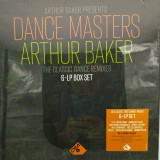
This latest instalment of ARTHUR BAKER Presents DANCE MASTERS finds the production/ song-writing/ remixing maestro taking the spotlight for a long overdue snapshot of his own classic 12” mixes during a crucial evolution of dance music, club
and pop culture.
“I’ve always felt like I was on a mission to make music from the time I heard Motown, Philly and Sly and the Family Stone. My mission started as a hobby and still feels like one now. You’ve got to keep on pushing and hustling. It can be a drag sometimes but
if you really love what you’re doing, it’s worth the work. I still really love what I do.”
Arthur Baker helped codify the remixer as artist. His genre-fluid approach to projects
has resulted in a joyous myriad of classics that spans many decades. This ’80’s focused DANCE MASTERS collection offers a welcome glimpse at Baker’s illustrious career and many long out-of-print 12” versions and previously unavailable mixes.
This 35-track, six LP expanded edition includes a wide array of selections from the likes of Robbie Nevil’s “C’est La Vie,” Fleetwood Mac’s “Big Love,” Neneh Cherry’s “Buffalo Stance”, Jeffrey Osborne “Soweto”, Freeez “I.O.U”, Rockers Revenge “Walking On Sunshine” and of course the juggernaut “Planet Rock” with Afrika Bambaataa & Soulsonic Force.
Complete with in-depth liner notes by Bill Coleman, track by track notes written by Arthur Baker himself, previously unseen session photos from Arthur’s personal archives and a signed insert.
All tracks remastered by Nick Robbins at Sound Mastering
Wildflower is a trio comprising Idris Rahman (sax), Leon Brichard (bass) and Tom Skinner (drums).
The trio takes you on an intense, meditative and spiritual musical journey that embodies the spirit of freedom. Based around hypnotic grooves laid down by Brichard’s unswervingly solid bass lines, drummer Skinner plays around artfully with the beats, grooving hard in constantly shifting, unexpected turns of rhythmic play. Rahman’s contributions range from subtle conversational interplay to loudly expressed angry passion to the most delicate of whispers, conveying a depth of emotion and a deep sense of musical structure withIn an ever changing sea of musical conversation.
Using simple, arresting melodies as a starting point, the trio create freely improvised waves of emotion ranging from powerful climaxes to hauntingly beautiful breath-like passages and everything in-between, creating unique forms and structures that react to the acoustics and the atmosphere of the situation.
Taking inspiration from the spiritual jazz pioneers such as John and Alice Coltrane, Pharoah Sanders, Yusef Lateef and Sun Ra, compositional influences range from Gnawa music to modal jazz to Bengali folk music but the scope is wider still and the important unifying factor is the spontaneous communication and interplay between the three musicians. Rather than having a tight rigid structure, the tunes are allowed to breathe and develop into new unexplored forms, allowing fresh interpretations that make each performance a unique experience.
The album is a collection of live and studio recordings that have been recorded and mixed by the band.
Originally released in the mid 80's on UK cassette label Bite Back!, this nearly lost gem finds new life 30 years later on Cocktail D'Amore Music. Steve has cobbled together a superbly melancholic electronic concept album. Wistful melodies often evoke sentiments of a lost childhood and hazy English mornings.
Each song within remains untitled allowing full perceptive freedom as to what they all communicate, a language for the feelings that have no name.
Untitled A1 - A6 leads one along intimate soundscapes of pattering drums and tinkering piano, a sense of closeness and trust develops with the introduction of each new idea much like the beginning of a bed time story. Untitled B1 - B3 then begin to breathe more openly awash in angelic colours before abruptly turning downward on B4, a wall of booming drums and atmospheres from the furthest reaches of the galaxy before the last trio of songs settles gently back on Earth.
Mouche (real name Tim Karmouche) returns to Australian label Research Records with another full-length of imaginary soundtracks, instrumentals and sun-kissed digital jazz. Active on the Melbourne scene in projects such as Crepes/The Murlocs/Swazi Gold/Dreamin' Wild, Tim's first album Live From The Bubble arrived back in 2020 as an ode to his aptly named studio space - The Bubble.
Lake Songs builds on those same atmospheres, showcasing the inward-looking craft of his one-man band. Cicada field recordings and light keys open proceedings, reflecting the warmer side of 80s new age, though before long we're introduced to a variety of stylistic shifts incorporating elements of cosmic funk, lounge and library-style compositions. There are traces of Steve Hiett, Max Groove or even the recently re-discovered Ronald Langestraat, though the strength of Mouche's talent for harmony shines through on its own level.
Shifting between moods yet reflecting an overarching sense of positivity, listening through the ten tracks gives off a real sense of place, though time is somewhat irrelevant. The warm climate and sandy beaches of Australia seem eternally embodied in 'Juice' or 'Crystal Water'. Perhaps where Live From The Bubble was dedicated to the very studio that birthed it, Lake Songs is dedicated to the vast land that surrounds it.
At long last, hi-tek whizz-kid Metrist returns to Timedance with the third addition to the ‘Pollen’ series and brings his epic trilogy started in 2019 to a breath-catching end.
Elevating an already unique approach of sonic craftsmanship to whole new levels, the London based producer delivers some of his wildest and most dramatic compositions to date while pushing further his signature blend of 22nd century dancefloor pyrotechnics.
From the angelic vocal cascades of opener « Leven Lever Liver Love » to the heart-wrenching heights of « Bullet Time », a playful and intricate display of cross-pollinated emotions shines through this collection of boundary pushing tracks, giving them a life of their own while bringing a stormy cycle of auditory experiments into human nature to completion
As thunderstorms form, pollen grains often ascend into clouds, soaking up humidity to a point they inevitably burst out, liberating innumerable particles that tumultuous winds send back to ground-levels.
With a false sense of distance and safety, we sit back and watch the lightning strike in complete awe, unaware of pollen slowly descending from the skies, making its way through our lungs and deep into our bodies ; the storm may be over, but Pollen has now fully become a part of us.
Symphony Orchestra is a new group from Maximilian Turnbull and Michael Rault. Both Rault and Turnbull are accomplished songwriters, performers and producers in their own right, with Turnbull leading The Badge Epoque Ensemble, playing with the group Darlene Shrugg, and once releasing records under the name Slim Twig and Rault having released several psychedelic rock & roll classics under his own name in the past decade. The pair have worked together in various capacities for many years, writing and recording together on U.S. Girls' In A Poem Unlimited, and contributing to each other's releases, but the debut LP from Symphony Orchestra (due out May 12th on Telephone Explosion) marks their first release as an official entity.
Needless to say, there is a potent creative chemistry between Rault and Turnbull and Radiant Music showcases the alchemy between their distinct skill sets. The album is an exercise in pure collaboration. After years spent focusing on solo projects and working as hired guns on other projects, the duo came together with no specific intentions other than to work free of boundaries and direction. Freeing themselves from the familiar pressures of deadlines and expectations, they found a sense of discovery through togetherness. Duties on this project were split between Rault acting primarily as a one-man rhythm section and lead vocalist with Turnbull bringing chord sketches and his trademark aphoristic lyrical musings to the table. Trading off roles on guitar and keys from song to song, the duo's deft approach to melody bleeds through their instrumental parts as much as it does through Rault's vocal melodies. The majority of this album was self-engineered over the course of three sessions in 2018, at Michael's Montreal studio. Dormant during the pandemic, Rault's move to Los Angeles and the birth of Turnbull's twin sons, work reignited in 2022. The latterly tracked instrumental 'Concerto' and ballad 'Unthink The Thinkable' provide a dynamic depth to the album perhaps attributable to this tumultuous pause. Mixing came courtesy of Steve Chahley & Tony Price (U.S. Girls, BÉE, Jane Inc, etc).
In all of their work, Rault and Turnbull have made a hallmark of elaborately precise production and arrangement, Radiant Music is no different, though its pared-back simplicity provides a streamlined directness. The pairing of Rault's soulful, elastic vocal with Turnbull's evocatively cerebral lyrics provides a thrilling sensation unlike anything else in their respective catalogs. With an explosive, groove-forward approach, kaleidoscopic walls of vocal harmony and technicolor displays of guitar work, these 31 minutes of music will most certainly stimulate the mind of any fan of classic pop rock and funk. The blown-out breakbeats, winsome woven vocal melodies and propulsive wah-wah guitars of the title track evoke memories of an after-school cartoon special that never really existed outside of a lysergic daydream. "Harp In The Wind" is a perfect moment of overcast melancholy complete with ribbons of weeping synthesizers and velcro-fuzz guitar that could rip a clean line through Kevlar. "Know Thyself" and the harmony-rich "Intersection" are standout tracks that find a kinship in Stereolab's space-age effervescence. "Concerto" is a slab of beaming, mischievous funk that nods to Billy Preston's extraterrestrial keyboard explorations.
Radiant Music, like the best pop music, is life-affirming, confectionary, and enticing. Symphony Orchestra have created an album that hits you right where you need it, anchoring heady, adventurous sonic ideas down to a solid foundation of masterful songcraft, virtuosic instrumental performances and undeniable groove. Not a bar, nor beat is wasted.
*MILKY CLEAR VINYL - 300 COPIES ONLY FOR WORLD!!* Technology + Teamwork’s fizzling synths, interweaving textures and punchy rhythms are beguiling on their long-awaited debut album We Used To Be Friends. However, at the heart of it all it’s the connection between the group’s two members, Anthony Silvester and Sarah Jones, the friendship the much-travelled duo have managed to maintain for nearly 15 years and a showcase of the slow-burning construction of the electronic world that they’ve surrounded themselves with. We Used To Be Friends is ultimately the tale of two storied artists in their own right, holding onto each other through personal and career twists and turns, relocations and broader movements through respective phases of their lives. Silvester and Jones first met and then collaborated as part of biting post-punk five-piece XX Teens in 2008, eventually breaking off to forge their own path together even as the latter’s demand as a drummer grew. Performing with everyone from Hot Chip, Harry Styles and Bloc Party among many others, Jones has been a constant percussive presence across the sphere of alternative UK pop music – she’s also found time for her own solo project Pillow Person and played on records by the likes of Puscifer and Kurt Vile. Silvester meanwhile has performed in art galleries across Europe including: Fridericianum in Kassel, Kölnischer Kunstverein in Cologne, and Vleeshal in Middelburg, as well as providing sound design and composing work for several art films. Technology + Teamwork is the constant throughout all of that though. “Technology + Teamwork's name perfectly describes how we work” Silvester explains. “Sometimes the teamwork is between each other and sometimes it’s between us and the technology.” Although going by the name Technology + Teamwork as far back as 2014, two events conspired that pulled the project into focus for the pair of them: firstly, Silvester spent a year constructing a soundproof studio shed on the border of London and Essex where he lives. Secondly, inevitably, the pandemic brought the globe-trotting Jones back home to just seven miles away from her long-time collaborator and friend. “We probably hung out more than we had for a few years” says Silvester. “Also, after all her Pillow Person releases Sarah had gotten really good with recording vocals and knowing what did and didn’t work and had a really good home studio set up. We still worked separately though, exchanging ideas via email and WhatsApp.” As with many artists through 2020 and early 2021, working separately was a new necessity that they were forced to adapt to. However, it became clear that there were creative benefits to it. “It really changed our sound and our sounds became a lot more focused as a result” Jones says. “I wanted to use the same ideas of improvisation that I might use while playing the drums for myself and apply that to melodies and lyrics.” The album bristles with hyperpop modernity. You can hear it in the manipulated vocals most prominently on Big Blue’s disco strut and on Moving Too’s heady mix of pitched up voice and burrowing sub bass. However, the pair also looked to San Francisco and the West Coast synthesis movement of the 60s, Silvester inspired by the likes of Suzanne Ciani and Don Buchla. The plaintive lo-fi and melancholy of Amsterdam incorporates Mutable Instrument’s Marbles by Émilie Gillet which – inspired by Buchla’s own synthesis work – outputs random voltages to give the track an air of unpredictability. It’s something that occurs throughout the album, the duo revelling in the happy accidents that disrupt the flow of their hook-laden pop. “The ‘Buchlian’ ideas of music having randomness and uncertainty, completely freed us up” Silvester explains. “It felt a bit like having more members in the band, machines that didn't do what you expected or intended.” Perhaps more subtly, is the influence of 17th and 18th century Baroque music, with Silvester drawing a line between it and the 90’s R’n’B he and Jones both love – exemplified perhaps best on K+B’s percussive claps and sultry grooves. The portentous juddering synthpop of the title track, meanwhile, alludes specifically to Handel’s Sarabande. It’s typical of an album that only needs a scratch of its seemingly glossy surface to unearth a myriad of contorted touchstones and reference points that’ve fermented beneath it. Thematically there’s an anxious sense to the record, with tracks often balancing above a quiet sense of unerring tension even at their most bombastic. Moving Too is the result of an existential doubt that hit Silvester while out cycling, with the outro refrain "it's not enough to die you also have to be forgotten" a take on something Samuel Beckett once said. These worries are echoed on the album’s closing track What A Year, which borrows a lot of lines from the late drag performer and fashion designer Dorian Corey including the grimly defiant "you're gonna leave your mark somewhere in this world just by getting through it”. Those clouds offer a counter point to We Used To Be Friends, but then isn’t that what great pop albums do? Technology + Teamwork undoubtedly love the craft of the hook and the song, but they always position themselves left of centre, prepared to scuff things up, pull something out of shape or manipulate something to leave it sounding warped. Much like their friendship, nothing here is particularly linear – and it’s all the better for it. Bio: Anthony Silvester & Sarah Jones first collaborated as part of biting post-punk five piece XX Teens in 2008, eventually breaking off to forge their own path together even as the latter's demand as a drummer grew. Performing with everyone from Hot Chip, Bat for Lashes, Harry Styles and Bloc Party (among many others), Jones has been a constant percussive presence across the sphere of alternative UK pop music - she's also found time for her own solo project Pillow Person and played on records by the likes of Puscifer and Kurt Vile. Silvester meanwhile has performed in art galleries across Europe including Fridericianum in Kassel, Kölnischer Kunstverein in Cologne, and Wleeshal in Middelburg, as well as providing sound design and composing work for several art films. Technology & Teamwork is the constant throughout all of that though. "We Used To Be Friends" proves that Technology & Teamwork undoubtedly love the craft of the hook and the song, but they always position themselves left of centre, prepared to scuff things up, pull something out of shape or manipulate something to leave it sounding warped. Much like their friendship, nothing hear is particularly linear - and it's all the better for it.
Ain’t no stopping him now. Krystal Klear’s streak continues with Automat Kingsland. The recipe remains, perfectly seasoned to taste. The extended menu of four tracks is musical testament to the artist’s life of the last six months. Emphasizing movement at a pace that is hard to hold on to, but embraced nonetheless. Trying to transport that „lost in translation“ (and transit) sense of normal life due to constant motion to a dance floor near you. Euphoric melancholia meets rave romance, shutters open to let happiness crawl in and anxiety turns into excitement through the usual cocktail of tearjerkers and white noise risers. Recorded between Paris, New York, Dublin and London and brought to your city via Running Back. Automatic non stop existential output.
The eccentric beat ambassador Alexander Skancke showcases his sound once more on his Quirk label, diving into spring with his debut LP, “Kingdom Couch”. The Norwegian has crafted a versatile yet cohesive body of work between 2020 and 2023, parallel to when he began attending sessions with a therapist. The 10 track double 12” traverses between meticulously arranged minimal moods, shuffling jazz rhythms and ethereal experimental textures. In its few years of existence Quirk has become a safe haven for a freedom of expression as Skancke and his affiliates share their wild side on the label, but the LP marks a milestone on the imprint and for Alexander himself whose lifelong dedication to sound has built towards this moment, utilising the vast influences has absorbed over the years.
“Therapy Session I” teases you into the LP, shimmering blissfully as it grows, blossoming into a dream-like world, tuning your ears for the trip you are about to encounter. Constructed upon slick jazzy drums is “Lost In Time” loosening your senses as the pulsating bass swallows up your train of thought. “Dumbo Move” blurs the lines perfectly between the atmospheres the Berlin based producer has captured within the album. Dark, mysterious and mind bending material in “Purple Lucy” a chugging sub heavy bass driving the track forward as precise beeps and bleeps whirr throughout. On a more playful note is the B2, “Extravagance” animated drum patterns converse with the elastic groove perfectly. Closing off the first vinyl is “Therapy Session II”, another extended exploration of otherworldly ambience, drifting deeper in the world of Quirk.
“The Magnificent Tree Hut” stirs consistently throughout, crisp percussion combined with the psychedelic vocal samples which continue to flash in and out. Transitioning now into “Therapy Session III” sophisticated sounds, enticed further into the full bodied experience by the storytelling sounds of a female voice. Your eyes begin to close and you wake up in a hazy club setting, immersed in the after hours; that’s the immediate impact of “New Dawn”, pensive and hypnotic as it rumbles quietly in the realms of the underground. At just over ten minutes long Alexander Skancke brings you down for landing with the final “Therapy Sessions IV”, transcending movements crammed full of raw emotion, floating you calmly
out of the seventh outing on the label, and the thriving talents finest work to date.
The “Kingdom Couch” is an amalgamation of Skancke’s undying passion and burning desire to create outside of the norm, this can be heard throughout this masterpiece and will undoubtedly inspire its listeners to search for the bigger picture.
Artwork: Johann 3000
Mastering: Mike Grinser, Manmade Mastering
MOOD CHILD is the new artistic platform of DJ/Producers, SIRUS HOOD & MANDA MOOR.
Evolving from a collective idea during our difficult pandemic period, MOOD CHILD is, at its centre, about community, collaboration, friends and family. Working together, feeding each others creativity and forging fresh and exciting new sounds and projects.
MOOD CHILD is an invitation to a journey that blends different feelings, emotions and desires. To activate your inner child. Reinvigorate the wild, primitive and unfiltered state of being and create an almost divine sense of unity. All through the power of music and art.
Their collective sensibility is nurtured upon the dancefloor and last summer they were blessed to have presented a first MOOD CHILD experience in collaboration with Hï and Café Mambo in Ibiza. The mood then took them to Bagatelle in Zürich and Lovefest in Serbia and they now prepare to launch their 2023 campaign alongside the elrow family for a sold out event in Andorra 1st of April.
However, what is a party without its soundtrack? Their first release, as its title suggests, brilliantly displays the labels primal perception… ‘Homo Sapiens’ is the mood child of Sirus Hood and Malikk. Four carnal creations, all guaranteed to ignite a rabid dancefloor response.
‘Booty Side’ uses its compass to expertly navigate its way through bubbling acid and rolling snares as we go in search of Jack, while the title track will have us going ape to its chest-beating bump and knuckle-dragging groove.
Silverback beats swing low on the flip too as ‘King MTF Kong’ bites hard with its heavy Chicago hustle and detuned synth, while the feral Juke-infused finale, ‘Gorilla Walk’, is a break-neck bass-driven and bruising encounter that is more Jersey club than Empire State building.
The ‘Home Sapiens’ EP is released on the 14th April and will be available on vinyl and digital formats, alongside a series of exclusive NFTs.
MOOD CHILD’s official online store will launch soon and feature not only the music and digital art projects, but also an official clothing brand, sample packs and exclusive content from their artists.
It’s time to connect with your MOOD CHILD.
Lobster Theremin ambient sub-label Lobster Sleep Sequence announce their double LP + 7” album from Dutch producer nthng - featuring a limited run of copies on deep green vinyl. Themed around events in the artist's life, Unfinished is a deeply personal journey, yet there’s something very relatable to the world he has conjured. Lockdown has forced us to look inward, explore realities within ourselves and the fragility of our forgotten world. The album is a series of peaks and troughs - hopeful words, ominous tones and other-worldly soundscapes, giving way to a journey in no way linear - but a true reflection of our times. The title track sets the scene perfectly, while Son features deep bass notes, dreamy keys and spoken word - creating a visceral and unsettling scene. Subnautica resides in the fringes of ambient and techno - as tribalistic drums are suspended in our new rendered reality.
The marching bass and howling synths of Wrath of the Demon lull conspicuously in a vacuum, while the hauntingly beautiful vocals featured on Disappeared But Not Forgotten evoke a poignant, powerful reaction across the record’s B-side - “Everything stopped, you just disappeared...”
At its most tranquil Our Time offers a sense of rest - a space to appreciate, as we leave the window open, peer outside and feel the gentle breeze brush across our face. Saafe continues this theme, and feels like a warm embrace - “She saved my life in a matter of speaking, when she gave me back the power to believe.”
Ending Theme is beautifully organic as you hear the sound of the piano pedal touch the floor, tones are introspective and vulnerable - while the looming presence of uncertainty subtly takes form in thinly layered pads.
The album also sees the release of a digi only bonus track Only a Flash of Light and invites you outside while the stars are at their brightest.
Listen Here
Two years after their previous effort, regular as clockwork, Swiss throbbing synth pop duo Veil Of Light is back with a new album and what can we say? These guys keep on getting better and better.
If you have followed the Zurich-based outfit over the past few years, you must have noticed the constant moving towards 80’s FM new wave and synthpop tones – without losing their electro/body music outline – that have marked the band’s parable, especially since their latest Landslide LP.
Sundancing is their sixth full-length and it stays the course, bringing what we’ve just said to the next step. Nine new dancy and bright tunes with emotional depth that blend lush instrumentation and robust rhythms, guided by funky and rubbery basslines. Syncopated rhythm sections match suburban cool synths in the lead single Apricot Kiss and Hypersleep, while Raindancing and Tonight summon a sinuosity long gone since the mid Eighties. The musical backdrop here serves as the fundament for emotional vocals delivering lyrics dealing with the fragility of love, joy and loneliness.
There’s some subtle addictiveness to these songs, one that will gently grab you by the collar of your coat and stick the refrains from Sundancing inside your head for good.
Veil Of Light might make it look easy to keep it neat without being minimalist, intimate without being depressing, romantic in the most true sense of the word, but we know that’s possibly the hardest thing to do.
New album from Jaffa Kid. Powerful rave friendly and acidic breakbeats coming your way!
Connections by Satya is a February exclusive edition and a token of love for the year ahead. Gathering to spark an electrifying synergy, Connections is all about finding that blissful meeting point that can be achieved once we mindfully align on values, sentiments and musical sensitivities. These pillars hold up Connections’ core foundations and shape a new philosophy construction for the label. By merging four finessed tracks mastered by four invested musical minds, Satya takes a new turn for collaborative musical alchemy in the sense that Connections’ production is balanced, tasteful and touching. Each artist’s culture subtly seeps into each track and speaks volumes of their character in and out of the studio. Space Invaders, Aurora, Mentat and Spaces hold many keys to unlocking doors to full transparency and connectivity through our senses in the simplest of ways.
“These are cosmic sounds that you can get lost in and go anywhere you feel safe and adventurous.” - Zone+
Welcoming Hermanez to Satya has naturally induced the label to transcend musical boundaries by opening up the creative parameters to more electronic artistry. Taking spring by storm, Hermanez has adopted 009 with grace and unequivocal individuality. With his full-body thrilling tracks, he empowers the listener to Rewire their listening programming, refreshing their palette with a high-energy burst of sexy flavors.
“The urge for freedom during the lockdown was a big thing for me. I personally had a production burst. Everyone needed to deal with what happened, so I did it in my own way by purely doing the only thing that kept me moving forward: creating a space to stock a feeling. Rewire is a story that is beyond words, as it is made up of healing sounds. Although there were cultural contradictions these past years, what mattered most for me was and still is people’s love for music. Overall, 009 was inspired by the beautiful collision of people and their experiences.” - Hermanez
Through defined grooves, rolling bass lines, granular uplifting synths and pad use, Rewire is literally wired with deeply hypnotic and mystical atmospheres. Hermanez truly strikes and presents us with four dance floor weapons.
When the body starts moving
And the mind stops racing,
The heart ends up pumping
And a smile keeps spreading.
Our programming is now rewiring
Our perspectives now expanding,
With all 5 senses heightening
Because of what is resetting,
Recalibrating and realizing.
Rewiring to a new reality.
- Ty Alexander
From New Jersey via The Netherlands: longstanding US craftsman Joey Anderson makes his debut on Deeptrax with his inspiring new album… ‘Exotic Sequence’
His fourth LP to date, ‘Exotic Sequence’ is a fully instrumental deep dive into both Joey’s machines and mindset, as he explains himself… “The title ‘Exotic Sequence’ stood out to me because throughout the LP I tended to use a sequencer for the main melody of most of the tracks. Almost every time I approach a track with techno intentions it eventually ends up being deep / housey,” states the artist who broke through 15 years ago on Qu’s Strength Music and has worked closely with the likes of Dekmantel and, more recently, Avenue 66.
Now at home on the relatively new and positively thriving label arm of Dutch record store institution Deeptrax, Joey tells us where he’s at with a body of work that poignantly reminds us that it’s not the destination that counts; it’s the journey we endure to get there.
In this sense, ‘Exotic Sequence’ is the sound of Joey letting his instruments guide, inform and inspire him. Cuts like the constantly rising and hopeful ‘Sky Children’, the deep 808 bubbles and dreamy reflections of ‘Behind The Valley’ and the emotionally rich ‘Stop’ are just a handful of examples of Joey being lost in deep flow, channeling the creative energy in his studio.
It lands exactly three years after his last album ‘Rainbow Doll’, neatly bookending the strangest and most surreal start to any decade we’ve lived through since house and techno culture took root in the 80s. A timeless document that looks forward and back and remains unhurried, thoughtful and crafted with longevity, ‘Exotic Sequence’ is arguably the most honest and frank side to Joey Anderson we’ve heard in his extensive career so far.
Modern Power electronics...TIP!!
Philipp Matalla lives and works in the triangle of Halle, Leipzig and Berlin, in Germany. He has previously released music on labels such as Optimo Music, KANN and Kashual Plastik. His new album on Meakusma delves into some of the themes that have so far defined his work, this time increasing the tension between moments of musical harshness and flickers of introspection, ease and downright beauty. Matalla aims not for perfection, instead deploying the listener's sense of imagination. His work toys with the notion of abstraction in electronic music, often going as far cutting short melodic and other ideas, making for a confrontational stance unafraid of leaving his material in a state of difficult to define rawness, based on versatile ingredients equally rooted in rural and urban territory. Stakes is a gorgeous and gorgeously far out album, integrating elements of psychedelic rock and dub, blending in melodic ideas that are at times abstracted, at times soothing. It is pastoral music for the digital age, where raw bursts of noise and energy dislocate and set the record straight. There is even a croonerish feel to some of its tracks, croonerish from a distorted future that is. Stakes is an experience in eclecticism and musical logic. It dissolves structures and ideas and turns musically recognisable elements on their head.
Meiosistosis is a unique and creative descriptive innerstanding created by DemoDc taken from the scientific terminology of Mitosis - a splitting of one cell to create 2 identical cells and Meiosis - a splitting of 1 cell to create 4 very unique cells. Combining these 2 findings to create its own unique expression of what Demo feels earth herself is potentially going through in what most humans refer to as 'crazy mad' times.
‘Call me mad or crazy yet my artistic take on all this madness of change, coming from a more spiritual aware perspective, I feel its very possible and plausible that earth herself is shifting from an energetical vibrational frequency resonance, shifting from a lower to a higher frequency that has souls who inhabit at this present time on Earth, have choices made available to either shift to these higher frequencies of perception or to chose to remain in the lower frequencies of perception’
….says Demo when explaining the meaning of the titles chosen for his brand new releases. Hence, from this perspective it would give more purpose and meaning with the Earth splitting itself from 1 earth into 2 with the merging of it being identical and unique all at once.
True or not, through creative expression can we all individually make sense in our own rights, which then gives more power to the inner-standing of what co-creating with any greater power outside of ourselves, is. Each track holds its own unique expression to what has been described here and of course gives each listener a chance to give meaning to what is embraced in their own connection made when absorbed in the creations these ep's offer.
Weorus is back. This time with four deeply minimalistic tracks.
The opening track comes with Andrea Ferlin’s masterpiece “TRK”. The evolution of the sound rising in it uplifts the sense of a deeper inner self. Perfect meditative notes bound together with miscellaneous hi-hats and organic tones.
The journey continues with Neem’s “Joke or serious”. Master Neem knows well how to touch souls and push the right buttons. The track is an evolution of a higher time space perspective. Listen carefully, it will change you.
Fabrizio Siano’s “L’erosione monometrica” flips the vinyl of the B side. Constant evolutionary and revolutionary sound design brought together with majestic writing. The micro minimalistic approach stands out in front of a constant kick and bass roll. The background piano gives the right atmosphere for a newer meaning of the track.
To close the 12” is Dragosh’s “Kardiomomo”, a one shot production that brings out drum based percussion throughout the track. Vocals and drifting concepts melt together with the less electronic touch of a piano. Perfect for afters and sophisticated mixes.
Weorus strikes again.
Watch out for its (r)evolution
Workaday Strangeness: Gyrating Death Throes From a Void Axiom' is the new LP from Glasgow-based music originator Wormhook. The music therein, we understand, emerged for highly personal therapeutic reasons; nevertheless to describe it as ‘idiosyncratic’ would do a disservice both to Wormhook and to the concept of idiosyncrasy. While the record is certainly a profoundly unique, irreplicable creation, its music is nevertheless based on a visceral, breathing human rhythm which is common to all living bodies. It represents a celebration of the act of creation as a means of processing psychic and spiritual conflict, unconscious thought leading to spontaneous musical discovery.
Through something approaching the musical equivalent of automatic writing, Wormhook gives birth to fluid, home-woven spectral incantations and an untutored, backward-masked concrète hymnody. Brittle-as-glass guitar and grainy, hand-processed electronics underpin cantorial, intuitively modal vocals delivering a kind of raw, revelatory yet anti-prophetic ur-poetry, bridging the centuries between Hildegard von Bingen and Lonnie Holley and fixing the solitary star of Wormhook within the hermetic constellation which these visionaries inhabit.
- Alasdair Roberts 2023
Berlin based sound artist Sa Pa delivers AI-33, titled ‘Atmospheric Fragments’. Originally intended as a soundtrack to accompany ten short experimental films as part of a physical exhibition in 2020 curated by Manon Bernard, Atmospheric Fragments was alternatively premiered online as a digital showroom - with its music performed and recorded both live and independently in 2021.
Atmospheric Fragments was conceived as a collaborative audio-visual project, positing the viewer inside a sonic boom of introspective parenthesis and offering a place for internal dialogues under the circumstances of a largely unknown and rapidly changing modern world.
Sa Pa’s work presents a fresh sonic reinterpretation of urban landscapes, skylines and modern environments, procuring from its source material a whole new kaleidoscopic world of its own. The record consists of two mixes - ‘Studio’ and ‘Live’ - which demonstrate a deep explorational study of our everyday surroundings, plunging the listener into a realm of heightened sense experience and microscopic detail. Where the ‘Studio’ mix embodies the precision and management of the studio workspace and is more ambient in nature, such intricacies are exchanged for a larger, livelier sound stage and alternative sonic material in the ‘Live’ mix.
A nebulous ocean of shifting spaces and effervescent textures, Sa Pa augments and modulates field recordings into a fluid and ever-evolving narrative. Seen through a viewfinder of deep and immersive observation, new transients, momentary artefacts and poetry in motion begin to reveal itself. In a world caught in momentary stasis, Atmospheric Fragments is a forensic inquiry into our perceptive environment, with its augmented lens placing us on the cusp of the ungraspable.
Alignment is back on Charlotte de Witte's KNTXT label for a fourth time with his Attack EP. It offers four more forward-thinking tracks of trance infused techno.
Berlin-based, Italian-born artist Alignment, whose real name is Francesco Pierfelice, has emerged as a real force in the techno world in recent years. He has had an outstanding array of vital productions, and his sound helps carry forward the diversity and musical identity KNTXT stands for. His sound has smartly evolved since as he continues to pick up new influences. All that comes out on this superb new release.
Says the artist, ‘I am more than happy to contribute with ‘Attack EP’, another release on such a renowned imprint like KNTXT. Charlotte has supported me since day one, and I am hugely grateful to release for the fourth time on her label. Four tracks that are straight to the floor, they are the outcome of touring clubs and festivals again now in 2022. Enjoy this selection and see you soon on the dance-floor!’
Says label boss Charlotte de Witte, ‘Alignment is one of my favourite producers out there. His high energy style and sound always deliver on the dancefloor. I'm very proud and honoured to have him once again on board for another four killer tracks on KNTXT.’
Attack opens up with hammering drums and turbo-charged synths. It is an all powerful track that drills deep and brings a real sense of rave to the club. There is an ever present sense of euphoria to Dream State as the trance synth loops bring real light and emotion to the flat footed and slamming drums. Some steamy vocals add that all important hook and ensure real dance floor destruction. Multiverse brings bouncing techno funk beneath edgy synth stabs and industrial percussion design for soot-black warehouse spaces. Last of all is The Way, another unstoppable and supersized techno offering with hands-in-the air synth designs and drums that just don't quit.
This is another fiery offering of new school techno from Alignment.
repressed !
Label head Setaoc Mass returns to his own fledgling SK_Eleven imprint with the much-anticipated Second Chapter EP. True to form, the release deals in bleeps and melodic Sci-Fi indebted elements, yet with a harder impact and a sense of urgency calibrated for the main room floor. B-side cut Thunder Bay ventures into new territory for the artist, diffusing coarse, broken rhythms over ominous call and response synth riffs.
Firescope are always on the lookout for new music, searching and sieving with headphones clamped over ears. GGGG, a recent discovery, unveils a stunning debut release. The co-founder of D.Ko Records may be a fresh face when it comes to releasing, but he has a wealth of both experience not to mention talent. His album, Gazé, is testament to this.
A spread of styles and influences coalesce to create GGGG’s unique sound. Ambient. Braindance. Electronica. Techno. All are melted and forged into the new. Processed percussion is the shifting sands from which a swooping melody takes flight, a melody that bends and soars as “K-Robot OG” ascends. Crystalline chords are shaven with fizzing drums in the frenzied elation of “Cas Contact.” And this is what lies at the heart of the collection, a rapturous joy that permeates the entire record. From the complexity and grandeur of “Chien Flûte 5.1” to the considered and subtle “Mudla 2”, the brightness of the audio palette chosen gives tracks an incandescence. This “joi de vivre” glistens and glows in the more playful tones of “Broutine Lamé” and “Cat Intro.” Textures are another area of interest for GGGG. Pieces like “Slowdry” and “Trip 2 Delinc” reshape and ruffle rhythms to bring a counterpoint to form and harmony. Beats are replaced by gentle waves of sound as the twelve-work collection culminates in “Sac Ala Blofel.”
Gazé tracks a course. From the energy and frenetic rhythms of first encounters to the atmospheric embrace of the latter part of the album, there is the sense that GGGG is celebrating the astounding of the ordinary, the amazing that is contained from the routine of dawn to dusk.
There was a time when a person would pick up an instrument to compose yet another song for a loved one. A sad figure humming into a microphone, pronouncing the most basic words and forms to convey quantity, quality, fact, statistics and similar sounds describing pain, loss and sorrow. The human brain would perceive the melody sad and perhaps within herself feel a sense of melancholia.
In another parallel world a new composition would then appear. But not one composed on a wooden built instrument, no, sounds made into structures and tables that would assists the listener into providing an additional context and meaning through digital synthesis and quantised harmonies. But who could really tell if these sounds were real? Or where they just sounds impersonating an idea of something?
Rhyme nor reason is as abstract in its shapes and ideas as it is concrete and elegant in its narratives. A carefully crafted wooden cabinet with an over-whelming amount of different drawers and hidden compartments. Each box storing blissful arrangement; a fluorescent stone, a paper note saying something about lunch, some collectible objects, a forgotten token or perhaps an autograph, all so very vibrant and joyful for its possessor.
Deleted files stored on rapidly rotating platters coated with magnetic material. Small, easy to loose SSD memory cards of recorded corrupt files and digital artefacts. Software engineered compositions trying to grasp the shared belief of an upcoming future, vivid and uncertain; birds, waters and long lost recollections. A release unconcerned with the literal depiction of things from the visible world. At least not for now.
restock
Melodies Of Ancient Beats Depth or Deep, (with Dep also meaning beautiful in Indonesian) is the meaning of this newly created persona from the artist DemoDc. After many years of experimenting with music making, releasing digital eps and albums, Demo has come to an end of a cycle arriving to a mature state of craftsmanship, ready to deliver his dream onto the vinyl medium.
This is the 1st ep that kickstarts a volume of a 5 ep project. Its own kind of album type edition so to speak. Down the rabbit hole is a deeply rich exploration of the unknown, immersing oneself with faith and love into a pandora’s box type scenario to find not chaos and random violence of destruction yet a carefully arranged melodic structure of orderly tapestry, traveling through the expression of quirky acid gobbles, with a steady deep chord of drive, arriving at a climatic unwind of free moving dance type melodies and wonder. This track gives electro a fresh stroke to a well founded genre, giving it a different approach to the medium. Today’s special is a track held close to heart, made back in 2007 after a skiing incident left MOAB DEP immobilized for 2 weeks. Whilst having travelled to NZ Queenstown for the trip, it dawned on the wounded artist to make sense elsewhere with his time, using it to create a very special track, of course unknowingly at the time. Returning home to Adelaide it quickly become a favourite for many underground artists yet the track has never really been given a chance to shine, to be heard…. not until now 12 years later, 2019.
All made on his laptop, no midi used ( which is to be said mostly with all tracks created at heartheartrecords studios).
Today’s Special has a certain energy and vibe that immediately calls for the listener to pay attention. From its moody beginnings with lush rhodes keys, glitch ambient sounds, followed by the groovy-type horn sounding hook, whisking the listener away into a sunsetting type mood elevating itself onto new ground each step of the way. With some subtle bass movements and emotive chord progression, we arrive at a very warm heartfelt dance track that can only leave any dedicated listener and lover of common deep house music, with a tingling effervescence of radiant glow and smiles.
Today’s Special proves to be its own cult hit within the archives of tracks made in the heartheartrecords realm. Today's special celebrates the meaning of 'NOW' the present moment.
Detroit's deep techno master, Deepchord, makes a more than welcome return to Soma after 5 years. With a brand new album dropping, Rod Modell delves deep into his ethereal sonic world to bring you 'Functional Extraits 1'. The first single to be taken from the forthcoming album. Built in a way that only Deepchord can, he transports you to different realms with lush soundscapes and perfectly processed electro-acoustics giving you an insight to the mind of the unique artist.
Shale glides across a field of electo-static noise, guided gently by cisps, fleeting percussion and gently warping synths. Lateral begins awash with waves of sound and glistening dub stabs while rolling beats acts as the heart beat of the track with a building intensity adding a sense of urgency. The uplifting yet dystopian sounds of Mapping spiral into existence urging you down the rabbit hole as more classic techno percussion manoeuvres this track on it's journey. Modell seeking out his roots as yet more traditional dub techno prevails via the final track, Ricochet. Pumping kicks and sub set to a perfect pace and ambience is a perfect, contemporary nod to the time honoured Deepchord sound.
Four years in the making, Duct Tape Project is the new brainchild of Tripmastaz in the realms of Trip-Hop and Downtempo. And it's a project that makes perfect sense to anyone familiar with Andrei's background (making Hip-Hop beats since his teenage years), musical capabilities and decades-long experience. Duct Tape Project joins Andrei with a troupe of stellar musicians not only from many different corners of the world but also from acutely distinct genres - Guti, Argenis Brito, Mad Dim, Denis Kaznacheev, Krussia, Damien Vandesande of DOP, Sarkis Ricci, Andrey Orenstein, and vocals by Inga.
Featuring all sorts of live instruments, drum machines, synthesizers and modular systems, Duct Tape Project brings forward a complex work brimming with musicality. Using Hip-Hop, not only its rhythmic structures but also its sampling techniques, as a foundation, Tripmastaz created a vibrant and fascinating ecosystem with enough sonic texture to leave one captivated, enraptured and lost at the edge of words. There are 13 musical compositions in total that explore all things Hip-Hop, Downtempo, Trip-Hop, Chill Pop and Lounge, forming a cohesive and deeply soulful album.
It might seem tongue-in-cheek on the surface, but the fact that the title of Eldritch Priest's sprawling debut vinyl release, Omphaloskepsis, is the Greek translation for “navel-gazing” unlocks something essential to the Vancouver-based composer and writer's singular outlook.
Perhaps even more telling is the title of Priest's 2013 book Boring Formless Nonsense: Experimental Music and the Aesthetics of Failure (Bloomsbury), whose 300-odd pages read as though you've been dosed with potent hallucinogens. Throughout the text Priest addresses—celebrates, even—the titular elements via various musical examples, including that of his peers. What's so bewildering it is that his descriptions of how boredom, formlessness, and nonsense manifest are laced with the very tactics he's depicting. Passages tie themselves in knots, footnotes engulf the “primary text,” he even deliberately misleads the reader.
The restless stasis of Omphaloskepsis could be regarded as an extension of this book's wayward spirit. Things unfold fairly slowly and consistently but it'd be a stretch to describe it as properly contemplative. Like attempting to meditate with a high fever, any sense of tranquility is constantly derailed as one succumbs to queasy agitation. The piece's foundation is a seemingly endless guitar melody; an organic meander that neither seems to repeat or offer any concessions to narrative directionality. Priest unfurls this rambling cantus firmus in a rich, clean, jazz-like tone, but as it's played, it's repeatedly tangled with snarls of dense digital processing and shadowed by stumbling virtual “band.” These strident interjections blatantly contrast with the guitar, yet they aren't so violent as to offer more than a faint itch of distraction. As such, the distinctive amorphousness that this piece asks us to inhabit for its 54-minute duration leaves a strong impression, but also feels utterly intangible.
In addition to his recorded forays, Priest's disorienting music has also been performed by top-tier interpreters such as the Arditti Quartet, Quatuor Bozzini, Philip Thomas, Anton Lukoszevieze, and Continuum. While living in Toronto he co-founded the collective neither/nor with John Mark Sherlock, which featured a cross section of musician-composers playing each other's work including Eric Chenaux, Doug Tielli, Eric KM Clark, Heather Roche, and Rob Clutton. “Though the name refers specifically to a loosely knit group of composers and performers,” remark's the collective's website “neither/nor is also a sensibility that refuses art’s messianic pretensions and the gaping maw of commercialized society, opting instead for art’s right to be esoteric.” In 2021, when Eric Chenaux and Martin Arnold relaunched their neither/nor-adjacent Rat-drifting imprint, an album by Priest, Many Traceries, was among the first to be released. Perhaps unsurprisingly, Priest was a student at the University of Victoria, a school that's come to be known for fostering such staunch individualists as Arnold, Linda Catlin Smith, Allison Cameron, and Anna Höstman.
As a scholar, Priest writes from a 'pataphysical perspective and deals with topics such as sonic culture, experimental aesthetics and the philosophy of experience. Priest brings these interests to his job as an Associate Professor in the School for the Contemporary Arts at Simon Fraser University, interests that also inform his work as a member the experimental theory group The Occulture. In addition to Omphaloskepsis, his new book, Earworm and Event: Music, Daydreams and Other Imaginary Refrains,
Three years after he released the incredible New Experience EP (picking up plaudits from Bill Brewster, Tim Sweeney, Laurent Garnier, Horse Meat Disco, Leo Mas & 6Music’s Tom Ravenscroft, among many more), Tokyo’s Kota Motomura returns to Hobbes Music for his debut LP, Pay It Forward. This is the first vinyl release on Hobbes Music since the much-loved ‘Aranath’ EP by Leonidas & Hobbes last Spring. While the label maintains the level of quality control for which it has become recognised, the artist continues to subvert electronic and dance music norms in his iconoclastic way on this extraordinary record.
He’s a mysterious character with an ear for idiosyncratic music that runs the gamut from ambient, exotica and jazz to disco, house and techno via post punk, new wave and funk. It’s highly original and all adds up to a confection perhaps best described as ‘Balearic’.
Album opener Paradise is a certified jazz-funk JAM. Destined for dance floors worldwide, this one’s been dropping well with DJs, Motomura demonstrating his piano chops alongside Mutsumi Takeuchi’s sax. Tropical pushes the boat in a more rhythmic direction, some pretty wild drum programming laced with more sounds of the, um, tropics, before mad vocal yelps suggest something yet more tribal. To Be Free initially resembles early 90s progressive house (pulsing bassline, synth-driven melodies), before the arrival of some new wave guitar licks a la classic Talking Heads/David Byrne and ooh ooh vocal chants take it to another dimension altogether.
B-side opener Emotion features Takeuchi again (on flute this time) and more vocal chants before things take a dramatic turn, threatening to open up into a full fanfare before calming and then bursting into wild life again with the exhortation that “C’mon, everybody dancing!” Rhythm flirts with an energy and pace more akin to a techno record: drums, drums, more drums plus a fair few yelps and chants - the kind of DJ tool that will send a simmering dance floor wild in the right hands. Flower closes things in a more melancholy style, familiar to fans of ‘Aboy’ from the New Experience EP, with plaintive acoustic guitar (performed by Akichi), birdsong and big piano chords.
Support from Bill Brewster, Leo Mas, Al Kent, Red Rack’em, Nick The Record, Phil Mison, Phat Phil Cooper, KZA, Sean Johnston (ALFOS), S/A/M, Dribbler, Joe Muggs, Monolith Cocktail and more…
‘Gonna review in MÜ mag... very fine stuff!’ JOE MUGGS
‘Will be reviewed on the blog’ MONOLITH COCKTAIL
BILL BREWSTER played Flower on the DJ History podcast #641 (25.3.22)
'I really like this album, Flower and Paradise are my favourite' LEO MAS
‘I like Paradise’ AL KENT
‘Woo this is tasty. DEFO playing on my next radio show. The label’s A&R is defo getting better and better. HM has been putting out some dope stuff and this one seems really good quality’ RED RACK’EM
‘Paradise and Flower sounding good’ NICK THE RECORD
‘Tunes sound great!’ PHIL MISON
‘Going to include Paradise and Flower on my Sunday Ibiza global radio show PHAT PHIL COOPER (Nu Northern Soul)
‘Very nice album with influences from many different genres. I especially like To Be Free with nice synths and guitar cutting, and Flower, which is a chill vibe’ KZA (Mule Musiq, Endless Flight)
'100% correct about the ALFOS potential of To Be Free!' SEAN JOHNSTON (A Love From Outer Space)
'Stunning, will fit perfectly with the vibe of my radio show’ S/A/M (Music For Dreams, DK; Playa Del Sol, Ibiza)
'Stellar work, i'll make a bet that Flowers is a Balaeric classic this summer' DRIBBLER (Breakfast Club, Ibiza)
‘It's cool in a nice smelling psycho sense, it was a very DEEP sound that I couldn't produce. Congrats!’ ALTZ (Altzmusica)
‘Paradise is my jam, it's deep, sunny and never boring. I'm interested to see how this will work on the dance floor. Overall a great album with solid composition and impressive use of live instruments!’ SOBRIETY (fka Chloé Juliette)
'Very tidy selection' ASTROJAZZ (Kelburn Garden Party, Wee Dub, Samedia Shebeen, Disco Makossa)
‘This is a lovely release. Follows on from New Experience in the best way possible. It's got lots of vibes going on but holds together as a cohesive piece of work. Love it’ JAMIE THOMSON (La Cheetah, Glasgow)
‘To Be Free is a track i could imagine Andy Weatherall playing in one of his sets at A Love From Outer Space’ KIRSTIE PATON aka She-Bang Rave Unit (Threads Radio, Radio Magnetic)
Repress
The Undefined Tales saga continues. This time with seekers bossman Alex Picone; the man who doesn't need an introduction with his impressive trackrecord, a true legend in the scene. On the other hand we've got from Paris residing Charonne boys; these new kids on the block are quickly making name for themselves with releases on Partisan, Imprints & LMML. And last but not least Cobert; a diamond in the rough, with quality releases on amazing stories.
Pure product of the Neapolitan scene, Fabrizio Fattore turns up on Cosmocities Records with his third solo effort. Comprised of two originals on the A-side, and two bespoke revamps from Vince Watson on the flip, this new EP from Fattore draws a direct bridge betwixt the idyllic coastal flow of Italian boogie and straight out pulsating alien disco, sure to keep galaxies bouncing in good order.
Clocking in first is the vibey, otherworldly 'Lyle' - a cross-pollinated ode to the healing power of laid-back, 80s-informed house, bristling with shimmering Casio synthlines and Cuban jazz-friendly pianos and drums. Heliotropic by nature, Fattore's sound sits half-way loungey summer atmospherics and trailblazing post-kosmische jaunts. Then comes 'Island Goddess', casting more of a Sino-Caribbean flavoured spin on the dance floor with its obsessive miss-mash of processed chimes and prismatic webwork of steel pans.
On the B-side dwell two versions of 'Lyle' by true house legend Vince Watson, each of which deliver in their own right. If you’re after a proper classy, straightforward roller, bound to take dancers into a ravishingly deep but rousing trip, then the 'Watson Reshape' fits the bill like a glove, whereas the 'Balearic mix' does exactly what's written on the tin - ushering you into a sense-soothing haven, where keyboard-laden escapism and Afro-style rhythms meet the elegance of muted chamber music.
Utrecht label U-Trax welcomes 90s legend P.A. Presents for an enhanced re-release of his first two releases on this label, namely "Salicylic Acid" and "Flight Simulator".
Ironically P.A. Presents aka Peter Aarsman is the only artist on U-TRAX that actually is born and bred in the city of Utrecht. Even more irony lies in the fact that he hasn't lived in the city for 25 years and has only recently returned home. He was an early player in the hip hop and boogie scenes and long before house landed in Europe he was playing disco and Italo which helped establish him as a truly vital DJ talent. The two reissue EPs presented here marked his production debut back in 1993, both of which are hugely sought after and pricey techno records on second hand markets. In 2019 he returned to the music scene with two new EPs on U-Trax in the the form of Swirling Gas and Sax Madness and new releases are planned for 2020.
The release kicks off with 'Mesopmorph', an effervescent, nostalgic cut with a deeply buried techno rhythm that eventually takes over in tribal style. 'Pop' is a brilliantly tense and dense track wired up with fizzing synths, chattering claps and haunting effects as well as pending drums, then 'Theme' is cosmic industrial, with powerful hits and metallic sounds married to searching laser synths.
'Vera S' is classic 90s techno with mad vocal sounds and frantic synth lines darting about the mix, then things grow deeper and more heady on the stripped back intergalactic journey that is 'Flight Simulator.' The timelessness continues on the dancing analogue drums and hi hats of the classic Detroit styled 'Experiental' and 'A Gasp' before 'Vexillum' brings more warm solar winds and molten techno grooves whist 'Long Metal' closes out with pounding kicks, skewed synths and real sense of space travel.
These are essential early techno tracks that sound as fresh and relevant now as ever and come with remastering and restoration from Thee J Johanz.
Pressed on 2x12" 180 grams grey marbled vinyl.
"Daevas", meaning divinities of chaos and disorder in the Zoroastrian faith, is the combined effort of SARIN x SCARLIT PORT recorded in Berlin during the lockdown of 2020. The six-track, 30-minute EP is a winding journey that dives into both artists' shared Persian heritage by referencing ancient pagan Gods, mysticism and the more recent tragic histories of colonialism, dictatorships, longing and a sense of being uprooted. These unwinding stories and artefacts are imprinted within a dark cascade of sounds, incorporating and combining each artist's influences to create a total work that encompasses elements of techno body music, acid, industrial and the subtle application of more traditional Persian musical forms.
Irish producer and DJ Mano Le Tough announces his new record, At The Moment, out August 20th on DJ Koze’s Pampa Records, and presents the first single, “No Road Without A Turn.” After more than a decade of releases and touring, Mano has spent the past year at home in Zurich, rearing his young family and focusing on the positives of 14 months without performing, amid the uncertainty of the pandemic. In the face of horror, Mano channelled inspiration. With At The Moment, the follow-up to 2015’s Trails, those struggles have produced a record which balances the ambivalence of the current moment, with wistful streaks of unguarded optimism.
At The Moment shows Mano’s modes of expression evolving too. The synths and rhythms common to earlier works are now complemented with less familiar sounds and influences. Jangling guitars and sun-bleached chords envelop his own tender, plaintive vocals in a dappled wash of summery pop. Another track grounds overlapping melodies and sci-fi soundtrack pads with hip hop beats, creating a hypnotic slice of slinky retro-futurism. Where there is reflection, there is also a sense of being unafraid.
“I’ve always liked that Mallarmé quote, ‘poetry is the language of crisis,’” says Mano. “It’s hard to make good music about everything being amazing. Everything is going great – who wants to listen to that? Anything I’ve done - anything which I thought had any kind of artistic merit, has been through struggles I’ve had in my life”.
- A1: Fink - Covering Your Tracks
- A2: Alfa Mist - Mulago
- A3: Charlotte Day Wilson - Mountains
- A4: Moreton - Count A Heart (Feat Jordan Rakei)
- B1: Puma Blue - Untitled 2
- B2: Connan Mockasin - Momo's
- B3: C Duncan - He Came From The Sun
- B4: Oso Leone - Virtual U
- B5: Joe Armon-Jones - Idiom (Feat Oscar Jerome)
- C1: Snowpoet - Eviternity
- C2: Maro - Forever & Always
- C3: Homay Schmitz - Speak Up
- C4: Bill Laurance - Singularity
- D1: Jordan Rakei - Lover, You Should've Come Over (Exclusive Jeff Buckley Cover Version)
- D2: Cubicolor - Counterpart
- D3: Jordan Rakei - Imagination (Exclusive Original Piece)
- D4: Alejandro Gonzalez Inarritu - Imagination (Exclusive Spoken Word Piece)
Clear Repress[26,68 €]
“I wanted to try and showcase as many people as I knew on this mix. My idea of Late Night Tales was to distil a series of relaxing moments; the whole conceptual sonic of relax- ation. So, I was trying to think of all the collaborators and friends that I knew, who’d recorded stuff with this horizontal vibe. Plus, I was also trying to help my friends' stuff get into the world. I know the story of Khruangbin blowing up after appearing on the series (in fact, I think that's how I discovered them). So, the main idea was to create a certain atmosphere, but also to help some of my favourite collaborators and bud- dies to give their songs a little push out into the world. Hope you like it” Jordan Rakei
Due for release on 9th April, Late Night Tales celebrate their 20th anniversary with the release of multi-instru- mentalist, vocalist and producer Jordan Rakei’s majestic compilation. The 28-year-old modern soul icon effortlessly stamps his own jazz and hip-hop driven sound all over this gorgeous array of handpicked tracks. A beautifully layered blend that is mirrored in the music he’s made, itcomes as no surprise that such a supremely gifted songwriter should deliver a mix that is all about the song.
Rakei, born in New Zealand, but raised in Australia, moved to the UK in 2015; he released his debut album, Cloak, with Oz label Soul Has No Tempo, but his two subsequentLPs, Wallflower and Origin, came out on Ninja Tune, the former#2 in Album Of The Year for Gilles Peterson’s Worldwide poll, while Origin was nominated for Best Album at the AIM Awards. Jordan had this to say on his upcoming mix:
As Jordan says,there’s so much more to the song selection on Late Night Tales’latest outing than a random collection of artists. Many have some sort of personal connection, so just as Bonobo provided a platform for the breakout of Khruangbin on a previous LNT, this may have the same ef- fect for Rakei’s friends. After a soothing opener from Fink, good friend and big influence Alfa Mist (part of the Are We Live collective) delivers ‘Mulago.’ “I want to champion their sound and show the world how good he is, and I thought it’d be fitting to start the mix with family,” says Jordan.
Next up is Charlotte Day Wilson with ‘Mountains,’ followed by ‘Count A Heart’ from Moreton, an exclusive collab- oration with Jordan, who grew up on the same street in Brisbane, Australia. “She was the first artist I ever collabo- rated with, and one of the first artists to be involved in mycareer,” he explains. Elsewhere we hear Scottish producer and multi-instrumentalist C Duncan’s haunting ‘He Came from the Sun,’ Barcelona collective Oso Leone deliver a dreamy ‘Virtual U’ and Bill Lauren’s ‘Singularity,’ which evokes a striking sense of time and place.
Snowpoet’s ethereal ‘Evitenity’ is a “long mediative nar- rative over a beautiful soundscape,” which at times seems chaotic, nicely juxtaposed with undeniable beauty, and Maro’s kooky songwriting shines on ‘Always And Forever.’ Long-time buddy Armon-Jones contributes ‘Idiom,’ and Jordan’s exclusive cover version is a two-for-one, Radio- head’s ‘Codex’ merging with ‘Lover, You Should’ve Come Home’ by Jeff Buckley and another exclusive,original com- position by Jordan, ‘Imagination.’ The latter works as a piece with the spoken (Spanish) word voiced by movie director Alejandro González Iñárritu (Babel, Birdman, and The Reve- nant,) who is a big fan of Jordan’s. “He messaged me when I went to L.A and asked to come to my show. I was in such shock and we hung out after. I thought it would be nice to get him to do this in his native tongue, because I don’t think that’s been done yet on the series.” It certainly is a familyaffair. Not theblood is thicker than water kind, but certainly musical kindred spirits.
NOWNEXT is a voyage from the past to the future, from now to then, from what's behind us to what's waiting for us just around the next corner. In musical terms these are the gaps that appear when you drift between genres and take risks. Strolling far from the well travelled Zeitgeist path. The second album by the Sepalot Quartet floats through this timeless space and fills those cracks with a relaxed fusion of Jazz meets Indie meets Electronica, not once denying Sepalots hip hop roots.
This freedom of expression can also be considered a sign of our times, with a generation coming of age without rivalling youth phenomena. Where a jazz show is held in a techno club with no further explaination needed.
With their first release the Quartet still relied on remakes from the established Sepalot dicography, with their current work they laid the foundation for a truly solid form of musical self discovery.
NOWNEXT is enlivened by this spirit and offers a fascinating and confindent blend of varied sounds spanning time and space.
With all this being said, NOWNEXT is truly an up to date album of international format, feeding from the rich experience of its diverse members (Sepalot, Angela Aux, Fabian Füss, Matthias Lindermayr). Memories, associations and a well carved vision are melted into a masterpiece.
NOWNEXT is the latest offering by SEPALOT and his QUARTET and needs to experienced with all senses.
We are proud to release ‘Fortunate Isolation’ the sophomore album from Borusiade. Born and raised in Bucharest, Romania, Borusiade aka Miruna Boruzescu started DJ-ing in 2002 as one of the very few female DJs in the city’s emerging alternative clubbing scene. Influenced by a classical musical education, a bachelor in film direction and fascinated by raw electronic sounds, Borusiade first combined these universes in the construction of her DJ sets and starting 2005 also in her music production. A sound of her own has slowly crystallized, often dark with poignant bass lines, obsessive themes and by all means melodic. She has released EPs on labels like Pinkman, Unterton, Cititrax, Correspondant and Cómeme, who released her debut album ‘A Body’ in 2018.
‘Fortunate Isolation’ is perhaps Borusiade’s most personal release to date. Eight songs that capture a bystander witnessing the world as it undergoes drastic changes. We have disconnected ourselves from ecology, humanity, preservation, care for what surrounds us, for what is still alive. Borusiade adds, “| know that this place, our home has went through so many other extinctions, but | believe things will find their own way on this planet only once we are gone. Entropy creates a time-line but also a transformation - a new beginning.” The album’s sound is gloomy and powerful mixing sonic film sequences, rhythmic excursions and soothing yet obsessive vocals that touch one’s deepest senses. Lyrically the songs tackle themes of forgotten memories, spirituality, mortality, and destruction. All songs have been mastered by George Horn at Fantasy Studios in Berkeley. Each copy is housed in a jacket designed by Eloise Leigh with decaying daguerreotypes against a rust color palette and includes an insert with lyrics.
2024 Repress
While during the 1990s - higher, faster, further! - the straight bass drum has been shooted around the globe, there arose a number of variations of more or less contemplative slow- and sacred music from all kinds of corners at the same time. In a sense, it’s the other side of the medal: Chillout, Lounge, Easy Listening, Trance, Muzak and elevator music, electronic music and intelligent techno… and of course and in particular: Ambient. In classical and new variations.
Beside the constant pushing forward of the so called „Sound Of Cologne“- Minimal Techno in the home of Kompakt, there was also a strong faible for ambient sounds. Not only because of the labels origin and its operator’s preference for the pop music of the 70s and 80s, there was evolving a variety of ambient music, that added the aspect of pop to the confusing diversity of genres during that time. Not pop in the sense of actual classic pop music: Pop in the sense of subculture, of Pop Art and, first and foremost, in the sense of pop as an attitude. This was how Pop Ambient was launched and the way it established its own authentic music with a high recognition value. Pop Ambient is indulging the beauty and the timelessness. Pop Ambient is a sonic cosmos of attitude for itself and has no fears of contact with adjoining genres nor with kitsch, art or carnival. It’s ambient if you do it nevertheless. ^
Während sich im Laufe der 1990er Jahre die gerade Bassdrum immer höher, schneller, weiter einmal um den gesamten Planeten geballert hatte, kamen parallel dazu etliche Spielarten mehr oder weniger kontemplativer Erbauungs- und Verlangsamungsmusik aus allen möglichen Ecken auf. Gewissermaßen die andere Seite der Medaille. Chillout, Lounge, Easy Listening, Trance, Muzak und Fahrstuhlmusik, Elektronika und Intelligent Techno… und natürlich und vor allem Ambient. In altbewährten und neuen Variationen.
Auch im Hause Kompakt gab es neben dem steten Vorantreiben des sogenannten „Sound Of Cologne“ - Minimal Techno ein starkes Faible für ambiente Klänge. Nicht zuletzt aufgrund ihrer popmusikalischen Herkunft und einer besonderen Vorliebe für die Popmusik der 70er und 80er Jahre, kristallisierte sich bei den Kompakt-Machern ab dem Jahr 2000 eine Spielart ambienter Musik heraus, die den vielschichtigen, unübersichtlichen Genres dieser Zeit den Aspekt des Pop hinzu fügte. Nicht Pop im Sinne eigentlicher, klassischer Popmusik. Pop im Sinne von Subkultur, von Pop-Art und vor allem von Pop als Haltung. So wurde „Pop Ambient“ aus der Taufe gehoben und etablierte eine genuine Musik mit hohem Wiedererkennungswert. Pop Ambient frönte hemmungslos dem Schönen und der Zeitlosigkeit. Pop Ambient ist ein Klang- und Haltungskosmos für sich, und hat dabei keinerlei Berührungsängste, weder mit angrenzenden Genres, noch mit Kitsch, Kunst oder Karneval. Ambient ist wenn man’s trotzdem macht.
"We Can Do Anything We Want Because They Say We Can't Afford The Police"
Talking Heads lost in Ancoats. Prince in a Berghaus. The Compass Point All-Stars meet the Piccadilly Gardens Spiceheads.
Welcome to the world of SEE THRU HANDS.
Here to bring salvation to a Broken Brexit Britain, See Thru Hands is a fresh band from Manchester with hooks for days and a SERIOUS live vibe. Their debut EP on Manchester legend RUF DUG's label RUF KUTZ - "The Hot City EP" - brings you two new songs backed with remixes tested on the world's best dance floors.
Opener HOT CITY's energetic punk/funk conveys a dark story of British city life outside the London bubble.
Our councils are fucked, our public services neutered and all anyone cares about is when Deliveroo is gonna be available in their neighbourhood. Throw away your post-apocalyptic fantasies because it's already like that - the only option is to dance. It's grim up north.
After dancing ur arse off and simultaneously coming to the realisation that we're all fucked pls don't worry - See Thru Hands are here to pick up your pieces with NOTHING TO LOSE, a whimsical modern pop banger with shades of New British House that will instil in you a sense of freedom and ease all your worries.
Yes we are all going to hell in a handcart but with See Thru Hands as our companions, I think it's all gonna be just fine.
The package comes backed with a pair of deadly remixes - boss man RUF DUG strips back Hot City to the bare bones, rigs up a couple of jazzy neon lights and a DMX drum machine and brings you his 'Metrolink Vibes In The Area' version, while young upstart METRODOME completes the all-Mancunian lineup on this record with a twisted Marmite 2-step interpretation that is either gonna make you buzz or spew. It's not for everyone.
Australian label Nightime Drama builds on its assured discography with a new EP from Dutch artist Stefan Vincent, while one half of Artefakt aka Nick Lapien assumes his Metropolis alias for a remix.
Stefan Vincent has a decade long career that has taken him to labels like Dynamic Reflection, Anagram and Traut. Here he offers Exigent Mistress, a cavernous and dubby minimal techno cut that has warm, gooey bass and drums interwoven with each other to hypnotic effect. The Metropolis remix is a mind melting affair with warped and bendy synth lines looping over and over and taking you deeper down the rabbit hole.
Dissociation is the next original and is a more journeying techno cut that looks to the cosmos with its swirling sci-fi pads and sense of edgeless infinity all run through with a soft sense of acid. Last of all, Grey Haze is a skeletal groove with deft and delicate sound designs, dreamy pads and suggestive percussive sounds that suspend you in mid air. This, then, is an EP of high grade and mindful techno.
DJ Deep's Deeply Rooted label once again spotlights rising French talent Marina Trench for the second instalment of 'Signature featuring remixes from the boss and Hugo LX. Arriving on Deeply Rooted in March with the slick sounding 'Signature EP1', since then Trench has debuted at Rex Club where she played alongside Kerri Chandler, further bolstering her rising reputation as one of the Parisian scene's most exciting names. She now returns to Deeply Rooted bringing another instalment of classy House music - perfectly suited to the respected label's aesthetic. She shows off her knack for jazzy keys on the lively, raw-edged 'Thema Urbain' which oozes late night soul and effortlessly intimate house vibes. The equally excellent 'Ahead' is a surging house cut with well-crafted synth stabs fleshing out an off balance groove while a twanging bass riffs props things up from below. It's perfectly propulsive but has a real sense of heart. The third sublime original is 'Navigo', a bottomless track with splashy hi hats and suggestive string stabs up top. A rasping bassline brings texture to the smooth grooves as they keep rushing over you to make this another fresh and original offering from Trench. Remixing 'Ahead' is Hugo LX, who cruises from downtempo beats to soulful electronic sounds on the likes of Balance and NDATL Muzik. His classy version is a dubbed out classic with a musical bassline tumbling down the scales as you're sunk ever deeper into his pillowy pads. Deep himself then steps up to flip 'Navigo' into a driving deep techno number that surges on soaring synth smears and prickly percussion. This EP is set to take Trench to the next level and confirms she is one of 2019's brightest new stars.
The Australian Nightime Drama Label Hits Release Number Ten With A Various Artists Ep. It Features A Mix Of Returning Artists And New Signings, With Hiver, Stefan Vincent, Artefakt, Eric Cloutier & Trinity All Featuring On A Release That Once Again Mixes Styles From The Past With A Forward Thinking Vision.
First Up Is Dutchman Stefan Vincent With His First On The Label After Releasing Tracks On The Likes Of Anagram And Dynamic Reflection. It's A Deep Techno Voyage With Far Sighted Synths And Colourful Pads All Bristling Away To Bring A Sense Of Energy Yet Serenity To The Track. Curle And Let Recordings' Hiver Duo Then Go Even Deeper, With Warm, Elastic And Rubbery Basslines And Icy Hi Hats Softened With Broad Synths That Stretch Off To Infinity.
A Gentle Acid Line Finishes Things Off Before Another Duo, This Time Artefakt From Delsin And Field Records, Serves Up The Beautiful Ambient Techno Of Faces Of Others, Which Has Soft Pads Suspending You In The Cosmos As Subtle Rippling Rhythms Drive Things Along. Last Of All, Eric Cloutier Collaborates With Label Regular Trinity On 'hidden Places', A Patient Bit Of Early Evening Dub Techno That Exudes Warmth And Soul.
Efficient Space is honoured to share the little-heard recordings of three Yolngu songmen from Northeast Arnhem Land - Bobby Bunnungurr, Jimmy Djamunba and Peter Milaynga (d. 2007) - working in collaboration with Victorian musician Peter Mumme. Yolngu are the indigenous peoples of Arnhem Land in Northern Territory, Australia; their clans are the Marangu and Malabirr, the languages Djinang and Gannalbingu. Their songs are of instruction, story and ceremony.
A connection first initiated by Yolngu actor David Gulpilil, Waak Waak Djungi's mid-90s recordings were preceded by years of respectful sharing of culture. Mumme explains that 'the aim was to produce something that is new, not in the sense of a breakthrough, but what emerges from the combining of existing ideas'. What developed was sonically unique - sprawling vocal/electronic soundscapes and field recordings that reimagine the traditional songs of black crows and white cockatoos, sharing, creation spirits and of leaving and returning home to country. Spacious and patiently durational, the songs resound in a big land with a big story to tell.
On the 1997 Waak Waak Djungi album Crow Fire Music, these interpretations were assembled with traditional recordings and additional material from Sebastian Jörgensen and Sally Grice. Falling short of generating public interest, it became well known in the Yolngu homeland. Nearly two decades later, a CD copy filed away in the 3RRR FM library would prompt a three year investigation to meet the people behind the music.
Waak Waak ga Min Min (Black Crow, White Cockatoo) combines the previously unreleased Gandi Bawong with five contemporary versions from the original album, with a new cover painting by Bobby Bunnungurr. Tracing 1997 back to many millennia ago, this is a captivating window into the richness of Aboriginal culture and collaboration.
Mannequin's 100th - a comp looking forward featuring an international and serious cast... BIG TIP!
The modern synthwave scene would be significantly poorer without the keen ear and tireless efforts of the Mannequin label run by Alessandro Adriani. Geographically situated within the nerve centers of Rome and Berlin, yet with a musical spirit that easily transcends these boundary lines, Mannequin's back catalog has been an important component in the modular assemblage that makes up electronics-based independent music in the 21st century, and an important reference point for those who need to defend against the lazy accusations that this such is purely retro' in its form and content. Recent accolades and accomplishments - being named Resident Advisor's label of the month' for May of this year, starting the 'Death of the Machines' 12' series, and being given the 'green light' for bi-monthly parties at the Säule room in Berghain - have been earned through Mannequin's unflagging commitment to sonic diversity and Adriani's own realization that the anxious and sharp-edged sounds associated with, say, the Cold War of the 1980s can convey a completely different message today. Adriani says it best when claiming that there is no such thing as 'old' or 'new' music...only the music of now'. With this cogent statement of intent, Mannequin continues to go on exploratory missions to find the best and most relevant aspects of genres like acid, industrial, EBM, post-punk, coldwave and still more.
Which brings us to Mannequin's newest project and 100th release overall: the Waves of the Future double LP compilation, which itself is not a conventional retrospective collection. Case in point - none of the artists appearing on this collection have put out their own releases on Mannequin yet, despite acting as Mannequin's unofficial ambassadors (via DJ sets and other means). This makes the set even more compelling rather than less so, since it shows how Mannequin fits into a larger picture that includes other scene leaders and label owners including Beau Wanzer, Willie Burns (WT Records), Silent Servant (Jealous God) and Ron Morelli (L.I.E.S.). Of equal importance is how Waves of the Future projects a sense of aesthetic resilience and continuity, showcasing just how well the current artists allied with Mannequin employ and re-interpret the sonic lexicon that appears on that label's reissues of 'classic' acts such as Nocturnal Emissions, Bourbonese Qualk, Din A Testbild and Doris Norton.
However, none of this would matter as much if the music itself didn't have strong potential for lighting a blaze in the dark corners of the human imagination, and of course for forcing bodies into motion. Each track here pivots around a couple of key sound elements that seem to set the stage for the next track to come: see the sputtering / chopped ghost voices on Morelli's Charges Won't Stick,' which easily informs the slicing drone and authoritarian beat of Shawn O' Sullivan's Ill Fit,' which then lays down the emotional foundation for the sequencer-powered With You' from An-I & Adriani or the glassy landscape of Illum Sphere's Exhaustion'. Elsewhere, the wired mischief of Not Waving intersects easily with the spherical electro-funk and coded commands of Beau Wanzer. When all the disparate parts of Waves of the Future are soldered together, it perfectly illustrates Mannequin's non-linear philosophy and Adriani's suggestion that Mannequin listeners directly engage with the music rather than trying too hard to analyze or dissect it.
As much as, in modern days, it has become increasingly difficult to pin things down to a specific genre this release brings very defined genres but also a refreshing feature, a constant change of energy in one single track, and most importantly, it all comes with this modern feel to it which indicates it is the new generation rising making justice to what Ultrastretch stands for, surfacing fresh and new talents. Signed by Austrian duo Foehn & Jerome.
The A side is of the EP consists of the genius idea that it is a relatively simple track, however, with the feel that so much is happening, the type when you listen to a loop but one you can listen to forever and not get tired of it, always the best sign. A rolling and constant bassline makes it into a super fat and rounded dancefloor groover, while on top you have these fragments of chopped up vocal samples in and out creating a sense of confusion, a mind drilling element is then complemented by very loose and fine hihats floating around.
On the B side starts with quirky minimal track with a galloping kick throughout, when the open hihats slam in with a vocal it quickly develops into a very happy and playful housy vibe and just when you are riding, the clap slams in now on a tighter hat sequence followed by the break and rebuilding, when it comes back however it adds another element changing the energy yet again, through introducing a synthline. The quirky frog sounding noises throughout certainly makes it a super witty track overall.
with his third album 'vin ploile' the bucharest, romania based producer, musician and dj petre in-spirescu captured a whole new audience in 2015 and reached out with minimal leftfield ambient sounds to music loving folks, that are not part of the world-wide dance music universe.
well known as one of the key figures of the romanian electronic dance music scene since his first ep 'tips' on luciano's label cadenza, inspirescu stepped away from club sounds that made him famous due to releases on labels like vinyl club, lick my deck or amphia.
also his two solo albums 'intr-o seara organica...' and 'gradina onirica', both released on (a:rpia:r), the record label he initiated with his buddies rhadoo and raresh in 2007, do not have much in common with the sound of 'vin ploile' - a mesmerizing deeply musical album that he only tuned in with some elements of piano, string and wind instruments as well as analogue electronics.
at the end of 2015 his nine slow swinging arrangements where celebrated in many polls and now, just a bit more than one year after the release of 'vin ploile' petre inspirescu delivers 'vîntul prin salcii' - another longplayer enlarged with seven, up to epic twelve minutes long arrangements, that continue where 'vin ploile' ceased.
they all listen to the name 'miroslav' and only differ numerically in their title. you can call them ambi-ent. you can call them minimal music in the sense of classic compositions by steve reich or terry riley. they groove - sometimes more, sometimes less. and they spread the sounds of flutes or saxophones, delicate piano figures, organic jazz drumming, arpeggiated analogue synth-lines, mesmerizing strings, choral singing, alienated looped vocals and spaced out new aged spheres.
what unites them all is the way, the melodies dance upon and in each single tune. their beautiful tex-tures ensnare and they are continuously engaged with experimentation. a mystical album full of evolu-tionary music to which each listener is able to paint his very own emotional picture. moody, dark and at the same time light-flooded shape-shifting compositions - made for those who love to surrender them-selves to a gentle dance between experimentation and attractiveness.
the cover artwork for petre inspirescu's album was made again by the illustrator and photographer julian vassallo, who's artistic works fascinate with a touching spirit of distance, that captures the truth in each single motif. just like petre inspirescu's music, only that his art grooves with notes that tell somehow: there is no truth. there is only perception.
There is a way to reach into the pulse of everything. It comes when ideas
are stripped down to their bare essentials, blossoming then into massive monoliths that are designed with elegant simplicity. Such is the path taken on our next limited 7", led by Chronicle veterans Staffan Linzatti and new comer to the stable, Arnuad Le Texier. Entitled "Far Behind The Line", it embarks
with a sense of soaring weightless that only Arnaud can provide. "Radar"
is a statement of futurism, thrusting the listener forward and farther into the in nite. It's sonic qualities mimic radio towers, satellites, and frequencies transmitted from the far reaches of the unknown. "Destination" acts as the perfect counter, disrupting the psyche in all the right ways with dissonant wails and unearthly chimes. Together they come as a distinct package, presenting an impressionistic interpretation of what may come, or what already has.
For the latest instalment in the Apollonia story we look to Argentina and the talented producer Federico Molinari. Having been based in Germany for the last couple of decades, Federico has refined his sound, developing a strong signature through his DJ sets and his studio productions, most of which he has released via his label OSLO. Federico's ability to craft effortless grooves and timeless rhythms is evident here on this killer new three-tracker. Side A is the eight-minute long roller 'Congo Toys'. The focus here is on a crisp 4x4 beat, which keeps things simple - under this lies a sturdy bassline. All the while, the low end is accompanied by a series of bleeps, which could almost be the chatter between two archaic computers, modulated and weaving in and out of the beats and bass. On the flip, we have two more dance floor-ready joints. Like ' Congo Toys, 'Tres Cuartos' is focused around a simple foundation, with layers of unusual effects - an overriding sense of playfulness comes through in Molinari's production, perfect for the boogie down crew. Last up, 'Joyfex' takes us further into leftfield, hypnotic, hazy atmospherics draw us into their web and we're tangled up in a mesh of vibrating whirrs and echoing, distorted voices. Sublime business from an Apollonia favorite
After contributing a remix for our label in 2011 Daniel Stefanik now returns to Raum with his first solo single under his new moniker DLSK. The A side - Sense of doubt' is a bit more stripped down and melodic, as the B side and also the title track of this release - Subterraneans' is more of a jazzy house groove, that simply doesn't stop rolling and keeps the tension with subtle variations and other nice little gimmicks. As always we truly hope that you enjoy these tracks as much as we do and we are happy to have Daniel back on board as for sure he can be called one of Germany's top notch producers.
- 1: Träumerei 02 3
- 2: Brenne 06 0
- 3: Taxi Driver 04 57
- 4: Sehnsucht 05 30
- 5: Entwurf Einer Ballade 0 06
- 6: Schock 04 17
- 7: Flüchtlingswalzer 05 13
- 8: In Die Disko 03 13
- 9: Der Lärmkrieg 04 46
- 10: Liebe Emmi 05 51
- 11: Im Atelier 03 54
- 12: Take The Red Pill 04 15
- 13: Ashley Smith 04
- 14: Zweites Vierteljahr 04 54
- 15: Da Fliegt Die Rakete 02 30
- 16: Die Erde Ist Mir Fremd Geworden 03
»Music for Shared Rooms« is B. Fleischmann’s eleventh solo album and his first since 2018. It is also not an album, or at least not in the conventional sense of the word. These 16 instrumental pieces provide a kaleidoscopic glimpse of a forward-thinking musician at home in many different musical worlds, including experimental and abstract music, pop and more classically-minded compositional forms. These pieces were culled from an archive of roughly 600 compositions for theatre pieces and films written throughout the past twelve years. The Österreichischer Filmpreis-awarded composer, however, aimed for more than simply documenting his extensive work in and with different media. To do so, he edited and re-mixed the individual recordings for this release, taking them out of their contexts and reworking them for an audience who can experience them in a different setting. »Music for Shared Rooms« makes it possible for its listeners to engage with the sounds and to fill the spaces they open up with their own imagination.
Roughly speaking, music for theatre or film can serve two functions: it either takes the lead, or underscores what is happening on stage or screen. The marvelous thing about these pieces is that they manage to do both. Fleischmann’s work as a prolific producer has always drawn on contrasts, at times combining pop sentiment with rigid experimentation, the seemingly naive with the intricate and complex. This approach also marks the tracks collected here: bringing together acoustic elements and electronic sounds, at times working with conventional structures but always de- and re-contextualising them, Fleischmann constructs a vivid dramaturgy out of discrete singular compositions, letting them interact across the record.
Take, for example, the opener »Träumerei« and the following »Brenne«: after the soothing acoustic sounds of the former, the latter quickly picks up speed with hard-hitting drum machine rhythms. It’s a stark contrast sonically and stylistically, however both tracks are tied together by a certain harmonic sensibility. This sort of dramaturgical interconnectedness of varied musical materials is the thread that runs through »Music for Shared Rooms«. A droney piece for string instruments like »Sehnsucht« is followed by a trip-hop beat, before »Schock« lives up to its title with skittering beats and piercing high frequencies. The differences between the pieces may be striking, but the progression from one to the other is subtle. It goes on like this through different moods and tempos. There’s soothing-yet-eerie piano pieces like the »Für Elise«-inspired »Der Lärmkrieg«, gentle house grooves, joyful synthesizer excursions and, finally, »Die Erde ist mir fremd geworden«, a collage of abstract textures and concrete sounds.
All these pieces create distinct situations through the juxtaposition of diverse musical elements, but are also bound together by a single vision. Writing music for theatre pieces or film requires a composer and his pieces to engage with people and their movements in space, which is exactly what Fleischmann offers on this record. He breaks down the fourth wall and invites his listeners into his world, a wide-ranging musical panorama. »Music for Shared Rooms« is indeed not an album in the conventional sense of the word, but more like a photo album in which each page opens up a new space to get lost in; recreates different scenes in which you can immerse yourself. These are shared rooms indeed.
First time reissue of JP free jazz rarity, pre-Seikatsu Kōjyō Iinkai group.
The single album self-released by the quartet Shūdan Sokai in 1977 is one of the most vital documents of mid-seventies Japanese free jazz, documenting Tokyo’s free scene at the precise moment when it began to shift to a handful of tiny venues on the western fringes of the city. In Free Jazz in Japan, Teruto Soejima identifies the extant venue Aketa no Mise in Nishi-Ogikubo as the pioneer of this decamping from the centre: a cramped basement beneath a rice shop, seating just 20 people. Musician-run, operated on a shoestring, these spaces offered a vital site for community, creativity, and a small measure of financial independence — “even though it was in a basement, in spirit it was a loft.”
Among the most active of the new venues was Alone in Hachiōji, nearly an hour from Shinjuku, in a district shaped by universities, lower rents, and a thriving counterculture. Originally opened in 1973 as a jazu kissa, Alone was unusually spacious and equipped with a stage, grand piano, and drum kit. Around 1974, Junji Mori and Yasuhiro Sakakibara began working there, booking free jazz players on weekends and establishing the venue as a crucial hub. Mori recalls early appearances by figures including Kazutoki Umezu, Toshinori Kondo, and others who would define the scene.
In early 1976, Umezu and pianist Yoriyuki Harada — recently returned from New York’s loft jazz environment, where they had played with musicians such as David Murray and William Parker — formed Shūdan Sokai with Mori and drummer Takashi Kikuchi. The name, meaning “mass evacuation,” pointed to their self-chosen exile in Hachiōji. With Alone as their home base, the quartet developed a music characterized by an infectious sense of enjoyment and a willingness to integrate free jazz with elements of song structure. Harada switched between piano and bass; the group experimented with rap-like vocal pieces, jabbering nursery rhymes over bass rhythms.
They returned to Alone on December 24 to record Sono zen’ya (Eve), releasing it on their own Des Chonboo Records, partially funded by advertisements from local businesses printed on the rear cover. The closing “Ballad for Seshiru,” dedicated to Harada’s newborn son, unfolds over a delicate piano melody that moves into emphatic chords as intertwining alto lines rise and spiral.
Alone closed in September 1977, and Shūdan Sokai soon dissolved, later morphing into the expanded Seikatsu Kōjyō Iinkai Orchestra. What remains is a recording rooted in a specific place and moment: a fiercely independent scene sustained by small rooms, close listening, and collective commitment.
The long-awaited reissue of Toba makes it clear, once and for all, to fans and industry insiders that disco music produced in Italy between the late 70s and early 80s had no chance of success. What was disparagingly called "spaghetti disco", considered a poor imitation of real American disco music, only good for Japanese cartoons. This was the main reason that prompted Italians to record their songs abroad, as Fratelli La Bionda with their pseudonym D.D.Sound in Munich. Luigi Figini, with "Supercool" and "Percussion Sundance" by Edo Martin and Pino Santapaga (the same as "Step By Step" by Koxo), claimed that Kash was a one-off Swedish disco project, a lie that came to light when an Italian test pressing from the previous year, made by GDB, was posted !!! Amin-Peck followed the trend of passing off their songs as foreign music on the intuition of their Roman producers. So ''Love Disgrace'' was released on 7'' by a label called Connection, which never really existed, created for the purpose by Giancarlo Meo, confident that this would bring success to the Bolognese duo who were already creating 'proto Italo-Disco tracks' with a new-wave trend. To make the whole operation seem real, the London agency Ellie Jay Ltd. was involved, contacting Andy Fernbach of Jacobs Studios Ltd. The vinyl was also produced in the UK, otherwise the deception would have been discovered, then imported to Italy by Best Record. Italo-Disco was officially born after this, in 1982, not before! Everything makes sense now ! Real events that actually happened and purely invented names and anecdotes. Just think, even the image of Tony Balch used for the cover of Toba was taken from Grand Theft's 1978 album "Have You Seen This Band?" and reproduced on the new redesigned cover, as were the heads of the other musicians. The idea of a real band called Toba had finally come to fruition and would lead to a second sensational success the following year. Now it all makes sense! Facts and anecdotes that really happened and names and circumstances that are purely fictional. Finally, everything adds up! Real things and invented names of musicians and collaborators. It's important to clarify what we've said above, but we haven't talked about "Make Your Mind Up" and "Don't Take It" and the two masterful remixes performed by Dave Mathmos. In short: with the original versions we'll make Italo-Disco purists happy, with the remix versions we'll please new younger followers with more modern sounds and versions more in line with today's tastes and trends.
- A1: Even God Gets Stuck In Devotion
- A2: Plenty For All The Masses
- A3: Plenty For All Of Lifes Messes
- A4: Even God Gets Stuck In Devotion Featuring Zach Phillips
- A5: Garden
- A6: Photography The Hard Way
- A7: Why I Remember Each Day Of Summer
- B1: Ln60 - Jupiter Opposite Jupiter
- B2: Rose Of Mysterious Union
- B3: A Car With No Lights On
- B4: Her Masters Voice
- B5: Memory Always Sees The Loved One Smaller
- B6: In Filth Your Mystery Is Kingdom
- B7: To Live Happily
Cassette[16,77 €]
Nicaraguan-American artist Dagmar Zuniga makes music that feels both intimate and expansive: songs drift like disrupted signals, carried by harmony, tape hiss, and a strong sense of touch. Her debut solo album in filth your mystery is kingdom / far smile peasant in yellow music — written and recorded in New York, Norway, and Athens, Georgia over a period of five years on her longtime companion, the Tascam 424 — was uploaded to Bandcamp and YouTube in January 2025, quickly garnering over two hundred thousand views and the attention of artists such as Mount Eerie, who invited her to tour with them that summer. This year, what was once a jewel of tapped-in algorithms and message boards will meet the world at large, with in filth arriving digitally on March 4, and physically on April 10, via AD 93.
in filth is an atmospheric, devotional collage where one voice multiplies into a chorus of selves, sometimes delicate, sometimes severe; an effect created by Zuniga’s masterful layering of texture and complex harmonies. Synths glitter out like spears of sunlight from beneath clouds of moody, time-distorted guitars, and songs spin about themselves like tightly-wound music boxes, making use of a kind of hypnotic repetition, before melting apart into their components or slipping into the following track.
Zuniga began recording to tape as a teenager, drawn to the physicality of the medium — how a tape recording is fragile, mutable, and alive. Though her ethereal sound may draw easy comparisons to other female pioneers of psychedelic folk, she is influenced just as much by the darker sounds of Syd Barrett and The Fall. Like Barrett, Zuniga is a painter, and she is interested not only in recording music but in creating a full, self-contained artistic universe: she creates her own artwork, merchandise, music videos, and bootleg tapes of new and unfinished music that she exclusively sells at live shows (“If something is not material, it does not exist,” she insists). Her world has not gone unvisited, garnering her a monthly show on NTS Radio ‘World of Pain’, as well as a forthcoming appearance at Rewire Festival in April 2026.
Though Zuniga’s work explores themes of solitude and suffering, the suffering in her songs is not borrowed or displayed; it is held, then opened outward through empathy — an exacting practice of attention that insists on shared ground. Solitude, in her work, is not withdrawal but a starting point for connection. Likewise, over time, her recording process has become increasingly communal, with in filth featuring musicians Hayes Hoey, Austyn Wohlers (Tomato Flower), and Zach Phillips (Fievel Is Glauque). Newer recordings widen the circle even more. For Zuniga, collaboration is a way to “find a place between worlds,” echoing Badiou’s idea of love as a vision refracted through the prism of difference. Meaning emerges there — in the space between voices, between artist and listener. “I hope my music helps people work through difficult experiences,” she says. “The same way it helps me.”
- Even God Gets Stuck In Devotion
- Plenty For All The Masses
- Plenty For All Of Lifes Messes
- Even God Gets Stuck In Devotion Featuring Zach Phillips
- Garden
- Photography The Hard Way
- Why I Remember Each Day Of Summer
- LN60: Jupiter Opposite Jupiter
- Rose Of Mysterious Union
- A Car With No Lights On
- Her Masters Voice
- Memory Always Sees The Loved One Smaller
- In Filth Your Mystery Is Kingdom
- To Live Happily
COLOURED VINYL[23,11 €]
Nicaraguan-American artist Dagmar Zuniga makes music that feels both intimate and expansive: songs drift like disrupted signals, carried by harmony, tape hiss, and a strong sense of touch. Her debut solo album in filth your mystery is kingdom / far smile peasant in yellow music — written and recorded in New York, Norway, and Athens, Georgia over a period of five years on her longtime companion, the Tascam 424 — was uploaded to Bandcamp and YouTube in January 2025, quickly garnering over two hundred thousand views and the attention of artists such as Mount Eerie, who invited her to tour with them that summer. This year, what was once a jewel of tapped-in algorithms and message boards will meet the world at large, with in filth arriving digitally on March 4, and physically on April 10, via AD 93.
in filth is an atmospheric, devotional collage where one voice multiplies into a chorus of selves, sometimes delicate, sometimes severe; an effect created by Zuniga’s masterful layering of texture and complex harmonies. Synths glitter out like spears of sunlight from beneath clouds of moody, time-distorted guitars, and songs spin about themselves like tightly-wound music boxes, making use of a kind of hypnotic repetition, before melting apart into their components or slipping into the following track.
Zuniga began recording to tape as a teenager, drawn to the physicality of the medium — how a tape recording is fragile, mutable, and alive. Though her ethereal sound may draw easy comparisons to other female pioneers of psychedelic folk, she is influenced just as much by the darker sounds of Syd Barrett and The Fall. Like Barrett, Zuniga is a painter, and she is interested not only in recording music but in creating a full, self-contained artistic universe: she creates her own artwork, merchandise, music videos, and bootleg tapes of new and unfinished music that she exclusively sells at live shows (“If something is not material, it does not exist,” she insists). Her world has not gone unvisited, garnering her a monthly show on NTS Radio ‘World of Pain’, as well as a forthcoming appearance at Rewire Festival in April 2026.
Though Zuniga’s work explores themes of solitude and suffering, the suffering in her songs is not borrowed or displayed; it is held, then opened outward through empathy — an exacting practice of attention that insists on shared ground. Solitude, in her work, is not withdrawal but a starting point for connection. Likewise, over time, her recording process has become increasingly communal, with in filth featuring musicians Hayes Hoey, Austyn Wohlers (Tomato Flower), and Zach Phillips (Fievel Is Glauque). Newer recordings widen the circle even more. For Zuniga, collaboration is a way to “find a place between worlds,” echoing Badiou’s idea of love as a vision refracted through the prism of difference. Meaning emerges there — in the space between voices, between artist and listener. “I hope my music helps people work through difficult experiences,” she says. “The same way it helps me.”
UILTY RAZORS, BONA FIDE PUNKS.
Writings on the topic that go off in all directions, mind-numbing lectures given by academics, and testimonies, most of them heavily doctored, from those who “lived through that era”: so many people today fantasize about the early days of punk in our country… This blessed moment when no one had yet thought of flaunting a ridiculous green mohawk, taking Sid Vicious as a hero, or – even worse – making the so-called alternative scene both festive and boorish. There was no such thing in 1976 or 1977, when it wasn’t easy to get hold of the first 45s by the Pistols or the Clash. Few people were aware of what was happening on the fringes of the fringes at the time. Malcolm McLaren was virtually unknown, and having short hair made you seem strange. Who knew then that rock music, which had taken a very bad turn since the early 1970s, would once again become an essential element of liberation? That, thanks to short and fast songs, it would once again rediscover that primitive, social side that was so hated by older generations? Who knew that, besides a few loners who read the music press (it was even better if they read it in English) and frequented the right record stores? Many of these formed bands, because it was impossible to do otherwise. We quickly went from listening to the Velvet Underground to trying to play the Stooges’ intros. It’s a somewhat collective story, even though there weren’t many people to start it.
The Guilty Razors were among those who took part in this initial upheaval in Paris. They were far from being the worst. They had something special and even released a single that was well above the national average. They also had enough songs to fill an album, the one you’re holding. In everyone’s opinion, they were definitely not among the punk impostors that followed in their wake. They were, at least, genuine and credible.
Guilty Razors, Parisian punk band (1975-1978). To understand something about their somewhat linear but very energetic sound, we might need to talk about the context in which it was born and, more broadly, recall the boredom (a theme that would become capital in punk songs) coupled with the desire to blow everything off, which were the basis for the formation of bands playing a rejuvenated rock music ; about the passion for a few records by the Kinks or the early Who, by the Stooges, by the Velvet mostly, which set you apart from the crowd.
And of course, we should remember this new wave, which was promoted by a few articles in the specialized press and some cutting-edge record stores, coming from New York or London, whose small but powerful influence could be felt in Paris and in a handful of isolated places in the provinces, lulled to sleep by so many appalling things, from Tangerine Dream to President Giscard d’Estaing...
In 1975-76, French music was, as almost always, in a sorry state ; it was still dominated by Johnny Hallyday and Sylvie Vartan. Local rock music was also rather bleak, apart from Bijou and Little Bob who tried to revive this small scene with poorly sound-engineered gigs played to almost no one.
In the working class suburbs at the time, it was mainly hard rock music played to 11 that helped people forget about their gruelling shifts at the factory. Here and there, on the outskirts of major cities, you still could find a few rockers with sideburns wearing black armbands since the death of Gene Vincent, but it wasn’t a proper mass movement, just a source of real danger to anyone they came across who wasn't like them. In August 1976, a festival unlike any other took place in Mont-de-Marsan – the First European Punk Festival as the poster said – with almost as many people on stage as in the audience. Yet, on that day, a quasi historical event happened, when, under the blazing afternoon sun, a band of unknowns called The Damned made an unprecedented noise in the arena, reminiscent of the chaotic Stooges in their early adolescence. They were the first genuine punk band to perform in our country: from then on, anything was possible, almost anything seemed permissible.
It makes sense that the four+1 members of Guilty Razors, who initially amplified acoustic guitars with crappy tape recorder microphones, would adopt punk music (pronounced paink in French) naturally and instinctively, since it combines liberating noise with speed of execution and – crucially – a very healthy sense of rebellion (the protesters of May 1968 proclaimed, and it was even a slogan, that they weren’t against old people, but against what had made them grow old. In the mid-1970s, it seemed normal and obvious that old people should now ALSO be targeted!!!).
At the time, the desire to fight back, and break down authority and apathy, was either red or black, often taking the form of leafleting, tumultuous general assemblies in the schoolyard, and massive or shabby demonstrations, most of the time overflowing with an exciting vitality that sometimes turned into fights with the riot police. Indeed, soon after the end of the Vietnam War and following Pinochet’s coup in Chile, all over France, Trotskyist and anarcho-libertarian fervour was firmly entrenched among parts of the educated youth population, who were equally rebellious and troublemakers whenever they had the chance. It should also be noted that when the single "Anarchy in the UK" was first heard, even though not many of us had access to it, both the title and its explosive sound immediately resonated with some of those troublemakers crying out for ANARCHY!!! Meanwhile, the left-wing majority still equated punks with reckless young neo-Nazis. Of course, the widely circulated photos in the mainstream press of Siouxsie Sioux with her swastikas didn’t necessarily help to win over the theorists of the Great Revolution. It took Joe Strummer to introduce The Clash as an anti-racist, anti-fascist and anti-ignorance band for the rejection of old-school revolutionaries to fade a little.
The Lycée Jean-Baptiste Say at Porte d’Auteuil, despite being located in the very posh and very exclusive 16th arrondissement of Paris, didn’t escape these "committed" upheavals, which doubled as the perfect outlet for the less timid members of this generation.
“Back then, politics were fun,” says Tristam Nada, who studied there and went on to become Guilty Razors’ frontman. “Jean-Baptiste was the leftist high-school in the neighbourhood. When the far right guys from the GUD came down there, the Communist League guys from elsewhere helped us fight them off.”
Anything that could challenge authority was fair game and of course, strikes for just about any reason would lead to increasingly frequent truancy (with a definitive farewell to education that would soon follow). Tristam Nada spent his 10th and 11th unfinished grades with José Perez, who had come from Spain, where his father, a janitor, had been sentenced to death by Franco. “José steered my tastes towards solid acts such as The Who. Like most teenagers, I had previously absorbed just about everything that came my way, from Yes to Led Zeppelin to Genesis. I was exploring… And then one day, he told me that he and his brother Carlos wanted to start a rock band.” The Perez brothers already played guitar. “Of course, they were Spanish!”, jokes their singer. “Then, somewhat reluctantly, José took up the bass and we were soon joined by Jano – who called himself Jano Homicid – who took up the rhythm guitar.” Several drummers would later join this core of not easily intimidated young guys who didn’t let adversity get the better of them.
The first rehearsals of the newly named Guilty Razors took place in the bedroom of a Perez aunt. There, the three rookies tried to cover a few standards, songs that often were an integral part of their lives. During a first, short gig, in front of a bewildered audience of tough old-school rockers, they launched into a clunky version of the Velvet Underground's “Heroin”. Challenge or recklessness? A bit of both, probably… And then, step by step, their limited repertoire expanded as they decided to write their own songs, sung in a not always very accurate or academic English, but who cared about proper grammar or the right vocabulary, since what truly mattered was to make the words sound as good as possible while playing very, very fast music? And spitting out those words in a language that left no doubt as to what it conveyed mattered as well.
Trying their hand a the kind of rock music disliked by most of the neighbourhood, making noise, being fiercely provocative: they still belonged to a tiny clique who, at this very moment, had chosen to impose this difference. And there were very few places in France or elsewhere, where one could witness the first stirrings of something that wasn’t a trend yet, let alone a movement.
In the provinces, in late 1976 or early 1977, there couldn’t be more than thirty record stores that were a bit more discerning than average, where you could hear this new kind of short-haired rock music called “punk”. The old clientele, who previously had no problem coming in to buy the latest McCartney or Aerosmith LP, now felt a little less comfortable there…
In Paris, these enlightened places were quite rare and often located nex to what would become the Forum des Halles, a big shopping mall. Between three aging sex workers, a couple of second-hand clothes shops, sellers of hippie paraphernalia and small fashion designers, the good word was loudly spread in two pioneering places – propagators of what was still only a new underground movement. Historically, the first one was the Open Market, a kind of poorly, but tastefully stocked cave. Speakers blasted out the sound of sixties garage bands from the Nuggets compilation (a crucial reference for José Perez) or the badly dressed English kids of Eddie and the Hot Rods. This black-painted den was opened a few years earlier by Marc Zermati, a character who wasn’t always in a sunny disposition, but always quite radical in his (good) choices and his opinions. He founded the independent label Skydog and was one of the promoters of the Mont-de-Marsan punk festivals. Not far from there was Harry Cover, another store more in tune with the new New York scene, which was amply covered in the house fanzine, Rock News (even though it was in it that the photos of the Sex Pistols were first published in France).
It was a favorite hang-out of the Perez brothers and Tristam Nada, as the latter explained. “It’s at Harry Cover’s that we first heard the Pistols and Clash’s 45s, and after that, we decided to start writing our first songs. If they could do it, so could we!”
The sonic shocks that were “Anarchy in the UK”, “White Riot” or the Buzzcocks’s EP, “Spiral Scratch” – which Guilty Razors' sound is reminiscent of – were soon to be amplified by an unparalleled visual shock. In April 1977, right after the release of their first LP, The Clash performed at the Palais des Glaces in Paris, during a punk night organised by Marc Zermati. For many who were there, it was the gig of a lifetime…
Of course, Guilty Razors and Tristam were in the audience: “That concert was fabulous… We Parisian punks were almost all dressed in black and white, with white shirts, skinny leather ties, bikers jackets or light jackets, etc. The Clash, on the other hand, wore colourful clothes. Well, the next day, at the Gibus, you’d spot everyone who had been at this concert, but they weren’t wearing anything black, they were all wearing colours.”
It makes sense to mention the Gibus club, as Guilty Razors often played there (sometimes in front of a hostile audience). It was also the only place in Paris that regularly scheduled new Parisian or Anglo-Saxon acts, such as Generation X, Siouxsie and the Banshees, the Slits, and Johnny Thunders who would become a kind of messed-up mascot for the venue. A little later, in 1978, the Rose Bonbon – formerly the Nashville – also attracted nightly owls in search of electric thrills… In 1977, the iconic but not necessarily excellent Asphalt Jungle often played at the Gibus, sometimes sharing the bill with Metal Urbain, the only band whose aura would later transcend the French borders (“I saw them as the French Sex Pistols,” said Geoff Travis, head of their British label Rough Trade). Already established in this small scene, Metal Urbain helped the young and restless Guilty Razors who had just arrived. Guitarist for Metal Urbain Hermann Schwartz remembers it: “They were younger than us, we were a bit like their mentors even if it’s too strong a word… At least they were credible. We thought they were good, and they had good songs which reminded of the Buzzcocks that I liked a lot. But at some point, they started hanging out with the Hells Angels. That’s when we stopped following them.”
The break-up was mutual, since, Guilty Razors, for their part, were shocked when they saw a fringe element of the audience at Metal Urbain concerts who repeatedly shouted “Sieg Heil” and gave Nazi salutes. These provocations, even still minor (the bulk of the skinhead crowd would later make their presence felt during concerts), weren’t really to the liking of the Perez brothers, whose anti-fascist convictions were firmly rooted. Some things are non-negotiable.
A few months earlier (in July 1978), Guilty Razors had nevertheless opened very successfully for Metal Urbain at the Bus Palladium, a more traditonally old-school rock night-club. But, as was sometimes the case back then, the night turned into a mass brawl when suburban rockers came to “beat up punks”.
Back then, Parisian nights weren’t always sweet and serene.
So, after opening as best as they could for The Jam (their sound having been ruined by the PA system), our local heroes were – once again – met outside by a horde of greasers out to get them. “Thankfully,” says Tristam, “we were with our roadies, motorless bikers who acted as a protective barrier. We were chased in the neighbouring streets and the whole thing ended in front of a bar, with the owner coming out with a rifle…”
Although Tristam and the Perez brothers narrowly escaped various, potentially bloody, incidents, they weren’t completely innocent of wrongdoing either. They still find amusing their mugging of two strangers in the street for example (“We were broke and we simply wanted to buy tickets for the Heartbreakers concert that night,” says Tristam). It so happened that their victims were two key figures in the rock business at the time: radio presenter Alain Manneval and music publisher Philippe Constantin. They filed a complaint and sought monetary compensation, but somehow the band’s manager, the skilful but very controversial Alexis, managed to get the complaint withdrawn and Guilty Razors ended up signing with Constantin with a substantial advance.
They also signed with Polydor and the label released in 1978 their only three-track 45, featuring “I Don't Wanna be A Rich”, “Hurts and Noises” and “Provocate” (songs that exuded perpetual rebellion and an unquenchable desire for “class” confrontation). It was a very good record, but due to a lack of promotion (radio stations didn’t play French artists singing in English), it didn’t sell very well. Only 800 copies were allegedly sold and the rest of the stock was pulped… Initially, the three tracks were to be included on a LP that never came to be, since they were dropped by Polydor (“Let’s say we sometimes caused a ruckus in their offices!” laughs Tristam.) In order to perfect the long-awaited LP, the band recorded demos of other tracks. There was a cover of Pink Floyd's “Lucifer Sam” from the Syd Barrett era – proof of an enduring love for the sixties’ greats –, “Wake Up” a hangover tale and “Bad Heart” about the Baader-Meinhof gang, whose actions had a profound impact on the era and on a generation seeking extreme dissent... On the album you’re now discovering, you can also hear five previously unreleased tracks recorded a bit later during an extended and freezing stay in Madrid, in a makeshift studio with the invaluable help of a drummer also acting as sound engineer. He was both an enthusiastic old hippie and a proper whizz at sound engineering. Here too, certain influences from the fifties and sixties (Link Wray, the Troggs) are more than obvious in the band’s music.
Shortly after a final stormy and rather barbaric (on the audience’s side) “Punk night” at the Olympia in June 1978, Tristam left the band ; his bandmates continued without him for a short while.
But like most pioneering punk bands of the era, Guilty Razors eventually split up for good after three years (besides once in Spain, they’d only played in Paris). The reason for ceasing business activities were more or less the same for everyone: there were no venues outside one’s small circuit to play this kind of rock music, which was still frightening, unknown, or of little interest to most people. The chances of recording an LP were virtually null, since major labels were only signing unoriginal but reassuring sub-Téléphone clones, and the smaller ones were only interested in progressive rock or French chanson for youth clubs. And what about self-production? No one in our small safety-pinned world had thought about it yet. There wasn’t enough money to embark on that sort of venture anyway.
So yes, the early days of punk in France were truly No Future!
Bristol's Tara Clerkin Trio return to World of Echo and the EP format for a five song collection of quixotic, emotional redolence. But do not mistake their absence for inertia. If their musical output has been a little sparse during those in-between years, limited to a few solo ventures and an astonishing ten minute long piece as a trio, their time has otherwise been richly spent: continuous writing and recording, extensive live performances across Europe and Japan, a cultivation of local and more far-flung artistic connections (musical and otherwise), and a monthly NTS show that, through the voice of others, speaks most obviously to their own unorthodox interests. It's the conflux of that winding activity that leads indirectly to On The Turning Ground, 26 minutes of probing, thoughtful composition that draws from no one specific source. Their inspirations might be centreless, but the trio still possess a very obvious anchor in the form of their hometown. Bristol stands as a city of multitudes, heterogenous and vibrant in such a way as to allow it to renew and remake time and again. Tara Clerkin Trio drink from that same well, duly reflecting a rich musical heritage built on fwd-facing electronic subcultures and experimental urges.
As such, On The Turning Ground finds them subject to their own subtle internal evolution, the pervasive sense that you've caught them mid-bloom, on their way to becoming but never anything but themselves. The two instrumental pieces that bookend the EP stand as a perfect case in point, displaying an increasing mastery of compositional space. Pensive and restrained, 'Brigstow' and 'Once Around' both emanate an interstitial quality that's not so much after- as in-between-hours, miniature dub-folk symphonies held together by the kind of tacit understanding that remains the preserve of only the closest of family units. If those two tracks are shaped by a sense of shifting temporality, then the three vocal-led pieces that comprise the record's core feel like a gentle ossifying of aesthetic into something approaching their own unique form of avant-pop. 'Pop' is, of course, a broadly subjective concept, but there's no avoiding the overt sparkling melodicism of songs like 'Marble Walls' and 'The Turning Ground', undeniable re-directions of that late 90s impulse to bend pop sensibilities into off-centre terrain, to render the familiar new again. This is what Tara Clerkin Trio do, gently pulling the ground from under your feet, turning you to face something you'd not quite seen before. To view the world as they do: sideways, sometimes, all of the time.
- 1-: Fire Graphics
- 2: Secret Speech
- 3: Ex-Human Shield
- 4: History's Biggest T-Shirts
- 5: Not A Sound In Heaven
- 6: Company Town
- 7: You Can't Say Dallas Doesn't Love You
Bristol experimental band SUGAR HORSE are delighted to announce that their third album, Not A Sound In Heaven, will be released on 10th April 2026 via Fat Dracula Records.
To celebrate the news, the band are sharing the bruising lead single ‘Secret Speech’, available to stream on all good digital service providers from 12th February 2026.
Also announced today are a run of April 2026 UK album headline tour dates and an appearance at StrangeForms Festival 2026, with tickets on sale now (see below for full listings).
“We are fortunate enough to live in what is generally known as ‘The West’,” says front man Ash Tubb of the lyrical themes behind the new track. “I say fortunate with gritted teeth, because I know—as I’m sure the reader knows—that living in the West isn’t always rosy. The vast majority of people struggle everyday to feed, clothe and house themselves. Let alone receive adequate healthcare, schooling and workers’ rights.”
“We are, however, where all the world’s wealth is hoarded. We are at the centre of Empire. The people outside of this empire—those of the Global South—have had their resources extracted and their populations exploited by our own governments, with very little given back in return. This won’t go on forever. It will inevitably end, as all great empires do.”
“We in The West have a choice to make in the meantime; either help create a new, fairer world, or let the greed of our ruling classes become the undoing of all of us.”
The first glimpse of new material from the quartet, ‘Secret Speech’ starts as Not A Sound In Heaven means to go on—a politically-charged wrecking ball of a song that smashes its way through the often unbelievable chaos and brutality of the 21st century with vitriolic malice.
How do you capture the machinations of the geo-political industrial war machine—and all the horrors that go with it—in the studio, without seeming trite or crass? That’s the question that Sugar Horse have posed themselves on their forthcoming third album Not A Sound In Heaven, and they must surely be one of the only bands in existence capable of delivering on just that premise with both musical substance and cutting philosophical insight.
“Ever since I was born I can remember visions of war, famine, and death being beamed directly into my living room via the magic of television,” says Tubb of the record. “These visions were accompanied by newsreader narratives designed to either humanise or dehumanise the people involved. We humanise our government’s allies and dehumanise their enemies. This is taken as common sense, or even wisdom to some degree. People watch the news and accept it as fact, simple and true.”
“As a person gets older they move in one of three different directions with this acceptance of reality; They embrace what they’re being told, they fall into a kind of trust free nihilism or they learn that there are deeper narratives at play.”
“Not A Sound In Heaven is an aged acceptance of the latter. An acceptance of sitting at the centre of a global empire of both military and economic dimensions. An acceptance that the stories we’re told as a nation, or what’s generally in the zeitgeist, isn’t necessarily reality itself.”
“How does a person cope with the weight—and, frankly, the guilt—of a society that perpetuates such distinct inequalities? A society that thinks a bit of killing abroad is fine, as long as it improves the lives of people at home. You can see why so many choose to embrace it. Hell, nihilism seems pretty sensible. Once a person decides upon pursuing a degree of truth however, things get a bit depressing. Beyond depressing...maddening.”
“This album explores this kind of breezy, frivolous subject matter in a manner that will no doubt be uplifting to the listener and massively financially rewarding for the artist.”
The new album follows on from their standalone AA single ‘What’s Your ETA? Let’s Have A Tear Up’/‘Would You Like Me To Be The Cat?’ which was released late last year as a surprise double drop.
Repress 2025
The King of K-Pop Returns!
To those unfamiliar, G-Dragon is regarded by many as the Godfather of K-Pop. Rising to fame in the mid-00’s with his group, Big Bang, that later went on to become one of the world’s biggest selling boy groups. He quickly stood out with his unique and intricate songwriting as the leader of the group. A talented songwriter and trendsetter within the youth culture and fashion space, G-Dragon has received a bevy of awards, nominations for his music and fashion sense from the World Music Awards, to Hypebeast’s 100 list, to Forbes’ 30 Under 30 list, it’s apparent that G-Dragon has cemented his place in cultural relevance.
After serving his mandatory South Korean military service and a brief hiatus from music, the global superstar, G-Dragon has returned! He announced that he signed with indie-powerhouse, EMPIRE, and released his first comeback single on October 31, 2024 with POWER to immediate global fanfare and buzz, with the music video garnering over 44 MILLION views in a month and over 115 MILLION global streams. He soon followed that up with an electrifying performance at the 2024 MAMA Awards show in Osaka coupled with the release of his new single, Home Sweet Home which has garnered 100 MILLION global streams since release.
2025 will see the release of his first full length album since 2017 entitled Übermensch along with global tour dates. The album is expected to make a huge impact globally and further cement his place in music history!
66 pages, 175 x 129mm paperback w/ litho printed cover & french flaps.
The second outing for our short run book publishing imprint, The End books, takes the form of a reprint of Spanish Cante Jondo and Its Origin in Sindhi Music, originally published in Spanish in 1955 under the name Cante Jondo: Su Origen y Evolución and later in this English translation.
Aziz Balouch here presents his theory on the roots of flamenco's 'deep song' in modern-day Pakistan, a cultural journey that mimics the routes of his own life, having been brought up among the Islamic mysticism and devotional songs of Sindh before travelling to Gibraltar in the early 1930s and becoming transfixed with the cante jondo across the border in southern Spain. Positing this concept through personal accounts rather than solid theoretical backing, this text provides a valuable account of an extraordinary existence that crossed remarkable geographical, musical, and spiritual boundaries. Issued here with a new introduction from anthropologist of sound, the senses and Islam, Stefan Williamson Fa.
"It would be easy to place Balouch on the fringes, as an eccentric footnote in flamenco history. But that misses the shape of his life and work. He was a figure who moved intuitively across boundaries that our present categories of nation, genre, discipline tend to fix in place. His work predates the founding of the academic discipline of ethnomusicology, the global circuits of world music, and the marketplace logic of fusion projects by decades. He was not an ethnographer or a proto–world musician, but someone for whom the deep song of Andalusia and the devotional song of the subcontinent resonated along the same fault lines of feeling, and who spent his life trying to trace them.
This book is one of the few surviving traces of that attempt. To read it now is to encounter a perspective that resists tidy narratives of influence or origin, despite its title and what he claims to do. It stands instead as evidence of an idiosyncratic musical imagination, one that relied less on proof than on listening, and on the belief that certain echoes carry farther than history can easily explain."
— Stefan Williamson Fa
Jessie Ware returns with her new album ‘Superbloom’ – the crescendo of her latest era – out 10th April via Island EMI Records.
Superbloom’ erupts into a glittering rush of Studio 54-inflected groove-pop. Expanding Ware’s increasingly euphoric body of work as she explores our shared craving for touch, pleasure, intimacy and connection.
The album features recent single ‘I Could Get Used To This’, hailed as her “ultimate entry into divahood” and the first track to fully capture the record’s assured, expansive spirit, carried by cascading strings and a sense of full-bodied release
A cocktail of rebellious queer vocal fragments, deceptive percussive granules and swaying hammered vibrations, upsammy and Valentina Magaletti's first collaboration trembles with suspense. The seeds of 'Seismo' were sown following a commission from Amsterdam's Rijksmuseum to soundtrack an exhibition of work from the Museum Boijmans van Beuningen in Rotterdam and the duo didn't want to approach their collaboration flippantly. So, wandering the museum's maze of rooms, they recorded various improvised percussive sounds with their arsenal of microphones, using the space to inform various rhythms and textures that were sculpted later into electroacoustic vignettes. This was just the starting point, though; as Magaletti and upsammy began performing together, the project evolved and 'Seismo' began to take shape. The duo had struck on a salient aesthetic concept, using mostly digital and acoustic mallet instruments to blur the boundary between their roles and create friction between the synthetic and the authentic. And the finished record is a phantasmagoric push-and-pull between its various conflicting elements: harmony and dissonance, randomness and predictability, openness and constraint. 'Seismo' isn't the first time that upsammy has studied her environment in search of revelation. On her acclaimed second album, 2024's 'Germ in a Population of Buildings', the Amsterdam-based DJ, producer and multidisciplinary artist erected her complex, unorthodox rhythms and eerie melodies around a modernist frame of field recordings collected in various cityscapes, countering heavyweight basslines with subtle, microscopic sounds. London-based Italian vanguard Magaletti, meanwhile, has applied her unique logic to innumerable projects at this point, working with everyone from batida icon Nídia and hardcore-dub outfit Moin to French writer Fanny Chiarello and British bass scientist Shackleton. For years she's approached the drums with criticism, attempting to challenge any preconceptions, something that's most visible on 2020's 'A Queer Anthology of Drums'. And both artists' thoughtful perspectives are welded together seamlessly on 'Seismo', a dizzying suite of eight eccentric statements that's fragile but never insecure, gauzy but not indistinct. An unnerving sense of space characterizes 'It Comes to an End' as Magaletti's in situ improvisations herald for upsammy's microscopic glitches and chiming pitch-bent melodies. It's almost unbalancing to witness the track's impossible dimensionality, the interplay between reverberant marimba hits and bone-dry synths, or percussion that's been recorded and processed in consciously different settings. A new architecture emerges in the sound itself that the two artists scan and explore meticulously, testing its boundaries with undulating hybridized rhythms on the invigorating 'Superimposed' and offsetting the powdery drums with liquified smacks and alien voices. The duo's vibrations are knotted with piano flourishes on 'Hyperlocalize', balanced with artificial clanks and clangs that disappear into the track's sonorous atmosphere, replaced by whispers and half-hallucinated insectoid chirps. 'Seismo' is an album that feeds off the energy generated by its juxtapositions: the tension and anticipation that's melted by rapid, hyperactive movement and the finely drawn rhythms disrupted by a layer of indistinct, barely perceptible microsounds. It's a collaboration that sounds like two minds challenging each other but not wrestling, each peering from their own distinct vantage point and imagining a third landscape shaped by optimistic, queer vibrations.
As Nathan Fake rises from the nocturnal subterranea and rave catharsis of his previous records, on Evaporator, he resurfaces into the domain of daylight, bringing a tangible sense of air rushing against your face, of big skies, and endless landscapes.
The idea of pop accessibility that trickled into 2023’s Crystal Vision is refracted here through the prism of sweeping ambient, deep electronica, and trance uplift. Evaporator is Fake’s idea of “airy daytime music”, with each track a different barometer reading across the album’s varying atmospheres, which range from vibrant sunbursts, bracing rainscapes, and fine mists of clement melodics. “It’s not overtly confrontational electronic club music,” states Fake. “It’s quite pleasant, it’s accessible. As I was progressing through making the tracklist, I called it a daytime album. It doesn’t feel like an afterparty album.” For the past decade Fake has been gingerly introducing collaborations with heroes and friends alike into his lone, idiosyncratic working process.
Border Community alumni Dextro AKA Ewan Mackenzie transmutes his ferocious drumming for Pigs Pigs Pigs Pigs Pigs Pigs Pigs into the blurred choral thump of ‘Baltasound’. ‘Orbiting Meadows’, meanwhile, is his second collaboration with Clark, an eerily idyllic duet where microtonal 18EDO piano clangs slowly twirl around wailing pads. Evaporator marks the junction point of old technology and ever fresh creativity for Nathan. The trusty “dinosaur” age software, particularly Cubase VST5, that has powered two decades of music is rarely updated. “I used to sort of feel a bit ashamed of using such old software, and then I kind of had an epiphany – that’s just how I work”, comments Fake. “That’s just how I play. I’m very fond of these old tools, and I get the most joy out of them, but now I’ve incorporated new technology too.” When an artist accumulates so much synergy with their instrument, music making becomes instinctual. By Fake’s account, much of Evaporator just fell into place. The album title arrived randomly in his head (“it felt completely perfect. Airy.”), ideas looped and developed until things locked into place and just felt right. ‘The Ice House’ is a fleeting glimpse of the sonic world he taps into in this creative state, its glassy FM synths built around a counterpoint between rough-hewn crystalline arpeggios and sparse yet gravitas-bearing bass. “That riff I just wrote out on the keyboard, I just played it forever and ever and ever.
The original track ended up being really short. Here you go, and it’s gone!” These unplanned channellings of sound call forth records from Fake’s past while he looks ahead, perhaps getting at the very essence of his musicianship. The opener ‘Aiwa’ (“the breeziest,” he muses) reminds of the introspection that characterised Providence, excited by the fire and grit of Steam Days’ textural experiments, its chunky slams and clatters surging into a flood of harmonic buzzing as they reach out for old wisdom. ‘Hypercube’ stampedes in a similar chronological confluence, infusing an incessant synth line reminiscent of the golden age of rave with the crackling, ecstatic energy of modern festival anthems. Like the vaporisation of liquid to particles, everything that Evaporator presents has a mutant desire to be amorphous. Sounds rarely settle; the irradiated garage beat of ‘Bialystok’ is pitched downwards to driving, rebounding effect, while ‘You’ll Find a Way’ warps static into shivering energy, cinematic synth strings building anticipation into a gradual gush of chords. This translates into a more expansive stereo field than Fake has explored before.
‘Slow Yamaha’ saves the wildest, most kinetic transformations for last with a cornucopia of crispy melodies and fried drums; a sibilance of cymbals on the left, a susurrus of shakers on the right, and kaleidoscopic lasers pulsing and fizzing all around. Evaporation culminating in pure excited atoms.
ZENA, the contemporary ethio-jazz duo from London comprised of producer, keyboardist
and synth player Yohan Kebede and bassist/producer Menelik, have announced the forthcoming release of their debut EP ‘TEMESGEN’; is a six-track aural odyssey that balances uncompromising experimentation with a deep sense of home, comfort, and exploration. In accordance with the duo’s mission, the project is seeking to redefine and reimagine Ethiopian music for a new generation.
Speaking on the inspiration behind the EP’s title, Yohan said: “‘TEMESGEN’ means “Thank God” in Amharic, and for me, I never heard my mother receive good news without saying it aloud. After the first couple gigs we did as ZENA, we saw how people reacted to our music and how it resonated with them. It spurred in us a feeling of overwhelming gratitude, after which the EP kind of named itself”
Born out of a mutual love and respect for the music of their shared Ethiopian heritage, ZENA are charting a new endeavour where Ethiopian musical traditions meet the future. Building upon the roots and foundations laid by legendary Ethiopian musicians Haliu Mergia, Alemayehu Eshete and Mulatu Astatke, ZENA fuses the haunting spirituality and earthiness of the ethio-jazz tradition with a modernity, sensuality and sense of disruption that is distinctly London.
Following three sold-out London headline shows, plus appearances at We Out Here Festival and on NTS Radio, ZENA arrive on Brownswood Recordings with a bold debut that’s equally at home across jazz-minded selectors and leftfield crate-diggers. The duo’s momentum is fuelled by Yohan Kebede’s landmark year with Kokoroko; from the release of Tuff Times Never Last to an NPR Tiny Desk, a North American tour, and their biggest headline show yet at O2 Academy Brixton, alongside Menelik’s quietly formidable reputation in London’s inner circle, shaped by time on the road and in the studio with Muva Of Earth and Bill Laurance.
d B1 IT'S YOU (ANTE NEH) ft. Meron T
[d] B1 IT'S YOU (ANTE NEH) [ft. Meron T]
Solid Red Vinyl Edition - 10@ Mini album. Originally release in 2025 in a painfully limited 2x7" + Book edition.
"Dream of the Egg" is the debut solo album by Tomo Katsurada, known for his work with the Japanese psychedelic band Kikagaku Moyo. This project is a unique fusion of music and visual art, inspired by the Japanese 1920s children's book “Yume No Tamago (Dream of the Egg)”. It reveals a deeply personal journey, reflecting Tomo's dreams and the numerous rebirths experienced in 2024—a year marked by profound new beginnings in every facet of his life.
This mini album was driven by a passion for raw and immediate expression. Every song was crafted and recorded with only the materials available to him at the time, embracing an organic and handmade atmosphere. By eschewing rhythm clicks and standard instrumental tunings, a spontaneous sound emerged, capturing the essence of both uncertainty and immediacy. Adding to this distinctive sonic landscape, guest musician Jonny Nash (UK) contributed ethereal guitar sounds on the first and final tracks, enriching the record's dream-like quality.
The journey begins with the opening track, "Moshimo," which means "If..." in Japanese. Here, Jonny's guitar weaves seamlessly with the vocal melody, creating a harmonious dialogue. The first half of the album concludes with "Zen Bungalow" a cover of Gabriel Yared's “Bungalow Zen” from the soundtrack of the film “Betty Blue 37°2 Le Matin”. This particular track is his partner’s favourite song to listen to every morning and left a profound impression on him. One day, he heard a song in his dream that combined both of these tracks and loved how they blended together. This experience inspired him to create a new arrangement, "Zen Bungalow," which has become a central piece of the “Dream of the Egg” album.
The third track serves as an interlude, printed on a flexi disk attached to the middle of a picture book. This interlude transitions the listener into"Inner Garden," a bittersweet folk song that explores themes of love. The EP's narrative spans 20 minutes, culminating in the final title track “Dream of the Egg”. This piece features a delicate session between Tomo & Jonny, combining cello and guitar to create a spectrum of tones that evoke the imagery of a rainbow. The focus on smooth dynamics and meticulous play reflects an intent to convey a sense of physical trembling. This track sounds like the beginning of a new dream; as if the egg of one’s dream is about to hatch, bringing a sense of anticipation and wonder to the listener. Throughout the album, a variety of instruments come into play, drifting between notes and embracing the beauty of imperfection. By incorporating free-form sounds in a highly technological age, the record aims to reconnect listeners with the tangible, human-made quality of sound.
Special Thanks
Jonny Nash – Guitar
- Intro
- Can't You See
- Prom King
- I Can't Be Your Superman
- Ridiculous!
- Fall Harder
- Bounce Is Back
- Affairs
- All I Want
- Cash Wednesday
- Fiona Coyne
- Carousel
- Cry Wolf
- Why Do You Wanna Dance
- Practice
- Song For Rio
- Fall Harder (Single Mix)
- Fall Harder (Demo)
- Affairs (Demo)
When Ryan DeRobertis announced the name change of his project from Saint Pepsi to Skylar Spence, there was no indication of any stylistic departure, though the change arrived with a musical shift toward faster tempos and more pristine production. Whereas Saint Pepsi had often used decades-old boogie, disco, and new wave as grist for the sampling mill, Skylar Spence is intent on trafficking more overtly in those genre aesthetics through his own production techniques and vocal contributions. With Prom King, DeRobertis reorients his music for his new full-band live act and winds up with an album full of tight and enveloping dance tunes.
Working with Carpark Records 'gave me the confidence to 'go big' with the new material: to write pop songs with universal messages in the sonic wrapping paper that I've grown accustomed to,' DeRobertis says. 'A few songs on Prom King are about specific events in my life—a party where I got too messed up, watching a friend's life spiral out of control and trying to help—but I tried hard not to be too autobiographical because I want my music to unite, above all else. I'm much more interested in connecting with the listener than mystifying my personality.'
While DeRobertis' previous long-players have been more amorphous collections in the style of beat tapes, Prom King is compact and cohesive, with the album's varied stylistic references (new wave, UK garage, boogie) united through strong guitar melodies and Todd Edwards-ian cobblings-together of tiny vocal samples. 'I slowed some music down and called myself an artist,' DeRobertis sings on lead single 'Can't You See,' acknowledging in his lyrics what is already apparent in the music's tone—he can maintain fidelity to his vision while working in more uptempo, disco-based song structures.
'Ridiculous!' and 'Bounce Is Back' are big groovers that capitalize on jacking hi-hats and hand drumming, respectively, and both have an air of Balearic warmth and smoothness. On the title track, DeRobertis entwines a chorus of unintelligible but expressive samples with his own vocals—what feels like a synthesis of two approaches—and the result is an affecting pattern of build and release. More contemplative sophisti-pop numbers like 'Fall Harder' and 'Affairs' add a realist's breadth of scope: thoughts of past foibles bleed into present-dwelling and dancing.
Prom King is DeRobertis making sense of missed opportunities. His high school did not have a prom king; he has filled the position with an imaginative album of personal and musical revisionism.
Twice Grammy-nominated, Mercury Prize and BRIT Award-winning artist Arlo Parks announces her new album, Ambiguous Desire, due April 3rd via Transgressive Records.
Ambiguous Desire is Parks at her most confident and experimental, supplanting live band sessions for modular synths, ableton plugins and samplers that channel the frenetic, vibrant spaces she was immersed in, all while spotlighting the acclaimed poetry and lyricism she’s beloved for.
Reflecting on the making of the record, Parks shares, "I danced more than ever as I made this record, I made more friends than ever too, found myself in the weird underbelly of New York juke nights, unleashed, laughed and laughed and laughed. This record has desire at its centre. Desire is a life force, it’s a wanting, a yearning, a momentum - we are all alive because there is something or someone we want - desire is an engine. But it is also mysterious, tangled, random, enlightening and HUMAN."
Parks crafted the album with producer Baird (Brockhampton, Kevin Abstract). Their process unfolded between NYC’s vibrant, community-rooted nightlife and long, introspective days spent in Baird’s downtown loft. The result is Parks’ most vulnerable, self-affirming, and euphoric work to date.
Die zweifach Grammy-nominierte, mit dem Mercury Prize und BRIT Award ausgezeichnete Künstlerin Arlo Parks kündigt ihr neues Album „Ambiguous Desire“ an, das am 3. April über Transgressive Records erscheinen wird.
„Ambiguous Desire“ zeigt Parks von ihrer selbstbewusstesten und experimentellsten Seite. Live-Band-Sessions wurden durch modulare Synthesizer, Ableton-Plugins und Sampler ersetzt, die die frenetischen, pulsierenden Räume widerspiegeln, in denen sie sich bewegte, während gleichzeitig ihre gefeierte Poesie und Lyrik, für die sie so geliebt wird, im Vordergrund stehen.
Über die Entstehung des Albums sagt Parks: „Ich habe während der Arbeit an diesem Album mehr getanzt als je zuvor, ich habe mehr Freunde gefunden als je zuvor, ich habe mich in den seltsamen Untergrund der New Yorker Juke-Nächte begeben, mich gehen lassen, gelacht und gelacht und gelacht. Dieses Album dreht sich um das Thema Begehren. Sehnsucht ist eine Lebenskraft, sie ist ein Verlangen, eine Dynamik – wir alle leben, weil es etwas oder jemanden gibt, den wir wollen – Sehnsucht ist ein Motor. Aber sie ist auch geheimnisvoll, verworren, zufällig, erleuchtend und MENSCHLICH.“
Parks hat das Album zusammen mit dem Produzenten Baird (Brockhampton, Kevin Abstract) produziert. Der Entstehungsprozess fand zwischen dem pulsierenden, gemeinschaftsorientierten Nachtleben von NYC und langen, introspektiven Tagen in Bairds Loft in der Innenstadt statt. Das Ergebnis ist Parks' bisher verletzlichstes, selbstbewusstestes und euphorischstes Werk.
- A1: Blue Disco
- A2: Jetta
- A3: Get Go
- A4: Senses Ft. Sampha
- A5: Heaven
- A6: Beams
- B1: South Seconds
- B2: Nightswimming
- B3: 2Sided
- B4: Luck Of Life
- B5: What If I Say It?
- B6: Floette
Blue Vinyl[25,63 €]
Twice Grammy-nominated, Mercury Prize and BRIT Award-winning artist Arlo Parks announces her new album, Ambiguous Desire, due April 3rd via Transgressive Records.
Ambiguous Desire is Parks at her most confident and experimental, supplanting live band sessions for modular synths, ableton plugins and samplers that channel the frenetic, vibrant spaces she was immersed in, all while spotlighting the acclaimed poetry and lyricism she’s beloved for.
Reflecting on the making of the record, Parks shares, "I danced more than ever as I made this record, I made more friends than ever too, found myself in the weird underbelly of New York juke nights, unleashed, laughed and laughed and laughed. This record has desire at its centre. Desire is a life force, it’s a wanting, a yearning, a momentum - we are all alive because there is something or someone we want - desire is an engine. But it is also mysterious, tangled, random, enlightening and HUMAN."
Parks crafted the album with producer Baird (Brockhampton, Kevin Abstract). Their process unfolded between NYC’s vibrant, community-rooted nightlife and long, introspective days spent in Baird’s downtown loft. The result is Parks’ most vulnerable, self-affirming, and euphoric work to date.
Die zweifach Grammy-nominierte, mit dem Mercury Prize und BRIT Award ausgezeichnete Künstlerin Arlo Parks kündigt ihr neues Album „Ambiguous Desire“ an, das am 3. April über Transgressive Records erscheinen wird.
„Ambiguous Desire“ zeigt Parks von ihrer selbstbewusstesten und experimentellsten Seite. Live-Band-Sessions wurden durch modulare Synthesizer, Ableton-Plugins und Sampler ersetzt, die die frenetischen, pulsierenden Räume widerspiegeln, in denen sie sich bewegte, während gleichzeitig ihre gefeierte Poesie und Lyrik, für die sie so geliebt wird, im Vordergrund stehen.
Über die Entstehung des Albums sagt Parks: „Ich habe während der Arbeit an diesem Album mehr getanzt als je zuvor, ich habe mehr Freunde gefunden als je zuvor, ich habe mich in den seltsamen Untergrund der New Yorker Juke-Nächte begeben, mich gehen lassen, gelacht und gelacht und gelacht. Dieses Album dreht sich um das Thema Begehren. Sehnsucht ist eine Lebenskraft, sie ist ein Verlangen, eine Dynamik – wir alle leben, weil es etwas oder jemanden gibt, den wir wollen – Sehnsucht ist ein Motor. Aber sie ist auch geheimnisvoll, verworren, zufällig, erleuchtend und MENSCHLICH.“
Parks hat das Album zusammen mit dem Produzenten Baird (Brockhampton, Kevin Abstract) produziert. Der Entstehungsprozess fand zwischen dem pulsierenden, gemeinschaftsorientierten Nachtleben von NYC und langen, introspektiven Tagen in Bairds Loft in der Innenstadt statt. Das Ergebnis ist Parks' bisher verletzlichstes, selbstbewusstestes und euphorischstes Werk.
- A1: Dark Sky Reservation
- A2: A Walled Garden
- A3: Blah! Blah! Blah!
- A4: Pray Silence
- A5: Where Have You Been All My Life?
- A6: French Cursive
- B1: Guernica Jigsaw
- B2: Eclipse
- B3: The Goldilocks Zone
- B4: Sirius Alpha, Sirius Beta
- B5: Under Artificial Lighting
- B6: Collared Dove
The new album by L.Y.R., their third commercial release, begins with the idea that the furthest points of light - stars - can only be seen in the dark. It’s a kind of contradiction that finds musical expression in these new tracks, the band always navigating towards sightings of hopefulness and constancy in an increasingly bewildering and storm-battered world.
The term dark sky reservation has its origins in environmentalism, and several tracks on the album deal with the messed-up weather of our contemporary planet, both meteorological and psychological, from descriptions of an earth deluged by thunderstorms to the soggy back-gardens of suburbia, a climate crisis brought on by rampant urbanism. In that context, dark sky reservations are those regions of the landscape where light pollution is discouraged and even outlawed, to allow scientists and casual stargazers to peer into the cosmos and see the glory of the constellations, patterns of light that have entranced and mystified us for hundreds of thousands of years.
It’s from those designated zones that human beings get a sense of their place in the universe, and experience the wonder of the here and now against a context of eternity and infinity. An alternative to the hectic craziness of everyday life, so often virtual and synthetic, the dark sky reservation is a place of refuge and dreaming, and like L.Y.R.’s music, such spaces are earmarked for contemplation and thoughtfulness.
L.Y.R. is author and current British poet laureate Simon Armitage, singer-songwriter Richard Walters and multi-instrumentalist & producer Patrick Pearson.
What's the point of the howl of string to speaker, the hammering of stick-on skin? Is it transcendence, elevating the human spirit by catharsis in sound? Or is it summoning chaos, a purgatory in which to bask in all that’s unclean, the better to feel alive?
Why not both? Because that’s what’s on offer on Diet Of Worms, the second Rocket release by The Shits, Leeds via Newcastle’s titans of disgust and deliverance. This is a feast for the senses in the worst way possible - primal rock boiled down to its essence and flung full in your face. Using repetition, tortured vocal invective and heads-down intensity as blunt instruments, these eight tracks are an unprecedented torrent of acidic salvation. Whilst lurking somewhere on the decadence-destruction axis between the nihilism of prime Stooges and the bloody blackout of Braimbombs, Diet Of Worms is possessed of a legitimately uncompromising hostility that both elevates and debases it to co-ordinates unknown.
There are revelations here in the riffage and the rancour, even if they are the kind that occur in the bleary miasma of the lock-in, or witnessing the streetlight blur of the subsequent stagger home. Even more single-minded and remorseless than the band’s Rocket debut ‘You’re A Mess’, this is a record that demands full immersion. Whether it’s ‘Then You’re Dead’ hammering on a pulverising garage-stinking riff until it begs for mercy, or ‘Change My Ways’, whose Creedence-In-Hell swagger and lurch is that of abjection transmuted into joy, this is psychedelia forcibly removed from its comfort zone of pastiche, and thrust into a bad-trip realm of the vivid and nightmarish.
But rarely has the process of making beauty and horror indivisible seemed like so much fun. If Werner Herzog was right, and the only harmony in the universe is that of overwhelming and collective murder, then The Shits are the true music of the spheres.
- A1: Dusk
- A2: Bleeding Out
- A3: Ashes To Ashes, Dusk To Dusk
- A4: Mine Control
- A5: Handgun Harmony
- B1: Unquenchable Anger
- B2: Departure To Destruction
- B3: Endless
- B4: Death From Above
- B5: Skinwalker
- C1: Tension Ascension
- C2: Anesthetized
- C3: Bottoms Up
- C4: Murder Machine Inc
- C5: Erebus Reaction
- D1: Hand Cannon
- D2: Sacrifice
- D3: Run
- D4: Beautiful Blasphemy
- D5: The Frozen Void
- E1: Imbrace The Darkness
- E2: Crypted Chaos
- E3: The Beginning
- E4: Beneath The Altar
- E5: Burn In Hell
- F1: Reflections Of Violence
- F2: Green Skies
- F3: Nowhere
- F4: Keepers Of The Gate
Demonic cults getting you down? New Blood Interactive and Laced Records'll help you survive 'til dawn with the soundtrack vinyl for the gloriously gory, critically-acclaimed shooter DUSK.
Few were as perfectly poised as Andrew Hulshult to soundtrack a white-knuckle ride through rural America's satanic underbelly. His atmospheric metal talents were brought to bear on the Rise of the Triad reboot, and later on Quake Champions and Doom Eternal: The Ancient Gods.
The music for DUSK strikes a perfect balance between playful nods to FPS and metal genre conventions, and a distinctive, heavy sound that's recognisably Hulshult.Running all manner of instruments through gnarly pedal chains, he sculpts melodies that soar above churning industrial rhythms. Corrosive ambient soundscapes build a sense of unease before erupting into wrecking-ball grooves and skull-crushing riffs.
Tracks have been selected and sequenced by the composer, and specially remastered for vinyl.
In the spring of 1971, somewhere between Brussels, Paris and a collective pop fever dream, Le Monde Fabuleux Des Yamasuki landed on vinyl. It sounded like nothing else then and it still does not today. More than half a century later, Sdban Records proudly presents a reissue of this singular cult album, available from April 3, 2026 on vinyl.
The album was produced by Jean Kluger and written both by Jean and Daniel Vangarde (aka Bangalter, later the father of Thomas Bangalter of Daft Punk), who were alreadywell ahead of their time, long before electronic music rewrote the rules of pop culture.
Released under the name Yamasuki, also referred to as The Yamasuki Singers, or The Yamasuki's, the project was never intended as a conventional band. It was a studio-born fantasy, a concept album disguised as a pop record. What began as a standalone single quickly expanded into a full-blown pan-cultural pop opera that ignored genres and common sense with joyful abandon.
Musically, the album sits at a delirious crossroads. Psychedelic pop collides with funk rhythms, samba and bubblegum melodies, full of chants and choruses in a phonetic pseudo-Japanese, written with the help of a dictionary. Kluger and Vangarde famously recruited a children's choir to perform the vocals, and for added spectacle, they brought in a Japanese judo grandmaster, whose ritualistic shouts and battle cries erupt throughout the record.
Several singles were released. One of them, Yamasuki, with accompanying dance move, appeared in the United Kingdom and France on John Peel's Dandelion label, a fitting home for a record that thrived on the margins of pop culture. Its B-side, Aieaoa, proved even more potent. In 1975, the song was reborn as A.I.E. (A Mwana) by Black Blood, an African group recording in Belgium, this time sung in Swahili. That melody would travel even further. Aie a Mwana became the debut single of English pop group Bananarama, and in 2010 it resurfaced once more as Helele, an official song of the FIFA World Cup, recorded by South African singer Velile Mchunu with Danish percussion duo Safri Duo. That version became the most widely known incarnation of the song. With Jean Kluger directly involved, it was less a cover than a continuation of the original idea.
The album's afterlife did not stop there. Over the years, Yamasuki has been quietly sampled, covered, and featured across media far beyond the realm of novelty pop. Kono Samourai was sampled in The Healer by Erykah Badu (2007), produced by Madlib, while Yama Yama has found its way into recent pop culture as well: appearing in the television series Fargo, on Angus Stone's project Dope Lemon, and on the 2008 Late Night Tales compilation curated by Arctic Monkeys drummer Matt Helders. Proof, if any were needed, that this strange little record carries a deeper musical DNA than its playful exterior might suggest.
This new reissue of Le Monde Fabuleux Des Yamasuki proves the renewed interest and respect for this cult album, faithful to the original spirit while finally giving it back the physical presence it deserves. In an era obsessed with genres and algorithmic neatness, Yamasuki still laughs, dances and karate-kicks its way past definitions. It reminds us that pop music can be playful without being disposable, strange without being cynical and joyfulwithout explanation. The world of Yamasuki was always fabulous, we are just lucky it found its way back to us!
Yellow Vinyl
Blue Lake reveals his most ambitious album yet, which finds its visionary creator Jason Dungan harnessing the collective alchemy of his band, with ten spirited tracks that resonate with a powerful directness, evoking an ecological connection to the wider world.
The solo project (Blue Lake), now on its fifth album, found its name and inspiration via Don Cherry's 1974 live album, sparking a creative epiphany in Dungan, who set off on a path into his own untapped sonic world, guided by what he cited as the emotional potential found within non-lyrical composition. With a newly inspired ethos aimed toward creating direct and simple instrumental music imbued with a deep sense of feeling, Jason began combining an array of musical elements that gave rise to his highly revered album 'Sun Arcs' (2023), with its "ornate, zither-led lattices" (Pitchfork, Best New Music). Conceived in the blissful isolation of a Swedish cabin set in the woods, this was music that soundtracked spring in full bloom. Then, in contrast to the solitary approach of 'Sun Arcs', the highly lauded mini-album 'Weft' (2025) began to set the tone for a more band-oriented approach to delivering the Blue Lake sound. Jason had by this time experienced a special collective energy with his band during a swathe of live performances, which he then sought to harness and distill on 'The Animal', leading him to take the project into a traditional recording studio (The Village) and its limitless potential along with his gifted cohorts.
'The Animal' at its core vividly celebrates human collaboration and is deeply rooted in a sense of community and non-hierarchical connectivity. The group's creative alchemy transcends outwards and beyond the musicians performing together, to summon an inclusive, existential and ecological connection to the wider world and its inhabited spaces. The album contemplates the idea of the human as an animal as Dungan explains: "I'm quite fascinated in thinking about humans more as part of the animal environment and not as something that's so separated into a "human" realm, or sitting on top of a hierarchical pyramid. So the Animal is also me, or us - that we are just living, existing, in the same way as a piece of moss or a sparrow or a cow.
'The Animal' is a form of musical metamorphosis, still acoustic, yet more amplified, elevating it to new dimensions. The Blue Lake project takes on a new lease of life to encompass collaboration with Jason Dungan bound in a universal connectivity, resulting in his most ambitious album to date. A harmonious rejoicing that cements his reputation as a transformative presence in contemporary music.
Al Wahem (“The Illusion”) is the new full-length release by PRAED, the Swiss–Lebanese duo of Raed Yassin and Paed Conca. Recorded between Beirut and Berlin, the album returns to the group’s central aesthetic: a rhythm-driven weave of Egyptian shaabi, electronics, improvisation and the gritty pulse of street-level sound. Nearly twenty years into the project, PRAED have distilled their approach into four pieces that subtly shift the listener’s bearings, reordering grooves and fragments until familiar elements take on new identities.
The twenty-minute title track sets the tone. A tightly interlocking two-drum foundation from Pascal Semerdjian and Ayman Zebdawi shapes a structure that expands steadily: synth figures branch outward, clarinet and bass lines act as internal guideposts, and brief vocal calls from Yassin and guest singer Mayssa Jallad sit inside the texture rather than leading it. PRAED’s shaabi keyboard language is present, but the duo stretch it outward, building tension and movement through patient accumulation.
“Al Hathayan,” at 4:46, tightens the focus. Conca’s clarinet moves between melodic arcs and clipped rhythmic gestures, threading through electronic loops that surface and disappear. Zebdawi’s percussion adds a raw, tactile quality, placing acoustic patterns and electronics in direct conversation. The piece acts as a bridge between the album’s two long-form compositions.
Side B begins with “Al Maraya,” a thirteen-minute piece that relies on electronic, bass and clarinet interplay. The atmosphere nods to the breadth of PRAED Orchestra!, but remains anchored in the duo’s rhythmic foundations. Rather than building mass, the layering creates a sense of depth, as if new spaces were opening inside the groove.
The album closes with “Assarab,” featuring keyboardist Amr Said. Semerdjian and Zebdawi again form a dual percussive axis, while synths hover between melody and pulse, and themes recur in widening circles rather than building vertically. The porous boundary between electronic and acoustic sources — processed clarinet mistaken for a sequencer, rhythmic figures springing from live drums — is where the album’s theme of “illusion” shows itself most clearly.
Al Wahem follows a long arc: early releases on Annihaya, a key appearance on Ruptured Sessions Vol. 5 – Live at Radio Lebanon (2013), later albums on Akuphone, and the large-scale PRAED Orchestra! documented on Morphine Records. This new Ruptured/Annihaya co-release brings the duo back to a concentrated format, reorganizing their familiar materials with renewed clarity and intent.
- Artefact
- A New Way
- Sit For The Road
- Hollow Chapters
- You Were Gone
- Turn That Groove Around
- The Falconer
- Three Wishes
- Fingertips
- Poor Wayfaring Stranger
An album with reflection, resilience, journey, and elemental connections at its core, Hollow Chapters is a collection of original songs written and performed by the Marsh Family - Dad (Ben, 49), Mum (Danielle, 48), sons Alfie (19) and Tom (18), and daughters Ella (16) and Tess (14). Recently featured in The Observer, the multiinstrumentalist family group of six from Kent have a significant international online following passionate about their mix of folk- pop harmonies, uplifting messages, authentic imperfections, and sense of connection and heart. Hollow Chapters ranges across genres (from acoustic protest songs to funk and reggae rock), but has a vintage organic style, rooted in natural analogies, ideas of journey and lifecycle, and epic and inspirational themes. It promises to move people emotionally, whether through ballads about departed loved ones or stirring tracks designed to forge collective action and hope. The songs tell stories using the different voices of family members, drawing inspiration from poetry, landscape, and artefacts.
In many ways, OLDE OUTLIER rise from the legacy of Australia’s late Innsmouth — a cult band whose 2014 debut Consumed by Elder Sign endures as an underground classic. The connection is more than symbolic: guitarist Askew, vocalist Appleton, and bassist Greenbank all passed through Innsmouth’s ranks, while Beau Dyer now leads this new incarnation after years spent shaping the sound of Innsmouth and the earlier project Grenade.
From Shallow Lives to Shallow Graves marks OLDE OUTLIER’s recorded debut, a four-track, thirty-five-minute descent into their own cavernous realm. While faint echoes of Innsmouth’s inspirations — Armoured Angel and early Samael — linger, the band draw from a broader and far more obscure constellation. Shades of Amon Goeth, Martyrium, Head of the Demon, and Florida’s Equinox collide with the spectral drift of Ophthalamia and early Katatonia and Tiamat, all eroded and blackened into something untraceable.
Despite these depths, OLDE OUTLIER avoid any sense of technical indulgence. Their sound carries a rough, deliberate simplicity — a raw and smoky power that pushes each of the four long tracks forward with unhurried certainty. The songwriting unfolds through patient repetition and subtle shifts, allowing motifs to seep into place and gradually hypnotise. Appleton’s low gutturals bring a grim, expressive edge reminiscent of early Septic Flesh or Thou Art Lord, while the more open, lead-driven riffing imparts a distinctly archaic heavy metal aura that separates this band from their origins.
At many moments, that union of grit and atmosphere surpasses even Innsmouth’s achievements. Accented by well-placed clean and chorused guitar lines, From Shallow Lives to Shallow Graves becomes an immersive and strangely timeless work — a glimpse into an ancient, dimly lit world where OLDE OUTLIER feel less like a new formation and more like something unearthed from a forgotten past.
Strut Records presents a fresh look at Oblivion Express, the 1971 album that marked Brian Auger’s shift into a new musical frontier. After years spent shaping the sound of British jazz-soul with the Trinity, Auger stepped into the new decade with a leaner, electrified ensemble and a renewed sense of purpose. This record captures the moment that transformation took shape.
Oblivion Express introduced a sound that was distinctly Auger’s own. Rather than echoing the fusion emerging in the United States, Auger developed a language rooted in the UK’s jazz underground, culminating in a spaced out jazz- rock / prog-fusion album awash with larger than life drum fills and Auger’s virtuosic organ playing. Between bassist Barry Dean and drummer Robbie McIntosh the album moves effortlessly between tight, articulated phrases and broader, improvisational passages. The trio’s interplay forms the backbone of the album and sets the tone for the sound that would define the early years of the Express.
Album opener “Dragon Song” launches with a restless drive that immediately signals Auger’s new direction. Auger chose to record this version of John McLaughlin’s piece (his friend and former bandmate in 'The Niddy Griddys') after hearing McLaughlin’s album Devotion during its mix at New York’s Record Plant Studios. Auger was blown away, recalling, “Oh my god, this is amazing. I wanted to record that myself - and I did!”. Pieces like “Total Eclipse” demonstrate the Oblivion Express’ command of dynamic contrast, and title track “Oblivion Express” explores the cinematic and compositional prowess of the group through stripped back, building moments vs. explosive melodic breakdowns. Riff-heavy “The Sword” later became known through Madlib’s usage in 2014 tracks “Yeti Movie” and “Parodies”.
In retrospect, Oblivion Express stands as a jazz leaning, prog-rock masterpiece and foundational moment in Auger’s catalogue. It captures the starting point of a new sound that is more focused, more urgent, and fully committed to the possibilities of jazz-rock at the dawn of the seventies. The album remains a vivid document of a band discovering its identity and setting the stage for the further array of influential releases that would follow.
ESCAPE-ISM — the found-sound dreamdrama— are back in action & out in front. And this time, they’re leading a “Charge of the Love Brigade. ”This “charge” isn’t the traditional scramble across a muddy, bloody field though, like in the days of yore. This one is a furtive insinuation into the senses of the tuned-in listener.
Their fifth record, and fourth “sound” record — (the third one was “A Protest Against Sound”- an entirely silent LP) — “Charge of the Love Brigade” is revolutionary in its own right. Besides being packed with tunes — super-hits such as “Black Gold,” “Last Of The Sellouts,” “The Rebel Outlaw,” & “Fire in Malibu,” for exam- ple, Charge of the Love Brigade proposes a reformation of the traditional notes and scales; an entire new sound alphabet!
That’s right, ESCAPE-ISM —the “act of musical vandalism”— famous for their development of new prototypes for stomping & smashing, are reforming the scales, chords, & notes (e.g. A, B, F#, etc) that comprise musical literacy to achieve the group’s primary aim: the repurposing of music as we know it. Though many musicians of note have operated their instruments with "alternative tunings," up until now no one has obliterated tuning absolutely or abolished letter-notes for the destruction of bourgeois society.
According to ESCAPE-ISM, this will have a very profound effect: “Music will no longer be cordoned off from the rest of experience as a commodified, specialty freak show, but instead be a pastime which can be prac- ticed and enjoyed –not only by non-musicians and amateurs– but also by plant life, wild animals, and even inanimate objects such as rocks.
“The violent overthrow of musical conventions will lead to the reintegration of humanity into the natural order, the reordering of life itself into a cosmic congruity. This means the convention of time itself will be ended.” Like so-called nature itself, the ESCAPE-ISM group is also on a “loop.”
Play “Charge of the Love Brigade” and listen as ESCAPE-ISM go “over the top” against the note-letters of accepted musicality in a world premiere of a new upside-down antiscale.
Yet another solid gold modern reimagining of the mighty Loleatta Holloway, this time her infamous 1977 smash 'Hit & Run' goes under the knife and is tweaked to devastating effect by 2 of Chicago's finest modern day editors - Jamie 326 & Cratebug. Anyone with even a passing interest in Disco or House will be more than familiar with these 2 guys names. Having edited and remixed numerous cuts in their own original ways, they take this all-time Salsoul classic and strip it right back to the essence, to the very basics, and in the process create a total dancefloor weapon. This edit originally came out a few years ago (2013) on a compilation that showcased the new wave of contemporary talent emanating from the Windy City and naturally it was one of the cuts that stood out, finding favour with a wide variety of DJ's across the board from Motor City Drum Ensemble, Todd Terry, Jeremy Underground Paris, Theo Parrish and more. Drawing comparisons with Paperclip People's anthemic 'Throw' from 1994 in the way it snatches a killer loop from 'Hit & Run's' bassline, 'Hit It & Quit It' is a monster, a record you'll literally play over and over and over again, a relentless Disco juggernaut that oozes power. It made perfect sense for this legit single-sided reissue 12" to come out on Salsoul Records, the home of Loleatta Holloway's finest material and all of her classics. This limited reissue has been made in conjunction with Jamie 3:26 & Cratebug and Salsoul Records, 100% sanctioned and lovingly re-presented for your dancing pleasure. This one is HOT. Sleep at your peril!
Eight years have passed since 8 regards obliques, the album in which Jaumet reinvented his spiritual jazz classics, letting them drift into other dimensions. Since then, an intense tour alongside Thomas de Pourquery and a new recording adventure with Zombie Zombie have taken him on the road. Yet it is in the inspiring calm of his brand-new studio in Bagnolet that he found the material for Du cortex à l’iris, his new album recorded for his label Versatile Records. Du cortex à l’iris continues this delicate balance that defines Jaumet’s signature: a constant tension between hypnotic abstraction and an almost animal groove. "To reduce the distance between my cortex and my senses, in order to compose mental images with sounds," he says. This intention runs through the entire album: a desire to make people dance, yes, but with echoes of EBM, bursts of cinematic landscapes, and that singular way of slowly inducing trance rather than declaring it. Saxophone, synths, analog drum machines: the arsenal remains familiar, but the approach is even more direct. Playing fast, composing in the moment, letting the hand run before the mind corrects. Capturing something primal, spontaneous, almost raw – as if the sound were really passing, this time, directly from the cortex to the iris.
If you could go back in time ten years, what would you want to tell yourself? This was a question Khruangbin posed to themselves when approaching the ten-year anniversary of their debut album, the once cult classic, now genre-defining work The Universe Smiles Upon You. “If we could go back and tell ourselves how much was going to happen to us after that record, what would we want to
celebrate?” asked Laura Lee, bassist, vocalist, and founding member of the band. Instead, they thought: “Let’s do it again.”
The Universe Smiles Upon You ii was recorded on January 4-6, 2025, in the same family barn of guitarist Mark Speer, across the
same dates where TUSUY was first conceived ten years earlier. Though the conditions were the same–dirt floor, brutally cold,
minimal sound isolation, all takes live–the songs aren’t. They’re re-approached, some changed more than others, harnessing the lightning-in-a-bottle energy of TUSUY while discovering what would be unique this time around, in this stage of the band’s life.
The result moves like ripples on the water across ten hypnotizing tracks, the barn creating a sense of spaciousness, serenity and creative freedom, nearby wildlife (listen out for the birds on “August Twelve ii”), rattles and creaks of the barn and all. It’s a tapestry of small movements in nuanced arrangements, slowly revealing the new life, stories and character of someone you’ve met again for the first time in ten years.
Delphine Dora, the prolific French composer and multi-instrumentalist, graces Marionette with a suite of keyboard instrumentals that evoke futurism and the transcendental. Based in France and actively releasing music since the 00’s, Delphine’s remarkable solo and collaborative projects loosely connect the dots scattered across modern classical, folk, ambient, and poetic writing - always seeking new ambitions in terms of her sound.
Leaving behind the chaos of city life for the quiet solitude of a small village in the French countryside, Delphine finds herself fully immersed in the present moment and committed to her multi-disciplinary creative practices, savoring the experiences of deep listening in nature and her environment. Drawing from an academic background in Outsider Art and Art Brut, Dora yearns to express intimate inner dialogues, revealing the beauty of vulnerability through transportive musical passages to the mystical and sublime.
L’inéluctable pulsation du temps was composed in 2018, at a time when Delphine’s life was becoming increasingly busy, marked by relentless touring and concerts unfolding in rapid succession across different places. Written in parallel with L’Inattingible, her most ambitious album, it stands as its instrumental counterpart. The recordings reflect a period of exploration and assimilation of the Nord Electro, an instrument that opened up vast sonic possibilities, particularly for the development of rich polyphonies inspired by repetitive music. The track titles draw inspiration from an essay by Hartmut Rosa on the notions of acceleration and alienation - a reflection that resonates strongly with the pre-covid era right before the quarantine. The album reveals Delphine’s most colorful and rhythmic side, an aural mille-feuille, in total contrast with her previous melancholic vocal works.
On L’inéluctable pulsation du temps, Dora sustains atmospheric drone miniatures that form the foundation for flowing, cyclical arpeggios, spiraling into a liminal dream space where the repetitive phrasing of melodies rewards introspective listening. The compositions move through (dis)enchanted landscapes, taking unexpected turns into more haunted terrain, their contours further blurred by Dora’s intuitive articulation and sense of refinement. By mirroring both the acceleration of time and the experience of alienation, Delphine conjures up timeless sonic meditations, rendering the inevitable pulsation of time as something at once mesmerizing and unsettling.
Music From Memory is thrilled to present ‘Aquáticos’, a captivating new record from Los Angeles producer Eddie Ruscha and Brazilian guitarist Fabiano Do Nascimento. Blending Nascimento’s expressive, Afro-samba and choro-inflected guitar with Ruscha’s cosmic, groove-driven sound, ‘Aquáticos’ marks the start of a vibrant musical partnership—an organic, free-spirited collaboration full of interplay and vitality.
Conceived during the early 2020’s, ‘Aquáticos’ grew from a series of recording sessions in which the music unfolded naturally, in a state of effortless flow. Album opener ‘Nascer,’ the very first piece they recorded, captures such a moment perfectly: Nascimento’s 7- and 10-string nylon guitars weave seamlessly with Ruscha’s modular synths, drum machines, and vintage keyboards. Like much of Ruscha’s work under Secret Circuit and E Ruscha V, it is rich in lush, rhythmic textures—pulsing and bubbling with vibrant energy.
The initial session that produced the opening track set the tone for the record, establishing a template of intuitive interplay and musical freedom. Each subsequent session built upon the last, gradually shaping ‘Aquáticos’ across nine tracks, all characterized by melodic richness, rhythmic depth, and an unshakable sense of spontaneity.
‘Aquáticos’ pulls the listener gently into a celebration of musical conversation — a radiant, immersive journey where Ruscha and Nascimento’s instruments breathe together, echoing the joy, curiosity, and playful spirit that define their collaboration.
Sleeve art and design by Michael Willis.
For more than two decades, Eamon Harkin has helped shape New York’s communal pulse. As a founder of Mister Saturday Night, Mister Sunday, Planetarium, and Nowadays, he’s created and DJed in spaces where dance, listening, and connection blur into something deeper — places where people come together to make sense of the world through sound.
On his new album, The Place Where We Live, Harkin turns that lens inward. Drawing on 25 years as a DJ and curator, he moves between house, techno, and ambient currents with a sense of stillness and searching. The result is a record that feels both physical and introspective — the sound of the dance floor seen through memory.
The title comes from psychoanalyst D.W. Winnicott’s idea of “the place where we live,” the psychic space between the inner and outer world — where play, art, and culture help us build meaning. For Harkin, an Irish immigrant long settled in another land, that idea resonates both philosophically and personally. The Place Where We Live captures the tension and beauty of the pulse of the club and the quiet of reflection — an album about belonging, transition, and the quiet resonance of finding home somewhere in between.
Tartelet is pleased to kick off 2026 with a display of warm-hearted tech funk from Italian house maestro Paffetti. Having made his name with a strong run of sample-rooted deep house as Black Loops, Riccardo Paffetti unveils a new alias to explore a more club-focused, trippy sound.
Even with the shift in sonic focus, Paffetti maintains a razor-sharp instinct for low-downgrooving deep house dynamics that course through every inch of the UTOPIA EP. It's plain to hear in the rolling bassline and shuffling drums that mark out 'B.Y.M. ' and the disco-licked strut of 'Escucha Me'. The difference is the decoration on top, where mind-massaging zips and pings and artful samples add a subtle touch of psychedelia to the sophisticated house music blend.
Across five cuts, UTOPIA unfolds with a strong sense of momentum and melodic intent, marking a confident new phase in Paffetti’s ongoing exploration of deep, hypnotic club sounds.
B. Chamber (Stratum A), by B. Close, is the first full length solo release by Los Angeles-based multi-disciplinary artist Brian Close. The first of two volumes assembled from some thirteen hours of music produced by Close while residing in Connecticut from 2021-2025, B. Chamber (Stratum A) offers a vivid, fractal afterimage of a prolific, specific time and space in the artist’s oeuvre.
After leaving New York City early in the pandemic to a farmhouse in the countryside with dedicated spaces for multiple sound stations, Close developed an intensive daily practice of melding with the machines. The vast, pastoral backdrop of rural CT provided inspiration and contrast for his ongoing investigations into dynamic, poly-rhythmic electronic music. The sounds on B. Chamber (Stratum A) range from the machine-modeling of acoustic instruments and natural environments to the utterly unhuman, spinning on the axis between crystalline, pointillist precision and shifty blown-cone distortion. Close’s atypical interpretations of rhythm, noise and other undefined musics land in a hybrid zone of their own.
Throughout B. Chamber (Stratum A), Close’s productions are in perpetual motion. Foxtrot’s shifting hi-hats and disembodied voices rise like cicadas propelled by glitching machines and tangled rhythms, Many Drive draws momentum from dubby stabs and twinkling atmospherics. Character Community’s nimble, drifting snares and erratic static are uplifted by swelling synths, and Mpan’s modular mining forgoes drums but is no less propulsive for it. Acre Voices’ seasick pads and deft drum patterns tap an energizing nerve, and closer 5D Bow’s ambush of pummeling machine gun fire spirals into the tryptamine palace and emerges completely rinsed and refreshed.
Equally powerful in the club as in the outdoors, in the headphones eyes closed or on the move, B. Chamber (Stratum A) grants an immersive temporary trip on B. Close’s unique wavelength, with Stratum B to complete the picture in the summer of 2026.
RIYL - Mark Fell, muay thai, Vladislav Delay, gaming, Errorsmith, modular synthesizer.
+++++
Brian Close (b. 1979, NYC) uses the cold logic of mathematics to trigger states of total sensory displacement. Close co-founded multiple AV studios to explore the "hypnotic"—a ritualistic practice of motional-graphism and improvisational sound. His work is a study in synesthesia and the architecture of trance, using geometric precision to dissolve the sense of time. It is a digital-visceral experience built on heavy logic, designed for large-scale immersion and timelessness.
Close is one half of Georgia who have released records on Palto Flats, Firecracker Recordings, Meakusma, Youth, OOH-Sounds and EM Records, and have a long-running residency on NTS.
B. Chamber was written, produced and mixed by Brian Close.
Mastered by Rashad Becker.
Artwork by Brian Close.
Soft Echoes presents the first physical edition of ‘In a Few Places Along the River’ by Abul Mogard as a limited run of 500 vinyl copies. Originally released digitally in 2022, the album now appears in its intended form, marking the label’s second release.
Three long pieces, composed between 2019 and 2022, emerged from Mogard’s meticulous experimentation with analogue and digital instruments. Slowly evolving harmonic fields of layered drones and spectral textures drift across the record. They are enhanced by reverb from Scotland’s Inchindown oil tanks, which hold the longest reverberation of any man-made structure, giving the music a haunting resonance and a sense of suspended space.
‘Against a White Cloud’ and ‘In True Contemplation’ open the album with their nocturnal tones that gradually intensify into dense, immersive waves of sound. Side B is devoted to the 21-minute elegiacal piece ‘Along the River’, which flows between weight and silence, unfolding with reflective depth and moments of subtle transcendence. As one listener observed, “His music doesn't break the wilful suspension of disbelief: you stay in its trance.”
“Recording for this album began in 2019, when I was still living in London,” Mogard explains. “The first version of ‘Along the River’ was created at my studio near Brick Lane. It started with experimenting around a chord progression inspired by a classical piece I had once been recommended, though, strangely enough, I no longer recall what it was. Early in 2022, I revealed the identity behind Abul Mogard and wanted to mark this new period, so I decided to release it quickly, by myself, as digital-only.”
After returning to Rome, Mogard created the other two pieces, working with new digital instruments alongside his modular synthesiser, and integrated recordings from the London sessions. The music reveals a patient attention to texture and space, defining his usual restraint. Mogard adds, “I was trying to explore very subtle changes in the spectral characteristics of the music using extremely slow, intertwined tones.”
Described by critics as one of Mogard’s most melancholic and absorbing releases, the album maintains an austere beauty and contemplative weight, leaving a lingering impression that lasts far beyond the final note.
The music has extended beyond the album itself, with tracks appearing in films and contemporary artworks. Most notably, Swedish artist Peder Bjurman’s ‘Slow Walker’ audiovisual installation and French filmmaker Fleuryfontaine’s politically charged animated film ‘Soixante-sept millisecondes’.
Mastered by Rafael Anton Irisarri and cut to vinyl by Lupo, the record emphasises the clarity and depth of Mogard’s frequencies, with each layer precisely balanced. The cover artwork and design are by Marja de Sanctis, who has collaborated with Abul since his first cassette release in 2012.
Splatter Vinyl[20,97 €]
Fifteen years after it first surfaced on the short-lived Lithuanian netlabel Dumblys, Sraunus – Out Of The City returns remastered, recontextualized, and ready for a new wave of deep listeners. What once felt like a hidden gem now reads as a quiet cornerstone, a record whose significance only grew clearer with time.
Behind Sraunus is Paulius Markutis, one of Lithuanias earliest deep-dub explorers. His moniker translates to “flowing” or “fluid,” and that spirit runs through the entire album: the music breathes, circulates, and drifts with calm inevitability, revealing fresh details on every pass. Rooted in the classic Berlin-born dub tradition yet unmistakably shaped by Markutis own sense of space, mood, and narrative, the result feels beautifully suspended in time, warm in its chords, patient in its arrangements, and guided by a subtle emotional current. This is dub techno at its most enduring: fluid, deep, and endlessly replayable.
The reissue, part of Greyscales Archive Series, arrives on superbly pressed double vinyl, with artwork chosen with intent: Marija Marcelionytė-Paliukės “High Tide and Low Tide,” an image of perpetual motion that perfectly mirrors the albums flowing spirit.
Placid aka Paul Wise is the operator in chief at ‘We’re Going Deep’ – an online community and record label born out of a lifelong love affair with the many shades of electronic rhythm, and an obsession for collecting records since 1988. With a mission to share and release new music via his We’re Going Deep and We’re Going Back imprints, you’ll find only the best in underground Acid, Electro, IDM, Techno and House for the dance floor and your listening pleasure.
Up next in the label series, We’re Going Deep is excited to welcome 4 tracks of fresh material from pivotal electronic music maker Gerard Hanson, under his much prized E.R.P. alias. Renown for keeping his profile below the radar and letting the machines do all the talking for him. Hanson’s work as a producer has been much coveted since his debut back in the mid 90s as Convextion. Hailing from Dallas, Texas, he has become something of a hero in the underground Electro community. His work as E.R.P. has left a huge impression on labels such as Frustrated Funk, Bleep43 and Semantica over the years. Renown for his distinctive shimmering machine funk aesthetic, he ably summons the outer reaches of deep space listening thanks to his innate mastery of brooding, sci-fi soundscapes that few can equal.
Following releases for Apnea and Synchrophone, Hanson lifts off with a heartfelt tribute to our recently departed friend James Baker on ‘One4ReKab’. Ascending with the pulse of a steady kick drum, precision snares take hold as whispered vocals seep in and out of consciousness. Underpinned by trademark angular bass tones, soaring strings inject a deep sense of foreboding as all the parts fuse with a fierce glow. Stepping things a notch back as the sonic trajectory levels out, ‘Onward’ takes a more contemplative stance in a fusion of hypnotic drum programming that leads the fray whilst subtle arpeggios flow, all whilst wistful melodies wind you in.
Over on the flipside, Hanson revisits his 2008 composition “Multipole Vector” to launch yet another interstellar cruise by mission in the shape of “Multipole Vector II”. Leading with the simplest of bass progressions and metronomic beat programming, twinkling synth elements reach across the void as chords sweep to and fro to powerful effect. Ending out on the uplifting yet almost IDM inflected tones of “Self Unemployed”, this low tempo air rounds the EP off on an equally captivating note filled with playful charm, that makes this collection of music all the more pleasing.
- 1: Private Symphony (Feat. Stuart Murdoch)
- 2: The Cold Collar (Feat. Gruff Rhys)
- 3: Love Is A Life That Lasts Forever (Feat. Molly Linen)
- 4: First Moonbeams Of Adulthood
- 5: Road To The Amber Room
- 6: Hachi No Su (Feat. Saya From Tenniscoats)
- 7: In Portmanteau (Feat. Field Music)
- 8: Irreparable Parables
- 9: Spectators In The Absence Of God (Feat. Kathryn Joseph)
- 10: Soul Enters The Ocean Sun Climbs Out The Sea
White Vinyl[26,26 €]
Very limited numbers, orders will need to be confirmed.
For his new album, Irreparable Parables, Andrew Wasylyk felt a strong desire to write a set of songs featuring an element hitherto rare in his work: the human voice. Equally strong was the conviction that he did not want to sing them himself.
The Scottish multi-instrumentalist and composer set about assembling a group of guest singers, sending out the songs to wherever they were in the world. The vocals were recorded remotely and then, like migrating birds, winged their way back to Scotland. The result is an album of great beauty which, perhaps preeminently in Wasylyk’s work, expresses the vulnerability and resilience of the human spirit.
Six singers appear on the record, represented by six songbirds illustrated on the sleeve by Clay Pipe Music’s Frances Castle. The cuckoo is a nod to Belle and Sebastian’s 2004 single ‘I’m A Cuckoo’, that band’s Stuart Murdoch being the first voice you hear on the new album. When the vocal for ‘Private Symphony #2’ arrived, says Wasylyk, “it was everything that I was looking for and more. But this is Stuart Murdoch. Of course he’s going to make something incredibly beautiful and thoughtful.”
The song lyrics were, for the most part, written by the singers. The music is Wasylyk’s creation. He navigates a sound world that lies somewhere beyond the borders of classical and jazz, ambient and abstract. It is difficult to describe, but easy to understand, which is to say to feel. That is the way Wasylyk’s work is experienced: as a feeling. It takes you back to childhood, perhaps, to feelings of comfort and safety, or to memories of walks at sunrise and sunset, or to the way a shadow falls on a particular field in a particular place at a particular time in your life. This is consoling music. That is why, though pretty, it is not merely pretty. These are songs to shore up the soul.
Wasylyk writes in a room, in his native Dundee, full of “half broken” instruments. He picks these up, plays a little, seeking an idea, a feeling, a door that lies ajar. The musical palette of Irreparable Parables includes brass and woodwind, a six-piece string section, guitar, bass, drums, vibraphone, Mellotron, Fender Rhodes, tape loops, synthesisers and percussion. The strings were arranged by the cellist Pete Harvey, a long-term collaborator.
Among the other guest vocalists are Gruff Rhys of the Super Furry Animals, Saya Ueno from Japan’s Tenniscoats and Peter Brewis from Field Music. Wasylyk himself takes the lead vocal on the title track, though a throat infection and touch of pitch-shifting have altered his singing in a way that even he, having fallen out of love with his own voice, finds acceptable.
The heart of the record can, arguably, be found in two tracks, ‘Love Is A Life That Lasts Forever’ and ‘Spectators In The Absence of God’, sung respectively by Molly Linen and Kathryn Joseph. The former, bright with trumpets, was inspired by the writing of Derek Jarman. “I was feeling deeply upset about the world and wanted to try and write some- thing that was obviously hopeful,” Wasylyk says.
‘Spectators …’ offers an emotional counterpoint. It is an “apocalyptic hymn” that seems to grapple with watching human suffering from afar, too distant to be at physical risk, but experiencing the psychological wounding, and feelings of helplessness, even complicity, that come with constant awareness of other people’s pain. “Kathryn’s a pal, I love her dearly, and she’s a brilliant artist who really feels what she writes,” Wasylyk says. “The cracked tenderness of her voice is spellbinding.”
The album closes with an instrumental piece, ‘Soul Enters The Ocean Sun Climbs Out Of The Sea’, all piano and strings, that offers a sense of resolution and ascension. A good moment, too, for Wasylyk to reflect upon the artistic companionship that he enjoyed while making this record – the songbirds that answered his call: “These humans are incredible at what they do. I’m deeply grateful and feel so lucky. It blows my mind.”
Berlin-based producer Red Rooms launches his new imprint ROT with a debut EP called Endurance that captures the full spectrum of his techno vision. From hypnotic minimalism to peak-time drive and closing-time euphoria, ROT001 delivers versatile tools for every moment of the night.
The record opens with Znakva, a mesmerizing ambient piece that sets the tone with atmospheric depth and introspection. Septima, Not Gonna Last Forever, and Disturbance bring the raw energy: pounding low-end pressure, whipping hi-hats, trippy synth lines, and gritty textures designed to ignite the floor. Closing the EP, Endurance lifts the mood with an emotive, uplifting finale -balancing intensity with a sense of release.
A statement debut, ROT001 introduces ROT as a label committed to deep, hypnotic, and dancefloor-focused techno.
Makebo Shares New Four-Track The Universe EP
Woven with textured sound design and warped synthwork, The Universe presents a detailed and deliberate journey shaped by contrast and progression across its 32 minutes. The title track sets the foundation with crunchy low-end and hypnotic percussion that steadily pull the listener inward. ‘Galaxy’ follows with buoyant rhythms that introduce a sense of lift, while ‘Save Me’ deepens the mood with gritty basslines and mystical vocals, adding emotional weight without disrupting the EP’s flow. Closing with ‘Birth Of A New Sun,’ Makebo delivers a club-driven finale that encapsulates The Universe’s expansive, forward-moving themes.
Following her acclaimed 2023 release Flood City Trax, a dreamy, lo-fi take on footwork inspired by the crumbling rust-belt city she calls home, Nondi returns to Planet Mu with her second self-titled album, Nondi…While Nondi… retains some of the hazy, nostalgic atmosphere of Flood City Trax, it pushes her sound in bold new directions. “I made this album to capture the sense of freedom I used to get from music when I was first discovering it all,” Nondi says. “It’s meant to be cute, fun, kinda weird and emotional — but most of all, it’s a presentation of some of the prettiest tracks I’ve made.” Though she hasn’t really experienced club culture where she lives, her impressionistic productions evoke the surreal, lingering sounds of a night out — the melodic haze that hums in your ears as you drift off to sleep. Lo-fi and melodic, yet fluid and free, her music carries a sense of flight and intuitive logic. Nondi’s influences range widely — Actress, Aphex Twin, footwork, and the stranger edges of dub techno are all felt, yet she hallucinates them through her own weathered, dreamlike lens. Her tracks often build from clashing loops that evolve and transform organically, or from familiar genre elements reshaped by her instinct for misty, heart-wrenching melody. Some moments stay closer to genre, like Broken Future 175, a drum-and-bass tear-out that dissolves into lush, blurred chords, or Just Hanging Out, a bruised and beautiful take on 2-step. Lead single Tree Festival feels like a blown-out fusion of rave energy and sped-up new-age bliss, while Death Juke drifts through off-beat vocal samples, pulsing drums and 8-bit FX, reminiscent of early Steve Reich reimagined through a Game Boy. Nondi… is a uniquely moving and exploratory album that expands her sonic world even further. Lo-fi yet luminous, playful yet profound.
Black Vinyl[20,97 €]
Fifteen years after it first surfaced on the short-lived Lithuanian netlabel Dumblys, Sraunus – Out Of The City returns remastered, recontextualized, and ready for a new wave of deep listeners. What once felt like a hidden gem now reads as a quiet cornerstone, a record whose significance only grew clearer with time.
Behind Sraunus is Paulius Markutis, one of Lithuanias earliest deep-dub explorers. His moniker translates to “flowing” or “fluid,” and that spirit runs through the entire album: the music breathes, circulates, and drifts with calm inevitability, revealing fresh details on every pass. Rooted in the classic Berlin-born dub tradition yet unmistakably shaped by Markutis own sense of space, mood, and narrative, the result feels beautifully suspended in time, warm in its chords, patient in its arrangements, and guided by a subtle emotional current. This is dub techno at its most enduring: fluid, deep, and endlessly replayable.
The reissue, part of Greyscales Archive Series, arrives on superbly pressed double vinyl, with artwork chosen with intent: Marija Marcelionytė-Paliukės “High Tide and Low Tide,” an image of perpetual motion that perfectly mirrors the albums flowing spirit.
With this new remix EP, The Lovers explore different shades of disco and house through a carefully balanced and personal approach.
The opening track sets the tone with a playful and hypnotic groove, built around arpeggiated patterns and a steady modern rhythm. A female spoken vocal, instantly recognizable from Italian television culture of the 1980s, takes center stage, while a smooth saxophone line adds a sensual, cinematic layer.
The second cut moves into deeper emotional territory. Beginning with a restrained atmosphere, the track slowly builds tension through a rebuilt bassline and a solid house pulse, eventually opening into a more expansive and powerful moment on the floor.
A warmer disco-driven piece follows, focused on groove and feeling. The original spirit is preserved, while a heavier low end gives the track new confidence and presence within a contemporary club setting.
The EP closes with an elegant house reinterpretation inspired by French pop sensibility. A melancholic melodic theme and subtle references to tango shape the final moments, blending emotion and rhythm with a refined sense of flow.
A concise collection of remixes for selectors drawn to groove, memory and understated elegance.
- A1: Lazy Love
- A2: The Best
- A3: Like The Sun
- A4: Bitter Medicine
- A5: Hunned Bandz
- B1: Natural
- B2: The Blue Sky
- B3: Sundays
- B4: Perfect
- B5: This Time
Sundays is the debut full length from Oakland-based Tanukichan, aka multi-instrumentalist Hannah van Loon. At surface level, the album sounds just how the title describes: hazy, dreamy, reflective, just like a lazy Sunday afternoon. Upon second and third listens, the dreamy music unveils a deeper world: an ever present sense of longing, an endless state of summer and a period of instability that plagues us all at one point or another in our lives.
Raised in San Francisco, van Loon started out making classical, bluegrass and jazz music as well as playing in numerous bands in the area before deciding to make something more personal. What started with a few unfocused demos, with van Loon playing all the instruments herself in her house, became a studio experience and viable collection of music after her friend Anthony Ferraro of Astronauts, Etc. introduced her to Company Records founder Chaz Bear (Toro Y Moi, Les Sins). After collaborating on her 2016 EP Radiolove, van Loon and Bear set out to make a much more sonically cohesive release, with both the producer and artist playing all the instruments on the record. The result is a slice of dream pop that could only come from the combination of the laid back atmosphere of California and the nostalgic and often difficult memories that are generally associated with coming of age.
To van Loon, the tracks of Sundays are a form of contemplation and approaching life’s issues from a different and less complicated perspective. “Sometimes for me, it feels easier to write songs about things than to talk. A lot of things in life are layered and paradoxical, but with songs it always seems simpler.”
Opening track “Lazy Love” sets the stage, sonically and lyrically, for the rest of the album, combining vulnerable lyrics with gorgeous, fuzzy tones. Above pummeling synths and guitar tones, van Loon sings “you know I'd do anything/don't you know I try my best/if I could wake up when the sun is rising” showing the album’s constant theme of balancing always wanting to be the best person you can be, while also feeling a low level joy at letting life play out as it wants to. “Natural” is a track that feels perfect for a road trip, a track that hums away with a driving beat, culminating in the sheer excitement of finally having a night alone with someone you’ve loved for a while, among many highs and lows: “a window too bright/it's natural sunlight/grey fades to white lie/kiss you tonight/it's natural delight/help me feel right.” The tracks collectively address a deep rooted sense of yearning for someone, something new, while also feeling content with your life; a realization that maybe the places you’ve always belonged aren’t where you should be anymore, that suddenly you might be looking for something completely different.
“I settled on the name Sundays as the title of the record because it encapsulated how the record felt to me,“ van Loon says. “I was thinking about the laziness, and dreamy clarity that you can feel after a late night, waking up having to face the world with a new perspective.” Sundays encapsulates this feeling, a nostalgic way of looking at the world, waking up feeling like a slightly different person than before, looking back on life, not sure if you can tackle what’s next, but doing your best, day in and day out
- 1: Wildwoods
- 2: Latest News
- 3: Senses
- 4: Follow
- 5: What Are We Doing
- 6: Out Of Order
- 7: Goddess
- 8: Edith
- 9: Passchendaele
- 10: About The Picture
- 11: Ghost Sky
- 12: Johnny's Place
- 13: Voices
With their two previous albums, Hoarse (2019) and New World Blues (2022), the band delivered uncompromising rock rooted in an international guitar-rock tradition (think The Rolling Stones, The Replacements, The Saints, and Flamin’ Groovies), while a few sleek mid-tempo ballads added dynamics and variety. The new 1st Impression #2 completes the trilogy and is also the band’s first release on Beluga Records.
Figure Study is the Manhattan-based duo of Nathan Antolik and April Chalpara. They formed in 2009, after meeting through the Wierd Records weekly party, where they would play their first concert soon after. While their debut 7" contained two songs recorded in 2009, this full length contains all new material recorded throughout the past year.
For their debut self-titled album, Figure Study utilizes a carefully tailored set up of vintage analog synthesizers and drum machines. Figure Study creates a lush sound where haunting vocals echo over dark melodies that reflect an isolated and disintegrating world. Songs flux between dissonant dance numbers and more sparse, somber compositions, each carrying a sense of urgency and modernism. Figure Study's sound includes influences from such early underground artists as Kirlian Camera, Nine Circles, and The Actor.
The album was recorded in their small Chinatown studio using a sparse set-up of analog synthesizers, drum machines and sequencers. It was mixed at The Wave Lab in Brooklyn by AJ Tissian and mastered for vinyl at Fantasy Studios in Berkeley by George Horn. Each LP is packaged in a specially designed jacket and includes an insert with lyrics. Figure Study draw their own model using shapes and forms from the synthetic landscape.
- Into The Grave
- The Eternal Embrace
- A Somber Night
- Rebellion Against The Vile
- Revenge From Beyond
- The Sense Of Fear
If you know your death metal history, you are then well aware that 'Hating Life' stands for one of GRAVE earliest and gnarliest demo days classics, later on rerecorded on their immortal debut 'Into The Grave', later on once again used as the title of their fourth full-length, back in 1996. So when a brand new entity proudly waving an old-school death metal flag and bearing the same name seemingly creeps out of nowhere, you're entitled to except the same kind of HM-2 drenched, tribute-in-disguise and downtuned death metal innit? Well, for the time being, the answer would be yes. And no at the same time. Not so hidden behind the whole thing is Santi, guitar player and founding member of ATARAXY, one of Spain most respected and relentless old-school death metal outfit since 2008. "The whole process was very spontaneous, the result of me jamming with a Gibson Les Paul and a HM-2 pedal and ending up soon with great riffs, melodies and plenty of ideas. With ATARAXY having now a very specific personality, it felt great to rediscover primitive death metal roots." Describing HATING LIFE overall sound as "putrid and raw", he doesn't deny the obvious GRAVE nod, especially since the opening track/intro of their debut recording is simply called 'Into The Grave'. "You can call it a tribute or a declaration of intent. The first GRAVE material was and remains a clear exponent, among many others, of the kind of death metal that truly motivated me to compose the tracks for this."
Don’t believe your ears - Pepper’s Ghost is the latest offering from NYC project Nuke Watch.
Whatever you think it is - it is not. By the same token it really can be whatever you want - electronica, jazz, improv, noise, new age, ambient - it’s none and all of these. Like the primitive visual illusion it’s named for - Pepper’s Ghost is a projection of a thing, it’s not the thing.
The Nuke Watch method - like that of Aaron Anderson and Chris Hontos’ other primary project Beat Detectives - leans almost entirely on live improvisation, with some advanced studio alchemy in post. Where the Beat Detectives palette draws from club music tropes, Nuke Watch blends recognizable tones (hand drums, woodwinds, keys, fretless bass) with sounds of providence unknown, the line between organic and synthesized instrumentation unintelligibly smudged. What is real and what is projection? It’s hard to say. What do our ears tell us? This is where we arrive at Pepper’s Ghost.
Warped as the sounds may be, the playing belies a crew of deeply expressive, learned improvisers who have their craft honed. Their friendship and psychic connection enhances the ritualistic rhythms, mutant modular synthesis, nimble keyboard runs, absurdist sampling and unidentified skronk. They’re wonderfully complemented across several tracks on this set by Cole Pulice’s levitational, sublime saxophone.
As unhinged as this might all appear, once the mind and music meet on the same wavelength this is profoundly moving, energizing and uplifting Alive Music that recalibrates the sense of what music can be.
Nuke Watch is Aaron Anderson and Chris Hontos, with an array of friendly guests. They’ve released records as Nuke Watch on The Trilogy Tapes, Commend and Moon Glyph. As Beat Detectives they’ve released records on Not Not Fun, 100% Silk and their own studio imprint NYPD Records.
Pepper's Ghost was written and produced by Aaron Anderson and Chris Hontos. Additional instrumentation on these recordings by Cole Police, Leonard King, Eric Timothy Carlson, Chris Farstad and William Statler. It was mixed by Chris Hontos and mastered by Jack Callahan. Painting on the cover is “The Unity Of Being” (2020), by Ry Fyan. Design and layout by Aaron Anderson.
RIYL - Musical illusions, puzzles and magic tricks, downtempo, music of the spheres, good journey, Eddie Harris, Ketron, "world building", orange sunshine, suspension of disbelief.
In an engrossing lattice of polyrhythmic beat science and deep atmospheric meditation, Samurai Music is thrilled to welcome Marco Shuttle to the fold for the Sumud EP.
Since his early years locked into the 00s London techno scene, Marco Sartorelli has developed as an artist entirely on his own terms. Through the rush of new ideas and cross-pollination that has characterised cutting-edge techno over the past 20-odd years, Sartorelli has travelled as Marco Shuttle from one considered stylistic concept to the next. On his own Eerie label and across expansive releases for respected outposts such as Spazio Disponibile, Incensio and Astral Industries, he's taken an exploratory approach to rhythm and spatial design while always drawing on intentional thematic frameworks, creating distinctive and immersive dance music in the process.
As Samurai Music continues to celebrate the rich seams of inspiration where deep techno and drum & bass intersect, Sartorelli's malleable, mysterious strain of drum work fits right in and sets a captivating tone for the label's operations in 2026. 'Sumud' is a steely drum mantra dealing in fractured patterns with the primal patina of the early Artificial Intelligence era, while 'Las Dunas de Taroa' leans on gently pulsing melancholia undulating at a half-time pace. 'Iso 50' taps into raw, analogue minimalism once more, evoking the sound of Roman Flugel's Ro70 records in their icy, alien formation. Completing the set, we're guided towards the tense electronica of 'Polylayering What I've Got', where uneasy melodic chimes interlock with intricately programmed drum machines.
There's a distinct sense of golden-era, mid-90s electronica coursing through Sumud EP, but Sartorelli shrouds the classic tools at his disposal in his subtle signature atmospherics, pushing towards a plain of expression that transcends time.
clear vinyl[11,35 €]
Sun Electric - the legendary Berlin duo of Tom Thiel and Max Loderbauer - returns with Episodes, an enticing new album. While the pair has been active and creating over the years (remember their track 'Every Now And Then' on the 10 Years De:tuned compilation in 2019), Episodes marks their first album of original material in nearly 20 years. Now, with a renewed way of working together, they present fresh and captivating music on the Belgian De:tuned label, built from recordings made with the vintage 1960s Subharchord Synthesizer. Across 6 tracks, Sun Electric takes listeners on a strange yet wonderful journey through shifting moods and sonic textures, capturing their unmistakable sense of exploration and atmosphere. With kind support of the Studio for Electroacoustic Music of the Akademie der Kunste. Stay tuned!
The wonderful Ian Anderson at The Designers Republic created all the graphic work. Mastered by Mike Grinser at Manmade Mastering. Available on 180g vinyl and CD, with a separate digital release through all the usual online stores.
black vinyl[10,88 €]
Sun Electric - the legendary Berlin duo of Tom Thiel and Max Loderbauer - returns with Episodes, an enticing new album. While the pair has been active and creating over the years (remember their track 'Every Now And Then' on the 10 Years De:tuned compilation in 2019), Episodes marks their first album of original material in nearly 20 years. Now, with a renewed way of working together, they present fresh and captivating music on the Belgian De:tuned label, built from recordings made with the vintage 1960s Subharchord Synthesizer. Across 6 tracks, Sun Electric takes listeners on a strange yet wonderful journey through shifting moods and sonic textures, capturing their unmistakable sense of exploration and atmosphere. With kind support of the Studio for Electroacoustic Music of the Akademie der Kunste. Stay tuned!
The wonderful Ian Anderson at The Designers Republic created all the graphic work. Mastered by Mike Grinser at Manmade Mastering. Available on 180g vinyl and CD, with a separate digital release through all the usual online stores.
- 1: O.c. Life
- 2: 10
- 3: Yur 2 Late
- 4: Everyday
- 5: One Shot
- 6: Falling Out
- 7: Surfside
- 8: It's Doing Something
- 9: Fast
- 10: Section 8
Rikk Agnew's All by Myself is one of those records that feels like a secret you're lucky to stumble upon -- a raw, weird, totally personal snapshot of a restless artist at a pivotal moment. Originally released in 1982 on Frontier Records, the album stands apart from most of what was coming out of Southern California at the time, even though it was born right in the middle of the exploding hardcore punk scene. By 1982, Rikk Agnew was already a big deal underground. As the guitarist for Adolescents, he helped shape the sound of Orange County hardcore with sharp riffs, surf-inflected melodies, and a sense of urgency that became hugely influential. He also played in bands like D.I. and later Christian Death, moving fluidly between hardcore punk, post-punk, and darker, more experimental territory. Agnew wasn't just a fast, aggressive guitarist -- he was a songwriter with range, curiosity, and a strong DIY instinct. All by Myself lives up to its title in the most literal way. Agnew recorded the album largely on his own, playing all the instruments and handling vocals himself. Instead of delivering another straight-up hardcore record, he went inward. The result is a lo-fi, home-recorded collection of songs that blend punk energy with new wave, post-punk, psychedelic touches, and even moments of pop sensitivity. It's rough around the edges, but that's exactly the point -- the album feels intimate, unfiltered, and honest. In the early '80s, Southern California punk was loud, fast, and often confrontational. Bands were pushing against the mainstream and even against each other, racing toward more extreme sounds. While All by Myself shares that DIY spirit, it doesn't fully play by hardcore rules. The tempos shift, the moods wander, and the songs feel more like personal experiments than scene anthems. That made the record a bit of an outlier at the time -- but also what gives it lasting appeal. Frontier Records was the perfect home for a release like this. The label was known for supporting artists who didn't quite fit into neat categories, and All by Myself captured that ethos perfectly. Today, All by Myself is often seen as a cult classic. For fans of early punk, post-punk, or anyone interested in the roots of DIY recording culture, this album is essential listening
- 1: Human Rights
- 2: Being
- 3: Human Impact
- 4: Filia
- 5: Human Spirit
- 6: Human Nature
- 7: Human Instinct
Denmark s forward forward-thinking trio Human Being Human return with a luminous new collaboration featuring acclaimed American saxophonist Chris Cheek. Rooted in lyricism, groove, and connection, Being captures the essence of what it means to create music as a shared act of humanity. Formed by bassist Torben Bjornskov, pianist Esben Tjalve, and drummer Frederik Bülow, Human Being Human have quickly earned a reputation as one of Europe s most distinctive piano trios. Their blend of Nordic lyricism and modern rhythmic vitality has drawn international acclaim for its compositional voice and cohesive ensemble sound. On Being , the trio expand their world through the unmistakable voice of Chris Cheek - a player known for his warm tone and intuitive lyricism, whose credits include work with Paul Motian, Brad Mehldau, and Charlie Haden. A long long-time admirer of Cheek s work and humility, Bjornskov reached out and invited him to Denmark to collaborate with the trio. In the studio, the chemistry was undeniable, as most of the album s tracks were captured in just one or two takes, preserving a sense of immediacy and spontaneity. Reflecting on what it means to be human, our capacity to make decisions and shape the world around us, as well as the damage our species has done to our planet, the quartet channels a spirit of contemplation and rediscovery through elegant, organic compositions. Tracks like Human Rights showcase the group s deft interplay and melodic clarity, while the tender ballad Being highlights Cheek s burnished tone and Tjalve s spacious harmonic sense. On Filia , a duo between bass and saxophone, the music unfolds in weightless dialogue and pure musical empathy. True to the group s name, Being reflects on what it means to live, connect, and create as humans in a complex world. The essence of music is working together, being open, being positive, and wanting to experience new things, things," says Bjornskov. That s essentially what jazz is - it s influenced by any and every culture in the world, every kind of music and race, and every person is part of it.
- 1: Boom Roasted
- 2: 100%
- 3: Laugh It Off
- 4: A Love Song
- 5: Beer And Blood Stains
- 7: Treat Yourself
- 8: Dream Born Again
- 9: You Got This
- 10: Frankenstein's Monster
It’s been decades since New Found Glory were etched onto pop-punk’s Mount Rushmore, but as the Coral Springs, Florida, quartet approach their 30th anniversary, they’ve proven with their 11th studio album Listen Up! - and first for Pure Noise Records - that they still have plenty to say. Shaped by guitarist Chad Gilbert’s battle with metastatic cancer and the enduring bond with bandmates Jordan Pundik, Ian Grushka, and Cyrus Bolooki, the record captures resilience and gratitude in tightly wound riffs and sing-along hooks reminiscent of their early 2000s classics. Written face-to-face in Gilbert’s Nashville home with a riff-first mentality, the album recalls Sticks and Stones and Catalyst while pushing forward with songs like first single “100%,” road-tested alongside The Offspring and Jimmy Eat World. Produced by Steve Evetts with contributions from Dan O’Connor of Four Year Strong, Listen Up! balances nostalgia with urgency, embodying the band’s mission to inspire a new generation of fans while offering longtime listeners a renewed sense of strength, positivity, and joy—because, as Pundik sings on “Beer And Blood Stains,” at the end of the day, “it’s good to be alive.”
Alex Rex, the project of acclaimed musician and former Trembling Bells bandleader Alex Neilson, is set to release his fourth and final studio album, The National Trust, on March 28th. Written in the wake of the sudden death of his younger brother, Alastair, the album is a poignant reflection on loss, love, and renewal, deeply rooted in the landscape of Carbeth—a cabin community in the Scottish countryside that Alastair called home. For Neilson, the cabin became both a physical and emotional project, a symbol of restoration and reconnection.
"For the first four years after Alastair died, his cabin lay empty and exposed to the remorseless Scottish weather. It came to look like a rotten tooth in a beautiful mouth. Cladding was dropping off its veneer, the ashen baubles of dead wasps nests clung to the rafters, all his possessions were just as he'd left them but eaten by mice, moths and time. Ashtrays still carried the crushed centimetres of his old tab ends. The cabins are so joyfully animated by their host's specific personality and this one looked like a haunted house. Guilt, unrealised hopes and encroaching nature yoked together in a wandering sadness. Combined with the fact that I didn't know the right way round to hold a hammer made the project of its restoration seem hopeless.”
Neilson, however, gradually began chipping away at the task, determined to transform the cabin into something he hoped would resemble “a National Trust site occupied by a psychopath,” with a little help from some friends, including Lavinia Blackwall and Marco Rea.
“They poured love into the cabin and helped restore Alastair's original vision. The project also helped restore my relationship with Lavinia which had fractured after Trembling Bells broke up in 2017. Alongside long-term Rex lieutenant Rory Haye, we applied the same intensity of dedication that we did in renovating the cabin, into creating The National Trust.”
As with Neilson’s previous albums, the recording process was intentionally unpolished, with songs presented in the studio with no rehearsals and captured in just a few takes. This raw, immediate approach amplifies the emotional weight of the album, which Neilson describes as being at a “personal apex of sour self-reflection, mock misanthropy, and self-exposure.” Longtime collaborators Lavinia Blackwall, Marco Rea, and Rory Haye return, alongside guest musicians like Jill O’Sullivan (Jill Lorean) and Trembling Bells guitarist Mike Hastings, to bring Neilson’s vision to life. The result is a deeply personal and multifaceted work, blending acid wit with haunting introspection.
The songs on The National Trust traverse a wide emotional and thematic range. The title track opens the album with a sharp and confessional edge, exploring love, loathing, and cultural critique with Neilson’s signature wit. “Boss Morris” pays tribute to the all-female Morris dancing troupe that reinvents British folk with vibrant energy, while “Two Kinds of Song” turns self-referential humour into an avalanche of remorse, culminating in the unforgettable chorus: “I’ve got two kinds of song. Which one will it be; one where I hate myself or one where you hate me?” Elsewhere, tracks like “Psychic Rome” draw from the decadence and hysteria of ancient Rome, while “The Coward in the Tower” breaks new ground as the only song Neilson has composed on an instrument before recording.
Throughout the album, Neilson’s lyricism is as vivid as ever, transforming personal tragedy into poignant and often darkly humorous art. Yet, there is a sense of finality to this work. "Songwriting has encouraged me to see the whole world as a resource. The things people say and throw away can be chiselled and polished and plopped into a lyric. It’s the same with building the cabin- scouring the edges of society for pallets, discarded wood, ornaments for the garden. But while song writing brings to life orphaned parts of my personality, the cabin is a synthesis of all my interests – nurturing my emotional health instead of exploiting it. With that in mind, I think this will be my last album as Alex Rex.”
With The National Trust, Neilson closes a significant chapter of his career, blending masterful musicianship with deeply personal storytelling. Known for his collaborations with artists such as Bonnie "Prince" Billy, Shirley Collins, and Current 93, as well as his decade-long tenure leading the psych-folk outfit Trembling Bells, Neilson has long been celebrated for his eclectic and uncompromising vision. This final album serves as a fitting culmination of his journey as Alex Rex, capturing the essence of his artistry while offering a profound exploration of loss, renewal, and the enduring power of love.
- Only Love
- Big Red Sun
- Stormy Sunday
- Where The Water Meets The Land
- Not On The Radar
- Daybreak
- Where Would I Be
- Jamais A L'heure
- Rainbow Days
- If I Could
Includes demos of every track from the original album, stripped back to (mainly) guitar and voice. Originally a Norman Records exclusive, these are the last few copies available from a limited pressing of just 300. Mark Fry is a France- based, English singer- songwriter/ artist whose debut album, 'Dreaming With Alice,' released in Italy in 1971, became a much-bootlegged "acid-folk" classic three decades later. Fry returned to recording in 2008 and has since released 4 more acclaimed studio albums. These days, far less "acid" than in his youth, Fry still knows his way around a beautiful melody. This album of sketches is resplendent with love songs, the beauty of nature and the passing of time Fry is certainly no stranger to the preparatory sketch. An artist in the truest sense of the word, renowned equally for his decades- long career as a painter of vibrant abstracts and as a cult psychedelic minstrel turned intimate, evocative singersongwriter, his atelier, housed in a converted stable building at his Normandy home, literally doubles as his music studio. It was in this space that Mark's fifth solo album, 'Not On The Radar,' released back in May, was recorded in the summer of 2024, with the singer pushing back his easels to accommodate a four-piece live band and vanloads of miscellaneous accompanying paraphernalia.
Before that, the studio had been a considerably emptier space in which working versions of the album's ten languidly bucolic compositions were first demoed by the solitary songwriter (although some emergent tracks were also captured at Balintore - the home studio of Mark's regular guitarist, Iain Ross, housed on the latter's London-moored canal barge). With those sketches presented here in the same running order as on the mothership longplayer, this new album stands as a document of process - offering the opportunity for track- by- track comparison for those already familiar with Not On The Radar. Crucially, it also makes for a very fine standalone album in its own right, which, if nothing else, bears testament to the inherent robustness of Mark Fry's songwriting.
At the start of this summer, following a three-year hiatus for Daphni (punctuated only by his first ever collaborative Daphni track ‘Unidos’ alongside Sofia Kourtesis), he dropped ‘Sad Piano House’. The track represented something of a continuation in the Daphni catalogue, its roots growing from Cherry’s ‘Cloudy’ and its subsequent Kelbin remix, something in that song’s makeup having a profound effect when played on dancefloors by Snaith and countless others. ‘Sad Piano House’ deployed more intangibly irresistible bendy piano to equally satisfying effect and continues to achieve similarly rhapsodic dancefloor saturation.
Though a sizeable gap for Daphni releases, between Cherry and Butterfly however of course sits Honey, the latest Caribou album and one that saw the more instantaneous and dancefloor leaning traits of Daphni peaking through the cracks more than ever before. This blurring of the lines leads to an intriguing collaboration in Butterfly’s lead single ‘Waiting So Long (feat. Caribou)’. An unlikely duo - in that both artists are the same man, Dan Snaith - ‘Waiting So Long’ is not so much an identity crisis, ego trip, or the result of a chemical spill in the Snaith laboratory. It’s simply a track that Snaith felt for the first time belongs to both aliases, and might appeal to fans of both. He has never sung on a Daphni track before, and did not set out with the intention to do so this time, and yet this strange billing was born.
Daphni music has always been Snaith’s way of hitting directly to the core of the dancefloors he spends so much of his time playing to, and those dancefloors have been steadily expanding as his name grows, with the music following suit. This album however also draws from further back with a definite kinship to the very first Daphni album, the invigorating bag of ideas that was Jiaolong.
Butterfly is a showcase of the wonderful variety and surprising twists and turns that made that album such an exciting new prospect and that still to this day make Snaith such an intriguing DJ. There are more heavy hitters here, tracks that fill those dancefloors better than anyone, like ‘Clap Your Hands’ which picks up the energy of ‘Sad Piano House’ and flips it, exposing the gritty and intoxicating underbelly of Snaith’s hitmaking side, while retaining the playful urgency that runs through all of his work of late. Meanwhile ‘Hang’’s comic-strip horns are unpinned by gleeful force, unrelenting and thrillingly unshakeable. Elsewhere though comes a clutch of other tunes that might creep out somewhere more off the beaten path, a path Snaith has never stopped seeking in amongst his larger billings. ‘Lucky’ is squirmy and elusively intoxicating, ‘Invention’ skitters down meandering, inviting corridors, ‘Talk To Me’ grumbles and broods in the murk, and ‘Miles Smiles’ could roll on endlessly, so confident in its groove. There are no obvious peaks in these tracks or unifying moments, in fact many of them really have no business being on the dancefloor at all, and yet in the right setting, they could be the most fun to be had all night.
One such club is a good microcosm for the ethos of Butterfly as a whole. “Around the time I was finishing up this album I played a long set in a club called Open Ground in Wuppertal, Germany.” Snaith recalls, “It’s kind of, in one sense, the platonic ideal of the kind of club I’d want to play in. Every single decision has been taken, at great expense, with the aim of making the perfect sounding medium sized club room. But on top of it being the perfect acoustic environment it also is run by an amazing collection of people in a way that gives it a sense of community that dance music at its best provides. It is an absolute pleasure to play in that room to a crowd of people who come from all over. Playing in there you feel like you can play anything, and I played works in progress of pretty much every track on this album in my set there. Don’t get me wrong, I love playing a short set at a festival or in a more raw warehouse kind of club where you bang it out and only really functional music works but on record I guess the point of these Daphni records is to keep in mind a more expansive idea of dance music where the parameters are broad and the church is broad. I think that actually, putting really functional stuff next to weirder tracks (both on an album and in a dj set) might be the thing that’s still most interesting to me.”
This is the feeling that’s most palpable on Butterfly, and in every single time you see Snaith DJ. Right from the inception of the Daphni alias - and even before that – the thrill of trying stuff out, pushing at the boundaries has always been there and on Butterfly is present in all its twists and turns. It leaps all over the place and yet it hangs together, never feeling like a grab bag of dancefloor utilities but rather a distillation of all the strings to Snaith’s bow, exhilaratingly human and unified by one singular concept – simple and joyful exploration.
At the start of this summer, following a three-year hiatus for Daphni (punctuated only by his first ever collaborative Daphni track ‘Unidos’ alongside Sofia Kourtesis), he dropped ‘Sad Piano House’. The track represented something of a continuation in the Daphni catalogue, its roots growing from Cherry’s ‘Cloudy’ and its subsequent Kelbin remix, something in that song’s makeup having a profound effect when played on dancefloors by Snaith and countless others. ‘Sad Piano House’ deployed more intangibly irresistible bendy piano to equally satisfying effect and continues to achieve similarly rhapsodic dancefloor saturation.
Though a sizeable gap for Daphni releases, between Cherry and Butterfly however of course sits Honey, the latest Caribou album and one that saw the more instantaneous and dancefloor leaning traits of Daphni peaking through the cracks more than ever before. This blurring of the lines leads to an intriguing collaboration in Butterfly’s lead single ‘Waiting So Long (feat. Caribou)’. An unlikely duo - in that both artists are the same man, Dan Snaith - ‘Waiting So Long’ is not so much an identity crisis, ego trip, or the result of a chemical spill in the Snaith laboratory. It’s simply a track that Snaith felt for the first time belongs to both aliases, and might appeal to fans of both. He has never sung on a Daphni track before, and did not set out with the intention to do so this time, and yet this strange billing was born.
Daphni music has always been Snaith’s way of hitting directly to the core of the dancefloors he spends so much of his time playing to, and those dancefloors have been steadily expanding as his name grows, with the music following suit. This album however also draws from further back with a definite kinship to the very first Daphni album, the invigorating bag of ideas that was Jiaolong.
Butterfly is a showcase of the wonderful variety and surprising twists and turns that made that album such an exciting new prospect and that still to this day make Snaith such an intriguing DJ. There are more heavy hitters here, tracks that fill those dancefloors better than anyone, like ‘Clap Your Hands’ which picks up the energy of ‘Sad Piano House’ and flips it, exposing the gritty and intoxicating underbelly of Snaith’s hitmaking side, while retaining the playful urgency that runs through all of his work of late. Meanwhile ‘Hang’’s comic-strip horns are unpinned by gleeful force, unrelenting and thrillingly unshakeable. Elsewhere though comes a clutch of other tunes that might creep out somewhere more off the beaten path, a path Snaith has never stopped seeking in amongst his larger billings. ‘Lucky’ is squirmy and elusively intoxicating, ‘Invention’ skitters down meandering, inviting corridors, ‘Talk To Me’ grumbles and broods in the murk, and ‘Miles Smiles’ could roll on endlessly, so confident in its groove. There are no obvious peaks in these tracks or unifying moments, in fact many of them really have no business being on the dancefloor at all, and yet in the right setting, they could be the most fun to be had all night.
One such club is a good microcosm for the ethos of Butterfly as a whole. “Around the time I was finishing up this album I played a long set in a club called Open Ground in Wuppertal, Germany.” Snaith recalls, “It’s kind of, in one sense, the platonic ideal of the kind of club I’d want to play in. Every single decision has been taken, at great expense, with the aim of making the perfect sounding medium sized club room. But on top of it being the perfect acoustic environment it also is run by an amazing collection of people in a way that gives it a sense of community that dance music at its best provides. It is an absolute pleasure to play in that room to a crowd of people who come from all over. Playing in there you feel like you can play anything, and I played works in progress of pretty much every track on this album in my set there. Don’t get me wrong, I love playing a short set at a festival or in a more raw warehouse kind of club where you bang it out and only really functional music works but on record I guess the point of these Daphni records is to keep in mind a more expansive idea of dance music where the parameters are broad and the church is broad. I think that actually, putting really functional stuff next to weirder tracks (both on an album and in a dj set) might be the thing that’s still most interesting to me.”
This is the feeling that’s most palpable on Butterfly, and in every single time you see Snaith DJ. Right from the inception of the Daphni alias - and even before that – the thrill of trying stuff out, pushing at the boundaries has always been there and on Butterfly is present in all its twists and turns. It leaps all over the place and yet it hangs together, never feeling like a grab bag of dancefloor utilities but rather a distillation of all the strings to Snaith’s bow, exhilaratingly human and unified by one singular concept – simple and joyful exploration.
A chance meeting in Mexico City set Points of Inaccessibility into motion. When Ibero-American composer Rafael Anton Irisarri crossed paths with Dutch media artist Jaco Schilp at MUTEK in 2024, a conversation about how technology shapes perception revealed an unexpected common ground. Schilp invited Irisarri to a spring 2025 residency at Uncloud, the Utrecht-based collective he co-founded, where Irisarri's sound began to take form amid an environment shaped by Schilp’s visual research.
The Uncloud studio was located inside the former Pieter Baan Centre, a forensic psychiatric prison where suspects of violent crimes were once confined. Its long history of silence and containment shaped the atmosphere in which the project developed. Within this setting, Irisarri coaxed long bowed-guitar tones through a network of pedals and looping systems. The raw gestures thickened into a vaporous and architectural field of sound. Schilp processed the material through a custom point-cloud software patch that produced images in continuous flux. The visuals flickered, dissolved and reformed like memories that resist coherence, functioning as a digital Rorschach that reflected the observer’s own perception.
Amid these spectral echoes, the project evolved into an examination of how the past persists within present signals. Memory endures as residue and interference, continually shaping perception even when its source has faded.
Schilp’s visual process required a continuous stream of sound in real time. Irisarri improvised throughout the residency, generating material that allowed the visuals to develop in parallel. Once back in his New York studio, he began shaping the recordings by carving pathways through the improvisations and mapping selected passages into MIDI. This process allowed him to build outward from the bowed-guitar material with minimal overdubs, adding Prophet 5 textures, Moog bass and strings that expanded the harmonic field while keeping the original performances at the center. To refine the structure, Abul Mogard provided editorial input, working with Irisarri’s stems to guide transitions and strengthen the overall pacing. The material, originally created under conditions of immediacy and constraint, evolved into a fully realized work through careful revision, patience and sustained reworking.
The title engages the geographic concept of the Poles of Inaccessibility, locations defined solely by their distance from all surrounding points. Irisarri adapts this idea to the conditions of digital life, where new forms of inaccessibility arise through the informational enclosures that structure perception. What appears to be a fully connected network often produces a deeper kind of separation, one shaped by the filtering logic of the systems that mediate experience. In this sense, the digital sphere mirrors its geographic counterpart. We inhabit spaces saturated with signals, yet the possibility of genuine contact becomes increasingly remote.
At its core, Points of Inaccessibility considers what can be understood as the new rituals of capitalist realism. Irisarri uses the term digital shamanism to describe the forms of simulated connection that organize contemporary life. These systems promise comfort through algorithms, influencers and AI interlocutors, yet they often reproduce the same conditions that generate loneliness in the first place. What appears as connection becomes the echo of connection, a sequence of gestures that imitate solidarity while withholding it. Like the geographic poles, these rituals are defined by distance. They pull us into environments where everything is illuminated, yet meaningful proximity becomes increasingly rare. In this sense, the work approaches a hauntology of the present, a reflection on futures that have stalled and intimacies that have been thinned by the algorithmic infrastructures that surround us.
This thematic tension unfolds across the album’s four movements. Faded Ghosts of Clouds introduces the work with textures that rise and dissipate in slow cycles, creating an atmosphere that resists clear definition. Breaking the Unison occupies a pivotal position in the sequence and focuses on the moment when the individual and the system fall out of alignment. Its shifting patterns trace the scattering of signals that once suggested connection, revealing the instability at the heart of contemporary perception. Signals from a Distant Afterglow forms the center of the album and features vocals by Karen Vogt, whose presence enters the sound field like a fragile transmission shaped by distance and delay. The closing piece, Memory Strands, follows motifs that appear, recede and briefly intersect before returning to quiet. Across these movements, the album outlines a landscape in which emergence and disappearance continually inform one another.
Listening to Points of Inaccessibility is an encounter with a sound field that is constantly in flux. Elements surface briefly, shift position and recede, creating a sense of motion that resists stable interpretation. The music moves between closeness and vastness, carrying traces of memory while withholding a clear point of resolution.
The album’s visual identity completes the project’s conceptual arc. In Mexico City, where Irisarri and Schilp first met, Daniel Castrejón transformed stills from Schilp’s point-cloud visuals into the cover image. The final artwork captures a single suspended frame of the digital material, a moment extracted from a field that is normally in constant motion. Its surface recalls the texture and abstraction found in the work of Catalan artist Antoni Tàpies, where material presence and erasure coexist within the same plane.
What emerges is a work that examines the tension between technological systems and human presence. Points of Inaccessibility asks whether connection is still possible within environments shaped by mediation and delay, or whether we have become isolated points within the very networks that promise proximity. What possibilities for relation persist within environments organized by algorithms and interruption? And how are we meant to understand presence when so much of it is constructed at a distance?
Points of Inaccessibility will be released on BioVinyl on February 6, 2026, with audiovisual performances planned throughout 2026.
Mastered by Stephan Mathieu
Artwork by Jaco Schilp
Design and layout by Daniel Castrejón
Artist photo by Iulia Alexandra Magheru.
- A1: Apt A (1) 06 29
- A2: Apt A (2) 05 52
- B1: And All You Can Do Is Laugh (1) 05 35
- B2: And All You Can Do Is Laugh (2) 05 51
- C1: I Promise Never To Get Paint On My Glasses Again (1) 05 46
- C2: I Promise Never To Get Paint On My Glasses Again (2) 06 02
- D1: Jimmybreeze (1) 07 01
- D2: Jimmybreeze (2) 05 33
- E1: (Cloud Dead Number Five) (1) 05 23
- E2: (Cloud Dead Number Five) (2) 06 00
- F1: Bike (1) 07 13
- F2: Bike (2) 06 54
european exclusive version[39,92 €]
cLOUDDEAD's debut album, compiling six 10" EPs that appeared between 2000-2001, is aurally dense and obscured. A sprawling mass of miniature beat-suites and Dadaist lyrics, this strange and beautiful 3xLP would influence a myriad of sub-genres (cloud rap, hauntology, lo-fi hip-hop, etc.) in the two decades since its initial release.
Only the three members of cLOUDDEAD – Why?, Doseone and Odd Nosdam – can speak to the group's origins, but in the context of underground hip-hop towards the end of the 20th century, their arrival makes perfect sense. Cincinnati had a vital scene; home to Scribble Jam, an annual confluence of MCs, DJs, B-boys and graffiti artists. While the trio soon relocated to the Bay Area where they co-founded the Anticon collective, their Midwestern roots – in ramshackle basements of off-campus hovels, as the "cerberus of Southern Ohio" – would remain the atomic heart of their early recordings.
As Chris Martins writes in the liner notes, "The only reason we know their names today is because of how loudly and curiously they aired their insularity. They rewrote the entire world as they knew it through their own fucked perspective, and when those mysterious 10-inches started popping up in record shops, it wasn't just a puzzle to investigate: there seemed to be a whole cosmology hidden in those grooves."
Each side of the album represents one of those elusive 10-inches, each embodying a universe unto itself. Opening salvo "Apt. A" and "And All You Can Do Is Laugh" are perhaps most emblematic of the cLOUDDEAD experience. Why? and Dose create a new language through boundless non-sequiturs, sing-song non-choruses and call-and-response hooks, while Nosdam's dexterous production shifts from crackling ambience of Flying Saucer Attack to tight Ohio Players drum breaks and oblique film samples.
Taken all together, cLOUDDEAD is an original interpretation of hip-hop in the surreal Y2K glow – a bizarre meeting point between William Basinski's Disintegration Loops and MF DOOM's Operation: Doomsday. All it took was a Dr. Sample SP-202, Tascam cassette eight-track and cheap RadioShack mic. There's truly nothing like it.
This edition has been faithfully restored by Nosdam. European exclusive version comes on clear vinyl, incl. fold-out poster and liner notes insert.
At 19, Helviofox adds his signature to the batida template that by now seems to have been in existence since forever. Such is the strength of this primordial fountain, a source of rejuvenation. Also within the literal family: Helvio cites brothers Dadifox and Erycox as main influences.
Curiosity for the sound made him go into production by the time he was 13. A couple of years later (2020) he became co-founder of TLS with E8Prod, Alberfox, DiionyG and other mates. His talent fully developed since then, opening a slight detour that became a new path parallel to the main road.
Lively basslines anchor the beat directly lifted from tradition and clearly channeled to the dancefloor. Strong, well rounded grooves, a spot-on sense of timing and tempo, elegant atmospheres, all part of Helvio's notion of arrangement and his perception of dance music boundaries, stretching them just enough to present a challenge but not as far as to disconnect head and feet and risk losing the floor.
This liminal space between experimentation and popularity is both dangerous and attractive. There is no one formula. Precisely why it still retains plenty of fuel for current and future generations to contribute personal visions.
Lisboa, 2025
Mess Esque are a duo featuring music and instruments by Mick Turner
and words and voice by Helen Franzmann. Their self-titled album is a
beguiling travelogue of restless, somnambulant wanderings.
Perhaps best known as one of the Dirty Three, Mick’s been playing
guitar and making music with many collaborators for forty years. He’s
loved his paintings too but revered especially for his solo music - since
1997, Drag City have released four of his albums, plus an EP and an
album of the Tren Brothers (Mick with percussionist and fellow Dirty
Three-ite, Jim White) and two EPs featuring Mick as the Marquis de Tren
with Bonnie ‘Prince’ Billy.
Mick’s last record was 2013’s ‘Don’t Tell the Driver’, a work that found
him departing from his traditional hermetic instrumental template by
employing a rhythm section and brass charts and even collaborating with
a vocalist. After all the purely instrumental music he’s made with Dirty
Three and solo, a singer is now part of the sound he’s hearing in his
head these days; while demoing new material, he realized that he was
again writing music that needed lyrics - and for that matter, someone
other than himself to sing them. But who? In 2019, he was introduced to
Helen through a mutual friend who’d produced her last album. Under the
name Mckisko, Helen has released three albums over the past 12 years,
working and touring with a range of Australian musicians along the way.
Her music has been described as numinous and transformative. Her
most recent album, ‘Southerly’, saw her moving into a more expansive
sound which led to an openness and excitement around further
collaboration.
Helen’s words are carefully observed, her phrasing responding intuitively
to Mick’s looping guitar figures with vocal repetitions of her own. Starting
with a feeling or a voicing, there are often no words - both players are
searching on their own paths. Then suddenly they have arrived and are
passing the emerging meaning back and forth, the rising intensity
forming a kind of undertow that pulls the listener deeper into their world.
Often, Helen would record her vocals in the middle of the night, seeking
that 2am flow, a moment of greatest isolation through which to trace her
melodie with fragility and strength. This crystallizes Mess Esque’s
intention: riding the sleepy drift through the blurred edges of the day…
time-traveling to that moment beyond stasis where sense and no sense
coincide and share space and time and energy. Viewing from afar the
immense peace of this planet when its ghost world of spirits below - the
madness of crowds, people sliding past each other faraway in the night -
are quieted at last.
"Chuck Roth’s music wanders. The New York-based guitarist’s inquisitive style builds from rippling patterns that center the physicality of his instrument, roaming wherever they take him. watergh0st songs, his Palilalia debut, collects songs from the past half-decade, presenting an intimate snapshot of his music that draws from an eclectic background in classical guitar, electronic music, and improvisation." "The mark of watergh0st songs is its exploratory nature. Roth began his musical journey as a classical guitarist studying the canon works for the instrument, but he was never interested in playing fast or flashy. Instead, he wanted to roam down musical paths and see where they led him. He eventually became more interested in electronic music, where he found inspiration in subtractive properties and patterning. The music of watergh0st songs translates that electronic music to the guitar: many of the songs began as synth tones and later branched out through the physicality of his instrument." "When writing music, Roth wants melodies to feel comfortable in the body, focused less on setting a structure and more on letting music unfold how it happens in any given moment. His songs are fluid and his melodies are clear, plucked with careful attention but never too deterministically. His is the music of a traveler, floating around the strings of the guitar. It is about embracing the banal, or the everyday moments that shape a life." "Though Roth’s music often feels quite direct, there is a dreaminess that lives inside of it. His lyrics don’t feel too hot or cold, instead they have a wistfulness and melancholy of what it feels like to live through every passing day. His exploratory style bolsters these lyrics, giving the music its sense of ennui, as does his focus on texture. Each track takes on a different structure: 'Bunny Hop' unfolds like a squirrel jumping from branch to branch of a tree, while 'Private Boy' has a slower approach, growing from delayed harmonics that almost sound like bowed strings. His textures range from metallic and bristling to soft and feathery, evolving with gentleness. It is about ending up somewhere different than where it started, and watching the notes that fall in-between." The embrace of the routine colors Roth’s music. In it, there is a sense of presence, of admiring the smallest details and moments. Roth loves to take walks and look around, observing the beauty of his surroundings. Similarly, watergh0st songs feels like moving through the world at the pace of a comfortable trot and soaking in every sound as it emerges. It is a quiet evolution—but one that stays."—Vanessa Ague
- Said The Spirit
- Kool Aid On The Rocks
- Pieces Of Eight
- Failsafe
- Matador
- Split
- Ambient Brain
- Cosmic Circus Escapees
- Dream Catcher In The Rye
- The Psychedellic Shooter
- Blast Radius Blues
- Zero Gravity
SACRED COWBOYS are a moody hard rock band with a dry sense of humor. They started playing in murky Melbourne dive bars in 1982 attracting a rabid following. With the release of their iconic first single, Nothing Grows in Texas, they were catapulted to national TV notoriety on Countdown, Australia's version of Top of the Pops. 2025 saw founders Garry Gray and Mark Ferrie enlist Timothy Deane, Anthony Paine, and Damian Fitzgerald. You will soon be holding in your hands the new album, 'In the Manifesto.' 'In the Manifesto' was mastered by Mikey Young, who worked on the last six Mark Lanegan records and plays in Eddie Current Suppression Ring. All new songs are written by Garry and the band. 'In the Manifesto' shows the Sacred Cowboys do not indulge in one musical style. It's a complex, atmospheric soundtrack with Gray's uber cool delivery over sometimes sparse, sometimes weaving guitars and rich harmonies. Channeling a Sonic Youth ethos and grinding the gears in the engine room of the Cosmos Factory, 'In the Manifesto' is as wide and expansive as the Australian desert skies. Radio 3CR's Paul 'Dr Gonzo' Elliott got a sneak preview and says. "Garry Gray returns with Sacred Cowboys and a brand-new album . a 12-track tour de force titled, 'In the Manifesto'. The Sacred Cowboys have performed intense live shows and transported that energy and mood onto this new album, 'In the Manifesto.' It is all killer and a tour de force. Garnering the attention of Andrew McGee at Torn & Frayed Records, Australia and combining with French allies Seb Blanchais and Romain Michon at BEAST Records, France, the rest is about to become history.
- 1: Invocation
- 2: Grotto That Returns The Echo Of My Cry
- 3: Face Of Unknown Stars
- 4: This Who Do Not Dance
- 5: Boiling Vortex
- 6: The Shining Host
The late pedal-steel guitarist Susan Alcorn leaves a final surprise hinting at new directions left underexplored on her collaboration with Nomad War Machine, the improvising metal duo of drummer Julius Masri and guitarist James Reichard. Their death-metal-influenced pummel adds new fire to her molten flow across a suite of improvised tracks that show off the vast range and simpatico of the trio. Julius Masri and James Reichard of Nomad War Machine: “An unexpected opportunity arose out of a catching-up conversation where Susan had revealed a recent fascination with death metal, confessing, ‘I’m 70 years old—I think about death!’ She had learned a couple of Arch Enemy songs on her pedal steel, particularly compelled by their frontwoman’s intensity and vigor as a performer. Voicing an appreciation for the hook-oriented sound of Swedish death metal made sense for a melodic thinker whose roots as veteran pedal steel player reached into the Texan Western swing circuit in the ’60s and ’70s. For her, ever the explorer, metal was a new, appealing point of departure into fresh musical territory. When she expressed an interest in playing with Nomad War Machine, it felt like there was a whole world of shared or complementary interests to explore.” Though known for her fluency in jazz, country, and free improvisation, Alcorn had also studied Arabic, the oud, and maqam, with all holding a deep curiosity for her. Pre-’70s country & western music had also been a lifelong presence for both members Nomad War Machine. Masri, a Lebanese free-jazz and metal drummer, and devoted fan of Texas swing legends like Speedy West, Jimmy Bryant, Leon Rhodes, and Joe Maphis, was also steeped in Arabic music traditions. James Reichard, before coming to “freely” improvised metal, xenharmonic music, and non-Western tuning systems, had grown up being subjected to countless singalongs to numerous pre-’70s country records, entranced by the pedal steel.
'Flowers', the new EP from Elizabeth Davis, finds itself at the cross-section of many factors. In part, it’s the result of Davis’ obsession with a seminal folk song. But it also coincides with her rediscovery of the voice and language as an instrument. It was recorded during an autumn residency at Sternhagen Gut, the cultural refuge run by Gudrun Gut and Thomas Fehlmann, located deep in the Uckermark countryside halfway between Berlin and the Baltic coast.
The six tracks on 'Flowers' all take Pete Seeger’s ‘60s protest-folk song 'Where Have All The Flowers Gone' as their starting point. However, they veer off in different directions, from vocal loops and deconstructed lyrics, to instrumental drones and glitchy, manipulated rhythm tracks. Like many musicians, Davis has learnt composition by a process of disassembly, analyzing musical works piece by piece, and 'Flowers' began as one such forensic exercise. “But sometimes,” says Davis, “a source is so loaded up on meaning that the studies and experiments can become worthwhile and meaningful works in their own right.” 'Flowers' began to take on a life of its own, raising renewed questions about age-old themes such as war, authorship, translation and historical structures.
Davis is no stranger to cover versions. From studying violin to playing in free jazz and punk bands, interpreting other artists’ works has long been a key part of her musical approach. And since her radio show 'Deep Puddle' recently drew to a close after seven years, her experiments with narration and sound collage have found their way into her musical work once again. For 'Flowers', she cut up the source material (with a nod to Gysin and Burroughs), and reassembled the lyrics, the musical notes, and recordings by different performers, to create uncanny new forms.
But perhaps the biggest influence on 'Flowers' was conversations about music, art and pop subcultures with Gut. These dialogues helped Davis find a balance between far-out sound design experiments and catchy melodies, combining a certain avant-garde element and modern day songcraft. And it’s this sense of conversation, this revisiting of topics and renewal of ideas, that will keep us coming back to 'Flowers' long into the future.
- Elegia
- Voce In Xy
- Canti Delle Sfere
- Frammenti Di Sonno
- Movimenti E Silenzi Per Spazi Bianchi
- Antico Adagio
- Ondulazione Melodica
- Motus
- Frammenti Di Suono
- Vocis
- E Echi Armonici Part 1
- F Echi Armonici Part 2
For the first time, all the 1978 recording sessions of Lino Capra Vaccina's legendary Antico Adagio - including Frammenti da Antico Adagio and Echi Armonici da Antico Adagio - collected in one definitive deluxe edition. Minimalism, and so much more. Sheets of resonance, stunning harmonic interplay, intricate rhythms rising as one. Sidelong works of pulsing, hypnotic, ritualistic drone built from vibraphones, marimbas, gongs, bells, and cymbals, threaded by the sustained vocal tones of Juri Camisasca and Dana Matus. A trance-inducing, meditative, cosmic world of sonic interplay - the world beyond, joined with that which lays within.
Before an aberrant idea of progress ludicrously sped up our daily lives, even in hectic Milan it was possible to "play slowly" - with no pressure, simply following the path your art was showing you. This music moves between modal fascinations, ritual evocations, and states of hypnotic trance, evoking the acoustic environment of Tibetan and Zen Buddhist ceremonies and the temporal structures of Noh theatre, from which Vaccina took the name of his original label, Nō. Now, fittingly, this complete collection appears on Ubi Kū, the label of the Italian Buddhist Union.
Lino Vaccina (1953) first gained note as a member of Aktuala, creating a hybrid of rock, avant-garde, and ancient musics while incorporating sonic traditions from across the globe. After leaving in 1974, he studied at Milano's Civica Scuola di Musica, collaborating with Franco Battiato and Juri Camisasca, and forming Telaio Magnetico in 1975. In 1978 he self-released Antico Adagio in a tiny edition and wouldn't be heard from again until 1992. From 1979 to 1985 he was percussionist with the Orchestra of Teatro alla Scala under maestros such as Abbado and Ozawa. His career has been marked by an incredibly high bar of quality and a tragically slim recorded output - a rigorous and sensual language fusing Oriental, Mediterranean, and African influences with ritual elements and a cosmic sense of time.
As Massimo Torrigiani writes: "Lino Vaccina's music captivates through its internal coherence and its ability to generate states of suspension and deep listening - through undulations, small melodic fragments, dialogues between acoustic instruments and resonances that seem to evoke a phantom orchestra. An example of personal exploration, discipline and openness that speaks across time to anyone willing to be drawn into its sound."
Frammenti da Antico Adagio and Echi Armonici da Antico Adagio contain material from the original sessions, restored and issued by Die Schachtel in 2014 and 2017. The new masters, prepared by Giuseppe Ielasi, are based on those restorations and the original material. The package includes previously unpublished photographs from the May 1978 sessions and liner notes by Mauro Radice in Italian, English, and French. Cover art by Dana Matus. Printed by Legno, Milano & Mother Tongue, Verona.
Personnel: Lino Capra Vaccina (vibraphone, marimba, tablas, wooden drums, darbuka, cymbals, gong, metal sheets, bells, bass drum, tom, snare drum, piano, voice), Dana Matus (voice, percussion, cetra), Juri Camisasca (voice), Mario Garuti (violin), Roberto Mazza (oboe). Original production by Massimo Villa & Lino Vaccina with Piero Cannizzaro. Recorded May 1978 at Circle Studios, Milano.
The heights of the Italian avant-garde, at their very best.
- A1: Madre Terra
- A2: Destino
- A3: Occhi Fissi Feat. Madbuddy
- A4: Viaggio Nella Musica
- A5: L’attesa (Skit)
- A6: No Drama Feat. Claver Gold
- B1: Sott’ E Sop’
- B2: Sulle Nuvole
- B3: La Multa (Skit)
- B4: Funk4Ass
- B5: Riti Oscuri
- B6: Per La Mia Gente
- B7: L’attimo (Bonus Track)
Subconscio left the smallest town in Gargano to begin a new life in uncharted Bologna.
Leaving mother earth, he still retains a strong sense of that distant world, expressed through the senses of his inner child. The Subconscio
project finds its expression in music, where it blends Neo Soul, Hip Hop, and Electronica into a sound deeply influenced by individual experiences. Soft vibrations and relaxed lyrics are the means through which he expresses his devotion to creative freedom, moving with the urgency of someone who has finally found his voice. The word dáimōn originates from Ancient Greek and means divine messenger, a guiding
spirit that hovers in a middle ground, called metaxu, the same place where the soul resides, and acts as a link between God and humanity.*
"Daimon" is Subconscio's debut album, produced by Luzee. It's the intimate vision of a person suspended in his imagination, questioning
the identity of his own memory and how the places that led him to his NOW are actually his future. The present doesn't exist in the narrative.
It exists only in the connection between childhood memories and the adult perspective.
Giulio is his son and also his parent: the Subconscious; the "daimon" is the musical journey that connects these two ways of observing the
same memory. Nostalgic turmoil meets the desire to recognize oneself and fuel the obsession with music, because only this—albeit the least
apparent art—is the only one that can be the voice and bearer of the dimensions of consciousness.
Featuring on the album: Madbuddy and Claver Gold
You‘re feeling great, just bought new records and you’re ready to toss ‘em on the decks and let ‘em spin. Nevermind your bank account has you on a strict diet of yum yum noodles instead of that expensive, slow, regional stuff you normally get. „Anyway it was a good choice, I love records. It’s an investment..“ you are telling yourself while sliding the record out of its sleeve. „Cheap Fast Worldwide“ — black letters on a white background. You put the needle on the disc.
Punchy drums bathe in lush chords and you’re pulled into a smooth, lounge vibe. Tonight it’s caviar, not yum yum noodles. A playful bassline bounces in, with a nod towards disco roots and a modern twist. An unmistakable cheesy 90s melody is the cherry on top.
Aptly named, the inner track on this side greets you when a „One, two, three, quattro“ rings out over a tight, breaky groove. Meanwhile, rather deep, monotonous pads carve out space for your mind to wander…
As you flip it over, things start to shift. Strange melodies and dirty drums tease the unknown. Out of nowhere, the pitch drops, and a low, driving bassline takes hold. It pushes forward with a relentless energy that keeps you on the edge, unsure of what’s coming next.
A highly sophisticated fade out leads you to the last track — a raw and infectious drum groove laced with choppy vocal snippets and warm crackles. Stripped back, yet the beautiful chords slice through, adding depth and the right sense of movement, taking you deeper into the night.
DJ Support by Fabrizio Mammarella, Sean Johnston (ALFOS), Erol Alkan, Ame, Fango, Jaye Ward, SHMLSS, Camilo Miranda, Marco Passarani, Logan Fisher, Massimiliano Pagliara, Otto (Bordello a Parigi), Phil Mison, Giulia Gutterer, Pete Herbert, Franz Scala, Lauer, Pedro Bertho, Feel Fly ...
New music from legendary Adriatic DJ and producer Verdo is as rare as an MP3 in the golden age of disco. Which is why you should be hella excited for GRATIS CLUB, his first full-length album and a love letter to the iconic club he once called home in Senigallia.
A true Loyal Hell Yeah Recordings member and consummate musician, Verdo brings his signature piano melodies to Italo disco, hi-NRG, and trance magic across X cuts that are equal parts dancefloor propulsion and cosmic exploration.
GRATIS CLUB captures the energy, eccentricity and euphoria of the club Verdo played and directed, translating the pulse of a local institution into a timeless, high-voltage record. With previous releases on Danny Was A Drag King and this label, including his 2020 Symmetry EP, Verdo continues to prove he’s one of Italy’s best-kept secrets with this new album.
Opener and lead single ‘Let In The Light' is pure Italo disco adrenaline: shimmering arps soar over lush chords and retro analogue drums, igniting the dancefloor. Second single ‘Boulevardier’ is introspective yet radiant with rugged synths spiralling inward while shiny 80s chords inject colour and retro soul, all carried by supple, marching drums. 'Eyes Melody' is an ascent to a higher state with acrobatic drums and bass and more luminous synth magic, 'Ballad' has a more downbeat and late-night feel with pensive pads and sad vocoder, then the title cut is bold, bright and unabashed in its stomping disco brilliance. 'Our Love Come Back' has a sense of yearning that surely translates the sadness felt at the closing of Gratis Club, then 'Lest We Forget' is a reminder of how pumping and sweaty the main room got with Verdo in the booth. 'Little Blue's is the gentle comedown and comforting hand that leads you home in a reverie.
GRATIS CLUB is a pure hit of unbridled Italo disco joy.
Following her compelling debut EP Mending, Frida Touray returns with Homebody, a work of raw emotional clarity, crafted duringa time when her voice was literally fighting back. Diagnosed mid-process with a rare condition that forced her into silence andstillness, Touray chose not retreat, but rebuild. From the quiet corners of domestic life, she’s shaped a collection of songs thatradiate warmth, vulnerability and quiet endurance.Musically, Homebody expands on Touray’s jazz-soul foundations with sparse, atmospheric production that amplifies her voiceand message. There’s a newfound looseness in her phrasing, a deeper sense of presence in every word she sings. You can hearthe letting go, of perfection, of control, and the deepening of purpose in its place. Each track lands with unfiltered intimacy andemotional architecture, a subtle act of defiance wrapped in softness.This is music built on stillness and shaped by resilience. A reflection on self-worth, illness, femininity, community and healing.Songs that speak to the unseen parts of recovery and the small rooms we build ourselves back up in. Homebody is a record foranyone rebuilding from the inside.
Islaja presents her new album ”Angel Tape”, her debut release on the new Helsinki-based label Other Power. Drawing inspiration from childhood epiphanies while listening to an alleged recording of angels singing, Islaja has crafted an album that stands out as a major work in her expansive and celebrated catalogue, which includes previous releases on labels such as Ecstatic Peace!, Fonal and Svart.
Islaja, aka Finnish artist Merja Kokkonen, describes her new album as a “counterwork” to her most recent albums, where the mode of composing was more song-based. This time around, she goes more in the direction of vast fields of sound where the human voice is a key ingredient of music that breaks free of strict stylistic guidelines and traditional song forms. Rough around the edges, atonal and otherworldly, "Angel Tape” is the result of a lifetime of inspiration from something beyond the immediate realm of our experience, an attempt to catch the elusive essence of musical otherness.
”As a child, I listened to the ’angel tape’ my mother played, and I never thought that the human voices I heard on it were angels singing. Instead, all the aural debris lying just beneath the surface caught my attention as I thought it was mysterious and something from a different world than ours, and so that was probably what was referred to as the ’angels’ so miraculously caught on tape”, Kokkonen explains. ”I think this was one thing that led me on this lifelong quest to find new sounds and forms in music.”
The tape she is referring to, a mid-80s church recording, was passed around in religious circles. Each time the tape was copied, it became slightly more distorted. It was believed that this recording of religious music had accidentally captured for the first time the voices of actual angels singing. The tape was rumoured to have originated in Kansas City and to have made its way to Finland.
Whereas Islaja has often thought of albums as being collections of recent songs presented together, ”Angel Tape” has a strong sense of conceptual coherence. The music comes from a place. That doesn’t mean that one must take a single path from one place to the next, as close listenings of the album reveal layers upon layers of not only sound but also of mood and meaning. From the human voice in its barest form, to the rising dense walls of sound moving and reshaping, ”Angel Tape” is a captivating album that unveils new contours with each repeated listening.
Swiss artist Lukas Traxel releases his powerful debut album One-Eyed Daruma on We Jazz Records, March 10. The trio features Traxel on double bass, Otis Sandsjö on sax and Moritz Baumgärtner on drums. Compact, deep, and organic to the bone, Traxel & co's sound echoes the innovations of rhythmically driven avantgarde jazz while keeping things moving at all times. There's both drive and freedom to this sound.
ONe-Eyed Daruma features eight new compositions by Traxel, who crafted the outline for the album while dealing with the loss of his father. The group came together after an open invitation from the Zurich jazz club Moods to present a new group. The trio of Traxel, Sandsjö and Baumgärtner creates a full, symphonic, and powerful body of sound despite the instrumentation without a harmony instrument. The trio functions as a collective where the boundaries between composition, melody, and accompaniment are in flux, while keeping the common goal of creating new music together in sight at all times. Traxel reports that after playing bass in various groups with guitar and/or piano, he wanted to create a counterpoint of sorts with his new group and specifically go about it with a more sparse setup. As One-Eyed Drama proves, the idea behind the trio dynamic is a strong one and the unit makes use of their extra space in creating evocative, moody, swinging creative jazz with a distinguishable fingerprint of its own.
Lukas Traxel says:
"The process of composing this music while dealing with the loss of a loved one resulted in a writer's block at first. The notes would just not flow out of my pen until I noticed a mysterious-looking figure in the right upper corner of my piano. It was a daruma, an eyeless figure that in the Japanese tradition brings luck and prosperity. According to the myth, the first eye must be drawn onto the figure while expressing a wish. The second eye can be added only if the wish comes true. My daruma is meant to stay one-eyed as my wish, strongly connected and intertwined with my now gone father, is not meant to be fulfilled. The feeling of unfulfillment and imperfection of life serves as a common thread throughout this album, right down to its title. In a similar fashion, a composition remains incomplete until it is interpreted by musicians, and given form as music. That being said, for me playing together with this trio symbolises the upside: the sense of fulfillment in music and life.
Our musical influences include the American composer and singer Caroline Shaw, Swiss pianist Colin Vallon's trio, and composer/singer-songwriter Gabriel Kahane. In addition, I have listened a lot to the trio albums of Jimmy Guiffre and Sonny Rollins. Besides that, my musical heroes like Charlie Haden, John Coltrane, and Keith Jarrett always flow into the music. Another very important influence in the music is the work of American visual artist Agnes Martin, in whose works the imperfection of a multiplicity of repetitions results in a lively big whole in the end. (See "Wild Flower")
Live, the trio takes a lot of freedom in interpreting this music, yet we have a deeper, almost pop-like attitude towards the live performance as an experience. For me it's always important to build a strong narrative with the band while on stage."
One-Eyed Daruma by Lukas Traxel is released on 10 March 2023 by We Jazz Records on LP/CD/digitally. The LP edition is shelved in an inside-out sleeve and pressed on white vinyl. The CD is housed in a cardboard digisleeve with UV lacquer finish.
- 01: Seven Keys
- 02: Lake
- 03: A Pile Of Broken Dreams
- 04: Woods
- 05: Contrail
- 06: Laws Of Life
- 07: World Loop
- 08: Suburban Portraits
- 09: Model Two
Drummer/producer Teppo Mäkynen's 3TM returns with a new album, "Lake", on 29 November on Helsinki's We Jazz Records. The album is the much awaited follow up to 2017's successful 3TM debut "Form", which was awarded as the "Jazz Album of the Year" in Mäkynen's native Finland. "Lake" was preceded by the ambient electronic album "Abyss" in August, which set the mood for what's to come next: A compact yet far-reaching body of work bringing together the trio's acoustic jazz sound and ideas rooted in abstract electronic music in a remarkably boundless way.
"Lake" is a collection of 9 Mäkynen-penned originals ranging from the looping, hypnotic compositions such as first single "Laws Of Life" to the delicacy of tracks such as "Woods". There is a sense of long form narrative here, evident in glorious, slowly evolving tracks such as "Lake" and "A Pile Of Broken Dreams". The overall sound is swinging, melodic, deep and futuristic. It's acoustic jazz and abstract electronic music understood deeply and used as the base of a new sound, which goes beyond the usual distinctions of "acoustic jazz" or "electronic music". This is music for the present day, moving forward.
3TM's "Lake" will be available as white and black vinyl versions, complete with printed inner sleeve featuring Mäkynen's essay about the theme of the album. On vinyl, "Lake" will also be available as a 2LP bundle with "Abyss", and the CD version includes both discs, "Lake" and "Abyss".
In the 3TM trio formation Mäkynen is joined by sax man Jussi Kannaste and bassist Antti Lötjönen, both Finnish scene mainstays. The band will celebrate their new release at Helsinki's We Jazz Festival on 7 December.
- Side A. Stay By My Side
- Side B. Strawberry Girl
●STAY BY MY SIDE (Youth Of Roots)
This is the title track from Young Israelites' 2021 debut EP, which made them a household name.
Its catchy, pop melody has captured the hearts of reggae fans worldwide, and Youth Of Roots' KON RYU has covered it in Japanese.
It blends seamlessly with the song like a long-time favorite, bringing out the original's charm with a new brilliance.
●STRAWBERRY GIRL (Young Israelites)
A popular song that shines with sweetness in Youth Of Roots' repertoire, which is filled with roots-conscious, message-driven songs.
Young Israelites' English cover, with its melancholic vocals, further enhances the quality of the original.
YOUTH OF ROOTS
A roots rock reggae band formed in Kanagawa in 2016. Their multi-generational sound and spiritual musicality, rooted in their experiences in Jamaica,
define their sound. They've released numerous singles, including their latest album, "LOVE IS THE ANSWER."
They connect with their audiences at live shows, conveying the spirit of "One Family." Their overwhelming sense of unity and sincere message transcends
borders, earning them praise from international fans as "the best reggae band."
[YOUNG ISRAELITES]
A rocksteady/roots reggae band consisting of three members from Israel. Building on a vintage Jamaican sound, their familiar melodies and soulful,
passionate performances have garnered attention from reggae fans worldwide. Since their debut, they've released a string of EPs and full-length albums,
and have expanded their global reach, including airing on the BBC and performing at the world's largest reggae festival, ROTOTOM SUSPLASH.
This new-generation band vividly revives the spirit of rocksteady and roots reggae for the modern era.
JAF Trio emerges on Helsinki's We Jazz Records with their debut LP on 3 July. The young Finnish-Danish band includes saxophonist Adele Sauros (of Superposition), bassist Joonas Tuuri (of Bowman Trio)
and drummer Frederik Emil Bülow. After a string of lauded live performances over the past couple of years (the band was awarded with the "We Jazz Rising Star" accolade at We Jazz Festival in 2017), the trio is now ready to present their first studio work.
Sound-wise, JAF Trio has an approach which brings the band very close to the listener, "loft jazz" style. The sax, bass and drums are right there at the forefront together, creating a remarkably strong presence. The original material of the band has depth and groove alike, at times leaping forward with giant steps, at times calming things down to really stretch time. The music is very melodic and rhythmic, as withnessed by single tracks "Ninth Row of the Fifth Floor" and "Dark Sparkle". There's a sense of playfulness in the repetitive riffing on "Something New" and an air of sombre melancholy on "Shades of Tomorrow".
"JAF Trio" will be released by We Jazz Records on 3 July on vinyl, CD and digital. The vinyl version comes in a heacy-duty "old school" tip-on sleeve. The cover design features the artwork "Red" by Finnish visual artist Maija Lassila.
Koma Saxo, the explosive quintet led by Berlin-based Swedish bassist/producer Petter Eldh, returns on We Jazz Records with their new album, cut live at We Jazz Festival in Helsinki, December 2019. Whereas their lauded debut was a triumph of remapping the goal posts for an acoustic jazz combo for the 2020's, "LIVE" takes you right to the heart of the actual ensemble sound, with 5 musicians tearing the place down, no post production. From the fiery opening sequence kicking off with "Euro Koma", on to the much calmer beauty of "Waltz Me, Waltz Me Baby, All Night Long" and the first single "Fiskeskärsmelodin", the 8-song set is pure fire, never failing to convey the extraordinary intensity of the group: Eldh on bass, Otis Sandsjö (Y-OTIS), Jonas Kullhammar and Mikko Innanen on saxes, and Christian Lillinger on drums.
An excerpt of liner notes by Peter Margasak:
"When I first saw Petter Eldh's quintet Koma Saxo in Berlin in September of 2019 I was floored. The raw, sprinting energy of the band was both infectious and astonishing, but what I most remember was a sense of cognitive dissonance. Was this the same combo that recorded a fantastic eponymous 2019 studio album that represented one of the most convincing, pleasurable, and driving hybrid's of searing post-bop and the production ethos of hip-hop? There have been endless stabs by producers trying to remap the machinations of an organic, all-acoustic jazz band with electronic post-production, but Eldh, channeling a sonic language heavily informed by J Dilla, nailed it in a way I'd never experienced before. Having the trust of his three imaginative, high-octane saxophonists—Jonas Kullhammar, Otis Sandsjö, and Mikko Innanen—he used their grainy sound as raw material, smudging and smearing it like a painter creating new hues on a palette, and then extending, editing, and powering it up within the imperturbable grooves meted out by he and drummer Christian Lillinger. He didn't really alter the essential core of the band's performances. There's no question that a seriously burning quintet had laid the tracks down, even if the performances reflected the kind of concision many jazz groups adapt for a studio endeavor. But the way his jacked-up bass lines and Lillinger's impossibly peripatetic, stuttering rhythms buffeted the massed saxophones elevated Koma Saxo to plane all its own, and I repeatedly returned to that place—half the time trying to figure out what the hell Eldh had done, and the other half lost in giddy ecstasy.
The live show, on the other hand, featured the band without any production tricks. Its soaring, pithy repertoire came alive in a different way, and this excellent live recording from the 2019 We Jazz Festival, has reminded me of how fun and visceral that experience was."
Koma Saxo "LIVE" is released by We Jazz Records on 30 April 2021 on two vinyl editions (silver + black), as a bundle with an unreleased 7" (+ silver vinyl edition), on CD and digitally. The vinyl versions plus the CD come complete with silver embossed lettering. The vinyl is delivered on heavy-duty tip-on sleeve, complete with an insert featuring liner notes by Peter Margasak, Andreas Müller, Matti Nives and Petter Eldh.
a 01: Euro Koma (Live) feat. Otis Sandsjö, Jonas Kullhammar, Mikko Innanen & Christian Lillinger
b 02: Puls Koma (Live) feat. Otis Sandsjö, Jonas Kullhammar, Mikko Innanen & Christian Lillinger
c 03: Fanfarum for Komarum III (Live) feat. Otis Sandsjö, Jonas Kullhammar, Mikko Innanen & Christian Lillinger
[d] 04: Waltz Me Baby, Waltz Me All Night Long (Live) [feat. Otis Sandsjö, Jonas Kullhammar, Mikko Innanen & Christian Lillinger]
[e] 05: Otis and Christian (Live) [feat. Otis Sandsjö & Christian Lillinger]
[f] 06: Blumer (Live) [feat. Otis Sandsjö, Jonas Kullhammar, Mikko Innanen & Christian Lillinger]
[g] 07: Fiskeskärsmelodin (Live) [feat. Otis Sandsjö, Jonas Kullhammar, Mikko Innanen & Christian Lillinger]
[feat. Otis Sandsjö, Jonas Kullhammar, Mikko Innanen & Christian Lillinger]
Silver Vinyl
Koma Saxo, the explosive quintet led by Berlin-based Swedish bassist/producer Petter Eldh, returns on We Jazz Records with their new album, cut live at We Jazz Festival in Helsinki, December 2019. Whereas their lauded debut was a triumph of remapping the goal posts for an acoustic jazz combo for the 2020's, "LIVE" takes you right to the heart of the actual ensemble sound, with 5 musicians tearing the place down, no post production. From the fiery opening sequence kicking off with "Euro Koma", on to the much calmer beauty of "Waltz Me, Waltz Me Baby, All Night Long" and the first single "Fiskeskärsmelodin", the 8-song set is pure fire, never failing to convey the extraordinary intensity of the group: Eldh on bass, Otis Sandsjö (Y-OTIS), Jonas Kullhammar and Mikko Innanen on saxes, and Christian Lillinger on drums.
An excerpt of liner notes by Peter Margasak:
"When I first saw Petter Eldh's quintet Koma Saxo in Berlin in September of 2019 I was floored. The raw, sprinting energy of the band was both infectious and astonishing, but what I most remember was a sense of cognitive dissonance. Was this the same combo that recorded a fantastic eponymous 2019 studio album that represented one of the most convincing, pleasurable, and driving hybrid's of searing post-bop and the production ethos of hip-hop? There have been endless stabs by producers trying to remap the machinations of an organic, all-acoustic jazz band with electronic post-production, but Eldh, channeling a sonic language heavily informed by J Dilla, nailed it in a way I'd never experienced before. Having the trust of his three imaginative, high-octane saxophonists—Jonas Kullhammar, Otis Sandsjö, and Mikko Innanen—he used their grainy sound as raw material, smudging and smearing it like a painter creating new hues on a palette, and then extending, editing, and powering it up within the imperturbable grooves meted out by he and drummer Christian Lillinger. He didn't really alter the essential core of the band's performances. There's no question that a seriously burning quintet had laid the tracks down, even if the performances reflected the kind of concision many jazz groups adapt for a studio endeavor. But the way his jacked-up bass lines and Lillinger's impossibly peripatetic, stuttering rhythms buffeted the massed saxophones elevated Koma Saxo to plane all its own, and I repeatedly returned to that place—half the time trying to figure out what the hell Eldh had done, and the other half lost in giddy ecstasy.
The live show, on the other hand, featured the band without any production tricks. Its soaring, pithy repertoire came alive in a different way, and this excellent live recording from the 2019 We Jazz Festival, has reminded me of how fun and visceral that experience was."
Koma Saxo "LIVE" is released by We Jazz Records on 30 April 2021 on two vinyl editions (silver + black), as a bundle with an unreleased 7" (+ silver vinyl edition), on CD and digitally. The vinyl versions plus the CD come complete with silver embossed lettering. The vinyl is delivered on heavy-duty tip-on sleeve, complete with an insert featuring liner notes by Peter Margasak, Andreas Müller, Matti Nives and Petter Eldh.
a 01: Euro Koma (Live) feat. Otis Sandsjö, Jonas Kullhammar, Mikko Innanen & Christian Lillinger
b 02: Puls Koma (Live) feat. Otis Sandsjö, Jonas Kullhammar, Mikko Innanen & Christian Lillinger
c 03: Fanfarum for Komarum III (Live) feat. Otis Sandsjö, Jonas Kullhammar, Mikko Innanen & Christian Lillinger
d 04: Waltz Me Baby, Waltz Me All Night Long (Live) [feat. Otis Sandsjö, Jonas Kullhammar, Mikko Innanen & Christian Lillinger]
[e] 05: Otis and Christian (Live) [feat. Otis Sandsjö & Christian Lillinger]
[f] 06: Blumer (Live) [feat. Otis Sandsjö, Jonas Kullhammar, Mikko Innanen & Christian Lillinger]
[g] 07: Fiskeskärsmelodin (Live) [feat. Otis Sandsjö, Jonas Kullhammar, Mikko Innanen & Christian Lillinger]
[feat. Otis Sandsjö, Jonas Kullhammar, Mikko Innanen & Christian Lillinger]
[a] 01: Euro Koma (Live) [feat. Otis Sandsjö, Jonas Kullhammar, Mikko Innanen & Christian Lillinger]
[b] 02: Puls Koma (Live) [feat. Otis Sandsjö, Jonas Kullhammar, Mikko Innanen & Christian Lillinger]
[c] 03: Fanfarum for Komarum III (Live) [feat. Otis Sandsjö, Jonas Kullhammar, Mikko Innanen & Christian Lillinger]
[d] 04: Waltz Me Baby, Waltz Me All Night Long (Live) [feat. Otis Sandsjö, Jonas Kullhammar, Mikko Innanen & Christian Lillinger]
[e] 05: Otis and Christian (Live) [feat. Otis Sandsjö & Christian Lillinger]
[f] 06: Blumer (Live) [feat. Otis Sandsjö, Jonas Kullhammar, Mikko Innanen & Christian Lillinger]
[g] 07: Fiskeskärsmelodin (Live) [feat. Otis Sandsjö, Jonas Kullhammar, Mikko Innanen & Christian Lillinger]
[feat. Otis Sandsjö, Jonas Kullhammar, Mikko Innanen & Christian Lillinger]
- 1: Cheddar Man
- 2: Creon I
- 3: Torpedo Mike
- 4: Battle Sequence (I'm Atomic)
- 5: You Deserve It!
- 6: Kinema
- 7: The Creature
- 8: K Sees The Deal Go Down
- 9: Jude Law For Vogue (15)
- 10: Ultra Aura Glow Feat. Hamish Hawk
Vintage recording equipment has long been a bit of a fetish, but to sound pioneers Voka Gentle, even the most magical machines are a means to an end. The band, made up of twins Ellie and Imogen Mason, along with Imogen’s husband, William J Stokes, are a family band in the truest sense. Whilst they started as a folk trio, their new album Domestic Bliss is an album of throat-grabbing, avant-garde indie rock songs studded with eccentric choices: a synth with its keys jammed, playing a tune of its own making; field recordings – Morris dancers, motorbikes – captured on binaural headphones.
Domestic Bliss is concerned with power: the abuse of it, being on the cusp of it, and what it really means. The album is
teaming with imaginary people in picaresque scenes that reveal the band’s rich cultural storehouse. The songs draw on history, literature, everyday life and pop culture references (specifically Jude Law’s 1995 Vogue cover), with tracks like Cheddar Man reflecting on climate change and prehistory and Creon I tracing the unease of authority through the lens of Greek mythology.
Recorded in the orchestral studios of City University, the album folds intimacy into scale, from phone-recorded vocals and samples of breath to heavy, tribal electronics in grand acoustic spaces. The result is by far their most refined record yet, where the band treat the recording studio like an instrument.
- 1: Backside
- 2: Chernobyl Picnic
Dark Crystal Vinyl[36,93 €]
includes unearthed fragments of Bladder Flask by Richard Rupenus, circa ’80s, The paths of Nurse With Wound and Bladder Flask first crossed in 1980 and the following year Bladder Flask’s debut album One Day I Was So Sad That The Corners Of My Mouth Met & Everybody Thought I Was Whistling (Orgel Fesper Music) was distributed by United Dairies. Following the aborted project for a second Bladder Flask album, scheduled for 1981, some forty years later, Richard Rupenus approached Steven Stapleton to use fragments of old recordings he’d unearthed from “Bladder Flask”, an invitation that Stapleton accepted, and rather than simply remixing or reworking existing Bladder Flask tracks, Steve Stapleton and Andrew Liles have succeeded in reinforcing Nurse With Wound and Bladder Flask’s sense of the absurd in this new opus “Backside”.
Introducing Human Behaviour Records, a vibrant new realm where music meets the soul, a home for fresh, innovative sounds and frequencies that resonate with the very essence of what makes us uniquely human. A journey into the deep, timeless grooves of dance music, blending rhythms and harmonious beats that transcend space and time. Our mission is to create a profound, unforgettable connection with all those who hear it, inviting listeners to lose themselves in the universal pulse that binds us together. We hope to spark a sense of unity, bringing together individuals from all walks of life and fostering a community built on shared experience and creative expression.
First up one up on the label is Nic David with his highly anticipated EP “Magnetic”. It pushes and pulls the boundaries of house and electro, connecting frequencies that attract positive feelings and inspire irresistible movement on the dance floor. Followed by A2 we have “The Feelin” a track that takes you on a journey with no destination, an ever-evolving ride through funky basslines and enlightened melodies. B1 taking a turn into the harder sounds with “Work it (Listen up)” capturing the mind with heavy drums and mind altering sounds through peak moments. And for the final track we are proud to have none other than Nate S.U for the remix of “Work It”. A forward thinking human known for his hypnotic sounds, creating timeless music that sits on its own throne. His take on “Work It” fuses electronic textures and a rock inspired rhythm, pushing the boundaries from the ordinary.
Robin Pecknold brings light to the bleakest of winters with Fleet Foxes' 'A Very Lonely Solstice,' a 13-track career spanning collection recorded in December 2020, at Brooklyn, NY's St. Ann & the Holy Trinity Church. Now being released for the first time on vinyl, CD and digital formats, 'A Very Lonely Solstice' captures a poignant moment in time. The recording was originally broadcasted as a live-stream event on the winter solstice of 2020, just days after New York declared a state of emergency tightening restrictions again in response to increasing COVID-19 cases. Pecknold describes the set as "me by myself on the longest night of the year... honoring the loneliness of 2020 with a nylon string and some songs new and old." Fans worldwide tuned in while quarantined at home, finding solace and a sense of community in a period of extreme isolation. Much of 'A Very Lonely Solstice' showcases a solo focus on Pecknold who offers up acoustic arrangements of fan-favorite songs spanning Fleet Foxes' catalog. Selections cover all four of the band's studio albums, including their 2008 self-titled debut album ("Tiger Mountain Peasant Song") to 2011's Helplessness Blues ("Blue Spotted Tail") and 2017's Crack-Up ("If You Need To, Keep Time On Me"), all the way to their latest release, Shore. Resistance Revival Chorus joins Pecknold on Shore tracks "Wading In Waist-High Water" and "Can I Believe You." Also featured: a cover of Nina Simone's "In The Morning" and a rearrangement of the traditional "Silver Dagger."
"Brooklyn-based pianist Eva Novoa returns with The Freedom Suite: Novoa / Carter / Mela Trio, Vol. 2 — the second radiant release from her compelling trio with saxophone icon Daniel Carter and celebrated drummer Francisco Mela. This marks Novoa’s sixth album with 577 Records. The trio first came together live in 2021, followed by a series of performances, including appearances in Cambridge (Boston) and later at the Brooklyn edition of the NY Forward Festival.
"The Freedom Suite is an homage to jazz titan Duke Ellington — particularly his masterful big band suites and legendary orchestra featuring Johnny Hodges and other luminaries who helped define an era of jazz greatness. In contrast, Novoa presents her Suite in a more intimate format: the piano trio. The album comprises twelve pieces — mostly brief — with a few extended tracks such as Free to Be Free and Cyborgs.
"For this recording, Novoa also steps in as a vocalist on several tracks, including Mainstream Media, Big Grande, Global, Free to Be Free, Dream, and Cyborgs. These pieces often feature a vocal dialogue between Novoa and Mela, whose expressive, word-infused style draws from rich Cuban traditions.
'Words are powerful,' says Novoa. 'They define who we are, where we come from, and who we hope to become. Without words, there is no conversation — and without conversation, there is no real sense of time, space, or connection.'
The Freedom Suite emerged from deep philosophical and creative conversations — spoken, written, and improvised — between Novoa, Carter, and Mela. In the studio, Novoa introduced printed texts that served as thematic foundations for spontaneous, in-the-moment musical interpretation. The result is an urgent and organic interplay, where instruments speak to one another in a language as fluid as it is fearless.
"Standout track Cyborgs begins with Novoa’s percussive piano, exemplifying the trio’s dynamic, conversational energy. Creative Destruction features Novoa on electric harpsichord in a wild, electric exchange. While Free to Be Free stands out as the album’s leading single, it also captures the essence and message of the entire Suite.
"Recorded in 2021 at New York City’s legendary Sear Sound Studio, the album captures a creative explosion of sound and spirit. Novoa dazzles on piano, Fender Rhodes, electric harpsichord, Chinese gongs — even whistle — showcasing her expansive sonic palette. Together, the trio embodies the power of free improvisation and emotional storytelling.
"Originally from Barcelona, Spain, Eva Novoa has been cultivating her distinctive voice since childhood. Now a staple of the New York creative music scene, she has performed across the globe and collaborated with some of the most adventurous voices in jazz and beyond."
- Hasiera 00:50
- 2: Iratzarri 0:37
- Sarrakio 02:10
- Dantza Bihurritua 03:50
- Desagertu 03:18
- Meditazioa I 02:09
- Besarkatu Ninduzun (Cdr Y Basandere Ahotsak) 03:50
- Meditazioa Ii 02:53
- Ametza Iii 02:06
- Oroipen 04:04
- Fallen Gaza 03:09
- Atseginzale Dantza 02:14
- Sua Eta Heriotza 00:59
- Agur Maria (Cdr Y Basandere Ahotsak) 03:55
- Bukaerako Dantza 04:03
- Amaiera 00:36
Una interpretación de Soinuarenbidea II debería partir de esta premisa: todo es posible, nada es aleatorio, y en sí mismo es un imposible de aleatoriedades. El escenario planteado explora la idea de realidad aumentada desde una percepción sonora, ambiental y colectiva. La obra transita hacia adelante y hacia atrás recreando experiencias extintas de porvenir incierto, tratando de facilitar un fin pacificador. Cada pieza sonora se crea, se despliega, se repliega y se destruye, en una torsión permanente de toda la realidad que hace posible cada fragmento musical, cada identidad acústica, cada espacio sonoro. Lo onírico, la ficción, y el viaje están continuamente presentes, y es en el transitar de cada fragmento donde se produce el diálogo de la exposición musical. Los elementos de esta ficción se recrean continuamente, en un continuum donde se entrelazan y se van contorsionando a medida que crecen o decrecen con cada fragmento de síntesis concreta. Los temas explícitamente musicales son el magma que conduce a dar voluptuosidad al disco, siendo la piel un contexto o límite que en sí mismo fluctúa indefinidamente en texturas y configuraciones posibles. Y la urdimbre del silencio es la síntesis que está continuamente presente y que trata de cohesionar los fragmentos en continua colisión expresiva. Las grabaciones de campo proporcionan el material sonoro concreto, y como un fractal sonoro cada una de ellas ofrece diferentes grados de interpretación que a su vez conduce a nuevos fragmentos y nuevas creaciones. Así que se puede pensar que esta es una síntesis de una posible realidad, pero interpretable en infinidad de maneras. Un movimiento y una estaticidad implícitas que generan estructuras y dinámicas acústicas. Lo que se escucha no es real, pero en sí mismo forma parte de la realidad, creando un escenario expectante. Lo cinematográfico, plástico y teatral, danzante y dinámico cobra importancia en este juego, porque se trata de contar una historia, una experiencia recreada desde los puntos de vista del arte visual. Es a su vez hilo conductor y entretenimiento, discurso político y puro divertimento. Es desde este espacio de convivencia artística que tiene sentido la totalidad y justifica el formato sonoro planteado. La contradicción de la obra es patente en el formato, y es a su vez el planteamiento de una accidentalidad en el devenir vital. Contenedor de Ruido recoge todas estas contradicciones y las manifiesta en la obra Soinuarenbidea II. Es una historia sonora, es un cuento acústico. Es un fragmento de vitalidad en imágenes audibles. Es una invitación a la reflexión, a la crítica, al disfrute, a la meditación, a la celebración. Y sobre todo es esperanzadora apreciación de la realidad como algo maleable que confeccionamos colectivamente, que requiere de una paciente observación y la participación colectiva global, en un mundo finito pleno de diversidades y del que ignoramos prácticamente todo, al que deberíamos volver con respeto y devoción.
Soinuarenbidea II-ren interpretazio batek premisa honetatik abiatu beharko luke: dena da posible, ezer ez da ausazkoa, eta, berez, ausazkotasun ezinezko bat da. Planteatutako agertokiak errealitate areagotuaren ideia aztertzen du, soinu-, ingurumen- eta talde-pertzepzio batetik abiatuta. Lanak aurrera eta atzera egiten du, etorkizun zalantzagarriko esperientzia desagertuak birsortuz eta helburu baketsua lortzen saiatuz. Soinu-pieza bakoitza sortu, hedatu, tolestu eta suntsitu egiten da, musika-zati bakoitza, identitate akustiko bakoitza eta soinu-espazio bakoitza ahalbidetzen dituen errealitate osoaren etengabeko bihurdura batean. Onirikoa, fikzioa eta bidaia etengabe daude presente, eta pasarte bakoitzaren joan-etorrian gertatzen da musika-erakusketaren elkarrizketa. Fikzio honen elementuak etengabe birsortzen dira, continuum batean, non sintesi zati zehatz bakoitzarekin hazi edo txikitu ahala elkar lotzen eta bihurritzen diren. Esplizituki musikalak diren gaiak diskoari atsegintasuna ematera eramaten duen magma dira, azala testuingurua edo muga izanik, testura eta konfigurazio posibleetan mugarik gabe aldatzen dena. Eta isiltasunaren irazkia etengabe presente dagoen sintesia da, zatiak etengabeko adierazpen-talkan kohesionatzen saiatzen dena. Landa-grabazioek soinu-material zehatza ematen dute, eta soinu-fraktal batek bezala, horietako bakoitzak interpretazio-maila desberdinak eskaintzen ditu, eta horrek, aldi berean, zati eta sorkuntza berrietara eramaten du. Beraz, pentsa daiteke errealitate posible baten sintesia dela, baina hamaika modutan interpreta daitekeena. Egitura eta dinamika akustikoak sortzen dituzten mugimendu eta estatikotasun inplizitu bat. Entzuten dena ez da erreala, baina, berez, errealitatearen parte da, eta agertoki espektakularra sortzen du. Zinematografikoak, plastikoak eta antzerkikoak, dantzariak eta dinamikoak garrantzia hartzen dute joko honetan, ikusizko artearen ikuspegitik birsortutako istorio bat, esperientzia bat, kontatzea baita helburua. Aldi berean, hari gidaria eta entretenimendua da, diskurtso politikoa eta dibertimendu hutsa. Elkarbizitzarako espazio artistiko honetatik osotasunak zentzua du eta planteatutako soinu-formatua justifikatzen du. Obraren kontraesana nabarmena da formatuan, eta, aldi berean, bizi-bilakaeran istripu-tasa bat planteatzea da. Zarata-edukiontziak kontraesan horiek guztiak jasotzen ditu eta Soinuarenbidea II obran adierazten ditu. Soinu istorio bat da, ipuin akustiko bat. Bizitasun zati bat da, irudi entzungarrietan. Hausnarketarako, kritikarako, gozamenerako, meditaziorako eta ospakizunerako gonbidapena da. Eta, batez ere, itxaropentsua da errealitatea modu kolektiboan egiten dugun gauza xaflakor gisa hautematea, behaketa pazientea eta partaidetza kolektibo globala eskatzen dituena, dibertsitatez betetako mundu mugatu batean, ia guztia kontuan hartzen ez duguna, eta errespetuz eta debozioz itzuli beharko genukeena.
An interpretation of Soinuarenbidea II should start from this premise: everything is possible, nothing is random, and in itself is an impossible randomness. The proposed scenario explores the idea of augmented reality from a sonic, environmental, and collective perception. The work moves back and forth, recreating extinct experiences of an uncertain future, seeking to facilitate a peaceful end. Each sound piece is created, unfolds, retreats, and is destroyed, in a permanent twisting of all reality that makes each musical fragment, each acoustic identity, each sonic space possible. The dreamlike, the fictional, and the journey are continually present, and it is in the transit of each fragment that the dialogue of the musical exposition takes place. The elements of this fiction are continually recreated, in a continuum where they intertwine and contort as they grow or diminish with each fragment of concrete synthesis. The explicitly musical themes are the magma that leads to the work's voluptuousness, the skin being a context or boundary that in itself fluctuates indefinitely in possible textures and configurations. And the warp of silence is the synthesis that is continually present and seeks to unite the fragments in a continuous expressive collision. The field recordings provide the concrete sound material, and like a sonic fractal, each one offers different degrees of interpretation that in turn lead to new fragments and new creations. So one can think of this as a synthesis of a possible reality, but interpretable in an infinite number of ways. An implicit movement and staticity that generate acoustic structures and dynamics. What is heard is not real, but in itself is part of reality, creating an expectant scenario. The cinematic, plastic and theatrical, dance and dynamic aspects take on importance in this game, because it is about telling a story, an experience recreated from the perspective of visual art. It is at once a common thread and entertainment, political discourse and pure entertainment. It is from this space of artistic coexistence that the whole makes sense and justifies the proposed sound format. The contradiction of the work is evident in its format, and it is, in turn, the presentation of an accidentality in the course of life. Noise Container gathers all these contradictions and manifests them in the work Soinuarenbidea II. It is a sound story, an acoustic tale. It is a fragment of vitality in audible images. It is an invitation to reflection, to critique, to enjoyment, to meditation, to celebration. And above all, it is a hopeful appreciation of reality as something malleable that we collectively craft, requiring patient observation and global collective participation, in a finite world full of diversity and of which we know practically nothing, to which we should return with respect and devotion.
Paisajes sonoros, diseño sonoro, drones y música grabada, realizada y arreglada para Contenedor de Ruido por David Aranaz. Coro: Basandere Ahotsak. Producido y mezclado por David Aranaz. Mástering: Estanis Elorza. Fotografía: David Aranaz. Texto: David Aranaz. Traducción: Saioa Aranaz Oreja. Trabajo y Diseño artístico: Cristina Martinez. Edición: Contenedor de Ruido Producciones y Sarbide Music. Distribución: Contenedor de Ruido.
Contenedor de Ruido agradece el apoyo en la realización de Soinuarenbidea II al coro Basandere Ahotsak y en especial a Eva Orbara Goicoa.
Soinuarenbidea II está dedicado al pueblo palestino.
Paisajes y objetos Sonoros, samplers y otras músicas transformadas para Soinuarenbidea II
Burlada: Paseos sonoros matinales por Merindad de Sangüesa, Calle Mayor, Capuchinas, Parque Uranga y varias iglesias y plazas. Pasajes del cotidiano: basura de papel, cristal y plástico.
Pamplona: Cementerio de San José. CEIP Sanduzelai /// Quinto Real: Fábrica de Armas, Puerto de Urkiaga y alrededores. Suite del silencio, bosques en movimiento /// Fábrica de armas de Orbaiceta: regatas, biosques, paseo sonoro hasta regata /// Belate: Puerto de Belate y alrededores. Vacas en pradera junto a las turberas /// Bardenas Reales: Suite de guitarra y Suite del silencio, estepa desértica /// Austria: Tranvías de Graz y Viena. Muchedumbre del metro de Viena.
Voces cinematográficas de: Matanza en Texas, Robocop, Espíritu Sagrado, Solo los Amantes Sobreviven, Voces de Gaza, Yojimbo, Terciopelo Azul, Los 7 Magníficos.
La pista A2 está dedicada a la memoria de David Lynch.
La pista B4 está dedicada a Eva Orbara Goicoa.
Pista A4: Contiene interpretaciones de piano de Three Piano Pieces Op.11 de Arnold Schoenberg.
Pista A5: Es una interpretación expandida con síntesis FM del Concerto Op. 24 - Etwas lebhaft - de Anton Webern.
Pista A7: Contiene la canción Besarkatu ninduzun (Letra de Josune López y música de Josu Elberdin) en interpretación de Basandere Ahotsak en la iglesia de Burutain bajo la tormenta.
Pista B2: Contiene la canción Recuerdos de la Alhambra (Fernando Tárrega) en interpretación torsionada de David Aranaz Sarasa.
Pista B14: Contiene la canción Agur María (Letra y Música de Estíbaliz Robles “Estitxu” y arreglo exclusivo de Alfonso Ortiz para Basandere Ahotsak) en interpretación de Basandere Ahotsak.
Equipamiento para Soinuarenbidea II.
Micros de condensador SE7, configuración XY y ORTF; Micros de cinta ORTIZ LUTHIER configuración XY y Blumlein; Grabadoras MARANTZ y ZOOM; Sintetizadores y samplers Elektron MONOMACHINE SPS-1, MACHINEDRUM SFX6 y MODEL:SAMPLES. Dave Smith MOPHO. Torso Electronics S-4. Sintetizador Modular 333 DIY; Guitarra clásica ALHAMBRA 6P; Esculturas Sonoras tipo Baschet, cristal y metales; Mesa Soundcraft FX16ii; Interface de Audio RME Babyface Pro FS; DAW Logic Pro; Procesamiento de modelado analógico con Acústica Audio, Waves, Softube, Brainworx, Sonible, Analog Obsesion, Tokio Dawn. Metering de Logic y RME DigiCheck . Amplificación Hafler PRO2400. Monitorización BW DM602 S3. Mezcla digital; Mastering híbrido.
- Mighty Idy #1
- Bad Attitude
- Baby Boom
- Out Of Our Tree
- From Home
- Shirt Loop (Not Recorded For Sire Lp)
- Boy From Nowhere (Not Recorded For Sire Lp)
- When I Get Off (Not Recorded For Sire Lp)/Destroyer
- He's Waitin' (Not Recorded For Sire Lp)
- Do Not Enter
- I Don't Know When To Stop (Not Recorded For Sire Lp)
- Mighty Idy #2
*13 ripping songs totalling 33 minutes from the original 20-song 65 minute master reel tapes, recorded in early February 1978 for producers Flo & Eddie, the night before DMZ (the raw-assed pre-Lyres outfit that never made it!) spent 3 days trapped by a blizzard recording their Sire album. **4 page insert with info, pics and Rick Coraccio's ultra-detailed journal on how it all went down! ***LP includes DOWNLOAD CODE Kapital Ink zine: "In the annals of R&R history, as far as local American rock'n'roll scenes go, Boston is hardly ever looked upon in the same shining light as, say, NY, Detroit, San Francisco or even Austin or Seattle. Unlike those other towns, there's never even been a definitive book about the scene. Maybe it's because Boston is a perennial hard-luck place (just witness the Red Sox) with a serious New York inferiority complex hanging over its head. Boston is ignored by the industry at large, despite the fact that the city has spawned countless heavyweights in both a commercial (Aerosmith, Boston, the Cars) and aesthetic (Modern Lovers, Real Kids, Mission Of Burma) (Crypt editor note: and DMZ!! and LYRES!!) sense. Boston was the first US city to directly reflect the influence of the Velvet Underground, as epitomized by the Modern Lovers, who've proven to be almost as influential in their own right. Fast forward to the days of hardcore, and Boston was one of the pre-eminent strongholds of shave-head mania, shoring up its rep as an angry, intolerant New England outpost. Naturally the town has produced more than its share of local legends: Willie Alexander (who actually was in the Velvet Underground, albeit when the band was on its Lou Reed-less last legs); Jonathan Richman (geekus supremus no small thing considering the subsequent indie hordes, to whom he's a savior); and most of all, the great Real Kids, (Crypt editor note: and DMZ!! and LYRES!!) who could've been the equivalent of the MC5, Stooges or Flamin' Groovies in the annals of American rock if it hadn't been for a series of bad breaks but let's not get into that because it'll only reinforce Boston's eternal self-pitying plight. The fact is, the scene in Boston was more or less built by a string of bands who are so organically-interconnected that it seems like an act of God."
*Cover Picture: Pauline Oliveros
Practitioner, educator, DJ, and researcher, Femke Dekker (also known as Loma Doom) has long been immersed in both sound and education. Across lecture halls, archives, festivals, art galleries, independent radio stations, and dance floors, she orbits a central question: What if listening itself were an artistic practice? What might unfold when listening becomes method, medium, and material?
Open Field Listening takes shape around these ideas. Presented as a collaboration between Page Not Found—an artist-run platform dedicated to publishing and experimental practices—and the record label Osàre! Editions, the text originates from Dekker’s graduation thesis for the Master Education in Arts at the Piet Zwart Institute, Rotterdam.
There, she honed her skills as a pedagogue, inviting students into improvisational jam sessions, radio-making, and exercises that activate new modes of attention and a heightened sense of sonic curiosity.
Drawing on the work of scholars and artists—most notably Pauline Oliveros—Dekker approaches listening as a call to action: a way of tuning into one’s surroundings, one’s body, and the urgencies that contour our political and social worlds. She emphasizes the radical potential of reorienting knowledge toward collective attunement: the we rather than the I (or the eye). Inspired by Oliveros’s concept of Deep Listening—a way of expanding awareness through focused, embodied perception—Dekker acknowledges the composer as a foundational feminist figure whose insights continue to reverberate through the classroom, the studio, and beyond.
~~~
Page Not Found kindly thanks Mondriaan Fonds and the Municipality of The Hague for their generous support. Page Not Found is a centre for artistic and independent publishing, approaching these practices as vital, collaborative forms of cultural exchange.
Osàre! Editions is a music label founded by Elena Colombi. With a passion for diverse and experimental sounds, Osàre! Editions showcases unique artists and performers from around the world.
Whitelands' second album Sunlight Echoes builds on their elemental debut - that won them fans from Slowdive to David Jonsson - with a more expansive sound that takes them out of the shoegaze shadows to somewhere bigger, better and brighter. Produced by long-time collaborator Ian Flynn and mixed by double Grammy Award-winner Eduardo De La Paz (New Order, The Horrors, The Charlatans, The KVB, Drug Store Romeos), there are soaring string arrangements (by Iskra Strings) and Lush guest vocals from labelmate Emma Anderson. "We're coming back with a lot more maturity and realness," says singer and guitarist Etienne Quartey-Papafio of their step up. "It shows in how much more emotional our music has become." With maturity comes a newfound confidence, so not only are there stunning melodies everywhere, but Etienne's vocals are front and centre throughout. "It's been really cool to watch Etienne push through boundaries," adds bassist Vanessa Govinden. "I like the direction we've taken on this album. We're taking a risk. It's half and half." She's right - the first half of the album has an almost Britpop breeziness, that belies the serious subject matter that inspired the songs, while the second half gets heavier, in all senses, with added grit and gravitas."This album is one of enduring," says Etienne of the overarching theme. "We had family that were dying, I was broke, there was a shortage of my ADHD medication_ I was suffering, but not just me, everyone around me was too." "The last two years have been challenging," concludes Vanessa. "The universe really fucked with us. That's why there are themes of loss, disconnection, fragmentation and yearning, but on the other side there is also unity and hope." Sunlight Echoes is a poetic, melodic statement of intent from this formidable band. Whitelands have fought back and triumphed in the face of adversity.
Delve into the quirky and psych-tinged world of Brazilian pianist, composer and multi-instrumentalist Mauricio Fleury.
With more than a hint to Brazilian jazz greats like Azymuth, Deodato and CTI Records in their prime, Revoada is a groove based jazz-framed record, primed with other transitory musical vignettes which touches on Turkish psych and soul-jazz born out of the 70's film soundtrack genre.
Revoada is a 6 track album and storyboard of Mauricio's migration and travels through Brazil's geographical oddities , its rural and urban enclaves. Recorded in Brazil, it's the result of numerous treks through funky flea markets, soaking up old vinyls and vintage cultural artefacts combined with a new life led in Berlin since 2022.
Mauricio, as well as a founding member of Bixiga 70 (google Brazilian Afrobeat pioneers), a band he fronted for over 12 years, is also an in-demand collaborator and musician who as a pianist, guitarist and even percussionist has shared stages and studios with the likes of Brazilian greats including Gal Costa, Emicida, Lucas Santtana, João Donato and Liniker.
In 2007 he had a life-changing experience meeting Tony Allen, at the Red Bull Music Academy. After hanging out, chatting music and life, Tony insisted to Mauricio to participate with Tony in a jam with blacktronica and soulful house music pioneers Ron Trent, Theo Parrish and Steve Spacek. Mauricio sums it up, "From that moment on, I was never afraid to collaborate musically with anyone, no matter who's playing. It also brought me to researching the connection between Brazilian music and Afrobeat which is something that still means the world to me".
Another unforgettable session Mauricio undertook happened alongside João Donato and Marcos Valle, playing Donato's classic album Quem É Quem, live, a record seen as a blueprint for second generation bossa nova. Mauricio has worked with Gal Costa on two albums, Estratosférica Ao Vivo and her last studio album A Pele do Futuro. Fabio Sá and Vitor Cabral (bassist and drummer on Revoada) were playing with Gal at her last concerts, including in Berlin in 2022 before she passed.
In contemporary music, Mauricio was part of Toy Selectah and Mexican Institute of Sound's Compass project. He's worked with Colombia's Los Pirañas and has even recorded a mysterious and unreleased album with Quantic.
Revoada shows signature traces of Thelonious Monk, Ramsey Lewis' swinging soul sound, Deodato's drama, and styles from further afield, spreading into Turkish psych and Ethiopian jazz, when the time is right. Each track, led always by Mauricio playing multiple instruments with a choice selection of guests and core members on bass and drums, highlights Fleury's meticulous approach to finding the right timbre, utilising his arsenal of organs and effects pedals to set the mood, taking the listener to a specific place or memory that has shaped him.
A vinyl DJ for over 25 years and someone who is immersed in digger and collector's culture, Mauricio places a lot of emphasis on the importance of the complimentary relationship between two artforms (DJ and composer/producer) in the sense of having a broad repertoire of musical knowledge, references and perhaps predictably, being a Brazilian, understanding the connection between rhythms. This is an impressive debut album that struts itself right into the runout groove.
Back in stock soon!
Dan Piu wrote this album during the "dark, dystopian times" of the last year. The record's themes take in nature, human life, sci-fi, cyborgs and plenty in between with opener 'Tru Confession' being a robust house track stacked with throwback breaks, futuristic synths and old school vocals. There is a real warmth and soul to the machine sounds of 'Un-X-Plored Exodus' while a certain sense of 90s New York house colours 'Upgrade System M59'. 'System Of Ethics' shows off a fine mastery of synth craft that brims with emotion and 'Asteroid Blues' is like a lost Kerri Chandler cut. Essential.
Do you remember the last time you were breathing consciously? Either way, you are likely doing it now. On his new album Observation of Breath« for the Swiss-based Hallow Ground label, Lawrence English worked exclusively with an organ for four compositions that are exercises in »maximal minimalism,« as their creator himself notes in a nod to Charlemagne Palestine, who coined this term. While it seems somewhat fitting that those four pieces based on a steady flow of air were conceived and recorded in a situation of accelerated standstill caused by a respiratory disease, the Room40 founder is not so much concerned with capturing the zeitgeist than rather incorporating the spirit of time itself. »It is a record about presence and patience,« he explains. Exploring the unique sonic affordances of a singular instrument, »Observation of Breath« is not only devoted to the durability of sound but also to its density. That it marks his debut on Hallow Ground after having shaped its sound by mastering most of the label’s releases in recent years is just as fitting then as its release following albums by Kali Malone and FUJI|||||||||||TA, whose innovative work with organ instruments have facilitated a rediscovery of their possibilities.English’s compositions however are neither directly indebted nor responding to these musicians. His exploration of the organ’s many facets started a decade ago when the composer was given access to an instrument built in 1889 that is presently housed at The Old Museum in Brisbane. After it had already played a crucial role on his seminal albums »Wilderness Of Mirrors« and »Cruel Optimism,« last year’s self-released »Lassitude« was the first record that English entirely composed and recorded with that instrument. »During the soft lockdowns, I spent many days playing to an empty concert hall, recording the pieces that became ›Lassitude‹ and then, this album,« says English in regards to an unfortunate situation that fortunately provided him with time and space—two major themes but also key qualities of the four new compositions. In this sense, he goes on, »Observation of Breath« resolves a number of the questions originally raised by »Lassitude.
- A1: Doctor Jekyll
- A2: Jekyll And Hyde
- A3: A Grand Estate
- A4: The Interview
- A5: Hyde And Seek
- A6: Nina And Rob
- A7: Searching For Sandra
- A8: The History Of Hyde
- A9: The Killing Game
- A10: The Plan
- B1: Attempted Murder
- B2: Intruders
- B3: The Devastation Of Hyde
- B4: The Deal
- B5: Transformation
- B6: Sweet Goodbyes
- B7: Three Steps Ahead
Our director, Joe Stephenson, was looking for a bold, gothic, and dramatic score mixing traditional Hammer Films tropes with a modern sensibility.
Much like Jekyll and Hyde, this is a score of two parts, recorded with two different orchestras - the Budapest Art Orchestra and The Royal Scottish National Orchestra.
This helped to emphasise the split personality of the score: switching from sparse, haunting horror to the operatic gothic explosions we hear towards the end of the film.
A 30-person choir helped achieve a sense of scale where needed, and Hyde’s textural effects are performed on a variety of rare archaic instruments such as the Viola Da Gamba and Stroh Violin which help to evoke the sense of an ancient evil.
With a gorgeous smoky coloured vinyl, and Sean Longmore’s stunning bespoke artwork, this is a limited release that I’m eagerly awaiting to display on my own shelf.
The future of Hammer Films is bright, and I’m thrilled that fans can celebrate its rebirth with a score that honours the past while eagerly stepping into a new era." - Blair Mowat
2025 repress.
Rhythm Section International proudly presents it's 8th offering from local boys Chaos in the CBD. Born in New Zealand, but based in Peckham for the last few years (literally just around the corner from Henry Wu and Bradley Zero), these brothers have made a real mark on the scene here in London town and with their latest set of productions are set to take this message further afield.
Having already released internationally on labels such as ClekClekBoom (Paris), Hot Haus (London) and Amadeus (Montreal), the duo's approach to production has matured immeasurably in the last year, as is evident in the restrained potency and poetic subtlety on the 4 tracks across this accomplished EP, Midnight in Peckham.
Taking it's title from the locale the boys have come to know as home, the record channels a delicate late night energy - equally indebted to the hypnotic incantations of Ron Trent as it is to the hazy suburban atmospheres of Burial. These 4 classic cuts pay homage to deep house in it's truest sense - at once sublime, melancholy and meditative . Chaos in the CBD have clearly taken their cue from the mid-west masters of the genre but have not been afraid to let their own influences and environ creep in, and in doing so have created something that is unmistakablely London and infact, timeless.