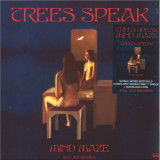
Mind Maze is, amazingly, Trees Speak’s fifth album to be released on Soul Jazz Records in the space of little over two years– an output matched only by the intensity of their music created during this short time.
The first pressing only of the album comes with a bonus seven-inch single containing two tracks that are not available on vinyl anywhere else.
As with all their previous releases, ‘Mind Maze’ is a mind-boggling tightrope walk across an array of musical influences that seamlessly create the unique present-day world of Trees Speak.
The band’s sound is characterized by a combination of German krautrock motoric-beat rhythms, angular New York post-punk attitude, 60s spy soundtracks, psych, rock, jazz, and 70s synthesizers and vocoders. There is also a cosmic spatial awareness to their sound; both personal inner space and galactic outer space, as well as a wilful pushing of sonic boundaries.
Trees Speak are a musical duo based in Tucson, Arizona, composed of Daniel Martin Diaz and Damian Diaz. Their music is heavily influenced by the cosmic magic of the natural desert landscapes of Arizona, creating a unique and captivating sound that is both experimental and innovative.
Here you will find the myriad sounds of 1970s German electronic music (everything from Can to Cluster, Popul Vuh to Tangerine Dream); 1980s New York post-punk and synthcore (from No Wave to Suicide); John Barry’s 1960s movies, John Carpenter’s 1970s horror. You will also hear the influences of French and Italian progressive rock (Magma, Goblin) as well as cosmic, new age and experimental space soundscapes …. an almost endless list of diverse influences that ebb and flow like an ocean of sound, in the process creating a truly unique soundscape that Trees Speak have made wholly their own.
The name Trees Speak reflects their interest in the concept of using future technologies to store information and data in trees and plants, with the idea that trees communicate collectively. This interest in nature and technology, combined with their passion for experimentation, has led Trees Speak to create a truly one-of-a-kind listening experience that is both unique and engaging.
If you ever wanted to hear Can, Neu!, Destroy All Monsters, Pere Ubu, electric eels, John Cage, Liquid Liquid, Tangerine Dream, Suicide, Laurie Spiegel, Art Ensemble of Chicago, John Barry, Mother Mallard’s Portable Masterpiece Company, Sun Ra, Stockhausen, John Carpenter, Electro-Acoustic and Musique Concrete and Mars in one band - then this is it! Trees Speak are a band that defies categorization and offer an eclectic listening experience, both exciting and memorable.
The two bonus tracks (‘Seraphim’ and ‘Orpheus’) included with the album give us a further window into the complex mind maze of the group - two stunning acoustic tracks that explore a distinct early 70s sound of Yes, Argent and other progressive rock accolytes.
Global pointing Brazilian jazz trio releases their new album Agôra, that sparkles with electric funk and Herbie-esque eclecticism. It features a myriad of guest vocalists and musicians including Brazilians Xênia França and Zé Leônidas, Jembaa Groove's Ghanaian singer Eric Owusu and South African artists Bongani Givethanks & Mpho Nkuzo
Re-wiring the concept of 'fusion' for 2023, Agôra is Brazilian trio Caixa Cubo's resurgent new record with the title referring to 'now', based upon the intuitive and fluid nature of the trio's method, and this inspired recording. With shoots to black music culture, from Brazil to Brooklyn, Ghana and South Africa, Agôra is the group's ninth album yet is their first where they've invited guests, mainly singers, onto each track and follows their last, Angela from 2020, released on Heavenly Records, which won a BBC 6 Music Album of the Year (Huey Morgan's selection) granting them much deserved international recognition.
The core musical elements of Caixa Cubo are Henrique Gomide (keys), João Fideles (drums) and Noa Stroeter (bass), all from São Paulo, Brazil and where they met as teenagers and would continue their friendship and musical bond at the Royal Conservatory in The Hague, Netherlands. Now all in their mid thirties, João and Noa live back in the city where it all started but Henrique has settled in Cologne, Germany where the recording of Agôra took place, over the course of 3 days, at the home cum studio of Chris 'Dusty' Doepke, their friend and owner of the label they signed to, Jazz & Milk.
In line with all their creations where flow and energy provide the magic, allowing what the moment provides, the album shines not only for its virtuosity but for its minimalism, the depth of space, and for the first time, the ability to figure in and outside of the jazz fold, as the trio decided, for the first time, to bring in singers and add a new aesthetic to their sound.
"Agôra is a wake-up call to reality, a reminder that the infinite possibilities of technological progress should not disconnect us from the earth, from eye-to-eye relationships, and from moments lived in person" the band are keen to point out. "And that we must not be consumed by greed, for all we truly possess.... is the NOW."
Turning hope and metaphor into music, the debut single Sábado, an electrified future- jazz-fizz reflects perfectly the spontaneity that permeated the entire recording of the album. "When we got to the studio, we had no idea what we were going to record. We started playing a groove, kind of inspired by Gilberto Gil's 80s albums, and our drummer João started singing this funny song 'Sábado Barrigudão' (Big Belly Saturday) alongside the bass groove and that was that". Inspired by their city of birth, São Paulo, it features long time collaborator and vocalist Zé Leônidas, with cuicas, tamborim, agogo and shakers providing the most obvious Brazilian affect from the album.
Dreams is the band's first foray into R'n'B melding the group's simple and sporadic instrumentation of drums, keys and bass into a Jill Scott inspired song that could have been born in Brooklyn yet sung by Brazilian singer and Grammy nominated Xênia França and Zé Leônidas in both English and Portuguese. Xênia recently performed online for hip-to-it website Colors and it's her latest collaboration with Caixa Cubo, having first met in 2009 for a series of live performances.
South African artists Bongani Givethanks & Mpho Nkuzo come to the record with a wholly different approach on Ndiyakhangela, providing spoken word and vocal refrains on top of an Afro-Brazilian percussion jam with a delivery and verse in Xhosa, Zula and Ndebele. Asase is the album opener and features vocals of Eric Owusu who is part of highlife pioneer Pat Thomas's live band and most recently, co-leader of Jembaa Groove, an Afro-soul band from Berlin. It's a synth wig out with djembe grooves and offers a brand new take on Afro-soul-jazz.
Other contributions come from Cologne based jazz singer Rebekka Ziegler (Oblique Sunshine), São Paulo based guitarist Eduardo Camargo (Caio & Eric) and trumpet player Matthias Schriefl on Kismeti, a gorgeous and rolling number that ebbs and flows, exemplifying the group's effortless ability to craft a sound energised by a belief in one-self and the idea of having faith without the need to look at each other for verification.
As drummer and percussionist João Fideles perfectly surmised upon arriving for the recording session, "What drums do you have? Whatever you have, I'll use it". Agôra is testament to nearly 20 years of camaraderie, friendship and most importantly, trust.
Dune Castle Records Presents… For Private Use Only by Cantrips, two heaving psychedelic funk pieces composed by Cantrips' Patrick Ryan and recorded over one day by a studio band including members of Surprise Chef and Karate Boogaloo.
Cantrips is a Melbourne psychedelic funk and cinematic soul group led by multi instrumentalist and studio producer Patrick Ryan. With heavy groove sensibilities, Ryan composes head nodding psychedelic funk music from the Dune Castle Throne Room, a DIY studio in Thornbury, Melbourne, from where he operates the label Dune Castle Records. Ryan composed two tracks in homage to David Axelrod's work with Psychedelic Pop band The Electric Prunes in the late 1960s. Ryan performed these pieces with members of Surprise Chef, with Henry Jenkins (Karate Boogaloo, Surprise Chef, Emma Donovan and The Putbacks) producing the two pieces.
This release follows a psychedelic funk LP composed by Ryan under Dune Castle named Dark Age Martial Arts. A self released record; it was nominated for the Australian Music Prize 2022. It received airplay and support from Radio DJs around Australia on stations such as PBS, RRR and FBI, as well as featuring on radio shows across England, Scotland and France. It also received considerable support from record stores in Australia and the UK.
Before MF DOOM donned his mask and became one of the most prolific MC-producers of modern Hip-Hop, he was a member of KMD, an early ‘90s rap group whose work still goes criminally under-appreciated to this day.
Following their 1991 debut album, Mr. Hood, the former trio shed one member leaving only two remaining – Subroc and his brother, Zev Love X (better known today as MF DOOM). Originally scheduled for release in 1994, their sophomore album Black Bastards showed clear progression from their debut. It was a truly amazing record, both sonically and lyrically, full of youthful creativity and tinged with the stresses of growing up as Black men in urban America. Songs like the lead single “What A N*gga Know”, the slippery, bass-driven “Get U Now”, and the album’s title track explore Black consciousness viewed through young-but-experienced eyes. Musically alternating between bouncy and raw – many times both, concurrently – the tracks gave the MC’s the springboard they needed to express themselves clearly.
Sadly, Subroc would face a sudden and untimely death in 1993, just as the duo were finishing the album. Grief-stricken, his brother Zev Love X – now the sole remaining member of the group – was determined to carry the legacy of KMD onward, but Elektra Records unceremoniously shelved the project in the eleventh hour, due to controversy surrounding the album’s provocative cover art. Following the fallout with Elektra, Zev tried for years to release the album on other labels, but he was continually met with dead ends. Struggling through the pain of losing his brother, coupled with the inability to release their final project together, a discouraged Zev Love X quietly withdrew from the scene and began quietly plotting his revenge on an industry that had broken him spiritually. Thus, in order to understand the true origin story of the super-villain, MF DOOM, one must recognize and appreciate the evolution of his former group, KMD, and the backstory of their pivotal album, Black Bastards.
Through a musical collaboration between Italian musician Samuele Strufaldi and the villagers of Gohouo-Zagna in the Ivory Coast, a new album called Davorio released on Música Macondo Records, will raise money for a new community library and space in the village.
Davorio is the joint efforts of Samuele Strufaldi, and the Guéré musicians of Gohouo-Zagna, located in the Ivory Coast’s Guemon region. The record is a cross-cultural-conversation that tells the villagers’ stories through a modern musical language; one that blends together Guéré music, jazz, and electronica. More than just a record, Davorio is a story about the villagers of Gohouo-Zagna, with their lives, traditions, and cultures animated across the album’s 16-tracks. The profits from the vinyl and digital music streams of the project and the money raised from a Go Fund Me fundraising page, will be used to help construct a library for the villagers, that will provide them with the infrastructure to help further their culture and storytelling for years to come.
Two years after their previous effort, regular as clockwork, Swiss throbbing synth pop duo Veil Of Light is back with a new album and what can we say? These guys keep on getting better and better.
If you have followed the Zurich-based outfit over the past few years, you must have noticed the constant moving towards 80’s FM new wave and synthpop tones – without losing their electro/body music outline – that have marked the band’s parable, especially since their latest Landslide LP.
Sundancing is their sixth full-length and it stays the course, bringing what we’ve just said to the next step. Nine new dancy and bright tunes with emotional depth that blend lush instrumentation and robust rhythms, guided by funky and rubbery basslines. Syncopated rhythm sections match suburban cool synths in the lead single Apricot Kiss and Hypersleep, while Raindancing and Tonight summon a sinuosity long gone since the mid Eighties. The musical backdrop here serves as the fundament for emotional vocals delivering lyrics dealing with the fragility of love, joy and loneliness.
There’s some subtle addictiveness to these songs, one that will gently grab you by the collar of your coat and stick the refrains from Sundancing inside your head for good.
Veil Of Light might make it look easy to keep it neat without being minimalist, intimate without being depressing, romantic in the most true sense of the word, but we know that’s possibly the hardest thing to do.
Our second installment is going to be a classic 4-track various artist release. Carefully curated and selected pieces of music, produced by close friends, this release fulfills the label's mission of providing a platform for our loved ones. This issue features some incredible artists and friends united on wax.
The Berlin and Munich-based duo Medus & Niko S. offer a hybrid track with nostalgic elements of techno, breaks, and progressive house, capable of busting any dancefloor. Longtime Munich resident DJ and producer Dancing Lessons contributes a hypnotic tech-house infused tune with elements of breakbeat and electro, taking the listener on a personal journey through time and space. Munich's young and upcoming producer Johnmon and label owner of Powerloader Records chips in a proper 90s bomb with driving drums, dark, and quirky synths. An all-round tool suited for any dance floor situation. Finally, Vienna-based Doesntmatter polishes off the VA with an expertly crafted electro track. He is the veteran out of the bunch with various releases under his belt on labels such as Traumschallplatten, Reboot Prague, Vienna Underground Track, and Zone Focus.
Metro is one of the most recognized underground rap producers. He has already collaborated with Guilty Simpson, Wildchild, MED, Oh No, Rakaa, DJ Babu and Percee P to name just a few.
The album "Blunted Fusion" 2LP is his most refined album. This time without guests - only sophisticated samples, cuts and fat beats.
Plus amazing graphics designed by SewerX. This is the most beautifully released album in the 21-year history of JuNouMi Records.
'The album is composed by Cerys Matthews with Hidden Orchestra and features 10 UK poets: MA.MOYO, Raymond Antrobus, Lemn Sissay, Liz Berry, Anthony Anaxagorou, Adam Horovitz, Cia Mangat, Imtiaz Dharker, Kim Moore and Kayo Chingonyi “We are living in extraordinary times, I wanted to respond but had the urge to offer more than one voice, more than one perspective. Not an echo chamber” – Cerys Matthews. In February 2020 Abbey Road studios welcomed each of the 10 poets to record pieces from their collections. Then lock down hit…. But remotely and with the additional help of field recordists and musicians around the world, Cerys and Joe Acheson (Hidden Orchestra) created a sound journey for these poems with the theme of: Genesis: Birth, heritage, a journey about to begin.
From samba and bossa nova through to baile funk, with carioca expressions of jazz, rock and hip hop in between, the sound of Rio de Janeiro, while continually evolving, has always held an unnameable quality which reflects the magic and mystique of the city itself. Multi-instrumentalist and arranger Antonio Neves is the city’s newest trailblazer: the enfant-terrible of Rio’s music scene, leading a vital and diverse constellation of both emerging and well-known artists advancing the city’s musical legacy.
“It all started one sleepless night, after watching a Quincy Jones documentary”. Inspired by the legendary music magnate, Neves began writing a list of artists residing in Rio de Janeiro “people that I admire, that I consider geniuses of their instruments, who share with me affinities, anxieties and projects.” The list included some of Brazil’s most revered living musicians who Neves has worked with in recent years: Hamilton de Holanda, Leo Gandelman and Dorival Caymmi. Neves also called on some of Brazil's most exciting emerging talents including Alice Cayymii and Ana Frango Eletrico.
A Pegada Agora É Essa (The Sway Now) is Neves’ second album: a vibrant portrait of the current Brazilian music scene. From the regional to universal, popular to erudite, samba to rap, Latin rhythms to jazz, MPB and pop to good old rock'n'roll, Neves walks with fluency and mastery amongst all the musical genres that Brazil has to offer.
“My offer to the musicians was complete freedom to express themselves through the songs I proposed – classics like “Summertime”, “Luz Negra” and “Noite de Temporal”, and compositions of my own – creating a space of authorship for the band and the guests. A space for inventions, purges, delusions, laughter. The idea was to bring the freedom of jazz crossed by Brazilian rhythms, such as the traditionals Partido Alto (A Pegada Agora É Essa) and Jongo (Jongo no Feudo and Luz Negra); rhythms of African-Brazilian religions like Candomblé (Noite de Temporal) and Umbanda (Forte Apache); and a tribute to newest Rio de Janeiro’s contribution to Brazilian music, the Funk Carioca (Simba)”.
Coming from a musical family, Antonio’s father, Eduardo Neves, was a renowned conductor and a professor at Juilliard School of Music and the California Jazz Conservatory. In the bohemian neighbourhood of Lapa, aged 14, Antonio began his career as a drummer, before experimenting with brass. He would soon become a skilled trombonist and arranger achieving the recognition of his teachers and peers. It wasn’t long before he would be playing with some of the biggest names in Brazilian music, such as Hamilton de Holanda, Leo Gandelman, Moreno Veloso, Kassin and Elza Soares.
His debut album as a trombonist was PA7 (2017, Rock It), released at the same time he was travelling the world playing with artists like Moreno Veloso, Kassin and Leo Gandelman, and recording the albums Jobim, Orquestra e Convidados (2017, Biscoito Fino), with Mário Adnet and Paulo Jobim; and Elza Soares Canta e Chora Lupi (2017, Coqueiro Verde Records). More recently, Neves was the arranger for the acclaimed Little Electric Chicken Heart album, by Ana Frango Elétrico, which has been nominated for a Latin Grammy and voted 2019’s ‘Brazilian Music Revelation’ by The Art Critics Association of São Paulo.
In 1975, under the oppressive air of military dictatorship in Brazil, brothers Lelo and Zé Eduardo Nazario invited bassist Zeca Assumpção to join their musical experiments in a basement under Sao Paulo’s Teodoro Sampaio Street. As teenagers, the trio had already been playing together in Hermeto Pascoal’s Grupo, alongside guitarist Toninho Horta and saxophonist Nivaldo Ornelas, and it was while working together under Hermeto’s direction that the Paulista rhythm section (as they were then known) began to realise their own potential.
With many nightclubs and venues closed in the mid-70s and government censors dictating the output of radio, TV and art galleries, many Brazilian artists fled during the years of dictatorship. But underground, Grupo Um were fusing avant garde ideals with contemporary jazz and Afro Brazilian rhythm; making phenomenally free and expressive music - in stark contrast to the sterile, conservative conditions being imposed above ground.
Just like Hermeto Pascoal’s Viajando Com O Som from the following year, Starting Point was recorded over two days at Vice-Versa Studios, by revered engineer Renato Viola. The studio was one of the best in Sao Paulo and musicians communicated with engineers through cameras and a monitor, allowing the group complete immersion in the process. They also made use of the studio’s hemispherical tiled room, which served as an acoustic reverberation chamber.
The album begins with Zé Eduardo Nazario’s thunderous drum solo on “Porão da Teodoro”, before clearing the clouds with the lone Berimbau which opens “Onze Por Oito”. Built around a hypnotic electric bass line, heady Fender Rhodes improvisations, and more rip-roaring drums, it’s a rapturous, electrifying freak-jam in 11/8.
Like some invertebrate deep-sea curiosity, the free-form “Organica” is made up of Lelo Nazario’s playfully eerie prepared piano, with Zé Eduardo’s percussion flurries darting around Assumpçao’s double bass. The equally non-conformist, percussion-only piece “Jardim Candida” features many of Zé Eduardo’s home-made instruments, including a long saw blade played with vibraphone sticks and violin bow. While working with Hermeto, Zé Eduardo famously built his own all-in-one percussion set-up known as the “Barraca de Percussão” (Percussion Tent) - the first of its kind in Brazil, which he would also use on Hermeto Pascoal’s Viajando Com O Som and throughout his career.
“Suite Orquidea Negra'' (Black Orchid Suite) was written by Lelo Nazario as the score for an imaginary movie - the story of a rare, black orchid which produced a substance meant to cure all diseases, but which had mysteriously disappeared from the laboratory… “As a screenplay it’s not very good” reflects Lelo in jest, “but the music ended up being very interesting, the way its parts are chained to one another carries a little of the mystery I imagined for the movie.”
The album closes with the triumphant “Cortejo dos Reis Negros” (Procession of Black Kings) - a groovy variation on the Maracatu rhythm, with a two-note bassline underpinning piano improvisations, exultant wordless vocals, cuicas, slide-whistles and a very special guest appearance from Zé’s dog Bolinha.
Starting Point was to mark the inception of one of Brazil’s most daring instrumental groups. Their debut now sits in the lofty echelon of otherworldly 70s Brazilian music, alongside the likes of Marcos Resende & Index’s self-titled debut, Cesar Mariano & Cia’s Sao Paulo Brasil, Azymuth’s debut and indeed Hermeto Pascoal’s Viajando Com O Som. But just like all of those titles, which were either shelved or largely ignored at the time, Grupo Um - so radically ahead of their time - struggled to find a label to release their debut album. So Lelo kept the tapes safe in his archives, which is where they sat for almost half a century. Finally, almost fifty years later, this mesmerising piece of history is here, and it was only the beginning...
Grupo Um’s Starting Point will be released by Far Out Recordings, on vinyl LP, with an insert featuring unseen photos and liner notes by the Nazario brothers, as well as a CD on 17th February 2023.
DJ Girl is a DJ and producer who was raised in Detroit, but since the pandemic has been based in Austin, Texas. She's the co-founder of the up and coming Eat Dis Records and her recent releases have been generating excitement in all the right places.
In some ways, 'Hellworld' feels like a direct relation to a lot of early 2000s Planet Mu releases. It could sit neatly alongside Hellfish or Neil Landstrumm, with a similar anything-goes, gleeful attitude, but instead DJ Girl mashes together a driving sound that is founded upon Detroit techno and electro, Chicago juke and Miami bass, with an old school/new school production style that's finessed with distortion and sparse IDM production.
It's a midwest USA style that takes a leaf from DJs and producers such as the wild-style hard techno of Lenny Dee, the tough midwest acid of Woody McBride and the system wrecking electro of Dynamix II, with a joyful, take-no-prisoners bounce.
'Hellworld' kicks off with the industrial juke of 'Get Down', followed by the powerful electro of 'Opp Pack Hittin' (the first of two tracks to feature MC Malik McFly).
'Technician' is a chirpy old school electro track that gets crazier as it progresses, while 'Lucky' mashes together samples and rough beats like an electro version of breakcore.
'Gallery' again features Malick McFly and switches between footwork beats, pumping techno and electro.
'So Hot' is hard 8-bar electro while 'When U Touch Me featuring Irish producer Lighght feels like a very manic take on hyperpop.
The album ends with the tough, spiralling acid of 'Groover' which wouldn't be out of place on a late nineties Jeff Mills mix. The fun is infectious on this one.
"‘Soil’ by Amsterdam-based producer and musician Jelee is heavily influenced by video game world-building. Like a beat alchemist, he carefully pours his love for beats into his lifelong passion for video game soundtracks. That far exceeds your typical 8-bits and bobs: Soil unfolds like a challenging adventure game, held together by a sonic palette of hip-hop-minded drum programming, jazz-inspired chords, and synthesized sounds.
The album features tight-knit homegrown collaborations with jazz multi-instrumentalist Guido Hoek, rising deejay Jerrau, producer lofi prototype (“one of Amsterdam’s best-kept secrets when it comes to beatmaking,” says Jelee), deejay, producer, and keyboardist Mo Wrights, and singer Erosi. With influences ranging from Brainfeeder’s roster to Zelda games, Jelee presents a multifaceted take on music.
Jelee’s music has been featured on compilations by Resilienza Records, Stamp The Wax, and Carista’s ‘Modern Intimacy Volume 1.’ Jelee is also known for his expressive live sets, such as the support act for Onra, Samiyam, and Salami Rose Joe Louis."
Daje Funk Records is back with Vol. 4 of the legendary ‘Slam Dunk’ series of EPs, this time featuring Souldynamic - Musta - Les Inferno - Groovemasta !!!
On the A-side, the supremely talented Souldynamic kicks things off with ‘Tales From Q.J.’ - a delicious chunk of late summer grooves bathing in sun-drenched keys and strings. The rolling bassline acts as the hook, and what follows is a gloriously constructed melodic masterpiece sprinkled with heavenly vocals. Fall in love with this, you will.
A2 sees Italian maestro Musta crack open the deep reggae vibes with ’Soup’. You’ll find it hard to resist this bubbling broth of twisted, rhythmic precision bass, ‘one drop’ beats and tight, short skanking guitar riffs. With ‘Soup’, Musta demonstrates his complete understanding of this genre. Darkened room or bar sun terrace - you decide.
On the B-side, label co-owner Les Inferno spices things up several notches with the aptly titled ‘Hot Burn’. And boy, does this track sizzle. A hustling rhythm that takes over your dance nodes from the get go, Les Inferno lovingly sprinkles Latino and Afro vibes all over this searingly hot dish. It’s furious, intense and relentless - and the brass breakdown acts as the tabasco sauce. Drink water. Plenty of water.
Closing Vol. 4 out on B2 is Groovemasta with ‘That Funk’. A track that treats its funky beats and chunky bass like royalty, this 118bpm monster wastes no time in demanding ‘Gimme that funk’. And you’re gonna hand it over. The swirling, gyrating sexiness of ‘That Funk’ can’t be understated - impossible not to lose yourself in this guaranteed dance floor time bomb.
Slam Dunk Vol. 4 seriously raises the bar for this already excellent series, and has to be in any self-respecting vinyl junky’s record box. Grab it while you can!
Cristiano Grim produced Parisian multi-instrumentalist DJ SOLANGE for the second release on his sub label FINALE RECORDS.
DJ SOLANGE runs Radio Belleville, certainly themost vivid underground project in Paris not only for the obscurity of the program, because of its location: a deep cave under the classic Belleville neighborhood of Paris, a few steps away from the Cemetery of Pere Lachaise.
The EP has been recorded down to the center of the earth in 2019, right before the fall of the world. A journey into the idiosyncratic bond between dreams and frustration.
Oneiric, evanescent, rough (Fruste in french), dark, claustrophobic, morose, sexy, improv, lost: like a dream, it ends only when you open your eyes.
In association with DJ Amir and 180 Proof Records, BBE Music presents ‘Strata Records – The Sound of Detroit – Volume 1’, a new compilation taking in just a few highlights from the short-lived but hugely influential jazz imprint.
Next up on Toolroom’s 4-track vinyl sampler series is a tasty collab from label founder, Mark Knight and dance music royalty, Armand van Helden, a fresh new edit of a revered club weapon from Julio Navas, Gustavo Bravetti and David Amo, Kiss FM regular, majestic and Sydney-native Alex Preston.
Up first label boss, Mark Knight enlists Grammy nominated Armand van Helden for their debut collaboration, 'The Music Began To Play'. Kicking off with a hard-hitting house groove and electrified bassline that drives the record, before dropping into the track's golden moment and sampling the 1979 classic disco cut 'I Don't Need No Music' by T.J.M; a gem of a record that encapsulates both Mark and Armand’s love for classic cuts.
Next up, a record that became a cult hit of the underground and one that defines the true sound of Toolroom's heritage, Julio Navas, Gustavo Bravetti and David Amo’s 'Raw'. Refreshed for 2022, we see one of France's hottest exports, Tony Romera, deliver a high energy, club focused remix of 'Raw', bringing the classic club record back to dancefloors and sound systems across the globe!
Up next is another heater from Majestic, who debuts on Toolroom with ‘Annie’. Recapping one of the hottest summers on record, Majestic embodies the Balearic, Ibizan heat, sampling Kid Creole & the Coconuts 1982 hit, 'Annie I’m Not Your Daddy', turning a slice of calypso / disco, into a club ready record for the dancefloor. From the brass melody to the hooky guitar riff, majestic lays down his signature style with a Groove Armada-esque vibe throughout.
Rounding things off is label favourite, Alex Preston with his unique blend of 4 to the floor dance music and live funk guitar riffs that have swept through clubs, moving feet, and bringing those feel-good vibes. Ticking all the right boxes on this one, 'Hunching' kicks off with its infectious groove and bassline, throwing in some lush strings, guitar flits and an 80's inspired saxophone break that adds some serious flavour to the record.
NYC’s Jkriv delivers a package of proto and golden era house re-edits for longtime pals Pleasure of Love.
The Razor N Tape label co-founder has reliably delivered dancefloor ready cuts on Z Records, Glitterbox, Barefoot Beats, Rocksteady Disco as well as his own imprint. On his first Pleasure of Love release Jkriv explores house in all its NYC glory; extending the energy on mid-late 80s proto (Got a Thing, Don’t Take Your Love Away) and masterfully looping and building tension with underappreciated early 90s house (G.D., Feel It). Expert level re-rubs by one of NYC’s finest producers.
Empress Enigma:
The contradictory language of speech, rhythm and melody generate this musical paradox.
Drivetrain (Detroit, USA)
It Can Never Be The Same (Parts 1 & 2)
Deep and moody, Part 1 is driven by a captivating bass groove with lush, silky pads constructing a mesmerizing wall of sonic euphoria. The vocal hook echoes the commentary with one simple phrase.
The stripped down Part 2 replaces the drums with hand percussion while Drivetrain shows off his bass guitar chops charismatically with an emotional solo throughout.
Rennie Foster (Vancouver, CAN)
Guiding Light
A ghostly banger, poised in atmospheric essence. Shifting layers of sound harmonize to the unyielding bass line as Alejandra Garcia sprinkles vocal seasoning on top.
I Haven't Forgotten
Built on the foundation of a rock-solid bass progression, the ambience of melodic strings and piano blend an audio sedative accompanied by an airy vocal presence and bits of acid integration.
Dynamite cuts release a first-time masterpiece The George Semper Music Archives & Dynamite Cuts Records
“Knowbody’s Gonna Love You” is a masterpiece vocal demo written by George Semper almost 50 years ago. Lost and almost forgotten, lying dormant on a master tape recorded late 60s. Such a wonderful and fresh song, perfect swing and groove.
Finding this demo completed the puzzle with an unknown one-off press acetate record. That was within Georges collection, now we know he had wrote it. The acetate was titled “Knowbody’s Gonna Love You” Joanne. With a little more investigation Joanne became the lesser known soul singer Joanne Vent. She recorded one LP on the label A&M back in the late 60s, which just happened to be the same time George worked for the label… One off press limited edition x400 copies with heavy card sleeve
Dancing as an act of rebellion is the first Abraxas LP in collaboration with the Valencian label Soil Records. A compilation of the first project recordings released between 2020 and 2021 plus some new tracks and, in addition to this, a second vinyl by other darkwave electronic artists remixing the first one: Geistform, We Are Not Brothers, Ober Dada, Melting Dogmas, SMforma, HBK1, José Rodríguez, SOJ and PanDemian.
Abraxas is a halfway project between dark dance electronic music, philosophical reflection, socio-political activism and musical entrepreneurship. Its main goal is to shake bodies and minds by spreading messages of individual and social self-criticism from the point of view of duality, extremes and contradiction, inherent to the human being and capitalist society.
The next issue in the on-going Mastermix series features a centerpiece of Frankfurt’s club history: Wild Pitch Club.
A predecessor to the esteemed Robert Johnson and a stepping stone for Panorama Bar’s very own nd_baumecker.
Founded by Playhouse masterminds Ata and the late Heiko M/S/O it was a Thursday club night that heavily featured house music as a prescription to the ongoing techno fever. Enamored with the US-American roots of it and all things deep, it not only presented the right records, but also their creators and protagonists. With a string of guest DJs from Robert Hood and Claude Young to Kerri Chandler and Theo Parrish as well as talent from the UK and Europe, it was one of the culture’s hubs at the time.
Here you have its testimony. Selected and mixed by Ata and nd_baumecker, it’s an authentic snapshot of the club’s vibe and spirit, spread over two 2x12” volumes, a collectable tape (download included) and a pleasant streaming version, it’s the full dosage. Like Roach Motel confessed: Wild Pitch, I love you.
Almost 2 years after the success of the album The Tony Allen Experiments and a few months after the release of the 7inch Amore, Nu Guinea returns to the scene with a new LP published by their newborn label NG RECORDS.
After touring the world looking for sounds suitable for their vibrations, NU GUINEA decided to go back to square one, Napoli, where Massimo Di Lena and Lucio Aquilina were born and raised. They watched their city from a distance reconstructing its energy from their studio in
Berlin, calibrating the synths on the meridian of Vesuvius, the volcano that has always protected and threatened Napoli.
Nuova Napoli is the result of a long musical research that has become a historical investigation on the sound that shaped Napoli during the ‘70s and ‘80s, starting from the contamination of genres (disco, jazz-funk, African rhythms) which ended up in Nu Guinea’s DNA.
In this album the synthesizers fill the spaces between the past and the future, tightening in a single body acoustic instruments, electronics and voices in Neapolitan dialect. It is the first time that the duo has worked with such a large group of musicians, some of whom are exponents of the contemporary Neapolitan scene.
WARNING: We recommend listening to Nuova Napoli while walking in the alleys of Napoli’s
historic center, around wet clothes hanging and street vendors on tiny three-wheelers.
There are two versions - 180g black vinyl and color vinyl version - limited to 100 copies and each vinyl has a different color. All versions has booklet inside with the special artwork dedicated to each track from teh album.
Things don't always go your way, especially when your plans involve space travel. In the case of Captain Harrison Focus's expedition, it started innocently, but no one was prepared for an emergency landing on the mysterious planet Carmin. Only then did the real fight for survival begin. This record tells the story of a dangerous expedition into space that began on February 6, 2023.
Twoosty Mayonez consists of Bartosz Wolert (drums) and Dominik Kaniewski (bass guitar and synthesizers). "Carmin" is their debut album, which is released primarily on vinyl by U Know Me Records.
The 11th release on "CCR - Club Culture Rarities" SUEÑO LATINO Derrick May Remix originally released on Creative Label 1992
Built around Manuel Göttsching’s astral classic E2-E4, Sueño Latino is, with no doubts, one of the most iconic records of the late 80's electronic music. Several remixes have followed the 1989 original release, but above all stands up Derrick May’s “Illusion First Mix” that adds his typical tribal motifs to the euphoric carpet of stars, tropical birds and cowbells. This reissue of Detroit genius’ version of Sueño Latino gives wings to our imagination making us fly on the most joyful nights of Ibiza.
High Focus Records are excited to share a new full length offering from prolific Brighton based producer Mr Slipz, this time with a fresh label signing, Australian rapper Nelson Dialect. A landmark release and signing for High Focus with Nelson being the first international signing on the label. UK listeners might have first heard Nelson collaborating with Verbz & Mr Slipz on the song ‘Hope’ from their acclaimed LP ‘Radio Waves’ released on High Focus in 2020. Nelson has a cult following in his own right in Australia, and previously released music on the legendary U.S label Fat Beats to great acclaim. Now teaming up with one of the most exciting and respected UK producers, Nelson & Mr Slipz deliver ‘Ever Since’. A statement piece by two artists with well over a decade spent on their craft which sounds as urgent and refreshing as if it were their first time releasing music. The album’s title is a reference to the endless quest for a timeless sound, reflecting the creative partnerships which spark from a seemingly forever existing thread of music. The two artists crossed paths whilst Nelson was on tour in Brighton, and a chance introduction to Slipz made this album a reality. As fate would have it, due to a cancellation of plans and changing of schedules during Nelson’s tour, the pair ended up in the studio for 8 days straight together which is when the bulk of the album was created. They each saw this as a cosmic alignment and thus played into the albums astrological artwork themes and overarching concept. Striving to capture the lightning in a bottle moment, what resulted musically on this album was an inspired surge of energy and intense creative output that is felt across the entire LP. Equal parts personal and lyrically dextrous, Nelson explores a multitude of concepts over the hard hitting drums and jazzy samples producer Mr Slipz is renowned for through his previous work with artists including Verbz, Kofi Stone, Vitamin G & Datkid among many more. The album features a slew of impressive guest verses including label mates Vitamin G & Verbz on the emphatic ‘Oxford Scholars’. Two legends Jehst & Confucius MC combine on ‘Smooth Ride’. Bronx pioneer & D.I.T.C legend A.G delivers a show stopping verse on ‘Trembling the Marrow’. There are hypnotic singing performances by Indira May on ‘First Date’ & ‘Open Book’ as well as Hiatus Kaiyote back up vocalist Jace XL on the soul stirring anthem “Figure Out What’s Right”. U.S rappers SickInTheHead & Cazeaux O.S.L.O round out the impressive guest list on the album with their inspired verses. Listeners caught their first glimpse of the duo with their debut single ‘Only Just Begun’. A whirlwind 3 verse tune showcasing the relentless wordplay and imagery Nelson is regarded for over a moody, hard hitting Slipz production. With a buzz already around what Nelson Dialect & Mr Slipz are brewing, the duo have just released their second single ‘Oxford Scholars’ featuring label mates Vitamin G & Verbz
It was released on February 2, 1993 and is celebrating its 30th Anniversary. Lead MC Grand Puba left the group to pursue a solo career in 1991, following the release of their revered debut One for All. DJ Alamo also left to work with Puba, leaving MC's Sadat X and Lord Jamar, who enlisted DJ Sincere to join the group. It was a safe bet that In God We Trust wouldn't have attempted any new jack swing crossovers or tie-dyed imagery. Though the makeover is drastic, it is convincing, with Lord Jamar and Sadat X stepping up with some of the era's fiercest, most intense rhymes and lyrics that were extremely militant reflecting the group's identity adhering to the philosophy of the Nation of Gods and Earths. The album produced two singles, Punks Jump Up to Get Beat Down and Love Me or Leave
Me Alone which both charted on the Billboard Hot 100 chart.
Shift Into The Rogue presents two tracks from an as-yet unreleased album Pier Bucci recorded using only one synthesizer for all parts of the entire project - his 25-year companion, the Moog Rogue.
Combining his unique musical and rhythmic sense, love for alternative electronic music from the 90’s (particularly sounds coming out on WARP Records at the time), and the technical abilities gained from years in the studio, Pier has crafted emotional, groovy, raw yet nuanced tracks - inspired by ‘the analogue, alternative, positive, very beautiful music from that time.’
Meiosistosis is a unique and creative descriptive innerstanding created by DemoDc taken from the scientific terminology of Mitosis - a splitting of one cell to create 2 identical cells and Meiosis - a splitting of 1 cell to create 4 very unique cells. Combining these 2 findings to create its own unique expression of what Demo feels earth herself is potentially going through in what most humans refer to as 'crazy mad' times.
‘Call me mad or crazy yet my artistic take on all this madness of change, coming from a more spiritual aware perspective, I feel its very possible and plausible that earth herself is shifting from an energetical vibrational frequency resonance, shifting from a lower to a higher frequency that has souls who inhabit at this present time on Earth, have choices made available to either shift to these higher frequencies of perception or to chose to remain in the lower frequencies of perception’
….says Demo when explaining the meaning of the titles chosen for his brand new releases. Hence, from this perspective it would give more purpose and meaning with the Earth splitting itself from 1 earth into 2 with the merging of it being identical and unique all at once.
True or not, through creative expression can we all individually make sense in our own rights, which then gives more power to the inner-standing of what co-creating with any greater power outside of ourselves, is. Each track holds its own unique expression to what has been described here and of course gives each listener a chance to give meaning to what is embraced in their own connection made when absorbed in the creations these ep's offer.
For this uniquely personal retrospective spread over twelve vinyl discs, Sven Väth takes us back to the early days of his DJ career. On What I Used To Play we meet great pioneers of electronic music, gifted percussionists, obscure wave bands, and innovative producers of a bygone 'new electronic' era. Rough beats and irresistible grooves from the identification stage of house, techno, and acid remind us not just how far electronic music has evolved over the past four decades, but how great it was to dance to EBM, techno, and house for the very first time.
If there is one protagonist of the electronic music scene who has remained curious, innovative and at the very cutting edge of music for over four decades, it's Sven Väth. His multi-layered artist albums and Sound of the Season mix compilations have been defining the genre for over two decades, and even today, he is constantly on the lookout for the next top tune to add to the highlights of his next set. At least, that's the case when he's not producing them himself as an artist or remixer. "Actually, it's always been part of my DNA to think ahead," and nothing had been further from his mind than looking back at his past, but when in spring of 2020 the international DJ circuit had to be scaled down to virtually zero, the 'restless traveler' suddenly had time. Time to stop and reflect on "how it actually was back then, at the very beginning of my career..."
"It was a great trip and with every track, beautiful memories came flooding back".
In the London apartment, he had just moved into, Sven has set up a "little music room", where he cocooned himself for several days, "to look way back for the first time and review my musical journey through the eighties, so to speak."
The interim result was six thematically oriented playlists with a grand total of 120 tracks from 'early 80s' to 'Balearic late 80s', together with excursions into afrobeat, European new wave, and EBM sounds and a few epochal techno/house tracks from the USA in between. From these 'Best of Sven Väth's favorites', the project What I Used To Play crystallized. Sven remembers how the Cocoon team reacted to his proposal: "They found the idea of making a compilation out of it MEGA from the beginning and everyone said 'Sven, go for it', but then, of course, the work really started, namely, to clear the rights and to get clean sounding masters of the up to 40-year-old tracks. There was also disappointment, of course. We couldn't clear certain titles because the rights holders in the USA had fallen out with each other or simply disappeared from the scene. In short, it wasn't easy, but now I can safely say we got the most important tracks."
Finally, after two years of research, curation, design, and administrative fine-tuning, the "little retrospective" from 1981 to 1990 is available. The exquisitely packaged, and three-kilo heavy box set is not only physically impressive, WIUTP is also the definitive record of Sven Väth's musical development. On each of the twenty-four sides of vinyl, you can trace track by track, what influenced him during which phase, and how he took off as a DJ from his parents' Queen's Pub straight into the spotlight at Dorian Gray. There and at Vogue (later OMEN), Sven became the style-defining player in the DJ booth that he still is today.
1981 - 1990: Future Sounds of Now
In the early eighties, the crowd in clubs like Vogue and Dorian Gray danced to what nowadays we call 'dance classics' - mainly disco, funk, soul, and chart pop. It was up to a new generation of DJs, including Sven Väth, the youngest protagonist in the Rhine-Main area at the time, to create their own club-ready music mix. Good new tracks and potential floor-fillers were rarities that had to be sought out and found, in order to prove oneself worthy.
Without MP3s, internet streaming, or other digital download possibilities, music didn't just gravitate to the DJ, instead, it had to be tracked down. In well-stocked record stores in Frankfurt and Wiesbaden or even in Amsterdam, London, or New York, Sven and friends sourced the material for countless magical nights. On WIUTP we can follow Sven's very personal journey through this wild, innovative era in which synth-pop, funk, hip-hop, and disco were successively replaced as 'club music' by house, techno, acid, and breakbeat. By the end of the decade, it was clear to see that these once exotic 'fringe' phenomena would soon become 'mass' phenomena.
Early 80s
Dirty Talk by the Italian-American duo Klein & M.B.O. represents the most innovative phase of the Italo-disco genre in the early eighties like no other track. Mario Boncaldo (I) and Tony Carrasco relied entirely on the original synthetic drum and percussion sounds of the Roland TR-808, coupled with the raunchy vocals of Rossana Casale and guitar accents of Davide Piatto. Of course, other tracks from this period were also influential in style, most notably Unit by Logic System, which worked as the perfect soundtrack to the laser lighting system at the legendary Dorian Gray club. With stomping beats and robotic rap interludes, Bostich by Yello also belongs on Sven's eternal playlist - after all, it caught the attention of Afrikaa Bambaataa, who invited the Swiss duo to perform at the Roxy in New York in 1983.
EBM Wave - Mid 80s
From today's point of view, the almost ten-minute-long, downtempo track Giant by Matt Johnson's band project The The, would probably not be considered an obvious club classic. However, a closer (re)listen reveals the rhythmic intricacies of the percussion overdubs by JG Thirlwell (aka Foetus) on Johnson's composition, and it becomes clear why this exceptional piece of music is one of Sven's absolute favorites. Other classics from this phase include Kaw-Liga by the mysterious The Residents, the hypnotic-synthetic Our Darkness by Anne Clark (and David Harrow), and last but not least, the somber, monotonous anthem Where Are You? by 16Bit, one of Sven Väth's projects together with Michael Münzing, Luca Anzilotti from 1986.
US House - Late 80s
You certainly can't talk about Chicago house without mentioning Frankie Knuckles. The resident DJ at the Warehouse not only gave the name to an entire genre, but also produced epochal floor fillers on the Trax label like the timeless Your Love, sung (and moaned) by Jamie Principle. Acid house protagonists Phuture also hail from Chicago, and on We Are Phuture (also released on Trax) we hear the chirping acid sounds of the legendary Roland TB-303 in full effect. Another featured classic is No UFO's by Detroit's Model 500 aka Juan Atkins, who is rightly considered the 'Godfather of Techno' even if the genre-defining track from 1985 still breathes with the spirit of hip-hop and electro from the first breakdance era.
Afrobeat
Le Serpent, by Algerian-born Abdelmadjid Guemguem, is a track that sounds completely different from everything else on WIUTP. Made in 1978, it's a monumental, rousing groove created without bass or synths, just with five congas! Even though Guem sadly passed away in 2021, his immortal, acoustic beats are understood all over the world and will continue to enrich many thousands of DJ sets for years to come. Another classic that not only Sven appreciates beyond measure is Hugh Masekela's Don't Go Lose it, Baby. In addition to being one of the most important jazz pioneers, the trumpeter and freedom fighter from Johannesburg was very experimental, integrating electronic sounds into his music in later years, in a similar vein to Miles Davis and Herbie Hancock. Dutch jazz pianist Jasper van't Hof's afrobeat project Pili Pili has also aged well. The trance-like, almost sixteen-minute-long track of the same name, manages to fill a whole side on the seventh of twelve vinyl discs in the WIUTP box.
UK-US-Euro - Late 80s
Time for a change of scene, in the truest sense of the word, and from a musical perspective, this section is like landing on another planet. First up is Andrew Weatherall's classic remix of Primal Scream's Loaded, featuring the iconic Peter Fonda sample (lifted from the 1966 biker film Wild Angels) that came to personify the mood triggered by the British Second Summer of Love in the late eighties: "We wanna be free to do what we wanna do, and we wanna get loaded...". This period also saw the emergence of M/A/R/R/S whose only single, 1987's Pump Up The Volume, became a club classic with support from DJ legend CJ Mackintosh. In this most eclectic of sections, we also encounter New York house and reggae producer Bobby Konders and his seminal Nervous Acid.
Balearic - Late 80s
Those who know him, know that Sven had already lost his heart to the 'magic island' of Ibiza as a teenager, so with that in mind, the WIUTP project couldn't end without a Balearic chapter. Inspired by Manuel Göttsching's E2-E4, the immortal, eponymously titled Sueño Latino belongs in there without question. Equally popular on the island was, and still is Break 4 Love by Raze, which thinking about it, would also fit perfectly into the house chapter. Last, but not least, there's an overdue reunion with Sven Väth himself, in his role as frontman of the successful Frankfurt trio OFF. Together with Michael Münzing and Luca Anzilotti (later of Snap!) this 'Organization For Fun' created the off-the-wall club hit Electric Salsa in 1986 which incidentally turned into an international chart smash, putting Sven in the enviable position of having to decide between pop stardom and a DJ career. Well, we all know how that decision turned out and the rest, as they say, is history. A not insignificant part of his story is What I Used To Play. Enjoy!
Tod Dockstader's Aerial series, an electronic/drone masterpiece, is cherished among fans of the artist's work and this second volume is available in an audiophile quality double LP edition.
Tod Dockstader's Aerial series is sourced from his life long passion for shortwave radio. Dockstader collected over 90 hours of recordings, made at night, and comprised of cross signals and fragments plucked from the atmosphere.
Opening with airwave drones, Dockstader gradually allows elements to slowly come and go, summoning an ominous atmosphere of ethereal cloud clouds. Malignant placidity continues, giving the feeling of eavesdropping upon late-night audio activity not unlike discovering number stations while sweeping the dials. These sounds pull you in as their density and rhythms come and go.
Backward voices, deep echoing choruses of conversations flowing under the surface, ocean sounds, pulsing electro-rhythms, all seem to be created via the collaging of many hours of source recordings. A masterwork of collage and juxtaposition by an overlooked pioneer of American electronic music.
Artwork by John Brien (Imprec) is inspired by the propagation of shortwave radio signals throughout the earth's atmosphere.
"This return of Dockstader is something to cherish, not just because his output has been so limited and scarce but because what we do have is so intriguing, persuasive and cliche-free; the music of an inspired explorer who trails in nobody's slipstream." The Wire
"One of the great figures of musique concrete composition." Dusted
The Aerial project
I've written before of my interest in shortwave radio, in the notes to the Quatermass CD. Also, in the notes to the Omniphony CD (which has my first "Aerial" mix, "Past Prelude," in it), I mentioned "The Aerial Etudes," which was my working title for what became the three CDs you have. And, at the end of an interview with Chris Cutler (which can be found in the "Unofficial TD Website"), the piece I mentioned I was starting to work on at the time became Aerial.) When I was very young, people got most of their entertainment from radio. They called it "playing the radio," as if it were a musical instrument. That's what I've tried to do in this piece. About this time, a few people encouraged me to look into using a computer for this work.
I'd never used one, but I saw it would allow me to keep my mixes digital - no more transfer losses. So, at the end of 2001, I got a computer and an editing program for it, and spent what seemed a long time learning it. I began selecting mixes and loading them into the computer in late March, 2002. Out of the 580, I selected 90 "best" mixes - eventually reduced to 59, the ones on the CDs. Finally, in assembling the CDs, I followed David Myers' suggestion to allow each piece to flow into the next - making a continuous journey to the end. Tod Dockstader, 14 september 2003
About Tod Dockstader: Dockstader moved to New York in 1958 and became a self-taught sound engineer and sound effects specialist and apprenticed as a recording engineer at Gotham Recording Studios. It was around this time that he started to use his off-work hours to experiment with mixing and manipulating sounds on magnetic tape (musique concrète). By 1960 he had amassed enough material to assemble his first record Eight Electronic Pieces which was released on the Folkways label in 1961 (this would later be used in the soundtrack of Fellini’s Satyricon). The last of the eight pieces was later re-worked into his first stereo piece. In 1961 he applied to use the facilities at the Columbia-Princeton Electronic Music Center and was denied access by Vladimir Ussachevsky. Ussachevsky’s official reason was the “overstrained” scheduling of the studios, although many suspect that Dockstader’s lack of academic training was a factor in the decision. He continued to create music throughout the first half of the 60s, working principally with tape manipulation effects. His last piece at Gotham was Four Telemetry Tapes in 1965, after which he left to work as an audio-visual designer on the Air Canada Pavillion at Montreal’s Expo ‘67. It was around this time in 1966 that some of Dockstader’s pieces were released on three Owl L.P.s, and his work became known to a larger audience. He achieved modest recognition and radio play alongside the likes of Karlheinz Stockhausen, Edgard Varèse, and John Cage.
It is a huge honour to present the Disco Gospel 12”, curated and edited by Chicago's Marc Davis and Sadar Bahar. Featuring two under-the-radar disco / gospel fusion tracks that have been given a new lease of life courtesy of these masters of their craft.
We first came to know Marc through his always on-point Black Pegasus record label, which he’s been running since 2006. As a renowned international DJ, record collector, and an integral part of Chicago's underground music scene, we knew anything he sent our way was going to be serious and he didn’t disappoint. Joining forces with Sadar Bahar (Soul in the Hole), who is himself a gospel and disco legend and a DJ's DJ favourite across the globe, they dug deep and put us onto two absolute gems from their beloved collections. As DJs who play a wide range of genres, their ability to spot the real heat within any sound has placed them at the top of their game. As Sadar puts it, "We are always digging for records and these fit the criteria of disco and happen to be gospel”.
First up is the feel-good joint 'I'm So Happy' by Fountain of Life Joy Choir Under The Direction of Kevin Yancy. Originally released in 1978 on a subsidiary label of T.K. Productions entitled Gospel Roots, the clue is in the title with this one. It's an unadulterated, uplifting, joyous dancer. Marc and Sadar’s fizzing edit brings out the best elements of the song and extends them. Working the addictive vocal hooks and building the funky instrumental grooves produces a spirit-lifting mood that is bursting with enough energy to light a fire under any dancefloor.
'Optical Illusion' on the flip, takes the tempo down, but doesn’t let up on the vigour. It’s a driving, stomping anthem that features another lung-busting vocal performance. Working with a live recording of Rev. Charles H. Nicks and The Baptist Assembly Of Free Spirit Churches Mass Choir, this one proves to be the perfect accompaniment to the ecstatic vibe of the A-side. The duo has condensed and heightened the drama of the song and added some light-touch production elements to clean up and enhance the sound. We guarantee this will be filtering its way into the sets of discerning DJs worldwide.
Marc described the selections best when he succinctly put it like this, “We both knew these were two heaters on our first listen”.
We completely agree, and with recording and engineering contributions from Tone B. Nimble (Soul Is My Salvation) and Rahaan, here we have Chicago royalty creating an unmissable release that celebrates the crossover of dance music with the musical traditions of the church.
On behalf of re:discovery records, it is with great excitement that we announce the release of Stryke – The Introspection Trilogy (1994-2022). rd011 features a track that is very close to my heart. My senior year in high school. I was heavily into chill-out music at the time. Labels like FAX, Instinct Ambient, Reflective, Astralwerks, em:t, Silent, Moonshine, Rising High, Warp, Exist Dance, Visible, Eye Q and others were giving me such a wide array of beautiful sounds of more subdued techno and rhythmic ambient music. I was buying every compilation I could at the time that looked remotely different based on the artwork, the unusual artist names or the tracks. I was soaking in everything I could under the chill-out style. That year 1994 I picked up the 2nd edition of Moonshine's 'United State of Ambience 2'.
It has so many good tracks on it. One track that always held a special place in my heart was Stryke's 'Introspection pt.1'. The simple but catchy melody layering. The easy atmosphere made me feel like I was floating in the ocean. The deep 808 bass notes (I hope one day you and I will hear this on an amazing sound system). The amazing strings reach a crescendo nearing the end. This track has so many simple but beautiful sounds on it. It's a great example of what I call sequencer-styled electronic music. At a time when producers layered tracks in more of a sequence then building or placing sounds. In 2021 I was able to get a hold of Greg Chin to see if he was interested in putting the track on my label and letting it breathe freely on its own side alone as the highlight of an EP. Greg was enthusiastic about the opportunity and told me that he always wanted to complete the trilogy he had in mind of a part 2 and 3. The ominous and eerie part 2 adds a terrific tension to the finale of part 3. The last being almost an updated part 1 really concluded the trilogy for me. Both parts melded together on side B pushing near 17 minutes. I want to thank Greg for letting us be a home to complete his journey.
Northern Soul legend Billy Prince returns with his next Common Good Records dancefloor filler. Following up the sold-out Angel/I Need You 7” with a Detroit-styled uptempo heartfelt offering. Born and raised in the Motor City, Billy developed a passion for music at a very young age, in part due to him spending much of his childhood in his father’s record shop during the Detroit soul explosion. Billy is one of the founding members and lead singer of The Precisions, who are best known for the legendary Northern Soul stomper, “If This Is Love (I’d Rather Be Lonely)”.
In October 1974, the first number of “L'Indépendant du Jazz”, a small self-produced magazine DIY -before punk supposedly invented the concept- was launched by Jef Gilson, Gérard Terronès, Jean-Jacques Pussiau and a few other specialists of a different kind of jazz in France, it looked at the already long career of Jef Gilson and in detail at the album with saxophonist Philippe Maté:
“The ‘Workshop’ is, with Philippe Maté (alto-sax), an undeniable success. Maté is genuinely ‘the’ most inventive French saxophonist since Michel Portal burst onto the jazz scene (who has also worked with Jef Gilson on both “Enfin” and “Gaveau”).”
Even though the author of the article is a mysterious I.H. Dubiniou, and it is difficult to know if it is a real person or a pseudonym used by one of the merry bunch, it is also tempting to hear it as what Jef Gilson really thought about his new discovery. Even more so as the two men would work together over a long period, as Maté became one of the key figures of Gilson’s Europamerica orchestra up until the 1980s.
Philippe Maté had started to make a name for himself with the Acting Trio when they released an album on the BYG label in 1969, and he was also one of the regular sidemen for the Saravah studios (he can notably be heard on albums by Higelin, Fontaine or his cult duo album with Daniel Vallancien).
The album was recorded on 4 February 1972, at the Foyer de Montorgueuil, where Gilson had set up his studio, with more or less the same team found on “La Marche Dans Le Désert” by Sahib Shihab + Gilson Unit (recorded ten days later). This was drummer Jean-Claude Pourtier and pianist Pierre Moret (regular Gilson accomplices since “Le Massacre Du Printemps”), alongside Maurice Bouhana and Bruno Di Gioa on various percussions and/or wind instruments. On bass is Didier Levallet, of the now mythical Perception, (Jean-François Catoire would replace him with Shihab) and Philippe Maté who took top billing, rather than the American saxophonist afterwards. The two albums are however quite different. This “Workshop” is more abrasive, more free. Made up of two long improvisations each of over 22mn, “L'Œil” on side A and “Vision” on side B (Gilson specialists would recognise the nod to one of his albums from the 60s), the album plunges you into the depths, attempting to drown you in electronic waves, dragging you back to the surface by the collar, giving you a good shakedown, before showing you the light, leaving you breathless on the shore after 46mn of the most intense music French has to offer. “An undeniable success”, they said. (by Jérôme "Kalcha" Simonneau)
Bernard Szajner is a French composer, musical theorist, visual artist. He is credited with the invention of the laser harp, which he patented.
Between 1979 and 1983, Szajner released five albums of innovative and Avant-garde electronic music. He became renowned as a light and visual effects technician with artists such as Magma, Gong, Stomu Yamashta and The Who.
During the 1970s, he became a pioneer in the field of using laser technology as an artistic tool. As a measure of his success, he became renowned by his work with companies such as Cartier and Renault. In 1980, inspired by the novel, Nova, by Samuel R. Delany, he first created the laser harp. The laser harp became so successful that Jean-Michel Jarre ordered a version from Bernard Szajner for his tour of China. Despite all this, Szajner would only occasionally use this instrument in his own performances. He has stated that he would rather the public not know him solely for his work on the laser harp, and that it not be allowed to take precedence over his work in musical composition that it enables. This is also why he continues to develop other instruments which use other innovative methods of interaction, such as tactile or holographic.
Towards the end of the 1980s and disgusted with the music industry, he chose to abandon music entirely, and shifted his focus towards digital and visual arts, and theatre.
From Bernard Szajner : “These tracks are my preferred ones .... Ever ! ... For a long time I've been waiting for a record label to release what corresponds to what I like playing these days... Until Sleepers records decided to release this compilation which contains most of the tracks I enjoy playing live on stage ! At last my wish is fulfilled !”
Samuel L Session and Van Czar drop a four-track techno EP on Unrilis that showcases a deeper and more hypnotic sound with dystopian atmosphere and driving percussion. Rino Cerrone launched the Unrilis record label over 15 years ago, and part of the label's back catalogue is its iconic Rilis series. 2022 sees the relaunch of the Rilis series that has a focus on underground DJ tools with raw analogue sounds. The Rilis series was originally launched in 1999, and was restricted to a concept on only 10 releases, each pressing a limited run of vinyl. It was hugely popular with each one often selling out in only a week and picking up DJ support by people ranging from Jeff Mills to Richie Hawtin. Those first 10 releases were focused on Rino Cerrone's own music, but since his retirement from the industry, the revitalised Rilis series will welcome other artists whose sound matches the label's underground concept.
This latest release in the Rilis series features collaborative tracks by Samuel L Session and Van Czar who have previously teamed up for releases on other imprints ranging from Marco Bailey's MB Elektronics to Ben Sims' Hardgrooves. Both are also successful solo artists, Sweden's Samuel L Session being well-known for his headline DJ sets at clubs around the world, along with the music he has released via iconic imprints such as Slam's Soma, Shlomi Aber's Be As One, Len Faki's Figure and Emmanuel's ARTS plus his own imprints SLS, Cycle, New Soil, and Klap Klap Belgium's Van Czar is also an accomplished DJ who is well-established across Europe and he has also released music on respected record labels ranging from Kevin Saunderson's KMS Records as well as the classic imprint, Yin Yang.
'Air Raid' opens the release with its eerie pads, spine-tingling melody loop and machine-driven percussion. It's got a raw aesthetic with dramatic claps and snare fills that add to the building suspense.
'18-022' is a dark and stripped back track with modulating synth textures layered with fast-flowing high-end percussion. Its pounding kick drum and clap rhythms add rigid structure to its expansive atmosphere and dance floor focused groove.
'Route 200' has thrashing cymbals punishing claps and rippling pads that create a stripped back groove submerged in deep atmosphere. Rich with analogue textures and gritty sound design, its relentless energy is tailor made for club sound systems.
'Objectivism' closes out the release with it's funky bassline and bleeping melody. Whirling textures and fluttering percussion maintain an unrelenting tension that's driven forward by the pounding kick drum.