The eighth Studio Album by the Band, released on April 22, 1997. It was produced by Roger Moutenot and recorded at House of David in Nashville The Album expands the guitar-based pop of its predecessor Electr-O-Pura to encompass a variety of other music genres, including Bossa Nova, Krautrock and Electronic Music. Most of the Songs on the Album deal with melancholy emotions and range from short and fragile Ballads to long and open-ended dissonance.
out of Stock
Last delivered 3 years ago available to reorder, subject to availability
‘Runner is a calmly luminous orchestral piece with the pulsating, propulsive
rhythms that animate much of Mr. Reich’s music.’ – New York Times
‘Reich interweaves the two groups to create a dense textural tapestry that sounds like his most native orchestral thinking to date. A beautiful and dramatically charged masterpiece.' – San Francisco Chronicle
Nonesuch Records releases the first recordings of Steve Reich’s Runner (2016) and Music for Ensemble and Orchestra (2018), performed by the Los Angeles Philharmonic and conducted by Susanna Mälkki.
Reich says Runner is written “for a large ensemble of winds, percussion, pianos, and strings. While the tempo remains more or less constant, there are five movements, played without pause, that are based on different note durations. First, even sixteenths, then irregularly accented eighths, then a very slowed-down version of the standard bell pattern from Ghana in quarters, fourth a return to the irregularly accented eighths, and finally a return to the sixteenths but now played as pulses by the winds for as long as a breath will comfortably sustain them. The title was suggested by the rapid opening and my awareness that, like a runner, I would have to pace the piece to reach a successful conclusion.”
“Music for Ensemble and Orchestra is an extension of the Baroque concerto grosso where there is more than one soloist,” the composer continues. “Here there are twenty soloists – all regular members of the orchestra, including the first stand strings and winds, as well as two vibraphones and two pianos. The piece is in five movements, though the tempo never changes, only the note value of the constant pulse in the pianos. Thus, an arch form: sixteenths, eighths, quarters, eighths, sixteenths. Music for Ensemble and Orchestra is modeled on my Runner, which has the same five movement form.”
Nonesuch has recorded every new piece of music by Steve Reich since 1985, beginning with The Desert Music and continuing through 2018’s Pulse/Quartet, resulting in 22 albums and the two box sets Phases in 2006 and Works: 1965-1995 in 1997. Most recently, the label released his Reich/Richter, performed by Ensemble intercontemporain and conducted by George Jackson, in June 2022. The Times said, ‘What a delight to be able to focus on the music, delivered here with a clever mix of pinprick precision and reverberant haze by 14 members of Ensemble Intercontemporain. The more intently you listen, the more subtleties emerge among the shifting, criss-crossing textures and phrases, sometimes coloured with gentle melancholy but decisively upbeat by the end. Reich/Richter is an ear-tickling tonic and a happy companion to Reich’s newly published book, Conversations.’ Nonesuch will put out a collection of Reich’s complete works in 2023.
Reich released a book earlier this year, Conversations, that includes dialogues with past collaborators, fellow composers, musicians, and visual artists who have been influenced by his work, including: David Lang, Brian Eno, Richard Serra, Michael Gordon, Michael Tilson Thomas, Russell Hartenberger, Robert Hurwitz, Stephen Sondheim, Jonny Greenwood, David Harrington, Elizabeth Lim-Dutton, David Robertson, Micaela Haslam, Anne Teresa de Keersmaeker, Julia Wolfe, Nico Muhly, Beryl Korot, Colin Currie, and Brad Lubman. The Wall Street Journal called the book ‘a testament to the influence of an idea – one that triggered a cultural turning point,’ and the New York Times said, ‘The joy of the book is to hear artists from a variety of disciplines and backgrounds rhapsodizing about their relationship to Reich’s music and how it influenced their own creative processes.’
Steve Reich has been called ‘America’s greatest living composer’ (Village Voice), ‘the most original musical thinker of our time’ (New Yorker), and ‘among the great composers of the century’ (New York Times). His music has influenced composers and mainstream musicians all over the world. Music for 18 Musicians and Different Trains have earned him two Grammy Awards, and in 2009, his Double Sextet won the Pulitzer Prize. Reich’s documentary video opera works – The Cave and Three Tales, done in collaboration with video artist Beryl Korot – have been performed on four continents. His recent work Quartet, for percussionist Colin Currie, sold out two consecutive concerts at Queen Elizabeth Hall in London shortly after tens of thousands at the Glastonbury Festival heard Jonny Greenwood (of Radiohead) perform Electric Counterpoint followed by the London Sinfonietta performing his Music for 18 Musicians.
In 2012, Reich was awarded the Gold Medal in Music by the American Academy of Arts and Letters. He has additionally received the Praemium Imperiale in Tokyo, the Polar Music Prize in Stockholm, the BBVA Award in Madrid, and the Golden Lion at the Venice Biennale. He has been named Commandeur de l’Ordre des Arts et des Lettres and has been awarded honorary doctorates by the Royal College of Music in London, The Juilliard School, and the Liszt Academy in Budapest, among others. ‘There’s just a handful of living composers who can legitimately claim to have altered the direction of musical history and Steve Reich is one of them,’ states the Guardian.
Redefining what an orchestra can be, the Los Angeles Philharmonic (LA Phil) is as vibrant as Los Angeles, one of the world's most open and dynamic cities. Led by Music & Artistic Director Gustavo Dudamel, this internationally renowned orchestra harnesses the transformative power of live music to build community, foster intellectual and artistic growth, and nurture the creative spirit. This is the third recent recording by the orchestra on the label; the others were the Louis Andriessen pieces The only one and Theatre of the World. Additionally, the Los Angeles Philharmonic’s recordings of The Gospel According to the Other Mary and Must the Devil Have All the Good Tunes?, with Yuja Wang, released on Deutsche Grammophon, are included in this year’s John Adams Collected Works boxed set. Nonesuch also released an LA Phil recording of Adams‘ Naïve and Sentimental Music in 2002.
Susanna Mälkki is sought-after at the highest level by symphony orchestras and opera houses worldwide. About to embark on her final season as Chief Conductor of the Helsinki Philharmonic Orchestra, she concludes a seven-year tenure with a distinctive dynamism and imaginative flair to her programming. In addition to a full season in Finland, she will lead the Helsinki orchestra on tour to the prestigious Lucerne and Edinburgh festivals, New York’s Carnegie Hall, and Washington’s Kennedy Centre this season.
Deluxe reissue of their 1994 debut album.
Completely remastered under band supervision.
Pressed on burgundy vinyl and Presented in a gatefold matt laminated gatefold sleeve, with spot UV varnish .
Features the original LP plus a bonus disc with the Cherry Red E.P tracks, plus a 16-page booklet containing photos, reviews, and sleevenotes from Mick Derrick, Steve Mack & John Robb.
Combining a metronomic krautrock beat played by a monster drummer, looping guitars and a boy/girl vocal that sounded like a bickering bed-sit argument turned into song, Prolapse had all the manic intensity of a nervous breakdown set against a backdrop of inventive guitar work and a really tough rhythm section. There were hints of the Fall, krautrock, PiL and a touch of the pure golden pop of Blondie along with the sense of restless dislocation shared by many of the post-punk bands.
Prolapse arrived in the middle of the Britpop era and their tense, almost neurotic music clashed with the stadium-filling, jolly knees- up pop that dominated the indie mainstream of the time. By 1996 indie had become the mainstream in terms of record sales and sound and was strutting around at the opposite end of the cultural spectrum to the indie bands of the Eighties and their war against popular culture. Late arrivals Prolapse were the last gasp of this genuine independence.
out of Stock
Last delivered 3 years ago available to reorder, subject to availability
“A rather gorgeous and engrossing collection, that borrows stealthily from a rich history of sound effect and soundtrack to build a tender poem to the night time.” - CLASH
“The plan was to make twenty 90-second tracks designed as TV themes,” says Arab Strap’s Aidan Moffat, of the initial thought behind his new instrumental album as Nyx Nótt “But it wasn't a satisfying listen, it was too gimmicky and silly.”
So instead, Moffat decided to stretch the idea out, plunge deeper, and expand the music into full tracks, “making some of them quite long and dramatic, with the odd swift turn here and there.” In fleshing these tracks out into more fully realised songs he began sourcing samples from professional TV and film music libraries. “The focus then turned to making a proper album out of these modern library sounds,” he says. “I decided to stick with the Themes From title and named the tracks after the sorts of shows they made me think of when I listened back.”
The result is a record that explores genre themes such as: ‘Thriller, ‘Porno’, ‘Caper’ and Swashbuckler’, and acts as an audio equivalent of channel hopping through a unique TV station programmed by Moffat. “I still wasn't sure about all this until I did the album cover, which brought it all together,” he says, of the artwork that places an old smashed TV unit front and centre with a woman perched on top. “It has echoes of old TV compilations but is pretty cheeky and slightly sexy in that old 70s compilation style. I wanted this one to look a bit more fun than the last one, as well as hopefully sound a bit more fun too.”
Aside from being a fun experience, it is also a stirring and immersive listen, one that allows the listener to imagine their own accompanying visual scenarios to each musical theme. The opening ‘Docudrama’ marries a gently creeping beat with strings that glide from tense to sweeping, while ‘Porno’ is all seedy smoky jazz that feels plucked right out of Travis Bickle’s late night trips to porn cinemas in Taxi Driver.
Touches of jazz pop up in other places too, on ‘Hardboiled’ this merges with subtle pulses and gargles of electronics that build to a rousing crescendo of horns and bleeps, and on ‘Caper’ there’s a vivacious full jazz band skip to the lively swinging rhythms. “There's a few more jazzy elements here,” Moffat says. “Although I'm not quite sure where that came from. Although, like everyone else, I've had plenty of time to be introspective recently, so I decided the next Nyx Nótt album should be more upbeat and encourage some occasional foot-tapping.”
However, what becomes apparent, the longer you spend in the world of Themes From, is how singular and unique the tone of each composition is. “Each track has its own individual feel,” says Moffat. “The idea was to sound like a different composer and band throughout.” It’s a stylistic leap that continues Nyx Nótt’s trajectory as one that shares no direct link to Moffat’s other projects. “I approach them in completely different ways and with a different purpose in mind,” says Moffat. “I don't think Nyx has ever heard of Arab Strap, and certainly doesn't own any of their albums.” It’s also a notable shift from the debut album under this moniker, and suitably given the theme, Moffat has created a visual comparison between these two sonic worlds. “If the first Nyx Nótt album was like looking out on dark prairies before dawn, this is more like a walk through a neon Soho after a few cocktails.”
If you've been in the club scene for many years like David Dorad, you will one day face the big, essential, serious questions that each of us will ask ourselves sooner or later:
Are marmots pack animals?
Can marmots sign language?
Do marmots plan their lives according to European or Chinese zodiac signs?
Do marmots need a special passport, after all they don't have a thumb to turn the pages?
What happens when a marmot eats Coke and Mentos at the same time?
And with all those questions whistling, hissing and muttering in his head, David grabbed piano, baton and BioBassline to crochet his new EP.
This is called "Marble" and offers 6 different approaches to solve these big questions.
As a source of ideas, he has competent partners at his side in Roman Flügel, Mira, Christopher Schwarzwälder, Canson and Sascha Cawa.
A1 -
Murmeli - original
The marmot tribe awakens. Get up to brush your teeth. Gets your toes tapping. Makes you snap your fingers. Dare to roll your hips. Later rhythmically to turn. To look elegant at the same time. Eyes closed - eyes open.
Murmeli, the regular leader, sits at the piano.
Everyone is dancing, toothpaste in the corners of their mouths and a smile that takes the toothpaste by the hand.
A normal morning in marmot houses.
B1 -
Murmeli - Mira & Christoph Schwarzwald RMX
Mira and Christoph Schwarzwalder take over from Murmeli. They vary, combine and subtract. The first marmots raise their thumbless fists in the air - showing their passports, ready to take off.
B2 -
Murmeli - Canson RMX
Canson also sits next to Murmeli. Caress the theme, tickle the groove.
Murmeli has the best ideas early on: "Boy, let's try Mentos with Cola, we'll definitely take off."
Canon is in!
C1 -
Murmelot - Original
The sun goes down in Murmelhausen too. Then Murmelot is ready. Gives his advanced Pilates class, which the whole tribe takes. The village wants to remain mobile.
Murmelot's motto is "Why not stretch while walking?"
And so shall it be. He sets the rhythm on his wooden Fairtrade 303 and our furry friends shave shaky and obscene messages down each other's backs while impatiently hopping for the drop.
D1 -
Murmelot - Roman Flügel Remix
Roman Flügel and Murmelot are old buddies. Struck while carving the 303.
Roman happily takes over the Pilates class, the dancing crowd. Enchanted until the razor's batteries are empty and only dancing remains, only dancing is important.
D2 -
Murmelot - Sascha Cawa RMX
Sascha Cawa takes his trunk by the hand, wants to motivate her again shortly before the second sunset of the day. Whispers little obscene Pilates positions in their ears. That motivates. Murmelot switched from piano to percussion.
The marmots' sweat feeds the golden orchids in the clearing for the next six months.
out of Stock
Last delivered 18 months ago available to reorder, subject to availability
With L'Amour Aux Mille Parfums, mim comes out of the shadows, naked, and gives a very personal vision of love that is at once accessible, profound and complex.
mim writes a politics of intimacy that grows out of the rubble of free pop tinged with experimental song. He turns clichés and expectations on their head in his own way in a "post-modern love" music that lowers its weapons and invites laughter and a form of enlightenment. Surprising and invigorating.
To accompany him in this adventure, he invites his friend, Charlène Darling, and together they stage their friendship in a dialogue full of sincerity and laughter. mim & Charlène had already collaborated on the excellent album "Saint Guidon".
Translated with DeepL Translator (free version)
We've heard it a million times: the story of the diary in music, the coming of age, the coming of age, the coming of age record. We've heard it a million times times, but never like this. With L'Amour aux mille parfums, mim comes out of the shadows, naked, and gives a very personal vision of a a record with a heavy heart, hemmed in by inner turmoil as much as by questions by inner turmoil as much as by questions about a socially stifling era. a kind of intimate politics that grows out of the rubble of a free pop tinged with experimental song.
L'Amour aux mille parfums is divided into two segments: a "social" A side and a "mystical" B side. and a "mystical" side B, both of which Mim has conceived of as two proponents of a of a vision embedded in the reality of the desire for love shattered by the outside world. world. Pas Malade is, according to its author, "a piece that breaks the screen, almost documentary". Bienvenue (which opens the album) states loud and clear, without any aesthetic irony "better a broken heart than a closed one". The The narrative and musical path of this album is naturally freed from the of love to wander with a certain malice in the sensitivity of the musician and the sensitivity of the musician and those who listen to him. It turns clichés and expectations on their head in its own way. clichés and expectations in his own way, writing a kind of "post-modern love" music music that lowers its weapons and invites laughter and a form of enlightenment.
The elusive SW. returns to Avenue 66 with okALGORYTHM. His third LP for the label is a semi-opaque wandering through the shadowy byways of memory, driven by tough-yet-supple production and his unmistakable, unerringly original voice. Inspired by all night electronic radio shows of the '90s, okALGORYTHM pulses with rich imagination and a sense of purposeful meandering. Speaking in cryptic fragments, the artist hints at elusive reminiscences "back then on the autobahn, to Berlin, with friends" while also noting that some recollections are "of things that didn't happen that way."
To this end, the album drifts from the knotty synth spirals of opener "WHAtADAY" through the tense, technoid tropics of "stepCLASSixMOtor," the brightly melancholic Larry Heard-isms of "TROPyCALLhytsrIA" to the stately skronk of closer "What endingENDs." The rhythmic undergirding never lets up, suggesting a limitless night drive tinted in deep greens and refracted reds. Each of the album's ten tracks comes alive with warm, analog finesse and a palpable atmosphere, though they play out by turns urgent or unhurried, coaxing or inscrutable. Yet throughout, there's a consistently hypnotic quality which draws the listener deeper into the album's unique balancing act.
If listeners are trained to expect throwback anthems every time the '90s are referenced, here they might find a more apt touchstone in the wilder, left-of-center corners of Chicago's foundational epoch. Throughout the album, the spirit of jacking house is absorbed, metabolized and transmuted. Drawing on lineages of taut, nervy synth-and-drum machine workouts, SW. manipulates his hardware with the delicate, considered touch of a painter. Perhaps the memory that lingers longest from that bygone era is the sense of profound possibility that dawns before forms become rigidly calificed and commodified. Either way, adventurous listeners will find that okALGORYTHM blooms with a uniquely affecting grace and SW.'s inimitably obscure loveliness, infused with a somber glow and marked by shimmering, untraceable contours.
out of Stock
Last delivered 5 months ago available to reorder, subject to availability
Inspiration comes in many forms; the city in which we live, the culture from countries across the globe and our love for TV, film and books.This rings true for FFF as a move from his home of Vlissingen in 98 to Rotterdam, combined with his love for UK sounds and comic books created a unique, outward-looking perspective. The DJ, producer and long term party thrower now turns in a record for Low Battery; so come and see for yourself.
Opening track 'In Toom' launches a satellite straight into deep space, picking up transmissions from an unknown source. The track deploys alien electronics and other-worldly vocal snippets, building a curious and ghostly atmosphere. Bass lures heavy around the mid-way point creating an increasing sense of unease, as unidentifiable objects head straight for earth. The aptly titled 'Desperately Seeking Summer' is a giant leap toward the good times ahead. You can sense its energy in the air; the smell of freshly cut grass, the charcoal from a newly lit BBQ and the coastal breeze on a warm summer's day. Summer is almost here and we could all do with a serotonin boosting elixir.
The B-side opens with 'Voices' as candy-floss vocals topped with xtra sugar taste even better with every play; while ascending basslines and frenetic drums join hands to produce that FFF energy we all know and love. 'Full of Light' provides tranquility at the end of a wild ride, as shimmering synths shine with radiant bliss with the power to transcend "bathed in light and lifted in what I can only call another dimension."
out of Stock
Last delivered 2 years ago available to reorder, subject to availability
Wu Tang & Staten Island MC/Producer come together again in new vinyl release Wutang x Remedy. Remedy is a MC/producer from Staten Island, New York who first made his mark with the song "Never Again" off the Wu-Tang Killa Beez' debut album The Swarm in the summer of '98. He eventually made his full-length debut The Genuine Article in the spring of '01 & followed it up with Code Red about 2« years later. The last we heard from him on his own was when It All Comes Down to This was released in 2010. But as the 12-year anniversary of that approaches in a few weeks, he's enlisting a star studded cast of veterans to be featured on his 4th album. Ghostface Killah tags along for the opener "Modern Day Miracle" working in an occultist loop to verbally abuse anyone who wants to challenge them whereas "Death Defying" with Inspectah Deck finds the 2 over an operatic instrumental talking about choosing whether to kill or be killed. "Sparrow" takes a more soulful route feeling comparing himself to the titular bird leading into Ghostface returning alongside Conway the Machine for "The Pulpit" incorporating some orchestral samples talking about the street life.The penultimate track "Noir Story" is a full-on Killah Priest solo cut with a drumless instrumental & his lyricism on here is a reminder as to why he's this reviewer's 2nd favorite affiliate right behind Killa Sin in terms of lyrical skill, the previous cuts. "Never Again" then ends the album by mournfully paying tribute to those we've lost along the way.If you're a diehard Wu fan like I am, then you're gonna come away from this highly impressed. It's great to hear Remedy completely rejuvenated & he does an awesome job of paying homage to my all-time favorite hip hop group from the guests to the production.
out of Stock
Last delivered 3 years ago available to reorder, subject to availability
Verschwimmende Traumchroniken Ein Martin Rev Album ist stets eine unberechenbare Überraschung. So verwunderte das 2003er Werk "To Live" mit dem erstmaligen Einsatz schroffer Gitarren statt Synthesizer-Kompositionen und auch wenn Rev auf dem Folge-Album "Les Nymphes" aus dem Jahr 2008 zu seinen traumverhangenen Melodie-Miniaturen zurückkehrt, ist die Platte in ihrer Konsequenz noch einmal radikaler. War Martin Revs Oeuvre zumeist von einem durch und durch minimalistischen Ansatz geprägt, machen die Stücke auf "Les Nymphes" im Vergleich einen fast opulenten, überbordenden Eindruck. Bereits nach den ersten Sekunden des Openers "Sophie Eagle" hat man den Eindruck, eine riesige Sound-Welle aus sich überlagernden Echo-Schleifen, Rhythmus-Loops und Phasenverschiebungen, auf der Melodie-Fragmente und Revs sporadisch auftauchende Stimmenfetzen wie Schaumkronen treiben, würde einen davon schwemmen. Auch die in der kontemporären Clubmusik zu verortenden Verweise, die sich erstmals auf dem Vorgänger "To Live" andeuteten, finden hier ihre Fortsetzung. So hört man auf "Triton" und dem Titelstück "Les Nymphes Et La Mer" auch jene, ob ihrer Härte teils befremdlich anmutenden Gitarren-Samples wieder, die das vorige Album dominierten. Alle anderen Tracks auf "Les Nymphes" sind jedoch vor allem von einer unterkühlten, traumartigen Slow Rave und PostIndustiral Atmosphäre geprägt, die in ihrer dreidimensionalen Breitband-Klanglichkeit mitunter an Werke von Coil erinnern. "Die Ähnlichkeiten von "Les Nymphes" mit House und Dance waren natürlich offensichtlich, obwohl ich nicht speziell danach gesucht habe. Es war wahrscheinlich das erste Werk, das ich von Anfang bis Ende am Computer fertiggestellt habe. Viele der Tracks wurden digital aus interaktiven Programmen und nicht mit Outboard-Geräten erstellt. Die Atmosphäre und der Sound wurden durch viel Lektüre in der griechischen Mythologie inspiriert sowie dem Studium der gleichen Geschichten in verschiedenen Sprachen. Wahrscheinlich war mein mehrjähriger Aufenthalt in Montreal ein starker Einfluss, da es eine französischsprachige Umgebung ist und es in allen Buchläden eine große Auswahl an klassischer Literatur in Französisch und anderen Sprachen gibt." so Martin Rev. Speziell jene Inspiration, die sich aus kulturellen Mythologien speist und auf "Les Nymphes" zu einer, sämtliche Realitäten verschwimmenden Traumchronik wird, macht das Album so anziehend. Man fragt sich mitunter, wie ein ätherisches House oder Techno Album unter Revs Regie klingen würde. Einmal mehr beweist auch dieses Werk die Kompromisslosigkeit, mit der Martin Rev arbeitet und seiner Bereitschaft, stets Risiken einzugehen unter der konsequenten Verweigerung sich nur an einer Ästhetik allein abzuarbeiten. "Les Nymphes" ist fraglos das Album eines Künstlers, der immer auf der Suche ist.
Emerging from the forced exile of 2020-2021, Barton found himself with a large number of songs. Taking inspiration from the line of English singer-songwriters that runs from Nick Drake through Lloyd Cole to Pete Doherty and beyond, he chose 10 that lent themselves to an indie-folk aesthetic and began work on the new album, “Manchester Sun”.
Ever the storyteller, Barton weaves tales of first kisses, of soldiers trying in vain to remember their hometown, of missed opportunities and unreliable childhood memories. He casts Orson Wells as a modern day dictator, perched on high in a carousel, and tells the story of the spray-painted marriage proposal that appeared overnight on a motorway bridge 50 miles from London.
Manchester Sun was recorded in England with Barton playing most of the instruments himself, moving through guitar, bass, drums, percussion and Hammond organ during an intensive week-long session in the peaceful, rural setting of Echo Studios. The album places Barton and his acoustic guitar centrestage, with additional contributions from long time collaborators
Hiding in Place, the new EP from Philadelphia’s Queen of Jeans, opens with the springy pluck of a single note on electric guitar, like a ping from a satellite waiting for a response in a long, quiet expanse. Then, Miri Devora’s voice atop guitar and drums: “Hiding in place, conjure your face/Don’t wanna lose my mind.”
This is the title track’s invitation to a four-song study of loneliness, alienation, and the unraveling that comes with those states, but it’s also bookended with moments of levity: joy and romance burst through on second track “Why Hide,” a response of sorts to the title track’s cloistered anxiety. Devora wrote the songs at the start of the pandemic in March 2020 when she had just been laid off from her job of almost 10 years. Her partner, guitarist Mattie Glass, worked 11 hour shifts at a grocery store, so Devora was alone in their apartment for months on end. When they were written, these weren’t intended to be pandemic-specific.
Stockholm's Havenaire follows up a series of head-turning ambient releases on the likes of Shimmering Moods, Polar Seas and Glacial Movements with a limited new long player on Past Inside The Present. Across six slowly shifting soundscapes he layers up his misty-eyed chords into music that is designed to empty your mind but that also gently sweeps you heart. There is subtle hope and optimism amongst the ambient fog here that leaves you feeling cleansed and soothed. All six pieces have their own character but are very much united by a sense of calm and serenity that is utterly captivating.
NYC based singer, multi instrumentalist and prolific producer Heidi Sabertooth brings her experimental and grungy sound to the fore, with a fierce EP examining the grainiest textures in dance music. It's been over three years since she brought her unique brand of raw techno to the underground, and now Heidi deepens her relationship between art and modern-day living in a blend of controlled chaos.
Opening track 'Screaming Into The Abyss' does exactly that, with its use of muddled voices and melancholic allure, glued loosely together with vintage acid and the producer's deep love of hardware. There's a playfulness to follow up 'Slide Into My DM', Heidi's elements seemingly communicating telepathically in a game of mutant-chess. Grooves and otherworldly dynamics flux and spill while splashes of reverb make it anything but predictable.
B side opener 'Pissed' maintains this raw aesthetic, sounding both mechanical and free-flowing with its foreboding melodies, melting between heavy bass and screeching pads; remaining functional but full of beautiful, unconventional touches. The record comes to a close with title track 'Insane In The Cat Brain' a disorientated affair encapsulating the restlessness and uncertainty of our times, spearheaded by an artist never afraid to take risks.
out of Stock
Last delivered 9 months ago available to reorder, subject to availability
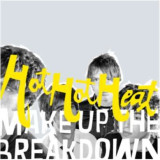
Hot Hot Heat’s classic debut album, ‘Make Up The
Breakdown’, filled with smart, energetic, dancepunk hits, returns to vinyl with this fully remastered
LP edition.
AllMusic called the album “an addictive, densely
packed pop gem that ranks among 2002’s best
albums,” and Pitchfork agreed, including it on their
list of The Best Albums Of 2002.
Following closely on the heels of their critically
acclaimed ‘Knock Knock Knock’ EP, ‘Make Up the
Breakdown’ is Hot Hot Heat's first full length,
recorded with Jack Endino at Vancouver, BC’s
Mushroom Studios (with engineering help from
Chris Walla of Death Cab for Cutie).
SPIN Magazine had this to say about ‘Knock
Knock Knock’: “Some retro new wavers hang
themselves on their own skinny ties. While their
peers lip-synch to Cure 45s, these Canucks take
subtler cues from early ‘80s synth disco. It’s not
new-wave worship, it’s the sound of punk teaching
itself to dance.”
‘Make Up The Breakdown’ delivered on the
promise hinted at on the EP. ‘Hot Hot Heat’ (along
with peers like Radio 4 and The Rapture) blended
angular post-punk twitch with danceable pop,
effectively (and finally) persuading white dopes on
punk to get on the good foot in the early 2000s.
Opaque yellow vinyl.
Jazzrausch Bigband has more or less invented a new art form,
techno jazz, and has become well-known for performances of it. But
the band also has another, different story to tell. It has invented its
own tradition of hitting the road and touring at the end of each year
with a programme consisting of Christmas music, and has been doing
this ever since the band first emerged eight years ago. Bandleader
and founder Roman Sladek explains: “Whereas our regular projects -
the most recent album, ‘Emergenz’, is a good example - are all about
working through a specific theme and finding new ways to reinvent
ourselves, our Christmas thing is something we do for one reason
alone: to have fun. It was our very first programme, we still love it, and
we’re still nurturing, developing and growing it. Being able to devote
one month a year entirely to the big band tradition is something we’re
all really passionate about.”
Some bands might have been tempted just to throw together an
album of Christmas chestnuts any old how, but the Jazzrausch way of
doing things is not like that at all. Unlike any other album by the band,
for the first time we hear purely instrumental music. Furthermore,
Kuhn has taken ten classic Christmas songs - each one of them
rarely heard in jazz, and tunes which can often come across as a bit
staid in their original settings - from ‘Tochter Zion, freue dich# to
‘Adeste fideles’ or ‘Ihr Kinderlein, kommet’. The title track, ‘Alle Jahre
wieder!’ (based on the 1830s carol to music by Silcher which is very
familiar to children and adults in the German-speaking world) appears
here in completely new orchestral garb.
Sometimes the listener will recognise the kind of swing typical of
Glenn Miller. At other moments it is the incomparable big band
elegance of, say, Artie Shaw. ‘Es wird scho glei dumpa’ (an Austrian
carol) is given the full extra high pressure Tijuana brass treatment.
‘Maria durch ein’ Dornwald ging’ gets the touch of the Thad Jones /
Mel Lewis Orchestra after a Henry Mancini-like intro, and ‘Ich steh’ an
deiner Krippe hier’ recalls more of the great swing heritage.
Once again Jazzrausch Bigband has succeeded in a way that only
very few in the jazz field can, notwithstanding the openness of the
genre: they have brought young and old together, tradition and
revolution, the familiar and the new. Which is why it feels so
completely natural and right that they should continue to do this
‘again every year’, as the album title tells them: ‘Alle Jahre wieder’.
The debut of Hamburg trio Cloud Management stages the meeting of three proven exceptional figures: Thomas Korf and Sebastian Kokus have been responsible for some stunning leftfield neo-kraut releases with their band Love-Songs in recent years; Ulf Schütte has been one of the most productive, and innovative protagonists of experimental electronic music in Germany for many years (see Datashock, Phantom Horse, or his most recent collaboration with G. Steenkiste/Hellvete on Umor Rex, for example). Following Love-Songs' highly acclaimed collaboration with Schütte, »Spannende Musik«, released in 2021, the formation of Cloud Management as a group in its own right marks a new beginning, which is celebrated with the long player on Altin Village & Mine.
The album is characterized by a dense texture of repetitions in which (modular) synthesizers and bass go head-to-head. It is on this foundation that the formal grammar of the album develops over its nearly 45-minute running time, organized along precise interventions into the hypnotic pulse: What is recognizable as echoes of 1960s/70s minimalism or Cluster functions on »Cloud Management« not in the sense that the sequences or the sequencers are left to themselves, but as highly concentrated, microscopic work on repetition. This virtuosically arranged, groove-based and even danceable density of the seven pieces never sounds strained or as an end in itself, but floating, cloud-like. The polyrhythmic workouts are at all times in the service of a refreshing expanse that opens up from the sonic saturation and is far removed from the formulaic box-checking often associated with the attribute ›kosmisch‹. »Cloud Management«, thus, marks not an exercise in the traditions of a musical past, but a distinctive position within contemporary electronic music.
All songs are written, recorded and produced by Ulf Schütte, Thomas Korf and Sebastian Kokus.
Tuhka, like its titular cinder or ash symbolises new beginnings, fertile ground and creativity after a long lapse. In the same vein, the tracks on this edition were created after a long fallow period.
Tuhka was created out of archival snippets and new vocal loops created on the sunny top floor of Merlijnstraat in early 2022. Late lockdown there was spent writing on the balcony and walking or playing in nearby parks. This creative but relaxed time is embodied in the feeling on ’Tuhka,’ a release wrapping itself around the core of two long-form tracks:
Kärpässieni is a soft, pensive number, with an archival cheap synth track and a chopped-up mystery field recording mingling with a simple subdued vocal loop. There is a titular reference to amanita mushrooms, a fungi encompassing the mystery and the melancholy bitterness present in the track. The feeling is akin to a frosty morning spent on a walk to the Mercatorplein library and feeling your toes start numbing.
Varisevalehti means ’shudderingleaf’ and it consists of an airy, optimistic voice loop that progresses and winds around the length of the track. Alongside it, at times you can hear tape-manipulated samples from a ’learn Italian’ record I used to own. The feeling is more of a wander around Westerpark when the blossoms have started come loose and fly around in the air, forming soft pink deposits in the corners of streets.
Thanks to Haron Aumaj for enduring support and for the copious quantities of Banjaan borani.
Guitar and bass duo Gong Gong Gong charge out from Beijing's underground scene with a distinct vision and uncompromising sense of purpose. The duo taps into a wavelength uniting musical cultures, drawing on inspirations as wide-ranging as Bo Diddley, Cantonese opera, West African desert blues, drone, and electronic music.
Despite the band's decision to eschew traditional rock percussion, on their debut LP Phantom Rythm, the locomotive chug of Tom Ng's guitar combines with Joshua Frank's thumping, harmonics-laden basslines to conjure an aura of ghostly snare hits and timpani overtones. Over Frank's enigmatic melodies, Ng sings in Cantonese, piecing together abstract tales of absurdity, doubt, desire, and lust. Synchronized to the point of near-telephathy, "the Gongs" use their minimalistic tools and idiosyncratic playing style to challenge the notions of rock n' roll and strip the form down to its bare essentials: rhythm, melody, and grit.
"Black Screen Records has once again teamed up with Tumult Kollektiv to release their soundtrack to Hundred Days, a game of choice, nostalgia and winemaking.Departing from the folkloristic orchestral sounds of Pine, the music for Hundred Days strives for an intimate setting, prominently featuring a small ensemble of synthesizers, cello and guitar. The compositions are lush and intricate, creating a soothing and light-hearted score, tinged with a sense of melancholy.""We are really proud to be releasing our second soundtrack with Black Screen Records and would like to thank everyone that has been supporting our music.Working on the music for Hundred Days was a wonderful experience and a great opportunity to taste some wines (and learn about winemaking).Thanks to Weinhof Lindicke for allowing us to record sounds on their vineyard, and Lawrence Herlyn for showing us around.Furthermore, our deepest gratitude to the wonderful musicians we got to work with on this project. Thanks for borrowing us your talent, near infinite patience, and making the music sing."" - Alexander van der Kruijf, Jonathan Howe & Leonhard van Voorst"
Joan Reggae Drummer, based in the region of Catalonia in Spain, is a great lover of Jamaican music, at a very young age he began to be so passionate about drums that he created his first musical projects, among them, the band that was a turning point was The Pepper Pots. With 6 albums already released and several tours in Europe, UK, Japan, USA & Czech Republic , Joan has opened for internationally artists such as Jimmy Cliff, Kymani Marley, Laurel Aitken, Derrick Morgan, Ticken Jahfakoli or The Pioneers among others. He performed at major festivals such as Summerjam Reggae Festival (Germany), Rototom Sunsplash (Italy), Primavera Sound (BCN), Rock For People (Czech Republic) or SXSW (Austin, USA).
Joan as a drummer has also worked with a lot of top international soul artists such as Curtis Mayfield's legendary band The Impressions, Eli "Paperboy" Reed, Maxine Brown, Binky Griptite from Daptone Records that has been in bands such as Antibalas, Sharon Jones & The Dap-Kings, The Dap-Kings or The Mellomatics.
In 2020, after a time of musical hiatus due to the Covid, he began his more personal adventure, creating his own channel dedicated solely and exclusively to the world of drums in Reggae and Dub. Currently his Instagram channel has more than 34.000 followers and the content published has so much repercussion.
First this major collaboration last year with Aston Barrett Jr for a special tribute to his uncle , Carlton Barrett (Bob Marley), one of Joan's favorite drummer. And at last all this work led him to record his first debut EP "DUB Explosion" on the label Two Flames Records, a real explosion of DUB, where the common thread of the songs are drums.
JRD "DUB Explosion" is a performance in the form of an EP, consisting of 4 instrumental Dub tracks with a totally different concept than what we are used to, since the songs were created from the drum beats.
Great musicians from different countries have participated in this EP: Guitar - Arturo Landaeta (Venezuela), Bass - Elie El Ossais (Australia), Keyboards - Ireneu Grosset (Spain), Nyahbinghi Drums - Maurici Bongo (Brazil), Trombone and Trumpet - Pablo Martín (Catalonia), Tenor sax - Tomy Muñoz (Catalonia), Bass - Miliu Llorach (Catalonia), Flute - Lluís Doménech (England), Bass - Joshua Jones (Jamaica), Keteh & Triangle - Aurel Cade (France), Trumpet - Glenn Holdaway (United States).
Finally, the production, mixing and dub was done by the musician and producer Ireneu Grosset, in the analogue studio of Dr. Dubwiser. It was quite an experience as the studio has a team very similar to what Jamaican producers had in the golden age of Reggae in the 70's.
Bingo Harry sprang out of nowhere a few years back, when Martin Bramah of Blue Orchids was shocked by their opening set for his band, Blue Orchids. Bramah's enthusiasm went so far as to lead Blue Orchids to recording a then-unreleased Bingo Harry composition, "If They Ever Lay A Finger On Us", a subtle yet unusually powerful and enigmatic revolutionary song of caution to oppressors. The original recording was later released on Bingo Harry's self-titled debut, which sold well, and merited more studio sessions. These days, Bingo Harry is more a often solo vehicle for songwriter Benny Jones than a band. Currently living on a houseboat in northern England (which somehow manages to contain his home studio as well), Benny spent the past few years recording dozens of songs before winnowing them down to fit on Bingo Harry's second album, "Where Do We Go?", not to mention constructing the collage of the album cover. The cosmic inheritor of a certain Marc Bolan-esque knack for simple yet spiritual and thrilling tunes, Benny's songs span seemingly glam-induced groovers to a handful of gentle-but-trippy epics which would be overwrought in lesser hands, but here manage to capture a beautiful bit of the cosmos alongside their relevance to the wearying state of the world today. "Shine If You Can", the album's final track, works as well for an anthem of the times as anything you'll hear in the next few years. Tracks: Gullible / Fearsome Tannoy / Melted / Evolution / Rope Over The Wall / Where Do We Go? / Safe In Human Form / Weapon Against The Dark / Rabbit Hole / Did You Hear That? / Shine If You Can
With his first release since 2015, Seattle based Indie-folk hero Rocky Votolato returns with Wild Roots, an intimate concept album inspired by and written for his family. Each song a letter dedicated to a specific family member and focused on a special memory or moment in time. After losing his child in December of 2021 in a tragic car accident, the entire album, and especially the song “Becoming Human”, now a posthumous love letter, takes on an even deeper while devastatingly bittersweet meaning. The production on Wild Roots is hushed, handcrafted, and warm — an intimate and personal experience that brings the nature of Votolato’s storytelling to life in very authentic and genuine ways. Produced, engineered, and mixed by Votolato himself, the record is a deliberate construction of his conceptual vision and new phase of his recording career. Additionally, the record features a stellar cast of renowned musicians whose contributions perfectly compliment the delicate nature of these songs — Abby Gundersen (William Fitzsimmons) on piano, string arrangements, and vocal harmonies, James McAllister (Sufjan Stevens, The National) on drums and percussion, Phil Wandscher (Whiskeytown, Jesse Sykes and the Sweet Hereafter) on electric guitar, and Marcel Gein (Perry O’Parson) on electric guitar. In many ways, Wild Roots is not only a break in silence for Votolato, but the opening of a new chapter — one that feels laser focused on what really matters in life. Whether discovering Votolato for the first time or adding another record to your collection, Wild Roots resonates on the most simple and important human levels — a sharing of experience that encourages us to keep believing in ourselves and in the magic of this life, no matter how harsh and difficult it can be.
Track list: 1. Evergreen 2. 23 Stitches 3. Glory (Broken Dove) 4. There is a Light 5. X1998x 6. Becoming Human 7. Breakwater 8. Little Black Diamond 9. Archangels of Tornados 10. The Great Pontificator 11. The Wildest Horses 12. Little Lupine 13. Bella Rose 14. Southpaw 15. Texas Scorpion (The Outlaw Blues)
On March 16, 1968, the United States Army killed over 500 unarmed
civilians in the hamlet of My Lai, Vietnam
The unimaginable brutality of the event impacted all those who witnessed it
firsthand, including helicopter pilot Hugh Thompson, who, against orders,
intervened to save Vietnamese lives. Thompson's story is the basis of the opera
My Lai, composed by Jonathan Berger (music) and Harriet Scott Chessman
(libretto) for Kronos Quartet, Vietnamese multi-instrumentalist Vân-Ánh Vanessa
Võ, and vocalist Rinde Eckert. This definitive recording of My Lai captures the
visceral, phantasmal depictions of Thompson's grief, horror, and guilt as he is
haunted by persistent memories of that cataclysmic day, half a world and nearly
four decades away. Tense and unforgiving, My Lai is "a gripping affair, beginning
to end" (New York Times). Presented here alongside recollections by Vietnamese
survivor Tran Van Duc, it is a memorial to all the My Lai villagers killed on that
grim day.
Shelter Press extend a quietly cine-poetic invitation to visit the Outer Hebrides via immersive sounds - field recordings of psalm singing and local dialect - collected and arranged by interdisciplinary artist Joshua Bonnetta, going hand-in-hand with Shelter Press’ core interests in the fading light of its 10th year in operation. A beautiful artefact - complete with 60 page photobook.
Accompanied by an evocative photo study and access to an accompanying film and essay, Bonetta’s second release for Shelter Press following 2016’s ‘Lago’ imparts a real feel for the archipelago, off the north west coast of Scotland, where he was stationed during an artist’s residency during 2017-2019. Stitched together from observant field recordings and interviews with residents on the islands of Barra, Berneray, Harris, Lewis & North Uist, the work elicits a sense of timelessness in its slow drift between shores, hills, standing stones and the intimacy of its voices, including Gaelic spoken word, folk song and whistling. Save for the appearance of a plane overhead, the sounds of car and boat motors, plus a little bit of electronic disturbance that pull you into the modern era; the results practically imagine what it would have been like to visit the islands with a recording device at any point since the last ice age.
For Bonetta, who hails from rural Canada, the similarities between his formative landscapes and those of Scotland must have appeared familiar, perhaps a subconscious recall/reminder that the two places shared a landmass, albeit 425 million years ago. His sound sensitive subtlety and cinematic ear in arranging his collected sounds serves to highlight the way the modern world only just infringes on Innse Gall’s ancient landscapes and only relatively modern tongues (if we’re thinking in geologic terms of scale). We hear the sounds of its avian population seamlessly eliding its humans in the whistling of Alick Macauley, and the natural cadence of of its mild oceanic climate mirrored in lilting Gaelic folksong, here performed by Calum McDonald, Joey Morrison, and Maggie Smith, and more generally practiced by only a tiny percentage of Scotland’s population (some 1%) but still surely alive in its meridian isles where time moves much more slowly.
With the nuance and poetry expected of a Shelter Press title, ‘Innes Gall’ reflects on the area’s anglicised name, meaning “islands of the strangers”, with calming, soberly documentarian results as heartwarming and fascinating as a visit to the area, just without the effort of travel, and from the comfort of your own living space. Bonnetta is incapable of ignoring the cinematic frame, and intersperses each shot with enough poetry to keep you entranced.
»Follower« is Abrahams’ 6th album for Room 40 and showcases his continuing interest in the ambiguous spaces between music and noise; tonality and atonality; rhythm and texture. All four tracks have piano as a key factor: in one instance, high-pitched and atonal; in another, emotive yet distant as if projected on to a screen. Follower presents the listener with a sound world of colourful juxtapositions, rich orchestration and organically open forms.
On the opening track, bass piano meanders through a wilderness of de-tuned bells and organ swells; a strange sort of festival. Low frequency sighs evenly punctuate, like a pump or a heartbeat. It’s a procession that takes it time as it wanders the terrain, brought to a close with transcendent distortion. On track 2, muscular modal piano surfs among waves of percussion and analogue synthesisers. A buffeting travel.
Originally released in 2014, “Instruction Booklet N. 1232” marks the first cassette release on Dauw for Tatersall under his The Humble Bee moniker. Taking advantage of the format, each side on “Instruction Booklet N. 1232” is reserved for a single piece nearing the 20-minute mark.
“Exploding View” (aka Side A) swells into existence with a very grand sounding synth-driven melody. Of course the other thing that’s present is the decaying sound of the tape loop that’s working to bring that music to life. At first, the melody grows and grows, fairly undisturbed, but eventually the sound of so-much tape warble threatens the rising nature of the piece until it sounds as though it is one loop away from total decay and simply fluttering out of existence.
But of course that’s the point. There’s a tension between that grand melody that opens these moments and that warble. It’s a lesson in opposites: the mechanics of a tape loop, guaranteed to break down, placed in contrast with those signature Tatersall melodies, which somehow seem eternal. And just as that tension seems too much to bear — the melody dies to be replaced by something altogether new. What comes next is something much quieter, driven by a sub-aquatic bassline, some rhythmic tape hiss and some gentle piano.
It’s a very dramatic and sudden break. The technical elements of that could be attributed to Tattersall’s understanding of how far a melody can be pushed before it succumbs to the abuse of being processed out of existence — perhaps the tape had been looped and processed to its breaking point. Regardless of whether it was a technical or artistic choice, that hard break serves an important narrative function. Frequently in instrumental music, musicians play with opposites (quiet-loud, clean-distorted) to create a narrative to their work since they don’t have words/lyrics as a tool. In the case of The Humble Bee’s use of tape loops, one set of opposites in tension is always driven by the fragility of the melodies and the limitations of a machine guaranteed to inevitably decay the media it is designed to support. And where one thrives, the other takes a backseat. As side A winds down, the melodies are much more sparse — appropriate for en ending, yes; but it also gives more space for those hisses and crackles to claim their moment.
Side B is filled out by “Manual with Foot Pedal” and it begins as gently as its predecessor ended. Slowly eking outing it existence – it’s as if watching Tatersall set the board, showing his players on opposite sides of the table before really setting them in motion to do their thing. By the piece’s midpoint, melody has taken centre stage as a glitchy, piano-led rhythm marches its way forward, clearly carving out its space and claiming its territory. And almost immediately following that: the decay takes over again and those tape loops seem processed to near death — the melody almost barely decipherable as it flutters under the weight of the history of being looped/played ad nauseum. And in the very final moments, the melodies are sparse again, giving the tape hiss room to play its part — it’s as if Tatersall is giving both players enough space to take their final bows.
Für Fans von Smerz, The Internet, Erika De Casier & Japanese Breakfast Es braucht ein starkes Selbstbewusstsein um seine Komfortzone zu erweitern. Bei der Künstlerin Gaisma scheint diese Ausweitung keine Grenzen zu kennen. Vom professionellen Tanz, über das DJ Leben in den Nacht Clubs, bis hin zu eigenen musikalischen Kompositionen und Produktionen. Die Disziplin mit der Alisa Scetinina aka Gaisma ihren Leidenschaften nachgeht, kommt nicht von ungefähr; aufgewachsen in Lettland wo sie sich in jungen Jahren dem Ballett verschrieb und schließlich in der Choreografischen Schule in Riga aufgenommen wurde. Mit 15 Jahren kam sie alleine nach Deutschland und nachmehreren Engagements u.a. in München und an der Stuttgarter Oper, entschied Alisa aus dem nichts Kunst zu studieren und live zu performen. Damit war der kreative Hunger noch nicht annähernd gestillt, es kam Cinematography hinzu, sowohl vor als auch hinter der Kamera, diverse Choreografie Arbeiten und eben ihre eigens produzierte Musik die Genreübergreifend in alle Richtungen fließen kann. Nach diversen Singles und zwei Alben auf Bandcamp, die ausschweifenden Techno sowie sanfte R'n'B Klänge beinhalteten, entschied die 27jährige die eigenen Produktionen beiseite zu legen und sich mit Paul Schwarz (Levin Goes Lightly, Karies, Human Abfall) zusammen zu tun um eine EP aufzunehmen und zu produzieren. Dabei herausgekommen ist "Mirrors of the Cosmic Cinema", eine musikalische Reise die Hörer*innen in träumerische Momentaufnahmen entführt. Die 5 Song starke EP überzeugt mit cleverem Songwriting rund um zwischenmenschliche Wahrnehmung und kleinen alltäglichen Geschichten. Durch technische Finesse scheint sich die Zeit beim Hören auszudehnen und lässt somit Realitätsflucht und kleine Gedanken Abenteuer zu. Eine Mischung aus Indie Bedroom-Pop, Contemporary R'n'B und einer brise psychedelic Soul wird verfeinert mit treibenden Rap Passagen und jazzigen Drums, das zeigt die Vielfalt und das Talent mit dem Gaisma Genres aufbricht und miteinander vereint.
Matte, textured lift-off lid box containing a remastered reissue of the Harvest album, a 7" single with outtakes, a 1971 unreleased BBC concert on LP & DVD, a DVD of the film Harvest Time, a 48-page hardbound book, a fold-out band poster, and a numbered lithograph. Harvest is housed in a Stoughton tip-on jacket which has a matte texture on the outside and a high-gloss finish on the inside. The left side pocket includes a replica of the original fold-out lyric sheet. BBC In Concert is housed in a matte Stoughton tip-on jacket. Harvest Outtakes is a small hole 7" issued in a shrink wrapped matte picture sleeve with top opening. Harvest Time DVD is housed in a printed card sleeve and comes with a two-sided insert. BBC In Concert DVD is housed in a printed card sleeve. 50th anniversary deluxe edition Original album (remastered) Three Harvest outtakes on 7" single (two unreleased versions) 1971 unreleased BBC concert on LP & DVD Harvest Time: 2-hour unreleased film from 1971 on DVD 48-page harbound book Numbered lithograph Poster
Over the last two years, the Innate and We’re Going Deep labels – run by friends Owain K and Placid respectively – have become must-check imprints for those seeking brand-new, timeless-sounding electro, deep house, acid and techno. Now the pair are joining forces on a new collaborative venture that looks to the past for inspiration: InnDeep.
Focused on unearthing and showcasing slept-on gems from across the deep spectrum, the reissue-focused label will have an emphasis on UK producers and imprints whose work in the ‘90s and 2000s has arguably been criminally overlooked.
To kick things off, they’re taking a deep dive into the back catalogue of Headspace Recordings and Emoticon co-founder Tom Churchill, a Welsh producer whose trademark take on deep house achieved cult status in the late 1990s and early 2000s.
The Personal Interpretation EP was first released on Headspace way back in 1997, and dates back to a time when Tom was the very definition of a bedroom producer. He created the EP’s three tracks while still a teenager and mixed them down using the same pair of headphones he used for DJing.
Now painstakingly remastered, the EP sounds every bit as immersive and intergalactic as it did at the tail end of the last millennium. On the EP-opening title track, Churchill builds a sturdy, chunky groove out of clicking, hissing and metallic percussive elements and a wonderfully deep, tactile bassline, over which gorgeous chords, melodic motifs and eyes-closed vocal snippets stretch out as if reclining in the afternoon sun.
Churchill opts for a deeper, Detroit-influenced sound on ‘First Principles’, with undulating electronics and a raw analogue bassline working in unison with ghostly chords and deep space melodies, while ‘Crossed Wires’ is a tispy, off-kilter epic – all breathless drum machine rhythms, pots-and-pans percussion, woozy chords and weighty sub-bass. It provides a fittingly energetic, out-there end to a long-overlooked EP that remains as fresh now as it did back in 1997.
out of Stock
Last delivered 4 months ago available to reorder, subject to availability
With his new EP “Insides”, Palham Music owner Pressburg, delivers a true minimalist house masterpiece.
Dubbyrim starts off with taperecorder processed dub chords, guided by a haunting (-lybeautiful) bassline. Memory Gospel is J Dilla having musical intercourse with Lowtec. And With You is slower, sensual four to the floor house music at its best.
With this record, Pressburg expands his musical horizons, not only sticking to previous experimental records he made, but taking those experiments now to the dancefloor.
We are very happy that renowned dj's such as Move D, Roger 23. Sensu and Lerosa have included the tracks already in their setlists.
This is Pressburg’s first throw on Someguy Records.
ABOUT PRESSBURG:
Pressburg lives in a rural idyll on the foothills of the Thuringian Forest. That’s where he produces his meandering tracks which he has been releasing on his house label Palham Music, since 2003. His approach is technically cognitive, fitting for his reservedly modest character.
ABOUT SOMEGUY RECORDS
Someguy Records is the brainchild of G?s Ramboer, aka Someguy, a political journalist with a passion for music. The label aims to be a haven for house music artists that don’t strictly aim for the peak time of the party, but rather provide that surprising opening or closing track. There’s no rules to what or who is involved with the label, but most acts are situated left of the center.
Current and future acts include:
Someguy, Different Fountains, Pressburg, Sensu, Mikkel Metal, Mary Yalex, D man.
out of Stock
Last delivered 3 years ago available to reorder, subject to availability
Three generous portions of blissful beats on the Electric Shrine imprint, kicking off with the downbeat (in BPM terms) but lively 'Solar Visions' coming on like a dub mix of a lost Chic classic, 'What You Love' more like prime-era John Carpenter remixed by a mischievous Orb and 'Un Amore Supremo' a slow motion (one of the slowest we've ever encountered) reverb-fest, designed for more eccentric chillout rooms. And that's all before the opera singer pitches in.
out of Stock
Last delivered 3 years ago available to reorder, subject to availability
The Sol Power All-Stars are back once more on the Rocksteady Disco label with some superb new covers of much-loved British funk band Cymande. Each one brings a fresh perspective while paying heed of the Afro-roots of the originals. 'Anthracite' (feat Denise Henderson) opens up and is designed for moaner dance floors with cosmic synth work and big, bouncing drums. There is a deeper and more steamy sense of rhythm to the tropical sounds of 'Getting It Back' while the Parkway dub of 'Anthracite' sounds like early house music. Two versions of 'Genevieve' offer shuffling rhythms and big horn stabs and stomping, ass-wiggling Afro-jazz.
out of Stock
Last delivered 3 years ago available to reorder, subject to availability
With UPGRADES, Fogata Sounds imprint nearly 20 years of collaboration between Troy Berkley & Krak in Dub. This opus follows half a dozen maxi 45's and 300 gigs across Europe, from the One Love Festival to the underground sound system nights. The vocalist and the producer skills take you on a journey into “Sound System” music, from Early Roots to Future Dance-Hall, oscillating between Dub and Jungle. Those styles appear like solar polaroids , bringing images to the minds of neophytes and music lovers. 12 effective and original tunes mixing analog instrumentals like in “Life pon the line” or “CrystalBall” to the uncompromising Stepper from « Roll Call ». Featuring the big tune « Matta » and to singles « Dub plate Dada » et « Sound and Power » feat Sr Wilson.
out of Stock
Last delivered 16 months ago available to reorder, subject to availability
Hot on the heels of Guinu’s modern Brazilian jazz-funk opus Palago? LP, comes an exceptional remix 12’’ of four standout album tracks.
For the A1, Jose Marquez flips the title track into a percussion-heavy and hypnotic Afro-Latin house burner, a masterful future classic of a mix that feels all but destined for late night Louie Vega or Osunlade sets. Faze Action harken back to their early-2000s vibe with their loungey beat-driven reimagining of Haja Fé.
On the flip, RNT stalwart Diogo Strausz takes the angular Electromandinga into the stratosphere, with anthemic synth melodies, rousing bloco percussion and interstellar vocal treatments. Rounding out the EP, well-loved Brazilian producer Carrot Green gives Porão de Ferro an 80s boogie makeover, complete with dubbed out vocals and funky synth bass work over bouncy analog beats.
out of Stock
Last delivered 4 months ago available to reorder, subject to availability
Many Worlds Interpretation is a collection of cosmic Americana for electronics, guitar, and percussion culled from Jon Iverson’s extensive home-studio archive. 1984, Los Osos, California. In a small cinderblock cottage, hand-painted with bright psychedelic flora, Jon Iverson created vibrant new worlds. He spent long days and nights immersed in sound, perfecting home recording on his 8-track reel-to-reel, combining his love for kosmische and Berlin School electronics with an infatuation with ethnographic sounds and expansive guitar music. In a duo with fellow sonic traveler Thomas Walters, Iverson released missives from the studio on a self-titled LP released on country legend Guthrie Thomas’ Eagle Records. That release featured
three electro-acoustic compositions (“Naningo”, “River Fen”, and “Fox Tales”) as well as a gathering of guitar duo tapestries. Many Worlds Interpretation re-imagines those interplanetary works alongside several unreleased compositions that also feature synthesizer, guitar, and percussion, creating a re-visioned album which leans into Iverson’s electronic studio wizardry.
All songs have been carefully transferred from analog tape to high resolution digital, retaining their vintage studio warmth, but mixed and mastered for modern ears and audio systems. The album is pressed at 45rpm, further enhancing the audiophile experience.
Artist Statement
I worked in a Harley Davidson parts warehouse in the summer of 1976 in the San Francisco Bay Area. The goal was to save enough money to buy transportation for college and a Teac 4 track 1/4" reel to reel tape machine. By September there was a rusting monkey-vomit green car in the driveway and shiny new Teac with a Sony condenser microphone in the bedroom. At this point I had been playing guitar for a dozen years and like most children of the sixties, dreamed of joining
a band.
Went to college instead to study business.
But all was not lost. 1978-1979 was spent as Weird Al Yankovic's roommate and we recorded and created enough songs to play shows around San Luis Obispo, California, where we were attending college. Many of those recordings have yet to be heard by the public, including the first performances of My Bologna and many other parodies of pop songs of the day. We sent tapes to Dr. Demento, we auditioned for The Gong Show and were barred from playing at the local college after one memorable performance. Wild times.
I, however, was more intent on working on "serious" music, with albums from Vangelis, Tangerine Dream and Jean Michel Jarre providing inspiration. DJing at the local college radio station and then public radio outlet provided exposure to an endless stream of obscure albums (Sky Records from Germany was a particular favourite). Most of them would never make it to the air, but my buddies and I would pass them around like exotic treasure.
Fast forward a couple more years and I had picked up a Mini-Moog and eventually a Prophet V synthesizer as well as starting a collection of instruments from around the world. The Teac and synths formed the basis for a growing DIY studio that had taken over a modest-size garage (pictured on the cover) that had been converted into a two room cottage in Los Osos, California.
The Teac was eventually joined by a rented Otari 1/2" 8-track and then finally a vintage MCI JH-100 2" 16-track. The compositions on this album were recorded on these three machines between 1982 and 1989. At some point an Apple II computer with Alpha Syntauri sound card and keyboard were added and then later the first personal computer sampling hardware/software kit, the Decillionix DX-1. The DX-1 forms the rhythm track for “Fox Tales” and the Alpha Syntauri was programmed to create the pulsing synth for “Naningo”. “River Fen” was tracked with both the Alpha Syntauri and the Prophet V.
I knew this music wasn't commercial, but didn't care. It was inspiring working with the first computer-based synths and semi-pro gear. Home studios were still rare in the early 80s until the Tascam Portastudio blew the DIY door wide-open. But I was more interested in sound quality so stuck with reels of tape instead of lower fidelity cassettes.
During the time these songs were recorded, I was also collaborating with my good friend and mandolinist, Tom Walters. “River Fen”, “Naningo” and “Fox Tales”, were solo recordings that also ended up on the first Iverson & Walters album, First Collection. The other four pieces on this new LP were never fully finished or released until now.
— Jon Iverson, September 2022
out of Stock
Last delivered 3 years ago available to reorder, subject to availability
Art Of Primitive Sound is a sensational journey to the origin of Music. In his crucial research chapter on the Paleolithic, Walter Maioli between 1986 and 1991 investigates the soundscape of different geographical, climatic and botanical environments, in which the mystery of the ancient human-nature relationship resides. What emerges is an expanded and unprecedented Paleorganology, with a range of acoustic and natural instruments from all over the World. Rubbing of fossils, animal artefacts, plant elements of all sorts, everything becomes sound and each object opens up forms of imaginary communication, psychic effect and unexplored languages. Whistles, flutes, leaf and shell rattles, rhombuses, horns, bone pipes, slate slabs, bamboo arches, stones, vertebrae, seeds, stalagtites etc...how great can be the Natural Orchestra inherent in the spirit of forests, rivers, caves, seas, swamps or Amazon jungles? Thanks to an interdisciplinary partnership (Anthropology, Archaeology, Botany, Ethnomusicology) of collaborating friends, Maioli directs an Opera of universal character inspired by the archaic essence of sound and infrasonic dimension.
out of Stock
Last delivered 3 years ago available to reorder, subject to availability
Nach fast 20 Jahren der Veröffentlichung ihres Debütalbum „Bohème“, welches mit über 500.000 verkauften Einheiten ihre erfolgreichste Veröffentlichung ist, erscheint nun erstmalig die englische Version des Albums.
Die englischen Bohème-Songs wurden 2009 in Berlin aufgenommen.
Adaptiert wurden die Texte von Martin Gallop einem kanadischen Singer-Songwriter. "Mit Annett Louisan trat er 2007 und 2008 als Gaststar auf ihrer „Das optimale Leben“- Tour und 2009 auf der „Teilzeithippie“-Tour auf, wodurch er einem größeren deutschen Publikum bekannt wurde, insbesondere da er von Sommer 2008 bis 2010 mit Annett Louisan auch privat liiert war, was auch von den Boulevard-Medien zur Kenntnis genommen worden war. Die Künstlerin war seinetwegen nach Berlin gezogen, wo Gallop seine neue Wohnheimat gefunden hatte.
Im Zuge dieser Veröffentlichung erscheinen auch ihre, als Tonträger lang nicht mehr zu erhaltenen, Alben „Bohème“ (2004), „Unausgesprochen“ (2005), „Das optimale Leben“ (2007), und „Teilzeithippie“ (2008) in neuem Gewand als „Gold Edition“ als hochwertiges Digipak und Gatefold DoppelVinyl, 180Gramm. „Unausgesprochen“, „Das optimale Leben“ sowie „Teilzeithippie“ erscheinen zum 1. Mal auf Vinyl.
Alle Alben enthalten unveröffentlichte Bonustracks des 2005 aufgenommen Livekonzerts bei „SWR1 Kopfhörer“.
Tall Black Guy chases his extraordinary 2021-released collab LP, Of Process and Progression alongside emcee Ozay Moore, with the long awaited instrumental version. The record is a celebration of hip-hop and its many influences, especially jazz, funk, soul, and R&B. And now that it’s available in instrumental form, listeners can fully dive into and unpack the layers, samples, and sounds comprising the release.
In speaking about his approach to the album’s production, TBG explains the process as follows: "When myself and Ozay decided to come together to make OP&P, we really wanted to make it to where there were no skips. And the production had to be top notch.” He goes on to say that he didn’t want to just sample, but instead add live instrumentation and collaborations with other musicians to craft the sound they wanted.
“I wanted to make sure Ozay had a lot of space to get his point across in the songs he was coming up with,” TBG says. And while you can certainly hear that space in these instrumentals, they stand on their own as stunning odes to hip-hop and the genres that birthed it. This album is also brimming with musical Easter eggs on each song, particularly on repeated listens as the layers begin to unravel themselves to your ears.
There is so much to love and discover within the instrumentals of OP&P, and for fans of TBG’s past work, it exists as another triumph in what’s becoming one of hip-hop’s most thrilling discographies.
out of Stock
Last delivered 3 years ago available to reorder, subject to availability