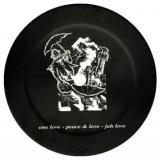
OOO002 - second, vinyl-only release debuts dark, galactic grooves featuring heavy bass lines and experimental elements from artists Chad Andrew and Len Lewis.
A1: “Battle 303”
Inspired by the soundscape of the 90’s techno scene, Battle 303’s punchy bass drums hold you captive as its sine wave bounce lures you into hypnosis with a progressive rhythmic beat. The track’s rolling 303, pyramid’s a myriad of elements before awakening you to the crisp subliminal vocal, just shy of the midway point. Battle 303’s multidimensional fury of movement refuses to slow its pace, inducing pure cardio for both the mind and body, inspiring peak dance performance.
A2: “Area 15”
Area 15 intros the swirling ambiance of dark, atmospheric, easy listening as it gradually accelerates into a journey of the unknown. Utilizing distortion effects, eerie drones and chimes, coupled with the rhythmic pattern of arpeggiated synths brings about a sense of intrigue that lends the listener the flexibility to determine their personal musical trajectory and experience.
B1: Battle 303 (Len Lewis S!th Remix)
Battle 303 (Len Lewis S!th Remix) is an introspective, sonic journey that slings you through a brooding origin story of tribal, galactic funk that echoes iconic samplings spanning over 5 decades seamlessly merged into one futuristic bop. Maintaining it’s old school, breakbeat roots with a driven, heavy bassline, claps and snares, Lewis remains true to his S!th style, by altering path and speed with his signature, unexpected musical transitions, highlighted by timely breaks and experimental elements. Be prepared to move and groove as this track reaches hyperspeed early on, stimulating intense movement and journey from start to finish.
B2: Battle 303 (Len Lewis G.H.M. Remix)
Battle 303 (Len Lewis G.H.M. Remix) leads with traditional, minimal components and a suspenseful bassline, laced with piercing elements and garbled synth vocals, creating a sense of awareness and urgency that gradually builds in intensity before throwing you into punchy, sinister darkness.
This groove, set against the backdrop of deep space and all its musical element oddities, mimics the drive of the original 303’s rolling bass line while seamlessly exploring Lewis’ S!thstylings of metallic synth scales and spooky drone effects, keeping you captivated as you strut the dance floor
Buscar:out of office
In summer 2015 Andreas Oskar Hirsch finished constructing the Carbophone, an electroacoustic invention pushing the concept of the African Kalimba or Mbira. Vertically set up carbon rods, metal bars as well as a rubber band gamut make up this plucking instrument which opens up a whole variety of sound possibilities and features rather particular overtones.
Initially, Early Carbophonics was produced upon invitation by Radiophrenia, a Glasgow based temporary art radio station run by Mark Vernon and Barry Burns, and the pieces were broadcasted for the first time in late summer 2016. Here, Early Carbophonics are compiled on vinyl, and in contrast to the digitally distributed tracks, the pieces are mixed into each other on the record. Sketches from the rehearsal room are combined with more refined pieces through editing processes, sampling and effects resulting in electronic music with a warm analogue lo-fi feel of its own. Straightly rhythm driven tracks are followed by ambient oddities like the promenade of an octopus or a probably senile shipwrecked robot that emerges from a castle moat and starts speaking to you with a haunting voice. Occasionally, the Carbophone is accompanied by some other instruments like a Morse key, a Moroccan flute or the Electric Palm Leaf.
- 1: Intro
- 2: Bear Hill
- 3: Pomogranite
- 4: Veterans Only Billionaire Rehab (Skit)
- 5: Wild Corsicans
- 6: 1 Life
- 7: Barber Shop Bullies (Skit)
- 8: Open Doors
- 9: 600 School
- 10: The Guy That Plans It
- 11: Da Heavies
- 12: Officer Full Beard (Skit)
- 13: The Omerta
- 14: Get Outta Here
- 15: The Sober Dose Gift (Skit)
- 16: Debra Night Wine
- 17: Mac & Lobster
Black Vinyl[22,65 €]
Focus Track: Bear Hill Album Description: Raekwon’s The Emperor’s New Clothes is a sharp return to form, showcasing the Wu-Tang veteran’s lyrical precision and timeless street wisdom. The album is powerful with equal parts - high-quality bars and carefully sculpted production. Raekwon recruits a stacked lineup of guests, including Nas, Griselda, Method Man, Inspectah Deck, and Ghostface Killah, injecting the project with gritty energy and legacy chemistry. Marsha Ambrosius and Stacy Barthe provide smooth, soulful hooks, adding emotional layers to the hard-edged verses. Production comes courtesy of Nottz, Swizz Beatz J.U.S.T.I.C.E League and more. The LP is a reminder of Raekwon’s enduring power as a lyricist and curator. A veteran artist showing that mastery doesn’t need excess. The Emperor’s New Clothes is regal, streetwise, and sharply tailored for those who value craft.
- A1: Late Flowering Lust (Phil Kieran Remix)
- A2: Beglammered (Justin Robertson's Deadstock 33S Remix)
- B1: Skwatch (Black Merlin?S Reel To Reel Remix)
- B2: Never There (Hardway Bros Remix)
- C1: Another Lonely City (Daniele Baldelli And Dj Rocca Remix)
- C2: Beglammered (Richard Sen Remix)
- D1: We Are The Axis (Scott Fraser Remix)
- D2: One Minute's Silence (Ivan Smagghe Remix)
Andrew Weatherall never wakes up in the morning and decides to start a new album that day. Instead, recording music is a continuous process usually working with different collaborators and seeing where the muse takes him. Somewhere down the line the rewards of a collaboration will coalesce into a body of work between thirty minutes and an hour long and he will put a call into the Rotters' team to say he has a new release ready to go.
We were visiting the studio catching up on new tracks in various states of readiness when he offered up some remixes of tracks from his recent "Ruled by Passion…" he'd been sent by fellow musicians. Tim Fairplay, Andrew's partner in The Asphodells, Sean Johnston from A Love From Outer Space and Scott Fraser live and work in the area and all popped in at various points.
Andrew's black book reads like the who's who of contemporary music but rather than plunder it for remixers he'd let drop the idea of a remix with friends and neighbours. These plus a couple a swaps with musical friends who were new to the concept of remixing, gave Andrew an hour of music he thoroughly enjoyed listening to.
It goes without saying none of the tracks are duds but our ears always prick up when Justin Robertson's take on "Beglammered" ups the heart rate or Daniel Avery's own unscrewing of "… the Axis" ruffles the neck hairs. We've stopped arguing in the office about which is the best track. They all are.
Utter presents Marshall Jefferson's previously unreleased meditation opus 'Yellow Meditation For The Dance Generation' alongside two remixes from French production maestro Joakim.
Marshall Jefferson: Chicago House music pioneer, creator of the anthemic ‘Move My Body’, an original collaborator of Adonis, Ce Ce Rogers and Roy Davis Jr., production mastermind of countless dancefloor classics such as Phuture’s ‘Acid Tracks’, Sterling Void’s ’It’s All Right’, Hercules’ ‘7 Ways’… and the soothing voice behind a 36 minute healing meditation guide. Yes, really.
But let’s rewind, slightly.
In 2017, Marshall was approached and encouraged by Ian ‘Snowy’ Snowball to write his autobiography and the pair set about putting Marshall’s account of the history of House music together. The book, ‘Marshall Jefferson: Diary of a DJ’ was published in 2019.
Following the book’s release, Ian and Marshall's collaboration continued and during the pandemic an outlandish idea arose to create a piece of music combining Ian's interest in meditation (he runs Club Chi specialising in Shibashi Qigong - a form of Tai Chi Qigong - which is a gentle form of movement therapy/exercise) and Marshall's willingness to experiment musically to see what might be possible.
The result is ‘Yellow Meditation For The Dance Generation’, where Marshall vocalises Ian’s lyrics in his instantly recognisable voice. The keen-eared out there may also recognise aspects of the music itself as a stripped back, lengthened and far mellower version of Marshall’s 1985 obscurity ‘Vibe’:
“I would take tapes to the Music Box and Ron Hardy would play my music. ‘Vibe’ was one of those tracks. I recorded ‘Vibe’ in 1985, but it became one of my tracks that I just forgot about until some guy on Facebook sent me a recording of it that was taken from a club. The only person who I ever gave a recording of ‘Vibe’ to was Ron Hardy. The other people I know who had copies of the track were Gene Hunt and Emanuel Pippin (DJ Spookie).
"The original version of ‘Vibe’ was made using a Roland 707, Roland JX-8P keyboard and a Roland 727 drum machine. I was still working at the Post Office at the time, and this was pre-‘Move Your Body (The House Music Anthem)’. ‘Vibe’ has the building blocks for ‘Move Your Body’ because it was using the instruments on the track that I discovered what I could do with the bass sound, to make a track like ‘Move Your Body’.”
Still, Ian’s initial intention for ‘Yellow Meditation’ was function and it was designed to be a ‘Sequential Relaxation Exercise’ focusing on the Solar Plexus. Bearing this in mind, Marshall took a bare-bones and hypnotic approach to this particular re-recording of ‘Vibe’ so that the voice takes centre stage and listeners (hopefully) find themselves on a meditative journey. In fact, this long-form track was always intended as a private tool purely for meditation at Club Chi rather than released to the public - after all, Marshall had also created and released a more drum heavy, ’traditional’ club-focused 'Vibe Three' instrumental version for that very purpose - but a chance airing of the full 36 minute version changed its path.
Much like those 1985 ‘Vibe’ cassettes, Marshall had sent the track to a few close contacts, one of whom was Kieran at Phonica Records who aired it over the shop’s basement soundsystem. Its unorthodox nature caught the ear of colleague Alex (of Utter) and the seeds of a physical release were planted.
Eventually, with the full-version carefully whittled down to a vinyl friendly length of 24 minutes, full track parts in hand and a b-side to fill, Alex sought out one of his favourite producers to take up the remix reigns: Joakim. The Tigersushi co-founder and Crowdspacer boss has a long history of boundary-pushing remixes that straddle both dancefloor functionality and experimentation. This time the original material resulted in Joakim coming up with a number of ideas and he finally delivered two versions - one club focused (‘Vertical’), the other more introspective and meditative (‘Horizontal’), both of which appear on the final 12”.
The limited edition 12” also includes a download code giving buyers access to all of the vinyl tracks plus an 18 minute extended version of Joakim’s ‘Horizontal’ remix, its instrumental counterpart (for those who can live without Marshall's voice) and full 12 minute acapella (for those who can't!)
Alex
a A1. Yellow Meditation For The Dance Generation (Edit) 24:00
b B1. Yellow Meditation For The Dance Generation (Joakim's Vertical Remix) 9:09
9:05
Before he became better known as Porn Sword Tobacco (PST), Swedish producer Henrik Jonsson released two albums under the name of Stress Assassin. Like his later oeuvre, the tunes are spacious, cinematic and multi-layered, influenced by the likes of Harold Budd and Tangerine Dream, but for this project there is additional guidance from Lee Perry and Moritz von Oswald.
Released on vinyl for the first time, Within the Office of Eye and Ear’s smoked-out ambience and blissful beats are permeated with melodic bass and cinematic space. Found sounds, floating voices and intermittent pops ripple amongst the sweet harmonies, lush atmospheres and pulsating basslines, creating a captivating other-worldly dreamspace.
As Henrik explains: “Made often at night in an attic in Gothenburg, it’s music I did in a world far away from today: the music was, and is, about not running along with a stress-y society soaked in TV, media and materialism, out of touch with the calm beauty this world gives us”
He certainly succeeded as Within the Office of Eye and Ear offers the ultimate stress assassination.
- A1: Kajagoogoo - Kajagoogoo (Instrumental)
- A2: Simple Minds - Don't You (Forget About Me)
- A3: Orchestral Manoeuvres In The Dark - If You Leave
- A4: Oingo Boingo - Weird Science
- A5: Furniture - Brilliant Mind
- A6: Dave Wakeling - She’s Having A Baby
- B1: The Flowerpot Men - Beat City
- B2: The Psychedelic Furs - Pretty In Pink
- B3: Flesh For Lulu - I Go Crazy
- B4: Dr. Calculus - Full Of Love
- B5: Lick The Tins - Can't Help Falling In Love
- B6: Steve Earle & The Dukes - Six Days On The Road (A
- C1: Kirsty Maccoll - You Just Haven't Earned It Yet Bab
- C2: Suzanne Vega & Joe Jackson - Left Of Center
- C3: Pete Shelley - Do Anything (Soundtrack Version)
- C4: Carmel - It's All In The Game
- C5: The Dream Academy - Power To Believe (Instrume
- C6: Kate Bush - This Woman's Work
- D1: The Beat - March Of The Swivelheads (Rotating He
- D2: Nick Heyward - When It Started To Begin
- D3: Orchestral Manoeuvres In The Dark - Tesla Girls
- D4: Big Audio Dynamite - Bad
- D5: Killing Joke - Eighties
- D6: The Specials - Little Bitch
- E1: Gene Loves Jezebel - Desire (Come And Get It) (Us
- E2: Flesh For Lulu - Slide
- E3: Love And Rockets - Haunted When The Minutes Dr
- E4: Sigue Sigue Sputnik - Love Missile F1-11 (Ultraviole
- E5: Lords Of The New Church - Method To My Madnes
- F1: The Jesus And Mary Chain - The Hardest Walk (Sing
- F2: Echo & The Bunnymen - Bring On The Dancing Hor
- F3: General Public - Tenderness
- F4: The Blue Room - I'm Afraid
- F5: Belouis Some - Round, Round
- F6: Thompson Twins - If You Were Here
- F7: The Dream Academy - Please, Please, Please Let M
- G1: Yello - Oh Yeah
- G2: Book Of Love - Modigliani (Lost In Your Eyes)
- G3: Otis Redding - Try A Little Tenderness
- G4: Patti Smith - Gloria In Excelsis Deo
- G5: Westworld - Ba-Na-Na-Bam-Boo
- G6: Divinyls - Ring Me Up
- G7: Topper Headon - Drummin' Man
2LP Edition[87,35 €]
Demon Music group in conjunction with the Hughes family are proud to present the first official compilation of music
from the movies of legendary filmmaker John Hughes, covering the classic eighties period 1983 – 1989.
For anyone growing up in the 1980s, the films of John Hughes are some of the most iconic of the decade and have
created a lasting cultural impact still felt and referenced across TV, film and music. As well as the characters and
stories created in these iconic movies, what made John Hughes’ movies different from the rest was the symbiotic
relationship between scene and music. Whether Cameron Frye staring at the painting in Ferris Bueller’s Day Off set to
The Dream Academy’s “Please, Please, Please Let Me Get What I Want (Instrumental)”, Duckie and Andie from Pretty
In Pink at prom set to Orchestral Manoeuvres In The Dark’s “If You Leave”, or even Neal and Del’s classic “Those aren’t
pillows” scene from Planes, Trains and Automobiles set to Emmylou Harris’ “Back In Baby’s Arms”.
“Music was a huge part of filmmaking for him, it was a thing he seemed to like the most.” Matthew Broderick
Curated by John Hughes’ music supervisor Tarquin Gotch, this 6LP vinyl boxset includes 73 tracks from the movies
National Lampoon’s Vacation, Sixteen Candles, The Breakfast Club, Weird Science, Pretty In Pink, Ferris Bueller’s Day
Off, Some Kind Of Wonderful, Planes, Trains And Automobiles, She’s Having A Baby, The Great Outdoors and Uncle
Buck.
“Back when we were working on these movie soundtracks, the best way to send music around the world was the
cassette, by Fedex. We sent John cassettes of newly released music, of demos, of just finished mixes (and in return he
would send VHS videos of the scenes that needed music).” Tarquin Gotch
The films of John Hughes spawned many classic tracks, some licensed for the films, some commission specifically, and
many going on to become huge international hits from acts such as Simple Minds, Kate Bush, Furniture, Yello, and
The Psychedelic Furs.
“It serves as a reminder not just to the musicians he championed in the 1980s, but to how intensely his search for
music expanded beyond this era. Until his final days, he was still collecting outrageous amounts of music from around
the world, galaxies removed from the New Romantic and new wave sounds that, to many, still define him.” James
Hughes
Also includes an extensive 24-page booklet including memories from Matthew Broderick, James Hughes, Tarquin
Gotch, Ron Payne, plus track-by-track sleeve notes.
“John said he only made movies so he could choose what music to put in them, so as his success at the Box Office
grew, and thus his power with the studios, the number of tracks in his films, by up and coming UK bands, steadily
grew.” Tarquin Gotch
Billy Idol - "Catch My Fall" (From The 1987 Movie 'Some Kind Of Wonderful')
The Association - "Cherish" (From The 1986 Movie 'Pretty In Pink')
Penguin Cafe Orchestra - "Music For A Found Harmonium" (From The 1988 Movie 'She's Having A Baby')
Zapp - "Radio People" (From The 1986 Movie 'Ferris Bueller's Day Off')
Blue Room - "Cry Like This" (From The 1987 Movie 'Some Kind Of Wonderful')
Ray Charles - "Mess Around" (From The 1987 Movie 'Planes, Trains & Automobiles')
Joe Turner - "Lipstick, Powder & Paint" (From The 1989 Movie 'Uncle Buck')
Darlene Love - " (Today I Met) The Boy I'm Gonna Marry" (From The 1984 Movie 'Sixteen Candles')
Marvin Gaye - "How Sweet It Is (To Be Loved By You)" (From The 1988 Movie 'She's Having A Baby')
Perry Como/Mitchell Ayres & His Orchestra/The Ray Charles Singers - "Juke Box Baby" (From The 1989 Movie 'Uncle Buck')
The Chordettes - "Mr Sandman" (From The 1989 Movie 'Uncle Buck')
Ray Anthony & His Orchestra - "The Peter Gunn Theme" (From The 1984 Movie 'Sixteen Candles')
Lindsey Buckingham - "Holiday Road" (From The 1983 Movie 'National Lampoon's Vacation')
Emmylou Harris - "Back In Baby's Arms" (From The 1987 Movie 'Planes, Trains & Automobiles')
Hugh Harris - "Rhythm Of Life" (From The 1989 Movie 'Uncle Buck')
Spandau Ballet - "True" (From The 1984 Movie 'Sixteen Candles')
Propaganda - "Abuse" (From The 1987 Movie 'Some Kind Of Wonderful')
The Dream Academy - "The Edge Of Forever" (From The 1986 Movie 'Ferris Bueller's Day Off')
Yello - "Lost Again" (From The 1987 Movie 'Planes, Trains & Automobiles')
Bryan Ferry - "Crazy Love" (From The 1988 Movie 'She's Having A Baby')
The Rave-Ups - "Positively Lost Me" (From The 1986 Movie 'Pretty In Pink')
Los Lobos - "Don't Worry Baby" (From The 1985 Movie 'Weird Science')
Steve Earle - "Continental Trailways Blues" (From The 1987 Movie 'Planes, Trains & Automobiles')
The Revillos - "Rev Up" (From The 1984 Movie 'Sixteen Candles')
Boston - "More Than A Feeling" (From The 1988 Movie 'She's Having A Baby')
Balaam & The Angel - "I'll Show You Something Special" (From The 1987 Movie 'Planes, Trains & Automobiles')
The Rave-Ups - "Rave Up/Shut Up" (From The 1986 Movie 'Pretty In Pink')
Pop Will Eat Itself - "Beaver Patrol" (From The 1988 Movie 'The Great Outdoors')
The Vapors - "Turning Japanese" (From The 1984 Movie 'Sixteen Candles')
Silicon Teens - "Red River Rock" (From The 1987 Movie 'Planes, Trains & Automobiles')
out
2025 Repress
Chlar returns to his Primal Instinct label with 'Modern Survival'
Following the widely praised Funk Assault (Chlar & Alarico) 'Minimum One Post A Week' EP, which kicked off the Primal Instinct label last summer and won the support of the likes of Rodhad, Tasha, and Luke Slater, as well as routine plays from Sarah Story on BBC Radio 1, Chlar now returns to his imprint with solo venture 'Modern Survival'. While the first Primal Instinct release saw references to artist urges and behaviours on social media, this next instalment explores a modern recontextualisation of humanity's hierarchy of needs in yet another high-concept EP.
First up, 'Internet Soulmate' boasts a crunchy bassline as its drum work chugs along the track playfully. The groove twists and turns before the hypnotic and tribal 'Supermarket Hunting' continues with sounds of nature, loopy rhythm and syncopated bleeps.
On the B-side's 'Body Control Officer', human-made grooves intertwine with machine-like thrum, synths whirring and zapping, while 'Competitive Influencing' takes off with rolling percussion, subtle whistles and distorted vocal one-shots. Closing out another stellar offering from the Primal Instinct frontman, Chlar brings the dark 'Scout My Algorithm', a brooding slow-burner offset by smooth arpeggio snippets and warped slices of digital noise.
"In an era where technology entwines our everyday existence, where the virtual realm shapes our interactions, and where the pursuit of influence takes centre stage comes an EP that delves deep into the modern tapestry of human existence. 'Modern Survival' is not merely a collection of songs and visual clips, but a poignant reflection on the intricate dance between our primal instincts and the brave new world we navigate today. The EP invites listeners on a journey of self-discovery and reflection, prompting them to ponder the fundamental essence of our existence in an environment of fast-paced technological evolution." - Chlar
- A1: Kajagoogoo - Kajagoogoo (Instrumental)
- A2: Simple Minds - Don't You (Forget About Me)
- A3: Orchestral Manoeuvres In The Dark - If You Leave
- A4: Oingo Boingo - Weird Science
- A5: Furniture - Brilliant Mind
- A6: Dave Wakeling - She’s Having A Baby
- B1: The Flowerpot Men - Beat City
- B2: The Psychedelic Furs - Pretty In Pink
- B3: Flesh For Lulu - I Go Crazy
- B4: Dr. Calculus - Full Of Love
- B5: Lick The Tins - Can't Help Falling In Love
- B6: Steve Earle & The Dukes - Six Days On The Road (A
- C1: Kirsty Maccoll - You Just Haven't Earned It Yet Bab
- C2: Suzanne Vega & Joe Jackson - Left Of Center
- C3: Pete Shelley - Do Anything (Soundtrack Version)
- C4: Carmel - It's All In The Game
- C5: The Dream Academy - Power To Believe (Instrume
- C6: Kate Bush - This Woman's Work
- D1: The Beat - March Of The Swivelheads (Rotating He
- D2: Nick Heyward - When It Started To Begin
- D3: Orchestral Manoeuvres In The Dark - Tesla Girls
- D4: Big Audio Dynamite - Bad
- D5: Killing Joke - Eighties
- D6: The Specials - Little Bitch
- F2: Echo & The Bunnymen - Bring On The Dancing Hor
- F3: General Public - Tenderness
- F4: The Blue Room - I'm Afraid
- F5: Belouis Some - Round, Round
- F6: Thompson Twins - If You Were Here
- F7: The Dream Academy - Please, Please, Please Let M
- G1: Yello - Oh Yeah
- G2: Book Of Love - Modigliani (Lost In Your Eyes)
- G3: Otis Redding - Try A Little Tenderness
- G4: Patti Smith - Gloria In Excelsis Deo
- G5: Westworld - Ba-Na-Na-Bam-Boo
- G6: Divinyls - Ring Me Up
- G7: Topper Headon - Drummin' Man
- E1: Gene Loves Jezebel - Desire (Come And Get It) (Us
- E2: Flesh For Lulu - Slide
- E3: Love And Rockets - Haunted When The Minutes Dr
- E4: Sigue Sigue Sputnik - Love Missile F1-11 (Ultraviole
- E5: Lords Of The New Church - Method To My Madnes
- F1: The Jesus And Mary Chain - The Hardest Walk (Sing
6LP Edition[79,79 €]
Demon Music group in conjunction with the Hughes family are proud to present the first official compilation of music
from the movies of legendary filmmaker John Hughes, covering the classic eighties period 1983 – 1989.
For anyone growing up in the 1980s, the films of John Hughes are some of the most iconic of the decade and have
created a lasting cultural impact still felt and referenced across TV, film and music. As well as the characters and
stories created in these iconic movies, what made John Hughes’ movies different from the rest was the symbiotic
relationship between scene and music. Whether Cameron Frye staring at the painting in Ferris Bueller’s Day Off set to
The Dream Academy’s “Please, Please, Please Let Me Get What I Want (Instrumental)”, Duckie and Andie from Pretty
In Pink at prom set to Orchestral Manoeuvres In The Dark’s “If You Leave”, or even Neal and Del’s classic “Those aren’t
pillows” scene from Planes, Trains and Automobiles set to Emmylou Harris’ “Back In Baby’s Arms”.
“Music was a huge part of filmmaking for him, it was a thing he seemed to like the most.” Matthew Broderick
Curated by John Hughes’ music supervisor Tarquin Gotch, this 6LP vinyl boxset includes 73 tracks from the movies
National Lampoon’s Vacation, Sixteen Candles, The Breakfast Club, Weird Science, Pretty In Pink, Ferris Bueller’s Day
Off, Some Kind Of Wonderful, Planes, Trains And Automobiles, She’s Having A Baby, The Great Outdoors and Uncle
Buck.
“Back when we were working on these movie soundtracks, the best way to send music around the world was the
cassette, by Fedex. We sent John cassettes of newly released music, of demos, of just finished mixes (and in return he
would send VHS videos of the scenes that needed music).” Tarquin Gotch
The films of John Hughes spawned many classic tracks, some licensed for the films, some commission specifically, and
many going on to become huge international hits from acts such as Simple Minds, Kate Bush, Furniture, Yello, and
The Psychedelic Furs.
“It serves as a reminder not just to the musicians he championed in the 1980s, but to how intensely his search for
music expanded beyond this era. Until his final days, he was still collecting outrageous amounts of music from around
the world, galaxies removed from the New Romantic and new wave sounds that, to many, still define him.” James
Hughes
Also includes an extensive 24-page booklet including memories from Matthew Broderick, James Hughes, Tarquin
Gotch, Ron Payne, plus track-by-track sleeve notes.
“John said he only made movies so he could choose what music to put in them, so as his success at the Box Office
grew, and thus his power with the studios, the number of tracks in his films, by up and coming UK bands, steadily
grew.” Tarquin Gotch
- A1: Queen - A Kind Of Magic (Highlander)
- A2: Survivor - Eye Of The Tiger (Rocky Iii)
- A3: Bonnie Tyler - Holding Out For A Hero (Footloose)
- A4: Simple Minds - Don't You (Forget About Me) (The Breakfast Club)
- A5: Tina Turner - We Don't Need Another Hero (Thunderdome) (Mad Max Beyond The Thunderdome)
- A6: Gladys Knight - Licence To Kill (Licence To Kill)
- A7: Lionel Richie & Diana Ross - Endless Love (Endless Love)
- B1: Ray Parker Jr. - Ghostbusters (Ghostbusters)
- B2: Blondie - Call Me (American Gigolo)
- B3: Michael Sembello - Maniac (Flashdance)
- B4: Harold Faltermeyer - Axle F (Beverly Hills Cop)
- B5: A-Ha - The Living Daylights (The Living Daylights)
- B6: The Psychedelic Furs - Pretty In Pink (Pretty In Pinkl
- B7: Echo & The Bunnymen - People Are Strange (The Lost Boys)
- B8: The Bangles - Hazy Shade Of Winter (Less Than Zero)
- C1: Kenny Loggins - Footloose (Footloose)
- C2: Huey Lewis & The News - The Power Of Love (Back To The Future)
- C3: Dan Hartman - I Can Dream About You (Streets Of Fire)
- C4: Philip Oakey & Giorgio Moroder - Together In Electric Dreams (Electric Dreams)
- C5: Limahl - Never Ending Story (The Never Ending Story)
- C6: The Beach Boys - Kokomo (Cocktail)
- C7: Christopher Cross - Arthur's Theme (Best That You Can Do) (Arthur)
- C8: Neil Diamond - Love On The Rocks (The Jazz Singer)
- D1: Bill Medley & Jennifer Warnes - (I've Had) The Time Of My Life (Dirty Dancing)
- D4: Deniece Williams - Let's Hear It For The Boy (Footloose)
- D5: Olivia Newton-John - Magic (Xanadu)
- D6: Stephen Bishop - It Might Be You (Tootsie)
- D7: Joe Cocker & Jennifer Warnes - Up Where We Belong (An Officer And A Gentleman)
- D2: Billy Ocean - When The Going Gets Tough, The Tough Get Going (The Jewel Of The Nile)
- D3: James Brown - Living In America (Rocky Iv)
"30 unforgettable hits from the decade that brought movie classics from The Breakfast Club to Back To The Future.
There was no greater era for movie soundtracks than the 80s! Featuring some of the most iconic and memorable soundtrack moments including the title track from Ghostbusters, ‘Holding Out for a Hero’ from Footloose, ‘I’ve Had The Time Of My Life’ from Dirty Dancing, ‘A Kind Of Magic’ from Highlander, ‘Eye Of The Tiger’ from Rocky III, Gladys Knight’s classic Bond theme from Licence To Kill plus many more. This epic double vinyl will have you reminiscing on those beloved 80s film classics and their amazing music."
You’re NEXUS 21, central to the dizzy zeitgeist of the 1991 adrenaline rammed UK House Music juggernaut, and you have just recorded a masterpiece of an album MIND MACHINES.
DON’T DO IT LIKE THAT - somehow even though your record label love the album it does not get released.
DO IT LIKE THIS - it finally gets issued now.
When Mark Archer and Chris Peat flew back from a seminal recording session at Kevin Saunderson’s KMS Studio in Detroit there was a palpable feel of excitement. Instead of merely paying homage to their Techno forerunners, they were now creating their own just as innovative waveforms.
In the can was a gem - DON’T DO IT LIKE THIS, DO IT LIKE THAT. Motor City songstress Donna Black had unconsciously seemed to add Ma to the start of her name and her recorded in the dark vocals helped conjure up an almost Madonna and a drum machine meets Techno hybrid. This it was agreed could be a huge breakthrough single which - preceded by strategically released set up tracks - would build up Nexus 21’s surely inevitable rise to glory. And the release of the MIND MACHINES album. But it never happened. Instead one day Mark and Chris burst into Network’s Birmingham office excitedly brandishing no less than 8 new recordings infused with a propulsive Rave energy flash compared to their more cerebral Nexus 21 work. The label agreed that the new tracks should be released under a new artist name and an initial suggestion. Alien 8 replaced by Altern 8. What was planned as temporary dalliance became a long term relationship. You all know the score - Altern 8 became surf riders supreme on the rave tsunami, not just music makers but myth creators. The plan has been to run Nexus 21 and Altern 8 parallel, a kind of schizophrenic experiment by two men, a drum machine and a mad for it record company. History shows that Altern 8 became too DOMIN 8 and the lovingly recorded Nexus 21 album was left on the proverbial shelf (actually a box in Birmingham)
So now MIND MACHINES finally meets the World. First thing that screams out that it hasn’t half aged well. Obviously it is a wet dream for the anoraks of electronica, that goes without saying. But above and beyond the history lesson of how 2 young UK techno mad kids got the dots from Detroit and deconstructed them to create something very British the music they created, sometimes naive but frequently knowledgeable, sounds .. well just great.
The four Detroit recordings - NEXODUS, TOGETHER, DON’T DO IT LIKE THAT, DO IT LIKE THIS and EVERYTHING (NO STATUES) - variously feature contributions from Motor City luminaries Marc Kinchen and Anthony Shakir.
Only two of the twelve recordings were properly released in 1990/1991 with two more making it on a withdrawn white label 12 inch at the time. Three of the tracks, including a live recording at London’s Brain Club that has been retrieved from a DAT that was thought to have disappeared, are previously unreleased. And as well as two previously unreleased much altered versions of Nexus 21 gems there is the legendary much tougher mix of the duo’s signature techno treasure Self Hypnosis.
NEXUS 21
LOST AND NOW FOUND
The package, posted from Inglewood in California, dropped through my letter box…
I was looking forward to seeing this, the VHS of the then relatively ‘unknown’ but now legendary live show at the Saenger Theatre in New Orleans by Maze featuring Frankie Beverly. But when I fed it into my VHS player, I was disappointed. I could not quite figure out why. The band were tight, each musician sounded great, the product of being on the road, year after year, club after club in the States, sometimes playing five shows a night, all propped up by one of the best soulful voices we had ever heard, the maestro Frankie Beverly.
It took a second play of the VHS to realise what was missing. It was ‘too comfortable’ an atmosphere. A few wealthy customers sat around coffee tables quaffing champagne. It seemed to me that this audience, somehow, did not fit the band.
Paul Fenn at Asgard promotions received the contract from the band to appear live in London and Manchester. I became more and more convinced that his UK fans were going to be a lot more responsive than those from New Orleans.
We put the word out with just a couple of exclusive ‘shout outs’ by Robbie Vincent on his Radio London Soul programme. Those two plugs were enough to sell out all four shows at London’s premier music venue, the Hammersmith Odeon. The ticket office was rammed and the queue six deep, stretched halfway down Queen Caroline Street.
“I have never seen anything like it” expressed the manager of the theatre as he rolled down the shutters and turned on the “Sorry, SOLD OUT” notice above the theatre box office.
I was curious, so I went up and stood in the wings of the Hammersmith stage on that first show. Frankie, introduced to the stage by his sound engineer, Greg Blockman, sauntered past me, strumming his rhythm guitar, dressed in a casual dark green towelling suit, a brown leather visor and flip flops…and then five seconds later, he suddenly stopped. He seemed suddenly to be aware of the thunderous ’Welcome to London Maze’ roar, circling around the theatre about to engulf him. He slapped every black and white hand offered up to him that night, with a huge smile as he circled the edge of that stage. We wanted to get next to him, even if it meant climbing over rows of seats in front of us to do so.
That was the beginning of our love affair with Maze and Frankie Beverly. It certainly wasn’t New Orleans comfort; it was more like a crazy, but friendly, London riot.
Five albums on from the “Live in New Orleans” LP, Frankie sauntered into the California recording studio, probably with the same swagger as in London, to cut the delightful A-side here, “Somebody Else’s Arms”, from his aptly named ‘Silky Soul’ album. Along with the B-side, ‘Love is’ (from the “Back To Basics” CD, 1993) both are so delicious you might want to relax and pour yourself that London glass of champagne, 1983 vintage. Tell your mates your Maze/Hammersmith story too. You deserve it.
repressed !
Office 04 circles in memories: The record is about Johannes 'Iron Curtis' Paluka's time at Karl-Marx-Straße Berlin where he used to live next door to label head Baaz and graphic designer Chris Fladung.
A1 track 'Magnet' is an ecstatic piece of house music holding all elements IC's production is esteemed and loved for : Heavy, unrelenting kicks, rolling bass lines, shimmering pads, topped with searing hot yet gamelan-like synts and an icing of slightly loose, detuned organ stabs predesting grand emotions on any dance floor. 'What happened happened' surely marks up as another proof of Curtis' fearless takes on house music: distorted field recordings and blurred spoken words, a web of gossamer melodies and subtle clicks and cuts, all cohered by the louche bassline and the reshuffled groove in a true dilla-ish vein.
Adapting elements to their own agenda, clandestine groove explorers Berg turn 'What happened' into a true midnight roller: razor-sharp hihitas join forces with a steam-maschine like percussion, whipping relentlessly in-between kick drum and kick drum. Berg cools off their take with prancing melody motifs and strung out pads of the original track, though never loosing focus of the 'reductions' aim: keep the dancer dancing.
Long Beach legend Scotty Coats links the West Coast eclecticism of Stones Throw to the NYC cool of DFA and Rong to the Balearic gods of DJ Harvey et al. He personally introduced Be With to Ned Doheny 10 years ago and he was immortalised on Smith & Mudd's last LP. And he's the main man behind the mysteriously titled duo Todd Russell & The Dangerous Coats, alongside Erick "Todd" Coomes (Lettuce founder/bassist).
In very real danger of being lost forever, we unearthed two of their private recordings and present them as a double A-Side 12", adorned with S-T-U-N-N-I-N-G artwork, courtesy of Arizona artist Frank Gonzales.
"Playa Larga" is a melodic, mellow masterpiece and is quintessentially Balearic. It's stretched out, low slung, guitar-soaked drum-machine soul music. It's multi-layered and contains multitudes: it builds and builds and builds and mesmerises as it does so. On the flip, "1900 Ocean Avenue" is a super slo-mo, sunbaked drug-chug which is already blowing minds thanks to early leaks of this cosmic, psychedelic detonation.
On first listen back, Erick said to Scotty: “So wait, nothing really happens, I mean nothing bad happens but nothing really happens”. Apparently these tracks were a bit foreign for Erick, musically, because of the lack of structure in the songs.
One morning, years later, Erick called Scotty and excitedly declared: “dude, I get it now!”. He was listening to random music with a lady friend while watching the sunrise in his 1900 Ocean Ave apartment and "Playa Larga" came on randomly. He'd forgotten all about it and said he had to get up and see what song it was because "it was the perfect soundtrack for a psychedelic sunrise over the ocean."
And that's exactly how we came across it, circa 2018, randomly popping up on a playlist while we were busy doing other things. It stopped us in our tracks but, when trying to find any info on iTunes, we were out of luck. It was only years later that we worked out Scotty had sent it to us. Ever since, we've been working on getting this out to you all. It's finally time.
We've only 500 pressed for the world, with many of them spoken for by those lucky enough to be already ITK, so these are gonna fly: be warned!
Scotty is a world class raconteur so we'll hand over to him to explain how these songs came about and why they mean so much to him in the context of his wider raison d'être:
"These were made 13 years ago when I was a new dad and left my job at Ubiquity Records to provide security for my newborn son, Nolan Liam Chai Coats. I became miserable working a job outside of music for the first time in my life and I was laid off 4 months into it. I was left wondering how the fuck am I going to provide for my family?
I lived in Long Beach and Erick lived a few blocks away. I would walk to his house when Jen finally got Nolan to sleep so I could escape my panic, drink some beers (is it beerlearic?) and make some music. He lived overlooking the ocean with the Queen Mary on the horizon, so I guess mellow Long Beach nights unintentionally inspired the music. These songs were the first two songs we ever made and they embody the desperation and hope I really needed at that time. 12 years later, when Rob at Be With expressed an interest in releasing it, we had Erick's brother Tyler Tycoon Coomes play drums on it at Jazzcats Studio in LBC, with Jonny Bell.
Shortly after I was laid off, I discovered The Stepkids. I was blown away by "Shadows On Behalf" and sent it on to Gilles Peterson. He played it on Worldwide the next day. The Stepkids pulled me back into music and made me realize I wasn't prepared to do anything but be involved with music. After I heard their unreleased album, I knew there was something there so I sent it to my good friend Jamie Strong who was at Stones Throw at the time. Jamie passed it along to Peanut Butter Wolf and the band asked me to be their manager. I didn't think I was the right guy for the job but wanted to see them do well so I told them I would help shop their album. Jamie suggested I take his place at Stones Throw, just as he did when he left Ubiquity Records. I always joke that Jamie can call me Scotty Coat Tails because I had been riding his for years.
Wolf told him that "Scotty is a nice guy but has horrible taste in music", which was ironic because he was literally trying to sign the band that I brought him. The Stepkids signed with Stones Throw and found a real manager. 6 or so months later Jamie sent me a note saying "Stones Throw is hiring and you should apply lol". I told him I was going to send my resume and the subject of the email was to read I HAVE GREAT FUCKING TASTE IN MUSIC. I did just that and got a call the next day from their new GM asking me to come in for an interview. When I walked in I was in Wolf's office where I had been 6 months before, signing The Stepkids
deal. Wolf and Jason McGuire were asking me some questions and wanted to introduce me to Jeff Jank. Jank walked in and said "Isn't this the guy that Jamie wanted to bring on 6 months ago?" They confirmed and he threw his hands up and walked out saying "I've seen enough". I got the job. I worked there for 2 or 3 years until I left to join forces with Jamie Strong at his label and stayed there for almost 7 years."
Scotty wanted to use a painting by his good friend, Frank Gonzales, for the front cover image. Frank was incredibly generous in letting us use this one, and Scotty was completely honoured. We think you'll agree, it's pretty striking. Simon Francis carefully mastered the original audio for both tracks and Cicely Balston's precise cut for Alchemy at AIR Studios ensures this double A-side 12" sounds appropriately outstanding. The immaculate Record Industry pressing will ensure these previously unheard, recently discovered recordings finally get a chance to shine.
Water Machine is an office romance between Hando Morice (they/them), Flore de Hoog (she/her), Jimmy Gage (he/him) and Goda Ilgauskaitė (she/her). An unassuming supergroup formed out of Glasgow institutions including Goth GF, Passion Pusher, Brenda and Soursob, their sound careens between punk, country and alt-rock underpinned by the unique quality they call “Raw Liquid Power”.
Following last year’s self-titled demo tape on Gold Mold Records, and fresh off of shows with the likes of Holiday Ghosts, The Cool Greenhouse and The Orielles, as well as a rollicking Viagra Boys afterparty, the four-piece will release their highly-anticipated first studio effort ‘Raw Liquid Power’ on Upset The Rhythm on August 4th.
The EP opens with a menacing, modulating synth melody. Gage’s guitar enters with a mighty bend before breaking into the chugging rhythm of ‘Water Machine Pt. 2’. This timely reminder to refill your water bottle - “don’t be late, hydrate!” less a wellness mantra than a threat - builds to a spacey outro with flashes of the art-punk weirdness of Suburban Lawns. ‘Stilettos’ marches on indignantly with a spiky riff punctuated by Ilgauskaitė’s cowbells. Staccato talk-singing tells a playful tale of stray cats following you home, but belies a darker subtext as the breakdown gives way to paranoid duelling guitars evoking The Fire Engines.
The anti-anthem ‘At the Drive In’ skewers joyless DIY crowds, reminiscent of much-missed Glasgow punks Breakfast Muff. Water Machine’s irrepressible sincerity can’t help but shine through in the final moments though, as jibes about “late night trade potential” give way to plaintive vocal harmonies. Morice tears public transport a new one on closer ‘Bussy’, a First Bus diss track bemoaning precarious employment amidst crumbling infrastructure. “That’s why I’m not on time!” they roar over de Hoog’s frantic, pounding bass, bringing the record to a skidding, screeching halt.
- A1: Island Band – Idle Hours 4 55
- A2: Chaz Jankel – Manon Manon 4 56
- A3: Gilbert O’sullivan – So What (Nail Edit) 8 44*
- B1: Rheinzand – Kills And Kisses (Scorpio Twins Remix) 8 10*
- B2: Canada High – Le Chiffre 5 02*
- B3: Lanowa – Burning Up 6 38*
- C1: Khruangbin – So We Won’t Forget (Mang Dynasty Irreverent Dub) 7 16*
- C2: Fernando – 1998 7 00*
- C3: Debbe& The Code – Code Of Love 6 02
- D1: Jana Koubková - Nijána 6 15
- D2: Ipg V Hot Toddy – Open Space 7 32*
- D3: Smashed Atoms & Backdoor Man – Hey Dreamer 6 50*
This July the esteemed scribe, proper DJ, and discreetly deft twiddler Bill Brewster, drops the latest instalment in his ‘After Dark’ series, for Late Night Tales.
A throbbing, louche and leisurely affair, groove is very much at the heart of this freestyle selection, a vibe which Bill de- scribes as “a basement, a red light and a sound system. Or, as the Beastie’s once rapped, slow and low, that is the tempo”.
There’s Hawaiian drum machine bossa balearica from Island Band, percussive afro post punk from Czech jazz singer Jana Koubkova, and breathy-bubbling-dubwise-slap-bass-soul from Debbe& The Code.
There’s also sultry deep house mood music from Lanowa, infectious bouncy jazz funk breaks from Canada High, and Nail’s life affirming re-edit of singer songwriter Gilbert O Sullivan’s electro pop gem ‘So What’.
Bill’s own studio skills are present and correct too, featuring an undulating bassy version of country troubadour Jeb Loy Nichols, reworked along Alex Tepper under their Hotel Motel moniker, and a chugged-up squelchy disco take on Khruang- bin, this time paired with Raj Gupta, as Mang Dynasty.
Chock full of exclusives, tracks are either completely brand new, or available digitally for the first time, whilst others are wallet-rinsing rarities if purchased elsewhere. Whichever way you slice it though, every tune is a highlight, working equally well as standalone nuggets, or within Bill’s fluidly cohesive mix.
Whether he’s taking the roof off a club with his unique selec- tion of deep and tough house music, enchanting a backroom with a genre-bending set of disco, Balearic, rock and hip hop or playing chillout music in a bay in Croatia, Bill Brewster is the man for all occasions.
In a former life, Bill was a punk rocker, a chef and also the co-editor of football magazine When Saturday Comes but has been a record nerd all of his life. He began DJing in the 1980s, but came into his own in the early 1990s, particularly during a two-year stint in New York running DMC’s office, where nights at the Sound Factory and hanging out with Danny Tenaglia gave him the musical grounding you can still hear in his music today.
Bill was also one of the founding residents at Fabric in London, a position he held for five years. There are few still playing regularly today that have his dedication, eclecticism and encyclopedic knowledge of music.
His parallel life is as a writer, and with his long-term part- ner-in-crime Frank Broughton, they have written four books together, including the acclaimed ‘Last Night A DJ Saved My Life’ (latest edition published last July), ‘How To DJ (Prop- erly)’ and ‘The Record Players’.
He has been working in the industry’s fringes for over 40 years including the running of various labels from Twisted UK and Forensic in the ’90s to Disco Sucks and Anorak in the noughties.
He is one of NTS radio’s new residents for 2023 and his ‘Low Life Loves You’ show is available on the first Tuesday of every month.
Back in 2011 when I was tentatively looking for a second release for my fledging record label Clay Pipe Music, I stumbled upon a mysterious MySpace page by a group called ‘Tyneham House’, the page was decorated with artwork by Rena Gardiner (who was unknown to me at that time) and the music was an otherworldly mix of field recordings, Mellotron and acoustic guitar. It turned out that Tyneham was promised to Glen Johnson’s Second Language label, so I offered to do the artwork, and in January 2012 the two labels co-released it on tape and CD in a cardboard box with a handmade booklet of my illustrations.
In 2016 Clay Pipe reissued it on 10” vinyl, in an edition of just 300, which has since become sort after. The new 2023 pressing is on blue and transparent marbled vinyl, with a reverse board cover and inner sleeve, and the booklet of illustrations has been given a complete redesign. Frances Castle 2023
The pastoral, wistful yet ineffably disquieting music of Tyneham House is made by artists who wish to remain anonymous here, save for their eponymous title. The musicians are happy, however, to let it be known that these recordings have been around for some years (many of them complied from old cassettes) and that they take inspiration from the 1960s/’70s/’80s work of the Children’s Film Foundation – a body who really ought to have made a film about this mysterious West Country curio. At least now we have its endlessly poignant soundtrack.
The small village of Tyneham, on the beautiful Isle of Purbeck, in Dorset, was once a thriving little community – that is until the British Government requisitioned it for training manoeuvres and other ‘strategic purposes’ in the run up to WWII. This was supposed to be a temporary measure, but the area remained in military possession long after hostilities had ceased, causing distress among former inhabitants, many of whom were farmed out to prefabs in nearby Wareham and Swanage.
Tyneham was characterised by its red telephone box, a tiny parade of shops – Post Office Row – and a grand country pile which stood about half a mile away from the village: Tyneham House. The army removed the building’s oak panelling and ornate decorative details and promptly set about using it for target practice. So great was the shame expressed locally about the damage inflicted upon one of Dorset’s grandest houses that the powers that be decided to grow a copse around the remains of the structure to give the impression that it was no longer there. Despite this, a substantial part of the structure remains intact, including its Saxon hall.
Land access around Tyneham was opened up in the 1970s, but admission to the house remains strictly verboten. Those who’ve been found around the premises, especially anyone wielding a camera, have felt the full weight of military trespass law. Tyneham today is regarded as a nature reserve by some – as a national embarrassment by others. It’s still a political hot potato, in Dorset at least.
- C2: Meanwhile (Dj Prime Cuts Remix)
- D1: Touch (Req&Apos;S Dub)
- A1: Steppe
- A2: Wanderer (Feat Dj Prime Cuts)
- A3: Meanwhile (Feat Sensational)
- B1: Touch (Feat Dj Prime Cuts &Amp; Sensational)
- B2: Layout (Feat Dj Prime Cuts)
- B3: Skitty (Feat Dj Prime Cuts)
- C1: Touch (Etch&Apos;S Pink Ladies In Space Remix)
- D2: Touch (Instrumental)
Debut release for The Fear Ratio's Mark Broom and James Ruskin under their 'Deadhand' alias, which proceeds on a strictly experimental hip-hop tip, accompanied as they are here by 4 x world scratch champion DJ Prime Cuts (of The Scratch Perverts) and illbient rap legend Sensational, who brings his characteristic broken charm to the EP's itchy, spartan production vibes: "Step into my office, now we sparkin' it... I spit the isms in yer ear... you better recognise it's raw shit from orbit."
This pairing with Sens makes total sense: Distinct from Mark and James' work as The Fear Ratio, their Deadhand project delivers something closer to 90s illbient in any case: extending the boom-bap era of hip-hop production with elements of hallucinogenic dystopianism, the energy of the EP nevertheless vibes playfully: Given the dispiriting global situation at present, the EP title 'Meanwhile' might simply refer to getting on with things in spite of all the cultural and political misendeavor the era will no doubt be long remembered for. Despite the global health pandemic and the looming spectre of wide-scale environmental collapse, little despair or surrender prevails here, but rather a hankering to attempt a few tripped-out experiments.
Three remixes bring further twists of the screw: A cosmic break flex from ETCH resituates Sensational amidst the magmic glow of Reaktor bass ensembles, while DJ Prime Cuts repurposes 7" soul gold by way of a more 'traditional' SP1200 approach. 90s trip-hop pioneer and graffiti legend REQ steps up with all the painterly flair he is rightly renowned for, obliterating the Monster Orchestra's classic 'I Can't Stop' stab towards a double dose of galactic melancholia.
g 07: Touch (ETCH's Pink Ladies in Space Remix) feat. Sensational
[h] 08: Meanwhile (DJ Prime Cuts Remix) [feat. Sensational]
[i] 09: Touch (REQ's Dub) [feat. Sensational]
[feat. DJ Prime Cuts]
In the late ‘80s, a wave of British musicians raised on ‘70s UK pop, Caribbean sound system culture, reggae, lovers rock and Motown/Philly soul music fell in love with synthesisers, drum machines and 8-track recorders. The street soul generation had arrived.
Originally released as a white label 12” in 1989, ‘You’ve Gone’ is the sole release from Bassline, the studio project of Southeast London-raised musician Tony Henry, not to be confused with Tony Henry from Manchester jazz-funk/R&B band 52nd Street. Featuring the singer Lorraine Chambers, it’s one of the true jewels of the UK Street Soul scene. As Lorraine’s heartsick soul vocal glides over sunrise synths, dusty drums, elegant electric piano figures and a reggae indebted bassline, ‘You’ve Gone’ captures the optimism and strength of the era perfectly.
‘You’ve Gone’ was championed by Choice FM UK (now Capital XTRA), Kiss FM, and DJ Trevor Nelson. Tony went from selling white labels out the trunk to booking in Live PAs for Lorraine with London sound systems like Rampage and up north in the street soul loving cities of Manchester and Birmingham. “When Lorraine did PAs up there, she went out on stage like she was Beyoncé.”
The son of a Jamaican father and an English mother, Tony grew up around the London sound system scene. He taught himself bass guitar, keyboards, and production, before playing in the reggae band Chakwanza (Swahili for “the first”). In Chakwanza, Tony rubbed shoulders with Aswad, Barry Boom, Steel Pulse, Maxi Priest, Gregory Issacs, Dennis Brown, Ghettotone and Saxon Sound, before focusing on a career in banking over music. “Music was my first love, but it couldn’t have afforded me the sort of level of - let’s be blunt and pragmatic about it - financial success that would have allowed me to support my family.”
Outside of office hours, Tony continued to work on music at home, sometimes serving as a session bassist with local bands. In the late 80s, a work colleague mentioned her sister Lorraine Chambers was a singer. Tony and Lorraine recorded “You’ve Gone” over two sessions. “Lorraine went into the booth, put her headphones on and got into the song. My daughter turned to me and said, ‘Daddy, she can really sing!’”
Despite the success of ‘You’ve Gone’, they never recorded together again. “The world changed, and for me, it changed as well. My younger kids were born, and work started getting more intense. I got a bit more successful and was living a mad, kind of crazy life.”
Thirty-two years on, ‘You’ve Gone’ finally receives an official reissue comprising the lauded original mix, an alternate version and Tony’s Back to Bass-ics remix. Fittingly, in recent months, Tony and Lorraine have re-connected in the studio writing new material.
After more than 30 years Early Sounds and Halfway Ritmo are finally releasing unpublished recordings (1982-1989) from former Tangerine Dream and Iggy Pop's drummer Klaus Krüger.
Advanced Dance combines a sweeping mix of Krüger's handcrafted acoustic drums and distinctive electronic sounds of the late Berlin-School years, creating a unique blend of advanced polyrhythms.
Krüger achieved a balance between creativity and classic drum patterns giving birth to an unconventional and avant-garde type of music that could be easily defined as a precursor of techno.
His progressive mentality led him to delve further into the tape collage technique and unique ways of triggering his drums. It was a whole new world of music - sustained by his artistic surroundings, which included collaborations as well as friendships with other influential artists such as David Bowie, Martin Kippenberger and Helmut Newton.
In the time of German division, the pulsating West Berlin became a melting pot of creativity and international encounters. Advanced Dance is the result of the blazing heat feeding the unstoppable thirst of discovery which characterized that generation, creating tunes that transform the listener's experience into one blissful moment amidst beautiful confusion.
UILTY RAZORS, BONA FIDE PUNKS.
Writings on the topic that go off in all directions, mind-numbing lectures given by academics, and testimonies, most of them heavily doctored, from those who “lived through that era”: so many people today fantasize about the early days of punk in our country… This blessed moment when no one had yet thought of flaunting a ridiculous green mohawk, taking Sid Vicious as a hero, or – even worse – making the so-called alternative scene both festive and boorish. There was no such thing in 1976 or 1977, when it wasn’t easy to get hold of the first 45s by the Pistols or the Clash. Few people were aware of what was happening on the fringes of the fringes at the time. Malcolm McLaren was virtually unknown, and having short hair made you seem strange. Who knew then that rock music, which had taken a very bad turn since the early 1970s, would once again become an essential element of liberation? That, thanks to short and fast songs, it would once again rediscover that primitive, social side that was so hated by older generations? Who knew that, besides a few loners who read the music press (it was even better if they read it in English) and frequented the right record stores? Many of these formed bands, because it was impossible to do otherwise. We quickly went from listening to the Velvet Underground to trying to play the Stooges’ intros. It’s a somewhat collective story, even though there weren’t many people to start it.
The Guilty Razors were among those who took part in this initial upheaval in Paris. They were far from being the worst. They had something special and even released a single that was well above the national average. They also had enough songs to fill an album, the one you’re holding. In everyone’s opinion, they were definitely not among the punk impostors that followed in their wake. They were, at least, genuine and credible.
Guilty Razors, Parisian punk band (1975-1978). To understand something about their somewhat linear but very energetic sound, we might need to talk about the context in which it was born and, more broadly, recall the boredom (a theme that would become capital in punk songs) coupled with the desire to blow everything off, which were the basis for the formation of bands playing a rejuvenated rock music ; about the passion for a few records by the Kinks or the early Who, by the Stooges, by the Velvet mostly, which set you apart from the crowd.
And of course, we should remember this new wave, which was promoted by a few articles in the specialized press and some cutting-edge record stores, coming from New York or London, whose small but powerful influence could be felt in Paris and in a handful of isolated places in the provinces, lulled to sleep by so many appalling things, from Tangerine Dream to President Giscard d’Estaing...
In 1975-76, French music was, as almost always, in a sorry state ; it was still dominated by Johnny Hallyday and Sylvie Vartan. Local rock music was also rather bleak, apart from Bijou and Little Bob who tried to revive this small scene with poorly sound-engineered gigs played to almost no one.
In the working class suburbs at the time, it was mainly hard rock music played to 11 that helped people forget about their gruelling shifts at the factory. Here and there, on the outskirts of major cities, you still could find a few rockers with sideburns wearing black armbands since the death of Gene Vincent, but it wasn’t a proper mass movement, just a source of real danger to anyone they came across who wasn't like them. In August 1976, a festival unlike any other took place in Mont-de-Marsan – the First European Punk Festival as the poster said – with almost as many people on stage as in the audience. Yet, on that day, a quasi historical event happened, when, under the blazing afternoon sun, a band of unknowns called The Damned made an unprecedented noise in the arena, reminiscent of the chaotic Stooges in their early adolescence. They were the first genuine punk band to perform in our country: from then on, anything was possible, almost anything seemed permissible.
It makes sense that the four+1 members of Guilty Razors, who initially amplified acoustic guitars with crappy tape recorder microphones, would adopt punk music (pronounced paink in French) naturally and instinctively, since it combines liberating noise with speed of execution and – crucially – a very healthy sense of rebellion (the protesters of May 1968 proclaimed, and it was even a slogan, that they weren’t against old people, but against what had made them grow old. In the mid-1970s, it seemed normal and obvious that old people should now ALSO be targeted!!!).
At the time, the desire to fight back, and break down authority and apathy, was either red or black, often taking the form of leafleting, tumultuous general assemblies in the schoolyard, and massive or shabby demonstrations, most of the time overflowing with an exciting vitality that sometimes turned into fights with the riot police. Indeed, soon after the end of the Vietnam War and following Pinochet’s coup in Chile, all over France, Trotskyist and anarcho-libertarian fervour was firmly entrenched among parts of the educated youth population, who were equally rebellious and troublemakers whenever they had the chance. It should also be noted that when the single "Anarchy in the UK" was first heard, even though not many of us had access to it, both the title and its explosive sound immediately resonated with some of those troublemakers crying out for ANARCHY!!! Meanwhile, the left-wing majority still equated punks with reckless young neo-Nazis. Of course, the widely circulated photos in the mainstream press of Siouxsie Sioux with her swastikas didn’t necessarily help to win over the theorists of the Great Revolution. It took Joe Strummer to introduce The Clash as an anti-racist, anti-fascist and anti-ignorance band for the rejection of old-school revolutionaries to fade a little.
The Lycée Jean-Baptiste Say at Porte d’Auteuil, despite being located in the very posh and very exclusive 16th arrondissement of Paris, didn’t escape these "committed" upheavals, which doubled as the perfect outlet for the less timid members of this generation.
“Back then, politics were fun,” says Tristam Nada, who studied there and went on to become Guilty Razors’ frontman. “Jean-Baptiste was the leftist high-school in the neighbourhood. When the far right guys from the GUD came down there, the Communist League guys from elsewhere helped us fight them off.”
Anything that could challenge authority was fair game and of course, strikes for just about any reason would lead to increasingly frequent truancy (with a definitive farewell to education that would soon follow). Tristam Nada spent his 10th and 11th unfinished grades with José Perez, who had come from Spain, where his father, a janitor, had been sentenced to death by Franco. “José steered my tastes towards solid acts such as The Who. Like most teenagers, I had previously absorbed just about everything that came my way, from Yes to Led Zeppelin to Genesis. I was exploring… And then one day, he told me that he and his brother Carlos wanted to start a rock band.” The Perez brothers already played guitar. “Of course, they were Spanish!”, jokes their singer. “Then, somewhat reluctantly, José took up the bass and we were soon joined by Jano – who called himself Jano Homicid – who took up the rhythm guitar.” Several drummers would later join this core of not easily intimidated young guys who didn’t let adversity get the better of them.
The first rehearsals of the newly named Guilty Razors took place in the bedroom of a Perez aunt. There, the three rookies tried to cover a few standards, songs that often were an integral part of their lives. During a first, short gig, in front of a bewildered audience of tough old-school rockers, they launched into a clunky version of the Velvet Underground's “Heroin”. Challenge or recklessness? A bit of both, probably… And then, step by step, their limited repertoire expanded as they decided to write their own songs, sung in a not always very accurate or academic English, but who cared about proper grammar or the right vocabulary, since what truly mattered was to make the words sound as good as possible while playing very, very fast music? And spitting out those words in a language that left no doubt as to what it conveyed mattered as well.
Trying their hand a the kind of rock music disliked by most of the neighbourhood, making noise, being fiercely provocative: they still belonged to a tiny clique who, at this very moment, had chosen to impose this difference. And there were very few places in France or elsewhere, where one could witness the first stirrings of something that wasn’t a trend yet, let alone a movement.
In the provinces, in late 1976 or early 1977, there couldn’t be more than thirty record stores that were a bit more discerning than average, where you could hear this new kind of short-haired rock music called “punk”. The old clientele, who previously had no problem coming in to buy the latest McCartney or Aerosmith LP, now felt a little less comfortable there…
In Paris, these enlightened places were quite rare and often located nex to what would become the Forum des Halles, a big shopping mall. Between three aging sex workers, a couple of second-hand clothes shops, sellers of hippie paraphernalia and small fashion designers, the good word was loudly spread in two pioneering places – propagators of what was still only a new underground movement. Historically, the first one was the Open Market, a kind of poorly, but tastefully stocked cave. Speakers blasted out the sound of sixties garage bands from the Nuggets compilation (a crucial reference for José Perez) or the badly dressed English kids of Eddie and the Hot Rods. This black-painted den was opened a few years earlier by Marc Zermati, a character who wasn’t always in a sunny disposition, but always quite radical in his (good) choices and his opinions. He founded the independent label Skydog and was one of the promoters of the Mont-de-Marsan punk festivals. Not far from there was Harry Cover, another store more in tune with the new New York scene, which was amply covered in the house fanzine, Rock News (even though it was in it that the photos of the Sex Pistols were first published in France).
It was a favorite hang-out of the Perez brothers and Tristam Nada, as the latter explained. “It’s at Harry Cover’s that we first heard the Pistols and Clash’s 45s, and after that, we decided to start writing our first songs. If they could do it, so could we!”
The sonic shocks that were “Anarchy in the UK”, “White Riot” or the Buzzcocks’s EP, “Spiral Scratch” – which Guilty Razors' sound is reminiscent of – were soon to be amplified by an unparalleled visual shock. In April 1977, right after the release of their first LP, The Clash performed at the Palais des Glaces in Paris, during a punk night organised by Marc Zermati. For many who were there, it was the gig of a lifetime…
Of course, Guilty Razors and Tristam were in the audience: “That concert was fabulous… We Parisian punks were almost all dressed in black and white, with white shirts, skinny leather ties, bikers jackets or light jackets, etc. The Clash, on the other hand, wore colourful clothes. Well, the next day, at the Gibus, you’d spot everyone who had been at this concert, but they weren’t wearing anything black, they were all wearing colours.”
It makes sense to mention the Gibus club, as Guilty Razors often played there (sometimes in front of a hostile audience). It was also the only place in Paris that regularly scheduled new Parisian or Anglo-Saxon acts, such as Generation X, Siouxsie and the Banshees, the Slits, and Johnny Thunders who would become a kind of messed-up mascot for the venue. A little later, in 1978, the Rose Bonbon – formerly the Nashville – also attracted nightly owls in search of electric thrills… In 1977, the iconic but not necessarily excellent Asphalt Jungle often played at the Gibus, sometimes sharing the bill with Metal Urbain, the only band whose aura would later transcend the French borders (“I saw them as the French Sex Pistols,” said Geoff Travis, head of their British label Rough Trade). Already established in this small scene, Metal Urbain helped the young and restless Guilty Razors who had just arrived. Guitarist for Metal Urbain Hermann Schwartz remembers it: “They were younger than us, we were a bit like their mentors even if it’s too strong a word… At least they were credible. We thought they were good, and they had good songs which reminded of the Buzzcocks that I liked a lot. But at some point, they started hanging out with the Hells Angels. That’s when we stopped following them.”
The break-up was mutual, since, Guilty Razors, for their part, were shocked when they saw a fringe element of the audience at Metal Urbain concerts who repeatedly shouted “Sieg Heil” and gave Nazi salutes. These provocations, even still minor (the bulk of the skinhead crowd would later make their presence felt during concerts), weren’t really to the liking of the Perez brothers, whose anti-fascist convictions were firmly rooted. Some things are non-negotiable.
A few months earlier (in July 1978), Guilty Razors had nevertheless opened very successfully for Metal Urbain at the Bus Palladium, a more traditonally old-school rock night-club. But, as was sometimes the case back then, the night turned into a mass brawl when suburban rockers came to “beat up punks”.
Back then, Parisian nights weren’t always sweet and serene.
So, after opening as best as they could for The Jam (their sound having been ruined by the PA system), our local heroes were – once again – met outside by a horde of greasers out to get them. “Thankfully,” says Tristam, “we were with our roadies, motorless bikers who acted as a protective barrier. We were chased in the neighbouring streets and the whole thing ended in front of a bar, with the owner coming out with a rifle…”
Although Tristam and the Perez brothers narrowly escaped various, potentially bloody, incidents, they weren’t completely innocent of wrongdoing either. They still find amusing their mugging of two strangers in the street for example (“We were broke and we simply wanted to buy tickets for the Heartbreakers concert that night,” says Tristam). It so happened that their victims were two key figures in the rock business at the time: radio presenter Alain Manneval and music publisher Philippe Constantin. They filed a complaint and sought monetary compensation, but somehow the band’s manager, the skilful but very controversial Alexis, managed to get the complaint withdrawn and Guilty Razors ended up signing with Constantin with a substantial advance.
They also signed with Polydor and the label released in 1978 their only three-track 45, featuring “I Don't Wanna be A Rich”, “Hurts and Noises” and “Provocate” (songs that exuded perpetual rebellion and an unquenchable desire for “class” confrontation). It was a very good record, but due to a lack of promotion (radio stations didn’t play French artists singing in English), it didn’t sell very well. Only 800 copies were allegedly sold and the rest of the stock was pulped… Initially, the three tracks were to be included on a LP that never came to be, since they were dropped by Polydor (“Let’s say we sometimes caused a ruckus in their offices!” laughs Tristam.) In order to perfect the long-awaited LP, the band recorded demos of other tracks. There was a cover of Pink Floyd's “Lucifer Sam” from the Syd Barrett era – proof of an enduring love for the sixties’ greats –, “Wake Up” a hangover tale and “Bad Heart” about the Baader-Meinhof gang, whose actions had a profound impact on the era and on a generation seeking extreme dissent... On the album you’re now discovering, you can also hear five previously unreleased tracks recorded a bit later during an extended and freezing stay in Madrid, in a makeshift studio with the invaluable help of a drummer also acting as sound engineer. He was both an enthusiastic old hippie and a proper whizz at sound engineering. Here too, certain influences from the fifties and sixties (Link Wray, the Troggs) are more than obvious in the band’s music.
Shortly after a final stormy and rather barbaric (on the audience’s side) “Punk night” at the Olympia in June 1978, Tristam left the band ; his bandmates continued without him for a short while.
But like most pioneering punk bands of the era, Guilty Razors eventually split up for good after three years (besides once in Spain, they’d only played in Paris). The reason for ceasing business activities were more or less the same for everyone: there were no venues outside one’s small circuit to play this kind of rock music, which was still frightening, unknown, or of little interest to most people. The chances of recording an LP were virtually null, since major labels were only signing unoriginal but reassuring sub-Téléphone clones, and the smaller ones were only interested in progressive rock or French chanson for youth clubs. And what about self-production? No one in our small safety-pinned world had thought about it yet. There wasn’t enough money to embark on that sort of venture anyway.
So yes, the early days of punk in France were truly No Future!
2025 Reissue.
Münchenbuchsee, a suburb of Bern, Switzerland. Stephan Eicher is the youngest of three children. His father, a radio and TV repairman, is also a jazz violinist and a sound tinkerer in his spare time. In the family home's converted fallout shelter turned studio, Mr. Eicher experiments with homemade sequencers, tortures handcrafted drum machines, and abuses reel-to-reel tape recorders—all under the fascinated gaze of young Stephan.
The boy quickly develops a musical curiosity, exploring sound through various experiments and wanderings. Alongside his younger brother Martin, Stephan crafts audio plays on a homemade multi-track recorder (essentially several cassette decks hooked together!), which they write, record, add sound effects to, and perform for family and friends. Just a couple of nice kids, really...
Then comes 1972, and Lou Reed's Transformer album changes everything for the Eicher kids. For 13-year-old Stephan, it's a revelation—especially "Vicious", the opening track, which he plays on repeat for months. He convinces his father to buy him an electric guitar. Not stopping there, his father also builds him a tube amp using an old radio.
Then comes adolescence. A rough one. Stephan leaves home at 16 and moves to Zurich. With obvious artistic talent, he persuades his art teacher to help him get into F+F, a radical, alternative art school—despite his young age. Accepted, he starts learning video techniques, determined to become a filmmaker.
At F+F, Stephan organizes Dada-style happenings and concerts with a group of friends known as the Noise Boys. Among them: one of his teachers on bass, Veit Stauffer on drums (who would later found ReR/Recommended Records), his girlfriend Sacha on vocals, and Stephan on guitar. In one of their early performances, they release a remote-controlled mouse covered in dull razor blades into the audience to create panic and chaos. Keeping with this aggressive, confrontational spirit, they once played a concert while wearing headphones blasting Tristan and Isolde, trying to perform their own songs simultaneously—to maximize the cacophony. The goal was always the same: clear the room.
Their “songs,” if you can call them that, followed suit. Take "Hungeriges Afrika", for instance—performed entirely with power drills and some drum feedback.
To make ends meet, Stephan returns to Bern on weekends to work as a waiter at the Spex Club, the city’s main punk venue. On September 16, 1980, during a show by proto-electro group Starter, the police raid the club and arrest everyone. Stephan, who manages to avoid arrest, seizes the opportunity to “borrow” Starter’s gear left behind. He suddenly finds himself in possession of a Roland Promars synth, a Korg MS20, and a gorgeous CR78 drum machine, which he runs through a Big Muff distortion pedal to get that perfect gritty sound.
He then sets out to reinterpret some Noise Boys tracks, reworking them during impromptu sessions recorded on a dictaphone (yes, a dictaphone—now the lo-fi sound makes more sense, doesn’t it?). He ironically titles the resulting cassette "Stephan Eicher spielt Noise Boys" ("Stephan Eicher plays Noise Boys"). This gem features seven tracks, which are the ones reissued here.
Back in Zurich, he visits his friends Andrew Moore and Robert Vogel, who have a DIY cassette duplication setup. They make 25 copies of Stephan Eicher spielt Noise Boys for Stephan and his friends. Robert encourages him to visit Urs Steiger of Off Course Records and play him the tape.
Without much hope, Stephan shows up at Urs’s office. But Urs is instantly hooked and suggests releasing a 7” single. Due to space constraints, they reluctantly drop two of the seven tracks ("Hungeriges Afrika" and "One Second"). As for the musical score featured on the cover—it was randomly chosen and remains a mystery to this day. Calling all music theory nerds!
The 7-inch is pressed in 750 copies and released in the first week of December 1980—a date Stephan remembers well, as it’s the same week John Lennon was killed. Smartly, Urs sends a promo copy to François Murner, Switzerland’s answer to John Peel, who hosts a show on alternative station Sounds. Murner falls in love with the record and starts giving it airtime. To Stephan’s surprise, sales follow—and people actually seem interested in his music.
Even this modest underground success scares Stephan a bit. He stops making music for a year and moves to Bologna, where he works as a programmer at Radio Città, a feminist radio station.
Meanwhile, Stephan’s younger brother Martin, who’s also involved in the punk scene, joins the band Glueams as a singer and guitarist. Glueams, named after the fanzine run by two of its members (drummer Marco Repetto and bassist GT), eventually rebrands as Grauzone. Stephan is invited to their shows to project hacked Super 8 visuals live on stage.
Urs Steiger, now working on a compilation titled Swiss Wave – The Album, asks Grauzone to contribute alongside bands like Liliput, Jack and the Rippers, The Sick, and Ladyshave (Fall 1980).
For the album, Martin tasks Stephan with producing their recording sessions. Under Stephan's artistic direction, two tracks emerge: "Raum" and "Eisbär". During "Eisbär", Martin plays a minimalist bass line borrowed from post-punk band The Feelies (just an open string). Drummer Marco Repetto struggles to keep time. Later that evening, unhappy with the takes, Stephan builds a four-bar drum loop from a ¼-inch tape and uses it instead of the flawed original. He then adds bleepy synths and wind sounds to complete the track’s icy vibe before handing it over to Urs.
The Swiss Wave – The Album compilation is released quietly at first, but things snowball thanks to "Eisbär", which eventually becomes a smash hit—selling over 600,000 singles.
Meanwhile, Stephan plays in a rockabilly band called SMUV (named after Switzerland’s social security agency) and begins producing artists, including the debut album of Starter (1981), which includes a more pop-oriented version of "Minijupe".
By early 1982, Stephan starts spending time with the post-punk girl band Liliput (formerly Kleenex). They’re older than him, and he happily drives them around in his Renault Major, acting as their roadie.
By 1983, Grauzone—signed to the major label EMI, which turned out to be a misstep—is falling apart. Stephan begins to pivot toward a more mainstream pop sound with his debut solo album Les Chansons Bleues.
But that... is already another story.
- A1: Disc 1
- A2: Opening Title
- A3: A Nice Guy Like Me
- A4: Mcdonald's Idea (Lightbulb)
- A5: Sentencing
- A6: Photograph
- A7: Plan Of Escape
- A8: Danger (Becky)
- A9: Toys 'R' Us
- A10: Out Of Hiding
- A11: Setting Up
- A12: Baby Monitor
- A13: They Forgot About You
- A14: Marking Calendar
- A15: Bag Of Toys
- A16: Meeting Leigh
- A17: I Like Being John
- A18: Disc 2
- A19: It's A Date
- A20: Becky On Bike
- A21: There Is A Storm Coming
- A22: Naked Man
- A23: We Got A Beater
- A24: Pawn Shop
- A25 50: K
- A26: Danger
- A27: Leigh Questioned
- A28: Burning Dental Office
- A29: I Am Where I'm Supposed To Be
- A30: End Credits
- A31: Testimonials
Based on an unbelievable true story, Roofman follows Jeffrey Manchester (Tatum), an Army veteran and struggling father who turns to robbing McDonald's restaurants by cutting holes in their roofs, earning him the nickname: Roofman. The film's score was composed by Grizzly Bear multi-instrumentalist Christopher Bear, with contributions from The War on Drugs' Jon Natchez. Christopher Bear is a drummer and multi- instrumentalist member of the Brooklynbased indie-rock group Grizzly Bear. He continues developing his independent career, most recently working on arranging soundtracks for the HBO series High Maintenance, and scoring the 2023 film Past Lives alongside his bandmate Daniel Rossen.
Stoop Kid is the jangly indie rock project of Diest-born Jens Rubens. After Camp Careful (2021) and Mount Cope (2023), Stoop Kid returns with his third full-length album Office Overdue, a ten-song collection that captures the quiet fatigue, flickering humor, and
fragile hope of keeping it together in a world that won't slow down.
'Office Overdue' is a collection of songs Jens made at home in his modest home studio. For this album, he wanted to let go of pressure and expectations more than ever, and only work on music when he genuinely felt like it.No fancy studio, no producer, just walking upstairs and messing around. The result doesn't always sound perfectly polished: the drums are sometimes clumsily programmed and more than a few wrong notes made it onto the record. The guitars were allowed to hit a bit harder this time, with the '90s slacker vibes coming through more prominently. The result is a record that feels raw and honest, and above all, was made purely out of enthusiasm.
Office Overdue explores the attempt to keep functioning in everyday life while the world around us feels on the verge of collapse. The songs move between mental exhaustion and self-reflection, carried by a dry, sometimes bitter humour that helps lighten the weight. The album focuses on repetition and routine, and on the tension between wanting to care for others and being trapped inside one's own head. Themes of anxiety, guilt and dissociation recur throughout, but are always accompanied by small moments of connection, gentle resistance and acceptance. Office Overdue embraces the mess, the doubt and the false notes, without drawing grand conclusions. Not everything is resolved, but the persistence remains.
- A1: Robert Pico - Le Chien Fidèle
- A2: Annie Girardot - La Femme Faux Cils
- A3: Spauv Georges - Je Suis L'état
- A4: Zoé - Zoé
- A5: Jacques Da Sylva - Fou
- A6: Valentin - Je Suis Un Vagabond
- A7: Jacques Malia - Histoire De Gitan
- A8: Bernard Jamet - Raison Legale
- B1: Jean-Pierre Lebort - Barbara Au Chapeau Rose
- B2: Les Concentrés - Fils De Dégénérés
- B3: Les Missiles - Publicité
- B4: Hegessipe - Le Credi D'hegessipe
- B5: Marechalement Votre - Ethero Disco
- B6: Mamlouk - Decollez Les
- B7: Mozaique - L'amour Nu
- B8: Jean-Marc Garrigues - Je Dis Non
- B9: Penuel - Astronef 328
The journey through French-speaking pop archives continues with this fifth volume, packed with fuzz, gimmicks, and dissent. Far from the charts, the selected tracks display a great creative freedom, often backed by corrosive humor. Welcome to the surprising, kaleidoscopic, and colorful world of the late sixties and early seventies, Wizzz!
Born in Montauban, Robert Pico stumbled into music by chance when he met René Vaneste, then artistic director at Pathé-Marconi. René brought him to Paris to record his first 45 RPM EP in 1964. A year later, Pierre Perret introduced him to Vogue, where he recorded his second album with Claude Nougaro’s orchestra. Sylvie Vartan then introduced him to RCA, where he recorded four singles, including the astonishing "Chien Fidèle," a track backed by a hair-rising fuzz guitar. Alongside his solo career, he also composed for other artists like Alain Delon (the song was recorded but remains unreleased), Magali Noël, Bourvil, and Georges Guétary. In the Paris of the sixties, he mingled with Mireille Darc, Elsa Martinelli, Marie Laforêt, France Gall, Françoise Hardy, Petula Clark, Régine, Dani, Serge Gainsbourg, Joe Dassin, Franck Fernandel, Charles Level, and Roland Vincent. Despite his efforts and winning a Grand Prix Sacem for his final record, Robert Pico didn’t achieve the expected success in show business and decided to leave Paris and return to the Southwest, where he devoted himself to writing. He is the author of 23 books (including Delon et Compagnie, Jean-Marc Savary Editions 2025, a memoir about his youth and his many encounters). Today, he is relieved to never have become a celebrity and devotes himself to his work with passion.
In 1969, the Franco-Italian movie Erotissimo was released, directed by Gérard Pirès (who later directed Taxi in 1998, written and produced by Luc Besson). This pop comedy features Annie Girardot, Jean Yanne, Francis Blanche, Serge Gainsbourg, Nicole Croisille, Jacques Martin, and Patrick Topaloff. The soundtrack was written by Michel Polnareff and William Sheller, with lyrics by Jean-Lou Dabadie. "La Femme Faux-cils," performed by Annie Girardot. It recounts the feelings of a rich CEO's wife who seeks to develop her sex appeal under the influence of advertisement and magazines. Groovy, sparkling and light, this track, with ITS lush arrangements humorously critiques consumer society and feminine beauty standards.
“Je suis l’Etat” (1967) is the flagship track of the first EP by singer-songwriter Spauv Georges, aka Georges Larriaga, better known as Jim Larriaga (1941-2022). Born into a family of bakers, the young man was initially planning to become a hairdresser when he discovered English-speaking music through Elvis Presley and the Beatles. After this revelation, he decided he would become a songwriter and gave himself five years to succeed. He recorded his first two EP’s independently for RCA under the pseudonym Spauv Georges; meaning “that poor George”, a nickname given to him by the mother of her friend Jean-Pierre Prévotat (future drummer of the Players, Triangle, or Johnny Hallyday). Portraying a depressed and eccentric young man, Spauv Georges created corrosive and amusing songs that didn’t reach a wide audience, despite a TV appearance with Jean-Christophe Averty.
Supported by his loyal friend and fellow songwriter Jean-Max Rivière, Georges Larriaga met the future singer Carlos in the early '70s, then Sylvie Vartan’s assistant. He wrote songs for Carlos, including the popular "La vie est belle," "Y’a des indiens partout," and "La cantine", which went onto become a huge hit in 1972. He also composed for Claude François (“Anne-Marie”, 1971), Charlotte Julian (“Fleur de province”, 1972), helped launch child singer Roméo (who sold 4 million records), and later wrote the hit "Pas besoin d’éducation sexuelle" (1975) for the young Julie Bataille. In 1971, Jim recorded an album for Disc'Az: “L’univers étrange et fou de Jim Larriaga”, which featured pop gems like “La maison de mon père”.
The story of the song "Zoé" began when Pierre Dorsay, artistic director at Vogue Records, asked Swiss singer and musician Pierre Alain to write a song for a new female singer. The inspiration came when he realized that Zoé (the artist's name) was also the name of France's first atomic battery, created in 1948, which consisted of uranium oxide immersed in heavy water! The lyrics reflect a bubbling energy that must be handled with caution, while the instrumentation echoes this atomic theme, notably with the use of a theremin.
Zoé’s career lasted only as long as a single 45 RPM, but it seems Christine Fontane was the vocalist behind this pseudonym, who is known for several EPs, a good "popcorn" album in 1964, and a handful of children’s singles in the '70s. Regardless, the photograph on the cover is of a different girl entirely.
Later, Pierre Alain continued his career, writing songs for himself, Marie Laforêt, Danièle Licari, Alice Dona, Arlette Zola (3rd place in Eurovision 1982), and achieving multiple gold and platinum records in Canada. Also an inventor with several patents, president of the Romande Academy, and head of the French Alliance in Geneva, he now composes atonal music, books, and poetry. Moreover, he is also the host of "Les Mardis de Pierre Alain" at "Le P'tit Music'Hohl" in Geneva.
Filled with oriental choruses and fuzz guitar, "Fou" is from Jacques Da Sylva's only EP released by Vogue in 1967. Despite the quality of this recording, all traces of this singer disappear after this first effort.
Valentin is a baroque pop singer born in Belgium. He is the songwriter and composer of most of the tracks on his three singles released in the late 60s in Canada. A legend says that he reincarnated himself as Jacky Valentin during the 1970s for a rock'n'roll revival career in Belgium, but his older brother sadly debunked this story. Valentin's first two singles were arranged by Claude Rogen, a Parisian session pianist who had come to Canada to promote the song “Mister A Gogo”, a cover of David Bowie’s “Laughing Gnome”, adapted by singer Delphine, his wife at the time. Far from his usual network, Claude Rogen arranged music for Polydor, including the arrangements for “Je suis un vagabond” in 1969, a jerk tune with string arrangements and a furious optimism.
Jacques Malia wrote, composed, and recorded his only 45 EP for Festival in 1966. “Histoire de gitan” is an incredible beat track with bohemian scat that tells the story of a gypsy musician who came to Paris to make it in the Music-Hall, to no avail. The hero of the song and its author probably shared a similar fate, as Jacques Malia faded into anonymity after this remarkable attempt.
Bernard Jamet recorded two EPs for Barclay in the late sixties and co-wrote several songs with Christine Pilzer, Pascal Danel, and prolific songwriters Michel Delancray and Mya Simile. The track “Raison Légale” (1968), his masterpiece, immerses the listener in a courtroom right when a murderer is being judged, with jerk rhythm and free arrangements. A unique, paranoid, judicial, and psychedelic oddity.
Jean-Pierre Lebrot-Millers started his career in show business in 1967 as a singer and songwriter for the Philips label. After three singles, he wrote several songs of a new kind with his friend Pierre Halioche, in the midst of the sexual liberation movement and the democratization of drugs. With provocative lyrics, “Les filles du hasard” and “Barbara au Chapeau Rose” were released on a Philips singles in 1968. The character of Barbara was inspired by a queen of Parisian nightlife during the psychedelic years: model Charlotte Martin, who dated Eric Clapton from 1965 to 1968, then Jimmy Page from 1970 to 1983. Jean-Claude Petit’s arrangements, with a table-filled intro, soul brass, and Hendrixian guitar, emphasize the flamboyance of a hedonistic and sexy character, whose dog is named Junkie because “Junkie est un nom exquis”! The track was recorded live in three takes with a full orchestra.
Upon its release, the record was censored by Europe 1 and RTL due to its references to drug use. Jean-Pierre Lebrot was then banned from the airwaves and later dismissed by his record label. He changed his artist name to Jean-Pierre Millers, while his companion Pierre Halioche became D. Dolby for a new dreamy composition, “Chilla”, which Jean-Pierre produced himself with arrangements by Jean Musy. Once again, the song was immediately censored everywhere. After this setback, he decided to stop singing and started taking on odd jobs to support his Swedish wife and their son until the day he met Jean-Pierre Martin, then production manager at Decca, who had worked with Manu Dibango. Martin offered Jean-Pierre Lebrot-Millers, then employed at Rank Xerox, the position of artistic director at Decca. He accepted and became, a year later, promotion director (radio, press, TV). He worked on Julio Iglesias’s first album for Decca, which became a massive hit and allowed him to meet Claude Carrère. The latter asked him to write new songs and find their performers, much like a “talent scout.” It’s through him that Jean-Pierre discovered Julie Pietri and Corinne Hermès. He composed “Ma Pompadour” for Ringo, Sheila’s husband, and took the microphone again for the syncope hit “Rendez-Vous” in 1982.
That same year, Jean-Pierre Lebrot-Millers tried to release a track for which he had heavily gone into debt: “Si la vie est un cadeau”. Having recorded it in London, he presented it to numerous professionals, all of whom refused to get involved. The same thing happened with Antenne 2 and the Sacem when he proposed the song as France’s entry for Eurovision. He then met Haïm Saban, who was producing cartoon soundtracks and had just launched the Goldorak theme song. Saban, having listened to the song, declared it had the potential to become a hit. He sent Jean-Pierre and Corinne Hermès to meet the CEO of the Luxembourg radio and television network. The latter received them, asked to hear a verse and chorus a cappella in his office, and immediately hired them to represent Luxembourg at Eurovision 1983. They reworked the arrangements and recorded a new version with Haïm Saban as co-producer. The song ended up winning Eurovision 1983, a great comeback for our hero. He continued producing and hung out with the band Nacash in Belgium when a couple came to introduce their daughter for an impromptu audition in a hotel room. The girl sang “Les démons de minuit” while dancing to a radio cassette. Impressed, he had her take singing lessons for a year and composed a song for her (for which he had the melody and title, but no lyrics). This required him to go on the hunt for a lyricist, who ended up being Guy Carlier. They recorded the song, which was initially a ballad, at Bernard Estardy’s CBE studio, and gave the singer a new name: Melody. They showed the song around their industry network without success. Later, Estardy called Jean-Pierre to suggest changing the rhythm and making it pop-rock. Orlando, Dalida’s brother, liked the result and decided to co-produce the track. “Y’a pas que les grands qui rêvent » became a classic hit. The song has since been covered by Juliette Armanet (as a ballad, like the original) and Valentina.
Born into an aristocratic Breton family, Hervé Mettais-Cartier worked as a DJ at Queen Kiss, a nightclub in Poitiers, where he formed the band Les Concentrés with Michel (an actor) and Christian (a radio technician). Together, they created a repertoire of whimsical songs (“Ma bique est morte”, “J’suis un salaud”, “Fils de dégénéré”...) that they performed on stage dressed in white (in homage to “concentrated milk”). They performed at Bliboquet and Olympia in 1968 for the 10th edition of the “Relais de la chanson Française” organized by L’Humanité-Dimanche and Nous les Garçons et les Filles, sponsored by Pepsi Cola. Winners in the author-composer category, alongside Danish singer Dorte, their visibility allowed them to record a 45, and appear on television in Jean-Christophe Averty’s show. The A-side of the disc features Bruno le ravageur, a casatchok dedicated to Bruno Caquatrix, the director of Olympia, nicknamed in the song “Coq Atroce” or “croque-actrices”. The B-side is dedicated to “Fils de dégénéré”, a quirky tribute to Hervé's aristocratic roots, mixing absurdity with sophisticated vocal harmonies.
After Les Concentrés, Hervé Mettais-Cartier formed the duo La Paire et sa Bêtise with his friend Olivier Robert. They performed in Parisian cabarets and toured with Pierre Vassiliu. In the late 1970s, Hervé began a solo career. He recorded two albums for the Motors label in 1978 and 1979, which did not achieve their anticipated success due to lack of promotion. In 1980, he met Bernadette, with whom he started a family and created a “Chansons à voir” (songs to see) show that he performed until his death at the end of 2024.
Publicité comes from the final EP by the Missiles (Ducretet Thomson, 1966), a disc that also includes “La (nouvelle) guerre de cent ans”, featured on Volume 4 of our Wizzz! series. Please refer to the booklet for the story of the band.
“He’s 1.82 meters tall, 28 years old, weighs 135 kg, is black and Belgian”: this is the description of singer Hegesippe on the back of his sole single (Decca, 1967). He appears on the album cover wearing a Greek toga, like a hippie gag – we are at the end of the year 1967. In “Le crédo d’Hegesippe”, this former bodyguard of Antoine and the Charlots plays the delightful card of the thick brute converted to Flower-Power and non-violence, with arrangements by Jean-Daniel Mercier, aka Paul Mille.
“Ethéro-disco” was released on a promotional record for clients of the Maréchal company (Liège, Belgium) for the New Year 1979. Over a funky rhythm, celebrity impersonations (Brigitte Bardot, Jacques Dutronc, Fernandel…) deliver an enigmatic text about pharmaceutical products like ether, bismuth, and aspartate. The track was composed by Dan Sarravah (responsible for Joanna's “Hold-up inusité” featured on Wizzz! Volume 3) and Tony Talado, who was also a singer (one 45 in 1967), songwriter (with over a dozen credits between 1964 and 1985 in various styles from surf music to disco), author (Devenez Végétarien, Dricot Editions, 1985), ad designer, and psychologist.
Décollez-les is on the A-side of Mamlouk's only single, a pseudonym for Marsel Hurten, who is known for his work on several EPs in the late sixties, as well as composing music for Hervé Vilard’s “Capri, c’est fini”, Claude Channes' “La Haine”, Annie Philippe’s “On m’a toujours dit”, and Nancy Holloway’s “Panne de Cœur”.
This strange song, with Afrobeat horns and absurd dialogues between a chef and his kitchen staff, is the result of a collaboration between Marsel Hurten and one of his neighbors, a photographer from Pavillon-sous-Bois (93), where the musician settled after returning from the Algerian War. A music video was shot to promote the record.
Marsel Hurten was born in Tourcoing (59) into a musical family. At a young age, he joined the brass band founded by his grandfather, playing the piston before studying trumpet at the conservatory, as well as teaching himself how to play the guitar. As an orchestra musician, he toured in France, Belgium, Germany, and England. He released a series of solo 45’s between 1965 and 1968 for the DMF and Az labels before stopping recording to focus on working for other artists (Gilles Olivier, Noëlle Cordier…).
“L’amour nu” (Vogue, 1971) is the work of the short-lived Belgian band Mozaïque. The track, written by singer Jacques Albin, closely resembles another of his compositions, “Carré Blanc”, which he recorded in 1969 for Disc’AZ.
Represented by the Lumi Son micro-label based in Marignane (Côte d'Azur), Jean-Marc Garrigues released two 45 RPMs in the late sixties, defending the French jerk sound. The song “Je dis Non” is a short, joyful ode to youth, pop music, and rebellion.
Songwriter and performer Jacques Penuel released three singles. The first one, “Astronef 328” (Fontana, 1969), features a dizzying series of chords punctuated by sound effects, a sci-fi story, and arrangements by Jean-Claude Vannier.
We would like to sincerely thank Pierre Alain, Moon Blaha, Marsel Hurten, Bastien Larriaga, Jean-Pierre Lebrot-Millers, Bernadette Mettais-Cartier, Robert Pico, Olivier Robert, Claude Rogen, Micky Segura.
Swan Song
The vinyl LP at the heart of this éthiopiques 31 tracks 2 to 11 was one of the very last vinyl records ever released in Ethiopia. But above all it represents, we felt, the absolute masterpiece of the Ethiopian Groove – the Swan Song of Swinging Addis. The album leaves a clear idea for posterity of the level of sophistication and mastery that modern Ethiopian music had achieved, before being crushed under the Stalino-military heel of the Derg – as the bloody revolution that was unfolding came to be called.
Ethiopia1976.
The Revolution that broke out in February 1974 rolled on in a ruthless march. The whole of Ethiopian society was utterly stunned. The bouquets of flowers handed joyfully to the first tanks of the coup d'état were to wilt very rapidly. From September 1976 to February 1978, 18 months of Red Terror (the name given by the junta itself) spilled blood throughout the country. This fratricidal conflict took its heaviest toll among students and youth. The shift from feudalism to a cruel and primitive Stalinism left the country's citizens deeply traumatised, and snuffed out any pretence of activism, whatever the sector of society. This ice age was to last for seventeen long years.
ሙሉቀን፡መለሰ Mulukèn Mellèssè Muluqän Mälläsä
It was three tracks by Muluken that served as the opener for éthiopiques-1 more than 25 years ago. Seven more tracks appeared on éthiopiques-3 and 13, all accompanied by The Equators, which was soon to become the Dahlak Band.
The first track, Hédètch alu, also the very first piece that Muluken ever recorded, left audiences both unsettled and amazed. Reflecting the singer's extremely young age (he was just 17 at the time), this angelic voice mystified many, who thought they were in fact listening to a feminine voice. He was not yet 22 when he released his last vinyl record in 1976 with Kaifa Records (KF 39LP), one of the very last to be issued in Ethiopia, before the cassette tape became the dominant medium for music distribution – and before the new revolutionary regime put a stop to all independent musical life, via an unspeakable barrage of prohibitions and other persecutions.
Mulu qèn, literally, “A well filled day”. This tender maternal intention wasn't enough to ward off the cruelty of fate. His mother's premature death drove Muluken to leave his native Godjam, in northeast Ethiopia, to live with an uncle in Addis Ababa. Born Muluken Tamer, he took his uncle's last name – Mèllèssè.
The spelling Muluken appeared in his administrative records. Transcription of Amharic to the Latin alphabet, both in Ethiopia and for scholars, gives rise to controversies and quibbles that can never be neatly settled. French allows for a closer approximation of the original pronunciation, thanks to its battery of accent marks, confusing as they may be to anglophones.
Between rather accommodating administrative record-keepers and the various versions that pop up in interviews given by the artist, Muluken's year of birth oscillates between 1953 and 1955…
1954? One thing is certain: the artist's talent made itself known very early indeed, because he got his start in 1966-67, at the age of 13 or 14. Photos from the period attest to his extreme youth. It's a strange sort of initiation for a very young teenager to become a sensation in the heart of Addis's nightlife at the time, Woubé Bèrèha – the Wilds of Woubé. And what's more, in the club of the Queen of the Night, the Godjamé Assègèdètch Alamrèw herself, the very same that was portrayed by Sebhat Guèbrè-Egziabhér in his novel-memoir Les Nuits d’Addis Abeba2… The legendary female club owner who is remembered to this day by the capital's ageing boomers.
Muluken first tried his hand at the drums, before he grabbed the microphone. He emigrated briefly to the Zula Club, across the street from the old Addis Post Office, one of the ground-breaking bars of the burgeoning musical scene, before joining the Second Police Band in 1968, for around three years. He spent a few months with the short-lived Blue Nile Band founded by saxophonist Besrat Tammènè. As the musical scene grew increasingly successful, and pulled slowly but decisively away from its institutional ties, Muluken released his first 45rpm single in February 1972 (Amha Records AE 440). It was included in two LP Ethiopian Hit Parade compilation albums in September of the same year. All in all, Muluken released eight two-track 45s and the same number of original cassette tapes between February 1972 and 1984, the year that he departed for permanent exile in the USA. After converting to Pentecostalism in 1980, Muluken gradually abandoned all secular musical activity. In 1985, at the end of a concert in Philadelphia, he decided to quit concerts and recording for good. Mèlakè Gèbré, the historic bass player from the Walias band who was playing with him that night, recalls that everything appeared so irredeemably diabolical in Muluken's eyes, that it was to be the end of his contribution to Ethiopian Groove.
The end of the story, the beginning of a legend.
Dahlak Band, forgotten by History
Aside from his personal history and vocal talents, it must be remembered that Muluken Mèllèssè was one of the biggest names in the musical innovations that marked the end of the imperial period. These éthiopiques aim to convince those who are just discovering this hidden gem... As for Ethiopians themselves, they are to this day captivated by this singular and atypical figure in the Abyssinian pop landscape – even though he withdrew from public life some 40 years ago. Incorrigible devotees of poetic twists, of more or less hidden meanings, Ethiopians appreciate above all the care Muluken took in choosing his lyrics and the writers who penned them, such as Feqerte Haylou, Alemtsehay Wodajo and, here, Shewalul Mengistu (1944-1977). Love songs, written by women, a far cry from the conventional drivel that pleases sappy sentimentalists.
Muluken is equally acclaimed for his perfectionism when it came to music, the opposite of the overly casual approach that is all too common. He remained a faithful partner of musicians who came from a lineage that borrowed from several inventive and pioneering bands (Venus, Equators, Dahlak). Amongst them were certain artists who began their musical lives with Nersès Nalbandian at the Haile Sellassie Theatre and who come of age in around 1973 – at just the wrong time, you might say. Among them were the pillars Shimèlis Bèyènè (trumpet), Dawit Yifru (keyboards) and Tilayé Gèbrè (sax & flute). Most notably Tilayé Gèbrè, certainly one of the most important musicians, composers and arrangers of his generation, of the end of the imperial era, and of the early years of the Derg.
It was only in 1981 that a miraculous opportunity arose for Tilayé to escape the Stalinist paradise of the dictator Menguistou Haylè-Maryam. Once again it was Amha Eshèté (1946-2021) who provided a solution. The spirited and courageous producer, who had been in exile in Washington since 1975, succeeded, thanks to his incredible perseverence, in bringing the Walias Band to the USA. It was, in fact an extended Walias Band comprising ten musicians3, six of whom chose to slip away after a few concerts and the recording of an LP (The Best of Walias, WRS 100). Tilayé Gèbrè was one of these. He has been living in the USA ever since. There he joined the then-nascent Ethiopian diaspora, which lived largely unto itself, and was making only very modest headway in the American musical market. It seems unfair that Tilayé Gèbrè and the Dahlak Band were not able to benefit earlier from the public recognition that they do deserve.
A similar draining away of the top-rate talents would lead to the reorganization of the major groups of the “Derg Time”. The remaining artists spread themselves around between Ibex Band (renamed Roha Band), Ethio Star Band and a remodeled Walias Band. That spelled the end of the Dahlak Band.
With this record, produced by the essential Ali Abdella Kaifa a.k.a. Ali Tango, we can appreciate everything that the Derg not only destroyed, but also prevented from flourishing. This gem of Ethiopian-style afrobeat came out in 1976 (and, by way of a parenthesis, before the FESTAC 1977 in Lagos, which was attended by an impressive delegation of Ethiopian musicians — although Fela was already personna non grata in his own country). Despite everything that might distinguish this ethio-groove from Fela’s music – no colonial axe to grind, no question of political confrontation with the authorities, no claims to negritude or Africanism for the Ethiopian musicians, and less extrovertion! –, this LP fits beautifully into the saga of intense and electrified soul of the new “African” groove that Fela and Manu Dibango embodied so well from that point onwards.
In restoring this record to its place in the afrobeat epic, it can be seen that, if nothing else, the timeline bestows a legitimate pedigree and a historical primacy to works that had no international impact when they were originally released.
Warning! Masterpiece!
- A1: Kosmarnaut
- A2: Nico Lie
- A3: Squadrant
- A4: Manic Repression
- A5: Trance Misja
- B1: Radaktor
- B2: Cyckubus
- B3: Idiotaclysim
- B4: Ecce Zomo
- B5: Rouble Con
Ubek returns. The mysterious Polish duo digs out a new collection of degraded echoes, salvaged from authority. Galvanised as if lost to the shock of formal experiments.
Ubek III revises the present and takes us back to other versions of actuality.
UBEK (SUC29) UB + -ek, with UB being an initialism of Urząd Bezpieczeństwa (literally "Security Office”).
- Out Of Nowhere
- If You Should See
- No Dreaming
- Too Right
- Better (For Esther)
- On Luxury
- Trigger Finger
- Watching The Waiting
Das Wort ,tween" klingt irgendwie nach einer bestimmten Art von Unbeholfenheit, und das ist meistens nicht so positiv. Aber sieh es mal so: Etwas ,tween" ist dabei, sich zu etwas anderem zu entwickeln, und dieser Entwicklungsprozess hat seine ganz eigene Schönheit. Es ist irgendwie cool, das zu erkennen und zu feiern - sich darauf einzulassen. Jenn Wasner und Andy Stack - die beiden Hälften der Band - haben diese Songs als ,keinen Schritt nach vorne, sondern einen Schritt zur Seite in der Zeit" beschrieben. Mit anderen Worten: Sie passten einfach nicht zum fünften Album. Aber nur weil sie nicht dorthin passten, heißt das nicht, dass sie nirgendwo hingehören. Sie in Shriek zu zwängen, wäre unehrlich gewesen; sie zu verwaisten, wäre irgendwo zwischen kriminell und einfach nur albern gewesen. Tween ist voller wunderschöner Wye Oak-Songs, deren einziges Vergehen das Timing und der Kontext waren, gemacht von zwei Leuten auf dem Höhepunkt ihres Schaffens. In einem Moment umarmen Jenn und Andy ihren schwebendsten Cocteau-Twins-Instinkt (,If You Should See"), im nächsten sind sie wieder ein bisschen im Civilian-Territorium (,No Dreaming") und später sind sie geschmeidig und elektronisch und wunderschön 80er-mäßig (,On Luxury"). Der rote Faden: Das sind keine Ausgestoßenen oder Ausschnitte. Tatsächlich könnte Tween sogar leichter zugänglich sein als Shriek. Es sollte in die Riege der großartigen Nicht-Alben der Geschichte aufgenommen werden, deren Namen versuchen, ihre tatsächliche Qualität herunterzuspielen, wie R.E.M.s Dead Letter Office, The Whos Odds and Sods und vielleicht sogar Dinosaur Jr.s Whatever's Cool With Me.
INTEMPORARY AND INDETRONABLE FRENCH COLD WAVE CLASSIC in a SPECIAL EDITION to celebrate the 40th anniversary of this mythical album.
This edition includes a 45T with 2 previously unreleased tracks, available nowhere else.
Thierry Müller, who initiated the RUTH project, is not at his first try when the album POLAROÏD/ROMAN/PHOTO including the eponymous track is released in 1985. His older brother Patrick along with one of their cousins make his musical education and he quickly becomes familiar with contemporary and experimental music. He starts quite early to tinker sounds on old tape recorders by himself but it is in 1977 that Thierry launches with some friends his first group, ARCANE, while studying at the School of Applied Arts. Their sound is weird, a mixture of saturated scratches and feedback tapes: there is no discographic or scenic testimony of this experience.
Alongside ARCANE, Thierry is already working solo on his ILITCH project / concept, an experimental and innovative work, whose first album Periodmindtrouble is released in 1978 on the Oxigène label. Despite insubstantial sales, this album brings Thierry recognition and success in the very elitist circles of experimental and underground music.
ILITCH’s musical bias was too narrow for Thierry’s ceaseless experimental curiosity, parallel to these activities, he therefore develops a Punk project called RUTH ELLYERI with the author, actress and photographer Murielle Huster. The title is an anagram of Thierry Müller (the complete name is Ruth M. Ellyeri). The character is meant to impersonate one of his schizophrenic facets and allows him to extend his field of expressions to musical styles differing from those in ILITCH.
From this work, the very cult punk piece Mescalito emerges, song that can be found on the mythical but unfortunately very rare compilation 125g de 33 1/3 tours (1979) of the Oxigène label (first “french punk” sampler). At the end of 1978, he meets Philippe Doray at the Oxigene office. Doray is another big name of French experimental music. Thierry moves to his home near Rouen, a remote farmhouse with a music studio made of odds and ends.
They work on their respective creations but meet from time to time on experimentations in common, including CRASH (a tribute to JG Ballard) As early as 1982, a first version of the track Polaroïd/Roman/Photo is out under the name of the project RUTH. “I wanted to write a piece to make the girls dance and make fun of the boys. I plugged a small handmade clock on my Farfisa organ as a sequencer. I had a small Roland synth-guitar, I put the organ in it and that’s how it started.” Philippe is quite amused by the idea of working on a more Pop project and offers to write the text. Thierry works on other tracks for the future LP and asks some friends to write other texts : Edouard Nono, visual artist, writes the lyrics of Mots, Frédérique Lapierre those of Misty Mouse and Tu m’ennuies . It is her voice you hear on these 2 tracks and on the first version of Polaroïd/Roman/Photo. Later, Thierry settles down in the Anagramme recording studio to carry out acoustic sound recordings. But when the sessions are over, the 2 musicians are not too happy with the results of Polaroïd/Roman/Photo: according to them, they lack “flamboyance”. They decide then to record a new female voice with a professional singer and the sound engeneer Patrick Chevalot offers to mix the track in the Synthesis studio “so that it blows out”.
With his tape ready and the help of Jacques Pasquier (S.C.O.P.A. / Invisible records where Ilitch’s second album, 10 Suicides, is released) he starts to contact record companies. “I visited almost all the major record companies and was thrown out every time. Only at RCA’s I found someone interested in my music. It was Francis Fottorino who had signed Kas Product but when it reached the the big boss, no way! Philippe Constantin from Virgin records raised some hope but in vain.
The album was finally released in 1985 with Paris Album, a small independant label.” The album barely sells 50 copies in 1985, despite the eponymous title as a potential success. « In 2004, 2 DJs Marc Colin and Ivan Smagghe discover the track Polaroïd/Roman/Photo and decide to exhume it from oblvion. They release it on a compilation called So Young but so cold (Tigersushi) and then with Born Bad records on the BIPPP compilation in 2008. Thanks to them, the track and the album start a new life.
Alongside his activity as graphic designer, Thierry Müller carries on producing music under his name, those of ILITCH and RUTH for his own creations and various collaborations.
2025 Repress
FINALLY! The very first commercial release of two legendary remixes of Arthur Russell's "In The Light Of The Miracle". Both are widely regarded as transcendent masterpieces and very much befitting of the title “holy grails”.
These long-beloved mixes are the types you'd wish would last for eternity. With almost 30 minutes of music here, we very nearly get our desires granted. At last, these jaw-dropping mixes are widely available to every Arthur fan in the world. This is musical perfection.
The deep Loft classic "In The Light Of The Miracle" remained unreleased during Arthur's lifetime, finally discovered when Phillip Glass included the original version on Another Thought on Point Music in 1993. As Steve Knutson told us, when Another Thought was being put together, the plan was to release a companion album of remixes that was overseen by Steve D'Aquisto but the project only got as far as these two remixes of "In The Light Of The Miracle".
Some dodgy scans of some centre label designs suggest that Point Music might’ve been planning to release these on a 12" but it didn’t happen. The story goes that Gilles Peterson heard the remixes on a visit to the Point Music offices and wanted to release them on Talkin’ Loud. We’re not sure how many white label copies made it out into the wild, but again, these remixes didn’t make it to a proper release.
These remixes both extend and undeniably enhance the original, elevating it to new heights. The 13 minute remix on the A-side is by Danny Krivit & Tony Smith with editing duties performed by Tony Morgan. As ever with Arthur, the music is almost impossible to describe: is it Disco? Garage House? Avant Garde? None of these tags do full justice to its sheer majesty. You best just listen. Stretching out the original with some unbelievably great percussive elements, until we're in a deeply spiritual, otherworldly realm, it's just too beautiful for words. As many have claimed, it's the prototype for EVERYTHING.
The "Ponytail Club Mix (Part 1 & 2)", produced by Tony Morgan in the mid-90s, is in a more up-tempo style, with vocals higher in the mix, the BPM upped to 120 and the addition of a housey 4/4 kick drum. A 14 minute epic, you could say this is a more straight ahead "club-friendly" mix (but can things ever be that straightforward with Arthur?!) It also has some really interesting vocal parts not used in the other versions, including some vocals from guest poet Allen Ginsberg.
These remixes are part of the same original project that also produced the Another Thought album so it seems only right that they have a sleeve that matches. Thanks again to Janette Beckman for letting us use another of her photos of Arthur and the rest of the design follows what Margery Greenspan, Tina Lauffer and Michael Klotz did for Another Thought back in 1994.
Simon Francis remastered the original audio for both tracks and Cicely Balston's precise cut for Alchemy at AIR Studios ensures this 12" well and truly slaps. The immaculate Record Industry pressing will ensure this incredibly sought-after treasure finds a home in many more collections, this and every year.
Label text:
"Conrad Pack returns to SELN Recordings with a three track EP threading the needle between London sonics and
something beyond.
The primary tracks Praise and Guidance were recorded during the height of the Scram events organised by
Leeway (Guy Gormley), and hosted by the late soundsystem luminary Julian Fairshare at Ormside Projects. The
influence of this period, and in particular of Fairshare himself, on the music is clear; both are stepper-esq, leaning
heavily on London’s musical legacy past and present, whilst still pushing a contemporary sound.
Praise is essentially a Dub track. The percussion and bass are of a familiar steppers nature, with the synths
evoking a true Big Smoke feeling. Although the melody itself wouldn’t sound out of place in a UK Drill number, the
song overall still touches on Industrial and DIY sonics, being all the stronger for doing so.
Guidance follows in solid form. Amongst the driving percussion and staunch bassline, droning pads lock in a dense
mood whilst sparse choral melodies echo throughout. Think Shaka meets Muslimgauze, but recorded in a
Woolwich Office Block.
Grotto was originally produced for the group show “The Grotto” held in January 2021 at Ridley Road Project Space.
Restructuring the track from the original stems, Pack presents a new and enchanted “stereo version” for Praise EP.
Angelic atmospheres flow amongst scattered hi-hats as sporadic Freetekno Kicks reverberate across the void.
Most accurately described as “what Curley in a K Hole might have sounded like”. "
- 1: Intro
- 2: Bear Hill
- 3: Pomogranite
- 4: Veterans Only Billionaire Rehab (Skit)
- 5: Wild Corsicans
- 6: 1 Life
- 7: Barber Shop Bullies (Skit)
- 8: Open Doors
- 9: 600 School
- 10: The Guy That Plans It
- 11: Da Heavies
- 12: Officer Full Beard (Skit)
- 13: The Omerta
- 14: Get Outta Here
- 15: The Sober Dose Gift (Skit)
- 16: Debra Night Wine
- 17: Mac & Lobster
Color Vinyl[27,10 €]
Focus Track: Bear Hill Album Description: Raekwon’s The Emperor’s New Clothes is a sharp return to form, showcasing the Wu-Tang veteran’s lyrical precision and timeless street wisdom. The album is powerful with equal parts - high-quality bars and carefully sculpted production. Raekwon recruits a stacked lineup of guests, including Nas, Griselda, Method Man, Inspectah Deck, and Ghostface Killah, injecting the project with gritty energy and legacy chemistry. Marsha Ambrosius and Stacy Barthe provide smooth, soulful hooks, adding emotional layers to the hard-edged verses. Production comes courtesy of Nottz, Swizz Beatz J.U.S.T.I.C.E League and more. The LP is a reminder of Raekwon’s enduring power as a lyricist and curator. A veteran artist showing that mastery doesn’t need excess. The Emperor’s New Clothes is regal, streetwise, and sharply tailored for those who value craft.
- Ecstasy
- Guilt
- See That Girl
- Die Die Die
Legendary shoegaze band Chapterhouse will share their first ever recordings on a new EP, White House Demos, released via Sonic Cathedral on May 9.The four tracks were laid down at The White House studio in Weston-super-Mare on January 15, 1989, when the band were only four gigs old. "They were the first songs we wrote as a band," says the band's singer and guitarist Stephen Patman. "At the time our live set consisted of Stooges and '60s garage-psych cover versions which we mixed with these original songs." The tracks weren't included on 2023's career-spanning Chronology boxset because they had been forgotten about - until the intervention of Slowdive guitarist Christian Savill. He and Patman worked together in an office in Reading as their respective bands were starting out and he says the demo remains "their best record"."When the boxset was released, Christian got in touch and reminded me of these demos and how much he loved them," says Stephen. "He was probably the first person I gave a cassette copy to. He still rehearses and records at The White House and was going in for a session the following week, so I asked if he could ask the owner/engineer Martin Nichols to check if he still had them in his archive. Thankfully he did." Of the four tracks that make up the EP, `Ecstasy' has appeared in various versions and permutations on Chapterhouse compilations over the years, but never in its full eight-minute glory; a much later version of `Guilt' was included on the band's 1991 debut album and shoegaze classic Whirlpool; a version of `Die Die Die' was also included with that album on a bonus 12", and remained part of the band's live set for a while. The stunning `See That Girl', however, has never been released before. With 36 years of distance, it sounds like something of a lost classic, and the White House Demos as a whole feel like a brief moment in time captured forever.
The Tubs' second album, Cotton Crown, sees the Celtic Jangle boyband venture into darker, more personal territor y while continuing to hone their highly addictive brand of songcraft. It 's a true level up album which sees the band expand their sonic palette to take in a kaleidoscopic range of influences: everything from soulful pub rock (Chain Reaction) to Husker Du aggression (One More Day) to melancholy sophisto-pop (Narcissist) gets a look in. As Pitchfork noted, The Tubs see jangle as a `vast world of moods and muses' and Cotton Crown sees them continuing to explore this world and creating a distinctly Tub-ular sound in the process. This is in no small part down to Owen `O' Williams' vocal performance- often compared to a young Richard Thomson- and his frank, bleakly funny lyric writing. Cotton Crown sees him delve further into his favourite themes of love-psychosis, unsympathetic mentally ill behaviour, and the humiliations of being a musician in London. This time around, however, there's a palpable sense of risk in his self assessments/confessions. No more so in the track's closing track Strange- an accounting of the clumsy, intrusive, well-meaning social interactions that took place in the period following the suicide of his mother (the folk singer Charlotte Greig.) As Williams says: "I'd tried a few times to write a song about it. The result had always seemed either mawkish, simplifying or like I was hawking my trauma. But then this one came out, and it felt right because it looked at something smaller: the weird, unsatisfying, strangely funny ways everyone, including myself, acted after the dust settled." The album artwork features an image of Williams as an infant being breastfed by Greig in a graveyard- a promotional shot taken around the release of her debut album (the re-issue of which was featured in The Guardian in 2023.) The essential trick Cotton Crown plays is to offset Williams' lyrical bleakness with joyous, hook-laden blasts of pop perfection. This is largely down to the guitar work of George Nicholls, who, across the album, effortlessly slips between the virtuoso jangle of Marr, the driving folk-rock of Pentangle and the chorus-heavy hi-fi grooves of contemporary bands like Tops or The 1975. Add to that the breakneck rhythm section of Taylor Stewart (Drums) and Max Warren (Bass)- who attack each song with power-pop ferocity, recalling Guided by Voices at their drunken-yet-tight best- and you've got yourself a recipe for indie rock greatness. The band's debut `Dead Meat' was a word-of-mouth sensation that saw the band earn accolades from Pitchfork, The Guardian, MOJO, SPIN and more. They even gained some celeb fans: the inimitable Mark Proksch (The Office (US), Better Call Saul, What We Do in the Shadows) starred in the video for their "Round the Bend" single & punk legend Iggy Pop has praised them on his BBC 6Music radio program. Standing in opposition to the UK norm of post punk, and hookless high-minded indie prog, the album was described by Kitty Empire (Observer) as a "shot in the arm for indie rock". The band's hard touring and raucous, beer y live show have seen them stand out at festivals like Greenman, End of The Road, Melbourne Rising and Canela Party. The band (minus Stewart) were previously members of Joanna Gruesome- who won the Welsh Music Prize, toured the UK and US extensively, and were praised in Pitchfork, Rolling Stone, The NY Times, The Guardian and others. Lan Mcardle (Joanna Gruesome, Ex-Void) also provides backing vocals on several tracks. The Tubs are part of the Gob Nation collective- the London-based network of bands, writers and promoters who were recently profiled in The Guardian.
- 1: Prepad
- 2: Svetski Osmeh
- 3: Daj Mi Sansu
- 4: Progresio Sam
- 5: Djuskaj
- 6: Kupatilo Je Shvatilo
- 7: Meterology
- 8: Otisli Smo
Original[30,88 €]
ŽUR (‘Zhure’, party) is absolute cult and one of the most rare Yugoslavian disco funk albums, originally recorded in 1981, reissued on Everland Music for the first time since the original vinyl came out more than 40 years ago. The album was carefully and brilliantly remastered by grammy nominated sound engineer Jessica Thomson.
Boban Petrović is a legend of Belgrade's sophisticated disco funk scene from the late 70s and early 80s.
Back in the second half of the 70s Boban started one of the first disco clubs in Belgrade and he was one of the biggest organizers of private house parties.
The finest balance between Boban Petrović's big-hearted party-maker-turned-philanthropist personality and his hustler one was achieved on Žur.
On Žur, he is at home, in his safe place, since the parties, the music and the people are the first out of many things he had completely figured out in his life. He is at the top of his game, occasionally bothered by a casual heartbreak, but always feeling himself, coming out playful and fundamentally peaceful, satisfied and ready to transcend himself in order to put the rest of the world in the limelight. In fact, Žur isn’t about the party, music, lyrics or its, hands down, beautifully balanced sonics. It’s about Boban and the funk he lived thoroughly. The funk before, but the funk he lived after this album even more so. All the ups and downs that he faced since the moment the first needle dropped on a Žur record to this very day are on this album as the unwritten destiny of that lighthearted character he played.
In short, ŽUR represents the essence of underground club life in Belgrade from the late 70s, when the album was recorded.
The quality of this trust is confirmed by the fact that Boban Petrovic's music is still actively listened to today, not just anywhere, but at the finest club events.
High end production and extremely authentic arrangements outside the mold of classic disco music, and lyrics that literally convey the vibe of his already jet-set lifestyle in Belgrade at the time.
Shortly after his musical career, Boban Petrovic became a businessman of the conscious class. He was living in Spain on his own luxury yacht for years, he had a private airplane, a car park. But all this time living on highest class level he never lost his identity. In all his offices, yacht, airplane and everywhere was playing loud funk music and he was dressed like a musician who just finished or need to start a gig.
Along the way Boban also wrote two books: Rokanje 1 & 2 describing the time when the album ŽUR was created.
The ŽUR album is one of the the holy grails of disco funk music releases on a global level.
ŽUR (‘Zhure’, party) is absolute cult and one of the most rare Yugoslavian disco funk albums, originally recorded in 1981, reissued on Everland Music for the first time since the original vinyl came out more than 40 years ago. The album was carefully and brilliantly remastered by grammy nominated sound engineer Jessica Thomson.
Boban Petrović is a legend of Belgrade's sophisticated disco funk scene from the late 70s and early 80s.
Back in the second half of the 70s Boban started one of the first disco clubs in Belgrade and he was one of the biggest organizers of private house parties.
The finest balance between Boban Petrović's big-hearted party-maker-turned-philanthropist personality and his hustler one was achieved on Žur.
On Žur, he is at home, in his safe place, since the parties, the music and the people are the first out of many things he had completely figured out in his life. He is at the top of his game, occasionally bothered by a casual heartbreak, but always feeling himself, coming out playful and fundamentally peaceful, satisfied and ready to transcend himself in order to put the rest of the world in the limelight. In fact, Žur isn’t about the party, music, lyrics or its, hands down, beautifully balanced sonics. It’s about Boban and the funk he lived thoroughly. The funk before, but the funk he lived after this album even more so. All the ups and downs that he faced since the moment the first needle dropped on a Žur record to this very day are on this album as the unwritten destiny of that lighthearted character he played.
In short, ŽUR represents the essence of underground club life in Belgrade from the late 70s, when the album was recorded.
The quality of this trust is confirmed by the fact that Boban Petrovic's music is still actively listened to today, not just anywhere, but at the finest club events.
High end production and extremely authentic arrangements outside the mold of classic disco music, and lyrics that literally convey the vibe of his already jet-set lifestyle in Belgrade at the time.
Shortly after his musical career, Boban Petrovic became a businessman of the conscious class. He was living in Spain on his own luxury yacht for years, he had a private airplane, a car park. But all this time living on highest class level he never lost his identity. In all his offices, yacht, airplane and everywhere was playing loud funk music and he was dressed like a musician who just finished or need to start a gig.
Along the way Boban also wrote two books: Rokanje 1 & 2 describing the time when the album ŽUR was created.
The ŽUR album is one of the the holy grails of disco funk music releases on a global level.
- Killer Klowns
- Hidden Klown Ship
- Mike And Debbie's Discovery
- Escape From Klown Ship
- Killer Klown March
- Visit To Drugstore
- Galactic Globe Theater
- The Empty Forest
- Knock My Block Off
- Little Girl Too Klose
- Top Of The World
- Muscle Kar Klown March
- Growing Korn
- Shadow Show
- Officer Mooney
- Dave And The Aftermath
- Ventriloquist Mooney
- The Inevitable Part I
- The Inevitable Part Ii
- Debbie's Been Kaught
- Amusement Park Death Pies
- The Fun House Part I
- The Fun House Part Ii
- Escape Into Klown Kathedral
- Galactic Globe Theater
- Klownfrontation
- Truck Escape And Klownzilla
- Final Konfrontation & Reunion
- Klowns Kidnap
"KILLER KLOWNS FROM OUTER SPACE have landed at Waxwork Records! After much anticipation, we are thrilled to present the official 1988 Original Motion Picture Soundtrack by John Massari! In this '80's cult classic, teens Mike Tobacco (Grant Cramer) and Debbie Stone (Suzanne Snyder) have to fight both the diabolical bozos and the local law enforcement's disbelief to save themselves and their community from becoming victims of intergalactic killer klowns! The original score to Killer Klowns From Outer Space is kicked off by the classic 80’s horror movie theme track, Killer Klowns (From Outer Space) by California punk band, The Dickies. The ‘nightmare merry-go-round’ continues with a smattering of menacing electronic brass sections, electric guitar, bombastic drum machine beats, & harpsichord combined with sci-fi synth elements to capture the ultra-specific origins of the antagonists. Massari's score to Klowns is a retro-synth joyride from start to finish featuring immediately recognizable cues from the beloved 80's cult-classic! Waxwork Records is thrilled to present the official Killer Klowns From Outer Space double LP, released for the first time on vinyl. Complete with “Killer Klown” handpoured colored vinyl, deluxe packaging, new artwork by Ruiz Burgos, heavyweight gatefold jackets with matte coating, a heavyweight 12”x12” art print, and liner notes by composer Massari and Klowns co-creator Stephen Chiodo!
- A Shared Sense Of Purpose
- Rapid Transport Links
- Cul-De-Sac
- Summer All Year Round
- Facilities For All Ages
- Pedestrian Shopping Deck
- A New Town With An Old Sense Of Community
Warrington-Runcorn New Town Development Plan's new album, Your Community Hub, compellingly continues his sonic exploration of the New Towns movement. The issues the councillors, planners, and architects set out to solve still resound and echo throughout society.
For the latest instalment in this unique project, Gordon Chapman-Fox turns his laser eye to focus on Community and the Community Centres that populated Warrington and Runcorn in order to provide all the facilities people needed within a five minute walk from their home. These planning ideas predated the current discussions of fifteen minute cities by fifty years.
Those 50 years have seen a decline in our community centres and services: handy access to a GP or dentist, Post Offices, youth clubs, local shops, banking and much more. Successive governments have undermined and eroded those basic services. The decline in community services has also been matched with a decline in community and shared experiences with a knock-on effect on the population's health and well-being. The disastrous austerity policies imposed over the last 15 years have exacerbated this long, slow reduction in available spaces for people to meet and communicate, with seemingly no recognition of the societal impact that causes. Short-termism at the expense of the community and how we live our lives.
Margaret Thatcher's statement that "there is no such thing as society" has been taken as a mission statement by successive Conservative governments who have aimed to remove as much support and communality from the citizens as possible. It continues now, the wrong-headed idea that everyone can be left to fend for themselves.
Chapman-Fox's latest album decries the cruelty of where we find ourselves in 2024 and his quiet incandescence about the loss of optimism for what communities should be and could be. It's his most powerful work, and as always, it will deeply resonate with those who tune in to his unique vision and unparalleled productions.
As ever, beautifully packaged and designed by Gordon, the album artwork features photographs from the archive of the architect Peter Garvin, which was kindly provided by his son Richard Garvin. The photographs show Peter's work on the Castlefield Community Centre, a sleek modernist structure clad in white ceramic tiles.
The latest from prolific producer and trumpeter Michael Leonhart (Steely Dan, Mark Ronson, El Michels Affair, Elvis Costello). The Leonhart Brass Band features members of Antibalas, the Dap-Kings & Red Baraat. The Leonhart Brass Band was conceived during the 2020 COVID-19 quarantine when trumpeter/composer/producer Michael Leonhart was unable to perform with his 18-piece orchestra at NYC's famous Jazz Standard. Leonhart began composing music for a small brass band that would be capable of playing outdoors without amplification. Building on the foundation of the classic brass bands (Dirty Dozen Brass and Rebirth Brass Band), Leonhart has infused elements of hip-hop and funk to create his own sound. The Leonhart Brass Band features members of Antibalas, the Dap-Kings & Red Baraat. "Jabbar" – Dedicated to and inspired by hooping legend Kareem Abdul Jabbar (aka Lew Alcindor), whose father was a transit police officer/jazz musician and whose mother worked as a department store price checker. In addition to Jabbar's storied career on the hardcourt, Jabbar grew up surrounded by jazz and has been a die-hard music fan his entire life, tragically losing his vast record collection in a 1983 fire that destroyed his LA home. Leonhart's tribute centers around an infectious bass riff in C minor, punctuated by brass stabs and solos by Leonhart on trumpet and Jason Marshall on the seldom-heard bass saxophone. "The Iceman" – The title is taken from basketball great George Gervin's famous nickname given to him during his years playing in both the ABA (American Basketball Association) and the NBA (National Basketball Association) for teams such as the Virginia Squires, San Antonio Spurs and Chicago Bulls. Legend has it the name came from Gervin's cool temperament on the court and his rare ability to play incredibly hard without breaking a sweat. "The Iceman" sees the Leonhart Brass Band horn section dividing into two groups as they play counterpoint melodies against one another. The tape echo effected bari sax solo is performed by Stuart Bogie
- A1: The Chronic (Intro)
- A2: F____ Wit Dre Day
- A3: Le Me Ride
- A4: The Day The Niggaz Took Over
- B1: Nuthin' But A "G" Thang
- B2: Deez Nuuuts
- B3: Lil' Ghetto Boy
- C1: A Nigga Witta Gun
- C2: Rat-Tat-Tat-Tat
- C3: The $20 Sack Pyramid
- C4: Lyrical Gangbang
- C5: High Powered
- D1: The Doctor's Office
- D2: Stranded On Death Row
- D3: The Roach (The Chronic Outro) (The Chronic Outro)
- D4: Bitches Aint's ____
Legendary 7X GRAMMY and Emmy Award-winning artist/producer Dr. Dre celebrates the 30th anniversary of his magnum opus, The Chronic by announcing the album will be re-released. The Chronic, which is not currently available on streaming services, will again be available to fans on all major DSPs .
Steve Berman, Vice Chairman of Interscope Geffen A&M, said: “Dr. Dre is without a doubt one of the most iconic and groundbreaking artists in the modern era. He has also used his platform to fuel some very impactful philanthropic efforts that will ensure his legacy is felt for generations to come. Dre’s solo career all started with the The Chronic, one of the most celebrated recordings of all time.
First released on December 15, 1992, The Chronic peaked at No. 3 on the Billboard 200 and has spent 97 weeks on the chart since its release. The album also spawned three top 40 hits on the Hot 100, including top ten records with "Nuthin' But a “G” Thang" (No. 2) featuring Snoop Dogg and "F— Wit Dre Day" (No. 8). The Chronic topped the Top R&B/Hip-Hop Albums chart for eight weeks, while "Nuthin’ But a "G" Thang" hit No. 1 for two weeks on Hot R&B/Hip-Hop Songs. Last June, Rolling Stone placed The Chronic on its 500 Greatest Albums of All-Time List, boasting how the album "redefined the West Coast Hip Hop sound." Pitchfork also holds the seminal album in high standing, saying The Chronic lives on as a “timeless show of strength” and “gave shape to L.A.’s present and future.” Videos from The Chronic are also available on Dr. Dre’s official YouTube channel.
Last year, Dr. Dre dazzled during the Super Bowl LVI Halftime Show in Los Angeles. His enormous set was star-studded, as Dre performed alongside some of music's biggest stars, including Snoop Dogg, Kendrick Lamar, Mary J. Blige, Eminem, and 50 Cent. Dre commanded the stage – just a few miles from his birthplace of Compton – with a groundbreaking setlist anchored by hits such as "The Next Episode" and the 2Pac-led "California Love." The historic performance earned Dr. Dre his first-ever Emmy for Outstanding Variety Special (Live). The Hollywood Reporter called the halftime show "thrilling and nostalgic," while Billboard credited Dre for his "seismic impact" on music.
Repress!
Code 718 aka iconic NYC DJ Danny Tenaglia dropped this 'E2-E4' riffing classic back in the mists of 1992. Manuel Göttsching's original track would have been a staple of NYC clubs back then and would have featured in the warm up sets of jocks like Tenaglia who favoured the longer, deeper sets as well as on the play-lists of institutional night-spots such as the Loft and the Garage. The track's influence on a whole era of DJ's and producers that followed is immeasurable and across 3 sublime mixes Tenaglia distills the magic of the original into something totally NYC and club-friendly without losing any of the Göttsching magic, even managing to sprinkle a little Grace Jones in the mix with her fabulous 'I floated on a cloud' vocal sample liberally applied. 'Equinox' takes us on a trip that is emotive, uplifting and warm. This is how House music is meant to sound, respectfully steeped in what preceded it yet moving forward in a fresh direction. Another example of how on the money Strictly Rhythm were in their early days, classic after classic rolled out of the labels' offices and us, the record buying legions, were / are better off for it! This one's a tasty 2017 reissue and remaster, featuring all 3 mixes, unedited, as per the original release way back when. Do not sleep.
Robert Sotelo is a bedroom pop songsmith who lives in Glasgow. Sotelo has released six albums since 2017, three of which came out on Upset The Rhythm. He also performs in Order of the Toad, Dancer and Nightshift. Mary Currie is best known as half of touchstone DIY experimentalists Flaming Tunes, alongside Gareth Williams (of This Heat). Currie also performed in Officer! with Mick Hobbs amongst others.
Introduced via a mutual friend, Sotelo approached Currie last year about collaborating on four songs he was constructing with producer/electronic guru Joe Howe. This resulted in the ‘Dream Songs’ 7” EP (out October 4th on Upset The Rhythm).
Not only does the title capture the hazy, reflective nature of the music it also expounds on the origin of tracks. Sotelo experienced several lucid dreams in the first half of 2023 that left him in a state of confusion. He recalled visiting parts of London vividly, including a disused theatre of great familiarity, yet it slowly transpired that these places and circumstances were not real, much to Sotelo's disbelief.
These reveries informed the lyrical narrative of the four songs from the forthcoming EP. Currie took a similar approach with her lyrics, focusing on memory and time for her passages on the record. Currie recorded her parts in London (assisted by her good friend Alison Craig) and then sent them to Howe, alongside additional location recordings to consolidate into the mixes. These four tracks flutter with a minimalist bass, drum machine and keys dynamic, allowing Sotelo and Currie’s vocals to speak deeply into the back of your mind. ‘Expectations’ is a pensive triumph of whirled moments and momentum with Currie’s final words lending much gravity “the outcome of my days is always the same, a void that must be filled, a battle against time that drags us along; mutating, spinning, ebbing, flowing. Begin again, we work to give value to time.” ‘Telegraph Hill’ boasts a glossy fluidity, as it plays with images of motorways, ancient citadels, crows, paralysis and emanations. ‘Lady Fortune’ meanwhile is a tranquil treatise on fate, imbued with finessed electronic embellishments and clarinet flourishes. You can't quite trust where these songs will take you, they feel particularly mercurial. Dreams indeed.
‘Dream Songs’ by Robert Sotelo & Mary Currie will be released on October 4th, followed by some live performances from the band. These will include the aforementioned EP tracks, as well as recreated cuts from the Flaming Tunes era, leaning into happenstance rather aptly.
"One of the most iconic groups of the late 20th century, Dire Straits established their timeless sound from the
moment they first appeared on the London gig circuit, in 1977. With faultless musicianship and memorable songs
that quickly connected with music lovers, it was clear the group would set their own path, proving that, even amid
the new-wave era, classic songwriting would never go out of fashion.
After three years of relentless hard work, touring, writing and recording their music, the group entered the 1980s
well on their way to becoming the biggest-selling band in the world. That year’s Making Movies album would also
make its presence felt on the silver screen, thanks to the inclusion of the UK No.8 single ‘Romeo And Juliet’ – later
used in films such as Empire Records, Hot Fuzz and I, Tonya – and live favourite ‘Tunnel Of Love’, which featured in
the 1982 Richard Gere film, An Officer and a Gentleman. Dire Straits’ frontman, Mark Knopfler, would later explain
to The Times how satisfying it was to write ‘Tunnel Of Love’: “It’s the moment when you know you’re really on to
something,” he said. “There’s a certain part of the song that I call the breakdown and when I got there I could feel
the drums, the piano, all the things that I wanted all the instruments to do. When you get to that state, there’s a
strange sense of one thing following another, of elements falling into place quite naturally.”
Paying extra attention to those elements, this half-speed master of Making Movies has been overseen by Miles
Showell at Abbey Road Studios, in London, resulting in a cut that has a superior high-frequency response (treble)
and very solid and stable stereo images. Pressed on 180g vinyl, it comes with alternative artwork that swaps the
red and the blue of the original album sleeve, plus a printed inner sleeve, a “Half-Speed Master”-branded obi-strip
and an Abbey Road certificate of authenticity.
"
- Main Title
- The Principal's Office/Ashtray
- Margaret Comes Home/The Telephone Call
- The Closet/St. Sebastian/The Mirror/Reflection
- Calisthenics
- The Card Catalogue/Telekinesis
- Carrie And Miss Collins
- The Slaughter/The Storm Outside The Gym/Margaret Prays
- The Tuxedo Shop
- Waiting For Tommy/Tommy Arrives
- Born To Have It All (Vocals By Katie Irving)
- I Never Dreamed Someone Like You Could Love Someone Like Me (Vocals By Katie Irving)
- The Ballot/Carrie And Tommy/The Conspirators
- The Coronation/The Blood
- The Retribution
- Carrie Returns Home
- The Bath/Carrie And Margaret
- The Crucifixion
- The House
- The Dream/The Nightmare/End Titles
- Born To Have It All (Instrumental)
- I Never Dreamed Someone Like You Could Love Someone Like Me (Instrumental)
"Waxwork Records is thrilled to present CARRIE Original Motion Picture Soundtrack by Pino Donaggio! Expanded and re-mastered for its 45th anniversary, this deluxe double LP album marks the very first time that the complete film music has been released on vinyl. Carrie is a 1976 Horror film adapted from author Stephen King's very first published novel of the same name. The movie stars Sissy Spacek and is directed by Brian De Palma (Scarface, Phantom Of The Paradise).
The score by legendary composer Pino Donaggio (The Howling, Tourist Trap) skillfully captures the pressure of forced innocence, the humor of teen drama, and the trauma of coming of age as a girl in 1970’s America. The album also features the tracks “Born To Have It All” and “I Never Thought Someone Like You Could Love Someone Like Me” by Katie Irving. CARRIE Original Motion Picture Soundtrack features the expanded film music re-mastered and pressed to orange smoke colored vinyl, with new artwork by Phantom City Creative, and old-style tip-on gatefold jackets with matte satin coating."
Saxophonist Walter Smith III pays homage to his hometown of Houston, Texas on his sophomore Blue Note album, three of us are from Houston and Reuben is not, the follow-up to 2023’s return to casual. The album’s wry title signifies the lineup, which includes fellow Houston natives – pianist Jason Moran and drummer Eric Harland – while bassist Reuben Rogers, who hails from the Virgin Islands, rounds out the quartet. Together they enliven 10 compelling Smith originals and an imaginative rendering of a Sam Rivers composition – all of which speaks to Smith’s ascending status as one of modern jazz’s most engaging talents of his generation.
A new album by Medway's premier alt-folk outfit The Singing Loins! Yes indeed. We caught up with Rob Shepherd to find out more about their brilliant new LP Twelve_ Q: "The new album is called Twelve. Could you settle an office debate - is it your 12th album or have you called it that because it has twelve songs on it? (We thought Here On Earth was your 12th but not according to Discogs. Also, our ability to count accurately has diminished over the years!)" A: "A bit of both. Course, there's the 12 songs, but then, depending on how you count, it's also our 12th album (from 91-98, there's the 1st 4 LPs that Damaged Goods collected together on The Complete & Utter - that's a comp though, so we can't count that eh - then there's At The Bridge with Billy, so that's 5_..we can skip Alive In Dunkerque as well cos it's a live album....then there was 2004-13 where we made four more with you, then in 2019 we got back together and made 13 Moon Songs From Merry Hell, released on the Vacilando 68 label...so that's 10_and then we did another record with Billy, The Fighting Temeraire_ so yeah, that makes this one number 12)." Q: "The album has features newly recorded versions of several Loins classics. Was it a difficult decision deciding which back catalogue songs to record?" A: "No, pretty easy - it's basically the 12 songs we enjoy playing the most with the current lineup. Saying that, it's been a bit of a meandering road getting to this point. Since Brod passed away, Arf & me have done few nights of Loins songs - and it's felt good - celebrating the songs we all wrote together - so that started the selection process. Oli, Arf's lad, joined us on percussion and then Rich, who Billy had introduced to us, joined on violin - then Chris came along to play the drums, so Oli switched to guitar - and through all that we were refining the set of songs, and we got a point where we felt that, yeah, we've sort of worked out how to do this (you know, respecting and celebrating our past, without coming on like a tribute band to ourselves), so it made sense to make the album - just to reflect where we'd arrived at....so we went into Jim's Ranscombe Studios and bashed them all out live in a couple of hours....no overdubs, no fussing over mistakes....just sing and play the songs as if it was a gig." Q: "It's been 33 years since the debut Loins' LP - How does it feel to be the elder statemen of Kent's alt-folk scene?" A: "Ha ha, are we? We don't know any other folk bands, alt or not, so it doesn't feel as though we're qualified to be the statesmen of anything! Elder, certainly, but statesmen? Nope." Q: "There's been plenty of gigs recently with more to come around the album's release, including some European dates. For people who've not seen you before what can they expect from a Loins gig?" A: "Yeah, as I said, now that we've worked out how to do this, and as we're having so much fun with it, we thought we'd get out & about. We're off to Serbia immediately after the album's release, so that'll be an adventure - Serbia was always special for us (Aleks, the promotor, took us out there to play seven or eight times in all) and we've stayed in touch over the years, so it'll be lovely to see everyone out there again. As for what can anyone expect when they see us? "Riotous fun filled joy" I've just been told, but best let everyone else be the judge of that!" Q: "The Singing Loins wouldn't have existed of course if it wasn't for Chris Broderick. Chris sadly passed in 2022. What would he have thought about the fact you're carrying on with the band and recording new music?" A: "Yeah_ he'd be happy. In the week before he passed away, he asked Arf & me over, basically to say goodbye and tie up any loose ends. And he told Arf that we should carry the Loins on. So yeah, I think he'd be pleased and proud that we're keeping the songs, and his words, alive."
Northern Soul fans have always been deeply fascinated by the never ending treasure chest of unreleased jewels in the Motown catalogue. But this must surely be the best yet. Written by Motown songwriters Chester Pipkin and Gary Pipkin, who worked out of Motown’s west coast office, “Stuck-Up” was a serious attempt to replace Mary Wells after she left the company.
This album was a self imposed ambitious project for us. Something to kick in the creative flow. The last few years, having been a challenging time in general, felt like a good time for a pivot. The last two albums were so guitar and keyboard centric, I wanted a weird and fun set of parameters for us to work with. I demo’d everything at home on cassette 4 track (harkening back to simpler times) using drum loops, and just had at it 'til I had a pile of “songs”. Tom and I chose one sound each using synths and created a range of 3 octaves of that sample, then loaded them into Roland SPD-SX samplers and learned the transcribed songs using drum sticks. The idea was to change the way we wrote and to have 4 people along the front of the stage essentially playing percussion. So no guitar, no keys. As we were recording I kept thinking how the sounds, when paired up, sounded a bit like brass. So, we added a saxophone horn section to round out the horniness of the sound with a bit of reedy bell tones. Thanks to Cansfis Foote & Brad Caulkins on tenor and Baritone saxophones :) Sort of a Dexy’s Midnight Runners meets Von LMO meets The Flesh Eaters meets the Screamers kinda punk junk. Poppy and hooky, heavy at times.. Sort of vacuous and maybe a bit sci-fi in sound. Boneheaded in riff and heady in lyrics. Recorded at Stu-Stu-Studio by me on 8 track 1/4” tape . So pretty hot and raw. Lots to write about today. A lot of these lyrics were taken from things people said in passing about taking on life right now that stuck with me. Things that made me reflect. Things that made me laugh. Things that made me WTF. Some folks are kind, genuine & give you love and energy. Some are greedy manipulative ghouls who hang off your veins. You must be strong, composed and take care of yourself. Be self aware and check your mind for cracks. Learn to relax and be well. There are moments of beauty and redemption. Its not all bad news and there’s always hope. People continue to surprise me one way or another. Anyhow, Hope you enjoy and good luck out there. — John Dwyer
- Pastoral Love Scene
- Dystopian Office
- Villager All Your Life
- Franck’s Theme
- Running Scene
- Make It On Your Own - Hurdy Gurdy Version
- Sickness Of The City
- Descending Funk Storms Of Steel
- Organ Interlude
- Make It On Your Own
- Storms Of Steel
- Storms Of Steel - Choir Version
- Love In The Eurozone / Tractorcide
- Make It On Your Own - Ambient Version
- Where Is Franck?
- Plastic Throne
- Melancholy Man
- Out In The Country
"In the summer of 2021 I was introduced to the French filmaker Émilie Deleuze in Paris. She asked me if I would create a soundtrack for a film she intended to make titled Cinq Hectares. When I asked Emilie what the story of the film was about she replied "It's a comedy and road movie , about a guy driving a tractor across France". I love road movies and I had never composed a movie soundtrack before so I immediately said "yes". I recorded the soundtrack in the summer of 2022 in east London with the help of producers James Rand & Thomas Gorton of @godcolony and a bunch of great young musicians they introduced me to, one of which @alwhite who now plays saxophone with Primal Scream. Émilie's film is an absolute cracker and I'm very proud of the soundtrack. Hope you enjoy listening to it as much as we did making it”
Bobby Gillespie, June 2024
Indignation Meeting are punky rail fans from Leeds. 15-year-old Peter is the driver - he's the drummer and lead singer, writes most of the songs, and also plays bass and trumpet on the album. The rest of the crew is his dad Michael on guitar, Hugo on bass, and with Keith, Heather and Sally often along for the ride when they play out. Here at DGHQ we've been listening to their self-released debut album Trouble In The Shed since last year and finally spoke with the band and agreed to release it on vinyl for the first time. It was very good timing as they've just been in the studio to finish recording their second album, so we'll be releasing that later in 2024. Welcome on-board! We caught up with Peter to ask as few questions about the band_ Q: "In a week when the Labour Party promised to return the rail network to public ownership, we ask how did your fascination with trains begin?" A: "Honestly, I don't really know - I've just loved them ever since I can remember. It's not like with some people who had a family connection or watched Thomas the Tank Engine; I've just always loved them. I guess it's just a childhood obsession that never went away!" Q: "'Trouble In The Shed' is quickly becoming a firm office favourite here at DG. There's a touch of punk, indie and new wave about it. What would you say are the key influences that make up your musical DNA?" A: "My main influence when this album was released was Blyth Power. They'd been my favourite band for years when this was recorded, so everything on it was influenced by them in some way. They've had so many different musical styles over the years that they kind of conglomerated into this album, to create yet another eclectic mix of songs. The only real exception to that on this album is Electrification - no prizes for guessing the influence there! If you see us live, however, you may notice another influence pervading through our songs. That influence is the anarcho-hippy band 'The Astronauts,' whom I discovered midway through the recording process, and have quickly become one of my all-time favourite bands!" Q: "What's the story behind your song 'Hornby Horrors'?" A: "Hornby Horrors is an interesting one. People who haven't heard it may assume it's about some ill-fated model railway endeavour, but it's actually a tale of corruption in, of all places, the model train company Hornby! This song was the result of several minor scandals at Hornby HQ making their way to the modelling masses, the main ones of which were an ill-fated tier list, which placed retailers in three categories as to whether or not they received Hornby's products, with tier 3 retailers barely getting anything at all. Interestingly, the UK's former biggest retailer, Hatton's Model Railways, was a tier 3 retailer due to their 'competing products' (made by their own small brand Hatton's Originals') and has recently announced closure due to financial hardship. Now as we all know, correlation does not equal causation, but I wonder_" Q: "The album is being released on a specific shade of green vinyl. What's the significance?" A: "The shade of green on the vinyl is very similar to the shade worn by the locomotives from the Great Western Railway in the 1870s - 1940s. Due to this connection, we thought it was only proper we picked this colour, which we have dubbed 'Great Western Green!'" Q: "The album release coincides with an appearance at Rebellion Festival in Blackpool this August. Can you give the readers three reasons why they should come and see your performance?" A: "1 - We like to think we provide something different with our music - it is very obviously punk, but it's a bit more light-hearted than a lot of the political stuff, with nearly all the songs being about some sort of obscure steam loco engine. If you just want something light-hearted to enjoy, we might just be the band for you! 2 - We've got a rather interesting line up - instead of the usual line-ups you see, we've got a 15 year-old singing drummer with his dad on guitar, a newly-turned adult with a massive ginger afro playing the bass, the guitarist from the old anarcho band 'Dog On A Rope' playing some gnarly lead parts, and all topped off with some beautiful backing vocals from the drummer's sister and mother. As Attila the Stockbroker described us, Blyth Power meets the Partridge Family - not to be missed! 3 - Here's something you won't forget in a hurry - as well as his vocals, our 15-year-old frontman Peter plays drums and trumpet at the same time! If that's something you want to see, make sure you get down to see us!"
This album was a self imposed ambitious project for us. Something to kick in the creative flow. The last few years, having been a challenging time in general, felt like a good time for a pivot. The last two albums were so guitar and keyboard centric, I wanted a weird and fun set of parameters for us to work with. I demo’d everything at home on cassette 4 track (harkening back to simpler times) using drum loops, and just had at it 'til I had a pile of “songs”. Tom and I chose one sound each using synths and created a range of 3 octaves of that sample, then loaded them into Roland SPD-SX samplers and learned the transcribed songs using drum sticks. The idea was to change the way we wrote and to have 4 people along the front of the stage essentially playing percussion. So no guitar, no keys. As we were recording I kept thinking how the sounds, when paired up, sounded a bit like brass. So, we added a saxophone horn section to round out the horniness of the sound with a bit of reedy bell tones. Thanks to Cansfis Foote & Brad Caulkins on tenor and Baritone saxophones :) Sort of a Dexy’s Midnight Runners meets Von LMO meets The Flesh Eaters meets the Screamers kinda punk junk. Poppy and hooky, heavy at times.. Sort of vacuous and maybe a bit sci-fi in sound. Boneheaded in riff and heady in lyrics. Recorded at Stu-Stu-Studio by me on 8 track 1/4” tape . So pretty hot and raw. Lots to write about today. A lot of these lyrics were taken from things people said in passing about taking on life right now that stuck with me. Things that made me reflect. Things that made me laugh. Things that made me WTF. Some folks are kind, genuine & give you love and energy. Some are greedy manipulative ghouls who hang off your veins. You must be strong, composed and take care of yourself. Be self aware and check your mind for cracks. Learn to relax and be well. There are moments of beauty and redemption. Its not all bad news and there’s always hope. People continue to surprise me one way or another. Anyhow, Hope you enjoy and good luck out there. — John Dwyer
I was sent an unfinished version of Dose Your Dreams so that I might contribute string parts. I couldn’t stop listening to the rough mixes I received. A friend asked me how the record was. I replied, “My God, Fucked Up have made their Screamadelica.” And psych-rock-groove it is. The drums mixed wide, propensity for drones, for delay pedal, for repetition, groove. The politics and aesthetics of hardcore married to an “open format” approach to genre. Elements of doo-wop, krautrock, groove, digital hardcore. “None of Your Business Man” opens the album in familiar enough territory, a sax assisted exit from an office space. But things get psychedelic very quickly. By the time the title track arrives, Mike Haliechuk is whispering, wah pedals are in full effect, and we’re wearing oversized t-shirts and pinwheeling. “Accelerate,” the lyrical centrepiece of the album, storms in like Boredoms on a bullet train and dissolves into a digital nightmare. The album closer, “Joy Stops Time,” finds Fucked Up at their most Düsseldorfian, nearly eight minutes of blissful motorik. At the center of it all is Damian Abraham’s scream a man chained, a man tortured, a true protagonist. The effect is one of an epic, every chapter attempting its own narrative devices, its own genre hybridization and it works, it works so insanely well. The drama unfolds like a miniature world of many parts being explored, a map being illuminated, location by location. As with David Comes to Life, there is a story here. David who once came to life is now indentured to a desk job. David meets the elderly Joyce who closes his eyes, opens his mind, and sends him on a spiritual journey. David embarks on his own metaphysical odyssey. He sees a stage adaptation of his own life. He speaks to an angel in a lightbulb. He sees an infinite series of universes as simulations within simulations. Meanwhile, Lloyd Joyce’s lover was sent, decades ago, by Joyce on the same odyssey, but was lost in the void. Lloyd seeks to be found and reunited with his lover. Where will David end up? Will Joyce and Lloyd be reunited? Dose Your Dreams meaning: treat your dreams as you would a dream, allow yourself to be lost within them, allow them to open your heart and your mind, enjoy them as you would a drug. Reach out for my hand and pull me close. Owen Pallett.
Nova Vida is a unique producer's album project injecting new life into classic songs, colouring them with the broad palette that are DJ / Producer Chris Bangs’ influences from his lifetime in music. 10 classic songs have been given the distinctive Nova Vida treatment, Ritmo Da Vida features unknown vocalists and musicians Chris has discovered and incorporated into the project from around the globe. Drawing on Bangs' influences such as Sergio Mendes and the sounds of Brazil, Samba, Bossa etc thru Classic British Pop, 70’s West Coast and beyond Nova Vida fuses all of the above with ten truly classic songs taking them into new musical arenas they haven't previously graced.
The first single “My Only” ft Klei came out in July 2023 on limited vinyl, got lots of club plays , specialist radio support and spent a month on the Jazz FM A List. The album already has serious upfront tastemaker support many who are digging Empty Faces (Vera Cruz) , the sublime instrumental Affirmation and the sultry samba vocal version of Stormy. Our favourite in the BDQ office is Each and every one, its fabulous, the whole album is just perfect for summer 2024. We here at BDQ are privileged to release this album on the label, as usual vinyl will be super limited.
- A1: Wonka's Welcome Song
- A2: Augustus Gloop
- A3: Violet Beauregarde
- A4: Veruca Salt
- A5: Mike Teavee
- A6: Main Titles
- B1: Wonka's First Shop
- B2: The Indian Palace
- B3: Wheels In Motion
- B4: Charlie's Birthday Bar
- B5: The Golden Ticket / Factory
- C1: Chocolate Explorers
- C2: Loompa Land
- C3: The Boat Arrives
- C4: The River Cruise
- C5: First Candy
- C6: Up And Out
- C7: The River Cruise - Part 2
- D1: Charlie Declines
- D2: Finale
- D3: End Credit Suite
Tim Burton’s 2005 adaptation of Roald Dahl’s classic children’s book was conceived as long ago as 1991 and was in development for several years before Burton was involved in the production. He immediately brought regular collaborators Johnny Depp and Danny Elfman aboard.
Charlie and the Chocolate Factory represents the first time since The Nightmare Before Christmas that Elfman contributed to a film score using written songs and his vocals. The film was released to critical praise and was a box office success, grossing $475 million worldwide.
The wonderfully quirky melodic score and songs from one of Hollywood’s great composers harks back to Edward Scissorhands, Burtons’ and Elfman’s most personal work, and is a return to the composer’s “vintage” sound from the late 1980s and early 1990s.
First released on vinyl in 2015, this latest edition brings the popular soundtrack back to vinyl on Marshmallow Pink and Chocolate Brown Vinyl.
“It was more fun than I ever had working on a movie. It was so crazy and doing all the vocals was so much fun. I found myself falling into voices, singing vocal mannerisms. I was having such a gas.”
- Danny Elfman
December 2012 I showed up totally exhausted in Vancouver BC after touring stupidly and relentlessly for however many straight months and got a job at a call centre raising money for the Red Cross. It was a scent free office but one time this woman cooked a piece of fish in the microwave for 10 minutes on low and hot boxed the whole office - we got sent home early no pay. There was the other woman I named the Call Centre Coltrane because her pitch and routine usually involved improvised flights of fancy that went off in both directions at once somehow landing back down with a credit card number and a donation. I used to sleep under the desk. I was there a few months and at the time I reconnected with John Brennan who I had played with briefly in Montreal at the Mutek Festival. In Montreal John was running an experimental music night at a burrito shop downtown called Garbage Night. While in Vancouver I began connecting with the music scene there and would go hang out with the Shearing Pinx lads who I think lived with Sydney the bass player at the time. I knew Nic and Jer from an AIDS Wolf Tour and was so stoked to get to know them both better. I really fell in love with that era of Vancouver's music scene.
Fast Forward to today. 2024
Actually it was the dying days of 2023 but you get it and John asks if I'll sit in with Earth Ball and I keep thinking about Earth Balance, the vegan butter everyone eats here. I brought my aching bones and my ipads on the beautiful ferry named the Queen of Oak Bay and out to Nanaimo BC, home of the nanaimo bar (a dessert treat - special to this region - that seems to be more popularly found under the weird glass sneeze guards in office building deli's out east in Ontario.... anyhoops ). No one in Nanaimo wants to talk to me about the famous treat. I asked a couple of people. Silence. Nanaimo is like London, Ontario but more fried and by the sea. The town is filled with blown out old sea dawgs with tin coffee pots and loose leaf tobacco, then there's the usual streetfolk you find in this part of the Canadian Pacific Northwest and a bunch of bohemians who I guess have left Vancouver behind - that fine city having become uninhabitable for those not making over 100k a year. And then up the way are all the retirees.
Yup Nanaimo is a strange one. They mined the shit out of this region and Nanaimo is surely haunted by those buried in mining shafts or maimed by the heavy machinery or blown up by accident in the explosives store house. And when Earth Ball fire up the amps in Izzy and Jer's basement you can hear the voices of the ghosts hum through electrical lines and out the speakers, Kellen's hued feedback, Izy's sturdy basslines, Jer's paperbag guitar tone and rumble pack zaps, Liam's (aka the Kid) sheets of sound and Brennen's multidirectional drums.
You wouldn't guess Earth Ball was auto-composing and from what my rat brain can tell - the lyrics are improvised too...Improvising lyrics and singing them is the hardest thing to do in all of music.. Izzy and Jer are pros. And their attitudes are pro too.
The live show is scorched and without naming names they've been known to make headliners nervous. Lucky ones will get to see them live as they tour this beast of a record entitled ‘It’s Yours’ (out May 17th on Upset The Rhythm) and I hope I'm one of them.
But now you, fan of fun but totally fucked up music, have the opportunity to Ball with them thanks to Upset The Rhythm. Enjoy
-Alex Moskos, Montreal QC, Feb 2024
Cate Brooks is back with her seventh release for Clay Pipe Music. Never one to stand still, ‘Easel Studies’ finds her pushing the boundaries of sound synthesis and experimentation on the Buchla Music Easel while still sounding beautifully beguiling and hypnotically melodic.
"On this day in 2015, at exactly Midday, I took delivery of a wildly exotic musical instrument. To call it a synthesizer would be a misrepresentation; it’s really more of a tactile, living, breathing entity than anything else. It had originally supposed to have been delivered on the day before, but had somehow been mislaid in the labyrinths of the Royal Mail sorting office at Elephant and Castle.
I sat patiently and quietly all morning, waiting for its imminent arrival. I had already read through the ‘manual’, which is more of a concept / design for living, written by synthesis legend Allen Strange.
With Noon approaching, I became a little anxious- my local postie, Barrie, was usually here by about 10:30am and there was no sign of him.
At 11:58, Barrie walked past, completely ignoring my house. Obviously concerned, I stood at the door and waited for him to walk back toward his van. As he came back, he smiled and I called out, quizzically “Barrie?”. His reply was “Yes I have!” and walked back to his van, collecting a large box and bringing it to my door. I remember the weather was muggy and my neighbour was attending to her rose bushes, as the cheery and helpful postie deftly navigated around her busy secateurs.
I took the box inside, opened the top and just looked at the inner box for a while. I took a photo of it, which I still have. It felt like quite a momentous occasion, because I felt that this instrument would take me to different sonic spaces than I was used to. It wasn’t my first experience with Don Buchla’s instruments by any means, as I’d learned to use his 200e system. But this was quite a different beast.
My cat Brillo came to inspect the box and I set the Music Easel up on the floor and plugged it in. The result of that very first experiment became “Pendula”.
In the following days and weeks of that summer, I created many more experiments on the Easel, quite often with Brillo either sat on me as I played, or trying to climb up on the instrument itself, attempting to move the faders and switches himself.
By the end of August, I had amassed some thirty-something pieces, which I put aside for future reference. I had learned a lot about this instrument, its idiosyncrasies, subtleties and ways of working.
Sadly, Brillo died in September of 2015. I like to think that his last summer with me was a comforting experience, curling up and listening to the sonic experiments taking place, as he regularly did for the sixteen years he was with me. The first track on the album, “Con Brillo” is my little tribute to him.
Fast forward to 2021 and I rediscovered all of these experiments. Some were almost unlistenable, but some had a beguiling charm about them- perhaps the sound of someone not really knowing what they’re getting into. They needed mixing and balancing, so I set to work. I also wrote a new piece, with exactly the same recording chain, in the same way, in the same room. This became the suitably titled final track “Hindsight”.
The Music Easel has remained a constant source of sonic worlds for me to explore. It because the main instrument on the album Agri Montana, for example and has cropped up on many other records I’ve made since.
I would especially like to thank David at Postmodular for selling the Music Easel to me, after phoning him and disturbing his Sunday afternoon outing to Hyde Park (sorry about that David). I always promised I would send him a copy of something I had produced on it, so hopefully he will enjoy Easel Studies."
As I finish writing this, I notice that it is, once more, exactly Midday.
I hope you enjoy Easel Studies too.
Cate Brooks (21st of May, 2023).
Recorded in 1957, Paris.
Original LP issue: Guilde du Jazz J-1239.
When Miles Davis heard Barney Wilen for the first time during a jam session at the Club Saint-Germain in Paris, he exclaimed: “This is the best tenor saxophone I’ve heard in Europe, he plays tenor in an authentic way, much better than many current stars in the States.”
Barney Wilen’s mother was French, his father a successful American dentist-turned-inventor. He grew up mostly on the French Riviera; the family left during World War II but returned upon its conclusion. According to Wilen himself, he was convinced to become a musician by his mother’s friend, the poet Blaise Cendrars. As a teenager he started a youth jazz club in Nice, where he played often.
He moved to Paris in the mid-’50s and worked with such American musicians as Bud Powell, Benny Golson, Miles Davis, and J.J. Johnson at the Club St. Germain. His emerging reputation received a boost in 1957 when he played with Davis on the soundtrack to the Louis Malle film Lift to the Scaffold. Two years later, he performed with Art Blakey and Thelonious Monk on the soundtrack to Roger Vadim’s Les Liaisons Dangereuses (1960). He’s probably the first non-US musician to play at the Newport Jazz Festival – it was in 1959.
In 1957 he made his very first album as leader, The Barney Wilen Quintet for the US label Guilde du Jazz / Jazztone at the age of 20. Unfortunately, this record was not widely distributed in France because Barney was under contract with the French label Vogue. This album reflects joy and sadness on an emotional level by the subtletly of Wilen’s musical imagination and physical releasing the essential siprit of jazz swing. On this so rare record, Barney plays with : on alto Hubert Fol, who recorded couple of times with Django Reinhardt. On Piano Nico Buninck, born in Amsterdam, is considered one of the best Young pianist in his country. Lloyd Thompson is a Young talented bassist who played with Lester Young, Dizzy Gillespie and Kenny Clarke. On drums Al Levitt, 25, has already toured in the USA with Charles Mingus, Lennie Tristano, Stan Getz and Lee Konitz.
- 01: Face The Facts
- 02: What You Make It
- 03: Trust No One
- 04: People You Know (Feat. 2Mex)
- 05: Officer Down
- 06: Mind Power (Feat. Termanology & Ras Kass)
- 07: Blood Brothers
- 08: Effortless
- 09: Avalanche Warning (Feat. Rakaa Iriscience)
- 10: You Could Be
- 11: My Night
- 12: Those Were The Days
- 13: Bringing It Back (Feat. Self Provoked)
- 14: The Luv (Remix)
Red Vinyl[25,00 €]
Los Angeles emcee Pawz One announces the 10th year anniversary release of his "Face The Facts" album on vinyl. The album is Pawz One's first solo album and was originally released in 2014 on vinyl, CD and digital formats. The first edition vinyl was sold out quickly back in 2014. Now the special edition vinyl is available on red and black vinyl, and new artwork.
Featuring a combination of gritty and smooth production from Los Angeles producers Default & Breeze that embody the genuine golden-era style. Heavyweight guests such as Rakaa Iriscience of Dilated Peoples, Ras Kass, Termanology, 2Mex and Masta Ace all make solid appearances throughout the album.
[n] 14: The Luv (Remix) [feat. Masta Ace & Ariano]
- 01: Face The Facts
- 02: What You Make It
- 03: Trust No One
- 04: People You Know (Feat. 2Mex)
- 05: Officer Down
- 06: Mind Power (Feat. Termanology & Ras Kass)
- 07: Blood Brothers
- 08: Effortless
- 09: Avalanche Warning (Feat. Rakaa Iriscience)
- 10: You Could Be
- 11: My Night
- 12: Those Were The Days
- 13: Bringing It Back (Feat. Self Provoked)
- 14: The Luv (Remix)
Black Vinyl[23,32 €]
Los Angeles emcee Pawz One announces the 10th year anniversary release of his "Face The Facts" album on vinyl. The album is Pawz One's first solo album and was originally released in 2014 on vinyl, CD and digital formats. The first edition vinyl was sold out quickly back in 2014. Now the special edition vinyl is available on red and black vinyl, and new artwork.
Featuring a combination of gritty and smooth production from Los Angeles producers Default & Breeze that embody the genuine golden-era style. Heavyweight guests such as Rakaa Iriscience of Dilated Peoples, Ras Kass, Termanology, 2Mex and Masta Ace all make solid appearances throughout the album.
[n] 14: The Luv (Remix) [feat. Masta Ace & Ariano]
Here it finally is, the first ever official reissue of all recorded material by Zyklome A, and as a bonus one unreleased track plus unreleased live recordings! One of Belgium’s earliest and most primitive hardcore punk bands’ legendary ‘Made In Belgium’ LP has been one of the rarest artifacts in the genre, and although it was bootlegged many times, the reason why an official reissue on vinyl has never been published is complicated. Zyklome A’s story starts in the middle of nowhere: in Bonheiden in early 1980, above a bank office. Brothers Bie and Toon Puttemans started shredding and terrorizing ears and minds with Markus Verbeeck, without any knowledge of anything close to a scene or other people doing what they were doing. Completely isolated, they were struck by lightning with the genius idea of speeding up punk, playing Ramones chords backwards and letting the bank office’s fire alarm go off with their wall of noise. When drummer Bie got to hear other hardcore records through a school mate, he was baffled to hear there were other folks out there doing what they were doing as well. After a fire alarm and family drama too many, the trio moved to a tiny shed in the garden of the Verbeeck family to refine their special blend of primal hardcore. The rest is history! For just 5 years they became one of Belgium’s most active HC bands, befriending many other classic main stays such as The Dirty Scums, Moral Demolition, Vortex, Wulpse Varkens etc., creating pits everywhere, and turning many a nazi skin’s skulls into pulp! When guitarist Toon “forgot” to fulfil his army service, he had to flee Belgium, and as the police harassed the other band members constantly about this, it became next to impossible to maintain Zyklome A. Zyklome A morphed into Ear Damage, with different members. In a later, army free future, a reunion of Zyklome A was not possible due to Toon’s heroin problem. It is strange, and sad to say, that the cards played differently when Toon passed away. Zyklome A played 2 reunion gigs in 2016 with guitarist Pieter Coolen (of Toxic Shock fame) before Markus’ severe back pain sadly also led to his passing. This record is dedicated to Toon and Markus, whose spirits live on through their incredible music. You will find the entire first album plus an extra LP with their part of the split single Moral Demolition, their tracks of the ‘Alle 24 Goed’ compilation LP, their tracks of the ’Second Time Around’ compilation cassette, an unreleased track and a live recording at the height of their game from 1984 in Deventer (which includes covers such as ’These Boots Are Made For Walking’ and ‘Rock ’n Roll Rebel’) and a 76 page book filled with tons of archive material such as flyers, lyrics, drawings, pictures and a lengthy interview with Bie Puttemans on this most possibly last Ultra Eczema release, Zyklome A’s ‘Uitgesproken (1980-1985)’.
Scandinavian jawbreakers Harmagedon offer up a nightmare future on their debut album Dystopian Dreams, with a refreshingly modern concoction of melodic death metal and crust punk. Three piece riff machine from Stockholm Sweden, Harmagedon is a raw festering carcass of dynamic grind and roll. Featuring members of Martyrdöd and Freedom raising hell once again, Harmagedon’s debut record Dystopian Dreams is a fusion of heaviness that is difficult to pin down but makes all the damn sense in the world! With focus on primal minimalism but maximum animalism, Dystopian Dreams is the ground zero of an explosive power trio summoning raw energy into being. With no frills and no gimmicks, just relentless heaviness, Harmagedon is a matured brew of “crust punk” or “d-beat” (“kängpunk” for the diehards) infused with ravishing death-metal. Dystopian Dreams is made by adepts of distortion and grime to be imbibed by connoisseurs of rage and chord-fury. Recorded live at their own studio, Dystopian Dreams was conjured with the help of Fred Forsberg of Mass Worship at the controls, capturing Harmagedon’s wildfire and blending this dense stew together. With the addition of Magnus Lindberg of Cult of Luna mastering it, Dystopian Dreams has that exceptional flavour of a future classic, where all the cogs and wheels of this merciless weapon fire on all cylinders. Black Sabbath, Entombed, Neurosis & High on Fire spring to mind, as the calibre of Harmadgedon’s riff whirlwind is of the finest quality, the antithesis of royalty but epic and majestic in delivery. Dystopian Dreams’ hulking magnetism leads you expertly to headbang and worship at the altar of timeless metal, without the slightest remnant of doubt. Songs like Reptilian and Controlled Chaos groove and churn, but pack a hell of a concrete punch, with nihilistic, gravelled guitars and spewing vocals of molten brimstone. Guitarist and vocalist Tim Rosenquist says: “Controlled Chaos is about propaganda actions and distractions but Reptilian is about how hard work makes you into this emotionless beast of a being. That song is best served blasting on the factory floor or in the car on your way to the office! Reptilian’s themes are at the core of what Harmagedon is about”. Look to the masters to deliver true heavyweight metal when the current scene lacks enough muscle and teeth. From a band made up of underground titans, Harmagedon is drawn from the well of eternal heaviness, living in death forever, what nightmares are made of. Harmagedon is: Tim Rosenquist - Guitars & Vocals Magnus Berglund - Bass Jens Bäckelin - Drums
I want to introduce this work ‘Halos of Perception’ to you in the way Lisa introduced me to it, through the sharing of experiences.
Lisa and I met for a walk near South Yarra station to talk about this work, when inclement weather made it too wet to visit the tunnels. Moving almost seamlessly from a world of leisurewear, infinite milk alternatives and blaring neons to stretches of green by the water that brimmed with sounds and life, we saw a few people climbing the Burnley bouldering wall, butterflies suspended in the hot wind and lots of plants I wish I knew the names of. Overhead the cars rumbled like a ceaseless animal as we talked about hidden ecosystems, imagined spaces and networks of care.
Stemming from a serendipitous encounter with an original Cave Clan member that led to many underground adventures, this work explores the worlds that exist outside of our perceptions. By the river, I leafed through a selection of tunnel photos Lisa had printed off at Officeworks, revealing alien textures, tunnels that stretch on into abysses of their own, underground flowing streams. Light is sparse and delicate, something reflected by the flickering and wavering in Lisa’s piano compositions.
As we walked, we noticed the ways in which infrastructure is often designed to keep people out—cut doors into fencing and clipped wires show an active and ongoing defiance of this. We spoke about how her Cave Clan friend used to go down to this painted room and read in solitude, using candles for light. The way sound exists underground, encased in these hollow cement tunnels, a painted room with its own deep hum. How people used to hold underground shows, how there were rules for safety (no exploring after rain, never alone) that was shared with each other. This warmth and absorption of other’s experiences is present in Lisa’s work—it’s immersive, like wading in water.
We paused on the walk to eat berries and talk about how The Caretaker creates transitory worlds with recorded sound, how this technology captures memory, and the exploratory pursuits of Pauline Oliveros’ Deep Listening Band. These citations of memory and deep listening inform Lisa’s use of analogue and classical instruments, playback artefacts and acoustic feedback in her own world-building. When speaking about ‘Halos of Perception’, she describes it as a fascination with timbre and acoustic artefacts.
Ideas of networks and enmeshment are felt deeply in Lisa’s compositions, motifs overlaid over each other evoking the image of many hands interlinking playfully, tenderly, softly. The way her compositions delve into refraction and echo makes me think about the tunnels and the way they splinter off into many possibilities. Manipulated textures reminiscent of the chalky, earthy, moss air that perfumes the tunnels’ subterranean air. Tactile details that gesture towards close attention, verging on obsession.
This work is also about imagining ecosystems of potential. Lisa shared with me that during this project, she has been reimagining subterranean networks in dreams, thinking about oral traditions, and the way water moves—from the sky to the earth, through the ground, connecting all these spheres. Realised in collaboration with hyperreal video artist Tristan Jalleh, Lisa’s dream landscape melds waterfalls, leaks, flower graffiti, and hidden messages lit up by imagined light sources with existing subterranean networks. There’s a real sense of wonder in this world she has built, how the city can reveal itself to you with some patience and care, how the city and its secrets can find its way into your dreams.
— Panda Wong
- 1: The Lineman - Prelude And Development
- 2: He Saw An Opportunity - Counterpoint In C Minor
- 3: Vice - Main Title Piano Suite
- 4: Master Of The Butterfly Knife
- 5: Flipping Cards
- 6: B-Flat Prelude
- 7: The Lineman In E-Flat Minor
- 8: Taking Over The Damn Place
- 9: Scalia
- 10: 0James Earl Carter Jr
- 11: The Wyoming Campaign
- 12: The Other Half Fears Us
- 13: Dick's Heart Is Healthier Than Ever
- 14: He Wants To Impress His Father
- 15: My Friend, My Running Mate
- 16: The Washington Game Board
- 17: The Many Offices Of The Vp
- 18: The War In Afghanistan / His Magnum Opus
- 19: The Iraq War Symphony
- 20: Major Combat Operations Have Ended
- 21: At Death's Door
- 22: Conclusion - The Transplant
- 23: Vice - Main Title Orchestra Suite
- 24: Imperium
- 25: G Minor Prelude
- 26: Parade Music
The soundtrack features orchestral, big band, rock, and hip-hop compositions, the score was recorded at Abbey Road and Air Studios and evokes both the intensity and the sardonic humor found within the main themes of the film. Speaking of the music, Nicholas Britell says, “When I first began working with Adam McKay on the score for VICE, Adam’s initial instinct was that the score should have a symphonic scope to match the size of the story we were telling. Over the course of more than one year of composing, I wrote a score which utilizes a full symphony orchestra, while also exploring the sounds of big band jazz, rock, and hip-hop. There is a subtle – and at times not-so-subtle – dissonance in the music which weaves in and out of the themes, harmonies, and textures. This idea of dissonance became a central element within the nature of the score.”
After glowing reviews of Dreaming Forever 001 and club plays from Ben UFO, Skatebard, Michael Mayer and many more, we are very proud to announce 002. Berlin based DJ Marie Lung is a regular performer at some of the best venues in the house and techno capital. After discovering Marie Lung’s set on HÖR and being blown away by her performances on the channel consistently, we contacted the artist to see if she had any demo tracks for us. The resulting tracks were two timeless and evocative house records that we play constantly in the Dreaming Forever offices. A spaced out remix from the inimitable Vril and a super classy rework from Matthias Reiling, one half of Session Victim, makes up the release. We are proud to release Marie’s inaugural record.
100 only
AhGeeBe is the stage name of Welsh songwriter, pedal-steel player and general all-round multi- instrumentalist, Rhodri Gwyn Brooks. Through the past decade performing and recording with various artists (Melin Melyn, Gia Margaret, Novo Amor, Georgia Ruth & Ivan Moult to name a few), Rhodri has drawn on inspiration from artists such as George Harrison, Wilco and Neil Young, to produce his distinct brand of country Americana.
Through Bubblewrap, Rhodri has released lo-fi home
recordings and a couple of EP’s under his own name, as well as a Welsh Music Prize nominated album ‘Pontvane’, alongside Eugene Capper. Now, a decade in the making, AhGeeBe’s debut album ‘Chin Up, Chief‘ drops on November 3rd, through Bubblewrap Collective.
Rhodri shares some of his thoughts and processes...
Over the years I’ve come to realise that I much prefer playing for other artists, and collaborating with people, more than writing and releasing my own music with all the ffaff and headspace it takes up. But here we are.
The name of the record comes from a line in TV show Fargo, where police officer Molly tries to cheer up the police Chief. It stuck with me and seemed all too fitting a title for the songs as a whole.
Musically I wanted to make an album with all the sounds and feel I really love from artists like George Harrison, Wilco, Neil Young etc with piano and acoustic guitar, interupted by spikey electric guitars or mad fuzz solos with a solid slight funk to the rhythm section - my attempt to sound like a David Axelrod record. I got a pedal steel guitar around 3 years ago so there’s a veriety of bottleneck slide, lapsteel, and pedal steel guitar on the record. And then on the flip side, have moments of calm and sparsity, with room to woozily meander around.
Combo Aspik is a session band project founded and led by musician, producer and DJ Magic Manfred. The bass player teamed up with some of Berlin’s finest session musicians to produce a self-titled debut album fusing live music and club culture. The tunes are heavily influenced by Boogie and Jazzfunk of the late 70s and early 80s such as the music of Bernard Wright, Don Blackman or any underground Disco gems.
If you were to ask for a defining Habibi Funk track, there are a few that come to mind: from Fadoul’s “Sid Redad,” Dalton’s “Soul Brother” to Ahmed Malek’s “Omar Gatlato.” However, none are as widely connected with us at this point as Hamid Al Shaeri’s “Ayonha.” We heard the track for the first time when we were working on selecting tracks for your first compilation and we instantly loved it. We obviously had heard of Hamid El Shaeri’s music before, but only material from his Al Jeel phase when he was already the full-blown
superstar he is now.
Listening to his releases from the early 1980’s opened a whole new door for us. At the time, Hamid had just left Libya to pursue his career in Egypt via a detour in London, where he recorded his first album. Hamid’s distinct sound of the sound is quintessentially reliant on heavy synths and so it was particularly important to purchase these synths in a timely manner. “Whenever a new one synthesizer would come out, we would have to buy it immediately, otherwise someone else would get their hands on that sound.” London also played an important role for Hamid as a musical epicenter.
He fondly reminisces about the many live shows he attended there, including some of the biggest international musicians like Freddie Mercury and Michael Jackson. After returning to Cairo where he also recorded his following albums, he connected with SLAM! for the
release of his debut, laying the foundation of a collaboration that lasted for 5 albums. Luckily, we were able to connect with Hamid through our friend Youssra El Hawary, whose extensive network has opened many doors for us within the Egyptian music scene. We met Hamid for the first time probably in 2016 at his office / rehearsal studio in the outskirts Cairo. We were expecting a larger-than-life
character in-line with his status as a certified superstar, yet the actual person turned out to be very approachable and super easy to connect with. He liked the idea of an effort to amplify his early works again,
which, when originally released, were far from an economic success.
While he was down to assist with an interview and his blessing for the project he also told us that for any license we needed to speak with the original label SLAM! who released these songs, still held the rights and also remained in business over the decades though they didn’t actively release any new music. Hany Sabet had started SLAM! records in the early 1980s and focused on cassette tape releases, the
format that expedited the success of a new generation of record labels in Egypt. By the mid 1980’s, SLAM! had become one of the most successful and economically dominant record labels in Egypt, with Hamid El Shaeri being just one of their key artists, alongside Mohamed Mounir, Hanan, Hakim, Mustafa Amar and many more. Luckily, Hany Sabet turned out to be a friend of our colleague Malak Makar’s father, which probably helped to warm him to the idea of licen- sing “Ayonha” to this - in the scale of his world - tiny label
from Germany. Eventually “Ayonha” ended up becoming a widely successful release and either Hany or we brought up the idea of a full album dedicated to Hamid El Shaeri’s work on SLAM!.
"Maktoub Aleina” is the first single and will be released January 14th. Following the massive success of "Ayonha,” “Maktoub Aleina” is another mid-tempo groover with a beautiful, synth-forward melody, that brings together a lovely combination of soul, disco and Arabic pop music of the highest order, giving a taste of full album. The second single, “Yekfini Nesma Sotak” will be released January 28th and combines Hamid’s unique formula of soul and pop, held together by a catchy synth melody. “Yekfini Nesma Sotak” picks up the
pace a bit, making the uplifting mood of the track even more powerful. Third single, arriving February 11th, is “Dari Demou’ek,” one of the stand out tracks of Hamid’s early recordings done for SLAM! in the early 1980s. Dominated by a disco infused bassline, the track offers a lot of space of the funky production to shine while Hamid inserts his vocals at all the right moments. A masterpiece of disco touched by Arabic pop music.
Full album arrives February 25th. This release is dedicated to Hany Sabet, the founder of SLAM! and his wife Rosemary Jane Sabet (who
took the photos we used for the cover and the booklet), who sadly passed away during the time it took us to prepare the release.
Vinyl comes with an extensive booklet with an interview with Hamid as well as unseen photos
If you were to ask for a defining Habibi Funk track, there are a few that come to mind: from Fadoul’s “Sid Redad,” Dalton’s “Soul Brother” to Ahmed Malek’s “Omar Gatlato.” However, none are as widely connected with us at this point as Hamid Al Shaeri’s “Ayonha.” We heard the track for the first time when we were working on selecting tracks for your first compilation and we instantly loved it. We obviously had heard of Hamid El Shaeri’s music before, but only material from his Al Jeel phase when he was already the full-blown
superstar he is now.
Listening to his releases from the early 1980’s opened a whole new door for us. At the time, Hamid had just left Libya to pursue his career in Egypt via a detour in London, where he recorded his
first album. Hamid’s distinct sound of the sound is quintessentially reliant on heavy synths and so it was particularly important to purchase these synths in a timely manner. “Whenever a new one synthesizer would come out, we would have to buy it immediately, otherwise someone else would get their hands on that sound.” London also played an important role for Hamid as a musical epicenter.
He fondly reminisces about the many live shows he attended there, including some of the biggest international musicians like Freddie Mercury and Michael Jackson. After returning to Cairo where he also recorded his following albums, he connected with SLAM! for the
release of his debut, laying the foundation of a collaboration that lasted for 5 albums. Luckily, we were able to connect with Hamid through our friend Youssra El Hawary, whose extensive network has opened many doors for us within the Egyptian music scene. We met Hamid for the first time probably in 2016 at his office / rehearsal studio in the outskirts Cairo. We were expecting a larger-than-life
character in-line with his status as a certified superstar, yet the actual person turned out to be very approachable and super easy to connect with. He liked the idea of an effort to amplify his early works again,
which, when originally released, were far from an economic success.
While he was down to assist with an interview and his blessing for the project he also told us that for any license we needed to speak with the original label SLAM! who released these songs, still held the rights and also remained in business over the decades though they didn’t actively release any new music. Hany Sabet had started SLAM! records in the early 1980s and focused on cassette tape releases, the
format that expedited the success of a new generation of record labels in Egypt. By the mid 1980’s, SLAM! had become one of the most successful and economically dominant record labels in Egypt, with Hamid El Shaeri being just one of their key artists, alongside Mohamed Mounir, Hanan, Hakim, Mustafa Amar and many more. Luckily, Hany Sabet turned out to be a friend of our colleague Malak Makar’s father, which probably helped to warm him to the idea of licen- sing “Ayonha” to this - in the scale of his world - tiny label
from Germany. Eventually “Ayonha” ended up becoming a widely successful release and either Hany or we brought up the idea of a full album dedicated to Hamid El Shaeri’s work on SLAM!.
"Maktoub Aleina” is the first single and will be released January 14th. Following the massive success of "Ayonha,” “Maktoub Aleina” is another mid-tempo groover with a beautiful, synth-forward melody, that brings together a lovely combination of soul, disco and Arabic pop music of the highest order, giving a taste of full album. The second single, “Yekfini Nesma Sotak” will be released January 28th and combines Hamid’s unique formula of soul and pop, held together by a catchy synth melody. “Yekfini Nesma Sotak” picks up the
pace a bit, making the uplifting mood of the track even more powerful. Third single, arriving February 11th, is “Dari Demou’ek,” one of the stand out tracks of Hamid’s early recordings done for SLAM! in the early 1980s. Dominated by a disco infused bassline, the track offers a lot of space of the funky production to shine while Hamid inserts his vocals at all the right moments. A masterpiece of disco touched by Arabic pop music.
Full album arrives February 25th. This release is dedicated to Hany Sabet, the founder of SLAM! and his wife Rosemary Jane Sabet (who
took the photos we used for the cover and the booklet), who sadly passed away during the time it took us to prepare the release.
Vinyl comes with an extensive booklet with an interview with Hamid as well as unseen photos
- An Anxious Host Is Described
- A Grift Is Detailed
- One Man's Trash Is Another Man's Garbage
- Skull Of Cortázar
- The Aftermath Of Post Office Arson Is Described
- The Sunken Cost Is Detailed
- Goes Reptile
- The Other Side Of The Coin Of The Confession Of The Medievalist
- Cart Dog
- Tired To The Bone
- Spanish House Is Described
Since the early 2010s, Josh Mason has slowly amassed an enchanting discography, publishing recordings on labels such as Florabelle, Dauw, Longform Editions, and his retired Sunshine Ltd. imprint. Whether focusing on electric guitar or modular synthesizer, Mason approaches his music with intentionality, tenderness, and a keen ear for detail, resulting in an exceptional and enduring oeuvre.
His workmanlike approach to craft and monomaniacal interest in circuit design culminated in 2021’s “Utility Music,” a daunting book/CD project that documents and unpacks a yearlong exploration of a Doepfer A-100 Eurorack system. The irony of such a project is that it might lead listeners to believe that academic technique and synthesis technology are the animating principles of his practice, but the reality is that this is only part of the story. Listening to Mason’s music one gets the sense that, like a good novelist, he truly cares about his characters, which take the forms of the textures and timbres of archaic wavetable oscillators, idiosyncratic filters, pulverized samples, and exotic noise sources.
“An Anxious Host” feels like a pivotal release in Mason’s catalog. It’s his first vinyl outing since 2019’s astounding “Coquina Dose,” and it may be the most succinct and potent album he’s made. The track titles function like stage directions in a play, intimating a hazy, filmic narrative populated by schemers, dreamers, and lost souls. As ever with Mason’s work, place is paramount, and this record is thoroughly shot through with the humidity, warmth, and “end of the line”-ness of the state of Florida. Seasick swells and sunken melodies; swampy, sputtering loops; sonic flotsam pooling together and flowing out, beckoning the listener to come have a soak.
In an era defined by futility, isolation, and precarity, it can be difficult to envision a utopia. But on Skeleten’s thrilling, immersive debut album, Under Utopia, the Sydney musician dares to imagine new ways of being that are not characterized by doom or despair. Across eleven tracks of free-flowing, transcendent, and often euphoric electronic music, Skeleten praises the power of comradery and community; while dreaming of a future that is joyously boundless.
Skeleten, real name Russell Fitzgibbon, has always been fascinated by the ideas of utopias. He’s thought a lot about how the concept has shifted and morphed throughout history, and how the goal post for a utopia is always moving further and further away. “We're more familiar with the idea of a dystopia in the modern world - that's more close to our consciousness. I think on this album I wanted to explore the importance of imaging and embodying a new world.”
Written before and during the pandemic, the album was born out of a desire to connect with others and to shake the mantle of introspection that had been placed on his previous works. From the opening notes of the otherworldly album opener “Generator”, it's clear that this record prioritises immediate pleasures without forgoing intimacy. The lyrics are also more explicit, reaching outward with inviting choruses and mantra-like melodies. “I think the album came out of the experience of feeling this great desire to reconnect and dreaming of the power of community,” says the musician.
This is especially present in lead single ‘Sharing The Fire’, a song that crackles with optimism. A sprawling dance track with pulsating synths and Fitzgibbon’s gentle, warm vocals, the song is about futures that are full of brightness and bliss. As the artist repeats in the song’s chorus: “for all that you know, summer could be around the corner.” The song is about an “almost frustrated desire to connect with more people and feel that sense of community through shared goals.” The accompanying video clip, shot on 35mm, is similarly invested in ideas of companionship and gathering. Shot in a clinical, drab office space, friends and revelers fill the space with warmth and energy.
Elsewhere, this invocation of paradise is infused in the stripped-back, singular title track “Under Utopia”. The song was significant to Fitzgibbon, as it allowed him to gather all his thoughts and ideas about his new music under one message. “It’s something I wrote when I had this collection of songs and wanted to give it a single voice, which was about seeing the world entirely new, full of hope and beauty, and all of us underneath pushing it upwards.”
An antidote for gloom presented in Under Utopia is the transformative power of love. There’s “Heart Full Of Tenderness”, a woozy, languorous love song, awash with cloudy vocals and glistening synths; the truncated beats and hypnotic pleading of “Territory Day” and “Right Here It’s Only Love” which explores the icier and ambient side of R’n’B.
Another hallmark that characterizes Under Utopia is Fitzgibbon’s airy and spacious mix, which gives his songs room to sprawl out and simmer; as well as allowing his calming baritone to come to the fore. This is notable in the contemplative, synth-laden “Colour Room”, the funk-tinged “Walking On Your Name,” the previously released “No Drones in the Afterlife,” and the beloved early single “Mirrored,” which speaks of finding yourself through a connection to those around you.
Fitzgibbon has been enmeshed in the Sydney music scene for years. Skeleten emerged out of a need to experiment and make music without worrying about the outcome. “It was just me making music that felt right, and very much focusing on this kind of meditative aspect of exploring without any goal,” says Fitzgibbon. But as the project has evolved, the artist has gained clarity on what he hopes his music will achieve: bringing people together, and creating an atmosphere of elation. Or as Fitzgibbon puts it on Under Utopia’s hallucinatory album closer “We’re gonna get everything we need in the world.”
Sophistication is a very apt description of both the music and the performing artist that is Bill Albright (real name Anthony Bills). Born in 1961 and raised in Baltimore, MD. Albright received a vocational as well as an associates degree in Electrical Engineering and Technology during 1981 the same year as he was blessed with the birth of his son Anthony Jr. From 1982 through to 1985 Bill had moved to New York City to model professionally for several major retail corporations such as Macy’s and Bloomingdales making good use of 170 pounds, six feet tall frame and handsome photogenic looks, while still finding time to hone his singing, songwriting and studio engineering skills through attending art Composers Theatre. His musical management and composing skills were to continue upon his return to his native Baltimore in 1986 as the prelude to him joining the national fundraising touring team for The United Negro College Fund in conjunction with the National Basket Ball Association (NBA) Slam Dunk Contests. Interacting with such celebrity players as Magic Johnson, Arsenio Hall, Spike Lee and Robert Townsend and Atlanta Hawks team mates Spud Webb and Dominique Wilkins.
Through his travels during 1989 Albright decided to settle in Atlanta, GA, making it his home to this present day. Once settled he founded his own cleaning business ‘All Bright Cleaning Services Inc’ built on good old-fashioned ethics of hard work and a strong determination to succeed, the exact same traits that he would later display in his future musical journey. While providing his cleaning services to major commercial companies, home, office and car detailing Albright found the time to continue pursuing his musical ambitions with a strong emphasis on live and recorded performances. In 1993 Albright formed ‘Bill Albright Productions Inc’ working with the late Keith “Keecho” Rawls the former Keyboardist and Musical Director for Peabo Bryson. Albright’s work has often been likened to Peabo’s for obvious reasons as well as Luther Vandross and Johnny Gill, He also draws inspiration from the stars of his youth Nat King Cole, The Isley Brothers, Frankie Beverley and Marvin Gaye amongst others. Albrights productions while being contemporary still retain an old school leaning which widens his appeal to a broader audience. Feeling that the time wasn’t right to release his material Albright continued with his successful cleaning business and live performances, that was until 2022 when he released the first of his productions (as a download only) the stylish “Sitting By The Phone” which gives more than a passing nod to Billy Stewart’s timeless classic “Sitting In The Park” but recorded in Albright’s own unique way. Albright’s second and forthcoming release is the more contemporary mid-tempo mover “In The Middle Of The Night” (only available as a download in the United States) but is due for a simultaneous vinyl 45 release in the UK paired with the aforementioned “Sitting By The Phone” as Soul Junction’s next 45 outing.
ULTRADISC ONE-STEP BOX SET OF BRUCE SPRINGSTEEN'S 1973 DEBUT PLAYS WITH AUDIOPHILE SOUND: LIMITED TO 7,500 NUMBERED COPIES.
1/4" / 15 IPS analogue master to DSD 256 to analogue console to lathe
Teeming with identifiable characters, youthful romanticism, vivid narratives, and sophisticated arrangements, Greetings from Asbury Park, N.J. is a personal postcard from the heart, soul, and mind of a rock ’n’ roll lifer bent on discovering his world and what lays beyond it. The 1973 album establishes many of the signature themes and sounds Bruce Springsteen would embrace throughout his unparalleled career. No wonder a majority of the songs — “Blinded by the Light,” “Lost in the Flood,” “Spirit in the Night” included — remain staples of the New Jersey native’s fabled concerts.
Sourced from the original analog master tapes, pressed at RTI on MoFi SuperVinyl, and strictly limited to 7,500 numbered copies, Mobile Fidelity's UltraDisc One-Step 180g 33RPM LP set is the definitive-sounding version of Springsteen’s daring debut. Afforded the benefits of SuperVinyl’s nearly non-existent noise floor, Greetings from Asbury Park, N.J. plays with a clarity, directness, and emotionalism that practically whisks you into the New York office in which Springsteen — accompanied by then-manager Mike Appel — played a few originals for legendary Columbia Records executive John Hammond and earned a record deal.
That solo-centric aspect of Greetings from Asbury Park, N.J. — credited only to Springsteen and featuring only a handful of accompanying musicians — helps make it unique in his catalogue. So do the acoustic-based frameworks, revealed on this pressing with newly exposed detail, nuance, and immediacy. The music emerges with an openness that gives flight to the Boss’ storytelling. His words flow with unbridled, stream-of-conscious pacing and vibrant imagery; they pay homage to and update a tradition established by Bob Dylan, Woody Guthrie, and Jack Kerouac. Equally important, Springsteen’s still-underrated vocal performances can now be appreciated in full-range fidelity. Earnest, transparent, and sincere, his singing comes across with an urgency that distinguishes him from the era’s singer-songwriter mold and a raw energy that underlines his unflinching belief in rock ’n’ roll.
Recorded in just three weeks, Greetings from Asbury Park, N.J. also stands out by way of its insightful artwork. Designed by Grammy winner John Berg, the inviting cover is appointed with images of the local landmarks, beachfronts, and geography that provide the backdrops for some of the songs. Those graphics are complemented by the beautiful packaging of Mobile Fidelity’s UD1S edition. Tucked in a sleek slipcase, the LP is housed in a special foil-stamped jacket with faithful-to-the-original graphics. In every way, this reissue is made for listeners who prize sound quality and who want to engage themselves in everything involved with this invigorating album.
An aspirational declaration by a then-23-year-old musician who was already a seasoned veteran of the Jersey Shore bar-band scene, Greetings from Asbury Park, N.J. can in many ways be seen as a semi-fictional autobiography released more than four decades before Springsteen penned his official tome. Elaborate, descriptive, and absorbing, Springsteen’s lyrics spark with the enthusiasm and exuberance of a wide-eyed adventurer ready for possibility, excitement, and fun — but who is also mindful of loss, pain, and disappointment. Words often tumble and collide like dice spilling from a jar; shaken and fully intact, they pour forth with purpose and without self-conscious concern.
One of two songs composed after label president Clive Davis cited the need for a radio-friendly single, the opening “Blinded by the Light” provides an unforgettable introduction. It flares with a blend of confidence, fun, and poetry that helps define Greetings from Asbury Park, N.J. Crackling with wiry guitars, funky chords, Clarence Clemons’ cool-toned saxophone, and action-packed lyrics, the shuffle simultaneously expands and contracts — and establishes Springsteen as a master of rhyme, alliteration, and breathless expression. The thread continues on “Growin’ Up.” Steered by ascending piano lines, soulful grooves, and frisky rhythms, the coming-of-age confessional is at once rebellious and controlled, fearless and vulnerable, honest and boastful. It is a tale to which multiple generations still relate.
Such universality has always been a Springsteen trademark. It surfaces throughout Greetings from Asbury Park, N.J., as does another Boss hallmark: the importance of friendship and tight bonds. These concepts relate to the fact many of the songs — see the feverish “Does This Bus Stop at 82nd Street?,” strutting “It’s So Hard to Be a Saint in the City,” and tender “For You,” the latter complete with brilliant Hammond organ shading — are directly tied to the friends, acquaintances, places, and happenings he knew. “Lost in the Flood,” whose cinematic drama and epic scope hint at the directions Springsteen would pursue on his next LP, extends that familiarity while addressing the kind of socially conscious issues with which he’s forever been associated.
Balancing the label’s vision of him as a folk-based singer-songwriter and his own desire to play rock ‘n’ roll with a full band, Springsteen never again made a record like Greetings from Asbury Park, N.J. One of the most captivating debuts in history, it heralds the start of a legacy whose import Springsteen seemingly foretells on “Blinded by the Light”: “He’s gonna make it tonight.” And how.
In 1974, a brash young designer called Augustus Kerry Taylor had an idea. He'd gather together the hottest musicians in Ghana and record an album of the heaviest and funkiest sounds coming out of America. And this time, he wouldn't just design the cover, like he'd done with Fela Kuti, he'd even release it on his new label, Emporium, as well. Local Accra legends Joe Wellington, Jagger Botchway, Leslie Addy, Officer Toro, Oko Ringo, Soldier and Steve answered the call. They were christened the Kelenkye Band and gelled immediately. Moving World, is a funky, disparate album that exudes a rare warmth, enthusiasm and togetherness. 'Moving World' and 'Brotherhood of Man' are hard, grinding funk. 'Jungle Music' has a more soulful groove. There's also a bit of reggae, 'Dracula Dance', and old-skool highlife, 'Wale Tobite'. Accra's leading DJ, Charlie Sam, declared his mind 'well and truly boggled.' The Kelenkye Band never recorded another album. Augustus Kerry Taylor shut down Emporium and went back to designing album covers. But in Moving World they delivered a perfect moment of funk alchemy that has rightly become the Holy Grail of 70's Ghanian groove. - Peter Moore / Licensed by the bandleaders and songwriters of the album, Joe Wellington and Jagger Botchway.
After 3 individual pieces on the Hamburg label PUDEL PRODUKTE, the longplaying work of the man from the Pension Stammheim is finally released. It quickly becomes clear that this is a real capacity record: 6 (on vinyl) or 8 pieces (on electricity) from the cosmos of a man who means business. You can already tell by the fact that the record is only called ROTTE and not something else. Rotte makes ROTTE and nothing named, nothing labelled, nothing carefree commodes and prisoners certainly not.
It is relatively easy to approach ROTTE. Just listen and do nothing else. No, nothing. Nothing at all. Don't give away flowers, smoke cows, talk yourself or listen to the net. Don't try to get out of the Bermuda Triangle in the process! Concentrate as if you were reading a book by Suhrkamp. Be action-less in the here and jazz. Beat the six kinds of wood out of the coffin and leave only the steel screws!
Take Rotte and ROTTE seriously. Man and work. With him, though, black is absolutely a colour. My ketamine is my petrol. First Takes only. Drilling without Club of Gore. Undisputed truth. No Lounge. The lyrics on Rotte are not a party.
It might seem a bit TOO colourless, a bit TOO intense, a bit TOO hard and dark. Too much psycho-babble. But the songs bring it and you. They are designed in such a way that nothing else works during them. Nobody would think of peeling an egg at Russian roulette. That's how you have to see it.
The songs were musically supervised by Jörn Elling Wuttke and Oliver Bradford (Thee Church Ov Acid House), by DIE NERVEN producer Ralv Milberg, by Douglas Creed (BPitch Control + Freude am Tanzen), Boris Nielsen (Käptn Peng) and Peter Armster.
There is a congenial mutual autocorrection between lyrics and music. Individually, this cannot be heard and it is not offered. By the way, you don't hear anything else at the Federal Criminal Police Office at the moment. So please.
A1 Fliege gegen Scheibe
Written & produced by Oliver Bradford, Jörn Elling Wuttke, Christian Rottler
Lyrics: Christian Rottler
A2 Butterbrot und Peitsche
Written & produced by Peter Armster, Christian Rottler
Lyrics: Christian Rottler
A3 Gaffa, Farbe und Zustimmung
Written & produced Jörn Elling Wuttke, Christian Rottler
Lyrics: Christian Rottler
B1 Autosuggestion
Written by Boris Nielsen, Christian Rottler, produced by Boris Nielsen, Marc Eggert
Lyrics: Christian Rottler
B2 Deichtorhallen
Written & produced by Oliver Bradford, Jörn Elling Wuttke und Christian Rottler
Lyrics: Christian Rottler
B3 Dunkelwach
Written by Mario Willms, Christian Rottler, produced by Mario Willms
Lyrics: Christian Rottler
- A1: The Chronic (Intro)
- A2: F____ Wit Dre Day
- A3: Le Me Ride
- A4: The Day The Niggaz Took Over
- B1: Nuthin' But A "G" Thang
- B2: Deez Nuuuts
- B3: Lil' Ghetto Boy
- C1: A Nigga Witta Gun
- C2: Rat-Tat-Tat-Tat
- C3: The $20 Sack Pyramid
- C4: Lyrical Gangbang
- C5: High Powered
- D1: The Doctor's Office
- D2: Stranded On Death Row
- D3: The Roach (The Chronic Outro) (The Chronic Outro)
- D4: Bitches Aint's ____
Legendary 7X GRAMMY and Emmy Award-winning artist/producer Dr. Dre celebrates the 30th anniversary of his magnum opus, The Chronic by announcing the album will be re-released. The Chronic, which is not currently available on streaming services, will again be available to fans on all major DSPs .
Steve Berman, Vice Chairman of Interscope Geffen A&M, said: “Dr. Dre is without a doubt one of the most iconic and groundbreaking artists in the modern era. He has also used his platform to fuel some very impactful philanthropic efforts that will ensure his legacy is felt for generations to come. Dre’s solo career all started with the The Chronic, one of the most celebrated recordings of all time.
First released on December 15, 1992, The Chronic peaked at No. 3 on the Billboard 200 and has spent 97 weeks on the chart since its release. The album also spawned three top 40 hits on the Hot 100, including top ten records with "Nuthin' But a “G” Thang" (No. 2) featuring Snoop Dogg and "F— Wit Dre Day" (No. 8). The Chronic topped the Top R&B/Hip-Hop Albums chart for eight weeks, while "Nuthin’ But a "G" Thang" hit No. 1 for two weeks on Hot R&B/Hip-Hop Songs. Last June, Rolling Stone placed The Chronic on its 500 Greatest Albums of All-Time List, boasting how the album "redefined the West Coast Hip Hop sound." Pitchfork also holds the seminal album in high standing, saying The Chronic lives on as a “timeless show of strength” and “gave shape to L.A.’s present and future.” Videos from The Chronic are also available on Dr. Dre’s official YouTube channel.
Last year, Dr. Dre dazzled during the Super Bowl LVI Halftime Show in Los Angeles. His enormous set was star-studded, as Dre performed alongside some of music's biggest stars, including Snoop Dogg, Kendrick Lamar, Mary J. Blige, Eminem, and 50 Cent. Dre commanded the stage – just a few miles from his birthplace of Compton – with a groundbreaking setlist anchored by hits such as "The Next Episode" and the 2Pac-led "California Love." The historic performance earned Dr. Dre his first-ever Emmy for Outstanding Variety Special (Live). The Hollywood Reporter called the halftime show "thrilling and nostalgic," while Billboard credited Dre for his "seismic impact" on music.
Sintering or frittage is the process of compacting and forming a solid mass of material by heat or pressure without melting it to the point of liquefaction. The material produced by sintering is called sinter. The word sinter comes from the Middle High German sinter, a cognate of English cinder.
Born in the mid-60s, German musician and sound designer Uwe Zahn came on the scene of electronic music with his debut full-length album for DIN, titled “Atol Scrap.” In the very same year of 2000, the influential City Centre Offices label has signed Arovane for his majestic “Tides,” which has withstood the test of time for over two decades now. Back then, electronic music was split between the dance floors and the bedroom listening, with the latter carrying the now-famous acronym for Intelligent Dance Music. And Zahn’s compositions were indeed just that – more than a gimmicky, knob-twisting, stuttering randomization of experimental rhythms and tone, Arovane’s music evoked real emotion which has assembled his followers from around the globe. But his arrival on the scene was more than a predictable trajectory. Zahn’s sound began to take shape in the late 80s when the cut-up hip-hop beats were layered with synthesizer pads and looped samples. This experimentation progressed into what the 90s coined as breakbeat and glitch.
As the 2000s rolled over, and the monumental imprints, such as Skam and Warp, honed their staple repertoire defining the future of electronic music, City Centre Offices had a staple of their own. Often referenced alongside Boards of Canada and Autechre, Arovane’s sound quickly gained a discerning audience, tuning into his melancholic melodies, advanced textures, and complex polyrhythms. The pinnacle of his production was released in 2004, when suddenly, on “Lilies,” Zahn signed off with the final track, which he has titled “Good Bye Forever.” And then there was silence. For nearly nine years, the scene and yours truly mourned the loss of Arovane, assuming that he’s given up. That is until, in 2013, Zahn came out with a brand new album, “Ve Palor,” on the surviving post-IDM imprint, n5MD.
While on hiatus, Uwe spent his time researching, reconnecting, and reflecting on all he’s built. The sound experiments went on, and so did the music scene, morphing, dissolving, re-shaping itself into a new form for new followers. During that time, Zahn spent some time with sound design, creating patches for Access Virus TI, as well as sample packs for various sound developers. After “Ve Palor,” Zahn began collaborating with various musicians from around the world, exploring, directing, and fusing their distinguished sound with his own. On his subsequent releases, he shared credits with ambient artists Porya Hatami, Hior Chronik, Darren McClure, and even yours truly. During our collaboration, Zahn often described the process of building a new vocabulary for our very own defined language, with which my piano spoke through sound.
With nearly two dozen studio releases under his belt, numerous EPs and singles, and just as many appearances on various compilations, Zahn continues to split his time between his fascination with sound design, sonic programming, and musical composition, which sees the light via his ongoing projects, releases, and contributions towards audio plug-ins, software synths, and sound sets for advanced hardware. It’s effortless to slot Zahn’s sound between the genres, scenes, and names, but very difficult to peel apart, define, and then express the essence using words. However, what is simple and essential for the ones who understand, is recognizing, admiring, and subsequently falling in love with all that is encompassing of Arovane. (by Mike Lazarev)
- A1: Maggie's Theme 1
- A2: Juke Box Source
- A3: Evelyn Story
- A4: Beetle Search*
- A5: Rosehaven Motel
- A6: Trip To La
- A7: Maggie's Theme 2
- A8: Stressed Out/Choked Up
- A9: Janet's Mazurka
- A10: Maggie Retraced
- A11: Factory Vibe
- A12: A Wet Nothing
- A13: Suspense*/Wills' Trance Pt. 1
- A14: Bell Signals
- A15: Taken Away
- A16: Radio Source
- B1: Fm Groove
- B2: Forest Finale
- B3: Penultima Trance
- B4: Parking Lot Shuffle
- B5: Dialatone
- B6: Wills’ Trance Pt. 2/Wills’ Trance Pt. 3
- B8: Gratitude
- B9: Empty Torch/Mailman/Phone Voice
- B10: On The Move
- B11: Wills' Last Trance
- B12: End Credits
- B13: Radio Source Rhythm
- B14: Juke Box Source
By the time Lalo Schifrin composed the soundtrack for Frank Perry's psychological thriller in 1974, starring Cliff Robertson and Joel Gray (who'd just won an Oscar for his role in Bob Fosse's Cabaret) he was Hollywood royalty having worked on such iconic films as Bullitt and Dirty Harry. Perry on his side, had caused a stir with The Swimmer in 1968 starring Burt Lancaster (although he would dismiss the film after being fired from the production) and followed up with a string of great cult movies including ‘Last Summer’ (1969), Diary of a Mad Housewife (1970) starring Carrie Snodgress - whom Neil Young famously fell in love with upon seeing the film and "Play It as It lays" in 1972, adapted from Joan Didion's eponymous novel.
Breaking from the social dramas from of his previous films, Perry decided to shoot a thriller based on journalist William Arthur Clark's book "The Girl on The Volkswagen Floor." The film follows a police officer investigating a murder with the help of a strange ambiguous clairvoyant played by Gray. For the score Perry went to Lalo Schifrin who'd just come out of a bad experience on The Exorcist working with William Friedkin who'd rejected his music in favour of Tubular Bells by Mike Oldfield! The score was recorded in LA with the Wrecking Crew and, although the full line up is not known, it included Emil Richards, Howard Roberts, Bud Shank and of course Schifrin on piano.
'Man on a Swing' is pure undiluted Schifrin from the early 70s. The score plays like a long suite alternating Bossa Nova ("Juke Box Source"), Lounge Jazz ("Trip to LA") and groove ("FM Groove") with superb "suspense” soundscapes like "Rosehaven Hotel". The label has gone back to the Paramount 3-track tape transfers and come up with an updated tracklist (a CD version briefly appeared in the 2010s) - re-sequenced and augmented with a handful of bonus tracks and alternate takes. A highlight is certainly "Radio Source Rhythm" which, losing the guitar and organ, reveal a jaw dropping funk breakbeat that is in the league of Dirty Harry and Enter the Dragon. This and the whole soundtrack, will ravish all the funk diggers and Lalo Schifrin fans around the world.
- 1: Anthem
- 2: I Like That - Janelle Monáe
- 3: Outernet
- 4: Spider
- 5: Ballet Memory
- 6: I Got 5 On It (Feat. Michael Marshall) - Luniz
- 7: Beach Walk
- 8: First Man Standing
- 9: Back To The House
- 10: Keep You Safe
- 11: Don't Feel Like Myself
- 12: She Tried To Kill Me
- 13: Boogieman's Family
- 14: Home Invasion
- 15: Once Upon A Time
- 16: Run
- 17: Into The Water
- 18: Spark In The Closet
- 19: Escape To The Boat
- 20: Femme Fatale
- 21: Silent Scream
- 22: News Report
- 23: Zora Drives
- 24: Death Of Umbrae
- 25: Somber Ride
- 26: Immolation
- 27: Down The Rabbit Hole
- 28: Performance Art
- 29: Human
- 30: Battle Plan
- 31: Pas De Deux
- 32: They Can't Hurt You
- 33: Finale
- 34: Les Fleurs - Minnie Riperton
- 35: I Got 5 On It (Feat. Michael Marshall)
Waxwork Records is proud to present the Us Original Motion Picture Soundtrack featuring a score by composer Michael Abels. Us, released in March 2019, is an original nightmare written, directed and produced by Academy Awardr-winning visionary Jordan Peele (Get Out). Set in present day Santa Cruz on the iconic Northern California coastline, the film, starring Oscarr winner Lupita Nyong'o and Black Panther's Winston Duke, pits an ordinary American family against a terrifying and uncanny opponent: doppelgängers of themselves. A blockbuster that earned raves from critics and audiences alike, Us earned more than $250 million at the worldwide box office to become one the highest grossing R-rated horror films of all time, buoyed by an unexpected and innovative soundtrack and by a groundbreaking, terrifying original score by Abels. Us marks the second collaboration between composer Abels and Peele, who first worked together on Peele's 2017 Oscar-winning horror film, Get Out. For the Us score, Abels explored themes of duality and discord. "Sonically, what defines 'scary' is the unfamiliar," Abels says. "It is the things that we can't place, and that we don't expect, that take us to that place of fear. We wanted to really strike terror into the audience." Central to the score was the opening track, an anthem for the doppelgängers, known in the film as The Tethered. Abels hit on the idea of using choral elements. "Jordan really loves the sounds of voices, and the human voice is an incredibly expressive instrument that anyone can relate to," Abels says. "The anthem sounds a little like a march of people preparing for battle, like an uprising maybe, but the sounds are not in a recognizable language. In other parts of the film there are vocal effects, just these strange sounds. They're designed to really freak people out." Abels featured a 30 person choir, a third of them children, in the "Anthem," and implemented Eastern European instruments, violins, percussion and a virtual instrument called a Propanium drum. "It makes this trashy metal sound, but you can also play melodies on it," Abels said. "The Propanium drum has a sound that's both otherworldly but not electronic or like science fiction. It's a sound you can't quite put your finger on, which is why it works well in this film." Also included on the soundtrack is the 1995 hip-hop hit "I Got 5 On It" by Luniz and the stand-out track "I Like That" by Janelle Monáe. Abels also helped with a new arrangement of the Luniz hit, which is featured on the soundtrack as the 'Tethered Mix from Us'.
[xi] 35 I GOT 5 ON IT (FEAT. MICHAEL MARSHALL) [TETHERED MIX FROM US] - LUNIZ
100% GALCHER was by all accounts a game-changer when it landed in 2013 as an hour of original music from a relatively unknown producer ushered in by the beloved mix series Blowing Up The Workshop. Galcher Lustwerk's signature sound — a smoky stream-of-consciousness baritone shadow-boxing with beats, informed by funk, rap, rhythm, and blues — felt like an epiphany, impossibly hypnotic and complete. Resident Advisor writes, "100% GALCHER laid out a louche, lysergic and resolutely black take on deep house." Pitchfork remembers the music's immediate impact: "It's the sort of gem you felt inclined to pass around” — and by year-end list time, word-of-mouth intensified. It was Resident Advisor and Juno's mix of the year, and earned a top-ten placement in FACT Magazine's albums list, as well as Philip Sherburne's personal rundown for Spin." Since then, select songs from 100% GALCHER have seen small-run pressings, while the album has lived primarily on SoundCloud and YouTube as a low-key cult legend. The gateway into Lustwerk's now well-established catalog, known for its reliability as a late-night listen and its prophetic vision for the near future of underground dance music. RA would later name it a mix of the decade, citing its influence and imagination: “Original in every sense — unknown, unheard and unbelievably good.” In late 2022, marking ten years since he first recorded the material, Lustwerk returns to Ghostly International to release 100% GALCHER as a remastered limited-edition double LP.
Lustwerk is a product of the Midwest. Growing up in Cleveland, he'd tape over his parents’ cassettes and spend hours at his family computer recording loops and designing artwork for the jewel cases of burned CDs. In high school, he turned to Ableton Live and absorbed every electronic music magazine he could find at the local Borders Books store. In excerpts from the 100% GALCHER liner notes, Lustwerk looks back: "My dad drove me to this shop on the westside Bent Crayon, where I would get anything the blogs told you to get + whatever the clerk recommended. CDs stayed in their packaging, there was always an overflow of vinyl stacked on the floor. I was too shy to listen to anything before buying."
As a college student at RISD, he played in noise bands, plugged into Providence's DIY scene via Myspace, and started DJing weeknights at bars downtown. There he connected with Young Male and DJ Richard, who would go on to found White Material Records and offer their third release to Galcher Lustwerk, an alias realized via CAPTCHA test, a perfect artifact of its internet age. By 2012, Lustwerk had drifted to New York City and settled into a graphic design job, quickly growing disenfranchised by office culture. "Some days I felt like a token, other days I felt invisible." At night, he and his friends were carving out their own space
MILK GREY VINYL
100% GALCHER was by all accounts a game-changer when it landed in 2013 as an hour of original music from a relatively unknown producer ushered in by the beloved mix series Blowing Up The Workshop. Galcher Lustwerk's signature sound _ a smoky stream-of-consciousness baritone shadow-boxing with beats, informed by funk, rap, rhythm, and blues _ felt like an epiphany, impossibly hypnotic and complete. Resident Advisor writes, "100% GALCHER laid out a louche, lysergic and resolutely black take on deep house." Pitchfork remembers the music's immediate impact: "It's the sort of gem you felt inclined to pass around" _ and by year-end list time, word-of-mouth intensified. It was Resident Advisor and Juno's mix of the year, and earned a top-ten placement in FACT Magazine's albums list, as well as Philip Sherburne's personal rundown for Spin." Since then, select songs from 100% GALCHER have seen small-run pressings, while the album has lived primarily on SoundCloud and YouTube as a low-key cult legend. The gateway into Lustwerk's now well-established catalog, known for its reliability as a late-night listen and its prophetic vision for the near future of underground dance music. RA would later name it a mix of the decade, citing its influence and imagination: "Original in every sense _ unknown, unheard and unbelievably good." In late 2022, marking ten years since he first recorded the material, Lustwerk returns to Ghostly International to release 100% GALCHER as a remastered limited-edition double LP. Lustwerk is a product of the Midwest. Growing up in Cleveland, he'd tape over his parents' cassettes and spend hours at his family computer recording loops and designing artwork for the jewel cases of burned CDs. In high school, he turned to Ableton Live and absorbed every electronic music magazine he could find at the local Borders Books store. As a college student at RISD, he played in noise bands, plugged into Providence's DIY scene via Myspace, and started DJing weeknights at bars downtown. There he connected with Young Male and DJ Richard, who would go on to found White Material Records and offer their third release to Galcher Lustwerk, an alias realized via CAPTCHA test, a perfect artifact of its internet age. By 2012, Lustwerk had drifted to New York City and settled into a graphic design job, quickly growing disenfranchised by office culture. "Some days I felt like a token, other days I felt invisible." At night, he and his friends were carving out their own space, throwing parties in small basements, office buildings, and off-beat karaoke bars in Manhattan, influenced by series such as Mr. Sunday in Gowanus and The Bunker at Public Assembly. The lifestyle started to bleed into Lustwerk's musical vision. He remembers the night it clicked in Providence, partying and listening to tunes with Morgan Louis and Alvin Aronson. He went back to New York and pieced together his bedroom setup: a Dave Smith Tempest drum machine, a Waldorf Blofeld synthesizer, and a TEAC cassette recorder. Early snippets went straight to SoundCloud, where Lustwerk tested the crowd. Comments and messages offered instant feedback. One DM proved to be the greenlight: from Matthew Kent, an invitation to his burgeoning mix series Blowing Up The Workshop. 100% GALCHER traveled fast and far. A phenomenon he could only enjoy for a short period before discovering that nearly all the masters of the tracks got wiped by water damage to his computer. "The only copies were now on the 192kbs mp3 mix I sent Matt." Until now, after Lustwerk revived the lost tracks and handed them to Josh Bonati for remastering. "The original mix was never mastered so I hope older fans can find something new here." Hearing the enhanced set for the first time delineated by tracklist reveals this was a proper album all along. Sly synth interludes (all titled "Stem") clear the air for raspy house anthems like "Fifty" and "Parlay," the set's original breakout. Themes present across Lustwerk's catalog first materialize in this iconic run _ the link between the meditative state of Midwest driving and the solitary comedowns of nightlife. Lust- werk, the narrator, is an elusive character, a secret agent of the club, embodied by the hooks: "One minute I'm on / next minute I'm gone," he reminds us on cult-favor- ite "Put On." These narcotic, one-line refrains stick with you; look no further than the original YouTube upload of "Kaint" to know that fans can't let these phrases go. While recorded alone, 100% GALCHER was a collective moment. A decade later, Lustwerk sees the legacy as shared: "Making music can be an alienating experience, especially for DJs who travel a lot, it's all super isolating. It's easy to express lone- liness in the music itself, but when it comes down to getting things done, putting music out, you def should go on that journey w other people, friends, or maybe just a group of people online, build things with your friends then they can build to help you."
100% GALCHER was by all accounts a game-changer when it landed in 2013 as an hour of original music from a relatively unknown producer ushered in by the beloved mix series Blowing Up The Workshop. Galcher Lustwerk's signature sound — a smoky stream-of-consciousness baritone shadow-boxing with beats, informed by funk, rap, rhythm, and blues — felt like an epiphany, impossibly hypnotic and complete. Resident Advisor writes, "100% GALCHER laid out a louche, lysergic and resolutely black take on deep house." Pitchfork remembers the music's immediate impact: "It's the sort of gem you felt inclined to pass around” — and by year-end list time, word-of-mouth intensified. It was Resident Advisor and Juno's mix of the year, and earned a top-ten placement in FACT Magazine's albums list, as well as Philip Sherburne's personal rundown for Spin." Since then, select songs from 100% GALCHER have seen small-run pressings, while the album has lived primarily on SoundCloud and YouTube as a low-key cult legend. The gateway into Lustwerk's now well-established catalog, known for its reliability as a late-night listen and its prophetic vision for the near future of underground dance music. RA would later name it a mix of the decade, citing its influence and imagination: “Original in every sense — unknown, unheard and unbelievably good.” In late 2022, marking ten years since he first recorded the material, Lustwerk returns to Ghostly International to release 100% GALCHER as a remastered limited-edition double LP.
Lustwerk is a product of the Midwest. Growing up in Cleveland, he'd tape over his parents’ cassettes and spend hours at his family computer recording loops and designing artwork for the jewel cases of burned CDs. In high school, he turned to Ableton Live and absorbed every electronic music magazine he could find at the local Borders Books store. In excerpts from the 100% GALCHER liner notes, Lustwerk looks back: "My dad drove me to this shop on the westside Bent Crayon, where I would get anything the blogs told you to get + whatever the clerk recommended. CDs stayed in their packaging, there was always an overflow of vinyl stacked on the floor. I was too shy to listen to anything before buying."
As a college student at RISD, he played in noise bands, plugged into Providence's DIY scene via Myspace, and started DJing weeknights at bars downtown. There he connected with Young Male and DJ Richard, who would go on to found White Material Records and offer their third release to Galcher Lustwerk, an alias realized via CAPTCHA test, a perfect artifact of its internet age. By 2012, Lustwerk had drifted to New York City and settled into a graphic design job, quickly growing disenfranchised by office culture. "Some days I felt like a token, other days I felt invisible." At night, he and his friends were carving out their own space
"Soutien Gorge" make a much welcome return to release their latest album "Tarskapcsolatodban" on "Touched Music". I'm not as familiar with their backcatalogue as I would like to be but intend to remedy that ASAP! The double CD compilation "Meseerdö" on Touched Music is a great place to do that... Soutien Gorge are two guys from Hungary who make interesting experimental electro-acoustic music. Their first release was around 2002, making this release their 20th anniversary release ! This latest release Tarskapcsolatodban by Soutien Gorge makes me think fondly of a lot artists on labels like City Centre Offices, Morr Music, and some outlyers on Warp Records. Musically coming in somewhere between, ISAN, B. Fleischmann, and Plone. The melodies have simple, often nursery rhyme like appeal. Arrangement wise there are acoustic and electronic instruments, with some field recording elements, and and sampling of speech in to me what is just a foreign language and difficult to understand. Good use of guitars to create additional layers at times remind ne of Duo-505, the B. Fleischmann side project. The field recordings and reserved electronics reminds me of the 2018 "Wanderwelle" album "Gathering Of The Ancient Spirits" on "Silent Season (Canada)".
Before he co-founded the legendary Sunday afternoon event Body & Soul with fellow New York DJs Danny Krivit and Francois Kevorkian in 1996, Joaquin "Joe" Claussell was the driving force behind Instant House, an eclectic production outift who released a series of uplifting deep house records, several of which were spun by David Mancuso at the 90s iteration of his influential Loft parties.
In 1993, Instant House released their deepest single, Lost Horizons, through Jungle Sounds Recordings. The A-side, ‘Lost Horizons (The Mind Travel Saturday Night Sunday Morning Mix)’ is a seventeen-minute and twenty-second sojourn into the vibrant club sounds of early 90s NYC. Driven by a Latin-accented man-machine beat that marches into infinity, it comes backed by two shorter mixes, ‘Lost Horizons’ and ‘Lost Horizons (Percussion Bonus)’. Twenty-nine years later, Isle of Jura presents an official vinyl and digital reissue of this slow-burning deep cut.
The Instant House story begins in the late 80s at Dance Tracks, an East Village record store established by the businessman, DJ, and graphic designer Stan Hatzakis. Patronised by New York trendsetters like Frankie Knuckles and Larry Levan, Dance Tracks was considered one of the world's best underground dance music retailers.
During the winter of 1991, Stan got together with one of his best customers, Tony Confusione, to make music. A wall street guy by day and a keyboardist by night, Tony was also a serious DJ. Not long after their first recording sessions, they invited another Dance Tracks fixture, Joaquin "Joe" Claussell, to join them in Tony’s state-of-the-art home studio in Long Island. He brought a vibrant, percussive edge to the sample-based tracks Stan and Tony were cooking up. Emboldened, the three DJs began recording together as Instant House. That year, they released the Dance Trax EP.
In 1992, after Instant House had dropped two certified classics, 'Over' and 'Awade', for Jungle Sounds Records, Stan exited the group and sold Dance Tracks to Joe and his business partner, Stefan Prescott. Following Stan's departure, Joe and Tony headed into the studio for a special recording session. “I just remember how powerful the connection was while we were making that record,” explains Joe, recalling the creation of ‘Lost Horizons (The Mind Travel Saturday Night Sunday Morning Mix)’. “It was a very spiritual encounter in the studio.”
While laying out the drum patterns, sound effects, and arrangement, Joe explained the vibe to Tony, who played the lush cosmic chords and an effortless keyboard saxophone line over the top. “That was Tony completely feeling himself,” Joe reflects. “He performed majestically.”
After the release of the Lost Horizons 12”, Joe received a phone call from Cisco International Corp. A plane flight later, he was sitting in their label offices in Tokyo, talking to a senior record executive who wanted to introduce Lost Horizons to Japan. “What they were primarily doing at the time was pressing classical records - we’re talking thousand dollar plus classical reissues - and they wanted to license and distribute Lost Horizons,” Joe remembers. Three years later, Joe and Tony released 'Asking Forgiveness', their final 12” as Instant House, before parting ways with full hearts.
In the context of his career as a DJ, remixer, and producer, Joe is known for long songs and compositions. As Lost Horizons illustrates, he’s carried that impulse with him since his foundational days. “When I produce, I don’t believe in the beginning or endpoint of anything,” Joe explains. “I really despise the rules. To me, that’s not true to the art of creation. I just believe there is a flow in creation. When we were making music in the 90s, we were restricted by format, but that record could have gone on forever.”
The 12” is housed in a full sleeve jacket by Bradley Pinkerton based on the original release design.
Moody Blue Vinyl. RIYL: Codeine, Mazzy Star, Bedhead, Red House Painters, Low & American Music Club. Previously unreleased 16-track recordings that predates Spain’s 1995's landmark “The Blue Moods Of Spain". Includes original studio version of "World Of Blue" featuring Petra Haden on violin. Re-mixed and re-imagined by Kramer for Shimmy-Disc. The LP “World of Blue” features Merlo Podlewski on guitar. I first met Merlo in 1994. My sister Rachel Haden, who had been working with him at the Rhino Records store in Westwood, knew I was looking for a new guitarist for my band, and introduced us. Merlo is one of those guitarists whose playing is so smooth and effortless he makes anyone feel like they can play. He had an instinctual grasp of harmony and theory, which brought a great counterpoint to the technical knowledge and finesse of lead guitarist Ken. Spain played their first official L.A. gig with Merlo at a club called Pan, which shortly thereafter changed its name to Spaceland. We opened for Beck and That Dog. We played at Spaceland a lot and at other small clubs and coffee joints like the Troy Cafe (owned by Beck’s mom), Congo Square Coffee House in Santa Monica, Alligator Lounge, and others. At a certain point that year we were ready to record our first 7” single, and I reserved some time at Poop Alley. Poop Alley didn’t seem like the ideal recording setting. The walls and floors were made of concrete, and there was no soundproofing. The mixing board was in a loft up this steep staircase with no guard rails. But it worked somehow. On the particular day we recorded basics there was a rain storm which you can clearly hear in the background. The ceiling was so high there almost wasn’t a ceiling. A steep curving staircase with no guardrail led up to a loft area where the console was located, and next to it, on a custom-built, guardrail-less ledge, a queen-sized bed where Tom slept. I paid for the session with weed I grew in my closet. We set up and it started raining. Tom put a microphone outside. After tracking was finished, Petra came over and overdubbed violin. There was a cushioned area where I remember sitting during mixdown. We stayed good friends with Tom. We recorded a couple more songs with him the following year. Tom recorded lots of bands at Poop Alley. My sisters’ band That Dog, Beck, the Rentals, Rod Poole, Tom’s band Waldo the Dog Faced Boy, and many others. There were parties in the alley. There would be a keg of beer. Everyone was well-behaved. The most dangerous it got was when Kenny asked Beck if he was a Scientologist. I remember laughter and happiness the most from those parties. Not long afterwards Tom shut down the studio. Luckily for us, the tapes still exist. On those tapes are five songs, all of which are represented here. “I Lied” and “Her Used-To-Been” were released on the 7”, the remaining three have never been released before now. I can’t remember who I sent copies of the 7” to but shortly after it came out I got a call from an A&R executive at Geffen inviting me to their offices to talk. “I love your songs,” I remember him saying to me, “but my boss David Geffen won’t let me sign you because he doesn’t know how to market you.” Eventually a label that did want to sign us got in touch with me. Restless Records, they had decent distribution, so I said to myself, “Why not?”. This eventually led to the recording that produced our debut LP “Blue Moods of Spain”. Track listing: A1. Her Used-To-Been A2. Phone Machine A3. I Lied B1. Dreaming of Love B2. World of Blue
UWUW, is: Jay Anderson (Badge Epoque Ensemble, Biblical, Lammping) -
drums Ian Blurton (Ian Blurton's Future Now / Change of Heart / C'mon)
guitar and production Jason Haberman - Bass (Yaehsun / Dan Mangan )
Bass Guest Vocals by: Drew Smith and Marker Starling
After many years of playing in mutually respected bands, Jay Anderson and Ian
Blurton came together through a run of shows, backing mutual friend and singer/
songwriter, Kate Boothman as her drummer, and guitarist, respectively.
Anderson's and Blurton's connection were instant, and a plan was set to start
making music together. As ideas began to take shape, Anderson suggested
bringing in Jason Haberman, a talented bassist, who Anderson had seen play
with Toronto indie- folk band, The Wooden Sky. The trio hunkered down for two
days in Blurton's Pro Gold Studios, jamming out ideas. With the intersection of the
many different bands and genres each brought to the table, songs came together
quickly, with Blurton editing and sculpting, as they went along. Realizing they
didn't want an instrumental record, they layered on bright horns and smooth
vocals, lifting the songs from instrumental jams, to the undefinable yet distinctive
sound that is, UWUW. Saxophonist, Jay Hey, was brought in to provide horn
arrangements, along with Tom Richardson on trombone and Patrick McGroarty
on trumpet, all three contributing on every song.
Giving the songs a voice, literally, are two of Toronto's most distinctive
songwriters: Drew Smith (Bunny, The Bicycles), providing his trademark, 60s
harmony pop and lyrical prowess to Staircase and Landlord ; and Marker Starling;
adding his distinct, easy- glide, story- telling charm to Box Office Poison, and
Scattered Ashes.
- 1: Killer Klowns (From Outer Space)
- 2: Hidden Klown Ship
- 3: Mike And Debbie's Discovery
- 4: Escape From The Klown Ship
- 5: Killer Klown March
- 6: Visit To The Drugstore
- 7: Glactic Globetheater
- 8: The Empty Forest
- 9: Knock My Block Off
- 10: Little Girl Too Klose
- 11: Top Of The World
- 12: Muscle Klown Kar March
- 13: Growing Korn
- 14: Shadow Show
- 15: Officer Mooney
- 16: Dave And The Aftermath
- 17: Ventriloquist Mooney
- 18: The Inevitable Part I
- 19: The Inevitable Part Ii
- 20: Debbi'es Been Kaught
- 21: Amusement Park / Death Pies
- 22: The Fun House Part I
- 23: The Fun House Part Ii
- 24: Escape Into Klown Kathedral
- 25: Klownfrontation
- 26: Truck Escape And Klownzila
- 27: Final Konfrontation & Reunion
- 28: Klowns Kidnap
- 1: 29Galactic Globe Theater (Extended)
- The Complete 1988 Film Score by John Massari - Available For The First Time On Vinyl 180 Gram Violet and Blue Vinyl (Light In The Attic Exclusive Variant) - Exclusive Liner Notes by Composer John Massari - Exclusive Liner Notes by Killer Klowns Co-Creator Stephen Chiodo - Heavyweight 12" x 12" Art Print - Old-Style Tip-On Jackets with Matte Satin Coating // KILLER KLOWNS FROM OUTER SPACE have finally landed at Waxwork Records! After much anticipation, we are thrilled to present the official 1988 Original Motion Picture Soundtrack by John Massari for the very first time on vinyl! Would you believe someone if they told you a circus tent-shaped spaceship landed in your small town and was abducting your neighbors to store them in cotton candy cocoons? In this '80's cult classic, teens Mike Tobacco (Grant Cramer) and Debbie Stone (Suzanne Snyder) have to fight both the diabolical bozos and the local law enforcement's disbelief to save themselves and their community! The original score to Killer Klowns From Outer Space is kicked off by the classic 80's horror movie theme track, Killer Klowns (From Outer Space) by California punk band, The Dickies. The 'nightmare merry-go-round' continues with a smattering of menacing electronic brass sections, electric guitar, bombastic drum machine beats, & harpsichord combined with sci-fi synth elements to capture the ultra-specific origins of the antagonists. Massari's score to Klowns is a retro-synth joyride from start to finish featuring immediately recognizable cues from the beloved 80's cult-classic! Waxwork Records is thrilled to present the official Killer Klowns From Outer Space double LP, released for the first time on vinyl. Complete with 180 gram "Cotton Candy" and "Popcorn" vinyl, deluxe packaging, new artwork by Ruiz Burgos, old-style tip-on jackets with matte coating, a heavyweight 12"x12" art print, and liner notes by composer Massari and Klowns co-creator Stephen Chiodo!
Brooklyn band Office Culture is made up of four longtime collaborators
(and all solo artists in their own right) lead singer and songwriter Winston
Cook-Wilson (vocals/keyboards), Ian Wayne (guitar), Charlie Kaplan
(bass), and Pat Kelly (drums)
Following the electronic avant-pop experimentation of their debut album I Did the
Best I Could, the band's critically acclaimed sophomore LP "2019's A Life of
Crime "unveiled a lush, jazz- inflected sound that Pitchfork described as "sleek
music for a cursed place, opulent like a ritzy hotel lounge." Cook-Wilson's wry and
contemplative songs reflect the bandmates' shared points of musical reference,
including Nite- Flights- era Scott Walker, mid- 70s Joni Mitchell, Curtis Mayfield,
and ECM-label jazz. The FADER wrote: "Office Culture spends the best moments
on A Life Of Crime sounding like the most vital lounge-pop act of all time. Big
Time Things "the band's third album and Northern Spy debut "is a more
maximalist affair. Written and recorded across the course of three years, it's a
meticulously orchestrated and groove- forward record featuring nine of CookWilson's most ambitious compositions to date. Tracks like singles Elegance, Big
Time Things, and Little Reminders draw together a disparate collection of
influences, integrating soulful vocal harmonies, horns straight out of 70s spiritual
jazz, string arrangements informed by modernist classical music, and beats that
reflect the band's enduring love of neo-soul and hip-hop.
The playful experimentation of the arrangements elevates the melodrama and
humor of Cook-Wilson's songs "his most emotionally direct to date "which trace
the complexities of our efforts to better ourselves by learning from our worst and
least rational behavior, and how we attempt to apply that knowledge to nurturing
close personal relationships. The record features a dense cast of supporting
players, including Carmen Q. Rothwell, Caitlin Pasko, Alena Spanger (Tiny
Hazard), and members of Cuddle Magic / Mmeadows. The album releases via
Northern Spy.
Tape
"Samples, movies and beats. That's the essence of Dead End's brand new LP titled Kino Vol.1. The Portuguese producer takes the chair and delivers a masterful performance that combines music and cinema. Kino Vol.1 is a multidisciplinary album built around samples picked from some of his most loved blockbusters and inspired by iconic movie clips. For the occasion, Saturate's Instagram profile has turned into a video gallery, featuring footage from cult movies and series such as The Office, Sicario, A Fistful Of Dollars, perfectly synched with Dead End's productions.
The album experience itself resembles that of a mini-series like Netflix's Love Death Robot or Oat Studios, where every episode is a story on its own, written and shot in a different way. The fourteen tracks, or episodes as I like to call them, range from heavy club to hip hop and halftime. Some are more colorful and atmospheric like the ending tripled composed by 'Cocoon,' 'Voyage' (feat Dj Ride) and 'Flowers Bloom'. These cuts seem to come off reflective and introspective movies. Others are way heavier, as they were made straight for fighting and chase scenes. In this group, you can count 'Melee Attack,' 'Though Break,' 'Stealth', 'Thin Ice'. My favorite instead are those which set up an ambiguous and sinister mood. 'Bullit Drift,' 'The Fog,' 'Shindeiru,' 'The Road,' all these episodes could fit very well in both mental thrillers (a la Nolan) and unconventional psycho/horror movies. They build a palpable tension that successfully keeps me on my toes as I expect a jump scare or a sudden plot twist to come in at every second given.
In conclusion, Dead Ends' Kino Vol.1 has the virtue of creating a listening experience that, thanks to its references to the world of cinema, becomes interactive and involves the listener in first person. It's impossible not to try to figure out from which films the samples are taken or to try to imagine which scene would be perfect for a specific track."
- A1: The Plastik Beatniks Feat. Angel Bat Dawid - The Sun Is A Negro
- A2: The Plastik Beatniks Feat. Doseone - Hollywood Beat
- A3: The Plastik Beatniks Feat. Allen Ginsberg - What He Looks Like_
- A4: The Plastik Beatniks Feat. Angel Bat Dawid - Westcoast Sound 1956
- A5: All Those Streets I Must Find Cities For
- A6: The Plastik Beatniks Feat. Angel Bat Dawid - Bagelshop Jazz
- B1: The Plastik Beatniks Feat. Moor Mother - War Memoir
- B2: The Plastik Beatniks Feat. Angel Bat Dawid - Harwood Alley Song
- B3: The Plastik Beatniks Feat. Patti Smith - Ginsberg (For Allen)
- B4: Would You Wear My Eyes
- B5: A Particular Police Officer
- B6: The Plastik Beatniks Feat. Angel Bat Dawid - The End Always Comes Last
Sounds like supergroup. Rarely have outstanding figures of such a variety of musical styles collaborated on one album to pay homage to a nearly forgotten artist, one of the few black Beatnik poets, Bob Kaufman.
"All Those Streets I Must Find Cities For" by The Plastik Beatniks is an attempt to acoustically reanimate Bob Kaufman, to return the Beat to him in a transatlantic collaboration. It is a shimmering psychedelic, at times jazzy concept album, sometimes reminiscent of Krautrock or hip hop, about a Beat-era poet who was as great as he was forgotten. It takes spoken word to a new level, as a transatlantic showcase of musical avant-gardes and a joyful "sound archaeology" of modernity, in which the tracks of the "Plastik Beatniks" meet the best voices of America.
The 12 wildly different songs and audi collages, on the transatlantically-produced album, "All the Streets I Must Find Cities For," is based on lyrics by Beat author Bob Kaufman. They were originally part of the radio play "Thank God for Beatniks," for which author Andreas Ammer ("Ammer & Einheit"), Notwist‘s Markus Acher and Micha Acher and loop maker Leo Hopfinger ("LeRoy") formed "The Plastik Beatniks." On the eastern side of the Atlantic they composed music and crafted soundscapes. On the west side of the ocean, they asked three of the most renowned singers, activists and producers in the U.S. to recite or sing Bob Kaufman's poetry.
Punk-pop icon Patti Smith immediately signed on to read Kaufman's poem "Ginsberg (For Allen)". Free jazz vocalist Moor Mother passionately performed Bob Kaufman's "War Memoir". American jazz clarinetist, composer, singer and “International Anthem” labelmate Angel Bat Dawid, a legitimate successor to Sun Ra, polyphonically read and sang such poems as "The Sun is a Negroe" and "West Coast Sound 1956" and included some clarinet solos on top. Also on the album, Bob Kaufman himself recites his previously unknown poems "Hollywood Beat", "Would You Wear My Eyes", and the "Jail Poem" "All Those Streets I Must Find Cities For". Beat chronicler Raymond Foye, who still lives at the Chelsea Hotel in New York, contributed an interview he conducted with late beatnik Allen Ginsberg about Bob Kaufman. Completing the circle was hip-hop artist Adam "DoseOne" ("13&God"), who once gave Markus Acher a well-thumbed volume of Bob Kaufman, whom he admired. He contributed some raps. Thus 12 tracks emerged, as diverse as the artists, poets and musicians who contributed to it. More than an album. An epitaph. A work for the eternity of Beat.
Regarding Bob Kaufman - of course the FBI kept a file on him – first as a sailor, then a communist, and finally a Beat poet. As one of the mainstays of the movement, he edited the literary magazine "Beatitude" in San Francisco and defined "Beatnik" to Allen Ginsberg: half rhythm, half sputnik. Bob recited his poetry loudly on the streets (when he wasn't sunk into years of silence in protest of the Vietnam War) and in the bars and bagel shops of North Beach. Once, he almost landed a pop hit ("Green Green Rocky Road"), which then made Dylan's companion Dave van Ronk famous. That Kaufman is today less known than his friend Allen Ginsberg may be because he was a black Beat poet, and also a Jew. This was not compatible with fame in the US of the 1950s. Though Kaufman had the same publisher, City Lights, as Ginsberg, he was frequently arrested and jailed, and was treated with electric shocks until he developed serious mental heath issues. There he wrote his "Jail Poems". The seventh of these lent this album its name:
"Someone whom I am is no one / Something I have done is nothing Someplace I have been is nowhere / I am not me What of the answers / I must find questions for? All these strange streets I must find cities for, Thank god for beatniks."
- 1: Connais Tu L'animal Qui Inventa Le Calcul Integral?
- 2: Evariste Aux Fans
- 3: Les Pommes De Lune
- 4: La Chasse Au Boson Intermédiaire
- 5: Dans La Lune
- 6: La Faute À Nanterre
- 7: Ma Mie
- 8: Wo I Nee
- 9: Si J'ai Les Cheveux Longs C'est Pour Pas M'enrhumer, Atchoum!
- 10: La Révolution
- 11: Je Ne Pense Qu'a Ça
- 12: Je Chante Pour Vous Faire Marcher
- 13: Je Ne Suis Pas Simple
- 14: Si Les Étoiles Pouvaient Parler
Évariste is one of the rare specimens of artist-cum-scientists. Among his kind stand others like Pierre Schaeffer, a Polytechnique graduate (an engineer but also the father of musique concrète) and the eccentric Boby Lapointe (graduate of the École centrale and inventor of the Bibi-binaire system, patented in 1968). Évariste's songwriting, joyful and full of energy (albeit extremely critical), shrouds an original tragedy: born in 1943 among résistants, Joël Sternheimer (aka Évariste) grew up without a father, lost to Auschwitz. Although he makes little reference to Jewish culture in his music, his origins leave their mark: in 1974, he sings a Hebrew song on television. In 1966, the young Joël sports Princeton's colourful paraphernalia - that's because he's freshly returning from the US, where he was sent to pursue his research on "particle mass and the interpretation of observed regularities, such as the effects of a wave" (will understand who may). When he gets there the country's in the midst of the Vietnam War. With McNamara keen to find an alternative to the nuclear weapon and calling upon the country's biggest brains to undertake the task, there's a "fund shift" within the university - a diplomatic way to give notice to whoever may not be disposed to follow the government's scheme. Joël, who's under the supervision of a rebellious physician, is dismissed. He regardless keeps following the prestigious seminaries of the Institute for Advanced Study, chaired by Oppenheimer, inventor of the atomic bomb. Likely inspired by the hippie movement and music, Joël buys a guitar and starts playing in Washington Square - after all, Bob Dylan himself started there. He blithely skips Oppenheimer and receives a warm (though surprised) welcome from a crowd thoroughly unfamiliar with French. When the ageing physicist questions him about his decreasing attendance, Joël explains how drawn he is to music, and how he thinks it could help him in self-financing his research. Évariste recalls seeing the sickened man, his face torn by remorse, lighten up to his words and say: "What's keeping you - go for it! If I was still young that's exactly what I'd do." The student takes these words as a testimony from his professor - and it's enough to convince him . And so he takes the leap during the Christmas vacations he spends in Paris. A journalist friend he often sees around the Sorbonne introduces him to the artistic director of Disques AZ. The latter passes the tapes on to the label's boss, Lucien Morisse, also program manager on Europe N°1. Morisse is blown away - and signs him onto the label right away. Michel Colombier, arranger for Serge Gainsbourg and co-author of "Psyché Rock", with Pierre Henry, contributes some of his original ideas to the 7 inch "E=mc2": Évariste's preoccupation with the percussion sound on the track "Le calcul intégral" is that it goes "poom poom" and not "tock tock" - Colombier is aware of the issue and records Évariste's guitar like a percussion in an isolated booth. The organist Eddy Louis, who is to participate, in 1969, to the success of Claude Nougaro's "Paris mai", also appears on the record. It's 1966 and the Antoine phenomenon (signed on Vogue) storms through France. The two singers share similarities: Antoine is an engineer of the École centrale, gifted with a great originality in his song-writing. A godsend for the two labels who turn this resemblance into a commercial strategy, setting them out as rivals. To this day though, Évariste still denies what was little more than slushy tabloïd gossip. Success comes around swiftly and in 1967 Évariste launches into a second 7 inch, "Wo I nee", again arranged by Michel Colombier. Quantum mechanics fans finally get their anthem with "La Chasse Au Boson Intermédiaire" (or the "Intermediary Boson Pursuit"). To sum up what's a boson, say he's a close pal of the meson, photon and other gluons. A few months later, it's May 68 and everything's turned upside down. Évariste writes a series of songs inspired by the events, which he immediately submits to Lucien Morisse. When the man behind "Salut les copains", once married to Dalida, hears the song "La révolution" - a father and son dialogue - he can't take any more: AZ simply cannot release this. But there and then Lucien Morisse makes a gesture which will remain engraved in French music's history: sorry to be unable to officially stand by the singer, he encourages him to self-produce the record, but with his tacit support. He calls the pressing factory and asks they apply the same rate for Évariste as they would for AZ. The singer and his musicians use the same studio as for the previous record, all of them playing for free awaiting a return on investment. Évariste keeps singing at the Sorbonne with "Jussieu's gang" and "the young Renaud" he nicknames "le p'tit gavroche" (or "street urchin"). Renaud volunteers to type the lyrics of the song "La révolution" so that the chorus can be sung and recorded. A boy in the group is related to Wolinski and introduces them. The two get along so well that Wolinski ends up drawing the cover for the record "La révolution", for free. The self-released 7 inch "La révolution / La faute à Nanterre" is sold under the table and door-to-door for half the price of a standard record, on and around the boulevard Saint-Michel; and it runs out fast. In the end, there will be 6 releases of the record, and 25000 copies sold. When the theatre director Claude Confortès decides to adapt Wolinski's drawing series titled "Je ne veux pas mourir idiot" ("I don't want to die a fool"), he asks Évariste to write the original soundtrack. His friend, now cartoonist for Hara-Kiri Hebdo, often promotes him in accordance with a principle dear to him by virtue of which he gives a special place to his friends. Dominique Grange (writer of the song "Nous sommes les nouveaux partisans") soon joins the team. After 150 performances, Évariste leaves his place to Dominique Maurin (brother of Patrick Dewaere). Évariste composes the songs for Claude Confortès' next play, "Je ne pense qu'à ça" ("That's all I think about"), co-wrote with Wolinski in 1969. The comedians of the play record the songs on a 7 inch, with a cover signed, again, by Wolinski. In 1971, French television produces the documentary "Évariste et les 7 dimensions", but doesn't air it. Indeed, the scientific sub-comity of the programming comity (sic) censors the show. The given justification is that "Évariste dangerously mixed science with science-fiction, numerology and other non-scientific disciplines". The underlying motive might have been a will to censor the singer-mathematician's political discourse. In the documentary and among other things, Évariste discusses hierarchy, alienation and revolution. Half a century later the documentary remains invisible, though some excerpts resurfaced in 1992 in the cult show "L'oeil du cyclone", on Canal +. Though flourishing, Évariste's career is nearing its end. 1970 is the beginning of a decade in the course of which he is to make a decisive discovery in the musical and scientific domains. Following this breakthrough, he moves away from self-produced music and gaucho magazines to focus on science. He keeps Oppenheimer's encouraging words in mind, now freely pursuing his research thanks to the sales of his records. Joël realises that when decoding protein sequences, one finds musical sequences recognisable to humans. He names them "proteodies". If, when listening to a proteody, one responds by being so sensitive as to finding it beautiful, then it reveals a deficiency of the related protein - and this peculiar music may be the cure. We could trace back the music history in light of proteins lacking in a given artist, or within a public's majority. You always thought these hysterical groupies who'd throw their underwear with passion and faint in the pit had miraculously appeared because they had never heard anything as wonderful as the Beatles? Make no mistake! For Évariste, it all boils down to an intro's protein content. Indeed, the beginning of their first hit "Love Me Do" corresponds to dopamine, the neurotransmitter linked to compulsive buying. An intro like this could only unleash the fervour of groupies, victims of fashion and biology. Évariste's success is such that the income from his sales gives him the autonomy to which he had aspired when confiding to Oppenheimer. It made it possible for him to pursue his research without any institutional constraints. He now devotes himself to his proteodies, sat in the offices of the European University for Research, just around the corner from the Sorbonne he knew so well. Évariste is no more. Joël regained control of this strange and comical beast.
Caamp formed when Taylor Meier and Evan Westfall met and bonded
over a shared love of music and a shared love of home, specifically the
inspiration they culled from the Midwest lives they grew up in
The two began writing and performing and quickly grew a rabid fan base. A selftitled 2016 debut album took flight, Evan and Taylor brought a third member and
longtime friend, Matt Vinson, to join on bass just before recording By and By. In
week one of the release of their full- length, By and By on Mom + Pop, Caamp
made multiple chart debuts. By and By entered the Billboard Top 200, was the #1
Heatseeker, #1 on the New Artist Alternative Albums, top 5 vinyl album sales for
the week and entered the Alternative and Emerging Artist charts. Caamp then
scored their first #1 at radio with their single 'Peach Fuzz,' made their late-night
television debut on Jimmy Kimmel Live!, and followed that up with a killer
performance on CBS This Morning Saturday. After a victorious 2019 festival
season playing Firefly, Shaky Knees, Forecastle, Outside Lands, Austin City Limits,
Great Escape and many more, Caamp kicked off a major US headlining tour in
September of 2019 and sold out show after show. In early 2020, Caamp
performed on the Late Show with Stephen Colbert. The performance was filmed
in Caamp's hometown of Columbus, OH during quarantine. The trio later released
their first live EP Live From Newport Music Hall. The five- track recording was
taken from one of their seminal hometown shows in Columbus, OH. The
recording contains live versions of songs off their most recent album, By and By.
Not long after the release of Live From Newport Music Hall, Caamp kept
themselves busy by releasing the singles and companion videos for 'Officer Of
Love' and 'Fall Fall Fall' via their label home, Mom + Pop. The band then
celebrated another victory in 2020 with their single 'By and By' resting snugly in
the Top 5 Most Spun on Sirius XM's Alt Nation. They kicked off 2021 with 'Officer
of Love' hitting #1 at AAA radio for 2 consecutive weeks. In 2022, the band will
release their highly-anticipated album 'Lavender Days' featuring 'Believe
The Howling is a collaborative project started by writer Ken Hollings and sound artist Howlround devoted exclusively to their shared love of text, audiotape and trash aesthetics. An intense collision of spoken word and analogue tape effects, the Howling's first performance took place at the Iklectik in September 2019 as part of a special programme to celebrate The Tapeworm's 10th anniversary.
Despite the pandemic, they have managed to continue working and conferring together since then, sharing sound files, texts and mixes online, which has resulted in All Hail Mega Force, their first full-length release for The Tapeworm. The two extended tracks contained on this audiocassette reflect their shared interest in Fluxus and how informal rules and permutations can be set up to work themselves out through loops and repetitions. A straight line connects Terry Riley's tape experiments in Paris from the early 60s with their experimental recordings in the Wimpy Bar on Streatham High Road, one of their favourite meeting places. 'The idea of instant, disposable one-off creations appealed to us a lot at the time,' The Howling explain, 'particularly as both pieces were conceived and developed during different phases of Covid lockdown in the UK.'
The title and source material are derived from the kid's adventure movie MegaForce, starring Barry Bostwik and Michael Beck. Designed to sell a range of Mattel hi-tech action toys, MegaForce tanked at the box office but lives on in the collective consciousness of those who share with The Howling a special love for Trash and Trash Aesthetics.
The two tracks also share similarities in approach and realization.
'All Hail Mega Force' was created by reading combinations of the words 'All Hail Mega Force' into a voice memo recorder, transferring it to tape, cutting the whole thing as a single long loop and then stretching it across three reel-to-reel machines simultaneously, using two pencils and a pint glass full of loose change to try and maintain sufficient playback tension. Over time the loop started to degrade, which accounts for the increasingly slurry and unpredictable playback, plus frequent ruptures caused by the tape becoming jammed and having to be tugged through the machine workings by hand. Twenty-four minutes later and the result was a completed new work and a slight backache.
The text for 'Are You Man Enough For Mega Force?' was recorded live in the Wimpy Bar on Streatham High Road, 28 November 2021. It was cut to tape and looped on 3 December 2021 at Warrior Studios, Loughborough Junction. Dragged by motor and then by hand across two tape machines with copious amounts of closed input feedback provided by a third rushing in to fill the gaps. One take with no effects or overdubs, but one tiny edit in the middle when something fell over.
Uun returns to his imprint Ego Death for its 6th release, and its first full length album.
“For nearly two years our cities, which were once teeming with life, have become liminal spaces. Even Detroit, a place physically shaped by human departure, feels increasingly empty.
I can’t help being reminded of all the other liminal spaces that frame my early memories - the dusty hallways at school, an empty pool drained during a long winter, the doctor’s office waiting rooms that always smelled like anxiety. There’s a nauseating sense of the past echoing into the present, of the nostalgia and dread of childhood re-entering into the vacuum of our current lives.
This is a difficult feeling to turn into a “techno album”, as it has few obvious connotations. In my approach to the piece, I knew I couldn’t rely on melody, because the emotions it provokes are often too obvious to accurately capture this concept. The experience of liminality is intangible; there’s a sense of vague familiarity that is slightly out of reach. Instead, I incorporated field recordings and mangled sounds from the real world. It’s an album that relies on a sense of physical space, but a space you can’t quite put a name to. A space that feels familiar, but you’re not sure why.
The project is made whole by the evocative artwork of Ryote, who brings the themes together in a unique visual style. The beautifully printed vinyl sleeve represents the three aspects of liminality; physical, mental, and digital, and ties them together with the music contained within.”
South London based producer and multi-instrumentalist Neue Grafik announces his new EP 'Foulden Road Part II' from his Neue Grafik Ensemble band, released 25th March on Total Refreshment Centre. The sequel to their impressive 2019 release 'Foulden Road', Neue Grafik continues to incorporate 100% live takes with the ensemble, as well as solo productions that reflect Neue Grafik's past work with both the Rhythm Section and 22a labels.
Neue Grafik explains, "This EP is a reflection of the social context which surrounds me" – created in a year of much social isolation as well as political unrest, 'Foulden Road II' explores the complex feelings that he found himself battling. He adds "In 2019, we released 'Foulden Road Part I', which was a transitional album, exploring a new culture and navigating between two worlds: Paris and London. 'Part II' is a bit darker, closer to realness with a sprinkle of hope. I couldn't have predicted that I'd finish it encased in my flat, between four walls, in December 2020 after a year of lockdown, Brexit, George Floyd protests, and without London's brilliant culture mesmerising my mind. Everything was sad and closed. Hills were difficult to climb. But it also gave me the time to work hard and deliver this second part of Foulden Road, pushing it forward".
Combining an array of influences — from London, to Paris via New York, Nigeria and Cameroon — with well-measured confidence, ' Foulden Road II' allows you to reflect on the complexities of the last year, whilst braced with energy and hope to move forward positively. Heavy horns and hypnotic poetry form the backbone record, which will ignite any room. 'Foulden Road II' begins with the grounding poetry of MA.MOYO on 'Black Bodies'. The EP is dedicated to Adama Traoré, a black man who died in police custody in Paris. Neue Grafik explains "His name is not well known outside of France. I was shocked, devastated even, to learn that his story didn't cross the Channel". 'Queen Assa' is a heavily percussive dancefloor-hitter which honours French activist Assa Traoré, (Adama's sister) her family, and her struggle to support all families hurt by police brutality. Broken beat elements flow through the horn accompanied 'Officer, Let Me Go To School', while West London rapper Lord Apex offers an unapologetic and poignantly personal perspective on 'Step To It'.
Released on the Total Refreshment Centre label, based out of Stoke Newington's Foulden Road, the EP is a testament to his versatility as an ever-shifting figurehead. Engineered by Capitol K, recorded at Total Refreshment Centre, mixed by Marcus Linon at Greasy Records and mastered by Guy Davie at Electric Mastering – a significant pillar in Neue Grafik's musical career. Having played a DJ set there in 2017, he was convinced by TRC founder Lex Blondin to start a band after he was heard playing some compositions on the communal piano. After spending a couple of sleepless nights on the living room couch, his first gig was booked in the venue space downstairs a week later. The ensemble was established and he has remained in London ever since.
Neue Grafik Ensemble's musicians include; Matt Gedrych, Benjamin 'The Chief' Appiah, Jack Banjo Courtney, Chelsea Carmichael, Dougal Taylor, Yahael Camara-Onono, Xvngo, Rebekah Reid, Dan-Iulian Drutac, Jamie-lee Glinsman and Zara Hudson-Kozdój.
Neue Grafik hosts The Orii Jam Sessions, an energising weekly jam night at Hackney Wick's Colour Factory, which has become a pivotal weekly gathering, inspired by the likes of Unit 31 and Steam Down.
Co-produced with Metronomy's Joseph Mount, electro-pop artist TATYANA's debut album is a careful fusion of her classical harp training with her keen sense for pop production and songwriting. Inspired by late-2000s indie pop and Swedish pop auteurs, Treat Me Right is a sparkling, catchy collection of `80s synths and futuristic auto-tuned vocals. TATYANA has lived in Holland, Russia, Singapore, and Boston - where she attended Berklee College of Music on a full scholarship - before settling back in her hometown of London in 2018. The transient nature of her upbringing has certainly informed her music: from underground raves to viral YouTube covers to playing harp on tour with Neneh Cherry, there seems to be no scene that she doesn't thrive in. Last year, she released her thrilling debut EP Shadow On The Wall via Sinderlyn. The self-produced collection was met with praise from tastemaker outlets like NYLON, FADER, Office, Bandcamp, Line of Best Fit, and Crack, as well as an exclusive vinyl pressing with Vinyl Me, Please's Rising program. Treat Me Right is the irresistible product of these impressive first steps, the kind of precisely produced, impossibly catchy pop that takes other artists their entire careers to nail.
Deadletter release their new 7” single, ‘Pop
Culture Connoisseur’. Hailing from Yorkshire, the
now South London rooted band channel the droll
fury of The Fall and the lopsided rhythms of Talking
Heads into a strain of danceable post-punk,
exploring the darker side of existence through a
ens of narrative-driven levity.
Previously supporting the likes of Squid, Viagra
Boys and Pip Blom, Deadletter have emerged as a
genuinely thrilling live prospect. Experts in the field
of intensity, the band seamlessly switch from
conversational verses into a mix of unadulterated
post-punk fury and irresistible rhythm, addressing
hemes such as bureaucracy, loss of personal
dentity and modern-day consumerism.
New single, ‘Pop Culture Connoisseur’, produced
by Theo Verney (TRAAMS, Lazarus Kane, FEET),
finds singer and frontman Zac Lawrence switching
from the overt politicism of previous releases into a
more tongue-in-cheek narrative centred around the
case of PC Read, a police officer fired for stealing
doughnuts through a self-service checkout. In
addition to providing a case study into the fashion
hose in positions of authority often consider
hemselves above the law, the track also aims to
comment at the manner modern morality so often
relates to PR optics, as the cultural trope of law
enforcement eating doughnuts is played out in real
ime.
Kapingbdi came together in Liberia, West Africa, during the late 1970’s and had their own unique style. This six to seven-piece band played original compositions in a vibrant mix of African Rhythms, Soul, Spiritual Jazz, Funk and Rock. Led by Kojo Samuels on sax, flute and vocals “Born in The Night” presents the essential tracks from their rare studio LPs produced between 1978-1981. The work has been carefully edited and remastered in 2019 for vinyl LP and a 6-Page Digipack CD, which includes two additional recordings. Kapingbdi toured through Europe and the U.S. and were the only Afro funk band to ever come out of Liberia.
Kapingbdi hail from Liberia, West Africa and have their own imitable style. They effortlessly combine traditional African music in a modern mix of Jazz, Funk, Soul and Rock. The band is a fusion of the old and the new.
The word "Kapingbdi" is taken from the Sierra Leone language Mende and means "born in the night". Kojo Samuels was given the name by his Latin teacher whilst attending high school in Freetown, They often meet and debate at night in the city and soon after Kojo is called Kapingbdi. The name serves as a description of his origin. Born In Lagos, Nigeria in 1943. The son of slave children. His mother from Nigeria and father from Sierra Leone who moved the family to Liberia, during the 1950’s.
Kojo has played music for as long as he can remember. He starts with the harmonica and later becomes a drummer and percussionist in his first band at school. During his art studies 1965-1972, he tours Germany and works as an art teacher in the USA. His band Kapingbdi is reorganized five times and consists of up to seven musicians. In a VW-Bulli he drives the group from concert to concert and if the drummer fails, he jumps in himself. Between 1978 and 1981 three Kapingbdi LPs are produced for the independent label Trikont, recorded in Hamburg and Munich. During this creative period, the band plays at festivals in Africa and Europe. In 1984, the band tours the United States and shortly after, they came to an end.
At their best, Kapingbdi would rouse the audience with original compositions like "Human Rights", justice for all, especially for South Africans, and "You Go Go You Go Come". The officials and employees in the government departments have no time for the common man, for any questions such as job search, scholarship or similar, he receives the answer "go, come back tomorrow" and the same thing the following day. Or "Now Is The Time For Cry For Love." Now it is time to scream for love and finally, time for humanity and justice. Despite immense difficulties, the musicians consciously live and work in Africa and are at home in Liberia.
On April 12, 1980, ordinary soldiers and non-commissioned officers organize a coup against the government. This is an attempt to put an end to a policy of exploitation of the Liberian people. Whilst efforts to eradicate poverty, lawlessness and illiteracy are obvious throughout the country, Liberia is still Americanized to a high degree. This is evident, as the radio programs of that time almost exclusively played American disco music. Under these conditions, the people seek a reconnection to their folk music, and Kapingbdi were aware of this. Kojo tried many times to come together with traditional Liberian musicians. This passion takes him north of the country. Meeting and playing with the old hornblowers and playing music on traditional instruments, such as the elephant tusk.
Kapingbdi make high quality tape copies of their own vinyl LPs and patiently try to displace all unauthorized tapes from the domestic "market". Nevertheless, it is hard to make a living through music in Liberia. Kapingbdi, is now celebrated. The radio plays are in abundance, but royalties are not forthcoming. Their musical link is the feeling of Afrobeat and Highlife, which is found in each of the many Kapingbdi pieces. They embody Jazz, which is understood to be the most refined example of black music outside of Africa. In Liberia, Jazz is virtually impossible to hear. Bright shining names such as John Coltrane, Charlie Parker or Miles Davis were widely unknown. Thus, the Black Jazz, including its Back-To-Africa movement of the 60’s and 70‘s, passes by without leaving a trace in Africa itself.
Kojo's claim at the time, was to make African music with the depth, sensitivity and the freedom of the technical level of Jazz. This makes Kapingbdi the torchbeares. The underpaid prophets in small Liberia. It is the passion with which the founder of the band continues to work on their music for years. Tirelessly, stimulating and encouraging his fellow musicians. This is ultimately responsible for the success of Kapingbdi in Liberia itself. The local audience seems to listen to the band in fascinated astonishment. One wonders about the ability to develop as demonstrated by Kapingbdi on the basis of their music. It is African and unusually jazzy, danceable and better than the American disco music heard on the radio.
Rather than chase the money and the job opportunities in Europe, Kapingbdi are firmly rooted in Africa. The musicians live in Monrovia, the capital of Liberia, at the Kabingbdi workshop, located in the Congotown area on the eastern edge of the sprawling city. Kojo works here as a sculptor, painter, batik artist and musician. The sales revenue that his activities generate, gives him the opportunity to support the development of African Jazz music. The highest percentage of funds are from Germany and Kojo’s work ethic is “to work on your own thing“. The stance taken aims to support the welfare of Liberians and Africans. The other musicians of the group live in a second house that is nearby.
For the sake of consistency, Kapingbdi is a full-time band. However, the revenue, from all of the sources, could not keep them afloat. Equally, as important to the group are Kojos's knowledge of traditional African music and his sculpting skills. His knowledge is shared with others at the afternoon workshops. It is here that they discuss new lyrics, engage in political debate and the self-imposed task of improving conditions in Africa. At times the debate became heated, especially during rehearsals. This was regarded as good and integrative, sowing the seeds of innitiative to keep the band together.
From 1980 to 1985 Kojo also opened and ran the club "Panjebota", located on the grounds of the U.S. Consulate in Monrovia. Almost every evening Kapingbdi perform the song "Wrong Curfew Walk", whose lyrics lament the killing of citizens during the curfew imposed by the Liberian government. When the head of state Samuel Doe hears the song, he behaves agressively and forces Kojo to close the "Panjebota". Kojo had already moved on. Soonafter he meets Fela Kuti at the Africa-Festival and plays concerts in Germany with Cecil Taylor's workshop band.
Kapingbdi is for thinking, dreaming, dancing. What they sing about is what they have experienced. Kojo Samuels is 76 years old today and still follows his vocation as a critical musician, artist and activist.
Ekkehart Fleischhammer / Sonorama 2019 (with the help of original press sheets and the memories of Kojo Samuels)
- A1: Tyrell (2021 Remaster) 03 42
- A2: Take The Bus (2021 Remaster) 05 14
- A3: Rollen Rink (2021 Remaster) 06 09
- A4: Close, But Not Quien (2021 Remaster) 06 01
- A5: The Official Gm Ski-Wm Theme (2021 Remaster) 01 07
- B1: Temko (2021 Remaster) 05 20
- B2: Boom (2021 Remaster) 06 33
- B3: Madshoes (2021 Remaster) 05 38
- B4: Obvious (2021 Remaster) 03 36
- C1: No Ketting (2021 Remaster) 05 30
- C2: Blob Return (2021 Remaster) 02 12
- C3: Bonden (2021 Remaster) 04 54
- C4: Mimi (2021 Remaster) 01 41
- C5: 11 25 (2021 Remaster) 04:40
- D1: Die Mondlandung (2021 Remaster) 11 00
First time vinyl issue of this 1997 Mego classic. General Magic, the duo of Ramon Bauer and Andi Pieper, who, alongside Pita, first pioneered the classic Mego sound on the Fridge Trax 12” in 1995. The following year proved to be formulative when Mego released Frantz alongside a slew of game changing releases from Farmers Manuel, Pita and Fennesz.
Originally released as MEGO 010 Frantz presented a thrilling digression from what was in vogue in music at the time. This was the advent of portable computing and the Vienna based label was at the forefront of harnessing the potential of audio within this new technology.
At once smart and playful these releases reconfigured once disparate genres such as industrial, techno, glitch and the avant garde, folding them into a bright, audacious and euphoric new system of sound. The music on Frantz (named after the Austrian skier, Franz Klammer) still pushes the boundaries of acceptable audio constructions with it’s startling fried electricity and twisted sensibility. The sense of joy in the audio discovery is palatable as techno laced explorations unfold a variety of unexpected and unprecedented sonic manoeuvres.
Tyrell launches proceedings as schizophrenic stuttering handclaps simultaneously slice into pieces as it propels forward. The bending of the brain is on display with the likes of ‘Obvious’ and ‘Close, But Not Quien’. Temko skewers digital debris in which a ghost melody comes to the fore. Brazen rhythms mobilize the tracks ‘No Ketting’ and ‘Bonden’ whilst the Official GM Ski-WM Theme is a short stab of priceless pop wizardry skittering about a strange exhilarating melody in homage to the finest of winter activities.
This reissue also includes ‘Die Mondlandung’ which was released as a 12” in 1995 (MEGO 002), and has never been released anywhere, physical or digital, since. This track is based on the live German TV coverage of the moon landing. An apt theme for the abundance of exploration contained within this classic release.
--
About Frantz ... and Peter (by Ramon Bauer & Andi Pieper, November 2021):
Listening to the test pressings of the remastered Frantz album for the first time on vinyl, 25 years after the original release on the then still young Mego label in 1997, felt like uncovering an ancient artefact. In those exciting days during the mid-1990s, together with the late Peter Rehberg, we founded a label called Mego to further explore the wonders of electronic music. And that is what we did for the next 10 years until everything became too much with the label in somewhat rough waters. So we dropped out of music business and pursued different things. It was Peter who continued producing and releasing music with the restarted label, now called Editions Mego. Until his unexpected death in July 2021, he developed Editions Mego into the grown-up and much acclaimed outfit for which it is known today. We will forever miss Peter’s inspiring personality and his uncompromising creativity. His legacy will live on in his music and in the vast and rich Mego and eMego catalogues. We are humbled and proud to have played a role in those formative years of the label.
Peter approached us in October 2020 with the idea to do a vinyl reissue of Frantz, just in time for the 25 year anniversary of its release. That came as a complete surprise for us, General Magic had not released any music or performed live for over 15 years. Anyway, we were delighted with the prospect of having that General Magic "classic" remastered (by the exceptional Russell Haswell) and released for the first time on vinyl on Editions Mego.
Frantz is a collection of tracks that we produced in 1995 and 1996 right after recording “Fridge Trax” (with Peter) and “Die Mondlandung” (which comes as a bonus track on this reissue). At that time, we started to migrate our analogue gear to 64 MB RAM computers and used almost every other digital thing that yielded a sound by any means. We even deliberately crashed our then so-called "Powerbooks" and scratched self-produced CD-Rs until they produced previously unheard sounds. Real time audio processing with computers was barely a thing back then (before SuperCollider was released), but cheerful massaging of sound files yielded interesting results and the future looked bright. Listening to Frantz today, with decades of distance, there are some parts that might appear dated by modern standards, but the energy and the general magic of that period is well captured.
All Frantz tracks were produced in Andi's studio in Berlin and at Mego Vienna. The Mego studio/office was a vivid place located in an old factory on the outskirts of Vienna. We shared the place with Tina Frank, who created most of the early Mego covers and videos. Other artists, musicians and friends were hanging out there almost every day. Many ideas on Frantz are a product of that particular environment. “Mimi”, for example, is based on a field recording in the backyard of the factory, where we also shot the video for “Tyrell”. “11.25” contains sounds from the Prague train station we regularly passed through on the night train travelling between Vienna and Berlin. Other sounds were sourced from the early internet and mangled on the computer, carefully preserving those early audio codec artefacts. While working on the Frantz tracks at the Mego Vienna studio, Peter was usually around, as he was literally working and living there. And so, of course, he also made an impact on that album: It might not be widely known but Peter even appeared on Frantz contributing his voice to the choir on “The Official Ski WM Theme”.
Let there be Frantz!
- A1: Audiobooks - Dance Your Life Away
- A2: Saint Etienne - Heart Failed (In The Back Of A Taxi) (In The Back Of A Taxi)
- B1: Doves - Compulsion
- B2: Toy - Dead & Gone
- C1: Confidence Man - Out The Window
- C2: Lcmdf - Gandhi (Andy Weatherall Remix Ii)
- D1: Espiritu - Bonita Manana (Sabres Of Paradise Remix)
- D2: Unloved - Devils Angels
Heavenly Recordings announce the release of ‘Heavenly remixes 3&4 - Andrew Weatherall volume 1&2’, a brace of compilation albums collecting together some of the finest remixes from the label’s long-time friend, collaborator and go-to remixer. These compilations follow ‘Heavenly remixes 1 & 2’, which showcases some of the label’s other great remixes.
By the time Heavenly was born in the spring of 1990, Andrew Weatherall was already an inspirational sounding board, as well as a fellow traveller on the bright new road that stretched out ahead, thanks to the massive cultural liberation of acid house. Back then every energised meeting could be turned into a fortuitous opportunity in this burgeoning new underground economy. Bored of your job? Start playing records out! Start a club night! Get in the studio!
Start a label! Just don’t stand still. Commandments Andrew would follow for the rest of his life.
At the start of things, Andrew was a regular visitor to Capersville - the pre-Heavenly press office run by label founder Jeff Barrett (soon to become Andrew’s manager). It was there that he famously picked up a copy of Primal Scream’s unloved second album and singled out a
track that would later become ‘Loaded’, after being given an instruction to “fucking destroy” it by the band’s Andrew Innes; it was there too that the idea to remix the first Heavenly release
came about.
Andrew’s mix of that first Heavenly record is very much a product of its time. ‘The World According To Sly and Lovechild’ is a swirling bass punch topped with a hypnotic marimba line and the kind of ecstatic diva vocal that you’d hear coming out of the speakers all night at postShoom clubs like Yellow Book.
His take on the label’s next release - Saint Etienne’s ‘Only Love Can Break Your Heart (A Mix of Two Halves’) - would set the template for his next three decades of audio exploration. A drawn-out imperial dub, the track builds and builds with a moody intensity (partly down to the
melodica played by Weather Prophets legend Pete Astor) that’s far more Kingston JA at dusk than Kingston-upon-Thames at kicking out time. It’s both a dancefloor record to get lost in and
headphone psychedelia of the highest order - a perfect example of what he did better than anyone else.
Between 1990 and his untimely death in 2020, Andrew fed more Heavenly bands through the mixing desk than those of any other label. Consistently, he returned visionary music to the
office, often in person for (at least) one ceremonial playback - a ritual that would involve the volume cranked up high and Andrew rocking back on his heels, eyes closed, lost in the alchemy of it all.
Each time, he would warp and twist originals into beautiful new shapes - elasticated club records that might evoke Detroit techno one second and Throbbing Gristle the next, before wheel-spinning into something akin to The Fall produced by King Tubby.
Andrew’s studio adventures would always be guided by that early advice to destroy the source material. It’s why he was the first name that came up when remixes were discussed; the first number on the speed dial. Listening back to these remixes now - to thirty years of glorious outsider sounds - it bangs home again just how fucking good Andrew was.
- 1: Charmed Life
- 2: National Express
- 3: Norman And Norma
- 4: Something For The Weekend
- 5: Songs Of Love
- 6: The Best Mistakes
- 7: At The Indie Disco
- 8: Bad Ambassador
- 9: A Lady Of A Certain Age
- 10: Becoming More Like Alfie
- 11: Come Home Billy Bird
- 12: Have You Ever Been In Love
- 13: Our Mutual Friend
- 14: Generation Sex
- 15: How Can You Leave Me On My Own
- 16: Perfect Lovesong
- 17: Your Daddy’s Car
- 18: You'll Never Work In This Town Again
- 19: Absent Friends
- 20: Everybody Knows (Except You)
- 21: The Certainty Of Chance
- 22: Sunrise
- 23: To The Rescue
- 24: Tonight We Fly
‘Charmed Life - The Best Of The Divine Comedy’ is a career-spanning
24 track collection of hit singles and fan favourites, including ‘National
Express’, ‘Something For The Weekend’, ‘Songs Of Love’, ‘Our Mutual
Friend’, ‘A Lady Of A Certain Age’, ‘To The Rescue’ and ‘Norman And
Norma’. It also includes a brand-new track, ‘The Best Mistakes’.
Remastered at Abbey Road, the new ‘Best Of’ offers a comprehensive
guide to The Divine Comedy as curated by Neil Hannon himself and is
released on his own Divine Comedy Records.
‘Charmed Life’ follows 2019’s Top Five album ‘Office Politics’ and 2020’s
extensive ‘Venus, Cupid, Folly and Time’ reissues project.
The album is released as a 24-track standard 2CD, coloured
heavyweight double vinyl in a gatefold sleeve, black heavyweight double
vinyl in a gatefold sleeve, and as a deluxe 3CD edition containing the 24-
track ‘Best Of’ plus ‘Super Extra Bonus Album’, a bonus disc of new and
unreleased recordings.
The album cover is taken from a new shoot by acclaimed music
photographer Kevin Westenberg.
The Divine Comedy will play a 19 date UK and Ireland tour in April and
May 2022, including a show at the London Palladium.
The release will be supported by an extensive promo campaign,
including play and appearances on radio and TV plus interviews and
features in music magazines, broadsheet titles and online.
Marketing to support the album will encompass a full cross section of
digital advertising, a substantial outdoor campaign and press advertising
in key titles, plus a fan-driven social media and email database
campaign.
- 1: Charmed Life
- 2: National Express
- 3: Norman And Norma
- 4: Something For The Weekend
- 5: Songs Of Love
- 6: The Best Mistakes
- 7: At The Indie Disco
- 8: Bad Ambassador
- 9: A Lady Of A Certain Age
- 10: Becoming More Like Alfie
- 11: Come Home Billy Bird
- 12: Have You Ever Been In Love
- 13: Our Mutual Friend
- 14: Generation Sex
- 15: How Can You Leave Me On My Own
- 16: Perfect Lovesong
- 17: Your Daddy’s Car
- 18: You'll Never Work In This Town Again
- 19: Absent Friends
- 20: Everybody Knows (Except You)
- 21: The Certainty Of Chance
- 22: Sunrise
- 23: To The Rescue
- 24: Tonight We Fly
‘Charmed Life - The Best Of The Divine Comedy’ is a career-spanning
24 track collection of hit singles and fan favourites, including ‘National
Express’, ‘Something For The Weekend’, ‘Songs Of Love’, ‘Our Mutual
Friend’, ‘A Lady Of A Certain Age’, ‘To The Rescue’ and ‘Norman And
Norma’. It also includes a brand-new track, ‘The Best Mistakes’.
Remastered at Abbey Road, the new ‘Best Of’ offers a comprehensive
guide to The Divine Comedy as curated by Neil Hannon himself and is
released on his own Divine Comedy Records.
‘Charmed Life’ follows 2019’s Top Five album ‘Office Politics’ and 2020’s
extensive ‘Venus, Cupid, Folly and Time’ reissues project.
The album is released as a 24-track standard 2CD, coloured
heavyweight double vinyl in a gatefold sleeve, black heavyweight double
vinyl in a gatefold sleeve, and as a deluxe 3CD edition containing the 24-
track ‘Best Of’ plus ‘Super Extra Bonus Album’, a bonus disc of new and
unreleased recordings.
The album cover is taken from a new shoot by acclaimed music
photographer Kevin Westenberg.
The Divine Comedy will play a 19 date UK and Ireland tour in April and
May 2022, including a show at the London Palladium.
The release will be supported by an extensive promo campaign,
including play and appearances on radio and TV plus interviews and
features in music magazines, broadsheet titles and online.
Marketing to support the album will encompass a full cross section of
digital advertising, a substantial outdoor campaign and press advertising
in key titles, plus a fan-driven social media and email database
campaign.
In the third of the series, we move to 1973 Detroit, we have been so excited bringing this through to pressing and it has been a long but exciting and rewarding road and we hope you enjoy listening to this this 45 taken directly from the Universal master tapes and brought to you 48 years after its initial release on promo only format. Now available under licence and blessings from Universal Music Group on the Black Top series from us.
Is it good – oh yes – but don’t take our word for it, crank the volume up and hit play.
The A side – Young Train is a fabulous funkedged dancer with a message for us all even today, driven by the constant wah wah guitar and bongos. flip it over for a feelgood crossover dancer that has already been getting radio airtime on some of the UKs best soul stations.
Young Train by the Originals. This incredibly rare 45 is a poignant reminder that 48 years later the struggle continues today for equality and harmony for all.
The title “Young Train” is a brilliant collaboration of using Colemans surname and a hark back to the freedom songs enshrined in the blues and soul history of Black America, think Freedom Riders, Southbound train, Midnight train to Georgia to name but a tiny number. It captured the imagination of Detroit leading to the inauguration of the First Black Mayor of Detroit in 1974. Coleman Young captured the hearts and minds of the people of Detroit, some of his actions and associates led to questions around his fitness for office, but the moment in time lives forever in this exclusively rare 45 now brought to you with the blessings of Universal Music Group via MD Records.
On a final note, it is in many ways incredibly sad that this anthemic song still holds a valid call to action in its message in 2021. So, turn the volume up and get on board the “Young Train” for democracy and equality.
Big thanks go out to Karl “Chalky” White for material used in the sleeve.
All aboard for the third release in the Blacktop series from the MD Collective.
"Emotional Rescue presents the first ever reissue of Sugar Minott’s rare 12” of I Remember Mama. Recorded in Soho in mid-80s London, the Boogie meets Reggae song comes in vocal and instrumental mixes, as well as a wonderfully teasing long Discomix by NAD aka Dan Tyler (Idjut Boys).
Having grown up and become a star out of Kingston, JA, with over 50 albums and hundreds of singles for the likes of Studio One and Black Roots labels, the legendary vocalist was a pioneer of the Dancehall and then later Lovers Rock sounds.
Based in London for much of the 1980s, a chance meeting in the Wackies offices he met producer Steve Parr, who had recently opened the Sound Design Studio next door.
Hatching the idea to create a label to showcase their capabilities, Parr played all the instruments except the distinctive sax by friend Andy MacDonald, while Minott’s delivery is at his prime, storytelling in the Jamaica tradition of hardship and praise.
Released on 7” and 12”, they have striking differences. The “Sound Design” instrumental / version sees the studio team craft a disco meets reggae in a cod-style to wonderful, almost Balearic effect.
The collaboration with Dan Tyler continues, as he again works his desk dubbing magic. Extending and editing between the two mixes, teasing the instrumental before finally bringing the sax and vocals together for a ‘discodub’ finale. "
- 1: Main Title
- 2: Speak When Spoken To
- 3: Fool Proof
- 4: Bad Girls Burn In Hell
- 5: Metro Gas Co
- 6: Dog Attack
- 7: The Basement
- 8: Gold Coin
- 9: Dead Leroy
- 10: Hunting Roach
- 11: Dog In The Walls
- 12: Spring Cleaning
- 13: Gutting Leroy
- 14: Brother And Sister
- 15: The Promise
- 16: Fool's In The House
- 17: The Roof
- 18: Go To Hell
- 19: Cellar Friends
- 20: Kiss Your Ass Goodbye
- 21: Way Out
- 22: Open The Door
- 23: You Hurt Your Mother
- 24: Main Title
- 25: Chase
First ever vinyl release of the soundtrack for this Wes Craven classic from 1991.
Limited Electric Blue and Oxblood "AsideBside" with Brown Splatter.
Composer Don Peake created an incredibly atmospheric and spooky score for this film. Peake's career is insane –as a guitarist and member of the Wrecking Crew, he’s played on albums by Marvin Gaye, Phil Spector, Everly Brothers, Mahalia Jackson, John Lennon, Jackson Five and more.
It's an incredible career and his musical diversity shines on this score. Fun fact: People Under the Stairs opened at #1 on the box office chart and stayed in the Top 10 for a month.
Believed to have been recorded in 1983, ‘O Filho Do Homem’ is a newly discovered and previously unreleased single by the late Brazilian composer and keyboardist Ana Mazzotti. Though it’s her only known studio recording of the decade, ‘O Filho Do Homem’ is one of several unreleased compositions Mazzotti and her band performed on TV Cultura and Programa MPB during the 80s.*
These performances showed Mazzotti had transitioned towards a harder edged and more daringly experimental sound in this period, while keeping the core components of samba, jazz and funk that characterised her two studio albums from the 1970s, Ninguem Vai Me Segurar (1974) and the self titled Ana Mazzotti (1977). This evolved 80s sound had evidently taken a similar path to that of her contemporaries and mentors, like Azymuth, whose keyboardist José Roberto Bertrami arranged her debut album, and Hermeto Pascoal who described her as “a super musician.”
Following the resurgence in appreciation for Ana’s music that arose from the 2019 reissues of her two studio albums, her son Toni Mazzotti was compelled to re-examine the archive of artefacts he’d inherited from his parents. Amongst the LPs, chord sheets, photos and VHS recordings, Toni stumbled upon a mysterious reel of tape, which he swiftly dispatched to the Far Out office in London. Toni and the Far Out team were delighted to discover the mystery tape was a hazy jazz-funk gem recorded by his mother (and father, drummer Romildo Santos) during the twilight of her short career; Ana Mazzotti sadly passed away in 1988 from lung cancer at the age of just 37. Aside from Ana on keyboards and vocals and Romildo who produced and played drums on all of Ana’s recordings, the line-up for the quartet is unknown.
“O Filho Do Homem” will be released on 7” vinyl and digitally on the 10th December 2021 via Far Out Recordings.
Deviation Records is pleased to present you their latest and exiting collaboration with the Mieruba Label Team.
The Super Biton has existed since the 60s, like Ségou, its orchestra, the Super Biton has always remained behind what was done in Bamako and in the big cities of Africa. The Ségou orchestra developed and incorporated amplified instruments that mingle with brass, in particular electric guitars, symbols of modernity at the time. It opens up to Cuban music, and congas and bongos complement the sound of the orchestra. The group drew a unique sound from it, a perfect balance between tradition and the modern. There are about fifteen artits on stage, singers, guitarists drummer and percussionists. The Super Biton has for years been the best known and most sought-after orchestra of Mali outsid the country's borders, the Super Biton transcends the only Bambara heritage with its repertoire. Ségou is crossroads between Bambara, Fulani, Mandingo and Somono cultures and Biton has drawn on all these traditions to creat a repertoire extremely rich in rhythms and words. Some musicians completed their training in Cuba. They play "bambara jazz", incorporating a lot of
brass instruments such as saxophone, trumpet, clarinet. The compositions are modern and sophisticated.
Mieruba Art Center is a place dedicated to the transmission and safeguarding of Malian musical heritage through musical exchange between the older and newer generation - Artist residences, music lessons, rehearsals, Workshops, Masterclasses - and so on. Just as happy former musicians of Mali, the members of Super Biton give lessons on site. It is also the office of the Mieruba-ML label in the same place where Deviation Records is collaboration for the second time on the album - After the « Lost Maestros Collection » - with the
support of La Manufacture de Vinyles. Phil of Deviation Records tells: "I am very enthusiastic at the idea of offering you these two volumes of the History of the Super Biton of Ségou, Clique of Super Heroes of sound,
a source of inspiration for generations of musicians, DJs and also griots and storytellers of great renown! This double LP compiles the first Chapter of the rich Afro-Jazz-Folk Collection whose tapes have been remastered by Monsieur Jonin and cut at the MB Mastering Studio in Aubervilliers .The gatefold artwork is conceived by
Ewwanuelle Collage and formatted by Bertrand Tondeur, Graphic designer of Les Mouches. All that’sleft to say is that i hope that you enjoy listening to the final result !"
It is in Albertine’s own words, “a triumphant refusal to be complicit in a system that ruins us.”
The universality of music can mean different things to different people. For Albertine Sarges – Berlin-based musician and producer – it’s a vessel that she uses for self-exploration and growth, never more so than on her new album The Sticky Fingers, out on Moshi Moshi Records on 27th November.
After numerous collaborative projects, including projects with Colin Self and Holly Herndon, and performing as part of Italian synth-wave duo Itaca, Albertine brings together a new band, the titular Sticky Fingers for their debut LP. The Sticky Fingers has its roots in the south of the German capital – Albertine grew up in Kreuzberg during the fall of the Berlin Wall and records in nearby Neukölln
Two storming Northern Soul classics back-to-back for the first time. Recorded in the glory years of soul music 1966/67 and perfectly paced for Seventies UK dancefloor action.
RON HOLDEN was born to a prominent black Seattle family in 1939 and was a high school football star. His singing talents were first noticed by police officer Larry Nelson after Holden found himslef in the cells after a night on the booze. Officer Nelson went on to form the ‘Nite Owl’ label and recorded Ron Holden on the #7 Billboard hit “Love You So”. Holden recorded “I’ll Forgive And Forget” for ‘Challenge’ in ’67, produced by label-mate Jerry Fuller.
JERRY FULLER was born into a country music family in Fort Worth, Texas in 1938. He signed to Gene Autry’s ‘Challenge’ label in 1959 and hit with “Tennesssee Waltz” ahead of penning the six-million seller for “Travelin’ Man” for Ricky Nelson (although it was intended for Sam Cooke). The self-penned “Double Life” was released in ‘66 and later achieved iconic status in the UK.
- A1: Columbia Symphony Orchestra & Bernstein - Rhapsody In Blue (Excerpt)
- A2: Rr Orchestra - Sarabande
- A3: John Barry - Midnight Cowboy
- A4: Pascal Roge - Gnossiennes #3
- A5: Michael Andrews - Mad World (Feat Gary Jules)
- A6: Arthur Fielder & Boston Pops Orchestra - March Of The Siamese Children
- A7: Nick Ingman & Orchestra London Sinfonietta - Adagio For Strings
- B1: John Williams - Cavatina
- B2: Philip Glass - Powaqqatsi
- B3: Michael Kamen - The Office
- B4: Bernard Hermann - Outer Space
- B5: Ray Noble & His Orchestra - Midnight, The Stars & You
- B6: Thomas Newman - Horse
- B7: Wendy Carlos & Mark Ayres - Ode To Joy
- C1: Deodato - Also Sprach Zarathustra
- C2: Thomas Newman & Hollywood Studio Symphony - Brooks Was Here
- C3: Mike Oldfield - Tubular Bells (Excerpt)
- C4: Hotei - Battle Without Honor Or Humanity
- C5: John Carpenter & Mark Ayres - Halloween (Main Theme)
- C6: Bernard Hermann - Main Title
- D1: Giorgio Moroder - Chase
- D2: Isaac Hayes - Theme From Shaft
- D3: Lalo Schifrin - Bullitt (Main Title)
- D4: Vangelis - Tears In Rain
- D5: Louis Armstrong - We Have All The Time In The World
"60 Years of cult and classic soundtracks presented on 2 x 180g
Featuring Bernard Hermann, John Barry, Thomas Newman, Giorgio Moroder, Isaac Hayes, Lalo Schifrin, Mike Oldfield, Vangelis...
- A1: Columbia Symphony Orchestra & Bernstein - Rhapsody In Blue (Excerpt)
- A2: Rr Orchestra - Sarabande
- A3: John Barry - Midnight Cowboy
- A4: Pascal Roge - Gnossiennes #3
- A5: Michael Andrews - Mad World (Feat Gary Jules)
- A6: Arthur Fielder & Boston Pops Orchestra - March Of The Siamese Children
- A7: Nick Ingman & Orchestra London Sinfonietta - Adagio For Strings
- B1: John Williams - Cavatina
- B2: Philip Glass - Powaqqatsi
- B3: Michael Kamen - The Office
- B4: Bernard Hermann - Outer Space
- B5: Ray Noble & His Orchestra - Midnight, The Stars & You
- B6: Thomas Newman - Horse
- B7: Wendy Carlos & Mark Ayres - Ode To Joy
- C1: Deodato - Also Sprach Zarathustra
- C2: Thomas Newman & Hollywood Studio Symphony - Brooks Was Here
- C3: Mike Oldfield - Tubular Bells (Excerpt)
- C4: Hotei - Battle Without Honor Or Humanity
- C5: John Carpenter & Mark Ayres - Halloween (Main Theme)
- C6: Bernard Hermann - Main Title
- D1: Giorgio Moroder - Chase
- D2: Isaac Hayes - Theme From Shaft
- D3: Lalo Schifrin - Bullitt (Main Title)
- D4: Vangelis - Tears In Rain
- D5: Louis Armstrong - We Have All The Time In The World
60 Years of cult and classic soundtracks presented on 2 x 180g
Featuring Bernard Hermann, John Barry, Thomas Newman, Giorgio Moroder, Isaac Hayes, Lalo Schifrin, Mike Oldfield, Vangelis...
Mystery Jets announce that their sixth studio album ‘A Billion Heartbeats’ will be released on 27th September on Caroline International. The band also release ‘Screwdriver’, the first single to be taken from the album.
Screwdriver is an uncompromising look at the rise of the rebranded alt-right in the UK, built around a powerfully positive message: "Fight them with love / then the world will be ours".
Lead singer Blaine Harrison says of the song, “Screwdriver is about the mechanics of intolerance. Looking back at times of economic instability in history, we see how easily deep chasms grow in society and the population seeks change wherever it is most convincingly promised. Conflict arises as cultures and belief systems clash, unwilling to accept one another’s place in society, because we are fed the rhetoric that our neighbours are those responsible for our problems: then inevitably nationalism once more raises its ugly head above the parapet. But whereas political agendas fuel divisiveness, music unites and reminds us of all that we have in common. The message of Screwdriver is not a pessimistic one - because perhaps faced with confrontation we can find understanding, and even maybe learn how to listen to, and love one another.”
Each room of the house in the video is a metaphor for the different sections of society in the UK. It wraps around the narrative of the song, that in order to overcome adversity, you have to “Fight Them With Love”. The visual showcases the song’s inherent message, clashing aggressiveness with tenderness, and culminates in showing after anger, we can always come together through love.
All great albums start from a unique perspective. But try a window on the Strand, in an abandoned office block, overlooking the kind of political upheaval London hasn’t seen in a generation. Blaine Harrison was living as a property guardian right around the corner from Trafalgar Square when he found himself witness to an entire year of protests. Every weekend from January 2017 on, people were marching for a different cause: "In the space of six months it was Black Lives Matter, the huge ‘Our NHS’ march, Unite for Europe," he recalls. "Then the solidarity sleep-out organised by Help Refugees, where we slept in Whitehall for the night... The protestors would wake me up in the morning. I’d just walk down and join in.”
Over the course of that year, Mystery Jets' sixth long-player, A Billion Heartbeats, was born. "This album wasn’t about making pointed opinions,” says Blaine. “It was about being a mirror for what’s going on, reflecting back the way people are feeling.” By turns tender and fierce, abstract and full of classic rock energy, A Billion Heartbeats achieves a balance of passion, fear and hope. Amid the colourful cavalcade of rich harmonies, heavy guitars and rallying cries, the album’s essential message - about personal responsibility, and the power in becoming engaged. In a sense, it's not just their "state of the nation” record but their “state of a generation” record too.
We increasingly hear from musicians that music should be an escape these days - that there’s enough suffering in the world, enough misery on the news, without writings songs about it too. A Billion Heartbeats makes all that sound like a bit of a cop-out. These are songs of protest that get the heart racing in joy; high on hope, and serious in their message. Proof, basically, that music speaks louder than words.
- Campfire (4-Track Demo)
- Sundowner (4-Track Demo)
- A Night At The Little Los Angeles (4-Track Demo)
- Wander (4-Track Demo)
- Velvet Highway (4-Track Demo)
- Valley (4-Track Demo)
- Brother, Sister (4-Track Demo)
- Don’t Underestimate Midwest American Sun (4-Track Demo)
- Provisions (4-Track Demo)
- U.s. Mail (4-Track Demo)
“Friends! I am so pleased to announce ‘A Night At The Little Los
Angeles’ - the 4-track version of ‘Sundowner’. Recorded at
home and in my back shed - aka The Little Los Angeles - in
suburban Kansas during the summer and winter seasons of
2017 and 2018. This is quite simply the sound of me alone in a
room with a four-track to catch my songs as they fell out of my
mouth. When I later went into a proper studio to make
‘Sundowner’ my goal was to capture the essence of these initial
recordings, and here you will now have access to the very
essence I was chasing.
“In many ways, this feels like a proper album to me, as it’s my
initial attempt to capture the Kansas sunset and put it into
sound, whereas ‘Sundowner’ was an attempt of an attempt. I
love and am proud of them both, of course, but am happy to -
for the first time - share this vulnerable side of my songwriting
process with the public. Many of my favorite recordings have
been made inside of an artist’s home without regard of the
outside world, but instead deep in their own world that they’re
creating in real time. And with that - I’d like to invite you into my
own little world here and now and ask you to please... step
inside of... and spend ‘A Night At The Little Los Angeles’!” -
Kevin Morby
Released in 2020 on Dead Oceans, ‘Sundowner’, with Morby’s
distinctively conversational and reflective writing style, was
received with open arms and was beloved by fans and critics
alike. Pitchfork lauded it as “a vision of the Midwest that feels
mythical and enormous.” ‘Sundowner’’s vision was further
fleshed out in comprehensive features in Vanity Fair, New York
Magazine, Stereogum, The FADER, Vice, Aquarium Drunkard,
and more.
In addition to traditional music publications, Morby appeared on
Adult Swim’s Fishcenter and Office Hours with Tim Heidecker.
Morby also made his network television debut on CBS This
Morning, where he performed the songs ‘Campfire’ and
‘Sundowner’ as part of a special joint performance with his
partner and fellow songwriter Katie Crutchfield, aka
Waxahatchee.
In 1970, Kevin and David met whilst they were working in the Labour Exchange Office on Aytoun St, Manchester. Both played guitar and had been searching for other musicians who played atmospheric music. Kevin had been playing in small clubs in Manchester and David performed in a few local bands. One evening, they jammed together at Kevin’s family home, and quickly realized that their playing blended together to form the basis of the sound they had been looking for. In the late ‘70s, the music scene in Manchester was bursting with new bands and music.
However, Kevin and David had little in common with the local acts, being disciples of a more meditative approach. They followed a path of their own, reaching for an otherworldly sound that they heard from artists like John Martyn, David Crosby, Erik Satie, Terry Riley, Eberhard Weber, Alice Coltrane, and Ralph Towner. They experimented combining their acoustic guitars and David’s bass with various effects pedals and techniques to try and achieve a warm and expansive sound that rides the line between ambient, jazz, and psychedelic folk Music.
Towards 1981, they had written eleven songs and accompanied a few with Moog synthesizer laid down by Rob Baxter. All were recorded on cassette decks in their simple home studios. They named this collection of music “Light Patterns”, after a poem Kevin had written. With Light Patterns complete, they set out to find a label to represent their music. They started playing a few gigs in Manchester; Band On The Wall, the Gallery, and other venues, such as Rotters which local promoter Alan Wise had organized. They set up with small amps along with their effects and played as though they were back at home. As Kevin remarks, “It was unusual, to say the least, to play such venues in a low volume chilled out way. However, people listened, often in shocked curiosity, and some even asked for tapes.”
Peter Jenner, of Blackhill Enterprises, eventually picked up the album for his new label, “Sheet”. Peter had managed lots of experimental bands and solo artists, including Pink Floyd in their early Syd Barrett days. He always favored outsiders! The tapes were taken to Strawberry Recording Studios in Manchester, who were surprised when Kevin and David walked in with just a couple of home-produced cassette tapes. Fortunately, they liked them and agreed to master the album. It was then sent to Portland Recording Studios in London for final mastering to vinyl. George Peckham, aka “Porky”, did the pressing with a personal message in the deadwax; “Kaftans, Candles and be Cool Man”. The artwork for the album cover was done by the late Barney Bubbles, a truly visionary artist.
After the album’s release, the pair continued to play together regularly until David moved away from the city. Kevin still resides near Manchester in the rolling hills outside of the city. He continues to experiment with dreamy music in his loft, and we are set to share a selection of his ethereal archival and current compositions in the coming months. David lives a quiet life in a small coastal town in the South, he likes to sail and is an avid cricket fan. We’re excited to make Light Patterns accessible again for the first time in nearly 40 years, remastered from the original tapes. As the original press release said, “Put the album on, lie back and enter the land of no floors”.
Artvertisement is Bradbury’s third album and second release for ANTI-,
following his critically acclaimed 2019 LP Talking Dogs & Atom Bombs.
Bradbury wrote Artvertisement while touring in support of Talking Dogs, and
recorded the album at Trace Horse Studio in March of 2020 over the strange,
anxious handful of days between Nashville’s devastating March 3rd tornado
and the start of the COVID-19 shutdown.
The title Artvertisement was inspired by Bradbury’s difficult experiences navigating the polished, often soulless Nashville music industry, where record label
executives would laud his songwriting some going so far as to call him a genius
but ultimately turn him away because his music wasn’t commercial.
While music is still his primary focus, Bradbury has leaned into working on visual art, which, like his music, draws out both the darkness and the humor of the
everyday. His art aligns aesthetically with his music. His portraits are abstract,
while his smaller sketches veer more toward humor and commentary. He sells
his art on a “pay what you want” model, explaining that he is as happy to sell a
painting for a nickel as he is for five hundred dollars.
It may not be the kind of financial model that lands him a high-rise office overlooking downtown Nashville, but that’s always been the antithesis of what
Bradbury is about. “Do no harm but take what you need,” he says.
“Holding on to success, holding onto money... What does it matter? We’re all
going to die someday.”
Glenn Astro returns to Tartelet Records with Purple, a four-tracker of minimal slow burners and futuristic dance music, marking the label’s 50th 12-inch release.
Since releasing his second album Homespun in late 2020, Glenn Astro has been quietly channeling his funky instincts towards new production approaches. Purple, a four-piece compilation of mutant future-boogie daubed in Rogers-Nelson hues, comes through with emotional heft. It also marks the 50th 12" release for Tartelet Records.
“Following up on Homespun, I wanted to try out some more dancefloor- oriented tracks again,” says Glenn Astro. “Keeping it simple and practical, while not being too predictable. I incorporated a lot of modular synth bits and experiments, with ‘Flux’ being an almost exclusively modular-based jam.”
Incorporating tricky sound design and fluid structures, Astro’s new lines of enquiry never come at the expense of the groove. From the opening thump of ‘Penduloop’ onwards it’s apparent that his rugged rhythmic kinks are present and correct to hook in the dancers, while the melodic drops later in the track edge in a little melancholic flavour to take the mind somewhere else entirely. On this opening track, the artist explores new territory with his version of early naughties minimal house – a welcome
slow burner.
The EP title track ‘Purple’ slaps with purpose, not least in the Linn-esque drums and melodic bassline, but it’s a positively dreamy piece which skips on crooked beat formations and floats upwards via a multi-timbral tapestry of yearning synth shapes and robotic vocals. On ‘Out Of Office’ Glenn Astro provides a generous dose of electro nostalgia when he amps up the heavy-hearted feeling with aching string pads and electro-informed machine logic. The track becomes alive with its deep un-synced rhythms and dark bass notes, pushing further into the abyss. ‘Flux’, with its tooly
feel, takes the electronic mantra further and sheds light on the source of much of Astro’s new sound palette.
Crucially, even in its techiest moments, an irrepressible humanity shines through across Purple. Glenn Astro’s soul is the binding agent which links his early, sample-heavy house to his more explorative new angles, and it comes through in abundance on this fully-formed release.
- A1: The House Song - Lee Hazlewood
- A2: If Only She Had Stayed - Chris Gantry
- 3: Endless Miles Of Highway - Jerry Reed
- A4: The Back Side Of Dallas - Jeannie C Riley
- A5: Way Before The Time Of Towns - Hoyt Axton
- A6: Strawberry Farms - Tom T Hall
- B1: Down From Dover - Dolly Parton
- B2: July 12, 1939 - Charlie Rich
- B3: What Am I Doing In L.a.? - Nat Stuckey
- B4: Mr Stanton Don’t Believe It - Rob Galbraith
- B5: Saunders’ Ferry Lane - Sammi Smith
- B6: Four Shades Of Love - Henson Cargill
- C1: Drivin’ Nails In The Wall – Waylon Jennings & The Kimberlys
- C2: Ruby, Don’t Take Your Love To Town – Kenny Rogers & The First Edition
- C3: Why Can’t I Come Home - Ed Bruce
- C4: Mr Walker, It’s All Over - Billie Jo Spears
- C5: Harlan County - Jim Ford
- C6: Widow Wimberly - Tony Joe White
- D1: Belinda (Alt Take) - Bobbie Gentry
- D2: Joanne - Michael Nesmith & The First National Band
- D3: Mr Jackson’s Got Nothing To Do - John Hartford
- D4: Alone - Lee Hazlewood & Suzi Jane Hokom
- D5: Fabulous Body And Smile – Sir Robert Charles Griggs
- D6: I Feel Like Going Home - Charlie Rich
• “Choctaw Ridge” explores a new country sound, one that emerged at the end of the 60s in the wake of Bobbie Gentry’s ‘Ode To Billie Joe’, a shock number one hit in 1967. When singers like Gentry, Jimmy Webb, Michael Nesmith and Lee Hazlewood moved from the south to Los Angeles to make it in the music business, they were not part of the Nashville in-crowd and they forged a new direction.
• ‘Ode To Billie Joe’ was the tip of the iceberg, and its success helped a bunch of singers and storytellers to emerge over the next three or four years. Some of the tracks on this collection bear that song’s stamp more clearly than others: Sammi Smith’s moody ‘Saunders’ Ferry Lane’ had a similar mystery lyric, and Henson Cargill’s ‘Four Shades Of Love’ is a portmanteau, with one (or possibly two) of the theoretically romantic situations ending in death.
• Suddenly, character sketches of southerners became a lot more rounded – women didn’t have to stay home, or take abuse at the office, and darkness wasn’t only found at the bottom of a bottle. Storytelling is the link between all of the songs on this collection. We have cautionary tales about what could happen to someone who heads for the bright lights and doesn’t make it, ending up in the grasping hands of ‘Mr Walker’ (Billie Joe Spears), or on the ‘Back Side Of Dallas’ (Jeannie C Reilly), or on a mortuary slab in the case of the songwriter with the ‘Fabulous Body And Smile’ (Robert Charles Griggs). And there are stories about wanting to go home – Nat Stuckey’s ‘What Am I Doing In LA?’ and Charlie Rich’s ‘Feel Like Going Home’ – and others from Ed Bruce and Lee Hazlewood, who know that their home isn’t home anymore.
• The tracklist and fulsome sleeve notes have been put together by Bob Stanley (Saint Etienne) and Martin Green (Smashing, The Sound Gallery), who have been collecting these records for decades.
• The voices are resonant and relatable, and the productions take in the best of what pop had to offer in the late 60s and early 70s. Before the factionalism between smooth pop-conscious Nashville and the hedonistic ‘outlaws’ made it look inward again, this was a golden era for an atmospheric, inclusive and progressive country music. It began on the third of June, another sleepy, dusty Delta day.
- A1: A Los Soneros
- A2: Brisa Mananera (Mambo Man Film Version)
- A3: Cada Vez Que Te Veo
- A4: Carretero
- A5: Como Las
- B1: De Cauto Cristo A Rio Cauto
- B2: De Cuba Vengo Y Cubano Soy
- B3: Descarga Cubana
- B4: Finca Santaelena
- B5: La
- C1: Maidel Mambo
- C2: Mambo Man (Also Known As Ella Es Asi) (Also Known As Ella Es Asi)
- C3: Nada De Ti
- C4: No Critiques Al Nene
- C5: Pa Apartar Lo Malo
- C6: Quiero Cantar Son Del Llano
- D1: Romance
- D2: Son Para Envidiosos
- D3: There Is Still Hope
- D4: Yo Quiero Gozar
Re-mastering by: Ray Staff at Air Mastering, Lyndhurst Hall, London
With the Buena Vista Stars, including Candido Fabre. Based on a true story and filmed in the exotic countryside outside Havana, this remarkable and engaging film will move both your spirit and your feet with its unforgettable passion and intoxicating music. The soundtrack and live performances in the film include some of the legendary Cuban artists who appeared in the box office smash, Buena Vista Social Club.
MAMBO MAN is packed with musical contributions from Cuban legends including; Candido Fabre, Maria Ochoa, Alma Latina, David Alvarez, Arturo Jorge, Omara Portuondo, Eliades Ochoa, Juan De Marcos Gonzalez and the Afro-Cuban All Stars.
REVIEWS Rome Prisma Independent Film Awards
“There is rather the mature and conscious gaze of two authors who want to represent Cuba, and the story of the protagonist, with truth and love. With this awareness, each shot conveys a charm superior to that of a good staging. This film, made with passion, penetrates the audience to the rhythm of music and tells us about a whole, small, precious universe, absorbing its beauty and misery. “Mambo Man” is a bit like Cuba: beautiful, kind and melancholic.”
J.B. Spins, Joe Bendel
“It’s a dynamic, colourful film, with bustling markets, lively clubs, friendly outdoor cafes, and—best of all—a remarkable soundtrack of classic Cuban music, which is a focal point of the film.”
- A1: Wolfgang Dauner - Output
- A2: My Solid Ground - The Executioner
- A3: Association Pc - Scorpion
- B1: Fritz Muller - Fritz Muller Traum
- B2: Exmagma - It's So Nice
- B3: Anima-Sound - It Loves Want To Have Done It
- C1: Tomorrow's Gift - Jazzi Jazzi
- C2: Out Of Focus - See How A White Negro Flies
- C3: Brainstorm - Snakeskin Tango
- C4: Thirsty Moon - Big City
- D1: Gomorrha - Trauma
- D2: Brainticket - Black Sand
With his ongoing commitment to like-minded archivist label Finders Keepers Records, industrial music pioneer Steven Stapleton further entrusts us to lift the veil and expose “the right tracks” from his uber-legendary and oft misinterpreted psych/prog/punk peculiarity shopping list known as The Nurse With Wound List.
Following the critically lauded first instalment and it’s exclusively French tracklisting both parties now combine their vinyl-vulturous penchants to bring you the next ‘Strain Crack & Break’ edition which consists of twelve lesser-known German records that played a hugely important part in the initial foundations of the list which began to unfold when Stapleton was just thirteen years old.
From the perspective of a schoolboy Amon Düül (ONE) victim, at the start of a journey that commenced before phrases like kosmische and the xeno-ignant Krautrock tag had become mag hack currency, this compendium is devoid of the tropes that united what many would accurately argue to be the greatest progressive pop bands in Europe
(namely CAN, Neu! and Kraftwerk) and rather shatters the ingredients across a ground zero landscape for both inquisitive fans and socially rehabbing musos to begin to assemble a unique self-styled identity. If Krautrock was the music that journalist told us lurked behind schlager (German pop) in the 1970s, then this record includes the music that skulked behind Krautrock and perhaps refused to polish its backhanded name belt.
Including lesser-known artists like the late Wolfgang Dauner, whose career proceeded and outlived the kosmische movement while consistently informing and outsmarting them whenever they got stuck in their metronomic ruts, or how about Fritz Müller, the man who
was to Kraftwerk what Stuart Sutcliffe was to The Beatles but had more in common with Yoko and quite rightly couldn’t give a stuff about the Fab Four’s Hamburg roots.
Elsewhere we have a plethora of German bands made for German audiences as they try and shed secondhand flower power Americanisms and feel the benefits of much harder drugs and the realisations of difficult second album budgets while Kommune 1
newsflashes wipe smiles from everybody’s faces and replace them with opioid chic or acid-sarcastic grins. Bonzo Cockettes show us their Big Muffs and drummers ask for extra mics while Conny Plank goes for parliamentary office and gives babies good firm handshakes for the camera.
‘Strain Crack & Break: Volume Two’ is the sound of Steve Stapleton’s sponge-like mind and the dividends of anyone who was brave enough to even peek inside those brick-thick gatefold covers never mind drop the needle.
Over forty years since Nurse With Wound’s first album was released, Finders Keepers Records and Steve Stapleton take connoisseurs of our kind of music back to the disused elevator shaft towards ground zero. Arriving at the same checkout from different departments, Finders Keepers and Nurse With Wound continue to sing from the same hymnal with this ongoing collaborative attempt to officially, authentically and legally compile the best tracks from Steve’s list, where many overzealous erds have faltered (or simply, got the wrong end of the stick).
After ‘Strain Crack & Break: Volume One’ merely scratched the surface of this DIY dossier of elongated punk-prog peculiarities, this second lavish metallic gatefold double vinyl compendium drives a much deeper groove which, in accordance with Steve’s wishes, focusses exclusively on individual tracks of German origin - the country whose music forged the prototype of the NWW inventory in the form of his secondary school vinyl wantlist in the early 1970s, comprised of disassembled free jazz, unshowered stoner psych, hypnotic prog, deranged monk funk and fuzzed out Deutschmark bin bonzo beats.
- A1: An Introduction To Intention
- A2: Yesterday's Sun
- A3: Sustainer| Cub/Cub
- A4: The Scouring Of The White Horse
- A5: Throbbing Motor Lifeforms
- A6: Heralding The Dawn
- A7: Sage
- A8: And They Named Him Hen The Sun Stands Still
- A9: All Of Us, Under The Sun
- A10: Midsummer Men
- A11: The Sun-Stone
- A12: First Rays Of The Summer Sun
Beautiful orange & yellow sunburst vinyl - Solstice '21 sees twelve bright lights of independent electronic music mark the coming Summer Solstice. In such dark days, the age-old practice of celebrating the move from shadow to light, feels steeped in a renewed symbolic power. Solstice '21 marks this significant moment with a rich array of musical offerings. Reflective, lively, and always powerful, this collection is spun with modern twists of an ancient thread. Rotator - This is the first outing under this moniker from Justin Owen, also known under the alias Licit, as well as being a protagonist in the world of modular synthesis as the man behind the Abstract Data modules; Letters from Mouse - "Bubbling analogue synthesis from Scotland." This analogue synth maestro and inimitable broadcaster (aka The Magic Window), boasts a string of quality releases, including the recent highly acclaimed album An gàrradh, also on Subexotic; Cub/cub - "Cub/cub explores the world in-between nostalgia and nihilism, analogue and digital, real and false; creating evocative and mournful musical collages." First discovered on Boards of Canada forum Twoism, Cub/cub's two debut releases with Subexotic demonstrated his considerable talent to mix fascinating texture with beguiling melody. With an astonishing follow-up album coming soon, his rising star feels unstoppable; Orbury Common - "aural ephemera from the home of the orbs." This mysterious duo from the West of England are blessed with delightful musical cunning; their brilliant debut on Subexotic lifted the lid, and this offering reaffirms exciting times lie ahead; Onepointwo - "Minimal electronics, abstract radio signals and dystopian soundscapes are proceeded from both digital and analogue sources." A creator of intricate yet powerful collage, with finely wrought motifs that repeat and build to create a shimmering psychedelic impact. This is Onepointwo's glorious trademark. Spell-binding releases already exist on Woodford Halse, Poeta Negra, Lotus, as well as an imminent powerhouse album forthcoming on Subexotic; Giants of Discovery - "Experimental electronica with the occasional noisy guitar thrown in." Giants of Discovery's ability to get to grips with the musicality of his subject, has lead to previous exquisite sojourns into realms such as Victorian cosmic horror and Greek mythology, as well as an equally fantastical, towering follow up album on Woodford Halse; Wonderful Beasts - "A Wonderful collaboration between boycalledcrow and Xqui." Their playful interaction finds ways of crafting acoustic fragments into unexpected kaleidoscopes of sound. With beguiling debuts on cult label Wormhole World (soon to be followed up by an extraordinary new album on Subexotic), there is a kind of breathless magic about everything they do; Dogs versus Shadows - Electronic Sound Magazine says "A rare example of gamekeeper turned poacher...a welter of impressive electronica." Lee Pylon's ability to straddle a wealth of uncompromisingly inventive creations, and his broadcasting prowess as the much loved Kites & Pylons, is already the stuff of legend. A multitude of releases across many labels including Subexotic, Woodford Halse, Miracle Pond, Third Kind, Submarine Broadcasting, Sensory Leakage, provide a glittering treasure trove of work; Counter Silence - A stalwart of Subexotic, Counter Silence's sparkling and wistful musical work very much stands alone in temperament and style. 2020's Pathways EP on Subexotic remains a precious oasis, imbued with a haunting solitude that lives on in the memory; Transient Visitor - "All music unlocked by Alex Cargill (C.O.I. Central Office of Information) and Martin Jensen (The Home Current)." These two intercontinental maestros (well Sidcup & Luxembourg) boast impressive solo back catalogues across many labels (including Castles in Space, Polytechnic Youth, Woodford Halse). Their newly conceived collaborative Transient Visitor project, brought about the superb TV1 album in 2020 - we can see the sparks fly again in this welcome 2021 return; Simon Klee - "Natural, Electric, Organic Psychedelic - Sounds, noise and psychedelic beats." Klee's playful alchemy engages the mind and spirit, as witnessed in a flurry of top quality releases in recent times (e.g. Subexotic, ANR, Woodford Halse), and there is a visceral joy in his work that is perfectly placed for a midsummer celebration. Klee also produces a truly excellent mixcast and increasingly essential tape label, both under the guise of Anticipating Nowhere; Rupert Lally - "Hailing originally from England but now based in Switzerland, Guitarist, Percussionist and Electronic Musician Rupert Lally began his career as a Sound Designer and Composer for Theatre and TV, before launching his solo career in 2005. Since then his releases have blurred the boundaries between electronic and acoustic music." Lally's consistently brilliant work is always a highlight of the electronic music calendar, including recent stellar works across many labels such as Spun Out Of Control, Third Kind, Woodford Halse, and Modern Aviation.
- 1: Prelude
- 2: Main Title
- 3: Alice In The Basement
- 4: Psychologist's Office
- 5: Dom And Alice In The Basement
- 6: Rent Check Opera
- 7: Alice In The Warehouse
- 8: Alice And Angela
- 9: Karen Locked Up
- 10: The Casket Heats Up
- 11: Dom At The Warehouse
- 12: Karen On Her Bike
- 13: Romance / Mrs. Tredoni I
- 14: Mrs. Tredoni 2
- 15: At The Warehouse / Chase
- 16: Processinal
- 17: The Pathologist
- 18: At The Church
- 19: Not Again
- 20: Mrs. Tredoni Fixes A Fish
- 21: Rolling Dom
- 22: Driving In The Rain
- 23: Alice And Roaches
- 24: Roaches
- 25: Main Theme 2
- 26: Rolling Dom A
- 27: Prelude 2
- Available for the First Time on Vinyl - Deluxe Old Style Tip-On Gatefold Packaging with 180 Gram - "Yellow Raincoat with Blood Red Splatter" Colored Vinyl - Insert with Liner Notes and Original 1976 Recording Session photography // Waxwork Records is thrilled to present the debut release of ALICE, SWEET ALICE Original Motion Picture Soundtrack by Stephen Lawrence. Alice, Sweet Alice is a 1976 American Slasher-Horror film directed by Alfred Sole and starring Brooke Shields in her film debut. Set in 1961 New Jersey, the film focuses on a troubled adolescent girl who becomes the suspect in the brutal murder of her younger sister at her first communion, as well as in a series of unsolved stabbings that follow. In the years since its release, Alice, Sweet Alice has gained a cult following and is considered a contemporary classic of the slasher sub-genre in critical circles. It has also been the focus of scholarship in the areas of horror film studies, particularly regarding its depictions of Roman Catholicism, child emotional neglect, and the disintegration of the American nuclear family. The film's chilling score was composed by Stephen Lawrence. Lawrence is an American composer that has scored more than 300 songs and musical cues for Sesame Street, resulting in three Emmy Awards for Outstanding Achievement in Music Direction and Composition. The music of Alice, Sweet Alice features heavy usage of dissonant strings, repetitive keys, church organ, and motifs that segue from eerily mischievous and playful to dread-inducing and utterly haunting. Available for the very first time in any format, the complete soundtrack to Alice, Sweet Alice comes available on 180 gram "Yellow Rain Coat with Blood Red Splatter", deluxe packaging with new artwork by Steven Reeves, old-style tip-on gatefold jackets, a heavyweight insert, exclusive composer liner notes, and original recording session photography.
*Repress*
Robert Rental is an artist as influential as he is overlooked. An anchor of the early British DIY and post-punk scene, his name is most frequently uttered alongside illustrious collaborators such as Thomas Leer and Daniel Miller. Dark Entries and Optimo ally to illuminate some of Rental’s early solo works with an expanded reissue of his debut 7” Paralysis /A.C.C.. Both labels have previously excavated Rental’s catalog; we reissued the collaborative LP with Glenn Wallis in 2017, and Optimo released a collection of demos in 2018.
The double A-side Paralysis /A.C.C. 7” was self-released on Regular Records in 1978, around the same time as Leer’s Private Plane/International 7”. The record is a perfect document of the DIY ethos. It was recorded with the assistance of Leer in the council flat that Robert lived in, using an assortment of budget electronics: a Roland drum machine, a Stylophone, an Electroharmonix DrQ, and a TEAC A3440 4-track recorder. The record’s sleeves were surreptitiously photocopied after hours at the offices of Virgin Records by Robert's partner Hilary Farrow, and the labels were hand-stamped The initial print run was a scant 650 copies. With its prominent notes of Krautrock, prog, dub, and ambient, Paralysis /A.C.C. points to a then-emergent musical form. “Paralysis” makes its four and a half minute runtime feel like an eon, an endless morass of processed vocals and mournful melodies underpinned by the static whirrings of synthesizers. “A.C.C.” is an angular pop song that is at once both fractured and droning, like a skipping record that sounds incrementally more warped with each iteration. The original 7” material is joined here by three previously unreleased tracks. Instrumentals “G.B.D.” and “Ugly Talk” evidence Rental’s outre-prog and melodic electronic sides, respectively. Sitting between the instrumentals is “Untitled”, a sparse gem that layers Rental’s gently processed vox with guitar and drum machine, beautiful in its simplicity.
The Paralysis EP has been remastered for vinyl by George Horn at Fantasy studios. The record comes in a sleeve with the original xeroxed 7” artwork. Also included is a four page booklet with lyrics, photos, and archival press material.
Wah Wah 45s make a welcome return to the world of re-issues. Having started out over two decades ago releasing dance floor funk from Benny Poole, Cheyenne Fowler and The Googie Rene Combo, and later re-releasing obscure Kompa-funk from Haitian pianist Henri Pierre Noel, they now turn their attention to an overlooked early 90s acoustic soul gem.
About thirty years ago, music teacher and budding producer Alex Boyesen found himself working as part of the Haringey Music Workshop - a community programme and outreach project funded by the local council in Haringey, North London (coincidentally the area in which the Wah Wah head office is now based!).
"Anyone could come and get lessons for free - ranging from piano, sax, guitar, drums, bass, singing and workshops including choral, jazz band and more." Alex Boyesen
It was during that time that Alex came across a young Sam Edwards.
"One day I went into one of the rehearsal rooms and there, by herself, was this girl playing a piano and singing. It was the most incredible voice I had ever heard."
Before long, the pair were playing all over London as a duo with Alex on guitar and Sam on vocals.
"Sam had never had professional training, she was simply an utter natural."
The Haringey Music workshop was connected with other projects in the borough, in particular a community project called the Selby Centre. Here they ran training programs for young people and one of these was a music business course. The idea was that they found an artist, recorded them and then promoted them. One way or the other they ended up picking Alex and Sam to be on their roster.
"My good friend Nixon Rosembert was brought in to oversee the recordings and they hired the Islington Music Workshop to do the recording. We got musicians from the Haringey Music Workshop to play on the sessions and spent a day recording two songs -American CarsandLife. The training workshop had created a label called Progression Music and out the record went."
Three decades later and out of the blue Alex started to get interest again in the record he'd almost forgotten about all those years ago. It had become something of a sought after gem on Discogs, and there seemed to be an interest in that 'acoustic soul' sound once again.
"I got three people asking if they could re-release it and finally here we are with Wah Wah 45s doing the business after all these years."
It was Hospital Records and Wah Wah 45s founder, Chris Goss, who first brought the idea of releasing this record to the table.
"This is a really special record for me, picked up 30 years ago, from a young James Lavelle at Honest Jon's in Ladbroke Grove. Sam Edwards would go on to perform and write songs with North London's Izit, the acid jazz collective fronted by Tony Colman - with whom I have built a music company, these past 25 years. Alex Boyeson worked with Tony at the Haringey Arts Project, who produced a one-off vinyl release of Alex's two compositions back in 1991. Thanks to Alex and Tony, we have been able to clean-up the original audio, uncover photos and lyric sheets to present, with real love and affection, these two lost gems from a bygone era." Chris Goss, Feb 2021.
The project was then expanded by Dom Servini, who got heavy disco legend Ashley Beedle and co-label owner and erstwhile producer Adam Scrimshire in to take on remix duties.
"When approached by Dom Servini to reworkAmerican CarsI had no idea about the history of the original song. After a good listen myself and studio partner Darren Morris set to work and all I can say that it was a lovely experience keeping the vibe of the original but giving it a spaced out feel in true Afrikanz On Marz fashion." Ashley Beedle, Feb 2021.
"Remixing without multi-tracks always brings a bunch of challenges, getting the balance between the bass and drums in the original and what you want to do with your own version. The song really dictates certain things to you.
But it was such a pleasure to explore that with this beautiful song and vocal performance. So many ways to approach it. I just wanted to draw out more of the melancholy in the original and make it an absorbing experience." Adam Scrimshire, Feb 2021.
Perhaps the last word should be given to Alex himself, who's very much enjoying the new lease of life that his music with Sam is getting.
"As I write this we are trying to locate her, she's somewhere singing something, that's all she ever did. Thanks for being part of my life Sam and I am so glad that this small bit of that time is being remembered." Alex Boyesen, Feb 2021.
REPRESS!!
These tracks were recorded by Kevin Low and Fiona Carlin in Kevin’s bedroom in Gayfield Square, Edinburgh, in 1986. Me and my dad, Kevin, dug out a huge bunch of his tapes over the lockdown (about 80 of the them at first). Some were…better than others, however, the Gayfield Square demos were the pick of the lot. Previously Kevin and Fiona were part of the Post Punk / indie band ‘Wild Indians’, whose first release “Stolen Courage” had come out in 1983 – released on Flexi Disc via the Edinburgh fanzine Deadbeat. Throughout the mid-1980s they performed across Edinburgh’s clubs, including at the Hoochie Coochie Club (name checked on track 7), where they played alongside bands and close friends Pop Wallpaper and Visitors. The band went on to release two 12” singles, “Love of My Life” in 1984 and “Penniless” in 1986.
After the band broke up Kevin sold his guitar amp and 7inch collection, Fiona her saxophone and they went out and got themselves a Yamaha RX-5 drum machine, Yamaha QX7 sequencer and a Yamaha DX-100. These bedroom tracks are the fruits of their first venture with this hardware, combining their experimentation with synthetic sounds (mostly the DX-100’s famous pre-sets) with a post-punk vocal style.
These eight tracks are also, in part, the fruit of the “Enterprise Allowance scheme” - a policy venture of Margaret Thatcher’s UK government that gave unemployment claimants access to an extra £40 to top up the basic dole money. Following Thatcher’s election victories in 1979 and 1983, the policy sought to reduce the figures of mass unemployment which hung over Britain well into the 1980s. This policy, according to Kevin, helped to keep up the credit payments. He notes that, “when Fiona and I turned up at the DHSS office with the sure-fire money-making plan of making a business as a ‘song-writing’ duo they signed us up. However, I still think they thought we said, sign writing as they were filling out the form.”
Kevin and Fiona stopped making music together shortly after these tracks were recorded so unfortunately, they never saw the light of day…until now!
Fiona went on to work in Film and Television sound. Kevin became a photographer, working mostly in theatre. He is now an artist/painter working in Glasgow.
- Circles
- Mud In Your Eye
- Hold On (As Ruptert’s People)
- Gong With The Luminous Nose
- Tick Tock (As Shyster)
- Hammer Head
- One City Girl
- I Forgive You (As Chocolate Frog)
- Brick By Brick (Stone By Stone)
- I Can See A Light
- Prodigal Son
- Nothing To Say
- Stop Crossing The Bridge
- The Bitter And The Sweet (As
- Tony And Tandy With The Fleur De
- Lys)
- So Come On
- You’ve Got To Earn It
- Two Can Make It Together (As
- Tony And Tandy With The Fleur De
- Lys)
- I’ve Been Trying
- Liar
- Moondreams
- Wait For Me
- Love Them All (Demo)
- Gotta Get Enough Time (Demo)
- I Walk The Sands
- Yeah I Do Love You (Demo)
Acid Jazz present ‘Circles: The Ultimate Fleur De Lys’, the
definitive compilation centred around one of the greatest 60s
bands.
Atlantic Records, Andrew Loog Oldham, Shel Talmy, Cream,
Isaac Hayes and Tony Blackburn - all these and so many more
turn up in the story of Southampton band the Fleur De Lys. You
may not have heard of them and if you have it may be just
because of their glorious cover of the Who’s ‘Circles’, an
ultimate freakbeat anthem that this compilation is named after,
but the singles they released in the second half of the 1960s
are one of the greatest collections of singles by any band,
ranging from R&B through freakbeat and psych and back into
club soul.
Emerging from the English South Coast’s competitive club
scene they signed to Rolling Stones’ manager Andrew Loog
Oldham’s pioneering indie label Immediate where they
recorded two singles before being taken under the wing of
Frank Fenter, who worked out of the UK Polydor office running
the UK arm of Atlantic. The group went through numerous line
up changes as they recorded a series of singles which are now
some of the most collectible of the era.
Acid Jazz and Countdown Records have been the custodians of
the Fleur De Lys catalogue for the last decade and this
compilation is the culmination of that work, containing all the
singles that they released for Immediate, Polydor and Atlantic
(where they pipped Led Zeppelin to become the first UK signed
band to that legendary label).
Issued on CD and gatefold coloured double vinyl, the album
has been produced with the full co-operation of the group’s
Keith Guster, allowing us access to previously unseen photos
and illustrations. Compiled by Eddie Piller and Dean Rudland
and the band’s official biographer Paul ‘Smiler’ Anderson, who
has contributed an extended note that tells the band’s story in
compelling detail.
Repress
UK Hardcore Techno badman Dolphin back on PRSPCT XTRM with a killer 4 track audio violent onslaught.
Nature is dying, Trump is in office, The whole Brexit charade, Hong Kong is screwed and this is just a tip of that insanely high iceberg of bullsh** that keeps building up in this world.
Simple fact: C**ts Rule Everything Around us so the title of this EP is not just meant funny as an ode to one of the most legendary hip hop groups to ever live. We are dead serious here. Just look around you. C**nts everywhere for as far as the eye can see.
So blast these protest bangers hard and give those c**nts a super sonic hard as nails punch in the face.
The dusty streets of apartheid-era Soweto, 27 July 1987. The politically charged funeral of a young activist who fled South Africa to became a commander in the military wing of Nelson Mandela's African National Congress. Police await in armoured cars. The funeral is restricted by specific government decree.
The man being buried is Peter Motau, assassinated in neighbouring Swaziland on the orders of South Africa's most notorious government-sanctioned killer, Eugene de Kock, orders carried out by his secret police unit in a bloody ambush.
For De Kock and the apartheid government, Peter Motau was a terrorist. For the singing, chanting mourners at his funeral, he was a freedom fighter, a hero from the streets of Soweto itself.
ZA87 is a raw audio document of one extraordinary day under apartheid. A father mourns, himself breaking the regulations declaring any political statements at the funeral illegal. Young activists, the "Comrades", sing in praise of the banned ANC's military wing, sirens blare, helicopters hover overhead, a police officer orders all television and photojournalists to leave. Nigel Wrench's microphone remains. Also there is Winnie Mandela, on behalf of the ANC's exiled leadership. Banned from speaking at the funeral, she speaks instead into Wrench's microphone and stages a remarkable intervention as the police seek to detain activists.
The authorities sought to keep the events of that day away from the eyes and ears of anyone who wasn't there. ZA87 breaks that silence.
Nigel Wrench is an award-winning journalist whose career began in South Africa under apartheid. He is the winner of a Sony Award for "Out This Week", BBC Radio's first national lesbian and gay news programme, and a New York Radio Award for BBC Radio 4's "Aids and Me", chronicling his experience of living with HIV. "Few journalists have quite so intimately captured the essence of their era's great moral panics as Nigel Wrench" (The Quietus).
ZA87 is the follow-up to Wrench's acclaimed first cassette on The Tapeworm, ZA86, "a remarkable documentation of South Africa under apartheid in 1986" (Boomkat), "chilling and at times stunningly beautiful" (The Quietus), "stylistically not dissimilar to Adam Curtis's 2015 documentary 'Bitter Lake', its hypnagogic float through the rushes feels curiously vivid, free of the dating or distancing effect further media packaging might bring" (The Wire).
- A1: Aqua Bassino - A Mellow Key
- A2: Elegia - Way Form One So Hard *
- A3: Thomas Ferriere - If You Can’t *
- B1: A Reminiscent Drive - Fly Over Bombay *
- B2: Juantrip’ - Switch Out The Sun
- B3: Jori Hulkkonen - Lo-Fiction (Alternative Version)
- B4: Aqua Bassino - Rue De Paris
- C1: Rodriguez Jr - Siempré Siempré *
- C2: Frederic Galliano - Bko-Dkr *
- C3: Scan X - Turmoil
- C4: Maxence Cyrin - Acid Eiffel *
- D1: Gong Gong – Atone *
- D2: Laurent Garnier - Greed (Avril Remix)
- D3: A Reminiscent Drive - Two Sides To Every Story
To finish to celebrate the 25th anniversary of the legendary label F Communication:
For the first time available on vinyl a compilation of the famous Megasoft Office series. Included many unreleased tracks.
The Megasoft Office series started 10 years ago. Since this time, visions and emotions inspired by music became a more popular feeling. Most of the tracks on this album are unreleased music which has been specially created by F Com artists to feed your creativity.
More releases from these artists are available all year long through albums or singles on the label.
(*) first time on vinyl
Heavyweight LP Picture Disc in a Deluxe PVC bag with flap.
The album opens with an abandoned soundtrack to a recent Hollywood movie, leading into an expansive score for Dutch National Ballet which premiered at the re-opening of the Stedilijk Museum Amsterdam in front of Queen Beatrix, with synths and live strings offering a sinuous melancholic path.
Side Two explores a deep sense of intimacy and reverberant space. Baltik Kitlab introduces a throbbing variation on chamber techno, with soft shuffling rhythms. The album concludes with a contemplative, cloistered and emotional piano piece, Dead Letter Office, with a strong emotional pull.
It’s music that is tender, elegant and heartfelt. The Signal of a Signal of a Signal is a mature work of contemporary electronica from an artist who has been re-inventing himself for nearly the last thirty years.
The Signal of a Signal of a Signal was originally released in an extremely limited CD box set on Touched Music in December 2019. It was accompanied by new albums from FSOL, Locust, Anders Llar and others. The box set sold out in 10 minutes and raised more than £10,000 for Macmillan Cancer Support in the UK. Interest in the album continued and so here is a special edition on heavyweight vinyl in deluxe PVC bag with flap, with all new artwork. It’s an exceptionally personal and fragile release, woven in with the deaths of his entire family to cancer. The album is both a rhetoric of mourning and a celebration of music to empower.
January 12th, 2020, a Sunday night in Toronto - Matthew Tavares and Leland Whitty (of BADBADNOTGOOD fame) are reunited at Burdock for a live improvised Jazz session. The pair are joined on stage by bassist Julian Anderson-Bowes and drummer Matt Chalmers as part of Burdock’s Piano Fest, an annual event at the city's brewery and music hall.
Two days later an email from Matthew hits Mr Bongo's inbox... "I think it turned out amazing, brought some really nice recording gear and it sounds almost like a studio record, thought I'd share. Moments definitely get to the jazzier side but there is some spiritual moments that are so far out". The Bongo office were all blown away by this free-flowing session, one which sounded like a well-rehearsed set at the end of a long tour, rather than a one-take improvised assembly. The chemistry between the musicians is magical. The tight friendship and musical connection between Tavares and Whitty are self-evident, however, Chalmers and Anderson-Bowes have a great contribution to make too. They act as the solid foundation that leaves Tavares and Whitty free to roam and explore moments of darkness and light, intensity and beauty. From the first time of hearing this intimate session, we knew this had to be shared.
The same quartet feature on Matthew Tavares & Leland Whitty's 2020 album 'Visions'. The plan to promote 'Visions' was to tour, with each night comprising a uniquely improvised set. Sadly due to world events, this couldn't happen, but for now 'January 12th' is a snapshot of the wizardry that would have been from four amazing musicians at the top of their game.
The latest vinyl slice from FBNM sees us head to the depths of central Africa via Paris to track down a feast of rare seventies afro funky jams from Cameroonian master musician EKO. We've brought FBNM favourite Riccio along for the journey too, who has provided us with a fantastic Rerub coaxing out some modern dancefloor sensibilities and production sparkle.
Eko Roosevelt Louis has had a music career spanning over forty years, born the grandson of a Kribi tribal chief, his musical persuasion beginning humbly with his village's local church before his formal education at the Senegal conservatoire and Paris' École Normale de Musique. EKO made a number of jazz funk and disco records in the mid seventies during a stint recording and touring in and around France before returning to Cameroon to take over his grandfather's tribal chieftaincy, a role he still holds today! Alongside this position of office EKO has continued to work with music, performing, teaching and even leading Cameroon's national orchestra!
The tracks we have selected for reissue are all taken from EKO's third album, Funky Disco Music which was recorded in Paris and released on his own Dragon Phenix imprint. Sung in a combination of English and EKO's native tongue we've lined up a real excursion in feel good afro-jazz, funk and soul made purely for dancing feet and boogying butts!
All tracks have been officially licensed and lovingly remastered for this special release by Andreas Lupo Lubich (CALYX Berlin), packaged alongside Riccio's sympathetic work in the cutting room on 12" vinyl with a special interview with Eko Roosevelt Louis himself!
- A1: Intro
- A2: Say The Name
- A3: 96 Neve Campbell (Feat Cam & China)
- A4: Something Underneath
- B1: Make Them Dead
- B2: She Bad
- B3: Pain Everyday (With Michael Esposito)
- C1: Check The Lock
- C2: Looking Like Meat (Feat Ho99O9)
- C3: Eaten Alive (With Jeff Parker & Ted Byrnes)
- D1: Body For The Pile (With Sickness)
- D2: Enlacing
- D3: Secret Piece (Composed By Yoko Ono)
In the horror genre, sequels are perfunctory. As the insufferable film bro Randy explains in Scream 2, "There are certain rules that one must abide by in order to create a successful sequel. Number one: the body count is always bigger. Number two: the death scenes are always much more elaborate-more blood, more gore. Carnage candy. And number three: never, ever, under any circumstances, assume the killer is dead." Last Halloween, Los Angeles experimental rap mainstays Clipping ended their three-year silence with the horrorcore-inspired album There Existed an Addiction to Blood. This October, rapper Daveed Diggs, and producers Jonathan Snipes and William Hutson return with an even higher body count, more elaborate kills, and monsters that just won't stay dead. Visions of Bodies Being Burned is less a sequel than it is the second half of a planned diptych. It turns out, Clipping took to the thematic material of horrorcore like vampires to grave soil. Before the release of There Existed an Addiction to Blood, Clipping and Sub Pop Records divided the material up into two albums, designed to be released only months apart. However, a global pandemic and multiple cancelled tours pushed the release of the project's "part two" until the following Halloween season. Visions of Bodies Being Burned contains sixteen more scary stories disguised as rap songs, incorporating as much influence from Ernest Dickerson, Clive Barker, and Shirley Jackson as it does from Three 6 Mafia, Bone Thugs-N-Harmony, and Brotha Lynch Hung. Clipping's angular, shattered interpretations of existing musical styles are always deferential, driven by fandom for the object of study rather than disdain for it. Clipping reimagine horrorcore-the purposely absurdist hip-hop subgenre that flourished in the 1990s-the way Jordan Peele does horror cinema: by twisting beloved tropes to make explicit their own radical politics of monstrosity, fear, and the uncanny. The album features a host of collaborators: Inglewood's Cam & China, fellow noise-rap pioneers Ho99o9, Tortoise guitar genius Jeff Parker, and experimental LA drummer Ted Byrnes. The final track, "Secret Piece," is a performance of a Yoko Ono text score from 1953 that instructs the players to "Decide on one note that you want to play/Play it with the following accompaniment: the woods from 5am to 8am in summer," and features nearly all of the musicians who appeared on both albums. Since their last album, Daveed Diggs-the group's Tony and Grammy Award-winning rapper-has starred in the TNT science fiction series, Snowpiercer, voiced a character in Pixar's Soul, and portrayed Frederick Douglass in Showtime's The Good Lord Bird. Writer Rivers Solomon's novella based on Clipping's Hugo-nominated song "The Deep" has been nominated for the Nebula, Hugo, and Locus Awards, and won the Lambda Literary Award for best LGBTQ SF/Fantasy/Horror novel. Clipping's song "Chapter 319"-a tribute to George Floyd (AKA Big Floyd) the former DJ-Screw affiliated rapper who was murdered by police officers in May of 2020-was released on Bandcamp on June 19th and raised over $20,000 for racial justice charities. A clip of the song also became a popular meme on TikTok, generating over 50,000 videos in which teenagers rapped the song's lyrics ("Donald Trump is a white supremacist, full stop_") directly into the frowning faces of their conservative parents. The band also contributed a Skinny Puppy-esque rework of J-Kwon's "Tipsy" to Save Stereogum: An '00s Covers Comp.
- A1: Intro
- A2: Say The Name
- A3: 96 Neve Campbell (Feat. Cam & China)
- A4: Something Underneath
- A5: Make Them Dead
- A6: She Bad
- A7: Pain Everyday (With Michael Esposito)
- B1: Check The Lock
- B2: Looking Like Meat (Feat. Ho99O9)
- B3: Eaten Alive (With Jeff Parker & Ted Byrnes)
- B4: Body For The Pile (With Sickness)
- B5: Enlacing
- B6: Secret Piece
In the horror genre, sequels are perfunctory. As the insufferable film bro Randy explains in Scream 2, "There are certain rules that one must abide by in order to create a successful sequel. Number one: the body count is always bigger. Number two: the death scenes are always much more elaborate-more blood, more gore. Carnage candy. And number three: never, ever, under any circumstances, assume the killer is dead." Last Halloween, Los Angeles experimental rap mainstays Clipping ended their three-year silence with the horrorcore-inspired album There Existed an Addiction to Blood. This October, rapper Daveed Diggs, and producers Jonathan Snipes and William Hutson return with an even higher body count, more elaborate kills, and monsters that just won't stay dead. Visions of Bodies Being Burned is less a sequel than it is the second half of a planned diptych. It turns out, Clipping took to the thematic material of horrorcore like vampires to grave soil. Before the release of There Existed an Addiction to Blood, Clipping and Sub Pop Records divided the material up into two albums, designed to be released only months apart. However, a global pandemic and multiple cancelled tours pushed the release of the project's "part two" until the following Halloween season. Visions of Bodies Being Burned contains sixteen more scary stories disguised as rap songs, incorporating as much influence from Ernest Dickerson, Clive Barker, and Shirley Jackson as it does from Three 6 Mafia, Bone Thugs-N-Harmony, and Brotha Lynch Hung. Clipping's angular, shattered interpretations of existing musical styles are always deferential, driven by fandom for the object of study rather than disdain for it. Clipping reimagine horrorcore-the purposely absurdist hip-hop subgenre that flourished in the 1990s-the way Jordan Peele does horror cinema: by twisting beloved tropes to make explicit their own radical politics of monstrosity, fear, and the uncanny. The album features a host of collaborators: Inglewood's Cam & China, fellow noise-rap pioneers Ho99o9, Tortoise guitar genius Jeff Parker, and experimental LA drummer Ted Byrnes. The final track, "Secret Piece," is a performance of a Yoko Ono text score from 1953 that instructs the players to "Decide on one note that you want to play/Play it with the following accompaniment: the woods from 5am to 8am in summer," and features nearly all of the musicians who appeared on both albums. Since their last album, Daveed Diggs-the group's Tony and Grammy Award-winning rapper-has starred in the TNT science fiction series, Snowpiercer, voiced a character in Pixar's Soul, and portrayed Frederick Douglass in Showtime's The Good Lord Bird. Writer Rivers Solomon's novella based on Clipping's Hugo-nominated song "The Deep" has been nominated for the Nebula, Hugo, and Locus Awards, and won the Lambda Literary Award for best LGBTQ SF/Fantasy/Horror novel. Clipping's song "Chapter 319"-a tribute to George Floyd (AKA Big Floyd) the former DJ-Screw affiliated rapper who was murdered by police officers in May of 2020-was released on Bandcamp on June 19th and raised over $20,000 for racial justice charities. A clip of the song also became a popular meme on TikTok, generating over 50,000 videos in which teenagers rapped the song's lyrics ("Donald Trump is a white supremacist, full stop_") directly into the frowning faces of their conservative parents. The band also contributed a Skinny Puppy-esque rework of J-Kwon's "Tipsy" to Save Stereogum: An '00s Covers Comp.
Official Mr Bongo coloured vinyl re-issue for Record Store Day 2020
Asha's debut self-titled album is a wonderful fusion of jazz, soul, blues, and disco. It includes an outstanding cover version of J.J. Cale's ‘Right Down Here’; a track which Asha has made very much her own by flipping it into a deep-funk groove with sultry ethereal vocals and a drumbeat almost ready-made for samplers of the future.
The record was produced in the UK by Del Newman, who had worked with Carly Simon, Cat Stevens, and Elton John to name a few. It was released on London CBS records in 1973. Shortly after the release of the record, Asha (who was born in Mumbai), was banned by the Home Office from working in the UK for a period of time due to visa issues. These obstacles along with problems with her recording contract did not hold her back. Asha moved on and continued her musical journey elsewhere. This resulted in further astounding creative works that Mr Bongo will also be presenting soon.
For this special RSD special edition we have pressed on sky blue vinyl to bring out the colours of Asha's stunning dress that she wears for the cover portrait.
Saturday Night is the debut LP by old friends and collaborators Alex Twomey, Matthew Sullivan, and Sean McCann. Recorded over numerous evenings at the artists’ homes, and completed just before the birth of Matthew’s daughter, Flora. The album became an excuse to spend time with one another as well as perform. As the trio ordered take-out, drank scotch, smoked on patios, laughing off the weight of reality–they stumbled into moments of musical focus.
This album has a prism of fidelities. High and low resolutions press together as the environment blows through the instruments. The woozy, side-long titular track of hesitant cello and pianos opens the record. Quiet music with blemishes and inebriated pauses, breathing an alleviated air. Phrases with failing propellers, teetering between melodic and apathetic. The true speed of their Saturday nights.
Side two opens with “London On My Mind.” Reflecting the other pole, manic cassette treatments duel over Twomey’s placid keyboard, ultimately breaking into a little joke on the piano. “Collection” features guitar by Sullivan, remembered for his thick fog of work under the alias Earn. With Sullivan’s return to the instrument, he is joined by Twomey on upright piano and McCann processing the room in real-time. The brief final work, “Bird,” recalls the style of the group's private press cassettes, The Bird and Charlotte’s Office: poorly-played pleasant-hearted music.
Each edition of the record includes a 20-page photo booklet of stills documenting the recording process.
It’s a family affair on the second Growing Bin 7”, as Peter & Patrick Jahn enjoy some father and son boogie with a smooth split release. A sunblushed moocher served two ways, this disc is designed for horizontal dancing…
Rooting around the cupboards in his family home outside Nuremberg, Patrick Jahn unearthed a dusty box of cassettes, saved for posterity but eventually forgotten. Somewhere between ‘True Blue’ and ‘Brothers In Arms’ was a faded C60 full of unreleased demos by his father Peter, recorded in the mid to late 80s. Back then Jahn Sr owned a pub club called Schrank (Cupboard to the Anglophones), with an upstairs office he used as a music studio. In amongst naïve synthesiser experiments and carefree noodling was a Balearic boogie bomb, all strolling synth bass, clipped funk guitar and seaside melancholy – like Brenda Ray on a Wim Wenders soundtrack.
Too impressed to keep it a secret, Patrick played the cut to Carsten “Erobique” Meyer, when he was over there jamming, and Hamburg’s premier funk freak suggested this might be of interest to his likeminded hometown freak Basso. Instantly in love, the Growing Bin boss suggested Patrick provide his own version for the flipside, and so it was, reborn with percussive sway, moonlit keys and beefy bass tones for the next generation. Here’s to the Jahn family, father and son but brothers in calms…
Patrick Ryder
Who put the dance into Factory Records?”
Be With would like to refer you to FAC 59.
Working with founding member Tony Henry, we’re honoured to present the reissue of 52nd Street’s crucial debut single “Look Into My Eyes”, backed with “Express”. Originally released on Factory Records in Summer 1982, this ultra-rare 12" is a double-sider in the truest sense. Unrivalled Manchester jazz-funk-boogie-soul.
Both “Look Into My Eyes” and “Express” came out of a five day recording session in the spring of 1982 at Revolution Studios in Cheadle Hulme, just outside Manchester. Rob Gretton had just signed the band to Factory, snatching them from under the noses of RCA and WEA Records who had been sniffing around and seemingly ignoring Tony Wilson’s concerns that Factory might not be the right home for a black soul act. Rob clearly thought different.
The band of Tony Henry on guitar and vocals, bass player Derek Johnson, drummer Tony Thompson, lead vocalist Beverley McDonald and John Dennison on keyboards were put in the studio with A Certain Ratio’s drummer Donald Johnson producing the sessions. The band also found themselves with an interesting new member.
The back cover of the finished record credits synth F/X to a mysterious “Be Music”. Turns out that’s Bernard Sumner. Yes, that one. Tony Henry explains that bringing Bernard in was another part of Rob Gretton’s plan, “Barney was a real soul boy at heart and had always wanted to produce and work with black artists… with 52nd Street, he was an honorary member”. The results suggest he fit right in.
“Look Into My Eyes” squeezes so much aural pleasure into one side of a 12" single. A strutting, rich, soul-gliding funk with bass and guitar high in the mix above twisted, bubbling synths. Like Nile and Barney drenched outside the Haçienda that first summer. How can something be this liquid loose whilst sounding so, so tight? The hypnotic, naïve-cum-insouciant vocals from McDonald, backed by her fellas, only add to the track’s charm. Put simply, it sounds like nothing else.
On the flip, “Express” is sheer drama on wax. Tony’s opening lesson in good manners (“Excuse me miss, is this seat taken?”) sees us strapped in for a wild, chaotic, rhythmic ride. All bold keys, synth brass blasts, insistent bells and a galloping groove giving *that rush* atop a bassline to die for. No surprise it was a Frankie Knuckles favourite. Blistering heat.
The 12" was Paul Morley’s single of the week in the NME but his approval did little to get daytime radio play or to sell the record when it was released. It probably didn’t help that, in Tony Henry’s words, Factory were a label “notorious for not promoting their bands, not wanting any communications with the written press and not answering their office phones.” It came and went with none of the fuss that music this good deserved.
But in the near-40 years since they were released, these two tracks have gone on to become cult underground hits for those in the know. Of course that means those original 12"s have gotten rare and pricey. So here’s your chance to own this particular piece of post punk Factory Records funk.
But this record isn’t just a vital slice of Manchester soul history. Tony’s not shy about just how important he thinks the collaboration between 52nd Street and Bernard Sumner was: “this worked out quite well for us in the band but even better for New Order and Factory Records as Sumner studied grooves, rhythms and how to write and construct funk and dance music from 52nd Street and producer Donald Johnson”. You just have to listen to Blue Monday to hear what Bernard did when he started putting what he’d learnt into practice.
“Look Into My Eyes” and “Express” come from a chapter of the history of Factory Records that no-one seems to have gotten around to writing. Working with Tony to reissue the original 12" is the start of putting that right. The story of 52nd Street is more than just a footnote.
Did you get the memo?
Still waters run deep.
We're pleased to introduce you to mysterious Clive From Accounts; number cruncher extraordinaire by day, totally f'ing awesome music producer by night.
No seriously, we're amped that we are able to release this EP by the self proclaimed "regional tiddlywinks champion" and "all-round beige sky thinker" Clive.
Who says office workers are drones? Loitering around the coffee machine surely has had no bad effect on his creative juices!
When we got an email from Clive with a demo called 'Bisou' we were blown away. Production quality was top notch and it really stood out from what came in our inbox.
So over the course of a year we asked him to fill out an EP next to his busy work schedule. The end result is a record with three very strong tracks, each with its own character.
'Keep Movin' is perfect for big dance floors and filthy sweaty clubs and 'The Trouble With Clive' has that beefy garage thing going on.
With a name like 'Bisou' you'd expect something kissy kissy, but it's a floaty warm, stabby breaks affair with nods to the classic deep sound.
Ahhh, we need you to go ahead and buy this stunner on limited edition wax. So um, yeah if you could do that, that'd be great. Oh, and next Friday is Hawaiian shirt day.
Another win for the Glowing Pin as Müller & Wandt drop a fresh new age groover on a killer club dub tip. Elsewhere Phazer Boys, Suzanne Kraft, Philipp Otterbach and River Yarra remix the pscht out of their favourite tracks from ‘Instrumentalmusik..’. Expect Goan hits, cosmic trips, loved up rave and chilled out wave on this flawless five tracker.
Growing Bin becomes Glowing Pin for the most anticipated rematch of the century. Back at the beginning of 2018, Wolf Müller and Niklas Wandt went head to head for a box office smash, throwing a high school percussion tray, wall of hardware and voodoo skull into the ring for the tribal trip of ‘Instrumentalmusik Von Der Mitte Der World’. Now the multi-instrumental duo face off once again, but this time it’s a royal rumble with Phazer Boys, Suzanne Kraft, Phillip Otterbach and River Yarra all bringing the noise to the Glowing Pin.
Müller and Wandt dominate the action on the A1, playing loose with sampler vox, serene pads and future primitive rhythms on the unreleased ‘Fun Dub’ of the also unreleased ‘Dub Dub’. Imagine Ferris Bueller’s trampoline tumble trading Chicago to the Weissenhof and you’ll sense the mood of this New Age groove. Germany’s number one party dudes, those freaky Phazer Boys take a break from dropping killer Candomblé cuts to reach for the lasers on the A2, taking ‘Ahu’ to another dimension. Dripping in neon body paint and armed with fire poi, the Düsseldorf duo power up progressive house sequences, didgeridoo bass and thumping tribal house percussion for a wall-shaking, speaker-breaking remix.
The B1 belongs to synth whiz Suzanne Kraft who revels in glistening, gliding glory on an expansive remix of ‘Auflösung’. Sleek, serene and futuristic, the track shimmers like Fritz Lang’s Metropolis, free from inequality and rendered with the 5D(ub?) majesty of a DMT breakthrough.
B2 hears Salon associate and serious talent Philipp Otterbach take over on a stripped back and psychedelic post punk dub of ‘Expedition’. Angular bass by Süne Große and a stuttering rhythm underpin astral flourishes and the hazy vocals of Lucas Croon before the African elements begin to move to the forefront.
Last man standing is Australian outlier River Yarra, who leads us into the Krautback with a chugging dub of ‘Weltraumsandalen’. Lent a lysergic sparkle by a percolating one-note bassline, this slow motion stunner masters perpetual motion amid the eerie echoes of the bush, organic percussion and electronic animal cries fading into the night. Let the pins glow again.
Patrick Ryder
ALTA’s debut release, 'Reasons' is the product of many long nights making music together in a back room at Hannah and Julius’ Brunswick home. It was self-recorded over 10 months, from January 2018 to November 2018, using midnight sessions, tape delay effects and a literal room full of wall to wall synths to carve out a world all their very own. "It's a collection of songs written together in our home studio - No cowriters or anything, just us two experimenting making the music,” says the band.
The album was later mixed by Seekae’s George Nicholas in Sydney and mastered by Grammy-winning engineer Chris Gehringer at Sterling Sound (Rihanna, Janelle Monae, Chvrches).
Thematically, the album’s title alludes to the sense of complacency that often sets in when people start making excuses for themselves.
“It’s this internal thing,” Julius explains, ‘always coming up with reasons why things did or didn’t happen, or reasons why someone else did something. Often it’s self-preservation but it’s also bullshit.”
‘Push’ follows on from previous singles ‘Figured Out’, ‘Back On It’ and ‘Twisted’, which have just under 2 million streams on Spotify since their release and are receiving global attention, with spins on BBC Radio 1 and praise from the likes of The Line of Best Fit and CLASH.
At streaming, ALTA have seen huge support locally and internationally, with their 2019 releases featuring in Spotify’s New Music Fridays, Indie Arrivals, The Local List, Just Chill, Front Left, New Dance Beats and The Office Stereo, plus Best Of The Week on Apple Music.
Melbourne fans will witness ALTA performing tracks from Reasons for the first time ever at Northcote Social Club on Saturday 5 October. Tickets are on sale now via Northcote Social Club’s website.
Reasons is an intricate and emotional body of work that will see ALTA step out from Melbourne’s underground scene, and into the international limelight. Pre-order your copy today.
Matasuna Records is thrilled to reissue another musical jewel from Peru on vinyl for the first time. The songs were recorded by the band Bossa 70 and released on a 7inch EP and the self-titled album in 1970. Both are much sought-after collector's items and impossible to find. The songs were transferred from the original master tapes and got a new mastering.
Nilo Espinoza Vascones or better known under his artist name Nilo Espinosa is without doubt a Peruvian saxophone and flute legend. After a classical musical education he entered the music scene in the early 1960s. In 1966 he founded the band Los Hilton's with some of the best Peruvian musicians including the gifted piano player Otto de Rojas. In 1967 they recorded the first and only LP of the group, which was released in a small edition in Peru.
Their concerts were more and more influenced by Jazz and Bossa Nova, so in 1968 they changed the band's name to Bossa 70. In the record label's office Nilo met the Afro-Peruvian Carmen Rosa Basurco, who also loved Bossa Nova and could sing in Portuguese and English. From then on she was the main singer of the band.
Bossa 70 recorded four songs for a 7-inch EP in an edition of only 100 copies, which was given away for promotional purposes at concerts and to friends & family. In 1970 they recorded their self-titled LP which reflected a mixture of Bossa Nova, Latin Jazz and Funk. The label pressed only 300 copies, which were sold out very quickly. This LP was the band's only album and is a rare piece of Peruvian music history.
Si Voce Pensa on the A-side is a great cover version of the same named song by famous Brazilian musician Roberto Carlos from 1968. Bossa 70 adapted the song for the dancefloor, which is driven by an uplifting rhythm and the expressive voice of the singer. Of course, the great interplay of the other musicians must not go unmentioned. A fantastic track that will heat up everywhere!
Birimbao on the flipside is another fantastic Brazilian cover version. The song was written in the 1960s by Baden Powell, one of the most important Brazilian guitarists and one of the pioneers of Bossa Nova. Bossa 70 set their own stamp with a new instrumentation with brass, wah wah guitars, piano, flute parts and trumpet solos. The percussion section is also a brilliant backup for this one. Another winner!
- A1: Catherine Brénot – Et Tout Est Yin Et Tout Est Yang (Club Mix)
- A2: 1 Plus 1 – Coming Up For Air (Instrumental)
- A3: Fragile - We've Got Tonight, Boy
- B1: Jarmaz – Night City Life (Disco Remix)
- B2: Friend Of Mine – Just Your Pride
- B3: Mac & Monica – You’re So Good To Me
- B4: Sala & H – Feel The Love
- C1: Alexandra – Fantasia (Fantasy)
- C2: Gioia – No Secrets (Instrumental)
- C3: Janelle – Don’t Be Shy (Dub)
- D1: Alessandro Scellino – Dinner In The Jungle (Erotic Mix)
- D2: Brian Tatcher – Hot Love (Instrumental Dub Version)
- D3: Preludio – Mysterious Nights
Should you find yourself taking a Thames-side stroll in the shadow of the City of London, keep an eye out for the headphone-clad figure of Ilan Pdahtzur. While be-suited bankers and frustrated office workers scurry home to their families, Ilan can frequently be found casting admiring glances towards the blinking lights of towering skyscrapers while filling his ears with the synthesizer-driven sounds of lesser-known 1980s dance music.
Ilan, an avid but little-known record collector best known for sharing the artwork of obscure and under-appreciated early-to-mid ’80s club cuts on his popular Instagram feed, has been digging for vibrant, kaleidoscopic records since his teens. Now, thanks to Spacetalk, he’s been given a chance to offer a glimpse into his neon-lit nocturnal musical world.
The result is Night City Life, a killer collection of 1980s synthesizer songs inspired by Ilan’s admiration for the glow of London’s late night skyline. Over the course of 13 essential tunes, Ilan escorts us on a vibrant sprint through rare Italo-disco, steamy South African synth-boogie, fizzing American freestyle, oddball Austrian electrofunk and so much more.
There are naturally a fair few sought-after cuts present, but also a fine selection of under-appreciated gems that for one reason or other have been all but ignored since they were released three and a half decades ago. In fact, some selections are so obscure that barely any information exists about them online.
Check for example Preludio’s “Mysterious Nights”, an evocative fusion of slow electronic grooves, dreamy chords and twinkling piano motifs previously buried on a lesser-known album of unremarkable German synth-pop, or the dollar-bin brilliance of Fragile’s sweet synth-pop gem “We’ve Got Tonight, Boy”, a cut that Ilan says is capable of “wrapping itself like tendrils around your soul”. He’s not wrong.
At the other end of the scale you’ll find the ultra-rare Italo-disco breeziness of Friend of Mine’s incredible “Just Your Pride” and Mac & Monica’s soulful 1986 South African synth-boogie cut “You’re So Good To Me”, copies of which regularly change hands for hundreds of pounds online. Ilan originally reached out to the men behind the record last year to tell them how one of their other forgotten gems had been played on a Boiler Room session; naturally, they were thrilled.
There’s plenty to admire elsewhere on the compilation, too, from the waves of analogue synths, bubbly melodies and bobbing beats of the instrumental dub version of Brian Tatcher’s “Hot Love” – a cold-war era cut inspired by the idea of love blossoming in the midst of a nuclear meltdown – to the Bobby Orlando-esque freestyle bustle of Janelle’s “Don’t Be Shy (Dub)” and the sparkling post-boogie brilliance of Jarmaz’s “Night City Life (Disco Remix)”, a track Ilan has listened to countless times while admiring the midnight skyline of his home city.
J. Robbins has been the guitarist/singer and primary songwriter (or pushiest collaborator) in several bands since the early ’90s, including Jawbox, Burning Airlines, Channels, and Office of Future Plans. He has also played bass for Government Issue and the Vic Bondi project, Report Suspicious Activity.
For the bulk of that time, he has also been active as a recording engineer/producer, working with musicians from around the world at his Baltimore-based studio, the Magpie Cage.
J. started performing as a solo artist around 2010, making occasional low-key releases on Band- camp and contributing to two benefit compilations that were released on Germany’s Arctic Rodeo Records.
Un-Becoming -- which came together in short bursts of activity spread out over the long stretch between 2016 and 2019 -- is his first full-length solo record. On 11 of the LP’s 12 songs, J. is joined by Peter Moffett on drums, Brooks Harlan on bass, and Gordon Withers on cello and gui- tar.
Coeo have been travelling in Japan and discovered the magic of City Pop: That Japanese Disco movement of the 1980ies. Back then there were amazing dance tracks coming out of Japan. Some with Japanese lyrics others with American vocals. Often so perfectly played and recorded that it was hard to tell if the music came out of NYC basement studios or for real Asiatic studio musicians. Coeo found a lot of rare jams and did edits for their DJ sets. As at the Toy Tonics office everybody is always searching for the rare and unknown the crew was totally excited. And so the decision was made quickly: Let’s put out a few of these rare jams & edits. Here they are.
Repress available in early May.
Faitiche releases a new collaboration between the Japanese sound artist ASUNA and Jan Jelinek: the album Signals Bulletin brings together joint improvisations and compositions made over a period of three years in Berlin, Kyoto and Kanazawa. ASUNA’s meandering organ drones merge with Jelinek’s pulsating synthesizer and field recording loops to create dense superclusters that span broad harmonic arcs.
"Watching the Japanese sound artist ASUNA playing the organ, some people might be surprised. ASUNA is no virtuoso flying over the keyboard in a rage. Instead, with the calm gestures of an office worker, he cuts strips of adhesive tape to the correct length before sticking them onto the keys of his instrument. In this way, large clusters of keys are held down, creating a dense and sustained range of frequencies, while the sound artist continually prepares further sets of keys or removes tape again. I have rarely seen a more convincing performance concept, with such a power to fascinate.
I first met ASUNA when we both gave a concert at the 21st Century Museum of Contemporary Art in Kanazawa, his home city. He performed the organ drones as described above and I immediately knew I wanted to collaborate with him. Six years and five meetings later, we completed Signals Bulletin. The album includes both joint improvisations and compositions, recorded in Berlin, Kanazawa and Kyoto.
Whether using prepared organ, Casio keyboards or mechanical plastic toys, ASUNA creates rich textures of sound that barely change over long stretches of time. It is a music without breaks. For a while, I was unsure how my loops made using modular synthesizers and live sampling fitted here – until I realized the role I had to take in this duet: I would provide the rhythmically pulsating foundation over which his dense continuums could unfold.
The result is harmonically drifting superclusters that put us into a meditation-like state. It can perhaps be compared to Automatic Writing – a mode of creative expression floating somewhere between concentration and distraction. Both the structure of our pieces and our approach to our instruments allow a similar “absence”: we let the machines play and repeat themselves – while we, in a mild form of trance, adopt the role of observers, intervening only occasionally.
It is no coincidence that ASUNA owns a collection of Doodle Art – drawings jotted down during conversations or while talking on the phone. It is said that works made like this point to the unconscious and reveal pet motifs – because a doodler always inadvertently returns to his or her favourite themes. The artwork for Signals Bulletin features pictures from the collection, in this case sheets of paper from the pads provided in stationery shops to test out pens. The special quality of such doodles is that the jumble of drawings is the work of a collective whose individual members do not know each other. Layer by layer is added, by someone different each time – until it becomes a dense cluster of lines and symbols ..."
Jan Jelinek, Berlin 2018
Oscillate Tracks 002 is the second compilation from the Oscillate crew who have been running the successful event series at ://about blank for just over 4 years. After the sell-out launch of their first record, their second compilation EP is highly anticipated. This time with Melbourne based producer Hymns, known for his beautifully restrained, spacious electro, Superhexagon regular J. Wiltshire, crossing over into his own glistening take on modern dubstep, Schloss Records founder Karima F whose percussion and berserk melodies know no bounds and Perth-based artist Peter McAvan, upheaving all expectations with his surprising rhythms and syncopation. Diverse, yet of the same palette, this record paints a dreamy yet powerful picture.
The record you are holding in your hands is a previously unheard masterpiece of Israeli multimedia artist Ami Shavit. As a professor of both philosophy and art and established kinetic artist in the 1970s Shavit was fascinated with new and interactive technologies. While mostly focusing on visual art and mixed-media installations, a trip to New York in 1972 introduced him to synthesizers and triggered his curiosity to do some explorations into the world of music or "sound" as he preferred to call it.
Ami's research was focused on the concept of meditative music that would help people to relax and create a cosy mood associated to the alpha brain waves and biofeedback. Before starting his artistic career, like all Israeli citizens, he had to serve in the army to his personal regret. Shavit had an operational position, which meant a high probability to get involved in a so called 'hot situation'. When in 1973 the Yom Kippur war broke out, Ami was enlisted again and got the unfortunate opportunity to encounter, in Hanoch Levin's words 'the dead'. Being an operation officer he was in charge of evacuating Israeli wounded officers from battlefields to hospitals. Some 6000 injured men passed through us during that war, he recalled one year later in a newspaper interview.
'I witnessed some sights that I can hardly forget. On the one hand I felt that as an artist I had to express the war events, on the other hand I felt that this is an almost impossible mission. Only Goya and Picasso, in his Guernica, addressed this topic successfully.'
Yom Kippur is the final and seminal of Shavit's sound experiments ever recorded and now finally available to the world. We believe that this is an extraordinary strong piece in which the hectic moods and terrific experiences of war are deeply transmitted to the listener. May all soldiers, who are often forced to go through traumatic experiences beyond their own will, find ways to artistically digest and process the unwanted memories.
Ami Shavit was born in 1934 in Tel Aviv-Jaffa. Known as visual artist, his work involves in creating virtual environments with optic and kinetic art, including structures worked by electricity, moving tubular configurations illuminated by colored lights. He published In Alpha Mood in 1977 on Amis records, his own record company, at 500 copies, republished by Finders Keepers Records in 2015 and Neural Oscillations And Alpha Rhythms in 2018. Yom Kippur is his ultime recordings.
- A1: Theme From The Conversation (3:33)
- A2: The End Of The Day (1:37)
- A3: No More Questions / Phoning The Director (2:18)
- A4: Blues For Harry (Combo) (2:39)
- A5: To The Office / The Elevator (2:40)
- A6: Whatever Was Arranged (2:09)
- A7: The Confessional (2:21)
- B1: Amy's Theme (2:51)
- B2: Dream Sequence (2:35)
- B3: Plumbing Problem (2:54)
- B4: Harry Carried (2:47)
- B5: The Girl In The Limo (2:25)
- B6: Finale And End Credits (3:54)
- B7: Theme From 'The Conversation' (Ensemble) (2:31)
THIS IS NOT A REISSUE. THIS IS THE FIRST TIME THIS AMAZING MINIMAL SCORE HAS BEEN ISSUED ON VINYL
This is the first time the complete score to The Conversation has been released on vinyl. The film itself was originally released in 1974 and a 7' demo of the theme was sent out as promotional material by Paramount (PAA-0305), but a USA stock edition was never issued. In Japan the same music was also issued on a 7' at about the same time (JET-2273), with a picture sleeve, but until now nothing else has ever been pressed on vinyl.
Jonny Trunk's little obsession with this music began after I'd caught the film, late night, sometime in the mid 1990s. Musically it's an exceptional example of the 'new minimalism' in film music of the period, marking a departure (for some) from big scores to smaller, more economic ensemble sounds.
The film was written, produced and directed by Francis Ford Coppola and is still a thrilling journey into sound, mind and murder. Heavily influenced by Antonioni's Blow-Up (and not, as some thought, by Watergate), Coppola wanted to fuse the concept of Blow-Up with 'the world of audio surveillance'. The story centres around Harry Caul (Gene Hackman), a mac-wearing professional wire-tapper and clandestine bugger who gets unusually consumed by a conversation he's been paid to record. Caul is a loner, an obsessive-compulsive character with numerous neuroses that play out brilliantly throughout the film. And as he slowly pieces together the conversation fragments and forms his own story around it, his world falls apart.
Sonically this movie - all about sound - is groundbreaking in many ways, with actual 'sound Design' Provided By The Legendary Walter Murch - The Man Who Actually Invented The Term In The First Place.
For The Music, Coppola Wisely Chose A Young David Shire, His Brother In Law. Shire's Deceptively Simple Piano Theme (composed Because Of No Budget For Big Orchestra) Is One Of Tragic Beauty, Brilliantly Capturing Caul's Loneliness, His Slightly Disturbed Nature And This Trip Into Darkness. The Melody Has Both Sweet And Sour Tones, Feeling A Little Like A Slow Ragtime, Which Both Develops And Retreats Throughout The Film; There Are Even Trips Into Avant-garde Territory With Electro-acoustic Flourishes And Concrète. The Solo, Agitated Figure Of Caul, Wearing His Distinctive Transparent Mac, Is Made All The More Raw And Poignant By The Score - The Sparse And Curiously Emotional Compositions Are Unlike Any Others I Can Think Of From The Period.
The Soundtrack For The Conversation Proved To Be A Major Break For Shire, His Career Really Taking Off From This Musical Point. His Next Score Was To Be The Underground Classic Taking Of Pelham 123, Followed Up Later Ironically By All The Presidents Men - A Thriller About The Watergate Scandal.
The Conversation Went On To Win Several Awards And Nominations, And Has Become A Classic Of The 'new Hollywood' Movement. Hopefully Now This Music May Become Part Of The Renewed Interest In Old Film Soundtracks.
No one had been through those doors in years. Unchanged, seemingly untouched, just a Guard watching over it, one wondered whether the place would ever see the light of day again. Built in the 70s by Scotch, there were only twenty such places in the entire world. Twenty studios, all identical. Most had undergone a digital makeover in the 80s, but not this one; situated in Lomé, this studio had stayed true to its original form. Silent and uninhabited but waiting for one thing, and one thing only: for the sacred fire to be lit once again. That of the Togolese Recording Office, is studio OTODI for those in the know. Through thick layers of dust, the console was vibrating still, impatient to be turned on and spurt out the sound so unique to analog. That sound is what Peter Solo and his band Vaudou Game came to seek out.
The original vibrations of Lomé's sound, resonating within the studio space, an undercurrent pulsing within the walls, the floor, and the entire atmosphere. A presence at once electrical and mystical sourced through the amps that had never really gone cold, despite the deep sleep that they had been forced into. In taking over the studio's 3000 square feet, enough to house a full orchestra, Vaudou Game had the space necessary to conjure the spirits of voodoo, those very spirits who watch over men and nature, and with whom Peter converses every day.
For the most authentic of frequencies to fully imbibe this third album, Peter Solo entrusted the rhythmic section to a Togolese bass and drum duo, putting the groove in the expert hands of those versed in feeling and a type of musicianship that you can't learn in any school. This was also a way to put OTODI on the path of a more heavily hued funk sound, the backbone of which maintains flexibility and agility when moving over to highlife, straightens out when enhanced with frequent guest Roger Damawuzan's James Brown type screams, and softens when making the way for strings. Snaking and undulating when a chorus of Togolese women takes over, guiding it towards a slow, hypnotic trance. Up until now, Vaudou Game had maintained their connection to Togo from their base in France. This time, recording the entire album in Lomé at OTODI with local musicians, Peter Solo drew the voodoo fluid directly from the source, once again using only Togolese scales to make his guitar sing, his strings acting as channels between listeners and deities...
The Strictly Rhythm imprint is legendary and is instantly recognisable by connoisseurs worldwide. It's a label that has contributed time and time again to dance music culture across it's almost 30 year lifespan. Countless classics passed through the NYC offices of Mark Finkelstein and Gladys Pizarro and this brand new 'Strictly Classics' series looks to celebrate this cornerstone dance label and it's immense catalogue by going back to the archives and presenting some double-header action for diehard fans and newcomers alike. That's right, the 'proper' mixes, reissued from source and remastered to the highest spec, each track spread across one side of a 12" for optimal sonic playback.
Number 3 in the series kicks off on a proper old-school tip with CLS' mammoth 'Can You Feel It' from 1991, a collaboration between Todd Terry and Benji Candelerio CLS made a huge and lasting impression with this euphoric and anthemic slab of dancefloor madness. Instantly recognisable from it's ravey riff and funky drum programming, file this one under 'rave classic'! Over on the flip side we have South Street Player's smoothed out '(Who) Keeps Changing Your Mind', a rolling and deep jam from Roland Clark and George Morel that came out in 1993. This one's some lights down, honest to god soulful house music, skipping garage drums and that organ driven groove offer the perfect vehicle for Clark's gorgeous vox to soar over. Yet another set of absolutely essential SR cuts from the archive!
Remastered with love by Optimum mastering, Bristol from original master sources. Made in conjunction with Strictly Rhythm 2018.
Trux' Second Ep On Berlin Based Record Label Office Is A Bow To The Many Outstanding Moments In The History Of Ambient Music.
Allusions To Brian Eno Are Just As Recognisable As To The Charming Concepts Of Pop Ambient Or Clicks & Cuts.
It's Between These Poles That The Four Tracks On The A-side Oscillate And Manage To Capture The Listener
With Vibrant And Diverse Soundscapes. The Flip Side Sees Trux Drop A Stunning Melodic Breakbeat Tune Besides Remixes
By Workshop's Premier Techno Chef Lowtec As Well As A Freestyle Electronica Version By O$vmv$m. The Much Loved Super
Quiet Tops The Record Artwork Off With Another Remarkable Example
Of His Casual And Airy Black And White Photography.
Alien Ensemble's trombone man Mathias Goetz caused quite a splash when he released his eponymous debut LP under his Le Millipede moniker back in 2015: The multi-instrumentalist's initial offering was clearly something else, impossible to grasp, a musical vessel beyond genre, beyond style or era, seemingly beyond space and time even, a vessel that carried an almost cosmic kind of song-craft - music with no fixed stamp of origin, though it did somehow feel like an Alien Transistor release. Followed by remix album Mirror Mirror, which comprised reworks by 1115, Protein, LeRoy, Olaf Opal, and Saroos, to name a few, it's now time for album #2: The Sun Has No Money.Let's face it: There's nothing as majestic as the sun. At least not in our world. If it runs out of juice one day, it's game over: The End. Light's out. For everyone. At that point, it wouldn't even matter if you're rich or poor. We're all equal under the sun. Same level. And yeah, this might not be major news, but then again... we're talking about the sun. The sun! Guess it's about time to acknowledge its power and superiority, right In fact, you can feel it on your bicycle: pedaling at night, when it's on duty in other hemispheres, and you're working hard at the dynamo, sweating, you can actually feel how powerful it is. In the end you get off the bike all recharged, a tune on your lips - and somehow feeling like a miniature version of the sun yourself. And whenever you feel like that, that's exactly the right moment to grab a melodica and get to work.Following an initial warm-up round sans electricity, this new album soon begins to glow: Mathias Goetz aka Le Millipede doesn't need pedals, he boosts circulation by single-handedly* playing tons and tons of different instruments - it actually feels like thousands, easily. And thus begins a show that has countless levels to it: There are various sonic illusions... and yet Le Millipede doesn't hide anything: He's also willing to show the inner workings, the actual recording process and everything else. In short: he goes meta. Makes songs about making songs. That's right: why not use all these beautiful means to address the issue of money It's not the sun that casts shadows, all it does is recharge, fuel: growth & thriving, that's the sun's area of responsibility. And yet there came a man whose plan was simple: steal the fruit from your garden, only to sell it right back to you, for money. We can hear the sea gulls crying in the distance, as somebody is throwing breadcrumbs up into the wind that carries their voices...It's not the sun that casts shadows - all it does is radiate light. And yet there came a time when someone blocked those rays of light. Now if you're some kind of Diogenes, you'll simply say, Move at least a little out of the sun.' But if you're a teacher, you'll maybe light up your pipe and use that to lighten up. What matters is that the percussion parts, in this case, resemble some serious musique concréte. The sun doesn't know shadows - all it knows, is itself. And yet somebody entered the picture and built an entire city. A city full of streets, so that houses can cast shadows into these avenues. Plus, there's music in the streets, music originally written inside the walls of said houses.One of those streets is known as the Tin Pan Alley: a place that got its name from a music writer who compared the sound of so many pianos to the banging of tin pans. That sound: that's one side of the road that is this album. Some of these melodies appear to be shadows of earlier tunes, dating back to, say, 1898 or even before that, melodies that were first registered in the Tin Pan Alley publishers' offices back in 1912 or 1917. We actually get to see this Alley at that point in time. We see the ropes, the workings. How things come together, the actual act of creation. Suddenly, we can hear the shadows!
Okay, so one side of this street is America. The US of A. The opposite side: Russia. And smack dab in the middle: Europe. A pothole in the center. All the back-and-forth that occurs between these two poles ultimately depends on the movement of the sun. Night and day, taking turns, commuting in and out of sight. We get to meet Prokofiew's and Scriabin's ghost, among other spirits, reframed and published by Le Millipede's own imaginary label imprint on the historic Tin Pan Alley. Indeed there are moments on this album when Le Millipede seems to be playing Scriabin's clavier a` lumie`res (tastiera per luce), when his performance seems to be based on synesthesia, a wild cross-pollination of colors and sounds. In case you didn't know this: In the States, Prokofiew goes by the name Brian Wilson, and Scriabin's also known as Sun Ra - yet another guy who's usually broke, but gets to spend a lot of time out in the sun. Together, these assorted protagonists ask the people of the Antilles for Mutabor dance-tokens and send postcards to Moondog in Germany, right back into the darkness. On the postcards you can see people dancing the Biguine...Firing foreign fossil fuels from all pipes (Brennelementsteuer!), Le Millipede controls the very center of this hustle and bustle: going as far as to employ some southern Chopped & Screwed styles, he's 100% current and zeitgeisty! Houston, we've got a problem: there's some kind of myriapod, centi- or millipede on the loose! Well, give me another sip of lean, sizzurp, dirty Sprite, and on goes the journey in the Pullman coach. Let's follow the sun! Keep on moving, keep things motorik! Here comes the Trans-Eureka-Express. Cherish the backpacking days! A piercing rhapsody of sound (bohrende Rhapsodie), we'll remember them fondly! And thus things move on, the sun, the days, the earth: rise, set, action, round and round... onwards eternally. The sun: the biggest loop known to mankind. As if it was some kind of sonic Rube Goldberg contraption, time seems to be stretching out while listening to that hmmm. After all: time is a lot (a lot!) more than just money. And yeah, the sun is the real big shot on (or rather: above) Planet Earth. Le Millipede's live line-up also includes Markus & Micha Acher (The Notwist etc.), Nico Sierig (Joasihno), and Manuela Rzytki (G. Rag & die Landlergschwister, Kamerakino etc.).
*sole exception: Evi Keglmaier (Zwirbeldirn, Hochzeitskapelle) plays the viola. Words/sun worship: Pico Be
Les Adventures de President Bongo is a unique work that will reveal itself over the next seven years, give or take, in the form of 24 LP's.
What is a groove It is something that goes on and on, not changing much seemingly, like the growth rings exposed when you cut and fell a tree. It is no coincidence that tree rings resemble the spiral track of a record: they're both grooves of a sort.
A groove is a routine, a life lived. It may not always seem like much - a cup of bitter coffee, another day spent under the flickering fluorescent lights of an office, an overly long queue at the check-out of a suffocating supermarket. But it is also the scent of slightly burnt meat and birch by a gently flowing stream under a pink sunset, a silver fog clearing without notice to expose a starry sky and its familiar twinkling constellations, an impenetrable smile on a crowded morning train. It is the pattern exposed on the tree stump. A proper groove has ups and downs, it has drama. A good groove is a good story, a transmission into the future.
LP There's been an air of hypnagogic mystery surrounding Acid Test's sublabel Avenue 66 from the start. Joey Anderson's oblique, Prince-inspired incantation "Above The Cherry Moon" set the tone for a label that's sound that has found beauty in the furthest recesses of the dance floor, in the murkiest decay of kick drums and rave stabs. Fitting then, that the first album on the imprint comes from Trux, an artist who has chosen to reveal nearly nothing about themselves. Following a cult classic mini-LP for Office Recordings, "Orbiter" bears out the anonymous producer as a master of liminal, conceptual dance music. "Orbiter's" ten tracks have a vaporous, shape-shifting quality, threatening to topple over into full-on kick drum bliss or vanish into ambience. Opener, "With It," moves from heady ambient rush to skeletal piano, while "Blinko" and "Roy's Garage" spell out a hazy memoriam for the UK continuum. Forlorn pianos ring out amongst the field recordings, excitable toms and jungle bass all softened in the enveloping gauze. "Orbiter" positions Trux as an unknown auteur who puts evocative world of tone and echo into dizzying motion, content to watch from the wings.
The latest vinyl slice from FBNM sees us head to the depths of central Africa via Paris to track down a feast of rare seventies afro funky jams from Cameroonian master musician EKO. We've brought FBNM favourite Riccio along for the journey too, who has provided us with a fantastic Rerub coaxing out some modern dancefloor sensibilities and production sparkle.
Eko Roosevelt Louis has had a music career spanning over forty years, born the grandson of a Kribi tribal chief, his musical persuasion beginning humbly with his village's local church before his formal education at the Senegal conservatoire and Paris' École Normale de Musique. EKO made a number of jazz funk and disco records in the mid seventies during a stint recording and touring in and around France before returning to Cameroon to take over his grandfather's tribal chieftaincy, a role he still holds today! Alongside this position of office EKO has continued to work with music, performing, teaching and even leading Cameroon's national orchestra!
The tracks we have selected for reissue are all taken from EKO's third album, Funky Disco Music which was recorded in Paris and released on his own Dragon Phenix imprint. Sung in a combination of English and EKO's native tongue we've lined up a real excursion in feel good afro-jazz, funk and soul made purely for dancing feet and boogying butts!
All tracks have been officially licensed and lovingly remastered for this special release by Andreas (Lupo) Lubich (CALYX Berlin), packaged alongside Riccio's sympathetic work in the cutting room on 12" vinyl with a special interview with Eko Roosevelt Louis himself!


![Dolphin - Cunts Rule Everything Around Me EP [full colour sleeve / incl. dl code]](https://www.deejay.de/images/l/8/7/945087.jpg)