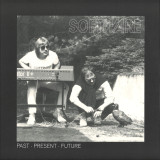
On behalf of re:discovery records, it is with great excitement that we announce the 3rd and last EP of the set highlighting the music of 1990's Norwegian electronic act Neural Network. Part 3 hones in on their unreleased album that was never formely named. The band and those in the industry who heard it felt it was their best music yet. There were label suitors for this album including a top tier Belgian label but sadly things did not work out as that label folded. And this project was left on DAT's.
Of the 9 tracks we chose, there were 4 we felt would most fit the vinyl medium and the theme of the first 2 EP's. These fit in with music like B12, Stasis and As One for some lofty comparisons and we think it fit's perfectly in that esteem company. The Detroit-esque beautifully somber 'Lambent' sounds almost 'Tedra' like from Kenny Larkin. 'Jetstream' is pure melodic robotic funk from the future. The side B track 'Floatation' coming in at just over 18 minutes and is a prime example of the sci-fi music they so wonderfully produced. This 3 record series is a great example of re:discovery records' mission to present the past for the future. All feature amazing artwork from UK's Grid Pattern complete with insert that features info on the music and their history. Bring back the Chill Out Rooms!
out of Stock
Last delivered 19 months ago available to reorder, subject to availability
After the ambitious A Distant (Dark) Source (2018) and the subsequent artistic triumph of its live recording in 2021, French avant-garde metal outfit HYPNO5E return with their sixth studio album. Once more, these four visionary musicians and cinematographers take us back to the lost shores of the palaeolithic Lake Tauca, where we dive deeper into its dark source to fnd vibrant visions of a memory both distant and hazy as well as warm and evocative. Sheol shows HYPNO5E at the top of their game, revealing the epitome of their idiosyncratic sound while also exploring new and exciting aspects of their artistic identity. Since 2006 HYPNO5E have been taking grand strides in honing their brand of cinematographic metal, with each of their albums developing elements that would become essential building blocks to their sound. Their 2007 debut album Des Deux l'Une Est l'Autre harnessed a raw, chaotic energy, while the following Acid Mist Tomorrow (2012) saw them apply a hazy filter to their ferocious sound. On Shores of the Abstract Line (2015) HYPNO5E already transformed into the true modern metal grandmasters they are today, while the special soundtrack album Alba - Les Ombres Errantes explored a more subdued acoustic side of the band. Sheol sees the band sounding warmer and brighter than anywhere else in their storied discography, and the arrival of new drummer Pierre Rettien and bass player Charles Villanueva adds a fresh touch the classic HYPNO5E sound. The sweeping finales of «Lands of Haze» and «The Dreamer and His Dream» as well as the pastoral qualities of the quiet finger-picked parts on «Bone Dust» and «Lava From The Sky» hearken back to the old prog rock records of the seventies, albeit with an updated sonic palette and modern production parameters. Besides, these eight tracks also see the band carefully exploring new patterns, shapes, and forms within their own musical universe: from the alternating use of ritardando and accelerando on the aforementioned rim-clicks to the increased employment of string sections and vocal harmonies. With the addition of a whole new palette of warmer and brighter tones, HYPNO5E superbly bridge the sounds of the modern progressive metal and retro prog-movements creating an evocative sonic experience. FOR FANS OF Gojira, Opeth, Periphery, Uneven Structure, Steven Wilson Limited (100 copies ww) Single Colour (Gold Vinyl) Edition!
out of Stock
Last delivered 3 years ago available to reorder, subject to availability
Ever since the first white labels appeared at the end of Summer 2013, Emotional Especial has been putting out music that is slightly left of (club music) centre. Influenced as much by and including dub, electro, disco, proto-house, house and techno, guided more by a feeling than a sound.
This thinking has been that exemplified by every 10th release being a label sampler - a showcase of unreleased tracks or remixes of what has come before, plus the odd one off cut by an artist to watch. Some 4 years since the last Sampler, the label's 40th release presents new label heads Giraffi Dog, returning after their recent "live" Multiverse EPs, here teaming up with GF Rich for a breaks anthem. Sub bass rising, the persistent build leads to piano before drop and Acid mayhem ensues, highlight why G Dog are such a producer to watch.
Label mainstay Alphonse returns, with White Pepper from the "Stolen Sunrise EP", here remixed by House stalwart Toby Tobias. Having released for a who's who of labels including REKIDS, ESP Institute, Delusions Of Grandeur and Futureboogie, the illusion these past years of who is Alphonse can finally revealed as Toby himself. The remix of his alter ego takes the 'Balearics' of the original and adds breaks and 303, all retaining a laid back feeling for summers return.
On the flip, the label welcomes rising star, Remotif. With a series of EPs showcasing a growing talent, his recent Coymix release sealed the deal. Here, his comedically titled Beam Me Up Softwoiii belies a party anthem, where breaks and arps rise in unison before an Aphex sunrise burst, drops and heads down in pure dance.
Akio Nagase returns to close with another of his Japanese folk meets lilting 303 Acid House. An Okinawa traditional folk song, conveying a life lesson, here to Hosenka flower is laid across slo-mo acid bubbles to quirkily and perfectly complete another 10th release of the Especial path.
out of Stock
Last delivered 3 years ago available to reorder, subject to availability
With the release of Piero Umiliani’s ‘Discomania (Jolly Mare Lifting)’ Four Flies launched RELOVED, a vinyl series where contemporary DJs and producers rework tunes from Italian golden age soundtracks and library music.
The aim of the series is to spark a conversation between past, present and future, joining the dots between Italy’s great film and library-music tradition and a global scene of forward-thinking producers - the names confirmed so far include Dengue Dengue Dengue, Free The Robots, Jolly Mare, Koralle (feat. Illa J), Fratelli Malibu, Mounika, Oké aka Deda, Luke Beats, Ollie Teeba of The Herbaliser and Deca.
First in line is the 7” ‘Autumn 2001 / Autumn 2021’, with an original track from Italian jazz pianist and electronic music pioneer Gianni Safred and a rework from musician, DJ and beat maker Free The Robots.
‘Autumn 2001’ comes from the 1978 Italian library LP Futuribile (The Life To Come), a retro-futuristic masterpiece by Gianni Safred, one of the great pioneers of Italian electronic music.
Chris Alfaro, aka Free the Robots, is a musician, beat maker and DJ known for his ability to jump in and out of different sonic worlds, creating a unique signature sound blending electronic, hip hop, jazz and psychedelia.
out of Stock
Last delivered 3 years ago available to reorder, subject to availability
Bizarro Records returns to its Australian roots for three functional tracks from Eora/Sydney local Eastern Distributor, alongside a remix from Montreal prodigy Maara. Drawing heavily from the psychedelic influences of our country’s bush doof scene, ‘State of Equilibrium’ alludes to trance and techno relics of the past whilst accelerating into a hybrid psy-tek sound.
‘Affinity’ delivers a functional, peak-time psychedelic motion, ebbing and flowing into dark resonant euphoria. ‘Balance’ sticks closer to the modern Australian scene; an upbeat, bubbling tech-house influenced track, presenting a futuristic psy take on a sound marking contemporary dance floors. The third track ‘Endorphin’ is a bouncing techno tool, infinitely ascending from powerful low-frequency buzz to progged-out elation. The EP comes to a close with a taste of Maara’s signature sound - characterizing her take on ‘Endorphin’ with an irresistible dancefloor oriented bassline, filled with the angelic pads that define her discography.
out of Stock
Last delivered 2 years ago available to reorder, subject to availability
The incongruous, yet glorious, creative partnership between Nancy Sinatra and Lee Hazlewood was well underway when the two singular artists reunited to record 1972’s Nancy & Lee Again, a follow-up to their bestselling duet debut, Nancy & Lee. Nancy, the eldest daughter of Frank Sinatra, had been working with the Oklahoma-born songwriter since 1965, when she topped the pop charts with “These Boots Are Made For Walkin’.” Over the next five years, the two artists forged a prolific relationship in the studio, with Hazlewood writing and producing many of Nancy’s solo hits. Soon, the duo found success with a series of duets, including “Sand,” “Summer Wine,” and “Some Velvet Morning” – all of which appeared on their highly-influential 1968 debut.
Not long after the critical acclaim and chart success of Nancy & Lee died down, however, Hazlewood unexpectedly relocated to Sweden, leaving his musical partner in the proverbial dust. America, meanwhile, was in the midst of a cultural shift, as the Vietnam War waged on. By the turn of the decade, the musical landscape had changed significantly. “Trivial music and not profound music became unimportant,” recalls Nancy, speaking to Hunter Lea. “It was a tough time.” And yet, despite the circumstances, the stars somehow aligned for the duo to record some of their most magnificent music together.
Returning to Los Angeles for the project, Hazlewood – who reprised his role as producer – chose to take a new direction with the duo’s sophomore album. Nancy recalls, “It was more dramatic; it was more fun to do, more challenging to do…. It was more grandiose.” For the lush, orchestral arrangements, they collaborated with Larry Muhoberac (an original member of Elvis Presley’s TCB band, whose early ‘70s credits also included Barbra Streisand, Neil Diamond, and Lalo Schifrin) and Clark Gassman, who had worked on Hazlewood’s 1970 LP, Cowboy in Sweden. Backing vocals from brothers John and Tom Bahler, who remain two of the most recorded singers in history, added additional texture to several songs.
The big sound that Nancy describes above is exemplified in the album’s cinematic opener, “Arkansas Coal (Suite).” Clocking in at nearly six minutes long, the dynamic overture tells the tale of an ill-fated coal miner (sung by Hazlewood), while Nancy adjusts her vocals to sing as both the miner’s daughter and his wife. Hazlewood’s knack for vivid, nuanced storytelling shines throughout Nancy & Lee Again, particularly in “Paris Summer,” which details the conflict that a married woman faces, as she engages in a passionate affair. Another highlight is the country-inspired hit, “Did You Ever,” which was released as the album’s lead single. After it landed at No.2 on the U.K. pop charts, the song served as an alternate title track in several countries, including LP pressings in the U.K., Germany, and Canada.
One of the most emotionally-charged moments on Nancy & Lee Again is a cover of Dolly Parton’s “Down From Dover.” The heartbreaking tune tells the tale of a pregnant teenager, who has been abandoned by her lover and her family and ultimately gives birth to a stillborn baby. While Parton’s 1970 version was sung from the teenager’s point of view, Hazlewood and Sinatra transformed the country song into a duet. Hazlewood, who offers the man’s side of the story, sings in a notably deeper octave than his signature baritone.
Another poignant selection is “Congratulations,” which describes a soldier coming home from Vietnam. “His face has grown old and his eyes have grown cold/And they tell you of where he has been/Congratulations, you sure made a man out of him,” Hazlewood sings, pointedly. Nancy, who performs as the vet’s wife, argues that the song had a deeper meaning for her duet partner. “Lee started out a hawk, he was an army guy, so he was all for the war in the beginning. We didn’t talk about it, but at some point, he changed radically. ‘Congratulations’ was almost like an apology from him. I don’t want to put words in his mouth, but it was as though he was saying ‘I’m really sorry.’”
The song “Friendship Train” could also be interpreted as an apology of sorts – this time to Nancy. “You’ve been hurt and I’ve been hurt/Now we’re living pain,” the tune opens. When Hazlewood moved to Sweden without telling his longtime musical partner, Sinatra was understandably upset. “I felt pretty betrayed. I mean, who does that? Who just up and disappears like that? I’ll never understand it,” she reveals. But the uplifting duet – a slice of ‘70s pop perfection – offers reaffirming words of love between friends. “Lee felt things very deeply and tended to express his feelings in song instead of in real life,” explains Nancy.
The 10-track album closes with the stripped-down “Got It Together.” Backed by an acoustic guitar, the song is equal parts playful and candid, as the duo has an impromptu, spoken-word conversation about their lives. “I wish that we’d quit getting so old,” laments Nancy, who later shares her wish to have children (she would do so in the next few years). Hazlewood, meanwhile, attempts to remedy his past wrongdoings – this time asking his partner, “Can I go back to Sweden?” With that, Nancy gives her blessing.
This definitive reissue of Nancy & Lee Again also includes two bonus tracks. Both are stylistic departures for the duo – but fit right in with the psychedelic pop of the era. The first one, “Think I’m Coming Down,” is a harmony-filled reflection on a toxic relationship. “I think that was one of [Lee’s] drug things. I don’t mean that he used drugs; I mean that he was trying to be part of that culture. Trying to be hip,” explains Nancy, who delivers an emotive vocal performance on the solo track. Also included is “Machine Gun Kelly,” penned by a staple of the 70s singer-songwriter movement, Danny Kortchmar (James Taylor, Carole King, Linda Ronstadt). Recorded several months after the release of the album, the song found Nancy reuniting with Billy Strange, who arranged many of her solo albums, as well as Nancy & Lee. Sinatra and Hazlewood first performed “Machine Gun Kelly” during their residency at Las Vegas’ Riviera Hotel in February 1972 (later released as a concert documentary on Swedish television). While the recording has long remained a career favorite of Nancy’s, it would be decades before it was officially released.
Nancy & Lee Again remains a creative high point in the careers of Sinatra and Hazlewood and, upon its release, garnered rave reviews from Billboard, Record World, and Cash Box, among others. Yet, Nancy & Lee Again never received the spotlight it so utterly deserved. “We didn’t have label support at all in those days,” recalls Nancy. “Without the strength of a label, records die. We were old. We were old-fashioned. We were just not what was happening. It’s a very ageist kind of business.” Nevertheless, she adds, “I think it’s a very good album. I think it’s timeless.” Now, after years of being a sought-after rarity, this gem in the Sinatra-Hazlewood canon can finally get its due.
Five decades later, Nancy’s legacy only continues to grow, as new generations discover her impressive catalog (which boasts nearly 20 studio albums – her duets with Hazlewood among them – and dozens of charting singles, including the theme song to the 1967 James Bond film, You Only Live Twice). In 2020, Sinatra was recognized by her peers when “These Boots Are Made For Walkin’” was inducted into the GRAMMY® Hall of Fame. That same year, Sinatra partnered with Light in the Attic for Nancy Sinatra: Start Walkin’ 1965-1976, a definitive survey of her most prolific period. LITA has also reissued Sinatra’s classic debut, Boots, and her iconic, 1968 album with Lee Hazlewood, Nancy & Lee. The label looks forward to celebrating Nancy over the coming years with a variety of special releases, exclusive merchandise, and more.
The incongruous, yet glorious, creative partnership between Nancy Sinatra and Lee Hazlewood was well underway when the two singular artists reunited to record 1972’s Nancy & Lee Again, a follow-up to their bestselling duet debut, Nancy & Lee. Nancy, the eldest daughter of Frank Sinatra, had been working with the Oklahoma-born songwriter since 1965, when she topped the pop charts with “These Boots Are Made For Walkin’.” Over the next five years, the two artists forged a prolific relationship in the studio, with Hazlewood writing and producing many of Nancy’s solo hits. Soon, the duo found success with a series of duets, including “Sand,” “Summer Wine,” and “Some Velvet Morning” – all of which appeared on their highly-influential 1968 debut.
Not long after the critical acclaim and chart success of Nancy & Lee died down, however, Hazlewood unexpectedly relocated to Sweden, leaving his musical partner in the proverbial dust. America, meanwhile, was in the midst of a cultural shift, as the Vietnam War waged on. By the turn of the decade, the musical landscape had changed significantly. “Trivial music and not profound music became unimportant,” recalls Nancy, speaking to Hunter Lea. “It was a tough time.” And yet, despite the circumstances, the stars somehow aligned for the duo to record some of their most magnificent music together.
Returning to Los Angeles for the project, Hazlewood – who reprised his role as producer – chose to take a new direction with the duo’s sophomore album. Nancy recalls, “It was more dramatic; it was more fun to do, more challenging to do…. It was more grandiose.” For the lush, orchestral arrangements, they collaborated with Larry Muhoberac (an original member of Elvis Presley’s TCB band, whose early ‘70s credits also included Barbra Streisand, Neil Diamond, and Lalo Schifrin) and Clark Gassman, who had worked on Hazlewood’s 1970 LP, Cowboy in Sweden. Backing vocals from brothers John and Tom Bahler, who remain two of the most recorded singers in history, added additional texture to several songs.
The big sound that Nancy describes above is exemplified in the album’s cinematic opener, “Arkansas Coal (Suite).” Clocking in at nearly six minutes long, the dynamic overture tells the tale of an ill-fated coal miner (sung by Hazlewood), while Nancy adjusts her vocals to sing as both the miner’s daughter and his wife. Hazlewood’s knack for vivid, nuanced storytelling shines throughout Nancy & Lee Again, particularly in “Paris Summer,” which details the conflict that a married woman faces, as she engages in a passionate affair. Another highlight is the country-inspired hit, “Did You Ever,” which was released as the album’s lead single. After it landed at No.2 on the U.K. pop charts, the song served as an alternate title track in several countries, including LP pressings in the U.K., Germany, and Canada.
One of the most emotionally-charged moments on Nancy & Lee Again is a cover of Dolly Parton’s “Down From Dover.” The heartbreaking tune tells the tale of a pregnant teenager, who has been abandoned by her lover and her family and ultimately gives birth to a stillborn baby. While Parton’s 1970 version was sung from the teenager’s point of view, Hazlewood and Sinatra transformed the country song into a duet. Hazlewood, who offers the man’s side of the story, sings in a notably deeper octave than his signature baritone.
Another poignant selection is “Congratulations,” which describes a soldier coming home from Vietnam. “His face has grown old and his eyes have grown cold/And they tell you of where he has been/Congratulations, you sure made a man out of him,” Hazlewood sings, pointedly. Nancy, who performs as the vet’s wife, argues that the song had a deeper meaning for her duet partner. “Lee started out a hawk, he was an army guy, so he was all for the war in the beginning. We didn’t talk about it, but at some point, he changed radically. ‘Congratulations’ was almost like an apology from him. I don’t want to put words in his mouth, but it was as though he was saying ‘I’m really sorry.’”
The song “Friendship Train” could also be interpreted as an apology of sorts – this time to Nancy. “You’ve been hurt and I’ve been hurt/Now we’re living pain,” the tune opens. When Hazlewood moved to Sweden without telling his longtime musical partner, Sinatra was understandably upset. “I felt pretty betrayed. I mean, who does that? Who just up and disappears like that? I’ll never understand it,” she reveals. But the uplifting duet – a slice of ‘70s pop perfection – offers reaffirming words of love between friends. “Lee felt things very deeply and tended to express his feelings in song instead of in real life,” explains Nancy.
The 10-track album closes with the stripped-down “Got It Together.” Backed by an acoustic guitar, the song is equal parts playful and candid, as the duo has an impromptu, spoken-word conversation about their lives. “I wish that we’d quit getting so old,” laments Nancy, who later shares her wish to have children (she would do so in the next few years). Hazlewood, meanwhile, attempts to remedy his past wrongdoings – this time asking his partner, “Can I go back to Sweden?” With that, Nancy gives her blessing.
This definitive reissue of Nancy & Lee Again also includes two bonus tracks. Both are stylistic departures for the duo – but fit right in with the psychedelic pop of the era. The first one, “Think I’m Coming Down,” is a harmony-filled reflection on a toxic relationship. “I think that was one of Lee’s drug things. I don’t mean that he used drugs; I mean that he was trying to be part of that culture. Trying to be hip,” explains Nancy, who delivers an emotive vocal performance on the solo track. Also included is “Machine Gun Kelly,” penned by a staple of the 70s singer-songwriter movement, Danny Kortchmar (James Taylor, Carole King, Linda Ronstadt). Recorded several months after the release of the album, the song found Nancy reuniting with Billy Strange, who arranged many of her solo albums, as well as Nancy & Lee. Sinatra and Hazlewood first performed “Machine Gun Kelly” during their residency at Las Vegas’ Riviera Hotel in February 1972 (later released as a concert documentary on Swedish television). While the recording has long remained a career favorite of Nancy’s, it would be decades before it was officially released.
Nancy & Lee Again remains a creative high point in the careers of Sinatra and Hazlewood and, upon its release, garnered rave reviews from Billboard, Record World, and Cash Box, among others. Yet, Nancy & Lee Again never received the spotlight it so utterly deserved. “We didn’t have label support at all in those days,” recalls Nancy. “Without the strength of a label, records die. We were old. We were old-fashioned. We were just not what was happening. It’s a very ageist kind of business.” Nevertheless, she adds, “I think it’s a very good album. I think it’s timeless.” Now, after years of being a sought-after rarity, this gem in the Sinatra-Hazlewood canon can finally get its due.
Five decades later, Nancy’s legacy only continues to grow, as new generations discover her impressive catalog (which boasts nearly 20 studio albums – her duets with Hazlewood among them – and dozens of charting singles, including the theme song to the 1967 James Bond film, You Only Live Twice). In 2020, Sinatra was recognized by her peers when “These Boots Are Made For Walkin’” was inducted into the GRAMMY® Hall of Fame. That same year, Sinatra partnered with Light in the Attic for Nancy Sinatra: Start Walkin’ 1965-1976, a definitive survey of her most prolific period. LITA has also reissued Sinatra’s classic debut, Boots, and her iconic, 1968 album with Lee Hazlewood, Nancy & Lee. The label looks forward to celebrating Nancy over the coming years with a variety of special releases, exclusive merchandise, and more.
Third Pressing of Gilroy Mere's Adlestrop on blue vinyl with a blue cover.
Adlestrop is inspired by the remains of the rural railway stations, that were closed in the wake of the 1963 Beeching Report.
“This record started with Edward Thomas’s poem Adlestrop and a chance visit to the village that it takes its title from. I wanted to see the station, but found it was no longer there, all that remains is the old platform sign Adlestrop, now part of a local bus shelter. However as I walked around the village I was struck that; “all the birds of Oxfordshire and Gloucestershire” were still singing away - like ghosts from Thomas’ verse.
Visiting Adlestrop spurred me to get hold of a copy of the Beeching Report which, in Appendix 2, lists all the services and stations recommended for closure in the 1960s. The names read like an epic British poem, from halts to branch-line stops and stations and singular terminals for public schools, mines, ferries and even an asylum. There’s Ravenscar where a resort was planned but got no further in its construction than the station, and a hotel - the grid marked out for the roads never laid. Bethesda, a short branch line from Bangor up towards Snowdonia, was used for slate and passengers and is now just a quiet green valley, Christ’s Hospital on the old Cranleigh Line, opened with seven platforms to cope with the daily flood of pupils attending the famous school nearby which never came as it was a boarding school. Many of the stations have vanished, with just fields and car parks left in their place, some are repurposed as houses, or shops, or abandoned as artefacts of a lone-gone industrial past.
Armed with a digital recorder, and with a copy of Beechings Report as my guidebook I made notes and recordings on my travels around the country, and used them as the starting point for a set of pieces that try to capture the fading layers of history, in the areas where the stations had once stood making sure each track retains something of the real place within them. Back in my studio I reacted, improvised, and crafted musical responses to each station, trying to capture the ghosts and former lives of the stations and their imprint on the present.”
Gilroy Mere is Oliver Cherer who trading as Dollboy, Rhododendron, and Australian Testing Labs as well as his own name has meandered his way through the backwaters of left of centre English folk, ambient and electronic music, issuing numerous albums of original music to much critical acclaim via highly regarded boutique labels such as Static Caravan, Second Language, Deep Distance, Polytechnic Youth, and Awkward Formats.
A Late Lunch’ is the soundtrack to Akiko Iimura’s eponymous movie realized in 1978. It is based on acoustic instruments and field recordings, brilliantly reconfigured and mixed by Bekaert to create a surreal, immersive soundscape. The technique used includes superposition and speed change of recordings, radical sound effects and juxtapositions of sounds. The players were prominent musicians of the 1970’s, including Maggi Payne, George Lewis, David Rosenboom and Blue Gene Tyranny.
‘A Summer Day at Stony Point’ was composed in 1969, with participation of David Behrman, Shigeko Kubota and Charlotte Warren. The piece was commissioned by English composer Hugh Davies who presented it at the Harrogate festival the same year. Stony Point is a small village in New York State where John Cage co-owned a small pseudo-commune art resort where like-minded artists gathered. ‘A Summer Day at Stony Point’ is nothing more than a page of a journal, a fragment of a notebook that utilizes a series of sound sources recorded at Stony Point on one beautiful day in the summer of 1968. Other electronic sound sources were recorded at the Brandeis University where Alvin Lucier was professor. The final realization of the piece was done at Henri Pousseur’s APELAC Studio in Brussels, 1969.
The soundtrack for Akiko Iimura’s ‘Mon Petit Album’ was composed on the basis of a simple description of the technique of the film and its time span. It includes David Behrman on alto, from an outdoor recording at Stony Point, plus excerpts from a Transition concert in London, the band Bekaert formed in 1971 with Michel Herr, Takehisa Kosugi and Ryo Koike, both members of the Taj Mahal Travelers. The atmosphere is quiet and pastoral throughout with a very dreamlike flavour.
Jacques Bekaert (1940-2020) was a man of many gifts: author, journalist, composer, photographer, visual artist, wine connoisseur, radio talk show host, diplomat and expert in Southeast Asian affairs. His whole life Bekaert has been actively involved in music but not much of his work got recorded or published. In the early 60’s Bekaert studied with Pousseur and through his frequent visits to the US he became friends with artists like John Cage, David Tudor, Charlotte Moorman and most of all David Behrman with whom he had a close friendship ever since. Bekaert helped organize the first European tour of The Sonic Arts Union (David Behrman, Robert Ashley, Gordon Mumma, Alvin Lucier) and in the early 70’s he formed the group Transition (with Belgian jazz pianist Michel Herr, Takehisa Kosugi and Ryo Koike, both members of the Taj Mahal Travelers). His meeting with Japanese experimental film-maker Akiko Iimura resulted in two film soundtracks featured on this one of a kind discreet avant garde album.
When asked in a 1979 interview about his double life as a musician and a journalist, Bekaert replied, “I suppose they’re both unsafe, unstable, questioning jobs—composing and reporting. Journalism takes me to places, shows me the world as it is. My music is my wish for the kind of world I’d want to live in. The little peaceful state I dream for everyone, where you can be yourself, and happy, and as collective as possible without giving up total privacy.”
Originally released in 1981 on the Belgian Igloo label this reissue comes with the same sleeve as originally designed by Alain Géronnez.
The electronic music producer and DJ whose catalogue of collaborations namechecks acts as diverse as Agoria, Green Velvet, Roman Flugel to Nitzer Ebb, Depeche Mode and David Holmes is set to release his 6th studio album The Strand Cinema on the 24th March on his own label PKR.
The last five years have seen an evolutionary shift for the electronic musician, undertaking more soundtrack work, including for film (Nightride on Netflix, Rough), radio (The Northern Bank Job BBC R4) and theatre (East Belfast Boy).
The Strand Cinema album is a tribute to the art deco cinema building , The Strand, where Phil’s recording studio is. A stirring and beautiful record, it seamlessly traverses the worlds of contemporary classical to beautifully elevated dance music with a recognisably cinematic influence. Managing to sound both grand and expansive, as well as minimal and introspective – it’s a record that explores the macro and the micro.
The opening track “Strand Cinema”, begins with a steady, gentle, looping pulse, almost recalling the kosmische ripples of Cluster, before sweeping and enveloping strings enter, resulting in a track that manages to sound both grandiose and tender in one fell swoop.
Lead single “Atlantic” perhaps most perfectly encapsulates the various sonic worlds that Kieran is operating in, merging a bordering on euphoric dance beat layered with infectious melodies, while remaining anchored to organic sounds, as strings and percussion collide with the driving and hypnotic groove of the track.
“Strike the Match” showcases Kieran’s talents for detail, in a track that feels almost palpably textural and rich in complexity but without feeling overly busy or superfluous; while “Elephant in Castle” utilises intense, almost gargling electronics, that drone with a foreboding and ominous tone, but also produces fractured moments of light, beauty and poignancy.
Created during Covid Kieran’s method was “To literally be like a tuning fork and ask: What's in my chest? If I were to describe what's inside me, and what's going on in the outside world, If I had to score that in a film, what would it sound like right now? I guess I sort of soundtracked my own life”
“One positive side of lockdowns was that we spent more time in natural surroundings where I’d make field recordings. I’d also record acoustic sounds: cello, violin, percussion, guitar etc and then create my own sample bank from all these single one-note sounds. So, creating your own loops and drones. The album was created from organic sounds manipulated by machines; melted, mangled and hacked with computers but machines only sound as good as the human spirit put into them.
The idea of nature and humans versus technology is the concept behind the album’s A/V show which debuts in Belfast in March before touring. Featuring works by 11 artists from across the worlds of film, animation, advertising, architecture, computer science and dance such as Scottish BAFTA nominated Simone Smith, LA based director Frederico Marzio Vitetta who is famous for skateboarding films like ‘Wet Dream’ with Spike Jonze, to futuristic CGI from BAFTA nominated Kris Kelly and a video from contemporary dancer Oona Doherty. onscreen visualisations that explores The visuals explore nature and technology along a timeline from past, present to future with cinema as a loose reference point with varying degrees of utopian versus dystopian moods.
out of Stock
Last delivered 3 years ago available to reorder, subject to availability
It's often a good sign when one of your favorite musicians steps out from beyond the studio walls and past the stage lights to fulfill their own inspired and creative intent. And Caíto Sánchez is not just a favorite musician, but as his lengthy resume as a sideman shows, he's also one of your favorite musicians' favorite musicians, constantly working without fanfare as an essential ingredient in a larger music feast. Sánchez earned his stripes in the 2000s and beyond as a key session player and an integral touring band member, a quiet standout even among many oversized personalities. A dedicated drummer born in Panama and living in New York, Sánchez is quite capable of keeping time for legends like Charles Bradley, Lee Fields, and Brian Jackson, as well as supporting eclectic outfits like the live groups of Quantic, Chico Mann and Midnight Magic. For all the players who have shared a stage or studio with him it comes as no real surprise, and frankly as a long overdue development, that such a unique artistic force is finally stepping into the spotlight.
With this debut single we get a glimpse into Sánchez's creative and artistic personal space, more precisely a multi-instrumental discipline of not only drums, but also bass, guitar and lead voice. It's an intensely intimate recording debut, a fantastic studio concoction born from the heart of its creator, and later fostered and mixed down by the talented hands of NYCT and Daptone veteran Victor Axelrod. The defining result on this initial 7-inch offering are two heavy psychedelic and moody nuggets of rock enespañol, a decidedly new wave of sounds and style that are quite capable of shining on their own.
After the "curfew" (cf. album Out Past Curfew) and the "strange time" of adaptation following the health crisis (cf. EP Stranger Times), comes the relief and the open up to the world until now confined: the Salvation. Third artistic collaboration for Youthstar & Miscellaneous, the album Salvation is a 13 tracks journey with strong and optimistic subjects such as motivation, the quest for happiness, mixed with more melancholic themes such as addictions or dependency but always through incredible percussive flows and chorus with heady gimmicks that make you want to headbang! Faithful to the rap/hip-hop that forged the duo, this album also borrows the codes of electro, trap, bass music or even reggae. We find on this album a whole crew of top notch beatmakers such as Tha Trickaz, La Fine Equipe, as well as renowned artists & MCs like Biga*Ranx, Dope D.O.D, FP from ASM... Ltd. col. LP (splatter)!
Up next, Marginal Returns is happy to finally unveil Gwenan’s debut EP. Already familiar to many via her DJ sets at various notable events over the past years - from festival main-stage techno to backroom boutique ambient - 2023 finally raises the curtain on Gwenan’s studio output.
Activation Energy presents an elegant, particular and personable take on rhythmic electronic music, taking in A1’s downtempo, dub shrouded ‘Rhythm Delay’, the sneakily effective plucked lilt of A2 ‘Foundation’, the contemplative, emotive glide of B1 ‘Control Change’ and B2 ‘Attention Movement’s brooding syncopation.
out of Stock
Last delivered 2 years ago available to reorder, subject to availability
South Africa's reputation for expanding dance music again with Amapiano.
The past five years have seen amapiano, South Africa’s electronic music movement born in the townships of the country’s Gauteng province, evolve from an underground sound to a nationwide mainstream staple. Even with its commercial success though, amapiano’s DIY ethos has continued to disrupt music creation and distribution in the country. Most amapiano commercial successes today began their careers on cracked versions of production software like FL Studio, distributed their work through file sharing platforms like datafilehost and marketed it using social media pages they controlled and influenced. Amapiano Selections, the debut album by DJ and producer Teno Afrika, gives listeners outside the movement’s online release economy an insight into the high-burn nature of amapiano that has spawned a distinct typology under its larger umbrella. Twenty-one-year-old Lutendo Raduvha has spent the bulk of his life moving between different townships on the outskirts of Johannesburg and Pretoria in the Gauteng province. The palette of amapiano styles on the album reflect these influences.
But at first, South Africa’s youngest electronic music movement lived underground with a small, loyal following. “Amapiano is a genre that I chose because I have a passion for it,” says Teno “I started following amapiano in 2016 because I wanted to explore how it’s produced. It was not taken seriously in our country.” Interestingly, Teno Africa only gives vocals prominence on the closing track “Chants of Africa.” As a way of making their music recognizable and relatable for broadcast, amapiano producers have sometimes overly relied on vocals in the form of singing, catch-phrases and party refrains for the purpose. “It was my decision not to use vocals on this project,” says Teno “The reason is I wanted people to feel my instrumentals and style because this is my first album.” On his closing track the young producer gives a glimpse of the considered approach to music which buoys anticipation for greater things from his future releases.
out of Stock
Last delivered 3 years ago available to reorder, subject to availability
Avid Habibi Funk listeners may be familiar with Libyan composer / producer Najib Alhoush, who’s track “Ya Aen Daly” - the Bee Gee’s “Stayin Alive” cover - was included in our second compilation. While the original track never excited us, Najib’s version managed to strip it from its pop approach that had taken over disco during the genre`s peak. At that time, disco tracks mostly were aiming to appeal to the widest audience possible. Najib had turned the original track into something different and very unique. Upon further research we found that Najib was actually the singer and founder of The Free Music band alongside Fakhreddin, Salim Jibreel, Abdulrazzak ‘Kit-Kat’, Mukhtar Wanis and Mohameed Al Rakibi.
Initially, we only licensed Najib Alhoush’s “Ya Aen Daly” from Yousef Alhoush, Najib’s son, who was pleased to hear that there was interest in his father’s music form someone abroad. In the process of exchanging and learning about Najib’s music and career, our understanding was that The Free Music only recorded the one album. This couldn’t be further from the truth, in fact, there were ten albums produced by the group, all impressively coherent with a clear influence from disco, soul, funk and reggae.
The Free Music album was probably the longest it ever took us to gather information, photos and musical source material in a good enough quality to be reissued. This is largely due to the complicated political situation in Libya, compounded by the fact that Libya is still largely cut off from international payment systems, so getting an advance payment to the right person can be a process that takes weeks. The same goes for getting master tapes to a studio abroad and afterwards back to Libya.
When we look for music that works under the umbrella of Habibi Funk, we often come across albums where bands experimented with influences from Soul, Jazz, Funk, Disco and more, usually on a single track or two but then they often go down to a different path for the rest of the album. This was not the case for The Free Music. All their albums are fully dedicated to their unique blend of Disco, Reggae and Funk and it feels that when we made the selection for this album, we could have chosen a completely different number of tracks and the album would be been equally strong.
The lead-off single is the stupendously groovy “Ana Qalbi Ehtar” out February 3rd along with LP pre-order to capitalize on Bandcamp Friday. From the outset, the rhythmic strumming of the funkified guitars give way to the galloping drums and bass, opening up to anthemic vocals and rounding out with a blistering guitar solo, a certified disco-funk classic through-andthrough.
Second single, out February 17th is the disco slammer “Hawelt Nensa Ghalaak.” Guitars, harmonized horns, synths and bouncing bass and drums collide w/ spaced out vox to make the track a dancefloor sureshot for any party.
Third single is “Mathasebnish,” out March 3rd, a pure disco-funk slammer if there ever was one – with stabbing horns, funky bass riffs, a riding rhythm guitar and anthemic vocals, rounded out with stunning flute and guitar solos – the track will surely be on repeat along with the arrival of warmer weather.
Album focus track “Men Awel Marra” is another standout disco-infused tune, showcasing the immense creativity out of Najib and The Free Music. This past summer we finally had the opportunity to get together with Yousef face-to-face at a coffee shop in Istanbul’s central Istiklal road together with our friend Anas El Horani. Yousef told us the whole story of how his father got into music, the start of the band and his father’s continued conflicts with the Gaddafi regime that probably kept his career from becoming even bigger. As always, both vinyl and CD come with an extensive booklet featuring background on The Free Music and Najib Alhoush, including words from Najib’s son, Yousef, as well as unseen photos, cassettes and more.
out of Stock
Last delivered 18 months ago available to reorder, subject to availability
Sacramento, CA duo Blank Gloss’s third album, Cornered, is an exquisite statement of pop ambient starkness, an album that oscillates between lush beauty and spare melancholy. It follows from their 2021 debut for Kompakt, Melt, an album that saw Morgan Fox (piano, synths) and Patrick Hills (guitar) aligned, loosely, with the cosmic pastorale of the ‘ambient Americana’ movement. Cornered feels like a significant step forward, though – by peeling back the layers of their music, they’ve revealed both its restful core and its solemn gravitas. It is unendingly lovely, but with something disquieting at its centre.
Cornered was recorded quickly, over two days in December 2020. There’s nothing rushed or haphazard about the album, though; everything has its place, with each sonic element contributing profoundly to these nine miniature dioramas. It signals change, quietly but perceptibly, through the way the duo sculpts their material, building out of loose improvisations that morphed into songs. While there was no plan in mind when Blank Gloss settled into the studio, Fox recalls that “right away we realised that things were sounding and feeling a bit different than any of the sessions we had previously.”
That difference can be heard in the increased amount of space Blank Gloss gift to their sound sources. Some of the most moving moments on Cornered come when Fox and Hills strip everything back – see, for example, “Crossing”, which sets pensive piano across a shyly humming drone and quiet arcs of guitar, recalling the driftworks of Roger Eno. Curiously, the album’s distinctive shape and mood develops, at least in part, from a change in instrumentation, with Hills using a MIDI pick-up on his guitar. “This resulted in making things happen a lot quicker,” Fox says. “It also helped create what I think is a bit more sombre, dark feeling to some of the songs.”
Elsewhere, on songs like “Salt”, the piano tussles with flecks of guitar, single tones sent out to mingle with the stars, like Morricone at 16 RPM, while Cornered’s centrepiece, the eleven-minute “No Appetite”, lets long arcs of electronic texture breathe and sigh, tangling together in a cat’s cradle of bliss. Throughout, it feels as though the music is blossoming as you hear it, like watching time-lapse footage of flora in bloom. But perhaps the most seductive thing about Cornered is the sense you get, listening, that the music was something unexpected, a visitation. “It almost felt like we weren’t dictating where the music went and how it sounded,” Fox agrees. “We were just there in a room together in December and these sounds were happening, and we were lucky enough to be recording the process.”
Cornered, das dritte Album des kalifornischen Duos Blank Gloss aus Sacramento, ist ein exquisites Statement von pop ambienter Krassheit, ein Album, das zwischen üppiger Schönheit und sparsamer Melancholie oszilliert. Es folgt ihrem 2021er Debüt für Kompakt, Melt, einem Album, auf dem sich Morgan Fox (Klavier, Synthesizer) und Patrick Hills (Gitarre) locker an der kosmischen Pastorale der „Ambient Americana“-Bewegung ausrichteten. Cornered fühlt sich jedoch wie ein bedeutender Schritt nach vorne an – indem sie die Schichten ihrer Musik abschälen, haben sie sowohl ihren ruhigen Kern als auch ihre feierliche Schwere offenbart. Es ist unendlich schön, aber mit etwas Beunruhigendem in seiner Mitte.
Cornered wurde relativ schnell aufgenommen, über zwei Tage im Dezember 2020. Es klingt jedoch nichts überstürzt oder willkürlich an diesem Album; alles hat seinen Platz, wobei jedes Klangelement einen wesentlichen Beitrag zu diesen neun Miniaturdioramen leistet. Es signalisiert Veränderung, leise, aber wahrnehmbar, durch die Art und Weise, wie das Duo sein Material formt und aus losen Improvisationen aufbaut, die sich in Songs verwandeln. Als Blank Gloss sich im Studio niederließen, gab es zwar keinen Plan, aber Fox erinnert sich: „Uns war sofort klar, dass sich die Dinge etwas anders anhörten und anfühlten als bei allen vorherigen Sessions.“
Dieser Unterschied ist in der größeren Menge an Raum zu hören, die Blank Gloss ihren Klangquellen bietet. Einige der bewegendsten Momente auf Cornered kommen, wenn Fox und Hills alles zurücknehmen – siehe zum Beispiel „Crossing“, wo ein nachdenkliches Klavier über einen schüchtern summenden Drone und leise Gitarrenloops setzt und an die Driftworks von Roger Eno erinnert. Seltsamerweise entwickelt sich die unverwechselbare Form und Stimmung des Albums zumindest teilweise aus einer Änderung der Instrumentierung, bei der Hills einen MIDI-Tonabnehmer an seiner Gitarre verwendet. „Dies führte dazu, dass die Dinge viel schneller abliefen“, sagt Fox. „Es hat auch dazu beigetragen, einigen der Songs ein etwas düstereres, dunkleres Gefühl zu verleihen.“ An anderer Stelle, bei Songs wie „Salt“, spielt das Klavier mit Gitarrenfetzen, einzelne Töne werden ausgesandt, um sich mit den Sternen zu vermischen, wie Morricone bei 16 U/min, während Cornereds Herzstück, das elfminütige „No Appetite“, lange Bögen schlägt, elektronische Texturen atmet und seufzt, um sich in einem Katzenkörbchen der Glückseligkeit zu verheddern. Während des Hörens fühlt es sich an, als ob die Musik blüht, als würde man sich Zeitrafferaufnahmen von blühenden Pflanzen ansehen. Aber das Verführerischste an Cornered ist vielleicht das Gefühl, das man beim Zuhören bekommt, dass die Musik etwas Unerwartetes war, eine Heimsuchung. „Es fühlte sich fast so an, als hätten WIR nicht diktiert, wohin die Musik geht und wie sie klingt“, stimmt Fox zu. „Wir waren just im Dezember zusammen in einem Raum, als diese Geräusche passierten, und wir hatten das Glück, dass die Aufnahme mitlief.”
out of Stock
Last delivered 17 months ago available to reorder, subject to availability
A year and a half ago, THE MFA returned to the fore once more, when we released their "Oranges and Lemons EP".
Their new album, “Lights Out”, which could be described as a long time coming, is definitely THE MFA’s most ambitious work to date.
As they put it in their own words: “The album is very special to us. It’s a long ambition brought to fruition. It’s an album that is at home on the dancefloor or at home. We’ve always been influenced by 90s rave culture and the club scene of that era and the explosion of creative freedom through electronic music that happened back then.”
The album sums up what THE MFA stands for; their love of electronic music intertwined their love of songs and melody, sometimes banging, sometimes pensive, sometimes longing, occasionally up-beat and happy. Melodic techno-pop-rave then.
The album opener "My Desire" pins down the essence of the album, showing some pop sensibility and a healthy dose of that early 90s spirit with longing vocals by Rhys Evans. The track shows from many angles of the intensity of what club culture was about. The track has, for sure, that pop quality which sets it apart - it is a very complete and rounded and in the true sense, a hit.
"Identify This" kicks off with blissed-out sci-fi sounds but commences with 90s rave chords that gets under your skin and creates a fantastic kaleidoscopic picture of moody UK rave with these spurts of emotional uplifting moments which are worth every penny.
"Bear Likes To Rave" takes us back to the warehouse days and reminds us of the acid warehouse parties with fanned stroboscope beams and dry ice cannons. It’s like looking down on a rave party happening from above, from a bird's eye view, which is in full swing where the euphoria spills over into the audience. "Girl Ahead" is a vocal track exclusively on the digital version of the album, again with Rhys Evans on vocal duties. Here they ponder all the possibilities of the future and the mistakes of the past. Features space toms and grand piano rave chords to evoke a housy feel within.
With "Freedom24" a Hi-NRG melody meets nightcrawler sounds ala "Klang De Familie". This is a soundtrack for the night.
"Lammas Day" has the chilling exotic quality of 808 State "Pacific State" if you grant us this comparison, paired with some phantastic Dr Who sensibilities! This track is quite a voyage!
"Warehouse"... Make Some F-...ing Noise... A TV presenter speaks about Acid house...... This is a wild mash up of impressions which nicely go together due to the melodic string composition and the 303 sequences.
"The Snapping Branch" starts with a mash up of sounds and then dives into an episodic snapshot of "happiness" when the serotonin shoots in (just before it drops). Experiencing a perfect flow that does not want to end. Every clubber knows that feeling.
"You Make Me Smile" is the third vocal track on the album featuring Rhys Evans on vocals. It has fantastic radical stark mood changes and blatant shifts, therefore throws the listener from one corner to the other. Just like the contrast of day and night. Bits here and there might conjure a Radiohead spirit, but really this is all MFA.
"Lights Out” certainly puts across the feeling you get at the end of the night - the club has closed; you are walking home. These are the sounds and feelings in your memories as you chase the vibe that is dwindling as the club becomes ever further away.
out of Stock
Last delivered 2 years ago available to reorder, subject to availability
As rookies in the thriving Brussels scene, jazz fusion quartet LũpḁGangGang have been making waves the last couple of years. After the EPs 'Stalingrad' and 'Urban Detox', they are now releasing their debut album 'Dopamine Overdose' on March 17 via Sdban Ultra.
Lyrically the inspiration for the album comes from growing up in a digital world and the constant dopamine we all have to deal with because of that. Musically their sound is rich, diverse and hard to pin down, looking at Yussef Dayes, BADBADNOTGOOD and even Black Country, New Road for inspiration.
LũpḁGangGang started out as a jazz/funk cover band in 2017. Anton, Miel, Lena and Rob all met at a jam session summer camp while still in school. Over time, the band started writing their own songs and released two EPs to critical acclaim. Due to the band's desire for creative expansion over genres, they have been able to perform on various Belgian stages for the past three years including Ancienne Belgique to Flagey, Gent Jazz and Handelsbeurs in support of label mates, Black Flower.
The album title 'Dopamine Overdose' is a quote from the track 'Dada Data', a track about the influence social media tends to have on our lives. The album's recurring theme is definitely the struggle with today's hyper virtual society and the overwhelming influence tech is having on society. With unbridled enthusiasm the band tackle relevant themes and combine striking observations with a highly contagious and very diverse sound.
From "Out the Light'', a smooth track about being stuck in the image we all try to create of ourselves, to 'Wanderer', a jazzy tune about the road to self-acceptance, and from 'Candy', combining a punk attitude with infectious hand claps, to 'Time Faded', about the difficulty of finishing your artistic work, LũpḁGangGang constantly showcase their genre-defying versatility.
As a whole, the album is a very balanced collection of tracks, ranging from brooding atmospheres to punky explosions with a constant drive, social criticism and an indomitable energy binding it all together. A promising debut, indeed.
As rookies in the thriving Brussels scene, jazz fusion quartet LũpḁGangGang have been making waves the last couple of years. After the EPs ‘Stalingrad’ and ‘Urban Detox’, they are now releasing their debut album ‘Dopamine Overdose’ on March 17 via Sdban Ultra.
Lyricaly the inspiration for the album comes from growing up in a digital world and the constant dopamine we all have to deal with because of that. Musically their sound is rich, diverse and hard to pin down, looking at Yussef Dayes, BADBADNOTGOOD and even Black Country, New Road for inspiration.
LũpḁGangGang started out as a jazz/funk cover band in 2017. Anton, Miel, Lena and Rob all met at a jam session summer camp while still in school. Over time, the band started writing their own songs and released two EPs to critical acclaim. Due to the band’s desire for creative expansion over genres, they have been able to perform on various Belgian stages for the past three years including Ancienne Belgique to Flagey, Gent Jazz and Handelsbeurs in support of label mates, Black Flower.
The album title ‘Dopamine Overdose’ is a quote from the track ‘Dada Data’, a track about the influence social media tends to have on our lives. The album’s recurring theme is definitely the struggle with today’s hyper virtual society and the overwhelming influence tech is having on society. With unbridled enthusiasm the band tackle relevant themes and combine striking observations with a highly contagious and very diverse sound.
From “Out the Light'', a smooth track about being stuck in the image we all try to create of ourselves, to ‘Wanderer’, a jazzy tune about the road to self-acceptance, and from ‘Candy’, combining a punk attitude with infectious hand claps, to ‘Time Faded’, about the difficulty of finishing your artistic work, LũpḁGangGang constantly showcase their genre-defying versatility.
Hit-writing anti-icons, Das Koolies emerge to explode three decades of digression as Super Furry Animals with their electronic depth-charge debut EP: The Condemned. Huw Bunford, Cian Ciarán, Dafydd Ieuan and Guto Pryce restore original Furry vision with techno-inspired, heavy-tech sound inspired by illegal rave roots.
A past fades out for a future to begin as the long-running, secretive DAS KOOLIES ‘dream project’’, emanating from Cardiff’s post-industrial docklands, delivers its first consignment of complex, wired euphoria: The Condemned. Chains of decayed connection and shackles of genre-expectation are audibly broken as Huw Bunford, Cian Ciarán, Dafydd Ieuan and Guto Pryce re-route their paths as notorious scientists of sound, taking the outside lane to arrive close to where it all began for Super Furry Animals.
Soldering human touch to synths and samplers, Das Koolies come through on their manifesto pledge of incinerating acoustic guitars while unsafely loading as much noise- making machinery onto their studio mains supply as possible. The Condemned, a confrontational, synth-driven outsider anti-anthem comes through as a warm-blood-on-cold- steel rope act of strict automation and humanity, commanding computers and code to find compromise with Ieuan and Bunford’s vocals.
The word Babble brings two things to mind: A person pouring out their thoughts with reckless abandon, or a gentle sound coming from water cascading over rocks as it flows past. In the case of this reissue from Kendra Morris, Babble is a sublime melding of these two meanings. The original release in 2016 came in the form of a self-released EP. A fan cult favorite; it has now grown to include three additional tracks: Playing Games, Dial Back and Ride On. The journey through human emotion is accomplished through Kendra's songs, bringing us, the listeners, into her enchanted world of pain and strength, feeling renewed on the other side. The ability to take trepidation, desire, and insecurities and turn them into comfort and make you want to get up and move with them is a selfless gift she grants to us. With the support of Karma Chief Records (A division of Colemine Records), Babble is getting the official release it deserves.
out of Stock
Last delivered 3 years ago available to reorder, subject to availability
Death and Vanilla return with 'Flicker', presenting their unique pop music that defies categorisation. Housed in a beautifully austere post-ironic de-constructed sleeve; 'Flicker' is a modern reflection on these difficult times. World crises notwithstanding, they return reborn, re-arranged and revitalised after assimilating dub reggae, the motorik spirals of Can, the modal meander of Philip Glass and The Cure's dreamier pop sounds; plus the twice removed symphonic ambience of Spiritualized and Talking Heads under heavy manners from Brian Eno. By osmosis their period of transition since 2019's much darker 'Are You A Dreamer?' has hatched new eclectic electronica anthems riddled with melody lines, and layered for lush love. - Forming in Malmö, Sweden, Death And Vanilla gravitated towards vintage musical equipment; from vibraphone, organ and mellotron, to tremolo guitar and Moog synthesisers. Soaking up soundtracks from the 60s and 70s, listening to library music, kosmiche, French Ye-ye pop and 60s psych, Marleen Nilsson, Anders Hansson and Magnus Bodin were fashioned by the city's austere industrial past and flat pack present, and all in the shadow of the Orsesund Bridge that links their dreamworld to mainland Europe and a darker reality. Death And Vanilla at once sound like everything is possible; but nothing else at all. There is a flicker of hope for everyone. - "Deploying vintage instruments in their quest for melancholic utopia." Electronic Sound * "Baroque pop through a dreampop filter." The Guardian Ltd Indie Retail Only Yellow Vinyl LP including DLC!
After the recent Experiments re-issue with 90's off-style unclassifiable tracks composed by the legendary Dub producer - The Disciples - Androo (NS Kroo) sets out to re-create and freely adapt this material. The fact that Sound Metaphors chose Androo to re-construct these works in to new material is not random. Androo has been producing Dub since he was a teenager but he quickly turned to all kinds of musical experiences, mixing styles and influences. Once past the intimidation of working with material from one of his favorite and revered producers, Androo tried to pay homage to the free spirit that this Disciples album contains. Between reference and irreverence, the album is woven with a playful, DIY, and also serious weave. As you listen, a sometimes very harmonious and controlled landscape takes shape, then suddenly steep slopes and raw ridges appear. Almost like an art of sound drawing. A line in permanent oscillation between supposedly antagonistic registers. Danceable pieces cut for dancefloor brush against strange, problematic, and voluntarily irrecoverable elements. Consensual pop chords rub shoulders with sizzling blurred contours and sounds that are sometimes too loud. 4/4 rhythms get jackhammered out of the tempo with opulent delay effects. The “Dubmix” is here, constantly at work. It is, above all, an art of the hands, fingers handling the console which from then on becomes an instrument in its own right - for Androo Dub is experimental music.
out of Stock
Last delivered 2 years ago available to reorder, subject to availability
Run by Gabriele and Paolo, Italy based newborn label Sunny Crypt's first output is a reissue of the sought-after "Random Rooms" album by Danish poets and multidisciplinary artists Niels Lyngsø and Morten Søndergaard. Both attending the Literature university in Copenhagen, they were linked at first by a mutual passion and fascination towards music - or rather "sound" - even before unveiling each other that they were writing poems. Niels and Morten started bringing their solo homemade DIY sound experiments together, giving birth to a wide genre-spanning album that ranges from slow tempo mutant disco to folk inspired synth-pop to sound collages and more musical compositions that is fairly complex to put in a precise musical genre box.
First released in 1992 on the same day as their debut poetry collections, Random Rooms should be a house or a flat or an exhibition space that you could walk through and in each room you would come across something new. A fusion of genre and bits and pieces of culture and play.
A kaleidoscope of past, present, and future.
out of Stock
Last delivered 3 years ago available to reorder, subject to availability
German project founded in 1984 by Peter Mergener and Michael Weisser. This release features two cheery picked exemplary moments in downtempo contemplative cosmic travels. A side sends the listener well out of orbit with a 10 min long gradient of Krauty arpeggiated showers that grows elegantly, a concerto to the astros of the mind. Flip it and it gets better as your space capsule gets sucked into some distant planet's gravitational pull, feelings of other-worldly sounds, slowed down beautifully almost eerie nuances one won't forget so easily. Sunrise on a Balearic island from another solar system. Berlin-School by trade but also heard on mixes by Jose Padilla. Heftily remastered.
out of Stock
Last delivered 2 years ago available to reorder, subject to availability
Bonus LP with Etching. Oblivion Hymns is the sixth studio album by American ambient/post-rock band Hammock. It was released on November 26, 2013 by the band's own label, Hammock Music. Oblivion Hymns was met with positive critical reception and hit No. 17 on the Billboard Top Heatseekers Album Chart in 2013. Mike Diver at Clash magazine loved the album, stating that Oblivion Hymns is "…some of the most blissful music Clash has ever had the luxury of bathing in. Hammock has gone on to become one of the foremost purveyors of affecting ambient post-rock on the scene." John Diliberto, the host of Echoes, listed Oblivion Hymns as No. 8 in the "25 Essential Echoes CDs for 2013" as an album that represented the best, most innovative aspects of the ambient music soundscape in the past year, stating that "Hammock goes deeper into their ambient chamber music with children’s choirs emerging out of swirling deeply processed guitars."
out of Stock
Last delivered 3 years ago available to reorder, subject to availability
Japan's guitar hero Takeshi Terauchi reworks traditional songs and lets everything go wild with his magnificent and frenzied guitar sound. Enter the electrifying world of Eleki!
Gatefold 180g heavy vinyl LP, reverse board print. Comes with extensive liner notes by Japanese pop culture writer Julien Seveon (Cinexploitation)
All tracks licensed by King Record Co., Ltd., Tokyo, Japan.
Mastering and lacquer cut by Jukka Sarapää at Timmion Cutting Lab, Helsinki, Finland.
Artwork by Nker
The aftermath of World War II gave rise to a global phenomenon that saw new generations of young people rise up determined to forge new paths from their elders – culturally, politically, and musically. Japan was no exception and the recent past made the local youth angrier, hungrier and even more determined to fully experience something different from their parents. The country caught on to the early rock & roll craze almost in tandem as it was happening in the States. Teenager Chiemi Eri singing "Rock Around The Clock" and Kazuya Kosaka with "Heartbreak Hotel" were among the first to make what would soon be called Rokabiri accessible to a large audience. Teacher and parent associations showed concern regarding this new music when teenagers started missing school to attend afternoon shows – one of which most notably being the Nichigeki Western Carnival where all the top names of Rokabiri played to sold out audiences. But by the end of the 1950s, the youth of Japan had moved on to something else entirely: Eleki.
The 50s and 60s were a time of rapid change that saw trends come and go. Japan, like all other industrial countries, saw its youth move from one musical sensation to the next. And in the early 60s, there was one band in particular that created a distinct new flavor: The Ventures. Leaving behind vocals and focusing strictly on the impact of the sound of the electric guitar, The Ventures drove kids crazy all over the world. Other bands followed, most notably The Shadows, but in Japan, no other instrumental rock band managed to leave such an impact. The sound of The Ventures helped boost guitar sales in Japan and soon hundreds of cover bands were popping up all over the country. The Eleki Bumu (electric boom) was now in full effect with Takeshi Terauchi emerging as its first and greatest guitar hero.
Terauchi was born January 1939 in the prefecture of Tochigi, north of Tokyo. His mother taught music and played the shamisen – a traditional Japanese stringed instrument – while his father ran, among other things, an electronics shop. Their respective professions were to be decisive in the path that Terauchi would later take. Serendipitously, at the age of five, Takeshi was given his first instrument – a guitar. His destiny sealed, he quickly began experimenting with different tools from his father's shop to give his instrument a stronger sound. The technological approach came from his father, the technique from his mother. Terauchi's signature playing style owes a lot to his mother's instrument of choice, as he attacks the notes on his guitar as one plucks the strings of a shamisen.
This exceptional compilation you are holding in your hands explores some of the best works by Takeshi Terauchi, recorded between 1966 and 1974, where the guitar hero looks inwards to Japan for inspiration. A meeting between traditional folk songs and the unique way Terauchi and his band play: the content is explosive, inspired, and highly addictive! The 60s and 70s were undoubtedly Terauchi's finest hours, and in the late 60s, one Japanese critic said that Terauchi was not only the best guitarist in Japan, but also in the world. You can now find out why.
out of Stock
Last delivered 3 years ago available to reorder, subject to availability
Future Jazzers, notorious experimentalists and outfield eccentrics stumble onto the dancefloor. In the 90s. In the UK.
From an electronic music perspective, the period 1992 to 1996 in the UK that this compilation celebrates, was one of dizzying sonic diversification.
It was also a particularly turbulent time in the UK, not only politically and economically, but also culturally too. Economic catastrophe in ‘92 was followed by widespread poverty, a cost of living crisis and countless political scandals. Meanwhile, John Major’s Tory government pandered to its political base via unpleasant, authoritarian legislation that seemingly sought to crush rave culture, alternative lifestyles, and traveller communities. The UK was not so much a ‘Happy Land’ – to quote the name of this compilation – as an angry and divided one. Sounds familiar, doesn’t it?
Throughout, the music created by producers based across these Isles remained uniquely British, speeding up a process begun in the late 1980s through the emergence of street soul, bleep & bass and breakbeat hardcore – musical styles whose roots in multicultural inner-city communities made them distinctly different from the Black American sounds that had inspired their creators. It was here, rather than in the indie pubs of Camden, that real musical revolutions were taking place.
This deep diving selection brings together some truly adventurous and original electronic music from this period, much of it very hard to find. Major label outings connect with white label oddities with ease. Perhaps it could even be argued that many of these unearthed gems fit more easily into DJ sets in 2023 than they ever did at the time. The off-kilter swing of Richard D James’ obscure and highly sought after Strider B outing, ‘Bradley’s Robot’ is joined by further rare cuts from Cabaret Voltaire and the Black Dog, and artists as diverse as Ultramarine, Herbert, Fretless AZM, and Radioactive Lamb, amongst others.
This collection has been lovingly selected, compiled and mastered for maximum sonic playback. This very special release boasts sublime pastoral themed artwork, as well as informative and passionate liner notes by celebrated music scribe Matt Anniss (‘Join The Future’).
out of Stock
Last delivered 3 years ago available to reorder, subject to availability
Eyelids' new album, A Colossal Waste of Light, does an excellent job of
framing the quintet as one of today's most compelling purveyors of
lopsided guitar pop workouts and earworm-laden vocal melodies
It also proves that great guitar pop can still evoke favorites from a glorious past -
the penetrating moodiness of XTC's Black Sea, or R.E.M.'s Fables of the
Reconstruction, comes to mind - while refusing to waste time on idle nostalgia.
On their 4th full-length album (but 17th vinyl offering if you include previous EPs)
the Portland, OR band also rediscover the beauty of firsts. A Colossal Waste of
Light marks the first time the band wrote songs remotely (it ended up being fun &
weird to send out a very simple version of a song and see who came back first
with another part for it,John Moen looks back), their first reunion at the
Destination: Universe studio post-isolation, and their first batch of melodious new
tunes since The Accidental Falls, the band's 2020 project with poet, lyricist and
Tim Buckley collaborator Larry Beckett (an extra- ordinary pairing that allowed
Eyelids' two frontmen/ tunesmiths, Chris Slusarenko and John Moen, to find a
new, multilayered appreciation for the art of songcraft)
Close to five years on from their last transmission, Ulrika Spacek resurface from self-imposed exile with their third album, Compact Trauma, a collection of songs that function as a chance treatise of sorts for our current collective condition. With a title like that arriving at this point in time, it's tempting to interpret the record solely in the context of the global events of the past few years, but the roots of these ten songs arc back much further in time, charged with their own personalised internal damage. Trauma, in its myriad forms, is often hard to qualify, even harder to rationalise. When something begins to go wrong, how do you gain perspective? What is a temporary roadblock, and what is unmitigated disaster? In its first phase of life, Compact Trauma was a document of a band striving to perfect an idea while the universe around them seemed to want to shut down. And then, at an impasse of sorts and with a record halfway complete, it suddenly did. If Ulrika Spacek were a band in need of the breaks applying, it was the force of a global pandemic that made it happen. As the world stood still, Compact Trauma was filed away, unfinished and unheard by the wider world, possibly to remain that way forever. And yet, there was to be a second act. If mutability is our tragedy, it's also our hope, clearer days slowly began to emerge as the bad slipped away. The wound, as the saying goes, is the place where the light enters you. The prolonged break enforced by myriad lockdowns may have separated the group but it also afforded the five time to reflect on what had already been committed to tape.. As the lights came back on and the shutters up, they found themselves drawn back towards Compact Trauma. What they rediscovered was a record that seemed to preempt the shared grief of a global pandemic. Even if the specifics were different, the themes were uncannily similar. Addressing existential freak out, displacement, substance reliance and encroaching self-doubt, these highly personalised songs suddenly took on a wider significance, speaking in part to a bigger narrative. They could have left it alone, but in coming back to what they knew, Ulrika Spacek found their best work yet. RIYL: Mercury Rev, Sonic Youth, My Bloody Valentine, Radiohead, Deerhunter, Atlas Sound, Stereolab.
The friendship between Al Cisneros (Sleep/Om) and Kevin Martin (The Bug/King Midas Sound) begun when King Midas Sound supported OM at the Scala in London in 2012. Subsequently the duo quickly realised via passionately animated conversations, that they shared a serous addiction to reggae 7", and in particular, a mutually insatiable appetite for roots and the deepest dub versions being consistently transmitted from Jamaica...This resulted in Cisneros, then inviting Martin to specifically drop hardcore dub sessions as support to Sleep in Berlin, and on tour with OM. It was during the European Om tour in 2019, that Cisneros offered to record an ep for The Bug's fledgling PRESSURE label. And now 'Rosin' is the fulfilment of that promise. Al's side of the single, showcases the low end specialist extending the bassbin pounding methodologies of those incredible b-line masters who first inspired him to relentlessly explore the infinitely resonant worlds of bass and space. So 'Rosin Immersion' and it's subsequent dub 'Dabby You', echo 'Flabba Holt's classic work with the Roots Radics or Robbie Shakespeare 's tremendous output for Channel One with The Revolutionaries...These devastating mixes extend the hallowed roots tradition that Cisneros worships, and gleefully opts for an even lower, slower, grind .... It's another fantastic example of Al's parallel dub world, that he has been tirelessly promoting with his incredible Sinai label releases for the past few years, as he simultaneously continues to reshape Metal with Sleep and zoned 'out' rock with Om too. On the flipside, Martin took up Al's invitation to remix his original song, but Kevin here opts for radical mutation instead of homage. What may have begun as a single remix, ends as two militantly distinct future dubs aimed straight at the body and dome...Echoing Kevin's recent collaborations with Will Bevan aka Burial, for their collaborative Flame series, as previously released on PRESSURE, this pair of thundering tracks reflect The Bug at his most immersive and psychedelic. 'Fathoms' and '50 hz' revel in their otherness, and the sonic sorcery of his Brussels based sound lab. The twin rhythms are undoubtedly inspired by the spirit of The Bug's production heroes Scientist, King Tubby or Adrian Sherwood, but are set adrift in a futuristic sci-fi format for ambient heads and sound system disciples alike to get fully lost in.
out of Stock
Last delivered 12 months ago available to reorder, subject to availability
Gianni Brezzo, the jazz affiliated band / studio project led by Cologne-based producer maestro Marvin Horsch, has a diverse musical profile that is reflected both in his genre-hopping as well as his creative output. Along with producing for Cologne bands like Keshavara, Woman and Xul Zolar, Gianni has released a number of EP and LP’s since 2017, including 2021’s “The Awakening” which featured vocal appearances from Berlin/Tel Aviv based singer / producer J.Lamotta and soul singer Otis Junior from Louisville, Kentucky. Gianni’s 2022 LP “Tutto Passa,” released on Jakarta Records, was a meditation around Marvin’s relationship to Italian culture, accompanied by research into Italian composers of the 60’s / 70’s such as Piero Umiliani, Stelvio Cipriani and Armando Trovajoli to more recent work by Sven Wunder. This was quickly followed up with EP “Amoria,” an extension of the themes grown from “Tutto Passa.” Gianni’s tracks have consistently placed on Editorial Lists including Spotify’s “State Of Jazz” (509k Likes) and “Café / Croissant” (200k Likes), and “lofi beats” (4.8M Likes) and most recently was synced in an episode of Gossip Girl for HBO US. Gianni’s latest excursion, “Soundscapes Vol. 1 – Music for Harlequins” is a special kind of release, one that ventures into worlds familiar, yet undeniably foreign and exciting. Gianni journeys through baroque pastures and medieval acoustics to bring forth an aural palette of colorful, timeless arrangements that fit comfortably in the sonic pocket. Featuring lush and nuanced instrumentation, all seamlessly melded together within Gianni’s groove-driven framework, the tracks on “Harlequins” present thematic moods that act as sonic windows into an enduring past. Jakarta is ecstatic to share such a project, with limited 300 vinyl initially pressed, arriving March 10th, 2023.
With the newest techno release from Marco Bailey & Sigvard, be ready to party all night long! This EP is going to be popular because it has four upbeat songs that will make you move.
First, "Faded Game" introduces a funky, chord-heavy sound that will have you bobbing your head to the beat. The captivating melodies and frantic rhythms of the following song, "Live For Yesterday," maintain the momentum.
With its relaxed, yet still danceable sound, "Smooth Mind" slows things down a notch, and "Out Of The Past," the EP's final track, wraps things up with a techno track with influences that will take you back to the dance floors of yore.
Overall, if you're a fan of techno and want some groovy, upbeat music to add to your collection, you should definitely get this EP.
out of Stock
Last delivered 6 months ago available to reorder, subject to availability
4x LP and Zine (ft. photos, historical text and track narrations by the artist) set. Nation bring it.
An essential delve in to the retrospective works of SSPS. Limited edition. No repress. HUGE TIP ON THIS!
" You can't fake the funk, as they say and SSPS is pure funk embodied in all he does, the man oozes the funk 24-7!
One of my earliest encounters with SSPS was at one of the infamous Rubulad parties out in Brooklyn....
the man was decked out extravagantly...a cross between Blowfly and some futuristic being zapped
down to earth directly from the P-Funk mothership. Who was this masked man?
The disco vampire, was beating fast disco tracks relentlessly while slamming in his 707 over the records in real time...
not an easy feat, the beauty of the imperfections making it that much more exciting hearing the gallop and wild energy
he was bringing to the crowd, we were eating it up. This is SSPS, fearless in his approach and execution,
a modernist looking to the future but rooted in the past, an artist committed to his art...
all presented with unhinged emotion. It's all or nothing...everything on the table....do or die...the true epitome of style!!!!
Declaring someone a "cult figure" or a "legend" is a huge weight to carry and is often a term that is carelessly thrown around,
but those of us who have dwelled in this "underground" over the last 30 years can say with confidence that SSPS is just that
to many of us, no questions asked, it's not up for debate.
Now, many years later we see the culmination of his electronic works from 2002-2021 committed to record in this 4xlp,
16 track boxed set (plus 45 page booklet) titled SSPS, "The Life and Times of GiGi Black" thus solidifying
Mr. Nicholson's place in the secret world of dance not dance music.
The only way to describe this offering is "full spectrum electronic musical madness" not to be categorized,
never to be pigeonholed, full of surprises and straight from the gut with a direct hit to the heart.
We could go on about the production processes, about his Furr City studio space or his cross country excursions
for work with a truck packed with paintings (but also his music equipment) plugging in and recording during his
pit stops in Motel 6's across the US. But again it doesn't do justice to simply have a small peek inside the man's mind...
the music is beyond the mind. The process is the process and nothing has or can stand in the way of what the SSPS
has done in his long musical life. Punk Rock, Hardcore, House, No-Wave, Industrial, Jakbeat/Slow-Beat and Noise.
it's all there for the taking, it's all intertwined. If you want it, you will find it within SSPS's works.
Nicholson's path is the embodiment of true culture within "dance music" cultivated from years of learning, experimenting,
and pushing the limits with total commitment and immersion. "The Life and Times of GiGi Black" is true life experience,
it is a reflection of someone delving deep into his craft and presenting it with care in opposition to the fast, disposable,
self gratifying click bait culture we see dominating the pages today. The proof is here, drop the needle, enter the world of SSPS.
n G2 1000 Truths Balearic Inaugural Mix
out of Stock
Last delivered 3 years ago available to reorder, subject to availability
Brazilian psych soul wunderkind, producer and singer Tagua Tagua has joined the Wonderwheel Recordings family with a tender selection of cuts on his second album Tanto.
Recorded in the rural outskirts of Sao Paulo there is a sense of yearning that permeates throughout the set list of ten unapologetic love songs that fly between lush psychedelic pop to warm, beat-laden neo-soul with Brazilian flavor. The album maneuvers subtly between the different dynamics, and purposefully so, as it was 'a vibe' that Tagua Tagua AKA Felipe Puperi wanted to instill from start to finish - channeling soul heroes past and present like Bill Withers, Shuggie Otis & Sault.
The album title and first single Tanto translates to Portuguese as 'so much', and Felipe sees the track and entirety of the album as "a feeling of falling in love for the sake of falling in love". The track is a slice of horizontal soul music and possesses a sweet, almost drug induced fervor, simple on arrangements. Felipe sings in a melismatic tenor, at times tipping into falsetto, with subtle effects enriching his delivery.
Based in the city of São Paulo, Felipe previously fronted the group Wannabe Jalva and has an extensive musical resumé, having played at Lollapalooza Brazil, supported shows for Pearl Jam and Jack White, and created a name for himself as one of the most promising breakout acts in Brazil. Yet there was a break-out moment of self discovery, a re-connection with his language that led to a personal and musical revolution culminating in his debut solo album in 2020, Inteiro Metade.
Whereas his previous longplayer had changing musical personalities from tropical psychedelic to funk and soul, Tanto only flirts outside of the mellow psychedelic soul prism and whilst there are ebbs and flows, it delights in its sparse and sweet minimalism. "Pra Trás" opens proceedings, and aptly, as Tagua Tagua moves from one album to the next, it's about leaving things behind. There are strings and orchestrations, a killer guitar hook and Tagua Tagua's seductive delivery. "Colors" is full throttle future-soul, squelchy synths pulsed by a lazy, yet insistent shuffler of a beat. Further dreamlike timbres are found in "Barcelona", a journey of a song and Brisa, perhaps the body-mover of the collection, with silky synths and a chorus you're sure to repeat.
All songs were written and recorded by Felipe himself, mixed by fellow Wannabe Jalva band member Tiago Abrahão, and mastered by Brian Lucey (The Black Keys, Chet Faker). Recently, Tagua Tagua toured Europe and played several shows at SXSW and along the West coast in the US.
out of Stock
Last delivered 3 years ago available to reorder, subject to availability
Thaniil Alexandros can’t imagine a life without producing. Under the name of RBCHMBRS, Thaniil has been tinkering with sample based productions for 17 years. In one form or another, RBCHMBRS has mashed inspirations of hip hop instrumentals with the funky, snappy bounce of UKG.
Being half Greek and half Dominican means that Thaniil’s first memories of music were of classic Greek music and his mother’s love of dance and disco. Growing up on the Bronx meant that he was exposed to a mix of genres his entire life. From boomboxes on the street or from the windows of his neighbors home, gave Alexandros exposure to sounds he hadn't heard.
Toe the Line EP was intended to return to stripped down elements of older releases, but something “a little less outer space, a return to earth.” Armed with an SP-404, RBCHMBRS wants to be playful without being reminiscent, always trying to move forward. He believes that nostalgic pain can propel an artist to make their best work.
While noting history teachers as salient inspirations that opened his eyes to cultures unknown to him, as well as a father who is a history buff of his own, Thaniil has inherited some of their reverence for the classics and the importance of learning from the past. Alexandros’ fundamentals are influenced by Madlib, Timbaland (“the early stuff,” he interjects), Q Tip, Havoc, Alchemist, UKG, as well as the culture that surrounded the NBA in the 90s, during his most formative years.
Keeping it in the family, RBCHMBRS works closely with critically acclaimed emcee/producer THERAVADA, who co-produced Sick by Earl Sweatshirt with him, and who is his cousin. Currently, RBCHMBRS is working on a self-proclaimed “sprawling dance album” with Tesh Curry. His audience has a lot to look forward to.
With his Estrella EP, his intention was expressed through the imagined feeling of a time warp, a portal, and maybe coming out the other end of it. He wanted Toe The Line EP to feel more grounded, a down to earth project that he leaned towards as he searched for his life to settle. This EP reminds him that many things in his life have changed for the better, and a lot of that has to do with the structure hes begun to install.
out of Stock
Last delivered 2 years ago available to reorder, subject to availability
Originally released in 1979 on Mistlur Records in Sweden, Nyanser is widely considered Thomas Almvqvist’s masterpiece.
It's almost unspeakably beautiful.
With his adventurous, virtuoso guitar technique to the fore, the album explores a unique path through world music, folk, jazz and acoustic experimentation, whilst retaining a very personal vision.
It’s aged very, very well indeed and is now rare and immensely sought-after, coveted for many years by collectors of all musical genres. This Be With re-issue, remastered from the original analogue tapes, shows off just why this deserves to be back in press.
The majority of the album is a solo exercise with Thomas playing Rhodes, flute, synthesizer and percussion as well as his idiosyncratic guitar on all tracks. Alongside Thomas in the studio were an array of young, experimental Swedish musicians in the nascent stages of their careers including the much lauded Swedish composer Ann-Sofi Söderqvist, vocalist Turid Lundqvist and perhaps the key contributor to the album, Hans Peter Andersson, whose alto, tenor and baritone saxophone contributions shift the album from into the realms of jazz, most notably on “Horisont” and “E.M.”
The whole ensemble comes together on the centrepiece of the album, the joyous aquatic harmony of “Coral Reef”, one we've been playing out for the past 5 years to dropped jaws. The album presents a very visual aesthetic, each track evoking images of landscapes and far-flung corners of the earth. Almvqvist himself considered the visual aspect of his sound very important, describing his approach as “picture music.”
Nyanser is considered one of the earliest examples of a fusion of world music, jazz and folk traditions, certainly from a Scandinavian artist. Despite its impact on release being minimal outside of those aficionados tuned into such sounds, over the years the album has become something of a "lost" cult classic and a fine example of the experimentalism going on in Scandinavian music at the time. The English translation of nyanser - ‘shades’ - is a particularly apt description of the sounds contained within.
Thomas very sadly passed away in 2008 at the age of 55. We hope this reissue will go some way to bringing his unique output to a wider audience and secure the legacy he deserves as one of Sweden’s great guitarists and musical visionaries. It sounds sensational, if we do say so ourselves. Working with audio from the original analogue tapes, the vinyl mastering chops of Simon Francis are on full show here in what he considers to be some of his best ever work for Be With. Pete Norman’s cutting skills have made sure nothing is lost whilst the beautiful artwork has been restored here at Be With HQ as the finishing touch to helping this revered work find a rightful place in every record collection.
out of Stock
Last delivered 10 months ago available to reorder, subject to availability
Remastered reissue of “We Are Urusei Yatsura” (originally released in 1996), with bonus vinyl of unreleased demos and B-sides
Celebrating the 30th Anniversary of the founding of Glasgow “Geek Rock” band Urusei Yatsura
– Double Clear-Vinyl Reissue of 1996 Album
In the days before “landfill” indie, and in rebellion against a developing Britpop orthodoxy, there were some weird but melodic bands coming of age outside London that drew inspiration from the US underground and the sparkly retro-futurism of Japan. Primitive guitar noise with art rock leanings, post punk DIY and fanzine culture. The best known of these bands was maybe Urusei Yatsura; “noisy stars”, named in honour of Rumiko Takahashi, legendary manga creator.
Back in 1996, after several increasingly well-received 7’s, the band travelled to Leamington Spa to record their debut album with John Rivers, producer of Swell Maps and Glasgow scene godparents, The Pastels. The resulting album won the group legions of new fans and gained them their first Independent #1 chart placing, alongside peers Ash and Super Furry Animals.
“These were fertile years in Glasgow, a scene with no name, no single sound, where the magic thread tying everyone together was words and works so personal, they couldn’t be mistaken for anyone else’s. ‘We Are Urusei Yatsura’ is a cascade of ‘why not?’ thinking. The way ‘Phasers on Stun’ spirals into ‘Sola Kola’; the sunburned 23-second improv at the end of ‘Pachinko’; the slack-echoing strings of the outro to ‘Road Song’ sprayed with the shrapnel of toy electronics. Pure pop magic, Ren & Stimpy on upstairs, ray-guns, Ian’s homemade walkie-talkie speaker, a beatbox, all sealed with a “Talking Tina” doll’s emphatic endorsement: “I love it”” – Nick Soulsby
The vinyl-only double LP set comprises the original 1996 album recorded by John Rivers, accompanied with an extra disk of unreleased demos, rare singles and B-sides which have not been available since the 90’s. It documents the time leading up to the release of the LP and the singles that came from it, capturing the development, lost pop moments and essential experiments from the eccentric and joyful Glasgow band. The cover has been completely remixed using archive
photos and artwork from the time, with new interviews and extensive notes. The release marks 30 years since the official birthday of the band, 9/3/93.
“When I drove the transit van that took them down to Leamington Spa to record their first proper LP, there was a sense of quiet, assured anticipation. I couldn’t wait to hear it and when I came back a couple of weeks later to pick them back up, I remember so clearly when they played it from the van’s tape deck. Fergus and Graham were hunched over, focusing intently on what they wanted to change about the mix. The reverb wasn’t right or something. Maybe they didn’t like how high the vocals were in the mix. I said to them, you’re listening to the details, but missing what is most important–this is a fantastic record! It was. It is. It is a fantastic record. They were a brilliant live band and I am so lucky to have been able to have been there to see their formation.” – Alex Kapranos.
American singer-songwriter, poet, and photographer Thomas Meluch, known musically as Benoît Pioulard, returns with his most structured and vocal release to date. Titled »Eidetic,« a word denoting the ability to recall mental images with extraordinarily rich precision, the album presents unprecedented clarity and vitality for Benoît Pioulard. To access its thematic ground, Meluch looked inward with an affinity towards the people he loves during a period marked by his move from Seattle to Brooklyn in 2019. The resulting work engages with the universe's unflinching mortality and, as he says, »the ways it has modified and improved my relationships, especially with family.« Embodied by the creek, leaves, and ferns of the cover photography — taken in Michigan’s Burchfield Park, where he and his dad used to hike and »muse on existence« — the music glistens and unfurls with the flow of life he’s come to know. »Eidetic« is the culmination of Meluch's craft both as a producer and writer. An evocative sonic vocabulary meets deft lyrical introspection, articulated with the nuance, vulnerability, and confidence of a longtime artist hitting a stride.
Meluch has continually refined, redefined, and adjusted the focus of his gentle pop project over the last 20 years. Recorded primarily with guitar, tapes, and voice — and spanning labels with albums for Kranky, Morr Music, Beacon Sound, and Past Inside the Present — his catalog flows seamlessly between ambient improvisation and pop composition. Much like the analog photos that often accompany his releases, songs can feel dreamily softened and distant, and others beautifully vivid and detailed. 2021 full-length »Bloodless« found Meluch deep in droning decay, expressive yet wordless. With »Eidetic,« he swings back to sharpened forms. Lush banks of treated guitar and synth brush against hushed percussion; there is mist in the distance, but everything up close is intricately constructed and radiant. Meluch's voice is notably forward in the mix — a warm and calming tenor, a harmonic coo more than a whisper — ever-observant and actively processing.
To record much of the album, Meluch filled a cabin in rural Maine with his usual setup of simple percussion, a couple of Fender electrics, and a parlor guitar made by his friend who does bespoke luthier work. The modest utility is what he knows best, and here he pushes the output to its most pristine potential.
»Eidetic« opens in a swirl of familiar haze; »Margaret Murie« eases listeners in, as lush and verdant as the landscapes conserved by its famed namesake. With the setting established, Meluch, the narrator, enters the foreground with »Crux,« a tender piece written about finding new motivations in a new city. »We covet this rare green hue / Here at the farthest point from home,« he sings above a reassuring pattern of strums and percussion. Meluch's prose shines on the swiftly-moving »Nameless,« inspired by the neurological effects that came with the antiquated practice of manufacturing mercury mirrors; »folks would slowly go insane while looking into their own reflections every day,« he adds. The idea informs a series of surreal abstractions before everything drops out in the final minute, and we are left free-floating in eerie nothingness.
Across the album, labyrinthine lyrical ponderings scatter with dazzling imagery, artfully blurring scenes from world history with Meluch's more personal, present-day. The propulsive and earnest »Thursday Night« catches his mind overly active and too stoned, riffing on black holes and songwriting itself. »Halve« references the splitting of the atom, what he considers »the beginning of man's downfall,« and the unrealized initiative proposed by the US government that would have created 'nuclear refuges' in its national parks. Meluch's loved ones weave throughout; »Tet« holds his father's experience in Vietnam and its lasting effects. »Lillian Isola« touches on his maternal grandmother's spinal curvature, and »Pastel Dust« navigates the wake of his cat, who died on New Year's Eve 2020.
At first blush, Meluch's atmospheric and melodic sensibilities resonate purely in their own right. Upon closer meditation, his ability to render stories — many of which surround human tragedy, misfortune, and understanding — through the prism of his poetry makes »Eidetic« even more rewarding.
American singer-songwriter, poet, and photographer Thomas Meluch, known musically as Benoît Pioulard, returns with his most structured and vocal release to date. Titled »Eidetic,« a word denoting the ability to recall mental images with extraordinarily rich precision, the album presents unprecedented clarity and vitality for Benoît Pioulard. To access its thematic ground, Meluch looked inward with an affinity towards the people he loves during a period marked by his move from Seattle to Brooklyn in 2019. The resulting work engages with the universe's unflinching mortality and, as he says, »the ways it has modified and improved my relationships, especially with family.« Embodied by the creek, leaves, and ferns of the cover photography — taken in Michigan’s Burchfield Park, where he and his dad used to hike and »muse on existence« — the music glistens and unfurls with the flow of life he’s come to know. »Eidetic« is the culmination of Meluch's craft both as a producer and writer. An evocative sonic vocabulary meets deft lyrical introspection, articulated with the nuance, vulnerability, and confidence of a longtime artist hitting a stride.
Meluch has continually refined, redefined, and adjusted the focus of his gentle pop project over the last 20 years. Recorded primarily with guitar, tapes, and voice — and spanning labels with albums for Kranky, Morr Music, Beacon Sound, and Past Inside the Present — his catalog flows seamlessly between ambient improvisation and pop composition. Much like the analog photos that often accompany his releases, songs can feel dreamily softened and distant, and others beautifully vivid and detailed. 2021 full-length »Bloodless« found Meluch deep in droning decay, expressive yet wordless. With »Eidetic,« he swings back to sharpened forms. Lush banks of treated guitar and synth brush against hushed percussion; there is mist in the distance, but everything up close is intricately constructed and radiant. Meluch's voice is notably forward in the mix — a warm and calming tenor, a harmonic coo more than a whisper — ever-observant and actively processing.
To record much of the album, Meluch filled a cabin in rural Maine with his usual setup of simple percussion, a couple of Fender electrics, and a parlor guitar made by his friend who does bespoke luthier work. The modest utility is what he knows best, and here he pushes the output to its most pristine potential.
»Eidetic« opens in a swirl of familiar haze; »Margaret Murie« eases listeners in, as lush and verdant as the landscapes conserved by its famed namesake. With the setting established, Meluch, the narrator, enters the foreground with »Crux,« a tender piece written about finding new motivations in a new city. »We covet this rare green hue / Here at the farthest point from home,« he sings above a reassuring pattern of strums and percussion. Meluch's prose shines on the swiftly-moving »Nameless,« inspired by the neurological effects that came with the antiquated practice of manufacturing mercury mirrors; »folks would slowly go insane while looking into their own reflections every day,« he adds. The idea informs a series of surreal abstractions before everything drops out in the final minute, and we are left free-floating in eerie nothingness.
Across the album, labyrinthine lyrical ponderings scatter with dazzling imagery, artfully blurring scenes from world history with Meluch's more personal, present-day. The propulsive and earnest »Thursday Night« catches his mind overly active and too stoned, riffing on black holes and songwriting itself. »Halve« references the splitting of the atom, what he considers »the beginning of man's downfall,« and the unrealized initiative proposed by the US government that would have created 'nuclear refuges' in its national parks. Meluch's loved ones weave throughout; »Tet« holds his father's experience in Vietnam and its lasting effects. »Lillian Isola« touches on his maternal grandmother's spinal curvature, and »Pastel Dust« navigates the wake of his cat, who died on New Year's Eve 2020.
At first blush, Meluch's atmospheric and melodic sensibilities resonate purely in their own right. Upon closer meditation, his ability to render stories — many of which surround human tragedy, misfortune, and understanding — through the prism of his poetry makes »Eidetic« even more rewarding.