Columbia, South Carolina’s Chaz Bundick (aka Toro y Moi) rose to the fore of the music blogosphere in summer 2009 when he and a few peers made their hazy bedroom recordings the most talked-about sound of the season. Critics across the board took notice of the range of his compositions, and his debut album, Causers of This, showcased his ability to make elements of Brian Wilson’s pop, 80s R&B, and Stone’s Throw hip hop coalesce into a distinct sound that’s as suitable for a dancefloor as it is a pair of headphones.
When Chaz first signed to Carpark Records, the plan was to release two records in 2010 — one electronic and one with live instrumentation — and although it didn’t quite fit into the same calendar year as his debut, Underneath the Pine is that latter offering. This release sees him following the same creative urges to completely different ends. Having spent the year listening to film composers like Ennio Morricone and François de Roubaix, Bundick returned to his home in Columbia, the birthplace of many Toro tracks of yore, to bring his new ideas to fruition. The result of these sessions is an album evocative of R. Stevie Moore’s homespun ruminations, David Axelrod’s sonic scope, Steve Reich-ian piano phrasing, and the pervasive funk of his first record. Underneath the Pine announces a new phase for an artist whose talent defies classification.
out of Stock
Last delivered 5 years ago available to reorder, subject to availability
Straight Outta Caledonia is the first commercially available “Greatest Hits” of the outsider songwriter Jackie Leven, an artist
who has largely remained in obscurity in his native Scotland despite being one of the greatest wordsmiths – and singers – it ever
produced. A well-travelled musician who began making psychedelic, progressive music in the late 60s before emerging as an
epic storyteller full of pathos, humour and humanity in the 90s, Leven lived and wrote like many of the fragile, gregarious
characters of his songs; large, full of life and empathy. Leven passed away in 2011 after recording 30+ albums under different
guises or with his briefly successful New Wave band Doll by Doll. Straight Outta Caledonia is a compilation collated by Night
School Records on its Archival label School Daze that seeks to introduce Leven’s music to new generations.
In an age of isolation, alienation and loss of visceral experience, Jackie Leven’s music can be massive and welcoming. It feels
connected to some universal humanity and vibrates with vitality. His songs are often full of tragedy and comedy simultaneously,
cutting straight to the heart, often plugging directly into the nervous system of the listener. His lyrics are rich, dense with imagery
that can veer from apocalyptic to the comically banal in a sentence, with a songwriting panache that can be heavy handed to
almost bursting point before skewering the song with a clownish, warm punchline. His productions ranged from Bob Dylan’s
Rolling Thunder Revue style rock band orchestrations with strings and organ as on the epic Ancient Misty Morning or they could
be pared down to the purest form of folk song as on Poortoun: Leven on stage alone with an acoustic guitar, albeit played with a
mastery of the instrument that he often only hinted at. Musically his sound can bend traditional structures or stay completely
confined within them yet still forever push towards an ecstatic release, as on the cinematic Snow In Central Park.
The most exciting, jaw-droppingly effective tool at Leven’s disposal was his voice. A multi-octave instrument that, though
damaged during a savage assault in Fife, he used with flair; he had both a brazen disregard for the rules and a deep humility, all
of which is evidenced with every phrasing. A baritone that could flit up through the register – always touched by his gentle
Kirkcaldy accent – it’s the prime delivery method for his songs. Leven’s voice enabled him to inhabit the characters in his songs to
an uncanny degree, a skill that in turn enables the listener to empathise with them and, subsequently, the singer. It’s most evident
in stand out song The Sexual Loneliness Of Jesus Christ, a breathtaking re-telling of the life of its protagonist, not as a pure,
sinless messiah but as a sexually frustrated, solitary man condemned to an existential loneliness no one else will ever feel. In
many ways the track is the archetypal Jackie Leven song. Produced by Pere Ubu’s David Thomas, what strikes the ear first –
after the samples of unemployed workers in Glasgow following the closing of the Clyde shipyards – is the audacious, rhythmic
tremolo effect Leven employs through the verses before the production opens up to allow Leven’s vocal to lift into a soar, a
freeing glide powered both by the force of the singer’s chutzpah and the inherent, doomed destiny of the protagonist. With any
other singer such subject matter could come across as gauche or worse, pretentiously sonorous, but Jackie Leven’s genius was
such that he could be this cinematic and brazen while touching something elemental and true in the beholder. It’s a skill evident in
every song on Straight Outta Caledonia, the trademark of a songwriter who revelled and excelled in intensity with a lightness of
touch.
In his lifetime, Jackie Leven toured, wrote and recorded at a ferocious rate. He recorded under aliases to avoid record contract
restrictions, played house shows in Europe after or instead of official concerts, events which were often spoken word story telling
masterclasses as well as performances of his often bewilderingly dense songbook. His music has traditionally been catalogued
as “folk” music and has been largely banished to a small, dedicated group of international fans and apostles both private and well
known, like author Ian Rankin or Glenn Matlock. Since his passing in 2011 however, there has been a growing recognition
amongst a newer generation, with artists like James Yorkston or Molly Nilsson publicly stating the influence of the unsung
troubadour on their own craft. Jackie Leven’s fairytales for hard men are often forensic deconstructions of masculinity, sad and
ecstatic, light and shadow, always endlessly rich, a resource as bountiful as Leven himself’s human spirit undoubtedly was.
Michel Legrand was one-of the most gifted musicians of his generation. Born in a musical family, he studied at the Conservatoire in Paris where his precocious talents revealed themselves. Everyone noticed his entry into the jazz world in 1954 with an album of French popular songs for which he wrote jazzy arrangements. That first album’s success gave Legrand the right to make an album of his own with Columbia (Philips making a deal with Columbia US). This new album, entitled 'Legrand Jazz', was a sequel featuring legrandissime arrangements of American jazz standards. You could already, and even with tunes heard a thousand times, hear that distinctive Legrand style and the phrases, themes and leitmotifs that later appeared in 'Umbrellas of Cherbourg' or 'The Young Girls of Rochefort'. These album’s four sides feature all the ingredients composing Michel Legrand style that still “fills the world with envy.”
Scratch Sounds No 3 (Atomic Bounce), the accent in this record is on the sound of electronic funk.
The SCRATCH SOUNDS series is a resource for the musically minded turntablist practitioner.
My aim with this series is to produce a coherent set of original recordings with vocalists and instrumentalists, designed specifically for the scratch musician.
Taking inspiration from the library music catalogues of the 1960’s and 70’s, each record is themed in style or mood. By building a library of Scratch Sounds the creative process becomes streamlined, enabling you to select the record most fitting to your project or jam.
For each instrument I have provided a combination of skip-proof loops, chords, riffs and licks. This is to ensure that the format isn’t overly prescriptive and allows for a variety of playing styles and approaches. I recorded separate takes for each tempo so each side has a distinct set of sounds. One of the most rewarding elements of turntablism is sample discovery, for this reason i made sure there was ample material for your digging pleasure.
It is my belief that with the correct tools and mindset we can further strengthen the legitimacy of the turntable as a musical instrument.
At first glance, Sarah Louise might seem an unlikely candidate
to credit technology as inspiration for her new album, Earth Bow.
After all, she has lived in rural Appalachia for the last decade,
foraging numerous species of wild mushroom, concocting
medicine from plants she gathers, and performing what she
terms “Earth Practices” to deepen her relationship with the
natural world. But it is precisely her ability to find connections
between false binaries that makes this album so novel and richly
immersive.
Louise conceived Earth Bow as an interconnected ecosystem,
meant to evolve, interact and grow. Known for her inventive
guitar playing, vocal harmonies and electronic experiments,
it was her use of the SP-404SX sampler that became a primary
inspiration for the album’s woven nature. “Improvising with the
404 during live shows allows me to collaborate with the music
as a living system, almost the way generative music works,” she
says. “I kept finding more and more samples that worked together
and realized I wanted to connect the entire record—and
that there were many ways it could be connected.”
Through this process, what began as eight core songs
blossomed into two sweeping suites. Samples—denizens of
her electronic forest—move around the record with changing
context like words in a sestina or phrases in the I Ching,
revealing new connections with each listen. Mesmeric sounds
abound on Earth Bow, from analog synth tones, to digitally
manipulated sonics that she stretches and layers with a painterly
touch. These electronic sounds inhabit the same environment as
field recordings, ceremonial percussion, guitars and empathic
vocals, weaving together her vast and borderless influences into
an enveloping world. “I want this record to take people on a
journey through the wonders of our incredible planet, to help
people feel held by the mysteries of nature,” she enthuses. “I
believe music can heal.” After a string of celebrated releases on
Thrill Jockey, Sarah Louise is self-releasing Earth Bow on her
new imprint of the same name.
Veteran NYC based Scottish electronic musician Drew McDowall's latest work is his loftiest, most liturgical, and least industrial outing to date —and potentially the apex of his recent discography.Named after an ancient Greek word for votive offering, Agalmaexudes a hooded, devotional aura, creaking and keeling under vast rafters of stone, stained glass, and shredded wires. It's a music of majesty and mystery but also modernity, McDowall's refined modular system shape-shifting strings, piano, pipe organ, and choral masses into disorienting synthetic mirages of the sacred. He cites the intersection of “joy, terror, and the elegiac” as a centering inspiration –or, phrased more bluntly, “that 'what the fuck is going on' feeling.”
As a career collaborator himself, with stints in Coil, Psychic TV, and countless other shorter-lived partnerships, it's telling that McDowall chose this project to gather such an impressive spectrum of peers. Italian synthesist Caterina Barbieri, American drone organist Kali Malone, prolific multi-instrumentalistRobert Aiki Aubrey Lowe, operatic Humanbeast vocalist Maralie Armstrong-Rial, Saudi producer MSYLMA, and warped futurist beat-makers Bashar Suleiman and Elvin Brandhi cameo across the album's 42 minutes, contouring McDowall's nuanced negative spaces with shudders, shadows, and shivering flickers of serenity. Each of them shines in their spotlight, elevating these elusive alchemical states into surreal revelations of texture and transcendence.
McDowall's original working title for the record is revealing: Ritual Music.He speaks of his creative practice in ceremonial terms, negating binaries by seeking the middle path to anuminousequilibrium that erases the distinction between the inner and outer worlds.These compositions feel similarly processional and intuitive, at the crossroads of holiness and hallucination, the sacred vertigo of yawning naves rising into untouchable night skies. It's a vision of industrial music as enigma and invocation, cryptic hymnals of shroudedbeautysummoned in catacombs and crumbling cathedrals.
Despite its depths, Agalmais also an album of immediacy and emotion. Celestial laments of and for times of unrest and suffering. McDowall characterizes his initial intention for this music as an to attempt to convey experiences he felt incapable of putting into words: “To try and approach sublimity, or at least acknowledge it in some way.”Agalmamore than acknowledges the ineffable –it embodies it.
out of Stock
Last delivered 5 years ago available to reorder, subject to availability
Columbia, South Carolina’s Chaz Bundick (aka Toro y Moi) rose to the fore of the music blogosphere in sum- mer 2009 when he and a few peers made their hazy bedroom recordings the most talked-about sound of the season. Critics across the board took notice of the range of his compositions, and his debut album, Causers of This, showcased his ability to make elements of Brian Wilson’s pop, 80s R&B, and Stone’s Throw hip hop coalesce into a distinct sound that’s as suitable for a dancefloor as it is a pair of headphones.
When Chaz first signed to Carpark Records, the plan was to release two records in 2010 — one electronic and one with live instrumentation — and although it didn’t quite fit into the same calendar year as his debut, Underneath the Pine is that latter offering. This release sees him following the same creative urges to com- pletely different ends. Having spent the year listening to film composers like Ennio Morricone and François de Roubaix, Bundick returned to his home in Columbia, the birthplace of many Toro tracks of yore, to bring his new ideas to fruition. The result of these sessions is an album evocative of R. Stevie Moore’s homespun rumi- nations, David Axelrod’s sonic scope, Steve Reich-ian piano phrasing, and the pervasive funk of his first record. Underneath the Pine announces a new phase for an art- ist whose talent defies classification.
ESCAPE THE FATE is a three-word phrase synonymous with heavy rock n’ roll and hooks, post-hardcore with weight, and unrelenting genre-redefining anthems built for diverse audiences. Over a decade into their young career, they have proven to move crowds equally at major rock radio festivals, the legendary Vans Warped Tour, or on the road with Five Finger Death Punch. CHEMICAL WARFARE is the sound of a band that’s more comfortable in their own skin than ever, recharged for the next era of their career, reinvigorated, and redefined, without losing any edge. The vinyl version of the album comes coloured in Translucent Yellow with black splatter.
· First release of the Jagjaguwar 25th anniversary celebration happening in 2021. · Features production and composition accompaniment from Bon Iver, Mary Lattimore, Angel Bat Dawid, Gia Margaret, and Sam Gendel. · Limited edition Opaque Green vinyl. Over the last 12 years, Ross Gay's poems have given us indelible images and phrases of radical empathy and unabated gratitude; about community, collaboration, connectedness and hard work. They have crept into our hearts and made a home of all of us. And so we are launching our 25th Anniversary celebration with `Dilate Your Heart', our first spoken word album since titan Robert Creeley's self-titled release twenty years ago. "Catalog of Unabashed Gratitude" is given a gorgeous, slowly creeping bed of vines by Bon Iver, as Gay's unadorned voices speaks a lifetimes of Thank You's. On "Burial," harpist and composer Mary Lattimore's lunar landscape follows Gay's voice into space, telling of our endless energy exchange with nature. Chicago's Angel Bat Dawid dances with the frenetic, joyous scene Gay leads us through on "To the Fig Tree on 9th and Christian," in which a group of Philadelphia strangers scramble together to harvest the fruit of the titular urban fig tree. Songwriter Gia Margaret provides a mystical, amniotic environment for Gay's "Poem To My Child If Ever You Shall Be," a love letter to an imagined future child, treating Gay's voice like a message in a bottle to a far off idea made only of love and potential. Sam Gendel, a secret weapon collaborator, affects Gay's voice on "Sorrow Is Not My Name" to something glassy and almost singsongy. Throughout, Gay recites his poems with bright aliveness, his voice as warm and easy when he speaks about death as when he speaks about mercy, or love.
First-ever official re-issue of the Ecuadorian composer's stunning electroacoustic composition "Oeldorf 8" on vinyl and CD. Remastered by KASSIAN TROYER at D&M, Berlin.
MESÍAS MAIGUASHCA (b. December 24th, 1938 in Quito / Ecuador) is a composer of Neue Musik, especially electroacoustic music, who studied at the Conservatorio Nacional de Quito, at the Eastman School of Music in Rochester, NY (1958–65), with ALBERTO GINASTERA at the Instituto di Tella in Buenos Aires, at the Hochschule für Musik in Cologne and, after a short return to Ecuador, attended the Internationale Ferienkurse für Neue Musik in Darmstadt and the Fourth Cologne Courses for New Music in 1966–67 where he studied with KARLHEINZ STOCKHAUSEN. From 1968 to 1972, MAIGUASHCA worked closely with STOCKHAUSEN in the Electronic Music Studio of the Westdeutscher Rundfunk in Cologne and joined STOCKHAUSEN's ensemble for performances at the German Pavilion at the Expo '70 in Osaka. In 1971 he became a founding member of the OELDORF GROUP of composers and performers, and began work at the Centre Européen pour la Recherche Musicale in Metz, at IRCAM in Paris, and at the ZKM in Karlsruhe. From 1990 – 2004 MAIGUASHCA was Professor of Electronic Music at the Musikhochschule of Freiburg im Breisgau where he still lives today.
The OELDORF GROUP, named after the small village 40 km away from Cologne where they lived and worked in a rented farmhouse where they set up their own studio for electronic music and studio productions, was a musicians' collective active during the 1970s. In the adjacent barn, the group held concerts for audiences up to 300 people with an emphasis on live-electronic music and other kinds of new and avant-garde music. Thanks to a long-standing contact with the Westdeutscher Rundfund, the core members of the OELDORF GROUP (PETER EÖTVÖS - electronics and keyboards, the violinist/violist and composer JOACHIM KRIST, electronics specialist and composer MESÍAS MAIGUASHCA, who also played keyboards, and his wife GABY SCHUMACHER – cello) received commissions for compositions, invitations to perform in the Musik der Zeit concert series, as well as having many of their summer concerts recorded for the late-night broadcasts of WDR3.
One of these commissioned compositions is "Oeldorf 8": a retrospective portrait of the OELDORF GROUP consisting of a series of ten short pieces for four instrumentalists (clarinet, violin, cello, electric organ/synthesizer) and tape which may be played either simultaneously or continuously without a break. It premiered in 1974 at the Darmstädter Ferienkurse and was released on LP two years later and turned into a sought-after, but not very well-known rarity achieving collector's prices., and was later unofficially reissued on KEITH FULLERTON-WHITMAN's Creep Pone CDr label.
Conceived as a sonic diary with an edge to encompass radical electronic synthesis, the 48 minute composition proves " … a thing of wonder; from the outset, MAIGUASHCA's spoken introduction of the players & concept gets slowly eroded by errant, pointillist electronic sound … which then lets loose for a good 10 minutes before a swarm of slowly rising held tones c/o the players acoustic arsenal slowly comes to the fore. On the second side, the acoustic sounds - patiently, elegantly state their cases across a good half of the segment until a rising pulse-wave drone essentially annihilates the more nuanced phrasing & slowly builds to an almost ROLAND KAYN-esque climax of raw oscillator gristle" (Soundohm).
44 years after its original release, MAIGUASHCA's stunning album finally sees its deserved and overdue re-release on CD and LP, carefully remastered by KASSIAN TROYER at D&M, Berlin.
"Maiguashca … is part of the first generation of South American maverick sound explorers that in the 1960s paved the way for a tradition of innovation that persists in the present noise and psychedelic scenes of the continent. Along with Edgar Valcárcel, César Bolaños, Beatriz Ferreyra, Mauricio Kagel or José Vicente Asuar, he contributed to expand the possibilities of musical language beyond the dominant Western canon …"
David Jarrin / Kraak Festival
out of Stock
Last delivered 5 years ago available to reorder, subject to availability
Previously unreleased live recording of the great tenor saxophonist Dexter Gordon, alongside a star-studded line-up - bassist Niels-Henning Ørsted Pedersen, pianist Tete Montoliu and drummer Alex Riel performing at the classic Copenhagen venue Jazzhus Montmartre, which has now closed. Four tracks from this recording are now available on vinyl for the first time.
Dexter Gordon (1923 - 1990) was an American jazz tenor saxophonist and an Academy
Award-nominated actor (Round Midnight, Warner Bros, 1986). He is regarded as one
of the first and most important musicians to adapt the bebop musical language of
people like Charlie Parker, Dizzy Gillespie, and Bud Powell to the tenor saxophone. His
studio and live performance career were both extensive and multifaceted, spanning
over 50 years in recorded jazz history.
“Gordon was in great form, and his supple, mercurial style, with a tendency to phrase
just behind the beat, would have been pretty demanding, but Riel, Montoliu and
Ørsted Pedersen rise splendidly to the occasion. You can tell that Gordon feels at home
from the number of outrageous quotations he inserts into his solos, but the warm, dry
breadth of his tone, clarity of improvised line and sheer command of the instrument
are uplifting.” - The Observer
Fresh off of their 2020 offering Adult Themes, El Michels Affair is back with a new full-length release. Titled Yeti Season, this newest album has everything we've come to expect from EMA's patented cinematic style of instrumental soul music. Where Adult Themes inspired a soundtrack to an imaginary film, Yeti Season brings us to a different place in time_with new inspirations. Taken with Turkish-styled funk and an almost Mumbai-esque take on soul, El Michels Affair offers us a different kind of drama and imagination with Yeti Season. If you've been following along, this shouldn't be viewed as too far a departure for El Michels Affair. The first single off of Yeti Season showed their hand back in 2018. A double-sided banger, that release brought the musical textures to the fore that dominate this record. The first song, titled "Unathi," is fully realized with the beautifully haunting-yet-hopeful vocals of Piya Malik, formally of 79.5_another Big Crown artist. Singing in Hindi, Piya's ethereal voice is telling us to work and strive together toward progress. Even if you don't understand her language, you can still hear the urgency of purpose, creating a lasting vibe that sits on top of it all. Leon Michels explains that Piya had a vital influence on this record: "When Piya started singing in Hindi, she had a different voice, a different tone. I knew we had to do something together." And so Piya appears on three other songs on Yeti Season: "Zaharila," "Murkit Gem," and "Dhuaan." Each providing particular signatures to the album. "Zaharila" is a building and changing love song punctuated by blaring trumpets, driving drums, and Piya's pleading lyrics. While the more upbeat "Murkit Gem" opens with a fuzzed out, Wu-Tang-esque baseline that buoys Piya's stylings. The psychedelic guitar and Piya's changing tones and textures singing about an all-consuming love are what pushed "Dhuaan" on to the second single from Yeti Season. There is also a vocal appearance from Shannon Wise of The Shacks, yet another Big Crown artist. Her song called "Sha Na Na," lies more in the familiar EMA vein: melodic, hypnotic, soulfully visual. But between Shannon's airy singing, the jumpy baseline, moody vibes, the active drum lines, it sounds like a pensive walk home after a strangely dramatic night. So what is Yeti Season? It could be more of a feeling than an actual place or time of year. It's a heavy album_as evidenced by the signature musicianship and dramatic vocal expressions. But it's also a hopeful record, with phrasings, textures, and chord changes that hint at something better_or fuller_coming our way. You hear it in songs like "Ala Vida," with its stabby, pulsing chords laying a bedrock for EMA's bright, atmospheric horn lines. Or even in "Fazed Out," which leaves you with a feeling of determination, a striving for resolution even though the driving, march-like song structure should accompany some conquering army. This persistence has to come from the fact that Leon Michels and company finished this record during the lockdown. It was a tough and troublesome time. But look at what has come of it: Yeti Season_a record of high and heavy drama, but also one of hope and promise. It may take a year like 2020 behind us to find hope in a winter big footed creature like a Yeti, but that's where we are.
out of Stock
Last delivered 5 years ago available to reorder, subject to availability
Armstrong at his zenith. In full control of his talent and his public From the big studio band to the combo with its New Orleans instrumentation. The technical quality emphasises the extraordinary fullness; the unparalleled warmth of his sound, the timbre of his voice and the stupendous swing which enlivens each instrumental or sung phrase.
Fresh off of their 2020 offering Adult Themes, El Michels Affair is back with a new full-length release. Titled Yeti Season, this newest album has everything we've come to expect from EMA's patented cinematic style of instrumental soul music. Where Adult Themes inspired a soundtrack to an imaginary film, Yeti Season brings us to a different place in time_with new inspirations. Taken with Turkish-styled funk and an almost Mumbai-esque take on soul, El Michels Affair offers us a different kind of drama and imagination with Yeti Season. If you've been following along, this shouldn't be viewed as too far a departure for El Michels Affair. The first single off of Yeti Season showed their hand back in 2018. A double-sided banger, that release brought the musical textures to the fore that dominate this record. The first song, titled "Unathi," is fully realized with the beautifully haunting-yet-hopeful vocals of Piya Malik, formally of 79.5_another Big Crown artist. Singing in Hindi, Piya's ethereal voice is telling us to work and strive together toward progress. Even if you don't understand her language, you can still hear the urgency of purpose, creating a lasting vibe that sits on top of it all. Leon Michels explains that Piya had a vital influence on this record: "When Piya started singing in Hindi, she had a different voice, a different tone. I knew we had to do something together." And so Piya appears on three other songs on Yeti Season: "Zaharila," "Murkit Gem," and "Dhuaan." Each providing particular signatures to the album. "Zaharila" is a building and changing love song punctuated by blaring trumpets, driving drums, and Piya's pleading lyrics. While the more upbeat "Murkit Gem" opens with a fuzzed out, Wu-Tang-esque baseline that buoys Piya's stylings. The psychedelic guitar and Piya's changing tones and textures singing about an all-consuming love are what pushed "Dhuaan" on to the second single from Yeti Season. There is also a vocal appearance from Shannon Wise of The Shacks, yet another Big Crown artist. Her song called "Sha Na Na," lies more in the familiar EMA vein: melodic, hypnotic, soulfully visual. But between Shannon's airy singing, the jumpy baseline, moody vibes, the active drum lines, it sounds like a pensive walk home after a strangely dramatic night. So what is Yeti Season? It could be more of a feeling than an actual place or time of year. It's a heavy album_as evidenced by the signature musicianship and dramatic vocal expressions. But it's also a hopeful record, with phrasings, textures, and chord changes that hint at something better_or fuller_coming our way. You hear it in songs like "Ala Vida," with its stabby, pulsing chords laying a bedrock for EMA's bright, atmospheric horn lines. Or even in "Fazed Out," which leaves you with a feeling of determination, a striving for resolution even though the driving, march-like song structure should accompany some conquering army. This persistence has to come from the fact that Leon Michels and company finished this record during the lockdown. It was a tough and troublesome time. But look at what has come of it: Yeti Season_a record of high and heavy drama, but also one of hope and promise. It may take a year like 2020 behind us to find hope in a winter big footed creature like a Yeti, but that's where we are.
out of Stock
Last delivered 5 years ago available to reorder, subject to availability
Melbourne’s Cool Sounds return with their fourth full-length album Bystander, out February 12. Warm and deftly balanced, Bystander moves through indie rock and alt-country with an alert effortlessness.
Cool Sounds’ signature lead guitar lines are in dialogue with lead singer and songwriter Dainis Lacey’s lyrics, which are at turns introspective, self-aware, irreverent and unflinchingly observant. Bystander was written during a European summer and recorded in three weeks over the following Australian one, produced by Lacey alongside Dylan Young (Way Dynamic). While it can sound serene, Bystander isn’t always as laid back as the warm weather might suggest: this album sees Cool Sounds more attuned to their surroundings than ever. While Lacey has always been interested in storytelling, these songs bring lyrics into sharp focus – for the first time the words were all written before the music, and he took notes in the band’s cramped tour van on the autobahn and while wandering through small towns in France and Italy, reflecting on his home while away from it.
Bystander sees Cool Sounds explore the contemporary moment and the everyday with nuance and dexterity, never losing sight of the intimacy and charm that characterises their work. An exercise in observation and reflection, Bystander takes snapshots and zooms in, underlines phrases, and asks its listener to continue paying close attention.
Cool Sounds are Dainis Lacey, Nick Kearton, Ambrin Hasnain, Steve Foulkes, Jack Nichols, Pierce Morton
Produced by Dainis Lacey and Dylan Young
Engineered by Dylan Young
out of Stock
Last delivered 5 years ago available to reorder, subject to availability
Despite having been one of the most devastating years in the history of electronic music culture, 2020 has also brought about some creative momentum for music producers worldwide. In the case of Space Echo, it presented an opportunity to complete their third EP for Luv Shack Records.
The energy fuelled “Cha-Cha” is a title track that boasts with all the elements we’ve come to expect from a Space Echo joint; uplifting live drums blended with a classic 4-to-the-floor beat, a funky syncopated bassline, motivational vocal chops and lots of grainy delay. This time however, the main theme is played by a live saxophone that seamlessly fits the formula by switching between rhythmic and melodic phrases throughout the track.
The B-Side takes us to the laid back funk that is “Another Dream”. This sombre slice of sunrise music is jam packed with lush rhodes, live bass and sax and quirky mellotron melodies to boot.
Polish sound wizard Das Komplex gives “Another Dream” the remix treatment, churning out an uptempo disco rendition that is meant to be played on balearic beaches and sweaty afterhours alike.
out of Stock
Last delivered 4 years ago available to reorder, subject to availability
Originally recorded and released in 1980, "Six of One" beautifully captures the detail in Evan Parker's high frequency split tones for which he is now perhaps better known. Five years on from "Saxophone Solos" and with circular breathing and polyphonics well worn into his live performances, Parker's experimentations here produce sustained passages of brilliant flight. Set into the echoes and resonances of St Judes On The Hill church, the results are stunning. "The recital commences with a split tone line of twining sine waves that expand and contract in telepathic collusion. Pitch dynamics narrow and redefine themselves more emphatically on the second piece where sliding legato rivulets born of Parker's compartmentalized tonguing create the sonic semblance of up to three separate voices emanating from the single reed speech center. It's a feat he's accomplished innumerable times since, but every fresh hearing never fails to open an aperture into a style of improvisatory expression that is at once wholly alien and intensely mesmerizing. There's also something strangely subterranean about the flood of sounds, like the rush percolating water through an underground aquifer system enroute to unknown tributaries. The third piece trades tightly braided tones for leaner and more linear phrases, but a vaporous trail of phantom notes still clings to the central line. And so it goes, with the illusion of repetition guiding the momentum, though Parker never explicitly repeats himself." - Derek Taylor, All About Jazz Transferred from the original master tapes at Abbey Road Studios and released in an edition of 500.
Corvair is what happens when you trap two Scorpio songwriters in a house together. Comprised of a Portland-based husband / wife duo of two seasoned musicians (Brian Naubert and Heather Larimer), Corvair’s debut album charts a starcrossed love story over three decades, five cities, and six continents. Spanning from atmospheric pop to jangly confessional, 70s AM to 90s FM, this work is laden with stunning turns of phrase and prodigious melodies, two voices leaping to meet in the ether. Corvair’s debut album was largely created during the COVID pandemic shut-down of Spring 2020. It includes work with drummer Eric Eagle (Jesse Sykes, Wayne Horvitz) and Engineer Martin Feveyear (Brandi Carlile, Mark Lanegan, Mudhoney), who also mixed the record. Larimer explains, “Being stuck in a house together with very little outside influence made us more emotionally raw, definitely weirder, and also more patient and intricate in developing the songs. And because we were in a bubble, cooking dinners from paranoidly-disinfected groceries and listening to old records, really disparate references from some of our favorite music ended up colliding in odd ways--an emotional Judas Priest bridge, an anthemic Pixies outro, a spacey keyboard sound from Steve Miller, Jeff Lynne's acoustic guitar tone, a Carpenters-style lush harmony. I think it's a wonderfully weird record, but also very in-your-face pop because what else are you going to do when the world feels like it's ending?" Separately, Naubert and Larimer have created or appeared on more than 20 records. Heather’s musical mainstay was the garage pop band Eux Autres, broadly hailed as a “veritable cult classic” band, radio-debuted by the legendary John Peel, and featured in many shows, movies and commercials. Brian is a longtime fixture of the Northwest rock community, having played in vital bands such as Tube Top, Pop Sickle, and the critically-lauded Ruston Mire, since 1993. More recently, Brian released his first solo record, Hoffabus and a record with the NW Supergroup, The Service Providers. Naubert and Larimer’s decades of separate music making have finally combined, culminating in this tour de force from two formidable songwriters. Corvair sounds like nothing you’ve ever heard and everything you’ve always loved.
Press quotes: “Smart, infectious, jangly pop.” Everett True // “An irresistible set of bouncy indie-pop tinged with surf music and ‘60s girl groups, contrasted with the band’s often-biting lyrics.” KEXP.org // “One of the more exciting independent releases of the year...a veritable cult classic.” Under The Radar // “Three chord garage pop that hangs on a raunchy guitar line and crisp production from Janet Weiss (Sleater-Kinney, Quasi).” MAGNET Magazine // Brian Naubert - vocals, guitars, bass, keyboards, percussion. Heather Larimer - vocals, keyboards, percussion.
When it came to playing soul jazz with organ combos, jamming bebop with a quartet, caressing ballads or coming up with fresh approaches to Latin jazz and spirituals, the versatile Grant Green was at the top of his field. Among his many recordings, his most vital and adventurous remains Idle Moments. With such inspiring sidemen as Joe Henderson, Bobby Hutcherson and Duke Pearson, Green is heard at the absolute apex of his creativity throughout this stunning set.
He builds up statements like a masterful speaker, sounds both passionate and thoughtful at every tempo, and never runs out of brilliant and personal ideas to express. Every phrase leads to the next one yet all of his solos are spontaneous. While the other musicians are inspired and in top form, Idle Moments is particularly notable as the height of Grant Green’s musical genius!
Hoshina Anniversary returns from forever for a majestic dance. This is his second offering for the ESP Institute. Side A’s Karakuri contains all the elements of Hoshina’s signature sound; bouncy staccato bassline, minor chords and organ stabs, a Chick Corea-inspired Rhodes that walks all over the place, all tracked along sparse bits of Japanese percussion and cymbal that juxtapose organic texture with precision-machined timing. The lead keys feel at first as if they’re freeform, however, Hoshina’s obsession with order becomes apparent as the bars develop and his systematic control and repetition is revealed. On side B’s Michinoku, we’re treated to a deep and slow burner. A roller of a beat based on 808 toms and a pishy snare sets the somewhat bumpy base for this groove, and again the meat of the rhythm is built with dirty chords, this time on the upstroke, in an almost Reggae style. What the flipside taught us about Hoshina’s controlled chaos, is here again the lesson and perhaps even moreso. The voice of the track remains the Fender Rhodes, played in brief but wild phrases and arranged into patterns upon which Hoshina builds layers over some 8+ minutes. There is a deep and dark mood throughout both sides of the record, but perhaps more sultry than devilish, and one that listeners educated in the stoned arts will appreciate. These two songs have built the end into the beginning.
out of Stock
Last delivered 5 years ago available to reorder, subject to availability
The five members of Sun June spent their early years spread out across the United States, from the boonies of the Hudson Valley to the sprawling outskirts of LA. Having spent their college years within the gloomy, cold winters of the North East, Laura Colwell and Stephen Salisbury found themselves in the vibrant melting-pot of inspiration that is Austin, Texas. Meeting each other while working on Terrence Malick's 'Song to Song', the pair were immediately taken by the city's bustling small clubs and honky-tonk scene, and the fact that there was always an instrument within reach, always someone to play alongside. Coming alive in this newly discovered landscape, Colwell and Salisbury formed Sun June alongside Michael Bain on lead guitar, Sarah Schultz on drums, and Justin Harris on bass and recorded their debut album live to tape, releasing it via the city's esteemed Keeled Scales label in 2018. The band coined the term 'regret pop' to describe the music they made on the 'Years' LP. Though somewhat tongue in cheek, it made perfect sense ~ the gentle sway of their country leaning pop songs seeped in melancholy, as if each subtle turn of phrase was always grasping for something just out of reach. Sun June returns with Somewhere, a brand new album, out February 2021. It's a record that feels distinctly more present than its predecessor. In the time since, Colwell and Salisbury have become a couple, and it's had a profound effect on their work; if Years was about how loss evolves, Somewhere is about how love evolves. "We explore a lot of the same themes across it," Colwell says, "but I think there's a lot more love here." Somewhere is Sun June at their most decadent, a richly diverse album which sees them exploring bright new corners with full hearts and wide eyes. Embracing a more pop-oriented sound the album consists of eleven beautiful new songs and is deliberately more collaborative and fully arranged: Laura played guitar for the first time; band members swapped instruments, and producer Danny Reisch helped flesh out layers of synth and percussion that provides a sweeping undercurrent to the whole thing. Throughout Somewhere you can hear Sun June blossom into a living-and-breathing five-piece, the album formed from an exploratory track building process which results in a more formidable version of the band we once knew. 'Real Thing' is most indicative of this, a fully collaborative effort which encompasses all of the nuances that come to define the album. "Are you the real thing?" Laura Colwell questions in the song's repeated refrain. "Honey I'm the real thing," she answers back. They've called this one their 'prom' record; a sincere, alive-in-the-moment snapshot of the heady rush of love. "The prom idea started as a mood for us to arrange and shape the music to, which we hadn't done before," the band explains. " Prom isn't all rosy and perfect. The songs show you the crying in the bathroom,, the fear of dancing, the joy of a kiss - all the highs and all the lows." It's in both those highs and lows where Somewhere comes alive. Laura Colwell's voice is mesmerising throughout, and while the record is a document of falling in love, there's still room for her to wilt and linger, the vibrancy of the production creating beautiful contrasts for her voice to pull us through. Opening track 'Bad With Time' sets this tone from the outset, both dark and mysterious, sad and sultry as it fascinatingly unrolls. "I didn't mean what I said," Colwell sings. "But I wanted you to think I did." Somewhere showcases a gentle but eminently pronounced maturation of Sun June's sound, a second record full of quiet revelation, eleven songs that bristle with love and longing. It finds a band at the height of their collective potency, a marked stride forward from the band that created that debut record, but also one that once again is able to transport the listener into a fascinating new landscape, one that lies somewhere between the town and the city, between the head and the heart; neither here nor there, but certainly somewhere.
Fulled By Ramen will be reissuing one seminal album from our 25- year history each month throughout the calendar year of 2021. For February 2021, we will be releasing The Academy Is…’ 2005 studio album ‘Almost Here’ on silver vinyl.
FBR 25 Podcast
We are currently working on a 16 part podcast that will delve into the history of FBR, it’s cultural relevance and Global impact over the past 25 years. Each episode will look at the careers of some of our most important artists, and deep dive into the making of albums told by the artists themselves in their own words.
25th Anniversary Merchandise
We announced the 25th Anniversary around Thanksgiving last year with our first 25th Anniversary limited merch drop, and then will be working throughout 2021 on new and exclusive designs to drop throughout the year.
Ralph Heidel is one of the young musicians that represent the spirit of Berlin’s new musical ecleticism better than others. He is part of the avantgarde circles that mix modern jazz and contemporary classical music with elements of new electronica and experimental ambient music. This is the vibe of Germany's next generation.
Heidel creates a sonic universe that is unique. He takes the listener into a deep, atmospheric travel that stimulates emotions and feelings on a different level. Heidel brings together two worlds: what he learned at Musikhochschule München, Germany’s leading academy for classical music where he studied saxophon and composition and the moods happening in Germany's new electronic circles.
On „Relief“ Heidel created six songs. Except one, all of them are instrumental music. Partly composed and often improvised these sounds take the listener into Heidel's specific sonic universe. Raw beat structures, emotive horn lines, strong harmonical tensions and dramatic build ups. Heidel’s signature sound.
In fact Heidel is a multiple influenced artist with a strong personality that absorbs whats around him, connects it with his own wide artistic knowledge and fullfills it into magical musical moments.
Relief is the next step in what could become a longtime artistic career.
After a (very composed) debut album for string quartet and rhythm section for Kryptox (Moments of Resonance 2019), it was important for Heidel, to process current feelings of daily life.
Not just his cultural learnings, but also emotions connected to the hard COVID times and a lot of personal experiences.
Relief are six abstract, distorted patterns. Long deep transitions that lead into euphoric parts of sonic greatness. Heidel's sense for sound design and the soft tone of his saxophone phrases, add a personal note that is somehow alone in the current music scenario. Sampling his saxophone (reeds, keys etc.) to create very organic beats is one of the many techniques to create that special „Heidel“ sound. Also his calm and wide harmonies over disquiet, rough drums are part of his unique ambivalent, disrupted moods.
Most of this EP has been played by Heidel alone. For a few parts he was joined by musicians from the local scene. In fact besides his albums on Kryptox Ralph Heidel is very connected in Berlin’s current cultural playground: He creates music for underground performance art happenings in Neukölln as well as for new German theater (Volksbühne, Berliner Ensemble). Also German rapper Tarek from K.I.Z heard about Heidels string debut album, so they collaborated for an album, where Heidel reworked his record for stringquartet, piano, drums and bass.
out of Stock
Last delivered 5 years ago available to reorder, subject to availability
Legendary Turkish psych innovators Moğollar grace the Artone Studios in Haarlem for a masterclass in the original Anadolu psych roots, cutting a compendium of their rawest hits and most-wanted psychedelic rock classics – including the J.Dilla-sampled ‘Haliç’te Güneşin Batışı’ – for the latest edition of Night Dreamer’s essential Direct-to-Disc series.
In the beginning, there was Moğollar.
Formed at the end of 1967 with five young musicians, Moğollar were the original Anadolu psych originators. They were the first Turkish pop band who tried to blend the microtonal folklore and traditional instruments of rural Anatolia with Western pop and rock; they were the first Turkish psychedelic band to achieve overseas recognition, winning the prestigious French Grand Prix Du Disque in 1971 after a period in Paris; and they coined the very phrase ‘Anadolu Pop’ with their first album release. They were radical, innovative, and hugely popular, and when the great artists of the Turkish rock revolution appeared on the scene, Moğollar were already there – stars including Barış Manço, Selda, Cem Karaca and Ersen all recorded with them or briefly joined the line-up. Moğollar were and are the undisputed pioneers of the style.
More than fifty years after first forming, Moğollar materialised in the Artone Studios to give a masterclass in fuzzed-out folklore and Turkish psychedelic roots for Night Dreamer’s Direct-to-Disc series – a fitting follow-up to Night Dreamer’s BaBa ZuLa set, coming straight from the group who laid the foundations of the genre.
In 1971, having already released numerous singles, they secured an album deal with French label Guild International du Disques. Travelling to Paris that year, they recorded their first major statement, Danses Et Rythmes de la Turquie d’Hier à Aujourd’hui, a set later released in Turkey as Anadolu Pop. The album won a prestigious French award – the Grand Prix du Disque from the L’Académie Charles Cros, an honour that had been won in the past by Jimi Hendrix, Pink Floyd and Soft Machine. Moğollar, and Anadolu psychedelic pop, had arrived on the international scene.
In 1976, after many more releases and line-up changes, and pressured by an increasingly difficult political situation in Turkey, the group dissolved for seventeen years, and various members dispersing to exile in Paris and Berlin. However, after a petition from their fanbase asked them to reform, they agreed to play a comeback concert in 1993. It was a huge success, and reunited, they went on to record some of their greatest work. Led today by original member Cahit Berkay alongside original bass player Taner Öngür, and joined by Cem Karaca’s son Emrah, Moğollar continue to push their uniquely original brand of fuzz-scorched folk-rock and crackling Anadolu psychedelia forward into a new millennium.
For this Night Dreamer session, Moğollar spent two days in the Artone studios, recording sides A and B on the first day, and C and D on day two. With BaBa ZuLa’s Murat Ertel adding contemporary sonic punch behind the boards, the band revisited their most renowned hits to lay down energised new versions, and dusted off some of the most sought-after cuts from their enormous catalogue. The result is a showcase set by a band that are one of true pioneers in global psychedelic rock, and a masterclass in the true roots of the Anadolu psych sound: fuzzed-out, committed, and straight from the source.
Highlights of the set include:
-‘Haliç’te Güneşin Batışı’, an Anadolu psych classic which was first issued as the b-side to the ‘Ternek’ single in 1970, before being recorded again for the Danses Et Rythmes de la Turquie d’Hier à Aujourd’hui LP in 1971. A tense slab of roughneck psychedelia, the final breakdown of the original recording was sampled by none other than J. Dilla for the ‘Intro’ cut on Welcome To Detroit.
-‘Gel Gel’, a 1974 song with head-nodding tempo change, originally featuring Cem Karaca. It is here voiced by his son Emrah Karaca, now a permanent member of Moğollar.
-‘Çığrık’, a 1972 cut which originally appeared on one of Moğollar’s most coveted singles, is a funky psych-rock workout with an unforgettably riff, a ringing guitar motif, and twist of Led Zeppelin.
-‘Düm Tek’, the title track of the bands second full LP (Düm Tek, 1975), a raw psych screamer, laced with hardcore davul drum patterns.
-‘Bi’Sey Yapmali’, first recorded for the 1996 Dört Renk album, became the anthem of huge street protests that took place in Turkey that year after an investigation uncovered a huge network of state, police and mafia corruption.
-‘Dinleyiverin Gari’, a hit from the 1994 come-back album Moğollar 94, addresses a notorious corruption scandal of the era.
out of Stock
Last delivered 5 years ago available to reorder, subject to availability
It seems that every major jazz artist has a one-off sort of record in their discography, be it with strings, voices, spoken word or - as in this case - a foray into the funkier side of jazz. Charlie Rouse (going here as Charles Rouse) gets his chance on Two Is One, a funky soul jazz excursion on Strata-East, the artist-run label where creativity and pushing boundaries was at the forefront. Playing mostly with a group of session musicians, Rouse put together an album that may stray a bit from his hard bop roots, but is nonetheless an enjoyable and at times inventive record. The style of music played here - sophisticated soul jazz with some post bop and spiritual jazz thrown in for good measure - is very much a product of it's time. 1974 saw a whole slew of artists stretching the boundaries of what jazz music could be, combining elements from the past two decades into electric jazz adventures. The piano-less group that Rouse put together is a funky one, with lots of rhythmic playing behind either the searching solos of Rouse on the tenor or some inventive electric guitar work from either George Davis or Paul Metzke who appear together on all but a couple of tracks. Cal Scott gets plenty of time to shine throughout on what sounds like an electrified cello, an unusual instrument for modern jazz to be sure, but one that manages to fit in just fine here.
The first side of the album is all slow burning soul jazz, highlighted by the opening track "Bitchin'" where Rouse shows off that he is more than capable of setting down soulful lines over a funky backbeat. The second side is where the group gets a whole lot more inventive, particularly on the title track where they mix some post bop madness with the soul jazz sound. "Two Is One" features different tempos throughout: in the "first section" the bass plays in 9/8 time, the drums in 6/8 time and the cello and tenor are in 3/4 time. For the "second section" the rhythm section switches to 7/8 time while cello and tenor move to 4/4 time. Stanley Clarke is on bass here and his deep and twisty electric bass line is placed prominently up front.
"Two Is One" is certainly the highlight of the album from a pure jazz standpoint, and it lives up to it's title, which according to Gene Lewis' liner notes is taken from a Thelonious Monk phrase meaning two people so in tune with one another that they become one. The album finishes off with "In His Presence Searching," a spiritually informed jazz number that is reminiscent of the work being done during this period by the likes of Pharoah Sanders and Gary Bartz, (while not being quite as out there as their best work). The tune is all rhythmic glory, with Rouse and Scott playing introspective and penetrating solos throughout. It's a nice album closer, and a good reminder that while Two Is One may be best known for it's funkier excursions, Rouse had a few tricks up his sleeve and the album, when taken as a whole, is a complete statement from a legendary jazz musician.
Alfredo "El Inca" Linares is one of the best and most beloved musicians in the history of salsa. Fans love his piano playing because of his authentic Cuban feel and 'swing' combined with progressive arrangements and uncompromising phrasing. "Lo Que Tengo" is full of rock solid dance floor killers and no filler, recorded in 1980 with some of the cream of the crop of contemporary Venezuelan salsa musicians (members of Mango, Madera, El Trabuco Venezolano, Los Dementes, Los Melódicos, Dimensión Latina, Guaco, and La Salsa Mayor) and launched there on the indie label A.L.G. Records as ¡Con Todo!, and then a year later on the much larger Velvet Records with a different cover. This a classic Alfredo Linares album, but with the updated studio sound of 1980s Caracas. With five perfectly paced salsas, one funky cha cha chá, a steamy bolero and a dance-friendly Latin jazz number to top it off, there is something for everybody on this record. Thankfully today's generation can now enjoy this rarity at a fraction of the cost of an original copy. Presented in its original artwork and pressed on 180g vinyl. Good to know: Alfredo "El Inca" Linares is one of the best and most beloved musicians in the history of salsa. Fans love his piano playing because of his authentic Cuban feel and 'swing' combined with progressive arrangements and uncompromising phrasing that puts one in mind of Eddie Palmieri. As a composer, arranger and band-leader Linares is highly respected as well. Ever since the 1960s in Lima Peru when his career began, his records have always been on point, being super tight, sharp, and hard as hell, what salseros call salsa brava con afinque. It's no surprise that Lo Que Tengo is exactly that: full of rock solid dance floor killers and no filler, played with verve and flair. Unlike some of his other records that were patched together from various sessions made in different studios (sometimes even in several countries!), this album has the advantage of being produced, recorded and mixed by Alfredo Linares all in one studio and block of time, and backed by hand-picked seasoned professionals who Linares had already played with, both in the studio and on stage, lending it a consistency and sonic integrity that is excitingly manifest in every groove. The album was recorded in 1980 in Caracas with some of the cream of the crop of contemporary Venezuelan salsa musicians (members of Mango, Madera, El Trabuco Venezolano, Los Dementes, Los Melódicos, Dimensión Latina, Guaco, and La Salsa Mayor) and launched there on the indie label A.L.G. Records as ¡Con Todo!, and then a year later on the much larger Velvet Records with a different cover. The LP was also released in Colombia (INS, 1982) and the US (Gallo, 1984), both editions utilizing the Velvet Records cover. During this time Linares had been in Venezuela for some five years and was under contract with a nightclub in Caracas. Through being on the salsa scene there he became friends with the band Mango and even guested on an album with them in 1976. After the contract was up Linares was a free agent again and he was able to draw on his friendship with Mango and assemble a band to back him, first for the Colombian/Venezuelan production Salsa de Verdad (Fonodisco, 1976) and then again with ¡Con Todo! / Lo Que Tengo. One of the distinctive aspects of Alfredo Linares tunes is the 'break' (la cierre)-there are always plenty of dramatic hand-clapping breakdowns followed by an infectious tumbao (sustained vamp) section that sends shivers up the spine and makes the dancers go crazy. In addition, Linares always lets his musicians stretch out, especially in the percussion section. Again, Lo Que Tengo is no exception: there are so many examples of typical arrangements here that one could call this a classic Alfredo Linares album, but with the updated studio sound of 1980s Caracas, which was awash in petro-dollars at the time and so had the latest equipment and a strong consumer base for the salsa market. The album's title tune (originally credited on the Venezuelan edition as 'Lo que tengo que crear'-'What I Have To Create') is by Mango's timbalero José "Cheo" Navarro and sums up Linares' central career philosophy: the musician lives every day to create music, to spread joy and create a party, without complications, wherever he goes. With five perfectly paced salsas, one funky cha cha chá, a steamy bolero and a dance-friendly Latin jazz number to top it off (note the bluesy piano solo from Linares and the sublime vibes of Mango's Freddy Roldán), there is something for everybody on this record. Thankfully today's generation can now enjoy this rarity at a fraction of the cost of an original copy.
out of Stock
Last delivered 5 years ago available to reorder, subject to availability
After the very successful EP releases of quickly, quickly’s “Over Skies” in mid 2018 (27m spotify-streams) and Please Wait’s “Black & White” in late 2019 (6,4m spotify-streams to this day) Jakarta Records and Ta-ku take their joint label to the next level presenting 823’s very 1st longplayer - a compilation feat. an international line-up of already established as well as up & coming Lo-Fi producers, handpicked and curated by none other than 823 label-head Ta-ku himself.
1st single to be released on 21st of August is „Serenity“ by prolific 27 year old producer eevee (1,5m monthly listeners) from the Netherlands aka „the queen of Lo-Fi“ delivering a loopy and very hypnotic tune w/ quite jazzy horns feeling like watching the sunset on a desert planet like Dune - from outer space.
2nd single will be a double-single, coming on September 11th w/ finnish indie-producer Idealism (2,5m monthly listeners) and his tune “Somehow” – a steady and softened beat w/ colorfull and chilled piano chords – on the one side and Ta-ku’s “Remember Me” - another powerful Lo-Fi anthem by the Australian allrounder and 823 patron - on the flipside.
The compilation’s 3rd drop will be a double-single as well featuring 19 year old, US-based self made producer Peachy! (2,6m monthly listeners), delivering his Shanghai inspired, very spheric walk-by tune “Stroll” on one side while Laguna contributes his slowly uplifting but very keen “Lone Rider” on the flipside, catching that specific moment when switching from boredom to euphoria right away.
All singles off the compilation will be accompanied by customized visuals from different filmmakers catching the songs’ very own vibes. The compilation’s artwork comes along in its very own and unique 823-style.
Worldwide web promotion for this release will be handled and taken care of by Jonathan Kim.
_____
Ta-ku’s 823 label represents the appreciation for the people, ideas and places that inspire and push their protagonists forward. The artwork is shot by the artists themselves and each release has an accompanying photo zine that acts as a visual story to compliment the music being showcased. 823 is also the numerical representation of the phrase 'Thinking Of You'.
“823 celebrates the simple beauty of everyday life and the people in it that inspire us. In that spirit we are proud to present our very first compilation featuring artists we love. All Things Considered Vol.1” (Regan Matthews aka Ta-ku)
out of Stock
Last delivered 5 years ago available to reorder, subject to availability
Raster presents »Il Quadro di Troisi«, a project by Andrea Noce (Eva Geist) and Donato Scaramuzzi (Donato Dozzy). The record is a colorful ode of an Italian scented vision, overflowing of details and profound intensity. The contemporary world condition, the pandemic in Italy and around the world define »Il Quadro di Troisi« as a unique and right-on-time release.
This record is a enigmatic collaboration between the two Italian natives Andrea Noce and Donato Scaramuzzi. Andrea Noce takes lead on the vocals, with Donato Scaramuzzi carving the dreamlike soundscapes of the record. The record was born with a correspondence between the two artists about the late actor and director Massimo Troisi, and this exchange soon became an inspirational source of identification. Andrea Noce’s lyrics are sensitive and multi-faceted, they perfectly cling to the musical phrases and flow like a filmic monologue from the oeuvre of that very Troisi.
In a highly creative and confident manner, entire decades of national music history are comprehended and transformed into the here and now. The record takes its cue from the italo-disco, synth pop tradition corroborated by the contribution of artists such as the legendary Twilight Music co-founder, Paolo Micioni, as well as Stefano Di Trapani who wrote »L’ipotesi«. With »Il Quadro di Troisi«, Noce and Scaramuzzi prove their eclecticism, and passion for their home country.
»Il Quadro di Troisi« is a collaboration between Raster and the Milan-based festival Terraforma. With this release, the first with a purely Italian focus on the label, Raster celebrates its long standing relation with Italy and the Italian audience, encapsulated in the label's project ›Electric Campfire‹ held in Rome for ten years. Terraforma is an international experimental and sustainable music festival taking place since 2014 in the park of Villa Arconati, where Dozzy has been invited at every edition in different forms, DJing, live performing both in solo and with Voices from the Lake (together with Neel).
out of Stock
Last delivered 5 months ago available to reorder, subject to availability
By 1995 Kwaito was already a well established and distinguishable sound compared to the International House Remixes that preceded. The tempo was slowed down, Soulful vocal samples were replaced by catchy and repetitive hooks and versus sang in vernacular. The new hit sound had a template and studios worked around the clock to pump fresh releases into the demanding market.
After the successful 1995 release of Import mixes Vol 4, The Groove City team behind the productions now decided to venture into the territory of Mid Tempo. They would craft an album for a young frontman with the help of Kwaito pioneer Oscar Warona, and without much trouble, the team had their first hit on their hands. Filling the boots of their cars with copies of the cassettes and taking the stock to various townships around Johannesburg the tape quickly circulated and sold out every new batch that was printed. Demand was high for the release but as with much of the music at the time, the fast paced demand for the music moved on. Without a follow up release Scotch failed to ride the momentum built by the debut and remained largely unknown although he is still in the music industry to this day.
Even with their first artist release being a success, the following years proved more difficult in reaching such a large audience for the Kaleidosound studio. With popularity for the genre growing, the simple templates for early classics were changing as Kwaito fused with hip hop. Rapping took over as the preferred vocals for the masses. Mysterious production teams and labels that served as guides for music lovers were eclipsed by frontmen and groups that could draw crowds. The fight for fresh sounds continued as the airwaves became the main battleground for artists and the more club oriented music was pushed back underground, eventually evolving into some of the earliest examples of Deep House seen on the continent. The Kaleidosound production team would finally strike gold again in 1997 when reviving Groove City for vol. 5 which acted as the debut for the newly formed group Chiskop. The group would become superstars of the new commercial era that followed, sparking solo careers for the members and creating some of the biggest hits the genre knew.
To this day Scotch remains one of the best albums to come out of the golden era of Kwaito. Although it was outperformed by other groups from the time it has a special place for those who knew it and can still be found as a treasured piece in many collections. The various people involved created a one off fusion of sound that has remained fresh for 25 years. Playful lyrics over floaty grooves resulted in favourites like “Jam Alley” which uses catch phrases from the beloved TV show and “Bafana Bafana” guaranteed to get the boys on the dance floor. Here you have these two tracks taken from the album pressed on a club ready Maxi Single for the Deejays
out of Stock
Last delivered 4 years ago available to reorder, subject to availability
Having previously released a slew of tapes on labels such as Clan Destine Records and Live Adult Entertainment, Penelope’s Fiancé lands on Hypermedium for his vinyl debut. Hailing from Stavroupoli, Thessaloniki, Penelope’s Fiancé has been keeping over the past few years a fast pace of work, constantly producing tracks and releasing new music, having shaped a unique sound that drifts across the borders of lo-fi, post-industrial and fuzzy techno. The Cutting Edge Of A Knife is the culmination of all these previous excursions, a solid display of his ability to craft emotionally intense tracks, merging a ghostly, gloomy grandeur with squelching percussive patterns. Opener ‘Lethe’ emerges from the haze with its cryptic atmosphere, moulded in lethargic drones, scattered vocalisms and sparse yet piercing beats and rhythmic build-ups. A panic-fuelled, 160bpm ravey epic, ‘Futile Endevours’ brandishes an ecstatic, pumelling rhythm over recurring trance- flavored melodic phrases and unnerving vocal samples. ‘I Wasn’t Always There’ is a seductive, dark elegy whose melancholic and lush synth melodies wash over chopping kicks and ice-cold hi-hats. ‘Anxiety’ sounds like a slow techno roller, where frozen metallic percussion meets a cavernous bass, right before the off-kilter, cacophonous buzz of ‘The Lie Closest To The Truth’. Closing track ‘The Cutting Edge Of A Knife’ is an intoxicated oriental-stepper, soaked in vaporous middle-eastern percussion and muezzin-like chants.
out of Stock
Last delivered 5 years ago available to reorder, subject to availability
In the mid 90's, Julee Cruise and Eric Kupper were signed to the same music publisher, Warner Chappell. Patrick Conseil, who signed both, thought it would be a good idea for them to get together and collaborate. He was correct in that assumption, and this has lead to an enduring relationship, both creatively and as friends. These two tracks were originally intended as demos, but somehow got leaked onto YouTube, with positive response. Eric thought it would be a great idea to remaster the demos, keeping the raw edge, and give them a proper release, some 20 plus years later. Julee enthusiastically agreed.
Having been influenced by the likes of Roni Size, 4 Hero, Jacob’s Optical Stairway, LTJ Bukem and DJ Die (the latter of whom Eric did a collaboration with), Kupper was experimenting with drum and bass. He could often be spotted in London clubs 'The End' and 'The Globe' checking out and enjoying the music and the vibes.
'My Blue Yonder' is one of the few tracks Kupper has ever written lyrics to. They were inspired by his then toddler daughter, Zoe. One day, Eric found his 3 year old on the floor, wrapped up in a blue blanket, looking blissful. When he asked her what she was doing, she replied 'I'm in my blue yonder'. She had heard the phrase in a song from a children's video. Eric then sat down and wrote a moody yet childlike song about a utopia, based on his daughter's likes and dislikes, her joys and her fears. A compelling blend of orchestral arrangements, frenetic beats, and Julee's unique vocal approach. Julee has often commented that it is one of her favourite tracks she has ever recorded.
This collaboration also led to 'Satisfied', with lyrics and melody written by Julee. An ethereal somewhat existential track, with jazzy chords and pulsating arpeggios, it still has Eric's vibe, within a different music style. Julee's beautifully phrased vocals and lyrics bring the track to life, giving it a clear vision.
This is the first release on Kupper's new 'Hysteria misc.' label. A label for all kinds of music, electronic to acoustic, rock to experimental, and 'misc.'...
In Julee’s words, 'Thanks Eric, for doing this. I really love what we did'.
out of Stock
Last delivered 5 years ago available to reorder, subject to availability
Gitkin's music exists somewhere between primal, rootsy memory and distant exotic yearning — A dusty bordertown where the familiar blends imperceptibly into the enchantingly foreign.
After a long and fruitful run as a bandleader with relentlessly touring party-rockers Pimps Of Joytime and a Grammy-nominated country blues collaboration with Cedric Burnside, multi-instrumentalist Brian J set out to "explore tonalities I'd never messed with," as he puts it. It was a release from "having to write lyrics or involve my voice," he notes, and so the (mostly) instrumental sound of Gitkin came into being.
Reviews of Gitkin's first LP grappled with descriptors, tagging it vaguely as "cinematic" and comparing it favorably with Khruangbin. True, the music is largely wordless, emotionally evocative, and guitar driven. But it possesses an alluring alchemy all its own.
Gitkin's first release, 2018's well-received Five Star Motel, amply demonstrated his ease with earthy funk and comfortably-cut rhythm. On his new full-length release Safe Passage, the itinerant guitar slinger broadens his already rich palette with melodies informed by Greek and Middle Eastern modalities, Peruvian Chicha and Tuareg Saharan guitar styles. No gimmick, this juxtaposition of gut-bucket blues and funk low-end with unexpectedly twisting lead phrases highlights the intense flavors found in each savory ingredient.
Recorded at his home studio in New Orleans, Safe Passage showcases a new batch of immediately engaging, repeatedly satisfying cuts, ranging from surf exotica ("Cat Nip") to raunchy roadhouse stompers ("Fools Gold" and "The Drive") to dreamy vocal cuts "Foot Steps" and "Hold On" to the floating finale of "Safe Passage."
Gitkin's production radiates character and warmth, leaning on soft-focus vintage mics, dubby spring reverbs and the quirks of a tape console. Further enhancing the intimate vibe are guests like veteran Chauncey Yearwood (congas) and New Orleans local "Spug" Smith, who provides a sousaphone low-end on the cumbia-not-cumbia "Spug Life." Carol C lends her striking voice to three tracks, including the strutting single "De La."
Safe Passage will be released by Wonderwheel on September 18th, 2020 and will be available on vinyl, CD and digitally.
out of Stock
Last delivered 5 years ago available to reorder, subject to availability
Veteran NYC based Scottish electronic musician Drew McDowall's latest work is his loftiest, most liturgical, and least industrial outing to date —and potentially the apex of his recent discography.Named after an ancient Greek word for votive offering, Agalmaexudes a hooded, devotional aura, creaking and keeling under vast rafters of stone, stained glass, and shredded wires. It's a music of majesty and mystery but also modernity, McDowall's refined modular system shape-shifting strings, piano, pipe organ, and choral masses into disorienting synthetic mirages of the sacred. He cites the intersection of “joy, terror, and the elegiac” as a centering inspiration –or, phrased more bluntly, “that 'what the fuck is going on' feeling.”
As a career collaborator himself, with stints in Coil, Psychic TV, and countless other shorter-lived partnerships, it's telling that McDowall chose this project to gather such an impressive spectrum of peers. Italian synthesist Caterina Barbieri, American drone organist Kali Malone, prolific multi-instrumentalistRobert Aiki Aubrey Lowe, operatic Humanbeast vocalist Maralie Armstrong-Rial, Saudi producer MSYLMA, and warped futurist beat-makers Bashar Suleiman and Elvin Brandhi cameo across the album's 42 minutes, contouring McDowall's nuanced negative spaces with shudders, shadows, and shivering flickers of serenity. Each of them shines in their spotlight, elevating these elusive alchemical states into surreal revelations of texture and transcendence.
McDowall's original working title for the record is revealing: Ritual Music.He speaks of his creative practice in ceremonial terms, negating binaries by seeking the middle path to anuminousequilibrium that erases the distinction between the inner and outer worlds.These compositions feel similarly processional and intuitive, at the crossroads of holiness and hallucination, the sacred vertigo of yawning naves rising into untouchable night skies. It's a vision of industrial music as enigma and invocation, cryptic hymnals of shroudedbeautysummoned in catacombs and crumbling cathedrals.
Despite its depths, Agalmais also an album of immediacy and emotion. Celestial laments of and for times of unrest and suffering. McDowall characterizes his initial intention for this music as an to attempt to convey experiences he felt incapable of putting into words: “To try and approach sublimity, or at least acknowledge it in some way.”Agalmamore than acknowledges the ineffable –it embodies it.
out of Stock
Last delivered 5 years ago available to reorder, subject to availability
Mit "Front View" legt die Filmemacherin und Musikerin Helena Ratka alias Pose Dia ihre erste Solo-LP vor. Neben ihrer Tätigkeit als Soundtrack- und Theaterkomponistin sowie als Resident DJ im Hamburger Golden Pudel Club, machte Ratka auch als Teil des Duos Shari Vari (gemeinsam mit Sophia Kennedy) auf sich aufmerksam. All diese verschiedenen künstlerischen Wege und Abzweigungen münden nun in dem neu geborenen Projekt Pose Dia und einem Album, das zu einem beeindruckend vielschichtigen und eigenwilligen Debütwerk geraten ist.
out of Stock
Last delivered 5 years ago available to reorder, subject to availability
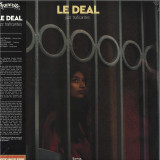
Favorite Recordings presents Jazz Traficantes by LE DEAL, a new musical adventure from the finest French jazzmen with Florian Pellissier (Piano & Fender Rhodes - Camaraõ Orkestra, Cotonete,
Aldorande, Setenta), Yoann Loustalot (Flugelhorn – Bruit Chic, Old & New Songs, Aerophone, Lucky Dog), Théo Girard (Upright Bass – Pensée Rotatives, Discobole) and Malick Koly (Drums - The Wallace
Roney Quintet). Needless to say, they’re used to play all over the globe and quite often to New York. During one of these
trips to the Big Apple, they discovered that the legendary Van Gelder studio (where most of Blue Note, Verve and CTI albums were recorded) was still active and opened so they decided to book a few days session.
Here is the story told by Florian Pellissier: “The tracks had been written the night before. We were going to run through them and then record. A simple plan. Van Gelder had passed a while back, but he left the keys and secret codes with his faithful assistant Maureen before heading off to create the right sound up in heaven. Nothing had changed in the atmosphere or configuration, not even the way the mics were placed. The studio and its wooden beams still exuded New York’s sixties jazz, dimly lit streets and clubs where anything might happen past midnight. Maureen knew just how to capture the ambiance of the sessions and bottle the energy without spilling a drop, taking infinite care to collect each cymbal tone, drum roll and trumpet phrase, without losing a single vibrating bass string or the slightest keyboard pause.”
Indeed, the four contrabandists succeeded to deliver an outstanding album, filled with themes that’ll get stuck in your head, just like in the 19 minutes long performance “Mexican Junkanoo Suite” and its three
parts. But more than just beautiful melodies, LE DEAL truly managed to bring a sense of drama to their compositions, going into the deepest emotions through gutted arrangements, improvising with great attention to the articulation of their ideas. From the beginning to the end, musicians and engineers did their best to emulate the proper vintage sound. Jazz Traficantes could prove once and for all that
French Jazz can indeed cross the borders. The album will be available as Tip-On Deluxe Vinyl LP but also on CD & Digital with a bonus track, “Noche en la Carcel”
out of Stock
Last delivered 5 years ago available to reorder, subject to availability
"Minor Planets completes a trilogy of cosmically themed electro-acoustic albums by UK and Berlin based trio Twinkle3, 15 years in the making. This third installment is once again all about the unique synergies the group discover in combining free group improvisation with studio and musique-concrete techniques. The group's combined love of everything from Lee Perry to Noh Theatre via Karlheinz Stockhausen and King Sunny Ade lead them to respond musically to create a single universe where they all coexist and interact. Aleatoric analogue sequencing, chamber-like acoustic improvisation and dub treatments become distilled into a distinct and emotive narrative that takes us on an exhilarating hyperspace cruise to the outer reaches.
Clive Bell is a virtuoso of the Shakuhachi. His aesthetic takes us on a timbral journey between noise and pitch, expressed and phrased rhythmically by the contour of human breath. This creates a perfect context and focus for a music that moves seamlessly between rhythm, suspension, time modulated analogue states, dissonance and melody. Richard Scott and David Ross share a background in acoustic free improvisation and have pioneered new approaches to rhythm using self-designed analogue systems. On Minor Planets these seemingly paradoxical orthodoxies cross-pollinate in a spirit of wonder and optimism to produce original and experimental music that is both life affirming and uplifting.
Album artwork by Benjmain Kilchhofer captures the feeling of peering through the vacuum of space and catching a rare glimpse of the mysterious alien biomes, fossils, and silhouettes cast by dwarf planets, asteroids, Kuiper belt, and other trans-Neptunian objects."
out of Stock
Last delivered 5 years ago available to reorder, subject to availability
West coast composer, artist, and producer Kaitlyn Aurelia Smith has chartered a pioneering career with multiple critically-acclaimed albums since 2015. Following the release of The Kid in 2017, Smith focused her energy in several directions. She founded Touchtheplants, a multidisciplinary creative environment for projects including the first volumes in her instrumental Electronic Series and pocket-sized poetry books on the practice of listening within. She's continued to explore the endless possibilities of electronic instruments as well as the shapes, movements, and expressions found in the physical body's relationship to sound and color. It is this life-guiding interest that forms the foundational frequencies of her most recent full-length, The Mosaic of Transformation, a bright, sensorial glide through unbound wave phenomena and the radiant power discovered within oneself. "I guess in one sentence, this album is my expression of love and appreciation for electricity," says Smith. While writing and recording, she embraced a daily practice of physical movement, passing electricity through her body and into motion, in ways reflecting her audio practice, which sends currents through modular synthesizers and into the air through speakers. Not a dancer by any traditional definition, she taught herself improvisatory movement realizing flexibility, strength, and unexpectedly, a "visual language" stemming from the human body and comprised of vibrational shapes. Understood as cymatics, as Smith says, "as a reference for how frequencies can be visualized," much like a mosaic. Smith describes her first encounters with this mosaic; "the inspiration came to me in a sudden bubble of joy. It was accompanied by a multitude of shapes that were moving seamlessly from one into the other...My movement practice has been a constant transformation piece by piece. I made this album in the same way. Every day I would transform what I did yesterday...into something else. This album has gone through about 12 different versions of itself." As it has arrived, in a completed state, The Mosaic of Transformation is a holistic manifestation of embodied motions. Smith's signature textural curiosity that fans have grown to adore pivots naturally into a proprioceptive study of melody and timbre. Airy organ and voice interweave with burbling Buchla-spawned harmonic bubbles. "The Steady Heart" quivers to life, peppering blasts of wooden organ between winding vocal affirmations. As with a body, moving one portion requires a balance and counterbalance; here, subtle tonal twitchy signals fire in conjunction with coiling arias to create a mesmeric core. When the beat arrives at the midway mark, a swooping and jittery waltz, a sense of stasis in motion, a flow state, is sonically achieved. As soon as it syncs, it disappears back into the swirling ebbs of electric force. Other tracks stray into more ruminative physical realms. "Carrying Gravity" is built around string-like pads that expand and contract like a solar plexus, becoming taught and then loose. If the record could be summarized in a single movement, it is the 10-minute closing suite, a rapturous collage called "Expanding Electricity." Symphonic phrases establish the piece before washes of glittering electric peals and synthesized vibraphone helix into focus. Soon, Smith's voice grounds it all with an intuitive vocal hook, harmonized and augmented by concentric spirals of harp-and-horn-like sounds. Smith's music doesn't capture a specific emotion as much as it captures the joys of possessing a body, and the ability to, with devotion and a steady open heart, maneuver that vessel in space by way of electricity to euphoric degrees.
out of Stock
Last delivered 6 years ago available to reorder, subject to availability
"Omne trium perfectum" is an ancient Latin phrase suggesting everything that comes in threes is perfect, or, every set of three is complete. And in this case, it certainly rings true as the third single from The Allergies' third album 'Steal The Show' is pure musical gold…
Mixing it up amongst international hip-hop big guns - ASM the boys get the floor moving with 'When The Heat Comes Down'. The ASM crew have been doing hip hop right for over 10 years and have collaborated with some giants of the music world including Bonobo, Wax Tailor and DOOM.
Bombastic and always strutting, the track is built around a bouncing guitar riff and classic funk horn stabs - the perfect home for some upbeat party raps from Green T and Funk E Poet. We're inclined to agree - when the heat comes down they're definitely coolin'…
Honey LaRochelle is a 'Big Bad Woman' and she'll eat you alive. And that's exactly what she threatens to do in the track of the same name… It's a hand clapping, foot stomping, 12-bar fiesta on a jazzy piano rhythm and blues tip. Yes Ray Charles himself would be happy with this one and as an added bonus The Allergies use the instrumental gaps to showcase their skills on the decks.
out of Stock
Last delivered 5 years ago available to reorder, subject to availability