Eric Dolphy's final studio album is hailed as one of the finest examples of mid-'60s post bop. Its reputation is purely one of backwards significance. Dolphy, having recorded the album in February 1964, was in Europe less than six weeks later and his all-too-brief life ended less than two months after that. Though likely he never held a copy in his hands or heard any critical opinion of it, it marked his last flurry of original compositions and is considered his apex. It is fascinating to consider whether he would had moved past or away from the album in 1965, had he lived.
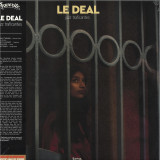
Though Dolphy should not be considered an avant-garde musician by the term's most common definitions, most interpretations of Out To Lunch have been done by players working squarely in that area. So it is with this album, the most ambitious in its recreation of the five-tune disc (with one original added to the final "Straight Up and Down, extending the piece to almost thirty minutes). All five compositions from the original quintet LP are revisited in the same order, the record sleeve even duplicates the old album jacket, down to the typeface and black-and-blue color scheme, although a photo taken by Daidō Moriyama inside Tokyo's massive (and massively busy) Shinjuku railway station replaces the Dolphy's album's enigmatic "Will Be Back" sign, whose clock hands indicated no conventional time of expected return.
Otomo Yoshihide first came to international prominence in the 1990s as the leader of the experimental rock group Ground Zero, and has since worked in a variety of contexts, ranging from free improvisation to noise, jazz, avant-garde and contemporary classical. The always surprising and sometimes confounding turntablist, sound artist, onkyo improviser and now avant jazzer heading up a 15-piece aggregation of Japanese and European experimentalists. Who better to grapple with Dolphy's legacy -- so idiosyncratic in its day and yet so influential to creative improvisers who followed -- than a musician with his own singular take on how sounds can be organized in the jazz realm over 40 years later and half a world away? In other words don't expect the conventional from Otomo any more than you would from Dolphy himself. That's not to say that recognizable themes ("Hat and Beard," "Out to Lunch," "Straight Up and Down") don't appear, or that individual players -- including Alfred Harth on bass clarinet bursting into the mix and leaping across the instrument's tonal range in a way that recalls the master himself -- don't carry forward echoes from the past in the spirit of a sincere and heartfelt homage.
However, a good deal of the time all bets are off; in addition to the usual brass, reeds, bass, and drums (and of course a bit of vibraphone, here played by Takara Kumiko in far less prominent role than that of Bobby Hutcherson) are such sonic paraphernalia as sine waves, contact mike, no-input mixing board, and, of course, "computer." (Otomo himself plays skronky electric guitar.) From composition to composition and even during episodes within compositions, the band takes radically different approaches. There are blasts of free jazz energy not too far removed from the Peter Brötzmann Tentet, an impression reinforced by the presence of spluttering wildman Mats Gustafsson on baritone sax. Not surprisingly and often in contrast with the Dolphy original, the music is dense and filled to overflowing with sounds -- sometimes due to fundamental reworkings in structure rather than just the larger size of the ensemble. The middle section of "Something Sweet, Something Tender" somewhat belies the original's title with elongated howls and cries from the horns over slo-mo bass, drums, and electronic noise poised somewhere between dirge and drone, and the sudden explosion of punk-ish rock energy in the following "Gazzelloni" is a startling contrast.
At times, the feeling is that of listening to the original Out To Lunch while a séance is going on to contact Dolphy's ghost, with supernatural sounds swirling around the stereo. The effect is disconcerting, as is the post-apocalyptic cloud hanging over the arrangements, but it makes the effort more than an unnecessary tribute album. Instead, Dolphy is transported into the 21st Century and allowed to romp through modern developments in music. An inspiring concept and an album that will stretch the boundaries of anyone who comes into contact with it.
Cerca:play n fill
With their album "B-3 Vol.1" the Hanoverian Lutz "Hammond"
Krajenski aka krajenski. on the B-3 organ, Ben Kraef from Berlin on
the saxophone and Peter Gall from southern Germany on the drums
break new ground even if the old path of the Hammond-infected Blue
Note refinement always remains in view.
An organist, a saxophonist and a drummer - the classic organ trio has been arousing special expectations to Jazz listeners since the glory days of Jimmy Smith, Groove Holmes and the McDuffs and McGriffs. The organist can spread out, the saxophonist can follow him and the drummer swings and provides the groove "in the pocket". With their album "B-3 Vol.1" the Hanoverian Lutz "Hammond" Krajenski aka krajenski. on the B-3 organ,
Ben Kraef from Berlin on the saxophone and Peter Gall from southern
Germany on the drums break new ground even if the old path of the
Hammond-infected Blue Note refinement always remains in view. KraefKrajenski-Gall do their thing and that very consistently. They play with the different readings of the format with reflections from Jimmy Smith to Larry Young. They play with expectations and play around clichés with sophisticated twists and tongue-clicking rhythmic and harmonic treasures.
It's an album to dig out the phrase "No fillers, all killers" for.
Bobby Oroza puts his desire for the profound on wax with his sophomore album Get On The Otherside. Musically, he has updated the formula we were introduced to on the first record. But lyrically, songs are bravely rooted in the more complicated, ubiquitous inner tangles of life like self-examination and coming to terms with the vastness of the human experience. With Coronavirus bringing the world to a halt, Bobby-a father and husband-had to do something. No tours to play or studio time to fill, Bobby found himself back in the construction yard, doing blue-collar work to provide for his family. "I was super grateful for the work-a lot of my colleagues didn't have an option like that," Bobby admits. More than a few personal hardships forced him to acknowledge and work through some brutal truths. And what came of it? Well, for one, this new record Get On The Otherside which pretty well describes what Bobby's been through: He had to demolish his ego, his old ways of thinking, and his tried approaches to anchor into a refreshed perspective with new understandings. As Bobby tells it, "I had to do some real self-searching, come to terms with what was wrong, and how much of it I was responsible for." So how does this translate to the new album? Moments of clarity as to where the real value in life lies on "I Got Love," encouraging numbers like the title track "The Otherside", and declarations of self actualization on "My Place, My Time." Even the more straightforward love songs are outside the box lyrically like "Sweet Agony" and "Loving Body." If you have never had the pleasure of catching one of Bobby's live shows you may have no idea that he is a maverick on the guitar. He lets us in on a little of that on "Passing Things" with a solo that possesses the same restrained and space that his lyrics do. As we'd expect, the songwriting still has that raw, direct edge to it. But an evolution has taken place. There are new points of view on familiar territory which in Bobby's words "For me to love, I needed to take a bigger view of love. One with less ego and more empathy" really hold true. The result is a record with Bobby's new found humility on full display and a message of encouragement to anyone who is struggling and can't see a way out. It still may be hard to nail down and define Bobby and his sound. He's no one thing more than the other. But what he's showing us now, on Get On The Otherside, is that we can also label him a soulful, philosophical optimist. Someone who can say a lot with a little, and who wants us all to know that it's us that has to do the hard lifting to truly live a life in love-both with the world and with yourself.
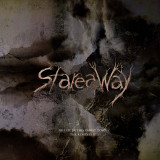
Back in 2011 Markus Guentner and Heiko Badje formed Stareaway to follow their vision of creating both enchanting and haunting music from melodies and drones. Combining Guentners complex Wall of Electronic Sound and Badjes ethereal androgyn voice and multifaceted guitar play, they indeed produced some epic works between Ambient, Pop and Shoegaze, strangely shimmering and profoundly mysterious.
Now Stareaways fantastic (and back then maybe a little overlooked) album No Life In This Ghost Town sees its rerelease and is, for celebrational purposes, accompanied by this EP of four stunning remixes by stunning artists Rafael Anton Irisarri (who also did the mastering), Simon Scott (Slowdive), Thomas Fehlmann and David Westlake (ex Sneaker Pimps). Rafael Anton Irisarris magical take on O Suomi sparkles bright, still with melancholia always present. David Westlake emphasizes the Pop-aspect of Appointments, adding lush synth melodies and light-filled grooves while Thomas Fehlmann lets All Over You spiral into Popambients most majestic heights. Finally Simon Scott builds a Kathedrale aus Klang on Dreams May Never. Amazing remixes of amazing originals.
Strapping Young Lad was a Canadian extreme metal band formed by Devin Townsend in Vancouver in 1994. The band started as a one-man studio project; Devin Townsend played most of the instruments on the 1995 debut album, Heavy as a Really Heavy Thing. By 1997, he had recruited permanent members; this line-up, which consisted of Townsend on vocals and guitar, Jed Simon on guitar, Byron Stroud on bass, and Gene Hoglan on drums, lasted until the band's dissolution. Strapping Young Lad's music was characterized by the use of polyrhythmic guitar riffing and drumming, blast beats and wall of sound production. band leader Devin Townsend was also noted for his eccentric appearance and on-stage behaviour, which greatly contributed to the band's intense live performances. The band gained critical success and a growing underground fan base from their 1997 album City. After a hiatus between 1999 and 2002, the band released three more albums, reaching their commercial peak with the 2006 effort, The New Black. Townsend disbanded Strapping Young Lad in May 2007, announcing his decision to retreat from public view while continuing to record solo albums. Listenable has been delighted to reissue All Strapping Young Lad Legendary studio albums on De Luxe Limited Edition Vinyls. A brand new vinyl master has been made for each album. This is the last one of the series and what an incredible debut album , Sheer Madness ! Grab it now !.Strapping Young Lad was a Canadian extreme metal band formed by Devin Townsend in Vancouver in 1994. The band started as a one-man studio project; Devin Townsend played most of the instruments on the 1995 debut album, Heavy as a Really Heavy Thing. By 1997, he had recruited permanent members; this line-up, which consisted of Townsend on vocals and guitar, Jed Simon on guitar, Byron Stroud on bass, and Gene Hoglan on drums, lasted until the band's dissolution. Strapping Young Lad's music was characterized by the use of polyrhythmic guitar riffing and drumming, blast beats and wall of sound production. band leader Devin Townsend was also noted for his eccentric appearance and on-stage behaviour, which greatly contributed to the band's intense live performances.
"Alabama's native son, Early James, will release his sophomore album, Strange Time To Be Alive, on 19th August, 2022. The lyrical wordsmith conjures the ghosts of great southern gothic writers from Eudora Welty to William Faulkner, while channeling the haunted spirits of Tom Waits and Townes Van Zandt. The album evokes a timeless amalgam of forsaken blues, wistful folk, and Tin Pan Alley crooning, anchored by the singer’s unmistakable voice that sways from gravel-filled shouts to pained, forlorn whispers – and songs that tread in the waters of darkly themed broken hearts, with the wry humor of the sad clown.
On the road again since August 2021, Early James will continue touring consistently through 2022. Confirmed upcoming tour dates are with The Black Keys and The Ghost of Paul Revere. Previously, Early James has played Newport Folk and toured with The Lone Bellow, The Marcus King Band, Zachary Williams, and Shovels & Rope. "
In the musical universe of the Brazilian singer-songwriter Raphael Gimenes, wild landscapes are metaphors for unspoken feelings. The Copenhagen-based artist writes hauntingly visual, and poetically surrealistic stories, in which he can be hunted by sun-kissing jaguars, chased by thirsty horizons, become a kaleidoscope of butterflies, or turn into dream-singing birds. His 2016 debut album, "Raphael Gimenes & As Montanhas de Som", was elected the best Brazilian album of 2016 by the Dutch website Written in Music, received 5 stars on Jazzism, and was hailed as a "conceptual masterpiece" by the Japanese magazine Latina. His sophomore release, "A tongue full of suns", is co-produced by the Faroese singer-songwriter Teitur, who also features on synths. On this new album, Gimenes explores his non-Brazilian influences and his life outside of Brazil. The songs are sung in English, a language that he learned when he lived in the United States as a boy. The lyrics are inspired by the mountainous landscapes of Jotunheimen, Norway, where he goes trekking on a yearly basis. The production and the arrangements draw heavily on sounds he heard on vintage European prog rock bands, particularly Yes and PFM. The music itself does not stray far from the universe of his debut album, but the songs do take more symphonic, progressive forms, while the Brazilian rhythms are substituted by the more meditative, minimalistic tabla played by the German musician Jan Kadereit. "A tongue full of suns" also features two guitar virtuosos from Argentina and the Netherlands: Matias Arriazu and Tim Panman. The fictitious story behind the concept album is presented as a poetic short text written by Gimenes himself: "These are the last songs written by The Painter, a broken-hearted sorcerer who disappeared on a journey of self-discovery in the vast canvas of the great wild. They were found floating above the silence of an ageless rock, in a valley of slumbering glaciers. It is said that on his odyssey, he learned the hypnotic dialects of the trees, and deciphered the translucent poetry of the moon; that he unearthed ancient vestiges of rhymeless metaphors, and mastered the alchemy of cosmic verbs. It is believed that The Painter could enter the memories of rivers, interpret the dreams of birds, and that his sun-gilded tongue carried melodies that filled entire horizons. Legend says that he is now a wanderer of the infinite; a sacred secret, revealed only by the colors of the solstice alpenglow on inaccessible, rugged peaks."
Collins Dictionary Example sentence: „Other ocular signs include involuntary rhythmic movement of the eyeball.“ Someone in the editorial department wasn‘t paying attention and involuntarily spoke a deeply buried truth: The movement from the eye to rhythm and from there to sound is sometimes a small, puny one.
Now Infuso Giallo provides the proof at the same time and implements his live show for last year‘s debut album „Ocular Soda“ as an audio-visual show, as intertwined senses. Visible sound, audible images. Such ideas only last when they are put to the test and scrutinised by several experts.
The duo Globus, which consists of 2/5 of the post-hardcore band PTTRNS, examines the synth hook of the second part of the double-opener „Every Waking Hour Pt.2“ by playing it, varying it, letting it sway.
In contrast, Anatolian Weapons from Athens can‘t help but immerse the ambient, Soft Machine-production-like first minutes of „Every Waking Hour Pt.1“ in a sinister black light. Staggering into a basement club filled with nocturnal shadow people and indulge in carousing. Cautiously at first, then more and more determinedly.
From Hamburg and Berlin, the „Mole Gaze“ gets a special treatment. The trio Love-Songs drags the number off to Hamburg harbour, packs it onto a steamer, deep into the bow and lets it operate the sonar there. Conrad Schnitzler would have been delighted.
Infuso Giallo, meanwhile, realises that there is nothing more boring than standing still, so he revamps „Hello World“ and gives it a rear spoiler that keeps this number in lane even at club speed.
Speaking of „keeping in lane“: Niklas Wandt, the magician, doesn‘t even try such tricks. He simply throws an acid bolt on the closer „Ocular Soda“ and waits to see what happens. Alongside breakbeats from nowhere, Albert Hoffmann himself appears on a bicycle.
„Ocular Soda Remixes“ is the first tape on the Kame House label, so there‘s only one thing to do: open your eyes and listen!
(feat. Claire Davis)
300 copies pressed
The A side was released back digitally in March. "Hope To See You Again" Which is an original song with Claire Davis on lead vocals
Better things is coming out digitally 15th July and it will be on a Ltd edition 45 vinyl. The Pre-Orders for the vinyl will be starting soon.
The B side is a killer version of her classic tune, "Better Things" The soulful vocals of Claire Davis are accompanied by jaunty horns and keyboards, and the cool groovebefits the positive lyrics ("I'm a better woman than I have been")
Introducing The HP's. This talent-studded Hamilton-based funk/soul collective is poised to make major moves with the release of their debut 45. The group is the brainchild of drummer/bandleader 'Parkside' Mike Renaud, the founder/owner of noted Canadian music company Hidden Pony Records & Management. A life-long fervent fan of funk and old school soul, Parkside has assembled a crack team of musicians and vocalists dedicated to his vision of breathing vibrant new life into these classic forms. Drawing inspiration from the likes of James Brown and The J.B.'s and Sharon Jones and The Dap Kings. The title pays tribute to Renaud's hometown, Hamilton, and The H.P.'s sound
honours The Hammer's core characteristics of rugged authenticity. Get ready to get Gritty!
— The HP's have partnered with UK based soul label LRK Records for the release of their latest single "Hope To See You Again", featuring Canadian soul singer and LRK alum Claire Davis
— "Hope To See You Again" arrives digitally March 31st, 2022 with the 45" expected summer 2022
— The 45" single will also include a cover of the Sharon Jones & The Dap Kings classic "Better Things"
The HP's.
To the Canadian music industry, 'Parkside' Mike Renaud is best known as the founder and owner of Hidden Pony
Records & Management, now widely recognized as one of Canada's premiere talent-development labels and artist
management companies. Past and present artists on Renaud's roster include Said The Whale, The Elwins, The Dirty
Nil, Hannah Georgas, Imaginary Cities, Jeremy Fisher, Odds, and many more.
Not many are aware that this popular industry power player actually got his start in music as a drummer in a '90s
Montreal soul/funk band called Parkside Jones (the source of his nickname). When he moved over to the business
side of music, beginning with top indie label Aquarius Records, Mike Renaud packed the kit away, launching himself
into the biz with full passion, commitment, and skill.
Mike has now resurrected his kit (after 20 years), honed his chops, and emerged as the driving force behind The
Renaud recalls the spark that reignited his love of playing drums: "The first time I played them in 20 years was at the
memorial for industry comrade Jon Box at The Opera House in Toronto. I was talked into playing with Chris Murphy
Sloan, Terra Lightfoot, and the Dirty Nil guys on a version of 'Handle With Care.'"
This renewed love affair would lead to Mike's vision for The H.P.'s. From his teenage years, his favourite musical
genre has been classic soul and funk, and he has an encyclopedic knowledge of these styles. Heartened to see the
growing international community building around these sounds, Mike decided to make his own creative contribution to
the form. He recruited musical and vocal collaborators from his hometown (plus a couple of Toronto imports) for the
project, and The H.P.'s were born.
The group name, The H.P.'s, pays homage to James Brown's legendary band, The J.B.'s, with these initials
referencing Hidden Pony. The album title is a tribute to Renaud's hometown, Hamilton, and The H.P.'s sound
honours The Hammer's core characteristics of grit and authenticity. Mike actually spent some time co-managing the
current J.B.'s.
The late Sharon Jones, a key inspiration for Renaud, is honoured via a killer version of her classic tune, "Better
Things." The soulful vocals of Claire Davis are accompanied by jaunty horns and keyboards, and the cool groove
befits the positive lyrics ("I'm a better woman than I have been").
Giving this cover extra resonance are the memorable encounters both Davis and Renaud had with Jones back in
2015. A documentary portrait of the soul great, Miss Sharon Jones!, had its world premiere at the Toronto
International Film Festival (TIFF), and Claire Davis was doing a house concert playing DapKings songs that night.
The band came across the party and jammed along, then, when one of the Dap Kings backup singers couldn't cross
the border, Claire got the call to fill in at Sharon Jones' headlining show at Hamilton's Supercrawl fest.
In a cool twist of fate, Mike Renaud was one of the organizers of that show, and was tasked with looking after
Sharon. The two bonded instantly and deeply, as Mike recalls. "While driving her to soundcheck, Sharon confided in
me that her cancer had returned. She didn't want anyone to know, as the documentary was about her conquering it,
and she didn't want people to be bummed out at the news. It was my 40th birthday that day, and Sharon actually
stopped her show to sing me Happy Birthday in a soulful way!"
Shakethehoof added "Hope To See you Again' to their playlist musicto/shake-a-hoof/the-hps-ft-claire-davis-hope-to-see-you-again-the-hoof-chats/
"BETTER THINGS" has gone straight into the UK Soul chart breakers at No 8
2LP Gatefold (featuring liner notes). Limited Edition. Artwork by Meeuw.
A collection of personal recordings made on various synthesisers between 1989 and 2017, by Telesoniek Atelier. Huge Tip on this one!
Early feedback:
"Fascinating improvs. I loved 'Gruesse'. " Suzanne Ciani (Atmospheric)
"Beautiful music with real subtlety and depth” Anthony Child (Surgeon, Transcendence Orchestra)
"Lovely, pure synth music." Mark Pritchard (Warp Records)
"Chateuroux is mighty... A proper zoner. Flung on earth." John T. Gast
"This is a great release by Telesoniek Atelier - a musician unknown to me before now. I've been thoroughly enjoying playing this double vinyl release since i got it. Both discs are filled with amazing music that moves between abstract electronic experiments to melodic, DMT bent sounding, classical contemporary music and futuristic soundtracks from non-existing Sci Fi movies you'll wish you could see. It time-warps you from here to there then freezes the moment. It all sounds like its been taken straight from the ancient room .. you know, that one where the spirits of the great teachers live. This is very focused, unpretentious and highly emotive music . A wonderful and dreamy sound garden coming from what I imagine to be a beautiful mind . These discs will be camping out on my turntables for a while."
Tako Reyenga (Music From Memory)
"A deep sense of the symphonic permeates this record. While synthesizers form the basis of its sound, Hans Kulk shapes their timbre into uncanny acoustics and weaves them together like an orchestra. Just when you think you have understood what is happening, another layer reveals itself. Yet it keeps a floating sense of lightness throughout. A truly rewarding listening experience."
Hainbach
Hailing from Ancaster, Ontario, Carl Didur has been an enigmatic fixture of Toronto’s underground music community for close to two decades. Originally traversing the Golden Horseshoe with The Battleship, Ethel, a band which sprung from his first outfit CEDRUMATIC, Didur soon moved to Toronto. Throughout the mid-2000’s he could be spotted playing his trademark ace-tone organ as a member of No Dynamics and Rozasia in the city’s crammed rogue venues, such as The Bagel and the infamous and transient Extermination Music Night. During these years The Battleship, Ethel continued to tour, often performing as backup band for Damo Suzuki, while at other shows inviting Dave Byers (Simply Saucer) and Bob Bryden (Spirit Of Christmas) to perform alongside the band. Perhaps the most enduring legacy of "The Battleship, Ethel", which dissolved in 2009, is that it laid the creative foundation for Carl and bandmate Michael McLean's next project, the prolific, studio focused, Zacht Automaat. As Zacht Automaat released music at a frantic pace, Carl continued to collaborate with members of a tight-knit group of Toronto’s downtown scene including touring with U.S. Girls and Slim Twig, performing and recording with Colin Fisher as Fake Humans, guesting on Absolutely Free’s Currency EP and producing New Fries’ most recent album The Idea of Us. Throughout the last decade Didur’s purely solo output has served to document his unimpeachably singular approach to music making. I Cannot See You Too Well (2011), Nothing is the Secret to Anything (2014) and Is It Yesterday? (2020) all released on cassette were followed by a digital album of gentle minimalism called Natural Feelings Vol I (2020). His solo shows consist of multiple tape machines running loops through various analog devices (a Certified Electronics Technician Didur now spends his non-piano playing hours of the day repairing all manner of tape echoes and synthesizers) or solo Wurlitzer electric piano improvisations, his performances gracing both stage and gallery. With his latest release Maybe Next Time, Didur further establishes himself as a singular artist with a unique methodology honed from years of music-making and listening. The album’s compositions swing from lush Axelrod-ish affairs filled with Mellotron strings to the album’s spiritual jazz influenced centerpiece The River Meets The Sea. “I was inspired by Eno's Here Come the Warm Jets, Crazy Horse but only when they are sad, Alice Coltrane, Jessica Pratt, McDonald and Giles, and so many others…” states Didur. Infused with a melancholic tone throughout, tracks such as Close My Eyes and Autumn’s Here invoke cinematic memories with tape echo and reverb applying a softened focus to the proceedings. Carl explains the context for the tone and the setting for the record’s gestation: “Maybe Next Time is a record I made after the world lost a sweet person that many in our community loved. Unlike most of my albums this one never seeks to shock or surprise you. It is about sadness, confusion, dissolution, transformation and ultimately a deeply forgiving sense of love. It is a concept record about being a human being!”
'Livin' My Best Life' is the follow-up to Scott's Nothing To Do Town EP
Produced by Will Weatherly, Matt Alderman, Jim Ed Norman, Curt Gibbs and Mark
Holman, the new record delivers a personal set filled with the backroads,
barstools and church pews that defined the Louisiana native's youth. The singer/
songwriter co-penned eight of the album's 16 selections, whose credits boast an
all- star lineup of writers like Morgan Wallen, HARDY, Ashley Gorley and more.
Notable highlights include fiery heartbreak single "New Truck," unifying anthem "In
Our Blood (feat. Jimmie Allen)" and No. 1 hit "Nobody."
Bob Harris BBC Radio 2 -mulitple plays
Included on Baylen Leonard's Spotlight Tracks on the Absolute Radio Country
playlistFeatures to run in Country Music People and Maverick
Full page ad in Country Music People, Quarter page ad in Maverick
Dutch pioneer Sp@sms returns to U-TRAX with 'From A 20th Century Box' LP, backed with remixes from Bloody Mary and Cosmic Force
On 'From the 20th Century Box' Arno Peeters, aka Sp@sms, returns to U-TRAX with his debut full-length album. Showcasing years of sonic exploration stemming from his time in various groups including Random XS and Voltage Control amongst others, the LP also draws from his experience studying and teaching music at the Centre for Electronic Music as well as his work in project-based sound design.
Filled to the brim with pulsating arpeggios, crunchy drums and dark, moody atmospheres, the LP is marked by a retro yet timeless feel. Inbetween its snaking, squelchy synth lines and old school electro grooves Sp@sms masterfully incorporates playful textures and elements from found recordings and unused projects, resulting in a vastly versatile and experimental album fusing all things techno, acid and EBM.
An expert lesson in sound design and composition taught by one of the Netherlands' most trusted and experienced artists, the LP also contains remixes from Dame Music's Bloody Mary and Utrecht electro stalwart Cosmic Force and arrives via heavyweight, colored double vinyl, digital, CD and cassette mediums.
As is typical for a U-TRAX release, each physical version has its own set of tracks. The vinyl and CD versions also come with a in-depth interview with Arno Peeters, as well as extensive background notes for each track (on the album's inner sleeves and a 24 page booklet, respectively).
This series highlights gems from Contemporary's extraordinary catalogue and features artists who both defined and expanded the sound of West Coast jazz.
Guitarist Barney Kessel, drummer Shelly Manne, bassist Red Mitchell, and the supremely soulful Hampton Hawes, one of jazz's most appealing yet unsun pianists, fill out the quartet scorecard of the 1958 release Four!. Although much later in his career Hawes experimented with electronic keyboards and fusion music, at heart he was a bebopper, as this session makes abundantly clear.
With material like Charlie Parker's "Yardbird Suite," his own "Up Blues," and Red Mitchell's "Bow Jest" (on which Mitchell plays his first recorded bowed solo), Hawes is at a creative peak here. Kessel, who played on the date, paid tribute to Hawes' "inexhaustible ideas on the blues…no one else in modern jazz plays the blues better." And nobody could tie a rhythm section together better than Shelly Manne, the fourth party in this boundingly energetic Four!
Concept Of Man is Martin Knorz - Berlin based keyboarder, producer and DJ.
A studied jazz pianist, Knorz is known for playing keys in the highly acclaimed, german experimental pop band Hope, with whom he’s been touring around Europe and UK over the past couple of years, as well as forming the sound of Austrian pop icon Teresa Rotschopf‘s solo debut „Messiah“.
In 2019 he started devoting himself to modular sound-synthesis, playing live shows and remixing acts as Hellotrip (Mutant Rebuilds) and Hara Crash (Bali).
His debut “Regularities” will be released on Patrick Pulsinger’s Big Beak Recordings in 2022. It’s a modular infused tape majestically crafted by a sound surgeon. Drawing inspiration from Robag Wruhme, James Holden and Patrick Pulsinger (with whom he has collaborated on his album Impassive Skies and the EP Nocturnal Cat), „Regularities“ consists of four minimal tracks and a durational modularsynth-only-performance, both of which feed the realm of sound caviar. Tribal rhythms join the darkness of modular sounds, regular beats oscillate on irregular impulses, while intriguing basslines and uplifting chords remind us that Knorz is first and foremost a pianist, a master of melody.
Wooden but soft percussive chords create a tribal rhythm that carries through the song, interrupted by a contrapuntal rhythm. Another drum group provocatively steps in the arena, together they build a rolling total. Then a „squelching“, juicy, nearly acid melody grounds the track, to be drummed out by the two groups when approaching the end.
Bones Shake are a scuzzy, fuzz enthused garage rock trio formed in Manchester in 2011. They play everything to the extreme; violent bottle-neck blues riffs, drums kicked, pounded and exploited and squeals of reverb drenched vocals which when combined, will help save your soul. With a relentless energy, they’ve never taken their foot off the gas. Through tirelessly playing across the UK and Europe, they have attracted a cult following that sees them fill out venues wherever they go; including a sold-out performance at the infamous Raut Oak festival. With a string of previous releases under their belt, they have gone from strength to strength and their last EP Privilege was released via Belgian label Never Trust Hippies. First LP Sermons was released in May 2019.FFO: The Stooges, The Cramps, The Birthday Party.
This is the peak of George Benson's courtship of the mass market -- a superbly crafted and performed pop album with a large supporting cast -- and wouldn't you know that Quincy Jones, the master catalyst, is the producer. Q's regular team, including the prolific songwriter Rod Temperton and the brilliant engineer Bruce Swedien, is in control, and Benson's voice, caught beautifully in the rich, floating sound, had never before been put to such versatile use.
On "Moody's Mood," Benson really exercises his vocalese chops and proves that he is technically as fluid as just about any jazz vocalist, and he become a credible rival to Al Jarreau on the joyous title track. Benson's guitar now plays a subsidiary role -- only two of the ten tracks are instrumentals -- but Q has him play terrific fills behind the vocals and in the gaps, and the engineering gives his tone a variety of striking, new, full-sounding timbres. The instrumentals themselves are marvelous: "Off Broadway" is driving and danceable, andIvan Lins' "Dinorah, Dinorah" grows increasingly seductive with each play. Benson should have worked with Jones from this point on, but this would be their only album together.
Stevie Ray Vaughan's 1983 debut album, Texas Flood, was a phenomenal success, climbing into the Top 40 and spending over half a year on the charts, which was practically unheard of for a blues recording. The record plays like a dynamite club show, filled with crowd-pleasing originals and covers, all performed with unbridled enthusiasm. Texas Flood was certified gold on August 13, 1990, and certified platinum on January 22, 1992.
With his astonishingly accomplished guitar playing, Stevie Ray Vaughan ignited the blues revival of the '80s. Vaughan drew equally from bluesmen like Albert King, Otis Rush and Hubert Sumlin and rock 'n' roll players like Jimi Hendrix and Lonnie Mack, as well as the stray jazz guitarist like Kenny Burrell, developing a uniquely eclectic and fiery style that sounded like no other guitarist, regardless of genre.
Hanoi Rocks legend Jan Stenfors aka Nasty Suicide makes a triumphant comeback with a brand-new studio album. With his new band, aptly named Stenfors, the man shows and proves his creative prowess are at their peak. Family Album isa long-player filled with timeless classic and blues rock, with catchy hooks and top-notch musicianship. This is a true gem for all for all fans of Hanoi and rock n’ roll.
It started with a night out at New York’s Sound Factory - and turned into an obsession, Inner City main man Kevin “Reese” Saunderson and his then manager, Neil Rushton, were at the NY uber house club when The Pressure by The Sounds Of Blackness got its’ debut World play, with the ecstatic response from the crowd meaning it was spun three times in a row.
Nobody was more knocked out than Kevin who vowed there and then to come up with a Detroit answer, much to the delight of Soul mad Rushton, co-owner of the Network label.
The idea of The Reese Project was quickly turned into House Heaven reality as Kevin recruited Detroit vocalist diva Rachel Kapp to record the anthemic Direct Me & The Colour Of Love as the first two singles.
Network made the group a main priority, coming with a whole slew of remixes to complement the original USA mixes on the subsequent album. Three of the most loved Network remixes are on this wonderful timeless 12.
The Dave Lee Joey Negro mix from 1991 is rated by many as one of Network’s finest moments, and maybe Lee’s finest ever “remixed with extra production” epics.
Rushton remembers meeting Lee to collect the remix, and instantly phoning Saunderson proclaiming “you won’t believe this”.
Underground Resistance’s Mike Banks added his magic to the 1991 original mixes of “The Colour Of Love” and the results were so overwhelming great that the idea of subsequent remixes was daunting.but the classic 1994 Network remix by The Playboys flew the flag for U.K. House.
C.J, Mackintosh set the production standards for U.K. Soul filled House and his 1993 remix of “So Deep” - sung by La’Trece - is a gem to be cherished forever and a day.
Network’s passionate crusade to crossover The Reese Project from House Music superstars to Pop success came tantalising close but never quite happened. But the Network remixes are a glorious legacy of House Music’s golden age and three of the very finest are remastered here and presented on one glorious 12.
Reese Project - Songs Not Slogans.
“I’ve been playing since I was 11 years old,” says Charlie Gabriel, the most
senior member of the legendary Preservation Hall Band. “I never did anything in
my life but play music. I’ve been blessed with that gift that God gave me, and I’ve
tried to nurse it the best way I knew how.”
While he’s faced plenty of challenges nursing that gift for more than 78 years,
none likely rank with last winter’s passing of his brother and last living sibling,
Leonard, lost to COVID-19. For the first time ever, Gabriel put down his horn,
filling his days and weeks instead with dark reflection, a stubborn despondency
broken now and then by regular chess matches in the studio kitchen of Hall
leader Ben Jaffe, working overtime to bring his friend some light.
One such afternoon also included Joshua Starkman, sitting off in a corner
playing his guitar and half-watching the chess from a distance. When Charlie
returned the next day, he brought his saxophone. “I was just inspired to try it, to
play again. It had been a long time, and a guitar makes me feel free. I do love the
sound of a piano, but it takes up a lot of a space, keeps me kind of boxed in.”
That day was to be the first session for ‘Eighty Nine’, almost entirely the work of
Gabriel, Jaffe and Starkman, recorded mostly right there, in the kitchen, by Matt
Aguiluz.
Charlie Gabriel’s first professional gig dates to 1943, sitting in for his father in
New Orleans’ Eureka Brass Band. As a teenager living in Detroit, Charlie played
with Lionel Hampton, whose band then included a young Charles Mingus, later
spending nine years with a group led by Cab Calloway drummer J.C. Heard.
While he’s also fronted a bebop quintet, played and/or toured with Ella
Fitzgerald, Tony Bennet, Aretha Franklin and many more, this is the first time his
name appears on the front of a record, as a bandleader.
Since 2006, Gabriel has been a member of the Preservation Hall Jazz Band,
featuring prominently on ‘That’s It, So It Is’, and ‘Tuba to Cuba’. ‘Eighty Nine’ was
different, and not simply due to a smaller ensemble. “We had no particular plan,
or any particular insight on what we were gonna do. But we were enjoying what
we were doing, jamming, having a musical conversation,” Charlie says, further
musing, “Musical conversations cancel out complications.”
The album includes six standards and three newer pieces on which Gabriel is a
writer: ‘Yellow Moon’, ‘The Darker It Gets’ and ‘I Get Jealous’. The record also
marks Charlie’s return to his first instrument, clarinet, on many of the tracks. “The
clarinet is the mother of the saxophone,” he says. “I started playing clarinet early
in life, and this taught me the saxophone.”
Finally, ‘Eighty Nine’ includes three tracks of Charlie singing. “I always sung, but
it wasn’t my forte to become a singer,” he says. “The truth is, people often
develop a real relationship with a song once they hear the words. Sometimes I
enjoy singing them.”
First pressing on translucent gold Loser Edition coloured vinyl
8 years after his debut album entitled "What You Give", it's time for the Greek musician's second long player! No doubt, this is Bengoa's most mature work to date and a product of countless studio hours. Pushing his electronic sound forward, the Greek musician, dj, songwriter and label owner, delivers an outstanding 9-track LP, floating between trip hop, nu-jazz, mid and downtempo motifs. The extensive use of physical instruments like saxophone, trumpet, guitars, piano, percussion and bass add musicality and deepness to the whole record, on which Bengoa has also written most of the lyrics himself. "Music For Your Red Parts" flows like an undercurrent of nervy isolation and late night melancholy, toying with the emotional structure of it's own sound. Songs that signal something memorably, indelibly and hypnotically sexy, without talking about sex. Music that you feel - strong, soft and filled with emotion. It wants to meet you in your deepest parts. It will play games with you, fill you with sorrow, or send you into a deep reverie. out now through SAOS RECORDS.
After having released solo albums on Western Vinyl and Preservation, Domes presents the first entirely instrumental work of the California based multi-instrumentalist Heather Woods Broderick.
Domes is a collection of meditative pieces based around the cello. While not being her primary instrument, the cello holds a very special place for the artist. Throughout the past 2 years, Heather often felt the need to find moments of respite in response to the chaotic and turbulent times we all faced in that period. Her days started or ended with the cello. A single melody initiated a process in which new elements were gradually added to the initial loop until the sounds filled her up. This process and the instrumental nature of these pieces opened the path for self-reflection and enabled her to express emotions outside the world of words or lyrics:
“The cyclical nature of the loop combined with the sound feeling like it’s surrounding me feels serene and safe. My hope is that listeners experience this as well.” - Heather Woods Broderick
Domes is a documentation of that period and offers 7 pieces which to the artist feels like dense masses – strong grounding sounds that can hold weight or be used to disperse weight - in an emotional sense. The album title, Domes, reflects this idea as domes are made out of triangles – the strongest shapes in the physical world. Coincidentally, there are 7 different triangles. As such, the pieces on Domes each reflect a different triangle, a different strongest shape which offers the listener a solid basis to find rest and calmness.
Heather Woods Broderick is a composer, songwriter, and multi-instrumentalist. Growing up in a family of musicians, music took root in Heather’s life at a very young age. Evenings spent singing along to her parents folk music collection began to shape her sense of song as a child. After many years of classical piano training, she began to expand her musical toolkit by learning to play guitar, cello, and flute among others. Deeply influenced by rich tapestries of the natural world, she excels at crafting sonic landscapes that reflect both lushness and intimacy. Heather has released three solo albums to date, and over the years has recorded and toured extensively around the world with a multitude of artists including Sharon Van Etten, Efterklang, Alela Diane, Horse Feathers, Damien Jurado, Lisa Hannigan, Laura Gibson, and more.
- A1: Money Won't Change You
- A2: It's Bad
- A3: Good Thing
- A4: Best Of Luck To You
- A5: That's What I Get
- A6: That's The Sound Of My Heart
- A7: How Long Must I Wait For You
- B1: Foxy Mama
- B2: Look A Little Higher
- B3: I Take What I Want
- B4: She's Got To Be Loved
- B5: Just A Dream
- B6: To Love Me Like You Do
- B7: There's Gonna Be A Better Day Coming
Perhaps the best Soul / Funk LP Athens of the North has ever released and you know we have high standards, not one filler and mostly unreleased tracks – Essential LP
The Up Tights were formed by Henry Bradley in Forrest City, Arkansas in March of 1967 while most of the band members were attending Lincoln High School.They took their name from the Stevie Wonder song "Uptight - Everything's Alright." Playing at school functions, they quickly branched out to playing bigger shows and headlined the 1968 St. Francis County Fair in Forrest City.
The Up Tights first recorded for Action Records in Memphis as Noble and the Up Tights. The 45 featured an original song by singer, Izear "Ike" Noble Jr. titled "Don't Worry About It."
Henry Bradley was drafted into Vietnam in 1968. He served in the 1st Squadron, 11th Armored Cavalry Regiment. While he was away, the Up Tights continued with Henry's brother, Arthur, taking over all the guitar duties. The band also hired a manager named John Mitchell. In 1968, the band met Joe Lee, who owned Variety recording studio in Jonesboro, Arkansas.
For the band's first recordings at Variety, Lee chose two originals by Noble titled "Look a Little Higher" and an updated version of "Just a Dream" which Lee released on his Alley Records label in 1968. Lee continued to record the band over the next several months. He liked to experiment in the studio and produced many versions of the group's original songs, adjusting the mix and adding elements to each unique take.
For the group's second Alley release, they appeared simply as Ike Noble on the record label. Lee brought in a local songwriter named Charles "Jamie" Holmes, who had previously written for Alley records and Joe Keene's studio in Kennett, Missouri
The resulting 45 from this collaboration was "It's Bad" backed with "That's What I Get," two Holmes originals. Another Holmes original was unreleased at the time, but available here titled "There's Gonna Be a Better Day Coming." Stax Records was interested in signing the group and wanted to re-cut "It's Bad" at their studio, but ultimately the label passed since they generally had a policy of working with Memphis based groups.
As the band grew in popularity, they began appearing with and competing with Memphis legends, the Bar-Kays. The group's biggest show in Arkansas was an opening slot at Barton Coliseum, one of the largest venues in the state, in Little Rock in mid-1969. As a result, the band was offered a spot on George Klein's "Talent Party" television show on WHBQ in Memphis in July of 1969..... Further Sleeve notes on back of the LP
"The album features the two sides of Mingus' compositional genius: the beautiful balladry that I always feel has a bit of a film-noir feel to it, alongside those joyous upbeat numbers that are filled with an organized chaos that categorizes much of the bassist's best work. ... Throw in the fact that it also features Jaki Byard (who is just phenomenal on this recording and remains criminally underrated), Booker Ervin, Dannie Richmond and Eric Dolphy and you have some of Mingus' finest sidemen driving his compositions to the fantastical places they seemed preordained to go. ... Mingus, Mingus, Mingus, Mingus, Mingus is a record that has more than stood the test of time and is an everlasting testament to the talents of Mingus and the players who had the ability to follow his musical vision." — The Jazz Record
Mingus, Mingus, Mingus, Mingus, Mingus was Charles Mingus' last major studio recording of the 1960s (the solo Mingus Plays Piano would also be released the same year in 1964) and it's a real treasure in the great jazz bassist's discography
Two of the tracks ("Celia" and "I X Love") were recorded at the sessions for The Black Saint And The Sinner Lady, while the rest were laid down eight months later with a group that included Booker Ervin, Eric Dolphy and Jaki Byard (Byard also played on the two earlier tracks). Both sessions featured groups of 11 players, all of whom were in top form in performing Mingus' notoriously complex compositions, writes jazzrecord.
All but two tracks on Mingus, Mingus, Mingus, Mingus, Mingus were re-interpretations of songs from the bassist's earlier catalogue, only "Celia" rates as a new original number, and "Mood Indigo" is a cover of the famous tune by Mingus's hero Duke Ellington. If you happen to have lost your Mingus decoder ring, the remaining tracks correlate to their past counterparts as such:
For Mingus, Mingus, Mingus, Mingus, Mingus Mingus collaborated with arranger/orchestrator Bob Hammer to score the music for the large ensemble of brass and saxophones. Recorded January 20 and September 20, 1963 in New York City.
Ramrock Records are hugely excited to announce the forthcoming release of Ghetto Priest’s ‘Big People Music’ LP, the long awaited follow up to his 2017 album, ‘Every Man For Every Man’. The idea for this LP was originally floated in 2018 and was intended to be a 6 track EP called ‘Songs for my father’. However, once Ghetto Priest got in the studio, the idea expanded as he went the extra mile adding his personal favourites, conjured up from childhood memories of his father’s tunes being played on the family radiogram with additions from his youthful excursions. A magical mixture of tracks associated with the greats – Nat King Cole, Dean Martin, Slim Smith, Ken Boothe, Aaron Neville – ‘Big People Music’ can lay claim to being the 21st century’s equivalent of John Holt’s ‘1,000 Volts of Holt’ – an absolute essential on every Blaupunkt radiogram on a Sunday and a blues party staple.
The combination of standards and righteous releases were mixed down by the Bishop of Dub, Adrian Sherwood who blessed the project with the title ‘Big People Music’, a powerful acknowledgement to those tunes which filled many a Caribbean household with immeasurable sentiments that echoed down through subsequent generations.
Please be upstanding for Ghetto Priest and ‘Big People Music’.
'In memory of the Right Honourable Arthur Beresford Townsend - My Father'
An absolutely legendary album from Lebanon by Issam Hajali’s group Ferkat Al Ard, “Oghneya” stands out as one of the great musical gems of the Arab world. A groundbreaking release from 1978 that represents the meeting point of Arab, jazz, folk and Brazilian styles with the talent of Ziad Rahbani, who did the albums arrangements. Filled with a variety of sounds and genres, from Baroque Pop to Psych-Folk to flashes of Bossa Nova, Tropicalia and MPB, “Oghneya” is like if Arthur Verocai took a trip to Beirut in the 70’s to record an album.
In 2015 we heard Ferkat Al Ard’s music for the first time, a Lebanese trio compromised of Issam Hajali, Toufic Farroukh and Elia Saba. It was a stunningly unique release that blends traditional Arabic elements, jazz and Brazilian rhythms hand in hand with poetic-yet-politically engaged lyrics. The band was active in the left-wing movement of Lebanon of the time and they communicated their political ideas candidly through their songwriting.
In our mind the idea was to see whether Issam was interested in re-releasing “Oghneya.” He was not opposed to it, but also made it clear that it was not his priority for a first project. He suggested we start with his first album, before Ferkat Al Ard was formed, “Mouasalat Ila Jacad El Ard,” which was recorded in 1977 in Paris together with his friend Roger Fakhr (whose work we have been privileged to re-release in the meantime as well.) “Mouasalat Ila Jacad El Ard” is melancholic, stripped-down, guitar-based folk intertwined with jazz-fused breaks, and the unique sound of the santour glistens through. While the music is very accessible, some song structures are rather atypical, neglecting common patterns of verse, hook, verse, hook. The lyrics mostly trace back to the poetic work of Palestinian author Samih El Kasem, with one song also written by Issam, who composed the music for the whole album.
We re-released Issam’s “Mouasalat Ila Jacad El Ard” in 2019 to a great reception, with positive reviews all over the place and an ongoing appreciation for the album. This meant it was time for us to undertake an “Oghneya” re-release again!
If you compare “Mouasalat Ila Jacad El Ard” and “Oghneya,” one apparent distinction is the strong Brazilian influence in the music. Issam Hajali explained that you can already hear traces of this influence on his debut, but it’s “Oghneya” where this musical relationship really peaks. Lebanon and Brazil have had a strong connection for nearly a century due to the continuous flow of immigrants from one country to the other. Today, Brazil has the largest Lebanese diaspora in the world, the “Brasilibanês”. The migratory route was not a one-way street, however, and some Lebanese returned to their home country, taking recordings of the music they learned to love in Brazil with them. They were followed by Brazilian musicians who visited primarily Beirut during the 1960’s and the first half of the 1970’s, just like many other musicians from around the world. In these years between the independence and the beginning of the civil war, Beirut became even more of a cultural center and regional hub than it already was.
Bossa Nova, at that time, was one of the defining sounds of Brazilian popular music. Issam Hajali remembers hearing it at a bar in Beirut’s Hamra district in 1974, which hosted musicians from Brazil playing the occasional gig. When Issam had returned from Paris in 1976 he got to know Ziad Rahbani, son of Fairouz, who had a shared passion with Issam for a lot of things, among them Brazilian music. Issam showed him some of the tracks he was working on, and Ziad agreed to help with arranging. The music that evolved from this cooperation between Ferkat Al Ard and Ziad Rahbani’s arrangement is, to put it lightly, outstanding. Issam’s singing is embedded into the uniquely beautiful string arrangements backed by the band’s poignant, swinging groove. The lyrics of the songs on “Oghneya” are based on poems by Mahmoud Darwish, Samih Al Qasem and Tawfiq Ziad, three pillars of Palestinian poetry within the last century, and their influence on “Oghneya” was itself a strong political statement during the Lebanese war.
“Oghneya” was eventually released in 1978 by the band themselves on cassette tapes. Finding a blank tape that fit the playing time proved to be impossible during the war so they needed to open up the case of each cassette to physically cut down the tape and customize it to the playing time. The album was well received, though some cultural critics deemed it too “occidental” in its sound. While the cassette was circulating, Ziad Rahbani started a label called Zida, together with Khatchik Mardirian. They decided to help the band with a re-release on vinyl in 1979, a year after “Oghneya” was originally released on cassette.
Sadly, there are two tracks from the original release of “Oghneya” that did not make it onto the reissue. “Ghfyara Ghaza” was replaced by the song “Juma’a 6 Hziran.” while “Huloul” was taken off without a replacement. This happened as a precondition from the band for this reissue to happen. We would have loved to include all tracks, but the decision ranged between having either a reissue like the one we put out or no reissue at all. Thus, an easy choice for us.
As always both vinyl and CD come with an extensive booklet with an interview with Issam as well as unseen photos from the recording sessions.
- A1: Nonato & Seu Conjunto - Cafua
- A2: Os Novos Crioulos - Mar Afunda
- A3: Jose Roberto - Crioula Multicolorida
- A4: Rita Lee & Tutti Frutti - Agora E Moda
- A5: Trio Esperanga - Nao Aguento Voce
- B1: Robson Jorge & Lincoln Olivetti - Aleluia
- B2: Erasmo Carlos - Jeep
- B3: Chalo Eduardo - Beija-Flor Suite
- B4: Ely Camargo - Taieiras
- B5: Silvio Cesar - A Festa
- C1: Toni Tornado - O Jornaleiro
- C2: Som Tres - Tanga
- C3: Noriel Vilela - 16 Toneladas
- C4: Chocolate Da Bahia - Ele Guenta
- C5: Tim Maia - E Necessario
- C6: Joao Bosco - Cobra Criada
- C7: Os Incriveis - Uma Rosa Pra Dita
- D1: Edson Frederico - Tava Mas Nao Tava
- D2: Helio Matheus - Mais Kriola
- D3: Miguel De Deus - Black Soul Brothers
- D4: Ana Rosely - Skim Dum Dum Dum
- D5: Luiz Gonzaga & Ze Dantas - Sao Joao Antigo
Compiled by Sean Marquand and Greg Caz, 2 DJs well-known for their epic parties at Williamsburg’s legendary Black Betty club, that sadly closed in 2009. The duo played a deep variety of strictly vintage samba, samba-rock, Tropicalia, and Brazilian funk under the banner of ‘Brazilian Beats Brooklyn’.
Sean is known as half of Embassy Sound Productions. He took his team to Brazil to help resurrect Black Rio legends Uniao Black for a new release. Greg has DJ'd at some of the hottest Brazilian parties around the globe and presents a monthly radio show ‘Warm Wave’ on Soho Radio NYC.
Featuring Noriel Vilela’s singular “16 Toneladas,” a sublime cover of the Tennessee Ernie Ford smash “16 Tons” with a spare samba groove and unbelievable baritone vocals and hot jams from Tim Maia, Erasmo Carlos, Joao Bosco, Toni Tornado.
Included in this compilation of original 60's and 70's Brazilian gems are some of Greg and Sean's favourite tracks that have been filling dancefloors for years.
Side A / Double A / The Game
Are you ready to play the game? More big drums heat for the dance floor, courtesy of label boss, Double A. Breaks everywhere, huge fills, horn stabs, some sneaky dancehall vocal samples, and a cheeky breakdown keep this one rolling. 1970’s afro funk business for sure, with plenty of elements across multiple genres to pique the interest of any crowd.
Side B / DJ Fleg (feat. Lean Rock) / Dimension Five / Latin Escapades
If you’re a b-boy or b-girl then there’s no introduction necessary here for Fleg or Lean Rock.
For everyone else, get ready for a party breaks master class. Fleg brings the classic loop heat on “Dimension Five”. Expertly produced, this one snaps hard. If you didn’t know, you’d never guess it started its life as a mellow jazz track. For “Latin Escapades” Fleg teams up with Lean Rock for some completely bananas breaks action over latin horn stabs. Both of these are instant party starters and versatile enough for any funky set.
THEME reshapes Arp Frique & Mariseya with their third release
THEME drives us further into their experimental/electronic mission with their third release, a remix of Arp Frique & Mariseya’s "Nyame Ye". Pulling its soulful vocal into a looping playground of crafted grubby synths that fill all the right spaces, it dials down the tempo effortlessly whilst leaving just enough feeling from the original in its wake, THEME slowly sucks you deep into this downtempo gem
- A1: Life After Death
- A2: Somebody’s Gotta Die
- A3: Hypnotize
- A4: Kick In The Door
- B1: Fuck You Tonight
- B2: Last Day
- B3: I Love The Dough
- B4: What’s Beef?
- C1: B.i.g. Interlude
- C2: Mo Money Mo Problems
- C3: Niggas Bleed
- C4: I Gotta Story To Tell
- D1: Notorious Thugs
- D2: Miss U
- D3: Another
- D4: Going Back To Cali
- E1: Ten Crack Commandments
- E2: Playa Hater
- E3: Nasty Boy
- E4: Sky’s The Limit
- F1: The World Is Filled…
- F2: My Downfall
- F3: Long Kiss Goodnight
- F4: You’re Nobody (Til Somebody Kills You)
- H1: Hypnotize (Club Mix)
- I1: Mo Money Mo Problems (Radio Mix)
- I2: Mo Money Mo Problems (Instrumental)
- J1: Mo Money Mo Problems (Album Version)
- J2: Fuck You Tonight
- K1: Sky’s The Limit (Radio Edit)
- K2: Kick In The Door (Radio Edit)
- L1: Going Back To Cali (Radio Edit)
- L2: Sky’s The Limit (Instrumental)
- M1: Kick In The Door (Club Mix)
- M2: Going Back To Cali (Club Mix)
- N1: Kick In The Door (Instrumental)
- N2: Going Back To Cali (Instrumental)
- O1: Nasty Boy (Radio Edit)
- O2: Nasty Boy (Instrumental)
- P1: Nasty Boy (Album Version)
- G1: Hypnotize (Radio Mix)
- G2: Hypnotize (Instrumental)
3LP[52,90 €]
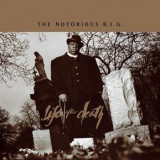
To celebrate the 25th Anniversary on 25th March 2022, the diamond-certified GRAMMY®-nominated double-disc opus will be released as a 25th Anniversary Super Deluxe Box Set on June 10, 2022. The Life After Death 25th Anniversary Super Deluxe Boxed Set consists of 8-LPs and a commemorative booklet featuring rare photos from the album cover shoot, liner notes by Sheldon Pearce, and exclusive reflections from members of the team who worked on the original album release. In addition to the original album, it includes the Hypnotize 12”, Mo Money Mo Problems 12”, Sky’s The Limit 12”, and Nasty Boy 12”.
Life After Death features 112, Jay-Z, Lil’ Kim, Ma$e, Bone Thugs-n-Harmony and Too $hort, along with tracks like “Kick In The Door,” “What’s Beef,” “Notorious Thugs,” “Ten Crack Commandments” and “Sky’s The Limit,”. The album hit #1 on the Billboard 200 chart and the US Top R&B/Hip Hop chart. It went diamond in the U.S. alone, double platinum in Canada, and platinum in the UK. The album received a GRAMMY® nomination in the category of “Best Rap Album.” “Hypnotize” earned a GRAMMY® nomination for “Best Rap Solo Performance,” and “Mo Money Mo Problems” was nominated for “Best Rap Performance by a Duo or Group.” Among dozens of lists and retrospectives, Rolling Stone touted Life After Death among its coveted “The 500 Greatest Albums of All Time.” The RIAA has awarded the album a Diamond Certification for more than 5 million copies sold of the double-LP.
- Etran De L'air - Tarha Ebouse Dighe Mane
- Oumou Diabate And Kara Show - Wara
- Jeich Ould Badu - Elyn
- Alkibar Jr - Adouna
- Amaria Hamadalher - Tarhanine
- Luka Productions And Kandiafa - Ne Be Massa Wofo
- Andal Sukabe - Hey Malale
- Hama - Alhoria
- Veyrouz Mint Seymali - Saghmi Yessri
- Bounaly - Takamba
- Oyiwane - Fatima
In 2020, Sahel Sounds hosted a project called Music from Saharan WhatsApp. This series consisted of ephemeral digital EPs, documenting live performances by some of the most exciting acts in the Sahel playing music, including Nigerién techno, wedding rock, Woodabe guitar, WZN, traditional music, Mandingue music, and more.
Responding to an open call from our network of artists, musicians recorded a handful of tracks on their cellphone and sent them over the popular mobile app WhatsApp. Each session was hosted for a month on Bandcamp and sold on a sliding scale, with all profits wired directly to the musicians. After a month, the EP would disappear, replaced by another one.
Now, some of the label's favorite tracks from this series are collected for the first time outside of Bandcamp as the Music from Saharan WhatsApp compilation LP. This LP features tracks by established Sahel Sounds artists such as Etran de L'Aïr, Hama, Alkibar Jr, Amaria Hamadaler (of Les Filles de Illighadad), and artists new to the label like Bounaly and Andal Sukabe.
Limited Edition 180g Vinyl LP! All-Analogue Mastering by Kevin Gray!
Pressed at RTI!
This mid-period masterwork from jazz piano's most uncommon voice finds Monk and his quartet (Charlie Rouse on tenor, Ben Riley on drums and Larry Gales on bass) exploring every texture, tone and melodic turn of seven expansive tracks. This group was subtle, mature and confident, easily supporting Monk's more idiosyncratic side-tracks (check out the solo on "Locomotive" or the restless exposition on "Japanese Folk Song") while allowing listeners freedom to move through or contemplate all the sublime subtexts Monk conjures from the endless well of his inspiration.
This emphasis on laid back and mature presentation aided the recording as well. These master tapes sound amazing and getting them to disc was a pure pleasure. Subtle changes in atmosphere, tone and melody fill the space between the speakers, a wide soundstage and expansive dynamics the gift of music indelibly played. This is one sonic powerhouse for the ages.
Available for the first time on 180-gram 2-LP with the full performances of the original tracks and including two bonus tracks, this new Impex release gets you closer to Monk's genius than ever before. Kevin Gray and Robert Pincus used analogue master tapes and minimal processing to great effect, while original session and jacket images were culled to create the deluxe gatefold jacket. Add in the sound-of-silence pressings from RTI and you have a can't miss jazz disc ready to delight and inspire every time it spins on your turntable. Impex has pulled out all the stops on this mesmerizing Monk classic. All you have to do is get one and enjoy before they're all gone.
Bobby Oroza puts his desire for the profound on wax with his sophomore album Get On The Otherside. Musically, he has updated the formula we were introduced to on the first record. But lyrically, songs are bravely rooted in the more complicated, ubiquitous inner tangles of life like self-examination and coming to terms with the vastness of the human experience. With Coronavirus bringing the world to a halt, Bobby-a father and husband-had to do something. No tours to play or studio time to fill, Bobby found himself back in the construction yard, doing blue-collar work to provide for his family. "I was super grateful for the work-a lot of my colleagues didn't have an option like that," Bobby admits. More than a few personal hardships forced him to acknowledge and work through some brutal truths. And what came of it? Well, for one, this new record Get On The Otherside which pretty well describes what Bobby's been through: He had to demolish his ego, his old ways of thinking, and his tried approaches to anchor into a refreshed perspective with new understandings. As Bobby tells it, "I had to do some real self-searching, come to terms with what was wrong, and how much of it I was responsible for." So how does this translate to the new album? Moments of clarity as to where the real value in life lies on "I Got Love," encouraging numbers like the title track "The Otherside", and declarations of self actualization on "My Place, My Time." Even the more straightforward love songs are outside the box lyrically like "Sweet Agony" and "Loving Body." If you have never had the pleasure of catching one of Bobby's live shows you may have no idea that he is a maverick on the guitar. He lets us in on a little of that on "Passing Things" with a solo that possesses the same restrained and space that his lyrics do. As we'd expect, the songwriting still has that raw, direct edge to it. But an evolution has taken place. There are new points of view on familiar territory which in Bobby's words "For me to love, I needed to take a bigger view of love. One with less ego and more empathy" really hold true. The result is a record with Bobby's new found humility on full display and a message of encouragement to anyone who is struggling and can't see a way out. It still may be hard to nail down and define Bobby and his sound. He's no one thing more than the other. But what he's showing us now, on Get On The Otherside, is that we can also label him a soulful, philosophical optimist. Someone who can say a lot with a little, and who wants us all to know that it's us that has to do the hard lifting to truly live a life in love-both with the world and with yourself.
- A1: An Empty Space Is Not Just Filled With Air
- A10: Think, Blink, Breathe, Blink, Speak, Blink, Breathe
- A11: Drunk At Best
- A2: Cosy Nothing, Moving Coffin
- A3: A Silly Seal, Asleep, Rolling Down The Hill
- A4: Quatre - Vingt - Quatorze
- A5: Melancholy Eyes
- A6: Slvote
- A7: Love, Beers & A Queen Size Bed
- A8: Geranium
- A9: 15 Octobre
Equipe de Foot is a French duo of singer-songwriters who record pop
songs and play them much louder on stage
Since their formation in 2015, Alex & Mike have played hundreds of gigs, from the
sweaty basements of their hometown of Bordeaux to the stages of nationally
renown festivals and European venues, making a solid name for their band, and
little by little becoming part of the new wave of French rock. Equipe de Foot now
admit that their flaws might be their greatest strength, and bring their love for
English and American indie pop music and production to the forefront in their
songs. For 'Geranium' they have chosen to work with producer and sound
engineer (and fellow Beatles fan) Johannes Buff (Thurston Moore, Lee Ranaldo,
The Drones, Dalek and other various amazing projects) at Shorebreaker studio in
Tarnos, France. A meaningful choice both in terms of technical and artistic skills,
Johannes was able to assemble Equipe de Foot's good old wall of guitars, as well
as reach the heart of their pop songs to make the whole thing gloriously shine,
without altering the charming homemade vibe emanating from their beloved
demos.
The album is a constant rollercoaster, alternating lo- fi ballads and powerful
anthems, but always with a twist, be it a pitched loop on a chorus or an auto
tuned solo trumpet at the end of a sad piano song.
The Howling is a collaborative project started by writer Ken Hollings and sound artist Howlround devoted exclusively to their shared love of text, audiotape and trash aesthetics. An intense collision of spoken word and analogue tape effects, the Howling's first performance took place at the Iklectik in September 2019 as part of a special programme to celebrate The Tapeworm's 10th anniversary.
Despite the pandemic, they have managed to continue working and conferring together since then, sharing sound files, texts and mixes online, which has resulted in All Hail Mega Force, their first full-length release for The Tapeworm. The two extended tracks contained on this audiocassette reflect their shared interest in Fluxus and how informal rules and permutations can be set up to work themselves out through loops and repetitions. A straight line connects Terry Riley's tape experiments in Paris from the early 60s with their experimental recordings in the Wimpy Bar on Streatham High Road, one of their favourite meeting places. 'The idea of instant, disposable one-off creations appealed to us a lot at the time,' The Howling explain, 'particularly as both pieces were conceived and developed during different phases of Covid lockdown in the UK.'
The title and source material are derived from the kid's adventure movie MegaForce, starring Barry Bostwik and Michael Beck. Designed to sell a range of Mattel hi-tech action toys, MegaForce tanked at the box office but lives on in the collective consciousness of those who share with The Howling a special love for Trash and Trash Aesthetics.
The two tracks also share similarities in approach and realization.
'All Hail Mega Force' was created by reading combinations of the words 'All Hail Mega Force' into a voice memo recorder, transferring it to tape, cutting the whole thing as a single long loop and then stretching it across three reel-to-reel machines simultaneously, using two pencils and a pint glass full of loose change to try and maintain sufficient playback tension. Over time the loop started to degrade, which accounts for the increasingly slurry and unpredictable playback, plus frequent ruptures caused by the tape becoming jammed and having to be tugged through the machine workings by hand. Twenty-four minutes later and the result was a completed new work and a slight backache.
The text for 'Are You Man Enough For Mega Force?' was recorded live in the Wimpy Bar on Streatham High Road, 28 November 2021. It was cut to tape and looped on 3 December 2021 at Warrior Studios, Loughborough Junction. Dragged by motor and then by hand across two tape machines with copious amounts of closed input feedback provided by a third rushing in to fill the gaps. One take with no effects or overdubs, but one tiny edit in the middle when something fell over.
Cindy & The Playmates, led by Cindy Redd (later of The Voices) and
backed by Wanda Cunningham and Manesbia Pierce, deliver an upbeat funky floor filler. Copies go for between three to four hundred pounds for this storming and evocative fist-clenching gem which builds dramatically with strings and an emotive lead vocal. Cut with Paul Kelly’s ‘The Upset’,
which was the B side of his second single for Lloyd Records, the vehicle for Willie Clark’s Florida-based productions. A monster sound with a grinding funky backdrop providing the perfect foil for Kelly’s aching vocal; the chorus break is a guaranteed spine-tingling moment. Copies currently go for around £250, if you can find one.
2022 Repress
Third album (1981) by the Belgian band Univers Zero. The title alludes to the short story of the same name
by H.P. Lovecraft; the players read the story in studio, then proceeded to record the piece. A key release
for the band. Ceux du Dehors sometimes suggests a darker and more complex version of the motorik minimalism of classical music contemporaries Philip Glass and Steve Reich.
This album finds the group continuing to evolve and return to the more general and varied chamber music sound of their first release, except with more precision and skill. The tricky charts of percussionist Daniel Denis and new keyboardist Andy Kirk are executed with great panache. The labyrinth-like compositions are typically filled with unexpected twists and turns, and angular repetitions of jagged riffs that accelerate, decelerate and mutate in passages of acute tension or quiet but ominous dread.
Cat.no.: SR403
Format: LP
Tracklisting
RIYL: David Byrne, Guy Clark, Bob Dylan, The Flatlanders, Randy Newman, John Prine, Lucinda Williams, Townes Van Zandt. The first-ever vinyl reissue of Allen’s manifold, moving fourth album, remastered from the original analog tapes. Deluxe LP edition features 140g virgin vinyl; a gatefold jacket, inner sleeve with restored, new, and alternate art and photos by Terry and Jo Harvey Allen and friends, insert with lyrics and original notes & DL. Deluxe CD edition features a trifold jacket & inner sleeve. On his manifold fourth album, acclaimed songwriter and visual artist Terry Allen contemplates kinship the ways sex and violence stitch and sever the ties of family, faith, and society with skewering satire and affection alike. Bloodlines compiles thematically related but disparate recordings from miscellaneous sources both theatrical and historical: two songs written for plays; two full-band reprises of selections from Juarez; the irreverent hellfire-hitchhiker-on-highway ballad “Gimme a Ride to Heaven Boy” (featuring Joe Ely); and the poignant eponymous ode to the arteries of ancestry and landscape (the debut recording of eight year-old Natalie Maines, later covered by Lucinda Williams). Since 1970, when they met in Allen’s studio in his hometown of Lubbock, Texas, one of songwriter and visual artist Terry Allen’s great foils and friends was the sometimes cantankerous but always brilliant art critic and writer Dave Hickey, with whom he sparred on topics musical, visual, and beyond (and to whom this reissue is dedicated in memoriam, in the wake of his passing in 2021.) Hickey, a fellow Texan paddling against the currents of the hermetic New York centric art world, was an accomplished songwriter in his own right, and he and Terry pushed each other to refine their respective practices. In 1983, the two were thick as thieves brothers in blood and Hickey’s wry but big-hearted presence haunts the history and periphery of Bloodlines, the album Terry released in June of that year. Hickey’s commercial doubts notwithstanding, critical recognition was not in short demand. In a 1984 review of Bloodlines, the L.A. Herald Examiner called Allen “one of the most compelling American songwriters working today … making the most unique art-pop of our time,” elsewhere comparing him not only to Moon Mullican and Jerry Lee Lewis, but also to the Velvet Underground and Philip Glass (probably the first time that unlikely quartet ever appeared together in one sentence). In 1983, against all odds, such sentiments were growing in underground prominence, as Allen’s records gained a fanatical word-of-mouth following they weren’t easy to find in those days. Recorded piecemeal at Caldwell Studios in Lubbock, in sessions spanning August 1982 through January 1983, Terry self-released it, like all his previous records, on his own Fate Records imprint. Despite his frustration with the protracted timeline and some anxiety about the correspondingly higher budget, the production on Bloodlines courtesy, once again, of master guitarist Lloyd Maines is slicker, cleaner, and more dynamic than prior efforts, and it reached a broader audience than ever before. UK label Making Waves reissued it in 1985, facilitating semi-reliable European distribution for the first time as well as a 1986 UK tour, on which the great BJ Cole filled in for Lloyd on pedal steel. No veteran country songwriter sounds more attuned to the national mood. His songs still feel like little guidebooks for staring down a harsh universe. – The Washington Post // It has always been a fool’s errand to frame Allen in terms of other artists there was nobody like him before he showed up, and the subsequent 40 years have been equally light on plausible peers. Uncut
Edizioni Ishtar and Schema Records proudly celebrate the 15th anniversary of one of their most successful releases and artists (more than 30 million streams and 300 thousand monthly listeners on Spotify) with the first ever vinyl edition of Toco’s Outro Lugar. Produced by S-Tone Inc., this record includes fan-favourite tracks “Outro Lugar”, “Samba Noir
” and most of all “Guarapiranga”, which was chosen for the soundtrack of “Silver Linings Playbook”, a film that awarded Jennifer Lawrence an Academy Award prize as best actress in a leading role in 2013. The strings at the beginning of the title-track have also been sampled by PinkPantheress for her song “Nineteen”, out of her latest album “To Hell With It”.
Outro Lugar hasn’t aged a bit during all these years, for various reasons; first of all it benefits from the outstanding contribution of bossa nova pioneer and inspiration source Roberto Menescal, who played guitar in every track. Most of the album was recorded in Rio De Janeiro at Menescal’s studio, with the participation of some of the best ‘carioca’ musicians, especially double-bass player Adriano Giffoni and pianist Adriano Souza. All these elements gave the album exactly the taste requested by the artist and the producer: inspired from the past yet, through thorough attention, aimed at a sound at the same time fresh and modern, slightly electronic, filled with grooves perfectly blending into acoustic instruments. The second part of the recording was carried out in Milan, with some of the best musicians in the Milanese jazz scene.
The album also sees the contribution of Rosalia De Souza, singing in several tracks and standing out in “Bom Motivo” especially. French chanteuse Coralie Clément appears in “Contradição”, her own piece here re-interpreted by Toco.
Outro Lugar is an album for any kinds of Brazilian music lovers that showed the world what Toco was capable of: a refined and cultured musician, a gifted performer of a warm and smooth voice able to awaken the emotions of the most sensitive listeners.
Black vinyl[22,65 €]
2LP[36,56 €]
Turquoise and Black splatter vinyl[27,69 €]
Black Vinyl[26,85 €]
Forest Green Vinyl[39,08 €]
Red / Blue Splatter Vinyl[29,37 €]
Black Vinyl[29,37 €]
Vinyl[35,92 €]
Clear Vinyl[28,53 €]
Clear Vinyl[30,21 €]
LP[30,21 €]
LP2[38,87 €]
Black Vinyl[29,37 €]
Creme White Vinyl[31,89 €]
Clear Green Vinyl[31,89 €]
Lavender Marble[30,63 €]
Yellow w/ red & black splatter[30,63 €]
Black VInyl[30,21 €]
Cassette[15,08 €]
Black Vinyl[33,19 €]
Tidewater Tri Color Vinyl[34,87 €]
DOWN TO EARTH became an overnight sensation in certain Soul music circles when their previously unreleased album was unleashed six months ago. This long-lost suite of soulful gems was recorded back in 1996 and finally get’s it’s debut vinyl release via IZIPHO SOUL - proud to release this collection of ‘All killers, no fillers’.
Since the 1990s London-based Stevie Paul and Laurence ‘Lol’ Williams have been making songs, creating harmony and performing the world over. The pair’s songwriting styles stem from their love of Soul music.
The long player’s running order has been organised as THE MEAT SIDE AND THE SWEET SIDE for your listening pleasure!
Presented with OBI strip in a clear sleeve and available in two choices of vinyl colour: gold or black.
Benoit B aka Terra Utopia breaks out into another auspicious alias for Step Ball Chain, Blu:sh - metamorphosed; coming in hot and heavy, sexy and sophisticated. Bass down, *ss up! The ambitious 6 tracker “Lovebite” fuses forms of dance; reworking elements from niche corners of the Step stratosphere that can result in freaky combustion. Breathing life and lust into every phrase, we are fortunate to be offered an intimate glimpse into a complex world of sound, filled with bold and brash inspired statements, rhythmically rolling the dice with snap lock precision. The cherry on top is served via a vocal collusion from fellow associate noff, the web expanding as the label delves deeper into futuristic tech territory, the prolific producer pushing their own boundaries and desires for new meticulous audio spectrum and ethereal realms.
The trio of flirtatious tracks laid bare on the A side read as a love letter to 4/4 naughty nocturnal testimonies. Opening auspiciously; Tighten Up dips into nasty grit, a sub centered excursion into the technological domain, sleazy and stripped back with modest tenacity. Candy Land sugarcoats the status quo of pumped up prog, playfully in the driver's seat and revving 100 miles per hour toward Hush highway; narrated by Greek cyber enigma noff.. An atmospheric deep trance kissed club chant. Opposites attract and find points of connection on the flip of Lovebite, the B side boasting a mutually slick sharpness permeating the record; blending sparse bass focused broken beat expeditions with liquid dnb; genially abstract mood boards of sampling mayhem; cut and spliced in addictive fashion. Flushes of gorgeous esoteric harmonic soundscapes fill out the rhythmical chaos, grounding and expanding the mind through a lush & plush tint woven in Recess and Heaven Spot alike.
A perfect prophecy destined for Step Ball Chain, Blu:sh’s first, yet expertly curated EP sets the bar high as hell. Divine dance music that can’t help but push boundaries; confronting and challenging our archival references and perceptions of genres and classifications, arguably the best kind of auditory statement.
Reissued for the first time in over 40 years, Show the World is an unrated and realitvley unknown soul / reggae ablum from the caribbean. Having recently been sampled by Benny The Butcher, collectors and producers are starting to pay attention to what has been an overlooked gem until now. With the album ranging from sweet soul that sounds like it could have been released on Motown in its prime, to funky numbers that could be played in clubs, to reggae that could stand alongside some of the Studio 1 releases, this is sure to please many. No filler.
Rare 1966 Brazilian album with a jazz/bossa nova take on songs by the Beatles, all served up with plenty of great keyboard work from the legendary Manfredo Fest who would later become member of the Sergio Mendes band. The songs are all played with imaginative scents that really take them from their roots as pop songs and open them up as groovers filled with keyboard improvisations. First time vinyl reissue. DESCRIPTION Rare 1966 Brazilian LP with a jazz/bossa nova take on songs by the Beatles performed by the very talented Manfredo Fest and his trio. It was originally released right after their classic 1965 RGE album and has a very similar jazz-based sound. Manfredo Fest was part of the gathering of Brazilian musicians of the late-'50s who were developing the bossa nova movement, and he made a number of trio recordings in that vein from 1961 to 1966. After emigrating to Minneapolis in 1967, Fest moved to Los Angeles where he served as keyboardist and arranger for Bossa Rio and toured with Sergio Mendes. This recording is all instrumental, strongly jazz-based, with piano as the main solo instrument, soaring over the top of some tight, crackling rhythms! The songs are all played with imaginative scents that really take them from their roots as pop songs and open them up as groovers filled with keyboard improvisations. A nice slice of how the bossa nova sound was evolving in its homeland as well as the international impact the Beatles were having on countries outside of the U.S., England, Japan, and Germany. First time vinyl reissue.
Linda Fredriksson (they/them) shares their debut solo album "Juniper" on We Jazz Records, 29 Oct 2021. Linda (of Mopo and Superposition) has been working on the compositions heard on the album for several years, composing them mostly on guitar, keys and by singing. Only later have they been arranged for the band heard on the album, including Fredriksson on saxes and various instruments, Tuomo Prättälä (of ilmiliekki Quartet) on rhodes, moog and piano, Minna Koivisto on modular synth, moog and OP, Olavi Louhivuori (of Superposition) on drums, and Mikael Saastamoinen (of OK:KO and Superposition) on bass, plus featuring the Swedish artist Matti Bye on piano.
At heart, "Juniper" is a "singer-songwriter album", performed by an instrumental jazz band. The end result is unique, personal, and as Linda themself puts it "quiet and introspective". The first single from the album is "Neon Light and the sky was trans", "a song from the shining streets – the beginning of something new", featuring field recordings of rain falling down behind the window of Linda's Helsinki working space.
It's a fitting introduction to an album full on wonders and carefully crafted secrets ready to be discovered. "Juniper" is a world unto itself, and Fredriksson describes the process as one of isolation and of learning slowly to do new things. After the demo stage, the songs were taken to the full band, but what's on the record often stays true to the minimal nature of the early demos. Linda credits their co-producer Minna Koivisto as a key ally in the process of maintaining the demo sessions' fragile beauty on the actual finished record.
With regards to instrumentation, those who have heard Linda Fredriksson in Mopo and Superposition are likely to be surprised by their credit listing including not only alto and baritone saxophones, plus bass clarinet, but also guitar, Rhythmic8 synths, ambience recordings and drum programming. Linda describes the way of finding new sounds through their beloved old guitar as follows: "It's an old acoustic guitar that has been hit by a car and is literally full of holes, but that makes the sound just perfect for this album and you can hear the instrument on 'Pinetree song' and 'Lempilauluni' (Finnish for 'My Loved Song')."
In fact, Linda began their music-making with guitar and vocals, and the debut of the hole-filled vintage acoustic guitar makes perfect sense here, while also describing the album's immediate sound perhaps better than any other individual instrument used. The influence list for the album name checks the likes of Feist, Neil Young, Susanne Sundfør, Alice Coltrane, Pharoah Sanders, Eric Dolphy and Fever Ray, yet the number one inspiration for Fredriksson prior to making the album was "Carrie and Lowell", the 2017 album by Sufjan Stevens. Different as the albums are in terms of instrumentation and general scope, it's fascinating to draw parallels between them by listening to the quietness and immediacy of the music. "Nana – Tepalle" also relates to the world of "Carrie and Lowell" in being a dedication to a lost family member, Linda's grandmother (she is featured in the digital single artwork).
Throughout the album, Linda plays their saxophones in a way that is serving music first and foremost. The musician's ego, so often at the forefront in jazz, takes a backseat, and the songs themselves remain. Linda thinks as a composer, utilising their instrument where and how necessary, not presenting "chops". "It's sometimes hard to play simple," they say, "but I tried to follow my instinct about what the songs need. The mood rules here, any solos or improvisations happen around that at all times."
"Juniper" can still be heard as a jazz album, but perhaps one reminding that the word doesn't need to mean any one thing in particular. At its best, jazz music is highly personal and "of the moment", both true on "Juniper". The album has been made in two different studios, three homes, two summer cottages and four working spaces. It was recorded with professional studio equipment but also with an iPhone and on a basic built-in laptop speaker. With that, "Juniper" stands as a remarkable musical diary of a creative musician and composer during the early 2020's.
Improvisation and experimentation are at the core of Robocobra
Quartet’s DNA, almost intentionally at odds with their roots as a
post punk band.
Including members with no musical training alongside European
music conservatoire innovators, the result is a groove-driven but
cerebral blast, invoking the likes of Fugazi, Talking Heads and
contemporaries such as Squid and Black Country, New Road.
The eclectic free nature of their live shows allows them to
channel hop from moments of joy and playfulness to periods of
intense fury, creating a unique sound that has earned them
invitations to Montreux Jazz Festival and Latitude.
Robocobra Quartet have a rule: No Guitars Allowed. Their
unique sound, concocted and self-produced in Belfast, Northern
Ireland, sees that ‘middle’ space filled by other instruments such
as saxophones, samplers, keyboards and sound effects,
swirling around the melodic basslines and powerful drum
rhythms which prop up the core of each of their songs.
On top of this music sits a single vocal from behind the drum kit
amid a fury of rhythm, sometimes marrying perfectly with the
pulse of the drums and occasionally at complete odds with it.
Live dates / tour to be announced.
“I genuinely don’t think there is another band like ‘em, anywhere
in these islands” - Tom Robinson
“Free-floating musical explorers” - Hannah Peel
“Fugazi meets Mingus.” - Drowned in Sound
“Exploratory pioneers.” - BBC Radio 3 Late Junction
“A cunning marriage of jazz, spoken word and punk” - The
Quietus
"Half a Klip" is a Vinyl Reissue of Kool G Rap's first solo release It was originally released in 2007: As is to be expected, G Rap fills out the lyrics sheet here with banana clips and stacks of body bags -- certainly not a disappointment (he played a big part in inventing this agenda after all), though the MC's steady, workmanlike approach and topical sameness leaves a lot of responsibility on the shoulders of his producers. t's open to debate as to whether there has ever been a rapper more influential, yet somehow less celebrated, than Kool G Rap. From his seminal work on Marley Marl's Juice Crew productions and Cold Chillin' Records, to the major contributions he gave to the blueprint of gangster storytelling in rap, the Kool Genius has remained relevant and consistent despite heaps of record label drama and the ever-diminishing attention span of the listening public. It's unlikely that the new Chinga Chang Records EP Half A Klip will do much to elevate G Rap's legacy, but there are still shining moments to remind us why the legendary MC is more than deserving of the little reverence he receives.IThus, the EP's best moments come when he is united with a strong hand behind the boards. Marley Marl's sinister keys and kettle drum composition for "With A Bullet" (inexplicably buried at track eight on this 11-track offering) is probably the best canvas for Rap's gangster mentality. DJ Premier contributes a strong track (merely serviceable by Premier standards, but a standout here) and the lesser-known Domingo also seems to be able to give G Rap room to run. Unfortunately, the rest is just middling with one true mistake, Critical Child's dismal "Turn It Out", which sounds like a cast-off from a Jim Jones studio session. In any event, this collection of new and unreleased material is not the next Road to the Riches. On the bright side, the MC behind Road to the Riches is still here (in every sense) and still doing it 20 years later.
Vol. 17 - Special Remix EP[14,24 €]
Vol. 18[12,56 €]
Vol. 21[12,19 €]
Vol. 22[14,50 €]
Vol. 24[17,61 €]
Volume 20 of Attack the Dancefloor kicks off with what we think will be a future classic – ‘Atlantia’ by Level 42’s Mike Lindup. A stunning mid-tempo boogie cut with great spacey production, excellent lyrics and an extended mix by Dave Lee.
Next up is Lazywax’s synth heavy, 80s soul style rework of the forthcoming Raw Essence ‘Do it Again’, the original being featured on Produced With Love 2.
Flip it over for Dave’s much played take of Jungle’s crossover hit ‘Keep Moving’, which gives the song an authentic bassline driven disco mix. Last up Chicago’s Emmaculate delivers a live instrumentation filled afro disco version of Doug Willis feat Zeke Manyika ‘Dougswana’.
Back in stock !
There is geological time and deep-space time. The natural world's time, and quantum time. Humans started measuring time with the stars and seasons. Then came hourglasses and sundials. The first mechanical clocks weren't in Europe until the late 13th century. Then came industrial time, a wristwatch for all and then everything had a time. A time for everything. All feeding into our recently digitised time and its marching nanoseconds. Let us not forget however another way to measure time: That would be K&D time.
Yes, you can rush, but isn't it so much nicer to amble? This onception of time may well have its roots in those smoke mists, softly blowing through the pre-history of 1995, and if that was time - then we need space. In particular, one Viennese front room that has turned its bass bins out to the cosmos. That sweet smoke, shrouding the desk and sampler. A few old keyboards (as a friend skins up at the back) unnoticed on the couch - just passing through...
Those days of K&D time had been thought to have gone. But one of times tricks is to hide itself in music. Not long ago (after a box of DATs had been found, and a DAT player prised back into service) back through the music wormhole our heroes fell into that smoke laden room of 1995. The remix time hadn't arrived nor the intense touring schedule. It was before the K&D sessions release and all that came with it, before the solo projects of the Peace Orchestra and Tosca. This was a time before all of that. A time for literally living in the studio and experiencing the joy of creating tune after tune. Just the sound and the smoke and no boundaries.
It was before people started asking about when the album was coming out. Which developed its own time specific answers. The 90s answer was soon, 00s answer was not sure and then: never! from 2010 onwards. The truth was, an album had been finished by the spring of '95 and all recorded onto DAT and placed in a box. K&D pressed up 10 copies and gave 4 away to some suitably eccentric individuals. Then the room's doors opened and in a tremendously big cloud of smoke time rushed in, K&D rushed out, and the years went rolling by. The days got filled with remixes, touring and life.
Then in early 2020 that chance moving of a box at the back of a room exposed the DATs and their time transporting properties. As K&D went through them they ended up comfortable and back in the room and that wonderful haze of 1995. The music was transferred from the DATs and K&D painstakingly rebuilt every molecule that made up the original 10 copies. From the very first takes of the mixes printed onto tape, to the solid slab of black virgin vinyl, to the abused by many plays, white cover. Even down to the labels that says "'Unverkäufliche Musterplatte" (Testpressing - Not For Sale) in rather rude German.
It now looks, feels and sounds pretty much exactly the same as those original 10 copies did in 1995. The only thing that couldn't be don is the original clouds of smoke those 10 copies were bathed in. That will be left to the listener to wrap it in the fresh harvest of 2020. In one way it's a musical time warp space travel. In another, if the music becomes classic and timeless, then it's of its time, whatever the time. So as the rooms bass bins are once again turned out towards the cosmos, K&D are happy and proud to release what they thought were lost moments. Drop through the worm hole, take your place on the couch. The friend who is skinning up, always just passing through, listening to an album for the future called 1995. It all makes sense if you measure in K&D time.
After turning heads with the densely orchestrated Riddles, produced by Dan Deacon, the Baltimore-based duo Ed Schrader’s Music Beat have given us another giant leap forward with their fourth record Nightclub Daydreaming. The whiplash-inducing stylistic shifts between aggressive noise rock and operatic gloom pop that have become the band’s trademark have given way to a single aesthetic that fuses both impulses. On Nightclub Daydreaming, menace teems just below the surface as propulsive, stark arrangements leave space that Schrader fills with strident, reverb-soaked narration.
LIMITED GOLD VINYL w/ Download Card
When Ed Schrader and Devlin Rice began writing the record in 2019, the idea was to make a fun, danceable album, but an underlying moodiness proved unshakeable. As Schrader puts it, “The cave followed us into the discotheque.”
The duo road-tested the songs “This Thirst,” “Echo Base” and “Black Pearl” with drummer Kevin O’Meara on tour with Dan Deacon in February 2020. COVID restrictions cut the tour short, squashed plans to go immediately into the studio and sent the touring party on a sprint from LA to Baltimore. “We broke down outside Roswell,” Schrader recalls. “And these cops laughed at our dumb asses as we used all our pent-up stress and fear to propel our half-submerged bus out of the muck, yelling epithets to the sky.”
It was one of the last experiences they had with O’Meara, whose death in October 2020 weighed heavily on Rice and Schrader’s minds as they worked on the record. It was also a cathartic moment that presaged the aesthetic that would permeate the songs on Nightclub Daydreaming: “mad euphoria in the face of doom,” as Schrader puts it.
“This Thirst” is an alienation-fueled barn burner barely restraining itself through musically sparse, lyrically dense verses to culminate in a howling, synth-saturated chorus that beats horror punk at its own game. “Came from the north with a twisted planetarium, rock salt, nervous tic and novocaine,” Schrader sings, assuming the guise of a vagrant whose irresistible urges lead him through a fever dream of chemicals, back-alley bartering and existential threats.
The hyperactive “Echo Base” exudes agitated-cool, with breakneck drum fills and a relentless bass line. The narrator is stranded in a frozen landscape and running out of options. “She is just a night train away,” we are assured, and yet we sense that may not be an altogether good thing.
The band recorded and mixed Nightclub Daydreaming over a two-week period with Craig Bowen at Tempo House in Baltimore with David Jacober on drums, turning demos with artificial sounds and placeholder melodies into fully realized songs playable by a live band. The end result is not the album of “sunny disco bangers” that Rice says the band set out for, but something deeper, darker and more rewarding.
Released in 1983 on a miniscule run of 300-self-financed LP’s, Dennis Taylor’s ‘Dayspring’ remains a lost masterwork of transcendental instrumental guitar. An important missing link between the 60’s folkloric experimentalism of John Fahey and Robbie Basho, and the new age atmospherics mined by William Ackerman and Michael Hedges in the early 80’s. Though Taylor’s guitar playing remains crisply unadorned on these 10 tracks, his technique and his compositions stretch beyond the folk roots of the genre. He crafts a soundworld that is both immersive and familiar. His pastoralism has a spaciousness - a pianistic drift - that feels truly timeless.
Taylor cut his musical teeth through the 60’s and 70’s playing with garage rock bands, and later finding his footing in the world of jazz/folk fusion. Sometime in the early 70’s, Taylor found his most profound inspiration to date when he witnessed a live performance from Takoma Records luminary, Leo Kottke. Enraptured by Kottke’s ability to fill the room so completely, with the sound of just one instrument, Taylor was determined to follow a similar path. Thus, he began composing music for solo guitar. He spent nearly a decade writing and honing his pieces, finally entering a studio in 1982 to commit them to tape. Taylor likened the recording experience to “a living room concert.” He recorded each song in a single take, in the order they appear on the album. Paying out of pocket for the recording sessions, studio time was at a premium, so Taylor had arrived prepared. And the results speak for themselves.
Dennis Taylor’s guitar playing is clean, precise, and masterfully proficient. And yet, ‘Dayspring’ is not merely a document of technical ability. His compositions are deeply
expressive. Taylor’s deft fingerpicking is married to achingly beautiful melodicism. His arpeggios chime and roll with painterly expression. Across the breadth of ‘Dayspring’, Dennis Taylor strikes a perfect balance between wistful nostalgia and bold expansion. Though Taylor initially hoped to release his album with new age progenitors Windham Hill, he ultimately decided to release the album on his own. He self-financed a pressing of 300 LP’s, which were largely distributed locally in his hometown of Lincoln, Nebraska. And now, Morning Trip is supremely proud to bring this album back to light. An important missing piece in the expansive tapestry of instrumental guitar music, finally restored.
Following two stunning singles, prodigiously talented producer and composer Frederic Robinson is set to drop his debut album,
'Mixed Signals', on Blu Mar Ten Music on 14th October. The album is the culmination of over a year's work and a lifetime of musical
obsession for Robinson, comprising of a series of intricately crafted and delicately emotive tracks exploring a forward-thinking
electronic vision, which he describes as "music for the listener with a broad horizon and a short attention span'.
Over its eleven tracks, 'Mixed Signals' gives Robinson the canvas to showcase the full breadth of his talents like never before.
Amalgamating the many influences that inform his productions, from drum & bass and electronica to contemporary classical
composers, 'Mixed Signals' is a brilliantly crafted and coherent artistic statement that draws upon his talents as a classically trained
multi-instrumentalist as well as an electronic producer. Filled with light and shade, impact and intricacy, 'Mixed Signals' is much more
than a drum & bass record or a collection of club tracks; this is an album in the truest sense of the word.
"So far, this album is my biggest musical project and my greatest achievement. I worked on it for about a year and went through many
different creative phases in that time, all of which are represented somewhere on the LP. It is a summary of my current talents, skills
and interests. It marks the end for some ideas and concepts and the beginning for many others." - Frederic Robinson.
Built from a collage of acoustic and electronic elements, Robinson's music is a dense patchwork of skittering rhythms, found sound
and lush instrumentation, which harnesses a compelling emotional draw as much as it does an undeniable dance floor energy. Both
immediate and nuanced, 'Mixed Signals' is a brilliant balance of contrasts.
The sweeping drama of previous single 'Theme Park' opens the album, remaining as fresh and brilliantly unique as ever, while 'Off
Topic' and 'Bloom' featuring Stray both also provide familiar touchstones, exploring esoteric manifestations of 170 bpm's outer
possibilities. Three vocal tracks are scattered throughout the tracklist, with the soft, otherworldly tones of Melanie Robinson providing
an entry point to Robinson's world of broken percussion and wandering melodies.
Elsewhere, 'Vamp Till Ready' balances rich string orchestration against a wave of skittering percussion and 'Shut' offers an expansive
beauty in its naïve, dreamlike melodies. 'Particles' showcases an innate understanding of drum & bass constructs, warping tight
breaks and deep bass against bold blasts of colour while the eponymous track explores a playfully off-kilter and delicately nuanced
downtempo vision, before the album is played out on wave of hazy melodies and light-footed rhythms with closer 'Static Float'.
'Mixed Signals' provides the broad canvas that Robinson thrives in painting with his sprawling musical influences and complex
arrangements, and the results are phenomenal. The album is a masterpiece in dance floor escapism from a talent whose career is
undoubtedly in the ascendant.
Formed in Oakland in the early 1970s, the Sons and Daughters of Lite recorded Let The Sun Shine In, their only LP, which has now achieved holy grail status among collectors. Let The Sun Shine In is a spiritual recording filled with soul, funk, jazz, and African percussion. The musical collective described themselves as a mix of African rhythms, Latin flavors, and Far Eastern textures. This album was virtually unknown to DJs and collectors until Michael McFadin's discovery in the late 80s. He then scoured the bay area and bought up multiple copies for his record store The Groove Merchant on Haight Street in San Francisco, many of which were bought from flea markets and the dollar bins of other shops. The outrageously funky title track became a jazz dance classic, courtesy of heavy radio and club play by top UK DJ and tastemaker Gilles Peterson.
Limited to 500 copies worldwide* 1980’s Australia were a blistering inferno of totally great powerpop, garage- and punkrock bands. Hoodoo Gurus, Stems and Lime Spiders were on top of their game and labels like Waterfront and Citadel put out albums and 45’s that most music aficionados would die for.
The Spliffs formed in Townsville, a small city on the northeastern coast of Queensland in Australia. In 1986 they unleashed their debut
45. Recorded all by themselves and released DIY style they got some rave reviews and got to play Sydney, Melbourne and Brisbane
opening for The Saints and Hoodoo Gurus. Their debut single is fab jangly 80’s powerpop right up there with Plimsouls or The Nerves.
Housed in a deluxe picture sleeve that comes with a printed inner sleeve filled with many rare and previously unpublished photos plus an interview with Spliffs main man and guitar-slinger Jamie Forsberg conducted by power pop guru Ric Menck. Orange color vinyl.
File under: ”beyond essential to any serious rock’n’roll, powerpop, garage and punk fan”.
Sweden’s One Way Ticket Records is a sister label to On The Dole Records who gave you “Jobcentre Rejects” (and more) and
to Sweet Mental Revenge Records who gave you Rodger Wilhoit. OWT is also a sub-division of Stora Skivmässan –
Scandinavia’s biggest record fairs
This beloved 1963 Impulse! LP is a career highlight for both Johnny Hartman and John Coltrane. Hartman was apparently Coltrane's suggestion for the recording date, and his deep, dark voice meshes perfectly here with Coltrane's tenor. The material is well-chosen, including definitive readings of 'My One and Only Love' and 'Lush Life.' McCoy Tyner fills out the chords, augmenting the harmonies and keeping the tone of these ballads respectful but not overly sentimental. All the players get to the deep structure of the songs and are not afraid to play in the most essential and elegant manner.
Today sees Belgian-Caribbean provocateur Charlotte Adigéry and her long-term musical partner, Bolis Pupul announce their debut album Topical Dancer, due for release on March 4 2022 via Soulwax’s iconic label DEEWEE.
Cultural appropriation. Misogyny and racism. Social media vanity. Post-colonialism and political correctness. These are not talking points that you’d ordinarily hear on the dancefloor but Charlotte Adigéry and Bolis Pupul are ripping up the rulebook with their debut album Topical Dancer. The Ghent-based duo, who broke out with their 2019 Zandoli EP, are rare storytellers in electronic music: they take the temperature of the time and funnel them into their playful synth concoctions – never didactic and always with a knowing wink.
Their debut studio record – which cements them as a duo under both their names for the first time and is co-written and co-produced by Soulwax – is both a triumph of kaleidoscopic electro-pop and “a snapshot of how we think about pop culture in the 2020s.” It captures Charlotte and Bolis’s essence as musical collaborators and the conversations they’ve had over the past two years on tour, as well as their perspectives as Belgians with an immigrant background, Charlotte with Guadeloupean and French-Martinique ancestry and Bolis being of Chinese descent.
Beyond the album’s thematic heft, Topical Dancer reflects Charlotte and Bolis’s idiosyncratic sound: it’s thoughtful but it bangs. Their take on familiar genres is always off-kilter; songs sound undone or a little wonky; but these are nocturnal heaters to make the club throb. “We like to fuck things up a bit,” laughs Bolis. “We cringe when we feel like we're making something that already exists, so we're always looking for things to combine to make it sound not like a pop song, not like an R&B song, not a techno song. We’re always putting different worlds together. Charlotte and I get bored when things get too predictable.”
Topical Dancer is fizzing with ideas – there’s certainly no filler among its 13 tracks. But above all, perhaps, it has a restlessness, a desire not to be boxed in and to escape others’ narrow perceptions of who they are. It’s summarised by the refrain of their new single, ‘Blenda’: “Don’t sound like what I look like / Don’t look like what I sound like.” “One thing that always comes up,” says Bolis, “is that people perceive me as the producer, and Charlotte as just a singer. Or that being a Black artist means you should be making ‘urban’ music. Those kinds of boxes don’t feel good to us.”
‘Blenda’ in particular references how “I am a product of colonialism,” says Charlotte, “and I feel guilty for taking up space in a white country.” The song was inspired in part by Reni Eddo-Lodge’s book Why I’m Not Longer Talking To White People About Race. “It talks about the colonial past and post-colonial present in the UK,” Charlotte continues, “but that isn’t merely a British or American problem, Belgium is part of that as well.” She says that her home country is likewise “oblivious to a big part of its history” which “results in general ignorance and a lack of understanding and empathy towards Belgian inhabitants of immigrant descent.”
On Topical Dancer, it’s less about finger pointing or being dogmatic about all the things they speak about. It’s about emancipation through humour. “I don’t want to feel this heaviness on me,” says Charlotte. “These aren’t my crosses to bear. Topical Dancer is my way of freeing myself of these issues. And of having fun.”
Ltd Black & White LP
Today sees Belgian-Caribbean provocateur Charlotte Adigéry and her long-term musical partner, Bolis Pupul announce their debut album Topical Dancer, due for release on March 4 2022 via Soulwax’s iconic label DEEWEE.
Cultural appropriation. Misogyny and racism. Social media vanity. Post-colonialism and political correctness. These are not talking points that you’d ordinarily hear on the dancefloor but Charlotte Adigéry and Bolis Pupul are ripping up the rulebook with their debut album Topical Dancer. The Ghent-based duo, who broke out with their 2019 Zandoli EP, are rare storytellers in electronic music: they take the temperature of the time and funnel them into their playful synth concoctions – never didactic and always with a knowing wink.
Their debut studio record – which cements them as a duo under both their names for the first time and is co-written and co-produced by Soulwax – is both a triumph of kaleidoscopic electro-pop and “a snapshot of how we think about pop culture in the 2020s.” It captures Charlotte and Bolis’s essence as musical collaborators and the conversations they’ve had over the past two years on tour, as well as their perspectives as Belgians with an immigrant background, Charlotte with Guadeloupean and French-Martinique ancestry and Bolis being of Chinese descent.
Beyond the album’s thematic heft, Topical Dancer reflects Charlotte and Bolis’s idiosyncratic sound: it’s thoughtful but it bangs. Their take on familiar genres is always off-kilter; songs sound undone or a little wonky; but these are nocturnal heaters to make the club throb. “We like to fuck things up a bit,” laughs Bolis. “We cringe when we feel like we're making something that already exists, so we're always looking for things to combine to make it sound not like a pop song, not like an R&B song, not a techno song. We’re always putting different worlds together. Charlotte and I get bored when things get too predictable.”
Topical Dancer is fizzing with ideas – there’s certainly no filler among its 13 tracks. But above all, perhaps, it has a restlessness, a desire not to be boxed in and to escape others’ narrow perceptions of who they are. It’s summarised by the refrain of their new single, ‘Blenda’: “Don’t sound like what I look like / Don’t look like what I sound like.” “One thing that always comes up,” says Bolis, “is that people perceive me as the producer, and Charlotte as just a singer. Or that being a Black artist means you should be making ‘urban’ music. Those kinds of boxes don’t feel good to us.”
‘Blenda’ in particular references how “I am a product of colonialism,” says Charlotte, “and I feel guilty for taking up space in a white country.” The song was inspired in part by Reni Eddo-Lodge’s book Why I’m Not Longer Talking To White People About Race. “It talks about the colonial past and post-colonial present in the UK,” Charlotte continues, “but that isn’t merely a British or American problem, Belgium is part of that as well.” She says that her home country is likewise “oblivious to a big part of its history” which “results in general ignorance and a lack of understanding and empathy towards Belgian inhabitants of immigrant descent.”
On Topical Dancer, it’s less about finger pointing or being dogmatic about all the things they speak about. It’s about emancipation through humour. “I don’t want to feel this heaviness on me,” says Charlotte. “These aren’t my crosses to bear. Topical Dancer is my way of freeing myself of these issues. And of having fun.”
It’s been a decade since SLASH featuring Myles Kennedy and the Conspirators released their debut album together, and since then have been on one of the more impressive and unrelenting tears in rock ‘n’ roll, issuing two more hard-hitting, highly-acclaimed records, and rocking stages all over the world. Since their debut, SLASH has amassed album sales of over 100M copies, garnered a Grammy Award and 7 Grammy nominations, and was inducted into the Rock & Roll Hall of Fame.
Enter 4, the Dave Cobb-produced highly anticipated studio effort from SMKC. True to the band’s expanding legacy, it’s everything you’ve come to expect from SLASH, Myles Kennedy, Todd Kerns (bass), Brent Fitz (drums) and Frank Sidoris (rhythm guitar)... but also unlike anything you’ve heard from them yet. This time out, SLASH says, they captured a certain “magic” – the sound of five musicians and band mates listening to and playing off one another in the spirit of live, in-the-moment collaboration. “It has a very spontaneous, fun kind of thing to it, and I love that,” SLASH says of 4. “It’s the sound of the five of us just jamming together in one room.”
This is the first album to come from the newly formed relationship with Gibson Records and BMG
It’s been a decade since SLASH featuring Myles Kennedy and the Conspirators released their debut album together, and since then have been on one of the more impressive and unrelenting tears in rock ‘n’ roll, issuing two more hard-hitting, highly-acclaimed records, and rocking stages all over the world. Since their debut, SLASH has amassed album sales of over 100M copies, garnered a Grammy Award and 7 Grammy nominations, and was inducted into the Rock & Roll Hall of Fame.
Enter 4, the Dave Cobb-produced highly anticipated studio effort from SMKC. True to the band’s expanding legacy, it’s everything you’ve come to expect from SLASH, Myles Kennedy, Todd Kerns (bass), Brent Fitz (drums) and Frank Sidoris (rhythm guitar)... but also unlike anything you’ve heard from them yet. This time out, SLASH says, they captured a certain “magic” – the sound of five musicians and band mates listening to and playing off one another in the spirit of live, in-the-moment collaboration. “It has a very spontaneous, fun kind of thing to it, and I love that,” SLASH says of 4. “It’s the sound of the five of us just jamming together in one room.”
This is the first album to come from the newly formed relationship with Gibson Records and BMG
In 2006, Jimmy Hunt (then a proverbial punk-troubadour usually found in bars) and Ysael Pepin (bassist for Demon's Claws) started to jam here and there in one of the rooms of an apartment located above the late Zoobizarre in Montreal. Brian, Martin, and Dale eventually joined and the quintet recorded their first garage EP in two winter afternoons. Going against the ebb and flow of indie-pop, receiving praise in both languages all over Canada (La Presse, Exclaim!, Voir), Chocolat participated in the Francofolies de Montréal in 2007 and, in 2008, they were one of the first bands signed on a new label named Grosse Boîte, the French section of Dare To Care Records. They went on to release their first album, Piano élégant, which was met with great acclaim. It featured Beatle- esque melodies, a clearer sound and an addictive chanson side. During the two years that followed, between disheveled yet jolly efficient performances, Chocolat strung together shows and insolence, and even performed at the Vancouver Winter Olympic Games. Then, wanting to try something new, the band decided to take a break in the middle of 2010 and Jimmy Hunt eventually released his first solo album. Jimmy and Ysael kept contact and kept playing together, laying the foundations of an abstract project named Fantôme. Then, at the end of 2013, during the Holidays, while on a break from the tour promoting his second solo album, Maladie d'amour, Jimmy Hunt pitched some ideas on his tablet. The few demos he recorded consisted of linear sequences with drawling riffs interspersed with rhythmic breaks and rudimentary electronic effects. Realizing that Chocolat represented the ideal band to play these, Jimmy got the members together and invited his close friend Emmanuel Ethier (Jimmy Hunt, Cour de pirate) to replace Dale who had left for Europe. After only 3 practices, Jimmy booked the Victor studio in January 2014. For a few days, the guys recorded live and full band. In general, they stuck to the second or third take for each of the tracks. This allowed them to take advantage of the spontaneity of Ysael and Brian's garage games played on the mechanical tracks composed by Jimmy. As spring blossomed and schedules filled up, the guys managed to remotely mix what would become Tss tss, an album recorded between friends, a pop dump of white heat, a discharge of hypnotic rock, and, still under the Grosse Boîte label, an essential tool to hit the roads and travel across Quebec again.
Durutti Column are still one of the most sought after band of the English post-punk. Since their first album 'The Return Of Durutti Column' (released on Factory in 1980), the guitarist, pianist and composer Vini Reilly has published a series of remarkable albums that filled the gap between new wave and ambient music. Reilly and Bruce Mitchell (who’s been working with such major artists like Simply Red and Rod Stewart) represented the future of the Manchester scene moving forward from the forerunners (Joy Division, A Certain Ratio, etc.) to the new musical heroes (Happy Monday, Stone Roses and the likes).
MATERIALI SONORI invited The Durutti Colurnnat for the first edition of the Greetings Festival in San Giovanni Valdarno in 1985, and build since then a steady relationship with the band. It was precisely Vini Reilly that started the record series 'Greetings' (dedicating to the Belpaese tracks like 'Florence Sunset", "San Giovanni Dawn", 'For Friends In Italy"). Subsequently MATERIALI SONORI dedicated the first cover of the magazine Sonora to Reilly and Mitchell (including a previously unreleased track on the magazine's compact disc)
'Dry' is conceived as a new journey among Vini inventions, through rarefied moods and subterranean streams of sound. The fifteen songs (lasting fifty-five minutes) have been recorded in Manchester in 1990, Vini sits in on guitar and piano, while Mitchell is on electronic and acoustic percussion, other instruments such as the clarinet (played by Zinnia Mitchell-Williams, Bruce's daughter), harmonica, viola and keyboards are also featured on the session. Here, once again, Durutti Column 's music could be defined as half-way between melancholy rock and 'progressive' New Age.
San Francisco Moog: 1968-72 documents a missing link in the history of electronic music, as well as the little-known moment when psychedelic music went electronic.
In 1968, Bay Area native Doug McKechnie got hold of one the very first modular Moog synthesizers ever made and began finding his own way to play it. Soon, he was hauling the finicky instrument around to perform improvised concerts at colleges and ballrooms, as well as an ill-fated appearance on the bill at Altamont. Many of the performances were recorded, and the surviving tapes—never before released—capture a free- flowing, transportive sound that fills in the gap between the austere mid-century academic avant garde and the expansive cosmic suites of Tangerine Dream and the rest of the Berlin School in the ‘70s.
This is not another corny old Moog record. San Francisco Moog sounds as fresh as anything by today’s analog-synth heads while bringing to life a lost moment in the development of the music.
All pieces were created improvisationally in an atmosphere of exploration and discovery on a Moog Modular Series III synthesizer and recorded live with no overdubbing to Ampex PR-10, Nagra 3, or TEAC four-channel recorders.
Produced by Doug McKechnie, Lee Gardner, and PJ Dorsey
Mastered by A.F Jones at Laminal Audio
Art direction by Frank Hamilton and Nolen Strals
Mandala art by Richard Winn Taylor
- A1: Leftfield - Not Forgotten (Dub Mix)
- A2: One Tribe - Is This All (Instinctstrumental)
- B1: Lennie De Ice - We Are Ie (Original Mix)
- B2: Zero B - Lock Up (2012 Re Master)
- C1: Wots My Code - Dubplate
- C2: Foul Play - Being With You
- D1: Noise Factory - The Future
- D2: Fallout - The Morning After (Sunrise Mix)
Fabio & Grooverider have been at the forefront of UK dance music for over 3 decades. This is the roots of their story told through music.
The 2 London DJ's are part of the DNA of the global Jungle / D&B movement and they have remained relevant, cutting edge, authoritative and essential to this truly underground art-form since it's inception. RAGE could arguably be the ground zero of Jungle. The party was started at London's cavernous Heaven club by Fabio & Grooverider in 1988, at the height of Acid House fever that was making it's way up and down the motorways, slip-roads, fields and warehouses of the M25 and further beyond every weekend, troubling the nation, the police, your parents and the press as it went. RAGE was a different beast, it certainly channelled some of that Acid energy but pitted it against the new and exciting sounds emanating from Belgium, Amsterdam, Detroit, Sheffield, Essex and Hackney and in turn created a new style, a new sonic attitude and energy in the process. Rumbling bass-lines, narcotic synth rushes and roughly chopped and sped-up breakbeats all merged into a style that we now know as Jungle. Nothing like this had been heard before, this was a brand new style and it was coming out of London's West End and Fabio & Grooverider were the people firmly behind it.
RAGE is approaching its 30th anniversary. Its sonic and cultural legacy is still being felt today, Fabio & Groove are still shutting down raves and festivals every weekend all over the world with their superior DJ sets and musical knowledge guided by their pioneering spirit. This musical selection you hold in your hands, the first of 4 parts, sees them delve into their prodigious memories and record boxes to select a true musical representation of the very beginning of one of the UK's most unique and influential musical movements of the last 50 years. Across 4 x 2 x 12"s compilations we are taken on the journey through the sounds of RAGE, accompanied with track by track notes from Fabio & Groove themselves. This is the sound of the underground, from the inside out.
This is a masterclass in the old-school. The roots. There is no filler here, it's simply ALL killer. Lovingly selected and programmed by the masters - 'The Living Shock' & 'The Ladies Choice'. Produced in conjunction with Above Board distribution and Fabio & Grooverider. All tracks mastered from original sources and fully licensed. Mastering by Optimum, Bristol. Artwork and design by Atelier Superplus. 2019
Additional Artists: McCoy Tyner Wynton Kelly Paul Chambers Jimmy Cobb Elvin Jones Steve Davis
John Coltrane's Coltrane Jazz on 180g 45RPM 2LP from ORG Music!
180g 45rpm Double LP Mastered From Original Analog Tapes!
Pressed at Pallas and Mastered by Bernie Grundman!
Mastered from the Original Master Tapes : You Will Not Hear a Better Analog Version
Meticulous LP Pressing Boasts Incredible Tones and Presence
1960 Atlantic Set Followed Groundbreaking Giant Steps
Originally released in 1960, and on the heels of Giant Steps, Coltrane Jazz came in the midst of the saxophonist's peak Atlantic period. The album is among several recordings that Coltrane issued from 1959-1961, and which, ultimately, forever changed the face of music.
Featuring pianists Wynton Kelly and McCoy Tyner, bassists Paul Chambers and Steve Davis, and drummers Elvin Jones and Jimmy Cobb, the set was recorded at three separate sessions. The expert personnel are a harbinger of the great quartet Coltrane soon would assemble for 1960's My Favorite Things. And while not as famous as that iconic title, Coltrane Jazz belongs in the pantheon of phenomenal jazz albums and is an absolute must for any music fan.
In addition to boasting superior performances and playing, the set marks Trane's first use of multiphonics, the practice of extracting more than one tone at a time from the horn, which here, and unlike on any other Coltrane record, is querulously pitched, allowing him to explore new tonalities on tracks such as "Harmonique." Innovations abound. Every cut is an original composition save for Johnny Mercer's "My Shining Hour." Not surprisingly, Miles Davis' influence is felt throughout; his rhythm section is used on all but one selection.
ORG Music continues its praiseworthy archival vinyl series, presenting this landmark jazz effort cut at 45RPM and on first-rate 180g vinyl. Mastered from the original master tapes with meticulous care, Coltrane Jazz teems with new life, with the headliner's horn playing and tonalities assuming lifelike richness, boldness, and presence. The supporting cast's movements and fills are heard in pristine clarity, and the airiness that all jazz lovers prize is here in spades.
Musicians:
John Coltrane, tenor sax
McCoy Tyner, piano (on "Village Blues")
Steve Davis, bass (on "Village Blues")
Elvin Jones, drums (on "Village Blues")
Wynton Kelly, piano
Paul Chambers, bass
Jimmy Cobb, drums
"Rock and metal music have always been a haven for those who have bigger stories to tell; who have grander emotions to convey. For more than thirty years, Finnish figureheads Amorphis have done their best to carve their very own niche in heartfelt yet aggressive, melancholic yet soothing tunes. On “Halo”, their staggering fourteenth studio effort, the Fins underline their trailblazing status as one of the most original, culturally relevant and rewarding acts ever to emerge from the land of the thousand lakes. In the past, mythology and legend took the role of today’s pop culture: Stories and a set of values uniting us by giving us a voice and a tapestry on which we can find each other and identify with something. By weaving the tales of Finnish national epos “Kalevala” into their songs and interpreting them in a timeless way, Amorphis combine the role of ancient minstrels and luminaries of the modern world, honouring tradition without getting stuck in the past. The vibrant, lively, and touching beauty that is “Halo” highlights their musical and storytelling mastership on a once again soaring level: It’s a progressive, melodic, and quintessentially melancholic heavy metal masterwork plucked from the fickle void of inspiration by original guitarists Esa Holopainen and Tomi Koivusaari, bassist Olli-Pekka Laine, drummer Jan Rechberger, longtime keyboardist Santeri Kallio and vocalist Tomi Joutsen, the band’s long-standing lyrical consciousness Pekka Kainulainen and a selected group of world class audio professionals led by
renowned Swedish producer Jens Bogren. Considering the band’s prolonged journey in the forefront of innovative metal music, it’s difficult to grasp how Amorphis manages to raise the proverbial bar time and time again, presenting a more than worthy finale to the trilogy begun with 2015’s “Under the Red Cloud” followed by 2018’s “Queen of Time.” “It really is a great feeling that we can still produce very decent music as a band,” says Holopainen, a founding member of the band. “Perhaps a certain kind of self-criticism and long experience culminate in these latest albums.” To the songwriter himself, “Halo” sounds both familiar and different. “It is thoroughly recognizable Amorphis from beginning to end but the general atmosphere is a little bit heavier and more progressive and also organic compared to its predecessor,” he elaborates. Tomi Joutsen, the man with vocal cords capable of unleashing colossal, bear-like growls as well as singing soothing, mesmerising lullabies, adds, “To me, ‘Halo’ sounds a little more stripped down compared to ‘Queen Of Time’ and ‘Under The Red Cloud.’ However, don’t get me wrong: when a certain song needs to sound big, then it sounds very big.” He’s right, of course: By stripping down some of the arrangements, the monumental moments become even more monumental. That’s of course also thanks to producing renaissance man Jens Bogren who harvested the thirteen final tracks from a batch of thirty songs Amorphis offered him. “Jens is very demanding, but I really like to work with him,” says Holopainen. “He takes care of the whole project from start to finish, and he allows the musician to focus on just playing. I may not be able to thank Jens enough. Everything we’ve done together has been really great, and this co-operation has carried Amorphis significantly forward.” Indeed. Setting off with the stormy grandeur of opener “Northwards,” Amorphis take us on an epic journey through the lands of the north, their rich cultural and historical heritage and musical traditions. This is not only an album for fans or metal connoisseurs. It’s a must for every imaginative mind out there with a soft spot for cinematic soundscapes, triumphant melodies and breathtaking dynamics measuring the borderlands of light and dark. However, no Amorphis album would be complete without the imaginative and poetic storytelling of renowned lyricist and “Kalevala” expert Pekka Kainulainen. “From day one, Pekka has always been an enthusiastic and prolific lyricist for Amorphis,” says Joutsen. “It is a slow process of translating archaic Finnish poetry into English and adapting it our progressive rhythms. Fortunately, Pekka does everything on time and with great care.” Since 2007’s “Silent Waters,” Kainulainen has been navigating the mythological waters of his homeland with great skill and respect. For “Halo,” he outdid himself once again. “‘Halo’ is a loose themed record filled with adventurous tales about the mythical North tens of thousands of years ago,” he explains. “The lyrics tell of an ancient time when man wandered to these abandoned boreal frontiers after the ice age. While describing the revival of a seminal culture in a world of new opportunities, I also try to reach the sempiternal forces of the human mind.” Thirty-one years after their inception, with uncounted global tours under their belt and fourteen albums deep in their career, Amorphis still proves to be the musical fountain of youth, an extraordinary band constantly reinventing itself without abandoning its mystical roots. With “Halo”, they deliver an astonishing album that deserves to be played everywhere, transcending the realms of metal and rock by its sheer profoundness and musicality."
"Rock and metal music have always been a haven for those who have bigger stories to tell; who have grander emotions to convey. For more than thirty years, Finnish figureheads Amorphis have done their best to carve their very own niche in heartfelt yet aggressive, melancholic yet soothing tunes. On “Halo”, their staggering fourteenth studio effort, the Fins underline their trailblazing status as one of the most original, culturally relevant and rewarding acts ever to emerge from the land of the thousand lakes. In the past, mythology and legend took the role of today’s pop culture: Stories and a set of values uniting us by giving us a voice and a tapestry on which we can find each other and identify with something. By weaving the tales of Finnish national epos “Kalevala” into their songs and interpreting them in a timeless way, Amorphis combine the role of ancient minstrels and luminaries of the modern world, honouring tradition without getting stuck in the past. The vibrant, lively, and touching beauty that is “Halo” highlights their musical and storytelling mastership on a once again soaring level: It’s a progressive, melodic, and quintessentially melancholic heavy metal masterwork plucked from the fickle void of inspiration by original guitarists Esa Holopainen and Tomi Koivusaari, bassist Olli-Pekka Laine, drummer Jan Rechberger, longtime keyboardist Santeri Kallio and vocalist Tomi Joutsen, the band’s long-standing lyrical consciousness Pekka Kainulainen and a selected group of world class audio professionals led by
renowned Swedish producer Jens Bogren. Considering the band’s prolonged journey in the forefront of innovative metal music, it’s difficult to grasp how Amorphis manages to raise the proverbial bar time and time again, presenting a more than worthy finale to the trilogy begun with 2015’s “Under the Red Cloud” followed by 2018’s “Queen of Time.” “It really is a great feeling that we can still produce very decent music as a band,” says Holopainen, a founding member of the band. “Perhaps a certain kind of self-criticism and long experience culminate in these latest albums.” To the songwriter himself, “Halo” sounds both familiar and different. “It is thoroughly recognizable Amorphis from beginning to end but the general atmosphere is a little bit heavier and more progressive and also organic compared to its predecessor,” he elaborates. Tomi Joutsen, the man with vocal cords capable of unleashing colossal, bear-like growls as well as singing soothing, mesmerising lullabies, adds, “To me, ‘Halo’ sounds a little more stripped down compared to ‘Queen Of Time’ and ‘Under The Red Cloud.’ However, don’t get me wrong: when a certain song needs to sound big, then it sounds very big.” He’s right, of course: By stripping down some of the arrangements, the monumental moments become even more monumental. That’s of course also thanks to producing renaissance man Jens Bogren who harvested the thirteen final tracks from a batch of thirty songs Amorphis offered him. “Jens is very demanding, but I really like to work with him,” says Holopainen. “He takes care of the whole project from start to finish, and he allows the musician to focus on just playing. I may not be able to thank Jens enough. Everything we’ve done together has been really great, and this co-operation has carried Amorphis significantly forward.” Indeed. Setting off with the stormy grandeur of opener “Northwards,” Amorphis take us on an epic journey through the lands of the north, their rich cultural and historical heritage and musical traditions. This is not only an album for fans or metal connoisseurs. It’s a must for every imaginative mind out there with a soft spot for cinematic soundscapes, triumphant melodies and breathtaking dynamics measuring the borderlands of light and dark. However, no Amorphis album would be complete without the imaginative and poetic storytelling of renowned lyricist and “Kalevala” expert Pekka Kainulainen. “From day one, Pekka has always been an enthusiastic and prolific lyricist for Amorphis,” says Joutsen. “It is a slow process of translating archaic Finnish poetry into English and adapting it our progressive rhythms. Fortunately, Pekka does everything on time and with great care.” Since 2007’s “Silent Waters,” Kainulainen has been navigating the mythological waters of his homeland with great skill and respect. For “Halo,” he outdid himself once again. “‘Halo’ is a loose themed record filled with adventurous tales about the mythical North tens of thousands of years ago,” he explains. “The lyrics tell of an ancient time when man wandered to these abandoned boreal frontiers after the ice age. While describing the revival of a seminal culture in a world of new opportunities, I also try to reach the sempiternal forces of the human mind.” Thirty-one years after their inception, with uncounted global tours under their belt and fourteen albums deep in their career, Amorphis still proves to be the musical fountain of youth, an extraordinary band constantly reinventing itself without abandoning its mystical roots. With “Halo”, they deliver an astonishing album that deserves to be played everywhere, transcending the realms of metal and rock by its sheer profoundness and musicality."
Not much is known about the German session musician ensemble Studiogruppe 1 from the ‘70s and ‘80s. It’s believed that the grandfather of one member, known only as V.S., originally soundtracked silent films in theatres - although that hasn’t been proved. Studiogruppe1 never rose to prominence in the heyday of studio groups and library records, but it certainly wasn’t due to lack of trying.
Although it’s unknown who the individual members of Studiogruppe1 were, it’s clear they could find a groove within the machines. It appears the sessions were also engineered by V.S., and there’s plenty of space between the notes, which lends a heady atmosphere of anticipation to the music. Just close your eyes and you will find that the music triggers many scenes from the movies in your mind.
Take the opener Dunkler Sonnenaufgang, for example. Waves lap on the shore line of an alternate Coney Island, while the sound system of an abandoned amusement park plays arpeggios in the distance. Errinungen could complement expansive panoramic time-lapses of natural cycles and rolling clouds. The track Wenn Der Tiefe Schlaf Kommt, might accompany a documentary on REM dream cycles and flotation tanks. Sonnentanz raises the temperature, as act III in every movie narrative should, as protagonists rush to overcome their challenges. Ein Neuer Anfang would perfectly soundtrack the plot twist of any number of thrillers, film noirs, or sci-fi mysteries. Album closer War Alles Nur Ein Traum could supplement slow-motion shots of dawning realization, foreshadowing a betrayal or a cliffhanger.
V.S. and Studiogruppe1 have condensed the evocative sounds of the ’80s into something of an art form. Bringing to mind the lilting melodies and melancholy chord movements of Tangerine Dream, Vangelis or Manuel Göttsching, Studiogruppe1 manage to capture widescreen emotional flash points without the need for celluloid, or barely any visual aid, for that matter. These tracks work just as well in the furnace of your imagination or a dark room filled with dry ice and lasers.
"In the beginning of the 2000's being a producer or a DJ wasn't cool, it was something for nerds. And no one was so crazy to spend all their money in machines. I was going to the clubs in the weekend and when everyone was going to the afterparty i was going to work for a little money to be able to make music, music that I wanted to be play by all these big DJ's I had the chance to see, and I made it."
- Tells Hector Sandoval AKA Tensal Aka Syndromania to me and some other younger DJS (P.E.A.R.L, Jheal Bashta) while we drink a beer in Gijon north of Spain, city close to the town where Syndromania is based. -
After hundreds of records released and the recognition of every single artist of the scene. Few has changed for Syndromania, he keeps getting immersed in his studio with the same love although now with another point of view plus the experience to twist it to the next level.
DJing since 1993 his musical knowledge may be in the top 5 more knowledgeable people I ever met. As you can hear along the 6 cuts of this Sacrilegio EP it's fully rooted on straight messages and codes that have been filling up years of rave culture with a new take on them in order to optimize them for a contemporary rave experience.
From UK infected electro, mechanical-industrial techno music, leaning Chicago house cut to a tremendous take on techno-trance. This record is one of my favorites ever released on OAKS/KAOS and one of the ones that I'm sure that sets the level to inspire many to reinvent and develop our culture.
To be honest Sacrilegio is one of the records I'm more proud about of all in our catalogs. Thanks to Syndromania for this extraordinary piece of art and DJ apex tool which won't ever leave my record bag, neither probably yours."
Respeto.
Hector.
#oftenplusneverminus8
- A1: Dick Khoza And The Afro Pedlars - Chapita
- A2: Ensemble Of Rhythm And Art - Pelican Fantasy
- A3: Spirits Rejoice - Sugar Pie
- B1: Makhona Zonke Band- The Webb
- B2: Abacothozi - Night In Pelican
- C1: The Black Pages - There Goes
- C2: The Headquarters - Moshate
- C3: The Shyannes - Asso-Kam
- D1: Almon Memela’s Soweto - Pelican City
- D2: The Drive - I Have A Dream
‘The Afro Modern Seventies Sounds of Soweto’s First Nightclub
• Over ten years in the making, this is the first compilation from South African vinyl re-issue specialists Matsuli Music
• Ten track double gatefold album journey through jazz, funk, fusion and disco, detailing the incredible story and sounds behind the Soweto nightclub during the height of apartheid
• Uniquely South African take on the trans-Atlantic sounds of Philadelphia, Detroit and New York City
• Cover artwork by Zulu Bidi (of Batsumi fame) with unseen photographs, and liner notes by Kwanele Sosibo featuring interviews with key musicians, players and a former president of South Africa
• Audio mastered and cut for vinyl by Frank Merritt at The Carvery with heavyweight 180g vinyl pressed at Pallas in Germany
A night-time haunt in the backstreets of Soweto run by a well-known bootlegger should have been a prime zone for nefarious underworld activities. Instead, it nurtured an underground of a different kind. Soon after its opening in 1973, Club Pelican became a spot where musicians steeped in the tradition of South African jazz began to cook up experimental sounds inspired by communion, competition and the movements in funk and soul blowing in from the West. Located in an industrial park on the western edge of Orlando East, Soweto, Club Pelican was off the beaten track, among a matrix of railway and industrial infrastructure. In a different time and place, this would have been a prototypical nightclub location, except there was no local precedent to follow. This was Soweto’s first night club.
In the intervening years, this location has served to heighten the now-defunct spot’s legendary status as a singular venue, one that ruled the night in the Seventies. Initially called Lucky’s and established in 1973, the Pelican’s impact on the Soweto cultural landscape was immediate. Lorded over by a charismatic figure known as Lucky Michaels, the club became the jewel in a nondescript collection of family businesses. It boasted a diverse pool of talent in its succession of house bands and an A-list of ghetto-fabulous singers as
its cabaret stars. Its VIP section was a veritable who’s who of Soweto society and its stage, hosting a mix of the day’s pop culture infused with the creativity and individual histories of the musicians, the Pelican filled a live music vacuum.
One Night in Pelican captures the halcyon seventies period with a single nightclub embodying an indomitable spirit of its troubadour players. While schooled and rooted in “standards” and local forms, the music could take any direction, at a moment’s notice. This compilation features all the key groups and players of the time: Abacothozi, Almon Memela’s Soweto, The Black Pages, Dick Khoza and the Afro Pedlars, The Drive, Ensemble of Rhythm and Art , The Headquarters, Makhona Zonke Band, the Shyannes and Spirits Rejoice.’
Pinegrove’s new album, ‘11:11’, is an unqualified triumph, an
album that seizes listeners with hook-filled songs imbuing
feelings of warmth, urgency and poetic beauty, even as it
asks some of life’s big and difficult questions.
On previous Pinegrove recordings, band member Sam
Skinner usually oversees mixing duties, but this time out,
noted producer and former Death Cab for Cutie member
Chris Walla has assumed the role. Calling previous album
‘Marigold’’s production “crisp and contained,” Hall, who coproduced ‘11:11’ with Sam, sought more of a “messier” feel
for these new songs. Most of the recording took place at two
Hudson Valley facilities (Levon Helm Studios in Woodstock
and The Building in Marlboro) with the final touches done
side by side with Walla in Seattle.
‘11:11’ features lush soundscapes, organs, Megan
Benavente’s melodic and adventurous bass playing, Josh
Marre’s signature guitar work and a special guest - Doug
Hall, Evan’s father- playing piano on many tracks. The record
sounds intimate, yet expansive.
“It spends equal time on optimism, community, reaffirming
what we are and how it’s our duty to look out for one
another,” says singer Evan Stephens Hall. “There’s anger,
love, hope and grief. The record has all of that.”
The opening mini epic track, ‘Habitat’, is a two-part
masterpiece of texturalism, brimming with robust, percussive
guitars and driven by unsettling shifts. Another key track is
‘Alaska’, a happy-go-lucky romp of dense, bracing guitar
rock, lurching out of the gate with tectonic force and boasting
hooks at every turn. Later, the breezy, pastoral folk-tinged
‘Iodine’ glistens with exquisite vocal harmonies, and ‘Flora’ is
a beautifully appointed apology to nature, its luxurious
country rock feels connected to past masters like the Flying
Burrito Brothers or early Wilco.
Cloakroom celebrate their tenth anniversary as a band with their new album, Dissolution Wave. Dissolution Wave is a concept - a space western in which an act of theoretical physics—the dissolution wave—wipes out all of humanity’s existing art and abstract thought. In order to keep the world spinning on its axis, songsmiths must fill the ether with their compositions. Meanwhile, the Spire and Ward of Song act as a filter for human imagination: Only the best material can pass through the filter and keep the world turning. This is the universe that Cloakroom guitarist/vocalist Doyle Martin conceived as a way of processing the last few years. “We lost a couple of close friends over the course of writing this record,” he says. “Dreaming up another world felt easier to digest than the real nitty-gritty we’re immersed in every day.” With lyrics based on an imagined cosmology, Dissolution Wave also marks a grand expansion of Cloakroom’s dreamy space-rock palette. Written from the perspective of the album’s protagonist—an asteroid miner who writes songs by night—”A Force at Play” has an airy, pastoral feel. Meanwhile, the melancholy title track captures the miner’s regret as they lament that they signed up for such a long stint on the job, while closer “Dissembler” describes their anxiety about the revelator who will judge their work. “If you don’t write a good enough song in this universe, you run the risk of being forgotten and lose the opportunity to return as a meaningful form of life,” Martin explains. The stakes have never been higher!
Highly innovative outsider folk-horror score by John Mehrmann receives lush vinyl and CD treatment from Svart Records. Honeydew is a rural cinematic scare written and directed by Devereux Milburn and stars Sawyer Spielberg, Malin Barr and Barbara Kingsley. Described by writer/director Milburn as a “modern-day Hansel and Gretel narrative,” Honeydew follows Rylie (Malin Barr) and Sam (Sawyer Spielberg) on a camping-trip-gone-wrong. Mehrmann’s soundtrack to this underground horror feast is an eerie organic assembly of human and animal groans, mumbles, vocals, meat and metal percussion. Mehrmann’s (Maine, USA) online biography lists him as a composer for choirs, movies, orchestras, soloists, kids’ shows, commercials, and churches; a pianist, singer, conductor, percussionist, and accordionist; the music director at Immaculate Heart of Mary Parish in Auburn, Maine; a member of the Bangor Symphony percussion section; and a teacher, at Bay Chamber Music School in Rockport, Maine, and at the University of Maine at Augusta. In the score’s accompanying notes Mehrmann explains: “When I started to write the soundtrack for Honeydew, my first few tracks were for fairly traditional instruments, but the director made it clear that he didn’t want that, and he encouraged me to get weirder and weirder. I recorded the entire album with a single mic in my living room, using whatever sounds were at hand namely, my voice, my body, long kitchen knives, glasses filled with water, little percussion instruments and sound effects.
German multi-instrumentalist and producer, The Micronaut has made a name for himself through his richly textured and enthusiastic compositions. His 2016 album, "Forms" has been described as a true melting pot of sounds and it caught the attention of the electronic music scene with its very playful and original amalgamation of rhythms and samples. Last year, The Micronaut released Olympia (Summer Games) - an album that continued to draw on his elaborate production style as well as on the values of camaraderie and solidarity of the Olympic Games. Continuing on this Olympic journey, the German producer now releases the second part to the project, Winter Games, containing a fresh twelve tracks that capture the essence of winter sports. Winter Games is an eclectic ride, but far from chaotic; transitions are fluid, the momentum uninterrupted and the direction cohesive. Behind the music's energetic flow are sophisticated arrangements and quasi-scientific constructions which crush stylistic boundaries and give birth to a new collage-based genre of music. The music is all the more impressive considering that every sound contained therein is crafted by The Micronaut himself, who has been called a one-man-orchestra for exactly that reason. In the EDM-influenced track Bobsleigh, which contains samples from a DJ describing the state of his own profession, The Micronaut seems to be drawing a line between what he's doing, a true Olympic feat in some regards, to a lot of the lazy productions around today. 'He thinks it's cool to just play with an iPod or a USB stick,' we hear a voice say over a hyper-synthetic beat. It's The Micronaut's critical statement on the superficialness that much of dance music has come down to, "Of course there are exceptions, but unfortunately there are only a few," he notes. At times, Summer Games veers towards techno and at others it seems to be inspired by electro-pop. Towards the end of the album, 'Curling' is a refreshing vocal piece filled with warm chord progressions. "Bernhardt's vocals are really touching, they give warmth to the minimalistic structure of the song," says the Micronaut. The track offers a comforting counterpoint to the high-energy feelings of competitiveness present in the rest of the album with lush pulsating synths and a laid-back groove. "Every time, when I wanted to continue working on "Curling" I was afraid of destroying its very fragile initial structure, but in the end, I think it worked," adds the producer.
„Sybilline“, „unique“ and „peerless“. These are some of the adjectives that were used to describe Everyone Is A Door – Panoram’s first full-length on Edinburgh’s Firecracker Recordings. Since then, the elusive producer, founded his own label Wandering Eye, produced automated piano music in Los Angeles (Thom Yorke Sonos playlist approved), composed synth lines underwater for Amen Dunes Freedom and toured two years with the band as well being involved in their collaboration with Sleaford Mods Feel Nothing and their upcoming album on SubPop. But Panoram can also hold its own very well. His debut on Running Back’s Incantations series lets you hear and experience that after the first few bars already. Acrobatic Thoughts is surreal, abstract, puzzling and urgent, yet filled with beautiful, slow-moving melodies and emotional passages. Eccentric humor meets serious soundscapes, acrobatic thoughts evolve around abstract key notes, while an out-of-time and out-place atmosphere surrounds a microcosmos that seems to be otherworldly and very natural at the same time. Panoram manages to build a house that can be as much of a home for ambient record collectors as for futuristic pop fans and all the ones in-between those poles. Or to describe it one sentence while quoting two titles of this enigmatic record: Seabrains controlled by beautiful engines.
The Israeli producer Yotam Avni, though not one of the main players in the Stroboscopic Artefacts story to date, nevertheless shows that he is definitely here for a reason: having contributed with an entry in the Monad series back in July, he returns with a new set of tracks that fit perfectly into the label's overall aesthetic of evolving hyper-reality, while also being a strong personal statement. With both his S.A. debut and this new offering, Avni shows himself to be a truly 'progressive' musician: a creator whose musical techniques are informed by his creative disposition and not the other way around, an individual who seems to be using the richness and differentiation of human experience in order to let yet more of it arise.
The new record begins with the galloping rhythm of "Tehillim", bringing a whole inventory of struck wood and metal elements into play, and leading listeners on an adventurous voyage through liturgical chanting and volcanic eruptions of synthesizer magma, all the while being accented with nimble percussive fills that convey the improvisational feel of classic bebop drummers. The following "Orma," while more stripped down in terms of individual elements, continues down the same path with clever spatial arrangements, and with tonal and percussive elements that seem snatched out of their buys urban environments and placed under austere laboratory investigation: this holds true for the isolated bits of sax and vaguely middle-Eastern percussive accents that the improvisational feel of classic bebop drummers. The following "Orma," while more stripped down in terms of individual elements, continues down the same path with clever spatial arrangements, and with tonal and percussive elements that seem snatched out of their buys urban environments and placed under austere laboratory investigation: this holds true for the isolated bits of sax and vaguely middle-Eastern percussive accents that distinguish this track, and which leap out mischievously from their carefully controlled setting.
"Shlok" begins with a deep subterranean kick pattern and percolating bell tones that, while first bringing to mind recent efforts from Planetary Assault Systems, soon transform into something much unique to Avni's imagination - smooth arcing vocals and contrasting shades of nocturnal ambience turn this into a very sinuous and sultry piece of rhythmic music. Once the listener has been lured in by this siren song, the closer "Even" brings the EP's most forceful and demanding beat - though its heavy punch is tempered with a sense of contemplative sophistication. Once the insistent beat is overlaid by a shimmering latticework of piano, breezelike pads, and concentrated string plucks, it testifies to Avni's ability to create tracks that are loaded with emotional nuance and defy easy description.
Grace Cummings is an actor and musician from Melbourne, Australia. Grace
learned piano as a child and took up the guitar as a young adult, but only
began to write and perform music in 2018. She went from a debut gig at
Melbourne’s Old Bar to a breakthrough performance at Boogie Festival in the
space of six months, picking up support slots with J Mascis and Evan Dando
along the way.
With buzz building around her powerhouse live show, Grace grabbed the
attention of Flightless Records (King Gizzard and The Lizard Wizard), who
released her debut album, ‘Refuge Cove’, in late 2019. Refuge Cove won
praise from publications around the world, including Pitchfork and All Music,
and Grace was tapped for support slots with Weyes Blood, Cash Savage,
Teskey Brothers and Allah-Lahs.
In 2020, Grace recorded the single ‘Sweet Matilda’ for Mexican Summer’s
‘Through the Looking Glass’ series before landing a worldwide deal with
indie powerhouse ATO Records (Alabama Shakes, My Morning Jacket, King
Gizzard and the Lizard Wizard). Her sophomore album, ‘Storm Queen’, is
now set for release.
Available on CD and opaque white vinyl. (Once the coloured vinyl format has
sold out, a standard vinyl format - ATO0589LP - will be made available.)
A graduate of the drama program at the Victorian College of the Arts, Grace
appeared in Elbow Room’s award-winning production ‘Prehistoric’, which
played to packed houses and widespread critical acclaim at the 2018
Edinburgh Fringe. In 2021, she made her debut with the Melbourne Theatre
Company in 2021, in Joanna Murray-Smith’s ‘Berlin’.
“Cummings isn’t content to merely sing along to her melodies. She tears her
low, surging voice to shreds, braying like she’s beckoning you from the
opposite end of a crowded room. It adds an eerie, intense quality to her
music - a desperation behind the calm of her arrangements.” - Pitchfork
“One of Melbourne’s hottest new talents... filled with raw power.” - Beat
Magazine
“Cummings has a voice that demands to be heard, while her lyrics cut
through to the heart, leaving listeners gasping for air.” - Folk Radio UK
“Like a combination of Sandy Denny, Odetta, Tom Waits, Leonard Cohen
and Marianne Faithfull... as the last piano chord ends, you are left wanting
more.” - Your Music Radar
“There’s a striking androgyny in her tone, it brings the power needed for
these songs to make you stop and listen...Her wit is very sharp and it bites
back with cunning rhetoric.” - Stomp and Stammer
“Take notice of Cummings as a fresh new Australian talent.” - X-Press Mag
The ambient / cross-genres label Concentric Records launches its first solo release as a special edition LP written and composed by the celebrated and influential techno / experimental producer Tobias. It is the first strictly-ambient solo album of Berlin's Tobias. aka Tobias Freund.
Entitled Hall Ov Fame, the 42min. full length album is a rare ambient journey into a sonic world that is full of narrative and cinematic imagination, blurring boundaries between perceived and staged reality, past and future memory.
“I have movies in my head” describes Tobias Freund the source that inspired his new album to fill it with a fantastic life of its very own. Consequently, each of the eight tracks represents a scene out of a fictitious short film, some of them with a claustrophobic and tense atmosphere while others appear light and hopeful on the screen of imagination. What they have in common is an adventurous spirit that is inherent in and played out by three main characters: repetitive electronic and acoustic patterns, voices from far away and field recordings of obscured origin. All the episodes combined introduce this “Hall Ov Fame” as a psyche-cinematic event which resonates with “ambience in its natural shades” to evoke the whole range of sensations that make a proper, suspenseful mind movie.
Tobias. (Freund) is long established as an influential artist and has - since the early 1990s - been working as a professional producer, sound engineer, label owner and strictly live musician. The Berghain resident constantly keeps exploring the vast synth-driven Techno, Experimental and Ambient territories on journeys in-between genres, both as a live act and on his countless releases.
Besides his early solo projects (such as Pink Elln, Metazone or Phobia) he’s also been collaborating with Dandy Jack (as Sieg Über Die Sonne), Ricardo Villalobos (as Odd Machine), Max Loderbauer (as NSI.), Valentina Berthelon (as Recent Arts) and AtomTM to only name a few. With his vast experience, diverse output and interests, Tobias. doesn’t tire to actively push against existing boundaries and explore new areas of electronic music. By this he stands in a long tradition of electronic music, scrutinizing the self while reaching out towards the unknown, approaching sound with an appetite for the new, in the tradition of true innovators.
Hall Ov Fame follows a compilation in three parts that introduced Concentric Records’ roster and exploratory sonic realm over the past year and half, featuring unique and wide-ranging works by (in order of appearance) Pole, Daniela Huerta feat. Cornelia Thonhauser, Samuel Rohrer, Vladislav Delay, Jake Muir, Hotel Neon, Soundwalk Collective, Etapp Kyle, Tragic Selector (Daisuke Tadokoro & Terre Thaemlitz), Kareem Lotfy, Christina Vantzou, Jana Winderen, Echium, Max Loderbauer, William Selman, Petre Inspirescu, Supply, The Waves, HOLOVR, ASWA.
Written and Produced by Tobias Freund at Non Standard Studios, Berlin. Mastered by Tobias Freund. Lacquer Cut by Mike Grinser. Cover Image: TV Caption of Marcello Mastroianni in 'La Città delle Donne' by Federico Fellini, 1980. Artwork by Blackbirds Inc.
You need to go hunt this down. They’re making incredible music!” Tony Minvielle – Jazz FM
Vertaal’s debut double LP, “Paradigm Shifting” was released earlier this year to wide acclaim from the international jazz community and sold out on initial pressings.
Featuring 4 singles including the atmospheric “Alcazar” and live favourite “Drop Off’, the album was subsequently re-pressed on limited edition black vinyl which is also at the point of selling out.
2020’s lock down and subsequent cancellation of the band’s tour schedule led to extended periods recording in their home studio, on a barge on the River Stort near Stansted Airport.
The duo, comprising keyboard player and producer Theo Howarth and drummer Ajit Gill recorded “live”
versions of some of the Paradigm Shifting album tracks for various radio shows, joined online by guest bassist Severin Bruhin, guitarist
Luca Gianassi, conga player Simon Todd and saxophonist Loren Hignall.
Some of those recordings have now been made available on a special limited edition cassette EP featuring 4 tracks live studio tracks
– three previously unreleased versions from the album “Paradigm Shifting”, “Drop Off”, “Paradigm Shifting” and “Alcazar” and a completely new track “NDY”
Designed to look a box of Swan Vesta matches, the tape itself is pink with an onbody sticker of a collection of pink-headed matches.
Rush-released for Christmas, The Lockdown Tapes will make a nice stocking filler for jazz aficionados!
Vertaal have been an increasingly notable presence in the nu-jazz scene over the past 3 years.
Tipped as “ones to watch for 2019” by Jazz Re:freshed, in 2021 Vertaal have played an exclusive pick of sold out shows at prestigious venues such as
Ronnie Scott’s, Pizza Express Soho and the Jazz Café, along with festival appearances at Standon Calling, High Tide Festival and Lost Village.
They have also supported the likes of Mark Guiliana (David Bowie), & Pete Ray Biggin (Level 42) Richard Spaven
and this year embarked on a tour of the UK’s record stores playing tracks from the album.
Ethan Gold's new double a-side 7'' single from the film The Song Of Sway Lake is a limited edition talisman from a film about characters fixated with the past, and searching for old records in a grand lake house in the Adirondack Park.
The inimitable John Grant sings the haunting, quiet moonlight Lost Record Version, arranged to sound like a small group of musicians in 1939 playing after midnight in a barn. His range as a vocalist brings a pathos and gravity that is timeless, utterly convincing as a 30s performance, filled with emotion and longing.
English sisters trio The Staves sing the brassy daylight Big Band version, arranged as if it were a pop hit of 1947, all brash tight three-part harmonies, reflecting the razzle dazzle arrogance and exhuberance of post-War America. Swing your honey around the dance floor!
Composed & Produced by Ethan Gold. Arrangements by Gina Leishman. Mixed by Flood.
The Groove Chronicles is the second solo album release of Bouklas and his very first on vinyl.
The album is based mainly on Soul and Funk samples, chopped, flipped and pitched up by Bouklas and filled with his characteristic Boom Bap beats, giving an extra funkiness on this particular work. Bouklas has clearly been influenced by Gramatik on this LP and he took it to the next level by having some strong international guests on board.
The album includes the rapper INTeLL, son of U-God from the legendary Wu-Tang Clan, Mic Bles, a respected underground Hip-Hop MC from California, DJ Groove Sparkz from Lyon, the 3xDMC French Champion, IDA Vice World Champion and official tour DJ of L’Entourloop and the French vocalists, Cam & Nelly. Furthermore, there are featurings from talented local Greek artists, the vocalists Martzi and Alida SoulMama and the Turntablist DJ Moya, one of the best Scratch DJs in Greece.
The Groove Chronicles will be released on vinyl by the label Mind The Wax on May 2019 and includes 12 tracks.
Bouklas has been active on the Hip-Hop scene as an MC and a producer since 2002 with more than 10 independent projects to date. As a producer, Bouklas has collaborated with some of the most important names in the Greek Hip-Hop scene as well as with the rap veteran Masta Ace, Freddie Gibbs and the Grind Mode Cypher.
Furthermore, Bouklas has shared the stage with international artists such as the R.A. The Rugged Man, Dead Prez, Afu-Ra, Freestyle (of Arsonists), Foreign Beggars, Dope D.O.D., Killa Kela and DJ Vadim & Yarah Bravo.
Does returning to a place have a sound? Can the ear have a memory? And what if places which we return to are just empty shells? Choreographed rooms which we need to play, fill from scratch each time with fragments from the past and present, layer upon layer, familiar and still somehow always new and differently assembled. Paula Schopf’s Espacios en Soledad are acoustic walks around present day Santiago de Chile, the city where she was born - which she always left, had to leave and to which she always returns - but more than anything also through her own memories which resonate throughout the public places, squares, streets though still in their own way remain strange.
„Every immigrant in the world has a piece like this - a kind of missing link, something which is incomplete. And every time one returns to the home country you are looking for it. For me it was a matter of sound.“ (Paula 2019).
In the mid 70s leaving Santiago was a flight of exile as a child with her family. Leaving in 1990 was an autonomous decision to head for Europe, Berlin, where the wall fell, where the heavens opened up all at once and electronic music became a kind of new home to so many. Paula Schopf belonged there. For her the Ocean Club at Tresor club was a central place where friends and mentors like Gudrun Gut and Thomas Fehlmann made it possible for her to get really into it. Dancing, being and feeling your body, forgetting oneself in the bass and beats, who one is and where one’s from, to becoming the DJ Chica Paula. Chile was very far away during this time, Latin America was more just a code, a musical and habitual cliche to be cautious of. This was especially true for the culture of the Chilean exile, the pathos of the “Canto Nuevo”, the sound and ideologically charged instruments of the „música andina“, for example the Zampoña, Quena or Charango. Techno was the greatest thinkable alternative to this even if or perhaps because so many kids exiled from Chile became key figures in the German and European scene: Ricardo Villalobos, Dandy Jack, Cristian Vogel, Matias Aguayo and many more.
How does returning to a place sound? Does the ear have its own memory? The field recordings which were recorded in Santiago de Chile in 2016 and form the central sonic material for Espacios en Soledad represent the paradox for Schopf’s return to her home country after emigrating: the inevitable drifting apart of her own lived time from that of her former home. Already the Venezuelan and Colombian hawkers are unmistakable signs of the deep change in Chilean society which has happened in recent years due to immigration. Which is in contrast to the old lady who sits on the floor in a pedestrian zone and without break sings the same three songs by Violeta Parra and then keeps falling asleep while doing so. The fragile presence of her voice is joined with a repertoire which is almost mythologically timeless in Chile in a particularly moving way.
By layering, ordering and conjoining such found sounds from modern day Santiago this piece become about the urban sound of Chile’s present. But more than anything by doing this Paula Schopf becomes an arranger of her own sonic memory or sound-triggered memories of returning to this city. Just as techno and Berlin helped her for such a long time to get away from too strong of an identification as a Chilean in exil, now with Espacios en Soledad she has found a way to bring these two seemingly disparate lives and remembered worlds together.
Matthias Pasdzierny
Red Vinyl
nown for her delicate compositions, soaked in dream-like surrealism, Icelandic musician Sóley has attracted a huge following since launching her solo career back in 2010. Her 2012 single ‘Pretty Face’ went on to generate an enormous amount of buzz, and quickly became a viral sensation. Now, with three solo LPs under her belt, Sóley is preparing to debut a completely new sound via the release of her new concept album, Mother Melancholia, on October 22nd.
Described by the artist as "Nosferatu meets Thelma and Louise in a vampire church under the watchful eye of David Lynch", Mother Melancholia is the soundtrack to the end of the world as we know it. As a self-confessed news addict, Sóley became obsessed with the idea that the world is ending. Having surrounded herself with real-life stories of global warming and patriarchal politics she couldn’t shake the feeling that she was going to die. This feeling was so all encompassing that it sparked the idea for a new project. Could there be a soundtrack for the last days of humans on earth? How would that sound?
“I read books about possible dystopian worlds and started writing poems about irrational and in love characters who live in gray and cold imaginary loneliness. In each other’s burning arms. Walking in circles with no way out” she explains. “After all, the album reflects our life here and now. Our life and reality is a kind of dystopian world.”
Whilst writing the album, which serves as a tongue-in-cheek eulogy to our planet, Sóley began reading about ecofeminism, a branch of feminism which uses the concept of gender to analyse the relationship between humans and the natural world. Ecofeminism emphasizes that both women and nature must be respected but also separated. Since the beginning of time, the natural world has been synonymous with female identity, phrases like Mother Nature are commonplace. “The patriarchy views women as volatile and hysterical. Earth and women are either our saviours or our destroyers,” explains Sóley. “It’s so easy to abuse the earth, like the patriarchy has abused women since the dawn of time, then ask for forgiveness afterwards and promise they´ll never do it again”.
The new album sees Sóley move away from the indie-pop of her previous releases. She began by experimenting with writing songs on the accordion, allowing her a new sense of freedom in her writing. The process allowed her to broaden her horizons even further and experiment with a whole range of new and exciting sounds. “I bought myself a theremin as I was really excited about the unpitched sound and there is no perfect pitch during the end of days,” she laughs. “I also bought a mellotron, my first moog and a cello and taught myself how to play each of them. All of these new instruments are particularly suitable for the kinds of aesthetic inconveniences which I have learned to embrace.”
Album opener ‘Sunrise Skulls’, one of the most cinematic moments on the album, was inspired by the Me Too and SlutWalk movements and tells the story of a group of women who rise up and fight the patriarchy. ‘Blows Up’, a track that would be at home on any horror soundtrack, is a sarcastic love letter from the Earth to humans. Standout track ‘Desert’ is an incredibly moving song dedicated to the next generation. “It’s about the guilt you feel, as a mother, for having children and leaving them on the frontline. My daughter, for example, will take over this inevitable war” explains Sóley.
In true soundtrack style, the album flows through the end of the world in chronological order, closing with the Earth’s final moments. ‘Sundown’ is a dark piano ballad detailing human kind’s final day on Earth. “And everyday, I dig my own grave, and as I dive in you´ll hold my hand” she sings, over twinkling piano and swirling synths. We then hear the world end on ‘XXX’, a dark and swirling soundscape that swells before fading to silence. On ‘Elegía’ the silence then turns to the sound of the ocean, as we hear the Earth, like a woman finally free from a violent relationship, healing on her own.
Mother Melancholia is the mark of an artist confidently striding into more experimental territory. With a lengthy and successful career behind her, Sóley felt compelled to try something new and express the real her. The music might be shrouded in darkness but it’s a move that fills her with joy and freedom. “I hope that people not only enjoy the new sound, but also that Mother Melancholia might raise some questions in people, particularly women,” she says. “I’m under no illusions that this album will change the world but I hope that people can connect with the idea”.
With a string of releases as Garage Shelter and as of last year, alongside Hardrock Striker as Bleu Blanc House, Signal St. returns to line up his first LP with SKYLAX.Laden with indecipherable disco and funk samples, emotive chord changes and clocking in at one hour, it’s fully fledged dance album with no filler, showing what contemporary house music should sound like in 2018 on a label that has always pushed the genre. The album wanders through a range of functions and energies, from One For You on which Signal St. channels Moodymann, Life Aquatic, where the looping styles of Moomin play centre to a dance of whispy 808 symbols and the percussive workout of Right Next To Me which gives way to the album’s final act. Though club-ready and touching on a range of moods, it evolves from its from its disco/funk beginnings and descending into a 10-minute downtempo finale, swallowed by an abyss of reverb. Like an explosive separation of two people, thrown from the plains of heaven to the depths of hell, “Zapoï and other dysfunctional love stories, closing the loops” pulls together the many faces of Signal St. in a dance album that reflects a young producer entering his prime.that will delight both fans of the purest house but also those whose scrolls of Romanian raresh bewitch. It's clearly another piece of art to add to your skylax records collection. Future classic. !
Empty surrounds all of me. It’s a poignant line from the third album by Blackwater Holylight that encapsulates the search for self when suddenly everything has changed. There’s a theme of processing vast personal trauma throughout Silence/Motion that eloquently — both lyrically and musically — and simultaneously embodies the crushing emptiness, sorrow, strength and rebuilding of recovering from personal devastation.
“There was so much grief both in the world and interpersonally during the process of creating Silence/Motion,” says vocalist/bassist Allison “Sunny” Faris. “The four of us gave one another more space to be ourselves, to experiment with each other’s ideas and to be gentle with one another more than we ever have before. So, we knew this tenderness would manifest in extremely honest arrangements, and I think that you can hear that throughout the record.”
Curiously, considering the dark times in which it was created, this is the band’s most melodic and catchy music so far. Blackwater Holylight, as the name suggests, is all about contrasts: It’s a fluid convergence of sound that’s heavy, psychedelic, melodic, terrifying and beautiful all at once. And, Silence/Motion finds the band honing those contrasts, letting ideas and moods fully develop from song to song, rather than filling every song with a full range of their capabilities. It allows the band to go fully prog-rock here, and simply stay hushed and intimate there. There’s a new confidence to the band in how seamlessly they wield their stylistic amalgam.
“Writing this album was extraordinarily difficult emotionally, however it did come to fruition fairly quickly,” Faris says. “In the past, the theme of vulnerability has always been a big player and it definitely showed up full force while writing this album.”
Blackwater Holylight recorded the album as a four piece: Faris on vocals and guitar (on “Silence/Motion”, “MDIII”, “Around You” and “Every Corner”) and bass for the remainder, Sarah McKenna on synths, Mikayla Mayhew on guitar (and bass when Faris plays guitar) and drummer Eliese Dorsay. New second guitarist Erika Osterhout will perform the songs with them live. For Silence/Motion the band chose to work with a producer for the first time, bringing in A.L.N. (of Mizmor, Hell) to produce, along with recording engineer Dylan White — who also helmed their previous album Veils of Winter (2019) — at Odessa Recording Studio in Portland, OR. Guest vocals on album opener “Delusional” are by Bryan Funck (Thou.) Mike Paparo (Inter Arma) and A.LN. (Mizmor, Hell) lend guest vocals to album closer “Every Corner.”
Silence/Motion opens softly with interwoven folky single note guitars over an ominous sounding drone for the first minute, akin to moments from Pink Floyd’s Echoes. Suddenly an irresistibly head-nodding, groovy droptuned riff kicks in with the drums and it’s a full on blackened rocker with soaring synths and Funck’s witchy whispers over the top. “Who The Hell,” the track quoted above, takes proceedings into a Krautrock direction, centered around McKenna’s arpeggiated synth loop and Dorsay’s tom-tom triplets, while 16-note guitar strums add tension as Faris wearily sings, “So tell me who the hell would want to live this way — so afraid/ To feel this void, to dwell in it… I can’t describe this pain I wear/ It suffocates and you left it here.” It’s an incredibly powerful 6 minutes. The title track delivers the 1-2-3 punch of the album’s brilliant opening trilogy. It starts with lightly plucked acoustic guitar, plaintive piano chords and Faris’ voice gliding so softly it sounds more like a Mellotron. The song builds slowly toward crescendo, led by a swinging tom pattern, that abruptly switches back to a heavier version of the opening melody.“Silence/Motion” is about digesting and healing from sexual assault. As Faris explains, “It is an ode to the juxtaposition of feeling paralyzingly blank and and like your entire life is moving through you simultaneously.” Elsewhere, Black Metal guitars collide with dreamlike melodies. “Around You” brandishes a hopeful, hummable synth melody and shimmering shoegaze guitars like throwing down a gauntlet. In the end, it becomes undeniably clear just how completely into their own Blackwater Holylight has come.
“The analogy is that with our first record (Blackwater Holylight, 2018) we were getting into to the car and buckling up,” Faris says. “The second (Veils of Winter, 2019) we were turning the car on, and with this third we have kicked into drive toward our destination. Our destination is a bit mysterious and has the ability to change from day to day, but we’re on our way.”
Empty surrounds all of me. It’s a poignant line from the third album by Blackwater Holylight that encapsulates the search for self when suddenly everything has changed. There’s a theme of processing vast personal trauma throughout Silence/Motion that eloquently — both lyrically and musically — and simultaneously embodies the crushing emptiness, sorrow, strength and rebuilding of recovering from personal devastation.
“There was so much grief both in the world and interpersonally during the process of creating Silence/Motion,” says vocalist/bassist Allison “Sunny” Faris. “The four of us gave one another more space to be ourselves, to experiment with each other’s ideas and to be gentle with one another more than we ever have before. So, we knew this tenderness would manifest in extremely honest arrangements, and I think that you can hear that throughout the record.”
Curiously, considering the dark times in which it was created, this is the band’s most melodic and catchy music so far. Blackwater Holylight, as the name suggests, is all about contrasts: It’s a fluid convergence of sound that’s heavy, psychedelic, melodic, terrifying and beautiful all at once. And, Silence/Motion finds the band honing those contrasts, letting ideas and moods fully develop from song to song, rather than filling every song with a full range of their capabilities. It allows the band to go fully prog-rock here, and simply stay hushed and intimate there. There’s a new confidence to the band in how seamlessly they wield their stylistic amalgam.
“Writing this album was extraordinarily difficult emotionally, however it did come to fruition fairly quickly,” Faris says. “In the past, the theme of vulnerability has always been a big player and it definitely showed up full force while writing this album.”
Blackwater Holylight recorded the album as a four piece: Faris on vocals and guitar (on “Silence/Motion”, “MDIII”, “Around You” and “Every Corner”) and bass for the remainder, Sarah McKenna on synths, Mikayla Mayhew on guitar (and bass when Faris plays guitar) and drummer Eliese Dorsay. New second guitarist Erika Osterhout will perform the songs with them live. For Silence/Motion the band chose to work with a producer for the first time, bringing in A.L.N. (of Mizmor, Hell) to produce, along with recording engineer Dylan White — who also helmed their previous album Veils of Winter (2019) — at Odessa Recording Studio in Portland, OR. Guest vocals on album opener “Delusional” are by Bryan Funck (Thou.) Mike Paparo (Inter Arma) and A.LN. (Mizmor, Hell) lend guest vocals to album closer “Every Corner.”
Silence/Motion opens softly with interwoven folky single note guitars over an ominous sounding drone for the first minute, akin to moments from Pink Floyd’s Echoes. Suddenly an irresistibly head-nodding, groovy droptuned riff kicks in with the drums and it’s a full on blackened rocker with soaring synths and Funck’s witchy whispers over the top. “Who The Hell,” the track quoted above, takes proceedings into a Krautrock direction, centered around McKenna’s arpeggiated synth loop and Dorsay’s tom-tom triplets, while 16-note guitar strums add tension as Faris wearily sings, “So tell me who the hell would want to live this way — so afraid/ To feel this void, to dwell in it… I can’t describe this pain I wear/ It suffocates and you left it here.” It’s an incredibly powerful 6 minutes. The title track delivers the 1-2-3 punch of the album’s brilliant opening trilogy. It starts with lightly plucked acoustic guitar, plaintive piano chords and Faris’ voice gliding so softly it sounds more like a Mellotron. The song builds slowly toward crescendo, led by a swinging tom pattern, that abruptly switches back to a heavier version of the opening melody.“Silence/Motion” is about digesting and healing from sexual assault. As Faris explains, “It is an ode to the juxtaposition of feeling paralyzingly blank and and like your entire life is moving through you simultaneously.” Elsewhere, Black Metal guitars collide with dreamlike melodies. “Around You” brandishes a hopeful, hummable synth melody and shimmering shoegaze guitars like throwing down a gauntlet. In the end, it becomes undeniably clear just how completely into their own Blackwater Holylight has come.
“The analogy is that with our first record (Blackwater Holylight, 2018) we were getting into to the car and buckling up,” Faris says. “The second (Veils of Winter, 2019) we were turning the car on, and with this third we have kicked into drive toward our destination. Our destination is a bit mysterious and has the ability to change from day to day, but we’re on our way.”
- A1: Dj Marky Feat. Lorna King - Changing Moods
- A2: Data 3 - String Theory
- B1: Random Movement - Patty Melt
- B2: Melinki & D'cypher - Listen To Everything
- C1: Saikon - Guilty Pleasures
- C2: Carlito - About You
- D1: Collette Warren, Dj Marky & Tyler Daley - One Exception (Pola & Bryson Remix)
- D2: Fluidity & Loz Contreras - Back To You
* New from Innerground Records (co-founded by DJ Marky), also the home of Calibre, BassBrothers, Random Movement and Blade, comes the highly anticipated double vinyl LP from DJ Marky & others, ‘100’. Drawing inspiration from the past 18 years of Innerground’s vast history and impact on the Drum & Bass movement, and the signature latin influences of DJ Marky that have brought excitement and vitality to stages around the globe. This special collaboration between one of the most important figures in the genre, and a collection of some of the most highly respected producers and artists in the scene, creates a ground-breaking LP that marks the 100th release from Innerground Records.
* It should come as no surprise that the double LP packs a punch, when looking at the combined experience of its contributors. ‘100’ begins as a bold statement from the main man DJ Marky, laying down the foundations of what’s yet to come from this veteran D’nB lineup. We’re taken on a ride through morphing tempos and enchanting vocals that hammer home what this immense centennial is all about - a special milestone in the genre that will be remembered in years to come.
TRACKLIST:
A1 : DJ Marky Feat. Lorna King – Changing Moods (LEAD SINGLE (SPECIALIST RADIO PLUGGING BY LISTEN UP)
The album launches with the warm Brazilian sunshine D&B that Innerground’s main man Marky is known for. Lorna King’s uplifting harmonies intertwine with playful melodies to shape not only a guaranteed party starter, but a track that will put a smile on your face. Shades of his legendary ‘LK’??!
A2 : Data 3 – String Theory
After the Brazilian sunshine comes the rain… We’re taken on a detour through a dark valley as spiralling synths ascend to a glitch filled break. Ominous chords reverberate around the onslaught of rattling hats and deep choral vocals.
B1 : Random Movement – Patty Melt
The American D&B veteran returns to Innerground, bringing a funky fast guitar filled banger. Rapid drums and airy synths balance over happy vocals and undulating groovy bass guitar to create a track you can’t help but move to. Potential (slow-burner) track of, ’Innerground : 100’, the album?
B2 : Melinki & D'Cypher - Listen To Everything
A dark bopper with swaying hats chiming over aggressive basslines. Vocal samples provide a short-lived breather from this menacing track’s all-consuming energy. This isn’t the first time Melinki & D’Cypher have linked up and we look forward to many more from these two!
C1 : Saikon - Guilty Pleasures
Anticipative strings and a steady break lead to snappy vocal chops, crescendos at a break that unfolds in to house-led bouncey stabs. You wouldn’t expect anything less from Saikon!
C2 : Carlito - About You
Fans know that this is far from Carlito’s first Innerground rodeo – he’s back with a track that balances male and female vocals over enchanting pads. Synths twinkle amongst racing breaks to make for a certified club heater.
D1: Collette Warren, DJ Marky & Tyler Daley - One Exception (Pola & Bryson Remix)
As the album draws towards its close, cinematic piano and vocals to make your hair stand on end craft a beautiful contemplation between Tyler Daley and Collette Warren. D&B household names Pola & Bryson show their take on the track originally produced by DJ Marky. If this song doesn’t move you, you’re made of stone!
D2: Fluidity & Loz Contreras - Back To You
The LP finishes with a bang. Fluidity & Loz Contreras pair up to transport us back to the sunshine that Marky initiated. Oceanic pads and wispy vocals merge seamlessly to craft a warm and groovy finale that will leave you craving more Innerground energy, as this incredible centennial LP boldly forges its place.
Storage units hold possessions on pause from the outside world, objects capable of reconnecting us to a time or place. Hana Vu (born in 2000s California) grew up with her family making regular use of public storage spaces in Los Angeles, moving every few years, leaving a mix of the sacred and the mundane to sit inside concrete and steel. The 20-year-old musician sees the art of making and releasing songs in a similar sense: “these public expressions of thoughts, feelings, baggage, experiences that accumulate every year and fill little units such as ‘albums.’” She lived next to one of these buildings when she started writing her full-length Ghostly International debut, Public Storage, and its towering presence lends a metaphor to a record that sounds far bigger than the bedroom it came from.
Vu’s relationship with music began when she picked up a guitar her dad had lying around and taught herself to play. She’d wake up every day and listen to LA’s ALT 98.7, home to ‘90s and ‘00s alternative rock; later in high school, she found the local DIY scene. She remembers, “A lot of my peer musicians were surf rock/punk type bands and so I tried to fit into that when I was gigging around. But what I was listening to at that time St. Vincent, Sufjan Stevens was very different from what I performed.” Ultimately she’d do her own thing, keeping a journal of bedroom pop ex-periments on Bandcamp, including a low-key Willow Smith collaboration and covers of The Cure and Phil Collins. She caught the ear of Gorilla vs. Bear, who released Vu’s self-produced debut EP in 2018 on their Luminelle Recordings imprint, followed by a double EP the next year.
Public Storage builds on the sound of Vu’s early work underscoring her strengths as a songwriter with a deeper sense of luster, sophistication, and urgency. She calls it “very invasive and intense sounding music,” refreshingly out of step with contemporary trends; this is music to engage with rather than lean back to. For the first time, she welcomes a co-producer, Jackson Phillips (Day Wave), who helps Vu create a vast, grainy, multifaceted world to stretch into vocally, her distinct contralto drifting freely between evocative low-lit ruminations and soulful, skyward bursts.
Storage units hold possessions on pause from the outside world, objects capable of reconnecting us to a time or place. Hana Vu (born in 2000s California) grew up with her family making regular use of public storage spaces in Los Angeles, moving every few years, leaving a mix of the sacred and the mundane to sit inside concrete and steel. The 20-year-old musician sees the art of making and releasing songs in a similar sense: “these public expressions of thoughts, feelings, baggage, experiences that accumulate every year and fill little units such as ‘albums.’” She lived next to one of these buildings when she started writing her full-length Ghostly International debut, Public Storage, and its towering presence lends a metaphor to a record that sounds far bigger than the bedroom it came from.
Vu’s relationship with music began when she picked up a guitar her dad had lying around and taught herself to play. She’d wake up every day and listen to LA’s ALT 98.7, home to ‘90s and ‘00s alternative rock; later in high school, she found the local DIY scene. She remembers, “A lot of my peer musicians were surf rock/punk type bands and so I tried to fit into that when I was gigging around. But what I was listening to at that time St. Vincent, Sufjan Stevens was very different from what I performed.” Ultimately she’d do her own thing, keeping a journal of bedroom pop ex-periments on Bandcamp, including a low-key Willow Smith collaboration and covers of The Cure and Phil Collins. She caught the ear of Gorilla vs. Bear, who released Vu’s self-produced debut EP in 2018 on their Luminelle Recordings imprint, followed by a double EP the next year.
Public Storage builds on the sound of Vu’s early work underscoring her strengths as a songwriter with a deeper sense of luster, sophistication, and urgency. She calls it “very invasive and intense sounding music,” refreshingly out of step with contemporary trends; this is music to engage with rather than lean back to. For the first time, she welcomes a co-producer, Jackson Phillips (Day Wave), who helps Vu create a vast, grainy, multifaceted world to stretch into vocally, her distinct contralto drifting freely between evocative low-lit ruminations and soulful, skyward bursts.
What happens when you put four of the most creative musicians from the Norwegian jazz scene in lockdown? They create. In march 2020, when the corona pandemic forced Norway into lockdown, Flukten found their oasis. Flukten springs out of one thing - the will to create music. Flukten consists of musicians from some of the most critically acclaimed jazz groups in Norway: Hanna Paulsberg Concept, Atomic, Moskus, GURLS, Wako, Espen Berg Trio, Hullyboo, Skadedyr and Trondheim Jazz Orchestra.After Flukten's debut concert last year one music critic wrote: "if there is one band debut that really has left their mark in soul and heart, it is this".With a musical reference library filled with the likes of John Scofield, Joe Lovano, Per "Texas" Johansson, Salif Keita and Paul Motian, they take detours through hip hop, soul and folk music from all over the world. Here, all spontaneous whims can be cultivated and explored. Flukten gives you dirty jazz that makes you move, and soft, fine tuned jazz that makes you think. This is music that celebrates life and embraces the unbelievable. In February 2021, the four musicians entered the recording studio with the same open attitude as when they first jammed together. On Flukten`s debut album you hear saxophonist Hanna Paulsberg's eternal vocabulary and multifaceted tone unfold completely without compromises. You hear guitarist Marius Klovning somewhere in the middle of John Scofield, sharp soul, western and Norwegian folk music. Hans Hulbækmo's drumming is tempting to compare with the playing of a solo pianist in his melodic repertoire. Bassist Bárdur Reinert Poulsen drives everything with his punchy, hard swinging hand, but also provides us with emotional solos.Together, Flukten are an explosion of joyful playing from some of Norways most talented musicians. The songs of Flukten's debut album span from playful melodies to dissonant harmonies. Sometimes it's a composition based on a voice memo of someone humming. Other times we hear snapshots from improvisations in the vivid studio atmosphere. The music dances, other times it is like a soft caress. Suddenly they fly into ecstasy. This album is the sonic equivalent to jumping from a hot sauna and into cold water. The music wakes you up. This is music that could only appear this exact moment from these exact musicians. Maybe you spend hours lying on the floor, lost in a book. Maybe you get drunk, or you run into the woods? We all need to escape now and then.
- 1: Mohammed Rafi – Jaan Pehechaan Ho
- 2: Vanilla, Jade And Ebony – Graduation Rap
- 3: Skip James – Devil Got My Woman
- 4: Vince Giordano And The Nighthawks – I Must Have It
- 5: Lionel Belasco – Miranda
- 6: Blueshammer – Pickin' Cotton Blues
- 7: Mr. Freddie – Let's Go Riding
- 8: Vince Giordano And The Nighthawks – Georgia On My Mind
- 9: Lionel Belasco – Las Palmas De Maracaibo
- 10: Vince Giordano And The Nighthawks – Clarice
- 11: Craig Ventresco – Scalding Hot Coffee Rag
- 12: Vince Giordano And The Nighthawks – You're Just My Type
- 13: Lionel Belasco – Venezuela
- 14: Joe Calicott – Fare Thee Well Blues
- 15: Pink Anderson & Simmie Dooley – C. C. & O. Blues
- 16: Mcgee Bros – C-H-I-C-K-E-N Spells Chicken
- 17: Robert Wilkins – That's No Way To Get Along
- 18: Dallas String Band – So Tired
- 19: Little Hat Jones – Bye Bye Baby Blues
- 20: David Kitay – Theme From Ghost World
Cinema Paradiso is proud to present the Ghost World soundtrack, released on vinyl for the very first time, as a double gatefold LP.
A film adaptation of the popular Daniel Clowes comic of the same name, Ghost World starred Scarlett Johannson, Thora Birch and Steve Buscemi, becoming a critically acclaimed cult favourite immediately upon its release in 2001. As he did with Crumb, director Terry Zwigoff has created a soundtrack as eclectic and riveting as his movie subjects. The sounds of early jazz and blues play a crucial role in the events of Ghost World - the music heard here is some of the best ever recorded.
Skip James's classic "Devil Got My Woman" from 1931 may be the best-known work on this soundtrack, but it hardly steals the show. Three tracks from weird but riveting jazz-meets-calypso bandleader Lionel Belasco are included; the 70-year-old recordings are so original, they sound timeless. The same praise can be stated of film opener "Jaan Pehechaan Ho" a Bollywood rarity that has elements of surf music, funk, and garage rock. Of course, we also have to hear "Graduation Rap" and Blueshammer's "Pickin' Cotton Blues" two intentionally bad contemporary tracks that make the characters in the movie (and anyone listening to this soundtrack) feel out of place in today's pop culture.
Zwigoff wisely fills out the LP with tracks from his personal 78 record collection, a mix of '20s and '30s string band and blues tunes that are seldom found in compilations (including great cuts by the Dallas String Band, Joe Calicott, and McGee Bros).
The haunting "Theme from Ghost World" composed by David Kitay, finishes off the second LP, perfectly capturing all the bittersweet moods found in the film.
In the afterglow of her acclaimed 2020 album Silver Ladders, Los Angeles-based harpist Mary Lattimore returns with a culminating counterpart release, Collected Pieces: 2015- 2020. The limited-edition LP features new and previously unreleased material, Bandcamp-only singles, and other obscurities alongside standouts from her 2017 tape Collected Pieces. Beyond the vinyl compendium, an expanded tracklist on the cassette/digital version brings more of Lattimore's archives together for the first time. Lattimore has described the process of arranging these releases as akin to "opening a box filled with memories," and here that box continues to populate, accessible for both the artist and fans. Evocative material separated by years, framed as a portrait of an instrumental storyteller who rarely pauses, recording and often sharing music as soon as it strikes her. Seemingly in constant forward motion for the last five years since her Ghostly debut, Lattimore glances back for a breath, inviting new chances to live in these fleeting moments and emotions; all the beauty, sorrow, sunshine, and darkness housed within. Opening the cassette version is "Mary, You Were Wrong," which mirrors an author's bout with a broken heart. "It's about how you have to keep on going even if you make some mistakes," she says. The bittersweet refrain cycles throughout, a little brighter every time, slowly, like the way time tends to heal. Unreleased track "Sleeping Deer" came together during Lattimore's artist residency on a cattle ranch in Wyoming. She remembers, "a small deer whose mother I think had been run over by a car would hang out in the yard. I called him Lollipop and would leave vegetable scraps out." Lollipop returned daily to eat, rest, and wait for more. The music this vision inspired is patient and droning, with light plucks giving way to deeper, vibrating tones, permeating with a sense of anticipation. Next is a newer single, "We Wave From Our Boats," which she improvised after walking her neighborhood during the early days of lockdown in 2020, and shared on her Bandcamp. "I would just wave at neighbors I didn't know in a gesture of solidarity and it reminded me of how you're compelled to wave at people on the other boat when you're on a boat yourself, or on a bridge or something. The pull to wave feels very innate and natural." The heart of the track is a somber loop, over top which Lattimore's synth notes ruminate, each a gentle shimmer of optimism in the most anxious and absurd of days. Also recorded in 2020, "What The Living Do" is inspired by Marie Howe's poem of the same name, which reflects on loss through an appreciation for the mundane messiness of being human. The echoed, slow-marching track has a distant feel to it, as if the listener is outside of it, watching life play out as a film. "Princess Nicotine (1909)" scores actual footage, a dream sequence Lattimore imagined for J. Stuart Blackton's surreal silent film Princess Nicotine; or, the Smoke Fairy. She adopted the same approach for "Polly of the Circus," explaining it was the name of one of the old silent films discovered in permafrost in the Yukon featured in the documentary Dawson City: Frozen Time, "the only copy that survived and it kind of warped in the aging process." A trove of pieces are collected here, most recorded in the moment, just Lattimore and her Lyon and Healy Concert Grand Harp, contact mics, and pedals. Like her most affecting work, these songs showcase Lattimore's gifts as an observer, able to shape her craft around emotional frequencies and scenes. Her power as a musician is rooted in how she sees the world: in vivid detail, profoundly empathic, with deep gratitude for nature and nuance.
After the demise of the Ooga Boogas in the Before Time,
the four band members went their very separate ways. Being
in that band was such an intense high pressure experience,
some chillax time was well-deserved.
Leon Stackpole aka Stacky recorded under the name
Leon, Per Byström joined Voice Imitator, Mikey Young
recorded with The Green Child and Richard Stanley
played in Drug Sweat. All quite deserving projects, but it
was Stackpole’s solo outing that garnered the most interest
from public and industry alike. The demand for live shows
led him to recruit Byström from Ooga Boogas and a guy
named Brad into his touring lineup.
The trio was red hot, but inevitably the venues they
filled required a fuller sound so Stackpole recruited Young
as well on second guitar. The gruelling touring schedule
became too much for family-man Brad, so Stanley jumped
in to fill his size 11s and off they went for another lap of
regional Victoria.
Eventually the question presented itself to this freshlyminted
foursome: should they continue as Stackpole’s
backing band or strike out anew with a fresh identity? The
answer came in a moniker too electrifying to resist; a name
as clever, enigmatic and indeed, as powerful as the band
itself: Power Supply.
Back in the shed, jams became songs, jokes became
lyrics and long afternoons spent together became this record—
listen though, and one will hear life through the lens
of Stackpole and the tactile tentacles of his pals. In The
Time Of The Sabre-toothed Tiger contains ten songs that
listen so easy, one will barely notice when they’re gone.
Next release on the label is a collaboration between ISSUES x Woodland studios who run a competition with more than 100 entries on remix duties for Detlef’s “Dub Clap” and Campbell Fryer’s “MOODY”. Honcho of Woodlands Iglesias delivered a strong remix of Dub Clap with heavy basslines, rolling beats and the vocals slightly pitched to create a darker vibe. RN ISMO remix of Dub Clap was definitely close to the sound of ISSUES with a driving bassline, minimal beats, quick drops and a playful vocal breakdown.
On Campbell Fryer’s MOODY the first remixer is Woody who delivered a super groovy remix with a funky bassline, straight beat with swing hihats and atmospheres at the background merging nicely with the beats, using the riff in a different and extra playful way that creates an amazing breakdown. The last remixer for MOODY is Shuski who delivered a housy version of the track. Straight funky beats with a big driving bassline, synth stabs and arpeggios through out the track and some wicked breakdowns with clever fills before the track kicks back in.
LP pressed exclusively for National Album Day 2021 on gold vinyl in
single-pocket jacket with custom dust sleeve and digital download
coupon.
Through ‘Titanic Rising’, Weyes Blood, aka Natalie Mering, has
designed her own universe to soulfully navigate life’s mysteries.
Manoeuvring through a space time continuum, she plays the role of
melodic, sometimes melancholic, anthropologist.
Tellingly, Mering classifies ‘Titanic Rising’ - written and recorded during
the first half of 2018, after three albums and years of touring - as The
Kinks meeting WWII or Bob Seger meets Enya. The latter captures the
album’s wilful expansiveness (“You can tell there’s not a guy pulling the
strings in Enya’s studio,” she notes, admiringly). The former relays her
imperative to connect with listeners. “The clarity of Bob Seger is
unmistakable. I’m a big fan of conversational songwriting,” she adds. “I
just try to do that in a way that uses abstract imagery as well.”
The Weyes Blood frontwoman grew up singing in gospel and madrigal
choirs. (Listen closely to ‘Titanic Rising’ and you’ll also hear the jazz of
Hoagy Carmichael mingle with the artful mysticism of Alejandro
Jodorowsky and the monomyth of scholar Joseph Campbell.)
‘Something To Believe’, a confessional that makes judicious use of the
slide guitar, touches on that cosmological upbringing. “Belief is
something all humans need. Shared myths are part of our psychology
and survival,” she says. “Now we have a weird mishmash of capitalism
and movies and science. There have been moments where I felt very
existential and lost.”
As a kid, she filled that void with ‘Titanic’. (Yes, the movie.) “It was
engineered for little girls and had its own mythology,” she explains.
Mering also noticed that the blockbuster romance actually offered a story
about loss born of man’s hubris. “It’s so symbolic that The Titanic would
crash into an iceberg, and now that iceberg is melting, sinking
civilization.” Today, this hubris also extends to the relentless adoption of
technology, at the expense of both happiness and attention spans.
But Weyes Blood isn’t one to stew. Her observations play out in an
ethereal saunter: far more meditative than cynical. To Mering, listening
and thinking are concurrent experiences. “There are complicated
influences mixed in with more relatable nostalgic melodies,” she says.
“In my mind my music feels so big, a true production. I’m not a huge,
popular artist, but I feel like one when I’m in the studio. But it’s never
taking away from the music. I’m just making a bigger space for myself.”
- Si Tu Vois Ma Mere (From Midnight In Paris)
- Spring Will Be A Little Late This Year (From Whatever Works)
- Lil’ Darlin’ (From Mighty Aphrodite)
- My Ideal (From September)
- If I Had You (From You Will Meet A Tall Dark Stranger)
- Sleepy Lagoon (From Annie Hall)
- I Got Rhythm (From Celebrity)
- Liebestraum #3 (From Sweet And Lowdown)
- I’ve Heard That Song Before
- (From Hannah And Her Sisters)
- Manhattan (From Mighty Aphrodite)
- I Can’t Get Started (From Anything Else)
- The Way You Look Tonight (From Alice)
- Take Five (From Mighty Aphrodite)
Immortal jazz tracks from Woody Allen’s movies on 180g limited edition
vinyl featuring tracks by Sidney Bechet, Count Basie, Art Tatum, Benny
Goodman, Lester Young and others.
Jazz music has always filled an important part in Woody Allen’s life and work.
In addition to his career as a filmmaker he also plays the clarinet. Classic jazz
recordings are also present in nearly all of his films and play an essential role
in setting the mood. This LP presents a selection of 13 tracks that were used
on 11 of his movies.
“Everyone loves the music of his childhood, and for some reason, it has a
disproportionate impact on the person. When I was growing up and I got up
in the morning to go to school, I would turn on the radio and it would be Billie
Holiday and Coleman Hawkins and Benny Goodman.” - Woody Allen
First-time limited-edition reissue of this mega super-crazy rare US hard
rock/metal heavy psych private press LP from 1981, Limited deluxe
edition of 499 copies.
Includes an insert with line notes and photos. Golden Dragon were a wild Filipino-American quartet from the Bay Area lead by Freddy Mabuhay. The album
is filled with heavy blazing psyched out metallic rock, blistering guitar solos
loaded with fuzz and wah, heavy riffs and stoned vocals.
Freddy was the bass player in the legendary band Dakila who had a fantastic album out on Epic in 1972. Later in 1978, after playing the Diamond Head Crater
Festival in Hawaii, Freddy formed his own group; Golden Dragon.
In 1981 he and his band; consisting of his brother and two musicians from the
legendary Bay Area punk band VKTMS, recorded the amazing Golden Dragon
album. The album was only pressed in a few copies to be sent out as a demo to
secure a record deal. Unfortunately, the deal never happened, and the album
stayed unreleased and pretty much unobtainable for all these years.
The short lived, but lethal, Golden Dragon band performed live at the legendary venue Mabuhay Gardens, aka The Fab Mab, in San Francisco. Sadly, Freddy
passed away shortly thereafter, and the mighty Golden Dragon’s music stayed
obscure growing to mythical status among hard rock and psych rock aficionados. Subliminal Sounds has now put together this release in cooperation with
the surviving musicians. It’s finally time for the world to experience the mighty
sound of Golden Dragon!
Listening to the story of Canadian duo cleopatrick is a bit like hearing the plot of the best, most righteously validating coming-of-age film never made. Two friends meet aged four in Hicksville, Nowheretown (real name: Cobourg, Ontario, population 19,000), grow up completely inseparable, form a band and, against numerous obstacles, blossom into a genuine, global underground sensation. There are heroes and villains, highs and lows and, crucially, some of the most poetic plot twists that could seem almost too perfect, were they not completely true. Take the story of 2017 breakthrough track ‘hometown’ for example. “It’s one of the craziest, most ironic things that’s ever happened,” begins vocalist and guitarist Luke Gruntz. “I was going to college because I was too scared to put all my chips in the band pile, and that’s what ‘hometown’ is about: it’s a song about feeling like we’re doing all this stuff and we’re working so hard and we’re just never going to be heard. It’s literally a song about people probably never hearing our songs. And then by some act of the universe, that song ended up unlocking all the doors for us.” Today, cleopatrick has logged 77 million streams and counting - all from an increasingly dedicated fanbase who’ve found the duo, completed by drummer Ian Fraser, their own way: no major label, no big budget, just two best pals knuckling down, cementing a unique sonic alchemy and filling a space of honest, empathetic yet undeniably heavy-hitting rock music that they’d been searching for themselves for years. Between multiple sold out tours in Canada, the US and the UK/EU and appearances at Lollapalooza, Austin City Limits and Reading/Leeds, the pair have been crafting BUMMER: a debut album that sees cleopatrick harness all the magic they’ve been brewing over their two-decade friendship and funnel it into a record that aims to reinvigorate the rock landscape from the ground up. Taking the ethos of their New Rock Mafia collective - a group of friends and fellow bands, united in making a more inclusive, equality-driven space in rock music - and imbuing it with the sonic ambition and ferocity of a record designed to be played hard and loud, it’s an album about two friends, who’ve been with each other since the formative first steps that adorn ‘BUMMER’’s heartwarming cover image and made something that’s a testament to the power of sticking to your guns.
Freestyle Records will release Dan Berkson's debut LP, Dialogues, on September 17th on LP & digital.
Following a move to London and an immersion in the city's deep house scene, Dan Berkson's subsequent rediscovery of his earliest musical foundations and the drawing of inspiration from London's buzzing contemporary jazz scene would lead to Dialogues - an accomplished and rewarding body of work pulled together during his final days in London before relocation to California.
"It was inevitable that Dan Berkson would make a jazz album like Dialogues: joyful, danceable, entertaining, driven by the pleasure principle, and filled with virtuosity. It represents Berkson's experiences in London, where jazz is a living, breathing, dancing scene. It's his love letter to the city, bristling with British talent such as bassist Andrea di Biase (Heidi Vogell, Maria Chiara Argiro, Bruno Heinen) and drummer Jon Scott (Kairos 4Tet, Sons Of Kemet, Mulatu Astatke) and recorded in his final days in the city before relocating to California. It's also rich with history: the musical journey that brought him to this point covers almost 40 years and 4,000 miles.
Berkson received lessons from Chicago boogie-woogie veteran Erwin Helfer - who in turn had learned alongside foundational legends such as Mahalia Jackson and Glover Compton. In 2001 he came to the UK, throwing himself into the deep house scene of East London, his duo with James What signing to Steve Bug's legendary Poker Flat.
But eventually he felt that he'd achieved what he could in the house format. Rediscovering the piano and discovering that jazz provided him the opportunity to keep learning, he enrolled in Trinity College in South London just as South London's jazz scene was exploding into the public consciousness.
Dialogues is a jazz album, not an electronic one – but all the groove-based influences, from the rootsy blues and ragtime of his youth, through the funk he played at college and the house he imbibed in London can be heard, as can his love of the studio as an instrument and mixdowns that suit a club soundsystem. Detroit dons Theo Parrish and Moodymann are every bit as important to this record as Charlie Haden, Carla Bley, Keith Jarrett, Ornette Coleman, Jimmy Giuffre, and Herbie Hancock. There's 50s and 60s cool modernism (just listen to the elegant ripples of "Sketches"), there's 70s funk fusion ("Unity" kicks things off with a spring in its step), and of course there's the pumping blues heart of "Live Bait". Above all else, though, it's a personal document: a life of music and collaboration crystalised in a magical, transitional moment. Where Dan goes next musically is as uncertain as anything in these times... but this one record tells you everything you need to know about where he's been."
Truly, the luscious, soulful new album from Manchester singer-songwriter Caoilfhionn Rose (pronounced Keelin) moves through a tapestry of curious musical inflections; nods towards folk, jazz, ambient, electronica and even a subtle influence of psychedelia, it never stands still to take a breath, despite its ethereal and delicate core. Out April 9th on Gondwana Records (Mammal Hands, Portico Quartet, Matthew Halsall, Hania Rani), in Truly, the young singer-songwriter has accomplished a body of work that is both sonically and lyrically wise beyond her years.
Co-produced by Kier Stewart of The Durutti Column following Rose's collaborative endeavours with them on their album Chronicle LX:XL, the musician's song writing draws from a diverse palette of influences, including Building Instrument, Rachel Sermanni, Alabaster dePlume and Broadcast. Rose also professes to a love for beautiful, stripped back, piano based music, such as Dustin O'Halloran and label mate Hania Rani.
Truly came to exist due to a deep-routed need to create – even though its conception was interrupted as Caoilfhionn Rose recovered in hospital from an illness, she found strength within writing music. "In Spring 2019 I took part in a gig swap with my good friend and fellow musician Kristian Harting who is from Denmark. We played several gigs in the UK but unfortunately the Denmark part of the tour was cut short as I was taken ill. I was hospitalised for several weeks and have taken the last year out to recover" says Rose. "I gradually returned to finishing my second album" she continues. "Coming back to creating after being unwell was challenging but also therapeutic. This record marks a difficult time of my life and writing it helped get me through that. I am really grateful to have music as an outlet." It may be this tremendously challenging period that has abetted its characterising qualities.
Rose's beautifully restrained vocal is all at once soothing yet mesmerising. She demands and holds attention through her evident talent yet hypnotises the listener into a trance with her experimental tendencies. "After being unwell, getting back to recording helped me recover my voice after not singing for so long. Finishing bits of songs, writing lyrics and recording vocals helped me get back on my feet and get better."
Lead single from the album – 'Flourish' – is an intoxicating song that meditates on being present in the moment, allowing peace to come to you. "The song 'Flourish' is about looking forwards with hope and possibility, 'let it flow away, let it turn around and flourish'. It's about finding peace and feeling wonder again" says Rose about the track. "'Flourish' hints at the ideas of what could be, how things can unfold if you let go 'and just be here'."
A message of hope is instilled throughout the record, echoed again in 'Fireflies', a song inspired by a campsite in France, which became filled with fireflies at night. "To me 'Fireflies' has a nostalgic and comforting feel. It's about feeling hopeful about the future 'though there may be dark clouds the sun will always come'. There are references to older lyrics I have written. The line 'free from all the chaos' is a nod to a song I collaborated on with The Durutti Column. The song is about acknowledging the past and moving on as 'time is always healing'."
A recurring theme of reflection and being grounded in the present, acknowledging the past and looking forwards with courage is one that envelopes 'Truly', and is something that is echoed in its beautiful swelling flourishes and its tranquillity – resonating with atmosphere, the album all at once sounds so large and yet so subdued. "The line on Every Waking Minute; 'we forget what lies behind the eyes' is about remembering that everyone has their own things going on and challenges to face but we should 'feel every waking minute', become aware of what's unfolding around us outside of our own stories. It's a self-reflective song really, reminding myself that 'life can take you bysurprise', there are going to be ups and downs along the way"
Elsewhere on the album, Rose explores the connection between nature and life on single To Me. "I love going on long walks and the healing power of nature is a recurring theme in a lot of my lyrics. I have a very optimistic outlook and I find solace in the small things like being outdoors."
Caoilfhionn's debut Awaken, co-produced with label mate Matthew Halsall, saw the singer, songwriter and producer tie together remnants of Manchester's musical past with its evolving present. Prior to this, the artist collaborated with one of her biggest musical influences, Vini Reilly of The Durutti Column. The musician worked with the Manchester band on four songs on their album Chronicle LX:XL. "I've learnt a lot from collaborating with musicians like Vini Reilly, Matthew Halsall and my bandmates" says Rose. "This is reflected in my current style and approach to making music. I no longer just write as a therapeutic or reflective process; I can write more abstractly and outwardly."
Kier Stewart of The Durutti Column co-produced her latest offering, Truly, following his band's collaborations with Rose. "I befriended Kier after we worked together. Collaborating with The Durutti Column was my first experience of recording music with other people in a studio." Together, the pair have created something expansive yet fragile – and altogether unique. "He's brought so much to this project" she says. "I feel Keir has brought out the best in the songs, adding really intricate and subtle details and effects. It was inspiring getting to work with Keir and I've learnt a lot from his approach of just experimenting and seeing what works."
Der Klassiker des einstigen Pfarrers und Kreuzzügler des Allgemeinwohls PASTOR T. L. BARRETT & THE YOUTH OF CHRIST CHOIR von 1971 gilt bis heute als der heilige Gral des Gospel-Soul. Mit dem seinerzeit selbst veröffentlichten Werk des JESSE JACKSON JR.-Mitstreiters demonstrierte BARRETT seine Leidenschaft für die Musik, seine wilde Entschlossenheit, Kinder vor der Straße zu bewahren und sein Talent für mitreißende Predigten (die nebenbei Künstler wie EARTH, WIND & FIRE und DONNY HATHAWAY dazu brachten, seine Kirche zu besuchen) mit einem Album, das vom Chess Records Saxophon Helden Gene Barge und einer Reihe von Musikern wie Richard Evans, Phil Upchurch und dem stürmischen Gesang des YOUTH FOR CHRIST CHOIRs profitiert. Heilige Grooves, Breaks, Beats und Lobpreisungen mit eingängigen Refrains. Chicago pastor and activist T.L. Barrett's rare gospel soul classic Like A Ship. (Without A Sail) is one of the holy grails of gospel soul. Self-released in 1971, Like A Ship was the result of Barrett channeling his passion for music, a determination to keep children off the streets, and his charismatic preaching (which attracted the likes of Earth, Wind & Fire and Donny Hathaway to his sermons at Mount Zion Baptist Church) into the production of the album, a project bolstered by the saxophonist and arranger Gene Barge of the famed Chess Records, and backed by a cast of players that included Richard Evans, Phil Upchurch and the rapturous vocals of the Youth For Christ Choir. Like A Ship... is filled with sanctified grooves and spiritual praise delivered with a righteous, infectious chorus.
The second release on CWPT marks the label’s debut reissue, delving into the most propulsive corner of label-founder Palms Trax’s collection in order to deliver a rare and foundational record from Chicago house music history.
Recorded in 1987, Rog’e’s ‘Body Fidelity’ would have surely ticked all of Ron Hardy’s boxes and then jacked them right back out again. The alias of proto-house hero Reginald Rodgers collaborating with vocalist Tanya Stevens, ‘Body Fidelity’ is at once sensual, playful and commanding, the scent of freedom, sexuality and new musical horizons potent across each of the four distinct cuts.
The ‘Radio Mix’ offers the most upfront blend, a full-bodied mix that once filled the local Chicago airwaves with Stevens’ permissive and persuasive performance. Elsewhere, Rog’e breaks the track down to its core elements for alternate DJ sensibilities. His ‘Percussapella’ mix is a raw, rhythmic trip that erupts with acidic licks, whereas the ‘House Club’ mix is pure dancefloor pleasure sculpted in what would soon become the classic mold. Finally, analog freaks and the sleaze-adjacent will find the most allure in the instrumental ‘Bass-Ment’ mix.
Bad Waitress’ antsy art punk revels in fits of fury and ego. It spits in your face and winks, ferocious and playful. The Toronto-based four-piece play like they’re conspiring or casting a spell, each member wielding a different power, howls and erratic drum fills and fiery riffs fueling one another.
That improvisation spirit doesn’t stop at their music. Katelyn Molgard, Nicole Cain, Kali-Ann Butala, and Moon finish each other’s sentences. Their conversations flow like free jazz. When asked to describe Bad Waitress’ sound, they agree on one word: conviction. “We play with conviction. There's nothing apologetic about it,” Kateyln says. “Even with our bizarre song structures, we don't hide anything in our music. It's just very...I don't like the word raw, it’s overused, but...raw.” The band fidget between genres, instead honing a distinct energy. “It's energetic. It's electric,” Moon adds. “It's whatever word that we can think of later that's better than raw.” Nicole suggests, “Honest?” Katelyn jumps in, “Rawnest.”
Bad Waitress’ debut full-length album, No Taste, finds strength in mood swings, from upbeat “groovin down the street” songs like “Strawberry Milkshake” to “I'm gonna fucking punch everyone” songs like “Lacerate,” as Nicole puts it. “It’s good to listen to when you're walking alone at night. I get really anxious, but I feel powerful when I listen to this album, like I’m fucking untouchable. It’s basically a self-defense album.”
Traces of Sonic Youth, Fugazi, Yeah Yeah Yeahs, and The Stooges can be heard throughout No Taste. The band also cite jazz as an inspiration. Moon’s background playing improv jazz, blues and swing makes it an essential force, at the core of Bad Waitress’ music and collaborative process. “Moon usually has a weird drumbeat that they’ll play spontaneously, then Nicole will jump in with her wack ass music sensibility on bass, and then Kali will play something that’s super wrong in a good way,” Katelyn says. “And then I’ll make sense of it and find where the chords are. It’s bizarre.”
Paladin were a British progressive rock band which released two albums during their short existence (1970-1973). They played in venues across the UK as they worked to develop their sound, performing a mix of rock, blues, soul, jazz, and Latin music. In 1971, Paladin entered the Olympic Studios in London to record their eponymous self-titled first album. The reviews were good, but the sales were disappointing. The album comes across as a smorgasbord sampling of what the era had to offer with a few original twists and turns. As diverse as it is, Paladin’s infectious rhythms and strong melodies pull the album together, and the excitement never lets up.
Paladin is available as a limited edition of 1000 individually numbered copies on silver coloured vinyl.
• 180 GRAM AUDIOPHILE VINYL
• GATEFOLD SLEEVE
• LIMITED EDITION OF 1000 INDIVIDUALLY NUMBERED COPIES ON SILVER COLOURED VINYL
- A1: Intro
- A2: U Mean I’m Not
- A3: Butt In The Meantime
- A4: Have U.n.e. Pull
- A5: Strobelite Honey
- A6: Are You Mad S
- B1: That Choice Is Yours
- B2: To Whom It May Concern
- B3: Similar Child
- B4: Try Counting Sheep
- B5: Flavor Of The Month
- B6: La Menage
- C1: Lasm
- C2: Gimme The Finga
- C3: Hoes We Knows
- C4: Go To Hail
- C5: Black With N.v. (No Vision)
- C6: Pass The 40
- D1: Blunted 10
- D2: For Doz That Slept
- D3: The Choice Is Yours (Revisited)
- D4: Yes
Get on Down is proud to present A Wolf in Sheep's Clothing, the debut album by Black Sheep, available for the first time ever as double vinyl release. On the initial release of this classic it was 'The Choice Is Yours' that blew the roof off with even the most of novice rap fans gravitating to the song's energy. The cut has gone on to be featured in a long list of films and commercials (including the KIA campaign with the hip hop hamsters). Singles like 'The Choice Is Yours' and 'Flavor of the Month' made a perfect landing strip for those to delve deeper into the duo's debut. Often humorous ('Strobelite Honey'), often serious ('Black with No N.V (No Vision)', Black Sheep were able to craft an album that displayed their witty sensibilities while also staying conscious in true Native Tongue form. From the moment the album starts with Prince Paul introducing the 'lowlifes of the family tree' you know you are in for something special....and different. Mista Lawnge's production is every bit as textured as fellow counter parts Tribe or De La, while standing out as being completely original and fresh. Tracks like 'Butt in the Meantime', 'Try Counting Sheep' and 'La Menage (Featuring Q Tip)' are great examples of the duo's original style - complex layered beats (everything from Jazz, Soul and Rock all meshed together perfectly) to compliment Dres' distinct voice and word play. With other standout album cuts like 'For Those That Slept' and 'To Who It May Concern' it seemed as if they had an endless bag of treats, each offering something different while preserving the groups style. Polar opposite to what other groups at the time were doing, Black Sheep hit a homerun with their debut that few hip hop acts would ever reach. VH1 called 'The Choice Is Yours' one of the Top 100 Hip Hop tracks of all time and with not one bad or filler track, this full album certainly ranks as one of the best hip hop releases of the 90s.
Fake Laugh & Tarquin first became acquainted a very long time ago, before they were either Fake Laugh or Tarquin. Two humans in their late teens with a keen interest in sound, they would indulge each other in whatever conversation they could muster while loitering in the corridors of their sixth-form college. Their place of learning existed in a sleepy Sussex town where once a year, the skies are filled with explosions, while burning effigies are carried through the cobbled streets by inebriated locals. The two did not suspect that much would become of their light friendship - but in good time that would all change…
In the years that followed, the two young artists moved to London and embarked upon their own totally distinct musical journeys - Fake Laugh was playing in venues with ‘rock bands’, while Tarquin was carving out a niche for himself in the bubbling, lava-like instrumental grime scene, which brought a new kind of heat to the clubs of the city. His vibrant, unapologetically obtuse (and at times absurd) brand of club-music delighted the ears of listeners, the feet of dance-floor dwellers and the brains of music theorists - all in one fell swoop. Having released with Mr. Mitch’s crucial Gobstopper imprint as well as big-guns Rinse, Tarquin has become a household name in the homes of those that know. All the while, Fake Laugh was in his bedroom writing scores of songs and occasionally releasing collections of the strongest cuts on a variety of indie labels who believed in his talent for timeless melody, focussed through his own rose-misted, yet modern lens.
It wasn’t until the fabled summer of 2019 that Fake Laugh & Tarquin would make music together in the same room. The first session resulted in album opener Slow, a song which for the previous two years, lay dormant in an acoustic form on a dusty Fake Laugh hard-drive. Fake Laugh had the idea that perhaps the song could be transformed into something far bigger and better in the hands of Tarquin - a theory which was proven correct.
Throughout Fake Laugh & Tarquin the pair continuously confound the listener, fusing sharp and glacial synthetic elements with warm organic tones and heartfelt vocal performances. Money was written at the start of the global pandemic, a time in which people had more financial concerns than usual. Rejecting total doom and gloom, Fake Laugh & Tarquin turn this dystopian angst on its head and create a one-of-a-kind club mover that pulls inspiration from the super-slick grooves of early noughties stalwarts Moloko and Groove Armada. The album twists, turns, morphs and mutates until it’s peaceful conclusion in the form of existential piano-ballad Meaningless Thin
After the exploration of snowy mountains of Alpestres, released on Hands in the Dark in 2018, French composer Matthias Puech ventures into new territories, sketching a cartography of the invisible where the journey, in chiaroscuro, is announced as a rite of passage. A Geography of Absence, as introspective as unpredictable, immerses the listener into a unique sensory whirlwind where organic matter becomes almost palpable. A researcher in theoretical computer science and an engineer at GRM, Matthias Puech constructs a dialog between synthetic music and field recording, capturing sounds that surround him and creating his own sonic language with the help of synthesizers he designs and develops; notably the Oscillator Ensemble and the Tapographic Delay, made by the American company 4ms.
Composed during a moment marked by ordeal and mourning, A Geography of Absence retraces an inner journey where the physicality of sound leads the listener into an initiatory tunnel filled with apparitions, ghosts, visions. With sound oscillations as a navigational map, we progress, step by step, through the meanders of an unknown world, dazzled by the prospect of a new synthetic horizon, an electronic biotope teeming with life and incarnations. Playing with time, space and matter in an approach similar to that of musique concrète, Matthias Puech combines ambient and noise, floating sounds and electroacoustic experimentations, thus shaking up our listening perspective, which finds itself walking through a parallel universe, strata after strata, sequence after sequence.
The trip begins with “Hollow”, as if on board a night train travelling at full speed through ghost towns. Or is it a spaceship? Removed from their original habitat, sounds – picked up during walks or moduled by synths – are free to be interpreted differently by everyone, according to the memories that shape us. Granular and metallic, this first piece takes us to an elsewhere in orbit. "Work Song" is built around the pulsation of the void, of space, where strange creatures and liquid emanations abound. We become fetus, cocoon coiled in the placenta, heart beating to the rhythm of the gooey choreography of the human body. "Chrysalis" awakens the racket that lies dormant in us, when the skin changes, when the transition takes place. One seems to recognize certain sounds stemming from nature but they could also be mirages, imitating reality to render the barely perceptible engulfing. “Tunnel Vision” brings out a herd of haunted bells, slowly swelling in a pastoral maelstrom, ending in a deafening buzz. Further on, the chirping of an animatronic bird mixes with the hooting of an owl: "A Faint Beacon" invokes a nocturnal vigil that mixes the crackling of a fire and icy gusts of wind blowing everything away. Like an epic, sucking the listener into the breach of a black hole in the center of the Milky Way, it's up to "Homeostasis" to conclude in the high spheres and contemplative vapors, where the balance of dawn announces a rebirth.
A Geography of Absence is a meticulous and sensitive piece that constructs a delicate symphony of extremes, between introspection and desire for the unknown. Accompanied by the ink work of the artist Léa Neuville, whose folds of prints sketch this imaginary atlas, Matthias Puech becomes a narrator of mental adventures. And succeeds once again in transcending reality to dig a path to the unspeakable.
First ever vinyl reissue of rare private pressed Florida Funk/Soul from 1980. Featuring founding members of 'The Winstons' (the 'Amen Break', most sampled track in electronic/hip hop music). 180g Black Vinyl Edition limited to 500 copies, comes with obi strip and insert featuring unseen pics & liner notes. Streetlife was a short-lived soul-funk band from the Tampa Bay area and released just one album in 1980. The group was composed out of several dynamic musicians (ranging from street players to college professors) but at that time nobody knew (yet) that their Nite Songs LP would become such a much sought-after private pressed holy grail within the record collecting community! Streetlife was founded in 1979 by Sonny Pekerol and Phil Tolotta who were both members of the top-selling 1960s Washington DC Grammy Award-winning hit band 'The Winstons'. Their track Amen, Brother is the most widely sampled instrumental in the history of the electronic music & hip hop genres_it would become known as the Amen Break. When `The Wintstons' story came to an end, Sonny Pekerol (founding member and originally playing the bass - then successfully evolving into the manager and promoter) and pianist/vocalist extraordinaire Phil Tolotta would continue their musical friendship/collaboration under the name `Streetlife'. Their high-energy sound got the attention of local crowds in no time_so the decision to record and cut a vinyl album came as a natural thing. Nite Songs (produced by Sonny & Phil, who also wrote the bulk of the songs) saw the light in 1980 and quickly gained attention and airplay (receiving radio & television coverage nation-wide). Described as the hottest band from the state of Florida, `Streetlife' had the magnetism to captivate you, be it on concerts, nightclubs or on vinyl. Other members included: Octavia (responsible for the amazing lead & backing vocals on the album), Mark Halisky (on keyboards & the writer of two songs on Nite Songs), Ray Butler (on drums), Mike Milhoan (on trumpet), Bryan Mann (on the guitar) and Stephen Nathan (playing the trombone, flugelhorn & doing the arrangements). Charles Davis also played bass in the band for a while (he and bandmate-drummer Ray Butler were members of the `Washington Jamb Band' back in 1977). Mike Flore (Sax) and Ramon Lopez (from the well-known `Stan Kenton Orchestra') would also join them on the Nite Songs recordings. Collectively `Streetlife' had more than 75 years of experience_and these extraordinary talents (with almost as many varying backgrounds) are meticulously coming together on the album we are presenting you today. The entire album is filled with sexy (yet strong) unique vocals that make the listener experience a lot of emotions, aggressive `slap & thumb' bass lines & small yet groovy horn sections _one can clearly hear the influences of artists like Otis Redding, Curtis Mayfield, as well as several Motown, acts like Marvin Gaye softly slipping in. If you like your songs either slow, sexy and groovy or prefer them fast-paced and more experimental & cosmic_look no further, Nite Songs has it all. This is THE perfect combination of slick soul, blasting Hammond B-3 organ funk, smooth jazz and melancholic R&B piano works. This album just begs for a prominent space in record collections fans and crate diggers worldwide!
Last autumn Leng Records welcomed a new name to the roster, Greek DJ/producer Lex, via some warming and colourful tracks on the label’s 10th Anniversary LP and sampler EP. Now the Athenian has returned with his first full release for Paul Murphy and Simon Purnell’s popular imprint.
Real name Alex Andrikopoulos, Lex first rose to prominence in his home city of Athens when he ran the Radical Soundz record shop during the first decade of the millennium. More recently his reputation has spread worldwide thanks to his association with Leng, a recent 12” on B2 Recordings and DJ sets that frequently join the dots between disco, house and techno.
His first full EP for Leng is arguably his most musically expansive collection of tracks to date, with a swathe of guest players – keyboardist Artis Boriss and drummer/percussionist Harold Perez most prominently – swinging by to help bring Lex’s vivid musical visions to life.
For proof, check out lead cut ‘Punta Allen’, an eight-minute chunk of organic dancefloor goodness in which Lex and his musical associates layer steel pan style melodies, spacey synthesizer flourishes, eyes-closed electric piano solos, warming chords and jangling guitars atop a heady bass guitar line, unfussy drums and sweaty pots-and-pans percussion. The track’s effortless evolution, which slowly unfurls before rising towards a gorgeous and joyous conclusion, is testament to the Greek producer’s dancefloor instincts.
You’ll find more low-slung, dub disco-influenced bass on the exotic ‘The Jamail Pass’, where mazy and feverish organ solos and rolling hand percussion provide a platform for Paqua member Alex Searle’s Nile Rodgers style guitar sounds. The track’s inherent funk – emphasized by occasional bass guitar solos and fills, as well as some tumbling synth sounds – is apparent throughout the track, something that only adds to its smile-inducing allure.
Closing out a very impressive first EP on Leng is ‘Angels of Rhythm’, a hazier, faster and more intergalactic excursion that cannily combines the low-slung bass of dub disco with the intoxicating vibes and warming dreaminess of deep house. The track’s intoxicating late-night feel is partly due to an undecidedly cosmic spoken word vocal from sassy singer Harrier Summer, though Artis Boriss’ pitch-bend-sporting synth solos and fizzing electronic noises certainly help. Driving but also deep and groovy, ‘Angels of Rhythm’ offers a memorable conclusion to a very impressive EP.
Adam Cook aka Tommy Rawson returns to Bergerac with another killer EP of uplifting, tropical deep house, broken beat and Brit funk vibes. Following on from 2018s Gilles Peterson hammered 'Deep Blue' EP, he returns to Red Rack'ems Bergerac label with an absolutely killer 3 tracker which showcases the Watford, England based producers world class musical chops. Surely a contender for THE summer record with a sun kissed Brit funk A side which is tailor made for the WWFM and We Out Here crew. A tropical house and broken beat burner make up an equally strong flip. We are very happy (and relieved) to be presenting to you an absolutely belting EP of UK soulful dance music.
It's nothing short of a miracle that the A side track 'Illusions' has ever made it on to vinyl. Jonna from City Fly remembers 'Adam had this on a CDR at Southport in 2008 and it became our official track of the festival as we all partied together the whole weekend it got played again and again back at our Chalet parties'. But then as these things often sadly go, the funk diamond was lost for a few years in the digital ether. Fast forward to 2014 and Danny Berman aka Red Rack'em is playing a 320 of 'Illusions' everywhere but alas it's just a demo and Adam can't locate the arrangement to complete the track as it's on a broken computer in his Mums attic.
Then finally this year, after many pleading emails and plenty of gentle cajoling, there's some amazing news! Adam has located the broken computer and after a day of digital open heart surgery, and then a re-edit over Zoom (no really) we finally had the killer, classic UK soulful anthem you're listening to today. A voice over from a disco documentary cleverly introduces each instrument on the intro before Tommy pushes the button marked 'biggest bassline of the year' and takes us into boogie heaven.
'Sound Crazy' on the flip is another one of those classic Afrobeat tinged Tommy rollers. Big room vibes but with a lot of soul. Rolling broken drums and a huge bassline combine with plenty of spicy, tropical atmosphere on top. The trademark Rawson uplifting chords begin after an anticipatory vibe filled breakdown, taking you to the stratosphere.
'Ads Mood' is the most 'classical' broken beat track on the record, but they are all playable in multiple environments and transcend mere genres. Heavy bass and extra funky syncopated beats climax into a beautiful almost orchestral feel to close off an exemplary EP of higher quality moods and emotions. Don't sleep.
Two more stormers from Deptford Northern Soul
Club. Floor fillers primed for the DJs returning to
the club circuit.
Featuring The Soul Stirrers’ funky, backbeatthumping classic ‘Don’t You Worry’, with gorgeous
harmonies and a tortured lead vocal.
A gem filled with the kind of soulful positivity we
need right now. In every sense, an upbeat classic
that fetches around £200 on 7” on the original
Checker imprint out of Chess back in 1969.
Backed with The Spinners’ ‘Memories Of Her Love
Keep Haunting Me’, an essential piece of lost
Tamla Motown from the late 1960s that’s never
been officially released as a single before.
Powered by that Motown slap drum sound and a
conga player on uppers, it’s a stomping tale of love
lost with a super Motown production and a great
horn break.
Both mastered from the original sound source for
maximum soul sound.
Andre Navarra,Josef Suk,Czech Philharmonic Orchestra
BRAHMS: CONCERTO FOR VIOLIN, CELLO AND ORCHESTRA
This LP is extracted from the CD “Cello” box set which received rave
reviews. Awarded the first prize at the Conservatoire de Paris by
unanimous decision of the jury when he was only 13, Andre Navarra was
barely 20 years old when his soloist career began, taking him across Europe
as he performed with the finest orchestras to play all the concertos
of the repertoire.
Navarra took first prize at the Vienna International Competition in 1937. But
the war put a temporary obstacle in the way of his ascension. Unlike some of
his fellow musicians, he refused to collaborate with the occupiers and he took
refuge behind his music stand, playing as an ordinary member of the Paris Opera orchestra. From 1945 onwards, he could again be heard in the capitals of
Europe, conducted by the likes of Munch, Paray and Barbirolli, and later Mehta,
Ristenpart and Ancerl.
A parallel career opened up for him: teaching. He taught in Paris, Sienna, SaintJean-de-Luz, Nice, London, Vienna, Sion and Detmold. His mastery of the bow
was unique: he borrowed the technique used by violinists. It revolutionized
the method of cello playing, bringing roundedness, sensitivity and strength. He
pursued his two callings with equal intensity, one career enriching the other, as
this collection shows so clearly.
He approached every repertory with the same passion: contemporaries such
as Jolivet and Schmitt; classics such as Bach, Boccherini and Haydn; romantics
such as Dvorak, Brahms, Schumann, Bruch and Bloch; and early 20th century
composers such as Prokofiev, Kodaly and Martin.
Navarra died under the Tuscan sun that was so dear to him, his legacy a school
of cello playing that is unique in the world and whose technique and phrasing can still be recognized in the playing of those who use it, from Heinrich
Schiff, Frederic Lodeon, Philippe Muller, Roland Pidoux, Marcel Bardon, Rene
Benedetti, Anne Gastinel, Valentin Erben, Dominique de Williencourt, Marcio
Carneiro, Yvan Chiffoleau and Christophe Coin to Gautier Capu on, Yan Levionnois, Xavier Phillips, Taeguk Mun, Victor Julien-Laferriere and Bruno Philippe.
His perpetual, intense energy notwithstanding, Navarra leaves us with the image of a warm-hearted, unassuming man, who could, after a day alone with his
cello, invite his students on the spur of the moment to fun-filled spaghetti parties. Pablo Casals, who admired Navarra’s free spirit, said to him at a competition in Mexico City, “Ah, there you are, Andre. The man who never comes when
I invite him. I thought you were afraid of me. But no, the cello is your only love.”
- 1: Tachycardia
- 2: Barbary Coast (Later)
- 3: Gossamer Thin
- 4: Counting Sheep
- 5: Mamah Borthwick (A Sketch)
- 6: The Rain Follows The Plow
- 7: A Little Uncanny
- 8: Next Of Kin
- 9: You All Loved Him Once
- 10: Till St. Dymphna Kicks Us Out
- 11: Overdue *
- 12: Too Late To Fixate *
- 13: Afterthought **
- 14: Empty Hotel By The Sea *
- 15: Napalm *
‘Ruminations feels like a direct line into the spirit of Right Now. Oberst reckons with having the fabric of his life ripped apart by a disease of the flesh he couldn’t control or understand. Perhaps that sounds familiar? He paints a startling picture of how surreal life becomes when backlit by illness… these songs are heartrendingly beautiful, filled with the beauty of day-drunkenness and Proustian flights into memory and waking up in the afternoon and realizing that, however imperfect the day is, it’s a day.’
– GQ (2020)
Conor Oberst’s critically acclaimed 2016 solo album, Ruminations, will be released in a double-LP expanded edition – featuring five bonus tracks, four previously unreleased, as well as an etching on side D – on Record Store Day, June 12; it will be made available widely in all formats on July 23. The five bonus tracks were recorded during the Ruminations sessions; while full band versions of them were released on the 2017 companion album Salutations, these solo acoustic recordings are now included for the first time on Ruminations.
Ruminations was recorded in the winter of 2016, when Oberst found himself hibernating in his hometown of Omaha after living in New York City for more than a decade. He emerged with the unexpectedly raw, unadorned album, which NPR called one of his ‘most personal records… a collection of brave, dark songs… unmistakably moving and contain[ing] some of Oberst's best lyrics and imagery.’ The Sunday Times further said it was his ‘rawest album yet. Political and very, very personal’, calling Oberst ‘one of the best songwriters around’, and including the album in its list of best of the year.
“I wasn't expecting to write a record,” said Oberst in 2016. “I honestly wasn’t expecting to do much of anything. Winter in Omaha can have a paralyzing effect on a person but in this case it worked in my favour. I was just staying up late every night playing piano and watching the snow pile up outside the window. Next thing I knew I had burned through all the firewood in the garage and had more than enough songs for a record. I recorded them quick to get them down but then it just felt right to leave them alone.”
In the Nebraska studio he built with his Bright Eyes bandmate and longtime friend Mike Mogis, Oberst recorded all the songs in the span of forty-eight hours. The results are almost sketch-like in their sparseness, and they ultimately became the songs that comprise Ruminations. These tracks do not have the multi-layered instrumentation of the most recent Bright Eyes and solo albums: This is Oberst alone with his guitar, piano, and harmonica; the songs connect with some of the rough magic and anxious poetry that first brought him to the attention of the world.
Binding a deep social and political conscious with rigorous musical experimentation, the Brussels based, Italian pianist, performer, composer, Giovanni Di Domenico, delivers Downtown Ethnic Music, the 4th instalment of Die Schachtel’s Decay Music series, focused on inspired contemporary experimental efforts in the ambient, ethereal, and emotively abstract music.
Over the last decade or so, Giovanni Di Domenico has carved a deep path through a diverse number of discrete fields within experimental music, working in various ensembles - Abschattungen, AufHeben, Bonjintan, Cement Shoes, Delivery Health, Going, etc. - as well as producing a discography of critically heralded solo efforts, and intimate collaborations with Jim O'Rourke, Tatsuhisa Yamamoto, Akira Sakata, Arve Henriksen, Tatsuhisa Yamamoto, Alexandra Grimal, Nate Wooley, Chris Corsano, and others.
Downtown Ethnic Music encounters Di Domenico reimagining the future of urban music, pluming the mysterious and emotive depths of self, to arrive at vision of sonorous utopia, radically divergent from those of the past. Hybridizing numerous forms of musical practice, while making a conceptual nod to Jon Hassell’s notion of the "fourth world”, as well as the cross-temporal transnationalism of Roberto Musci, Aktuala, Futuro Antico, and the Third Ear Band, Di Domenico’s vision of democracy - rendered through the creative metaphors of sound - is a true to life, bristling conflict, as open-ended as it is ordered, and as dramatic and tense as it is beautiful, playful, and refined.
A colorful tapestry of ideas, experiences, histories, and reference points, woven from a pallet of electronics, synthesis, and various acoustic sources - the intervening rhythms of drummer João Lobo, vocals by Pak Yan Lau and Patshiva CIE women choir, the horns of Ananta Roosens and Jordi Grognard etc. - across the length of Downtown Ethnic Music, the boundaries between idiom, expressive concept, collective, and individual blur, giving way to a visionary, forward-thinking rendering of electroacoustic music, that subtly reminds us of the social and political potential of art.
Seamlessly incorporating bubbling electronic abstraction, sprawling ambience and long tones, throbbing kosmische, acoustic free improvisation, and the human voice, Giovanni Di Domenico’s Downtown Ethnic Music represents a high-water mark in an already astounding career. Issued by Die Schachtel in a one-time edition of 250 copies, pressed to 180g marble vinyl and housed in a pro-printed inner sleeve and jacket, contained in a silk-screen PVC sleeve.
The fourth studio album from Melbourne’s 7-piece heavy groove combo is an abstruse journey into the darker fringes of instrumental music, drifting from funk to spiritual jazz and through to psychedelic fuzz rock.
Inspired by the catastrophic year that was 2020, the bands recording sessions were rescheduled three times due to extended Melbourne lock downs, before finally being recorded in November 2020. The album’s title, The Old World, refers to life before the onset of the pandemic which shattered 21stcentury humanity’s sense of stability and invincibility. Arcing back to the simplicities and blissful ignorance that existed before the grim onset of empty supermarket shelves, deserted streets and a world locked down.
The album begins with psychedelic-soul lament, Death of the Old Gods, before rolling into apocalyptic-dancefloor-fillers Hold Fast to the Void and Abode of the Clouds, then momentarily mellowing out on laid-back number, Never Again. Side 2 opens with Harry Cooper pt II (a tribute to the bands sax player and a follow up to part I from their 2017 album Drinking Water) before launching into brutal and fiery, The Beast, then finally closing with the epic 12 minute spiritual-jazz title-track, The Old World. The astute listener may also hear sprinkled across the album hints of Afrobeat, Free-Jazz and Stoner-Doom (yep, Stoner-Doom), along with plenty of the bands new favourite instrument, the goat bell.
Released on local Melbourne label, Northside Records, the album will be available on limited edition night-sky marbled vinyl and features cover artwork by Australian artist, Daniel Hend.
Re-mastering by: Cicely Baston at Alchemy/Air Mastering, Lyndhurst Hall, London
A two-LP set on Theresa, Rejoice features Pharoah Sanders in excellent form in 1981. Sanders sounds much more mellow than he had a decade earlier, often improvising in a style similar to late-'50s John Coltrane, particularly on "When Lights Are Low," "Moments Notice," and "Central Park West." The personnel changes on many of the selections and includes such top players as pianists Joe Bonner and John Hicks, bassist Art Davis, drummers Elvin Jones and Billy Higgins, vibraphonist Bobby Hutcherson, trombonist Steve Turre, trumpeter Danny Moore, a harpist, and (on "Origin" and "Central Park West") five vocalists. The music always holds one's interest, making this one of Sanders' better later recordings. Scott Yanow/AMG
COLTRANE'S classic "Moments Notice" is a complete gas! Sanders like Coltrane, pulls and holds attention with his entrances. Bobby Hutcherson's and Hicks solo's are heated and models of vivid imagination. The three put forth some of the very best solo...'s in the entire album.
Then there's the arresting new talent introduced here -GEORGE V JOHNSON JR., whose marvelous lyrics and vocal work are truly auspicious! He sings with James Moody on occassion and is happily remindful of the insistent giftness of the late EDDIE JEFFERSON. Johnson's three stanzers close with "Relax dig the sounds of Coltrane's Music. Coltrane fills your heart with love and harmony. Trane played with magic. Listen to the melodies and you will see momently. When you here the message of his song!". There's no doubt in my mind that henceforth George V Johnson should and will be sought for his own gift to the music. He sang the song for Sanders at the Village Vanguard, and Sanders "felt that George ought to be heard".Thank you, Pharoah Sanders for Sharing.... by Herb Wong
- A1: Good Times
- A2: Fabulous Ping Pong
- A3: Jean Sefunk
- A4: Nvr
- A5: My Left Foot
- A6: The Bump
- A7: Jam On It
- A8: Lookout Rhythm
- A9: Play That Sing
- A10: Torrid Drums
- A11: Got That Boing
- B1: The New Beat
- B2: The People Groove
- B3: Say You
- B4: Lost It
- B5: Bread & Jam
- B6: Larry Lenore
- B7: Party Party
- B8: High
- B9: Wellness & Bad
- B10: You Can't Hide Your Love
- B11: Plays Higher
- B12: We Are The Freaks
For his third full-length album, Jacques Renault explores his craft through the format of the classic late-night radio megamix. It's a tour de force that finds him blending his quick-cutting DJ sensibilities with his crate-digging, drum-chopping disco-chemist bonafides into one wham-bam party of pastiche. This is Renault as we know him—but at hyperspeed, tearing through twenty- three tracks in under half an hour. And while it's a head rush of his trademark funky drums, sassy horns, playful synths, it's arranged as an album, with songwriting and structure at the fore. Imagine it as a flip on the script for Renault's most loved club 12-inches of the past, which luxuriate in long-form, stretched-out grooves that burn for hours, fills that ride for days. Instead of on pulling a thread for six, seven minutes, he romps around in a bouncy ball pit, plucking out whatever captures his imagination for a moment, then diving back in to discover another buried
nugget. It's Jacques Renault as we've always known him, but this time through a suite of bite-size vignettes instead of slow-burn grooves.
- A1: Bertha (Live At The Fillmore East, New York, Ny, April 27, 1971)
- A2: Mama Tried (Live At The Fillmore East, New York, Ny, April 26, 1971)
- A3: Big Railroad Blues (Live At The Fillmore East, New York, Ny, April 5, 1971)
- A4: Playing In The Band (Live At The Fillmore East, New York, Ny, April 6, 1971)
- B1: The Other One (Live At The Fillmore East, New York, Ny, April 28, 1971)
- C1: Me & My Uncle (Live At The Fillmore East, New York, Ny, April 29, 1971)
- C2: Big Boss Man (Live At The Fillmore East, New York, Ny, April 26, 1971)
- C3: Me & Bobby Mcgee (Live At The Fillmore East, New York, Ny, April 27, 1971)
- C4: Johnny B. Goode (Live At The Fillmore East, New York, Ny, March 24, 1971)
- D1: Wharf Rat (Live At The Fillmore East, New York, Ny, April 26, 1971)
- D2: Not Fade Away / Goin’ Down The Road Feeling Bad (Live At The Fillmore East, New York, Ny, April 5, 1971)
Celebrating the 50th Anniversary of Grateful Dead’s first album to be certified Gold, this 2021 Remaster pressed onto 180g Black vinyl features all newly remastered tracks, remastered by GRAMMY ® Award winning engineer, David Glasser with Plangent Process Speed Correction.
Originally released in 1971, this is the American rock band’s second live album, known by fans as Skull and Roses due to the iconic cover art. The album was originally released without a title after the band initially submitted the album name “Skull Fuck”, but the band, fans and almost everyone who knows the Grateful Dead fondly refers to the album as Skull and Roses.
The album was their first album to be certified Gold in the US by the RIAA and is their second best-selling album. Pressed here onto 180g black vinyl, this remaster transports the listener back to the Dead’s residency at The Fillmore East, New York and, as with the first release, features three tracks previously unreleased on the studio album, “Bertha, “Playing In The Band” and “Wharf Rat”.
[a] a1. Bertha (Live at The Fillmore East, New York, NY, April 27, 1971) [2021 Remaster]
[b] a2. Mama Tried (Live at The Fillmore East, New York, NY, April 26, 1971) [2021 Remaster]
[c] a3. Big Railroad Blues (Live at The Fillmore East, New York, NY, April 5, 1971) [2021 Remaster]
[d] a4. Playing in the Band (Live at The Fillmore East, New York, NY, April 6, 1971) [2021 Remaster]
[e] b1. The Other One (Live at The Fillmore East, New York, NY, April 28, 1971) [2021 Remaster]
[f] c1. Me & My Uncle (Live at The Fillmore East, New York, NY, April 29, 1971) [2021 Remaster]
[g] c2. Big Boss Man (Live at The Fillmore East, New York, NY, April 26, 1971) [2021 Remaster]
[h] c3. Me & Bobby McGee (Live at The Fillmore East, New York, NY, April 27, 1971) [2021 Remaster]
[i] c4. Johnny B. Goode (Live at The Fillmore East, New York, NY, March 24, 1971) [2021 Remaster]
[j] d1. Wharf Rat (Live at The Fillmore East, New York, NY, April 26, 1971) [2021 Remaster]
[k] d2. Not Fade Away / Goin’ Down the Road Feeling Bad (Live at The Fillmore East, New York, NY, April 5, 1971) [2021 Remaster]
Nonesuch Records releases an album of songs written and performed by Caroline Shaw and Sō Percussion, Let the Soil Play Its Simple Part. The musicians, who have known each other since their student days, were presented with three days of gratis studio time and decided to experiment with ideas they had begun putting to tape during the sessions for their January 2021 Nonesuch release Narrow Sea. With Shaw on vocals and Sō – Eric Cha-Beach, Josh Quillen, Adam Sliwinski, and Jason Treuting – filling out this new band, they developed songs in the studio, with lyrics inspired by their own wide-ranging interests: James Joyce, the Sacred Harp hymn book, a poem by Anne Carson, the Bible’s Book of Ruth, the American roots tune ‘I’ll Fly Away’, and the pop perfection of ABBA, among others. The album is co-produced by Shaw, Sō Percussion, and the Grammy Award–winning engineer Jonathan Low (The National, Taylor Swift).
Shaw, who won a Pulitzer Prize for her vocal composition Partita for 8 Voices, written for and performed with Roomful of Teeth, makes her solo vocal debut with Let the Soil Play Its Simple Part. The album’s first track, ‘To the Sky’, from the Sacred Harp, takes its lyrics from Anne Steele. “I love the songs about death, and going home, and looking toward a time that is better or brighter, which, if there’s one thing to think about in the world, maybe that’s the thing,” Shaw says. “This one I love in particular. There’s a line, ‘Frail solace of an hour / So soon our transient comforts fly / And pleasure blooms to die.’ It’s meditation on the ephemeral, and I love it.”
“I hadn’t written very many songs, but I have certainly loved many in my life. I’ve been thinking of making a solo album for seven or eight years, but it takes having the right friends and community in the room,” Shaw says. “The prompt for all of us was: What would we make in the room together with no one person in charge, like a band writes in the studio?”
Cha-Beach recalls of the early test run during the Narrow Sea session: “It had that capturing-lightning-in-a bottle feeling.” When the opportunity to have three days in their friends’ studio, Guilford Sound, came up, the five musicians decamped for Vermont with engineer/co-producer Jonathan Low. “Jon is an amazing editor,” Cha-Beach says. “He is so helpful in thinking about: ‘We have these ideas: how do we shrink those and make them come across on an album?’”
One such idea was for Shaw to do a duet with each member of Sō. She sings with Josh Quillen on steel drums on the title track, which she wrote in under an hour in a “free-writing zone, very inspired by James Joyce, taking on that brain space,” she says. Lyrically, the song is “related to some math bits that I love, but also memory, and love songs of somebody who’s gone or passed away, or that you’re no longer with: what is the sound of that kind of devastation or confusion or love?” They recorded the song only twice, and the first take is on the album. “It’s very spare. The playing is very Josh; it’s so sensitive,” Shaw says.
Adam Sliwinski’s marimba duet with Shaw is an interpretation of the ABBA song ‘Lay All Your Love On Me’. She explains, “It’s really a Bach chorale. Also, the idea of someone singing ‘Don’t go wasting your emotion / Lay all your love on me / Don’t go sharing your devotion / Lay all your love on me,’ over and over again very slowly, there’s a certain tragedy in it. And then Adam did some absolutely exquisite layering that built this stunning world from the marimba.”
Jason Treuting on the drum kit joined Shaw for ‘Long Ago We Counted’. She suggested, “Why don’t we start with the voice and the kit having a weird conversation, sort of like two babies talking to each other? And then we built this loop, and we go from this place that’s totally uncomfortable and nonsensical to something that’s rich and rolling and satisfying.” For ‘Some Bright Morning’, the duet with Cha-Beach – who here plays electronics, piano, and Hammond organ – Shaw drew upon a twelfth century liturgical hymn she had sung regularly in church during her college years: ‘Salve Regina’.
“Some songs on Let the Soil… were very specifically composed by Caroline,” Cha-Beach says. “But others were this assemblage of ideas: finding words, an idea for how a melody could work, a harmony, and then tossing it in a blender and trusting each other.” Shaw adds, “What I love about Sō is the curiosity about how objects make sounds and how they speak to each other. There was an underlying thread of thinking about what goes into soil, how we take care of it, how we allow it to be itself, how we contain it, and what can come out of it if you cultivate the right environment, which for me is always this wonderful metaphor for creativity and collaboration: let people be themselves and see what happens,” she concludes.
Caroline Shaw is a New York–based musician – vocalist, violinist, composer, and producer – who performs in solo and collaborative projects. She was the youngest recipient of the Pulitzer Prize for Music in 2013 for Partita for 8 Voices, written for the Grammy–winning Roomful of Teeth, of which she is a member. Shaw’s film scores include Erica Fae’s To Keep the Light and Josephine Decker’s Madeline’s Madeline as well as the upcoming short 8th Year of the Emergency by Maureen Towey. Hailed for ‘astonishing both the pop and classical music worlds’ (Guardian), she has produced for Kanye West (The Life of Pablo; Ye) and Nas (NASIR), and has contributed to records by The National and by Arcade Fire’s Richard Reed Parry. Shaw currently teaches at NYU and is a Creative Associate at The Juilliard School. Her 2019 Nonesuch/New Amsterdam album Orange won a Grammy Award.
Through its interpretations of modern classics, innovative multi-genre original productions, and ‘exhilarating blend of precision and anarchy, rigor and bedlam’ (New Yorker), Sō Percussion has redefined the scope and role of the modern percussion ensemble. Sō’s repertoire ranges from twentieth century works by John Cage, Steve Reich, and Iannis Xenakis, to commissioning and advocating works by contemporary composers such as David Lang, Julia Wolfe, and Steven Mackey, to collaborations with artists who work outside the classical concert hall, including Shara Nova, choreographer Susan Marshall, The National, Bryce Dessner, and many others. Sō has recorded more than twenty albums, including a performance of Reich’s Mallet Quartet on the Nonesuch record WTC 9/11; appeared at Carnegie Hall, Lincoln Center, Walt Disney Hall, the Barbican, the Eaux Claires Festival, MassMoCA, and TED 2016; and performed with Jad Abumrad, JACK Quartet, the Mostly Mozart Festival Orchestra, and the LA Phil and Gustavo Dudamel, among others.
Over the past decade, Egyptian-born, Barcelona-based DJ and techno producer Raxon, known to friends and family as Ahmed Raxon, has popped out a steady stream of twelve-inch singles, precision-tooled, for labels like Cocoon, Drumcode, Diynamic, Truesoul, and Ellum Audio. An alumni of Kompakt’s Speicher series – check the insistent, vibrating pulses of “The Ancient” and “Dark Light” on 2019’s Speicher 107 – with Sound Of Mind, Raxon has produced a long-awaited debut album that’s ready and aching both for the dancefloor and the boudoir, traversing the heat of the club and the warmth of the home.
“The idea of an album has always floated around in my head for the past few years,” Raxon confirms, “but it was never the right moment in my mind.” Instead, he’s been insistently pursuing his vision of deep, elegant techno, taking him from early DJ gigs in Dubai, including the legendary audio tonic night, then relocating to Europe on the recommendation of Herman Cattaneo, all the while allowing his experiences to inform and transmute his producer’s thumbprint. He’s an architect by training (though he gave architecture up for electronic music), which might explain why Raxon productions are so sturdy and well-designed; but remember also that architecture is a field filled with brave experimentation, something Raxon definitely draws on throughout Sound Of Mind.
Like many albums from the past twelve months, Raxon’s debut developed partly thanks to the unique social situation the planet has found itself caught within. “In the beginning of 2020 I started working on a few tracks with the album in mind,” he recalls, “with no idea of what’s to come in the next few months. As catastrophic as the situation was/is, I found myself in the studio; in a way the lockdown gave me that creative freedom in the studio, to try to tell my story through sound.” And indeed, there is something in the way of ‘life writing’ about Sound Of Mind, particularly in the way Raxon’s productions pay subtle homage, perhaps, to his formative listening experiences in the late nineties.
It’s no retro trip, but there’s plenty of variety here, and a few moments that’ll tickle the collective memory – see the prowling pulsations of the opening “Majestic”, the alien breakbeat action of “Vice” and “Journey Mode”, where the interstellar tones feel like Foul Play or Steve Gurley, the leaking gas and woozy keys that make “Droid Solo” so subtly destabilising, or the strobelight drones that sputter and flare throughout “El Multiverse”, where dappled organ tones fight it out with interdimensional transmissions, all sucked into the vortex of a late-night techno mantra. Beautifully sculpted, Sound Of Mind feels consummate, an elegant set that pulls Raxon’s vision into its sharpest focus. Alive with possibilities, it’s a fever dream of creativity.
In den letzten zehn Jahren hat der in Ägypten geborene und in Barcelona lebende DJ und Techno-Produzent Raxon, der Freunden und Familie auch als Ahmed Raxon bekannt ist, eine ganze Reihe von 12inch-Singles auf Labels wie Cocoon, Drumcode, Diynamic, Truesoul und Ellum Audio veröffentlicht. Wir kennen Raxon außerdem durch seinen Beitrag zur Kompakt Extra/Speicher-Reihe – man höre sich nur mal "The Ancient" und "Dark Light" auf dem 2019 erschienenen Speicher 107 an. Nun hat Raxon mit “Sound Of Mind“ sein lang erwartetes Debütalbum produziert, das sowohl für den Dancefloor als auch für die eigenen vier Wände geeignet ist und dabei sowohl die Hitze des Clubs als auch die Wärme des eigenen Zuhauses durchmisst.
"Die Idee eines Albums schwebte in den letzten Jahren immer in meinem Kopf herum", bestätigt Raxon, "aber es gab nie den richtige Moment." Stattdessen verfolgte er leidenschaftlich seine Vision von tiefem, elegantem Techno, die ihn von frühen DJ-Gigs in Dubai, einschließlich der legendären Audio-Tonic-Nacht, dann auf Empfehlung von Hernan Cattaneo nach Europa führte. Im Laufe dieser Zeit sammelte er unzählige Erfahrungen, die es ihm erlaubten, seinen Stil als Produzent mehr und mehr zu transformieren. Raxon ist gelernter Architekt (obwohl er die Architektur für die elektronische Musik aufgegeben hat), was vielleicht erklärt, warum seine Produktionen so robust und gut durchdacht sind; aber man sollte auch nicht vergessen, dass Architektur bestenfalls immer ein Feld mutiger Experimente ist, etwas, worauf Raxon in “Sound Of Mind“ definitiv zurückgreift.
Wie viele andere Alben der letzten zwölf Monate auch wurde Raxon’s Debüt von der einzigartigen gesellschaftlichen Situation, in der sich der Planet momentan befindet, beeinflusst. "Anfang 2020 habe ich angefangen, an ein paar Tracks für das Album zu arbeiten", erinnert er sich, "ohne zu wissen, was in den nächsten Monaten auf uns zukommen würde. So katastrophal die Situation auch war/ist, ich fand mich im Studio wieder; in gewisser Weise gab mir der Lockdown auch eine kreative Freiheit im Studio, um zu versuchen, eine Geschichte durch meinen Sound zu erzählen." Und in der Tat gibt es auf “Sound Of Mind“ so etwas wie eine "Lebensgeschichte", besonders in der Art und Weise, wie Raxon’s Produktionen eine subtile Hommage an seine prägenden musikalischen Erfahrungen in den späten Neunzigern darstellen.
Es ist fürwahr kein Retro-Trip, aber es gibt hier viel Abwechslung und ein paar Momente, die das kollektive Gedächtnis kitzeln werden - zum Beispiel der sich langsam heran pirschende Pulsschlag im Eröffnungstrack "Majestic", oder die außerirdischen Breakbeats von "Vice" und "Journey Mode", in denen sich die interstellaren Sounds ein wenig wie Foul Play oder Steve Gurley anfühlen. Dann das ausströmende Gas und die wummernden Tasten, die "Droid Solo" subtil destabilisieren, oder die Strobo-Drones, die in "El Multiverse" herum sprudeln und flackern, wo einzelne Töne einer Orgel mit interdimensionalen Transmittern um die Wette strahlen und schließlich in den Strudel eines nächtlichen Techno-Mantras gesogen werden. “Sound Of Mind“ fühlt sich formvollendet an, wie ein elegantes Set, das Raxon’s Vision verstärkt in den Fokus rückt. Ein Fiebertraum voller Kreativität und Möglichkeiten.
The Goalie’s Anxiety at the Penalty Kick hail from the City of Brotherly Love, better known as Philadelphia. They boast six members (sometimes seven, if you believe their Facebook page), decorated with strings, keys, guitars, and drums. Dual vocalists weave enchanting lines over a lush landscape of sound that feels like a score of a movie. For a band of such large size it’s not a surprise they know how to fill space, but most impressive is they also know when to leave the space empty.
The debut release from Philadelphia’s The Goalie’s Anxiety at the Penalty Kick. 10 songs that make use of every instrument in their repertoire- strings, keys, drums, guitars, and bells. Dual vocals pepper throughout, playing off each other and weaving through the music to create a beautiful tapestry
- 01-01: Jiu Yue Noge _ September Song
- 01-02: Jia _ A House
- 01-03: Jian Wei Inoshi _ The Fruit Of Errata
- 01-04: Qiang Ifeng _ Storm
- 01-05: Keki _ Cake
- 01-06: Samishii _ Lonely
- 01-07: Aruri Yi Jiang , Sonota _ Since A Certain Day, Others
- 01-08: Gan Ikuai _ The Sweetest Mass
- 01-09: Shibuyakun _ Shibuya-Kun (Vinyl Bonus Track)
- 02-01: Sahuin _ Surfin (Vinyl Bonus Track)
- 02-02: Koregaxian Shi Da _ Thats Reality
- 02-03: Lai Tare, Si Yo _ Come Away, Death
- 02-04: Shi Gajiang Ru _ Raining Stones
- 02-05: Gui Huo _ Onibi
- 02-06: E Mo Noge _ The Devil Song (12_ Edit)
- 02-07: Shi Bai Wobao Kishimeyou _ Lets Hug Failure (Vinyl Bonus Track)
- 02-08: Ren _Nosan _ Umbrella People
- 02-09: Shi Zai Surushi Nozhong _ The World Exists
Following in the footsteps of the pathbreaking Minna Miteru compilation of Japanese indie music, Morr Music and Alien Transistor have again joined forces to release The Fruit Of Errata, a compilation introducing the world to the intimate DIY pop of yumbo. Led by songwriter, pianist, and occasional vocalist Koji Shibuya, the Japanese band has released four albums since forming in 1998. This compilation draws fifteen songs (eighteen on vinyl) from those albums, and some ancillary releases, to uncover a biographical narrative of yumbo, showing how Shibuya’s songwriting, and the group’s limber, sensitive playing, has developed over the decades. It also places them squarely within a tradition of home-spun but ambitious Japanese pop that takes in Maher Shalal Hash Baz, Tenniscoats, Nagisa Ni Te, Yuzo Iwata, Kazumi Nikaido and more.
yumbo is very much the vision of Shibuya, an amiable iconoclast whose songs seem informed by some of his early listening – there’s the playful seriousness of Maher Shalal Hash Baz’s Tori Kudo here, an avowed long-time hero for Shibuya, but also the flexibility of freely improvised music. You can also hear Shibuya’s fondness for Mayo Thompson and The Red Crayola in both the idiosyncracies of the writing and the egalitarian looseness of the playing. Shibuya also carries those energies into the group’s membership – there are fantastic stories of him having a conversation at a record shop, or overhearing someone speaking, and asking the person in question to join yumbo as one of their various singers. He seems open to chance as a driving force, as a way to make space for unexpected possibilities to blossom.
The great achievement of yumbo and Shibuya, though, is translating all of this into beautiful, unpredictable pop songs. There’s a gorgeous soul-inflected lilt to “A House” that makes it delightfully affecting; the swaying brass on “Storm” propels its melody to a moody, dreamlike conclusion; the nakedness of “The Sweetest Mass” is slightly reminiscent of Carla Bley’s more pop-focused writing, crossed with the classicism of the songs that spilled from the Brill Building in the ‘60s. Throughout, Shibuya renders pop a deeply personal experience; you can hear musings here on friendship, family, intimacy, the complexity of relationships, mortality, and imbalances of power. These musings are also shadowed by real-life events: the effects and impact of the Great East Japan Earthquake of 2011 are captured in songs like “Umbrella People” from Onibi.
Throughout the performances on The Fruit Of Errata, Shibuya and the group play with tenderness; they also often draw on other players to flesh out the music even further, two such guests being the aforementioned Tori Kudo (on “Umbrella People”) and Olympia, Washington’s LAKE (on “The Devil Song”). Community-minded and generous in approach, the writing of Shibuya and the music of yumbo is never less than lovely, and The Fruit Of Errata is a welcome introduction to their world. Open and gentle, confident and generous, these pop songs are filled with charm and spirit.
Having already made a big splash on labels like Rush Hour, Ghostly, Spectral Sound and Werkdiscs, the London based producer Moirétees up his third full length player for Hypercolour. ‘Good Times’ goes someway to pulling back a positive energy to recent global events and finds Moirécollaborating with fellow artist Demigosh on a good chunk of the album cuts. Hazy agit house and drowsy beats anchor an album filled with smooth ambience and soulful sampling.
Low frequencies and foggy tones make tracks like ‘Magdan’ and ‘Vertigo’ strike a chord between lo-fi electronica and abstract ambient noise, whilst the collaborations with Demigosh add an ethereal soulful touch that’s both stirring and emotive in equal measures. Exotic beat science is deployed on cuts like ‘R1’ and ‘Telefunk’, whilst the jazzy licks and lumpy rhythms of ‘Lost In Pacific’ seal off an extraordinary album that exemplifies the advancing maturity of Moiré’s sound and vision.
Cuernavaca / Stateville / Frankincense And Myrrh / Apsara / Ancestral / Spin / Zincali
Approaching his eighty-fifth birthday, sharp and lean, Phil Cohran lives a couple of blocks from the lake on the north side of Chicago. His modest apartment is filled with a palpable richness. His cornet and trumpets, zithers, French horn, harp and frankiphones (an electric kalimba of his own invention); his beloved telescope; African art; a mural of the Chinese monastery where Muslim monks bestowed on him the name Kelan ('holy scripture'); hand-printed posters from the culture wars of 1960s Chicago; all reflect a life dedicated not just to music, but also to science and astronomy, to history and activism. In its range of subject matter the track-list of Kelan Philip Cohran & The Hypnotic Brass Ensemble embodies this invigorating and all-embracing curiosity: a Mexican hill-town filled with perfume and flowers... an Illinois state prison where Cohran taught inmates in the 1960s... heavenly dancers in the temples of Cambodia... a tribute to a sixteenth-century Venetian musicologist. Welcome to the musical world of Kelan Philip Cohran.
Cohran was born in Mississippi and grew up in St Louis. In the immediate post-war years St Louis was a jazz heartland, home of stalwarts like Clark Terry and Oliver Nelson (both of whom he played with), not to mention a genius called Miles Davis. In 1950 Cohran moved to another heartland, Kansas City, where he played trumpet in one of the hardest swinging swing-groups, led by Jay McShann (who famously had given Charlie Parker his first job). With McShann he spent 'the best year of my life', touring as far as Mexico and playing proto-rock'n'roll in Texas with the likes of Big Mama Thornton on vocals. Back in St Louis Cohran led his own group, the Rajas Of Swing, whose show involved wearing red jackets, grey slacks, blue suede shoes and turbans.
Then in the mid-50s he moved to Chicago. He had a small group with a friend, the legendary tenor saxophonist John Gilmore, whose regular gig was to play at Sarah Vaughan's weekly 'birthday' parties, an excuse for the Sassy One to splash the cash and have some fun. ('What, Sarah Vaughan would sing with you and John Gilmore' 'No way, Sarah didn't sing, she was too busy partying.') And in 1959, through Gilmore, he was invited to join Sun Ra's Arkestra, at a crucial period in the evolution of that extraordinary group. Effortlessly wrapping traditions as divergent as boogie-woogie and electronica in an Afro-centric, intergalactic mythology of his own making, Sun Ra casts a huge shadow across conventional narratives of jazz history. 'With Sunny', Cohran simply says, 'I found my own voice'.
You can hear the emergence of this voice on the LP Angels And Demons At Play, recorded in 1960 - Sun Ra's masterpiece from the period. On the track Music From The World Tomorrow, against the urgent whipped and chopped percussion of the Arkestra, it is Cohran's zither, initially bowed and then plucked and strummed, which is the track's magic ingredient. More profoundly it was Sun Ra's example - his defiant self-confidence and sense of purpose - that set Cohran on his own (to quote another Ra composition) 'pathway to unknown worlds'. Indeed this spirit of self-belief led Cohran to turn down the invitation to accompany the Arkestra when Sun Ra moved east in 1961.
Staying in Chicago, Cohran founded the Affro-Arts Theater and performed with the Artistic Heritage Ensemble, recording the group for his own Zulu Records imprint. (Co-members went on to become Earth Wind & Fire; Cohran taught the group's leader Maurice White the mysteries of the frankiphone). The AACM, a musicians' collective of immense influence and importance, had its first meeting in Cohran's front room. With Oscar Brown Jr and Gene Page he wrote and performed in a show celebrating the nineteenth-century Afro-American poet Paul Lawrence Dunbar. He taught music tirelessly in schools and prisons. His studies into music theory and history led him to the discovery of a key book in his life, Gioseffo Zarlino's treatise on harmony, published in Venice in1558. Astronomy is another passion and another area of expertise. One of the gems of the Cohran discography is African Skies, with its lovely harp playing, commissioned by the Chicago Planetarium in 1993.
In Chicago he also raised a large family. Many of his children have gone on to become professional musicians; eight of them are the Hypnotic Brass Ensemble. For each of them, their first teacher was their father, who famously insisted on giving them music lessons not just for several hours after school, but for several hours before school as well. Their father's music was all around them as children; they all vividly remember lying in bed at night not being able to sleep because their father was rehearsing with the Jazz Workshop downstairs.
For the Hypnotic Brass Ensemble, the voyage to where they are now - whether tearing up festivals from Glastonbury to Melbourne, or touring with Gorillaz, or recording their first album on Honest Jon's - has involved a necessary stepping away from their father's shadow. Phil Cohran is the first to recognise this, happily allowing their sound - heavy on the funk, with the urgency of hip hop never far away - to blossom.
But likewise this album is for all of them a natural step. Recorded in Chicago in June 2011, the idea was beautifully simple - 'my music and their band' as Phil puts it, 'we don't have to rattle on more than that'. Only to point out perhaps that here - in the majestic surge of Zincali, for instance, or in the sheer verve and bounce of Cuernevaca - is music not just filled with the warmth of home. This is music that plumbs the depths and rings with joy.
'Cuernevaca is a town in the mountains south of Mexico City. I was there in 1950 when I was on the road with Jay McShann's band. It's a place close to paradise, a city filled with the fragrance of flowers. I always wanted to go back... In 1974 I taught workshops at the prison in Stateville, the Big House where Al Capone spent time. There's a huge wall around the prison, and once I took Hypnotic there - ha - to see what the future holds for them... Makeda, the Queen of Sheba, sent a caravan of gifts to King Solomon - a caravan that took more than a day to pass one point - and the main gifts were Frankincense And Myrrh... I wrote Apsara in 1967, when Jackie Kennedy was in the news with her visit to the temple of Angkor Wat in Cambodia. Apsara were celestial beings, dancers who brought forth the civilization of ancient Cambodia, by dancing in the holy nectar called Amrita... Ancestral is a meditation drone written for my Friday-night residence at the Ethiopian Diamond Restaurant in Chicago's Rogers Park... Spin is the latest of these compositions. Everything in the cosmos spins, from the smallest objects we can see in a microscope to the largest galaxies. Spin is the motion of all things whether it looks like it or not... Zincali is a name Spanish gypsies call themselves. 'Zin', East Africa; 'cali', the people. One of the offshoots in my research into Moorish Spain has led me to Gioseffo Zarlino, the sixteenth-century master of music at St Mark's in Venice. It's said that Bach lost his sight reading Zarlino's treatise on counterpoint. His greatest composition is his setting of the Song of Songs - 'Nigra Sum', 'I am black'. This is my tribute to Zarlino and to the zincali.'
LIMITED 180GM OPAQUE ORANGE VINYL.
BUFFET LUNCH are a Scottish group who make it their mission to craft satisfyingly imperfect pop songs filled with imagery and humour.The group’s elementary parts are Perry O’Bray (Vocals/Keys/Guitar), Neil Robinson (Bass), John Muir (Lead Guitar) & Luke Moran (Drums), united by a shared love of music on the ABBA-to-Beefheart axis.
These four ricochet between Glasgow and Edinburgh, creating music that bristles with DIY spirit and upbeat wonkiness. Their tracks are vigorous excursions, meandering into clattersome terrain as often as hiking up into the breezy, melodious foothills.The desire to lead the listener along a curious tale helps tie things together, showcasing a lyrical playfulness that pins down their puzzle of sound.
Having been an active band for a few years, playing regularly north of the border with like-minds such as Irma Vep, Robert Sotelo and Kaputt, Buffet Lunch spent early 2020 working on the follow-up to their two EPs on Permanent Slump.The fruits from such labour bore out as the band’s debut album ‘ThePower of Rocks’, out may 7th on UpsetTheRhythm.
‘ThePower of Rocks’ was recorded in a Crofters cottage/studio on the banks of Upper Loch Fyne in Argyll, over four nights and five days at the beginning of March 2020, before Covid-19 made itself such an ongoing concern. Back then four people could occupy the same space and make music, lunch and dinner together. Days fell into a pattern of long sessions and long meals.The album came together as a luminous mix of Buffet Lunch’s live chestnuts, some sparky recent songs and some new material entirely written and recorded in situ. All tracks were recorded by Neil Robinson acting as the in-house engineer.
As the seriousness of the virus and talk of national lockdowns developed - there was a feeling of anticipation more than fear in the air, but being holed up in cottage in a wild corner of Scotland surrounded by snowy mountains still took on an apocalyptic feel, albeit an apocalypse where the band were safe and overdubbing vocals. After leaving the cottage, reality (as it must) set in and finishing the album became a more remote task.
Over the following months, an extended period of listening awarded the recordings a deeper realisation, as they bounced between band members computers. Perry also started writing on his Casio keyboard and collaborated on a couple of songs (‘Ten Times’ & ‘Ashley’s New Haircut’) with Jayne Dent (of electronic music project Me Lost Me), drawing on her ethereal singing voice as a counterpoint to his own more ‘spoken’ vocals on the album. These gauzy, dreamlike tracks were then sent to other members of Buffet Lunch to add their respective parts, creating evocative new dimensions to close each half ofthealbum with.
The Power of Rocks’ rattles along like a short-story collection, exploring a variety of narratives. When it comes to the music itself, Perry describes their approach as “see what happens” but admits to a preference for simple synth melodies, plenty of percussion, and prickly guitar-parts. ‘Red Apple’ opens the album with a dizzy swagger, guitars and keyboard notes swirling in forays whilst its lyric tackles notions of social bravado. ‘Orange Peel’ follows equally serpentine with its blattering tune and jagged, yet jolly melodic twists.The themes across the album are wide-ranging and personal, from irritation with out of touch politicians (‘Pebbledash’), to love letters to seaside living (‘Bladderwrack’), to even the frailty and confusion of old age (‘Said Bernie’, ‘It Helps to Know’). Title track ‘ThePower of Rocks’ is an ode to the power of nature sunk within a rolling wave of cheery jangle. “Do you believe in the power of rocks when the sun is too hot on your face?” sings Perry as the song zigzags with consequence. ‘He Wore Two Hats’ sports similarly bop-worthy riffs and addictive nods as it deals with its story of savvy man who’d bitten off more than he could chew.
Buffet Lunch’s debut album accomplishes a lot in its brief 38 minutes. It stuns and startles, intrigues and entwines, drawing the listener further into its characterful world. When asked about any intent posed with this debut record Perry confides that “we hope people can hear the joy the band had making the album and the curiosity and frustration that went into the writing. There was no process or design, but there is detail, and deliberateness in our wish to explore and create.” It’s this attentive focus alongside a keen sense of humour that really sets Buffet Lunch apart, with ideas darting wilfully to and from the poignant truths at hand.
- 01: Il Vuoto - Seq. 1 (Night Jazz Per Vibrafono)
- 02: Il Vuoto - Seq. 2 (Night Jazz Per Sax Baritono)
- 03: Il Vuoto - Seq. 3 (Swing Per Sax Baritono)
- 04: Estasi
- 05: Il Vuoto - Seq. 4 (Cordovox In 6/8)
- 06: Evasione
- 07: Il Vuoto - Seq. 5 (Sud-America - Ritmico Per Voce Maschile)
- 08: Frenesia
- 09: Il Vuoto - Seq. 6 (Twist)
- 10: Il Vuoto - Seq. 7 (Blues Per Organo)
Four Flies is proud and excited to present the first full-album release of the long-forgotten soundtrack composed by Armando Trovajoli for Piero Vivarelli's 1964 movie Il Vuoto.
Rightly considered by many to be a key figure, if not the key figure, in the history of Italian jazz, Trovajoli was responsible for fostering an appreciation and understanding of jazz among the generation of music listeners and musicians raised under Mussolini and Fascist nationalism. His outstanding work as a pianist, composer and conductor contributed immensely to the popularization of the genre among the general public and to the reduction of institutional bias against it.
The collaboration between Trovajoli and Vivarelli did not happen by chance. The latter, now regarded as one of Italy's "kings of the B's" for his work in the 'exotic-erotic' genre (Il dio serpente, Codice d'amore orientale, etc.), was a great music expert, a skilled talent scout for the Italian music industry, and a true lover of jazz.
Most of Trovajoli's score for Il vuoto has a refined smoothness that is clearly reminiscent of cool jazz – many tracks on the soundtrack are performed by a sextet featuring Trovajoli himself on piano, Carlo Zoffoli on vibraphone, Gino Marinacci on baritone sax and flute, Enzo Grillini on electric guitar, Berto Pisano on double bass, and Sergio Conti on drums and percussion. At the same time, Trovajoli explores other jazz styles or sub-styles in faster, more rhythm-oriented tracks influenced by bossa nova, samba, and even rock'n'roll, where instruments like drums and percussion, electric guitar, or flute take center stage.
This stylistic variety demonstrates both the maestro's versatility as a composer and the fine skills of the musicians who performed on the soundtrack. Like Trovajoli, they were all pioneers of Italian jazz and played in Italy's very first 'institutional' jazz orchestra: the Orchestra di Musica Leggera of the RAI (the Italian public broadcasting company), formed under Trovajoli's leadership in 1956 and credited as "his orchestra" in public performances and in the album The Beat Generation (RCA Italiana, 1960).
By making available for the first time ever almost all of the music recorded by Trovajoli for Il vuoto, this LP fills an important gap in the maestro's discography. Most importantly, it offers further insight not only into the history of Italian jazz, but also into the penetration of the genre into Italian film music, which was possible thanks to Trovajoli's mastery as a composer and to the virtuosity of the pioneering musicians who performed in his orchestra.
This is Gianni and Erika third album, after two works released by Voodoo Rhythm Records and produced by Jim Diamond, musician and producer for two iconic bands from Detroit, The Dirtbombs and The White Stripes.
The record features former Screaming Trees vocalist - and acclaimed solo artist - Mark Lanegan and Chilean multi-instrumentalist Alain Johannes (Queens Of The Stone Age, Spinnerette, Ten Commandos, The Desert Sessions).
“The title track of the new album was born during our last day of re-cordings” - says Gianni Blacula and Switchblade Erika.. “Alain is an enthusiast of strings instruments, and on the last day he arrived at the studio with a Neapolitan mandola he bought in the historical centre of Naples. We were astonished about how a traditional instrument as the mandola can get a rock sound, so we followed up went to the recording room. Alain at the mandola and vocals and us on guitar and drums. There was suddenly the right atmosphere that to Alain reminded “ the Desert Sessions” , so much that the song came out at the first take. Then Alain wrote the lyrics and the last line “Beast Must Regret Nothing” affected us , we have chosen it as the title of the album because it totally reflects his mood, and it does taste of Devils!”
Gianni and Erika got in touch with Alain for the first time in September 2019, during a Spanish tour, while they were looking for inspirations for their new record.
In the same moment Alain was on a European tour which ended in Italy. The collaboration was born in a spontaneous way, for a mutual esteem between the Devils and the famous producer and musician. The album have been recorded in Naples, Italy, with a two weeks session in a historic studio equipped with a large tracking room with truly unique acoustics. Alain actively collaborated in the production of the album taking part to creative process and helping them with the arrangements.
The Devils formed in Naples in 2015 and their first two albums “Sin,You Sinners!” in 2016 and “Iron Butt” in 2017 were produced by Jim Diamond (The White Stripes, The Sonics and the Dirtbombs), pub-lished by Voodoo Rhythm Records. From 2016 the duo constantly tour, and has played everywhere doing over 400 shows between Europe and Canada. The Devils are the sound of desolation and chaos; their style is primitive, filled with sex, sin and rock’n’roll. They are wild, loud and sexy.
The name of the band was chosen has tribute to the movie “The Devils” by Ken Russell and they have been on tour with Jon Spencer, The Sonics, Boss Hog and The Monsters, and has open act around Europe for Mudhoney, Nashville Pussy, Guitar Wolf, Kid Congo and many more.
- A1: Barbara Tucker - Beautiful People (Underground Network Mix)
- A2: Essence - Moments In House (Full Effect Mix - Dj T Edit)
- B1: Mole People - Break Night
- C1: Dj Sneak - Keep On Groovin' (Fat Bottom Mix)
- C2: Wamdue Project - King Of My Castle (Original Mix)
- D1: South Street Player - (Who?) Keeps Changing Your Mind (The Night Mix)
- D2: Sole Fusion - Basstone (Underground Network Mix)
Legendary NYC house label Strictly Rhythm is celebrating a mammoth 3 decades of cutting edge, roof-raising house music. Truly a benchmark.
Originally founded in 1989 by the dynamic pairing of music industry man Mark Finkelstein and A&R expert Gladys Pizarro, Strictly tapped directly into the fertile New York underground and after hours club scene, helping to launch and bolster the recording careers of dance music luminaries like Armand Van Helden, Roger Sanchez, Ultra Nate, Todd Terry, Wamdue Project, DJ Sneak, Louie Vega and many more. Strictly Rhythm is easily one of the most recognisable and respected dance music powerhouses of all time.
Across 3 limited double vinyl offerings, the Strictly catalogue has been expertly picked over to present you with a snapshot of some of the most earth shattering house music to emanate from the streets of New York City. A who's who of producers and artists, all killer and no filler. End to end classics that help to tell the story of one of dance music's most well loved labels. Classic cuts and essentials from DJ Sneak, Wamdue Project, Louie Vega (Sole Fusion), Essence and more all feature on part 2 in their unedited, 12" mix glory.
Fully legit, remastered and selected with love courtesy of Strictly Rhythm and Above Board distribution for 2020. Happy birthday Strictly Rhythm!
REPRESS!!
These tracks were recorded by Kevin Low and Fiona Carlin in Kevin’s bedroom in Gayfield Square, Edinburgh, in 1986. Me and my dad, Kevin, dug out a huge bunch of his tapes over the lockdown (about 80 of the them at first). Some were…better than others, however, the Gayfield Square demos were the pick of the lot. Previously Kevin and Fiona were part of the Post Punk / indie band ‘Wild Indians’, whose first release “Stolen Courage” had come out in 1983 – released on Flexi Disc via the Edinburgh fanzine Deadbeat. Throughout the mid-1980s they performed across Edinburgh’s clubs, including at the Hoochie Coochie Club (name checked on track 7), where they played alongside bands and close friends Pop Wallpaper and Visitors. The band went on to release two 12” singles, “Love of My Life” in 1984 and “Penniless” in 1986.
After the band broke up Kevin sold his guitar amp and 7inch collection, Fiona her saxophone and they went out and got themselves a Yamaha RX-5 drum machine, Yamaha QX7 sequencer and a Yamaha DX-100. These bedroom tracks are the fruits of their first venture with this hardware, combining their experimentation with synthetic sounds (mostly the DX-100’s famous pre-sets) with a post-punk vocal style.
These eight tracks are also, in part, the fruit of the “Enterprise Allowance scheme” - a policy venture of Margaret Thatcher’s UK government that gave unemployment claimants access to an extra £40 to top up the basic dole money. Following Thatcher’s election victories in 1979 and 1983, the policy sought to reduce the figures of mass unemployment which hung over Britain well into the 1980s. This policy, according to Kevin, helped to keep up the credit payments. He notes that, “when Fiona and I turned up at the DHSS office with the sure-fire money-making plan of making a business as a ‘song-writing’ duo they signed us up. However, I still think they thought we said, sign writing as they were filling out the form.”
Kevin and Fiona stopped making music together shortly after these tracks were recorded so unfortunately, they never saw the light of day…until now!
Fiona went on to work in Film and Television sound. Kevin became a photographer, working mostly in theatre. He is now an artist/painter working in Glasgow.
Behind the finest and most moving pieces of contemporary-classical music lie deeply personal and poignant stories, and Simon Goff's new album Vale is no exception. The British violinist and composer's dazzling exploration of the interface between violin and technology and between the poles of intimacy and grandeur, as rich and deep and wide as the landscape that lies its heart, named after the Vale of York where Goff grew up. The album encapsulates not just a landscape but a place in time and an identity forged through youth and adulthood, all viewed from his current base in Berlin. Goff's artistic project is one which has been informed by his previous collaborations as both a performer and recording engineer, performing with artists such as Thor Harris (Swans, Amanda Palmer) and Federico Albanese, playing in concert halls across Europe. On his very first day working at the legendary Vox-Ton studios, Goff was introduced to Adam Wiltzie (half of the venerated post-classical/ ambient duo Stars Of The Lid/A Winged Victory for the Sullen), and over the next two years, he worked with post-classical and post-rock visionaries such as the late Jóhann Jóhannsson, Hildur Gudnadóttir (notably on the film soundtracks for Chernobyl and Joker), Dustin O'Halloran and Yair Elazar Glotman.
Built on a foundation of authenticity, passion and innovation, Archie Lee Hooker & The Coast to Coast Blues Band is a spearheading group that has established itself in the world of music. Formedby Archie Lee Hooker, the nephew of John Lee Hooker, Archie and his leading handpicked team arehighly recognised for creating compelling, soul-enriching productions that leave their audienceswanting more.
Archie was born on Christmas Day of 1949 in Lambert, Mississippi, just 20 miles from thecrossroads where Robert Johnson supposedly sold his soul to the devil. He was the son of a sharecropper, and up until age thirteen, that was the life he was accustomed to. That all changed when he headed up north and found himself standing in the big city of Memphis,Tennessee.
The paved roads and city lights felt like a new world to Archie, one that was filled with opportunities. Inspired by the Memphis music scene, it didn’t take long for Archie to begin singing with his first gospel group called The Marvellous Five. However, December of 1989 was when hispassion for Blues started to surface. During this time, Archie lived with his uncle, John Lee (the Boogieman himself) until his death in 2001. Being surrounded by him and other committed, talented, and influencing musicians is what became the catalyst for Archie to crave sharing his own life experiences through music and leave his lasting impression.
Though Archie left for France in 2011 to join Carl Wyatt & The Delta Voodoo Kings to tour Europe, he eventually chose to seek the right musicians to have on his side. He wanted a team that resembled family, chemistry, and a bond unlike any other. Once he found them, Archie founded the Archie Lee Hooker & The Coast to Coast Blues Band, which was specially named after the late John Lee’s Coast to Coast Blues Band. Since then, the crew has done nothing but thrive and impress.
They released their first album called ‘Chilling’ under the French label Dixiefrog in 2018, which received a 5-star review in Rolling Stone Magazine. Fast forward to today, they have recorded a new 12 song CD called ‘Living in a Memory’, and this all-original playlist of storytelling art is set to be released through Dixiefrog worldwide on April 16th, 2021. In the end, every song and performance that Archie Lee Hooker & The Coast to Coast Blues Band creates paints an incredible picture that inevitably provokes uplifting emotional influences and invested attraction.
They are entirely passionate about delivering remarkable music, and continuously provide fully authentic productions that have shaped them to become what they are today. With their immense drive and determination, it is exciting to see what they will launch next.
Holy Hive is back with a new set of songs while they are still enjoying the growing success of their 2020 debut album, Float Back To You. Their signature "Folk Soul" sound has earned them a diverse group of fans around the globe and sets them apart from fellow groups lumped into the indie/folk algorithm. These two songs were written and recorded at a small house in the desert of the Yucca Valley. Both of them are stripped down to Holy Hive's core instrumentation of bass, drums, guitar and vocals. The A side "I Don't Envy Yesterdays" is a tune that deals with the role time plays in the human experience. Spring's falsetto vocals wax poetic about futility and acceptance while Homer Steinweiss' drumming in itself creates a subplot about the boundaries of time. In true Holy Hive fashion, they take on these deep philosophical and abstract concepts yet come out sounding as light and easy as a Summer day. The B side is a story of lost love. Paul paints a beautiful picture for the listener. But this time, instead of committing to not living in the past, he is overcome by the memories that the rain conjures up. The title "Color It Easy" aptly describes Holy Hive's ability to capture emotion with simple songs and arrangements. While these songs might not paint the most detailed and intricate picture, the simplicity of the colors and brush strokes are filled with longing and love. This 7" should hold everyone over while they put the finishing touches on their sophomore full length record due out in Fall of 2021.
Lothian Buses’ is an EP of genre collisions with Proc Fiskal amalgamating his twinkling, caffeinated grime sound with the rhythms and sounds of other genres, without ever overthinking it. To kick off, ‘Thurs Jung Yout’ is a kind of shoegaze drill with strings and gentle tones swelling and dissipating against busy drill beats. ‘Baguettes’ is a more classic Proc sound, a galloping rhythm against a sparse melody that was a quick fix up for a show that turned out well. ‘Choco Frito (Calamari)’ was influenced by the good life, DJing in Portugal in the sunshine and hearing Kuduro played out. The latticing drum patterns nod to the style, dropping into a sunny accordion chorus with a plucked guitar line. ‘Scarab Aloph’ is Proc's style compressed, full of micro-glitches, tight drum fills and incidental drop-outs across a pretty melody, while ‘HopeTak2’ is his percussive, breezy take on funky house with smiley melodic stabs. Finally, ‘Mullit Madollock’ takes the sonics of airy Bukem-style atmospheric jungle, an instantly recognisable inspiration that's not been as foregrounded in Proc’s work before, refitted and updated with grime-inspired melodic bass kicks.
One of Dead Moons all time classics, filled with some of their catchiest & most rousing songs.
Rockers of the highest caliber such as ‘Destination X’, ‘Fire in the Western World’ & ‘Don’t look back’ as well as perfect ballads such as ‘You can’t do that’ & Out in the blues’.
An utter masterpiece of psychedelic rock straight from the heart. The most requested Dead Moon LP by Mississippi Records store customers!
On July 4th Kase Avila is set to raise the bar even higher with his latest effort ‘Minerva’ via Low Key Source. The Filipino-Australian producer is set to delve deeper into his artistry and penchant for the experimental with 14 new tracks.
When Covid-19 turned the world upside down, Kase sent himself into self-isolation. Confined to the studio, the Sydney beatmaker faced this tumultuous time with his love for producing music. Kase explored his love of 90’s boom bap, neo-soul, and the Soulquarians, while playing with the crisp sounds of electronic music to strengthen his perseverance and resolve. Taking its name from the Roman goddess of music, poetry, medicine and wisdom, ‘Minerva’ is a celebration of the resilience found in creativity when faced with uncertainty. The record envisions a sonic landscape that is as intimate as it is expansive. Lush chords pervade Kase’s signature hard hitting drum lines and smooth melodies like an evergreen being traced with graceful footsteps. The result is a sound that is regal in its confidence and joyous in it’s expressiveness. The lead single ‘Magic Birds’ strikes a harmonious balance between the sample-driven beats that have made Kase a fan favourite amongst the lo-fi hip-hop community, and ethereal synth flourishes that give the track a seamless fluidity.
Kase has long been a cornerstone of the Sydney music scene; his brand of ebullient and soulful beats have been filling dancefloors and bedrooms of hip-hop heads for the better part of a decade. In 2019 he released his first ever LP ‘Soul Calibre’, a project that also marked his debut on renowned label Low Key Source. ‘Minerva’ signifies Kase’s continuing ambition to preserve the purism of hip-hop while simultaneously pushing its boundaries with one kick, snare, and key at a time.
Nicky Night Time and Ali Love have collaborated for a hypnotising new single ‘Ubiquity feat. Breakbot’. Filled with classic disco flair, funk riffs, and infectious vocals the track instantly encapsulates a dreamy dance-floor moment and comes complete with remixes from The Magician, Eric Duncan and Lubelski who all add their signature spark.
With each artist living in a different country, ‘Ubiquity’ has already made its way around the globe, Ali Love explains how the track came together, “‘Ubiquity’ started its life in Australia with Nicky Night Time as a drum and guitar track. Then made its way to London where I added electric bass and vocals very early in the morning. I recall there were about 8 Japanese girls in my flat for some reason, so you could say that really added to the song’s vibe. You can feel there’s a party happening. The tune then travelled to LA where, by chance, Nicky drafted in Breakbot, who wrote the amazing string and horn parts, and sent the song into the stratosphere. The stars have aligned and the vibe is ubiquitous." Nicky Night Time adds “It was a love project really and I think we felt it was a cool thing just to put out into the world between the 3 of us amigos.”
For the remixes, globally renowned producer The Magician adds his signature touch highlighting the original’s funk elements and punchy drums while maintaining the driving bassline from the original. Merging disco with French touch, The Magician accentuates the cut-off and phaser effects for a playful and energetic remix. Next up, Eric Duncan hits with a synth heavy cosmic remix as Lubelski closes out proceedings going for a stripped down, late night shuffler.
We're back with our 5th release! This time it's the certified dancefloor weapon by Alonzo Turner ‘Whoever Said It?’ Released on a 7 inch with a part 1 & 2, this record has been played on dancefloors worldwide by such players as Rahaan, Sadar Bahar and more, with those selectors favouring the part 2 in the most euphoric moments with that incredible vocal half way through. The record has remained hard to come by for most so we are thrilled to have this one out there as an affordable and great sounding reissue.
Remastered as always by Frank at The Carvery and this time released with a vibrant company sleeve and a baby yellow label on the 7 to match the original.
"Alonzo Turner was born in Northern California in 1955 and was introduced to music by his church, of which his father was pastor. As a young adult, Turner moves to West Hollywood and at 23, he starts to manage a local rock band while working day and night to write what will turn out to be his first and only release, ‘Whoever Said It’.
The song catches the attention of Dave Crawford, A former producer at Atlantic. Like most stuff on Crawford’s label, LA Records, the single never makes it to the charts but helps Turner make a name for himself in L.A. and Orange County where he performs often. There is only speculation about what happened to ‘You’ve Got Something’, the LP on which the song was meant to appear, but five years later Alonzo ends up writing an eponymous piece for Norma Lewis (Shakatak, Charade) on her debut album ‘It’s Gonna Happen’.
In 1984, struggling to make ends meet from his music career, Turner takes a part time job at a record store, while also pushing garments to an elite clientele in Beverly Hills, even selling clothes to one of Michael Jackson’s designers. In 1991, aged 38, Alonzo Turner will pass away from illness.
Written by a loner who lived in a modest flat filled with antiques and expensive art pieces, ‘Whoever Said It’ is a testament to the idea that love does exist beyond our imagination. While asking who is to blame for spreading the opposite theory, Turner makes this simple yet compelling argument to debunk it: emotions are a motor of action, they literally set us in motion and therefore reality derives its very momentum from them."
On "Neon Genesis: Soul Into Matter²" Meemo Comma (a.k.a. Lara Rix-Martin) takes Kabbalistic text and Jewish prayer and guides them through twinkling ambient synths, breakbeats and cranking industrial noise, full of strange wonder and drama. You can hear soft synths transmuted into choirs of seraphim and moments of occulted dancefloor rapture, from Aramaic chanting and ravey breakbeats to readings from the Zohar. It is quite beautiful at times. Jewish mysticism is at the root of Western esoteric beliefs and therefore has formed the structure of many films and books that explore the question of humanity. Inspired by the visuals of Evangelion and nineties anime soundtracks such as Ghost In The Shell (and its later Stand Alone Complex series), the new Meemo Comma album is a soundtrack to an imaginary anime that, like its real counterparts (e.g. Full Metal Alchemist), takes the beautiful parts of Kabbalah and sets them to science fiction stories. When asked about the themes that inform her new album, Lara Rix-Martin says "Judaism is filled with many tales and teachings that prevail in science fiction to this day - whether consciously or not. Sci-Fi is the genre best equipped to explore the immensity and challenges of human experience. Something that Judaism has also been attempting for over three thousand years." "I watched Ghost in the Shell when I was 14 and it was so striking, visually and sonically. The soundtrack has acted as a backdrop to explore my Jewish identity. I have been reading the Talmud since last year, discovering a deeper love for Jewish stories and teachings. There are some beautiful, hopeful ideas in Kabbalah too, which were a central inspiration to this album such as the idea that the first human was non-gendered and just this form made up from the qualities of HaShem (God) who performed 'Tzimtzum', contracted their form using their Ein Sof (eternal light) to create 'Adam Kadmon' whose form split into all human souls." Lara playfully subheads her album: "In the year 5781 humanity is ever closer to becoming a singular consciousness. A team of humans are forming an android, Adam Kadmon (CODENAME: UNIT KADMON). First, humans have to gain higher consciousness guided by the Sefirot." While you don't have to know about these influences to enjoy the music, it stands true that the intention is an irreverent love letter to the way grand myths are birthed into the future through new forms, retaining their beauty and elegance.
This one is a double first for Shall Not Fade - the launch of the new Killer Cuts series focused on groove-heavy dancefloor fillers, and Marc Brauner’s debut on the Bristol label. The born-and-raised Berliner has previously released on German labels Midnight Snacks and Pentagonik, and joins the Shall Not Fade roster with a collection of classic house tracks to make you miss the clubs. Brauner covers a breadth of moods on the record, the A-side filling you up with euphoria; opener ‘Too Real’ is a gorgeous bit of lofi house tinged with funky guitar inflections and a retro feel that sweeps across the whole release. ‘Things I Did’ and ‘Tool For Lovers’ drag you out of winter and into a 90s Ibiza summer, utilising a 303 bassline and classic house stabs to warm up your dancing feet. In comparison to the warmth of the first half of the record, the B-side gets more haunting in tone, first by introducing rolling breaks in ‘I Know You Would’ and especially in ‘Tears of a Fallen Angel’. This is the emotional core of Brauner’s offering, euphoria tinged with sadness over a punchy rhythm that juxtaposes the subtle vocals woven throughout. The record closes with a hint of post-disco; ‘Neptun’ is a real groover of squelchy electro synths that is reminiscent of Patrick Cowley and the early, smoky nightclubs of New York. The bonus digital track ‘Out of Time’ carries on a similar energy - it’s a piece that doesn’t keep still, glittering with playful synth melodies and a surging cacophony of vocal samples.
“Walk the dog. Exercise. Make art.’The mind is happy when the body
is.’ Things I can potentially fill my days with if I am stuck at home
for months on end…Then, one day, I hear a frenetic, free drummer
playing in his garage a few blocks from me. And I think ‘interesting’.
I stand outside his garage staring at the wall, like a fool, for a minute,
then decide to leave a note on the car parked there. This is how I ended
up meeting and working with Ted Byrnes. He wasn’t creeped out, and
he ended up sending me a pile of truly spontaneous drums recordings
from the carport to work with. I decided to have every musician
come in one at at time and just take a wild pass at their track over the
drums. None of these people had ever met or played together. I was
the connecting thread. I scratched the surface initially with electric
bass, saxophone, guitars, cuica, synthesizers, flute and effects, but
soon realized I would need heavy hitters to make this place habitable.
“Greg Coates, upright bass expressionist extraordinaire, hacked
through the dense weeds, vines and frayed cabling. He lays the map
out and makes breathing room. Space to swing a cat. Tom Dolas
(keys), my often foil, came in and began tip-toeing through the rubble
and refuse. Dotting the layout with flecks of light, flights of fancy and
potential tangential trajectories. Then the finisher, Brad Caulkins on
horns. As always, Brad came in like grace itself, scanned the floor
for food, and huffed and puffed and blew the house down. He takes a
bruiser situation and lends it some warmth and hospitality, old school.
“After I spent a bit of time mixing and editing this down to a
palatable offering I couldn’t help but think about human consumption.
...Endless Garbage seemed a fitting title. A cacophonous and glorious
sketch of ourselves. For fans of Albert Ayler, ECM records, Gong,
improvisation, sustainability and consumption” —John Dwyer
Early support by Alienata, Cyan85, Laurent Garnier, Marcel Dettmann, Swarm Intelligence, SLAM, OM Unit and many more!
As VOITAX enters its eighth year as a label, co-founder Christoph Siegert aka Masha Motive steps up to the plate with his first solo material - "The Imponderable Bloom". Having played a highly in uential role in whittling the label's established signature sound, the German producer chose to take his time to hone in on his craft, before dropping any production of his own. The result - a studiously crafted expedition filled with dominant breaks, dense bass and swelling ambience, flirting between the realms of jungle, dubstep and down tempo.
“Our first ever show in the UK was the opening slot at Brixton Academy so this is just totally emblematic of the support that has grown overseas we are ever grateful for. It’s still the greatest show we have ever played and we will never forget that night. See you all soon! Stay safe.” DMA’S
On March 6th, 2020 a sold-out audience filled the O2 Academy Brixton’s cavernous space from wall-to-wall. The band played the biggest headline show of their career to date half a planet away from home, yet the show conjured the atmosphere of an intimate homecoming celebration.
The O2 Academy Brixton show was immediately hailed as one of the highlights of the band’s career so far, and it has taken on whole new significance given the events that have followed. For many fans it was their final show before live music events were halted.
From early favourites ‘In The Air’ and ‘Lay Down’ to new material such as ‘Silver’ and ‘Life Is A Game Of Changing’ from ‘THE GLOW’ The show is documented in the ‘Live at Brixton’ album, which will be released almost a year to the day later on March 5th. ‘Live at Brixton’ will be released on a striking smoke-effect pink/orange limited edition double vinyl. Its design was inspired by a flare that was set off during the show. The album offers a chance to reminiscence on the life-affirming power of live shows, and also an inspiring reminder of what we’re all looking forward to returning to.
- A1: Ryuichi Sakamoto - First Coronation
- A2: Ryuichi Sakamoto - Open The Door
- A3: Ryuichi Sakamoto - Where Is Armo?
- A4: Ryuichi Sakamoto - Picking Up Brides
- A5: Ryuichi Sakamoto - The Last Emperor: Theme Variation 1
- A6: Ryuichi Sakamoto - Rain (I Want A Divorce)
- A7: Ryuichi Sakamoto - The Baby (Was Born Dead)
- A8: Ryuichi Sakamoto - The Last Emperor: Theme Variation 2
- A9: Ryuichi Sakamoto - The Last Emperor
- B1: David Byrne - Main Title Theme (The Last Emperor)
- B2: David Byrne - Picking A Bride
- B3: David Byrne - Bed
- B4: David Byrne - Wind, Rain And Water
- B5: David Byrne - Paper Emperor
- B6: Cong Su - Lunch
- B7: The Red Guard Accordion Band - Red Guard
- B8: The Ball Orchestra Of Vienna - The Emperor’s Waltz
- B9: The Girls Red Guard Dancers - The Red Guard Dance
The Last Emperor is a lavish historical epic directed by the great Italian filmmaker Bernardo Bertolucci and starring John Lone, Joan Chen, and Peter O’Toole. The film tells the life story of Pu Yi, the last monarch of the Chinese Qing dynasty prior to the republican revolution in 1911. The score for The Last Emperor was created by an unlikely trio: Ryuichi Sakamoto, David Byrne, and Cong Su. The soundtrack is a theme-filled exploration of the sounds and musical traditions of Imperial China, filtered through some very contemporary sensibilities. Sakamoto’s contribution comprises nine cues and is focused around his main theme: a beautiful, lyrical melody for the full orchestra. It’s soft, wistful, and introspective, but becomes increasingly dramatic. Byrne contributes five cues, and the first one is the most recognisable, as it’s the main title theme playing over the film’s stylish opening credits sequence. It emerges from a set of evocative Chinese percussion items, with the melody being carried by a gorgeous, lilting erhu. It’s traditional and wholly steeped in Chinese classical music, but it has a real emotional weight that will connect with westerners. Cong Su’s contribution to the soundtrack album comprises just one cue – “Lunch” – but there is much more of his music in the film; Su was basically responsible for writing all the period-specific Chinese source music one hears in and around the imperial palace during Pu Yi’s childhood. All in all, Sakamoto, Byrne and Cong Su deliver an excellent score.
For a band that resists repeating itself, picking up lessons from a decade prior is the strange route Cloud Nothings took to create their most fully-realized album. Their new record, The Shadow I Remember, marks eleven years of touring, a return to early songwriting practices, and revisiting the studio where they first recorded together.
In a way not previously captured, this album expertly combines the group’s pummeling, aggressive approach with singer-songwriter Dylan Baldi’s extraordinary talent for perfect pop. To document this newly realized maturity, the group returned to producer Steve Albini and his Electrical Audio studios in Chicago, where the band famously destroyed its initial reputation as a bedroom solo project with the release of 2012 album Attack on Memory.
Another throwback was Baldi’s return to constant songwriting à la the early solo days, which led to the nearly 30 demos that became the 11 songs on The Shadow I Remember. Instead of sticking to a tried-but-true formula, his songwriting stretched out while digging deeper into his melodic talents. “I felt like I was locked in a character,” Baldi says of becoming a reliable supplier of heavy, hook-filled rock songs. “I felt like I was playing a role and not myself. I really didn’t like that role.” More frequent writing led to the freedom in form heard on The Shadow I Remember. What he can’t do alone is get loud and play noisily, which is exactly what happened when the entire band— bassist TJ Duke, guitarist Chris Brown, and drummer Jayson Gerycz—convened.
The band had more fun in the studio than they’ve had in years, playing in their signature, pulverizing way, while also trying new things. The absurdly catchy “Nothing Without You” includes a first for the band: Macie Stewart of Ohmme contributes guest vocals. Elsewhere, celebrated electronic composer Brett Naucke adds subtle synthesizer parts.
The songs are kept trim, mostly around the three-minute mark, while being gleefully overstuffed. Almost every musical part turns into at least two parts, with guitar and drums opening up and the bass switching gears. “That’s the goal—I want the three-minute song to be an epic,” Baldi says. “That’s the short version of the long-ass jam.”
Lyrically, Baldi delivers an aching exploration of tortured existence, punishing self-doubt, and the familiar pangs of oppressive mystery. “Am I something?” Baldi screams on the song of the same name. “Does anybody living out there really need me?” It’s a heartbreaking admission of existential confusion, delivered hoarsely, with an instantly relatable melody.
“Is this the end/ of the life I've known?” he asks on lead single and album opener “Oslo.” “Am I older now/ or am I just another age?” Despite the questioning lyrics, the band plays with more assurance and joy than ever before. The Shadow I Remember announces Cloud Nothings’ second decade and it sounds like a new beginning.
For a band that resists repeating itself, picking up lessons from a decade prior is the strange route Cloud Nothings took to create their most fully-realized album. Their new record, The Shadow I Remember, marks eleven years of touring, a return to early songwriting practices, and revisiting the studio where they first recorded together.
In a way not previously captured, this album expertly combines the group’s pummeling, aggressive approach with singer-songwriter Dylan Baldi’s extraordinary talent for perfect pop. To document this newly realized maturity, the group returned to producer Steve Albini and his Electrical Audio studios in Chicago, where the band famously destroyed its initial reputation as a bedroom solo project with the release of 2012 album Attack on Memory.
Another throwback was Baldi’s return to constant songwriting à la the early solo days, which led to the nearly 30 demos that became the 11 songs on The Shadow I Remember. Instead of sticking to a tried-but-true formula, his songwriting stretched out while digging deeper into his melodic talents. “I felt like I was locked in a character,” Baldi says of becoming a reliable supplier of heavy, hook-filled rock songs. “I felt like I was playing a role and not myself. I really didn’t like that role.” More frequent writing led to the freedom in form heard on The Shadow I Remember. What he can’t do alone is get loud and play noisily, which is exactly what happened when the entire band— bassist TJ Duke, guitarist Chris Brown, and drummer Jayson Gerycz—convened.
The band had more fun in the studio than they’ve had in years, playing in their signature, pulverizing way, while also trying new things. The absurdly catchy “Nothing Without You” includes a first for the band: Macie Stewart of Ohmme contributes guest vocals. Elsewhere, celebrated electronic composer Brett Naucke adds subtle synthesizer parts.
The songs are kept trim, mostly around the three-minute mark, while being gleefully overstuffed. Almost every musical part turns into at least two parts, with guitar and drums opening up and the bass switching gears. “That’s the goal—I want the three-minute song to be an epic,” Baldi says. “That’s the short version of the long-ass jam.”
Lyrically, Baldi delivers an aching exploration of tortured existence, punishing self-doubt, and the familiar pangs of oppressive mystery. “Am I something?” Baldi screams on the song of the same name. “Does anybody living out there really need me?” It’s a heartbreaking admission of existential confusion, delivered hoarsely, with an instantly relatable melody.
“Is this the end/ of the life I've known?” he asks on lead single and album opener “Oslo.” “Am I older now/ or am I just another age?” Despite the questioning lyrics, the band plays with more assurance and joy than ever before. The Shadow I Remember announces Cloud Nothings’ second decade and it sounds like a new beginning.
We’ll get to the vocal content in a second, but first it’s time to acknowledge what a patchwork tapestry of genius ‘Peace is not the word to play’ is in terms of production. Large Professor being a prodigy on the SP-1200 is well established, but the way he flips parts of MFSB’s ‘TLC’ and Milly and Silly’s obscure ‘Gettin’ Down for Xmas’ with a sprinkling of Lyn Collins here establishes his credentials in the top tier.
Lyrically, it’s a tour de force, with Main Source taking exception with the misuse of the word ‘peace’ by the hip-hop fraternity. With even the most homicidal of gangster rappers dropping it at the end of tracks at the time, time was overdue for some regulation.
The album version makes its point pithily in a single verse, while the remix, included on the flip of this first ever 7” release, expands on the topic with new verses and some new samples too. It’s a welcome reminder of the time when remixes were remixes – not just the identical track with the latest hot rappers joining in.
Most of all, Main Source once again walk the fine line between lyrical lecture and head-nodding banger – the rare example of a track with a point to make that can still fill a dancefloor and get necks snapping.
• Samples MFSB’s ‘TLC’; Milly and Silly’s obscure ‘Gettin’ Down for Xmas’ and Lyn Collins
• First ever 7” release of the Remix
We’ll get to the vocal content in a second, but first it’s time to acknowledge what a patchwork tapestry of genius ‘Peace is not the word to play’ is in terms of production. Large Professor being a prodigy on the SP-1200 is well established, but the way he flips parts of MFSB’s ‘TLC’ and Milly and Silly’s obscure ‘Gettin’ Down for Xmas’ with a sprinkling of Lyn Collins here establishes his credentials in the top tier.
Lyrically, it’s a tour de force, with Main Source taking exception with the misuse of the word ‘peace’ by the hip-hop fraternity. With even the most homicidal of gangster rappers dropping it at the end of tracks at the time, time was overdue for some regulation.
The album version makes its point pithily in a single verse, while the remix, included on the flip of this first ever 7” release, expands on the topic with new verses and some new samples too. It’s a welcome reminder of the time when remixes were remixes – not just the identical track with the latest hot rappers joining in.
Most of all, Main Source once again walk the fine line between lyrical lecture and head-nodding banger – the rare example of a track with a point to make that can still fill a dancefloor and get necks snapping.
• Samples MFSB’s ‘TLC’; Milly and Silly’s obscure ‘Gettin’ Down for Xmas’ and Lyn Collins
• First ever 7” release of the Remix
- A1: White Room
- A2: Sitting On Top Of The World
- A3: Passing The Time
- A4: As You Said
- A5: Pressed Rat & Warthog
- B1: Politician
- B2: Those Were The Days
- B3: Born Under A Bad Sign
- B4: Deserted Cities Of The Heart
- B5: Anyone For Tennis
- B6: Deserti Ride
- B7: Hey Now Princess
- B8: Weird Of Hermiston
- C1: Crossroads (Live At The Fillmore)
- C2: Spoonful (Live At The Fillmore)
- D1: Traintime (Live At The Fillmore)
- D2: Toad (Live At The Fillmore)
Back in print! Gold sleeve 180 gr. Wheels of Fire is the third album by the British rock band Cream. It was released in August 1968 as a two-disc vinyl LP, with one disc recorded in the studio and the other recorded live. It reached number three in the United Kingdom and number one in the United States, becoming the world's first platinum-selling double album. The band's drummer Ginger Baker co-wrote three songs for the album with pianist Mike Taylor. Bassist Jack Bruce co-wrote four songs with poet Pete Brown. Guitarist Eric Clapton contributed to the album by choosing two older blues songs.
For the second disc, Felix Pappalardi chose "Traintime" because it featured Jack Bruce performing a harmonica solo, and "Toad" because it features Ginger Baker's drumming while "Spoonful" and "Crossroads" were used to showcase Eric Clapton's guitar playing.
10th Anniversary reissue of Cloud Nothings acclaimed and beloved debut album.
Clear w/ Opaque Light Blue Marble LP - Uncoated Jacket with Spot UV Gloss on Cover Photo, w/ download card.
It’s been 10 years since the release of Turning On, Cloud Nothings’ debut album. Singer-songwriter Dylan Baldi was just 18 years old when he began recording the album, creating each track in his parents’ basement in Cleveland, Ohio. Over one winter, Baldi produced an album of taut, lo-fi guitar-pop songs, playing each instrument himself. His music gained traction in the increasingly popular music blog circuit, allowing Baldi to book his first shows in new places, like New York City. He gathered a band together to play live, and Cloud Nothings were on their way.
The band has accomplished a great deal since Turning On, signing to Carpark Records, releasing seven albums, and headlining numerous international tours. Yet, their debut isn’t dusted over in the band’s history. Turning On still remains the stripped-back core of Cloud Nothings style: raw and grungy, filled with catchy earworms that are surprisingly pop. The album carries all the stored potential of someone ready to venture off into the world, a feeling that bursts with energy even 10 years later.
All the tracks on Turning On are eruptive and restless, its lo-fi quality embodying the desperate need to record an idea by any means necessary. Songs like “Hey Cool Kid” encapsulate Baldi’s talent for churning, hook-filled guitar. The vocals on songs like “Can’t Stay Awake” are distorted, with scattered lyrics that echo the angst of a teenage diary. As a whole, the album delivers dissonance and edge, without sacrificing the authentic romanticism of someone who is on the verge of something big and doesn’t know it yet.
This is Sixties Rock n Roll at its best! A fantastic 2 sider!
A Mod Beat Band playing Rock n Roll is the best way to describe it,,, great Dance floor fillers, both 50s and 60s fans love this record
- A1: Lucia’s Theme (Lunar Ii)
- A2: Theme Of Grandia (Grandia)
- B1: Theme Of Rihoko Sakurai (Amagami)
- B2: Grassy Plains Of Illusion (Grandia Xtreme)
- B3: Sense (Ingmar)
- C1: Player Phase 1 (Langrisser)
- C2: The Sandy Beach Of Gumbo (Grandia)
- C3: Romance At Windy Isle (Grandia Ii)
- D1: The Final Battle (Lunar Ii)
- D2: Tsu Ba Sa (Lunar)
- D3: Overcome
incl. 12 pages booklet
Along with the publishing of the complete soundtrack of Grandia, Wayô Records is trilled to announced this official tribute album celebrating 30 years of music by Japanese video game composer legend Noriyuki Iwadare. From Grandia, Lunar to Langrisser and beyond, get ready to embark on a journey of sounds, filled with nostalgia and discovery!
Wayô Records presents you a brand new album featuring some of his most memorable and iconic melodies, beautifully arranged for violin and piano. Performed by multi-award-winning superstar pianist Benyamin Nuss, international concert violinist Shauno Isomura, and arranged by renowned composers including Michiru Oshima (ICO, Fullmetal Alchemist), Eric Roth (A New World: intimate music from FINAL FANTASY, Distant World: music from FINAL FANTASY) and many more. Also included in the album, a world premiere track Overcome composed especially for this album by Noriyuki Iwadare himself.
“The earth shall rise again...”
AMOR/LEMUR finds the Glasgow quartet AMOR in partnership with Norwegian improvising ensemble LEMUR to hopeful and ecstatic effect. Conceived before the onset of Covid 19 but finished during spring lockdown, their eponymous EP is the most loose, alive and elevated recording in AMOR’s catalog. AMOR/LEMUR takes the template of throbbing avant disco expanded upon on previous recordings for Night School and lifts it into new
territories, with new tonalities and unexpected turns on the journey. More than anything, the expanded, near- cinematic expression of human connectivity feels like a lightning new energy to grasp in the dark.
Following a revelatory concert in Glasgow in January 2020 wherein the two sets of musicians met and performed together for the first time, a recording session was arranged the following day, resulting in the most elevated permutation of AMOR’s art to date. Each track was built upon a rhythmic bedrock of percussion and drums performed by Paul Thomson and samples/synthesizer by Luke Fowler. Thomson used bamboo Javanese gamelan (most notably on For You) and scrap metal, as well as traditional percussion and drums while Fowler incorporated processed ambient field recordings recorded in enclosed acoustic spaces around Glasgow. Singer/pianist Richard Youngs contributes some of the most bright and mindful work of his career. Acoustic bass player Michael Francis Duch, whose lush playing as ever provides the elastic spine to each song, scored the string parts for LEMUR on piano at home in Norway. The addition of swelling strings and drones fills out the AMOR sound significantly, lending a sonorous tone to 8 minute, epic closer For You or an ascending melodic introduction to Stars Burst that feels like a new morning dawning on a world saved from certain death. With the circumstances of lockdown forcing the musicians to work differently, a thread of optimism and utopia grounded in the moment weaves through these tracks. Unravel reveals a spine tingling vocal from Youngs. It’s a song about the simultaneously grounding and ecstatic effect of love, feeling connected to others. It’s a simple message, “I’m finding myself in your smile, always unravels me” speaks of ego death, the dissipation of the material into a nirvana of pure energy, the power of surrender. This isn’t a quasi-religious message, this is the power of each other, a love song to connection in a temporary age of isolation. Stars Burst is a play on the inner and outer cosmos, with narrator Youngs exploring wonder to a pounding galloping rhythm and snake-charming synth. It’s an open dance, with the group locked in together for the wild ride. Fear is the centerpiece of the record, starting with drones and scraped overtones before swirling synth notes filter upwards to meet reverberating minor chords. Over 8 minutes of tight but loose playing, Youngs is the shaman instructing us to use Fear as a celebration of the moment, embrace it and jump into the unknown. The only way to overcome your fear is to feel it, use it as an energy. The use of the studio as an instrument throughout side 2 is particularly important, with the dubbing and mixing prowess of engineer Paul Savage (who mixed unattended due to lockdown restrictions) and tape manipulations performed by Jason Lescallet coming into play. For You closes out with a largely instrumental, evolving composition that uses many of the abstract and novel aspects of this permutation to aid the trance. It’s massive, an unfurling creature with unexpected tonalities and serious heft.
Houston’s reputation for developing first-class jazz acts is well-established, as a stream of young players have been distinguishing themselves for decades…among those musicians and mentors who stood tallest, Bubbha Thomas was no exception (and a major key-player) in this long tradition of talent.
Before becoming an artist and educator, Bubbha Thomas (born 1937) was a Fourth Ward kid who grew up in a music-filled household. In High School he divided his time between music & basketball (he excelled at both) and studied with jazz legend Conrad “Prof” Johnson. “Prof” would later bring jazz glory to Texas with the Kashmere Stage Band, the group of teenagers who would win the “Best High School Stage Band In The Nation” prize in Mobile, Alabama in 1972 and who were anthologized in 2006 on Now-Again’s ‘Thunder Soul’ (which led to the 2010 Jamie Foxx documentary of the same name).
After finishing college, Bubbha got drafted in the service (he was a Korean War veteran) and would return to Houston in the early 1960s where he found work as a session drummer for the Duke and Peacock labels. Thomas drummed on recordings by O.V. Wright, Buddy Ace and the Mighty Clouds of Joy. He was playing his own stuff and backing luminaries such as R&B singer Chuck Jackson and homegrown legends like Lightnin’ Hopkins. Bubbha Thomas also teamed up with some of his equally legendary peers (like guitarist Melvin Sparks & organist Leon Spencer) and eventually established his own group, the Jazz Merchants.
Bubbha learned every style that was thrown at him and he played straight-ahead jazz with renowned artists before the political and social upheaval of the late 1960s led him to a path first charted by Coltrane and Sun Ra…the result of these new found influences was the incredible spiritual jazz ensemble ‘The Lightmen’, who released four incredible recordings in the 1970s. Their first album ‘Free As You wanna be’ predates the deep-set, maverick jazz issued by the likes of Tribe and Strata East and is a harbinger of some of the best in the 1970s jazz underground. The Lightmen albums eventually fell out of print until 2017 when the Now-Again record label brought them back into circulation and generated new interest in Bubbha Thomas’ work.
Thomas had a storied career as a drummer and bandleader, but perhaps his most enduring work is that as founder of Houston’s Summer Jazz Workshop, a remarkable program that nurtured upcoming talent for generations...we can’t begin to count the number of young people who benefitted from the exposure to music-arts because of Bubbha Thomas and what he meant to the Houston music community. In his career he earned five Grammy nominations and authored a pair of books. Next to this he was also a writer/editor for several local newspapers, ran one of the first Houston African American Television shows and he hosted a radio program on KYOK. Impressive to say the least!
Bubbha Thomas passed away in March 2020 at the age of 82. It was obvious he was a principled, fiery & wise person…and any anger he felt at America’s (and the world’s) injustices he met with music, intellect, activism and unity!
Next to his work with ‘’The Lightmen’’, Bubbha also released the fantastic (solo) album ‘Life & Times’ in 1985. ‘Life & Times’ (which we are proudly presenting you today) is particularly interesting to boogie-enthusiasts because of its high doses of funky twerks, solid grooves, crazy synth work, soulful vocals and excellent drum-beats courtesy of Mr. Thomas himself. You’ll quickly find yourself shaking hips the moment the needle hits the first track! The whole album is backed by a fantastic cast of all-star players and includes Howard Harris (Ruth Copeland), Dwight Sills (Bobby Lyle - TLC), Jerry McPherson (Donna Summer), Leo Polk (Kashmere Stage Band), John Gordon (Strata East) and Jackie Simley (Queen Latifah - Lionel Richie). All of the above makes this LP an essential purchase for any self-respecting fan and collector.
Tidal Waves Music now proudly presents the FIRST ever vinyl reissue of this fantastic album (originally released in 1985 on Lightin’ Records). This rare record (original copies tend to go for large amounts on the secondary market) is now finally back available as a limited 180g vinyl edition (500 copies) complete with the original artwork.
Thinking about a fox face may give many warm, fuzzy feelings,
but don’t forget that foxes have teeth.While Milwaukee quartet
Fox Face may not bite one’s face, their new album End Of Man
might just melt it off.
Featuring players drawn from various corners of the Brewtown
music scene, Fox Face came together organically ahead of the
recording sessions for their November 2017 debut album, Spoil
+ Destroy. Main songwriter Lindsay DeGroot (The Olives)
started working on her songs with multi-instrumentalist Lydia
Washechek (Static Eyes). Eventually fellow Olives member
Mary Hickey joined up on bass, and the final piece of the band
was found with the addition of drummer Christopher Capelle
(Midwest Beat, Long Line Riders). Spoil + Destroy was one of
the best garage punk albums of 2017-2018, taking on science
deniers, misogynists and other jerks with songs anchored by
fiery guitar playing and rock-solid ensemble playing.
End Of Man bumps up the furious guitar sound of Spoil +
Destroy a few more notches. It’s not hard rock, per se, but the
album’s sound edges in that direction. And one can tell that Fox
Face has been playing together for several years now, because
these recordings are tight AF. There’s no filler or extraneous
padding; the arrangements and playing make for a cohesive
whole, and lyrically the songs are direct and to the point while
still remaining universal enough to be met on personal terms by
the listener.
End Of Man may not be a party record … at least, once letting
the lyrics filter past the lizard brain enjoyment of the blazing
riffs. But art is not supposed to be all fun and games. Standing
up and speaking truth may not be the easiest path for a band or
its listeners, but there is much to be said for catharthis. Anyone
feeling despair and helplessness about the current political and
societal breakdown should find some common ground to rage
along with these new songs from Fox Face.
Alfredo "El Inca" Linares is one of the best and most beloved musicians in the history of salsa. Fans love his piano playing because of his authentic Cuban feel and 'swing' combined with progressive arrangements and uncompromising phrasing. "Lo Que Tengo" is full of rock solid dance floor killers and no filler, recorded in 1980 with some of the cream of the crop of contemporary Venezuelan salsa musicians (members of Mango, Madera, El Trabuco Venezolano, Los Dementes, Los Melódicos, Dimensión Latina, Guaco, and La Salsa Mayor) and launched there on the indie label A.L.G. Records as ¡Con Todo!, and then a year later on the much larger Velvet Records with a different cover. This a classic Alfredo Linares album, but with the updated studio sound of 1980s Caracas. With five perfectly paced salsas, one funky cha cha chá, a steamy bolero and a dance-friendly Latin jazz number to top it off, there is something for everybody on this record. Thankfully today's generation can now enjoy this rarity at a fraction of the cost of an original copy. Presented in its original artwork and pressed on 180g vinyl. Good to know: Alfredo "El Inca" Linares is one of the best and most beloved musicians in the history of salsa. Fans love his piano playing because of his authentic Cuban feel and 'swing' combined with progressive arrangements and uncompromising phrasing that puts one in mind of Eddie Palmieri. As a composer, arranger and band-leader Linares is highly respected as well. Ever since the 1960s in Lima Peru when his career began, his records have always been on point, being super tight, sharp, and hard as hell, what salseros call salsa brava con afinque. It's no surprise that Lo Que Tengo is exactly that: full of rock solid dance floor killers and no filler, played with verve and flair. Unlike some of his other records that were patched together from various sessions made in different studios (sometimes even in several countries!), this album has the advantage of being produced, recorded and mixed by Alfredo Linares all in one studio and block of time, and backed by hand-picked seasoned professionals who Linares had already played with, both in the studio and on stage, lending it a consistency and sonic integrity that is excitingly manifest in every groove. The album was recorded in 1980 in Caracas with some of the cream of the crop of contemporary Venezuelan salsa musicians (members of Mango, Madera, El Trabuco Venezolano, Los Dementes, Los Melódicos, Dimensión Latina, Guaco, and La Salsa Mayor) and launched there on the indie label A.L.G. Records as ¡Con Todo!, and then a year later on the much larger Velvet Records with a different cover. The LP was also released in Colombia (INS, 1982) and the US (Gallo, 1984), both editions utilizing the Velvet Records cover. During this time Linares had been in Venezuela for some five years and was under contract with a nightclub in Caracas. Through being on the salsa scene there he became friends with the band Mango and even guested on an album with them in 1976. After the contract was up Linares was a free agent again and he was able to draw on his friendship with Mango and assemble a band to back him, first for the Colombian/Venezuelan production Salsa de Verdad (Fonodisco, 1976) and then again with ¡Con Todo! / Lo Que Tengo. One of the distinctive aspects of Alfredo Linares tunes is the 'break' (la cierre)-there are always plenty of dramatic hand-clapping breakdowns followed by an infectious tumbao (sustained vamp) section that sends shivers up the spine and makes the dancers go crazy. In addition, Linares always lets his musicians stretch out, especially in the percussion section. Again, Lo Que Tengo is no exception: there are so many examples of typical arrangements here that one could call this a classic Alfredo Linares album, but with the updated studio sound of 1980s Caracas, which was awash in petro-dollars at the time and so had the latest equipment and a strong consumer base for the salsa market. The album's title tune (originally credited on the Venezuelan edition as 'Lo que tengo que crear'-'What I Have To Create') is by Mango's timbalero José "Cheo" Navarro and sums up Linares' central career philosophy: the musician lives every day to create music, to spread joy and create a party, without complications, wherever he goes. With five perfectly paced salsas, one funky cha cha chá, a steamy bolero and a dance-friendly Latin jazz number to top it off (note the bluesy piano solo from Linares and the sublime vibes of Mango's Freddy Roldán), there is something for everybody on this record. Thankfully today's generation can now enjoy this rarity at a fraction of the cost of an original copy.
The Vision returns with the third single from their eponymous debut album, along with remixes from two of the scene’s most revered producers. ‘Missing’ treads the familiar tale of love lost with a stark openness, a funk-filled track underpinned by a catchy vocal hook sure to resonate with its listeners. As one half of The Vision, this release is the first where Ben Westbeech provides vocals as well as producing behind the scenes alongside Kon, perfectly matched with regular collaborator Andreya Triana to bring the heartfelt lyrics to life. On this special 12” package, underground hero Maurice Fulton’s remix opens the A-Side, an artist described by Resident Advisor as “making some of the most unhinged house out there”, his mix may strike listeners as surprising with its stripped-back feel. With extended instrumental breaks perfect for club play, the reflective feel of Maurice’s mix aptly suits the message of the record, as elegant guitar riffs and warm synths make his remix an irresistible version. The Accapella closes out the A-Side, an essential DJ tool that allows Andreya and Ben’s flawless vocals to really shine. On the flip, the original version of ‘Missing’ opens, before Swiss DJ Deetron provides his remix, impeccably executed with bubbling synths and snapping percussion, as the Character Records boss explores the emotional potential of dancefloor-destined house to compelling effect. ‘Missing’ is no exception to The Vison’s existing discography, as meaningful messaging is paired with flawless execution to produce a record with all the makings of a future classic.
By 1995 Kwaito was already a well established and distinguishable sound compared to the International House Remixes that preceded. The tempo was slowed down, Soulful vocal samples were replaced by catchy and repetitive hooks and versus sang in vernacular. The new hit sound had a template and studios worked around the clock to pump fresh releases into the demanding market.
After the successful 1995 release of Import mixes Vol 4, The Groove City team behind the productions now decided to venture into the territory of Mid Tempo. They would craft an album for a young frontman with the help of Kwaito pioneer Oscar Warona, and without much trouble, the team had their first hit on their hands. Filling the boots of their cars with copies of the cassettes and taking the stock to various townships around Johannesburg the tape quickly circulated and sold out every new batch that was printed. Demand was high for the release but as with much of the music at the time, the fast paced demand for the music moved on. Without a follow up release Scotch failed to ride the momentum built by the debut and remained largely unknown although he is still in the music industry to this day.
Even with their first artist release being a success, the following years proved more difficult in reaching such a large audience for the Kaleidosound studio. With popularity for the genre growing, the simple templates for early classics were changing as Kwaito fused with hip hop. Rapping took over as the preferred vocals for the masses. Mysterious production teams and labels that served as guides for music lovers were eclipsed by frontmen and groups that could draw crowds. The fight for fresh sounds continued as the airwaves became the main battleground for artists and the more club oriented music was pushed back underground, eventually evolving into some of the earliest examples of Deep House seen on the continent. The Kaleidosound production team would finally strike gold again in 1997 when reviving Groove City for vol. 5 which acted as the debut for the newly formed group Chiskop. The group would become superstars of the new commercial era that followed, sparking solo careers for the members and creating some of the biggest hits the genre knew.
To this day Scotch remains one of the best albums to come out of the golden era of Kwaito. Although it was outperformed by other groups from the time it has a special place for those who knew it and can still be found as a treasured piece in many collections. The various people involved created a one off fusion of sound that has remained fresh for 25 years. Playful lyrics over floaty grooves resulted in favourites like “Jam Alley” which uses catch phrases from the beloved TV show and “Bafana Bafana” guaranteed to get the boys on the dance floor. Here you have these two tracks taken from the album pressed on a club ready Maxi Single for the Deejays
It's been four years since Sweatbox Dynasty, the fourth solo LP from Pennsylvanian experimentalist TOBACCO. In that time, Tom Fec's project has toured with Nine Inch Nails, provided the theme song to HBO series Silicon Valley, and teamed with Aesop Rock for a collaborative album as Malibu Ken. He now returns to Ghostly International for Hot Wet & Sassy, a full-length album oozing with his most playful and approachable songs to date, which, conversely, express notions of antilove, self-hate, and disappointment in others. Pop impulses have always surged beneath the surface of his sound - blown-out bass, analog synths, drum machines, and Fec's unmistakable analog gurgle and hiss - here they've bubbled to the top. "I feel like it's the most I've been able to refine what I'm doing," says Fec. "For the past decade I've had this motherfxcker on my shoulder that makes me pick away at structure and melody. Purposely covering up moments because I can. That really came to a peak on Sweatbox. So I wanted the opposite this time. Write the songs without ripping them in half. I went from 'what would the Butthole Surfers do?' to 'what would Cyndi Lauper do?'" And what would Trent Reznor do? Fec found his answer straight from the source. Their collaborative track, "Babysitter," fuses their voices into one deranged presence: "I'm the new babysitter," they alert, before pivoting into a menacingly saccharine bridge. The track tumbles on a tom fill, then a punishing synth line rips into a cacophony of drums and feedback like a lawnmower gnawing through the living room carpet. "This was new for me, but I wanted to write a song that was everything I am and have been, and then like one notch further. Trent was the notch further," adds Fec. The collaboration is a work of alchemy seamlessly blending TOBACCO's trademarks with Reznor's industrial rust and sonic gore. Downcast, sincere, woozy, "Jinmenken" might be the closest Fec has come to a ballad. "Maybe you can find me down the line," his vocoded delivery bounces along the beat. "It's me trying to write a Jets song," says Fec. Album opener "Centaur Skin" presents the stylistic concoction that has been the TOBACCO MO from the beginning, crossing dreamy melodic shimmer with the sinister tones and slime. This has become easier to digest, but also far more potent. A motorik beat steadies the track's galloping arpeggio, acting as a springboard for Fec's dark ruminations as well as an uncharacteristically crystalline synth solo. "It's my feel good self hate anthem. Don't worry, I'm good. It was fun to write." TOBACCO hasn't been reinvented, but it has been refined and distilled. Brighter, sharper, and far more dangerous because of it. Hot Wet & Sassy is practically staring at the sun without shades and feeling those corneas roast. Everything looks good as your vision fades. The pop-forward structures exert their undeniable hooks with baneful precision, pulling listeners into their clutches; once there, sugary melody rewards submission.
Nas has had a career of generally consistent excellence, punctuated with a few lulls. He’s an incredibly skilled rapper sometimes accused of having a tin ear when it comes to choosing beats – especially on albums (and the entirety of ‘Illmatic’ aside, obviously).
‘Made You Look’ was a shot in the arm for Nas at a time when he’d shed some of his core, street fanbase. After the unfocussed ‘Nastradamus’ and ‘I Am…’ albums he’d had a return to some kind of form with ‘Stillmatic’, but many felt he came off second best in the ensuing battle with Jay-Z.
This single, a club and street classic almost from the moment it dropped, is exactly what he needed to reconnect with his fans and to show he could still throw down. Lyrically, it’s hardcore bragging 101, delivered with panache and numerous quotables that themselves would go on to be sampled.
Key to it all, however, is that beat. Salaam Remi was no stranger to resurrections, having almost single-handedly turned The Fugees from forgettable also-rans to major-players. The beat here is deceptively simple, one of hundreds of records to chop up Incredible Bongo Band’s ‘Apache’ but doing so in a way that felt instantly fresh. Nearly 20 years later it still has the power to get a stationary crowd moving, an empty dancefloor to fill, a still head to nod.
This original version has never been on 7” before. It’s presented with full artwork.
Favorite Recordings presents Jazz Traficantes by LE DEAL, a new musical adventure from the finest French jazzmen with Florian Pellissier (Piano & Fender Rhodes - Camaraõ Orkestra, Cotonete,
Aldorande, Setenta), Yoann Loustalot (Flugelhorn – Bruit Chic, Old & New Songs, Aerophone, Lucky Dog), Théo Girard (Upright Bass – Pensée Rotatives, Discobole) and Malick Koly (Drums - The Wallace
Roney Quintet). Needless to say, they’re used to play all over the globe and quite often to New York. During one of these
trips to the Big Apple, they discovered that the legendary Van Gelder studio (where most of Blue Note, Verve and CTI albums were recorded) was still active and opened so they decided to book a few days session.
Here is the story told by Florian Pellissier: “The tracks had been written the night before. We were going to run through them and then record. A simple plan. Van Gelder had passed a while back, but he left the keys and secret codes with his faithful assistant Maureen before heading off to create the right sound up in heaven. Nothing had changed in the atmosphere or configuration, not even the way the mics were placed. The studio and its wooden beams still exuded New York’s sixties jazz, dimly lit streets and clubs where anything might happen past midnight. Maureen knew just how to capture the ambiance of the sessions and bottle the energy without spilling a drop, taking infinite care to collect each cymbal tone, drum roll and trumpet phrase, without losing a single vibrating bass string or the slightest keyboard pause.”
Indeed, the four contrabandists succeeded to deliver an outstanding album, filled with themes that’ll get stuck in your head, just like in the 19 minutes long performance “Mexican Junkanoo Suite” and its three
parts. But more than just beautiful melodies, LE DEAL truly managed to bring a sense of drama to their compositions, going into the deepest emotions through gutted arrangements, improvising with great attention to the articulation of their ideas. From the beginning to the end, musicians and engineers did their best to emulate the proper vintage sound. Jazz Traficantes could prove once and for all that
French Jazz can indeed cross the borders. The album will be available as Tip-On Deluxe Vinyl LP but also on CD & Digital with a bonus track, “Noche en la Carcel”
Timeless periods of industrial rhythm: Diarmaid O Meara and Kucera collaborate to release ‘Shadowmen’ vinyl on Gobsmacked Records
Nightclubs around Europe are shut. Even in Berlin, the clubbing capital of the world, nightlife has been reduced to a simmer. “But that doesn’t mean we can’t have a good time and connect via timeless periods of electrifying and industrial rhythms”, said Irish producer and DJ Diarmaid O Meara. Together with long-time Gobsmacked techno stalwart Kucera, the two have dropped their latest vinyl ‘Shadowmen’.
The collaboration has derived from long sessions in the Gobsmacked cavern studios in Berlin. The result: A 12” that is laid out in the style of the perfect rave – with a breakbeat electronica entry that promotes procrastination, freakish, and intensely introverted thoughts created through pulsating rhythms and ghostly frequencies, industrial rave sounds for those moments of release.
Partying is a huge part of Berlin’s identity
By listening to the vinyl featuring a dark rhythm, it becomes obvious that the duo has been heavily influenced by underground techno nights in Berlin, and also regularly sharing the stage together at international events. With the pandemic-mandated closure of clubs stretching through the summer, however, playing gigs and festivals is no longer an option. Hence, illegal parties have sprung up to fill the gap and infuriated some public health officials and politicians, also in Berlin.
“Partying is still a huge part of the city’s identity”, continued Diarmaid O Meara who has been living in Berlin for over a decade and also organising parties all over the city. “Raves are a much-needed way to blow off steam after a period of isolation but we have to consider a more proactive approach, for instance district authorities making public spaces available to party organisers under conditions that ensure hygiene measures are maintained.”
Although there has been no shortage of digital music events either since the pandemic began, clubbing is more than just watching a DJ set. “Rather it’s about the unique space that’s created by artists and the crowd that are pulled together by music”, said Kucera who has been destroying dance floors across Europe with his live sets since 2004. “In times when people are still feeling more isolated than ever, our latest vinyl with the accompanying music video aims to bring a sense of connectedness and community during the lockdown.” The video imagery has been recorded live using Kuceras machine pattern triggering whilst performing the tracks live.
Unwavering dedication to the culture of counter-culture
The name ‘Shadowmen’ reflects the work both artists have contributed constantly and consistently to the scene over the past two decades with unwavering dedication to the culture of counter-culture. The artwork, in classic Gobsmacked style, comes with a tip of the cap to the global elite who have been successfully driving humanity off a cliff. “We’ve thrown a little apparent illuminati symbol in there for those who’ve been confined too long at home and on YouTube for the past 6 months”, said Diarmaid O Meara.
Both artists are working on a multitude of new tracks and events for the post-Covid era. Of particular interest is Kuceras live visual show for Gobsmacked, with visuals triggered from his machine live-set patterns. This is something he has been wanting to experiment with for a long time now and it started to take shape in the form of visual hallucinations of industrial areas and trains he had been filming while traveling across Europe before the world stopped functioning properly due to Covid-19. Diarmaid O Meara has quite a few tricks up his sleeve, including a new politically inspired alias, where both artists will take centre stage in some wacky antics.





![Grateful Dead - Grateful Dead (Skull & Roses) [Live] [2021 Remaster]](https://www.deejay.de/images/l/3/1/977131.jpg)