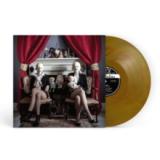
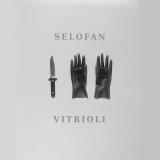
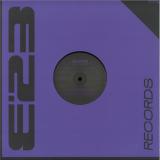
Marking the second 12” on new Bristol label Northfield is the enigmatic Dalibor Cruz of Chicago. Pathos Peristaltica is a carefully calculated collection of 7 twisted & scuzzed out beats & interludes, expertly mastered by Beau Thomas @ Ten Eight Seven Mastering.
Echoes of Muslimgauze, Beau Wanzer, Laszlo Hortobagyi, 5 Gate Temple & Pablo’s Eye run throughout Dalibor Cruz’s work. However it seriously sounds unlike anything else out there, a true original in electronic music.
Previous releases of Dalibor Cruz have been on Natural Sciences & Chicago Research.
Artwork designed by Guillaume De Ubeda.
Suche:second out
oma totem returns to Hivern Discs with the second EP in the exercicis ritmics series, volum 2. the EP features five tracks plus two digital bonus tracks, offering an extended deep dive into percussion, exploring accelerated and even more intricate rhythms. available as a limited edition with an outer sleeve printed at l'Anacronica, as well as a standard edition including an inner sleeve and inlay. artwork by juns castella mastered by dubplates mastering distributed via clone
UILTY RAZORS, BONA FIDE PUNKS.
Writings on the topic that go off in all directions, mind-numbing lectures given by academics, and testimonies, most of them heavily doctored, from those who “lived through that era”: so many people today fantasize about the early days of punk in our country… This blessed moment when no one had yet thought of flaunting a ridiculous green mohawk, taking Sid Vicious as a hero, or – even worse – making the so-called alternative scene both festive and boorish. There was no such thing in 1976 or 1977, when it wasn’t easy to get hold of the first 45s by the Pistols or the Clash. Few people were aware of what was happening on the fringes of the fringes at the time. Malcolm McLaren was virtually unknown, and having short hair made you seem strange. Who knew then that rock music, which had taken a very bad turn since the early 1970s, would once again become an essential element of liberation? That, thanks to short and fast songs, it would once again rediscover that primitive, social side that was so hated by older generations? Who knew that, besides a few loners who read the music press (it was even better if they read it in English) and frequented the right record stores? Many of these formed bands, because it was impossible to do otherwise. We quickly went from listening to the Velvet Underground to trying to play the Stooges’ intros. It’s a somewhat collective story, even though there weren’t many people to start it.
The Guilty Razors were among those who took part in this initial upheaval in Paris. They were far from being the worst. They had something special and even released a single that was well above the national average. They also had enough songs to fill an album, the one you’re holding. In everyone’s opinion, they were definitely not among the punk impostors that followed in their wake. They were, at least, genuine and credible.
Guilty Razors, Parisian punk band (1975-1978). To understand something about their somewhat linear but very energetic sound, we might need to talk about the context in which it was born and, more broadly, recall the boredom (a theme that would become capital in punk songs) coupled with the desire to blow everything off, which were the basis for the formation of bands playing a rejuvenated rock music ; about the passion for a few records by the Kinks or the early Who, by the Stooges, by the Velvet mostly, which set you apart from the crowd.
And of course, we should remember this new wave, which was promoted by a few articles in the specialized press and some cutting-edge record stores, coming from New York or London, whose small but powerful influence could be felt in Paris and in a handful of isolated places in the provinces, lulled to sleep by so many appalling things, from Tangerine Dream to President Giscard d’Estaing...
In 1975-76, French music was, as almost always, in a sorry state ; it was still dominated by Johnny Hallyday and Sylvie Vartan. Local rock music was also rather bleak, apart from Bijou and Little Bob who tried to revive this small scene with poorly sound-engineered gigs played to almost no one.
In the working class suburbs at the time, it was mainly hard rock music played to 11 that helped people forget about their gruelling shifts at the factory. Here and there, on the outskirts of major cities, you still could find a few rockers with sideburns wearing black armbands since the death of Gene Vincent, but it wasn’t a proper mass movement, just a source of real danger to anyone they came across who wasn't like them. In August 1976, a festival unlike any other took place in Mont-de-Marsan – the First European Punk Festival as the poster said – with almost as many people on stage as in the audience. Yet, on that day, a quasi historical event happened, when, under the blazing afternoon sun, a band of unknowns called The Damned made an unprecedented noise in the arena, reminiscent of the chaotic Stooges in their early adolescence. They were the first genuine punk band to perform in our country: from then on, anything was possible, almost anything seemed permissible.
It makes sense that the four+1 members of Guilty Razors, who initially amplified acoustic guitars with crappy tape recorder microphones, would adopt punk music (pronounced paink in French) naturally and instinctively, since it combines liberating noise with speed of execution and – crucially – a very healthy sense of rebellion (the protesters of May 1968 proclaimed, and it was even a slogan, that they weren’t against old people, but against what had made them grow old. In the mid-1970s, it seemed normal and obvious that old people should now ALSO be targeted!!!).
At the time, the desire to fight back, and break down authority and apathy, was either red or black, often taking the form of leafleting, tumultuous general assemblies in the schoolyard, and massive or shabby demonstrations, most of the time overflowing with an exciting vitality that sometimes turned into fights with the riot police. Indeed, soon after the end of the Vietnam War and following Pinochet’s coup in Chile, all over France, Trotskyist and anarcho-libertarian fervour was firmly entrenched among parts of the educated youth population, who were equally rebellious and troublemakers whenever they had the chance. It should also be noted that when the single "Anarchy in the UK" was first heard, even though not many of us had access to it, both the title and its explosive sound immediately resonated with some of those troublemakers crying out for ANARCHY!!! Meanwhile, the left-wing majority still equated punks with reckless young neo-Nazis. Of course, the widely circulated photos in the mainstream press of Siouxsie Sioux with her swastikas didn’t necessarily help to win over the theorists of the Great Revolution. It took Joe Strummer to introduce The Clash as an anti-racist, anti-fascist and anti-ignorance band for the rejection of old-school revolutionaries to fade a little.
The Lycée Jean-Baptiste Say at Porte d’Auteuil, despite being located in the very posh and very exclusive 16th arrondissement of Paris, didn’t escape these "committed" upheavals, which doubled as the perfect outlet for the less timid members of this generation.
“Back then, politics were fun,” says Tristam Nada, who studied there and went on to become Guilty Razors’ frontman. “Jean-Baptiste was the leftist high-school in the neighbourhood. When the far right guys from the GUD came down there, the Communist League guys from elsewhere helped us fight them off.”
Anything that could challenge authority was fair game and of course, strikes for just about any reason would lead to increasingly frequent truancy (with a definitive farewell to education that would soon follow). Tristam Nada spent his 10th and 11th unfinished grades with José Perez, who had come from Spain, where his father, a janitor, had been sentenced to death by Franco. “José steered my tastes towards solid acts such as The Who. Like most teenagers, I had previously absorbed just about everything that came my way, from Yes to Led Zeppelin to Genesis. I was exploring… And then one day, he told me that he and his brother Carlos wanted to start a rock band.” The Perez brothers already played guitar. “Of course, they were Spanish!”, jokes their singer. “Then, somewhat reluctantly, José took up the bass and we were soon joined by Jano – who called himself Jano Homicid – who took up the rhythm guitar.” Several drummers would later join this core of not easily intimidated young guys who didn’t let adversity get the better of them.
The first rehearsals of the newly named Guilty Razors took place in the bedroom of a Perez aunt. There, the three rookies tried to cover a few standards, songs that often were an integral part of their lives. During a first, short gig, in front of a bewildered audience of tough old-school rockers, they launched into a clunky version of the Velvet Underground's “Heroin”. Challenge or recklessness? A bit of both, probably… And then, step by step, their limited repertoire expanded as they decided to write their own songs, sung in a not always very accurate or academic English, but who cared about proper grammar or the right vocabulary, since what truly mattered was to make the words sound as good as possible while playing very, very fast music? And spitting out those words in a language that left no doubt as to what it conveyed mattered as well.
Trying their hand a the kind of rock music disliked by most of the neighbourhood, making noise, being fiercely provocative: they still belonged to a tiny clique who, at this very moment, had chosen to impose this difference. And there were very few places in France or elsewhere, where one could witness the first stirrings of something that wasn’t a trend yet, let alone a movement.
In the provinces, in late 1976 or early 1977, there couldn’t be more than thirty record stores that were a bit more discerning than average, where you could hear this new kind of short-haired rock music called “punk”. The old clientele, who previously had no problem coming in to buy the latest McCartney or Aerosmith LP, now felt a little less comfortable there…
In Paris, these enlightened places were quite rare and often located nex to what would become the Forum des Halles, a big shopping mall. Between three aging sex workers, a couple of second-hand clothes shops, sellers of hippie paraphernalia and small fashion designers, the good word was loudly spread in two pioneering places – propagators of what was still only a new underground movement. Historically, the first one was the Open Market, a kind of poorly, but tastefully stocked cave. Speakers blasted out the sound of sixties garage bands from the Nuggets compilation (a crucial reference for José Perez) or the badly dressed English kids of Eddie and the Hot Rods. This black-painted den was opened a few years earlier by Marc Zermati, a character who wasn’t always in a sunny disposition, but always quite radical in his (good) choices and his opinions. He founded the independent label Skydog and was one of the promoters of the Mont-de-Marsan punk festivals. Not far from there was Harry Cover, another store more in tune with the new New York scene, which was amply covered in the house fanzine, Rock News (even though it was in it that the photos of the Sex Pistols were first published in France).
It was a favorite hang-out of the Perez brothers and Tristam Nada, as the latter explained. “It’s at Harry Cover’s that we first heard the Pistols and Clash’s 45s, and after that, we decided to start writing our first songs. If they could do it, so could we!”
The sonic shocks that were “Anarchy in the UK”, “White Riot” or the Buzzcocks’s EP, “Spiral Scratch” – which Guilty Razors' sound is reminiscent of – were soon to be amplified by an unparalleled visual shock. In April 1977, right after the release of their first LP, The Clash performed at the Palais des Glaces in Paris, during a punk night organised by Marc Zermati. For many who were there, it was the gig of a lifetime…
Of course, Guilty Razors and Tristam were in the audience: “That concert was fabulous… We Parisian punks were almost all dressed in black and white, with white shirts, skinny leather ties, bikers jackets or light jackets, etc. The Clash, on the other hand, wore colourful clothes. Well, the next day, at the Gibus, you’d spot everyone who had been at this concert, but they weren’t wearing anything black, they were all wearing colours.”
It makes sense to mention the Gibus club, as Guilty Razors often played there (sometimes in front of a hostile audience). It was also the only place in Paris that regularly scheduled new Parisian or Anglo-Saxon acts, such as Generation X, Siouxsie and the Banshees, the Slits, and Johnny Thunders who would become a kind of messed-up mascot for the venue. A little later, in 1978, the Rose Bonbon – formerly the Nashville – also attracted nightly owls in search of electric thrills… In 1977, the iconic but not necessarily excellent Asphalt Jungle often played at the Gibus, sometimes sharing the bill with Metal Urbain, the only band whose aura would later transcend the French borders (“I saw them as the French Sex Pistols,” said Geoff Travis, head of their British label Rough Trade). Already established in this small scene, Metal Urbain helped the young and restless Guilty Razors who had just arrived. Guitarist for Metal Urbain Hermann Schwartz remembers it: “They were younger than us, we were a bit like their mentors even if it’s too strong a word… At least they were credible. We thought they were good, and they had good songs which reminded of the Buzzcocks that I liked a lot. But at some point, they started hanging out with the Hells Angels. That’s when we stopped following them.”
The break-up was mutual, since, Guilty Razors, for their part, were shocked when they saw a fringe element of the audience at Metal Urbain concerts who repeatedly shouted “Sieg Heil” and gave Nazi salutes. These provocations, even still minor (the bulk of the skinhead crowd would later make their presence felt during concerts), weren’t really to the liking of the Perez brothers, whose anti-fascist convictions were firmly rooted. Some things are non-negotiable.
A few months earlier (in July 1978), Guilty Razors had nevertheless opened very successfully for Metal Urbain at the Bus Palladium, a more traditonally old-school rock night-club. But, as was sometimes the case back then, the night turned into a mass brawl when suburban rockers came to “beat up punks”.
Back then, Parisian nights weren’t always sweet and serene.
So, after opening as best as they could for The Jam (their sound having been ruined by the PA system), our local heroes were – once again – met outside by a horde of greasers out to get them. “Thankfully,” says Tristam, “we were with our roadies, motorless bikers who acted as a protective barrier. We were chased in the neighbouring streets and the whole thing ended in front of a bar, with the owner coming out with a rifle…”
Although Tristam and the Perez brothers narrowly escaped various, potentially bloody, incidents, they weren’t completely innocent of wrongdoing either. They still find amusing their mugging of two strangers in the street for example (“We were broke and we simply wanted to buy tickets for the Heartbreakers concert that night,” says Tristam). It so happened that their victims were two key figures in the rock business at the time: radio presenter Alain Manneval and music publisher Philippe Constantin. They filed a complaint and sought monetary compensation, but somehow the band’s manager, the skilful but very controversial Alexis, managed to get the complaint withdrawn and Guilty Razors ended up signing with Constantin with a substantial advance.
They also signed with Polydor and the label released in 1978 their only three-track 45, featuring “I Don't Wanna be A Rich”, “Hurts and Noises” and “Provocate” (songs that exuded perpetual rebellion and an unquenchable desire for “class” confrontation). It was a very good record, but due to a lack of promotion (radio stations didn’t play French artists singing in English), it didn’t sell very well. Only 800 copies were allegedly sold and the rest of the stock was pulped… Initially, the three tracks were to be included on a LP that never came to be, since they were dropped by Polydor (“Let’s say we sometimes caused a ruckus in their offices!” laughs Tristam.) In order to perfect the long-awaited LP, the band recorded demos of other tracks. There was a cover of Pink Floyd's “Lucifer Sam” from the Syd Barrett era – proof of an enduring love for the sixties’ greats –, “Wake Up” a hangover tale and “Bad Heart” about the Baader-Meinhof gang, whose actions had a profound impact on the era and on a generation seeking extreme dissent... On the album you’re now discovering, you can also hear five previously unreleased tracks recorded a bit later during an extended and freezing stay in Madrid, in a makeshift studio with the invaluable help of a drummer also acting as sound engineer. He was both an enthusiastic old hippie and a proper whizz at sound engineering. Here too, certain influences from the fifties and sixties (Link Wray, the Troggs) are more than obvious in the band’s music.
Shortly after a final stormy and rather barbaric (on the audience’s side) “Punk night” at the Olympia in June 1978, Tristam left the band ; his bandmates continued without him for a short while.
But like most pioneering punk bands of the era, Guilty Razors eventually split up for good after three years (besides once in Spain, they’d only played in Paris). The reason for ceasing business activities were more or less the same for everyone: there were no venues outside one’s small circuit to play this kind of rock music, which was still frightening, unknown, or of little interest to most people. The chances of recording an LP were virtually null, since major labels were only signing unoriginal but reassuring sub-Téléphone clones, and the smaller ones were only interested in progressive rock or French chanson for youth clubs. And what about self-production? No one in our small safety-pinned world had thought about it yet. There wasn’t enough money to embark on that sort of venture anyway.
So yes, the early days of punk in France were truly No Future!
- 01: Feel Like Dancing
- 02: Thicker Than Water
- 03: A Message From The Meters
- 04: Catch This
- 05: Fussy Girl
- 06: Cool And Deadly
- 07: The Life
- 08: Keep Your Step
- 09: Make It Reggay
- 10: Behind My Shoulders
- 11: Stormy Weather
- 12: We Shall Overcome
Killer Groove Records proudly presents "Keep Your Step", the explosive comeback by Italian rock steady & early reggae ambassadors The Appetizers, a soulful celebration of reggae's timeless spirit.
"Keep Your Step" marks the band's much-awaited return, landing April 10th on limited edition LP, CD digipack and digital format featuring two exclusive bonus tracks.
The Appetizers deliver a masterclass in roots reggae music with their highly anticipated second studio album, bridging Jamaica's golden age with contemporary relevance. "Keep Your Step" is a heartfelt sonic journey where the band blends rocksteady and early reggae with funk and soul influences to create a sound that's both genuine and refreshingly modern.
The fourteen tracks move fluidly between infectious dancefloor fillers and socially conscious lyrics. From the laid-back swing of "Feel Like Dancing" to the hypnotic rhythm of "Thicker Than Water", the band demonstrates their versatility while remaining true to the roots of Jamaican sound. "A Message from The Meters" pays tribute to the legendary funk pioneers, while the instrumental "Catch This" and "Make It Reggay" highlight the band's musical prowess and the deep connections between reggae and funk.
Meanwhile, tracks like "Fussy Girl" and "Behind My Shoulders" explore love's complexities with humor and soul. The album's heart lies in its social consciousness. "Cool and Deadly", "The Life", "Stormy Weather" and the album title track "Keep Your Step" tell stories of perseverance through life's struggles.
With the hopeful anthem "We Shall Overcome," The Appetizers deliver a timely message about genuine human connection in a social media-dominated era. The digital edition closes with "Get Some Rollin'" and "Swing and Sway," rounding out the journey with two additional gems.
"Keep Your Step" pays homage to Jamaican music legends, from Jackie Mittoo and Tommy McCook to Toots & the Maytals, while carving out The Appetizers' own distinctive sound. This is a groove made for both the dance floor and the soul, proving that reggae's power to inspire, unite, and uplift remains as vital as ever.
The production stays true to The Appetizers' signature sound: organic tones, deep groove, and that live-room vibe you only get when real musicians are locked in together. Luca Monza and Claudio Mambrini, the band's core members, handled the artistic production. Mastering came courtesy of the great JJ Golden (Black Pumas, Sharon Jones & The Dap-Kings, Jr. Thomas & The Volcanos, The Frightnrs) at Golden Mastering in Ventura, California. JJ is one of the most trusted engineers working in this sound, ensuring every ounce of warmth and authenticity came through.
The Appetizers are a rocksteady and early reggae band formed in Milan in 2020 by musicians deeply embedded in the Italian and international reggae scene. Musicians from different paths united by a shared vision: recreating that vintage Caribbean and American sound with authenticity, respect and a forward-thinking edge.
Drawing inspiration from Jamaica's golden era and channeling the soul of Delroy Wilson, Alton Ellis, the early Wailers, and The Upsetters, The Appetizers carry forward the essence of bass culture with a pure, fully organic approach.
Their debut album Listen Up! (2022), released via Belgian imprint Badasonic Records (home to The Slackers, The Aggrolites, David Hillyard & Victor Rice), featured ten original tracks and a dub cut by Victor Rice. Distributed across Europe, the UK, the US, and Japan, it quickly earned international recognition among reggae connoisseurs and selectors worldwide.
Following extensive touring, including shows with The Slackers, Black Uhuru, Skip Marley, and more, the band returned to the studio to record "Keep Your Step", their second album produced by Killer Groove Records. Here the band expands its musical language, weaving together the spirit of historic Jamaican labels like Studio One and Treasure Isle with '60s funk, arriving at a warm, organic, and timeless sound: soul, Jamaican roots, and modern sensibility in perfect balance. Their lyrics explore heartbreak, social issues, and reflections on life and music, performed with dedication and respect for tradition while always pushing forward.
If you're into The Skatalites, The Ethiopians, and those classic Caribbean rhythms, this one's for you.
2025 Reissue.
Münchenbuchsee, a suburb of Bern, Switzerland. Stephan Eicher is the youngest of three children. His father, a radio and TV repairman, is also a jazz violinist and a sound tinkerer in his spare time. In the family home's converted fallout shelter turned studio, Mr. Eicher experiments with homemade sequencers, tortures handcrafted drum machines, and abuses reel-to-reel tape recorders—all under the fascinated gaze of young Stephan.
The boy quickly develops a musical curiosity, exploring sound through various experiments and wanderings. Alongside his younger brother Martin, Stephan crafts audio plays on a homemade multi-track recorder (essentially several cassette decks hooked together!), which they write, record, add sound effects to, and perform for family and friends. Just a couple of nice kids, really...
Then comes 1972, and Lou Reed's Transformer album changes everything for the Eicher kids. For 13-year-old Stephan, it's a revelation—especially "Vicious", the opening track, which he plays on repeat for months. He convinces his father to buy him an electric guitar. Not stopping there, his father also builds him a tube amp using an old radio.
Then comes adolescence. A rough one. Stephan leaves home at 16 and moves to Zurich. With obvious artistic talent, he persuades his art teacher to help him get into F+F, a radical, alternative art school—despite his young age. Accepted, he starts learning video techniques, determined to become a filmmaker.
At F+F, Stephan organizes Dada-style happenings and concerts with a group of friends known as the Noise Boys. Among them: one of his teachers on bass, Veit Stauffer on drums (who would later found ReR/Recommended Records), his girlfriend Sacha on vocals, and Stephan on guitar. In one of their early performances, they release a remote-controlled mouse covered in dull razor blades into the audience to create panic and chaos. Keeping with this aggressive, confrontational spirit, they once played a concert while wearing headphones blasting Tristan and Isolde, trying to perform their own songs simultaneously—to maximize the cacophony. The goal was always the same: clear the room.
Their “songs,” if you can call them that, followed suit. Take "Hungeriges Afrika", for instance—performed entirely with power drills and some drum feedback.
To make ends meet, Stephan returns to Bern on weekends to work as a waiter at the Spex Club, the city’s main punk venue. On September 16, 1980, during a show by proto-electro group Starter, the police raid the club and arrest everyone. Stephan, who manages to avoid arrest, seizes the opportunity to “borrow” Starter’s gear left behind. He suddenly finds himself in possession of a Roland Promars synth, a Korg MS20, and a gorgeous CR78 drum machine, which he runs through a Big Muff distortion pedal to get that perfect gritty sound.
He then sets out to reinterpret some Noise Boys tracks, reworking them during impromptu sessions recorded on a dictaphone (yes, a dictaphone—now the lo-fi sound makes more sense, doesn’t it?). He ironically titles the resulting cassette "Stephan Eicher spielt Noise Boys" ("Stephan Eicher plays Noise Boys"). This gem features seven tracks, which are the ones reissued here.
Back in Zurich, he visits his friends Andrew Moore and Robert Vogel, who have a DIY cassette duplication setup. They make 25 copies of Stephan Eicher spielt Noise Boys for Stephan and his friends. Robert encourages him to visit Urs Steiger of Off Course Records and play him the tape.
Without much hope, Stephan shows up at Urs’s office. But Urs is instantly hooked and suggests releasing a 7” single. Due to space constraints, they reluctantly drop two of the seven tracks ("Hungeriges Afrika" and "One Second"). As for the musical score featured on the cover—it was randomly chosen and remains a mystery to this day. Calling all music theory nerds!
The 7-inch is pressed in 750 copies and released in the first week of December 1980—a date Stephan remembers well, as it’s the same week John Lennon was killed. Smartly, Urs sends a promo copy to François Murner, Switzerland’s answer to John Peel, who hosts a show on alternative station Sounds. Murner falls in love with the record and starts giving it airtime. To Stephan’s surprise, sales follow—and people actually seem interested in his music.
Even this modest underground success scares Stephan a bit. He stops making music for a year and moves to Bologna, where he works as a programmer at Radio Città, a feminist radio station.
Meanwhile, Stephan’s younger brother Martin, who’s also involved in the punk scene, joins the band Glueams as a singer and guitarist. Glueams, named after the fanzine run by two of its members (drummer Marco Repetto and bassist GT), eventually rebrands as Grauzone. Stephan is invited to their shows to project hacked Super 8 visuals live on stage.
Urs Steiger, now working on a compilation titled Swiss Wave – The Album, asks Grauzone to contribute alongside bands like Liliput, Jack and the Rippers, The Sick, and Ladyshave (Fall 1980).
For the album, Martin tasks Stephan with producing their recording sessions. Under Stephan's artistic direction, two tracks emerge: "Raum" and "Eisbär". During "Eisbär", Martin plays a minimalist bass line borrowed from post-punk band The Feelies (just an open string). Drummer Marco Repetto struggles to keep time. Later that evening, unhappy with the takes, Stephan builds a four-bar drum loop from a ¼-inch tape and uses it instead of the flawed original. He then adds bleepy synths and wind sounds to complete the track’s icy vibe before handing it over to Urs.
The Swiss Wave – The Album compilation is released quietly at first, but things snowball thanks to "Eisbär", which eventually becomes a smash hit—selling over 600,000 singles.
Meanwhile, Stephan plays in a rockabilly band called SMUV (named after Switzerland’s social security agency) and begins producing artists, including the debut album of Starter (1981), which includes a more pop-oriented version of "Minijupe".
By early 1982, Stephan starts spending time with the post-punk girl band Liliput (formerly Kleenex). They’re older than him, and he happily drives them around in his Renault Major, acting as their roadie.
By 1983, Grauzone—signed to the major label EMI, which turned out to be a misstep—is falling apart. Stephan begins to pivot toward a more mainstream pop sound with his debut solo album Les Chansons Bleues.
But that... is already another story.
As Nathan Fake rises from the nocturnal subterranea and rave catharsis of his previous records, on Evaporator, he resurfaces into the domain of daylight, bringing a tangible sense of air rushing against your face, of big skies, and endless landscapes.
The idea of pop accessibility that trickled into 2023’s Crystal Vision is refracted here through the prism of sweeping ambient, deep electronica, and trance uplift. Evaporator is Fake’s idea of “airy daytime music”, with each track a different barometer reading across the album’s varying atmospheres, which range from vibrant sunbursts, bracing rainscapes, and fine mists of clement melodics. “It’s not overtly confrontational electronic club music,” states Fake. “It’s quite pleasant, it’s accessible. As I was progressing through making the tracklist, I called it a daytime album. It doesn’t feel like an afterparty album.” For the past decade Fake has been gingerly introducing collaborations with heroes and friends alike into his lone, idiosyncratic working process.
Border Community alumni Dextro AKA Ewan Mackenzie transmutes his ferocious drumming for Pigs Pigs Pigs Pigs Pigs Pigs Pigs into the blurred choral thump of ‘Baltasound’. ‘Orbiting Meadows’, meanwhile, is his second collaboration with Clark, an eerily idyllic duet where microtonal 18EDO piano clangs slowly twirl around wailing pads. Evaporator marks the junction point of old technology and ever fresh creativity for Nathan. The trusty “dinosaur” age software, particularly Cubase VST5, that has powered two decades of music is rarely updated. “I used to sort of feel a bit ashamed of using such old software, and then I kind of had an epiphany – that’s just how I work”, comments Fake. “That’s just how I play. I’m very fond of these old tools, and I get the most joy out of them, but now I’ve incorporated new technology too.” When an artist accumulates so much synergy with their instrument, music making becomes instinctual. By Fake’s account, much of Evaporator just fell into place. The album title arrived randomly in his head (“it felt completely perfect. Airy.”), ideas looped and developed until things locked into place and just felt right. ‘The Ice House’ is a fleeting glimpse of the sonic world he taps into in this creative state, its glassy FM synths built around a counterpoint between rough-hewn crystalline arpeggios and sparse yet gravitas-bearing bass. “That riff I just wrote out on the keyboard, I just played it forever and ever and ever.
The original track ended up being really short. Here you go, and it’s gone!” These unplanned channellings of sound call forth records from Fake’s past while he looks ahead, perhaps getting at the very essence of his musicianship. The opener ‘Aiwa’ (“the breeziest,” he muses) reminds of the introspection that characterised Providence, excited by the fire and grit of Steam Days’ textural experiments, its chunky slams and clatters surging into a flood of harmonic buzzing as they reach out for old wisdom. ‘Hypercube’ stampedes in a similar chronological confluence, infusing an incessant synth line reminiscent of the golden age of rave with the crackling, ecstatic energy of modern festival anthems. Like the vaporisation of liquid to particles, everything that Evaporator presents has a mutant desire to be amorphous. Sounds rarely settle; the irradiated garage beat of ‘Bialystok’ is pitched downwards to driving, rebounding effect, while ‘You’ll Find a Way’ warps static into shivering energy, cinematic synth strings building anticipation into a gradual gush of chords. This translates into a more expansive stereo field than Fake has explored before.
‘Slow Yamaha’ saves the wildest, most kinetic transformations for last with a cornucopia of crispy melodies and fried drums; a sibilance of cymbals on the left, a susurrus of shakers on the right, and kaleidoscopic lasers pulsing and fizzing all around. Evaporation culminating in pure excited atoms.
- 1: 23
- 2: Cross My Heart
- 3: Downtown Lover
- 4: All Bad Parts
- 5: Maybe Not Tonight
- 6: Body
- 7: Lifestyle
- 8: Undressed
- 9: Always Talking About You
- 10: Do You Know What I'm Thinking
Brighton four-piece Lime Garden return with their self-reckoning second album 'Maybe Not Tonight' So Young Records (the record label launched by So Young Magazine).
'Maybe Not Tonight' unfolds as a full night out, charting the pleasures and perils of partying and impulsive decisions.
Vocalist and guitarist Chloe Howard says: “The album is about a night out, from start to finish. As the night progresses, you’re having a great time, until your ex walks in with someone else. You hate the way you look but rather than going home, you press the big red button and get even more drunk. Eventually, you take yourself home full of melancholy, chaos and anger.”
Following their critically acclaimed 2024 debut 'One More Thing', which captured the raw live energy that earned them slots at festivals including Glastonbury and Green Man, Maybe Not Tonight sees Lime Garden expand their signature “wonk-pop” sound upwards and outwards. The result is their most intoxicating and luminous material to date.
Vivel is Alexander Eldefors’ second release under his own name. Built around eurorack and field recordings, many captured during still moments while traveling to visit family and friends. The album was created during a period of transition. It functions as an anchor in a time of change, representing a sense of home, safety, and stillness.
Alexander Eldefors is a producer, composer, and mixing engineer based in the countryside outside of Stockholm, Sweden. With a background as both a sound engineer and musician, he has spent years recording, mixing and playing in a wide range of bands and solo projects. In 2019, he consciously slowed down and returned to a more intimate and quiet musical expression, leading to the release of his debut album Bergen in 2020 under his own name. Bergen is the Swedish word for mountains and reflects the fact that Alexander grew up in the north of Sweden close to the mountains.
His music is minimalistic, melodic, and embracing, shaped by a deep connection to nature. Natural environments are a constant presence in his work, serving both as inspiration and as a sound source. Alongside this, he is drawn to the raw textures of everyday objects, working with foley sounds and field recordings. His arrangements unfold as organic sound collages, where elements blend freely and imperfections are preserved to maintain a natural, human feel.
L. Jacobs releases his second album, Behind the Great Curve, on the Belgian label Blickwinkel. Featuring contributions from Milan W., Sarah Yu Zeebroek, and Joachim Badenhorst, the follow-up to the surprising debut Enthusiasm was initially composed and recorded in Jacobs’ small attic room and later refined at Milan W.’s Van den Nest Studio, where W. also handled production and mixing.
A line or outline which gradually deviates from being straight for some or all of its length.
Behind the Great Curve explores and celebrates the beauty and universality of the abstract notion above and what we commonly refer to as the curve. Its presence, allegedly, is everywhere. It is a form that appears visually, mathematically, and symbolically — a line that suggests motion, time, expectation, and impermanence.
This album aims to listen to all of this — the poetry, the irony, and the faint background hum of modern life — with quiet curiosity. Within a gently meandering, synthesized landscape, a collection of dreamlike compositions unfolds: delicate melodies, sparse percussion, warm buzzing synths, and fragments of field recordings coexist in carefully measured imperfection. Colorful yet minimal in aesthetic, the album does not seek to explain the curve, but to follow it.
- 01: The Sun
- 02: Smell Of Fire
- 03: Cumulus &Amp; The Subterranean
- 04: Wild Things
- 05: Grasping All Corners
- 06: Metamorphosis
- 07: Five Cent
- 08: Deep Woods
Following the strong reception of their second album, Totem of Quiet Mystic (2023) Jiyu have earned praises from outlets such as Jazzwise, Enlace Funk and The Chillout Tent, as well as support from a wide range of iconic DJs including Patrick Forge & Chris Coco. The singles to this new album, Cumulus & the Subterranean, Smell of Fire and Deep Woods, have immediately been embraced—drawing glowing reactions and airplay from dj's like, Phil Cooper, Dj Vadim, Fred Everything, David Patterson, Jon Kennedy and Curtis Colin
On this third album from Jiyu, the Copenhagen band stretch their cosmic–spiritual jazz language into deeper, wilder terrain. Dropping April 10th on vinyl and digital via Dubsoul Records, the record captures six musicians in full telepathic flight, recorded at 12 Ton Studio in Copenhagen. Across eight tracks, elastic basslines, jazz-dub-soul—tinted drums and percussion, Wurlitzer and jazz-guitar glow and flute-swept atmospheres drift between grounded groove and open-sky improvisation, while guest vocalist Mai Lan Doky adds dreamlike textures on Cumulus & the Subterranean. From the shuffled broken-beat pulse of Smell of Fire to the slow-burn haze of Deep Woods, the Wild Things album is a rich analogue-soul excursion—earthy, exploratory and tuned to the outer frequencies.
66 pages, 175 x 129mm paperback w/ litho printed cover & french flaps.
The second outing for our short run book publishing imprint, The End books, takes the form of a reprint of Spanish Cante Jondo and Its Origin in Sindhi Music, originally published in Spanish in 1955 under the name Cante Jondo: Su Origen y Evolución and later in this English translation.
Aziz Balouch here presents his theory on the roots of flamenco's 'deep song' in modern-day Pakistan, a cultural journey that mimics the routes of his own life, having been brought up among the Islamic mysticism and devotional songs of Sindh before travelling to Gibraltar in the early 1930s and becoming transfixed with the cante jondo across the border in southern Spain. Positing this concept through personal accounts rather than solid theoretical backing, this text provides a valuable account of an extraordinary existence that crossed remarkable geographical, musical, and spiritual boundaries. Issued here with a new introduction from anthropologist of sound, the senses and Islam, Stefan Williamson Fa.
"It would be easy to place Balouch on the fringes, as an eccentric footnote in flamenco history. But that misses the shape of his life and work. He was a figure who moved intuitively across boundaries that our present categories of nation, genre, discipline tend to fix in place. His work predates the founding of the academic discipline of ethnomusicology, the global circuits of world music, and the marketplace logic of fusion projects by decades. He was not an ethnographer or a proto–world musician, but someone for whom the deep song of Andalusia and the devotional song of the subcontinent resonated along the same fault lines of feeling, and who spent his life trying to trace them.
This book is one of the few surviving traces of that attempt. To read it now is to encounter a perspective that resists tidy narratives of influence or origin, despite its title and what he claims to do. It stands instead as evidence of an idiosyncratic musical imagination, one that relied less on proof than on listening, and on the belief that certain echoes carry farther than history can easily explain."
— Stefan Williamson Fa
- Pon De Dungle
- Equatorial Forest
- Brothers On The Slide
- Changes
- Breezeman
- Promised Heights
- Losin' Ground
- Leavert
- The Recluse
- Sheshamani
2024 marked the 50th anniversary of Cymande’s ‘Promised Heights’, a record that closed out an historic three album run of seminal early 1970s Afro-soul that also included their 1972 self-titled debut and 1973’s ‘Second Time Round’
Promised Heights’ solidified Cymande’s place in music history and contains some of their most- beloved and often-sampled tracks such as ‘Brothers On The Slide’.
As children of the Windrush Generation, Cymande were part of the first wave of innovators and originators of the fledgling Black British music scene.
Taking influences from their Guyanese and Jamaican roots, the band fused reggae basslines, Afro-tinged Nyabinghi percussion, psychedelic rock touches, and American style funk instrumentation into a unique sound they dubbed as ‘Nyah-rock’.
‘Promised Heights’ was recorded following the band’s US tour with Al Green, which had firmly planted Cymande in the ears of an adoring American audience.
It's 5 AM. The golden hour. That moment suspended on the lips of the night that is leaving us. Where the dance still refuses to die as sweat dries, bodies float and minds drift. Some immerse themselves in the dripping surroundings while others emerge or pretend. Outside, nature reclaims its rights. When the moon sets over Kizipolis, the music doesn't stop: it transforms us.
To celebrate our 10th anniversary, the pillars of the label were invited to compose the track they would play at this precise moment. The one that no longer seeks to prove itself, that accompanies the ebb of shadows, connecting the senses to the light.
Kizipolis Vol.1 is the soundtrack to an imaginary but familiar city, a city where raving is a way of life, where music acts as a climate, where at 5am, anything is still possible.
- Giftet Sprider Sig
- Vinster
- Ignorans
- Allt Raseras
- Ekorrhjulet
- Nedmontering
- Ingen Forandring
- Vaggarna Rasar
- Helvetet Pa Jorden
- Logn Blir Sanning
- Dom Snackar
I'm very excited to present the second Desolate release from this amazing band. "Dissekerad's newest and strongest 12" release yet. 12 new songs from a now-classic modern band made up of Swedish scene vets, all having put in their time in many other now- legendary acts: from TOTALITAR to MAKEBERT FYND, AVSKUM to BRAINBOMBS, and many more. Poffen's bands alone are probably too numerous to name at this point. VAGGARNA RASAR gives us exactly what we expect and hope for--a master class of Swedish mangel HC distilled to its most essential and purest form. Somehow the songs feel even more urgent this time, paired with fuller, thicker production than previous releases. The blown-out, contrasted-to-hell artwork perfectly represents the music, with song titles on the front cover because why not; fuck it. Time marches on and so does hardcore, but some things don't need to change.
A cocktail of rebellious queer vocal fragments, deceptive percussive granules and swaying hammered vibrations, upsammy and Valentina Magaletti's first collaboration trembles with suspense. The seeds of 'Seismo' were sown following a commission from Amsterdam's Rijksmuseum to soundtrack an exhibition of work from the Museum Boijmans van Beuningen in Rotterdam and the duo didn't want to approach their collaboration flippantly. So, wandering the museum's maze of rooms, they recorded various improvised percussive sounds with their arsenal of microphones, using the space to inform various rhythms and textures that were sculpted later into electroacoustic vignettes. This was just the starting point, though; as Magaletti and upsammy began performing together, the project evolved and 'Seismo' began to take shape. The duo had struck on a salient aesthetic concept, using mostly digital and acoustic mallet instruments to blur the boundary between their roles and create friction between the synthetic and the authentic. And the finished record is a phantasmagoric push-and-pull between its various conflicting elements: harmony and dissonance, randomness and predictability, openness and constraint. 'Seismo' isn't the first time that upsammy has studied her environment in search of revelation. On her acclaimed second album, 2024's 'Germ in a Population of Buildings', the Amsterdam-based DJ, producer and multidisciplinary artist erected her complex, unorthodox rhythms and eerie melodies around a modernist frame of field recordings collected in various cityscapes, countering heavyweight basslines with subtle, microscopic sounds. London-based Italian vanguard Magaletti, meanwhile, has applied her unique logic to innumerable projects at this point, working with everyone from batida icon Nídia and hardcore-dub outfit Moin to French writer Fanny Chiarello and British bass scientist Shackleton. For years she's approached the drums with criticism, attempting to challenge any preconceptions, something that's most visible on 2020's 'A Queer Anthology of Drums'. And both artists' thoughtful perspectives are welded together seamlessly on 'Seismo', a dizzying suite of eight eccentric statements that's fragile but never insecure, gauzy but not indistinct. An unnerving sense of space characterizes 'It Comes to an End' as Magaletti's in situ improvisations herald for upsammy's microscopic glitches and chiming pitch-bent melodies. It's almost unbalancing to witness the track's impossible dimensionality, the interplay between reverberant marimba hits and bone-dry synths, or percussion that's been recorded and processed in consciously different settings. A new architecture emerges in the sound itself that the two artists scan and explore meticulously, testing its boundaries with undulating hybridized rhythms on the invigorating 'Superimposed' and offsetting the powdery drums with liquified smacks and alien voices. The duo's vibrations are knotted with piano flourishes on 'Hyperlocalize', balanced with artificial clanks and clangs that disappear into the track's sonorous atmosphere, replaced by whispers and half-hallucinated insectoid chirps. 'Seismo' is an album that feeds off the energy generated by its juxtapositions: the tension and anticipation that's melted by rapid, hyperactive movement and the finely drawn rhythms disrupted by a layer of indistinct, barely perceptible microsounds. It's a collaboration that sounds like two minds challenging each other but not wrestling, each peering from their own distinct vantage point and imagining a third landscape shaped by optimistic, queer vibrations.
- A1: Live From Mumbai
- A2: No Other Than
- A3: Powerman & Iron Fist (Fighting Without Fighting Version)
- A4: The Sure Shot!
- B1: Fresh Like Dougie
- B2: How To Cut & Paste (Lesson 1)
- B3: Audobahn
- C1: All Out War
- C2: Break Down
- C3: Golden Crown (Feat. Oxygen)
- D1: Fashion Plate
- D2: Sister Of Phyllis Diller
- D3: Heroes Of The East (Feat. Paten Locke)
- D4: The Pack Up (Part 3)
Cassette Box Set[38,87 €]
AE Productions in association with Sure Shot Recordings and In Effect Recordings are pleased to announce a 10 Year Anniversary Edition of the critically acclaimed Phill Most Chill and Paul Nice album as the Fabreeze Brothers.
The hugely successful first edition which was pressed on colour vinyl and supplied in double fold out sleeve sold out in only 2 weeks from release date and then the 2nd pressing black vinyl edition sold out a little while later but has for years been out of print but is increasingly requested by shops, via email, social media, AE Productions website back in stock requests, etc…
As it has been 10 years since original release back in 2015 at the time of proceeding with manufacturing, it was the perfect opportunity to do a 3rd pressing to mark the anniversary but we had to pull out all the stops for a 3rd run of this incredible album and also make it subtly different again in packaging design from the 1st and 2nd pressings so that each has it’s own particular feel and quality.
With help from the original designer and all-round vinyl artwork supremo Mr Krum we have found some nice adjustments for the gatefold sleeve where the detail from the insert sheet found in the original issues is incorporated into the inside panels of the sleeve. We have also tweaked the hype sticker to mark the 10th Anniversary Edition and updated the vinyl labels so as to work better with the new Splatter vinyl which follows the original red and yellow vinyl but each splattered with the opposite colour.
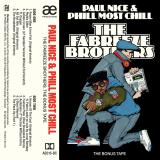
For something a little extra we have compiled a Limited Expanded Edition Double Cassette Box Set that includes the original album and also a ‘Bonus Tape’ which features all of the remixes, alternate versions, Original Versions of album cuts and bonus tracks found on B-sides of the array of singles and we included for good measure 2 tracks that only appeared on the promotional only LP sampler that ended up being different on the final release. This is limited to cassette just for the non-vinyl heads as all of these tracks already appear on vinyl. The outer box is A5 card in black with gold foil Fabreeze Brothers logo and comes with discography booklet.
‘The Bonus Tape’ from the box set is also available as a standalone cassette release with alternate j-card art work so that it has it’s own flavour and so that anyone that purchased one of the original run of cassettes that sold out before we could even ship any copies, did not need to purchase the main album again unnecessarily and to make it noticeable from the Expanded Edition Box Set version.
This version also has an alternate shell design in keeping with the clear shell with dark liner that was commonplace back in the 90’s and the cassette geeks may note the red text on the spine as was also a common design back then – giving this a pseudonym of ‘the 90’s tape’ during the design process.
We couldn’t stop there so we also have an extremely low quantity Limited Edition Mini Disc version which is the main album plus 8 of the bonus tracks from The Bonus Tape – only missing the 2 least significant alternate versions but clocking in at just a few seconds under 80 minutes – the absolute maximum for the format! Mini Disc???!!! You’re probably asking – yes!
While looking into the cassette duplication options we realised that the duplicator also offers Mini Disc production so we thought that it may be worth doing a very small run just because not only are professionally manufactured Mini Disc’s rare in Hip Hop, they are rare within the entire music industry as they never really took off as a medium to purchase music but ended up as the choice for home recorded Walkman and car use. Indeed, AE boss Mr Fantastic still has his main machine, portable and old discs. Amazingly also, the sleeve artwork transferred brilliantly to the Mini Disc template. They are manufactured using high quality Sony discs using ATRAC 4.5 codec.
All releases are supplied with unique free download codes on cards that are included inside the packaging but also with the Expanded Edition cassette and Mini Disc having 2 cards – 1 for the main album and a 2nd card for ‘The Bonus Tape’. The free downloads are supplied direct from Phill Most Chill’s Bandcamp page keeping it independent.
The earliest foundations of the Detroit Harmony group ‘The Gaslight’ came when future lead singer Oliver “Butch” Cheatham via an introduction by his sister Jackie joined a group known as ‘The Young Sirs’ who recorded, “There’s Something The Matter (With Your Heart/African Love” for Magic City during 1969. The group included Oliver’s future brother -in-law Allen Cocker (Jackie’s future husband).
Oliver and Allen went on to form a new vocal quartet with Curtis “Kippy” Anderson and Michael Eatmon. Under the group name of ‘The Gaslight’ they signed to Uptight Productions Incorporated, a local production company founded by local businessmen Marvin Figgins and Arnold Wright. The Gaslight were the only vocal harmony group signed to Uptight Productions and as such, it was they who made the most recordings across two label imprints Grand Junction and Black Rock. The Gaslight’s first single “I Can’t Tell A Lie/Here’s Missing You” was released on Grand Junction (GJ1001) in 1970, For the groups second single Figgin’s placed them under the guidance of legendary producer/songwriter, the late George McGregor under whom they recording “Drifting Away/If You See Her” Grand Junction (GJ1002) released in 1971 For their next release Figgin’s switched the group to his Black Rock label to record “Out Of My Hand/I’m Only A Man” Black Rock (2002) under the pseudonym of Butch & The Newport’s With “Butch” being Oliver’s nickname. A later, second release of “I’m Only A Man” but with a different flip side “I’m Gonna Get You” came out on Grand Junction (GJ1100) in 1973 with the performing artist credits reverting back to ‘The Gaslight’.
Upon leaving Uptight Production’s the group found a new home when George McCregor took them to a new fledgling label T.E.A.I (an abbreviation for “Tellin’ Everybody About It”) owned by ‘The Dramatics’ Road Manager Charles Underwood. ‘The Gaslight’s’ first and only release for T.E.A.I, was the mellifluous 1975 double sider “Just Because Of You/It’s Just Like Magic”. Underwood had precured a working relationship with Polydor Records who picked the release up for national distribution three months later. As good as the record was due to poor promotion it failed to make any notable noise and eventually sank with the group soon after breaking up.
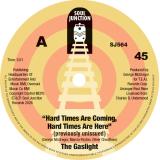
During Soul Junction’s later dealings with the late Oliver Cheatham, respected UK Collector Andy Rix mentioned he owned a three track acetate containing the two mentioned T.E.A.I/Polydor tracks plus a third unissued dance track “Hard Times” which through a licensing deal with Charles Underwood Soul Junction now present to you on a three track 45, released under its full title “Hard Times Are Coming, Hard Times Are Here” backed with a previously unissued mix of “Just Because Of You” alongside the issued 45 version of “It’s Just Like Magic”.
Silicon Scally and Fleck E.S.C. need no introduction at this stage. Both artists are veterans not just of Sheffield's Central Processing Unit label but of modern electro as a whole, with the pair having decades of skin in the game at this point. Their new release, a four-track EP entitledSlipwhere Silicon Scally handles the first half and Fleck E.S.C. the second, carries itself with the adventurous confidence of a record made by masters of their craft.
Slipopener 'Phased Array' is exactly the kind of top quality machine-funk tackle you'd expect from this meeting of minds. The beat programming is deliciously tactile from the off, hissing and clanking like machinery in an old Detroit factory. The feel of 'Phased Array' is altered, though, when the chords come in, a series of alternating floating sounds which give the track an altogether eerier feel. When all of this is coupled with the otherworldly synth blurts that periodically force their way to the front of the track, the overall effect is a piece of real depth assembled by an expert practitioner.
'Phased Array' is followed up by 'Stax', another brilliantly propulsive number. Here we find the drum beat - one which is a little reminiscent of that Kraftwerk tune about the numbers, no less - once more offset by some decidedly more shadowy synth work, all while arpeggiated keyboard licks work against an intricate web of basslines, chords and unidentifiable flying synth tones.
Fleck E.S.C. opens theSlipB-side with 'Good Ride', a number where the nudge-wink title is borne out by a track built around looped snippets of sighing vocals. That said, with a bassline that sounds like a blurting old landline telephone, a ghoulish synth lead and all manner of motion-sick breakdowns, the 'ride' in question could just as well be aWipeout-style whizz through hyperspace as anything more suggestive. 'Good Ride' also sets itself apart from the other joints here by showing off a swaying halftime breakdown.
'Intox Remedy',Slip's closer, wraps the EP in a manner which continues some of the trends of the record's earlier tracks - richly tuneful chords, precision-engineered broken beat drum programming and a wide palette of delightfully unusual synth tones are all present and correct. However, there is also something about the chords here which pares back the eeriness of previous joints for a bit more of a wide-eyed, stargazing feel, and as such 'Intox Remedy' sees the record out by placing the listener firmly back in the cosmos.
Tough enough for the dancefloor and intricate enough for home listening, theSlipEP is a fabulous collaboration from two of the most respected voices in the electro game.
Ashley Tindall, AKA Skeptical, returns in peak form with Blimp EP — the fourth release on his Rubi Records imprint — delivering four meticulously crafted cuts of uncompromising drum & bass.
Opening with the title track, Blimp sets the tone with a deep, steppy wobbler that nods subtly to the title track from his second Rubi Records release, Capsize EP. All the signature Skeptical hallmarks are here: hypnotic, pared-back metronomic drums and shimmy-inducing, undulating subs that demand movement. Yet this time there's a noticeable shift — warm, underlying melodic pads bring an unexpected emotional depth. It's not dreamy, but it is more introspective than we're used to, showing another layer to his sonic palette.
So Good flips the script entirely. A dark, cinematic growler, it leans into ghosted vocal fragments and a futuristic film-noir aesthetic. Tense, claustrophobic rhythms and sinister textures create an unsettling atmosphere — tailor-made for those lights-out, pressure-heavy dancefloor moments.
Third comes the undeniable monster of the EP, Technology. Trademark "stink-face" Skeppiness is in full effect from the first bar. Disjointed sci-fi stabs and eerie pads collide with clinical, almost militaristic drum programming, all anchored by a devastatingly weighty bassline. Movement isn't optional — this is pure Skeptical, uncompromising and lethal.
Closing the EP is Bad Generation, a sound system–influenced weapon that finds Skeptical operating at his dubwise best. Fusing minimal D&B with heavyweight, roots-inspired rhythms is no easy task, but here it's executed with effortless authority. It's equally suited to shelling down a rave or getting lost in a deep, eyes-closed session.
Four tracks. Four distinct moods. 100% Skeptical.
Blimp EP confirms once again that his sound continues to evolve — sharper, deeper, and more refined with every release.
Support: Ben UFO, Joy Orbison, Gilles Peterson, dBridge, Break, DLR, Doc Scott, Mefjus, Kasra, Kings of the Rollers, Alix Perez, Jubei, Dub Phizix, Flight, Tasha, Loxy, Lens.
Hey Mercedes, formed from members of Chicago's emo band Braid, included Bob Nanna, Todd Bell, Mark Dawursk, and Damon Atkinson. They debuted with a self-titled EP (Polyvinyl Records) in 2000 and followed up with extensive touring and two full-length albums: Everynight Fire Works (Vagrant Records) in 2001 and Loses Control (Vagrant Records) in 2003 along with two more EP's: The Weekend EP (Vagrant Records) in 2002 and Unorchestrated (Grand Theft Autumn) in 2004. Dawursk left at the end of 2001 and was replaced by Mike Shumaker. After 359 shows and several releases, the band disbanded in April 2005.They played a reunion show in 2007 and celebrated the 15th anniversary of Everynight Fire Works in 2016 with a remastered re-release and select live performances. In 2025, the band made their live comeback at Las Vegas's second annual Best Friends Forever Festival and will continue to play more shows in 2026. In March 2026, Polyvinyl Records will reissue the complete Hey Mercedes catalog. With several EPs and albums currently out of print, this release will provide Hey Mercedes fans with the opportunity to obtain every Hey Mercedes title on vinyl.
- A1: Frowning Of A Lifetime
- A2: Every Turn
- A3: A-List Actress
- A4: Slightest Idea
- A5: Eleven To Your Seven
- A6: Que Shiraz
- B1: Our Weekend Starts On Wednesday
- B2: Haven't Been This Happy
- B3: What You're Up Against
- B4: Quit
- B5: Let's Go Blue
- C1: Save A Life
- C2: Everybody's Working For The Week
- C3: Wearing A Wire
- D1: The Promise
- D2: A Salty Salute
Hey Mercedes, formed from members of Chicago's emo band Braid, included Bob Nanna, Todd Bell, Mark Dawursk, and Damon Atkinson. They debuted with a self-titled EP (Polyvinyl Records) in 2000 and followed up with extensive touring and two full-length albums: Everynight Fire Works (Vagrant Records) in 2001 and Loses Control (Vagrant Records) in 2003 along with two more EP's: The Weekend EP (Vagrant Records) in 2002 and Unorchestrated (Grand Theft Autumn) in 2004. Dawursk left at the end of 2001 and was replaced by Mike Shumaker. After 359 shows and several releases, the band disbanded in April 2005.They played a reunion show in 2007 and celebrated the 15th anniversary of Everynight Fire Works in 2016 with a remastered re-release and select live performances. In 2025, the band made their live comeback at Las Vegas's second annual Best Friends Forever Festival and will continue to play more shows in 2026. In March 2026, Polyvinyl Records will reissue the complete Hey Mercedes catalog. With several EPs and albums currently out of print, this release will provide Hey Mercedes fans with the opportunity to obtain every Hey Mercedes title on vinyl. LP FORMAT DETAILS: Clear blue vinyl with download card in a gatefold jacket.
- A1: Bells
- A2: St James St
- A3: The House Shook
- A4: Stay Six
- B1: Roulette Systems
- B2: Warms Chords
- B3: Own Up
- B4: We Lie Half The Time
- B5: Unorchestrated (Live)
Hey Mercedes, formed from members of Chicago's emo band Braid, included Bob Nanna, Todd Bell, Mark Dawursk, and Damon Atkinson. They debuted with a self-titled EP (Polyvinyl Records) in 2000 and followed up with extensive touring and two full-length albums: Everynight Fire Works (Vagrant Records) in 2001 and Loses Control (Vagrant Records) in 2003 along with two more EP's: The Weekend EP (Vagrant Records) in 2002 and Unorchestrated (Grand Theft Autumn) in 2004. Dawursk left at the end of 2001 and was replaced by Mike Shumaker. After 359 shows and several releases, the band disbanded in April 2005. They played a reunion show in 2007 and celebrated the 15th anniversary of Everynight Fire Works in 2016 with a remastered re-release and select live performances. In 2025, the band made their live comeback at Las Vegas's second annual Best Friends Forever Festival and will continue to play more shows in 2026. In March 2026, Polyvinyl Records will reissue the complete Hey Mercedes catalog. With several EPs and albums currently out of print, this release will provide Hey Mercedes fans with the opportunity to obtain every Hey Mercedes title on vinyl.
- 1: Live From Mumbai 00:36
- 2: No Other Than 04:03
- 3: Powerman & Iron Fist (Fighting Without Fighting Version) 0:00
- 4: Sure Shot! 03:32
- 5: Fresh Like Dougie 04:42
- 6: How To Cut & Paste (Lesson 1) 04:54
- 7: Audobahn 03:56
- 8: All Out War 03:46
- 9: Break Down 03:24
- 10: Golden Crown (Feat. Oxygen) 04:52
- 11: Fashion Plate 04:13
- 12: Sister Of Phyllis Diller 04:01
- 13: Heroes Of The East (Feat. Paten Locke) 04:21
- 14: The Pack Up (Part 3) 02:44
RED & YELLOW SPLATTER Vinyl[29,20 €]
Expanded Edition Double Cassette Box Set including main album and Bonus Cassette with unique download cards
AE Productions in association with Sure Shot Recordings and In Effect Recordings are pleased to announce a 10 Year Anniversary Edition of the critically acclaimed Phill Most Chill and Paul Nice album as the Fabreeze Brothers.
The hugely successful first edition which was pressed on colour vinyl and supplied in double fold out sleeve sold out in only 2 weeks from release date and then the 2nd pressing black vinyl edition sold out a little while later but has for years been out of print but is increasingly requested by shops, via email, social media, AE Productions website back in stock requests, etc…
As it has been 10 years since original release back in 2015 at the time of proceeding with manufacturing, it was the perfect opportunity to do a 3rd pressing to mark the anniversary but we had to pull out all the stops for a 3rd run of this incredible album and also make it subtly different again in packaging design from the 1st and 2nd pressings so that each has it’s own particular feel and quality.
With help from the original designer and all-round vinyl artwork supremo Mr Krum we have found some nice adjustments for the gatefold sleeve where the detail from the insert sheet found in the original issues is incorporated into the inside panels of the sleeve. We have also tweaked the hype sticker to mark the 10th Anniversary Edition and updated the vinyl labels so as to work better with the new Splatter vinyl which follows the original red and yellow vinyl but each splattered with the opposite colour.
For something a little extra we have compiled a Limited Expanded Edition Double Cassette Box Set that includes the original album and also a ‘Bonus Tape’ which features all of the remixes, alternate versions, Original Versions of album cuts and bonus tracks found on B-sides of the array of singles and we included for good measure 2 tracks that only appeared on the promotional only LP sampler that ended up being different on the final release. This is limited to cassette just for the non-vinyl heads as all of these tracks already appear on vinyl. The outer box is A5 card in black with gold foil Fabreeze Brothers logo and comes with discography booklet.
‘The Bonus Tape’ from the box set is also available as a standalone cassette release with alternate j-card art work so that it has it’s own flavour and so that anyone that purchased one of the original run of cassettes that sold out before we could even ship any copies, did not need to purchase the main album again unnecessarily and to make it noticeable from the Expanded Edition Box Set version.
This version also has an alternate shell design in keeping with the clear shell with dark liner that was commonplace back in the 90’s and the cassette geeks may note the red text on the spine as was also a common design back then – giving this a pseudonym of ‘the 90’s tape’ during the design process.
We couldn’t stop there so we also have an extremely low quantity Limited Edition Mini Disc version which is the main album plus 8 of the bonus tracks from The Bonus Tape – only missing the 2 least significant alternate versions but clocking in at just a few seconds under 80 minutes – the absolute maximum for the format! Mini Disc???!!! You’re probably asking – yes!
While looking into the cassette duplication options we realised that the duplicator also offers Mini Disc production so we thought that it may be worth doing a very small run just because not only are professionally manufactured Mini Disc’s rare in Hip Hop, they are rare within the entire music industry as they never really took off as a medium to purchase music but ended up as the choice for home recorded Walkman and car use. Indeed, AE boss Mr Fantastic still has his main machine, portable and old discs. Amazingly also, the sleeve artwork transferred brilliantly to the Mini Disc template. They are manufactured using high quality Sony discs using ATRAC 4.5 codec.
All releases are supplied with unique free download codes on cards that are included inside the packaging but also with the Expanded Edition cassette and Mini Disc having 2 cards – 1 for the main album and a 2nd card for ‘The Bonus Tape’. The free downloads are supplied direct from Phill Most Chill’s Bandcamp page keeping it independent.
- 01: Maanitus &Amp; Tšiižik
- 02: Markka
- 03: Melkutus
- 04: Letška
- 05: Kuuen Parin Hoirola
- 06: Brišatka
- 07: Tšiižik
- 08: Kirkonkellot
- 09: Kirkonkellot Korkea
- 10: Hoirola, 3 Parin
- 11: Lippa
- 12: Kyngäkiža
- 13: Ristakondra
- 14: Vanha Polkka
- 15: Viistoista
- 16: Vanha Valssi
- 17: Kiberä
- 18: Maanitus Kuokan Kanteleella
- 19: Tuuti Lasta Nukkumahe
Vinyl[22,65 €]
Death Is Not The End present a further volume of Arja Kastinen's eerie amalgamations of 110 year old wax cylinders with her own meticulously transcribed takes, this time focussing in on Armas Otto Väisänen's field recordings of kantele player Iivana Mišukka (b. 1861 d.1919).
"Ivana Mišukka (1861–1919) was one of the Karelian kantele players recorded by the folk music researcher Armas Otto Väisänen on wax cylinders in 1916 and 1917. In the early 20th century, the remote areas of Border Karelia were undergoing the final phase of a transformation in musical culture, with the ancient runo song tradition giving way to newer forms of music. This transition is reflected in Mišukka's repertoire and choice of instrument. The ancient small kantele, hollowed out of a single piece of wood, was already rare at the turn of the century. Mišukka's kantele was a new type of instrument with 26 strings, constructed of several parts, but he played it using the traditional plucking technique. Like other Border Karelian kantele players, his repertoire consisted of music rooted in runosong culture, as well as newer dances and songs from the east and west. Most of the recorded material falls into the latter category.
Ivan Bogdanov Mišukka was born out of wedlock in Suursara village, Suistamo, on 1 May 1861. He began playing the kantele at the age of five or six, quickly mastering the instrument. In adulthood, he was considered one of the area's best master players. Mišukka was landless for most of his life and lived in different parts of the Suistamo parish. His first wife, Tekla Markintytär, died in 1897 at the age of 40, and his second wife, Jevdokia Filipintytär Jeminen, died in 1907 at the age of 50. Seven children were born from the first marriage, two of whom died young. The third wife, Maria Ignatintytär Gurnan (Kuurnanen), was a well-known master of lamentations. Together with Maria, Iivana Mišukka worked as a tenant farmer in the village of Suursara. Mišukka suffered from rheumatism, which prevented him from participating in physical work like Maria. This was apparently partly the reason why Iivana Mišukka went to earn extra money by playing the kantele on gig trips. He often had other traditional artists from Suistamo as his travelling companions, such as the runosingers Konstantin Kuokka and Iivana Onoila. Iivana Mišukka died in Leppäsyrjä village, Suistamo, on 18 May 1919 at the age of 58, and his kantele was donated to Teppana Jänis.
Mišukka only used 14 of the 26 strings on his kantele, playing the same tunes either a fourth higher or lower. He tuned his kantele to the major scale using fifths, except for a low seventh scale degree on the upper strings, but not below the fundamental. Since he did not use the seventh note of the scale on the upper strings at all, he could use the major scale both lower and a fourth higher with this tuning. According to Mišukka, the sound of higher, or 'finer', strings is 'more beautiful', while that of lower ones is 'greater'. Among runosingers, the size of the thirds varied, ranging from major to minor to neutral. A similar phenomenon can be observed in kantele tunings, where the third, sixth and seventh scale degrees vary in a comparable way.
During a meeting, Väisänen suggested that Mišukka play the smaller kantele belonging to Konstantin Kuokka. The idea was to bring it closer to the horn to improve the recording quality. However, the kantele was completely out of tune, and now Mišukka tuned it to the Lydian scale (track 18).
Using the old plucking technique, Mišukka placed his right middle finger on the fundamental tone, his right index finger on the second scale degree, his left middle finger on the third scale degree and his left index finger on the fourth scale degree, and his right thumb on the fifth. The thumb also played the notes above the fifth note of the scale. As Mišukka remarked to Väisänen: 'Peigaloll' tuloo enemb ruadoa' (the thumb has to do more work). However, he did not use the seventh note of the scale on the upper strings at all. Below the fundamental note, he played the seventh and sixth notes of the scale with his right middle finger of and the fifth note of the scale with his right ring finger. This fifth scale degree below the fundamental is almost always used as a drone. Sometimes, when the melody required it, Mišukka, like other players, also varied the fingering. He would also occasionally strike the same string with the side of his fingernail after plucking it.
The wax cylinder recordings of Karelian kantele players are kept in the archives of the Finnish Literature Society in Helsinki, Finland. Copies were made of them onto reel-to-reel tapes in both the 1960s and 1980s. The 1960s copies are mono and the 1980s copies are stereo. However, not all kantele recordings from these decades have survived.
The sound of the kantele is difficult to hear in wax cylinder recordings due to its low volume, and it occasionally becomes completely obscured by noise. During the copying process, the cylinder sometimes rotates unevenly, resulting in breaks or jumps in the music. Additionally, the rotation speed of the cylinder in the copies does not correspond to the performance speed of the original music, which alters the pitch. However, since Väisänen's precise notes are available in the archive, it is possible to deduce the melodies, their speed, and the tuning level of the kantele in the recordings. Of the copies of the original recordings from the 1960s and 1980s, I have selected the one that best met the requirements of this publication and adjusted the speed of the recording to align with Väisänen's notes. To enhance the listening experience, I have replayed the songs, which now partly overlap the old recordings on this release."
— Arja Kastinen
- 01: Maanitus &Amp; Tšiižik
- 02: Markka
- 03: Melkutus
- 04: Letška
- 05: Kuuen Parin Hoirola
- 06: Brišatka
- 07: Tšiižik
- 08: Kirkonkellot
- 09: Kirkonkellot Korkea
- 10: Hoirola, 3 Parin
- 11: Lippa
- 12: Kyngäkiža
- 13: Ristakondra
- 14: Vanha Polkka
- 15: Viistoista
- 16: Vanha Valssi
- 17: Kiberä
- 18: Maanitus Kuokan Kanteleella
- 19: Tuuti Lasta Nukkumahe
Tape[16,39 €]
Death Is Not The End present a further volume of Arja Kastinen's eerie amalgamations of 110 year old wax cylinders with her own meticulously transcribed takes, this time focussing in on Armas Otto Väisänen's field recordings of kantele player Iivana Mišukka (b. 1861 d.1919).
"Ivana Mišukka (1861–1919) was one of the Karelian kantele players recorded by the folk music researcher Armas Otto Väisänen on wax cylinders in 1916 and 1917. In the early 20th century, the remote areas of Border Karelia were undergoing the final phase of a transformation in musical culture, with the ancient runo song tradition giving way to newer forms of music. This transition is reflected in Mišukka's repertoire and choice of instrument. The ancient small kantele, hollowed out of a single piece of wood, was already rare at the turn of the century. Mišukka's kantele was a new type of instrument with 26 strings, constructed of several parts, but he played it using the traditional plucking technique. Like other Border Karelian kantele players, his repertoire consisted of music rooted in runosong culture, as well as newer dances and songs from the east and west. Most of the recorded material falls into the latter category.
Ivan Bogdanov Mišukka was born out of wedlock in Suursara village, Suistamo, on 1 May 1861. He began playing the kantele at the age of five or six, quickly mastering the instrument. In adulthood, he was considered one of the area's best master players. Mišukka was landless for most of his life and lived in different parts of the Suistamo parish. His first wife, Tekla Markintytär, died in 1897 at the age of 40, and his second wife, Jevdokia Filipintytär Jeminen, died in 1907 at the age of 50. Seven children were born from the first marriage, two of whom died young. The third wife, Maria Ignatintytär Gurnan (Kuurnanen), was a well-known master of lamentations. Together with Maria, Iivana Mišukka worked as a tenant farmer in the village of Suursara. Mišukka suffered from rheumatism, which prevented him from participating in physical work like Maria. This was apparently partly the reason why Iivana Mišukka went to earn extra money by playing the kantele on gig trips. He often had other traditional artists from Suistamo as his travelling companions, such as the runosingers Konstantin Kuokka and Iivana Onoila. Iivana Mišukka died in Leppäsyrjä village, Suistamo, on 18 May 1919 at the age of 58, and his kantele was donated to Teppana Jänis.
Mišukka only used 14 of the 26 strings on his kantele, playing the same tunes either a fourth higher or lower. He tuned his kantele to the major scale using fifths, except for a low seventh scale degree on the upper strings, but not below the fundamental. Since he did not use the seventh note of the scale on the upper strings at all, he could use the major scale both lower and a fourth higher with this tuning. According to Mišukka, the sound of higher, or 'finer', strings is 'more beautiful', while that of lower ones is 'greater'. Among runosingers, the size of the thirds varied, ranging from major to minor to neutral. A similar phenomenon can be observed in kantele tunings, where the third, sixth and seventh scale degrees vary in a comparable way.
During a meeting, Väisänen suggested that Mišukka play the smaller kantele belonging to Konstantin Kuokka. The idea was to bring it closer to the horn to improve the recording quality. However, the kantele was completely out of tune, and now Mišukka tuned it to the Lydian scale (track 18).
Using the old plucking technique, Mišukka placed his right middle finger on the fundamental tone, his right index finger on the second scale degree, his left middle finger on the third scale degree and his left index finger on the fourth scale degree, and his right thumb on the fifth. The thumb also played the notes above the fifth note of the scale. As Mišukka remarked to Väisänen: 'Peigaloll' tuloo enemb ruadoa' (the thumb has to do more work). However, he did not use the seventh note of the scale on the upper strings at all. Below the fundamental note, he played the seventh and sixth notes of the scale with his right middle finger of and the fifth note of the scale with his right ring finger. This fifth scale degree below the fundamental is almost always used as a drone. Sometimes, when the melody required it, Mišukka, like other players, also varied the fingering. He would also occasionally strike the same string with the side of his fingernail after plucking it.
The wax cylinder recordings of Karelian kantele players are kept in the archives of the Finnish Literature Society in Helsinki, Finland. Copies were made of them onto reel-to-reel tapes in both the 1960s and 1980s. The 1960s copies are mono and the 1980s copies are stereo. However, not all kantele recordings from these decades have survived.
The sound of the kantele is difficult to hear in wax cylinder recordings due to its low volume, and it occasionally becomes completely obscured by noise. During the copying process, the cylinder sometimes rotates unevenly, resulting in breaks or jumps in the music. Additionally, the rotation speed of the cylinder in the copies does not correspond to the performance speed of the original music, which alters the pitch. However, since Väisänen's precise notes are available in the archive, it is possible to deduce the melodies, their speed, and the tuning level of the kantele in the recordings. Of the copies of the original recordings from the 1960s and 1980s, I have selected the one that best met the requirements of this publication and adjusted the speed of the recording to align with Väisänen's notes. To enhance the listening experience, I have replayed the songs, which now partly overlap the old recordings on this release."
— Arja Kastinen
- 1: The Auctioneer
- 2: Tour Worn
- 3: Hey You Hey You (Are You Are You Ok Ok?)
- 4: Ducklings
- 5: Some Advice
- 6: The Wardrobe Song
- 7: Party With A Hard T
- 8: Pixels
- 9: Listening
- 10: Top Score
- 11: The Ship Is Still Sinking
- 12: Paintballs
- 13: Keep Eyes On
- 14: Vertical
- 15: A Great Deal
- 16: Can We Get This Straight?
PET NEEDS return with their fourth studio album ‘ELBOWS OUT! THIS IS CAPITALISM’ to be released on Xtra Mile Recordings on 27th March 2026. Recorded by George Perks (Enter Shikari, You Me At Six, Mogwai, Skindred) it follows the release of their Top 20 album ‘Intermittent Fast Living’ in February 2024. The album charts the exploits of the band buying a second-hand punk rock career at auction and trying (and failing) to make it work.
Over the course of the genre-spanning 12 tracks, the story unfolds with a mix of frenetic punk rock defiance; reflective melodic introspective and beat heavy party anthems as well as guest appearance by CJ Ramone, legendary auctioneer Eric Olson and friends The Whops and Jess Guise who help the story develop. The album is a satirical look at the pitfalls of trying to make it as a DIY punk band, delivered by a band at their most creative and bold as they continue on their own ascension of success.
PET NEEDS are a punk fuelled melodic rock fourpiece from Colchester who have toured the world since they signed with Xtra Mile in 2020. Their past three albums have helped catapult the band to the rising stars they are today. They regularly headline tours in UK, Europe and in America as well as huge support tours with Laura Jane Grace, Art Brut, Frank Turner, Flogging Molly, Skinny Lister, Bouncing Souls, NOFX, The Hives. The Lottery Winners, Spike & The Gimmie Gimmies and The Levellers. In the lead up to the album release the band will tour the UK’s regional towns giving fans exclusive listens to some of the new songs. And throughout week of release will perform instores and outstores to push for a high chart position.
- A1: Lonely Town Lonely Street
- A2: Let Me In Your Life
- A3: Who Is He (& What Is He To You)?
- A4: Use Me
- A5: Lean On Me
- B1: Kissing My Love
- B2: I Don't Know
- B3: Another Day To Run
- B4: I Don't Want You On My Mind
- B5: Take It All In & Check It All Out
black vinyl[34,41 €]
Hagridden' is the second full-length from Scottish sisters Bratakus. Fiercely political and unapologetic, the duo made up of siblings Brèagha Cuinn (guitar and vocals) and Onnagh Cuinn (bass and vocals) deliver ten songs that combine garage rock and feminist punk with the same deft poise as forerunners The Distillers, The Donnas, Bikini Kill and X-Ray Spex.
In 2019, a BBC news report called Bratakus "the UK's most remote punk band". Formed in 2015 outside a small whiskey village called Tomintoul in the Scottish Highlands, the sisters (then 14 and 8 years old) have maintained a DIY ethos in everything they've done. Recording at home, self-releasing music, booking their own tours and with no drummer available locally, the duo turned their limitation into a statement, performing live with a drum machine and cementing their reputation as an uncompromising force within the punk scene.
'Hagridden' marks a new beginning for the two sisters, introducing real drums to the recording process (including a guest appearance from Chris Dangerous of Swedish rock band The Hives) plus a more focused approach to songwriting. The message and music are just as loud, but the execution is now deadlier than ever.
- 1: Give Me A Reason
- 2: Billie Was A Vampire
- 3: Black Box
- 4: I'm Addicted
- 5: Ist Die Liebe Tot?
- 6: Un Amor Eterno
- 7: The Language Of Love
- 8: Living Scandal
- 9: Βιτριόλι - Vitrioli
- 10: Φούξια Χαμαιλέων - Fuchsia Chameleon
- 11: Η Μοναξιά Είναι Της Μόδας - Loneliness Is In Fashion
- 12: Υστερία - Hysteria
Black / White Splatter Vinyl[25,17 €]
As Selofan's fifth studio album, Vitrioli, from 2018, is a testament to the tragedy of life. The Greek duo, Joanna Pavlidou and Dimitris Pavlidis, who recorded the album in the Fabrika Records home studio, continue on in their poetic, but heartbreaking, music set to a dance beat. Between languages (Greek, English, German, and Spanish), Selofan feels on the brink of mania with Vitroli. However, the madness is controlled, the songs are restrained hysterics that culminate into the alchemic perfection of the band's specific moody sound.
From synthpop to synthpunk elements, the twelve-track LP leads listeners through dark corridors and into haunted, empty beds. There is a resignation to a doomed destiny with Vitroli—a trait that connects all Selofan releases—as a bitter pain and loneliness that cannot, or will not, subside.
The album begins with "Give Me a Reason" whose lyrics feel universal in this day and age: Give me a reason, to get out of bed / I could just watch the ceiling instead. Its heartbreak is profound as bells and voice pads echo under Joanna's voice. The adjacent music video for the song was directed by Dimitris Chaz Lee, and the band describes the video as "depicting the fragile nature, conflicts, emotional demands, and vulnerability of each person in a relationship."
"Billie Was a Vampire" is a story about an undead creature who works at a nightclub followed by the urgency of "Black Box." Brass sounds moan against the fast beat and suggest a frenzied need to escape.
"I'm Addicted" became the second single for the LP. I am addicted, you are mine, Joanna demands of the lover. The music video, also directed by Dimitris Chaz Lee, depicts a clean, white photoshoot primed for the most beautiful creatures of the Athenian wave scene. Alex Macharias, from the legendary Greek band In Trance 95, acts as the photographer for the session, as the models pose and flail under the bright bulbs. The director states: "Addiction is a mental state, something inside all of us. It altered our perception and created a parallel world of avant-garde beings and flashy lights making us part of this everlasting bond."
As Selofan's fifth studio album, Vitrioli, from 2018, is a testament to the tragedy of life. The Greek duo, Joanna Pavlidou and Dimitris Pavlidis, who recorded the album in the Fabrika Records home studio, continue on in their poetic, but heartbreaking, music set to a dance beat. Between languages (Greek, English, German, and Spanish), Selofan feels on the brink of mania with Vitroli. However, the madness is controlled, the songs are restrained hysterics that culminate into the alchemic perfection of the band's specific moody sound.
From synthpop to synthpunk elements, the twelve-track LP leads listeners through dark corridors and into haunted, empty beds. There is a resignation to a doomed destiny with Vitroli—a trait that connects all Selofan releases—as a bitter pain and loneliness that cannot, or will not, subside.
The album begins with "Give Me a Reason" whose lyrics feel universal in this day and age: Give me a reason, to get out of bed / I could just watch the ceiling instead. Its heartbreak is profound as bells and voice pads echo under Joanna's voice. The adjacent music video for the song was directed by Dimitris Chaz Lee, and the band describes the video as "depicting the fragile nature, conflicts, emotional demands, and vulnerability of each person in a relationship."
"Billie Was a Vampire" is a story about an undead creature who works at a nightclub followed by the urgency of "Black Box." Brass sounds moan against the fast beat and suggest a frenzied need to escape.
"I'm Addicted" became the second single for the LP. I am addicted, you are mine, Joanna demands of the lover. The music video, also directed by Dimitris Chaz Lee, depicts a clean, white photoshoot primed for the most beautiful creatures of the Athenian wave scene. Alex Macharias, from the legendary Greek band In Trance 95, acts as the photographer for the session, as the models pose and flail under the bright bulbs. The director states: "Addiction is a mental state, something inside all of us. It altered our perception and created a parallel world of avant-garde beings and flashy lights making us part of this everlasting bond."
- A1: Moth In The Headlights
- A2: Float Away
- A3: Göbekli Tepe
- A4: Absolute Cinema
- A5: Oh Brother
- A6: Medusa
- B1: Carpe Diem
- B2: Mannequin
- B3: This Fascination
- B4: Disappoint Me
- B5: All I Have To Do Is Dream
With their third album, Inanimate Objects of the 21st Century, Newcastle’s The Pale White prove once again that there’s no slowing them down. Following the success of their introspective sophomore album The Big Sad, brothers Adam (vocals/guitar) and Jack Hope (drums) return louder, sharper, and more defiant than ever. This third full-length is their most expansive yet: a record that blends the anthemic punch of classic rock with the urgency and edge of modern alternative.The title, Inanimate Objects of the 21st Century, is a nudge to the uncomfortable irony of our time – as technology accelerates, humanity feels increasingly frozen in place. Lead singer Adam Hope says: “Technology is moving, but we are not. Human civilization entered the 21st century wide-eyed and naive with mobile phones that would barely fit in our pockets. Fast forward a few decades and we’re so far from where we were that it almost looks like a bad 80’s sci-fi movie. Back then, that film would be watched in packed-out cinemas after an eagerly anticipated release, but now they stand emptier than they once were, attended mainly as a nostalgic experience in the age of Netflix and doomscrolling.
The birth of AI, algorithms, cryptocurrency, drones, holographic concerts, autonomous cars… we’re living in a strange transitional period which is both fascinating and terrifying in equal measure. We humans have now in fact become the inanimate objects - mannequins.After our softer, melancholic second album ‘The Big Sad’, we felt it was only right to move as fast as our world is moving and release our next within the year. ‘Inanimate Objects of the 21st Century’ is the evil twin, the Yin to The Big Sad’s Yang.”
Steve Bug and Pornbugs team up on Behind The Glass / On The Swing with remixes from Mihai Popoviciu and Markus Homm.
Unsung House hero, Steve Bug has been there and done it all. Arguably Germany’s most important pioneer, his label Poker Flat has been an epoch-defining imprint. Celebrating 20 years of Bondage Pornbugs are mixing in different circles with recent releases for Selador and Acker Dub, showcasing their crossover appeal with a new generation of DJs.
Opening with ‘On The Swing’ we are delighted by classic deep vibes with a modern twist. Grooevsome and warm, this will get the floor going anywhere in the world. On remix duties, Mihai Popoviciu drops his trademark style, smoothing out the bumps for a deeper ride.
Next up, ‘Behind The Glass’ takes a similar path. Soulful warmth exudes from the speakers as the bumpy bass and echoing keys mark time. Reaching a crescendo with muted acid undertones in the second half keeps attention high and the dancefloor full and happy. For his remix, Markus Homm takes it deeper with shades of Detroit. Liquid cool for the later floors.
Meticulously assembled from a good 15 years' worth of source material, Cong Burn boss John Howes' second Paperclip Minimiser transmission proliferates its predecessor's network of turn-of-the-millennium aesthetics and concepts, bringing us closer to the lost future promised by the mid-digital age. If the debut album rooted itself in 2006, using an era-specific rig to activate its vintage Winamp-ready sound, 'II' pushes the clock forward just a little, recycling an unreleased album that Howes engineered in various locations across the north of England, starting way back in 2011. Working quickly and methodically with his homebrewed "DIY DAW" system, Howes improvised live using the record's bank of sounds, transforming the skittering bio-electronic rhythms, bitcrushed modem whines and inclement Lancs soundscapes into a suite of sleek, bass heavy steppers.
Howes has refined his setup and process over the years to function as an antithesis of contemporary production logic, a system that he can use easily to retreat from the excessive layering, overdubbing and editing that plagues modern electronic music. With only limited separate channels in each track, 'II' sounds both archaic and strangely novel. Showing respect to the early days of techno, when stone-cold classics were jammed out live using just a drum machine, a sampler and a couple of synths, Howes simultaneously acknowledges the promise of the transition to a digital future, as nascent algorithmic technology began to rehydrate stale rhythmic and melodic patterns. Fabricating its wrinkled cyberpunk landscape from shovelware blips and whines, spacious environmental echoes and lustrous, plasticky FM hits, 'II' is dense but never congested. It's a reminder that bass music thrives when it's given the room it needs to breathe.
As Nathan Fake rises from the nocturnal subterranea and rave catharsis of his previous records, on Evaporator, he resurfaces into the domain of daylight, bringing a tangible sense of air rushing against your face, of big skies, and endless landscapes. The idea of pop accessibility that trickled into 2023’s Crystal Vision is refracted here through the prism of sweeping ambient, deep electronica, and trance uplift. Evaporator is Fake’s idea of “airy daytime music”, with each track a different barometer reading across the album’s varying atmospheres, which range from vibrant sunbursts, bracing rainscapes, and fine mists of clement melodics. “It’s not overtly confrontational electronic club music,” states Fake. “It’s quite pleasant, it’s accessible. As I was progressing through making the tracklist, I called it a daytime album. It doesn’t feel like an afterparty album.” For the past decade Fake has been gingerly introducing collaborations with heroes and friends alike into his lone, idiosyncratic working process. Border Community alumni Dextro AKA Ewan Mackenzie transmutes his ferocious drumming for Pigs Pigs Pigs Pigs Pigs Pigs Pigs into the blurred choral thump of ‘Baltasound’. ‘Orbiting Meadows’, meanwhile, is his second collaboration with Clark, an eerily idyllic duet where microtonal 18EDO piano clangs slowly twirl around wailing pads. Evaporator marks the junction point of old technology and ever fresh creativity for Nathan. The trusty “dinosaur” age software, particularly Cubase VST5, that has powered two decades of music is rarely updated. “I used to sort of feel a bit ashamed of using such old software, and then I kind of had an epiphany – that’s just how I work”, comments Fake. “That’s just how I play. I’m very fond of these old tools, and I get the most joy out of them, but now I’ve incorporated new technology too.” When an artist accumulates so much synergy with their instrument, music making becomes instinctual. By Fake’s account, much of Evaporator just fell into place. The album title arrived randomly in his head (“it felt completely perfect. Airy.”), ideas looped and developed until things locked into place and just felt right. ‘The Ice House’ is a fleeting glimpse of the sonic world he taps into in this creative state, its glassy FM synths built around a counterpoint between rough-hewn crystalline arpeggios and sparse yet gravitas-bearing bass. “That riff I just wrote out on the keyboard, I just played it forever and ever and ever. The original track ended up being really short. Here you go, and it’s gone!” These unplanned channellings of sound call forth records from Fake’s past while he looks ahead, perhaps getting at the very essence of his musicianship. The opener ‘Aiwa’ (“the breeziest,” he muses) reminds of the introspection that characterised Providence, excited by the fire and grit of Steam Days’ textural experiments, its chunky slams and clatters surging into a flood of harmonic buzzing as they reach out for old wisdom. ‘Hypercube’ stampedes in a similar chronological confluence, infusing an incessant synth line reminiscent of the golden age of rave with the crackling, ecstatic energy of modern festival anthems. Like the vaporisation of liquid to particles, everything that Evaporator presents has a mutant desire to be amorphous. Sounds rarely settle; the irradiated garage beat of ‘Bialystok’ is pitched downwards to driving, rebounding effect, while ‘You’ll Find a Way’ warps static into shivering energy, cinematic synth strings building anticipation into a gradual gush of chords. This translates into a more expansive stereo field than Fake has explored before. ‘Slow Yamaha’ saves the wildest, most kinetic transformations for last with a cornucopia of crispy melodies and fried drums; a sibilance of cymbals on the left, a susurrus of shakers on the right, and kaleidoscopic lasers pulsing and fizzing all around. Evaporation culminating in pure excited atoms. In a world where music has increasingly become background content, making albums remains lifeblood for Fake: “It makes me realise how long; twenty years is ages! It’s weird to see how much the world has changed. Release day back then you did fuck all, now you spend all day on socials. When I grew up the people who made the electronic music I was into were quite mysterious, and the artwork was very abstract. There was a massive distance between you and that music, and that was a key part of it, really. Now it helps to be an extrovert, and I'm just not, but the album marks the first time my face has graced the cover art. I’ve never wanted to do this before, I'm very shy, and generally I don’t like being seen,” he professes. “But, twenty years in, I supposed I could try something new. I'm very lucky that I'm somehow surviving in this world, where the media world favours extroverts and interesting looking people. It’s not my world but somehow I’m still in it.” Evaporator continues to prove Nathan’s necessary presence, with some of his most engaging, varied, and magical music yet.
INDUSTRIAS MEKANIKAS is back with the third instalment of the ANTIKHRIST VISIONS saga. This release is particularly symbolic: it’s the ninth in the catalogue, marked by the infernal numerology that runs right through the whole series. It’s a descent into a sonic underworld, where noise becomes ritual and pleasure is just pure agony.
The artist tasked with opening this new chapter of the saga is the mighty Óscar Mulero, an essential figure on the national electronic scene and one of our biggest international ambassadors, whose career has left a deep mark on contemporary music. Here, with Faceless, he delves into dark, precise, and devastating electro territory; a spiritual machine that dictates the pulse of chaos.
Next up, we’ve got Pressurized Modulator with Reddrum: hard, crunchy, industrial electro, absolutely buzzing with electrical tension and twisted sonic matter.
Closing out the A-side is Jacko Volvone (aka Hoax Believers) with Quieren Cerrar Las Fábricas: a track that expertly blends electro, techno, and post-punk echoes, resulting in a tense, distorted, and combative sound, like a working-class echo shouting from the abyss.
Flipping over, the B-side opens with Hanging Nuts (made up of Waje Martín, Fake Robotik, and Ruben Montesco). They unleash a murky descent of filthy, distorted, primal electro, slashed through with guitars and raw, guttural vocals: a genuine chant from beyond the grave. The second cut marks the debut of Techselektah & Phil Fork with Champagne No Potable: a raging street anthem packed with fury, energy, and social criticism, where Spanish vocals emerge amidst EBM structures that have that ‘80s spirit, reinterpreted with today’s raw edge. And the big finish is down to HBK1 alongside Rigor Mortis, with Instinto Caníbal: a full-on explosion of electro-industrial and EBM that awakens the body’s most primitive urges.
Antikhrist Visions Vol. III is a sonic summoning from the lands of Hades: ritualistic matter, organic sound, and primal force. A testament to pleasure and torment—Tormento do Gostar—etched into the vinyl as if it were molten iron.
Memento Mori.
- A1: Window In The Sky
- A2: The Bachelor
- A3: Harry
- A4: Helnwein
- A5: Youth Packing
- A6: Syukatsu Process
- B1: Grandia Ad
- B2: Collapse Roppongihills
- B3: Driftwood
- B4: Memoria
- B5: Drakedreamdrain
- B6: Get Out
Following his critically acclaimed debut "Dentsu2060" released via Lorenzo Senni's Presto!?, Tasho Ishi's second full-length album "Tasho Ishi lI" is now available on his own label T's.
tI features the new-wave Parapara anthem "Collapse Roppongihills" which became a staple at Narita Airport raves. celebrity trap rave track "DreamDrakeDrain" reminiscent of jam session between Drake and David Chronenberg. the junk entertainment track "Hellnwein" depicting modern pop utopia and its violent underbelly.
The Japanese-style Eurodance meets Philip Glass "The Bachelor" inspired by reality TV. These anthems are contemporary, pop, and carry Tasho Ishi's unique critical edge.
The second album, 'Tasho Ishi Il', is both a musical translation of Japan's diverse techno-animism and a sequel to the previous work "Dentsu2060" Techno-animism: Para Para, anime voice actors, reality TV, epics, advertising, and raves. Each track stands alone yet forms part of a larger, chronologically unfolding narrative.
While all tracks are animated by Japan-specific sound imagery, this is a pop album rather than avant-garde or abstract. In essence, it's a series of songs generated by rave trans-layers, serving as both reportage and documentation tracing Tasho Ishi's visionary city and its phenomena.
- Mahjong Room
- All It Home
- Having Fun
- Jeanie
- Two Step
- Shmoopie
- Red
- Hazel Street
- Undertaker
- Ohio
Mahjong Room is the second album Cameron Lew released under the artist name Ginger Root which explores his coming of age and discovery of his own signature sound; self coined as Aggressive Elevator Soul. Self Produced and Performed, this album marked the beginning of Ginger Roots' rise in popularity outside of his Huntington Beach hometown. Lew was still in film school at the time of recording and releasing Mahjong Room. His attention was equally focused on the music videos that were made for singles `Two Step', `Call it Home', `Jeanie', `Mahjong Room', and `Ohio'. Becoming a signature of Ginger Root releases, the video treatments of songs were humor-filled and directed and produced by Lew himself. Catching the attention of other touring indie acts Ginger Root spent most of the fall of 2018 on tour with artists Khrunagbin, Duran Jones & The Indications, The Marias, and Omar Apollo.
- 01: Bunny&Apos;S Pie (Feat. Bruce Johnson, John Abercrombie &Amp; Chip White)
- 02: Trial N. 5 (Feat. Bruce Johnson, John Abercrombie &Amp; Chip White)
- 03: Dimenticare Stanca (Feat. Bruce Johnson, John Abercrombie &Amp; Chip White)
- 04: Katcharpari (Feat. Bruce Johnson, John Abercrombie &Amp; Chip White)
- 05: Fluid Connection (Feat. Bruce Johnson, John Abercrombie &Amp; Chip White)
- 06: Cheerin&Apos; Cherry (Feat. Bruce Johnson, John Abercrombie &Amp; Chip White)
- 07: Peace (Feat. Bruce Johnson, John Abercrombie &Amp; Chip White)
The breakthrough album. Enrico Rava's second solo record, recorded in Milan in January 1973 and released on the German BASF label, is nothing less than a cornerstone of Italian jazz-rock - the record that caught Manfred Eicher's attention and opened the doors to ECM. Rava himself has called it his breakthrough, and history proved him right.
The lineup is killer: John Abercrombie on guitar, Bruce Johnson on bass, Chip White on drums. Four musicians operating at the absolute peak of early seventies fusion energy - electric, cosmopolitan, burning with that particular fire that only existed in that brief window when jazz met rock and nobody knew the rules yet. Abercrombie, already on his way to becoming one of the most distinctive voices in electric jazz guitar, delivers some of his most ferocious early work here. White's drumming is relentless, pushing the music forward with an intensity that never lets up.
If Miles' Bitches Brew-era speaks to you, if Ian Carr's Nucleus gets you moving, if you know Sun Ra's Lanquidity and Don Cherry's Relativity Suite by heart - this is essential listening. Rava's vision was already fully formed: South American rhythms, Mediterranean warmth, free jazz ferocity, rock power - all flowing together without borders or categories. By the early seventies, Rava had absorbed everything - the New Thing, the European free scene, the electric revolution coming out of Miles' studio - and forged something entirely his own.
The seven tracks cover serious ground. "Bunny's Pie" introduces the music with an almost cosmic atmosphere of suspense, hovering in that liminal space before it trails off into the up-tempo vibrant frenzy of "Trial N. 5" - Abercrombie and Rava trading swirling solos at full intensity, the rhythm section locked in tight. "Dimenticare Stanca" moves from Rava's expressive balladic intro into pure funk, guitar and trumpet steering over the rhythmic drive with absolute confidence. The title track carries the lyrical feel and cadence of an Incan-Peruvian folksong - that cosmopolitan spirit made audible. "Fluid Connection" rides a funky bass riff into fusion heaven, with standout trumpet and guitar solos that build and release with perfect tension. "Cheerin' Cherry" pays homage to the great Don Cherry - Rava's spiritual mentor and fellow traveler in world music - exploring a North African soundscape that points toward the global jazz to come. Johnson's "Peace" closes the album with a minute and a half of serene, blissful calm - a moment of stillness after the storm.
This audiophile reissue - cut from the original masters, pressed by Pallas in Germany on 180gm vinyl, housed in a thick laminated hand-glued gatefold - does full justice to an album that remains a collector's holy grail.
Don't sleep on this one. Limited Edition.
- 01: 808'S N Trance Gates
- 02: Shalom Aleichem Ft. David Berman
- 03: Minouma Remix
- 04: Lekha Dodi
- 05: The Lock Ft. Muha
- 06: Sol
- 07: Talmuds Ft. Derya Yildrim
- 08: The Noise (Hitbodedut)
- 09: This Song Has A Different Title But It Can't Be Pubished Here Because Of "Reasons"(Questions With Rael)
- 10: Aleichem Shalom
On his second album for Bruk, hoyah חיה continues to take an unflinching look at his Jewish identity while confronted with the heinous actions of the Israeli state. Echoing the name of his Refuge Worldwide radio show, he examines the shared histories of the Jewish diaspora across the Middle East and North Africa — from Morocco to Uzbekistan and everywhere in between. Can I Get A Chayah? is an honest attempt to explore what Judaism could become at a time when the culture faces an existential crisis.
The sonic approach hoyah חיה takes on Can I Get A Chayah? is central to the album's theme, as hard-gated processing on every sound creates a disorienting effect aiming for a kind of 'functional transcendentalism'. From the opening strains of preceding single '808s n Trance Gates' the jagged stop-start intensity of the samples sets a head-spinning tone for the album. The source material comes from across the aforementioned Jewish diaspora, challenging the nationalist idea of the single Jewish state.
Balancing beauty and aggression, hoyah חיה also reaches to a strong cast of collaborators to round out his cultural explorations. Principle among these is the late David German, the US-born guitarist and songwriter behind Silver Jews, whose repeated, bewildered mantras on 'Shalom Aleichem' embody hoyah חיה's own struggles with faith in the face of current horrors. Internationally celebrated Turkish-descent German musician Derya Yıldırım graces 'Talmuds' with her haunting vocal — a tribute to ancient Jewish mysticism that gets passed through the album's unrelenting sonic framework. On 'The Lock' Muha tackles African transcendentalism, while Rael pulls no punches with the questions he poses on the barbed 'This Song Has A Different Title But It Can't Be Published Here Because Of "Reasons"'.
With further prayer recitals on 'Lekha Dodi' and 'The Nose' and videos examining the psychedelic nature of reading the talmud and repetitive prayer movement shuckling, hoyah חיה has taken his research deep into the spirituality of his heritage at a time of crisis for Jewish identity. Naturally, Can I Get A Chayah? is not an easy listening experience, but neither is it a bleak one. There is beauty, mystery, complexity and nuance woven within the stark approach — an intentional, considered statement on a culture much deeper and wider than the barbaric acts of an unrepresentative group of twisted ethno-nationalists.
- 1: Carrion Crawler
- 2: Contraption / Soul Desert
- 3: Robber Barons
- 4: Chem-Farmer
- 5: Opposition
- 6: The Dream
- 7: Wrong Idea
- 8: Crushed Grass
- 9: Crack In Your Eye
- 10: Heavy Doctor
What's the first thing you think of when someone mentions Thee Oh Sees? Probably their riot-sparking live show, right? Visions of a guitar-chewing, melody-maiming John Dwyer careening across your cranium, rounded out by a wild-eyed wrecking crew that drives every last hook home like it's a nail in the coffin of what you thought it meant to make 21st-century rock 'n' roll? Yeah, that sounds about right. But it misses a more important point-how impossible Thee Oh Sees have been to pin down since Dwyer launched the project in the late '90s as a solo break from such sorely missed underground bands as Pink and Brown and Coachwhips. (While Dwyer still records songs on his own, Thee Oh Sees is now a five-piece featuring keyboardist / singer Brigid Dawson, guitarist Petey Dammit, drummer Mike Shoun and multi-instrumentalist / singer Lars Finberg.) That restlessness extends to everything from the towering, thirteen-minute title track of 2010's Warm Smile LP to the mercurial moods of 2008's The Master's Bedroom Is Worth Spending a Night In. Now, Thee Oh Sees chase the home-brewed symphonies of Castlemania with the scrappy, high-wire hooks of Carrion Crawler / The Dream. Originally envisioned as two EPs, it was cut live to tape in less than a week at Chris Woodhouse's Sacramento studio in June, reflecting the battering-ram bent of the band's live show better than any bootleg ever could. "As I'm sure most would agree," explains Dwyer, "Castlemania was more of a vocal tirade. This one's meant to pummel and throb." That it does, whether one blasts the slow, speaker-bruising build of "The Dream," the sunburnt organs and dovetailing guitars of "Crack in Your Eye" or the interstellar instrumental "Chem-Farmer," a perfect example of what happens when one takes a well-oiled machine-a gang of rabid road warriors, really-and adds a second, groove-locked drum set to the mix. To listen is to realize that Dwyer's music is as manic as the underground comic inclinations of his artwork; colorful and confusing in a way that's more than welcome. It's downright refreshing, like a slap in the face at 5:00 in the morning. Or, as Dwyer puts it, "You have to leave a mark somehow."
FUMU christens the promising new label Return To Zero (RTZ) with »Funeral Rites on Planet Saturn«, the surrendering sophomore album from Nigerian artist, self-described »negro-producer«, hedonist, and iconoclast LINTD. With production collaboration from Porter Brook and features from Samrai (Swing Ting), Porter Brook, Sam Scott Francis (GOMID), Rizmi, and Imani Jendai.
LINTD’s work emerges as a call and response between the tender, dynamic sounds of Black music across history and the surreal reality of contemporary, vulnerable Black life – a haunting dialogue. These themes are catalysed in the Black Impossible LP Trilogy, reclaiming Black utopia through sound technologies via »Smooch Soundsystem Live at The White Hotel« for Second Born (Kop-Z, Porter Brook), and »DOGTOOTH. And Other Such Tales of the Macabre« on The White Hotel’s HEAD II outlet.
While earlier works engaged with the mania, joy, and paranoia of this impossible experience, »Funeral Rites on Planet Saturn« arrives at a soulful conclusion, allowing grief to tell a truer story. In the vein of Sun Ra, Alice Coltrane, and Octavia Butler, LINTD introduces the speculative planet Saturn as a site where impossible Black being across the world can come and rest: a site for liberation and emancipation.
»This one is an act of care towards myself, and hopefully others like me. I have proven everything I want to prove this year; this one is my elixir from all the lonely grief, a place of rest.«
As the world sinks deeper into screens and algorithms blur the line between creation and imitation, Nubiyan Twist return with Chasing Shadows, a record that reclaims the pulse, warmth and spontaneity of human connection.
The band’s fifth studio album is a rich and restless blend of jazz, afrobeat, hip hop and electronic textures, exploring the space between the organic and the digital. It’s music that moves, sweats, and breathes, made by real people in real rooms with heavyweight features bringing together varied voices from the music community which they inhabit.
Bandleader and producer Tom Excel explains: “We wanted to make something that felt joyous and defiantly human — something that couldn’t exist without that connection between people. You can get an AI to write a fugue in seconds, but it can’t capture the chemistry and chaos that happens when musicians lock in together. Chasing Shadows is our way of holding onto that.”
Folowing 2024’s acclaimed Find Your Flame, praised by Roling Stone, Jazzwise, NPR and more, Chasing Shadows pushes the band’s sound further into new soulful territory under Exce l’s expert guidance, featuring bright new vocalist Eniola and a glowing cast of icons and innovators. Malian star Fatoumata Diawara lights up the title track on a powerful slice of Afrobeat, Joe Armon Jones leads the dub workout ‘Rhythm Of You’ and the band take it back to their hip hop roots on great colabs with The Pharcyde’s Booty Brown, Ghanaian MC M.anifest and London dancehal favourite, Mr Wi liamz.
On Chasing Shadows, Nubiyan Twist continue to look outwards with their music but keep the focus firmly on humanity and positivity. It is an album which crosses continents and which shamelessly celebrates our co lective strength.
Fifth album from UK-based co lective Nubiyan Twist led by bandleader & producer Tom Excel (Africa Express, Onipa)
Featuring Booty Brown, Fatoumata Diawara, M.Anifest, Mr Wi liamz and Joe Armon Jones.
Pressed on Yelow Vinyl LP, or Green & Yelow splatter Vinyl LP (exclusively for UK indies).
The first resonant space Zosha Warpeha played in was the Emanuel Vigeland Museum in Oslo, Norway. Built as a mausoleum, its walls reach up into a gradual archway, creating an environment where sound expands and reverberates for twelve seconds before decaying into silence. Warpeha was greeted only by dim lights when she entered, and it wasn’t until she had spent several minutes listening that she was able to make out the frescoes that covered every inch of the room: graphic depictions of the cycle of life from conception through death. As the sound of her Hardanger d’amore encountered the walls and these slowly emerging scenes, they obscured its point of origin in both time and space, augmenting its own life cycle. The experience sat in the back of her mind over the next several years as she developed her own patient style of composition and performance, one that comes into full bloom on her new album I grow accustomed to the dark.
When Warpeha was selected as an artist in residence at Brooklyn’s ISSUE Project Room in 2025, she saw it as an opportunity to more intentionally explore how her music might fill a room with ample natural reverb. I grow accustomed to the dark documents two single-take solo performances for Hardanger d’amore and voice at IPR, with both pieces composed in a unique tuning system developed to interact with the space itself. Listeners can trace resonance from the contact of the bow on gut strings into the body of the instrument, its five sympathetic strings offering another layer of refraction, before the sound is thrown about the cavity of the room. The echoes emerge like a photographic double exposure, or wisps of smoke that linger in the air, creating ghostly harmonic convergences that blur the line between what is there and not-there. Sound begins to act like light, a synesthetic alchemy that transforms drones into beams and ornamental trills into flickers.
Both side-long compositions, “filament” and “visual purple,” exemplify a duality that animates Warpeha’s music: an expressive, individualistic style that draws on extensive knowledge of her instrument’s history in folk traditions, and an austere, devotional quality maintained by focus and precision. Though very different in character and structure, both pieces evolve slowly through numerous repetitive phrases, passages of stillness, and bursts of intensity. “filament” opens with a cycle of delicate melodic fragments played and sung around a drone before blossoming into an outpouring of swooping arpeggios, harmonics flying from the strings like sparks off a bonfire. The disorienting pulsation of harmonic beating forms the core of “visual purple,” the close-tone dissonance building to a swarm of open strings ringing boldly throughout the space. After the knotty tones reach their climax, the piece collapses into studied quietude, hushed, but without any drop in intensity.
When Warpeha first visited the Vigeland Museum in 2019, she was in Oslo to deepen her relationship to the Hardanger fiddle through the study of Norwegian traditional music, which is primarily passed down aurally. The experience of learning songs by ear, not only internalizing the tune but also absorbing the techniques and tonalities by listening, was a crucial step in her development as a composer. The years since have seen her sharpen those skills as a prolific member of the New York avant-garde and improvised music communities. Warpeha’s music encourages listeners to join her in this journey, to listen closely with each repeated phrase and through each dramatic shift. Like the frescoes on Vigeland’s walls, with time and intention, the depth of I grow accustomed to the dark comes on like a revelation.
Strut Records highlights a landmark in British jazz-rock with Second Wind, the 1972 album from keyboard visionary Brian Auger and his powerhouse group Oblivion Express. Capturing a fully matured lineup, the record finds Auger expanding his fusion language - bridging jazz sophistication, funk-driven rhythm, and soul-infused songwriting with the clarity and fire that defined his early ’70s work.
Though Auger’s roots lie in the lineage of hard-swinging jazz organ and the improvisational fire of the ’60s British scene, he has never been an artist content with tradition. With Second Wind, he moves further into a hybrid language that fuses rhythm with harmonic depth and groove, without sacrificing sophistication. His playing is expansive yet precise, translating the electricity of live performance into a studio work that breathes with immediacy.
At the heart of this era of Oblivion Express is the telepathic rapport among its members. Vocalist Alex Ligertwood (in one of his earliest major recordings before Santana fame) brings a soulful intensity that feels both grounded and forward- looking. Second Wind contains tracks that have become deeply significant in Auger’s discography - original compositions Second Wind, and Truth to name a few - but it was Auger's high octane revisioning of Eddie Harris' Freedom Jazz Dance, (adding new lyrics to the original instrumental) that genuinely broke barriers. The track became a DJ friendly classic and highlighted the groups deeply original approach.
The rhythm section of Barry Dean and Robbie McIntosh balances weight and fluidity, giving Auger the space to stretch across Hammond organ, Rhodes, and keys with characteristic boldness. Their collective sound is one of seamless motion: jazz-inflected lines swelling into rock-driven crescendos, funk-leaning grooves locking with vocal hooks, moments of quiet clarity emerging between bursts of improvisation.
Second Wind stands as a pivotal moment in Auger’s discography: a record that bridges the exploratory spirit of his earlier projects with the more groove-oriented approach that would soon bring international attention. More than five decades later, it remains a vivid document of a band carving out its own language. Music born of instinct, collaboration, and a restless desire to push beyond the expected.
E23 Records second release is where electro has a love triangle with synthwave and Italo. Reality is the original Rorschach,
E23 founding member Mavanov worked diligently on delivering you eight varying tracks perfectly suited for working out on the dance floor and to find nuance and reflection at home or on the go. You will find hints of EBM and Detroit, with notes of cold wave and synthpop. A nostalgic journey into the future delivered on a beautifully crafted 12” limited to 200 copies.
Replenish your record collection with another precious historical artefact from the Free Tekno/Freeparty scene. The second half of the LSD series from 69db, further exploring a dialogue with what was going on in Chicago, in the artist’s words: “ This Ep was a respose to what the pioneers laid down in Chicago and were out of step with the hard-Tec / Tribe we were doing.”
At a slower pace than the more known Spiral Tribe sound, this 4 track EP offers the DJ an arsenal of percussive elaborations, minimal sounds with hints of tribal feel and layered samples used for potent dance floor oriented outcomes. Remastered for optimal effect.
- A1: Britney Spears - Oops!... I Did It Again
- A2: Christina Aguilera - Genie In A Bottle
- A3: Backstreet Boys - I Want It That Way
- A4: *Nsync - Bye Bye Bye
- A5: Wheatus - Teenage Dirtbag
- A6: Jennifer Lopez - Waiting For Tonight
- B1: Mariah Carey Feat. Jay-Z - Heartbreaker
- B2: Ricky Martin - Livin' La Vida Loca
- B3: Outkast - Ms. Jackson
- B4: Tlc - No Scrubs
- B5: P!Nk - There You Go
- B6: Santana Feat. The - Maria Maria
Y2K25: The Music That Made The Millennium (Various Artists) - VinylOops!we did it, again! Get ready to relive the magic of the millennium with Y2K25: The Music That Made the Millennium. Say Bye Bye Bye to your playlistthis is the way you want your music. Featuring pure nostalgic bliss from NSYNC, Backstreet Boys, Britney Spears, Christina Aguilera, Mariah Carey, TLC, P!nk, Ricky Martin, and so many more. Let that genie out of the bottle, grab your Tamagotchi, flip phone, and CD player to enjoy the biggest anthems from the biggest stars. Order now and escape the everyday existential dread for 78 minutes and 48 seconds of pure nostalgic bliss. 20 chart-topping hits on 1 unforgettable CD (or 12 hits on 1 totally awesome vinyl!) Dont Wait for Tonight. Dont be a Teenage Dirtbag. Celebrate Y2K, 25 years later.
- A1: Heartbreak Hotel
- A2: My Baby Left Me
- A3: Blue Suede Shoes
- A4: So Glad You're Mine
- A5: Tutti Frutti
- A6: One-Sided Love Affair
- A7: Love Me
- A8: Anyplace Is Paradise
- A9: Paralyzed
- A10: Ready Teddy
- A11: Too Much
- A12: Hound Dog
- B1: Anyway You Want Me (That's How I Will Be)
- B2: Don't Be Cruel
- B3: Lawdy, Miss Clawdy
- B4: Shake, Rattle And Roll (Alternate Take 8)
- B5: I Want You, I Need You, I Love You
- B6: Rip It Up
- B7: Heartbreak Hotel (Alternate Take 5)
- B8: I Got A Woman
- B9: I Was The One
- B10: Money Honey
After being out of print for a good number of years, we are making 15 titles out of our Elvis Presley back catalogue available again between August 2025 and February 2026. Each title will see two different editions: one on regular-coloured vinyl and one very limited on mix-coloured, marbled vinyl, both housed in deluxe sleeves with a linen look and feel.
Elvis 56 is a compilation originally released in 1996 containing 22 of Elvis' best tracks from his first year at RCA: five singles with five B-sides, five songs from his debut and six from his second LP plus a previously unreleased alternate take of "Heartbreak Hotel". That means we see "Hound Dog", "Don't Be Cruel", "Blue Suede Shoes"; quintessential tunes that cemented Presley's status as a true rock and roll icon.
Elvis 56 is available as a limited edition of 2500 individually numbered copies on clear & black marble vinyl and includes a 4-page booklet.
Luciano Cilio was born in Naples, Italy, in 1950. He studied music and architecture and, in the late '60s, collaborated with local artist Alan Sorrenti, American expat Shawn Phillips and various avant-garde theater groups. A virtuoso guitarist and self-taught composer, Cilio released only one LP before his untimely death at the age of 33.
Dialoghi Del Presente (1977) is a work like no other, one that sounds both ancient and ahead of its time. Produced by Renato Marengo, it features a series of muted tableaux for strings, woodwinds, guitar, chorus, piano and percussion. Cilio carves out a space where subtle, repetitive phrases yield – almost imperceptibly – to breathtaking silence.
As Jim O'Rourke writes, "These recordings sound as if they were to please no one but himself; they feel self-contained, introspective, and determined ... You can feel in the music a sort of necessity that can be rarely found, like in This Heat's debut or Nick Drake's Pink Moon."
While each subsequent "quadro" grows slightly more abstract, Cilio draws the listener into an expansive, pastoral soundscape. The closing piece, "Interludio," begins with a plaintive guitar, which is joined by haunting strings and woodwinds before concluding, poignantly, as the album began, with Cilio and his guitar, alone once more.
Superior Viaduct's edition reproduces the original sleeve design. Recommended for fans of Johann Johannsson, Talk Talk's Spirit of Eden, Arvo Part and Popol Vuh.
Soul Quest Records present the second edition of their Quest Series, a vinyl compilation featuring tracks that have previously only had digital releases.
Including music from label head, Max Sinàl & KingCrowney, Colm K alongside label co-founder Slxm Sol, Real Love Seeker x BB James & Berkely Hunt with a killer remix from Atlanta’s Stefan Ringer!
Soul Quest present the second edition of their Quest Series, a vinyl compilation featuring tracks that have previously only had digital releases. First up, label co-founder Max Sinàl once again teams up with label mainstay KingCrowney with ‘All Night’, a bumpy dance floor friendly groover featuring Yasmin on vocals. The track also samples an extract from Moodymann’s famous Red Bull interview, with clearance and blessings from the main man himself. Next up we have a track taken from Colm K’s ep released in the summer, ‘A Red Line In A Blue Sky’ remixed by another of the labels co-founders, Slxm Sol.
Deep, sexy grooving house with well placed vocal samples that keeps you zoned in from beginning to end. Flipping over to the b-side, we start off with Real Love Seeker x BB James with ‘I Want You’. Distinctive London flavours spoken through broken beat grooves and BB James’ captivating lyrics, ending with a gorgeous synth solo. Finally Stefan Ringer brings some ATL flavours to Berkeley Hunt’s ‘Wicked Sins’. Stefan twists the original in to a dark, enchanting roller, using the haunting vocals over a percussive groove with perfectly placed synths weaving themselves in and out.
Following her acclaimed 2023 release Flood City Trax, a dreamy, lo-fi take on footwork inspired by the crumbling rust-belt city she calls home, Nondi returns to Planet Mu with her second self-titled album, Nondi…While Nondi… retains some of the hazy, nostalgic atmosphere of Flood City Trax, it pushes her sound in bold new directions. “I made this album to capture the sense of freedom I used to get from music when I was first discovering it all,” Nondi says. “It’s meant to be cute, fun, kinda weird and emotional — but most of all, it’s a presentation of some of the prettiest tracks I’ve made.” Though she hasn’t really experienced club culture where she lives, her impressionistic productions evoke the surreal, lingering sounds of a night out — the melodic haze that hums in your ears as you drift off to sleep. Lo-fi and melodic, yet fluid and free, her music carries a sense of flight and intuitive logic. Nondi’s influences range widely — Actress, Aphex Twin, footwork, and the stranger edges of dub techno are all felt, yet she hallucinates them through her own weathered, dreamlike lens. Her tracks often build from clashing loops that evolve and transform organically, or from familiar genre elements reshaped by her instinct for misty, heart-wrenching melody. Some moments stay closer to genre, like Broken Future 175, a drum-and-bass tear-out that dissolves into lush, blurred chords, or Just Hanging Out, a bruised and beautiful take on 2-step. Lead single Tree Festival feels like a blown-out fusion of rave energy and sped-up new-age bliss, while Death Juke drifts through off-beat vocal samples, pulsing drums and 8-bit FX, reminiscent of early Steve Reich reimagined through a Game Boy. Nondi… is a uniquely moving and exploratory album that expands her sonic world even further. Lo-fi yet luminous, playful yet profound.
- A1: Paul Kalkbrenner - No Goodbye
- A2: Water World - Give Me Love
- B1: Panoramic - Colors
- B2: Natasha Bedingfield - Pocketful Of Sunshine (Stonebridge Club Remix)
- C1: Y-Traxx - Mystery Land (Fred Baker Vs Mr Sam's Magical Mystery Dub Mix)
- C2: Weiss - Feel My Needs
- D1: The Killers - Mr. Brightside (Jacques Lu Cont's Thin White Duke Mix)
- D2: Sia - Drink To Get Drunk (Different Gear Remix)
Since 2020, 12 Inch Lovers have been releasing new samplers every year, eagerly anticipated by collectors. These samplers have now become a staple and are easily added to vinyl collections across Europe. They offer timeless classics and rare tracks that are often hard to find elsewhere.
With Samplers 11 & 12, they surprise again with a mix of modern classics and tracks that have never been released on vinyl or are difficult to find. By adding unique and exclusive tracks, the 12 Inch Lovers samplers remain innovative and high-quality. They are a must-have for DJs, collectors, and fans of contemporary classics!
SAMPLER 11
A1) Paul Kalkbrenner - No Goodbye (2019)
Berlin techno producer Paul Kalkbrenner became world-famous with his 2008 hit Sky & Sand. Since then, he has released one record after another and performed all over the world in the biggest venues and at the most renowned festivals. No Goodbye is one of his more recent hits, released in the summer of 2019.
The track was created using an a cappella he received on a demo tape while on tour. He was immediately inspired by the vocal and built his own sound and production around it. Interestingly, Kalkbrenner rarely uses vocals, but for No Goodbye he collaborated with Australian singer Chiara Hunter, giving the track a unique and instantly recognisable character. The result is a stylish, dance-floor-friendly track with a rolling house groove that quickly became a modern classic on dance floors worldwide.
A2) Water World - Give Me Love (2000)
This trance classic by Water World appeared in 2000 on the French label Adequat Records and is the perfect tune for a sunny summer evening. Warm melodies and pulsing beats instantly create that beach feeling, as if you were dancing with your feet in the sand. The record recalls Beachball by Nalin & Kane, sharing the same dreamy, sun-drenched vibe.
Behind Water World were producers Laurent David and Frédéric De Backer-names well known to many trance fans. In the nineties De Backer was active with projects such as Global Trance Mission (Dream Mission) and Y-Traxx, the trio that released the 1997 classic Mystery Land.
Give Me Love clearly bears their combined signature: euphoric, warm and melodic, with a timeless build that perfectly balances emotion and energy. The track was released on vinyl as part of Trance E.P. Vol. 01 and remains a fixture in retro-trance sets to this day.
B1) Panoramic - Colors (1996)
Colors by Panoramic is a Belgian trance classic released in 1996 on the legendary label XTC Records, a sub-label of Bonzai Records. Panoramic was a collaboration between Belgian techno icon Marco Bailey and Mauro Mirisola. The duo, also known under playful aliases such as The Coke Man & Sniff, released an EP featuring two powerful trance tracks.
We chose Colors, a tune with pure Belgian trance DNA: driving rhythm, dreamy synths and a catchy female vocal. The combination of Bailey's production expertise and Mirisola's creative touch resulted in a timeless track that still appears in many classic playlists.
B2) Natasha Bedingfield - Pocketful Of Sunshine (StoneBridge Club Remix) (2008)
British singer-songwriter Natasha Bedingfield released the album Pocketful of Sunshine in 2008, featuring the title track as a single. The original pop version became a major hit in North America, reaching the Top 5 in the US. Swedish DJ and producer StoneBridge (Sten Hallström) reworked the song into a groovy house version, released in the summer of 2008.
StoneBridge gave the upbeat pop tune a club-ready beat and an infectious piano riff that made it shine on dance floors worldwide. It was not his first time transforming pop into house gold-he had already achieved global fame with his remix of Robin S - Show Me Love (1992), one of the greatest house anthems of all time. He also remixed Sia - The Girl You Lost to Cocaine in 2008, another club favourite.
The StoneBridge Club Remix of Pocketful of Sunshine appeared on a special remix EP in July 2008 and was played endlessly in clubs-by us too, in the venues where we performed. The result is a timeless, sun-soaked house classic thatmakes sitting still impossible.
C1) Y-Traxx - Mystery Land (Fred Baker vs Mr Sam's Magical Mystery Dub Mix) (original release 1995)
Y-Traxx was a nineties trance project by DJs Laurent David and Fred Baker. This trance classic first appeared in 1995 as a B-side but gained real attention when it featured on a Paul Oakenfold mix album. Thanks to that success it received an official re-release in 1998 on the respected French label FFRR (Full Frequency Range Recordings).
In 2003 an excellent remix by Mr. Sam & Fred Baker followed on the Nebula label. That version is highly sought after on vinyl by trance collectors, and we are proud to feature it on our new sampler.
C2) Weiss - Feel My Needs (2018)
Feel My Needs by British producer Weiss (alias Richard Dinsdale) is the tune with that unmistakable old-school piano and catchy vocal that instantly pulls you onto the dance floor. Released in May 2018on the UK label Toolroom Records, the track is pure feel-good house with a modern touch. From the very first piano riff, hands go up in the air.
Toolroom even called it a "future anthem" for the summer of 2018, and indeed Feel My Needs became a huge floor-filler. The record charted high on global dance lists and gained massive popularity at festivals and clubs that year. With its warm piano chords, tight beat and soulful vocal, this is a modern house classic that will stay in the collective club memory for a long time.
D1) The Killers - Mr. Brightside (Jacques Lu Cont's Thin White Duke Mix) (2005)
American band The Killers formed in 2001 and scored a massive hit a few years later with Mr Brightside. Taken from their debut album Hot Fuss (2004), it became their biggest and best-known track-a true rock-pop anthem.
In 2005 the song was given an electronic twist when renowned producer and remixer Jacques Lu Cont (the alias of Stuart Price) created an eight-minute dance version titled Mr Brightside (Jacques Lu Cont's Thin White Duke Mix). This remix replaced the raw rock energy with a more progressive and electronic vibe, driven by a steady beat and long build-up.
The track found a second life in club culture and quickly became a dance-floor favourite. For vinyl collectors it was an instant must-have, and to this day it stands as the perfect party closer. The Killers themselves loved it so much that they often used the remix live as an outro, followed by the original version. A remix that perfectly bridged rock and club culture-and has since become a genuine classic.
D2) Sia - Drink To Get Drunk (Different Gear Remix) (2001)
The legendary ice-cube sleeve says it all: Drink to Get Drunk was a huge club hit in the early 2000s. Released in 2001 on the UK label INCredible, a sub-label of Sony Music, it was a collaboration between British DJ duo DifferentGear (Gino Scaletti & Quinn Whalley) and singer Sia.
The producers took Sia's original song Drink to Get Drunk from her album Healing Is Difficult and gave it a complete transformation, keeping her distinctive vocal and placing it over a hypnotic progressive-house groove.
The combination of Sia's unmistakable voice and the deep, driving production hit hard: the track became hugely popular in Belgian clubs and turned into an anthem of its time. In Belgium it even reached number one in the dance chart in early 2001, and it also performed strongly in the UK and the Netherlands.
To this day it remains a nostalgic crowd-pleaser that perfectly captures the atmosphere of the early 2000s.
"Originally released in 1979 on Sly & Robbie's Taxi label, this album was Black Uhuru's second LP. Recorded at Channel One it set forth a new sound in recorded music technology. The songs blend into dub versions and the mixing is simply stunning. The track Shine Eye Gal also features guitarist Keith Richards"
(but hey, nobody's perfect).
"Hear the meticulous song writing of Michael Rose, joined by Puma Jones & Duckie Simpson, to complete the vocal line-up.
Sly & Robbie and the Taxi Gang created a sublime sonic masterpiece at Channel One studio in Jamaica. They were at their absolute peak of their powers, before being launched as global superstars with Grace Jones.
Black Uhuru went on to be an extremely popular live outfit, touring endlessly around the world, breaking down barriers and making new inroads to territories previously unknown to Jamaican artists.
This Classic reissue is a must for all reggae collectors."
“From Birmingham and centred around the extraordinary songwriting talent of James and Patrick Roberts – initially as The Sea Urchins and since 1993 as Delta – they’ve only just got round to releasing their debut album, Slippin’ Out. It is a work of some beauty”. 9/10 NME ALBUM OF THE MONTH, 2000
“It’s classicist for sure, shot through with the influence of The Beatles, Byrds and Buffalo Springfield. In James’ downright beautiful closing ballad ‘I Want You’ one can also discern the school of ambitious English balladry that peaked in about 1968: The Casuals, Love Affair, Barry Ryan. The impression of accomplished old-schoolery is only furthered by the dizzying string arrangements penned by Louis Clark Jnr, son and namesake of the one-time orchestral chief of Electric Light Orchestra” – Mojo lead review, 2000
Having ended the 90s with the spirited ‘Laughing Mostly’ compilation of singles and demos (Guardian Album Of The Week) Delta finally released their debut studio album of twelve songs in the summer of 2000 on the Dishy Recordings label. Accepting that this might be their sole studio album the band threw everything at these recordings allowing it to exist in its own sphere, unbothered by their contemporary generation and disregarding the idea of even releasing a single.
Recorded at DEP International there was a notable difference to the scruffier, looser charm of their 1990s recordings, a tighter focus developed by having the experienced Lenny Franchi mixing the LP with them. Lenny had been working with a number of Island artists including My Bloody Valentine and Tricky so knew his way around a desk. There was also the question of budget (a few months passed between recording and mixing whilst funds were raised) so every day counted. Ultimately though you can hear the joy in the recordings, even amongst the melancholy and angst. As James recently recalled in an interview in Shindig! Magazine: “It was such a big deal for us. It’s one of my fondest memories doing that record. Everyone was happy. If there’s anything that I’d stand by, I think it would be that”
Louis Clark Jr joined the band towards the end of the ‘90s and brought a classically-trained element to the recordings particularly with his string arrangements. For ‘Cuckoo’, ‘I Want You’ and the prophetic ‘We Come Back’ Louis brought in eight players from the Birmingham Conservatoire; the baroque style is partly why the record often receives comparisons to Love’s ‘Forever Changes’.
On release ‘Slippin’ Out’ was a big favourite with writers at the NME, Mojo and The Guardian again and before long the band were signed to Mercury/Universal for their second studio album ‘Hard Light’, a far more expensive and expansive love affair. It was a temporary palatial home where things quietly fell apart again, but that’s another chapter.
“If long-term memory is nothing more than selective editing and only pop’s most weighty visceral works are built to last then it’s quite possible that in 50 years the Britpop era will be best recollected for the two bands it ostracised. Earlier this year we met Shack and thought their story of mercurial brilliance indicated the biggest music biz oversight of the 90s. We were wrong because we hadn’t met Delta yet. This is richer and more engrossing than anything by Shack”
- A1: Lazy Love
- A2: The Best
- A3: Like The Sun
- A4: Bitter Medicine
- A5: Hunned Bandz
- B1: Natural
- B2: The Blue Sky
- B3: Sundays
- B4: Perfect
- B5: This Time
Sundays is the debut full length from Oakland-based Tanukichan, aka multi-instrumentalist Hannah van Loon. At surface level, the album sounds just how the title describes: hazy, dreamy, reflective, just like a lazy Sunday afternoon. Upon second and third listens, the dreamy music unveils a deeper world: an ever present sense of longing, an endless state of summer and a period of instability that plagues us all at one point or another in our lives.
Raised in San Francisco, van Loon started out making classical, bluegrass and jazz music as well as playing in numerous bands in the area before deciding to make something more personal. What started with a few unfocused demos, with van Loon playing all the instruments herself in her house, became a studio experience and viable collection of music after her friend Anthony Ferraro of Astronauts, Etc. introduced her to Company Records founder Chaz Bear (Toro Y Moi, Les Sins). After collaborating on her 2016 EP Radiolove, van Loon and Bear set out to make a much more sonically cohesive release, with both the producer and artist playing all the instruments on the record. The result is a slice of dream pop that could only come from the combination of the laid back atmosphere of California and the nostalgic and often difficult memories that are generally associated with coming of age.
To van Loon, the tracks of Sundays are a form of contemplation and approaching life’s issues from a different and less complicated perspective. “Sometimes for me, it feels easier to write songs about things than to talk. A lot of things in life are layered and paradoxical, but with songs it always seems simpler.”
Opening track “Lazy Love” sets the stage, sonically and lyrically, for the rest of the album, combining vulnerable lyrics with gorgeous, fuzzy tones. Above pummeling synths and guitar tones, van Loon sings “you know I'd do anything/don't you know I try my best/if I could wake up when the sun is rising” showing the album’s constant theme of balancing always wanting to be the best person you can be, while also feeling a low level joy at letting life play out as it wants to. “Natural” is a track that feels perfect for a road trip, a track that hums away with a driving beat, culminating in the sheer excitement of finally having a night alone with someone you’ve loved for a while, among many highs and lows: “a window too bright/it's natural sunlight/grey fades to white lie/kiss you tonight/it's natural delight/help me feel right.” The tracks collectively address a deep rooted sense of yearning for someone, something new, while also feeling content with your life; a realization that maybe the places you’ve always belonged aren’t where you should be anymore, that suddenly you might be looking for something completely different.
“I settled on the name Sundays as the title of the record because it encapsulated how the record felt to me,“ van Loon says. “I was thinking about the laziness, and dreamy clarity that you can feel after a late night, waking up having to face the world with a new perspective.” Sundays encapsulates this feeling, a nostalgic way of looking at the world, waking up feeling like a slightly different person than before, looking back on life, not sure if you can tackle what’s next, but doing your best, day in and day out
Mia Zapata was the greatest rock singer of her time. She may have likely been the greatest blues singer in punk rock history, the woman who married the 78 and the '78. Tragedy did not make this true. Mia Zapata made this true, and the ferocious, spring-loaded shrapnel frame that was built around her by Andy Kessler (guitar: metronomic and furious), Matt Dresdner (bass: fluid, punching, beat-addicted and melodic), and Steve Moriarty (drums: martial and explosive) - who, with Mia, combined to form The Gits - made it true. The Gits were formed at Antioch College in Yellow Springs, Ohio in mid-1986, grabbing and swapping pieces of art, thrash, noise, punk rock, classic rock, and all the sorts of magical silly and bookish jingle bells that an old-school liberal arts education handed you; for the next few years they worked on turning it all into something tough, sensitive, both brutal and kind. Andy, Matt, Mia, and Steve moved to Seattle in middish 1989, landing in a house on Capitol Hill where they (and fellow travelers) wood-shedded and rehearsed for the next few years. The Gits put out three EPs in 1990 and '91 before signing with C/Z Records and releasing their first full-length album, Frenching the Bully. Seattle quickly claimed the quartet as their own and embraced the Gits blend of ferocious fangs and soft heart, the slug/slap of the guitars, and the gorgeous, soft underbelly of the poetic emotions. These qualities not only fit in with the doe-eyed/sharp-clawed grunge ethos but earned the Gits the respect of their peers, including Nirvana, who tapped them to open a major local show in 1990. Then other stuff happened, and their frantic, confessional barbed-heart snowball began rolling up hill very, very fast; the Gits "quickly" (hah! After half a decade learning to implode and explode hearts and stomping their boots on manifold beer-softened, Marlboro-weeded wood stages!) inspired rapture, awe, and the levitation that happened when peak emotion meets peak grindage in front of amps spitting out something that sounded like the mad marriage of Bolan swagger and Dischord tension_ all fronted by a genuinely incomparable woman who held her heart in her mouth and shared it, in all its celebration and fear, without hesitation. The Gits were an angry, inflamed slinky fully in tune with and tuned by the Bessie Patti Smith of her time, truly the only singer who could summon Joplin, Poly Styrene, Sam Cooke, Iggy Pop and Ian MacKaye all in the same goddamn song. In 1993, less than four weeks after accepting an offer from Atlantic Records, Mia died. I leave it at that, because this is not about death; it's about an extraordinary life. I do not say, "You should have been there," I say, "We are lucky so many of us were, and I am so glad we have this extraordinary evidence of the power and gifts of Mia and the Gits that you now can hold in your hands." And I note that Frenching the Bully, this extraordinary testament to the soul, shock, fury and feeling of the Gits, has been long out of print on vinyl and CD, and this new edition - remastered by legendary Seattle engineer Jack Endino - joyfully rectifies that. -Tim Sommer
- こびと
- ハレルヤ:左?
- 孤独のハープ弾き
- パラダイス:真昼
- Black Hole
- 紫の夕べ
- 目の前の天使達
- Another Lonely Harpist
- They’ve Gone, They Will Come
- パラダイス
- 童話
- Spirit In My Hair
World Of Echo announces the reissue of two remastered albums by Japanese guitarist and songwriter Naoki Zushi, 1988’s Paradise, and 2005’s III. Two classics of Japanese psychedelia, both Paradise and III were originally released on Org Records, the imprint of Shinji Shibayama of acid-folk group Nagisa Ni Te, with whom Zushi has guested on second guitar for decades. Both intimate and expansive, rich with revelatory songwriting and blasted, sky-scouring guitar, these reissues return these albums to print for the first time since the 2000s. It’s the first time III has been officially released on vinyl, with an extra, previously unreleased track, “Under The June Moonlight.”
Recorded in Kyoto’s Townhouse Studios in mid 1987 and released in limited-to-500 vinyl pressing in 1988, Paradise emerged from a scene in Kansai, Japan that was embracing the idiosyncracies of 1970s singer-songwriters, the soaring solos of early seventies psychedelia, and the DIY impulse of 1980s post-punk. While Zushi’s musical history stretched back to the early eighties – he was a founding member of Jojo Hiroshige’s noise outfit Hijokaidan – he found his feet with groups like Hallelujahs, whose dream-pop collection Niku O Kuraite Chikai Wo Tateyo was recently reissued by Black Editions, and Idiot O’Clock.
Paradise appeared two years after that Hallelujahs album and share much the same membership – Zushi’s backing band on several of the songs includes Shibayama on drums and Ken-Ichi Takayama (aka Idiot) on electric guitar, though just as often, Zushi plays all the instruments himself. The coordinates here are wide-reaching – you can hear the volume and intensity of Neil Young & Crazy Horse (on “Hallelujah: Left Side” and “Paradise: Midday”), the slow-motion magic of Galaxie 500, the idiosyncratic spirit of The Only Ones, all mixed up with tender guitar miniatures and stumbling garage-psych-pop moves.
Seven years later, after the transitional album Phenomenal Luciferin, Zushi released III. Perhaps his masterpiece, it’s already been bootlegged on vinyl, but this reissue is the real deal. The album was recorded at Studio Nemu over seven years, and sees Zushi backed by Shibayama (bass) and Masako Takeda (drums), his erstwhile bandmates in Nagisa Ni Te. By this stage, Zushi had started to really stretch out, and many of the songs on III swoon languorously, taking their sweet time to say what they need to say. It’s rich with lovely, melancholy songs, in a similar realm to bandmates Nagisa Ni Te, of course, but you can also hear traces of everything from Syd Barrett’s The Madcap Laughs, through seventies private press loner folk, to the slow-burn meanderings of the likes of early Low or Damon & Naomi.
When interviewed by Shibayama in the mid-nineties, Zushi said of Paradise, “it was a sort of collection of songs that had meant something to me up to that point… it was my paradise. I wanted to create paradise.” That’s something Zushi achieves on both of these albums – visionary Japanese psychedelia, en route to paradise. - Jon Dale
- A1: A. Parker / W. Parrish The Hawk 2:56
- A2: S. Haseley The Happening 2:14
- A3: A. Parker / W. Parrish Main Chance 3:04
- A4: S. Haseley Hogan Baby 3:39
- A5: G. Grant Dirty John Crown 2:54
- A6: A. Parker / W. Parrish Swarf 2:27
- A7: R. Tilsley Turnover 2:29
- A8: A. Parker / W. Parrish Tarantula 2:31
- B1: S. Haseley Precinct 3:32
- B2: S. Haseley Sidewinder Version 1 2:08
- B3: A. Parker / W. Parrish Pressure 2:45
- B4: A. Parker / W. Parrish Call Me 2:56
- B5: G. Grant Scorch 2:10
- B6: A. Parker / W. Parrish Digger 2:10
- B7: R. Tilsley Marianne 4:08
- B8: S. Haseley Sidewinder Version 2 1:55
This is that absolute stank-face filth: hard, espionage drama-soul and tough, jazzy street-funk. Hogan, The Hawk & Dirty John Crown sounds like the soundtrack of a blaxploitation movie from the early 70s and, packed with funky fusion and smoother orchestral numbers, it is basically that.
Featuring a veritable who's who of killer library break snakes - Alan Parker, Alan Hawkshaw (under sneaky alias William Parrish), Simon Haseley, Reg Tilsley and Gordon Grant - it's not hard to see how this commands over £350 on secondary markets.
This beautifully presented reissue, part of Be With's fresh campaign with the legendary library label Music De Wolfe, is well overdue.
Recorded for De Wolfe in 1972, Hogan, The Hawk, Dirty John Crown is a fantastic start-to-finish listen. The flute-funk of Hawkshaw and Parker's opener "The Hawk" comprises driving, fuzzy, wah-wah-drizzled bell-laced breaks with synths and basslines to murder for. Up next, Haseley's "The Happening" is a carefree, rhythmic builder with strings and horns. Let's face it, it doesn't prepare us for the monster that follows...
Hawkshaw and Parker's amazing "Main Chance" is likely the reason you're here; it's a moody, beaty proto-hip-hop banger; all rolling drums and flute-laced, organ-drenched, synth-funk breaks. Just sensational - you'll want to play it again and again and again.
The cool AF "Hogan Baby" has a soft, rounded, bluesy feel - it's a lighter number and Haseley's work here sounds more than a little indebted to Burt Bacharach. It's melancholic, reflective and contains ace breaks with beautiful flutes and wistful horns. It's just gorgeous. Grant's pounding "Dirty John Crown" brilliantly conjures swirling string-swept serenity atop driving, incisive drama-funk breaks. Sublime. Hawkshaw and Parker come roaring back with the murky, creeping crime-funk of "Swarf" with killer basslines underpinning slow-mo high-class flute-funk.
Reg Tilsley enters the fray with the bright, snappy, carefree "Turnover". It's lightweight but still retains some nice orchestral movements. The brief “Tarantula” gets us back on track - from the pen and chops of Hawkshaw and Parker, are we surprised? - with the driving crime funk breaks, super clean yet brooding. Synths, sax and 'nuff guitars. YES.
Side 2 opens with the car chase swag of Haseley's dramatic, driving "Precinct". Jazzy, instrumental flute funk over great percussive breaks. We love this. Haseley's rolling "Sidewinder Version 1" is robust and exuberant with bouncy horns before a cracking Parker-Hawkshaw one-two featuring the tense "Pressure" and the deeply soulful "Call Me", a relaxed, medium-tempo organ feature. With building piano and strings Gordon Grant's excellently titled "Scorch" is as aggressive and dramatic as you'd hope. Hawkshaw and Parker's furtive flute-funk of "Digger" precede the light, melodic and romantic themes of Tilsley's "Marianne" whilst "Sidewinder Version 2", a faster iteration of Track B2 sees Haseley close out this remarkable set in bouncy, bright fashion.
The audio for Hogan, The Hawk, Dirty John Crown has been meticulously remastered by Be With regular Simon Francis, ensuring this release sounds better than ever. Cicely Balston's expert skills have made sure nothing is lost in the cut whilst the records have been pressed to the highest possible standard at Record Industry in Holland. The original, iconic sleeve has been restored here at Be With HQ as the finishing touch to this long overdue re-issue.
- Reality Fades
- Flowering Dimensions
- Fat Karma
- Nothingness
- Into The Woods
- The Vibe
- Already Gone
LTD. HIGHLIGHTER YELLOW VINYL[24,58 €]
Repress. "Across its rather considerable span, II demonstrates there's still room for growth in the realm of post-Colour Haze heavy psych, and more than the debut, Weedpecker leave an individual impression here in songs like "Reality Fades" and the peaceful, patient closer, "Already Gone," tapping into Elder-style riffing on "Flowering Dimensions" as they did the first time out, but elsewhere taking on a similar low-key mindset that drove Sungrazer's second LP toward such expansive jamming. They can be quite heavy at times!" - JJ Koczan
Black Vinyl[23,32 €]
Repress. Highlighter yellow vinyl, limited to 300 copies. "Across its rather considerable span, II demonstrates there's still room for growth in the realm of post-Colour Haze heavy psych, and more than the debut, Weedpecker leave an individual impression here in songs like "Reality Fades" and the peaceful, patient closer, "Already Gone," tapping into Elder-style riffing on "Flowering Dimensions" as they did the first time out, but elsewhere taking on a similar low-key mindset that drove Sungrazer's second LP toward such expansive jamming. They can be quite heavy at times!" - JJ Koczan
"And what about you? What are you looking for?" - René Daumal
This musical journey pays tribute to René Daumal and his enchanting world of mysteries and magic. The album shares its title with Daumal's novel, Mount Analogue: A Novel of Symbolically Authentic Non-Euclidean Adventures in Mountain Climbing, published posthumously in 1952, eight years after the author's untimely death.
Mount Analogue is a classic allegorical adventure novel. The novel describes an expedition undertaken by a group of mountaineers to travel to and climb the titular Mount Analogue an enormous mountain on a surreal continent, that is invisible and inaccessible to the outside world and can be perceived only by the application of obscure knowledge. The central theme of mountaineering is extensively explored through literary and philosophical lenses. Daumal died before the novel was completed, providing an uncanny one-way quality to the story, which ends abruptly in the middle of a sentence.
The first disc features a fifty-minute composition divided into six chapters: Introduction, Meeting, Supposition, Crossing, Arrival, and Conclusion. This album weavestogether a rich tapestry of diverse instruments, sounds, and voices that collectively tell the story of this conceptual work, loaded with a synesthetic multitude of colors, aromas, meanings, textures, and moods.
Contributors to this musical poem include Bill Laswell (bass), Henry Kaiser (guitar), Anna Clementi (vocals), Percy Howard (voice), Hideo Yamaki (percussion), Graham Haynes (cornet), Dorian Cheah (violin), Nils Petter Molvaer (trumpet), Peter Apfelbaum (keyboard), and P.ST (concept, electronics), who all lend their talents to a series of excerpts from Daumal's text.
A truly global project, the recordings took place across various locations in Europe, North America, and South America, culminating at Orange Music Studio in New York, thanks to the collaborative efforts of Bill Laswell, James Dellatacoma, and Michael Fossenkemper.
The second disc presents five improvisations for solo electric guitar by Henry Kaiser. The first solo, Jodorowsky's Peradam, draws its inspiration from Alejandro Jodorowsky's 1973 film The Holy Mountain, which was inspired by the Daumal novel. Kaiser's initial forty-eight-minute guitar solo serves as a foundational guide for his four subsequent, Rashomon-esque, solo musical interpretations of Mount Analogue, as seen through the psychedelic labyrinth of Jorodrowsky's cinematic masterpiece.
"And what about you? What are you looking for?" - René Daumal
This musical journey pays tribute to René Daumal and his enchanting world of mysteries and magic. The album shares its title with Daumal's novel, Mount Analogue: A Novel of Symbolically Authentic Non-Euclidean Adventures in Mountain Climbing, published posthumously in 1952, eight years after the author's untimely death.
Mount Analogue is a classic allegorical adventure novel. The novel describes an expedition undertaken by a group of mountaineers to travel to and climb the titular Mount Analogue an enormous mountain on a surreal continent, that is invisible and inaccessible to the outside world and can be perceived only by the application of obscure knowledge. The central theme of mountaineering is extensively explored through literary and philosophical lenses. Daumal died before the novel was completed, providing an uncanny one-way quality to the story, which ends abruptly in the middle of a sentence.
The first disc features a fifty-minute composition divided into six chapters: Introduction, Meeting, Supposition, Crossing, Arrival, and Conclusion. This album weavestogether a rich tapestry of diverse instruments, sounds, and voices that collectively tell the story of this conceptual work, loaded with a synesthetic multitude of colors, aromas, meanings, textures, and moods.
Contributors to this musical poem include Bill Laswell (bass), Henry Kaiser (guitar), Anna Clementi (vocals), Percy Howard (voice), Hideo Yamaki (percussion), Graham Haynes (cornet), Dorian Cheah (violin), Nils Petter Molvaer (trumpet), Peter Apfelbaum (keyboard), and P.ST (concept, electronics), who all lend their talents to a series of excerpts from Daumal's text.
A truly global project, the recordings took place across various locations in Europe, North America, and South America, culminating at Orange Music Studio in New York, thanks to the collaborative efforts of Bill Laswell, James Dellatacoma, and Michael Fossenkemper.
The second disc presents five improvisations for solo electric guitar by Henry Kaiser. The first solo, Jodorowsky's Peradam, draws its inspiration from Alejandro Jodorowsky's 1973 film The Holy Mountain, which was inspired by the Daumal novel. Kaiser's initial forty-eight-minute guitar solo serves as a foundational guide for his four subsequent, Rashomon-esque, solo musical interpretations of Mount Analogue, as seen through the psychedelic labyrinth of Jorodrowsky's cinematic masterpiece.
- A1: Take The Leap (Asot Year Mix 2025 Intro)
- A2: Let It Be For Love
- A3: Love
- A4: Illuminate
- A5: Love Me Endless
- A6: Start A Fire
- A7: Deep Shadow
- A8: Everything I Wanted
- A9: Turning
- A10: I'm A Freak
- A11: Dust
- A12: Find You
- A13: What's The Matter?
- A14: Heavy
- A15: Missing Part Of Me
- A16: Sound Of You
- A17: Follow The Light
- A18: Let You Down
- A19: Take Off
- A20: Keep The Faith
- A21: I'm On Fire
- A22: Shattered
- A23: We Are Free
- A24: Taking Back Control
- A27: Desolate Lands
- A28: End Of Time
- A29: Angels (Vip Mix)
- A30: Utopia (Korolova Remix)
- A31: Dream A Little Dream (Vip Club Mix)
- A32: Left Of Us
- A33: Kidz (Camelphat Remix)
- A34: The Lines
- A35: Ta Que Na
- A36: Ignite
- A37: My Life
- A38: Elysian
- A39: Deepest Blue
- A40: Super Powers (Giuseppe Ottaviani Remix)
- A41: Mix The Master
- A42: The Light On The Other Side (Asot Year Mix 2025 Outro)
- A25: Let Your Mind Be Free
- A26: All Night
We stumble, we doubt, we fall - but within those moments lies the spark of transformation. It isn't just change. It's courage. It's fire. And that same bravery is at the core of the twenty- second instalment of Armin van Buuren's annual year mix series. Opening with a powerful narration that sets the stage for transformation, this 113- track journey takes you through the sounds that breathe courage, reinvention, and unshakable energy. From uplifting anthems and emotive vocal tracks to driving, boundary-pushing tech-trance, the mix features productions from Armin van Buuren, Adam Beyer, KI/ KI, Ferry Corsten, Joris Voorn, Hardwell, Svenson & Gielen, Hannah Laing, Factor B, Mauro Picotto, and others. Collaborations with artists such as Bon Jovi, Martin Garrix, Sam Gray, and Malou highlight the spirit of connection and reinvention, while tracks such as "Set Me Free (Rising Star Remix)", "Put Your Bassline", "Holding The Light", "Marama (Moon & Stars)", and "Missing Part Of Me" demonstrate the power to transform moments into memories. Whether through soaring melodies or relentless grooves, this mix invites you to take the leap, embrace the unknown, and let the music guide your own transformation. All together, in A State of Trance.
- A1: Give It To Me Baby
- A2: Ghetto Life
- B1: Make Love To Me
- B2: Mr. Policeman
- C1: Super Freak
- C2: Fire And Desire
- D1: Call Me Up
- D2: Below The Funk (Pass The J)
Rick James Blends Brazen Attitude, Fearless Sexuality, and Shrewd Charisma on Street Songs:
Punk-Funk Album Aims for the Hips and Head, Includes the Timeless Hit “Super Freak”
Sourced from the Original Master Tapes and Strictly Limited to 4,000 Numbered Copies:
Mobile Fidelity’s 180g 45RPM 2LP Set Presents 1981 Smash in Audiophile Sound for the First Time
1/4” / 30 IPS analogue master to DSD 256 to analogue console to lathe
“Punk funk” was a relatively unknown concept before 1981. But once Street Songs took the charts by storm that year, the world soon knew about what became Rick James’ signature style. And how. True to its name, Street Songs blends outspoken sexuality, brazen attitude, and edgy commentary amid contagious R&B-fueled arrangements that simultaneously aim for the hips, head, and various nether regions. And it’s never sounded better.
Sourced from the original master tapes, strictly limited to 4,000 numbered copies, pressed at Fidelity Record Pressing, and housed in a Stoughton gatefold jacket, Mobile Fidelity’s 180g 45RPM 2LP set presents James’ platinum-certified effort in audiophile quality for the first time. Playing with crisp dynamics, lively textures, airy headroom, and revealing clarity, this collectible edition of the record that stayed at the No. 1 spot on the R&B Album Charts for 20 weeks invites you to get closer to music that beckons you to turn your space into a private dance floor.
Then again, you’ll likely be so taken by how the taut bass lines, snappy rhythms, and four-on-the-floor beats — all rendered in stunning detail and with full-bodied architecture — come across with such accuracy and presence, you might stay pinned to your seat. On this pressing, the soundstaging, imaging, and lit-fuse energy of Street Songs reach new heights. Everything from the rubbery feel of the guitar lines to the depth of James’ temperature-raising vocals to the scale of the horn charts emerges as if James and his ace session crew set up in your room.
The Buffalo native and his ensemble waste no time getting their message across. On the album-opening “Give It to Me Baby,” James and company lay down a mix of sleek funk and pulsing disco that practically activates the bright lights of a discotheque and stimulates the libido of anyone within earshot. Having reached No. 1 on the Billboard Hot Soul charts, the song is pure sex — and just one of the carnal delights on a record that embraces the subject as fearlessly as James does his identity.
Of course, the most famous of James’ erotic excursions — the timeless “Super Freak” — hit No. 1 on Hot Dance Club Play charts, No. 16 on the Hot 100, and, later, No. 153 on Rolling Stone’s list of the Top 500 Songs of All Time. Bolstered by a quavering keyboard theme and electro riffs, the much-sampled track worms itself inside your muscles with smile-inducing subject matter, gliding vocals, nimble movements, a hot tenor-saxophone solo, and backing vocals by the Temptations.
The iconic Motown group isn’t the only celebrated guest artist on the Grammy-nominated Street Songs. James’ then-labelmate, Stevie Wonder, lends harmonica to the frank sociopolitical narrative on “Mr. Policeman,” a protest tune that also manages to stroll ’n’ strut via simmering organ, staggering brass accents, and James’ gritty vocal performance. In addition to contributing backing vocals on several cuts, Teena Marie turns in one of the album’s signature moments on “Fire and Desire,” a romantic old-school duet with James that impresses with smoothness, sensitivity, and smokiness.
High-profile colleagues aside, James remains the undisputed star, a figure whose leather-and-latex attire, braided hair, and natural swagger made him misunderstood by some in the mainstream and embraced by everyone in the know as a true original. As a testament to his magnetism and skills, his charisma and rawness seemingly seep through every note, whether on the balladic sweep of the risqué “Make Love to Me” or strident, poke-and-prod persuasion of the moonwalking “Call Me Up.”
On the closing “Below the Funk (Pass the J),” an uptempo autobiographical tale that addresses the visionary musician’s second-favorite love, the singer acknowledges his upbringing and inseparable connection with his roots — an homage to where he began and a toast to where he’s gone.
Rick James, keepin’ it real on Street Songs, still as real as it gets.
- 1: Are You Evil?
- 2: Stupid People
- 3: Bow Down And Pray
- 4: Spread The Fear
- 5: Sacrifice
- 6: Laughing Gas
- 7: Watching
To celebrate the tenth anniversary of their critically acclaimed second album, Preston's unholiest sons Evil Blizzard are please to announce a brand new re press of 'Everybody Come To Church' on limited edition (300) purple vinyl, with hand numbered full colour insert and DL code, and also on CD.
Featuring the live favourites 'Are You Evil?', 'Sacrifice' and 'Stupid People', the album has long ince been out of print.
The second release from Irish label IL Corpo Records comes from Dublin native Dave Hughes. The Fastplay E.P. sees the accomplished audio engineer and Dj return to production duties with 4 carefully crafted excursions into mid tempo deep house with elements of dub and techno. Having had multiple releases on John Tejada’s legendary Palette label and iRecords amongst others, the production values are top notch and well executed making this an interesting listen indeed.
Fastplay chugs along building gradually before sultry vocals from Svelte weave their way into the mix and beckon the listener to the dance floor for the night ahead.
Feel Better is a downtempo dubby experiment inflected with a dose of rave nostalgia.
Walk Alone sees more atmospheric chord work and well chosen percussion that cements the sentimental feel of the E.P.
Tabouli rounds out the release with broken beats wrapped up in mid eastern rhythms. Moody chords and a G Funk lead line keep the groove evolving to the end.
Franky Wah returns to Crosstown Rebels and reunites with Kuuda on ‘Light Years’.
Dropping on 13th February 2026, the two-tracker sees the acclaimed UK producer continue his collaborative journey alongside the impressive Brighton-based collective for both his and their second appearance on Damian Lazarus’ revered imprint.
Having made a splash with his impactful label debut last summer, Franky Wah returns to Damian Lazarus’ Crosstown Rebels imprint with ‘Light Years’, a two-track EP that explores emotion and movement with measured confidence. The release sees the Yorkshire-born producer further embed himself within the Crosstown universe, delivering a project built on patience, progression, and feeling, where every moment earns its weight.
The EP opens with the title track, a wide-screen, hypnotic solo burner that balances uplifting melodic energy with weighty, driving grooves. Built for long moments on the floor, the track unfolds, allowing atmosphere and tension to do the heavy lifting while maintaining a clear sense of momentum throughout. On the flip, Franky reunites with longtime collaborators, producer-songwriter-vocalist trio Kuuda, for their second outing alongside him on Crosstown Rebels with ‘House In My Veins’. Continuing a partnership rooted in shared musical language and emotional depth, the Brighton-based trio is central to the track, bringing drive, earworm vocals, and a distinctive identity, woven seamlessly throughout Franky’s cinematic production - grounding expansive moments with human connection.
Following heavy support from Pete Tong on his Crosstown Rebels debut, and a recent invitation to host Tong’s flagship BBC R1 show at the start of 2026, Franky continues to assert himself as an artist equally at home in club culture’s most intimate spaces and its widest-reaching platforms. Meanwhile, Kuuda continue their impressive start to 2026, hot on the heels of their recent collaboration with Hot Since 82 on Bedrock. This latest partnership delivers a focused yet expressive statement, music designed to breathe, to move, and to resonate long after the lights come up.
- A1: Rhythm-Al-Ism (Intro) (1:40)
- A2: We Still Party (5:13)
- A3: So Many Wayz (5:41)
- A4: Hand In Hand (4:18)
- B1: Down, Down, Down (4:43)
- B2: You’z A Ganxta (4:22)
- B3: I Useta Know Her (3:50)
- B4: No Doubt (4:12)
- C1: Speed (3:21)
- C2: Whateva U Do (7:47)
- C3: Thinkin’ Bout U (4:05)
- C4: El’s Interlude (4:05)
- D1: Medley For A “V” (The P***Y Medley) (6:27)
- D2: Bombudd Ii (2:59)
- D3: Get 2Getha Again (4:41)
- D4: Reprise (Medley For A “V”) (2:39)
2026 Repress
DJ Quik is a giant of West Coast hip-hop. With his fourth album Rhythm-Al-Ism he created his masterpiece, a perfect hip-hop album. As Quik explains, “the name Rhythm-Al-Ism alone tells you what I was doing. I was mixing up rhythms. I was meshing R&B with hip-hop and jazz. And a little bit of comedy”. It’s absolutely sensational and as with a lot of mid-90s albums those original vinyl copies are now rare so here’s the Be With re-issue.
A preternaturally gifted producer/rapper, DJ Quik has produced scores of LA gangsta rap classics. He’s released platinum and gold records of his own, as well as helped craft them for the likes of Tupac, Snoop Dogg, and Dr Dre. Quik has always been quirkier and more interesting than his gangsta rap peers, both musically and lyrically. An old-school funk producer at heart, he’s also incredibly nice on the mic. His raps often deal in boasts, jokes and good times but also cover his beefs, his trials and his trauma. Partying and pain, all mixed up. DJing and producing hype beat tapes from age 14, Quik’s tracks blended the languid funk and rubbery synths of Zapp and George Clinton with a gangsta aesthetic, creating a more danceable foil to Compton’s more typical nihilistic hedonism. Ultimately, his records sound custom engineered to drift out over sun-soaked barbecues.
Released in 1998 on Profile, Rhythm-Al-Ism was the closest Quik ever got to making a commercial splash. “You’z A Ganxta” and “Hand in Hand” made radio waves across the country and the less radio-friendly tracks like “Medley For A ‘V’” were bumping out of car stereos. Combining his soulful, jazzy P-Funk/G-Funk beats with his effortlessly smooth flow, Rhythm-Al-Ism was the quintessential West Coast Party. Squelchy synths, bouncy bass, monstrously knocking drums and freaky keys - this is peaking acidic party-rap, straight out the gate. Music for gliding, for skating, for time with your people and your poison. Sunshine. No cares. BBQs. Heavy smoke in the air. Dripping with wit and good humour. A real swing to the vibe.
The album opens with Quik setting out his mission statement with “Rhythm-Al-Ism (Intro)”, telling us what this is all about before the self-explanatory “We Still Party” rocks the spot. It’s definitely all about the party here, complete with Quik’s signature head-nod/body-moving beat. Next up, the undeniable laidback funk and dripping swing of groove-laden “So Many Wayz”. This positively slaps.
Then we get to the three huge singles. The R&B-tinged radio-friendly minor-hit “Hand In Hand” closes the first side only for the flip to get straight into the rolling and scratching of bleepy computer-funk banger “Down, Down, Down” (featuring a particularly nice use of Howard Johnson’s epochal “So Fine”). The effortlessly smooth, flute and guitar-laced “You’z A Ganxta” completes the trio. Next up the fast-paced, vocoder-enhanced, woulda-beena-global-hit “I Useta Know Her”. This coulda (shoulda) been a single too. Head-nod funk workout “No Doubt”, with its ace sample of Prince's “Sexy Dancer”, closes out the second side.
“Speed” races out the gate on the second disc, sampling Edwin Birdsong’s “Rapper Dapper Snapper” in a harder, better, faster, stronger way than those daft Parisian punks. Amphetamine-swift raps over soaring, string-drenched b-boy beats. A total anthem. Up next, the staggering, near 8-minute laconic, lounge-y sax-rap of “Whateva U Do” cools things down and smooths things out with its flute wrapping around a sample of Smokey Robinson’s “So In Love” and some oh-so-classy lounge-piano tinkling. And speaking of smooth, things don’t get much smoother than the blissfully melodic glider-anthem “Thinkin’ ’Bout U” riding that ace flip of SWV’s “Use Your Heart”. Exceptional.
The exquisite funky-flute-slapper “Medley for a ‘V’ (The P***Y Medley)” opens the fourth and final side, with star turns from Snoop Dogg and a typically suave Nate Dogg. It’s followed by the supremely skanked-out “Bombudd II”, a beautifully sweet reggae-fuelled ode to the herb. “Get 2Getha Again” is slick funk. Stunning.
This 2022 Be With double LP re-issue has been mastered for vinyl by Simon Francis, cut by Pete Norman and pressed at Record Industry. Unusual for the time, Rhythm-Al-Ism was originally pressed as a double and we’ve reproduced the original LA vibe picture sleeve and insert to match.
As that original front cover says, this is “over 70 minutes of commercial free music” and it’s absolutely perfect from start to finish. There are no stand-out tracks here. It’s all gold.
: Rhythm-al-ism (2LP)
Finlay Shakespeare is an electronic musician working from the UK and across Europe. A childhood obsession with his parents’ record collection led him to both create his own music and build his own synthesizer equipment throughout his teenage years. After studying audio engineering, he was invited to become in-house engineer for the Moog Sound Lab UK, leading to collaborations with acts as diverse as Suicide, Charlemagne Palestine, The Grid and Mica Levi & Eliza McCarthy, both in live and studio environments. In 2017, Finlay began recording a series of monthly “Housediet'' releases - all improvised and captured at home utilising drum machines, modular synthesis and processed vocals. After several encounters with Peter Rehberg of Editions Mego, a compilation of the Housediet tracks was drawn up by Rehberg and Shakespeare, culminating in the release of “Domestic Economy” in early 2019. “Solemnities' ', a second album for Editions Mego appeared the following year. In the period since Rehberg’s untimely passing, Finlay has recorded for Superpang, Modulisme and his own GOTO Records imprint. “Illusion + Memory”, meanwhile, continues on from where “Solemnities” left off, with Finlay once again aiming to work at the fringes of electronic pop. Alter is proud to present “Illusion + Memory”, the third full length physical LP of Shakespeare’s utterly unique and sophisticated output. Shakespeare’s obsession and knowledge of late 70’s and early 80’s electronic pop music is once again at the forefront of this intense and dynamic release. Alas, this is not some retro throwback. Shakespeare’s deep understanding of his machines breathes new life into a genre of music once defunct. Supporting the likes of Blancmange bolstered his reputation for sublime synth hooks and dark lyrical content. Building on his previous work in the field “Illusion + Memory” is an unabashed pop record, as joyous as it is intense, moving from the brooding opening ballad “Your Side of the River” through the punchy “Theresa” which could be read as a love song to Throbbing Gristle’s United. Elsewhere “Climb” unleashes the opportunity to the dancefloor as wild electronics snake into all manner of schizophrenic shapes. There is a romantic side to this music. In its homage to electronic pop of the late 70’s and early 80’s but also in the emotional punch Shakespeare injects into every second of every track. Shakespeare’s reboot of these musical forms is technically impressive, one rich in feeling and deep in emotion, atmospherically and vocally. The two come together to create a unique visceral sonic experience… today!
- 1: Encore
- 2: Bitter Cup
- 3: The Fear
- 4: Joy
- 5: Hand Of Mine
- 6: Costermonger
- 7: Song For John Healy
- 8: Another One Gone
- 9: Evelyn
- 10: Nod (To The Retrospect)
Hotel Lux announce their second album 'The Bitter Cup', which will be released October 31st. News of the album comes alongside the outlining of an extensive UK winter tour and new single, Costermonger. The band's 2023 debut album Hands Across The Creek won an abundance of press support, from the likes of: Dork, The Guardian, Mojo, Uncut, DIY L&Q, Clash, So Young, NME. BBC 6 Music playlists were also achieved. Recent single Another One Gone marked the start of new chapter for the band, after talking time to rediscover their identities, both as musicians and as a bunch of mates heading into their late twenties.
On new single, Hotel Lux say: "Costermonger is a musical translation of a BBC documentary detailing the rise and the fall of Deptford Market, High Street and the surrounding housing. The title itself refers to a Cockney word for a market trader. Sadly, the subject matter of the lyrics are as relevant now as they would’ve been back in ‘67 when Lewisham council first started pulling down the council housing.
On ‘The Bitter Cup’, Hotel Lux took it upon themselves to self-produce. “Something that felt completely natural, but also entirely necessary” Recorded at Big Jelly Studios, the band had enough confidence to lead on carving their own sound for this new record. Written completely collaboratively, and recorded live to replicate the emotional intensity of their live shows, this new record finds the band at their most vulnerable, while, also, at their most confident.
Reissue, at last!, of Vol. 2, second album by legendary Argentinian Rock outfit Billy Bond y La Pesada del Rock and Roll, a Hard Rock classic originally released in 1972. Leaning on the heavier side of their Hard Rock, Blues, Rock'n`Roll and Psychedelic influences, and keeping their playful spirit intact, the band created another masterpiece. Includes bonafide classics of their repertoire such as "La pálida ciudad", "La máquina" or "Para qué nos sirven". Their tongue in cheek adaptation of the patriotic song "Marcha de San Lorenzo" got them heavily censored by the government. An essential release for the hugely important Argentinian label Music Hall, licensed by the label and re-released in close cooperation with the iNAMU, Argentina's National Music Institute. Gatefold cover, includes insert with extensive notes and rare photos.
- I Was Born To Boogie
- Communism, Hypnotism & The Beatles
- Cocaine Cowboys
- The Girl With The Strawberry Hair
- I Used To Dream In Colors
- I Remember Everything
- She Wanted Me To Be A Junky
- Glam Girl (In An Indie World)
- You Get On My Nerves
- Fake Punk
- The Girl Is Mine
- Ramalama
- Disco Junky
- She's A Mystery To Me
- The Good Times We Had
- You're My Sister
- Sexy Young Thing
- The Sadness Of It All
- Bad Vibes (Part One)
- The Destruction Of Lower Manhattan
- I'm Never Satisfied
21 songs are barely enough to show the "Many Faces of Memphis Electronic"! From less than a minute twisted psych pop and heartbreaking ballads to two minutes something fuzzy rockers, electronic r'n'r and sexy glam, you'll find all you need and much more in this incredible album! It takes at least 21 songs - and 30 Polaroids on the cover! - to show the "Many Faces of Memphis Electronic"! On the XYZ, Dum Dum Boys and NON! guitar player third solo album, entirely home recorded, you will find plenty of fuzzy bangers, trashy rockers, electronic r'n'r, lo fi disköpunk, sexy glam, twisted psych pop and heartbreaking ballads, 21 different faces on just 2 album sides! With the help of 60s fuzz pedals, analog synths, a wild organ, an out-of-space Theremin, raw drum machines and tons of delay, reverb and strange noises, all used to maximize the minimalism of the tracks, Memphis Electronic manages to create an orgy of arousing sounds, an overdose of aural pleasure, an irresistible avalanche of exciting songs, all ranging from 49 seconds snapshots to 2 minutes something instant classics!
Stef Heeren, driving force of Belgian band Kiss the Anus of a Black Cat, is embarking on a special reunion concert series with his original folk ensemble to celebrate the 15th anniversary of the band’s acclaimed album, Hewers of Wood and Drawers of Water. Arguably their finest work in their discography, the album was the pinnacle of the band's folk-oriented sound, after which they tapped into more electronic territories.
The initial vinyl pressing (and cd) of Hewers of Wood and Drawers of Water, released in 2011, has long been sold out and now fetches excessive prices on the secondhand market. To mark this milestone, the album will be reissued in early 2026 as a limited-edition vinyl on KTAOABC’s own imprint, Kattengat.
With this re-release on the horizon, Kiss the Anus of a Black Cat is eager to hit the road once more, revisiting their folk roots and performing the songs that defined their earlier years. The concerts will not only celebrate the album Hewers of Wood and Drawers of Water, but also offer a chance to explore the full spectrum of the band's career, from their folk beginnings to their more modern, electronic explorations.
Happy anniversary!
- A1: Concrete City Breakdown (19:55)
- B1: Omgs (7:09) B2. Demagog (8:29)
- C1: A Day In The Planet Orange Part1 (22:44)
- D1: A Day In The Planet Orange Part2 (12:21)
LIMITED EDITION (500 COPIES) 20TH ANNIVERSARY REMASTER, AVAILABLE ON VINYL (2LP) FOR THE FIRST TIME IN ALMOST TWO DECADES. HOUSED IN GORGEOUS GLOSSY GATEFOLD SLEEVE AND PRESSED ON RED & ORANGE VINYL TO COMPLIMENT THE ARTWORK
City Calls Revolution is our second full-length album, created as we absorbed the new wave revival and math rock movements that emerged in the early to mid-2000s, while simultaneously reconstructing elements of classic progressive rock, hard rock, and experimental music in our own way.
The album strongly reflects the attitude we cultivated as a live band—deeply influenced by the American and Japanese bands we shared stages with at the time—and embodies the punk spirit that shaped us.
Recorded and mixed in March 2005 at Headgear Studio in Brooklyn, New York, by Paul Mahajan (known for his work with Yeah Yeah Yeahs, TV on the Radio, and others), the album was originally released in May of the same year on both LP and CD by Beta-lactam Ring Records, then based in Portland, Oregon. Long out of print, it now returns two decades later as a newly remastered edition to be released by Riot Season Records in the UK.
In 2026, GREEN MILK FROM THE PLANET ORANGE celebrates its 25th anniversary—and also marks 10 years since Damo joined as our current bassist. It is a joy and an honor to have this album, filled with songs we still play live today, reissued in such a milestone year.
Starting January 2026, we will bring this LP on tour across 27 shows in 11 European countries, including the UK. We look forward to seeing all of you at the venues.
/// 2026 Winter European Tour ///
Malena Zavala is an Argentinian-born, London-based artist, producer, and filmmaker, known for crafting ethereal, genre-blending music that navigates the space between her Latin heritage and her British upbringing. With the forthcoming album If This Life Could Start Again set for release on 30 January 2026 on Paraná Records, Zavala presents her most intimate, cohesive, and accomplished work to date, marking a significant evolution in her artistic journey.
With her new album, Malena creates an atmospheric dream pop world, weaving singer-songwriter intimacy with synth pop, Argentine folk, indiepop, rock and experimental music, threaded together by her blissful vocals and dreamy guitar work. Gorgeously warm and vivid, If This Life Could Start Again charts the journey from pain to acceptance, mapping out the non-linear nature of healing through a sonic landscape. Each song embodies a distinct emotion within that journey, from grief and chaos to feeling lost, seeking refuge, finding confidence, and finally acceptance and letting go. Drawing on her Argentinian roots, Malena uses the Andes mountains as both a visual and thematic anchor – the difficult climb towards higher ground becomes a metaphor for healing, whilst being lost at rock bottom reflects the darkest moments of the journey.
Completely composed and performed by Malena herself, the album was recorded in Girona’s L’Empordà countryside in Spain with producer Luke Smith. As a professional producer and audio engineer, this was Malena’s first time relinquishing production control – an intimate creative shift that allowed their shared vision to shape the album’s rich, enveloping sound.
However, Zavala’s career to date has been a testament to self-sufficient artistry. Her critically acclaimed debut, Aliso (2018), was written, recorded, and produced alone in her parents’ garage, which honed her dreamy bedroom pop sound. The album, praised by The Guardian for its “gently warped and beguilingly melancholy guitar pop,” ****, immediately catapulted her from DIY beginnings to prestigious stages, supporting acts like Lord Huron at London’s Roundhouse and Men I Trust at Village Underground and subsequently continuing on their UK/EU tours. Later with standout performances at Latitude, Green Man, and All Points East. Her consistent radio support from key influencers including BBC Radio 6 Music, BBC Radio 1's Huw Stephens, and Steve Lamacq has solidified her presence on the airwaves.
Her second album, La Yarará (2020), saw Zavala delve deeper into her roots, exploring Latin traditions like Cumbia and Bolero. This exploration of identity continues powerfully on the new album, but with a newfound lyrical depth and sonic confidence. The new album, If This Life Could Start Again, is a raw and transformative eight-track journey that maps the emotional landscape of healing. Written after a period of personal upheaval, the album traverses themes of grief, hereditary trauma, and self-discovery. The record’s narrative is structured like a mountain ascent. A challenging climb through varied emotional terrain, posing the central question: “Will you join the journey?” Sonically, this journey mirrors the non-linear path to acceptance, evolving from acoustic folk and synth-pop to funk-infused rhythms and rock anthems.
As a formidable live performer, Zavala has built a robust touring profile across the UK and Europe. She will embark on an extensive tour in February and March 2026 to support the album, with dates spanning major cities from London and Glasgow to Berlin, Paris, and Barcelona.
With If This Life Could Start Again, Malena Zavala fully realizes her artistic vision as a self-taught producer to an autonomous artist commanding her career through Paraná Records whilst reflecting the vast landscapes of her heritage and affirming her place as a compelling and evolving voice in contemporary music.
Collecting Orders For 2026 Repress
As Soul Capsule, Baby Ford and Thomas Melchior made some of minimal techno's most accomplished records. It has been many years since they stopped turning out new material - sadly - but their archive tracks are still in hot demand and undeniably relevant. While 1999's 'Lady Science' might be their most famous offering, this EP from 2001 on Aspect Music is no less vital and it will currently cost you well over L250 on second-hand markets. It is Ford's Trelik label who reissues it here in all its glory: the entirety of the a-side is taken up with 'Law Of Grace,' a delightfully deep and breezy minimal dub house roller with pensive chords draped over the frictionless drums. 'Meltdown' has a more experimental feel with brushed metal drums beneath a wordless vocal musing. The cult 'Lady Science' (Tek Mix) is also inched with the whole package being remastered by D&M to make this one utterly essential.
- 1: Flashback Dynamite
- 2: Lethal Force
- 3: Tokyo Love
- 4: There Will Be Blood
- 5: We Are The Night
- 6: Hellbound
- 7: Soul Survivor
- 8: The Path Within
- 9: Stronger Than Fire
- 10: Chasing The Madness
- 11: Living In A Nightmare
Temple Balls, the high-octane hard rock band from Finland, is back with a brand-new self-titled album. Over the past few years, the band has kept busy both in the studio and on the road, solidifying their reputation as one of the most exciting live acts in the genre. Having opened for legendary acts such as Sonata Arctica, Queen, Deep Purple, and Uriah Heep, Temple Balls have proven they can command any stage—whether it’s a massive festival or an intimate club. Their live shows are explosive, turning skeptics into die-hard fans with their raw energy and undeniable charisma. The journey began with their official debut single, “Hell and Feelin’ Fine,” released in September 2016, which gained heavy rotation on Finnish Radio Rock. Their debut album, recorded in May 2016 at Karma Sound Studios in Thailand, was released on February 24, 2017. Produced by Tobias Lindell (Europe, Mustasch, H.E.A.T.), the album marked the band’s bold entrance into the international rock scene. In the fall of 2017, Temple Balls embarked on a sold-out Finnish tour with Battle Beast, made their live debut in Japan, and completed a five-day tour across Ukraine. Their popularity soared in Japan, where readers of the country’s biggest rock magazine Burrn! voted them the “Second Brightest Hope,” and they were named “Newcomer of the Year” on Masa Ito’s Rock TV. Their sophomore effort, Untamed, released on March 8, 2019, received rave reviews from major music outlets including Soundi and Burrn!. A European tour alongside Sonata Arctica further cemented their reputation as a world-class live band. Their third album, Pyromide, marked their debut with Frontiers Records and was a melodic hard rock tour de force produced by Jona Tee (H.E.A.T.), packed with powerful riffs, massive hooks, and arena-sized choruses. In May 2022, Temple Balls toured Europe with Swedish melodic metal giants H.E.A.T., followed by a busy summer festival season across Finland. The lead single from their fourth album, Strike Like a Cobra, was released in March 2022 to widespread acclaim. That same year, they completed work on their next full-length, Avalanche, released in fall 2023, featuring the single “No Reason,” which dropped globally on June 22. Now, with their new self-titled album, Temple Balls continue the sonic evolution started with Avalanche, delivering an even more personal and refined sound.
- 1: Just My Situation
- 2: Simple Human Kindness
- 3: Do Or Die
- 4: Never Turn You In
- 5: Eddie And The Boys
- 6: A Better Hold
- 7: Colossus
- 8: Grass For Blades
- 9: Lucky Golden Stripes And Starpose
- 10: No New Games
- 11: Bless Your Lucky Stars
Transparent Red Vinyl[32,14 €]
Wigwam's previously unreleased rare live recording from 1976 out in February via Svart Records In the summer of 1976, Wigwam performed not only in Finland but also in Sweden, Denmark, the Netherlands, and Germany. However, the pace slowed down afterward. The early autumn tours planned for European countries were cancelled, and even the replacement shows in Finland had to be postponed due to bassist Måns “Måsse” Groundstroem's sick leave. In October 1976 an opening appeared in the schedule for a studio session, during which Jim Pembroke’s third solo album, Corporal Cauliflower’s Mental Function, was recorded. After that, Wigwam played five gigs in Denmark at the end of November, followed by an equal number in Sweden. No exact information has survived about the concert setlists, but the band was in a stable phase, and certain songs had become staples in their live repertoire. Albums from Wigwam's deep-pop era, which began in autumn 1974, as well as Pembroke’s first solo records had already been released, and rehearsals were underway for what would become the Dark Album, released in 1977. It can be said that this concert, recorded for Danish Radio, is a strong representation of the band’s era at the time. The recording took place in northern Denmark, in a district called Lundtofte in Lyngby. Before this, Wigwam had performed in Køge and Århus, and after Lundtofte, gigs in Ballerup and Copenhagen awaited. Lundtofte was home to the Danish Technical University (DTU), where a student venue called “Studenterhuset” (Building 101) hosted a one- to two-day music events known as Polyjoint during the 1970’s. The events typically featured Danish bands, but also visiting acts like Wigwam. Most importantly, Danish Radio was sometimes present at these events. Wigwam had performed a studio concert for Danish Radio the previous year, but this particular recording is considered the more energetic of the two. Details have faded with time — for example, the identity of the second act at the concert is unknown. In any case, both guitarist Pekka “Rekku” Rechardt and keyboardist Pedro Hietanen remember the band being in high spirits, in top form, and highly motivated.
- 1: Just My Situation
- 2: Simple Human Kindness
- 3: Do Or Die
- 4: Never Turn You In
- 5: Eddie And The Boys
- 6: A Better Hold
- 7: Colossus
- 8: Grass For Blades
- 9: Lucky Golden Stripes And Starpose
- 10: No New Games
- 11: Bless Your Lucky Stars
Black Vinyl[32,14 €]
Wigwam's previously unreleased rare live recording from 1976 out in February via Svart Records In the summer of 1976, Wigwam performed not only in Finland but also in Sweden, Denmark, the Netherlands, and Germany. However, the pace slowed down afterward. The early autumn tours planned for European countries were cancelled, and even the replacement shows in Finland had to be postponed due to bassist Måns “Måsse” Groundstroem's sick leave. In October 1976 an opening appeared in the schedule for a studio session, during which Jim Pembroke’s third solo album, Corporal Cauliflower’s Mental Function, was recorded. After that, Wigwam played five gigs in Denmark at the end of November, followed by an equal number in Sweden. No exact information has survived about the concert setlists, but the band was in a stable phase, and certain songs had become staples in their live repertoire. Albums from Wigwam's deep-pop era, which began in autumn 1974, as well as Pembroke’s first solo records had already been released, and rehearsals were underway for what would become the Dark Album, released in 1977. It can be said that this concert, recorded for Danish Radio, is a strong representation of the band’s era at the time. The recording took place in northern Denmark, in a district called Lundtofte in Lyngby. Before this, Wigwam had performed in Køge and Århus, and after Lundtofte, gigs in Ballerup and Copenhagen awaited. Lundtofte was home to the Danish Technical University (DTU), where a student venue called “Studenterhuset” (Building 101) hosted a one- to two-day music events known as Polyjoint during the 1970’s. The events typically featured Danish bands, but also visiting acts like Wigwam. Most importantly, Danish Radio was sometimes present at these events. Wigwam had performed a studio concert for Danish Radio the previous year, but this particular recording is considered the more energetic of the two. Details have faded with time — for example, the identity of the second act at the concert is unknown. In any case, both guitarist Pekka “Rekku” Rechardt and keyboardist Pedro Hietanen remember the band being in high spirits, in top form, and highly motivated.
- 1: After Hours
- 2: Wasting Time
- 3: First Love (Never Dies)
- 4: Photograph
MOVIE MOVIE is based out of NYC and features members of the bands TWIN GUNS, THE ELECTRIC MESS, and THE ABOVE. The band combine elements of power pop, '60s, '70s and '80s garage, classic, alternative and glam rock, but they have a sound all their own, with a focus on strong hooks and melodic vocals. "After Hours" is a 1980s New Wave comedy about a party girl on the downtown scene whose claim to fame is a bit part in a popular movie, where she uttered the immortal line, "Won't you look at the time," but she wouldn't give you the time. "Wasting Time" is an existential road picture in the mind of the protagonist, set across heartland America and a sunny beach in the Caribbean, but in reality he never leaves the girl, or town, and in the end ponders his wasted years. "First Love (Never Dies)" is a romantic drama that spans decades, about an aging rocker who reflects on his first teenage love, a girl he has never stopped thinking about. He tries to track her down and reconnect after all these years, only to find she is now married to his old childhood rival.
"Photograph" is a future arthouse hit, shot in stark black white, about the disintegration of a relationship seen from two different perspectives, captured in an old photograph, in which the truth is revealed in the looks on their faces. "Coming Attractions" is MOVIE MOVIE's second EP, after their debut six track EP, "Now Playing" (2022), on Ghost Highway/ KOTJ Records, and they have two full LPs, "Storyboards" (2023), and "In 4-D!" (2024), both Topsy-Turvy Records.
ince its opening in spring 2021, JUBG, a still young Cologne gallery for contemporary art, has specialized in the broad field of artists and collaborations working along artistic interfaces, especially those between visual art and experimental and/or electronic music. For example, JUBG has already hosted exhibitions by Markus Oehlen, Kim Gordon, Wolfgang Voigt, Matthias and Aksel "Superpitcher" Schaufler, Sven-Åke Johansson, and Emil Schult. Albert Oehlen, who is a kind of mentor and supporter of the gallery, was also a guest at Albertusstraße this summer, where he presented the exhibition D-I-E ORPHEUSMASCHINE together with Michael Wertmüller, Thomas Stammer and the poet Rainald Goetz.
It is only logical that the gallery now expands its sphere of activity to include its own label, on which music appears that comes from similar contexts as the artists listed above already suggest.
As catalog number 1, JUBG is now releasing the official soundtrack to "The Painter" from 2021. The film, German title "Der Maler", is a mixture of feature film and documentary and a collaboration between German director Oliver Hirschbiegel, best known for his Oscar-nominated film "Downfall", and Albert Oehlen, with whom Hirschbiegel has a long friendship, as they both once studied together at the Hochschule der Bildenden Künste in Hamburg.
The docu-fiction shows Oehlen struggling with a painting and pondering the meaning of his work. Oehlen is played by German actor and musician Ben Becker, accompanied by the off-screen voice of Charlotte Rampling. In the film, Becker makes a painting that Oehlen himself creates step by step behind the camera, while the actor improvises the process in front of the camera.
The wonderful music for this film comes from no less than two outstanding personalities whose individual biographies and musical signatures could hardly be better suited to this project. On the A-side it is Gudrun Gut, icon not only of the German electronic music scene since at least the 90's, singer, composer, DJ, label owner (Monika Enterprise) and of course founding member of the legendary 80's New Wave band Malaria. On the B-side it’s the world famous and award winning US avant-garde trumpeter and improvisational musician Nathan "Nate" Wooley, who has played with Fred Frith and John Zorn among others.
Gudrun Gut's tracks bear such beautiful titles as "Bewegung", "Küste" or "Weinen" and she once again pulls out all the stops of her great skills and decades of experience as a producer of the most diverse electronic music genres. These are unusual and much more experimental musical paintings that she creates here than on her recent solo works. Edgy, angular, raw and unpolished, yet always elegant and clever, she subverts the male artist madness depicted extensively in the film in her own unique way.
Nathan Wooley answers with the instrument he has been familiar with since childhood, the trumpet, with which he is able to create a ravishingly virtuosic noise. His pieces are more like sketches, often only 90 seconds or a few minutes long, but in all their abstractness underpin the narrative of the film almost perfectly.
A limited edition of 20 copies in total, painted and signed by Ben Becker, can be purchased directly through JUBG.
JUBG, eine noch junge Kölner Galerie für zeitgenössische Kunst, hat sich seit ihrer Eröffnung im Frühjahr 2021 auf das weite Feld von Künstler:innen und Kollaborationen spezialisiert, die entlang künstlerischer Schnittstellen tätig sind, insbesondere an denen zwischen bildender Kunst und experimenteller und/oder elektronischer Musik. So hat JUBG bereits Ausstellungen von Markus Oehlen, Kim Gordon, Wolfgang Voigt, Matthias und Aksel "Superpitcher" Schaufler, Sven-Åke Johansson und Emil Schult gezeigt. Auch Albert Oehlen, der eine Art Mentor und stiller Unterstützer der Galerie ist, war im Sommer dieses Jahres zu Gast in der Albertusstraße, wo er zusammen mit Michael Wertmüller, Thomas Stammer und dem Dichter Rainald Goetz die Ausstellung D•I•E ORPHEUSMASCHINE präsentierte.
Es ist nur logisch und folgerichtig, dass die Galerie ihren Wirkungskreis nun um ein eigenes Label erweitert, auf dem Musik erscheint, die aus ähnlichen Zusammenhängen und Sphären stammt, wie es die oben aufgezählten Künstler:innen bereits vermuten lassen.
Als Katalog-Nummer 1 veröffentlicht JUBG nun den offiziellen Soundtrack zu "The Painter" aus dem Jahr 2021. Der Film, deutscher Titel “Der Maler”, ist eine Mischung aus Spiel- und Dokumentarfilm und eine Zusammenarbeit zwischen dem deutschen Regisseur Oliver Hirschbiegel, vor allem bekannt für seinen Oscar-nominierten Film "Der Untergang", und Albert Oehlen, mit dem Hirschbiegel eine lange Freundschaft verbindet, studierten sie doch beide zusammen einst an der Hochschule der Bildenden Künste in Hamburg.
Die Doku-Fiktion zeigt Oehlen, wie er mit einem Gemälde kämpft und über die Bedeutung seines Werks nachdenkt. Oehlen wird vom deutschen Schauspieler und Musiker Ben Becker gespielt und von der Stimme von Charlotte Rampling aus dem Off begleitet. Im Film erstellt Becker ein Gemälde, das Oehlen selbst hinter der Kamera Schritt für Schritt anfertigt, während der Schauspieler den Prozess wiederum vor der Kamera improvisiert.
Die wunderbare Musik zu diesem Film kommt von gleich zwei herausragenden Persönlichkeiten, die mit ihren individuellen Biographien und musikalischen Handschriften kaum besser zu diesem Projekt passen könnten. Auf der A-Seite ist dies Gudrun Gut, Ikone nicht nur der deutschen elektronischen Musikszene seit mindestens den 90er Jahren, Sängerin, Komponistin, DJ, Label-Betreiberin (Monika Enterprise) und natürlich Gründungsmitglied der legendären 80er Jahre New Wave-Band Malaria, auf der B-Seite der weltberühmte und Preisgekrönte US-amerikanische Avantgarde-Trompeter und Improvisationsmusiker Nathan “Nate” Wooley, der u.a. mit Fred Frith und John Zorn zusammengespielt hat.
Gudrun Gut’s Tracks tragen so schöne Titeln wie “Bewegung”, “Küste” oder “Weinen” und sie zieht hier einmal alle Register ihres großen Könnens und ihrer jahrzehntelangen Erfahrung als Produzentin der verschiedensten elektronischen Musikspielarten. Es sind ungewöhnliche und sehr viel experimentellere musikalische Gemälde, die sie hier entwirft als auf ihren jüngsten Solo-Werken. Kantig, eckig, roh und ungeschliffen und dabei immer elegant und schlau, unterläuft sie den im Film ausgiebig dargestellten männlichen Künstlerwahnsinn auf ihre ganz eigene Art und Weise.
Nathan Wooley antwortet mit dem ihm seit Kindesbeinen vertrauten Instrument, der Trompete, mit der er in der Lage ist, einen hinreißend virtuosen Lärm zu erzeugen. Seine Stücke sind eher Skizzen, oft nur 90 Sekunden oder ein paar wenige Minuten lang, die in all ihrer Abstraktheit das Narrativ des Films nahezu perfekt untermalen.
Eine auf insgesamt 20 Exemplare limitierte Edition, bemalt und signiert von Ben Becker, ist direkt über die JUBG zu erwerben.
2026 Repress
White Marble Vinyl
Dutch electronic music trio, Noisia, have announced the release of their long awaited new album, 'Outer Edges' on their own label, Vision. The 18 track album is their first in six years, and the band's second in total.
With a peerless reputation and countless awards under their belts, Noisia have transcended their genre and grown into a phenomenon in their own right. Drum & Bass is at the core of Noisia's sound, but Nik, Martijn, and Thijs's visceral brand has always ventured further.
"It's called Outer Edges because it's us exploring the outer edges of what Noisia, the three of us together, is. It's about the idea that all the songs are little islands that we take to their individual edge... They're all like expeditions to far sides. That doesn't mean that it's everything; it's just that every song, if it goes in a certain direction, we've taken it all the way there. There's no real concessions, we haven't been super DJ- or radio-friendly at all and we've done no collaborations or hardly any vocals on the album." - Noisia
Finnish dub-techno craftsman TM Shuffle, head of Vuo Records, resurfaces with a deep and distilled EP that goes straight for the late-night heart of the dancefloor. Rooted in Tampere’s raw, analog dub sound, his productions have long balanced weight and warmth, smoked-out chords, rolling low-end and subtle shuffle that keeps the groove in constant motion.
The lead track “Kellari” dives into basement mode: pressure-cooker drums, slow-burning stabs and a humid, lived-in atmosphere that feels equally at home on a huge system or in headphones at 4 a.m. On the second original cut, TM Shuffle links up once again with long-time collaborator Monoder, the alias of Jussi-Pekka Parikka, known for his dubbed-out explorations on labels like Statik Entertainment and Pakkas-Levyt since the early 2000s. Their joint track stretches time, letting echo, tape hiss and distant melodic fragments float around a rock-solid groove, channelling years of shared studio language into one focused, hypnotic flow.
On the flip, Anton Kubikov (SCSI-9) steps in with a lush reinterpretation of Kellari. A true Russian techno veteran with a catalog that spans Kompakt, Force Tracks, Mayak and beyond, Kubikov melts the original into a widescreen, dream-state trip, soft-focus pads, gentle yet insistent percussion and that unmistakable rolling pulse that made his work so enduring. The remix doesn’t just extend the track; it opens a new dimension, turning the basement pressure into a slow-rising, celestial drift.
Pressed on limited coloured vinyl, this EP is built for selectors who like their dub techno deep, human and timeless, a record that will quietly live in bags for years and keep resurfacing whenever the room calls for true late-night elevation.
Wood White Sessions, the new sub label of Berlin based Sushitech Records dedicated to laid back, atmospheric dub presents its second release.
Roots For Your Soul, the new 12” album from Bristol’s Tubby Isiah, marks their second full length outing.
Featuring right stunning tracks, the record blends fresh material with carefully unearthed, previously unreleased archive sessions.
Together, these pieces form a heartfelt dub journey, rich with warm textures and unmistakable sonic character that define the Tubby Isiah’s sound.
Mastered at Wood White Studios and beautiful finished with artwork by in-house designer Scott Cottrell.
- A1: Family (Intro)
- A2: The Gate
- A3: Utopia
- A4: Arisen My Senses
- B1: Ovule
- B2: Show Me Forgiveness
- B3: Isobel
- B4: Blissing Me
- C1: Arpeggio
- C2: Body Memory
- C3: Hidden Place
- C4: Mouth's Cradle
- D1: Victimhood
- D2: Fossora / Atopos
- D3: Features Creatures
- D4: Courtship
- E1: Pagan Poetry
- E2: Losss
- E3: Sue Me
- F1: Tabula Rasa
- F2: Notget
- F3: Future Forever
i am so thrilled to share the film for my concert cornucopia with you . this has been a long journey with hundreds of people helping out . i am so beyond enormously grateful to every single one of them .
i feel the modern concert film is a matriarchially friendly construct , welcomed in the current climate . where female musicians can share their worlds uncorrupted . in cornucopia , i was joined by musical director and multi instrumentalist bergur þórisson , percussionist manu delago , flute septet Viibra , harpist katie buckley and the hamrahlid choir .
i spent last decade working with 360-degree sound and visual software in virtual reality and animation, creating Biophilia and later Vulnicura as a VR album . i was deeply inspired by the idea of a fully-immersive experience spreading Utopia and Fossora into fully surround speakers . my intention was to bring what we had created for 21st-century VR into a 19th-century theatre - taking it from the headset to the stage .
this vision was realised with 27 moving curtains that captured projections on different textures and LED screens , creating a digitally animated show : a "modern lanterna magica" for live music . i also wanted to feature bespoke instruments: a magnetic harp , an aluphone , a circular flute , and a reverb chamber , specially built with an audio architect to enhance the most intimate version of a performance—in a personal chapel .
throughout this tale, there is a subplot woven in : a second story of an avatar—a modern marionette who alchemically mutates , from puppet to puppet , from the injury of a heart wound to a fully healed state . i hope you enjoy it . warmness , björk
ATA Records are proud to present the new release by Work Money Death, A Portal to Here. This album continues WMD’s exploration of Spiritual Jazz and the sounds and styles that evolved out of the 60s New Thing, particularly the recordings of
Alice Coltrane and Pharaoh Sanders. The first WMD album released since the tragic death of ATA guitarist Chris Earl Dawkins in early 2025, all four tracks reference the journey that band members and the studio have been on – in many ways this record is a testament and tribute to Chris, his musicality and creativity.
Featuring WMD stalwarts Tony Burkill, Neil Innes, Sam Hobbs, and Sam Bell, the album introduces Sorcererskeyboardist Johnny Richards to the WMD sound. Richards brings a fresh new take to the piano role here, drawing on what is clearly a broad knowledge of jazz history and channelling that through his own unique 21st century musical perspective.
The album also features contributions from Alice Roberts on harp, bringing the spirit of Alice Coltrane, Ben Powling on baritone saxophone, Richard Ormrod on woodwind, and Kev Holbrough & Steve Parry on brass. Those Sun Ra-esque horn sections lift the mood whenever they appear.Standout tracks are the second, Dance of the Spirits, with a strong core of Baptism and The Blues and some lovely playing by Richards, and the third track, Brother Earl, which begins with Tony on flute over rhythms that are directly reminiscent of open-hearted, late-60s spirituality. Tony later moves to tenor and, as on all four tracks here, eventually builds to the peaks of shattering emotional intensity that fans of Work Money Death - and spiritual jazz in general - love.
- Tomcat Disposables
- Becoming The Lastnames
- Cicada Days
- Euthanasia
- Falling Up
- That's Enough, Let's Get You Home
- Um, I Mean, It's Kind Of A Lot
- Half-Decade Hangover
- Vampire Reference In A Minor Key
- You Liked This (Okay, Computer!)
- The Main Character
- Against The Kitchen Floor
- Sex, Drugs, Rock 'N' Roll
- Big Fat Bitchie's Blueberry Pie, Christmas Tree, And Recreational
- Willard!
- White Noise
A pandemic album of songs of heartbreak, virality, and dead rats, which Wood called "goodbye cruel world: the musical." The revealing chamber pop/folk album "In Case I Make it" (ICIMI), which Will Wood playfully dubbed "Goodbye Cruel World: The Musical," turned out to be a surprisingly strong followup to his chaotic and sardonic previous release, "The Normal Album." While divisive among some fans due to its gentler sounds and more traditional vocal stylings than most of his last work, ICIMI attracted new, older audiences and showed a more personal side that provided a new context to his discography. Widely considered to be some of his most powerfully emotional work, both the harshly introspective and humorous songwriting, as well as its unique delivery, are still distinctly Will Wood in their experimental nature and uncompromising unwillingness to conform to the expectations of both die-hard fans and audiences at large. In 2021, the underground singer-songwriter was suddenly the subject of unexpected online attention, which, in tandem with mental health struggles, inspired him to put out a "musical suicide note," intended to express parts of his artistic and personal identity that had gone largely unseen by a fanbase he felt misunderstood. Leading the album with intentionally algorithm-unfriendly singles and putting an eight-minute love ballad as the second track on the LP, Wood aggressively redefined himself as being more than just a handful of wacky, unwitting viral pops. Ironically, the surprise viral success of the deep cut "The Main Character," a relentless satire of online culture, drew attention to the album and its second biggest hit, the angst-ridden yet danceable "Against the Kitchen Floor." However, the immense orchestration and vulnerable writing have kept audiences coming back. Songs like "Euthanasia" and "Tomcat Disposables" have developed reputations as tearjerkers, and songs like "Cicada Days" and "White Noise" have become fan anthems in the years since.
Originally released in 2005, this standout EP returns as part of the much-anticipated reissue campaign from cult New York imprint Drugsex — a label that quickly became a treasured name among heads who lived and breathed the underground. Born from the creative partnership between UK producers Rob Pearson and Simon Copleston, Drugsex carved out its own raw, hypnotic corner of the international tech house movement.
For the second instalment in the reissue series, label head Rob Pearson teams up with Daniel Poli under their Distant Strangers moniker — a project that, even back then, was whispered about among selectors for its deep, rolling grooves and stripped-back intensity. Both artists had already made their mark with releases on some of the most respected labels of the era — from Rekids and Swag Records to Evasive Records, Rescue Recordings, and beyond.
The pair’s first collaboration, the Lost Souls EP, became a highly limited, in-demand underground gem, pressed in small quantities and played by those in the know. This follow-up, crafted at Online Studios in Croydon, took their sound to the next level — two original tracks built for dancefloors that like things hypnotic, physical and uncompromising.
On the A-side, Virtual Morality is a slick and driving slice of tech house pressure. Crisp percussion, rolling low-end and a subtle but addictive hook make it a peak-time weapon that never goes out of style. Flip it over for Take Us In Deeper — a track that lives up to its name with a shadowy groove, atmospheric layers and a perfectly balanced push and pull that draws dancers further into the late-night haze.
Adding even more weight to the release, Adam Collins — known for his work with Omni AM and Euphoria Records — steps in with a remix of Virtual Morality on B2. His version injects an unmistakable acid edge, elevating the original into a tripped-out, floor-focused burner that fits as comfortably in a basement sweatbox as it does on a sunrise terrace.
Nearly two decades later, these tracks still carry the same raw power and effortless groove that made them cult favourites in the first place. This reissue isn’t just a nod to the past — it’s a reminder of why this sound endures.
Swiss artist Lukas Traxel releases his powerful debut album One-Eyed Daruma on We Jazz Records, March 10. The trio features Traxel on double bass, Otis Sandsjö on sax and Moritz Baumgärtner on drums. Compact, deep, and organic to the bone, Traxel & co's sound echoes the innovations of rhythmically driven avantgarde jazz while keeping things moving at all times. There's both drive and freedom to this sound.
ONe-Eyed Daruma features eight new compositions by Traxel, who crafted the outline for the album while dealing with the loss of his father. The group came together after an open invitation from the Zurich jazz club Moods to present a new group. The trio of Traxel, Sandsjö and Baumgärtner creates a full, symphonic, and powerful body of sound despite the instrumentation without a harmony instrument. The trio functions as a collective where the boundaries between composition, melody, and accompaniment are in flux, while keeping the common goal of creating new music together in sight at all times. Traxel reports that after playing bass in various groups with guitar and/or piano, he wanted to create a counterpoint of sorts with his new group and specifically go about it with a more sparse setup. As One-Eyed Drama proves, the idea behind the trio dynamic is a strong one and the unit makes use of their extra space in creating evocative, moody, swinging creative jazz with a distinguishable fingerprint of its own.
Lukas Traxel says:
"The process of composing this music while dealing with the loss of a loved one resulted in a writer's block at first. The notes would just not flow out of my pen until I noticed a mysterious-looking figure in the right upper corner of my piano. It was a daruma, an eyeless figure that in the Japanese tradition brings luck and prosperity. According to the myth, the first eye must be drawn onto the figure while expressing a wish. The second eye can be added only if the wish comes true. My daruma is meant to stay one-eyed as my wish, strongly connected and intertwined with my now gone father, is not meant to be fulfilled. The feeling of unfulfillment and imperfection of life serves as a common thread throughout this album, right down to its title. In a similar fashion, a composition remains incomplete until it is interpreted by musicians, and given form as music. That being said, for me playing together with this trio symbolises the upside: the sense of fulfillment in music and life.
Our musical influences include the American composer and singer Caroline Shaw, Swiss pianist Colin Vallon's trio, and composer/singer-songwriter Gabriel Kahane. In addition, I have listened a lot to the trio albums of Jimmy Guiffre and Sonny Rollins. Besides that, my musical heroes like Charlie Haden, John Coltrane, and Keith Jarrett always flow into the music. Another very important influence in the music is the work of American visual artist Agnes Martin, in whose works the imperfection of a multiplicity of repetitions results in a lively big whole in the end. (See "Wild Flower")
Live, the trio takes a lot of freedom in interpreting this music, yet we have a deeper, almost pop-like attitude towards the live performance as an experience. For me it's always important to build a strong narrative with the band while on stage."
One-Eyed Daruma by Lukas Traxel is released on 10 March 2023 by We Jazz Records on LP/CD/digitally. The LP edition is shelved in an inside-out sleeve and pressed on white vinyl. The CD is housed in a cardboard digisleeve with UV lacquer finish.
2024 repress
In February 2021, Jan Jelinek's seminal album "Loop-Finding-Jazz-Records" turned 20. The anniversary repress, a double LP with two bonus tracks (B-sides from the Tendency EP, 2000), is a little late to the party.
What the press said about Loop-Finding-Jazz-Records:
“Don’t be misled by the title, though for there isn’t a finger-snapping rhythm c bebop lead anywhere on the album. Instead, Jelinek chooses to explore the visual effect moiré - two shifting patterns creating an implied third dimension - in the audio realm.” (Alternative Press)
“The title acts as explanation for the studio technique that provided the basis for this album, snippets of other people’s arrangements deconstructed through a sampler into loops and then splashed onto an audio canvas.” (ATM)
“Jelinek’s sound evolved out of his dislike for (and inability to play) keyboards.” (RPM)
“Jelinek has abstracted his sources beyond recognition, looping his millisecond samples into flickering patterns of sonic moiré laid atop a dub Techno framework. (...) Jelinek might as well have sampled a horn player’s hissing intake of breath – it would have been ‘jazz’ enough for his purposes.“ (The Wire)
“It’s a perfect inversion of conventional music, a sonic negative. Everything that would typically be foreground is moved back or pushed off the screen altogether, and the flecks of sonic debris that would normally be covered by other sounds are left to carry the melody and rhythm.” (Pitchfork)
“All you need to know is that these onomatopoeic non-specific songs (...) are warm, paradisical creations”. (NME)
“Listen carefully and you’ll hear textures slowly unfolding and mutating. Presuming you’ve not fallen asleep of course.” (iDJ)
“At times, it’s all a bit dripping tap Japanese water torture; so sedentary it drowns in its own motionlessness” (DJ)
“Loop Finding Jazz Records' is a genuine modern classic whose re-release is anything but a cynical mortgage repayment exercise. Consider this a second chance, then pretend you had it all along.” (Boomkat)
PS:
“I’ve been fortunate enough to see Jan Jelinek live once, at Tonic NYC (...). Wearing a black and white striped shirt, he looked like a nihilistic Charlie Brown.” (beachsloth)
- 1: Dreadead
- 2: Cauldron Of Black Tar
- 3: Nightmarer
- 4: Echoes
- 5: Ogoun
- 6: Turn World To…(Dust)
- 7: The Grave
- 8: Blood, Bones And Flesh
- 9: Godbye
Rising from Warsaw’s underground, Infernal Flame conjure a bleak and uncompromising vision on their debut full-length The Grave. Originally self-released digitally on February 13, 2025, the album now sees its first physical incarnation through Apostasy Records - soon available on CD, vinyl and cassette. Across nine tracks, the Polish quartet fuse the weight of cavernous death metal with the scorched atmosphere of black metal, forging a sound that feels both raw and deliberate - a ritual equal parts feral energy and fatal precision. From the slow-grinding opener “Dreadead” through the tar-soaked menace of “Cauldron of Black Tar,” the feverish descent of the title track and the final farewell of “Godbye,” The Grave unfolds like a single, unbroken passage through dread and decay. Formed in 2024 and operating deliberately outside the label system, Infernal Flame channel a rehearsal-room immediacy that recalls the early second-wave spirit while carving out a distinctly modern darkness. Still largely unreviewed and shrouded in underground obscurity, The Grave stands as an intense and authentic statement - from a band intent on burning their own path through Poland’s black/death scene.
- 1: Midnight Blitz
- 2: Tears In Rain
- 3: Follow Me In Death
- 4: Dead Until Dark
- 5: Barren Lands And Seas Of Red
- 6: War In Heaven
- 7: Blood Sacrifice
- 8: Night Raids
- 9: Eye Of The Storm
- 10: Eulogy
Translucent Blue Vinyl[32,35 €]
TAILGUNNER return with their second album, Midnight Blitz, out February 6, 2026 via Napalm Records. Following their explosive 2023 debut, the British quintet deliver 11 powerful tracks that blend classic NWOBHM spirit with a fresh, modern edge. Produced by legendary Judas Priest guitarist K. K. Downing – after joining his band KK’s Priest on a massive tour – Midnight Blitz unites sharp riffs, galloping rhythms and soaring vocals into a thunderous celebration of heavy metal’s past, present and future.
The Helsinki-based Bowman Trio return with their second LP on We Jazz Records on October 18. "Persistence" is a strong effort, showcasing the young trio's knack at creating dynamic, sparse and memorable music which carries well the term "loft jazz" occasionally attached to it. Here, drummer Sami Nummela, trumpeter Tomi Nikku and bassist Joonas Tuuri present 9 strong originals, 8 of which are penned by Nummela and one by Nikku.
On the course of the new album, Bowman Trio moves from the introspective, calm moments of "Badwater", "Mac Elliot" and "Mä en jaksa" to the full swing of "The Chase" and the solid grind of "Persistence". The album closing track "Sista sommardagen" ("The last day of summer" in Swedish) is a hauntingly beautiful, delicately breezy ballad. Two years in the making, the album is a testament to the album title and a fine example of a band taking time in developing their sound to perfection.
Bowman Trio debuted in 2016 with the group's first LP also being the first release on Helsinki's We Jazz Records, and since then their reputation has grown in Finland and beyond. The trio is known for making music which invites the listener in and takes it sweet time in unraveling its secrets. Their sound is somewhat dry, naturally relaxed and there's a lot of room for manoeuvre within it for all of the players. That being said, each of the musicians in the trio know how to play for their team, and the compositions move forward constantly and effortlessly. Bowman Trio makes music which always feels close to you, like you're right there in the room with the band. That's "loft jazz".
Gothenburg trio Dark Horse present their new album "Listen", released by We Jazz Records on 13 November. The band, comprising of John Holmström (piano), Alfred Lorinius (bass) and Mårten Magnefors (drums) recorded their second album in a remote cabin by the ocean in Norway, owned by Holmström's family. The natural sound of the album owes a lot to the relaxed surroundings and the result is some high degree of improvised music turning into collective composition as the music unfolds.
The album recording took place at a very active spot in the trio's calendar, following extensive touring in Europe, Japan and their native country Sweden. The two days of improvising were edited down to highlights that easily fill an album's worth of quality listening and reveal what playing live brought to the three musicians: A natural ability to react to ideas, build on them and form coherent, compositional tracks on the spot. A task much easier said than done.
"We're a non-conceptual basement band all the way", laughs pianist Holmström. "We have been moving from free form music into collective composition and this is our pinnacle recording with that idea thus far. We just set out to play as honestly as possible and this is what followed."
A testament to the power of a fixed band unit developing over time, "Listen" comes across as a work by a group constantly keeping its nose to the wind when it comes to developing their music. The long-form opener "Allas Favorit" is a monumental piece building and releasing tension along its 12+ minute length. First single "Brutet Groove" assumes a fascinating, almost mechanic-sounding swing while assembling and reassembling the pieces of the puzzle, and the closing track "Fjäll-låten" gives us something of an ever-shifting sonic landscape in glorious colors, much akin to its name ("Mountain Song" in Swedish).
"That one Fjäll-låten includes some of the best musical moments of my life so far" confirms bassist Alfred Lorinius. "It's actually an edit of a 20-minute improvised sequence, and it has the real feeling of the band coming together and doing something new and fresh in the moment. I feel it's something you can revisit as many times as you like and there's always something to find in there."
Dark Horse formed in 2012 after Lorinius joined Holmström and drummer Mårten Magnefors to complete the group. Things quickly started taking shape musically from there on, but the group took their time in honing their craft with a method they now refer to as "tryout development". Their self-titled debut album appeared in 2015 and the current We Jazz album "Listen" marks the first internationally distributed release for the trio.The roots of Dark Horse lay firmly in the buzzing creative music scene of Gothenburg, Sweden, where the members have close ties with local establishments such as the legendary venue BrÖtz, and the city's vast scene of highly-regarded musicians.
In brief, "Listen" presents Dark Horse gloriously putting into use their musical philosophy what they describe "improvising as composing together".
"Listen" by Dark Horse is released by Helsinki's We Jazz Records on 13 November 2020 on vinyl and digitally. The vinyl comes in a heavy duty tip-on sleeve and the album design features the painting "Overwhelming Structure" by the Helsinki-based visual artist Maija Lassila.
- 1: Facets ( 04:56 )
- 2: I Saw Claws ( 06:14 )
- 3: Vortex ( 08:01 )
- 4: Outro ( 01:07 )
- 5: Diamond, Hazard ( 03:17 )
- 6: Dark, Blue ( 04:49 )
- 7: Soft, Mad ( 06:44 )
The band has released three studio albums to date, plus a string of EPs, & has primarily existed as a duo featuring guitarist Alexander Nordgaren (formerly live guitarist for Norwegian legends, Mayhem) & drummer/ vocalist Svein Egil "Zweizz" Hatlevik (Umoral, Strid, ex-Dodheimsgard) throughout their full history.
Fleurety was considered a slight oddity to the rest of the Norwegian movement at the time of their inception, for developing an altogether different style with more dynamic musical influences & obscure/ non- traditional riffing. Following on from the 'Black Snow' demo in 1993 & the 'A Darker Shade Of Evil' 7" the following year, the band presented their full-length debut to the world in the shape of 'Min Tid Skal Komme'; an exquisite & revered journey through dark & often introspective soundscapes. 'Last Minute Lies' was originally released in 1999, preceding the band's second fulllength album, 'Department Of Apocalyptic Affairs' & introduced a taste of the demented sophistication yet to come through their ongoing penchant for the strange & bizarre.
The result was a mind-bending (or expanding) voyage of eccentricity within the metal genre, presenting a new masterclass in avantgarde mood- setting in the process. Also included in this special release is the rare "I Left The Planet" project recordings from 1996, where Nordgaren was joined by a number of guests for this anomaly of dark & poetic jazzy- metal, notably featuring fellow prodigy of avant- garde metal & percussionist extraordinaire, Carl-Michael Eide of Ved Buens Ende/Aura Noir. On what is the 35th anniversary of the band's formation, this edition of 'Last Minute Lies/I Left The Planet' is presented on CD format including booklet with full lyrics, with audio specially remastered by Greg Chandler (Esoteric) at Priory Studios for this release.
Jadu Heart’s Wanderflower and Ezra’s Garden reissued together on vinyl for the first time.
Since their 2016 debut EP, Wanderflower, Jadu Heart has been slowly building a catalog of electro-pop, R&B, and psychedelic bops. The UK-based duo, consisting of Alex Headford and Diva Jeffery, now has roughly 30 songs that are a collective myriad of immersive soundscapes.
Jadu Heart's Wanderflower was a project released as part of a school project at The British and Irish Modern Music Institute in 2016. Diva described the project as a "story of two characters - Dina and Faro - who get cursed in a temple and every song in Wanderflower corresponds to a different chapter in their story." Their tutor sent the EP to Mura Masa who immediately took a liking to the duo and made them an opening act for his album release show. They were subsequently signed to his label and given the same manager.
The couple's sophomore EP, Ezra's Garden, is a continuation of Jadu Heart's now-signature DIY, psych-funk sound inspired by Jai Paul. The tracks are accompanied by a visual component on Youtube, as Spotify hadn't quite explored the necessity of visualizers yet. After the fantastical characters were introduced in Jadu Heart's first EP, the second EP explores the relationship between Dina and Faro when they are whisked out of the cursed temple and stumble upon a friend who takes them to a machine that shoots them through the galaxy.
The Mad Geezers are basically F-Spot mainstays Night Owls’ Dan Ubick, Dave Wilder, and Roger Rivas, but with long-time friend and drum guru, Oliver Charles (Ben Harper & The Innocent Criminals, Gogol Bordello) behind the kit. It’s safe to say that these four musicians love their Ska, Rocksteady, roots, and dub, but for this lineup, the four Mad Geezers collectively decided to explore their other obsession... early Jamaican Dancehall.
First on producer Dan Ubick’s To Do list was to channel the fun, attitude, and natural talent on records by Jamaican legends like Yellowman, U-Roy, Sister Nancy, Barrington Levy, Bunny Wailer, and Freddie McGregor. Secondly, find a song that no Jamaican artist has covered, but every DJ on the planet loves, and flip it into a Dancehall groove. Hmm… What about Tom Tom Club’s “Genius of Love”? Ooh! That’s it! So, The Mad Geezers broke out synths, Syn drums, and invited some friends to the party, stepping up to the plate with the brand-new F-Spot Records 45 “Genius Of Love” b/w “Genius Of Dub (Roger Rivas Dub Version). Featuring vocals by one of Jamaica’s shining jewels, Ranking Joe & Oakland’s chosen daughter, Destani Wolf (who many will recall from top-selling Night Owls singles such as “After Laughter” and “Let’s Stay Together,”) this 7” is a sure shot.
With its iconic bass line and catchy synth hook, this 1981 decade-long crate essential is in the collective unconscious at this point. Whether you found it as a Talking Heads fan, or as a rap music fan via Dr. Jeckyll & Mr. Hyde’s “Genius Rap” or Grandmaster Flash and the Furious Five’s “It’s Nasty,” the groove is infectious. It’s hard to imagine no one had yet infused this punk-disco powerhouse with a dancehall injection… until now.
Whitelands' second album Sunlight Echoes builds on their elemental debut - that won them fans from Slowdive to David Jonsson - with a more expansive sound that takes them out of the shoegaze shadows to somewhere bigger, better and brighter. Produced by long-time collaborator Ian Flynn and mixed by double Grammy Award-winner Eduardo De La Paz (New Order, The Horrors, The Charlatans, The KVB, Drug Store Romeos), there are soaring string arrangements (by Iskra Strings) and Lush guest vocals from labelmate Emma Anderson. "We're coming back with a lot more maturity and realness," says singer and guitarist Etienne Quartey-Papafio of their step up. "It shows in how much more emotional our music has become." With maturity comes a newfound confidence, so not only are there stunning melodies everywhere, but Etienne's vocals are front and centre throughout. "It's been really cool to watch Etienne push through boundaries," adds bassist Vanessa Govinden. "I like the direction we've taken on this album. We're taking a risk. It's half and half." She's right - the first half of the album has an almost Britpop breeziness, that belies the serious subject matter that inspired the songs, while the second half gets heavier, in all senses, with added grit and gravitas."This album is one of enduring," says Etienne of the overarching theme. "We had family that were dying, I was broke, there was a shortage of my ADHD medication_ I was suffering, but not just me, everyone around me was too." "The last two years have been challenging," concludes Vanessa. "The universe really fucked with us. That's why there are themes of loss, disconnection, fragmentation and yearning, but on the other side there is also unity and hope." Sunlight Echoes is a poetic, melodic statement of intent from this formidable band. Whitelands have fought back and triumphed in the face of adversity.
Berlin-based Swiss vocalist Lucia Cadotsch returns with her celebrated Speak Low trio for their second album, released by We Jazz Records on 27 Nov. "Speak Low II" features Cadotsch on voice, Otis Sandsjö on tenor saxophone and Petter Eldh on double bass, and introduces guest artists Kit Downes on hammond organ and Lucy Railton on cello. "Speak Low II" picks up where their genre-bending and forward-looking debut album left off, introducing new shades into the band's sound and also diving even deeper into the songs they tackle. What makes Speak Low special is their approach to really get to the heart of each composition with seemingly minimal means, yet generating a sound which is both instantly recognisable and remarkably impactful.
"Speak Low II" comes almost five years after the band's lauded debut, and proves the depth of the band's approach right from the start. At the core of the trio's operation is an openness to their love of the music and to their surrounding scene(s). The album comes across as a unified collection of songs made truly theirs and found through listening to records and spending time with their musician friends, often on the road. The highly evolved band sound and the equality of the musicians shines through on the Speak Low sound, as the group uses their 100+ performances together as a vehicle for the development of their music.
"The first album was filled with pretty famous songs, but that was actually not at all intentional" explains Cadotsch. "Those were just my favourite songs of the previous 10 years and we started working on making them ours, musically. We were playing around with concepts for the second album, but soon realised that we just needed to find the right songs and adapt them organically, which comes through in how we interact with the songs and each other. This time around, we wanted to dig deeper and made finished arrangements of around 20 tracks, half of which we ditched in the process. The ones that made the cut have been through a lot and they just felt right for us."
In a way, the Speak Low approach could be described as archaeological. Three music lovers connecting with songs found at various sources, readily throwing away any ideas that don't seem natural to them, and hanging on tight to the ones that do.
Turns out there is a concept to "Speak Low II". It's the band itself, their shared musical development and their love of music.
"Speak Low II" will be available on We Jazz Records on vinyl (PURPLE and BLACK editions), CD and digitally. The vinyl versions come with a heavy duty tip-on sleeve and a printed inner sleeve. CD in digisleeve with no breaking plastic parts.
Grupo um celebrate 50 years with release of lost dictatorship-era album nineteen seventy seven!
First time release - vinyl comes with printed innersleeves
Brazilian avant-jazz vanguardists Grupo Um celebrate their 50th anniversary, sharing a second previously lost 1970s album from the vaults. Nineteen Seventy Seven (titled after the year it was recorded) is another rip-roaring instrumental fusion treasure from the band which spawned from within Hermeto Pascoal’s famed mid-1970s São Paulo collective.
Like their debut album Starting Point, Grupo Um’s Nineteen Seventy Seven was recorded when Brazil's military dictatorship was at its most repressive. “There were no open doors to those who dreamt to be protagonists in creative instrumental music”, remembers drummer Zé Eduardo Nazario, “even popular composers and singers had to submit their songs to censors and many records were banned and confiscated from the stores.”
Just like Hermeto Pascoal's Viajando Com O Som (1977) and Grupo Um's previous album Starting Point (1975), both of which remained unreleased until the 21st century, Zé Eduardo asserts that the 1977 album was flatly 'without any chance to be released at that time."
Recorded at Rogério Duprat’s Vice-Versa Studios in São Paulo, the group were under both time and space restraints, “we chose the small Studio B,” Lelo Nazario recalls, “which had a Tascam (TE AC) 12x8 console and a 4-channel AMPEX AG 440 machine. Therefore, we had to record without overdubs, everything straight to tape.”
Expanding from a trio to a quintet, original Grupo Um members Lelo Nazario (keys), Zé Eduardo Nazario (drums), and Zeca Assumpção (bass) were joined by saxophonist Roberto Sion and percussionist Carlinhos Gonçalves. Carlinhos, Zé and Zeca had already played together in the group Mandala, while brothers Lelo and Zé had just finished a stint backing Hermeto Pascoal during his years in São Paulo.
Lelo was deeply immersed in modular synthesizer experimentation during this period, working extensively with the ARP2600 and EMS Synthi AKS. These electroacoustic explorations formed the sonic foundation for "Mobile/Stabile," one of his first compositions to merge modular synthesis with Brazilian music, a fusion that would ripple throughout the Brazilian jazz scene. The piece premiered at the first São Paulo International Jazz Festival in 1978, performed by Grupo Um with guest trumpeter Márcio Montarroyos. In a shocking moment, festival organizers interrupted the show mid-performance, sparking fierce backlash from both audience members and journalists who denounced the incident as artistic censorship during Brazil's era of political and cultural repression. The version on Nineteen Seventy Seven is the first recording of the composition.
Nineteen Seventy Seven combines Afro-Brazilian rhythm, modular synthesis and a plethora of whistles, percussion and effects pedals. Album opener “Absurdo Mudo” - so titled for the absurd difficulty it poses to the musicians performing it - starts out in a cloud of mysterious dissonance, before the haze breaks for a glorious keyboard and saxophone interplay atop an uptempo samba groove. “Cortejo dos Reis Negros (Version 2)” (Procession of the Black Kings), based on the maracatu rhythm, inverts the traditional jazz song structure by beginning with improvisations, which are followed by the theme and a final coda. “The studio also had two Parasound electronic reverb units,” Lelo notes, “and the timbre is very audible on the soprano sax and percussion.”
Grupo Um’s daring music represents a manifesto of resistance during the dictatorship years, but it’s one which remains just as relevant today. As Lelo puts it: “For me, the aesthetic issue has always been about combining contemporary avant-garde languages with Brazilian music, independent of categories and commercial interests. The result of this fusion takes music to a new level.”
Recording credits (1977)
Recorded at Vice-Versa B Studio, São Paulo, November 9, 1977
Produced by Lelo Nazario and Zé Eduardo Nazario
Engineered by Ricardo “Franja” Carvalheira
Lelo Nazario – Wurlitzer electric piano, acoustic piano, signal generator, percussion
Zé Eduardo Nazario – drums, percussion
Zeca Assumpção – electric bass
Carlinhos Gonçalves – percussion
Roberto Sion – soprano sax, clarinet
Release credits (2025)
Produced by UTOPIA Studio, São Paulo
Project Coordination in Brazil by Irati Antonio (Utopia Studio)
Tape Restoration and Digital Mastering by Lelo Nazario at Utopia Studio, July 2025
Liner Notes by Lelo Nazario and Zé Eduardo Nazario
Photography by Jorge Las Heras, Lelo Nazario, and artists' personal archives
Photo Restoration by Lelo Nazario
Artwork and Design by Alessandro Renaldin
- Swamp
- Sleep No More
- Amphetamine
- White
- Drown
- What Dreams May Come
- Rabies
- Strobe
- 12: Gauge
This release resurrects a long-lost cornerstone of Seattle's early grunge history, showcasing Bundle of Hiss, featuring future Mudhoney and TAD guys and singer Jamie lane, one of the genre's missing links. Between 1986 and 1988, when Seattle was still a circuit of small clubs, four-track tapes and bands sharing drummers and singers, Jack Endino went in to record one of the most solid - and most unfairly invisible - outfits of that scene: BUNDLE OF HISS. Two sessions (1986 at Reciprocal and 1987/88 at Audio Design) fell into limbo, stored in the basement of Mudhoney-Drummer Dan Peters and for years they were a kind of pre-grunge legend, everyone knew they existed, but there was no record, until Loveless Records from NYC released both on CD. The second one, Audio Design Sessions, now sees the light of vinyl for the first time, just as it should have come out in the late '80s: a basement document turned into a collectible artifact. For those who want real grunge, not the domesticated version. It gathers the core of those 1987-1988 recordings done by Endino: the moment when the band is tighter, darker and closer to what the press would later call the "Seattle sound": minor-key melodies, thick fuzz, vocals on the edge, and that mix of hard rock, punk and Sabbath-like heaviness we'd later hear in Mudhoney, TAD or early Soundgarden. And Jack Endino himself summed up these sessions: "Vintage Seattle grunge from one of the original practitioners_ I always felt sad that this hard-working band never managed to get a record out and was almost lost to history. It was a pleasure -and a technical pain!- to resurrect all this." Kinda key release of the early grunge days, first-generation material, recorded by the scene's producer, at the exact moment Seattle was shifting from noisy punk to that heavy, shadowy rock that later blew up. It sounds raw, young and dangerous: this is not a polished compilation, it's a snapshot of the scene.
- 1: Der Brauch
- 2: Der Faden
- 3: Das Seil
- 4: Brauch Reprise
- 5: Der Doppelgänger
- 6: Die Lüge
- 7: Die Brücke
- 8: Das Nachsehen
- 9: Die Heimkehr
Gold Vinyl[33,57 €]
Since their formation, The Hirsch Effekt have carved out a unique niche in the German-speaking music scene. Yet, despite—or perhaps because of—their elusiveness, the band has captivated a devoted audience. Musically, The Hirsch Effekt have always embraced limitless possibilities. Acoustic, introspective moments—where bassist Ilja John Lappin brings out his cello or guitarist Nils Wittrock returns to his classical roots—sit naturally alongside massive progressive metal onslaughts. The band is equally at home on intimate club stages as they are at international festivals, evidenced by repeated appearances at Euroblast and numerous events across the UK. Recently, they toured Germany alongside scene giants like Leprous, Tesseract and traversed Europe with Caligula’s Horse. Yet between these extremes, The Hirsch Effekt continually create songs that flirt with radio accessibility—almost—because the band steadfastly resists any form of standardization. With their seventh album, Der Brauch, they continue this course uncompromisingly. While earlier works, despite their diversity, were still labeled “metal albums,” this new record explores paths first hinted at on the multilayered second album, Holon : Anamnesis—the same album that fans of VISIONS magazine voted the only German-language entry among the 20 best albums of all time. Der Brauch can be seen as a return to that pivotal point—and simultaneously as a bold step forward. Drummer Moritz Schmidt doesn’t entirely forgot blast beats, but the record demands a new heading. In the end, though, there is only one truth: it unmistakably sounds like The Hirsch Effekt.
- Blink
- Waiting Game
- Telling Me
- Lonely Rose
- Sweet Time
- Tides
- Like This
- What Would I Do
- Without Her Loving You
- Missing Out
- Resting Blues
British singer-songwriter Lucy Kitt unveils her highly anticipated second album, Telling Me, a deeply personal collection that shifts focus from introspection to storytelling, capturing the lives and struggles of those closest to her. Drawing from her love of 70’s Laurel Canyon folk, 90’s indie rock, and country music, Kitt crafts narratives that blend her own experiences with compassionate observations of loved ones. Based on a raw acoustic “three chords and the truth” style of songwriting that ripples throughout, the album expands with full-band arrangements that give a huge range and richness to the sound.
Though influenced by American musical traditions, the Essex-native maintains her distinctive voice and authenticity, ensuring the music remains unmistakably her own. Following her 2018 debut Stand By, this new record represents a more mature approach to songwriting, written during her early 30s and completed in the 2021 lockdown – a storybook of songs capturing that moment in time.
Musically, Telling Me showcases Kitt's stripped-down acoustic foundations, while incorporating fuller arrangements that blend her love of Nick Drake, Bob Dylan, Gram Parsons, Joni Mitchell and Joan Baez, with music she loved as a teenager such as The Lemonheads and Veruca Salt. The album features collaborations with an impressive roster of musicians, including Jay Starkey on drums, Nashville-based pedal steel virtuoso Spencer Cullum, Treetop Flyer’s Sam Beer and longtime collaborator Pat Kenneally on drums and piano.
Recorded between 2021-2023 at London's Lightship 95 studio at Trinity Buoy Wharf, the album was co-produced and engineered by Dave Holmes, with some musicians contributing remotely from Nashville and London.
Kitt's commitment to authenticity extends to every aspect of the album, from the down-to-earth, home-based album artwork which represents her life right now as a musician and a working mum, with all the wonderful chaos that comes along with it. Also her decision to maintain her natural accent throughout her vocals. "I have always retained my authentic self in my songs," she explains. "Always singing with my own accent, despite the influences of all the bands and artists over the years."
Kitt has been songwriting and performing for over 20 years, starting in a riot grrl band in her teens in her hometown of Romford, Essex, before evolving into the thoughtful folk storyteller she is today. A semi-finalist at the BBC Young Folk Awards in the early 2000s, she has performed at major festivals including Glastonbury and Cambridge Folk Festival, building a reputation for intimate, lyrically-focused performances.
Telling Me is a resplendent collection of songs, capturing the human experience with great empathy, honesty and musical sophistication that has become Lucy Kitt's signature.
- 1: Dirty Water
- 2: Destroyer
- 3: Scream Out Loud For Love
- 4: Police Bastard
- 5: More!
- 6: Hole In The Ground
- 7: We Take All
- 8: Eazy
- 9: Spring That Never Ends
- 10: Sad Song Man
- 11: Chevy Van
- 12: Tail Down
- 13: Leather
- 14: All Right, All Night
Sweatmaster releases a new full-length album after a 15-year hiatus via Svart Records Sweatmaster, one of the aristocrats of Finnish garage rock, is making a big comeback with the release of their fifth album More! in January 2026. After the release of their 2010 album Dig Up the Knife, the band took a long break, which ended a few years ago with live performances both domestic and abroad. At the same time, new material began to emerge in the rehearsal room, and the band quickly found a common strategy for working on it. "We were unanimous about the strengths of our band and decided to get to the heart of the matter. The main idea was to make straightforward songs carried by the vocals. The kind that would work well live with our aggressive playing style," says the band's drummer Matti Kallio. Svart Records will release Sweatmaster's fifth album early next year. More! is a sharp package of fourteen songs that has not been polished to death. "We wanted a raw and electric sound for the new album, built tightly around the three of us playing. The aim was to stick to Sweatmaster's original energy and not spread ourselves too thin. However, despite our efforts, the intervening years brought some new tones with them," guitarist Mikko Luukko explains the background of the new album. The album's first single will be released on Friday, September 19th, and according to singer-bassist Sasu Mykkänen, Destroyer is the essence of Sweatmaster. "The drum fill draws you into the pull of the electric triangle. The guitar taps at the ballads and wants nothing more than to drive the rhythm until the passionate vocals take over. The song doesn't lead anywhere, it's already there. 2 minutes, 37 seconds. Wham bam. Here you go." More! is available for pre-order now at Svart’s webstore on Svart exclusive vinyl, limited coloured vinyl, classic black vinyl, and CD. Release date January 30th, 2026.
- A1: Condition Red - The Goodees
- A2: Go Away - The Murmaids (Of ’66)
- A3: Where Is The Boy Tonight - The Charmaines
- A4: One Way Street - Beverly Williams
- A5: What Did You Do Last Night - The Drake Sisters
- A6: Forget Where I Live - The Half-Sisters
- A7: He Told Me He Loved Me - Miss Cathy Brasher
- B1: Don’t Let Him Hurt You - Les Chansonettes
- B2: He’s A Lover - Tutti Hill
- B3: Anything Worth Having (Is Well Worth Waitin’ For) - Joan Moody
- B4: I’ll Come Running Over - 2 Of Clubs
- B5: Hey Boy - The D.c. Blossoms
- B6: Wild Side - Denita James
- B7: Eddie My Love - The Sweethearts
From Ace Records’ early days, there’s always been a place in our hearts for music’s feminine side. A year having flown by since the release of our last compilation spotlighting the US girl group sound of the 60s – think castanets, anguished teen sirens, Svengali-esque producers and mini-sonatas about dreaming, dancing and moody boyfriends (sometimes deceased) – means the time has come for a new vinyl-only volume.
As 1968 drew to a close, the golden age of girl groups had seemingly been and gone: the Shangri-Las, Ronettes and Chiffons, for example, hadn’t had a hit record of note since 1966. Then along came ‘Condition Red’, a cleverly produced psychodrama performed by the Goodees, who grace the front cover and open the top side of this new comp in dramatic style. Over on the generally more soulful second side, Les Chansonettes are first up with ‘Don’t Let Him Hurt You’, a big production stomper written with Martha & the Vandellas in mind.
Elsewhere, Beverly Williams performs the very Lesley Gore-like ‘One Way Street’; ‘Go Away’ by the Murmaids (of ’66) is a lavishly produced number with a chamber pop vibe; ‘What Did You Do Last Night’ by the Drake Sisters was recorded in Phase-O-Phonic Sound; the lyrics of Denita James’ ‘Wild Side’ call to mind genre classics such as ‘He’s A Rebel’, ‘Out In The Streets’ and ‘Chico’s Girl’; and the Sweathearts close the show with a gorgeous harmony-filled update of the mid-50s oldie ‘Eddie My Love’. As usual in this series, the inner sleeve features a picture-packed 4,000-word track commentary by long-serving compiler Mick Patrick.
Sweatmaster releases a new full-length album after a 15-year hiatus via Svart Records Sweatmaster, one of the aristocrats of Finnish garage rock, is making a big comeback with the release of their fifth album More! in January 2026. After the release of their 2010 album Dig Up the Knife, the band took a long break, which ended a few years ago with live performances both domestic and abroad. At the same time, new material began to emerge in the rehearsal room, and the band quickly found a common strategy for working on it. "We were unanimous about the strengths of our band and decided to get to the heart of the matter. The main idea was to make straightforward songs carried by the vocals. The kind that would work well live with our aggressive playing style," says the band's drummer Matti Kallio. Svart Records will release Sweatmaster's fifth album early next year. More! is a sharp package of fourteen songs that has not been polished to death. "We wanted a raw and electric sound for the new album, built tightly around the three of us playing. The aim was to stick to Sweatmaster's original energy and not spread ourselves too thin. However, despite our efforts, the intervening years brought some new tones with them," guitarist Mikko Luukko explains the background of the new album. The album's first single will be released on Friday, September 19th, and according to singer-bassist Sasu Mykkänen, Destroyer is the essence of Sweatmaster. "The drum fill draws you into the pull of the electric triangle. The guitar taps at the ballads and wants nothing more than to drive the rhythm until the passionate vocals take over. The song doesn't lead anywhere, it's already there. 2 minutes, 37 seconds. Wham bam. Here you go." More! is available for pre-order now at Svart’s webstore on Svart exclusive vinyl, limited coloured vinyl, classic black vinyl, and CD. Release date January 30th, 2026.
- In Monterey
- I Do
- Morning Paper
- So, Surprise
- Main Man
- Lady Of Renown
- Mighty & Concealed
- Uncle Denny
- All The Way To Georgia
- A Good Place To Fall
- To Be Continued
The rubber of ER Jurken"s pure pop fantasias meets the road on his second album, aided and inspired by a power trio of players from Chicago"s Junegrass to crank it up and out of the park. Paul Von Mertens" string and horn arrangements highlight the gritted teeth and dripping sweat that belie Ed & Co"s easy riding rock, while Jurken"s heavenly vocal choir provides balm to transcend and defy the stings of everyday misfortune.
"Brooklyn-based pianist Eva Novoa returns with The Freedom Suite: Novoa / Carter / Mela Trio, Vol. 2 — the second radiant release from her compelling trio with saxophone icon Daniel Carter and celebrated drummer Francisco Mela. This marks Novoa’s sixth album with 577 Records. The trio first came together live in 2021, followed by a series of performances, including appearances in Cambridge (Boston) and later at the Brooklyn edition of the NY Forward Festival.
"The Freedom Suite is an homage to jazz titan Duke Ellington — particularly his masterful big band suites and legendary orchestra featuring Johnny Hodges and other luminaries who helped define an era of jazz greatness. In contrast, Novoa presents her Suite in a more intimate format: the piano trio. The album comprises twelve pieces — mostly brief — with a few extended tracks such as Free to Be Free and Cyborgs.
"For this recording, Novoa also steps in as a vocalist on several tracks, including Mainstream Media, Big Grande, Global, Free to Be Free, Dream, and Cyborgs. These pieces often feature a vocal dialogue between Novoa and Mela, whose expressive, word-infused style draws from rich Cuban traditions.
'Words are powerful,' says Novoa. 'They define who we are, where we come from, and who we hope to become. Without words, there is no conversation — and without conversation, there is no real sense of time, space, or connection.'
The Freedom Suite emerged from deep philosophical and creative conversations — spoken, written, and improvised — between Novoa, Carter, and Mela. In the studio, Novoa introduced printed texts that served as thematic foundations for spontaneous, in-the-moment musical interpretation. The result is an urgent and organic interplay, where instruments speak to one another in a language as fluid as it is fearless.
"Standout track Cyborgs begins with Novoa’s percussive piano, exemplifying the trio’s dynamic, conversational energy. Creative Destruction features Novoa on electric harpsichord in a wild, electric exchange. While Free to Be Free stands out as the album’s leading single, it also captures the essence and message of the entire Suite.
"Recorded in 2021 at New York City’s legendary Sear Sound Studio, the album captures a creative explosion of sound and spirit. Novoa dazzles on piano, Fender Rhodes, electric harpsichord, Chinese gongs — even whistle — showcasing her expansive sonic palette. Together, the trio embodies the power of free improvisation and emotional storytelling.
"Originally from Barcelona, Spain, Eva Novoa has been cultivating her distinctive voice since childhood. Now a staple of the New York creative music scene, she has performed across the globe and collaborated with some of the most adventurous voices in jazz and beyond."
'In 2023, sound artist and composer Weston Olencki toured across the American South. Beginning in their hometown in South Carolina, they snaked a circuitous path from the mountains of West Virginia to the banks of the Mississippi River. As the miles accumulated, so did the initial seeds of new work.
'Instruments and artifacts they acquired hitched a ride in the backseat, while songs and sounds filled their portable recorder: water in its various states, the familiar insectoid buzz of those summer nights, trains cutting through the landscape, the traditional music that lived alongside the communities that kept it. Olencki took it all in, and over time, found ways that these experiences coalesced into a bramble-like perspective of time, where past, present, and future intersect in ways both barbed and beautiful.
'Broadsides, Olencki’s newest solo full-length is the multilayered result of this journey. The album follows their landmark release Old Time Music from 2022, which presented radical interpretations of traditional tunes from Appalachia and throughout the South alongside original compositions that drew significantly on archival recordings. On Broadsides, Olencki rejects delineations between the unmoored avant-garde and the rootedness of one’s cultural heritage, revealing their porous and intertwined nature. “My mother was a quilter. Her mother before that,” they write in the album’s liner notes. “Quilting, like music, is a practice of embedding knowledge and remembrance into the very core of the thing you are making. It’s not just about the materials, but how they’re reassembled, recontextualized, stitched, woven to form new patterns - the minutiae of craft holding significance to those looking to find it. Stories woven from stories, never told the same way twice.”
'Like all great road trips, Broadsides unfolds slowly and continuously, with moments of dramatic reverie punctuating the endless melt of highway in the rearview. We’re immediately confronted by the uncanniness of revisiting old haunts, as Southern storms break through the initial churn of the freight locomotives of Alabama. Olencki’s interpretation of the bluegrass standard “Foggy Mountain Breakdown” captures the euphoria of melancholy in motion. The permutational plucks of banjo are bounced around the frame by a computer, its pitches determined within algorithmic sequences and transcriptions of classic three-finger licks. The tonalities of old-time are smeared and stretched until all that’s audible is the insistence that Heaven might be real.
'In the album’s second half, “Omie Wise,” a murder ballad made famous by Doc Watson, follows an interlude recorded on the river in North Carolina in which the titular character’s body was laid. Ghostly echoes of a dozen other renditions float through the substrata as Tongue Depressor’s Henry Birdsey accompanies them on the pedal steel guitar. The album’s central composition, “all my father’s clocks,” is a profound meditation on entropy and impermanence. The sound of their father’s extensive clock collection ticks away as Olencki pulls a bow across the length of an autoharp sourced from a rural strip mall. The instrument was left as detuned as it was found, the resonance of its deep bass drone and clanging high-end the result of years of neglect and the warping effects of Southern humidity.
'Historically, broadsides were an early form of broadcasting, an often- musicalized telling of current news pasted in the public square. The name was later taken up by Sis Cunningham and Gordon Friesen in the 1960s, whose Broadside magazine published songs and social commentary when American folk music resurfaced as an urgent way of communicating the multifaceted politics of its time.
'Olencki borrows the phrase to recall both this old form of songmaking and that later prominent reexamination of traditional music’s role in modern life, but also to draw attention to the fragmented and machine- mediated way heritage is diffused in this very different, but no less pivotal, moment.
'As a sanitized past is used as justification for current violence and domination, we can turn to these artifacts to better understand the history of ourselves, but only if they are consciously pushed to evolve. Broadsides represents one personal, striking vision of what far-flung futurisms could be respun from = these high, lonesome sounds: a reflection of the unbridled joy and deep sorrow inherent to living together through time, and a desire to push further into the untold and unknown.'
- A1: Tucked In
- A2: Cruise Your New Baby Fly Self
- A3: Kill The Sex Player
- A4: (I) Don’t Got A Place Psychic Know-How
- B1: Explicity Yours
- B2: From Now On
- B3: Raindrop
- B4: The Royal Lowdown
- B5: My Martini
- B6: Glazed-Eye
Suspended Gold Vinyl[28,53 €]
Originally released in 1994, GVSB’s second full-length release for Touch and Go Records, Cruise Yourself, is characterized by catch vocal lines wrapped in a sonic double-bass low end. Guitars filter in and out of songs driven by heavy powerhouse groove drumming. There is noise, there is melody. “Tucked In” churns, “Kill the Sexplayer” pounds relentlessly, “(I) Don’t Got A Place” glides, and “Psychic Know-How” blows your head off… but you regain it immediately in the ominous groove of “Explicitly Yours.”
- 01: Imprevedibile
- 02: Confabulante
- 03: Melissa
- 04: Mais
- 05: Aglio
- 06: Genziana
- 07: Bucaneve
- 08: Papaveri
- 09: Campanule
- 10: Taurus
- 11: Il Diavolo
The Modern Sound Quartet represents one of the most treasured, yet least documented, outfits in the history of Italian library music. An exceptional studio band of session musicians with a formidable groove, they released only a handful of albums under this name in the second half of the 1970s. However, their sound indelibly shaped dozens of "invisible" soundtracks, often without ever receiving an official credit on the back sleeve.
Led by pianist and composer Oscar Rocchi, and featuring Andrea Surdi (drums), Luigi Cappellotto (bass), and Ernesto Verardi (guitar), the quartet embodies the more jazz-funk, cinematic, and irresistibly groovy side of the 1970s Milan scene. They established themselves as a compelling alternative to the already established groups operating primarily out of Rome, such as I Marc 4 or I Gres.
Juggling late-night club jam sessions, tours supporting Italian pop giants like Ornella Vanoni, and creating rhythmically intense library records, the Modern Sound Quartet forged a unique sonic aesthetic: sophisticated, electric, and profoundly metropolitan.
This boxset celebrates their funkiest side—an irresistible combination of incandescent drum breaks, tight grooves, and high-intensity fusion passages—bringing together some of the most sought-after tracks from legendary LPs like Erbe Selvatiche (1977), Floreama (1977), Horoscope (1978), and I Tarocchi (1980). The selection also delves further back to the roots of their sound, including two powerhouse tracks from Pop-Paraphrenia (1973), a project where Oscar Rocchi—backed by a young, lethal Tullio De Piscopo on drums—sowed many seeds that would fully blossom in the subsequent Modern Sound Quartet output.
Created with DJs, beatmakers, and collectors of Italian library music in mind, this boxset deliberately features tracks that were never previously released on 7 inch—an ideal format for maximizing the rhythmic punch of the quartet's sound.
Available in a limited worldwide edition (500 copies), enriched by iconic 70s-style artwork conceived and designed by Eric Adrian Lee.
We Jazz Records is delighted to present the first ever vinyl release for two modern classic tracks by Swedish organist Eric Malmberg. Originally released in 2007 by the label Häpna on Malmberg's second solo album "Verklighet & Beat", the pair of tunes herein serve as proof of Malmberg's remarkable artistic vision, echoing both the pure pastoral beauty and the irresistible groove of his work. This release, part of the ongoing 7" series by We Jazz Records, follows the label's Artistic Director Matti Nives's 10+ years of obsession with the aforementioned Malmberg album after an initial chance encounter with the side A track on a WIRE Magazine compilation in 2007.
"Eric Malmberg's music is a small miracle. I don't want to call him a genius, because I don't want to jinx him. But I will say that he's a complete original, in addition to being a vastly talented musician. I will also say that his recordings and the two performances that I saw by Sagor & Swing merit a place on a short list of most enjoyed musical experiences of the last half decade. I could bleat about the quality of the work, but "most enjoyed" to me carries the stronger charge." – David Grubbs, New York, March 2007
"A special mention needs to go out to the phenomenal and totally bonkers 'Till minne av Lilly Lindström' a track which starts with a clean break, builds into dancefloor abusing Hammond-hammering mayhem and then ends up with lush string orchestrations and disco-lite sweeps. Insane and more enjoyable than you could possibly imagine - an album to totally lose yourself in, and one for anyone looking for something just that little different. Huge recommendation." – Boomkat
- A1: Robert Pico - Le Chien Fidèle
- A2: Annie Girardot - La Femme Faux Cils
- A3: Spauv Georges - Je Suis L'état
- A4: Zoé - Zoé
- A5: Jacques Da Sylva - Fou
- A6: Valentin - Je Suis Un Vagabond
- A7: Jacques Malia - Histoire De Gitan
- A8: Bernard Jamet - Raison Legale
- B1: Jean-Pierre Lebort - Barbara Au Chapeau Rose
- B2: Les Concentrés - Fils De Dégénérés
- B3: Les Missiles - Publicité
- B4: Hegessipe - Le Credi D'hegessipe
- B5: Marechalement Votre - Ethero Disco
- B6: Mamlouk - Decollez Les
- B7: Mozaique - L'amour Nu
- B8: Jean-Marc Garrigues - Je Dis Non
- B9: Penuel - Astronef 328
The journey through French-speaking pop archives continues with this fifth volume, packed with fuzz, gimmicks, and dissent. Far from the charts, the selected tracks display a great creative freedom, often backed by corrosive humor. Welcome to the surprising, kaleidoscopic, and colorful world of the late sixties and early seventies, Wizzz!
Born in Montauban, Robert Pico stumbled into music by chance when he met René Vaneste, then artistic director at Pathé-Marconi. René brought him to Paris to record his first 45 RPM EP in 1964. A year later, Pierre Perret introduced him to Vogue, where he recorded his second album with Claude Nougaro’s orchestra. Sylvie Vartan then introduced him to RCA, where he recorded four singles, including the astonishing "Chien Fidèle," a track backed by a hair-rising fuzz guitar. Alongside his solo career, he also composed for other artists like Alain Delon (the song was recorded but remains unreleased), Magali Noël, Bourvil, and Georges Guétary. In the Paris of the sixties, he mingled with Mireille Darc, Elsa Martinelli, Marie Laforêt, France Gall, Françoise Hardy, Petula Clark, Régine, Dani, Serge Gainsbourg, Joe Dassin, Franck Fernandel, Charles Level, and Roland Vincent. Despite his efforts and winning a Grand Prix Sacem for his final record, Robert Pico didn’t achieve the expected success in show business and decided to leave Paris and return to the Southwest, where he devoted himself to writing. He is the author of 23 books (including Delon et Compagnie, Jean-Marc Savary Editions 2025, a memoir about his youth and his many encounters). Today, he is relieved to never have become a celebrity and devotes himself to his work with passion.
In 1969, the Franco-Italian movie Erotissimo was released, directed by Gérard Pirès (who later directed Taxi in 1998, written and produced by Luc Besson). This pop comedy features Annie Girardot, Jean Yanne, Francis Blanche, Serge Gainsbourg, Nicole Croisille, Jacques Martin, and Patrick Topaloff. The soundtrack was written by Michel Polnareff and William Sheller, with lyrics by Jean-Lou Dabadie. "La Femme Faux-cils," performed by Annie Girardot. It recounts the feelings of a rich CEO's wife who seeks to develop her sex appeal under the influence of advertisement and magazines. Groovy, sparkling and light, this track, with ITS lush arrangements humorously critiques consumer society and feminine beauty standards.
“Je suis l’Etat” (1967) is the flagship track of the first EP by singer-songwriter Spauv Georges, aka Georges Larriaga, better known as Jim Larriaga (1941-2022). Born into a family of bakers, the young man was initially planning to become a hairdresser when he discovered English-speaking music through Elvis Presley and the Beatles. After this revelation, he decided he would become a songwriter and gave himself five years to succeed. He recorded his first two EP’s independently for RCA under the pseudonym Spauv Georges; meaning “that poor George”, a nickname given to him by the mother of her friend Jean-Pierre Prévotat (future drummer of the Players, Triangle, or Johnny Hallyday). Portraying a depressed and eccentric young man, Spauv Georges created corrosive and amusing songs that didn’t reach a wide audience, despite a TV appearance with Jean-Christophe Averty.
Supported by his loyal friend and fellow songwriter Jean-Max Rivière, Georges Larriaga met the future singer Carlos in the early '70s, then Sylvie Vartan’s assistant. He wrote songs for Carlos, including the popular "La vie est belle," "Y’a des indiens partout," and "La cantine", which went onto become a huge hit in 1972. He also composed for Claude François (“Anne-Marie”, 1971), Charlotte Julian (“Fleur de province”, 1972), helped launch child singer Roméo (who sold 4 million records), and later wrote the hit "Pas besoin d’éducation sexuelle" (1975) for the young Julie Bataille. In 1971, Jim recorded an album for Disc'Az: “L’univers étrange et fou de Jim Larriaga”, which featured pop gems like “La maison de mon père”.
The story of the song "Zoé" began when Pierre Dorsay, artistic director at Vogue Records, asked Swiss singer and musician Pierre Alain to write a song for a new female singer. The inspiration came when he realized that Zoé (the artist's name) was also the name of France's first atomic battery, created in 1948, which consisted of uranium oxide immersed in heavy water! The lyrics reflect a bubbling energy that must be handled with caution, while the instrumentation echoes this atomic theme, notably with the use of a theremin.
Zoé’s career lasted only as long as a single 45 RPM, but it seems Christine Fontane was the vocalist behind this pseudonym, who is known for several EPs, a good "popcorn" album in 1964, and a handful of children’s singles in the '70s. Regardless, the photograph on the cover is of a different girl entirely.
Later, Pierre Alain continued his career, writing songs for himself, Marie Laforêt, Danièle Licari, Alice Dona, Arlette Zola (3rd place in Eurovision 1982), and achieving multiple gold and platinum records in Canada. Also an inventor with several patents, president of the Romande Academy, and head of the French Alliance in Geneva, he now composes atonal music, books, and poetry. Moreover, he is also the host of "Les Mardis de Pierre Alain" at "Le P'tit Music'Hohl" in Geneva.
Filled with oriental choruses and fuzz guitar, "Fou" is from Jacques Da Sylva's only EP released by Vogue in 1967. Despite the quality of this recording, all traces of this singer disappear after this first effort.
Valentin is a baroque pop singer born in Belgium. He is the songwriter and composer of most of the tracks on his three singles released in the late 60s in Canada. A legend says that he reincarnated himself as Jacky Valentin during the 1970s for a rock'n'roll revival career in Belgium, but his older brother sadly debunked this story. Valentin's first two singles were arranged by Claude Rogen, a Parisian session pianist who had come to Canada to promote the song “Mister A Gogo”, a cover of David Bowie’s “Laughing Gnome”, adapted by singer Delphine, his wife at the time. Far from his usual network, Claude Rogen arranged music for Polydor, including the arrangements for “Je suis un vagabond” in 1969, a jerk tune with string arrangements and a furious optimism.
Jacques Malia wrote, composed, and recorded his only 45 EP for Festival in 1966. “Histoire de gitan” is an incredible beat track with bohemian scat that tells the story of a gypsy musician who came to Paris to make it in the Music-Hall, to no avail. The hero of the song and its author probably shared a similar fate, as Jacques Malia faded into anonymity after this remarkable attempt.
Bernard Jamet recorded two EPs for Barclay in the late sixties and co-wrote several songs with Christine Pilzer, Pascal Danel, and prolific songwriters Michel Delancray and Mya Simile. The track “Raison Légale” (1968), his masterpiece, immerses the listener in a courtroom right when a murderer is being judged, with jerk rhythm and free arrangements. A unique, paranoid, judicial, and psychedelic oddity.
Jean-Pierre Lebrot-Millers started his career in show business in 1967 as a singer and songwriter for the Philips label. After three singles, he wrote several songs of a new kind with his friend Pierre Halioche, in the midst of the sexual liberation movement and the democratization of drugs. With provocative lyrics, “Les filles du hasard” and “Barbara au Chapeau Rose” were released on a Philips singles in 1968. The character of Barbara was inspired by a queen of Parisian nightlife during the psychedelic years: model Charlotte Martin, who dated Eric Clapton from 1965 to 1968, then Jimmy Page from 1970 to 1983. Jean-Claude Petit’s arrangements, with a table-filled intro, soul brass, and Hendrixian guitar, emphasize the flamboyance of a hedonistic and sexy character, whose dog is named Junkie because “Junkie est un nom exquis”! The track was recorded live in three takes with a full orchestra.
Upon its release, the record was censored by Europe 1 and RTL due to its references to drug use. Jean-Pierre Lebrot was then banned from the airwaves and later dismissed by his record label. He changed his artist name to Jean-Pierre Millers, while his companion Pierre Halioche became D. Dolby for a new dreamy composition, “Chilla”, which Jean-Pierre produced himself with arrangements by Jean Musy. Once again, the song was immediately censored everywhere. After this setback, he decided to stop singing and started taking on odd jobs to support his Swedish wife and their son until the day he met Jean-Pierre Martin, then production manager at Decca, who had worked with Manu Dibango. Martin offered Jean-Pierre Lebrot-Millers, then employed at Rank Xerox, the position of artistic director at Decca. He accepted and became, a year later, promotion director (radio, press, TV). He worked on Julio Iglesias’s first album for Decca, which became a massive hit and allowed him to meet Claude Carrère. The latter asked him to write new songs and find their performers, much like a “talent scout.” It’s through him that Jean-Pierre discovered Julie Pietri and Corinne Hermès. He composed “Ma Pompadour” for Ringo, Sheila’s husband, and took the microphone again for the syncope hit “Rendez-Vous” in 1982.
That same year, Jean-Pierre Lebrot-Millers tried to release a track for which he had heavily gone into debt: “Si la vie est un cadeau”. Having recorded it in London, he presented it to numerous professionals, all of whom refused to get involved. The same thing happened with Antenne 2 and the Sacem when he proposed the song as France’s entry for Eurovision. He then met Haïm Saban, who was producing cartoon soundtracks and had just launched the Goldorak theme song. Saban, having listened to the song, declared it had the potential to become a hit. He sent Jean-Pierre and Corinne Hermès to meet the CEO of the Luxembourg radio and television network. The latter received them, asked to hear a verse and chorus a cappella in his office, and immediately hired them to represent Luxembourg at Eurovision 1983. They reworked the arrangements and recorded a new version with Haïm Saban as co-producer. The song ended up winning Eurovision 1983, a great comeback for our hero. He continued producing and hung out with the band Nacash in Belgium when a couple came to introduce their daughter for an impromptu audition in a hotel room. The girl sang “Les démons de minuit” while dancing to a radio cassette. Impressed, he had her take singing lessons for a year and composed a song for her (for which he had the melody and title, but no lyrics). This required him to go on the hunt for a lyricist, who ended up being Guy Carlier. They recorded the song, which was initially a ballad, at Bernard Estardy’s CBE studio, and gave the singer a new name: Melody. They showed the song around their industry network without success. Later, Estardy called Jean-Pierre to suggest changing the rhythm and making it pop-rock. Orlando, Dalida’s brother, liked the result and decided to co-produce the track. “Y’a pas que les grands qui rêvent » became a classic hit. The song has since been covered by Juliette Armanet (as a ballad, like the original) and Valentina.
Born into an aristocratic Breton family, Hervé Mettais-Cartier worked as a DJ at Queen Kiss, a nightclub in Poitiers, where he formed the band Les Concentrés with Michel (an actor) and Christian (a radio technician). Together, they created a repertoire of whimsical songs (“Ma bique est morte”, “J’suis un salaud”, “Fils de dégénéré”...) that they performed on stage dressed in white (in homage to “concentrated milk”). They performed at Bliboquet and Olympia in 1968 for the 10th edition of the “Relais de la chanson Française” organized by L’Humanité-Dimanche and Nous les Garçons et les Filles, sponsored by Pepsi Cola. Winners in the author-composer category, alongside Danish singer Dorte, their visibility allowed them to record a 45, and appear on television in Jean-Christophe Averty’s show. The A-side of the disc features Bruno le ravageur, a casatchok dedicated to Bruno Caquatrix, the director of Olympia, nicknamed in the song “Coq Atroce” or “croque-actrices”. The B-side is dedicated to “Fils de dégénéré”, a quirky tribute to Hervé's aristocratic roots, mixing absurdity with sophisticated vocal harmonies.
After Les Concentrés, Hervé Mettais-Cartier formed the duo La Paire et sa Bêtise with his friend Olivier Robert. They performed in Parisian cabarets and toured with Pierre Vassiliu. In the late 1970s, Hervé began a solo career. He recorded two albums for the Motors label in 1978 and 1979, which did not achieve their anticipated success due to lack of promotion. In 1980, he met Bernadette, with whom he started a family and created a “Chansons à voir” (songs to see) show that he performed until his death at the end of 2024.
Publicité comes from the final EP by the Missiles (Ducretet Thomson, 1966), a disc that also includes “La (nouvelle) guerre de cent ans”, featured on Volume 4 of our Wizzz! series. Please refer to the booklet for the story of the band.
“He’s 1.82 meters tall, 28 years old, weighs 135 kg, is black and Belgian”: this is the description of singer Hegesippe on the back of his sole single (Decca, 1967). He appears on the album cover wearing a Greek toga, like a hippie gag – we are at the end of the year 1967. In “Le crédo d’Hegesippe”, this former bodyguard of Antoine and the Charlots plays the delightful card of the thick brute converted to Flower-Power and non-violence, with arrangements by Jean-Daniel Mercier, aka Paul Mille.
“Ethéro-disco” was released on a promotional record for clients of the Maréchal company (Liège, Belgium) for the New Year 1979. Over a funky rhythm, celebrity impersonations (Brigitte Bardot, Jacques Dutronc, Fernandel…) deliver an enigmatic text about pharmaceutical products like ether, bismuth, and aspartate. The track was composed by Dan Sarravah (responsible for Joanna's “Hold-up inusité” featured on Wizzz! Volume 3) and Tony Talado, who was also a singer (one 45 in 1967), songwriter (with over a dozen credits between 1964 and 1985 in various styles from surf music to disco), author (Devenez Végétarien, Dricot Editions, 1985), ad designer, and psychologist.
Décollez-les is on the A-side of Mamlouk's only single, a pseudonym for Marsel Hurten, who is known for his work on several EPs in the late sixties, as well as composing music for Hervé Vilard’s “Capri, c’est fini”, Claude Channes' “La Haine”, Annie Philippe’s “On m’a toujours dit”, and Nancy Holloway’s “Panne de Cœur”.
This strange song, with Afrobeat horns and absurd dialogues between a chef and his kitchen staff, is the result of a collaboration between Marsel Hurten and one of his neighbors, a photographer from Pavillon-sous-Bois (93), where the musician settled after returning from the Algerian War. A music video was shot to promote the record.
Marsel Hurten was born in Tourcoing (59) into a musical family. At a young age, he joined the brass band founded by his grandfather, playing the piston before studying trumpet at the conservatory, as well as teaching himself how to play the guitar. As an orchestra musician, he toured in France, Belgium, Germany, and England. He released a series of solo 45’s between 1965 and 1968 for the DMF and Az labels before stopping recording to focus on working for other artists (Gilles Olivier, Noëlle Cordier…).
“L’amour nu” (Vogue, 1971) is the work of the short-lived Belgian band Mozaïque. The track, written by singer Jacques Albin, closely resembles another of his compositions, “Carré Blanc”, which he recorded in 1969 for Disc’AZ.
Represented by the Lumi Son micro-label based in Marignane (Côte d'Azur), Jean-Marc Garrigues released two 45 RPMs in the late sixties, defending the French jerk sound. The song “Je dis Non” is a short, joyful ode to youth, pop music, and rebellion.
Songwriter and performer Jacques Penuel released three singles. The first one, “Astronef 328” (Fontana, 1969), features a dizzying series of chords punctuated by sound effects, a sci-fi story, and arrangements by Jean-Claude Vannier.
We would like to sincerely thank Pierre Alain, Moon Blaha, Marsel Hurten, Bastien Larriaga, Jean-Pierre Lebrot-Millers, Bernadette Mettais-Cartier, Robert Pico, Olivier Robert, Claude Rogen, Micky Segura.
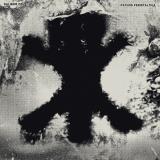
Beijinho do Brasil announce their second release with the highly anticipated follow-up from LA-based producer and multi-instrumentalist James Matthew Seven, featuring guest vocals on the A-side by Rio de Janeiro's Fabio Santanna.

Recorded in a small studio on the beach in Oaxaca, Mexico, "Feels Good, Do It" brings to mind a lost recording from Marcos Valle's time with Leon Ware. Funky and soulful with warm Fender Rhodes and a horn section reminiscent of Banda Black Rio, the tune is a breezy, mid-tempo ode to embracing life's pleasures. Originally with vocals in English, the track was translated and re-recorded in Rio de Janeiro by Fabio Santanna. Fabio has a long-established reputation in Brazil as a torchbearer of modern funk and boogie, continuing in the lineage of artists like Robson Jorge and Lincoln Olivetti. But with his releases on labels like Onda Boa and Dippin' Records (which sold out nearly instantly), his international reputation is steadily growing. He has a new 7" due out on Dippin' Records on October 10th, pushing his name to the forefront once again, right on time to generate more buzz for our next 45!
About the flip side, "Ilha Racional" (a nod to Tim Maia's Racional era):
I had this dream where I was in a dive bar discotheque somewhere in the Caribbean. A thick cloud of smoke hung in the air as the selector dropped this bass-heavy bop that had the whole crowd vibing. Then, out of nowhere, in walked Tim Maia with a bag of mushrooms. He proceeded to grab the mic and preach about this alien world of rational energy. Shit was bugged out. When I woke up, James Matthew Seven had sent me this track to check out.
The second release from the Époque label is a major one, featuring Niels Van Gogh’s 1998 hit single "Pulverturm”, which earned gold certifications in Belgium and South Africa and climbed into the Top 10 in the charts of many European and worldwide countries. The esteemed Brazilian techno artist ANNA delivers a rework, adding her signature touch to this iconic track.
"In 2023, while preparing for my Tomorrowland set, I was exploring iconic tracks that resonated in Belgium and could be perfect for an edit. I chose 'Pulverturm' for its powerful vocals and strong melody”, says ANNA. “What started as a quick edit turned into a labour of love, and I was so happy with the outcome that I wanted to try to release it as an official rework. We were in conversation with Niels Van Gogh when I sent the track to Charlotte de Witte, who loved it. She introduced me to Époque, and we decided to release the rework together. It's been a year since I crafted this rework, and I've never had so many artists from various genres, Techno, House, Melodic Techno, Tech House, Hard Techno, requesting a track like they did with my rework of 'Pulverturm.' It's incredibly exciting to finally share it with the world!"
Charlotte de Witte adds: “I fell in love with ANNA's masterfully crafted touch on ‘Pulverturm’ the moment she sent it to me. Being a bit of a sucker for legendary tracks that have left a deep mark on the history of electronic music myself, this one just hits all the right spots. It's been a long and challenging road to make it happen but I'm incredibly proud and honoured to have Niels Van Gogh's timeless classic ‘Pulverturm’, seen through ANNA's eyes, for the second release of Époque. A label we founded earlier this year to honour nightlife, club culture and dancefloor legacies.”
The original “Pulverturm” is a twitchy and hypnotic cut with trance infused synths over the top of the rumbling drums. There is progressive energy in the melodies and plenty of emotion in the vocals. ANNA’s version is driving and emotive with sensual vocals and bright, trance infused chords over rolling drums that bring the power.
About Époque:
Époque is a Belgian label and nightlife archive created by KNTXT and run by KNTXT and Charlotte de Witte. In collaboration with clubs and labels, past and present, Époque captures the spirit and lifestyle of our bygone discotheque culture. The Époque label reworks iconic tracks, brings back dance classics and uses club memories and aesthetics to translate these legendary compositions into unique new releases produced by today’s leading electronic music talent. Époque also designs high quality merch and party gear as an homage to the global club scene.
Delve into the quirky and psych-tinged world of Brazilian pianist, composer and multi-instrumentalist Mauricio Fleury.
With more than a hint to Brazilian jazz greats like Azymuth, Deodato and CTI Records in their prime, Revoada is a groove based jazz-framed record, primed with other transitory musical vignettes which touches on Turkish psych and soul-jazz born out of the 70's film soundtrack genre.
Revoada is a 6 track album and storyboard of Mauricio's migration and travels through Brazil's geographical oddities , its rural and urban enclaves. Recorded in Brazil, it's the result of numerous treks through funky flea markets, soaking up old vinyls and vintage cultural artefacts combined with a new life led in Berlin since 2022.
Mauricio, as well as a founding member of Bixiga 70 (google Brazilian Afrobeat pioneers), a band he fronted for over 12 years, is also an in-demand collaborator and musician who as a pianist, guitarist and even percussionist has shared stages and studios with the likes of Brazilian greats including Gal Costa, Emicida, Lucas Santtana, João Donato and Liniker.
In 2007 he had a life-changing experience meeting Tony Allen, at the Red Bull Music Academy. After hanging out, chatting music and life, Tony insisted to Mauricio to participate with Tony in a jam with blacktronica and soulful house music pioneers Ron Trent, Theo Parrish and Steve Spacek. Mauricio sums it up, "From that moment on, I was never afraid to collaborate musically with anyone, no matter who's playing. It also brought me to researching the connection between Brazilian music and Afrobeat which is something that still means the world to me".
Another unforgettable session Mauricio undertook happened alongside João Donato and Marcos Valle, playing Donato's classic album Quem É Quem, live, a record seen as a blueprint for second generation bossa nova. Mauricio has worked with Gal Costa on two albums, Estratosférica Ao Vivo and her last studio album A Pele do Futuro. Fabio Sá and Vitor Cabral (bassist and drummer on Revoada) were playing with Gal at her last concerts, including in Berlin in 2022 before she passed.
In contemporary music, Mauricio was part of Toy Selectah and Mexican Institute of Sound's Compass project. He's worked with Colombia's Los Pirañas and has even recorded a mysterious and unreleased album with Quantic.
Revoada shows signature traces of Thelonious Monk, Ramsey Lewis' swinging soul sound, Deodato's drama, and styles from further afield, spreading into Turkish psych and Ethiopian jazz, when the time is right. Each track, led always by Mauricio playing multiple instruments with a choice selection of guests and core members on bass and drums, highlights Fleury's meticulous approach to finding the right timbre, utilising his arsenal of organs and effects pedals to set the mood, taking the listener to a specific place or memory that has shaped him.
A vinyl DJ for over 25 years and someone who is immersed in digger and collector's culture, Mauricio places a lot of emphasis on the importance of the complimentary relationship between two artforms (DJ and composer/producer) in the sense of having a broad repertoire of musical knowledge, references and perhaps predictably, being a Brazilian, understanding the connection between rhythms. This is an impressive debut album that struts itself right into the runout groove.
One of the leading Japanese alternative rock band, GEZAN’s leader, MahitoThePeople’s director debut film, i ai was released in March 2024, and it is an atypical coming-of-age film decorated with tinge of red.
The film takes place in Akashi and Kobe, Hyogo prefecture. This film’s main characters are Ko (Kentaro Tomita), a rookie member of a band and a brother-like figure of his, Hee (Mirai Moriyama) who Ko idolizes and the story of this movie is based on their struggles with life and death. The story is also based on Mahito's real-life experiences and while reality and fiction are duplicated, the boundary between them slowly melts away. The film co-stars Honami Satoh, Kazuki Horike, Mitsuru Fukikoshi, Eita Nagayama, Kyoko Koizumi, K-BOMB, Ichi Omiya and many other unique personalities. It should also be noted that the transparent images filmed by photographer, Masafumi Sanai gives the film, a special emotional quality.
The film is not bound by any film theory but it poses a theme common to GEZAN's recent works and Mahito's writing activities: How can we live in a crumbling society while interacting with others? We can never live alone but living with others is also never easy. How can we overcome this time of extreme division of the world?
What left quite a strong impression in this film that not only Mahito personally directed but also wrote the script and composed the soundtrack as well was the main theme song, entitled “i ai”. This new piece of GEZAN is an extension of the work that this band has continued doing over the last few years. This 12" single, contains the song, “i ai” and it will be the first time released on vinyl.
Led by soft guitar arpeggios, the song gradually builds to a fever pitch, condensing the mood of the film which encompasses both tranquillity and intensity. The chorus of ineffable, multiple voices united together sounds like a lament that has spilled out of society or a cry of joy. GEZAN's collaboration with the 15-member chorus group, Million Wish Collective has been in development of late and the cultivated sensibilities through their activities are put to use in this song.
The song can also be considered a slow, relaxed dance track that lasts 9 minutes and 8 seconds. It has something in common with organic dance tracks from South America and other regions, and it is significant that GLOCAL RECORDS which represents glocal music from around the world in Japan are releasing it as a DJ-friendly 12-inch single.
The B-side features a remix by COMPUMA who is also closely associated with GEZAN. The song starts with an African styled percussion, with a thumb piano in the middle of the song and then returns to that memorable chorus. This song feels like a 18 minutes and 18 seconds long short movie like suite, with some dizzying changes from the beginning to the end. It is remix filled with enormous drama!
The cutting and mastering of this 12” was done by TOREI who is also active as a DJ and the artwork was created by jvnpey, a visual artist and graphic designer based in Tokyo. Their loving work also makes this 12" very special.
When I asked AI to find a synonym for the word, “division,” it displayed in succession, a series of words: “integration,” “consolidation,” “unification,” “unity”, and “reconciliation". All of these phrases are somewhat whitewashed and embarrassing but the mirage-like chorus echoing in the song, “i ai” seems to be trying to find a new word, that is a synonym for the word, "division. In this film, “i ai”, the message, “Let's live together after the end roll” was thrown out but included in this 12-inch, the message, “Let's live together after the music stops”, emerges.
Joaquin Joe Claussell Presents the Second Installment of His Acclaimed Alias: BlackSalsoul
Brooklyn, New York City — Renowned producer, DJ, and spiritual music visionary Joaquin Joe Claussell returns with the second chapter of his celebrated alias, BlackSalsoul. Continuing his lifelong exploration of deep, soulful soundscapes, this latest release focuses on edits and reinterpretations across Spiritual Jazz, Soulful Disco, and African Dance traditions.
Following the success of the debut 7” (Cat# UEDNEXT.1), which sold out within weeks and remains a one-time pressing despite overwhelming demand, the BlackSalsoul series reaffirms its commitment to exclusivity. Each edition will be available strictly on limited 7” and 12” vinyl—a tribute to the physicality and ritual of true record culture.
Blending the warmth of analog production with Claussell’s signature spiritual energy, this release bridges eras and continents, honoring the roots of soulful expression while speaking directly to today’s dance floors.
For fans of Fusion Jazz, Soulful Disco, and Afro-inspired Edits, the new BlackSalsoul record offers another essential journey through rhythm, emotion, and transcendence.
- 1: Dearly Missed
- 2: Belly Of The Whale
- 3: Kill What You Eat
- 4: Junie
- 5: Photograph Of A Cyclone
- 6: In Violet
- 7: Hunter
- 8: Geese
- 9: Dirt
Gold Vinyl[30,04 €]
Searows—aka Pacific Northwest singer-songwriter and guitarist Alec Duckart—is pleased to announce his new album Death in the Business of Whaling, set for release on Friday 23rd January 2026 via Last Recordings On Earth. Though Death in the Business of Whaling arrives as Searows’ second album, it’s the product of many firsts, including his first time recording outside the creative cocoon of his bedroom. His 2022 debut Guard Dog was written, recorded and self-produced in Duckart’s Portland home and independently released with little expectation as to how it would be received. The music soon found a passionate audience that were already sharing snippets of Duckart’s music via communities on TikTok and received co-signs from prominent artists such as Ethel Cain and Gracie Abrams, both of whom he went on to support on tour.
- A1: Clean Up (Ep Mix)
- A2: Go Get Your Money
- A3: Beretta (Feat. Lucey Way)
- B1: Things
- B2: Rolling
- B:3 Go Get Your Money (B-Sharp Mix)
First Word Records are proud to bring you 'Penny Ballads', a 5-track EP from Royce Wood Junior. Royce Wood Junior is a Grammy & Mercury Award-nominated musician, songwriter and record producer from London, currently based in Brighton. As a multi-instrumentalist, he's collaborated with a litany of brilliant artists over the years, such as Jamie Woon, Nao, Disclosure, Jessie Ware, Olivia Dean, Joy Crookes, Jamie Lidell and Jordan Rakei, additionally to touring with the likes of the legendary Thomas Dolby. He's released two acclaimed solo albums to date ('The Ashen Tang' in 2015, and 'No Two Blue Ticks' in 2021). 'Penny Ballads' demonstrates RWJ's varied talents, with a collection of alternative soul compositions, each one as unique as the next. It includes the first two singles, the Poplife-Prince era flavoured 'Go Get Your Money', and the double-time future funk adrenaline shot, 'Clean Up', along with three previously-unreleased tracks. 'Beretta' is low-slung soul funk, beginning with quirky squelchy synths, before the soulful lead vocal of feature artist Lucey Way breezes in to melt everyone's hearts. 'Things' sweeps in next, an infectiously soulful midtempo heavy soul bop, with an instant earwork of a hook, like a modern-day Steely Dan / Doobie Brothers, complete with a head-nodding string section to end the track. The collection concludes on a more melancholy downtempo tip with 'Rolling'; an almost-folktronic anthem, with a key refrain that wouldn't be out of place on a 70's Stevie piece. RWJ (aka Jim Wood) says of this project… "Back in the 17 and 1800's Troubadours and minstrels would go from Tavern to Tavern selling Penny Ballads, single sheets of music and lyrics written quickly and frivolously to make a quick buck.. It strikes me that we're in a similar phase in the way we value music in 2025. An old Penny Ballad was cheap and dog-eared, ink-smudged, sung aloud by firelight, Now songs live in the digital ether, dissolved in the air, a ghostly breath paid in micro cents. The new era of Penny Balladry is here, and weird. This EP is a snapshot of my writing over a two year period. Focussed on minimal recording styles, one mic on the drums, generally first or second takes on parts and vocals, I wanted the music to feel like small moments with lyrics that talk about the weird nuances of being alive as a latter stage human on the cusp of the Ai revolution. Culturally so evolved, but physiologically still just a bunch of mammals walking about with primitive fears and needs. Just trying to reconcile it all moment to moment…" Previous support for Royce's music has included Radio 1's Future Sounds, BBC 6 Music's New Music Fix, Annie Mac, Clara Amfo, Jo Whiley (BBC Radio 2), Mary Anne Hobbs, Jamz Supernova, Tom Robinson, Huw Stephens (BBC 6 Music), Zane Lowe and MistaJam. There have been sessions previously for the likes of Red Bull and press from Huck, Line of Best Fit, Clash, Aesthetica & DIY magazine. Entirely self-written and self-produced, this EP gives a solid taste of RWJ's talents. A deeply funky diverse set of music from an immensely talented individual. 'Penny Ballads' is due to be released on vinyl & digital, 24th October 2025. The vinyl version also includes an exclusive additional mix of the first single 'Go Get Your Money'. TRACKLIST: 01: Clean Up (EP Mix) 02: Go Get Your Money 03: Beretta (feat. Lucey Way) 04: Things 05: Rolling 06: Go Get Your Money (B-Sharp Mix) Deconstructed Mixes
- 1: Crocodile Clock
- 2: Babe Pig In The City
- 3: The Summer That I Hit The Wall
- 4: Easterly
- 5: The Gates
- 6: Neck
- 7: Crows 03:0
- 8: Deansgate
- 9: Billy
- 10: Split The Difference
- 11: Goodnight Zoo
“Innovative, hooky and full of depth” - Far Out Magazine
“Songs that lodge into your brain in the opening ten seconds” - Brooklyn Vegan
“Breezy, melodic… a clear ear for a hook” - UNCUT
“Playful and unexpected, emotional but not overstated” - CLUNK
‘Crows’ is the new single from Bristol’s Langkamer and the first to be revealed from their new album ‘No’, which is due for release on 22nd January 2026. Their fourth album in as many years, ‘No’ saw the prolific band taking to the mountains at the invitation of veteran producer Remko Schouten (Pavement, Personal Trainer, Bull). The much loved Bristol band holed up for a week in the wilds of Southern Spain at his brand new Zarzalico studio. Over a week, under the Murcian heat, they laid down the perfectly formed eleven tracks that make up ‘No’.
Since the band’s conception, Langkamer have worked out of anywhere affordable and available, whether it be the basements of renowned venues (‘West Country’, ‘Red Thread Route’, ‘Langzamer’) or secluded cottages (‘The Noon And Midnight Manual’). Over the years, their frenetic pace and quality of writing has earned them fans across the world, plaudits at UK media, and built an ever-growing musical community around them - not least via Breakfast Records - the independent label that is home to Getdown Services - formed by Langkamer’s Dan Anthony and Josh Jarman in 2006 alongside acclaimed singer-songwriter Jasmine 4.T.
To call Langkamer ‘your mid-level indie bands favourite mid-level indie band” sells them short. They have always scraped by on irregular incomes, plagued both by daily financial pressures and the occasional cash sinkhole so well known to any musician in the current impossible climate. Once Schouten offered to host them at his new studio (Zarzalico), they couldn’t refuse. A relentless recording schedule found the group only breaking for the daily long lunch and to occasionally fire an airgun across the hills. If the last half a decade had been a pressure cooker of constant touring and recording, their brief time in the remote Zarzalico could not have been more symbolic. Lead single ‘Crows’ perfectly captures this nervy balance and is a wiry slice of atmospheric proto-punk, drawing from the shadows of the late-70s UK landscapeit also defies these conventions, striking an anthemic chord from beginning to end. From the scaling chromatic guitars at the breakdown, to the final chants of ‘suffer’ and ‘struggle’, there’s a loud desperation and defiance to ‘Crows’ that lends it an unparalleled urgency. As singer/drummer Josh Jarman states:
“Crows is a song about the crazy shapes we contort ourselves into trying to create art in the era of late-stage capitalism. Working a thousand jobs. Writing songs with the left hand while writing emails with the right hand. Your day is already doomed the moment you open your eyes. Everything’s a bad omen.”.
With ‘No’ arriving early next year, ‘Crows’ is the perfect introduction to Langkamer, a band that has only taken new bold steps with each release, always hiding a keen experimentalism behind a charming hook. It is also the surest sign yet that they are ready to step up, and take on the road once again vision unclouded.
- A1: Situazione Del Mezzogiorno
- A2: Problemi Del Mezzogiorno
- A3: Paesani
- A4: Paesani
- A5: Disperazione Atavica
- A6: Inquiamento
- A7: La Gente
- A8: Corruzione Al Vertice
- B1: Omerta
- B2: Inquiamento Biologico
- B3: Delitto Contro La Natura
- B4: Le Strade
- B5: Angoscia Del Futuro
- B6: Rassegnazione Atavica
- B7: La Noia
- B8: Terre Abbandonate
- B9: Danza Locale
At the end of the Sixties, the production of soundtracks for small and big classics of Italian cinema is now joined by another business which has proved to be less profitable but more creative and, in best case, free from the constraints imposed by clients on duty: the composition of music libraries. Almost all of the artists for the eighth art have finalized at least one or more music libraries. Names famous and not, old and young composers, real outsiders and meteors, usually hidden behind pseudonyms: this is the case, for example, of Braen and Peymont. The first needs no introduction, it was the one adopted by the former arranger, multi- instrumentalist, singer and composer Alessandro Alessandroni. The second is closely linked to the mysterious American composer, but resident in Italy, David Hoyt Kimball. The two are authors in different measure of an interesting album with an experimental background, “Paese Sotto Inchiesta” (1971), originally published by Flirt Records.
The titles of the tracks appear in connection with the socio-cultural climate of Italy after 1968 and can be relocated as a background for journalistic-like images. The latter is a hypothesis not supported by facts, but some titles seem to be referred to the perception of a subsisting economic backwardness of the southern regions compared to the other ones; to a situation of collective tension, thanks to the global revolutions; in addition to the new concerns with an ecological background. Overall, the seventeen tracks on the album are mostly 'dirty', characterized by an even atonal setting, with long repetitions in a noisy key, more fundamental reverbs and echoes for the different keyboard instruments. In a few words, abstract sounds, some guitar notes, echoes of Gruppo Di Improvvisazione Nuova Consonanza, flute melodies and proto- ambient intuitions. Composers like Alessandro Alessandroni and David Hoyt Kimball deserve to be rediscovered.
*Following the essence of the work, for this press, MPI release a 100% recycled vinyl that reduce waste, minimize environmental impact and support the planet*
- 1: Tião Carreiro & Pardinho - Bully 02 4
- 2: Lambarí & Laranjinha - I Was Called To A Party 0 47
- 3: Nhô Pires & Pirangueiro - Product Of The Cane 02 5
- 4: Xerém & Bentinho - Little White Hawk 02 32
- 5: Flauzino & Florêncio - Orange Fashion 02 8
- 6: Mandi & Sorocabinha - What A Beautiful Girl 02 5
- 7: Raul Torres & João Pacífico - Festival Of Bugs 02 41
- 8: Irmãos Kurimori - Burned Horse 02 5
- 9: Retrato & Retrói - New Love 03 13
- 10: Irmãos Falsetti - Disappointment 01 57
- 11: João Goiano & Goiazinho - Heartless Son 02 48
- 12: Riachão & Riachinho - The Life Of Aleijadinho 03 15
- 13: Nizio & Nézio - Lady Of Aparecida 02 35
- 14: Zé Carreiro & Carreirinho - Canoeist 02 50
- 15: Laranjinha & Zequinha - Ugly Boy 03 01
- 16: Leôncio & Leonel - Saying Goodbye 02 42
The second volume in Death Is Not The End's survey of a form of Brazilian country music known as música caipira ("hillbilly music") - a stripped-back forerunner to música sertaneja, the Brazilian equivalent to US country & western which in it's contemporary form has come to dominate the domestic music industry in recent decades. This collection covers some of the earliest recordings made by the pioneering folklorist Cornélio Pires at the end of the 1920s, through to records from the 30s, 40s & 50s and the beginning of the 60s.
Somewhat rooted in Portuguese troubadour folk traditions, música caipira is typically performed by a duo singing in parallel thirds and sixths, drawing upon a Portuguese-Brazilian style known as moda de viola - with the viola being the viola caipira, a Brazilian-style ten-string guitar that is the core instrument of the music. Born out of the "outback"-style region in north-eastern Brazil, these songs tell stories of pain, love, loss & betrayal - often backed by homemade guitars using invented tunings. Away from the polished pop country & western-stylings of the sertaneja, these recordings could be viewed as the Brazilian equivalent to the roots music of the American dustbowl or Appalachia.
- 1: The Last Race - Jack Nitzsche
- 2: Trash - Duane Eddy & The Rebels
- 3: Boo Boo Stick Beat - Chet Atkins
- 4: Comanche - Link Wray & The Wraymen
- 5: Jungle Fever - Dick Dale & The Del-Tones
- 6: Mumblin' Guitar - Bo Diddley
- 7: Put The Blame On Me - Elvis Presley With The Jordanaires
- 8: Baby I Go For You - The Blue Rondos
- 9: Parchment Farm - Billy Lee Riley
- 10: I'm Not Your Stepping Stone - The Flies
- 11: Mountain - Sunshine Theatre
- 12: Gotta Find A New Love - The Yo Yo's
- 13: Man From Nowhere - Jet Harris
- 14: Watermelon - Frank Minion
- 15: I'm Out - The Surf Riders
- 16: Fuzzy And Wild - The Ventures
- 17: Baby - Tracy Rogers
- 18: Mail Train - Billy Joe Tucker
- 19: The Day The World Turned Blue - Gene Vincent
- 20: Listen To The Drums - Richard Caiton Gnp
- 21: Tracks To Your Mind - The Sounds Of Lane
- 22: My Baby - The Girls
- 23: I'm A Nothing - The Magic Plants
- 24: Little Joe - The Sounds
- 27: Sleepy Hollow - The Last Word
- 28: Cycle-Delic - The Arrows Featuring Davie Allan
- 25: Pink Cadillac - Johnny Todd
- 26: Fast Freight - Arvee Allens
In 2023 Ace Records released the album “28 Little Bangers From Richard Hawley’s Jukebox” where the acclaimed Sheffield musician, singer and songwriter compiled together some of his favourite records. These were instrumentals and vocals records that he had collected over the years and found musically addictive. The album received fantastic reviews and allowed his
extensive fanbase to discover and enjoy tracks like Ronny Kae’s ‘Swinging Drums’ and King Curtis’ ‘Hot-Rod’ that were on the juke box in his home.
Now, three years later, Richard has lifted the lid, taken those 7” out and replaced them with another favoured selection. One again, this second version of “Little Bangers” is full of cracking records such as Chet Atkins ‘Boo Boo Stick Beat’, Frank Minion’s ‘Watermelon’, Johnny Todd’s ‘Pink Cadillac’, Sunshine Theatre’s ‘Mountain’, Jet Harris’ ‘Man From Nowhere’, Tracy Rogers ‘Baby’ and the Ventures ‘Fuzzy And Wild’.
A with the first album there are 28 tracks spread across two albums or shoehorned onto one CD. The extensive liner notes see Richard discussing each and every track and what the record or artist meant to him. As he states himself in the introduction, “the record you hold in your hand is the result of a lifetime obsession.”
Listen for yourself and you will discover that this was time well spent.
Diagonal celebrates 13 years in business via a 4 x 12" run featuring label stalwarts and influential collaborators. This is LP3, the second in the series. Like LP 1 & 2 before it, this 12" comes with a coloured, elastic H band. All four LPs will be accompanied by these meaning customers can combine the records and complete their own 4 x 12" set!
Jim O' Rourke leads the line on plate 3 with 'ror bypass', a gripping, mediative blend of modular enhanced percussion and field recordings. Kae Tempest and Powell unite to offer up uneasy, restless poetry. Simon Pomery, an early label regular via his Blood Music project, delivers 12 minutes of epic psychedelic immersion and Sote closes out proceedings with "Ataraxy", an extreme computer music masterclass.
'The World in Air Quotes' is a genre-shifting style-melting kaleidoscope of art-rock, jazz, techno, folk & industrial. The God In Hackney sound like very little else from the early 2020's and whilst 'The World In Air Quotes' innovative progenitors are manifold - Eno, Coil, The Durutti Column, 1980s ECM jazz to name a few - it sounds beholden to none of them.
The God In Hackney's first album 'Cave Moderne' was Andrew Weatherall's album of the year for NTS Radio.
The God In Hackney's second LP, 'Small Country Eclipse', was album of 2020 for critic Sukhdev Sandhu of The Colloquium for Unpopular Culture: "Mordant music: stuttering, dread, black humour. A record that felt truly independent, beholden to no genre, out of step with all centres and signposted nodes."
'The World In Air Quotes' is The God In Hackney's 3rd album and their most musically emotive and lyrically inventive to date. It's an album that resonates with feelings about climate change, isolation, extinction, the social impact of technology, the flattening of history—and illuminates the darkness with imaginative rhythm, melody, noise & poetry. Songs range from widescreen, anthemic rock, to strange intricately arranged jazz-influenced songs, to abstract, textural electronic pieces. There's a strain of dark and surreal comedy too that runs through the lyrics and some of the choices the band makes in their sounds and arrangements.
The core God in Hackney quartet of Andy Cooke, Dan Fox, Ashley Marlowe and Nathaniel Mellors has expanded to include American multi-instrumentalists and composers Eve Essex (Eve Essex & The Fabulous Truth, Das Audit, Peter Gordon & Love of Life Orchestra, Peter Zummo, Liturgy) and Kelly Pratt (Father John Misty, David Byrne/St Vincent, Beirut, and Lonnie Holley among many others), signalling a new and ambitious direction for the band.
The album cover features original artwork by Iranian-American artist Tala Madani, recently the subject of a career survey exhibition at the Museum of Contemporary Art, Los Angeles.
Advertising:
The Wire, Maggot Brain
Reviews & features:
Maggot Brain - forthcoming feature
Hi-Fi+ Magazine - album review in April 2023 issue
Dereck Higgins (You Tube review)
Sonosphere - interview / feature
Weirdo Shrine - interview
It's Psychedelic Baby - interview
Spettacolo (Italy) - feature.
Ghettoblaster Magtazine (USA) - feature
Airplay:
Gilles Peterson - BBC Radio 6 Music
Steve Lamacq - BBC Radio 6 Music
Dublab - playlisted & featured in Dublab Recommends (Los Angeles)
Cian Ó Cíobháin - RTE Raidió na Gaeltachta (Ireland)
WFMU - playlisted
Resonance FM - The Wire presents Adventures In Sound & Music
Human Pleasure Radio (New Zealand)
Pete Wiggs & James Papademetie - The Seance (Repeater Radio, Sine FM & others)
Peter Hollo's Utility Fog - FBI Radio (Australia)
Jonathan Lethem & Sam Sousa on Radio Free Aftermath (KSP Claremont 88.7)
Life Elsewhere
WRPB Princeton
In Memory of John Peel
Mike Watt's Watt from Pedro Show
- 01: Joy (Reprise)
- 02: Keep You Close
- 03: Hebron
- 04: Axis (Feat. Saul Williams)
- 05: Day&Apos;S Gon&Apos; Come
- 06: Listen
- 07: The Honourable
- 08: Hollows &Amp; Grooves
- 09: Wishful Thinking (Feat. Michael King)
- 10: Giving Thanks
- 11: Peace. Love. Life
- 12: After Home (Feat. Tony Kofi)
- 13: Sea Song
- 14: With Care
- 15: Faith (Feat. Deschanel Gordon)
MidnightRoba is the solo project of vocalist, songwriter and producer Roba El-Essawy. The voice of Attica Blues (Mo Wax 1997, Sony 2000), Raise A Symphony is MidnightRoba's second solo album. Her first album, Golden Seams, very much rooted in jazz, received support, airplay and features from DJs such as Gilles Peterson (BBC Radio 6), Tony Minvielle and China Moses (Jazz FM), Robert Elms (BBC London Live) and Kevin Le Gendre on J to Z (BBC Radio 3). Single releases from this second album have been played by Gilles Peterson (WorldWideFM & BBC Radio 6), Kate Hutchinson (Soho Radio), Marshmello (NTS), Rob Luis (Tru Thoughts), Kev Beadle, Patrick Steele, DJ Amazon, and more.
'Raise A Symphony' is music of our time. A 15-track electronic offering, it comments on topics ranging from colonialism to complicity of silence; from compromised politicians to the power of protest and gratitude to those on the frontlines of change; from displacement and sea migration to the desire to protect our loved ones and the need for kindness; to have faith in the future and the importance of searching for joy in the meantime. The self-produced album 'Raise A Symphony' sees contributions from Saul Williams, Deschanel Gordon, Michael King and Tony Kofi, amongst others. The album title takes it's name from Martin Luther King's 'I Have A Dream' speech where King calls for the nation to rise to gather together and form a 'beautiful symphony of brotherhood'.
"..in Raise A Symphony, Midnight Roba has transmuted talent into something more powerful, where bridges built from her exquisite, unique harmonies, soaring songs and percussive productions allow competing emotions to co-exist and feed into each other. This album itself is a form of community; voices in unison, reaching outwards and offering restoration and upliftment throughout this remarkable work of love and fury." Emma Warren
a 01: Joy (Reprise) [feat. Deschanel Gordon]
- A1: The Kettle
- A2: Elegy
- A3: Butty's Blues
- A4: The Machine Demands A Sacrifice
- B1: The Valentyne Suite A. January's Search
- B2: B. February's Valentyne
- B3: C. The Grass Is Always Greener
Colosseum was one of England's prime rock-jazz outfits. Most of the members of Colosseum had apprenticed in blues bands and it shows very strongly on some of the material on their second album. Valentyne Suite takes the band out of their bluesy comfort zone into something closer to prog rock. The album is generally seen as their best album and still extremely enjoyable.
Four Framed Music is back with their second label release, featuring the talented Buenos Aires-based Colombian producer Diego Ruiz, also known as DFRA.
The EP, titled ‘Soul to Soul’, showcases four exceptional house tracks that beautifully blend DFRA’s own unique sound with strong influences from Detroit and Chicago house music of the 90s and early 2000s. His production skills are on full display throughout the EP, as he expertly weaves together a diverse range of musical styles to create a truly captivating and one-of-a-kind listening experience.
Get ready to be transported on a musical journey that is sure to move your soul as DFRA’s infectious beats and grooves take over.
- A1: Young Love And Laughter
- A2: Stop Using My Love
- A3: If You Want You Can Be My Girl
- A4: Do You Remember When
- A5: Your Picture
- A6: Catch You On The Rebound
- B1: Some Kind Of Magic
- B2: In My Dreams
- B3: Magic Mary
- B4: Made Me Change My Mind
- B5: Six Eighths Of Your Time
- B6: Gonna Catch You
The Sha La Das are Bill Schalda and his talented sons Paul, Will and Carmine, originating from Staten Island, NY.
Your Picture, the Sha La Das’ second album and the first release on producer Tom Brenneck's own label, Diamond West Records, is yet another singular testament to the stirring power of blood harmony and a celebration of the enduring love story between Bill and the family matriarch, Linda.
Traces of old memories flicker through Your Picture. Bill’s classic songwriting and lush vocal arrangements get whirled into new territory, updating doo-wop with the bottom-heavy groove and swirling pop of Brenneck’s lean, spacious production. “We brought in some psychedelic sounds and drew inspiration from deep soul records to the Beatles and Beach Boys alike,” Brenneck says.
Love radiates throughout Your Picture, flowing out from the shimmering melodies Bill and his sons produce. Bill Schalda and sons are living their musical dream—Your Picture is the proof.
- A1: Permafrost
- B1: Mass Production
THE ART GRAY NOIZZ QUINTET is spearheaded by twisted Australian guitar legend STU-ART GRAY, most notoriously known as STU SPASM of LUBRICATED GOAT, CRUNT, SALAMANDER JIM, and THE BEASTS OF BOURBON. Adding another crazed chapter to an already solidly sordid musical history, THE ART GRAY NOIZZ QUINTET stars some of the finest scoundrels of the New York City underground scene - SKELETON BOY of WOMAN on two-string bass, NIKKI D'AGOSTINO on sax, and veteran drummer RICH HUTCHINS of LIVE SKULL providing the savage, swinging beat. A rotating roulette of characters swagger into the second guitar slot as needed, each showcasing their particular specialty - twang, treble, or atmosphere. Stuart Gray's wayward path through the flashpoints of noise, grunge, and swamp-rock history is well-represented in the Quintet's sound - chaos with a cinematic edge. Sharing stages with kindred spirits such as THE SCIENTISTS and MUDHONEY got the attention of audiences early on. Their recordings and incendiary gigs throughout the New York scene and beyond soon caught the eye of the infamous LYDIA LUNCH, and it was only a matter of time before a new collaboration was born . . . Now, THE ART GRAY NOIZZ QUINTET collide with the queen of no wave LYDIA LUNCH on a new two-fisted ten-inch single . . . Melting the MAGAZINE classic "PERMAFROST", and grinding out an apocalyptic version of IGGY POP's "MASS PRODUCTION". Only on IN THE RED RECORDS! "Speaking of noise, that’s kind of Stu Spasm’s thing — from LUBRICATED GOAT in the late 1980s, to his current project, THE ART GRAY NOIZZ QUINTET. This elder statesman of clamor hasn’t lost his touch." - THE NEW YORK TIMES
Pioneering experimental electronic record receives first-ever complete vinyl pressing, featuring expanded content and exclusive liner notes.
Editions Mego release the highly anticipated vinyl reissue of Get Out, the groundbreaking second album by Peter Rehberg under his influential PITA moniker. Originally released in 1999, this seminal work stands as a landmark achievement in experimental electronic music, praised for its revolutionary fusion of ear-splitting noise and melancholic melodies. Moving beyond the era's trend of pure abstraction, Get Out represents a pivotal moment when experimental electronic music began exploring new territories laying forth a path which many artists would subsequently follow.
This expansive reissue marks a significant milestone for collectors and enthusiasts, presenting all 12 tracks from the 2008 eMego CD version on vinyl for the first time. The inclusion of the rare Detroit live recording (remastered by Jim O’Rourke) provides invaluable insight into PITA's performance practice during the album's original touring cycle, whilst new liner notes from Jim O'Rourke and Chris Clepper provide further personal and anecdotal insight.
Since its original release, Get Out has been recognized as essential listening for understanding the evolution of experimental electronic music in the late 20th century. This authoritative reissue ensures that Rehberg's visionary work remains accessible to new audiences while providing longtime admirers with the definitive version of this crucial album.
The vinyl comes with a DL code which contains a 20 minute live performance in Kyoto, Metro, 25.01.1999.
Swan Song
The vinyl LP at the heart of this éthiopiques 31 tracks 2 to 11 was one of the very last vinyl records ever released in Ethiopia. But above all it represents, we felt, the absolute masterpiece of the Ethiopian Groove – the Swan Song of Swinging Addis. The album leaves a clear idea for posterity of the level of sophistication and mastery that modern Ethiopian music had achieved, before being crushed under the Stalino-military heel of the Derg – as the bloody revolution that was unfolding came to be called.
Ethiopia1976.
The Revolution that broke out in February 1974 rolled on in a ruthless march. The whole of Ethiopian society was utterly stunned. The bouquets of flowers handed joyfully to the first tanks of the coup d'état were to wilt very rapidly. From September 1976 to February 1978, 18 months of Red Terror (the name given by the junta itself) spilled blood throughout the country. This fratricidal conflict took its heaviest toll among students and youth. The shift from feudalism to a cruel and primitive Stalinism left the country's citizens deeply traumatised, and snuffed out any pretence of activism, whatever the sector of society. This ice age was to last for seventeen long years.
ሙሉቀን፡መለሰ Mulukèn Mellèssè Muluqän Mälläsä
It was three tracks by Muluken that served as the opener for éthiopiques-1 more than 25 years ago. Seven more tracks appeared on éthiopiques-3 and 13, all accompanied by The Equators, which was soon to become the Dahlak Band.
The first track, Hédètch alu, also the very first piece that Muluken ever recorded, left audiences both unsettled and amazed. Reflecting the singer's extremely young age (he was just 17 at the time), this angelic voice mystified many, who thought they were in fact listening to a feminine voice. He was not yet 22 when he released his last vinyl record in 1976 with Kaifa Records (KF 39LP), one of the very last to be issued in Ethiopia, before the cassette tape became the dominant medium for music distribution – and before the new revolutionary regime put a stop to all independent musical life, via an unspeakable barrage of prohibitions and other persecutions.
Mulu qèn, literally, “A well filled day”. This tender maternal intention wasn't enough to ward off the cruelty of fate. His mother's premature death drove Muluken to leave his native Godjam, in northeast Ethiopia, to live with an uncle in Addis Ababa. Born Muluken Tamer, he took his uncle's last name – Mèllèssè.
The spelling Muluken appeared in his administrative records. Transcription of Amharic to the Latin alphabet, both in Ethiopia and for scholars, gives rise to controversies and quibbles that can never be neatly settled. French allows for a closer approximation of the original pronunciation, thanks to its battery of accent marks, confusing as they may be to anglophones.
Between rather accommodating administrative record-keepers and the various versions that pop up in interviews given by the artist, Muluken's year of birth oscillates between 1953 and 1955…
1954? One thing is certain: the artist's talent made itself known very early indeed, because he got his start in 1966-67, at the age of 13 or 14. Photos from the period attest to his extreme youth. It's a strange sort of initiation for a very young teenager to become a sensation in the heart of Addis's nightlife at the time, Woubé Bèrèha – the Wilds of Woubé. And what's more, in the club of the Queen of the Night, the Godjamé Assègèdètch Alamrèw herself, the very same that was portrayed by Sebhat Guèbrè-Egziabhér in his novel-memoir Les Nuits d’Addis Abeba2… The legendary female club owner who is remembered to this day by the capital's ageing boomers.
Muluken first tried his hand at the drums, before he grabbed the microphone. He emigrated briefly to the Zula Club, across the street from the old Addis Post Office, one of the ground-breaking bars of the burgeoning musical scene, before joining the Second Police Band in 1968, for around three years. He spent a few months with the short-lived Blue Nile Band founded by saxophonist Besrat Tammènè. As the musical scene grew increasingly successful, and pulled slowly but decisively away from its institutional ties, Muluken released his first 45rpm single in February 1972 (Amha Records AE 440). It was included in two LP Ethiopian Hit Parade compilation albums in September of the same year. All in all, Muluken released eight two-track 45s and the same number of original cassette tapes between February 1972 and 1984, the year that he departed for permanent exile in the USA. After converting to Pentecostalism in 1980, Muluken gradually abandoned all secular musical activity. In 1985, at the end of a concert in Philadelphia, he decided to quit concerts and recording for good. Mèlakè Gèbré, the historic bass player from the Walias band who was playing with him that night, recalls that everything appeared so irredeemably diabolical in Muluken's eyes, that it was to be the end of his contribution to Ethiopian Groove.
The end of the story, the beginning of a legend.
Dahlak Band, forgotten by History
Aside from his personal history and vocal talents, it must be remembered that Muluken Mèllèssè was one of the biggest names in the musical innovations that marked the end of the imperial period. These éthiopiques aim to convince those who are just discovering this hidden gem... As for Ethiopians themselves, they are to this day captivated by this singular and atypical figure in the Abyssinian pop landscape – even though he withdrew from public life some 40 years ago. Incorrigible devotees of poetic twists, of more or less hidden meanings, Ethiopians appreciate above all the care Muluken took in choosing his lyrics and the writers who penned them, such as Feqerte Haylou, Alemtsehay Wodajo and, here, Shewalul Mengistu (1944-1977). Love songs, written by women, a far cry from the conventional drivel that pleases sappy sentimentalists.
Muluken is equally acclaimed for his perfectionism when it came to music, the opposite of the overly casual approach that is all too common. He remained a faithful partner of musicians who came from a lineage that borrowed from several inventive and pioneering bands (Venus, Equators, Dahlak). Amongst them were certain artists who began their musical lives with Nersès Nalbandian at the Haile Sellassie Theatre and who come of age in around 1973 – at just the wrong time, you might say. Among them were the pillars Shimèlis Bèyènè (trumpet), Dawit Yifru (keyboards) and Tilayé Gèbrè (sax & flute). Most notably Tilayé Gèbrè, certainly one of the most important musicians, composers and arrangers of his generation, of the end of the imperial era, and of the early years of the Derg.
It was only in 1981 that a miraculous opportunity arose for Tilayé to escape the Stalinist paradise of the dictator Menguistou Haylè-Maryam. Once again it was Amha Eshèté (1946-2021) who provided a solution. The spirited and courageous producer, who had been in exile in Washington since 1975, succeeded, thanks to his incredible perseverence, in bringing the Walias Band to the USA. It was, in fact an extended Walias Band comprising ten musicians3, six of whom chose to slip away after a few concerts and the recording of an LP (The Best of Walias, WRS 100). Tilayé Gèbrè was one of these. He has been living in the USA ever since. There he joined the then-nascent Ethiopian diaspora, which lived largely unto itself, and was making only very modest headway in the American musical market. It seems unfair that Tilayé Gèbrè and the Dahlak Band were not able to benefit earlier from the public recognition that they do deserve.
A similar draining away of the top-rate talents would lead to the reorganization of the major groups of the “Derg Time”. The remaining artists spread themselves around between Ibex Band (renamed Roha Band), Ethio Star Band and a remodeled Walias Band. That spelled the end of the Dahlak Band.
With this record, produced by the essential Ali Abdella Kaifa a.k.a. Ali Tango, we can appreciate everything that the Derg not only destroyed, but also prevented from flourishing. This gem of Ethiopian-style afrobeat came out in 1976 (and, by way of a parenthesis, before the FESTAC 1977 in Lagos, which was attended by an impressive delegation of Ethiopian musicians — although Fela was already personna non grata in his own country). Despite everything that might distinguish this ethio-groove from Fela’s music – no colonial axe to grind, no question of political confrontation with the authorities, no claims to negritude or Africanism for the Ethiopian musicians, and less extrovertion! –, this LP fits beautifully into the saga of intense and electrified soul of the new “African” groove that Fela and Manu Dibango embodied so well from that point onwards.
In restoring this record to its place in the afrobeat epic, it can be seen that, if nothing else, the timeline bestows a legitimate pedigree and a historical primacy to works that had no international impact when they were originally released.
Warning! Masterpiece!
NPVR is the avant garde duo made up of the late Peter Rehberg and Nik Void. Editions Mego is proud to present their second and final release. No this is not some kind of Beatles synthetic AI that raises the dead reconstructed recordings but rather a new album made by the humans and their machines.
The initial meeting of Rehberg and Void was in London in 2016 and despite or due to their mutual awkwardness found solace and compatibility in the fact that they both had a similar electronic modular set up, along with matching cases to transport all. The idea to collaborate was an obvious and organic process as a means to connect their individual gear together and observe the outcome. The fruits of these initial experiments, recorded in London, resulted in the playful experimentation of their acclaimed 2017 release 33 33 (eMego 251).
Now in 2024 Editions Mego presents the logically titled follow up, 33 34. These sessions were recorded six months after the initial recordings at Peter’s home in Vienna. This was planned out as a mirror city release to the original London recordings. With Peter having access to his full studio set up this time around we encounter a rich audio landscape which organically folds together a variety of musical genres blurring any distinction between these forms so the resulting music hovers as a new cloud of sound. Any musical form, be it industrial, electro-acoustic, ambient, drone and techno all coexist and melt into the other as the ensuing result unveils a hypnotic swarm of divergent sounds (music). When active there were no lines or contexts with NPVR, either between sound or genre within these recordings or live where NPVR were at home playing at a techno club one night and an avant garde venue the next.
The initial session of these recordings was edited by Rehberg and sent to Void to further develop. Over time the final versions were agreed on and then shelved as other outside projects took over. The awkwardness had been surmounted and the two had become close friends. NPVR performed at a range of venues such as Tresor, Sutton House, Corsica, Blitz, Paris GRM #Focus2, LEV Festival and Rigas Skanumezs Festival. Following Rehberg’s untimely passing Void had difficulty listening back to the sessions but eventually thought it fit to complete and release this album, of which even the artwork (like 33 33, an image from Zurich photographer, Georg Gatsas) had been decided upon prior to Rehberg parting ways.
There is an unmistakable joy to these recordings. One encounters an enthralling exploration of their chosen machines which conveys the excitement of what can be randomly conjured when people speak through such devices. There is no grand statement or argument here, just the sheer thrill of creation and the recorded results of random encounters. The art of collaboration was always a mainstay of Rehberg’s practice from the advent of the MEGO adventure. Rehberg & Bauer was an initial collaboration with former business partner Ramon Bauer. Even at this stage one can hear a relaxed sense of delight in the sheer discovery of sound.
A mix made for the Wire magazine following the release of 33 33 hints at the freedom that comes with endless urge for exploration and discovery. Abstract tracks from Z'EV. Jérôme Noetinger and Jung An Tagen are included alongside British stalwarts The Fall and New Order. There were no lines between pop / academic / underground or mainstream in Rehberg’s world. All of it sat at the same table. It is just matter in the atmosphere, like the diverse exploration found in these recordings that comprise 33 34.
Towards the end of his life Rehberg was obsessing over the immense output of the German ambient musician Pete Namlook. An artist renowned for not only his sprawling catalogue of ambient masterpieces but one who often said his main inspiration was nature. This is apt with regards to the work of NPVR which also aligns with such thought as the intertwining of the two individual artists and their machines results in a natural symbiotic flow, as it happens, just like in the world around us.
Peter Rehberg is known for his pioneering electronic work with computer software which over time evolved into a modular set up alongside running MEGO and then Editions Mego labels.
Rehberg was a prolific collaborator, with other musicians and with contemporary dance and theatre productions, most notably with French artist and choreographer, Gisèle Vienne with whom he created a series of soundtracks from Showroomdummies, released under the name DACM in 2002 (Showroomdummies MEGO 056), to Crowd in 2017. A collection of Rehberg’s solo works for Vienne was released in 2008 (Work for GV 2004-2008 EMEGO 092). The outfit KTL, with Stephen O’Malley, was initiated by Gisèle Vienne for her work Kindertotenlieder and subsequently made a series of soundtracks for Vienne’s works branching off into a prolific series of live shows. The work Rehberg did for theatre and performance teased out aspects of his practice one may not have encountered in his own solo work as PITA or that of collaborations with other musicians.
Editions Mego is proud to present a previously unreleased theatre soundtrack made for Icelandic choreographer Margrét Sara Guðjónsdóttir, whom Rehberg had a decade long collaboration with until his untimely passing in 2021. The original composition for Liminal States was created by Rehberg for the performance Pervasive Magnetic Stimuli in 2018 and then revisited as a catalyst for the concepts behind Liminal States. This work is based on an ongoing artistic research conducted by the choreographer into altered states of perception through phenomenological embodiment. It is the last in a trilogy dealing with the notion of larger forces that act on us beyond our conscious mind. The trilogy consists of Pervasive Magnetic Stimuli (2018), Boundless Ominous Fields (2024) and now Liminal States (2024).
Rehberg's score for Liminal States is a vast canvas of spectral ambience at once tangible and unfathomable in its constantly shapeshifting lysergic dread. The results are a psychological journey through the mental effects of sound on space and subsequently the mind. The first part presents cascading waves of shimmering electronics laying the groundwork for the second part where the psychological illusion splinters into all manner of sonic effects taking the listener on a deep mental voyage. If references are witnessed the late period long form hallucinatory works of Coil, such as Time Machines and Constant shallowness leads to evil, are amongst a similar mind message delivered here. Unlike any other release in Rehberg’s output Liminal States is a single long form work which, despite the form, retains Rehberg’s idiosyncratic sound vision.
Guðjónsdóttir and Rehberg’s collaboration blurs that relationship into a greater force which truly enables the theme of liminal states to unfold in a brave new fashion. Rich in timbre and sonic invention this is powerful work easily holding its own outside of the intended performance whilst still complimenting the missions statement entirely. This profound collaboration has the cumulative effect where the concept and soundtrack are one and may be one of the strongest works in the entire Rehberg canon.
"Ensomheden Vi Deler" ("The Loneliness We Share") is the result of a dialogue between the collages and the music of øjeRum, initiated by IIKKI, between December 2024 and July 2025.
øjeRum is Copenhagen based musician and collage artist Paw Grabowski.
With his collages, the distinctive feature of øjeRum's works is their ability to combine different historical and artistic periods, such as ancient sculpture, medieval frescoes, classical painting and photography, and to make them interact with one another. øjeRum is also renowned for his work as a musician, where he stands out for his surreal, mysterious and poetic universe. His music and art are closely linked. These two sides of the artist's work are constantly intertwined.
In his øjeRum guise, he plucks and strums his treated acoustic instruments, sounding at times like church bells, at times like angelic harp, at time like drones, and suspends the listener in the magic of his melodies. With a deep back-catalogue of releases since 2014 - spanning labels such as eilean rec., Room40, Line, Opal Tapes and many more - he continues exploring his minimal, textural and deeply personal style of ambient music.
The collage and music project "Ensomheden Vi Deler" ("The Loneliness We Share") is an exploration of loneliness, closeness and distance. A meditation on the fragile architectures and hidden shapes of human connection. This is his second release on IIKKI.
Fine Art Book, Ltd. to 500 copies:
Hand numbered & hand stamped / first edition and only edition (no re-print) / hardcover book (15 cm x 21 cm) on Wibalin Natural Cotton White / 80 pages, 35 collages printed on Freelife Vellum 120g/m2 / Swiss Binding / Coloured edges with neon green pantone / Neon Green pantone on front and back cover (logo, slot and circle) / Sticker on front cover.
»Hug of Gravity« is the second solo album by Raphael Loher and his first for Hallow Ground. The Swiss pianist and composer uses piano preparations, tape machines, and digital means to forge an aesthetic of playful reduction and rhythmic abstraction. The source material for these four sprawling pieces was culled from recordings of the artist performing the album’s predecessor, 2022’s »Keemuun.« Loher used them in a painstaking two-part working process to create an album that is both a product of and an ode to transformation, exploring themes of alternative temporalities and spatialities. »Hug of Gravity« oscillates between experimental electronic music, ambient, and minimal music and calls to mind the work of artists like William Basinski, Linda Catlin Smith, or label mate Andrius Arutiunian.
Loher laid the foundation for »Hug of Gravity« in 2020 with ten solo performances at his studio, during which he presented the pieces from his debut album. For these intimate concerts, he prepared the piano with modelling clay in order to move beyond the well-tempered tuning that dominates most of Western music. He then used a consecutive three-month residency in the Blenio Valley to refine the recordings. »I cut up and rearranged the material, then transferred the results—around 30 pieces—to a varispeed tape machine and then back to the computer. After that was done, I cut them up and rearranged them again,« he laughs. By radically reworking the material, he created an album that eschews traditional notions of time and space.
Loher points out the influence that his surroundings had on him. »The process created the music—and the place was essential to the process.« he says. He wandered through the mountains for up to nine or ten hours a day, which gave him a sense of what he calls expanded temporality. »Time just felt longer, my experiences seemed more diverse and nuanced, and it was as if I perceived my environment more clearly,« he explains. This shift in Loher’s perception of time and space—the latter also expressed in the album’s title—influenced his work with the varispeed tape machine. It allowed him to change the pitch of different recordings while layering them to let interference patterns emerge and emphasise the emotional qualities of the unconventional tunings he had used.
In this way, Loher constructed numerous interlocking narrative arcs throughout »Hug of Gravity,« an album that is ever-changing; an exercise in calm ecstasy that provides its audience with the feeling of being removed from conventional time and space. This approach is also reflected in the artwork for »Hug of Gravity,« which is based on drawings Loher made during his residency at Blenio Valley. Their fine hand-drawn lines run in parallel and let incidental patterns emerge, an effect that is only multiplied when the six different drawings that accompany each vinyl copy of the album are overlapping, forming ever-new visual constellations.
- A1: My Gang
- A2: Woke Up With A Monster
- A3: You’re All I Wanna Do
- A4: Never Run Out Of Love
- A5: Didn’t Know I Had It
- A6: Ride The Pony
- B1: Girlfriends
- B2: Let Her Go
- B3: Tell Me Everything
- B4: Cry Baby
- B5: Love Me For A Minute
Woke Up With a Monster finds Cheap Trick firing on all cylinders, blending their signature power pop hooks with a heavier guitar edge. Produced by Ted Templeman (Van Halen), the 1994 album bursts with energy on tracks like “My Gang,” “You’re All I Wanna Do,” and “Girlfriends.” Hailed by Rick Nielsen as “the first album in the second half of our career,” it’s a bold statement from Rock and Roll Hall of Famers at the top of their game.
- A1: Secret Harbour
- A2: The Harvest Is Not Here
- A3: Days Of Assembly
- A4: On Sorrow’s Embankment
- A5: The Chalice And The Blade
- B1: When Light Be Gone
- B2: The Great White Hopeless
- B3: My Frail Ambassador
- B4: The Gods Are Slow To Forgive
- B2: Apollo Of Hyperborea
At the end of the project’s 20th anniversary celebrations, ROME tolls in the next era of the band with two fresh and visionary albums: ‘The Hierophant’ and ‘The Tower’. Whatever the great poets have affirmed in their finest moments is the nearest we can come to an authoritative religion or truth. It is in this spirit that ROME welcomes the listener into the temple of ‘The Hierophant’, ROME’s final album of its second decade of existence.
‘The Hierophant’ represents the enigmatic accompanying piece to the more introspective and seclusive recent work (of ‘The Tower’). Starting its journey during ‘Days of Assembly’, from the opening ‘Secret Harbour’ along ‘On Sorrow's Embankment’ to its logical finale in the mythical North with ‘Apollo of Hyperborea’, ‘The Hierophant’ is a spiritual travelogue seeking out the word and world of this ‘My Frail Ambassador’, the proclaimer of the sacred truce, interpreter of the ancestral laws and our guiding light through these darkened times.
- A1: Get Up I Feel Like Being A Sex Machine
- A2: Brother Rapp (Part I & Part Ii)
- A3: Bewildered
- A4: I Got The Feeling
- B1: Give It Up Or Turnit A Loose
- B2: I Don’t Want Nobody To Give Me Nothing
- B3: Licking Stick
- C1: Lowdown Popcorn 9.Spinning Wheel
- C2: If I Ruled The World
- C3: There Was A Time
- C4: It’s A Man’s Man’s Man’s World
- D1: Please, Please, Please
- D2: I Can’t Stand Myself (When You Touch Me)
- D3: Mother Popcorn
James Brown wants to know one thing before he and his band begin Sex Machine. “Can I get into the thing, really?,” he asks. His cohorts enthusiastically respond in the affirmative. And for the next hour and change, Mr. Dynamite gets into it and more, turning in a sweat-soaked, feet-moving, hip-swiveling, emotion-purging, in-the-red, drop-everything-you’re-doing-and-dance performance for the ages. Ranked by Rolling Stone among the 500 Greatest Albums of All Time, the sweeping 1970 effort towers as a testament to Brown’s inimitable legacy as well as the peak powers of his voice, vibrancy, and bands.
Sourced from the original master tapes, pressed at Fidelity Record Pressing, and housed in a Stoughton gatefold jacket, Mobile Fidelity’s numbered-edition 180g 33RPM 2LP set presents Sex Machine in audiophile sound for the first time. It explodes with the energy the lightning-strike music demands. Dynamic, immediate, present, airy: Everything from the brassiness and fluidity of the horns to the snap and decay of the snare to the swell and carry of the organ comes across in full-range perspective.
Then there’s Brown’s superhuman singing, which here emerges with a purity, naturalism, and transparency that ensure you feel everything. Screeching, shouting, pleading, moaning, preaching, stinging, commanding, testifying, crooning, humming: The Godfather of Soul contributes one of the finest vocal performances known to man. This definitive 55th anniversary reissue of Brown’s monster funk statement further exhibits a combination of clarity, solidity, separation, and imaging that helps bring to light what he and his crack ensembles committed to tape. Both in the studio and on the stage.
Just how lifelike does this reissue sound? Senior Mobile Fidelity Sound Lab engineer Krieg Wunderlich, who handled the remaster, notes: “There were some artifacts that sounded a bit like mistracking. But they turned out to be breath blasts on the vocal microphone. That is part of history. JB was workin' hard, and breathin' hard. And there was an edit the timing of that was truly strange. Again, a part of history.”
Originally marketed as a live album, Sex Machine contains six songs recorded in the studio and later overdubbed with canned crowd noise and reverberation. Save for “Low Down Popcorn,” the tracks on the latter half stem from a phenomenal performance captured in October 1969 at Bell Auditorium in Brown’s adopted hometown of Augusta, GA. The special relationship between the singer, the audience, and the location is palpable.
As the 1960s gave way to a new decade, Brown experienced immense success and dealt with unexpected change. Soul Brother Number One soon expanded his idea for an official live album captured in Augusta when the ensemble that backed him on that date morphed into the original version of the world-famous J.B.’s just months after the show. The virtuosic abilities, sticky chemistry, and rhythm-forward nature of the J.B.’s prompted him to book a one-off session in Cincinnati, OH, on a late July night.
Anchored by brothers William “Bootsy” Collins and Phelps “Catfish” Collins, the group — as well as two different drummers — laid down a nearly 11-minute rendition of “Get Up I Feel Like Being Like a Sex Machine” and a thrilling medley of “Bewildered,” “I Got the Feeling,” and “Give It Up or Turnit a Loose.” A pair of then-recent studio singles cut in separate locations in 1969, “Brother Rapp” and “Low Down Popcorn,” each featuring his prior group, took care of the second LP worth of material that complements the originally planned live set.
Complicated? Somewhat. Unusual? Definitely. But just as he elevated the expectations for all present and future R&B artists, Brown not only makes it all work. He makes it positively electrifying.
“Get Up I Feel Like Being Like a Sex Machine” is alone deserving of a dissertation on the art of funk music, seeing it moves up and down akin to an oil derrick, witnesses Brown unleashing a trademark series of grunts, squeaks, and “good god” asides, and glides to a hypnotic groove that won’t quit. Or look to the syncopated rhythms of “Brother Rapp (Part I and Part II),” one of multiple pieces here that signify the point where Brown began viewing every instrument as a percussive tool. Brown closes the three-song medley with his new band with a skedaddling “Give It Up or Turnit a Loose,” which provides jolts on the order of sticking your finger into a socket.
Not that the actual live material falls short in any way. Setting an insistent tempo for the vitality that follows, “I Don’t Want Nobody to Give Me Nothing” positions Brown as a role model, leader, and self-sufficient entrepreneur. All simmer and boil, the short and sweet “Licking Stick” dares you to keep pace. The floating, almost comforting “Spinning Wheel” spotlights the instrumental prowess of Maceo Parker and company, and functions as a seamless segue into the tender, horn-saluted “If I Ruled the World.”
And Brown and his mates still aren’t done. Just try to resist the one-two closing punch of “I Can’t Stand Myself (When You Touch Me)” and “Mother Popcorn.” Mercy.
Ain’t it funky? Sure ‘nuff.
DJ Minx, Boogie Vice & N-You-Up, The People in Fog, and Jabes remix Radio Slave & Kameelah Waheed’s ‘All Rize’ on Rekids
Radio Slave presents the second remix EP for ‘All Rize’, releasing 19th December 2025, a follow-up to his May collaboration with Kameelah Waheed, enlisting DJ Minx, Boogie Vice & N-You-Up, DJ Sodeyama’s The People in Fog alias, and Jabes to reimagine the track. It follows the first remix package, featuring Harry Romero and Samaran in October, which won support from Laurent Garnier, Chloé Caillet, Saoirse, Honey Dijon, and many more.
Detroit’s First Lady of Wax, DJ Minx, follows her appearance at Rekids’ Panorama Bar takeover in August and steps up first. Her remix is a raw, club-ready workout built around a relentless groove and Kameelah Waheed’s commanding vocal mantra, as bleeps and whistles dance across the mix. Linking Cape Town and Southern France, Boogie Vice & N-You-Up follow their 2025 EP on REK’D and deliver a deep cut that slowly builds tension, its organic percussion and warm bassline leading toward a strobe-lit, tripped-out drop.
On the flip of the second ‘All Rize’ remix EP, Japan’s DJ Sodeyama, under his The People in Fog alias, drifts into more hypnotic territory. Lush pads wash over a low-slung beat and bassline, trading the club for the walk to the after-hours by carrying Waheed’s vocal into something surreal and dreamlike. Completing this left-of-centre B-side, Timedance and Kindergarten’s Jabes twists the original into a warped, textural trip with scratching layers and distorted vocal fragments that pierce through a dense atmosphere. If Sodeyama’s version is the dream, Jabes’ is the chaotic counterpart that follows.
- A1: At The Shore
- A2: Morning Glory ~ River
- B1: My Story
- B2: The World Of The Sun
- B3: Her Story
- C1: Kind Japanese
- C2: Elegy Of Betrayal
- C3: Me On The Shore
- D1: The Mystery Of Union
In March 2025, "On the Love Beach" completed a highly successful solo concert in Shanghai and Beijing with Toushi Naoki.
In 2025, marking the 30th anniversary of their memorable debut album, "On the Love Beach," the band's first three albums will be reissued on CD and vinyl!
All three albums use the original master tapes, and each has been thoroughly remastered under the supervision of Shinji Shibayama for high-quality sound!
This is Nagisa Nite's second album and only live recording, released in 1998. Featuring an acoustic arrangement featuring acoustic guitar and djembe,
the band's imaginary concept is "A Tyrannosaurus Rex from Osaka." This is a realistic documentary of a solo performance held in a dilapidated wooden
apartment building in Tokyo during a scorching heat wave in July 1997, a space that was barely a free space. The band performed in the scorching heat
of July, with the venue lacking air conditioning, forcing them to play with the windows open. This resulted in "ambient music" that occasionally blended with
the sounds of the outside world and the barking of dogs. The band's determination to never perform in a place like that again led them to believe that this
unique and intriguing experience was what made this album so unique.
The environment forced the band members and the audience to remain unwavering, creating an undeniable tension in the small venue, creating a literally
"hot" groove despite the entire performance being acoustic. This experiential live album, the polar opposite of the '71 Nippon Genya Festival, is impossible
to recreate, even for the band members themselves, including the immersive recording.
The 1998 album was only available on CD, but this time, the album is available on vinyl for the first time on a 2LP!
Remastered using the original master DAT tape, it recreates the "hot" and "ambient music" atmosphere even more realistically. T
akeda's cover of Midori Mako's "Yasashii Nipponjin" is also a must-listen!
Hot on the heels of Luv (LuvLuv) comes a sublime new Drum Chums from midland's madlads Wrekin Havoc.
Over the years we've shared great tunes, fun times and A-grade dance floor debauchery with these permanent party people (our first encounter almost exactly like that Spiderman pointing meme) so it made more sense than we usually do to invite them aboard the V*nga bus for some Balearic-Disco edit excellence.
Things kick off with the sexy throb of 'Shine A Light', a stonewashed funk workout complete with Paisley guitars, Troutman bass grunts and some big time blue-eyed soul vocals. It's a bit like an extended and unheard collaboration between George Michael and Tears For Fears recorded immediately after a particularly heavy night at Future. Unsurprising perhaps that this one's been getting a whole lot of love from DJ Harvey.
'Mars Bar Party' grabs you by the hips from the first bar of its swaying Mediterranean house rhythm, then tugs at every single one of your heartstrings with melancholic pads and a silken vocal croon. Fuuuuuuckin' hell! Sorry, was totally bewitched by the primal power of piano house magic - it's like John Rocca was in the room for a second. Armed with an awesome arrangement and clocking in at ten massive minutes, this may be the ultimate Balearic house journey.
If all this wasn't enough to have you stocking up on 5-HTP and sinus rinse, those crafty cats close the set out with the shimmering disco euphoria of 'Leccy Meet Her'. The bottom end pulses endlessly, Cowley synths trill and a crystal clear Vox soar above, sending us far off into mirrorball orbit. If this isn't a hit at Horse Meat, we'll neck a bottle of poppers and never eat a tomato again.
Each and every track Wrekin Havoc touch is a pearler, but we're particularly chuffed with ourselves for snapping this top trio up.
100% Drum Fun Guaranteed. .
Sometimes artistic genius can be hiding in plain sight. Innovators and sonic pioneers that are stalwarts of the 140 dubstep scene can be taken for granted with just how damn good they are.
With DDD favourite Abstrakt Sonance’s second LP on the label ‘Nature of Things’, he is taking his organic fuelled, harmonically intuitive, bass driven madness to new heights.
With his signature blend of primitive percussion, scattered chops and savage sub frequencies - Abstrakt’s record is an 11 track tour-de-force of production mastery, impish tendency and true artistic expression.
To single out particular tunes on the album seems a fallacious exercise, given the strength in-depth of the sequence of work - with guest appearances scattered in from producers Wraz., Coltcuts and Outsider, alongside the stunning vocals of Sahala and bars from the godson of grime, Saskilla.
Let us just tell you that each one will have you flying through the jungle like tarzan on speed, with enough adrenaline to fend off any silverback gorilla and emotional guile to lead a troop of chimpanzees.
Existential musings over the Nature of Things can be confusing at best - but with Abstrakt Sonance it equates to sonic and visual clarity.
Careful though, he could still pop you with the Snipa.
No Tags is a podcast and newsletter about underground music culture hosted by Chal Ravens and Tom Lea.
Following the original ‘Conversations on underground music culture’ book in 2024, Volume 2 collects the best interviews and discussions from No Tags' second year along with five new pieces exclusive to the book.
Featuring: Paul Woolford, Liz Pelly, Emma Garland, the perfect night out, Field Maneuvers, umru, Derrick Gee, Grace Sands, aya, the zombie internet, Yu Su, the AI slopwave, Shaad D’Souza, Big Beat Cinema, Holly Dicker, boycotts for Palestine, Dan Hancox, the new UK rap underground, Jeff Weiss, erotic trip-hop, Nono Gigsta, Mattie Colquhoun, Henry Bruce-Jones, Finn McCorry and watching DJ AG.
NECK DEEP's second full lenght proper, originally from 2015, reissued in deluxe packaging for its 10 YR anniversary! The simple truth is "Life's Not Out to Get You" is the best Pop-Punk album ever released. December has become the (un)official Pop-Punk Christmas anthem. If it wasn't for this essential album - Blink 182 wouldn't have reunited. Featuring fan favorite songs "December," "Can't Kick Up the Roots," & "Serpents" - DIY wrote the "full-length feels both quintessential and refreshing, a modern classic_The hooks are glorious, the bounce is addictive and it's a little rough around the edges for good measure." In the the years since Neck Deep formed in the Barlow brothers' spare room in Wrexham, Wales, a lot has changed. From the scrappy, naively hopeful beginnings that define the starting of so many teenage bands, the pop-punks have gone on to be one of British Rock music's most successful global exports in recent memory: top 5 records in both the US and UK, global touring, viral hits and over a billion plays, just some of the fruits of ten years spent mastering their craft. - For fans of Blink-182, Green Day & State Champs - Blue coloured vinyl LP in embossed gatefold sleeve w/ cut out O-Card slipcase!
- A1: Fury
- A2: Black Void
- A3: Victim
- A4: Descend.exe
- A5: Purge Ft. Breakdown Of Sanity
- B1: Anomaly In G Minor Ft. Grapefruit Astronauts
- B2: Chaos Disciples
- B3: Approach Of The Second Sun
- B4: Hellbound
- B5: Unnatural Order Ft. Alan Grnja Of Distant
Tschechische Melancholie in härtester Form: Abbie Falls melden sich mit ihrem neuen Album „Life is just a temporary plan“ zurück. Am 12. Dezember 2025 liefern sie eine Kriegserklärung ans Mittelmaß: Eine Lehrstunde in moderner Härte, mit einer Seele so düster wie ein grauer Winter in Prag. Die fünfköpfige Modern Metal Wrecking Crew ist bekannt dafür, jede Bühne in ein Trümmerfeld zu verwandeln. Abbie Falls vereinen rohes Chaos, messerscharfe Präzision und überraschend viel emotionale Tiefe zu einem Sound, der sich anfühlt wie ein Frontalzusammenstoß mit einem Güterzug voller Gefühle. „Life is just a temporary plan“ führt durch existenzielle Abgründe, nihilistischen Humor und persönliche Höllenfahrten. Wenn du jemals das Gefühl hattest, die Welt bricht über dir zusammen und du brauchst einen passenden Soundtrack - das ist dieses Album. „Life is just a temporary plan“ ist eine chaotische, emotional ausgebrannte Reise in die dunkelsten Ecken der menschlichen Existenz
- A1: Chickenhead (Feat. La Chat & Three 6 Mafia)
- A2: Cheese And Dope • A3 Whole Lotta Weed
- B1: Don't Save Her (Feat. Crunchy Black)
- B2: If You Ain't From My Hood (Feat. Dj Paul & Juicy J)
- B3: Gorilla Pimp (Feat. Namond Lumpkin)
- B4: Break Da Law 2001 (Feat. Three 6 Mafia)
- B5: So Hi (Feat. Lord Infamous)
- B6 20: 1 Phone Call (Skit)
- C1: We Can Get Gangsta
- C2: Ski Mask (Feat. Crunchy Black)
- C3: Life We Live (Feat Namond Lumpkin & Edgar Fletcher)
- C4: Y'all Niggaz Some Hoes
- C5: Ooh Nuthin
- D1: We Ain't Scared Hoe
- D2: Aggravated Robbery
- D3: North North
- D4: Fuckin' With The Best Feat Hypnotize Camp Posse
- D5: Mission Impossible (Pt. 5 Million) (Outro)
Project Pat, the older brother of Three 6 Mafia’s Juicy J, is a legend in the Memphis rap scene. He began rapping in the 90s with Killa Klan Kaze and released several independent mixtapes. In 1999 he released his debut album Ghetty Green via Hypnotize Minds/Loud Records. In December of 2000, he released a new single and video “Chickenhead” which blew up on the charts and led to the release of his second album Mista Don’t Play: Everythangs Working. Mista Don’t Play produced by Three 6 Mafia’s DJ Paul and Juicy J was certified Gold a mere two months after its release.
- A1: Crazy Rhythm
- A2: My Funny Valentine
- A3: Just Squeeze Me
- A4: Tenderly
- B1: Whirlwind Blues
- B2: Midnight Sun Will Never Set
- B3: Love Is Here To Stay
- B4: I Get A Kick Out Of You
This album marks the beginning of Chiemi Eri's popularity, which continues to transcend generations and borders.
Seven vinyl titles focusing on jazz are released simultaneously! This is her second collaboration album with Carl Jones.
The lineup also includes a stellar lineup, including Sadao Watanabe, Hideo Shiraki, and Sharps & Flats.
- Side A. Judgement?
- Side B. Judgement? Version
Originally released in limited quantities as a 7-inch record (commonly known as a "donut record") in collaboration with the popular fresh donut specialty store
"I'm donut club" the product immediately sold out and is now being released to coincide with the second installment of Record Day.
The song, "Judgement?", is a feel-good tune with a lovers rock-infused reggae feel. Releasing it in the 7-inch format, which is deeply rooted in reggae culture,
is filled with respect for the genre and culture.
Shogun Audio is extremely proud to present GLXY's second album, 'Form, Focus'. Unequivocally the most refined body of work to date from the ever-evolving drum & bass duo, this LP showcases GLXY at their irresistible best.
A decade on from the release of their debut single 'Small Talk/Trinity', GLXY have cemented themselves as one of liquid drum and bass’ most respected and prolific acts. With twelve EPs, a debut album in 2020, and collaborations with the likes of Alix Perez, Halogenix, Lenzman, Unglued, and Catching Cairo under their belt, 'Form, Focus' represents the next definitive milestone in an already heavyweight catalogue.
From beginning to end, the record distils everything that makes GLXY so special. Abundant with luscious sound design, soulful vocal features, and an unmistakable sense of groove and musicality. Featuring Charli Brix, DRS, Duskee, Eljé, Jords, Salo, and Verbz, the tracks flow seamlessly between deep, introspective liquid cuts and vibrant, club-ready rollers, painting a full picture of their artistry while pushing their sound into fresh, exciting spaces.
More than just a continuation, 'Form, Focus' feels like a statement: a decade of honing their craft distilled into a singular vision. It’s an album that reaffirms GLXY’s position at the cutting edge of the genre, while at the same time carving out their own unmistakable lane within it.
- A1: Love's Coming Back
- B1: Houston (7" Exclusive)
Slinging back on the electric guitar, ditching the job, upping the BPMs, and falling in love again has resulted in Pete embracing his fuzzed up dream- pop past but also throwing in elements of pop and electronica.
The first fruits of this new-found labour is a brand new single "LOVE'S COMING BACK" which sums up the ethos for his new project all squeezed into 136 amp-frying seconds. Pete first burst onto the scene in the early 90s as the frontman and guitarist of postshoegaze / pre- Britpop band Adorable, whose 1993 album Against Perfection, released on Creation Records, is regularly referred to as a lost indie classic, with the band picking up multiple 'Single of the Week' awards in the NME, and topping the Indie charts. Noel Gallagher once told Creation Records' Alan McGhee that dropping Adorable from the label was one of his biggest mistakes, whilst other artists such as Ash, Slowdive and Brian Jonestown Massacre amongst others have all expressed their admiration for the band. Following this he joined up with his brother Krzys to form One Little Indian band Polak (Swansongs 2000 / Rubbernecking 2002) which took in influences from the likes of Sparklehorse, Radiohead and dEUS, and led The Independent to call him "the most gifted lyricist since Jarvis Cocker last put pen to paper".
There then followed a musical exile, after having what Pete now describes as 'a musical breakdown' before re-emerging alongside celebrated House of Love guitarist Terry Bickers to release two critically acclaimed albums as Pete Fij / Terry Bickers on 2014's Broken Heart Surgery, and 2017's We Are Millionaires, winning the Roundtable 'Single of The Week' on Steve Lamacq's BBC 6Music show - "Beautiful" (MOJO) "Unfailingly lovely" (UNCUT) "Stunning" (OHM) "Beautifully constructed" (Q). Adorable then reformed for a few weeks in 2019 for a series of one off dates that sold out in record time, playing bigger venues than they did in their heyday - and then broke up again.
Freedom, Rhythm and Sound showcases the stunning graphic works of independently published jazz record cover designs in the 1960s, 70s, 80s and beyond, from radical jazz musicians such as Sun Ra, John Coltrane, Pharoah Sanders, The Art Ensemble of Chicago and others. This second Freedom, Rhythm and Sound book is a new ‘chapter’, featuring hundreds more unique, rare and beautiful jazz record cover designs.
This book documents the continued development in jazz as African-American artists set out on new journeys to enlightenment, heading out into Europe at the end of the 1960s. The artwork of these (often self-produced) record cover designs during this era reflected their radical agenda, spiritual awareness and singular search for musical and personal freedoms. From raw, DIY aesthetics to lyrical and poetic illustrations, sometimes containing futuristic worlds and ancient landscapes, the designs are always bold, strikingly graphic, and most importantly capture the spirit of the music, giving them a unique beauty. The book also includes sections on African-American poets and writers, Civil Rights and Black Power Movement leaders (Martin Luther King, Malcolm X) and early musical pioneers (Yusef Lateef, Max Roach, Art Blakey and others), all of which helped influence and shape the world of radical and spiritual jazz from the 1960s and onwards to its rebirth today. Since the 1980s, Gilles Peterson has been a pivotal figure in the club scene, renowned for his genre-defying approach to music with jazz at its core. As one of the UK’s most iconic DJs, he has spent over 40 years shaping music trends as a radio presenter, club DJ, producer, and festival curator.
He hosts a flagship show on BBC Radio 6 Music and, in 2016, launched Worldwide FM. He is founder of the Worldwide Festival in the South of France and We Out Here festival in the UK. He runs the label Brownswood Recordings, dedicated to discovering and promoting new talent and bringing fresh voices to the global stage. Stuart Baker founded Soul Jazz Records in 1992. For more than 30 years the record company has released over 500 records covering a genre-defying array of non-mainstream musical worlds – Jazz, Reggae, Punk, Latin, Brazilian, Disco, African, Gospel, Acid House and more.
In 2017, part of Stuart Baker’s jazz record collection (much of which appears in Freedom, Rhythm and Sound) was featured and displayed as part of the Soul of a Nation: Art in the Age of Black Power exhibition at Tate Modern in London, and subsequently at The Broad in Los Angeles (2019) and Brooklyn Museum (2019). Soul Jazz Books launched in 2007, a similarly diverse and critically acclaimed publishing house with graphic art, culture and photography titles that include ‘Voguing and The House Ballroom Scene of New York’, ‘Dancehall – The Rise of Jamaican Dancehall Culture’, ‘Yo! The Early Days of Hip-Hop’, ‘Freedom, Rhythm and Sound – Revolutionary Jazz Cover Art 1965-83’, ‘Punk 45 – The Singles Cover Art of Punk 1976-80’ and others. Reviews of the first Freedom, Rhythm and Sound: “A remarkable book” The New Yorker “If there can be such a thing as a revolutionary coffee table book, Freedom Rhythm & Sound is it―a chance to wallow in the Afrocentric visual language of the non-mainstream black jazz vinyl of this extraordinary fertile and creative period.” Eye “Like the uncompromising music they represent, all the covers broadcast a sense of bold, brazen ideology” Pitchfork “A definitive account of a complex passage of cultural upheaval.” The Independent “For decades, no one was sure how to refer to this extraordinary music.
Calling it ‘fire music’ does justice to its incandescent spirit, still burning from the pages of a book that preserves the memory of a special time.” The Guardian “These sleeves are the original independent legacy to America’s premier art form – Jazz. In terms of African-American cultural expression they are part of a long line of thought that was charged in the 1960s by John Coltrane, Martin Luther King, Ornette Coleman, Malcolm X and others” The Wire “A hefty compendium of radical jazz cover art” Mojo
c1 | NUCLEAR GURU (MANS RUIN EP VERSION)
c2 | HAND OF DOOM (BLACK SABBATH COVER)
d1 | BLACK SHAPES OF DOOM (TROUBLE COVER)
d2 | BLUE SNOW (BBC SESSION)
We're delighted to announce the release of all Orange Goblin's Rise Above Records releases on vinyl, many of which will be for the first time. Next in the series is their classic 1998 album, Time Travelling Blues. Goblin singer Ben Ward recalls the album: "Time Travelling Blues came very hot on the heels of Frequencies and is considered by a lot of people as their favourite Orange Goblin album. As a band we had found our niche, the songwriting was developing all the time and we were starting to get recognised by a wider audience. Again, we still play a lot of the material from this album live but a lot of the younger fans havent heard it so much as its been out of print. Were exceptionally proud that this record is being made available for the first time on vinyl from the original masters which really makes the songs stand out! Throw in the bonus tracks and the additional artwork and it makes for an awesome package." Deluxe vinyl edition of ORANGE GOBLIN's second album released for the very first time on vinyl from the original masters. British Doom/Stoner Metal legends. Features never before seen pictures & exclusive liner notes from singer BEN WARD. Hi quality 180gm vinyl. Gatefold sleeve with full colour insert. Includes a bonus 10 EP with 4 exclusive tracks! 10" Tracklist: Side A 1. Nuclear Guru (Mans Ruin EP version) 2. Hand of Doom (Black Sabbath cover) Side B 1. Black Shapes of Doom (Trouble cover) 2. Blue Snow (BBC Session)
Tina Records presents the apocalyptic visions of Nokuit. Constructing a hellish diorama across six tracks of industrial electronics, Gates of Horn and Ivory uses biblical allegory to map out our current End Times. With sleeve notes by Andy Sharp a.k.a The English Heretic.
Eurosleaze film composer by day, Nokuit has developed a distinctive cosmology over a mutating series of releases on underground labels including wannamarchi club and NKT. Alongside Cut Hands (William Bennett of Whitehouse), he remixed Roberto Musci on the inaugural Tina Records release, as well as having been remixed himself by schuttle, Kinn and Sonae. He has performed internationally, including at Cafe OTO alongside Mun Sing as part of a lineup curated by Flora Yin-Wong and has received radio support from Ad93's Nik Tasker and Ana Quiroga of Editions Mego's LCC, amongst others.
English Heretic is an autonomous creative research project helmed by writer, occultist and multimedia artist, Andy Sharp. Having released over a dozen albums and booklets since it's inception in 2003, the project culminated with the publication of The English Heretic Collection in 2020 by Repeater Books. Friend and collaborator of the late Mark Fischer, Andy has talked at academic conferences and counter-cultural events on a wide range of subjects drawn from his research.
This is the second release from Tina Records, following Cargo Cult by Roberto Musci. Featuring remixes from Cut Hands and Nokuit, that record received airplay from the likes of Surgeon and Not Waving on stations such as NTS, Noods, Resonance and Intergalactic FM. It was also named one of the best releases of 2024 by Bleep. Tina Records is based in London and Rome.