About 20 years ago, Carlos Giffoni quickly made a name for himself both as a noise guitarist and a laptop noisician upon arriving in New York (via Florida and Venezuela). His expertly curated annual No Fun Festival, as well as his No Fun label, further solidified him as a key figure in the international noise scene. The festival's success proved the formula for experimental and improvised music fests could work with the noise underground as well, but it also capitalized on the faster rate of connections being made between geographically disparate artists as a result of the (still relatively nascent) internet. Back then Carlos would play his laptop like a pinball machine, in contrast to the static stage presence of most laptop performers, and his solo music, like many others' at that time, expressed a less dark and dour vision of the implications of harsh noise. By the close of the 2000s, he had stopped doing the festival, switched gears musically to playing the lighter No Fun Acid sets, and moved to LA. Now he has re-emerged in a big way with Dream Walker, his first full-length since 2018's Vain (and only his second since 2010). Inspired by the masterful performances and diffusions he heard at the February 2023 GRM electronic music festival in Paris, particularly sets by old friends Lasse Marhaug, Jim O'Rourke, and Eiko Ishibashi, he began conceptualizing new music of his own in response, turning to synthesizers and other hardware to produce a work more firmly in the tradition of European electronic music than anything else he's done. Intended as a late night listen that evokes the edge of consciousness, with Carlos getting as close as possible to a trance state during the actual recording and mixing, each of the eleven tracks transition into one another rather than being standalone discrete pieces, forming two side-long suites that proceed like stages of a dream. Unabashedly tonal and repetitive, the glistening opener "Now Dream," the droning "Sleep Walker," and the closing triptych of "Lost in Descanso," "Sunrise," and "The Hidden Path" occupy a power electronics-ambient nexus that feels spiritually close to the Mego label. Elsewhere, "Ticking Clock" is reminiscent of Stereolab's non-easy listening vintage electronic side, while the two-part arpeggiated "Euphoria" recalls early Oneohtrix Point Never (which Carlos released on No Fun). The contrast between "One Breath"'s crackling opening and its remarkably fluid and soaring sustained synthesized chords is a distillation of the album's lingering tension between electronics' ability to project mechanical rupture as well as the organic and the infinite _or "walking between dreams," as Carlos himself puts it. Produced by Lasse Marhaug (who also mastered Carlos' first solo album, Welcome Home, back in 2005), released by Stephen O'Malley (who I remember DJing at the No Fun fest), with cover art and photos by personal friends, Carlos considers the album a family affair. But Dream Walker most of all heralds a maturation of the artist, and stands as a record that exists out of pure desire, rather than obligation or force of habit; a statement of reconnecting with music not by merely revisiting it, but by building on what's come before, both in his own work and in the music he loves. -Alan Licht, New York, December 2023
Melody As Truth founder Jonny Nash returns to action with his first solo album in four years.
Over the course of eleven mesmerising tracks, Nash points the compass gently inwards, casting aside any conceptual frameworks in favour of exploring an imaginative and idealised “personal folk music” that combines elements of traditional acoustic music with the producer’s richly immersive interpretation of ambient, a sound he has been developing for well over a decade.
From the smudged acid-folk bliss of ‘Theories’ and ‘Eternal Life’, to the layered acoustic guitars of ‘All I Ever Needed’ and the delay-soaked, Durutti Column-esque ‘Light From Three Sides’, a wide variety of musical textures weave their way throughout the album.
Point of Entry is much more than a mere ‘guitar album’ – it draws on a rich and diverse palette to achieve its purpose. The delicate saxophone work of ambient-jazz contemporary Joseph Shabason swells on ‘Ditto’ and ‘Light From Three Sides’. Cascading piano lines ripple through the crystal clear sonic waters of ‘Face of Another’, whilst echoes of Nash’s work with Gigi Masin and Young Marco as Gaussian Curve appear in the dancing synth sequences of ‘Ditto’ and ‘Golden Hour’. Nash’s reverb-laden voice also appears for the first time since 2016’s critically acclaimed Exit Strategies, used delicately throughout the album to conjure up a world of dusk and golden light.
Combining the delicate human touch and naivety of earlier Melody As Truth releases with widened scope and vision, Point Of Entry is arguably Nash’s most complete work to date – an album that’s as much a statement of his “personal folk” vision as a future ambient classic.
out of Stock
Last delivered 53 days ago available to reorder, subject to availability
Spanning more than two decades, Mike Kinsella's widely influential songwriting has steadily sharpened and evolved with each new chapter. In his solo vehicle as Owen (in addition to his roles along the way with American Football, Cap'n Jazz, the more recent LIES, and other collaborative ventures), Kinsella’s ability to seamlessly stitch jagged emotional currents into crushingly beautiful songs has remained at the forefront of his art. The Falls of Sioux, Mike Kinsella’s newest Owen full-length, represent a type of reinvention; feeling like the natural next step in Kinsella’s growth, both artistic and personal. The album perforates an established sound to explore unlikely musical ideas, while the songs document a time of moving through life-altering turmoil into brighter days. Heavy themes are turned over with a gentle hand, and Kinsella inhabits the deeper perspectives that come with hard-earned life experience. This contrast has become more distinct as Owen expanded from unassuming acoustic beginnings into more ornate production, reaching new levels of complexity and clarity by the release of 2020’s The Avalanche.
We Release JAZZ is very happy to announce an exciting new body of work by Joseph Deenmamode aka Mo Kolours. The singular musical spirit’s new 21-track album Original Flow is available as a double LP housed in a heavy 350gsm sleeve with original artwork by Mo Kolours himself and the classic WRJ obi strip, as well as in digipack CD and digital formats.
A catalog of critically acclaimed records, including his self-titled debut (2014), ‘Texture Like Like Sun’ (2015), 2018 album ‘Inner Symbols’ and three companion EPs, established Deenmamode as a prodigious musician and vocalist. Pitchfork extolled his “hypnotic, tribal-infused dance grooves”, DJ Mag appreciated the “colourful celebration of soundsystem culture”, and Resident Advisor advocated that “no one sounds quite like Mo Kolours”. Musical analogies were drawn by The Guardian as “The best album Curtis Mayfield never made with A Tribe Called Quest and Lee Perry” and Mojo as “like Marvin Gaye produced by J Dilla”.
Five years ago, Deenmamode moved to the Japanese countryside. Far away from familiarity, he contemplated his place and further questioned his identity. “I had none of my ‘own’ people around. I had time to really find what makes me tick musically. Japan has helped me go back to those subconscious leanings, really go deep, and reflect the aspects that make up my story”.
The tracks on ‘Original Flow’ have been constructed from sessions, improvisations and soundbites captured around the world during this time; collecting contributions from musicians including Deenamode’s brothers Reginald Omas Mamode and Jeen Bassa plus Andrew Ashong, Charles Bullen, Dwaye Kilvington, Eddie Hick, Stefan Asanovic, Myele Manzanza, Ross Hughes, and Tom Dreissler. Deenamode says “I’m proud of this album’s creative process. Coming from a tradition of scouring through hours of records, I wanted to create my own samples, to find that perfect loop that no other producer could put their hands on. I decided to invite a group of friends and acquaintances, who also happen to be incredible musicians, to a studio in Crystal Palace to improvise based on some loose ideas I had. We spent all day, and recorded everything”.
‘Original Flow’ is an album of UK street-soul nouveau, future indigenous jazz fusion, Rasta Segga, Nyahbinghi jazz, Malagasy Hebrew hip hop. While retaining a spirit of exploration and improvisation, it sees Deenmamode grow and flex beyond beat tape brevity, expanding composition and stretching his musical muscle to play live with other musicians. Themes of empowerment, overcoming adversity, and mental liberation coexist with notes from ancient history, futurism, and science, as well as musings on family and togetherness.
‘Magik Momentum’ springs from a discussion that features at the start of the song, an inspiring mentor answering a question from Deenmamode about improvisation and what role it plays in life when planning and manifesting the future. ‘Rockets to Mars’ questions the lack of care for the billions of people with nothing, while governments plan to explore space. “This sparked a comparison in my mind to a Sonny Okuson song that I would reference when performing. Okuson’s song talked of the lack of resources in many communities in the world, while governments go to the moon”.
He says the music behind ‘The News These Days’ is “possibly my favourite on the album”. Looped like he would a late sixty jazz-fusion sample, there was nothing added and the track was complete within a matter of minutes. “It was the first and best moment from the entire Crystal Palace session”, he adds. The album’s contrasting title track with minimal instrumentation played solo by Deenamode. While frustratingly searching for gems in past recordings, he thought in a burst of ego, “I don’t need no-one else to make a dope beat!” picked up his ravanne, (the traditional frame drum of his fathers home-land of Mauritius), pressed record, and started to play. He says, “In my thoughts were the rhythms of the Nubians in Upper-Egypt and Sudan, the swing of the huge drums played by Mauritanian women, of-course the Sega beat of Mauritius, and the ever inspiring beat of James Yancey”.
Driven by UK broken beat, Cuban congas, Nigerian and Mauritian inflections, ‘Love Vibration’ follows the concept that all emotions carry a vibratory frequency and pays homage to the frequency of creation and the power of love. The two part ‘Tatamaka’ tells of the history of Deenmamode’s ancestors, the maroons of Mauritius. “We are people who managed to run from our oppressors and find refuge in a corner of the island called ‘Le Morne’ where they could not reach us. One bloody day they came in numbers to re-capture, to revenge. Many of us chose to jump to our deaths, rather than be taken back into subjugation. The poem by Creole Richard Sedley Assonne says; “there were hundreds of them, but my people, the maroons chose the kiss of death over the chains of slavery”. Tatamaka was the name of a famed maroon leader who was murdered for claiming his, and our people’s freedom. The song is the imagined journey of escape and freedom by an ancestor of the maroons of Le Morne”.
Born in the west midlands and raised on the traditional sega music of his father’s Indian Ocean homeland of Mauritius alongside records by the likes of Jimi Hendrix, Santana and Michael Jackson; his influences expanded with late 90s jungle and drum and bass nights in Bristol, experiments at art college in Camberwell, and the rich culture of Peckham, “at the time we called it the Afro Quarters of London” says Deenmamode, adding hip hop, dub, soul and soundsystem styles to his individual sound.
He explains, “I love drum music, from hand-drums to 808s. I love music from the ancient past, heritage music, indigenous music, traditional music passed down from the beginning of time. Music from the body, hand claps, grunts and foot stomps. Music with audible depth, busy, bustling, highly charged. Music from the soul, the music from beyond. I love music from the islands and the mountains. The music of the streets, hustle music, alleyway beats. Club music”.
He describes the creative process as thinking in images. “The visual world and the world of sound seem to intermingle in my thought process. When I play the drum with my eyes closed, a world of imagery dances and moves with beat. Improvised drumming feels like I am listening to what I want to hear, rather than trying to play what I want to hear. Following the rhythm and finding new pathways to walk within the patterns is what I experience. In this way I often feel I am just a listener, instead of the player”.
Original Flow is pressed on biovinyl, a sustainable alternative to traditional vinyl. Biovinyl replaces petroleum in S-PVC by recycling used cooking oil or industrial waste gases, resulting in 100% CO2 savings in bio-based S-PVC production. Furthermore, it is 100% recyclable and reusable, embracing the circular economy ideology.
out of Stock
Last delivered 2 years ago available to reorder, subject to availability
Christina Kubisch’s Stromsänger finds this legendary sound artist at the top of her game mixing electromagnetic wave recordings with a score for six voices, creating powerful results. Stromsänger is based on a collaboration with the Norwegian vocal ensemble Trondheim Voices and on a special experience while researching and recording electromagnetic waves in the city of Trondheim.
“The general theme of the composition is the idea of sounds which travel. During a tram ride from the city up to the hills with an old tram I discovered not only stunning views of the surrounding landscape but as well a special soundscape. Wearing a custom made induction headphones, I could hear the normally hidden electromagnetic fields of the tram, which were so impressive and musical to me that I immediately decided to base my piece for Trondheim Voices on this discovery.
As a start, a series of pure vocal recordings were produced by Trondheim Voices while listening to a choice of electromagnetic tram sounds and following score instructions. This material was mixed in my Berlin studio and afterward was played back through a multi-loudspeaker setup into the room of the Elisabeth Church in Berlin and was instantaneously recorded. The emerged recording was played back and recorded again. The process of playing back the previous recording was repeated numerous times, generating numerous “re-recordings”, until the voices sounded aethereal and abstract. The last one of these recordings became the very beginning of the Stromsänger piece.
Part A is based on the electromagnetic sounds of the waiting tram and previously recorded voices. The singers come on stage and start to sing together with their recorded part which slowly fades out while the live singing takes over: a kind of choral for electrical tram waves and voices.
Part B is based on the actual tram ride with strong and intense electromagnetic sounds. The single recordings were treated electronically and were divided into six channels. Each singer has chosen one of these files and improvises with the magnetic sounds as a soloist or in duos or trios.
Part C is based on the itinerary of the tram ride to Lian, where a pilgrim's path starts. The names of the single stops, which have very beautiful and poetic names, are performed together as a kind of "sound poetry". The singers walk around on stage and/or can choose special positions for their performance. The recording of the word "Lian", the final stop, was recorded beforehand and played back and re-recorded several times in the open Norwegian landscape near the final tram stop. The voices slowly disappear and fade out.”
Happy 20th birthday to Family Album, the third recording of Faun Fables and the first one released on Drag City. These songs belong to sons and daughters, entwined and orphaned, domesticated and feral; to all the family vines unraveling from a ball of yarn. In this family album, runaways graze the wild together, a mother finds her courage playing the piano, dogs become thieves and wolves, and a son is taken too soon. Fourteen-year-old nymphs sit dangerously at the crossroads, a younger brother tries to find his place, packs of girls defeat fear with a march, and the nightly adventures of the household mouse are spied upon. Dawn McCarthy"s creative background was forged in oral tradition amidst a large musical family in Spokane, Washington; studying piano, music theater, rock bands, guitar, folklore and ethnomusicology. Dawn cut her teeth as a singer and performer with various bands and cabarets in Madison, Wisconsin and New York City, most notably as yodeler with the Bindlestiff Family Cirkus, whom inspired her to want a gypsy life with a kindred spirit someday. Her focus took a pivotal turn in that direction in 1997 with a solo quest through the UK and Ireland and their bardic traditions; singing songs in clubs and homes, all the while undergoing a pastoral, psychological experience with the land. Upon her return to the States, a fateful meeting with Oakland, CA born-and-raised Nils Frykdahl (Sleepytime Gorilla Museum) moved McCarthy back to the West to begin a new creative collaboration in the thriving hills and art community of the San Francisco Bay Area. Since 1999, Faun Fables have released six albums and performed their animist, otherworldly folk music across North America and Europe, with shows in Australia, New Zealand and Israel, as well. Dawn"s writing and voice (described by The New Yorker as "one of the more compelling instruments in contemporary music") opens hearts and minds with a whisper to a rallying battle cry, further animated by Frykdahl"s adventurous musicality and vocals. Dawn has written musical theater performed by the Idyllwild Arts Academy, among others, and has lent her vocals to Bonnie "Prince" Billy on The Letting Go and What the Brothers Sang. In 2022, Faun Fables debuted their family band, joined onstage by their daughters with vocals, percussion, keyboard and dance.
Mother Twilight is the second Faun Fables album. It has since been noted by Scottish author R.J. Stewart as a work containing true artifacts of the oral underworld tradition. Dawn and Nils made a hand-assembled first pressing and peddled it to nearly every bar and rural hall across North America from 2001-2003. Drag City reissued the CD in 2004. Things are glowing outside, enough to bring any sun worshiper in for the night. But you must remain outside and begin walking. It"ll prepare you for the night, which otherwise comes as a chilling surprise. If you pay attention this time, maybe you"ll understand why you"re becoming invisible. When your memory began, it wasn"t startling, wasn"t a mistake. It came out of an old, dark and familiar thing, like a storyteller, like Twilight... so save us from fear, mother, and tell your story. Dawn McCarthy"s creative background was forged in oral tradition amidst a large musical family in Spokane, Washington; studying piano, music theater, rock bands, guitar, folklore and ethnomusicology. Dawn cut her teeth as a singer and performer with various bands and cabarets in Madison, Wisconsin and New York City, most notably as yodeler with the Bindlestiff Family Cirkus, who inspired her to want a gypsy life with a kindred spirit someday. Her focus took a pivotal turn in that direction in 1997 with a solo quest through the UK and Ireland and their bardic traditions; singing songs in clubs and homes, all the while undergoing a pastoral, psychological experience with the land. Upon her return to the States, a fateful meeting with Oakland, CA born-and-raised Nils Frykdahl (Sleepytime Gorilla Museum) moved McCarthy back to the West to begin a new creative collaboration in the thriving hills and art community of the San Francisco Bay Area. Since 1999, Faun Fables have released six albums and performed their animist, otherworldly folk music across North America and Europe, with shows in Australia, New Zealand and Israel, as well. Dawn"s writing and voice (described by The New Yorker as "one of the more compelling instruments in contemporary music") opens hearts and minds with a whisper to a rallying battle cry, further animated by Frykdahl"s adventurous musicality and vocals. Dawn has written musical theater performed by the Idyllwild Arts Academy, among others, and has lent her vocals to Bonnie "Prince" Billy on The Letting Go and What the Brothers Sang. In 2022, Faun Fables debuted their family band, joined onstage by their daughters with vocals, percussion, keyboard and dance.
Available on ltd edition white vinyl, only 300 pressed. Includes extended album download.
Ivan The Tolerable is the alter ego solo project of Middlesbrough based musical wizard Oli Heffernan. Aside from his solo work as ITT, Oli has played in numerous bands over the years including Year Of Birds, King Champion Sounds with members of the Ex, Detective Instinct, and Shrug, and has collaborated with icons like Mike Watts of the Minutemen, and J Mascis of Dinosaur Jr.
On Black Water/Brown Earth, Heff called in the help of his Dutch friends Mees and Elsa in King Champion Sounds again and wrote the album in a long-distance session. The album feels like an excursion in nature, featuring bird song, flowing water, pots and pans percussion, and a genuine feel of wandering about and experiencing the outside world with eyes and ears wide open. It is a band effort too, with organic sounding drums, the characteristic saxophone, and droning synths.
‘Elsewhere, gentle intonations of morning with almost childlike embellishments and rhythmic beats, and more flute, might lull and comfort but nothing ever sits exactly in time which might make this Ivan The Tolerable’s most frustrating album at times but also one of his most interesting to really delve into aurally. ‘Sawdust’ is another sonic interlude, little more than a purge of effects and ideas but in a place where effects and ideas are plentiful. However, it’s centrepieces ‘Seaweed’ and ‘Signs’ that provide the pulsing, grooving dual that makes the second half of Black Water/Brown Earth a sheer delight. The former being simply kind of folky with a bit of sitar but utterly immersive, the latter oddly upbeat with eastern vibes and tubular rhythms, combined it is nearly twenty minutes of serene experimentalism.
The shorter tracks are perhaps designed to temper the mood or counter and reflect the passage of time on an album of mostly structured improvisation, and it may only be closer ‘Memory’ that is truly free to roam musically, its long jazzy segments skipping off into the farthest corners of the left field’.
out of Stock
Last delivered 2 years ago available to reorder, subject to availability
Until now, Art Feynman _ the eccentric alter ego of accomplished producer Luke Temple _ has strictly been a solo act, a way for the artist to explore surprising sonic landscapes without the burdens of identity. Slightly twisted takes on Kosmische Musik, worldbeat, and art pop can all be found scattered across the Art Feynman discography, but with his new album Be Good The Crazy Boys, Feynman fully immerses himself into pools of collective madness Unlike his first two albums, Crazy Boys was recorded live in the studio with a full band, a first for Feynman, capturing a spirit of restless anxiety that recalls the most frenetic work by Talking Heads, or Oingo Boingo at their darkest. Despite these callbacks, the collection remains firmly rooted in modern concerns, with songs about fearing the end of the world and struggling with FOMO _ narratives that would be relatable if they didn't sound so completely unhinged. With Be Good The Crazy Boys, Art Feynman proves to be more than just a character. He represents the part of the modern collective consciousness that's struggling to maintain balance in a toxic, chaotic world. In less skilled hands, that concept could result in a very somber listen. Fortunately, when Art Feynman gets his hands on the chaos of the modern age, it simply makes you want to dance.
out of Stock
Last delivered 2 years ago available to reorder, subject to availability
Don't judge a book by its cover. Judge a record by its cover.
And, perhaps, its title.
Cedar Walton's Mobius is as outrageously, disorientatingly brilliant as the stunning jacket design, featuring the legendary jazz pianist morphing into a mobius strip, set against a beautiful sky filled with cumulus clouds. A proper jazz-funk fusion slapfest, Mobius is a stellar electric set from - essentially - one *hell* of a SUPERBAND.
Yes, in addition to Walton's Fender Rhodes wizardry, Mobius is elevated by Ryo Kawasaki's stinging electric guitar, pristinely clear vocals by Adrienne Albert and Lani Groves, rootsy percussion by Ray Mantilla and Omar Clay, alto and baritone from Charles Davis, trumpet from Roy Burrowes, Gordon Edwards on bass and Frank Foster's tenor sax. Oh and did we mention STEVE GADD ON DRUMS?!?!
Gem after gem of looping, bliss-inducing gold, it's an incredibly revelatory album. It presents a thrilling synthesis of R&B, funk, blues and hard bop (with a hint of rock), all driven by an idiosyncratic electronic keyboard. Walton, a giant in the jazz world, got quite the workout every time he played, from piano to arp synthesizer to clarinet to electric piano to mini-moog and back again.
Mobius was Cedar Walton's debut for RCA in 1975. The versatile artist confirmed his abilities as a player, composer, interpreter and arranger with this stunning record, and his own bright compositions offered a springboard for the improvisations of the different soloists. Coltrane's "Blue Trane" is the first classic to be given the funkafied Mobius treatment, Ryo Kawasaki let loose all over neck-snapping Gadd-drum gold before the horns take a fiery turn and subsequently give way to Cedar's virtuosity. A sparkling b-boy break version of Thelonious Monk's "Off Minor" (featuring an absolutely *fire* solo from Walton) really sets proceedings alight. Of the three original pieces, the shuffling, percussive power of "Soho" is just absolutely mind bending Latin-influenced jazzy soul whilst the mellow vibes of "The Maestro" bring elegant, sumptuous soul. And then there's the effortlessly funky "Road Island Red". Just too, too good.
Cedar Walton was born in Dallas, Texas, on January 17, 1934 and began his professional career in 1959 when he began touring for several years with the J.J. Johnson Quintet. He later joined the Art Farmer-Benny Golson Jazztet and then Art Blakey's Jazz Messengers. Pretty solid credentials, right? While based in New York City, Cedar played with such luminaries as Donald Byrd, Eddie Harris, Blue Mitchell, Kenny Dorham, Lee Morgan, Freddie Hubbard, Jimmy Heath and Milt Jackson. Without question, he was one of the most complete and gifted musicians of his time and Mobius provides proof of that. The fresh, danceable tracks, all firmly rooted in the living tradition of blues and gospel, are skilfully presented by a master who enjoyed keeping abreast of contemporary tastes and was always keen to renew his language.
As the album notes state: “Mobius, which is the theoretical shape of the infinite universe, makes use of the most modern recording techniques and synthesizers. We mastered and mixed so that it’s hotter than the competition, which should help radio play and in-store demonstration.” Indeed. Mobius is really gorgeous mid-70s fusion, ranging from the funky to the ecstatic. It's an absolute MONSTER that will completely blow you away; and, yes, it's as wild and hypnotic as the cover. The audio for Mobius has been carefully remastered by Be With regular Simon Francis, ensuring it sounds better than ever. Cicely Balston's expert skills have made sure nothing is lost in the cut whilst the records have been pressed to the highest possible standard at Record Industry in Holland. The original, iconic sleeve has been restored here at Be With HQ as the finishing touch to this long overdue re-issue.
out of Stock
Last delivered 2 years ago available to reorder, subject to availability
2024 Limited edition LP & CD reissues of this cult minimalist pop album by japanese singer songwriter Ai Aso, originally released in 2014 on Ideologic Organ. Tokyo's Ai Aso (???, Aso Ai) is a Japanese psychedelic pop singer-songwriter whose work has a whisper-thin acid folk quality to it. She started performing as a solo singer around 2000. Her solo work, infrequent collaborations with White Heaven members You Ishihara and Michio Kurihara, Yurayura Teikoku, and Boris bring a level of fragility and hypnotism to the stage recalling lost memories, small flavors of COIL and serial playing on the verge of evaporation. As for her recent activities, she has performed on bills together with Sunn O))), Boris, Masaki Batoh (Ghost), Touri Kudoh, Kim Doo Soo, Mark Fry, Simon Finn etc.
Demenz ist ein Dieb. Die bösartige Krankheit raubt ihren Opfern erst Stück für Stück ihr Gedächtnis, dann ihre Identität, schließlich Familie und Freunde - und oft genug sogar ihre Menschenwürde. Die in Los Angeles ansässigen Electro-Forscher THIEF nehmen auf ihrem vierten Album "Bleed, Memory" das Thema "Erinnerung" sowohl lyrisch als auch musikalisch unter die Lupe, was sich wie ein roter Faden durch das gesamte Album zieht. Der Kopf des Soloprojekts, Dylan Neal, wurde zu diesem Album durch das Schicksal seines Vaters inspiriert, der nach der Diagnose einer Demenz von leichter Vergesslichkeit und Verwirrung unaufhaltsam zu akuten Episoden von falschen Erinnerungen, Wahnvorstellungen, Visionen und seltsamem Verhalten überging. Das macht "Bleed, Memory" zu einer sehr persönlichen Schöpfung. Durch die harte Erfahrung begann Neal damit, erst seine eigenen Erinnerungen zu hinterfragen und dann mit der Erforschung, wie sie seine Identität und Realität formen. Erinnerung besteht nicht nur aus den Geschichten, die wir uns selbst und anderen erzählen. Neal vergleicht sie mit Geistern, die keine physische Existenz haben und dennoch unter denen Schrecken verbreiten, die an sie glauben. Das Rückgrat von THIEF bilden wieder einmal gesampelte sakrale Gesänge. Einige wurden beim Wühlen in digitalen Kisten gefunden und gesampelt, andere in verschiedenen orthodoxen Kirchen aufgenommen. Diese Samples wurden gedehnt, geschnitten, verstümmelt, umgeformt und gepitcht, um letztlich so wie jedes andere Instrument zu funktionieren. Neal hat "Bleed, Memory" bewusst so gestaltet, dass es gespenstisch klingt. Eine der Techniken, die er zur Erzielung dieses Effekts einsetzte, ist "Granular Synthesis". Der verstärkte Einsatz der Methode auf diesem Album bedeutet, dass Samples in kleine Audioschnipsel zerlegt wurden, die kaum mehr als 100 Millisekunden andauern. Dieser einzigartige Ansatz, der musikalische Elemente aus Ambient, Industrial, Chormusik, Black Metal und Trip-Hop sowie andere Einflüsse zu einem neuen Klangerlebnis verschmelzen lässt, hat THIEF unter Eingeweihten längst Kultstatus verschafft. Den Großteil des Albums hat Neal wieder einmal in seiner Wohnung aufgenommen und abgemischt. Für das Mastering konnte er erneut John Greenham gewinnen, der mit Künstlern von THE LOCUSTS über KATY PERRY bis hin zu DEATH GRIPS zusammengearbeitet hat und für sein Mastering für BILLIE EILISH im Jahr 2019 mit drei Grammy Awards ausgezeichnet wurde. Mit "Bleed, Memory" liefern THIEF eine verstörende und doch wunderschöne künstlerische Betrachtung eines grausamen Leidens, die gleichzeitig Emotionen wie Wut, Melancholie, Trauer und Verlust als lyrisches, musikalisches und visuelles Gesamtkunstwerk verarbeitet. Aber Vorsicht! Dieser Geist aus Klängen wird lange in der Erinnerung seiner Hörer spuken!
Law follows up his 2022 debut solo EP on Repertoire with a continuation of the Holographic Principle series.
Volume 2 expands on the ideas of the original, with an overriding theme of emotive, cosmic synths and keys, conjuring up visions of retrofuturist ideals of the mid 20th century.
Whilst Dead Man’s Chest makes his third outing for Repertoire with a stripped-back, junglistic re-working of Holographic, in his own imitable style.
out of Stock
Last delivered 2 years ago available to reorder, subject to availability
With time, we come to understand the way the joy of connection is mirrored by the void of loss, how the constancy of love is matched only by the impermanence of life, the simple idea that we could not create light if we did not risk the dark - we'd never need to. So it is with METZ, a band once known for blowing out eardrums with songs of joyous rage who have, over their past few records, begun exploring ways to turn abrasiveness into atmospherics, the evolution of their sound not only a reflection of the maturing of the band themselves but also of a changed world that demands nuance and compassion to comprehend and to survive. It was a journey already underway on 2020's Atlas Vending, but one that reaches new heights on Up On Gravity Hill, where the Canadian trio creates a kaleidoscopic sonic world as tender as it is dark, aided once again by engineer Seth Manchester (Mdou Moctar, Lingua Ignota, Battles, The Body). Deep, detailed, and unyieldingly personal, it is not only METZ's most powerful record to date but also their most beautiful. Still three punks from Ontario at heart, guitarist and vocalist Alex Edkins, drummer Hayden Menzies, and bassist Chris Slorach waste no time as opener "No Reservation/Love Comes Crashing" sweeps in like a wave, sonically and thematically setting the scene for the record to come. A dynamic song about feeling suspended in stasis, layers of dissonance melt into a restlessly heady outro marked by escalating crescendos of shimmering noise that reach for the stars - and is that a violin quivering brightly beneath those elegant swells of guitar, those charging drum fills, those intricate bass lines? It is indeed, courtesy of composer Owen Pallett; his presence an immediate indicator that METZ are thinking more cinematically than ever before. The change is partially inspired by Edkins' work as a scorer for film and television and his pop-leaning solo project, Weird Nightmare, where, he says, he learned to write more intuitively, letting his emotions lead the way. But make no mistake: Up On Gravity Hill is a total band effort, the work of three musicians who have been playing together for over a decade, with all the trust that entails. For those who believe in the power of the rock band to exemplify the highest resonance of human connection, there is much on Up On Gravity Hill to lift the spirit, a puzzle worth repeated listening to unlock or just to get lost in again and again. Rather than the music being flattened into a single plane, the band explores "the space above the cymbals," resulting in some of the most spacious, sympathetic, and accessible songs - could we call them pop? - of their career. If this seems contradictory, well, METZ has always been something of a contradiction. "We've never been heavy enough for metal or hardcore purists, but we're way too heavy for indie rock. We just don't have a lane - and that's okay. We exist outside the lines of delineation. I think this record is even more like that," says Edkins.
"When I moved to Minnesota from Pittsburgh in 1994 all I brought with me was a big duffle bag and an acoustic guitar. I was 19. In that bag was a Radio Shack cassette recorder. I spent that time writing and filling up a tape with new songs. A few years later I earned enough money from my restaurant jobs to buy an old reel-to-reel 4-track recorder and some other instruments which allowed me to slightly expand my production ideas. More songs kept flowing and I made my self-titled album adding drums and bass. Over the next few years, as things grew, those sparse cassette songs fell on the back burner until 2002 when I decided to re-record a bunch of them at a higher quality. To keep with their original vision, I asked engineer Tom Garneau if he could record me playing them live in his living room. We left the production minimal and rough which I think serves these particular songs well. No overdubs. Just solo acoustic guitar and vocals. I called the album Simple Life. It was originally just a limited release. Until now. I hope you enjoy it."
From the bouncy, catchy acts at Motown (like The Temptations, The Marvelettes, and Stevie Wonder), to the horn-driven, gritty soul of Stax/Volt (such as Otis Redding and Booker T. & The MG’s), there was much diversity within classic soul. This essential LP edition contains 25 of the most legendary original songs of the idiom. If you’re looking for a way to start a soul music collection on vinyl, this would be a fantastic set to begin with. Here you can find the most influential artists, from the genre’s inception in the 1950s until 1962. The track listing covers the period when R&B was giving way to soul music. It includes smashes and classic soul anthems by such celebrated figures as Sam Cooke, Ray Charles, Otis Redding, Aretha Franklin, James Brown, Ike & Tina Turner, Ben E. King, and Marvin Gaye, to name a few. The underlying virtues of the R&B/soul music exposed here are represented by a direct emotional delivery, a pride and artistic integrity, and a feeling within the music which transmits itself to the listener. You can call it soul or R&B, it can be more or less intense, lively or educational, but it has to have those ingredients to truly succeed. From the explosion and growth of American soul, and its lasting impact upon the U.S. charts since then, this defining era is still regarded as one of history’s greatest musical movements. All of this remastered material represents a formidable slice of American popular culture, allowing listeners to experience some of the finest and most emblematic tunes of the soul genre.
Revision of new beats on the horizon
Every 20 years or so, certain musical movements come full circle. Young musicians are inspired by genres dating back two decades, channelling them through their modern sensibility. The legendary J Dilla’s Donuts album was released in 2006 and instantly marked a starting point for the work of musicians worldwide, laying the foundations especially for the beat scene in Los Angeles. A whole young generation of musicians brought up on the new, instrumental and abstract hip-hop has carried jazz into a new era. The four London-based musicians who make up Uniri have gone one step further by abandoning the idea of a jazz band and "bedroom production" in favour of collective composing, creating a new look at the new-beat aesthetics, framing it as a road novel set in an unspecified time and space.
Uniri translates as ‘one unified dream’ and is the key driving motto of the project conceived by Chiminyo (Cykada, Maisha), the band's founder and head honcho. The project materialised in his private studio, where he invited fellow jazz musicians Amane Tsuganami (Jorja Smith, Maisha), Al Macsween (Nubya Garcia, Gary Bartz, Kefaya) and Luke Wynter (Nubyan Twist, Golden Mean) to spontaneously compose together. Hence, despite this being the band's first album, it wouldn't be right to call them rookies. The result of Uniri's collaborative work is the psychedelic, rhythmic album Infinite Reflections, packed with cosmic and warm synths, which neatly balances hip-hop beat and jazz composition. It's safe to say this music is even more appealing when played live, although it's equally suited to the club dancefloor.
UK Jazz has become a permanent fixture in the London landscape, but also across Europe and the US. Today, the musicians who shape the new wave of jazz are drawing on more and more genres, reducing solo improvisation for the benefit of composition and increasingly drawing on influences from the beat scene. Among such formations are the British NOK Cultural Ensemble, the Polish Błoto, the Belgian ECHT!, and the Dutch Comité Hypnotisé. Uniri is part of this emerging yet already international trend, creating an entirely fresh aesthetic that echoes artists such as Flying Lotus, Samiyam, Dorian Concept, Ras G and Nosaj Things oriented around the Californian 'new beats generation' scene.
The title Infinite Reflections alludes to a phenomenon observable on the open sea or during intercontinental flights. Gazing at the horizon blurs the boundary between the ocean and the sky, forming an infinite palette of blue shades. This inspiration sparked an elusive musical narrative, navigating between a sea voyage and an astral journey, destination unknown.
out of Stock
Last delivered 2 years ago available to reorder, subject to availability
The latest in a prolific string of solo and collaborative releases by James Rushford, Turzets collects a pair of new works primarily created and recorded last year while the Australian composer-performer was in residence at La Becque, an art center on Lake Geneva in Switzerland. The side-length piece "Fallaway Whisk" explores hesitation in its many forms_reticence of speech, sonic restraint_using live, abstracted translations of text from English to German against a lush and swelling soundscape. On the flip side, "Quire" is a work in ten movements influenced by the composer's study of late medieval repertoire on portative organ, weaving the instrument's woodsy interlocking melodies with angelic Yamaha CS-80 synth sweeps and stuttering glitches. The combined effort is somewhat a departure for Rushford, working in traces of Klaus Schulze, concrete poetry, and ars subtilior into a precise and ever-unfolding tapestry. Rushford's work draws from a wide range of collagist and improvisatory musical languages, staking out an idiosyncratic stylistic space that has been variously described as "electro-acoustic experimentation with a beating heart" (Boomkat) and "haunted Jacobean ASMR" (The Wire). Investigating the creases, cracks, and folds in traditions ranging from early music to New Age, Rushford's work subtly exaggerates seemingly liminal aspects such as atmosphere and the bodily presence of the performer until these take on a weight equal to musical elements such as pitch, rhythm, and timbre. In recent years, Rushford's solo work has been guided by his theorization of sonic images, particularly the shadow, which has inspired pieces as diverse as an hour-long companion to Federico Mompou's 1959-67 piano cycle Música Callada (2016) and a sumptuous translation of the play of light across flat surfaces into synthetic sound (The Lake from the Louvers, Shelter Press, 2021). His long-standing performance practice for piano, portative organ, synthesizers, and electroacoustic devices, is constantly infused with a delicacy of touch and a harmonic sensibility in which unorthodox tunings coexist with influences from fin de siècle Impressionism, the twentieth century avant-garde, and popular musical structures. He has worked with a vast range artists including Klaus Lang, Annea Lockwood, David Behrman, Tashi Wada, Haroon Mirza, Dennis Cooper, Ora Clementi, crys cole, Oren Ambarchi, Kassel Jaeger, Will Guthrie, and Graham Lambkin. He has performed as Golden Fur (with Sam Dunscombe and Judith Hamann) and Food Court (with Joe Talia and Francis Plagne).
Ondrej Zajac doesn't practice. Neither does he play his guitar with as little as a hint of striking technical prowess. Despite this, he makes music with the confidence of a master instrumentalist who doesn't let their chops get in the way. This is because Ondrej Zajac understands that the point of playing an instrument is to transcend it.
Such principles have been the source of pride for the idioms of experimental and free music, but these suffer from the chronic peddling of artistic narcissism. Ondrej Zajac works in the confines of these genres, but impressively avoids all their pitfalls. His music is almost pure content, as straight as a line, and so immediate and so fucking honest it leaves you wondering.
I Will Be Forgotten offers plenty of opportunities for such wondering, regardless of whether the composition is sixteen minutes or sixty seconds long. The structure of the whole thing, the appreciation of all properties of sound without indulgence in any of them, the playfulness and composure beyond it all, not even the beautiful sonic grain of the guitar itself, none of this does dwarf the most remarkable accomplishment of this record // its utter artistic integrity.
Recorded live at Divadlo 29 in Pardubice and co-produced and mixed by Václav Šafka, I Will Be Forgotten is the second solo release by Ondrej Zajac (Banausoi, Data Koroptev) and the 19th release by the sincere label Weltschmerzen.
Returning to the well of Roger Doyle once again, his “Babel” project spans a decade of composition work before its’ initial release in 1999 as a 5CD set. Over 100 pieces and almost 50 collaborators it marks a journey through a virtual tower of Babel with each piece corresponding to a room within an imagined giant tower city. For the 25th Anniversary vinyl edition Doyle has revisited it- remastering it and providing its first vinyl edit - 80 minutes spread across two 180gm LP’s - rounding out the package with extended liner notes and a download code to the full 6 hours.
We’ve previously explored Roger’s Operating Theatre days and the idea for this project came in the early nineteen eighties while Doyle was heavily involved with the experimental theatre group. Working with emerging technologies and across a variety of genres he realised that he would be unlikely to achieve an overarching compositional style. Instead deciding to make a virtue out of the fact that he composed so schizophrenically, he wished to create a musical alphabet out of short abstract sounds with these sounds being analogous to phonemes in speech. With Blade Runner and sci-fi embedded in the zeitgeist of the times he came to the idea of the Tower of Babel as both a futuristic skyscraper and also an embodiment of language.
In the spring of 1990 Babel was finally begun and kept growing until it reached over 6 hours of music and was released in 1999.A large-scale musical structure making use of many technologies and music languages, with each piece of music being thought of as a 'room' or place within an enormous tower city. Each track in the main section corresponds to a virtual sonic architecture. The pieces are divided into two kinds: aural representations of actual spaces like The Dressing Room, The Stairwell and Mr. Brady's Room alongside internalised dream spaces like the Room Of Rhetoric, the Spirit Levels and the Mansard childhood memory room. Listeners can navigate their way differently through this virtual building at each hearing. As a supplement to the Babel Tower KBBL - the fictitious radio station – broadcasts a number of shows. Each has its own style and atmosphere. Collaborating with DJs, actors, writers and singers, KBBL is made to sound like a real radio station with ads, traffic reports and phone-ins.
Examples of the connections within the project can be found via the architecture were the saxophonist in the off-stage dressing room is rehearsing for her solo in the concert-hall (heard in Pagoda Charm) or the room off the stairwell, where the sounds of piano lessons and apartment life can be heard and the apartment where a muffled KBBL can be overheard At a molecular level The Iron Language Alphabet is a sound alphabet containing tiny fragments of sound representing letters or characters of an alien alphabet. This sound alphabet can be heard scattered through other pieces like The Room of Rhetoric, Pagoda Charm and in KBBL in Johnny’s Body at 002. Other molecular scatterings can be found in Cantilena where two songs sung by Operating Theatre’s Elena Lopez in KBBL are exploded and re-arranged to form new entities.
Doyle’s Babel celebrates language - a slight variation on the Biblical morality tale - and musical expression in all its variety.
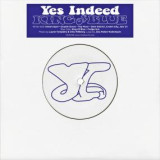
King Of Blue by Yes Indeed sees Laurie Tompkins and Otto Wilberg take their eclectic stance on cosmic jazz and electronics to further uncharted and dreamlike territory, encompassing a unique logic of what is harmoniously absurdist.
King of Blue by Yes Indeed sees members Laurie Tompkins and Otto Willberg further dive into their melismatic take on cosmic jazz and new electronics, by way of their highly eclectic and at times nonsensically sensical modus operandi. Their work is defined by an eloquent flurry of ideas, spheres, and signifiers, creating a musical universe of surprising longevity and depth. Treating musical convention with gentle disdain, Yes Indeed take on a variety of genres and moods and switch them around into a beautifully melismatic and dreamlike state of being. King Of Blue is a mini- album of fragmented beauty and warmth. It puts the illogical center stage and gives space to abruptly miniaturist musical ideas, allowing them to take on a meaning bigger than one would expect. It is cosmic music for modern times. A brazen descent into the execution of a fundamentally diversified musical stance.
'Yes Indeed' are Laurie Tompkins & Otto Willberg. Live, they play keys, bouncy bass and sing over tactile, emotive samples. Their music is epic and also somehow wrong, with space for delicacy, straight-up joy and soaring licks. Since 2022’s ‘Rotten Luck’ - their first proper album, on Bison - YI have played across the UK and Europe. Solo, Laurie co-ran the Slip label and has put out CDs on Entr’acte, 33-33 and Hyperdelia. Otto is a roaming bassist in groups like Historically Fucked and Abstract Concrete and his LP of “wildly singular, wickedly trippy and sensual set of fusion jams” (Boomkat) was recently out on Black Truffle.
s Luminessence, ECM's new audiophile vinyl-reissue series, is a kaleidoscope, shedding light on the jewels of the label's deep catalogue in elegant, high-quality editions - audiophile vinyl pressing, high-grade tip-on gatefold sleeves that include new liner notes Recorded in 1977 and now reissued in ECM's audiophile Luminessence vinyl series, the debut album of the Azimuth trio was truly ahead of its time. Formed by adding Canadian-born trumpeter Kenny Wheeler to the British duo of pianist John Taylor and vocalist Norma Winstone, the group's futuristic musical palette embraced hypnotic, minimalistic pulse patterns, otherworldly synthesizer sounds, songs, collective improvisation and solo flights. In recent seasons, the number of listeners under Azimuth's sway has grown exponentially, as the music has adapted itself to new contexts. The vast international audience that has heard fragments of Azimuth's "The Tunnel" as part of a major rap hit by Drake in 2023 (on his 200M+ streaming "IDGAF"), can now discover the original in its pristine form, still magical after all these years - as is the whole album.
Miles Davis' boundlessly influential On the Corner was so far ahead of its time upon release in 1972, the jazz cognoscenti rejected its groundbreaking concoction as middling in nature. Yet time has a way of righting wrongs and shifting views by adding needed context and perspective to visionary ideas, music, and approaches — the likes of which fill Davis' boldest and most controversial — undertaking. Designed to bring the focus back on the groove and bottom-end frequencies, the funk-loaded On the Corner revolutionized jazz. It also set new standards for record production, presaging remixing and electronica by more than a decade. And the work has never sounded more thrilling thanks to this very special pressing.
Sourced from the original master tapes and pressed on MoFi SuperVinyl, Mobile Fidelity's numbered-edition 180g 33RPM SuperVinyl LP of On the Corner exposes the internal mechanisms, free-associated playing, and then-unmatched studio techniques in vivid fashion. The low end, crucial to every composition here, is both heard and felt, with locked-in bass lines and low-range percussion conveyed as taut, solid, and visceral passages. You can discern the multiple layers of rhythm Davis employed on complex tracks such as "Black Satin," as On the Corner stands as his first effort to use overdubbing and multiple tape machines. As a pioneer, Davis likely would’ve loved MoFi’s groundbreaking SuperVinyl profile that features the lowest-possible analogue noise floor as well as pristine transparency, dead-quiet surfaces, and superb groove definition.
New degrees of spaciousness and airiness — equally important to the musique concrete arrangements — give the impression Davis and Co.'s creations float in space. Instruments are portrayed in three-dimensional manners, rhythmic loops retain tonal purity, and horn solos skitter across an extra-wide soundstage that takes listeners into Columbia's Studio E. Mobile Fidelity's SuperVinyl LP captures Teo Macero's innovative production — and the trumpeter's cutting-edge aural collages — in definitive fashion.
Heavily inspired by Sly and the Family Stone, On the Corner portrays street vibes and remains Davis' Blackest-sounding record. The conscious attempt to connect with youthful audiences tapped into rock and funk is evident not only on the colorful cartoon cover art depicting hot-pants and zoot-suit revelers, but in the music's emphasis of recurring drum and bass grooves. Distinct from Davis' earlier fusion experiments, the record's long-misunderstood set dials back improvisation in favor of beats, loops, and atmospherics that generate trance-like effects. While Davis utilizes his band for core duties — Chick Corea and Herbie Hancock prominently figure — he also relies on an all-star cast of side-men for concentrated soloing and additional support.
With rhythm providing the basic foundation, other notes fall into place, with their positioning steered by Macero and Davis' editing-room techniques. Looking to the manipulation-based work of Karlheinze Stockhausen and teaming with Stockhausen disciple Paul Buckmaster, Davis re-imagines what grooves constituted and could accomplish throughout On the Corner. The shapes of the songs become completely transformed as they progress. Faint melodies, spacey chords, chunky riffs, wah-wah fills, and repeated motifs bounce in and out of a sonic funhouse that wouldn't be out of place at a Harlem block party.
Exotic, intrepid, and filled with Davis' "jungle sound," On the Corner remains daringly hip more than four decades later.
Kjetil Mulelid's various projects have received international acclaim, ranging from his duo with Siril Malmedal Hauge, his trio, and the quartet Wako. His first solo album, "Piano" (Rune Grammofon, 2021) received plaudits that placed him in the same company as pianists like Keith Jarret, Brad Mehldau, and Bill Evans. With "Agoja" Mulelid demonstrates what a musician and composer worthy of such acclaim can do with an ensemble cast of musicians of the highest calibre. On "Agoja" three features are immediately apparent. First, that Mulelid's compositions are melodic, yet frequently surprising in their path from their beginning to end; second, that he is a generous band leader, allowing the musicians both to be themselves and to express themselves, often while he merges almost completely into the background; finally, that each composition has its own unique identity, yet bears Mulelid's hallmark clearly and distinctly. Kjetil Mulelid (b.1991, Hurdal, Norway) has distinguished himself as an inventive artist, blending jazz, psalms, and improvised music in both his own playing and compositions. After graduating from the famous "Jazzlinja" in Trondheim back in 2014, he has been heavily touring the world's nooks and crannies with his own music and projects. He has played concerts in large parts of Europe and Japan and released several well-received albums as a solo artists, as well as with his own Kjetil Mulelid Trio, the jazz quartet Wako, with singer Emilie Storaas as the duo Kjemilie, and with singer Siril Malmedal Hauge - both as a band and as a piano / vocal duo.
Label mainstay Aero is back with his first solo EP on Twice Infinity. The Irishman specialized in impactful, modern techno delivers four cuts on vinyl that maintain a perfect balance between driving, percussive work and mellow, dub-influenced synths. Layered with faint vocal samples and careful buildups, his organic productions are versatile tools for every DJ's box of tricks.
As part of a new wave of techno enthusiasts from Europe's green island who strive to evolve the genre without forgetting its roots, Aero can without a doubt be considered one of their most prolific and skilled acts. After contributing to two of Twice Infinity's past compilations, his solo effort presents the epitome of his current style, where consistency in ideas is paired with meaningful variation.
In the wake of a profound loss, Marie Klock, a neo-chanson singer and multi-instrumentalist from Paris, presents a poignant tribute with her debut on Pingipung. On “Damien est vivant” Marie Klock pays homage to the poet Damien Schultz, who has recently passed. They were intertwined both in artistic collaboration and deep friendship.
Marie Klock creates a powerful ode to Damien Schultz's surreal, anarchic, witty and at times provocatively obscene French (English translations are included in the vinyl release). The poet's own voice resounds alongside Klock's, oscillating between spoken word and neo-folk vocals. Recorded in an intimate lo-fi setting with co- producer Julien Louvet, the 10 songs are far from a mournful requiem. They showcase idiosyncratic pop music brimming with humour and absurdity. “Damien est vivant” is a celebration of the unique bond they shared, in past and present. The melancholy sometimes takes on an almost whimsical quality, an allusion to the world as perceived through the lens of two kindred spirits.
Marie Klock has appeared as keyboardist on international stages with Sofia Portanet and collaborated with artists such as Jean-Louis Costes, Chilly Gonzales, Charlotte Brandi and Adrienne Pauly. Her self-titled solo LP (2020, Les Disques De La Face Cachée) was a cheeky outing of her synth-chanson act. She is currently working on a duo album with Anadol, to be released on Pingipung in autumn 2024.
“Damien est vivant” will be released on Good Friday 2024. Marie Klock will present the album in live ceremonies.
out of Stock
Last delivered 2 years ago available to reorder, subject to availability
Whitney Houston’s self-titled debut album has few parallels. Viewed solely through the lens of sales numbers, Whitney Houston is a watershed statement on par with the most commercially successful and culturally dominant LPs ever released. Having sold more than 14 million copies in the U.S. and upwards of 25 million units worldwide, the 1985 LP became the equivalent of the television show or blockbuster film that everyone collectively experiences and discusses. Nearly four decades later, it’s lost none of its appeal or magnetism — and its artistic significance and historical import have only grown.
Sourced from the original master tapes, pressed at RTI on MoFi SuperVinyl, and strictly limited to 4,000 numbered copies, Mobile Fidelity's 180g SuperVinyl LP of Whitney Houston presents the breakthrough in audiophile sound for the first time. The signature traits Houston exhibits on every song — her three-octave range, radiant warmth, personal conviction, impossibly controlled register — come across with exceptional clarity, focus, and presence. Free of artificial ceilings and constricted dynamics, this reissue plays with an openness, airiness, and balance that put the singer’s once-in-a-lifetime instrument and immortal artistry into proper perspective.
It does the same for the songs’ cascading melodies and captivating arrangements. Individually produced by one of four renowned industry veterans — Kashif, Micheal Masser, Jermaine Jackson, and Narada Michael Walden — each composition feels grander, closer, more genuine. A vocal spectacular, Whitney Houston benefits from the high-end characteristics of SuperVinyl, which include a nearly inaudible noise floor, superb groove definition, and dead-quiet surfaces. This is how an album that changed the direction of popular music — opening previously inaccessible doors for Black artists; bringing smooth-singing vocalists back into the mainstream; kickstarting a movement that soon included several “divas” who would command the charts through the early 21st century — should look and sound.
Though Houston’s seemingly effortless performances suggest otherwise, creating the record Rolling Stone ranks as the 257th Greatest Album of All Time wasn’t easy. Nearly 18 months were required to identify songs suitable for a still-unknown singer who did not fit into the conventional frameworks of the mid ‘80s. Confident, powerful, and prodigiously talented, Houston would forge her own parameters with Whitney Houston. In the process, she obliterated the stubborn lines between R&B and pop, Black and white radio. She dared to reimagine who could be a superstar and then went out and defined the role. Recorded for nearly $400,000 and released on Valentine’s Day, the LP exceeded the wildest expectations of those most closely associated with it — save for Houston and her family.
Having made her first public appearance at the age of 11 singing at a Baptist church, Houston understood pressure and knew her way around, inside, and through a song. The invaluable guidance and support she received from her mother, Cissy, an accomplished gospel vocalist who backed Aretha Franklin and Elvis Presley, are on display throughout Whitney Houston. They arrive in the types of authoritativeness, discipline, and diction rare for even most seasoned veterans — and unheard-of for a 21-year-old newcomer. Houston brings a soulful elegance, understated glamour, and in-the-moment rapture to every note. Moving up, down, or staying in the middle of the vocal ladder; channelling softness or sweetness; showing restraint or increasing the volume, she is a marvel of emotionalism, a dynamo who can seamlessly transition from one mood to another within a verse.
Though the 10-track LP largely concerns itself with the ballad tradition, Houston covers the bases, getting into an R&B groove on the fleet “Thinking About You,” turning up the heat on the duet “Take Good Care of My Heart,” and investing the contagious dance-pop confection “How Will I Know” with all the anxiety, hope, energy, and enthusiasm its lyrics demand. Featuring her mom on background vocals and Houston’s pitch-perfect tone, uncanny precision, and skyscraper highs (no AutoTune here, friends), the synth-based anthem propelled Whitney Houston into the stratosphere, the vocalist into regular MTV rotation, and the term “crossover” into popular parlance. The double-platinum single reached No. 1 on the Hot 100, Hot R&B, and Adult Contemporary charts — a trifecta that foreshadowed accomplishments that would ultimately crown Houston as the most-awarded female artist of all time.
Whitney Houston became the first album by a Black female performer to top the Billboard charts. It remained there for 14 non-consecutive weeks en route to claiming the title of the best-selling LP of 1986. It stands as the first debut and first album by a solo female artist to spawn three No. Hits, as well as the first album by a Black female artist to top the year-end charts in Australia and Canada. These are just a handful of the accolades — along with four Grammy nominations — that surround a set that also contains the unforgettable ballad “Saving All My Love,” string-accompanied “Greatest Love of All,” and sensual “You Give Good Love.”
As TIME observed in an article written two years after the album took the world by storm: “This is infectious, can't-sit-down music, and her performance dares the listener not to smile right back.” We’re still smiling.
Damian Lazarus’ Crosstown Rebels imprint announces, ‘Portrait of the Obscure’, the stunning new album from Oceanvs Orientalis.
Following three superb singles on the label across the past four months, the nine-track LP offers a comprehensive exploration of the Instanbul-based talent’s rich, globally-infused and captivating sound, with the project set for release on 26th April 2024.
Safak Oz Kutle, known as Oceanvs Orientalis, is a producer and live performer based in Istanbul. His musical style intricately weaves together diverse sonic tapestries of wide-spanning genres and cultures, and through his creative fusion of these influences, he crafts an immersive world that takes you far away from the usual club music references. His music serves as a celebration of his musical heritage, and this has never been truer than on his superb new album ‘Portrait of the Obscure’, which again pushes traditional boundaries within the electronic sphere. Set for release on 26th April via Damian Lazarus’ renowned and celebrated Crosstown Rebels imprint, the nine-track LP project features a showcase of solo and collaborative material alongside close friends such as Tooker, Idil Mese and Tilahun Gessesse, delivering a journey into the creative mind of one of
the scene’s most intriguing talents.
The bold and riveting project kicks off with the captivating synthscapes, fluttering strings and plucked bass of the gorgeous ‘Pulse Antique’, before ‘Ministry Of Midnight’ cuts loose on more jumbled rhythms and intricate organic lines warmed with wordless vocals. Next up are two of the lead
singles - the tense and intricate house sonics of ‘Neutrality’ and the haunting atmospheres and ethereal synth lines of ‘IL Lupo’ featuring Tooker, while ‘Conritmo’ continues to bring exotic new string sounds, leftfield melodies and warped bass to this most vibrant exploration of candle-lit house sounds. ‘Soul of Calypso’ blisses out on far-sighted cosmic chords with sonorous bells and late-night spoken word musings that add all-new character to the innovative grooves. Then comes the laid-back, jazz-infused house of ‘Heart Pieces’ feat. Idil Mese, a deep and jazzy jungle shuffler
in ‘Mercury’ and the playful horns and lumpy, dub-wise swagger of ‘Lanchi Biye’.
An album project encompassing its title perfectly, ‘Portrait of the Obscure’ is just that - a magnificent snapshot of the unique musical mind of Oceanvs Orientalis.
out of Stock
Last delivered 6 months ago available to reorder, subject to availability
This is a repress of Tycho's second release with Ghostly International to celebrate the 10 year anniversary of this masterpiece, while Ghostly International celebrates its 25th year anniversary. For nearly a decade, Tycho has been known as the musical alias of Scott Hansen, but with the release of Awake - his second LP for Ghostly International - the solo project evolved into a three-piece band. Relating closer to post-rock than ambient soundscapes, the record is situated in the present, sounding more like Hansen than drawing from his influences. This is, in many ways, the first true Tycho record. Following 2011's Dive LP, the San Francisco-based designer toured extensively, and with a full band on stage, his sound coalesced into a percussive, organic whole. Zac Brown (guitars, bass) rejoined Scott on the road for this tour, but it was the particular addition of Rory O'Connor's live drumming that ultimately sent Hansen back to the studio with a more precise vision. "After the tour, I decided that I wanted to capture the more energetic, driven sound of the live show on the next album," Hansen recalls. Bringing musicians into Tycho's creative process was a step towards expanding his own songwriting and advancing the project beyond its current sound. In a cabin near Tahoe last winter, Zac and Scott began fleshing out the structure of the new record, but it wasn't until they set up shop in the hills of Santa Cruz with Rory that it all fell into place. "It crystallized the vision of how the drums would come to the forefront on this record," says Hansen. The sound was much more stripped-down and concise with more organic instruments in the fold. Songs like "Montana" and "Awake" are a departure from Tycho's previous material - unique to the group effort poured into the songs on the new record - while "See" and "Dye" echo ideas from previous works, bridging a middle ground between the old and new. Working with Count Eldridge, who also engineered Dive, the team could fixate on the pulses that Tycho might previously layer under synthesizers and exhume them with distinct bass and guitar patterns. Also known for his design work as ISO50, Hansen's visual and sonic efforts have dovetailed throughout the course of his career. "This is the first time in my life I've dropped everything to focus on one artistic pursuit," notes Hansen. Previous Tycho releases came to fruition when an amalgam of songs were nearing completion, but Awake is where music becomes the focus and true expression becomes the result.
out of Stock
Last delivered 20 months ago available to reorder, subject to availability
At the same time that Neville 'Bunny Wailer' Livingston recorded his debut solo long playing masterpiece, 'Blackheart Man', he was also creating a series of singles for his own Solomonic label. These records were every bit as good, at times even better, but they have never been released outside of Jamaica. Until now...,
It is next to impossible to ever overstate the importance of The Wailers to the history of Jamaican music and, as the last surviving member of the group, Bunny Wailer rightly regards himself as the sole keeper of their history ever mindful of the group's exalted position in the story of reggae music and the importance of their legacy. In 2010 Dub Store were proud to be able to work with Bunny on re-releasing a selection of his earliest recordings for the Solomonic label, lovingly restored and presented in reproduction sleeves and labels, on limited edition seven and twelve inch singles. Now, taking another step forward, we are more than proud to present Bunny's timeless music on two beautifully packaged CD's and double LP's. Bunny's first solo album, 'Blackheart Man' originally released in 1976 on his own Solomonic label in Jamaica and on Island in the UK, is one of the undisputed all time classics of Jamaican music and established Bunny Wailer as a highly respected, world renowned artist in his own right. During this period Bunny also produced a series of singles released in Jamaica and the UK in strictly limited quantities without the benefit of international distribution, that are every bit as good and, in some cases, even better than this awesome debut long player. Original copies have subsequently become highly prized, and highly priced, collector's items. "Classic rarities" is an overused and abused term too often employed to describe average records that failed to sell on their initial release but both 'Tread Along' and 'Rise & Shine' are packed from beginning to end with a searing selection of some of the greatest and hardest to find reggae records ever produced. 'Tread Along' opens, naturally enough, with 'Tread Along' from 1969, one of the last singles for The Wailers' own Wail N Soul M label, and runs through the first release on the Solomonic label, 'Searching For Love' also known as 'Search For I', 'Bide Up' released as 1974 drew to a close, a radical reworking of 'Pass It On' and a marked contrast to the version on The Wailers' 'Burnin'', album, 'Life Line' and the prophetic 'Arabs Oil Weapon' kept the pressure on as Bunny began outlining the flawless 'Blackheart Man' album. Each release was a certified classic in its own right. Peter Tosh's melodica version to Bunny's 'Amagideon' ('Armageddon'), the first track on 'Rise & Shine', is followed by 'Love Fire', an update of another Wail N Soul M track, 'Fire Fire'/'Babylon Burning', through to one of the deepest roots records ever created, 'Rise & Shine', on to 'Riding' from the 'Bunny Wailer Sings The Wailers' sessions (but not featured on the album) and a huge hit in the UK in 1981, and closing with 'Rule Dance Hall' from 1985. No idle boast..., The liner notes feature the story of The Wailers, as told to Dub Store by Bunny himself in Kingston in an enlightening 2012 interview, and rarely seen contemporary photographs complete these essential releases. The music of Bunny Wailer was not only a medium for change and protest but also to elucidate and educate and 'Tread Along' and 'Rise & Shine' finally complete the canon of un-compiled Wailers music. "I'm quite satisfied, you know, reggae music is the kind of music that although sometimes you would look at it and say..., boy, it's hard..., then again you look at what it has done for the people of the world you know that that couldn't be locked up in a little place like Jamaica!" Bunny Wailer
Beside Trawbreaga Bay, in Co Donegal, on the north coast of Ireland, in an old schoolhouse, with a suitcase full of hired recording gear, Oisin Leech strums gently on an acoustic guitar and watches the tide pull the water away from the ancient inlet - The thickness of Oisin's voice soothes the room as the sound waves bounce around in the land where his ancestors still live and still wander - With a musical history that led Leech from the street punk bands of yesteryear through an ongoing stint with folk duo The Lost Brothers, he found himself for the first time working on songs to sing alone. In his mind, the songs became imagined vignette films playing behind closed, guitar eyes. After writing nearly 40 new songs in this fashion, Leech wrote "October Sun" which would become the foundation for his debut solo record, Cold Sea.
Cold Sea was produced by guitarist/songwriter Steve Gunn. Leech dreamt of making the record in Donegal Ireland, a county significant to him because it is the home of his ancestors. Pitching this idea to Gunn sparked the first of several serendipities circling the Cold Sea sessions - Gunn had always wanted to visit Donegal to connect with his own familial roots in the region.
Cold Sea is perhaps most notable for its tremendous warmth. Each song was recorded in a few takes and adorned gently with synthesizers and guitar from Gunn. Several songs feature contributions on the upright bass by Bob Dylan band stalwart Tony Garnier. M. Ward plays guitar on October Sun and there are strings by Roisin McGrory and bouzouki by the legendary Donal Lunny throughout. It is a friendship record but even at its most collaborative, Cold Sea remains centered around the humble acoustic guitar and wool blanket vocals of Leech.
Introducing, the experimental violinist and performer Vanessa Bedoret.
The London-based French musician today announces that she’ll be joining, Scenic Route, a label renowned for selecting and nourishing rising stars for the release of her debut album, Eyes, due out on 8th of March 2024. Launching with a taste of what’s to come, today she also shares single “1/2”, a textural track that tells of the dichotomy between those who are selfless and those who are self-centred, and their need to merge as one. This duality is reflected in the industrial metallic echoes under Vanessa’s soaring vocals and the piercing strings of her chosen instrument, the violin.
Treating songwriting as an instinctive process, Bedoret transforms her deeply personal experiences into pure emotion. Not following any set narrative, Eyes takes the listener on a journey via their own experiences, prompting introspection through Bedoret’s hypnotic melodies.
Through the album, she awakens the audience's imagination, to open up their emotional response. On “Ballad”, a vague, loving lyrical letter to someone close, Bedoret’s heartbreakingly soft lament is barely audible over the dramatic atonal strings. She flips her narrative again in the titular track, “Eyes”, so the listener empathises through her isolated violin, and takes on her anguish, not needing to understand the full story.
Bedoret began her classical training at age 6 and on completion at 18 she embraced the thrill of playing guitar in punk bands, and like many at the turn of adulthood, was quickly captured by the allure of the dancefloor. Her far-reaching taste doesn’t stop there, she also counts black metal to opera and from eurodance to IDM as inspiration. Her deep understanding of musical form elevates her experimentation to a truly unique sonic experience, one that never strays too far from her original love of classical music.
With only a string of releases under her belt via independent labels like Laura Lies In and Archaic Vaults, her refined skillset has meant she’s been in high demand for both solo shows and collaborations. These accolades include playing violin with New York avant garde collective Standing On The Corner at The Serpentine, as well as a part of Kahil El’Zabar conducts MOKI at the ICA, and Linder: Another Music in a Different Arcadia at the Design Museum alongside artist Linder Sterling, Naima Cherry, Maxwell Sterling, Kenichi Iwasa & Ella Frears.
For her solo performances, she’s shared stages with Standing on the Corner, Ekaterina Bazhenova-Yamasaki, Philomème Pirecki, John T. Gast and Nexcyia to name a few. She’s also performed as a duo alongside musician Severin Black in support of their collaborative EP release, First Passage / Excommunicated.
Through the lens of a life lived to it’s fullest and one that does not shy from experiencing the rawest of emotions, it’s clear that Bedoret has a nack for translating personal observations into cinematic crescendoes. The field recordings throughout only heighten this feeling adding both a grounding and other worldy sensibility. Lyrically, she allows you to peek into her private world and for a fleeting moment letting you lock eyes with hers, asking what do you see?
This debut is a glowing experimental work that purrs with a distinctive narrative. Vanessa Bedoret is a promising new act, ready to take 2024 by storm.
Le jazz homme is the 2nd album of Black To Comm related entity Mouchoir Ètanche. This time heavily influenced by French Jazz (?) as well as the usual suspects: Nurse With Wound, Luc Ferrari, JG Ballard, Surrealism. The human entity has finally been replaced.
"Program music, instrumental music that carries some extramusical meaning, some “program” of literary idea, legend, scenic description, or personal drama. It is contrasted with so-called absolute, or abstract, music, in which artistic interest is supposedly confined to abstract constructions in sound. It has been stated that the concept of program music does not represent a genre in itself but rather is present in varying degrees in different works of music." (Encyclopædia Britannica)
Prompt 1: Pascal Comelade's toy piano falling down the stairs , Hector Zazou pushing from behind, laughing
Prompt 2: Cool jazz played on antique mellotron, low in fidelity, and sad, Glenn Miller‘s grandma crying silently
Prompt 3: A hippie commune version of jazz as played by a cheap computer fed by Chat GPT with medieval buisine fanfare information and samples, trained on the entire Amon Düül II history, heavily looped yet unsynchronized
Prompt: 4: Same, but flutes and synths and trance and chants
Prompt 5: French female artist philosophizes about Shirley Temple, mysterious atmosphere, insensitive homme laughing nervously, heavily looped, hynotic 18th century orgue de salon underneath
Prompt 6: Cool jazz, Echoplex, strange rhythm, Blue Note daydreaming
Prompt 7: Hammond jazz with fake Cyro Baptista loop, Madagascar indri indri lemurs chanting fake sax solos in Malagasy language, electronic bells
Prompt 8: German jazz and artificial prayers, and Shirley Temple returning, with defect Publison recorded at GRM, destroying the voice recording
Prompt 9: Andrei Tarkovsky's moustache meets Johann Sebastian Bach's wig, a well gently lapping in the background, fifths, car crashing into a poor violent onsen geisha
Marc Richter records as Black To Comm for Thrill Jockey and under the Mouchoir Ètanche and Jemh Circs monikers (and solo) for his own Cellule 75 imprint. He collaborated with visual artists such as Ho Tzu Nyen, Jan van Hasselt and Mike Kelley. He also produces soundtracks and acousmatic multichannel installations for institutions such as INA GRM Paris, ZKM Karlsruhe and Kunstverein Hamburg.
Miles Davis' A Tribute to Jack Johnson is the best jazz-rock record ever made. Equally inspired by the leader's desire to assemble the "greatest rock and roll band you have ever heard,” his adoration of Johnson, and Black Power politics, Davis created a hard-hitting set that surges with excitement, intensity, majesty, and power. Bridging the electric fusion he'd pursued on earlier efforts with a funkier, dirtier rhythmic approach, Davis zeroes in on concepts of spontaneity, freedom, and identity seldom achieved in the studio — and just as infrequently accepted by the mainstream.
Sourced from the original analog master tapes, pressed on MoFi SuperVinyl, and housed in a Stoughton jacket, Mobile Fidelity's 180g LP reissue brings it all to fore with startling realism. Benefitting from SuperVinyl’s nearly inaudible noise floor, superb groove definition, and clean, ultra-quiet surfaces, this 180g LP showcases everything — from the bold tonality of the headliner's white-hot trumpet solos to the decay of crashing cymbals, carry of wiry guitar notes, and echoes of the studio — in reference fashion.
Bristling with exuberance, Davis' high-register passages explode with authority and commanding presence. Around him, a barrage of urgent backbeats, knifing riffs, and supple bass lines emerge amidst black backgrounds. One of the most prominent differences long-time fans will notice is how much more aggressive, immediate, and vibrant the music sounds, with those aspects central to the composer's original desires.
Utilizing wah-wah and distortion, the go-to instrumentalist of the performances— guitarist John McLaughlin — attacks with a nasty edge, slashing style, and vicious streak that allows A Tribute to Jack Johnson< cross the until-then-impenetrable divide between rock and jazz. Davis puts both feet in the former camp and erases any gap. The stories of the record’s creation are nearly as legendary as the sounds within: Two sessions, multiple jams, different sets of musicians (several uncredited), and near-miraculous production perfectionism that made it all appear cohesive.
The least-well-known masterpiece of Davis' career, the 1971 record — seamlessly assembled and spliced together by producer Teo Macero — was a victim of limited record-label promotion. Audiences also didn’t immediately know what to make of its original cover art — faithfully replicated here. In addition, the powers that be at Columbia Records were directing the public’s attention to Miles at Fillmore, a completely different kind of album guided by two keyboardists. A Tribute to Jack Johnson practically lives in a different universe, one from the future. To many listeners who did manage to hear it — among them critic/musician Robert Quine, Stooges leader Iggy Pop, and renowned critic Robert Christgau — it surpassed everything that came before.
Indeed, Davis treated it as a personal manifesto: An opportunity to salute the Black championship boxer admired for his threatening image to the establishment and impeccable taste in clothes, cars, women and music. Davis explains in the liner notes his affinity for Johnson — a stance mirrored by the defiant music, which hits with a prize fighter's force and reflects the graceful elegance with which a pugilist navigates the ring — and closes the album with a Johnson quote read by Brock Peters.
Inspired not only by Johnson but by Jimi Hendrix and Sly Stone, Davis changed his approach and his band. He surrounds himself with a cadre of musicians in their 20s and, in the case of bassist Michael Henderson, a 19-year-old fresh from touring with Stevie Wonder. Henderson gives Davis what he requested: boogie-based grooves that don’t lose shape or direction. Soprano saxophonist Steve Grossman, drummer Billy Cobham, and organist Herbie Hancock adhere to a similar aesthetic that prizes brazenness, innovation, and energy.
In that vein, during a portion of “Yesternow,” Davis segues into a separate performance (which became known in its entirety as “Willie Nelson”) played by guitarists McLaughlin and Sonny Sharrock, bass clarinetist Bernie Maupin, keyboardist Chick Corea, bassist Dave Holland, and drummer Jack DeJohnette. Dig it!
Talking with jazz scholar Bill Milkowski — who himself noted how McLaughlin’s unrestrained style, decibel-forward volumes, and rapid-fire power chords engendered himself to the rock crowd at the same time that his harmonics and syncopation still definitely made him a jazz player — guitarist Henry Kaiser summed up part of the appeal of A Tribute to Jack Johnson as well as anyone, saying: “It’s a jazz record that way way more open than other jazz records at the time, but still not free jazz. McLaughlin’s rhythm guitar playing on ‘Right Off’ — the use of different chords in a rock shuffle than what anybody had used before — was revolutionary.”
And to think that’s just one aspect of a record that contains multitudes. “Never let them forget it.” Indeed.
Steffi's fourth solo album, The Red Hunter gets remixed! This killer package with remixes by 9 artists close to Steffi's heart, represent her musical bandwidth with a very diverse mix from ambient, IDM, broken beat to electro, techno, and drum & bass! The special vinyl version opens with Convextion aka E.R.P who delivers his signature with a 10 minute ultra deep, beautiful, techno/electro journey. Italian talent Rosati drops a high energy chord techno monster and UK duo Tracing Xircles throw us in a deep trippy bath with their mixture of IDM with a lush broken beat banger!
out of Stock
Last delivered 11 months ago available to reorder, subject to availability
The ever poignant yet exceedingly elusive Chorg Dorgon speaks on the new album by Charles Moothart, entitled Black Holes Don’t Choke: “For the sake of clarity, and its clarity that we seek, Charles has been a pillar of our musical experience since he began playing eons ago in the various projects and countless albums he has contributed to. Charles is a musician who has been constantly on the road for years playing in Ty Segall’s Freedom Band and Fuzz. When there has been a rare time away from those engagements especially in the post-pandemic scramble to catch up world of gigs and tours, he has been spending all of his time in his laboratory figuring out how to synthesize all of the info he has collected and musical ideas he has developed in the past few years since the last CFM record and subsequent shows for this new solo work. Just before the pandemic started, he was out playing solo shows in a project that revolved around an MPC sampler, just to give an example as to the wideness of his explorations. His result is Black Holes Don’t Choke. Love songs for the apocalypse. A prayer toward optimism amid chaos. A plea toward nature. The themes on this album are the themes of today. Charles appeals for us to visualize evolution. And with a signature, the music sounds exactly as you want it to. It sounds like Charles Moothart’s music only more evolved and with greater focus and direction. With greater textural dynamic and more sonic variation and realization, but never sacrificing the insane riff that he is clearly the master of. He gets to the point on this record. He is presenting a voice you can understand and rely on as you make your own journey into it. Create your own meanings. The record now belongs to the world. Because we all start a thought as that which is beginning-less and endless and at some certain point it becomes its own thought, takes it owns shape and becomes itself, separate from the thinker, separate from the observer. alive in the ether!”
Following 2022' acclaimed 'Topical Dancer' album with Charlotte Adigéry, here comes 'Letter To Yu', the debut solo album by Bolis Pupul : produced by fellow Belgians Soulwax & released on DEEWEE/Because Music. Exploring many themes including loss, grief, ancestry, culture, belonging/not belonging and identity. It's no coincidence that Bolis Pupul's music sounds the way it does. Born in Belgium to a Chinese mother and Belgian father and raised in the super-cool creative city of Ghent, Bolis' music is a joyous cross-cultural assemblage. Mixing widescreen electronica with the warm-hearted and wonky naivete of Belgian New Beat, Bolis' singular sonics are at once playful, emotive, unrelenting and tender. The real key to unlocking Bolis' musical secret, however, is that conversation he has between his Eastern and Western roots. The creation of the album is built around Bolis' trip to Hong Kong earlier this year, made to reconnect with his late mother's roots.
out of Stock
Last delivered 2 years ago available to reorder, subject to availability
“But into my miserable brain, always concerned with looking for noon at two o’clock" - Charles Baudelaire (1869)
The Foreign Department is the second album by Astrel K, the solo project helmed by Stockholm-based British ex-pat, Rhys Edwards. Those already familiar with Edwards’ work will likely know him for fronting the cultishly great Ulrika Spacek, and given he operates as the principal songwriter in both projects, much of the same hallmarks of his cathartic, elliptical songwriting are present in Astrel K. Nonetheless, The Foreign Department feels like a rubicon moment of sorts, and the album that Edwards has unconsciously been working towards his entire creative life.
As a title, The Foreign Department offers an instructive guide for the listener, framing a life-in-transition/artist-in-exile document that maps two impromptu moves in twelve months for its songwriter: the first from London in pursuit of a relationship, the second between homes in Stockholm as that decade long relationship then suddenly dissolved. Indeed, diffusion, dissolution and reconstitution feel like appropriate touchstones for its recurring themes. Written amidst the flux of two states, at once isolated from home and then any established emotional anchor, the resulting eleven tracks came to represent a precognitive search for shifting identity and with it forming an unwittingly biographical record. It's commendable and somewhat telling that during this shake up, Edwards somehow landed upon his most realised and original work.
With a former life stripped away, there emerged an opportunity to reinvent a sense of self through art, now not just as a writer, but a composer also. Developing the confidence to arrange songs in ways he'd previously considered off-limits, while also taking cues from the opulent string and brass arrangements of records like Mercury Rev's Deserters' Songs and Death of A Ladies Man by Leonard Cohen, Edwards enlisted a range of performers to bring to life the mini-symphonies forming in his head. Perhaps it's inevitable that an album written while facing the consequences of being alone would eventually ossify around the process of bringing people together.
For all its troubled origins, The Foreign Department is a remarkably warm sounding collection. Edwards' lyrics are typically knotty and neurotic, dancing around the poetry of quarter-life anxiety, but the music itself is often joyous and even uplifting, the combination expressing that neat duality of melancholic euphoria. Edwards sings variously of crises, "torrid pieces of art", of "houses on fire" and not "having the guts for it", yet these troubling sentiments are framed by seemingly incongruous swelling strings, chirping horns or motorik percussion, creating that sense of pushing forward or floating above, of wrapping your troubles in dreams, a salve for the moments when you get a bit too much for yourself.
Lead single, 'Darkness At Noon', likely captures this all best. Named for the French idiom "midi a quatorze heures", the maddening idea of attempting the impossible for the sake of some greater possibly pointless cause, it directly grapples with the opposing notions of wanting and not wanting, of being here and being there at the same time. The conflicting and impossible self. It’s something Edwards addresses in the song at perhaps his most open, opining, “I know I want to be seen, but I hate most of what comes out of me”. And yet here is, putting it all out in the open and on the line, the dialectics of his enlightenment up on show.
REKORDER is "a kind of retrospective of myself", says M.RUX about his second, long-awaited solo album. For over 10 years, Marten Rux aka M.RUX appears as a DJ, producer, editor, remixer and multi-instrumentalist all over the world and has developed an idiosyncratic sound that opens up subtle fields of tension: M.RUX mixes a sound between experimental sound design and hooklines that stay in your ears forever. Between wild percussion and contemplative harmonies, between ecstasy and meditative calm. In his DJ and live sets, M.RUX usually steps up to the controls with a smile, discreetly bobbing his head, while the audience goes wild. He circumnavigates clichés with trustworthy certainty and develops his very own guiding threads in his selection beyond BPM or genre straitjackets. One constant is his warm, often stoically slow kick drum, which holds all that playfulness together. REKORDER is a manifestation of this typical M.RUX sound. Similar to his concept album "Vermonische Melodien" from 2020 (on the Pingipung label), the artist's curiosity is directed towards the musical visions of the past. When new music technology projected great visions of the future and when new sounds had not yet solidi ed into clichés. REKORDER refers to the recording device, spelled in a German way, because most of the recordings were made in Germany (and in England as well). Phonography is a miracle that has only been around for 150 years: Technology gifts upon us prosthetics for remembering sound. Every recording is a process, and every playback a new performative act. Recordari (Latin) is a beautiful word. It literally means to take something to heart (cor) once again (re-). This doesn't just refer to remembering, but also to a ponderous, loving, sometimes doubtful contemplation. It is a perfect headline for M.RUX’ approach to processing sound. REKORDER draws deeply from its own archive, which has ourished quite splendidly during the pandemic. Multi-instrumentalist M.RUX mixes his own recordings of banjo, guitar, auto-harp, synths, percussion and jews harp with fragments from sessions with friends that have accumulated since 2020. They unfold in the process of re-listening in the mix and transform into a solid musical tapestry. A typical gesture for this album? M.RUX bows deeply to the history of pop music - especially the blues and its melancholy, coolness and shuf ing groove. The harmonic framework of the album is based on blues scales throughout. Instead of conveying blue emotions via lyrics or the tone of the voice, as the original genre does, the synthesizer takes on this role on REKORDER. With his sound design, M.RUX achieves an ecstatic sorrow in his melodies, this gurgling portamento that is reminiscent of R&B (or even the ingenious title melody of the series "Bojack Horseman”). If voices are heard on REKORDER, then as hypnotic fragments that guide us through the groove as conjunctions: "Because...", says the voice in the track of the same name. That's enough. There are no lyrics, no literal weariness, no love-songs or storytelling, REKORDER processes all of this into timbres and groove as vessels for the album’s individual, contemplative melancholy. Never forgetting, with a gentle smile, to swing a leg.
out of Stock
Last delivered 21 months ago available to reorder, subject to availability
LIMITED RED COLOURED VINYL!
REKORDER is "a kind of retrospective of myself", says M.RUX about his second, long-awaited solo album. For over 10 years, Marten Rux aka M.RUX appears as a DJ, producer, editor, remixer and multi-instrumentalist all over the world and has developed an idiosyncratic sound that opens up subtle fields of tension: M.RUX mixes a sound between experimental sound design and hooklines that stay in your ears forever. Between wild percussion and contemplative harmonies, between ecstasy and meditative calm. In his DJ and live sets, M.RUX usually steps up to the controls with a smile, discreetly bobbing his head, while the audience goes wild. He circumnavigates clichés with trustworthy certainty and develops his very own guiding threads in his selection beyond BPM or genre straitjackets. One constant is his warm, often stoically slow kick drum, which holds all that playfulness together. REKORDER is a manifestation of this typical M.RUX sound. Similar to his concept album "Vermonische Melodien" from 2020 (on the Pingipung label), the artist's curiosity is directed towards the musical visions of the past. When new music technology projected great visions of the future and when new sounds had not yet solidi ed into clichés. REKORDER refers to the recording device, spelled in a German way, because most of the recordings were made in Germany (and in England as well). Phonography is a miracle that has only been around for 150 years: Technology gifts upon us prosthetics for remembering sound. Every recording is a process, and every playback a new performative act. Recordari (Latin) is a beautiful word. It literally means to take something to heart (cor) once again (re-). This doesn't just refer to remembering, but also to a ponderous, loving, sometimes doubtful contemplation. It is a perfect headline for M.RUX’ approach to processing sound. REKORDER draws deeply from its own archive, which has ourished quite splendidly during the pandemic. Multi-instrumentalist M.RUX mixes his own recordings of banjo, guitar, auto-harp, synths, percussion and jews harp with fragments from sessions with friends that have accumulated since 2020. They unfold in the process of re-listening in the mix and transform into a solid musical tapestry. A typical gesture for this album? M.RUX bows deeply to the history of pop music - especially the blues and its melancholy, coolness and shuf ing groove. The harmonic framework of the album is based on blues scales throughout. Instead of conveying blue emotions via lyrics or the tone of the voice, as the original genre does, the synthesizer takes on this role on REKORDER. With his sound design, M.RUX achieves an ecstatic sorrow in his melodies, this gurgling portamento that is reminiscent of R&B (or even the ingenious title melody of the series "Bojack Horseman”). If voices are heard on REKORDER, then as hypnotic fragments that guide us through the groove as conjunctions: "Because...", says the voice in the track of the same name. That's enough. There are no lyrics, no literal weariness, no love-songs or storytelling, REKORDER processes all of this into timbres and groove as vessels for the album’s individual, contemplative melancholy. Never forgetting, with a gentle smile, to swing a leg.
out of Stock
Last delivered 2 years ago available to reorder, subject to availability