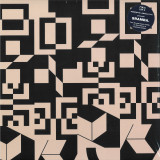
buen clima is the solo project of producer, composer and DJ Felipe Castro (Santiago, 1993). Under that alias, he makes a sometimes clean, sometimes dirty mix of techno, house and electro, among other styles, with a soft spot for high BPMs, big, glossy pad sounds and interlocking rhythms. With a background in classical music and free improvisation, his productions and live performances often bring into them unexpected moments of noise, unusual influences and, above all, humour.
« This EP is comprised of five tracks written between 2020 and 2022, and it's got quite a bit of contrast among them, as well as some common threads. Some are gritty and noisy, some are a bit more amiable. However, they all show signs of recurring obsessions with certain rhythms, certain synth sounds, and share a sense of fun and humour. Each is an exploration of different production and synthesis techniques.
Big Butibit Chess Master Pro v.3.5 is on the lighter side, with some big warm pads and jazzy drum sound. It's kind of a sunny ghettotech cut, if that makes any sense. The synth part has a spontaneous feel, it was recorded pretty much in one take.
>:) Is a heavier club track, made to go a little evil, a little mischievous. It's full of squelchy sounds and has a drum part that sounds like a never ending Street Fighter combo, or a bunch of beer bottles being opened one after the other.
Forma/Contenido is also on the darker side, with a droning, oppressive mass of sound that accumulates and evolves all throughout the track. It's very much inspired by the piece "I am sitting in a room" by Alvin Lucier, and is, in fact, a sort of live version of the same premise, a long feedback loop of the voice and the beat recorded and played in the studio.
Arturito is how we call R2D2 in Latin America (or at least in Chile), and it's also my father's name. We both love the original Star Wars and this is a little tribute to that. I had a lot of fun making this track, using only Ableton's Operator synth to make 90% of the sounds. It's a bouncy, evolving electro cut with a lot of quirky bleeps and bloops.
Pequeña midi is definitely the heart of the EP, a slower track made for my cat, who's sitting in my lap as I'm writing this. The rhythms and the sounds are a musical representation of how I imagine her life is like, and of her little games, running around the house. In terms of style I feel like this is what it would sound like if Yellow Magic Orchestra did a slowed down footwork track (play it at 160 BPM if you don't believe me!). »
Search:solo sounds
Alison Goldfrapp has set a towering bar for British synth-pop in the 21st century and she’s only just getting started. The magnetic London-born singer, songwriter and producer’s seven albums with Goldfrapp were fuelled by an unfailing modernity and a sixth sense for sounds that were more timeless than any trend. With the release of her debut solo album The Love Invention—an electrifying dance-pop suite—her multi-faceted musicianship reaches a new peak.
The Love Invention marks Alison’s reawakening as a dancefloor priestess, in an intoxicating showcase of the disco and house influences that have always been at the heart of her musical DNA. “So Hard So Hot” bottles the ephemeral joy of a dancefloor with its anthemic house beat, disco handclaps, and an exquisitely alluring vocal from Alison. The sense of uninhibited liberation courses through album highlights like “In Electric Blue,” a yearning synth-pop confection with a chorus as blissful as love’s first butterflies. On “Never Stop,” she is flooded with the rush of an all-encompassing love over a buoyant, rubberised beat; the sublime synth-pop of “Fever” is an ode to the intoxicating majesty of the dancefloor, with a chorus that explodes as if setting off a glitter cannon.
Here comes something unapologetically goth.
Male Tears is the dark electro group consisting of vocalist, James Edward and synthesist, Frank Shark. Hailing from Los Angeles, what began as a solo project re-established itself as a duo in 2021, simultaneously moving from the breezy sounds of the first self-titled album to darker realms with their sophomore Trauma Club.
Krypt is their third full-length recording and it shows a fully grown ensemble capable of pushing everything over the top; blending elements of darkwave, goth rock, EBM and futurepop into a sound they call Dark Rave.
Naturally drawing inspiration from the Californian goth tradition (45 Grave, Christian Death) and the Canadian post-industrial brood (Skinny Puppy, FLA), as well as the best UK synthpop (Depeche Mode, The Human League), Male Tears emphasizes the most glamourous, and at once, gruesome aspects of the whole gothic subculture, bringing everything to the next level, resulting in a contemporary and cutting edge album.
Eight new cuts that alternate rarefied synthwave (Krypt), dark eurodance (Slay) with goth techno-pop (Sleep 4Ever) and pounding electro-industrial (I Expire) to create something we may call New Romantic Body Music. It’s no wonder we wanted the scene’s top studio, La Distilleria, run by Maurizio Baggio, to master this for the most bombastic outcome.
And yet Krypt is not just about the music, it’s about one up with the times attitude that can review aggressive EBM in the light of an extravagant pop sensibility and a theatrical grandeur worthy of the Blitz Kids from London circa 1979-80.
You may think it takes quite a bit of nonchalance to do so but the L.A. duo easily succeeds at this. Akin to their aesthetics, they may seem spooky from the outside but their approach is nothing stuffy. Quite the contrary, everything regarding Male Tears is a celebration of life’s most bizzare shades, driven by some of the best dark humor you’ll find around.
So Dance with me, my dear, on a dancefloor of bones and skulls / The music is our master The devil controls our souls.
Murmer is the long-standing project for Estonian field recordist and composer Patrick McGinley, and in Tether, The Helen Scarsdale Agency welcomes Murmer back to our roster, over a decade since he graced us with his last production for the Agency. His field recordings often center upon the amplification and activation of resonance from a particular space, landscape, or object. Such sounds emerge from a condition as begin fleeting, inconsequential, or ephemeral and explode into that which alien, sublime, and profound. Here lies the tremendous prowess of the contact microphone, as wielded by an accomplished musician! The source material cited by McGinley includes cables, fences, wires, and vents.
There is a heft to many of these sounds as heard throughout all of "Taevast" with deep throbbing pulsations from arctic wind generating subharmonic patterns upon thick high-tension wires. Elsewhere the subtle dissonance from a rasping cooling fan blooms into a brooding ambience that is sublimely rich in its metallic timbres and complex reverberations. McGingley has long been an exemplary artist in the field of phonography even as he is less prolific than others. On Tether, he has produced a majestic if occasionally foreboding work on par with the mythic wire recordings of Alan Lamb, Jacob Kirkegaard's haunted resonance from Chernobyl, and much of the Touch catalogue for that matter!
Patrick McGingley on Tether:
In 2006, I made a collection of recordings at a mobile phone mast in Mooste, southeast Estonia. It is a guyed tower, 80 meters tall, affixed to 3 support points with heavy cables. I attached my self-made contact microphones to these cables with poster tack, and spent many hours over several weeks recording the various wind and weather variances (it was summer), and the birds that passed or settled on the tower or cables. This was one of my first visits to estonia, where i now live, and one of the things that marked me about that experience was the access: the tower had no fences or protections around it (I have not been back there recently to answer my own question of whether or not this is still the case); it stands in the middle of a field of tall grass along a dirt road in the countryside, just out of view of the few nearby houses, and during all the hours I spent there I was never disturbed or shooed away.
For more than 16 years, I have been thinking about this location and these recordings, and have made several attempts to work with them. I have used the sounds in installations a handful of times, and uploaded one short edit to the Aporee soundmaps, but have never managed to use them in any composed work. They always seemed too big for any structure I could provide them, whether I left them on their own, or partnered them with other sounds. Finally, in 2019, after putting them down and picking them up again repeatedly over so many years, they seemed to allow me in, although it took me another few years before they were happy with what I could offer. They stand now not quite alone - the majority of the layered sounds in the piece come from various edits of those cable recordings, but I added two other contrasting sounds, related to one another: one is snowflakes landing delicately on a plastic cakebox with microphones inside it, and the other is a frosted field of grass thawing on a lightly warming autumn morning (both these recordings can also be heard on their own on the Aporee maps).
Coming back to those cables brought to mind so many other wind-driven sounds that I had spent time with and recorded, but never returned to, that I began digging through my archives looking for them. I ended up with a pool of sounds from resonant wires, cables, fences, poles, fans, and vents, which became the basis for the 2nd work on this release. One of these sounds is among the first sounds I ever recorded, possibly within a month or so of buying my first microphone and minidisc recorder: the rhythmic fan of a beer cooler in a pub where I worked in North London in 1999. Other sounds in the piece include another phone tower, recorded on the northern coast of France in 2008, a telephone pole recorded in the Beaujolais region in 2010, the drone of ventilator fans at a factory in Tezno, Slovenia in 2012, an electric sheep fence in the Scottish borders in 2013, a hanging wire in a storage space in Rovaniemi, Finland in 2016, and, with no relation to cables or wind at all, calcium deposits being cleaned from the inside of an electric kettle here in Estonia in 2019.
I offer these two new pieces as my first solo publication since 2018, the first release on a physical medium since 2016. No one has ever accused me of working too fast, or being too prolific. I have a need, it seems, to leave a physical space of time around my work, before I can consider it 'finished'. Perhaps it is a simple need to forget how I did something, or that I did something; perhaps I have a need to be able to hear a work as a first-time listener would, before I can consider it ready for such an encounter. In some part of my mind I have to forget it before I can let it go. Well, I've just about forgotten that London beer cooler now, and that walk in the Beaujolais (with my father, who has since passed away), and that sheep fence next to our campsite in the borders, and that kettle that is now leaky. So I guess it's time.
Trace is a masterclass in sound design. Alison Chesley"s formidable skill as a cellist and composer ground the compositions with rich organic sounds of cello and bow. Will Thomas"s equally deft hand-manipulated electronics, and keyboards create potent frameworks that bolster the sense of mystery and searching across the album. Chesley and Thomas"s unique voices as composers remain discernable and present throughout the album, but Trace is a celebration of the connection of collaboration with an acute sense of details and the power they convey. On Trace, the duo utilizes timbre, tone, and dynamics as essential tools in crafting stunning emotive narratives. Together, the duo wields sound with inquisitive aplomb, burrowing into each other"s sonic aesthetics and unearthing irrefutable beauty. Chesley is an unparalleled cellist and composer who has been making boundaryless music for nearly three decades under the moniker Helen Money. From her work in Verbow to her solo releases, extending to her work as a highly sought-after collaborator with Jarboe, Bob Mould, Steve Albini, Neurosis, and many more, Chesley has remained a singular voice and a pioneer in expanding the scope and perception of the cello. Will Thomas is an active composer for commercials, TV, and film (GvsE, CSI, The Haunted Swordsman). He has also contributed to several of Helen Money"s solo albums and an ongoing collaboration with Roger Eno.
Bekannt wurde Jones, der für "seinen rauen, kraftstrotzenden Bariton" (dpa) bekannt ist, als einer der Sänger und Haupt-Songwriter von Durand Jones & The Indications. Sein Solo-Debüt führt Jones nun von dieser hochgradig kollaborativen Band an einen Ort, der weitaus verletzlicher und einzigartiger ist, und bestätigt seinen Platz an der Spitze als modernen Vorreiter der Southern Black Music. Die elf Songs vereinen sich zu einer trotzigen Verkörperung von Jones' ganzem Selbst: Persönlich sowie kulturell, Vergangenheit, Gegenwart und Zukunft vereint. Auf der Grundlage von Rock, Folk, Kirchenmusik und R&B erkundet "Wait Til I Get Over" den eigenen Wert und den Glauben durch Liebe, Sehnsucht, Gedichte und Gebete - basierend auf dem Sound Durands eigener Heimat im ländlichen Schwarzen Süden Nordamerikas. Ein Großteil von "Wait Til I Get Over" basiert auf Jones' Beziehung zu seiner Heimatstadt Hillaryville, Louisiana, einer Stadt, die als eine Form der Wiedergutmachung für zuvor versklavte schwarze Amerikaner gegründet wurde. Die Stadt sowie Jones' Reflexionen sind ein Gewirr von Widersprüchen: Die unberührte Schönheit und die zerlumpten Straßen; sein jugendlicher Wunsch, wegzugehen, und sein erwachsener Wunsch, seine Wurzeln zu ehren; die Geschichte der Plantagen und das Auf und Ab der schwarzen Gemeinde, die Hillaryville erst zum Blühen brachte und dann unter ihrer langsamen, systematischen Verwüstung litt. "Lord Have Mercy" die rohe und ungestüme erste Single des Albums, erinnert an den charakteristischen Muscle Shoals-Sounds, der Elemente aus Gospelmusik, Blues, Soul, Rock und Country verbindet. Mitten im Herzen des Südens, wo R&B und Rock'n'Roll aufeinanderprallten.
- A1: Nsera
- A2: Somaw
- A3: Sete
- A4: Seguen
- A5: Massa Den
- A6: Mogokan
- A7: Blues
- B1: Moussoya
- B2: Netara
- B3: Yada
- B4: Tolon
- B5: Dambe
- B6: Dakan
- B7: Maya
Blue Coloured Vinyl[32,35 €]
Grammy-nominated Malian singer, songwriter, guitarist and actress Fatoumata Diawara’s highly anticipated new album London Ko, which sees Diawara combining forces with collaborator Damon Albarn (Gorillaz, Blur) who co-produces a number of tracks on the album and is featured performing on the first track “Nsera”.
2023 marks the big comeback of Fatoumata Diawara.
After LAMOMALI (the afro-pop project of -M- awarded a Victoire de la Musique (French Grammy equivalent) and a double platinum album), her solo album FENFO (nominated for the Grammy Awards and the Victoires de la Musique) and successful international collaborations (Gorillaz, Disclosure…), one of Africa's greatest voices presents LONDON KO. Distinguished guests (-M-, Angie Stone, Roberto Fonseca, Yemi Alade, Ghanaian rapper M.anifest) and 6 tracks co-produced with Damon Albarn: a perfect combination between synthetic sounds and traditional Malian rhythms; a dive into an eclectic and an absolut avant-garde universe. Bamako versus London, London Ko, a story to follow and share!
Grammy-nominated Malian singer, songwriter, guitarist and actress Fatoumata Diawara’s highly anticipated new album London Ko, which sees Diawara combining forces with collaborator Damon Albarn (Gorillaz, Blur) who co-produces a number of tracks on the album and is featured performing on the first track “Nsera”.
2023 marks the big comeback of Fatoumata Diawara.
After LAMOMALI (the afro-pop project of -M- awarded a Victoire de la Musique (French Grammy equivalent) and a double platinum album), her solo album FENFO (nominated for the Grammy Awards and the Victoires de la Musique) and successful international collaborations (Gorillaz, Disclosure…), one of Africa's greatest voices presents LONDON KO. Distinguished guests (-M-, Angie Stone, Roberto Fonseca, Yemi Alade, Ghanaian rapper M.anifest) and 6 tracks co-produced with Damon Albarn: a perfect combination between synthetic sounds and traditional Malian rhythms; a dive into an eclectic and an absolut avant-garde universe. Bamako versus London, London Ko, a story to follow and share!
Alison Goldfrapp has set a towering bar for British synth-pop in the 21st century and she’s only just getting started. The magnetic London-born singer, songwriter and producer’s seven albums with Goldfrapp were fuelled by an unfailing modernity and a sixth sense for sounds that were more timeless than any trend. With the release of her debut solo album The Love Invention—an electrifying dance-pop suite—her multi-faceted musicianship reaches a new peak.
The Love Invention marks Alison’s reawakening as a dancefloor priestess, in an intoxicating showcase of the disco and house influences that have always been at the heart of her musical DNA. “So Hard So Hot” bottles the ephemeral joy of a dancefloor with its anthemic house beat, disco handclaps, and an exquisitely alluring vocal from Alison. The sense of uninhibited liberation courses through album highlights like “In Electric Blue,” a yearning synth-pop confection with a chorus as blissful as love’s first butterflies. On “Never Stop,” she is flooded with the rush of an all-encompassing love over a buoyant, rubberised beat; the sublime synth-pop of “Fever” is an ode to the intoxicating majesty of the dancefloor, with a chorus that explodes as if setting off a glitter cannon.
Tom Trago returns to Rush Hour after 10 years with a wonderfully accomplished mini-album, tip!
During the years he spent living in Amsterdam, when his DJ career seemed to become an unstoppable juggernaut, Tom Trago was a regular visitor to Deco Sauna, a local institution that helped him “decompress” and de-toxify his body. Eventually, a more extended period of “decompression” was needed, with Trago moving to the coast to reassess his priorities and spend more time with his young family.
‘Deco’, his sixth album and first for Rush Hour in a decade, was recorded following an extended absence from club dancefloors, as Trago cut back on DJ commitments to prioritise family life. When he returned to the studio, often with his daughter by his side, Trago initially struggled to get back into the groove. The desire to make dancefloor-focused music had – temporarily, at least – deserted him; instead, he found himself drawn towards a desire to create “electronic lullabies” and music that reflected his more pastoral environment (his home backs on to a patch of woodland in which he would walk every day).
Returning to his most familiar synthesisers – and specifically the first synthesiser he bought, on credit, as a young DJ and wannabe producer – Trago set about navigating different musical routes without the straight-jacket of club-focused dancefloors. Occasionally, old friends from Amsterdam would join him in the studio – Tracey and Maxi Mill, both of whom are part of his Voyage Direct label roster, contributed to tracks on the album – but for the most part the production process was a solo endeavour: musical therapy for an artist determined to do things differently after years spent making club hits and sweat-soaked peak-time workouts.
The results are rarely less than spellbinding. Trago sets his stall out with opener ‘Dark Oak’, a gorgeous, colourful, sun-bright scene-setter co-produced by Tracey that layers tumbling lead lines, chiming melodic motifs and kaleidoscopic chords atop the gentlest of bubbly beat patterns. Maxi Mill lends a hand on ‘Central Park’, a deep and hypnotic excursion marked out by rhythmic bleeps, minimalistic beats and layered melodies, and the summer sun-down rush of ‘Never Peace a Puzzle’, where kaleidoscopic synth sounds, meandering solos and looped electronic stabs rush towards a dancefloor of the mind.
Trago’s desire to create “electronic lullabies” for his young daughter comes to the fore on ‘To Be Left Unlocked’, a hypnotising fusion of spacey electronic motifs, Steve Reich style (synth) marimba melodies and slowly building musical intensity, while the echoing Fender Rhodes riffs, squelchy synth-bass, glistening guitar notes and sparse, snappy post hip-hop beats of ‘When The Sky Is Watching Us’ doff a cap to the producer’s roots as a bedroom beat-maker.
Given the project’s genesis, it’s perhaps fitting that Trago chose to conclude proceedings with ‘It Might Be Forever’ and the digital only ‘Blue Dope’, the album’s most rejuvenating, immersive, and vibrant moments. Both feature sustained chords painted with vivid aural brush strokes and come blessed with the merest hint of a rhythmic pulse – a thread that subtly runs throughout Trago’s most mature and musically rich album to date.
Matt Anniss
Bekannt wurde Jones, der für "seinen rauen, kraftstrotzenden Bariton" (dpa) bekannt ist, als einer der Sänger und Haupt-Songwriter von Durand Jones & The Indications. Sein Solo-Debüt führt Jones nun von dieser hochgradig kollaborativen Band an einen Ort, der weitaus verletzlicher und einzigartiger ist, und bestätigt seinen Platz an der Spitze als modernen Vorreiter der Southern Black Music. Die elf Songs vereinen sich zu einer trotzigen Verkörperung von Jones' ganzem Selbst: Persönlich sowie kulturell, Vergangenheit, Gegenwart und Zukunft vereint. Auf der Grundlage von Rock, Folk, Kirchenmusik und R&B erkundet "Wait Til I Get Over" den eigenen Wert und den Glauben durch Liebe, Sehnsucht, Gedichte und Gebete - basierend auf dem Sound Durands eigener Heimat im ländlichen Schwarzen Süden Nordamerikas. Ein Großteil von "Wait Til I Get Over" basiert auf Jones' Beziehung zu seiner Heimatstadt Hillaryville, Louisiana, einer Stadt, die als eine Form der Wiedergutmachung für zuvor versklavte schwarze Amerikaner gegründet wurde. Die Stadt sowie Jones' Reflexionen sind ein Gewirr von Widersprüchen: Die unberührte Schönheit und die zerlumpten Straßen; sein jugendlicher Wunsch, wegzugehen, und sein erwachsener Wunsch, seine Wurzeln zu ehren; die Geschichte der Plantagen und das Auf und Ab der schwarzen Gemeinde, die Hillaryville erst zum Blühen brachte und dann unter ihrer langsamen, systematischen Verwüstung litt. "Lord Have Mercy" die rohe und ungestüme erste Single des Albums, erinnert an den charakteristischen Muscle Shoals-Sounds, der Elemente aus Gospelmusik, Blues, Soul, Rock und Country verbindet. Mitten im Herzen des Südens, wo R&B und Rock'n'Roll aufeinanderprallten.
We’re pleased to announce the very first solo release of our dear friend Benales on Construct Re- Form, delivering a five dancefloor bangers EP and bringing delightful techno vibes from his singular
signature.
CRF017 sounds great, and we are really excited and proud to welcome Benales on board with this huge milestone to our Construct.
Turkish underground rock misfit Erbatur Çavusoglu's first solo album is finally here: an intimate collection of previously unreleased songs and new versions, with fresh arrangements by Big Daddy Mugglestone. The result is like Iron & Wine being fronted by a Taksim Square street poet, or a Turkish Crazy Horse.
Erbatur's wavering falsetto delivers heartfelt and tender songwriting, accentuated by an eclectic band of old and new Berlin friends. A must for fans of Indie Americana and Turkish Psychedelic Folk, this is a warm and haunting departure from his previous work with Zardanadam, deeply personal but with open arms.
Supported by Initiative Musik gGmbH with project funds from the Federal Government Commissioner for Culture and Media
Following on from his breakthrough debut EP, ‘Raised by Electro’ Unit Boy has made his first solo release since 2020, in the form of ‘SSV’; a five track collateral via Mutual Pleasure.
Within his sounds, Unit Boy exudes a raucous nature that feels at home on Mutual Pleasure: a perhaps perfect marriage of mischief-laden, high voltage weapons of sound, built for dancefloor deterioration. Unit Boy has steadily begun carving his name into the underground Electro and Techno scene; with a name that, in light of this release, is becoming more deeply engraved.
‘SSV’ features a cataclysm of sounds, as the producer layers pulsating bass lines beneath contagious synths and infectious, manipulated vocals; a combination that has become to define the very DNA of Mutual Pleasure’s uniquely electrifying sound.
Fuelled by an innately raw energy, this EP sets the tone for Unit Boy’s progression as an artist, as his sound continues to grow and evolve in unpredictable ways. A true boundary breaker, Unit Boy’s ‘SSV’ is a staple for himself as a producer, and for Mutual Pleasure, the label that continues to produce some of the most daring sounds within the electronic dance music scene.
Tom Zé and Faust collide in Domenico Lancellotti's "machine samba"
Domenico Lancellotti's SRAMBA reaches back to the roots of samba whilst completely revamping its blueprint, indoctrinating guitar and percussion-led rhythms with analogue synthesisers, courtesy of album producer Ricardo Dias Gomes.
The majority of SRAMBA was recorded over two months in The Cave - Domenico's home studio in Lisbon, the city both Brazilian ex-pats reside in, where the arrival of a couple of Russian-designed synths purchased by Ricardo influenced the direction of their initial experimentation: "Ricardo had these instruments, modular machines" remembers Domenico, "and I had my guitar, some percussion instruments. On the first day we started making sounds and recording them, and songs started to appear, sambas started to appear."
The son of a renowned samba songwriter, at home Domenico would watch his father play and compose. At parties, the adults would hand his father a tamborim (a small tambourine) and ask him to play along. "I grew up inside samba, it's my roots", he says. "For me, everything is samba, I bring it into whatever style of music I am making".
Domenico and Ricardo instantly saw how the synthesisers were not at odds with the sambas they were playing, instead they had a similar sound to its typical percussion instruments (ganza, repinique, surdo, tarol). What's more, they saw a connection with roots samba, the samba that existed before bossa nova and samba jazz came along. This was rhythmic samba, with grooves that could go on ad infinitum. "It's samba de clave, geometrically structured" says Domenico. "It's ostinato samba", adds Ricardo.
"Diga" is a great example of what their proposal is capable of, as what begins as a glitchy machine whirring into action soon turns into a glorious samba in which the gurgles and scratchy beats coming from the analogue equipment only add to the arrangement. Likewise, on "Tá Brabo" it's an aching melody from one of the synths that gives the guitar rhythm its needed counterpoint, and shows how the duo's greatest accomplishment is not in invention alone, but in creating a great samba album. It's an album that can go from the opening track "Ere" with its reverberant bass thud, mantra-like vocals and staccato rhythms to the string-accompanied "Nada Sera de Outra Maneira", a swooning samba that pays tribute to the Brazilian ensemble Tamba Trio, who along with Tom Zé's Estudando O Samba, Domenico names as the biggest influence on their treatment of samba.
Other important reference points are made clear on "Um Abraço No Faust". One of three instrumentals on the album its title riffs off a JoãoGilberto song, "Um Abraço no Bonfá", but whereas JoãoGilberto was giving a hug (um abraço) to bossa nova guitarist Luiz Bonfá, Domenico and Ricardo are giving theirs to the German avant-gardists Faust. "Quem Samba", with its horn section and dramatic melody give a whiff of Domenico's Italian ancestry, while "Descomunal" is devoid of rhythm whatsoever, guest vocalist Tori singing over a bed of electronic drums, cello and swirling synths, that highlights the duo's unwillingness to stick to a particular formula.
Both Domenico Lancellotti and Ricardo Dias Gomes are revered names within Brazilian music over the past 20 years. As a member of the +2's, with Moreno Veloso and Kassin, Domenico released a trio of albums on Luaka Bop in the early 00s that pioneered a new Rio samba sound with elements of funk and psychedelia. With Veloso and Kassin he would later form Orquestra Imperial, a big band intent on reviving ballroom (gafieira) samba, and that has worked with guest vocalists such as Seu Jorge, Elza Soares and Ed Motta. SRAMBA is his fourth solo album. Multi-instrumentalist Ricardo Dias Gomes first came to notice as a member of Caetano Veloso's band Cê which helped reinvigorate Caetano's career with a sound influenced by British new wave. As well as collaborations with Lucas Santtana, Negro Leo and Thiago Nassif, and work with his own group Do Amor, he has released a series of acclaimed solo albums that reveal a restless music-maker.
SRAMBA is a glorious showcase of the duo's style, uniting Domenico's playful lyrics and rhythmic, samba-rooted songs with with Ricardo's assured accompaniment of unorthodox textures and instrumentations. It may be a new language for samba, machine samba (samba de máquina), but as Domenico says, "samba da máquina is samba".
- A1: Pistol Opera
- A2: Invisible Other (Feat Method Man)
- A3: Faith Healer
- A4: Be Wise As Serpents
- A5: Heroin On A Harpoon (Feat Geechi Sued Of Camp Jo)
- B1: Curse Of Canaan (Feat Kurupt)
- B2: Rambo Knife
- B3: 3 Levels Of Hikmah
- B4: Killpoint (Feat Mop)
- C1: Deadman's Hand
- C2: Winged Assassins (Feat Boob Bronx & Ras Kass)
- C3: A War Chest & Propaganda Machine
- C4: Gunpowder Plot (Feat Ot The Real)
- C5: Slight Rebellion Off Madison
- D1: Father Yod (Feat Ill Bill & Lord Goat)
- D2: Spoils Of War (Feat Big Twins)
- D3: Joro Piana Robes (Feat Thirstin Howl The 3Rd)
- D4: Zafiro Anejo (Feat Boob Bronx & Recognize Ali)
Underground rap stalwart, Vinnie Paz returns with his seventh studio LP, Tortured in the Name of God’s Unconditional Love. The 18 track LP falls on the heels of Jedi Mind Trick’s 10th album, The Funeral and the Raven, which dropped in November of ’21, and succeed’s the April 21 release of Vinnie’s sixth studio LP, Burn Everything That Bears Your Name.
Weighing in at nearly one hour of all new music, the hard-hitting LP ranks among Vinnie’s most decorated line-up of guest appearances to date, with features from the likes of Method Man, M.O.P., Kurupt, Geechi Suede (Camp Lo), Ras Kass, ILL Bill, Lord Goat, Big Twins, Thirstin Howl the 3rd and more. To boot, Pazienza calls upon the production talents of DJ Muggs, C-Lance, Stu Bangas, Oh No and more to lay the foundation with their neck-snapping soundscapes.
Over the past two decades, Pack Pistol Pazzy has ranked amont the most commercially successful indie hip-hop artists in the underground, and with his latest solo effort his legacy is only further reinforced.
Mint Condition would like to dedicate this release to the life of Nathan Coles, who sadly passed away on February 12th 2023. A true tech-house originator and underground party starter, his productions laid down a blueprint for the tech-house sound that has become a global phenomena today. A much lauded DJ & producer, he graced the decks of the best clubs globally. As well as his solo productions, Nathan had multiple collaborative projects, Housey Doingz, Mashupheadz, Two Right Wrongans, Get F@cked, to name but a few, that saw him tackle tech-house, deep house, breaks and electro with such skillful aplomb.
The now highly sought after original appeared on Wiggle in 2000, and for this release Nathan teams up with his longtime Wiggle partner, and legend of the scene, Terry Francis for 2 fierce tech-house jams under their 'Delinquents' alias. A-Side 'Disc' opens with heavy kicks and speaker rattling percussion.The hypnotic 303-line builds, layered synths add to the tension, then comes the drop where infectious chord stabs enter the fray. B-Side - 'Funktional' takes a more stripped back approach, the bass line and percussion delivers a groove capable of destroying any discerning dancefloor. Darker acid and synths riffs build around the melody to deliver a bass heavy roller of the highest order that sounds as fresh, exciting & relevant today as it did over 2 decades ago.
This slab of wax is an essential and key release in the evolution of the UK underground that we hope celebrates Nathan's dedication, musical vision and positive energy. His unique talent leaves behind a legacy that populates legendary labels such as Wiggle, Surreal, The End, Eukahouse, Swag, Eye 4 Sound, 10 Kilo and Plastic City. 'Discfunktional' has been legitimately re-released with the full involvement of Terry Francis and Nathan Coles, lovingly remastered by London's Curve Pusher from the original sources especially for Mint Condition. 100% legit, licensed and released. Dug, remastered, repackaged and brought to you by the caring folks at your favourite reissue label - Mint Condition!
ULTRADISC ONE-STEP BOX SET OF BRUCE SPRINGSTEEN'S 1973 DEBUT PLAYS WITH AUDIOPHILE SOUND: LIMITED TO 7,500 NUMBERED COPIES.
1/4" / 15 IPS analogue master to DSD 256 to analogue console to lathe
Teeming with identifiable characters, youthful romanticism, vivid narratives, and sophisticated arrangements, Greetings from Asbury Park, N.J. is a personal postcard from the heart, soul, and mind of a rock ’n’ roll lifer bent on discovering his world and what lays beyond it. The 1973 album establishes many of the signature themes and sounds Bruce Springsteen would embrace throughout his unparalleled career. No wonder a majority of the songs — “Blinded by the Light,” “Lost in the Flood,” “Spirit in the Night” included — remain staples of the New Jersey native’s fabled concerts.
Sourced from the original analog master tapes, pressed at RTI on MoFi SuperVinyl, and strictly limited to 7,500 numbered copies, Mobile Fidelity's UltraDisc One-Step 180g 33RPM LP set is the definitive-sounding version of Springsteen’s daring debut. Afforded the benefits of SuperVinyl’s nearly non-existent noise floor, Greetings from Asbury Park, N.J. plays with a clarity, directness, and emotionalism that practically whisks you into the New York office in which Springsteen — accompanied by then-manager Mike Appel — played a few originals for legendary Columbia Records executive John Hammond and earned a record deal.
That solo-centric aspect of Greetings from Asbury Park, N.J. — credited only to Springsteen and featuring only a handful of accompanying musicians — helps make it unique in his catalogue. So do the acoustic-based frameworks, revealed on this pressing with newly exposed detail, nuance, and immediacy. The music emerges with an openness that gives flight to the Boss’ storytelling. His words flow with unbridled, stream-of-conscious pacing and vibrant imagery; they pay homage to and update a tradition established by Bob Dylan, Woody Guthrie, and Jack Kerouac. Equally important, Springsteen’s still-underrated vocal performances can now be appreciated in full-range fidelity. Earnest, transparent, and sincere, his singing comes across with an urgency that distinguishes him from the era’s singer-songwriter mold and a raw energy that underlines his unflinching belief in rock ’n’ roll.
Recorded in just three weeks, Greetings from Asbury Park, N.J. also stands out by way of its insightful artwork. Designed by Grammy winner John Berg, the inviting cover is appointed with images of the local landmarks, beachfronts, and geography that provide the backdrops for some of the songs. Those graphics are complemented by the beautiful packaging of Mobile Fidelity’s UD1S edition. Tucked in a sleek slipcase, the LP is housed in a special foil-stamped jacket with faithful-to-the-original graphics. In every way, this reissue is made for listeners who prize sound quality and who want to engage themselves in everything involved with this invigorating album.
An aspirational declaration by a then-23-year-old musician who was already a seasoned veteran of the Jersey Shore bar-band scene, Greetings from Asbury Park, N.J. can in many ways be seen as a semi-fictional autobiography released more than four decades before Springsteen penned his official tome. Elaborate, descriptive, and absorbing, Springsteen’s lyrics spark with the enthusiasm and exuberance of a wide-eyed adventurer ready for possibility, excitement, and fun — but who is also mindful of loss, pain, and disappointment. Words often tumble and collide like dice spilling from a jar; shaken and fully intact, they pour forth with purpose and without self-conscious concern.
One of two songs composed after label president Clive Davis cited the need for a radio-friendly single, the opening “Blinded by the Light” provides an unforgettable introduction. It flares with a blend of confidence, fun, and poetry that helps define Greetings from Asbury Park, N.J. Crackling with wiry guitars, funky chords, Clarence Clemons’ cool-toned saxophone, and action-packed lyrics, the shuffle simultaneously expands and contracts — and establishes Springsteen as a master of rhyme, alliteration, and breathless expression. The thread continues on “Growin’ Up.” Steered by ascending piano lines, soulful grooves, and frisky rhythms, the coming-of-age confessional is at once rebellious and controlled, fearless and vulnerable, honest and boastful. It is a tale to which multiple generations still relate.
Such universality has always been a Springsteen trademark. It surfaces throughout Greetings from Asbury Park, N.J., as does another Boss hallmark: the importance of friendship and tight bonds. These concepts relate to the fact many of the songs — see the feverish “Does This Bus Stop at 82nd Street?,” strutting “It’s So Hard to Be a Saint in the City,” and tender “For You,” the latter complete with brilliant Hammond organ shading — are directly tied to the friends, acquaintances, places, and happenings he knew. “Lost in the Flood,” whose cinematic drama and epic scope hint at the directions Springsteen would pursue on his next LP, extends that familiarity while addressing the kind of socially conscious issues with which he’s forever been associated.
Balancing the label’s vision of him as a folk-based singer-songwriter and his own desire to play rock ‘n’ roll with a full band, Springsteen never again made a record like Greetings from Asbury Park, N.J. One of the most captivating debuts in history, it heralds the start of a legacy whose import Springsteen seemingly foretells on “Blinded by the Light”: “He’s gonna make it tonight.” And how.
Black Truffle is pleased to announce Down On Darkened Meetings, the first solo release on the label from the quietly prolific Giuseppe Ielasi. Recorded at Ielasi’s studio in Monza outside of Milan over two days in February 2022, the seven pieces presented here continue the renewed exploration of the guitar that marks much of his solo work over the last few years. Emerging in the late 1990s as an improviser working primarily with prepared acoustic and electric guitars, the instrument became less prominent in his work over the next decade, ceding to loop-based constructs that would eventually split into abstracted takes on club music and hip-hop (including his work as Inventing Masks), on the one hand, and spectral electroacoustic explorations (such as the stunning triple disc 3 pauses), on the other. Returning to the guitar in recent years, he has approached the instrument as a source of shimmering metallic glissandi (Five Wooden Frames) or as the vehicle of elegiac double-tracked lines that feel almost like Frisell playing Feldman (The Return). Here the focus is on electric guitar filtered, looped, and splayed out into fields of irregular echoes through a bank of pedals. Like many of Ielasi’s releases, Down On Darkened Meetings is structured as a set of short untitled pieces (here ranging between two and six minutes in length) that single-mindedly explore a single instrument or source throughout. The opening track immediately introduced the distinctive timbral world of fizzing, heavily filtered tones, chiming harmonics, and woozy looping bass figures inhabited throughout. At points it becomes near impossible to trace these sounds to the strings of an electric guitar; at others, as on the final two pieces, the instrument is unmistakable, as Ielasi builds up his shifting loops from snatches of almost unintentional sounding half-playing that give these closing tracks a hushed, private atmosphere reminiscent of Tolerance’s Anonym. While the repeating chords and hanging melodic figures present on many tracks call to mind earlier Ielasi classics like Gesine and Untitled, here the music feels less meticulously constructed than played: Ielasi’s lyrical guitar lines obscured by a battery of effects at times come across like a dilated take on the outer-fringe fretwork of improvisers like Henry Kaiser and Raymond Boni, and the muddy, asynchronous fields of pops and hiss at times wander into areas reminiscent of the hand-played dub techno of Vladislav Delay’s Multila. Like much of Ielasi’s work in recent years, these seven pieces perform a delicate balancing act: between abstraction and immediacy, austerity and abundance. Imbued with Ielasi’s distinctive lightness of touch, considered approach to pacing, and subtly psychedelic approach to the stereo field, Down on Darkened Meetings is a major new work from a quiet master of contemporary experimental music.
Lee Stevens returns to Luv Shack Records for his first solo EP in over ten years, after exploring a more relaxed sound under his Rising Seed moniker.
The opening track “Right On” creates a sonic universe where Ennio Morricone and John Carpenter have joined forces to make synth heavy dance music.
„Maskaron“ sounds like a full homage to new wave and the obscure side of italo disco, topped with chanting reminiscent of 1970s western movies.
On "Trippin´ On Your Love" Lee Stevens taps into early proto-house and synth-dance, complete with arp bass and occasional breakbeats.
Track number four, "Ju Know," features Lee Stevens and long-time collaborator Simonlebon in a moody, upbeat jam with heavy low-end synths, bittersweet vocal samples, and 80s pop-style piano chords.
Finally, the closing track "Destruction" features tight 808 drums accompanying a dark bassline and eerie vocals, with uplifting synth chords reminding us there is still hope.