Director Amanda Kramer’s prompts for composer Ben Babbitt’s soundtrack to her enigmatic film Paris Window read like magnetic fridge poetry – “warped ambient bumper muzak tension” – but the results skew closer to some hypnagogic contemporary noir: lulling, low-lit, and laced with lingering dread. Electronics, strings, and percussion swoon and seethe in heady mirages of dreams and delirium, romance and menace. The narrative it accompanies is equally opaque and out of time: two eccentric siblings psychologically unravel through divergent fixations, one obsessed with the hypnotic infomercials of a mysterious self-help institute while the other falls in love with an ambiguous doppelganger.
Babbitt’s background scoring experiential video games (Kentucky Route Zero) and collaborating with exploratory songwriters (Angel Olsen, Weyes Blood, Eartheater) is evident in his versatility and finesse, flowing fluidly between minimal and maximal modes. Like all dynamic film music, the pieces weave a story of their own. Serene synthetic swells decay into murmuring television static and eerie vocal fragments; close-mic’d drones turn acidic then claustrophobic, mirroring sleep paralysis transformed into panic. Babbitt builds a window into a surreal world, seen through shadows and smeared, street-lit glass.
Search:son of sun
“Dive / 4AM” is the latest outing from San Francisco Bay Area-based six-piece, The Seshen. The 7” outlines thesteps the group has made since their critically acclaimed sophomore album in 2016, both as a band and as individuals. “Since ‘Flames & Figures', a lot has been taking place both internally and externally. We were on tour for the last album when Trump was elected. There was an intense heaviness, a familiar one, one that extends generations and it just sunk in even further”, singer/lyricist Lalin St. Juste explains.
Side A opens with distorted four-to-the-floor chomper, “Dive”. Aggressive yet danceable, gritty but somehow unstoppable, “Dive” is inspired the profound need for change, catalysed through the somnambulant Larry Heard-esque bassline meshed to the warped tones of Lalin’s vocals. “The path towards my power, my strength, being okay with being unapologetic is just starting. I’m reclaiming what I have lost, reclaiming what has been passed down to me. The song is about the ground beginning to shake”, Lalin preaches.
While in contrast on side B, “4AM” untethers the listener by exploring a sense of spaciousness, flourishing the sparseness, distracting with moving snippets of delicate production. Lyrically tackling the insomniacs waking nightmare, “4AM” is about the witching hour, battling against oneself. "I was experiencing anxiety at night...where I would review all my actions and all the things I said throughout the day in search of something that I did wrong. At times it would keep me up, and I felt that I was at war with my mind.”
After a string of succesful singles, “Deixa Musica A Tocar”, “So Vejo Voce”, “E A Felicidade” and the Dj Harvey supported “ Te Faz Bem” and “Serei Seu”, The Danish / Brazilian quartet constellation Copenema (Copenhagen / Ipanema = Copenema) are ready to release their debut album “Deixa Musica a Tocar”.
The album mixes European electronica influences with Brazilian songwriting style. The sound becomes unique and some would say Balearic.The albums leading single “Te Faz Bem” a funky downtempo track with live saxophone, flute and rhythm guitars and a baseline to die for has become somewhat a national Ibiza balearic anthem over the past years and spread worldwide especially due to the massive support from Djs incl from Harvey to Dj Pippi to Pete Tong. “Serei Seu” the second single another Ibiza fave is a funky party track that sounds like a modern Jorge Ben. The single “So Vejo Voce” is Stan Getz meets the beach vibes, “Festa De Relaxamento” an Alfredo fave is jazzy Brazilian funk vibes with heavy live drums and a bass line that wants you to move.
“Lullaby For Impanema” is sunset material. The bands first recording the 12 min beautiful jazzy cosmic downtempo Pat Metheny influenced and Leo Mas supported “Some Di Some Day” is pure bliss and a sunset fave amongst the Balearic community.
The album has three added bonus tracks (Vinyl Only) - Can’t Sleep and Nada Mais both recorded in a Music For Dreams writers camp recently and the 12 minute journey of Serei Seu by Danilo Braca
Time is Local is a project by Danish collective We like We and sound artist Jacob Kirkegaard built around a 12-hour live sound installation and performance at Thorvaldsen Museum in Copenhagen.
The piece was initiated and performed by the artists during the G((o))ng Tomorrow Festival in 2017. As they slowly wandered the halls and rooms of the museum for a whole day, they performed extended sound compositions for a visiting audience at each of the 12 chambers for a longer session - a haunting experience as the outside world disappeared and the focus was on quiet sonic moments unfolding in midst of the grand, reverberous space. For this album they have collected 12 fragments revolving around the chambers in the museum. Each chamber is being represented by its own handful of tones, instruments and voice. The statues within, depicted by neo-classicist sculptor Bertel Thorvaldsen get their own soundtrack of quiet emanating gusts. Barely heard frequencies reflect through the walls. The marble carved busts of Greek gods that line the museum hallways gaze eternally with a blank stare as decades pass and new audience arrives.
Although We like We should need no introduction to followers of the Sonic Pieces label, the Danish all female sound quartet consists of Katrine Grarup Elbo (violin), Josefine Opsahl (cello), Sara Nigard Rosendal (percussion) and Katinka Fogh Vindelev (voice). Together they have forged a dynamic and intuitional sound beyond genres through the last decade. Only two years ago they released the nordic neo-classical opus Next to the entire All. This time they emerge in collaboration with sound artist Jacob Kirkegaard. Jacob’s works are sonic reflections on complex aspects of the human civilisation, treating themes such as radioactivity, melting ice, border walls and tones emitted by the ears. Through the last decades he has released records and sound documents through labels such as Touch, Important Records and more. As a document of their 12h performance, Time is Local is a beautiful sonic evocation that shines as a bright line of sun through the cracks of a tomb.
Sarah Benabdallah and Alexis Lebon are a very 21st century musical coupling, absorbing their metropolitan surroundings while tapping into a rich cultural heritage, not unlike fellow countrymen PNL or the Dutch band Altin Gün. A Paris-based duo set for greatness they might be, but it’s fair to say Mauvais Oeil are operating under a misnomer: while their name means “evil eye” in French, you’ll only experience enlightenment when you lay eyes (and ears) upon them. Mauvais Oeil are set to release their debut EP Nuits de velours, a magical melting pot of musical shibboleths and contemporary grooves. On opener “Mes nuits de velours”, we’re transported in the land of 1001 Arabian Nights, with the music every bit as smooth and alluring as the subject matter. “Afrita” is a trance-inflected musical acclamation evoking all
the madness and gayety of a midsummer souk. Sung entirely in Arabic with delightful blasts of strings, it’s a North African-influenced banger with a delicate wistfulness. “Asha” meanwhile is in a reference to Asha Vahishta, the middle-eastern concept of truth
according to the ancient religion of Zoroastrianism. Sung again in Arabic, it features catchy Phrygian guitar manoeuvres played over ambient analogue keyboard strokes. The E.P. is completed by “Constantine”, a song of longing, dedicated to the home of Sarah’s forebears. Having met in the arty northern faubourgs of Paris, Sarah and Alexis soon developed a musical telepathy and a shared sonic agenda, mining their own histories for the profound
cultural roots that underscore Mauvais Oeil, while absorbing the ubiquitous sounds of the suburbs, where Turkish, Armenian and Ethiopian music ring out. The band’s moving and melancholic chansons are delivered with a delightful French pop sensibility, making Mauvais Oeil one of the most exciting and musically diverse prospects in 2019.
Trentemøller returns with his fifth studio album 'Obverse' in September 2019! Anders Trentemøller is a well-known multi-instrumentalist, but perhaps the one he’s most adept at is the studio itself. 'Obverse' is the result of him expanding that skill even further. 'Obverse' often feels like an instrumental album because it started life as one, the driving philosophy being “what if the pressure of having to perform these songs live is removed entirely?” Granting yourself the freedom to chase down every idea a studio offers comes with privileges. What happens when you reverse a synth part mid-verse? Why not send an entire track through a faulty distortion pedal? Inspiration reveals itself in a variety of forms and, before long, a simple chord progression contorts into something entirely new. It’s a work method that yielded great results for the legendary German Kosmiche/Motorik experimentalists of the 1970’s. Intentional or not, 'Obverse' embodies more than a little of that spirit without even a hint of pastiche.
So it only makes sense that 'Obverse' would stray from its original roadmap. In due time, half of the nascent compositions featured singers, including Lina Tullgren, Lisbet Fritze, and jennylee, of Warpaint, another band deeply influenced by dream pop. While 'Obverse' was born from a different work ethic than previous efforts, it also continues an arc that started in 2006. Each successive effort has represented a logical next step beyond the album before, and 'Obverse' absolutely picks up where Fixion left off.
For the past decade Trentemøller has been perfecting this form of sonic chiaroscuro to conjure up images of severe landscapes, and to mirror the Scandinavian climate, where half the year the sun barely sets, and the other it barely tops the horizon. While there has been a film noir element in his previous work, 'Obverse' is the first time each song has felt like a collection of pocket soundtracks.
By fusing together a love of dream pop, dark synth-based music, film scores, and a deep connection with the stark Nordic panoramas, Anders has created an inimitable language. Ultimately 'Obverse' resides in a genre all its own.
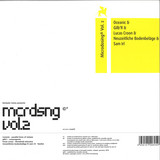
Microdosing is a series of compilation 12”s selected by Julienne Dessagne aka Fantastic Twins, and designed in collaboration with French visual artist Geff Pellet. Microdosing is a collective experiment aimed at helping you fighting back your modern obsession with happiness. You may deserve a nice day but the day does not need a nice you, nothing should be forced, everything is permitted. Microdosing will provide you with sonic healing weapons on regular basis and at irregular dosage. Those doses will favour psychedelic social techniques against self help tyranny, creation over soma, provoking over numbing, our outer-selves over our inner-selves. Microdosing refuses the fatality of the pleasure principle. Life is a struggle, time to embrace it. —— "My battery is low and it’s getting dark” We at Microdosing will make Opportunity’s famous last words fully ours. Some would see these as an epitaph on a black screen, we embrace them as a reclaimed fragility. Are we grains of sand wandering in space, hoping for a goal? No. We are the cosmos, the cosmos is us, unafraid of the end, unafraid of the void. Before the rise of the infinite silence, Microdosing brings you new guiding lights, white sun or black hole being a simple permutation of the kinetic rainbow. Oceanic’s “Parallel Lines Of Stripes” is a meandering mantra, an synthesised Moebius ring, a mission to your heart, that furthest star in the sky. Gilb’R’s “Cosmogonie” simply reminds us of the profound relation between spatial systems and the holy act of birth (cosmo, world and gon, conceive). The universe is a body, your body is your universe. Lucas Croon’s “Threshold Stimulus” is the soundtrack of a never ending voyage, the man is on a trip to the core sanctum. Imagine Space as a reverberation room cladded with bakelite. Losing yourself in delay repeats sometimes is the shortest way. Neuzeitliche Bodenbeläge & Sam Irl’s “Faeden” is another hymn to the umbilical chords joining us to the outer world, a black monolith of kraut acid, a pagan dance as portal to a destination only you can choose. Microdosing will be back soon with more enablers, helping to turn your petty struggles into a search for a meaning of life. The Quest lives on.
Aaaron continues his journey through mystic synthesis with his 5th ep for connected , “Cosmic Soul”. It seems with each release he gathers more depth to his music and minimises his style and production to naked artwork in sound where each instrument has its space for the the listeners imagination. Abstract yet magnetic , tribal and futuristic. Sink in the shadows and rise on the waves.
1.COSMIC SOUL A rhythm section playing robotic funk against an esoteric drone meets a melancholic piano refrain and pleading vocal monotones that go dubwise. The landscape of the track rises and falls to a vocal and piano breakdown with electronic flutes piping in the distance , peppered with percussive stabs throughout as the emotive waves surge to find earth. Quite beautiful. 2.MERCY Synthetic textures reminiscent of Blade Runner 2049 form a backdrop for a skeletal drum figure, as soft Kraftwerk like notes filter in and out and a skinny sequencer drifts across the track like crosstown traffic. A vocoder pulse and dreamy synth horns hold the scene in the shade of a hot sunny day as the city flies by in stop motion. 3.ITS NOT OVER Imagine a classical symphony based on 2 or 3 chords , revolving and hypnotising by its simplicity and gradually rising in sonic temperature. Set against a drumscape of toms and unnaturally pitched and distorted snares and phasing plastic synth percussion like a drifting cloud of locusts. The vocal “Its not over between you and me” is haunting and irresistible and the song draws you in, mystified by its simplicity . Devoid of frills , cold and heartbroken yet the embers of passion still glow. Innocently executed , Aaaron at his futuristic high.
DJ Oonops presents Volume 2 of his extensive compilation covering genres from Dub, Jazz, Funk, Soul to Beats and Hip Hop featuring pretty well known artists as well as zooming newcomers. He spent more than one year to select artists from around the globe who reflect the sounds of his "Oonops Drops" broadcast on Brooklyn Radio (NYC).
Be that jazzy beats or virtuoso live jazz drums, keys and guitars from Japan by Kazumi Kaneda, RF and 45 a.k.a. Swing-O, a first-time- on-vinyl dub remix by Great Britain's Coldcut or a brass cover version of Rihanna's "Stay" by Sly5thAve out of the US. Most of the tracks are exclusives or first time available on vinyl for this compilation, like the song "Measly Peace" by Magic In Trees out of Nashville, German beatmaker Twit One with an ill Jazz instrumental or London based rapper and singer Amy Tru featuring Nubya Garcia.
Also you gonna hear a unique and rump-shaking cover version of Blackstreet's "No Diggity" by T Bird & The Breaks, John Turell's powervoice over some heavy beats by Soopasoul, Kinny with a catchy tune, Igor Zhukovsky from The Soul Surfers & MRR Drumetrics with an exclusive, pumping psychedelic drum track and Schemes from Montreal who take all the credits at the moment from the web by Vice, Okayplayer, Music Is My Sanctuary and many more. For the artwork Oonops collaborated once again with San Francisco based artist Lindsey Kustusch who mirrored the atmosphere of New York City on point with her oil painted artwork.
Be sure to get your hands on this limited peace of work before it's gone like Volume 1. About Oonops: beside his vinyl only show on Brooklyn Radio he is spinning banging club sets to relaxed mixtures for vernissages, museums or theaters. And furthermore he works as a product designer and he's listed in the top 50 of Germany's best table tennis players and focuses all his skills in an event which will bring all this together.
“Bandiera Di Carta” represents the ongoing collaboration between instrument builder and composer Pierre Bastien and the
London based experimental duo Tomaga (Valentina Magaletti and Tom Relleen).
Bastien has been called a “mad musical scientist with a celebrity following” by The Guardian (UK) having collaborated with the
likes of filmmaker Pierrick Sorin, fashion designer Issey Miyake, singer and composer Robert Wyatt as well as Aphex Twin,
who released three of his albums on his label Rephlex.
Tomaga have made more than a dozen records since forming in 2014, pursuing a path of fearless experimentation and sonic
brinksmanship that has won them fans and plaudits from far and wide, including Thurston Moore, with whom they collaborated
on the CAN Project with Malcolm Mooney, Deb Goodge and others in 2017, as well as Wire, Silver Apples and Stereolab, with
whom they toured extensively in summer 2019.
The artistic collaboration between Pierre and Tomaga began with two commissions: from Fructose Festival in Dunkirk and the
revered underground festival Supersonic in Birmingham UK. Recording initially at a studio in the industrial port of Dunkirk, the
uneasy bond between borders and states seems to have been a theoretical motor to the collaborative sessions, as well as the
bleak landscape of the seaport frontier. This inspiration found further manifestation in the cover image for ‘Bandiera Di Carta’.
Resembling a white paper flag, it is, in fact, a photograph of Bastien’s paper and air sound machine installed on stage at
Teatro Carignano in Turin as part of the trio’s performance there. This charged, ambivalent image of a blank flag evokes the
transcendence of the national, a prescient visual motif that meditates on the contemporary uncertainty around notions of
national identity and borders but perhaps also a ‘carte blanche’ for the artists involved, in which they can deviate from the
confines of their usual practice into new and strange territories.
For each piece, Bastien’s unique sonic style: by turns his kinetic mechanoid motors, capriciously arrhythmic pipes, or the
peculiar susurrus of paper, creates a world in which Tomaga introduce their musical palette. Magaletti’s percussion anchors
these sometimes chaotic forces into beguiling syncopations, with Relleen’s synthesizer and organ work creating harmonic
counterpoints and interruptive provocations, to which Bastien responds with lyrical turns on prepared trumpet, rubber band, tin
foil and bass ocarina.
The results are curiously evocative of free jazz by the likes of Sun Ra or Art Ensemble of Chicago paired with the percussive
sound worlds of artists like Francis Bebey or Muslimgauze along with unique and sometimes bizarrely exotic tonal landscapes
of composers like Catherine Christer Hennix, Carl Stone, or Egisto Macchi. All three musicians seem to find space to bloom in
ways that are markedly different from their individual work and the resulting album is a strikingly original and powerfully bold
affirmation of what can happen when venturing beyond the normal in pursuit of the other.All tracks written & produced by Tomaga (Tom Relleen & Valentina Magaletti) & Pierre Bastien.
Mixed and mastered by Rashad Becker.
Johnny Clarke is one of the great vocalists that ruled the Jamaican Dancehall scene from the mid – 1970’s to the early 1980’s. While Bob Marley was out conquering the world, Dennis Brown, Gregory Issacs and Johnny Clarke were winning the hearts of the Jamaican people .Johnny Clarke’s use of the ‘Flying Cymbal‘ sound took the Island by storm and produced a run of hit singles few could match.
Johnny Clarke (b.1955, Jamaica, West Indies) cut his first record ‘God Made The Sea and Sun’, after winning a local singing contest in the Bull Bay area of Jamaica. Although the single was not a hit, it led to two follow up tracks for producer Rupie Edwards, ’Everyday Wandering’ and ‘Julie’ that fared much better, both on the island and oversees in England and Canada. These tracks also brought the singer to the attention of producer Bunny Lee and a working relationship that would go on to produce a prolific catalogue of music. Johnny Clarke’s Dread Conscious / Love Song style were to grace many hits around this time in 1974. Such tunes as ‘None Shall Escape The Judgement’, ‘Move Out of Babylon’, ‘Rock With Me Baby’, ‘Enter The Gates With Praise’ to name but a few. All new songs added to a host of cover tunes, recommended by Bunny Lee, many taken from the singer John Holt’s catalogue, that suited Clarke’s vocal style. The rhythms were cut at various studios around the Island. Randy’s Studio 17, Channel 1, Treasure Isle, Dynamic Sounds and Harry J’s, by a group of musicians loosely called the Aggrovators and some tunes incorporating the ‘Flying Cymbal’ sound again introduced by Bunny Lee, working the Hi-Hat in fine style. The tracks were then taken to King Tubby’s studio where Johnny Clarke’s vocals would be voiced.
Another phenomenon that was happening in the early 1970’s, was the version cuts to vocal tracks. This is when the tunes were cut back to the bass and drums and the vocals were dropped in and out in a dubbed style, and reverb and echo and various effects were added to these tracks. The main exponent to this style was King Tubby himself, and as was the fashion at the time, each vocal track would carry a version as its B-Side. Producer Bunny Lee lead this style working closely with King Tubby and all of his singles from then on would carry a Dub cut on its flipside. As Johnny Clarke was one of Bunny’s main singers at the time, we would hear a great selection of popular songs getting the dub treatment and in many cases the single was purchased for its more exciting dub cut, again made popular at the various dances where the dubplates were played out. We have compiled some of the best of these dubs from the time and put them together for this release, hope you enjoy the great voice of Johnny Clarke alongside the productions of Bunny Lee and the creative genius of King Tubby, a great combination we hope you will agree….
- A1: Rainbow Deux (6 57)
- A2: Let Love In (6 14)
- A3: Sigh (4 08)
- B1: The Darkest Night (7 32)
- B2: Surrender Now (6 08)
- B3: Summer Is Her Name (4 37)
- C1: Are You Ready (3 18)
- C2: Streets (Keep Me Runnin’) (7 00)
- C3: Samba Dreams (3 20)
- D1: Let’s Go Deep (5 27)
- D2: We Should Be Laughin’ (3 45)
- D3: Wishful Thinking (4 00)
TThe melodically adventurous soul of Leon Ware continues its expression in his final opus Rainbow Deux, released on double vinyl on September 13th. The album features new songs recorded and performed by Leon before his health turned, leading to his transition on February 23rd 2017. Co-produced by Taylor Graves, it has stellar musical contributions from the likes of Kamasi Washington, Thundercat, Ronald Bruner Jr, Rob Bacon and Wayne Linsey.
Taylor Graves came into Leon’s musical family in 2002 when he, his brother Cameron and the Bruner brothers Ronald Jr and Stephen (Thundercat) were playing along with their schoolmate Kamasi at an L.A. jazz club. Taylor, Cameron, Ronald and Stephen became Leon’s band for his debut shows in Japan in 2002 and Taylor continued to work with Leon as his mentor and collaborator over the next 15 years.
“Leon was ALWAYS writing something or developing his musical palette” his wife Carol Ware tells us, so it’s impossible to pinpoint any single moment of Rainbow Deux’s genesis. Six of the songs go back to 2012/2013 and were released in 2014 as part of Sigh, a Japan-only CD collection heavy with Rob Bacon’s tasteful licks and Wayne Linsey’s piano vibes. The rest of the material comes from Leon’s sessions with Taylor.
Describing Leon’s and his process, here’s Taylor: “We’d start by having some great homemade food! Then a glass of wine ‘to slow down time’. After we’d have our fill and smoked our joints we’d go into his studio room to listen and create.”
The album was finished-up around August of 2016 in a back-and-forth between Leon and his go-to mastering engineer Toni Economides in the UK.
Leon worked on Rainbow Deux with life’s greatest challenge looming over him, yet it is one of his most focused and cohesive solo offerings since the 1980s. The entire record is a vibe: mellow, deep and smooth as silk. The lyrical themes are eternal, and the music is elegant, soulful and sensual.
The album opens with the hypnotic throb of “For The Rainbow”, coming on like a percussive, slow-mo house shuffle. Gilles Peterson is a fan. The exotic “Let Love In” follows, with its gradual-build Island Funk, intricate guitar picks and sassy female vocals. It explodes when it hits its stride. “Sigh” is the stylish slow jam close-out to side A. Serene guitars and polished drums create neck snapping funk, with a swaggering finger-snap strut.
Side B opens with the easy-burning broken-beaty “The Darkest Night”, the centrepiece of the album. Kamasi Washington’s lurking sax, restrained and beautiful, unfurls into the dank, sticky atmosphere of Thundercat’s signature creeping bass laid over his brother’s in-the-pocket drums. Leon’s vocals are perfect, a masterclass in seductive sax-soul.
“Surrender Now” conjures waves of vocals to swell and wash over the glossy piano, subtly bumping hip-hop drums and bubbling synth-bass stabs. It’s got the trademark Leon layers. “Summer Is Her Name” has Kamasi’s effortless, melancholic sunshine sax give way to rising tempos and propulsive rhythms.
“Are You Ready” is a total highlight (and we’ve been playing it out for ages). It’s a nimble groove of piano and synth rolling around Theo Croker’s sensual trumpet playing. Digi-soul at its finest. With lush G-Funk sensibilities “Streets (Keep Me Runnin’)” sounds like a lost Dam-Funk produced gem. All tough kicks and snares and street sounds. Leon’s hood pass will be forever intact.
“Samba Dreams” is the first of two tracks that bring a little Rio magic to Rainbow Deux. Leon created a whole body of work in partnership with Brazilian legend Marcos Valle that includes “Rockin’ You Eternally” - a hit for Leon - and “Estrelar” – a hit for Marcos. Leon channels his obvious love of Brazilian music here through more of Croker’s sumptuous trumpet, played over loose percussion. “Let’s Go Deep” is next up. A dreamy between-the-sheets quiet storm anthem and a real showcase for Leon’s vocals.
The dripping, honeyed harp-funk of “We Should Be Laughin’” marks the star turn of the brilliant Kimbra. Leon first met her on-stage to do an impromptu duet of “Inside My Love” during an open-air celebration of Minnie Riperton in July of 2014. Kimbra was working with Taylor on her music and he brought her to Leon’s house to do some writing. This was the result.
Warm synths radiate shuffling samba soul on “Wishful Thinking” as those Brazilian rhythms return to bring Rainbow Deux to a close.
During an apartment move Leon and Carol rediscovered some watercolours Leon had done years ago. One of these paintings had been dubbed “Deux Hearts” and Leon decided it should be on the cover of Rainbow Deux, getting as far as approving a draft concept for the artwork.
Carol has overseen developing that draft into the final gatefold sleeve. It brings together quotes, photographs and tributes in what is a reflection on the music, relationships and philosophy of the sensual minister.
Gerry “the gov” Brown, Leon’s long-time sound engineer, was by his side throughout the project, recording and mixing. The album was mastered by Toni Economides and Simon Francis’ additional sensitive work makes sure this double LP sounds like it should on vinyl.
Be With’s first ever release was Leon’s eponymous LP. Re-issuing that album planted the seed of a relationship that has grown to grant us the privilege of presenting his crowning achievement. We know that Leon’s fans all over the Earth will love Rainbow Deux. But we also hope that this album, the final entry in a phenomenal body of work, will reach new fans and find fresh conduits for the spirit of this oft-unsung hero of Soul.
Leon always said “they will get it when I'm gone.”
He also said that “the spirit never dies”…
"Crosstalk" is a collaborative effort between Theomatic's artists - a sort of a peer reinterpretation of each other's works. First on the A-side is Acos Coolkas' "Skyline", from their first-ever single on Theomatic, released in 2005, receiving a sonic facelift from An-2. This is followed by An-2's remix of D-Pulse's first track from their latest full-length album, "Gratitude", which first appeared as a mystery track on An-2's 2018 SoundCloud mix, now seeing the light of the day by popular demand, and is not to be missed. On the flipside D-Pulse deliver a two-part remix of An-2's "The Gift" - previously only available digitally. These two stunning pieces, filled with ethereal soundscapes, will delight any discerning Balearic-sound connoisseur. Rounding things off is Acos Coolkas' remix of An-2's seminal
Singer, lyricist and composer Nirox Romão aka Diron Animal was born and raised in Cazenga, Angola. Diron Animal's involvement in the music world began early: he was part of a traditional Angolan music band and capoeira group, followed by a hip hop project. 12 years ago he moved to Portugal to study, but music became more than just a passion when he landed in kuduro.
For over 6 years, he sang, danced and traveled the world with Afro Portuguese act Thoes + The Shine, mixing rock and kuduro, becoming an explosive ensemble. At one moment, Diron wanted to record a solo album to show a bit more of his own personality and in late 2017 his debut album ‘Alone’ appeared on Soundway Records, where he himself worked out the melodies, rhythm, vocals and even the guitar parts between classic funk to afrohouse and kuduro bass. Through that album he explored major festivals in Europe during 2018, such as at Paléo Festival Nyon, Trans Musicales Festival, Amsterdam Dance Event and others.
On ‘Pair’, his 2nd album and released on Brussels outernational label Rebel Up Records, he has worked hard to enhance his special formula. Inspired by the cruel death his nephew, it became a testament against oppression via the mixed sounds of afro boogie, disco, funk, afrohouse, coupé décalé and kuduro, with English and Portuguese lyrics.
The first single of the album, ‘You and Me’, is an English sung afro boogie disco song and produced by Diron with the support of musician and producer Moullinex, actor André Cabral and video made by director Vasco Mendes. In the video, featuring dancer and actor André Cabral, Diron Animal takes on the role of a gay man to express that a homosexual is a normal person who loves, feels desire, dreams, conquers, wants to be loved and desired, wants to live next to a being that completes him. With “You and Me”, Diron Animal above all wants to appeal to society, respect for the choice of people and non-discrimination of sexual choices. For in life we all deserve to be happy regardless of our sexual choice.
Philippe Cam is the Thomas Pynchon of the electronic music world. Little is known about him and only a couple of pictures have been put online since he emerged on this planet to write his first and only album18 years ago. We know he worked as a sailor and that’s it. If you dig deeper you might find out that he worked as a DJ in the beginning of the 90ies in Brussels and began to study electronic music there and also began to write music for theaters and ballets.
The American distributor Forced Exposure once wrote that about him: „Philipe Cam is a star in his own field. He is among the few people who have succeeded to write hypnotic dance music without a conventional beat still conveying a thrilling, dramatic feel. Cam has developed an accurate, intense and complex formula of modulation-techno. Starting with music similar to Pan Sonic in 1996, his music turned towards a more elegant form of minimal music. Abstract soundtracks lead to an organic form of music, which was equally influenced by modern techno as Wolfgang Voigt's Studio 1/Gas or Basic Channel/Maurizio. Cam's music corresponds heavily to the Cologne scene, where his music is appreciated and played throughout the clubs by the likes of Michael Mayer, Tobias Thomas and various other DJs as well as experimental djs from the A-musik corner.“
So what’s new with his music? Basically the art of filtering is still his passion. Maybe he can be less associated with techno and the themes of his new tracks emerge in a more distinctive pattern? Well that’s hard to say, we would comment the energy of his early techno days in Brussels have returned here in a fierce way with some oft he tracks. The rhythmic movements are classy and stick with you. Whereas other tracks look for a distinctive relaxation of some kind.
We are releasing the album as a double clear vinyl with cover art by Yvette Klein who also designed the cover for his Philippe Cam’s album 18 years ago. Graphics for "Rotterdam" come from Cologne designer Daniela Thiel. We also would like to thank the cultural department of Cologne for supporting us to finance the album and to see the artistic value in this piece of minimalism.
The album kicks off with the mellow and soothing "Cocoa Beach". A Gentle beat that moves like bodies swaying in the hot summer sun. The clock moves a step forward and then a step backward as evolution takes a rest.
"Manga" feels like an acceleration to the moon, the contemplative moments come in spurts and hide in the intervals of the chords which are on the loose. Philippe Cam is the most energetic person in the world when it comes to core activity, this is head banging stuff for the ambient lounge.
"Short Summer" is a heavy and violent recognition. As intensive as it is it knows when to stop and disappear. In the ear and brain of the listeners it leaves an indisputable echo which lingers on for minutes. We suggest not to make a pause but jump directly into "Vermillions Sands".
What can be said about into "Vermillions Sands"? Be prepared some Terry Riley might lure around the corner to offer you some oranges on a silver plate, but don’t eat them. This is luring and beautiful at the same time. Maybe the best ambient track ever written and yet who can ever venture to say that without making a fool of himself. "Vermillions Sands" comes in waves and they could be longer we think.
"Rotterdam" the home of Philippe Cam for a long time but not anymore. He moved away. So that changes the perspective. But when was the track written? "Rotterdam" seems mechanical and rusty and spooky and divided. This arrangement is very different to all the other tracks so far and is almost dub in style but way more fractured. A steady stop and go emerges. But the longer it runs the better it gets. At minute 6 the brain resets itself and tries to grasp what has happened so far, reconstruction as a result of its own phantasmic imagination and hardly true at all, wonderful. Applause included!
Here comes "Bis", a short episode of a track and before we can comment on it, it is already over.
"The Game" is a mule of a track. It has a quiet stubborn sequence that bites and kicks you in the back without any change in near sight. We can hear a voice whispering, which sounds like a miniature vocoder featuring the voice of a child calling out - never stopping. This is treadmill to some extend but starts to breathe towards the middle of the track and slowly changes perspective. In fact there are some changes taking place here which go beyond a sound design that works heavily on the stereo image. Stick with it and the experience will be a great one.
"Ultimate Fly For Halloway" somehow orchestrates how you might feel after you climbed a 8000 meter high mountain and reached the top. A rejoicing off a special kind. Lava for the ears. No cheerleader murder plot sorry.
"Last Track" is a perfect example of a true minimalistic pice of music that manages to make contact with other genres and does this with elegance, determination and a lot of soul.
key selling points: The key selling point is the fact that Philippe Cam once was referred to as one of the main protagonists of the minimal music scene along with Wolfgang Voigt's Studio 1/Gas and Basic Channel/Maurizio. A true artist with a vision which is very rare.
Philippe Cam has picked up the sound he was famous for but has developed it further without selling out to any genre and expectation that rules our daily business.
Exactly this is the strength of the album to create a vivid world of impressions by using instruments in a whole different way than all software developers would suggest.
"Rotterdam" is a piece of art that can set off a firework when you listen to it and it owes nothing to anyone.
The visionary singer, songwriter and composer returns to her Havana roots
A sun-baked, vibrant record backed by a killer band of fellow Cubans The new album from Daymé Arocena is a vivid return to her Havana roots. Backed once again by a killer band of fellow Cuban musicians, the visionary singer, composer and songwriter has stripped everything back to the core. Holding sessions in a simple, repurposed artist’s studio in Havana, Daymé produced the record herself, taking the reins to make “Sonocardiogram” her most raw and arresting outing yet.
A jazz-tipped record rooted in the rhythms of rumba, she draws on the island’s intertwined rituals of family, music and religion. Ringing with echoes of the greats, songs nod to the likes of Tito Puente and La Lupe, inspirations which carry the sound of Cuba’s sun-baked, vibrant daily existence. Odes to Santería deities are underscored by the sacred frequencies of the batá drum, translated to be played on a Western drum kit. It’s an intoxicating window into a singular artist’s worldview. An important voice in Latin music, Daymé has collaborated with influential peers in Cuban music, like Roberto Fonseca, and US heavyweights like Dexter Story and Miguel Atwood-Ferguson. From a recent appearance at Primavera Festival, to sold out tours across Japan and the US, her spectacular live show continues to draw crowds around the world.
Can it really be thirty years since The Brand New Heavies first sashayed into the public eye with a romantic’s heart, a hedonist’s spirit and a Superfly sensibility?
A heady cocktail of Chic-style funk-pop, sunshine grooves and scorched soul balladry, the release of TBNH on September 6th sees The Brand New Heavies writing a new chapter in what has been an illustrious journey whilst also marking a return to their spiritual home, Acid Jazz Records.
Today The Brand New Heavies share a breath-taking version of Kendrick Lamar’s These Walls recorded with long-time associate and vocalist N’Dea Davenport and produced by uber-fan Mark Ronson. It was that line-up of the band that had originally brought the funk into his life having caught their show in New York in 1991, later inviting them to play at his 40th birthday party. Insistent once more to reconvene that line-up, successfully reuniting N’Dea and The Heavies for his production of this track for their 30th-anniversary album.
The album’s heart, both musically and physically is a friendship that can be traced back to the mid-Eighties - more specifically the shared experiences growing into adulthood on the western reaches of London for Simon Bartholomew (guitar) and Andrew Levy (bass) and a return to the formula that saw the band score sixteen Top 40 hits and three million album sales.
Refined, reimagined and revisited, TBNH was recorded under the watchful eye of producer Sir Tristan Longworth, as Andrew elaborates; “as fathers of young kids, time was important, and we needed someone to crack the whip.” Adding further with a grin; “he also makes these amazing gin and tonics with chilli’s in. The pair also decided to feature various vocalists on these tracks, not only reuniting with Heavies alumni, N’Dea Davenport and Siedah Garret but collaborating with soul legends Beverley Knight and Angie Stone alongside current singer Angela Ricci and new boy on the block, label mate Laville – to present a gilt-edged collection of songs making arguably the best album of their career. Summed up by its cover artwork- shot in the suitably louche environs of ultra-hip nightspot Annabel’s – Simon explains with a smile; “It’s a bit clubby, a little bit sleazy, with a bit of luxury and a smidgen of street.”
- A1: A Roller Skating Jam Named Saturdays - De La Soul Featuring Q-Tip & Vinia Mojica
- A2: Bonita Applebum - A Tribe Called Quest
- A3: Sunshine Men - The Freestyle Fellowship
- A4: Mistadobalina - Del Tha Funkeé Homosapien
- A5: What's Up Doc? (Can We Rock?) (K-Cut's Fat Trac Remix) - Fu-Schnickens With Shaquille O’neal (Shaq-Fu)
- B1: Doowutchyalike - Digital Underground
- B2: Peachfuzz - Kmd
- B3: Doin' Our Own Dang - Jungle Brothers
- B4: Mama Gave Birth To The Soul Children - Queen Latifah Featuring De La Soul
- B5: O.p.p. - Naughty By Nature
- C1: Where I'm From - Digable Planets
- C2: It's A Shame (My Sister) - Monie Love Featuring True Image
- C3: K Sera Sera - Justin Warfield
- C4: All For One - Brand Nubian
- C5: Case Of The P.t.a. - Leaders Of The New School
- D1: My Definition Of A Boombastic Jazz Style (Album Version) - Dream Warriors
- D2: The Choice Is Yours (Revisited) - Black Sheep
- D3: Age Ain't Nothin' But A # - Chi-Ali
- D4: We Run Things (It's Like Dat) - Da Bush Babees
- D5: You're Not Coming Home (Mase's Funkay Recall Mix) - Groove Garden
It wasn’t really a movement, barely even a moment, but the Daisy Age was an ethos that permeated pop, R&B and hip hop at the turn of the 90s. Playfulness and good humour were central to De La Soul’s 1989 debut album, “3 Feet High And Rising”, which would go on to cast a long, multi-coloured shadow over rap.
In Britain, the timing for “3 Feet High And Rising” couldn’t have been better. The acid house explosion of 1988 would lead to a radical breaking down of musical barriers in 1989, and its associated look – loose clothing, dayglo colours, smiley faces – chimed with the positivity of De La Soul and rising New York rap acts the Jungle Brothers and A Tribe Called Quest, all at the heart of a growing collective called Native Tongues.
The Native Tongues’ charismatic, summery aura quickly spread west to the Bay Area’s similarly-minded Hieroglyphics crew (Del Tha Funky Homosapien’s ‘Mistadobalina’); Canada’s Dream Warriors (‘My Definition Of A Boombastic Jazz Style’) used “3 Feet High”’s colour palette and borrowed Count Basie and Quincy Jones riffs; Naughty By Nature (OPP) were mentored by Native Tongues heroine Queen Latifah, while Londoner Monie Love was also adopted by the collective, resulting in her Grammy-nominated ‘It’s A Shame (My Sister)’.
It wasn’t built to last, but the Daisy Age reintroduced Multiplication Rock, bubble writing and the gently psychedelic into the charts. It was a brief, but extraordinarily warm and optimistic moment. The songs on this collection promised that the 90s would be a lot more easy-going than the 80s.
Available on CD and double LP.
- A1: Sunsay (Feat Richard Farrell)
- A2: Good Company Girl (Feat Ymtk)
- A3: Echo 1
- A4: I Am That (Feat Leah Vee)
- A5: I Don't Wanna Know (Feat Mickey Shiloh)
- A6: Echo 2
- A7: Force Notch
- B1: I'm Coming Home (Feat Richard Farrell)
- B2: Fight (Feat Cheshy)
- B3: Echo 3
- B4: Just Because Of You (Feat Daramola)
- B5: Let Me Know (Feat Tonyb)
- B6: Wondrous Spirit (Feat Richard Farrell)
- B7: Echo 4
Echoes is the second album by the Ukrainian producer Cape Cod, released jointly by labels Vinyla Records & Kiev House. Echoes is a comprehensive and multi-genre work in terms of sound and song creativity. On second album, dance music floats between genres, styles and mood from track to track, while Cape Cod skillfully waves the breakbeat, r'n'b of the new school, soul and hip hop into the tracks and brings his love to the disco house to the sound level.
Like a fine 40-year old whisky, the layers on this record and influences are complex, nuanced & Layered. You might taste something different but here are my tasting notes...
The Nose - Notes of Bobby Cauldwell, Steely Dan, David Crosby a definite Sun Drenched yacht folk dram.
The Body - I can taste strong notes of Jimmy Webb and Aztec Camera not present on the nose, this a much deeper dram than initially nosed, I can see myself enjoying this in front of a warm fire.
Finish - Long finish on this one, I can taste the Miami tarmac, the Beach and salt water, the nightclubs and linen clothing, Don Johnson's dirty washing.
Whisky tasting over, both the albums this LP was compiled from were recorded at Coconuts recording Studio in Miami, notable for Miami Sound Machine recordings and Blood, Sweat and Tears. I have been into these for a long time and whilst not the rarest AOTN re-issue to date (although that may change now the words out) they deserve to be recognised for the solid LPs that they are. Just buy it and float away.