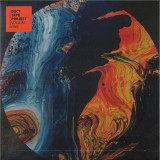
Lined up next on Cosmocities is a special delivery and direct nod to our formative years’ loves - in this very case, trance music. Fruit of 90s cross-channel outfit Prism, the collaborative endeavour of French producer Pascal Eloy and UK-based Grant Wilkinson, the three-track EP “CMSR006” mixes unreleased music (Refraction), a 1996-issued goodie (Rain) and an exclusive remix from SYO, better known for his ambitiously retro-futuristic output under the S.O.N.S moniker.
Originally released as part of Planet Dog’s 1996 compilation “Feed Your Head”, “Rain” retains all of its original mystique and soulful use of modern production tools - letting a cascading flow of arpeggiated synths, stealth bass onslaughts and 303-borne trippiness pour down as a fully immersive digital shower for the senses.
An unheard gem from the vault, initially written and recorded in 1995, “Refraction” pulls further dynamic traction from a bubbling drum programming and damp, urban jungle-y atmosphere - beaming us straight back in the rave’s most compelling heyday with its feverish maelstrom of fluttering bleeps, spiralling tribal motifs and faux-organic, Neo-Easternmost harmonics.
Adding his ever innovative spin to the table, SYO cuts into the flesh of the original to deliver a further syncopated and spacious version, flush with complex rhythmic sleights of hand and subtle melodic trickery throughout, bound to keep you on the edge with every bar. 25 years on since it was first designed, Prism’s lasting relevancy shines bright on this all-road, bold-to-the-full trance epic that’s lost nothing of its flair.
Cerca:synth sense
Pure product of the Neapolitan scene, Fabrizio Fattore turns up on Cosmocities Records with his third solo effort. Comprised of two originals on the A-side, and two bespoke revamps from Vince Watson on the flip, this new EP from Fattore draws a direct bridge betwixt the idyllic coastal flow of Italian boogie and straight out pulsating alien disco, sure to keep galaxies bouncing in good order.
Clocking in first is the vibey, otherworldly 'Lyle' - a cross-pollinated ode to the healing power of laid-back, 80s-informed house, bristling with shimmering Casio synthlines and Cuban jazz-friendly pianos and drums. Heliotropic by nature, Fattore's sound sits half-way loungey summer atmospherics and trailblazing post-kosmische jaunts. Then comes 'Island Goddess', casting more of a Sino-Caribbean flavoured spin on the dance floor with its obsessive miss-mash of processed chimes and prismatic webwork of steel pans.
On the B-side dwell two versions of 'Lyle' by true house legend Vince Watson, each of which deliver in their own right. If you’re after a proper classy, straightforward roller, bound to take dancers into a ravishingly deep but rousing trip, then the 'Watson Reshape' fits the bill like a glove, whereas the 'Balearic mix' does exactly what's written on the tin - ushering you into a sense-soothing haven, where keyboard-laden escapism and Afro-style rhythms meet the elegance of muted chamber music.
A1 East Vision by Milanese’s finest Uabos uncovers an extraordinary musical experience with a lot of twists and twirls that are skilfully crafted. Constructed of mouth-watering synth textures and dusty melodic samples that hover over the rolling bass engine, Uabos surely delivers a dancefloor killer.
Herzel’s Transformation as the A2 track adds deep blue melodic depth on top of icy rhythmic pattern. It tickles the senses as sharp leads and powerful kicking stabs appear above the grinding bass line, providing mesmeric effect.
Flute Power’s Discothalia heats up the B side. Lush breaks and ripples meet a cloud-bursting bass line, intertwining with the ethereal vocal traces that unveil throughout the composition and into infinity.
Metropolitan Soul Museum in the closing B2 track Former Glory introduces a delicately structured musical narrative that has blocks of steady rhythmic percussion accompanied with unforeseeable melodic samples and tender vocal cut-ups.
Utrecht label U-Trax welcomes 90s legend P.A. Presents for an enhanced re-release of his first two releases on this label, namely "Salicylic Acid" and "Flight Simulator".
Ironically P.A. Presents aka Peter Aarsman is the only artist on U-TRAX that actually is born and bred in the city of Utrecht. Even more irony lies in the fact that he hasn't lived in the city for 25 years and has only recently returned home. He was an early player in the hip hop and boogie scenes and long before house landed in Europe he was playing disco and Italo which helped establish him as a truly vital DJ talent. The two reissue EPs presented here marked his production debut back in 1993, both of which are hugely sought after and pricey techno records on second hand markets. In 2019 he returned to the music scene with two new EPs on U-Trax in the the form of Swirling Gas and Sax Madness and new releases are planned for 2020.
The release kicks off with 'Mesopmorph', an effervescent, nostalgic cut with a deeply buried techno rhythm that eventually takes over in tribal style. 'Pop' is a brilliantly tense and dense track wired up with fizzing synths, chattering claps and haunting effects as well as pending drums, then 'Theme' is cosmic industrial, with powerful hits and metallic sounds married to searching laser synths.
'Vera S' is classic 90s techno with mad vocal sounds and frantic synth lines darting about the mix, then things grow deeper and more heady on the stripped back intergalactic journey that is 'Flight Simulator.' The timelessness continues on the dancing analogue drums and hi hats of the classic Detroit styled 'Experiental' and 'A Gasp' before 'Vexillum' brings more warm solar winds and molten techno grooves whist 'Long Metal' closes out with pounding kicks, skewed synths and real sense of space travel.
These are essential early techno tracks that sound as fresh and relevant now as ever and come with remastering and restoration from Thee J Johanz.
Pressed on 2x12" 180 grams grey marbled vinyl.
Kapoor and Hvitling’s first album, The Odyssey, is monumental. It boasts eight tracks that are generous in terms of length and sophistication. Each has a distinctive feel and predominant mood, balancing intricate sonic arrangements with dynamic and rhythmically pleasant beats. Yet certain ethereal sound textures and melodies
make the tracks echo each other, creating a sense of journeying through uncharted waters. Masterfully produced female vocal synths become spectral presences in several tracks, most notably in Vox Diaboli and Vox Angeli. In the former, seductive whispers hiss a hymed incantation, creating a delightfully spooky atmosphere; while the latter lures the listener into sacred ecstasy with a combination of vibrant synths pristinely arranged with a string orchestra and LFO female vocals. Akumandra’s fourth official vinyl release stays true to its multicultural essence, adding this young Polish and Swedish producer duo to their vinyl catalog.
After the great success of the first two releases of the RE-TOUCHED SERIES, Conform Records continues its journey by giving us a new gem to collect. Gaetano Parisio seems to have no intention of stopping and calls other 5 legends to get their hands on tracks of his label's catalog. The third release contains four tracks plus one digital only bonus with heavyweights Deetron, Steve Bicknell, Ken Ishii, Oscar Mulero and Alexander Kowalski all stepping up.
Once again Swiss legend DEETRON, through his class, hits the mark. His Vesuvius edit of Gaetek's is a slamming track with driving drums and worms synths that bring it into the present day with a real sense of style.
STEVE BICKNELL is another techno legend who runs his own 6dimensions label. His edit of a track from Gaetano's Ritmatica goes as usual directly to the point. Steve stays true to the original sense of the track by masterfully adding his "Lost" touch through reverbs and percussion.
KEN ISHII, a true Japanese techno titan, incredibly manages to bring color and life to Gaetek's Advanced Series Vol. II. The result is amazing! The track is a dance floor killer. Its vintage charm is the key!
The Spanish Maestro, OSCAR MULERO, brings his dark and hypnotic style to the original Gaetek track. His Ømre Edit totally distorts the original one using percussion and filters giving that hypnotic flow for which the Madrid artist has always been known and respected throughout the techno underground scene.
To close this majestic EP ALEXANDER KOWALSKI, the backbone of the German techno scene, through his incredible talent creates a true masterpiece. His edit of Gaetano Parisio's Quake is undoubtedly something special. The syncopated rhythm and the addition of synths, create a third millennium atmosphere. His crystal clear talent as a producer is captured in these 6.25 mins.
Lovers of true techno will not be disappointed. This is for sure!
Vinyl Only
Underground Town is back with our 4th release straight from the heart of the Swiss Alps.
For this one we serve 4 great cuts from 4 great producers. On the A-side we have young Italian producer and Underground Town resident artist Alex Zola with a very groovy and positive dreamy track for every situation. Completing this A-side we have label owner and rising talent in the industry Giorgio Maulini with another great cut with a very groovy athmosphere and rolling rhythms demonstrating why this Venezuelan artist is making waves in the industry.
On the B-side we have Cosmjn, who needs no introduction. One of the Romanian talents with more future projection and a bag full of interesting releases under his arm. On his track "Vanilla" you can feel the characteristic Romanian drums and an evolving synth that traps your senses. Last but not least we have a producer coming all the way from Honduras, Loht Vostok. He is doing an amazing job with his productions changing the game in the Central American region with a new futuristic minimal wave of quality music. "Sivar" is a track with a powerful hip breaking baseline and with a perfect combination of elements and a sweet vocal making it suitable for any dancefloor.
From the Underground Town Team we want to thank you for supporting us and showing us all this love this last year. A lot more to come in our Various Artist series soon and in our new label which will be released at the beginning of 2020 with only singular artists EPs.
Stick around with us for more quality releases and spreading the love for the underground music.
Rocko Garoni knows what a techno dance floor wants. He’s learned it through countless hours spent on the floor himself as a punter, and through DJing at some of the best clubs and festivals in his hometown Berlin and all over the world. He knows exactly the type of productions that thrill crowds, and he brings this wealth of knowledge and experience to his third EP for Second State, Ammoniak.
The title and first track ‘Ammoniak’ drags you straight into the zone; a pounding, take no prisoners cut laced with stormy synths creating a vague sense of paranoia. ‘Gece‘ cranks the energy up with trancey, bouncing synths and a cool, clipped female vocal. Instantly, you’re pulled into the very sort of club that Garoni knows so well. ‘No Border‘ is the kind of expansive track that seems destined for huge warehouses or vast festival dancefloors. There’s an insistent, brooding bassline, robotic repeated vocals and a mid-track shift in tone that will send the crowd to a heightened state of reverie. The blend of post-punk vocals and eerie beats on ‘It’s All Yours‘, a track featuring Cook Strummer on the vocals, is at once highly unusual and completely compelling. It’s the track to play when the crowd are losing themselves in the best possible way. Closing the EP is ‘Helio‘, another completely different track that showcases the extent of Garoni’s range. Faint, echoed chanting lends the track an almost holy atmosphere. Combined with tunnelling synths and spindly percussion FX, the effect is euphoric, acting as a delicious palate cleanser between heavier tracks.
Put simply, Ammoniak is another first-class EP from a dynamic act who’s fast becoming a Second State star.
Australian label Nightime Drama builds on its assured discography with a new EP from Dutch artist Stefan Vincent, while one half of Artefakt aka Nick Lapien assumes his Metropolis alias for a remix.
Stefan Vincent has a decade long career that has taken him to labels like Dynamic Reflection, Anagram and Traut. Here he offers Exigent Mistress, a cavernous and dubby minimal techno cut that has warm, gooey bass and drums interwoven with each other to hypnotic effect. The Metropolis remix is a mind melting affair with warped and bendy synth lines looping over and over and taking you deeper down the rabbit hole.
Dissociation is the next original and is a more journeying techno cut that looks to the cosmos with its swirling sci-fi pads and sense of edgeless infinity all run through with a soft sense of acid. Last of all, Grey Haze is a skeletal groove with deft and delicate sound designs, dreamy pads and suggestive percussive sounds that suspend you in mid air. This, then, is an EP of high grade and mindful techno.
DJ Deep's Deeply Rooted label once again spotlights rising French talent Marina Trench for the second instalment of 'Signature featuring remixes from the boss and Hugo LX. Arriving on Deeply Rooted in March with the slick sounding 'Signature EP1', since then Trench has debuted at Rex Club where she played alongside Kerri Chandler, further bolstering her rising reputation as one of the Parisian scene's most exciting names. She now returns to Deeply Rooted bringing another instalment of classy House music - perfectly suited to the respected label's aesthetic. She shows off her knack for jazzy keys on the lively, raw-edged 'Thema Urbain' which oozes late night soul and effortlessly intimate house vibes. The equally excellent 'Ahead' is a surging house cut with well-crafted synth stabs fleshing out an off balance groove while a twanging bass riffs props things up from below. It's perfectly propulsive but has a real sense of heart. The third sublime original is 'Navigo', a bottomless track with splashy hi hats and suggestive string stabs up top. A rasping bassline brings texture to the smooth grooves as they keep rushing over you to make this another fresh and original offering from Trench. Remixing 'Ahead' is Hugo LX, who cruises from downtempo beats to soulful electronic sounds on the likes of Balance and NDATL Muzik. His classy version is a dubbed out classic with a musical bassline tumbling down the scales as you're sunk ever deeper into his pillowy pads. Deep himself then steps up to flip 'Navigo' into a driving deep techno number that surges on soaring synth smears and prickly percussion. This EP is set to take Trench to the next level and confirms she is one of 2019's brightest new stars.
The Australian Nightime Drama Label Hits Release Number Ten With A Various Artists Ep. It Features A Mix Of Returning Artists And New Signings, With Hiver, Stefan Vincent, Artefakt, Eric Cloutier & Trinity All Featuring On A Release That Once Again Mixes Styles From The Past With A Forward Thinking Vision.
First Up Is Dutchman Stefan Vincent With His First On The Label After Releasing Tracks On The Likes Of Anagram And Dynamic Reflection. It's A Deep Techno Voyage With Far Sighted Synths And Colourful Pads All Bristling Away To Bring A Sense Of Energy Yet Serenity To The Track. Curle And Let Recordings' Hiver Duo Then Go Even Deeper, With Warm, Elastic And Rubbery Basslines And Icy Hi Hats Softened With Broad Synths That Stretch Off To Infinity.
A Gentle Acid Line Finishes Things Off Before Another Duo, This Time Artefakt From Delsin And Field Records, Serves Up The Beautiful Ambient Techno Of Faces Of Others, Which Has Soft Pads Suspending You In The Cosmos As Subtle Rippling Rhythms Drive Things Along. Last Of All, Eric Cloutier Collaborates With Label Regular Trinity On 'hidden Places', A Patient Bit Of Early Evening Dub Techno That Exudes Warmth And Soul.
Mannequin's 100th - a comp looking forward featuring an international and serious cast... BIG TIP!
The modern synthwave scene would be significantly poorer without the keen ear and tireless efforts of the Mannequin label run by Alessandro Adriani. Geographically situated within the nerve centers of Rome and Berlin, yet with a musical spirit that easily transcends these boundary lines, Mannequin's back catalog has been an important component in the modular assemblage that makes up electronics-based independent music in the 21st century, and an important reference point for those who need to defend against the lazy accusations that this such is purely retro' in its form and content. Recent accolades and accomplishments - being named Resident Advisor's label of the month' for May of this year, starting the 'Death of the Machines' 12' series, and being given the 'green light' for bi-monthly parties at the Säule room in Berghain - have been earned through Mannequin's unflagging commitment to sonic diversity and Adriani's own realization that the anxious and sharp-edged sounds associated with, say, the Cold War of the 1980s can convey a completely different message today. Adriani says it best when claiming that there is no such thing as 'old' or 'new' music...only the music of now'. With this cogent statement of intent, Mannequin continues to go on exploratory missions to find the best and most relevant aspects of genres like acid, industrial, EBM, post-punk, coldwave and still more.
Which brings us to Mannequin's newest project and 100th release overall: the Waves of the Future double LP compilation, which itself is not a conventional retrospective collection. Case in point - none of the artists appearing on this collection have put out their own releases on Mannequin yet, despite acting as Mannequin's unofficial ambassadors (via DJ sets and other means). This makes the set even more compelling rather than less so, since it shows how Mannequin fits into a larger picture that includes other scene leaders and label owners including Beau Wanzer, Willie Burns (WT Records), Silent Servant (Jealous God) and Ron Morelli (L.I.E.S.). Of equal importance is how Waves of the Future projects a sense of aesthetic resilience and continuity, showcasing just how well the current artists allied with Mannequin employ and re-interpret the sonic lexicon that appears on that label's reissues of 'classic' acts such as Nocturnal Emissions, Bourbonese Qualk, Din A Testbild and Doris Norton.
However, none of this would matter as much if the music itself didn't have strong potential for lighting a blaze in the dark corners of the human imagination, and of course for forcing bodies into motion. Each track here pivots around a couple of key sound elements that seem to set the stage for the next track to come: see the sputtering / chopped ghost voices on Morelli's Charges Won't Stick,' which easily informs the slicing drone and authoritarian beat of Shawn O' Sullivan's Ill Fit,' which then lays down the emotional foundation for the sequencer-powered With You' from An-I & Adriani or the glassy landscape of Illum Sphere's Exhaustion'. Elsewhere, the wired mischief of Not Waving intersects easily with the spherical electro-funk and coded commands of Beau Wanzer. When all the disparate parts of Waves of the Future are soldered together, it perfectly illustrates Mannequin's non-linear philosophy and Adriani's suggestion that Mannequin listeners directly engage with the music rather than trying too hard to analyze or dissect it.
(en) Following their much acclaimed surprise debut, VERMONT's sophomore longplayer presented "another set that rewards deep listening" (AllMusic) and "a mix of simplicity and richness" whose result is "a feeling of spaciousness and a thrilling sense of weightlessness" (XLR8R). Stripping away even more percussion than on its predecessor, "II" saw Marcus Worgull and Danilo Plessow zooming in on ambience, texture and sonic cohesiveness, allowing "each electronic voice to come into focus" (Pitchfork). Now, "II REMIXES" puts the beat back into the mix, thanks to iconic artists DIXON, I:CUBE and WASSERMANN who each develop their own irresistible groove out of the immersive source material. As one of the album's most highlighted cuts, DSCHUNA gets the royal treatment by Innervisions head and internationally revered selector DIXON who proves his strong command of the dance floor with a hypnotic ride that surrounds the soaring sounds of the original with tribal- esque vocals. The instrumental version drops the chants, but retains the enchantment, all elegant rhythm and gorgeous strings. Versatile's I:CUBE, legendary producer and DJ in its own right, brings a distinctly Parisian touch to the spectral SKORBUT, whose sci-fi-imbued widescreen aura gets reimagined as laser-gun-wielding space funk machine. Meanwhile, Wolfgang Voigt aka WASSERMANN condenses PARADIGMA's roaming synths into pulsating trance swells on his stomping KRAUTRAMATRIK MIX.
(de) Nach einem hochgelobten überraschungsdebüt präsentierte VERMONTs zweiter Langspieler "ein weiteres Set fürs Tiefenho¨ren" (AllMusic) und "eine Mischung von Einfachheit und Reichtum" deren Ergebnis "ein aufregendes Gefühl von Weitläufigkeit und Schwerelosigkeit" (XLR8R) ist. Auf "II" verzichten Marcus Worgull und Danil Plessow nahezu gänzlich auf Perkussion und konzentrieren sich auf Ambiente, Textur und klanglichen Zusammenhalt, erlauben so "jeder elektronischen Stimme, in den Fokus zu rücken" (Pitchfork). Nun bringen die "II REMIXES" den Beat zurück ins Spiel, dank des Kult-Trios DIXON, I:CUBE und WASSERMANN, von denen jeder einen ganz eigenen Groove im Klangbad des Quellmaterials findet. Als eines der aufsehenerregendsten Stücke des Albums erfährt DSCHUNA fürstliche Behandlung seitens des Innervisions-Chefs und international gefeierten DJs DIXON der den Dancefloor mit einem hypnotischen Trip im Griff hält und die aufsteigenden Flächen des Originals mit tribal-esken Vocals verziert. Die Instrumental- Version lässt die Stammesgesänge weg, behält aber den Zauber, durch und durch eleganter Schub und prachtvolle Streicher. Versatiles I:CUBE, legendärer franzo¨sischer Produzent und DJ von ganz besonderem Format, entwickelt eine ausgeprägt "parisische" Note für das leicht gespenstische SKORBUT, dessen Science-Fiction-getränkte Weitwinkel-Aura als Laserpistolen- schwingende Spacefunk-Maschine neu imaginiert wird. Derweil kondensiert Wolfgang Voigt auf seinem antrittsstarken KRAUTRAMATRIK MIX die umherstreifenden Synthesizer von PARADIGMA zu pulsierenden Trance-Schüben.
Mana is producer and composer Daniele Mana from Torino in Italy. His debut EP for Hyperdub, 'Creature', is also the first under his own surname. It's one of his most vivid, personal and confident releases to date. Since 2010, he has been releasing under the moniker Vaghe Stelle, with EPs and two full length albums on labels such as Gang of Ducks, Aisha Devi's Danse Noire, Astro:Dynamics and most recently, Nicolas Jaar's Other People records. He is also a member of One Circle with Lorenzo Senni and soundtracks composer Francesco Fantini. On 'Creature', over eight tracks, he ingests Shostakovitch, Drexciya, Darkthrone, Frank Ocean and Paul Lansky, and refashions them into an almost operatic record - a rich, melodrama of dark tension and excitable in-your-face synth melodies. In using his own name for the first time, he says he is confronting the unfiltered, brutal truth' of his self, compressing tension and anxiety' into a claustrophobic sense of emotional vacuum.' From the skulking clockwork of 'Crystaline,' the rich drifting ambience of 'Sei Nove', to the panicky, rushy rave stabs meets horror theme of 'Running Man', it's lucid, dynamic synth music which uses drums sparingly, but occasionally swirls into little sublime vortices of arpeggiated hyperrhythm. The melodies are bright and pitch bent, swollen by euphoric voltage surges and stuttering, soaring strings in 'Rabbia', plucking wide-screen, heart strings on 'Uno e Solo' and lulling down into the delicate, shimmering prisms of 'Wetlife' and 'Consolations'. While in its own lane, 'Creature' feels totally at home on Hyperdub.
As much as, in modern days, it has become increasingly difficult to pin things down to a specific genre this release brings very defined genres but also a refreshing feature, a constant change of energy in one single track, and most importantly, it all comes with this modern feel to it which indicates it is the new generation rising making justice to what Ultrastretch stands for, surfacing fresh and new talents. Signed by Austrian duo Foehn & Jerome.
The A side is of the EP consists of the genius idea that it is a relatively simple track, however, with the feel that so much is happening, the type when you listen to a loop but one you can listen to forever and not get tired of it, always the best sign. A rolling and constant bassline makes it into a super fat and rounded dancefloor groover, while on top you have these fragments of chopped up vocal samples in and out creating a sense of confusion, a mind drilling element is then complemented by very loose and fine hihats floating around.
On the B side starts with quirky minimal track with a galloping kick throughout, when the open hihats slam in with a vocal it quickly develops into a very happy and playful housy vibe and just when you are riding, the clap slams in now on a tighter hat sequence followed by the break and rebuilding, when it comes back however it adds another element changing the energy yet again, through introducing a synthline. The quirky frog sounding noises throughout certainly makes it a super witty track overall.
with his third album 'vin ploile' the bucharest, romania based producer, musician and dj petre in-spirescu captured a whole new audience in 2015 and reached out with minimal leftfield ambient sounds to music loving folks, that are not part of the world-wide dance music universe.
well known as one of the key figures of the romanian electronic dance music scene since his first ep 'tips' on luciano's label cadenza, inspirescu stepped away from club sounds that made him famous due to releases on labels like vinyl club, lick my deck or amphia.
also his two solo albums 'intr-o seara organica...' and 'gradina onirica', both released on (a:rpia:r), the record label he initiated with his buddies rhadoo and raresh in 2007, do not have much in common with the sound of 'vin ploile' - a mesmerizing deeply musical album that he only tuned in with some elements of piano, string and wind instruments as well as analogue electronics.
at the end of 2015 his nine slow swinging arrangements where celebrated in many polls and now, just a bit more than one year after the release of 'vin ploile' petre inspirescu delivers 'vîntul prin salcii' - another longplayer enlarged with seven, up to epic twelve minutes long arrangements, that continue where 'vin ploile' ceased.
they all listen to the name 'miroslav' and only differ numerically in their title. you can call them ambi-ent. you can call them minimal music in the sense of classic compositions by steve reich or terry riley. they groove - sometimes more, sometimes less. and they spread the sounds of flutes or saxophones, delicate piano figures, organic jazz drumming, arpeggiated analogue synth-lines, mesmerizing strings, choral singing, alienated looped vocals and spaced out new aged spheres.
what unites them all is the way, the melodies dance upon and in each single tune. their beautiful tex-tures ensnare and they are continuously engaged with experimentation. a mystical album full of evolu-tionary music to which each listener is able to paint his very own emotional picture. moody, dark and at the same time light-flooded shape-shifting compositions - made for those who love to surrender them-selves to a gentle dance between experimentation and attractiveness.
the cover artwork for petre inspirescu's album was made again by the illustrator and photographer julian vassallo, who's artistic works fascinate with a touching spirit of distance, that captures the truth in each single motif. just like petre inspirescu's music, only that his art grooves with notes that tell somehow: there is no truth. there is only perception.
Belgian talent Ilario Liburni looks to the release of his debut LP, 'Travel So Far', forthcoming on his own label, Invade Records. The eight track affair comes on a double vinyl pack as well as digital form which will follow a month later and proves the man behind it to be a superb producer with plenty to say.
Combining elements of house, minimal and intricate sound design, Ilario also heads up the Cardinal label and first emerged back in 2011 on Monique Musique. Since then he has gone on to release on a number of respected imprints (including Riva Starr's Snatch! And Memoria Recordings), has had his tracks licensed to compilations including Noir's In the House album for Defected and has continued to make a big impression as a DJ around Europe.
The album kicks off with 'Travel So Far', a synthetic and stripped back groove with lots of squelchy sounds, scurrying synths and feathery percussive lines all working their way into your brain. 'Sudden' is another Ricardo Villalobos style track that is elongated, intricate and immersive as it unfolds on soft edged drums. Next up, 'Carrie' is a smooth, dubbed out affair that demonstrates plenty of restraint yet really locks you into its hypnotic groove as static hiss and crackles alongside distant synths colour the spaces left behind.
'Steampunked Sewing Machine' ups the ante a little with a hollowed out drum line rocking back and forth on its heels, and 'Can't Fool Data' starts all waify and minimalistic before getting pulled apart to the sound of whirring machines, and then it drops again; you can imagine dancefloors going wild to its hooky rhythms. 'Jenndrum' is all about the pinging drum kicks and globular toms that make for a peppery groove, 'Pherthothal' toys with a sense of abstract funk and closer 'Schwalbe' is a gloopy, gluey, druggy fusion of slurred synths, hiccupping drums and dark textures that make for involving listening.
This is a genuinely inventive album riddled with fascinating sounds,
a real attention to detail and plenty of otherworldly moods that really stick with you.
The long-awaited reissue of Another Song by Music Service, one of the finest Italo-Disco tracks goes to Antony Soumas, the amazing Greek DJ owner of Disco Time Records in Athens. Tony's passion for Italo-Disco style is known worldwide and is worth further amplifying. Among the spin-offs conceived by Amin-Peck (editor's note: in strict Bolognese dialect means "I hang myself!"), Another Song turns out to be the favorite of the "purists" of Italo. The synthesizers of George Fyron and Leonard Parker are excellent as always, but here we also find awesome sauce male voices! In a certain sense you have the sensation of listening to Big In Japan, but perhaps it is just a suggestion of the dee-jays who push one record after another. One last curiosity dictated by the sagacious dj-writer Antonio Stanzani, better known as Ciancio DJ: the Music Service band proposed to Luca Zanarini to sing Another Song, but the lyrics of the song did not yet existed His friend Gianni Ruberti made himself available and by isolating in a room for two hours he made the lyrics that all of us after more than 40 years enjoy.
Xylitol, aka producer and DJ Catherine Backhouse, shifts up the refinement and musical breadth for her second album Blumenfantasie, the follow-up to her Planet Mu debut Anemones.
With Blumenfantasie, Xylitol wanted “to make space and for the music to float and propel at once”, finding routes through the pointillistic figures, cascading synths and the meditative stillness of kosmische musik and bolder breakbeat programming. She reaches this delicate balance through careful subtraction, hoping “to convey a sense of intimacy and sadness but without sentimentality” which she manages with a feel and sound that's raw and intuitive.
Blumenfantasie rolls through detailed jungle workouts that flutter and bleep, through beatless ambience, taking a rare dip below 160 bpm for the elegiac Mirjana, the album’s most explicit nod to Krautrock with a drum break chopped up from Amon Duul II’s anthemic ‘Archangel’s Thunderbird’, through to Halo, a bare bones grime rhythm that calls to mind the missing link between industrial pioneers Nurse With Wound and Wiley's Eskibeat.
Catherine cast her net to draw in experimental audiovisual duo Sculpture and Reading based post-rock band The Leaf Library as collaborators, pulling the former’s whirling eddies of musique concrète into a slice of sublime aquatic jungle, and the latter’s radiophonic folksong into a dark and disorientating breakbeat workout equally indebted to Source Direct as to Broadcast.
Blumenfantasie moves with a confident, self-effacing fluidity which has been informed by DJ Bunnyhausen’s more regular DJ gigs. She speculates ‘if this album feels more cohesive than its predecessor it's likely because I've been DJing a lot more, with Worthing Techno Militia, with central and eastern european electronica collective Slav to the Rhythm, as well as being part of Italo Disco crew Flex. Moving between these zones seemed to open up hidden pathways between the disparate musical trajectories they represent.'
While Anemones contrasted the rough and the delicate, its successor is an album built for the head, hips and heart, with painterly sounds and a sense of intimacy that encourages deep listening while keeping its eyes on the strobelight and its feet on the dancefloor.
2026 Repress
Georgian powerhouse Yanamaste drops long-anticipated new EP on Mutual Rytm.
In-demand DJ/producer Yanamaste is a resident at Georgia's renowned Khidi Club and a key part of Amsterdam's Vault Sessions crew. His unique sound and fresh creative approach result in raw and visceral techno, reflecting his passion for pushing boundaries and showcased perfectly via his 'Dance' EP on Vault last year. Now, he returns with an EP born out of the creative process behind his live set with a debut appearance on SHDW's Mutual Rytm, 'Evil' - a collection of heavily-requested tracks that have already made an impact after featuring in his Boiler Room and Stone Techno Festival livestream.
'Evil' kicks things off with perfectly rubbery, funky drum patterns and an urgent sense of movement that sweeps you off your feet. 'Lahante' is more percussive, with busy snares riding the rolling, forceful drums and stark synths arresting your attention. 'Dragonfly' is perfectly reduced via minimal drums intertwined with thunderous effects and ghoulish energy, while 'Modulation Detected' has a more cosmic feel as it journeys into the future with whispered spoken words and synths searching across the face of the groove. Last but not least is the irresistible broken beat goodness of 'Walking On Mars', with its swinging kicks and vast bassline spraying about the mix beneath hypnotic melodic patterns.
Two superb bonus cuts, 'Ohohoi' and 'Pwiu', are also provided for digital buyers, bringing further gems loaded with moody depths and compelling rhythms.
- Intro
- Can't You See
- Prom King
- I Can't Be Your Superman
- Ridiculous!
- Fall Harder
- Bounce Is Back
- Affairs
- All I Want
- Cash Wednesday
- Fiona Coyne
- Carousel
- Cry Wolf
- Why Do You Wanna Dance
- Practice
- Song For Rio
- Fall Harder (Single Mix)
- Fall Harder (Demo)
- Affairs (Demo)
When Ryan DeRobertis announced the name change of his project from Saint Pepsi to Skylar Spence, there was no indication of any stylistic departure, though the change arrived with a musical shift toward faster tempos and more pristine production. Whereas Saint Pepsi had often used decades-old boogie, disco, and new wave as grist for the sampling mill, Skylar Spence is intent on trafficking more overtly in those genre aesthetics through his own production techniques and vocal contributions. With Prom King, DeRobertis reorients his music for his new full-band live act and winds up with an album full of tight and enveloping dance tunes.
Working with Carpark Records 'gave me the confidence to 'go big' with the new material: to write pop songs with universal messages in the sonic wrapping paper that I've grown accustomed to,' DeRobertis says. 'A few songs on Prom King are about specific events in my life—a party where I got too messed up, watching a friend's life spiral out of control and trying to help—but I tried hard not to be too autobiographical because I want my music to unite, above all else. I'm much more interested in connecting with the listener than mystifying my personality.'
While DeRobertis' previous long-players have been more amorphous collections in the style of beat tapes, Prom King is compact and cohesive, with the album's varied stylistic references (new wave, UK garage, boogie) united through strong guitar melodies and Todd Edwards-ian cobblings-together of tiny vocal samples. 'I slowed some music down and called myself an artist,' DeRobertis sings on lead single 'Can't You See,' acknowledging in his lyrics what is already apparent in the music's tone—he can maintain fidelity to his vision while working in more uptempo, disco-based song structures.
'Ridiculous!' and 'Bounce Is Back' are big groovers that capitalize on jacking hi-hats and hand drumming, respectively, and both have an air of Balearic warmth and smoothness. On the title track, DeRobertis entwines a chorus of unintelligible but expressive samples with his own vocals—what feels like a synthesis of two approaches—and the result is an affecting pattern of build and release. More contemplative sophisti-pop numbers like 'Fall Harder' and 'Affairs' add a realist's breadth of scope: thoughts of past foibles bleed into present-dwelling and dancing.
Prom King is DeRobertis making sense of missed opportunities. His high school did not have a prom king; he has filled the position with an imaginative album of personal and musical revisionism.
COLORED VINYL[29,20 €]
The compositions of Colleen, aka multi-instrumentalist CeIücile Schott, are as richly varied as they are precise. Each of Colleen"s albums are shaped by her predetermined distinct instrumentation and parameters, including works composed entirely of music boxes, pocket synthesizers, and antiquated stringed instruments. The connective essence of Schott"s music is in her ability to create pieces within this transcendent specificity that are both expansive and imbued with profound emotions. Libres antes del final is an album that reaches for the hope and desire to be truly freed from unnecessary suffering and harmful thoughts before reaching the end of one"s life cycle. Schott composed and performed Libres on the Moog Matriarch, centering the record on a pulse-driven, bubbling energy with constant momentum. She then reamped the music in one of her favorite spaces in Barcelona, Casa Montjuic, accentuating the album"s sense of movement. The reamping process adds a literal physicality to the album, as carefully chosen and placed microphones (including the famous Neumann KU100 binaural head) capture both the venue"s PA sound itself and the venue"s acoustics. Colleen"s music translates snapshots of Schott"s life into singular pieces, often instrumentally transmuting a dense web of sensations into wondrous sonic terrain. Schott"s deft manipulation of the Moog Matriarch makes each subtle adjustment feel monumental.
Black Vinyl[26,68 €]
The compositions of Colleen, aka multi-instrumentalist CeIücile Schott, are as richly varied as they are precise. Each of Colleen"s albums are shaped by her predetermined distinct instrumentation and parameters, including works composed entirely of music boxes, pocket synthesizers, and antiquated stringed instruments. The connective essence of Schott"s music is in her ability to create pieces within this transcendent specificity that are both expansive and imbued with profound emotions. Libres antes del final is an album that reaches for the hope and desire to be truly freed from unnecessary suffering and harmful thoughts before reaching the end of one"s life cycle. Schott composed and performed Libres on the Moog Matriarch, centering the record on a pulse-driven, bubbling energy with constant momentum. She then reamped the music in one of her favorite spaces in Barcelona, Casa Montjuic, accentuating the album"s sense of movement. The reamping process adds a literal physicality to the album, as carefully chosen and placed microphones (including the famous Neumann KU100 binaural head) capture both the venue"s PA sound itself and the venue"s acoustics. Colleen"s music translates snapshots of Schott"s life into singular pieces, often instrumentally transmuting a dense web of sensations into wondrous sonic terrain. Schott"s deft manipulation of the Moog Matriarch makes each subtle adjustment feel monumental.
Eight years have passed since 8 regards obliques, the album in which Jaumet reinvented his spiritual jazz classics, letting them drift into other dimensions. Since then, an intense tour alongside Thomas de Pourquery and a new recording adventure with Zombie Zombie have taken him on the road. Yet it is in the inspiring calm of his brand-new studio in Bagnolet that he found the material for Du cortex à l’iris, his new album recorded for his label Versatile Records. Du cortex à l’iris continues this delicate balance that defines Jaumet’s signature: a constant tension between hypnotic abstraction and an almost animal groove. "To reduce the distance between my cortex and my senses, in order to compose mental images with sounds," he says. This intention runs through the entire album: a desire to make people dance, yes, but with echoes of EBM, bursts of cinematic landscapes, and that singular way of slowly inducing trance rather than declaring it. Saxophone, synths, analog drum machines: the arsenal remains familiar, but the approach is even more direct. Playing fast, composing in the moment, letting the hand run before the mind corrects. Capturing something primal, spontaneous, almost raw – as if the sound were really passing, this time, directly from the cortex to the iris.
B. Chamber (Stratum A), by B. Close, is the first full length solo release by Los Angeles-based multi-disciplinary artist Brian Close. The first of two volumes assembled from some thirteen hours of music produced by Close while residing in Connecticut from 2021-2025, B. Chamber (Stratum A) offers a vivid, fractal afterimage of a prolific, specific time and space in the artist’s oeuvre.
After leaving New York City early in the pandemic to a farmhouse in the countryside with dedicated spaces for multiple sound stations, Close developed an intensive daily practice of melding with the machines. The vast, pastoral backdrop of rural CT provided inspiration and contrast for his ongoing investigations into dynamic, poly-rhythmic electronic music. The sounds on B. Chamber (Stratum A) range from the machine-modeling of acoustic instruments and natural environments to the utterly unhuman, spinning on the axis between crystalline, pointillist precision and shifty blown-cone distortion. Close’s atypical interpretations of rhythm, noise and other undefined musics land in a hybrid zone of their own.
Throughout B. Chamber (Stratum A), Close’s productions are in perpetual motion. Foxtrot’s shifting hi-hats and disembodied voices rise like cicadas propelled by glitching machines and tangled rhythms, Many Drive draws momentum from dubby stabs and twinkling atmospherics. Character Community’s nimble, drifting snares and erratic static are uplifted by swelling synths, and Mpan’s modular mining forgoes drums but is no less propulsive for it. Acre Voices’ seasick pads and deft drum patterns tap an energizing nerve, and closer 5D Bow’s ambush of pummeling machine gun fire spirals into the tryptamine palace and emerges completely rinsed and refreshed.
Equally powerful in the club as in the outdoors, in the headphones eyes closed or on the move, B. Chamber (Stratum A) grants an immersive temporary trip on B. Close’s unique wavelength, with Stratum B to complete the picture in the summer of 2026.
RIYL - Mark Fell, muay thai, Vladislav Delay, gaming, Errorsmith, modular synthesizer.
+++++
Brian Close (b. 1979, NYC) uses the cold logic of mathematics to trigger states of total sensory displacement. Close co-founded multiple AV studios to explore the "hypnotic"—a ritualistic practice of motional-graphism and improvisational sound. His work is a study in synesthesia and the architecture of trance, using geometric precision to dissolve the sense of time. It is a digital-visceral experience built on heavy logic, designed for large-scale immersion and timelessness.
Close is one half of Georgia who have released records on Palto Flats, Firecracker Recordings, Meakusma, Youth, OOH-Sounds and EM Records, and have a long-running residency on NTS.
B. Chamber was written, produced and mixed by Brian Close.
Mastered by Rashad Becker.
Artwork by Brian Close.
Soft Echoes presents the first physical edition of ‘In a Few Places Along the River’ by Abul Mogard as a limited run of 500 vinyl copies. Originally released digitally in 2022, the album now appears in its intended form, marking the label’s second release.
Three long pieces, composed between 2019 and 2022, emerged from Mogard’s meticulous experimentation with analogue and digital instruments. Slowly evolving harmonic fields of layered drones and spectral textures drift across the record. They are enhanced by reverb from Scotland’s Inchindown oil tanks, which hold the longest reverberation of any man-made structure, giving the music a haunting resonance and a sense of suspended space.
‘Against a White Cloud’ and ‘In True Contemplation’ open the album with their nocturnal tones that gradually intensify into dense, immersive waves of sound. Side B is devoted to the 21-minute elegiacal piece ‘Along the River’, which flows between weight and silence, unfolding with reflective depth and moments of subtle transcendence. As one listener observed, “His music doesn't break the wilful suspension of disbelief: you stay in its trance.”
“Recording for this album began in 2019, when I was still living in London,” Mogard explains. “The first version of ‘Along the River’ was created at my studio near Brick Lane. It started with experimenting around a chord progression inspired by a classical piece I had once been recommended, though, strangely enough, I no longer recall what it was. Early in 2022, I revealed the identity behind Abul Mogard and wanted to mark this new period, so I decided to release it quickly, by myself, as digital-only.”
After returning to Rome, Mogard created the other two pieces, working with new digital instruments alongside his modular synthesiser, and integrated recordings from the London sessions. The music reveals a patient attention to texture and space, defining his usual restraint. Mogard adds, “I was trying to explore very subtle changes in the spectral characteristics of the music using extremely slow, intertwined tones.”
Described by critics as one of Mogard’s most melancholic and absorbing releases, the album maintains an austere beauty and contemplative weight, leaving a lingering impression that lasts far beyond the final note.
The music has extended beyond the album itself, with tracks appearing in films and contemporary artworks. Most notably, Swedish artist Peder Bjurman’s ‘Slow Walker’ audiovisual installation and French filmmaker Fleuryfontaine’s politically charged animated film ‘Soixante-sept millisecondes’.
Mastered by Rafael Anton Irisarri and cut to vinyl by Lupo, the record emphasises the clarity and depth of Mogard’s frequencies, with each layer precisely balanced. The cover artwork and design are by Marja de Sanctis, who has collaborated with Abul since his first cassette release in 2012.
- 1: Private Symphony (Feat. Stuart Murdoch)
- 2: The Cold Collar (Feat. Gruff Rhys)
- 3: Love Is A Life That Lasts Forever (Feat. Molly Linen)
- 4: First Moonbeams Of Adulthood
- 5: Road To The Amber Room
- 6: Hachi No Su (Feat. Saya From Tenniscoats)
- 7: In Portmanteau (Feat. Field Music)
- 8: Irreparable Parables
- 9: Spectators In The Absence Of God (Feat. Kathryn Joseph)
- 10: Soul Enters The Ocean Sun Climbs Out The Sea
White Vinyl[26,26 €]
Very limited numbers, orders will need to be confirmed.
For his new album, Irreparable Parables, Andrew Wasylyk felt a strong desire to write a set of songs featuring an element hitherto rare in his work: the human voice. Equally strong was the conviction that he did not want to sing them himself.
The Scottish multi-instrumentalist and composer set about assembling a group of guest singers, sending out the songs to wherever they were in the world. The vocals were recorded remotely and then, like migrating birds, winged their way back to Scotland. The result is an album of great beauty which, perhaps preeminently in Wasylyk’s work, expresses the vulnerability and resilience of the human spirit.
Six singers appear on the record, represented by six songbirds illustrated on the sleeve by Clay Pipe Music’s Frances Castle. The cuckoo is a nod to Belle and Sebastian’s 2004 single ‘I’m A Cuckoo’, that band’s Stuart Murdoch being the first voice you hear on the new album. When the vocal for ‘Private Symphony #2’ arrived, says Wasylyk, “it was everything that I was looking for and more. But this is Stuart Murdoch. Of course he’s going to make something incredibly beautiful and thoughtful.”
The song lyrics were, for the most part, written by the singers. The music is Wasylyk’s creation. He navigates a sound world that lies somewhere beyond the borders of classical and jazz, ambient and abstract. It is difficult to describe, but easy to understand, which is to say to feel. That is the way Wasylyk’s work is experienced: as a feeling. It takes you back to childhood, perhaps, to feelings of comfort and safety, or to memories of walks at sunrise and sunset, or to the way a shadow falls on a particular field in a particular place at a particular time in your life. This is consoling music. That is why, though pretty, it is not merely pretty. These are songs to shore up the soul.
Wasylyk writes in a room, in his native Dundee, full of “half broken” instruments. He picks these up, plays a little, seeking an idea, a feeling, a door that lies ajar. The musical palette of Irreparable Parables includes brass and woodwind, a six-piece string section, guitar, bass, drums, vibraphone, Mellotron, Fender Rhodes, tape loops, synthesisers and percussion. The strings were arranged by the cellist Pete Harvey, a long-term collaborator.
Among the other guest vocalists are Gruff Rhys of the Super Furry Animals, Saya Ueno from Japan’s Tenniscoats and Peter Brewis from Field Music. Wasylyk himself takes the lead vocal on the title track, though a throat infection and touch of pitch-shifting have altered his singing in a way that even he, having fallen out of love with his own voice, finds acceptable.
The heart of the record can, arguably, be found in two tracks, ‘Love Is A Life That Lasts Forever’ and ‘Spectators In The Absence of God’, sung respectively by Molly Linen and Kathryn Joseph. The former, bright with trumpets, was inspired by the writing of Derek Jarman. “I was feeling deeply upset about the world and wanted to try and write some- thing that was obviously hopeful,” Wasylyk says.
‘Spectators …’ offers an emotional counterpoint. It is an “apocalyptic hymn” that seems to grapple with watching human suffering from afar, too distant to be at physical risk, but experiencing the psychological wounding, and feelings of helplessness, even complicity, that come with constant awareness of other people’s pain. “Kathryn’s a pal, I love her dearly, and she’s a brilliant artist who really feels what she writes,” Wasylyk says. “The cracked tenderness of her voice is spellbinding.”
The album closes with an instrumental piece, ‘Soul Enters The Ocean Sun Climbs Out Of The Sea’, all piano and strings, that offers a sense of resolution and ascension. A good moment, too, for Wasylyk to reflect upon the artistic companionship that he enjoyed while making this record – the songbirds that answered his call: “These humans are incredible at what they do. I’m deeply grateful and feel so lucky. It blows my mind.”
Marking his return to Mind Against’s HABITAT imprint, German DJ/producer Sam Shure steps forward with ‘Best Of Me’ - a sophisticated four-tracker that reflects his continued evolution as a producer and performer. Known for fusing adventurous electronic design with melody-driven storytelling, Shure’s latest EP captures both the energy of the dancefloor and the introspective moods that define his sound.
Title track ‘Best Of Me’ opens with warmth and precision, balancing vivid melodies with propulsive rhythm and infectious vocals to form an emotionally charged journey. ‘CV Winds’ dives deeper into hypnotic territory, layering fluid percussion and enveloping synths in a piece built for late-night connection. On the B-side, ‘The Vibe’ sees Shure link with Turkish pairing Drumstone for a magnetic collaboration, a heady, trippy, and earworming dive into both artists’ sonic worlds. Closing with ‘Together’, the EP’s finale brings a sense of unity and release, blending tension and release with intricate grooves to round out the journey.
Having begun his musical journey under the guidance of his father, the Egyptian jazz musician Basem Darwisch, Sam Shure has evolved into an artist renowned for his expressive and forward-thinking sonic approach. Following releases on TAU, Cercle Records, and Magnifik, ‘Best Of Me’ reaffirms Shure’s reputation as a unique voice within the modern electronic landscape, making him a perfect fit for HABITAT’s expanding vision.
- A1: Lazy Love
- A2: The Best
- A3: Like The Sun
- A4: Bitter Medicine
- A5: Hunned Bandz
- B1: Natural
- B2: The Blue Sky
- B3: Sundays
- B4: Perfect
- B5: This Time
Sundays is the debut full length from Oakland-based Tanukichan, aka multi-instrumentalist Hannah van Loon. At surface level, the album sounds just how the title describes: hazy, dreamy, reflective, just like a lazy Sunday afternoon. Upon second and third listens, the dreamy music unveils a deeper world: an ever present sense of longing, an endless state of summer and a period of instability that plagues us all at one point or another in our lives.
Raised in San Francisco, van Loon started out making classical, bluegrass and jazz music as well as playing in numerous bands in the area before deciding to make something more personal. What started with a few unfocused demos, with van Loon playing all the instruments herself in her house, became a studio experience and viable collection of music after her friend Anthony Ferraro of Astronauts, Etc. introduced her to Company Records founder Chaz Bear (Toro Y Moi, Les Sins). After collaborating on her 2016 EP Radiolove, van Loon and Bear set out to make a much more sonically cohesive release, with both the producer and artist playing all the instruments on the record. The result is a slice of dream pop that could only come from the combination of the laid back atmosphere of California and the nostalgic and often difficult memories that are generally associated with coming of age.
To van Loon, the tracks of Sundays are a form of contemplation and approaching life’s issues from a different and less complicated perspective. “Sometimes for me, it feels easier to write songs about things than to talk. A lot of things in life are layered and paradoxical, but with songs it always seems simpler.”
Opening track “Lazy Love” sets the stage, sonically and lyrically, for the rest of the album, combining vulnerable lyrics with gorgeous, fuzzy tones. Above pummeling synths and guitar tones, van Loon sings “you know I'd do anything/don't you know I try my best/if I could wake up when the sun is rising” showing the album’s constant theme of balancing always wanting to be the best person you can be, while also feeling a low level joy at letting life play out as it wants to. “Natural” is a track that feels perfect for a road trip, a track that hums away with a driving beat, culminating in the sheer excitement of finally having a night alone with someone you’ve loved for a while, among many highs and lows: “a window too bright/it's natural sunlight/grey fades to white lie/kiss you tonight/it's natural delight/help me feel right.” The tracks collectively address a deep rooted sense of yearning for someone, something new, while also feeling content with your life; a realization that maybe the places you’ve always belonged aren’t where you should be anymore, that suddenly you might be looking for something completely different.
“I settled on the name Sundays as the title of the record because it encapsulated how the record felt to me,“ van Loon says. “I was thinking about the laziness, and dreamy clarity that you can feel after a late night, waking up having to face the world with a new perspective.” Sundays encapsulates this feeling, a nostalgic way of looking at the world, waking up feeling like a slightly different person than before, looking back on life, not sure if you can tackle what’s next, but doing your best, day in and day out
Figure Study is the Manhattan-based duo of Nathan Antolik and April Chalpara. They formed in 2009, after meeting through the Wierd Records weekly party, where they would play their first concert soon after. While their debut 7" contained two songs recorded in 2009, this full length contains all new material recorded throughout the past year.
For their debut self-titled album, Figure Study utilizes a carefully tailored set up of vintage analog synthesizers and drum machines. Figure Study creates a lush sound where haunting vocals echo over dark melodies that reflect an isolated and disintegrating world. Songs flux between dissonant dance numbers and more sparse, somber compositions, each carrying a sense of urgency and modernism. Figure Study's sound includes influences from such early underground artists as Kirlian Camera, Nine Circles, and The Actor.
The album was recorded in their small Chinatown studio using a sparse set-up of analog synthesizers, drum machines and sequencers. It was mixed at The Wave Lab in Brooklyn by AJ Tissian and mastered for vinyl at Fantasy Studios in Berkeley by George Horn. Each LP is packaged in a specially designed jacket and includes an insert with lyrics. Figure Study draw their own model using shapes and forms from the synthetic landscape.
Don’t believe your ears - Pepper’s Ghost is the latest offering from NYC project Nuke Watch.
Whatever you think it is - it is not. By the same token it really can be whatever you want - electronica, jazz, improv, noise, new age, ambient - it’s none and all of these. Like the primitive visual illusion it’s named for - Pepper’s Ghost is a projection of a thing, it’s not the thing.
The Nuke Watch method - like that of Aaron Anderson and Chris Hontos’ other primary project Beat Detectives - leans almost entirely on live improvisation, with some advanced studio alchemy in post. Where the Beat Detectives palette draws from club music tropes, Nuke Watch blends recognizable tones (hand drums, woodwinds, keys, fretless bass) with sounds of providence unknown, the line between organic and synthesized instrumentation unintelligibly smudged. What is real and what is projection? It’s hard to say. What do our ears tell us? This is where we arrive at Pepper’s Ghost.
Warped as the sounds may be, the playing belies a crew of deeply expressive, learned improvisers who have their craft honed. Their friendship and psychic connection enhances the ritualistic rhythms, mutant modular synthesis, nimble keyboard runs, absurdist sampling and unidentified skronk. They’re wonderfully complemented across several tracks on this set by Cole Pulice’s levitational, sublime saxophone.
As unhinged as this might all appear, once the mind and music meet on the same wavelength this is profoundly moving, energizing and uplifting Alive Music that recalibrates the sense of what music can be.
Nuke Watch is Aaron Anderson and Chris Hontos, with an array of friendly guests. They’ve released records as Nuke Watch on The Trilogy Tapes, Commend and Moon Glyph. As Beat Detectives they’ve released records on Not Not Fun, 100% Silk and their own studio imprint NYPD Records.
Pepper's Ghost was written and produced by Aaron Anderson and Chris Hontos. Additional instrumentation on these recordings by Cole Police, Leonard King, Eric Timothy Carlson, Chris Farstad and William Statler. It was mixed by Chris Hontos and mastered by Jack Callahan. Painting on the cover is “The Unity Of Being” (2020), by Ry Fyan. Design and layout by Aaron Anderson.
RIYL - Musical illusions, puzzles and magic tricks, downtempo, music of the spheres, good journey, Eddie Harris, Ketron, "world building", orange sunshine, suspension of disbelief.
clear vinyl[11,35 €]
Sun Electric - the legendary Berlin duo of Tom Thiel and Max Loderbauer - returns with Episodes, an enticing new album. While the pair has been active and creating over the years (remember their track 'Every Now And Then' on the 10 Years De:tuned compilation in 2019), Episodes marks their first album of original material in nearly 20 years. Now, with a renewed way of working together, they present fresh and captivating music on the Belgian De:tuned label, built from recordings made with the vintage 1960s Subharchord Synthesizer. Across 6 tracks, Sun Electric takes listeners on a strange yet wonderful journey through shifting moods and sonic textures, capturing their unmistakable sense of exploration and atmosphere. With kind support of the Studio for Electroacoustic Music of the Akademie der Kunste. Stay tuned!
The wonderful Ian Anderson at The Designers Republic created all the graphic work. Mastered by Mike Grinser at Manmade Mastering. Available on 180g vinyl and CD, with a separate digital release through all the usual online stores.
black vinyl[10,88 €]
Sun Electric - the legendary Berlin duo of Tom Thiel and Max Loderbauer - returns with Episodes, an enticing new album. While the pair has been active and creating over the years (remember their track 'Every Now And Then' on the 10 Years De:tuned compilation in 2019), Episodes marks their first album of original material in nearly 20 years. Now, with a renewed way of working together, they present fresh and captivating music on the Belgian De:tuned label, built from recordings made with the vintage 1960s Subharchord Synthesizer. Across 6 tracks, Sun Electric takes listeners on a strange yet wonderful journey through shifting moods and sonic textures, capturing their unmistakable sense of exploration and atmosphere. With kind support of the Studio for Electroacoustic Music of the Akademie der Kunste. Stay tuned!
The wonderful Ian Anderson at The Designers Republic created all the graphic work. Mastered by Mike Grinser at Manmade Mastering. Available on 180g vinyl and CD, with a separate digital release through all the usual online stores.
Written during a period of geographic and artistic transition, Country Music traces Severin Black’s movement from London to Berlin, unfolding through cycles of isolation and adaptation. Composed on the city’s periphery, the album’s material was continually dismantled and reassembled, reflecting a process of both artistic and personal reconstruction. The album marks a shift in production methodology, moving away from the immediacy of summed live takes toward a more deliberate, stratified multitrack approach. Sparse yet hypnotic, the record distills layers of sound formed by constant relocation, recurrent solitude, and a recalibration of instinct. In many ways, it echoes the experience of exile, not in a political sense but in the quieter, more insidious form of displacement that alters one’s perception of time and self. The music drifts between structure and dissolution, a reflection of existing at the threshold of different spaces—both physically and sonically.
The shedding of the previously used Nape moniker signaled a decisive sonic transformation, informed by extended time spent in the Pyrenees and a renewed engagement with folkloric material. Severin began playing the clarinet while making this record, and though its presence is minimal, it reveals itself as an interest in acoustic simulation, particularly the digital approximations of classical instruments that emerged within 1990s synthesizer technology. This interrogation of authenticity and mediation parallels the album’s thematic engagement with memory, where recollection functions not as a retrieval of fixed experience but as an iterative process of distortion and reconstruction. The relocation to Berlin reignited an affinity for grime music, evident in the syncopated brass of Pilgrim Wine and the fractured vocal layers of March, while memories of childhood in rural Wales permeate the record’s atmospheric spaces. The album includes contributions from longtime collaborator Vanessa Bedoret and Berlin-based artist Pavel Milyakov (Buttechno).
Country Music situates itself within an unresolved dialogue—between past and speculative futures, between folk lineage and digital fragmentation, between place and its embodied and sonic traces. What emerges is not a fixed statement but a process, an ongoing negotiation between what is left behind and what is brought forward. Words by Chantal Michelle
Mastered by Owen Pratt / Design by Severin Black / Center label image by Nicky Kidd / Back cover text by Alya Kanıbelli
- A1: Aiwa - 04:56
- A2: Hypercube - 04:52
- A3: Yucon - 02:49
- A4: Bialystok - 04:29
- A5: The Ice House - 01:24
- A6: Sunlight On Saturn - 03:13
- B1: You’ll Find A Way - 03:18
- B2: Baltasound Feat. Dextro - 04:37
- B3: Orbiting Meadows Feat. Clark - 02:05
- B4: Slow Yamaha - 09:00
- B5: Black Drift (Outro) - 01:11
As Nathan Fake rises from the nocturnal subterranea and rave catharsis of his previous records, on Evaporator, he resurfaces into the domain of daylight, bringing a tangible sense of air rushing against your face, of big skies, and endless landscapes.
The idea of pop accessibility that trickled into 2023’s Crystal Vision is refracted here through the prism of sweeping ambient, deep electronica, and trance uplift. Evaporator is Fake’s idea of “airy daytime music”, with each track a different barometer reading across the album’s varying atmospheres, which range from vibrant sunbursts, bracing rainscapes, and fine mists of clement melodics. “It’s not overtly confrontational electronic club music,” states Fake. “It’s quite pleasant, it’s accessible. As I was progressing through making the tracklist, I called it a daytime album. It doesn’t feel like an afterparty album.” For the past decade Fake has been gingerly introducing collaborations with heroes and friends alike into his lone, idiosyncratic working process.
Border Community alumni Dextro AKA Ewan Mackenzie transmutes his ferocious drumming for Pigs Pigs Pigs Pigs Pigs Pigs Pigs into the blurred choral thump of ‘Baltasound’. ‘Orbiting Meadows’, meanwhile, is his second collaboration with Clark, an eerily idyllic duet where microtonal 18EDO piano clangs slowly twirl around wailing pads. Evaporator marks the junction point of old technology and ever fresh creativity for Nathan. The trusty “dinosaur” age software, particularly Cubase VST5, that has powered two decades of music is rarely updated. “I used to sort of feel a bit ashamed of using such old software, and then I kind of had an epiphany – that’s just how I work”, comments Fake. “That’s just how I play. I’m very fond of these old tools, and I get the most joy out of them, but now I’ve incorporated new technology too.” When an artist accumulates so much synergy with their instrument, music making becomes instinctual. By Fake’s account, much of Evaporator just fell into place. The album title arrived randomly in his head (“it felt completely perfect. Airy.”), ideas looped and developed until things locked into place and just felt right. ‘The Ice House’ is a fleeting glimpse of the sonic world he taps into in this creative state, its glassy FM synths built around a counterpoint between rough-hewn crystalline arpeggios and sparse yet gravitas-bearing bass. “That riff I just wrote out on the keyboard, I just played it forever and ever and ever.
The original track ended up being really short. Here you go, and it’s gone!” These unplanned channellings of sound call forth records from Fake’s past while he looks ahead, perhaps getting at the very essence of his musicianship. The opener ‘Aiwa’ (“the breeziest,” he muses) reminds of the introspection that characterised Providence, excited by the fire and grit of Steam Days’ textural experiments, its chunky slams and clatters surging into a flood of harmonic buzzing as they reach out for old wisdom. ‘Hypercube’ stampedes in a similar chronological confluence, infusing an incessant synth line reminiscent of the golden age of rave with the crackling, ecstatic energy of modern festival anthems. Like the vaporisation of liquid to particles, everything that Evaporator presents has a mutant desire to be amorphous. Sounds rarely settle; the irradiated garage beat of ‘Bialystok’ is pitched downwards to driving, rebounding effect, while ‘You’ll Find a Way’ warps static into shivering energy, cinematic synth strings building anticipation into a gradual gush of chords. This translates into a more expansive stereo field than Fake has explored before.
‘Slow Yamaha’ saves the wildest, most kinetic transformations for last with a cornucopia of crispy melodies and fried drums; a sibilance of cymbals on the left, a susurrus of shakers on the right, and kaleidoscopic lasers pulsing and fizzing all around. Evaporation culminating in pure excited atoms.
- Illuminance
- Ame, Hikari
- In Colours
- Warped In Red
- Rainwalk
- Blue Horizon
- Aurora
- Before The Silence
- Oto, Kioku
- Was It A Dream
The artistry of Midori Hirano lives in the resonance between sonic and visual worlds. Over her distinguished career the Berlin-based, Kyoto-born composer, pianist, and synthesist has crafted a distinctive voice straddling the spheres of classical music and harmonies with abstraction and invention. In addition to works under her own name, Hirano has released dynamic experiments under her MimiCof moniker as well as composed for film, television, art exhibitions and architectural expos. Hirano has also been a prolific collaborator, working with CoH, Brueder Selke, Nils Mosh, Teodor Wolgers, Ben Lukas Boysen & Paul Emmerich, SPECIMENS, Mami Sakurai, Atsuko Hatano, and more, contributing to dozens of releases. Hirano is acclaimed for crafting emotive works that stimulate all the senses with impressionism, or painting with sound. OTONOMA is the culmination of her work synthesizing these elements and highlights her acumen as a practiced and intuitive artist. The album infuses Hirano"s more classical sense of harmony on the piano with the endless textural possibilities of synthesizers.
Alex Rex, the project of acclaimed musician and former Trembling Bells bandleader Alex Neilson, is set to release his fourth and final studio album, The National Trust, on March 28th. Written in the wake of the sudden death of his younger brother, Alastair, the album is a poignant reflection on loss, love, and renewal, deeply rooted in the landscape of Carbeth—a cabin community in the Scottish countryside that Alastair called home. For Neilson, the cabin became both a physical and emotional project, a symbol of restoration and reconnection.
"For the first four years after Alastair died, his cabin lay empty and exposed to the remorseless Scottish weather. It came to look like a rotten tooth in a beautiful mouth. Cladding was dropping off its veneer, the ashen baubles of dead wasps nests clung to the rafters, all his possessions were just as he'd left them but eaten by mice, moths and time. Ashtrays still carried the crushed centimetres of his old tab ends. The cabins are so joyfully animated by their host's specific personality and this one looked like a haunted house. Guilt, unrealised hopes and encroaching nature yoked together in a wandering sadness. Combined with the fact that I didn't know the right way round to hold a hammer made the project of its restoration seem hopeless.”
Neilson, however, gradually began chipping away at the task, determined to transform the cabin into something he hoped would resemble “a National Trust site occupied by a psychopath,” with a little help from some friends, including Lavinia Blackwall and Marco Rea.
“They poured love into the cabin and helped restore Alastair's original vision. The project also helped restore my relationship with Lavinia which had fractured after Trembling Bells broke up in 2017. Alongside long-term Rex lieutenant Rory Haye, we applied the same intensity of dedication that we did in renovating the cabin, into creating The National Trust.”
As with Neilson’s previous albums, the recording process was intentionally unpolished, with songs presented in the studio with no rehearsals and captured in just a few takes. This raw, immediate approach amplifies the emotional weight of the album, which Neilson describes as being at a “personal apex of sour self-reflection, mock misanthropy, and self-exposure.” Longtime collaborators Lavinia Blackwall, Marco Rea, and Rory Haye return, alongside guest musicians like Jill O’Sullivan (Jill Lorean) and Trembling Bells guitarist Mike Hastings, to bring Neilson’s vision to life. The result is a deeply personal and multifaceted work, blending acid wit with haunting introspection.
The songs on The National Trust traverse a wide emotional and thematic range. The title track opens the album with a sharp and confessional edge, exploring love, loathing, and cultural critique with Neilson’s signature wit. “Boss Morris” pays tribute to the all-female Morris dancing troupe that reinvents British folk with vibrant energy, while “Two Kinds of Song” turns self-referential humour into an avalanche of remorse, culminating in the unforgettable chorus: “I’ve got two kinds of song. Which one will it be; one where I hate myself or one where you hate me?” Elsewhere, tracks like “Psychic Rome” draw from the decadence and hysteria of ancient Rome, while “The Coward in the Tower” breaks new ground as the only song Neilson has composed on an instrument before recording.
Throughout the album, Neilson’s lyricism is as vivid as ever, transforming personal tragedy into poignant and often darkly humorous art. Yet, there is a sense of finality to this work. "Songwriting has encouraged me to see the whole world as a resource. The things people say and throw away can be chiselled and polished and plopped into a lyric. It’s the same with building the cabin- scouring the edges of society for pallets, discarded wood, ornaments for the garden. But while song writing brings to life orphaned parts of my personality, the cabin is a synthesis of all my interests – nurturing my emotional health instead of exploiting it. With that in mind, I think this will be my last album as Alex Rex.”
With The National Trust, Neilson closes a significant chapter of his career, blending masterful musicianship with deeply personal storytelling. Known for his collaborations with artists such as Bonnie "Prince" Billy, Shirley Collins, and Current 93, as well as his decade-long tenure leading the psych-folk outfit Trembling Bells, Neilson has long been celebrated for his eclectic and uncompromising vision. This final album serves as a fitting culmination of his journey as Alex Rex, capturing the essence of his artistry while offering a profound exploration of loss, renewal, and the enduring power of love.
"Askew indie rock thrills, bubbling, synth-flecked and sitting at a perpendicular to the mundanity of the everyday" - Clash
London-based French chanteuse, multi-instrumentalist & composer Clémentine March shares her new single of entrancing avant-pop ‘After The Solstice’, from her upcoming new album ‘Powder Keg’.
Enriched by influences from jazz, folk and Brazilian music, ‘After The Solstice’ was initially inspired by a time spent touring the UK with acclaimed folk singer Naima Bock. For Clémentine, the song explores “the theme of memory and reminiscence” and employs an absorbing sense of cyclical repetition; a musical device used “to evoke the deja vu sensations we all experience in life”.
Out of life on the road, everyday recurrence and contemplative retrospection, Clémentine creates a profoundly hypnotic anthem on ‘After The Solstice’, both mellow and fervent. Evoking the likes of Stereolab, The Raincoats and Cate Le Bon, it’s a mesmeric singalong of graceful vocal lilts and poised musicianship, with every element moving in beautiful unison.
Recorded & arranged with Ollie Chapman (bass) & Sophie Lowe (drums), and featuring vocal contributions from Naima Bock, Sophie Jamieson, Katy J Pearson, MF Tomlinson, Marika Tyler-Clark, Robyn's Rocket and Alabaster DePlume, ‘After The Solstice’ is the first glimpse of Clémentine’s third album ‘Powder Keg’, following the rich international eclecticism of her debut album ‘Le Continent’, and the beguiling intimacies of her second LP ‘Songs of Resilience’.
The Collaboration - Having toured together over the years, Lattimore and Barwick now join forces to co-write and record this full-length album. Their creative synergy brings together harp, voice, and analog synths in a deeply emotional, immersive sound journey. The album was recorded at the Philharmonie de Paris with co-producer Trevor Spencer (Fleet Foxes, Beach House). This album continues a unique series of collaborations between the label and the Musée de la Musique, featuring historical instruments in contemporary composition. Since 2017, InFiné and the Philharmonie de Paris have co-developed a series of albums designed to highlight the extraordinary instrument collection of the Musée de la Musique. Following the albums InBach by Arandel (2020) and Saturn 63 by Seb Martel (2022), this third release is a meeting of two iconic contemporary ambient voices: Mary Lattimore and Julianna Barwick. The project offers the artists full access to the museum’s playable instruments for recording, sound conservation, and creative reinterpretation.
--
Tragic Magic brings together Julianna Barwick and Mary Lattimore, two of contemporary ambient, experimental and electronic music’s most celebrated composers, for a unique collaboration at the Philharmonie de Paris, with extraordinary access to the Musée de la Musique’s instrument collection, in partnership with the French label InFiné. The album features seven immersive, evocative compositions guided by the human spirit – intimate, grounded in friendship, both earthly and cosmic – and part of a greater continuum, reflecting the solace and transformative power of artistry across generations.
Co-produced by Trevor Spencer (Fleet Foxes, Beach House), Tragic Magic was created in just nine days, a testament to the “musical telepathy” that has developed between Barwick and Lattimore over years of touring and friendship. Arriving in Paris from Los Angeles shortly after the 2025 wildfires, their sessions combined improvisation with the emotions and experiences they carried, in a setting both inspiring and deeply supportive. Lattimore selected harps tracing the instrument’s evolution from 1728 to 1873, while Barwick chose several iconic analog synthesizers, including the Roland JUPITER and Sequential Circuits PROPHET-5. In freeform dialogue between voice and instrument, they create a meditation on tragedy, wonder, and the restorative power of shared experience.
The duo, often joined by Spencer, also explored the city, sharing meals and visiting museums and landmarks, each encounter leaving an impression on their next session. The experience allowed them to work intimately with rare instruments, blending their personal sensibilities with centuries of history, resulting in music that honors the past while remaining a deeply authentic expression of the present.
Throughout Tragic Magic, Barwick and Lattimore find something beyond themselves: a sense that while everything may not be okay, beauty persists. Their approach – transforming life into music, observing, feeling, and creating – continues a lineage of creative expression and visionary invention, embodied in the very instruments they employed for this project.
Accepting the darkness can be a liberating experience. Realising, and struggling with just who we are and what world we live in requires it. By further complicating the fractured sense of beauty found on his droning 2022 release, ‘I dreamt we found a way’, Bristol-based composer, Rob Winstone creates a language that encapsulates the lifelong reach for our own personal heavens, along with the darkness and fear on which those foundations are built.
Winstone’s instrumental palette continues to reach out far from behind his keyboards, however the sound of ‘sifting through heaven’ is stripped back and pared down, putting melody front and centre. 'postcards and loose tea', a love song written for Winstone’s partner during a period coming to terms with health difficulties had previously self-released with heavy spectral and granular manipulation from the artist. Here Winstone re-presents the original: “the stripped back recording I made in my old damp and cold studio that was in a building that has since been demolished”. It reflects the composer’s own journey, doing away with veils and histrionics, and embracing emotional bliss wherever it can be found, warts and all. Even the rumbling dark ambience of ’hospital corridor’ - where distant chimings, groans, and droplets synthesized from field recordings made nervously in a hospital waiting for test results coalesce - harbours a sacred-seeming beauty and aseptic warmth within its very bleak sense of dread.
There’s no better way to describe Winstone’s method than ‘sifting through heaven’. The hymnal organ chords, sketched out acoustic guitar phrases, scattering drum thuds, and meditative field recordings may flit between tenebrous to incandescent, but his focus is always on the embrace of love; “a view of life that embraces positive growth, yet doesn't deny immense suffering,” as he puts it. The album is bookended by two of Winstone’s most outright peaceful moments, summarising his core message: 'in spite of it all...' '...love finds a way'.