Terminal Recordings launches with a four-track split release.
The A-side, produced by Luis Malon, delivering two cuts driven by heavyweight basslines, broken rhythms and machine-controlled tension. Make Shoot sets the system in motion with relentless groove and low-end pressure, while Inside Your System dives deeper into a darker, more hypnotic environment where fractured percussion and synthetic textures take control.
On the B-side, Molen takes over the signal with a pair of electro transmissions. Pathcord unfolds through precise sequencing, robotic funk and evolving circuitry, building a dynamic journey across interconnected rhythms. Codec closes the release with sharper frequencies, coded melodies and futuristic electro architecture designed for late-night dance floor communication.
Elypsia Records presents A Future Tribe, the new album from Italian electronic music producers CEM3340 & 2030. Rooted in the formative language of electro and early techno, A Future Tribe channels the past through a lens very much focused on the future. Across the album, analogue warmth, machine-driven funk, synthetic textures and futuristic atmospheres come together in a sound that channels the pioneering spirit of early Detroit while remaining unmistakably connected to the present. For CEM3340 and 2030, machines are not simply tools, they are central to the creative process. Both producers have spent years immersed in the culture of electronic hardware. They've been carefully building and refining their own approach to production through an extensive collection of synthesisers, drum machines, sequencers and studio equipment. Based in Bari, southern Italy, their work reflects a deep fascination with the physicality of electronic music: oscillators, circuitry, voltage, rhythm and the unpredictable character of machines programmed and played with a human touch. That philosophy is deeply embedded in A Future Tribe. Rather than treating the early years of techno as a museum piece, CEM3340 & 2030 approach its foundational ideas as a living language - one that can be stripped back, re-translated and taken somewhere new. The influence of Detroit's first generation of electronic innovators is unmistakable. There are echoes of the futuristic electro and techno pioneered by artists including Juan Atkins and his contemporaries, where funk, science fiction, machines and the possibilities of tomorrow became part of a new musical vocabulary. It is an approach that has already earned the duo recognition within that lineage. Their previous Machines Awake EP, released through Atkins' Metroplex Records, was described as paying homage to the classic foundations of the genre while pushing them into new territory. Juan himself gave the release his sonic approval. But A Future Tribe is not an exercise in retro-futurism for its own sake. The album comes from two producers who understand the history, have the hardware to explore it and, crucially, are interested in what happens when those influences are given space to evolve. The result is electronic music that is full of funk, groove and a kind of nostalgia that is pure and intentional without being a pastiche. Together, they make music that is rooted in one simple truth: machines can't come to life without human creativity.
Featuring rare- and first-on-vinyl tracks from beloved producers such as 2000 And One, Stasis, and CiM. Remastered by DMX Krew and with an accompanying online essay by Oli Warwick.
Across eight carefully selected slices of starry-eyed machine soul, Cold Blow presents an exquisite tour through backroom techno and downtempo electro. With a focus on thematic flow and an immersive listening experience, the London-based label explores works from leading lights of the 1990s and previously unreleased cuts that celebrate the human heart that can be discovered in synthetic sound practices. The development of techno in the 1990s saw the music evolve in different directions across the world. From the expressive blueprint laid out by the Detroit pioneers, a wide range of tempos and energies emerged. Techno's evocative synthesis and intricate drum machine programming was especially potent for deeper explorations away from the dancefloor. Documents Of A Different Reality casts back to when technology was steering quantum leaps in communication and creativity and the future was shot through with naive optimism. It was also a time when the media and industry hadn't caught up with the music to box it into distinct categories. As such, there's a sense of creative freedom that informs the older tracks on the album, from 2000 And One and Sandy Huner's sparkling example of early Dutch techno to London-based LA Synthesis' detailed take on braindance and the majestic night sky vision of cult legend Stasis. There's also space for rare, late 90s machine funk from Icelandic outlier Thor alongside Connective Zone's charmingly fractured bleep dream and a more contemporary offering from Barcelona-based duo Permutation. Meanwhile Mind Control and CiM both capture the spirit of stylistic fusion with twitchier rhythms that take influence from hardcore and jungle as much as techno. With an atmospheric through-line of melancholic pads and harmonious leads, this small but perfectly formed collection naturally follows on from previous, equally thought-out compilations on Cold Blow, and adds a distinct perspective on the history and continuing legacy of pioneering early ambient techno.
pdqb shows no signs of slowing down. Relentlessly productive and constantly locked into transmission mode, it delivers 13 tracks of its unmistakable Electro-Cognition sound. Sharp, futuristic, body-moving music wired straight into the nervous system.
From precision electro workouts to mind-bending synth transmissions, every track hits with purpose, style, and identity.
However, the remix lineup is equally heavyweight. Four elite reworks from four serious operators, each one twisting the source code into new dimensions.
---
Half pinball table, half neural reactor, wired directly into a wall of aging synthesizers. The so-called Transient Witness (aka Preconscious Data Quantum Buffer) records not what people did - but what they almost did: Every flash of hesitation, every thought that vanished before becoming real, every dream erased at sunrise.
At its center pulses a synthetic brain, decoding impulses too brief for language. These signal transients are micro-events that appear and disappear in milliseconds.
When activated, the table will not play sound. It remembers it. Each collision of steel ball and sensor triggers forgotten futures, lost timelines, phantom rhythms from decisions never taken. Basslines from parallel selves. Melodies from unrealized lives. Percussion patterns from collapsing probabilities.
The 13 original tracks featured on this release are a transmission recovered from one of its sessions. Electro pulses, synaptic breaks, machine funk, and signals from thoughts that never survived long enough to exist.
New 10th anniversary fully remastered special silver-vinyl edition of Soul Jazz Records" ground-breaking Venezuela 70 featuring Vytas Brenner, Pablo Schneider, Angel Rada, Miguel Angel Fuster and many more. Venezuela 70 was the first ever compilation of its kind to take a look at the fascinating music scene created in Venezuela in the 1970s, a stunning blend of Funk, Latin Rock, European electronic experimentalism, Jazz and more! Venezuela during the 1970s was both a modern cultural and economic powerhouse in Latin America, rich from vast oil supplies. Situated at the northern part of South America, with neighbouring Colombia to its west, Brazil to its south and a north coast bordering the Caribbean. The country"s position and wealth led to an explosion in cultural activity during this time. Taking musical influences from all these surroundings as well as healthy doses of American musical sounds, the 1970s saw the evolution of a new generation of creative Venezuelan artists such as Vytas Brenner, Angel Rada, Pablo Schneider and Miguel Angel Fuster, who all explored the possibilities of creating a stunning "melting pot" mix of underground rock, synthetic electronics, funk, jazz and Latin American while simultaneously exploring their links with Venezuelan roots music, creating a new sound.
Once I Was Young and The Airplane Album find the producer taking yet another sonic right turn. "These records were made in the same year with a very similar creative process. I moved almost completely away from sampling, experimented more than ever with ambient and techno elements and used the album format as a way to tell a story about moments in my life." Once I Was Young is a storytelling work that journeys through analogue synth-pop, modulated techno and raw, dusty drums with otherworldly melodies. Moments of beauty come through escapist, naturalistic ambient tracks and fusions of Kraftwerkian sequencing with more classical piano, while stark, clubready grooves keep things moving. Airplane contrasts similar shades of light and dark, synthetic and organic, rough and smooth. Glitchy, imperfect analogue sounds, knackered drum machine grooves and eerie synth phrasing evoke a post-human world with icy atmospheres. Elsewhere, warmth comes from bittersweet melodies and loose, funky drums that ooze retro-future charm.
Once I Was Young and The Airplane Album show a diff erent side to Escobar, one that embraces introspection and experimentation while exploring a whole other world of meaningful machine soul
Mumbai-based musician, producer, and DJ NATE08 returns with his sophomore album Twenty Seven - a luminous fusion of r&b, deep house, and funk-leaning grooves, pressed to a single 140g LP in black vinyl.
Three years on from his acclaimed debut Furaha (which featured the breakout hit “Primrose” with over 7 million streams), NATE08 expands his sonic palette with Twenty Seven: a radiant collection of tracks that balance soul-soaked vocals, late-night basslines, and warm, sun-drenched production.
NATE08, aka Nathan Thomas, has become a central figure in Mumbai’s thriving underground, working as a session bass player, live performer, and genre-spanning DJ, while making an international impact through releases on label Needwant. Twenty Seven captures his full range: both organic and synthetic, smooth yet floor-ready, always driven by heartfelt groove.
From the dreamy opener “You’re The Reason” featuring Mary Ann Alexander’s velvety tones, to the nostalgic glow of lead single “Where Are You Tonight” (feat. Dishaan & Mallika), the album unfolds like a love letter to house music’s emotional core. Highlights include the syrupy r&b/house hybrid “Afterlife” (feat. Dappest), the golden-hour deep house shimmer of “Call Me Back” (feat. Sahirah), and the soul-drenched “What Was It” featuring Jamal Bucanon. Closing track “Stay” wraps it all with soft-focus chords and a bumpy, irresistible groove.
Twenty Seven is a sophisticated and inviting journey across mood, tempo, and texture, showcasing NATE08’s gift for weaving melody, rhythm, and soul into music that speaks equally to the dance floor and the heart.
The latest release from the Villains Inc. camp delivers an Italian-made electro gem.
And as the saying goes: Villains do it better! After the soulful "Time To Go Back EP" back in 2022, the "Generation V EP" (limited to 300 copies) marks the arrival of fresh talents joining the collective. This new wave steps in after the tragic loss of some of the label key figures, carrying the torch and keeping the Villains Inc. spirit alive.
Side A opens with "Vaccin", a hypnotic yet funky electro-bass track by Deepvision and Lefka. Despite their young age, the duo U.A.G.L.I.O. shows remarkable musical maturity and delivers a powerful debut. Expect to hear much more from this awesome team in a near future.
Next comes "FM Resistance" by Jack Bags (half of Dr. Boomer). A synthetic ride of swirling URish style sequences, darkened by moody strings. Breakdance moves guaranteed on the dancefloor!
On the flip, Index Case teams up once again with the late X-Beat (RIP) to provide a furious "Against" anthem, calling for "revolution against the government, against the police". The frantic rhythm and unsettling atmosphere push the track into gloomier territory in a powerful way.
Closing the record, Antizer0’s founder Zora Neti concludes the 12" with "Stereocash_(Pt.2)", a downtempo storm built upon eerie voices and mental sororities. A haunting yet masterful finale.
The legacy of the original V members lives on. Special mention to Simonloop aka Urbanmagic, one of the OG Villains, whose artwork on the B-side captures the grit of the music and makes the vinyl worth owning on its own.
From start to finish, Generation V EP is a masterclass. Crafted with the unmistakable Villains Inc. sound by label owner Gab.Gato, it’s pure underground quality. This record is dedicated to the memory of X-Beat and Yo Flava. Once a Villain, forever a Villain. Support the underground!
With "Modern Way", Teddy Lasry delivers one of his most accomplished albums, where analog
synthesizer mastery meets a distinctly modern vision of instrumental music. Originally released in 1981,
this rare record embodies both the elegance of jazz-fusion and the boldness of electronic
experimentation.
Known for his key role in Magma, Teddy Lasry established himself as a discreet yet essential pioneer
of French cosmic music. A saxophonist, flutist, and keyboardist, he began developing a rich and
personal body of work in the 1970s, blending film scoring, sonic science fiction, and synthetic
dreamscapes.
On Modern Way, he explores a new path, at the crossroads of space funk, futuristic library music, and
cinematic synthetic landscapes. Each track evokes a scene: a race against time, a machine-city, a
digital dream... An imaginary soundtrack for an era that still believed in tomorrow.
Reissued on vinyl for the first time, Modern Way is a key work for fans of rare electronic gems,
atmospheric jazz, and avant-garde music long left in the shadows.
Limited edition – The future won’t wait.
Rocker’s Revenge was a studio musical project, assembled by producer Arthur Baker in 1982. The band comprised of Baker himself plus Donnie Calvin, Dwight Hawkes, Tina B and Adrienne Dupree Johnson. They are most remembered by their 1982 post-disco hit "Walking on Sunshine", which peaked at number 1 on the US Dance Chart and number 4 in the UK.
On the A side of this release, the track is reset for 2025 with a remix by post punk indie rockers Yard Act, where they have include their own guitar, synths & vocals to give their unique stamp to it. – It’s become a track they have been performing live. On the other side is an unreleased 9 minute remix by New York’s legendary Sound Factory co-founder Junior Vasquez back from 1988, to make it proto acid house bassline & driving percussion journey.
Boston-born Arthur Baker launched his music career as a Disco DJ, but soon made his way into music-making, producing classic Disco for legends Northend and TJM. Arthur is one of the most visible and widely imitated early Hip-Hop/House producers; masterminding breakthrough experimentation with tape edits, sampling and synthetic beats on such records as Afrika Bambaataa's 'Planet Rock', New Order's 'Confusion', Freeez's ‘IOU’, and his own break Dance classic ‘Breaker's Revenge'. Baker would go on to become an award-wining DJ, music and film producer, working for and with the likes Dylan, Hall & Oates, Al Green, Springsteen, The Rolling Stones, Fleetwood Mac, Diana Ross, &many more; on film music for 80s/90s classics such as Beat Street, Ferris Bueller’s Day Off, and Life Less Ordinary. Turning his hand to film documentary’s, Baker has produced Finding The Funk and 808 the Movie. Baker has also directed a documentary on Rocker’s Revenge ‘On A Mission’ along with completing their debut album.
Facta returns to Wisdom Teeth with ‘GULP’: a zippy, hi-def mini-album full of scrambled vocals, blown-out basslines, dripping synths and spring-loaded grooves that together map out his playfully psychedelic corner of contemporary club music. Written in a quick creative burst in late 2024, the record brings together a range of the producer’s distinct creative strands into a sharp, cohesive whole. Sitting snugly within the stylistic niche carved out by his A&Ring and DJ sets (alongside label co-founder K-LONE), we hear the influence of 00’s minimal, tech house, UK soundsystem music, ambient electronica, dub and more rubbing shoulders in a way that feels effortless and personal. Many of the tracks began life as sketches penned on the road - dotting between festivals, European club shows, and on tour in Japan - and so the record carries with it a sense of movement and forward momentum, and feels populated by voices, memories, people and places.
The Londoner’s characteristic approach to sound design and genre interplay are on full display here. Generative vocal hooks melt and warp into strange fluid forms, while synths stretch, detune, bend and dissolve into space before snapping back into shape again. Keyboards mirror human vocal formants, forming melodies that feel at once organic and alien. Basslines warp and distort, as if being re-moulded out of different synthetic properties.
Across the record there’s a commitment to expressing simple or familiar ideas in new and unexpected ways, whilst experimentations and innovations are presented clearly and intuitively. Cherished genre references are lovingly deployed as personal touchstones across the record - bleeping minimal- and tech-house; breakbeat dubstep and funky; Chicago house; dub techno - yet sounds and influences are combined and meshed in unexpected ways. Each track is tightly engineered and reduced down to its key elements, which are then manipulated, flipped, warped and pushed to breaking point. As is typical of Facta’s music, uncanny contrasts are worked throughout the music in unexpected ways. Warm, balmy moods come laced with seams of tension or uncertainty, whilst the record’s darker moments are handled with a light, playful touch.
With 15 years experience writing, DJing and A&Ring under his belt, ‘GULP’ is testament to Facta’s love of creation and curation - of seeking out, absorbing, experimenting, and channeling new sounds to create your own sonic world. A record borne of playful experimentation and happy accidents, ‘GULP’ shines bright with a simple, pure energy - a testament to writing quickly and intuitively and, above all else, enjoying the process.
The album’s artwork features photography by award-winning Boston-based photographer, Pelle Cass, whose complex time-lapse composites present hyperreal yet impossible tableaus of seemingly simple everyday scenes - an approach that parallels the record’s blurring of the familiar and the unfamiliar. Cass’s work has been widely exhibited, collected, and published, including solo shows at Gallery Kayafas, Boston, the Photographic Resource Center, Boston, and the Houston Center for Photography, and in collections such as the Fogg Art Museum, the Peabody Essex Museum, and the Museum of Fine Arts, Houston. He was twice a Critical Mass Top 50 photographer and has received two fellowships from Yaddo and one from the Berkshire Taconic Foundation.
Celebrating 40th anniversary of Yves Deruyter's musical career with this 10 x 12" Vinyl Box Set. Including tracks from F.U.S.E. vs LFO, Tronikhouse, Robert Armani, L.S.G., Edge Of Motion, Plastikman, The Prodigy, Ecstasy Club, and the master himselfYves Deruyter.
Yves Deruyter - 40 Years at the Pinnacle of the Night
Forty years. A rollercoaster of a musical career, meandering through five decades, leaving timeless marks on the collective dancefloor memory. Yves Deruyter is the exception that proves the rule. An icon behind the decks, celebrated far beyond national borders for his legendary sets, impeccable musical choices, and the anthems released under his name. The result of collective effort, where Yves, with his vision and unique touch, consistently left his mark-transforming good tracks into inescapable bombs that still resonate through time.
If you've spent forty years living to the pulse of music, the night is in your DNA. Yves Deruyter, a DJ to the core-the real deal. The man who bent the night to his will, dragging weekend vibes into the workweek like a warrior, a true master behind the turntables who made his people dance. His beats: the oxygen that generations lived on.
Yves sharpened his musical weapons in the early '90s within the iconic afterparty scene of Barocci and The Globe-places that became sanctuaries in Belgium's endless night. Here, die-hard dancefloor warriors, cutting-edge music lovers, and night owls from the four corners of the globe gathered. They willingly followed Yves' masterful mixing and his razor-sharp set construction. Clubs with a more conventional timeframe were the next step, with the iconic Cherrymoon as his home base for years-alongside endless guest DJ spots and global gigs. From there, the underground pulsed through Yves' hands and crates, reaching ever-larger crowds-without ever compromising for commercial or crossover sounds. Yves stayed true to his choices, lifting his audience to euphoric heights like a craftsman, armed with his hits, hidden gems, and freshly unearthed nuggets.
From the pounding energy of Rave City to the flippy, epic flashes of Calling Earth-tracks that not only captured the spirit of the times but conquered dancefloors worldwide. This isn't just music; it's a time capsule-a connection between generations and a reminder of the energy from a golden era.
With musical partners like Roel Butzen, Frederico Santini, M.I.K.E. Push, and more recently, Insider, Yves forged a sound that etched its place into rave and dance history. From The Rebel to The House of House, parts of Yves' musical taste have become immortal pillars of dance music heritage. In the early rave days, he topped Belgium's DJ rankings year after year, elevating every club he played to the highest echelons of popularity. The same held true for the records where his name appeared like a badge of honor.
From The Globe to the globe itself-it seemed almost written in the stars. Yves, thestar DJ, became one of the instigators of the electronic music storm that put Belgium on the global map-a storm that never subsided. Festivals like Love Parade, Mayday, I Love Techno, Nature One, and Tomorrowland saw Yves as a trusted force, effortlessly commanding crowds and turning dancefloors inside out. Forty years later, that storm still ignites partygoers, vibrates through dancefloors, and keeps entire generations moving.
Even today, Yves still holds a steady residency with Yves Deruyter and Friends at Club Moustache, where his concept always sells out. Here, both fresh talent and seasoned DJs deliver a killer blend of modern electronic dance music and timeless classics, creating an atmosphere that hooks the crowd every single time.
Because partying doesn't need an excuse. But forty years? That deserves the spotlight-not as a mere milestone, but as a showcase of timelessness. Music mutates, reinvents itself for new generations, yet retains the same impact as that very first time. Yves proves that forty is just a number, and relevance isn't about trends-it's about vision, energy, and an unmistakable touch. His sets? Indestructible. His sound? A heartbeat echoing through time.
And Yves? He doesn't live in the past. Today, Yves distills those four decades into a compilation capturing the essence of his career. Belgian beats, interpreted and refined into a sound that powered raves around the world. Ten vinyls featuring not just a fiercely curated selection that contextualizes the magic of his early days, but also new versions of three unbeatable anthems-potent hits designed to turn dancefloors upside down in wonder, without losing a shred of their soul. Yves remains a beacon in the night, a searchlight for that one perfect beat-always relevant, always chasing that magical moment.
Yves Deruyter-a name spoken in the same breath as the greats of the scene. A ten-vinyl compilation is more than a celebration; it's a well-earned trophy. As unique, indestructible, and uncompromising as the man himself.
Feedback Waves - the new imprint from independent label Rings of Neptune - is proud to present Trill, the first and only album by Palomatic. Almost thirty years after its original release on CD in 1995, this beautiful nine-track work is now available on vinyl for the first time.
Palomatic is an alias of Koji Takahashi, an active member of the bubbling Japanese electronic music scene of the early-to-mid 90s. Besides his solo work, he was a core member of Takahashi Tektronix (with Nic Yoshizawa) and Mutron (with Kiyoshi Hazemoto, aka Interferon), as well as working as a synth programmer for supergroup Denki Groove.
Following the release of his debut track 'Halo' on Syzygy Records in 1993, Takahashi made a series of contributions to compilations on the scene-defining Transonic label. His first and only full-length album, Trill, combined these tracks with original material to form an absorbing and versatile standalone statement of the Palomatic sound.
From the oscillating lilt of 'Flutter', which opens proceedings at a measured 104bpm, through to the symphonic epilogue of 'Soar', Trill is rooted in the fertile territory between organic and synthetic sounds - ground that was nourishing the work of many likeminded producers worldwide at the time. West Coast psychedelia and East Coast funk, the moody bass weight of Bristol trip-hop and Sheffield bleep, and the chemical rush of German techno and Belgian trance: with a distinctly Japanese sensibility, Trill drew these strands together into an elegant musical tapestry. The result is timeless - indeed, album centrepiece 'Foaming Waves' would sound right at home on the faster-paced dancefloors of today.
This double LP features an alternative artwork by Feedback Waves co-founder Max Binski.
Moxie’s On Loop imprint proudly presents ‘Manifold’, the highly anticipated debut solo EP from Amaliah. The rising Londoner delivers on her burgeoning ravey promise, unleashing a remarkable trio of percussive club tracks that link UK house aesthetics with global soundsystem influences, and comes with a wonderfully knotty remix from celebrated producer Call Super.
Borne Fruits founder Amaliah has rightfully ascended through the musical ranks of her native city to emerge as one of its most exciting voices. As a DJ and producer, she intersects at the exhilarating crossroads of contemporary house sounds, soundsystem culture and UK club influences to packed dancefloors weekly across the UK and EU. The Manifold EP flexes Amaliah’s parallel trajectory as a wicked tunesmith, offering her long-awaited and most substantial musical offering to date for Moxie’s much-loved On Loop imprint.
Opening track “Helix” curls a percussive membrane around its funky core, pumping along with nocturnal rave menace punctured by sirens and grotty synths. Next up, “Me So” shimmers with bubbling assuredness, diffusing Detroit-inspired melodies atop a bumpy house stepper that spurts with synthetic glee along its way. “Spooky Dub” greets us on the flip, wasting no time in igniting its punchy dembow groove while peppering its rubbery bassline amongst some dub-drenched fx. It briefly retreats for a half-step breakdown before re-launching us straight back to dancefloor salvation. Can You Feel The Sun’s Call Super sees us out with a typically psychedelic labyrinth-like remix of “Helix”, refracting a minimalised Electro groove through a magnificent fairground ride of wide-eyed sound design and intimate melodics.
Early support from Saoirse, Call Super, Parris, Moxie, Niks, Roza Terenzi, ISAbella and featured in Pangaea’s BBC Radio 1 Essential Mix.
The Stallions compilations have become a benchmark of Bosconi's position as one of the leading house and techno labels operating out of Italy. This third instalment marks a shift in sound which also comes full circle to the music that first inspired founder Fabio Della Torre as a DJ and producer around the turn of the millennium, when punchy electro production was driving European house and techno into new zones.
All the artists featured on Vol. III are Italian, holding true to Bosconi's commitment to supporting local talent from Florence and across the country. Amongst the familiar faces is Della Torre's own Minimono collaboration with Ennio Colaci, which indulges a proudly manic palette of tweaked bleeps and dirty low-end. Elsewhere, recent additions to the Bosconi fold include veritable legends Alexander Robotnick and Marco Passarani, who infuse their unpredictable approaches to electro-techno and italo disco with ear-snagging synth-pop and driving analogue box jams respectively to create vibrant, impassioned dancefloor monsters.
The Mechanical Man is an alias from Nicola Altieri, who leans in on a classic Italo arpeggio to create a seductive club sound which builds on his recent Bosconi EXV EP, while Cixxx J switches from the mood of his own Bosconi appearance for a new alias Queen Of Coins and a pivot towards heads-down electro-techno-trance with a whiff of International Deejay Gigolos. Lapucci builds on the promise of his 2021 Bosconi 12" with a sentimental fusion track which lands somewhere between old school Italo house, the snappy pulse of EBM and crisp 00s-era electro house. Meanwhile modern day Italian techno legend Lucretio of The Analogue Cops makes his first appearance on Bosconi with the playful video game stylings of 'Gradius'.
A great deal of space on Vol. III is given over to emergent talent, ranging from Miguel Herr's twitchy detroitian synth-pop braindance and Twovi's vocoder-charged electro funk to DJ Rou's jacking ghetto house flavour. Giammarco Orsini and Jacopo Latini appear as Data Memory Access and deliver an emotive, punchy strain of machine soul. Feel Fly rounds the compilation off in bombastic style with an epic, cinematic workout which draws on Moroder-inspired drama without losing the forthright peak-time focus which binds the whole collection together.
Even the artwork on Vol. III serves as an opportunity to celebrate Italian creativity, as pioneering crypto artist Niro Perrone builds on his accomplished work in the field of NFTs and a background in music production to respond intuitively to the vibrant, synthetic sound of the compilation. For all the futurism in the music though, there remains a strong sense of human feeling which has marked Bosconi out since the beginning. The label remains as inspired and inspiring as ever, celebrating the fertile crossover when people manipulate technology to express themselves in an honest, playful way. Independent of wider trends or fashions, Bosconi remains true to its own idiosyncratic passions, and so Bosconi Stallions Vol. III stands proud as a compilation like no other.
For this uniquely personal retrospective spread over twelve vinyl discs, Sven Väth takes us back to the early days of his DJ career. On What I Used To Play we meet great pioneers of electronic music, gifted percussionists, obscure wave bands, and innovative producers of a bygone 'new electronic' era. Rough beats and irresistible grooves from the identification stage of house, techno, and acid remind us not just how far electronic music has evolved over the past four decades, but how great it was to dance to EBM, techno, and house for the very first time.
If there is one protagonist of the electronic music scene who has remained curious, innovative and at the very cutting edge of music for over four decades, it's Sven Väth. His multi-layered artist albums and Sound of the Season mix compilations have been defining the genre for over two decades, and even today, he is constantly on the lookout for the next top tune to add to the highlights of his next set. At least, that's the case when he's not producing them himself as an artist or remixer. "Actually, it's always been part of my DNA to think ahead," and nothing had been further from his mind than looking back at his past, but when in spring of 2020 the international DJ circuit had to be scaled down to virtually zero, the 'restless traveler' suddenly had time. Time to stop and reflect on "how it actually was back then, at the very beginning of my career..."
"It was a great trip and with every track, beautiful memories came flooding back".
In the London apartment, he had just moved into, Sven has set up a "little music room", where he cocooned himself for several days, "to look way back for the first time and review my musical journey through the eighties, so to speak."
The interim result was six thematically oriented playlists with a grand total of 120 tracks from 'early 80s' to 'Balearic late 80s', together with excursions into afrobeat, European new wave, and EBM sounds and a few epochal techno/house tracks from the USA in between. From these 'Best of Sven Väth's favorites', the project What I Used To Play crystallized. Sven remembers how the Cocoon team reacted to his proposal: "They found the idea of making a compilation out of it MEGA from the beginning and everyone said 'Sven, go for it', but then, of course, the work really started, namely, to clear the rights and to get clean sounding masters of the up to 40-year-old tracks. There was also disappointment, of course. We couldn't clear certain titles because the rights holders in the USA had fallen out with each other or simply disappeared from the scene. In short, it wasn't easy, but now I can safely say we got the most important tracks."
Finally, after two years of research, curation, design, and administrative fine-tuning, the "little retrospective" from 1981 to 1990 is available. The exquisitely packaged, and three-kilo heavy box set is not only physically impressive, WIUTP is also the definitive record of Sven Väth's musical development. On each of the twenty-four sides of vinyl, you can trace track by track, what influenced him during which phase, and how he took off as a DJ from his parents' Queen's Pub straight into the spotlight at Dorian Gray. There and at Vogue (later OMEN), Sven became the style-defining player in the DJ booth that he still is today.
1981 - 1990: Future Sounds of Now
In the early eighties, the crowd in clubs like Vogue and Dorian Gray danced to what nowadays we call 'dance classics' - mainly disco, funk, soul, and chart pop. It was up to a new generation of DJs, including Sven Väth, the youngest protagonist in the Rhine-Main area at the time, to create their own club-ready music mix. Good new tracks and potential floor-fillers were rarities that had to be sought out and found, in order to prove oneself worthy.
Without MP3s, internet streaming, or other digital download possibilities, music didn't just gravitate to the DJ, instead, it had to be tracked down. In well-stocked record stores in Frankfurt and Wiesbaden or even in Amsterdam, London, or New York, Sven and friends sourced the material for countless magical nights. On WIUTP we can follow Sven's very personal journey through this wild, innovative era in which synth-pop, funk, hip-hop, and disco were successively replaced as 'club music' by house, techno, acid, and breakbeat. By the end of the decade, it was clear to see that these once exotic 'fringe' phenomena would soon become 'mass' phenomena.
Early 80s
Dirty Talk by the Italian-American duo Klein & M.B.O. represents the most innovative phase of the Italo-disco genre in the early eighties like no other track. Mario Boncaldo (I) and Tony Carrasco relied entirely on the original synthetic drum and percussion sounds of the Roland TR-808, coupled with the raunchy vocals of Rossana Casale and guitar accents of Davide Piatto. Of course, other tracks from this period were also influential in style, most notably Unit by Logic System, which worked as the perfect soundtrack to the laser lighting system at the legendary Dorian Gray club. With stomping beats and robotic rap interludes, Bostich by Yello also belongs on Sven's eternal playlist - after all, it caught the attention of Afrikaa Bambaataa, who invited the Swiss duo to perform at the Roxy in New York in 1983.
EBM Wave - Mid 80s
From today's point of view, the almost ten-minute-long, downtempo track Giant by Matt Johnson's band project The The, would probably not be considered an obvious club classic. However, a closer (re)listen reveals the rhythmic intricacies of the percussion overdubs by JG Thirlwell (aka Foetus) on Johnson's composition, and it becomes clear why this exceptional piece of music is one of Sven's absolute favorites. Other classics from this phase include Kaw-Liga by the mysterious The Residents, the hypnotic-synthetic Our Darkness by Anne Clark (and David Harrow), and last but not least, the somber, monotonous anthem Where Are You? by 16Bit, one of Sven Väth's projects together with Michael Münzing, Luca Anzilotti from 1986.
US House - Late 80s
You certainly can't talk about Chicago house without mentioning Frankie Knuckles. The resident DJ at the Warehouse not only gave the name to an entire genre, but also produced epochal floor fillers on the Trax label like the timeless Your Love, sung (and moaned) by Jamie Principle. Acid house protagonists Phuture also hail from Chicago, and on We Are Phuture (also released on Trax) we hear the chirping acid sounds of the legendary Roland TB-303 in full effect. Another featured classic is No UFO's by Detroit's Model 500 aka Juan Atkins, who is rightly considered the 'Godfather of Techno' even if the genre-defining track from 1985 still breathes with the spirit of hip-hop and electro from the first breakdance era.
Afrobeat
Le Serpent, by Algerian-born Abdelmadjid Guemguem, is a track that sounds completely different from everything else on WIUTP. Made in 1978, it's a monumental, rousing groove created without bass or synths, just with five congas! Even though Guem sadly passed away in 2021, his immortal, acoustic beats are understood all over the world and will continue to enrich many thousands of DJ sets for years to come. Another classic that not only Sven appreciates beyond measure is Hugh Masekela's Don't Go Lose it, Baby. In addition to being one of the most important jazz pioneers, the trumpeter and freedom fighter from Johannesburg was very experimental, integrating electronic sounds into his music in later years, in a similar vein to Miles Davis and Herbie Hancock. Dutch jazz pianist Jasper van't Hof's afrobeat project Pili Pili has also aged well. The trance-like, almost sixteen-minute-long track of the same name, manages to fill a whole side on the seventh of twelve vinyl discs in the WIUTP box.
UK-US-Euro - Late 80s
Time for a change of scene, in the truest sense of the word, and from a musical perspective, this section is like landing on another planet. First up is Andrew Weatherall's classic remix of Primal Scream's Loaded, featuring the iconic Peter Fonda sample (lifted from the 1966 biker film Wild Angels) that came to personify the mood triggered by the British Second Summer of Love in the late eighties: "We wanna be free to do what we wanna do, and we wanna get loaded...". This period also saw the emergence of M/A/R/R/S whose only single, 1987's Pump Up The Volume, became a club classic with support from DJ legend CJ Mackintosh. In this most eclectic of sections, we also encounter New York house and reggae producer Bobby Konders and his seminal Nervous Acid.
Balearic - Late 80s
Those who know him, know that Sven had already lost his heart to the 'magic island' of Ibiza as a teenager, so with that in mind, the WIUTP project couldn't end without a Balearic chapter. Inspired by Manuel Göttsching's E2-E4, the immortal, eponymously titled Sueño Latino belongs in there without question. Equally popular on the island was, and still is Break 4 Love by Raze, which thinking about it, would also fit perfectly into the house chapter. Last, but not least, there's an overdue reunion with Sven Väth himself, in his role as frontman of the successful Frankfurt trio OFF. Together with Michael Münzing and Luca Anzilotti (later of Snap!) this 'Organization For Fun' created the off-the-wall club hit Electric Salsa in 1986 which incidentally turned into an international chart smash, putting Sven in the enviable position of having to decide between pop stardom and a DJ career. Well, we all know how that decision turned out and the rest, as they say, is history. A not insignificant part of his story is What I Used To Play. Enjoy!
Belgian talent Ilario Liburni looks to the release of his debut LP, 'Travel So Far', forthcoming on his own label, Invade Records. The eight track affair comes on a double vinyl pack as well as digital form which will follow a month later and proves the man behind it to be a superb producer with plenty to say.
Combining elements of house, minimal and intricate sound design, Ilario also heads up the Cardinal label and first emerged back in 2011 on Monique Musique. Since then he has gone on to release on a number of respected imprints (including Riva Starr's Snatch! And Memoria Recordings), has had his tracks licensed to compilations including Noir's In the House album for Defected and has continued to make a big impression as a DJ around Europe.
The album kicks off with 'Travel So Far', a synthetic and stripped back groove with lots of squelchy sounds, scurrying synths and feathery percussive lines all working their way into your brain. 'Sudden' is another Ricardo Villalobos style track that is elongated, intricate and immersive as it unfolds on soft edged drums. Next up, 'Carrie' is a smooth, dubbed out affair that demonstrates plenty of restraint yet really locks you into its hypnotic groove as static hiss and crackles alongside distant synths colour the spaces left behind.
'Steampunked Sewing Machine' ups the ante a little with a hollowed out drum line rocking back and forth on its heels, and 'Can't Fool Data' starts all waify and minimalistic before getting pulled apart to the sound of whirring machines, and then it drops again; you can imagine dancefloors going wild to its hooky rhythms. 'Jenndrum' is all about the pinging drum kicks and globular toms that make for a peppery groove, 'Pherthothal' toys with a sense of abstract funk and closer 'Schwalbe' is a gloopy, gluey, druggy fusion of slurred synths, hiccupping drums and dark textures that make for involving listening.
This is a genuinely inventive album riddled with fascinating sounds,
a real attention to detail and plenty of otherworldly moods that really stick with you.
Her sound remains vast and yearning, with gut-punch drums pushing through explosions of colored powder; her voice is a chrome-plated sigh, and her agile melodies soar effortlessly. - Pitchfork *BEST NEW MUSIC*
she achieves some serious cinematic grandeur. - Stereogum
Simply too sublimely crafted to ignore. - Consequence of Sound
A catchy ethereal piece of pop - Brooklyn Vegan
Rose's layered, reverb-laden vocals hit like waves of sunlight, warming her lines almost to the point of wordlessness. - Paste Magazine
"Hila. A record about loss. What persists beyond the range of ordinary perception? The place mourning keeps returning to - not quite transcendence, not quite doubt. The edge of what we can see."
Frankie Rose has spent fifteen years building one of the most quietly distinctive bodies of work in American independent music. Bursting out of the shackles of her legacy on 2024's Love As Projection, 2026's Hila builds on the muscular, dance-ready songwriting and transcendent melodies to result on Rose's most exploratory and affecting record of her career. Imbued with yearning melodies and brooding post-punk dynamics, Hila is Frankie Rose at her most impressionistic and expansive.
Self-produced at her home studio featuring collaborations with drummer Justin Welch (Elastica/Lush), Hila was recorded following extensive touring with The Jesus & Mary Chain and Swervedriver. The result is the most confident, searching music Rose has produced; muscular in its production yet emotionally vulnerable in its diffracted neon glow. A record informed by loss and the way grief mutates our senses, it's fitting that Rose channels the nuanced darkness of later Coil, at times the pounding EBM-production of Skinny Puppy and the near-spiritual alien-ness of Cocteau Twins. On Hila, the doors of perception are constantly melting, revealing the porous nature of the seen and unseen. The result is a synesthesia that flips the senses.
If Love As Projection was an outward-looking record looking to embrace the world, Hila brings the dark cosmos into inner space. Rose's love for 80s production and soaring melodies remain, they're cornerstones to her craft after all, but there's something more assured and gothic underneath the massive waves of sound. Opener Olo shimmers into a pulsating, cinematic brooder, Rose's vocal transcending and swan diving between registers in the chorus breakdowns. First single Cant Be Wrong serves as a transition from the optimistic pop of Rose's previous album, introducing a thumping 80s funk rhythm track under the soaring vocal performance. The ebullient Shadow Twin is that song's sibling, recalling major label-era Strawberry Switchblade melancholy mixed with Robin Guthrie's twinkling guitar work.
Hila blossoms darkly from here on in, blowing out into a glacial wide-screen sonic dynamic. On Rainman and the title track the listener is transported to a rain-soaked, nocturnal cityscape ridden with desire, moonlight cutting through blinds, intoxicating chasms without bounds. Rose's use of saxophone and digital synthesis recalls the nightmusic of Hats-era Blue Nile or the more ambient end of Emeralds' catalog. Indeed, in the towering synthetic cello sounds that climb into the mind on Hila, there's a distinct flavour of the instrumentals on Bowie's Low. This is musick to play in the dark, to light the way a little, just enough to trick the senses.
Leading into the strobe-filled haze, single Manifest pounds forward with a massive Industrial 4/4 beat and post-punk/goth musicality, an exercise in unlit ecstasy. For Best Of Times, the liberal saxophone passages feel like a suppressed, 80s Michael Mann soundtrack with Frankie Rose's effortless, melodic vocal performance probing, searching for connection. Navigating through the dry, iced landscape into a rising sun, closer Velvet Refrain flips the melancholy of the preceding passages. With a massive sound dripping with harmony, the clanging guitar and vocal duet feels they're sound-tracking an unexpected happy ending after bouts of darkness."
,Paradessence", das dritte Album von Visible Cloaks, ist ein Werk der Entstehung und Illusion. Die vierzehn Songs des Albums verschieben, heben und schimmern vor einem schwach leuchtenden Hintergrund der Nacht, einem höhlenartigen Raum, der durch spärliche hyperreale Darstellungen der natürlichen Welt geformt wird. Die Arrangements sind gleichzeitig grandios und zerbrechlich, sowohl eine Umkehrung als auch eine Kulmination dessen, was zuvor kam, und so abenteuerlich wie alles, was sie bisher produziert haben. Seit ihrer Umwandlung von Cloaks zu Visible Cloaks im Jahr 2014 haben Spencer Doran und Ryan Carlile eine komplexe Matrix gegensätzlicher Konzepte entworfen: organisch und künstlich, zufällig und bewusst, authentisch und repliziert. Der Albumtitel, der aus dem satirischen Portmanteau des Autors Alex Shakar aus ,paradox" und ,essence" stammt, spiegelt diese Spannungen direkt wider: Die Paradessence von Konsumgütern ist der ,schismatische Kern", der ihre Attraktivität ausmacht (in Shakars Beispiel ist Kaffee begehrt, weil er gleichzeitig entspannend und anregend wirkt). Der Balanceakt von Paradessence verleiht diesen Spannungen eine größere Dringlichkeit, da das Leben im 21. Jahrhundert durch eben diese Spannungen neu geordnet wird. Stille ist ein wichtiger Charakter in Paradessence, der nicht nur in der Gestaltung des Klangs zu spüren ist, sondern auch in dem Druck, den er auf alles und alles, was entsteht, ausübt. Die Gruppe ließ sich vom Konzept des ,positiven Raums" des Architekturtheoretikers Christopher Alexander beeinflussen, einer Idee, dass der Form der Leere um ein Objekt herum die gleiche Aufmerksamkeit geschenkt werden kann wie der Konstruktion des Objekts selbst. Wir hören, wie Klänge ihre eigene Stille in sich tragen, zwischen Existenz und Nicht-Existenz oszillieren und wie Mikroorganismen Lebenszyklen durchlaufen. Die Instrumente, die Paradessence untermauern, haben etwas Kollektives an sich. Sie bewegen sich wie eine Herde, so wie wenn der Wind über ein Feld voller Blätter weht und die Luft in der Abwesenheit von Bewegung sichtbar wird; mehrere Arten leben in derselben Melodie zusammen, treten hervor, ziehen sich zurück und verwandeln sich im Laufe von mehreren Minuten. ,Anstatt Stücke zu schaffen, die horizontal als Umgebungen funktionieren", sagt Doran, ,wollten wir sie als lebendes Material konzipieren, das sich im Raum verändert und ständig im Fluss ist." Die Songformen entfernen sich von der Atmosphäre und tendieren zur reinen Abstraktion. Utopismus schwebt am Rande; eine Beziehung zu imaginären Zukünften, die weder naiv, zynisch noch nostalgisch ist. Die Welt, die Visible Cloaks im Laufe der Zeit aufgebaut haben, wird oft von Mitwirkenden physisch umgesetzt, von denen eine vertraute Besetzung für Paradessence zurückkehrt. Motion Graphics (Joe Williams) ist auf ,synthetic woodwinds" zu hören und hat das Album mitgemischt, wobei er ihm mit seinem charakteristischen Glanz Kontur verliehen hat. Die miteinander verbundenen Stücke ,Shapes" und ,Thinking" wurden zusammen mit den Innovatoren der Umweltmusik Yoshio Ojima und Satsuki Shibano entwickelt, die auch mit dem Duo an der generationsübergreifenden FRKWYS-Kollaboration serenitatem gearbeitet haben. Das letztere Stück enthält einen von Ojima verfassten gesprochenen Text, der von Shibano auf Japanisch und von der Komponistin und langjährigen Freundin Félicia Atkinson auf Französisch gelesen wird. Das Componium Ensemble, Dorans Projekt für ,unbestimmte Kammermusik" mit selbstspielenden Software-Instrumenten, bildet die Grundlage für ,System" in einem Moment von Pessoa-scher Heteronymie. Auf dem Album ist auch Ioana Selaru zu hören, eine rumänische Komponistin und Violinistin, die ,Intarsia" mit ihrer Stimme und ihrem Streicherspiel bereichert. Doran beschreibt ihre Zusammenarbeit als ,eine Übung in illusorischer Präsenz", die sie gemeinsam aus ,der Idee entwickelt haben, ihr reales Instrumentenspiel virtuellen Instrumenten gegenüberzustellen, um die Grenzen zwischen synthetischen Streichinstrumenten und denen, die in der Realität existieren, zu verwischen". Selarus energiegeladene Darbietung in ,Intarsia" ist ein deutlicher Beweis für den dramatischen Kern von Paradessence: ein dringliches skulpturales Unterfangen, ein Instrument und eine menschliche Stimme, moduliert von einem Meer synthetischen Wachstums. Doran beschreibt, wie für ihn ,dieses Verschieben zwischen dem Realen und dem Virtuellen etwas ganz anderes einfängt, etwas Seltsames und Unbeschreibliches, das ein fester Bestandteil des Lebens in der digitalen Moderne ist, sowohl online als auch im realen Leben". Es ist elektronische Musik, die nicht nur durch ihre wechselnden Formen eine abstrakte Darstellung unserer aktuellen Traumrealität heraufbeschwört, sondern auch imaginäre Räume schafft, die emotional nuanciert sind und zu Momenten der Anmut führen.
,Paradessence", das dritte Album von Visible Cloaks, ist ein Werk der Entstehung und Illusion. Die vierzehn Songs des Albums verschieben, heben und schimmern vor einem schwach leuchtenden Hintergrund der Nacht, einem höhlenartigen Raum, der durch spärliche hyperreale Darstellungen der natürlichen Welt geformt wird. Die Arrangements sind gleichzeitig grandios und zerbrechlich, sowohl eine Umkehrung als auch eine Kulmination dessen, was zuvor kam, und so abenteuerlich wie alles, was sie bisher produziert haben. Seit ihrer Umwandlung von Cloaks zu Visible Cloaks im Jahr 2014 haben Spencer Doran und Ryan Carlile eine komplexe Matrix gegensätzlicher Konzepte entworfen: organisch und künstlich, zufällig und bewusst, authentisch und repliziert. Der Albumtitel, der aus dem satirischen Portmanteau des Autors Alex Shakar aus ,paradox" und ,essence" stammt, spiegelt diese Spannungen direkt wider: Die Paradessence von Konsumgütern ist der ,schismatische Kern", der ihre Attraktivität ausmacht (in Shakars Beispiel ist Kaffee begehrt, weil er gleichzeitig entspannend und anregend wirkt). Der Balanceakt von Paradessence verleiht diesen Spannungen eine größere Dringlichkeit, da das Leben im 21. Jahrhundert durch eben diese Spannungen neu geordnet wird. Stille ist ein wichtiger Charakter in Paradessence, der nicht nur in der Gestaltung des Klangs zu spüren ist, sondern auch in dem Druck, den er auf alles und alles, was entsteht, ausübt. Die Gruppe ließ sich vom Konzept des ,positiven Raums" des Architekturtheoretikers Christopher Alexander beeinflussen, einer Idee, dass der Form der Leere um ein Objekt herum die gleiche Aufmerksamkeit geschenkt werden kann wie der Konstruktion des Objekts selbst. Wir hören, wie Klänge ihre eigene Stille in sich tragen, zwischen Existenz und Nicht-Existenz oszillieren und wie Mikroorganismen Lebenszyklen durchlaufen. Die Instrumente, die Paradessence untermauern, haben etwas Kollektives an sich. Sie bewegen sich wie eine Herde, so wie wenn der Wind über ein Feld voller Blätter weht und die Luft in der Abwesenheit von Bewegung sichtbar wird; mehrere Arten leben in derselben Melodie zusammen, treten hervor, ziehen sich zurück und verwandeln sich im Laufe von mehreren Minuten. ,Anstatt Stücke zu schaffen, die horizontal als Umgebungen funktionieren", sagt Doran, ,wollten wir sie als lebendes Material konzipieren, das sich im Raum verändert und ständig im Fluss ist." Die Songformen entfernen sich von der Atmosphäre und tendieren zur reinen Abstraktion. Utopismus schwebt am Rande; eine Beziehung zu imaginären Zukünften, die weder naiv, zynisch noch nostalgisch ist. Die Welt, die Visible Cloaks im Laufe der Zeit aufgebaut haben, wird oft von Mitwirkenden physisch umgesetzt, von denen eine vertraute Besetzung für Paradessence zurückkehrt. Motion Graphics (Joe Williams) ist auf ,synthetic woodwinds" zu hören und hat das Album mitgemischt, wobei er ihm mit seinem charakteristischen Glanz Kontur verliehen hat. Die miteinander verbundenen Stücke ,Shapes" und ,Thinking" wurden zusammen mit den Innovatoren der Umweltmusik Yoshio Ojima und Satsuki Shibano entwickelt, die auch mit dem Duo an der generationsübergreifenden FRKWYS-Kollaboration serenitatem gearbeitet haben. Das letztere Stück enthält einen von Ojima verfassten gesprochenen Text, der von Shibano auf Japanisch und von der Komponistin und langjährigen Freundin Félicia Atkinson auf Französisch gelesen wird. Das Componium Ensemble, Dorans Projekt für ,unbestimmte Kammermusik" mit selbstspielenden Software-Instrumenten, bildet die Grundlage für ,System" in einem Moment von Pessoa-scher Heteronymie. Auf dem Album ist auch Ioana Selaru zu hören, eine rumänische Komponistin und Violinistin, die ,Intarsia" mit ihrer Stimme und ihrem Streicherspiel bereichert. Doran beschreibt ihre Zusammenarbeit als ,eine Übung in illusorischer Präsenz", die sie gemeinsam aus ,der Idee entwickelt haben, ihr reales Instrumentenspiel virtuellen Instrumenten gegenüberzustellen, um die Grenzen zwischen synthetischen Streichinstrumenten und denen, die in der Realität existieren, zu verwischen". Selarus energiegeladene Darbietung in ,Intarsia" ist ein deutlicher Beweis für den dramatischen Kern von Paradessence: ein dringliches skulpturales Unterfangen, ein Instrument und eine menschliche Stimme, moduliert von einem Meer synthetischen Wachstums. Doran beschreibt, wie für ihn ,dieses Verschieben zwischen dem Realen und dem Virtuellen etwas ganz anderes einfängt, etwas Seltsames und Unbeschreibliches, das ein fester Bestandteil des Lebens in der digitalen Moderne ist, sowohl online als auch im realen Leben". Es ist elektronische Musik, die nicht nur durch ihre wechselnden Formen eine abstrakte Darstellung unserer aktuellen Traumrealität heraufbeschwört, sondern auch imaginäre Räume schafft, die emotional nuanciert sind und zu Momenten der Anmut führen.
Mystic Arts brings you two essential cuts from Gary Irwin (The Vendetta Suite / Hell YeahRecordings). Dating back to 1994 and 1995 respectively, both tracks were originally released on David Holmes' Exploding Plastic Inevitable label.
Waveforms In Wonderland is a bubbling, acidic brain-melter - inspired, as Gary recalls,by Richie Hawtin, Conemelt and falling out with a friend at a Primal Scream gig. Diary of aMicrochip moves further off-grid: an unplaceable hybrid where Detroit techno, electro, funk and ambient house intersect. Thirty years on, both tracks remain remarkably intact. Timeless.
нет на складе
Последняя поставка 5 месяцев назад доступно для дозаказа без гарантии
Transmitting from deep in the Finnish underground, Nazar sends out a signal of mysterious, synthetic auras and shadowy, skittering sequences. From smoky outsider techno to rainy-day electro abstraction, the label’s emphasis is on expression and intrigue as each release reaches across the energetic spectrum of moody machine music.
The first release on Nazar presents a cast of protagonists from the Helsinki scene who share precisely the kind of nocturnal tendencies the label is seeking out. Seasoned duo General Electrix open up the A side with ‘Redshifter’, a silken web of 606-powered electro and warmly haunted synth work that nods to the early years of Autechre. Making an early step out into the public domain, Asyx follows up swiftly with the exquisitely detailed machine funk of ‘kVelorum ‘, where a vivid tapestry of noise, squelch and bleep techno gets smartly woven between airy pad tones and a rock-solid rhythm section.
On the B side, Helsinki mainstay Kaiunta brings a dramatic flourish to mid tempo creeper ‘Phantasm’, matching a densely packed rumble of live drums with sweeps of nervy atmospherics and a murky inversion of the classic gated trance lead. 53X rounds out the Nazar mission towards broad BPMs and fresh ideas with a crunchy swerve towards sample-heavy downtempo laced with a generous dose of psychedelics and angular noise.
NAZAR001 is the kind of record that yields surprises and slots into unexpected moments depending on when and where the needle drops, providing versatile moments for adventurous selectors and continuing the fine tradition of outsider electro and techno from Finland.
нет на складе
Последняя поставка 4 месяца назад доступно для дозаказа без гарантии
Editions Mego presents Bosko, landing exactly 30 years after the initial General Magic flights into the fantastic; the legendary first Mego release, a collaboration with Pita whereby all sounds were harnessed from the buzzing, drinking, humming sounds of fridges MEGO 001 General Magic & Pita and a 12” with Elin called Die Mondlandung (The Moon Landing) MEGO 002 which embarked on a minimal techno template so austere and strange it was one of the historic progenitors of austere and wonky rhythms alongside Sakho and other European explorers.
The initial return of the playful and mystical Austrian outfit General Magic came with the 20th year anniversary vinyl reissue of their classic debut Frantz eMEGO 010. A record so audacious and playful it still baffles as much as it entertains. At some point whilst working on this reissue GM’s Ramon Bauer and Andi Pieper were spurred on to rummage around with ideas and tools once more and after more than two decades of inactivity sonic sorcery was conjured once again. Live shows in honour of Peter Rehberg were performed in Vienna and London. Softbop, a limited risograph collaboration with Tina Frank came with the first new recordings as a digital download came out discreetly online. The first full length album following Rechenkönig in 2000 MEGO 032 “Nein Aber Ja” released in 2023 on Finlay Shakespeare’s GOTO Records on CD and cassette. An ongoing series of mix tapes online further highlights their interests encapsulating a new found angle on electronic mayhem. All of these elements retain the wildly eclectic and ecstatic glow that only they can harness and hand out to an unprepared world.
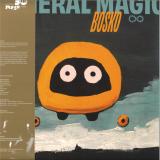
Now, we have General Magic’s second official full length comeback recording, Bosko. The new album is initially notable prior to the needle hitting the wax or the cursor identifying a track due to the artwork. Made by long term collaborator Tina Frank, this is Frank’s first analogue artwork, with a painting of a happy/nervous machine thing hovering in a landscape of no discernible identity. It’s quasi science fiction hovering amongst the potential for fun. Suited to the music? Natürlich.
Bosko sees Bauer and Pieper update and reframe their original investigations with a fresh supply of head scratching, heart racing tunes that hit the inexplicable with a wild mesh of drums, pianos, synthetic voices and all manner of immaterial sonic play. Startling sonics shock the ears on Club Duchamp which sounds like a conversation between synthetic adult ants in an environment still in development. Elfer features vocals supplied by a female-ish voice who, whilst grappling melody, has trouble executing a firm identity. Noorenhalt catapults along a mainframe of syncopation so unwieldy it feels like the voice, which is utterly alien, provides the only comfort. Seite 5 inhabits a fuzzy zone where a synthetic Horn of Jericho type ambience competes with rhythms never quite sure of who they are. Rise of the Ombré raises the spectral dread. Is this Science Fact? Absolutely nothing within Bosko is predictable.
The amount of change in the miasma of existence and the things we touch in order to make things has shifted so exponentially we are at the point where minds are starting to glaze over. All of this makes the return of the always original, always surprising, always fresh and exciting General Magic totally in tune with the artificial intelligent apocalyptic age we currently inhabit. The tools may have changed but the wonderfully warped gaze of Bosko offers a fresh new vision of perplexing funk and robotic punk.
нет на складе
Последняя поставка 13 месяцев назад доступно для дозаказа без гарантии
In recent years, Blackploid has come to be one of Central Processing Unit's signature artists. The German producer has averaged more than a record a year for the Sheffield imprint since he first landed on CPU in 2021. This prolific run continues withCosmic Drama, Blackploid's second LP for the label. The album takes the baton from its predecessorEnter Universein style, delivering twelve tracks of top-quality machine-funk that draw down from electro's classic artists while also imbuing proceedings with a playfulness that very much gives things a signature Blackploid-ish flavour.
Cosmic Dramasets its stall out from the off. The opening run of 'Alien', 'World Construction' and 'Virtual State' all deliver piston-snapping beats which anchor pleasing melanges of B-movie synth lines. Alongside this, Blackploid adds little flourishes which add buoyancy to each joint - a syncopated bassline reminiscent of I-f's late-90s classic 'Space Invaders Are Smoking Grass', crackling robo-voiced commands, skittering synth chords which wash across the mix and so on. It's the work of someone completely at ease with their craft, comfortable enough to take risks without upsetting the apple cart of their sound's core appeal.
Blackploid's idiosyncratic approach to synth work is something which distinguishesCosmic Dramafrom the pack. Electro has long been a genre which prides itself on innovation on the keys, but few producers are willing to push their sonics as far as Blackploid does - take the seasick churn of pads and processors on 'Multiverse', for instance, or the way John Carpenter-esque single-note lines dovetail with gurgling synthetic pulses and eerie, spacious chords on 'The Lab', a highlight ofCosmic Drama's midsection.
Cosmic Dramaskips along at club tempo throughout - every one of these joints will get bodies moving in dark rooms across the galaxy. However, even when tracks maintain their single-minded pursuit of machine-funk perfection, they never forget to deliver on the hooks. Blackploid has lead lines (and counter-melodies) to burn here, and each track knots them together in ever-more intriguing ways as they plough onwards. Drexciyan heads will be thrilled by the sci-fi delights of 'Species', for instance, while Blackploid brings melodies as cold as they are catchy on the aptly-named 'Polar Dunes'. By the timeCosmic Dramahits upon the vroom-vrooming bassline line of closer 'Contact', you're fully enthralled to the album's combination of broken-beat heft and synthetic melodiousness.
Central Processing Unit mainstay Blackploid comes through with another delightful dozen of electro heaters for the Sheffield label.
RIYL:Drexciya, I-f, Cygnus, AFX
нет на складе
Последняя поставка 6 месяцев назад доступно для дозаказа без гарантии
Ma Haiping's "Mind Reader," on SCAN Records, the new label from Detroit legend SCAN 7, is an EP that extends his Detroit Futurism aesthetic, reimagining techno as a vehicle for paranoia and prophecy in the algorithmic age. It's a tense, synth-driven meditation on surveillance and synthetic reality. "Mind Reader" suggests our devices aren't just watching—they're thinking. The standout, "Sensitive Period" (with Shanghai Ultra), pulses with restraint, while "No Exposed" explores icy isolation. Classic 808s and funky basslines nod to Drexciya, but Ma's voice is unmistakable: cerebral, tactile, and deeply attuned to the present moment's fractured frequencies.
нет на складе
Последняя поставка 79 дней назад доступно для дозаказа без гарантии
Originally released in 1973 by New York-born soul singer Melvin Bliss, 'Synthetic Substitution' was never meant to change music. A B-side to his single 'Reward', it quietly slipped out on Sunburst Records i and then, years later, exploded.
With 'Funky Drummer' sticksman Bernard Purdie's drums at its core, it became one of the most sampled tracks in hip-hop history, forming the rhythmic backbone of cuts by De La Soul, Mobb Deep, LL Cool J, Justin Bieber and hundreds more. This new release gives the track its due, with a sharp remaster and a respectful rework from Just Blaze. The original still hits hard i a slinky, minimal soul groove with impeccable swing and eerie vocal calm. On the flip, the 'Just Blaze Take 6 Master Mix' lifts that legendary break into widescreen, looping and layering it with warmth and flair. It's not flashy, just smart i honouring the DNA while letting it breathe. It's a fresh pressing of a foundational beat, and a timely reminder of how deep hip-hop's roots run. Whether you're crate-digging or just craving drums with history, this is as vital as it gets.
нет на складе
Последняя поставка 15 месяцев назад доступно для дозаказа без гарантии
La Scimmia Records presents: PLANISFERO by Roberto Porzio LSCM05
Renowned Neapolitan keyboardist and composer Roberto Porzio (Parbleu, Psyché, Fitness Forever, The Funkin' Machine and others) makes his highly anticipated solo debut album with Planisfero—a breathtaking sonic journey where tropical rhythms, Mediterranean lyricism, and cinematic orchestrations collide, shaping an intimate and personal musical landscape.
Planisfero blends salsa, samba, and vintage sound library aesthetics with the bold energy of an imaginary Afro-Cuban orchestra. Entirely written, arranged and composed by Roberto, the album is recorded completely live, with no digital shortcuts, becoming a manifesto to pure musicianship and analog authenticity—a rare gem in an era of synthetic production.
Step into a new musical geography—where imagination knows no borders
нет на складе
Последняя поставка 16 месяцев назад доступно для дозаказа без гарантии
Googling “paradise house”, the first results to pop up are an endless list of European b&b’s with whitewashed lime façades, all of them promising “…an unmatched travel experience a few steps from the sea”. Next, a little further down, are the institutional websites of a few select semi-luxury retirement homes (no photos shown, but lots of stock images of smiling nurses with reassuring looks). To find the “paradise house” we’re after, we have to scroll even further down. Much further down.
It feels like yesterday, and at the same time it seems like a million years ago. The Eighties had just ended, and it was still unclear what to expect from the Nineties. Mobile phones that were not the size of a briefcase and did not cost as much as a car? A frightening economic crisis? The guitar-rock revival?! Certainly, the best place to observe that moment of transition was the dancefloor. Truly epochal transformations were happening there. From America, within a short distance one from the other, two revolutionary new musical styles had arrived: the first one sounded a bit like an “on a budget” version of the best Seventies disco-music – Philly sound made with a set of piano-bar keyboards! – the other was even more sparse, futuristic and extraterrestrial. It was a music with a quite distinct “physical” component, which at the same time, to be fully grasped, seemed to call for the knotty theories of certain French post-modern philosophers: Gilles Deleuze, Félix Guattari, Paul Virilio... Both those genres – we would learn shortly after – were born in the black communities of Chicago and Detroit, although listening to those vinyl 12” (often wrapped in generic white covers, and with little indication in the label) you could not easily guess whether behind them there was a black boy from somewhere in the Usa, or a girl from Berlin, or a pale kid from a Cornish coastal town.
Quickly, similar sounds began to show up from all corners of Europe. A thousand variations of the same intuition: leaner, less lean, happier, slightly less intoxicated, more broken, slower, faster, much faster... Boom! From the dancefloors – the London ones at least, whose chronicles we eagerly read every month in the pages of The Face and i-D – came tales of a new generation of clubbers who had completely stopped “dressing up” to go dancing; of hot tempered hooligans bursting into tears and hugging everyone under the strobe lights as the notes of Strings of Life rose up through the fumes of dry ice (certain “smiling” pills were also involved, sure). At this point, however, we must move on to Switzerland.
In Switzerland, in the quiet and diligent town of Lugano, between the 1980s and 1990s there was a club called “Morandi”. Its hot night was on Wednesdays, when the audience also came from Milan, Como, Varese and Zurich. Legend goes that, one night, none less than Prince and Sheila E were spotted hiding among the sofas, on a day-off of the Italian dates of the Nude Tour… The Wednesday resident and superstar was an Italian dj with an exotic name: Don Carlos. The soundtrack he devised was a mixture of Chicago, Detroit, the most progressive R&B and certain forgotten classics of old disco music: practically, what the Paradise Garage in New York might have sounded like had it not closed in 1987. In between, Don Carlos also managed to squeeze in some tracks he had worked on in his studio on Lago Maggiore. One in particular: a track that was rather slow compared to the BPM in fashion at the time, but which was a perfect bridge between house and R&B. The title was Alone: Don Carlos would explain years later that it had to be intended both in the English meaning of “by itself” and like the Italian word meaning “halo”. That wasn’t the only double entendre about the song, anyway. Its own very deep nature was, indeed, double. On the one hand, Alone was built around an angelic keyboard pattern and a romantic piano riff that took you straight to heaven; on the other, it showcased enough electronic squelches (plus a sax part that sounded like it had been dissolved by acid rain) to pigeonhole the tune into the “junk modernity” section, aka the hallmark of all the most innovative sounds of the time: music that sounded like it was hand-crafted from the scraps of glittering overground pop.
No one knows who was the first to call it “paradise house”, nor when it happened. Alternative definitions on the same topic one happened to hear included “ambient house”, “dream house”, “Mediterranean progressive”… but of course none were as good (and alluring) as “paradise house”. What is certain is that such inclination for sounds that were in equal measure angelic and neurotic, romantic and unaffective, quickly became the trademark of the second generation of Italian house. Music that seemed shyly equidistant from all the rhythmic and electronic revolutions that had happened up to that moment (“Music perfectly adept at going nowhere slowly” as noted by English journalist Craig McLean in a legendary field report for Blah Blah Blah magazine). Music that to a inattentive ear might have sounded as anonymous as a snapshot of a random group of passers-by at 10AM in the centre of any major city, but perfectly described the (slow) awakening in the real world after the universal love binge of the so-called Second Summer of Love.
For a brief but unforgettable season, in Italy “paradise house” was the official soundtrack of interminable weekends spent inside the car, darting from one club to another, cutting the peninsula from North to centre, from East to West coast in pursuit of the latest after-hours disco, trading kilometres per hour with beats per minute: practically, a new New Year’s Eve every Friday and Saturday night. This too was no small transformation, as well as a shock for an adult Italy that was encountering for the first time – thanks to its sons and daughters – the wild side of industrial modernity. The clubbers of the so-called “fuoriorario” scene were the balls gone mad in the pinball machine most feared by newspapers, magazines and TV pundits. What they did each and every weekend, apart from going crazy to the sound of the current white labels, was linking distant geographical points and non-places (thank you Marc Augé!) – old dance halls, farmhouses and business centres – transformed for one night into house music heaven. As Marco D’Eramo wrote in his 1995 essay on Chicago, Il maiale e il grattacielo: “Four-wheeled capitalism distorts our age-old image of the city, it allows the suburbs to be connected to each other, whereas before they were connected only by the centre (…) It makes possible a metropolitan area without a metropolis, without a city centre, without downtown. The periphery is no longer a periphery of any centre, but is self-centred”.
“Paradise house” perfectly understood all of this and turned it into a sort of cyber-blues that didn’t even need words, and unexpectedly brought back a drop of melancholic (post?)-humanity within a world that by then – as we would wholly realise in the decades to come – was fully inhuman and heartless. A world where we were all alone, and surrounded by a sinister yellowish halo, like a neon at the end of its life cycle. But, for one night at least, happy."
нет на складе
Последняя поставка 3 месяца назад доступно для дозаказа без гарантии
Some record crates deserve a sub-category called 'play it again, Sam'. tracks that spin on the turntables without a push. Funk Kraut, Zombie Zombie's second LP on Born Bad, is of this kind. This well-proportioned classic is a fine example of the style the trio has been embodying: instrumental for synths and drums music played live. This time it was a quick affair, recorded by Laurent Deboisgisson in the studio of Cheveu's singer. A pretty straightforward job, and a far cry from their previous concept album. Let us praise Krikor Kouchian's mix: drums have been resampled with some restraint, and that Linn Drum kick lightens up the overall mix. It marks a notable evolution in the band's sound, and adds some dynamic. The album kicks off with 'No cruise control', a big bad sedan that effortlessly eats up the distance at 120 BPM. Kraut as can be, with a twist. And as far as funk goes, it's not Bootsy Collins, but there's a whiff. Space is structured by synth patterns, for optimized drumming : forward, straight and fluid, top-notch suspension (Cosmic Neman / Dr Scho?nberg take care of business on drums). They treat themselves to a diversion via Darmstadt to take some musique concrete on board : mechanical birds chirp, the odd atonal piano here and there. Nerds will appreciate liner notes detailing the equipment used : about twenty synths and they still describe it as minimal. With 'Densite?', we've just passed a polyphonic milestone: outright chords ! Long, suspended pads, pierced only by fat claps. Clapping hands are not far off. The band shows it has mastered concise pop formats. That same vibe can be found in 'Jungle the Jungle', paradoxical tune, catchy and moody at once. You'll get some brass riffs in 'Helix', which takes off on a synth moving from one speaker to another to herald the crash of syncopated drums to come.Zombie Zombie sounds ready to write themes for niche TV series.'Aurillac Accident' documents a haphazard soundcheck which, once in the studio, became a bitter ballad, breaking apart into dubby gravy. Live with two drummers performing, this aspect showcases in 'Snare Attack' and 'Double Z', with its jogging hi-hats and creepy little toy piano motifs. Cardio levels are high on 'Dodorian', perfect track for depraved spinning classes, with its moving filter, disco arpeggios and flashes of synthetic brass. 'Magnavox Odyssey', a nostalgic but bouncy synth lasagna, brings this album to a majestic close. The cover by Dddixie sets the tone with its 'Motorik Vibes & Stereo Grooves' sticker. Motorik, absolutely, it's autobahn time for 45 minutes. And when it comes to stereo grooving, the acoustic image is as wide as the canyons of Mars. DO NOT MISS THIS ALBUM (or the previous Vae Vobis)!
Man-of-the-minute Jorg Kuning returns to Facta & K-LONE’s Wisdom Teeth imprint with ‘Elvers Pass’: a new 6-track exposition of his singular sound, and his most accomplished and comprehensive work to date. By now, the Jorg Kuning trademark is well established. Cherrypicking influences from the wiggiest ends of tech house, electro and bass music, his music is instantly set apart by his totally unique sound palette.
In fact, it’s hard to think of another club artist who has emerged with such a distinct and recognisable voice in recent years. Bubbling and funky with that unmistakable dose of wonk, you can tell a Jorg Kuning tune the minute it enters the mix. Since last appearing on Wisdom Teeth with 2022’s ‘Chosta-del-sol’ EP, the Welshpool-based artist has become a cult name on the global club and festival circuit - his must-see live set turning heads wherever he pitches up. Anybody who frequents the summer circuits around Freerotation, Love International, Gottwood and Dimensions will know exactly what we’re talking about. Along the way he has picked up a number of ardent and outspoken fans, including Lukas Wigflex and Koreless - the latter of whom tapped Jorg for a stellar remix on last year’s ‘Deceltica’ EP on Young. On ‘Elvers Pass’, Jorg manages to ring an exceptionally rich diversity of life from the circuitry of his modular machines.
The record’s melodies flutter and swirl like deep-sea creatures, and his synths ooze as if dredged from some primordial swamp. More so than ever, a host of otherworldly voices have begun to creep into his music: ‘Mercedes’ centres around a fluttering chorus of disembodied vocal chops, while ‘Synthetic Squashies’ rocks back and forth on a looping dialog between two AI chatbots. Across the record, synths mimic animal vocal tones, from the belching bass licks on ‘Skudde’ to the amphibious synth groans on ‘Teen Frogue’. Playful, oddball and in a class of its own, ‘Elvers Pass’ is a welcome New Year offering for ravers and club adventurers worldwide.
нет на складе
Последняя поставка 5 месяцев назад доступно для дозаказа без гарантии
(Limited edition to 500 copies, remastered audio, pressed and printed in Indonesia) The 13 tracks contained in this compilation “Begadang: Soneta Group Best Songs, 1975-1980” are some the most innovative music that came out of Indonesia’s music scene in the 1970s, tunes that has cemented Rhoma Irama’s status as the king of the genre.
Dangdut is the biggest musical genre in Indonesia. Dangdut, onomatopoetic name from the sound of hand drums used in this type of music, is what reggae to Jamaicans, country to Americans or skiffle to mid 20th century British people. And in this genre of dang dut, the name Rhoma Irama looms large. He is until today the undisputable king of dangdut and his role as pioneer of the music is already in the history book. In fact, there's one book documenting the outsized role of Rhoma in establishing dangdut as the father of this music. The book is aptly titled Dangdut Story, written by Pittsburgh University music professor Andrew N. Weintraub.
Among Indonesian fans of dangdut, there’s this one misconceptions that dangdut music is that it is an indigenous art form from Indonesia and that it constitutes an amalgamation of local, traditional music of this Southeast Asian nation, with Malay music being the most prominent feature in the mix.
Dangdut pioneer Rhoma Irama is among the first to reject this assertion. “Dangdut music may have originated in Deli (in North Sumatra) but then got the influences from the West and India”, he said.
Indeed, most of Rhoma’s well-known compositions may have been influenced by Indian tunes but some of his best quality works owed much to the West.
Rhoma had long found home in Western pop music. In the early 1960s, after honing his guitar playing skill, Rhoma set up his first band Gayhand to play the tunes of The Beatles, Paul Anka and Tom Jones. In 1972, Rhoma won best singer title in a Southeast Asia singing competition in Singapore playing Tom Jones “I Who Have Nothing.”
Yet, nothing changed Rhoma’s fortune in the music industry, to a point where he decided to leave pop and switched to playing Orkes Melayu (Malay Orchestra) music, first with Orkes Melayu Purnama and later with Soneta Group.
His career soon took off with Soneta, especially after he introduced what ethnomusicologist William H. Frederick considered as “theatre”, through which Rhoma borrows many elements from stage performances of British and American rock bands. These elements, kitsch and pomp, he liberally adopted and became an inseparable part of dangdut itself; tight pants, long hair, platform shoes, glitter and glamour which would not be out of place in Elton John and David Bowie stage show.
And this is actually the contradiction of Rhoma’s brand of Malay music. “One might legitimately ask how imaginative, not to say bizarre, costuming and dancing with abandon could be related to some of the objectives of Rhoma has set for himself and soneta group”, Frederick wrote on his seminal work on the singer, Rhoma Irama and the Dangdut Style: Aspects of Contemporary Indonesian Popular Culture, published in 1982.
From technical point of view, Rhoma not only replaced the acoustic elements from Melayu Music with electric instruments but also created new synthetic sounds that has never been attempted before in Indonesia’s music industry.
Detractors like to point out how much he was indebted to Deep Purple, but a closer inspection reveals how he in fact had mined his influences even deeper.
Notice how Rhoma reproduced funk, which is all the rage in early 1970s, in the song “Santai” (Relax), this album’s closer or “Credit Title (Instrumentalia)” which opens this Darah Muda (Young Blood) soundtrack. The rubbery bass lines that open both songs can easily find home in any Sly and the Family Stone’s or Isaac Hayes’ tunes from that era. Other highlights of the song is the funky guitar licks and the droning Hammond a la George Clinton that stabs deep in the record groove. In the guitar solo, you can also hear the bark of George Harrison’s licks from “Taxman”.
The 13 tracks contained in this compilation “Begadang: Soneta Group Best Songs, 1975-1980” are some the most innovative music that came out of Indonesia’s music scene in the 1970s, tunes that has cemented Rhoma Irama’s status as the king of the genre. Only 500 copies were pressed for this compilation.
Emmanuel Mario returns to Karaoke Kalk with his third album under his Astrobal moniker for the Berlin-based imprint. »L’uomo e la natura« (»Man and Nature«) sees the prolific drummer and producer, who has worked with artists such as Laetitia Sadier and label mate Pink Shabab, take a different musical route than before. The French electronic music composer pays homage to the spirit of library music while also making concessions to different strains of pop and even classical music. With only two of the ten songs putting words to the music, »L’uomo e la natura« is a masterful exercise in the evocation of atmospheres: expressing much while saying very little outright—show, don’t tell.
The album was born out of a desire to push the envelope. »I wanted to make music that was both pop and ambitious in its chord progressions as well as surprising in its construction,« explains the Paris-based artist. Taking inspiration from library music artists such as Alessandro Alessandroni or Bruno Nicolai as well as the more cosmic strains of electronic instrumental music, he strove »to create a soundtrack that would immediately bring to mind outer space.« The first of the three singles released ahead of the full album, »L’abeille pourpre,« captures this spirit with funky rhythms and an overjoyed interplay of different melodies, all tied together by wordless yet terminally catchy vocals.
The second single, »Miami 2064,« traverses through many different moods in its six-minute run-time: Starting off as neo-noir synth-wave piece, it then proceeds to pay its dues to the masters of the cosmic music tradition such as Tangerine Dream or, of course, Jean-Michel Jarre before slowly descending back to Earth with guitars and dreamy synthetic vocals, playfully punctuated by a plethora of wistful melodies. It is the perfect encapsulation of the open-ended approach Mario follows throughout the entire album, taking full creative licence in regards to songwriting and arrangements. »I wanted to surprise myself,« he shrugs. He succeeded.
»L’uomo e la natura« rewards multiple listens not only emotionally, but also intellectually. »I also wanted to talk about politics and ecology, because it’s impossible not to,« Mario notes. Some of the track titles express this more openly than others and the two title tracks sung by Mario and Nina Savary use French and Italian lyrics, respectively. However, as a whole the album leaves things open to interpretation. Does »The End of Capitalism« sound elegiac or triumphant? And what do you actually make of this musical vision of the Floridian metropolis, whose mere existence is threatened by climate change already today, four decades from now? Mario doesn’t necessarily answer these questions—he doesn’t tell, he shows.
нет на складе
Последняя поставка 9 месяцев назад доступно для дозаказа без гарантии
Dark Entries celebrates its 15th anniversary with legendary synth-punk deviants Crash Course in Science. Dale Feliciello, Mallory Yago, and Michael Zodorozny formed CCIS in 1979 after meeting at art school in Philadelphia. As a gesture born of equal parts punk irreverence and brute necessity, the band incorporated toy instruments and kitchen appliances into their aggressive, angular sound. Their anthems “Cardboard Lamb” and “Flying Turns” from 1981’s Signals From Pier Thirteen EP have been staples in adventurous DJ sets for over 40 years - yet some of their finest work is to be found on Near Marineland, a full-length LP recorded in 1981 but remained unreleased in its time. Near Marineland shows the band moving into more diverse and polished territory (although it’s still as abrasive as sandpaper). Tracks like “No More Hollow Doors” and “Jump Over Barrels” highlight CCIS’s singular knack for embedding infectiously monotone hooks in their stiff-yet-funky grooves. Elsewhere we see CCIS going fully unhinged, like on the searing “Someone Reads” or the demented “Pompeii Spared”, where a spray of honks is barely glued together by a frantic synthetic pulse. While this masterwork of malfunctioning analog electronics has surfaced on a few occasions - this first time stand alone remaster includes four never-before-released bonus tracks and includes a lyric sheet. Near Marineland is crucial listening for all devotees of synth-punk and minimal electronics.
нет на складе
Последняя поставка 15 месяцев назад доступно для дозаказа без гарантии
Oakland's Naked Roommate have been slinking around the Bay Area lighting up stages, shaking asses & confounding listeners since 2018, when the group - originally just the duo of real-life partners Andy Jordan & Amber Sermeno (both formerly of The World) - self-released a cassette of demos (2018's "Naked Roommate"). Members Michael "Mig" Zamora & Alejandra Alcala (Blues Lawyer) joined soon after to augment the sound & live band with their proper full-length album "Do The Duvet", co-released in September of 2020 via UK label Upset! The Rhythm & Trouble In Mind. 2024 finds the lineup expanded even further to incorporate the horn section of Geoff Saba & Jeanne Oss on tenor & alto saxophones as well as percussion & marimba as the band readies their sophomore effort, the dizzyingly ecstatic "Pass The Loofah" Recorded by members Andy Jordan & Mig Zamora from 2021-2023 as time & restrictions allowed, "Pass The Loofah" retains the wild energy of their debut, but leans into the rhythmic throbs perpetuated by forbears like Kid Creole & The Coconuts, Lizzy Mercier Descloux & ESG; the signature sound of UK's On-U Sound & NYC's 99 Records, but with a decidedly West Coast irreverence & a knack for absurdist exposition. Make no mistake, this is music designed to make your body MOVE & Naked Roommate won't stop until they 've made sure every ass is shook. The band freely incorporates elements of the dancier side of post-punk (think A Certain Ratio or Liquid Liquid) as well as disco, funk, & house music. However, the group's uplifting melodicism belies a deeper subtext, understanding the importance of the sense of community of dance music & the culture surrounding it and leaning into a Neo-socialist lyrical context. Shit is fucked, & we get thru it by helping one another & acknowledging & addressing the failures of disaster Capitalism & tech-bro hegemony (a state the band is all-too familiar with, living in The Bay Area) Take the first single "Bus"; a four-on-the-floor banger & salutary paeon to the ups & downs of the people's transport that throbs & pulses with a late-night sashay (and a bridge that launches the tune into the stratosphere). Elsewhere, "Fight Flight "s funky horn stabs and Sermeno's slinky vocals swoon over Numan-esque synth squiggles that are fortified & funkified toward the dance floor. "Broken Whisper " edges into new territor y for the group, adding a Caribbean flavor a'la Kid Creole or The Specials that punctuates the persistent & synthetic beats underneath. Meanwhile instrumental interludes like "Ducky & Viv", "G-Y pt. 1" & "G-Y pt. 2" oscillate into zones of sci-fi meets soap opera soundtracks, sounding not unlike the electronic experiments of UK industrial pioneers Chris & Cosey. Album closer "I Can't Be Found" might be the album's secret weapon; It 's swooning synth melody & processed vocals recall early Daft Punk or MGMT by way of Derrick Carter & The Au Pairs. It 's a beautiful song; perfect for the late night (or early morning) car ride home from the club. "Pass The Loofah" is released worldwide on October 25th, 2024 via Trouble In Mind Records digitally via most DSPs & on black vinyl & limited "disco ball " silver vinyl.
Limited metallic silver/white "disco ball" splatter vinyl available while supplies last.
Oakland's Naked Roommate have been slinking around the Bay Area lighting up stages, shaking asses & confounding listeners since 2018, when the group - originally just the duo of real-life partners Andy Jordan & Amber Sermeno (both formerly of The World) - self-released a cassette of demos (2018's "Naked Roommate"). Members Michael "Mig" Zamora & Alejandra Alcala (Blues Lawyer) joined soon after to augment the sound & live band with their proper full-length album "Do The Duvet", co-released in September of 2020 via UK label Upset! The Rhythm & Trouble In Mind. 2024 finds the lineup expanded even further to incorporate the horn section of Geoff Saba & Jeanne Oss on tenor & alto saxophones as well as percussion & marimba as the band readies their sophomore effort, the dizzyingly ecstatic "Pass The Loofah" Recorded by members Andy Jordan & Mig Zamora from 2021-2023 as time & restrictions allowed, "Pass The Loofah" retains the wild energy of their debut, but leans into the rhythmic throbs perpetuated by forbears like Kid Creole & The Coconuts, Lizzy Mercier Descloux & ESG; the signature sound of UK's On-U Sound & NYC's 99 Records, but with a decidedly West Coast irreverence & a knack for absurdist exposition. Make no mistake, this is music designed to make your body MOVE & Naked Roommate won't stop until they 've made sure every ass is shook. The band freely incorporates elements of the dancier side of post-punk (think A Certain Ratio or Liquid Liquid) as well as disco, funk, & house music. However, the group's uplifting melodicism belies a deeper subtext, understanding the importance of the sense of community of dance music & the culture surrounding it and leaning into a Neo-socialist lyrical context. Shit is fucked, & we get thru it by helping one another & acknowledging & addressing the failures of disaster Capitalism & tech-bro hegemony (a state the band is all-too familiar with, living in The Bay Area) Take the first single "Bus"; a four-on-the-floor banger & salutary paeon to the ups & downs of the people's transport that throbs & pulses with a late-night sashay (and a bridge that launches the tune into the stratosphere). Elsewhere, "Fight Flight "s funky horn stabs and Sermeno's slinky vocals swoon over Numan-esque synth squiggles that are fortified & funkified toward the dance floor. "Broken Whisper " edges into new territor y for the group, adding a Caribbean flavor a'la Kid Creole or The Specials that punctuates the persistent & synthetic beats underneath. Meanwhile instrumental interludes like "Ducky & Viv", "G-Y pt. 1" & "G-Y pt. 2" oscillate into zones of sci-fi meets soap opera soundtracks, sounding not unlike the electronic experiments of UK industrial pioneers Chris & Cosey. Album closer "I Can't Be Found" might be the album's secret weapon; It 's swooning synth melody & processed vocals recall early Daft Punk or MGMT by way of Derrick Carter & The Au Pairs. It 's a beautiful song; perfect for the late night (or early morning) car ride home from the club. "Pass The Loofah" is released worldwide on October 25th, 2024 via Trouble In Mind Records digitally via most DSPs & on black vinyl & limited "disco ball " silver vinyl.
Slow paced drums with offbeats softly phased with the guitar, misty takeoffs from the synthesizer: a hazy idyll is starting off on the road to the rocket festival (bun bang fai). Answering each other on the responsive mode of the lam soeng, Sothipong engages in a flirt but Oulay Vanh is not ready to trifle with just anybody.
As a stylistic variation of a popular Lao musical genre, the lam soeng was the source of several themes among which the “bang fai” - which is part of the Lao conciliatory festivities preceding the rainy season - remains one of the most renowned.
However, the producer and composer of these songs, Sothy, created an unusual arrangement: the instrumental introduction separates from the sang canon, the synthetic mix is stripped down of the traditional organology - everything here becomes unsettling for a listener familiar with the genre.
Everything comes with a reason: the record was edited in 1981 under the title Sothy Productions yet produced in France by the Parisian label Oxygène (famously known for its unforgettable first French punk compilation 125 grammes de 33 1/3 tours). Chansons Laotiennes still remains hard to classify.
And then who’s Sothy? Along with the unverifiable identity of the seemingly Laotian singers, skepticism gains ground concerning the man behind the pseudonym. Is he an escaped musician from one of the first Cambodian rock bands of the 1960s? A surviving producer from the 1980s Paris? Or a composer in transit in one of the many places of the Laotian diaspora? Sothy eludes any researches and disappears behind his numerous homonyms.
The second track is just as enigmatic: a beat box, a lightly reverberated voice as well as a guitar solo and a small synthesizer break, “Tuei” or “Tawai” offering (as the writing on the record suggests) makes way to dancing step and a truly joyful melody. Twisted and lively steps on a romantic background tune turn this second track into a genuine paslop - a program recommended by therapists to relieve muscular pains due to seated positions: you will unlock your pelvis with some synchronized Laotian choreographies.
For their first edits, Akuphone called on a young Parisian producer. Shelter, aka Alan Briand, mingles his own mixes and electro productions with a large variety of influences and styles: krautrock, disco, traditional music, psychedelic, synth pop, ambient, bossa nova, Japanese funk. He produces both original compositions and remix.
Hassan Abou Alam is next to step up to the unconventional Nerve Collect label with six tracks of futuristic club-ready chaos. The finely crafted EP arrives in August and comes on 12" vinyl and via all digital platforms.
Hassan Abou Alam has established himself as one of Egypt's most innovative underground musicians over the last 10+ years. His music is a meeting of disparate worlds - organic and synthetic designs, digital and analogue tools, the traditional and the futuristic, and it has come on the likes of YUKU, Rhythm Section, Banoffee Pies and Casa Voyager. His versatile sound pulls apart existing genres and reconstructs them as something entirely new.
Opener '3asabi' is a stylish sonic assault with thumping rhythms and trippy oscillations that will get any dance floor bouncing. It's fun yet functional, serious yet seductive and 'Basha' Ft. ZIAD ZAZA, Ismail Nosrat & Aly B is another kinetic fusion of hand claps and complex drum funk, Egyptian vocal gymnastics and punchy bass. 'Ghalat' has lurching drums and plunging bass driving on beneath mangled synths, odd vocalisations and percussive splatters drawn from a unique sound palette. The drilling low ends of 'Khalsana' Ft ZIAD ZAZA are offset by fluttering percussive details up top while spare but booming kicks shake every bone in your body and the bassline devastates.
There is no let up on 'Mesh Mafhoom' which is a ritualistic workout with moments of melancholic synth soul shining through the jumble of tin-pot percussion and crashing hits. Closer 'Zein' is more body-popping brilliance that channels ancient spirits into warped synths and rhythms so complex they melt the mind.
Hassan Abou Alam's blurring of the lines between the real and the imagined is second to none on this EP. It's a sub-heavy mix of the human voice, machine-made sounds and inventive rhythms that make for something new, weird and wonderful.
нет на складе
Последняя поставка 10 месяцев назад доступно для дозаказа без гарантии
Lavender Vinyl. In the late 1970s, a peculiar sound began bubbling up from the land of 10,000 lakes. Buried beneath 50 solid inches of annual snow, Minneapolis made a Sound quite different than what the pop world foresaw. It issued forth as a slick, black, technologically advanced fusion, poised to storm the charts. Never known for sizable African-American populations, the Twin Cities of Minneapolis and St. Paul in fact harbored a tight-knit community of musicians working feverishly through the late '70s and early '80s toward a radical manipulation of American dance music, coating futuristic funk with the glamorous sheen of guitar rock. Synthetic ebony and ivory met electricity, with sexed-up results sent shockingly across the pop heavens like violet lightning.
Decoy is a 1984 album by the famous jazz musician Miles Davis, recorded in 1983. Robert Irving III on keyboards took over the role that Miles had assumed with a true sense of harmony and only a rudimentary mastery of synthetic sounds and movements. Irving shared the responsibilities of directing with the trumpet player’s nephew Vince Wilburn, Jr., but Al Foster continued to lead the tempo. John Scofield drew the funk of bassist Darryl Jones in the direction of chromatic abstraction. The two tracks that he co-wrote with Miles are fragments of solos: “That’s What Happened” reprising the beginning of his solo on “Speak” (Star People). Decoy offered a good balance between the dominant funk that subsequently took over and the jazz tradition, reflected by Scofield’s angularities, Marsalis’ freedom of tone and the breath of Miles’ playing that had recovered its full power. Decoy is available as a 40th anniversary edition of 2000 individually numbered copies on smokey coloured vinyl, housed in a gatefold sleeve.