Dauwd returns to Technicolour with 'Theory of Colours - Versions' EP. A new 4-tracker EP containing remixes/reworks of various singles from his debut album. The EP opens with a piano rework of 'Analogische Memories', recoded at his studio in Berlin and the result of countless hours work - 'it took some time, as I had to learn to play piano' Dauwd explains. Dauwd also makes up one third of the Berlin collective, party and radio show, African Acid Is The Future having previously released on Kompakt and Ghostly International. Ukrainian music producer and Leleka label boss Vakula provides a remix of 'Macadam Therapy'. Fresh from the release of his well received LP 'Metaphors' and following on from last years 'Techno Game' released via Arma and 'Cyclicality Between Procyon And Gomeisa' released via Dekmantel in 2016. AAITF partner Romain Azzaro AKA Rouge Mécanique provides two remixes of 'Murmure' (one 'Walking', the other 'Running') - "Romain and I returned to the studio where I made
Salvador Font studied violin, clarinet, composition and harmony at the Conservatori Municipal de Barcelona, but very soon started to gain notoriety as a saxophonist in the rich jazz scene of 1940s Barcelona. Font would soon be playing tenor sax and clarinet in the Orquesta Gran Casino. He was in his early twenties and his hot swing technique was already praised through the citiy's scene, he would grow to be considered the best saxophonist in Spain by playing in many orchestras and combos, among them: José Puertas', Antonio Vilá's Virgina, Bonet de San Pedro's band, Pierre Michel, El Lirio Campestre, Los Marios, Luis Rovira y su orquesta, Orquesta brasileña Fon-Fon, Jaime Camino, Los Embajadores, Italo Leone's... With these and others, Font toured constantly, visiting many countries and even staying on some for long seasons: Mexico, Morocco, Switzerland, Egypt... Hungarian violinst of Turkish ancestry Kurt Dogan gave him the "Mantequilla" surname - he felt "Mantequilla" (which means "butter") fit Font's mellow yet swinging improvisation style.
Mantequilla y su conjunto
In the early sixties, "Mantequilla" had the chance to lead his own combo, Mantequilla y su conjunto, with which he was to record the three splendid EPs that are compiled on the present album. All these 7" have become elusive collector pieces in the record market, with sellers demanding from 200 to as much as 950 euros per copy.
In 1961 "Mantequilla" was at his best moment, his gigs at the Jamboree Jazz Cava had brought him back to the first line of Barcelona's jazzmen after he had been working abroad for a long time, and was approached by the Belter label to record an EP. On the sessions he was accompanied by Manolo Mercedes on trumpet, Pedro Ferré on piano, Rafael Lizandra on double bass and Rafael Verdura on Drums. The material chosen for the disc were four original compositions by Salvador Font which had a high West Coast flavour all over: "La Tuna Club", "Whisky Jazz" and "Jamboree" named after famous jazz clubs and "Azul Trompeta", dedicated to Manolo Mercedes.
In late 1962, after spending some time in Madrid working as members of the Italo Leone combo, "Mantequilla" and pianist Manuel Gas came back to Barcelona for the recording of the second "Mantequilla" EP, also on Belter. We find again Manolo Mercedes on trumpet, Pedro Ferré on piano and Rafael Lizandra on double bass, the drummer this time was José Farreras. Another news is that Manuel Gas also sat on piano and vibraphone. The songs chosen for the occasion were two tunes from the Art Blakey Jazz Messengers repertoire: Bobby Timmons' classic "Moanin'" and the Jacques Marray track "No Problem" from the soundtrack of the Les liaisons dangereuses film (mispelled "Not Problem" on the sleeve and label), plus the Salvador Font penned "Blue Note" and "Full de ases" - on "Full de ases" "Mantequilla" trades his sax for the violin, which he also mastered under high influence from Stephane Grapelli. The record was released on Belter in early 1963 and showed "Mantequilla" adding a certain aggressivity to his sound, in a soloist style which has been compared to that of tenor saxophonists Barney Wilen or Benny Golson.
1965 was the year of release of Mantequilla y su conjunto's third EP, now on the Discophon label. Mercedes and Farreras are again present in the recording sessions, joined by Ricardo Miralles on piano and Enrique Ponsa on double bass. Four original Font compositions make up the fantastic EP: "Blues 3/4", "Atmósfera", "Vat 69" and "Balada".
There would be a further EP on Belter, released in 1971 as Mantequilla Group it was a cash-in operation to take some redits of the ye-yé discothèque phenomenon, it gets quite afar in style from the jazz works of Mantequilla y su conjunto, so we just left it aside for the present edition.
"Mantequilla"'s career would continue, in 1968 he would settle in Majorca and form a swing band with Bonet de San Pedro and Manuel Bolao. He played in local orquestras and also with first class world acts like Gerry Mulligan, Tete Montoliu, Errol Gardner, a.o. He was even approached by Henry Mancini to play sax on The Pink Panther Theme in a gig Mancini did with his orchestra in Palma de Mallorca in 1975, He also joined his son Salvador Font (a demanded drummer himself who has played with Máquina!, Orquestra Mirasol, Música Urbana, Gary Burton Quartet, Georgie Fame, and many others) and his peers Carles Benavent, Emili Baleriola, Josep Mas 'Kitflus' and Jordi Bonell with whom he recorded his acclaimed "Mantequilla" album in 1987.
Now, for the first time ever, the legendary three ultra rare and imposible to find EPs by Mantequilla y su conjunto are compiled in a lavish vinyl LP with remastered sound, featuring liner notes and photos and a fantastic period inspired, three backflaped, front laminated sleeve. It is a stricly limited edition of only 500 copies and they are expected to sell out very soon, do not miss your chance of getting yours - it may be the last chance of chasing the Mantequilla sound on vinyl at a reasonable price!
For its tenth year as a label, 4Weed Records proudly presents Zion Kingdom, a special EP we've been working on since long time. A feature between historical sound system Dread Lion Hi Fi, also active as producer and promoter, and Mr Biska, this release is enhanced by legendary Henry Tenyue's trombone melody, aka Matic Horns, and it is mixed, dubbed and mastered by Steve Vibronics.
Over the years Matic Horns has been collaborating in studios and live performances with the best Jamaican and English talents such as Gregory Isaacs, Freddie McGregor, John Holt, Luciano, Aswad, UB40, Horace Andy, just to name a few. Dread Lion Hi Fi crew is a historical Italian sound system, that has been a reference point for the reggae vibez in Italy, promoter of historical events such as the Milano Dub Club and the Dubwise Festival, where the best producers, singers and selectas of the international scene have been hosted. The combination with master Steve Vibronics was born far away in time, from a consolidated relationship over the years that brought about this collaboration.
The track opens with a magical trombone melody by Matic Horns that perforates the pad carpet laying down the whole tune while indicating the path, a victorious march to Zion. The guitar riff, which perfectly fits to the trombone melody, introduces the drop of a deep overwhelming rhythm that transmits the desire of moving and dancing, and at the same time a spiritual mantra for high meditation. The production is enriched by three different dubs, mixed and made unique by Steve Vibronics' technique, reverbs, filters and delay, a very guaranty for the lovers of Uk Dub in roots and culture style.
Introducing Charles Green on the second release of TAFKAMP's Revenge Techniques imprint. Hailing from Brighton (UK) Charles has been consistently dishing out club bangers with no remorse. Highly essential club tracks!
When Ann Arbor's Tadd Mullinix began exploring hip-hop under the name Dabrye 20 years ago, he soon honed in on a startling vision of what the genre could be: ingenious, refined, daring. This vision came to life across two albums for Ghostly International — 2001's One/Three and its 2006 follow-up Two/Three— with each record further positioning the quiet Michigan producer as one of his generation's best, equally comfortable creating minimalist instrumental meditations or sharp rap salvos. In the late 2000s, following critical acclaim and accolades from both peers and inspirations (including the late Jay Dee with whom Mullinix collaborated before his untimely passing), Mullinix put the Dabrye moniker on ice and dedicated himself to other genres and ideas. All the while the influence of his work on a new generation of electronic musicians continued to make itself felt in subtle but meaningful ways.
All this changes in 2017 as Dabrye makes his long-awaited return with Three/Three, a razor-sharp rap album that brings to completion a prophetic trilogy. Mullinix's incisive productions provide the backdrop for equally acute rhymes that run the gamut from intergenerational observations and being your best self to back alley deals and having fun in the ride. Guests include indie rap legend DOOM, whose previous collaboration with Dabrye remains a point of reference for many, Wu Tang storyteller Ghostface Killah, L.A word fanatic Jonwayne, and Long Island's rugged surrealist Roc Marciano. Most importantly Three/Three is, much like its predecessor, an unfettered celebration of Detroit-area talent with Guilty Simpson, Phat Kat, Kadence, Quelle Chris, Danny Brown, Shigeto, Clear Soul Forces and more all lending their touch to Dabrye's return.
The blend of American and British dance music, hip-hop sampling, and Jamaican sound clash energy that underpinned Two/Three remains a quiet, guiding principle. At the same time Mullinix rejoices in a refreshed perspective, having had time to incubate ideas and find clarity in the distance between albums and the evolution of scenes.The beats are looser and less angular, more embracing of repetition. Organic techniques inspired by soul and jazz round off some of the harsher sonics. The resulting broad palette of tracks reflects both this evolution and the range of the Dabrye persona: relaxed headnod ("Tunnel Vision"), nervous, slow-motion electro ("The Appetite"), glacial motifs ("Emancipated"), jazzy, cut-up funk ("Sunset"), minimal brutalism ("Electrocutor"), intricate layering ("Culture Shuffle").
Three/Three marks the return of an innovator after close to a decade of silence. Despite what the title might imply, the album isn't the end of the story but rather the completion of a creative arc. Expect more Dabrye in the near future. The game is far from over.
- Final installment of the /Three series, started in 2001
- Guests include Ghostface Killah, Jonwayne, Doom, Danny Brown, Shigeto, and more.
- Media support from: The Wire, FACT Magazine, The Detroit Free Press, Pitchfork, XLR8R
- Past collabs with Jay Dee (J Dilla), MF DOOM, Beans & more
- Vinyl is housed in a matte jacket with black hot foil and includes 24-page zine designed by Michael Cina.
Newly signed to Rhythm Rollers, Mr. Wonderful & Technical J introduce The Boss, a 7' vinyl scratched masterpiece with outstanding production and a compilation of diverse and unique scratch samples to DJ/Producer to utilize.
This unique piece of vinyl has a 'Skip Proof' scratch side dedicated for the DJ/Producer with over 4.30min of vocals, drums, synths, bleeps and basses that can make any DJ/Producer standout from the rest.
The Boss is a live Studio scratch track that will have any crowd rocking. Super low sub frequencies, punchy drums and ear pricking scratches that only Wonderful and J could produce.
Samples
Choosing the right samples for our record was the major focus for this release. We wanted DJ's to standout from the crowd, so spent considerable time getting vocalists and secessionist in the studio to record some very individual samples for DJ's to use.
Skip Proof Technology
'Skip proof' technology - is a way of recording scratch records so that they do not skip from one sample to another. This is achieved by first calculating the time it takes for one revolution of the record (1.8sec). Once you have this information you can then customise your DAW to that specific measure (133.3333bpm). Then layout your samples so they repeat at the start of each bar.
Extra Deep Grooves
The record plant cut extra deep grooves perfect for the more aggressive style of scratching we all love (these will not jump). Making sure the weight of the vinyl was correct giving that nice feel and long lasting audio sound.
Unusual Colour And Complex Microtonality Found In The Classical Music Of Iran / Blurts Of Noise, Sour Tones, And A Vaguely Technoid Or Dubwise Impression Expose The Inner Rhythm And Counterpoint Embedded In This Strummed Music / Emotional, Mathematical And Polyrhythmic Principles Underpinning Persian Music, The Record Reveals A Dramatic Blend Of Acoustic Persian Instrumentation And Contemporary Electronics. Sote Aims To Devise An Idealised Fusion Of The Musical Heritage And Tradition Of Iran With The Forward-thinking Vision Which Has Propelled His Storied Career Producing Techno, Hardcore And Computer Music For Labels Like Warp, Ge-stell, Morphine And Repitch. Now Living In Tehran, His Music Has Frequently Grappled With The Strict Cultural Restrictions Imposed In His Country Over The Past Few Decades, Finding A Space And Setting To Nurture New Developments In Experimental Sound And Performance. Working With Arash Bolouri Who Plays The Santour (persian Hammered Dulcimer), And Behrouz Pashaei On The Long-necked, Four-string Setar, Sote Frames And Responds To Their Traditional Artistry. On Occasions He Directly Manipulates The Music Emanating From Their Ancient Instruments, Cultivating And Thickening Up A Surreal And Beautiful Tonality Plucked From Their Strings With A Series Of Processing Techniques, But Mostly Each Track Is A Peaceful Arrangement And Partnership, Sote Electro-acoustically Augmenting Their Movements Within His Own Cybernetic Framework.
Austin Based Experimental Collective Thousand Foot Whale Claw Is Back With The New Cosmic Full Length black Hole Party, Out June 29, 2018. Featuring Members Of S U R V I V E, Troller, Single Lash And Future Museums, This Is The Supergroup's Second Lp And Their Most Accomplished Work To Date. Inspired By Progressive 70's German Kraut-rock, Thousand Foot Whale Claw Maintains A Classic Style While Establishing An Original Voice. With Album Art By Renowned Contemporary Sci-fi/fantasy Illustrator Kilian Ang, black Hole Party's Aesthetic Is Cohesively Curated Throughout Its Dense, Multi-layered Track List, Ranging From Serene Sound Baths To Driving Dance Beats.
Tfwc Was Founded In San Marcos, Tx By A Core Group Of College Friends Who Bonded Over Loose Collaborative Jams Of Effects Driven Improvisations. Eventually These Unstructured Practices Evolved Into Refined Studio Sessions And Intense Live Performances, Leading To A Rich Discography And Enthusiastic Fanbase. Balancing Repetition With The Unexpected, Tfwc's Sustained Motifs Slowly Reveal The Band's Signature Free-form Experimentation. Known For Heavy Walls Of Guitar And Electronic Drones, Tfwc Spirals Into Circular Rhythms And Looping Riffs Stacked With Shredding Guitar Solos And Ambient Soundscapes. Explorations Spurring From A Central Theme Is The Basis For The Band's Compositional Approach, Always Seeking New Instruments, Sound Sources And Production Techniques For Each Piece. Recorded And Engineered At Stassney Studios In Austin, Tx With Producer/artist Dylan Cameron, black Hole Party Has Become The Band's Most Defining Body Of Work Thus Far.
On black Hole Party, The Polished Structure And Acute Development Of All Six Tracks Is Distinct And Tangible, Making This Record More Composed Than Any Of Their Previous Releases. Propulsive Songs Such As deridium Rail' And The Album's Title Track Are Driven By Four-on-the-floor Dance Beats And Arpeggiated Synthesizers, Contrasting Songs Like genesis Effect' That Predominantly Features The Natural Tones Of 12-string Acoustic Guitar And Harmonium. The Wide Variety Of Sonic Flavors Is Reflective Of Tfwc's Vast Musical Tastes, Refusing To Settle On One Approach And Allowing The Band's Idiosyncrasies To Shine Regardless Of Genre. To Classify Tfwc As An Instrumental Psych Band Is Only Partially Accurate, However There Are A Lack Of Proper Terms To Fully Encapsulate The Band's Broad Scope. Black Hole Party Is The Latest And Brightest Collection Of Songs From Thousand Foot Whale Claw, Meant To Be Enjoyed In A Multitude Of Environments For All Fans Of Expansive Listening.
1976 rare dub album consists of robust Techniques rhythms dismantled and reconstructed by King Tubby to its perfection. Long-expected reissue of one of the most sought after dub albums.
In its second venture into reissuing hidden gems of electronic music produced in Eastern Europe in the 20th Century, LITTLE BEAT DIFFERENT ISSUES focuses on the work of a Czech composer, musician and producer, Alexander Goldscheider. Born in Prague in 1950, Goldscheider started as a music orrespondent in New York in 1968/69, went onto reading Music at Charles University whilst continuing as a music critic and radio/club DJ, before becoming a record producer at the top Czech label, Supraphon. As a composer, he pioneered the use of synthesizers in his songs for major Czech pop/rock singers as well as in his own instrumental tracks. After moving to London in 1981, he first recorded two albums at the renowned Red Bus Studios, then proceeded to work at the legendary BBC Radiophonic Workshop, before co-founding and establishing Romantic Robot, a software and hardware design and manufacturing company which later moved into music recording and publishing. Of the many original products, THE MUSIC TYPEWRITER was ground-breaking software enabling the writing and printing of real notation on the Sinclair ZX Spectrum. Similarly TEREZÍN: THE MUSIC 1941-44 was the first ever release of CDs with music written in the Theresienstadt Concentration Camp during World War II. Goldscheider's 1980s LPs THEMES FOR A ONE-MAN BAND Vol I & II reflect his work as a solo artist, always writing, recording and producing single-handedly. He had, though, a team of technical aficionados and inventors back in Prague, who adapted and developed his electronic music equipment incl. synthesizers, sequencers and even a Studer multitrack recorder, thus creating a revolutionary set-up, on par with the much later MIDI.This LP samples Alexander Goldscheider's music produced for records, films, TV and even an art exhibition in the space of 25 years starting from 1975.
Mehmet Aslan returns to his own Fleeting Wax imprint, in order to deliver the first in a series of releases as part of a new project, ghost station, including a collaboration with fellow Turkish singer, songwriter and vocal producer, Idil Mese.
Efsun, translating to enchantment in Farsi, is the sound of Idil Mese transforming an understated, somewhat folksy instrumental of Aslan's into a bewitching and subtle musical spell. Initially tense,
Idil Mese's vocal spell wraps beautifully around a brittle guitar motif, inches above a sea of atmospheric ambience. In it's second half, synthesis and sitar unite, taking efsun into more revelatory territory, employing a playful melody and warm, cosmic textures.
Meanwhile, on 'ghost station', from which the project takes its name, layers of meaning and recording slowly unravel, revealing a compelling soundscape. Recorded in one take, and completed across one night, 'ghost station' began with Aslan and his sampler surfing the busy radio waves of Berlin, eventually settling on a beautiful score broadcast on one of the city's classical stations. Just as soon as Aslan had the frequency on lockdown, the signal disappeared unable to be retrieved quickly enough, if ever. Loosely inspired by the work of Swiss visual artist and musician Pipilotti Rist, the track instead unfolds woozily like a dream, undulating through offbeat bleeps, ghostly voices and improvised swells of noise, while still maintaining it's own quietly propulsive groove.
Sounding more like himself than ever on his own Fleeting Wax outlet and incorporating an impressive range of musical techniques over just two tracks, 'ghost station' further establishes Mehmet Aslan as a restlessly inventive musical talent. -Text by John Thorp
'Turquoise', that is Turkuvaz, is a French-origin word inspired by the color of the Mediterranean, located within the borders of Turkey. Meaning; blue is the color that plays the green. At the same time it is relative. Because both colors are in it, if you love blue you will see blue, if you love green you will see it green. It means heaven and earth. The eternity is turquoise... The eternity is infinite. At the same time; the boundary between the earth and the sky. Some will find love in it , some will find serenity, some will remember the loneliness and find sadness, embracing some with zeal and reminiscent of the return to the nest, the power of holding hands tightly with two hands.And according to my opinion, the concept of life, the mortal world, is how we see these lands curtained until the last breath of life that we have been living on for centuries.There are billions of beings in our sky and on Earth that do not attract our attention, We can not see, can not hear, can only feel, there are enough lights to count and never disappear in the stage. This EP that you hold in your hand is a reflection of it.
Music was the easiest way to reach you. In doing so, the motto was 'never disappearing at the stage'. I know, because if nobody hears me, God, the real dominion of light the true owner of all the darkness will hear me.
Each sound I created, I filled it with a light and I added a little more sand to the clock. Sounds I created is to show you your own technique of finding your way to light, to make you understand that you are not alone, and that there is someplace really there for you. Without much effort, resting and reviving.
I believe that every one of us who lives on earth has a specific, holy purpose. The important thing is to find and catch it. Our inner journey is to be able to complete our enlightenment as spiritually as possible. And I still believe that we always need music to do that. Because the sounds; they will never disappear.
Turquoise, which is the work of this enlightenment period, which I have lived and found to be my self, will be a source of light for you and help you find God who lives in you.
Who Do You Go To For Your Very First Session When You Have Just Been Gifted Your Very Own Top-flight 'stradivarius Of Synth Based Studios' Enter 'the Grid' ...mr David Ball: One Man Band Of Pioneering Electro-pop Distorters Soft Cell, Part Time Psychic Tv Personality, Film Soundtrack Composer And All Round Synth Afficionado & Richard Norris: Eclectic Beat-meister & Ambient Dj, Record Producer, Commited Psychedelicist From 'beyond The Wizard's Sleeve'. The 1990's Saw Worldwide Commercial Success As The Grid Scored 10 Uk Chart Hits, Many A Euro Hit Including 1994's International Mega-hit 'swamp Thing' Featuring A Twisted Use Of Sampled Banjos Lifted From The 1970's Okie Shocker Movie 'providence. In 1996 The Grid Went On A Holiday And They Didn't Return Till 2005. In The Initial Week Of The Moog Sound-lab In Early 2015 As The Studio Was Literally Put Together Around Them, Our Abiding Memory Was Their Absolutely Delighted Grins As Each Moog Unit Was Added To The Lab. Dave & Richard Created This Benchmark Album Of Deluxe 'tronic Trax That Showcased Their Prarie Wide Knowledge Of Electronica & Their Ocean Deep Skills As Both Technicians & Original Soundscapers - Kraftwerk-ian Werk-outs, Space Noise Jams, And Slinky Grooves With Subtle Pop-tones.
Tachyon Audio is a vinyl label that's focused on sounds in the techno realm targeting sweaty, dark dance floors, with large, high-quality sound systems.
Inhabitants come back strong in Mutations Volume II, Tachyon Audio's second offering. These two primates are often found inhabiting dark spaces, forging ahead on complex math equations. Their distinct, driving, mathematical, and drumming techno is a result. Expect more solid work and performances from these two mysterious beings on Tachyon Audio as the label continues its progression.
Tachyon Audio's second release follows a similar format to the first, in that, TAC002 is a diverse EP that touches on techno sounds that are helping to lead the march forward into the future of sound production and style. The second Tachyon Audio release also comes from the mysterious dark studio of Inhabitants, who build off their first, and display their precise, technical forms of production.
The A-side track, Mut11 (A1) is a sci-fi exploration that pleases the ear with thick sub and low basses, along with a pitch-twisted melodic element, and the Inhabitants distinct sound effects and automation. The track has a strong impact immediately, as you can feel the intensity of elements being added, manipulated, and combined, and a sturdy, grimy feel pervades the piece with an interesting driving rhythmic percussion.
Side A ends with two separate open-source NASA samples. The first, Sounds of Enceladus - Radar Echoes from Titan's Surface (A2), is a locked groove and according to NASA, 'was produced by converting into audible sounds some of the radar echoes received by Huygens during the last few kilometers of its descent onto Saturn's moon, Titan. As the probe approaches the ground, both the pitch and intensity increase. Scientists will use intensity of the echoes to speculate about the nature of the surface.'
The second sample, Cassini - Saturn Radio Emissions #2 (A3), is another locked groove. The sound as described by NASA, 'Saturn is a source of intense radio emissions, which were monitored by our Cassini spacecraft. The radio waves are closely related to the auroras near the poles of the planet. These auroras are similar to Earth's northern and southern lights. This is an audio file of radio emissions from Saturn.' These samples are poised for reuse in production and make for good intro and looping material during performances.
The second side of the EP starts with Mut1 (B1), a track that is well-rounded percussively, with a strong kick drum driving the track forward. A simple looping and effected tom drum also helps keep a good movement to the track. An ominously melodic pad that evolves subtly throughout the track helps to keep the Inhabitants err present throughout the track.
Mut8 (B2), is another acidic venture with solid percussion. The looping and other melodic elements provide a solid stricture, with the more adventurous sounds being placed and effected incrementally with distinct Inhabitants flare throughout the track.
"The art of the future, therefore, will not be poorer, but infinitely richer in subject-matter. And the form of the art of the future will also not be inferior to the present forms of art, but infinitely superior to them. Superior, not in the sense of having a refined and complex technique, but in the sense of the capacity briefly, simply, and clearly to transmit, without any superfluities, the feeling which the artist has experienced and wishes to transmit." - Leo Tolstoy, "What is Art"
This statement can be made of Lucky Brown's attempt to "briefly, simply, and clearly" capture the feeling of the sound, soul, smoke and soil of the Texas Hill Country with his upcoming album "Mesquite Suite".
A little more than one year after the release of his firebrand "Mesquite Beat/Justice" single on imprint "Tramp Tapes" (TR-1040) Lucky Brown offers us here another glimpse into the sound and concept of the Mesquite Suite.
Saints & Beggars is a rustic pentatonic horn-led 6/8 anthem that builds upon a simple primitive melody assembled from two opposing figures set against two repeating figures. Brown conceived the motif while in meditation in a yoga-turned-composition studio in San Marcos, Texas. He later delicately draped the parts around it like woodsmoke. The overall effect of the composition is one of economy and restraint - nothing could be added or taken away. The horns, guitar and vintage electric combo organ begin in unison and then the figure brazenly explodes like a flock of white winged doves from a pecan tree in humid dusk. Here are featured extemporizations from Jason Cressey - trombone, Peter Daniel - saxophone, Colin Higgins - guitar, and drummer Ollie Klomp, with an exposition of open horns in the climax. The tune is drenched in shitty reverb which engenders a mysterious dimension begging the record diggers' favorite questions: "...when is this from", "...where is this from".
'Bout To Blow, remaining uncompiled in the upcoming "Mesquite Suite" (exclusively released on this single only), is a specimen of the generic Deep Funk on 45 that lit a fire in Lucky's heart more than 20 years ago. The use of the word generic here is not meant to be derogatory. Rather, it is to transmit the sense that this tune falls squarely within the confines of the so-called Deep Funk canon. 'Bout to Blow offers classic dancefloor essentials: driving bassline, hard drum beat, chanky guitar, and outrageously distorted horns fiercely executing a devastatingly primitive horn line. Also, for devout followers of Lucky Brown's recorded work, there is hidden in the bridge an easter egg in the form of a self-referential quote: the bridge of 'Bout To Blow is also the head of T.D. & The Jimmy James 3's "Jalapeño Pep" (TR-1025)!
It has been Lucky Brown's aim to paint for the world a picture of the vernacular jazz that America's neighborhoods once crafted as their own homegrown cultural heritage. Lucky Brown's music is a rejection of the elitism, classism, and status of the music industrial complex and is an antitoxin to it's resultant homogeneity. He wants with his heart and his art to transmit an everyday people's sound, made by everyday people, dedicated to the upliftment of all people. Could this be the "art of the future" that Tolstoy wrote of in 1904
Key-selling points:
- "Bout To Blow" is available on this 7" release only
- "Saints & Beggars" is taken from the forthcoming album "Mesquite Suite" (out september 2018)
Warm return once again... One of the most consistent and influential agencies to have operated in the 2000s, the collective continue to develop their original agency, events and record label, and things are heating up very nicely. Following soul-arresting releases from Elliot Lion and Face + Heel comes this four-track odyssey from Belfast's Lunar Orbit Rendezvous AKA LOR. Ready for take-off
Our mission is set with 'Mystery To The Viewer', but what is the main mystery Is it the gravity-defying thrust of our engines or the identity of the anonymous (yet well spoken) narrator Listen closely for clues amid the heavy pulsating chords as we break away from the earth orbit and plunge deeper into the stars.
'In This Detail' sees us hurtling further and further into the dark unknown. There's a deep chilling aesthetic at play here as LOR makes his 808s weep with the loneliness only a long-stay astronaut can sympathise with. In perfect contrast, the isolation is balanced by the direct and vital 'Oriole'. One of LOR's earliest projects, updated with all the skills and techniques he's learnt on labels such as Exit Strategy and Cin Cin, it's a vital composition that rises and rises as we engage hyperspeed through the cosmos.
Finally we land back on our home planet to the marching momentum of 'White Light'. Almost stately in its pace and rhythmic stride, things suddenly take a turn for the intense as a warping bass siren triggers a much darker direction and a series of spasmodic kicks and heavily shelved filters. Welcome home...
Bluestaeb's Evolution From A Beatmaker To A Producer Is His Sophmore Album everything Is Always A Process'.
He Is One Of The Key Figures Of A New Generation Of Up And Coming Hiphop Beatmakers, Who Have Emancipated From Genre Thinking And Instead Merge Old School Aesthetics With A New School Attitude And Organic Instrumentation.
Everything Is Always A Process Re-iterates Bluestaeb's Overall Approach To Life (and Thinking), But Also Has Direct Reference To The Making Of The Album Itself, Which Began With Moving From Berlin To Paris In 2015 In The Search Of New Influences And A New Creative Environment.
Created Between 2015 And Early 2018, Eiaap Embodies The Process Of This Transition - As Well As Collaboration With Instrumentalists And Vocalists From All Over The World And Recording In Different Studios In Paris, London & Berlin.
"meeting All Those Musicians And Trying Out New Ways Of Producing By Using Real Analogue Synths, Rhodes, Drums And Percussion Etc. Made It Possible To Overcome The Creative Boundaries Of A Home Studio With Just A Midi Keyboard" / Bluestaeb
Influenced By Madlib's "shades Of Blue" And Trained In African Drum Techniques Such As Djembé And Daruka, Bluestaeb Had Been Crafting His Own Beats Since His Teenage Years And Gradually Found His Sound Identity Through Experimenting With Hiphop And Jazz - First To Be Heard By A Broader Music Community In 2013, When He Released His Debut Album "1991 Extraterrestrial" (radio Juicy). Since Then The Prolific Young Artist Has Released Numerous Solo And Collaboration Projects ("b.l.u.e. Friday" In 2015 And - sidekicks With S. Fidelity In 2016). In 2016, He Produced Collaborative Album "lit - Lost In Translation With Rapper Juju Rogers, A Keen Manifesto Against Racism, Xenophobia And The Rise Of Anti-heroes Such As Donald Trump.
Today, Bluestaeb Lives And Works In Paris And Berlin And Is Set To
Release His Third Solo Album everything Is Always A Process', A
Smooth Neo Soul-induced Epic Featuring Artists Such As Noah Slee, Harleighblu And Melodiesinfonie, Via Jakarta Records In 2018.
Building On Over A Decade Of Work, Drums & Drones Ii Follows Master Drummer And Composer Brian Chase (yeah Yeah Yeahs) Into Unchartered Sonic Realms. All Of The Pieces Are Based On The Acoustic Resonance Of A Single Drum With Each Track Designed To Emphasize A Different Method Of Sonic Investigation.
The Project Draws Inspiration From Brian's Time Working At La Monte Young And Marian Zazeela's Dream House In Tribeca, Nyc. As He Spent More Time Immersed Within The Installation, Its Complexity And Beauty Started To Reveal Itself In Its Magnitude. On The Technical Side, This Was Partly Due To The Distinct Tuning System - Just Intonation - That Was Used To Create The Sound And The Way It 'plays With' The Listening Process. Brian Grew Intent On Finding Ways To Adapt This Approach To His Primary Instruments Of Drums And Percussion.
The Album Was Recorded Over A Four Week Period As Artist-in-residence At Headlands Center For The Arts In Northern California. Spending Day And Night In A Secluded Barn At The Top Of A Hill, The Residency Provided The Opportunity To Live And Work Immersed In The Creative Process. This Focus Very Much Relates To The Way In Which The Music Functions: As The Listener Tunes Into The Sonic Characteristics And Pace Of Each Track, Its Meditative Properties Are Gradually Revealed.
Recorded in the Autumn of 2017 at their studio in Vancouver's Deep Blue, MVX / U41A' is the first new music from Minimal Violence to be released on Ninja Tune's Technicolor imprint and the first to be recorded outside their usual home production space. The result is a record that intends to reduce pop music to its emotive qualities and apply that abstract nostalgia back into dance tracks. Their penchant for the heavier and more aggressive side of dance music is most evident in its infiltration of the duo's often raw and disorientating live set. Formed in 2015 the duo, consisting of Ashlee Luk and Lida P, have a string of releases to date with labels such as Lobster Theremin, 1080p and Jungle Gym Records. Drawing on Luk's years of experience playing in punk bands, they combine hardware sequencers, drum machines and synths, to weave together acid tinged compositions that derive inspiration from early electronic and minimal synth through to heavier UK rave and hardcore.
Rumored to be one of the most intriguing collaborations of 2018, Rocketgirl presents Pieter Nooten's 4th solo album 'STEM' as Nooten teams up with legendary producer/ mixer/sound-artist Stephen W Tayler (Kate Bush, Underworld) at Peter Gabriel's Real World Studios. 'STEM' is probably Nooten's finest work since collaborating with Michael Brook 30 years ago, producing the timeless cult classic 'Sleeps With The Fishes'.Setting the tone in his 2012 double cd 'HAVEN', Nooten further explores the boundaries between the neoclassical and ambient genre, delivering an album of heartwrenching, profound melodic compositions that invites you to listen to 'STEM' over and over again.
Stem is 60 minutes long (The CD includes a bonus track)
The vinyl has been specially edited by Stephen and Pieter and comes with a postcard and a download code of the full version.
Press:'Moments in life so often slip by with only the rusted acquaintance of memory to recall them but with a masterpiece like Haven in your collection you won't ever walk alone. No matter the slips and pitfalls you encounter or the loves you recriminate yourself for squandering, Pieter Nooten's newest will allow you to dwell with your thoughts in private with dignity...''Haven is the kind of record that gives modern composition a good name. It will also give countless budding musicians the belief that they can create a valid piece of work with nothing but a laptop. This may not be a bad thing, but it will be a while before anything in the genre matches the maturity, warmth and technical ability displayed by Nooten...'
Nooten's musical career began in the late 1970s. Starting out as the drummer in a local symphonic rock band,2 he quickly changed to bass guitar and later keyboards, playing in different bands. At the height of house squatting culture and new wave, Nooten met Anka Wolbert and Ronny Moorings who had just formed Clan of Xymox together. During the mid-eighties Clan of Xymox recorded two highly acclaimed albums on 4AD.
LYBES DIMEM is a project by visual artist and musician Lukas Rehm. With a focus on digital sound-de- sign, elaborate beat structures and the use of error, the music plays with cognitive phenomena and abstraction while maintaining an emotional refuge. LYBES DIMEM is presented in formats ranging from spatial sound experiences to sy- nesthetic shows complementing the auditive layers with visualiza- tions of real-time data, computer graphics and moving image. Lukas Rehms installative art, and compo- sitions have been internationally presented and awarded with multi- ple emerging arts prices.
SYNCLEFT CHRONEM is the first album released by LYBES DIMEM in both digital and vinyl format and accompanied by a moving image artwork. The title reflects the pro- jects interest in the potential of difference, cognitive frictions and exertion: sync = variability in the processing of auditive and visual signals, syncleft = the synaptic cleft, which is a crucial empty spa- ce in biological neural networks, chronem = the chroneme as a the- oretical unit to measure the time of
an articulated sound. Mathemati- cally clean sounds juxtapose pat- terns and transitions familiar from the realm of organic acoustics. Multi-layered noise textures ex- plore the simulated space. A tem- porary continuity is provided by percussive and melodic elements, right until the next escalation, eventually awaiting a concluding resolution.
The visual language explores dif- ferent phenomena and techniques of cognition inspired by the rhe- torics of big science (computer graphics, discontinuity of materi- al, pop cultural references). Both the moving image artwork and the graphic design of the release pay tribute to the multi-layered appro- ach of the music. The design of the vinyl cover by studio BNAG.cc uses subtractive colour synthesis to interchange between abstract for- mality and representationalism.
SYNCLEFT CHRONEM is the first release by LYBES DIMEM on SVS Records following a first encounter at the SVS residency at the 4D Spa- tial Sound Institute in Budapest.
Listening back to Roman Poncet's first releases on Figure just a couple years ago, they already hinted at the producer's keen technical abilities and a knack for rich texturing, resulting in tracks that were
both carried by force and form. What he delivers now is an impressively mature debut album, ripe with personal creative realization.
On Gypsophila the French producer uses the extended format to slowly shape up a scenery of epic proportions where surprise and constant change lurk around every corner. A certain sense of
progression and evolution runs throughout Poncet's music; it invariably keeps one locked in, no matter for the opening drones of Do Not or the patiently growing Thick Vegetation, which fuses tribal
percussion and choral chants to showcase another of this LP's key features: its dense soundscape, which at once feels inherently electronic yet deeply organic, translating the abstract futuristic themes
of techno into something jam-packed and heady albeit steadily grounded - a listening experience that is as dreamy as it remains tangible.
This holds true for the highly atmospheric synth-lead pieces, such as the cinematic intro Hello You, the elevating arp-ride Epreuve or the suspended celestial groove of Atlas. But equally goes for the floorfocused
rhythms, like relentless steam engine-workout Piege or mid-album mind-trip In Aeternam. Adding even more variety and depth to the mix, the tidal title track is given its own side to explore the
sheer endless expanses of dub...
Bundling the complete range of his influences, Gypsophila marks the pinnacle of Roman Poncet's work to date. Covering a spectrum this broad in his very own way, the album proves as relevant for the
current club scene as it will be for repeated return visits.
Truly nuts and really kind of essential... the Starship Commander had his whole approach to the Synthesiser Voice technique. B-Boys/Girls delight. Check the instrumental cut, Mastership - a head nod synth voyage of the highest order. Limited copies. TIP!
.
'How are you doing, Earthling' That's how Omer Coleman, Jr. addressed his public in the 80s, driving around Kansas City, Missouri in the electric space-car built especially for his alter ego Starship Commander Wooooo Wooooo.
Left Ear Records went back to Coleman's original master tapes for their vinyl reissue of the Commander's 1981 private press album Mastership, a lost electronic funk classic. Coleman performs in an alien voice that comes not from electronic filtering but from his own natural vocal distortions. This visitor from Mars wants people to be happy and, like his song goes, 'Laugh and Dance.' It's an endearing and very personal space-age funk that blends George Clinton and Kraftwerk in a vision of a better and happier world.
Born and raised in Kansas City, Coleman was musically inclined from an early age. His parents couldn't afford to buy him a real drum for orchestra, so he took up electrical wiring and wood shop instead, which fed his muse in a different direction. Omer built enormous speaker cabinets. In the late '70s he was a DJ, and ran a Mobile Disco business that took him across the country, hosting parties. After a trip to California, he came back to Kansas City inspired to dress up as Commander Wooooo Wooooo.
The future commander began working at the Armco Steel Mill in Kansas City when he was 18. He was inspired by older machinists who demanded perfection in their work and in their character. It was while he was working at the steel mill that Coleman came up with Starship Commander Wooooo Wooooo. One day coworker John Manley came up to Coleman with a vision of an electric car, and built it. His coworkers built all of his equipment, from lighting and fog machines to big steel eyeglasses. Coleman's sister, a seamstress, created his outfits.
Coleman started his own label in 1985 but took some time off from music to raise his children, and when they came of age his son recorded with Coleman as a gospel vocalist. When his son was killed in an auto accident in 2004, it took something out of him, and he stopped making music. But he's starting to get the feeling again.
Now 62, he's currently enjoying his retirement from a long stint with the IRS. The former Commander is in the middle of a house project where he's using metal ceiling tiles to line his walls. It's starting to look like a spaceship. Coleman promises, 'There is a real good possibility that we have not seen the last of Starship Commander Wooooo Wooooo!
Pat Padua'
Javonntte Detroit native producer is delivering here 4 tracks of house music for Attias brothers label. The a side contains 2 versions of a killer soulful vocal track « Searching « with his typical voice and repeating technique to get to a certain soul mantra in your head and certainly your legs ! On the flipside you have 2 rough and funky instrumental house nuggets . 2 tunes to make people dance . 2 rolling house numbers in the tradition of dirty Detroit underground dance tracks. I hope you'll enjoy as much as we do , its aimed to the dancefloor. Stay tuned we will also soon release a collaboration between Alex Attias and Javonntte
Since the release of their critically acclaimed debut album in 2013 on Names You Can Trust, La Mecánica Popular has quietly been contemplating the evolution of the group's sound, philosophy, and overall approach to making music. Band leader Efraín Rozas' experimental nature has continually pushed the boundaries of his own definition of not only Latin American music, but its broader relationship with music's global culture and history. The sound of "psychedelic salsa" that LMP helped capture in their debut was destined for further outside-the-box interpretations, and with the formation of a new quintet lineup over the last few years, LMP began to incorporate a more free, improvised and instrumental-focused performance of Rozas' increasingly radical compositions. The band subsequently took this liberated approach directly into the studio, recording Roza Cruz live, in its entirety. It was a cathartic experience, a necessary methodology for the new album's concept that embraced the intimate performance of its players and did away with standard techniques of isolation and overdubs.
The evolution of the band's sound on Roza Cruz brings forth a blend of styles rarely heard together, a touch reminiscent of electric-era Miles Davis or Eddie Palmieri at his most experimental, as the driving force of timbales and congas provide a bed for a wave of lush, analog amplification that mirrors the dueling leads of fuzz guitar and electric piano. But as far out as those instruments take the listener, the raw rhythm — the clave — always keeps it tethered to the earth and the dance, a cerebral yet visceral gift for the mind and feet.
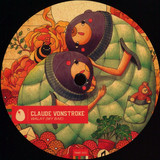
Our boss Claude VonStroke is the busiest guy we know. When he's not traveling the world or curating an event, he's in the studio every day putting in hours upon hours, relentless in perfecting his craft. He's had a slew of hits the past couple years in the form of remixes and collaborations, and now with the 'Walay (My Bae)' EP, Claude gets back to some inventive and somewhat 'out of the box' solo works.
The title song leads with a melodic riff and an funky vocal that sounds like a defective cyborg is proclaiming love for his partner, 'Walay.' This quasi-human uses the slang 'My Bae' to try and pass for human and we almost believe in his passion. The sound harkens back to old classic rave tracks but also pushes very modern production techniques.
On the flip, 'Raw Nerve' is an emotional exploration in both sounds and lyrics. A melancholy VonStroke dives deep into his insecurities and fears with sonically mutated lyrics like 'I'm feeling so sad, I'm feeling real bad today. When I see you on the street I dont want to compete.' You can feel the social instability oozing out of the vocal only to come back at the close with a violently hard bassline embodying the personal angst and frustration that goes along with not 'fitting in.'
Joris Biesmans' TVe imprint returns for it's third installment, this time featuring it's eponymous founder front, center and recording under his own name. Led by a forward-thinking electro remix from the ever-versatile Man Power, it's another firm display of synth-led versatility, brimming with confidence and charisma. 'Angry Baby' is an irresistible pressure-pot of stomping house, as playful as it's name and as demanding as its imaginary infant protagonist, with a truly hypnotic, elastic breakdown proving irresistible in a club context . Man Power's aforementioned remix is less loopy, more analog, with his well-tooled production technique pushing the record's texture into altogether more cosmic and overwhelming territory, led by wailing synthesis. Back to Biesmans for B2, and a more acidic, almost unnerving vision unfolds throughout 'Connecting The Dots', which does just that, linking futurist, Michigan influences with a more floor-focused, European aesthetic.
* Released for the first time on vinyl
* The ultimate collection of rare early materials by this electronic music pioneer
* Comes as a deluxe double LP set with insert and extensive liner notes . Limited black vinyl pressing (700 copies) with obi strip.
Klaus Schulze is a German electronic music pioneer, composer and musician that needs very little introduction. In the late sixties & early seventies he was a member of several iconic bands such as 'Tangerine Dream', 'The Cosmic Jokers' & 'Ash Ra Tempel' before launching a solo career consisting of more than 60 albums released across five decades. Collaborations were numerous and highlights include working with Steve Winwood, Brian Eno & Alphaville... just to name a few.
Klaus Schulze's proto moog-synthesizer work is regarded as a milestone in electronic music & during the decades he released landmark albums in genres catalogued as 'Ambient', 'Electronic', 'New Age', 'Berlin School', 'Experimental', 'Kosmische Musik' & 'Krautrock'. Mr. Schulze had a more organic sound than most electronic artists of the time, often he would throw in decidedly non-electronic sounds such as acoustic guitar and a male operatic voice. Schulze is also known for developing a Minimoog technique that sounds uncannily like an electric guitar, which is quite impressive in concert.
On occasions he would also compose film scores such as Body Love (1977), Barracuda (1978), Next of Kin (1982), & Angst (1983). His best known song 'Freeze' has been used in films like Manhunter (1986) and more recently in Sofia Coppola's 'The Bling Ring' from 2013.
In 2009, producer Klaus D. Mueller and Schulze began releasing La Vie Electronique ( The Electronic Life'), a series of sets that collected rare sought-after early works & unreleased tracks put in chronological sequence. These sets contain some of the best music Klaus ever created and are early 70's masterworks that will appeal to both fans and collectors.
Now available for the first time on vinyl, One Way Static Records presents the first volume in our new archival series 'La Vie Electronique'. This volume (1.0) focuses on the years 1968-1971 and is spread over two glorious LP's containing +78 minutes of Klaus Shulze rarities. This deluxe vinyl set also comes with an insert containing extensive liner notes.
Belgium-based Composer Christina Vantzou's Fourth Full-length For Kranky Ventures Further Into The Uniquely Elusive And Evocative Mode Of Ambient Classical Minimalism Which Has Become Her Signature: A Fragile Synthesis Of Contemplative Drift, Heady Silences, And Muted Dissonance. In Regards To The New Album She Speaks Of Focusing Particular Attention On The Effects Of The Recordings On The Body, And Of 'directing Sound Perception Into An Inner Space.'
No. 4 Took Shape Across Roughly Two Years, Incorporating A Diverse Array Of Musical And Conceptual Collaborators, Including Fellow Kranky Artists Steve Hauschildt And John Also Bennett (of Forma) As Well As Angel Deradoorian (ex-dirty Projectors), Clarice Jensen, Beatrijs De Klerck, And Members Of Belgium's Echo Collective. During The Creation Process Vantzou Wanted To 'blur Lines Of Hierarchy,' And Thus Allowed All Ensemble Members And Technical Assistants To Add Or Delete Elements. Despite Such A Spectrum Of Input The Eleven Tracks Feel Distinctly Cohesive, Weaving Elegant Textures And Resonant Open Spaces Within A Twilit Landscape Of Eclectic Instrumentation: Piano, Harp, Vibraphone, Voice, Strings, Marimba, Synthesizers, Gong, And Bells.
Vantzou Describes The Recording Process As One Of Prepared Spontaneity: That Is, 'having Plenty Of Ideas Ready To Explore Going Into The Session, But With Enough Time To Depart From Those Ideas And See What Happens.' This Mindset Of Premeditated Exploration Informs The Album's Emotive Textural Intuition, With Hushed Drones And Delicate Gestures Eliding In The Periphery Of The Mix. She Cites Sleep And 'the Loosening Of Time' As Two Formative Practices In Her Private And Professional Life, Which Manifests In The Quietly Hallucinatory Properties Of Vantzou's Music. No. 4 Feels Both Endless And Ephemeral, Immersive And Immaterial. It's A Music Of Horizon Lines And Half-light, Mapped With Feeling And Foresight.
Recorded In New York City And Brussels. Mixed In Berlin.
A Portion Of This Work Was Funded By A Generous Grant From The Flemish Community In Belgium.
Tinfoil is the project of DeFeKT and Sunil Sharpe. Initially forged as a studio collaboration in 2014 (and later as a live show), the pair have since racked up an impressive catalogue of 12s on their own self-titled label. Tinfoil's sound is unique in today's scene, reflecting the versatility of both artists, plus a combined know-how of techno and electro. Their music comes primarily from live studio jams, enforced by a desire to get quickly to the point in what they do. This is no surprise given the fast, technical way in which they each perform solo.
For their debut album, Tinfoil provide a varied but cohesive collection of tracks. Following the intro's epic synth blasts, they open with a bang through 'Caravan Life' - a sinister, bassline-driven destroyer that builds and builds over a blend of claps, filter zaps and crying feedback. 'Beads' continues in a heads-down vein, this time with a more musical EBM type bass and knocking rimshots that mark the first appearance of Sunil's role-playing, haunting lead vocals.
'Friendly Safe Fumes' marries playful bass notes to a singing lead line, as fizzling closed hats and busy claps whip things into a frenzy. Next enter the otherworldly mutant electro of 'Meadow Pulse', signaling a well-timed lull in mood to explore a silkier side to Tinfoil's production. 'Every Saturday Night' starts with a taxi conversation about horses and carbolic soap in bygone Dublin days, before launching into a volley of clattering beats and hip-shaking FM sequences.
'Multi-DOMINATION' retains some of the FM wonk and treads a broken-beated path, featuring vocals this time akin to a ritualistic chant or perhaps the murmurings of a possessed baby. 'Both Roads To Triogue' meanwhile, brings us to a short intersection, splicing odd voices with a dense tribal rhythm. 'The Wolves Of Hellfire' is Tinfoil in more minimal dancefloor mode, as drones filter in and out under a resonating bass that detonates at all the right times.
Closing with 'Resting Point', the climax becomes deadly. The beats are stepped and the bass boisterous, while pained screams become quickly uncontrolled, setting up for a crescendo of roughneck rhythms, ricocheting kicks and turbulent modular wails.
Tinfoil have been on a roll since the beginning but maybe 'On A Roll' emphasizes this a little bit more now.
Mouse on Mars' Andi Toma and Jan St. Werner return with their most
inventive album to date, Dimensional People. The electronic music pioneers
have been critically acclaimed for their playful and inventive sound and
production techniques on releases spanning from the early '90s to now. In
demand from a surprising array of artists their most recent contributions are
featured on the Grammy award winning album Sleep Well Beast by The
National.
The duo are joined on Dimensional People by an impressive list of guests
: Justin Vernon (Bon Iver), Aaron and Bryce Dessner (The National), Zach
Condon (Beirut), Spank Rock, Swamp Dogg, Eric D. Clarke, Lisa Hannigan,
Amanda Blank, Sam Amidon, Ensemble Musikfabrik, and about 20 more
musical collaborators. The cast of characters are as unique as they are vast,
clearly a rich quarry for the prodigious duo.
Dimensional People is by it's nature a collaborative album. Originally
premiering as a spatial composition using object-based mixing technology
playing with the possibilities of sonic design (4D Sound) and collective
musicianship, the recording expands upon these ideas. Dimensional People
expresses itself as a dynamic 50-piece orchestra, telling a story in sound.
Mouse on Mars offer sound as a means to encourage open-minded societies,
aided by cutting-edge technology including their own MoMinstruments
music software or a spatial mixing technique called object based mixing,
with which a spatial version of the work was created. It is a conceptual
puzzle composed around one harmonic spectrum within one rhythmic
scheme, mostly in the tempo of 145bpm (inspired by Chicago footwork,
so the dance oor is not entirely absent). Looking ahead, Dimensional
People will also be realized through installation, presenting the work as an
immersive listening experience, as well as performance.
The acutely talented Russian returns - leading a new generation of ultra-gifted producers, Black Barrel presents the 'Labyrinth EP' on our main label in April.
From the opener 'Seeing Explosives' with Gusto, the classic tech funk inspirations are clear to see and Black Barrel guides complex arrangements with addictive grooves.
Bringing a refreshing, energized vibe to intricate, technical production, Black Barrel intensifies his portfolio on the 'Labyrinth EP', with sadistic delivery and playful charm.
* Luna-C says this was one of the most challenging EPs he has ever made, because he made a record almost exactly as he would have if it was 1992 again, only with considerably more knowledge. This EP was made almost entirely with hardware, using a real mix desk and all the original synths and modules that the Kniteforce studio used back in the day, along with some new bits picked up over the years. This EP was a deliberate attempt to go back to the roots of the sound, to start again musically.
All four tracks are proper underground in style, deliberately avoiding the common break beats and standard sounds of current 'new' old skool music, to achieve something more authentic. It features all new samples, and no reliance on old tricks or techniques. This one is for the real underground, the real old skool, and the sound of it demonstrates that!
Club / DJ Support
Billy Bunter, the Fat Controller, Glowkid, Slipmatt, Dj Jedi, Dj Luna-C, Dj Brisk, Clayfighter, Jimni Cricket, Bustin, Sc@r, Doughboy, Saiyan, Dave Skywalker, Ponder and many others
Dapayk Solo, Berlin based producer and veteran of the minimal techno scene, announces the release of his 10th studio album 'The Calling'. This latest project will be the producer's first solo album since
2015. The 8-track double 12inch LP will be available via Dapayk Solo's label Mo's Ferry Productions and comes with a free download voucher for the extended 12-track digital album.
The first track on this LP 'The Calling' shares its name with the album and starts off with a pang of energetic, chopped beats before exploding into a brassy melody, continuously gaining momentum.
'Blackout' immediately announces itself as a next generation Detroit House anthem. The rolling synths, hi hats, and vocals make this one of the most outstanding tracks on the album. 'Aurora' stays true to its name with a buildup composed of throbbing ethereal synths that give the track an otherworldly vibe. 'Flood' transports listeners to the dancefloor with its pulsating bassline combined with Komplement's quaint vocals.
The second part of the album begins with 'After All', one of the most enticing tracks on the album. It combines the groovy rhythm of four to the floor percussion with tantalizing vocals by VARS before New Release Information 'Low Tinnitus' reverts to Dapayk's signature minimalist sound. The transition into 'Wanderer' continues the momentum built up by the previous tracks. The closing 'Walk With Me' is a deep-house jam that features a rhythmic shaker layered under Mental Bend's powerful vocals.
Dapayk Solo, alias Niklas Worgt, isn't afraid to try new things. With 5 aliases under his belt, he continuously strives to experiment with different styles and production techniques to create innovative sounds. Throughout the span of two decades he went from producing drum'n'bass to house to ultimately crafting the groovy, edgy techno sound that he's now known for.
With more than ten LP releases and over 70 single releases on his record, he is one of the main protagonists in the world of underground electronic music. In 2017, he released an LP titled 'Harbour' with his wife Eva Padberg under one of his many projects, Dapayk & Padberg. While that album aimed to steer away from traditional club beats, 'The Calling' sees Dapayk reassume his deep, dark, and infectious sound. While Dapayk is often categorized as a minimal producer, the LP proves that he is capable of extending beyond the scope of a single genre. 'The Calling' is just another example of why Dapayk has managed to stay in the scene for so long: he loves electronic music and he's great at
making it, too.
Running Back welcomes Andreas Grosser for the start of it's non-dancefloor series 'Running Back Incantations'. Think Tornado Wallace's 'Lonely Planet' or Suzanne Kraft's 'Missum' who both would have been good and early contenders for a series like that, and you are half way there. Andres Grosser though, was 'there' and that way before. Probably best-known for his 1987 collaboration 'Babel' with Klaus Schulze, Grosser is a bit of a dark horse in the universe whose big bang was krautrock and that went on to be called cosmic, space music or simply new age.
A native East-Berliner, Grosser crossed the Wall in 1981 and next to studying piano, his day job was to advise, sell, maintain and invent electronic music instruments. Naturally, Grosser had a good connection to and support from local Berlin musicians and groups, while working at night in his own studio and in those of others. Fast forward 37 years and Andreas is now one the worlds leading microphone technicians specialising in German and Austrian vintage types.
'Venite Visum' is an anthology of recordings made between 1976 and1980. Released in 1981 on UK's York House Recordings as a cassette tape only, it features some of the most out there, hypnotic and still state-of-the art space music ever to be known to man. For the first time transferred onto vinyl, compact disc and available as a digital download, it was perhaps best described by one reviewer at the time as; "powerfully relentless, repetitive themes which are constantly embellished and subjected to variations in tone colour and instrumentations. The music surges, coming in waves that approach and recede, but with each surge the waves seem to be higher up the shore.'
Now carefully transferred from an archived tape, remastered and compiled on a double album for the first time, it features the previously unreleased and not less mesmerizing 'The Quantum Leap'. Come and visit the hidden and almost forgotten
Spread across two 180g discs, spanning 24 cuts and served in a gatefold sleeve designed by members and affiliates, the Young Echo LP is a capsule intended for cementation through time.
It's been almost five years since their last album. As a group, extended radio submissions, prolonged studio sessions and notorious club nights make up the cogs of time. Over the course of these years, the network has grown continually, both as one, and with singular, multi-directional paths from each of the 11 artists that make up the Young Echo collective, counting Jabu, Vessel, Kahn, Neek, Ishan Sound, Ossia, Manonmars, Bogues, Rider Shafique, chester giles and Jasmine towards the crew, with projects such as Bandulu, FuckPunk, O$VMV$M, Gorgon Sound and ASDA adding to the table in their individual ways.However, this record aims not to be judged on any single producer or vocalist. It is most effective as a whole, simply titled Young Echo. Of course each of the artists has an important part to play, but it is very much about the act of balance, accepting individualism to form a greater whole.A good example is the welcome addition of new energy coming from Jasmine (1/3 of Jabu) who injects endless space with her vocals, perfectly answered by the cool-killin' wordplay of Manonmars - who makes his long awaited debut here - sharing stage with the immediate poetry of ASDA's very own chester giles, along the mighty sound of Rider Shafique, and Bogues' versatile style that can flit between rap & song within seconds. Five very different vocalists that could've tried to find a compromise, but instead choose to connect in different ways, finding their niche in the equal range of rhythms and sounds that sprawl in this shared space, the juxtaposition.
Detuned soundsystem stylings, love songs swaying in hacked up ambience, skeletal dancehall, microphone technique, dread electronics, outsider pop, this record manifests the outcome of the shapeshifting anarchy which rears it's head when no one idea can rule, embracing the diversities when one path must be made up of many.
8* Following recent excursions channeling the big room sound, Project Pablo returns with a sleeker, more refined EP for Technicolour.The resulting five tracks span upbeat opener 'Napoletana' - a rough and ready duet between a MFB 522 drum machine and Juno 106', through the swirling improvised piano loops of 'Last Day' - recorded in an hour just before he packed up his gear at the studio of fellow Montreal residents Braids and moved it all home, to the bumpy 2-step of 'Less and Less'. The Canadian producer has had a stream of quality releases via labels such as Clone's Royal Oak imprint, Spring Theory, Lone's Magicwire and most recently Ninja Tune's Technicolour imprint.
* In his first release for Milan's Haunter Record, Berlin-based producer Broshuda generates simple yet complex emotional vignettes. Evading all definitions, he makes use of an an array of tools and techniques akin to those of classic dub and contemporary sound design on obscure/ random equipment, drawing from a limited pool of sound sources while paying a lot of attention to detail in the construction of sound. His post-rave power ambient poems, coalescing with a pronounced melodic element, give the release a profoundly introspective and earthy character. Blurring and masquerading different layers of sound into new forms and shapes.
The early 2000s were a time of upheaval for hip-hop. The underground and mainstream divide that had dened so much of the previous decade was showing the rst signs of irrelevance. Timbaland and The Neptunes made radio rappers sound futuristic while independent artists struggled in a quagmire of backpacks and misguided claims to keep it real. Away from this, in a misunderstood middle ground between hip-hop and electronic music, a new generation of artists were busy imagining a new sound for hip-hop.
One such artist was Scott Prefuse 73' Herren, whose perpendicular MPC chops on his 2001 debut for Warp Records set curious minds racing with possibilities. That same year Tadd Mullinix released his debut as Dabrye on Ghostly International, a sonic wildstyle that appealed to both hip-hop heads and IDM nerds. Sometime that same year Herren and Mullinix met after sharing a bill in Detroit. CD-Rs were exchanged and a year later Eastern Development, Herren's newly launched label, released Dabrye's Instrmntl, a short album with a big impact. On its fteenth anniversary Ghostly International is reissuing Instrmtl on vinyl and making it available digitally for the rst time.
Instrmntl is a continuation of the beat experiments Dabrye began with One/Three and a bridge to the diverse textures that would dene Two/Three four years later. About half of its nine tracks (ten if you lived in Japan) were created at the same time as One/Three while the rest were newer or made specically for the album. Once again Mullinix looked outside of hip-hop to techno, house, and drum & bass for stylistic and technical ideas while embracing the blissful minimalism of a good hip-hop instrumental and the rhythmic nuance of Detroit.
Despite the similarities between Dabrye's debut and this follow up, Mullinix didn't simply replicate what had made One/Three so arresting. He pushed and pulled further between the two cornerstones of his approach to reveal more potentials. Instrmntl takes you deeper into electronic depths — the rugged synth stutter of 'Won', the tumbling, wobbling bass in 'No Child Of God', the electro get down of 'Prospects (Marshall Law)' — while also treading more organic grounds by letting samples breathe and moods unfurl at a gentler pace ('Take Me Home', 'Evelyn', and 'You Know The Formula Right'). And then there are the moments where this push and pull nds balance and the result becomes more, as it does on the mournful march of 'D-Town Tabernacle Choir' and the twinkling daydream of 'This Is Where I Came In'.
At just over 30 minutes, Instrmntl offers a snapshot of a time when potentials seemed innite, when lines could be drawn between jazz, ragga jungle, techno, and hip-hop and the resulting shape divined an exciting future.
- Reissue of the out of print 2002 album, available for the rst time on Ghostly.
- Includes previously Japanese-only bonus track, Gimme Lowlands'
- Standard weight blue vinyl is housed in a matte jacket.
- Dabrye's beats are like Jay Dee getting crunked up with Autechre.' — Prefuse 73