Suche:the 1975

Styles
Alle
Parliament - Osmium (2x12")

Parliament

Osmium (2x12")

2x12inchDEMREC1188X
Demon Records
26.04.2026
  • I Call My Baby Pussycat
  • Put Love in Your Life
  • Little Ole Country Boy
  • Moonshine Heather
  • Oh Lord, Whylord / Prayer
  • My Automobile
  • Nothing Before Me but Thang
  • Funky Woman
  • Livin' the Life
  • The Silent Boatman

Demon Records are proud to present Osmium Deluxe - the first recordings credited to the funk-rock ensemble Parliament-Funkadelic.

Since its re-release in 1990, Osmium has been distributed numerous times by various labels in America, Europe and Japan under alternate titles – including Rhenium and First Thangs. A number of these reissues have featured material that was not included on the original album, such as unreleased tracks and singles that were taken from the same time.

This in-demand, black-vinyl version of the Record Store Day 2024 sell-out compiles together everything from that period 2 LPs and includes; the full Osmium album, the single sides that never made the album, unreleased tracks, demos and jams – all of which made their debut vinyl appearance as one package in 2024.

Many of these recordings are still as far-out as they sounded when first released. However, the tracks here represent the genesis of what would become P-Funk and the entity that would give the world ground-breaking albums Maggot Brain (1971), Mothership Connection (1975), and One Nation Under a Groove (1978). An essential addition to anyone’s collection.

vorbestellen26.04.2026

erscheint voraussichtlich am 26.04.2026

28,99 €
Snapdragon - Hard Luck / My Heart Consedes 7"

Unearth a rare funk gem from Snapdragon! In 1975, El Carey, a pivotal member of the Crowd Pleasers, launched a solo career and released this 45 that became a local underground hit. Recorded, produced, and performed by El himself, these tracks are now re-released by Regrooved Records for funk enthusiasts worldwide. 'Hardluck' embodies the essence of 70s psychedelic funk with its irresistible groove and soulful vibes. Dive into the groove and secure your piece of musical history with this essential 7" record. Experience the magic of El Carey's unparalleled artistry today.

nicht am Lager

Bestelle jetzt und wir bestellen den Artikel für dich beim Lieferanten.

Last In: vor 2 Jahren
10,29 €
Guilty Razors - Complete Recordings 1977 - 1978

UILTY RAZORS, BONA FIDE PUNKS.


Writings on the topic that go off in all directions, mind-numbing lectures given by academics, and testimonies, most of them heavily doctored, from those who “lived through that era”: so many people today fantasize about the early days of punk in our country… This blessed moment when no one had yet thought of flaunting a ridiculous green mohawk, taking Sid Vicious as a hero, or – even worse – making the so-called alternative scene both festive and boorish. There was no such thing in 1976 or 1977, when it wasn’t easy to get hold of the first 45s by the Pistols or the Clash. Few people were aware of what was happening on the fringes of the fringes at the time. Malcolm McLaren was virtually unknown, and having short hair made you seem strange. Who knew then that rock music, which had taken a very bad turn since the early 1970s, would once again become an essential element of liberation? That, thanks to short and fast songs, it would once again rediscover that primitive, social side that was so hated by older generations? Who knew that, besides a few loners who read the music press (it was even better if they read it in English) and frequented the right record stores? Many of these formed bands, because it was impossible to do otherwise. We quickly went from listening to the Velvet Underground to trying to play the Stooges’ intros. It’s a somewhat collective story, even though there weren’t many people to start it.
The Guilty Razors were among those who took part in this initial upheaval in Paris. They were far from being the worst. They had something special and even released a single that was well above the national average. They also had enough songs to fill an album, the one you’re holding. In everyone’s opinion, they were definitely not among the punk impostors that followed in their wake. They were, at least, genuine and credible.

Guilty Razors, Parisian punk band (1975-1978). To understand something about their somewhat linear but very energetic sound, we might need to talk about the context in which it was born and, more broadly, recall the boredom (a theme that would become capital in punk songs) coupled with the desire to blow everything off, which were the basis for the formation of bands playing a rejuvenated rock music ; about the passion for a few records by the Kinks or the early Who, by the Stooges, by the Velvet mostly, which set you apart from the crowd.
And of course, we should remember this new wave, which was promoted by a few articles in the specialized press and some cutting-edge record stores, coming from New York or London, whose small but powerful influence could be felt in Paris and in a handful of isolated places in the provinces, lulled to sleep by so many appalling things, from Tangerine Dream to President Giscard d’Estaing...
In 1975-76, French music was, as almost always, in a sorry state ; it was still dominated by Johnny Hallyday and Sylvie Vartan. Local rock music was also rather bleak, apart from Bijou and Little Bob who tried to revive this small scene with poorly sound-engineered gigs played to almost no one.
In the working class suburbs at the time, it was mainly hard rock music played to 11 that helped people forget about their gruelling shifts at the factory. Here and there, on the outskirts of major cities, you still could find a few rockers with sideburns wearing black armbands since the death of Gene Vincent, but it wasn’t a proper mass movement, just a source of real danger to anyone they came across who wasn't like them. In August 1976, a festival unlike any other took place in Mont-de-Marsan – the First European Punk Festival as the poster said – with almost as many people on stage as in the audience. Yet, on that day, a quasi historical event happened, when, under the blazing afternoon sun, a band of unknowns called The Damned made an unprecedented noise in the arena, reminiscent of the chaotic Stooges in their early adolescence. They were the first genuine punk band to perform in our country: from then on, anything was possible, almost anything seemed permissible.

It makes sense that the four+1 members of Guilty Razors, who initially amplified acoustic guitars with crappy tape recorder microphones, would adopt punk music (pronounced paink in French) naturally and instinctively, since it combines liberating noise with speed of execution and – crucially – a very healthy sense of rebellion (the protesters of May 1968 proclaimed, and it was even a slogan, that they weren’t against old people, but against what had made them grow old. In the mid-1970s, it seemed normal and obvious that old people should now ALSO be targeted!!!).
At the time, the desire to fight back, and break down authority and apathy, was either red or black, often taking the form of leafleting, tumultuous general assemblies in the schoolyard, and massive or shabby demonstrations, most of the time overflowing with an exciting vitality that sometimes turned into fights with the riot police. Indeed, soon after the end of the Vietnam War and following Pinochet’s coup in Chile, all over France, Trotskyist and anarcho-libertarian fervour was firmly entrenched among parts of the educated youth population, who were equally rebellious and troublemakers whenever they had the chance. It should also be noted that when the single "Anarchy in the UK" was first heard, even though not many of us had access to it, both the title and its explosive sound immediately resonated with some of those troublemakers crying out for ANARCHY!!! Meanwhile, the left-wing majority still equated punks with reckless young neo-Nazis. Of course, the widely circulated photos in the mainstream press of Siouxsie Sioux with her swastikas didn’t necessarily help to win over the theorists of the Great Revolution. It took Joe Strummer to introduce The Clash as an anti-racist, anti-fascist and anti-ignorance band for the rejection of old-school revolutionaries to fade a little.

The Lycée Jean-Baptiste Say at Porte d’Auteuil, despite being located in the very posh and very exclusive 16th arrondissement of Paris, didn’t escape these "committed" upheavals, which doubled as the perfect outlet for the less timid members of this generation.
“Back then, politics were fun,” says Tristam Nada, who studied there and went on to become Guilty Razors’ frontman. “Jean-Baptiste was the leftist high-school in the neighbourhood. When the far right guys from the GUD came down there, the Communist League guys from elsewhere helped us fight them off.”
Anything that could challenge authority was fair game and of course, strikes for just about any reason would lead to increasingly frequent truancy (with a definitive farewell to education that would soon follow). Tristam Nada spent his 10th and 11th unfinished grades with José Perez, who had come from Spain, where his father, a janitor, had been sentenced to death by Franco. “José steered my tastes towards solid acts such as The Who. Like most teenagers, I had previously absorbed just about everything that came my way, from Yes to Led Zeppelin to Genesis. I was exploring… And then one day, he told me that he and his brother Carlos wanted to start a rock band.” The Perez brothers already played guitar. “Of course, they were Spanish!”, jokes their singer. “Then, somewhat reluctantly, José took up the bass and we were soon joined by Jano – who called himself Jano Homicid – who took up the rhythm guitar.” Several drummers would later join this core of not easily intimidated young guys who didn’t let adversity get the better of them.

The first rehearsals of the newly named Guilty Razors took place in the bedroom of a Perez aunt. There, the three rookies tried to cover a few standards, songs that often were an integral part of their lives. During a first, short gig, in front of a bewildered audience of tough old-school rockers, they launched into a clunky version of the Velvet Underground's “Heroin”. Challenge or recklessness? A bit of both, probably… And then, step by step, their limited repertoire expanded as they decided to write their own songs, sung in a not always very accurate or academic English, but who cared about proper grammar or the right vocabulary, since what truly mattered was to make the words sound as good as possible while playing very, very fast music? And spitting out those words in a language that left no doubt as to what it conveyed mattered as well.
Trying their hand a the kind of rock music disliked by most of the neighbourhood, making noise, being fiercely provocative: they still belonged to a tiny clique who, at this very moment, had chosen to impose this difference. And there were very few places in France or elsewhere, where one could witness the first stirrings of something that wasn’t a trend yet, let alone a movement.

In the provinces, in late 1976 or early 1977, there couldn’t be more than thirty record stores that were a bit more discerning than average, where you could hear this new kind of short-haired rock music called “punk”. The old clientele, who previously had no problem coming in to buy the latest McCartney or Aerosmith LP, now felt a little less comfortable there…
In Paris, these enlightened places were quite rare and often located nex to what would become the Forum des Halles, a big shopping mall. Between three aging sex workers, a couple of second-hand clothes shops, sellers of hippie paraphernalia and small fashion designers, the good word was loudly spread in two pioneering places – propagators of what was still only a new underground movement. Historically, the first one was the Open Market, a kind of poorly, but tastefully stocked cave. Speakers blasted out the sound of sixties garage bands from the Nuggets compilation (a crucial reference for José Perez) or the badly dressed English kids of Eddie and the Hot Rods. This black-painted den was opened a few years earlier by Marc Zermati, a character who wasn’t always in a sunny disposition, but always quite radical in his (good) choices and his opinions. He founded the independent label Skydog and was one of the promoters of the Mont-de-Marsan punk festivals. Not far from there was Harry Cover, another store more in tune with the new New York scene, which was amply covered in the house fanzine, Rock News (even though it was in it that the photos of the Sex Pistols were first published in France).
It was a favorite hang-out of the Perez brothers and Tristam Nada, as the latter explained. “It’s at Harry Cover’s that we first heard the Pistols and Clash’s 45s, and after that, we decided to start writing our first songs. If they could do it, so could we!”
The sonic shocks that were “Anarchy in the UK”, “White Riot” or the Buzzcocks’s EP, “Spiral Scratch” – which Guilty Razors' sound is reminiscent of – were soon to be amplified by an unparalleled visual shock. In April 1977, right after the release of their first LP, The Clash performed at the Palais des Glaces in Paris, during a punk night organised by Marc Zermati. For many who were there, it was the gig of a lifetime…
Of course, Guilty Razors and Tristam were in the audience: “That concert was fabulous… We Parisian punks were almost all dressed in black and white, with white shirts, skinny leather ties, bikers jackets or light jackets, etc. The Clash, on the other hand, wore colourful clothes. Well, the next day, at the Gibus, you’d spot everyone who had been at this concert, but they weren’t wearing anything black, they were all wearing colours.”

It makes sense to mention the Gibus club, as Guilty Razors often played there (sometimes in front of a hostile audience). It was also the only place in Paris that regularly scheduled new Parisian or Anglo-Saxon acts, such as Generation X, Siouxsie and the Banshees, the Slits, and Johnny Thunders who would become a kind of messed-up mascot for the venue. A little later, in 1978, the Rose Bonbon – formerly the Nashville – also attracted nightly owls in search of electric thrills… In 1977, the iconic but not necessarily excellent Asphalt Jungle often played at the Gibus, sometimes sharing the bill with Metal Urbain, the only band whose aura would later transcend the French borders (“I saw them as the French Sex Pistols,” said Geoff Travis, head of their British label Rough Trade). Already established in this small scene, Metal Urbain helped the young and restless Guilty Razors who had just arrived. Guitarist for Metal Urbain Hermann Schwartz remembers it: “They were younger than us, we were a bit like their mentors even if it’s too strong a word… At least they were credible. We thought they were good, and they had good songs which reminded of the Buzzcocks that I liked a lot. But at some point, they started hanging out with the Hells Angels. That’s when we stopped following them.”

The break-up was mutual, since, Guilty Razors, for their part, were shocked when they saw a fringe element of the audience at Metal Urbain concerts who repeatedly shouted “Sieg Heil” and gave Nazi salutes. These provocations, even still minor (the bulk of the skinhead crowd would later make their presence felt during concerts), weren’t really to the liking of the Perez brothers, whose anti-fascist convictions were firmly rooted. Some things are non-negotiable.
A few months earlier (in July 1978), Guilty Razors had nevertheless opened very successfully for Metal Urbain at the Bus Palladium, a more traditonally old-school rock night-club. But, as was sometimes the case back then, the night turned into a mass brawl when suburban rockers came to “beat up punks”.

Back then, Parisian nights weren’t always sweet and serene.

So, after opening as best as they could for The Jam (their sound having been ruined by the PA system), our local heroes were – once again – met outside by a horde of greasers out to get them. “Thankfully,” says Tristam, “we were with our roadies, motorless bikers who acted as a protective barrier. We were chased in the neighbouring streets and the whole thing ended in front of a bar, with the owner coming out with a rifle…”
Although Tristam and the Perez brothers narrowly escaped various, potentially bloody, incidents, they weren’t completely innocent of wrongdoing either. They still find amusing their mugging of two strangers in the street for example (“We were broke and we simply wanted to buy tickets for the Heartbreakers concert that night,” says Tristam). It so happened that their victims were two key figures in the rock business at the time: radio presenter Alain Manneval and music publisher Philippe Constantin. They filed a complaint and sought monetary compensation, but somehow the band’s manager, the skilful but very controversial Alexis, managed to get the complaint withdrawn and Guilty Razors ended up signing with Constantin with a substantial advance.

They also signed with Polydor and the label released in 1978 their only three-track 45, featuring “I Don't Wanna be A Rich”, “Hurts and Noises” and “Provocate” (songs that exuded perpetual rebellion and an unquenchable desire for “class” confrontation). It was a very good record, but due to a lack of promotion (radio stations didn’t play French artists singing in English), it didn’t sell very well. Only 800 copies were allegedly sold and the rest of the stock was pulped… Initially, the three tracks were to be included on a LP that never came to be, since they were dropped by Polydor (“Let’s say we sometimes caused a ruckus in their offices!” laughs Tristam.) In order to perfect the long-awaited LP, the band recorded demos of other tracks. There was a cover of Pink Floyd's “Lucifer Sam” from the Syd Barrett era – proof of an enduring love for the sixties’ greats –, “Wake Up” a hangover tale and “Bad Heart” about the Baader-Meinhof gang, whose actions had a profound impact on the era and on a generation seeking extreme dissent... On the album you’re now discovering, you can also hear five previously unreleased tracks recorded a bit later during an extended and freezing stay in Madrid, in a makeshift studio with the invaluable help of a drummer also acting as sound engineer. He was both an enthusiastic old hippie and a proper whizz at sound engineering. Here too, certain influences from the fifties and sixties (Link Wray, the Troggs) are more than obvious in the band’s music.

Shortly after a final stormy and rather barbaric (on the audience’s side) “Punk night” at the Olympia in June 1978, Tristam left the band ; his bandmates continued without him for a short while.

But like most pioneering punk bands of the era, Guilty Razors eventually split up for good after three years (besides once in Spain, they’d only played in Paris). The reason for ceasing business activities were more or less the same for everyone: there were no venues outside one’s small circuit to play this kind of rock music, which was still frightening, unknown, or of little interest to most people. The chances of recording an LP were virtually null, since major labels were only signing unoriginal but reassuring sub-Téléphone clones, and the smaller ones were only interested in progressive rock or French chanson for youth clubs. And what about self-production? No one in our small safety-pinned world had thought about it yet. There wasn’t enough money to embark on that sort of venture anyway.

So yes, the early days of punk in France were truly No Future!

nicht am Lager

Bestelle jetzt und wir bestellen den Artikel für dich beim Lieferanten.

Last In: vor 5 Monaten
21,43 €
Malted Milk - Time Out LP

Malted Milk

Time Out LP

12inchBPLP25001
Blues Productions
10.04.2026
  • 01: What A Night
  • 02: I Feel Numb (ft. Marco Cinelli)
  • 03: Time Out (ft. Benin International Musical)
  • 04: Superchild
  • 05: Don't you make plans on rainy days (ft. Ben L'oncle Soul)
  • 06: Midnight Hour
  • 07: Shouldn't talk about it
  • 08: It's alright

Time Out, a pause, like an injunction to suspend the course of events in order to project oneself into a more serene future, is the title of Malted Milk's eighth album. From the haunting Afro beat of the title track to the decadent boogaloo of "I Feel Numb", via the ballad "What a Night" and the funky "It's Alright" , the band demonstrates i ts mastery of arrangements, its creative ability and its talent for revisiting the soul/funk genre. As with the previous album, 1975, Marco Cinelli is back on writing and production duties, bringing undeniable added value to the band's sound and aesthetic. The live translation of this album bears Malted Milk's trademark precision, energy, instrumental talent and group cohesion. Malted Milk once again demonstrates its musical strength and affirms the special place the band occupies on the current soul scene.

vorbestellen10.04.2026

erscheint voraussichtlich am 10.04.2026

27,31 €
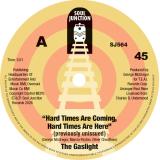
The Gaslight - Hard Times Are Coming, Hard Times Are Her (7")

The earliest foundations of the Detroit Harmony group ‘The Gaslight’ came when future lead singer Oliver “Butch” Cheatham via an introduction by his sister Jackie joined a group known as ‘The Young Sirs’ who recorded, “There’s Something The Matter (With Your Heart/African Love” for Magic City during 1969. The group included Oliver’s future brother -in-law Allen Cocker (Jackie’s future husband).

Oliver and Allen went on to form a new vocal quartet with Curtis “Kippy” Anderson and Michael Eatmon. Under the group name of ‘The Gaslight’ they signed to Uptight Productions Incorporated, a local production company founded by local businessmen Marvin Figgins and Arnold Wright. The Gaslight were the only vocal harmony group signed to Uptight Productions and as such, it was they who made the most recordings across two label imprints Grand Junction and Black Rock. The Gaslight’s first single “I Can’t Tell A Lie/Here’s Missing You” was released on Grand Junction (GJ1001) in 1970, For the groups second single Figgin’s placed them under the guidance of legendary producer/songwriter, the late George McGregor under whom they recording “Drifting Away/If You See Her” Grand Junction (GJ1002) released in 1971 For their next release Figgin’s switched the group to his Black Rock label to record “Out Of My Hand/I’m Only A Man” Black Rock (2002) under the pseudonym of Butch & The Newport’s With “Butch” being Oliver’s nickname. A later, second release of “I’m Only A Man” but with a different flip side “I’m Gonna Get You” came out on Grand Junction (GJ1100) in 1973 with the performing artist credits reverting back to ‘The Gaslight’.

Upon leaving Uptight Production’s the group found a new home when George McCregor took them to a new fledgling label T.E.A.I (an abbreviation for “Tellin’ Everybody About It”) owned by ‘The Dramatics’ Road Manager Charles Underwood. ‘The Gaslight’s’ first and only release for T.E.A.I, was the mellifluous 1975 double sider “Just Because Of You/It’s Just Like Magic”. Underwood had precured a working relationship with Polydor Records who picked the release up for national distribution three months later. As good as the record was due to poor promotion it failed to make any notable noise and eventually sank with the group soon after breaking up.

During Soul Junction’s later dealings with the late Oliver Cheatham, respected UK Collector Andy Rix mentioned he owned a three track acetate containing the two mentioned T.E.A.I/Polydor tracks plus a third unissued dance track “Hard Times” which through a licensing deal with Charles Underwood Soul Junction now present to you on a three track 45, released under its full title “Hard Times Are Coming, Hard Times Are Here” backed with a previously unissued mix of “Just Because Of You” alongside the issued 45 version of “It’s Just Like Magic”.

nicht am Lager

Bestelle jetzt und wir bestellen den Artikel für dich beim Lieferanten.

Last In: vor 3 Monaten
18,07 €
Tai Phong - Tai Phong LP

Tai Phong

Tai Phong LP

12inchGME929
GM Editions
27.03.2026
  • 01: Goin' Away
  • 02: Sister Jane
  • 03: Crest
  • 04: For Years And Years (Cathy)
  • 05: Fields Of Gold
  • 06: Out Of The Night

Taï Phong is a French progressive rock band formed by two Vietnamese brothers, Khanh Maï (guitar, voice) and Taï Sinh (bass, guitar, voice, keyboards), in 1975.1 They were joined by Jean-Alain Gardet (keyboards), Stephan Caussarieu (drums, percussion), and Jean-Jacques Goldman (guitar, voice, violin). They released three albums between 1975 and 1979: Taï Phong (1975), Windows (1976), and Last Flight (1979). "Sister Jane" (1975), the first single from their first album, was a radio hit.

vorbestellen27.03.2026

erscheint voraussichtlich am 27.03.2026

33,57 €
Various - Always There / For The Love of Money 7"

The latest from master editor Mr. K, a jazz-funk classic backed by a Philly sure shot!

Debuting in 1975, the jazzy RnB instrumental ‘Always There’ from original Earth Wind and Fire saxophonist Ronnie Laws was a hidden gem until Side Effect’s vocal version took off the following year, one of many cover versions to come (Incognito’s hit the pop top ten in the ’90s). Mr. K's edit streamlines the original, mimicking Side Effect’s distinctive horn stab intro and adding a DJ-friendly drums-only outro. With original 7-inch releases being either fragile styrene or unreasonably short, this extended vinyl pressing is very welcome.

A song that needs no introduction—coming from the very best there is—the O’Jays backed by MFSB! ‘For the Love of Money’ rides one of the most immense bass lines ever committed to wax and, while that would be enough to carry a track on its own (see the Armada Orchestra’s cover), here we have the talents of the timeless O’Jays vocals to top things off. Mr. K has found the perfect balance between the Lp and single versions, giving us the very best DJ-friendly 7" mix that should never leave your bag.

nicht am Lager

Bestelle jetzt und wir bestellen den Artikel für dich beim Lieferanten.

Last In: vor 52 Tagen
11,72 €
HAWKWIND - WARRIOR ON THE EDGE OF TIME LP
  • A1: Assault & Battery / The Golden Void
  • A2: The Wizard Blew His Horn
  • A3: Opa-Loka
  • A4: The Demented Man
  • B1: Magnu
  • B2: Standing At The Edge
  • B3: Spiral Galaxy 28948
  • B4: Warriors
  • B5: Dying Seas
  • B6: Kings Of Speed

Half speed vinyl edition of the classic album, 'Warrior On The Edge Of Time' by HAWKWIND. Recorded in 1975, the album is a ground-breaking classic from Hawkwind’s long career. Featuring a line-up of DAVE BROCK, NIK TURNER, LEMMY, SIMON HOUSE, SIMON KING and ALAN POWELL, the album is arguably one of the finest rock albums of the mid-1970s. This new Atomhenge half speed master edition of has been cut at AIR Studios utilising the original master tapes. The half-speed mastered cutting process offers the finest audio reproduction and this new edition is the definitive LP release of this classic album

vorbestellen20.03.2026

erscheint voraussichtlich am 20.03.2026

27,52 €
FRANCIS OF DELERIUM - LIGHTHOUSE LP
 
4

Francis of Delirium is the moniker of 22-year old, Luxembourg-based Jana Bahrich. The young artist’s incredible journey up until this point has seen her release 3 critically acclaimed EPs, ‘All Change’, 'Wading’ and ‘The Funhouse’. With praise so far from the likes of Stereogum, FADER, Pitchfork, Line of Best Fit, 6 Music, Radio 1, KEXP and NPR to name but a few, Francis of Delirium is on the precipice of something extremely exciting with debut album ‘Lighthouse’.

The announcement of ‘Lighthouse’ comes following a busy year of touring with the likes of Soccer Mommy, Briston Maroney, Horsegirl, The Districts and hitting Eurosonic, Iceland Airwaves and Tree Fort Fest, as well as opening for The 1975 & Kings of Leon.

Production duties on ‘Lighthouse’ were shared by Catherine Marks (Boygenius, Wolf Alice) and Jana Bahrich/Chris Hewitt. ‘Lighthouse’ was mixed by Jolyon Thomas (U2, Royal Blood).

vorbestellen20.03.2026

erscheint voraussichtlich am 20.03.2026

24,79 €
Marcos Valle - Estatica LP

By popular demand, Far Out are delighted to present Estatica- remastered edition of the classic 2010 album from the original Rio beach boy Marcos Valle
Evoking his Carioca sound - where expansive orchestral sweep meets beautiful melody and complex harmony - Valle mixes perfect romantic bossa-pop with cinematic brass and strings. This recording explores a six decade career that has swung between pop, bossa nova, delicate psychedelia, jazz, and funk. Responsible for bossa classic 'Summer Samba (So Nice)' Valle has collaborated with Leon Ware, Sarah Vaughan, & Chicago, seen his track 'Ele E Ela' sampled by Jay Z for Blueprint 3, and his songs recorded by the likes of Frank Sinatra and Bebel Gilberto.

nicht am Lager

Bestelle jetzt und wir bestellen den Artikel für dich beim Lieferanten.

25,17 €
Captain Beefheart, The Mothers Of Invention, Frank Zappa - Bongo Fury (50th Anniversary) LP
auch erhältlich

2x12"[34,03 €]


BONGO FURY wird 50! Die klassische Zusammenarbeit zwischen Frank Zappa und Captain Beefheart
im Mai 1975 führte zu einer Flut neuer Kompositionen, einer Tournee und schließlich zu einem Album.
Bongo Fury besteht hauptsächlich aus Live-Aufnahmen aus dem Armadillo Headquarters in Austin, Texas,
sowie einigen Studioaufnahmen aus dem The Record Plant in Los Angeles. Das Album ist eine denkwürdige
Ergänzung des Zappa-Katalogs und das letzte, auf dem der Bandname „Mothers“ zu hören ist, bevor dieser
1976 aufgegeben wurde.

vorbestellen20.03.2026

erscheint voraussichtlich am 20.03.2026

25,63 €
Captain Beefheart, The Mothers Of Invention, Frank Zappa - Bongo Fury (50th Anniversary) LP 2x12"
auch erhältlich

Single Vinyl[25,63 €]


BONGO FURY wird 50! Die klassische Zusammenarbeit zwischen Frank Zappa und Captain Beefheart
im Mai 1975 führte zu einer Flut neuer Kompositionen, einer Tournee und schließlich zu einem Album.
Bongo Fury besteht hauptsächlich aus Live-Aufnahmen aus dem Armadillo Headquarters in Austin, Texas,
sowie einigen Studioaufnahmen aus dem The Record Plant in Los Angeles. Das Album ist eine denkwürdige
Ergänzung des Zappa-Katalogs und das letzte, auf dem der Bandname „Mothers“ zu hören ist, bevor dieser
1976 aufgegeben wurde.

vorbestellen20.03.2026

erscheint voraussichtlich am 20.03.2026

34,03 €
VARIOUS - WHERE SOUTHERN SOUL BEGAN
  • A1: Cigarettes & Coffee Al 'TNT' Braggs
  • A2: You're Gonna Miss Me Shirley Raymond
  • A3: Shout Bamalama Otis Redding
  • A4: I've Been Wrong For So Long Bobby Bland
  • A5: Backtracking Little Junior Parker
  • A6: That's Cuz I Love You Louis Jones
  • A7: You Don't Have To Cry Little Bob & The Lollipops
  • A8: Please Think It Over Roscoe Shelton
  • A9: If I Don't See You Again Ted Taylor
  • B1: Too Many Tears Roy Lee Johnson
  • B2: What Can I Do For You Elmore Morris
  • B3: You Don't Miss Your Water William Bell
  • B4: I Cried Joe Medwick
  • B5: Blessed Are These Tears Joe Tex
  • B6: Best Of Luck Baby Earl Gaines
  • B7: My Love Belongs To You Sam & Dave
  • B8: I Don't Hurt Anymore Fontella Bass
  • B9: Please, Please, Please James Brown

The Golden Age of southern soul lasted from about 1962 to 1975, when disco ripped the heart out of it. And although it may seem as though the blend of country, gospel and R & B that emerged from the great studios in Memphis and Muscle Shoals in that decade was entirely fresh and new, like any other genre classic, southern soul picked up musical cues and absorbed influences from a whole variety of sources: horn lines from Louisiana's swamp pop, lyrical themes from the blues, songs from country music, and of course so, so much from the black churches. Part of the 'History of Soul' series, this LP reveals the musical antecedents that gave southern soul its inspiration. The music here will tell you the real story - and it will knock your socks off too! Notes by John Ridley.

vorbestellen13.03.2026

erscheint voraussichtlich am 13.03.2026

9,45 €
Charles Tyler Ensemble - Voyage From Jericho LP

Step into the wild heart of New York"s underground avant-garde jazz scene with Voyage from Jericho. Recorded in 1974, release in 1975, this landmark session finds the Charles Tyler Ensemble pushing boundaries with fearless improvisation, deep spiritual yearning, and a raw emotional fire. Joined by top-tier collaborators - including Arthur Blythe, Earl Cross, Ronnie Boykins, and Steve Reid - Tyler shapes a sound that fuses avant-garde intensity with soulful depth, creating a powerful celebration of freedom and expression. This is music that demands attention and rewards deep listening. Whether you"re a devoted explorer of the avant-garde or a curious listener seeking something beyond the mainstream, Voyage from Jericho offers a journey both challenging and transcendent. In short: if you"re ready to move past comfort zones and into the outer reaches of jazz, Voyage from Jericho is a voyage worth taking.

nicht am Lager

Bestelle jetzt und wir bestellen den Artikel für dich beim Lieferanten.

Last In: vor 6 Monaten
29,83 €
John Chowning - Stria

John Chowning

Stria

12inchIMPREC478LP
Important Records
06.03.2026
  • Phonè
  • Turenas
  • Stria
  • Sabelithe

Dr. John Chowning (b. 1934) is a pioneering computer musician, composer and professor who, in 1967, discovered the FM synthesis algorithm. This breakthrough in electronic music allowed for simple, yet rich timbres described as sounding "real." With this discovery, Chowning composed singular, dramatic electronic music and changed the timbre of music forever.

Chowning utilized the potential of computers to synthesize sounds according to programmed instructions. The composer's use of his own FM algorithms, digital synthesis with computers and the new compositional concepts offered by a programmable musical structure combine to create some of the most original and unique electronic music ever created.

The compositions on this LP were realized between 1966 and 1981 and the music on this LP, with the exception of Stria, was originally released on CD in Germany (Wergo, 1988). The version of Stria included here contains a section not included on the Wergo CD. Thus, this version of Stria is complete. This is the first time these purely digital recordings have been released on an analog medium. The original dynamics of these groundbreaking compositions have been preserved on this LP. As a result, listeners are advised to increase volume with caution.

In 1975, John Chowning founded the CCRMA - Center For Computer Research In Music and Acoustics at Stanford University. Through Stanford, Chowning licensed his groundbreaking algorithms to Yamaha resulting in numerous new instruments including the iconic DX series of keyboards. In 1972, his composition Tureens which is included on this LP, was the first to create the illusion of continuous 360-degree space using four speakers.

Technical Notes:

All pieces on this LP are originally quadrophonic. The illusion of moving sound sources is thus projected from the surrounding environment given by four loud-speakers on the stereo-basis.

STRIA was composed using Chowning’s own program to compile the musical structure into note-lists and MUSIC 10 (by D. Poole/Tovar) to generate the sounds in software-synthesis. The original quadrophonic version utilized 12 bits, two different sampling rates being used to accommodate the enormous amount of data on the magnetic disc-packs available at that time. The original sound-data was processed by sampling-rate conversion and digital mixes to achieve the stereo version presented on this LP.

SABELITH and TURENAS were synthesized originally using Smiths’ SCORE and MUSIC 10. However, their format was changed from direct sound-samples to a command stream for a special purpose computer, the System Concepts Digital Synthesizer, designed by Peter Samson, one of the first large-scale digital synthesizers for real-time sound processing - one was designed for CCRMA in the late seventies. For this recording the sounds were recorded directly from the synthesizer computing the samples in real-time.

PHONÈ was realized with the System Concepts Digital Synthesizer using again Chowning’s own program to create the note list.

The master tape of this LP was made directly from the computer system at CCRMA which generated and stored the sound data in digital format. No analog recording was involved at any stage of the production and editing process.

vorbestellen06.03.2026

erscheint voraussichtlich am 06.03.2026

27,52 €
KYOZO NISHIOKA - Gypsy Song / Never Land 7"
  • Side A. GYPSY SONG
  • Side B. NEVER LAND

After traveling through Mexico, Miami, the Bahamas, and New Orleans, Nishioka recorded his fourth album South American Journey in Los Angeles,
released in 1979. From this album, two of his most celebrated tracks—“GYPSY SONG”, a fan favorite with numerous cover versions, and “NEVER LAND”,
featuring the distinctive sound of steel pans and a Japanese reggae vibe are now being pressed on 7-inch vinyl for the first time in a limited edition!

The recording features members of the So What Review band, including Junshi Yamagishi (guitar) and Osamu Ishida (guitar), along with renowned steel pan
player Robert Greenidge, known for collaborations with Van Dyke Parks and Taj Mahal.
(FLATT THE LAIDBACK)

Kyozo Nishioka Profile
(Born May 7, 1948 – Died April 3, 1999)
Singer songwriter from the Shima Peninsula in Mie Prefecture, affectionately nicknamed “Zo-san”.
After enrolling at Kinki University and moving to Osaka, Nishioka became a regular at the folk cafe Dylan in Namba, opened in August 1969 by Masaji Otsuka
and Yoko Ishimura. Dylan was a gathering spot for folk music enthusiasts from all over Japan.
Nishioka formed the folk group The Dylan with Masaji Otsuka and You Nagai, performing at folk camps and the Nakatsugawa Folk Jamboree. In 1971, Nishioka
left the group, and Otsuka and Nagai continued as The Dylan II. Nishioka wrote and composed the song “Puka Puka” under the pen name Zokyozo, which became
one of his signature works. The song was first released in July 1971 as the B-side of The Dylan II’s single “Otoko rashii tte Wakarukai” on URC Records.
Nishioka began his solo career, releasing his debut album “Dylan nite” in July 1972, produced by Kinji Yoshino on Bellwood Records, which included his own
version of “Puka Puka”. In September 1973, he appeared at the farewell concert of Happy End titled CITY – LAST TIME AROUND at Bunkyo Public Hall in Tokyo.
His 1974 album “Machiyuki Murayuki” was produced by Haruomi Hosono, and his 1975 album “Rokka My Baby” featured support from Shigeru Suzuki’s band
HUCKLE BACK. Nishioka recorded three albums under Hosono’s production, deepening their friendship.
Together with his wife and lyricist KURO, Nishioka wrote songs for artists such as Eikichi Yazawa. The couple traveled the world, recording overseas albums such
as “Nanbei Ryoko” (1977), “Yoh-Sollo” (1979), and “New York to Jamaica” (1981), incorporating reggae, calypso, and other global sounds. In the 1980s, he released
works under the duo name KYOZO & BUN with Yoshifumi Okajima, and in the 1990s returned to solo projects with albums like “START” (1993) and “Farewell
Song” (1997).
After KURO’s passing in 1997, Nishioka continued his musical activities until his own death in 1999 at the age of 50. His music transcended the boundaries of folk,
blending jazz and tropical elements to create a unique world view, leaving an indelible mark on Japanese music history.

vorbestellen06.03.2026

erscheint voraussichtlich am 06.03.2026

31,89 €
Daniela Casa - America Giovane N.2 LP
  • 01: N.Y.C. 42nd
  • 02: Beta Lady
  • 03: Colorado River
  • 04: Spyralis
  • 05: Third World Tango
  • 06: Fix
  • 07: Champs Rock
  • 08: Icarus
  • 09: Big Sure
  • 10: Kentuchy Fried Chicken
  • 11: Puertorico Slum
  • 12: Soft Bird

Daniela Casa (1944–1986) was a singer and composer, and the wife of fellow library music artist Remigio Ducros, author of America Giovane ("Young America"), an LP that ideally precedes this second chapter. Originally released in 1975, America Giovane N. 2 is today — like much of the Edizioni Leonardi catalog — extremely rare and highly sought-after by collectors.

Musically, it shares with the aforementioned America Giovane a remarkable stylistic diversity: from folk to psychedelia, from funk to rhythm and blues. Unlike the first volume, however, this record reveals a more pronounced jazz aura — "Fix" and "Soft Bird" are virtually two brief free-jazz excursions — which makes the album even more compelling and distinctive.

America Giovane N. 2 is part of a reissue series produced in collaboration with Edizioni Leonardi (Milan, Italy), dedicated to extremely rare library music LPs originally released between the late 1960s and early 1970s — most of which had never been reissued until now. These recordings are finally made available again for collectors and library music enthusiasts.

vorbestellen06.03.2026

erscheint voraussichtlich am 06.03.2026

28,36 €
La Compagnie Créole & The Reflex Revision - Le Bal Masqué / La Nuit Des Requins

Welcome to the second instalment of the collaboration between THE REFLEX’ DISCOLIDAYS label and BECAUSE MUSIC in Paris, remixing gems from the ZAGORA catalogue.

Created in 1975 by producer Daniel Vangarde (father of Daft Punk’s Thomas Bangalter), the Zagora label created some of the most exciting disco music in France, ranging from cult underground artists Who’s Who and Starbow, to massive international hits by the Gibson Brothers, la Compagnie Créole and Black Blood.

On this 12’’, we’ve got two first time ever remixes from LA COMPAGNIE CREOLE, one of the most successful acts in France during the 80’s who expertly mixed tropical sounds from the West Indies with pop and disco to staggering record sales.

With tapes thought to be long lost, a chance find of stems from two of their songs not only makes this release possible, but also perfectly showcases two sides of the band with ‘Le Bal Masqué’ which was a huge hit commercially in 1984 and ‘La Nuit Des Requins’ which is probably their least known and most underground track, both masterminded by songwriters DANIEL VANGARDE and JEAN KLUGER.

‘LE BAL MASQUE’, now devoid of its cheesiest sections, puts the focus on that infectious groove adorned with percussions and electronics but with its singalong chorus intact and stronger than ever. A guaranteed tropical disco floor filler at 122bpm, regardless of your knowledge of the French language!

‘LA NUIT DES REQUINS’, an ode to session musicians found regularly in Paris studios back in the day, gets a complete overhaul by putting the exhilarating drums and killer bass line of the original to the fore into a brand new 124bpm version that is destined to rock the most discerning dance floors the world over.

Released on 180g vinyl with custom artwork on card sleeve designed by AL KENT / MILLION DOLLAR DISCO.

nicht am Lager

Bestelle jetzt und wir bestellen den Artikel für dich beim Lieferanten.

Last In: vor 4 Monaten
14,50 €
Bettye Swann - Feel The Feeling LP

Bettye Swann possessed one of the most emotive voices in soul music’s cannon but her recording career was that of a shooting-star; it blazed at the start, then illumined brightly before abruptly dissipating, all in just eleven years. In 1975 she ceased recording, moved to Las Vegas and retired her Bettye Swann persona.
The Louisianan Betty Jean Champion had relocated to Los Angeles as a young woman where in around 1964 she was introduced to Al Scott, owner of Money Records. It was her fourth Money 45 “Make Me Yours” that propelled Swann into the stratosphere. One of the defining songs of the era, it was her pathway to Capitol Records with whom she signed in 1968.
By 1972 Bettye was at Atlantic Records. The initial Atlantic 45 “Victim Of A Foolish Heart” b/w “Cold Day In Hell” recorded at Fame with Mickey Buckins and Rick Hall, made for a promising debut reaching #16 on the Billboard chart. It was followed by Bettye’s version of Merle Haggard’s “Today I Started Loving You Again” and “Til I Get It Right”, a gentle country-soul labour. “I’m Not That Easy To Lose” also dates from those sessions.
In an attempt to broaden her appeal Atlantic sent Swann to Sigma Sound in Philadelphia where she cut Phil Hurtt’s’ and Tony Bell’s “Kiss My Love Goodbye”, “Time To Say Goodbye” and “When The Game is Played On You”. Her fortunes continued to wane so Swann was next placed with Nashville producer Brad Shapiro. The results were artistically stellar and included three unissued gemstones in The Isley’s “This Old Heart of Mine”, a definitive version of Maxine Weldon’s “I Want Sunday Back Again”, and “Either You Love Me Or Leave Me”.

vorbestellen27.02.2026

erscheint voraussichtlich am 27.02.2026

43,28 €
NINEY THE OBSERVER - Soul Syndicate Dub Classics LP

Reggae music in many ways reminds us of America’s Motown records. The music comes out of its stable fast and furious we tend to know the songs, the artists, the
studio but who? are the players. The unsung heroes that in many cases, cut most of our favourite tracks One such band this applies to in the Reggae field is the Soul Syndicate Band.

Each Jamaican record producer would have their favourite set of musicians they would use, availability permitting. Although several musicians crossed over into different named bands. For example, a set of players working with Producer Bunny 'Striker' Lee would go under the guise of The Aggrovators. The same group working with Producer Joe Gibbs would work under the name The Professionals. Soul Syndicate were the band of choice for Producer Niney the Observer, who used them for his own recordings and when you put that aside the other artists Niney produced, Dennis Brown, Max Romeo, Michael Rose, I Roy, The Ethiopians, Barry Brown, Gregory Issacs and Freddie McGregor.  To name a few and not necessary all, you begin to see the amount of material this set of musicians played on.

Built around the rhythm section of Calton 'Santa' Davis and George 'Fully' Fullwood, drums and bass respectfully. They were usually accompanied by Earl 'Chinna' Smith, Tony Chin on guitars, Keith Sterling, Gladstone 'Gladdy' Anderstone, Bernard 'Touter' Harvey, organ/keyboards and Noel 'Skully' Simms, percussion. Niney's tracks tended to be rhythm heavy and thus Sound System favourites.But when brass was needed/called for ,this was provided by the likes of Tommy McCook, Bobby Ellis, Felix ' Deadley Headley' Bennett. Niney not having a studio of his own at the time used most of Kingston's studios, again availability and money providing. But most of these cuts
selected for this release were cut at Channel 1 and a few exceptions at Randy's Studio 17 and at Joe Gibbs studio at Burns Avenue.

Niney also worked closely with King Tubby on his dub plates, so tracks after the recording sessions were taken to King Tubbys for reconstruction and sometimes
re-voicing over an existing rhythm. These were then used as version sides to the vocal cuts, but most importantly used to nice up the dances, being played out on King Tubbys Hometown Hi-Fi Sound System. We have pulled together a selection of such dub plate specials cut by the Soul Syndicate band for this release. Dub sides that emphasise how well the band worked together, and with Niney at the reigns and the added bonus of some Tubby magic sprinkled on top. Please see our Niney the Observer at King Tubbys 1973-1975 (JRO11) for further examples of this work.

We at Jamaican Recordings hope we are not alone in saluting the musicians, that played such a big part in producing many of our favourite Reggae Sounds. Having released titles by The Revolutionaries (JR003), The Aggrovators (JR005), Sly and Robbie (JR006), we are now pleased to release a selection of rare Dub cuts by another one of Jamaica's finest, the Soul Syndicate band to our catalogue...

Respect Jah Floyd.

nicht am Lager

Bestelle jetzt und wir bestellen den Artikel für dich beim Lieferanten.

Last In: vor 7 Monaten
13,40 €
TILAYE GEBRE - TILAYE'S SAXOPHONE WITH THE DAHLAK BAND LP

Tilaye Gebre is one of Ethiopia’s most soulful saxophone giants, with a musical legacy that’s hard to surpass. A founding member of the Equators, later renamed the Dahlak Band, he was a key figure in Ethiopia’s vibrant hotel music scene and a sought-after musician and arranger for artists like Aster Aweke, Mahmoud Ahmed, Tilahun Gessesse, and Muluken Melesse.

Tilaye — still going strong — was at the epicenter of the Ethiopian music scene during one of the most turbulent periods in the country’s history. Tilaye’s musical trajectory, regardless of the forms it has taken over the decades, is simply ceaseless. The road to a musical career spanning six decades started out winding, and the first steps came almost as a fluke.

With the Dahlak Band, Tilaye had managed to secure a musical residency at the legendary Ghion Hotel, where they honed their skills and developed their musical expression to unparalleled levels. From the late sixties onwards, Dahlak Band lit up Addis Ababa with a mixture of James Brown and Wilson Pickett tunes, rhythm and blues, soul, funk, and the sound of the disco era — mixed with modern Ethiopian styles — serving up majestic concoctions with full-range instrumentation, featuring trumpet, keyboard, saxophone, bass, drums, and guitar. Through their hotel sessions, Tilaye developed further as an arranger, arranging fellow band member Muluken Melesse’s first solo album, Muluken Melesse with the Dahlak Band (Kaifa Records – LPKF 39), recorded during the turbulent years of 1975–1976, following the fall of Haile Selassie. Everything was in flux in this transitional period, but a constant was how Tilaye stood in the spotlight. On that record, there’s a loose vibe to the soundscape that lets Tilaye’s skills shine, while all the other musical contributions coalesce into a slowly cooking atmosphere where the groove at times fluctuates into psychedelic territory, making the music stand out from most contemporaries.

Most of their recorded output came from one-take live cassette recordings at the Ghion, or from music shops at that time — one microphone at the front, hit record: no EQ, no reverb, just some delay. Some of the Dahlak Band’s releases featured Tilaye as frontman, such as Tilaye’s Saxophone with the Dahlak Band from the late 1970s — typical of a rare groove on the Ethiopian scene — with excursions into reggae territory, including the band’s characteristic sound featuring Tilaye Gebre (tenor and alto saxophone), Dawit Yifru (organ), David Kassa (electric guitar), Shimelis Beyene (trumpet), Moges Habte (tenor saxophone), Abera Feyissa (bass guitar), Tesfaye Tessema (drums), and Muluken Melesse (cowbell). The Dahlak Band’s output was so prodigious that they simply couldn’t be pigeonholed.

No saxophonist in Ethiopia influenced the sound of popular music more than Tilaye in the 1970s, yet his recordings have been hard to come by for ages, which has meant that newcomers to the scene have gems to uncover in retrospect. Arguably, Tilaye shifted gears when he relocated to the U.S. to such an extent that his musicianship became even more renowned, accompanying the greatest of his contemporaries internationally. Tilaye is one of Ethiopia’s all-time greats, with a musical legacy — both as musician and arranger — that’s hard to surpass. It’s a wonder to be able to enjoy a recording like this half a century later.

nicht am Lager

Bestelle jetzt und wir bestellen den Artikel für dich beim Lieferanten.

Last In: vor 6 Monaten
24,16 €
Lino Capra Vaccina - Antico Adagio (Complete 1978 Sessions) LP 3x12" (Boxset)
  • Elegia
  • Voce In Xy
  • Canti Delle Sfere
  • Frammenti Di Sonno
  • Movimenti E Silenzi Per Spazi Bianchi
  • Antico Adagio
  • Ondulazione Melodica
  • Motus
  • Frammenti Di Suono
  • Vocis
  • e Echi Armonici Part 1
  • f Echi Armonici Part 2

For the first time, all the 1978 recording sessions of Lino Capra Vaccina's legendary Antico Adagio - including Frammenti da Antico Adagio and Echi Armonici da Antico Adagio - collected in one definitive deluxe edition. Minimalism, and so much more. Sheets of resonance, stunning harmonic interplay, intricate rhythms rising as one. Sidelong works of pulsing, hypnotic, ritualistic drone built from vibraphones, marimbas, gongs, bells, and cymbals, threaded by the sustained vocal tones of Juri Camisasca and Dana Matus. A trance-inducing, meditative, cosmic world of sonic interplay - the world beyond, joined with that which lays within.

Before an aberrant idea of progress ludicrously sped up our daily lives, even in hectic Milan it was possible to "play slowly" - with no pressure, simply following the path your art was showing you. This music moves between modal fascinations, ritual evocations, and states of hypnotic trance, evoking the acoustic environment of Tibetan and Zen Buddhist ceremonies and the temporal structures of Noh theatre, from which Vaccina took the name of his original label, Nō. Now, fittingly, this complete collection appears on Ubi Kū, the label of the Italian Buddhist Union.

Lino Vaccina (1953) first gained note as a member of Aktuala, creating a hybrid of rock, avant-garde, and ancient musics while incorporating sonic traditions from across the globe. After leaving in 1974, he studied at Milano's Civica Scuola di Musica, collaborating with Franco Battiato and Juri Camisasca, and forming Telaio Magnetico in 1975. In 1978 he self-released Antico Adagio in a tiny edition and wouldn't be heard from again until 1992. From 1979 to 1985 he was percussionist with the Orchestra of Teatro alla Scala under maestros such as Abbado and Ozawa. His career has been marked by an incredibly high bar of quality and a tragically slim recorded output - a rigorous and sensual language fusing Oriental, Mediterranean, and African influences with ritual elements and a cosmic sense of time.

As Massimo Torrigiani writes: "Lino Vaccina's music captivates through its internal coherence and its ability to generate states of suspension and deep listening - through undulations, small melodic fragments, dialogues between acoustic instruments and resonances that seem to evoke a phantom orchestra. An example of personal exploration, discipline and openness that speaks across time to anyone willing to be drawn into its sound."

Frammenti da Antico Adagio and Echi Armonici da Antico Adagio contain material from the original sessions, restored and issued by Die Schachtel in 2014 and 2017. The new masters, prepared by Giuseppe Ielasi, are based on those restorations and the original material. The package includes previously unpublished photographs from the May 1978 sessions and liner notes by Mauro Radice in Italian, English, and French. Cover art by Dana Matus. Printed by Legno, Milano & Mother Tongue, Verona.

Personnel: Lino Capra Vaccina (vibraphone, marimba, tablas, wooden drums, darbuka, cymbals, gong, metal sheets, bells, bass drum, tom, snare drum, piano, voice), Dana Matus (voice, percussion, cetra), Juri Camisasca (voice), Mario Garuti (violin), Roberto Mazza (oboe). Original production by Massimo Villa & Lino Vaccina with Piero Cannizzaro. Recorded May 1978 at Circle Studios, Milano.

The heights of the Italian avant-garde, at their very best.

vorbestellen13.02.2026

erscheint voraussichtlich am 13.02.2026

119,12 €
Anthony Naples - Take Me With You LP

Repress

Anthony Naples returns with his second full length album, "Take Me With You", arriving first as a 'Mixed Version' cassette inspired and commissioned by the Good Morning Tapes series, followed by Digital, Vinyl and even Long Sleeve T-Shirt formats.

Originally conceived as a D.J. mixtape dedicated to friends and the time spent with them in the morning hours after the parties over (or beginning) - it quickly morphed into a soft focused meditation on all things warm and intangible.

'Take Me With You' fires off in all styles - the opening triptych of the extra-cosmic 'Alto', post-rave pianos of 'Goodness' and slow-dance-inducing 'Drifter' bring the attention inward — taking cues from a host of personal favorites including: 'Space' LP by Space, The Theater Of Eternal Music, Panda Bear's 'Person Pitch' , Atlas Sound's 'Let The Blind Lead...', Arthur Russell's 'World Of Echo', Suzanne Ciani's 'Buchla Concerts: 1975', The Microphones 'The Glow Pt. II' & 'Mount Eerie', A mixtape of Krautrock from DJ Ivan Berko and most definitely Holger Czukay, 'Take Me With You' is a fresh turn for Naples as he ascends into a blend of his most personal work to date — touching on trip-hop, psychedelic pop, ambient house, and much more along the way.

Make no mistake - 'Take Me With You''s message is undoubtedly about escapism, given away by its happy-abductee cover art done by the legend Biscuit— but first and foremost it reflects on that lingering feeling one gets when walking away from the ones they love.

nicht am Lager

Bestelle jetzt und wir bestellen den Artikel für dich beim Lieferanten.

Last In: vor 7 Monaten
18,07 €
Various - Wizzz! French Psychorama Volume 5 (67-75)

The journey through French-speaking pop archives continues with this fifth volume, packed with fuzz, gimmicks, and dissent. Far from the charts, the selected tracks display a great creative freedom, often backed by corrosive humor. Welcome to the surprising, kaleidoscopic, and colorful world of the late sixties and early seventies, Wizzz!
Born in Montauban, Robert Pico stumbled into music by chance when he met René Vaneste, then artistic director at Pathé-Marconi. René brought him to Paris to record his first 45 RPM EP in 1964. A year later, Pierre Perret introduced him to Vogue, where he recorded his second album with Claude Nougaro’s orchestra. Sylvie Vartan then introduced him to RCA, where he recorded four singles, including the astonishing "Chien Fidèle," a track backed by a hair-rising fuzz guitar. Alongside his solo career, he also composed for other artists like Alain Delon (the song was recorded but remains unreleased), Magali Noël, Bourvil, and Georges Guétary. In the Paris of the sixties, he mingled with Mireille Darc, Elsa Martinelli, Marie Laforêt, France Gall, Françoise Hardy, Petula Clark, Régine, Dani, Serge Gainsbourg, Joe Dassin, Franck Fernandel, Charles Level, and Roland Vincent. Despite his efforts and winning a Grand Prix Sacem for his final record, Robert Pico didn’t achieve the expected success in show business and decided to leave Paris and return to the Southwest, where he devoted himself to writing. He is the author of 23 books (including Delon et Compagnie, Jean-Marc Savary Editions 2025, a memoir about his youth and his many encounters). Today, he is relieved to never have become a celebrity and devotes himself to his work with passion.
In 1969, the Franco-Italian movie Erotissimo was released, directed by Gérard Pirès (who later directed Taxi in 1998, written and produced by Luc Besson). This pop comedy features Annie Girardot, Jean Yanne, Francis Blanche, Serge Gainsbourg, Nicole Croisille, Jacques Martin, and Patrick Topaloff. The soundtrack was written by Michel Polnareff and William Sheller, with lyrics by Jean-Lou Dabadie. "La Femme Faux-cils," performed by Annie Girardot. It recounts the feelings of a rich CEO's wife who seeks to develop her sex appeal under the influence of advertisement and magazines. Groovy, sparkling and light, this track, with ITS lush arrangements humorously critiques consumer society and feminine beauty standards.
“Je suis l’Etat” (1967) is the flagship track of the first EP by singer-songwriter Spauv Georges, aka Georges Larriaga, better known as Jim Larriaga (1941-2022). Born into a family of bakers, the young man was initially planning to become a hairdresser when he discovered English-speaking music through Elvis Presley and the Beatles. After this revelation, he decided he would become a songwriter and gave himself five years to succeed. He recorded his first two EP’s independently for RCA under the pseudonym Spauv Georges; meaning “that poor George”, a nickname given to him by the mother of her friend Jean-Pierre Prévotat (future drummer of the Players, Triangle, or Johnny Hallyday). Portraying a depressed and eccentric young man, Spauv Georges created corrosive and amusing songs that didn’t reach a wide audience, despite a TV appearance with Jean-Christophe Averty.
Supported by his loyal friend and fellow songwriter Jean-Max Rivière, Georges Larriaga met the future singer Carlos in the early '70s, then Sylvie Vartan’s assistant. He wrote songs for Carlos, including the popular "La vie est belle," "Y’a des indiens partout," and "La cantine", which went onto become a huge hit in 1972. He also composed for Claude François (“Anne-Marie”, 1971), Charlotte Julian (“Fleur de province”, 1972), helped launch child singer Roméo (who sold 4 million records), and later wrote the hit "Pas besoin d’éducation sexuelle" (1975) for the young Julie Bataille. In 1971, Jim recorded an album for Disc'Az: “L’univers étrange et fou de Jim Larriaga”, which featured pop gems like “La maison de mon père”.
The story of the song "Zoé" began when Pierre Dorsay, artistic director at Vogue Records, asked Swiss singer and musician Pierre Alain to write a song for a new female singer. The inspiration came when he realized that Zoé (the artist's name) was also the name of France's first atomic battery, created in 1948, which consisted of uranium oxide immersed in heavy water! The lyrics reflect a bubbling energy that must be handled with caution, while the instrumentation echoes this atomic theme, notably with the use of a theremin.
Zoé’s career lasted only as long as a single 45 RPM, but it seems Christine Fontane was the vocalist behind this pseudonym, who is known for several EPs, a good "popcorn" album in 1964, and a handful of children’s singles in the '70s. Regardless, the photograph on the cover is of a different girl entirely.
Later, Pierre Alain continued his career, writing songs for himself, Marie Laforêt, Danièle Licari, Alice Dona, Arlette Zola (3rd place in Eurovision 1982), and achieving multiple gold and platinum records in Canada. Also an inventor with several patents, president of the Romande Academy, and head of the French Alliance in Geneva, he now composes atonal music, books, and poetry. Moreover, he is also the host of "Les Mardis de Pierre Alain" at "Le P'tit Music'Hohl" in Geneva.
Filled with oriental choruses and fuzz guitar, "Fou" is from Jacques Da Sylva's only EP released by Vogue in 1967. Despite the quality of this recording, all traces of this singer disappear after this first effort.
Valentin is a baroque pop singer born in Belgium. He is the songwriter and composer of most of the tracks on his three singles released in the late 60s in Canada. A legend says that he reincarnated himself as Jacky Valentin during the 1970s for a rock'n'roll revival career in Belgium, but his older brother sadly debunked this story. Valentin's first two singles were arranged by Claude Rogen, a Parisian session pianist who had come to Canada to promote the song “Mister A Gogo”, a cover of David Bowie’s “Laughing Gnome”, adapted by singer Delphine, his wife at the time. Far from his usual network, Claude Rogen arranged music for Polydor, including the arrangements for “Je suis un vagabond” in 1969, a jerk tune with string arrangements and a furious optimism.
Jacques Malia wrote, composed, and recorded his only 45 EP for Festival in 1966. “Histoire de gitan” is an incredible beat track with bohemian scat that tells the story of a gypsy musician who came to Paris to make it in the Music-Hall, to no avail. The hero of the song and its author probably shared a similar fate, as Jacques Malia faded into anonymity after this remarkable attempt.
Bernard Jamet recorded two EPs for Barclay in the late sixties and co-wrote several songs with Christine Pilzer, Pascal Danel, and prolific songwriters Michel Delancray and Mya Simile. The track “Raison Légale” (1968), his masterpiece, immerses the listener in a courtroom right when a murderer is being judged, with jerk rhythm and free arrangements. A unique, paranoid, judicial, and psychedelic oddity.
Jean-Pierre Lebrot-Millers started his career in show business in 1967 as a singer and songwriter for the Philips label. After three singles, he wrote several songs of a new kind with his friend Pierre Halioche, in the midst of the sexual liberation movement and the democratization of drugs. With provocative lyrics, “Les filles du hasard” and “Barbara au Chapeau Rose” were released on a Philips singles in 1968. The character of Barbara was inspired by a queen of Parisian nightlife during the psychedelic years: model Charlotte Martin, who dated Eric Clapton from 1965 to 1968, then Jimmy Page from 1970 to 1983. Jean-Claude Petit’s arrangements, with a table-filled intro, soul brass, and Hendrixian guitar, emphasize the flamboyance of a hedonistic and sexy character, whose dog is named Junkie because “Junkie est un nom exquis”! The track was recorded live in three takes with a full orchestra.
Upon its release, the record was censored by Europe 1 and RTL due to its references to drug use. Jean-Pierre Lebrot was then banned from the airwaves and later dismissed by his record label. He changed his artist name to Jean-Pierre Millers, while his companion Pierre Halioche became D. Dolby for a new dreamy composition, “Chilla”, which Jean-Pierre produced himself with arrangements by Jean Musy. Once again, the song was immediately censored everywhere. After this setback, he decided to stop singing and started taking on odd jobs to support his Swedish wife and their son until the day he met Jean-Pierre Martin, then production manager at Decca, who had worked with Manu Dibango. Martin offered Jean-Pierre Lebrot-Millers, then employed at Rank Xerox, the position of artistic director at Decca. He accepted and became, a year later, promotion director (radio, press, TV). He worked on Julio Iglesias’s first album for Decca, which became a massive hit and allowed him to meet Claude Carrère. The latter asked him to write new songs and find their performers, much like a “talent scout.” It’s through him that Jean-Pierre discovered Julie Pietri and Corinne Hermès. He composed “Ma Pompadour” for Ringo, Sheila’s husband, and took the microphone again for the syncope hit “Rendez-Vous” in 1982.
That same year, Jean-Pierre Lebrot-Millers tried to release a track for which he had heavily gone into debt: “Si la vie est un cadeau”. Having recorded it in London, he presented it to numerous professionals, all of whom refused to get involved. The same thing happened with Antenne 2 and the Sacem when he proposed the song as France’s entry for Eurovision. He then met Haïm Saban, who was producing cartoon soundtracks and had just launched the Goldorak theme song. Saban, having listened to the song, declared it had the potential to become a hit. He sent Jean-Pierre and Corinne Hermès to meet the CEO of the Luxembourg radio and television network. The latter received them, asked to hear a verse and chorus a cappella in his office, and immediately hired them to represent Luxembourg at Eurovision 1983. They reworked the arrangements and recorded a new version with Haïm Saban as co-producer. The song ended up winning Eurovision 1983, a great comeback for our hero. He continued producing and hung out with the band Nacash in Belgium when a couple came to introduce their daughter for an impromptu audition in a hotel room. The girl sang “Les démons de minuit” while dancing to a radio cassette. Impressed, he had her take singing lessons for a year and composed a song for her (for which he had the melody and title, but no lyrics). This required him to go on the hunt for a lyricist, who ended up being Guy Carlier. They recorded the song, which was initially a ballad, at Bernard Estardy’s CBE studio, and gave the singer a new name: Melody. They showed the song around their industry network without success. Later, Estardy called Jean-Pierre to suggest changing the rhythm and making it pop-rock. Orlando, Dalida’s brother, liked the result and decided to co-produce the track. “Y’a pas que les grands qui rêvent » became a classic hit. The song has since been covered by Juliette Armanet (as a ballad, like the original) and Valentina.

Born into an aristocratic Breton family, Hervé Mettais-Cartier worked as a DJ at Queen Kiss, a nightclub in Poitiers, where he formed the band Les Concentrés with Michel (an actor) and Christian (a radio technician). Together, they created a repertoire of whimsical songs (“Ma bique est morte”, “J’suis un salaud”, “Fils de dégénéré”...) that they performed on stage dressed in white (in homage to “concentrated milk”). They performed at Bliboquet and Olympia in 1968 for the 10th edition of the “Relais de la chanson Française” organized by L’Humanité-Dimanche and Nous les Garçons et les Filles, sponsored by Pepsi Cola. Winners in the author-composer category, alongside Danish singer Dorte, their visibility allowed them to record a 45, and appear on television in Jean-Christophe Averty’s show. The A-side of the disc features Bruno le ravageur, a casatchok dedicated to Bruno Caquatrix, the director of Olympia, nicknamed in the song “Coq Atroce” or “croque-actrices”. The B-side is dedicated to “Fils de dégénéré”, a quirky tribute to Hervé's aristocratic roots, mixing absurdity with sophisticated vocal harmonies.
After Les Concentrés, Hervé Mettais-Cartier formed the duo La Paire et sa Bêtise with his friend Olivier Robert. They performed in Parisian cabarets and toured with Pierre Vassiliu. In the late 1970s, Hervé began a solo career. He recorded two albums for the Motors label in 1978 and 1979, which did not achieve their anticipated success due to lack of promotion. In 1980, he met Bernadette, with whom he started a family and created a “Chansons à voir” (songs to see) show that he performed until his death at the end of 2024.

Publicité comes from the final EP by the Missiles (Ducretet Thomson, 1966), a disc that also includes “La (nouvelle) guerre de cent ans”, featured on Volume 4 of our Wizzz! series. Please refer to the booklet for the story of the band.

“He’s 1.82 meters tall, 28 years old, weighs 135 kg, is black and Belgian”: this is the description of singer Hegesippe on the back of his sole single (Decca, 1967). He appears on the album cover wearing a Greek toga, like a hippie gag – we are at the end of the year 1967. In “Le crédo d’Hegesippe”, this former bodyguard of Antoine and the Charlots plays the delightful card of the thick brute converted to Flower-Power and non-violence, with arrangements by Jean-Daniel Mercier, aka Paul Mille.
“Ethéro-disco” was released on a promotional record for clients of the Maréchal company (Liège, Belgium) for the New Year 1979. Over a funky rhythm, celebrity impersonations (Brigitte Bardot, Jacques Dutronc, Fernandel…) deliver an enigmatic text about pharmaceutical products like ether, bismuth, and aspartate. The track was composed by Dan Sarravah (responsible for Joanna's “Hold-up inusité” featured on Wizzz! Volume 3) and Tony Talado, who was also a singer (one 45 in 1967), songwriter (with over a dozen credits between 1964 and 1985 in various styles from surf music to disco), author (Devenez Végétarien, Dricot Editions, 1985), ad designer, and psychologist.

Décollez-les is on the A-side of Mamlouk's only single, a pseudonym for Marsel Hurten, who is known for his work on several EPs in the late sixties, as well as composing music for Hervé Vilard’s “Capri, c’est fini”, Claude Channes' “La Haine”, Annie Philippe’s “On m’a toujours dit”, and Nancy Holloway’s “Panne de Cœur”.
This strange song, with Afrobeat horns and absurd dialogues between a chef and his kitchen staff, is the result of a collaboration between Marsel Hurten and one of his neighbors, a photographer from Pavillon-sous-Bois (93), where the musician settled after returning from the Algerian War. A music video was shot to promote the record.
Marsel Hurten was born in Tourcoing (59) into a musical family. At a young age, he joined the brass band founded by his grandfather, playing the piston before studying trumpet at the conservatory, as well as teaching himself how to play the guitar. As an orchestra musician, he toured in France, Belgium, Germany, and England. He released a series of solo 45’s between 1965 and 1968 for the DMF and Az labels before stopping recording to focus on working for other artists (Gilles Olivier, Noëlle Cordier…).
“L’amour nu” (Vogue, 1971) is the work of the short-lived Belgian band Mozaïque. The track, written by singer Jacques Albin, closely resembles another of his compositions, “Carré Blanc”, which he recorded in 1969 for Disc’AZ.
Represented by the Lumi Son micro-label based in Marignane (Côte d'Azur), Jean-Marc Garrigues released two 45 RPMs in the late sixties, defending the French jerk sound. The song “Je dis Non” is a short, joyful ode to youth, pop music, and rebellion.
Songwriter and performer Jacques Penuel released three singles. The first one, “Astronef 328” (Fontana, 1969), features a dizzying series of chords punctuated by sound effects, a sci-fi story, and arrangements by Jean-Claude Vannier.

We would like to sincerely thank Pierre Alain, Moon Blaha, Marsel Hurten, Bastien Larriaga, Jean-Pierre Lebrot-Millers, Bernadette Mettais-Cartier, Robert Pico, Olivier Robert, Claude Rogen, Micky Segura.

nicht am Lager

Bestelle jetzt und wir bestellen den Artikel für dich beim Lieferanten.

Last In: vor 7 Monaten
23,11 €
GRUPO UM - NINETEEN SEVENTY SEVEN

Grupo um celebrate 50 years with release of lost dictatorship-era album nineteen seventy seven!

First time release - vinyl comes with printed innersleeves

Brazilian avant-jazz vanguardists Grupo Um celebrate their 50th anniversary, sharing a second previously lost 1970s album from the vaults. Nineteen Seventy Seven (titled after the year it was recorded) is another rip-roaring instrumental fusion treasure from the band which spawned from within Hermeto Pascoal’s famed mid-1970s São Paulo collective.

Like their debut album Starting Point, Grupo Um’s Nineteen Seventy Seven was recorded when Brazil's military dictatorship was at its most repressive. “There were no open doors to those who dreamt to be protagonists in creative instrumental music”, remembers drummer Zé Eduardo Nazario, “even popular composers and singers had to submit their songs to censors and many records were banned and confiscated from the stores.”

Just like Hermeto Pascoal's Viajando Com O Som (1977) and Grupo Um's previous album Starting Point (1975), both of which remained unreleased until the 21st century, Zé Eduardo asserts that the 1977 album was flatly 'without any chance to be released at that time."

Recorded at Rogério Duprat’s Vice-Versa Studios in São Paulo, the group were under both time and space restraints, “we chose the small Studio B,” Lelo Nazario recalls, “which had a Tascam (TE AC) 12x8 console and a 4-channel AMPEX AG 440 machine. Therefore, we had to record without overdubs, everything straight to tape.”

Expanding from a trio to a quintet, original Grupo Um members Lelo Nazario (keys), Zé Eduardo Nazario (drums), and Zeca Assumpção (bass) were joined by saxophonist Roberto Sion and percussionist Carlinhos Gonçalves. Carlinhos, Zé and Zeca had already played together in the group Mandala, while brothers Lelo and Zé had just finished a stint backing Hermeto Pascoal during his years in São Paulo.

Lelo was deeply immersed in modular synthesizer experimentation during this period, working extensively with the ARP2600 and EMS Synthi AKS. These electroacoustic explorations formed the sonic foundation for "Mobile/Stabile," one of his first compositions to merge modular synthesis with Brazilian music, a fusion that would ripple throughout the Brazilian jazz scene. The piece premiered at the first São Paulo International Jazz Festival in 1978, performed by Grupo Um with guest trumpeter Márcio Montarroyos. In a shocking moment, festival organizers interrupted the show mid-performance, sparking fierce backlash from both audience members and journalists who denounced the incident as artistic censorship during Brazil's era of political and cultural repression. The version on Nineteen Seventy Seven is the first recording of the composition.

Nineteen Seventy Seven combines Afro-Brazilian rhythm, modular synthesis and a plethora of whistles, percussion and effects pedals. Album opener “Absurdo Mudo” - so titled for the absurd difficulty it poses to the musicians performing it - starts out in a cloud of mysterious dissonance, before the haze breaks for a glorious keyboard and saxophone interplay atop an uptempo samba groove. “Cortejo dos Reis Negros (Version 2)” (Procession of the Black Kings), based on the maracatu rhythm, inverts the traditional jazz song structure by beginning with improvisations, which are followed by the theme and a final coda. “The studio also had two Parasound electronic reverb units,” Lelo notes, “and the timbre is very audible on the soprano sax and percussion.”

Grupo Um’s daring music represents a manifesto of resistance during the dictatorship years, but it’s one which remains just as relevant today. As Lelo puts it: “For me, the aesthetic issue has always been about combining contemporary avant-garde languages with Brazilian music, independent of categories and commercial interests. The result of this fusion takes music to a new level.”

Recording credits (1977)
Recorded at Vice-Versa B Studio, São Paulo, November 9, 1977
Produced by Lelo Nazario and Zé Eduardo Nazario
Engineered by Ricardo “Franja” Carvalheira


Lelo Nazario – Wurlitzer electric piano, acoustic piano, signal generator, percussion

Zé Eduardo Nazario – drums, percussion

Zeca Assumpção – electric bass

Carlinhos Gonçalves – percussion

Roberto Sion – soprano sax, clarinet

Release credits (2025)
Produced by UTOPIA Studio, São Paulo
Project Coordination in Brazil by Irati Antonio (Utopia Studio)
Tape Restoration and Digital Mastering by Lelo Nazario at Utopia Studio, July 2025
Liner Notes by Lelo Nazario and Zé Eduardo Nazario
Photography by Jorge Las Heras, Lelo Nazario, and artists' personal archives
Photo Restoration by Lelo Nazario
Artwork and Design by Alessandro Renaldin

vorbestellen30.01.2026

erscheint voraussichtlich am 30.01.2026

23,11 €
Christal Zone - Rai Rai / Kanashiyana (7")
  • A1: Rai Rai
  • B1: Kanashiyana

Since 2018, BBE Music’s J Jazz Series of compilations and album reissues has been at the forefront in focussing attention on the hitherto cloistered and rarified world of Japanese jazz. True to the ethos of the series, curators Tony Higgins and Mike Peden have once again dug up a truly rare gem in the form of a 45 from the mysterious Christal Zone, originally released in 1971 only as a promo and reissued here for the very first time. Several years before pianist Tohru Aizawa and brothers Tetsuya and Kyoichiro Morimura formed the now-celebrated Tohru Aizawa Quartet — whose 1975 private- press spiritual jazz LP Tachibana Vol 1 has become a cornerstone of the J Jazz canon and previously reissued by BBE — they were already venturing into bold, experimental territory. Their 1971 single Rai Rai, released as a promotional 7-inch on Liberty Records under the short-lived moniker Christal Zone was written and arranged by koto player and composer Hideakira Sakurai. An almost unclassifiable hybrid of jazz, Japanese folk, Algerian raï, and free improvisation. Sakurai’s visionary approach dominates the track, blending traditional Japanese instrumentation with a dense polyrhythmic groove that evokes not only avant-garde jazz but also the raw street energy of Algerian raï — celebratory, unfiltered, and joyfully unrestrained. The story behind the recording of Rai Rai is as spontaneous as the music itself. While casually rehearsing at Sakurai’s villa, the group was overheard by producer Kunihiko Murai, who was so stunned by what he heard that he arranged a studio session for them the very next day. The resulting 7-inch — Rai Rai / Kanashiyana, released under the one-off Christal Zone name — is now one of the rarest artefacts in Japanese jazz, with original copies fetching astronomical prices among collectors. BBE Music has faithfully reproduced the original artwork and packaging to celebrate this extraordinary and super rare piece of J Jazz history. A piece that bridges the ancient and the future, Japan and North Africa, in under four minutes of controlled chaos. A truly one-of-a-kind artefact, Rai Rai is a manifesto from a generation unafraid to rip up the rulebook and follow their own path.

vorbestellen30.01.2026

erscheint voraussichtlich am 30.01.2026

23,49 €
Ojiji - The Shadow LP

Ojiji

The Shadow LP

12inchCS0004
Continued Sound
30.01.2026
  • 1: Downtown
  • 2: The Shadow
  • 3: Good Intentions
  • 4: Gerima
  • 5: See The Light
  • 6: Hang On
  • 7: Summer Rain
  • 8: Forgotten Dream
  • 9: Ojijican

Continued Sound is proud to present The Shadow by Ojiji.
In 1979, Rupert “Ojiji” Harvey put out one of the most distinctly original albums of a generation. Combining progressive jazz-fusion arrangements with soul, funk, and reggae from his native Jamaica, Ojiji’s The Shadow is an album only he could create.
Ojiji, along with his brother Carl, were performing in nightclubs before they were old enough to legally enter. At just 15, Ojiji was tapped by reggae keyboard legend Jackie Mittoo to join his band The Cougars. Not long after, the Harvey brothers teamed up with other Cougars members to form the funk band Crack of Dawn. This union proved to be groundbreaking, not just in the soul/funk genre, but for Canadian music as a whole. In 1975, they were signed to a major label, Columbia Records, the first Black Canadian band in history to do so. Tracks like “It’s Alright” and “Keep the Faith” still echo in the halls of Canadian funk history.
Personal and industry differences caused Crack of Dawn to break up in 1977, and a young Rupert Harvey was without a band for the first time. However, the creative mind never rests. Outside of the band, Ojiji had been writing and composing his own personal songs since age 17. These songs were a fusion of the sounds and styles he’d soaked up during his time with his musical mentors mixed with new emerging musical influences he was hearing every day.
With the help of his brother Carl and some Crack of Dawn bandmates, he began recording his debut solo album The Shadow. The band's tightness heard in the intricate arrangements are a testament to their interwoven musicianship at the time. Many tracks were recorded in only one-take. Each song in The Shadow’s eclectic glory paints a picture of a young man's singular lived experience through music. Regaling us with where he’s been. Inviting us to where he’s going.

vorbestellen30.01.2026

erscheint voraussichtlich am 30.01.2026

31,05 €
Lloydie Slim - The Lion Dub Wise LP
  • A1: Silver Rock
  • A2: Satta Satta
  • A3: Big M Jamming
  • A4: Wipe Your Tears
  • A5: Unity Rock
  • A6: Johnny Clarke - I'll Never Fall In Love
  • B1: Baldhead Ransom
  • B2: Virgo Special
  • B3: Walking Stick
  • B4: Down False Leader
  • B5: Head Of A Devil
  • B6: The Best Version

Another excellent find here, an unreleased dub/instrumental album compiled by Lloydie Slim at the end of the 70s, featuring exclusive dubwise & instrumental cuts to many of his rhythms from earlier in the decade. As a bonus we've added 2 more tracks to the original 10 track album tape - the vocal & dub cuts to Johnny Clarke's "I'll Never Fall in Love Again", one of Slim's personal favorites of his productions. This single was originally released in 1975 in JA on his Don One label, and again in New York a few years later on his namesake Ivanhoe the Conqueror label. This album is a great listen which reminds us of the classic Channel 1 Revolutionaries instrumentals of the mid/late 70s.

vorbestellen26.01.2026

erscheint voraussichtlich am 26.01.2026

22,27 €
Jackson C. Frank - 1975 Mekeel Sessions

For years, Jackson C. Frank was as ghostly a legend as they come. Even the relatively few record collectors who revered his work were usually only aware of the lone album that he released in his lifetime. For all most listeners knew, Frank put out a celebrated LP and vanished, despite that record having been produced by Paul Simon.

1975 Mekeel Sessions features six tracks recorded in the mid-'70s at a studio in Lake Hill, New York about five miles from Woodstock where Frank was living at the time. Only discovered in the mid-'90s, these recordings still hum with the same mysterious warmth that defined Jackson at his peak. His guitar work, alternating between strummed and fingerpicking, is consistently adept. His stark and somber voice more weathered than the lighter tone heard on his 1965 debut.

The Mekeel tapes were intended for Frank's sophomore album (titled Marlene), but alas it never came to be. What one hears is not a singer-songwriter fading out of view; it is a singular artist who never stopped trying to build his own world, even when no one was watching. For fans of everyone who Jackson influenced: from Nick Drake, Sandy Denny, Bert Jansch and John Martyn to more contemporary acts like Elliott Smith and Iron And Wine who surely used Frank's sparse approach as a template.

vorbestellen23.01.2026

erscheint voraussichtlich am 23.01.2026

21,22 €
MICHAEL STEARNS - ANCIENT LEAVES LP

In 1975, Michael moved from Tucson to Los Angeles to study with Emilie Conrad at the Continuum Studio. Emilie had ‘live’ music for her ‘movement meditation’ classes, and Michael began performing with Fred Stofflet, Gary David, and Don Preston. Ancient Leaves (25:43) was Michael’s first album, recorded in 1976/77 with a Mini Moog synthesizer and a Finish lap harp (Kantele) onto 4 track tape. To the other instruments, Michael added Emilie chanting, an ascending choir with Susan Harper and Linda Olsen vocalists, Gregorian Chants and a night ambience recorded in the desert outside of Tucson, Arizona, his hometown. It was initially released on LP and cassette. The ‘B’ side, Elysian E (23:13) was performed with an Arp String Ensemble played through an MXR digital delay, one of the first, then slowed to half speed. To this he added Moog and EML synthesizers, The Beam and his voice.

nicht am Lager

Bestelle jetzt und wir bestellen den Artikel für dich beim Lieferanten.

Last In: vor 8 Monaten
31,05 €
VARIOUS - DISCOTECA SOUND - ITALIAN DISCOTECA UNDERGROUND 1975-1986 (2x12")

Everyone knows the story of American disco.
But few are aware that, between the late 1960s and the late 1980s, Italy wrote a parallel one — spontaneous, surprising, and incredibly creative.

It is a story that spans two distinct seasons: the Italian disco of the 1970s — melodic, handmade, sometimes naïve yet always original — and the emerging Italo Disco of the 1980s, electronic, futuristic, and lightheartedly projected toward the future.
Two different languages, yet both driven by the same desire for freedom and modernity. Discoteca Sound — Italian Discoteca Underground 1975–1986 brings together 18 rare tracks — including two previously unreleased — that tell this story of transition: from the orchestral and sentimental disco of Italian dance halls to the synthetic and visionary sound of the first drum machines.
A journey through private archives, local labels, regional studios, and forgotten voices — the sonic map of a country that has always danced, but to its own rhythm. From Mediterranean disco to the first Italo Disco, from the dim lights of provincial dance halls to the early home synthesizers, each track opens a window onto an Italy that dreamed of the dance floor as a universal language of connection during the brief season of revolutionary utopias.

This compilation celebrates ten years of work by Disco Segreta — a decade dedicated to the research, recovery, and appreciation of Italian disco and electronic culture. An act of justice owed to all those artists who had their moment yet were never remembered by history — bringing back to light an essential, still too little known part of our musical heritage.
Because dancing today remains, more than ever, a living act of memory.

Limited edition 2LP, features 2 previously unreleased tracks and a new 2025 version of Coscarella & Polimeno – Station to Station.


f Grazia Vitale – Poi (1975) Previously Unreleased


q Daniel Sentacruz Ensemble – Vivo Solo Con Te (1982) Previously Unreleased


f Grazia Vitale – Poi (1975) Previously Unreleased


q Daniel Sentacruz Ensemble – Vivo Solo Con Te (1982) Previously Unreleased


f B2. Grazia Vitale – Poi (1975) Previously Unreleased


q D4. Daniel Sentacruz Ensemble – Vivo Solo Con Te (1982) [Previously Unreleased]


[f] B2. Grazia Vitale – Poi (1975) [Previously Unreleased]


[q] D4. Daniel Sentacruz Ensemble – Vivo Solo Con Te (1982) [Previously Unreleased]


[f] B2. Grazia Vitale – Poi (1975) [Previously Unreleased]


[q] D4. Daniel Sentacruz Ensemble – Vivo Solo Con Te (1982) [Previously Unreleased]

nicht am Lager

Bestelle jetzt und wir bestellen den Artikel für dich beim Lieferanten.

Last In: vor 3 Tagen
32,35 €
Peter Beyls - Peter Beyls

Peter Beyls

Peter Beyls

12inchMETAPHON027
Metaphon
16.01.2026

Peter Beyls (1950) works on the intersection of computer science and the arts. He develops generative systems in music, the visual arts and hybrid formats. Beyls studied music and computer science at EMS, Stockholm, the Royal Music Conservatory, Brussels and the Slade School of Art, UC London. Initially he was active in electronic music, as a composer of tape music. Later on, he developed various analog live electronic music systems. In close partnership with Michel Waisvisz, he designed and built the early prototypes of the crackle box synthesizer at STEIM, Amsterdam (1973-1975). Around the same time, Belgian composers Karel Goeyvaerts and Lucien Goethals were his mentors at the IPEM Studio. Over the years, Beyls’ work has primarily centered on generative systems, including extensive series of machine drawings, human-machine interactive music systems using machine-learning and interactive audiovisual installations on which he has also given worldwide lectures. His work has been widely performed and exhibited at various universities and art institutions. The four previously unreleased tracks on this LP are amongst his first electronic music compositions using the Crackle Box, the Synthi 100 and the VCS3, a combination of live improvised electronics with precise tape editing and effects.

vorbestellen16.01.2026

erscheint voraussichtlich am 16.01.2026

26,68 €
MULUKEN MELLESSE - MULUKEN MELLESSE WITH THE DAHLAK BAND (ETHIOPIQUES)

Swan Song

The vinyl LP at the heart of this éthiopiques 31 tracks 2 to 11 was one of the very last vinyl records ever released in Ethiopia. But above all it represents, we felt, the absolute masterpiece of the Ethiopian Groove – the Swan Song of Swinging Addis. The album leaves a clear idea for posterity of the level of sophistication and mastery that modern Ethiopian music had achieved, before being crushed under the Stalino-military heel of the Derg – as the bloody revolution that was unfolding came to be called.

Ethiopia1976.

The Revolution that broke out in February 1974 rolled on in a ruthless march. The whole of Ethiopian society was utterly stunned. The bouquets of flowers handed joyfully to the first tanks of the coup d'état were to wilt very rapidly. From September 1976 to February 1978, 18 months of Red Terror (the name given by the junta itself) spilled blood throughout the country. This fratricidal conflict took its heaviest toll among students and youth. The shift from feudalism to a cruel and primitive Stalinism left the country's citizens deeply traumatised, and snuffed out any pretence of activism, whatever the sector of society. This ice age was to last for seventeen long years.

ሙሉቀን፡መለሰ Mulukèn Mellèssè Muluqän Mälläsä

It was three tracks by Muluken that served as the opener for éthiopiques-1 more than 25 years ago. Seven more tracks appeared on éthiopiques-3 and 13, all accompanied by The Equators, which was soon to become the Dahlak Band.

The first track, Hédètch alu, also the very first piece that Muluken ever recorded, left audiences both unsettled and amazed. Reflecting the singer's extremely young age (he was just 17 at the time), this angelic voice mystified many, who thought they were in fact listening to a feminine voice. He was not yet 22 when he released his last vinyl record in 1976 with Kaifa Records (KF 39LP), one of the very last to be issued in Ethiopia, before the cassette tape became the dominant medium for music distribution – and before the new revolutionary regime put a stop to all independent musical life, via an unspeakable barrage of prohibitions and other persecutions.

Mulu qèn, literally, “A well filled day”. This tender maternal intention wasn't enough to ward off the cruelty of fate. His mother's premature death drove Muluken to leave his native Godjam, in northeast Ethiopia, to live with an uncle in Addis Ababa. Born Muluken Tamer, he took his uncle's last name – Mèllèssè.

The spelling Muluken appeared in his administrative records. Transcription of Amharic to the Latin alphabet, both in Ethiopia and for scholars, gives rise to controversies and quibbles that can never be neatly settled. French allows for a closer approximation of the original pronunciation, thanks to its battery of accent marks, confusing as they may be to anglophones.

Between rather accommodating administrative record-keepers and the various versions that pop up in interviews given by the artist, Muluken's year of birth oscillates between 1953 and 1955…

1954? One thing is certain: the artist's talent made itself known very early indeed, because he got his start in 1966-67, at the age of 13 or 14. Photos from the period attest to his extreme youth. It's a strange sort of initiation for a very young teenager to become a sensation in the heart of Addis's nightlife at the time, Woubé Bèrèha – the Wilds of Woubé. And what's more, in the club of the Queen of the Night, the Godjamé Assègèdètch Alamrèw herself, the very same that was portrayed by Sebhat Guèbrè-Egziabhér in his novel-memoir Les Nuits d’Addis Abeba2… The legendary female club owner who is remembered to this day by the capital's ageing boomers.

Muluken first tried his hand at the drums, before he grabbed the microphone. He emigrated briefly to the Zula Club, across the street from the old Addis Post Office, one of the ground-breaking bars of the burgeoning musical scene, before joining the Second Police Band in 1968, for around three years. He spent a few months with the short-lived Blue Nile Band founded by saxophonist Besrat Tammènè. As the musical scene grew increasingly successful, and pulled slowly but decisively away from its institutional ties, Muluken released his first 45rpm single in February 1972 (Amha Records AE 440). It was included in two LP Ethiopian Hit Parade compilation albums in September of the same year. All in all, Muluken released eight two-track 45s and the same number of original cassette tapes between February 1972 and 1984, the year that he departed for permanent exile in the USA. After converting to Pentecostalism in 1980, Muluken gradually abandoned all secular musical activity. In 1985, at the end of a concert in Philadelphia, he decided to quit concerts and recording for good. Mèlakè Gèbré, the historic bass player from the Walias band who was playing with him that night, recalls that everything appeared so irredeemably diabolical in Muluken's eyes, that it was to be the end of his contribution to Ethiopian Groove.

The end of the story, the beginning of a legend.

Dahlak Band, forgotten by History

Aside from his personal history and vocal talents, it must be remembered that Muluken Mèllèssè was one of the biggest names in the musical innovations that marked the end of the imperial period. These éthiopiques aim to convince those who are just discovering this hidden gem... As for Ethiopians themselves, they are to this day captivated by this singular and atypical figure in the Abyssinian pop landscape – even though he withdrew from public life some 40 years ago. Incorrigible devotees of poetic twists, of more or less hidden meanings, Ethiopians appreciate above all the care Muluken took in choosing his lyrics and the writers who penned them, such as Feqerte Haylou, Alemtsehay Wodajo and, here, Shewalul Mengistu (1944-1977). Love songs, written by women, a far cry from the conventional drivel that pleases sappy sentimentalists.

Muluken is equally acclaimed for his perfectionism when it came to music, the opposite of the overly casual approach that is all too common. He remained a faithful partner of musicians who came from a lineage that borrowed from several inventive and pioneering bands (Venus, Equators, Dahlak). Amongst them were certain artists who began their musical lives with Nersès Nalbandian at the Haile Sellassie Theatre and who come of age in around 1973 – at just the wrong time, you might say. Among them were the pillars Shimèlis Bèyènè (trumpet), Dawit Yifru (keyboards) and Tilayé Gèbrè (sax & flute). Most notably Tilayé Gèbrè, certainly one of the most important musicians, composers and arrangers of his generation, of the end of the imperial era, and of the early years of the Derg.

It was only in 1981 that a miraculous opportunity arose for Tilayé to escape the Stalinist paradise of the dictator Menguistou Haylè-Maryam. Once again it was Amha Eshèté (1946-2021) who provided a solution. The spirited and courageous producer, who had been in exile in Washington since 1975, succeeded, thanks to his incredible perseverence, in bringing the Walias Band to the USA. It was, in fact an extended Walias Band comprising ten musicians3, six of whom chose to slip away after a few concerts and the recording of an LP (The Best of Walias, WRS 100). Tilayé Gèbrè was one of these. He has been living in the USA ever since. There he joined the then-nascent Ethiopian diaspora, which lived largely unto itself, and was making only very modest headway in the American musical market. It seems unfair that Tilayé Gèbrè and the Dahlak Band were not able to benefit earlier from the public recognition that they do deserve.

A similar draining away of the top-rate talents would lead to the reorganization of the major groups of the “Derg Time”. The remaining artists spread themselves around between Ibex Band (renamed Roha Band), Ethio Star Band and a remodeled Walias Band. That spelled the end of the Dahlak Band.

With this record, produced by the essential Ali Abdella Kaifa a.k.a. Ali Tango, we can appreciate everything that the Derg not only destroyed, but also prevented from flourishing. This gem of Ethiopian-style afrobeat came out in 1976 (and, by way of a parenthesis, before the FESTAC 1977 in Lagos, which was attended by an impressive delegation of Ethiopian musicians — although Fela was already personna non grata in his own country). Despite everything that might distinguish this ethio-groove from Fela’s music – no colonial axe to grind, no question of political confrontation with the authorities, no claims to negritude or Africanism for the Ethiopian musicians, and less extrovertion! –, this LP fits beautifully into the saga of intense and electrified soul of the new “African” groove that Fela and Manu Dibango embodied so well from that point onwards.

In restoring this record to its place in the afrobeat epic, it can be seen that, if nothing else, the timeline bestows a legitimate pedigree and a historical primacy to works that had no international impact when they were originally released.

Warning! Masterpiece!

nicht am Lager

Bestelle jetzt und wir bestellen den Artikel für dich beim Lieferanten.

Last In: vor 3 Monaten
20,59 €
Neil Ardley - Kaleidoscope Of Rainbows LP 2x12"

2LP, 180gm vinyl, “Impex Style” Heavy Duty Outer Sleeve w/Flap, Sealed with Analogue October Records Sticker, Hype Sticker
Abbey Road Half speed master from the original tapes
380 gsm Invercote G Sleeve 300 gsm 12 page insert
4.5/5 RECOMMENDED / Editors Choice in Jazzwise magazine
‘And much as audiophiles will savour the tech achievement of this re-issue, the point is the Kaleidoscope of Rainbows
remains joyous, optimistic music that embraces difference and divergence. It needs celebrating not as a revived fossil but as a timeless artwork. Enjoy. And enjoy again’
RIYL Ian Carr / Nucleus / Weather Report / Clips and Art: https://we.tl/t-PfY9QXSjlt
NEIL ARDLEY – KALEIDOSCOPE OF RAINBOWS The Definitive 2LP Reissue of a Landmark in British Jazz Fusion
Analogue October Records proudly presents the long-awaited reissue of Kaleidoscope of Rainbows, Neil Ardley’s 1976 masterpiece, originally released on Gull Records. Produced by Neil Ardley and recorded at London’s famed Morgan Studios, the sessions were engineered and mixed by Martin Levan, capturing one of the most ambitious and beloved works in British jazz. Following the acclaimed reissues of Courtney Pine’s Journey to the Urge Within (AOR-001-ST) and Neil Ardley’s Harmony of the Spheres (AOR-002-ST)—both praised by the audiophile press including The Tracking Angle—this third release confirms Analogue October as one of today’s most meticulous and exciting reissue labels.
A Suite of Sound and Colour
Commissioned for the 1975 Camden Jazz Festival, Kaleidoscope of Rainbows is structured as a seven-part suite, each movement reflecting a colour of the spectrum. Ardley’s composition weaves together jazz improvisation, progressive rock energy, and orchestral elegance in one of the most imaginative British jazz recordings of the era. Featuring Ian Carr, Barbara Thompson, Tony Coe, Trevor Tomkins, and Geoff Castle, the album is a who’s who of the UK’s vibrant 1970s jazz scene.
Cut at Abbey Road, Pressed at Record Industry
For this definitive edition, Analogue October worked directly from the original Gull master tapes. Mastering was entrusted to Miles Showell at Abbey Road Studios, using his renowned half-speed process to extract every detail and dynamic from Ardley’s score. To give the music the headroom it deserves, the reissue has been expanded to a deluxe 2LP set, pressed on the highest-quality vinyl at Record Industry in Haarlem, Netherlands. The result is a presentation that finally does justice to the scope and brilliance of Ardley’s vision.
Deluxe Package – Restored from the Source
The artwork has been meticulously restored from the original film elements, ensuring a sleeve of unmatched vibrancy and fidelity. Inside, a 12-page booklet printed on heavyweight card features an in-depth essay on Neil Ardley and the making of Kaleidoscope of Rainbows, written by Jazzwise magazine editor Mike Flynn, alongside rare photographs from the period.
Curated and Produced by Craig Crane
As with every Analogue October release, Kaleidoscope of Rainbows has been curated and produced by label founder Craig Crane with a collector’s eye for detail and a deep respect for the music’s legacy. This reissue is not only the definitive vinyl edition of one of the great British jazz fusion albums—it also continues the label’s mission to restore and celebrate the most vital recordings of the era.
Neil Ardley’s Kaleidoscope of Rainbows—vivid, expansive, and timeless—returns as the essential edition for audiophiles and jazz lovers alike.
Retail-ready product description (short form):
Produced by Neil Ardley and recorded in 1976 at London’s Morgan Studios, engineered and mixed by Martin Levan, Kaleidoscope of Rainbows is a cornerstone of British jazz fusion. This definitive 2LP reissue, mastered at Abbey Road by Miles Showell from the original Gull master tapes and pressed at Record Industry (NL), finally gives the music the dynamic headroom it deserves. The deluxe edition includes restored artwork and a 12-page booklet featuring an in-depth essay by Jazzwise editor Mike Flynn.

vorbestellen12.01.2026

erscheint voraussichtlich am 12.01.2026

45,34 €
Todd Rundgren's Utopia - Another Live LP

Todd Rundgren's Utopia

Another Live LP

12inch0081227809645
Rhino US
09.01.2026
  • A1: Another Life
  • A2: The Wheel
  • A3: The Seven Rays
  • B1: Intro / Mister Triscuits
  • B2: Something's Coming
  • B3: Heavy Metal Kids
  • B4: Do Ya
  • B5: Just One Victory

Released in 1975, Another Live captures Todd Rundgren's Utopia during their live performances on tour. The album includes live renditions of songs like Another Life, The Wheel, and Do Ya. It showcases Utopia's progressive rock style and their ability to engage live audiences. This 50th anniversary edition is the first worldwide vinyl reissue since original release. The album is mastered directly from the stereo analog tapes at Sterling Mastering and will feature the alternate UK cover artwork.

vorbestellen09.01.2026

erscheint voraussichtlich am 09.01.2026

30,21 €
Electric Light Orchestra - Face The Music LP
  • A1: Fire On High
  • A2: Waterfall
  • A3: Evil Woman
  • A4: Nightrider
  • B1: Poker
  • B2: Strange Magic
  • B3: Down Home Town
  • B4: One Summer Dream

Wir feiern 50 Jahre "Face The Music"! Dieses legendäre Album, das ursprünglich 1975 veröffentlicht wurde, enthält die großen Hits "Evil Woman", "Strange Magic" und den Fan-Favorit "Fire On High".

vorbestellen09.01.2026

erscheint voraussichtlich am 09.01.2026

23,11 €
Miles Davis - Agharta LP 2x12"

Miles Davis

Agharta LP 2x12"

2x12inchMOVLP134C
Music On Vinyl
Release unknown
  • A1: (Part I)
  • B1: Prelude (Part II)
  • B2: Maiysha
  • C1: Interlude
  • C2: Theme from Jack Johnson

The capstone of Miles Davis’ electric period, Agharta reigns as a funk-rock fireball — a blazing comet streaked energy and elan, a fearless organism feasting on adventure and freedom, a seven-headed Godzilla stomping its way through Osaka, Japan. Recorded on February 1, 1975 at Osaka Festival Hall at the first of a two-show stand, the double album offers an endless abundance of surprises and shifts — as well as a road-proven ensemble whose chemistry and abilities equal that of any of Davis’ celebrated bands. If the true measure of jazz is the capacity to adapt to the moment and challenge perception, Agharta is consummate.

Sourced from the original master tapes, housed in a Stoughton gatefold jacket, and pressed at Fidelity Record Pressing in California, Mobile Fidelity’s numbered-edition 180g 33RPM 2LP set of this epic live release presents it in audiophile sound on a domestic pressing for the first time. Offering greater degrees of separation, detail, and richness than the compressed CD editions and more clarity, openness, and presence than older vinyl copies, this version of the 1975 release helps bring the concert stage to your home. Just make sure your turntable and speakers are up to the challenge of Davis and Co.’s explosive performances — and producing the decibels they demand.

Teeming with vibrant colors, tones, and pace, Mobile Fidelity’s reissue captures the hear-it-to-believe-it flow, sweep, and moodiness of the music. Though the group honors looseness and freedom with religious verve, the specificity and scale rendered by this remaster allows you to detect methods behind the alleged madness that are often otherwise harder to discern. This insight extends to the understated changes in volume, harmonics, and phrasings. In many ways, you can listen as Davis himself did that early February evening as he helped coordinate the overall direction and decided on whether to blow his wah-wah-wired trumpet or take a turn on the organ.

Tellingly, Agharta would likely never have been made if not for Davis’ ventures overseas and, specifically, to the Land of the Rising Sun. Having for years faced a backlash on his native soil for his choices to experiment and blow past all known borders, Davis was welcomed with open arms in Japan. The concert documented on Agharta — as well as the day’s later show, captured on the equally exciting Pangea — stemmed from a sold-out three-week tour that would ultimately mark Davis’ final public appearances for years, as he soon settled into semi-retirement and nursed the wounds connected to an unprecedented stretch of restless and relentless output.

For all the band-fueled merit of Agharta — and there’s plenty, given the cast of saxophonist Sonny Fortune, bassist Michael Henderson, drummer Al Foster, percussionist James Mtume, and guitarists Reggie Lucas and Pete Cosey seemingly blasts off to outer space and travels distant galaxies by the time this minimally edited record runs its course — Davis’ own playing often remains overlooked. As critics Richard Cook and Brian Morton observed, it is “often fantastically subtle, creating surges and ebbs in a harmonically static line, allowing him to build huge melismatic variations on a single note.” He attacks like a man on a mission, out to prove naysayers wrong and bent on trailblazing another new path forward. Convention and skeptics be damned.

Noisy and furious, dark and discordant, abstract and off-balance, radical and intense, abrasive and atmospheric, strangely beautiful and hypnotically eccentric: Agharta evades simple description, and refuses to be pinned down in any established category — rock, jazz, punk, ambient, prog, avante-garde, or otherwise. Shot through with trench-deep grooves, screaming riffs, scalding solos, and free-improv leads, its cosmic thrust comes on as the equivalent of an animated pointillist painting comprised of millions of textured dots, dashes, and dabs that hold your attention so raptly you want to revisit the ideas again and again.

Always steps ahead of everyone else, Davis knew what he was doing even when Agharta debuted in Japan before later hitting U.S. markets. Though “Maiysha” and “Theme from Jack Johnson” are identified in the track listing, the record contains a number of uncredited references to other Davis works, including a nod to “So What.” This decision to bypass labels only adds to the art of the reveal — the rare black magic in which Agharta expertly deals.

vorbestellen

Der Artikel ist noch nicht erschienen. Du kannst den Artikel jetzt vorbestellen, dieser ist nach Wareneingang für dich versandbereit.

46,18 €
Medline - Wind Parade (45 Edit) / People Make the World Go [feat. Roni Alkekengi]

The second release in French beatmaker Medline's 7" cover series of soul, jazz-funk, and rare groove classics!

Much like Leon Michels of El Michels Affair, Medline plays all the instruments himself?this release features two stunning tracks, including a newly recorded cover.

Side A presents a brilliant rendition of "Wind Parade," Donald Byrd's immortal 1975 masterpiece that has been widely sampled in hip hop. The iconic bassline remains intact, while Roni Alkekengi's transparent vocals and a bold substitution of flute in place of trumpet create a uniquely groovy interpretation.

Side B is a refined cover of the 1972 soul classic "People Make the World Go Round" by The Stylistics, which has also been heavily sampled and covered. Medline retains the charm of the original while adding his own polished touch.


[a] 01: Wind Parade (45 Edit) [feat. Roni Alkekengi]

vorbestellen26.12.2025

erscheint voraussichtlich am 26.12.2025

26,01 €
Emarosa - Peach Club LP

Emarosa

Peach Club LP

12inchHR7487-1
Hopeless
26.12.2025
  • 1: Givin' Up
  • 2: Don't Cry
  • 3: Cautious
  • 4: Get Back Up
  • 5: So Bad
  • 6: Help You Out
  • 7: xo
  • 8: Hell Of It
  • 9: Comfortable
  • 10: IW2DWY
  • 11: Wait, Stay

Emarosa's new album 'Peach Club' makes the most
of their eclectic influences, marking their sixth
studio effort as their most pop-laden and personal
album to date.
For fans of The 1975, Set It Off, Dance Gavin
Dance, Panic! At The Disco.

vorbestellen26.12.2025

erscheint voraussichtlich am 26.12.2025

28,15 €
Keith Jarrett - The Köln Concert (50th Anniversary) LP 2x12"

Das Köln Concert – die bahnbrechende Aufnahme von Keith Jarretts Solokonzert in der Kölner Oper – hat
seit seiner Veröffentlichung im Jahr 1975 Kultstatus erreicht. Als ikonisches Album und einmaliges Zeitdokument wurde kaum eine andere Live-Aufnahme über ihr Musikgenre hinaus so gefeiert. Im Begleit-Essay
der LP-Sonderausgabe zum 50-jährigen Jubiläum wird der Kontext des Konzerts ausführlich beschrieben.
Das Köln Concert wurde am 24. Januar 1975 aufgenommen und am 30. November desselben Jahres
veröffentlicht. Produziert wurde es von Manfred Eicher.
Zum 50-jährigen Jubiläum erscheint die Sonderausgabe als 2-LP in einer hochwertigen Tip-On-GatefoldHülle mit einem eingeklebten 8-seitigen Booklet, das einen neuen Begleittext in Deutsch und Englisch
sowie Original- und neue Fotos enthält. Enthält einen beigelegten Kunstdruck mit einem Foto und einer
gedruckten Signatur von Keith Jarrett.

vorbestellen12.12.2025

erscheint voraussichtlich am 12.12.2025

48,70 €
Artikel pro Seite:

Language

N/ABPM
Vinyl