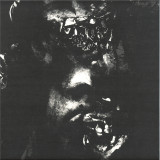
CS003, our next offering on wax, is home-grown. The Instruction EP features three original productions by label co-founder Niall Kelly complimented by a remix from the inimitable Carl Finlow. Niall’s debut EP showcases his prowess as producer harking to a pool of influences found in the sonic DNA of our hometown of Leeds, with added firepower provided by a legendary artist with close ties to the city.
Echoes of the rowdy bygone Mint Club ooze through the slappy tech house roller ’Section 1’ which opens the record. The chunky basslines retro synths and robotic vocoder connect the dots from Niall’s palette to the unmistakeable sound of Yorkshire Bleep on ‘Seven Wolves’. Carl’s treatment of ‘Section 1’ pivots into a darker, dystopian soundscape full of fizzing hi hats and dizzying synths that amalgamate into a dancefloor shaker that is unmistakably Finlow. The EP is rounded off by Groove Key, a track which serves up a special disorientating euphoria designed to be heard on large soundsystems and felt deep within your bones.
Suche:the city
2025 Repress
Words by Costanza Acernese
MOVING PRESSURE 04 / Obscur
With its fourth release, Moving Pressure welcomes its first external artist: young Slovenian producer Obscur. With a signature sound that is driving and subtly psychedelic, his debut on the label doesn't stray from the core tenets of its sonic ethos. Obscur delivers minimalism with purpose-dynamic, intentional, and wholly physical.
'F135' opens the A-side with a sinister tilt-rubbery squeaks stretch and coil around a flickering, synthetic voice. It's tactile and strange, without losing movement. 'Soul Eater' follows with a slow-burn crescendo, nestling psychedelic inflections into a warm low-end. On the flip, 'Stockholm Syndrome' pares things back. Dry, stripped rhythms carry an atmospheric tension-it's austere yet playful, leaving space for darker hues to linger without fully settling. A precise, heads-down statement. 'Blasphemy' follows with a tighter percussive grip and Feral-esque, panning modulations. Highs slice through a foundation of finely textured grooves-functional at its core, but laced with enough detail to give the track a sharper, more intricate edge. The digital bonus, 'Diamond City', stretches the sonic palette even further. Not through layers, but through tone: steel blues and deep violets bounce off metallic bleeps with cinematic restraint, closing the EP on a reflective note.
As most of us now live in a world saturated with information, this album feels like a reflection of how the modern world might sound if it were to process its own chaos through a unified scream. Hailing from the highlands of Bandung, West Java, a city where tradition and modernization intertwine in the rhythm of daily life, Xin Lie unpretentiously translates this cultural fusion into a sonically rich and rhythmically bold debut LP.
The artist’s roots in the hardcore and punk scenes reverberate throughout the album, though they’ve been reshaped and refined for the club. There’s an undeniable pleasure in experiencing the chaos Xin Lie channels—irregular beats, dynamic frequencies, and disjointed grooves collide and expand, each track laced with a sense of unpredictable energy. Yet even in its most chaotic moments, the music feels deliberate, its edges softened by a sense of compositional care.
The album reveals a strange duality: tracks that seem to beckon you to the dance floor but never quite let you settle there. Frequencies flicker and fluctuate in patterns that feel just slightly off-grid, as though resisting traditional structures. Yet, amidst the digital textures, Xin Lie weaves in organic sounds—snippets of native conversations or environmental noise—creating layers that feel both intimate and expansive.It’s fair to say this album extends far beyond the boundaries of today’s club music.
Picture this: you’re moving through your daily routines—mundane, repetitive—and suddenly, the music shifts your perspective. It reframes the ordinary as something surreal, as though it’s deconstructing itself in real-time, breaking into fragments or conjuring entirely new forms. Perhaps it’s best imagined as the soundtrack to a multi-sensory art installation or a performance staged not in a gallery but in an unassuming house down your street. Who’s to say where it might take you?
Repress! on Red Coloured Vinyl
The interstellar cosmonauts of Staatseinde create a theatrical mix of pulsing electro with nostalgic hopeful synthlines, all performed live with synthesizers, a sequencer and tantalizing vocals. From Wave to EBM, from NDW to Punk and everything else in and out of the box. It is like walking into a club meeting Kraftwerk on speed and The Sex Pistols on acid.
Their new release “De Nieuwe Golf” is characterized by dystopian prospects and hopeful sounds, confirming Staatseinde’s name as the founder of the “Neue Niederländische Welle”, in other words the New Dutch Wave.
The uplifting italo rifs in opening track “Grauw” take you on a journey through a gray world in which color cannot be taken for granted. Minimal wave track “Einzelganger” makes you feel like an outsider who can’t keep up with society. “Geef Me De Tijd” sounds like a schizophrenic dreamer swinging casually, but ending as a hard hitting track. Dystopian doom and pessimism is captured in EBM/techno floor filler “Doembeelden”. The raw West Coast Sound of Holland infused “La Haya” is a tribute to the city of The Hague which calls out on everybody to get wasted. The epic ode to space travel “Ruimtevaart Vooruit (2022 Refix)” is back in a rendition inspired by Rude66’s 2010 remix version. “Isla Inutile” is a dark and tropical delirium. In the hopeful “Alles is Weg”, Staatseinde takes you from the downfall on the way to…?
Staatseinde’s “De Nieuwe Golf” holds up a mirror to humanity…progress has not helped us any further. There is hope…but will this new wave be on time? Or is it already too late?
SAISEI founder Junki Inoue continues his vital archival work uncovering the riches of Japan’s distinctive electronic music scene and bringing them to new audiences around the world.
HERO U.D.A. aka Hiroyoshi Udaka is not someone you can easily google, but he’s sure lived a life worth retelling. His story starts back in the late 80s when, inspired by the acid house emanating from the UK — during what was fondly christened the Second Summer of Love — he picked up DJing and made the move from Japan to London. Throughout the 90s he DJed at underground techno institutions like London’s The End, CLUB UK and Silver Fish, as well as at the infamous Tribal Gathering raves, periodically returning to Japan to support techno greats like Colin Dale, Mad Mike, Suburban Knight and D. Wynn on tour.
The tracks on this EP, previously unreleased except for one, were all recorded after Udaka moved back from London to Tokyo, between 2002 and 2005. Yet they sound strikingly modern, drawing on a rich range of sounds that have come back round again two decades later: broken beat, acid jazz, dub and breaks. Deceptively simple grooves are given depth by layers of textures and micro samples, for example the surface noise on ‘On The Way’ that glues together an otherwise sparse skeleton of dubby pads and body popping drums. ‘Mature Missile’, ‘So Good’ and ‘Night Driver’ employ raw broken beat templates with acid accents, whimsical melodies and vocal interjections for a playful mood. ‘Sin City’ takes a darker turn, off-key piano hits and plunging bass adding to the wonkiness. The EP closes with a wiggly vignette, ‘222AM’, reminiscent of early 00s contemporaries like Mouse On Mars. Now these hidden treasures from Udaka’s archive gain a new life on SAISEI.
———
SAISEI is a Japanese word which translates to ‘reproduction’ and ‘to play’ (as in playing records). Japanese culture is widely known for its traditional nature just as much as it is for being forward into the future and this label’s concept does justice to exactly that. Having started digging for records as early as 16 years old, Junki Inoue delved into productions from 1990s Japan to uncover these native gems. SAISEI’s core concept is to recapture and reintroduce unique pieces of Japanese electronic music onto vinyl, to an audience it never reached before as most of this music was only released in Japan.
b A2. So Good Acid Funk
** Cassette release
""A Synonym for Repetition" weaves together a tapestry of parallels, all intricately linked to Japan. The project initiates with a collaboration with a Tokyo-based musician, which ultimately fails to materialise during Jason Kolar’s recent visit to the country.
From an original approach that has to mutate in its starting phase, the record was conceived from the beginning to embody a sincere homage to Ryuichi Sakamoto, also a Tokyo native. Shaping ideas within the context of a city with a vibrant soundscape, through an exploration where tradition and modernity intersect in an ongoing quest for correspondences.
Yet, the barriers of language and cultural disparity emerge, casting a veil over the perceived connections and rendering them more projection than reality. This dynamic delineates the space observed from an external perspective, perpetually distant from true understanding, framing it in the fields of imagination, both Japan and Sakamoto. Nonetheless, Kolar tries to pay an honest ode to the artist and its scenic background, with all the implications and contradictions of this kind of process, even with the risk of falling into clichés, pastiches, and Eurocentric bias.
Connecting it to ‘vertical listening’ rather than to an obvious tribute exercise, he has morphed his sound to a synthetic and midi approach, aiming to set an ironically fictitious stage, one that resembles something, but it’s not really it."
Second Horizon is the follow up album of his very successful debut album "Heartware", that has been voted as album of the year by more than 23.000 readers of FAZE Magazine. The twelve tracks are inspired by 80s music styles EBM, Italo, Acid, Electro and Dark Wave and produced with a lot of original equipment from that era transferred into 2025. The album is also inspired by his relocation to Berlin, and the music reflects this shift, balancing gritty, industrial influences with shimmering, retro-futuristic tones.
2025 Repress.
Detroit a city of great contrasts. Feats of engineering that spurred the world forward. For a few decades wealth and prosperity. Hi-tech dreams seemed achieved. But with the dream also comes nightmares…..
Traffic Jams, Predatory Insurance Companies prey on municipalities with no mass transporation, freeways built specifically to ruin minority prosperity & to build walls between people. Beautiful countries all over the world wrecked at war over the thirst for oil, entire neighborhoods decimated when the corporate greed for profit forces engineers to build throw away cars that are quickly replaced by better built foreign competition.
Even Worse……Climate change. Detroit the city that knows the best NO CORPORATIONS SHOULD DICTATE CITY FUNCTION the people should……listen to the sound and learn from it……or deal with the Lo-tech reality that Corporate greed actually is so good at building. UR the future UR the change……
Planet E looks to the heart of Detroit’s club culture for the debut appearance on the label from Motor City mainstay, Mister Joshooa. A DJ and sound engineer closely intertwined with the city’s music scene, regularly found behind the decks at clubs like TV Lounge and Lincoln Factory and having previously appeared on Carl Craig’s celebrated Detroit Love compilation, ‘Settle Down’ introduces four tracks that cement Mister Joshooa’s lucid, far-out take on house.
Lead track ‘Settle Down’ distills the energies and influence of the scene into a rubber-jointed, rolling introduction that vibrates with energy and anticipation, nailing a bassline that could run for hours and injecting trippy effects, live percussion and out-there vocals drawing in dancers. ‘Snake Oil’ meanwhile strips things way back, squeezing plenty of juice for the floor from a tunnelling, lightly psychedelic arrangement, offering bang-for-buck deepness that’s no scam.
‘Stop Me’ continues to drive Mister Joshooa’s productions in even wonkier, even mysterious directions, its oscillating crawl and hypnotic melody primed to create a heady atmosphere, giving surreal or even sinister, depending on each dancer’s perspective. Finally, ‘Step Up’ offers the roughest, readiest ride to close, where classic drum machine programming reverberates against throbbing sonics and all manner of analogue weirdness, transforming into an outsider techno stepper from the darker side.
This third volume of RAVEBREAKERZ presents again four banging anthems! Signed by Sunil Sharpe (on RAVE OR DIE 07 with Umwelt), LPV & Umwelt aka Dystopian Attack, Formshift, Ramel featuring Jeune Lord, here is the new ecclectic but never boring compilation mixing big names and new names for one of the best uncompromised crazy techno-rave-trancy sounds tinted with raw french hip hop roots !
This is the first full-length album by bojvck, an artist deeply embedded in Seoul’s street culture. Blending breakbeat-inspired sounds with raw audio textures sampled straight from the street culture, the album captures the restless energy of youth and the spirit of the city. If the keywords “boy” and “street” speak to you, this is one you shouldn’t miss.
Planet Orange Records are back with their fifth release. This time with a full 4 track EP from the legendary folks behind Alien Recordings. Get ready to dive deep into our next sonic journey with these four previously unreleased tracks. This EP showcases an evolution of sound with raw, emotional storytelling and intricate production from the very first note. Beyonders EP takes listeners on a nostalgic trip, with each track offering something fresh yet familiar. Alien Recordings sound continues to break boundaries, blending genres to create something truly unique, A true reflection of the incredible journey of the collective.
2025 Repress
Jim Coles once again turns the tide towards a new horizon and travels further into the echo chamber. Leading on from the much-lauded ‘Secret Location’ mini-album with Seekersinternational, one-offs such as ‘Open Palms dub’ (Dub Stuy) and other teasings, ‘Acid Dub Studies’ is the fully-fledged result of the merging of the calligraphic expression of the 303 Acid bassline with the stern sway of Dub Reggae and the hazier edges of Dub Techno and Ambient music.
For those who have been paying close attention, this project will come as a welcome return to the vulnerability and playfulness of early Om Unit records such as his sub-radar single from 2010 ‘Lightgrids/Lavender’ (All City Records) or the unearthed chugging ambience of ‘Friend of Day’ (Idle Hands) and indeed in some sense draws from similar wellsprings as moments on 2013’s Bass classic ‘Threads’.
Whilst being perhaps an ‘interim project’ this is still a vital and important expression of exploration and playfulness. A study in the true sense and borne out of a subtle but pervasive frustration with the rigidity found in musical words he has up to now been cohabiting, Acid Dub Studies comes from the pressing need to break with perceived expectation and to explore an honest and natural space away from the genre labels and tags that had been often lazily applied to his sizeable catalogue of music.
With no desire to reinvent the wheel, rather to paint pictures in an honest framework, the LP was crafted using a medley of classic analogue mixing techniques inspired as much by the adventurous dubbing of Adrian Sherwood as by the inward-delving haze of Scott Monteith’s Deadbeat project. Created during a period of lonely introspective walks through his home town of Bristol, the cover art is a photograph of some of the iron kerbstones that are found almost exclusively in the characterful and hardy city which were installed in the late 1800’s to protect pavements from cart wheels. Something about the permanence of those iron slabs and cobblestones inspired a sense of comfort and determination.
Acid Dub Studies is due for release as yet another self-released label-free project leading on from recent EP titles ‘Violet’ and ‘Submerged’ both of which hinted at some of the shapes found in this full length album.
Once again Jim has shown a rare convincing adaptability that few electronic artists can embody. Another step on the journey of personal and creative curiosity that fans are sure to appreciate.
"Dame café", originally released on Discos Fuentes in 1965 to meet the tropical music demand of the time, features a mix of traditional rhythms like vallenato and cumbia, alongside more experimental beats. The vibrant musical scene of the 1960s in Colombia owes much to a group of versatile accordionists who blended genres such as cumbia, charanga, guaracha, vallenato, and Cuban-influenced rhythms. This group included notable figures like Andrés Landero, Aníbal Velásquez, Lisandro Meza, and Alfredo Gutiérrez, among others. A prime example of their diverse musical styles is the album "Dame café", released in November 1965, which features a mix of traditional rhythms like vallenato and cumbia, alongside more experimental beats such as paseaíto and pasaje. The album includes six previously released singles composed by José Castro, Policarpo Calle, and others. The album highlights the commercial strategy of Discos Fuentes, which often created short-lived studio bands to meet the tropical music demand of the time. Los Gavilanes de la Costa, the band behind "Dame café", had a brief existence but left a lasting impact, especially in Mexico's sonidero scene. The group's creation was driven by the high demand for tropical music in the 1960s, with many musicians adjusting to market trends. Most of the members, including composers Campillo and Castro, vanished from the scene, while others, like Calle and Zambrano, went on to have notable careers in music. Calle, in particular, became a cumbia legend, later settling in Mexico City. The album "Dame café" has gained cult status due to its rarity and the intrigue surrounding its origins. The album features a remarkable contribution from Colombian jazz legend Justo Almario, who, at just 16 years old, played tenor sax on the track 'Pues no da pa' más'. Over the years, pirate editions and elusive original copies have made it a highly sought-after collector's item. The album's lively sound, combining accordion melodies, deep bass, and vibrant guacharaca rhythms, continues to resonate in the tropical music scene.
Long in the making, Compton's own AshtreJinkins debuts on L.I.E.S. with the seven track Left 2 Rot lp. The seasoned producer delivers an amalgamation of reimagined electronic styles going from stripped back
Terrance Dixon-esce minimal techno psychedelia to classic 2013 L.I.E.S. hybrid cuts sitting in the hazy grey area between gnarled house and techno. An ode to the City of Lost Angels from where he hails, this record is a perfect backdrop for the dystopian ruins the city has become over the last years. Stark, gut wrenching cuts that will leave you for dead as the title suggests.
At long last, Q Lazzarus says hello to Dark Entries. Q Lazzarus is the moniker of Diane Luckey, born in New Jersey in 1960. While living in the East Village in New York City in the 1980s, Diane met songwriter Bill Garvey at a party and they recorded “Goodbye Horses” in his home studio. As the story goes, Luckey met Hollywood director Jonathan Demme when she picked him up in her taxi during a snowstorm in 1986. Demme was wowed by her demo tape, which was playing in the cab, and they ended up hanging out at a restaurant for hours talking about life and music. “He liked it so much, I gave him the tape I was listening to, he said he would call me for one of his movies, but I didn’t really take it seriously.” said Luckey. Demme would have the song “Goodbye Horses” first appear in his offbeat comedy Married to the Mob, and then again more memorably in Silence of the Lambs when Buffalo Bill changes into women’s clothing while drowning out his intended victim’s pleas with loud music. Despite the exposure, both Luckey and Garvey languished in relative obscurity. “Goodbye Horses” is the definition of a cult classic, an ethereal tearjerker driven by Garvey’s lush synth work and Luckey’s unmistakably powerful voice. Garvey says, “the song is about transcendence over those who see the world as only earthly and finite.”
Over 15 years of effort have gone into the making of this release. All five songs on this record were previously unreleased and are sourced from original master tapes. The extended version of “Goodbye Horses” was newly mixed from the original stems by Alberto Hernandez at Fantasy Studios. Instrumental and acapella versions of the song are included, which are also available for the first time. Side B opens with “Hellfire,” a brooding number about the New York BDSM nightclub of the same name, showcasing the range and force of Luckey’s voice. “Summertime” follows, with a sauntering synth-reggae spin on the 1937 George Gershwin number. Both B-side tracks are also new mixdowns and edits from the original stems. This record is released alongside Eva Aridjis Fuentes’s documentary on Q Lazzarus, Goodbye Horses: The Many Lives of Q Lazzarus, a work chronicling the life of the enigmatic Luckey. It is an opportune moment to reflect on the underrecognized artists we have lost and the undeniable brilliance of both Diane Luckey and William Garvey.
- A1: Sepehr - Twilight Calls
- A2: Sissy Fuss - No Restraint Instrumental Def
- A3: God Is God - Na Gore More Dub Edit
- A4: Alex Loveless - Voicenote
- A5: Suemori - Kisou
- A6: Mari Herzer - Limbal Ring
- A7: Elena Colombi Feat Juno Roche - Lost In A City
- A8: Loma Doom - Sisterresister
- A9: Decha - Mujeres
- B1: Pose Dia - Lovers Rock
- B2: Low End Activist - Need To Know Blue Room Version
- B3: Decha Wir Sind Da
- B4: Mayurashka - Libra Man
- B5: Nar John Silvestre - Ensel Ham
- B6: E-Bony - Slow Machines
- B7: Riva Ft Tommy Khosla - Resurfacing
- B8: Anenon - Length-Of-Night Improvisation
Following on from the celebrated first instalment, the second part of The Male Body Will Be Next compiles an entourage of daring sonic experiments, composed in response to bell hooks’ landmark book The Will to Change. Prompting artists and musicians to envision cross-gender solidarity, Osàre! Editions founder Elena Colombi presents an enrapturing, narrative album, conceptualised around collective transformation.
Resonating with hooks’ challenge to men to reclaim the sensitivity that patriarchy denies them, the name of the record arises from a photograph by Peter de Potter and Rebecca Salvadori’s film of the same title. In these depictions, naked flesh is exposed, made vulnerable and trembles with emotion as the fragility of masculine bodies are examined through the queer and female oppositional gaze. Transforming this visual language into musical expression, The Male Body Will Be Next swirls with punk vitriol, electrified noise, acid, electro and free-wheeling encounters charged by love, lust and limerence.
Gently plunking chords signal Pose Diva’s reimagining of lover’s rock before Sissy Fuss smashes in with a heavy-weight instrumental version of their erotic anthem ‘No Restraint’.
Made up of Turkish musician Etkin Çekin and Belarussian songstress Galina Ozeran, God is God delivers a gentle lullaby, while Low End Activist flirts with dark and brooding bass, shattering penetrating frequencies into luminous fragments. Riffing off the 2020 documentary about female early electronica pioneers, Loma Doom crafts a slowly oscillating drone zenith, the ultimate climax. In line with the conceptual underpinning, there are plenty of collaborations – Daytripper’s Riva and Sitar player Tommy Khosla, Lebanonese experimentalist N R and Swiss-French producer John Silvestre (AKA Typhon), as well as Colombi herself and trans author/activist Juno Roche. Within these partnerships, new modalities come alive as mediums, practices and perspectives are ignited and pushed in otherworldly, metamorphic directions.
Exploring the water engineering relationship between Japan and the Netherlands across a trilogy of experimental releases, the third and final part of Field Records' Waterworks series is courtesy of Yui Onodera. Pairing delicate synthesis and instrumentation with field recordings and negative space, the accomplished artist and sound architect examines the impact of water engineering on Japan's Kiso Three Rivers.
The location refers to the confluence of the Kiso, Nagara and Ibi rivers on the Nōbi plain in Gifu prefecture. In the late 19th century, Japanese authorities collaborated with Dutch engineer Johannes de Rijke to separate the three rivers at the lower part of the Kiso delta. These extensive improvements, which were finalized in 1912, successfully shielded the city of Nagoya from regular flooding.
Onodera's minimalist palette and detailed approach to spatial sound design balances microscopic field recordings and tonally-rich traditional instruments, which he applies with stark focus to the subject of the Kiso Three Rivers across eight extended pieces of music arranged into two distinct parts. The A side's shorter tracks are delicately sculpted miniatures interweaving chiming bell tones, treated guitar impressions and hushed pads. The B side's two longer suites are more overtly minimal in nature, emphasising sampled water sources accented with patient brush strokes of synthesis.
This project is supported by the Embassy of the Kingdom of the Netherlands in Tokyo, Japan.