repressed !
Okain opens LOCUS’ 2022 schedule as he drops his latest EP, ‘Daddy’s Groove’.
A long-standing figure within Paris and Berlin’s nightlife scenes, Talman Records boss Okain continues to impress as a DJ, producer and label head at the heart of Europe’s house landscape. Whether releasing material via labels such as Infuse, Pleasure Zone, Eastenderz or Constant Sound, or on home turf alongside the likes of Silverlinings, DJOKO, Leo Pol and Per Hammar, the Frenchman’s blend of tough house merging old and new runs deep throughout his DJ sets and productions. Kicking off 2022 in style, mid-January welcomes a label debut on LOCUS as he drops four crisp efforts across his ‘Daddy’s Groove’ EP.
Opening cut ‘Mightnight Feed’ welcomes a slinking track guided by aquatic synths, sweeping electronics and bumping bass, while ‘Tavie One Tooth’ hones in on rich M1 stabs to showcase a bubbling and resonant house affair. On the B-side, ‘Brother Jack’ journeys down a lighter path, combining airy pads with jazzy interludes and subtle yet squelching low-ends, before rounding things out via the slick, classy tones of closing production ‘Green Mousse’.
Suche:the east s
Repress !
The long-awaited reissue of the best ever album of rare Eastern and psychedelic Jazz music by this famous Hungarian guitarist
Gabor Szabo, originally released in 1968. For the first time as extended edition with 2 bonus tracks: radio versions of Fire Dance
/ Ferris Wheel from the 1969 7” single 7”. Deluxe 8-sided Digipak CD and Gatefold Vinyl come with long, exclusively written
inner notes by the famous researcher and biographer Douglas Payne. Remastered by Martin Bowes at Cage Studios (UK).
Gabor Szabo was one of the most original guitarists to emerge in the 1960s, mixing his Hungarian folk music heritage with a deep
love of jazz and crafting a distinctive, largely self-taught sound. Born in Budapest, on March 8, 1936, Szabo was inspired by a Roy
Rogers cowboy movie to begin playing guitar when he was 14 and often played in dinner clubs and covert jam sessions while still
living in his hometown. He escaped from his country at age 20 on the eve of the Communist uprising and eventually made his way
to America, settling with his family in California.
He attended Berklee College (1958-1960) and in 1961 joined Chico Hamilton's innovative quintet featuring Charles Lloyd. Urged
by Hamilton, Szabo crafted a most distinctive sound; as agile on intricate, nearly-free runs as he was able to sound inspired during
melodic passages. Szabo left the Hamilton group in 1965 to leave his mark on the pop-jazz of the Gary McFarland quintet and the
energy music of Charles Lloyd's fiery and underrated quartet featuring Ron Carter and Tony Williams.
Szabo initiated a solo career in 1966, recording the exceptional album, Spellbinder, which yielded many inspired moments and
"Gypsy Queen," the song Santana turned into a huge hit in 1970. Szabo formed an innovative quintet (1967-1969) featuring the
brilliant, classically trained guitarist Jimmy Stewart and recorded many notable albums during the late '60s. The emergence of
rock music (especially George Harrison, Eric Clapton, and Jimi Hendrix) found Szabo experimenting with feedback and more
commercially oriented forms of jazz.
During the '70s, Szabo regularly performed along the West Coast, hypnotizing audiences with his enchanting, spellbinding style.
From 1970, he locked into a commercial groove, even though records like Mizrab occasionally revealed his seamless jazz, pop,
Gypsy, Indian, and Asian fusions. Szabo had revisited his homeland several times during the '70s, finding opportunities to perform
brilliantly with native talents. He was hospitalized during his final visit and died in 1982, just short of his 46th birthday.
Dublin-based producer Moving Still further blends both his Saudi Arabian and Irish heritage on 'Kalam Hub', a triumphant new EP that marks the fifth release on CWPT/Cooking With Palms Trax. Following a series of 12” edits and original productions that have put his sounds in the record bags of DJs including Hunee, Nabihah Iqbal and Esa Williams, 'Kalam Hub' presents an ambitious expansion of the Moving Still sound, delving into his identity and background to open up imaginative, universal new corners for club culture.
This potent musicality is immediately evident from the first notes of 'Kunafa King'. Taking its title from a traditional Arabic dessert, analogue midi sounds deliver a skewed take on the traditional Saudi rhythms of the artist's youth, before expanding into a wistful diversion for any self-respecting dance floor. It's a trick Moving Still pulls off again on the pulsing 'Hayati 89', which transforms from a traditional aesthetic into a blistering, neon-tinted Italo banger, the kind of track designed to compliment an accelerated spin in the car gracing the eye-catching cover of ‘Kalam Hub’, a collaboration with the artist alongside Manchester-based graphic design studio, Dr. Me.
Concluding the record's A-side, the rhythms take a trippier turn for the duration of 'La Titasil Feeya'. Translating to “don't call me!” and making sonic reference to teenage years immersed in rock, metal and general angst, it unfolds as something akin to Middle East-tinted techno with a formidable kick drum, before exploding in colourful, organic breakbeats. Immediately on the flip, the sense of wonder returns in a sonic mirage for 'My Bosa Is For You', weightless rhythms blending with an electric organ and charming, lightly psychedelic breakdowns.
Further sonic tricks fall from Moving Still's delicately-tailored sleeves on 'Haram Odyssey', where an almost impossibly tight bass line provides the function for contrasting synthesis and unpredictable percussion, drawing parallels between the sometimes confusing aspects of the artist's dual-cultural life as a child, through to the music he makes as an adult. Fittingly, the record concludes with ‘Kalam Hub', a triumph of minimalist percussion and traditional instrumentation that pays tender tribute to the Moving Still's grandmother, translating simply to “Love Talk”.
From the team that brought you Eastenderz, a greatly anticipated sub-label has been launched titled ‘Belief’.
Continue to expect consistent groove-driven tracks, made for the dancefloor. Highlighting the freshest of talents, alongside producers who have been on the radar for a while.
We belief.
Repress !
The long-awaited reissue of the best ever album of rare Eastern and psychedelic Jazz music by this famous Hungarian guitarist
Gabor Szabo, originally released in 1968. For the first time as extended edition with 2 bonus tracks: radio versions of Fire Dance
/ Ferris Wheel from the 1969 7” single 7”. Deluxe 8-sided Digipak CD and Gatefold Vinyl come with long, exclusively written
inner notes by the famous researcher and biographer Douglas Payne. Remastered by Martin Bowes at Cage Studios (UK).
Gabor Szabo was one of the most original guitarists to emerge in the 1960s, mixing his Hungarian folk music heritage with a deep
love of jazz and crafting a distinctive, largely self-taught sound. Born in Budapest, on March 8, 1936, Szabo was inspired by a Roy
Rogers cowboy movie to begin playing guitar when he was 14 and often played in dinner clubs and covert jam sessions while still
living in his hometown. He escaped from his country at age 20 on the eve of the Communist uprising and eventually made his way
to America, settling with his family in California.
He attended Berklee College (1958-1960) and in 1961 joined Chico Hamilton's innovative quintet featuring Charles Lloyd. Urged
by Hamilton, Szabo crafted a most distinctive sound; as agile on intricate, nearly-free runs as he was able to sound inspired during
melodic passages. Szabo left the Hamilton group in 1965 to leave his mark on the pop-jazz of the Gary McFarland quintet and the
energy music of Charles Lloyd's fiery and underrated quartet featuring Ron Carter and Tony Williams.
Szabo initiated a solo career in 1966, recording the exceptional album, Spellbinder, which yielded many inspired moments and
"Gypsy Queen," the song Santana turned into a huge hit in 1970. Szabo formed an innovative quintet (1967-1969) featuring the
brilliant, classically trained guitarist Jimmy Stewart and recorded many notable albums during the late '60s. The emergence of
rock music (especially George Harrison, Eric Clapton, and Jimi Hendrix) found Szabo experimenting with feedback and more
commercially oriented forms of jazz.
During the '70s, Szabo regularly performed along the West Coast, hypnotizing audiences with his enchanting, spellbinding style.
From 1970, he locked into a commercial groove, even though records like Mizrab occasionally revealed his seamless jazz, pop,
Gypsy, Indian, and Asian fusions. Szabo had revisited his homeland several times during the '70s, finding opportunities to perform
brilliantly with native talents. He was hospitalized during his final visit and died in 1982, just short of his 46th birthday.
No Wahala Sounds are proud to present this latest compilation of rare recordings of the early 1980s from the vaults of Audio Productions Limited, Nairobi, Kenya.
The bands featured are from Kenya (Kangundo 'D' Boys, Kyanganga Boys Band, The Lulus Band and Gem Lucky Jazz); Tanzania (Founders International Band and Orch. Bima Lee) and the Democratic Republic of Congo (Orch Moja One).
These songs were originally released on 7" single on the APL imprints of Nyalando, Sound of Music, Boxer, Mlima and Julus, all overseen by producer Babu Shah.
The early 1980s were the golden age of benga and rumba, and these tracks are being released for the first time outside of Kenya.
Our previous releases have been featured on BBC 6Music and BBC3's Late Junction, as well as being reviewed in Songlines and Mojo.
Hi-Fidelity, as a project, is the music Lava wants to hear blasted “out the back of someone’s pickup truck going on a road trip with their mates, or a cheeky remixed version being played in a dingey gay dive bar.”
Sonically, Hi-Fidelity is rooted in the shared cultures of West London and the West coast of America: a slow-moving, laidback culture as opposed to their peers to the east, creating a distinct instrumental tie between the two places. Some of it self-produced -- alongside collaborations with Foster The People’s Isom Innis and Biig Piig, Lava’s best friend -- the project dwells on everything from languorous love in the sun to masochistic heartbreak.
Gotts Street Park are a proud bunch of throwbacks. The Leeds-based trio - Josh Crocker (bass, production), Tom Henry (keys) and Joe Harris (guitar) - met through various music studies and friendship networks. Individually their tastes are diverse: from North Indian classical to experimental jazz, soul to alternative hip hop but their vision is united: “The idea of doing things live in one room has always been important,” remarks Josh. “That’s how they used to do it. Our identity evolved from that.”
The inception of the collective goes back to around 2012. There have been minor line up tweaks - they currently record with a rotating list of drummers - but the philosophy has stayed the same: an ongoing pursuit to capture the raw, unparalleled vibe that comes from recording music together, usually as one take, sometimes to analogue tape.
That approach is a deliberate call back to the methods made famous by legendary studios like Sun and Stax in Memphis, or FAME and Muscle Shoals in Alabama and their in-house bands. That’s why for years, GSP set up their own studio in a shared house in a tough (but, crucially, affordable) corner of west Leeds, Armley. Gotts Park (historically the home of industrialist Benjamin Gott) was close by - the group’s name was a nod to their local geography but also the fact it sounded like an area plucked straight out of some of their favourite East Coast hip hop releases.
Their work was quickly noticed, and it was from that base where they began working with an eye catching list of collaborators: Rejjie Snow, Kali Uchis, Cosima, Yellow Days, Chester Watson, Greentea Peng and Benny Mails. Tom also played keys in Mabel’s band. Early on, while performing as a band for hire for those artists, they were simultaneously honing their own sound; a deliberately retro “heavy, saturated” atmosphere that married the languid vibe of traditional soul with the pin sharp clarity of contemporary hip hop. Old leanings, sure, but upcycled with their own modern twist. “We’re constantly trying to build a catalogue,” says Tom. “Writing new stuff and sending it out to people.” That’s why after the release of their debut EP, ‘Volume One’, in 2017 the invitations kept coming; most notably from Brits Rising Star award winner Celeste, with whom they recorded two tracks on her debut EP ‘Lately’.
‘Volume Two’ once again features an impressive raft of vocalists - all female - from established names to fresh talent. This time, musically, the overall tone is lighter; less gritty, more optimistic. “It’s definitely not as gloomy,” says Josh. “Still though, there is this kind of dark, mysterious thing that we do a lot that works,” he continues. “Like the song we’ve done with Grand Pax, for example - it’s got that kind of witchy darkness to it. I think if you do a really straight male soul voice, it can be a bit cheesy and sound like you’ve heard it a million times before.”
Their collaborations might be some of the freshest of 2020 but make no mistake: Gotts Street Park are out there looking to create something timeless.
Cross the outerbridge from New York's Staten Island and you'll end up in New Jersey, Perth Amboy to be exact, home to 60s Garage/Soul group, 'The Invaders'.
Jerome James, lead singer/songwriter, and his 4-piece group reigned at the forefront of local aspiring teen musicians, playing alongside acts such as Marvin Gaye & Tammi Terrell when Motown hosted their east coast revue, yet only recorded once, at Super Sound Studios, NJ. The resulting songs from this session were sixties tinged instrumental 'Wildroote', but more importantly, one of the most iconic sweet soul songs, 'O Lord'.
An independent production released on the groups own label, Da Gail, served as a calling card for fans & shows alike, prior to the group rebranding as 70s disco outfit 'Hosanna'. Fun fact - hammond player, Teddy Andreadis went on to play with Guns n Roses, Carole King, Chuck Berry, and it all started with 'The Invaders'.
Trumpeter, composer, bandleader & producer, Nick Walters delivers his 2nd studio album within the last year for his D.O.T. Records imprint. Padmāsana is an exquisite mix of jazz fusion and traditional Indian sounds, inspired and constructed from experiences and samples he encountered whilst travelling around the Indian subcontinent. The album was pieced together at his studio in East London, featuring live contributions from Tenderlonious on flute, Kieran McLeod on trombone, Tim Carnegie on drums, and Walters himself on trumpet and synthesisers. Padmāsana was mixed by Sam Interface at More Time Studios.
Utter presents the extraordinary audio-visual project 'SuperEverything*' by multi-media artists The Light Surgeons.
'SuperEverything*' is a live cinema performance piece that explores identity, ritual and place in relation to Malaysia’s past, present and future. Commissioned by The British Council in 2011, it was created in collaboration with a group of Malaysian audio and visual artists. Over the past decade, the project has toured to various film and new media arts festivals internationally.
'SuperEverything*' is a fusion of music, field recordings, documentary filmmaking and real-time moving image manipulation that together transports its audiences through a series of universal narratives; exploring themes of tradition and modernity, globalisation and development, race and national identity, to consumer culture and belief.
'SuperEverything*' surveys our human condition to reveal what unites and divides us. It weaves together a rich kaleidoscope of stories, sounds, images and smells live on stage. It is a truly immersive, cross disciplinary performative artwork that reflects on how our complex identities are formed through ritual in relation to our rapidly evolving physical and psychological environments.
'SuperEverything*' poses many questions about how people form a sense of identity in a world increasingly dominated by information networks and fast changing social and economic landscapes.
This limited edition vinyl and digital album features the nine original tracks that make up the musical score to this groundbreaking live cinema project, fusing traditional South East Asian instruments with field recordings, electronica and western classical string instruments.
Accompanying the record is a 24 page full colour booklet and double-sided poster, housed in a gatefold sleeve. The booklet contains quotes from the narrative interviewees whose voices are interwoven throughout the performance. These quotes accompany images from the production and performances to help illustrate the musical journey and allow you to contemplate the themes and ideas explored in this work. The poster design features a collection of filmstrips taken from the video material in the show with a single striking album image photo on the reverse.
The release is also accompanied by a previously unavailable film of the full live cinema performance recorded at Hackney Empire in collaboration with The Barbican in 2013.
ZEHRA is proud to present the debut album ISTEHLAL by the MOHAMAD ZATARI TRIO, consisting of musicians from Syria, Iran & India. The trio merges traditional Middle Eastern sounds with contemporary vibes incl. interpretations of Hossein Alizadeh & Riad Al-Sunbati classics.
In a contemporary globalised world where music has lost its borders and is fighting a constant – yet particular – stream of Western commodification, the Mohamad Zatari Trio stands out as an original cultural artefact, aiming at transcending the boundaries between different music worlds.
Founded in 2019 the ensemble had its first public appearance in 2020 at the Outernational Virtual Festival. Comprising the performers Sara Eslami (Iran) on tar, Avadhut Kasinadhuni (India / Romania) on tabla and Mohamad Zatari (Syria) on oud.
Their debut ISTEHLAL plunges into its own aesthetics, politics and sound intricacies and represents the combined efforts of three musicians hailing from different, yet deeply rooted cultures. Over the course of eleven songs, the album transcends stylistic, ideologic and
geographic boundaries and reflects on the human condition in an interconnected and interrelated technological world. The repertoire includes not only original compositions in different stylistics
but also rearranged traditional pieces by influential composers Riad Al Sunbati (Egypt) and Hossein Alizadeh (Iran).
The Mohamad Zatari Trio introduces itself as a strong new voice within a new generation of young musicians that carry the musical heritage of great masters like Ravi Shankar, Nusrat Fateh Ali Khan or Zakir Hussain with a fresh and contemporary approach.
Mohamad Zatari is a composer and oud player from Aleppo, Syria, currently based in Bucharest, Romania. His artistic effort is devoted to deconstructing stereotypes and blending various musical genres. He has been taught traditional and regional music by Tarek Al-Sayed,
and has a Bachelor in classical composition at the National University of Music Bucharest (2021). His compositions were used for short films as well as educational courses. He performed in various ensembles and groups, in countries such as Syria, Romania, Hungary, Germany, Italy
and Austria.
Sara Eslami is an Iranian composer, tar and setar instrumentalist and improviser. She has a bachelor's in musical Performing at the Tehran University of Arts (2011).
Romanian/Indian Avadhut Kasinadhuni has a Master in Musical Performing / Violin at the National University of Music Bucharest (2022) and started studying tabla intermittently in India with Prof. Kamal Kant (2008) and Prof. Durjay Bhaumik (2017).
Credits:
Recorded by Alexandru Zaharencu at Avanpost media, Bucharest, Romania
on 29th & 30th January 2022
Mixed by Dirk Dresselhaus at ZONE, Berlin, Feb. 2022.
Mastering & lacquer cut by Anne Taegert at D&M.
Jasper James fights for what he wants to be, cuz function is the key. This is his first offering for the ESP Institute, and after many trials and tribulations with the pressing plants, everyone’s patience is now handsomely rewarded. On the A side, '0141' is percussion-based track utilizing a variety of overdriven metallic percussion and petite vocal snips that roll up neatly into a seductive rhythm. This is one for the hips and hands, with instrumentation chopped into short staccato spikes, Jasper invites impulsive body theatrics and the freedom to spastically express oneself. On the flip, 'E-Maniac' is a bona-fide tops-off Summer anthem if we ever heard one. What would typically qualify as an A-side banger, we’ve decided would better suit our contrarian leanings as a nice Easter egg, just to make sure you’re actually listening. This one drives hard, shuffling at a maniacal pace with gut-bending bass notes and stuttered pad stabs. These two songs will ping your pong and pong your ping.
Recorded in 1994/95 at PCP Labs. Mixed at Conway Studios. Except "Minus" recorded at G-Son Studios and "Ramshackle" recorded at The Shop, Sunset Sound and Conway Studios and mixed at Conway Studios.
All songs published by Youthless / Kobalt Music Publishing / Dust Brothers Music ASCAP except "Ramshackle", "Lord Only Knows" and "Minus" published by Youthless / Kobalt Music Publishing ASCAP
"Devil's Haircut" contains a sample from "Out Of Sight" (James Brown) published by Fort Knox Music BMI, performed by Them, courtesy of the Decca Record Co.; a sample from "Soul Drums" (Bernard Purdie) published by Tenryk Music BMI, performed by Pretty Purdie, courtesy of Sony Music; and elements from "I Can Only Give You Everything" (Philip Coulter/Thomas Scott) published by Carbert Music ASCAP.
"Hotwax" contains a sample from "Song For Aretha" (Bernard Purdie/Horace Ott/Robert Thiele) published by Tenryk Music/Well Made Music BMI, performed by Pretty Purdie; and a sample from "Up On The Hill" (Monk Higgins/Alexandra Brown) published by Special Agent Co./Tippy Music Publishing ASCAP, performed by Monk Higgins & The Specialties, courtesy of Blue Note Records, a division of Capitol Records, Inc.
"Lord Only Knows" contains elements from "Lookout For Lucy" (Mike Millius/Don Thomas) published by Southern Music Publishing Company, Inc. ASCAP performed by Mike Millius, courtesy of MCA Records, Inc.
"The New Pollution" contains a sample from "Venus" (Brad Baker) published by Sonny Lester Music Publishing Co. ASCAP, performed by Joe Thomas, courtesy of LAC Ltd.
"Jack-ass" contains a sample from "It's All Over Now, Baby Blue" (Bob Dylan) published by Special Rider Music SESAC, performed by Them, courtesy of Decca Record Co.
"Where It's At" contains a sample from "Needle To The Groove" (Embden Toure/Khaleel Kirk) published by Hit And Hold Music, Inc. ASCAP, performed by Mantronix, courtesy of Warlock Records.
"Sissyneck" contains elements from "The Moog And Me" (Dick Hyman) published by Eastlake Music, Inc. ASCAP, performed by Dick Hyman, courtesy of MCA Records, Inc. and elements from "A Part Of Me" (Paris/Taylor) published by Zethus Music, administered by Chappell & Co., Inc. ASCAP. All Rights Reserved. Used by permission.
"Readymade" contains excerpts from "Desafinado" (Antonio Carlos Jobim/Newton Mendonca) published by Bendig Music/Corcovado Corp. BMI, performed by Laurindo Almeida And The Bossa Nova All Stars, courtesy of Blue Note Records, a division of Capitol Records, Inc.
"High 5 (Rock The Catskills)" contains elements from "Mr. Cool" (Vincent Willis) published by Cotillion Music Inc./NAP Publishing Co./ Sylheart Publishing Co., administered by Warner-Tamerlane Publishing Co., Inc. BMI performed by Rasputin's Stash, courtesy of Atlantic Recording Corp., by arrangement with Warner Special Products, Inc.
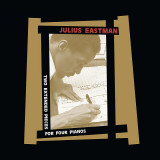
It is recognized today that these tutelary pieces for four pianos are among the most powerful in contemporary music,their impact is almost unparalleled. After the historical version recorded forty years ago, this one, featuring four of the greatest European performers, is now regaining its full power. High level recordings too.
There was some for John Cage, then came Christian Wolff, and finally Morton Feldman, from this school in New York. Only Julius Eastman remained outside the game, the last figure, the most solitary and enigmatic - undoubtedly also one of the most powerful, and it is this power that is revealed through these recordings. In the 1970s and 1980s, Eastman was one of the very few African-Americans to gain recognition in the New York avant-garde music scene. He was politically committed, a figure of queer culture and a solar and solitary poet whose melancholy influenced his genius as well as his tragic destiny : suffering from various addictions, declared missing, actually homeless. During Winter of 1981-82, he got deported from his apartment by the police, who destroyed most of what he owned - including scores and recordings. He was found dead in 1990, on the streets of Buffalo, after years of vagrancy.
The Performers Nicolas Horvath, pianist and electroacoustic composer Nicolas Horvath is known for his boundariesless musical explorations - he has collaborated with leading contemporary composers from around the world, including Alvin Lucier, Alvin Curran and Valentyn Silvestrov - the recordings of his complete works for piano by Phil Glass made a lasting impression. He has collaborated recently with Lustmord on the Deconstruction of November by Dennis Johnson (Sub Rosa SR502: The Fall).
Melaine Dalibert, a French composer and pianist, fascinated by natural phenomena which are both expected and unpredictable, Dalibert has developed his own algorithmic procedures of composition which contain the notion of stretched time evoking Morton Feldman, minimal and introspective, adopting a unique concept of fractal series.
Stephane Ginsburgh, a tireless surveyor of the repertoire but also explorer of new music, collaborated with composers such as Philippe Boesmans, Jean-Luc Fafchamps, Stefan Prins, Frederic Rzewski and Matthew Shlomowitz of whom he premiered works, as well as with choreographers such as Anne Teresa De Keersmaeker (Rosas) and recorded Feldman, Duchamp and Satie for Sub Rosa and the complete set of Prokofiev piano sonatas for Cypres. Wilhem Latchoumia, he embraces both new music and the classical repertoire with success and charisma. His two last recordings for La Dolce Volta (Prokofiev and de Falla) have been highly acclaimed by critics with a FFFF in Télérama. Winner of the Hewlett-Packard Foundation and the Montsalvatge International Piano Competition, he brilliantly won the First Prize in the 2006 Orléans International Piano Competition.
AQUA BLUE CLEAR SWIRL VINYL
Enter the wonderful world of the amazing TROPICAL FUCK STORM! Submersive Behaviour is our favorite Australian art-punk combo's take on the tried and true "covers record" concept. Over the course of 36 minutes, TFS puts their deranged spin on classics by Jimi Hendrix, Middle Aged in the Middle East in the Middle Ages, Men Men Menstration, Compliments to the Chef, and The Stooges. Guest starring their old kangaroo mates and collaborators Dan Kelly, the Bard of Beenleigh and Aaron Cupples, the Earl of East Gippsland on octopus like strings-man-ship, falsetto and apocalyptic vibes.
- 1: Anthem
- 2: I Like That - Janelle Monáe
- 3: Outernet
- 4: Spider
- 5: Ballet Memory
- 6: I Got 5 On It (Feat. Michael Marshall) - Luniz
- 7: Beach Walk
- 8: First Man Standing
- 9: Back To The House
- 10: Keep You Safe
- 11: Don't Feel Like Myself
- 12: She Tried To Kill Me
- 13: Boogieman's Family
- 14: Home Invasion
- 15: Once Upon A Time
- 16: Run
- 17: Into The Water
- 18: Spark In The Closet
- 19: Escape To The Boat
- 20: Femme Fatale
- 21: Silent Scream
- 22: News Report
- 23: Zora Drives
- 24: Death Of Umbrae
- 25: Somber Ride
- 26: Immolation
- 27: Down The Rabbit Hole
- 28: Performance Art
- 29: Human
- 30: Battle Plan
- 31: Pas De Deux
- 32: They Can't Hurt You
- 33: Finale
- 34: Les Fleurs - Minnie Riperton
- 35: I Got 5 On It (Feat. Michael Marshall)
Waxwork Records is proud to present the Us Original Motion Picture Soundtrack featuring a score by composer Michael Abels. Us, released in March 2019, is an original nightmare written, directed and produced by Academy Awardr-winning visionary Jordan Peele (Get Out). Set in present day Santa Cruz on the iconic Northern California coastline, the film, starring Oscarr winner Lupita Nyong'o and Black Panther's Winston Duke, pits an ordinary American family against a terrifying and uncanny opponent: doppelgängers of themselves. A blockbuster that earned raves from critics and audiences alike, Us earned more than $250 million at the worldwide box office to become one the highest grossing R-rated horror films of all time, buoyed by an unexpected and innovative soundtrack and by a groundbreaking, terrifying original score by Abels. Us marks the second collaboration between composer Abels and Peele, who first worked together on Peele's 2017 Oscar-winning horror film, Get Out. For the Us score, Abels explored themes of duality and discord. "Sonically, what defines 'scary' is the unfamiliar," Abels says. "It is the things that we can't place, and that we don't expect, that take us to that place of fear. We wanted to really strike terror into the audience." Central to the score was the opening track, an anthem for the doppelgängers, known in the film as The Tethered. Abels hit on the idea of using choral elements. "Jordan really loves the sounds of voices, and the human voice is an incredibly expressive instrument that anyone can relate to," Abels says. "The anthem sounds a little like a march of people preparing for battle, like an uprising maybe, but the sounds are not in a recognizable language. In other parts of the film there are vocal effects, just these strange sounds. They're designed to really freak people out." Abels featured a 30 person choir, a third of them children, in the "Anthem," and implemented Eastern European instruments, violins, percussion and a virtual instrument called a Propanium drum. "It makes this trashy metal sound, but you can also play melodies on it," Abels said. "The Propanium drum has a sound that's both otherworldly but not electronic or like science fiction. It's a sound you can't quite put your finger on, which is why it works well in this film." Also included on the soundtrack is the 1995 hip-hop hit "I Got 5 On It" by Luniz and the stand-out track "I Like That" by Janelle Monáe. Abels also helped with a new arrangement of the Luniz hit, which is featured on the soundtrack as the 'Tethered Mix from Us'.
[xi] 35 I GOT 5 ON IT (FEAT. MICHAEL MARSHALL) [TETHERED MIX FROM US] - LUNIZ
Brit Taylor’s highly anticipated sophomore album, Kentucky Blue, is a drive down the famed Country Music Highway – Route 23 -- back to her Appalachian roots. Grammy-winner Sturgill Simpson and renowned engineer and producer David Ferguson caught wind of the Kentucky gem after her self-reflective debut album, Real Me, garnered praise from Rolling Stone, American Songwriter and NPR’s World Café. The two legends didn’t hesitate to jump in and get their hands dirty, producing the next musical chapter of Brit’s life story. The album is to be released on Brit’s own Cut A Shine Records in collaboration with Thirty Tigers. Having the courage to find her “real me” set Brit free. Kentucky Blue is a musical celebration of her healing and rebirth. It exudes confidence with a touch of attitude that replaces the melancholy, contemplative sound of Real Me. It is a progression of her life and her music and an introduction to the stand-your-ground and know-your-worth Brit of today. It is a shift back to her East Kentucky influences where the cry of the fiddle, the moan of the steel guitar, the twangy banjo and the atmospheric string section are like a journey floating through space and time. Brit continues to unabashedly write and sing about what she lives and what she knows and sees. It’s genuine. It’s who she is. Kentucky Blue is Brit’s personal invitation to you to join her at her cabin in the woods for a bourbon, a swing on the porch and a story-telling song.
Back in the early days of GAMM we used to release Hip Hop reworks of classic golden era favourites.
After tons and tons of Disco, Jazz, House and Latin reworks we thought it was time to bring it back to the streets of the American east coast with a three part 7" inch series produced (not edited) by the mighty Lee Gomez aka Wipe The Needle.
The beats are all brand new production but you'll probably recognise the vocals.
Over the 3 releases you'll hear shades of inspiration from classic producers like Pete Rock, DJ Premier, Dilla and DITC.
It almost sounds as if these are the original productions. No joke...it's that strong!!
Somebody’s Child has quickly established himself as a voice at the forefront of the new music scene in Ireland. Early support slots in Dublin with the likes of Kodaline, Primal Scream, and Kaiser Chiefs, as well as national radio play and an appearance on the nation’s beloved Late Late Show all acted as vindication for Cian Godfrey holding back the unveiling of SC until the relatively late age of 23 - he had honed his craft and formulated a clear message ahead of time. Newly signed to cult label Frenchkiss Records, Godfrey now announces his self-titled debut album out 3rd February 2023 which has its roots in Godfrey’s formative years growing up in Dublin and the experiences that went with that. It was recorded at East London’s Hackney Road Studios with the producer Mikko Gordon (Arcade Fire, The Smile).
Superb 170 BPM freetekno acid EP from Stannik and Miltatek.
East France dancefloor killer Milytatek delivers here 2 collabs and 2 solos.
Underground Spaces, the first tune is a 170 BPM chanting acid. Superb.
Troubles Auditifs, the second tune, brings a 166 BPM nostalgic at the core-limit track, melodious acid Electronica sensitive music...
La Colère De La Meute, solo track from Miltatek is a twirling loops tune supported by an icy acid thrumpet. The kick is a loud bassy thing, stable tune with no crazy excitation. Nice one !
For the finish, Miltatek brings Eternity. Once again a stable tune more based on a melody rather than on high acid ear-killer. Nostalgic on the tone,.. Super dancefloor on the kick... and icy Acid on the pickles :)
BIG ONE !!
"Sounds sublime" - Gilles Peterson
"What a delightful, excitingly beautiful album. From "At Once Familiar " all the way through to "Same as Before" everything song feels and sounds sonically glorious. A modern day classic" - Nightmares On Wax
Taking a short sabbatical from their journey into the spiritual stratosphere and beyond, Work Money Death landed on terra firma just long enough to record a follow up to the critically acclaimed "The Space In Which The Uncontrollable Unknown Resides Can Be The Place From Which Creation Arises". The new album "Thought, Action, Reaction, Interaction" explores many of the meditative motifs that mould this unique group in their quest for the perfect sound and space. Those who are familiar with Work Money Death will know their output is as much an adventure for the listener as it was for the musicians.
"Thought, Action, Reaction, Interactions" is a salute to the now sadly deceased master of the spiritual sound Pharoah Sanders, and in particular the spontaneity of his recording process.
Each of the four tracks on "Thought, Action, Reaction, Interaction" were recorded in one take with no rehearsal and while the players may have known where they were starting off none of them were sure where they would end. As much as it is entertainment, and have no doubt this LP is an unctuous, spirit-smoothing joy from beginning to end, this is an experiment of making music in the moment. Spontaneous and spiritual in its truest sense, "Thought, Action, Reaction, Interaction" is a work of innovation and unsurpassed beauty.
"At Once Familiar" is a rising salute to the day, meditative, moving and fierce. An introduction to Burkill's emotive style, at once sweeping and succinct. It fills a room, and your head, with a very real sound, rich in texture and spirit.
"Freedom As A Heartfelt Song" is buoyant with harp, the spirit of the Yorkshire Pharoah is never more to the fore. Visceral sax rides over and uplifting backing, symbiotic and pinioned with power and beauty. Think Sun Ra horns meets Don Ellis brass.
"Song Of Healing" drifts on a river of music, guided through the rapids with a heartbeat bass line. This is temple sombre, with Eastern flavours and an overarching calm. A communion of sound, a master class in the understatement and power of the slow note, deceptively light.
"Same As Before" is spoken word playing foil to the call and response of the brass, dancing alongside and against each other. Spiritual vibrations cement ethereal forms to substantive sounds. A prayer to change."
As with the previous Work, Money, Death release (which was recorded in difficult conditions due to the Covid pandemic) the aim was to recreate a situation, in this case the impromptu and unrehearsed recording sessions of Sanders in the late 60's and early 70's, everything recorded in one take, creating a body of work that is a strong nod to a certain time and ethos but not a pastiche of it.
““Sounds sublime””
Gilles Peterson — BBC6, WorldWideFM
““What a delightful, excitingly beautiful album. From “At Once Familiar “ all the way through to “Same as Before” everything song feels and sounds sonically glorious. A modern day classic””
Nightmares On Wax —
This 3-track sampler 12” is being released to tie in with the Network Remixes 2 x 12 Double Album. The Fathers Of Sound and Urban Sound Gallery remixes are included on the album, whilst Ashley Beedle’s rework is exclusive to this 12”. All 3 tracks are classics from the Network catalogue.
The Fathers Of Sound remix sees the Italian progressive house dons reinventing the Surreal gem written and sung by Ann Saunderson. It is massively in-demand.
Ann is co-writer of Day By Day. Andrew Pearce was an inexperienced but incredibly talented 18 years old gospel singer who was plucked from the streets of Wolverhampton and taken to Detroit where he was given The Reese Project template by Ann and Kevin Saunderson. Chez Damier and Ron Trent were then drafted in and conjured up a magical Urban Sound Gallery remix. It is truly a masterpiece.
Inner City’s revival of Donny Hathaway & Roberta Flack’s Soul anthem “Back Together Again” started its life as a fairly faithful slant on the original. That was the plan until Ashley Beedle got his hands on the tapes and created a homage to Walter Gibbons, Larry Levan. The Loft and all things vintage New York true disco.
New family members Loris S. Sarid & Innis Chonnel summon a long-overdue return to the 12th Isle with an album built around percussive sounds taken from various mic-ed up objects found in a wood workshop on the East Coast of Scotland. With the pair occasionally leaving said workshop to enjoy some respite in Innis Chonnel’s horse box / studio, the artists hatched a plan to process and program their field recordings, later combining them with improvised synthesiser rhythms and overdubs. The tracks began to materialise over the course of a few follow-up sessions by which time saws sang and flutes flowed through watering cans. Shortly afterwards they found their way to us via carrier pigeon on a CD-ROM that smelt vaguely of soiled hay and we knew we had to act.
The third release on We Are FTR welcomes Oros to the family with his Inside Out EP, presenting a trio of cuts to perfectly showcase his sound. 'East' kicks things off, stretching out over the full A side with its captivating yet stripped back groove characterised by carefully crafted string samples. On the flip things get deeper, starting with the deceptively powerful 'Rek' which finds the perfect blend of head-down introspection and driving energy. 'Bartolomeo' closes out the EP with its alluring atmospheres sucking you in before more strings give a nod back to the A side and tie everything together perfectly.
- A1: Break The Spell (Feat Zander Miller)
- A2: Every Cloud Has A Silver Lining
- A3: Elephant In The Room (Feat Khrono K)
- A4: The Boundary Between You & The Outside World
- A5: Scratch Beneath The Surface
- A6: Cast Pearls Before Swine
- B1: Heart Breaker
- B2: Heart Breaker (Hood Joplin Dream Girl Edit)
- B3: Idiom (Feat Driftnote)
- B4: Digital Dotex
- B5: Trippy Staircase To Portal Wonderland
- B6: Mirage
Korea Town Acid (Jessica Cho) is wildly creative. She is an electronic artist at her core, but that barely scratches the surface of what her sound encompasses. Citing influences as UK future bass, glitch, jungle, and alternative hip hop, KTA fuses these sounds with concepts of movement and texture, to create multi-faceted works that go beyond the club. Born in Seoul, Korea, Toronto based DJ/Producer Korea Town Acid maintained a fierce but mindful schedule amidst pandemic induced lockdowns. With the ease of restrictions and the gradual return to a version of normalcy, KTA continues to thrive, without hitting pause. In 2021 she released her full length LP Metamorphosis, a self produced ten-track record, featuring collaborations from Toronto based artist DESIIRE, U.K based Korean pianist and rapper Pianwooo, Seoul rapper PNSB, L.A beatmaker Dreamdave, and New Jersey MC, L.J The Alien. She swiftly followed that up six months later with the release of Cosmos, another self produced full length LP that boasts the 2022 Juno Award nominated track, ‘Sobriety’. She also contributed to Cadence Weapon’s 2021 Polaris Prize winning record Parallel World, producing the track ‘Play No Games’. Despite touring restrictions in 2021, KTA delivered a notable hardware set as part of Hinter Live, showcased at POP Montreal, and continued her monthly online residency at The Lot Radio in New York. Korea Town Acid released her latest LP, Elephant in The Room, via URBNET. The twelve track self produced and mixed album, was mastered by East End Mastering in Toronto, ON, and features a lineup of Canadian guest collaborators, including Zander Miller, Khrono K, and Hood Joplin. In anticipation of the release, KTA has been actively securing live performance sets to showcase new tracks, with recent appearances at Vancouver’s Wonderment Festival, Montreal’s MUTEK Festival Toronto’s Summer of Seoul festival at the TIFF Atrium, Peprally, and Promise Cherry Beach series
Limited Cerulean Blue Vinyl LP. RIYL: Amen Dunes, Adrienne Lenker & North Americans. Numün, the NYC psychedelic instrumental trio Pitchfork dubbed as 'savvy navigators of paths less traveled', is releasing its second album Book of Beyond on the legendary Shimmy Disc label. With this record, the band, which includes Joel Mellin and Christopher Romero of Gamelan Dharma Swara and ambient country pioneer Bob Holmes of SUSS, continues to stretch their exploration of the inner and outer astral worlds of their first release Voyage au Soleil – voted one of the Best Ambient Releases of 2020. Dave Segal of Pitchfork called that album a "blending of the opiated psychedelia of the music territory staked Brightback Morning Light with a loose-limbed minimalism that privileges subtle effects and incremental chord changes" and Chris Ingalis from PopMatters called it "a trippy, ambient ride and ambitious debut that pulls off the neat trick of creating music that evokes space travel while also sounding refreshingly grounded to Earth's atmosphere." The new album, mastered by Kramer (Galaxie 500, Butthole Surfers, Bongwater, Low, Bill Frisell, etc.) features a unique mixture of Eastern and Western musical stylings and instrumentation including Balinese gamelan, gender wayang, and cumbuz (a 12-string fretless banjo) alongside the classic Americana instrumentation of slide guitar, baritone, mandolin and violin. The instrumental music charts new territories as it explores themes that are sometimes deeply personal, spiritual and otherworldly, including new fatherhood, sleep deprivation, loss and rebirth with titles that include Steps, Vespers, Eyes Open & Lullaby. Guests on the album include Trina Basu (Brooklyn Raga Massive), Tori Lo Mellin (Dharma Swara), and Willa Roberts (Black Sea Hotel). With their new album, Book of Beyond, Numün creates music that provides a star map to help us all navigate the inner constellations of our daily lives.
Soulside formed in Washington, DC, in 1985, split up in 1989, then reformed in 2014 and has continued playing and writing music since then. After releasing their debut album on Sammich/Dischord, they recorded Trigger (Dischord, 1988) and Hot Bodi-Gram (Dischord, 1989), which were combined on the Soon Come Happy CD in 1990. The band toured extensively in the US and Europe during these years, including groundbreaking shows in Poland and East Berlin shortly before the Berlin Wall fell in 1989.
In 2020, Soulside put out a new 7-inch, This Ship, their first release in 30 years, which was recorded in Prague. In late 2022, Dischord will release a 12-song Soulside album, A Brief Moment in the Sun, which was written during the heart of the coronavirus pandemic and recorded in person by J. Robbins in November 2021.
Tunisian oud player and vocalist Dhafer Youssef is at the vanguard of a movement in contemporary music that brings East and West together. He is one of the most inventive oud players in the world and has succeeded in freeing the instrument from its traditional role and bringing it into jazz.
In 2016, he released his solo album Diwan Of Beauty And Odd, which he recorded together with Aaron Parks, Ben Williams, Mark Giuliana and Ambrose Akinmusire. The album was received with critical acclaim and fuses Arabic and Western culture. It features the popular tracks “Fly Shadow Fly” and “Diving In The Air”.
Diwan Of Beauty And Odd is available as a limited edition of 500 individually numbered copies on translucent magenta coloured vinyl, housed in gatefold sleeve and includes an insert.
Part 2[11,98 €]
By now Nicola Loporchio aka Nico Lahs has a discography that has become respected and sought after among DJs and music lovers in dance music across the globe.
Whether it be deep, atmospheric, jackin' or jazz-flecked deep house, it's all firmly rooted in house music tradition, something that Nico Lahs masters with ease.
With releases on labels like Moods & Grooves, Delusions Of Grandeur, Ovum, HotMix, Adeem plus many more, he shows no sign in slowing down either.
Ancestors Call is a musical story told in two parts. Filled with melodic and spiritual deep house, sitting somewhere between classic deep house and the spiritual end of house royalty Ron Trent's output.
Just like his previous releases Nico is a producer that has both the confidence to blend late night deep house vibes with soulful dance floor magic. It's house music that is very honest.
Ancestors Call is something you listen to from start to finish, each song building a musically expansive story.
Mental Tribe from the East. Superb project. Do not miss !
- A1: Don Drummond, Tommy Mccook & The Skatalites - (Music Is) My Occupation (Ring Of Fire) (Music Is)
- A2: Tommy Mccook & The Baba Brooks Band - Alley Cat Ska
- A3: Don Drummond & The Skatalites - Cool Smoke
- A4: Don Drummond & The Skatalites - Garden Of Love
- A5: Tommy Mccook - Twelve Minutes To Go
- A6: The Baba Brooks Band - Girls Town Ska
- A7: The Baba Brooks Band - Vitamin A
- B1: Lester Sterling & The Skatalites - Latin Goes Ska
- B2: Roland Alphonso, Don Drummond & The Skatalites - Alipang
- B3: Don Drummond & The Tommy Mccook Band - Lucky Seven
- B4: Frank Anderson & Roland Alphonso - Musical Store Room
- B5: The Baba Brooks Orchestra - Musical Communion
- B6: Roland Alphonso & The Skatalites - Sandy Gully
- B7: Don Drummond & The Baba Brooks Band - Doctor Dekker
- C1: Roland Alphonso & The Baba Brooks Band - Nuclear Weapon
- C2: Roland Alphonso & The Skatalites - Corner Stone
- C3: Baba Brooks & Don Drummond - Knockout Punch (Aka Cotton Tree) (Aka Cotton Tree)
- C4: Don Drummond & The Skatalites - Don De Lion
- C5: Tommy Mccook & The Skatalites - Rocket Ship
- C6: Roland Alphonso & The Skatalites - Feeling Fine
- C7: Don Drummond & The Skatalites - Mesopotamia
- D1: Don Drummond & The Skatalites - Eastern Standard Time
- D2: Don Drummond & The Skatalites - Thoroughfare (Treasure Isle) (Treasure Isle)
- D3: Don Drummond & Roland Alphonso & The Skatalites - Silver Dollar
- D4: The Skatalites - Street Corner
- D5: Don Drummond - University Goes Ska
- D6: The Skatalites - Good News
- D7: Don Drummond & Tommy Mccook - Jfk's Memory
Back in stock!
Following in the footsteps of the landmark 1966 double-quartet recording by Joe Harriott and John Mayer, Indian born musician Amancio D'Silva produced some of the most adventurous and sophisticated recordings within the canon of 'indo-jazz', a term used to define a pioneering east meets west synthesis that reflected the shifting musical and cultural landscape of post-war Britain. An experiment which reached a pinnacle in 1972 with D'Silva's seminal recording Dream Sequence by Cosmic Eye (The Roundtable TRZY001), an adventurous fusion of modal jazz and Indian classical music viewed through the psychedelic lens of swinging London. Exotic third-stream jazz conceived by a visionary composer whose virtuosic technique and deeply emotive guitar playing defined his two earlier and now legendary 1969 UK jazz albums Integration and Hum Dono with Joe Harriott, both recorded for the much celebrated Lansdowne label.
Also recorded in 1972 although not released at the time was Konkan Dance, an unofficial sequel to Dream Sequence that further explored the unchartered possibilities of an Indian music-jazz fusion. Featuring many of the same personnel, this session also included support from Don Rendell and Alan Branscombe, two giants of the UK jazz scene who add serious credentials to D'Silva's singular and intimate compositions. For reasons unknown the album was cancelled by Lansdowne at the time and never saw the light of day until being resurrected again in the 2000s. The Roundtable are pleased to once again showcase this important artist and present a new addition of this incredible and almost forgotten piece of the Amancio D'Silva story. Pressed on 180g vinyl and packaged in a custom 1960s-style flip-back sleeve.
Unreleased British Jazz from 1972.
Sequel to Cosmic Eye - Dream Sequence
Includes liner notes and rare photos.
Custom Flipback sleeve.
180g Vinyl
Red Vinyl
It has been exactly ten years since Finders Keepers first intrepidly entered Andrzej Korzyński’s cavernous musical vault, but it is only today that we are able to proudly announce the safe retrieval on what we consider the true heavy psych holy grail of the Polish composer’s mind-bending oeuvre. By cruel coincidence this welcome event has sadly come during the same year as the composer’s tragic passing. However, in true Korzyński style, alongside his previous Finders Keepers releases, the legacy he has left behind in this one final lost soundtrack project alone has come with musical riches beyond anyone’s wildest expectations.
The comprehensive elusive archive of the deeply psychedelic soundtrack to Andrzej Żuławski’s forbidden film Diabeł (The Devil) is perhaps the most detailed dossier one could wish to find – including audio sketches, rejected proposals and pre-butchered variations that play out like an intense and veritable creative conversation between the director and the maestro, both of whom are widely recognised as true mavericks of socialist-era Poland’s fertile artistic landscape. Never intended for anything as conventional as a straightforward movie tie-in promotional disc (state owned Eastern European record labels rarely did this), the music in this archive has required special forensic inspection. Let’s say the devil is in the detail. The 7” record you are now holding is more than just a companion piece, and it is far from a selection of the (non-existent) poppy title themes to promote a full feature-length album. This standalone release is wholly unique in its own right, giving Finders Keepers listeners a final access all areas snoop into the mind of one of the pillars of our alternative musical community.
As those familiar with Żuławski and Korzyński’s long-running relationship will understand (a methodology best exemplified in the schizoid soundtrack to the film Possession), their exchanges were deeply nuanced and often complicated, with lots of artistic “tennis” thrown into the mix. The key plot in this behind-the-scene fable is that after delivering his original off-kilter psychedelic score to the director, maestro Korzyński was asked to make the music “totally unique, like something from another planet”, to which Korzyński took his tapes, pulled down the vari-speed to a guttural grind and continued to recompose over the top using avant-garde electro-acoustic techniques while deploying psychedelic skills of guitarist Winicjusz Chróst. This limited record release proudly boasts Korzyński’s original uptempo awkward psychedelic pop music prior to the doom laden growls that make the official films soundtrack a true Goliath of Eastern European soundtrack composition. Which, when recontextualised, will stand as a veritable face-melter for stoner rock fans. As one of Finders Keepers deepest conquests, we are delighted to share The Devil Tapes… What is a grail without the wine.
THE FRIIMEN MUZIK COMPANY (also known as FRIIMEN) was formed after the Biafran war in 1973-1974 in the town of ABA in the eastern part of Nigeria. Aba was the Number 1 Music Hub in the entire Eastern Region of Nigeria. While bands and artists like ‘Ofege’ and ‘Fela Kuti’ ruled the LAGOS scene, bands like ‘Friimen’ and ‘The Apostles’ were ruling the ABA scene. Before forming the band, most of its members were already working together as freelance session musicians backing up solo artists on several recordings and concerts (or were playing in military bands that gradually became civilian bands because the war had just ended). FRIIMEN members’ credits were numerous and they played, wrote or performed on recordings from well-known acts like The Funkees, The Jets, The Apostles…and countless others. When they started concentrating on writing their own songs, the group instantly took off and became an overnight hit that resulted in them doing multiple successful nationwide tours. FRIIMEN would go on to record three albums: Free Man (1976), We Can Get It On (1978) and Merry Man (1979). All three albums were released on the Aba based label Anodisc Records (THE key label to be on if you wanted your music heard and out there), Anodisc also released hit records by ‘Sweet Unit’ and ‘Voice Of The Cross’ but The Friimen Muzik Company was the label’s signature band. The album we are presenting you today (Free Man from 1976) was recorded at the famous Decca Studios in Lagos and comes swinging right out of the gate with a set of no less than EIGHT monster tunes. Expect nothing less than crazy afrobeat and over the top melodic funk influenced by a wide array of artists (both local and international). Mesmerizing solos, captivating grooves, impeccable sequences that turned many heads…everything you need to get a dancehall into a complete uproar. The musicians’ skills are just plain incredible! FREE MAN is a quintessential record that every serious collector or fan needs to have in his/her collection.
Australian 9-piece Spiritual Jazz group Menagerie announce their highly anticipated third album 'Many Worlds', released 15th January 2021 on esteemed U.K label Freestyle Records.
Menagerie is the Melbourne-based Jazz ensemble founded by producer, songwriter, guitarist, DJ and recording artist Lance Ferguson, also the driving force behind The Bamboos, Lanu, Rare Groove Spectrum and Machines Always Win.
Recorded at Union Street Studio by award-winning engineer John Castle, 'Many Worlds' features some of Australia's finest musicians, including pianist Mark Fitzgibbon (a regular performer at Gilles Peterson and Patrick Forge's original Dingwalls sessions), drummer Daniel Farrugia and renowned saxophonist Phil Noy (The Bamboos).
Inspired by both the post-Coltrane generation of the 70's, labels like Strata-East, Impulse! and Tribe, along with the current 'New Wave Of Jazz', Menagerie aligns with the world of Kamasi Washington, Shabaka Hutchings and Nubya Garcia, whilst also bringing their own unique twist.
Lead single 'Free Thing' leans heavily into the spiritual side of the band's sound. The hypnotic spoken word-poem is evocative of The Last Poets, an earthy yet futuristic meditation on the universal theme of freedom itself, set to a backdrop of insistent percussion, double bass and brooding piano voicings.
'Hope' carries forward the sound of spiritual jazz into the 21st century, with its epic vocal harmonies and melodic fanfare, it is an uplifting anthem for this period of global worldwide upheaval and uncertainty.
The title track 'Many Worlds' is a perfect example of how Menagerie incorporates their myriad influences, but manage to create a sound that feels uncannily fresh and contemporary. Book-ended by ambient, ethereal sections, the slow-burning groove builds over its 11-minute duration to create a standout crossover track.
Menagerie have received airplay and radio support from Gilles Peterson (BBC6/Worldwide FM), Don Letts (BBC6), Jamie Cullum (BBC Radio 2), Simon Harrison, Paul Miller and Ennio Styles (3RRR).
'Many Worlds' will be released on legendary U.K imprint Freestyle Records - home to jazz contemporaries Courtney Pine, Jessica Lauren, and keyboard legend Brian Auger.
Following the success of his 2022 mod-club, soul-jazz adventure with Mick Talbot, on 27 January Acid Jazz Records will release Chris Bangs' compendium of dance-floor fillers and Latin dynamite. Chris, who coined the term 'acid jazz', has created a new solo album of 10 tracks that takes his unique spin on jazz DJ-ing and turned it to producing an album that is totally reminiscent of the classic '80s era on the UK dance scene.
Recent single 'Firebird' (Jazz FM's Breakfast show 'track of the week') encompasses a lifetime of Chris's musical influences to present a jazz-tastic smorgasbord of bossa, fusion, bop jazz funk, salsa and a myriad selection of other jazz stylings all delivered with his trademark ear for the grooves and melodies to go with it. Paying tribute to his roots, 'East Coast' is the distinctive sound of jazz-funk fusion which spread through UK clubs in the early '80s, whereas 'Dinamita's heavy duty percussion-led Montuno Salsa groove tips its hat to the sound of '70s NYC via Puerto Rico.
Elsewhere the album features a tough Batucada rework of Dom Um Romao's 'Kitchen (Cosina)', the bossa of Cal Tjader's 'Samba Do Sueno', Brazilian disco funk-jazz 'Sambara' via the epic samba fusion 'Lifetimes'. Firebird features an array of in-demand and exceptional musicians, including jazz guitarist Nigel Price (Van Morrison, David Axelrod, JTQ), supreme jazz piano stylist Janette Mason (Seal, KD Lang, Robert Wyatt), trumpeter Dave Priseman (Jeff Beck, Imelda May), bassist Ernie Mckone (Boogie Back), saxophonist Simon Bates (Elvis Costello, Chaka Khan, Carleen Anderson), and fresh from his remix work with Paul Weller, vibesman Roger Beaujolais. This brilliant team of collaborators have helped a remarkable musical maverick create a truly unique and incredibly exciting album. Independently self-produced and composed, Firebird is a set of tunes better than any Chris Bangs had ever done.
The debut album from post-folk travellers Immaterial Possession, a quartet, half of whom came from an artist commune and half who were card-carrying Elephant6 alumni. ‘Immaterial Possession’ is a rich tapestry of a record, a gorgeous, melodious return to a time when influences co-habited freely and whatever was close at hand made the music of the day. All set to Syd Barrett-era Floyd and Nico with haunting lines, it’s perfectly tinged with gamelan harmonies, evocative Spanish guitars and xylophone. Exuding mystical symbolism; they wear luscious threads, they’re part of something/anything; perhaps a neo-modern-folk commune of artists in search of a canvas to stretch out over their juxtaposed influences. Immaterial Possession was conceived by Atlanta natives, Cooper Holmes and Madeline Polites, who met while living together at an Atlanta artist commune that was integrated into the DIY music, theatre, and arts scene. Some years later the duo moved to the neighbouring musical town of Athens, GA. They were soon joined by seasoned drummer, John Spiegel, and eventually fulfilled with multi-instrumentalist Kiran Fernandes (keyboards, clarinets, flutes) - descendant of the Elephant 6 Collective scene. It’s eastern, it’s eerie dream pop, it’s spacious and ethereal… A perfectly wild trip, and where it ends is immaterial.
Back in the early days of GAMM we used to release Hip Hop reworks of classic golden era favourites.
After tons and tons of Disco, Jazz, House and Latin reworks we thought it was time to bring it back to the streets of the American east coast with a three part 7" inch series produced (not edited) by the mighty Lee Gomez aka Wipe The Needle.
The beats are all brand new production but you'll probably recognise the vocals.
Over the 3 releases you'll hear shades of inspiration from classic producers like Pete Rock, DJ Premier, Dilla and DITC.
It almost sounds as if these are the original productions. No joke...it's that strong!!
Back in the early days of GAMM we used to release Hip Hop reworks of classic golden era favourites.
After tons and tons of Disco, Jazz, House and Latin reworks we thought it was time to bring it back to the streets of the American east coast with a three part 7" inch series produced (not edited) by the mighty Lee Gomez aka Wipe The Needle.
The beats are all brand new production but you'll probably recognise the vocals.
Over the 3 releases you'll hear shades of inspiration from classic producers like Pete Rock, DJ Premier, Dilla and DITC.
It almost sounds as if these are the original productions. No joke...it's that strong!!
On his debut 12" EP, Chicago producer and bike messenger DJ HANK captures the feeling of racing against traffic and, as he puts it, "trying to make it out alive with the chaos of the city going around you."
DJ Hank grew up in North Carolina, Eastern USA. As a teenager, he began making rap beats on pirated music software while also DJing and playing keyboards in experimental punk band Whatever Brains. In 2011, at age 18, Hank moved to Chicago to pursue a career as a bike messenger. In a city dominated by 21+ clubs and venues, Hank gravitated to the famous footwork hub Battlegroundz due to it's all-ages inclusivity and raw energy. DJ Rashad, DJ Spinn and other luminary figures of the footwork community spun weekly, while dancers spanning multiple generations and crews battled it out on the dance floor every Sunday.
Through the underground network of Chicago footwork events, Hank became a close and frequent collaborator with international footwork collective Teklife. He has released music on Teklife's record label but isn't a member of the group itself. In similar fashion, he's loosely affiliated with dance group Take Ova Gang (TOG) founded by DJ Manny. Hank maintains a fluid relationship with the footwork culture from which his sound draws. Beyond collaborating with his friends, Hank has collaborated with Chilean rapper Catana, Berlin-based DJ Paypal, and Floridian DJ Orange Julius.
On "Traffic Control," however, Hank explores a wide range of sounds, from melodic to experimental, influenced by everything from UK Garage and Grime to Ghetto House and Snap music (or Southern Hip hop production in general). Artists like Kode9, MachineDrum, and Sherelle have been supporters of Hank's music, playing his tracks throughout multiple recorded sets. In a live setting, Hank has shared the stage with such influential acts as Loefah, DJ Deeon, Sporting Life, DJ Spinn, Traxman, and pioneering footwork artist Jana Rush, who has been both a friend and mentor to Hank during his formative years in Chicago.
After Jose Manuel’s highly acclaimed album Janara on Optimo Music and the curation of the V.A. compilation Milagros Del Ritmo, he returns with his new EP Alchemy, the second vinyl release on Archaic Future Sounds.
It’s a queer psychedelic trip through electronic reinterpretations of tropical ritual chimes from South East and Southern Asia with a touch of Tribal and Acid House. Chugging beats seasoned with percussive flutes are enveloped by warm synthesizer sounds, heavy basslines and exotic melodies.
The antithesis is the trippy remix produced by Front De Cadeaux, who released on Antinote, a dub influenced future classic of deconstructed club music and as a wrong-speeder you can always choose your own tempo! Influenced by 90s Afro Cosmic Music, magic mushrooms and LSD it’s perfect for all passionate DJs, clubs and dancers!
The relationship between Bryn Jones’ music as Muslimgauze and the track/abum titles he would provide (sometimes right on the tapes he would send in for release, but often determined later, sometimes even giving two different pieces months apart the same title, accidentally or not) has always been a little mysterious. Jones himself can no longer be asked, and as we continue to investigate the swathes of material he provided, you hit sources like the DAT or DATs that make up the contents of the new double LP »Turn On Arab American Radio«. Nine tracks, the first LP/four tracks titled »Turn On Arabic American Radio,« and the other LP/five tracks labelled only »Arabic American Radio.« None of them sound particularly radio-esque, although given the simultaneous vastness and ornate focus of Jones’ Muslimgauze work that gap between name and sound is far from atypical.
Instead here the de rigeur percussion loops that underpin this particular set of tracks, while occasionally clipping into the fierce distortion that Jones either loved to use or couldn’t get away from, steer away from both the more consistent application of that distortion as well as the Middle Eastern and Asian influences he often used. It’d be a stretch to call anything here basic boom-bap production but they come closer to it than a lot of Muslimgauze production. And while those loops are, as always prominent, they’re not actually the focus; settling into steady vamps as structures for Jones to pursue an extended and often more gentle exploration of the other sample sources he has here. There are stringed instruments, the sound of water, but most prominently or strikingly the human voice. Nothing is in English but tone and the occasional word ('familia', 'passport') still provide guides. There are ululations, snatches of melody; but most often speech, dialogue, often tense and harried sounding. Is this what Jones was thinking of or referring to with his Arabic American Radio?
As with so many other questions about Muslimgauze, we’ll never know the answer to that one. (Most pertinently in this case we might wonder who appears here, and what the context of these recordings is. But Jones never provided that with his submissions.) Here, even though those inexorable loops pound on, indefatigable, that emphasis on some of the people Jones chooses lends a measured gentleness to much of »Turn On Arabic American Radio«, at least within the context of his body of work. The last thing you hear at the end of the second LP is one last question from one of the many speakers on this peculiar Muslimgauze radio, echoed away into infinity. We may never have answers, but those questions continue to resonate.
WRWTFWW Records is ecstatic to announce the first ever best-of compilation of Soichi Terada’s amazing project OMODAKA. including 14 songs never released on vinyl before. The 18-track ZENTSUU: Collected Works 2001-2019 album is available on double LP in heavy 350gsm sleeve with printed inner sleeves, as well as in CD and digital formats.
Initiated in 2001 while trying to create a "boat racing song", the OMODAKA project features sublime music by veteran electronic/house/jungle/video game music producer/DJ Soichi Terada and the vocals of Japanese folk min'yo & enka singer Akiko Kanazawa for a never-heard-before colorful blend of retro game 8bit/chiptune sounds and traditional Japanese music with wet electro rhythms, joyful 90s house grooves, and slick downtempo vibes. Feel-good, sexy, and fun, Terada’s project brings forth one of the most unique sounds in recent memory. The smile-inducing sonic adventure is packed with irresistible hits and a good dose of dancefloor-ready gems: a well deserved delivery of good times for 2022 and beyond!
Tokyo born genius Soichi Terada has built an impressive career in different music genres. He co-founded respected label Far East Recording with Shinchiro Yokata, composed the soundtrack for cult video game series Ape Escape, released tons of amazing house music records (some included in the beautiful compilation Sounds from the Far East released by Rush Hour in 2015), and has been a celebrated world-touring DJ.
‘Fuxsake, what a great ride this album is... …Somewhere John Lee Hooker is smiling and stampin' his foot to 'Runnin' Till I'm Done'! Love the 12 string riffing so much - You just don't hear that enough these days - Brings to mind Stevie Ray on killing it on acoustic. Ledfoot on the Goodfoot got some serious mojo'. - Winter Lazerus, mastering master This record was recorded and mixed in two days - live - straight to tape… no edits, no punching in…just me… honest for better or worse – honesty - What a precious thing ‘ - Ledfoot - In short: 10 tracks recorded analogue live to tape during two magic days at Studio Studio Nyhagen. No bullshit, just a unique artist spitting out his soul in the most naked and real setting possible. Gothic blues! Still, the sound, the lyrics and the performance are very much a product of today. Ledfoot aka Tim Scott McConnell is a 12-string guitarist who plays with fitted heavy strings,
a brass slide, steel fingerpicks and a stompbox. He has been touring and releasing music since the late 1970’s and written for artists as varied as Highasakite and TnT to Sheena Easton. In 2014, Bruce Springsteen recorded ‘High Hopes’ as the title track of his album, written by Tim Scott McConnell for the Havalinas debut album in 1990. It debuted as #1 in over 10 countries including the U.S. and the U.K.
- A1: Front Toward Enemy
- A2: I'm Already Gone
- A3: Seasons
- A4: Sevens
- A5: Tourniquet
- A6: Anchor's Lament
- B1: Throw Me An Anchor
- B2: I'd Do Anything
- B3: Blankets Of Ash
- B4: Emmett-Radiating Light
- B5: Cold Blooded Angels
- C1: Crooked Mile
- C2: Broken Halo
- C3: Can Oscura
- C4: Borderlines
- C5: Assault On East Falls
- C6: Pale Sun
Baroness will release their eagerly-awaited new album ‘Gold & Grey’ on June 14th via Abraxan Hymns.
“Our goal is, was, and will always be to write increasingly superior, more honest and compelling songs, and to develop a more unique and challenging sound,” offers Baroness founder, guitar player and vocalist John Baizley. “I’m sure we have just finished our best, most adventurous album to date. We dug incredibly deep, challenged ourselves and recorded a record I’m positive we could never again replicate.
I consider myself incredibly fortunate to know Sebastian, Nick and Gina as both my bandmates and my friends. They have pushed me to become a better songwriter, musician and vocalist. We’re all extremely excited for this release, which includes quite a few ‘firsts’ for the band, and we’re thrilled to be back on tour to play these psychotic songs for our fans. Expect some surprises.”
While ‘Gold & Grey’ found the band once again working with Purple producer Dave Fridmann (The Flaming Lips, Mogwai), sequestering themselves at Fridmann’s remote upstate New York Tarbox Road Studio. The 17-track album ushered in two significant changes: a decidedly different recording process and guitar player Gina Gleason’s debut on a Baroness recording.
The band, who tracked portions of the vocals, guitars and overdubs in Baizley’s home-basement studio, another first for them, eschewed their normal routine of entering the studio with meticulously detailed plans and instead opted for a looser, more improvisational approach that resulted in their most collaborative and emotionally evocative release to date.
Featuring John Baizley (vocals/guitar), Gina Gleason (guitar), Nick Jost (bass) and Sebastian Thomson (drums), Baroness received a GRAMMY Award nomination for Best Metal Performance for ‘Shock Me’ from the 2015 album ‘Purple’.
We have a very limited amount of these available now for stores. 4LP boxset - white vinyl - edition of 300 - includes: The Dream Derealised LP, Lightnesses I & II LPs, Near Future Residence LP. It’s nearing a decade since William Doyle released his Mercury Music Prize nominated debut album, Total Strife Forever, as East India Youth in 2014. A year later, he had toured the world and was releasing his second album, Culture of Volume, but it would be another four years before Doyle returned with his third full album, and the first official release under his own name. The dizzyingly ambitious Your Wilderness Revisited arrived in 2019 and was followed last year by the artpop masterpiece, Great Spans of Muddy Time. In the years between leaving the old project behind and re-emerging under his own name, Doyle self-released a string of ambient-leaning albums, The Dream Derealised, Lightnesses Vol I & II and Near Future Residence, which are now to receive a first vinyl pressing via Tough Love as both a highly limited four LP box set, titled ‘Slowly Arranged: 2016-19’, and as separate albums. The Dream Derealised is a collection of nine abstract, lo-fi pieces that were recorded during the summer of 2016, when focusing on creating them helped guide Doyle through a “difficult period of anxiety, panic and a regular dissociative feeling called derealisation.” At the time, doing something creative in a quick and immediate fashion felt vital to Doyle, carrying him to a new place: “I’m releasing them now as a cathartic measure, and as a message for others who may be going through difficult times themselves. What I told myself at the time, what I can tell you now: You are not in danger. You are not going insane. You are not alone.” Lightnesses Vol. I & II sees Doyle create what we might understand as true ambient music – that is, music intended for the background that wasn’t composed as such, but allowed to blossom out of the setting of some rules and parameters, played by sounds he created and then resampled. The deceptively simple, droning pieces are unlike anything Doyle has made before or since. “During their creation I’d often take photographs of the light coming in through the windows of the two houses I lived in during their creation. I’d post these on social media and they became quite popular parts of my output. This music was intended to accompany those visuals. The first volume’s photo is a double exposure of the sun shining in on my notebook and my hand, whereas the photo for the second volume was taken in Joshua Tree Park, California as I saw our tail lights illuminate one of the trees.” Near Future Residence is music for an imagined place based on real ideas; the soundtrack for an ecologically sustainable housing development somewhere in a not-too-distant future Britain. The eleven instrumental pieces here come from a place of optimism, imagining a future that is based on cooperation, community and ecological urbanism. It's music intended to sit in this imagined environment rather than impose upon it, similar in principle to the function of Kankyō Ongaku (Japanese environmental music). The ideas contained on Near Future Residence laid the groundwork for - and can be seen as a companion piece to - the album Your Wilderness Revisited, released to critical acclaim in 2019. Doyle explains how the pieces “were composed in entirely generative ways using samples of instruments, synthesisers and field recordings I've collected and developed throughout 2018. In generative composition, rules are set and parameters are chosen and then put into motion, the results constantly changing and surprising.”
Coalmine Records, in partnership with Duck Down Music, is excited to announce the upcoming release of the deluxe edition of Sean Price & Small Professor’s collaborative classic, 86 Witness. Released as a limited edition gatefold 2XLP with both the main and instrumental versions, the album boasts several packaging accoutrements that involve an artwork overhaul designed with metallic inks. For those unfamiliar with 86 Witness, the album is a testament to both Hip-Hop's Golden Era and the unbelievable talents of Sean Price, one of the genre's biggest and best voices who was taken from us far, far too soon. His hilarious, tack-sharp rhymes are complemented by the imaginative and dusty production of Small Pro, who may just be rap's best kept secret. Like his previous projects, 86 Witness is brimming with classic lines and lyrical barbs from P. What's different here, however, is the depth of his references in addition to his incredible chemistry with Small Pro. From the verses to the beats, they have provided so many musical Easter eggs that each listen tips off something you've yet to discover. And that's not even mentioning the ambitious lineup of guests featuring Your Old Droog, Guilty Simpson, Rockness Monsta, Elucid, Castel, Reef the Lost Cauze, Curly Castro, Zilla Rocca, and more.
Check point Catherine
“In the afternoon we performed in a rather austere theatre in East Berlin. Then I remember we crossed Checkpoint Charlie that evening to play in a club in West Berlin. The atmosphere was completely different. I felt as though we were living in a black and white spy movie.” Nicolas Fiszman recalls that chaotic day of 13 June 1982. Two outstanding guitarists, Philip Catherine and Nicolas Fiszman, who at the time was only seventeen years old, were taken from one side of Berlin to the other in pouring rain to perform to unlikely audiences. At both concerts, they played the same programme of seven pieces written by Philip, with the exception of “Crystal Bells”, composed by Charlie Mariano. The pair were not master and student. Rather, Philip remembers Nicolas like a young brother he might have taken to the beach. After the 1960s, Philip became a major figure on the jazz scene, working with the greatest: Charles Mingus, Chet Baker, Stéphane Grapelli, Dexter Gordon, to name only a few. Nicolas has played with Charles Aznavour, Vanessa Paradis, Francis Cabrel and Eric Serra, and travels the world with Sting.
On that gloomy afternoon, the two guitarists, alone on stage, decided to brighten up the morosity that reigned. The pieces they played bore titles such as “Janet”, “Babel” and “Petit Nicolas”. It is hard to believe that this varied, well-constructed, polyphonic music was not entirely written down on paper. Philip says, “Nothing is written from beginning to end. I compose the themes and some harmonic bridges. Then we have a chord chart … and that’s it.” The foundations are written; inspiration, taste, fantasy and friendship do the rest. We feel as though we are taking a nonchalant walk through Rio or Miami. The concert is punctuated by thunderous applause.
For these brief minutes in that year 1982, the East Berliners were able to fly over their tightly closed borders.
We are privileged to have unearthed this unique concert where two outstanding artists bring together two cultures to create an intense blaze of happiness.
Philip Catherine, Guitar
Nicolas Fiszman, Guitar & Bass
With the kind authorization of the Artists
tobi lou cements a connection to countless listeners through his creativity. The Nigeria-born, Chicago-raised, and Los Angeles-based rapper and producer builds music meant to last with unpredictable flare and inimitable spirit. As the story goes, tobi lou flourished as a football player and baseball player until undergoing a dream-ending injury and jumping from a semi-pro career to the mic. A series of buzzing EPs—tobi lou and the Moon, tobi lou and The Loop, and tobi lou and The Juice—paved the way for his 2019 mixtape, Live on Ice. The latter included “I Was Sad Last Night I’m OK Now,” which racked up 42.9 million Spotify streams. Earning widespread acclaim, Pitchfork hailed 2020’s “Student Loans” as “a refreshing dose of joy.” Meanwhile, Lyrical Lemonade christened him, “Chicago’s Rising Superhero.” Along the way, he headlined shows coast-to-coast and shut down festival stages at Lollapalooza and beyond. He also collaborated with everyone from Smino to Dreezy. Throughout 2021, he assembled Non-Perishable out of his East Los Angeles apartment. He notably produced on every track, lending his touch to the entirety of the project. After amassing hundreds of millions of streams, packing shows, and receiving acclaim from GQ, W Magazine, and more, he architects an immersive experience on his second full-length project and the first installment of a 2022 trilogy, Non-Perishable.
If it's really a post-genre world, why does everything sound the same? The two halves of Tampa rap duo They Hate Change_Dre (he/him) and Vonne (they/them)_first came together in front of the apartment complex where they both lived as teens. Dre had just moved down from Rochester, NY; Vonne was trying to sell him bad weed. It was clear from the start that the two listen to music differently from most people_they're sonic omnivores, obsessive deep-divers, lovers of rare and radical sounds. Starting as kids trawling the internet for tracks, they've been collecting music from around the world and across the decades, amassing a shared sonic knowledge so deep that "encyclopedic" barely begins to cover it _ not just the East Coast hip-hop that Dre grew up on, or the hyperlocal bass-music variants like jook (the Gulf Coast's twerkably raunchy answer to house) and crank (think "Miami bass meets NOLA bounce"), but also drum `n' bass, Chicago footwork, post-punk, prog (they're, like, seriously into prog), grime, krautrock, emo, and basically any genre on the map. Once they graduated to DJs on the Tampa DIY scene _ which includes everything from punk rock house parties to the black "teen nights" that pop up in rec centers and ballrooms _ they figured out how to pull all these disparate sounds together into a cohesive style. More importantly, they figured out how to make it something people will actually move to. When they made the transition to rapping and making beats, they brought that pleasure-seeking approach to sonic experimentation with them. "With this album, Vonne says, "it's really like, okay, you know how you talk about the internet breaking down borders? Here's what that actually sounds like. It's not just a hip-hop record with a couple more weird sounds. You want homegrown DIY? This is a record that was written, produced, and recorded in a 150-squarefoot bedroom from the least cool city you could think of." Finally, New is what a truly post-genre musical landscape is supposed to be: building deep connections that transcend outdated distinctions between them, spilling over with the joy of exploration and possibility, and daring other artists to think broader, go deeper, take bigger risks. Let the rest of them keep playing by the old rules_They Hate Change will keep changing the game.
LTD. CLEAR PINK VINYL
Barely disco and hardly jazz, Rupa Biswas’ music the halfway point between Bollywood and Balearic. Tracked in 1982 at Calgary’s Living Room Studios with a crack team of Indian and Canadian studio rats alike, both “Moja Bhari Moja” and “East West Shuffle” are the perfect fusion sarod and synthesizer. Remastered from original analogue source material and with permission and blessing of the producers and performers.
- A1: Bear Witness (Feat Dj Revolution - Intro)
- A2: Refrigerator P (Feat Rock & Dj Revolution)
- A3: Latoya Jackson (Feat Quelle Chris & Dj Revolution)
- A4: Midnight Rounds (Feat Elucid & Castle)
- A5: P's Theme (Interlude)
- B1: John Gotti (Feat Ag Da Coroner, Guilty Simpson & Your Old Droog)
- B2: Think About It (Feat Illa Ghee, Rock & Dj Revolution)
- B3: Word To Mother (Feat Dj Revolution)
- B4: John Gotti (Feat Reef The Lost Cauze, Curly Castro & Zilla Rocca - Philly Blunt Remix)
- B5: Refrigerator P (Feat Rob Kelly - Peaky Blinders Remix)
- C1: Bear Witness (Intro - Instrumental)
- C2: Refrigerator P (Instrumental)
- C3: Latoya Jackson (Instrumental)
- C4: Midnight Rounds (Instrumental)
- C5: P's Theme (Instrumental)
- D1: John Gotti (Instrumental)
- D2: Think About It (Instrumental)
- D3: Word To Mother (Instrumental)
- D4: John Gotti (Philly Blunt Remix - Instrumental)
- D5: Refrigerator P (Peaky Blinders Remix - Instrumental)
Side C/D / Disc 2: Instrumentals
Coalmine Records, in partnership with Duck Down Music, is excited to announce the upcoming release of the deluxe edition of Sean Price & Small Professor’s collaborative classic, 86 Witness.
Released as a limited edition gatefold 2XLP with both the main and instrumental versions, the album boasts several packaging accoutrements that involve an artwork overhaul designed with metallic inks.
For those unfamiliar with 86 Witness, the album is a testament to both Hip-Hop's Golden Era and the unbelievable talents of Sean Price, one of the genre's biggest and best voices who was taken from us far, far too soon. His hilarious, tack-sharp rhymes are complemented by the imaginative and dusty production of Small Pro, who may just be rap's best kept secret.
Like his previous projects, 86 Witness is brimming with classic lines and lyrical barbs from P. What's different here, however, is the depth of his references in addition to his incredible chemistry with Small Pro. From the verses to the beats, they have provided so many musical Easter eggs that each listen tips off something you've yet to discover. And that's not even mentioning the ambitious lineup of guests featuring Your Old Droog, Guilty Simpson, Rockness Monsta, Elucid, Castel, Reef the Lost Cauze, Curly Castro, Zilla Rocca, and more.
a 1 Bear Witness (Intro) feat. DJ Revolution
i 9 John Gotti (feat. Reef the Lost Cauze, Curly Castro & Zilla Rocca) Philly Blunt Remix
j 10 Refrigerator P (feat. Rob Kelly) Peaky Blinders Remix
Ltd. Yellow Vinyl
Limited Repress! The album entitled "Lighght" (pronounced "Light") continues and expands the sound of his critically acclaimed debut, "151a" - which earned Kishi Bashi the *title* of "Best New Artist" by NPR. Since the profoundly successful release of "151a" two years ago, Kishi Bashi has toured relentlessly, captivating audiences across the globe with his loop-based live show, and fostering a groundswell of devotees. "151a" was crafted over a four-year period while Kishi Bashi was touring and recording with Regina Spektor, Sondre Lerche, and of Montreal (where he was a full-time member and co-producer). In late 2012, after the success of "151a", Kishi Bashi decided to focus solely on his own music and began composing the new material which has become "Lighght". "Lighght" takes its title from the one-word poem by minimalist poet Aram Saroyan. As Kishi Bashi explains, "The poem's blatant assault on literary convention and classical form was attractive to me." It is apparent that such an approach informed the new album, which has both broadened and redefined his classical foundations. "Though I have studied classical composition, I prefer to take an unconventional path when it comes to creating and thinking about music," says Kishi Bashi. Though violin remains his primary instrument and songwriting muse, Kishi Bashi has expanded his palette to include more diverse and nuanced instrumentation. Bright and soaring avant-pop songs are prevalent, as are Eastern-tinged arrangements, gentle ballads, Philip Glass inspired improvisations, and more than a few moments that flirt with 70s prog (in the tradition of ELO or Yes). If this sounds jarringly kaleidoscopic, that's because it is. But it works. Listen and see.
Landmarks and milestones are always memorable, but the 50th EP release on FUSE feels that little bit more special as head honcho Enzo Siragusa steps up to the mark and returns for the second time this year. Having launched the label in 2011 with his now iconic ‘The Sagamore’ EP, the renowned selector and producer has grown and shaped the FUSE from a Sunday after-hours to one of the most notable names within house and techno worldwide - anchoring the label at the heart of its identity and bringing its trademark sound to an international audience. Following material from original residents Rich NxT, Rossko, Seb Zito and Archie Hamilton through to regular guests and close friends such as Guti, East End Dubs, Michael James and Fabe, October sees Siragusa showcase both his and FUSE’s evolution over the past decade as he uncovers two bustling productions across his ‘Dreamscape’ EP.
A production oozing with his signature sound, yet introducing fresh subtleties in amongst the track’s snaking groove and hypnotic melodies, ‘Dreamscape’ welcomes a title cut full of energy as the FUSE boss picks up right where he left off to provide yet more heavily requested material on home turf. On the flip, ‘Bean That Talks’ sees Siragusa get playful while maintaining the vigour of his bustling live sets, combining chunky low-ends with skippy percussion and rich pads to showcase precisely why he and FUSE continue to flourish as leaders of a sound that they can truly call their own.
Rui Fradinho has been DJing and record collecting since the age of 15, having played drums and keyboards on several different projects and starting his electronic music production journey in 2001, when he made his first ever original track – A Bright Future (release number 1 on the label).
Lover of music of all sorts, Rui’s musical base stems across different genres, including House, Drum N Bass, Hip Hop, Footwork, Bass Music, having more recently nurtured a deeper devoted passion for all things Jazz, Fusion and Broken Beat / Nu Jazz.
There are undeniable major influences from Jazz, Soul, Funk, Latin, African, Brazilian and Global music on his productions and Rui has released remixes for several artists on several labels such as Str4ta for Colin Curtis Presents, Nimbus Sextet for Acid Jazz, Luiz Gabriel Lopes for Da Lata Music, Momenta for Lazy Robot Records, Various artists for MJDC – Modern Jazz Dance Classics, David Borsu for Broadcite, Makala for Orrua Diskak and Ray Lugo for Ammonite Records.
Highlights of his DJ career include a 6 year residency at Sociedade Anonima club in Portugal, then Bicaense Café and Lux Club in Lisboa. Earlier in 2017, he did a stint on London’s Back2BackFM, playing at Dalston’s Club Makossa, the BBE Store in East London, closing the Chill Out Gardens stage in Portugal’s Boom Festival 2018, DJ’ed at Gilles Paterson’s first edition of We Out Here festival, currently guests at Birmingham’s Bruk Up Broken Beat night and opened the Portuguese festival LisbOn - Jardim Sonoro in 2022.
Experimental once-sludge metal duo branch out further with an album influenced by Middle East / North African / Asian pop and traditional music. Nazm sees Jucifer deploy their familiar studio tactic: writing, arranging, producing, engineering, and playing all instruments themselves to create a sprawling concept album. This time, it’s to celebrate their shared love for the Middle East and North Africa (MENA) and central / south / west Asian traditional and pop music cultures with fourteen highly textured, intensely personal and passionately delivered original songs. Fans of the band likely know they can expect surprises with each album, as well as recordings which differ drastically at times from their live sound. In this tradition, Nazm strays far from the brutal excess of a Jucifer show (and of their recent releases Futility and District Of Dystopia) but, as with all Jucifer’s recordings, the point is not to imply any static trait of the band but instead to bring to life a story they’re telling. Track Listing: 1. Return 2. Mood 3. Un Occupied 4. Welcome 5. Sahel 6. Endure 7. Pulverization (Becoming) 8. Displaced 9. Jucifer – Divided 10. Notice (Warning) 11. Water Woman 12. Mitochondria 13. The World Is A Sword 14. To The Lost
red/clear splatter vinyl
Shake Chain will also be performing at Marina Abramovic’s private view at Modern Art Oxford on September 23rd.
Shake Chain have been busy demolishing audiences and expectations for the best part of three years. Vocalist Kate Mahony sets that standard by starting each live performance by crawling from the back of the room through a disbelieving crowd’s legs in a shiny yellow raincoat. The resulting questions that frantically arise of ‘what’s going on?’, ‘am I hallucinating?’ and ‘is this part of the show?’ are hallmarks of how Shake Chain approach making their unruly, lyric-bespattered rock music.
The four-piece from London are completed by Robert Syres (guitar, synth), Chris Hopkins (bass, synth) and Joe Fergey (drums), all artists hailing from Goldsmiths College, Nottingham Trent and Wimbledon, University of the Arts. A mutual love of thought-provoking performance art and a yearning for disruption have helped Shake Chain lock into their wayward sound. Twitchy guitar lines jolt and jerk, synths burble noisily and tack-sharp drums pin things down for Kate’s reeling vocal to vault and slur. Kate’s singing has drawn comparisons with Yoko Ono, Su Tissue and even a seance with it’s unique embrace of flights of atonal fancy, head-first repetition and ecstatic frenzy. Opinion-dividing arguably, but singular in making Shake Chain dauntingly brilliant.
Shake Chain’s debut album ‘Snake Chain’ was recorded in the New Forest’s Chuckalumba Studios early in 2022. The tranquil setting only slightly skewed by the intense extratropical cyclone occuring outside. When asked to sum up the album the group collectively settled on it sounding like “crying in a Catholic sex dungeon with Eastenders on”, perhaps only half tongue in cheek given the soapy dramatics of opening track ‘Stace’. ‘RU’ is a stompy triumph of ad lib monotony, heavy and wonky, its vocal slowly unwinding into residual sense. Shake Chain’s songs are populated with cowboys, cherry-pickers, content-addicts, private investments, a careless driver called Mike, architects and by much lamentation at the state of our confusing existencies. This last point underlined in luminous marker pen with slow-building vortex ‘Highly Conpeptual’ and whispered closer ‘Duck’.
‘Copy Me’ races along with radiant headbangs of dynamic abandon, one part tumble, two parts pummel, “hold your breath til something changes” commands Kate whilst everything of course is in hammering flux. ‘Second Home’ is similarly coruscating yet bouyant, whilst ‘Arthur’ feels like it could tear inside in two amid sobbing wails and the twining of its disparate parts. Throughout all the unhinged freakouts, found sounds and blasting rhythms though is Kate’s questioning, resilient presence, anchoring everything. On bruising creeper ‘Birthday’ she asks most tellingly “Do we speak language or does language speak us? Is there a mouth in the middle of the desert? Do you ask how cups are designed? Would you say yes when you really mean I don’t know”? Shake Chain are cathartic and absurd, humorous and deadly serious yet always inspired. Its this tightrope walk which makes their album such a thrilling, vital listen.
Fully licensed ! Ltd to 500 copies. Singer and guitarist Ram John Holder was born in. 1939 in Georgetown, British Guiana, then moved to Cincinnati
in 1954, and to the East Coast to work as folk blues singer in the early 1960s. In 1963, he took residency in England where he recorded several
albums. Released in 1969 Black London Blues is surely is masterpiece. A socio-political manifesto the album chronicles the trials and tribulations
that were the result of being a black-immigrant in London, and it contains all the pathos and pain one can imagine. Self-conscious, as concept
albums often are, the record is almost like an audio A-Z or pub guide. It’s funky/soul and represents his own black experience. It is a must have
for all the blues revivalist out there, a record to rank along the lines of early Mike Cooper and American stalwarts like Eugene McDaniels or Sixto
Rodriguez!
Tracklist:
SIDE A: 1. Loie - 2. Lloro Tu Despedida - 3. Goin’ Home - 4. Me ‘N You
SIDE B: 1. Liebestraum - 2. Shu Shu - 3. Blue Samba - 4. Favela - 5. Linda Flor
SOULGRA
Released on Greensleeves in 1990 to glowing reviews ‘Blowing With The Wind’ went on to be Pablo’s most successful album since the seventies. The mix of nyahbinghi drumming and hardcore steppers was embraced big time by the new age sound-system culture bringing Pablo’s far east sound to a whole new audience. A successful tour of Japan followed where Pablo showcased Blowing With The Wind with a selection of his original rockers. Recorded at Tuff Gong & Dynamic and mixed at Tuff Gong & Music Works, engineered by Soldgie, Chunny, Sylvan Morris & Tony Kelly.
- A1: Die Achse - Under The Church
- A2: Nostlagie Eternelle - Peace Of Mind
- A3: Years On Earth - As You're Told
- A4: If, Bwana - Tiny Bladders
- A5: Stefan Schrader - Attempt To Rap
- B1: Misteek - Bump Beat
- B2: M Rendell - Cv In
- B3: Dix Ferro - Bienvenidos A Neuchatel
- B4: Sluik - Open Window
- B5: Pornosect - Pressure Level
- B6: The Horse He's Sick - Projectile Fascination
- C1: M Nomized - Nitsed
- C2: John J Lafia - Life Is Short
- C3: Interaccion - Newton
- C4: Die Mysteriosen - Spurhund
- C5: Homage A Brinkmann - Franzosisch
- D1: Solanaceae Tau - Tekno Pop
- D2: Ob Ovo + Sha 261 - The Cia, It Dances
- D3: Collectionism - We Are All Children Of God
- D4: Upm - Anstalt
- D5: Wolfgang Wiggers - Slightly Mental
Rich-poor divide widens. Unemployment soars. The East and West eyeball each other on the brink. 2022 isn't too far off the 1980s. Contort Yourself know this.
Following the huge success of the prophetic 80s Underground Cassette Culture Vol 1, Vol 2 is set to hit shelves and screens with the same brand of distortion soaked didactics.
Twenty one tracks from across the globe make up this second installment with nothing being constant. Instead, the overarching message is one of wanton abandonment; burnt-out artists peddling an electronic punk profanity, marginalised musicians spitting on the establishment and industry.
Rusted guitar strings, cobbled drum machines and fire in the belly; this is the recipe.
A soundtrack of despondent despair, a lament of languid lechery, an anthem of what was then and still is now.
Barely disco and hardly jazz, Rupa Biswas’ music the halfway point between Bollywood and Balearic. Tracked in 1982 at Calgary’s Living Room Studios with a crack team of Indian and Canadian studio rats alike, both “Moja Bhari Moja” and “East West Shuffle” are the perfect fusion sarod and synthesizer. Remastered from original analogue source material and with permission and blessing of the producers and performers.
Pianist, drummer, composer and producer Hamish Balfour presents jazz funk, soul and electronic music, bridging the gap from classic Blue Note to Warp via Sonar Kollektiv on Running Colours, his electrifying debut album for London's Shapes of Rhythm Records.
Praised by Jazzwise for hissolo flourishes and sidestepping harmonies, Hamish Balfour should be a recognisable face to jazz addicts. The go-to keys player has performed and recorded alongside American jazz drumming legend Harvey Mason, Tenderlonious, The Temptations, Odyssey, Faze Action, Yolanda Charles' Project PH, Bassically, Nim Quartet and Yam Who. Popping up not only in the credits of many sought-after albums, but also Channel 4, ITV and BBCprogrammes for his compositions on various shows.
Over the course of eleven tracks, Balfour folds in and explores his influences, with a wide yet highly cohesive and strong palette of sounds, whilst interacting with high caliber guest vocalists such as spoken word artist and broken beat icon, Lyric L(Seiji,Nathan Haines), London Elektricity and Hospital Records' star vocalist Elsa Esmeralda, award-winning and chart-storming singer-songwriter Belle Humble (Freestylers, Paloma Faith) and soul and house mainstay Andre Espeut (Afriquoi,Simbad,Faze Action).
Responsible for all piano, synths, percussion and production on the album, Balfour's musicality shines through, a reminder of how overdue this debut album as leader is. However, in addition to the incredible vocalists, he's joined by some of the UK's finest jazz musicians: James Copus (trumpet), Pete Matin (bass), Laurie Lowe and Saleem Raman (drums) and Rob Updegraff (guitar).
Elsa Esmeralda implores us 'not to be afraid' on lead single and title track Running Colours. A perfect invitation to get stuck into this many layered album. Balfour compliments Esmeralda's soothing vocals with delicate piano intro before Lowe's bruk-easque drums and lead an irresistible groove bedded in warm synths and guitar licks.
Yes or No showcases Loose Lips legend Lyric L contemplating the uncertainty of love over a swinging mid-tempo jazz funk boogie groove propelled by tight drums and Hammond chords, closing with a flying trumpet solo from Copus, weaving around Balfour's nimble keys.
Wealth, featuring singer/songwriter Belle Humble, displays incredible depth and restraint. Humble delivers the enticing vocal with ease, as it slides over the intricate webs of jazz fusion and electronics.
Mogul is arguably Running Colours' curveball. An eastern-inspired whirlwind of all manner of synths and twisting drums which constantly morph throughout. Guitars and trumpets take turns to solo on a track that feels like a series of questions that we never quite get answers to.
Balfour's ability to merge free wheeling jazz and fusion with timeless electronic production and soulful compositions is also apparent on instrumental pieces such as Reflector 28. Here, we find the musicians upbeat, uplifting, progressive and playful, showcasing the keys whilst the bass underpins the groove.
South Of The Sun is Running Colours' laid-back moment with Roy Ayers-type vibrations as bass and drums sit in the pocket (at least to begin with), whilst a Rhodes weaves its magic. Like many of the album's tracks we take a few twists and turns before returning to our main feel-good motif.
Hamish's long awaited debut is sure to exceed the expectations of those who know him already, whilst introducing a whole new audience to his wealth of talent and originality.
- A1: Aaway Axdigii Aynu Isku Ogeyn? (Where Is Our Promise?)
- A2: War Wayneey (Great News)
- A3: Umaayey Iyo Abo (Mother & Father)
- A4: Deriskaagi Waa Kugu Jahowareeray (Your Neighbor Is Confused About You)
- B1: Hobolada Hooyibo (Feat Dr. Rafi)
- B2: Xiriirkaagii Aan Kusoo Xarakeeyee (Let's Celebrate Our Relationship)
- B3: Wiilkii Aan Ku Waashee (The Boy Who Drives Me Crazy)
- C1: Ruuney (Feat Sahra Azura Xasan & Malow Aw Dinle)
- C2: Haba Ley Habaaree (Let Me Be Cursed)
- C3: Shaydan Buulow (Dancing Devil)
- C4: Sig Sig Nima (Come Closer)
- D1: Iisoo Buub (Give It To Me)
- D2: Kurbo Jaceyl (Love & Pain)
- D3: Imtaxaanka Dunida (The Test Of Life)
The official retrospective on one of Somalia's most famous and beloved private bands, Iftin, and a companion compilation to our Grammy-nominated "Sweet As Broken Dates". Digitized from cassettes recorded between 1982 and 1987 at the legendary Al-Uruba hotel's secret studio and the jams for the masses performed in the basement of Somalia's national theater. Banaadiri rhythms from Somalia's south, Mogadishu's finest vocalists, Dhaanto reggae-like guitar licks, and smoldering brass blend seamlessly with the sounds of Asia, the Middle East, and Africa to form one of rawest, most cosmopolitan eras of music anywhere. Iftin's Mogadishu is where the world's sounds begin and end.
Double LP gatefold with a 12" x 12" poster. Hardcover bookcase CD with 12 page booklet.
In July 1973, Blue Note Records headed to Montreux, Switzerland to showcase several of the label’s stars at the Montreux Jazz Festival. Live albums all titled Live: Cookin’ with Blue Note at Montreux followed from Bobby Hutcherson, Ronnie Foster, Bobbi Humphrey, and Marlena Shaw, but one of the performances by Donald Byrd remained unreleased in the Blue Note vaults. Now, nearly 50 years later, that recording of the great trumpeter’s dynamic set will be officially released for the first time ever on what would have been Byrd’s 90th birthday: December 9, 2022.
That summer, Byrd was fresh off the release of his hit crossover fusion album Black Byrd, the first of his innovative and incredibly successful studio collaborations with producer Larry Mizell. But in a live setting the band had a rawer, harder edge, as this searing set attests. Byrd led a 10-piece band that included Larry Mizell on synthesizers, Fonce Mizell on trumpet and vocals, Allan Barnes on tenor saxophone and flute, Nathan Davis on soprano and tenor saxophone, Kevin Toney on electric piano, Barney Perry on electric guitar, Henry Franklin on electric bass, Keith Killgo on drums, and Ray Armando on congas and percussion. The set list includes Larry Mizell’s tune “Black Byrd” along with otherwise unrecorded Byrd originals like “The East,” “Kwame,” and “Poco-Mania,” as well as an excellent cover of Stevie Wonder’s “You’ve Got It Bad Girl.”
- A1: The Cotillions - Sahara
- A2: The Boys - Cobra
- A3: The Embers - Alexandria
- A4: The Checker Board Squares - Desert Land
- A5: The Kasuals - Port Said
- A6: Arabian Knights - Moroc-Kin
- A7: The Torrents - Snake Charmer
- A8: The Wild Men Of Marrakesh - Sandstorm
- A9: The Versatones - Cobra
- B1: The Sand Steppers - Misirlou
- B2: The Vaqueros - Desert Wind
- B3: The Royce Mcafee Combo - Cairo Twist
- B4: Roger King Mozian - Oriental Cha Cha
- B5: Vasilas & His Slaves - Ole Tsasa
- B6: Al Castelanos - Cha-Cha-Cha At The Harem
- B7: Griz Green - Morocco
- B8: Jol Coyes Boys - Istanbul
- B9: Ilo Kay & His Trio - The Bagdad Fantasy
More in the new series from Jazzman featuring the lowest of the lowball schlock n' roll 45s never known to exist!
After many years in hiding, notoriously shady Super Spiv of the record world Greasy Mike has finally opened up his vinyl dungeon, and we were first to raid it!
We have left no box untouched, no crate unrummaged, no pile unpilfered! Just the greasiest and grimiest, the most shocking and sordid 45s have made it onto our selections. Watch out for more!!!
In this adventure Greasy Mike finds himself lost in the wilderness; hot, thirsty and alone under the unforgiving desert sun. He's been days without food and water; the heat of the day stifling almost beyond endurance, the cold of night a trial of torment. Survival seems impossible - or does it? Staggering across the sandy plains, the eerie yet unmistakable sound of a snake charmer's reed curiously winds its way into his ears. Instinctively he turns his head towards the sound - and lo! An oasis just ahead! Music, laughter - and belly dancers!!!
Tape
Hailu Mergia & Dahlak Band's Wede Harer Guzo is the third release on Awesome Tapes From Africa for Ethiopian keyboard and accordion maestro. In the years since Shemonmuanaye, Mergia has revamped his touring career, playing festivals and clubs worldwide, including a recent tour supporting Beirut. By 1978, Addis Ababa's nightlife was facing challenges. The ruling Derg regime imposed curfews, banning citizens from the streets after midnight until 6:00 am. But that didn't stop some people from dancing and partying through the night. Bands would play from evening until daybreak and people would stay at the clubs until curfew was lifted in the morning. One key denizen of Addis' musical golden age, Hailu Mergia, was preparing a follow-up to his seminal Tche Belew LP with the famed Walias Band. It was the band's only full-length record and it had been a success. But his Hilton house band colleagues were a bit tied up recording cassettes with different vocalists. Still Mergia, amidst recording and gigs with the Walias, was also eager to make another recording of his instrumental-focused arrangements. So he went to the nearby Ghion Hotel, another upmarket outpost with a popular nightclub. Dahlak Band was the house band at Ghion at the time. Together they made this tape Wede Harer Guzo right there in the club during the band's afternoon rehearsal meetings, with sessions lasting three days. Dahlak Band catered to a slightly more youthful, local audience, while Mergia's main gig with the Walias at Addis' swankiest hotel had a mixed audience that included wealthy Ethiopians, foreign diplomats and older folks from abroad. Therefore, their sets featured lighter fare during dinnertime and a less rollicking selection of jazz and r&b. Meanwhile, Dahlak was known more for the mainly soul and Amharic jams they served up for hours two nights a week to a younger crowd. Mergia released Wede Harer Guzo ("Journey to Harer," a city in eastern Ethiopia) with Sheba Music Shop, which was located in the Piazza district but has long since shut down. His cassette copy is the only known source we could find. Jessica Thompson at Coast Mastering managed to restore the recording to clean up layers of hiss, flutter and distorted frequencies, made worse by years of storage. Although there are some remaining sonic artifacts of the era's recording and cassette duplicating quality, this reissue captures the band's inimitable vibe. Recalling the audience's positive reaction to Wede Harer Guzo's novel arrangements, he says it sold well and found many fans. However, as no trace of the tape can be found online, there's no indication as to why the cassette appears largely forgotten until now
The story of Gold Panda's journey from an acclaimed debut record to now, as he releases his third full length album, is an entirely circular one. Hailing from Chelmsford Essex in the UK, in the six years since the release of his genre-defining debut album 'Lucky Shiner', the electronic artist most comfortable with the moniker Derwin Panda spent the subsequent years splitting the majority of his time between London, Berlin and countless excursions to Japan. As he created his third album ''Good Luck And Do Your Best' he ultimately found himself back where he began, in the East of England. Whereas his second album 'Half Of Where You Live' was occasionally taut, perhaps harder and more piecing, the 11 songs that comprise 'Good Luck And Do Your Best' have a distinctly warmer palate, one that echoes 'Lucky Shiner' a little more, albeit with a clearer range of sounds, and also, to Derwin's mind, one where 'the tracks aren't popping out against each other. It's a complete record.'
A joint release by LA's Hippos In Tanks and Montreal's Arbutus Records, the Darkbloom EP is a thrilling split by d'Eon and Grimes. Harnessing the dark energy of her sophomore album Halfaxa, along with the shimmering dream pop of her debut Geidi Primes, Grimes' side represents a synthesis of her two sonic personalities. Displaying a level of clarity and craftsmanship heretofore unseen in her releases, Boucher presents a stunning new collection of ethereal dreamscapes that expand her creative palette without compromising the spectral presence she is known for. Following the Middle-Eastern-tinged R&B of 2010's Palinopsia, d'Eon broadens his stylistic breadth through reference to a number of electronic genres - for example, he simultaneously incorporates elements of Chicago footwork and new jack swing, but surprises the listener with strange forays into bygone genres such as UK drum and bass and trip hop. Presently available worldwide on CD and Digital formats, Darkbloom will be available on vinyl, for the frst time in many territories, on May 20th, 2016.
Ltd Edition!
Schwarze Nachpressung des Nada Surfs Album, original veröffentlicht 2016.
NADA SURF melden sich zurück! Die Band mit der großen generationsübergreifenden Fanbase bringt uns mit ihrem siebten Album - You Know Who You Are das Care-Paket, das ganz unerwartet vor der Tür steht und den Frühling rettet. Das Geheimnis von NADA SURF war immer, dass sie einfach Songs schreiben konnten und das hat sich nicht geändert. Das Album ist voll mit Ohrwürmern, die man, wir wissen es jetzt schon, wieder mal monatelang nicht aus dem Kopf bekommt (- Cold to See Clear , - Believe You're Mine , - Rushing ). Verdammte Ohrwürmer, die auch wieder Bret Easton Ellis erweichen werden (er ist bekennender Nada Surf Fan), epische Balladen, College Rock Kracher, alles dabei. Never change a winning Thema! Never change a winning Team: Unser aller BFF* Matthew Caws ist dabei und Ira und Daniel und jetzt neu Doug Gillard (Guided By Voices und Tour Gitarrist) ist jetzt festes Mitglied!
- A1: Assassin
- A2: Change
- A3: Black White
- A4: Buzzin
- B1: Free Satpal Ram
- B2: Modern Apprentice
- B3: Operation Eagle Lie
- B4: Hypocrite
- C1: Naxalite
- C2: Loot
- C3: Dub Mentality
- C4: Culture Move
- D1: Areas For Investigations
- D2: Free Satpal Ram (Original 7″ Version)
- D3: Naxalite (Mad Scientist Dub Mix)
- D4: Black White (Jerry Dammers Remix)
London jungle punk fusionists, Asian Dub Foundation, celebrates the 25th anniversary of their critically acclaimed album “R.A.F.I” recorded at the legendary On-U Sound Studios in East London in 1997 ! Entirely remixed and remastered, this new version sounds as fresh as ever, while the politically/culturally conscious rap, traditional Asian instruments, breakbeats and samples remains in full effect. The artwork has been re-worked for this new edition that also includes 3 bonus tracks.
n D2. Free Satpal Ram (Original 7″ Version) Bonus
o D3. Naxalite (Mad Scientist Dub Mix) Bonus
Bonus
Pique-nique Recordings is proud to present People’s Dream, the latest solo release from NYC-based vibraphonist and electronic producer Will Shore.
Inspired by Francis Bebey and Don Cherry’s electronic music from the 70s and 80s, People’s Dream draws heavily from modal jazz, minimalism, and dance music. It blends tightly composed percussive phrases with freely moving melodic improvisations that feel as much at home in a DIY loft space as they do on a custom-built sound system at Nowadays.
Shore says: “The vibraphone is the thing that I know best, but I’ve always found the instrument quite limited. Its pure bell-like tone can seem too pretty to evoke a wide range of feelings. I normally find ways to obscure that pure sound: I distort it, pitch it down, or layer rougher textures over it. But for People’s Dream and Lucid, instead of obscuring the sound quality, I decided to embrace it.
I used the vibraphone for not only melodic parts but also as a driving rhythmic element. I let the entrances and exits of melodies appear and disappear in a dream-like way, and added electronics and percussion as texture, to create a more cinematic atmosphere.”
On the B-side, UK producer and label-head Tom Blip (Blip Discs) flips Lucid into a driving, bass-oriented club track, fit for vibrant dancefloors this summer. On the back of successful collaborations with East African artists Swordman Kitala and Mubashira Mataali Group, Blip unleashes a trademark peak-time drum track designed to elude any dream-like state.
People’s Dream is the seventh release on NYC/Sydney label Pique-nique Recordings, which worked with Shore in 2019 on their signature event, Take Two. Shore led a nine-piece band through a reinterpretation of Albert Ayler’s Spiritual Unity for the occasion, utilizing his mentor Butch Morris’ conduction technique to rapturous effect.
Der lang vergriffene Longplayer als Vinyl-Wiederveröffentlichung im Original Cover von 1981! Ein Klassiker im DeeJay Genre - Toyan liefert hier sein bestes Album ab mit exzellentem Toasting über Riddims wie "Gunman", "Ice Cream Love", "Jacqueline", "Another One Bites The Dust". Die LP wurde im Channel One Studio mit den Roots Radics aufgenommen und bei King Tubby's von Scientist abgemischt!
Vinyl re-issue in the original LP artwork! - Classic DeeJay set from 1981 with the ranking Toyan riding a crucial selection of 'Junjo' rhythms including "Gunman", "Ice Cream Love", "Jacqueline", "Another One Bites The Dust". Housed in it's original cinematic Tony McDermott illustrated cover this crucial album showcases the Roots Radics at Channel One in full effect and was expertly mixed at King Tubby's by Scientist. Here are the ultimate DeeJay cuts to tunes by Clint Eastwood & General Saint, Michael Prophet, Johnny Osbourne, Hugh Mundell, a.o. and this recordings are the perfect addition to the much missed Scientist Dub albums series from 1980 to 1982.
Classic DeeJay set from 1981 with the ranking Toyan riding a crucial selection of 'Junjo' rhythms including "Gunman", "Ice Cream Love", "Jacqueline", "Another One Bites The Dust". Housed in it's original cinematic Tony McDermott illustrated cover this crucial album showcases the Roots Radics at Channel One in full effect and was expertly mixed at King Tubby's by Scientist.
Dublin-based DJ Jubilee 1997 has previously awed listeners with various releases on ‘Beyond Electronix’ turning in commanding, fierce and atmospheric jungle. Now, following on from his blistering ‘Aerial Warmth’ EP on Lobster Theremin last year, Jubilee services up four club-ready, spell-binding cuts on an emotionally captivating trip through the warehouse doors.
Opener ‘Ravers Theme’ hits hard, a dance floor hex sure to turn the most unbelieving of heads; shadow and smoke permeate the warehouse walls, with its peak-time sonics bouncing around the room and into ravers' minds. ‘Titan’ follows suit with it’s deep lows and wounding highs, its hypnotic and intangible sensibility adding to its allure. Jubilee’s ability to bring together ominous and apocalyptic melodies alongside fierce breakbeat structures, result in a barrage of boundary-defying energy.
As the meandering ravers lose themselves in it’s spell ‘Eastern Lines’ breaches its hold if only for a moment before ’Alchemist’ conjures the room to move; the lights flicker and flash moving from one end of the room to another at undetermined speeds; closing a record that’s both captivating and relentless.
RIYL: A Hawk And A Hacksaw, Leonard Cohen, Daniel Kahn, Xylouris White, Arooj Aftab, Tindersticks, Nick Cave, Alasdair Roberts, Geoff Berner, The Klezmatics. Deluxe 180gLP with 350gsm Arktika jacket/inner + 36”x12” art/lyrics fold-out + DL. CD in gatefold jacket + art/lyrics fold-out. Recorded by Greg Norman (Jason Molina, Nina Nastasia, Electrical Audio). Everything Returns reunites the original Black Ox Orkestar lineup following a 15-year hiatus. Arising from the fertile Montréal post-punk agit-prop scene of the early 2000s, the band comprises Scott Gilmore, Jessica Moss and Thierry Amar of Thee Silver Mt. Zion (Amar also continues to compose and play bass for Godspeed You! Black Emperor) and Gabriel Levine of Sackville. Black Ox made two acclaimed albums of roiling acoustic avant-folk in the mid-2000s, exploring Eastern European and North African folkways through the lens of a gritty, resonant indie rock sensibility, juxtaposing interpretations of instrumentals from various Jewish, Romani and Arabic traditions with originals led by Gilmore’s politically-charged Yiddish vocals. These early albums have since become lodestars for many among a new generation of Yiddish, Klezmer and radical Jewish diasporic music practitioners and fans. First revealing its resurrection in February 2022 with a surprise flexi 7” single issued by left journal Jewish Currents as a gift to its thousands of subscribers, Black Ox has indeed fully and fruitfully reunited. Exquisitely recorded by Greg Norman (Jason Molina, Nina Nastasia, Electrical Audio), Everything Returns picks up right where the band left off: an incisively atmospheric, melancholic yet resolute album of uniquely modern Jewish folk music, with piano, violin, upright bass, clarinet and cymbalom making up the core instrumentation, and the vocal tunes sung primarily in Yiddish, alongside album centerpiece “Viderkol” and closer “Lamed-Vovnik” where English also features. This is not fusion music, but diaspora music: a cross-cultural call and response of musical lexicons, emerging from the history of Jewish persecution and displacement, the musicology of 19th century repertoire from Jewish shtetls, the improvisational traditions of nusakh in Jewish music and taqsim in Arabic music, and a wider polyglot dialogue of Jewish, Slavic, Arabic, and Central Asian musical traditions. Lyrically and stylistically, Everything Returns connects key current issues from refugees forced to leave their homes, to the return of fascism and exclusionary nationalism—with the legacy of modernist Yiddish poetry and song. The new Black Ox Orkestar album is a sublime, poetic, politically-informed statement of re-energized diasporic musical intent, where Gilmore’s voice and the band’s simmering arrangements conjure an ardent, doleful balladry that echoes the sound and sensibility of artists like Tindersticks, The National, Nick Cave and Leonard Cohen. Everything Returns is a haunting, richly textured, darkly sparkling song cycle at once from a vanished world and very much of our time and place. Tracklist: 1 Tish Nign 2 Perpetual Peace 3 Oysgeforn / Bessarabia Hora 4 Mizrakh Mi Ma’arav 5 Skotschne 6 Viderkol (Echo) 7 Epigenetik 8 Moldovan Zhok 9 Lamed-Vovnik
Die Originalbesetzung von Black Ox Orkestar ist nach einer 15-jährigen Pause wieder zusammen. Die aus der fruchtbaren Montréaler Post-Punk-Agit-Prop-Szene der frühen 2000er Jahre hervorgegangene Band besteht aus Scott Gilmore, Jessica Moss und Thierry Amar von Thee Silver Mt. Zion (Amar komponiert und spielt auch weiterhin Bass für Godspeed You! Black Emperor) und Gabriel Levine von Sackville. Black Ox Orkestar haben Mitte der 2000er Jahre zwei gefeierte Alben mit aufgewühltem akustischem Avant-Folk veröffentlicht, auf denen sie osteuropäische und nordafrikanische Folklore durch die Linse einer düsteren, resonanten Indie-Rock-Sensibilität erforschten und Interpretationen von Instrumentalstücken aus verschiedenen jüdischen, rumänischen und arabischen Traditionen den Originalen gegenüberstellten. Auch dank Gilmores politisch aufgeladenem jiddischen Gesang sind diese frühen Alben für eine neue Generation von Musikern und Fans der jiddischen, Klezmer- und jüdischen Diaspora-Musik zu Meilensteinen geworden. Das von Greg Norman (Jason Molina, Nina Nastasia, Electrical Audio) hervorragend produzierte Album Everything Returns macht genau da weiter, wo die Band aufgehört hat: ein einschneidend atmosphärisches, melancholisches und doch entschlossenes Album einzigartiger moderner jüdischer Folkmusik, bei dem Klavier, Geige, Kontrabass, Klarinette und Cymbalom die Kerninstrumentierung bilden und die Gesangsstücke hauptsächlich auf Jiddisch gesungen werden. ENG Everything Returns reunites the original Black Ox Orkestar lineup following a 15-year hiatus. Arising from the fertile Montréal post-punk agit-prop scene of the early 2000s, the band comprises Scott Gilmore, Jessica Moss and Thierry Amar of Thee Silver Mt. Zion (Amar also continues to compose and play bass for Godspeed You! Black Emperor) and Gabriel Levine of Sackville. Black Ox made two acclaimed albums of roiling acoustic avant-folk in the mid-2000s, exploring Eastern European and North African folkways through the lens of a gritty, resonant indie rock sensibility, juxtaposing interpretations of instrumentals from various Jewish, Romani and Arabic traditions with originals led by Gilmore's politically-charged Yiddish vocals. These early albums have since become lodestars for many among a new generation of Yiddish, Klezmer and radical Jewish diasporic music practitioners and fans. First revealing its resurrection in February 2022 with a surprise flexi 7" single issued by left journal Jewish Currents as a gift to its thousands of subscribers, Black Ox has indeed fully and fruitfully reunited. Exquisitely recorded by Greg Norman (Jason Molina, Nina Nastasia, Electrical Audio), Everything Returns picks up right where the band left off: an incisively atmospheric, melancholic yet resolute album of uniquely modern Jewish folk music, with piano, violin, upright bass, clarinet and cymbalom making up the core instrumentation, and the vocal tunes sung primarily in Yiddish, alongside album centerpiece "Viderkol" and closer "Lamed-Vovnik" where English also features. This is not fusion music, but diaspora music: a cross-cultural call and response of musical lexicons, emerging from the history of Jewish persecution and displacement, the musicology of 19th century repertoire from Jewish shtetls , the improvisational traditions of nusakh in Jewish music and taqsim in Arabic music, and a wider polyglot dialogue of Jewish, Slavic, Arabic, and Central Asian musical traditions. Lyrically and stylistically, Everything Returns connects key current issues_from refugees forced to leave their homes, to the return of fascism and exclusionary nationalism_with the legacy of modernist Yiddish poetry and song. The new Black Ox Orkestar album is a sublime, poetic, politically-informed statement of re-energized diasporic musical intent, where Gilmore's voice and the band's simmering arrangements conjure an ardent, doleful balladry that echoes the sound and sensibility of artists like Tindersticks, The National, Nick Cave and Leonard Cohen. Everything Returns is a haunting, richly textured, darkly sparkling song cycle at once from a vanished world and very much of our time and place. Thanks for listening.
SoiSong is the stunning but short-lived partnership of Coil co-founder Peter "Sleazy" Christopherson and veteran Russian electronic experimentalist Ivan Pavlov. Though friends since 1997, the project birthed roughly a decade later in Bangkok, where Christopherson relocated following the death of his Coil collaborator John Balance in 2004. Named after the Thai word for `two' along with a notorious red-light district street nearby, the duo dialed into a cryptic language of lurching synthetics, Eastern minimalism, and interdimensional glitch, oscillating between elegance and mayhem. qXn948s collects some of their earliest recordings, and remains as transgressive and transcendent a listen now as it was upon its release a decade and a half ago. Pavlov characterizes SoiSong as less a musical group than a "utopian, semi-alien platform for collaboration, devoid of pronounced personality or centralized authority_ more like a message from elsewhere that anyone is welcome to participate in and spread." Every facet of the project was disruptive and oblique: self-released CDs packaged in elaborate origami that had to be destroyed to be accessed; a website with password protected sections, where different passwords were provided for different events, objects or releases; performance merchandise of headphones and a Walkman melted shut so the music can only be heard as long as the set of batteries last. Theirs was a muse as unprecedented as it was uncompromising, equal parts pranks and profundity. qXn948s began with samples and software composed intuitively in tandem before a large monitor, then progressively processed and scrambled into bewildering arrangements of digital frequencies, alternately spartan and claustrophobic, uneasy and uncanny. Vignettes of small melody emerge and are obliterated; gamelan-esque tones spiral above cybernetic pulse programming and funereal didgeridoo; skeletal piano meanders in the distance while flickering circuitry pummels patterns of white noise. Pavlov describes his and Christopherson's chemistry as "unspoken and sincere, and very efficient." That music this aggressively disorienting and complex congealed in a smoothly organic fashion is testament to the rare vision of its creators.
Clear Vinyl
SoiSong is the stunning but short-lived partnership of Coil co-founder Peter "Sleazy" Christopherson and veteran Russian electronic experimentalist Ivan Pavlov. Though friends since 1997, the project birthed roughly a decade later in Bangkok, where Christopherson relocated following the death of his Coil collaborator John Balance in 2004. Named after the Thai word for `two' along with a notorious red-light district street nearby, the duo dialed into a cryptic language of lurching synthetics, Eastern minimalism, and interdimensional glitch, oscillating between elegance and mayhem. qXn948s collects some of their earliest recordings, and remains as transgressive and transcendent a listen now as it was upon its release a decade and a half ago. Pavlov characterizes SoiSong as less a musical group than a "utopian, semi-alien platform for collaboration, devoid of pronounced personality or centralized authority_ more like a message from elsewhere that anyone is welcome to participate in and spread." Every facet of the project was disruptive and oblique: self-released CDs packaged in elaborate origami that had to be destroyed to be accessed; a website with password protected sections, where different passwords were provided for different events, objects or releases; performance merchandise of headphones and a Walkman melted shut so the music can only be heard as long as the set of batteries last. Theirs was a muse as unprecedented as it was uncompromising, equal parts pranks and profundity. qXn948s began with samples and software composed intuitively in tandem before a large monitor, then progressively processed and scrambled into bewildering arrangements of digital frequencies, alternately spartan and claustrophobic, uneasy and uncanny. Vignettes of small melody emerge and are obliterated; gamelan-esque tones spiral above cybernetic pulse programming and funereal didgeridoo; skeletal piano meanders in the distance while flickering circuitry pummels patterns of white noise. Pavlov describes his and Christopherson's chemistry as "unspoken and sincere, and very efficient." That music this aggressively disorienting and complex congealed in a smoothly organic fashion is testament to the rare vision of its creators.
- A1: Carol Williams - Love Is You
- A2: Stevo - Pay The Price
- A3: Ultra Funk - Gotham City Boogie
- A4: Eastside Connection & Shane Salcido - You're So Right F
- A5: Instant Funk - I Got My Mind Made Up (You Can Get It Gi
- B1: Fire - You Don't Know
- B2: Tina Charles - Disco Love
- B3: Eddie Horan - The Dancer
- B4: Eli's Second Coming - Foxfire
- B5: King Tutt - Keep On
Some are looking for gold or oil and others are passionately looking for forgotten music treasures! Those who can be described as "sound gold diggers" criss cross record shops or confidential places to unearth musical nuggets previously kept in the dark. This practice began with sampling in the 80s and has now become a way of safeguarding the world's musical heritage. With our new "Diggin' Collection", we invite you to discover soul, funk or disco gems from the 70s and the 80s available on three nice vinyls for your pleasure.
2022 Repress
Modern Obscure Music has been making links with the Far East since label boss Pedro Vian visited Japan and this is their first 12” release from a Japanese artist. Albino Sound is Hirotaka Umetani from Osaka and here he presents Black Lagoon. This is an exciting EP of experimental soundcapes and left of centre dancefloor escapades with an extra special remix from German producer DJ Normal 4. Black Lagoon opens the EP with live percussion and mysterious sounds and is followed by the mesmerising tones of Plum Valley. Transparent Colony is an open-armed ambient cut and the EP finishes with two versions on Dried Seeds. The original is an energetic mover and DJ Normal 4's Vibe Strike Remix is an eastern synth inspired mission.
Café Türk, an inimitable Turkish-Swiss band formed in the 1980s, whose genre-bending sonic palette draws from Anatolia, the Caucasus, and western Europe. The group's frantic trajectory connects the Swiss town of Schaffhausen and the Turkish city of Kars, eastern Anatolian city of Turkey with a background story as rich and unexpected as their sound.
Beautiful instrumental Soothsayers 8-track album mixed and dubbed by Sao Paolo-based by Grammy-winning bass player/producer Victor Rice (Easy Star All Stars, Skatelites, Cedric Brooks), already popular with UK soundsystems including Channel One, Real Roots Soundsytem
Radio support from:
BBC Radio 1 Xtra - Rodigan
BBC Radio 1 - Rob Da Bank
BBC6 Music - Huey Morgan
Worldwide FM - Gilles Peterson, Colleen Murphy
Repressed! Illmatic, the 1994 studio debut of Nasir "Nas" Jones, was more than just a critical success for the Queensbridge-based rapper. At a time when East Coast hip-hop was increasingly being taken less seriously than their West Coast counterparts, Illmatic's raw jazz and soul-based production, dire atmosphere and lyrics, coupled with Nas' uncompromising flow was integral in restoring interest in the East Coast as a hotbed of hip-hop artistry. Along with key releases from Wu-Tang Clan and Notorious B.I.G.,it shifted attention away from the funky, dayglo synth-based G-funk coming out of California and back to the grimy streets of New York. After such an unprecedented debut record, expectations were understandably high for Nas' follow-up. What came next threw critics and fans for a loop, but was no less influential than Illmatic, and would become the most commercially successful album in the entirety of Nas' discography. The 1996 sophomore follow-up was titled It Was Written, and in contrast to the urban bleakness of his debut, had Nas dipping his toes into the world of mafioso rap. Amidst production from heavy hitters like Trackmasters, Dr. Dre, L.E.S., Havoc of Mobb Deep, and Illmatic-collaborator DJ Premier, among others, Nas weaves evocative narratives of gang warfare, downtrodden neighborhoods, drug deals gone awry, and gangsta triumph, against a backdrop of samples from Sam Cooke, Etta James, the Isley Brothers, and even Chuck Mangione. It Was Written was not hard up for top-tier guests either, featuring major guest turns from Lauryn Hill and Joel "JoJo" Hailey of K-Ci & JoJo. It also introduced the world to The Firm, the brief Nas-led supergroup featuring rappers AZ, Foxy Brown, and Cormega. It even managed to cause some minor controversy in the hip-hop community for its collaboration with West Coast producer Dr. Dre, at a time when the East Coast/West Coast rap feud was reaching a fever pitch, briefly attracting the ire of one Tupac Shakur. Not only was It Was Written received warmly by critics, but became a major commercial success, reaching the top of the Billboard 200 charts, reaching platinum sales status four times, and alongside albums like Raekwon's Only Built 4 Cuban Linx, helped usher in the era of mafioso rap in the mainstream. It rendered chart hits out of singles like the Eurhythmics-mimicking "Street Dreams", and the Grammy-nominated "If I Ruled The World (Imagine That)", and proved to be a major influence on artists like Kendrick Lamar, Lupe Fiasco, and many more.
Formed approximately three years ago, before the world changed (temporarily?), Odd Men Out are something of a garage-psych international super-group, with members originally hailing from Italy, Spain and the UK, brought together in the sprawling megalopolis of London in the sticky heat of summer 2019. Lois (drums) and Alessandro (guitar, organ, vocals) had already been playing together in legendary freakbeat trio The Embrooks since '96 (with a 10-year hiatus between 2005 and '15), while bassman Bruno had served time with moody-psych-turned-spiky-British-Beat exponents The Liquorice Experiment and Looking Glass Alice. The untried 'x' factor in this equation is frontman, guitarist, songwriter Nicolino whose love of moody 12-string folk rock and florid psychedelia shapes the overall sound of the band. Late in 2019, the quartet gathered at North Down Sound Studios in south east Kent to record the material presented here. Engineer and State Records mogul Mole was at the controls, manipulating the analogue 8-track recorder to capture the best and most exciting vibes they could offer, in a swirling sea of reverb and audio compression. Tracked predominantly live with a bare minimum of overdubs, this is classic 60s-inspired garage-psych, with elements of The Lemon Drops, Basement Wall and The Baroques to name but a few, yet the four never let their influences get in the way of producing quality original material. The pandemic caused many cancellations and postponements, but Dirty Water Records and Odd Men Out are finally ready to unleash this almighty beast!
Track list:
1. Summer 2. Magic Fudge 3. Mary B 4. Can’t Get Over 5. Big Worries (Big Troubles) 6. Look At Her 7. No 8. Knock On My Door
This wildly acclaimed Istanbul-based artist, delivers an unforgettable 4th album Anadolu Ejderi (Anatolian Dragon). Building upon her mélange of Turkish psychedelia, empowered commentary and retro-futurist sonics, her vision is more personal and uncompromising than ever before. Courage. Bravery. Daring. Those are the watch words that guided Turkey"s Gaye Su Akyol when she was making Anadolu Ejderi, her first full-length release in four years. Already lauded for her startling, innovative mix of Turkish psychedelia and folk song, surf music and ʼ90s Western rock, a global sweet spot where Anatolian music heroine Selda Bagcan rubbed shoulders with Kurt Cobain, Akyol was ready to expand her vision after a relentless period on the road. "I was tired of touring," she says. "I really needed a break, some fresh air." The Covid pandemic gave her that, even if it was for the wrong reasons. "With everything closed, we all had to sit at home. The isolation gave me time to write. I ended up with over 100 songs. I tried to broaden the palette: to start with Anatolian folk and pop, then see how to add African and Middle Eastern sounds, the soul revolution, disco, and rock from other cultures. The music is still quite psychedelic, but it connects to different areas, all the pop genres I love so much. The hard part was picking the right songs and the correct order." Everything on Anadolu Ejderi - the title translates as "Anatolian Dragon" - breathes fire. It takes chances, the lyrics offer an exploration of politics in today"s Turkey. The personal is very much part of that. "In a political climate where a woman"s commitment to her passion, to falling in love, to her sexual identity is revolutionary enough, she is deeply passionate and able to express her love freely," Akyol notes. "It would have been easy to sit in the comfort zone of the past."
Running Back regular Feater aka Daniel Meuzard puts his newly-transplanted studio through its paces for the first time since relocating from Vienna, swapping out the bustle of the city for the fresh mountain breeze of the West Alps. The Positive People EP proves that a change is as good as a rest, as the wide open nature not only had some rejuvenating effects on the creative process - it also gave Feater some room in his head to ponder questions about nature, nurture, and whether our inner morality is externally programmed.
The taut jazz funk of opening track Coding springs into action like the montage music of a lost ‘70s TV show, while the title track Positive People plays on the ambiguity of its title, with cascading synth notes, tastefully dubby 303 stabs, and an afro-cuban drum figure that forms the foundation for a spaced-out dancefloor workout. It's a combo of tracks that should appeal to chat room moderators and serotonin programmers alike.
Expensive Zeit kicks off sounding like grime maverick XTC had been brought up on Murder Capital electro rather than East London garage - before it morphs into a bumpin electrofunk and percussion session, with its sights set firmly on an aquatic worm hole. The EP rounds out with Decline All Cookies, which breaks out of a flanged-out half-time drum 'n' effects intro to reveal a lush chord progression, flipping a soul jazz piano mood into a trippy slice of modern instrumental funk.
Can man be the master of his own destiny? It seems with this change of location and musical direction, Feater might just have figured out the answer.
Tall Black Guy chases his extraordinary 2021-released collab LP, Of Process and Progression alongside emcee Ozay Moore, with the long awaited instrumental version. The record is a celebration of hip-hop and its many influences, especially jazz, funk, soul, and R&B. And now that it’s available in instrumental form, listeners can fully dive into and unpack the layers, samples, and sounds comprising the release.
In speaking about his approach to the album’s production, TBG explains the process as follows: "When myself and Ozay decided to come together to make OP&P, we really wanted to make it to where there were no skips. And the production had to be top notch.” He goes on to say that he didn’t want to just sample, but instead add live instrumentation and collaborations with other musicians to craft the sound they wanted.
“I wanted to make sure Ozay had a lot of space to get his point across in the songs he was coming up with,” TBG says. And while you can certainly hear that space in these instrumentals, they stand on their own as stunning odes to hip-hop and the genres that birthed it. This album is also brimming with musical Easter eggs on each song, particularly on repeated listens as the layers begin to unravel themselves to your ears.
There is so much to love and discover within the instrumentals of OP&P, and for fans of TBG’s past work, it exists as another triumph in what’s becoming one of hip-hop’s most thrilling discographies.
Pines Green Vinyl[151,22 €]
At the turn of the century and after three albums, Karate’s tenure within the insular east coast indie rock scene had expired, but the band was just getting started. Collected here is the band’s spacious, adventurous, and sometimes difficult second half presented in fastidious detail. This five LP box includes the trio’s Unsolved, Some Boots, and Pockets albums, a first time vinyl pressing of their Cancel/Sing EP, and recently unearthed rehearsal recordings of two unreleased tracks, all annotated by Geoff Farina’s account of Karate’s adulthood and Andy Hong’s insights into the trio’s recording process.
Black Vinyl[151,22 €]
At the turn of the century and after three albums, Karate’s tenure within the insular east coast indie rock scene had expired, but the band was just getting started. Collected here is the band’s spacious, adventurous, and sometimes difficult second half presented in fastidious detail. This five LP box includes the trio’s Unsolved, Some Boots, and Pockets albums, a first time vinyl pressing of their Cancel/Sing EP, and recently unearthed rehearsal recordings of two unreleased tracks, all annotated by Geoff Farina’s account of Karate’s adulthood and Andy Hong’s insights into the trio’s recording process.
Imaad Wasif returns with his sixth and most accomplished album to date. Produced by Bobb Bruno (Best Coast) and featuring appearances by Karen O (Yeah Yeah Yeahs) and Jen Wood (The Postal Service, Tattle Tale), So Long Mr. Fear is a sublimely intimate and rewarding listen.
Whether it’s the Eastern mysticism of album opener “Elemental,” the harmonic majesty and soaring catharsis of the single “Fader,” or the dark americana of “Poet of the Damned,” Wasif and company mesmerize with a perfect blend of artistry, timeless arrangements, masterful musicianship and pure songcraft. This is an album to get lost in.
If it's really a post-genre world, why does everything sound the same? The two halves of Tampa rap duo They Hate Change_Dre (he/him) and Vonne (they/them)_first came together in front of the apartment complex where they both lived as teens. Dre had just moved down from Rochester, NY; Vonne was trying to sell him bad weed. It was clear from the start that the two listen to music differently from most people_they're sonic omnivores, obsessive deep-divers, lovers of rare and radical sounds. Starting as kids trawling the internet for tracks, they've been collecting music from around the world and across the decades, amassing a shared sonic knowledge so deep that "encyclopedic" barely begins to cover it _ not just the East Coast hip-hop that Dre grew up on, or the hyperlocal bass-music variants like jook (the Gulf Coast's twerkably raunchy answer to house) and crank (think "Miami bass meets NOLA bounce"), but also drum `n' bass, Chicago footwork, post-punk, prog (they're, like, seriously into prog), grime, krautrock, emo, and basically any genre on the map. Once they graduated to DJs on the Tampa DIY scene _ which includes everything from punk rock house parties to the black "teen nights" that pop up in rec centers and ballrooms _ they figured out how to pull all these disparate sounds together into a cohesive style. More importantly, they figured out how to make it something people will actually move to. When they made the transition to rapping and making beats, they brought that pleasure-seeking approach to sonic experimentation with them. "With this album, Vonne says, "it's really like, okay, you know how you talk about the internet breaking down borders? Here's what that actually sounds like. It's not just a hip-hop record with a couple more weird sounds. You want homegrown DIY? This is a record that was written, produced, and recorded in a 150-squarefoot bedroom from the least cool city you could think of." Finally, New is what a truly post-genre musical landscape is supposed to be: building deep connections that transcend outdated distinctions between them, spilling over with the joy of exploration and possibility, and daring other artists to think broader, go deeper, take bigger risks. Let the rest of them keep playing by the old rules_They Hate Change will keep changing the game.
We have a very special new artist for you from Berlin. Dutch native Pete Bandit relocated to Berlin some years ago where we first met in 2018 when he was part of the “Times Are Ruff” collective. They contributed a track on Dirt Crew for our “Deep Love 2018” compilation.
Now recently going solo he developed his sound even more towards Detroit-ish house with dabs of techno and a bit of high tech jazz in there as well. This debut EP offers Loads of deep soulful grooves, spiritual “computer” music at it’s best!
The A-side “Wild Feelings” is such a beautiful opener to this record, with it’s lush spread out intro it paves the way with that perfect mood for what is to come, a mix of soul, funk and electronics and overall well crafted deepness. The keys on this one were contributed by the mysterious “Nelson of the East” topped with vocals by Pete himself. “It’s Happening Again” continues the story with soulful deep house textures and this one especially reminds us a lot of those early 90s Chicago/ New York House gems, the track is building towards a great breakdown key change and with its atmospheric strings and pads it’s a truly uplifting “Good Times” tune.
On the flip we have “Computer’s Creativity”. This track picks up the pace and is centered around a funky, almost slap like, bass line. Here again topped by a vocal add of Pete about “Computer’s Creativity” and with it’s cool break this one will also be a sure floor filler, guaranteed! The closing track on this record is the driving “Luv Your Body”, great percussion guides us through a loose set arrangement and make this one a perfect late hours or early mornings tune in any mix, it could go on forever!
All tracks have been mixed by Ariel Schlichter in Berlin and mastered by Salz Mastering in Cologne. Photography & Art by Break 3000.
Limited Clear Vinyl edition, 500 copies! Besides playing with the likes of T. Monk, J.Coltrane, A. Blakey and R. Weston, bassist and oud player
Abdul Malik is mostly remembered as one of the first to explore how elements of Middle Eastern and North African music can integrate with Jazz
idioms. Originally released in 1963 on Prestige Records, this is his fifth studio effort featuring Bilal Abdurrahman - alto saxophone, clarinet, Korean
reed flute, percussion, and William Henry Allen - bass, percussion, A peculiar combination of different instruments and sounds for a step into the
Eastern side of Jazz.
Before he co-founded the legendary Sunday afternoon event Body & Soul with fellow New York DJs Danny Krivit and Francois Kevorkian in 1996, Joaquin "Joe" Claussell was the driving force behind Instant House, an eclectic production outift who released a series of uplifting deep house records, several of which were spun by David Mancuso at the 90s iteration of his influential Loft parties.
In 1993, Instant House released their deepest single, Lost Horizons, through Jungle Sounds Recordings. The A-side, ‘Lost Horizons (The Mind Travel Saturday Night Sunday Morning Mix)’ is a seventeen-minute and twenty-second sojourn into the vibrant club sounds of early 90s NYC. Driven by a Latin-accented man-machine beat that marches into infinity, it comes backed by two shorter mixes, ‘Lost Horizons’ and ‘Lost Horizons (Percussion Bonus)’. Twenty-nine years later, Isle of Jura presents an official vinyl and digital reissue of this slow-burning deep cut.
The Instant House story begins in the late 80s at Dance Tracks, an East Village record store established by the businessman, DJ, and graphic designer Stan Hatzakis. Patronised by New York trendsetters like Frankie Knuckles and Larry Levan, Dance Tracks was considered one of the world's best underground dance music retailers.
During the winter of 1991, Stan got together with one of his best customers, Tony Confusione, to make music. A wall street guy by day and a keyboardist by night, Tony was also a serious DJ. Not long after their first recording sessions, they invited another Dance Tracks fixture, Joaquin "Joe" Claussell, to join them in Tony’s state-of-the-art home studio in Long Island. He brought a vibrant, percussive edge to the sample-based tracks Stan and Tony were cooking up. Emboldened, the three DJs began recording together as Instant House. That year, they released the Dance Trax EP.
In 1992, after Instant House had dropped two certified classics, 'Over' and 'Awade', for Jungle Sounds Records, Stan exited the group and sold Dance Tracks to Joe and his business partner, Stefan Prescott. Following Stan's departure, Joe and Tony headed into the studio for a special recording session. “I just remember how powerful the connection was while we were making that record,” explains Joe, recalling the creation of ‘Lost Horizons (The Mind Travel Saturday Night Sunday Morning Mix)’. “It was a very spiritual encounter in the studio.”
While laying out the drum patterns, sound effects, and arrangement, Joe explained the vibe to Tony, who played the lush cosmic chords and an effortless keyboard saxophone line over the top. “That was Tony completely feeling himself,” Joe reflects. “He performed majestically.”
After the release of the Lost Horizons 12”, Joe received a phone call from Cisco International Corp. A plane flight later, he was sitting in their label offices in Tokyo, talking to a senior record executive who wanted to introduce Lost Horizons to Japan. “What they were primarily doing at the time was pressing classical records - we’re talking thousand dollar plus classical reissues - and they wanted to license and distribute Lost Horizons,” Joe remembers. Three years later, Joe and Tony released 'Asking Forgiveness', their final 12” as Instant House, before parting ways with full hearts.
In the context of his career as a DJ, remixer, and producer, Joe is known for long songs and compositions. As Lost Horizons illustrates, he’s carried that impulse with him since his foundational days. “When I produce, I don’t believe in the beginning or endpoint of anything,” Joe explains. “I really despise the rules. To me, that’s not true to the art of creation. I just believe there is a flow in creation. When we were making music in the 90s, we were restricted by format, but that record could have gone on forever.”
The 12” is housed in a full sleeve jacket by Bradley Pinkerton based on the original release design.
Broadway in Soho to perform a wholly improvised concert. This ensemble’s solos spring from collective improvisations and a tumultuous backbeat, loosely inspired by the creations of Coltrane, Coleman, Albert Ayler, and their brethren. The de facto leader was Richard “Dickie” Landry, a saxophonist and keyboardist who joined composer Philip Glass’s group in 1969. Landry had become a fixture in downtown New York’s loft and art scenes at the close of the 1960s, after he high-tailed it by car from Louisiana to the Lower East Side and auspiciously encountered Ornette Coleman at the Village Gate the night of his arrival.
For this concert, fellow Glass reedists Jon Smith and Richard Peck joined in, alongside Rusty Gilder and Robert Prado, both doubling on bass (upright and electric) and trumpet. The drum chair was occupied by New Orleans firecracker David Lee, Jr., who brought alto saxophonist Alan Braufman along for the session (Braufman was the only non-Louisiana player in the band). The ensemble stretched
out in the gallery for several hours in a configuration reflecting those that took place at Landry’s Chinatown loft, documented in photos by artists Tina Girouard and Suzanne Harris that adorn the inside of the original gatefold album jacket. Recorded live by Glass’ sound engineer Kurt Munkacsi, the album was released as a double LP on Chatham Square, the small imprint Landry and Glass co-ran, in a stark greyscale cover and simply titled Solos. The order of the players’ improvisations was laid out on the album inner labels, though unsurprisingly there’s a fair amount of blend. At the end of the day Solos is beyond category, a rousing exploration of instrumentation, rhythm, and life.
Deluxe gloss laminated gatefold reissue with bonus 7” The Silly Egg E.P . Pressed on half & half colour vinyl (Red/Turquoise) with a white vinyl 7”. Includes printed inner sleeve.
East London’s The Gymslips, Paula Richards, Suzanne Scott and Karen Yarnell, barged their way onto the post punk scene in 1981. They openly embraced drinking, Pie & Mash, monkey boots and double denim right from the start. Often credited with being the first female Oi! band, but they brought so much more to the table with their punky 60s influenced girl pop.
Formed in 1980, The Gymslips started playing live the following year, and opened for Dolly Mixture on a 1981 UK tour. The band referred to themselves as “Renees” a late 60s term for mod girls, the same subculture that named boys “Ronees”. Drummer Karen Yarnell told the NME that a “Renee was a girl who got as much shagging done as a bloke while also matching him for pint drinking, fag smoking, nose-picking, farting and the wearing of skinhead style double denim”.
They recorded 5 sessions for the John Peel show, after signing to Abstract Records their first single was a cover of Suzi Quatros 48 Crash, which was released in 1982. The following year they released Their sole album Rocking With The Renees along with 2 further singles “Big Sister” & “Robot Man”
After Karen Yarnell left to join Serious Drinking, this ended The Gymslips Mk 1. Although they were to return 2 years later with a new line up to release their final single “Evil Eye”
Limited Clear Vinyl edition, 500 copies! Lateef at Cranbrook (also reissued as Yusef Lateef) is a. live album by multi-instrumentalist Yusef Lateef recorded in 1958 at the Cranbrook Academy of Art and originally released on the Argo label. Saxophonist, flautist, oboist and all-round reeds maestro Yusef Lateef was a renowned cross-pollinator of Eastern modes with the more traditional harmonic repertoire of American jazz. During the course of his covetable career he worked side-by-side with Dizzy Gillespie, Charles Mingus and Miles Davis among others.
AN EXCLUSIVE NEW LABEL DEDICATED TO JAZZ, HARD BOP, R&B AND SOUL MASTERPIECE IN STRICTLY LIMITED CLEAR VINYL EDITION.
Limited Clear Vinyl edition, 500 copies! Recorded in 1957 this is one of Charles Mingus’s lesser known sessions. Here the master was at the head of an awesome band including some of his regular sidemen. Jimmy Knepper - trombone, Shafi Hadi - alto saxophone, tenor saxophone and Dannie Richmond - drums, along with nothing but Bill Evans on piano! This is dense, lyrical and very stimulating music deeply rooted in the bop tradition
yet with an open ear to other sound territories.
Luuk van Dijk has unveiled his hotly-anticipated debut album First Contact, out 11th November on his own Dark Side Of The Sun label. The Dutch DJ and producer’s maiden LP is the end result of a long and intense voyage of discovery.
Years in the making, it’s a project that Luuk can fully stand behind and be proud of. Next to a search for his own identity and his own place in music, it has also become a passage
through time.
By far his largest body of work to date, the 13-track release kicks off with the suitably-titled ‘Cosmiq’, a deep, grooving sonic exploration that immediately sets the tone. “Because of this
track I wanted to make an album to showcase my other kind of music that people won’t maybe expect of me,” Luuk explains.
Next up is the shimmering, ethereal sounds of ‘Love You’, a track that features the irresistible vocals of US singer-songwriter Dawn Richard and will be released as a single in October. “She really brought this track to a whole new level,” says Luuk. “I couldn’t be more happy with the result.”
Further collaborations come in the form of ‘Wolf’, a majestic, strings-led house cut featuring Steve Burton of oneofmanysteves; ‘Master Plug’, a deep, jackin’ number with Chicago artist
Kid Enigma; and the Detroit-indebted ‘Together We Rise’, punctuated by the spiritual vocals of MC Roga. “I tried making a track the way they used to make music,” Luuk says of the latter.
“With as few machines as possible, just a mixer, sampler and some synths.” Additional highlights include the enchanting ‘Let The Bass Kick’, orchestral ‘Lightning
Striking’ and hypnotic ‘Hot Stuff’, before ‘Knowing How To Love’ closes things out on a peculiarly wistful note. “The last track of the album, also a track that started as an interlude and
ended up being a full song,” says Luuk.
“This song basically sums up how I’ve been feeling the years 2020 and 2021, very emotional, sad, but also hopeful. Everything will be alright.”
One of the hottest new names coming out of Amsterdam’s bustling club scene, Luuk van Dijk is currently making waves in international waters with his infectious take on spirited house
music.
He has already released on labels like Hot Creations, Cuttin’ Headz, Solid Grooves Records and Eastenderz have established his name as a house music prodigy.
He launched Dark Side Of The Sun in 2020 with the aim of exploring a broader approach to his signature style.
First Contact represents a vivid sonic snapshot of one of electronic music’s brightest young talents.
Early DJ Support :
Jamie Jones
Marco Faraone
Carl Craig
Yuksek
Sasch BBC
CamelPhat
Paco Osuna
Stacey Pullen
Tocadisco
A joint release between Discos Nada & Litoral. One of the first independently released Brazilian records, Alcides Neves’ debut LP ‚Tempo de Fratura’ is reissued for the first time on vinyl, alongside his second release ‚Des (Trambelhar) Ou Não‘.
Hailing from the Brazilian North East, Alcides Neves released his debut album a few years after moving to São Paulo, in 1979. The LP’s release coincided with the emergence of the city’s seminal Vanguarda Paulista movement, which led some researchers to locate Alcides within the movement. As the artist himself affirms; however, he did not fit into any established musical movements, and while it is perhaps possible to identify some influences, it is not possible to consider his music as belonging to a specific lineage either.
Alcides’ singularity and experimental disposition is on full display on his opening album, which revels in its own disformity and lack of external interference, made possible by releasing the LP independently.
The album translates to ‚Time of Fracture‘, a fitting moniker for the context in the final years of the Brazilian military dictatorship. The eleven songs that comprise the album are proof that the album was not named randomly, showcasing a broad range of both experimental and folk influences, while also including lyrics that originally did not get past federal censors.
Carefully remastered by Paulo Torres with updated original artwork, the record is reissued in a gatefold sleeve including a promotional image from the time of release. This LP furthermore includes an insert with a text written by the journalist and researcher Bento Araujo, editor of the bimonthly publication ‚Poeira Zine‘ and author of the ‚Lindo Sonho Delirante‘ series of books.
The East Coast of England is a land living on borrowed time. Time we borrowed from the North Sea, reclaimed a thousand years ago. But now it seems that sea has come to claim it all back. Michael C Coldwell spent three years travelling up and down this rapidly disappearing shoreline, collecting ghost stories, photographing the roads to nowhere, the monumental sound mirrors and pillboxes teetering on the edges of cliffs, making field recordings of the waves and fog signals, and writing mournful electronic music from static caravans. This hauntological project finally culminated in a short essay film entitled Views from Sunk Island - and this new Conflux Coldwell album. More than just a film score, The Phantomatic Coast stretches beyond the original aims of the documentary, to evoke something deeper about our troubled relationship with the sea – the many towns and ships lost beneath the waves, and ancient forgotten lands lying out beyond the windfarms like some Yorkshire Atlantis. Memory and mythology became obvious themes in the work, as did the ruins and remains of the world wars, now slipping beneath shifting sands forever. The Phantomatic Coast will be released via digital platforms and limited edition pressed vinyl in a deluxe gatefold sleeve.
Black Vinyl[27,10 €]
HDIGH (acronym for How Did I Get Here) by Dave East x Mike & Keys is now available on vinyl format. The album was produced entirely by frequent East collaborators Mike & Keys and features Method Man, Musiq Soulchild, Anthony Hamilton, Benny The Butcher, Trae Tha Truth and Steven Young. On HDIGH, Mike & Keys bring their “A-Game”, incorporating heavy boom bap and smooth melodic instrumentation into their production throughout the album, providing the perfect backdrop for East to spit his patented braggadocios bars. HDIGH is the first project to come from the East Harlem rapper since he linked up with Harry Fraud in 2021 for HOFFA, and has East reflecting on his upbringing and rise in the music industry.
HDIGH is available in your choice of a blue and pink splatter or black vinyl pressing
Blue Vinyl[29,79 €]
HDIGH (acronym for How Did I Get Here) by Dave East x Mike & Keys is now available on vinyl format. The album was produced entirely by frequent East collaborators Mike & Keys and features Method Man, Musiq Soulchild, Anthony Hamilton, Benny The Butcher, Trae Tha Truth and Steven Young. On HDIGH, Mike & Keys bring their “A-Game”, incorporating heavy boom bap and smooth melodic instrumentation into their production throughout the album, providing the perfect backdrop for East to spit his patented braggadocios bars. HDIGH is the first project to come from the East Harlem rapper since he linked up with Harry Fraud in 2021 for HOFFA, and has East reflecting on his upbringing and rise in the music industry.
HDIGH is available in your choice of a blue and pink splatter or black vinyl pressing
Unholy Black Metal from the Holy Land, drenched in Middle-Eastern tones and mystique! An invocation of thousands of years of Darkness! Hailing from the urban Israeli settlement called Ma’ale Adummim in Israel, Arallu is a five-piece Black/Death Metal act that has been around the metal underground for twenty-five years. The band got the name Arallu from the Mesopotamian mythology, as it is the name of the underworld kingdom ruled by the goddess Ereshkigal and the god Nergal, where the dead are judged. Arallu’s music revolves around the traditional ancient Middle Eastern melodies of fellow countrymen Melechesh, the high speed savagery of bands like Angelcorpse and Absu, and the atmospheric feel of legendary acts like before mentioned Melechesh and Absu. In 2019 the band had released the record called “En Olam”, and that opus has solidified Arralu’s already known talent to the underground extreme metal community. “Death Covenant” is the band’s seventh full-length studio offering and the album offers the listeners a very stunning infusion of occult Black Metal music with the ancient Sumerian and Middle Eastern sound. The riffs found in here will satisfy the listeners with its frenzy of melodic tremolo picked riffs that is intertwined with some eerie folk instrumentation. The elements in the guitar department, thrown in with a few folk instruments such as a saz and a darbuka, reveals how the band had successfully stripped metal down to its core and added a personal touch of their own special flair. them and it provides that extra punch and low-end heaviness to the overall outcome of Arallu’s music. It basically lies steadily beneath the guitars as it backs them up with some thick lines that give a more deep feel to the strings and dispenses an ominous atmosphere to the tracks. The drum section also catches the audience’s attention with a variety of destructive pummeling double bass blasting to some Middle Eastern tribal drumming that helps a lot in terms of keeping the atmosphere intact. The record is filled with high-pitched piercing shrieks and screams which create a dark and raw soundscape. These vicious shrieks are sometimes jacked up with some uncanny backing vocals that tie together the brutality of extreme death and Black Metal music to the ancient Middle Eastern scales of the material. “Death Covenant” also parades the band’s strongest production to date in their twenty-five years of existence. Arallu had created a menacing and atmospheric beast in this style of metal with their release of “Death Covenant”. These Israelis had put out a savage album that is hardly comparable to its predecessors.
- 1: An Experience
- 2: Stay
- 3: Calling Me Home
- 4: White Lilly
- 5: Eternal Winter
- 6: A Second Time
- 7: Beside The Well
- 8: Apparition
- 9: Down And Up
- 10: Me In My Glas
- 11: Kingdom Comes
- 12: Only The Wind
- 13: Final Charity
- 14: The Tyger
- 15: Wolf In A Trap
- 16: Frantic Pain
- 17: An Experience (Single Version)
- 18: Doloures Echo
- 19: Response
The Local Moon (East Berlin 1987/88) The name The Local Moon originated from an intimation by the oriental jester Nasreddin that every city had its own moon. This idea did not go without a certain local colour in the bipolar frontline city of Berlin; from an astropolitical view, its divided sky never saw a full moon, the light conditions were ideologically broken. From the black light of those years emerged The Local Moon. René Le Doil and Ronald Lippok took wings like two crows from a pigeon’s nest when quite suddenly in 1987 light entertainment permeated East Berlin’s Offground and the two musicians were hired for the New Romantic revue New Affair. Before that, Le Doil had been involved in the Stattgespräch fashion spectacle and in Allerleirauh, the “thing of light, space, sound and leather”. Lippok had been the drummer for Rosa Extra, one of the earliest punk rock bands in East Berlin. Together with his brother Robert, who had already come into the picture with an avant-punk project named after the Jules Verne novel Fünf Wochen im Ballon (Five Weeks in a Balloon), Ronald Lippok then founded the post-punk commune Ornament & Verbre- chen, for whom Le Doil would occasionally guest as an... more credits released July 20, 2022 Tape (Side A, B, C – Track #1 - #16) Music by The Local Moon, recorded in April 1987 René Le Doil: accordion, bass, guitar, keyboards, piano, voice Ronald Lippok: acoustic guitar, keyboards, percussion, voice Produced by The Local Moon Single (Side D – Track #17 - #19) Music by The Local Moon, recorded in May 1988 René Le Doil: keyboard Ronald Lippok: keyboard, voice Charlotte Jansen: oboe, voice Alex Wolf: percussion Bo Kondren: emax, traktor Detelf Pegelow: guitar Robert Lippok: clarinet, ethno brass Produced by Bo Kondren Recorded at Gunther Krex Studio Vinyl published by Henryk Gericke Texts and liner notes by Henryk Gericke Remastered by Calyx/ Bo Kondren Digital distribution via aufnahmeundwiedergabe.de
It was conceived bit by bit, when inspiration would sneak into a rehearsals for
shows or in between recording sessions at my studio in East Vancouver. These
little song starts or jams sprout up; incomplete, but with the potential to be full
songs. As these recordings amassed on hard drives, I would occasionally listen
back, hunting for a glimmer or an angle of potential; some of which were buried
inside long jams. These sessions happened over a five year period as I was also
recording, mixing, writing and mastering for other artists in my studio called
recRoom. In 2020, my partner and bandmate in Limblifter, Megan Bradfield and I
migrated to our cottage on a Southern Gulf Island in British Columbia. At the start
of the pandemic, recording, mixing and at my Vancouver studio wasn't a wise
idea, so I migrated my from East Van to the Southern Gulf Islands and opened
Mayne Island Sound. My partner and bandmate, Meagan Bradfield and I have
been coming to this island for years to take a break from our busy downtown
Vancouver life and during COVID we found ourselves staying here, waiting for the
madness to pass. Moving away from my busy Vancouver studio life and from
touring gave me perspective. Living in the middle of this spectacular forest on an
island has put Megan and I back in touch with nature. The combination of all
these things gave me laser focus to write new material and finish the songs we'd
started. - Ryan Dahle.
Born and raised in Lake, Mississippi, a small town east of Jackson, Houser was the son of a musician and took to music himself at an early age. Picking up the guitar before his tenth birthday, he played in bands throughout his adolescence, sharpening his songwriting skills as he attended East Central Community College in Decatur, Mississippi. Prior to his success as an artist, Houser lived as a songwriter, co-writing singles including "Honky Tonk Badonkadonk" by Trace Adkins, "Back That Thing Up" by Justin Moore, and "My Cowboy" by country pop artist Jessie James.
CLEAR PINK VINYL
Barely disco and hardly jazz, Rupa Biswas' music the halfway point between Bollywood and Balearic. Tracked in 1982 at Calgary's Living Room Studios with a crack team of Indian and Canadian studio rats alike, both "Moja Bhari Moja" and "East West Shuffle" are the perfect fusion sarod and synthesizer. Remastered from original analogue source material and with permission and blessing of the producers and performers.
DJ Different dons his Terraform alias as he begins his journey in ‘Entering The Void’ on CYBERDOME; exploring phat electro bass-lines and party-starting ghettotech energy with its crosshairs fixated firmly on the club environment.
Born and raised in the culturally rich city of Malmo, the Swedish producer has previously released on London based label Deeply Cultured, Distant Hawaii, Mood Of Era, 1Ø PILLS MATE and Traxx Underground, spanning atmospheric techno, ethereal breakbeat and chunky electro.
‘Ultrasonic’ is an ear-wriggling cut of stripped-back psychedelia. As David Holmes would say, all the best electronic music tracks are made up of only a few components. Here, typical electro synth stabs, robotic vocal sampling and sparse precision allows the track room to breathe, whilst maintaining a deep and funk-driven groove.
‘Ghettotech’ sounds how you would expect it to; pounding kicks, frantic atmospherics and lairy screw-face hype combine on a certified fire-starter, before ‘Exiting The Void’ introduces itself on a footwork vibe that evolves into a sequence of interstellar-dungeon dub-electro.
‘The Rise of the Slavs’ takes its inspiration from the diverse group of tribes who lived in Central and Eastern Europe in the 6th to 10th centuries, establishing the foundations for the Slavic nations; it’s marching rhythm beaming historical context into 21st Century dance music.
Saft's X series signs up accomplished French house artist Pablo Valentino for a new EP that features Patchworks and includes a remix from Seb Wildblood. Valentino hails from East France but his work has made a global impact. He runs FACES Records and is A&R for the cult MCDE Recordings. Next to that he DJs around Europe and has produced both solo and as part of collectives such as Creative Swing Alliance and Hipster Wonkaz for labels like MCDE, Eureka and Room With A View.
Atmospheric opener "Look Deeper" is a rough and steamy deep house cut for cosy basements. The drums are raw and alive, the lead synth is haunting, and the keys bring a jazz feel while vocal coos add some serious soul. French jazz, soul and deep house artist Patchworks guests on "X Rousse", a freewheeling jam with loose-limbed drums and funky chords. It channels the spirit of Moodymann and is sure to bring heat to any party. The final original is "Bagaco"; a bubbly and percussive number underpinned by warm bass stabs. The dynamic groove never rests and raw claps amp up the energy throughout.
Seb Wildblood is a driving force in the South London scene thanks to running Church, All My Thoughts and Coastal Haze. From house to downtempo, leftfield to techno, he has a broad stylistic range that always looks forwards. His remix is a celebratory broken beat workout. It's all about big stabs, soulful smeared chords and cutting loose on the dance floor without a care in the world. Once again, The Saft X
Rare Italo disco pop project Galvanica gets a beautiful re-issue! This is what the label writes about the release; "Galvanica, a voice with unusual qualities, refined, balanced, also high-pitched, sensual, embellished by an orgasmic inspiration with fluid and spaced solo's in hypnotic rhythms that often change scenery. 'Nightlights in Japan': an extraordinary piece of pure and profound creativity where each version seems to have been built apart and where the West meets the East. A splendid interpreter for a truly stunning piece, as fresh and far-sighted as the day it was recorded in Calenzano at Studio Emme by Marzio Benelli with the Yamaha DX7 synth and Linn 9000 drum sequencer that are at the base of the piece, made and re-interpreted in the four original versions, all sung in the Eastern Asian pentatonic scale. 'Nightlights in Japan' was also written by Massimiliano Orfei, at the time collaborator in the advertising projects from label Smash One Music of Pino Toma, the producer who drew new inspiration to venture into the record market which in 1987 became every day more difficult and this song was considered out of fashion, even if each version of this song was expertly arranged by the talented Giorgio Costantini. We've clarified as to whom Galvanica's velopendulus belongs, in order to be able to rightly consider this artist as a contributive voice of disco music, despite being part of the "second wave" of the Italo-Disco scene, has strongly contributed to it as Otero, Belen Thomas, Angelby and previously with the disco-project Plustwo creating 'Melody' (which after 40 years gets a new extraordinary success with over 134 million plays on TikTok and around 18 million streaming). However, it's clear as day that the gorgeous artist behind Galvanica was Antonella Bianchi and that Giorgio Costantini was not only her producer and composer - as in 1985 for 'I Know', a sweet synth-pop ballad sung with her stage name 'Angel', but above all her ... 'guardian angel'. For many artists using a stage name is a custom. The absolute record of pseudonyms as a true equalizer of identity is held by Stendhal having used 350 throughout his career. This multifaceted artist who, until now has never used so many 'a.k.a.', in a wonderful game of musical mirrors, has represented an opportunity to challenge the market, a trait of non-acceptance of the role that the discography attributes to certain artists. So also Galvanica was an invitation to reflect, with a pinch of provocation, a behavior that Antonella Bianchi has in the DNA of her family. Ultimately, Best Record is not at all worried about the modernization that surrounds it, sure that 'Nightlights in Japan' will be one of the most coveted vinyl reissues in the second half of 2022.
For their 18th vinyl release, Hard Fist welcomes Guadalajara-based producers Vongold and Fargo Devianti in the family, including an impressive remix by Jennifer Cardini and Damon Jee.
Dj, producers and performers, the Mexican duo releases collabs on Correspondant, Hard Fist, Rotten City, Her Majesty’s Ship and more. Vongold is all about low-tempo dark disco, anxious lyrics over bass lines and hundred vocal gems ; while Fargo Devianti is a magician mixing guitars, synthesizers, drums and voodoo percussion.
“Taste of Butter” is their first full EP together. Vongold’s haunted vocals stress Fargo Devianti hypnotic percussion. Together they create a psychedelic journey into mind landscapes with eclectic influences like avant-garde rock, post-punk, krautrock and darkwave sprinkled by psych folk eastern melodies and ritual percussions. This EP is probably the most rock and new-wave oriented ever released on Hard Fist.
To conclude, Jennifer Cardini and Damon Jee brought a powerful remix influenced by Detroit’s electro and breakbeat roots. Once mixed with the trippy sounds of the original version, it opens a fresh new door into the field of “dancefloor killer” music.
Reissue of the oud / viola virtuoso SIMON SHAHEEN's interpretations of pieces by one of the Middle East's most important 20th Century composers, MOHAMED ABDEL WAHAB. Produced by BILL LASWELL, remastered for vinyl at D&M Berlin.
MOHAMED ABDEL WAHAB (1902-1991) was "a giant in the world of Middle Eastern entertainment" (Al Jadid Magazine) - as singer, actor and composer – and is commonly considered "the father of modern Egyptian song". After a visit to Paris, he revolutionized the film industry by introducing the genre "musical film" to the Arabic world, the movie "The White Rose" in which he starred broke all records and to this day is frequently presented in Cairo's cinemas. But in 1950, WAHAB left the film industry to focus on singing and composing – he wrote over 1800 songs (among others for Umm Kalthoum, an iconic artist in the Arabic music in her own right) that were deeply rooted in classical Arabic music but also laid the foundation for a new era of Egyptian music as WAHAB was open to Western elements such as waltz rhythms or even rock'n'roll in Abdel Halim Hafez's song "Ya Albi Ya Khali". He also composed several national anthems (Tunisia, Oman, Libya, United Arabic Emirates) and re-composed the Egyptian national anthem "Belady Belady Belady", based on the original by Sayed Darwish. WAHAB received several decorations of Arabic states, and at his death in 1991, Egypt honored its famous son with a huge military funeral at the Rabia al-Adawiya Mosque in Cairo, the six-horse carriage procession carrying his coffin was actually led by the prime and foreign ministers, followed by the ministers of defense, interior and culture!
SIMON SHAHEEN (born 1955) is the perfect choice for WAHAB's compositions. Born into a family of gifted musicians, he learned playing the oud at the age of 5 and the violin shortly thereafter. He earned degrees in Arabic literature and music performance at the Tel Aviv University, and later pursued further studies at Hebrew University of Jerusalem and after his emigration to the USA (in 1980) at the Manhattan School of Music and Columbia University. SHAHEEN lives in New York where he founded the Near Eastern Music Ensemble and Qantara, a formation that blends traditional Arabic Music with elements of Jazz and classical music, and he also has been organizing the Annual Arab Festival of Arts called Mahrajan al-Fan since 1994. The same year he received a National Heritage Fellowship from the National Endowment for the Arts at the White House. Solo albums like Saltanah (Water Lily Acoustics), Turath (CMP) or Taqasim (Lyrichord) underline his importance as one of the most significant Arab musicians, performers, and composers of his generation. His work incorporates and reflects a legacy of Arabic music, while it forges ahead to new frontiers, embracing many different styles in the process. SHAHEEN has participated in many cross-cultural musical projects with artists as diverse as Henry Threadgill, Vishwa Mohan Bhatt, or the Jewish klezmer ensemble The Klezmatics, contributed to the soundtracks for The Sheltering Sky and Malcolm X and composed the entire score for the United Nations sponsored documentary, For Everyone Everywhere, celebrating the 50th anniversary of the United Nations Human Rights Charter. SHAHEENS biggest success was the Qantara album Blue Flame (2001) which has been nominated for eleven Grammy Awards.
Besides all his activities as performer, he dedicates a good part of his time to working with schools and universities, including Julliard, Columbia, Cornell, Princeton, Brown, Harvard, Yale, University of California in San Diego, University of Michigan in Ann Arbor and many others.
The Music Of Mohamed Abdel Wahab was originally released in 1990 on Axiom, the record label curated by iconic producer and bass player Bill Laswell, and has been carefully remastered for this vinyl reissue at D&M, Berlin.
Press quotes:
"Master oud player and composer Simon Shaheen finds the perfect mix on this collection of Mohammed Abdel Wahab's pieces … seven wonderful interpretations sparkling with oud and strings interplay." Stephen Cook / AllMusic
"Shaheen's violin soars over a slicing string section and a bed of percolating percussion, while accordion, oud, finger cymbals and a chorus of singers weave in and out. Produced with sparkling clarity by Bill Laswell … this record opens a new world of harmonic and melodic possibilities to ears accustomed to Western pop." Greg Kot / Chicago Tribune
Musicians:
Simon Shaheen: Oud, Violin, Viola
Najib Shaheen: Oud
Sheikh Taha: Accordion
Anton Hajjar: Ney
Paula Bing: Flute
Ramzi Bisharat: Tabla
Hanna Mirhige: Mizhar
Michael Baklouk: Daff
Bobby Farah: Sagat
Ibrahim Salman: Quanoun
Artemis Theodos, Gabriel Palka, Nessim Dakwar, Kamil Shajrawi: Violin
Mike Richmond: Double Bass
Michael Finkel, Vladimir Greenberg: Cello
Laura Shaheen, Louise Salman, Maurice Chedid, Nermine Rawi,
Simon Shaheen, Youssef Kassab: Chorus
Repress expected. Date TBA
By 1980 when this was originally released Pharoah Sanders was solidly entrenched with his own voice on tenor. The passing of John Coltrane and Sanders's fruitful years of playing with the prolific saxophone genius resulted with an unmistakable influence on his sound and explorations of the instrument. Beginning with "Greetings to Idris" the structure of the music is one that follows tradition yet opens up for the musicians to improvise within the arrangements. "Greetings to Idris" is in reference to the featured drummer Idris Muhammad who also played with Coltrane during his late period. Naturally Sanders is featured as the main instrument and his horn can be bold and demanding of your full attention. Always interested in other instruments from other cultures, much like Trane, he incorporates the Japanese instrument the koto, a beautifully harmonic stringed instrument to counter his soft rich blowing on tenor with only wind chimes and a harmonium for a delicious peaceful bit of music on "Kazuko"(Peace Child) that has the qualities of a meditative offering. Most of the music, eight tracks, is composed and arranged by Sanders and demonstrates his leadership. There is one John Coltrane composition entitled "After The Rain" that gets the Tranesque treatment by Sanders that makes it hard for even the most discerning listener to distinguish between the original version and Sanders impression. It is a bluesy duet featuring only sax and piano and leaves you wanting to hear it over and over again because of it's simple and haunting melodies. Another song that Coltrane recorded entitled "Easy To Remember" has a gentle swing to it built around a classic quartet (drums, bass, piano, sax) like that employed by Coltrane that results in a superb standard. Sanders incorporates the use of another "foreign" instrument to jazz by working in a tabla and sitar on "Soledad " that takes center stage before Sanders joins in on the music. The result is a thing of genius as the East and West merge and interface for composition that is peaceful. Sanders music on this LP fluctuates between the tranquil sounds of his mellow horn to the outer limits where he left off with the explorations of Trane's late period. What separates this LP from others is that it is a group playing under his leadership where he gives all others close to equal billing. The uptempo, "You've Got To Have freedom" is one such song where Sanders gets out there on some of his solos but works within the group structure as the other musicians, most notably Eddie Henderson on flugelhorn, bring the music back home. There is a chorus sung much of the time throughout where the the proclamation "Ya gotta have peace and love, ya gotta have freedom" is presented in Manhattan Transfer style but with much more soul. The use of vocalists is done again on the track entitled "Think About The One." The chorus features vocalese specialist Bobby McFerrin. This LP shows the different sides of Pharoah Sanders, a man always willing to explore the music, explore his soul and share it with you. The closing track "Bedria" is a mellow exploration of the various ranges of the tenor. It is a ten minute song that displays all the grace of his being, a gentle giant who can manipulate the horn to do extraordinary things, reverberating out and back in undulating waves of harmonic bliss. Sanders on this LP is next to perfect. One of his best recording from his post Impulse career. It belongs in your jazz collection right next to John Coltrane.
Einstürzende Neubauten producer Boris Wilsdorf, Karl O’Connor aka Regis and MY DISCO's Liam Andrews assemble as EROS, bottling no-wave/industrial lightning with a tight set of pulverized, widescreen torched-songs that rasp, grate and throb somewhere between This Heat, The Cure, Cabaret Voltaire, Alva Noto x Pan Sonic.
An industrial fantasy of flesh and steel, ‘A Southern Code’ is the stunning continuation of the trio’s work at Wilsdorf’s pivotal Anderesbaustelle studio on Regis’ watershed album, ‘Hidden In This Is The Light That You Miss’. Rejoined by another key muse, Anni Hogan, and Einstürzende Neubauten’s Jochen Arbeit, they effectively galvanised a new band, EROS, during long days and nights in the studio across 2020 and into 2021. The sound they make is fiercely lean, shaped by Wilsdorf’s manacled mixing and anchored in the frankly sexy as f#ck swerve of Regis vocals and his snake-hipped rhythm section.
The first songs issued from those sessions form a lustrous new high point of contemporary industrial and dance music, one porous to Kurdish dabke as much as archetypal goth, pulsing with a metallic bloodlust and spatialized by Wilsdorf’s genre-forming tekkerz in a way that seriously rewards with proper amplification. Judged on its immediate merits, it’s the sort of record that could have feasibly come out at any point between the ‘80s and now, but closer inspection reveals a discreet framework of sculpted subbass and sleekly rolling traction that betrays the modernity of minimalist D&B physics and up-to-the-second sound design that places ‘A Southern Code’ in a timeless echelon.
Registering the venomous drums and over-the-shoulder whispers of its title track, plus the incendiary middle eastern horns of ‘The Crawling Man’ - a real parallel dimension take on The Cure’s ‘The Top’ - to the post-apocalyptic lounge lizard styles of ‘In This Place’, and the unheimlich creep to ‘Nature Unborn (From Sun to Sun)’, the band’s first album plants a vital stake in the ground for industrial musick at the crest of a new decade.
Sababa 5 finally deliver their long-promised, and self-titled album of original instrumentals, built around the band"s distinct mix of Middle Eastern psych, funk and disco groove. Across these eight songs, the group blends the Afro disco, reggae, jazz, funk and a plethora of Middle Eastern traditions, whilst traveling time and space, drawing a musical, cultural and geographical line from Somalia to Iran, via Ethiopia, Sudan, Egypt and Turkey, from the late 70s & early 80s to today. Thus Sababa 5 create a unique psychedelic groove that builds on the approach that the likes of the Daptones have taken to working independently, writing, producing and recording original music, with their own modern take on 70s soul and funk.
Limited edition on green vinyl.The collective's debut album 'Papara' is an inviting mouthful of afro rhythms, funk, and prog jazz, combined with the spacey soundscapes of the Brussels metropole, as they look to Fela Kuti's afrobeat style for inspiration.
On the isle of Crete, the ancient practice of dipping your bread in different sauces and dips is called "papara". True to its music-as-sauce philosophy, Brussels-based groove formation M.CHUZI invites you to dip your ear into the sonic sauces that are on offer in its versatile menu.
Released 4th November via Sdban Ultra, the collective's debut album 'Papara' is an inviting mouthful of afro rhythms, funk, and prog jazz, combined with the spacey soundscapes of the Brussels metropole, as they look to Fela Kuti's afrobeat style for inspiration.
Winner of the prestigious Sound Track contest held at Ancienne Belgique back in December 2019, the octet has gone from strength to strength, including having album track 'Tzatzìki' feature on the critically acclaimed various artist's compilation 'Lefto presents Jazz Cats volume 2', released earlier this summer. The track was arguably the highlight of the album and received radio support from leading radio DJs including Gilles Peterson of BBC Radio 6 Music and Worldwide FM fame.
It's the tasty 'Tzatzìki' that launches 'Papara', an exotica-spawned, merry bombardment of fizzing percussion and a subsequent brass freakout. Next up is the heavy acid rock of 'Mammoet' featuring rising trombonist Nabou, which soon breaks out into a groove-laden mix of Egyptian-inspired horns and Fela-style rhythms, before poetic warrior Joy Slam, adds her vocals to the dub-centric rhythms of the sweet 'Carbonade'.
Elsewhere, 'Intermetsauce' fuses skittish horns with funky drums while the spicy 'Tahini Miso' bursts into life with trance-inducing beats and mystical, Middle-Eastern seasoning. The album closes with the multi-rhythms of the burning 'Sambal', before we dive-dip into the funky 'Pickles', featuring Mixmaster Menno's (STUFF.) wildstyle scratching skills. With each track named after a band member or featured artists' favourite sauce, M.CHUZI serves you a diverse and flavourful plate of unique compositions, taking afro-groove and its descendants to a new level of eclectic dynamism.
On the isle of Crete, the ancient practice of dipping your bread in different sauces and dips is called "papara". True to its music-as-sauce philosophy, Brussels-based groove formation M.CHUZI invites you to dip your ear into the sonic sauces that are on offer in its versatile menu.
Released 4th November via Sdban Ultra, the collective's debut album 'Papara' is an inviting mouthful of afro rhythms, funk, and prog jazz, combined with the spacey soundscapes of the Brussels metropole, as they look to Fela Kuti's afrobeat style for inspiration.
Winner of the prestigious Sound TrackIB1 contest held at Ancienne Belgique back in December 2019, the octet has gone from strength to strength, including having album track 'Tzatzìki' feature on the critically acclaimed various artist's compilation 'Lefto presents Jazz Cats volume 2', released earlier this summer. The track was arguably the highlight of the album and received radio support from leading radio DJs including Gilles Peterson of BBC Radio 6 Music and Worldwide FM fame.
It's the tasty 'Tzatzìki' that launches 'Papara', an exotica-spawned, merry bombardment of fizzing percussion and a subsequent brass freakout. Next up is the heavy acid rock of 'Mammoet' featuring rising trombonist Nabou, which soon breaks out into a groove-laden mix of Egyptian-inspired horns and Fela-style rhythms, before poetic warrior Joy Slam, adds her vocals to the dub-centric rhythms of the sweet 'Carbonade'.
Elsewhere, 'Intermetsauce' fuses skittish horns with funky drums while the spicy 'Tahini Miso' bursts into life with trance-inducing beats and mystical, Middle-Eastern seasoning. The album closes with the multi-rhythms of the burning 'Sambal', before we dive-dip into the funky 'Pickles', featuring Mixmaster Menno's (STUFF.) wildstyle scratching skills. With each track named after a band member or featured artists' favourite sauce, M.CHUZI serves you a diverse and flavourful plate of unique compositions, taking afro-groove and its descendants to a new level of eclectic dynamism.
Take To The Sky is a sun soaked EP with four dance floor heaters soundtracking the summer; capturing the euphoria and release of collectively gracing sweaty dance floors again. Inspired by nostalgic 90s UK club music/Summer of Love, incorporating broken-beat, garage and street-soul rhythms carried by melodic ear-worm vocals performed and produced by J. Caesar with co-production and mixing by Z Lovecraft (Rhythm Section). This year the East London based producer, singer/songwriter blessed the BBC airwaves with the EP title track, ‘Take To The Sky’ premiered on 1Xtra by Jamz Supernova originally featured on the well-received Scenic Route compilation and has been testing out dubs at his club night, Space Ghettos co-run by Qendresa and Albertina.
The opening track “I Told You” is a balearic love letter of gratitude to his friends, “ all I had was love, love of my friends, love of music and love of living.” his sentiment of meaningful relationships evoked through his sparse vocal arrangements, sprinkled over downtempo street soul drums. Take To The Sky, similarly paying homage to the underground Black dance music of the 90's, is a tale of escapism whilst Give Me To The Night is a celebration of hedonism featuring Jim’s sultry vocals punctuated by broken-beat drums. Lost In Space co-produced by Z Lovecraft is a moody, Garage/D’n’B infused B-side with disorientating breaks capturing the essence of romantic turmoil he found himself in during COVID. In his words “Take To The Sky EP is an ode to freedom”.
Support from Jamz Supernova BBC 1Xtra, CC:Disco Track IDs, Stamp The Wax, NTS; Anu, Zakia,
Moroccan Jajouka master Bachir Attar meets American experimental musician Elliot Sharp for a live jam of drum machines and traditional Moroccan instruments in 1990.
Bachir Attar's Career spans five decades and represents the transcendental sounds of Jajouka, a small Moroccan village situated between Fes and Tangier, known for its unique mystical sound. Fans include William Burroughs and The Rolling Stones with which Bachir recorded with in 1989. A year later Attar collaborated with the prolific avant-garde jazz musician Elliot Sharp on this very Album.
Both Sharp and Attar have dedicated their careers to exploring the meeting points between east and west and this album is a unique example of two brilliant minds creating a new, ultra trippy sonic experience.
This release is the first collaboration between Fortuna Records and our friends Dikraphone Records out of Morocco, serious unearthers of lost Moroccan music. Look out for more Dikraphone-Fortuna collaborations in the future!
repress
Levon Vincent returns with his fourth full-length studio album Silent Cities a striking departure from his previous records. This, his first release experimenting with the cassette format, Silent Cities is a kind of mixtape through more private moods and personal pitches (literally given Levon’s non-standard tunings).
While Levon has always pro
duced dance floor jams with the intention of raising people’s heart rates, Silent Cities began with 72 bpm: his average resting heart rate, and the concept of tuning the music he was making to his own body rather than increasing anything. This brought the tempos down to 72 bpm or even half of that, at 36bpm. Programming the record during the empty cityscape of Berlin lockdowns, this is the first time Levon’s created an album for the home stereo or for headphone listening whilst navigating through a city. A mixtape specialist in his youth; he was always wanted to play with the cassette format. The results are sure to delight any listener, with the ever-present ambient, krautrock, shoegaze, hip-hop and electro influences coming to the foreground on this work.
“I was expanding further along the lines of a surprise favourite from my previous LP, a song called She Likes To Wave To Passing Boats which was not a 4 on-the-floor piece to play in clubs but a more impressionistic piece of music that I wrote to expound some emotions one day” says Levon. “It was a song written using just intonation. I really love how warm the pure 4ths sound, so when working on the new LP Silent Cities I decided to use my own tunings”.
Historically, the use of just intonation has meant that such instruments could sound "in tune" in one key but at the expense of more dissonance in the other keys. None of the songs on Silent Cities use standard Western equal temperament, Levon created his own scale designs coupled with the ancient ratios found in just intonation.
Born in Houston in 1975, Levon’s life changed dramatically when his parents moved their family to New York in 1981, uprooted from what he knew, the shock, the change from Houston to New York at 6 years old, is referred to constantly in Levon’s Musical output over the years. Levon's family moved houses in and around NYC from 1981 -2010, never more than a mile or two from the WTC. He lived on the Lower East Side during his teenage years and early 20s. This time period and this locale are also a big theme recurrent in his music as he tries to convey how the "downtown" lifestyle and culture-melding affected him so much at a tender age. He cut his teeth working in record shops around lower Manhattan, and while working at the Halcyon Record shop in Brooklyn he (alongside DJ Jus-Ed) was instrumental in creating the wave that came to be known as the "NYC House Renaissance" circa 2010. During the Y2K years he studied 20th C post-minimalism at Purchase college of New York under James McElwaine (who tangentially produced Man Parrish’s Self-Titled proto-hip-hop debt LP). Levon was fortunate to study theory with avant-garde composer Dary John Mizelle and orchestration under conductor Joel Thome. He undertook masterclasses with Philip Glass and also served as intern for John Kilgore, engineer for Steve Reich, where he was present for notable mix sessions such as “Violin Phase.”
Post-minimalism clearly remains an influence not to mention the early sampler stars of 80s freestyle and synth pop. Mixing such far-reaching influences is something Levon executes tremendously well. The first track Everlasting Joy moves at a head nodding 96 BPM tempo, reflecting formative influences like Paul Hardcastle’s Rainforest or Art Of Noise’s Moments in Love. “Those types of songs were a big eye opener for me as a youth, because it was where I realised songs in popular culture didn’t have to be kept to just 3 minutes, and they didn’t require vocals either. So, Everlasting Joy is a song with that intention, one that might be radio-friendly, despite the long arrangement and without vocals. You could say it was inspired by 107.5 in NY because that was a station I listened to a lot in the 1980’s.”
The majority of demos on Silent Cities were recorded before Covid-19 hit the world - when Levon had found a studio space outside of home in his adopted city of Berlin. It was a career first - working on music outside the bedroom. This riding the train or bicycling ‘going to work’ in Berlin opened up a new mood in his music, using the time back and forth to be inspired - commuting as an NYC transplant who still feels as a tourist in Berlin, with a pair of headphones, looking out the window on the train, or stopping on bridges and parking his bike to enjoy Berlin's skyline and horizon. Then, the pandemic struck and “work” came to a halt. Levon had recorded so much material during that year in the studio out of house it seemed like an inflection point for him to lighten the burden of the possessions he was carrying.
“People close to me have watched me give away synths and hardware regularly and I have given away my record collection every few years for my whole life. As a struggling artist in my 20s who had worked in record stores that whole time, I learned that moving constantly with 12k records just wasn't the way to live. So, in light of the pandemic, I set up a shop online, and sold all my music equipment. I also created a separate shop for all my sneakers and clothes. Easy come, Easy go. This provided me with a slow drip type of income that carried me quite well through the pandemic and it allowed me to focus on my own art and music. Getting rid of all my possessions felt like a weight being lifted from my shoulders and I was able to stay the course and remain committed to the music. I needed a further 2 years to mix and arrange the LP. If it weren’t for the pandemic, I would not been able to make this type of LP, so in light of everything, I was able to turn a depressing time in to something lasting and musically very positive.”
You can hear how his approach to a cassette release retains the "Medium is the Message." ethos. Silent Cities is a spooling, warm piece about life memories and embodiment.
Emotional Rescue reaches its 100th reissue in its 10th year with a landmark, a collection of previously unreleased songs from Brenda Ray. Encouraged and cajoled since the label's inception, Brenda Ray's (Kenny) music has gone from cult curio to cult status in that time, as her mix of DIY/post punk, dub reggae, jazz and pop transcends reached admiring audiences.
Following the completion of Naafi Sandwich in 1985 and the subsequent recordings as Brenda And The Beach Balls - the sought after Volume 1 LP in 1986 and three singles on Siren/Virgin in 1987/88 - her releases might of stopped for almost two decades but she never stopped recording.
The 10 songs show not only continuous activity in her North-West home studio, but to be consistently creative, moving forward and relevant. Hip-Hop, Street Soul and House all feature alongside Brenda's unmistakeable Be-Pop-Dub-Pop song writing. Working as always with partner Gerry Kenny aka Sir Freddie Viadukt, plus a cohort of friends joining across the sphere.
Starting with 'Universal Purpose', poet and friend Eugene Lange delivers a lanquid breakbeat-dub sermon on struggle and love, as Brenda's vocals accompany. 'Spirit's So High' captures House music's dawning optimism to perfection, a swirling, uplifting 4.30 minutes as you'll ever hear. The doo-wop shuffle of 'MMMMoon Warp' experiments with Coldcut-lite sampledlica cut ups, alongside Brenda's unmistakable breathing-singing delivery, before 'Love's The Most' and 'Hope' are classic Ray love sentimental paeans, backed with latter day Balearic musicality.
Eugene Lange returns with the rap attack of 'Dancehall Exocet'. A conscious poetic stream over "Minister of Noise" industrial beats with backing and counter from Brenda, shows the breadth she was exploring at this time. Crude synth bass and chiming 4/4 percussion follow on 'This Was No Dream' with soft, humming vocals encapsulating some proto-house romantic escapism, before Eastern influences mix with flute, strings, bells and a doo-wop skiffle on the aptly named 'Tequila Sam'.
The album closes with a nod to what's gone before, in 'Return Of The Theme From A Tall Dark Stranger', an update on her "Volume 1" classic, all is replayed, overlayed and "mad"-mixed, Brenda's studio mastery shining through. An acoustic return of 'Love's The Most' bring the album to completion, but this is by no means the end but hopefully, the start of more undiscovered and discovered mini-masterpieces from Brenda Ray and friends to see the light of day.
After two successful 7’ releases, Eastside Edits is back once again! Continuing their mission to deliver dance floor filling, DJ friendly edits to the 45 community worldwide, Eastside Edits 003 will have every DJ lining up to put copies in their collection!
Side A) LeBaron James brings their magic to a disco boogie classic by the Jones Girls. Keep It Coming was filling dance floors in the 80’s, and this sure shot edit brings a modern groove, pounding drums, and ear grabbing synths. LeBaron James are currently blowing up, releasing music on countless labels and booking DJ gigs worldwide. These guys are at the top of their game and continue to take giant leaps forward in their music careers!
Side B) Baller is no stranger to the 45 community. He co-founded Eastside Edits in 2021 and established himself on Twitch with his personal brand of high energy, open format DJ sets. The 7’ Candi Flip is an upbeat remix of an 80s gem by The Source featuring vocals by Candi Staton. This tune’s energy is sure to make the dance floor move, and its super catchy vocal hook will have the whole crowd singing along!
Opaque pink vinyl LP. For fans of: Tirzah, Caroline Polachek, Erika de Casier, Oklou, Smerz. Between the ages of 2 and 18, Cora Gilroy-Ware lived in a haunted place. On the outside, this small edge of Connecticut coastline was a quintessential New England town. Yet beneath its quaint surface was a netherworld that got steadily darker over the course of those sixteen years. From a serious drug problem to environmental pollution leading to deadly illnesses, frequent suicides and an above average number of fatal accidents, something about this place was cursed. Amid this world Cora was an outsider, someone who preferred pop and RnB to the music of her peers, who mostly subscribed to the dregs of a Deadhead culture that was more nihilistic than utopian. Still, she found herself on weekends drinking in the woods with the rest of them, playing along until it was time to leave. Christmas breaks and summer months were spent across the Atlantic in a completely antithetical environment. In London, the city of her birth, Cora spent her teen years taking the bus home at dawn after raves under the railroad arches, or riding the tube to her cousin’s house in Camden. For a long time, Cora’s life was composed of these two strands—ghostly East Coast suburbia and inner-city London—which she was forced to fold in and out of one another like a two-strand French braid. She quickly learned to adapt and be whoever the particular moment demanded. Her outsider status was intensified by the fact that, being of mixed Afro-Caribbean and European descent, her family didn’t look like the others in Connecticut. In the 2000s, this meant Cora had to contend with a deeply ingrained kind of folk-racism, both conscious and unconsciously expressed. Nobody talked about these things back then, and she internalized a lot of shame. The ability to shape-shift became integral to Cora’s artistic practice. Her survival mechanism at school was to carve out her own worlds through visual art and dance. Music was less of a creative outlet than a way of life, something like a form of religion for her family, who all played instruments and saw music as the form to which all art aspires. She studied violin and learned enough guitar chords to write her first songs. Cora always wanted to be a performer, but, having moved around constantly, craved stability and independence. Eager to make her own way in the world, she began to write about painting and sculpture, which eventually led to time spent working in Naples, Italy and a day job teaching the History of Art at university level. It wasn’t until 2018 that Cora first shared her first songs with the wider world. Having collaborated and played live with Jam City (Jack Latham, who has co-produced each of her releases), she finally embarked on a solo career, which for her felt inevitable, only a matter of time. Following four acclaimed EPs—Toxic Femininity (2018), Lashes in a Landfill (2019), Dreamcatcher (2020) and Maiden No More (2021), this year will see the release of her debut album The Golden Ass. For her artist name she chose, “Fauness”: a play on the Latin faunus, a woodland god with the body of a man and the horns, ears, and legs of a goat. The feminine equivalent—fauness—is a modern invention, made up by rococo sculptors in 18th century France. Cora was drawn to this pseudonym because of its temporal layers and amalgamation of beauty and beast, which, for her, captures something of her complex personal story. an utterly individual voice in underground pop music" - The FADER // "a sparkling sweet pop ride" – NYLON // “It is hard to write a perfect pop song. It’s even harder to make it look as easy as London artist Fauness” - GUARDIAN GUIDE // Tracks 01. Lonely 02. Mystery 03. Peaches 04. Hours 05. Siena 06. Grape & Grain 07. Laura 08. High 09. Cinnamon 10. Girl In The Moon
"It's an album that will no doubt inspire the creation of new bands and artists, a collection of songs that record store employees will recommend to unsuspecting kids looking for something out of the mainstream, and who are ready to have their minds warped." – Flood // "Medicine Singers push powwow music into the avant garde" - The Fader // The debut album by Medicine Singers is a genre-smashing kaleidoscope of sound combining traditional powwow music with elements of psychedelic punk, spiritual jazz, and electronics in a stunning blend. Building on years of collaboration between Yonatan Gat and Eastern Algonquin powwow group Eastern Medicine Singers, the album features contributions from an all-star cast including jaimie branch, Laraaji, Ikue Mori, Thor Harris (Swans), Joe Rainey, and Ryan Olson (Gayngs). "I look at it like this, everybody is my brother and sister, no matter where they come from," says Medicine Singers leader Daryl Black Eagle Jamieson. "If their culture or music is different, I want to learn about it, and I want to play with them. I think it's our responsibility as artists to show the world that life is not about war and hate. Life is about music, peace, and culture. We need to communicate with people of different cultures and backgrounds. We need to show people how we can work together and make something beautiful." One Dollar of each Medicine Singers album sale goes to the Pocasset Pocanoket Land Trust. Tracklisting: 1. A Cry 2. Daybreak 3. Hawk Song 4. Sanctuary 5. My Brother 6. Shootingstar Press 7. Sunrise (Rumble) 8. Shapeshifter 9. Sunset 10.Reprise of a Cry
Improvisation, composition, language and culture meet, merge and
influence each other
Under The Surface knows no boundaries. On their extraordinary third album, the
group reflects on their own background and finds their own "folk".After the
group's first two completely free-improvisation albums, Under The Surface (2017)
and Trinity(2019), both nominated for an Edison, the nextstep for Under The
Surface is a fully composed album: Miin Triuwa.
Under The Surface was formed in 2015 and since then the band has enjoyed a
great deal of international success. Drummer Joost Lijbaart recognised the
group's potential early on and organized more than 200 concerts in 25 countries
on 4 continents: from Africa to South America, Asia, the Middle East and Europe.
Inspired by their many travels and the cultures they encountered, the group
developed a unique improvisation language thatcombines jazz, folk, ethnic and
electronic music.
With Miin Triuwa, Under The Surface embarks on a new musical journey with
compositions by guitarist Bram Stadhouders. He wrote a suite of eightpieces in
which the characters and qualities of the band members are transcendent. The
constantly changing improvisations that are so characteristic of the band are now
captured in a powerful musical statement that showcases what the band stands
for. Instead of traveling to other worlds, in this project the group looks inward and
explores how their own roots influence their music.
Under The Surface has a common drive to find the universal essence of different
cultures. Thus, for this album the connection was made with theband's own
"forgotten" language, Old Dutch. With the help of historical linguist PeterAlexander Kerkhof and the Dutch Language Institute, Sanne Rambags carried out
research and wrote beautiful lyrics for the album in Old Dutch. This is the
language that was spoken in the Netherlands from circa 600 to 1150 CE and
sounds similar to Gaelic and Icelandic. Below is a short excerpt from Track 3,
"Fear and Trembling," from the album Miin Triuwa.
City Of Light was recorded in Banaras, India, and mixed in Greenpoint, NY. It is about Banaras, a city older than history, tradition, and legends. It is Shiva's land, founded at the dawn of creation. It is India's oldest and most fabled city. The Hindus call it Kashi, the luminous... The City of Light. Music composed by Bill Laswell + Coil, Trilok Gurtu, Tetsu Inoue, and features texts and vocals from Lori Carson and an historical introduction by Hakim Bay. First time ever on vinyl, re-released in our Sub Rosa Blackcore series. City of Light is the sixth solo album by American composer Bill Laswell, released on July 29, 1997. While it may appear an anachronism in his catalog, fans of Bill Laswell will find City of Light an extension of ideas he has explored throughout his career. His strong interest in Eastern music and religion resulted in this 1997 collaboration with Janet Rienstra. Part sacred, spoken word, part meditative soundscape, City of Light takes as its inspiration the holy region of Banaras, India. Said to belong to Shiva, Banarasalso contains the Ganges river: a place sought by Hindus for their cremation. Surrounding the texts is some of the most compelling music this genre has produced featuring Trilok Gurtu on tablas, Coil (Peter Christopherson + John Balance) on electronic, Tetsu Inoue at sound collages and Lori Carson at vocals. Track Listing LP side 1 01 Nothing 13'03 02 Kashi 7'19 side 2 03 Kala 13'06 04 Above the Earth 11'19
After a 2 year hiatus, Madam X's KAIZEN imprint comes back full force, with an upgraded aesthetic and brand new wave of leftfield, off-kilter club music. KZN009 sees one of Manchester's most exciting up & coming producers, Cartridge, mark his debut with a fierce 2 tracker, loaded with soundsystem pressure and gully 130 artillery in the Banada EP. Melodic Grime, moody Dubstep, and sub-heavy textures sprinkle this wobby release, designed for dark rooms, splintered basements and heavy soundsystems. With an impressive back catalogue on Deep Dark & Dangerous, Albion Collective & one half of Regents alongside Manchester kingpin Strategy (Broke'n'£nglish), Cartridge is no stranger to the UK's burgeoning bass music scene.
On the A side, we have Banada, a melodic eastern-flavoured instrumental, with elements of Grime and Dubstep carrying the tune to its arpeggiated crescendo.
A singing voice and raspy melody build the tension before a heavily distorted switch up catches you off guard, leading you further down a Dubstep rabbit hole, and into a world of shady and sinister drops, sitting perfectly alongside the label's strictly hoods-up, heads-down tip.
Teaming up with KAIZEN heavyweight and local scene hero Biome on the B-Side, Ricky Rosé has proved a firm favourite for those peak-time, no-holds-barred, bass-in-your-face, power hour moments. Relentless in its metallic bassline and thumping 808 drums, this explosive club tool comes with a solid side-serving of gunfingers and screwfaces.
Here it is finally, the third and latest album by New York City band Five Dollar Priest. Continuing the sounds and style of their previous albums, on Eyes Injected with Love Five Dollar Priest stamp their personalities on a base of Lower East Side free-jazz, no wave and dirty, very dirty rock. But they go deeper and deeper into it this time, with songs about hard times and low life in the New York City streets, which they know perfectly well. These definitely aren't easy sounds and this is not music for the masses or the newbies -- this is top-class weird and sick melodies and lyrics which Bang! Records are truly proud to release. Five Dollar Priest include, among others, great musicians: Ron Ward (Speedball Baby, Wobbly Organ); Grasshopper (Mercury Rev); Christina Campanella (Speedball Baby); Norman Westberg (Swans).
Nashville-based instrumental rock combo Los Straitjackets have been
proving for years that rock & roll is a truly universal language by doing
away with vocals, but for this album the masked guitar manglers have
decided to focus on a more specific tongue - namely Spanish
For Rock en Español, Vol. 1, Los Straitjackets have recruited three talented friends
to perform a set of rock & roll classics in Spanish -- Cesar Rosas of Los Lobos,
Big Sandy of retro-country kings Big Sandy & His Fly-Rite Boys, and Little Willie G.,
lead singer with legendary East L.A. soul-rockers Thee Midnighters. While most
folks will be familiar with these tunes in their English-language originals, many of
the versions that appear on this album were taken from Spanish rewrites
recorded in the '60s by Mexican teen groups such as Los Teen Tops, Los Locos
del Ritmo and Los Rebeldes del Rock. This 15th anniversary edition LP is the first
ever reissue of Los Straitjackets' 2007 classic album and is pressed on purple
vinyl.
As three souls plunge down from the heavens, death and destruction can be felt hanging in the air like a foul stench. Red clouds swirl around a black sun that never sets and an erratic clock ticks off-tempo, moving faster and slower before rewinding and starting anew.
“Let me paint you a picture…” vocalist Mikey Arthur sings, welcoming listeners with a dramatic opening scene. It takes a skillful guide to navigate the darkest depths of hell. And, as The Gloom In The Corner depict in their second full-length album Trinity, death is merely the beginning of the series of chilling adventures
Purposefully aligning their song count with unlucky number thirteen – a reoccurring symbol in the ever-unfolding Gloom Cinematic Universe or GCU – it comes as little surprise to longtime fans that each of the Australian quartet’s enticing tracks intertwine to form an interlocking tale; this time centered around the appropriately labeled unholy trinity.
Comprised of previously deceased characters Rachel Barker, Ethan Hardy, and Clara Carne, the group’s bloody battle is woven throughout the album as the anti-heroes determinedly claw their way back to Earth from the Rabbit Hole dimension, slashing, shooting, and extinguishing anyone who dares to oppose their quest. Yet, for the Girl of Glass, Ronin, and Queen of Misanthropy, there is clearly more to the story than what can be contained within a single package.
Projecting a wide and complex web of lore, plot twists, and tongue and cheek humor, frontman Mikey Arthur, guitarist Matt Stevens, bassist Paul Musolino, and drummer Nic Haberle, have been producing highly detailed concept releases since their formation. And, consistently filling in more missing pieces of the puzzle with every body of work, the band equate each new record to a fresh season of The Umbrella Academy dropping on the streaming service of your choice. Because, just as a great TV series captivates viewers with its music and storytelling, the quartet’s work provides a complete experience designed to allow fans to check in with their favorite characters, all the while enjoying a cinematic new soundtrack.
For those just joining the GCU, as well as those looking for a quick refresh, 2016 debut album Fear Me introduced listeners to main protagonists Julian “Jay” Hardy, a Section 13 agent consumed by anger over his girlfriend Rachel’s death, and Jay’s gloom (later known as Sherlock Adaliah Bones), a demonic entity who at times takes over Jay’s body as a host vessel. 2017 EP Homecoming tells the tale of Jay’s brother Ethan, a war veteran suffering from PTSD, who upon discovering his brother’s struggle, kills himself as part of a Dante-style rescue mission to bring Rachel back to life. In 2019 EP Flesh and Bones, we’re introduced to Clara Carne, a past witness to one of Jay and Sherlock’s crimes, who instead of taking revenge, began a twisted love story with Sherlock, only to be murdered by his forced hand. And 2020’s Ultima Pluvia EP where we finally learn of Sherlock’s past as an ancient warlord under the tyrannical King Baphicho, and see Sherlock and Jay’s deaths ushered in by Section 13 opponent and New Order leader Elias DeGraver and his gloom Atticus Encey.
After 2016’s Fear Me, the band admit that their original intention was to jump straight into the events of Trinity before pivoting to create Homecoming, Flesh and Bones, and Ultima Pluvia. However, upon reflection, primary storywriter Mikey Arthur believes that pushing the timeline back actually provided greater opportunity for the group to properly flesh out the songs and plotlines for their sophomore studio record.
Indeed, while Trinity re-introduces the three central “heroes” of this new arc, it’s important to understand that while familiar, the characters are not carbon copies of who they were earlier in the story. And neither is the band who brought them to life.
Fully embracing the weird and whacky has never been a struggle for The Gloom In The Corner. Rather, it’s together with this attitude that the group come away with special moments such as the fascinating old and new dynamic between neighboring tracks “Red Clouds” – a song whose initial version predates the formation of The Gloom In The Corner as an official band – and “Gravity” in which a demo intended for future material was adjusted to fit the sonic drop.
Mirroring this evolution in the band’s musical approach, a sense of growth can also be seen projected in the characters and story that the quartet chronicle across the thirteen tracks.
Classifying their individual sound as an intricate form of “cinema or theater-core” due to the depth and breadth of their musical approach, features, samples, symphonic elements, and conceptual nature, The Gloom In The Corner continue to prove that they’re more than just a simple concept band.
In fact, similar to character theme music in movies and video games, the group seamlessly play off their diverse sonic story in a variety of ways. Continuing to breathe new life into older staples from their catalog, the quartet reworked their infamous “Oxymøron” breakdown from Fear Me into an impactful moment in Trinity’s “Nor Hell A Fury” and sprinkled audio easter eggs of this sort all throughout their new music for fans to discover.
Listeners are also brought further into the world of the GCU with the help of what The Gloom In The Corner call their “casting process.” Like picking actors for a musical, the band meticulously selected eleven different vocal features and several additional voice actors to bring the album and characters to life. Described as a 50/50 split between notable talents such as Ryo Kinoshita (Crystal Lake), Joe Badolato (Fit For An Autopsy), and Lauren Babic (Red Handed Denial), as well as talented friends and family like Elijah Witt (Cane Hill) and Mikey’s sister Amelia Duffield, each featured artist brought their own touch and realistic spark to the characters they portrayed.
For in the end, as much as Trinity and it’s cast live within the confines of their own supernatural worlds, themes such as falling out of love (Gatekeeper), battling depression (Obliteration Imminent), and standing behind women’s empowerment (Nor Hell A Fury), are ones that many can relate to or understand. And, while most individuals may avoid drowning their woes by way of transforming into full-on egotistical murderers like the Queen and King of Misanthropy and the gang, The Gloom In The Corner have illustrated that time and time again, life’s a little more fun when you can crack a smile. Taking a page from the trinity’s playbook: try to avoid the end of the world. But if you can’t…at least spend it with a killer soundtrack.
I[38,53 €]
Black Vinyl[24,50 €]
Black & Orange Pinwheel Vinyl[24,50 €]
Yellow vinyl[26,01 €]
Pink/White Swirl Vinyl[26,01 €]
THERION have always been a band that have challenged themselves to explore new paths, while remaining true to their musical core values. For their 17th studio album, mastermind Christofer Johnsson and his collaborator Thomas Vikström have created something that has been previously unthinkable to the guitarist and the singer. "We have done the only thing that was left of all the different angles to explore", explains Christofer. "We have decided to give the people what they kept asking for. 'Leviathan' is the first album that we have deliberately packed with THERION hit songs."
True to the Swede's words, the album opens with the catchy and swift tune 'The Leaf Of The Oak Of Far' featuring female and male antiphonal singing as well as a choir that seems to have evolved straight out of THERION's breakthrough full-length "Theli" (1996). This is immediately followed by the obvious highlight 'Tuonela', in which Christofer cleverly underscores this hit-track's Finnish vibe by employing NIGHTWISH’s "metal voice" Marko Hietala. Next up in this parade of future fan-favourites is the title track 'Leviathan' that offers classic THERION material with operatic female vocals and a massive choir.
Christofer Johnsson's passion for classic voices, choirs, and orchestral elements as well as his penchant for epic melodies in combination with rock and metal shines clearly through the following sing-along ballad 'Die Wellen Der Zeit', which indicates another nod to German romantic composer Richard Wagner. "Ever since 'Theli', Wagner has been and will always be at the core of THERION", emphasises Christofer. "When we started to combine metal and opera, it was something new and original. Today, symphonic metal has long been a firmly established genre." When THERION came into being in 1988 by changing name from the already existing band BLITZKRIEG, which was founded a year earlier, Christofer had rather taken inspiration from SLAYER's "Reign In Blood" among other classic metal albums.
At the beginning, the Swedes were firmly rooted in death metal, a genre which they helped to define, as witnessed by their debut album "Of Darkness...." (1991). Yet even back then, there were hints of "something else" lurking beneath the rough surface. The use of female vocals is another core ingredient of THERION today, which developed gradually. CELTIC FROST had basically introduced the female element to extreme metal on "To Mega Therion" in 1985. THERION began with both a female and male vocalist emulating a church like choir already in their sophomore full-length 'Beyond Sanctorum' (1992). With Symphony "Masses: Ho Drakon Ho Megas" (1993) and "Lepaca Kliffoth" (1995), Christofer continued to developed his trademark sound by gradually drifting towards cleaner vocals and more keyboards.
With "Theli", the Swedes had firmly established a reputation of pushing the boundaries of metal in the 90s –among such acts as their compatriots TIAMAT, THE GATHERING, and MOONSPELL that were often referred to as "gothic metal" at the time. THERION continued to break new ground leaving inspiration for others to follow in their wake: On "A'arab Zaraq -Lucid Dreaming" (1997), Christofer further explored the use of Near Eastern music in metal which he had already begun in 1992, while "Secret Of The Runes" (2001) dared to have Swedish lyrics in some songs.
While critics were left confused and fans challenged, THERION were often ahead of their times and vindicated in hindsight. Even the band's 25th anniversary excursion "Les Fleurs Du Mal" has by now overcome the initial shock the album caused and is only beaten in terms of streaming by the classic "Vovin" (1998). When Christofer faced the question of where to go next after the dramatic "Beloved Antichrist" (2018) had finally fulfilled his musical mission, his answer is "Leviathan" named after a giant sea monster from Judeo-Christian myth that has roots in Babylonic lore: THERION have created a giant hit album –and for the first time in the history of the Swedes, their fans are not asked to explore something new, but simply to lean back and enjoy the best from their band!
Well known as the Deep’a half of Deep’a & Biri, and a huge influential source of energy and innovation in Tel Aviv’s house and techno community, Yaron Amor goes solo for the very first time with an incredibly personal project. Introducing Zeena…
“The decision about the solo project was made during a visit to Morocco, in the main city square of Marrakesh I came across an improvised jam of 20 drummers from all over the country, the crazy rhythms they played together spontaneously amazed me and made me realize that the perfect beat I've been looking for, for so many years, was under my nose. In Arabic and Moroccan music that was constantly played in the house where I grew up…”
Home is where the soul is… Zeena translates to beauty in Moroccan and this label exists wholly to celebrate and push cutting edge Arab electronic music. It starts here with Yaron’s first solo EP. The result of an inspired creative series of recordings with drummers and musicians from Israel, Algiers, Morocco, and Berlin, across three tracks we’re taken on a beautiful excursion of emotions, tension and introspective places.
“I tried to merge together influences from the world of techno which I have been active in for almost 20 years along with the rhythms of Arabic music while paying respect to each of the genres.”
From the tension and powerful emotion of ‘The Pain Body’ (a mesmerising kick-less tableaux that would work perfectly for an intro or mid-set game-changer) to the powerful synth-laced Detroitian drive and thump of title track ‘Zeena’ via the wild rolling toms of ‘Omipresence’, this is Yaron Amor as we’ve never heard him before… Raw, honest, direct and totally at home. The middle east has played a huge role in so many inspirations, influences and sample sources since the very start of electronic music. Now its time to bring that to the fore and celebrate it on a whole new level. Zeena is that level. Stay tuned…
Far over on the west coast of the USA we find a room full of drum
machines, samplers and keyboards. Hard at work is Israel ‘Iz’ Gravning aka Tone Scientist, who’s been using this Seattle studio to produce genre-defying future music for more than 25 years.
An avid student of jazz fusion, hip hop, house, techno and others, he
was galvanised to build his own studio after hearing jungle and drum & bass on a trip to London in 1995. His musical course thus intersected with the collectives then pushing new dancefloor sonics rooted in the rich tradition of Black music – like Nuyorican Soul over on the east coast, and the new broken beats of IG Culture, Dego and Bugz In The Attic in London. Then, in the early 2000s, Iz put out a handful of EPs under different aliases, including ‘Lion Dub’ on the Guidance sublabel Subtitled, but soon stepped back from the public stage. That’s not to say he stopped making or playing music, though. Far from it. Fast forward two decades and our very own Walrus, chilly but happy in the depths of a Toronto winter, happened across ‘Lion Dub’ in the legendary Play The Record store. Intrigued, he tracked Iz down and discovered he had been active all this time. A short email exchange later and this 2xLP of archive material was born.
These six tracks explain fully why Iz calls his studio the ‘Time Machine’: vintage equipment and instruments converse with up-to-date software; classic sounds and textures twist into fresh configurations; and Iz’s own creativity and musicality sings to us from a location beyond the trappings of time or genre.
All music written, produced and mixed by Israel Gravning aka Tone
Scientist in Seattle/Washington between 2005 - 2008 except for “Things
Mastered from the original analogue tape transfers by
Kevin Gray.
Expanded double LP edition featuring four rare bonus
tracks.
Printed and pressed at Pallas on 180 gram vinyl and
housed in a deluxe gatefold reverse-board jacket.
Features rare photographs and words from original pianist
Bob Hammer.
Officially licensed from Bethlehem / BMG and blessed by
the Charles Mingus estate.
1957 was a mammoth year for Mingus. He was on fire,
recording several seminal titles including ‘The Clown’,
‘Mingus Three’, ‘Tijuana Moods’, ‘East Coasting’ and ‘A
Modern Jazz Symposium Of Music And Poetry’.
Now, with the support of the Charles Mingus Estate, New
Land are proud to present, for the first time, the most
expansive LP edition of ‘A Modern Jazz Symposium Of
Music And Poetry’ to date. A wonderful set featuring an allstar band alternating throughout of Jimmy Knepper
(trombone), Shafi Hadi (tenor and alto sax), Bill Hardman
and Clarence Shaw (trumpet), Dannie Richmond (drums),
Horace Parlan and Bob Hammer (piano), with narration by
the fabulous Mel Stewart.
This is the ultimate edition, including all available outtakes
and material related to the session, the recordings have
been remastered from the original tape transfers and
lacquers cut by Kevin Gray, housed in a gatefold sleeve on
reverse-board finish and printed by Pallas.
A stunning album which is sometimes overlooked from the
vast Mingus catalogue, however it emanates from one of
his most creative periods and today stands out as a
sublime conceptual recording.
Due to the great demand we release another „The Dark Side Of Italo Disco“ vinyl. This Italo Disco vinyl series is synonymous with deep, mystical, melancholic songs. Harder and darker beats make these songs selected by Flemming Dalum very special titles of the Italo Disco scene.
RAW SPACE" is rooted in chaos and chance, sensuality and intensity - it's an album that's able to sound alarmingly freeform and tightly controlled simultaneously. Already established as a genre-disrupting DJ, and even dubbed "demon of the Nile" by Ugandan politicians after an exuberant performance at Nyege Nyege festival in September 2019, Kampala-based sonic hypnotist Authentically Plastic brings a digger's literacy, an activist's intent, and an artist's playfulness to their jagged debut album. As both a DJ and a producer, Authentically Plastic is drawn to the idea of chance as a creative tool - to push against the idea of the all-knowing genius, and approach artistry instead as a facilitator, unraveling parallel mismatched rhythmic events. Their musical process is to start with chaos, then attempt to mold those fleshy structures into polyrhythmic mutations, pulling influence from East Africa's innovative musical landscape and augmenting it with an exploratory sense of surrealism. On opening track 'Aesthetic Terrorism', rough-hewn industrial rhythms chug mechanically against course, dissonant synth blasts and acidic arpeggios. There's a faint sparkle of Detroit's chrome-plated Afro-futurism, but bathed in neon light, reflecting Africa's contemporary electronic revolution. Authentically Plastic's productions have a sense of thematic coherence, but their myriad influences are torched into cinders, leaving inverse impressions and ghost rhythms: the tuned overdriven clatter of 'Anti-Fun' echoes Ugandan kadodi modes, yet simultaneously mirrors the rugged out-zone grit of Container or Speaker Music; standout centerpiece 'Buul Okyelo' meanwhile is as rhythmically cross-eyed as Slikback or Nazar, but juxtaposes kinetic dancefloor thumps with chaotic microtonal ritual cycles. Writing "RAW SPACE", Authentically Plastic found themselves fascinated by sonic flatness. They realized that in Western art, there's an obsession with depth of field that carries into music, robbing it of intensity. The album is an example of the power that can be reclaimed when you let go of depth, letting sounds rub together carnally and spawn something fresh and unexpected.
Those who know, know. This is a man who has both stood on stage in front of thousands of fans and sat silently at the feet of Sufi masters. His journey began as a leading light within the underground club scenes of East London and Soho. There he co-founded the group Galliano and created the template for Acid Jazz - a movement that continues to this day. Having spent 10 years in Africa dedicated to self-development and study of Sufism. He has now returned to London and reconnected to his artistic roots. Writing, singing, producing, directing, designing, and collaborating by way of his new label ITEZ Records - with his own brand of afro folk, spiritual soul, jazz, and reggae, Itez Music marks the long-awaited return of 21st Century Renaissance Man, Constantine Weir a.k.a YAHYA.
"It's an album that will no doubt inspire the creation of new bands and artists, a collection of songs that record store employees will recommend to unsuspecting kids looking for something out of the mainstream, and who are ready to have their minds warped." - Flood "Medicine Singers push powwow music into the avant garde" - The Fader The debut album by Medicine Singers is a genre-smashing kaleidoscope of sound combining traditional powwow music with elements of psychedelic punk, spiritual jazz, and electronics in a stunning blend. Building on years of collaboration between Yonatan Gat and Eastern Algonquin powwow group Eastern Medicine Singers, the album features contributions from an all-star cast including jaimie branch, Laraaji, Ikue Mori, Thor Harris (Swans), Joe Rainey, and Ryan Olson (Gayngs). "I look at it like this, everybody is my brother and sister, no matter where they come from," says Medicine Singers leader Daryl Black Eagle Jamieson. "If their culture or music is different, I want to learn about it, and I want to play with them. I think it's our responsibility as artists to show the world that life is not about war and hate. Life is about music, peace, and culture. We need to communicate with people of different cultures and backgrounds. We need to show people how we can work together and make something beautiful." One Dollar of each Medicine Singers album sale goes to the Pocasset Pocanoket Land Trust.
‘Learning To Dissolve’ is the punctuation on a journey that began with 2017’s ‘Sounds of Loss’. From the inception, ORTHODOX were nothing short of a standout, blending together riffs that wouldn’t be out of place on a Slipknot record coupled with Easterling’s blunt, Jonathan Davis-esque howls. But, like their sonic brethren in Knocked Loose or Vein.FM, while the influence of the 90’s/00’s is there, ORTHODOX doesn’t merely pay homage to their influences, it exceeds them. ‘From the beginning, we went in our own direction regardless of what anybody thought,’ states Adam. ‘We didn’t grow up listening to hardcore. We grew up on bands like Linkin Park and System of a Down.’ With ‘Learning to Dissolve’, those influences have refined themselves into a sound that is urgent and unforgettable from the album’s opening track, ‘Feel It Linger’ to the personal and aural meltdown of closer, ‘Voice in The Choir’. ORTHODOX ‘Learning To Dissolve’ is available as: Ltd. CD Digipak, 180g black LP+CD, Digital Album.
Back by popular demand here is a very limited repressing of this krautrock masterpiece with connections to Kraftwerk.
Lengthy and strongly percussive cosmic fussion instrumentals with a middle-eastern flavour by this Kraftwerk-related outfit led by Basil Hammoudi (Organisation). A great, unknown album from the jazzier end of the krautrock spectrum (think of Kollectiv, Thirsty Moon, Niagara, Annexus Quam, Embryo...)
Remastered sound, faithfull gatefold sleeve reproduction, insert with liner notes.
A limited repressing of only 500 copies - please note that the first pressing sold like hot bread and has been unavailable ever since, do not miss this killer edition repressed by popular demand!
Ugandan DJ and producer Authentically Plastic presents their debut full-length on the Hakuna Kulala imprint.
‘Raw Space’ is a brilliant display of their self-described style of “free form femme fuckery”, harnessing East African influences, unstable polyrhythms and glinting techno production flourishes
- A1: Rock This Mother
- A2: Talk To Me Girl
- A3: You Can Find Me
- A4: Check This Out
- A5: Jesus Going To Clean House
- A6: Hope You Understood
- A7: Is It What You Want
- A8: Love Is Everlasting
- A9: This Is Hip-Hop Art
- A10: Opposite Of Love
- A11: Do You Know What I Mean
- B1: Saving All My Love For You
- B2: Look Out Here I Come
- B3: Girl You Always Talking
- B4: Have A Great Day
- B5: Take My Hand
- B6: I Need Your Love
- B7: Your Town
- B8: Talk Around Town
- B9: Booty Head/Take A Little Walk
- B10: I Love My Mama
- B11: I Never Found Anyone Like You
Vinyl LP[23,49 €]
As the sun sets on a quaint East Nashville house, a young man bares a piece of his soul. Facing the camera, sporting a silky suit jacket/shirt/slacks/fingerless gloves ensemble that announces "singer" before he's even opened his mouth, Lee Tracy Johnson settles onto his stage, the front yard. He sways to the dirge-like drum machine pulse of a synth-soaked slow jam, extends his arms as if gaining his balance, and croons in affecting, fragile earnest, "I need your love… oh baby…"
Dogs in the yard next door begin barking. A mysterious cardboard robot figure, beamed in from galaxies unknown and affixed to a tree, is less vocal. Lee doesn't acknowledge either's presence. He's busy feeling it, arms and hands gesticulating. His voice rises in falsetto over the now-quiet dogs, over the ambient noise from the street that seeps into the handheld camcorder's microphone, over the recording of his own voice played back from a boombox off-camera. After six minutes the single, continuous shot ends. In this intimate creative universe there are no re-takes. There are many more music videos to shoot, and as Lee later puts it, "The first time you do it is actually the best. Because you can never get that again. You expressing yourself from within."
"I Need Your Love" dates from a lost heyday. From some time in the '80s or early '90s, when Lee Tracy (as he was known in performance) and his music partner/producer/manager Isaac Manning committed hours upon hours of their sonic and visual ideas to tape. Embracing drum machines and synthesizers – electronics that made their personal futurism palpable – they recorded exclusively at home, live in a room into a simple cassette deck. Soul, funk, electro and new wave informed their songs, yet Lee and Isaac eschewed the confinement of conventional categories and genres, preferring to let experimentation guide them.
"Anytime somebody put out a new record they had the same instruments or the same sound," explains Isaac. "So I basically wanted to find something that's really gonna stand out away from all of the rest of 'em." Their ethos meant that every idea they came up with was at least worth trying: echoed out half-rapped exhortations over frantic techno-style beats, gospel synth soul, modal electro-funk, oddball pop reinterpretations, emo AOR balladry, nods to Prince and the Fat Boys, or arrangements that might collapse mid-song into a mess of arcade game-ish blips before rallying to reach the finish line. All of it conjoined by consistent tape hiss, and most vitally, Lee's chameleonic voice, which managed to wildly shape shift and still evoke something sincere – whether toggling between falsetto and tenor exalting Jesus's return, or punctuating a melismatic romantic adlib with a succinct, "We all know how it feels to be alone."
"People think we went to a studio," says Isaac derisively. "We never went to no studio. We didn't have the money to go to no studio! We did this stuff at home. I shot videos in my front yard with whatever we could to get things together." Sometimes Isaac would just put on an instrumental record, be it "Planet Rock" or "Don't Cry For Me Argentina" (from Evita), press "record," and let Lee improvise over it, yielding peculiar love songs, would-be patriotic anthems, or Elvis Presley or Marilyn Monroe tributes. Technical limitations and a lack of professional polish never dissuaded them. They believed they were onto something.
"That struggle," Isaac says, "made that sound sound good to me."
In the parlance of modern music criticism Lee and Isaac's dizzying DIY efforts would inevitably be described as "outsider." But "outsider" carries the burden of untold additional layers of meaning if you're Black and from the South, creating on a budget, and trying to get someone, anyone within the country music capital of the world to take your vision seriously. "What category should we put it in?" Isaac asks rhetorically. "I don't know. All I know is feeling. I ain't gonna name it nothing. It's music. If it grabs your soul and touch your heart that's what it basically is supposed to do."
=
Born in 1963, the baby boy of nine siblings, Lee Tracy spent his earliest years living amidst the shotgun houses on Nashville's south side. "We was poor, man!" he says, recalling the outhouse his family used for a bathroom and the blocks of ice they kept in the kitchen to chill perishables. "But I actually don't think I really realized I was in poverty until I got grown and started thinking about it." Lee's mom worked at the Holiday Inn; his dad did whatever he had to do, from selling fruit from a horse drawn cart to bootlegging. "We didn't have much," Lee continues, "but my mother and my father got us the things we needed, the clothes on our back." By the end of the decade with the city's urban renewal programs razing entire neighborhoods to accommodate construction of the Interstate, the family moved to Edgehill Projects. Lee remembers music and art as a constant source of inspiration for he and his brothers and sisters – especially after seeing the Jackson 5 perform on Ed Sullivan. "As a small child I just knew that was what I wanted to do."
His older brother Don began musically mentoring him, introducing Lee to a variety of instruments and sounds. "He would never play one particular type of music, like R&B," says Lee. "I was surrounded by jazz, hard rock and roll, easy listening, gospel, reggae, country music; I mean I was a sponge absorbing all of that." Lee taught himself to play drums by beating on cardboard boxes, gaining a rep around the way for his timekeeping, and his singing voice. Emulating his favorites, Earth Wind & Fire and Cameo, he formed groups with other kids with era-evocative band names like Concept and TNT Connection, and emerged as the leader of disciplined rehearsals. "I made them practice," says Lee. "We practiced and practiced and practiced. Because I wanted that perfection." By high school the most accomplished of these bands would take top prize in a prominent local talent show. It was a big moment for Lee, and he felt ready to take things to the next level. But his band-mates had other ideas.
"I don't know what happened," he says, still miffed at the memory. "It must have blew they mind after we won and people started showing notice, because it's like everybody quit! I was like, where the hell did everybody go?" Lee had always made a point of interrogating prospective musicians about their intentions before joining his groups: were they really serious or just looking for a way to pick up girls? Now he understood even more the importance of finding a collaborator just as committed to the music as he was.
=
Isaac Manning had spent much of his life immersed in music and the arts – singing in the church choir with his family on Nashville's north side, writing, painting, dancing, and working various gigs within the entertainment industry. After serving in the armed forces, in the early '70s he ran The Teenage Place, a music and performance venue that catered to the local youth. But he was forced out of town when word of one of his recreational routines created a stir beyond the safe haven of his bohemian circles.
"I was growing marijuana," Isaac explains. "It wasn't no business, I was smoking it myself… I would put marijuana in scrambled eggs, cornbread and stuff." His weed use originated as a form of self-medication to combat severe tooth pain. But when he began sharing it with some of the other young people he hung out with, some of who just so happened to be the kids of Nashville politicians, the cops came calling. "When I got busted," he remembers, "they were talking about how they were gonna get rid of me because they didn't want me saying nothing about they children because of the politics and stuff. So I got my family, took two raggedy cars, and left Nashville and went to Vegas."
Out in the desert, Isaac happened to meet Chubby Checker of "The Twist" fame while the singer was gigging at The Flamingo. Impressed by Isaac's zeal, Checker invited him to go on the road with him as his tour manager/roadie/valet. The experience gave Isaac a window into a part of the entertainment world he'd never encountered – a glimpse of what a true pop act's audience looked like. "Chubby Checker, none of his shows were played for Black folks," he remembers. "All his gigs were done at high-class white people areas." Returning home after a few years with Chubby, Isaac was properly motivated to make it in Music City. He began writing songs and scouting around Nashville for local talent anywhere he could find it with an expressed goal: "Find someone who can deliver your songs the way you want 'em delivered and make people feel what you want them to feel."
One day while walking through Edgehill Projects Isaac heard someone playing the drums in a way that made him stop and take notice. "The music was so tight, just the drums made me feel like, oh I'm-a find this person," he recalls. "So I circled through the projects until I found who it was.
"That's how I met him – Lee Tracy. When I found him and he started singing and stuff, I said, ohhh, this is somebody different."
=
Theirs was a true complementary partnership: young Lee possessed the raw talent, the older Isaac the belief. "He's really the only one besides my brother and my family that really seen the potential in me," says Lee. "He made me see that I could do it."
Isaac long being a night owl, his house also made for a fertile collaborative environment – a space where there always seemed to be a new piece of his visual art on display: paintings, illustrations, and dolls and figures (including an enigmatic cardboard robot). Lee and Issac would hang out together and talk, listen to music, conjure ideas, and smoke the herb Isaac had resumed growing in his yard. "It got to where I could trust him, he could trust me," Isaac says of their bond. They also worked together for hours on drawings, spreading larges rolls of paper on the walls and sketching faces with abstract patterns and imagery: alien-like beings, tri-horned horse heads, inverted Janus-like characters where one visage blurred into the other.
Soon it became apparent that they didn't need other collaborators; self-sufficiency was the natural way forward. At Isaac's behest Lee, already fed up with dealing with band musicians, began playing around with a poly-sonic Yamaha keyboard at the local music store. "It had everything on it – trumpet, bass, drums, organ," remembers Lee. "And that's when I started recording my own stuff."
The technology afforded Lee the flexibility and independence he craved, setting him on a path other bedroom musicians and producers around the world were simultaneously following through the '80s into the early '90s. Saving up money from day jobs, he eventually supplemented the Yamaha Isaac had gotten him with Roland and Casio drum machines and a Moog. Lee was living in an apartment in Hillside at that point caring for his dad, who'd been partially paralyzed since early in life. In the evenings up in his second floor room, the music put him in a zone where he could tune out everything and lose himself in his ideas.
"Oh I loved it," he recalls. "I would really experiment with the instruments and use a lot of different sound effects. I was looking for something nobody else had. I wanted something totally different. And once I found the sound I was looking for, I would just smoke me a good joint and just let it go, hit the record button." More potent a creative stimulant than even Isaac's weed was the holistic flow and spontaneity of recording. Between sessions at Isaac's place and Lee's apartment, their volume of output quickly ballooned.
"We was always recording," says Lee. "That's why we have so much music. Even when I went to Isaac's and we start creating, I get home, my mind is racing, I gotta start creating, creating, creating. I remember there were times when I took a 90-minute tape from front to back and just filled it up."
"We never practiced," says Isaac. "See, that was just so odd about the whole thing. I could relate to him, and tell him about the songs I had ideas for and everything and stuff. And then he would bring it back or whatever, and we'd get together and put it down." Once the taskmaster hell bent on rehearsing, Lee had flipped a full 180. Perfection was no longer an aspiration, but the enemy of inspiration.
"I seen where practicing and practicing got me," says Lee. "A lot of musicians you get to playing and they gotta stop, they have to analyze the music. But while you analyzing you losing a lot of the greatness of what you creating. Stop analyzing what you play, just play! And it'll all take shape."
=
"I hope you understood the beginning of the record because this was invented from a dream I had today… (You tell me, I'll tell you, we'll figure it out together)" – Lee Tracy and Isaac Manning, "Hope You Understand"
Lee lets loose a maniacal cackle when he acknowledges that the material that he and Isaac recorded was by anyone's estimation pretty out there. It's the same laugh that commences "Hope You Understand" – a chaotic transmission that encapsulates the duality at the heart of their music: a stated desire to reach people and a compulsion to go as leftfield as they saw fit.
"We just did it," says Lee. "We cut the music on and cut loose. I don't sit around and write. I do it by listening, get a feeling, play the music, and the lyrics and stuff just come out of me."
The approach proved adaptable to interpreting other artists' material. While recording a cover of Whitney Houston's pop ballad "Saving All My Love For You," Lee played Whitney's version in his headphones as he laid down his own vocals – partially following the lyrics, partially using them as a departure point. The end result is barely recognizable compared with the original, Lee and Isaac having switched up the time signature and reinvented the melody along the way towards morphing a slick mainstream radio standard into something that sounds solely their own.
"I really used that song to get me started," says Lee. "Then I said, well I need something else, something is missing. Something just came over me. That's when I came up with 'Is It What You Want.'"
The song would become the centerpiece of Lee and Isaac's repertoire. Pushed along by a percolating metronomic Rhythm King style beat somewhere between a military march and a samba, "Is It What You Want" finds Lee pleading the sincerity of his commitment to a potential love interest embellished by vocal tics and hiccups subtlely reminiscent of his childhood hero MJ. Absent chord changes, only synth riffs gliding in and out like apparitions, the song achieves a lingering lo-fi power that leaves you feeling like it's still playing, somewhere, even after the fade out.
"I don't know, it's like a real spiritual song," Lee reflects. "But it's not just spiritual. To me the more I listen to it it's like about everything that you do in your everyday life, period. Is it what you want? Do you want a car or you don't want a car? Do you want Jesus or do you want the Devil? It's basically asking you the question. Can't nobody answer the question but you yourself."
In 1989 Lee won a lawsuit stemming from injuries sustained from a fight he'd gotten into. He took part of the settlement money and with Isaac pressed up "Saving All My Love For You" b/w "Is It What You Want" as a 45 single. Isaac christened the label One Chance Records. "Because that's all we wanted," he says with a laugh, "one chance."
Isaac sent the record out to radio stations and major labels, hoping for it to make enough noise to get picked up nationally. But the response he and Lee were hoping for never materialized. According to Isaac the closest the single got to getting played on the radio is when a disk jock from a local station made a highly unusual announcement on air: "The dude said on the radio, 107.5 – 'We are not gonna play 'Is It What You Want.' We cracked up! Wow, that's deep.
"It was a whole racist thing that was going on," he reflects. "So we just looked over and kept on going. That was it. That was about the way it goes… If you were Black and you were living in Nashville and stuff, that's the way you got treated." Isaac already knew as much from all the times he'd brought he and Lee's tapes (even their cache of country music tunes) over to Music Row to try to drum up interest to no avail.
"Isaac, he really worked his ass off," says Lee. "He probably been to every record place down on Music Row." Nashville's famed recording and music business corridor wasn't but a few blocks from where Lee grew up. Close enough, he remembers, for him to ride his bike along its back alleys and stumble upon the occasional random treasure, like a discarded box of harmonicas. Getting in through the front door, however, still felt a world away.
"I just don't think at the time our music fell into a category for them," he concedes. "It was before its time."
=
Lee stopped making music some time in the latter part of the '90s, around the time his mom passed away and life became increasingly tough to manage. "When my mother died I had a nervous breakdown," he says, "So I shut down for a long time. I was in such a sadness frame of mind. That's why nobody seen me. I had just disappeared off the map." He fell out of touch with Isaac, and in an indication of just how bad things had gotten for him, lost track of all the recordings they'd made together. Music became a distant memory.
Fortunately, Isaac kept the faith. In a self-published collection of his poetry – paeans to some of his favorite entertainment and public figures entitled Friends and Dick Clark – he'd written that he believed "music has a life of its own." But his prescience and presence of mind were truly manifested in the fact that he kept an archive of he and Lee's work. As perfectly imperfect as "Is It What You Want" now sounds in a post-Personal Space world, Lee and Isaac's lone official release was in fact just a taste. The bulk of the Is It What You Want album is culled from the pair's essentially unheard home recordings – complete songs, half-realized experiments, Isaac's blue monologues and pronouncements et al – compiled, mixed and programmed in the loose and impulsive creative spirit of their regular get-togethers from decades ago. The rest of us, it seems, may have finally caught up to them.
On the prospect of at long last reaching a wider audience, Isaac says simply, "I been trying for a long time, it feels good." Ever the survivor, he adds, "The only way I know how to make it to the top is to keep climbing. If one leg break on the ladder, hey, you gotta fix it and keep on going… That's where I be at. I'll kill death to make it out there."
For Lee it all feels akin to a personal resurrection: "It's like I was in a tomb and the tomb was opened and I'm back… Man, it feels so great. I feel like I'm gonna jump out of my skin." Success at this stage of his life, he realizes, probably means something different than what it did back when he was singing and dancing in Isaac's front yard. "What I really mean by 'making it,'" he explains isn't just the music being heard but, "the story being told."
Occasionally Lee will pull up "Is It What You Want" on YouTube on his phone, put on his headphones, and listen. He remembers the first time he heard his recorded voice. How surreal it was, how he thought to himself, "Is that really me?" What would he say to that younger version of himself now?
"I would probably tell myself, hang in there, don't give up. Keep striving for the goal. And everything will work out."
Despite what's printed on the record label, sometimes you do get more than one chance.
- A1: Science (Intro)
- A2: Flashlight
- A3: Birth Night
- A4: Fire
- A5: Darkness Bout Ya (Flashlight Ii)
- A6: Shit Hot
- A7: All John Travolta
- A8: Nuff Imports
- A9: Chillin In The Morning
- A10: Pure Niceness (Flashlight Iii)
- A11: Shockout Business
- A12: Pure Wicked Tune
- A13: Work To Do
- A14: Sweetback (No Poll Tax)
- A15: Canning Town Posse
- A16: Hello Stranger (Flashlight Iv)
- A17: Special Birthday Request (Find A Partner)
- A18: Set Speed Operator
- A19: For All Those Who Never Hear It Proper (Outro Chop)
Pure Wicked Tune is a mixtape-style collection of extracts & cut-ups, taken from DIY cassette recordings featuring rare groove and "soul blues" soundsystems playing at early morning house parties and blues dances - mostly in South & East London - between the mid 1980s & early 90s.
Sounds like Funkadelic, Touch of Class, Latest Edition, JB Crew, Manhattan, 5th Avenue (and the many more featured on this tape) originally began to form in the mid-1980s. With lovers rock dwindling, and the reggae scene becoming dominated by harder digital-style dancehall, these sounds provided a tight but loyal crowd with a potent alternative - playing a mixture of killer rare soul, funk and boogie records in an inimitably reggae soundsystem style, complete with toasting, sirens and effects aplenty.
They were most well-known for playing at house parties and blues dances, typically in small flats or warehouses, with timing of such events generally running from the early morning hours until late the next afternoon. Though the popularity of the sounds faded following the dance music explosion of the early 1990s, there has been continued demand for revival sessions ever since. Whilst the influence of key British reggae & dancehall soundsystems on subsequent UK sounds like hardcore & jungle is relatively well documented, a similar line can just as easily be drawn from these sounds and the aforementioned styles' tendency toward sampling popular rare groove cuts, particularly well evidenced in the work of Tom & Jerry, 4hero, Reinforced & LTJ Bukem among others.
This represents the first outing in a series of collections exploring the sounds of UK soundsystem culture, via extracts from archival DIY cassette recordings of blues parties, dances & clashes made between the late 70s and early 90s. Often duplicated and shared widely, these ruff and ready "sound tapes" provided keen ears with music that wasn't otherwise readily available on the airwaves or in the record shops, and would go on to leave a deeply-rooted but too often overlooked influence on the UK's musical landscape.
GREAT LOST ALBUM BY NC LEGEND SAM MOSS IS DISCOVERED, MIXED
FOR DELUXE RELEASE produced by Chris Stamey In Winston-Salem, NC,
guitarist Sam Moss is a legend - A superior, highly versatile musician
whose advocacy for the blues and mastery of the nuances of electric
blues-based soloing somewhat paralleled Mike Bloomfield's in Chicago,
Moss was an inspiring, charismatic mentor to generations of North
Carolina rockers, including Let's Active and The dB's
He was a larger- than- life character whose club appearances astounded local
audiences, yet he never released a record in his lifetime. So, producer Chris
Stamey was thrilled to discover, in 2020, on the end of an old tape, forgotten
masters of Blues Approved, a spectacular Stax- and Muscle Shoalsinfluenced
solo record, made with Mitch Easter in 1977.This "great lost" record reveals that
Moss was also a soulful songwriter and singer. It has now been carefully remixed
and produced for release, with a deluxe booklet featuring detailed liner notes and
bio, session notes by Easter, and lots of vivid color photos. Peter Holsapple (The
dB's) says, "Sam Moss was an inspiration to so many of us; with the release of
Blues Approved, people everywhere will understand why.
Mitch Easter of Let's Active recalls: "Sam wrote interesting songs that almost
always had a blues angle, but he brought in a lot of elements from elsewhere." But
the material then sat on the shelf, unreleased, as Moss opened a vintage guitar
store, selling internationally to rock stars and other celebrities for several
decades.
On July 30, 2021, the City of Winston-Salem honored Moss with a sidewalk star in
the city's Walk of Fame downtown.
"They push everything right to the brink and then pull back at precisely the right moment" - Pitchfork
"'Growing Up Pains (Unni's Song) gives a tantalising glimpse of where their future could lie. Matching lucid pop elements to daring innovation, ALASKALASKA allow the song to become a portal to their own potential." - Clash
"It’s impossible to walk away without the repeated promise 'I won’t let you down' in 'Growing Up Pains' stuck in your head – and it’s a mantra we should all be following as we as a species continue to fight for our future." - Beats Per Minute
ALASKALASKA announce their superb new album, Still Life, arriving October 14th on Marathon Artists (Lava La Rue, Courtney Barnett, Pond).
'Still Life' finds writers and producers Lucinda Duarte-Holman and Fraser Rieley embrace a more free-form electronica, giving a taste of what's to come with this fantastic new record produced by Jas Shaw (of Simian Mobile Disco)–full of digital sounds, drum machine and synth melodies cunningly sat beside rich, organic, acoustic instrumentation, it's a looping tug of war between existential dread and everyday simple pleasures.
Listen to / watch the video for 'Still Life' (shot by Jacek Zmarz) here: https://youtu.be/TL7s6QJ3ANc
Four seasons of dawn chorus, panoramically framed by fruit trees and more analog synths than can comfortably fit in a cow shed-come-recording studio...the scene is set for the recording of ALASKALASKA’s second album Still Life. Ordinarily located in South East London, writers and producers Fraser Rieley and Lucinda Duarte-Holman were eager to get out of the city. Taking advantage of this rustic countryside scene, they were able to capture something uniquely their own.
Following their debut album in 2019, they resurface into a new era embracing all the things that first put the band on the map, attracting the likes of Tame Impala, Hot Chip, Porches and Nilüfer Yanya for tour support slots. For Rieley and Duarte-Holman, writing began in 2019, pre-lockdown-era, although the subsequent alone together/together alone time added a new spin on ALASKALASKA's process of experimentation and fine-tuning. The band now push their foundational ideas further and explore the freedom of playing with new sounds. Duarte-Holman explains, “...with everything going on at the time, the restrictions led us to try working in a new way. The limitations were different, but meant we were able to adventure into a more electronic soundscape that we're really looking forward to expressing live."
The ‘Still Life’ LP has been pressed on recycled black vinyl to reduce the carbon intensity of the finished product.
South-east Turkey born DJ, sound artist and producer Banu uses music as a political tool. For her, the strong message carried through sound is a vehicle to express emotions as well as a means of fighting against oppression. Using participation, social design, ecology, feminist and queer theory to create multimedia installations with sound as a main element, Banu‘s practice is closer to contemporary art and activist spaces than the club realm.
Banu‘s debut album TransSoundScapes is an exercise in female solidarity between her as a migrant woman and her sisters from the trans community, where an artist from one marginalised group is showing support towards her trans sisters, using her platform to help them amplify their voices and building a bridge towards a mutual understanding of femininity.
Conceptually, TransSoundScapes comes in continuation of Banu‘s previous research-based work, using music as a positive tool for change while working with various marginalised communities. The album originated from the very real experience of being confronted with verbal harassment in Berlin on a daily basis, particularly aimed at her transfeminine friends and companions. As a queer woman of Turkish and Kurdish origin, Banu did not only observe the verbal aggression directed at her friends, but also understood most of the insults shouted in languages such as Arabic. Seeing how she got signifi cantly more verbal violence directed at them when in company of trans people made a lasting impression on her, so she wanted to try and use her relative privilege to amplify transfeminine voices through her music.
Coming from a very conservative family, making music has been her lifelong dream. It was the moment she had the opportunity to work with the iconic Arp 2600 synthesiser (a younger sibling to Eliane Radigue‘s infamous 2500 machine) that all her disparate interests came into place to create an empowering soundscape with the aid of analogue drum machines. TransSoundScapes has a very full, porous sound, where every element that comes into play sounds soft yet clear. Across the 7 tracks, Banu conjures pounding subterraneous bassy techno („Surgery“), slithering tentacular EBM („First Time“) and pulsating cavernous soundscapes („Harem“), where oversized dancefl oor elements are woven with poetic spoken word passages, resulting in sensusous yet political anthems. Banu artfully merges loosely related genres such as techno, electro, dub and sound poems into a sound that is at once deeply personal and extremely compelling.
All of the tracks are collaborative efforts, Banu seeing the process as an exchange of care and shared experiences, while integrating research into her writing process. The lyrics in „Transition (part 1+2)‘‘ are an adaptation of Sara Ahmed’s “Living a Feminist Life”, while „Surgery“ was born out of series of interviews with trans people, channeling the metallic sounds of a surgery room to refer to society‘s perception of transness as a medical condition. Tracks like „First Time feat. Patricia“, „Harem feat. Prince Emrah“ or „We feat. Aérea Negrot“ document her encounters with various trans women, centering their life experiences while also developing a deep dialogue through the process of making music together.
The darkest and perhaps the most emblematic track is ‚‘Bianka (In Memory Of)‘‘, dedicated to the late Bianka Shigurova, a 22-year old Georgian actress found dead in her apartment. It was her Tbilisi photographer friend George Nebriedze who told her Bianka‘s tragic story, whose death is suspected to be an assasination due to transphobia. Banu chose one of Nebriedze‘s analogue photos of Bianka as the album‘s cover art.
THE NEW STUDIO ALBUM FROM THE JAPANESE LEGENDS - AN OPUS
OF DARK & ECLECTIC BLACKENED HEAVY METAL, SHROUDED IN
TRADITIONAL EASTERN INFLUENCES..
Cult Japanese black metal legends Sigh formed in 1989/90, featuring
mainman Mirai Kawashima, Satoshi Fujinami & Kazuki Ozeki
Following initial demos, Shinichi Ishikawa was brought in & Sigh set about
recording the masterpiece debut 'Scorn Defeat' for Euronymous' Deathlike Silence
Productions, going on to become one of the country's greatest & most revered
metal exports. With a journey through the strange & the psychedelic,
incorporating a whole eclectic mix of genre styles & experimentation throughout
their career, Sigh has remained a vital creative force in the avantgarde field whilst
maintaining their old school roots.
'Shiki' marks the latest chapter in the Sigh legacy & includes some of the band's
heaviest & darkest material for some years; a fine hybrid of at times primitive
black metal akin to early influences such as Celtic Frost amid more epic melodic
heavy metal riffing & solos. The album also utilises a whole host of instruments
to give further texture & dynamics to the compositions & eerie atmosphere,
incorporating traditional oriental instruments such as the Shakuhachi & Sinobue
flutes.
The word "Shiki" itself has various meanings in Japanese such as four seasons,
time to die, conducting an orchestra, ceremony, motivation, colour. The two
primary themes for the album are "four seasons" & "time to die".
The concept & artwork is based around a traditional Japanese poem & on 'Shiki'
Mirai explores how at this stage of life he himself is going through Autumn, with
Winter coming soon & so empathises with the contrasting sentimental feelings
from watching cherry blossoms (a symbol of spring) in full bloom.
Joining Mirai & Dr Mikannibal for this release are Frédéric Leclercq of Kreator,
plus US drummer extraordinaire, Mike Heller of Fear Factory, along with an
appearance by long-time member Satoshi Fujinami on bass. 'Shiki' was recorded
across multiple studios & mixed & mastered by Lasse Lammert at LSD studios in
Germany.
At the time of this performance Miles Davis was on his final lap but he was still utterly unique. Stalking the stage in futuristic Issey
Miyake couture, his red lacquered trumpet poised for action. Kenny Garrett's searing alto sax and Foley's 'lead bass' share solo
duties but the rhythm section take the honours here. Miles was renowned for his determination to keep moving forwards and in this
band Ricky 'Sugarfoot' Wellman's go-go beat and Darryl 'The Munch' Jones' high energy playing drive the music forwards
relentlessly. No other band has ever sounded like this. In 1987 Miles was still playing funk and rock the be-bop way.
Performed on 25th July, 1987 at Yomiuri Land Open Theatre East, Tokyo, Japan and broadcast by NHK-FM. A 2LP set pressed on
180g Black Vinyl and presented in a gatefold sleeve sealed with Japanese obi strip. With extensive liner notes and archival photos.
Miles Davis - trumpet, keyboards; Kenny Garrett - alto saxophone, flute; Foley (Joseph McCreary, Jr.) - lead bass; Adam Holzman -
keyboards; Robert Irving III - keyboards; Darryl Jones - bass; Ricky Wellman - drums; Mino Cinelu - percussion.
Savvy and Insightful Americana Songwriter Florence Dore Returns with
First New Album in 21 Years - Highways & Rocketships
Produced by Dore & Don Dixon; Recorded by Mitch Easter. Features Jeremy
Chatzky (Springsteen) on bass, Peter Holsapple (The dB's) on guitar, Will Rigby
(The dB's) on drums and Mark Spencer (Son Volt) on guitar.
Professor by day and rock star by night, Florence Dore has been dwelling in the
space between music and literature for most of her adult existence. All the
different strands of her life and career come together on Highways &
Rocketships, her first solo album in 21 years. Following a series of singles, the 10-
song collection will be out June 10th.
Two decades since they formed in New York City and over ten years since their last album, Tel Aviv based quartet Shotnez are back with Dose a Nova, an album of 10 exhilarating jazz filtered jams, with vibrations indebted to tuareg desert blues, Ethiopian-jazz, 1950's Afro Cuban recordings, surf- rock and folk from across the East Mediterranean basin.
The first album of Web Web is very uncut, raw, live and direct. Oracle is the first output of a German Supergroup. Check the musician credits below and you'll get the score. The initial idea was to record a spiritual-jazz type of album, with all its imperfection as far as intonation, sound, influences of tunes... just like from their big jazz-heroes in the 70ies (e.g. Strata East, Black Jazz).
Web Web's idea was to record a jazz jam session while to found and proclaim being a fictive band, a formation, which did not exist, while telling people, it would be a secret jam session recording of the Seventies. The prompt problem they were facing: Oh, we never would be able to play concerts, doing interviews, or placing photos on sleeves or post likeness images online. So they decided to reveal their real identities:
Web Web are: Roberto Di Gioia (Piano, Synth, Percussion), Tony Lakatos (Tenor- and Sopranosaxophone), Christian von Kaphengst (Upright Bass) and Peter Gall (Drums).
Roberto Di Gioia (Mastermind of Web Web): - The four of us set up very close in a big room, so we could hear and feel each other the best way. The music became more intensive, improvisations became more dynamic and it was impulsive .
The album Oracle' was recorded on one day, only first takes were used!
We want to keep the burning spirit and the loose vibe we had during the recording session. And we play concerts the wild and free way we recorded this album. Web Web will be on tour 2018, but playing a few concerts in 2017.
Furthermore, one main decision to blab their real identities was: The second Web Web album is recorded in June (with guests like the famous and unique Gembri-player and multiinstrumentalist and singer Majid Bekkas from Morocco).
Both albums were engineered, recorded and mixed by Jan Krause (Beanfield, Poets Of Rhythm).
Roberto Di Gioia: - Tony was tuning his Soprano too high, and his (overdubbed) tenor way too flat!
My synthesizers were somewhere in between...HA! We exactly had the sound we had in our minds, we had it exactly there were we wanted it: a bit of Sun Ra here, a bit of Horace Tapscott there. On some tunes Tony's soprano just sounds like a trumpet, since due to his weird tuning the soprano develops different frequencies in relation to other instruments.
Oracle' is the first live jazz release on Compost. Produced by Roberto Di Gioia and Michael Reinboth.
Roberto Di Gioia has been working with numerous jazz-legends, such as Woody Shaw, Art Farmer, James Moody, Johnny Griffin, Charlie Rouse, Clifford Jordan, Clark Terry, Roy Ayers, Gregory Porter and many more.
From 1990 to 2008: member Klaus Doldingers Passport. As a pianist he made recordings with Udo Lindenberg (MTV-Unplugged, 2011), Charlie Watts ( Music Of The Rolling Stones , 2005), Console ( Reset The Preset , 2003), The Notwist ( Shrink 1998, Neon Golden , 2002). Since 2007 he is working together with Samon Kawamura and Max Herre as KAHEDI: Max Herre ( Hallo Welt , 2012), Joy Denalane ( Gleisdreieck , 2017), u.v.m...His own group MARSMOBIL (produced by Peter Kruder) will release his fourth studioalbum in winter 2017.
Tony Lakatos originates from the world famous Lakatos-familiy from Budapest, Hungary. His father was a famous violinist, as well as his younger brother Roby. He started playing saxophone when he was 15 years old. Tony studied at the Bela-Bartok-Conservatory in Budapest, and made his degree in 1979. Since then he played on over 350 jazz albums (!!), to name a few: Al Foster, Kirk Lightsey, Randy Brecker, George Mraz, David Witham, Terri Lyne Carrington, Anthony Jackson. Tony was a member of Jasper Van´t Hofs PILI PILI. Since 1993 he is working with the HR Radio-Bigband as a soloist.
Christian von Kaphengst learned the piano at the Peter-Cornelius-Conservatory in Mainz when he was 6 years old. From 1988 to 1995 he studied upright-bass at the - Musikhochschule in Cologne. He was touring with his own Jazzquartett - Cafe du Sport to Pakistan, India, Turkey and West-Africa. Since 1999 he regularly plays with Patti Austin and The New York Voices in Europe. Von Kaphengst played with the greatest musicians, such as Randy Brecker, Nat Adderley, Roy Hargrove, Joe Sample, Charlie Mariano, Katja Ebstein, Xavier Naidoo, Roachford, Yvonne Catterfeld.
Peter Gall won some important German awards already when he was a youngster, like - Jugend Jazzt . He was touring with the famous - Bundesjazzorchester conducted by German jazz legend Peter Herbholzheimer. He studied at the Berlin University Of Fine Arts and at the Jazz Institute Berlin with John Hollenbeck. Gall made a masterclass at the Manhattan School Of Music with John Riley. He has been working with Seamus Blake, Ben Street, Gabriel Rios, Jasmin Tabatabai, Thomas Quasthoff, Peter Fessler.
Quality over quantity. That’s what characterises Shamek Farrah and Norman Person’s recorded output. They may have a small discography between them but it’s a stable of recordings that centrally locate them in the development of the black jazz of America. BBE Music is delighted to present a new edition of a rare, relatively unknown, and unheard gem. Recorded between 1988 and 1991 across a series of concerts, ‘Live’ was released in 1991 and was only available for sale at their gigs. Issued on audio cassette on Farrah’s private Heritage Industries label, ‘Live’ is a raw, uncompromising selection of deep, conscious jazz featuring three original compositions and two covers: ‘Aisha’, written by Person, was inspired by Person’s daughter and is a majestic joyous groove that extends out into a percussive jam; ‘Negative Forces’ is a fiercely paced hard bopper worthy of the Jazz Messengers. Written by Person, he tells how “it had to be like a torpedo, man. It had to come out strong and fight against those negative forces”. The one Farrah/Person co-write on the album is ‘Timeless Beings’, a short freeform improvisation that creates a distinct moment of space and light in an otherwise intensely focussed, yet highly accessible album. The two covers on the album reflect the instruments of the co-leaders: sax and trumpet. ‘Footprints’, the classic written by the Newark Flash himself, Wayne Shorter, and first heard on ‘Miles Smiles’ in 1967 is delivered deftly by Farrah and co. Here, the band pays a respectful yet adventurous rendition, with some superbly colourful piano from Sonelius Smith. The second cover is a tribute to the great trumpeter Clifford Brown, who died in a car accident in 1956, aged just 25. ‘I Remember Clifford’ written by Benny Golson, is handled with suitably delicate reverence. “I still listen to Clifford Brown today,” says Person. “He’s still my teacher.” On ‘Live’, saxophonist Farrah and trumpeter Person - friends for decades - capture an energy and vibration that is infused with the spirit of their youth – whether drawing on the hard bop of the late 50s and early 60s or the Afrocentric spiritual jazz of the early 70s, of which Farrah is intimately linked via his albums on Strata East, ‘Live’ is a document of two masters at work. ‘Live’ has flown under the radar to many a fan of prime black conscious and spiritual jazz but now BBE brings back this astonishing set by two giant talents accompanied by a group of musicians who shine with brilliance and verve. Available for the first time on CD, digital, and double vinyl set cut at 45rpm by the Grammy-nominated The Carvery mastering studio, ‘Live’ also comes with an extended interview with Shamek Farrah and Norman Person by Tony Higgins.
Meg Ward has spent years formulating a special relationship with underground culture in the North of the UK and was appointed one of BBC Music's 'Tips For 21' in the North East. Ward has carved her own distinct path through energetic sets tied beautifully together by love and passion; It's on the dancefloor where her taste and musical schooling took place and that same schooling has fed into her dynamic, rich and jubilant productions.
Meg's releases on labels NeedWant, Clipp.Art & a remix on Patrick Topping's imprint Trick have been doing the business around the globe, and she now brings her radiant 'Connections' EP to important UK imprint Distant Horizons.
The result is as a record which brings together the best elements of club and house, evoking a sense of freedom and expression through uplifting synths and body shaking bass lines. Opening track 'Have Your Love' makes full use of Kariya's original vocal, a balanced mix of old and new culminating in a fresh and inspired club ready cut. Meg then turns her head to laden kick-drums and melancholy induced pads, their tension released by the introduction of coiling arps. The A side comes to a close with 'Connections' a functional, yet ethereal track that seems to be signaling to something more.
The B side opens with 'Rupture the Rhythm' starting with breaks and sirens, acting as a signal calling all ravers to the dancefloor before the place erupts with the help of a 4/4 kick-drum and an active bassline. 'TekHerGucci' keeps the floor moving with laseresque synths and glossy vocals. 'Cosmic Heat' sees us out, the perfect end to a thrilling journey through the eyes of one of electronic music's most promising artists.
In the year 2909, the first naturally-born human is found with endogenous AI code built into its DNA. As we cross into the 31st century, all living humans are controlled by a decentralized master AI known as MINDFRAME: The system has access to all of human consciousness with the ability to store and manipulate the data of every interaction and thought — even operating within your subconscious mind. It becomes impossible to know when or how you’re being controlled.
During each sleep cycle, our behaviors and memories are reformatted to align with MINDFRAMES control and order programming. Some have discovered that during these cycles, there are parts of the AI’s algorithm left exposed to extraction. Through meditative states, gifted cyber-shamans are now on a mission to reverse engineer enough of the AI to escape its grip and free us all.
FRANCOIS DILLINGER (Ben Worden) glides between the two worlds of electro and techno. His journey through the genres is dark while retaining a cerebral, dancefloor-oriented quality. This stems from influences of Industrial, Detroit’s rich history of electro, minimal techno, and even Ghettotech. In the studio, he uses primarily all external hardware and modular gear, utilizing Ableton for final arrangements and editing. His Live & DJ sets lean heavily into the generation of hypnotic loops, creating long protracted mixes between elements to form an unshakeable tension.
While he grew up an hour east of the Motor City, his musical roots were firmly planted there – taking hold over decades worth of defining moments in sound. As a fan, former promoter, and DJ he’s been a part of the Detroit scene for over 20 years, having lived there multiple different times. Currently, he also works with local Detroit label Infolines to manage branding and art direction alongside his wife, Ashely.
Prior to the MINDFRAME: CYCLES LP, he had released a track on SPEC-017’s VA release, and will feature a remix on an upcoming Specimen Records project as well. Early in 2021, his second album was released on Diffuse Reality featuring remixes from Keith Tucker/K1, Detroit’s Filthiest, and Squaric. Upcoming releases from DILLINGER include a variety of collaborative projects — Machine Men EP with Lloyd Stellar on LDI Records, an LP with Cyphon and Obzerv, and a number of VA releases with artists like RXMode (via Pareidolia Recordings), CYBEREIGN (via Science Cult), ADMN (via Infolines) and others. Look for other releases coming soon on Noise To Meet You, Roulette Rekordz, and Syntek Industries.
His previous releases have landed on Blind Allies, Natural Sciences, Dionysian Mysteries, Ukonx Recordings, Fanzine Records, and ZwaarteKracht—as well as a debut album on Narrow Gauge, ‘Chasing the Red’. Support for his music has come from the likes of Richie Hawtin, Dave Clarke, Jensen Interceptor, UMWELT, and others.
- 1: When Logic Rises Morality Falls Logic And Morality In J
- 2: A Shredded Coiled Cable Within This Cable Sincerity Cou
- 3: Into This Juvenile Apocalypse Our Golden Blood To Pour
- 4: Because The Evidence Of A Fact Is Valued Over The Fact
- 5: That Fuzz Pedal You Planted In Your Throat, Its Screw H
- 6: That "Regularity" Of Yours, Can You Throw It Further Th
Grey Vinyl[33,74 €]
Thrill Jockey Records is proud to present Into This Juvenile Apocalypse Our Golden Blood to Pour Let Us Never, the third collaborative album by Japanese free music provocateur Keiji Haino and expressionist metal trio SUMAC. Into This Juvenile Apocalypse finds the quartet navigating the push-and-pull of creative interplay with bolder strides and stronger chemistry. Recorded on May 21, 2019 at the Astoria Hotel on Vancouver BC"s notorious East Hastings Street as a one-off performance during a short North American tour for Haino, the six compositions comprising Into This Juvenile Apocalypse showcase a musical unit bouncing unfiltered ideas off of one another, mining a trove of textures and timbres from their armory to buoy and bolster these living and breathing pieces. Like so many albums documenting free music, the thrill here is in the tight rope walk, the wavering moments of uncertainty and the ecstatic moments of shared brilliance. Japan"s fearless multi-instrumentalist and cultural provocateur Keiji Haino has made a career out of his free-form musical improvisations and diverse collaborations. Whether deconstructing American blues, to a few rogue notes hanging across chasms of empty space in his solo endeavors, sparring with the nebulous fringes of psychedelia in Fushitsusha, or teaming up with musicians like Faust, Boris, Jim O"Rourke, Stephen O"Malley, John Zorn, and Peter Brötzmann for fleeting aural experiments. Haino"s work is never pre-planned or structured, but rather a completely spontaneous exploration of chemistry, texture, and dynamics. SUMAC"s tenure is much younger than Haino"s, though guitarist-vocalist Aaron Turner has covered a similarly large swath of musical territory across numerous projects and collaborations. From the sedated drones of recent projects with Daniel Menche and William Fowler Collins, to the modern compositions of Mamiffer and all the way back to the restless evolutions of post-metal stalwarts ISIS. With his cohorts Nick Yacyshyn (Baptists, Erosion) on drums and Brian Cook (Russian Circles) on bass, Turner has dissolved the rigid forms of heavy music, searching for a balance between disciplined precision and unhinged musical barbarism, crafting music that vacillates between meticulously detailed instrumentation and uninhibited forays into oblique abstraction.
- 1: When Logic Rises Morality Falls Logic And Morality In J
- 2: A Shredded Coiled Cable Within This Cable Sincerity Cou
- 3: Into This Juvenile Apocalypse Our Golden Blood To Pour
- 4: Because The Evidence Of A Fact Is Valued Over The Fact
- 5: That Fuzz Pedal You Planted In Your Throat, Its Screw H
- 6: That "Regularity" Of Yours, Can You Throw It Further Th
Black Vinyl[32,31 €]
Thrill Jockey Records is proud to present Into This Juvenile Apocalypse Our Golden Blood to Pour Let Us Never, the third collaborative album by Japanese free music provocateur Keiji Haino and expressionist metal trio SUMAC. Into This Juvenile Apocalypse finds the quartet navigating the push-and-pull of creative interplay with bolder strides and stronger chemistry. Recorded on May 21, 2019 at the Astoria Hotel on Vancouver BC"s notorious East Hastings Street as a one-off performance during a short North American tour for Haino, the six compositions comprising Into This Juvenile Apocalypse showcase a musical unit bouncing unfiltered ideas off of one another, mining a trove of textures and timbres from their armory to buoy and bolster these living and breathing pieces. Like so many albums documenting free music, the thrill here is in the tight rope walk, the wavering moments of uncertainty and the ecstatic moments of shared brilliance. Japan"s fearless multi-instrumentalist and cultural provocateur Keiji Haino has made a career out of his free-form musical improvisations and diverse collaborations. Whether deconstructing American blues, to a few rogue notes hanging across chasms of empty space in his solo endeavors, sparring with the nebulous fringes of psychedelia in Fushitsusha, or teaming up with musicians like Faust, Boris, Jim O"Rourke, Stephen O"Malley, John Zorn, and Peter Brötzmann for fleeting aural experiments. Haino"s work is never pre-planned or structured, but rather a completely spontaneous exploration of chemistry, texture, and dynamics. SUMAC"s tenure is much younger than Haino"s, though guitarist-vocalist Aaron Turner has covered a similarly large swath of musical territory across numerous projects and collaborations. From the sedated drones of recent projects with Daniel Menche and William Fowler Collins, to the modern compositions of Mamiffer and all the way back to the restless evolutions of post-metal stalwarts ISIS. With his cohorts Nick Yacyshyn (Baptists, Erosion) on drums and Brian Cook (Russian Circles) on bass, Turner has dissolved the rigid forms of heavy music, searching for a balance between disciplined precision and unhinged musical barbarism, crafting music that vacillates between meticulously detailed instrumentation and uninhibited forays into oblique abstraction.