There is a perfect match between Dario Argento's film and Goblins' music
in "Profondo Rosso" (Deep Red), both made in 1974 - and then released
the following year - when both artists were living in a period of maximum
creativity: their fortuitous meeting produced two masterpieces, one
cinematographic and one musical, a source of inspiration in the decades
to follow
The music of "Profondo Rosso" was originally commissioned to jazzman Giorgio
Gaslini, a former Dario Argento's collaborator who wrote the songs on side B of
this LP, but was soon entrusted to four young musicians from Rome: Claudio
Simonetti (keyboards), Massimo Morante (guitars) , Fabio Pignatelli (bass guitar),
Walter Martino (drums). The legendary theme and sinister melodies of the title
track set a new standard at the time for film music, not just in the thriller / horror
genre, and thanks to their dazzling debut Goblin enjoy international fame and
respect until today. An essential masterpiece for any lover of soundtracks and
cinema, Italian music, progressive rock, jazz- rock and much more. A piece of
History, reissued in a faithful reproduction of the original 1975 version. 180gr.
clear purple vinyl edition.
Search:the new school
Gondwana Records announces 'Goodbyes' the debut album from Estonian pianist and composer, Hanakiv, a deeply beautiful, meditative piano album featuring special guest Alabaster dePlume
"This is an album about healing. It is about saying your goodbyes to everything that doesn't serve you anymore. Each of these songs has a little goodbye in it. So, these are very beautiful and necessary goodbyes".
Hanakiv is a young composer and musician from Estonia (now based in London) who creates meditative piano-based ambient music with elements from classical and electronic music. 'Goodbyes' is her debut recording and draws on influences as diverse as Tim Hecker, Björk "Vespertine", Kara-Lis Coverdale, Arvo Pärt, Erkki-Sven Tüür and Aphex Twin as well as her own cultural heritage. Music has an important part in Estonian culture, especially choir music and its traditions, but Hanakiv also draws on her love of nature – the beautiful Estonian seaside and forests - and on her time in Iceland. However, it was moving to London that gave her the freedom to make her own music: "London gave me the freedom and courage to really be who I am (as a person and musically)" and her heritage and her new home both offer inspiration to Goodbyes, as Hanakiv moves between these two opposite places, a bustling metropolis and a small country full of nature, drawing inspiration from both as she sculpts her own voice.
Hanakiv had an unconventional music education – she started studying music at a school for handbells when she was nine and was part of a handbell ensemble for eight years. Starting on piano at the same time she went on to study composition at high school, and later at the Estonian Academy of Music. Eventually switching to electroacoustic composition, she studied in Reykjavik, and did internships in Malmö, and again Reykjavik before moving to London. She grew up in a musical family and her grandmother was a piano teacher and choir conductor.
"I would always ask her to take me to her choir rehearsals. I remember sitting under the grand piano, listening to the choir and just being mesmerised by the sounds. She also teaches in a local music school in the south of Estonia with about ten pianos, and I'd spend a lot of time there as well. I believe this was the starting point for me to get to where I am now. The last two pieces on the album (Home II and Home I) are composed in this same music school, so it feels like a full circle.
An early influence was Regina Spektor "the first artist who made me really want to play piano" alongside dream pop and Sigur Rós' as well as Estonian contemporary composers such as Erkki-Sven Tüür and Arvo Pärt. Later her studies took her to Reykjavík: "There is this amazing record shop called 12 Tónar in Reykjavik where you can drink espressos and listen to all their vinyls. I spent quite a lot of time there. There is something about Icelandic music that really excited me (the mixture of contemporary electronic sounds with melancholy, emotionality). This is when I started getting more into electronic music, and experimenting outside of classical music". Following a year long break from studying and inspired by making an electroacoustic soundtrack for a friend's abstract video, she was inspired to complete a masters in electroacoustic composition, diving fully into the worlds of sound recording and mixing and focusing on surround sound and how to position and move sounds in space, eventually doing an internship with composer Kent Olofson in Malmö, who works with multi-speaker systems for theatre productions. "I learnt a lot from him and he introduced me to some of my favourite plugins I've used a lot on this album as well."
Hanakiv moved to London just as the pandemic hit and found herself trapped, in a big new city, without any network or family and so just concentrated on making music. "I stayed in my room with my basic equipment - keyboard, Korg minilogue, SM 58 and Rode nt1-a microphones, laptop and speakers. I was reading about mixing, and trying out different things and listening to a lot of music to get the sense of the mixes and production and finishing a commission piece for 5.1 multi speaker system at that time so I set up four speakers for quadrophonic surround sound in my room!". She also found her way back to piano - my instrument – and started practicing again, playing the pieces she used to play, but also just improvising, and this was the beginning of what would become her debut album, 'Goodbyes'.
"I started appreciating everything about music again (even melody!), and everything just came together naturally, and I arrived to a point where I finally found my voice, and I had something that I wanted to say and share. I composed "Meditation I" first and started with "Goodbye", and all the other pieces are derived from that. Without "Meditation I" there wouldn't be this album. If you listen closely, "Meditation I" starts where "Goodbye" ends; "Meditation II" is born from "Meditation I".
But it was meeting Fi Roberts, a sound engineer based at the legendary Strongrom Studios in Shoreditch, London in December 2020 that really brought the album into focus. The pair bonded over an interest in prepared piano and a similar approach to production ideas (a balance of not overdoing it, and letting the songs speak for themselves, but being open to explore) and Fi became a friend but also a confidant and eventually co-producer
"Fi has a big impact on this record but I don't know how to really explain that properly. Of course, this album is sonically stunning thanks to her amazing mixes and recording skills, but she also believed in this music so much and it created something very special - that's difficult to measure with words. She just works with heart, and I really appreciate that"
This then is 'Goodbyes', the first offering from a major new voice, who offers us a meditative work full of space and tranquillity but also life and friendship and meaning. And we are very proud to welcome her to the Gondwana family.
With her hypnotizing voice and vivid lyricism, Jackie Mendoza makes fantastical, intimate electro-pop propelled by ukulele-based dance grooves. Having grown up between her birthplace of Chula Vista, California and Tijuana, Mexico, the 29-year-old singer-songwriter and multi-instrumentalist bridges these two worlds with dynamic soundscapes that pull from Latin pop, electronic music, and indie pop. She creates a musical universe that exists beyond strict borders of genre and geography, giving her the space to traverse the vast expanse of her interiority. Mendoza first started performing in 2014 as the vocalist for Brooklyn dream pop bands Gingerlys and Lunarette. She then broke out as a solo artist with her 2016 pop hits "Islands" and "La Luz," which showcased her imagery-packed, yet deeply introspective lyrics. On LuvHz, her 2019 adventurous debut EP that was initially inspired by a painful breakup, she turned her personal experiences into songs that observe greater truths about the world around her. As a result, the project became a broader reflection on varying forms of love, in relationships with your partner, your culture, and the natural environment. Mendoza expands this approach on her debut album, Galaxia de Emociones (Galaxy of Emotions), which sees her exploring a great range of feelings, from depression, celebration, outrage, numbness, hopelessness, and thrilling love. She uses each emotion as a portal to convey the intricacies of her experience as a queer, first-generation Mexican American woman, who actively defies and criticizes machismo and the Christian culture she was surrounded by. Brought up in the suburban border town of Chula Vista, she recalls being told by her parents to not mix English with Spanish, but speaking "spanglish" quickly became inevitable. It wasn't until high school, that learning to play ukulele and singing in school musicals allowed her to authentically express herself. "This album is about finding the courage to not only face my emotions, but also sharing them by singing them out loud." Mendoza says. The project was co-written and co-produced by Mendoza and Rusty Santos (Animal Collective, Panda Bear), with a contribution from Grammy winning producer and accordionist Ulises Lozano. As Galaxia de Emociones cruises from shimmering indie pop to accordion-laced electronic norteño, Mendoza proves there is both power and tenderness in embracing the fullness of your being and not doubting your instincts that might have been discouraged by society. She says it all in the opening song, "Natural," which blooms with spacey synths and twinkling ukulele plucks. "There is no use in controlling what comes natural to you," she sings in Spanish in a spellbinding loop. With her new album, she hopes that listeners can connect with her words and look within to explore their own galaxy of emotions.
Kate NV's WOW offers listeners a prismatic shift in perspective and scale, a parallel dimension in which the mundane becomes funny, unfamiliar, and altogether sensational. Turning the contents of her 2020 album Room for the Moon upside down and spilling them across a floor checkered with intrigue and surprise, Kate places sound, object, and ritual under the microscope to magnify the delight hidden in plain sight of everyday life. WOW is Kate Shilonosova's fourth full-length release as Kate NV in six years, and third for RVNG Intl. Her prolific musical output aligns with a highly attuned aesthetic and a deep commitment to visual world building. WOW is one of many of these worlds in which music is fully saturated with color, deeply tactile and textural. Shiny, sproingy, plastic. Where Room for the Moon embraced structure (abstractly speaking) and veered pop, WOW happily abandons conventional song shapes, parsing the experience of musical time into ecstatic fragments. It's difficult to imagine a more fitting album title: pure exclamation, an organic pitch of delight leaving the mouth, with no clear etymological links. On Room for the Moon, Shilonosova's voice was layered and lyrical, with sweeping and urgent melodies. WOW finds her as a peripheral purveyor of high jinks, peeking out from the corners, commenting on her surroundings in non-verbal, and arguably non-human, utterances. Instead of employing lyricism, Shilonosova steps outside of language, and rewards us with a gum ball machine of textures: soda fizz and wind-up teeth and scraps of bubble wrap become comically huge, as if heard from an insect's perspective. Words are tasty plosives, onomatopoeias, percussive chirps and one-liners, and singing serves as another form of what Shilonosova refers to as "funny tiny sounds." WOW skews and skitters, trips over its own feet and laughs about it, plays out of tune on purpose, tilts and leans like a top-heavy flower. Shilonosova is a longtime user of Found Sound Nation's Broken Orchestra sample pack, a sound catalog of over one thousand dilapidated instruments sourced from Philadelphia public schools. These perfectly imperfect instruments are tightly spliced into WOW's patchwork of synthesizer and reworked snippets of Shilonosova's friends playing clarinet, flute, and marimba. It's central to the record's internal logic: a disregard for what is, and isn't, broken, what is, and isn't, a sentence or a song. A commingling of subject and object, with a firmly new wave sensibility. Shilonosova has long had an unusual relationship with inanimate objects (citing her bicycle as her best friend), as if the joys they evoke for her are personality traits of the objects themselves. On WOW, she evinces a kind of inverted anthropomorphism: she shrinks her voice and becomes an object among multitudes, toylike in size and perspective, cohabitating with sedentary, indifferent roommates. This pursuit of childlike perspectives is a thread that runs through much of her catalog, and places her work on a plane with that of her personal hero Nobukazu Takemura, who for decades has treated his music as a portal to childlike curiosity, both in subject matter and tone. With an invitation to pursue this curiosity, WOW further confirms Kate NV's deeply inventive, fluid and technically dizzying artistry. By refusing constraints and rules, Shilonosova embodies a profound freedom, allowing objects, sounds, and processes to unfold organically; or, as she puts it, a commitment to "accepting randomness." She succeeds terrifically at a breed of auditory defamiliarization that is all her own, and the rewards for listeners are many: through her lens, the small becomes monstrous, the abstract becomes sensorial, and the old becomes new. Kate NV's WOW will be released on February 10, 2023 on vinyl and digital formats. On behalf of Kate NV and RVNG, a portion of the proceeds from this release will benefit War Child, an organization that supports children and their families impacted by conflict, and working to build sustainable peace for generations to come.
Yellow Vinyl
Kate NV's WOW offers listeners a prismatic shift in perspective and scale, a parallel dimension in which the mundane becomes funny, unfamiliar, and altogether sensational. Turning the contents of her 2020 album Room for the Moon upside down and spilling them across a floor checkered with intrigue and surprise, Kate places sound, object, and ritual under the microscope to magnify the delight hidden in plain sight of everyday life. WOW is Kate Shilonosova's fourth full-length release as Kate NV in six years, and third for RVNG Intl. Her prolific musical output aligns with a highly attuned aesthetic and a deep commitment to visual world building. WOW is one of many of these worlds in which music is fully saturated with color, deeply tactile and textural. Shiny, sproingy, plastic. Where Room for the Moon embraced structure (abstractly speaking) and veered pop, WOW happily abandons conventional song shapes, parsing the experience of musical time into ecstatic fragments. It's difficult to imagine a more fitting album title: pure exclamation, an organic pitch of delight leaving the mouth, with no clear etymological links. On Room for the Moon, Shilonosova's voice was layered and lyrical, with sweeping and urgent melodies. WOW finds her as a peripheral purveyor of high jinks, peeking out from the corners, commenting on her surroundings in non-verbal, and arguably non-human, utterances. Instead of employing lyricism, Shilonosova steps outside of language, and rewards us with a gum ball machine of textures: soda fizz and wind-up teeth and scraps of bubble wrap become comically huge, as if heard from an insect's perspective. Words are tasty plosives, onomatopoeias, percussive chirps and one-liners, and singing serves as another form of what Shilonosova refers to as "funny tiny sounds." WOW skews and skitters, trips over its own feet and laughs about it, plays out of tune on purpose, tilts and leans like a top-heavy flower. Shilonosova is a longtime user of Found Sound Nation's Broken Orchestra sample pack, a sound catalog of over one thousand dilapidated instruments sourced from Philadelphia public schools. These perfectly imperfect instruments are tightly spliced into WOW's patchwork of synthesizer and reworked snippets of Shilonosova's friends playing clarinet, flute, and marimba. It's central to the record's internal logic: a disregard for what is, and isn't, broken, what is, and isn't, a sentence or a song. A commingling of subject and object, with a firmly new wave sensibility. Shilonosova has long had an unusual relationship with inanimate objects (citing her bicycle as her best friend), as if the joys they evoke for her are personality traits of the objects themselves. On WOW, she evinces a kind of inverted anthropomorphism: she shrinks her voice and becomes an object among multitudes, toylike in size and perspective, cohabitating with sedentary, indifferent roommates. This pursuit of childlike perspectives is a thread that runs through much of her catalog, and places her work on a plane with that of her personal hero Nobukazu Takemura, who for decades has treated his music as a portal to childlike curiosity, both in subject matter and tone. With an invitation to pursue this curiosity, WOW further confirms Kate NV's deeply inventive, fluid and technically dizzying artistry. By refusing constraints and rules, Shilonosova embodies a profound freedom, allowing objects, sounds, and processes to unfold organically; or, as she puts it, a commitment to "accepting randomness." She succeeds terrifically at a breed of auditory defamiliarization that is all her own, and the rewards for listeners are many: through her lens, the small becomes monstrous, the abstract becomes sensorial, and the old becomes new. Kate NV's WOW will be released on February 10, 2023 on vinyl and digital formats. On behalf of Kate NV and RVNG, a portion of the proceeds from this release will benefit War Child, an organization that supports children and their families impacted by conflict, and working to build sustainable peace for generations to come.
- A1: The Mod 4 - A Puppet
- A2: The Yardleys - Just Remember
- A3: Decompressed Impossibility - You Can't Ride Away
- A4: The Living End - Brigitta
- B1: The Newports - Feelin' Low
- B2: The Landlords - I'm Through With You
- B3: The Prisners Dream - Autumn Days
- B4: The Fortels - She
- B5: The Bohemians - Say It
- C1: Tresa Leigh - Until Then
- C2: Wm. Penn & The Quakers - Ghost Of The Monks
- C3: The Tempters - I Will Go
- C4: Jerry Mcgee - Twilight Zone
- D1: Carroll - The Boy Called Billy Joe
- D2: The Common People - Here, There & Everywhere
- D3: Dennis Harte - Summer's Over
- D4: Toe Head - Goodnight Jackie
2023 REpress
A North American road trip of coming of age garage soul mapped by Ivan Liechti, Ghost Riders is Efficient Space’s latest narrative compilation, hovering in a liminal emotional ravine between moonlight melancholy, teenage heartache and unchecked, unrealised ambition. Across seventeen open hearted ballads recorded 1965-1974, the 2LP collects and connects dots between British Invasion fanatics, child prodigies, the loners and the luckless, in a kind of trans-continental survey of those swept up in rock’n’roll mania and buoyed by local newspaper ads promising fame and gold records.
From the tangerine dreams of 8th grade all-girl combo The Mod 4 to the tri-state jukebox aspiring echoes of The Tempters, The Yardley’s poetic Farfisa vamp and lilting folk pop, and The Landlords’ weepy break up b-side blues, these are mostly one shots by dreamers whose experience was brief before being checked back to the reality of suburban normality and realistic career options. Hailing from the regional backwaters of Illnois, Arkansas, Nevada, Massachussets, Ohio, Idaho, Texas and beyond, the licensed artists were scouted by way of local fire departments, spiritualist fellowships and animal welfare centres, often barely a stones throw from where their contributions were originally laid.
A barely teenage Dennis Harte's ‘Summer’s Over’ perhaps best taps the collection’s essence. A gut-wrenching lament of the passing of the season as if it was the last on earth. Flanked by players from The Left Banke, Harte, a now-piano tuner to the stars, is from the minor segment that found longevity in showbiz. Likewise with Michigan icon Lyn Nowicki who cast her ghostly voice over Beatles cover song chameleons The Common People and Jerry McGee, The Ventures member and conduit of Dr. John’s ‘Twilight Zone’.
Ghost Riders simmers with the scent of youthful summers, the pang of schoolyard romance, and the excitement (and disenchantment) of teenage naïveté, delivered via a deceptively simple and frequently wonky garage band set up. The vision of record collector and graphic designer Ivan Liechti, these eternal psych-folk howlers are further crystallised by Colin Young’s fastidious audio restoration, the original artwork of Elise Ganebin-de Bons and an aptly penned forward from Sonic Boom.
We're glad to welcome St. David in the Groovin new releases series.
Davide Disanto aka St. David is dj, producer and musician born in Bari, Italy in the early 90's.
His production style is groovy and heavy stomping with classic drums, disco jazz samples and old school Akai Mpc rhythms which perfectly define his classic house signature.
Timeless EP is definitely a great example of St. David house style which is a perfect mix of classic deep-house combined with live instruments. Not to miss !
Crackled radio-like transmissions from Norway's rural hinterland. Juni Habel's fragile finger-picked lullabies warm themselves by the open fire with her rich intimate voice atop twinkling arrangements and strange percussive instrumentation. Like glowing embers in the dark, these songs are odes to life and death, the beauty of belonging and human kinship with nature.
Push open the door of the old school house in the remote flatlands of Southern Norway that Juni Habel shares with her close-knit family and climb the stairs; you’ll find yourself in a former classroom – the home of her new album Carvings. A songbook of life’s lessons offering an expansive perspective as it navigates personal shadows between darkness and light.
“I knew I wanted to write from a larger perspective. I wanted to write about the course of nature, and the people in it - life and death, beauty and tragedy.” Juni says, “loss - the search for the dead - grasping to find the words, and liberation of giving that up. I also wanted to explore my own kinship with nature - a sense of belonging, and notice what is around with gratitude and zest for life.”
This unyielding spirit of family and nature is etched into Carvings’ unschooled approach. With beauty in mock-simplicity and radiating humanity like the music of Tia Blake, Julie Byrne or Myriam Gendron, Juni’s songwriting unfolds on her own terms, and is the sound of facing whatever mother nature decides will find its way to the top of the list.
Recorded between the classroom (‘big hall’), the hallway on the 2nd floor, and her bedroom with simple gear and vocals laid down in a single take. Co-producer, musician and singer Stian Skaaden, became her melodic confidant and experimental co-conspirator halving the burden by building the album’s layers through blowing a pipe, playing bow on the banjo, bottles or glockenspiel. “With this album I wanted to lean deeper into the process. The title Carvings illustrates thoroughness. It was a vulnerable project, to strive for creating something truly beautiful, to pour my soul into it,” she says.
Uninhibited by the possibility of ‘mistakes’ and jamming until she struck gold, Juni confidently discovered the truest expression of herself. “It takes courage to do things ‘wrong’ with uncertainty, record lyrics which are strange but feel right, on crappy mics, it can be good to fumble a bit,” Juni says before tellingly, “the joy of playing is quite fragile. I have to protect it. You can't use your head, you have to be inside the song.”
Russell Small and DNO P jump on remix duties delivering an upbeat house music interpretation that will put your feet firmly on the dance floor and a smile across your face.
Russell Small has had a string of chart topping tunes with Phatts and Small and the Freemasons so this remix has a pedigree that is second to none.
LazerGirl is a Brighton based European Electronic Dance Music singer and songwriter. She is bright and full of sass, just like her music. Her pulse racing dance music with a euro twist allows her to stand out from the crowd as her style is fresh and catchy and each song is packed full of energy.
Brighton producer and DJ Steve Mac delivers a full on acid house excursion with his stylish remix of LazerGirl's "Tocarme".
Steve Mac has a prestigious bio and discography that most producers can only dream about and this remix exudes all the class you would expect from an artist of this calibre.
With its feet planted firmly in 2020, the remix effortlessly transports you back to the second summer of love combining the old school with the new decade.
Pure Class!
Country songwriter from Brooklyn's indie underground, Dougie Poole blurs the lines between genre and generation on his third solo album, The Rainbow Wheel of Death. Rooted in sharp songwritingvand the organic sounds of a live-in-the-studio band, it's a classic-sounding record for the modern world. The Rainbow Wheel of Death's title nods to the colorful pinwheel that appears onscreen whenever a computer's application stalls. For Poole _ who found himself working as a freelance computer programmer once the pandemic brought his touring schedule to a temporary halt in 2020 _ it's also a reference to the holding pattern that's left much of society feeling stuck, unable to move ahead in an uncertain world. That feeling was pervasive when he in his New York City bedroom and wrapping up the songwriting process in the recording studio itself. Once hailed as the "patron saint of millennial malaise" for his sardonic wit and topical, tongue-in-cheek songwriting, Poole broadens his reach here. "High School Gym" builds a bridge between 2020s lo-fi textures and 1980s pop vibes, while "Must Be In Here Somewhere" _ whose narrator sits at a lap top, searching through "every server burning in North Carolina" for a digital souvenir of a long-lost relationship _ mixes modern concerns with classic country instrumentation. If records like 2017's Wideass Highway and 2020's breakthrough release The Freelancer's Blues told stories about uninspired Millennials languishing in dead-end jobs and no-good relationships, then The Rainbow Wheel of Death focuses on more universal issues like mortality, love, and the passing of the time. With The Rainbow Wheel of Death, Dougie Poole breathes new life into country music, retaining the acclaimed elements of his previous work _ drum machines, synthesizers, and his deep-set voice _ while pushing toward something warm, organic, and prismatic.
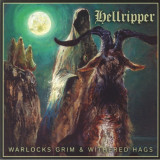
Inspired by the likes of old-school legends including Venom, Kreator, Sabbat JPN & Metallica, James McBain formed Hellripper in 2014, showcasing an electrifying brand of blackened thrash. Building on the already impressive foundations laid by their early EP & split releases, the first full-length album, Coagulating Darkness',
was released in 2017 to media acclaim, with the UK's Metal Hammer hailing Hellripper as Scotland's King of the arcane mosh & the band receiving notable attention throughout Europe & the US. This was followed by the Black Arts & Alchemy' EP, before an eventual deal was inked with Peaceville Records, resulting in the masterful The Affair Of The Poisons', further propelling the band to the forefront of the UK metal scene. Warlocks Grim & Withered Hags' - Hellripper's third studio album - establishes a new threshold of excellence & raises the bar further over The Affair Of The Poisons', with an opus standing at the crossroads between the sound that Hellripper has become known for & a whirlwind of different influences up until now yet to be explored, resulting in James McBain's most personal & diverse
work to date. With a greatly expanded scope to the tracks, incorporating more epic & melodic blackened anthems alongside the high- speed metal attack & blistering solos, Warlocks Grim & Withered Hags' marks a new highpoint for the band. Inspired by the landscapes & legends of the Scottish highlands, McBain explores the darker side of Scottish history & folklore - the title itself taken from a
line in the Robert Burns poem,Address to the Deil' - as well as including references to clan culture (including his own) throughout the album. For example, one of the tracks ( The Cursed Carrion Crown') is based on the legend of Sawney
Bean' & the Bean Clan (a spelling variation of McBain'') & tells the story of a family of cannibals that lived in a cave & committed various gruesome acts. As always, the writing & recording process was carried out by James McBain himself, with a few guests offering contributions in the form of additional vocals & instrumental
parts. With recording taking place between March 2021 & June 2022, the album was also mixed by McBain & mastered by Damian Herring at Subterranean Watchtower Studios. The suitably sinister & ominous artwork appears courtesy of Adam Burke. Hellripper will be embarking upon a series of shows in support of the album throughout 2023.
A heavy old school sound reverberates from the Midlands reggae scene, one which remains unrivalled across the UK and is perfectly summed up by Capital Letters, whose mixing from 1985 is of an impeccable quality, here rereleased for reggae fans everywhere. Reality by Capital Letters should be a collectors favourite and a new generations introduction, it is a brilliant revival of classic authentic material and overall vibrant piece of work.
Blackploid has become one of Central Processing Unit's stalwarts in the past couple of years. Martin Matiske's project contributed a trio of EPs to the Sheffield label across 2021 and 2022, with each of them showing off the kind of electro chops and production sensibilities that made Blackploid an ideal fit for an imprint which also boasts the likes of Cygnus, Silicon Scally and Bochum Welt among its catalogue.
Now, for CPU's first release of 2023, Matiske levels things up with the debut Blackploid LPEnter Universe. Across these twelve tracks, Matiske leaves us in no doubt that he's a prime mover in the world of modern electronic music.Enter Universedoes not let up from start to finish, delivering a dozen pieces of leftfield electro that draws from the sound's greats while also showcasing an unpredictability and flair that is all of Blackploid's own.
The tone is set from the first frosty chords of opening cut 'Pulsation'. The track traverses the starscape on pitter-patter drums and chirruping synths, a lively and slightly dystopian roller with an adventurous undercurrent reminiscent of classic Rephlex drops. It's a style which Blackploid often draws for throughout the rest ofEnter Universe, albeit with elements added or subtracted at each stage.
Indeed, this album features some of the most unusual production you will hear on any record this year. While the grooves pulse away in a manner reminiscent of Drexciya or Legowelt, Blackploid layers the mixes with a whole cornucopia of synth tones. 'The Mission' boasts a bleep-bloop breakdown that sounds like malfunctioning rotary telephones; 'Silent Room' is a ghoulish jam which harks back to Warp's legendary Artificial Intelligence compilations; 'Automatik' and 'Wormhole' are defined by some brilliantly strange low-ends - you'll be thinking of Mr. Oizo's 'Flat Beat' with the wiggly former, while the gurgling, writhing anti-lead that dictates 'Wormhole' is oddly thrilling and more than befits the track's title.
This inventive approach is also apparent in some of the structural choices onEnter Universe. While the tracks here all keep a steady, dancefloor friendly pulse, several of them surprise you by switching up the approach after a minute or two. 'Pulsation', 'Automatik' and 'The Mission' all feature moments where a new element - extra hi-hats, a synth line entering from leftfield - inject fresh impetus into the tune to keep the listener on their toes.
Blackploid may push the sonic envelope onEnter Universe, but this does not mean there is no room for melody. In particular, the cuts here which most strongly channel 'Computer World'-era Kraftwerk do so by fronting some slyly tuneful work, particularly in the low end of the mix. 'Unidentified' serves up delightfully springy chords, 'Cell Mutation' leads from the bassline, and 'Space Curve' features little cells of melody and counter-melody working together to closeEnter Universeout on a high.
Blackploid's debut LP Enter Universe marries Drexciyan electro and Warp-school electronica with some brilliantly inventive production choices.
- A1: Raymond Guiot - District Machine
- A2: Gabriel Yared - Vocal In Love
- A3: Slim Pezin - Mam's Song
- A4: Pierre-Alain Dahan - Rythmique N°3
- A5: Georges Chatelain - Piège Nocturne
- A6: Bernard Lubat - Rocket 2
- A7: Janko Nilovic - Pop Percussions
- B1: Raymond Guiot - Bass Duettino
- B2: Guy Pedersen - Les Copains De La Basse
- B3: Marc Chantereau & Pierre-Alain Dahan - Synthétiseur & Company
- B4: Bernard Estardy - Phasing Round
- B5: Pierre-Alain Dahan & Mat Camison - Mister Mistery
- B6: Raymond Guiot - Oriental Vibrato
- C1: Pierre-Alain Dahan & Mat Camison - West Coast Drive
- C2: Jean-Jacques Debout - Mitsuko
- C3: Hervé Roy - Percussionissimo
- C4: Luis Conti & François Langel - Midnight Rendez-Vous
- C5: Pierre-Alain Dahan & Mat Camison - Rythmique N°8
- C6: Michel Gonet - Suspense Time
- C7: Sauveur Mallia - Meteor One
- D1: Bernard Estardy - Gang Train
- D2: Pierre-Alain Dahan - Rythmiques N°2
- D3: Bernard Estardy - Vertigo Leitmotiv
- D4: Georges Chatelain & Hervé Roy - Voix D'eau
- D5: Luis Conti & François Langel - Sierra Sunrise
- D6: Jean-Jacques Debout - Bossa A Gogo
Welcome to the third part of the TELE MUSIC saga, the label founded by Roger Tokarz. He deeply marked the era with his audacity and his vision of music on film. This irresistible new selection tells the story from 1968 to 1985 of a prolific label that sometimes produced ten albums a year, and which delighted many French and foreign film directors who, to 'flavour' their films, drew on this sumptuous catalogue.
In this volume 3 TELE MUSIC, we have highlighted legendary artists who have left an indelible mark on the history of the music bookshop and on the history of music in general:
• Janko Nilovic (also known as Yanko Nilovic, Anady Loore, E. Orti or Alan Blackwell),
• Jean-Jacques Debout with his irresistible “Mitsuko” released in 1967 and re-released in 1969 on “Music Bazaar”, • Bernard Lubat, the impressive percussionist, vibraphonist, multi-instrumentalist and very good “scator” (Bernard played in the Doubles Six with Quincy Jones and Eddy Louiss),
• Gabriel Yared, the man with a hundred film scores. Arranger and composer for Johnny Hallyday and Charles Aznavour, among others!
• Hervé Roy conductor and writer for Nancy Holloway,
• George Chatelain, pianist, guitarist, clarinettist, founder of the famous studio “CBE” created in 1966 with his sister Janine Bisson and his high school friend Bernard Estardy.
All these composers were renowned for their acute sense of composition, arrangement, conducting and inter- pretation, and in their own way left their mark on many sound recordings of musical illustration "made in France!
CBE, the Chatelain, Bisson and Estardy studio is located in the 18th arrondissement of Paris. Still in operation and run by Julie Estardy, it has been receiving major artists for over half a century. It is a place of reference. At the time: Johnny Hallyday, Claude François, Sheila, Carlos, Françoise Hardy, Nino Ferrer recorded their hits there.
Now it's the turn of Sebastien Tellier, Bertrand Burgalat, Keziah Jones, Tony Allen, Jeff Miles to name but a few. CBE and its giant Bernard Estardy put TELE MUSIC in the best conditions to produce an atypical and powerful sound.
Bernard Estardy had a custom- built mixing console built by his German friend Gunther Loof, offering the perfect tool for recording 4 and then 32-track Arp 2000, Moog, Korg, Prophet synthesizers and all acoustic instruments. The field of experi- mentation was limitless.
Until now, the titles of this collection were only available in vinyl format, via rare and expensive prints that collectors sell for a high price on dedicated websites. This volume 3 gives you access to the "crème de la crème" of the legendary repertoire made in France!
Icons of the pioneers of the Chilean punk scene and the darker side of a pseudo new-wave born out of the last gasps of Pinochet’s regime, Índice de Desempleo was started in Santiago de Chile in 1986 by four still-in-school-mates: Tatán Millas on bass/voice, Cristóbal Pfennings on keyboards, Pablo Hermansen on guitar and Huevo Díaz on drums. Warema KK recovers the very first (and only) recordings of the band, made in 1988, by then featuring Judith Harders on drums and Andrés Poirot on guitar, as the band had already undergone one of many line-up changes to come. As intimate as they are wild, both sides of this record offer a glimpse of the eclectic style the band subsequently explored during nearly five years of live performances ahead, going through several formations and musical approaches, as they synthesized influences from earlier punk and hardcore, garage, urban-funk and whatever they felt was useful to appropriate and re-use within the anarchic, D.I.Y. spirit of true punk. With lyrics “inspired by French symbolist poetry”, throughout the years, Índice de Desempleo was always committed to exposing the social discomfort of that era in Santiago, a city they often described as “greyish, boring and flat”. Original cover art by Marcela Trujillo, published by HR in a limited edition of 100 copies.
Grim Beazley translates the mix of chaos and calm of the Australian bush into his new album Big World. It is a fascinating listen that combines "sounds and stories with deep evolutionary narratives" into soundscapes that are both dreamy and meditative. There is a strong emotional connection in these sounds as environmental themes bubble up next to fusions of house and trance that are both old school chill yet futuristic. 'Acheron Way' is the loose-limbed and breezy opener, 'Big World' has deeper Chicago drums, 'Eucal Regnans' has a more celestial electro vibe and 'Reefer Red Gum' is a post-rave comedown.
- A1: Ringa Ringa (The Old Pandemic Folk Song) (Feat. The Mediaeval Baebes)
- A2: Day One (Feat. Dina Ipavic)
- A3: Are You Alive? (Feat. Penelope Isles)
- B1: You Are The Frequency (Feat. The Little Pest)
- B2: The New Abnormal
- C1: Home (Feat. Anna B Savage)
- C2: Dirty Rat
- C3: Requiem For The Pre-Apocalypse
- D1: What A Surprise (Feat. The Little Pest)
- D2: Moon Princess (Feat. Coppe)
White Vinyl[33,24 €]
DOUBLE BLACK LP : 2 x 140 G Black Vinyl , Sleeve & 2 x Heavy Weight Printed Inner with UV Gloss Finish
Legendary electronic music duo Orbital return Early 2023 with new album “Optical Delusion”, the Hartnoll brothers first studio album since 2018’s Monster’s Exist. Recorded in Orbital’s Brighton studio, “Optical Delusion” includes contributions from Sleaford Mods, Penelope Isles, Anna B Savage, The Little Pest, Dina Ipavic, Coppe, and perhaps most surprisingly, The Medieval Baebes.
Earlier this year, Orbital celebrated their storied history with “30 Something” which, unlike other Best Of’s, contains reworks, remakes, remixes and re-imaginings of landmark Orbital tracks including “Chime”, “Belfast”, “Halcyon”, “Satan”, and “The Box”
SHORT BIOG:
“A human being experiences himself, his thoughts and feelings as something separate from the rest of humanity – a kind of optical delusion of his consciousness. This delusion is a kind of prison for us, restricting us to our personal desires and to affection for a few persons nearest to us. Our task must be to free ourselves from this prison…”
You many have seen this quote attributed to Albert Einstein on social media, the archetypal Smartest Guy Ever apparently having an out-of-character religious epiphany. It certainly leapt out at Paul Hartnoll of Orbital who spotted it in Michael Pollan’s 2018 book How to Change Your Mind: What the New Science of Psychedelics Teaches Us About Consciousness, Dying, Addiction, Depression and Transcendence.
“As soon as I saw ‘optical delusion’ I thought Oh hey, that’s the album title,” says Paul. “It just seemed to say so much about how people construct their own realities, how we see patterns that aren’t there, how we see what we want to see.
“But it’s actually a misquote. He never quite said that. In the German original what he’s really saying is that human experience is as relative as physics. Wouldn’t it be good if we could accept that, and find a kind of universal theory of everything for the human race? Then you look at everything from history to art to your Twitter feed and you think yeah, that’s what we’re all trying to do all of the time…”
Hence ‘Optical Delusion’, the tenth original Orbital album and the latest in a burst of renewed post-pandemic creativity for two brothers who’ve stayed at the top of their game longer than anyone from the post-1988 Class of Acid House.
Now with ‘Optical Delusion’ the Hartnolls dig deeper into the unquiet psyche of our increasingly surreal and disordered world. Sketched out partly during lockdown but fully recorded in the uncertain After Times, the album summons up conflicting emotions and sometimes beguiling images from years when the science fiction doomsdays that the Hartnolls watched on TV as kids finally came true. There are mesmeric tracks with names like ‘The New Abnormal’ and ‘Requiem For The Pre-Apocalypse’ and ‘Day One’. But there are also straight-up bangers and ethereal cosmic dreams, abstract sound wars and deeply human songs of separation and loss.
And it all starts with a bang. Lead single ‘Dirty Rat’, an outright Fall-meets-Front-242 class rant with vocals by Sleaford Mods mob orator Jason Williamson, harks right back to the Hartnolls’ days of politicised anarcho-squatpunk. It began as a remix swap (Orbital did the Sleafords’ ‘I Don’t Rate You’) and morphed into a comic, brutal, bass-driven harangue not so much against our rulers but at the petty, mean-spirited, frightened, Mail-reading voters who put them there: the people who are “blaming everyone in hospital/blaming everyone at the bottom of the English Channel/blaming everyone who doesn’t look like a fried animal.”
Also key to the album is opening track ‘Ringa Ringa (The Old Pandemic Folk Song)’ which returns to an Orbital truism, that time always becomes a loop. This chugging, cyclical Orbital groove gives way to an unnerving past-meets-present timeslip fit for ‘Sapphire And Steel’ as goth maenads The Mediaeval Baebes materialise to sing ‘Ring O’Roses’ – the innocent nursery rhyme whose roots are in the Black Death.
“I’ve always liked folk music and mediaeval sounds,” says Paul, himself an occasional Morris dancer. “I had the basis of that track and I wanted to spin it off somehow.” Trawling his archives he stumbled on The Mediaeval Baebes’ version of ‘Ring O’Roses’ “and my hackles just went up. I was like, my God, this is the original pandemic folk song.”
?his being Orbital, there are collaborations galore on the album, the roles once played by Alison Goldfrapp, Lady Leshurr or David Gray now filled by new talents. London singer-songwriter Anna B Savage contributes a compellingly fragile, Anohni-like vocal to ‘Home’, in which nature reclaims the scorched and vacant mega-cities. ‘Day One’ is a pulsing techno track featuring the singer Dina Ipavic. Paul got in touch with her after working on a score for a sculpture show of giant robotic installations by his friend Giles Walker during the pandemic. First Paul cut up his own score and Ipavic’s vocals on the track The Crane, which appears on the deluxe version of the album. Then he thought, Why not work with her for real? The result is school of ‘Belfast’, a bassy dreamscape with vocalised clouds billowing above.
The pensive ‘Are You ?live?’ adds to the Orbital product range of existential questions (‘Are We Here?’, ‘Where Is It Going?’) in collaboration Bella Union signings Penelope Isles, AKA brother and sister act Lily and Jack Wolter. “They’re our studio mates, they work upstairs!” says Paul happily. “And they’ve both got amazing voices.”
But Orbital are Orbital and never far from the dancefloor. “Eventually the more abrasive bits came back into the fold…” ‘You Are The Frequency’, first of two tracks to feature mysterious vocalist The Little Pest, surrounds the listener with warped voices ordering you to the dancefloor (Phil: “we wanted the idea that the music is kind of absorbing you”). And the second, the sinister ‘What A Surprise’, traps you in a paranoid electronic hall of mirrors.
In another nod to Orbital’s resurgent past the cover artwork once again comes from fine art painter John Greenwood, creator of fantastical grotesques for the covers of ‘Snivilisation’, ‘In Sides’ and Orbital’s most recent album, 2018’s ‘Monsters Exist’. Orbital had just had a slick Mark Farrow cover for ‘30 Something’ – this is a return to the overripe and bulbous techno-organic constructions that somehow express Orbital’s own uncontrollably fertile sound.
There are gaps in the future that Orbital are desperate to fill too; there will be tours and festivals and rooms and fields full of people. Those long paralysed months when we had little to look forward to but a Zoom DJ set made Paul and Phil appreciate the things that make life worth living.
- A1: Ringa Ringa (The Old Pandemic Folk Song) (Feat. The Mediaeval Baebes)
- A2: Day One (Feat. Dina Ipavic)
- A3: Are You Alive? (Feat. Penelope Isles)
- B1: You Are The Frequency (Feat. The Little Pest)
- B2: The New Abnormal
- C1: Home (Feat. Anna B Savage)
- C2: Dirty Rat
- C3: Requiem For The Pre-Apocalypse
- D1: What A Surprise (Feat. The Little Pest)
- D2: Moon Princess (Feat. Coppe)
Black Vinyl[31,05 €]
2 x Solid White LP, 5mm spine Sleeve UV Gloss Finish, 2x Heavy Weight Printed Inner Sleeve UV Gloss finish, marketing sticker.
Legendary electronic music duo Orbital return Early 2023 with new album “Optical Delusion”, the Hartnoll brothers first studio album since 2018’s Monster’s Exist. Recorded in Orbital’s Brighton studio, “Optical Delusion” includes contributions from Sleaford Mods, Penelope Isles, Anna B Savage, The Little Pest, Dina Ipavic, Coppe, and perhaps most surprisingly, The Medieval Baebes.
Earlier this year, Orbital celebrated their storied history with “30 Something” which, unlike other Best Of’s, contains reworks, remakes, remixes and re-imaginings of landmark Orbital tracks including “Chime”, “Belfast”, “Halcyon”, “Satan”, and “The Box”
SHORT BIOG:
“A human being experiences himself, his thoughts and feelings as something separate from the rest of humanity – a kind of optical delusion of his consciousness. This delusion is a kind of prison for us, restricting us to our personal desires and to affection for a few persons nearest to us. Our task must be to free ourselves from this prison…”
You many have seen this quote attributed to Albert Einstein on social media, the archetypal Smartest Guy Ever apparently having an out-of-character religious epiphany. It certainly leapt out at Paul Hartnoll of Orbital who spotted it in Michael Pollan’s 2018 book How to Change Your Mind: What the New Science of Psychedelics Teaches Us About Consciousness, Dying, Addiction, Depression and Transcendence.
“As soon as I saw ‘optical delusion’ I thought Oh hey, that’s the album title,” says Paul. “It just seemed to say so much about how people construct their own realities, how we see patterns that aren’t there, how we see what we want to see.
“But it’s actually a misquote. He never quite said that. In the German original what he’s really saying is that human experience is as relative as physics. Wouldn’t it be good if we could accept that, and find a kind of universal theory of everything for the human race? Then you look at everything from history to art to your Twitter feed and you think yeah, that’s what we’re all trying to do all of the time…”
Hence ‘Optical Delusion’, the tenth original Orbital album and the latest in a burst of renewed post-pandemic creativity for two brothers who’ve stayed at the top of their game longer than anyone from the post-1988 Class of Acid House.
Now with ‘Optical Delusion’ the Hartnolls dig deeper into the unquiet psyche of our increasingly surreal and disordered world. Sketched out partly during lockdown but fully recorded in the uncertain After Times, the album summons up conflicting emotions and sometimes beguiling images from years when the science fiction doomsdays that the Hartnolls watched on TV as kids finally came true. There are mesmeric tracks with names like ‘The New Abnormal’ and ‘Requiem For The Pre-Apocalypse’ and ‘Day One’. But there are also straight-up bangers and ethereal cosmic dreams, abstract sound wars and deeply human songs of separation and loss.
And it all starts with a bang. Lead single ‘Dirty Rat’, an outright Fall-meets-Front-242 class rant with vocals by Sleaford Mods mob orator Jason Williamson, harks right back to the Hartnolls’ days of politicised anarcho-squatpunk. It began as a remix swap (Orbital did the Sleafords’ ‘I Don’t Rate You’) and morphed into a comic, brutal, bass-driven harangue not so much against our rulers but at the petty, mean-spirited, frightened, Mail-reading voters who put them there: the people who are “blaming everyone in hospital/blaming everyone at the bottom of the English Channel/blaming everyone who doesn’t look like a fried animal.”
Also key to the album is opening track ‘Ringa Ringa (The Old Pandemic Folk Song)’ which returns to an Orbital truism, that time always becomes a loop. This chugging, cyclical Orbital groove gives way to an unnerving past-meets-present timeslip fit for ‘Sapphire And Steel’ as goth maenads The Mediaeval Baebes materialise to sing ‘Ring O’Roses’ – the innocent nursery rhyme whose roots are in the Black Death.
“I’ve always liked folk music and mediaeval sounds,” says Paul, himself an occasional Morris dancer. “I had the basis of that track and I wanted to spin it off somehow.” Trawling his archives he stumbled on The Mediaeval Baebes’ version of ‘Ring O’Roses’ “and my hackles just went up. I was like, my God, this is the original pandemic folk song.”
?his being Orbital, there are collaborations galore on the album, the roles once played by Alison Goldfrapp, Lady Leshurr or David Gray now filled by new talents. London singer-songwriter Anna B Savage contributes a compellingly fragile, Anohni-like vocal to ‘Home’, in which nature reclaims the scorched and vacant mega-cities. ‘Day One’ is a pulsing techno track featuring the singer Dina Ipavic. Paul got in touch with her after working on a score for a sculpture show of giant robotic installations by his friend Giles Walker during the pandemic. First Paul cut up his own score and Ipavic’s vocals on the track The Crane, which appears on the deluxe version of the album. Then he thought, Why not work with her for real? The result is school of ‘Belfast’, a bassy dreamscape with vocalised clouds billowing above.
The pensive ‘Are You ?live?’ adds to the Orbital product range of existential questions (‘Are We Here?’, ‘Where Is It Going?’) in collaboration Bella Union signings Penelope Isles, AKA brother and sister act Lily and Jack Wolter. “They’re our studio mates, they work upstairs!” says Paul happily. “And they’ve both got amazing voices.”
But Orbital are Orbital and never far from the dancefloor. “Eventually the more abrasive bits came back into the fold…” ‘You Are The Frequency’, first of two tracks to feature mysterious vocalist The Little Pest, surrounds the listener with warped voices ordering you to the dancefloor (Phil: “we wanted the idea that the music is kind of absorbing you”). And the second, the sinister ‘What A Surprise’, traps you in a paranoid electronic hall of mirrors.
In another nod to Orbital’s resurgent past the cover artwork once again comes from fine art painter John Greenwood, creator of fantastical grotesques for the covers of ‘Snivilisation’, ‘In Sides’ and Orbital’s most recent album, 2018’s ‘Monsters Exist’. Orbital had just had a slick Mark Farrow cover for ‘30 Something’ – this is a return to the overripe and bulbous techno-organic constructions that somehow express Orbital’s own uncontrollably fertile sound.
There are gaps in the future that Orbital are desperate to fill too; there will be tours and festivals and rooms and fields full of people. Those long paralysed months when we had little to look forward to but a Zoom DJ set made Paul and Phil appreciate the things that make life worth living.
2023 REPRESS in Ltd Transparent Vinyl
Strut are proud to announce the first ever internationally released new studio album by one of the all-time legends of Nigerian music, Orlando Julius, in a mouth-watering new collaboration with London super-group The Heliocentrics. At his club residency in Ibadan, Orlando Julius was one of the very first to begin fusing US R&B with traditional highlife during the mid-'60s with his Modern Aces band. His 'Super Afro Soul' album from '66 set the blueprint for a whole generation of Afrobeat and Afro funk stars and, in an illustrious career, Julius met and played with Louis Armstrong, The Crusaders, Hugh Masekela and Lamont Dozier among others, famously co-composing the classic 'Going Back To My Roots' in 1979 whilst based in the USA.
or 'Jaiyede Afro', Julius takes us back to his own roots, revisiting several compositions from h s early years whi ch have never previ ousl y been recorded. The title track recal l s his experiences as a boy: 'my mother would go to group meetings with other women. They would sing together and play drums, I would play along with them and we would sing this song together.' Infectious chant 'Omo Oba Blues' is a traditional song sung at Julius' school which he re-arranged in 1965 for his Modern Aces band. The epic Afrobeat jam 'Be Counted' stems from his years in the USA: 'this was written around 1976 while I was living on the West coast. I did start recording it for the 'Sisi Sade' album around 1985 but it was never finished.'
Other tracks include 'Buje Buje' and 'Aseni', both re-worked arrangements from his rare 'Orlando Julius and The Afro Sounders' album from 1973.
Recorded at the Heliocentrics' fully analogue HQ in North London, the band follow their memorable collaborations with Mulatu Astatke and Lloyd Miller by taking Orlando's sound into new, progressive directions, retaining the raw grit of his early work and adding psychedelic touches and adventurous new arrangements. They also contribute live favourite, the James Brown cover 'In The Middle' and a series of memorable shorter interludes.
Renaldo Domino
Chicago Soul Legend
Born March 27th 1950) from “The Valley” around 49th & Forestville.
He was nicknamed Domino because his voice was sweet as sugar, Domino being an American sugar brand name.
Renaldo Domino blasted onto the fertile Chicago soul scene of the late 60's with a voice as sweet as sugar and deep grooves that sound just as fresh five decades later. Releasing singles on Mercury subsidiaries Smash and Blue Rock, and later Twinight records, Renaldo’s all-too-brief career has still managed to leave an impact to all those lucky enough to hear it.
He had a relatively short recording career releasing only 7 singles between 1967-1971. His first 45 was recorded whilst he was still attending high school on a tiny label Arnell on a low budget.
The Arnell 45 did well enough for him to get signed to Smash (a Mercury subsidiary) where he released two 45s, re-recording 'I'm Hip To Your Game' for his second Smash single, as it's a different version to the one released on Arnell. His third 45 was released on another Mercury subsidiary, the now revived Blue Rock which had been 'suspended' since 1966 and reacivated in 1968. The records sold reasonably well locally but Dominio left to join Twinight, feeling that his material wasn't being promoted by Mercury, where he released a further three singles between 1969-71. Twinight released him in 1971 and despite trying to get another recording contract he was unsuccessful and left the music business to pursue another career.
He was managed by William Sandy Johnson who also managed LaShawn Collins and Wendy Woods who recorded on Johnson's Sincere label, the only 2 releases on the label. He also wrote Renaldo Domino's first 4 A sides: 'I'm Getting Nearer To Your Love', 'Just Say The Word', 'Not Too Cool To Cry', 'Let Me Come Within'. In addition he wrote 'Do It Now' for Wendy Woods and the flip to LaShawn Collin's classic 'What You Gonna Do Now', 'Girl Chooses The Boy'.
Renaldo returned to the spotlight in 2007 when the Chicago reissue powerhouse Numero Group put him on the cover of their deluxe box set Eccentric Soul: Twinight's Lunar Rotation (which included other greats Syl Johnson, The Notations, and many more). Renaldo’s performing career began to flourish once again with shows around country.
In early 2019 Renaldo teamed up with producer Jeremy Kay and arranger JB Flatt and set out to record new tracks that would live up to Renaldo’s great early records. Assembling a crack team of Brooklyn’s best they pulled out all the stops, creating a mix between the lush arrangements of Chicago’s early soul style and the hard-hitting beat of current Brooklyn soul. The new single “No Laggin’ & Draggin’” / “Give Up The Love”, released Feb 2020, is now available on Colemine Records.
Backed by The Heavy Sounds, Renaldo’s live performances continue to deliver with passion and precision, making new fans young and old.
Steve Moore's Lovelock is back with Washington Park, a gorgeous suite of instrumental lounge music that can only be described as synth exotica. A real departure for Steve, this is a more mellow, soothing sound and can be regarded as Lovelock's response to these dystopian times.
New York-based multi-instrumentalist/producer/film composer Steve Moore is probably best known for his synthesizer and bass guitar work as Zombi, together with Anthony Paterra. Yet his Lovelock alias has been quietly blowing minds and warming hearts for a decade plus now. His latest effort, Washington Park, was not initially meant to be a Lovelock album. But Steve was posting little snippets of his work on Instagram and people started asking him: "is this new Lovelock?" It was at this point that Steve had an epiphany, of sorts. "It occurred to me that Lovelock can be whatever I want it to be. So yeah, maybe this new lounge/exotica record is, in fact, Lovelock."
Washington Park creeped out in a very low-key, early lockdown fashion and there wasn't much of a reaction. Says Steve, "I just self-released it and all my usual suspects were down with it, but it didn't really make it outside of my own circle." Yet many of the Balearic heads in Europe were indeed on it and Be With were most certainly listening. So, when we struck a deal to do the vinyl version of Burning Feeling, we couldn't resist asking about Washington Park.
Gentle opener "It Means Love" grooves along in the laconic style, conjuring carousel innocence and complimented by dreamy, spiritual sax and syrupy synth strings over a digi-soul beats. Title-track "Washington Park" glides smoothly in much the same vein, almost like a slightly more acidic, squelchier version of the preceding track with more insistent organ. Swoon. Closing out Side A, steady ambient gem "We'll See" is all gorgeous, soft pads with plaintive guitar and organ giving way to soaring digital strings over that metronomic drum machine soul.
Flip for the eerily brilliant "Seduction", a track which starts like a minimalist slice of Tommy Guerrero-esque guitar and drum machine soul but soon takes on a more menacing bent as Steve leans into his long-held predilection for horror by creating a slow-mo haunted house jam. The tempo (and temperature) rises with "Center Square", a Latin rhythm section and a sensual sax rubbing up against hot and heavy organ and string action. Steamy! To round things off, the ominous creeping groove of "Rhythm 77" feels like exotica-in-excelsis.
Washington Park was recorded over the first few months of the pandemic, during the spring of 2020, against the backdrop of his kids being out of school which meant daily walks and bike rides through Washington Park in Albany. It was during these moments of family activity and gentle movements, trying to make sense of the chaos engulfing his world, that Steve formed the ideas that led to this album. To make it manifest, he used all his old Roland beat boxes (CR-78, Rhythm 77 and Rhythm 330, Rhythm Arranger) plus a Chamberlin Rhythmate for all the percussion. Basslines were usually performed with his Moog Source or Minitaur and for pads and brass he used his Sequential Prophet 600 and Roland Juno 60. Strings came via a variety of old stringers - Korg Polysix, Elka Rhapsody, Crumar Orchestrator and Solina String Ensemble - and he also used his Fender Strat and Yamaha Custom saxophone.
Steve is a huge fan of exotica and that's clearly where this album is coming from. The likes of Martin Denny, Les Baxter and Henry Mancini can all be discerned here. As Steve explained, "I spent a lot of time listening to that stuff in the 90s and I figured it was time to let those influences show." You're going to be glad he did.
Mastering for the Washington Park vinyl edition was overseen by Be With regular Simon Francis before being cut by Cicely Blaston of Alchemy Mastering at AIR Studios and pressed in the Netherlands by Record Industry.
50 years after the genre turned the music world upside-down, GRADE 2 bring the raw power of old school punk to a new generation. Their second release on Tim Armstrong’s legendary Hellcat Records is a thumping 15 track tour de force melding the uncompromising ethos of punk with the howl of contemporary injustice, personal identity and frustrations of Gen-Z youth, authentically told by three lads with punk
coursing through their veins.
Formed on their native Isle of Wight when they were just 14 years old, Jack Chatfield (guitar & vocals), Jacob Hull (drums) and Sid Ryan (bass & vocals) honed their craft covering punk pioneers before creating a sound uniquely theirs: ten years on, the eponymous Grade 2 is their magnum opus.
The new album was produced by the band along with Tim Timebomb (Armstrong) and T.J. Rivers at Armstrong’s Ship Rec Studio in Los Angeles. “Returning to Ship Rec Studio resparked that magic dynamic” says guitarist Jack Chatfield. “When we’re in there I feel like we reach our full potential.
Tim would offer tweaks and tips for some songs, while others he’d compliment as finished first time we played them.” “We worked flat-out recording this record,” says drummer Jacob Hull, “but we never felt pressured, Tim keeping us in the zone to make the best tunes of our lives.
Limited Yellow Coloured Vinyl Edition
50 years after the genre turned the music world upside-down, GRADE 2 bring the raw power of old school punk to a new generation. Their second release on Tim Armstrong’s legendary Hellcat Records is a thumping 15 track tour de force melding the uncompromising ethos of punk with the howl of contemporary injustice, personal identity and frustrations of Gen-Z youth, authentically told by three lads with punk
coursing through their veins.
Formed on their native Isle of Wight when they were just 14 years old, Jack Chatfield (guitar & vocals), Jacob Hull (drums) and Sid Ryan (bass & vocals) honed their craft covering punk pioneers before creating a sound uniquely theirs: ten years on, the eponymous Grade 2 is their magnum opus.
The new album was produced by the band along with Tim Timebomb (Armstrong) and T.J. Rivers at Armstrong’s Ship Rec Studio in Los Angeles. “Returning to Ship Rec Studio resparked that magic dynamic” says guitarist Jack Chatfield. “When we’re in there I feel like we reach our full potential.
Tim would offer tweaks and tips for some songs, while others he’d compliment as finished first time we played them.” “We worked flat-out recording this record,” says drummer Jacob Hull, “but we never felt pressured, Tim keeping us in the zone to make the best tunes of our lives.
Daddies of riff, shuffle, southern swing, with backbeat and chicken funk spiel, all very much "Sons of Memphis", these six established performers, in the pure Stax/Atlantic style, produce a profound Deep Soul, held together by a hot and groovy bass, a V8 drumbeat, a possessed trombone, a charismatic and powerful lead vocal, and a roaring Hammond Leslie united with the spring reverb guitar and its 60"s tremolo. Zoot suit, black and white Derbys, dark glasses, this Take 6 knows the song, the story and all the strings of the Soulman with that little added extra, the irresistible French touch embellished by their roots in the Bearn, in the Pyrenees. This energetic combo creates fireworks on stage and through them Deep Soul remains what it has always been, a music of hope! Of sharing! Music of the soul! The soul revelation of 2021/2022!! The SuperSoul Brothers began in 2016 as a quartet (bass, drums,guitar, vocals) working relentlessly through the year, with rehearsal after rehearsal. In 2017 came their first concert. The keyboards arrived in 2018. The final balance came in 2019 with the arrival of the trombone. Take 6 was the magical formula. In 2020 their first album, "Shadows and Lights" was written and recorded old-school style. That summer, they fronted the NEG "MARRONS at the Pau Summer Festival. In 2021 they signed with Dixiefrog Records and released their first global album, "Shadows and Lights". The newly created stage show, "Soul Revue" is ready to roll.
- A1: Olga Gutierrez - A Veces He Pensado
- A2: Hermanas Mendoza Suasti - Alas De Sombra
- A3: Benitez Y Valencia - Amor En Tus Ojos
- A4: Caspi Shungo - Mal Pago
- A5: Gladys Viera - Palomita Cuculi
- A6: Orquesta Nacional - Ponchito Al Hombro
- B1: Lida Uquillas - Tengo Un Amor
- B2: Los Inaquingas - Blanco Lirio
- B3: Segundo Bautista - La Naranja
- B4: Benitez Y Valencia - Lindos Ojos
- B5: Los Barrieros - Siendo Triste Vivo Alegre
- B6: Segundo Bautista - Soledad
- C1: Raul Emiliani Y Hector Bonilla - Imploracion Indigena
- C2: Caspi Shungo - Indio Soy
- C3: Duo Aguayo Huayamabe - Mi Ultima Ilusion
- C4: Conjunto Caife - Huasipichay
- C5: Hermanas Mendoza Suasti - Para Ti
- C6: Olga Gutierrez - Despedida
- C7: Lucho Munoz - Lamparilla
- D1: Hermanos Valencia - Destrozado Corazon
- D2: Luis Alberto Valencia - Toro Barroso
- D3: Los Barrieros - Ashcu De Primo
- D4: Duo Aguayo Huayamabe - Panuelo De Penas
- D5: Hermanas Mendoza Suasti - Alma Enamorada
- D6: Benitez Y Valencia - Lamparilla
- D7: Orquesta Nacional - Atahualpa
Impatiently returning to the golden age of Ecuadorian musica national, this second round of retrievals is more of a selectors’ affair: less reverent, more free-flowing, with more twists and turns. There is no let-up in musical quality, maintaining the same judicious, heart-piercing balance between emotional desolation and dignified endurance, the same bitter-sweet play between affective excess and musical sublimity.
This time around, the woman steal the show. Laura and Mercedes Suasti were child stars, with an exclusive Radio Quito contract. Unlike nearly all the men here, they lived long and prospered: Mercedes died last year, at the age of 93. Gladys Viera and Olga Gutierrez both came to Ecuador from Argentina. To start, Gladys plugged the scandalous new Monokini swimwear; Olga performed for visiting British royalty in 1962. Olga was glamorous but tough. She would make little of the amputation of one of her legs: ‘I don’t sing with my leg.’ She is accompanied on our opener by quintessentially reeling, sultry musica national: haunted-house organ, twinkling xylophone, Guillermo Rodriguez’ heart-plucking guitar-playing, and lilting, dance-to-keep-from-crying double-bass. ‘Sometimes I think that you will leave me with no memories,’ she sings, ‘that you hold only disappointments in store for me… In the future your love will search me out, full of regret. By then it will be too late, there will be no consolation, only disappointment awaiting you.’
Other highlights include the two contributions of Orquesta Nacional: Ponchito Al Hombro, like an off-the-wall forerunner of the Love Unlimited Orchestra, beamed into the tropics from an unknowable time and space; and the tone poem Atahualpa, a mystical yumbo invoking Quito’s most ancient inhabitants, the Kichwa. Also the tremulous, gypsy-flavoured violin-playing of Raul Emiliani, who arrived in Quito from Italy, suffering PTSD from the Second World War; the inscrutable, sardonic experimentalism of organist Lucho Munoz; and the mooing and whistling of Toro Barroso — school of Lee Perry — in which a muddy bull dashes home to his darling chola, fearless, full of desire.
Lavishly presented, with a full-size, full-colour booklet, with transporting art-work and expert notes. Luminous sound, by way of Abbey Road, D&M and Pallas.
Ever dream you're in a spaceship on a never-ending journey to an unknowable destination? That's how Nyles Lannon often thought of life in the early part of the pandemic, when time seemed to stand still, before the vaccines or even knowing when there might be any. But whether that spaceship is a desolate prison or a vessel for escaping to a better world depends on how you use it. With literally nowhere to go, the Film School guitarist and his then-12-year-old son Skye, on drums and modular synths, would jam most evenings in Nyles's home studio, just to have something to focus their minds on and counter the tedium of "remote learning." What started out as a way to keep his talented kid busy became a means to process the anxiety and disorientation of that strange, scary stretch of time. The result is Vanishing, a ten-song album of moody melodies, new wave beats, droney rock, and even an electrogroove instrumental interlude, by the father-son project they named Nyte Skye.
The emotional toll of lockdown, our collective grief, the literal darkness that engulfed the sky thanks to devastating wildfires brought on by climate crisis—these are heavy subjects, but the songs also convey how we managed to keep each other sane, and inspired, through it all. Film School devotees will find plenty to love; so will fans of the Police (Stewart Copeland being one of Skye's major
influences), the Cure, Spiritualized, and Elliott Smith. The album's opener, "Dream State (I'm Vanishing)," is a wistful synth-driven indie gem about disappearing into an alternate universe where worries don't exist. "Doing Time," with its massive washes of 12-string guitar and sophisticated syncopated beat, is a shoegazey meditation on holding onto a child's sanguine outlook in the face of adversity. If dream pop track "Take Me Up Again" is the album's bounciest, its counterpoint is "Faded," whose bittersweet melody and gentle rhythm bely themes of physical and emotional frailty.
Ultimately, not only did working on Vanishing help the duo cope with a uniquely challenging situation, but just being stuck at home helped stoke their creativity. "Music was the only thing I did during the pandemic, besides online school," Skye says. "It gave us all this time we didn't have before to make the album." For Nyles—knowing they might never have that kind of time again—to be able to put out a record with his son is, simply, "a dream come true."
Vanishing was written, recorded, and produced by Nyles Lannon and Skye Lannon and mixed by Dan Long, with additional contributions from Zach Rogue (Rogue Wave), Nichole Kreglow (backup vocals), lyricist Neil Rodenmeyer (Lupa Rosa), and Ian McDonald (FUTRVST).
PUPPY formed in 2015 when school friends Jock Norton (vocals, guitar) and Billy Howard (drums) met bass player Will Michael while working in a London bar. Later that same year, the band released their eponymous debut EP, that quickly earned comparisons to acts like The Smashing Pumpkins and Dinosaur Jr. A second EP quickly followed in 2016, and “Vol ii” saw the band take their first major steps into the live sphere, with UK festival appearances at Download and 2000 Trees. The Goat, Puppy's debut album, was released in January 2019, while the band were midway through an epic European tour with Monster Magnet. In support of the album, the band recorded a live set at BBC’s iconic Maida Vale studios (their second), and racked up festival appearances everywhere from Glastonbury to Bloodstock Open Air. That year also saw PUPPY travel to the US for the first time, selling out a headline show in Brooklyn’s iconic St Vitus Bar for Revolver Magazine. Without missing a beat, the band saw out the year by releasing a surprise EP, ‘iii’, and is now ready to open a new chapter.
Darker Days Ahead is Terrorizer's follow up to their classic 1989 album World Downfall. It features original members Pete Sandoval (Morbid Angel) and Jesse Pintado (Napalm Death, Brujeria) on drums and guitar with new members Anthony Rezhawk and Tony Norman joining in on vocals and bass. Despite the 16 year gap between releases, the band picked up exactly where they left off in 1989 and created an album full of pure extreme metal that is guaranteed to satisfy all fans of old school death metal and grindcore. The Svart reissue is officially licensed from Century Media and comes on black and limited green wax.
Ya’ll know it is time to get ready for some bass drum pressure. So there is a number eleven on their roster from JJ Fortune. The moniker of an Irish DJ and a producer who at the moment lives in Melbourne, Australia. Now he is mostly releasing new music on his own Pachinko and Rizzwax record labels, like the serious guys do. But now it is time to take a step further from the homeland and check in with Moscow.
Classic deepest deep house-ish style grooves with some extra spices and cream but also edgy 8-bit passages on top. With all the respects to the roots this young man will show up with some new school body movements. Fresh Irish blood is definitely ready to boil up the dance music scene a bit. B-side remix duties are
- A1: John Lee Hooker - Boom Boom
- A2: B B. King - Three O'clock Blues
- A3: Mississippi Fred Mcdowell - Good Morning Little Schoolgirl
- A4: Muddy Waters - Mannish Boy
- A5: Fats Domino - Blueberry Hill
- A6: Buddy Guy - First Time I Met The Blues
- A7: Willie Dixon - I Ain't Superstitious
- B1: Ray Charles - Mr Charles' Blues
- B2: Screamin' Jay Hawkins - I Put A Spell On You
- B3: Fenton Robinson - You Don't Know What Love Is
- B4: T-Bone Walker - T-Bone Blues
- B5: Bo Diddley - I'm A Man
- B6: Johnny Cash - Home Of The Blues
- B7: Slim Harpo - I’m A King Bee
- C1: Bobby "Blue" Bland - I'll Take Care Of You
- C2: Lead Belly - Where Did You Sleep Last Night
- C3: Lightnin' Hopkins - Mojo Hand
- C4: Albert King - Don't Throw Your Love On Me So Strong
- C5: Lucky Peterson - Four Little Boys
- C6: Popa Chubby - Carrying On The Torch Of The Blues
- D1: Chuck Berry - Driftin' Blues
- D2: C B. & The Ten Others With Axes - Rosie
- D3: Howlin' Wolf - Smokestack Lightnin
- D4: Sonny Boy Williamson - Good Morning Little Schoolgirl
- D6: Robert Johnson - Sweet Home Chicago
- D7: Otis Rush - Double Trouble
- D5: Elmore James - Dust My Broom
Maceo Plex's Lone Romantic label signs up new school techno innovators Any Act for the powerful Deti Techno EP.
Since their self-released protest EP ‘Civil Act’, Yaroslavl-based collective Any Act have put out music that is physically, socially and politically powerful. That debut from the TRAM Planet Records associates was an evocative offering that paired dynamic guitar riffs with samples of a policeman's voice and acid-laced basslines. They now continue their mission to unite and strengthen young music communities in their native Russia, as well as around the world, with this new standout release.
The bristling title track opens up with a killer electro-techno groove. Distorted synth stabs and dark vocal samples make for an intense and edgy atmosphere that will fire up any club. 'Jug A Jug' is another visceral track with razor-sharp synths ripping up the groove as busted bass blasts down low. Add in angular riffs and booming kicks and you have an explosive techno rave-up.
The excellent 'Bayla' is another no-frills, lo-fi, high-impact banger with thumping drums and brain-frying synth textures that are all coated in grit and grime. 'Till I Die' shows a different side with its sleazy feel and ghetto bass. A freaky female vocal and pixelated melodies bring late-night rave vibes before closer 'Chin Chin De' takes off on rugged electro drum programming. It's an explosive cut with raw attitude and unbound energy that places you at the heart of a strobe-lit warehouse.
This is a direct and potent EP from the hotly tipped Any Act.
Repress!
Tarenah was one of only two singles pressed under the nom de plume of Psychedelic Research Lab - a collaboration between Scott Richmond and John Selway which began while the pair were attending music conservatory at SUNY Purchase College, in upstate New York. Scott produced the first version of the track for a modern dance performance in 1993. A mix of electronics and room full of live musicians, the session featured an afro-cuban percussionist, a Bangladeshi vocalist / tabla player, a classical flautist, and a reggae guitarist, with Scott on keys and engineering, and John on multiple TB-303s. The duo played the piece to a pal, who said, “Listening to your music is like being in a psychedelic research lab” and the moniker was born. DJ Jonathan Kadish, the chill out resident at pioneering NYC rave, NASA, championed the track and subsequently commissioned four remixes for his label, Gyroscopic Recordings.
The tune has been elevated to legendary status in certain circles - due to it being a firm favourite of “The Godfather Of Chill-out”, the late DJ Jose Padilla. Jose at this time had a penchant for “ambient breaks / breakbeats” - seminal stuff like the work of San Francisco's Hardkiss crew and other Bay Area artists. According to close friend Phil Mison, drawn to the Chill Mix, Jose Padilla played and played Tarenah at Ibiza`s Cafe del Mar. It was a daily constant in Jose`s sets for several seasons, and he eventually included the track on the second volume of his essential compilation series honouring said White Isle shrine - put together in the mid-90s for the label React. Sealing the tune`s fate and making Tarenah forever synonymous with Jose and the golden, halcyon, San Antonio, Cala Des Moro, sunsets he soundtracked.
The 3rd Floor Mix, named after the location of the SUNY Purchase studio, is tribally-tinged uplifting progressive house - taking its cues from the contemporary Dutch imprints, Fresh Fruit and Touche. John Selway’s Remix (titled “Spy’s Sub Mix” on the original pressing) strips the track back to a cool, more minimal, jack - heavily influenced by the “bleep” sound of Sheffield`s Warp Records. The Sleepwalker Mix is beatless. Tailored from twisting, intertwining, 303 drones.
Following Tarenah, Scott and John continued devoting their life to dance music. Scott went behind the scenes, founding - alongside Jonathan Kadish - the famous Satellite Records dance music record store chain. He also ran the house and trance labels, Central Park and Pitch Black. In recent years, Scott has worked in artist management, and within the global music festival scene, primarily with Vh1 Supersonic and Ticket Fairy India, which has taken him to Mumbai, Goa, and Pune. John has had an amazingly prolific electronic music career, building a vast, and varied catalogue of productions - both solo, and through collaboration. From Disintegrator and working on Deep Dish`s debut single, to Smith & Selway and The Rancho Relaxo Allstars. Along the way finding the time to run labels such as Serotonin and CSM. Currently John is teaching and mentoring the next generation of electronic music artists at 343 Labs music school, while still producing forward-thinking techno and electro.
This is the first time Tarenah has been reissued in full on vinyl, and Midnight Drive are very proud to present this sublime underground classic once more. Reissued in full conjunction with John Selway and Scott Richmond, remastered by Curvepusher, London and distributed worldwide by Above Board distribution 2022.
Parisian DJ, producer and emerging fashion icon Kiddy Smile embodies the lifeblood of house music past and present. His music flashes with nostalgia for those mid-80s New York basements where house music first came alive. 'Teardrops In The Box' pulses with the intoxicating energy of a Ball in Kiddy's native Paris, with its deep-rooted traditions but its intensely forward-focussing culture.
Following up on his fearsome debut 'Let A B!tch Know' on Defected, Kiddy Smile has deployed the well-established remixing capabilities of Mystic Bill, a house champion from the underground schools of Detroit and Chicago. His 'Jersey Dub' eases back on the tempo for a syncopated strut to The Garden State, while the 'Vocal Mix' is a bulkier prospect, emphasising Kiddy's growling vocal with some serious attitude bass. Finally, his vinyl-exclusive 'Acid Mix' is specifically designed for getting twisted on dark, underground floors. Cowbell and raw synths give 'Teardrops In The Box' unadulterated dancefloor credentials but this is more than a club record; the layers to this track run deep.
MEMORIAM needs no introduction ‐ they are living legends of Old School Death Metal. Not only because the former fields of activity of the Brits belonged and still belong to the pioneers of UK Death Metal, but because they managed to follow their master plan more than precisely. MEMORIAM has built up their own loyal fan base over the past
seven years and developed its own musical identity. It would certainly have been easy for them to just follow the old paths, but the true art of the band is that they never deny their origins, but gradually incorporate something new ‐ with every album a few new nuances and facets are added.
The sheer speed of their creative output shows how consistently MEMORIAM follow this path: Following the initial success of the HELLFIRE DEMOS trilogy, MEMORIAM signed with Nuclear Blast in 2016. The band went on to release FOR THE FALLEN (2017), THE SILENT VIGIL (2018) and REQUIEM FOR MANKIND (2019) ensuring within a very short time that MEMORIAM were firmly established among loyal Death Metal fans. This wassupported by dozens of concerts, which have taken the band from selected club shows to major festival appearances (e.g. Hellfest, Wacken, Summer Breeze, Graspop). Following the success of this initial trilogy, MEMORIAM switched to the young label Reaper Entertainment. The album TO THE END, the first of a new trilogy, was released in 2021. The second album of the trilogy, RISE TO POWER, will be released in early 2023.
RISE TO POWER will not only once again offer an atmospherically dense Dan Seagrave cover, the war theme stylized on it also runs through Karl Willetts’ lyrics: With 'Never Forget, Never Again (6 Million Dead)' about the Holocaust and the, unfortunately, more than current 'Total War' about the war in Ukraine, Karl is more political than ever. "I am
writing 'our burden and shame' instead of 'their' as I believe it is our collective responsibility to ensure that something like the Holocaust never happens again. I feel that it is my responsibility as a frontman and lyricist to write about the things that I feel are important," explains Karl. MEMORIAM transforms aggression and grief into
uncompromising Death Metal energy. Also musically the mentioned above development process continues.
While the opener still serves the essential Death Metal groove, MEMORIAM becomes more variable with each additional song and keeps adding new dynamics into their Old School Death Metal sound ‐ from brutal grooves ('Annihilation's Dawn') via doomy‐melodic parts like in 'I Am The Enemy' up to aggressive Nordic riffing like in 'Total War'. RISE TO POWER is an extremely varied album, as Karl confirms: "That's Scott's style, he comes from a different generation than Frank, Spike and me. He brings in influences from bands I haven't even heard of. It gives us the balance between old and new, and it works pretty well for us.” (Thomas Strater)
It is recognized today that these tutelary pieces for four pianos are among the most powerful in contemporary music,their impact is almost unparalleled. After the historical version recorded forty years ago, this one, featuring four of the greatest European performers, is now regaining its full power. High level recordings too.
There was some for John Cage, then came Christian Wolff, and finally Morton Feldman, from this school in New York. Only Julius Eastman remained outside the game, the last figure, the most solitary and enigmatic - undoubtedly also one of the most powerful, and it is this power that is revealed through these recordings. In the 1970s and 1980s, Eastman was one of the very few African-Americans to gain recognition in the New York avant-garde music scene. He was politically committed, a figure of queer culture and a solar and solitary poet whose melancholy influenced his genius as well as his tragic destiny : suffering from various addictions, declared missing, actually homeless. During Winter of 1981-82, he got deported from his apartment by the police, who destroyed most of what he owned - including scores and recordings. He was found dead in 1990, on the streets of Buffalo, after years of vagrancy.
The Performers Nicolas Horvath, pianist and electroacoustic composer Nicolas Horvath is known for his boundariesless musical explorations - he has collaborated with leading contemporary composers from around the world, including Alvin Lucier, Alvin Curran and Valentyn Silvestrov - the recordings of his complete works for piano by Phil Glass made a lasting impression. He has collaborated recently with Lustmord on the Deconstruction of November by Dennis Johnson (Sub Rosa SR502: The Fall).
Melaine Dalibert, a French composer and pianist, fascinated by natural phenomena which are both expected and unpredictable, Dalibert has developed his own algorithmic procedures of composition which contain the notion of stretched time evoking Morton Feldman, minimal and introspective, adopting a unique concept of fractal series.
Stephane Ginsburgh, a tireless surveyor of the repertoire but also explorer of new music, collaborated with composers such as Philippe Boesmans, Jean-Luc Fafchamps, Stefan Prins, Frederic Rzewski and Matthew Shlomowitz of whom he premiered works, as well as with choreographers such as Anne Teresa De Keersmaeker (Rosas) and recorded Feldman, Duchamp and Satie for Sub Rosa and the complete set of Prokofiev piano sonatas for Cypres. Wilhem Latchoumia, he embraces both new music and the classical repertoire with success and charisma. His two last recordings for La Dolce Volta (Prokofiev and de Falla) have been highly acclaimed by critics with a FFFF in Télérama. Winner of the Hewlett-Packard Foundation and the Montsalvatge International Piano Competition, he brilliantly won the First Prize in the 2006 Orléans International Piano Competition.
In 2002, Dong Hyek Lim arrived on the scene at just 18 years old ‘in a blaze of pianistic glory’ (Gramophone) with a debut album championed by his mentor Martha Argerich, which was awarded the prestigious Diapason d’Or in France. The South Korean virtuoso went on to take third prize in the 15th International Chopin Piano Competition, and recorded a remarkable Chopin album in 2004 including the 3rd Piano Sonata and some Mazurkas. In 2008 followed an album of Bach’s Goldberg Variations coupled with the Bach-Busoni Chaconne. The French magazine Le Monde de la Musique awarded it a ‘Choc’, while Gramophone wrote that: “There’s no question that he’s a very impressive pianist … who gives the sense of profound pleasure in the music … And he’s not afraid to experiment with what he can do in this music … An artist to watch.”
Seven years later, in 2015, following studies with Emmanuel Ax at the Juilliard School in New York, Lim’s artistry had matured and deepened for a long-awaited recital of the 24 Preludes and other works by Chopin – a composer who remains especially close to his heart. This album is now made available on vinyl for the first time.
In 2019, Dong Hyek released a Rachmaninov album with the 2nd Piano Concerto, and the Symphonic Dances in the arrangement for 2 pianos version with Martha Argerich. He also recently recorded 2 piano sonatas by Schubert.
Radio Slave teams up with Nez for all-new versions of the club smash, ‘Wait a Minute’.
The first single from Radio Slave’s forthcoming 2023 LP, ‘Wait a Minute’ sees the UK legend pair with grammy nominated multi-hyphenate Nez for a hard-hitting, rap-infused house track that has become a staple of the handful of DJs who had upfront versions this summer.
Initially meeting via Radio Slave’s incendiary remix of the FELIX DA HOUSECAT co-produced ‘Lift Off’ released via Three Six Zero/Sony in 2021, LA’s Nez and Berlin-based Radio Slave made plans to work together as soon as possible, and a new version of 2020’s ‘Wait A Minute’ is the result. Featuring remixes from Rekids’ own Mark Broom and coming complete with an instrumental version, Radio Slave feat. Nez ‘Wait A Minute’ is released through Rekids on 26th August 2022.
Radio Slave, aka Matt Edwards, is responsible for some of the most recognisable underground dance tracks of the past 20 years, including ‘Grindhouse’, ‘Don’t Stop No Sleep’, ‘Another Club’, and many other timeless cuts. His collaboration work with Joel Martin as Quiet Village and solo work as Rekid has received critical acclaim, and he remains one of the most in-demand and consistent remixers around.
Nez has worked with the likes of Chance The Rapper, A$AP Rocky, Tinashe, ScHoolboy Q, and many more before dropping the dancefloor focussed ‘Midnight Music’ EP in 2021. Growing up in Chicago, Nez absorbed the rich musical lineage of the Windy City, and now distils these into his own unique creations and collaborations.
Brainwave research center is a new project from NYC-based house/techno producer, Chase Smith (W.T. Records, Apartment, is/Was), & documentary filmmaker, Christa Majoras (School of Visual Arts).
Conceived together over two years as musical thought experiments, brainwave research center’s debut album, figure 1, contains a genre-bending distillation of influences from experimental music (Steve Reich, Laurie Spiegel, Black Dice), 1990s ambient techno (The Orb, Pete Namlook/Fax Records), and Motorik/Kosmiche/Krautrock (Kraftwerk, Suicide, Manual Gottsching).
The songs embrace a raw, naive approach to sound design, instrumentation, and technical production to capture the feeling of experimentation of the works they are inspired by. Described by listeners as a mixture of Electronic, ambient, and kosmische/krautrock.
Recorded and produced in Greenpoint, Brooklyn in the back of Smith’s synthesizer/electronic repair shop, Specs Sales & Repair, Figure 1 is the first in a sequence of 4 works to be released.
Made primarily with TR-606, OB8, SH-101, MS-20, Fizmo, H3000, SDE-3000
Repress !
Sudi Wachspress returns to Tartelet Records with Dance Planet, a third LP of emotionally-charged house music to welcome us back to the dancefloor. The spirit of true house runs deep in the sound of Space Ghost. Oakland native Sudi Wachspress is intuitively plugged into the romantic, mystical energy of 4/4 club music as a unifying force of empowerment and liberation, carrying the torch from vital forebears like Larry Heard, Alton Miller, and Blaze.
His new album, Dance Planet, carries a greater responsibility to spread spiritual affirmations. As the global dancefloor community emerges from a mentally-taxing recess and confronts their social self like it’s the first day of school, Space Ghost’s message couldn’t be more supportive.
“Don’t be afraid to be yourself, don’t be afraid to let go,” he intones on “Be Yourself.” More than just a beat and a hook, his music is pointedly created to heal and energize. “I’m a big fan of old-school house vocals that have a positive message,” says Space Ghost, “tracks that can perhaps enhance your mood or strengthen your confidence in yourself.”
Wachspress has always represented a beacon of musical uplift, both on his previous Endless Light and Aquarium Nightclub LPs for Tartelet and on his swathes of self-released music and last year’s Free 2 B on Apron. Compared to most house-oriented artists, he places emphasis on the long-player format to create an encircling experience for the listener, smoothing out psychic wrinkles and massaging areas of tension for a fully holistic hit.
Musical legends from opposite sides of the world come together on Hell Yeah's next EP as Japan's Calm and Finnish musician Jimi Tenor collaborate on big city takes. It features two new singles as well as remixes from the celebrated tapes and Belfast's best-kept secret, The Vendetta Suite.
This most satisfying of eps came together when the psychedelic space-jazz-funk king and noted musician, composer and producer Jimi Tenor was in tour in Japan. Label head Marco arranged for him to head into Calm's studio in Kawasaki, Tokyo, and real magic happened.
'Big City Takes' is gloriously lush, with serene chords, delicate flutes and organic percussion. Tenor's airy vocal brings the soul as an intimate and late-night groove emerges to melt your heart.
Then come two remixes from tapes. The first is powered by dusty old-school drum breaks. They're doused in subtle euphoria with a nimble bassline down low, while the second one is stripped right back to a pulsing rhythm and killer phased bass. Spread chords bring sunrise feelings to this most colourful of grooves.
On the flip side, Calm offers a version of 'Time & Space' that is nearly eight minutes of exquisitely blissed-out downtempo. Chords ripple like waves, flutes flutter like birds and the whole thing is filled with the joys of a new spring day. The remix comes from The Vendetta Suite, a label regular and under-the-radar talent who is defining his native Northern Irish scene with his fresh fusion sounds. His version brings a new age ambiance to post-rave Balearic comedown. It's one that douses you in life-affirming synths as drums gently persuade you to sway along.
- 1: The Train Kept A-Rollin
- 2: For Your Love
- 3: You're A Better Man Than I
- 4: Evil Hearted You
- 5: Shapes Of Things
- 6: I Ain't Done Wrong
- 7: Heart Full Of Soul
- 8: Good Morning Little Schoolgirl
- 9: Still I'm Sad
- 10: I Wish You Would
- 11: I'm A Man
- 12: I Ain't Got You
- 13: Stroll On (From The Motion Picture "Blow Up")
- 14: I'm Not Talking
Blue Vinyl[28,15 €]
Charly Records presents THE BEST OF THE YARDBIRDS The Yardbirds blend of blues, rock and pyschedelia paved the way for heavy rock… The definitive introduction to one of the UK's most successful and influential groups of the Sixties. This comprehensive band overview draws on the hugley important Giorgio Gomelsky recordings that defined the sound of The Yardbirds during their pivotal period 1963 through 1966. The distinctive and groundbreaking blues style of Eric Clapton features on half these tracks, whilst Jeff Beck and his pioneering brand of swaggering, ear-bending, psychedelic rock takes lead guitar duties on the rest. The compilation features the group's hits from the era, including the top 10 singles “Shapes Of Things”, “For Your Love”, “Still I'm Sad” and “Heart Full Of Soul”, as well as “Stroll On” from the soundtrack to the cult 1960’s film ‘Blow-Up’ scored by Herbie Hancock. Part of a new and lavish “Best of” series highlighting the key artists in the Charly Records catalogue.
Emapea made his way into the world of beat-making after several releases and a first album in 2016. After releasing his LP Dreaming Zone, Polish producer Emapea is back on the French label Hip Dozer with a brand new album this fall, 'Still Got It'. With over 400k monthly listeners, Emapea didn’t lose his spark and brings a long player that reminds his connection to an old-school Hip-Hop style, yet always pushing towards freshness brought by the typical use of groovy piano leads and the addition of smooth vocals. Energetic, dynamic but at the same time chill vibe, this album in the colors of the Indian summer is a cocktail of strong and groovy beats balanced with light and jazzy melodies. ‘Still Got It’ achieves a certain airiness yet thoughtfulness that will carry your spirits up in another auditive dimension.
Silver Vinyl[36,93 €]
The Arcs haben ihre Rückkehr mit ”Electrophonic Chronic” angekündigt, einem neuen Studioalbum, das
am 27. Januar über Dan Auerbachs Label Easy Eye Sound erscheinen wird. Es ist das erste Album der
Gruppe seitdem von der Kritik hochgelobten ”Yours, Dreamily” aus dem Jahr 2015. Das neue Album
wurde von Leon Michels und Auerbach co-produziert und größtenteils mit ihrem Bandkollegen Richard
Swift aufgenommen, bevor dieser 2018 verstarb. Musikalisch entstand ”Electrophonic Chronic” aus der
gemeinsamen Obsession der Band fürs Aufnehmen und ”Crate-Digging” alter Vinyl-Schallplatten, wovon
eine Vielzahl von Inspirationen einflossen, darunter Vintage Soul, Old School Garage und der Space-AgePop der 1960er Jahre.
”Electrophonic Chronic” enthält die komplette Originalbesetzung von The Arcs: Dan Auerbach, Leon
Michels, Nick Movshon, Homer Steinweiss und Richard Swift. Das Album wurde in Nashville - in Auerbachs Easy Eye Sound Studio - und in New York bei Electric Lady und Leon Michels’ Diamond Mine
aufgenommen. Das Cover des Albums wurde von El Oms illustriert, dessen Werke auch das Cover des
2015 erschienenen Debüts ”Yours, Dreamily” zieren. Wie vieles bei ”Electrophonic Chronic ” ist es eine
Hommage an Swift, ihren zu früh verstorbenen Bandkollegen und Bruder.
Black Vinyl[36,93 €]
The Arcs haben ihre Rückkehr mit ”Electrophonic Chronic” angekündigt, einem neuen Studioalbum, das
am 27. Januar über Dan Auerbachs Label Easy Eye Sound erscheinen wird. Es ist das erste Album der
Gruppe seitdem von der Kritik hochgelobten ”Yours, Dreamily” aus dem Jahr 2015. Das neue Album
wurde von Leon Michels und Auerbach co-produziert und größtenteils mit ihrem Bandkollegen Richard
Swift aufgenommen, bevor dieser 2018 verstarb. Musikalisch entstand ”Electrophonic Chronic” aus der
gemeinsamen Obsession der Band fürs Aufnehmen und ”Crate-Digging” alter Vinyl-Schallplatten, wovon
eine Vielzahl von Inspirationen einflossen, darunter Vintage Soul, Old School Garage und der Space-AgePop der 1960er Jahre.
”Electrophonic Chronic” enthält die komplette Originalbesetzung von The Arcs: Dan Auerbach, Leon
Michels, Nick Movshon, Homer Steinweiss und Richard Swift. Das Album wurde in Nashville - in Auerbachs Easy Eye Sound Studio - und in New York bei Electric Lady und Leon Michels’ Diamond Mine
aufgenommen. Das Cover des Albums wurde von El Oms illustriert, dessen Werke auch das Cover des
2015 erschienenen Debüts ”Yours, Dreamily” zieren. Wie vieles bei ”Electrophonic Chronic ” ist es eine
Hommage an Swift, ihren zu früh verstorbenen Bandkollegen und Bruder.
- A1: X-Pert Profat
- A2: Break For Ma
- A3: Drums
- A4: Ducklings
- A5: #Ew_Horseplay
- A6: Jo Barker
- A7: Ar Day
- B1: New Family
- B2: Repepepater (Feat Joli B)
- B3: Clean Father
- B4: Ambient Jams 3
- C1: July 11 Creepy (Feat Ted Pilsner)
- C2: Brain Bed
- C3: Roxy Dancer
- C4: Summer Storm
- C5: They Work For Mr O
- C6: Tricky Dees Dumm Dumm
- C7: Ufos Over Egypt (Feat Cristobal)
- D1: Weak Stranger
- D2: Xmods In The Living Room
- D3: Being A Total Warm Up
One of our all-time favourite artists and extended Circus Company member The Mole returns to the label for a proper presentation of his album The River Widens. Originally a limited, cassette-only release via fellow Canadian Eddie C’s Red Motorbike, we are proud to offer this album in its full glory for the first time on all formats.
Never one to shy away from synth deep dives, or raw sample flip collaging, this collection of 21 works checks all the boxes. Ambient trippers to straight up neck-snapping instrumental beats. Not forgetting tastes of the more uptempo, highly-assured and hypnotic dance floor feels the world has come to love The Mole for. Moments of casual chillin are interspersed with effortless, emotive angles, some evoking the charm of his Little Sunshine release for us in 2017.
X-pert Profat opens the set with sly statements that give way to relaxed and subtle keys over gentle, midtempo rhythms. Things switch up nicely into easy, Northwest Coast boogie-meets-beatdown feels inBreak For Ma, followed by a solid array of almost Jaylib-schooled boom bap twists, like the aptly-titled Drums 2002 and Jo Barker. Ambient cuts like AR Dayand New Family offer a refreshing tap of the brakes, setting the scene for the gorgeous, Jarre-esque Weak Stranger. We also get treated to Repepepater’s nod to Detroit house, urban-mode Balearic feels on They Work For Mr. O, and sneak
attack lo-fi future funk in the form of UFOs Over Egypt, with Montreal co-pilot Cristobal on a wild shisha-lit vox narrative, earlier versions of which have blessed many of our label comrades’ DJ sets, from Dave Aju to Vincent Lemieux.
The River Widens expands beautifully on the breadth of unique musical directions The Mole is capable of taking us in, now spread across fresh 2x12” vinyl and available digitally for the first time, along with another limited edition cassette run - we hope you enjoy the ride as much as we do!
- 1: Insults Sweet Like Treacle
- 2: Please Turn It Up
- 3: Casual Cruelty
- 4: Instant Reaction
- 5: Honestly Subjective 'Bout Your Own Thing
- 6: Lovingly Legerdemain
- 7: Wow (Whatta Gurl)
- 8: Depends On What You Think Is Nice
- 9: Be A Good Martyr!
- 10: Settled With A Wink
- 11: I Love That Actually
- 12: Silly Little Things That We Do
- 13: Cut Of Your Jib
Thy Socialite!, the first release from Field Music"s new record label Daylight Saving Records, is not the sound of Lloyd Webber quivering and sweating in a rotting Berlin flat but instead, a fun, joyous, audacious record of hard rock, glam, and pop that ranges from arena to art school. "I wanted to include a more rockist palette," Black says. "My last album, Higgledypiggledy, had influences including The Cardiacs, Prince and The Residents. For this one I wanted to see what I could get out of less indie audience friendly artists such as Toto, Sweet, Wings, Def Leppard and ZZ Top and merge it with a SLUG sensibility. Due to the more rock approach, I was happy for the album to become a big classic rock unit - pompous even." However, simply a pastiche and nostalgic throwback this isn"t. Despite the playful nods to some of the more grandiose, theatrical and overblown elements of the aforementioned genre, it"s also an album with a contemporary pop edge, slick production and a tangible connection to SLUG"s previous deft mix of indie, rock and art pop. The result of all of this is an album that is fun and unpredictable but also conceptually smart, ambitious and adventurous. A place where classic hard rock and smart art-pop are treated equal, and where taking the piss doesn"t have to equate to being novelty or disposable. It was all part of the challenge that Black set himself from the off when he asked himself "how could I challenge the SLUG listener but bring them on a new fresh journey which will confuse them at first but they will ultimately love?"
Red Transparent Vinyl
This Geneva-based band have finely honed their instrumental "post-internet groove", creating the perfect blend of old-school funk, afro-beat, 70s soundtrack fusion, always adding a pinch of futuristic production and a touch of modernity aimed at bring the groove genre to new generations.
Side A, 'Funky Splash' is an original composition, understated in its groove but with the punch and crunch falling in all the right places, hence can be enjoyed either stewing in the background or as a dancefloor filler. The wah-wah and off-the-wall synths are both used to great rhythmic effect.
Side B, 'O Caminho do Bem', is a cover version of the Brazilian musical heavyweight Tim Maia. Always hard to revisit a classic, but L'Eclair's tight musicianship, perfect pacing and futuristic twist all add an extra layer of groove onto the mellow funk of the original.
Another slice of immaculate sounds for the ears and feet from Switzerland's finest export, Rocafort Records.
In 2021, nyMusikk's annual festival of sound, "Only Connect", commissioned an interpretation from I LIKE TO SLEEP of the first movement of Olivier Messiaen’s Turangalila symphony. A project which initially led to a 15-minute piece performed at the festival, with the trio re-writing the music of Messiaen, but also rewriting the music of their own. Messiaen as a reference and compositional tool may be heard in the album for those really listening for references. With “Sleeping Beauty” the trio also explore even heavier riffs than before, seasick grooves and tempi, and deeper ambient soundscapes. Through extensive improvisation, the effects and processing of the sounds are way more extreme than before, almost awakening the sleeping beauty. During the pandemic, the band also had to find new ways to write music without the presence of every member, introducing the vibe-samples from the old Mellotron sound gallery to the band. Quarantillity, one of the themes which appears several times throughout the album - almost used in a similar way as the flower theme in the Turangalila symphony - is a direct result of sitting alone in quarantine, playing the Mellotron while listening to vibraphone extraordinaire Bobby Hutcherson. This theme could also be seen as a continuation of the previous album tracks named Pause I & Pause II from “Bedmonster” (2017) and “Daymare” (2020). Like “Daymare”, “Sleeping Beauty” was recorded in Duper Studio in Bergen, co-produced with the band’s all-time favourite sound wizard Jørgen Træen. It is also mixed and mastered by Træen, making the music sound as brutal, intense and intimate as experiencing I LIKE TO SLEEP in a live setting. “Infernal, scrotum-shrivelling energy sorely missing in today's music” said Jazzwise about their previous album, mentioning King Crimson, Magma, Tony Williams Lifetime, electric Miles and 60s free energy jazz as possible references. But that’s only one side of the story, there are plenty of quieter moments at work here, and the dynamic range is wide. Nicolas and Øyvind first met in high school in Trondheim before they joined up with Amund in a youth big band. It soon became apparent that they shared the same musical background centered around 70s progressive rock, classical music, jazz and improvisation. Taking their name from a Thelonious Monk quote, I LIKE TO SLEEP was formed, first for fun, but soon with higher ambitions, winning the prestigious "Young Jazz Musicians of the Year" award in 2018. Still only in their early 20s and still studying jazz at NTNU in Trondheim, they are also active as composers, freelancers and in other projects and are among the most promising on Norwegian scene. Amund Storløkken Åse – vibraphone and Mellotron Nicolas Leirtrø - baritone guitar, bass-VI and Mellotron Øyvind Leite – drums Tracks
What a privilege to start a new record label with an album of such quality. As we're sure most of you will know, Tom was the front man of the legendary US psychedelic/folk band PEARLS BEFORE SWINE. Recording for the ESP label in the 60s, then moving to Reprise, PBS left us a legacy of strange, beautiful music. In the early 70s Tom went solo, recording more albums for Reprise and Blue Thumb. As a schoolkid he came third in a talent show in which fellow schoolboy, Bobby Zimmerman (yes, that Bobby Zimmerman), came fifth! He played gigs with Pink Floyd, Crazy Horse, Patti Smith and many more before calling time in 1976, and becoming a Civil Rights lawyer. Renewed interest in Tom and PBS in the late 90s led to him making some staggeringly good live appearances. Then in 1999 he released his first album for over 25 years. The prophetically titled 'A Journal Of The Plague Year'. Featuring appearances from Damon Krukowski and Naomi Yang (of Galaxie 500 fame) and Masakai Batoh of Japanese band Ghost, came out on the British label Woronzow to great acclaim. This is the first ever reissue of 'Plague Year' and it comes with the original artwork and lyric insert, as a limited vinyl edition of 400 and a CD version of just 200. Tragically, Tom died in 2018 aged 70. It was a joy to count him as a friend. Blue Matter would like to thank Lynn Madison-Rapp & Ade Shaw for their help with making this reissue a reality.
- A1: Yoko Ono – Walking On Thin Ice (1981 Re-Edit)
- A2: Liquid Liquid – Cavern
- B1: Loose Joints – Tell You (Today) (Vocal)
- B2: Ian Dury & The Seven Seas Players – Spasticus Autisticus (Version)
- C1: Material – Over And Over
- C2: Was (Not Was) – Wheel Me Out
- D1: Dinosaur – Kiss Me Again (Original Edit)
- D2: Don Cherry – I Walk
- E1: Common Sense – Voices Inside My Head
- E2: Nicky Siano - Move
- F1: Indian Ocean – School Bell / Tree House
Strut present a new repress of the influential first volume of 'Disco Not Disco' compiled by Joey Negro and Sean P as part of the label's 20th Anniversary.
'Disco Not Disco' was a perfectly timed compilation back in 2000. Released when interest in the myths, history and playlists of original New York clubs like Paradise Garage and The Loft was at its peak, the album drew on the outer limits of leftfield disco championed by Levan and Mancuso, bringing together unlikely dancefloor anthems by rock acts like Yoko Ono and Ian Dury, obscurities from cottage labels like BC and Splash and selected oddities from the unique mind of avant-garde hero, Arthur Russell.
It was essentially a celebration of the sonic melting pot in New York during the early '80s, an era when punk had burnt itself out and disco had become commercial and saccharine; in its place, the post-punk movement threw up brilliant oddities which tore up the accepted rulebook.
The album features full original artwork and Kris Needs' sleeve notes and is remastered and cut by The Carvery.
We're glad to be back with the third instalment of our new series of DJ and Artist curated 12" mini compilations: Melodies Record Club.
Following Ben UFO and Four Tet's selections last year, Hunee helms volume three which includes three tracks this time including music from Digital Justice, Dorothy Ashby and Frantz Tuernal. Available early November in loud 12" format.
In his own words: " These three distinct pieces of music tap into different layers of my memory. One being part of the imagination, the other two rooted in the memories of a special morning in the woods of Houghton (and other times and places). On one side we have a beatless ecstatic piece of electronic music by Digital Justice called Theme From 'It's All Gone Pearshaped'. Originally released in 1994 on Rob Gretton's (ex-manager of Joy Division and New Order) label Robs Records, Pearshaped is a 13 minute live jam from two friends messing around in a loft studio full of synths, inadvertently creating magic that can "take many shapes and forms in the hands of a DJ and the movement of a dance floor, whilst its harmonic counterpoint shines through the wildest mixes and combinations"
On the flip, we have Dorothy Ashby's spiritual piece featuring Koto and spoken word "For Some We Loved" from her classic album "The Rubáiyát Of Dorothy Ashby" originally released in 1970 on Cadet and Frantz Tuernal's "Koultans" originally released in 1986 by l'AMEP (Association Martiniquaise d'Enseignement Populaire) which was also a school in Martinique. "After dancing to a set from Cedric Woo at an intimate, after-closing dance party at Brilliant Corners called "Freedom Suite" which completely re-calibrated my sense of experiencing and dancing to music, I went home and immediately searched through my collection for music to listen to and potentially play with these new found sensitivities - the very physical experience of music, the pulling force pushing one into the transcendence of time and space. Dorothy Ashby's "For Some We Loved"immediately took me back to that feeling and opened up in front of me an otherworldly-world through it's free flowing polyrhythms and sparkling Koto playing. I have yet to play my own "Freedom Suite"night, but I hope when that moment comes, I can give back what I have received back then, and "For Some We Loved"is a first step in trying just that.""I have been shown Frantz Tuernal's privately pressed 12"containing "Koultans" by my trusted music friend Nicolas Skliris from Paris a few years ago. An unlikely piece of music (a Zouk song with flamenco-inspired guitar playing) from Martinique that was both a highlight back at Giant Steps when I played the song 3 times in a row in the early morning, and a few weeks later in the woods of Houghton where a few thousand dancers were deeply moved to its melody, when the sun came up in the morning and started descending upon the lake behind the DJ booth, bathing the smiles upon the dancers faces with its reflection."
Hunee's instalment is out early November in loud 12" format, and the first press comes with a folded A2 insert with words from and about the Artists. Graphic design by Atelier ChoqueLeGoff, illustration and animation by Nevil Bernard and for the audiophiles out there, remastered and cut at half speed by Matt Colton at Metropolis Studios!
First Word Records is very proud to bring you a brand new album from Takuya Kuroda!
Takuya Kuroda is a highly respected trumpeter and arranger born in Kobe, Japan and based in New York City. 'Midnight Crisp' is Takuya's seventh studio album, entirely self-produced and following 2020's highly acclaimed 'Fly Moon Die Soon', also released on UK label First Word (winner of the Worldwide Award's Label of the Year in 2019). Consisting of six new tracks, this once again sees Takuya displaying his unique hybrid sound, blending soulful jazz, funk, post-bop, fusion and hip hop.
After following the footsteps of his trombonist brother playing in big bands, he relocated to New York to study jazz & contemporary music at The New School in Union Square; a course he graduated from in the mid-noughties. It was here that Takuya met vocalist José James, with whom he worked on the 'Blackmagic' and 'No Beginning No End' projects.
Following graduation, Takuya established himself further in the NYC jazz scene, performing with the likes of Akoya Afrobeat and in recent years with DJ Premier's BADDER band. Premier said "The BADDER Band project was put together by my manager, and an agent I've known since the beginning of my Gang Starr career. He said, 'What if you put a band together that revolved around a trumpet player from Japan named Takuya Kuroda? He's got a hip-hop perspective and respect in the jazz field…"
Takuya Kuroda is already incredibly prolific, releasing six albums in the past decade and fortifying a solid reputation in the global jazz scene. 2011 saw the release of Takuya's independently-produced debut album, 'Edge', followed by 'Bitter and High' the following year and 'Six Aces' on P-Vine in 2013. Takuya was signed to the legendary Blue Note Records in 2014 for his album 'Rising Son', as well as appearing on their 2019 cover versions project, 'Blue Note Voyage'. He released his 5th album 'Zigzagger' on Concord in 2016, which also featured Antibalas on a reimagining of the Donald Byrd classic 'Think Twice'.
His last album was the afore-mentioned 'Fly Moon Die Soon' on First Word, which received plays and support from the likes of Pitchfork, Earmilk, Bandcamp Weekly, Worldwide FM, All About Jazz, Apple Music, Tidal, Stereogum, Treble, Brooklyn Vegan, FIP (France), Tony Minvielle, Jazz FM, Huey Morgan (BBC 6 Music), BBC Radio 3, Novena Carmel, KCRW and tons more DJs, tastemakers, selectors, radio stations, bloggers & magazines.
The new project 'Midnight Crisp' will be released October 21st 2022 on vinyl, CD and digital, worldwide via First Word Records.
- A1: Second Chance Ft. Kimberly Davis (Club Mix)
- A2: Try My Love (On For Size) Ft. Teni Tinks (Club Mix)
- B1: Life Is A Dancefloor Ft. Kimberly Davis (Club Mix)
- B2: Look, Don't Touch Ft. Teni Tinks (Extended Mix)
- C1: Bring On The Rain Ft. Joss Stone
- C2: When Love Breaks Down Ft. Teni Tinks
- D1: Slippery People Ft. Ramona Renea & Fiorious
- D2: Tell Me It's Not Over Ft. Adi Oasis
- E1: Love's Been Waiting Ft. Kimberly Davis
- E2: You Ain't Love Ft. Teni Tinks (Club Mix)
- F1: Finally Ready Ft. Billy Porter (Extended Monologue Mix)
- F2: The One That Got Away Ft. Obi Franky (Extended Mix)
From an aspiring b-boy to working with luminaries Billy Porter, Joss Stone, Kimberly Davis and Teni Tinks, The Shapeshifters, Simon Marlin announces the release of his brand-new studio album “Let Loose”.
Wrapped in a defining optimistic mood and colourful palette, “Let Loose” plays with the friction between musical persona and influence, delivering a masterclass in Simon’s flourishing depth of integrity as a producer and admiration to those that exert their enduring influence upon him.
“I'm a facilitator of talent. I'm blessed that over the years I've managed to put a team of people together - as a producer, that's what I do, very much in the old school sense like a Quincy Jones or Gamble & Huff, they’re the guys I try to emulate - and make something magic out of nothing, but do it in a contemporary way. That’s what really floats my boat, and that's what this whole project is about.” Simon Marlin – The Shapeshifters
Across the latest and long-awaited studio album “Let Loose” The Shapeshifters pledge rhythmic allegiance to the golden era disco records and their spellbinding qualities; embracing the tension often found between tradition and future to craft a euphoric, certifiable body of work presented to the devoted audience he deserves. The Shapeshifters exemplify a scene in rude health one that is now switching on an ever-younger fan base, and with Marlin being the beating heart of it it’s easy to see why The Shapeshifters are more in demand in the clubs than ever.
The twelve-track album is illuminated with vocal collaborations including the recently released and debut collaboration with the Grammy, Tony and Emmy Award-winning Billy Porter.
Layers of rushing strings, flares of brass and hedonistic grooves provide refreshing dancefloor power dynamics and deliver a liberating, triumphant and inherently uplifting record.
Taking an impeccably smooth course through disco-infused house, The Shapeshifters continue the rich relationship with Glitterbox and its record label; one that has yielded instant classics that epitomise the label’s ethos for preserving disco’s mission to uplift and empower.
The word datasal paints inner pictures for most people growing up in Sweden during the 1990’s. The datasal (a classroom for computers) was an ordinary classroom with few changes to fit the school’s 10 newly leased computers. The room represented the change of times in Sweden during this period: the fixed institutions and the awaiting digital flood wave.
The music of Datasal sounds captures the feeling of printing a downloaded picture of your favorite hockey player or music artist or the expectations building up as you wait for the modem to log in to interact with the thousands of users of the internet in 1995. The two tracks on this release manifests the excitement but also the bit of fright you felt connecting to the world in the mid 90’s - a time when the internet still was fun.
The sound is built around repetitive sequencer loops and programmed beats where electric bass, electric guitar and flute improvise around a theme, creating a sound that is best described as cosmic flute house. Datasal is an harmonic reminder of a time where digital progress seemed less harmful than today.
repress !
Old school french Techno. Daft Punk best soundslike ever, originally produced with International Records in Valence, and then bootlegged by Le Skatt, now finally this record find a new home. Enjoy !
Black Vinyl[27,52 €]
Limited Turkey Gravy Brown Vinyl is for Indies only. FOR FANS OF The Meters, Booker T. & The M.G.s, New Mastersounds, Soulive, Jimmy Smith, Khruangbin. First Re-issue pressed at Gotta Groove Records! Pressed on exclusive 'Turkey Gravy Brown' vinyl. Produced and recorded by Colemine label owner, Terry Cole. The LP that started it all, and the first ever re-issue pressed at Gotta Groove! Bread & Butter, the first full length LP on Colemine Records and the debut of The Jive Turkeys, is nothing but funky, soulful instrumental goodness from start to finish. Bread & Butter clearly established The Jive Turkeys as the initial benchmark for the old-school funk revival in the Midwest. Fans of The Meters, Booker T. & The M.G. s, and the funk revival sound will surely dig what The Jive Turkeys are puttin down! Also Available From The Jive Turkeys: The Jive Turkeys 7”, Funky Turkey / Funky Brewster 7", BA / Chickenfoot 7" // Tracks: 1. The Funky Turkey 2. The JT Strut 3. Soul-Hi 4. Chickenfoot 5. Straight Fire 6. Bill Collector 7. Stamp 8. Funky Brewster 9. Talkin' That Talk 10. Grimmin' 11. B.A. 12. Otis Lament
Tired of the crazy pandemic lockdown time, we've got another Bourassa release.
Smolny, who recently debuted with the song 'Secret' on the PLUR vol.4 compilation for Lobster Theremin, returns to his label this time with the 'Magic Series' of 4 beautiful rave tracks from the 90s.
The A side offers two wonderful classic old school jungle sounds, which recall the crazy times of that golden era. Cheerful pianos and twisted well-known vocals take us into a magical world.
On the other side, 'Fantasy' and 'Euphoria' at a slightly faster pace of 140 bpm, brings us killin' happy hardcore vibes. Who doesn't remember the epic sample 'Can't beat the system'? Used again in the 'Fantasy' with the new arrangement will definitely destroy the dancefloor on more than one occasion.
100% GALCHER was by all accounts a game-changer when it landed in 2013 as an hour of original music from a relatively unknown producer ushered in by the beloved mix series Blowing Up The Workshop. Galcher Lustwerk's signature sound — a smoky stream-of-consciousness baritone shadow-boxing with beats, informed by funk, rap, rhythm, and blues — felt like an epiphany, impossibly hypnotic and complete. Resident Advisor writes, "100% GALCHER laid out a louche, lysergic and resolutely black take on deep house." Pitchfork remembers the music's immediate impact: "It's the sort of gem you felt inclined to pass around” — and by year-end list time, word-of-mouth intensified. It was Resident Advisor and Juno's mix of the year, and earned a top-ten placement in FACT Magazine's albums list, as well as Philip Sherburne's personal rundown for Spin." Since then, select songs from 100% GALCHER have seen small-run pressings, while the album has lived primarily on SoundCloud and YouTube as a low-key cult legend. The gateway into Lustwerk's now well-established catalog, known for its reliability as a late-night listen and its prophetic vision for the near future of underground dance music. RA would later name it a mix of the decade, citing its influence and imagination: “Original in every sense — unknown, unheard and unbelievably good.” In late 2022, marking ten years since he first recorded the material, Lustwerk returns to Ghostly International to release 100% GALCHER as a remastered limited-edition double LP.
Lustwerk is a product of the Midwest. Growing up in Cleveland, he'd tape over his parents’ cassettes and spend hours at his family computer recording loops and designing artwork for the jewel cases of burned CDs. In high school, he turned to Ableton Live and absorbed every electronic music magazine he could find at the local Borders Books store. In excerpts from the 100% GALCHER liner notes, Lustwerk looks back: "My dad drove me to this shop on the westside Bent Crayon, where I would get anything the blogs told you to get + whatever the clerk recommended. CDs stayed in their packaging, there was always an overflow of vinyl stacked on the floor. I was too shy to listen to anything before buying."
As a college student at RISD, he played in noise bands, plugged into Providence's DIY scene via Myspace, and started DJing weeknights at bars downtown. There he connected with Young Male and DJ Richard, who would go on to found White Material Records and offer their third release to Galcher Lustwerk, an alias realized via CAPTCHA test, a perfect artifact of its internet age. By 2012, Lustwerk had drifted to New York City and settled into a graphic design job, quickly growing disenfranchised by office culture. "Some days I felt like a token, other days I felt invisible." At night, he and his friends were carving out their own space
- 1: Runner: I. Sixteenths
- 2: Runner: Ii. Eighths
- 3: Runner: Iii. Quarters
- 4: Runner: Iv. Eighths
- 5: Runner: V. Sixteenths
- 6: Music For Ensemble And Orchestra: I. Sixteenths
- 7: Music For Ensemble And Orchestra: Ii. Eighths
- 8: Music For Ensemble And Orchestra: Iii. Quarters
- 9: Music For Ensemble And Orchestra: Iv. Eighths
- 10: Music For Ensemble And Orchestra: V. Sixteenths
‘Runner is a calmly luminous orchestral piece with the pulsating, propulsive
rhythms that animate much of Mr. Reich’s music.’ – New York Times
‘Reich interweaves the two groups to create a dense textural tapestry that sounds like his most native orchestral thinking to date. A beautiful and dramatically charged masterpiece.' – San Francisco Chronicle
Nonesuch Records releases the first recordings of Steve Reich’s Runner (2016) and Music for Ensemble and Orchestra (2018), performed by the Los Angeles Philharmonic and conducted by Susanna Mälkki.
Reich says Runner is written “for a large ensemble of winds, percussion, pianos, and strings. While the tempo remains more or less constant, there are five movements, played without pause, that are based on different note durations. First, even sixteenths, then irregularly accented eighths, then a very slowed-down version of the standard bell pattern from Ghana in quarters, fourth a return to the irregularly accented eighths, and finally a return to the sixteenths but now played as pulses by the winds for as long as a breath will comfortably sustain them. The title was suggested by the rapid opening and my awareness that, like a runner, I would have to pace the piece to reach a successful conclusion.”
“Music for Ensemble and Orchestra is an extension of the Baroque concerto grosso where there is more than one soloist,” the composer continues. “Here there are twenty soloists – all regular members of the orchestra, including the first stand strings and winds, as well as two vibraphones and two pianos. The piece is in five movements, though the tempo never changes, only the note value of the constant pulse in the pianos. Thus, an arch form: sixteenths, eighths, quarters, eighths, sixteenths. Music for Ensemble and Orchestra is modeled on my Runner, which has the same five movement form.”
Nonesuch has recorded every new piece of music by Steve Reich since 1985, beginning with The Desert Music and continuing through 2018’s Pulse/Quartet, resulting in 22 albums and the two box sets Phases in 2006 and Works: 1965-1995 in 1997. Most recently, the label released his Reich/Richter, performed by Ensemble intercontemporain and conducted by George Jackson, in June 2022. The Times said, ‘What a delight to be able to focus on the music, delivered here with a clever mix of pinprick precision and reverberant haze by 14 members of Ensemble Intercontemporain. The more intently you listen, the more subtleties emerge among the shifting, criss-crossing textures and phrases, sometimes coloured with gentle melancholy but decisively upbeat by the end. Reich/Richter is an ear-tickling tonic and a happy companion to Reich’s newly published book, Conversations.’ Nonesuch will put out a collection of Reich’s complete works in 2023.
Reich released a book earlier this year, Conversations, that includes dialogues with past collaborators, fellow composers, musicians, and visual artists who have been influenced by his work, including: David Lang, Brian Eno, Richard Serra, Michael Gordon, Michael Tilson Thomas, Russell Hartenberger, Robert Hurwitz, Stephen Sondheim, Jonny Greenwood, David Harrington, Elizabeth Lim-Dutton, David Robertson, Micaela Haslam, Anne Teresa de Keersmaeker, Julia Wolfe, Nico Muhly, Beryl Korot, Colin Currie, and Brad Lubman. The Wall Street Journal called the book ‘a testament to the influence of an idea – one that triggered a cultural turning point,’ and the New York Times said, ‘The joy of the book is to hear artists from a variety of disciplines and backgrounds rhapsodizing about their relationship to Reich’s music and how it influenced their own creative processes.’
Steve Reich has been called ‘America’s greatest living composer’ (Village Voice), ‘the most original musical thinker of our time’ (New Yorker), and ‘among the great composers of the century’ (New York Times). His music has influenced composers and mainstream musicians all over the world. Music for 18 Musicians and Different Trains have earned him two Grammy Awards, and in 2009, his Double Sextet won the Pulitzer Prize. Reich’s documentary video opera works – The Cave and Three Tales, done in collaboration with video artist Beryl Korot – have been performed on four continents. His recent work Quartet, for percussionist Colin Currie, sold out two consecutive concerts at Queen Elizabeth Hall in London shortly after tens of thousands at the Glastonbury Festival heard Jonny Greenwood (of Radiohead) perform Electric Counterpoint followed by the London Sinfonietta performing his Music for 18 Musicians.
In 2012, Reich was awarded the Gold Medal in Music by the American Academy of Arts and Letters. He has additionally received the Praemium Imperiale in Tokyo, the Polar Music Prize in Stockholm, the BBVA Award in Madrid, and the Golden Lion at the Venice Biennale. He has been named Commandeur de l’Ordre des Arts et des Lettres and has been awarded honorary doctorates by the Royal College of Music in London, The Juilliard School, and the Liszt Academy in Budapest, among others. ‘There’s just a handful of living composers who can legitimately claim to have altered the direction of musical history and Steve Reich is one of them,’ states the Guardian.
Redefining what an orchestra can be, the Los Angeles Philharmonic (LA Phil) is as vibrant as Los Angeles, one of the world's most open and dynamic cities. Led by Music & Artistic Director Gustavo Dudamel, this internationally renowned orchestra harnesses the transformative power of live music to build community, foster intellectual and artistic growth, and nurture the creative spirit. This is the third recent recording by the orchestra on the label; the others were the Louis Andriessen pieces The only one and Theatre of the World. Additionally, the Los Angeles Philharmonic’s recordings of The Gospel According to the Other Mary and Must the Devil Have All the Good Tunes?, with Yuja Wang, released on Deutsche Grammophon, are included in this year’s John Adams Collected Works boxed set. Nonesuch also released an LA Phil recording of Adams‘ Naïve and Sentimental Music in 2002.
Susanna Mälkki is sought-after at the highest level by symphony orchestras and opera houses worldwide. About to embark on her final season as Chief Conductor of the Helsinki Philharmonic Orchestra, she concludes a seven-year tenure with a distinctive dynamism and imaginative flair to her programming. In addition to a full season in Finland, she will lead the Helsinki orchestra on tour to the prestigious Lucerne and Edinburgh festivals, New York’s Carnegie Hall, and Washington’s Kennedy Centre this season.
MILK GREY VINYL
100% GALCHER was by all accounts a game-changer when it landed in 2013 as an hour of original music from a relatively unknown producer ushered in by the beloved mix series Blowing Up The Workshop. Galcher Lustwerk's signature sound _ a smoky stream-of-consciousness baritone shadow-boxing with beats, informed by funk, rap, rhythm, and blues _ felt like an epiphany, impossibly hypnotic and complete. Resident Advisor writes, "100% GALCHER laid out a louche, lysergic and resolutely black take on deep house." Pitchfork remembers the music's immediate impact: "It's the sort of gem you felt inclined to pass around" _ and by year-end list time, word-of-mouth intensified. It was Resident Advisor and Juno's mix of the year, and earned a top-ten placement in FACT Magazine's albums list, as well as Philip Sherburne's personal rundown for Spin." Since then, select songs from 100% GALCHER have seen small-run pressings, while the album has lived primarily on SoundCloud and YouTube as a low-key cult legend. The gateway into Lustwerk's now well-established catalog, known for its reliability as a late-night listen and its prophetic vision for the near future of underground dance music. RA would later name it a mix of the decade, citing its influence and imagination: "Original in every sense _ unknown, unheard and unbelievably good." In late 2022, marking ten years since he first recorded the material, Lustwerk returns to Ghostly International to release 100% GALCHER as a remastered limited-edition double LP. Lustwerk is a product of the Midwest. Growing up in Cleveland, he'd tape over his parents' cassettes and spend hours at his family computer recording loops and designing artwork for the jewel cases of burned CDs. In high school, he turned to Ableton Live and absorbed every electronic music magazine he could find at the local Borders Books store. As a college student at RISD, he played in noise bands, plugged into Providence's DIY scene via Myspace, and started DJing weeknights at bars downtown. There he connected with Young Male and DJ Richard, who would go on to found White Material Records and offer their third release to Galcher Lustwerk, an alias realized via CAPTCHA test, a perfect artifact of its internet age. By 2012, Lustwerk had drifted to New York City and settled into a graphic design job, quickly growing disenfranchised by office culture. "Some days I felt like a token, other days I felt invisible." At night, he and his friends were carving out their own space, throwing parties in small basements, office buildings, and off-beat karaoke bars in Manhattan, influenced by series such as Mr. Sunday in Gowanus and The Bunker at Public Assembly. The lifestyle started to bleed into Lustwerk's musical vision. He remembers the night it clicked in Providence, partying and listening to tunes with Morgan Louis and Alvin Aronson. He went back to New York and pieced together his bedroom setup: a Dave Smith Tempest drum machine, a Waldorf Blofeld synthesizer, and a TEAC cassette recorder. Early snippets went straight to SoundCloud, where Lustwerk tested the crowd. Comments and messages offered instant feedback. One DM proved to be the greenlight: from Matthew Kent, an invitation to his burgeoning mix series Blowing Up The Workshop. 100% GALCHER traveled fast and far. A phenomenon he could only enjoy for a short period before discovering that nearly all the masters of the tracks got wiped by water damage to his computer. "The only copies were now on the 192kbs mp3 mix I sent Matt." Until now, after Lustwerk revived the lost tracks and handed them to Josh Bonati for remastering. "The original mix was never mastered so I hope older fans can find something new here." Hearing the enhanced set for the first time delineated by tracklist reveals this was a proper album all along. Sly synth interludes (all titled "Stem") clear the air for raspy house anthems like "Fifty" and "Parlay," the set's original breakout. Themes present across Lustwerk's catalog first materialize in this iconic run _ the link between the meditative state of Midwest driving and the solitary comedowns of nightlife. Lust- werk, the narrator, is an elusive character, a secret agent of the club, embodied by the hooks: "One minute I'm on / next minute I'm gone," he reminds us on cult-favor- ite "Put On." These narcotic, one-line refrains stick with you; look no further than the original YouTube upload of "Kaint" to know that fans can't let these phrases go. While recorded alone, 100% GALCHER was a collective moment. A decade later, Lustwerk sees the legacy as shared: "Making music can be an alienating experience, especially for DJs who travel a lot, it's all super isolating. It's easy to express lone- liness in the music itself, but when it comes down to getting things done, putting music out, you def should go on that journey w other people, friends, or maybe just a group of people online, build things with your friends then they can build to help you."
Repress of the 2010 classic “The Jazz Files” by Dexter from the legendary Hi-Hat Club series. Jazz is the subject!
Dexter is taking an new look at the long going love affair between hip-hop and jazz. From Stetsasonic to Gang Starr to Madlib, it is not an easy path to follow, but the 26 year old producer is adding a new and fresh style to it. The sound design of Dexter's "Jazz Files" is dusty but with an unmistakable 2010 twist. As much inspired by Wes Montgomery and Ramsey Lewis as by Sun Ra and Dave Pike, Dexter's tracks are never just "jazzy". They live and breathe jazz by combining the freedom and artisty of jazz with the craft of a free-thinking beatsmith.
And the "Jazz Files" are fun too. By implanting quotes an samples from interviews and tv shows such as the classic NBC program "The Subject Is Jazz", Dexter is telling his own little story of jazz. One that had it's starting point in the massive record collection of his father and grew into shape during a long hot summer blasting nothing but Ahmad Jamal and Sun Ra.
About Dexter: The 26 year old producer, DJ and MC is part of the Wortsport collective from Heilbronn. He has made beats for Morlock Dilemma, Damion Davis, Jaques Shure, Audio 88 & Yassin and Retrogott. He likes Flylo, Madlib and Oh-No as much as libary music, psych rock and Amiga Schlager. Dexter is one of the founding member of the Generation Tapedeck blog and has just started a new project with Suff Daddy.
About the Hi-Hat Club: MPM have teamed up with photographer Robert Winter to take a look behind the beat, into the bedrooms and makeshift studios of today's beat generation. Every Hi-Hat Club volume consits of an LP packaged with Rob's photos and accompanied by more pics on the Hi-Hat Club blog plus additional infos, free beats and drinks. Exhibitions in records stores and galleries are in the making too. Hi-Hat Club parties have been taken place in Cologne and Berlin so far. Watch out for more nights in 2010.
Musically the Hi-Hat Club promotes total artistic freedom. We are not bound to any sound or school. A Hi-Hat Club record can be anything from boom-bap to aqua crunk or whatever is fresh and dope.
100% GALCHER was by all accounts a game-changer when it landed in 2013 as an hour of original music from a relatively unknown producer ushered in by the beloved mix series Blowing Up The Workshop. Galcher Lustwerk's signature sound — a smoky stream-of-consciousness baritone shadow-boxing with beats, informed by funk, rap, rhythm, and blues — felt like an epiphany, impossibly hypnotic and complete. Resident Advisor writes, "100% GALCHER laid out a louche, lysergic and resolutely black take on deep house." Pitchfork remembers the music's immediate impact: "It's the sort of gem you felt inclined to pass around” — and by year-end list time, word-of-mouth intensified. It was Resident Advisor and Juno's mix of the year, and earned a top-ten placement in FACT Magazine's albums list, as well as Philip Sherburne's personal rundown for Spin." Since then, select songs from 100% GALCHER have seen small-run pressings, while the album has lived primarily on SoundCloud and YouTube as a low-key cult legend. The gateway into Lustwerk's now well-established catalog, known for its reliability as a late-night listen and its prophetic vision for the near future of underground dance music. RA would later name it a mix of the decade, citing its influence and imagination: “Original in every sense — unknown, unheard and unbelievably good.” In late 2022, marking ten years since he first recorded the material, Lustwerk returns to Ghostly International to release 100% GALCHER as a remastered limited-edition double LP.
Lustwerk is a product of the Midwest. Growing up in Cleveland, he'd tape over his parents’ cassettes and spend hours at his family computer recording loops and designing artwork for the jewel cases of burned CDs. In high school, he turned to Ableton Live and absorbed every electronic music magazine he could find at the local Borders Books store. In excerpts from the 100% GALCHER liner notes, Lustwerk looks back: "My dad drove me to this shop on the westside Bent Crayon, where I would get anything the blogs told you to get + whatever the clerk recommended. CDs stayed in their packaging, there was always an overflow of vinyl stacked on the floor. I was too shy to listen to anything before buying."
As a college student at RISD, he played in noise bands, plugged into Providence's DIY scene via Myspace, and started DJing weeknights at bars downtown. There he connected with Young Male and DJ Richard, who would go on to found White Material Records and offer their third release to Galcher Lustwerk, an alias realized via CAPTCHA test, a perfect artifact of its internet age. By 2012, Lustwerk had drifted to New York City and settled into a graphic design job, quickly growing disenfranchised by office culture. "Some days I felt like a token, other days I felt invisible." At night, he and his friends were carving out their own space
On in february, Isik Kural works like a photographer of sound, documenting the passing and returning of time as if material snapshots of life's temporality. Across the album's twelve songs, each composed from chance loops and cocooned within the soft container of Isik's memorable voice and melody play, time is held on to hopefully, impossibly, eternally.
Born in Istanbul, Isik studied music engineering at the University of Miami, alighted in New York City, and eventually settled in Glasgow, immersing in a sound design masters and audiovisual practice. While these paths guided him between different projects and cities, a voice was simultaneously growing inside the artist, informed by a vision of the world in its everyday luminosity. This voice was expressed in the lyrical and instrumental waves of 2019's As Flurries, a cassette collection for Italian label Almost Halloween Records.
Isik Kural's in february will be released on October 15, 2021 on vinyl, cassette, compact disc, and digital formats. On behalf of Isik, a portion of the proceeds from this release will benefit Turkiye Egitim Gonulluleri Vakfi, an organization that creates and conducts workshops, educational training programs and after school programs for children across Turkey.
Many Worlds Interpretation is a collection of cosmic Americana for electronics, guitar, and percussion culled from Jon Iverson’s extensive home-studio archive. 1984, Los Osos, California. In a small cinderblock cottage, hand-painted with bright psychedelic flora, Jon Iverson created vibrant new worlds. He spent long days and nights immersed in sound, perfecting home recording on his 8-track reel-to-reel, combining his love for kosmische and Berlin School electronics with an infatuation with ethnographic sounds and expansive guitar music. In a duo with fellow sonic traveler Thomas Walters, Iverson released missives from the studio on a self-titled LP released on country legend Guthrie Thomas’ Eagle Records. That release featured
three electro-acoustic compositions (“Naningo”, “River Fen”, and “Fox Tales”) as well as a gathering of guitar duo tapestries. Many Worlds Interpretation re-imagines those interplanetary works alongside several unreleased compositions that also feature synthesizer, guitar, and percussion, creating a re-visioned album which leans into Iverson’s electronic studio wizardry.
All songs have been carefully transferred from analog tape to high resolution digital, retaining their vintage studio warmth, but mixed and mastered for modern ears and audio systems. The album is pressed at 45rpm, further enhancing the audiophile experience.
Artist Statement
I worked in a Harley Davidson parts warehouse in the summer of 1976 in the San Francisco Bay Area. The goal was to save enough money to buy transportation for college and a Teac 4 track 1/4" reel to reel tape machine. By September there was a rusting monkey-vomit green car in the driveway and shiny new Teac with a Sony condenser microphone in the bedroom. At this point I had been playing guitar for a dozen years and like most children of the sixties, dreamed of joining
a band.
Went to college instead to study business.
But all was not lost. 1978-1979 was spent as Weird Al Yankovic's roommate and we recorded and created enough songs to play shows around San Luis Obispo, California, where we were attending college. Many of those recordings have yet to be heard by the public, including the first performances of My Bologna and many other parodies of pop songs of the day. We sent tapes to Dr. Demento, we auditioned for The Gong Show and were barred from playing at the local college after one memorable performance. Wild times.
I, however, was more intent on working on "serious" music, with albums from Vangelis, Tangerine Dream and Jean Michel Jarre providing inspiration. DJing at the local college radio station and then public radio outlet provided exposure to an endless stream of obscure albums (Sky Records from Germany was a particular favourite). Most of them would never make it to the air, but my buddies and I would pass them around like exotic treasure.
Fast forward a couple more years and I had picked up a Mini-Moog and eventually a Prophet V synthesizer as well as starting a collection of instruments from around the world. The Teac and synths formed the basis for a growing DIY studio that had taken over a modest-size garage (pictured on the cover) that had been converted into a two room cottage in Los Osos, California.
The Teac was eventually joined by a rented Otari 1/2" 8-track and then finally a vintage MCI JH-100 2" 16-track. The compositions on this album were recorded on these three machines between 1982 and 1989. At some point an Apple II computer with Alpha Syntauri sound card and keyboard were added and then later the first personal computer sampling hardware/software kit, the Decillionix DX-1. The DX-1 forms the rhythm track for “Fox Tales” and the Alpha Syntauri was programmed to create the pulsing synth for “Naningo”. “River Fen” was tracked with both the Alpha Syntauri and the Prophet V.
I knew this music wasn't commercial, but didn't care. It was inspiring working with the first computer-based synths and semi-pro gear. Home studios were still rare in the early 80s until the Tascam Portastudio blew the DIY door wide-open. But I was more interested in sound quality so stuck with reels of tape instead of lower fidelity cassettes.
During the time these songs were recorded, I was also collaborating with my good friend and mandolinist, Tom Walters. “River Fen”, “Naningo” and “Fox Tales”, were solo recordings that also ended up on the first Iverson & Walters album, First Collection. The other four pieces on this new LP were never fully finished or released until now.
— Jon Iverson, September 2022
First trained in his church choir, Print played in R&B bands in high school and later developed a reputation as a standout rapper. On Adventures in Counter-Culture, he experiments with the synths, keyboards, and drum machines that connected the musical dots of those early days.
Print began pursuing his career as a musician in 2001, working on several hip hop projects including his collaborative project Soul Position with DJ/Producer RJD2. Releasing The Unlimited EP & 8,000,000 Stories on Rhymesayers Entertainment with RJ, Blueprint began work in 2004 on what would become his first solo album, 1988. The success of that album allowed him to tour extensively
throughout North America and Europe, before returning home to focus on writing and recording his next album. When he sat down to work on this sophomore effort, Print began with the dark, soulful and sample heavy hip hop of the early 90's, but soon found himself
hitting a creative wall. What shook him loose was a new mission: to create an album that encompassed every facet of music he knew, blurring genre lines and bringing it back home as one cohesive listening experience. The more he worked to pair new found interest in rock & electronic music with his love of hip hop, the more he was able to break down that creative barrier.
Thus began his Adventures in Counter-Culture, a monumental undertaking that would involve reinventing himself as a musician and person. His growing cynicism with the world, his disdain for pop culture, the state of politics, and an apathetic, uninspired society, all worked as fuel to inspire this sophomore album. Moved by the impact that sampling lawsuits were having on the music community, Blueprint also decided to return to his roots and began writing and producing his own original content.
First trained in his church choir, Print played in R&B bands in high school and later developed a reputation as a standout rapper. On Adventures in Counter-Culture, he experiments with the synths, keyboards, and drum machines that connected the musical dots of those early days.
Print began pursuing his career as a musician in 2001, working on several hip hop projects including his collaborative project Soul Position with DJ/Producer RJD2. Releasing The Unlimited EP & 8,000,000 Stories on Rhymesayers Entertainment with RJ, Blueprint began work in 2004 on what would become his first solo album, 1988. The success of that album allowed him to tour extensively throughout North America and Europe, before returning home to focus on writing and recording his next album. When he sat down to work on this sophomore effort, Print began with the dark, soulful and sample heavy hip hop of the early 90's, but soon found himself hitting a creative wall. What shook him loose was a new mission: to create an album that encompassed every facet of music he knew, blurring genre lines and bringing it back home as one cohesive listening experience. The more he worked to pair new found interest in rock & electronic music with his love of hip hop, the more he was able to break down that creative barrier.
Thus began his Adventures in Counter-Culture, a monumental undertaking that would involve reinventing himself as a musician and person. His growing cynicism with the world, his disdain for pop culture, the state of politics, and an apathetic, uninspired society, all worked as fuel to inspire this sophomore album. Moved by the impact that sampling lawsuits were having on the music community, Blueprint also decided to return to his roots and began writing and producing his own original content.
“Arguably his generation’s best lyricist” – Mojo // “The year’s stand-out album for me” – Stewart Lee // “A sort of modern-day pastoral” – Simon Armitage, Poet Laureate // The follow-up to last year’s first volume, English Primitive II continues the themes introduced previously in a harder, more electric and psychedelic style. The songs were mostly recorded during the same sessions but, if EPII showcased the ‘songs of innocence’, this new set comprises ‘songs of experience’. Callahan's lyrical themes here are frequently the sleaze and corruption of our ‘betters’, the intentional and unintentional brutality meted out on those weaker and the sometimes perverse ways in which this happens. There are moments of reflection among the broken mirrors, but they allow scant solace or reassurance. Dressed in another of Scottish artist Pinkie McClure’s witty and detailed stained glass creations and recorded at home and under a railway arch, EPII rises above its origins and invades the wider world, in all its colour, gritand glory. Each song serves as a monument to its internal tale – in fact, the whole LP is as much a collection of musical short stories as it is an album of songs. Opening with Invisible Man, the impression of a regular person with hidden grievances, biding his time and waiting to lash out is given. Waves of distant samples ebb and fall as the warped guitars swell and crash behind the main themes. We don’t know when this explosion will happen – we only know it will. A sleazy celebration of Britain’s position as the laundering capital of the world follows in the form of Beautiful Launderette. It’s good that we keep everything nice and clean for the whole planet, isn’t it? Business as usual, keeping the globe turning – that’s our role and we love it. The Parrot rocks like only a prolonged evisceration of governmental mouthpieces and their court stenographers can. It’s a thankless task making sure that the powers that be retain their authority in all things and patrolling the borders of what is allowed to be said and believed, but somebody’s got to do it. If you’re providing a service, you’ll need to present a united front against the grievances of the public, so you’ll need The Scapegoat. Mistakes and accidents can’t be the company’s fault, so you’ll need to pay someone to be publicly and repeatedly sacked to make it appear as if you’re solving problems and getting better. Lessons will be learned, going forward. The disturbing tale of Bear Factory begins side two and is the real-life story of the murder of one of the singer’s primary-school classmates in the 1970s, and true in every detail. The victim’s body was never found but the killer justifiably imprisoned for life. A more ancient scent of death pervades The Burnet Rose. This ground-hugging plant covers the graves of the victims in a seventeenth-century plague village on the Yorkshire coast to this day, commemorating their sacrifices when all around have forgotten. It’s this particular songwriter’s favourite flower. Orgy of the Ancients describes the intimate intricacies of ageing politicians and the press as they decide whether to go to war. In grotesque scenarios worthy of Caligula, they decide the fates of our children. And it’s not even half the truth. To finish, the songwriter looks back to an admired predecessor, when he sets William Blake’s famous poem London in a groovier setting than we’re used to – in the form of London by Blakelight. If London swings, it’s from the Tyburn tree. Tracks: Invisible Man / Beautiful Launderette / The Parrot / The Scapegoat / Bear Factory / The Burnet Rose / Orgy Of The Ancients / London By Blakelight
- A1: Watch Your Tone
- A2: Ready (Feat Nov)
- A3: You Don't Know (Feat Kas, Jarv Dee & Jvde)
- A4: Maybe I Should Move To La
- A5: Heartache + U
- A6: Why Can't We Go Back
- B1: Come Closer (Feat Marcus Harmon)
- B2: Flirtation Avenue (Feat Foreign Tapes & Jvde)
- B3: Easy Come, Easy Go (Feat Jvde)
- B4: Flow (Feat Dave Giles Ii & Cor.ece)
- B5: Do Better (Feat Toribio)
- B6: Always With U
Bad Colours is back with his sophomore album, "Always With U," out on Bastard Jazz Recordings in November, 2022. The London-born, Maryland-raised, Brooklyn-based DJ, songwriter, producer, and multi-instrumentalist - aka Ibe Soliman - continues to build on the well-deserved acclaim from his 2021 debut LP, "PINK," as well as a slew of standalone singles and collaborations with the likes of Shabazz Palaces, Jarv Dee, and Stas THEE Boss.
"Always With U" sees Ibe further develop his talents as a songwriter and producer, while maintaining the signature balance of banging dance music and dense bars that he's quickly becoming known for. The album expands Ibe's role to a collaborator, band leader, and all-around star-of-the-show; it's certainly still a dance record, but there's also so much more. Live instrumentation accompanies every track, with the notable contributions of Nigerian bassist Akin-Alade Ogo heard across the album, as well as the NY-based saxophonist Carras Paton on the jazzy, upbeat house number, "Heartache + U."
The lead single, "Maybe I Should Move to LA," sees the proudly Brooklyn-based Bad Colours contemplate a move out West – an idea that came about following a trip to LA for the 20 Years of Bastard Jazz anniversary party (which he DJed) in November last year. Bright pads, a thumping four-on-the-floor beat, and a catchy vocal line make it the perfect accompaniment to a top-down joy-ride up PCH. The album's second single, "You Don't Know," features frequent collaborator and PNW darling Jarv Dee, as well as KAS and JVDE who have both been making waves in the Brooklyn scene (KAS for his work with Grammy- nominated producer Harmony Samuels featured on BET, and JVDE as the lead-singer of alternative band Blind Benny). "You Don't Know" turns up the heat with Jarv and KAS trading dense, rapid-fire verses over a high-tempo beat and detuned vocal; the kick cuts out for the bridge, replaced by syncopated keyboard stabs and JVDE's stacked vocals. "You Don't Know" is high-energy hip house at its finest: Super catchy and irresistibly dancey.
The two singles are emblematic of the rest of the album, which largely alternates between vocal and hip house, sometimes jazzy, other times touching on R&B or dancefloor influenced pop. Dave Giles II and Cor.Ece (who recently both contributed to Beyoncé's chart-topping "Renaissance" LP and Honey Dijon's "Work" single) feature on "Flow," while Toribio (of the acclaimed Brooklyn band Conclaves) provides vocals for "Do Better;" both tracks are on the mellower side, reminiscent of late-90s New York mid-tempo garage. Rising artist N.O.V. features on the second track, "Ready," rapping over a bass-heavy beat; MarcusHarmon makes a return after appearing on "PINK," with smooth vocals on the romantic "Come Closer." Aforementioned JVDE can be heard throughout the album, contributing to "You Don't Know," "Flirtation Avenue," and "Easy Come, Easy Go."
While Ibe's career has spanned nearly two decades - as both a DJ (alongside the likes of James Murphy, Mark Ronson, and Q-Tip) and producer (for Kendrick Lamar, Faith Evans, Keyshia Cole, and Rick Ross, among others) - the Bad Colours name only came into being in early 2020, with the debut LP, "PINK," being released in February, 2021 on the Brooklyn tastemaker label Bastard Jazz. By tapping into his deep network of artist friends, Ibe compiled a treasure-trove of vocal samples, snippets, sketches, and fresh instrumental loops into a beautiful debut record that touches on hip-hop, house, and left-field electronic, while remaining danceable.
A slew of singles throughout 2020 and 2021 included "Feelin' Like," featuring the Seattle rapper Jarv Dee, has become an underground hit, popping up everywhere from Best Buy ads, Hulu's "Woke," celebrity Peloton instructor Emma Lovewell's playlist, and even as a soundtrack to the Mayor of Madrid's TikTok video. Most recently, "Feelin' Like" had a prominent placement in the #1 Netflix film "Spiderhead," directed by Joseph Kosinski ("Tron: Legacy;" "Top Gun: Maverick") and starring Chris Hemsworth, Miles Teller, and Jurnee Smollett. The breakout success of "Feelin' Like" further led to a collaborative EP with Jarv Dee, titled "BLAKHOUSE," which saw additional features from fellow PNW natives Shabazz Palaces ("Clouds," featured in Hulu's "Shoresy") and Stas THEE Boss ("Black Skin"). This year, Bad Colours dropped the early Summer banger "Hit The Breaks," and served as the musical director for the influential MADE New York festival, a two-day fashion, music, and arts event presented by Public School NYC and Paypal, that saw performances by Nas, Heron Preston, and Bearcat among others.
"Always With U" is a testament to Bad Colours' versatility as a producer and artist, which has allowed him to bring together such a diverse group of friends and collaborators. Yes, the house and hip-hop roots remain, but "Always With U" shows an evolution of the Bad Colours sound into masterfully crafted dancefloor sounds. It's a truly stunning follow-up from an artist undoubtedly on the rise. The album is out on all platforms, via Bastard Jazz Recordings, November 11th, 2022.
Born to a Frafra father and an Akim mother, he grew up in the rainforest of southern Ghana before moving up to the land of the Frafra in the savannah of northern Ghana as a young boy. Growing up in Namoo, his father's village of origin, he was deeply impressed by the glorious moments he experienced during the services at the village's church. All that singing and drumming ensured he was thefirst at church every Sunday, long before the service even started.
His only wish at the time was to be old enough to join the church choir. When he turned thirteen his wish came true and he instantly had hisfirst studio experience, as the choir recorded a series of cassettes on which he performed.
After he hadfinished school he focused on his own career as a Frafra-Gospel artist. In 2007 he released hisfirst album, but it took anotherfive years for him to have his break through as a leading singer. Since the release of his third album in 2012, which contained the original version of "Mam Yinne Wa", he was booked for almost all of the festivals and celebrations in the region and was also invited to almost all of the countless Frafra communities which exist all over Ghana.
In 2013 Max Weissenfeldt visited Bolgatanga, the capital of the Frafra for thefirst time. When he stepped out of the bus at the main market a song by Alogte was playing loudly through some big speakers. He was immediately captured by the music and arranged to meet with Alogte. After a short introduction they both agreed to do some recordings.
Weissenfeldt had some instrumentals with him, so he charged his laptop well, packed his microphone and Alogte drove with him through the savannah into the backcountry of the Frafra land. When they had arrived in Namoo, Max set up his studio and Alogte assembled the Sounds of Joy. The result was "Zota Yinne", which became Oho'sfirst single released on Philophon in 2014. For some reason the song became a hit in Reggae sound system circles and is already a very sought after collectors item.
The same year Weissenfeldt returned to Ghana from Germany with some fellow musicians to play an extended tour through Ghana alongside Alogte Oho & His Sounds of Joy and Kologo master Guy One (Guy One - #1, released on Philophon in 2018). During that tour he learned a dozen songs by Alogte. Following this, 2016 saw the release of the follow up single "Mam Yinne Wa". In the same way as the locally released version pushed Alogte to the top of Frafra- Gospel singers, this newly produced version made him a global player.
Mam Yinne Wa - God, You Love Me So. It looks like that somebody has heard him!
Cosimo and The Hot Coals represents the very
roaring sound of 20s, a time machine will drag
you to the New Orleans infamous jazz clubs
where history was made.
This new record is a journey on the early
American railways.
A journey made by an Italian emigrant
discovering the American dream and looking
forward to meet the love of his life. One of the
most liked "new school" band by Michael Bublé
with over 3 milions views on TikTok.
"Hey, there's this new guy around that plays like Herbie Hancock!!". When Chilean pianist Matías Pizarro arrived in Argentina fleeing Pinochet's dictatorship, word spread like wildfire in the local jazz scene.
In the two short years that Pizarro spent in Buenos Aires, he became one third of the Viejas Raíces project alongside local jazz heroes Jorge López Ruiz and Pocho Lapouble, recorded with famed Italian trumpeter Enrico Rava and released his own solo album, Pelo de Rata ("Rat's hair").
Pizarro was no beginner though. Whilst in Chile he had already participated in several music projects and worked as a producer and arranger for the IRT label, and was connected to influential bands such as Los Jaivas and Blops. He had also studied in the Berklee School of Music where he not only met and lived with the cream of an emerging new wave of musicians, but he also had the chance to attend live performances of giants such as Miles Davis or Thelonious Monk.
In the recording of Pelo de Rata Pizarro is joined by fellow Chilean Alejandro Rivera (Sacros, Grupo Sol) on quena and charango, Swedish bassist Bo Gathu on bass, Uruguayan saxophonist Finito Bingert and an impressive percussion team featuring Pocho Lapouble, "El Zurdo" Roizner and the mighty Domingo Cura. The album draws from the US jazz fusion currents of the time (think Chick Corea and Miles Davies), adding an undeniable Latin American character, all projected through Pizarro's own musical prism which displays his acute sense of harmony and a musical intimacy that reminds of those sincere, dreamy moments in Viejas Raíces.
The 8-page booklet that accompanies the vinyl edition will give you a deeper insight into the story of Matías Pizarro, with previously unseen pictures and liner notes by Argentinean journalist Humphrey Hinzillo (La Nación , Rolling Stone Argentina).
Green Vinyl
Föllakzoid are nearly unparalleled in the hypnotic lysergic drenched neo-psychedelic experience. On their debut it is mostly a rather bulky one, determined by the downright dirty, distorted electric guitar, which is also usually accompanied by a spacey, howling and herbaceous howling one. In addition, there is fat bass and powerful drums. During the prolific post-napster musical era dominated by myspace, the Chilean musical field opened up so that many bands could broaden their creative spectrum by taking global and timeless references as an aesthetic holy grail. This experimentation had the internet and specialized forums as a search engine, which not only provided the world parameters in trends, but also allowed to find true hidden gems, bands that were adored by a few connoisseurs of the real quality left behind by the record labels. In this context, a group of university students who have known each other from school began to rehearse in the Caracol Vip underground (Santiago, Chile), in a room owned by a local heavy-metal legend, Juanzer. Equipped with tube amplifiers, Marshall and other custom made, the members of that time: Gonzalo Laguna on vocals, Juan Pablo Rodriguez on bass, Domingo García-Huidobro on guitar, Diego Lorca on drums and Francisco Zenteno on second guitar, they began to play endless jams without a strict sense of songs or directed compositional notion. The rule was to follow the noise in a journey through valleys and peaks that allowed the spontaneous appearance of textures, lyrics, phrases and some invented chords that did not resemble anything that had been heard at that time. The rehearsals were transformed into true live performances without an audience, which were only seen by a few curious, among alcohol, smoke and deafening noise, which could only end when the owner of the room (Juanzer) entered to turn off the equipment. Over time he himself stayed as an auditor, witnessing how the musicians stripped themselves in their rehearsals. Considered at that time as play or fun, the idea of forming a band with a name came with the real live performances to which they were invited, without yet having songs made, at the end of 2006. The myth of their first live performance alludes to a numerical superstition, on July 7, 2007, in a small bar in Providencia (Santiago), which also provided the band with an upward recognition for the psychedelic-punk music they were doing, with a voracious vocalist who destroyed everything on stage and a band that stood firm on the endless songs they built. The name that was invented for that occasion was the result of a nonsense about the German word feuerzeug brought to the group by their close friend Alfredo Thiermann (who would later make the cover of the first album and become keyboardist), which the members of that time took and Spanishized at will. This neologism represents the second founding myth of the band since the interest in bands like Can, Neu! and AMON DUUL II and the characteristic motorik rhythm would soon arrive, in the form of kosmische musik. By 2008 the band had already added several live performances and some songs appeared, among which were Directo al Sol and Loop (nod to the English band), which allowed a greater deployment of ambient-noise resources, almost close to the 'concrete' music. The deconstructed rock of Spacemen 3 was also present in the form of repeated sequences on the bass and drums, as the layers of shrill guitars formed the foam of the tide bursting in the darkness of space. With the ideas and general feeling of the sound that they already had, the band made the decision to record their first album with the sound engineer and Juan Pablo's brother, Ignacio 'Nes' Rodríguez, who later together with JP would form the BYM label to make the first CDs of the forthcoming debut of Föllakzoid and other bands that Nes was recording. Sheltered that winter in the studio that Nes had built in an old house in Recoleta, the band recorded the bulk of the songs on the album with a new jam that emerged in that room composed of 1 note and moments of rising intensity: Sky Input I and II appeared to complete a set of songs that came from rock but were slowly passing to a level of trance and cacophony typical of orchestrated and atonal music. With three takes per song but only one take of the jam, the album was finished with a few extra takes and overdubs, some made in the house of Nes himself, who contributed a guitar to Loop, although it does not appear in the credits, and additional takes of "Pelao" Zenteno with delay and reverse for almost all songs. The names of the songs came from the lyrics that Laguna had worked from the live versions to the studio finals, except for Loop, Sky Input and El Humo. The cover of the album, which as mentioned was made by Thiermann, represents well the spirit of those days, when creative magma looked for an outlet through the instruments without any restriction or explicit direction from any of the members of the group. The image of the tree towards the sky speaks of the roots that rise towards the immensity, the nature projected towards the stratosphere. Ideas that the neo-psychedelia of those years seemed to capture well, echoing in the Chilean bands that at that time were gathering around the BYM label. Both the creative fluency and the lack of a musical director ensured that Föllakzoid was an original band that did not impose themselves a way of doing things or sounding, collective music took shape in the most wonderful way, without characters, without a record name, without faces. Just an instant in space. 2022 GALAXY GREEN coloured vinyl
- 1: The Train Kept A-Rollin
- 2: For Your Love
- 3: You're A Better Man Than I
- 4: Evil Hearted You
- 5: Shapes Of Things
- 6: I Ain't Done Wrong
- 7: Heart Full Of Soul
- 8: Good Morning Little Schoolgirl
- 9: Still I'm Sad
- 10: I Wish You Would
- 11: I'm A Man
- 12: I Ain't Got You
- 13: Stroll On (From The Motion Picture "Blow Up")
- 14: I'm Not Talking
Blue Vinyl[26,85 €]
Charly Records presents THE BEST OF THE YARDBIRDS The Yardbirds blend of blues, rock and pyschedelia paved the way for heavy rock… The definitive introduction to one of the UK's most successful and influential groups of the Sixties. This comprehensive band overview draws on the hugley important Giorgio Gomelsky recordings that defined the sound of The Yardbirds during their pivotal period 1963 through 1966. The distinctive and groundbreaking blues style of Eric Clapton features on half these tracks, whilst Jeff Beck and his pioneering brand of swaggering, ear-bending, psychedelic rock takes lead guitar duties on the rest. The compilation features the group's hits from the era, including the top 10 singles “Shapes Of Things”, “For Your Love”, “Still I'm Sad” and “Heart Full Of Soul”, as well as “Stroll On” from the soundtrack to the cult 1960’s film ‘Blow-Up’ scored by Herbie Hancock. Part of a new and lavish “Best of” series highlighting the key artists in the Charly Records catalogue.
If you're among the legions of Widespread Panic fans, you already know
that the band is legendary for never playing the same show twice or the
same song the same way twice - What makes this performance that
much more special is the inspiring presence of founding member
Michael Houser (whose nickname Panic inspired the band's name), who
died of pancreatic cancer less than two years later
As much as anything, this is a celebration of Houser's life and the sheer joy he
brought to a band that became one of the biggest draws on the international
concert circuit and created a vibe that makes the Panic experience unique in the
pop rock world.
But anybody who knows anything about them knows that Widespread Panic is so
much more than just a jam-happy rock band. From the time Houser and John Bell
(JB) began playing duets around Athens, Georgia, in the early 80's, their repertoire
ranged from early covers of the Grateful Dead and Bob Marley to a host of
original songs (among them Space Wrangler , included here) that demonstrate, as
The Village Voice wrote, a willingness to dip their collective toe into just about any
genre. This is classic Widespread Panic, including David Schools on bass, John
Hermann on keys, Todd Nance on drums and Domingo Ortiz on percussion.
One look at this show and it'll quickly become obvious there was something
strange going on in the house that night. Yes, it was Halloween, 2000, and the
rabid fans went beyond even their usual hard-core delirium. This was one time the
audience almost threatened to steal the show!
-Terry Lickona (Producer Austin City Limits).
White[35,25 €]
MP3 album download included. Best New Music… 9.2 // ‘Dear Science’ cuts through genres like a laser through a music encyclopaedia, making strange connections, but always with pop clarity as the ultimate aim. — NME // Dear Science reprograms old‐school rock thrills for an ear‐budded nation, using surprising juxtapositions to explode familiar sounds. — Rolling Stone // (Dear Science) boldly took guitars where no album had gone before. And it did so with more creativity, daring and flair than any record since Radiohead's OK Computer. — The Guardian // The band’s third studio album released in 2008, Dear Science, opened with vintage TVOTR, but the nostalgia does not last. With Dear Science, the band continue to push the limit with sonic experiments that fill out the rest of the album. Track Listing: 1 Halfway Home 2 Crying 3 Dancing Choose 4 Stork & Owl 5 Golden Age 6 Family Tree 7 Red Dress 8 Love Dog 9 Shout Me Out 10 DLZ 11 Lover’s Day
Black[26,85 €]
MP3 album download included. Best New Music… 9.2 // ‘Dear Science’ cuts through genres like a laser through a music encyclopaedia, making strange connections, but always with pop clarity as the ultimate aim. — NME // Dear Science reprograms old‐school rock thrills for an ear‐budded nation, using surprising juxtapositions to explode familiar sounds. — Rolling Stone // (Dear Science) boldly took guitars where no album had gone before. And it did so with more creativity, daring and flair than any record since Radiohead's OK Computer. — The Guardian // The band’s third studio album released in 2008, Dear Science, opened with vintage TVOTR, but the nostalgia does not last. With Dear Science, the band continue to push the limit with sonic experiments that fill out the rest of the album. Track Listing: 1 Halfway Home 2 Crying 3 Dancing Choose 4 Stork & Owl 5 Golden Age 6 Family Tree 7 Red Dress 8 Love Dog 9 Shout Me Out 10 DLZ 11 Lover’s Day
Twisted and irreverent, The Rabbits combined ear-splitting guitar shrapnel with one of punk’s greatest-ever snot-nosed vocalists. With hints of PIL or Chrome, but beamed in from a parallel dimension and filtered through the warped lens of visionary loner Syoichi Miyazawa. First-ever vinyl release, fully remastered from the band’s original early ’80s cassette releases, and housed in a sturdy tip-on sleeve. Includes a double-sided, printed insert. Edition of 500
Singer-songwriter Syoichi Miyazawa’s tale is a confounding one.
He grew up in a small town in Yamagata Prefecture (in northern Japan), loved Dylan and The Beatles, and had very little exposure to, or interest in, underground music. And yet, shortly after 24-year-old Miyazawa arrived in Tokyo in 1978, he began performing solo shows at tiny clubs in the city, singing and playing guitar. His performances quicky devolved from brisk acoustic jaunts to lengthy, heavy dirges sung in a snot-nosed wail over a blown-out electric guitar detuned to produce a kind of sonic sludge.
At one of his earliest gigs, a mutual friend introduced him to Endo Michiro, who would soon become the legendary front man of Japanese punk icons The Stalin. It turned out Miyazawa and Endo had attended Yamagata University at the same time just a few years earlier, but hadn’t known each other at school. In Tokyo, they became fast friends, moved into the same apartment building, and for years were inseparable. Endo played guitar and drums on Miyazawa’s debut release, the “Christ Was Born in a Stable” flexi disc. But while Endo was social and outgoing, Miyazawa preferred to be alone, avoiding concerts unless he was performing.
Despite these antisocial tendencies, Miyazawa came to despise playing solo. In 1982, an eccentric high school student named Chika introduced herself at one of Miyazawa’s gigs, and Miyazawa asked if she’d play bass. She agreed and drafted two of her friends to play second guitar and drums. The Rabbits were born.
Miyazawa wrote the tunes, and had a clear vision for the group, but struggled to get the sound he wanted from the other members. His second guitarist was more of a fusion player, and Miyazawa took great pains to get him to tone down the shredding. The group quickly went through multiple line-up changes. Frustrated with the sound of their first proper recording (self-released as the “X1(x)” cassette), Miyazawa spent a full year mixing their second cassette, “Winter Songs,” on his own.
The hard work paid off — the sound of “Winter Songs” is striking, and unlike anything the band’s peers produced. There’s liberal use of delay on the vocals, giving the music a psychedelic feel, but the guitars are caustic, cutting through the mix like metal shrapnel. The rhythm section seems on the verge of teetering out of control throughout, an overdriven and pummeling current below abrasive slabs of guitar and vocals. Even at their most aggressive, though, The Rabbits had strong pop sensibilities, complete with cooing backing vocals and the occasional harmonica solo. Miyazawa delivers his borderline nonsensical lyrics with equal amounts of menace and gaiety, consistently riding that fine line as only a natural oddball can. At times, the band sounds like a distant cousin of PiL, Chrome or The Homosexuals, but beamed in from a parallel dimension and filtered through Miyazawa’s warped lens.
Although The Rabbits briskly sold all 500 copies of the "Winter Songs" tape, live audiences at the time seemed dumbfounded by the group, and would stare at them in silence. After two years together, The Rabbits called it quits in 1984.
When asked if any of the many legendary groups (Les Rallizes Desnudes, G.I.S.M., etc.) he shared stages with left an impression, Miyazawa recently revealed that he always left the venue as soon as he finished performing, so he never caught any of the other bands…
All of which is to say —
The Rabbits are one of the great punk bands of the early ’80s, but their leader had no interest in the punk scene and always thought he was making “normal” music. They rubbed shoulders with a slew of notable groups of the era, and their singer was best friends with arguably the most famous Japanese punk of all time, but Miyazawa shunned fraternization and purposefully distanced himself from his peers.
Could this be why so few underground music fans are familiar with the group, even in Japan? Why they seem to have been written out of the official history of Japanese punk? One can never know for sure, but Mesh-Key hopes to remedy this travesty by offering this compilation, the first-ever official LP by The Rabbits, to a new generation of punk and psychedelic music connoisseurs.
credits
- A1: Louise Dearman, London Music Works - Let It Go (From "Frozen")
- A2: Helena Blackman, The City Of Prague Philharmonic Orchestra - I See The Light (From "Tangled")
- A3: Jen Sygit, London Music Works - Almost There (From "The Princess And The Frog")
- A4: Rachel Davis, Jen Sygit, Zak Bunce, Mark Stiles, London Music Works - We Are All In This Togther (From "High School Musical")
- A5: Helena Blackman, London Music Works - Reflecion (From "Mulan")
- B1: Helena Blackman, London Music Works - Go The Distance (From "Hercules")
- B2: Gaynor Ellen, London Music Works - Colors Of The Wind (From "Pocahontas")
- B3: Chuck Colby, London Music Works - You've Got A Friend In Me (From "Toy Story")
- B4: Helena Blackman, Craig Rhys Barlow, London Music Works - A Whole New World (From "Aladdin")
- B5: Helena Blackman, London Music Works - Tale As Old As Time (From "Beauty And The Beast")
- C1: Helena Blackman, London Music Works - Part Of Your World (From "The Little Mermaid")
- C2: Richard Paris, London Music Works - Under The Sea (From "The Little Mermaid")
- C3: Keith Ferreira, Helena Blackman, Paul Felch (2), Kay Rinker O'neil, London Music Works - Everybody Wants To Be A Cat
- C4: Herbie Russ, Keith Ferreira, London Music Works - I Wanna Be Like You (From "The Jungle Book")
- C5: Keith Ferreira, London Music Works - The Bare Necessities (From "The Jungle Book")
- D1: Helen Hobson, David Shannon, London Music Works - Supercalifragilisticexpialidocious (From "Mary Poppins")
- D2: Helen Hobson, London Music Works - A Spoonful Of Sugar (From "Mary Poppins")
- D3: Keith Ferreira, London Music Works - Zip-A-Dee-Doo-Dah (From "Song Of The South")
- D4: The City Of Prague Philharmonic Orchestra - The Sorcerers Apprentice (From "Fantasia")
- D5: The City Of Prague Philharmonic Orchestra - When You Wish Upon A Star (From "Pinocchio")
Enjoy the major musical themes from Disney movies: from "Frozen" to "The Jungle Book", this collection will take you deep into the marvellous and fantasy worlds imagined by Disney.
Laila Sakini's new album 'Paloma' arrives via Modern Love and is her most striking and ambiguous to date - a pointed and timely meditation on hope and hierarchies that riffs on Zbigniew Preisner's magical "The Double Life of Veronique" score and enduring outsider music tome "The Langley Schools Music Project". Subtly transcendent, fathoms-deep music.
When Laila Sakini's debut album ‘Vivienne’ arrived in 2020, it felt like the record we were waiting for to map out our tangled reactions to an uninvited reality. Never self-consciously strange, it revealed itself slowly and cautiously, like a shadow in the corner of the eye, or an alchemical symbol in a bowl of alphabet spaghetti. This time around Sakini has worked her unique world-building to an even finer point, forming six tracks around a theme that's so close to our heart it's almost beating in time. Initially inspired by Krzysztof Kieślowski's 1991 arthouse classic "The Double Life of Veronique", the cult Polish director's enduring modern fairytale that serves as a cosmic rumination on identity and choice. Detailing two identical women - both singers, both in love - the film lets one live as the other dies, forcing us to consider the implications of art and endurance in the face of life's myriad challenges.
Sakini takes Polish composer Zbigniew Preisner's influential score for the film and uses it as a jumping-off point for ‘Paloma’, bending the more grandiose moments into baroque awkwardness on opening track 'Fluer D'Oranger' and evoking the mood of scene-setting cues 'Weronika' and 'Véronique' on the recorder-led 'The Light That Flickers In The Mirror'. And while Preisner's score zeroed in on the musical virtuosity of the film's lead characters, Sakini reinterprets that as a metaphor for self-discovery. Playing piano, violin, glockenspiel, timbale, recorder, and occasionally singing, Sakini captures a mood of innocence that immediately transports the listener back to simpler times. Her music isn't self-consciously simplistic, but forcing herself to interface with instruments impulsively rather than studiously, her sounds are all heart, no filigree.
In spirit, it reminds us of cult Canadian album "The Langley Schools Music Project", a collection of 1970s recordings of school kids singing rudimentary renditions of pop songs in a school gymnasium. That album's genius was in the bottling of hope and innocence: the feeling of joy from hearing and wholesomely interacting with music that's known and loved without a sense of hierarchy or desire for cultural clout. Sakini subtly subverts this by evoking the amateur spirit in the most bewitching way; instead of sourcing her ideas from Bowie, Fleetwood Mac and the Beach Boys, her stock is the established art canon, and by reforming those sounds she makes an insightful comment on intellectualism and access. European classical music is all too often trapped behind the frosted glass of respectability and assumed skill - craft replaces spirit, and technique replaces soul. By approaching these gestures from a different angle, Sakini softens the edges sonically and intellectually, finding music that bubbles with emotion, and most strikingly - hope.
Her choice of instruments and the way she interacts with them allows us to feel as if we're not only listening but contributing. It's a bottom-up way of absorbing art that's traditionally been top-down, and a reminder that we're all part of the experience, whether we're humming along to the remnants of a theme as it dribbles out of an ear in the shower, or dreaming of spotlights in a parallel life that may or may not be real. Sakini's music is nostalgic in a sense, but nowhere near the buttered popcorn and high-fructose candy migraine of the Netflix/Spotify algorithm generation of regurgitated churn. She makes sounds that remind us of what time and experience may have stolen from us, and how we might recover it.
Robert Groslot's Concerto for Bass Guitar and Orchestra represents the
next step in the evolution of the bass guitar
Groslot's composition pushes the instrument to its technical limits, while creating
a unique symbiosis between the soloist and the orchestra. Although he may not
be the first composer to write for the bass guitar in a symphonic setting, Groslot
brings a level of artistry and sophistication to the composition that will continue
and accelerate the legitimation of the bass guitar within contemporary classical
music. "The idea of a concerto for bass guitar is something that I have been
dreaming of for decades. Since its invention, the bass guitar has firmly
established itself as an essential and integral part of practically every genre of
music. The bass guitar, as we now know it, was invented and produced by Leo
Fender starting in 1951. The more portable bass guitar, in comparison to the large
and unwieldy double bass, was capable of playing at higher volumes via
amplification and satisfied the new sonic demands created by the widespread
use of electrification in popular music. By increasing the overall scale of the
electric guitar and only using the lowest four strings (E, A, D, G), Fender gave birth
to a new instrument. Traditional double bassists could quickly adapt, with the
added benefit of more accurate intonation due to the frets. Hence the original
name: The Precision Bass. At the same time, guitarists could also become bass
players when called upon. As a result, many of the early bass guitarists began
their musical life as guitar players, with the most well-known example being Paul
McCartney of The Beatles.
The fact that the bass guitar had no direct lineage like the evolution of the piano
or violin over time, led to a variety of disparate playing styles without any
fundamental methodology. Unlike the more traditional instruments, the bass
guitar does not sit upon a foundation of centuries of proven methods and
established schools of playing. The evolution of the bass guitar has been a
patchwork of trial and error by active musicians. This has led to a plethora of
personal approaches and hybrid-styles, effectively leading to the rapid evolution
of bass guitar technique. Given its relatively young history, it is remarkable how
the bass guitar has grown from being an instrument taken up out of necessity, or
as an afterthought, to being as respected and vital to modern music as any of the
older, more established instruments." - Thomas Fiorini
Cassette[10,71 €]
Recommended If You Like: Trentemøeller, Nine Inch Nails, Zola Jesus, Tropic of Cancer, Chelsea Wolfe, William Basinski, oOoOO, The Focus Group/Ghost Box -- hauntology in general. LP on Blood Red Vinyl, LP & CD packaged in a gatefold jacket. First new music since 2018’s Lingering Pt. II. Featuring k Hover (Sound of Ceres) on “Moldering Fragments”. Sleep Party People’s Brian Batz dives into the darker edges of orchestral pop on new album Heap of Ashes. Influenced by primarily Bulgarian choral music, old-school metal, and 21st century experimental composition, the music of Sleep Party People exposes every facet, every moment, and every wound, finding beauty even when the last glow of hope looks like it’s ready to fade into the ashes. Heap of Ashes includes contributions from Halvcirkle, GNOM, and Sound of Ceres’ K Hover. Track Listing 1 It Won't Be Cinematic 2 Tide 3 Spider Cracks 4 Moldering Fragments 5 No. 3147 6 Labyrinth 7 Parched Bodies 8 Pagan Flames 9 Needle
Blood Red Vinyl LP[26,01 €]
Recommended If You Like: Trentemøeller, Nine Inch Nails, Zola Jesus, Tropic of Cancer, Chelsea Wolfe, William Basinski, oOoOO, The Focus Group/Ghost Box -- hauntology in general. LP on Blood Red Vinyl, LP & CD packaged in a gatefold jacket. First new music since 2018’s Lingering Pt. II. Featuring k Hover (Sound of Ceres) on “Moldering Fragments”. Sleep Party People’s Brian Batz dives into the darker edges of orchestral pop on new album Heap of Ashes. Influenced by primarily Bulgarian choral music, old-school metal, and 21st century experimental composition, the music of Sleep Party People exposes every facet, every moment, and every wound, finding beauty even when the last glow of hope looks like it’s ready to fade into the ashes. Heap of Ashes includes contributions from Halvcirkle, GNOM, and Sound of Ceres’ K Hover. Track Listing 1 It Won't Be Cinematic 2 Tide 3 Spider Cracks 4 Moldering Fragments 5 No. 3147 6 Labyrinth 7 Parched Bodies 8 Pagan Flames 9 Needle
Taken from the forthcoming album ‘Prom Nite’. In a world of beauty school dropouts and jukebox tearjerkers, Eva Lazarus (DJ Vadim, The Nextmen, and a guest on Yoda’s ‘Home Cooking’ album) invites you to come and feel ‘My Energy’. A superlatively soulful slow jam wrapped in stars and stripes, it’s a timeless, lilting breakup song, with Yoda shiftily putting in work on the decks out back. Authentic doo wop straight from a 50s picture show, Lazarus takes centre stage as she leaves a string of devastated would-be suitors in her wake. The new sound of DJ Yoda revisits a golden era of rhythm and blues – going all in on ‘Prom Nite’, his new album of retro Americana and superstar guests continues to expand his musical expertise, with his signature scratches and cut-ups craftily coming into view over Heartbreak Ridge. Cover Art by ENDLESS. Side A: My Energy Side B: Lesson 1956 ft Jamie Cullum & DJ Woody
Reissue of the oud / viola virtuoso SIMON SHAHEEN's interpretations of pieces by one of the Middle East's most important 20th Century composers, MOHAMED ABDEL WAHAB. Produced by BILL LASWELL, remastered for vinyl at D&M Berlin.
MOHAMED ABDEL WAHAB (1902-1991) was "a giant in the world of Middle Eastern entertainment" (Al Jadid Magazine) - as singer, actor and composer – and is commonly considered "the father of modern Egyptian song". After a visit to Paris, he revolutionized the film industry by introducing the genre "musical film" to the Arabic world, the movie "The White Rose" in which he starred broke all records and to this day is frequently presented in Cairo's cinemas. But in 1950, WAHAB left the film industry to focus on singing and composing – he wrote over 1800 songs (among others for Umm Kalthoum, an iconic artist in the Arabic music in her own right) that were deeply rooted in classical Arabic music but also laid the foundation for a new era of Egyptian music as WAHAB was open to Western elements such as waltz rhythms or even rock'n'roll in Abdel Halim Hafez's song "Ya Albi Ya Khali". He also composed several national anthems (Tunisia, Oman, Libya, United Arabic Emirates) and re-composed the Egyptian national anthem "Belady Belady Belady", based on the original by Sayed Darwish. WAHAB received several decorations of Arabic states, and at his death in 1991, Egypt honored its famous son with a huge military funeral at the Rabia al-Adawiya Mosque in Cairo, the six-horse carriage procession carrying his coffin was actually led by the prime and foreign ministers, followed by the ministers of defense, interior and culture!
SIMON SHAHEEN (born 1955) is the perfect choice for WAHAB's compositions. Born into a family of gifted musicians, he learned playing the oud at the age of 5 and the violin shortly thereafter. He earned degrees in Arabic literature and music performance at the Tel Aviv University, and later pursued further studies at Hebrew University of Jerusalem and after his emigration to the USA (in 1980) at the Manhattan School of Music and Columbia University. SHAHEEN lives in New York where he founded the Near Eastern Music Ensemble and Qantara, a formation that blends traditional Arabic Music with elements of Jazz and classical music, and he also has been organizing the Annual Arab Festival of Arts called Mahrajan al-Fan since 1994. The same year he received a National Heritage Fellowship from the National Endowment for the Arts at the White House. Solo albums like Saltanah (Water Lily Acoustics), Turath (CMP) or Taqasim (Lyrichord) underline his importance as one of the most significant Arab musicians, performers, and composers of his generation. His work incorporates and reflects a legacy of Arabic music, while it forges ahead to new frontiers, embracing many different styles in the process. SHAHEEN has participated in many cross-cultural musical projects with artists as diverse as Henry Threadgill, Vishwa Mohan Bhatt, or the Jewish klezmer ensemble The Klezmatics, contributed to the soundtracks for The Sheltering Sky and Malcolm X and composed the entire score for the United Nations sponsored documentary, For Everyone Everywhere, celebrating the 50th anniversary of the United Nations Human Rights Charter. SHAHEENS biggest success was the Qantara album Blue Flame (2001) which has been nominated for eleven Grammy Awards.
Besides all his activities as performer, he dedicates a good part of his time to working with schools and universities, including Julliard, Columbia, Cornell, Princeton, Brown, Harvard, Yale, University of California in San Diego, University of Michigan in Ann Arbor and many others.
The Music Of Mohamed Abdel Wahab was originally released in 1990 on Axiom, the record label curated by iconic producer and bass player Bill Laswell, and has been carefully remastered for this vinyl reissue at D&M, Berlin.
Press quotes:
"Master oud player and composer Simon Shaheen finds the perfect mix on this collection of Mohammed Abdel Wahab's pieces … seven wonderful interpretations sparkling with oud and strings interplay." Stephen Cook / AllMusic
"Shaheen's violin soars over a slicing string section and a bed of percolating percussion, while accordion, oud, finger cymbals and a chorus of singers weave in and out. Produced with sparkling clarity by Bill Laswell … this record opens a new world of harmonic and melodic possibilities to ears accustomed to Western pop." Greg Kot / Chicago Tribune
Musicians:
Simon Shaheen: Oud, Violin, Viola
Najib Shaheen: Oud
Sheikh Taha: Accordion
Anton Hajjar: Ney
Paula Bing: Flute
Ramzi Bisharat: Tabla
Hanna Mirhige: Mizhar
Michael Baklouk: Daff
Bobby Farah: Sagat
Ibrahim Salman: Quanoun
Artemis Theodos, Gabriel Palka, Nessim Dakwar, Kamil Shajrawi: Violin
Mike Richmond: Double Bass
Michael Finkel, Vladimir Greenberg: Cello
Laura Shaheen, Louise Salman, Maurice Chedid, Nermine Rawi,
Simon Shaheen, Youssef Kassab: Chorus
6 face-melting gurners for the 21st Century’s, wilted and jilted generation.
Glasgow’s Lady Neptune follows her New Gorbals Gabber cassette E.P. with her debut vinyl release NOZ. Over the course of 23 bloody fisted minutes, Lady Neptune’s – aka Moema Meade - hyper destructed take on Gabber and Happy Hardcore breaks down the genre tropes before rebuilding them as a new pop music. If 2020’s New Gorbals Gabber showed an artist building their own language from fragments of different genres, 2022’s NOZ goes harder into the cyberpunk-ass future and takes no prisoners. Recorded and mixed at Glasgow’s legendary Green Door Studios and mastered by Rashad Becker, here Lady Neptune evolves into a monster.
With the classic weapons of Dutch Gabber – distorted 909 kick drums, bursts of noise and world-eating Rave-O- Matic hoovering synth riffs, Lady Neptune’s 6 tracks constantly threaten to careen off the speaker into the sweatiest, most gibbering, messy corners of the club. The two years since her debut has seen Meade destroying festival dancefloors, training for the full assault that is NOZ. Live performances have seen foam guns, tequila-pistols, neon stage dancers and a full, maxed-out orgy of fast-as-hell BPM, rave music burning up the cones. The experience reaps rewards from the outset on recorded form here. APOCOLYPS begins with monstrous vocals and the all-consuming kick, pulled back and taut for launch. The arsenal builds; warbling synths and high-pitched synth-strings before dropping into Bald Terror-sized hoovers and stuttering 4/4s. It quickly bleeds into MASTERER, with a looped, pitched up vocal intersecting with the synth riff. The aesthetics might be Happy Hardcore but the dynamic feels like a synthetic, evil Nu Metal-influenced Industrial music. Constantly evolving and twisting with its own natural drama, the drop at 2:15 is pure ecstatic release. fusing Meade’s inclination for pop hooks with the first out-and-out 180BPM (ish, who’s counting?) anthemic melter of the E.P., TELL ME has THE big catchy chorus, used sparingly and sung by Meade with angelic devilishness, coming at you in waves of XTC. It’s a repeater.
It’s then massive fists in the air for the ruthless Side B opener WIT. In the Welsh-Brazilian artist’s adopted home of Glasgow it translates directly as WHAT!? Itt makes sense. g. Sharp, weaponised, rhythmic punishment abounds before OH responds. Pitched up vocals and another mid-frequency synth hook wipes the slate clean. Like the best Gabber, the tension and release dynamic is used to full effect by Meade, with the thunderous low end kick -expertly tweaked in the mastering by Rashad Becker – slipping into the ghostly cavern. Industrialized 4/4 and noise-snares propel onwards to be utterly squashed by that bloody synth, stinging and horribly brilliant. Proving her genius for a ridiculous A-N-T-H-E-M, TIME 2 MAKE U FEEL GOOD closes the 23 minutes of ragged, drugged glory with a festival-slamming chorus built from the wreckage. It’s a song that does that thing we all know and love but can’t put our finger on. Sad, happy, tragedy, ecstasy, joy, horror...There’s big, minor chord changes (yes there’s some CHORDS on this slammer), the kick is submerged in layers of pads and Meade’s actual secret weapon: her vocal and knack for writing a chorus line. In the listener’s mind it’s over before it’s begun, a track destined for the big rewind.
NOZ is a breathless, E-number riddled eternal ecstasy.
2022 marks the 25th anniversary of Suction Records, the Toronto-based electro/IDM label founded in 1997 by two emerging producers, Lowfish (aka Gregory De Rocher) and Solvent (aka Jason Amm), the latter still overseeing the label to this day. The label’s inaugural release was a split Lowfish/Solvent 12”, marking both artists’ debut vinyl appearance.
Gregory and Jason had known each other since high-school, but a deeper friendship was forged during their university years, after Gregory introduced Jason to early Rephlex releases by Aphex Twin and µ-Ziq. Gregory had been making electronic music in his bedroom for more than a decade, but it was those Rephlex releases that ignited Jason’s passion to do the same. After several years of obsessive gear buying, music making, and playing tracks for each other, Lowfish and Solvent had hit their stride, and their demos even attracted the interest of legendary early IDM labels labels Skam (for Lowfish), and Isophlux (for Solvent). But things were slow-moving in those days — letters, faxes, phone calls… nothing was panning out. So that’s when they decided to start their own label, and put out 300 copies of this 12”, suction001.
The label was heavily inspired by contemporary artists like AFX, Autechre, and Panasonic, but on suction001, those influences collided with their ‘80s synth-pop and industrial roots to create something unique. 25 years later, it still sounds fresh, and like nothing else out there. On suction001, 808 drum machines are run through distortion and breakbeats are chopped and mangled, contrasting with melodic OMD-style leads and catchy synth-pop basslines — a sound the label would refer to as ‘distortion pedal new wave.’
Over the past 25 years, Suction’s sound has morphed and evolved, but in recent years has shifted back to it’s original Rephlex-inspired roots. That makes 2022 the perfect year to revisit this wild, 1997 debut, now reissued in a new, expanded edition for it’s 25th anniversary. The reissue adds 2 bonus tracks — a 1999 remix by Detroit electro-punk duo ADULT., along with a previously-unreleased version of Lowfish’s A1 cut, and also features new and improved artwork, including an insert with full label discography.
Limited to 500 copies, and comes with a Bandcamp download card.
The Dangerous Summer signed their first record deal as high school seniors and quickly established themselves among the alt-rock world’s elite. Passionate delivery, confessional authenticity, and deeply resonant musical storytelling define their sound. The band writes hooks that serve as soundtracks for important life moments for a diverse group of listeners spread across the globe. The audience is more family than a fanbase. The community feeling is apparent at every gig, from Slam Dunk to Riot Fest, from touring with State Champs to headlining shows. Reach for the Sun is the record that “shot them into the pop-punk pantheon” (Kerrang!). Powered by unshakeable, enduring alt-rock anthems, the Ellicott City, Maryland band’s debut album made them heroes of the Warped Tour world, all while they carved their own unique path. 2011’s War Paint was a sophomore-slump-smashing follow-up. Grantland likened the “tall and wide” riffs of 2013’s Golden Record to The Hold Steady and U2. (“Catholic Girls” even earned The Danger Summer praise from the famously discerning Pitchfork.) Alternative Press saluted The Dangerous Summer as a group that stayed true to their sound, praising the songs on their 2018 self-titled comeback album as equal parts charismatic and addictive. 2019’s Mother Nature conjured an emotional storm, with an uplifting bent. Underoath’s Aaron Gillespie appeared on the 2020 EP, All That Is Left Of The Blue Sky. Produced by Will Beasley (Turnstile, Asking Alexandria), 2022’s Coming Home ushers in a new era for TDS. The Dangerous Summer never sacrificed their unique, diverse sonic identity, one that appeals to fans of everything from Kings Of Leon and Coldplay to Jimmy Eat World and Bright Eyes. Coming Home is a triumphant summary of what The Dangerous Summer is all about, past, present, and future.
An empty page is before us.
Inner silence takes over our mind. A silence louder than our anticipation of what's coming.
With each of our cells, we just do one thing: wait.
Then, we hear the whispers of the page turning. The next chapter is about to start.
----
Introducing Gnork's new album: Inner Ride. Influenced by the cosmic and psychedelic sound of the 70's, from Pink Floyd to Herbie Hancock, with a twist of the synths of the Berlin school.
The tracks were made between 2017, and 2022, though it's are not a collection of random jams. Inner ride is a conceptual, full-length musical work with 10 songs. A classic album that was designed to put on to your record player and to get lost in it.
Italo-House classic “Tumbe” released in 1992 on Irma Records with Murk edits is here again with new fresh remixes.
Cesare Collina aka Tito Valdez and Umberto Damiani join forces 30 years ago to make “The big nowhere” version; with percussions played by Cesare, tropical voices and trancy pads.
On the remixes duties we have legendary Riviera hero Ricky Montanari, Dirty grooves master LTJ and the young House head Hill.
Ricky found an unreleased remix jam of “Tumbe” he did in the 90s with his classic Riviera Traxx groove which doesn’t need any presentation.
LTJ made a slow version with his unique beat, accompanied by atmospheric pads, lovely electric guitar riff and classic Rhodes.
Hill made a Paradise mix with dreamy Pianos, funky bassline and old school strings which goes to close this record in the best way.
Presto from San Diego has consistently stayed true to his soul and jazz-inflected formula of ethereal beats over the years. Presto's first record, the self-pressed EP "Breakin' Concrete", came in 2000 and featured the underground cut "Relax Your Mind," which DJ Mark Farina grabbed for his mix CD "Mushroom Jazz 3" (2001). More interest in the record resulted in the launch of his record label, Concrete Grooves and subsequent releases for Bastard Jazz, Miclife Japan and Names You Can Trust.
Presto resurfaced recently from the beat lab with a new unreleased 10-track instrumental album - "Basement Beats". This album was recorded in 2020 while living in New York. He wanted to give listeners a view into his daily commute in pre-pandemic NYC from the early 5am walks to Union Square to his daily E Train commute to Times Square. Two tracks from this album are presented here for Mukatsuku Records in a limited edition pressing of 400 only copies . "Official" stands out as a gritty drum loop which provides a bed for a melodic sample that sings as a soulful synth melody is played on the chorus by his daughter. "Floating" provides a smooth backdrop with programmed drums as Presto plays the wah-infused Rhodes piano along with Avatar on the bass guitar, giving a nod to their previous live fusion group Wayward Saints. The new release brings a dose of the old school as it travels into the future while comfortable in the present….
- A1: Good Life
- A2: Mecca & The Soul Brother
- A3: Go With The Flow Side
- B1: The Creator
- B2: All Souled Out
- B3: Good Life (Group Home Mix)
Pressed On Clear Vinyl! 1991 was the year that it all broke loose for producer Pete Rock and his rhyme partner, CL Smooth. But the duo was far from an overnight sensation. The two friends had been on the grind since high school in Mt. Vernon, NY in the mid-'80s, and Pete had been building up to his big moment since he first manned the decks on WBLS's hugely influential 'In Control With Marley Marl' radio show, starting in 1987. In '91, Pete's talent finally forced him from the studio shadows into the spotlight, and after remixes and co-productions for Heavy D (1989's Big Tyme album); Johnny Gill ('Rub You The Right Way,' 1990); and Elektra label-mates Brand Nubian ('Slow Down,' 1990); it was time for top billing. As Pete's rep skyrocketed with a revolutionary remix to Public Enemy's 'Shut 'Em Down' in 1991, the stage was set. The duo's debut EP, 'All Souled Out', was the perfect set-up - and bridge to - their flawless LP, Mecca & The Soul Brother, which appeared only one year later. Fans new (thanks to a recent revival, resulting from the song's use in a Google / Android commercial) and old are sure to know the EP's only single, 'The Creator.' The cut is a perfect slice of early '90s hip-hop - jumpy, funky and rolling along at a sprinter's pace, with killer horns that sew up the chorus. Interestingly, it's the only song on the EP where Pete Rock rhymes (and solo at that, with lines written by Brand Nubian's Grand Puba). The remaining five of the EP's songs, with CL Smooth in full charge of the mic, are no less impressive. The sleeper is perhaps 'Go With The Flow,' a kinetic groover with an egregiously thick, muted bassline, surgical cuts and never-endingly captivating lines by the liquid-tongued CL. 'All Souled Out' boasts all of the Pete Rock trademarks - a jumpy, filtered bassline; beautifully stitched horn samples on the hook; and this time with a faster tempo. CL has no issues with Pete's BPM challenge, proving he can drop knowledge at any speed. And of two different versions of 'Good Life' on the platter, the EP's final cut, the 'Group Home Mix,' is perhaps the winner, with an abundance of musical action to back up CL's lyrical musings on ways to achieve success and comfort in life. 25 years after its initial impact, 'All Souled Out' sounds as heavy and essential as ever, and will remind fans how important this duo was to the artform.
Opaque pink vinyl LP. For fans of: Tirzah, Caroline Polachek, Erika de Casier, Oklou, Smerz. Between the ages of 2 and 18, Cora Gilroy-Ware lived in a haunted place. On the outside, this small edge of Connecticut coastline was a quintessential New England town. Yet beneath its quaint surface was a netherworld that got steadily darker over the course of those sixteen years. From a serious drug problem to environmental pollution leading to deadly illnesses, frequent suicides and an above average number of fatal accidents, something about this place was cursed. Amid this world Cora was an outsider, someone who preferred pop and RnB to the music of her peers, who mostly subscribed to the dregs of a Deadhead culture that was more nihilistic than utopian. Still, she found herself on weekends drinking in the woods with the rest of them, playing along until it was time to leave. Christmas breaks and summer months were spent across the Atlantic in a completely antithetical environment. In London, the city of her birth, Cora spent her teen years taking the bus home at dawn after raves under the railroad arches, or riding the tube to her cousin’s house in Camden. For a long time, Cora’s life was composed of these two strands—ghostly East Coast suburbia and inner-city London—which she was forced to fold in and out of one another like a two-strand French braid. She quickly learned to adapt and be whoever the particular moment demanded. Her outsider status was intensified by the fact that, being of mixed Afro-Caribbean and European descent, her family didn’t look like the others in Connecticut. In the 2000s, this meant Cora had to contend with a deeply ingrained kind of folk-racism, both conscious and unconsciously expressed. Nobody talked about these things back then, and she internalized a lot of shame. The ability to shape-shift became integral to Cora’s artistic practice. Her survival mechanism at school was to carve out her own worlds through visual art and dance. Music was less of a creative outlet than a way of life, something like a form of religion for her family, who all played instruments and saw music as the form to which all art aspires. She studied violin and learned enough guitar chords to write her first songs. Cora always wanted to be a performer, but, having moved around constantly, craved stability and independence. Eager to make her own way in the world, she began to write about painting and sculpture, which eventually led to time spent working in Naples, Italy and a day job teaching the History of Art at university level. It wasn’t until 2018 that Cora first shared her first songs with the wider world. Having collaborated and played live with Jam City (Jack Latham, who has co-produced each of her releases), she finally embarked on a solo career, which for her felt inevitable, only a matter of time. Following four acclaimed EPs—Toxic Femininity (2018), Lashes in a Landfill (2019), Dreamcatcher (2020) and Maiden No More (2021), this year will see the release of her debut album The Golden Ass. For her artist name she chose, “Fauness”: a play on the Latin faunus, a woodland god with the body of a man and the horns, ears, and legs of a goat. The feminine equivalent—fauness—is a modern invention, made up by rococo sculptors in 18th century France. Cora was drawn to this pseudonym because of its temporal layers and amalgamation of beauty and beast, which, for her, captures something of her complex personal story. an utterly individual voice in underground pop music" - The FADER // "a sparkling sweet pop ride" – NYLON // “It is hard to write a perfect pop song. It’s even harder to make it look as easy as London artist Fauness” - GUARDIAN GUIDE // Tracks 01. Lonely 02. Mystery 03. Peaches 04. Hours 05. Siena 06. Grape & Grain 07. Laura 08. High 09. Cinnamon 10. Girl In The Moon
7" + Purple & Green Vinyl LP[27,94 €]
Limited Edition of 7,000 on Purple & Green Vinyl. Limited Edition of 3,000 on Purple & Green Vinyl w/ Bonus 7“. Celebrating the 15th anniversary since its original release, Dinosaur Jr. is reissuing “Beyond” on limited edition coloured vinyl with a special edition white vinyl 7”. With J Mascis on guitar & lead vocals, Lou Barlow on bass and vocals, and Murph on drums, the 2007 album was the first from original lineup Dinosaur Jr. since 1988’s “Bug," kicking off a Dinosaur Jr. reunion which has lasted longer than the band’s original run. "Less a theme park of the past and more of an actual trip there… Beyond is nostalgic for everything but the band's own glory days. If anything, it's an exercise in making their entire twenty-year output sound contemporary again.” - Zach Baron for Pitchfork // "very existence of this new album is a surprise, but the real shock is that Beyond is a flat-out great record, a startling return to form for J Mascis as a guitarist and songwriter and Dinosaur Jr. as a band… Beyond isn't merely a worthy album from a reunited band, it's simply a great record by any standard.” - Stephen Thomas Erlewine for Allmusic Guide // "There is something almost eerie about how exactly the Dinosaur Jr of 2007 sound like the Dinosaur Jr of 1988: on occasion, listening to Beyond feels discombobulating, like meeting an old school friend 20 years on…" - Alex Petridis (The Guardian).
Purple & Green Vinyl LP[24,33 €]
Limited Edition of 7,000 on Purple & Green Vinyl. Limited Edition of 3,000 on Purple & Green Vinyl w/ Bonus 7“. Celebrating the 15th anniversary since its original release, Dinosaur Jr. is reissuing “Beyond” on limited edition coloured vinyl with a special edition white vinyl 7”. With J Mascis on guitar & lead vocals, Lou Barlow on bass and vocals, and Murph on drums, the 2007 album was the first from original lineup Dinosaur Jr. since 1988’s “Bug," kicking off a Dinosaur Jr. reunion which has lasted longer than the band’s original run. "Less a theme park of the past and more of an actual trip there… Beyond is nostalgic for everything but the band's own glory days. If anything, it's an exercise in making their entire twenty-year output sound contemporary again.” - Zach Baron for Pitchfork // "very existence of this new album is a surprise, but the real shock is that Beyond is a flat-out great record, a startling return to form for J Mascis as a guitarist and songwriter and Dinosaur Jr. as a band… Beyond isn't merely a worthy album from a reunited band, it's simply a great record by any standard.” - Stephen Thomas Erlewine for Allmusic Guide // "There is something almost eerie about how exactly the Dinosaur Jr of 2007 sound like the Dinosaur Jr of 1988: on occasion, listening to Beyond feels discombobulating, like meeting an old school friend 20 years on…" - Alex Petridis (The Guardian).
Pressing Info: 180g 12” pink vinyl, standard sleeve, limited to 500 copies, download card included. 'Defensive Designs', the self-released 2019 cassette tape from French outfit Unschooling, is now being reissued on vinyl for the first time by London-based label and promoters Bad Vibrations. With its blend of energetic post-punk and lo-fi math-rock, the nine-song collection saw Unschooling make an instant splash in their home country's indie scene and draw comparisons to contemporaries like Omni, Women and Preoccupations. Soon becoming positioned at the forefront of the new school of post-punk revivalists, Unschooling followed the release of ‘Defensive Designs’ with their ‘Random Acts of Total Control’ EP (also being reissued by Bad Vibrations) and latest single ‘Shopping On The Left Bank’, plus heavy touring around the UK and Europe and festival appearances at Great Escape, Green Man, Wide Awake, Le Printemps De Bourges, Levitation France, Dot to Dot and more. Tracklist: 1) Wet Sidewalks 2) Pride Blues 3) Rational Freak 4) Strong Frog 5) Irony Strings 6) Hold Me 7) Nouvel Order Patriarchal 8) Long Away Jade 9) (The Second) Punk Broke
In the summer of 2000, school friends Mark Lawton, Jon Pearce and Jamie Lenman won a battle-of-the-bands competition and used the prize money to record the five tracks that would become their first professional release, entitled Pilot. Then called Angel, before the EP was released on local label Badmusic they changed their name to Reuben and were over the moon when the record received notices in Kerrang and even a spin from Steve Lamacq on Radio One. “We were just a school band, but we definitely had grand plans,” says Lenman, now a successful solo artist in his own right. “We changed our name because we knew we’d have to do it at some point, and we didn’t want the EP to get forgotten.” Despite selling out several modest runs on CD, Pilot was never issued on vinyl, and so to celebrate the 21st anniversary of its release, the five original tracks have been re-mastered and pressed onto wax. But more than this – after a chance discovery of five extra tracks on a DAT tape in a loft, Pilot has been bumped up to album status with the inclusion of a second side. “I always thought we’d only recorded those five tracks before Mark left – I’d completely forgotten about the recordings from the end of the same year,” says Lenman. “They were just demos of new material, they were never meant to be packaged together with the tracks from Pilot – in fact, you can already hear how the sound was starting to change in just six months. But they do make a nice set, and I guess if that original line up of the band had made a full album before Racecar, this is maybe what it might have sounded like.” The album inlay itself boasts a hoard of unseen photos from both recording sessions, unearthed after two decades, as well as the original EP inlay and the unused cover art credited to Angel instead of Reuben – hence Pilot Angel.
After some big collaborative tunes with In Flagranti that made big waves a while back, vocalist Natalie Smash is back and in fine form. This new acid-tinged EP for Chicago's Still Music is killer, with San Francisco's very own Loose Control Band (aka DJ Spun and Jonah Sharp in tow. 'New Start' comes in three different but equally vital versions with edgy acid and old school house vibes to spare. The one and only Mystic Bill steps up to remix and as always does so with aplomb and plenty of energy.
Repressed !
We are proud to present a set of edits of this long-lost classic from the golden age of African music, from a figure who is still beginning to get his props internationally, Eji Oyewole.
Born to a royal lineage in Ibadan, Prince Eji Oyewole has had a career as a flautist, saxophonist and sometime bandleader spanning well over half a century. He trained both in Nigeria and then at Trinity the prestigious music school in London, and his life as an itinerant musician also saw him living for extensive periods in Geneva, Hamburg and in Lyon.
While for many years Fela Kuti (with whom Eji played) and King Sunny Adé commanded international attention to the exclusion of most other Nigerian musicians, as if there was only room for one Nigerian superstar at a time on the world stage, on the domestic scene things were very different. Eji was part of the huge craze for ‘highlife’, a generic term that in fact subsumed many different styles, united in their fusion of traditional west African forms with jazz influences and electric instruments, and in the bands’ working practices as entertainers at the nation’s numerous hotel / nightclubs. As this cracking album, recorded for EMI Nigeria at the tail end of the ‘70s and now remastered, reveals, Eji’s version of highlife was even more distinctive than most, eschewing the usual emphasis on guitars for a brasher, horn- laden sound, seemingly influenced as much by American funk as it was jazz, and of course with the heavy percussive undertow central to most African music.
This gave Eji a chance to shine, and there are some scorching solos as well as tight ensemble playing across the four lengthy (to ears accustomed to the three-minute pop song) songs. Eji also played piano on the session. The material has an element of social commentary (Oil Boom and Unity In Africa) and should help feed the seemingly insatiable appetites of the many who have been turned onto African music by the enterprising efforts of devoted collectors, labels and fellow fans.
Surely one of the few musicians who has played with Fela, Miles Davis and Bob Marley, Eji Oyewole still plays regularly in Lagos, recently had an album of new material out with his current band The Afrobars, and has been a member of Faaji Agba, a super-group that has toured internationally and been dubbed ‘the Nigerian Buena-Vista Social Club’.
The fourth release on 18437 features Nico Lahs using his NLXLB moniker...
On Dirty Vision he gives us those deep, deep stabs with a proper old-school feel, a blend between Detroit and Chicago, not too far from something Three Chairs would make.
First up we got 'Dazed Dreams', a deep and drowsy Motor City deep house jam. Next up is 'Dirty Vision', a dusty High-tech Jazz cut for the after hours and finally 'Synthetic Wars'.
Nico goes all in and delivers a gritty and intergalactic Techno track.
Label info:
18437 Records is a brand new label by focused on the outer fringes of house and techno.
Achtung, ein Sturm bricht los! THE SKINFLICKS legen neues Album vor!
Lange Jahre war es betont ruhig um die Band geworden, denn zuletzt hatten die SKINFLICKS im Herbst 2002 ein zweites und bis dato vorläufig letztes Studioalbum veröffentlicht.
Pünktlich zum 25-jährigen Bandjubiläum meldet sich die Luxemburger Formation in nahezu vollständiger Originalbesetzung mit ihrem neuen, fulminanten Album zurück: "Old Dogs New Tricks" ist ein klassisches Oi!-Meisterwerk geworden, das alle Erwartungen locker übertrifft. Groß ist das Heer an Nörglern und Zweiflern, wenn es um eine "Reunion" geht, doch das umschiffen die vier Jungs ganz einfach, indem sie absolutes Vollgas geben und den eh schon harten SKINFLICKS-Sound um einiges an Rotz und Galle erweitern. Die schmissigen, "old school" Street-Punk Hymnen strotzen nur vor bittersüßer Ironie und trotzigem Sarkasmus. Das ganze eloquent vermischt mit der so schwungvoll erfrischenden und gänzlich unzeitgemäßen Prise Gewalt.
Die SKINFLICKS machen keine Gefangenen und scheuen sich nicht davor, anzuecken. Nach jahrelanger Abstinenz sind die Großmeister erschreckend frisch und nicht im Geringsten eingerostet. Und so erwarten euch zehn neue Klassiker auf diesem Longplayer, wobei es jedem Hörer schwerfallen dürfte, hier einen Favoriten zu benennen: Jeder der zehn Songs ist ein absoluter brick-wall Ohrwurm!
Willkommen zu eurem neuen Lieblings-Punkalbum!
What Are People For? make the perfect kind of dystopic dance music for our times. Born from a collaboration between artist Anna McCarthy and musician/producer Manuela Rzytki, the band could be the illicit lovechild of Tom Tom Club and Throbbing Gristle, displaying the ideal balance of hip shaking vibes and dark provocative content.
On their collaborative debut, McCarthy and Rzytki share songwriting duties. The album was produced by Rzytki herself. They are joined by Paulina Nolte on backing vocals and Tom Wu on drums, while Keith Tenniswood mastered the record.
The whole project stems from a publication and exhibition by McCarthy laying the foundations for the content and lyrics of the album, which is humorous, poetic and political. As a lyricist, McCarthy uses her storytelling ability to explore anxieties and desires, digging into free surreal word associations reminiscent of Su Tissues’ tongue in cheek experiments with Suburban Lawns, but also explosive and gripping like a Kae Tempest rap.
Rzytki’s precise sonic palette and talent at penning structured bangers perfectly complement McCarthy’s playful and subversive language manipulations. Rzytki's beats are rooted in old school Hiphop loop principles and an authentic love for the analog. Her use of an array of synthesizers and other "real" instruments adds to WAPF's depth, soul and sincerity.
The album opens with a joyful anthem, full of energy and melodic hooks. The audience is confronted with the quintessential titular question What Are People For? and told that they are just a mere disposable commodity. Throughout the album, lyrical themes revolve around underground aspects of society, violence, political ideologies, sexuality and mysticism. The content is deep but the album is as danceable as it is biting.
73, with its drum machine hysteria and hypnotic synth basses is a a text collage written on the 73 bus through London, consisting of situations and conversation snippets encountered along the way. Drones indulges in the narrator’s paranoia as they feel they are being watched by cigarette machines, whilst the haunting choir is half spoken, half sung, ending on the orgasmic chanting of the word “mummy”. Nursery Rhyme brings more soothing incantations. There is definitely an affinity for fairytales, albeit adult ones and especially the anarchistic ones such as The Moomins, who were a consistent influence on the band. The artwork for the record, created by McCarthy, is a beautiful children's book-style painting of the group in a forest, seemingly about to engage in a magical encounter to which we are invited.
WAPF? have absorbed and digested a variety of influences. Trip hop, Punk and Techno are rubbing shoulders on Party Time. 1977 was coined “Summer of Hate” in the UK and unsurprisingly in WAPF?’s Summer of War, ethereal singing alternates with a powerful marching Garage/Grime chorus reminiscent of street protests and UK culture.
Mz. Lazy starts like an invitation to meditation and references Gertrude Stein’s book Ida in which she develops the idea that publicity is a new religion and people are now famous for being famous. Repressed anger explodes into violence and freedom at the end of the song as our heroine eventually grabs an axe to destroy her oppressors.
Fantasize, on its part, is raw, sexual and liberating while the closing track Bring Back the Dirt is a welcome hymn into a world that is becoming more and more sanitised.
While exploring deep subject matters throughout their album, WAPF? manage to remain satirical, exciting and funny. Each and everyone of their songs have a cathartic quality.
The visual identity of the band is intrinsic to their appeal. Live, they are eccentric, wild and unapologetic, wearing see-through costumes, bright miniskirts and intricate headpieces while delivering their songs with sharp intensity. Their performances radiate queer sexiness and transcend B52's thrift store aesthetics, creating a space for collective dreaming.
WAPF? is a rare combination of contemporary punk energy, irresistible groove, absurdist dry humour and astounding depth of field. They have the mighty power to create a party with their music and soon you will find yourself lifting your arms as if controlled by an external force, to chant: WAPF? WAPF? WAPF?
– Marie Merlet (Malphino, Little Trouble Girls, London)
- A1: Ootw - Tapping Into The Machine 4 14
- A2: Bukez Finezt - Shaggy Mullet 5 31
- A3: Lewcid - Eschaton 2 26
- A4: Rational Soul - Hard R3S3T 3 00
- A5: Starkey Feat. Aprilfoolchild - Little Miss Sunshine 3 53
- A6: Jalaya & Dark Velvet - Infiltrate 3 40
- A7: Hawkword & Bakaman - Twist In The Sickness 3 02
- B1: Maysev - Gleam 5 15
- B2: Statx & Long Tongue - Caracara 3 40
- B3: Dgtlosgnl - Something For Your Mind 2 50
- B4: Prestus - Going Up 2 43
- B5: Dead End - Continuum 2 40
- B6: Not Yes - Forbidden Fruit 4 28
- B7: Dayzero, Finnoh & Jack - Dragon 5 10
Purple Vinyl in PicCover
"Since it's inception, the various artist compilation series SATURATED! has proven to be the epitome of curation in this small niche scene called bass music or whatever.
Each volume is carefully hand picked and is a picture in sound of the music at that point in time but overall has proven to be timeless.
The arrangement works in such ways that each tune flows perfectly into the next one and actually (given that you have two vinyls like a real dj), you could mix seamlessly from the first through the last track.
Saturate Records has become a hotspot for those seeking fresh sounds from well known and emerging artists within the scene.
Channeling the quintessential stylings of low-end driven beats from across the globe, they have been leading the way in all things bass heavy, broken-beat, experimental, glitch, hip-hop, psychedelic and trap for years now. Having featured releases from names like heRobust and G Jones early on in their careers, SATURATE! continues to help push the new school, hip-hop influenced sound forward with their fingers firmly on the pulse of future freshness.
A weird, wonky and wonderful journey through the raw attitude of the blistering beat driven electronic music scene.
„All The Colours“ was a concept that came about from Andy Ash bringing together his music and visual art in an attempt to try and identify the common ground between the two. In both mediums, Andy attempts to convey the full range of human identity – at first you see and hear euphoria and playfulness, but look a little closer and you will also notice anger, sadness and tension. On this album, Andy approaches house music as the vehicle to convey many different feelings. These tracks are designed to be played on the dancefloor and bring people together – this is what house music has always been about!
The whole album was made over a two-year period in Andy’s home studio using a mixture of analogue hardware and samples. During this period, Andy was suffering with some significant mental health problems and this album represents his attempts to channel this energy into something productive. This is also the first time Andy has worked with vocalists, bringing a new dimension to his music. Whether it is the old school inspired „The sound“ which features vocalist Erik Rico, or the deep and moody „I’m Here“ featuring Liverpool vocalist Amber Kuti, this album brings many different shades of house music to the table! A real statement!
“Haunting vocals backed up by an intimate guitar” -
Rolling Stone
“With its icy charms unfolding at a devastating
pace, this marks the emergence of a bold new
talent” - Clash Magazine
‘they only talk about the weather’ is an album of
acute emotional exploration. It’s Arny’s coming-ofage journey, from writing in school, staring out of
dorm room windows, being on the road, to today.
With poetic proficiency and a knack for composing
melodies that bury themselves deep into the
subconscious, Arny writes of loneliness and
existentialism with stark relatability. There’s a quiet
confidence that comes from these tracks; crystal
clear in their conception, completely honest, and
masterfully arranged.
She walks us through her relationships growing up
and her realisations about other people as well as
herself. We listen as she unpacks herself to a
backdrop of vividly painted natural landscapes.
Pink vinyl LP.
- A1: Rock This Mother
- A2: Talk To Me Girl
- A3: You Can Find Me
- A4: Check This Out
- A5: Jesus Going To Clean House
- A6: Hope You Understood
- A7: Is It What You Want
- A8: Love Is Everlasting
- A9: This Is Hip-Hop Art
- A10: Opposite Of Love
- A11: Do You Know What I Mean
- B1: Saving All My Love For You
- B2: Look Out Here I Come
- B3: Girl You Always Talking
- B4: Have A Great Day
- B5: Take My Hand
- B6: I Need Your Love
- B7: Your Town
- B8: Talk Around Town
- B9: Booty Head/Take A Little Walk
- B10: I Love My Mama
- B11: I Never Found Anyone Like You
Vinyl LP[23,49 €]
As the sun sets on a quaint East Nashville house, a young man bares a piece of his soul. Facing the camera, sporting a silky suit jacket/shirt/slacks/fingerless gloves ensemble that announces "singer" before he's even opened his mouth, Lee Tracy Johnson settles onto his stage, the front yard. He sways to the dirge-like drum machine pulse of a synth-soaked slow jam, extends his arms as if gaining his balance, and croons in affecting, fragile earnest, "I need your love… oh baby…"
Dogs in the yard next door begin barking. A mysterious cardboard robot figure, beamed in from galaxies unknown and affixed to a tree, is less vocal. Lee doesn't acknowledge either's presence. He's busy feeling it, arms and hands gesticulating. His voice rises in falsetto over the now-quiet dogs, over the ambient noise from the street that seeps into the handheld camcorder's microphone, over the recording of his own voice played back from a boombox off-camera. After six minutes the single, continuous shot ends. In this intimate creative universe there are no re-takes. There are many more music videos to shoot, and as Lee later puts it, "The first time you do it is actually the best. Because you can never get that again. You expressing yourself from within."
"I Need Your Love" dates from a lost heyday. From some time in the '80s or early '90s, when Lee Tracy (as he was known in performance) and his music partner/producer/manager Isaac Manning committed hours upon hours of their sonic and visual ideas to tape. Embracing drum machines and synthesizers – electronics that made their personal futurism palpable – they recorded exclusively at home, live in a room into a simple cassette deck. Soul, funk, electro and new wave informed their songs, yet Lee and Isaac eschewed the confinement of conventional categories and genres, preferring to let experimentation guide them.
"Anytime somebody put out a new record they had the same instruments or the same sound," explains Isaac. "So I basically wanted to find something that's really gonna stand out away from all of the rest of 'em." Their ethos meant that every idea they came up with was at least worth trying: echoed out half-rapped exhortations over frantic techno-style beats, gospel synth soul, modal electro-funk, oddball pop reinterpretations, emo AOR balladry, nods to Prince and the Fat Boys, or arrangements that might collapse mid-song into a mess of arcade game-ish blips before rallying to reach the finish line. All of it conjoined by consistent tape hiss, and most vitally, Lee's chameleonic voice, which managed to wildly shape shift and still evoke something sincere – whether toggling between falsetto and tenor exalting Jesus's return, or punctuating a melismatic romantic adlib with a succinct, "We all know how it feels to be alone."
"People think we went to a studio," says Isaac derisively. "We never went to no studio. We didn't have the money to go to no studio! We did this stuff at home. I shot videos in my front yard with whatever we could to get things together." Sometimes Isaac would just put on an instrumental record, be it "Planet Rock" or "Don't Cry For Me Argentina" (from Evita), press "record," and let Lee improvise over it, yielding peculiar love songs, would-be patriotic anthems, or Elvis Presley or Marilyn Monroe tributes. Technical limitations and a lack of professional polish never dissuaded them. They believed they were onto something.
"That struggle," Isaac says, "made that sound sound good to me."
In the parlance of modern music criticism Lee and Isaac's dizzying DIY efforts would inevitably be described as "outsider." But "outsider" carries the burden of untold additional layers of meaning if you're Black and from the South, creating on a budget, and trying to get someone, anyone within the country music capital of the world to take your vision seriously. "What category should we put it in?" Isaac asks rhetorically. "I don't know. All I know is feeling. I ain't gonna name it nothing. It's music. If it grabs your soul and touch your heart that's what it basically is supposed to do."
=
Born in 1963, the baby boy of nine siblings, Lee Tracy spent his earliest years living amidst the shotgun houses on Nashville's south side. "We was poor, man!" he says, recalling the outhouse his family used for a bathroom and the blocks of ice they kept in the kitchen to chill perishables. "But I actually don't think I really realized I was in poverty until I got grown and started thinking about it." Lee's mom worked at the Holiday Inn; his dad did whatever he had to do, from selling fruit from a horse drawn cart to bootlegging. "We didn't have much," Lee continues, "but my mother and my father got us the things we needed, the clothes on our back." By the end of the decade with the city's urban renewal programs razing entire neighborhoods to accommodate construction of the Interstate, the family moved to Edgehill Projects. Lee remembers music and art as a constant source of inspiration for he and his brothers and sisters – especially after seeing the Jackson 5 perform on Ed Sullivan. "As a small child I just knew that was what I wanted to do."
His older brother Don began musically mentoring him, introducing Lee to a variety of instruments and sounds. "He would never play one particular type of music, like R&B," says Lee. "I was surrounded by jazz, hard rock and roll, easy listening, gospel, reggae, country music; I mean I was a sponge absorbing all of that." Lee taught himself to play drums by beating on cardboard boxes, gaining a rep around the way for his timekeeping, and his singing voice. Emulating his favorites, Earth Wind & Fire and Cameo, he formed groups with other kids with era-evocative band names like Concept and TNT Connection, and emerged as the leader of disciplined rehearsals. "I made them practice," says Lee. "We practiced and practiced and practiced. Because I wanted that perfection." By high school the most accomplished of these bands would take top prize in a prominent local talent show. It was a big moment for Lee, and he felt ready to take things to the next level. But his band-mates had other ideas.
"I don't know what happened," he says, still miffed at the memory. "It must have blew they mind after we won and people started showing notice, because it's like everybody quit! I was like, where the hell did everybody go?" Lee had always made a point of interrogating prospective musicians about their intentions before joining his groups: were they really serious or just looking for a way to pick up girls? Now he understood even more the importance of finding a collaborator just as committed to the music as he was.
=
Isaac Manning had spent much of his life immersed in music and the arts – singing in the church choir with his family on Nashville's north side, writing, painting, dancing, and working various gigs within the entertainment industry. After serving in the armed forces, in the early '70s he ran The Teenage Place, a music and performance venue that catered to the local youth. But he was forced out of town when word of one of his recreational routines created a stir beyond the safe haven of his bohemian circles.
"I was growing marijuana," Isaac explains. "It wasn't no business, I was smoking it myself… I would put marijuana in scrambled eggs, cornbread and stuff." His weed use originated as a form of self-medication to combat severe tooth pain. But when he began sharing it with some of the other young people he hung out with, some of who just so happened to be the kids of Nashville politicians, the cops came calling. "When I got busted," he remembers, "they were talking about how they were gonna get rid of me because they didn't want me saying nothing about they children because of the politics and stuff. So I got my family, took two raggedy cars, and left Nashville and went to Vegas."
Out in the desert, Isaac happened to meet Chubby Checker of "The Twist" fame while the singer was gigging at The Flamingo. Impressed by Isaac's zeal, Checker invited him to go on the road with him as his tour manager/roadie/valet. The experience gave Isaac a window into a part of the entertainment world he'd never encountered – a glimpse of what a true pop act's audience looked like. "Chubby Checker, none of his shows were played for Black folks," he remembers. "All his gigs were done at high-class white people areas." Returning home after a few years with Chubby, Isaac was properly motivated to make it in Music City. He began writing songs and scouting around Nashville for local talent anywhere he could find it with an expressed goal: "Find someone who can deliver your songs the way you want 'em delivered and make people feel what you want them to feel."
One day while walking through Edgehill Projects Isaac heard someone playing the drums in a way that made him stop and take notice. "The music was so tight, just the drums made me feel like, oh I'm-a find this person," he recalls. "So I circled through the projects until I found who it was.
"That's how I met him – Lee Tracy. When I found him and he started singing and stuff, I said, ohhh, this is somebody different."
=
Theirs was a true complementary partnership: young Lee possessed the raw talent, the older Isaac the belief. "He's really the only one besides my brother and my family that really seen the potential in me," says Lee. "He made me see that I could do it."
Isaac long being a night owl, his house also made for a fertile collaborative environment – a space where there always seemed to be a new piece of his visual art on display: paintings, illustrations, and dolls and figures (including an enigmatic cardboard robot). Lee and Issac would hang out together and talk, listen to music, conjure ideas, and smoke the herb Isaac had resumed growing in his yard. "It got to where I could trust him, he could trust me," Isaac says of their bond. They also worked together for hours on drawings, spreading larges rolls of paper on the walls and sketching faces with abstract patterns and imagery: alien-like beings, tri-horned horse heads, inverted Janus-like characters where one visage blurred into the other.
Soon it became apparent that they didn't need other collaborators; self-sufficiency was the natural way forward. At Isaac's behest Lee, already fed up with dealing with band musicians, began playing around with a poly-sonic Yamaha keyboard at the local music store. "It had everything on it – trumpet, bass, drums, organ," remembers Lee. "And that's when I started recording my own stuff."
The technology afforded Lee the flexibility and independence he craved, setting him on a path other bedroom musicians and producers around the world were simultaneously following through the '80s into the early '90s. Saving up money from day jobs, he eventually supplemented the Yamaha Isaac had gotten him with Roland and Casio drum machines and a Moog. Lee was living in an apartment in Hillside at that point caring for his dad, who'd been partially paralyzed since early in life. In the evenings up in his second floor room, the music put him in a zone where he could tune out everything and lose himself in his ideas.
"Oh I loved it," he recalls. "I would really experiment with the instruments and use a lot of different sound effects. I was looking for something nobody else had. I wanted something totally different. And once I found the sound I was looking for, I would just smoke me a good joint and just let it go, hit the record button." More potent a creative stimulant than even Isaac's weed was the holistic flow and spontaneity of recording. Between sessions at Isaac's place and Lee's apartment, their volume of output quickly ballooned.
"We was always recording," says Lee. "That's why we have so much music. Even when I went to Isaac's and we start creating, I get home, my mind is racing, I gotta start creating, creating, creating. I remember there were times when I took a 90-minute tape from front to back and just filled it up."
"We never practiced," says Isaac. "See, that was just so odd about the whole thing. I could relate to him, and tell him about the songs I had ideas for and everything and stuff. And then he would bring it back or whatever, and we'd get together and put it down." Once the taskmaster hell bent on rehearsing, Lee had flipped a full 180. Perfection was no longer an aspiration, but the enemy of inspiration.
"I seen where practicing and practicing got me," says Lee. "A lot of musicians you get to playing and they gotta stop, they have to analyze the music. But while you analyzing you losing a lot of the greatness of what you creating. Stop analyzing what you play, just play! And it'll all take shape."
=
"I hope you understood the beginning of the record because this was invented from a dream I had today… (You tell me, I'll tell you, we'll figure it out together)" – Lee Tracy and Isaac Manning, "Hope You Understand"
Lee lets loose a maniacal cackle when he acknowledges that the material that he and Isaac recorded was by anyone's estimation pretty out there. It's the same laugh that commences "Hope You Understand" – a chaotic transmission that encapsulates the duality at the heart of their music: a stated desire to reach people and a compulsion to go as leftfield as they saw fit.
"We just did it," says Lee. "We cut the music on and cut loose. I don't sit around and write. I do it by listening, get a feeling, play the music, and the lyrics and stuff just come out of me."
The approach proved adaptable to interpreting other artists' material. While recording a cover of Whitney Houston's pop ballad "Saving All My Love For You," Lee played Whitney's version in his headphones as he laid down his own vocals – partially following the lyrics, partially using them as a departure point. The end result is barely recognizable compared with the original, Lee and Isaac having switched up the time signature and reinvented the melody along the way towards morphing a slick mainstream radio standard into something that sounds solely their own.
"I really used that song to get me started," says Lee. "Then I said, well I need something else, something is missing. Something just came over me. That's when I came up with 'Is It What You Want.'"
The song would become the centerpiece of Lee and Isaac's repertoire. Pushed along by a percolating metronomic Rhythm King style beat somewhere between a military march and a samba, "Is It What You Want" finds Lee pleading the sincerity of his commitment to a potential love interest embellished by vocal tics and hiccups subtlely reminiscent of his childhood hero MJ. Absent chord changes, only synth riffs gliding in and out like apparitions, the song achieves a lingering lo-fi power that leaves you feeling like it's still playing, somewhere, even after the fade out.
"I don't know, it's like a real spiritual song," Lee reflects. "But it's not just spiritual. To me the more I listen to it it's like about everything that you do in your everyday life, period. Is it what you want? Do you want a car or you don't want a car? Do you want Jesus or do you want the Devil? It's basically asking you the question. Can't nobody answer the question but you yourself."
In 1989 Lee won a lawsuit stemming from injuries sustained from a fight he'd gotten into. He took part of the settlement money and with Isaac pressed up "Saving All My Love For You" b/w "Is It What You Want" as a 45 single. Isaac christened the label One Chance Records. "Because that's all we wanted," he says with a laugh, "one chance."
Isaac sent the record out to radio stations and major labels, hoping for it to make enough noise to get picked up nationally. But the response he and Lee were hoping for never materialized. According to Isaac the closest the single got to getting played on the radio is when a disk jock from a local station made a highly unusual announcement on air: "The dude said on the radio, 107.5 – 'We are not gonna play 'Is It What You Want.' We cracked up! Wow, that's deep.
"It was a whole racist thing that was going on," he reflects. "So we just looked over and kept on going. That was it. That was about the way it goes… If you were Black and you were living in Nashville and stuff, that's the way you got treated." Isaac already knew as much from all the times he'd brought he and Lee's tapes (even their cache of country music tunes) over to Music Row to try to drum up interest to no avail.
"Isaac, he really worked his ass off," says Lee. "He probably been to every record place down on Music Row." Nashville's famed recording and music business corridor wasn't but a few blocks from where Lee grew up. Close enough, he remembers, for him to ride his bike along its back alleys and stumble upon the occasional random treasure, like a discarded box of harmonicas. Getting in through the front door, however, still felt a world away.
"I just don't think at the time our music fell into a category for them," he concedes. "It was before its time."
=
Lee stopped making music some time in the latter part of the '90s, around the time his mom passed away and life became increasingly tough to manage. "When my mother died I had a nervous breakdown," he says, "So I shut down for a long time. I was in such a sadness frame of mind. That's why nobody seen me. I had just disappeared off the map." He fell out of touch with Isaac, and in an indication of just how bad things had gotten for him, lost track of all the recordings they'd made together. Music became a distant memory.
Fortunately, Isaac kept the faith. In a self-published collection of his poetry – paeans to some of his favorite entertainment and public figures entitled Friends and Dick Clark – he'd written that he believed "music has a life of its own." But his prescience and presence of mind were truly manifested in the fact that he kept an archive of he and Lee's work. As perfectly imperfect as "Is It What You Want" now sounds in a post-Personal Space world, Lee and Isaac's lone official release was in fact just a taste. The bulk of the Is It What You Want album is culled from the pair's essentially unheard home recordings – complete songs, half-realized experiments, Isaac's blue monologues and pronouncements et al – compiled, mixed and programmed in the loose and impulsive creative spirit of their regular get-togethers from decades ago. The rest of us, it seems, may have finally caught up to them.
On the prospect of at long last reaching a wider audience, Isaac says simply, "I been trying for a long time, it feels good." Ever the survivor, he adds, "The only way I know how to make it to the top is to keep climbing. If one leg break on the ladder, hey, you gotta fix it and keep on going… That's where I be at. I'll kill death to make it out there."
For Lee it all feels akin to a personal resurrection: "It's like I was in a tomb and the tomb was opened and I'm back… Man, it feels so great. I feel like I'm gonna jump out of my skin." Success at this stage of his life, he realizes, probably means something different than what it did back when he was singing and dancing in Isaac's front yard. "What I really mean by 'making it,'" he explains isn't just the music being heard but, "the story being told."
Occasionally Lee will pull up "Is It What You Want" on YouTube on his phone, put on his headphones, and listen. He remembers the first time he heard his recorded voice. How surreal it was, how he thought to himself, "Is that really me?" What would he say to that younger version of himself now?
"I would probably tell myself, hang in there, don't give up. Keep striving for the goal. And everything will work out."
Despite what's printed on the record label, sometimes you do get more than one chance.
CITY BURIALS - KATATONIA'S 2020 STUDIO OPUS OF ABSORBING,
SOARING PROGRESSIVE ROCK & METICULOUSLY CRAFTED DOSES OF
MELANCHOLY - SINGLE LP FEATURING NEW HALF-SPEED MASTER FOR
OPTIMAL SOUND QUALITY.Formed in 1991 by Jonas Renkse & Anders
Nyström & transitioning from early pioneers of the rising black/death/
doom movement to powerhouses of the progressive metallic rock genre,
the Swedish connoisseurs of melancholy returned in 2020 with their
stellar opus, 'City Burials' - the band's eleventh studio album & first since
2016's haunting 'The Fall Of Hearts'
With the winds of a new direction steering the band on their latest journey, 'City
Burials' stood as a triumph of deep & enigmatic progressive rock – the fruits of a
rejuvenating & profound chapter in the band's legacy & a catalyst for its creators.
Compiled into one of their most important modern works & statements to date,
the finely- honed instrumentation provides a multi- textured backdrop with the
voice of Jonas Renkse guiding us through these latest trials of loss & ruin.
The chemistry between Jonas, Anders & their band mates – bassist Niklas
Sandin, drummer Daniel Moilanen & most recent recruit, guitarist Roger Öjersson
– never sounded more potent, with 'City Burials' being the first album Katatonia
made since Öjersson became a full-time member.
Inspired by an injection of fresh blood into Katatonia's creative brew, 'City Burials'
helped Katatonia reclaim part of their heavy metal roots, via several moments of
exuberant, old- school classicism, deftly woven into these new songs'
kaleidoscopic fabric, resulting in an album that propelled the band ever further
into the spotlight.
'City Burials' was produced by Nyström/ Renkse & recorded at Soundtrade
Studios, Tri-Lamb Studios & The City Of Glass, throughout October & November
2019, with engineering work handled by Karl Daniel Lidén. The album also
featured a guest appearance by Anni Bernhard, the voice behind Stockholm
based act 'Full Of Keys'. Artwork appeared courtesy of Lasse Hoile, the image
itself representing the ongoing era of the Dead End King.
This edition of 'City Burials' is presented on single black vinyl, featuring a new
half-speed vinyl master for optimal sound quality.
Active since 2013, Paisley Fields is a singer, songwriter, and bandleader
splitting time between Brooklyn, New York and Nashville, Tennessee.A
touring member of the newly reformed Lavender Country, Paisley also
played keyboard on their album "Blackberry Rose"
On his new album, "Limp Wrist", he draws inspiration from queer icon Andy
Warhol and the myriad drag artists with whom he's collaborated. His years of
experience in Manhattan piano bars did not diminish his love for country music,
and he released two albums that pay homage to the music of his youth.
"Limp Wrist" is an exploration of where rural queerness intersects religion.
Paisley's family were devout Catholics, and he served as the official church
pianist in his parish throughout his teens, playing every Sunday.
The songs on the album are deeply personal, and often touch on what it was like
to grow up closeted and queer in rural Iowa in the early 2000s. "Black Hawk
County Line" tells the story of Paisley being outed by a former friend his senior
year in high school, "Dial Up Lover" is about logging on to gay AOL chat rooms to
find other queers in the area, and "Plastic Rosary" recounts the experience of
being told he'll never get into heaven while praying the rosary.
The most personal and biographical moment comes during "Iowa", which
recounts the tragic murder of Matthew Shepard, and the visceral fear he had to
wrestle with since he was already aware of how different he was.
The album ends on an uplifting note, sharing a message of friendship and hope
with "Tomorrow Finds a Way".
The stories are his, but the feelings they convey - love, loneliness, lust, fear - are
still universal.
Pressed on Red color vinyl.
THE NEW STUDIO ALBUM FROM THE JAPANESE LEGENDS - AN OPUS
OF DARK & ECLECTIC BLACKENED HEAVY METAL, SHROUDED IN
TRADITIONAL EASTERN INFLUENCES..
Cult Japanese black metal legends Sigh formed in 1989/90, featuring
mainman Mirai Kawashima, Satoshi Fujinami & Kazuki Ozeki
Following initial demos, Shinichi Ishikawa was brought in & Sigh set about
recording the masterpiece debut 'Scorn Defeat' for Euronymous' Deathlike Silence
Productions, going on to become one of the country's greatest & most revered
metal exports. With a journey through the strange & the psychedelic,
incorporating a whole eclectic mix of genre styles & experimentation throughout
their career, Sigh has remained a vital creative force in the avantgarde field whilst
maintaining their old school roots.
'Shiki' marks the latest chapter in the Sigh legacy & includes some of the band's
heaviest & darkest material for some years; a fine hybrid of at times primitive
black metal akin to early influences such as Celtic Frost amid more epic melodic
heavy metal riffing & solos. The album also utilises a whole host of instruments
to give further texture & dynamics to the compositions & eerie atmosphere,
incorporating traditional oriental instruments such as the Shakuhachi & Sinobue
flutes.
The word "Shiki" itself has various meanings in Japanese such as four seasons,
time to die, conducting an orchestra, ceremony, motivation, colour. The two
primary themes for the album are "four seasons" & "time to die".
The concept & artwork is based around a traditional Japanese poem & on 'Shiki'
Mirai explores how at this stage of life he himself is going through Autumn, with
Winter coming soon & so empathises with the contrasting sentimental feelings
from watching cherry blossoms (a symbol of spring) in full bloom.
Joining Mirai & Dr Mikannibal for this release are Frédéric Leclercq of Kreator,
plus US drummer extraordinaire, Mike Heller of Fear Factory, along with an
appearance by long-time member Satoshi Fujinami on bass. 'Shiki' was recorded
across multiple studios & mixed & mastered by Lasse Lammert at LSD studios in
Germany.
In the five years since, Larsen has moved across the country, studied philosophy
at a small liberal arts college, dropped out, and then moved across the country
again. Their life was also put on pause after the sudden death of their first love.
“This loss left so many people with so many unanswered questions, myself
included. I haven’t always arrived at answers to these questions, but songwriting
has provided me with a way to at least ask.” The first voice we hear on Good Grief
does not belong to Larsen, but to their first love. “Ready?” she asks. As if to
answer her, the album begins with an audio recording from 2013 of Larsen and
their high school friends singing Sufjan Stevens’ song "The Predatory Wasp Of
The Palisades Is Out To Get Us!" around a campfire. “When the record starts and
my ex says “ready?” there’s a part of me that feels like - in some way - she’s
asking grown-up-me if I’m “ready” to share my songs about grief now.” Good Grief
captures a coming-of-age story - of an artist and of a human being - as they try to
navigate the terrain of their existence and that of those around them. It’s an
experience of their loss but also honours the person that was lost to them. The
record closes with a reprise of the “Wasps” audio recording, marrying the past
and present as the old voice memo slowly fades into a newer one. Present-day
Larsen sings, “I can tell you I love her each day”: a testament to the fact that their
grief is-- finally--good.Packaging: LP Opaque "Yellowjacket" LP, with cover mount
marketing sticker
God Alone are a 5 piece math/noise rock band hailing from Cork, Ireland comprised of students of the CIT Cork School Of Music. They combine the dense atmosphere of post metal with elements of indie, hardcore, jazz and dance music. They self released their debut EP "INTIVIM" in late 2016 to critical acclaim and subsequently released their first full length release: titled "Poll na mBrón”, an album based on events and stories from Our Lady's "Hospital" of Cork. Shortly after the release of their debut full length, they returned to the studio to create their most eclectic mix of sounds yet: their sophomore self titled EP, released in November 2019 which enabled them to embark on their first Ireland and UK headline tour. They have played numerous Irish festivals including Townlands Carnival, Monolith Festival and the Siege of Limerick and were recently crowned winners of the "Mammothfest Best Band Competition" of Mammothfest in Brighton, beating 200 bands across Ireland and the UK who battled through the heats. They are also currently booked to appear at ArcTanGent 2022 in the UK. Their self described "sad metal with some dancey bits" heard on their first single release "Dagda" has been described by Overblown as "a blast of visceral fury and dance floor filling interludes". They have been featured and interviewed on numerous media platforms including Hot Press, Totally Cork, Kerrang and Metal Hammer. Their latest release will see them push the boundaries of metal even further, until it cracks. "The band’s new self-titled EP hits that sweet spot in a way that makes God Alone memorable from the get-go." - KERRANG. “God Alone that you realize what makes the next generation of metal bands so special." - METAL HAMMER.
- A1: Bongo Man
- A2: Narration
- B1: Narration (Continued)
- B2: Mabrat
- B3: Poem 1
- B4: Four Hundred Years
- C1: Poem 2
- C2: Song
- C3: Lumba
- C4: Way Back Home
- D1: Ethiopian Serenade
- D2: Oh Carolina
- D3: So Long
- E1: Grounation
- F1: Grounation (Continued)
- G1: Blacker Black (Traditional) (Traditional)
- H1: Grounation (Excerpt) (Traditional)
LTD DELUXE BOXSET[66,18 €]
Like Sun Ra's Arkestra and John Coltrane are to jazz, the Mystic Revelation of Rastafari are to reggae – the ultimate expression of roots music and Rastafarian ideology in reggae music, music functioning at a high level of spiritual consciousness combined with an equally avant-garde and forward-looking approach to sound.
The group's stunning, unique and groundbreaking 1973 album ‘Grounation’, a mighty conceptual triplealbum (the first ever reggae triple!) is, similar to Marvin Gaye's 'What's Goin' On', a definitive allencompassing cultural statement of its time and place. A sprawling album of raw and unique cultural expression that combined Rastafari consciousness with deep spiritual jazz music – an absolute and essential classic of Reggae music.
The Mystic Revelation of Rastafari group came into existence at the start of 1970s, the union of two artists (and groups) of equal repute – Count Ossie and his African Drums and saxophonist Cedric ‘Im’ Brooks’ and his group,
The Mystics. Both Ossie and Brooks were alumni from the great Studio One Records. Master drummer Count Ossie and his collective of Rastafarian drummers performed for Haile Selassie on his
momentous visit to Jamaica in 1966. Cedric Brooks came out of the Alpha Boys School – the fertile breeding ground of musicians who dominated the Jamaican music scene from the 1960s onwards; Tommy McCook,
Don Drummond, Johnny Moore, Headley Bennett, Johnny Osbourne, Yellowman, Leroy Smart, Bobby Ellis, Joe Harriott, Eddie Thornton, Vin Gordon, Rico Rodriguez, Owen Gray, Leroy ‘Horsemouth’ Wallace and more.
The Mystic Revelation of Rastafari’s ‘Grounation’ is a massive opus, a work of profound musical genius that tells the story of Jamaica through music and words. The album is a cornerstone in the history of reggae, a unique and other-worldly album the like of which has never been made since.
Soul Jazz Records are releasing this long-revered album release in two unique vinyl formats: a one-off pressing limited-edition deluxe box set triple-vinyl edition complete with a free 45 single + art print + an exact-replica reproduction Mystic Revelation 1977 mag/zine + download code; And secondly as a triple album + download
code. There is also a deluxe 2 CD version
complete with large format booklet encased in
double-walled slipcase. All editions come with
extensive new sleevenotes, photography, exact
reproductions of the original text and artwork
With more than 30 years in the game, D.I.T.C. affiliate Andre the Giant of Showbiz & A.G. fame continues to prove that his pen game is better than ever with the release of his latest full length effort, Giant In The Mental.
The album title is more than just a reference to one of his earliest tracks; it’s a statement that he remains head and shoulders above the competition like the rap giant that he is. And he’s proudly doing it all on his own with this record, without any guest appearances.
“I am really not moved by guest appearances,” A.G. explains. “Music for me is mostly therapy, and I don’t need anyone else to help me vent and express my thoughts.” He’s absolutely right, because across the 10 tracks on Giant In The Mental, he skillfully unpacks and tackles a number of different topics with his trademark wit and wisdom.
The Bronx rap legend straight-up kills it on every level, too, from clever wordplay to engaging storytelling raps. If you want his bully bars, just listen to the hard-hitting opening track, “Andre The Giant,” with speaker-thumping production from DJ Manipulator. And for storytelling, you can dig into the beautifully written and smooth “Summer School” or the cinematic and stirring “The Sphinx.”
It all amounts to a truly impressive and cohesive piece of work from A.G., who is eager to continue creating art until he can’t meet his own standards. “If I can’t perform at a high level then it’s time to stop!” he says before adding that pushing himself creatively is what this is all about for him. His integrity and passion for the artform is palpable, and it’s those qualities that have helped him remain such a necessary voice—and force— in music.
Meg Ward has spent years formulating a special relationship with underground culture in the North of the UK and was appointed one of BBC Music's 'Tips For 21' in the North East. Ward has carved her own distinct path through energetic sets tied beautifully together by love and passion; It's on the dancefloor where her taste and musical schooling took place and that same schooling has fed into her dynamic, rich and jubilant productions.
Meg's releases on labels NeedWant, Clipp.Art & a remix on Patrick Topping's imprint Trick have been doing the business around the globe, and she now brings her radiant 'Connections' EP to important UK imprint Distant Horizons.
The result is as a record which brings together the best elements of club and house, evoking a sense of freedom and expression through uplifting synths and body shaking bass lines. Opening track 'Have Your Love' makes full use of Kariya's original vocal, a balanced mix of old and new culminating in a fresh and inspired club ready cut. Meg then turns her head to laden kick-drums and melancholy induced pads, their tension released by the introduction of coiling arps. The A side comes to a close with 'Connections' a functional, yet ethereal track that seems to be signaling to something more.
The B side opens with 'Rupture the Rhythm' starting with breaks and sirens, acting as a signal calling all ravers to the dancefloor before the place erupts with the help of a 4/4 kick-drum and an active bassline. 'TekHerGucci' keeps the floor moving with laseresque synths and glossy vocals. 'Cosmic Heat' sees us out, the perfect end to a thrilling journey through the eyes of one of electronic music's most promising artists.
The first album of Web Web is very uncut, raw, live and direct. Oracle is the first output of a German Supergroup. Check the musician credits below and you'll get the score. The initial idea was to record a spiritual-jazz type of album, with all its imperfection as far as intonation, sound, influences of tunes... just like from their big jazz-heroes in the 70ies (e.g. Strata East, Black Jazz).
Web Web's idea was to record a jazz jam session while to found and proclaim being a fictive band, a formation, which did not exist, while telling people, it would be a secret jam session recording of the Seventies. The prompt problem they were facing: Oh, we never would be able to play concerts, doing interviews, or placing photos on sleeves or post likeness images online. So they decided to reveal their real identities:
Web Web are: Roberto Di Gioia (Piano, Synth, Percussion), Tony Lakatos (Tenor- and Sopranosaxophone), Christian von Kaphengst (Upright Bass) and Peter Gall (Drums).
Roberto Di Gioia (Mastermind of Web Web): - The four of us set up very close in a big room, so we could hear and feel each other the best way. The music became more intensive, improvisations became more dynamic and it was impulsive .
The album Oracle' was recorded on one day, only first takes were used!
We want to keep the burning spirit and the loose vibe we had during the recording session. And we play concerts the wild and free way we recorded this album. Web Web will be on tour 2018, but playing a few concerts in 2017.
Furthermore, one main decision to blab their real identities was: The second Web Web album is recorded in June (with guests like the famous and unique Gembri-player and multiinstrumentalist and singer Majid Bekkas from Morocco).
Both albums were engineered, recorded and mixed by Jan Krause (Beanfield, Poets Of Rhythm).
Roberto Di Gioia: - Tony was tuning his Soprano too high, and his (overdubbed) tenor way too flat!
My synthesizers were somewhere in between...HA! We exactly had the sound we had in our minds, we had it exactly there were we wanted it: a bit of Sun Ra here, a bit of Horace Tapscott there. On some tunes Tony's soprano just sounds like a trumpet, since due to his weird tuning the soprano develops different frequencies in relation to other instruments.
Oracle' is the first live jazz release on Compost. Produced by Roberto Di Gioia and Michael Reinboth.
Roberto Di Gioia has been working with numerous jazz-legends, such as Woody Shaw, Art Farmer, James Moody, Johnny Griffin, Charlie Rouse, Clifford Jordan, Clark Terry, Roy Ayers, Gregory Porter and many more.
From 1990 to 2008: member Klaus Doldingers Passport. As a pianist he made recordings with Udo Lindenberg (MTV-Unplugged, 2011), Charlie Watts ( Music Of The Rolling Stones , 2005), Console ( Reset The Preset , 2003), The Notwist ( Shrink 1998, Neon Golden , 2002). Since 2007 he is working together with Samon Kawamura and Max Herre as KAHEDI: Max Herre ( Hallo Welt , 2012), Joy Denalane ( Gleisdreieck , 2017), u.v.m...His own group MARSMOBIL (produced by Peter Kruder) will release his fourth studioalbum in winter 2017.
Tony Lakatos originates from the world famous Lakatos-familiy from Budapest, Hungary. His father was a famous violinist, as well as his younger brother Roby. He started playing saxophone when he was 15 years old. Tony studied at the Bela-Bartok-Conservatory in Budapest, and made his degree in 1979. Since then he played on over 350 jazz albums (!!), to name a few: Al Foster, Kirk Lightsey, Randy Brecker, George Mraz, David Witham, Terri Lyne Carrington, Anthony Jackson. Tony was a member of Jasper Van´t Hofs PILI PILI. Since 1993 he is working with the HR Radio-Bigband as a soloist.
Christian von Kaphengst learned the piano at the Peter-Cornelius-Conservatory in Mainz when he was 6 years old. From 1988 to 1995 he studied upright-bass at the - Musikhochschule in Cologne. He was touring with his own Jazzquartett - Cafe du Sport to Pakistan, India, Turkey and West-Africa. Since 1999 he regularly plays with Patti Austin and The New York Voices in Europe. Von Kaphengst played with the greatest musicians, such as Randy Brecker, Nat Adderley, Roy Hargrove, Joe Sample, Charlie Mariano, Katja Ebstein, Xavier Naidoo, Roachford, Yvonne Catterfeld.
Peter Gall won some important German awards already when he was a youngster, like - Jugend Jazzt . He was touring with the famous - Bundesjazzorchester conducted by German jazz legend Peter Herbholzheimer. He studied at the Berlin University Of Fine Arts and at the Jazz Institute Berlin with John Hollenbeck. Gall made a masterclass at the Manhattan School Of Music with John Riley. He has been working with Seamus Blake, Ben Street, Gabriel Rios, Jasmin Tabatabai, Thomas Quasthoff, Peter Fessler.
Star Feminine Band: a 2020 debut, first journey and a 2022 return! Though not exactly a world music label, Born Bad took up the challenge and released Star Féminine Band's debut album in late 2020. Heaps of acclaims and praise and the whole shebang, then boom: the tour that was to materialize, live, all of the band and its entourage's hopes got cancelled due to Covid. After a long delay, the band finally managed to get to Europe, performing on the Transmusicales Festival, as well as for TV stations like Arte, TV5 and BBC to much acclaim. "Once they played, Born Bad and the band clearly had a "mission accomplished" feeling - that all the energy put into this was worth it, starting with the critics who abounded at the Transmusicales to weigh the phenomenon. They left convinced, just like the audience, enthralled by the direct, live formula. The sequel to the adventures of these new ambassadors for Unicef? They persist and sign with a feverish and energetic soundtrack in which nabo, peulh and waama are enlivened with drum lines and spiced up with more "modern" sounds, spreading words of tolerance and kindness. Simple and direct, they speak of their reality, of the ills of young women who don't always have a choice. Often out of school and destined to selling peanuts, bananas or gari on the roadside, most of the girls around there don't have a future. Forced marriage, precocious pregnancies_ "These kids are heroines!", continues Born Bads JB who, by welcoming them in a record studio, allowed for the formula to be sharpened into a sort of garage band with an afro twist. Thanks to the English lessons that their manager Jérémie Verdier has been providing every Sunday night for two years over videoconference, the girls even experimented with English lyrics in "We Are Star Feminine Band" and "Woman Stand Up". In Paris is the happy outcome of that challenge. Vinyl LP in printed under sleeve with French + UK linernotes + Download code * Digipak CD includes 12 pages booklet with French + UK linernotes.
Book of Psalms, the first ever release on the Kibir La Amlak label back in 2010. Originally voiced by Reality SoulJahs as an exclusive dubplate for Kibir La Amlak and Reality Sound System. However the You Tube video clip of the vibes in the studio received so much attention that it was decided to take the mixes back into the studio re-lick the rhythm track and put it out for release. After a session with the veteran bass and guitar player Jerry Lions (Lee Perry, Jah Shaka, Mad Proffesor) and the UK's most recorded bongo player Jonah Dan (Disciples, Inner Sanctuary) the Book of Psalms rhythm took on a new lease of life. It was then re voiced in the Kibir La Amlak studio and then taken to the mixing desk for some old school style dub mixes.
The first is the original, soulful yet bouncy and uptempo vocal piece 'Book of Psalms' from the Reality Souljahs. The vocal is a recital of Psalms 1 and Psalms 2 with a chorus that is so catchy you will find yourself still singing it days later.
This is followed by 'Meditation Dub' a dub mix of the vocal, flashing little pieces of vocal in and out with heavy delay and reverb giving the rhythm track a chance to shine through in between.
Then to offer another flavor 'Psalms 87:7' with the wonderful melodies of Ilodica as he makes his
melodica sing away in tune to the rhythm track.
Followed by 'King David Dub' a raw drum and bass centered dub mix, which shows off the bass playing skills of Jerry Lions and the razor sharp timing of Jonah Dan's bongo playing mixed and blended over the top of the steppers drum beat.
Straight out of New York, the debut 7 inch by Cho and Random Impetus was presented by MENACE label and first released in the USA in 2019. Featuring the two singles "Brother Sister" and "Candlelight", the EP is a powerful call to humanity.
Previously released on vinyl, this project was directed by Japanese artist Cho and features local musicians. It was recorded in analog, giving the track a very old school vibe by utilizing jazz, funk, soul and disco melodies to create a rich 1970s-esque sound. "Brother Sister", is a feel-good modern disco that could easily pass as something from the heyday of the genre, and "Candlelight," another sure-shot tune is a funk groover with its jazzy horn harmonies and strong male vocals.
The record also caught the attention of Paris-based French DJ Hugo LX, who is very close to the MENACE collective and also a genuine funk and disco enthusiast. Offering a remix album for Cho and Random Impetus' 7-inch record seemed evident for him. He invited DJ Spinna, the renowned hip-hop and house producer from Brooklyn, as well as his long-time friend and collaborator, to join him on the project.
'Hypnotise' is the spellbinding new single from sampler slayers, The Allergies. Who, once again, build funky new worlds out of dope beats and loops from their wild and wonderful record collections.
Here, the Bristol-based duo break new ground, sampling the incredible Deli Sosimi and heading out on the housier side of things, working a deadly dancefloor 4/4 around their signature soulful stylings.
Pulsing kicks and playful percussion keep the pace, as euphoric Afrobeat horns and insistent vocal lines build the energy in the room.
It's a captivating cut, made for discerning DJs and discos. But, as soon as you let the infectious double bass-led groove hit you, you'll mesmerised by the music.
'Vamonos' on the flip laces old school boogaloo and salsa samples with sizzling hi-hats, claps, and club-ready breaks. It's an anthem for beach bodies, holiday heroes, and sun-seekers, hell bent on escaping the rat race.
- A1: The Poet Acts
- A2: Morning Passages
- A3: Something She Has To Do
- A4: “For Your Own Benefit”
- B1: Vanessa And The Changelings
- B2: “I'm Going To Make A Cake”
- B3: An Unwelcome Friend
- B4: Dead Things
- C1: The Kiss
- C2: “Why Does Someone Have To Die?”
- C3: Tearing Herself Away
- D1: Escape!
- D2: Choosing Life
- D3: The Hours
‘Was there ever a more perfect film for Glass’s lyrical manner? He refers to his own past, but the way in which the material is treated transforms it inevitably into that eternal present. Such a feeling of fragile beauty is a rare achievement.’ – Gramophone
‘Simple and complex by turn, Glass’s score adds dignity and depth to the movie, and to the tragedies and triumphs, big or small, of ordinary life.’
– Guardian
‘Underpinning the anguish at the heart of The Hours a beautiful score. Glass’s motifs capture the passage of time and the universality of human experience.’ – Classic FM’s Best Soundtracks
Nonesuch releases Philip Glass’s award-winning soundtrack to The Hours on vinyl for the first time to coincide with its 20th anniversary and Glass’ 85th birthday concert season. Originally released in December 2002, Glass’s score to the Academy Award-winning film was itself nominated for an Academy Award, as well as a Golden Globe and a Grammy, and went on to win a BAFTA and a Classical BRIT.
Directed by Stephen Daldry, The Hours is the story of three women searching for more potent, meaningful lives. Based on Michael Cunningham’s 1999 Pulitzer Prize–winning novel, with a screenplay by David Hare, the film interweaves the stories of three women – a book editor in New York (Meryl Streep), a young mother in California (Julianne Moore), and the author Virginia Woolf (Nicole Kidman). Their stories intertwine, and finally come together in a surprising, transcendent moment of shared recognition.
Philip Glass’s score was conducted by Nick Ingman, with Michael Reisman on piano and the Lyric Quartet, and recorded at Abbey Road Studios and Air Studios, London. The score was a key element in this acclaimed triptych of dramatic tales. ‘The inter-cutting of personal stories over a wide span of time,’ said NPR, ‘is held together by a single music approach.’
In his original liner note, Michael Cunningham wrote, ‘Each novel I’ve written has developed a soundtrack of sorts; a body of music that subtly but palpably helped shape the book in question. The one constant since I started trying to write novels, however – my only ongoing act of listening fidelity – has been the work of Philip Glass. I love Glass’s music almost as much as I love Woolf’s Mrs. Dalloway. Glass, like Woolf, is more interested in that which continues than he is in that which begins, climaxes, and ends; he insists, as did Woolf, that beauty often resides more squarely in the present than it does in the present’s relationship to past or future. So, when I heard he’d agreed to contribute the music to the film version of The Hours, it seemed both inevitable and too good to be true. I’m not sure if I can offer any higher praise than this: When I saw the movie with the music added, I thought automatically of how I could use the soundtrack, when it came out, to help me finish my next book.’
“This is a movie about art and how art affects life," explains Philip Glass. “The story is very complicated and the music could take on a very important role in the film, as I saw it – to make it viewable, to make it comprehensible, so the stories of the three women in the film didn’t seem separate, that they were tied together. The music had to be the thread that tied the movie together. There’s no question that the emotional point of view is conveyed by the music. Music is the arrow you shoot in the air. Everything follows that.’
Born in Baltimore, Maryland, in 1937, Philip Glass is a graduate of the University of Chicago and the Juilliard School. By 1974, Glass had created a large collection of music for The Philip Glass Ensemble. The period culminated in the landmark opera, Einstein on the Beach. Since Einstein, Glass’s repertoire has grown to include music for opera, dance, theater, orchestra, and film. His scores have received Academy Award nominations (including Kundun and The Hours, both released on Nonesuch, as well as Notes on a Scandal) and a Golden Globe (The Truman Show). Recent works include Glass’s memoir, Words Without Music, Glass’s first Piano Sonata, opera Circus Days and Nights, and Symphony No. 14. Glass received the Praemium Imperiale in 2012, the US National Medal of the Arts from President Barack Obama in 2016, and 41st Kennedy Center Honors in 2018.
Nonesuch’s relationship with Glass began in 1985, with the release of the score for Paul Schrader’s Mishima. In addition to The Hours (2002) and Kundun (1997), over the years other Glass works on Nonesuch have included Einstein on the Beach (1993), Music in Twelve Parts (1996), the soundtracks for Powaqqatsi (1988) and Koyaanisqatsi (1998), Glass Box (2008), and Kronos Quartet’s Performs Philip Glass (1995), amongst others.
Space Summit is a collaboration between the omnipresent Marty WillsonPiper (ex-The Church) and Minneapolitan Jed Bonniwell
Writing the music together, Marty handles the luminescent electric guitars and
the bass whilst Jed is in charge of lead vocal duties, and lyrics. The music
created on Space Summit's debut album is simultaneously modern and classic
dream pop – the subtle shading of dark and light with layered, sonic textures on
every track.Conceived in cyberspace, the album is produced by Marty and
producer/ engineer Dare Mason who also plays keyboards. Phoebe Tsen sings
harmony vocals, Olivia Willson- Piper plays the strings, Eddie John plays the
drums and Anekdoten's Nicklas Barker and Sophie Linder play Mellotron. All the
usual suspects from Marty's recent Noctorum and MOAT projects make an
appearance. Bringing together musicians from England, the USA, Sweden, and
even Borneo where Phoebe lives, is recognition of a new future in music.
This album is the first of Marty's intriguing Sessioneer Series working with newly
discovered collaborators from around the globe.
- A1: Rock This Mother
- A2: Talk To Me Girl
- A3: You Can Find Me
- A4: Check This Out
- A5: Jesus Going To Clean House
- A6: Hope You Understood
- A7: Is It What You Want
- A8: Love Is Everlasting
- A9: This Is Hip-Hop Art
- A10: Opposite Of Love
- A11: Do You Know What I Mean
- B1: Saving All My Love For You
- B2: Look Out Here I Come
- B3: Girl You Always Talking
- B4: Have A Great Day
- B5: Take My Hand
- B6: I Need Your Love
- B7: Your Town
- B8: Talk Around Town
- B9: Booty Head/Take A Little Walk
- B10: I Love My Mama
- B11: I Never Found Anyone Like You
Cassette[11,72 €]
As the sun sets on a quaint East Nashville house, a young man bares a piece of his soul. Facing the camera, sporting a silky suit jacket/shirt/slacks/fingerless gloves ensemble that announces "singer" before he's even opened his mouth, Lee Tracy Johnson settles onto his stage, the front yard. He sways to the dirge-like drum machine pulse of a synth-soaked slow jam, extends his arms as if gaining his balance, and croons in affecting, fragile earnest, "I need your love… oh baby…"
Dogs in the yard next door begin barking. A mysterious cardboard robot figure, beamed in from galaxies unknown and affixed to a tree, is less vocal. Lee doesn't acknowledge either's presence. He's busy feeling it, arms and hands gesticulating. His voice rises in falsetto over the now-quiet dogs, over the ambient noise from the street that seeps into the handheld camcorder's microphone, over the recording of his own voice played back from a boombox off-camera. After six minutes the single, continuous shot ends. In this intimate creative universe there are no re-takes. There are many more music videos to shoot, and as Lee later puts it, "The first time you do it is actually the best. Because you can never get that again. You expressing yourself from within."
"I Need Your Love" dates from a lost heyday. From some time in the '80s or early '90s, when Lee Tracy (as he was known in performance) and his music partner/producer/manager Isaac Manning committed hours upon hours of their sonic and visual ideas to tape. Embracing drum machines and synthesizers – electronics that made their personal futurism palpable – they recorded exclusively at home, live in a room into a simple cassette deck. Soul, funk, electro and new wave informed their songs, yet Lee and Isaac eschewed the confinement of conventional categories and genres, preferring to let experimentation guide them.
"Anytime somebody put out a new record they had the same instruments or the same sound," explains Isaac. "So I basically wanted to find something that's really gonna stand out away from all of the rest of 'em." Their ethos meant that every idea they came up with was at least worth trying: echoed out half-rapped exhortations over frantic techno-style beats, gospel synth soul, modal electro-funk, oddball pop reinterpretations, emo AOR balladry, nods to Prince and the Fat Boys, or arrangements that might collapse mid-song into a mess of arcade game-ish blips before rallying to reach the finish line. All of it conjoined by consistent tape hiss, and most vitally, Lee's chameleonic voice, which managed to wildly shape shift and still evoke something sincere – whether toggling between falsetto and tenor exalting Jesus's return, or punctuating a melismatic romantic adlib with a succinct, "We all know how it feels to be alone."
"People think we went to a studio," says Isaac derisively. "We never went to no studio. We didn't have the money to go to no studio! We did this stuff at home. I shot videos in my front yard with whatever we could to get things together." Sometimes Isaac would just put on an instrumental record, be it "Planet Rock" or "Don't Cry For Me Argentina" (from Evita), press "record," and let Lee improvise over it, yielding peculiar love songs, would-be patriotic anthems, or Elvis Presley or Marilyn Monroe tributes. Technical limitations and a lack of professional polish never dissuaded them. They believed they were onto something.
"That struggle," Isaac says, "made that sound sound good to me."
In the parlance of modern music criticism Lee and Isaac's dizzying DIY efforts would inevitably be described as "outsider." But "outsider" carries the burden of untold additional layers of meaning if you're Black and from the South, creating on a budget, and trying to get someone, anyone within the country music capital of the world to take your vision seriously. "What category should we put it in?" Isaac asks rhetorically. "I don't know. All I know is feeling. I ain't gonna name it nothing. It's music. If it grabs your soul and touch your heart that's what it basically is supposed to do."
=
Born in 1963, the baby boy of nine siblings, Lee Tracy spent his earliest years living amidst the shotgun houses on Nashville's south side. "We was poor, man!" he says, recalling the outhouse his family used for a bathroom and the blocks of ice they kept in the kitchen to chill perishables. "But I actually don't think I really realized I was in poverty until I got grown and started thinking about it." Lee's mom worked at the Holiday Inn; his dad did whatever he had to do, from selling fruit from a horse drawn cart to bootlegging. "We didn't have much," Lee continues, "but my mother and my father got us the things we needed, the clothes on our back." By the end of the decade with the city's urban renewal programs razing entire neighborhoods to accommodate construction of the Interstate, the family moved to Edgehill Projects. Lee remembers music and art as a constant source of inspiration for he and his brothers and sisters – especially after seeing the Jackson 5 perform on Ed Sullivan. "As a small child I just knew that was what I wanted to do."
His older brother Don began musically mentoring him, introducing Lee to a variety of instruments and sounds. "He would never play one particular type of music, like R&B," says Lee. "I was surrounded by jazz, hard rock and roll, easy listening, gospel, reggae, country music; I mean I was a sponge absorbing all of that." Lee taught himself to play drums by beating on cardboard boxes, gaining a rep around the way for his timekeeping, and his singing voice. Emulating his favorites, Earth Wind & Fire and Cameo, he formed groups with other kids with era-evocative band names like Concept and TNT Connection, and emerged as the leader of disciplined rehearsals. "I made them practice," says Lee. "We practiced and practiced and practiced. Because I wanted that perfection." By high school the most accomplished of these bands would take top prize in a prominent local talent show. It was a big moment for Lee, and he felt ready to take things to the next level. But his band-mates had other ideas.
"I don't know what happened," he says, still miffed at the memory. "It must have blew they mind after we won and people started showing notice, because it's like everybody quit! I was like, where the hell did everybody go?" Lee had always made a point of interrogating prospective musicians about their intentions before joining his groups: were they really serious or just looking for a way to pick up girls? Now he understood even more the importance of finding a collaborator just as committed to the music as he was.
=
Isaac Manning had spent much of his life immersed in music and the arts – singing in the church choir with his family on Nashville's north side, writing, painting, dancing, and working various gigs within the entertainment industry. After serving in the armed forces, in the early '70s he ran The Teenage Place, a music and performance venue that catered to the local youth. But he was forced out of town when word of one of his recreational routines created a stir beyond the safe haven of his bohemian circles.
"I was growing marijuana," Isaac explains. "It wasn't no business, I was smoking it myself… I would put marijuana in scrambled eggs, cornbread and stuff." His weed use originated as a form of self-medication to combat severe tooth pain. But when he began sharing it with some of the other young people he hung out with, some of who just so happened to be the kids of Nashville politicians, the cops came calling. "When I got busted," he remembers, "they were talking about how they were gonna get rid of me because they didn't want me saying nothing about they children because of the politics and stuff. So I got my family, took two raggedy cars, and left Nashville and went to Vegas."
Out in the desert, Isaac happened to meet Chubby Checker of "The Twist" fame while the singer was gigging at The Flamingo. Impressed by Isaac's zeal, Checker invited him to go on the road with him as his tour manager/roadie/valet. The experience gave Isaac a window into a part of the entertainment world he'd never encountered – a glimpse of what a true pop act's audience looked like. "Chubby Checker, none of his shows were played for Black folks," he remembers. "All his gigs were done at high-class white people areas." Returning home after a few years with Chubby, Isaac was properly motivated to make it in Music City. He began writing songs and scouting around Nashville for local talent anywhere he could find it with an expressed goal: "Find someone who can deliver your songs the way you want 'em delivered and make people feel what you want them to feel."
One day while walking through Edgehill Projects Isaac heard someone playing the drums in a way that made him stop and take notice. "The music was so tight, just the drums made me feel like, oh I'm-a find this person," he recalls. "So I circled through the projects until I found who it was.
"That's how I met him – Lee Tracy. When I found him and he started singing and stuff, I said, ohhh, this is somebody different."
=
Theirs was a true complementary partnership: young Lee possessed the raw talent, the older Isaac the belief. "He's really the only one besides my brother and my family that really seen the potential in me," says Lee. "He made me see that I could do it."
Isaac long being a night owl, his house also made for a fertile collaborative environment – a space where there always seemed to be a new piece of his visual art on display: paintings, illustrations, and dolls and figures (including an enigmatic cardboard robot). Lee and Issac would hang out together and talk, listen to music, conjure ideas, and smoke the herb Isaac had resumed growing in his yard. "It got to where I could trust him, he could trust me," Isaac says of their bond. They also worked together for hours on drawings, spreading larges rolls of paper on the walls and sketching faces with abstract patterns and imagery: alien-like beings, tri-horned horse heads, inverted Janus-like characters where one visage blurred into the other.
Soon it became apparent that they didn't need other collaborators; self-sufficiency was the natural way forward. At Isaac's behest Lee, already fed up with dealing with band musicians, began playing around with a poly-sonic Yamaha keyboard at the local music store. "It had everything on it – trumpet, bass, drums, organ," remembers Lee. "And that's when I started recording my own stuff."
The technology afforded Lee the flexibility and independence he craved, setting him on a path other bedroom musicians and producers around the world were simultaneously following through the '80s into the early '90s. Saving up money from day jobs, he eventually supplemented the Yamaha Isaac had gotten him with Roland and Casio drum machines and a Moog. Lee was living in an apartment in Hillside at that point caring for his dad, who'd been partially paralyzed since early in life. In the evenings up in his second floor room, the music put him in a zone where he could tune out everything and lose himself in his ideas.
"Oh I loved it," he recalls. "I would really experiment with the instruments and use a lot of different sound effects. I was looking for something nobody else had. I wanted something totally different. And once I found the sound I was looking for, I would just smoke me a good joint and just let it go, hit the record button." More potent a creative stimulant than even Isaac's weed was the holistic flow and spontaneity of recording. Between sessions at Isaac's place and Lee's apartment, their volume of output quickly ballooned.
"We was always recording," says Lee. "That's why we have so much music. Even when I went to Isaac's and we start creating, I get home, my mind is racing, I gotta start creating, creating, creating. I remember there were times when I took a 90-minute tape from front to back and just filled it up."
"We never practiced," says Isaac. "See, that was just so odd about the whole thing. I could relate to him, and tell him about the songs I had ideas for and everything and stuff. And then he would bring it back or whatever, and we'd get together and put it down." Once the taskmaster hell bent on rehearsing, Lee had flipped a full 180. Perfection was no longer an aspiration, but the enemy of inspiration.
"I seen where practicing and practicing got me," says Lee. "A lot of musicians you get to playing and they gotta stop, they have to analyze the music. But while you analyzing you losing a lot of the greatness of what you creating. Stop analyzing what you play, just play! And it'll all take shape."
=
"I hope you understood the beginning of the record because this was invented from a dream I had today… (You tell me, I'll tell you, we'll figure it out together)" – Lee Tracy and Isaac Manning, "Hope You Understand"
Lee lets loose a maniacal cackle when he acknowledges that the material that he and Isaac recorded was by anyone's estimation pretty out there. It's the same laugh that commences "Hope You Understand" – a chaotic transmission that encapsulates the duality at the heart of their music: a stated desire to reach people and a compulsion to go as leftfield as they saw fit.
"We just did it," says Lee. "We cut the music on and cut loose. I don't sit around and write. I do it by listening, get a feeling, play the music, and the lyrics and stuff just come out of me."
The approach proved adaptable to interpreting other artists' material. While recording a cover of Whitney Houston's pop ballad "Saving All My Love For You," Lee played Whitney's version in his headphones as he laid down his own vocals – partially following the lyrics, partially using them as a departure point. The end result is barely recognizable compared with the original, Lee and Isaac having switched up the time signature and reinvented the melody along the way towards morphing a slick mainstream radio standard into something that sounds solely their own.
"I really used that song to get me started," says Lee. "Then I said, well I need something else, something is missing. Something just came over me. That's when I came up with 'Is It What You Want.'"
The song would become the centerpiece of Lee and Isaac's repertoire. Pushed along by a percolating metronomic Rhythm King style beat somewhere between a military march and a samba, "Is It What You Want" finds Lee pleading the sincerity of his commitment to a potential love interest embellished by vocal tics and hiccups subtlely reminiscent of his childhood hero MJ. Absent chord changes, only synth riffs gliding in and out like apparitions, the song achieves a lingering lo-fi power that leaves you feeling like it's still playing, somewhere, even after the fade out.
"I don't know, it's like a real spiritual song," Lee reflects. "But it's not just spiritual. To me the more I listen to it it's like about everything that you do in your everyday life, period. Is it what you want? Do you want a car or you don't want a car? Do you want Jesus or do you want the Devil? It's basically asking you the question. Can't nobody answer the question but you yourself."
In 1989 Lee won a lawsuit stemming from injuries sustained from a fight he'd gotten into. He took part of the settlement money and with Isaac pressed up "Saving All My Love For You" b/w "Is It What You Want" as a 45 single. Isaac christened the label One Chance Records. "Because that's all we wanted," he says with a laugh, "one chance."
Isaac sent the record out to radio stations and major labels, hoping for it to make enough noise to get picked up nationally. But the response he and Lee were hoping for never materialized. According to Isaac the closest the single got to getting played on the radio is when a disk jock from a local station made a highly unusual announcement on air: "The dude said on the radio, 107.5 – 'We are not gonna play 'Is It What You Want.' We cracked up! Wow, that's deep.
"It was a whole racist thing that was going on," he reflects. "So we just looked over and kept on going. That was it. That was about the way it goes… If you were Black and you were living in Nashville and stuff, that's the way you got treated." Isaac already knew as much from all the times he'd brought he and Lee's tapes (even their cache of country music tunes) over to Music Row to try to drum up interest to no avail.
"Isaac, he really worked his ass off," says Lee. "He probably been to every record place down on Music Row." Nashville's famed recording and music business corridor wasn't but a few blocks from where Lee grew up. Close enough, he remembers, for him to ride his bike along its back alleys and stumble upon the occasional random treasure, like a discarded box of harmonicas. Getting in through the front door, however, still felt a world away.
"I just don't think at the time our music fell into a category for them," he concedes. "It was before its time."
=
Lee stopped making music some time in the latter part of the '90s, around the time his mom passed away and life became increasingly tough to manage. "When my mother died I had a nervous breakdown," he says, "So I shut down for a long time. I was in such a sadness frame of mind. That's why nobody seen me. I had just disappeared off the map." He fell out of touch with Isaac, and in an indication of just how bad things had gotten for him, lost track of all the recordings they'd made together. Music became a distant memory.
Fortunately, Isaac kept the faith. In a self-published collection of his poetry – paeans to some of his favorite entertainment and public figures entitled Friends and Dick Clark – he'd written that he believed "music has a life of its own." But his prescience and presence of mind were truly manifested in the fact that he kept an archive of he and Lee's work. As perfectly imperfect as "Is It What You Want" now sounds in a post-Personal Space world, Lee and Isaac's lone official release was in fact just a taste. The bulk of the Is It What You Want album is culled from the pair's essentially unheard home recordings – complete songs, half-realized experiments, Isaac's blue monologues and pronouncements et al – compiled, mixed and programmed in the loose and impulsive creative spirit of their regular get-togethers from decades ago. The rest of us, it seems, may have finally caught up to them.
On the prospect of at long last reaching a wider audience, Isaac says simply, "I been trying for a long time, it feels good." Ever the survivor, he adds, "The only way I know how to make it to the top is to keep climbing. If one leg break on the ladder, hey, you gotta fix it and keep on going… That's where I be at. I'll kill death to make it out there."
For Lee it all feels akin to a personal resurrection: "It's like I was in a tomb and the tomb was opened and I'm back… Man, it feels so great. I feel like I'm gonna jump out of my skin." Success at this stage of his life, he realizes, probably means something different than what it did back when he was singing and dancing in Isaac's front yard. "What I really mean by 'making it,'" he explains isn't just the music being heard but, "the story being told."
Occasionally Lee will pull up "Is It What You Want" on YouTube on his phone, put on his headphones, and listen. He remembers the first time he heard his recorded voice. How surreal it was, how he thought to himself, "Is that really me?" What would he say to that younger version of himself now?
"I would probably tell myself, hang in there, don't give up. Keep striving for the goal. And everything will work out."
Despite what's printed on the record label, sometimes you do get more than one chance.
In a world hurtling towards new frontiers of horror on a daily basis, there’s precious little time for pause. For the self respecting artist, the only reasonable solution is psychic warfare. Such is the terrain of Petbrick on the titanic and transformative Liminal. Here on their second album the duo of Wayne Adams (Big Lad/Johnny Broke) and Iggor Cavalera (Sepultura/Cavalera Conspiracy/Soulwax) lays waste to all or any constrictions in its path, Blending a vast sonic landscape with a relentless compunction to break the pain barrier, Liminal is a dizzying exercise in overdrive which can take in industrial abrasions, pulverising rhythmic drive, acid-damaged freakery, cinematic tension and balladic gravitas in disarmingly coherent fashion. Other heads and personalities also came on board to add richness and intrigue to the onslaught - “I believe we got an amazing team of collaborators - from old school friends like Neurosis’ Steve Von Tilll and Converge’s Jacob Bannon to new school artists like Paula Rebbeledo from Rakta and New York doom rappers Lord Goat and Truck Jewelz” notes Iggor. This is an album birthed in difficult times and expressly engaged with raging against the dying of the light. As Iggor puts it “Liminal is an insane mirror of what being isolated feels like - madness through noise experimentations” An alchemical vision fit to both elevate the spirit and destroy everything in its path, ‘Liminal’ is the sound of Petbrick blasting their way through the boundaries of a fresh hell. Tracks: 01. Primer 02. Arboria 03. Pigeon Kick 04. Raijin 05. Lysergic Aura (Feat. Lord Goat & Truck Jewelz) 06. Damballa 07. Ayan 08. Grind You Dull (Feat. Jake Bannon) 09. Chemical Returns 10. Distorted Peace (Feat. Paula Rebellato) 11. Reckoning (Feat. Steve Von Till
Oslo's Ultima Festival for contemporary music in 2014. The idea was to give revered Norwegian experimental electronic musician Helge Sten, aka Deathprod, access to seminal avant-garde composer Harry Partch's self-designed, custom-made, specialized, invented instruments - an orchestra tuned to just intonation, using up to 43 intervals instead of the standard 12 for the most commonly used Western equal temperament. An artist with a 30+ year career and an uncompromising reputation that reflects the emotional specificity of his uneasy, yet compelling sound, maintained throughout his expansive discography, Sten was an intriguing choice for such a project. Although he attended art school, training in electronic music and sound art, he had little experience with acoustic instruments and can neither read nor write music notation. Yet he's been engaged with Partch's music, and outsider art more generally, since he was a teenager. His resulting piece/composition for the project was originally intended only for performance by Cologne-based Ensemble Musikfabrik, for a series of concerts in five European cities between 2015 and 2018. It's Musikfabrik that undertook the painstaking, expensive process of building an entire set of the composer's creations - the second only to the originals built by Partch himself. They are the professional musicians and virtuosic instrumentalists that had to re-train and re-educate on these unknown and experimental sound sculptures in non-standard tunings. And they house this large, gorgeous physical instrumentarium and deal with the enormous logistics of working with it, sometimes shipping the fragile pieces to other locales via semi-trucks or ships. Because of such monumental efforts, Musikfabrik are notoriously guarded with recordings of the instruments. And rightly so. They're the only ones allowed to perform on them, too. But Sow Your Gold isn't Musikfabrik playing. Instead, Sten spent days and nights alone with the instrumentarium in Cologne. He played the instruments himself while recording, layering the recordings and editing without effects to compose an `audio score' for Musikfabrik to work from in order for the ensemble to perform the piece. (Partch also regularly worked this way, although he would transcribe afterwards. Likewise, Sten worked with a professional arranger to create a detailed score, too.) So, that makes Sow Your Gold an even less likely rarity - partly why its release comes seven years after its creation. If you ask Sten about the album's title, he'll point you to the text he borrowed it from - Michael Maier's Atalanta Fugiens by H.M.E. De Jong, a 1969 study of a 1617 book of alchemical emblems - and notable passages dealing with alchemy, chemistry, and agriculture, all transformative processes. And while that may sound complicated, his takeaway is simple: "You have to break something down to create something new," - a lesson he felt related strongly to his own musical process, especially in this project. So, while Sow Your Gold in the White Foliated Earth is a piece written for specific, oddly tuned, extremely rare and unusual instruments, and for a certain ensemble - namely, some of the finest contemporary musicians in Europe - Sten grew fond of the audio score, recognizing it as coming directly from the creative process in its purest, most natural form. And so from a foliated earth, where obscure tradition, treasured scarcity, immense effort, and patient certainty layer and criss-cross, comes rugged gold, polished to shining by one outsider for another.
Cassette[9,20 €]
Dan Álvarez de Toledo and Jordan Dunn-Pilz have a special bond. Growing up in Newburyport, Massachusetts, the two were fast and unshakable friends through sleepovers, school choir practices, and discovering formative bands, to the point that now, as roommates in Brooklyn, they finish each other’s sentences. This shared history and obvious love for each other are tangible in their songwriting project TOLEDO, named after the Spanish town and Álvarez’s familial namesake. Their music, which is full of seamless harmonies throughout, skirts the softer edges of indie rock and the darker fringes of pop with each song imbuing a heaping dose of vulnerability and emotional openness. On How It Ends, their debut album which is out September 23 via Grand Jury Music, the two dive into each other’s family histories and traumas as they navigate their own lives as twenty-something musicians. These tracks are striking for their blunt honesty but also for the way Álvarez and Dunn-Pilz’s real-life chemistry translates on record: the 12 songs are as tender as a warm hug and as clarifying as a needed reality check. This LP is the product of deep self-reflection and the necessary hard work that comes with any relationship.
Vinyl[21,39 €]
Dan Álvarez de Toledo and Jordan Dunn-Pilz have a special bond. Growing up in Newburyport, Massachusetts, the two were fast and unshakable friends through sleepovers, school choir practices, and discovering formative bands, to the point that now, as roommates in Brooklyn, they finish each other’s sentences. This shared history and obvious love for each other are tangible in their songwriting project TOLEDO, named after the Spanish town and Álvarez’s familial namesake. Their music, which is full of seamless harmonies throughout, skirts the softer edges of indie rock and the darker fringes of pop with each song imbuing a heaping dose of vulnerability and emotional openness. On How It Ends, their debut album which is out September 23 via Grand Jury Music, the two dive into each other’s family histories and traumas as they navigate their own lives as twenty-something musicians. These tracks are striking for their blunt honesty but also for the way Álvarez and Dunn-Pilz’s real-life chemistry translates on record: the 12 songs are as tender as a warm hug and as clarifying as a needed reality check. This LP is the product of deep self-reflection and the necessary hard work that comes with any relationship.
CircoLoco Records is proud to announce CircoLoco Records & NEZ Present CLR 002, now on vinyl with cover art designed by TOILETPAPER.
The second release from the collaborative record label project between CircoLoco and Rockstar Games, CircoLoco Records & NEZ Present CLR 002 features three genre-blending tracks from the Chicago-born, LA-based artist and producer, with guests including Detroit master Moodymann, Three 6 Mafia’s Gangsta Boo, and longtime collaborator ScHoolboy Q:
NEZ – “You Wanna?”
NEZ and ScHoolboy Q – “Let’s Get It”
NEZ, Moodymann, and Gangsta Boo – “Freaks”
CircoLoco Records & NEZ Present CLR 002 takes NEZ’s blend of house, hip-hop, R&B, and electro elements are taken to new heights, adding to his illustrious catalog including heavy-hitting house anthems with Felix da Housecat, Theophilus London, 8AE and others, alongside his production work with Rio on tracks like ScHoolboy Q’s “Man of the Year” and A$AP Rocky’s “Lord Pretty Flacko Jodye 2.”
The tracks have made appearances in sets from BBC Radio 1’s Pete Tong and has support from the scene with artists such as Paul Woolford, Myd, Black Coffee, Jamie Jones, Marco Carlo, Joris Voorn, Tim Sweeney, Luke Solomon, and more.
The EP is also featured in Rockstar Games’ Grand Theft Auto Online, with appearances on in-game radio and as a media collectable within the dynamic world of Los Santos. “Freaks” made its debut appearance in the teaser trailer for Los Santos Tuners.
- A1: Mallo Cup
- A2: Glad I Don't Know
- A3: 7 Powers
- A4: A Circle Of One
- A5: Cazzo Di Ferro
- B1: Anyway
- B2: Luka
- B3: Come Back Da
- B4: I Am A Rabbit
- B5: Sad Girl
- B6: Ever
- C1: Strange (Mp3)
- C2: Mad
- C3: Sad Girl
- C4: Nothing True/Glad I Don't Know
- C5: Luka (Live On Vpro 1989)
- C6: Interview With Lemonheads (Holland 1989)
- C7: Mallo Cup (Live On Vpro 1989)
- C8: Glad I Don't Know (Original Ep Version)
- C9: I Like To (Original Ep Version)
- C10: I Am A Rabbit (Original Ep Version)
- C11: So I Fucked Up (Original Ep Version)
Repress!
Note - Sleeve says contains a bonus CD, these represses do not have a bonus CD, they have a download card.
Fire Records will be reissuing the first 3 albums by the Lemonheads, Hate Your Friends (1987), Creator (1988) and Lick (1989), featuring copious bonus tracks and many never-before released rarities and live recordings on the download card. Together, these seminal albums showcase the band's early punk rock roots and trace the Lemonheads’ transformation towards becoming one of the most successful and influential bands in indie rock. Before the 90s. Before the internet. Before Nevermind. Back when something called “independent music” first began reaching a wider audience, through college radio, word-of-mouth, and that small “underground” record store you seem to find in every town…there was a band from Boston called Lemonheads. High school friends Ben Deily and Evan Dando, Lemonheads’ primary songwriters, co-guitarists and co-vocalists, first recorded together on 4-track cassette in the spring of 1985; by the end of the decade they—together with bass player Jesse Peretz, sometimes-guitarist Corey Brennan, and successive drummers Doug Trachten and John P. Strohm—had created a body of recordings which would see them on MTV’s fledgling “120 Minutes,” beating out the Grateful Dead on college radio charts, and entering the consciousness of a generation of music fans. Cited as influences by artists as varied as Billie Joe Armstrong and Ryan Adams, these fledgling Lemonheads recordings—part rock, part pop, part unique hybrid of the 80s punk styles beloved by the band members—mark the start of the trajectory that would eventually lead to “mainstream” success and stardom for a later version of the band. But they also represent a distinct, never-repeated phase of the band’s history: one that is finally receiving the attention it deserves. Lick is the third full-length album by the Lemonheads, and the last to feature founding member Ben Deily. It was the group's last independent label-released album before signing to major label Atlantic. An odd mixture of brand-new, and considerably older, sounds, 1989’s Lick brings together the output of several distinct recording sources: six brand new songs recorded with Minneapolis-based band friend and producer Terry Katzman, and a collection of older, B-side and never-released material originally overseen by producer and engineer Tom Hamilton. The difficulties of writing and creating a new full-length album every year (Hate Your Friends and Creator were released in 1987 and 1988, respectively) are clearly in evidence on Lick. While the newest material (“Mallo Cup,” “A Circle of One,” “7 Powers,” “Anyway”) hints at promising new song writing directions for both Deily and Dando, there’s an almost valedictory sense of the past in the inclusion of versions of “Glad I Don’t Know” and “I Am a Rabbit” (from the band’s first-ever, self-released EP), and the now-classic track “Ever,” a previously-unreleased tune from the original 1986 Hate Your Friends sessions. At moments, Lick almost sounds like an elegy for itself—or an elegy for a band that has reached the end of the beginning. Also audible in the heterogeneous songs are the tensions of line-up changes—and inchoate, growing frustrations. After various band break-ups or threatened break ups (such as Dando’s brief departure to play bass for Boston band the Blake Babies), the Lemonheads convened to record new material for Lick now featured Dando on drums, Peretz on bass, Deily on guitar (and “piano,” according to the album credits) along with the addition of long-time band friend—and former member of TAANG! labelmates Bullet LaVolta—Corey Loog Brennan on lead guitar. And yet the frenzied, quasi-ironic hammer-ons of Corey’s axe provide some of Lick’s most entertaining moments—like the unaccountably-translated-into-Italian paen to 70s detective Ironside, “Cazzo Di Ferro.” (The song’s music was originally composed by Brennan for his Italian punk band, Superfetazione.) After the album’s completion, Deily opted out of the subsequent European tour, before leaving the band permanently. Jesse Peretz stayed on to record their Atlantic records debut Lovey, but left after the supporting tour in '91. Since then, Dando has been the Lemonheads' sole permanent member. BONUS TRACKS: Features bonus tracks including several never-before-released live tracks from a 1987 radio session, live tracks and an interview from the 1989 European tour, and the 4 tracks of the Lemonheads self-released debut EP, Laughing all the way to the cleaners.
Saib is the prolific producer and guitarist whose insatiable desire to create comes from his childhood: passionate about Bossa Nova, Japanese Anime Soundtracks, Jazz as well as old school Hip-Hop, he draws his inspiration from composers and musicians such as Yoko Kanno, Joe Pass and Nujabes. Bathing in the cosmopolitan culture of Casablanca, a melting pot at the crossroads of the two African and European continents. This diversity is a constant in his music, where groove and melody are skillfully mixed in a style inspired by the classic hip-hop productions of the 90s. Hip Hop beats form the backbone of Saib’s musical palette, as his style skips from Jazz flavors to lounge experiments and to upbeat four on the floor grooves ... and sometimes within a single track.
Saib’s hyper-productivity has allowed him to release, over the last five years, seven albums and more than a dozen EPs and singles, including releases on labels such as Chillhop Music, Cold Busted, Majestic Casual and Blue Note Records. Saib’s tracks are a regular fixture on Editorial Playlists including Spotify’s “Jazz Vibes” (2 million Likes) and “lofi beats” and have accumulated more than 500 million plays on streaming platforms.
Saib’s new LP, “Unwind” maintains the stupendous head-nodding grooviness that listeners have come to love from the young producer with a healthy added dose of Tropical and Lounge/Bossa-jazz influence. Album and single artwork done by star-Moroccan photographer Ismail Zaidy (IG: @l4artiste) who has seen his work featured in GQ Middle East, Art Basel, BASE Milano, Vogue Arabia, and has done partnerships with The Sims and Adobe. LP design work done by Jakarta label mainstay, Robert Winter. “Unwind” also includes features by Rotterdam’s ØDYSSEE and legendary Hip-Hop MC Masta Ace. Jakarta is ecstatic to share such a career-defining work, arriving digitally and physically September 16th, 2022.
The albums 1st single, “Mushroom Samba” arrives Wednesday, June 29th along with the vinyl pre-order announcement. The track is deliciously groovy, and is a perfect example of the kind of sunny, jubilant grooves to be encountered on the LP. Saib takes the lofi-expertise he’s become known for since his 2015 debut and brings a freshness to the beat-genre. The song is perfect for the onset of summer and will have you humming along to the brass refrain by the songs end.
2nd single, “Pennywise,” will be released July 13 and features legendary Hip-Hop MC Masta Ace on the album’s only vocal track. The track is a surefire splash of hip-hop that’s both nostalgic and forward-moving. Ace sounds as fresh as ever, flowing over a head-bobbing beat with lush, tropical guitar inflections. While the beat brings to mind sandy shores and sun rays, Ace’s two verses invoke skyscrapers and boomboxes, making “Pennywise” a perfect track for your summer hip-hop fix.
Saib’s 3rd single is the stunning, swirling, and utterly smooth “Cosmic Dust” with Rotterdam producer ØDYSSEE arriving August 10. Keeping with the tropical essence, the track comes and goes like waves on a beach. Soft sounds flow like water before the drums and bass wash in, building to a saxophone and piano heavy crescendo. Like the tide, the beat recedes and the track ends as gently as it began, leaving you wanting to hear it all again.
Single 4, the moody “Suave” arrives August 24 and is bossa nova at its core. What starts off with a familiar Brazilian groove quickly takes a hip-hop turn, with a smooth bass drop and crisp drums layered over bossa nova keystrokes. Warm / timeless saxophone punctuate the track, providing a mellow break between basslines and closing out the end. “Suave” is a sunny and soul-soothing fusion of bossa nova, jazz, and hip-hop, perfect for closing out the summer with.
“Unwind” is a project steeped in the beats that keep you moving and grooving but with a sonic and visual aesthetic palette that goes deeper and groovier than the surface level lo-fi artists that have proliferated in the last 5 years. Ranging from FloFilz and eevee imbued vibrations to Jonwayne-styled beats, Saib brings forth a sonic spa session that invokes a state of calm that leaves you an uplifting and energetic plateau. Dig it.
Old-School-Hip-Hop how it has to be! Creamy soul samples and sing-along choruses. With this release we celebrate 2 things: our (Lonestar’s) 20th anniversary (yes, we’re old!) and the 10th anniversary of this excellent album. It was originally released only in a small edition on vinyl done by the band. Now it gets a proper re-release with an exclusive-coloured version. But it’s limited to only 300 copies. So be fast or regret it later! "Party people hold onto your hats!" Ugly Duckling presents their fifth full-length album Moving at Breakneck Speed. After more than a decade in the music business, Young Einstein, Andy Cooper and Dizzy Dustin are well accustomed to the recording process. For their latest LP, the boys dug deep into their bag of tricks to create what they feel is their most dynamic and complete release to date. Moving at Breakneck Speed is an exciting and musically exotic adventure story that has our desperate heroes circling the globe to outrun an evil gang of super-criminals determined to put an end to UD once and for all. The record is made up of 14 power packed tracks that showcase Ugly Duckling’s classic production sound as well as the flavourful and humorously soulful vocal styles of Dizzy and Andy. “By the time you work on your fifth record, you ought to know how to do it, right?” asks Andy, “I think we put all of the pieces together to make a really, really good album”. We've made a habit of finding talented artists to create our artwork and this album is certainly no exception. This time around we enlisted the help of Justin Ridge. A native of smoggy Southern California, Justin has enjoyed making silly drawings and directing on animated shows like Avatar: The Last Airbender, Star Wars: Clone Wars, The Cleveland Show, and most recently Black Dynamite: The Animated Series. You can see more of his stuff on his website at justinridgeart. It has been a pleasure working with Justin on this venture and look forward to seeing what the future has in store for this very gifted animator. Also contributing his talents to this album is photographer Noel J. Hadley. We have Noel to thank for the awesome photos that you see displayed throughout the site. Noel's specialty is actually wedding photos, but he was kind enough to join us on a fun-filled afternoon in Los Angeles to capture the theme images for the new album. He was also along for the ride during the filming of the Elevation video, set to be released later this year. You can check out photos from the video shoot on Noel's blog. In addition, there are a number of people who donated their time and effort to help bring this album to life. Comedian TJ Miller can be seen in the Elevation video, a combination live-action/cartoon which will be animated by Justin Ridge. We would also like to thank Andy Carpenter, Jon St. James, Josh Barlow, Josh Fischel, Victor, Dago, Tamika, Tiko, Hiroko, Missy, Brian, Ashley-Dominique, Clout, and the entire Tru Beatz Crew for their contributions. You are all valued members of the UD family. Track listing: Keep Movin’; Momentum; $100 Weekend; Elevation; I Wonder Where She Is Now; One Horse Town; Anything Can Happen (In The Big City); How It Used To Be; Einstein Got A Monkey; Run For The Light; Sprint!; The Homecoming; The Breakneck Theme; Endless Summer
"Matasuna Records" returns to Mexico for a third time to dig for rare treasures. They got their hands on a special gem - two obscure Latin/Jazzfunk tunes by a band called "Colorado" from "Mexico City". The songs were released in 1976 on the Mexican label Peerless and the super rare original 7inch is virtually unavailable. Fortunately, the release is finally available for the first time as an official reissue in a remastered edition. An unjustly under-the-radar Latin jazzfunk highlight!
The song "Colorado", named after the band, opens the "A-side" of the single. The hypnotic fender rhodes puts the listener in the right mood right from the start, before the drums and percussion set the rhythm. The horns also add depth and melodiousness before the song takes a turn and reveals its funky side with guitars, synths and bass. A nice guitar solo also reveals the affinity for rock music without losing sight of the vibe of the song or tipping it a different direction. Definitely a fabulous song that comes up with a lot of ideas and inspirations, offering an unexpected richness in the under 3-minute running time.
The "B-side" also continues musically energetic in the same way with "Para Ti". Here, too, you can feel and hear the playfulness and experimentation of these extraordinary musicians. Atmospherically dense passages alternate with quieter phases and solo parts, before the tension rises again and literally explodes. As in the song "Colorado", rhodes, brass, guitars & bass offer a great and varied interplay. The secret highlight, however, might be the drum and percussion parts in the middle of the track, which will surely enchant not only the B-Boys and B-Girls.
Artist info:
The internet, a source of almost endless knowledge, offers no information about the band Colorado. All the more fortunate that one of the band's founding members, "Emilio Espinosa Becerra", provides detailed info for the reissue.
In 1968 the three brothers "Luis", "Francisco" and "Emilio Espinosa Becerra" from Mexico City started to rehearse together to play wellknown rock & pop songs at friends or family parties. At first, they played on Japanese guitars and a Teisco bass borrowed from a school friend. They saved up money to then buy guitar & bass amps and a microphone, which they always had to rent until then. However, the budget was only enough for Mexican replicas of the legendary Fender Bassman and the Fender Super Reverb. Original equipment was simply unaffordable.
Shortly thereafter, more members joined the band. Three musicians from the school band "Tepeyac": "Marco Nieto Bermudez" (trumpet), "Raymundo Mier Garza" (tenor saxophone) and "Alfonso Romero" (trombone). Another classmate named "Carlos Mauricio Fernández Ordóñez", who studied piano, also joined the group. His father had a chemical factory in the United States and helped bring equipment (amplifiers and a Farfisa Fast 5 organ) - hidden in the back of a truck - to Mexico. In the time that followed, more instruments were acquired, including bass and guitars (from Gibson, Rickenbacher and Fender) and microphones (from Shure) for vocals and horns.
With a larger band and new equipment, they played many parties in their district of "Lindavista" in "Mexico City" and neighboring areas from 1970 to 1973, as well as gigs at various festivals and school events. The group's band name at the time was "Sound Core Brass". However, more and more often people with turntables and speakers showed up at parties, which were also able to heat up. The so-called "Sonideros", a sound system culture that was emerging in the 1960s, charged less than a multi-piece live band, so the band's performances declined.
During those years, three other "Espinosa Becerra" family members joined the band: "Jorge Rafael" (trombone), "Sergio Alejandro" (tenor saxophone) and "Felipe de Jesus" (drums and percussion).
A brother of the musicians, "Carlos Espinosa Becerra", studied electrical engineering at the University. Together with another fellow student, he designed and built a 10-channel console with a variety of functions and features that far surpassed the devices available at the time. They also went to the US again to buy JBL speakers & tweeters to build their own sound system. On another trip to Los Angeles, they bought Phase Linear amplifiers, which offered enormous power by the standards of the time and had an extremely low distortion factor. With this equipment they could turn up the volume really loud and noise-free.
This was also the time when they stopped playing music from English bands & youth groups and changed their repertoire completely. They played mambos, chachachas, pasodobles and tangos on special occasions in big ballrooms and halls. Also, every now and then they hired a string quartet of well-known Mexican violinists to provide the musical entertainment at dinner events.
During those years, classmate "Pablo Rached Diaz" joined the band, playing tenor saxophone. Pablo was very active and organized many parties. He was also the one who helped the band to record on the Mexican label "Peerless". So in 1975 they were asked by Peerles Records to record their own songs. They had recorded a total of 12 songs - six of these songs were released on three vinyl singles (45rpm). Most of the songs were composed by "Gustavo Ruiz de Chavez Sr.". The band was asked to adopt a more commercial name, and so they had chosen the band name "Colorado". In the course of the releases, the band made some promotional tours and appeared in shows on "Televisa", the most important television station in Mexico in those years.
Later, several members of "Colorado" graduated and began to pursue regular professions. They didn't stop playing at events, but priority was given to more formal duties and the band was no longer as active as it had been in its heyday.
About 8 years ago, the band got back together to play again. The next generation of musicians also joined the band: two sons, a nephew and a brother-in-law of the original band members. Currently, they are back playing at friends' parties and family gatherings in Mexico City.
Once more we’ve balanced old and new school producers into a limited 150 copies 12"….Thrilled to have legendary Shaka opening the EP, followed by Barcelona’s esteemed producers Jorge Gamarra and D-Ufo under their JGRE moniker, South Italy's rising machines overlord Filippo Bologna and to close it all another producer who needs no introduction, Tommy Vicar Jnr.
One of the most highly awaited records on the planet. In true Bad Company UK style, going against the grain to bring you what you want. Oxygen - Prolix Remix and Dogs on the Moon - Delta Heavy Remix have been immortalised together on one piece of vinyl #1, kickstarting the BCUK Remix vinyl project which has been evolving and developing over the past 7 years, to bring you something very special. As supported by the likes of Andy C, The Prototypes, AMC, Audio and everyone else, these tracks are locked and loaded.
Dogs On The Moon Delta Heavy Remix - A bouncy catchy remix by Delta Heavy, with a bass line and drop that is an energetic anthemic Bad Company UK dance-floor classic. Fit for the old school Drum & Bass heads while also being a perfectly modern new age banger with a fast tempo for those who like to move, dance, run, exercise or just enjoy DnB at its best.
OxygenProlix Remix - An uptempo Drum & Bass remix from the highly talented Prolix, of the classic Bad Company UK deadly sinister theme - Oxygen. The old school Drum & Bass generation are thrilled to see the ‘Drilla Killa’ classic updated for 2022, giving the new age fans who are more and more interested in the foundation of the scene, a slice of the past with a modern twist. This rhythmical beast will get you showing off your best moves while screwing up
your face.
Dj support: UKF, Andy C, A.M.C, DC Breaks, Ed Rush, Audio, Prolix, Futurebound, The Proto- types, Dj Marky, Bryan G, Mampi Swift, Jumping Jack Frost.
"What took you so long?" might be a valid question concerning the ten year gap between Zanshin's new album "In Any Case By Any Chance" and his first album "Rain Are In Clouds".
Of course it is a question that the Viennese musician has asked himself quite startled in his usual self-critical manner, just to realize at a closer look that it has not been a lack of creativity or laziness at least. He used the Zanshin moniker on four EP releases and several remixes, plus a game soundtrack. Not to forget all his output as one half of producer duo Ogris Debris (the album "Constant Spring" from 2016 and roughly two dozen singles and remixes) and the many, partly award-winning audiovisual installations and performances with Leonhard Lass as DEPART (depart.at). Furthermore he has also built two sound installations in 2021, "I Gong" at Elevate Festival and "Cymatic Sands" at Ars Electronica. In addition, Zanshin performs with the Max-Brand-Synthesizer from time to time as part of the compositions by Elisabeth Schimana, and together with label mate Dorian Concept he has also composed and performed the piece "Half Chance/Music for Moogtonium" for this unique instrument, built by Bob Moog himself.
Not spared by certain global developments of recent years, but rather invigorated by exploring his own resilience, Zanshin had a talk with Affine Records Operator Jamal in the beginning of 2021, speaking of future ideas and releases. And what was initially a single release spawned into a whole album in seemingly no time. An old skit ("Polar Polychrome") on the Roland MC-505 groove-box that had never really been forgotten, but was rather waiting patiently somewhere in the back of his mind, suddenly proved to be the initial spark for the album.
The term "Zanshin", roughly translated as un-focussed attention, is in fact more than just a pseudonym but rather a directive in the artists life. Zanshin really likes to go in several directions at once, kind of according to Wittgenstein's claim that "The world is everything that is the case.", to find out where his love for music might lead him this time. He also somehow went back to his roots with this album. Not necessarily in the sense of certain musical influences or genres, because then the album would be even more eclectic than it already is. More like a focus on the core values in the fabrication process of the music itself, the freedom to rather follow the structures and sounds than to shape them in a completely predetermined way. Somebody once called it, "to weave what the music demands."
In this regard, Zanshin often feels more like a sculptor and tries not toadhereto strongly to the rules of specific sub-genres of electronic music. Searching for sounds and designing them is one of the energies that fuels his interest the most, thus at the beginning of a lot of tracks there are small skits and ideas that have the freedom to grow in whatever direction.
Hence this album has no elaborate story to tell, there is no extensive "narrative" or big time "storytelling" at work. "In Any Case By Any Chance" is not a novel but rather a collection of short stories (which are certainly dense and have complex plots nonetheless). The result is a long-player where playful electronica, skillful songwriting, extrovert dance music and symphonic film music enter into a symbiotic relationship. Returning to another Wittgenstein quote, "Whereof one cannot speak, thereof one must be silent", the emotional impact of music is the main focus and the results can be quite solemn at times, but around the corner always lurks the next bone-breaking rhythm pattern and gnarly sound design.
The infamous saying, "writing about music is like dancing about architecture", is another brick in the wall of sound in Zanshin's approach to music. He rarely roots himself in traditions or uses them too overtly, he really likes to agglomerate sounds, to challenge the listeners. It seems like he tries to avoid classification on purpose, because he knows that everyone has their own perception anyway. The only thing that this music demands implicitly is a willingness to listen attentively.
Very dense, at times really heavy and massive, then again airy and playful. "Music for clubs that don't exist.", might be another fitting caption to describe this album, which lasts for a little more than an hour.
The opener "Heatseeker" rushes to a sudden head start with its steel pan extravaganza, tropical vibes meet a bass line drenched in electro funk, and electrified synth stabs support the declaration of love in the lyrics. Kind of Jamie XX meets Electro meets Diva House. The monster that is "Bronteroc Brawl" is up next, a serious test for the speakers and a wild ride with metallic, growling sounds. The aggressive sound design reminds of suspense ridden shark chases, vicious dogs and cunning dinosaurs, in any case a track for people who love a proper bass stomper.
A new approach for the "indie discotheque" brings the emotional roller-coaster "In Gloom" with snappy drums and hypnotic synth motives á la Alessandro Cortini, creating an epic atmosphere together with the multi-layered vocals. A psycho-acoustic treat is position 4, the crisp instrumental "Polar Polychrome", you could even go as far as calling this a Zanshin signature track. Like mentioned before, the roots of this track go back to 2002 and you can hear the unmistakable influence of beat wizards like Photek, a piercing bass line is supported by poly-rhythmic drums, while dense pads try to escape the claustrophobic lockdown mood of winter 2020/21.
Another round of intense pathos waits for the listeners in the ensuing track "In Search Of". Moderat say "Hello", a melancholy piano melody is rushed to a climax by a wild bass arpeggio and forceful drums, the desire for a perfect sunrise at the next after-hour to the max. Initially just an appendix to the preceding track, "Time After Thought" swiftly developed from a mere improvisation to an ambient epic with a croaking alien piano, as if Keith Jarrett were on his way to Alpha Centauri.
Up next is the first single "Because Why", a breakbeat driven, synth-heavy track with winged vocals and a popular film quote. The title refers to the movie "Alphaville" by Jean-Luc Godard, a dystopian science fiction film noir, in which an omniscient computer system named Alpha 60 is ruling society and humans can only say "because" but never "why". As if the gears of a galactic mechanism were spinning into motion sounds "Identity Slices". A raspy chord structure finds its counterbalance in a kind of stumbling, wonky beat, and Zanshin would never deny the huge influence that Autechre's sounds and structures always have had on his music. Micro- and macrocosm meet on the same level and this friction is also a metaphor for questions of identity and self-awareness, without using voices or lyrics.
Off we go into the IDM bubble bath of "Enzyme Enigma", the bass drum is stomping and a fizzy acid-line is twisting in all directions behind rolling dub-techno chords. "Corrosion Creak" is a kind of acoustic degradation process, the rave dogs are finally let loose and everything happens at once, funky synths shred, string sounds wail and then there is this bass that sounds like smashing a rusty metal plate in the junk yard with a vengeance.
Towards the end everything slows down a bit, the beat in "Whatever Words" is Warp school cerebral hop at its best and therefore loads of glittery, creaky sounds swarm out until the synapses are overloaded, cumulating in a mighty bass ending. Last but never least, "Rebus Redux" guides us into the limitless night sky, with long indulgent pads dotted by an aimlessly wandering piano, while a compact net of tamed resonances and meandering sub frequencies unfolds in the background, enticing navel-gazing imagination.
Musician and visual artist Andy Ash has been around for quite some time and may be considered as a „hidden gem“. With his forthcoming album „All The Colours“, this will change! Andy fuses differnet styles from past to present easily and this teaser 12“ is just an small bit of what will blossom on the album. Andy has worked with vocalists, bringing a new dimension to his music. Whether it is the old school inspired „The sound“ which features vocalist Erik Rico, or the deep and moody „I’m Here“ featuring Liverpool vocalist Amber Kuti, these tracks are designed to be played on the dancefloor and bring people together – this is what House Music has always been about!
Released on the Amsterdam based label Q1E2 Recordings, the “Move On” EP is Papi Gaba’s modern take on old school- and Lofi House. Papi Gaba's music takes a surgical and alternative turn from conventional House and pushes the genre into a new direction. The EP is the result of Papi Gaba's first experiments with tape recorders
and cassette tapes, and characterised by warm, melodic, melancholic, and crunchy sounds. Papi Gaba’s tracks are suited for the club, while at the same time perfect for any old dusty living room sound system.
Limited edition of 7500 picture disc copies. Spirituals is Santigold's first full-length album since 2016's 99¢, and was mostly recorded during the 2020 lockdown. "All of a sudden there I was with three small children out of school_just-turned-two-year-old twins and a six-year-old_I was cooking, cleaning, doing laundry and changing diapers from morning to night, with three little kids coming in and out of my bed throughout each night like musical chairs. I was losing touch with the artist me, stuck in a part of myself that was too small. I felt the other parts of me were shrinking, disappearing." Santigold struggled but succeeded in defining a space in which she could center herself and collaborate virtually with producers and contributors: Rostam, Boys Noize, Dre Skull, P2J, Nick Zinner, SBTRKT, JakeOne, Illangelo, Doc McKinney, Psymun, Ricky Blaze, Lido, Ray Brady, and Ryan Olson. "Recording this album was a way back to myself after being stuck in survival mode. It wasn't until I made the space to create that I realized I wasn't only creating music but a lifeline," she says. California was on fire, we were hiding from a plague, the social justice protests were unfolding. "I'd never written lyrics faster in my life. After having total writer's block, they started pouring out. I decided to create the future, to look towards where we are going, to create beauty and pull towards that beauty. I need that for myself, but it's also there for whoever else needs it."
- A1: Jadu Jadu, Tambala, Apltn, Makzo - Senzu Bean
- A2: Joe Bae - For Louis
- A3: Suff Daddy - Raki For 600
- A4: Flobama - No Screen
- A5: L.dre - Fool's Gold
- A6: Gnarly - On The Horizon
- A7: Moshun - Evening Loner
- A8: Saaaz - Too Much
- B1: Tenderlonious - Seventh Wonder
- B2: Baro Sura, Silentjay - Goodmorning
- B3: Arrangement Studio - Operator
- B4: Fredfades, Kristoffer Eikrem - Gold
- B5: Kuzich - All These Feelings
- B6: Silentjay - Limerence
- B7: Tropical Hifi - Subtropic (Butter Edit)
Vol. 1[17,52 €]
823 is a multifaceted Perth-based record label, fashion brand, and artistic community, founded by Australian producer and all-around creative, Ta-ku (846k monthly listeners on Spotify). With an ethos of attention to detail and appreciation for the everyday things in life, 823 doesn’t stick to any particular genre. 823’s releases include Cabu’s (800k Monthly Listeners on Spotify) “So Far To Go” EP, Ta-ku and matt mcwaters’s duo project “Black and White,” which featured Masego collaboration “Flight 99” (14 million streams on Spotify), their debut release with Australian producer and instrumentalist Kuzich, and multiple sold out clothing capsules. “All Things Considered Vol. 1” set off a collaborative series of curated compilations, featuring both budding and well-established artists around the world including Idealism, Wun Two, pastels, SwuM, Jinsang, Saltyyyy V, and more. “All Things Considered Vol. 2” sees the continuation of this project, this time in partnership with fellow Perth-based powerhouse, Butter Goods.
Butter Goods is a Perth clothing brand rooted in skating culture and style, but drawing inspiration from hip-hop, jazz, and music at large. Butter Goods has been featured in major publications, including GQ, Complex, and HYPEBEAST. They’ve collaborated on releases with Peanuts and Puma, and have reached international levels of popularity. Butter Goods co-founder Garth Mariano’s deep love for and eclectic tastes in music drive his creativity, and are front and center in his partnership with Ta-ku and 823 on “All Things Considered Vol 2,” where the two team up to curate a wide-ranging compilation.
Arriving on September 2nd, 2022, “All Things Considered Vol. 2” is an exploration of Ta-ku’s and Mariano’s extensive and often overlapping musical palettes in two parts. The record pays homage to the love of instrumental music and hidden gems of new school jazz and funk that act as a source of inspiration and nostalgia for the both of them. The collaboration brings together over a dozen producers and instrumentalists from Sydney to Chicago, including Jadu Jadu, Gnarly, Tenderlonius, silentjay, and more. Side A is curated by Ta-ku and 823. It’s as much a love letter to the past as it is a nod to the future of beat-making. Featuring sample heavy, drum looped beats, sprinkled with the occasional ear candy for the attentive listener, it presents cruisy soundscapes & easy listening. Side B is curated by Garth and Butter Goods. It’s a raw and eclectic companion to Side A, leaning heavily into the texture and grit of multi-layered jazz and funk-driven beats.
As with any 823 release, the project is as visual as it is sonic. The artwork and visualizers are a celebration of Garth’s love of thrift culture and old nature documentaries, fused with 823’s design aesthetic of bringing everyday inspirations to the forefront. CRT style visuals are paired with 90’s spin, slide and fade away transitions. When partnered with the music, each visualizer could easily work as the intro for an episode of a VHS series of nature docos.
1st single, “senzu bean,” arrives on July 7th and kicks off Side A, showcasing Ta-ku’s hip-hop-centric tastes. Sydney producer Jadu Jadu teams up with UK-based TAMBALA, apltn, and Makzo for a vibrant instrumental. From a head-nodding bassline beneath fuzzy synths, to soft horn licks sprinkled over electronic drums, “senzu bean” is sonically rich and multilayered.
2nd single, “Too Much” by UK producer saaaz arrives July 20th. It’s a moody and low-tempo beat that builds itself up over time, complete with cryptic vocal samples and syrupy drums and bass. Also off of 823’s Side A, “Too Much” maintains a laid-back hip-hop theme but with saaaz’s signature and definitive lo-fi twist.
3rd single, “Goodmorning” from Baro Sura and silentjay of Melbourne arrives August 3rd, kicking off Butter Good’s Side B. The track is bright from start to finish and is a sun-filled track perfect for closing out the summer with. Final single, “Fool’s Gold” by Los Angeles producer L.Dre arrives August 17th. The infinitely creative beatmaker layers soft hums and the sounds of crashing waves over crisp drums and an infectious bassline. Together, it makes for a beat that sounds like it was made outside, under the sun, and is best enjoyed in the same way.
Focus track, “Seventh Wonder” by Tenderlonius, comes off of Side B, and is a window into the ideas and palettes on both sides of the compilation. The beat slowly fades in, one sound at a time, until it reaches a full-fledged groove, soaked in synths, bass, and horns, that’s impossible not to move to.
On the whole, “All Things Considered Vol. 2” is a forward-focused, sonic journey into the minds behind two of today’s great creative brands, and is as artistically eclectic and varied as those minds are, and a proud follow-up to its first volume.
LP contains A2 poster on uncoated stock.
The sixth release on Italian imprint Tempo Dischi comes from Alessandro Bernabeo, aka Raduan, the Italian DJ and producer behind 'Taki-Naki-Naki', one of the most eclectic and unconventional electronic records made in Italy in the late 1980s.
"At the age of 7, I started attending a music school learning to play the piano. At 11 I began working as a speaker in various radio stations, and at 14, I joined Punto Radio where I grew up professionally and launched my own radio show, PLAY MUSIC, under the name Alessandro Giordani. The success was impressive, and thanks to my friend Gianfranco di Lizio, I also started my DJ career by playing in some of the best dance clubs under the artist name Raduan or Rad-one. Mixing funk, soul, afro and cosmic disco in my music gave me a chance to meet and establish relationships with many of the protagonists of this new musical scene, like l’Ebreo, Fari, Maselli, Claudio Mozart Rispoli, Pery, Rubens. In 1988 I was a resident DJ in a well-known club at the time, the 'RIO CLUB', and together with my keyboardist and percussionist, I had the idea to produce a maxi single. The song was recorded in about 40 hours without sleep at the Cicero Bros studio in Cassino in April 1988, with the support of Lino Rufo, a great artist from Molise, as well as his dear friend and old producer Toni Ochiello. The initial project was completely reworked. The original sampled drums were coupled with an acoustic one, and new melodies and fantastic spacey new sounds and effects were created by keyboardist Bengha. The hypnotic and repetitive voice of Cristina, Claudio Baglioni's background vocalist at the time, and that of Jamaica, originally from Mauritius, made the project even more interesting. 'Taki Naki Naki' is an Italo song, with Cosmic disco and Afro influences, and it's the title track of the EP originally released in June 1988 on Bmg Ariola, ex RCA. The EP includes two other songs 'Nightflight' and 'Hiroshima'. The record was a big hit in all the Italian Disco clubs and launched me into the international dance music scene. It was a fantastic time, with different styles of music and House Music was also on the way. There was a lot of research spirit and the people of the club were ready for various types of change. This record has left a mark, international DJs and shops from all over the world still contact me to ask if I have a vinyl copy left in my archive."
- A1: Fred Wesley & The Jbs - Blow Your Head
- A2: Jimmy Castor - It's Just Begun
- A3: Magic Disco Machine - Scratchin
- A4: Earth Wind & Fire - Africano
- A5: Cheryl Lynn - Got To Be Real
- B1: The Incredible Bongo Band - Apache
- B2: Thin Lizzy - Johnny The Fox Meets Jimmy The Weed
- B3: Dyke & The Blazers - Let A Woman Be A Woman Let A Man Be A Man
- B4: The New Birth - Gor To Get A Knutt
- C1: James Brown - Give It Up Or Turnit A Loose (Live)
- C2: Shirley Ellis - The Clapping Song
- C3: The Monkees - Mary Mary
- C4: Freedom - Get Up & Dance
- C5: Melvin Sparks - Get Ya Some
- D1: Captain Sky - Super Sporm
- D2: Creative Source - Who Is He & What Is He To You
- D3: James Brown - Funky President (People It's Bad) (People It's Bad)
- D4: Johnny Hammond - Shifting Gears
Jazz organist ‘Brother’ Jack McDuff (born Eugene McDuffy in 1926 September 17, 1926 – January 23, 2001) was second only to the infamous Jimmy Smith in terms of fame and the impact he made with the King of keyboard instruments - the Hammond B-3 Organ. Self-taught on the organ, he recorded with Willis Jackson & Roland Kirk in the late ’50s and early ’60s, cutting high calibre souljazz dates for Prestige Records, and later Argo / Cadet. Blue Note and Verve Records. McDuff can also take the credit for launching the career of a particularly gifted young jazz guitarist when he recruited George Benson to his own quartet, which resulted in Benson's first solo deal in the mid 1960’s.
‘Live At Parnells’ is made up of 15 tracks selected from a week-long engagement in June 1982, featuring Danny Wollinski on sax, guitarist Henry Johnson and Garrick King on the drums. Stylistically, Jack and his group cover a lot of ground, especially for an organ quartet – from beautifully old school funky, gritty blues with tracks like Walkin’ The Dog & Blues 1 & 8, jazz standards like April In Paris, and A Night In Tunisia through to some frenetic and distinctly edgy fast paced jazz fusion type numbers - Make It Good and Untitled D Minor - and this reflects how Jack's ears were open to the newer, freer sounds that had developed in jazz and reflected in some of his recordings as ‘The Heatin’ System’ – as several tracks have modal and fusion touches that sound remarkably current. Soul Bank’s Greg Boraman explains the 23 year old back story to how this amazing release of previously unreleased music by a bona fide jazz legend came about.
“I first heard these live recordings in 1999, when I came across Scott Hawthorn’s ’s jazz organ website, where he had made available his personal recordings of Jack and his band playing at Parnell’s in Seattle in 1982. It was amazing to have this music to check out – despite the obvious shortcomings with the condition of the recordings themselves”.
Limited edition 300 copies. Sababa 5’s debut single features the talented Japanese singer and belly dancer Yurika. The two songs - Crossroad of Love (Ai no Kousaten) and Blue Universe (Aoi Sekai) – blend Yurika's dreamy vocals and texts with the band's 70's sensibility and Israeli soul music. As the band plays a mediterranean groove of both Israeli and Arabic origins, Yurika's Japanese lyrics float effortlessly on top. Sababa 5 and Yurika met in the summer of 2017, when Yurika was in Israel for an internship at the Orly Portal Dance Company. Yurika, performing at the time as a belly dancer with Boom Pam and Ouzo Bazooka, wrote lyrics in Japanese for two melodies composed by Sababa 5 guitarist Ilan Smilan. Both songs on the single are love songs, love that is both personal and universal. The combination of lyrics in Japanese, Yurika's gossamer vocals influenced by the Kayokyoku style and the Israeli sound of Sababa 5 creates a unique and interesting sound. Yurika (vocals), Ilan Smilan (guitar), Amir Sadot (bass) In the recording Lior Romano (keyboards) and Assan (drums).
ABOUT SABABA 5 Sababa 5 was formed in 2016 by Amir Sadot and Ilan Smilan, both members of TIGRIS band and the Hoodna Orchestra. The four members of Sababa 5 are already well known for their work with some of Tel Aviv's top artists/vocalists such as Gili Yalo, Liraz Cherchi, Sari and Reno, Ester Rada and Kutiman - to name but a few. With influences that range from Wrecking Crew and The Funk Brothers recordings from the 60's, to analog Middle Eastern music from the 70's, the sound of the band constantly evolves around different genres and rhythms. Yet, in its core, Sababa 5 remains very much a groove-centric band. The main source of inspiration for the band are "lehakot ketzev" (beat groups) from Israel that played innovative combinations of psychedelic rock mixed with Mediterranean Arab music during the 60’s and 70's. The fusion of East and West, along with the new spirit brought by the band members, creates a unique mix of styles that comes together into a new and original work. The band is currently working on a new instrumental album alongside the production of new songs for local singers. ABOUT YURIKA Born in the Chiba district on the eastern outskirts of Tokyo, Yurika began her journey towards belly dancing at the tender age of five, taking up lessons in jazz dance. After high-school, she applied for belly dancing lessons almost by chance - yet as she quickly fell in love with the music and the nature of the movements, Yurika knew this is what she was meant to do. Before long, Yurika began traveling around the Middle East, learning belly dancing in different cities and countries like Egypt, Morocco and Turkey. Whilst in Turkey, she met the famous Istanbul-New York based female darbuka player Raquy Danziger - who later invited her to perform in Israel. Once in Israel, Yurika began studying with Orly Portal, a master of contemporary folklore dance. After finishing her studies with Orly, Yurika remained in Tel Aviv and joined bands like Boom Pam and Ouzo Bazooka as a dancer. In her work with Sababa 5, Yurika is featured as a vocalist for the first time.
When you talk about the origins of jungle music, DJ Dextrous is most definitely cited as a name that helped define the genre. His tracks were always on heavy rotation on the mighty Kool FM and every Jungle/DnB radio station across the country. Dextrous VIP dubplate specials were weapons in the record bags of Micky Finn, DJ Ron, Kenny Ken and his old mate from school DJ Hype!
The 1994 Jungle anthem Charged was released on the ground-breaking Suburban Base Records imprint as part of a ‘King Of The Jungle’ Trilogy. Now updated for 2022 Charged gets a couple of fresh licks from two modern day jungle specialists, backed up with original and VIP exclusive versions, all packaged on a beautiful 12” vinyl picture disc.
First up are the mighty Serial Killaz who’ve taken the original track and applied their trademark, award winning sound which has seen them releasing on Congo Natty, Philly Blunt, Souped Up and their own self-titled Serial Killaz label.
Next up is AKAS who’s recent Old Skool New Skool track on DeVice spend almost 3 months in the Beatport Top 10!! AKAS keeps things jungle for his Charged remix but tweaks the elements and pushes the genre to have the maximum impact on any dancefloor across clubs or festivals.
On the flip is an original unreleased VIP dubplate version, sourced from the archives or Da Kings Of The Jungle studio DAT recordings, which DJ Dextrous was playing in his sets exclusively.
Finally we have the classic original mix of Charged which has been beautifully remastered from the original source recording to make this picture disc release sound as good as it possibly can.
This is an extremely limited pressing & will never be re-issued so we’d advise jungle aficionados, both new & old, to buy on sight!!
Atomnation marks its 100th release with Peter, Barbara, Beth & Friends, the stunning debut album from Blomfelt & Narby. The immersive nine-track record arrives on August 26th and is a widescreen listen that fuses acoustic and electronic sounds with loose field recordings and tightly programmed drums.
Finnish-born Henrik Blomfelt grew up in Gaspar Narby's homeland of Switzerland, but the pair met on the dance floor of a pool club in Peckham while studying in London. Gaspar’s indie pop solo project was rewarded with a broad sweep of tastemaker tips from new music and electronica media alike, while Henrik had co-founded Resolution, an audio-visual collective and event series. The two eventually moved in together, but it's only a couple of years later, when Gaspar visited Henrik’s homeland of Finland, that they began making music together. They wrote half of the tracks that appear on the LP there, using an old piano, a cassette recorder found on location and their laptops. The second half was finished back in London.
- A1: Boris - Funnel Of Love
- A2: Anika - Godstar
- A3: The Hunt - I Can't Stand
- A4: Constant Smiles - Spells
- A5: Dean Hurley - Our Day Will Come
- A6: Domingae - Change
- A7: Thou, Mizmor & Emma Ruth Rundle - Night
- A8: Hilary Woods - In Heaven
- A9: Institute - Boys At School
- A10: Marissa Nadler - Cold Wind Blowin
- A11: The Holydrug Couple - Coca-Cola Blues
Red Vinyl[25,42 €]
Sacred Bones is an independent record label and publishing company based in Brooklyn, NY that started over 15 years ago in the basement of a record store and has gone on to become a critically respected label that is synonymous with forward-thinking music and culture and won the 2020 Libera Award for Label of the Year. With over 300 releases under our belt, we’ve had the distinct pleasure to work with legendary artists the likes of Mort Garson, Patti Smith, Trent Reznor, and the late Genesis P-Orridge, as well as fostered the respective music careers of film directors David Lynch, John Carpenter, and Jim Jarmusch. We’ve also released career-defining albums by newer artists like Zola Jesus, SPELLLING, Molchat Doma, Marissa Nadler, Amen Dunes, and Jenny Hval, all while retaining our cult underground through smaller curated releases from some of the best punk and experimental artists.
WRWTFWW Records and MEG Museum (Geneva) are ecstatic to announce a new full length album by celebrated Japanese percussionist Midori Takada (Through The Looking Glass), in collaboration with Buddhist monks belonging to the Samgha group of the Shingon school of Koya-san, led by Reverend Syuukoh Ikawa. You Who Are Leaving To Nirvana is available on half speed mastered vinyl LP, housed in a 350gsm sleeve, with OBI, and liner notes, as well as on digipack CD.
Recorded at The Premises Studio (London) and in Tokyo in 2019,You Who are Leaving to Nirvana is a majestic work combining a suite of six Buddhist liturgical chants and a musical creation by Midori Takada. The Buddhist chants come from three types of repertoires: shomyo ("Teisan", "Unga-Bai", "Sange", "Taiyo"), but also goeika ("Kannon-Daiji") and mantra ("Hannya-Singyo").
After supervising the recording of the Buddhist chants, Midori Takada added her own compositions, with subtle layers of percussion and the melodies of her beloved marimba, giving full life to the sacred texts.
Reverend Syuukoh Ikawa explains: "Shomyo is a form of declamation of sacred esoteric texts, inherited over many generations. The power of words goes far beyond their mere pronunciation. I think there is something that words alone cannot really convey. If I recite prayers in a musical way, the feeling transmitted will be even stronger than if I say it normally, in everyday language. I think that the musicality of a work carries a hidden power that cannot be expressed in words alone. The setting of the music has an additional power for you and for those around you who listen to it. The words of a song are not just words set to music. They carry an additional hidden power that cannot be expressed in any other way. Listening to Midori Takada's musical performance, the words truly seem to come alive."
Original recordings of the Buddhist chants are held in the International Archives of Folk Music (IAFM) at the MEG Museum in Geneva.
The album sleeve features an artwork by famed Japanese sculptor Katsura Funakoshi selected by Midori Takada.
You Who Are Leaving To Nirvana is released in conjunction with Midori Takada's Cutting Branches For A Temporary Shelter, also available on LP and CD on WRWTFWW Records.
(feat. Claire Davis)
300 copies pressed
The A side was released back digitally in March. "Hope To See You Again" Which is an original song with Claire Davis on lead vocals
Better things is coming out digitally 15th July and it will be on a Ltd edition 45 vinyl. The Pre-Orders for the vinyl will be starting soon.
The B side is a killer version of her classic tune, "Better Things" The soulful vocals of Claire Davis are accompanied by jaunty horns and keyboards, and the cool groovebefits the positive lyrics ("I'm a better woman than I have been")
Introducing The HP's. This talent-studded Hamilton-based funk/soul collective is poised to make major moves with the release of their debut 45. The group is the brainchild of drummer/bandleader 'Parkside' Mike Renaud, the founder/owner of noted Canadian music company Hidden Pony Records & Management. A life-long fervent fan of funk and old school soul, Parkside has assembled a crack team of musicians and vocalists dedicated to his vision of breathing vibrant new life into these classic forms. Drawing inspiration from the likes of James Brown and The J.B.'s and Sharon Jones and The Dap Kings. The title pays tribute to Renaud's hometown, Hamilton, and The H.P.'s sound
honours The Hammer's core characteristics of rugged authenticity. Get ready to get Gritty!
— The HP's have partnered with UK based soul label LRK Records for the release of their latest single "Hope To See You Again", featuring Canadian soul singer and LRK alum Claire Davis
— "Hope To See You Again" arrives digitally March 31st, 2022 with the 45" expected summer 2022
— The 45" single will also include a cover of the Sharon Jones & The Dap Kings classic "Better Things"
The HP's.
To the Canadian music industry, 'Parkside' Mike Renaud is best known as the founder and owner of Hidden Pony
Records & Management, now widely recognized as one of Canada's premiere talent-development labels and artist
management companies. Past and present artists on Renaud's roster include Said The Whale, The Elwins, The Dirty
Nil, Hannah Georgas, Imaginary Cities, Jeremy Fisher, Odds, and many more.
Not many are aware that this popular industry power player actually got his start in music as a drummer in a '90s
Montreal soul/funk band called Parkside Jones (the source of his nickname). When he moved over to the business
side of music, beginning with top indie label Aquarius Records, Mike Renaud packed the kit away, launching himself
into the biz with full passion, commitment, and skill.
Mike has now resurrected his kit (after 20 years), honed his chops, and emerged as the driving force behind The
Renaud recalls the spark that reignited his love of playing drums: "The first time I played them in 20 years was at the
memorial for industry comrade Jon Box at The Opera House in Toronto. I was talked into playing with Chris Murphy
Sloan, Terra Lightfoot, and the Dirty Nil guys on a version of 'Handle With Care.'"
This renewed love affair would lead to Mike's vision for The H.P.'s. From his teenage years, his favourite musical
genre has been classic soul and funk, and he has an encyclopedic knowledge of these styles. Heartened to see the
growing international community building around these sounds, Mike decided to make his own creative contribution to
the form. He recruited musical and vocal collaborators from his hometown (plus a couple of Toronto imports) for the
project, and The H.P.'s were born.
The group name, The H.P.'s, pays homage to James Brown's legendary band, The J.B.'s, with these initials
referencing Hidden Pony. The album title is a tribute to Renaud's hometown, Hamilton, and The H.P.'s sound
honours The Hammer's core characteristics of grit and authenticity. Mike actually spent some time co-managing the
current J.B.'s.
The late Sharon Jones, a key inspiration for Renaud, is honoured via a killer version of her classic tune, "Better
Things." The soulful vocals of Claire Davis are accompanied by jaunty horns and keyboards, and the cool groove
befits the positive lyrics ("I'm a better woman than I have been").
Giving this cover extra resonance are the memorable encounters both Davis and Renaud had with Jones back in
2015. A documentary portrait of the soul great, Miss Sharon Jones!, had its world premiere at the Toronto
International Film Festival (TIFF), and Claire Davis was doing a house concert playing DapKings songs that night.
The band came across the party and jammed along, then, when one of the Dap Kings backup singers couldn't cross
the border, Claire got the call to fill in at Sharon Jones' headlining show at Hamilton's Supercrawl fest.
In a cool twist of fate, Mike Renaud was one of the organizers of that show, and was tasked with looking after
Sharon. The two bonded instantly and deeply, as Mike recalls. "While driving her to soundcheck, Sharon confided in
me that her cancer had returned. She didn't want anyone to know, as the documentary was about her conquering it,
and she didn't want people to be bummed out at the news. It was my 40th birthday that day, and Sharon actually
stopped her show to sing me Happy Birthday in a soulful way!"
Shakethehoof added "Hope To See you Again' to their playlist musicto/shake-a-hoof/the-hps-ft-claire-davis-hope-to-see-you-again-the-hoof-chats/
"BETTER THINGS" has gone straight into the UK Soul chart breakers at No 8
‘Reich’s music expands from minimalist austerity to more full-bodied passages and back again. Reminiscent of his earliest work, it is very beautiful.’ – Financial Times
‘The music has tender energy, and an undercurrent of melancholy. Its droning tones sometimes seem to be pulling apart – like taffy, or like Richter’s stretching spaghetti stripes of color.’ – New York Times
Nonesuch Records releases the first recording of Steve Reich’s Reich/Richter, performed by Ensemble intercontemporain and conducted by George Jackson. The composition was originally written to be performed with German visual artist Gerhard Richter and Corinna Belz’s film Moving Picture (946-3).
Reich describes Richter’s book Patterns, which served as source material for the film: “It starts with one of his abstract paintings from the ’90s. He scanned a photo of the painting into a computer and then cut the scan in half and took each half, cut that in half and two of the four quarters he reversed into mirror images. He then repeated this process of ‘divide, mirror, repeat’ from half to quarter, eighth, sixteenth, thirty-second, all the way up to 4096th. The net effect is to go from an abstract painting to a series of gradually smaller anthropomorphic ‘creatures’ (since the mirroring produces bilateral symmetry) to still smaller very fine stripes.
“Belz described the film in terms of ‘pixels’. It begins with two-‘pixel’ stripes and the music begins with a two-sixteenth note oscillating pattern. When the film moves to four ‘pixels’, the music moves to a four-sixteenth note pattern, then to eight, and sixteen,” the composer continues. “After that, I began introducing longer note values – initially eighth notes, and later to quarter notes. By the middle of the film, when the images move from 512 to 1064 pixels, the music really slows to dotted half notes. Finally, as the ‘pixel’ count begins to diminish, the music moves back into more rapid eighths and then ending with the most intense rapid sixteenth movement.”
After more than one hundred performances of Reich/Richter at The Shed in New York in 2019, it was performed in London at the Barbican by the Britten Sinfonia conducted by Colin Currie and then in Paris at the Philharmonie, where this recording was made. The Austrian ensemble Windkraft Tirol, led by Kasper de Roo, will perform Reich/Richter on September 8 at Szentrum, Silbersaal in Schwaz, and the LA Phil New Music Group, led by Brad Lubman, performs the piece, accompanied by Richter and Belz’s film, at Walt Disney Concert Hall in Los Angeles on April 1, 2023.
Nonesuch has recorded every new piece of music by Steve Reich since 1985, beginning with The Desert Music and continuing through 2018’s Pulse/Quartet, resulting in twenty-two albums and the two box sets Phases in 2006 and Works: 1965-1995 in 1997. The label will put out a collection of his complete works in 2023.
Reich released a book last month, Conversations, that includes dialogues with past collaborators, fellow composers, musicians, and visual artists who have been influenced by his work, including: David Lang, Brian Eno, Richard Serra, Michael Gordon, Michael Tilson Thomas, Russell Hartenberger, Robert Hurwitz, Stephen Sondheim, Jonny Greenwood, David Harrington, Elizabeth Lim-Dutton, David Robertson, Micaela Haslam, Anne Teresa de Keersmaeker, Julia Wolfe, Nico Muhly, Beryl Korot, Colin Currie, and Brad Lubman. Booklist said in its review, ‘Iconoclastic American composer Steve Reich is singular in his own right, and when he is in conversation with other equally iconoclastic composers, conductors, sculptors, musicians, percussionists, and video artists, sparks not only fly, they sparkle. Reich and his colleagues conduct lovely give-and-takes during which they share stories, creative approaches, and viewpoints. Reich's Conversations is the best kind of eavesdropping.’
Steve Reich has been called ‘America’s greatest living composer’ (Village Voice), ‘the most original musical thinker of our time’ (New Yorker), and ‘among the great composers of the century’ (New York Times). His music has influenced composers and mainstream musicians all over the world. Music for 18 Musicians and Different Trains have earned him two Grammy Awards, and in 2009, his Double Sextet won the Pulitzer Prize. Reich’s documentary video opera works – The Cave and Three Tales, done in collaboration with video artist Beryl Korot – have been performed on four continents. His recent work Quartet, for percussionist Colin Currie, sold out two consecutive concerts at Queen Elizabeth Hall in London shortly after tens of thousands at the Glastonbury Festival heard Jonny Greenwood (of Radiohead) perform Electric Counterpoint followed by the London Sinfonietta performing his Music for 18 Musicians.
In 2012, Reich was awarded the Gold Medal in Music by the American Academy of Arts and Letters. He has additionally received the Praemium Imperiale in Tokyo, the Polar Music Prize in Stockholm, the BBVA Award in Madrid, and the Golden Lion at the Venice Biennale. He has been named Commandeur de l’Ordre des Arts et des Lettres and has been awarded honorary doctorates by the Royal College of Music in London, The Juilliard School, and the Liszt Academy in Budapest, among others. ‘There’s just a handful of living composers who can legitimately claim to have altered the direction of musical history and Steve Reich is one of them’, states the Guardian.
Pierre Boulez founded the Ensemble intercontemporain in 1976 with the support of Michel Guy (who was France’s Minister of Culture at the time) and the collaboration of Nicholas Snowman. The Ensemble’s thirty-one soloists share a passion for twentieth and twenty-first century music. Under the artistic direction of Matthias Pintscher, the musicians work in close collaboration with composers, exploring instrumental techniques and developing projects that interweave music, dance, theater, film, video and visual arts. In collaboration with IRCAM (Institut de Recherche et Coordination Acoustique/Musique), the Ensemble intercontemporain is also active in the field of synthetic sound generation. New pieces are commissioned and performed on a regular basis. Resident of the Cité de la musique – Philharmonie de Paris, the Ensemble performs and records in France and abroad, taking part in major festivals worldwide.
George Jackson, winner of the 2015 Aspen Conducting Prize, came to attention after stepping in at short notice with Orchestre de Paris, where he stepped in for Daniel Harding. Recent highlights include leading Ensemble intercontemporain at Festival Romaeuropa, the Rainy Days Festival in Luxembourg, and Festival D’Automne in Paris, as well as conducting the RTÉ National Symphony Orchestra, the orchestra of Opéra de Rouen and the world premiere of Tscho Theissing’s Genia with Theater an der Wien. His varied operatic experience includes performances at Opera North, Hamburg State Opera and Opera Holland Park, as well as conducting a new production of Hänsel und Gretel at Grange Park Opera.
Sacred Bones celebrates its 15th year label anniversary with this pink vinyl repress of the critically acclaimed The Turning Wheel. "It's weird to think that every classic album was new once; that even Purple Rain had a release date. As hyperbolic as the sentiment may seem, taking The Turning Wheel for it's inaugural spin for the first time gave me the distrinct feeling of hearing a record that it's impossible to imagine the world without." - The Wire
Of the many great talents of the classic Nigerian highlife scene, none contained the existential depth, transcendence and grace of Celestine Ukwu. During his brief time in this world, he pursued education, music, and philosophy; first as a school teacher, then ultimately a singer, lyricist and musician, first as a member of Gentleman Mike Ejeagha's Premier Dance Band, and eventually fronting his own groups, The Music Royals and The Philosophers National. Beginning in the early 1970s, The Philosophers National established a radical shift in the possibilities of Nigerian highlife by moving away from the typical mid-century style and cutting a new path with a distinctly hypnotic and cerebral atmosphere. This sense of depth was apparent in the lilting, multi-layered and pulsing music of The Philosophers National, as well as the concise and clear-eyed lyrics sung so beautifully by Celestine Ukwu. The arrangements establish a living, breathing environment for each song; muted trumpet solos, hypnotic guitar runs, driving percussion; every instrument gracefully following a tide of patience, tranquility, wonder, climax, knowing and unknowing. "Celestine ditched the jaunty dance rhythms and relatively facile lyrics typical of the reigning highlife tunes, and ignoring the soul music tropes most of the highlife bandleaders were appropriating in an effort to inject new life to their ailing format. Instead Celestine concocted a new highlife style that was more contemplative and lumbering; with the layering of Afro-Cuban ostinato basslines and repetitive rhythm patterns that interlocked to create an effect that was hypnotic, virtually transcendental. Meanwhile, Celestine himself sang as he stood coolly onstage in a black turtleneck and a sportscoat, looking like a university professor. The message was clear: this was not necessarily music for dancing_even though the rhythms were compelling enough. This was music for the thinkers." - Uchenna Ikonne This LP compiles some of Celestine Ukwu's deepest and most affecting songs from the 1970s, which have been gorgeously restored and remastered by Tim Stollenwerk to highlight the brilliant details of Celestine and the entire Philosopher's National. Pressed on 160 gram black vinyl at Smashed Plastic in Chicago, and comes in heavy 3 spot-color jacket, with fold-over insert with bilingual lyrics and notes by Uchenna Ikonne (Comb & Razor Sound).
Romperayo is back, with a brand new tropical 9 track album full of tropical riddims and humid Caribbean jams.
After two long sold out albums, Romperayo (Discrepant, 2015) and Que Jué? (Souk, 2019), Pedro Ojeda’s unique update on classic Colombian music returns for a full long player of future tropical instrumental tunes, heavy on the drum grooves mixed with slow, languid experimental interludes.
This is 21st century Colombian popular music taken to the next level by one of the most singular figures currently active on the Colombian scene. Romperayo’s, aka Pedro Ojeda (Los Pirañas, Chupame el Dedo) solo project uses his irreverent drumming techniques and filters them through a lens of new school psychedelia, historical sampling and acid synth solos.
With his sound obsessions clearly present over all of his work (and this record), Pedro effortless mixes the old school with the new with an avant-garde collage approach to composition, never forgetting his academic studies on Latin American drumming styles. The result expands the frontiers of Colombian tropical music and provides a new, multicultural dialogue whilst using many of the rhythms and melodies of the Colombian historical repertoire to a new generation. The Colombian Caribbean coast sonido never sounded so fresh!
New album from South London producer, multi-instrumentalist and vocalist Wu-Lu.
Leader of the punk-rap awakening, Wu-Lu pulls inspiration from personal hardship and the underrepresented on his latest for Warp entitled 'LOGGERHEAD'. Miles Romans-Hopcraft based his artistic moniker on the Amharic word for water, “wu-ha”. True to his fluid sound and nature, he decided to change it to something that felt more liquid. He ended up with Wu-Lu, a name he has been using since 2015. His first record GINGA opened the floodgates to a career that would take him to various places, people, and genres. From breaking bones at skateparks as a teenager, to DJing as one of the original members of Touching Bass, and eventually getting signed to Warp in 2021.
As an artist, Wu-Lu seems concerned with feeling and communicating the full spectrum of human emotion. Throughout his varied discography, he touches on disparate themes and sounds, straddling a divide between blissed-out beats and grungy guitar dirges, and often mixing both into one amorphous, unclassifiable sound of his own.
On ‘'LOGGERHEAD'’, Wu-Lu hones his unique sound. On ‘Take Stage’, a despondent spoken word intro opens with sombre strings and underlying bows dragged delicately across them. Then the lights flicker to life on ‘Night Pill’, and the mosh pit with them - the bassline approaches like a hungry shark and the guitars snarl with a homemade 90s grunge energy. This grunge drawl and punk spirit is peppered with dry old-school drum sounds of classic hip-hop, with laid-back beat-oriented tracks are spread amongst those with intermittent growls, scratches, and shrieks. Sonic elements are constantly rearranged and juxtaposed throughout the album, like on ‘South’ where the fluctuating pitch of squealing guitars and screaming vocals is contrasted with the steady flow of Lex Amor.
Listening through the album you are constantly greeted with about-turns, and through the element of surprise and deft use of contrast 'LOGGERHEAD' sits at an exciting point in Wu-Lu’s genre-defying artistry.
- A1: Honey Hush
- A2: The Train Kept A Rollin
- A3: Rock Billy Boogie
- A4: Drinking Wine Spo-Dee-O-Dee
- A5: You're Undecided
- A6: Sweet Baby Doll
- A7: Rock Therapy
- A8: All By Myself
- B1: Tear It Up
- B2: Oh Baby Babe
- B3: Lonesome Train (On A Lonesome Track)
- B4: Eager Beaver Baby
- B5: Sweet Love On My Mind
- B6: Touch Me
- B7: Your Baby Blue Eyes
- B8: If You Want It Enough
Johnny was born in 1934 in Memphis, the city where Rock’n'Roll began. A career in boxing
seemed most likely tfor the Burnette brothers before meeting Burlison, who’d graduated from
High School two years before Elvis Presley. Burlison had backed Blues giant Howlin’ Wolf on
radio appearances and worked at Crown Electrics with Dorsey, with Elvis later becoming a
workmate. They had also taken to rehearsing in the basement of one of the apartment blocks
in Lauderdale Court. With the apartment above rented by the Presley family, who had not long
arrived from Tupelo. Legend has it that, Elvis would slip downstairs and sit quietly in a corner,
listening to them rehearse. And it was after seeing Elvis on television in January 1956, that
sent the Rock'n’Roll Trio to New York where their appearances on Ted Mack’s Amateur Hour
saw them sign to the Coral Label. The three-time talent show winners immediately set about
recording a repertoire based equally on R&B and Country & Western material. The Rockabilly
they cut for Coral, some 25 tracks, was later described by genre expert Bill Millar as 'unrivalled
for unsubtle power and wild intensity’. Joe Turner’s Honey Hush, and the self-penned Tear It
Up have been constantly recycled by acts. The originals are included in this LP along with
other material such as Rock Therapy, Lonesome Train and Touch me
Repress
In 1974 Mazzotti recorded her first album Ninguem Vai Me Segurar (1974), enlisting the in-demand arrangement talents of Azymuth’s original keyboard maestro Jose Roberto Bertrami who co-wrote several of the tracks and plays organ, piano and synthesizers on the album. It also features Azymuth’s bassist Alex Malheiros and percussionist Ariovaldo Contestini, with Romildo Santos who produced the album on drums. Recorded in Estudio Haway around the same time Azymuth recorded their debut album there, it’s no wonder the samba jazz-funk pioneer’s distinctive aesthetic is present throughout, and Mazzotti’s sensational compositions are made even more beautiful for it.
An artist as imaginative and unique as Ana Mazzotti doesn’t come around often. Dubbed a “super-musician” by fellow Brazilian virtuoso Hermeto Pascoal, Mazzotti’s short but rich musical career culminated in just two studio albums: Ninguem Vai Me Segurar (1974), and Ana Mazzotti (1977). Outside circles of Brazilian funk aficionados, these two gems of spellbinding samba-jazz, lysergic funk and trippy bossa have remained relatively obscure. This was partly as a result of Mazzotti’s premature death (she lost her battle with cancer in her mid-thirties), but also due to financial restraints and the prejudice she faced as a female songwriter in a fundamentally sexist society.
Born in Caixas, in Brazil’s Rio Grande do Sul municipality, Mazzotti began to play the accordion aged five, before moving with prodigious ease onto the piano. By the age of twelve she was already conducting her convent school’s choir, and at twenty-one she led her city’s premier chorus, the Coral Bento Goncalves. When rock and roll hit South America in the sixties, a young Mazzotti was one of the early adopters, fronting various guitar groups including an all-female Beatles cover band, and an eclectic, eight-piece psychedelic group Desenvolvemento. Before moving to Sao Paulo to start her career proper, Mazzotti met drummer, producer and fellow music educator Romido Santos, who she would later marry. Romildo introduced Mazzotti to jazz, and music by the likes of Chick Corea and Hermeto Pascoal who she would later befriend and perform with.
In 1977, Mazzotti took her debut album back to the studio, releasing the album with a new running order and new ethereal cover art, ostensibly another crack at commercial success following the small scale of the independently funded first release. With intimately re-recorded vocals, and the bonus of gorgeous horn arrangements and a new track: the carnivalesque ‘Eta, Samba Bom’, replacing Roberta Flack’s hit ‘Feel Like Making Love’, Ana Mazzotti (1977) delivers Mazzotti’s refreshingly cool musical style even more effortlessly, while retaining the all magical energy of her debut.
Far Out Recordings is proud to present the official reissue of this cult favourite Brazilian treasure. Remastered and pressed to 180g vinyl Ana Mazzotti (1977) will be available on vinyl LP, CD and digitally from 13th September.
The mastermind behind long-running Inner Sunset Recordings out of San Francisco and the elusive Imperial Pressings has once again resurfaced, and resurfaced with ferocity! Inaugurating the all-new imprint PDG Discs, Homero G.’s “March of the Mighty Club Heroes” is a superbly crafted 4-track E.P. that hearkens back to the days of old, when music had unforgettable stories to tell and partying went hand in hand with making memories that lasted a lifetime.
Blast off into outer space with A1, “Red Planet”. The bassline rumbles and the breaks roll with an intensity that propels you forward in a swirl of intergalactic pads. Track A2, “Rusty Robofriend”, is awesomely twinkly, grindy, happy-go-lucky breakbeat jam that your grandfather’s childhood toy robots secretly dance to when nobody is looking. B1’s “Triple Tab Fantasy” is a perky, skippy, stabby, organ-filled breakbeat delight that joyfully progresses with bursts of refreshing positivity around each and every corner. And B2, “March of the Mighty Club Heroes”, is a deep and rainy piano-adorned, break-laced anthem that gives a beautifully sentimental and heartfelt nod to all the true heads out there who will let absolutely nothing stand in their way of going to the club. Not even bad weather.
A fantastic record that’s 100% built for true connoisseurs of dance music, old-schoolers and all-around music lovers alike, “March of the Mighty Club Heroes” possesses a level of detail and emotion-filled storytelling that is rarely witnessed in electronic music these days.
Once again Homero G. delivers, and delivery massively. He’s notorious for not repressing prior releases, regardless of how sought after they may be later on, so grab your copy now. Because when it’s gone, it’s very likely gone for good.
The masters of the brazilian old school death metal KRISIUN are back. After their last album "Scourge of the Enthroned", which was released in 2018, the three Sao Paulo brothers deliver another board-hard and incredibly strong new studio album. On "Mortem Solis" Krisiun convince with precise riffs and hard-hitting sound with the active support of Mark Lewis (production and mix). “Mortem Solis” will be available as Ltd. CD Digipak, 180 gram LP and on all digital platforms.
It is to the detriment of our understanding of musicality that we mostly measure it by the capacity to produce, and much less by the capacity to receive some sort of acoustic information or event. The virtuosity of listening, of understanding the sonic situation and its potential, is, however, that which defines one's capacity to interact – with other musicians, with the audience, and with the environment. This could also be taken to mean that an ethical act is implied in the situation of listening – the decision to relate, to be attentive to, to actively position oneself in relation to what is heard.
Rarely is this capacity so thoroughly pronounced and ethically conscious as in the case of Manja Ristić, the Belgrade-born and Royal Academy of Music-schooled musician, composer, sound and multimedia artist (the list could go on), who currently lives on the island of Korčula in the Croatian part of the Adriatic. Ristić’s recent, field recording-based work, is indeed all about attentiveness, most of all towards the environment and the acoustic traces of the endangered ecological layers of her old-new Mediterranean surroundings. With that in mind, it is indeed no wonder that her newest album draws from Milton’s Paradise Lost, which could easily be the anti-slogan of the endangered Croatian coast, eaten up by the pressures of touristification and the usurpation and privatization of once common space. More precisely, the album is inspired by one of the fifty Gustave Doré illustrations of Milton’s epic, Him, fast sleeping, soon he found, In labyrinth of many a round, self-rolled, from which it draws its title. The verses and the scene are from Book IX, and depict the moment Satan inhabits the Serpent, the beginning of his subversion of God’s autocratic rule, as some interpretations would have it.
For Ristić, the actual Paradise she introduces us to is in a state of imbalance – the idyllic soundscapes of her island surroundings overlain with sonic anxiety, such as on the album’s first track, The Flies, with its unrelenting, nervous buzzing evoking the ominous Biblical entity of Beelzebub, or The Lord of the Flies. The next track, Whales, which beautifully utilizes archival whale recordings, could also be taken to establish an intertextual relation to Milton through Melville, whose Moby Dick was strongly influenced by Paradise Lost. The middle track of the album, dedicated to the Croatian-American painter and muralist Maksimilijan Vanka, uses to great, unsettling effect what to my ears sounds like a buried hydrophone, a technique often employed by Ristić in her work, giving us a rough, grinding impression of water beating the pebbles over a high-pitched drone. But perhaps the most ominous, pessimistic image is painted in The Flag Pole, in which the symbol of revolutionary victory (I’m thinking of the Yugoslav modernist Tin Ujević and his proto-avant-garde sonnet Farewell from 1914) becomes a source of terrifying sonic unease, as we are listening to the incessant sound of its rope hitting the metal pole. However, with Dlana Night comes relief – the drones become airier, calmer; there is a distant notion of people, dogs, everyday life, all shrouded in the calming sound of the crickets on the island of Silba. Ristić, ultimately, serves us some hope on this wonderful new album, showing us that something has been lost, but that something can also be gained through the thoughtful attention with which she listens to the world around her.
„My recording techniques all boil down to one thing – intuition. I do not use expensive or highly sensitive equipment nor do I employ special techniques. On the contrary, I believe that the information regarding a space or an object can be recorded well enough on an average device. My personal guideline when recording sound is the positioning of myself as the listening medium, active and with the intention of establishing a connection that is sometimes intellectual, sometimes conceptual, and sometimes phenomenological.” - Manja Ristić, in an interview for Kulturpunkt.hr