Earthly Measures' second vinyl release of the year sees them team up with the talented & mystical producer & multi-instrumentalist Sidirum - bringing you Balearic & Downtempo flavours from Argentina - sounds that haven’t always been associated with his style. An EP that fills you with euphoria & nostalgia, trying to find those sounds that can take you to another time just by listening to them - as he puts it, "rhythms from the past".
For Sidirum this release is about the beauty of chance. Samples that he has found from near & far over many years of producing finally find a home. 'Donde' in particular is a special track, he says "it is the track where I found my voice again. I have not used it in a song for almost 10 years." 'Ex-Plane' is heavily influenced by his love for Reggae, which runs throughout the whole track. 'Total Interior' is a perfect dance-floor ready track - with the help of multi-instrumentalist Pedro Alvide, the track builds a musical progression that dives into perfect sunset vibes with uplifting energy - ready for a peak time festival set.
After a number of other releases, 'Iris' is an EP where Sidirum feels that he has finally found himself again musically. In a way it's a summary of the places he’s been in the past, intertwined with his ideas in the present, making for a truly unique & pleasant listening experience.
Nick The Record - This is ruddy bloody gorgeous!!!!!!!!!!!!!!! Only problem is choosing a favourite tune
Dom Servini - Gorgeous White Island moments on here! Beautiful.
GK Machine - Nice reggae vibes on Ex-Plane...Total Interior and Donde up my street too
Bill Brewster - V nice esp. total interior
Paul Cottam - In my head now
Jaye Ward - wow!! what a release! super deep very left of the field. deep AF brilliant thing indeed
Oscar Arroyo - Nice one.
Thomas Jackson - I like Donde!
out of Stock
Last delivered 21 months ago available to reorder, subject to availability
Back in 2003, during an incredible period of growth and reinvention for legendary artist MF DOOM, he introduced us to one of his numer- ous alter egos, Viktor Vaughn. As the story goes, Viktor Vaughn was an interdimensional time-traveling MC from an alternate realm where Hip-Hop was banned. He’d been exploring time and space looking for new dimensions to sharpen him to 90s era NYC, where he found himself stranded due to a mechanical mishap with his time machine. He began hitting open mics and small venues, battling other MCs and picking up a few side-hustles in order to raise enough funds to repair his time machine and get back to his travels.
Vaudeville Villain is a concept album like no other, where MF DOOM re-envisions himself as a younger, hungrier, more brazen persona, in order to explore subjects new and old from a different point of view. Of course, developing a second self from a more technologically advanced universe, he wanted to take a new approach to the produc- tion too. Viktor Vaughn fittingly raps over next-school beats that move freely in spaces between Electronica and Hip Hop, all courtesy of Sound-Ink producers King Honey, Heat Sensor and Max Bill, with the exception of one track produced by RJD2. Featuring all original lyrics by DOOM, with a few notable guest appearances from M. Sayyid (Anti-Pop Consortium), Lord Sear, Apani B Fly MC, Louis Logic, and more, Vaudeville Villain is one of the more uniquely creative entries in the MF DOOM universe.
out of Stock
Last delivered 3 years ago available to reorder, subject to availability
After decades of near silence, the old skool scene was shocked and thrilled to hear about a new Acen release, and here it is on vinyl! An absolutely amazing slice of old skool that also looks to the future in a classic Acen style, this one is sure to fly! All three tracks on the EP are authentic and incredible and deserve pride of place in any collectors collection!
Club / DJ Support
Billy Bunter, the Fat Controller, Glowkid, Slipmatt, Dj Jedi, Dj Luna-C, Dj Brisk, Clayfighter, Jimni Cricket, Bustin, Sc@r, Doughboy, Saiyan, Dave Skywalker, Liquid, Hyper On Experience, Ant To Be, Ponder and many others
out of Stock
Last delivered 16 months ago available to reorder, subject to availability
What happens if you pit The House Crew and NRG against each other? And then you have both artist remixed by a legend from the dutch gabber scene? This. This is what happens. This lovely little white 10" contains two HUGE, tearing, old skool gabber remixes of "We Are Hardcore" and "He Never Lost His Hardcore" and as such, its something both totally new and never before seen. Limited in number, this one will sell as fast as it plays, which is...very!
out of Stock
Last delivered 3 years ago available to reorder, subject to availability
The Sun Makers (written by Robert Holmes) aired in November and December of 1977 with Tom Baker as the Doctor and is set on a tax-crippled planet Pluto. Along with trusty assistant Leela and faithful K9, he exposes the corrupt Company, defeating the Collector and freeing the population from financial misery.
Composer Dudley Simpson (1922-2017) wrote prolifically for the BBC, producing hundreds of soundtracks for Doctor Who, The Tomorrow People, Blake’s Seven and many others. The Sun Makers was scored for just six musicians and recorded, for the main part, live in the studio. However, such is the musicianship of the players, several of whom where multi-instrumentalists, the resulting sound is much bigger. The sleeve includes full notes by Mark Ayres.
The Sun Makers (written by Robert Holmes) aired in November and December of 1977 with Tom Baker as the Doctor and is set on a tax-crippled planet Pluto. Along with trusty assistant Leela and faithful K9, he exposes the corrupt Company, defeating the Collector and freeing the population from financial misery.
Composer Dudley Simpson (1922-2017) wrote prolifically for the BBC, producing hundreds of soundtracks for Doctor Who, The Tomorrow People, Blake’s Seven and many others. The Sun Makers was scored for just six musicians and recorded, for the main part, live in the studio. However, such is the musicianship of the players, several of whom where multi-instrumentalists, the resulting sound is much bigger. The sleeve includes full notes by Mark Ayres.
Edna Wright's idiosyncratic "Oops!" is one of the most sublime vocal refrains in soul music history. Anchoring its host album's leadoff cut, it sets the tone for a uniquely satisfying modern soul LP. Indeed, whilst many of its ilk come laden with filler, Wright's one solo record is an exercise in elegant restraint, a concise killer.
Originally released in 1977 on RCA, this rare and sought-after album followed the 1973 disbanding of Edna's much-loved Honey Cone. Produced by her husband, legendary producer/songwriter Greg Perry, the album was somewhat of a risk, a deep soul album released during the period when disco was altering the landscape of popular music. And perhaps inevitably, despite the stellar production and spine-tingling vocals throughout, the album glided gracefully under the radar, spawning only one single and seeing no chart action.
That single - the magnificent title-track - soon became a notorious rare groove stepper in its own right. However, in the years since, it has become a crate diggers classic. Its fame was elevated among hip-hop heads when Prince Paul memorably looped the shimmering intro when crafting the melodic hook for De La Soul's late-summer-stunner "Pass The Plugs", a wistfully melancholic back-porch nostalgia trip. And, more recently, Leon Vynehall liberally lifted the same intro for his sepia-tinged "Midnight On Rainbow Road" to augment the excellent Rush Hour compilation Musik For Autobahns 2.
Yet this album is so much more than its most famous song. An assuredly lean masterpiece from start-to-finish, the album features a further six dynamite tracks of warm, smooth soul. As such, it's an impossible task to choose certain tracks to highlight alongside the mighty title track. Throughout, Edna's strikingly mature vocals are wonderful, proudly stepping out with a sophisticated groove reminiscent of Jean Carn or Gloria Scott, whilst Greg Perry's gorgeous string-drenched backdrops add a rich depth. So much so, many of the other tracks have been sampled by producers with impeccable taste, from 9th Wonder to The Alchemist for songs featuring Nas and Talib Kweli.
Following her glowing role in the acclaimed documentary 20 Feet From Stardom, we pray this long overdue reissue will allow further light to shine on Edna. Officially licensed and beautifully remastered for vinyl by celebrated engineer Simon Francis, it has been pressed on audiophile 180g vinyl for the first time and features the original iconic artwork. Each copy includes a printed inner sleeve with a sumptuous black & white photo, full lyrics and heartfelt notes from Edna herself.
Whitney did more than turn Whitney Houston into a pioneering sensation known around the world by her first name. Originally released in June 1987, the singer's blockbuster sophomore record became the first album by a female artist to debut at No. 1 on the Billboard 200 chart — a position it claimed for a total of 11 weeks en route to selling more than 10 million copies in the U.S. The Diamond platinum effort also contains four No. 1 Hot 100 hits that, when combined with the three chart toppers from her 1985 debut, gave her seven consecutive No. 1 singles — an accomplishment that no other artist has accomplished. Commercially and creatively, Whitney stands on hallowed ground — especially now that the record plays with a sound that puts into perspective just how extraordinary, engaging, and vital Houston's music remains.
Mastered from the original master tapes and pressed on MoFi SuperVinyl at RTI, Mobile Fidelity's 180g 33RPM SuperVinyl LP of Whitney invites listeners to experience the Rock & Roll Hall of Fame inductee's pivotal album in audiophile quality for the very first time. Free of the dynamic limitations and tonal flatness prevalent on prior vinyl and CD pressings, it lets the music breathe and reveals the copious detail, nuance, and texture within the immaculately produced songs. MoFi's SuperVinyl profile offers further advantages in the forms of a nearly inaudible noise floor, dead-quiet surfaces, and superb groove definition.
In addition to featuring extreme clarity and immediacy, this numbered-edition reissue does wonders for the attribute that inspired more than 20 million people around the globe to add Whitney to their record collections: that inimitable voice. Houston's trademark mezzo-soprano — an acrobatic instrument equally capable of taking off on fantastic flights and unwinding for hushed meditations — benefits from the fantastic airiness and transparency afforded by this meticulously restored edition. Whitney has never sounded or looked better. The crossover landmark deserves nothing less.
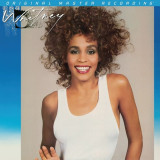
Issued just two years after Houston's breakthrough debut, Whitney immediately signalled the genre-defying singer's intent to continue to push ahead and expand her palette. Shot by photographer Richard Avedon, the album cover depicts an iconic image of Houston — captured with a gleaming smile, bright eyes, teased-out afro, toned arms, and a right hand that appears to wave a friendly hello — whose active, athletic profile stands in contrast to the extremely formal sit-down shot of her that graces her '85 record. The change is telling: Whitney overflows with unfettered joy, rhythmic vibes, and deep-seated emotions that forever endeared her to the hearts and minds of countless listeners — and which set the standard for the wave after wave of divas that followed in her footsteps.
It's no coincidence that the first track on Whitney is the declarative "I Wanna Dance with Somebody (Who Loves Me)." Like Michael Jackson's "Billie Jean" and Madonna's "Material Girl," the feel-good smash is one of the quintessential '80s gems — a lithe, melodic, celebratory release of pent-up energy and loneliness that glides across club floors, shouts to the rooftops, and shrugs off any concerns about vulnerability or embarrassment. Houston's swooping voice moves in sync with the sleek beats and dipping-and-diving synths. She practically takes her fellow musicians by their hand and leads them in a blissful dance that nobody would dare sidestep. Focusing on Houston's singing — a task made challenging only because of the impossible-to-ignore hooks and grooves — showcases the virtuosic facets of not only her register but her control, discipline, smoothness, and warmth.
That she replicates those feats for the entirety of the nearly 53-minute-long album makes Whitney that much more special. Houston reaches back and channels her childhood gospel training on the R&B-flared "So Emotional"; effortlessly slips into Quiet Storm mode on the duet with her mother, gospel great Cissy Houston, on "I Know Him So Well"; flirts with smooth jazz and collaborates with tenor saxophonist Kenny G on the lush "Just the Lonely Talking Again"; conjures dreamscapes and shadow-boxes with supple funk on a romantic cover of the Isley Brothers' "For the Love of You"; and, for the majestic power ballad "Didn't We Almost Have It All," displays the sky-scraping reach of her vocals amid a grand arrangement made even bigger by Houston's sweeping performance and triumphant finish.
Houston's once-in-a-generation talents weren't lost on the adoring public, radio deejays, or industry experts. In addition to harbouring four No. 1 hits and receiving nominations for four Grammy Awards, Whitney generated another Top 10 success in the guise of the Afro-Cuban-leaning "Love Will Save the Day." The album also netted Houston four American Music Awards; two Billboard Music Awards; back-to-back People's Choice Awards; a Soul Train Award; and various other accolades. It all makes the crux of the Washington Post's July '87 review of the album appear prophetic: "Her voice sounds stronger still and the songs are varied but so consistent she could garner 10 Top 10s out of a field of 11."
That claim still holds true. A brilliant fusion of pop, R&B, smooth jazz, and soul, Whitney is a showstopper – and one of the key reasons Houston is the most-awarded female artist of all time.
Suff Daddy (578k monthly listeners on Spotify), is one of the legendary beatmakers who shaped a whole era of bedroom producers. His unique approach and musical understanding sets him apart from all the other fish in the pond. He has released countless genre-defining albums and EP’s over the past 15 years building a loyal fanbase. Suff Daddy's songs have previously been featured in many editorial playlists including Spotify's "Jazz Vibes" (2.1M Likes), "BUTTER" (770k Likes), "Sweet Soul Chillout" (1.2M Likes) and many more.
Introducing "Hair Of The Dog," Suff Daddys musical journey that blends instrumental hip-hop, electronic, and dance genres. This captivating album, produced with his own Suff Style invites listeners to unwind From start to finish. Once again a Suff Daddy album thrives on the pure brilliance of his on way to create music. The album's cover art, masterfully crafted by the renowned painter Mitch (@itsallinsideus, 165k Followers), adds an intriguing visual dimension to the experience. Both artists have known each other for a long time and are currently preparing their audiovisual release- event for August 18th in Berlin. Bringing their art together as a unique experience for their audience.
The phrase "Hair of the dog that bit you" commonly denotes consuming alcohol as a remedy for a hangover, aiming to alleviate its effects. Suff Daddy plans to introduce his own hangover solution, which will be plant-based and devoid of alcohol. Through all of his career he frequently played with alcohol references and now its the perfect timing to release his own hangover cure. Additionally, this endeavor will serve as a social media catalyst for the entire project.
out of Stock
Last delivered 3 years ago available to reorder, subject to availability
Very limited Red Opaque vinyl. Single LP w/ printed inner sleeve + Download card. "a startling balance between chaos and structure, building up gorgeous torrents of sound that land with a crash" - THE NEW YORKER // A terrific blend of hardcore, punk, noise, and yes, pop. - INTERVIEW MAGAZINE // one of 2021's most thrilling listens. - STEREOGUM // What if Andy Warhol was really into Converge and CrossFit? That's the logline, as the now eight-piece band attempts to reflect pop music and pop culture through the heaviest, most swole lens possible. - PITCHFORK Best New Music // The Armed are set to release ULTRAPOP: Live at the Masonic Temple, an incredible live soundtrack from the band's narrative-driven concert film of the same name. The album and film were captured in the opulent chapels, imposing asylum rooms, full-size indoor handball courts, halls (and more) of the mysterious Masonic Temple of Detroit; a 550,000 square foot fortress in the heart of the city. ULTRAPOP: Live at the Masonic features breathtaking, hyperactive performances of tracks off The Armed's break-out album ULTRAPOP, selections from their second LP, Only Love, the CYBERPUNK 2077 single "Night City Aliens" and culminates in the ultimate catharsis with the entire collective converging for the devastating closer "On Jupiter." The Armed's latest album ULTRAPOP, released in April of 2021, received acclaim across the board, gaining the highly coveted Pitchfork Best New Music and praise from The New Yorker Magazine, Vulture, Stereogum, Revolver. AV Club, Fader, Bandcamp, Entertainment Weekly, Interview Magazine, and so much more. Reaching the same extremities of sonic expression as the furthest depths of metal, noise, and otherwise "heavy" counterculture music subgenres, it finds its foundation firmly in pop music and pop culture. A joyous, genderless, post-nihilist, anti-punk, razor-focused take on creating the most intense listening experience possible, and now with ULTRAPOP: Live At The Masonic, the most intense live experience possible.
Big Crown Records is proud to present the debut full length offering from Les Imprimés, Rêverie. The stirring and ethereal sounds of Les Imprimés have been making fans of anyone who hears them since their first 7” single hit the speakers. Morten Martens is the man behind the band. Born, raised, and working in Kristiansand, Norway, he keeps a low profile while making his heartfelt, highly infectious, and unique music. This album is a long time coming for Martens and it is sure to make him a name to be reckoned with.
The first thing you notice listening to Les Imprimés is the high level of musicianship. Martens plays nearly every instrument on the recordings and handles the production and arranging. He has been making records for decades, winning a Spellemann Award (aka, the Norwegian Grammy) in 2006 for producing a Hip Hop album as well as getting nominations across three other genres. While awards and accolades speak to the level of his talent, this new album really shows who he is as an artist on his own terms.
Moving away from being a hired gun on the touring scene naturally led him to start doing more studio work. Slowly collecting gear and getting more experience behind the boards he built his own studio on the island of Odderøya and was making a living playing with and recording other people's music. As the story goes, after those sessions would end he would work on his own project into the wee hours of the night. From these late night sessions, Les Imprimés was born and Rêverie began to take shape.
However, "it wasn't until COVID, when things locked down, that I was really able to find the time to focus on Les Imprimés" Morten says about creating and leading his own solo project. "It was a scary time. But I knew I had to do something with it." He took the sum of his influences, combined them with his own vibe and got busy writing the music, playing the instruments, and singing the songs. "It's soul music, but I don't exactly have the soul voice," Morten explains humbly. "But I do it my own way, in a way that's mine."
It is his sound, his fingerprint, his sensibility, that makes his music hard to categorize. He has crafted an album of songs with different energies that all fit together to make one gorgeous record. The lead single “Falling Away” starts with a raw drum break and turns into a lushly arranged tune that paints the picture of love when it slips away. On “Still Here” he professes his resilience through life’s twists and turns over a thundering track that puts a new spin on the B side ballad genre. Songs like “You” and “Our Love” mix tones from 60s and 70s Soul with arrangement nods to Doo Wop records while Martens’ lyrics and delivery leave you singing the melodies long after they finish. “Love & Flowers” finds Martens in a moment of clarity with a song that fits the niche sub genre of happy break up tunes, the four on the floor track will move the dancefloor while the message will resonate with anyone who put too much effort into the wrong situation in their lives. However, it is songs like “Muse” and “Chess” that really encapsulate the uniqueness of Les Imprimés as they push the boundaries of genre, one a profession of love for music and the other a cover of an electronic record respectively. Martens’ lyrics, emotion, and delivery truly make the whole thing come together and stand out from any of his peers. There’s an infectiousness and a pop sensibility in the writing that is done with the utmost class and taste giving Les Imprimés the rare quality of immediate attraction that only deepens the more you listen.
Big Crown Records is proud to present the debut full length offering from Les Imprimés, Rêverie. The stirring and ethereal sounds of Les Imprimés have been making fans of anyone who hears them since their first 7" single hit the speakers. Morten Martens is the man behind the band. Born, raised, and working in Kristiansand, Norway, he keeps a low prole while making his heart felt, highly infectious, and unique music. This album is a long time coming for Martens and it is sure to make him a name to be reckoned with. The first thing you notice listening to Les Imprimés is the high level of musician-ship. Martens plays nearly every instrument on the recordings and handles the production and arranging. He has been making records for decades, winning a Spellemann Award (aka, the Norwegian Grammy) in 2006 for producing a HipHop album as well as getting nominations across three other genres. While awards and accolades speak to the level of his talent, this new album really shows who he is an artist on his own terms. Moving away from being a hired gun on the touring scene naturally led him to start doing more studio work. Slowly collecting gear and getting more experi-ence behind the boards he built his own studio on the island of Odderoya and was making a living playing with and recording other people's music. As the story goes, after those sessions would end he would work on his own project into the wee hours of the night. From these late night sessions, Les Imprimés was born and Rêverie began to take shape. However, "it wasn't until COVID, when things locked down, that I was really able to nd the time to focus on Les Imprimés" Morten says about creating and leading his own solo project. "It was a scary time. But I knew I had to do something with it." He took the sum of his inuences, combined them with his own vibe and got busy writing the music, playing the instruments, and singing the songs. "It's soul music, but I don't exactly have the soul voice," Morten explains humbly. "But I do it my own way, in a way that's mine. "It is his sound, his fingerprint, his sensibility, that makes his music hard to put in a box. The album showcases both Martens' range and his ability to make a cohesive album. The lead single "Falling Away" starts with a raw drum break and turns into a lushly arranged tune that paints the picture of love when it slips away. On "Still Here" he professes his resilience through life's twists and turns over a thundering track that puts a new spin on the B side ballad genre. Songs like "You" and "Our Love" mix tones from 60s and 70s Soul with arrangement nods to Doo Wop records while Martens' lyrics and delivery leave you singing the melodies long after they finish. "Love & Flowers" finds Martens in a moment of clarity with a song that ts the niche sub genre of happy break up tunes, the four on the floor track will move the dancefloor or while the message will resonate with anyone who put too much effort into the wrong situation in their lives. However, it is songs like "Muse" and "Chess" that really encapsulate the uniqueness of Les Imprimés as they push the boundaries of genre, one a profession of love for music and the other a cover of an electronic record respectively. Martens' lyrics, emotion, and delivery truly make the whole thing come together and stand out from any of his peers. There's an infectiousness and a pop sensibility in the writing that is done with the utmost class and taste giving Les Imprimés the rare quality of immediate attraction that only deepens the more you listen.
Julian Cannonball Adderley's only Blue Note album, Somethin' Else, would likely forever be famous in music lore if just for the presence of Miles Davis. The iconic composer/trumpeter steps into the role of sideman on the 1958 set, one of just a handful of times he'd make such a move after the calendar passed the mid-1950s. Yet evaluating Somethin' Else strictly on Davis' involvement misses the big picture. Plain and simple, Adderley's jubilant work remains a jazz landmark due to the chemistry of its Hall of Fame personnel, enthusiasm of its participants, and sophistication of its arrangements – not to mention the reference-grade production and inclusion of the definitive renditions of two all-time jazz standards.
Limited to 6,000 numbered copies, pressed on dead-quiet MoFi SuperVinyl at RTI, and mastered from the original master tapes, Mobile Fidelity's ultra-hi-fi UltraDisc One-Step 180g 45RPM 2LP collector's edition pays tribute to the record's merit and includes the bonus track "Allison's Uncle." Offering reference-calibre sonics, this spectacular collector's version provides a clear, transparent, ultra-dynamic, and up-close view of a cornerstone effort that witnesses Adderley and Davis sharing horn duty alone for the only time in their fabled careers – an arrangement that occurred as a result of Adderley having joined Davis' majestic sextet a year prior.
The premium packaging and beautiful presentation of the UD1S Somethin' Else pressing befit its extremely select status. Housed in a deluxe slipcase, it features special foil-stamped jackets and faithful-to-the-original graphics that illuminate the splendour of the recording. No expense has been spared. Aurally and visually, this UD1S reissue exists as a curatorial artefact meant to be preserved, touched, and examined. It is made for discerning listeners that prize sound quality and production, and who desire to fully immerse themselves in the art – and everything involved with the album, from the iconic photos to the gorgeous finishes.
The vibrant potency reveals itself openly on an analogue set that provides full-range reproduction of an ensemble that also includes pianist Hank Jones, bassist Sam Jones, and drummer Art Blakey. Each and every snare hit, downbeat, and cymbal splash registered by the latter take on realistic proportions, blooming and decaying as they would right in front of you on a stage. Jones' foundational bass lines register with uncommon depth and palpability, the litheness of the strings and fullness of the instrument epitomizing the definition of rhythm. Stellar, too, are the surefooted 88s. Sublime in scale, tonality, and attack, with the delineation such you can practically separate the white and black keys in your mind. As for that liquid interplay between Adderley and Davis? Breathtakingly lifelike in timbre, naturalism, purity, and presence. This collector's version takes you there – there being Rudy Van Gelder's legendary New Jersey studio in March 1958 to witness it all unfold, again and again.
For reasons that extend far beyond the outstanding playing and flawless repertoire, Somethin' Else is without question a record you'll always want to watch and hear come together. As veteran critic Bob Blumenthal observed writing about the album four decades after its release, "The instant rapport achieved by the quintet is thus the product of much shared and common history, though the tensile strength that they create throughout created a totally unique feeling that can be attributed to the sensitive musicianship of all concerned, including the supposedly hard bopping leader and drummer." Such inimitable feeling, or emotion, courses throughout every passage, and no where more obviously than on "Autumn Leaves" and "Love for Sale."
Without question, the discreet interpretations of the Johnny Mercer and Cole Porter songs, respectively, found on Somethin' Else have long been considered part of jazz's alluring mystique. Adderley and Davis bring contrasting approaches to the table yet sound of a singular mind on "Autumn Leaves," with the latter's muted trumpet and the headliner's lush alto saxophone dovetailing into a performance that endures as a blueprint for expression, counterpoint, sophistication, fluidity, and linearity. Blues, melody, and romance pour from their horns. Their bandmates, picking up on the intimate vibe and calm mood here – as well as on the spry, head-over-heels spirit of "Love for Sale" – join in on the conversation with sharp economy and float-on-air roundedness.
Not to undersell the other three numbers, all deserving five-star status. Twelve measures in length, the title track offers a slow burn in swing. Written by Adderley's brother, Nat, the 12-bar "One for Daddy-O" transmits funk flavors. The closing "Dancing in the Dark" pops with lushness and temptation, its stream of bold colours and understated textures calling for a moonlight twirl, or at least fantasies suggestive of a memorable night. Somethin' else, indeed.
No shortage of colorful characters emerged from Cameroon’s bikutsi scene in the 1980’s and early 90’s. Gibraltar Drakus is one of the most enduring and enigmatic of the artists who helped transform bikutsi into a beautifully endless fabric of triplet rhythms that eventually reached ears around the world.
Following the advent of Cameroon Radio Television in 1987, bikutsi began to supplant makossa and soukous for domination of the local airwaves and the attention of cosmopolitan, thrill-seeking residents of Cameroon’s capital Yaoundé and beyond. Biktusi perfectly fused Beti traditional music and increasingly electronic, highly rhythmic guitarbased bikutsi. Mimicking the sound of village-based xylophone music by rigging a mute to electric guitar strings, bikutsi artists provided a relentlessly energetic dance format for those with a taste for music steeped in their hometown sensibility (countering the popular makossa that many felt sounded less indigenous).
By the early 1990’s, Les Tetes Brûlées were indisputably the most famous and influential artists in bikutsi, due in part to the innovations of their incendiary guitarist Théodore Zanzibar Epeme. Following their first European tour in 1987, the band blew up internationally but Zanzibar tragically, and mysteriously, passed away, which nearly brought an end to the band completely. In hindsight, the consensus among most Cameroonians is Zanzibar’s contributions to biktusi were transformational and immeasurable.
“Zanzibar is the one who taught me how to compose a song, and I learned a lot from Zanzibar musically. We spent whole nights working on methods and other approaches to compose beautiful songs. I owe half of everything I have today to Zanzibar!”
Swept up in all this was Gibraltar Drakus, who was the youngest member of Les Têtes Brûlées and was also the protégé of his biggest supporter, Zanzibar. So it was fitting that he dedicate his 1989 debut to their groundbreaking late guitarist who had meant so much to him. Drakus literally exploded from his first album Hommage A Zanzibar (1989), which sold over 100,000 copies despite rampant piracy. For the recording, Drakus made sure he engaged prolific producer Mystic Jim to record and mix the album. The innovation musically rests both within the guitar interplay and the discipline in the orchestration, which result in a mind-bending clockwork of cross-rhythmic harmony.
I could smell the curves of the river beyond the dusk and I saw the last light supine and tranquil upon tide-flats like pieces of broken mirror, then beyond them lights began in the pale clear air, trembling a little like butterflies hovering a long way off. -The Sound and the Fury, William Faulkner
This is the third and final instalment of Jeremiah M. Carter’s album triptych, »Vessels«. Following »Rejoice« and »Speak You Also«, all three album’s where conceived within a 6 month period during ferociously exalting creative sessions.
The Emotional turmoil of the early pandemic is as present on »Vessels« as it is in the other two albums, yet the final instalment showcases as more distinctive sense of focus, where the earlier albums saw Jeremiah expel a state of uncertainty and trepidation into an intense, almost spiritual form of musical cleansing, Vessels still bears those same hallmarks, yet comes across with an air of refinement and finality.
Spanning six pieces, each work feels like an integral part of the albums overarching narrative, fervently nestled amid divinity and humility. By its final piece, which also clocks in as the longest in the entire triptych, we are treated to one of Jeremiah’s finest moments, and for a few seconds, it all comes together for one last swansong, forming a sonic distillation of elation and grief, desire and passion. – It’s all here.
The concept of strict musical genre has arguably been dead for decades, and the latest offering from Danish powerhouses Gustaf Ljunggren and Emil de Waal once again reinforces this notion. Their third collaborative album "Stockholm Kobenhavn", a spacious, cinematic and boundaryless exploration of their shared musical connection is set to release on July 7th on April Records. Emil de Waal has been one of Denmark"s leading drummers for three decades. Gustaf Ljunggren initially studied the saxophone at the Rhythmic Conservatory of Copenhagen, where whispers spread throughout the school that he was the best saxophone player in town and yet never practiced. His career has seen him prove that he can bring grace, musicality and heart to any instrument he touches, from the pedal steel guitar, to the bass, piano, and more. In the words of Danish multi-instrumentalist Kresten Osgood, "Although an instrument may be new to him he is able to play it like he has had a lifetime of experience working with it. Over the years I think the only instrument I haven"t seen him play is the drums." "Stockholm Kobenhavn" has a vast array of influences including Jazz, Americana, Film Music and Electronica. It is full of space, coaxing the listener into a meditative state and inviting them to drift away with their own imagination. The record plays as a series of open-ended sketches or moods, absent of big defining melodies or familiar song-like structures. Each piece evolves over time, providing musical interest in the form of rhythmic ideas, rich harmony, texture, and repetitive melodic patterns from a guitar or rhodes. Imaginative electronic production techniques combine the warm sounds of acoustic instruments with a constantly developing palette of otherworldly textures and effects. Grounded by an unwavering pulse, the combination of programmed beats and acoustic drums provide the hypnotic foundation over which the pair explore and challenge their common musical ground. The album closes with an intimate recording from a performance at STUK in Belgium, with a comforting guitar-led Americana tune bringing the listener back into the room and sharing in the joy the duo have felt in playing together over the past twenty years.
Werewolves formed in 2019 and have proceeded to release an album a year to increasing acclaim and global calamity. Three full lengths and one EP later, the band performs an act of creative peristalsis with album four “My Enemies Look And Sound Like Me” due out 11th August 2023. Bassist/vocalist Sam (The Antichrist Imperium, The Berzerker) says: “Here it finally is, the recording that will cement our place in the technical death metal world as some of the greatest soloists and most thought-provoking lyricists working in music today. Our ability to shape raw art from ethereal nuance is second only to our famously slow craftmanship.” He continues “Of course I’m fucking kidding. This album is as idiotic as the rest, if not more. CAVEMAN RIFFS. Blasting. Screaming. Bowing to a shrine with pictures of Mortician, Marduk, and Angelcorpse. This isn’t going to be the album that brings people together and catalyses world peace. Apparently it has greater emotional reach than our earlier work but we haven’t noticed that ourselves, we’re morons. I can confirm that there is more swearing on this album than all the others, it’s positively Australian-esque”.
The Madlib Invazion Music Library Series Entry #2: From The Nesta Vaults: Jake Ferguson with Malcolm Catto (Heliocentrics) take on Cosmic Funk and Psychedelic Jazz. This is the next up in a series of music library releases, with future volumes produced by DJ Muggs, J-Zone, and Karriem Riggins, among others. The series continues with Jake Ferguson’s Emotions Run Dry featuring Malcolm Cattio. The Madlib Invazion Music Library Series was created by Madlib and Egon to give their creative friends a chance to stretch out and indulge in whatever type of music they wanted. This music was created for easy, one-stop clearance in film and television synchronization usage and for sampling. You can also enjoy these albums in the way that many do with the best of the best vintage library catalogs – listen, ponder, repeat.
When Ryan Olcott, songwriter and frontman of Twin Cities’ iconic indie rock band 12 Rods, found unfinished Rods demos during lockdown, he was surprised. When he realized they were good, he was shocked. He quickly set to finishing and recording the compositions, which became If We Stayed Alive, the first 12 Rods album in twenty-one years. “These are songs that I forgot about,” he explains, “but upon finding them, I thought, ‘Wow, these are actually okay.’” That was the easy part. Reacquainting himself with twenty-year-removed craft and technique took some getting used to -- some parts longer than others. He recorded all the instruments in a week, but vocals took a bit longer. “Oh my god!” he laughs, “it took a couple days to get my voice back with that range and that power, but I could do it.” Any cobwebs that needed dusting are long gone. If We Stayed Alive is everything longtime fans have wanted, and the perfect introduction to what some called “America’s Radiohead" and what others have called one of the best indie bands of the ‘90s.
"Don't Stop" is the third album retrospectively released by Ghia. As the subtitle "Early Works & Artefacts 1984-1987" implies, it features some of their earliest compositions as well as tracks that were recorded during the same period as their "Curaçao Blue" LP.
The album is a fusion of diverse music styles. Listeners will delight in a range of genres, including electro, funk, soul, jazz-funk, synth pop, and even rap/hip-hop, all woven together as a cohesive work that remains mostly instrumental. As a whole, "Don't Stop" represents Ghia's funkiest and most experimental release to date. Notably, the LP features a rap version of Hermann Hesse's controversial German poem "Armer Teufel am Morgen nach dem Maskenball" ("Poor Devil the Morning After the Costume Ball") from 1926, accompanied by a drum machine rhythm and funky guitar. This poem depicts a person who drank too much the night before, telling the story and describing his hangover. The title track "Don't Stop" and the thrilling minimal electro-funk tune "3 A.M. at Moëf Gaga" both evoke old-school electro influences. The latter references the Spanish discotheque Moëf Gaga, located on the Balearic coast, which the dynamic duo of Lutz Boberg and Frank Simon frequented during their 1980s holidays. While the exact music played at 3 A.M. is unknown, listening to Ghia's track will undoubtedly capture the mood of the place.
One of the key tracks of the album is "Message From The Other Side", which could easily be noted as one of the nicest European synth-funk instrumental pieces ever. The track is based on a sick synth bass line, sparkled with DX7 chord hits, funky guitar, and a delightful "marimba" solo in the last third. The solo was actually played on Boberg's keyboard, using a special sound cartridge. This particular track had to be edited and technically revised by Marian Tone and DJ Scientist as the existing demo version of the song could not be used as is. With its stunning groove, this track will surely be a DJ's favorite.
Listening to the complete album, there is more of Boberg's keyboard wizardry: could you believe that the trumpet solo on "Jump In The Water" as well as the short but stunning slap bass solo on "Talk Too Much" were both played by on the DX7? However, this new release, unlike the jazzy "Curaçao Blue", is not about solos or virtuous playing - it clearly shows the duo's direction towards more electronic composition and clear song structures. The versions of "September Garden", "When The Rain is Falling" as well as "Talk Too Much" are actually instrumental mixdowns of vocal songs. And again, we get a blissful take of "Close To You", here a version from 1986. This soulful jazz-funk ballad could already be heard on "Curaçao Blue" while the final vocal version with singer Lisa Ohm can be found on the recently released "This Is" LP. This shows that the Ghia composers, Boberg and Simon, were perfectionists - tracks were reworked again and again, making them better and better.
The album was mastered and restored with great care, and we are pleased to provide you with a perfect example of mid 1980s home-recording pleasures, tinged with a youthful spirit and providing a sound that cannot be recaptured anymore nowadays. Alongside "This Is" and "Curacao Blue" it should be another perfect addition to any 80s groove collection as well as a great pick for DJs that love and play disco, leftfield electro and funk. The LP is limited to 500 copies.
out of Stock
Last delivered 3 years ago available to reorder, subject to availability
Chain Of Flowers return with their lofty and long-simmering sophomore full-length, rich with reckonings, reverb, and redemption: Never Ending Space. Despite some of the songs dating back a few years, the record first began materialising in earnest during the pandemic, by which point most of the band had relocated from Cardiff to London.
Reunited and rejuvenated, they picked up where they left off, booking two multi-day sessions at Hackney hub Total Refreshment Centre with producer Jonah Falco. In this time they successfully channelled their kinetic chemistry into 10 full-blooded anthems of torn dreams, poetic delirium, and “hope stretched too far.” Musically, Never Ending Space skews notably more maximal than the group’s previous work, fleshed out with trumpets, saxophone, synth, percussion boxes, and spoken word. (Smith jokingly calls them The Chain Of Flowers Orchestra).
Yet the songs still swing and soar with a charged heart, ripe with hooks, drama and ragged melody. Opener “Fire (In The Heart Of Hearts)” stirs to life on a tide of wiry guitar and defiant horns, facing down the embers of love that still glow in the wake of pain: “Peace came tumbling like a shower of bricks / The mind twists slowly till everything fits.”
A tense energy ripples throughout – from the nocturnal rush of “Serving Purpose” and “Amphetamine Luck” to the bruised battle cries of “Torcalon” and “Old Human Material.” Outliers like “Praying Hands, Turtle Doves” hint at proggy possible futures, while instrumental vignette “Anomia” offers an intriguing glimpse at a lesser heard facet of the band: swaying, shadowy, subdued. The album’s title track is also its closing cut, a stomping, sparkling ode to “the wrong side of the night, where time goes to die.” Smith describes the scene: “Everyone’s talking, screaming, trauma bonding, but no one’s listening. Broken dialogue. Shouting over each other. You want to switch off, but everyone’s too fucked.” The guitars spiral and slide towards the oblivion of dawn, the chance to crash and do it all again.
out of Stock
Last delivered 3 years ago available to reorder, subject to availability
Chain Of Flowers return with their lofty and long-simmering sophomore full-length, rich with reckonings, reverb, and redemption: Never Ending Space. Despite some of the songs dating back a few years, the record first began materialising in earnest during the pandemic, by which point most of the band had relocated from Cardiff to London.
Reunited and rejuvenated, they picked up where they left off, booking two multi-day sessions at Hackney hub Total Refreshment Centre with producer Jonah Falco. In this time they successfully channelled their kinetic chemistry into 10 full-blooded anthems of torn dreams, poetic delirium, and “hope stretched too far.” Musically, Never Ending Space skews notably more maximal than the group’s previous work, fleshed out with trumpets, saxophone, synth, percussion boxes, and spoken word. (Smith jokingly calls them The Chain Of Flowers Orchestra).
Yet the songs still swing and soar with a charged heart, ripe with hooks, drama and ragged melody. Opener “Fire (In The Heart Of Hearts)” stirs to life on a tide of wiry guitar and defiant horns, facing down the embers of love that still glow in the wake of pain: “Peace came tumbling like a shower of bricks / The mind twists slowly till everything fits.”
A tense energy ripples throughout – from the nocturnal rush of “Serving Purpose” and “Amphetamine Luck” to the bruised battle cries of “Torcalon” and “Old Human Material.” Outliers like “Praying Hands, Turtle Doves” hint at proggy possible futures, while instrumental vignette “Anomia” offers an intriguing glimpse at a lesser heard facet of the band: swaying, shadowy, subdued. The album’s title track is also its closing cut, a stomping, sparkling ode to “the wrong side of the night, where time goes to die.” Smith describes the scene: “Everyone’s talking, screaming, trauma bonding, but no one’s listening. Broken dialogue. Shouting over each other. You want to switch off, but everyone’s too fucked.” The guitars spiral and slide towards the oblivion of dawn, the chance to crash and do it all again.
Back when Eddie Bond recorded Talkin' Off The Wall for his first ever disc
in 1955, he was indeed caught up in a musical moment that was 'off the
wall' – in other words seen as highly unusual, strange, eccentric, bizarre
It was the time of the emergence of rockabilly and white rock and roll. Briefly, the
'rockin daddy from ding dong Tennessee' was hot stuff, playing shows with
Presley, Perkins, Cash and all the other singers from Memphis whose music
talked off the wall to a whole new generation. Today, it does so again.
• A rocking 14-track LP on Bear Family Records® from one of the original
Memphis rockabillies, Eddie Bond, backed up by a 25-track CD featuring original
and cover versions of some of Eddie's songs.
• Mostly from the mid-1950s, these tracks sparkle with the life and excitement of
the new rocking music.
• Eddie started and finished as a country singer, but he embraced the new
rockabilly music and he soon became the Rockin' Daddy described in his bestselling disc from 1956.
• Eddie's backing bands include two of the best guitarists of all time – Reggie
Young and Hank Garland – and they don't disappoint.
• The ten-inch LP contains one song from Eddie's first label, Ekko, six from his
rockabilly heyday on Mercury, two from his originally unissued sessions at Sun in
1958, and five tracks from local Memphis labels in the 1960s.
• The bonus CD contains also a further 11 tracks by other artists, providing
fascinating other versions of songs Eddie recorded. Artists include Sonny Fisher,
Lattie Moore, Ray Charles, and Elvis Presley.
Mary Jane Leach is a composer focussed on the physicality of sound, its acoustic properties and how they interact with space. She has played an instrumental role in NYC’s pioneering Downtown scene alongside Arthur Russell, Ellen Fullman, Peter Zummo, Philip Corner and Arnold Dreyblatt, as well as devoting years to the preservation and reappraisal of Julius Eastman’s work since his death in 1990, compiling the »Unjust Malaise« 3CD set in 2005 and editing the 2015 book »Gay Guerrilla: Julius Eastman and His Music«. »Woodwind Multiples« is her second album for Modern Love, following »(f)lute songs« (2018).
»Woodwind Multiples« features four pieces for multiples of the same instrument: four bass flutes, nine oboes, nine clarinets, and seven bassoons. Each piece works closely with the unique sound of each instrument, combining pitches that create other, sometimes unexpected, tones, primarily combination and interference tones, as well as rhythmic patterns. What you hear is what happens naturally - there is no processing or manipulation.
»8B4 (1985/2022)«, played by Manuel Zurria, is for four bass flutes. It is a revision of 8x4, which was written in 1985 for the DownTown Ensemble and was only performed once, due to its unusual instrumentation: alto flute, English horn (originally bass oboe), clarinet, and voice.
»Xantippe’s Rebuke« (1993) was written for Libby Van Cleve, for eight taped oboes and one live, solo oboe. The eight taped parts are equal and dependent, while the solo part is meant to be a solo with the tape as accompaniment. The piece works with the unique sound of the oboe, starting with unison pitches that create the richest sound, building the piece from there. Pitches and rhythmic patterns that occur naturally are notated and then played later, which in turn create other pitches and rhythmic patterns. So, in effect, the nature of the oboe and its natural sound determine the direction of the piece.
»Charybdis« (2020), played by Sam Dunscombe, is for solo clarinet and eight taped clarinets. It combines a somewhat obscured reference to Weep You No More, a John Dowland piece, which combines with the sound phenomena created from the melody and supporting chords of the Dowland.
»Feu de Joie« (1992) was written for bassoonist Shannon Peet and is an homage to the bassoon and its wonderful sound. It is for seven parts—six taped and one »live.« The taped bassoons combine to create a bed of sound that exploits the unique qualities of the bassoon, creating combination and interference tones, starting off with unison pitches, creating a rich sound that builds from there. Most of the subsequent pitches and phrases occur naturally, and are then notated later on in the piece, which in turn creates other notes and phrases.
Incredible jazz / prog / folk score to groundbreaking tattoo film by maverick filmmaker. Unreleased until now, so don’t go saying it’s a reissue because it isn’t, but I’m sure some people will because they always do.
John Samson (1946 - 2004) was a truly great documentary maker. He must be as I’ve been obsessed with his work for many years. Educated first at Glasgow School Of Art (circa 1963) and then finally in the art of film making at The National Film And Television School in Beaconsfield - he headed there in its opening year of 1971 having made a short film that got him a scholarship.
It was at the NFTS that Samson met Mike Wallington, who was to become his right hand man and eventual producer; together as a quite brilliant team they made a handful of inspiring, entertaining and hugely prescient films about important, overlooked, unseen and marginal fringes in society. Tattoo (1975) Exploring the rather clandestine world of tattooing in the UK. Dressing For Pleasure (1977) Exploring the rather clandestine world of festish in the UK. Brittania (1979) A film about railway enthusiasts and a steam train restoration.
Arrows (1979) The life of dart player Eric Bristow. Drag Ball (1981) An unreleased film about the annual Porchester Hall Drag Ball. The Skin Horse (1983) BAFTA winning film about The Outsiders Club, a dating agency for disabled people. The subject matter in all films was always unusual for the time, and Samson managed to navigate his way with compassion, interest and subtlety, immersing himself in the chosen scene and producing moving, fascinating and sometimes darkly amusing situations. His documentaries also do not rely on traditional voiceovers, with stories, facts and narrative threads being dictated by the subjects.
I’ve tried for a long time to find the music for a couple of his early films (there was actually an original 7” for Arrows) - so far this is the only unreleased soundtrack I have found. This one was written by Steve Jolliffe, who met Samson at the NFTS. Joliffe was the resident composer and had a room at the college complex where he could work on scores for the fledgling film makers. Jolliffe was and still is a multi-instrumentalist and prolific composer who had met Edgar Froese at the Berlin Konservatorium in the late 1960s and played in an early incarnation of Tangerine Dream. He toured with blues rock outfit Steamhammer, before hanging out at the NFTS, making this recording (and many others) and eventually rejoining Tangerine Dream in the late 1970s. Jolliffe still writes, records and releases today and once i had made contact with him we traced the original Tattoo master tape to a box at his brother’s house. Musically it’s charming, slightly folky, a touch baroque, there’s a whiff of prog too, and it perfectly suited this early documentary about the art and desire of tattoos. I only wish it was longer. But the film is only 16 minutes long. Seek it out if you can. Try and find all the Samson films, they really are a joy.
As well as featuring intimate footage of tattooed people, the film also includes a rare and very early interview with Alan Oversby (better known as Mr Sebastian), a seminal character in the development of tattoos and body modifications worldwide - it was he who eventually was to tattoo and pierce Genesis P-Orridge.
The images for this vinyl release were all found in Mike Wallington’s Tattoo documentary research folder from 1974, and were photos sent in to Mike and John by people who wanted to feature in the film. Most answered an advert in Time Out, and others included people from my home town of Aldershot where tattooist Bill Skuse and his wife, Rusty (the most tattooed woman in Britain at the time, and featured in the film) were based. His parlour was situated at the back of the arcade where we all used to lose all our pocket money in the slot machines.
The Musicians:
Steve Jolliffe - keyboards, flute, sax Geoff Jolliffe - bass guitar Julian Furniss - guitar Mick Kirby - drums
Codek is the brainchild of Jean-Marie Salaun who grew up in Paris influenced by the folklore of the inner city. In 1978 he joined art rock group SpionS alongside Gregory Davidow and recorded two singles. Diving into the Paris post punk scene he met Claude Arto and designed the artwork for Claude's single on Celluloid Kwai Systeme / Betty Boop.' Robin Scott (M Pop Music') had produced the SpionS first single and wanted to collaborate further. With Claude, Jean-Marie wrote Me Me Me', intended for a choir, for M. Then SpionS split and Robin was off to Switzerland to record an album to follow-up his hit single. That left Jean-Marie alone in London, where he began working as Codek, a play on the brand name Kodak The Me Me Me' single was released by MCA Records in 1980. Back in Paris, now with some studio experience, Celluloid Records hired Jean-Marie to produce records for Artefact and Les Orphelins. Over the next 2 years he began working on ideas for the next Codek single Closer / Tam Tam'
Closer' started its life as an electric baseline played by Jean-Marie. Claude Arto sequenced the floating synthesizers. Laurent Grangier and Frédéric Lapierre of reggae band Immigration Act played the horns. The lyrics Hard to say. Easy to do. We don't need to say what we do' were a statement on creation as narration expressed Jean-Marie's ennui, I'm tired with it.' Tam Tam' was inspired by Burundi drummers playing on the plaza in front of Beaubourg where the song was recorded. Jean-Marie enlisted one of the drummers from the circle, Georges Atta Dikalo, to lay down percussion for the song. The female singers were from the French Caribbean and added falsetto tribal chants. JM was part of the the African night scene in Paris, remixing Xalam's Kanu' and Touré Kunda's Salaly Muhamed.' Claude achieved complex rhythmic patterns using a modular synthesizer and heavy processing. Jean-Marie recorded himself beating his chest for the thump noises. The recording of Tam Tam' and Closer' spanned over two years. They started on 16-track in Studio d'Auteuil, where JM blew the woofers, before resuming in Studio Centre Georges Pompidou with an added 8-track recorder. Jean-Marie was producing other bands, and a lot of this was recorded on "borrowed" studio time. The single was released in 1981 on West African Music, a tiny label from the Ivory Coast, and was re-released a year later by Island Records in the UK (where the B-side was re-named Tim Toum'). Both tracks were staples in the DJ sets of Beppe Loda and Daniele Baldelli, finding a spiritual home in the Cosmic scene of Italy.
Both songs have been remastered for vinyl by George Horn at Fantasy Studios in Berkeley. The jacket is an exact replica of the 1981 edition with artwork by Angela Boy, inspired by primitive electronics and African paintings. Each copy includes an doubles-sided insert with photos and liner notes by Jean-Marie Salaun.
Over the past eight years Teenage Wrist have continually evolved their sound, a process that"s peaking with their third full-length, STILL LOVE. Reaching new heights in both scope and execution, the album sees the duo-Marshall Gallagher (vocalist, guitarist, bassist) and Anthony Salazar (drums, vocalist, percussion)-producing the album themselves to handcraft their most expansive collection of songs to date from the ground up. ? e result is a self-realized collection of songs that saw the band borrowing vintage gear, bringing in friends in the form of members from 311 vocalist/turntablist Doug "SA" Martinez and Softcult and incorporating tasteful pop sensibilities to craft a collection of songs that rede? nes the band"s sound while staying true to their guitar-driven roots. From the atmospheric, fuzzed out opener "Sunshine" (which Gallagher says is "the coolest ri? he"s ever written") to the midtempo rocker "Dark Sky"" (the latter of which features the aforementioned cameo from 311 vocalist/turntablist Doug "SA" Martinez), the album will undoubtedly please fans who favor distorted guitars and crunchy chords. However, that"s only one aspect of the album and Teenage Wrist aren"t ashamed to admit that there"s a strong pop sensibility on the album that shows how much they"ve grown as songwriters since 2021"s Earth is a Black Hole. From the brain-invading ballad "Something Good" to the downbeat electronic vibe of "Diorama," the album is teeming with unexpected moments that are reminiscent of Radiohead"s ? air for experimentation. ? e powerful bond between these two collaborators lies at the core of Teenage Wrist"s music and, more than any other factor, that"s evident on every moment of STILL LOVE. "? ere was a certain feeling that music gave me as a kid and this is honestly the ? rst time on any record I feel like we kind of came close to achieving that," Gallagher says of the end result. "We just shot from the gut on this record and tried not to overanalyze things... and I think the record speaks for itself."
Trout Mask Replica is a touchstone in the history of recorded music. The mix of dada absurdist blues and previously unexplored experimental avenues has long been praised as one of the greatest albums of all time. As so eloquently put by John Peel, "If there has been anything in the history of popular music which could be described as a work of art in a way that people who are involved in other areas of art would understand, then Trout Mask Replica is probably that work.” In full partnership with the Zappa Family Trust and to celebrate the relaunch of the seminal Bizarre label imprint, Third Man Records is proud to announce Captain Beefheart and the Magic Band's Trout Mask Replica. Out of print on vinyl for nearly ten years, this remaster was helmed by industry legend Bob Ludwig and cut by the estimable Chris Bellman at Bernie Grundman Mastering. Utilizing crystalline-quality safety masters kept in the Zappa family vault for decades by the trustworthy Joe Travers, the audio here is positively glorious. Every last skronk breathes full life into the room. Every twisted guitar figure uncurls onto paths previously unpaved. Every last bark and howl shines resolute through the vast emptiness of your mind. Previous countless Trout Mask Replica repressings used scans of scans of scans of the cover image, but the original Cal Schenkel cover photo has been tracked down and reproduced here at its clearest — its resolution from the original release in 1969. If you’ve only ever seen a jpg online or fuzzy, smeared-looking CD issues from the 90’s, be prepared to be wowed by the fully engaging spectrum this iconic image casts. This 2xLP is pressed on heavyweight 180-gram black vinyl for that full-on frenetic feeling.
A fascinating blend of jazz and contemporary classical influences, How Time Passes is the debut album from the envelope pushing trumpeter and composer Don Ellis Known for his extensive musical experimentation, particularly in the area of time
signatures, Ellis began his long career in the New York City's post bop and avantgarde jazz scenes of late 1950s. Most notably he appeared on Charles Mingus'
Mingus Dynasty, and albums by George Russell and Maynard Feguson. But he
also worked with, among others, the Glenn Miller Orchestra, Lionel Hampton, and
Woody Herman. On subsequent albums, Ellis would take an even wilder direction.
Here, on his first recoding date as a band leader, the experimentation begins. Ellis
stretches the boundaries of bop-based jazz playing with time, tempo and meter. It
is the start of his exploration of Third Stream - a fusion of jazz and contemporary
classical music. The album title itself - How Time Passes - was taken from an
article written by the controversial German composer Karlheinz Stockhausen on
the "function of time." The exceptional section features Ron Carter on bass, the
underrated Jaki Byard on piano and saxophone, and Charlie Persip on drums. The
LP includes extraordinary liner notes by Candid A&R man and producer Nat
Hentoff, and noted musician, historian and writer Gunther Schuller - the originator
of the term "Third Stream" - giving a context and insight that adds to the
experience of hearing these extraordinary performances.
Terror in Tokyo! Godzilla is back and is determined to cause as much damage as possible in GODZILLA AGAINST MECHAGODZILLA. After the "Big G" delivers a crippling blow to the JXSDF (Japanese Xenomorph Self-Defence Force), the government decides to build a new weapon to defeat Godzilla. Their solution: Kiryu, aka Mechagodzilla, a metal monster packed with all the firepower needed to put Godzilla down. But things go awry when Kiryu malfunctions and turns on the JXSDF, thanks to its use of the original Godzilla's DNA. Can they get back control and put an end to the "Big G"?
Selected to score GODZILLA AGAINST MECHAGODZILLA was Michiru Ōshima (GODZILLA VS MEGAGUIRUS, STAR WARS: VISIONS), who brought an exciting and heroic musical aesthetic to the film. Employing the Moscow Symphony Orchestra, Ōshima's music sounds as enormous and powerful as the kaiju themselves, with a new menacing theme for Godzilla that uses the lower registers to bring across the monsters immense force. In contrast, Ōshima's theme for Kiryu uses high brass for an almost superheroic feel, with both themes working beautifully in counterpoint to each other when the two titans have their rumble. As scary as it is thrilling, Michiru Ōshima's GODZILLA AGAINST MECHAGODZILLA is one of the most significant scores to emerge from the hallowed halls of Toho. - Charlie Brigden
Composed by Michiru Oshima
Artwork by Luke Preece
Manufactured in Czech Republic
After taking time out from working together to focus on separate musical projects, maverick composer Alan Roberts (Jim Noir) and crowd-rousing vocalist Leonore Wheatley (International Teachers of Pop / The Soundcarriers) have re-joined forces to introduce Co-Pilot. Each the other’s wing person, they’re plotting an escape through Manchester’s claustrophobic grey skies with the pencil case colour of a hand-sewn multi-coloured primary school patchwork quilt. “We are both the creators in charge of navigating Co-Pilot’s overall sound which changes from track to track,” Leonore hints at what to expect. “There are about 6 different genres on one album, it's a pick n mix record!”
Happy in the haze of many boozy hours the album was recorded over just a few months whilst holed up and hanging out in Al’s city centre Dookstereo studio. The former Mill allowed the pair to relax, laugh and create without constraint. Armed with their original demos and vocal recordings from Al’s flat, they’d nip by the offie to pick up some Dutch courage before setting to work: building arrangements from a drum beat and basic chord pattern, the pair were so in tune they rarely spoke, allowing only the music to lead the way. “We’d communicate through nods of agreement or grimaces of dismay,” Leonore recalls. “Using the instruments with Al in production mode, we let the sound dictate the process whilst being drunk enough to follow it.”
The sound of life coming full circle after honing their separate crafts, Leonore had previously played keys and vocals in Jim Noir’s live band before moving on to front International Teachers of Pop for two critically lauded albums of joyous dancefloor filling bangers - their self-titled debut (2019) and Pop Gossip (2020). During that time Al would further expand Jim Noir’s universe with AM Jazz, which was celebrated as the no.1 album in Piccadilly Records’ ‘End of Year Review’ (2020), followed by the Deep View Blue E.P. (2021) cementing his status as one of Manchester’s finest songwriters.
As Leonore added her vocal magic to Al’s early demos of what would eventually become Co-Pilot’s ‘Spring Beach’ and a crooked original version of closing track ‘Corner House’, the vibe was prophetic “like the ending of Grease as Danny and Sandy take flight through the clouds”, letting their imaginations fly. The songs were the catalyst to spark a new phase of the pair working together, picking up where they left off. “From messing about with sounds during rehearsals in the very beginning it was always clear we liked the combination of sounds we made,” Leonore recalls.
Powered by a ‘try anything’ approach, Co-Pilot blends the musical DNA of what you’ve come to expect from each of the pair’s previous flight paths. “Whatever is switched on or nearby gets used. There's no 'correct' for us. If it sounds good, record it,” Al tells. United through typically turbulent wonky pop and lurking samples, whether culled from 70s TV themes or recreations of past and found sounds (see Al’s 60s tropicalia guitar on ‘Brick’, or the innocent ‘Swim to Sweden’ which opens with an ice cream van jingle Al recorded from his bedroom window) their process offers up a bucket load of Easter eggs. The album even features snippets from dearly departed pal Batfinks whilst ‘Motosaka’ is perhaps the most expensive 2-minutes on the album, featuring a Columbia Records Japan-cleared sample of Ryuichi Sakamoto’s ‘Thousand Knives’. Its synth squelches and Tom Tom Club funk also received the blessing of Haroumi Hosono, Godfather of Japanese Electronica, who agreed to being sampled in an original version of the song. “We just kept listening back and hitting gold,” Al recalls. “I was thinking ‘yeah, not sure what this is but I like it! We were buzzing with what we had made.”
But the sound wouldn’t come without self-imposed instrumental challenges. Thanks to an old mellotron sample on ‘Move To It,’ the moog riff and nautical accordion breaks on ‘Swim To Sweden’ and the 6/8 and 7/8 jaunt of ‘Brick’, time signatures were lovingly skewed to create Co-Pilot’s unique mood. “It was a bastard getting the drums right,” Leonore reveals, “but I like the wonkiness”. Levelling up through the lyrics, the words of smoky and evocative ‘She Walks In Beauty’ are based on a Lord Byron poem, with the sentiment of remembering Leonore’s late grandparents. “I wanted to see how much I could get away with just singing on one note, and how I could harmonically change everything else around it vocally,” she says. Elsewhere ‘Can You See’ was written from the perspective of a concerned sister to a brother which tells of keeping someone safe. “The lyrics are quite metaphorical about day-to-day happenings, people loved and lost. Others are rhythmic nonsense! It’s up to the listener to figure out what’s true.”
It’s clear from Al’s productive production techniques and Leonore’s knack for vocals and lyricism, Co-Pilot’s course is engineered by two aeronautically adept sonic storytellers. “We share a pretty similar sense of humour,” Al tells, “It is funny listening to this quite serious album but knowing we were giggling as we recorded it all. It’s been great to have another brain to bounce off.” Their destination might be unknown, but the clouds are about to part for a sound that is light years ahead. “You'll like at least one song,” Leonore suggests, “and hopefully them all.”
out of Stock
Last delivered 3 years ago available to reorder, subject to availability
Long heralded as one of the heaviest, sickest, and most uncompromising death metal bands in the world, New Jersey's Incantation has forged a legacy of brutality unmatched by any other American group. In 1992, the bands most celebrated lineup entered a then unknown Trax East Studios with a then unproven engineer Steve Evetts and emerged with Onward to Golgotha, the most dark and blasphemous death metal record to date. The combination of the inhuman growl of vocalist Craig Pillard, the ruthlessly savage aural malevolence, and pitiless anti-Christian attack was the ultimate musical sacrilege. Onward... redefined the bounds of brutality and blasphemy for the entire genre of death metal. This is absolute brutality!!!
Be With present the first ever reissue of the ultra rare double pack DJ promo of Malcolm McLaren & Bootzilla Orchestra's "Call A Wave". Originally slipping out in 1989 to a select few, there were rumoured to be only ever 300 copies pressed. Indeed, the entire package never got a proper release and now goes for a small fortune.
Say what? Bootsy Collins, Jeff Beck and Malcolm McLaren, all in one band, composing over a Barry White sample? And that's just the original. But you can forget about that for now. Here we have the incredibly sought-after "DFC Dance Mix", mixed by Massimino Lippoli of Morenas / Sueño Latino fame for the legendary DFC Italy. It's a throbbing, vital, dramatic slice of dreamy ambient house. A deep, entrancing track that's both blissful and dancefloor dynamite. It features the iconic, disaffected female vocal chopped up over elegant piano snatches, Beck's ace guitar stylings over rolling, heavy drums and a killer, hypnotic bassline with sparkling harp coming and going. It's exotic, otherworldly and brimming with that very special late 80s/early 90s Mediterranean vibe. Yes, it's Balearic, it's House. Above all else, it's a pure uncut slice of halcyon summer days, pressed on wax.
But on side B we also have the mesmeric "Breakdown Mix", again mixed by DFC Italy. For some, *this* is the mix to have - and who are we to argue? This time, the vocals are treated so they're uttered backwards, contributing to the wonderfully disorienting magic of this particular mix.
And how could we forget the equally iconic "Orbital Mix"? Not by the actual group Orbital, but courtesy of S'Express's Mark Moore & William Orbit, no less. A brilliant, beautiful remix that's perhaps more musical. They make more obvious use of the sample from the original Barry White track ("I'm Gonna Love You Just a Little More Baby") that Malcolm was inspired by. Flip over to Side D to find the duo's uber-horizontal "Return To The Deep Ambient Mix", a floaty, beatless gem that'll leave you swooning.
To round out this quite astonishing package, the "New Age Mix", again coming from the DFC Italy camp, elegantly sends us off into the cosmos with minimal percussion and maximum vibes.
Every mix on this DJ double pack is truly killer. Simon Francis remastered the original audio for this release and Cicely Balston's precise cut for Alchemy at AIR Studios ensures this 2x12" well and truly pumps. The immaculate Record Industry pressing will ensure this incredibly sought-after masterpiece finds a home in many more DJ boxes this and every summer. For the artwork, we've recreated the original DJ promo, a plain white gatefold sleeve complete with the iconic burnt orange hype sticker. Hold tight. Roof down, tops off.
out of Stock
Last delivered 3 years ago available to reorder, subject to availability
London-based electronic songwriter Ryan Lee West aka Rival Consoles to release his most personal work to date in the form of a mini-album titled ‘Night Melody’ through Erased Tapes on 5th August 2016. During the release of his acclaimed full-length album ‘Howl’ and heavy touring in late 2015, Ryan came out of a 13-year long relationship and found himself making music throughout the winter months. The result of his efforts is a 34-minute, 6-track mini album ‘Night Melody’, born out of and shaped by long hours working into the night. It’s nocturnal in sound; mysterious in the way that the early hours so often are.
“I found myself, in a silent home, with the days getting dark very early. I’ve never before in my life been affected by the lack of light so much. I just remember it always being night time. I would either make music into the night, go out drinking with friends, or go to parties and dance into the early hours, every day, week after week, month after month, until eventually the days became brighter again.” The opening statement ‘Pattern of the North’ starts off with a collage of spliced synth melodies, inspired by anxiety that accompanies going home for Christmas. It’s followed by ‘Johannesburg’, an early sketch gradually filled out during his tour in South Africa.
“After playing it around some of the cities, I got a lot of inspiration to bring it to life and push it into something that really moves me. I think this is one of my most colourful pieces of music, with its driving rhythm and almost a homage to Terry Riley’s ‘In C’ towards the end, with a build of very simple, hypnotic parts. I especially love that for over five minutes the piece is tied to just one note. This makes the ending very dramatic, because all of a sudden there is this harmonic change.” ‘Lone’ started life around the time Ryan was working on his ‘Sonne’ EP in 2014. It’s the result of constant adjustments to find the perfect balance of fragility and assurance. As everything on the album, it’s a carefully considered, emotionally mature piece. “I think, as I get older, I need music to represent something and not just sound interesting, though of course the two are connected.” The closing statement ‘What Sorrow’ is a fitting end to the album, building from gentle melancholia to a joyous crescendo. It’s a sensibility that’s central to the record; joy and sorrow both find their counterpoints.
“This record is very personal to me and I hope it offers something for other people, as it helped me to make it and to listen to it. Almost every synth line was recorded intuitively, without perfection but with a lot of intention and expression. I’m not interested in making something sad or making something happy. I want music to be bittersweet, to be more complex, like life – containing moments of vibrant colour and hope, as much as darkness and sadness.” This summer will see Ryan follow on from his recent North American Tour with the appearance at many festivals including Lovebox, Secret Garden Party, La Route Du Rock, Sea Change and Tale of Us-curated Afterlife party at Space, Ibiza.
out of Stock
Last delivered 3 years ago available to reorder, subject to availability
Stepanida Borisova is an outstanding singer from the republic of Sakha-Yakutia, Siberia, and its most reknowned exponent of folk theatre. As a singer, Stepanida performs in many different styles of traditional Sakha singing. She is mostly known as a performer of poems - tojuks, one of the genres of Sakha storytelling folklore. Tojuks, long with other genres of singing, form the core of the Sakha epic Olonkho, an anthology of supernatural and heroic legends and fables, an absolute essence of Sakha poetic and vocal expression.
Her signature style of singing is "enelgen", a disturbing and somewhat dark yet mesmerising, ecstatic, meditative and improvisational style, conveying a very intimate and personal feeling of love, loneliness or longing. "Music puts restrictions on you. It puts you in the mould. But the real life is different. Without thinking about musicality and form, one must sing what one feels" Stepanida Borisova comments on her art and performance.
During her long career, her desire to break out of the restrictions of tradition and to expand her sound, led her to perform with musicians from many different cultures - Europe, Middle East and Asia. But of all Stepanida's collaborations, the duo with the Czech drummer and composer Pavel Fajt is undoubtedly the most long standing and well documented project.
Fajt, with his relentless desire for experimentation and musical challenge, is probably one of the most reknowned musicians on the Czech alternative rock/jazz scene. With his musical career starting in the early 1980s, he was crucal in laying the foundations of the Czech folk/rock movement, first with legendary rock band Dunaj, then moving on to work with the violin player and singer Iva Bittova, guitarist Fred Frith, Jim Meneses and many other musicians.
The soaring spiritual dialogue between the two free spirits in music began with a run of successful concerts and a TV debut in Prague in 1998 and still continues. Stepanida's stunning embodiment of the ecstatic female shaman, Pavel's vibrant and expressive drumming manner - combined with the theatrical background and performing experience of both - make an amazing spectacle of sound and vision, in which all the colours of Stepanida's unearthly and powerful voice are neatly dovetailed into Pavel's ornamentation of beats and rhythm.
The songs presented on this album were recorded in Brno in 2002 and are finally seeing their first vinyl release.
Carl Finlow keeps on keepin' on. Not only is Finlow one of the most respected names in electro, a producer who boasts a sprawling catalogue that takes in a wide variety of aliases, but he's also spent recent years establishing himself as a mainstay for Sheffield's Central Processing Unit label. Soft Robotics, the new EP from Finlow's Silicon Scally project, is the fifth Silicon Scally release in five years to boast one of CPU's instantly-recognisable black-and-white covers.
The reason that Silicon Scally and CPU keep linking up is simple; they're a perfect fit for one another. Central Processing Unit has established itself as a haven for post-Drexciya producers since launching in 2012, and there are few artists better than Finlow at building on the Detroit group's sound. The union bears fruit once more on Soft Robotics, an EP of lithe machine-funk jams that will both do damage in the dance and also reward more concentrated home listening.
Things begin at a steadier speed than one might expect. Rather than barrelling off with the kind of sinewy roller one associates with the CPU name, Soft Robotics' title-track takes things at mid-pace. The groove reveals itself without hurry, Silicon Scally adding or subtracting elements - twitchy modular loops, pensive pads, the occasional blurt of low-end - atop the chugging bass/drums groove. It's a track which wins you over with guile rather than force.
As the name of subsequent cut 'Jitters' intimates, this one picks things up a little after 'Soft Robotics'. The tempo is higher here, the central beat more nervy. At their cores, though, 'Jitters' and 'Soft Robotics' are kindred spirits. Here, another slyly insistent bit of drum programming comes swirled up with all sorts of extraterrestrial tones, from little nuggets of melody supplied by the keys to electrifying synth stabs and percussive squelches.
Things limber up further still on first B-side 'Spin Ratio'. The track's 808 kicks are punchier than those of the A-side jams, and there's a dizziness to the bass tone which gives 'Spin Ratio' an intriguingly off-kilter feel. Atop the booming beat we find ourselves hypnotised by cells of melody and harmony interlocking or moving apart - particularly the staccato module at the track's heart. Sure enough, 'Spin Ratio' is the Soft Robotics joint which cleaves closest to Drexciya, invoking other Detroit disciples like Jensen Interceptor in the process.
After Soft Robotics picks up speed in the middle, closer 'Super Fluid Tones' brings us back to where we started. This track returns to the more measured delivery of the record's opener - there's a steady pulse to the drums, and once again Silicon Scally packs the mix with so many intriguing whizzes, bangs, blips and blurts that it's impossible not be won over by this tune's construction. 'Soft Robotics' and 'Super Fluid Tones' bookend Soft Robotics very nicely, and Silicon Scally's smart pacing gives the EP a lovely ebb and flow.
The ever-excellent Carl Finlow drops a Silicon Scally release via Central Processing Unit for the fifth year running. Like its predecessors, Soft Robotics is an excellent and deftly-crafted collection of modern machine-funk.
RIYL: Drexciya, Jensen Interceptor, Fleck E.S.C., The Advent
out of Stock
Last delivered 16 months ago available to reorder, subject to availability
This July the esteemed scribe, proper DJ, and discreetly deft twiddler Bill Brewster, drops the latest instalment in his ‘After Dark’ series, for Late Night Tales.
A throbbing, louche and leisurely affair, groove is very much at the heart of this freestyle selection, a vibe which Bill de- scribes as “a basement, a red light and a sound system. Or, as the Beastie’s once rapped, slow and low, that is the tempo”.
There’s Hawaiian drum machine bossa balearica from Island Band, percussive afro post punk from Czech jazz singer Jana Koubkova, and breathy-bubbling-dubwise-slap-bass-soul from Debbe& The Code.
There’s also sultry deep house mood music from Lanowa, infectious bouncy jazz funk breaks from Canada High, and Nail’s life affirming re-edit of singer songwriter Gilbert O Sullivan’s electro pop gem ‘So What’.
Bill’s own studio skills are present and correct too, featuring an undulating bassy version of country troubadour Jeb Loy Nichols, reworked along Alex Tepper under their Hotel Motel moniker, and a chugged-up squelchy disco take on Khruang- bin, this time paired with Raj Gupta, as Mang Dynasty.
Chock full of exclusives, tracks are either completely brand new, or available digitally for the first time, whilst others are wallet-rinsing rarities if purchased elsewhere. Whichever way you slice it though, every tune is a highlight, working equally well as standalone nuggets, or within Bill’s fluidly cohesive mix.
Whether he’s taking the roof off a club with his unique selec- tion of deep and tough house music, enchanting a backroom with a genre-bending set of disco, Balearic, rock and hip hop or playing chillout music in a bay in Croatia, Bill Brewster is the man for all occasions.
In a former life, Bill was a punk rocker, a chef and also the co-editor of football magazine When Saturday Comes but has been a record nerd all of his life. He began DJing in the 1980s, but came into his own in the early 1990s, particularly during a two-year stint in New York running DMC’s office, where nights at the Sound Factory and hanging out with Danny Tenaglia gave him the musical grounding you can still hear in his music today.
Bill was also one of the founding residents at Fabric in London, a position he held for five years. There are few still playing regularly today that have his dedication, eclecticism and encyclopedic knowledge of music.
His parallel life is as a writer, and with his long-term part- ner-in-crime Frank Broughton, they have written four books together, including the acclaimed ‘Last Night A DJ Saved My Life’ (latest edition published last July), ‘How To DJ (Prop- erly)’ and ‘The Record Players’.
He has been working in the industry’s fringes for over 40 years including the running of various labels from Twisted UK and Forensic in the ’90s to Disco Sucks and Anorak in the noughties.
He is one of NTS radio’s new residents for 2023 and his ‘Low Life Loves You’ show is available on the first Tuesday of every month.
out of Stock
Last delivered 7 months ago available to reorder, subject to availability
The electric eels were the first punk band, full stop. They may not have “started” the genre, but they were the first to tick all the boxes. The eels rejected every 1970s rock convention—professionalism, virtuosity, subject matter, image. Dave E.’s caustic vocals, complete with an aggressive lisp and a head full of snot, would become de rigeur a few years after the group disbanded. Meanwhile, the songs’ focus on car crashes, suicide, neuroses, and generally hating people were as far out of the mainstream as possible. The two eels tracks that do approach the subject of romance couch it in terms of not really caring that much about it (“Jaguar Ride”) or placing it in the context of a grisly murder (“Silver Daggers”). Also consider John Morton’s signature guitar sound, a nails-on-chalkboard tone with brutally free soloing inspired more by Albert Ayler than the blues or aspirations to technical facility. Ditto Dave E.’s clarinet playing and affection for lawnmowers and vacuums during live performance. They were notoriously violent not only among themselves, but towards audiences, police, and anyone unfortunate enough to be around them when things went south. Then of course there are the leather jackets, the clothing festooned with rat traps or safety pins. And no bass player, why bother. There is simply no other “proto” band to have had all these pieces in place circa 1973- 1975. Yet it is a mistake to consider the eels exclusively in such a context. Yes, the eels could and did shock anyone who encountered them, but they also had great songs. While both Dave and John were visionary writers, they also had rhythm guitarist Brian McMahon, a melody and riff machine who wrote many of the band’s signature songs. And they were no one-trick pony. Although much of the band’s material is appropriately high-energy, there is also the downer eels—morbid, harmonically risky, and in full existential crisis. Although it’s not a focus of this compilation, the eels also had a penchant for completely free improvisation. Over the last forty plus years, there have been several electric eels compilations. Spin Age Blasters is quite simply the best one ever assembled, every single key track is here in its best version, properly mastered by John Golden, and sequenced with an eye towards both flow between tracks as well as individation between sides. A true monster of an album.
Brand new album from Nine Mile Station.
• With tracks mixed by the late, great and legendary Al
Schmitt whose 23 Grammy's is a record
among producers and engineers.
• One of Schmitt's last before he died in April 2021…
bookended by sessions with Neil Young and Willie
Nelson.
• First vinyl pressing is exclusive as the track ‘She Walks’
was later replaced with ‘Who You Love’, inspired by
the growing hostilities to the LGBTQ community.
Lead singer Will Hawkins discovered NMS guitarist
Fernando Perdomo while watching the awardwinning documentary Echo in the Canyon which featured
Fernando performing with Jakob Dylan, Fiona Apple,
BEck, Brian Wilson, Roger McGuinn, Michelle Phillip and
Neil Young.
Coachella Valley Weekly called the NMS debut album the
“best heartland rock album in 30 years” and
MusicConnection commented on their live show: “Nine
Mile Station is a rockin Americana music band like no
other!