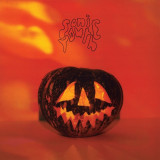
Svart Records release NYC crust punk band Nausea’s two legendary EP’s on one remastered 12” in March 2024! Crust punk originates from the misty moors and factory cities of the UK. Since the '80s, countless bands have been established to play their dirty apocalyptic ruckus in the vein of Amebix, Antisect, and Axegrinder. At the same time, across the ocean, in the squats of New York’s Lower East Side, bassist John John Jesse founded Nausea. Svart Records is releasing Nausea’s two legendary EPs in 12” format for the first time ever, including the Cybergod 7” from 1991 - with a bonus track, "Here Today," from the same recording sessions - and the Lie Cycle 7” from 1992. All tracks are remastered from the original, untouched studio tapes by Jack Control (Darkthrone, Kohti Tuhoa, Fear). Tribal and rocking apocalyptic crust for apocalyptic times. The Cybergod lineup might be the most legendary era of Nausea, where the tracks reach almost epic proportions. The EP is pretty much the blueprint of crust, where Vic Venom’s hypnotic and rocking guitar riffs meet the tribal drumming of Roy Mayorga. Al Hoon’s and Amy Miret’s dueling vocals spit out timeless issues dealing with consumerism and the hypocrisies of organized religions. Musically, the Lie Cycle EP rocks out more in the faster and straightforward style, where Discharge meets Motörhead, and lyrics reflect the times when war and nuclear destruction are still the plague of mankind. Nausea’s timeline lasted only seven years, but they managed to create a cult following with their true dedication to the punk scene and played shows in the squats of Europe and the eastern part of Europe. Their music is timeless, unpleasant music for unpleasant times, but hey! At least it’s more fun to rock out to the apocalypse!
Cerca:the tapes
Svart Records release NYC crust punk band Nausea’s two legendary EP’s on one remastered 12” in March 2024! Crust punk originates from the misty moors and factory cities of the UK. Since the '80s, countless bands have been established to play their dirty apocalyptic ruckus in the vein of Amebix, Antisect, and Axegrinder. At the same time, across the ocean, in the squats of New York’s Lower East Side, bassist John John Jesse founded Nausea. Svart Records is releasing Nausea’s two legendary EPs in 12” format for the first time ever, including the Cybergod 7” from 1991 - with a bonus track, "Here Today," from the same recording sessions - and the Lie Cycle 7” from 1992. All tracks are remastered from the original, untouched studio tapes by Jack Control (Darkthrone, Kohti Tuhoa, Fear). Tribal and rocking apocalyptic crust for apocalyptic times. The Cybergod lineup might be the most legendary era of Nausea, where the tracks reach almost epic proportions. The EP is pretty much the blueprint of crust, where Vic Venom’s hypnotic and rocking guitar riffs meet the tribal drumming of Roy Mayorga. Al Hoon’s and Amy Miret’s dueling vocals spit out timeless issues dealing with consumerism and the hypocrisies of organized religions. Musically, the Lie Cycle EP rocks out more in the faster and straightforward style, where Discharge meets Motörhead, and lyrics reflect the times when war and nuclear destruction are still the plague of mankind. Nausea’s timeline lasted only seven years, but they managed to create a cult following with their true dedication to the punk scene and played shows in the squats of Europe and the eastern part of Europe. Their music is timeless, unpleasant music for unpleasant times, but hey! At least it’s more fun to rock out to the apocalypse!
DRIFT. Is British-Italian producer Nathalia Bruno, releasing music under the guise since 2015. Her 'techno-pop' EPs 'Black Devotion' and 'Genderland' released with Avant! records were the first explorations in finding the sound of DRIFT. but as the name suggests, is in constant flux. In 2020 'Symbiosis' the debut record was released on Hamburg's Tapete Records, an assemblage of lo-fi futurism reflecting on the breakdown of communication and interaction Nathalia felt was increasing around her. Channelling classic industrial electronica, haunting melodies, using samples, field recordings and curated sound as a 'canvas to rewire the vision of the future as colourful and old, ceremonial and rust beaten. A shrine like ornament and clinical machine language plaited together.'. In 2022 DRIFT. Self released 'The nature of things', a 30 minute piece entitled 'CTRL/ Algorhythm of love' written and produced for designer Mona Cordes' 'Cellusion' show for London fashion week. "_a journey into the dark heart of the dancefloor. The glimmering bass-heavy trance of its opening section could be classic Underworld, while its ambient center is genuinely Eno-esque. And then it all kicks off again as a Berlin school style banger. It's terrific" says Electronic Sound Magazine. This year, 2023 will give birth to DRIFT.'s second album released with God Unknown records '11 points In Time' written for and based on disappeared artist Rosi Crucci, compiled of sounds/field recordings recorded onto cassettes found in the attic of the home she last lived at, interpreted into song using some of her poetry and journal entries of what was happening in the world around her, attempting to finally give Rosi a voice. PRESS Louder Than War album review 'Symbiosis' (2020) "...blends passion with precision to create a tapestry of machine-made sounds that are bursting with ideas and filled with emotion. "We live in times where nothing means nothing," she sings on Visualise The Invisible. "And nothing is true." Never more so than now...Over the course of its ten tracks, Symbiosis draws from pretty much every strand of electronic music throughout its 50-year history" Shindig Magazine review 'Symbiosis' 2020 "A brilliant, fascinating album" Post Punk Magazine review 'Symbiosis' 2020 "is an exercise in disjointed meditation, a trip through the doors of the spirit lodge and inner workings of the human psyche." Pop Matters Review 'Symbiosis' 2020 "...One track in particular, "In Orbit", speaks to this new disturbing unknown we are creating. A distorted, three-note death knell drives it as repeated knocking seems to come from a dank tunnel. If it sounds bleak, it's likely also to be therapeutic and finds common ground with the entrancing industrial thud of Throbbing Gristle or Third Eye Foundation..."
Kendra is excited to release a new 45, featuring a special a bonus track written and recorded during the 'I Am What I'm Waiting For' sessions, as well as a new 45-edit of her instant classic 'Birthday Song.' The A-side 'Fine Right Here,' the bonus cut from Kendra Morris's brand new LP 'I Am What I'm Waiting For' (which has received incredible support from the likes of Rolling Stone France, KCRW, WNYC, Flood Magazine, and countless others), takes a look into the deeply introverted side of Kendra. "This song is about being ok just sitting inside and missing the party," Kendra explains. "It's the antithesis to FOMO." Written to accompany a rainy day, the song feels like you're being enveloped in a hug. Sonically, the track tips its hat to Ethiopian Jazz and soul of the 70s, like Rose Royce and the Delfonics. The warm vibraphone, sturdy bass line, and vocal reverb create a layered tapestry of sound that wraps around your shoulders and drifts into your ears. The new 45-edit of 'Birthday Song' is for the DJs. It's an upbeat and funky jubilant jam that's ready and waiting to take the place of outdated standards. Both tracks were co-written and produced by Torbitt Schwartz (AKA Little Shalimar) of Run the Jewels, 'Fine Right Here' is a welcome departure to the upbeat nature of 'I Am What I'm Waiting For' whereas 'Birthday Song' is set to be a celebratory go-to
Organic, electric, freeform. Pete Jolly's Seasons is comprised of melodies and textures composed live and without pretense—its grooves contain a complete and divine listening experience that surpasses all others of the era in which it was originally released, coming as close to transcendent musical meditation incarnate as one could possibly imagine. Seasons is an unsung masterpiece of ensemble groove and stellar musicianship, equally unsurpassed and inspired in its quiet excellence
While Seasons never had significant commercial success upon its release, it has since amassed a cult following, leading collectors to pay top dollar for copies of the rare record. Out of print since 1971, it has only been reissued once on CD.
In his liner notes accompanying this release, Dave Segal puts the album’s massive demand in perspective: “British label owner Jonny Trunk put up an original pressing of the LP for sale for an undisclosed but large sum on Instagram in January 2023, and it sold in five minutes. With Seasons back in circulation, maybe Pete Jolly will finally gain the broader audience that his phenomenal skills merit,” writes Segal. “If nothing else, it serves as a valuable lesson to artists: venturing outside of your comfort zone can bring the most interesting, enduring results.”
Remastered from the original analog master tapes by Kevin Gray at Coherent Mastering, this record not only foreshadows the roots of hip-hop but manages to embody the richness of a full album listening experience that few records can offer. Its timeless appeal is rare—and its dynamic range sets it apart as an album that straddles both the jazz and pop worlds in a way that almost no others can. Sit back, relax, and enjoy the changing and complex colors of Seasons for the first time ever since its initial release.
Organic, electric, freeform. Pete Jolly's Seasons is comprised of melodies and textures composed live and without pretense—its grooves contain a complete and divine listening experience that surpasses all others of the era in which it was originally released, coming as close to transcendent musical meditation incarnate as one could possibly imagine. Seasons is an unsung masterpiece of ensemble groove and stellar musicianship, equally unsurpassed and inspired in its quiet excellence
While Seasons never had significant commercial success upon its release, it has since amassed a cult following, leading collectors to pay top dollar for copies of the rare record. Out of print since 1971, it has only been reissued once on CD.
In his liner notes accompanying this release, Dave Segal puts the album’s massive demand in perspective: “British label owner Jonny Trunk put up an original pressing of the LP for sale for an undisclosed but large sum on Instagram in January 2023, and it sold in five minutes. With Seasons back in circulation, maybe Pete Jolly will finally gain the broader audience that his phenomenal skills merit,” writes Segal. “If nothing else, it serves as a valuable lesson to artists: venturing outside of your comfort zone can bring the most interesting, enduring results.”
Remastered from the original analog master tapes by Kevin Gray at Coherent Mastering, this record not only foreshadows the roots of hip-hop but manages to embody the richness of a full album listening experience that few records can offer. Its timeless appeal is rare—and its dynamic range sets it apart as an album that straddles both the jazz and pop worlds in a way that almost no others can. Sit back, relax, and enjoy the changing and complex colors of Seasons for the first time ever since its initial release.
OOH-sounds family members more eaze, pardo & glass join forces on a celestial album linking ambient neo-folk, fractured electronics and romantic escapism.
Referencing to Wim Wenders' 1984 road-movie drama masterpiece, 'paris paris, texas texas' is a strikingly cinematic tapestry of americana, resampled guitars, glistening electronics, subtle field recordings and processed vocals.
The beginnings of this project date back to the summer of 2022 when pardo and glass started recording some improvisations in a small studio with the aim of making an experimental guitar record. Over time, the drafts developed into mesmerizing slabs of guitar textures, simultaneously immense and intimate. No material was better suited for more eaze to add to the recordings her transversal and sensitive approach, linking the past and the present.
Ranging from gentle ambient folk to winding pedal steel passages, from twinkling electronics to distorted drones, 'paris paris, texas texas' is an album that's not just "atmospheric", it conjures its own unique atmosphere from thin air. Like a snake shedding its skin, the record slowly mutates from track to track - an epiphany, a transformation, a tangible and perceptible moment. Despite its distant trans-Atlantic origins, it evokes a warmth and intimacy that is hard to deny, an emotion that has perhaps been held back for too long. A landmark release in OOH's catalogue, capturing the magic of its curation and sensibility in one sublime record.
Mastered by Giuseppe Ielasi, artwork by incepBOY, words by Adam Badi Donoval
- A1: These Days
- A2: Smarter Than I Am
- A3: Breaking Down In Real Time (Ft. Open Mike Eagle)
- A4: Rapper Hands
- A5: Why Don't You?
- A6: Movement & Light (Ft. Hemlock Ernst)
- A7: All At Once
- B1: Push Pressure Points (Ft. Dillon)
- B2: Read The Room
- B3: That Many Of 'Em
- B4: Brainstorm With Showers (Ft. Jesse The Tree)
- B5: Bubble Wrap
- B6: So It Goes
- B7: Little Wins
Auf BLIP teilt Rapper NAHreally witzige Alltagsbeobeachtungen zu luftig-melodischen Beats von The Expert. Für das originelle, unprätentiös unterhaltsame Album wird das Duo von Open Mike Eagle, Hemlock Ernst (aka Samuel T. Herring/Future Islands), Dillon (Full Plate) und Jesse The Tree (Strange Famous Rec.) begleitet. BLIP markiert einen Kollabo-Hattrick für The Expert. Das letztjährige RITUAL mit Stik Figa zählt zu den besten Hip-Hop Alben 2023 und erhielt auch Probs von Chuck D./Public Enemy. Davor begann The Expert mit Jermiside und THE OVERVIEW EFFECT eine Reihe psychedelischer Hip-Hop-Platten. Für Rapper NAHreally ist BLIP das Vinyldebüt nach diversen digitalen Tapes.
- A1: Boyfriend
- A2: Uma
- A3: No 1 Fan
- A4: Brand
- A5: Purr (Interlude)
- A6: Seles
- B1: Grow
- B2: Pretty Head (Interlude)
- B3: Cicciolina
- B4: Penny For Love
- B5: Skin (Interlude)
- B6: Feigned Sleep
- B7: Horse
- C1: No 1 Fan (Ep Version)
- C2: Worri
- C3: Horse (Ep Version)
- C4: Sunny Pie
- C5: Cicciolina (Single Version)
- D1: Purr (Davies 7" Version)
- D2: Space Between Your Moles
- D3: Seine
- D4: If Jfa Were Still Together
- D5: Ghost Of Fun
Black Vinyl[29,83 €]
Milky Clear Vinyl
Driven by lust-fueled limerence and drifting far from conformity, Butterflies Don't Go Away captures Majesty Crush's transient, yet subversive mark on the landscape of American shoegaze to come. Tracked between 1991-1995, the quartet reimagined the collapse of the American rust belt as a late-night, nail biting fever dream/revenge fantasy. This deluxe 2xLP compiles their Love 15 album, singles, EPs, and rarities, all remastered from the original tapes, with thorough annotation and visual documentation in a 24-page booklet. An immortal transcendence if there ever was one.
RECORDED LIVE AT MAISON DE LA RADIO, STUDIO 105 PARIS ON MARCH 2ND 1993.
FEATURING EXCLUSIVE LIVE VERSIONS OF TRACKS FROM ACROSS THE BAND’S CAREER UP TO THAT POINT. A CLASSIC, FAN-FAVOURITE SESSION, REMASTERED FROM THE ORIGINAL TAPES.
ON COLOURED VINYL! NEVER BEFORE RELEASED!
Recorded in Paris – nine urgent Dinosaur Jr classics performed at arguably the band’s 90s peak as a live outfit. Produced in conjunction with the band and INA, France. A companion piece to 2022’s best-selling ‘Seventytwohundredseconds’ MTV EP
Turnend Tapes first vinyl offering beyond the realms of the club emerges Peculiar Glow Vol.1. An EP of radiant atmospherics from multiple artists prescribing sonic esoterism.
Shell Company introduce the record with ‘Pearl’, an exhibition of their indelible sound, nurtured by the Manchester underground; inducing intoxication through twang of guitar and stunning spoken word whilst grimy, glitched-out soundscapes modulate and vaporise.
Sailingwing follows with ‘Splendid Isolation’. A kaleidoscopic dream sequence sounding like a distant relative to Talk Talk’s Spirit of Eden. One that is voltaic and woozy drifting with spectral timbre.
Bringing side A to a close with their track ‘I Might’ is Infant, another artist flourishing in Manchester’s fertile scene. A soft and hopeful slice of blissed out synth pop showcasing Infant’s mesmerising instrumentation, voice and lyricism.
Das Wettbüro’s ‘Abendtarif’ opens side B with an auditory bath of cool electronics intersecting the styles of different eras and geographies. Ultra kinetic and slick, the group make a visionary contribution to the rich lineage of Krautrock before it.
Zoe Couppe & sigh nova offer up a sublime composition of glistening electronics and granular field recordings that mirror the spoken musings of aquatic motion amongst other abstractions. With mythic air, ‘Memoria Fluida’ guides this collection of music to its conclusion.
Peculiar Glow’s first volume is a touchstone for endeavours to follow under this project and we are delighted to share the result of what has been a lengthy but exceptionally rewarding process.
LP back in again soon, note new price. 5 stars; ‘50 Essential Albums of the 1970s.’ Eccentric & uncompromising, savage & beautiful, literate & guttural. Rolling Stone // Raunchy, pithy, and deeply redolent ... lines quiver with a raw vision rarely heard in folk or country. Pitchfork // Legendary Texan artist Terry Allen occupies a unique position straddling the frontiers of country music and visual art; he has worked with everyone from Guy Clark to David Byrne to Lucinda Williams, and his artwork resides in museums worldwide. Widely acclaimed as a masterpiece, his deeply moving (and hilarious) satirical second album, a complex memory palace to his West Texas hometown Lubbock, is often cited as the urtext of alt-country. Produced in collaboration with the artist and meticulously remastered from the original analog tapes, this is the definitive edition: the first to correct the tape speed inconsistencies evident on all prior versions; the first U.S. vinyl reissue. “Lubbock’s got a hard bark, with little or no self-pity; its music has an edge that can be smelled, like Lewter’s feed lot. No one from Lubbock ever apologized for what they were or where they lived.” – Terry Allen (2016) Three hundred forty-four miles of “blue asphaltum line” separate Ciudad Juárez, Mexico from Lubbock, Texas. Even if Allen’s music is more accurately described as art-country, Lubbock (on everything) sowed the seeds of alt-country’s emergence a decade later. It’s no accident that Lloyd Maines went on to play on classic albums like Uncle Tupelo’s Anodyne (1993) and Wilco’s A.M. (1995), and to produce Richard Buckner, nor that Sturgill Simpson and Jason Isbell play “Amarillo Highway” in concert. This is the urtext, the template for everything that followed
Steeped in the sounds of electro disco, italo and new beat, Ace Vision is an artist raised on the synthesizer traditions of Italy.
Following on from his debut EP,”Not An Ordinary Story”, the musician returns with four pieces of crafted electronics; Snapping percussion lays a path for arcs of melody, bruised bass and computer game chords for the driving energy of “Enigmatic Flow.” The same rhythmic strength is carried into “Middle of the Night.” Kicks and snares are the foundation from which perfumed keys ascend. In the exquisite “Goodbye,” warm analogue waves are punctuated by beats while rolling arpeggios and soaring lines drift above vocoder lyrics. “Synthpop Voyager” ends the EP. Warm playful melodies are central in this elegant and emotional finale, crisp drum patterns being the central columns around which Ace Vision weaves his analogue tapestry. Four tracks that tell a very different musical tale.
Ach, komm, ein Mensch kann nicht immer gut sein... This sentiment rings amusingly true for us. How did we find ourselves in this post-truth era, and why does such a term actually exist? In a world where distinctions between right and wrong blur, does the clarity of a black-and-white delineation persist? Are we progressing, or are we regressing to a state reminiscent of the past?
Weaving together the complex tapestry of gore, politics, emotions, and, of course, the human experience in this work is done intricately and reflectively by the hands of Christoph de Babalon.
Portland based act Dancing Plague has been a steady presence in the dark/cold electronic music scene for quite a few years now.
Since 2016 Conor Knowles’ solo project has been putting out one constant flow of independent releases on multiple formats such as vinyl LPs, EPs, tapes and CDs, creating one sonic palette rich with Ebm, goth, industrial and synth influences.
On their 5th studio album, Dancing Plague continues to flesh out and perfect their unique brand of crushing darkwave.
Elogium explores themes of loss, regret, rebirth and growth coupled with throbbing basslines, rave synths, and pounding drums. Knowles balances aggressive waves of electronics with enough pop sensibilities and catchy hooks to be inviting to those new to the genre.
His skills can be clearly appreciated on tracks like the first single Fading Forms which explores the somber feeling of the years passing you by. Knowles’ emotive baritone crooning paints a melancholic picture of the slow fading of time as you feel like you’re fading with it. The words fall like snow onto cold fields of pulsing 80s synths and pounding drum machine rhythms that bring forth nostalgic familiarity but feel fresh at the same time.
Fans of classic icons such as Depeche Mode, Ministry, Nine Inch Nails as well as contemporary torchbearers Cold Cave and Kontravoid do not sleep on this.
Plenty of disturbing beauty to be found in the depths of the underground
Recorded on
10th March 1980 (Tracks 1, 3, 8, 9, 10)
16th March 1980 (Tracks 1, 2)
1st April 1980 (Tracks 2, 4, 5, 7, 9)
Produced: B.C. Gilbert : G. Lewis
Engineer: Eric Radcliffe.
Asst. Engineer: John Fryer
Recorded at Blackwing Studio
B.C. Gilbert: Voices, Guitars, Bass, Percussion, Tapes, Drums
G. Lewis: Voices, Guitars, Bass, Percussion, Tapes, Synthesiser
A.M.C.: Voice: Cruel When Complete
Floating-point re-master by Russell Haswell, August 2011
Cut at Dubplates & Mastering by Rashad Becker, August 2011
New artwork and layout: Dave Coppenhall
With the demise of the group Wire in 1980, founder members Bruce Gilbert and Graham Lewis joined forces to create Dome. With the assistance of engineer Eric Radcliffe and his Blackwing Studio Dome took the ethic of "using the studio as a compositional tool" and recorded and released three Dome albums on their own label in the space of 12 months: DOME (July 1980), DOME 2 (October 1980) and DOME 3 (October 1981). A final fourth album, WILL YOU SPEAK THIS WORD: DOME IV was released on the Norwegian Uniton label in May 1983.
These albums represent some of the most beautifuly stark and above all timeless exercises in studio experimentation from early 1980s alternative music scene.
Previously issued in the out of print DOME 1-4+5 box set in 2011. Now available as standalone LP with download card.
Embark on a soul-stirring voyage with Oriana Ikomo as she unveils "THE HEALING," an EP that encapsulates the profound metamorphosis she has undergone in recent years. This musical journey is an ode to personal empowerment, and Oriana's resilience echoes through each note and lyric.
The EP unfolds with a powerful, ethereal introduction where the piano and Oriana's soulful voice are in the center. With a hauntingly beautiful atmosphere, she passionately repeats the mantra, "Be kind to the mothers, the sisters, the brothers, and the sisters," serving as both an affirmation and an importantmessage to the world.
Oriana's sonic palette is a rich tapestry of genres, seamlessly weaving together R&B, Gospel, Ambient, Jazz, Electronic, and Pop influences. Her sound throughout the EP is affirmed and robust, reflecting the strength she has discovered within herself.
In each track, Oriana showcases her exceptional versatility as an artist. From the heart-wrenching 'MAMA, LET'S GO' to the rhythmically charged 'IMMA PLEASER', she navigates effortlessly through different musical landscapes. The EP becomes a sonic experience, offering you a diverse and immersive experience.
"THE HEALING" is not just an EP; it's a musical expedition that invites you to delve into the depths of Oriana Ikomo's soul. Through her evocative lyrics and dynamic melodies, she invites you to witness the beauty that emerges from personal growth and self-discovery. Join Oriana on this transformative journey as she leaves an indelible mark on the intersection of R&B, Gospel, Ambient, Jazz, Electronic, and Pop, proving that empowerment and artistry go hand in hand.
MIZU’s Forest Scenes is an experimental project at its core - an exploration of the vast possibilities of the cello (as a melodic instrument, as a seed for digital manipulation, as a percussive and resonant body) within a forest of electronically synthesized sounds, found samples, and vocals. Conceived and composed primarily over the course of two inspired weeks in Summer 2022 during a visit to São Paulo, Brazil (following the completion of MIZU’s debut Distant Intervals), Forest Scenes is a journey within oneself as much as a journey into the unknowns of various woodlands and uncharted, yet-to-be-explored territories. The title, while referencing Robert Schumann's hidden gem of a piano work Waldszenen, makes no overt musical odes to its Romantic predecessor; rather, it creates an entirely new narrative and language of its own. Cinematic in composition and production, the album relishes in darkness and mystery as much as the excitements and joys of pure exploration.
The vinyl is pressed as a colour in colour, pink & red disc.
- First Day Intro
- Olde English
- City Singers Skit
- Tango's Heartbreak
- Act Like Cops Skit
- Brunch At Buff's House
- She Likes You A Lot Skit
- 84: Caprice
- Speak Easy Skit
- Oakland Nights
- Looking At The Sun
- Keep Punching Skit
- Drop Top Chevy
- Tony's Pool
- Danger Zone
- This Is Personal Skit
- Rhinestone Boys
- No More Warnings Skit
- 2: Am At Echo Park
Nach den ersten gemeinsamen Demos war klar, dass das geplante Albumprojekt viel mehr als eine Aneinanderreihung von Tracks werden muss. Und so kreieren die beiden Producer-Kings kurzerhand einen Soundtrack für ihren eigenen late 80s-Thriller, verzichten dabei aber komplett auf gängige Klischees. Nicht nur der Albumtitel, entliehen aus dem gleichnamigen Filmklassiker von 1989 sondern das gesamte Konzept von Tango & Cash ist eine Liebeserklärung an atmosphärische, auf VHS-Tapes gebannte Verfolgungsjagden der späten 80er und frühen 90er-Jahre.
Um das Kopfkino beim Hören perfekt zu machen, ist die Tracklist wie eine Auswahl an Filmsequenzen zusammengestellt. Die Sprach-Interludes als akustische Verbindungselemente zwischen den Tracks und das von Wörn Dauerfeuer designte Albumcover lassen die Hörer*innen ab der ersten Minute in eine moody Filmkulisse eintauchen und machen Tango & Cash zu einem Gesamterlebnis. Als Topping verleiht das analoge Mastering von Dextar dem Album die notwendige Wärme. Tango & Cash ist die musikalische Version eines Vintage-Thrillers, perfekt ins Jahr 2024 überführt.
This top-notch spiritual jazz album from Argentina will leave fans of Pharoah Sanders and John Coltrane astonished. Recorded in 1975 and still surprisingly off the radar, this is one of the deepest jazz albums from South America.
Inspiración is the meeting of two generations united by music: Ara Tokatlian and Guillermo Bordarampé, members of the influential 70s rock band Arco Iris (which Tokatlian cofounded with the now Oscar award-winning composer Gustavo Santaolalla), join forces with Enrique "Mono" Villegas, an admired jazz pianist who had been active since the 1930s.
Meditative, soothing and serene, Inspiración is music your soul yearns for.
Official reissue with sound off the master tapes, including a reproduction of the original 16-page booklet. With the blessing and support from Ara Tokatlian and Guillermo Bordarampe.
tapetopia 015 The name L’Ambassadeur des Ombres goes back to the
French science fiction comic “Valérian et Laureline”. The Ambassadors of the Shadows combined pop appeal and experimentation as the soundtrack to the zero hour of their generation in the GDR’s waning days. The music was made in a children’s room, but the edifice of ideas was a demolition site. L’Ambassadeur des Ombres existed as a hybrid of the wave bands Die Vision and Neuntage. The open ensemble’s family tree can however be traced back to buried DIY projects such as the Mahlsdorfer Wohnstuben Orchester, Zerstörte Umwelt and dark-wave protagonists Fellini Prostitutes or Nontoxic. In the short time of their existence in 1988/89, L’Ambassadeur des Ombres did not give a single concert. The tape “Strike Me If I Shriek” was circulated among friends and musicians only as an on-request work report – it’s a long overdue discovery. The tapetopia series, using the original layouts and track lists, publishes cassette editions from the GDR underground of the 1980s, especially from the “walled-in” scene in East Berlin. More than three decades after their initial “release”, most of these tapes have yet to be heard on either vinyl or CD, even though they made an audible mark in the canon of GDR subculture. Despite the tiny original editions of the time, many of the bands were considered cult in countercultural circles, which made them highly suspect in informed circles.
Berlin, 20 August 2023 – In a world where music serves as a gateway to explore the intricate dance between reality and imagination, Shkoon, the innovative germany-syrian musical group, presents their newest single, "Al-Furat." This release is a captivating addition to their upcoming album, a collection that masterfully blurs the lines between the tangible and the ethereal. Its the first single of their 10 Track Album being released on 16st of November followed by a big concert tour.
"Al-Furat" is not merely a song; it's a satirical exploration of life's complex game. With a wink to the audience, the song invites listeners to look beyond its surface and decipher the layers of meaning hidden within. At the heart of it, "Al-Furat" beckons the audience to find what resonates with them, to uncover the deeper messages that lie beneath the harmonies and rhythms.
A Harmonious Blend of Emotions
Crafted with a touch of irony, "Al-Furat" humorously contrasts the declarations of love for one's homeland with the journey of Ameen, the protagonist, as he navigates the game-like challenges to reach France. It's a juxtaposition of joy and sorrow, presented through cheerful melodies and thought-provoking lyrics. This blend of emotions adds depth to the song, making it not just a musical piece but a thought-provoking experience.
Blurring the Boundaries
Shkoon doesn't stop at melodies and lyrics; they expertly play with boundaries. The video showcases Thorben crossing borders with a French baguette, a clever visual metaphor that challenges stereotypes. The inclusion of French demonstrations further blurs the lines between art and reality. It's a deliberate move that asks the audience to question their perceptions and assumptions.
Art with a Message
As with their previous works, Shkoon's "Al-Furat" carries a hidden message—a critique and commentary on societal norms and expectations. It's a call to look beyond the surface, to recognize the dual nature of art as both entertainment and a mirror to society. Shkoon's ability to weave such messages into their work is a testament to their artistry and depth.
The Album
After Rima (2019) some singles, EP’s and their touching live album “FIRAQ” (2022) Shkoon is coming up with another concept album “Masrahiya” which is arabic and stands for theater play. Shkoon created a strong message again, with a diverse piece of art combined with an album concert tour.
This play 'Masrahiya' delves deep into the blurred boundaries between reality and fiction, where the lines of truth and imagination intertwine like a mesmerizing dance. As the three captivating chapters unfold, tragedy, politics, and irony are seamlessly woven together, creating a tapestry of emotions that leaves the audience spellbound.5
This 6th entry into the Heat Rock Records catalog features a saxophone-heavy, breakbeat-laden, downtempo Hip-Hop banger from Altered Tapes (Chicago). A remix of the first lady of Flava Unit’s track from her Grammy Award-winning album ‘Black Reign’. Includes the vocal and instrumental versions for all your scratching/juggling needs!
- Mar Vista - Visions Part 1 Her Eyes Are Closed
- Kennlisch - Kennlisch
- Crystal Eyes - Crystalzed
- Warlus - Girl Like You
- Gerard Alfonsi - Fana Stickle
- Geoffroy - Viking
- Amphyrite - Symphonie Pour 3 Oeufs Brouilles
- Eole - Friendship
- Capucine - Les Elephants
- Rictus - Flashes
- Inscir Transit Express
- Polaris - Polaris
- Joel Boutolleau - Force
- Spotch Forcey - Frustre
- Demon Wizard - Black Witch
- Temple Sun - Voyage Sans Retour
- Chantal Weber - Ballade Aux Chataignes Tombees
- Jean-Claude Zemour - X Kmh
- Rhodes Co - Baoum
- Guidon Edmond Et Clafoutis - Stormy Sunday
"For a long time, I'd come across these discs without really understanding what connected them, apart from a button and that famous logo designed by René Dessirier. Then, with a little more digging, I discovered the "self-production" link. For choirs, schools, folk singers, young pop groups, popular homes and even great composers who engraved unique copies of certain recording sessions...
The French equivalent of the English "Derby Service", the Kiosque d'Orphée, formerly at 7 Rue Grégoire de Tours in the 6th arrondissement, was taken over by Georges Batard in 1967 and moved to 20 Rue des Tournelles in the 4th arrondissement of Paris. The adventure lasted until 1991. Georges Batard was a sound engineer who used a Neumann tube engraver to engrave acetates from the tapes he received, before printing the precious vinyls in the press factories of the day, where he was able to produce very small runs of between 50 and 500 copies.
Of course, there were other structures for releasing his records, such as Voxigrave or, later, FLVM, but none of them had so many records in their catalog. Le Kiosque d'Orphée was neither a label nor a publisher, but a structure that allowed you to press your own vinyl, at a time when it was quite an adventure to get your first 45 rpm or 33 rpm album released!
Georges Batard was described as passionate and conscientious. His son, bassist Didier Batard, wrote of him:
"Georges was passionate about recording and reproducing the stereo sound of his great passion, music. He paid close attention to distortion rates, signal-to-noise ratios, response curves, rise times and other damping factors in audio equipment. He was looking for the exact reproduction of concert hall sound in his living room (with the same sound level, if possible...). In the late '50s/early '60s, he found other sound enthusiasts in AFDERS (Association Française pour le Développement de l'Enregistrement et de la Reproduction Sonores). He became its honorary president. Every Saturday afternoon, its members met to test au- dio equipment. Their opinions were published in the monthly Revue du Son.
All you had to do was send in your tapes and choose the number of record copies you'd like to take home with you, so you could finally share your creations and, in a way, exist. You could opt for a generic sleeve, available in several colors, directly customizable with your name and credits, or you could design your dream sleeve yourself in your living room or at a printer's.
This "Do It Yourself" temple gave birth to some superb pouches. Stencilled, hand-written, illustrated with paintings, drawings, illustrations by friends or girlfriends of the time, photo prints hastily stuck in the middle of a blank, white sleeve, on which the traces of time would leave their imprints, so that collectors and the curious would come and buy them decades later, with the promise of a musical discovery, unfortunately not always fulfilled...
What most of these records have in common is the youth of their songwriters, whether or not they've had a career. Stories of buddies, of getting by and dreams of glory made up this catalog. Most of them were amateur productions, both in terms of the level of the musicians and the quality of the recordings, made on a two-track or, the ultimate luxury, a 4-track in a teenager's bedroom or parents' living room.
It was the beginning of the home studio, thanks to the advent of the Revox portable tape recorder. A bit of a shaky DIY system, but, in return, the luxury of setting no limits: one-sided tracks, no outside censorship, no artistic director, no manager, no Barclay or EMI/Pathé Marconi logos...
When you finally had your own record, you could give it away or sell it to friends, family or after concerts. You could also drop it off at the nearest record shop, with undisguised pride.
It was also a calling card that could be sent to radio stations or music labels, in the hope of launching a career...
Many of the protagonists in this story tried to sign with labels, but in those days, bridges were not so easy to build between one's hometown, or even one's village, and the major or more specialized label that might have released these records. At the time, the advertisements published in the press by the Kiosque d'Orphée opened up the field of possibilities for provincial composers. It was now possible to make their own record, without having to go through the process of signing with a label.
Some of the composers who have gone on to make a career have used this channel to release their first record or parallel projects (Claude Engel, Dominique A, Andy Emler, Michel Deneuve, Claude Mairet, Mick Piellard, Tristan Mu- rail...) and sometimes even single or very limited pressings of work or promotional copies (Bernard Parmegiani, Jef Gilson...).
This album is the conclusion of a long investigation, begun six years ago. It took a long time to find the records, scattered all over the place, in the homes of collectors and sometimes the musicians themselves, and then to listen to them, sometimes painstakingly, to unearth these moments of grace.
From this work, 23 tracks remain, but there are dozens of others that could have been included, so we had to choose, and the choice had to be as universal as possible. This selection is obviously not objective, but I hope you'll like it.
Today's music is raw, touching and powerful. "
Jean-Baptiste Guillot - Born Bad Records
Some artists embrace their success by repeating the steps that originally granted them fame. Billy Joel did the opposite, refusing to be contained by prescribed approaches or constrained by a given label. The follow-up to the breakthrough The Stranger, 52nd Street further expands on its predecessor's bold production techniques and inventive arrangements, incorporating more sophisticated textures as well as reflecting a jazz edge gleaned from New York City's thriving club scene.
A key piece of Mobile Fidelity's Billy Joel catalogue restoration series, 52nd Street is here sourced from the original master tapes and pressed on 45RPM 180g LP at RTI. The wider and deeper grooves – as well as the meticulous mastering – yield resplendent dynamics, broad soundstages, three-dimensional perspectives, and tonal balances absent from prior editions. This is how you want to experience the 1978 LP that captured the Grammy Award for Album of the Year.
Teaming again with producer Phil Ramone, Joel capitalizes on his momentum, churning out another direct-sounding affair replete with captivating melodic devices, showmanship accents, and penetrating lyrics. The singer's concision and focus is evident via the tune's lengths, with only "Until the Night" breaking the six-minute mark. Hit singles "Big Shot" and "My Life" rattle forth with an urgency and intensity that Joel had not previously demonstrated, the combination of passionate deliveries, snide overtones, and insistent grooves setting the table for what follows.
Broadening his palette, and drawing from New York's thriving jazz club scene and the city's late-70s grit, Joel splashes Latin and jazz colours on several pieces, employing veterans such as Dave Grusin and Freddie Hubbard to contribute along with a cast that includes a team of background vocalists and horn players. Everything is tastefully appointed, and yet the vocalist's trademark Broadway gaze and knack for the grand gesture coincide with the straight-ahead swagger.
52nd Street is one of the main reasons why Joel has always been championed for consistency. Everything here, from the production to the stand-up songs, helped redefine mainstream pop-rock. Decades later, it's finally available in fidelity that nears that of the Columbia Records' master tapes produced right on 52nd Street.
- A1: Clä-Sick - Morning In China
- A2: La Sellrose Can Can - Aerobicise
- A3: Linolium - Unit 25
- A4: Sume Ba Miyako
- A5: Pink Label - Good Luck
- A6: Name - N.h.k
- A7: Picky Picnic - Kibo No Asu
- A8: Rever - Performan
- B1: Name - Do We All Need Love
- B2: Classic Pearl - Pearl
- B3: La Sellrose Can Can - Happy Morning
- B4: Clä-Sick - Every Night
- B5: Clä-Sick - Black Nile
Celebrated new wave compilation from Japan reissued for the first time on Glossy Mistakes.
A much-cherished gem from the 1980s underground Japanese music scene returns as Soft Selection 84 is reissued by Glossy Mistakes for its 40th anniversary. Originally released on DIY label Soft, the compilation sees 13 tracks from nine acts spanning minimal, ambient, zolo and more for a beguiling listen.
The result is a charming time capsule of eclectic creativity in which nothing sounds dated. Take La Sellrose Can Can, whose two party jams predate Kero Kero Bonito's hyperpop by decades. In addition, an impeccable remastering from the original master tapes adds to the "could have been recorded yesterday" feel of the collection.
Soft Selection 84 also includes the eccentric Picky Picnic. One of the few featured artists with recordings beyond the anthology, the trio is an essential act for those curious about Japanese art pop of the era. There is also new wave introspection from Name, whose "Do We All Need Love" plays out as a sensual nod to John Lennon. In a similar vein is Clä-Sick, the recording name of Goro Some, the compilation's original producer and founder of Soft.
The record's rerelease comes with Some's blessing, along with his original artwork and photography. Ultimately, the listener is left tantalised by his selection and its bold excursions into no wave, synth pop, radioplay and bizzaro house. Most of the artists on this release would fade into obscurity, but the transient nature of the potential showcased has helped cement the compilation's reputation over the years.
Soft Selection will be released on vinyl LP by Glossy Mistakes on March 2024, with a remastering from the original master tapes.
Of the countless accolades and analyses that surround Blue, no point is more significant than the fact that the 1971 Joni Mitchell album continues to become more popular, revered, referenced, and relevant with each passing day. Such vitality is not only extremely singular; it is the ultimate measure of great art and, in the context of Blue, indisputable proof of the record's accessibility, integrity, and timelessness. If the most brilliant and everlasting music seeks to find truths shared by all of humanity, Blue can be said to be universal doctrine.
Sourced from the original analogue master tapes, pressed on MoFi SuperVinyl, and strictly limited to 12,000 numbered copies, Mobile Fidelity's UltraDisc One-Step 180g 45RPM 2LP box set presents the landmark album with reference-grade detail, tonality, and directness. Marking the first time the beloved LP has received audiophile-quality treatment, it's one of six iconic 1970s Mitchell records Mobile Fidelity is reissuing on definitive-sounding vinyl and SACD sets.
Everything about Blue sounds more intimate, involving, and inescapable on this transparent pressing, which benefits from a virtually non-existent noise floor and superior groove definition. Mitchell's voice, positioned front and center, and primarily accompanied by minimalist acoustic guitar, piano, and dulcimer playing, comes across clearly and prominently. Suspended notes and radiant chords double as question marks, commas, and phrases. The in-the-room presence and spatial dimensionality make absolute the full-range spectrum of introspective emotions — hurt and distress, self-awareness and joy, difficulty and uncertainty, warmth and desire — Mitchell navigates, queries, and contemplates throughout the record. The defencelessness the singer once spoke about is laid bare here like never before.
The packaging of the Blue UD1S set complements its distinguished status. Housed in a deluxe box, both LPs come in special foil-stamped jackets with faithful-to-the-original graphics that illuminate the splendor of the recording. This UD1S reissue exists as a curatorial artifact for listeners who prize sound quality and production, and who desire to engage themselves in everything involved with the album, including the unforgettable cover photograph of a ruminative Mitchell shot by Tim Considine.
Deemed the third Greatest Album of All Time by Rolling Stone; universally celebrated by critics, fans, artists, and educators; and defined by a spell of disarmingly vulnerable songs that are at once confessional, intense, spare, honest, painful, hopeful, and exquisite, Blue charts love, spiritualism, independence, and loss like no record before or since. Widely considered the album that established the singer-songwriter template, the largely autobiographical LP changed everything shortly after its original release in June 1971. Amazingly, it continues to do so more than five decades later.
An incalculable influence on generations of artists, it stands as the through-line from Carole King, Elton John, James Taylor, Joan Armatrading, and Leonard Cohen to Patti Smith, Carly Simon, Emmylou Harris, and Rosanne Cash to 21st century contemporaries like Brandi Carlile, Taylor Swift, Sharon Van Etten, and Courtney Barnett. Teetering between agony and optimism, it is — to borrow a phrase from Mitchell's eternal "A Case of You" — a bottomless "box of paints."
The beauty of the stripped-down arrangements, intoxicating melodies, and Mitchell's wisdom on Blue didn't go unnoticed. Critical acclaim, coupled with the depth of the material and Mitchell's reputation, propelled the album into the Top 20 in the U.S. and Top 10 in the U.K. Yet while so much pop music diminishes with age, Blue has defied norms and headed in the opposite direction. Its 50th anniversary year witnessed an outpouring of tributes, reflections, and testimonials that helped frame the record's escalating importance and symbolism — apt in an age in which women have become the prominent trailblazers in rock, R&B, and hip-hop.
Perhaps most succinctly, in a 2021 article celebrating the LP, the Los Angeles Times declared: "In 1971, nothing sounded like Joni Mitchell's Blue. 50 years later, it's still a miracle." Nothing, indeed. Yet "miracle" suggests Blue partially owes to a divine agent or inexplicable circumstance. And though Mitchell's bracing conviction and forthright sincerity can appear otherworldly, her musical approach and lyrical storytelling is nothing if not personal and human. What we hear is pure truth — no matter how aching, complicated, or stark.
Much has been written about the circumstances that inspired the songs on Blue: Mitchell's romances; her time overseas; her disdain for celebrity; her lingering sense of loss at having given up her daughter for adoption; her treatment by the very same industry that her music made uncomfortable; her prolonged search for resolution. These situations and experiences pushed Mitchell to question everything — especially big-picture concepts that have always obsessed mankind: fulfilment, autonomy, love, honesty, being.
"I wanna make you feel free," Mitchell sings on the record-opening "All I Want." Mission accomplished. Blue is liberation — and the start of a freedom that continues to impact music, culture, and identity today.
More About Mobile Fidelity UltraDisc One-Step and Why It Is Superior
Mobile Fidelity Sound Lab's UltraDisc One-Step (UD1S) technique bypasses generational losses inherent to the traditional three-step plating process by removing two steps: the production of father and mother plates, which are created to yield numerous stampers from each lacquer that is cut. For UD1S plating, stampers (also called "converts") are made directly from the lacquers. Since each lacquer yields only one stamper, multiple lacquers need to be cut. Mobile Fidelity's UD1S process produces a final LP with the lowest-possible noise floor. The removal of two steps of the plating process also reveals musical details and dynamics that would otherwise be lost due to the standard multi-step process. With UD1S, every aspect of vinyl production is optimized to produce the best-sounding vinyl album available today.
Most audiophiles know Alan Parsons Project's I Robot by heart. Engineered by Parsons after he performed the same duties on Pink Floyd's Dark Side of the Moon, the 1977 record reigns as a disc whose taut bass, crisp highs, clean production, and seemingly limitless dynamic range are matched only by the sensational prog-rock fare helmed by the keyboardist and his creative partner, Eric Woolfson. Not surprisingly, it's been issued myriad times. Can it be improved? Relish Mobile Fidelity's stupendous UltraDisc One-Step 180g 33RPM box set and the question becomes moot.
Mastered from the original master tapes and pressed at RTI on MoFi SuperVinyl, I Robot comes to life with reference-setting realism on this numbered, limited-edition reissue. Boasting immaculate highs and lows, generous spaciousness, and see-through transparency that takes you into the studio with Parsons and Woolfson at Abbey Road, this definitive edition is designed to demonstrate the full-range capabilities of the world's best stereo systems while offering listeners the convenience of having all the music on one LP.
Featuring a nearly inaudible noise floor, this transcendent UD1S edition functions as a repeat invitation to savor reference-grade soundstages, immersive smoothness, sought-after instrumental separation, three-dimensional imaging, and consummate tonal balances. Able to be played back at high volumes without compromise or fatigue, it is a demonstration record for the ages – the likes of which are no longer being made. This is the very reason you own and invest in high-end audio gear.
The special characteristics of this UD1S version extend to the premium packaging. Housed in an elegant slipcase, the reissue features special foil-stamped jackets and faithful-to-the-original graphics. Aurally and visually, it is made for discerning listeners who prize sound quality and production, and who desire to fully immerse themselves in everything about this conceptual landmark. The Alan Parsons Project's most famous record deserves nothing less.
Inspired by and loosely based around the Isaac Asimov stories of the same name, I Robot delves into themes of artificial intelligence and technological dominance that make the record extremely relevant in the 21st century. Indeed, Parsons and Woolfson's pinnacle creation dovetailed with the ascendency of Star Wars, which itself is experiencing a rebirth in an age of self-driving cars, smart devices, and mindless automation. Lyrically, songs such as "The Voice" call into question human behavior – and their relationship to increasing robotic supremacy – in everyday life. Parsons and Woolfson reflect the associated paranoia, dichotomy, and transformation via shifting sci-fi arrangements steeped in drama and moodiness.
The absorbing tunes on I Robot also continue to fascinate due to their perfectionism and innovation. Borrowing from Pink Floyd's strategies, Parsons and Woolfson utilize a looped sequence on the title track to create new downbeats. "Some Other Time" employs two different lead vocalists and yet gives the illusion that only one is involved. Captivating strings, a piccolo trumpet, and bona fide pipe organ grace "Don't Let It Show." The origins of "Nucleus" stem from a unique analog keyboard concoction dubbed "the Projectron," devised by Parsons and electronic engineer Keith Johnson. Andrew Powell's orchestral and choral arrangements top it all off, with "Total Eclipse" arriving as a frightening track that presages the climactic "Genesis Ch. 1 V. 32."
Does man or machine win in the end? Decide as you get lost in Mobile Fidelity's UltraDisc 180g 33RPM LP pressing. Secure your numbered copy today!
More About Mobile Fidelity UltraDisc One-Step and Why It Is Superior
Mobile Fidelity Sound Lab's UltraDisc One-Step (UD1S) technique bypasses generational losses inherent to the traditional three-step plating process by removing two steps: the production of father and mother plates, which are created to yield numerous stampers from each lacquer that is cut. For UD1S plating, stampers (also called "converts") are made directly from the lacquers. Since each lacquer yields only one stamper, multiple lacquers need to be cut. Mobile Fidelity's UD1S process produces a final LP with the lowest-possible noise floor. The removal of two steps of the plating process also reveals musical details and dynamics that would otherwise be lost due to the standard multi-step process. With UD1S, every aspect of vinyl production is optimized to produce the best-sounding vinyl album available today.
MoFi SuperVinyl
Developed by NEOTECH and RTI, MoFi SuperVinyl is the most exacting-to-specification vinyl compound ever devised. Analogue lovers have never seen (or heard) anything like it. Extraordinarily expensive and extremely painstaking to produce, the special proprietary compound addresses two specific areas of improvement: noise floor reduction and enhanced groove definition. The vinyl composition features a new carbonless dye (hold the disc up to the light and see) and produces the world's quietest surfaces. This high-definition formula also allows for the creation of cleaner grooves that are indistinguishable from the original lacquer. MoFi SuperVinyl provides the closest approximation of what the label's engineers hear in the mastering lab.
Dire Straits never made a big to-do about its final run. In classic understated British fashion, the band simply let its music speak for itself. And how. Originally released in September 1991, On Every Street became the group's swan song – a lasting testament to the influence, musicianship, and integrity of an ensemble whose merit has never been tainted by cash-grab reunions or farewell treks. It remains an essential part of the Dire Straits catalog and a blueprint of the distinctive U.K. roots rock the collective played for its 15-year career.
Sourced from the original master tapes, housed in gatefold packaging, and pressed at RTI, Mobile Fidelity's 180g 45RPM 2LP set of On Every Street presents the album like it has always been meant to be experienced: in reference-grade audiophile sound. Recorded at AIR Studios in London and produced by Dire Straits leader Mark Knopfler, it features all of the band's sonic hallmarks – wide instrumental separation, visceral textures, seemingly limitless air, broad soundstages, atmospherics that you can almost reach out and feel. Each element is made more vibrant, physical, and lifelike on this collectible reissue, which marks the first time this 60-minute work has been available at 45RPM speed.
Afforded generous groove space and black backgrounds, the songs from On Every Street burst with nuanced details and vibrant colors. Dire Straits' playing appears to float, their intricate performances organized amid hypnotic, fluid, three-dimensional arrangements. Mobile Fidelity's definitive-sounding set also brings into transparent view Knopfler's finely sculpted guitar lines, expressive tones, and laid-back vocals – as well as the balanced accompaniment from his band mates. Here's a record on which you can hear the full blossom and decay of individual notes, and imagine the size and shape of the studio. It is in every regard a demonstration disc. And it happens to be filled with timeless fare.
Remarkably, On Every Street almost never came to light. Dire Straits initially dissolved in September 1988 after touring behind its blockbuster Brothers in Arms and suffering the departure of two members. At the time, Knopfler professed his desire to work on solo material; bassist John Illsley also explored side projects. But Knopfler's decision in 1989 to form the country-leaning Notting Hillbillies reignited a spark to reconvene his primary band and craft a fresh batch of songs. Six years removed from Brothers in Arms, Knopfler, Illsley, keyboardist Alan Clark, and keyboardist Guy Fletcher teamed with A-list session pros – steel guitarist Paul Franklin, percussionist Danny Cummings, saxophonist Chris White, guitarist Phil Palmer included – to create what still stands as an unforgettable farewell.
The platinum record brings the band full circle in that it returns Dire Straits to a quartet formation; finds the group refreshingly out of step with the era's prevailing trends; and sees Knopfler and Co. knocking out song after song with the deceptive ease of a punter tossing back a pint at a pub. That subtle cool, clever poise, and innate control – signature traits that no other band ever matched – dominate On Every Street. Knopfler's clean, virtuosic six-string escapades unfurl with dizzying melodicism and economical efficiency. Led by his winding fills and focused solos, Dire Straits traverse a hybrid landscape of rock, jazz, country, boogie, blues, and pop strains with near-faultless prowess.
More than any other entry in the group's oeuvre, On Every Street welcomes quick detours down back alleys and into the depths of human souls. What makes it more brilliant is its staunch refusal to cater to commercial expectations or take advantage of prior successes; every passage feels true, every measure echoed in the service of song. It's evident in the humorous satire of "Heavy Fuel," closeted desperation of the witty "Calling Elvis," and shake-and-bake bounce of "The Bug." It pours from the album's darker corners, as on the high-and-lonesome melancholy of the title track and bruised emotionalism of "When It Comes to You."
Hinting at the open-minded approaches and boundless curiosity he'd embrace as a solo artist, Knopfler doesn't limit himself when it comes to style or subject matter. Look no further than "You and Your Friend," a shuffle whose all-inclusive lyrics encourage an array of interpretative meanings. Another of the album's deep cuts, "Iron Hand," comes on as one of the band's most memorable moments – the narrative addressing the abuses of power at the 1984 Battle of Orgreave during the U.K. miners' strike. Given cinematic heft by the expert production, the true-fiction account puts into perspective the richness, poetry, and depth of On Every Street.
"Every victory has a taste that's bittersweet," sings Knopfler on the title track. At least that bittersweetness seldom sounded so damn good on record.
Miles Davis created just one studio album with his original sextet: Milestones. And he made every moment count. Pairing with Cannonball Adderley, John Coltrane, Red Garland, Paul Chambers, and Philly Joe Jones, Davis not only laid the groundwork for the modalism that immediately followed but tailored a genuine modern-jazz masterwork laden with performances among the most explosive of his distinguished career. Sandwiched between the more famous 'Round About Midnight and the epochal Kind of Blue, Milestones remains a seminal work of art.
Sourced from the original master tapes and pressed on dead-quiet SuperVinyl, Mobile Fidelity's numbered-edition 180g LP grants each musician their own space amid broad soundstages. Afforded the benefits of a nearly non-existent noise floor and supreme groove definition, this vinyl reissue doubles as a time machine back to the February-March 1958 recording sessions.
Colors, shapes, and dimensions appear in the manner that resembles what you'd glean from behind a studio control room's window. Davis' burnished trumpet is rendered in three-dimensional perspective and seemingly coaxes the band to play with unburdened zest. Coltrane's trademark saxophone teems with lifelike tonality and images with specificity; his solos work in tandem with and against the driving rhythms. Garland's swaggering piano lines? Visualize the keys as he hits full stride, the chords and fills slithering around skeletal frameworks.
Inducted into the Grammy Hall of Fame and selected as a "Core Collection" record by the Penguin Guide to Jazz, Milestones is as famous for its title track – widely considered ground zero for modalism and bolstered by Jones' hallmark "Philly Lick" rim shot – as the players that produced it. The launching pad for many of Davis' improvisational flights, the album teases the explorations Coltrane would soon chase. Davis' own solo work broaches territories that far exceed what he had done in his bop-rooted past. Every song is a highlight.
Take the bravado "Dr. Jackle," featuring a hot-foot pace and bebop strains, or "Sid's Ahead," which continues the album's blues theme while juggling edgy harmonics and inside-out structures. On "Billy Boy," distinguished with an arco bass solo from Chambers, Garland gets a turn in the spotlight and channels the openness practised by one of his heroes, Ahmad Jamal. Even more instructive is the band's reading of Dizzy Gillespie's "Two Bass Hit." Three years removed from the version Davis and company recorded for the trumpeter's Columbia debut, this interpretation demonstrates the extent to which the group had jelled in a relatively short amount of time.
Then there's "Straight, No Chaser," the definitive rendition of Thelonious Monk's signature piece. Coltrane's marbled playing pulls at the tune's borders, Adderley takes liberty with solos, and Davis dances around his mates, at one point quoting "When the Saints Go Marching In" while demonstrating his knowledge of tradition and casting an eye towards the future.
About that future. Garland already had one foot out the door during the Milestones sessions to the extent Davis spells him on "Sid's Ahead." Jones would stick around for a bit longer but soon plot his exit. History proves Davis navigated the changes with visionary aplomb. Yet the chemistry, excitement, and beauty the sextet achieves on Milestones cannot be overstated. This reissue helps put the album in proper perspective – and presents the music the fidelity it deserves.
Miles Davis' A Tribute to Jack Johnson is the best jazz-rock record ever made. Equally inspired by the leader's desire to assemble the "greatest rock and roll band you have ever heard,” his adoration of Johnson, and Black Power politics, Davis created a hard-hitting set that surges with excitement, intensity, majesty, and power. Bridging the electric fusion he'd pursued on earlier efforts with a funkier, dirtier rhythmic approach, Davis zeroes in on concepts of spontaneity, freedom, and identity seldom achieved in the studio — and just as infrequently accepted by the mainstream.
Sourced from the original analog master tapes, pressed on MoFi SuperVinyl, and housed in a Stoughton jacket, Mobile Fidelity's 180g LP reissue brings it all to fore with startling realism. Benefitting from SuperVinyl’s nearly inaudible noise floor, superb groove definition, and clean, ultra-quiet surfaces, this 180g LP showcases everything — from the bold tonality of the headliner's white-hot trumpet solos to the decay of crashing cymbals, carry of wiry guitar notes, and echoes of the studio — in reference fashion.
Bristling with exuberance, Davis' high-register passages explode with authority and commanding presence. Around him, a barrage of urgent backbeats, knifing riffs, and supple bass lines emerge amidst black backgrounds. One of the most prominent differences long-time fans will notice is how much more aggressive, immediate, and vibrant the music sounds, with those aspects central to the composer's original desires.
Utilizing wah-wah and distortion, the go-to instrumentalist of the performances— guitarist John McLaughlin — attacks with a nasty edge, slashing style, and vicious streak that allows A Tribute to Jack Johnson< cross the until-then-impenetrable divide between rock and jazz. Davis puts both feet in the former camp and erases any gap. The stories of the record’s creation are nearly as legendary as the sounds within: Two sessions, multiple jams, different sets of musicians (several uncredited), and near-miraculous production perfectionism that made it all appear cohesive.
The least-well-known masterpiece of Davis' career, the 1971 record — seamlessly assembled and spliced together by producer Teo Macero — was a victim of limited record-label promotion. Audiences also didn’t immediately know what to make of its original cover art — faithfully replicated here. In addition, the powers that be at Columbia Records were directing the public’s attention to Miles at Fillmore, a completely different kind of album guided by two keyboardists. A Tribute to Jack Johnson practically lives in a different universe, one from the future. To many listeners who did manage to hear it — among them critic/musician Robert Quine, Stooges leader Iggy Pop, and renowned critic Robert Christgau — it surpassed everything that came before.
Indeed, Davis treated it as a personal manifesto: An opportunity to salute the Black championship boxer admired for his threatening image to the establishment and impeccable taste in clothes, cars, women and music. Davis explains in the liner notes his affinity for Johnson — a stance mirrored by the defiant music, which hits with a prize fighter's force and reflects the graceful elegance with which a pugilist navigates the ring — and closes the album with a Johnson quote read by Brock Peters.
Inspired not only by Johnson but by Jimi Hendrix and Sly Stone, Davis changed his approach and his band. He surrounds himself with a cadre of musicians in their 20s and, in the case of bassist Michael Henderson, a 19-year-old fresh from touring with Stevie Wonder. Henderson gives Davis what he requested: boogie-based grooves that don’t lose shape or direction. Soprano saxophonist Steve Grossman, drummer Billy Cobham, and organist Herbie Hancock adhere to a similar aesthetic that prizes brazenness, innovation, and energy.
In that vein, during a portion of “Yesternow,” Davis segues into a separate performance (which became known in its entirety as “Willie Nelson”) played by guitarists McLaughlin and Sonny Sharrock, bass clarinetist Bernie Maupin, keyboardist Chick Corea, bassist Dave Holland, and drummer Jack DeJohnette. Dig it!
Talking with jazz scholar Bill Milkowski — who himself noted how McLaughlin’s unrestrained style, decibel-forward volumes, and rapid-fire power chords engendered himself to the rock crowd at the same time that his harmonics and syncopation still definitely made him a jazz player — guitarist Henry Kaiser summed up part of the appeal of A Tribute to Jack Johnson as well as anyone, saying: “It’s a jazz record that way way more open than other jazz records at the time, but still not free jazz. McLaughlin’s rhythm guitar playing on ‘Right Off’ — the use of different chords in a rock shuffle than what anybody had used before — was revolutionary.”
And to think that’s just one aspect of a record that contains multitudes. “Never let them forget it.” Indeed.
One of the most successful and enjoyable debuts in history, The Cars' self-titled album doubles as a greatest-hits collection. That's because not one song here is unrecognized or unknown. A huge reason why the Boston quintet became America's most popular new-wave band, The Cars launched eight tracks still regularly heard on radio stations everywhere. Consider the hit list: "You're All I've Got Tonight." "Good Times Roll." "Just What I Needed." "Moving in Stereo." "My Best Friend's Girl." "Don't Cha Stop." If you're a fan of pop music, this album is mandatory. Just call it the best new-wave rock album ever made.
And now, The Cars sounds better than it has in any previous incarnation. Mastered from the original analogue tapes, Mobile Fidelity's numbered-edition LP allows the music's oscillating rhythms, futuristic keyboard passages, panned stereo images, and rippling textures to be experienced like never before. The songs take on a surreal quality, the Cars manipulating the vibrant music at will to mesmerize the listeners' senses and hold them at bay. Mobile Fidelity's pressing epitomizes the sensation of "moving in stereo."
Led by Ric Ocasek and Benjamin Orr, the Cars managed to unite then-disparate styles: bubblegum pop melodies, angular art rock, progressive arrangements, and terse minimalism. Orr's low, understated singing and Ocasek's cool, detached vocals lend shades of doubt and double meaning to the lyrics, which are further counterbalanced by orchestral keyboard flourishes and electronic beats. The brilliant arrangements also benefit from a laidback cool and understated irony that remain uncommon in the over-the-top world of mainstream music. Obsessed with incorporating the latest technologies and sounds into its palette, the band spiced its tunes with delightfully quirky accents — country-tinged guitar fills, echoing Syndrums, reggae splashes, hard-rock tones, robotic pulses.
The results are the sounds of a creative landmark. At once accessible and eccentric, edgy and catchy, The Cars explodes with emotion, energy, and hooks. It's impossible not to get caught up humming and singing along to every song, an appeal that comes courtesy of Roy Thomas Baker's stellar production. The legendary producer, best known for his work with Queen, ensured that the record seamlessly packed a smooth midrange, spacious imaging, and call-and-answer choruses in one tight package. Baker's trademark touches with harmony vocals abound.
"The MoFi disc is much better than the original in every way. It's more dynamic, much more natural on top, and all three dimensions have a lot bigger space. This disc is great from start to finish, but "Moving in Stereo" will blow you away on a great system in a big room."
—Jeff Dorgay, TONEAudio
In 2005, an 18-year-old Raphael Gimenes left the sunny shores of Brazil behind, embarking on a journey to a distant and wintry land. "Dinamarca," the Portuguese name for Denmark, became his new home, where he has lived for almost two decades. Today, he presents his third album, a deep exploration of his life in Scandinavia. Rather than being a nationalistic tribute, "DINAMARCA" tells chapters from Gimenes" life story as a Brazilian living in the northern corners of the world. It guides us through the enchanting nordic woods, the vast fields stretching to the horizon, and the timeless sea resting beneath an endless sky. The melodies of blackbirds, the dances of red deer, and the whispers of ancient oaks form the backdrop for his musical stories. Within his songs, we experience moments of deep solitude and boundless inspiration, moments where reflection and creative passion intertwine. Gimenes skillfully turns the power of love into harmonies, dedicating songs to both his companion and his closest friends. Beyond these experiences, he leads us on journeys to Denmark"s neighboring lands, Norway and Sweden, where revelations and encounters with the mystical found their way into the lyrical fabric of his songs. The album"s orchestration includes Gimenes" vocals and the resonant chords of his classical guitar. Accompanying him throughout the album are Jan Kadereit"s multilayered percussion, and Lucas Delacroix"s bass synth, who also plays the electric guitar at times. The music further unfolds with the nuances of a string quartet, and a brass quintet, both recorded in the tropical highlands of Minas Gerais. Other guest musicians feature on individual songs, such as pianist Sebastian Macchi, flautist Flavia Huarachi, cellist Lucas Almeida, and singers Gaby Echevarria, Cecilia Pahl, and Cris Ferro. Gimenes has garnered acclaim and accolades across continents. His debut release, "Raphael Gimenes & As Montanhas de Som," delved deep into the rhythms and traditions of Brazil. It rose to prominence as the top Brazilian release in 2016 in Holland and was hailed as a "conceptual masterpiece" in Japan. His second album, "A Tongue Full of Suns," co-produced with Faroese multi-artist Teitur, ventured into the English language, blending Gimenes" inspirations from the world of prog-rock. Danish rock legend TimChristensen praised it as "top-shelf neo-folk," while Brazilian website80minutos described it as "hypnotizing." The music within "DINAMARCA" delves deep into the soul of a man who embraced a new land with open arms, while staying true to his roots. It unites elements from both of Gimenes" prior works, embarking on a journey across new musical horizons. The result is music that transcends borders, weaving itself into an intricately beautiful tapestry - a soul that has learned to harmonize with two worlds.
- 01: Désert Culturel - "Peine" (1993)
- 02: Les Have-Nots - "About Some Damned O.e." (1994)
- 03: Mascarade - "La Chanson De Craonne" (2000)
- 04: Les Vermines - "Sometimes" (1999)
- 05: Kochise - "Ils Ne Passeront Pas" (1991)
- 06: Kargol’s - "Pression Dans Les Ghettos" (1996)
- 07: Un Dolor - "Acid Queen" (1995)
- 08: Rachid & Les Ratons - "Figuerolles" (1998)
- 09: Pleûm - "Le Lourd" (1995)
- 10: Abdomens - "A Bad Trip In Vatican" (1997)
- 11: Original Disease - "Hungry’ N’ Angry" (1995)
- 12: Rude Boy System - "Put It On It" (1996)
- 13: Zygomatik Zone - "Pas Assez" (1996)
- 14: Haine Brigade - "Territoire Des Ombres" (1991)
- 15: The Informers - "A President For The Dogs" (1993)
- 16: Les Gigoinces - "Nozeux" (1998)
- 17: Mister Moonlight - "You Dont Wanna Play With Fire" (1994)
- 18: Raymonde & Les Blancs Becs - "Paris Doit Brûler (Live)" (1993)
- 19: Extrême Onction - "Droit A L’avortement" (97)
- 20: Désert Culturel - "Guerre À La Guerre" (1993)
On a faim!" was originally an anarchist music fanzine created in 1984.
An entire network, with no geographical ties, grew up around the fanzine, helping to write articles and distribute them (often by hand). The fanzine's name even began to appear in connection with the organisation of concerts (Ludwig Von 88, Raymonde et les Blancs Becs, les Thugs, Les Ejectés, Kortatu, Yo Pizza Jump, etc.) and the creation of radio programmes.
The On A Faim ! label came into being at the end of the 80s, following the release of a host of live tapes and themed compilations: "A Bas Toutes Les Armées", "Cette Machine Sert A Tuer Tous Les Fascistes", "Ni Jah Ni Maitre", "Pogo Avec Les Loups". Then came the first artistic albums with Désert Culturel, Un Dolor, Have Nots, Kargols, Pleum, Mister Moonlight, Rude Boy System... Here again, the artistic choices were made primarily on the basis of human encounters, the attention paid to the bands' approach and discourse, and their attitude to the public... even before listening to the slightest demo!
Archives de la Zone Mondiale wanted to pay tribute to this inspiring label, which marked the history of independent and committed music for nearly 15 years. With one of its founders, Jean Pierre Levaray, we have cleverly concocted a sort of musical anthology retracing the essential bands that have marked the history of the label and the fanzine.
On A Faim ! - Anarchy & Musik is a double 20-track vinyl compilation in a highly graphic gatefold sleeve, retracing the label's extraordinary trajectory regardless of musical style: punk, of course, but also ska, hardcore and popular chanson...
Last but not least, all the royalties from this double vinyl compilation are donated to the Uzine (Le Havre) and Fanzinarium (Paris) fanzine libraries.
- Trio Rosario - Cuando Yo Muera
- Fefita La Grande - Cana Brava
- Aristides Ramirez - Los Lanbones
- Bilo Y Sus Tipicos - La Negra
- Negrito Figueroa - Por La Mananita
- Trio Royecell - La Pasion De Cristo
- Victor Suriel Y Trio Rio Verde - La Mecha
- Rafaelito Roman - Que Mala Suerte
- Bilo Y Sus Tipicos - Cuande Baje De La Loma
- Trio Ramirez - Me Gustan Las Pegajosas
Merengue Típico: Nueva Generación! delves into the heart of Dominican merengue, a genre whose significance often eludes the spotlight. Bongo Joe's venture into unexplored terrain takes us to the Caribbean, specifically the Dominican Republic, shedding light on its musical tapestry. Curated by Xavier Daive, aka Funky Bompa, the compilation unveils rare '60s and '70s gems, providing a glimpse into a transformative period following the fall of the Trujillo regime.
With over 20 years in the Dominican Republic, Xavier Daive meticulously sources original 45s, offering a snapshot of merengue's evolution during a creatively charged era post-Trujillo. The genre's roots, dating back to the 19th-century Dominican Republic, predate salsa, establishing its unique identity with the introduction of accordions via German trade ships. The genre's classic típico configuration emerged in the mid-'60s, leaving a lasting impact on its evolution.
Focused on the explosive '60s and '70s merengue típico scene, influenced by genre pioneers like “Tatico” Henríquez and Trio Reynoso, the compilation showcases technical finesse and high-speed rhythms. Tracks like Rafaelito Román’s "Que Mala Suerte" embody the genre's infectious energy. Aristides Ramírez’s "Los Lanbones" adds a touch of humor, cautioning against pub freeloaders. Merengue Típico: Nueva Generación transcends the realms of a typical reissue; it's an immersive journey into mthe roots of Dominican merengue, expanding its narrative beyond borders to enrich the global musical landscape.
This compilation goes beyond individual tracks, providing a historical and cultural context, enriching our understanding of the genre's evolution in the Dominican Republic during a crucial period. Designed for both connoisseurs and wild dancefloors, this compilation is not only a historical and cultural exploration but also a treasure trove for DJs seeking to infuse their sets with the vibrant rhythms of merengue típico.
In a mesmerizing fusion of two beatsmiths, the renowned Instrumental hip hop virtuosos Thelonious Coltrane and Miller Gold have joined forces to create an unparalleled vinyl release, set to captivate music a¦cionados worldwide. This groundbreaking collaboration seamlessly blends the innovative drumbreaks mastery of Thelonious Coltrane with the synth compositions of Miller Gold. With a collective legacy spanning decades, these two luminaries have rede¦ned the boundaries of instrumental hip hop, in§uencing generations with their distinctive styles. The forthcoming vinyl release promises an immersive journey through the rich tapestry of future sound of instrumental hip hop, offering listeners a transcendent experience that harkens back to the golden age of the genre while pushing the boundaries of contemporary musical expression. From exhilarating improvisations to hauntingly beautiful melodies, each track on the album showcases the unparalleled artistry of Thelonious Coltrane and Miller Gold. Speaking about the collaboration, Thelonious Coltrane expressed his enthusiasm, stating, "Working with Miller has been a true privilege. Our shared passion for music and our deep respect for each other's craft have fueled this collaboration, resulting in something truly special." Speaking about the collaboration, Thelonious Coltrane expressed his enthusiasm, stating, "Working with Miller has been a true joy. Our shared passion for music and our deep respect for each other's craft have fueled this collaboration, resulting in something trulyspecial." The vinyl release is poised to reignite interest in the timeless allure of instrumental hip hop, drawing both seasoned enthusiasts and newcomers alike into its spellbinding embrace. With its evocative melodies and virtuosic performances, this collaboration between Thelonious Coltrane and Miller Gold promises to leave an indelible mark on the landscape of contemporary instrumental hip hop. Stay tuned for anticipated vinyl album
Jards Macalé’s biography is a testament to the electrifying energy of music and the unwavering spirit of artistic rebellion. Macalé has remained true to his vision, unapologetically embracing the unconventional and challenging the status quo. His music, a conduit of emotion and a mirror to society, continues to weave a sonic tapestry that resonates with the souls of listeners.
In 2022, Macalé celebrated the momentous 50th anniversary of his debut solo album, a groundbreaking masterpiece released by Philips in 1972. This iconic record gifted us timeless tracks such as “Vapor Barato”, “Mal Secreto”, “Farinha do Desprezo”, “Revendo Amigos”, and “Hotel das Estrelas”. Its sheer brilliance united the realms of Brazilian music, infusing samba and bossa nova with the fiery essence of rock, classical harmonies, and the improvisational spirit of jazz. As the years passed, a new generation of musicians and fans discovered this gem, fueling its resurgent popularity and inspiring fresh collaborations.
Last year, Jards Macalé assembled a formidable new band, igniting stages across Brazil with a tour that now sets its sights on Europe. Together with Gui Held on guitar, the Paulo Emmery on bass, and Thomas Harres on drums, Macalé conjures an exhilarating homage to his illustrious body of work. This live performance embodies the untamed spirit and boundless musical freedom that define this visionary artist, transporting audiences to a realm where the past intertwines with the present in a breathtaking display of artistic prowess.
Immerse yourself into the psychedelic electronic pop of Talee, a rising Dutch artist weaving together the tapestry of contemporary indie dance with threads of early 90s British contaminated indie rock.
A multi-instrumentalist, previously championed by Disco Halal, Talee is set to unleash his debut EP “Waiting for Tomorrow” on the esteemed Californian label Underground Pacific, promising an unforgettable sonic journey.
Talee’s music transcends the boundaries of genre, seamlessly blending the warm rhythms and catchy melodies of Watherall’s Primal Scream and the lysergic groove of Happy Mondays with contemporary electronic textures.
This debut EP serves as a powerful statement of Talee’s artistic vision, showcasing his unique neo-romantic wave songwriting and great capturing riffs. The release also features an exciting collaboration with the acclaimed Irish Sullivan brothers SX2, who lend their signature touch to a captivating remix of “How High?” recalling the early irreverent and raving Underworld energy. Joining them is none other than Cantor, the musician and producer behind Underground Pacific himself, ensuring a Burning Man sunrise-inspired remix of “Be Here Now”.
The EP’s visual identity mirrors Talee’s artistic creativity with artwork conceptualized by the artist himself, complementing the music and offering a glimpse into Talee’s vibrant inner world.
- A1: The Big Top
- A2: Scenario
- A3: Audition
- A4: Skating Away On The Thin Ice Of The New Day
- A5: Sailor
- A6: No Rehearsal
- B1: Left Right
- B2: Solitare
- B3: Critique Oblique (Part I)
- B4: Critique Oblique (Part Ii)
- C1: Animelee (1St Dance)
- C2: Animelee (2Nd Dance)
- C3: The Story Of The Hare Who Lost His Spectacles
- C4: Law Of The Bungle (Part I)
- C5: Tiger Toon
- C6: Law Of The Bungle (Part Ii)
- D1: Chateau D'isaster Tapes (Scenario/Audition/No Rehearsal) (1988 Box Set Mix)
- D2: Only Solitare (1974 Warchild Mix)
- D3: The Story Of The Hare Who Lost His Spectacles (1973 A Passion Play Mix)
- D4: Skating Away On The Thin Ice Of The New Day (1974 Warchild Mix)
"My favorite singer in the place was Karen Dalton. She had a voice like Billie Holiday's and played the guitar like Jimmy Reed." - Bob Dylan // Karen Daltons Capitol-Debüt aus dem Jahr 1969 ist endlich wieder erhältlich! Light in the Attic freut sich, eine brandneue Ausgabe dieser herzzerreißenden und bluesigen Einführung in die berauschende Welt von Dalton und ihrem tiefen Brunnen voller musikalischer Geheimnisse zu präsentieren. Weltmüde und vom Blues erfüllt, war Daltons unübertroffene interpretatorische Tiefe und emotionale Bandbreite wie keine andere. "It's So Hard To Tell Who's Going To Love You The Best" wurde 1969 für Capitol aufgenommen und reihte sich ein bei klassischen amerikanischen Songwritern wie Lead Belly, Fred Neil und Tim Hardin. Diese Neuveröffentlichung ist die endgültige, rein analoge Version von Daltons umwerfendem Debüt, mit neu gemastertem Audiomaterial von den Original-Capitol-Mastern, dem Original-Artwork von 1969 in einem erweiterten Klappcover, ungesehenen Fotos des Albumfotografen Joel Brodsky und einem Essay, in dem Karens Freunde und musikalische Mitstreiter zu Wort kommen, vom Albumproduzenten und Bassisten Harvey Brooks bis zum Musiker Peter Stampfel von den Holy Modal Rounders. - Features new all-analog mastering by Kevin Gray at Cohearent Audio, direct from the original analog tapes - Pressed at RTI - Includes liner notes by Brian Barr - Featuring unseen photos by legendary photographer Joel Brodsky - LP housed in an expanded gatefold jacket
Embark on a sonic odyssey with "Between Poetry and Catastrophe," a 15-year labor of love by Norwegian electronic artist Ars Dada. The title draws inspiration from the poignant words "Music lives in the span between poetry and catastrophe", of the late Norwegian composer Arne Nordheim.
In this album, Ars Dada delves into the extremes—where chaos intertwines with serenity, and violence meets the poetic. Every track is a meticulously crafted journey, featuring real instrumentation such as vocals, piano, and strings, including a grand collaboration with the chamber orchestra of the Arctic Philharmonic Orchestra. From intense breakbeat chaos to delicate neoclassical string pieces, Ars Dada invites you to experience the visceral beauty of this musical tapestry.
This isn't just an album; it's an exploration of the human condition at its most extreme.
Thank you to the performers and Arctic Philharmonic
Written and recorded with support from Fund for Performing Artists
All music written, arranged and produced by Erlend Bilsbak/Ars Dada
All strings recorded in Kysten studio by Sivert Henriksen
Violin on all tracks except Fjordyp, End of September, Skyggespill, and Du Må Ikke Sove performed by Brynjar Lien Schulerud
Violin on Fjordyp, End of September, Skyggespill, and Du Må Ikke Sove performed by Sander Tingstad
Viola on all tracks except Tjernet performed by Heidi Schulerud Bilsbak
Cello on all tracks except Tjernet performed by Håvard Bilsbak
Grand Piano on Fjordyp and Skyggespill performed by Yegor Shevtsov
Alto soprano on Fjordyp, End of September, Sub Luna Saltamus, Du Må Ikke Sove, and Grief performed by Marika Schultze
All strings on Tjernet by performed by Arktisk Filharmoni (Arctic Philharmonic)
Mastered by Julien Guillot at Electric Voyage Studio
Album photo and design by Erlend Bilsbak
The lost tapes have surfaced, bringing with them a walloping new stereo mix! A sonic cocktail of acid garage, blues & psych rock from one of Detroit’s finest – featuring Ted Nugent! Dominated by gritty head-swirlers and heavy, fuzz guitar licks, their debut is considered to be an early innovator of heavy metal. Their five and a half minute version of “Baby Please Don’t Go” is an absolute acid garage classic with some fantastic feedback and great guitar sustain. Nugent creates some serious guitar noise on this number and shows off his brilliant chops. The album closes with another garage classic, “Gimme Love.” This song has some laser fuzz guitar riffs and angry Mike Drake vocals. In between these two garage monsters are many other great compositions. There are a few covers, two work really well (the splendidly bluesy “Let’s Go Get Stoned” and the gritty Who cover “It’s Not True”). They also hit real hard with “Colors,” a furious acid rock song with some sinister soloing. “Phillip’s Escalator” is very Syd Barrett era Pink Floyd with brit vocals, clanging chords and first class guitar scrape. It’s a true classic on this exceptional outing. The guitar freakouts, Who-like energy and great songs make this debut a prime slice of early Detroit rock. – The Rising Storm
Bass player Ron Carter’s debut album Where? features Eric Dolphy (clarinet, sax, flute) and Mal Waldron (piano). The album was originally released in 1961 having been recorded at Rudy Van Gelder Studios in New Jersey. This new edition of the album is released as part of the Original Jazz Classics Series and is pressed on 180-gram vinyl at RTI with all-analogue mastering from the original tapes by Kevin Gray at Cohearent Audio and presented in a Tip-On Jacket. US import.
With his first record project, Tiziano Codoro, at his debut as a leader and composer, presents himself decisively not granted. “Impermanenze” transcends borders and undertakes a mesmerizing sonic journey. This electronic-jazz live pushes the boundaries of musical innovation by immersing audiences in the rich tapestry of hypnotic melodies, sophisticated improvisations and pulsating rhythms. The musicians involved seamlessly blend elements of acoustic jazz with mesmerizing electronic textures, creating a harmonious fusion of tradition and experimentation. Impermanenze encapsulates the spirit of Northern European jazz by channeling its characteristic introspection, artistic freedom and sonic beauty.
d B1.
Donald Byrd presented A New Perspective with his magnificent 1963 album for band and voices which wove the essence of spirituals into modern jazz with arrangements by Duke Pearson and contributions from Hank Mobley, Herbie Hancock, Kenny Burrell, and others. Highlights include the stunning ‘Cristo Redentor’, spirited ‘Elijah’ and soulful ‘Chant’. This Blue Note Classic Vinyl Edition is stereo, all-analog, mastered by Kevin Gray from the original master tapes, and pressed on 180g vinyl at Optimal.
Prolific outsider artist Andrew G. Thomson - aka AyGeeTee - brings his unique sonic language to Kit Records, with a frenetic peep into a sprawling archive of unreleased work.
About You mutates through elastic synthesis, torporific loops, dislocated percussion and the splattered voices of AyGeeTee's backing group, The Actress Pets.
What begins life as a dervish of repurposed instrumental fragments ('Today's W'), ghosts into mantric pop irreverence ('Troubled Dinghy'), burnished orbits of guitar ('Sweetness One') and shuddering avant rap atmospheres ('Raiders').
Recommended if you like Carl Stone, Odd Nosdam, Shit and Shine.
About You is pressed to a very limited run of 50 tapes, with artwork by Andrew.
Chicago? Absolutely! Detroit? Definitely! For many, however, a significant chapter in the coming-of-age story of House music was also written in The Netherlands.
This 8-track compilation is the result of a nationwide search for lost Digital Audio Tapes (DAT’s), dusty home-studio recordings, and other relics from those early days. The distinctive "House" sound eventually evolved into a rainbow of local styles and grooves. Back then, DJ’s played their heart out and didn’t limit themselves to any particular musical genre. Following that spirit, this compilation contains everything that makes the Dutch sound so special, from energetic Breaks to atmospheric Deep House.
These are not your usual suspects, not even the most revered diggers have this collection at their fingertips. It's raw, pure material from the time when house parties were fresh and dirty at the same time. Back when the only dress code was a wide smile from ear to ear. Four sides with two tracks each, ensuring maximum DJ enjoyment. Now get out there and spread the Dutch 90's House vibes!
- A1: Moon's Milk Or Under An Unquiet Skull (Part One)
- A2: Moon's Milk Or Under An Unquiet Skull (Part Two)
- B1: Bee Stings
- B2: Glowworms/Waveforms
- B3: Summer Substructures
- B4: A Warning From The Sun (For Fritz)
- C1: Regel
- C2: Rosa Decidua
- C3: Switches
- C4: The Auto-Asphyxiating Hierophant
- C5: Amethyst Deceivers
- D1: A White Rainbow
- D2: North
- D3: Magnetic North
- D4: Christmas Is Now Drawing Near * Featuring – Robert Lee, Rose Mcdowall
- E1: Copal
- E2: Bankside
- F1: The Coppice Meat
- F2: Ü Pel (Insense Offering)
Red in Clear Vinyl[57,35 €]
First compiled as a double CD in 2002, Moon's Milk (in Four Phases) is a suite of four EPs that Coil released seasonally via their in-house Eskaton imprint across 1998. The line-up for these sessions were John Balance, Peter "Sleazy" Christopherson, Drew McDowall, and William Breeze. Recorded primarily at their home studio in Chiswick, London on the eve of a permanent relocation to the small seaside town of Weston-Super-Mare, the collection has long loomed as a pivotal and pinnacle work in the group's discography, but has never been officially reissued, or repressed on vinyl. Time has only ripened its tapestry of regal strangeness. Arranged sequentially in tribute to the equinoxes and solstices, Moon's Milk captures Coil at a revelatory crossroads, leaning deeper into improvisation, spontaneity, and sound design. "Moon's Milk or Under an Unquiet Skull" initiates the proceedings on Spring Equinox, a two-part netherworld organ séance woven from vocal drones, cathedral keys, seasick strings, and opiated undertow. From there, Summer Solstice skews lighter but no less incantational, with Balance embracing his voice-as-instrument across lucid dream torch songs ("Bee Stings"), purgatorial spoken word ("Glowworms/Waveforms"), sultry chamber pieces ("Summer Substructures"), and falsetto ravings ("A Warning From The Sun (For Fritz)"). Autumn Equinox exudes more of a pensive and twilit mood, from the Rose McDowall-sung folk ballad "Rosa Decidua" ("I hear your voice sing near to me / I've put away the poisoned chalice (for now) / And lie down amongst the flowerbeds") to hall-of-lords hallucination "The Auto-Asphyxiating Hierophant" to the liminal string-plucked classic "Amethyst Deceivers," featuring excellent alien guitar by Breeze layered with Balance's oft-quoted couplet: "Pay your respects to the vultures / For they are your future." The album's final chapter, Winter Solstice, is its most swooning, remote, and ceremonial. Opener "A White Rainbow" stirs strings, layered choral vocals, and shivering rhythm into an imploding burial hymn. "North" oscillates bleakly, a ghost in the machine murmuring opaque prophecy ("This black dog has no owner / This black dog has no odour"), while "Magnetic North" is its inverse, a guided meditation of gently flickering software and surreal chakra poetics ("Red rose filling the skull / Yellow cube in the lower pelvis / Silver moon crescent below the navel"). The suite fades to grey with a traditional English carol ("Christmas Is Now Drawing Near"), rendered like an executioner's song by Rose McDowall's doomed, beautiful voice. The Dais box set includes the entirety of the rare Moon's Milk Bonus Disc CD-R / 2019 Threshold Archives Copal CD, which includes three collaborations with Thighpaulsandra. This material is as rich and intoxicating as the previous four phases, ranging from electro-acoustic singing bowl rituals ("Copal") to dissonant electronic recitations of visionary Angus MacLise poetry ("The Coppice Meat") to ominous classical melancholia ("Bankside"). Once again, Coil confirm the vastness of their confounding, infinite alchemy, explored and refined across decades of experimentation - both sonic and bodily. From postindustrial to post-everything, theirs is an art untethered, in the wilds of its own design.
For the 15th anniversary of this timeless classic, !K7 Records are re-issuing Tosca’s seminal album ‘No Hassle’ in an audiophile 3LP format.
Multi-instrumentalists Richard Dorfmeister and Rupert Huber have been friends since their Vienna schooldays. Richard later became half of the globally acclaimed DJ-producer duo Kruder and Dorfmeister, while Rupert worked in piano composition and sound-art installation. ‘No Hassle’ is Tosca’s fifth studio album.
A luxurious tapestry of analogue and digital sounds, submerged samples and live instruments, it evolves and expands into an hour-long ambient symphony. The title reflects not only the duo’s laidback approach to making music but their whole philosophy of life.
‘No Hassle’ is all about contemplation and concentration. While recent Tosca releases like J.A.C. (2005) and the remix collection Souvenirs (2006) were a move towards classic song structures and club-friendly grooves, their latest is a much more introspective journey into inner space.
Tucked away in a corner of northwestern Europe and so small you could drive through it in minutes without noticing you were ever there, Luxembourg is often overlooked. This is also true for Luxembourg’s music scene, and even more so in the early 1980s. Aside from a string of victories at the annual Eurovision song contest or the mighty Radio Luxembourg that had for decades been blasting jazz, rock and other modern music into stolid Western European ears, very little else seemed to be going on. But even in a country of barely 350,000 people, musical adventurers had picked up on the spaced-out jazz-funk of bands like Return to Forever, Herbie Hancock’s Mwandishi, Weather Report, George Duke, and the electric Miles Davis. Under the leadership of trumpet player Gast Waltzing, a handful of them put together a band called “Atmosphere” and used the sound of their inspirations as a launchpad for their own musical exploration.
What you hold in your hands is a “best of” the Atmosphere band, which released two albums and a 7” single between 1981 and 1986. Privately pressed and long out of print, with original copies very hard to come by even in their country of origin, these records have for years been unheard by anyone outside hardcore collector circles. With no master tapes available, it was a real labor of love to track down the best quality vinyl copies and to reissue a selection of our favorite tracks in professionally remastered form.
Editions de Lux is a new label dedicated to unearthing and releasing records we love and believe deserve more attention, with a focus on Luxembourg and the surrounding countries. We are just the latest in a long line of immigrants who have come to work in Luxembourg and who are trying to find our own path into the heart of this mysterious little country that has much more to it than dark forests, medieval castles, rusting steel mills, and shadowy banks.
Aquasky are a trio that formed in Bournemouth in 1995, inspired by the likes of LTJ Bukem, DJ Krust and Roni Size. They were signed to Moving Shadow for a three-single deal by the strength of the first two tracks that they made together. But the label had a heavy release schedule back then, so it took 2 years for the 3 releases to come out. During that time though they wrote more music for R&S and Reinforced as well as untold remixes.
These two tracks were written whilst signed to Moving Shadow but were not released at the time as drum and bass was progressing in style and tempo. So, they were put to DAT and forgotten about until 2015 when the band put out a 20 year compilation, finding the tracks on one of their many DAT tapes.
The music will take you right back to the mid-90’s when the music was deep and rolling and there were no hard and fat rules on how to make drum & bass.
This release has a close connection to Vinyl Fanatiks as the label is run by Brent from Aquasky.
Pressed by the mighty Phil ‘The Vinylman’ East on 180g heavyweight vinyl. This release is a bespoke product as no one record is the same. Designed to look like the planet Mars and part of a 4 vinyl Cosmik series.
Keep em rollin’
- A1: The Great Hen-Yuan’ River
- A2: Summer Will Not Come
- A3: Six Coral Devils (Part Ii)
- A4: Six Coral Devils (Part Iii)
- A5: Six Coral Devils (Part Iv)
- A6: Six Coral Devils (Part V)
- A7: Six Coral Devils (Part Vii)
- A8: Definitely That Ketsal
- A9: The Waltz Windows On The Floor
- B1: Blue
- B2: Kwolyj Twist (Slow Twist)
- B3: Argolida (Part I)
- B4: Argolida (Part Ii)
- B5: Argolida (Part Iii)
- B6: Argolida (Part V)
- B7: Argolida (Part Vi)
- B8: Argolida (Part Vii)
- B9: Argolida (Part Viii)
- C1: All Secrets Of A Poem (Part Iii)
- C2: All Secrets Of A Poem (Part Iv)
- C3: All Secrets Of A Poem (Part Vi)
- C4: All Secrets Of A Poem (Part Vii)
- C5: Poliuwannia (The Hunt)
- C6: Smilywo Chodit’ Do Zymy (Walk Brave To The Winter)
- D2: Widen Spyt’ (Vienna Is Sleeping)
- D3: Wartowyj (The Stand Guard)
- D4: Procesija Mertwych (Dead Ceremony)
- D5: Na Skryni (On The Basket)
- D6: Untitled (Bonus Track)
- C7: Zradnyky (The Traitors)
- D1: Obminaj Misce (Around This Place)
The founders of Cukor Bila Smert’ (Ukrainian: Цукор– Біла Смерть, English: Sugar – White Death) band were Svitlana Okhrimenko (a.k.a. Svitlana Nianio), Oleksandr Kohanovs’kyi, and Tamila Mazur, who studied at the Reinhold Glier Kyiv Academy of Music in 1984-1988. In the summer of 1988, they got acquainted with Eugene Taran, a young guitarist and artist. He joined the band and also became the ideologist of Sugar – White Death. Moreover, Eugene coined the name for the band: the irony towards the Yellow Press. The musicians gathered at Kohanovs’kyi’s house, where they spent their free time not only playing music but also listening to and discussing new records and thinking about the conception of their new project.
For two years, the band recorded a few home-made albums, such as “Rhododendrons Coral Aspides” in 1988 (which is considered lost), where Kostyantyn Dovzhenko took part as a guitarist and sound engineer. He also replaced Taran during the recording session because Eugene was passing an exam at that time. The band also recorded another album – “Lilies and Amaralises,” in 1989, which is also considered lost. Eugene remembers that the band made a lot of recordings but did not pay so much attention to them. Sugar – White Death played live occasionally but spent more time creating their own sound, which was named by Oleksii Dekhtyar (a founder of “Ivanov Down”) as a “sugar calypso sound.” At that time, the music was mostly created by Oleksandr Kohanovs’kyi, and the lyrics were written by Svitlana Okhrimenko and Eugene Taran.
In February 1990, a quartet came to the Scientists House Studio in Kyiv, where they had one studio session only, recorded by Valerii Papchenko. Musicians played live for about one take. This session was represented on the “Mannered Music” compilation by several blocks – “Venus with Long Neck,” “The New Sissies,” and “Rhododendrons Coral Aspides,” which was shortened to “Rhododendrons” on the cassette (two songs from which – “Summer Will Not Come” and “The Great Hen-Yuan’ River,” dedicated to Grigorii Khoroshylov, the sinologist from Kyiv). The compilation cover design was created by Eugene Taran. Later, this tape got to Vlodek Nakonechnyj, the founder of Koka Records, a young Polish label, who released “Mannered Music” on cassettes and made efforts to invite Sugar – White Death to play several gigs in Poland.
In November 1990, Sugar – White Death played their last gig as a quartet in Kharkiv. They were invited by Sergii Myasoyedov, who curated the art association “Nova Scena” (The New Scene). The band played selected tracks from the albums “The New Sissies” and “The Shellfishes in Gold Wrappers” (the last one is also considered lost). Due to Sergii Myasoyedov's efforts, the performance was documented: he saved a lot of photos and fragments of soundboard recordings on reel-to-reel tape.
Later, Oleksandr Kohanovs’kyi and Tamila Mazur left Sugar – White Death: Oleksandr founded his own project Pan Kifared, and Tamila became a bass player of Shake Hi-Fi (whose co-founder was Eugene Taran). Sugar became a duo of Svitlana and Eugene. They started to focus on their next work: “Antinoy Is Leaving” in late 1990.
In 1992, they were also invited by Sergii Myasoyedov for a studio session in Kharkiv, where due to the efforts of Oleksandr Vakulenko, Sugar recorded the new album called “All Secrets Of A Poem”. Some tracks from the work (“Dead Ceremony,” “Vienna Is Sleeping,” and “Untitled”) were released on their next and last album, “Selo” (“The Village”). The rest compositions were published as a part of the compilation for the first time.
In the autumn of 1992, the musicians went to Poland, where Vlodek Nakonechnyj, who wanted Sugar to come to a “real” studio, organized their last recording session. Although the journey’s beginning was unsuccessful (Eugene’s guitar was taken away by a customs officer when crossing the border), the musicians worked fast during the session at the Arek Was studio at Marki on an 8-track reel-to-reel machine. Boleslav Blazhchyk took part as a cellist, playing the parts created by Svitlana. The album was completed in three days – the musicians spent two days recording and one-day mixing, mostly done by Eugene Taran. In 1993, this work was released as “Selo” (“The Village”) album on cassette tapes by Koka Records (remastered by Tadeusz Sudnik). Later, Sugar – White Death was disbanded.
Credits:
Cukor Bila Smert’: Svitlana Okhrimenko (lyrics, keyboards, piano, vocals), Eugene Taran (lyrics, keyboards, guitar), Oleksandr Kohanovs’kyi (piano, A1-B2), Tamila Mazur (cello, A1-B2), Boleslaw Blaszczyk (cello, C5-D6)
Cover photo by Vlad Urazovs’kiy
Photo archive courtesy: Vlad Urazovs’kiy, Vlodek Nakonechnyj (Koka Records),
Oleh Yuhrinov, Sergii Myasoyedov
Audio archive courtesy: Vlodek Nakonechnyj (Koka Records), Guido Erfen,
Sergii Myasoyedov
Liner notes: Vlad Yakovlev
Compiled by Dmytro Nikolaienko, Dmytro Prutkin and Sasha Tsapenko
© ? Shukai / Cukor Bila Smert’
2024
Alternative pop duo, YOVA release their brand new album ‘Dreamcatchers’ on 1st March 2024. Featuring nine tracks the album was written over a nine year period stretching from the duo’s inception in 2014 through to 2022. The album was recorded and mixed 2021-23 between home studios in Dorset and London. Discussing the themes behind the record YOVA explain: “The lyrics of the songs delve deeply into our lost and unrealised dreams and ideals, whether from a personal perspective or within a more global context. The tracks relate to how our dreams are caught then nurtured, realised, abandoned or destroyed. This can apply to our personal lives, but it equally informs our helplessness and on-going quest for self-identity at a time of deep geopolitical and ecological uncertainty.” Produced by YOVA in collaboration with Rob Ellis, Alex Thomas and Martin McDougall, the record features the duo’s earlier singles “Dreamcatchers”, “Hurt Like No Hurt” and “Feel Your Fear” alongside six brand-new tracks. YOVA assembled a collective of like-minded musicians to create the sonic tapestry of Dreamcatchers including Terry Edwards (NIck Cave, Gallon Drunk, The Jesus & Mary Chain), James Sedwards (The Thurston Moore Group/ And This Is Not This Heat), Rob Ellis ( PJ Harvey, Marianne Faithfull), Daniel O’Sullivan ( Grumbling Fur, Tim Burgess), and Alex Thomas (John Cale, Anna Calvi). YOVA are Jova Radevska and Mark Vernon. With Vernon a seasoned veteran of the alternative music scene who has managed and recorded with John Cale and co-produced tracks on PJ Harvey’s debut album ‘Dry’, a chance encounter with Macedonian vocalist and songwriter Jova paved the way for their bewitching collaborative project. Their debut album ‘Nine Lives’ was released in late 2021 to praise from the likes of Louder Than War, Electronic Sound and MOJO, with the latter hailing the album as “a beguiling debut from a duo of sonic adventurers” in their four star review
THEODOR is a psychedelic sweet soul band formed by members with diverse musical backgrounds.
Whilst on a road trip to Italy Rob and Lui were listening to tapes of contemporary soul music. The idea was born to record an album channeling a moody and relaxed soundscape. „Right after our trip we called up our good friends Max and Greg, who were immediately on board. We wrote and recorded deep in the pandemic. Those weekend sessions captured this peaceful solitude“ The outcome was their self-titled debut album which will be released in February 2023 on the french label Broc Recordz.
The rich sonic texture and unconventional arrangements of their very first single SHEPARD’S LULLABY gives a hint on what is to be expected on their forthcoming LP. THEODOR created a perfect soundtrack for a hot and humid summer day having a magic dash in your twelve o’clock tea. Playful melodic bass lines and the soulful acoustic drums build the playground for the warm and dreamy keys such as farfisa organs, fender rhodes and 80's synths. The lush instrumentals are spiced by the very different yet complementary voices of Max and Lui.
2024 Repress
Steve Rachmad's subliminal debut album 'Secret Life Of Machines' was originally released way back in 1995. In 2012 the album was re-issued, although three tracks didn't make it to the vinyl re-issue. Now ten years later this new EP now re-issues also these three tracks after all: 'Satyricon', 'Hydroxy' and 'Draghixia'. Steve Rachmad's richly melodic strain of techno has resulted in a huge body of work he has been growing since the early 90s. His sound is the perfect distillation of machine soul - dubby atmospherics and crisp, danceable dynamics balanced in perfect unison. Amsterdam's Delsin Records gathers together some of the Dutch techno figurehead's most important, sought-after works in a new EP series, all remastered from the original DAT tapes from Steve's archives. Adding to the weight of this series, the accompanying artwork is being created by Boris Tellegen, aka legendary graffiti artist Delta who first began designing sleeves with Secret Life Of Machines. Since then he created many works for labels including Delsin.
If there ever was a monicker apt for describing an artist’s behavior, that is Ghost Lemurs. Manifesting spottily in compilations and limited edition tapes, then returning to the shadows without much fanfare, the project has indeed demonstrated a ghostly behavior and a nature as puzzling as the animal it takes its name from. Wombs And Alien Spirits represents now their most public outing, one in which the duo of visual artist / producer Kareem Lofty and Daniele Guerrini (better known as Heith and as Haunter’s co-founder) are happy to showcase all the discoveries in a process of musical and spiritual research begun in 2019. Described by the artists themselves as an experiment in mediterranean psi-trance, the album makes use of an incredibly diverse number of traditions, sonic sources and techniques of musical experimentation, keeping its psychedelic intentions central to the whole creative endeavor. Moments of meditative relaxation are brought to unsettling new levels by cavernous basses and spaced out drones, while tight polyrhythms bring beautiful granular melodies to a sidereal ceremonial dance. As beautiful and captivating as it is, Wombs And Alien Spirits remains as chimeric and unrestrained as any previous effort by the two artists. It’s a type of folk music devoid of a specific homeland, but resulting from the authors’ heritages, simultaneously divided and united by the mediterranean sea, injected with all the trajectories of their personal journeys. It ends up sounding profoundly human and uncannily inhuman, tapping into the undiscovered alien element at the beginning of the experience of life. Genre: Electronic / Experimental Listen:
- A1: Wear Your Love Like Heaven
- A2: Mad John's Escape
- A3: Skip-A-Long Sam
- A4: Sun
- A5: There Was A Time
- B1: Oh Gosh
- B2: Little Boy In Corduroy
- B3: Under The Greenwood Tree" (Words By William Shakespeare, Music By Leitch)
- B4: The Land Of Doesn't Have To Be
- B5: Someone Singing
- C1: The Enchanted Gypsy
- C2: Voyage Into The Golden Screen
- C3: Isle Of Islay
- C4: The Mandolin Man And His Secret
- C5: Lay Of The Last Tinker
- D1: The Tinker And The Crab
- D2: Widow With A Shawl (A Portrait)
- D3: The Lullaby Of Spring
- D4: The Magpie
- D5: Starfish-On-The-Toast
- D6: Epistle To Derrol
Donovan’s Original
A Gift From a Flower to a Garden made for a few firsts: the first double LP of Donovan’s
career, one of the first box sets in pop and, most importantly for Donovan himself; the first
pop album for the children of tomorrow.
He resolved to make A Gift From a Flower to a Garden an album of two halves. The first,
Wear Your Love Like Heaven, was intended for his own generation as they started to think
about the kind of world they wanted to leave behind. The second, For Little Ones, was for
the children they had or would have in the years to come. The result was a kaleidoscopic
folk-jazz suite on the power of love, imbued with all the romance and mystery of an Arthur
Rackham illustration for an ancient English fairy tale. The songs, remarkably adventurous
given Donovan was a globally famous singer at his commercial height, combined the
influences he had amassed so far.
There is something about A Gift From a Flower to a Garden that could never be repeated,
though. It is such an innocent evocation of the childlike imagination, so redolent of its time,
yet set apart from it too. All these years later, the peaceful qualities of this pioneering,
enchanting, deeply unusual album feel more valuable than ever.
The state51 Box Set
With authenticity core to the project, The state51 Conspiracy engaged one of the UK’s
leading experts in box set design, Daniel Mason at Something Else, to painstakingly recreate
the box, records and accompanying ephemera. The first challenge was to find the deep blue
leatherette paper the original box set was covered in; a problem since it was no longer in
production. “I knew people who had stacks of it, gathering dust on top shelves, so I bought it
up wherever I could find it,” says Mason. Then came the reproduction of 12 loose leaf lyric
sheets on fine art watercolour paper, each of them featuring a watermark and a fairytale-like
illustration by Donovan’s artist friends Sheena McCall and Mick Taylor. Where, though, to
find the same paper stock? “I found out that it was made at a paper mill in North Wales
called Abbey Mills. Unfortunately the mill dissolved in the early 70s and very little of the
paper remained. However enough paper remained to allow us to produce the numbered
certificate also signed by Donovan that sits within the box.”
Then to the iconic cover image. Donovan and Jimi Hendrix’s personal photographer Karl
Ferris, used infra-red film to achieve the psychedelic effect on the cover, but the original
negatives couldn’t be found. Mason then used digital technology to ramp up the colour levels
on a reproduction from an original copy of the album while allowing it to remain a little bit
faded, as it would be after half a century. The same labour of love and care has gone into
producing all elements of the box; from the rebuilding of the famous front cover font to the
hand-numbered and signed certificate; letterpress printed on the original paper stock of the
1968 UK release lyric sheets.
To cap it all off the original mono master tapes were waiting safely in the EMI Donovan
Archive and transferred from tape to digital by Abbey Road Studios where new lacquers
were cut, ensuring Donovan's favoured mono version of the album would be presented both
physically (and digitally for the very first time) in striking audiophile quality. The final touch to
First ever vinyl release of the album recorded in 1969/70 by UK prog-psych band Misty. Including their terrific mod-psych “Hot Cinnamon” 45.
A dazzling fusion of classically-inspired progressive rock and song-based psychedelic pop with an organ-based sound, in the vein of Procol Harum and The Nice.
“In October 1969, King Crimson released their debut, In The Court Of The Crimson King, Pink Floyd unleashed Ummagumma and Led Zeppelin put out their second LP. At the same time, Misty were in London’s Regent Sound Studios recording what turned out to be the only album of their career with producer, Adrian Ibbetson, who had cut his teeth as an engineer working with everyone from the Beatles to the Equals.
After only a handful of gigs, Misty signed a deal with Parlophone and began to gather momentum with the release of Hot Cinnamon. Although they received a lot of airplay, the single failed to chart and the band’s hopes of releasing their debut album were dashed. Reluctantly, Misty went their separate ways and the Here Again master tapes sat gathering dust on a shelf until Gelardi came across the original acetate and decided it was time for the album to finally see the light of day.
Bridging late psych and early prog, songs like Life Has Just Begun, Witness For The Resurrection and the title track were played with a perfect mix of high-flying experimentation and virtuosic musicianship. Blurring the fine lines between rock, jazz, classical and chamber pop, Here Again is a transcendent kaleidoscope of colour that is beyond definition.
Maybe you can tell an album is truly timeless when it takes half a century for it to be properly appreciated. Misty were a rare bird, a brilliant, truly original band who should have left an indelible mark instead of joining what now seems like the never-ending line of half-remembered and long-forgotten flotsam and jetsam of the psychedelic era.
Both the first and the final statement from a group who never really got their chance to be heard, Here Again is a slice of pristine psychedelic pop that so embodies the dizzying energy and the progressive spirit of the time, it’s astonishing that it stays afloat under the weight of its own intentions. But float it does, like mist in the air - a half-forgotten diaphanous dream slowly coming back to you after 50 years of silence.” – Jonathan Wingate
Red Vinyl[20,97 €]
REKORDER is "a kind of retrospective of myself", says M.RUX about his second, long-awaited solo album. For over 10 years, Marten Rux aka M.RUX appears as a DJ, producer, editor, remixer and multi-instrumentalist all over the world and has developed an idiosyncratic sound that opens up subtle fields of tension: M.RUX mixes a sound between experimental sound design and hooklines that stay in your ears forever. Between wild percussion and contemplative harmonies, between ecstasy and meditative calm. In his DJ and live sets, M.RUX usually steps up to the controls with a smile, discreetly bobbing his head, while the audience goes wild. He circumnavigates clichés with trustworthy certainty and develops his very own guiding threads in his selection beyond BPM or genre straitjackets. One constant is his warm, often stoically slow kick drum, which holds all that playfulness together. REKORDER is a manifestation of this typical M.RUX sound. Similar to his concept album "Vermonische Melodien" from 2020 (on the Pingipung label), the artist's curiosity is directed towards the musical visions of the past. When new music technology projected great visions of the future and when new sounds had not yet solidi ed into clichés. REKORDER refers to the recording device, spelled in a German way, because most of the recordings were made in Germany (and in England as well). Phonography is a miracle that has only been around for 150 years: Technology gifts upon us prosthetics for remembering sound. Every recording is a process, and every playback a new performative act. Recordari (Latin) is a beautiful word. It literally means to take something to heart (cor) once again (re-). This doesn't just refer to remembering, but also to a ponderous, loving, sometimes doubtful contemplation. It is a perfect headline for M.RUX’ approach to processing sound. REKORDER draws deeply from its own archive, which has ourished quite splendidly during the pandemic. Multi-instrumentalist M.RUX mixes his own recordings of banjo, guitar, auto-harp, synths, percussion and jews harp with fragments from sessions with friends that have accumulated since 2020. They unfold in the process of re-listening in the mix and transform into a solid musical tapestry. A typical gesture for this album? M.RUX bows deeply to the history of pop music - especially the blues and its melancholy, coolness and shuf ing groove. The harmonic framework of the album is based on blues scales throughout. Instead of conveying blue emotions via lyrics or the tone of the voice, as the original genre does, the synthesizer takes on this role on REKORDER. With his sound design, M.RUX achieves an ecstatic sorrow in his melodies, this gurgling portamento that is reminiscent of R&B (or even the ingenious title melody of the series "Bojack Horseman”). If voices are heard on REKORDER, then as hypnotic fragments that guide us through the groove as conjunctions: "Because...", says the voice in the track of the same name. That's enough. There are no lyrics, no literal weariness, no love-songs or storytelling, REKORDER processes all of this into timbres and groove as vessels for the album’s individual, contemplative melancholy. Never forgetting, with a gentle smile, to swing a leg.
Black Vinyl[17,61 €]
LIMITED RED COLOURED VINYL!
REKORDER is "a kind of retrospective of myself", says M.RUX about his second, long-awaited solo album. For over 10 years, Marten Rux aka M.RUX appears as a DJ, producer, editor, remixer and multi-instrumentalist all over the world and has developed an idiosyncratic sound that opens up subtle fields of tension: M.RUX mixes a sound between experimental sound design and hooklines that stay in your ears forever. Between wild percussion and contemplative harmonies, between ecstasy and meditative calm. In his DJ and live sets, M.RUX usually steps up to the controls with a smile, discreetly bobbing his head, while the audience goes wild. He circumnavigates clichés with trustworthy certainty and develops his very own guiding threads in his selection beyond BPM or genre straitjackets. One constant is his warm, often stoically slow kick drum, which holds all that playfulness together. REKORDER is a manifestation of this typical M.RUX sound. Similar to his concept album "Vermonische Melodien" from 2020 (on the Pingipung label), the artist's curiosity is directed towards the musical visions of the past. When new music technology projected great visions of the future and when new sounds had not yet solidi ed into clichés. REKORDER refers to the recording device, spelled in a German way, because most of the recordings were made in Germany (and in England as well). Phonography is a miracle that has only been around for 150 years: Technology gifts upon us prosthetics for remembering sound. Every recording is a process, and every playback a new performative act. Recordari (Latin) is a beautiful word. It literally means to take something to heart (cor) once again (re-). This doesn't just refer to remembering, but also to a ponderous, loving, sometimes doubtful contemplation. It is a perfect headline for M.RUX’ approach to processing sound. REKORDER draws deeply from its own archive, which has ourished quite splendidly during the pandemic. Multi-instrumentalist M.RUX mixes his own recordings of banjo, guitar, auto-harp, synths, percussion and jews harp with fragments from sessions with friends that have accumulated since 2020. They unfold in the process of re-listening in the mix and transform into a solid musical tapestry. A typical gesture for this album? M.RUX bows deeply to the history of pop music - especially the blues and its melancholy, coolness and shuf ing groove. The harmonic framework of the album is based on blues scales throughout. Instead of conveying blue emotions via lyrics or the tone of the voice, as the original genre does, the synthesizer takes on this role on REKORDER. With his sound design, M.RUX achieves an ecstatic sorrow in his melodies, this gurgling portamento that is reminiscent of R&B (or even the ingenious title melody of the series "Bojack Horseman”). If voices are heard on REKORDER, then as hypnotic fragments that guide us through the groove as conjunctions: "Because...", says the voice in the track of the same name. That's enough. There are no lyrics, no literal weariness, no love-songs or storytelling, REKORDER processes all of this into timbres and groove as vessels for the album’s individual, contemplative melancholy. Never forgetting, with a gentle smile, to swing a leg.
The Glass Hours are American songwriters Brad Armstrong and Megan Barbera. Their music blurs between Sunday afternoon country-folk and the Golden Age of the 1970s. With the exception of Sue Westcott on fiddle (Chet Atkins, Tom Jones), the album was written, performed, recorded and produced by Brad and Megan in Brad's home studio in Red Hook, New York.
Like much of the work they've done in their respective solo careers, the new album dances between this and that, drinking from the same wells as Gram Parsons and Emmylou Harris, Tom Waits and Lucinda Williams. The songs go where they want to go; Brad and Megan simply try to stay out of the way. Although it is nearly impossible, in this new world of niche artistry, not to pick a genre camp and pitch a tent, The Glass Hours seem intent on trying. Yet, there is a thread that ties the whole thing together: the constant tension and tapestry of their voices harmonizing. Every song on 'The Glass Hours' was written with the idea of this harmony and interaction, point and counterpoint. Two voices trying to come together as one.
2024 Repress
To celebrate its 30th anniversary, Plastikman's redefining acid techno masterpiece, Sheet One, has been mastered from the original tapes and reissued on vinyl via Mute and NovaMute.
Released in 1993 on Mute's subsidiary label NovaMute, this record was the debut for Richie Hawtin's alias Plastikman. 30 years on Sheet One is a landmark album in the field of electronic music, it changed the shape of what the genre could be and became.
Introducing one of techno's most recognisable logos, the album achieved a degree of notoriety for its acid blotter-style perforated artwork. Musically it focuses on laser-precise minimalist rhythms to drive a series of echo-box acid lines that gradually acquire power over the course of lengthy album tracks, with frequent use of the Roland TB-303, which gained prominence in the electronic music world as a staple of Chicago's acid house scene. Hawtin once described Sheet One perfectly in an interview with MusicRadar, saying "...It's music for the end of the party as you're melting into the floor, which is exactly what the name Plastikman was made to represent."
This seminal album helped to establish the template for minimal techno, and is a must listen for lovers of electronic music.
Available on double bio vinyl.
Drum-machine soul, funk, disco and boogie from Buffalo, NY. Rare 7" singles and previously unreleased tracks presented as a complete album. In the early 70s, Jessie Key and Sylvester Cleary - two passionate idealists living in Buffalo, New York - formed a close friendship based on a mutual mission to better their city. The Attica State Prison Riot of 1971 was a burning memory, and the Arthur vs. Nyquist lawsuit - brought against the City of Buffalo for creating and maintaining a racially segregated school system - was on the docket. Key was once a cotton-laborer in Mississippi, who journeyed north for school where he met his kindred spirit, Cleary. The two struck up an intense friendship, bought a drum machine and recorded their first 45, "A Man," a paean to self-actualization and Black American empowerment, which they custom pressed and issued privately. Dozens of recordings followed over a decade long span, issued on local labels and warehoused on cassette tapes. Perennial optimists, Key & Cleary tried any - perhaps every! - path they could demarcate in hopes of forwarding their agenda of self-effected, positive change. They formed Buffalo’s first minority-owned construction company, opened a health food restaurant in a building previously occupied by a fast food chain, and even concocted a candy bar called "The Buffalo Treat," which they manufactured and sold locally. Eventually they started their own label, Buffalo’s Reflection. On it they released their masterpiece, "What It Takes To Live," a sought-after disco and Northern Soul classic, which previously appeared on Now-Again”s Soul Cal anthology. This album collates the breadth of Key & Cleary’s recordings from 1970 until the mid 1980s, both with songs issued on rare 7" singles and previously unreleased. It presents a conjoined musical vision and tells the story of a duo years ahead of their time, both musically and culturally. Love Is The Way was their ethos - their goal was to enlighten humanity and to bend history in a more loving direction through communion.
Recorded live at the Black Hawk, San Francisco in September 1959, At The Blackhawk 1 is the first of 4 volumes released in 1960. Featuring six cuts, Manne (drums), is joined by Joe Gordon (trumpet), Richie Kamuca (tenor sax), Victor Feldman (piano) and Monty Budwig (bass). This new edition of the album is released as part of the Contemporary Records Acoustic Sounds series and is pressed on 180-gram vinyl pressed at QRP with (AAA) lacquers cut from the original tapes by Bernie Grundman and is presented in a tip-on jacket.
Jackie McLean’s 60s output ran the gamut from hard bop to avant-garde with his 1964 album Action splitting the difference from the searing title track to the plaintive ballad ‘Wrong Handle’ and the grooving ‘Hootnan’ with a quintet of Charles Tolliver, Bobby Hutcherson, Cecil McBee, and Billy Higgins. This stereo Tone Poet Vinyl Edition was produced by Joe Harley, mastered by Kevin Gray from the original analog master tapes, pressed on 180g vinyl at RTI, and packaged in a deluxe gatefold tip-on jacket.
Know What I Mean?” was originally released in 1960 as a collaboration between jazz saxophonist Cannonball Adderley and legendary pianist Bill Evans, along with the rhythm section of the Modern Jazz Quartet, Percy Heath (bass) and Connie Kay (drums). This new edition of the album is released as part of the OJC Series and is pressed on 180-gram vinyl at RTI with (AAA) lacquers cut from the original master tapes by Kevin Gray at Cohearent Audio. It is presented in a Tip-On Jacket. "
"Originally released in 1963, “Caravan” was Art Blakey and the Jazz Messengers' first album for Riverside Records. Featured in addition to Blakey are Freddie Hubbard (trumpet), Curtis Fuller (trombone), Wayne Shorter (sax), Cedar Walton (piano) and Reggie Workman (bass). This new edition is released as part of the Original Jazz Classics Series and is pressed on 180-gram vinyl at RTI with all-analogue mastering from the original tapes by Kevin Gray at Cohearent Audio and presented in a Tip-On Jacket. "
Booker Ervin cut two stellar Blue Note records in the late-60s including Tex Book Tenor which had to wait until 2005 for its first standalone release. With a quintet featuring Woody Shaw, Kenny Barron, Jan Arnet, and Billy Higgins the Texas-born saxophonist slices through a set of captivating bandmember originals. This stereo Tone Poet Vinyl Edition was produced by Joe Harley, mastered by Kevin Gray from the original analog master tapes, pressed on 180g vinyl at RTI, and packaged in a deluxe tip-on jacket.
Shay Hazan radiates with musical diversity on "Wusul", His second solo album on Batov Records. Acclaimed Tel Aviv bassist, band leader, composer and producer, Shay Hazan emerges into the limelight with his highly anticipated second solo album "Wusul". This groundbreaking musical odyssey artfully melds the enchanting sounds of Gnawa music, spiritual jazz, hip hop grooves, and electronic production, with a rich tapestry of Middle Eastern and African influences.
Jesse James returns to the Soul Junction roster with a new 45 that features his own unique interpretation of a classic song that is backed with one of the more popular songs from his 1990 “Looking Back” album now brought to you for the first time as a 45 release.
Beginning with the A-side, “Everybody’s Talking At Me” which is Jesse’s unique cover of the folk rock singer Fred Neil’s penned song “Everybody’s Talkin’”. Which although recorded by Neil originally, was made internationally famous by Harry Nilsson when used as part of the theme score for the acclaimed United Artists 1969 film “Midnight Cowboy”. The song has been much covered in the style of a ballad but Jesse’s version recorded under the production skills of close friend Willie Hoskins (Wilhos Productions and Boola Boola Records) is a great up-tempo piano driven version of the song. “Everybody’s Talking At Me” is yet another find from the unissued tapes from the self- financed sessions that Jesse recorded at the Searra Sound Studios in Berkley C.A during 1971 that also has brought us SJ543 “(The Girl In) Clinton Park” and SJ544 “If A Man Ever Loved A Woman (Baby I Love You)”.
While the b-side, features the much, admired modern soul favourite “You’re More Than A Friend Of Mine” which first gained a release on the 1990 ‘Looking Back’ album (Gunsmoke Records). “You’re More Than A Friend Of Mine” was up to that point a previously unissued mid 70’s recording produced by the late song writer /producer Ron Carson. Carson the original owner of the San Francisco Soul Clock Records label remains highly respected for his work with the hit group, ‘The Whispers’ (both on Soul Clock and some of their later Janus recordings). Carson had produced and co-wrote Jesse’s 1975, 20th Century Records release “If You Want A Love Affair/I Never Meant To Love Her” now regarded worldwide as Jesse’s signature song. Carson had a follow up release in the can, which never came to fruition due to Jesse and 20th Century parting company for the second time. Carson by then had moved on and was heavily involved in the production of the Janus distributed blackploitation album “Black Fist” for Happy Fox records. “Black Fist” was a various artists compilation which also featured the Jesse James composition “The Same Thing Happens (Part1 & 2)”. The shelved, proposed 20th Century follow up release would have been “Your More Than A Friend of Mine/I Don’t Want It To End” recorded during 1976. Carson had pitched the idea of a song in a similar vein to the Jackson Sisters 1973 Prophesy Records release “(Why Can’t We Be) More Than Friends” to the songs original songwriting team William Peele Jr and Warren Sams. They duly obliged, coming up with the aforementioned “Your More Than A Friend Of Mine”. Warren Sams along with his half-sister Christine Adams Tripp and their friend Rachel Sanders were none other than the respected vocal trio “Water & Power” who recorded the acclaimed 1975 album of the same name for Fantasy Records and a solitary 45 “Mr Weatherman/If You Don’t Want Me”.
All-Analogue Vinyl LP for the First Time in Almost 50 Years!
Mastered by Bernie Grundman from a 1-to-1 Flat Transfer of the Original Analogue Master Tapes!
Pressed on RTI's HQ-180 for the First Time Ever!
Deluxe "reversed" tip-on jacket that faithfully reproduces the original with highest-grade materials
Exclusive full-colour insert with new historical and production notes by Charles L. Granata and photos from the Sony Music Archives
This next all-analogue, HQ-180 gram LP is an impeccably performed and stunningly recorded late-period gem from The Titan of modern violinists. The Lark revisits works that helped define Heifetz in various points of his illustrious career and which highlight his crisp attacks, imaginative phrasings, and mellifluous sustained notes.
The repertoire is intriguing, combining two iconic pieces (Tomaso Antonio Vitali's Chaconne in g minor for Violin and Continuo, written in the Baroque period; and Gabriel Fauré's Violin Sonata No. 1 in A Major, Op. 13, written in the late-Romantic period) with Mario Castelnuovo-Tedesco's The Lark: Poem for Violin and Piano (a 20th-century modern tone poem). Although nearly two-hundred years separate their composition, these pieces complement each other beautifully: a testament to the discerning judgment of Heifetz and producer John (Jack) Pfeiffer, who helped create his albums.*
The LP was cut by Bernie Grundman from a straight 1-to-1 copy of the original session masters, meticulously created by Andreas Meyer at Swan Studios NYC. No digital processing of any kind was used. The original reverse-tip-on-style jacket and a brand new 4-page insert split the difference between the authentic, nostalgic feel of a mint original and a reissue's value proposition you've come to expect from Impex Records.
A Colourful Storm begins 2024 with a luxurious suite of daydreaming introspection courtesy of Unchained, the longstanding solo project of Nathaniel Davis who was last seen on vinyl in the final Blackest Ever Black release. Recorded at home between 2020 and 2023, Gabbeh is the latest expression of Davis's guitar-based instrumental musings and represents a stylistic evolution of his self-released noise tapes and CD-Rs into romantic, bossa nova-influenced melody-making. He wrote the tracks sporadically, with minimal instrumentation and intervention. Electric guitar, bass improvisations and rhythms from an old drum machine are layered and given new life, the space between them softly breathing with minutiae of the everyday: the buzz of cicadas, the passing of cars, the whistling of passersby. The psychogeography of Grenoble, Davis' home since 2018, played a conscious role in the weaving of Gabbeh's fabric: "I think certain songs reflect, in ways, Grenoble's natural surroundings. 'Drac' is named after the river that flows from the mountains down to the city… 'Dru' is the name of a well-known peak near Chamonix". Opener 'Largo' sets the mood, its primitive samba rhythm concealed by a cloud of saudade. The bebop sensibility follows suit, the tension between its angular picks and percussive shuffle a wondrous balancing act, while the intoxicating sway of 'Rambler' is perhaps the most poignant expression of longing and loss we've heard in recent years. Highly recommended for fans of Durutti Column, Maurice Feebank, Toninho Horta.
After making a mark with their first album together, ""Pineto Connection,"" Lorenzo Fortino and Brody return to the studio to advance their idea of music that remains impulsive yet at the same time more structured. Within this EP, you will hear different influences, all traceable back to an ""Italian mood,"" giving life to an album that will linger in turntables and the minds of many for a long time.
The album opens with ""Amarcord"" (A1), where raw drums, bass, and the pad seamlessly drive the piece, taking the dancefloor into the essence of Italian club culture. On side A, ""Sensazione"" (A2) continues, a soft Italo deep house track with Lorenzo's vocals providing an almost melancholic allure. The B side begins with ""Giacio"" (B1), a tightly wound house track (128 bpm) where straight drums, a compelling bassline, and dreamy synths make it a must-have to keep the dancefloor moving. Closing the album is ""Da Qui Al Mare"" (B2), a single despite being part of the EP, reflecting the idea of giving a distinctly Italian imprint. Brody, Angela, and Lorenzo's voices (almost echoing from the beach) blend in this deep tapestry that mixes multiple genres, aligning with their vision of a more elegant Italo disco.
Part of The Optic Sevens 5.0 Reissue Series.
Limited to 500 copies worldwide. Pressed on Blue Vinyl. Includes poster.
Brand New Remastered Versions.
The June Brides debut single originally released in 1984 on The Pink Label.
Both tracks are from fresh transfers from the master tapes which were then remastered by Jason Mitchell at LOUD Mastering in Taunton in early 2021.
The June Brides are true innovators, hailing from the first wave of British indie, with fans that include Manic Street Preachers (who covered their song “The Instrumental” as a tribute) , Morrissey and Belle and Sebastian’s Stuart Murdoch.
They have always been regarded as pioneers, and one of the most beloved of the bands that formed the original UK independent music scene, which has since been tagged as C86.
- Betty's classic third album, originally released by Island Records in 1975 - New vinly pressing on Metallic Gold colored wax - Featuring Betty's band Funk House - Booklet includes liner notes by John Ballon interviewing Betty plus full lyrics - Newly remastered from the original analog tapes by Kevin Gray at Cohearent Audio // In the 1970s, Betty Davis defied genre and gender by pushing her voice to extremes and embracing the erotic. She articulated a kind of pre-punk, funk-blues fusion that had yet to be normalized in mainstream music - a style that few musicians have come close to replicating. As one of the first Black women to write, arrange, and produce her own albums, Betty was a visionary who disregarded industry boundaries and constraints. Raw, unapologetic, and in full control, Betty paved the way for generations of future artists who said 'funk you' to the music industry and social norms. In 1975, Betty Davis's star was on the rise. With the backing of Island Records and a new band, Funk House, Betty's third album, Nasty Gal, leans into the hyper-sexualized persona with which her critics were so obsessed. She raps, purrs, shrieks, and moans on top of Funk House's manic funk-rock and lays claim to the "bad girl" anthems that now saturate the music industry. Mastered from the original tapes, Nasty Gal showcases Betty's groundbreaking work as a performer, writer, and producer.
- Lost In A Dream
- The Spark
- Going Underground
- History Repeating
- Bae
- Godstar
- The Imajinary, Nameless Everybody In The World
- Pilgrimage
- On Our Own
- Another Year Gone
Straddling the elusive boundary between the corporeal and the transcendent, Montreal-based psych-pop band Elephant Stone has cemented its reputation as a band deeply invested in probing the contours of dreams and consciousness. Over a 14-year odyssey, their sonic tapestry has evolved into a rich and intricate form of art, capable of capturing the boundless terrain of human emotion and cognition. Set for release on February 23rd 2024, their upcoming album, ‘Back Into the Dream’, serves as the ultimate culmination of this musical evolution, offering listeners an entrancing passage through realms of introspection and wonder. The band's driving force, Rishi Dhir, has an innate ability to bare his soul through music, plumbing the depths of his vulnerabilities and musings. "I'm often caught in the web of intense, recurring dreams, which I think reflect my ongoing quest for identity and a sense of belonging," Rishi divulges. Centred on the enigma of dreams—whether they're subconscious murmurings or portals to parallel universes—’Back Into the Dream’ encapsulates the eternal cycle of waking and dreaming. “We're perpetually oscillating between two realms, trying to comprehend each," says Rishi. "If our music can serve as a bridge between these worlds, then we've accomplished our mission
- A1: Time (Part 2)
- A2: Interlude One
- A3: How My Man Went Down In The Game
- A4: Interlude Two
- A5: Hellavision
- A6: Interlude Three
- A7: Raise Up
- B1: Interlude Four
- B2: Looking At The Front Door (Uncut)
- B3: Interlude Five
- B4: Fakin' The Funk (Previously Unreleased)
- B5: Interlude Six
- B6: Bootlegging
- B7: Time
- B8: Outro Interlude
- B9: Fakin' The Funk (Soundtrack Version - Bonus Track)
black LP[37,61 €]
Anyone who takes their old-skool hip-hop seriously knows Main Source were the real deal, and their 1991 album Breaking Atoms remains one of the greatest albums in the genre. While there was an eventual follow-up in 1994, hip-hop folklore has often spoken of their shelved 1992 LP The Science.
Bar the odd bootleg single or demo here and there, the album has never been heard but now a major missing piece in the story of early 90s rap is being put back into its rightful place, as P-Vine present the first ever release of The Science, cut from the group's own master tapes and guaranteed to be a new favourite for anyone who values the golden age of beats and rhymes.
- Prologue
- Main Title
- Flashback
- Dad's Death
- Tina's Theme
- The Pier 12 Years Later
- Matchbook Exercise
- Tina Simmons
- Jason Resurrected
- Tina's Vision
- This Is Some Birthday
- Mom I Saw Him Again
- Dan & Judy
- Jason Impales Dan
- Sleeping Bag Bush
- Nick & Tina
- Pearls Go Flying
- I Hate This Place
- Flying Tv
- Skinny Dip
- Russel Gets Axed
- Mom In The Study
- Tina Overhears Crash
- Death From Above
- Kate's Murder
- Nick And Tina Find Mike
- Blood On The Floor
- It Was Him In The Lake
- Robin's Death
- Human Body Shield
- Death By Bush Trimmer
- Tina Finds Mom And Meets Jason
- Jason Comes Up For Air / Jason Unmasked!
- Jason Grabs Tina / Nails / Tina Burns Jason
- Resurrecting Dad
- Ambulance / Where's Jason? We Took Care Of Him
- End Title
- End Credits
The debut release of FRIDAY THE 13TH PART VII: THE NEW BLOOD Original Motion Picture Soundtrack By Harry Manfredini and Fred Mollin! Available for the very first time in any format, Waxwork worked closely with Paramount Pictures to locate the original 1988 master tapes in the Paramount vault. Archived away for many years, and thought to have been lost, multiple master tapes containing the the complete score by composer Fred Mollin have been located, transferred, and re-mastered for this deluxe double vinyl release. Also included in this double album are the complete original soundtrack cues featured in the movie and composed by Friday the 13th veteran, Harry Manfredini.
FRIDAY THE 13TH PART VII: THE NEW BLOOD is a 1988 American Slasher-Horror movie that follows a psychokinetic teenage girl who inadvertently unleashes Jason Voorhees from his grave in Crystal Lake. The film features, for the first time, actor / stuntman Kane Hodder, as Jason Voorhees. Hodder would go on to portray Jason in numerous Friday The 13th films.
Waxwork Records is excited to present the definitive FRIDAY THE 13TH PART VII: THE NEW BLOOD soundtrack by including, for the first time, the complete film music by both composers Harry Manfredini and Fred Mollin. Features include 2xLP 180 gram “Psychokinetic Splatter” colored vinyl, deluxe packaging, new artwork by Sarah Deck, the complete soundtrack sourced from the original 1988 master tapes, and heavyweight gatefold jackets with satin coating.
- Betty's classic third album, originally released by Island Records in 1975 - New vinly pressing on Metallic Gold colored wax - Featuring Betty's band Funk House - Booklet includes liner notes by John Ballon interviewing Betty plus full lyrics - Newly remastered from the original analog tapes by Kevin Gray at Cohearent Audio // In the 1970s, Betty Davis defied genre and gender by pushing her voice to extremes and embracing the erotic. She articulated a kind of pre-punk, funk-blues fusion that had yet to be normalized in mainstream music - a style that few musicians have come close to replicating. As one of the first Black women to write, arrange, and produce her own albums, Betty was a visionary who disregarded industry boundaries and constraints. Raw, unapologetic, and in full control, Betty paved the way for generations of future artists who said 'funk you' to the music industry and social norms. In 1975, Betty Davis's star was on the rise. With the backing of Island Records and a new band, Funk House, Betty's third album, Nasty Gal, leans into the hyper-sexualized persona with which her critics were so obsessed. She raps, purrs, shrieks, and moans on top of Funk House's manic funk-rock and lays claim to the "bad girl" anthems that now saturate the music industry. Mastered from the original tapes, Nasty Gal showcases Betty's groundbreaking work as a performer, writer, and producer.
The second album by F.K. Raeithel, just after the operetta DIE WURLITZERORGEL DES GEISTES, explores the realms of interlocked rhythm sample and hold music. On 16 tracks different setups of self generating modular synthesizer patches are gathered on this release.
The concept of Dance With Uncertainty is deeply rooted in philosophical, artistic, and cultural traditions. The notion of embracing uncertainty and change has been explored in various forms throughout history, often symbolizing the human experience and the impermanence of life. In the context of music and sound, Dance With Uncertainty could be seen as a reflection of the constant ebb and flow of life‘s uncertainties, captured and conveyed through sonic textures and evolving compositions.
Interlocked Rhythm Sample & Hold Music, this approach to sound creation weaves a mesmerizing tapestry of rhythm, texture, and sonic exploration, captivating listeners and defying traditional musical boundaries. At its core, Interlocked Rhythm Sample & Hold Music is a synthesis of technology, creativity, and a deep understanding of rhythmic intricacies. The foundation lies in the Sample & Hold circuit, a device that captures and freezes incoming voltages, creating distinct musical snapshots that evolve over time or an Linear Feedback Shift Register (eg. Rungler), a circuit used in electronic music synthesis and sound manipulation to create unique and evolving musical textures. The Rungler was created by Rob Hordijk. A more sophisticated use of a 8 bit shift register and by combining this with a typical sequencer design is the Klee Sequencer developed by Scott Stites. A cheap version of this design is the Turing Machine. Another tool is the Analog Shift Register. In the context of creating arabesque melodies, an analog shift register (invented by Fukushi Kawakami and later adapted by Serge Tcherepnin) can be a fascinating tool to generate intricate and ornamented musical patterns. Yet, it‘s the interlocking of these snapshots that sets this genre apart, infusing the compositions with an intricate dance of patterns and pulses. A fourth device is a pendulum or random addressed sequencer, that in the first case moves in a drunken unpredictable manner. Each of these devices for uncertainty becomes a rhythmic sculptor, freezing the dynamic interplay of melodies, beats, and textures. These frozen moments are then interwoven, each snapshot forming a unique thread in a sound tableau that stretches and contracts, pulses and breathes. The result is an auditory experience that challenges preconceptions of rhythm and structure. The interlocked rhythms give rise to complex grooves that ebb and flow in unpredictable ways, evoking a sense of perpetual motion and transformation. The music becomes a living organism, its heartbeats synchronized yet untamed, its evolution both deliberate and free-spirited. The juxtaposition of staccato bursts and fluid flows, of machine-like precision and organic unpredictability. As listeners delve into the world of Interlocked Rhythmic Sample & Hold Music, they embark on a sonic odyssey. The music becomes a companion, guiding them through a labyrinth of rhythmic landscapes that simultaneously challenge and invite them to the dance with uncertainty.
After 25 years of living his dream as one of hip hop’s most respected producers, Hi-Tek is digging back into his roots with a brand new trio of instrumental vinyl LPs. “Werk Road (1997 MPC 60)” is the third volume of the series, each featuring a selection of restored and remastered beats, carefully chosen from an archive of DAT tapes. These LPs manage to both provide a window into Tek’s development and to shine light on the work of an already enormously talented musician whose beats would’ve sounded right at home on classic releases from the mid-1990s.
1997 is when the name Hi-Tek began to develop a global buzz, largely due to the combustible indie-rap scene. He’d moved on from the now-shuttered Beatbox Studios in his hometown of Cincinnati and began building his first proper home studio in his new apartment on Werk Road. With a borrowed Akai MPC 60 drum machine as the foundation, he began churning out beats at a more prolific rate than ever.
In addition to placements on debut LPs by Mood and Royal Flush, Tek would make his name in 1997 as one-half of the duo Reflection Eternal with Brooklyn MC Talib Kweli. Their Rawkus Records debut 12” “Fortified Live” was an instant smash, and it quickly placed him at the top of the class of up-and-coming beatmakers. His unique balance of bassline-driven grooves behind soulful samples would eventually lead him to be in high demand for artists across the spectrum of the genre, and in short time he was producing for Common, Snoop Dogg, Raphael Saadiq, Dr. Dre, 50 Cent, and others from all over the country.
The work featured on “Werk Road (1997 MPC 60)” reveals an artist who would not only become one of the most respected producers in rap, but one of the cultural ambassadors of his home city of Cincinnati for over 25 years. In 2022, Hi-Tek was inducted into the Cincinnati Black Music Walk of Fame alongside luminaries like The Isley Brothers, Bootsy Collins and Midnight Star, and remains the most successful hip hop artist that the city has ever produced.
- A1: Opening
- A2: The Pride Of Hiigara
- A3: Tanis Base
- A4: Vaygr Bombers Approaching
- A5: Assault On Chimera
- A6: Vaygr Invasion
- A7: Transports En Route
- A8: Transports Under Attack
- A9: Captain Soban
- A10: Hiigara Under Siege
- B1: Sarum
- B2: The Bentusi Arrive
- B3: Sajuuk's Identity
- B4: Outskirts Of Gehenna
- B5: Inhibitors
- B6: Vaygr Battle Theme
- B7: Oracle Located
- B8: Gehenna
- C1: Into The Dust
- C2: The Oracle
- C3: The Karos Graveyard
- C4: Movers Emerge
- C7: The Lighthouse
- C8: Progenitor Derelict
- C9: Derelicts
- C10: The Progenitors
- C11: Dreadnought Berth
- D1: The Guardian
- D2: The Heart Of The Graveyard
- D3: The Keeper
- D4: Ancient Technology
- D5: Counterattack
- D6: Taken To Thaddis Sabbah
- D7: Soban Captured
- D8: Keepers Of Sajuuk
- D9: Sacrifice
- D10: The First Core
- D11: Rescue Mounted
- D12: Vaygr Approach
- D13: Thaddis Sabban
- D14: The Path To Sajuuk
- D15: The Bentsui Foresaw This
- E1: Point Of No Return
- E2: Sajuuk-Khar
- E3: Battle For Sajuuk (Original)
- E4: Battle For Sajuuk (Remixed)
- C5: The Movers Attack
- E5: Core Transfer
- E6: Balcora
- E7: The Trinity
- E8: The Planet Killers
- F1: The Age Of S'jet
- F2: Credits
- F3: The Eye Of Aaran (Unreleased)
- F4: The House Of S'jet (Unreleased)
- F5: The Megalith (Unreleased)
- F6: Trinity Ambience (Unreleased)
- C6: Awoken
VOL 1[59,62 €]
Der vollständige Soundtrack von Paul Ruskay zur Homeworld 2 Remastered Edition (2015), der HD-Version des Echtzeit-Strategiespiels Homeworld 2 aus dem Jahr 2003. Während des HD-Restaurierungsprozesses holte Ruskay die Original-DAT-Tapes aus einem Schuhkarton, entstaubte jahrzehntealte Pro Tool Studio-Sessions und ließ von allen Titeln unkomprimierte Versionen erstellen, auch von bislang unveröffentlichten. Die Tracks wurden dann sorgfältig neu gemischt und sequenziert. Schwarzes 180g Triple-Vinyl mit 58 Tracks.
grey & green splatter vinyl
A1 - Spacewaves
Opening the EP in thunderous style, Aural Imbalance chops impeccable, clean amen breaks, rolling sublimely into a chorus of fluid, delicate keys. The track whisks the listener atop the crest of wavy edits before a quietly turbulent assortment of blips and notes punctuate a bass-heavy breakdown. The latter half combines the elements in surreal harmony for a triump hant crescendo, buoyed by the truly vibrant breaks.
A2 - Tranquil Sea
A masterclass in subsurface ambience introduces Tranquil Sea, glistening melodies cascade into punchy breakbeats, setting the pace. Brimming with sunken off-key 808 bass resonating unpredictably with the spirit of the ocean, Aural Imbalance gently builds the vibe with soothing waves of mesmerising soundscapes as the beats rumble on, inviting you to dance amidst the swirling currents of his inimitable sound.
AA1 - Concordia
Old school analogue breaks take center stage as Aural Imbalance rewinds the clock for a great dancefloor-friendly slice of history with a modern Spatial twist. Quiet plinky keys bubble underneath long, whooshing ripples of the sea, echoed hi hats and a distinctive classic bassline intertwine perfectly, carrying you to uncharted sonic territories that will linger in the recesses of your mind long after the needle is lifted.
AA2 - Fading Fields
Delicate cymbal work and stirring pads combine deliciously before the listener is lifted to blissful serenity with a sumptuous tapestry of synths and micro melodies set to an immense, head nodding break pattern. The noteworthy kickdrum delivers a classic analogue stomp while the drums joyously encircle them
in their droves, showcasing further the variety and density Aural Imbalance offers.
orange marbled vinyl
A1 - The Construct
Opening the EP in style with a slew of darkly FX, The Construct sets a suspenseful tone before a thorough atmospheric amen on slaught takes center stage - solid, weighted breaks are chopped and edited to the standards fans have come to expect from ASC with a morose, anxious energy to the vocal samples and synthy backdrops punctuating the track in style. A banger for the club as well as the phones.
A2 - Tidal Lock
Distinctive thumping quadruple kicks thunder like a furious heartbeat as Tidal Lock mixes up the vibe and experiments with off-key tones and delivers a neurotic energy to the breaks. Rapid hats and snares accelerate the mix with deep undertone sub bass, as ASC crafts a cacophony of detail and delirium to a track that somehow fuses both calm and a tenacious ferocity in one. Unique, stylish and a joy to listen to.
AA1 - Centurion
A DJ-friendly intro opens Centurion with initially simple breaks which are soon joined with detail and a forceful finesse. Curious, inquisitive FX and melodies bristle melancholically as a stunning deep bassline seizes the attention and the atmosphere elevates. Familiar classic atmospheric signatures add to the complexity later in the track, with all layers continuing to breathe throughout.
AA2 - Nexus
ASC concludes the EP with a deep, rapid fire workout in Nexus -a track which quickly exudes a moody, tense vibe driven by a nervous vigor - inviting you to explore its immersive tapestry of quality modern atmospheric breaks. Persistent hi-hats and snares dominate the mix with vocal samples and otherworldly
effects, and parallel high horn notes complement the composition perfectly.
VOL 2[88,19 €]
As the developers at Relic Entertainment busily crafted the grand space strategy of 1999’s Homeworld, series composer Paul Ruskay was left largely to his own devices in crafting the now iconic score. He took diverse inspiration from Vangelis’ score for Blade Runner, Brian Eno, the sampling of traditional instruments from all over the globe by Algerian DJ Cheb i Sabbah, and ambient electronica duo Delirium. Homeworld’s score was born of limitations thanks to Ruskay’s “primitive setup” of synthesiser, sampler and sequencer — at the time his Studio X Labs were being built around him — and this forced him to produce instinctive, live mixes.
During the Homeworld Remastered Collection restoration process, Ruskay dug out the original music DAT tapes out of a shoe box, dusted off decade-old Pro Tool Studio sessions, and had uncompressed versions made of all tracks. Subtle, faithful musical elements were added to help widen the mixes of the first Homeworld, before it was then mindfully remixed and sequenced.
Acoustic Sounds and Contemporary Records present this new reissue of Art Pepper’s 1960 album “Smack Up”. Recorded by legendary engineer Roy DuNann the album also features Jack Sheldon (trumpet), Pete Jolly (piano), Jimmy Bond (bass), and Frank Butler (drums). This new edition is pressed on 180-gram vinyl pressed at QRP with (AAA) lacquers cut from the original tapes by Bernie Grundman and is presented in a tip-on jacket.
Bill Evans and Stan Getz are about as close as musicians can get in terms of artistry, musical philosophy, technique, and personality. These previously unreleased sessions, recorded in 1963 with drummer Elvin Jones and a mix of bassists Ron Carter (Side A) and Richard Davis (Side B) are a perfect harmony of their strong individual styles and collaborative sensibilities with both at the peak of their creative careers.
Verve’s Acoustic Sounds Series features transfers from analog tapes and remastered 180-gram vinyl in deluxe gatefold packaging.
Dean McPhee’s fifth full length album 'Astral Gold' sees the Yorkshire-based electric guitarist's music continue to evolve beyond the spacious folk-inspired fingerpicking that typified his earlier releases into a heavier sound combining deep bass, textured reverbs and waves of saturated delay. 'Astral Gold' brings together several now out-of-print tracks that were originally released on the Reverb Worship and Folklore Tapes labels, along with two brand new pieces – all recorded live in single takes. There is a cosmic theme throughout, including a track based on the local lore of The Ilkley Alien (The Second Message), a trance-inducing drone piece inspired by the orbit of the 'doomed moon' Triton (Neptune) and a meditation on lunar volcanism combining baroque melodies, EBow bass and found recordings of a crackling fire played through guitar pickups (Lunar Fire). Throughout this intricately layered and beautifully crafted album McPhee draws on a wide range of influences from Kosmische Muzik and Dub to Stoner/Doom Rock, British Folk and underground electronic music, and the result is both intoxicatingly atmospheric and sonically inventive. ‘Astral Gold’ was mastered and cut by Anne Taegert at Dubplates & Mastering in Berlin and is pressed on 180g heavyweight vinyl. ‘Astral Gold’ follows Dean McPhee’s recent appearances this year on several well received compilation albums ‘I Thought I Told You: A Yorkshire Tribute to Michael Chapman’ on the Tompkins Square label, ‘Ballads of Seduction, Fertility & Ritual Slaughter’ released by Wasistdas, and Folklore Tapes’ limited edition cassette ‘A Web of Braided Willow (The Folklore of the Wickerman)’. "His take on the late folk guitarist’s ‘Caddo Lake’ could have you believing the pinch of callous on string was birdsong – a meditative gem" (Noel Gardner, The Quietus) "Magpahi's synth-drizzled Maypole, Dean McPhee's Sunset and Meg Baird's Willow's Song are particularly gorgeous" (Jude Rogers. The Guardian) "An excellent new single from UK guitarist Dean McPhee...the A-side is an echo-laden slice of smoldering instrumental guitar, pulling at the mind like taffy and living up to its cosmic title" (Raven Sings the Blues) "Absolutely lovely stuff; shimmering, gorgeous, delicate electric guitar playing of the very highest quality
Minas 'Num Dia Azul' is a sublime slice of private press bossa nova meets jazzy MPB perfection. Warm and bubbling with youthful spirit, the music is simultaneously loose in swagger, yet slick and tight. The album was originally released in 1983 and reflects the great music coming out of Rio at the time, yet 'Num Dia Azul' wasn't recorded in Rio, but actually in the USA.
Recorded in North Carolina just after Patricia and Orlando Haddad had graduated from the North Carolina School of the Arts, the record was only released for the Brazilian market on their own Blueazul Records imprint. As with most private press labels, they could only afford to have it pressed in small quantities. To add to its later obscurity, hundreds of copies were also destroyed in a house fire. They say cream always rises to the top, and fast forward to the 2010s, the word amongst collectors and DJs was spreading about this mythical under-the-radar recording. People from across the globe were contacting Patricia and Orlando for more information, hoping to secure themselves a copy. Luckily the original tapes had remained with the artists and were in great condition, so in 2016 the pair ran a successful Kickstarter campaign to have it remastered and repressed.
For this Mr Bongo 2023 re-issue, we have tried to keep it as close to the original 1983 version as possible, both in the packaging and audio presentation. The CD version comes with bonus tracks. We are super proud to keep Patricia and Orlando's serene recordings in the circulation that they deserve to be. One for fans of Brazilian artists such as Burnier & Cartier, Edu Lobo and Joyce. We are sure those fans will lose themselves in the alluring textures of 'Num Dia Azul'
Pink Vinyl[24,16 €]
The theme of the Album, titled "Echoes from the Universe",is the attempt, as human and temporal beings, to escape the idea of an alleged destiny predetermination by managing to build one's own individual life path trough will power. The "Concept Album" is based on the of the Norse Norns myth, who weave the threads of universal destiny on a tapestry, in which all existence, in a continuous mix of past, present and future, intersect and influence each other, thereby generating a kaleidoscopic vortex of infinite and unpredictable possibilities. For this reason, we have used them as a symbol of freedom of choice, which never excludes but indeed implies, the element of chance. The Artwork, interpreted by the artist "Django Nokes", reflects the Concept perfectly. Echoes from the Universe is an evocative soundscapes trip and fresh breeze of groovy beats and psychedelia swaying between sweet moments and massive progressive deliriums.
Black Vinyl[21,22 €]
The theme of the Album, titled "Echoes from the Universe",is the attempt, as human and temporal beings, to escape the idea of an alleged destiny predetermination by managing to build one's own individual life path trough will power. The "Concept Album" is based on the of the Norse Norns myth, who weave the threads of universal destiny on a tapestry, in which all existence, in a continuous mix of past, present and future, intersect and influence each other, thereby generating a kaleidoscopic vortex of infinite and unpredictable possibilities. For this reason, we have used them as a symbol of freedom of choice, which never excludes but indeed implies, the element of chance. The Artwork, interpreted by the artist "Django Nokes", reflects the Concept perfectly. Echoes from the Universe is an evocative soundscapes trip and fresh breeze of groovy beats and psychedelia swaying between sweet moments and massive progressive deliriums.
This freakbeat jelly belly delight showcases the Bandits’ vaudeville humor, garage rock & catchy psychedelic pop! Considered a cult classic, this mixed bag of candy-coated fuzz is sure to satisfy your sweet tooth! Our favored stereo mix, pressed on yellow vinyl! Newburgh, New York psych-punks the Jelly Bean Bandits formed in 1966. Originally known as “The Mirror,” the band regularly packed area nightspots like the local Trade Winds, Poughkeepsie's Buccaneer Nightclub, and Burlington, Vermont's Red Dog.
In due time, they recorded a three-song demo reel that resulted in a three-album recording contract with Mainstream Records – however, unknown to Mainstream, these three songs represented the sum total of the Jelly Bean Bandits' repertoire, forcing the band to write enough additional material to flesh out a full-length LP in the course of a week. Amazingly, their eponymous 1967 debut is excellent, a freakbeat cult classic distinguished by emotive guitar and some innovative production techniques – all the more impressive, the album was recorded in a single 12-hour stretch. Mainstream hated the end result, however, and dropped the Jelly Bean Bandits just as they were commencing work on the follow-up – only one song was completed before the sessions were aborted, leaving just one ‘60s studio album from these confectionary con-artists. – Jason Ankeny
"The Jelly Bean Bandits" includes the following tracks: "Poor Precious Dreams", "Going Nowhere", "Goodtime Feeling", "Neon River" and more.
This version of the album comes as a 1xLP pressed on yellow vinyl.
With "Onaida", Natascha Rogers shares a liberating folk spell that draws inspirations from Yoruba spirits, Afro-Latin rhythms and her Native American ancestry. Born in the Netherlands to a Dutch mother and a father with Amerindian origins, Natascha Rogers dares to be intimate and unveils a highly spiritual chiaroscuro record, raising purity, care and reconciliation to the level of the art, through folk enchantments. Sensitive to the ancestral call of the drums, she travelled the Black Atlantic for several years and received the teachings of the greatest Mandingo and Afro-Cuban master percussionists. As a distinguished percussionist and vocalist, she has graced the stage and has accompanied artists around the world, but for Onaida she set out on her own, retreating to a studio to escape the noise, rush and fast information cycles of our modern world. This album marks a rebirth for Natascha Rogers, as it symbolizes her return to the piano, her first instrument. Channelling these inspirations for Onaida, Natascha Rogers, has created a space of her own, where themes of humanity, spirituality, nature and womanhood are centre stage while also paying tribute to her ancestors. Sung in English, Spanish, or Yoruba, the album is a tapestry of intimate ballads and universal prayers, drawing inspiration from dreams, Amerindian poetry (Joy Harjo), and Cuban santería with ritualistic batá drum pulsations. On the powerful folk-tinged song "The West", she invited gifted singer-songwriter Piers Faccini. Onaida is a true initiatory experience, a second birth for Natascha Rogers who finds balance and accuracy with this singular opus. Natascha Rogers headed to the quiet commune of Pommerit-le-Vicomte, to write this new release, accompanied by sound engineer Joachim Olaya and published on acclaimed French imprint No Format!
Before releasing their lone self-titled debut album, one of the most rare rock records to be released in Europe in the 1970s, Paternoster provided the soundtrack for a film that could only have been made while the psychedelic movement was still in its first wave. The group’s first recordings presented here are the soundtrack for Herbert Holbaís 1971 hippie sci-fi film Die Ersten Tage (The First Days), screened at the Berlin International Film Festival, and interestingly played on Austrian TV in August of that year. The material issued here is the genesis of Paternoster and set the stage for the release of one of the world’s great rock albums with their self-titled debut the following year. The music has been painstakingly transferred directly from master tapes.
First-ever vinyl repress of the classic 1984 Spanish- language album that consolidated Sheena’s star status in Latin America. Remastered from the original master tapes and pressed on powder blue coloured vinyl with refreshed artwork including new inner sleeve. Includes the Grammy-winning duet with Mexican teen star Luis Miguel, ‘Me Gustas Tal Como Eres’, as well as Spanish versions of her classic hits ’Telefone’, ‘Morning Train (9 To 5)’, ‘We’ve Got Tonight’ (with Spanish superstar Dyango) and more. Sheena Easton rocketed to overnight fame in 1980 with the BBC broadcast of The Big Time – arguably the first pop reality show – subsequently breaking records with her first two singles ‘Modern Girl’ and ‘9 To 5’ simultaneously hitting the UK Top Ten. Within a year, she had topped the US Hot 100 with the renamed ‘Morning Train (Nine To Five)’, recorded the smash Bond theme ‘For Your Eyes Only’, released two platinum-selling albums and become a bonafide international sensation.
Arketip Discs is a Barcelona-based vinyl and digital imprint co-founded by Spear and Makuto that has featured music by Reeko, Truncate, Temudo, ORBE and Eduardo De La Calle.
Makuto is the label head from Spain with a growing reputation and who has kept his productions exclusively to Arketip Discs so far. ''Sfera'' is a hypnotic and atmospheric cut with modular accents and tones that morph and expand in sleek style.
A. Morgan is from Manchester, UK and has been establishing his productions with revered releases on the likes of Jay Clarke's Blackaxon, Joton's New rhythmic, Hans Bouffmyhre's Sleaze and Berlin's BCCO. ''Vogue One'' has a stripped-back style and groove focused rhythm with creative sound design and precise percussion highlights.
VIL is known as a core member of the Portuguese outfit HAYES, and has released music on Ben Klock's Klockworks, Ben Sims' Hardgroove, Shlomi Aber's Be As One, and TWR72's Float amongst others. ''The Reaction'' has a shuffling and quirky rhythm with deep, floating chords and electric elements creating a unique vibe.
Also from Spain, Psyk is the Non Series label owner whose back catalogue includes Tresor, Luke Slater's Mote Evolver, Scuba's Hotflush, Reeko's Mental Disorder and Chris Liebing's CLR to name only a few. Psyk's impressive remix of ''The Reaction'' succeeds in expanding distinct electric fragments from the original into a tapestry of organic, modular soundscapes
Extra Characteristics
Printed Sleeve
Two months after recording The Sidewinder, trumpet legend Lee Morgan was back in Van Gelder Studio in February 1964 creating his masterful sextet album Search for the New Land with Wayne Shorter, Herbie Hancock, Grant Green, Reggie Workman, and Billy Higgins. The expansive title track is the centerpiece of this dynamic program of Morgan originals.
This Blue Note Classic Vinyl Edition is stereo, all-analog, mastered by Kevin Gray from the original master tapes, and pressed on 180g vinyl at Optimal.
Owen Ashworth's albums have always been about the human condition, and his latest is no exception. That may sound strange, given that it's called Animal Companionship, but it's as human as anything he's done before. After hearing problems forced the end of his electronic pop project Casiotone for the Painfully Alone in 2010, Ashworth started making quieter music as Advance Base, releasing A Shut-In's Prayer in 2012, Nephew In The Wild in 2015 and a slew of tapes and 7" EPs in between. Taken as a whole, Animal Companionship is not just a step forward for Advance Base_it's the culmination of everything Ashworth has been building for the past two decades. It's a record that's gentle in approach and endearing in practice, the kind of thing that only Ashworth could create.
Saxophonist Joe Henderson expanded his palette on his vigorous 1966 album Mode for Joe with a dynamic septet featuring Lee Morgan, Curtis Fuller, Bobby Hutcherson, Cedar Walton, Ron Carter, and Joe Chambers that delivers powerful performances of originals including ‘A Shade of Jade’, ‘Black’, ‘Caribbean Fire Dance’ and the transcendent title track.
This Blue Note Classic Vinyl Edition is stereo, all-analog, mastered by Kevin Gray from the original master tapes, and pressed on 180g vinyl at Optimal.
Tone Def are the original Bournemouth ravers with some absolute classics released in the early 90’s on Moving Shadow. Rog from the band is also the founder of Void Acoustics, the ultimate in club and festival audio equipment, a hobby that became a huge business empire for him.
This EP was written during 1990 to 1991 and had been lost for 30 years until recently, when Rog was checking some of his old ¼” tapes that he took out of storage. These are 4 original UK acid breakbeat rave tracks, encapsulating the raw DIY ethos of the era, of kids messing about in their bedrooms, writing music with no boundaries or templates. Never heard before, never released before… until now.
Acid Boom is a sister label to the Vinyl Fanatiks family. A vehicle to release that early 90’s acid sound that would later morph into rave. High energy 303’s, 808 and 909 drum machines, synced up to rolling breakbeats. Whether music from back in the day or new music that’s been created to emulate that early warehouse sound, Acid Boom is here to take you on a rush.
Finally here, the first release in our long planned Parish label reissue program. Students of late '80s digital reggae know that Edgar Whyte's Parish label is one of the finest labels of the period, issuing many singles and albums, with a unique selection of artists and a bunch of killer original rhythms. We've been working on this program a long time and are very pleased it's finally here. There will be a killer selection of reissue and previously unreleased tunes coming in 2024, all from master tapes. We figured it's only fitting to start off with what is likely the most in demand Parish single for '80s digital collectors, and from one of the label's signature artists. Everton Chambers' "This Love of Mine" came out in 1988 and is extremely tough to find, a ruff piece of stepping digital, even favored for play by the late great Jah Shaka.
The fourth release from Cartulis Music's sublabel, ALT, is brought to you by the freshly formed French duo known as AV1. This will be the first record of a 2-part series by the newly formed duo under ALT.
AV1 is a project helmed by the seasoned producer and DJ, Chris Carrier, who has been making waves in the music scene since the late '90s. Accompanied by Le Loup, another stalwart of the Parisian music scene, this dynamic duo shares a profound passion for acid and classicist house/techno grooves.
The EP kicks off with "Light Gate," a mesmerizing, steady techno journey infused with subtle trance elements and harmonious pads that captivate both the mind and the body. The A side follows with "Origins," an effortlessly flowing breakbeat composition adorned with just the right touch of acid, crafting an enigmatic yet inviting ambiance.
On the B side, we go deeper with "98% Safe," a dynamic track that seamlessly transitions from euphoric synths and bursts of color to mind-bending acid grooves and ominous undertones. This sonic tapestry is expertly woven together through innovative sampling techniques and a sense of fluidity. Bringing the record to a sublime close is "8 OG," a dreamy electro piece perfectly suited for a multitude of settings, it’s a sonic journey that beckons us to join in and experience it firsthand.
Sun Yellow LP[21,22 €]
Clear Vinyl
Blue Lake is the musical moniker of American born, Copenhagen based multidisciplinary artist and musician Jason Dungan, who signs to the Tonal Union imprint for the release of his new longform album ‘Sun Arcs’. It follows 2022’s release ‘Stikling’, earning a nomination for ‘Album of the Year’ at the Danish Music Awards plus warm praise from The Hum blog and musicians and DJs alike including Jack Rollo (Time is Away/NTS) and Carla dal Forno. A self taught player, Dungan began freely experimenting with self-built multi-string instruments, preferring to build his own hybrid 48-string zither and working in the realms of left-field ambient music, off kilter folk and improvised acoustic minimalism.
The starting point of ‘Sun Arcs’ saw Jason travel for a week alone to Andersabo, a cabin set in the idyllic Swedish woods just outside of Unnaryd, known also as the music project, festival and residency space which has been run by Dungan since 2016, hosting artists like Sofie Birch, Johan Carøe and Ellen Arkbro. Whilst writing 1-2 pieces per day, a conscious decision was made to leave behind everyday distractions and shut out the outside world to instead focus on the natural passage of time as Dungan recalls: “My only sense of time came from these daily walks out in the woods with my dog, and an awareness of the sun’s path as it moved across the sky each day.”
The album’s immersive world unfolds with the opener ‘Dallas’, an ode to his home state and a musical synthesis of these two disparate spaces (Texas and Denmark), the touchstones of Dungan’s life. A folk-esque single acoustic builds to a flowing arrangement of clarinets, organ and cello drones coupled with percussion. ‘Green-Yellow Field’ chimes in as the first of two solo oriented zither recordings twinned with the dreamlike title track ‘Sun Arcs’, both densely rich as cascading and overlapping harmonic tones resound. ‘Bloom’ emerges with a krautrock psyche before an eruption of cello drones, slide guitar and free-ranging zither playing, ushering in the anticipation of spring. With half of the recordings conceived in Andersabo, Jason returned to Copenhagen to form the album's centre piece ‘Rain Cycle’ which features a tempered Roland drum machine alongside shifting zither improvisations. ‘Writing’ explores the shimmering harp-like qualities of sweeping playing figurations with Dungan mapping out adjusted tuning “zones” on the zither for unconventional but creatively liberating effects. ‘Fur’ captures the feeling of openness and the momentum of time, seeing Dungan perform waves of solo clarinet, often in one takes and embellished with textural drones, a zither solo, and layers of guitar. ‘Wavelength’ the album's closer is fondly inspired by the film works of Michael Snow and Don Cherry’s seminal live album ‘Blue Lake’ (1974), as it builds out from a drone-generated zither chord and features an alto recorder solo. Dungan found a deep connection to Cherry’s stripped back performance ethos, focusing on the core beauty of minimal instrumentation creating a genre-less meeting between folk and jazz. A dialogue is formed between the solo and the bandlike performances, interlinked in a geographical duality with all finding a sense of commonplace as musical sketches of visited landscapes. The bountiful instrumentation ebbs and flows as further layers emerge with Dungan constructing his material much like an artist would, recording and reviewing, adding and subtracting.
Musically it portrays a form of double life led by an American-identifying person living in Scandinavia, and a new found presence in Denmark, seeking out underdeveloped marshlands and barren stretches of beach adrift from other rhythms and distractions. Highlighting their individual and potent importance Dungan concludes: “Both places feel like “me”, I think on some level the music is always some kind of self-portrait.” ‘Sun Arcs’ depicts the intricate balance of nature’s cycles and the paths outlined by the seasons, from a winter dormancy to a warm sun drenched scene. The album scales new glorying heights and further defines Dungan’s musical narrative, inhabiting a unique space in left-field, improvised and experimental music, borning his most accomplished compositions to date. A singular and visionary expression, drawing on an array of instruments and sound worlds with a renewed sense of joy and discovery.
The album's rich tapestry was mixed by Jeff Zeigler (Laraaji, Mary Lattimore, Kurt Vile /Steve Gunn) and mastered by Stephan Mathieu (Kali Malone, KMRU, Félicia Atkinson).
Culled from three 1985 gigs in the UK during a transitional and transcendent time in the band’s story, Sonic Youth’s The Walls Have Ears appeared / disappeared as a 2LP set in 1986, not just a live album but an artful tapestry full of live experimentation with songs, between-song tape segues, darkness, humor and audio verité. It’s now issued for the first time officially under the band’s auspices.
The ’85 shows were the second time the band appeared on UK soil, Brits now getting juiced to the mythos of the emerging guitar-slinging American independent underground; an art / punk band from NYC sporting casual attitudes and tees sporting Bruce Springsteen, Madonna, and Prince made some good press copy on top of their bludgeoning stage appearance. Paul Smith of the newly-founded Blast First label acted as an overseas diplomatic envoy for Sonic Youth through their SST years as well as issuing their classic 1988 Daydream Nation outside the USA. However the Smith-produced ‘bootleg’ of their ’85 UK gigs surfaced much to everyone’s surprise, just before EVOL was to be released. It turned out to be a marker of the group’s dissatisfaction that ultimately led to the release’s deletion, and the band and Smith parting ways after Daydream.
In this 2LP set brimming with primitive classics like ‘The Burning Spear,’ ‘Death Valley 69,’ and ‘I’m Insane’ (uncredited on sleeve), segues and live guitar changes ooze together threaded by Madonna tapes and vocal loops off the board (somewhat a necessity for distraction until the band had a full fledged stage crew to prepare guitars). The first two sides of Walls are massive, cavernous, with newly-drafted drummer Steve Shelley. SY tear it up especially on one trash-fi excerpt of ‘Blood On Brighton Beach’ (actually ‘Making The Nature Scene’) from a legendary outdoor gig November 8th where Thurston Moore, Kim Gordon and Lee Ranaldo’s guitars treble-blast dissonant shockwaves over the black-stoned beach of Quadrophenia fame.
The record’s second slab spotlights an April 1985 at London’s Hammersmith Palais and was one of the final appearances live of Bob Bert on drums, again featuring some molten takes on ‘Brother James,’ ‘Flower’ (listed as ‘The Word (E.V.O.L.)’), and others. This document remains an essential representation of some lean and mean years of the quartet’s throttling march out into the world. (by Brian Turner)
Culled from three 1985 gigs in the UK during a transitional and transcendent time in the band’s story, Sonic Youth’s The Walls Have Ears appeared / disappeared as a 2LP set in 1986, not just a live album but an artful tapestry full of live experimentation with songs, between-song tape segues, darkness, humor and audio verité. It’s now issued for the first time officially under the band’s auspices.
The ’85 shows were the second time the band appeared on UK soil, Brits now getting juiced to the mythos of the emerging guitar-slinging American independent underground; an art / punk band from NYC sporting casual attitudes and tees sporting Bruce Springsteen, Madonna, and Prince made some good press copy on top of their bludgeoning stage appearance. Paul Smith of the newly-founded Blast First label acted as an overseas diplomatic envoy for Sonic Youth through their SST years as well as issuing their classic 1988 Daydream Nation outside the USA. However the Smith-produced ‘bootleg’ of their ’85 UK gigs surfaced much to everyone’s surprise, just before EVOL was to be released. It turned out to be a marker of the group’s dissatisfaction that ultimately led to the release’s deletion, and the band and Smith parting ways after Daydream.
In this 2LP set brimming with primitive classics like ‘The Burning Spear,’ ‘Death Valley 69,’ and ‘I’m Insane’ (uncredited on sleeve), segues and live guitar changes ooze together threaded by Madonna tapes and vocal loops off the board (somewhat a necessity for distraction until the band had a full fledged stage crew to prepare guitars). The first two sides of Walls are massive, cavernous, with newly-drafted drummer Steve Shelley. SY tear it up especially on one trash-fi excerpt of ‘Blood On Brighton Beach’ (actually ‘Making The Nature Scene’) from a legendary outdoor gig November 8th where Thurston Moore, Kim Gordon and Lee Ranaldo’s guitars treble-blast dissonant shockwaves over the black-stoned beach of Quadrophenia fame.
The record’s second slab spotlights an April 1985 at London’s Hammersmith Palais and was one of the final appearances live of Bob Bert on drums, again featuring some molten takes on ‘Brother James,’ ‘Flower’ (listed as ‘The Word (E.V.O.L.)’), and others. This document remains an essential representation of some lean and mean years of the quartet’s throttling march out into the world. (by Brian Turner)
All & Nothing has become one of the icons of Spanish underground rock of the 70s and their records are among the most sought-after pieces by collectors. With a short discography consisting of just two singles - one of them was even released in Argentina with an alternative cover- the band All & Nothing has become one of the icons of Spanish underground rock of the 70s and their records are among the most sought-after pieces by collectors. The group was really nothing more than a studio project, put together by journalist and record producer José Luis Alvarez, who never performed in public. Their goal was to record songs in the same style that the emerging Andalusian rock scene was already doing in the south of Spain under the influence of the latest international rock trends -imported through the US military bases- and the local musical idiosyncrasy. Although most of the recorded songs - some of whom remained unreleased for years- succeeded in reflecting the original goal, for this first single of All & Nothing their producer instructed the band to record something similar to Iron Butterfly's classic 'In-a-gadda-da-vida', and 'Underground Vibrations nº 2' seems to be a very accomplished effort. The record has become a very sought-after item for those collecting the lesser-known side of 70s Spanish underground rock. The stunning rhythm section on both sides of the single plus the overwhelming organ solos and firing wah-wah and fuzz guitars explain the high interest on this elusive 45, a must in the top DJs record boxes. We are happy to reissue this amazing All & Nothing debut 7" for the first time, remastered from the original tapes and featuring the 1970 sleeve artwork.
- Diana Slowburner Ii
- On My Way
- Gone To Earth
- On The Run's Where I'm From
- Dim Stars (The Boy In My Arms)
- Trespassers In The Stereo Field
- Too Tired To Shine Ii
- It's Alright
- Magnificent Seventies
- Using The Hope Diamond As A Doorstop
- Blue Chaise
- Where Have All The Good Boys Gone
- White House
- Two Way Diamond I
- Two Way Diamond Ii
- Don't Wake Me
- Weather Report
- A Good Friend Is Always Around
- It's All About Us
- A Schoolboy's Charm
- The Wait
- New Drifters I
- New Drifters Ii
- New Drifters Iii
- New Drifters Iv
- The Golden Band
- I Must Soon Quit The Scene
- Will The Real Danny Radnor Please Stand?
- Diana Slowburner Ii
- High Fidelity Vs. Guy Fidelity
- Magnificent Seventies
- Waking Up Is Hard To Do
- Dr. Pepper
- The Only Living Boy Around
- It's All About Us
- On My Way
- Thin Fingers
- Living Room Incidental #2 / The Corduroy Kid
- Where Did You Come From?
- Too Tired To Shine I
- Queen Of Her Own Parade
- Mellow Fellow
- You Don't Want Me To Arrive, Do You?
- What Are We Going To Tell Guy?
- Where
Green White Vinyl[89,87 €]
Lo-fi, low budget, and low key, The American Analog Set's suite of hypnotic, neo-psychedelic, Texas sloth-kraut LPs appeared briefly on Austin's Emperor Jones label and slunk quietly into the sprawling indie underground as the old millennium crested. Gathered here are "The Fun Of Watching Fireworks", "From Our Living Room To Yours", and "The Golden Band" albums, garnished with period b-sides, outtakes, and demos. Remastered from the original analog tapes,this early-career spanning 5xLP box includes lyrics, photos, and ephemera from the before times.
- Diana Slowburner Ii
- On My Way
- Gone To Earth
- On The Run's Where I'm From
- Dim Stars (The Boy In My Arms)
- Trespassers In The Stereo Field
- Too Tired To Shine Ii
- It's Alright
- Magnificent Seventies
- Using The Hope Diamond As A Doorstop
- Blue Chaise
- Where Have All The Good Boys Gone
- White House
- Two Way Diamond I
- Two Way Diamond Ii
- Don't Wake Me
- Weather Report
- A Good Friend Is Always Around
- It's All About Us
- A Schoolboy's Charm
- The Wait
- New Drifters I
- New Drifters Ii
- New Drifters Iii
- I Must Soon Quit The Scene
- Will The Real Danny Radnor Please Stand?
- Diana Slowburner Ii
- High Fidelity Vs. Guy Fidelity
- Magnificent Seventies
- Waking Up Is Hard To Do
- Dr. Pepper
- The Only Living Boy Around
- It's All About Us
- On My Way
- Thin Fingers
- Living Room Incidental #2 / The Corduroy Kid
- Where Did You Come From?
- Too Tired To Shine I
- Queen Of Her Own Parade
- Mellow Fellow
- You Don't Want Me To Arrive, Do You?
- What Are We Going To Tell Guy?
- Where
- New Drifters Iv
- The Golden Band
Black Vinyl[83,99 €]
Lo-fi, low budget, and low key, The American Analog Set's suite of hypnotic, neo-psychedelic, Texas sloth-kraut LPs appeared briefly on Austin's Emperor Jones label and slunk quietly into the sprawling indie underground as the old millennium crested. Gathered here are "The Fun Of Watching Fireworks", "From Our Living Room To Yours", and "The Golden Band" albums, garnished with period b-sides, outtakes, and demos. Remastered from the original analog tapes,this early-career spanning 5xLP box includes lyrics, photos, and ephemera from the before times.
he second Mandalaband album - The Eye of Wendor: Prophecies - took two full years to create. Recorded at Strawberry Studios with the help of Barclay James Harvest plus a plethora of musician friends and colleagues with whom David had worked with over the years including Eric Stewart (10cc), Maddy Prior (Steeleye Span), Justin Hayward (Moody Blues), Graham Gouldman, Lol Creme & Kevin Godley (10cc) and Paul Young (Sad Cafe / Mike and the Mechanics).
The narrative is based on a Tolkienesque fantasy of a magical gemstone, set in prehistory, the music and lyrics telling the tale through different vocalists playing the roles of the leading characters in the story. The Mandalaband founder carefully created this classic symphonic rock album on a budget of just GBP 8,000.
As well as presenting the original album remastered, David gained access to the original 24-track analogue master tapes, having them restored and digitised at Abbey Road Studios before reinforcing the sound and instrumentation before remixing the entire album.
Listening to David's newly remixed version is a stunning sonic journey, with elements of prog, electronica, soft rock and instrumental soundscapes, the influence of these recordings on prog-music that followed is clear.
Format: 2LP 180g gatefold edition featuring the original album and David Rohl 2024 remix of entire album, newly remastered at AIR Mastering. Comes with the original 6-panel booklet telling the full Eye of Wendor story with beautiful illustration and newly written liner notes.
Mandalaband began life in the early 1970's, gaining cult status as one of the most forward-thinking prog outfits of the time. The brainchild of David Rohl, who formed a lineup featuring future Sad Cafe members Vic Emerson (keyboards), Ashley Mulford (guitars), John Stimpson (bass guitar and backing vocals), Tony Cresswell (drums) and vocalist Dave Durant.
Mandalaband received critical acclaim with legendary BBC radio presenter John Peel playing the entire album on his show before promptly re-broadcasting the whole thing immediately after. Unfortunately, at the time, this didn't translate to sales and Mandalaband fell into obscurity. However, with the advent of the internet, their legend grew, exciting a new generation of prog fans.
We are now pleased to make these recordings available again and offer a chance to dig into some of the most interesting progressive music of the '70s. As well as presenting the original album remastered, David gained access to the original 24-track analogue master tapes, having them restored and digitised at Abbey Road Studios before reinforcing the sound and instrumentation before remixing the entire album.
Nearly fifty years on, a veil of sonic mist has been lifted from these unique recordings.
Format: 2LP 180g gatefold edition featuring the original album and David Rohl 2024 remix of entire album, both remastered at AIR Mastering, with rare bonus track. Includes newly written liner notes.
Creeping through an imaginary border, sidesteppin’ through the night like cyber phantoms eavesdropping on early morning machinery shifts, an industrial solstice for pagan mystics. After five years Torino’s mysterious SabaSaba are back with ‘Unknown City’ an imaginary soundtrack for a dystopian city: digital raga, horror Exotica, half-speed techno, metallic dub and organic electronics.
The duo of Andrea Marini (synth, guitar, electronics, tapes) and Gabriele Maggiorotto (drums, percussion, effects, programming) return with their most political manifesto yet, an intricate musical essay inspired by China Miéville’s novel ‘The City And The City’, examining border control, repression, an unknown city where people move like ghosts without personality and without communicating, monitored on sight by the authorities. SabaSaba’s personal OST is a whirlwind of analog and digital instruments colliding, textured samples, syncopated drums and spiritual synth sweeps often heightened by Ambra Chiara Michelangeli’s eerie viola playing, an ancestral force resisting under a cement tower, modulars gasping for air, endlessly reverberating into noir-soul and gray landscapes.
Like Miéville’s two imaginary cities Ul Qoma e Besźel, SabaSaba’s journey is cavernous, claustrophobic at times, but a clear sense of evasion and resistance breaks through, small flickers of light, like a cyborg calibrating himself - the hypnotic dub ambient of ‘False Speech’ - for an ecstatic liberation - the trance inducing ‘Wrists Free’ featuring UK industrial techno duo Jerome. ‘Ul Qoma’ unites
- A1: Clan Of Xymox - Stranger (Demo)
- A2: Det Gylne Triangel - Maskindans
- A3: Zahgurim - The Living Room
- B1: The Human League - 4Jg
- B2: Liaisons Dangereuses - Dias Cortas
- B3: Sociedades En Tetra Brik - Detector Martenot (Original Version)
- C1: Batang Frisco - Sewing Machine
- C2: Chris And Cosey - Hybrid C
- C3: Im Namen Des Volkes - Alles Ist Gewinn
- D1: Stephen Huss - Infinity Sign
- D2: Richard Bone - Alternate Music For The Hindenberg Lounge
repressed !
Birthed at the turn of the ‘80s, synth and wave music has remained a constant force over the last four decades, with a recent spike in interest in the sound offering further proof of its’ timeless, out-of-this-world quality. It’s against this backdrop that Dutch DJ Interstellar Funk presents his celebration of the style, “Artificial Dancers – Waves of Synth”.
A bumper compilation bristling with obscure and hard-to-find gems, the set sees the Artificial Dance label founder joining the dots between synthesizer and drum machine-driven tracks in a variety of subtly different styles. It’s the result of hundreds of hours spent digging through dusty old records, tapes, and the Bandcamp accounts of DIY musicians who have been active since the sound’s first boom in the early 1980s.
The 11-track set draws on tracks made and released at different times over the last 40 years, with the earliest cut committed to tape in 1978 and the most recent in 2018. While the tracks date from the ‘80s, ‘90s, noughties and 2010s, the showcased cuts are united by a primitive but futuristic quality that makes dating them difficult. In many cases, it’s hard to tell which tracks were made in the early 1980s and which were conjured up in 21st century studios.
As you’d expect, highlights are plentiful with a number of the most unknown or sought-after cuts appearing on vinyl for the first time. In this category you’ll find the Human League’s odd but inspired early number “4JG”, a near mythical 1982 live version of Liasons Dangereuses’ “Dias Cortas” (previously only available on a VHS video) and Chris and Cosey’s “Hybrid C”, a brilliant mid-’90s cut plucked from their CD-only album “Skimble Skamble”. You’ll also find a rare demo version of Clan of Xymox’s Dutch darkwave classic “Stranger”, which became a club smash across Europe in 1983.
Interstellar Funk has also chosen to showcase tracks by a range of DIY producers and lesser-known artists. These include Californian band Batang Frisco, who self-released a sole private press album in 1986 (their contribution, “Sewing Machine”, is dedicated to founder member Bill DiMichele, who passed away this year), Matthias Schuster’s Im Namen Des Volkes project – which contributes the previously unreleased 2014 track “Alles Ist Gewinn” – and Zahgurim, a short-lived early ‘80s act who reunited in 2018 to record their first new material since 1983.
If that wasn’t enough to set pulses racing, the compilation also showcases a solo track by sadly departed Psyche member Stephen Huss. Nobody is quite sure when Huss recorded “Infinity Sign”, but we can confirm this is the first time that one of his solo productions has ever appeared on vinyl.
Artisjok Records is happy to announce the first release of XL Regular's album, "Store Duties". Hailing from the city of Rome, XL Regular is a young and innovative producer who seamlessly weaves together a tapestry of musical genres, including jazz, broken beat, house, and soul, into a mixed journey experience. The foundation of XL Regular's identity is grounded in a profound love for percussions and grooves. Drawing inspiration from global percussion traditions, XL Regular weaves intricate rhythms that form the backbone of his tracks. The result is a sound that is both dancefloor-friendly and artistically rich, showcasing his abilities producing over a broad spectrum of electronic music genres. You'll notice a rich fusion of traditional and contemporary influences. The jazz elements add a layer of sophistication and intricacy to the compositions, while the broken beat rhythms create a dynamic and ever-evolving sound. This blend is skilfully infused with the groove-inducing essence of house music and the timeless emotive power of soul. In the vast realm of the internet, where connections are not often strong and sometimes superficial, XL and AliA discovered each other in the world of music. It all began with a simple online exchange, a connection that would evolve into a profound friendship and a transformative journey into life inside and outside the music industry. "The album for me is an occasion to fullfill the need to express myself throughout every style of music I want to produce, without forcing myself into genres, something that felt natural for a label like Artisjok" - XL Regular
After a brief hiatus, Late Night Burners re-enters the party with a fresh reissue in the Still Burning series, the first of a few that will drop throughout 2024. And again, the adventure was found close by.
Roland Klinkenberg operates under many clever aliases (Simsalabim!) but arguably his biggest moment as a producer was the progressive trance tune “Inner Laugh”, which was remixed by none other than Border Community founder James Holden. And when those kinds of tunes get cross-bred with uptempo house and menacing techno, you get “SIM 01 / Trance Textures 2”. Originally released as the first record on his own Sim label in 1995, these tunes were part of the beginning of Roland’s long and illustrious career. You’ll understand it when you hear it. No remixes this time, just the four OG cuts remastered from the DAT tapes with love, respect, and tenderness.
our Flies' 45s series continues to pay tribute to the golden age of Italian film music, this time with the first 7-inch release ever of two super-groovy themes from Gianni Marchetti's soundrack to Milano: il clan dei calabresi (known in English as The Last Desperate Hours), a 1974 poliziottesco film directed by Giorgio Stegani.
"M2", on side A, is a re-versioning of a timeless classic – Quincy Jones' "Ironside" theme – where the punch of funk comes to the fore and is fused with the acid sound of early 70s Italian prog rock. This combination of jazz-funk and prog rock is found also in "M3", on side B, which weaves a tapestry of powerful horns and gently weeping guitarover a driving, funk-blues bass line.
A must-have for lovers of rare grooves and poliziottesco films! But don't wait around, it's a limited edition!
The acclaimed Cleveland-born saxophonist Joe Lovano came to Blue Note Records in 1990 and over the next 25 years became one of the most recorded artists in the label’s history, building a formidable and far-ranging catalog that explored the full breadth of his artistry. Recorded in September 1997, Trio Fascination: Edition One stands out as one of the more remarkable sessions in Lovano’s discography with the saxophonist joining forces with two all-time legends—bassist Dave Holland and drummer Elvin Jones—in a spare trio setting that finds these three masters conversing freely. Throughout Lovano can be heard on tenor, soprano, alto, and straight alto saxophones, as well as alto clarinet, and the set consists of nine creative Lovano originals including the pulsing opener “New York Fascination,” the spacious “Sanctuary Park,” the Sam Rivers tribute “Studio Rivbea,” and a stunning rendition of the lone standard “Ghost of a Chance.” This Tone Poet Vinyl Edition marks the album’s first-ever release on vinyl.
The Tone Poet Audiophile Vinyl Reissue Series was born out of Blue Note President Don Was’ admiration for the exceptional audiophile Blue Note LP reissues presented by Music Matters. Was brought Joe Harley, a.k.a. the “Tone Poet,” on board to curate and supervise a series of reissues from the Blue Note family of labels.
Extreme attention to detail has been paid to getting these right in every conceivable way, from the jacket graphics and printing quality to superior LP mastering (direct from the master tapes) by Kevin Gray to superb 180g audiophile LP pressings by Record Technology Inc. Every aspect of these Tone Poet releases is done to the highest possible standard. It means that you will never find a superior version. This is IT.
This stereo Tone Poet Vinyl Edition was produced by Joe Harley, mastered by Kevin Gray (Cohearent Audio) from the original analog master tapes, pressed on 180g vinyl at Record Technology Inc. (RTI), and packaged in a deluxe gatefold tip-on jacket.
- 1: You Got It 3.33
- 2: Got The Love 3.50
- 3: Pick Up The Pieces .58
- 4: Person To Person 3.39
- 5: Work To Do 4.22
- 1: Nothing You Can Do 4.08
- 2: Just Want To Love You Tonight 3.58
- 3: Keepin’ It To Myself 4.01
- 4: I Just Can’t Give You Up 3.29
- 5: There’s Always Someone Waiting .3
Widely and rightly regarded as one of the best ever soul and funk bands, the now legendary Average White Band tore-up
the rule book and conquered the US, UK & International charts with a series of soul and disco hits between 1974 and 1980.
AWB’s repertoire has been a source of inspiration and influence for many R&B acts and they are one of the most sampled
bands in history, remaining relevant today, continuing to reach new generations of younger audiences.
•Snoop Dogg, Fatboy Slim, Ice Cube, Puff Daddy, TLC, Rick Ross, will.i.am and Mark Ronson amongst countless others, have
all borrowed sections of their grooves.
AWB’ (aka ‘The White Album’) is the 2nd album by AWB and their first for Atlantic Records produced by the legendary Arif
Mardin, originally released in 1974. The album reached #6 in the UK Albums Chart and #1 in the USA.
‘AWB’ includes the ground-breaking classic ‘Pick Up The Pieces’, also reaching #6 in the UK, as well as the coveted #1 spot
in the USA.
AWB are touring the UK in April and May 2024, “taking the album on the road”
This 50th Anniversary celebratory half-speed master version has been newly mastered by Phil Kinrade, and expertly cut
using transfers of the original audio tapes using precision half-speed mastering by Barry Grint at AIR Mastering, London
and is pressed on heavyweight 180g vinyl, with a 4-page insert.
Ashara is a deeply personal and generational body of work, showcasing Jason's innate aptitude for storytelling through poetic lyrics and beautiful imagery. The award- winning musician, who is renowned for his stellar vocals and inimitable skill on acoustic guitar and piano, brings together an exceptional lineup of musicians for this album. His band Ashara, after which the album is named, includes legendary Jamaican- Canadian guitarist Carl Harvey (Toots & The Maytals), woodwind specialist Marcus Ali, vocalist Laurel Tubman, drummer Vince Reel and bassist Michael Shapinko. The album also features the musical contributions of Scottish talents including Ross Ainslie and Ali Hutton on whistles, Jack Smedley on fiddle, and John Somerville on accordion.
Ashara was recorded over a ten- month period and captures the essence of the band's chemistry. The initial recordings took place at Toronto's renowned Canterbury Music Company, allowing them to capture the authentic magic of live performances. The contributions of the Scottish musicians were recorded in their own respective locations, adding another layer of diversity to the album's sonic tapestry. The album features predominantly original compositions by Jason, with notable exceptions being a heartfelt rendition of Roy Harper's "When an Old Cricketer Leaves the Crease" and an inspired musical interpretation of Alexander Montgomerie's sixteenth-century poem "The Night is Near Gone".
and the novelty goes on: mule musiq welcomes another fresh producer to its vast catalogue of music from all around. this time andro gogibedashvili aka saphileaum. he is coming from tbilisi, georgia and already released an impressive body of work, considering he just publishes music since 2016. countless eps and albums, digital, on tape, documenting his feverish creative urge on labels like not not fun records, good morning tapes, diffuse reality, or vodkast. they cover a comprehensive stylistic range from ambient and downtempo to tribal, house, and techno nuances. a deeper shade of soul, precisely fashioned, growing from different playgrounds of inspiration. he was born into a musical family. as a kid he studied georgian folk. in his school rock band, he sang, and the guitar was his love. then electronic music called the tune, and techno hit his heart. in the midst of it all the 26-year-old never lost contact with his spiritual home. “i find deep inspiration in georgian myths and legends, occultism and esoteric teachings, lost civilizations, earth, unity, truth, information, and the secrets of the universe. these things, to name a few, inspire me daily and help me create the music I make.” saphileaum reveals. “exploring together”, his debut album for mule, navigates all these elements through a merry-go-round of gentle driven rhythm zones. fourth-world spheres, balearic tropes, field recording zones, tropical downbeat, tribal percussions, trancing sounds, balafon hums, mallet airs, hooky house – it’s all there, circling the eavesdropper into a dreamland of melodic undercurrents. “my loops come from tribal and cosmic inspirations. tribal, as below, and cosmic as above. the combination of these two, is very interesting to me”, he clarifies, while joking “but, to put it super simply, loops are super handy for djing”. which brings us to the final promotion of “exploring together” - it’s playability. its vast. multifunctional. spiritual. made for gatherings, were all dance time away. lost in music actions, only touched by the hand of rhythm and sound. his ten tracks are created for such flashes, wide spreading a musical narration of illuminating durability. “cosmic, relaxing, fun, tribal, and mystic.”, as saphileaum declares.
- Mr. Guitar
- My Beth
- Deacon Jones
- Steel Trap
- Cross Ties
- Jack The Ripper
- Fat Back
- Run Chicken Run
- Dinosaur
- Big Ben
- Mash Potato Party
- Rumble
With his rawboned and ravaged instrumentals from the early ’60s, Link Wray single-handedly made the guitar the ultimately cool instrument of choice for a whole new generation. Wielding a Danelectro Longhorn, Link Wray—who created the blueprint for everyone from the Kingsmen to the Cramps with his flame-throwing sound—proceeded to outdo himself with this rare LP from 1963, now corralled on this Sundazed exact-repro, in crunchily perfect sound courtesy of the original Swan mono master tapes!
"Jack The Ripper" by Link Wray includes the following tracks: "Deacon Jones", "Cross Ties", "Fat Back", "Dinosaur" and more.
This version of the album comes as a 1xLP pressed on RED vinyl!
- Live Your Life Be Free
- Do You Feel Like I Feel?
- Half The World
- You Came Out Of Nowhere
- You’re Nothing Without Me
- I Plead Insanity
- Emotional Highway
- Little Black Book
- Love Revolution
- World Of Love
- Loneliness Game
Released in October 1991, Belinda’s fourth solo album after leaving The Go-Gos saw Rick Nowels sharing the
producing credits with other names, but he provided Belinda with the hit singles: “Live Your Life Be Free” and “Do
You Feel Like I Feel?”. “Half The World” and “Little Black Book”, produced by Richard Feldman, were also hits.
Charting around the world, the album achieved Gold sales in the UK.
This new edition has been expertly mastered by Barry Grint at AIR Mastering from the original stereo tapes using
precision half-speed mastering. Half-speed mastering is a vinyl cutting technique that improves groove accuracy
and transient information creating an incredibly detailed stereo image with a natural high frequency response.
Presented in its original sleeve, pressed on 180 gram heavyweight black vinyl, featuring an obi strip and housed
in a poly-lined inner sleeve, with all the lyrics and credits on the 4 page insert.
PHILIPP ROLLER produced his album, "Sommer 97," back in 1996 during his student days in his small home studio. Drawing inspiration from acts like Kraftwerk, Orbital, various artists on Warp Records, and computer game music, Roller crafted a unique sonic experience. Initially released on cassette, the album was unveiled to an intimate audience at Künstlerhaus Stuttgart in February 1997. Following the initial release, Roller had the opportunity to sign with a small British label. Unfortunately, circumstances led to the label's dissolution before the record could see the light of day. Despite efforts to secure a new label, "Sommer 97" remained confined to DAT tapes and hard drives for years. Fast forward to 2020 when Michael Kübler and Daniel Varga (Rework) joined forces to establish EXLOVE Records. Recognizing the album's potential, they decided to bring "Sommer 97" out of obscurity and into the world. Philipp Roller, now residing in Berlin and working as a freelance interface designer for music software, has had an illustrious past creating a lot of music not only on his own but even for fashion shows, art and image films, and contributing ideas to Rework's debut track "Anyway I Know You" on Playhouse. In August 2021, Roller released his first single, "Kiss & Tell / Roller Disco," on Exlove Records. Finally, after a remarkable 26-year journey, Roller's legendary "Sommer 97" tape is set to be released as a double album on vinyl.
VHS Head’s ‘Phocus’ album (SKA037) was voted #2 Best Album Of 2023 by BLEEP:
‘’Furthering his tireless quest in cutting up VHS tapes to make visceral electronica, his third album Phocus is the soundtrack to an “unfinished science fiction film made in the Fylde coast area”.
10-track picture disc with worldwide pressing of 500 copies.
VHS Head’s Phasia EP elaborates on the scenes and soundscapes of Phocus, building an even
further in-depth view of the world portrayed by the central character - is it the beginning and the end?
Ten Episodes you can easily binge in one go! Enjoy.
- 01: Trio Rosario - Cuando Yo Muera
- 02: Fefita La Grande - Caña Brava
- 03: Aristides Ramirez - Los Lanbones
- 04: Bilo Y Sus Típicos - La Negra
- 05: Negrito Figueroa - Por La Mañanita
- 06: Trio Royecell - La Pasion De Cristo
- 07: Victor Suriel Y Trio Rio Verde - La Mecha
- 08: Rafaelito Roman - Que Mala Suerte
- 09: Bilo Y Sus Típicos - Cuande Baje De La Loma
- 10: Trio Ramirez - Me Gustan Las Pegajosas
Merengue Típico: Nueva Generación! delves into the heart of Dominican merengue, a genre whose significance often eludes the spotlight. Bongo Joe"s venture into unexplored terrain takes us to the Caribbean, specifically the Dominican Republic, shedding light on its musical tapestry Curated by Xavier Daive, aka Funky Bompa, the compilation unveils rare "60s and "70s gems, providing a glimpse into a transformative period following the fall of the Trujillo regime.
Remotif offers up a disc of pure euphoria on London label GODDEZZ, featuring four original tracks of trance-futurism crafted for peak time club elevation. Boasting an illustrious tapestry of prior releases on labels such as All My Thoughts, Coymix, air miles, X-Kalay and Space Lab, here Remotif presents a record that takes a deep dive into the cherished producers current sonic universe; driving guttural basslines, glistening piano breakdowns and crystallized drum patterns all distilled into four perfect gems of the most uplifting rave material.
Close Your Eyes And Count To One...
Ultravillage is a collective and burgeoning community of new age music devotees, private press fanatics and underground ambient, minimal and progressive electronic aficionados. T
Mark Griffey, the man behind Ultravillage, has recently made the venture into releasing albums, with the intention of reissuing forgotten personal masterpieces of 1980s and 90s private press synth culture on new label Mid-Air Museum. MM’s first vinyl record release is a collaboration with Scottish reissue label chOOn!!.
Together, they present Accidental Music 1987-1991 by Charles Esposito, a career retrospective of the experimental composer from Martha’s Vineyard, Massachusetts. The cinematic and the sacred swirl around on Accidental Music, which gives new life to intriguing self-released tapes that Esposito put out in the 1980s and 90s. Heard by few on its original release, the music featured on this compilation ranges from Palace of Lights percussive sonics to an almost minimal techno palette, a meeting of pop and twisted electronics with the hypnotic immediacy of ancient ritual.
Accidental Music 1987-1991 develops a series of resonant harmonic spaces, by adding layers of instruments and played objects. Rather than work as acoustic maps of specific locations, these pieces eddy and gather into positive physical presences. But Esposito’s real strength lies in creating depth of field. The foreground might be dominated by glassy chimes or resonant prayer bowl-like timbres, but beyond it a series of sonic veils seems to recede towards murky imperceptibility. There’s also a kind of surreal decorum at play, passages that sound like an immaculately laid dinner table being shaken by an earth tremor while the tinkling complaints of the silver, glass and muffling linen are scrupulously recorded.
Available for the first time on vinyl, Accidental Music 1987-1991 by Charles Esposito is an exploration into
many inner worlds and dreamscapes, an analogue mirage of avant-garde gems. Produced in cooperation with the artist for Mid-Air Museum and chOOn!!.
Mastered for vinyl and digital and featuring liner notes from Mark Griffey.
Julian Cannonball Adderley's only Blue Note album, Somethin' Else, would likely forever be famous in music lore if just for the presence of Miles Davis. The iconic composer/trumpeter steps into the role of sideman on the 1958 set, one of just a handful of times he'd make such a move after the calendar passed the mid-1950s. Yet evaluating Somethin' Else strictly on Davis' involvement misses the big picture. Plain and simple, Adderley's jubilant work remains a jazz landmark due to the chemistry of its Hall of Fame personnel, enthusiasm of its participants, and sophistication of its arrangements – not to mention the reference-grade production and inclusion of the definitive renditions of two all-time jazz standards.
Limited to 6,000 numbered copies, pressed on dead-quiet MoFi SuperVinyl at RTI, and mastered from the original master tapes, Mobile Fidelity's ultra-hi-fi UltraDisc One-Step 180g 45RPM 2LP collector's edition pays tribute to the record's merit and includes the bonus track "Allison's Uncle." Offering reference-calibre sonics, this spectacular collector's version provides a clear, transparent, ultra-dynamic, and up-close view of a cornerstone effort that witnesses Adderley and Davis sharing horn duty alone for the only time in their fabled careers – an arrangement that occurred as a result of Adderley having joined Davis' majestic sextet a year prior. The premium packaging and beautiful presentation of the UD1S Somethin' Else pressing befit its extremely select status. Housed in a deluxe slipcase, it features special foil-stamped jackets and faithful-to-the-original graphics that illuminate the splendour of the recording. No expense has been spared. Aurally and visually, this UD1S reissue exists as a curatorial artefact meant to be preserved, touched, and examined. It is made for discerning listeners that prize sound quality and production, and who desire to fully immerse themselves in the art – and everything involved with the album, from the iconic photos to the gorgeous finishes.
Once again Jazzsoon returns with another, soon to be rare and sought after release entitled "Heavy Archives".
This time taking a break from the conceptual beat tapes like "Taxi" or the most recent "Cosby Tape" the one known as Jazzsoon went back into his Archive and compiled 3 to 4 albums worth of music that hasn't seen the light of day for some years until now. Available on Cassette and special numbered debut 7" Vinyl limited to 300 copies.
The cassette will be packaged in an O-Card and will contain 5 more minutes of music.
This will be the first installment in the "Heavy Archives" series brought to you by Strictly Cassette and distributed by Red Line Music Distribution, Inc. Be sure not to miss out on this gem.
Justin Drake and Clive Henry, recognised as the legendary Peace Division, stood out as one of the UK's most successful tribal/tech house production duos from the late 90s to the mid-00s. Their contributions extended to renowned British labels such as NRK and Junior London, as well as releases with Hooj, Crosstown Rebels, and major label remixes.
Lesser-known but equally intriguing was their venture into a different musical realm under the alias Soul Purpose. Shifting towards a deeper shade of house, Soul Purpose featured tracks characterised by lush chords and rolling basslines, placing a strong emphasis on the soulful elements.
Originally released on Low Pressing Limited, an offshoot label of Clive Henry and Rocky (X-Press 2) iconic Low Pressing, the four Soul Purpose titles emerged between 1997 and 1998. Despite being somewhat under the radar, these tracks gained recognition among DJs in the know. Now, the Selected Works release, compiled from the original DAT tapes and fully remastered, reunites the entire Soul Purpose catalogue for the first time in 27 years since their initial release.
ONO Records is proud to present a long awaited project from EDN, the recording project of Elena Nees. Hailing from Adelaide / Kaurna, Elena has crafted her sound in the form of sweet bedroom folk and pop, self releasing a number of tender EPs since 2020 along with releasing a fantastic six track cassette with the esteemed Naarm based cassette label Healthy Tapes under her Allume alias. Here, the EDN moniker takes these folk pop sensibilities and filters them through a love for electronic hardware production and music.
The record begins with the end-of-the-night dancefloor ballad ‘A Mirror’. Jittering and agitated drum programing makes way for EDN’s feather-weight vocals, cleverly manipulated over bubbling synths as the track melts into a bonafide braindance-pop anthem. ‘(Blue!) Flor’ keeps the tempo rising, breaking out into a funked drum machine jam allowing pearlescent pads to intermittently wash over. The thumping ‘Ummmm’ continues the jam ending the first side with an urgent techno-not-techno freak out.
Side B opens with the crystalline fourth world ambience of ‘Mess 1’ before EDN’s angelic antipodean twang takes the spotlight again on the gorgeous and introspective ‘2 Bored Angels’. Interluding briefly with the trip-hop induced breakbeat experiments of ‘Slo’, ‘Mirror Fuck’ bookends the record perfectly with glistening keys and EDN’s soulful vocals singing of longing and desire. An excellent closer.
EDN gives us a triumphant and utterly unique record that unveils itself more and more with each listen and highlights her immense and diverse talent. One we are proud to include in the ONO catalogue!
Written & Produced by Elena Nees
Artwork by Mathieu Larone & Grace Otto
Mastering by Marco Pellegrino
Two sublime unreleased scores from Basil Kirchin. Need we say more.
So here we are. The next Trunk / Kirchin assignment. Basically some more unreleased music from the unpredictable and slightly chaotic Kirchin Tape Archive.
Very Limited Black Vinyl.
These tapes were labelled up as follows:
Assignment K (with lots of pencil scribbles everywhere). The Strange Affair (with lots of pen scribbles everywhere).
As usual with Basil tapes / things there is little else to go on, no tracklist, no list of musicians, no singer names, no dates or anything. I have actually tried to establish the name of the singer on the song from Side One (we have called it “Love Is To Walk Away “ as it is unnamed) but having played it to a handful of knowledgeable collectors and enthusiasts who I would count as experts in this field, no one has a clue who it might be. If you think you know please get in touch. We know who it isn’t.
We can tell you that Assignment K dates from 1968, was a film about a toy maker who has a double life as an international spy. It was directed by Val Guest, who’d just finished trying to rescue the cinematic hotchpotch that was Casino Royale - he had been brought in by the Bond producers after Peter Sellers had walked off the movie. We imagine Assignment K may have been a slightly less stressful few months of shooting. As for the Kirchin score that we have here, we can tell you very little indeed, apart from the fact that the bass player was Ron Prentice (an ex blacksmith turned musician and craftsman) who worked on several Bond scores, but we know little else. And we only know this because it says so in the academic tome “Jazz On The Screen” by David Meeker.
The Strange Affair is also from 1968, and was not only controversial but also a reasonably unsuccessful movie. Directed by David Greene who also directed, amongst other films, I Start Counting and the quite brilliant Sebastian. In this rather grubby flick a policeman called Peter Strange (played by Michael York) falls for an underage girl (played by Susan George), finds himself compromised by a pair of pornographers and gets lured into an errand for a smack gang. We can tell you little else because I have no more information about it all.
But we do know that this music has all the classic Kirchin mid-period sonic hallmarks that have always set him apart.
All true improvisation involves an element of chance: the coming together of a nexus of influences impulses and actions that result in spontaneous creation. Often in the world of jazz these creative sparks blaze briefly in performance, and then disappear as the sonic vibrations fade from the air, but sometimes chance intervenes again, and moments thought to be gone forever can resurface in unexpected ways. As master drummer Jeff Williams sorted through his archive of cassette tapes from his extensive international career, he had no idea that hidden within it would be a recording of a 1991 evening when he joined storied NYC legend David Liebman for a set of spontaneous performances. Reunited together fifteen years after the breakup of their seminal band Lookout Farm in 1976, the two players reaffirmed their deep musical bond with a set of free-flowing exploratory dialogues in front of a receptive audience. Believed lost for many years, these performances can now be experienced again, with all their fearless freshness and pure committed musicianship undimmed by the passage of time.
Jeff Williams has established a formidable reputation as a drummer, composer, educator and bandleader on both sides of the Atlantic. His relationship with Liebman was forged in the exciting, expansive atmosphere of the New York scene in the early 70s: the meeting of Williams, the laid back Midwesterner, and Liebman, the mercurial, quintessential New Yorker, was an inspired coming together of opposites that always made the creative sparks fly. Williams remembers the journey that led to the Bar Room 432 on that 1991 evening:
“Just as I was leaving my home town of Oberlin, Ohio to move to New York City in 1971, I was given David Liebman’s phone number by someone who told me that Dave had started an organisation for jazz musicians there. I knew of Dave, from Ten Wheel Drive and John McLaughin’s My Goals Beyond, but I couldn’t have imagined what a significant role he would play in my musical life. Shortly afterwards, Dave would leave Elvin Jones and Miles Davis to start his own band, with Richie Beirach, Frank Tusa, and myself, (later adding Badal Roy), naming it Lookout Farm. We released two albums on ECM and one on A&M to wide critical acclaim, and toured across Europe, Japan, India and the US.”
“Following the dissolution of Lookout Farm, Dave and I embarked on a short duo tour opening for Gary Burton. That would be the last time the two of us would play until the occasion of this recording, fifteen years later.”
“Fast forward to 1991 when I discovered an attractive bar located on the far West Side of 14th Street in Manhattan. Bar Room 432 would become a six night a week jazz club for a few years, providing me, and many others, with the opportunity to perform our music. Catching wind of this, Dave suggested we do a duo performance there.”
“Luckily, I recorded it.There was no preparation, no set music to be played - we simply improvised, picking up where we’d left off. David’s mastery of the soprano saxophone is in full bloom here, as well as his incredibly resourceful musical mind.”
The performances are revelatory, moving in pure improvisation from clear, songlike melody to furious density, from ambience to pulsing groove, from light into darkness and back again. Cleaned up and remastered by Alex Bonney, the sound of the tape captures the warm, wood-lined ambience of the room, allowing the full power and dynamics of William’s drums and the warmth and fullness of Liebmans’ soprano sax to sing out, engaging the contemporary listener just as it engaged the hip Manhattan crowd thirty three years ago.
The Bronx in the 1970s, marked by the presence of notorious gangs, presented a complex and challenging urban landscape. Amidst the crumbling infrastructure and economic decline, neighbourhoods bore the scars of disinvestment, reflected in abandoned buildings and neglected public spaces. The prevalence of street gangs, such as the Ghetto Brothers, contributed to an atmosphere of heightened tension and occasional violence. Graffiti adorned subway cars and buildings, expressing both social unrest and the vibrant creativity of the community. Despite the challenges, there was a resilient spirit among residents, evidenced by grassroots efforts to address social issues. The Bronx during this era was a dynamic yet tumultuous mix of cultural expression, social struggle, and the determined spirit of a community facing adversity. The Ghetto Brothers, originating from the Melendez family who moved from Puerto Rico to the South Bronx in the 1950s, faced challenges involving violence and crime. Despite this, Benjy, a key figure, directed the group towards community improvement. The Ghetto Brothers embraced music, crafting a potent, NYC-flavored musical fusion that caught the attention of record mogul Ismael Maisonave (Salsa Records). Their collaboration resulted in the recording of eight tracks in a single electrifying day at Manhattan's Fine Tone Studios, skillfully produced by Latin studio maestro Bobby Marin (Harvey Averne, La Lupe, Brooklyn Sounds…). This musical odyssey showcases the band's ability to seamlessly blend genres, creating a NYC-flavored stew that captivates listeners with its authenticity. The hypnotic rhythms, infectious guitar riffs, and impassioned vocals reflect the Ghetto Brothers' commitment to expressing their unique experiences and uplifting their community through the universal language of music. "Power-Fuerza" is not just an album; it's a sonic testament to the Ghetto Brothers' fusion of resilience, cultural richness, and musical innovation. Each track is a vibrant tapestry, weaving together the
raw energy of the South Bronx streets and the soulful melodies born from the trio's Puerto Rican heritage. Embrace the timeless resonance of the Ghetto Brothers’ “Power-Fuerza”, one of the best Latin funk albums ever recorded…
tapetopia 010 FO 32 extra hart arbeitendes rastermaterial für kontakt did not emerge from the usual underground milieu – their setting was the base of the 4th Flotilla of the GDR People’s Navy! The propaganda unit PrK 18 had among its recruits some who turned the logistics for agitation against the intentions of the system. Inside a barracks, but under the state radar, the paramilitary music corps FO 32 boarded an NVA studio and recorded industrial tracks and dark ambient. The experimental military band gave an illegal concert; they had previously been heard on the radio programme “Parocktikum”, a pirate gig from the ranks of the People’s Navy on GDR radio. In 1989, a first FO-32 tape was shared among just a few friends. Shortly after, an abridged mix of material was released on the illegal Trash Tape label in an edition of no more than one hundred copies. The vinyl version on tapetopia is based on the original tape. The tapetopia series, using the original layouts and track lists, publishes cassette editions from the GDR underground of the 1980s, especially from the “walled-in” scene in East Berlin. More than three decades after their initial “release”, these tapes have yet to be heard on either vinyl or CD, even though they made an audible mark in the canon of GDR subculture. Despite the tiny original editions of the time, many of the bands were considered cult in countercultural circles, which made them highly suspect in informed circles.
tapetopia 007 Corp Cruid I was the only release of the planned tap series BleiBeil. The tracks were recorded over a longer period of time in 1988 – and in changing constellations that corresponded to the lineup of the East Berlin underground band Ornament & Verbrechen. 30 copies were circulated exclusively among friends. Concerts were not part of the plan, also due to the band’s rejection of a playing permit; there was no interest in being tolerated by the cultural apparatus, which treated projects like Corp Cruid with contempt or even hostility. Even before the GDR collapsed, in November 1989, almost half of the Ornament & Verbrechen musicians had left the country. Ensembles as remote from the state as Corp Cruid sounded like a faint scratch on the Wall of Sound of a hysterical system. The tape survived on a master tape and on a few copies; today the GDR is only its background noise.
The tapetopia series, using the original layouts and track lists, publishes cassette editions from the GDR underground of the 1980s, especially from the “walled-in” scene in East Berlin. More than three decades after their initial “release”, these tapes have yet to be heard on either vinyl or CD, even though they made an audible mark in the canon of GDR subculture. Despite the tiny original editions of the time, many of the bands were considered cult in countercultural circles, which made them highly suspect in informed circles
tapetopia 008 Der Expander des Fortschritts was founded in 1986. The “risk group” described itself as “pop musique concrète” or “abstract pop”. Der Expander des Fortschritts relied on disharmony and ruptures, which resulted in radio plays in a song format; the GDR as a realsocialist satire provided its material. Even the band’s name was a cultural appropriation of the superstructure by the substructure: “progress” was a fetishized word in the GDR, factory sports clubs would add it to their name, solidarity concerts would use it as a motto. The title “Urknall · Horde · Mensch” resulted from an Expander-typical translation of “Weltall, Erde, Mensch”, a compendium ceremoniously presented to each initiator on the occasion of their socialist youth initiation. In 1988, the band released the tape album on their own label Irrmenschkassette, a big bang in a tiny edition. The tapetopia series, using the original layouts and track lists, publishes cassette editions from the GDR underground of the 1980s, especially from the “walledin” scene in East Berlin. More than three decades after their initial “release”, most of these tapes have yet to be heard on either vinyl or CD, even though they made an audible mark in the canon of GDR subculture. Despite the tiny original editions of the time, many of the bands were considered cult in countercultural circles, which made them highly suspect in informed circles.
The new album The Commune Of Nightmares by noise artist David Wallraf is a tapeloop-based musical game of cadavre exquis, a technique developed by surrealist artists.
David Wallraf is a noise artist and theorist living in Hamburg. His artistic work deals with the repressed and uncanny sonic residues of quotidian life, crafting soundtracks for the creeping disaster we inhabit. His works have been released on numerous international tape labels. A recent interest of his is the live scoring of silent films, including works by Luis Buñuel, Maya Deren and Jean Genet. His PhD thesis Grenzen des Hörens. Noise und die Akustik des Politischen (Limits of Hearing.Noise and the Acoustics of the Political) has been published in German, an English translation is in progress.
The Commune of Nightmares stems from the idea that nightmares are the logical reverse of 'capitalist realism': an uncanny undercurrent of daily experiences and an algorithmic haunting of dreams that at the same time is a shared – communal – experience of everybody. All songs are based on tapeloops that were cut arbitrarily from a stash of cassettes, some of which found on the street, others from a stockpile of 4 track tapes recorded in the late 90s and early 2000s – a musical game of cadavre exquis played with random strangers and former versions of DW.
Credits:
All music composed and recorded by David Wallraf in Hamburg-Wilhelmsburg, first half of 2023
Sonor Music Editions proudly presents "A TEMPO DI JAZZ" by Maestro Piero Umiliani. This lost gem captures the formative years of Modern Jazz in late 1950s Italy - alongside the legendary Basso-Valdambrini recordings in the early 1960s, as well as the early years of Piero Umiliani's long and prolific career as a composer with over 190 soundtracks, 40 library albums, and 35 TV title themes recorded.
A TEMPO DI JAZZ includes seven original compositions by Piero Umiliani recorded in 1959. Here, at the age of 33, he lays a perfect ground with himself as a pianist, accompanied by some of the best Italian soloists at the time: Marcello Boschi on alto saxophone and flute, Ivan Vandor on tenor saxophone, Peppe Carta on bass, and the American trombonist Bill Gilmore. With plenty of room for improvisation, the sextet fuses Big Band moods with West Coast experimentation of Latin American rhythms and Modern Jazz ballads that sit perfectly between his soundtracks for the films "I Soliti Ignoti" (Big Deal on Madonna Street) from the same year that attained him international recognition, and his masterpiece "Smog" (featuring Chet Baker and Helen Merrill) from 1962.
Five compositions are outtakes from Piero Umiliani's mega-rarity "Tempo Jazz", released on RCA Custom in 1960, while 'Tema In Blues' has been published on the two - impossible to obtain - 45 releases "Moderato Swing" (RCA Camden 45CP 112) and "Tema In Blues" (RCA Custom 45 R3) from 1960 as well as the previously unreleased track 'Mezza Cottura.'
The music has been transferred and remastered from the original master tapes and lacquer cut in MONO, preserving the original sound of the recordings.
Karl-Marx-Stadt (now Chemnitz) was one of the GDR’s subcultural hubs in the late 1970s and 80s. The industrial city in Saxony produced an impressively wide informal cultural programme beyond state structures. Bands such as Die Gehirne, Knut Baltz Formation, Die Arroganten Sorben, Kartoffelschälmaschine, AG Geige or the projects of cassette label klangFarBe created a complex artistic environment, in which Tropenkoller ran its spiritual exercises from 1986 to 1989. The “introverted experiment” remained distinct yet was exemplary of a KarlMarx-Stadt sound that considered dissonance a non-ideological form of harmonics. A first and only tape appeared in 1988. The extravagant packaging illustrated the edition’s exclusive nature; no more than twenty-five copies were released by Tropenkoller into the limited coterie of its open circle. tapetopia is a series of vinyl releases based on cassettes from East Germany’s 80s underground, particularly from the East Berlin "Mauerstadt" music scene, featuring original layouts and track lists. For over 30 years after their initial “release” the music on these tapes was neither available on vinyl nor CD, but they were important statements in the canon of the GDR subculture. Contrary to the small print runs of the time, many of the bands were considered cult in the underground,but suspect in the higher floors.
REISSUE ** Black Vinyl ** 500 Copies // The AK47's or the Tottenham AK47's formed in the late 80's / early 90's in North London. They turned up on the London squatting gig scene fully formed and ready to go, fusing punk, ska and reggae with a strong and simple political, socio-anarchist message. The band were instantly popular in London and sat very much next to Radical Dance Faction, Back to the Planet and Culture Shock. Their one and only release was the album "Don't call me Vanilla" which was originally released in 1991 by Rugger Bugger Discs. The album was recorded and produced at The Refuge studio in Reading by Jim Warren. Built around a solid dub-punk backdrop with some atmospheric flute squalls and FX's weaving in and out of the mix while lyrically remaining true to their anarcho roots. Over the years the album's legacy has grown and yet has never been reissued. Finally 32 years after its release the band, Sean from Rugger Bugger and Not Lost reissue this gem in an exact replica. No coloured vinyl - just black vinyl with the same Lyric Insert. This reissue has been remastered from the original tapes.
Crypt of the Wizard is proud to present Peace Vaults - I & II on vinyl and digital formats. New blood from the Viennese gutters. Amidst the vile and hostile ravines of sooted stone and waste filled waters is a glade to be found. Peace Vaults erect four pillars of crude and stoic Black Metal, guided by luring vocals and synth melodies, which shimmer like ominously kaleidoscopic light through cracks in the walls of rat filled sewers. Hissing through cracked and blackened feedback Peace Vaults produce jangly off-kilter rhythms, awash with raw metal energy and diffuse post punk lethargy. Frantically pulling chaotic drum patterns and howling guitar leads into rhythmic structure until, wild, they pull themselves apart again. This compilation of the band's two demo tapes rightly now presented on vinyl marks the beginning of an ongoing union between Peace Vaults and Crypt of the Wizard with new material due in the not so distant future
An original member of Soft Machine, Kevin Ayersd
embarked on a solo career following a US tour with the
Jimi Hendrix Experience in 1968. He was one of the first
signings to EMI’s Progressive imprint Harvest and recorded
his debut album in the Summer of 1969 at Abbey Road
studios.
‘Joy Of A Toy’ is a classic of psychedelic and progressive
rock, featuring contributions from his former Soft
Machine band mates, David Bedford and such wonderful
songs as ‘The Lady Rachel’, ‘Stop This Train (Again Doing
It)’, ‘Girl on a Swing’ and ‘All This Crazy Gift of Time’.
This official gatefold LP vinyl edition fully restores the
original LP artwork, has been remastered from the
original Harvest master tapes and has been cut at Abbey
Road studios.
Wewantsounds is delighted to reissue Brion Gysin"s cult avant funk album produced by Ramuntcho Matta in the early 80"s. The hugely influential Gysin who, with his friend William Burroughs, was revered by the likes of David Bowie, Brian Jones, Laurie Anderson, Genesis P-Orridge, is accompanied here by Matta - on his return from a two-year spell in New York - and French post punk stalwarts Yann Le Ker (from the group Modern Guy) and Frederic Cousseau (from Suicide Romeo) plus special guests including Don Cherry, Elli Medeiros, Lizzy Mercier Descloux, Caroline Loeb and Senegalese drummer Prosper Niang (Xalam). This is the first time the album is reissued on vinyl, newly remastered from the original tapes, augmented with bonus tracks and a 2 page colour insert featuring new liner notes by Gysin scholar Jason Weiss.
Soulville is quintessential Ben Webster: intimate, tender, endlessly expressive. Webster was internationally recognized as one of jazz's elder statesman when he recorded this album in 1957. Leading a stellar combo through a program consisting mostly of vintage pop tunes, the great tenor saxophonist is at his peak. Verve’s Acoustic Sounds Series features transfers from analog tapes and remastered 180-gram vinyl in deluxe gatefold packaging.
- A1: Vladimir Cosma - Courage, Fuyons
- A2: Salix Alba - Vol De La Voiture
- A3: Louis Marischal - Tu M'tapes Sur Les Nerfs
- A4: Martial Solal - Dancing
- A5: Roger Morès - Dancing
- A6: Bert Paige - De Discotheek
- A7: Pieter Verlinden - Theme 19 (Générique + Générique Variation I)
- A8: Henri Seroka - Theme Axel
- B1: Rocco Granata - Jonny's Theme
- B2: Krzysztof Komeda - Les Trucs Du Miroir
- B3: Quincy Jones - Love Theme From 'The Getaway' (Faraway Forever)
- B4: Roger Morès - Ballade
- B5: Alessandro Alessandroni - La Terrificante Notte Del Demonio (Demon Arise)
- B6: François De Roubaix - Poursuite Sur Les Dunes D'ostende
- B7: Jean Marie Bigman - Bolero Pour Denise (Bolero Voor Denise)
- B8: Alain Pierre - Nacht Shift
Sdban Records, the renowned independent groove & jazz label behind Funky Chicken, Hip Holland Hip, and Discophilia Belgica, is thrilled to announce the upcoming release of its latest compilation album, "The Belgian Soundtrack: A Musical Connection of Belgium with Cinema." Packed with the finest soundtracks boasting an unmistakable Belgian connection, this compilation takes listeners on a captivating journey through a collection of cinematic hidden gems from the early sixties to the late seventies.
Curated by the passionate duo Robin Broos and Tom 'Pélé' Peeters, known for their profound appreciation of obscure soundtracks, "The Belgian Soundtrack" showcases the exceptional talents of both local and internationally acclaimed composers and musicians. From obscure finds composed by lesser-known artists to Hollywood scores performed by world-renowned musicians, this compilation offers a vibrant blend of tracks, including the occasional contribution from renowned international artists who have lent their musical prowess to Belgian films.
"The Belgian Soundtrack" came into being as a serendipitous adventure. Former film journalist Jan Temmerman reached out to us one day, offering a treasure trove of vintage soundtrack albums discovered in his attic," recounts Robin Broos. "With 650 long players, mostly unheard of titles, we embarked on an extraordinary quest-to listen to every single one of them, totaling a staggering 29,250 minutes. It was like watching the original Star Wars trilogy 78 times!"
What started as a quest soon evolved into an intriguing investigation fueled by curiosity. Along the way, Broos and Peeters unearthed dozens of treasures, delved into the backgrounds of obscure composers and musicians, and witnessed an array of enigmatic films. "We encountered an abundance of (un)necessary nudity that we never could have imagined existed," Tom Peeters laughs. The outcome of their explorations is "The Belgian Soundtrack," a meticulously curated collection of funky, melodic, and uplifting tracks, each crafted exclusively for the silver screen and boasting an unexpected Belgian connection.
Hard salsa with rocking tropical electric guitar! Príncipe's 1967 debut album, featuring powerful Afro-Latin rhythms like guaguancó and pachanga played with youthful exuberance and originality. Truly unique sound from the dawn of salsa in Venezuela. Príncipe y Su Sexteto, from Caracas, Venezuela, were early pioneers of "salsa con guitarra eléctrica" (salsa with electric guitar), a subset of the salsa genre where the electric guitar is the main melodic rhythm instrument, often taking the spotlight in place of the piano and brass section. They were the perfect combination arriving at the right moment, when salsa spontaneously emerged as a new musical movement coming from working-class youth of the barrios in Caracas. All the compositions are original to the band, and hold up really well more than 50 years later. Though the arrangements and playing are deceptively simple, the effect is both mesmerizing and energizing, like early rock 'n' roll fed through a Caribbean filter. This first time reissue has been remastered directly from the original tapes and licensed from Discomoda. With in-depth liner notes it has also been augmented by three smoking bonus tracks that were never released during Príncipe y Su Sexteto's existence as a band. 180g vinyl.
90's techno tracks from this Rotterdam techno pioneer David Spanish (also one half of Im Kellar). This is a worthy re-issue a mid 90's release on the Communique sub-label founded by Woody McBride. Including 3 previously unreleased tracks found on the original session tapes. Excellent and relevant house and techno tracks.
When Ben White was 25 years old Eddy Bongo Brown of the Funk Brothers brought him to Motown to play with Marvin Gay, 5 years later he recorded this single 'I would have to be a fool' and released it himself. Ben comes from a long line of musicians in his family, his cousins are Cab Calloway and Otis Redding.
Over the years he sessioned for Marvin Gay, Bloodstone, Carl Carlton, High Energy, Harold Johnson, J.W. Alexander, Richard T & The Salsoul Orchestra
Unfortunately, as is often the case, children came along and Ben moved away from music, this and forthcoming AOTN single 'Give Me Love' were his only solo recordings unless we can find the tapes of his lost LP further down the line.
In January 1983, Minor Threat went into Inner Ear Studio for the first time as a five - piece (Brian Baker had moved from bass to second guitar and Steve Hansgen was now playing bass).
They had six new songs that would end up being the centrepiece of what became the ‘’Out of Step’’ 12" EP. The band had also decided to re-record the song "Out of Step" with some extra language to try to clarify the lyrics, as well as "Cashing In", a tongue-in-cheek song about the DC punk scene which they had only played live once.
After much debate, "Cashing In" was added as a hidden track on the original vinyl release though not listed on the cover or label. There was still blank tape on the reel, so they decided to record an instrumental with the working title, "Addams Family" and then recorded new versions of "In My Eyes" and "Filler" to hear what they sounded like with two guitars.
"Addams Family" ended up being used as a coda to "Cashing In", but the other two songs were never mixed and largely forgotten for over 35 years until the multitrack tapes were taken into the studio to be digitized in 2021.
Surprised by the discovery, Ian and Don Zientara mixed the two songs along with the complete take of "Addams Family". These outtakes are now being released on a 7" to mark the 40th anniversary of the release of ‘’Out of Step’’.
- A1: The Detectives (Long Version) 2 26
- A2: The Detectives (Short Version) 1 31
- A3: The Detectives (Link 1) 0 08
- A4: The Detectives (Link 2A) 0 06
- A5: The Detectives (Link 2B) 0 16
- A6: The Detectives (Link 2C) 0 16
- A7: The Detectives (Link 3) 0 10
- A8: The Detectives (Link 4A) 0 06
- A9: The Detectives (Link 4B) 0 15
- A10: The Detectives (Link 4C) 0 15
- A11: Helicop 2 54
- A12: The Big One (Prelude) 1 26
- A13: The Big One 4 05
- A14: Headlights 1 09
- A15: The Burn 1 05
- A16: Bust Up (A) 0 14
- A17: Bust Up (B) 0 13
- B1: The Detectives (Slow Version) 2 07
- B2: The Detectives (Interlude) 1 47
- B3: The Detectives (Link 5A) 0 12
- B4: The Detectives (Link 5B) 0 29
- B5: The Detectives (Link 6A) 0 11
- B6: The Detectives (Link 6B) 0 32
- B7: The Detectives (Link 7A) 0 19
- B10: Snout 1 04
- B11: The Prowler 2 02
- B8: The Detectives (Link 7B) 0 13
- B9: The Build Up 5 57
Part II[24,79 €]
It's the pair you've all been waiting for! FINALLY!
Alan Tew's driving jazz-rock, sleuth-funk masterpiece, Drama Suite Part I is finally reissued to sate your appetites for arguably the very best library two-parter in existence. If you don’t know, get to know. Originally released in 1976 but wonderfully timeless, Drama Suite Part I is at the top of every library funk collectors' list. It's easy to see why...
Racing out the gate, the gritty crime funk of "The Detectives" makes for a thrilling, wild ride. A dramatic action theme, it's packed with strident playing and bags of attitude. There follows 10 (ten!) drama-tinged, horn-heavy, wah-wah-laced, conga-enhanced, synth-riddled links for neat segues and maximum funk fever. "Helicop" is another fast paced and energetic dramatic action background with great breaks and horns. "The Big One (Prelude)" has an ace bassline and creeps along superbly to create expectation and contains an amazing rolling piano loop that just stops you dead in your tracks. It's all building to "The Big One", a driving, dramatic, full-band action with fantastic funk breaks, heavy horns and *that* piano refrain. It was sampled by Jay-Z, and you can't really blame him, can you? The brief, tense "Headlights" and (even briefer) burner "The Burn" add some - you guessed it - deep drama over insistent rhythms to close out Side A.
Flip over for "The Detectives (Slow Version)", a relaxed, thoughtful version featuring synths. You might recognise it as being sampled by Domo Genesis and Evidence for "Tallulah" from their brilliant collaboration a few years ago. "The Detectives (Interlude)" is another slow, pensive version featuring electric piano and a trombone solo in the centre section. There follows 6 further links, Detectives versions essentially, with guitars, electric pianos, flugelhorns - all very cool and relaxed rhythms. The strutting majesty of big-time highlight "The Build Up" is next. It's a medium-slow drama background with occasional light statements of The Detectives theme peppered throughout. Nice. The fantastically-titled "Snout" is a slow, tense background theme which features a repetitive guitar figure with alto flutes over the top. The tense, stabby funk of "The Prowler" rounds out proceedings, with nervous figures over a slow, insistent cymbal beat.
As with all of our KPM re-issues, the audio for Drama Suite Part I comes from the original analogue tapes and has been remastered for vinyl by Be With regular Simon Francis. And as usual, the sleeve reproduction duties were handed over to Richard Robinson, the current custodian of KPM’s brand identity. We're not quite sure what else to say about this landmark record, other than, GET IT!
- Interruption Introduction
- Passé Composé
- Les Orpailleurs
- Vitesse & Précipitation
- Octopolis
- La Ligne Claire
- The Coordinates Of A Soul
- Sens Dessus Dessous
- Catamaran Cameraman
- Une Minuscule Effervescence
- Le Devoir De Vacances
- Stereogrammes
- The Patterns Of A Hand
- Ainsi Souffle Le Vent
- Schmall Talk
- Maritime Jazz
- The Laws Of Subtraction
- Le Dictionnaire Des Sentiments
- Passé Decomposé (Bonus)
- Les Murènes (Bonus)
- The Contrast Of Characters (Bonus)
Jakarta Records is proud to present “Les Grandes Vacances” courtesy of Beirut’s Cosmic Analog Ensemble, aka multi-instrumental phenom Charif Megarbane. The LP is an expansive musical odyssey, one that paints a melodic tapestry woven from an eclectic panorama of sonic tools. Funky beats, dreamy melodies + cinematic flair combine to create an experience that transcends time. From vibrant funky energy to introspective moods and library-inspired tunes, “Les Grandes Vacances” captures the essence of past and present, inviting you to indulge in the perfect balance of “groove-stalgia.” Out January 19, 2024.
Cosmic Analog Ensemble (1.6k Spotify Monthly Listeners – SML), the prolific one-man band helmed by Charif Megarbane (61.5k SML), the staggeringly prolific producer, instrumentalist, and all-around musical mastermind, returns to his “Ensemble” with LP “Les Grandes Vacances.” Megarbane's artistry has garnered widespread recognition, with notable placements in Spotify Editorial Playlists like "Global Groove" (679k) and "Folk Fabrique" (162k), along with coverage from esteemed platforms / publications such as BBC Radio, Bandcamp, The Vinyl Factory, Time Magazine, and Esquire, among others. Building on the success of his debut solo release “Marzipan” in 2023 via Habibi Funk, “Les Grandes Vacances” is a sonic journey that captures the full scope of Megarbane’s sonic habitus. As a composer and producer, Megarbane touts hugely versatile, sometimes volatile musicianship — his 100+ catalogue of projects (including legendary groups like the Cosmic Analog Ensemble, Free Association Syndicate, Monumental Detail, etc.) features a huge domain of sonic direction. Now, Jakarta Records presents a new expansion in the Megarbane sonic universe.
In the enchanting sonic world of “Les Grandes Vacances,” Cosmic Analog Ensemble expertly combines diverse musical elements to craft an immersive experience. From vibrant funky energy to introspective moments and library-inspired compositions, the album's sonic palette is rich and varied. The meticulously designed artwork by Simone Cihlar (known for collabs with Anderson Paak., Tom Misch, Ivan Ave, Tapioca and others) complements the album's thematic depth, enhancing the visual and auditory journey for listeners.
First single is the thrilling sonic escapade, “La Ligne Claire,” set to release on November 10th in conjunction with LP pre-order. The track immerses listeners in vintage spy movie ambiance, featuring groovy drums, warm keys, thematic guitars, and strings that create an unforgettable car chase scene. As part of the rollout schedule, this single offers a glimpse into the album's captivating fusion of nostalgia and innovation, promising a musical adventure that lingers and resonates in your ears. Second single, the lush and groovy “Le Dictionnaire des Sentiments,” follows in the sonic footsteps of Serge Gainsbourg (complete with beautifully poignant French lyricism), out December 8th to round out the year. The track jerks the listener towards a more meditative state and expanding, cinematic sound.
Kicking of 2024 will be the absolute funkified single 3 “Maritime Jazz,” out January 5th. The track transports you to a groovy marina where the movement of the sea and boats sways you along a Madlib / Yesterdays New Quintet-esque groove.
Reflecting on his creative process, Megarbane cites a stream of consciousness approach to the Cosmic Analog Ensemble: “It’s a very spontaneous, playful, and diary-like approach and workflow…I trust my instinct because instinct is based on experience.”
- A1: The Rub 2 27
- A2: Money Runner 2 15
- A3: White Elephant Walk 1 24
- A4: White Elephant Walk (Link) 0 07
- A5: Walking Link 0 18
- A6: Master Plan 3 26
- A7: Night Watch 2 12
- A8: The Fence (Version A) 1 49
- A9: The Fence (Version B) 2 11
- A10: Surveillance 1 33
- B1: Total Silence 1 26
- B2: Eyes 0 47
- B3: Drama Backcloth (1A) 1 38
- B4: Drama Backcloth (1B) 0 17
- B5: Drama Backcloth (2) 0 59
- B6: Drama Backcloth (3) 0 17
- B7: Drama Backcloth (4) 0 24
- B8: Scenechange (1) 0 17
- B9: Scenechange (2A) 0 10
- B10: Scenechange (2B) 0 24
- B11: Scenechange (2C) 0 25
- B12: Scenechange (3A) 0 17
- B13: Scenechange (3B) 0 17
- B14: Scenechange (4) 0 15
- B17: Scenechange (6B) 0 21
- B18: Scenechange (7) 0 10
- B19: Scenechange (8A) 0 12
- B20: Scenechange (8B) 0 30
- B21: Scenechange (9) 0 51
- B22: Brass Statement 0 05
- B23: Final Statement 0 47
- B15: Scenechange (5) 0 21
- B16: Scenechange (6A) 0 25
Part I[24,79 €]
It's the pair you've all been waiting for! FINALLY!
Alan Tew's Drama Suite Part II. What can we really say? Honestly? We guess the first thing that strikes you is how clean the drums are. Almost impossibly slick but dripping so, so heavy with the neck-snapping funk you'd expect from perhaps the most sought-after library funk set of them all! The cheapest on Discogs is, currently, £1300+. Now's your chance to remedy that. If you know, you know. And we think you know...
"The Rub" is a cool, low-slung heavy-funk roller with relaxed brass and alto flute phrases. Up next, "Money Runner" is another edgy funk glider, its easy-tempo moving in harmony with slinky rhythmic riffs and featuring a seemingly ad-libbed electric piano solo. Strutting along after, "White Elephant Walk" is another laconic, deeply stoned walking theme with electric piano and alto flutes. There follows a couple of brief "walking" links before the brilliantly tense "Master Plan" slowly builds. Expectancy grows to the main theme around a minute in and then a melodic theme builds slightly to the 3 minute mark before floating down gradually and elegantly to its climax. It's utterly fantastic. The smoky, after-hours "Night Watch" is a slow, cool gem featuring alto flutes and synths.
Now we're talking, "The Fence (a)" is just sensational and worth buying this album all on its own. It's likely the reason you're here, anyway. Another impossibly funky, slow and easy tempo with a bass riff to die for, dramatic guitar with gorgeous electric piano and alto flute phrases. It was sampled for "Action Satisfaction" by J5, way way back. "The Fence (b)" is a slower, more deliberate version of the previous heater, but it's no less essential. Indeed, it's absolutely jaw-drooping. Closing out this remarkable side, "Surveillance" is another horizontal masterpiece of relaxed yet dramatic jazz-funk. Vibes ad-lib in centre section and give you an idea of how Roy Ayers making library funk in the mid-late 70s might've sounded. Sensational.
Flip over for "Total Silence", a near-beatless and understated scene-setter featuring neat interplay of guitar and synthesizer themes over bass and hi-hats. The slow "Eyes" follows, a brief gem with subdued electric piano solo and a light climax. The fantastic "Drama Backcloth (1a)" is up next, a repetitive piano and bass refrain with guitar figures over the top. Its creeping crime-funk vibe was pilfered for "Outta Town Shit" by Ghostface Killah in 2006. "Drama Backcloth (1b)" is a short, subdued version without the guitar figure. "Drama Backcloth (2)" features an expectant, background marimba figure over light rhythm whilst the cool "Drama Backcloth (3)" centres around a relaxed riff and the angular "Drama Backcloth (4)" presents eerie progressions with piano interjections. It's decidedly non-rhythmic!
We're then onto 14 (!) different half-minute "Scenechanges", all jazzy and funky, some cool and dramatic, some slow and rhythmic. All ace and groove-fuelled. The aptly-titled "Final Statement" closes proceedings, a slow, pensive theme on guitar joined by cool brass and a solo trumpet to its climax.
As with all of our KPM re-issues, the audio for Drama Suite Part II comes from the original analogue tapes and has been remastered for vinyl by Be With regular Simon Francis. And as usual, the sleeve reproduction duties were handed over to Richard Robinson, the current custodian of KPM’s brand identity. We're not quite sure what else to say about this landmark record, other than, GET IT!
This is one of the most obscure records ever released in Venezuela in the 60s and the only recording of The Pets. This 1967 album shows perfectly what the influences of the Venezuelan nueva ola (new wave) scene were at the time, including versions of The Doors, Beatles, Rolling Stones, Paul Revere & The Riders_ as well as the outstanding original "El Entierro De Un Hombre Rico Que Murio De Hambre", one of the finest garage tunes to emerge from Latinamerica. It followed the global triumph of the Beatles that made the wave of beat groups gets bigger and bigger and lots of new bands emerged, some of which would last while others would definitively go into oblivion, and a small number of them would leave at least one recording that today is considered a highly valuable collector's item. This is the case of The Pets. Originally, they were not called The Pets, but The Playboys, and basically the group was formed to liven up the parties and gatherings at Casa Italia, a very important institution in Los Teques, near Caracas, where they formed. At one of these parties, they were heard by a representative of the Discomoda label who insisted on recommending the group to the company, completing the signing of their contract almost immediately. First time reissue, audios remastered from the original tapes and pressed on 180g vinyl.
- You Look Like A Lady
- Tulsa Sunday
- Ten Or 11 Towns Ago
- Toocie And The River
- She Comes Running
- Rosacoke Street
- I Move Around
- And I Loved You Then
- Hej, Me I'm Riding
- Cold Hard Times (Outtake)
- Drums (Outtake)
- The Start (Demo)
- Suzie (Demo)
- You Look Like A Lady (Demo)
- Tulsa Sunday (Demo)
- Ten Or 11 Towns Ago (Demo)
- Toocee And The River (Demo)
- And I Loved Her Then (Demo)
- I'm Riding (Demo)
- Cold Hard Times (Demo)
- Miracle On 19Th Street (Demo)
- Peppermint Morning (Demo)
- You Look Like A Lady
- Tulsa Sunday
- Ten Or 11 Towns Ago
- She Comes Running
- Rosacoke Street
- I Move Around
- And I Loved You Then
- Hej, Me I'm Riding
- Newly Expanded Deluxe Double LP Edition! - Includes the original 1972 album, plus all of Larry Mark's acoustic demos and tracks from his unreleased 1970 LHI LP for the first time on vinyl - Previously unreleased session outtake of "Cold Hard Times" plus demos of obscure Hazlewood compositions "Drums," "The - Start," "Susie," "Miracle on 19th Street," and "Peppermint Morning" - 30 total tracks - Remastered by GRAMMYr-nominated mastering engineer John Baldwin - Liner notes by GRAMMYr-nominated reissue producer Hunter Lea including interviews with Larry Marks, Joe Cannon, Torbjörn Axelman & Suzi Jane Hokom - Lee Hazlewood comic strip, the story of 13 told through original artwork by Jess Rotter - Double LP housed in a gatefold jacket // DESCRIPTION "Pimps_ whores_ pushers_ dopers_ gangsters_ and bottom of the human chain shit-heels. Now you're probably thinking I'm writing about major record companies and their unscrupulous executives_ and lawyers. You could be right_ but this time_ YOU'RE WRONG! I'm describing the characters in my album `13' _Some I knew_ some I invented _ some are true_ some are false_ some I liked_ some I didn't. But they all had a story to tell and I told it_none of `em seem to care_ and I don't either_ have fun_" - Lee Hazlewood "He (Lee) took my voice off the album and put his voice on the album. Now don't forget these were in my keys, it was my charts, it was my everything. Lee Hazlewood was not even remotely going to be considered as an artist for this album and that's the way he wanted it." - Larry Marks The album 13 was never supposed to be a Lee Hazlewood album. It is perhaps the strangest record in one of the most varied discographies in music. The Bombastic brass heavy funk, deep blues and soul paired with Hazlewood's subterranean baritone would be best enjoyed with a tall Chivas in an off-strip seedy Vegas lounge. By 1972 Lee Hazlewood had settled in his new homeland of Sweden. His days were spent carousing, making movies with Torbjörn Axelman and releasing albums. To keep up his prolific recorded output, Lee began to mine the recently defunct LHI Records archives for material. One such gem, was an unreleased album by Larry Marks (LHI producer, artist and the voice of the first Scooby-Doo theme). Larry's concept was to take Hazlewood's strongest compositions and arrange them in a soul vibe. An album was completed, but with no distribution in America and no funding, Lee had no vehicle to release Larry's record. The tapes were taken to Sweden, Larry's voice was wiped and Hazlewood's was dubbed_ 13 was born.
- A1: Brian Bennett – Image 4 29
- A2: Neil Richardson – The Little Orphan 2 27
- A3: David Gold / Gordon Rees – Paradise Island 2 19
- A4: David Gold / Gordon Rees – Forbidden Fruit 2 19
- A5: David Gold / Gordon Rees – The Enchantress 2 56
- A6: David Gold – Phenomena 2 41
- B1: John Scott – Infinite Expanse 1 46
- B2: John Scott – Static Objects 2 31
- B3: John Fiddy – Metamorphosis 2 37
- B4: Neil Richardson – Cubist Pictures 2 12
- B5: Neil Richardson – Analysis 2 04
- B6: Neil Richardson – Crystal Ball 2 38
- B7: Steve Gray – Gliding Through Clouds 2 55
Impossible to find in the wild, KPM's Image is exactly that; this record paints extraordinary, hyper-vivid scenes with music, in the way only the library greats can. Originally released in 1974, Image is an absolutely stunning listen from start to finish, and arguably the most wanted KPM grail that's still not been reissued - until now! Just too good…
Worth the price of admission alone, and likely the reason you're all already drooling about this release, the mellow, dramatic beat of "Image", Brian Bennett's opener and title track, is a Jaylib-sampled firecracker. A reflective, scenic underscore which grows to full orchestra and ends as it begins - it's just beautiful. Next up, swoon to "The Little Orphan" by Neil Richardson featuring strings and harp. It's a deeply emotive, sweeping orchestral piece. Just straight gorgeous. It's followed by "Paradise Island", a lush, horizontal Balearic gem courtesy of Gordon Rees and David Gold; it'll send you into a blissful reverie with its elegant strings and gentle drums. From the same pair, "Forbidden Fruit" is, again, string-drenched but the strings are more insistent, stabbing even, and, with drums and Blaxploitation guitars high up in the mix, it's definitely a funkier proposition. "The Enchantress", again a Rees-Gold special, is a slower, groovy, synthy wonder. Closing out the A-Side, "Phenomena" is a mysterious gem, a Gold solo effort set at a breezier tempo with propulsive percussion and head nod, fast-paced breaks with ace keys.
Flip over for "Infinite Expanse", John Scott's dramatic panorama adorned with proud, triumphant horns. Scott's "Static Objects" paints patient, pastoral scenes; there's a serenity and stillness to the proceedings. Next up, Be With favourite John Fiddy delivers shifting shapes and patterns with his wonderful "Metamorphosis", all wah wah, harps, dramatic percussion and strings. It's by turns billowy and blasting. "Cubist Pictures" follows, Neil Richardson's brilliant nebulous, fragmentary piece. Better yet, Richardson's gorgeous, beatless "Analysis" follows, and it's an orchestral beauty featuring cello, harps and woodwind. It's no exaggeration to describe this as transcendental. His "Crystal Ball" presents more static scenes with cello, twinkling percussion and strings, before Steve Gray's fantastically-titled softly-ace "Gliding Through Clouds" closes out this remarkable set.
As with all of our KPM re-issues, the audio for Image comes from the original analogue tapes and has been remastered for vinyl by Be With regular Simon Francis. And as usual, the sleeve reproduction duties were handed over to Richard Robinson, the current custodian of KPM’s brand identity.
- Pray Them Bars Away
- Leather And Lace
- Forget Marie
- Cold Hard Times
- The Night Before
- Hey Cowboy
- No Train To Stockholm
- For A Day Like Today
- Easy And Me
- What's More I Don't Need Her
- Vem Kan Segla (I Can Sail Without The Wind)
- Me And The Wine And The City Lights (Session Outtake)
- Irst Street Blues (Session Outtake)
- Pray Them Bars Away (Alternate Version)
- Easy And Me (Alternate Version)
- For A Day Like Today (Take 1)
- First Street Blues (Take 1)
- Leather And Lace (Alternate Vocal Mix)
- The Night Before (Mono Single Mix)
- What's More I Don't Need Her (Instrumental)
- Pray Them Bars Away (Take 7 Instrumental)
- Easy And Me (Take 5 Instrumental)
- Cold Hard Times (Take 4 Instrumental)
- No Train To Stockholm (Instrumental)
- Me And The Wine And The City Lights (Instrumental)
- Hey Cowboy (Instrumental)
- Newly Expanded Deluxe Double LP Edition! - Double LP expanded edition includes outtakes, demos and instrumentals, including 10 previously unreleased recordings - 26 total tracks - Album remastered from pristine LHI master tapes by GRAMMYr-nominated mastering engineer John Baldwin - Liner notes by GRAMMYr-nominated reissue producer Hunter Lea including interviews with Torbjo?rn Axelman, Suzi Jane Hokom, Nina Lizell, Don Randi, Hal Blaine and Shel Talmy - Rare film production photos from the Torbjo?rn Axelman archive - Double LP housed in a gatefold jacket // Description: By the end of the 1960s Lee Hazlewood's LHI Records had burned piles of cash, gone through a half dozen distributors and failed to achieve the kind of chart success "Boots" had promised. Fortunately for Lee there was a land where he was still on the top of the charts, a place where women flowed like Bra?nnvin...Sweden was calling. Released as the last LHI LP, Cowboy in Sweden was a soundtrack to the 1970 cult classic film of the same name starring Lee Hazlewood. The film was a surreal psychedelic account of Lee's journey to his new homeland, while the soundtrack was a perfect compilation of Hazlewood's orchestral melancholy country pop songs. Recorded over a prolific globe trotting three year period, Lee's peak on LHI records was ironically the label's swan song.
LA-based composer/arranger E. Lundquist (aka Eric Borders) returns with ‘Art Between Minds’. Having cut his teeth in the LA hip-hop and beats scene and explored realms of cosmic-funk under previous monikers, E. Lundquist’s music displays a rich tapestry of influences including the cinematic & experimental jazz-infused library music that influenced his previous LP ‘Multiple Images’. Now he is back with another ample helping of his hallucinogenic sonics, utilizing a bevy of vintage gear to replicate that warm glow of ’70s jazz-funk. From the Fender Rhodes MKI to the ARP Odyssey, to the Mellotron, the keys and synths he employs on these tracks display a genuine appreciation for the groove-driven music of The ‘Me” Decade.
The album plays like the score to a cult classic B-movie. The sun-drenched haze of “Soliloquy” could easily be what you hear during the calm before the storm in a Blaxploitation flick and the laidback crawl of “Euphoria” seems ripped right out of a fuzzy ‘70s blue movie. But there is a certain sophistication here, like the way the horn section, slinky guitar, and trippy synths combine on “Escape” to sound like liquid one moment and like a summer breeze the next.
While E. Lundquist’s artistry will eventually take him to new plateaus of sound, where he is right now is undoubtedly a high watermark in his career. He has become a torchbearer for jazz-funk in a new jazz revolution, updating the sub-genre with his delicate balance of digital and analog elements that will easily appeal to fans of Kamaal Williams, Surprise Chef, BADBADNOTGOOD, Khurangbin, Robohands and similar.