The fourth chapter of The Third Room's curator-led series is shaped by Freddy K, one of techno's most enduring and uncompromising voices. Through decades behind the decks, an unwavering commitment to vinyl culture and his work with Key Vinyl, he has helped shape a generation of artists rooted in functionality, precision and a direct connection to the dancefloor. For his curation, the focus lies on alignment. The selection brings together artists who reflect that same discipline: a reduced but expressive approach, stripped to essentials yet rich in detail. With contributions from Toobris and Sons of Hidden, both previously featured on Key Vinyl, the release also reflects the long-standing artistic relationships behind his vision. Bat by Toobris opens the record with a powerful, straightforward statement. Driven by a steady pulse and minimal elements, the track feels alive through its control - direct, efficient and highly expressive without excess. Before Mirrors by Sons of Hidden continues this direction while expanding into a more spheric space. Tension is held consistently, with subtle accents carefully placed to shift the energy and draw the listener deeper into the track. On the B-side, Clouds Cream by Quelza stands out as a more intricate and exploratory piece. Deep and immersive, it unfolds through detailed sound design and evolving structures. Rather than relying on repetition alone, the track develops its own internal logic - balancing complexity with clarity, and allowing each element the space to contribute to a larger whole. Closing the record, Swing of Time by Jin Synth shifts into a rougher, more moody territory. Subtle pitch modulation and shifting textures create a sense of instability, giving the track a distinctive edge while maintaining its functionality. Across all four tracks, the release remains focused and cohesive - built on reduction, tension and control, but carried by small, defining moments that shape its movement. A1 Written and Produced by Lennard Miessner | A2 Written and Produced by Sons Of Hidden | B1 Written and Produced by Leo Na?t A?ssa | B2 Written and Produced by Jin Synth Mastered by Ahmet Sisman (The Third Room Studios) Artwork by Charlotte Ernst Design by Daniel Bornmann (STUEDIO.XYZ) Distribution by Clone Pressing by Matter Of Fact
out of Stock
Last delivered 2 days ago available to reorder, subject to availability
Bridge was to be the Edinburgh-born Kieran Warren’s debut release circa 1994 on Metatone - a short-lived techno label by J. M. Adkins (Electro Music Union) and Damon D'Cruz (Jack Trax, Chill). As fate had it, Metatone folded before the album got printed, and the music was lost in time. That is, until Adkins tipped the Cold Blow boys off while they were working on his anthology, the 2019 double LP "Electro Music Union, Sinoesin & Xonox Works 1993-1994".
Atonal’s Cithare EP last year was the world’s first glimpse at the fuzzy, warm techno archives of Kieran Warren. As a sequel, Cold Blow has restored and compiled their vision of the ‘94 “Bridge” while tapping into the same demo archives that were being scoured through by Metatone in their day.
Essential for the fans of early Aphex Twin, the album moves between warm melodic techno cuts and nostalgic ambient pieces before reaching the grand finale of Arkanoids, an 8-minute ambient epic straight from the school of Selected Ambient Works 2.
Housed in full, cosmic artwork designed by Ed Cheverton. Mastered by Keith Tenniswood.
out of Stock
Last delivered 58 days ago available to reorder, subject to availability
On his latest four-track EP, Marco Cassanelli presents a masterclass in deep, atmospheric dub techno. Rich in warmth, texture and groove, the release finds the Italian producer at his most refined, effortlessly balancing hypnotic rhythms with expansive chord work and immersive sound design that resonates equally on the dancefloor and in more introspective home listening settings.
For more than two decades, Marco Cassanelli has been quietly refining a sound rooted in the deepest traditions of dub techno. Emerging from Rome’s underground electronic scene, he has built a body of work defined by patience, restraint, and a profound understanding of space and atmosphere.
Each track unfolds with patience and purpose, drawing listeners into a world of drifting echoes, subtle movement and finely crafted detail. Rooted firmly in the traditions of dub techno while retaining a distinctive character of its own, the EP is both deeply engaging and beautifully understated—equally suited to late-night club systems and home listening.
The final track introduces an unexpected vocal performance, adding a fresh dimension to the release and bringing the journey to a memorable close.Elegant, timeless and richly textured, this EP is a testament to Cassanelli’s enduring craftsmanship and his ability to create dub techno of the highest calibre.
out of Stock
Last delivered 23 days ago available to reorder, subject to availability
Archaic Vaults is proud to present »Ley Lines«, the debut album by St Circul.
Concise collection of folkloric grime instrumentals to rise from a new moniker taken on by the elusive First Circle. A breadcrumb trail of effortlessly crafted early 2000s-era grime, trap and drill instrumentals can be found on a fairly sparse Soundcloud account and numerous NTS shows spanning the last ten years, on which he is known to play almost entirely his own material. Now a different energy takes hold on »Ley Lines«: ten tracks by the enigmatic producer to be released both on a label and in physical format for the first time.
»Ley Lines« was born from a meandering quest through South London’s more leafy dwellings. These cherished regions became a place of refuge in which to ruminate on the hopes that love and community can outlast the dwindling state of Britain’s social and political climate. Photo documentation was made which would later form the genesis for each track, and a return to the studio resulted in something which could not be fitted into the existing First Circle discography.
Harpsichord and brass samples (»A Plan Is Formed«, »Hilly Fields«) are underpinned by murky bass loops and tight militaristic percussion – motifs recognisable amongst white label grime’s most influential producers (Wiley, Skepta, Lewi White etc.) that push the formula into far more rapturous territories than any of FC’s previous productions. The more introspective moments of the album (»Wares at the Ivy House«, »Blythe Vision«) put local field recordings and devotional reverberant ambience to the forefront, alluding to St Circul’s proto-dungeon synth influences and giving the whole album a unique world all its own.
Archaic Vaults is proud to host an album which shares intrinsic roots with the label’s own South London birthplace. »Ley Lines«’ ten tracks of psychogeographic drifting are available in digital and limited cassette format via Archaic Vaults.
Mastered by Owen Pratt Design by Severin Black Artwork image by St Circul
Swiss techno icon Deetron shows his class with a new four-track EP on Mutual Rytm's sub-label, X.
Deetron is one of the most respected producers of his time. From sleek house to deep techno, he brings impeccable sound designs and melodic elegance to his work while remaining true to his authentic signature sound. He always delivers, whether landing via labels like Ilian Tape under his Soulmate guise or via the likes of Axis and Music Man, and that quality is on show once again as he brings the class on this new EP via the sub-label of SHDW's Mutual Rytm.
First up, 'Translate Rhythms' layers jazzy, de-tuned melodies into a quick and slick deep techno groove. It's a colourful and playful sound with a serious impact. 'Cause' is a more heads-down and moody sound with walls of drums and bass rolling beneath raw percussive loops and tight vocal stabs that ramp up the energy levels. The fantastic 'Move' brings grainy pads, inescapable bass weight and bulky drum loops to make for an immovable wedge of serious concrete techno funk. Last is the digital bonus cut 'Orbit', which heads off to the stars with a deepspace
vibe, swirling pads and minimal drums that tap out a rumbling groove.
Recorded April 17 and 18, 1993, at the Union Grove Baptist Church, Ozark, Alabama.
The Wiregrass Singers' Dewey Williams began learning the shape-note tradition in his childhood. He studied under Judge Jackson, who authored the landmark 1934 hymnbook The Colored Sacred Harp. In 1971, Williams formally organized The Wiregrass Sacred Harp Singers to preserve the music full-time. This unified troupe began touring nationally and leading workshops, which ultimately launched them onto stages at the Smithsonian and Newport folk festivals up until Williams' passing in 1995 when the group disbanded. The African-American Sacred Harp tradition in the Wiregrass region has steeply declined since the start of the 21st century, due to an aging generation of singers, and today it is largely sustained through archival preservation and occasional multi-book singing meetups.
This raw recording, made at the Union Grove Baptist Church, Ozark in mid-April 1993 finds the group singing from B. F. White’s The Sacred Harp (1844), which together with his brother-in-law William Walker’s Southern Harmony (1835) formed the musical backbone of generations of Southern music and Southern musical styles.
"On almost any Sunday between the months of March and October, the season most conducive to travel and outdoor dinner-on-the- grounds, Sacred Harp devotés join with fellow songsters at the County Line Church in Slocomb, or the Mount Sinai Church in Henry County, or the Union Grove Baptist Church in Dale County, or at any one of a dozen or so churches in the southeast Alabama counties of Barbour, Coffee, Dale, Geneva, Houston and Pike, to form the square and sing fa-sol-la. Approximately fifteen African-American Sacred Harp singings occur annually in the Wiregrass region of southeast Alabama. A singing tradition characteristically associated with white culture in the Deep South, southeast Alabama has enjoyed a vibrant African-American Sacred Harp tradition for well over a century.
On a day of a typical African-American Sacred Harp Singing, the participants arrive casually in the late morning, seat themselves in the square according to voice part, and begin to sing. A dinner break occurs in the early afternoon, and the singers enjoy a covered-dish "dinner-on-the-grounds" (or in the church basement) prepared by the women. The most intense and emotional singing typically occurs after the dinner break. Each singer takes a turn leading the song of his choice. He walks to the middle of the square, calls out the song's page number and waits for the designated tuner to key the song. Singers are discouraged by the other singers from repeating a song that has already been sung, or "used." This proscription is often dispensed with, however, if the singer is particularly young, particularly old, or if the song has special significance to the individual song leader (perhaps the favorite song of a recently deceased relative).
Every singer is given an opportunity to lead a song. Often, older or more infirm singers will request younger singers to lead their songs for them. The motions of the song leaders are highly stylistic and often emotional. Young children are taught in singing school to mark time with their right arm while holding the book in their left. Typically, a singer will stand in place at the center of the square while leading the singing of the notes. When he begins to lead the lyrics portion of the song, he will often begin to "walk time," rhythmically pacing from one side of the square to the other, being careful never to turn his back on the tenor section. This "walking time" is unique to the African-American tradition. As a singer grows more confident he develops his own distinctive leading style. During fuguing songs in particular, he may gesture to each section of the square as its part joins in. Skilled song leaders often elicit applause or other emotional responses from the group. Occasionally a singer may fall into a state of spiritual ecstasy and "get happy." The episode might include a personal testimonial followed by a repeat of the last verse or refrain from the previous song. The singings break up around 5 P.M."
—Henry Willett, 1997 credits
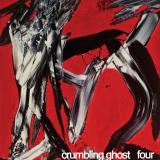
Within the broad church of metal and its many offshoots – rock, doom, stoner and all the rest – it remains a minor thrill to stumble across a group who seem to exist at a slight tangent to everything else. Crumbling Ghost is one such anomaly. Crumbling Ghost are not newcomers. They've been operating for some time, releasing records sporadically, Four' is in fact their fourth release. Along the way they've accumulated a fervent coterie of followers, not to mention the occasional nod of approval from tastemakers such as Stuart Maconie, Stewart Lee and Tom Ravenscroft. And though they've appeared at Roadburn, shared stages with Hawkwind and even Damo Suzuki, they remain (possibly by design) curiously under the radar.
The group's core idea is deceptively simple: traditional folk material refracted through the haze and heft of heavy, fuzzy stoner rock with a chunk of psyche and a smattering of doom. But crucially, this is done without the costumery and theatrical tics that often accompany such collisions. No mock pagan pageantry, no graveyard cosplay, no cartoon Satanism.
What Crumbling Ghost latch onto is not folk as a museum piece, but as a lived experience, the dramas rooted in the culture, stories, and daily lives of ordinary people, the folklore, the tales of love and death, murder and adultery, freedom and oppression. Singer Katie Harnett says. "Doting mothers, possessive, violent partners, vulnerable women, seasonal workers and Royal scandals this album is our representation of the trials and tribulations of human existence and universal experiences that still feel relevant today.
Guitarist John adds. "Themes of murder, betrayal, loss, jealousy, and love are found across the record. In particular, the songs of Martin Carthy have been a particular source of inspiration".
The result is a set of murder ballads, supernatural reckonings and cautionary tales, all wrapped in slabs of heavy, thumping fuzz and atmospheric sonics. Harnett's voice sits at the centre: unmistakably folk rooted, but shorn of prettification, melodic yet capable of real bite.
The album opener 'Bows Of London' is a murder ballad of sisterly hatred and grim sibling rivalry, centred on a haunted fiddle fashioned from a dead sister's bones. The loping relentless, hypnotic backing chillingly and perfectly accompanies the narrative. Of course, the story doesn't end well. 'Bill Norrie' follows, a hooky melody propelled by an insistent bassline and a haunting psych tinged haze punctured with sheets of noise.. The story of young Bill Norrie who sends a token to a married woman, whose jealous husband beheads him, without knowing he was his wife's son from an earlier affair. An instrumental palate cleanser arrives in the shape of 'Valtz Efter Tor Lohne' a Norwegian traditional the band jokingly describe as a "banger".
Then we have 'Lovely Joan' which offers a rare note of sly triumph: a quick witted woman outmanoeuvres a predatory nobleman, escaping with his ring and his horse. Muscular riffs give this tale of empowerment a welcome sense of teeth. 'Gower Wassail' is a traditional Welsh folk tune that captures the raucous spirit of communal ritual, noise making and drink fuelled hope for a good harvest. Captured perfectly here by CG complete with wah wah guitar and a drunken groove catching the song's celebratory chaos. Then we have a little gem in 'Last Of All Sleep' , an original band composition and a genuine highlight: a heavy lidded, shoegaze tinged folk reverie, equal parts distortion and delicacy. It's a drop-dead gorgeous shoegaze-tastic psychedelic grunge mini epic. The album closer 'The Unquiet Grave' is a very apt place to finish. It's about a young man whose constant grief at the death of his true love disturbs her eternal sleep so she cannot rest. Even though the playout on this track, complete with a demonic repeated riff and feedback feels suitably bleak, even this song allows a glimmer of release ... we think.
And there we have it, 7 songs, 7 worlds, all honed to perfection by producer Wayne Adams (Green Lung/Big Lad) that will reward every repeated listen.
Folk and metal/heavy rock do have a connection of course, just look at Green Lung and their 'folk horror' infused musical universe, but Crumbling Ghost are a very different beast.
'Four' amply and beautifully demonstrates that when it comes to 'folk horror' there's nothing quite as horrible as folk ... Here, the horror such as it is, and it must be said, the moments of light, comes not from theatrics, but from the songs themselves – which, after all, is where it's always lived.
Crumbling Ghost are John Mosley – Guitar / Donny Hopkins – Guitar / Ruth O’Loughlin – Bass / Katie Harnett – Vocals / Matthew Atkins- Drums.
Next up on Berlin’s Pure Hate Trax PH009 PH EP by NX1 Incl. UVB Remix. For over a decade, the Barcelona-based duo NX1 have forged and continuously refined a unique sonic identity. Their music radiates an awe- inspiring physicality: powerful low-end pressure, meticulously crafted breaks, and tension-driven crescendos that elevate each track without ever resorting to clichés. The duo has consolidated its position with releases on some of the most respected labels in the scene, including Planète Rouge, MORD, Modularz, Semantica, BITE, Earwiggle and their own imprints NX1 and Nexe Records. Their discography reached a pivotal moment with the release of their acclaimed album “What You Should Know About Yourself”, a defining chapter in the evolution of their artistry. On remix this time we are proud to welcome UVB to the label. The French Berlin based artist needs no introduction due to his constant presence on the Techno scene for well over a decade now releasing on such labels as Mord, 47, Monnom Black, Analogue, STOOR and his own imprints SHIV and Body Theory. Mastered by Paul Mac Graphic design by Slave To Society Distributed by Triple Vision Distribution 2026 Pure Hate Trax
320 page, beautifully written, designed and printed, hardback book
ISBN: 978-1-0687642-2-6
“Keep the books coming, keep the music coming, keep the art coming. When you think you know everything, you can miss out on a lot. When you realise you don’t know everything the floodgates come down a bit and you start following literary links and musical links that you might not have made before. It’s a whole new parallel universe.” Andrew Weatherall, 2015 Today Disco Pogo is delighted to announce A Disco Pogo Tribute To Andrew Weatherall, a 320-page hardback that gathers everything we love about the man and his music. It is the fourth in our hardback Tribute series – following Daft Punk, Aphex Twin and LCD Soundsystem – and the long-overdue successor to the sold-out and hard to find Jockey Slut Tribute To Andrew Weatherall from 2020. Inside you’ll find the best of that original Jockey Slut book, plus more than 200 pages of brand new material – fresh essays, oral histories, interviews and photography from the writers, photographers, musicians, producers, DJs, designers and friends who knew Andrew best.
The book is being published with the full blessing, approval and cooperation of the Weatherall estate, who will also receive a share of the profits from the book. From the fanzine kid at Boy’s Own to the producer who rewired Primal Scream and made ‘Screamadelica’ sound like the future; through The Sabres Of Paradise, Two Lone Swordsmen, The Asphodells and the much-loved A Love From Outer Space night and Convenanza festival, Weatherall left behind a body of work, a sensibility and a way of carrying yourself that is still being unpacked six years on. This is the book that tries to do all of it justice.
Highlights include: an interview with Bobby Gillespie that goes beyond ‘Screamadelica’, essays on ‘Sabresonic’, ‘Haunted Dancehall’, the Two Lone Swordsmen and his solo releases, plus a look into his many remixes. In addition: oral histories on his early years, A Love From Outer Space and Convenanza, an interview with Timothy J. Fairplay on The Asphodells and a celebration of his art work and his NTS radio shows. And then there’s the Disco Pogo Tribute regulars: a timeline, family tree, a studio gear deep dive, discography and more… Featuring interviews with Sean Johnston, David Holmes, Jagz Kooner, Leftfield, Shaun Ryder, Chemical Brothers, Terry Farley, Dot Allison, Beth Orton, Irvine Welsh, Daniel Avery, HAAi, Tia Cousins, Steve Mason, Richard Fearless and many more.
Magyar Posse’s third album Random Avenger out on vinyl for the first time ever in July via Svart Records Looking back, it was the golden age of Magyar Posse. The album Kings of Time had received a tremendous response from both critics and music lovers. The band was touring intensely in Finland and abroad. By now, the band was a well-oiled machine, ready to capture the successor to their celebrated second album. The band decided to follow a different path compared to the creation of Kings of Time: they would record their third album alongside the well-known, slightly eccentric engineer and producer Jani Viitanen. The recognizable Magyar Posse style was present in the pieces of Random Avenger, but something was slightly different. The new music was more rhythm-based, more riff-based and in places more joyous than the dynamic minor key avalanche of Kings of Time. Consciously or unconsciously, the band members saw that they had travelled the Slavic melancholy road as far as possible with the previous album. The success of Kings of Time felt like a positive push, not an extra pressure on their shoulders. It was only natural to strike again while the iron was hot. Many of the pieces had been already developed by the time Kings of Time was released, which eased the production of Random Avenger. After the meticulous but relatively swift mixing and mastering process, the band members were satisfied with the result. The only component that made some of them blush was the cover art – graphic designer Tom Backström had glaringly used photos of empty stages in forgotten community centres and the like. The beauty or the ugliness is once again in the eye of the beholder. Right after its release, Random Avenger got a very positive response, but not as overwhelming as Kings of Time – which was to be expected, as the previous Magyar Posse album had probably been the most universally praised Finnish album of the whole decade. Mikko Elo, musician / journalist, Pori, Finland, March 1st 2026
Magyar Posse’s third album Random Avenger out on vinyl for the first time ever in July via Svart Records Looking back, it was the golden age of Magyar Posse. The album Kings of Time had received a tremendous response from both critics and music lovers. The band was touring intensely in Finland and abroad. By now, the band was a well-oiled machine, ready to capture the successor to their celebrated second album. The band decided to follow a different path compared to the creation of Kings of Time: they would record their third album alongside the well-known, slightly eccentric engineer and producer Jani Viitanen. The recognizable Magyar Posse style was present in the pieces of Random Avenger, but something was slightly different. The new music was more rhythm-based, more riff-based and in places more joyous than the dynamic minor key avalanche of Kings of Time. Consciously or unconsciously, the band members saw that they had travelled the Slavic melancholy road as far as possible with the previous album. The success of Kings of Time felt like a positive push, not an extra pressure on their shoulders. It was only natural to strike again while the iron was hot. Many of the pieces had been already developed by the time Kings of Time was released, which eased the production of Random Avenger. After the meticulous but relatively swift mixing and mastering process, the band members were satisfied with the result. The only component that made some of them blush was the cover art – graphic designer Tom Backström had glaringly used photos of empty stages in forgotten community centres and the like. The beauty or the ugliness is once again in the eye of the beholder. Right after its release, Random Avenger got a very positive response, but not as overwhelming as Kings of Time – which was to be expected, as the previous Magyar Posse album had probably been the most universally praised Finnish album of the whole decade. Mikko Elo, musician / journalist, Pori, Finland, March 1st 2026
Night Lives is composer Kristine Tjogersen's second album on Aurora Records, and the follow up to the critically acclaimed debut album Between Trees from 2024, it's now being released on vinyl for the first time Kristine Tjogersen 's Night Lives (2023) is an excursion into the shrouded world of nocturnal creatures. Produced in a multidisciplinary collaboration with the Norwegian contemporary music ensemble Cikada , biologist and writer Hanna Bjorgaas, scenographer and performer Ellen Jerstad, visual artist and lighting designer Evelina Dembacke, and artist and designer Marie Payan, Night Lives offers a fantastical imagining of how bats, moths, owls, micro- organisms, and other nighttime dwellers communicate, immersing audiences in wonders that are beyond our human eyes and ears.
Demon Records presents a thrilling original Circuit Breaker story read by Jo Martin, featuring the Fugitive Doctor.
Jo Martin - the Fugitive Doctor in the BBC TV series – reads this gripping adventure by Steve Lyons, with David Banks as the Cyber-Leader. This fourth instalment in the Circuit Breaker story arc comes on 1LP translucent “Purple Coat” vinyl with a stunningly designed inner and outer sleeve.
Doctor Who: Circuit Breaker launches on 25 June 2026, kicking off an epic, multi-platform adventure unfolding this summer across audio, publishing, gaming and digital, bringing fans together for one connected, must-follow Whoniverse event. The story event will see a single, escalating crisis play out across multiple formats, with each chapter unlocking new clues, new dangers… and a new side to the Time Lord.
Carve is the second full-length by Bay Area artist Kathryn Mohr. Written over the course of five years and recorded over several weeks in a rural singlewide in the Mojave Desert, the album centers on love experienced as a form of grief, not as an aftermath of loss, but as a condition of intimacy itself.
Mohr describes Carve as an album about how memory exists outside the body, embedded in places and landscapes. It is shaped by her first return to the American Southwest since a childhood road trip at age five, and by the experience of moving through terrain that holds emotional weight long after its origins fade. The record considers how intimacy feels after years of isolation, and what it takes to carve out a life that allows for trust, presence, and feeling rather than mere survival. The project took form after a difficult tour that ended in Joshua Tree. Mohr pointed her car into the desert and drove alone, crisscrossing the Mojave on dirt roads. Months later, she returned to record the album, working alone with an acoustic guitar, a field recorder, and limited supplies. Following that period, Mohr began to allow for intimacy and connection. The time she spent recording Carve in the desert did not create isolation so much as mirror it. Working alone out of an old, western-themed jail Airbnb, the physical enclosure reflected the emotional conditions under which much of the record had been written: distance, restraint, and long stretches of stillness. In that context, love was not experienced as escape, but as something inseparable from impermanence and the awareness of loss.
This tension between connection and inevitability sits at the center of Carve. Some of the album’s songs were written earlier, during a prolonged period marked by emotional distance and apathy. Over those four years, Mohr was working through unprocessed childhood memories and their long-term effects on her ability to connect with others. The work was slow and difficult, involving a fundamental reshaping of how she related to herself and to the world. Carve was mixed by Richard Chowenhill of Flenser labelmates Agriculture. Rather than offering resolution, the album documents the act of remaining present within tension. Carve is not about escaping grief, but about accepting it as inseparable from love itself. Kathryn Mohr’s previous effort “Waiting Room” received the coveted ‘Best New Music' designation and a score of 8.4 from Pitchfork.
out of Stock
Last delivered 81 days ago available to reorder, subject to availability
This special collector's edition is available in a strictly limited run of only 250 copies. The vinyl version is pressed on transparent vinyl and features metallic paper packaging along with a printed inner sleeve made from dyed paper stock. The entire release was designed by the exceptionally creative graphic designer Weronika Lipniewska, resulting in an edition that is as captivating visually as it is musically.
EY AY (Deluxe Slay Jazz) is the second album by Piotr Checki - an artist who, following the intimate, home-recorded debut PE, returns with something radically different: a living, spontaneous work captured in real time. If PE was a personal document of moments enclosed within a controlled studio environment, EY AY is its opposite - a sonic organism that breathes, pulses, and unfolds in the here and now.
The album was created in just two weeks during a period of intense inspiration. Ch?cki developed a series of compositional sketches which were then expanded together with drummer Tymek Papior and pianist Marcel Balinski during a single six-hour recording session. Crucially, the entire album was recorded as one-take performances. No overdubs, no edits, no second attempts. It is a document of pure presence - a moment that can never be repeated.
The subtitle Deluxe Slay Jazz carries an additional personal layer of meaning. It serves as a subtle yet significant nod to one of Checki's greatest passions: ski jumping. The initials "DSJ" may also evoke the cult classic ski-jumping computer game released in 1999, beloved by an entire generation of players.
With EY AY, Checki redefines his approach to music-making. Instead of constructing rigid structures, he places trust in the process. Instead of production, interaction. Instead of perfection, authenticity. This is music that does not strive to be finished - it simply exists.
out of Stock
Last delivered 78 days ago available to reorder, subject to availability
The music of La lucha es un poema colectivo was conceived and composed during a long artistic residency at IRCAM in Paris in November 2023 and will be released by Superpang. ‘In November 2023, we were in residence in Paris when we found ourselves in the midst of protests and strikes by workers at the Centre Georges Pompidou. They were demanding the respect of their rights. Entering that place as outsiders, making art while hundreds of people outside risked losing their jobs, was disorienting.
This is the starting point for the title of this album, evocative yet at the same time tangible. A phrase, as often happens, borrowed from those who had, in turn, borrowed it before us, words that are not and
cannot be only ours. Words too heavy to be slaves to context or syntax, yet words that resonate within us, move us, and open rifts in our history as a group. A strange plunge, strange despite the fact that the premises were clear from the start, with well-defined lines of a unified design. And if we ask ourselves, looking around, not so much what but rather with whom we would like to share it, we imagine the music of this album within that groove, in that intangible bond that unites a collective of people who, upon reading this sentence written on a wall, in a street, pause for a moment, slow down, rest their gaze, and know they are still alive.”
Hot Creations Summer 2026 Vinyl Sampler featuring four of the Hottest recent releases on Hot Creations.
Adam Ten and Asulin join forces for the first time on Hot Creations with ‘Warawara’. Fusing driving grooves, finely tuned production, and emotive vocals into a cohesive club-ready statement. ‘Warawara’ moves with hypnotic energy and forward momentum, as Adam Ten channels his signature blend of evolving rhythms and precise production, before Asulin’s vocals weave seamlessly through the arrangement, delivering melodic clarity and emotional resonance. High-flying UK DJ/producer Riordan debuts on Hot Creations with ‘Feel The Funk’ which locks into a slick groove built around silky M1 organs, skippy drums, and soulful vocals, as it twists through a series of cascading builds and drops. Infectious as hell!
Following the release of ‘Murder Mystery’ in October, Jamie Jones’ groove-driven track returns with a reinterpretation from one of the scene’s most hyped talents: German producer Kolter’s remix injects the track with his unmistakable style: deep, rolling basslines, playful funk tones, and raw, 90s-inspired textures that keep the energy moving. The result is a version that maintains the original’s tension and groove while opening new sonic spaces for DJs and dancefloor explorers alike - bridging underground sensibilities with festival-ready punch. Finally, Volkoder returns to Hot Creations with ‘My House’, a no-nonsense groove designed to hold and control the dancefloor. ‘My House' locks in from the off, sitting firmly in the pocket with commanding synths, hooky vocal interjections, and chunky low-end weight, while smaller details dart around the groove to add splashes of momentum.
out of Stock
Last delivered 11 days ago available to reorder, subject to availability
There’s a new sound shaking up the Upper East Side — and it’s not related to Serena this time.
It’s ‘gg’, the new track from Lolina.
We've all heard the rumors of L performing this one around the globe for months, & some of the lucky ones got the chance to catch it live... but now the wait appears to be over for the general public. There are officially plans to release the studio version of ‘gg’, and it's safe to say the track is scandalous. Meeting same time, same place to get to the bottom of it all. Confusion lingers, yet everything stays comfortably in strife. It all keeps moving.
Who is the city even for now? What’s our own involvement in the distress? That’s one secret I’ll never tell!
Why is it that L must use song to persist in this city that never sleeps? Have fables fallen so out of fashion that princesses have to do everything themselves now?
Well... according to some tips we received this doesn't seem to be the case. L has enlisted help from some very exciting sonic connoisseurs, resulting in remixes stronger than a knight in shining armor could ever provide.
So let's check out this track list, shall we?
A-Side
gg (Extended Version)
gg (NEW YORK Remix)
B-Side
gg (Arca Remix)
Sounds like the perfect soundtrack for eating a yogurt cup on the steps of the MET to me.
We seriously doubt you'll be able to ignore this release.
Run the credits, roll the dice.
xo xo
GOSSIP GIRL
Press release by Kaitlin Simotics
Mastering and additional mixing by Amir Shoat
Artwork by Lolina
Vinyl design by Termite Lounge
out of Stock
Last delivered 18 days ago available to reorder, subject to availability
MAR 004 continues the evolving catalogue of Moozikeh Analog Room, a label imprint emerging from the broader Analog Room ecosystem. Over time, Analog Room has developed into distributed creative structure spanning, bridging club culture, archival releases, and experimental instrument design. MAR 004 extends this trajectory, reinforcing the label’s position as a long-form documentation platform for contemporary electronic music practices rooted in both regional and international dialogue.
From The Label:
"The relationship with Roman Flugel started with us listening to his music and be fascinated by the simplicity but bold sound. The sound design and the story telling was inline with how we enjoyed music. After inviting Roman for a few times to perform at Analog Room, the relationship led to the point that when it was time for us to think of the MAR releases, we could not miss on asking Roman to join the label and the rest is what you are going to experience with this thick, deep and rhythmic EP that represents what the world need at the moment, some SOLUTIONS. Analog Room has always tried to bypass the issues in the South West Asia region through music and art and show how we are all the same and connected."
From Roman:
"My record for Analog Room is essentially a long-term project that was sparked by multiple invitations to the Analog Room club in Dubai over the course of several years. The club held a special place for me—a sanctuary for the underground music scene in a city otherwise defined by a very different ethos. I am delighted to now be part of the Analog Room label family. The record blends various moods and directions within my personal musical landscape, and "Solutions," in particular, has created euphoric moments during my DJ sets over the past few months."
out of Stock
Last delivered 31 days ago available to reorder, subject to availability
Known for his signature positive vibes and the triple-platinum single “GOOD TIME,” country star Niko Moon digs into his own origin story on his new 15-track album, ROOTS. Following his 2025 tropical album AMERICAN PALM, ROOTS shifts the scenery to the verdant hills of Georgia where Moon grew up, balancing his trademark optimism with unprecedented transparency about his journey. On the track “AMERICAN DREAMIN’,” he reflects on a lean childhood moving between trailers and motels, inspired by the resilient optimism of his truck-driver dad and waitress mom. He fast-forwards to his current life in Nashville on the ballad “RICH MAN,” celebrating his wife and two children as his true source of wealth, while tracks like “GET COUNTRY” deliver a trap-beat party anthem designed for pure escapism. The album's centerpiece, “GEORGIA (ROOTS),” interpolates the classic "Georgia on My Mind" to celebrate his home state with a feature from his own daughter. Beyond the music, Moon channels his pay-it-forward mentality into his Happy Cowboy Foundation, which provides affordable therapy, proving that his signature smile isn't from a lack of hardship, but a conscious choice to spread encouragement.
The 12th studio album from Death Metal Veterans, JUNGLE ROT. DAVE MATRISE (Vocals/Guitars): "Let's start off by saying what an amazing accomplishment it is to hit 12 releases in my career. Never would I think I'd still be doing this 30+ years later. I guess be careful what you wish for I'm very grateful to all of our fans that have supported us for so many years and for never giving up on us. To my bandmates for all of their hard work and dedication to me and JRot over all these year’s. Cruel Face Of War will not disappoint. It's full of crushing grooves and violent hooks that will surely break anyone’s neck. We have stood the test of time. We are still here playing our trademark style of Oldschool Death Metal that has carved a legendary name for us in the underground scene today." Produced by Chris Djuricic at Bell City Sound Company. Mixed and Mastered by Dan Swano at Unisound Studio. Artwork and design by Gyula Havancsak
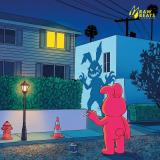
Rawbeats Records returns to its main catalog with a heavyweight release from Mar del Plata’s own Juaan. Meticulously crafted between 2020 and 2022, these four tracks are essential peak-time weapons already backed by the scene’s biggest names.
A1. "Decihden" sets a relentless pace right out of the gate. It's built on a foundation of heavy, punchy kicks and a rolling, infectious bassline creating a high-energy, club-ready tool.
A2. "Fui Do Por", which shifts the EP into a slightly more hypnotic and spaced-out territory. Syncopated rhythms layered with dubby, atmospheric chords, create a solid tension that perfectly bridges the gap between warm-up and peak time.
B1. "Knt" goes straight for the business, heavy production, driven by raw drum work, acid-tinged squelches and underground flavor. Mixes into a perfect dark, constant, piece designed to lock the dancefloor into a pure trance-like state.
Closing things off is DC Salas Remix of KNT, Diego steps up to completely reinterpret the original, injecting a distinct percussive bounce and twisting the core stems into a darker, expansive journey. It serves as the perfect cerebral closer to a heavyweight EP.
out of Stock
Last delivered 71 days ago available to reorder, subject to availability
40 years after its creation, MOß GARTEN – Sekvensstyrd 1981–1986 arrives as a compelling double vinyl LP, diving deep into the early Swedish DIY electronic scene. Inspired by pioneers such as Kraftwerk, Cabaret Voltaire, John Foxx, and The Human League, Mikael Isaksson developed a distinct sound situated between minimal electronics, industrial, synth wave, and experimental sound art. At its core was the sequencer: pulsing, programmed structures forming the backbone of dense, often hypnotic compositions.
Working initially with his cousin Jan or friend Thomas and later evolving into a largely one-man project, recordings were made on cassette tapes and in improvised studios—often under time pressure, frequently recorded and mixed within just a few hours. These very limitations gave the tracks their raw and immediate character. Pieces like “Moderna Kvinnor,” “Soon Soon,” “Ensam,” and “Music From The Border” exemplify the uncompromising, sequence-driven (“sekvensstyrd”) approach that defined this era.
Using an arsenal of analog synthesizers, early sequencers, and drum machines, the project created music that feels at once cold, mechanical, and deeply emotional. Sekvenssytrd 1981–1986 is more than a collection of archival recordings—it is a vivid document of a time when electronic music was conceived as a radical and deeply personal form of expression.
Mastered by Martin Bowes. Graphic design by Steve Lippert.
2LP features: limited to approx. 200 copies, solid moss green vinyl, gatefold outer sleeve gloss lamination, polylined inner sleeves, hand-numbered silver foil paper insert with lyrics, download coupon)
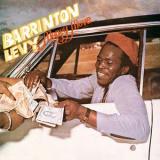
Classic Barrington Levy Album from 1984 restored and remastered for best ever sound.
Features the hit singles 'Money Move; and the Jah Shaka sound system anthem 'Praise His Name'. Unavailable for 40 years and first time ever released outside Jamaica.
Sleeve artwork design by the great Jamaican illustrator Limonius - highly collectable. Solid all-star roots backing from Sly & Robbie, Lloyd Parks.
Recorded and mixed at Dynamic Sounds and Channel One
Ornaments continues its long-standing journey with Carlos Nilmmns, presenting a new mini-LP that effortlessly fuses sophisticated late-night club grooves with raw emotional depth. Across six expertly crafted tracks, Nilmmns delivers a rich sonic spectrum: from smoke-filled jazzy cuts and deep, hypnotic vibes to uplifting, funky piano house designed for the dancefloor. The emotional centerpiece of the record belongs to two breathtakingly deep, vocal-led songs featuring the beautiful, timeless voices of Genoveva, Keter Darker, and the legendary Karl The Voice — a poignant, soulful tribute that grounds the entire release
out of Stock
Last delivered 3 months ago available to reorder, subject to availability
Ever since the late 1950s bossa-nova revolution, Brazil’s influence on French music has been undeniable. Pierre Barouh, Georges Moustaki and a vast array of lesser known artists, all made the Musica Popular Brasileira (MPB) an axis of promotion at the service of a cool and metaphysical, modern and mixed Brazilian lifestyle. Some were seduced by the poetic languors of the bossa, some were looking for fun, and others just loved the American hybridization of jazz-bossa, jazz-samba.
What is bossa nova? One of its creators, Joao Gilberto said: "Its style, cadence, everything is samba. At the very start, we didn't call it bossa nova, we sang a little samba made up of a single note - Samba de uma nota so .... The discussion around the origins of bossa nova is therefore useless”. It is nevertheless useful to remember that these magnificent Brazilian songs, which the guitarist describes as samba, were shifted and balanced around improbable chords. "I like things that lean, the in-betweens that limp with grace," said Pierre Barrouh, quoting Jean Cocteau.
With emotion, arrangements for violin and supple guitar licks, bossa nova rapidly changed. A transformation that can be heard in the Tchic, tchic, French Bossa Nova 1963-1974 compilation, the result of a cultural reappropriation, which traveled through the United States and supplemented itself in France.
A musical revolution that has remained significant, bossa nova was born in Rio. From 1956 to 1961, Brazil lived through its golden years. In five years, the country had invented its modernist style. Elected president in 1956, Juscelino Kubitschek de Oliveira, an elegant man with a broad forehead, brandished a promising slogan: "Fifty years of progress in five years". He quickly got to work. Not worried about increasing debt, he launched the project for a new federal capital, Brasilia, designed by the communist architect Oscar Niemeyer. Volkswagen opened state-of-the-art factories and created the “fusquinha”, the Beetle. In Rio, the Vespa made its first appearance. The Arpoador Surf Club crew run into the “girl” from Ipanema, Helô Pinheiro - the tanned garota ("chick"), between a flower and mermaid, who at 17 walked by the Veloso bar, where the fiery author and composer, Tom Jobim and Vinicius de Moraes, were getting drunk on whiskey. From then on, bossa symbolized cool.
In 1958, Joao Gilberto recorded Chega de Saudade, which the directors of Philips denied, calling it "music for fagots". The marketing director, who believed in it, secretly pressed 3000 78-inch vinyls and distributed them at schools around Rio, creating a tidal wave.
American jazzmen then took over. In particular, trumpeter Dizzy Gillespie and guitarist Charlie Byrd. In November 1962, the Brazilian Ministry of Foreign Affairs funded a "Bossa-Nova" concert at Carnegie Hall in New York, inviting the genre’s pioneers. Unprepared, the show soon turned to disaster. But the troupe was invited to the White House by Jackie Kennedy. The first lady loved "the new beat" and in particular Maria Ninguem, a song by Carlos Lyra, later covered by Brigitte Bardot.
In Brazil, the 1964 military coup quickly ended this euphoria. The destructive atmosphere that ensued pushed many Brazilian musicians to leave, if not to exile. Thus, Tom Jobim, Sergio Mendes and Joao Gilberto arrived to the United States. In New York, Joao Gilberto met saxophonist Stan Getz. At the time, he was married to the Bahianese Astrud Weinert Gilberto, who had a German father. She had never sung before, but she knew how to speak English. Getz therefore asked her to replace her husband on The Girl From Ipanema. The Getz/Gilberto record with Tom Jobim on piano, was released in March 1964. Phil Ramone, the "pope of pop" was in charge of sound.
Bossa nova arrived in Paris through the classic “guitar-voice” channel (Pierre Barouh, Baden Powell, Moustaki…) But France loved jazz and Paris had already welcomed its American contributors. All these good people were to pass through Saint-Germain-des-Prés. The cabaret l'Escale became the Mecca of Latin American sound where one could find Pierre Barrouh and his friends, such as the Camara Trio, samba-jazz aces, whose only record was published by the Saravah label. With a band strangely called Les Masques (a band that included Nicole Croisille and Pierre Vassiliu, among others), the Camara Trio recorded an interesting Brazilian Sound, including the track Il faut tenir which is present on this tasty compilation of rarities.
Other enlightened musicians can also be found on the compilation, such as Jean-Pierre Sabar (songwriter for Hardy, Auffray, Leforestier ...) and the French pop rock organist Balthazar. In 1975, Sabar recorded Aurinkoinen Musiikkimatka on a Finnish label, which featured the crazy Vai, Vai, included on this record. We are now following the footsteps of Brazilian electronic musicians such as Sergio Mendes, Eumir Deodato or Marcos Valle who created funk and disco sounds on their keyboards and synthesizers. A style that influenced Véronique Sanson when she wrote Jusqu’à la Tombée de la nuit in 1969 for Isabelle de Funès, the niece of Louis and a great friend of Michel Berger - Sanson did end up singing this track on her 1992 Sans Regret record.
The pinnacle of exoticism and travel, Sylvia Fels’ Corto Maltese includes bongos, sea mist and ocean sounds. The title was taken from Jacky Chalard’s concept album written in 1974, Je suis vivant, mais j’ai peur (I am alive, but I am scared), based on Gilbert Deflez’s science fiction novel.
However, bossa nova extended the scope of popularity. "In the 1970s, I was a fan of Sergio Mendes, Getz / Gilberto. I fell in love with this music that I knew because I had been an orchestral singer, " explained Isabelle Aubret, who in 1971 delivered a composite record of covers by the very funky Jorge Ben, Orfeu Negro, Tom Jobim, Vinicius de Morais and Jean Ferrat. "I recorded this album for Meys Records in Paris, far from Brazil, with wonderful musicians, François Raubert, Roland Vincent, Alain Goraguer...". The latter wrote the arrangements for Casa Forte, a very percussive title borrowed from Edu Lobo, one of the initiators of the bossa who spent time in California. "Jazz and bossa came together and produced very rhythmic music. I love singing, it allows me to dream, to have fun, to feel a high on stage, and these songs brought me joy, made me swing, my singing felt like a dance.”
The world tours of French singers and their desire for the tropics, often brought them to Rio with its hills, forests, caipirinhas and tanned bodies. There are surprises though, like this Iemenja (Iemenja is the goddess of the sea in the Afro-Brazilian candomblé religion). Not unlike the composer and musician Jean-Pierre Lang, based in Sao Paulo, Claire Chevalier taught Brazil to Brazil. In 1970, the singer and painter published a 45-inch vinyl, Mon mari et mes amants (My husband and my lovers), under the improbable pseudonym of Clarinha (little Claire). She was then living in Rio, with her husband, Joël Leibovitz, who founded a band called Azimuth, and who owned a record label specialized in "sambas enredos" songs for samba school parades.
For its B side, she asked Pierre Perret to come up with lyrics for a song composed by Carlos Imperial: "Oh goddess of the sea, o goddess Iemenja, I bring a white rose to adorn your long hair ..." . "Perret came to see us, and we had fun, remembers Joël Leibovitz. We wrote Lemenja for fun, we recorded it at the Havaí studio, behind the Central do Brasil the central station. Erlon Chaves, the arranger who worked with Elis Regina, joined us" adding his share of Afro-Brazilian percussions and funky brass to the mix.
There is a common misunderstanding in Franco-Brazilian history: that bossa, admittedly hedonistic, is perceived as funny, even though the poets who wrote the texts are often philosophizing on the human condition. Its French interpreters pull it towards a carnival inspired universe, far removed from its fundamental essence. Thus, Jean Constantin covered the famous Samba da minha terra, an ode to the art of samba written by the classic Bahian composer Dorival Caymmi, renaming it with the enticing title of Pas tant de tchi tchi pompon: "On your pier there is no tchi tchi / when you arch your back, you know everything is alright ”(lyrics by Gérard Calvi). This expedited bossa aims for the absurd, but retains a certain elegance.
Indeed, Jean Constantin was not an idiot, the rather large man had a huge mustache and liked fantasy, (Les pantoufles à papa, Le pacha, inspired by cha-cha-cha-cha, salsa and jazz) but he was also the lyricist of Mon manège à moi interpreted by Edith Piaf, the composer of Mon Truc en plume by Zizi Jeanmaire and the soundtrack of François Truffaut’s 400 Blows. Le Poulpe, published in 1970, from which this bossa is extract, was arranged by Jean-Claude Vannier, an accomplice of Serge Gainsbourg’s Melody Nelson. In short: "There is enough of samba / By looking at the parasol / Because my poor cabeza / Is going to die in the sun".
Even the American actress Marpessa Down, who was at the heart of the bossa nova revolution with her role as Euridyce in Marcel Camus’ film Orfeu Negro, winner of the 1959 Cannes Palme d'or, fed the clichée with Je voudrais parler au petit cuica - "Tell me how you manage to always make people want to dance / It's true, I must admit that I cannot resist your magic" - in consequence, once can hear the cuica, a little drum inherited from the Bantu.
But bossa nova had many angles. Societal, of course, pushing actresses who were symbols of women's liberation like Brigitte Bardot, Jeanne Moreau, or Sophia Loren to engage in the exercise of accelerated bossa. In February of 1963, Sophia Loren made a record in French in Rome, Je ne t'aime plus, featuring the song De jour en jour, a bossa written by two Italians, Armando Trovajoli and Tino Fornai, which was released a little later by Barclay. Bossa accompanied the 1960s, a decade of moral liberation. Ann Sorel, who interpreted La Poupée des favellas, caused a sensation with L’amour à plusieurs, a provocative song written by Frédéric Bottom and Jean-Claude Vannier. As for the actress Andrea Parisy, she displayed her bourgeois cheekiness in Marcel Carné's Les Tricheurs before interpreting Les mains qui font du bien. And Magalie Noël, the friend of Boris Vian, who sung Johnny fais-moi mal, was hired to sing Une énorme Samba, composed by Alain Goraguer (arranger to Gainsbourg, Bobby Lapointe and Jean Ferrat) with lyrics by Frédéric Botton.
But in the end, of what wood is bossa nova made of? The answer is given by Christianne Legrand, daughter of Raymond the conductor, and sister to Michel the composer: "With me, with jà" - jà means "immediately" in Portuguese. In 1972, the singer, an expert in vocal jazz and a member of the Double Six, published Le Brésil de Christianne Legrand. Two songs included on the Tchic Tchic compilation that demonstrate how bossa, jazz, funk, rock, etc. work like a swiss army knife: the music is used to denounce broken systems, or miracles, HLM et ciné roman, Cent mille poissons dans ton filet, two songs from the O Cafona soundtrack, a successful telenovela broadcast, at the time in black and white, on TV Globo. The first was adapted in French by the fighter and friend of the Legrand tribe, Agnès Varda. The second is content with a play on words, jostling them into a summer fun.
Véronique Mortaigne
out of Stock
Last delivered 3 months ago available to reorder, subject to availability
Blending world-class musicianship with undeniable dancefloor energy, this release marks a bold evolution in Sean Khan’s sound — stepping beyond his signature jazz roots into a rich fusion of house, disco, and jazz-funk.
The A-side delivers a powerful, vocal-led jazzy house anthem, with Omar’s unmistakable voice floating over lush live keys and deep bass grooves. Driven by refined production and crafted for maximum impact, Stéphane and Alex Attias bring a sophisticated yet infectious energy designed to ignite dancefloors. Flip it over, and the B-side turns up the heat — a killer disco-house remix by Alex Attias, powered by tight programming from Stéphane Attias and vibrant keys from Sohan Wilson. Already catching attention from DJs, this track is built for late-night moments and peak-time reactions. The EP also features “As The Tree Grows” — a soulful, live-inspired journey through jazz-funk and disco textures. Warm, groovy, and deeply musical, it channels the spirit of legends while staying fresh and modern — perfect for both listening and dancing. Three moods. One release.cCrafted for the dancefloor. Designed for the soul.
out of Stock
Last delivered 3 months ago available to reorder, subject to availability
“Interstate” is the latest EP by Melchior Sultana, a six-track journey through deep house, soulful grooves, and atmospheric electronic textures. Released on his own label, Profound Sound Music, the project blends warm analog sounds, hypnotic rhythms, jazzy influences, and emotional melodies that reflect Sultana’s signature organic approach to house music. From the uplifting energy of “The Definition” and “Life Piano” to the reflective moods of “Cold Outside” and “Other Side,” Interstate captures the feeling of movement, introspection, and late-night escape. Rich in groove and musical depth, the EP delivers a timeless listening experience designed for both the dancefloor and immersive personal listening.
out of Stock
Last delivered 67 days ago available to reorder, subject to availability
As long as she can remember, Jane Remover has practiced her own autonomy as much as possible. The nineteen year old songwriter is an omnivorous listener that produces everything herself. She has been lauded by fans and writers alike, for accidentally creating entire genres in the wake of her prolific two-year run.
The new album is more conceptually abstract than its predecessor as Jane sheds linear narrative writing. However, it takes place beginning at sundown and through the night, up until the next morningʼs earliest crack of dawn. Its winding songs are obtuse but carefully composed, and intimately follow Jane's train of thought.
Dynamic production is at the forefront. Noisy highs gleam, and are juxtaposed by dusky Post-Rock lullabies within the same songʼs runtime. Census Designated is a staggering display of maturation in every aspect when compared to her previous presentation, to a degree that makes it few and far between in the world of albums.
Despite the darker palette, Jane steps into a technicolor clarity for the first time. The album was made in both studios and at home—with recordings from Studio North (Kensington in Philadelphia), mixes from Kayla Reagan and mastered by Hector Vega.
A photo of her standing bareback while facing away towards the high plains, serves as the cover art for an album where she manages to simultaneously divulge her most confessional moments yet, and captivate the listener with unanswerable questions.
Following releases of the UFO and Supercar soundtracks, Thunderbirds is the third in the series from Gerry and Sylvia Anderson’s iconic TV shows. It is newly compiled, mastered and designed by the creative team at Fanderson (The Official Gerry and Sylvia Anderson Appreciation Society), who have access to Barry Gray's original studio tapes.
The album features 37 tracks from 19 episodes (series 1 and 2), including the Thunderbirds main theme and closing titles. The tracks were not programmed to follow the episode order but to achieve an integrated listening experience. The best bits of the sixties’ soundscapes are here. The Thunderbirds soundtrack is an effective time capsule as Gray’s music veers into British spy genre, Latin pop, exotica, urban jazz and military marches. Beautifully composed and conducted, the score reflects the moods of the scenes, from dangerous to romantic and no-nonsense to silly.
Barry Gray was a classically trained composer and a versatile musician, and was amongst the first composers to use electronic instruments in music for television. Best known for creating the music for most of the Gerry & Sylvia Anderson television series in the 1960's and 70's (Fireball XL5, Thunderbirds, UFO, Space:1999), Barry Gray’s complete musical opus is still not commercially available in its entirety.
There are records that follow the rules, and others that rewrite them in real time. With O R G A S M A N I A, Byron The Aquarius returns to Skylax with a deeper, freer and more unpredictable statement — where jazz instinct meets raw machine funk, and structure dissolves into pure feeling. Rooted in the lineage of Detroit yet never confined by it, Byron operates in that rare zone where house music becomes expression rather than format. His sound doesn’t chase functionality — it breathes, it stretches, it resists. The EP opens with Back 2 Zion (Tomorrow), a spiritual and meditative journey built on loose drums and luminous chords, carrying a sense of elevation — early morning music where the dancefloor begins to think again. Enter the Co$mos (Fool) pushes further into abstraction, with drifting synths and broken rhythms unfolding in a non-linear structure, navigating between Sun Ra’s cosmic language and Detroit futurism. On the flip, Mr. Captain Crunchhh brings a raw, playful energy — crunchy textures, off-grid swing and an almost improvised groove, alive and unpredictable, a leftfield tool designed to disrupt expectations. Finally, O R G A S M A N I A stands as the centerpiece — hypnotic, sensual and immersive, locking into a deep repetitive groove while evolving in subtle layers, a late-night body experience guided by a sharp musical mind. Across four tracks, Byron The Aquarius confirms his unique position between jazz musician, house producer and sonic storyteller, with a trajectory spanning Sound Signature, Axis, Eglo, Apron and Shall Not Fade, continuing to resonate from Detroit to Berlin and beyond. Artwork by H5 — the iconic studio behind Daft Punk, Air and Vitalic — reinforces Skylax’s timeless and art-driven identity. This is not fast music, this is not algorithm music — this is music for those who still listen. Strictly for the heads. Vinyl only. No repress. Skylax Records.
Diffuse Reality presents Acheronte - Plastic Thoughts. A 12" vinyl and digital release built on solid, raw Techno. Four tracks on vinyl, complemented by one additional digital cut. Fully designed for peak-time dancefloor moments, this record is made to stay in your bag. Dynamic sounds that pull you in from the very first beat, a powerful kick that doesn't let you breathe, combined with thick, weighty textures and intense atmospheres, make this EP a key tool for your sets. Heavy, driving energy, now delivered straight to you.
out of Stock
Last delivered 82 days ago available to reorder, subject to availability
This is not a Ben Vida, Booker Stardrum, and Will Epstein record; it’s a Play Time record. That’s a subtle but important distinction, for a couple reasons. One, the sound of Magic Object—a polymetric blend of improv and pulse minimalism for saxophone, drums, and Moog—doesn’t really sound anything like any of their many other ensembles or respective solo projects. And two, it was only while making Magic Object, their debut album, that Play Time realized they were a band at all.
Let’s back up. The roots of the trio date to 2020-21, when Will and then Booker moved to the Hudson Valley, where Ben was already living. The three got into the habit of playing together at Ben’s house, and they soon realized that their hang sessions felt fundamentally different from making music in some falling-down studio in Bushwick. Where those experiences were rushed and cramped, a new sense of time and space now suggested itself. Where once they rat-raced the music, now they relaxed into it.
Early gigs yielded similar revelations. A booking at Tubby’s, the beloved Kingston venue, evolved into a kind of residency. Tubby’s is a small space, fitting around 100 people, with a bar in the front room and a stage in the back. Play Time decided that they didn’t want to play on the stage; they wanted to play in front, among the people in the bar. Rather than hogging the spotlight and overpowering the other voices in the room, they blended with the energy of their surroundings and emerged as a sort of minimalist-jazz-krautrock bar band.
Gradually, they discovered a newfound “elasticity”—Ben’s word—that reshaped the music from inside. “It’s this communal thing,” he says. “It’s vibes. And it’s embedded in the community up here, which feels really vital and nourishing.” They were jamming, but it wasn’t just a free-for-all; they found themselves listening to each other in new ways. “Ben and Booker joke that they’re always playing in different time signatures,” Will says. “We’re all going forward with our own ideas, but we’re open to each others’ as well, and they’re all sort of dancing together.”
“We all have our painterly solo projects,” Will says—where, Booker adds, “we do a lot of studio arranging and thinking and composition that takes shape over a period of time.” Play Time, on the other hand, is all about being in the moment. That spontaneity was key to the process of recording the album. They booked two days in their friend Joey’s studio, a converted wooden barn. “It’s just a live room,” Booker says. “There’s no separation or anything. So we’re all in the space together and it’s got this beautiful, woody sound, and that’s very much the sound of the record.” For two days, they just jammed, for seven or eight hours each day. When it was over, they went through, edited down the portions they liked, and added very judicious overdubs designed to enhance the original recordings without fundamentally altering them, staying true to the spirit of the sessions.
The result is something like a snapshot and a mission statement all rolled into one. “You’re hearing us discover the voice of the band in real time,” Ben says. “We finished those sessions and we were like, ‘Oh, that’s what our band sounds like now.’”
Now, with Magic Object, the rest of us get to find out too.
—
Balmat is a label with a cloudy outline. Jointly shepherded by Albert Salinas and Philip Sherburne, two friends living in Cardedeu, Catalonia, and on the Balearic island of Menorca, Balmat grew out of Lapsus Radio, a weekly show born almost ten years ago. Balmat’s mission is simple: to foster new ideas, expand upon personal obsessions, and put enveloping sounds out into the world.
“Balmat” means “empty” or “void” in Catalan. But quite apart from any negative connotations, we prefer to think of it in terms of possibility: a space waiting to be filled.
out of Stock
Last delivered 3 months ago available to reorder, subject to availability
BERLINCIAGAY launches its first vinyl release, welcoming DJ Beluga92 for a dreamy and twisted journey through house, tech and electro. Rooted in analog textures and emotions,
BCG001 captures a driving and cinematic side of Berlin nightlife while still carrying enough tension for the late-night hours.
Mastered and lacquer cut by Mike Grinser at Manmade Mastering and pressed by Matter Of Fact, the EP feels intentionally physical and warm, embracing the depth and movement of analog sound.
DJ Beluga92 recently delivered a live set at Rex Club Paris, which can also be heard through the BERLINCIAGAY #10 mix series. We are very excited to finally present this release on vinyl.
A1 “Rip Meine Maschine” is Labelheads Tom Peters’ absolute favorite from the EP. A twisted roller driven by a distinctive male vocal, hypnotic groove and restless energy. The track became a closing moment during Tom’s latest US tour, where he played BASEMENT’s Studio in NYC, Vice Underground’s warehouse party in Los Angeles and Midnight Service in Miami.
A2 “System Effect” moves into a more dreamy and emotional direction. Floating vocals repeating “this is the sound” drift through housy pads and spacious textures, creating a track that feels both euphoric and trippy at the same time.
B1 “GA_Entry after 7AM” rounds off the record beautifully with spacey atmospheres, analog synth work, echoes and reverbs. It feels like the afterglow of a long night, designed for the early morning hours on the dancefloor or the journey home afterwards.
BERLINCIAGAY is a statement. A different perspective on Berlin club culture. Less aggressive, less functional, more emotional, dreamy and intimate.
out of Stock
Last delivered 8 days ago available to reorder, subject to availability
Unit Nine is a The Hague-based musical collective weaving together soulful melancholy, minimalist composition and soft grooves. Their debut album, Disaster Jester, will be released digitally and on 12?? vinyl on The Hague imprint PIP Records on November 14th, 2025, celebrated with a release show at Paard, Den Haag. The album was recorded under guidance of renowned producer Tijmen van Wageningen, at The Womb Studio. Disaster Jester revolves around the archetype of the jester, the trickster who embodies both chaos and wisdom, humour and tragedy. Across the album, music video and cover artwork, he appears as a clown in a shadowy crime narrative and as a weary detective who eventually dons the fool?s hat himself. The image becomes a mirror for the artist: observing, stumbling, laughing & fooling. The track ?Afgesproken Plek? features rap artists KC and MC Lost, who provided an imaginary crime skit playing on the detective persona central in the story telling of the album. While their universal and timeless sound could travel anywhere, there?s something distinctly The Hague about Unit Nine; a mix of irony, unpolished charm, and understated design sensibility. Their city?s blend of rough edges and refined aesthetics runs through their work and places the debut album within a historical tapestry of not-so-mainstream culture and art that the sea town is known to embody.
To celebrate the 10th anniversary of the "Surf Rider" EP (originally released in 2015 on Lumière Noire), Dialect Recordings publishes a limited vinyl edition featuring an exclusive edit of "Lies" by Blackjoy. For the occasion, Il Est Vilaine’s long time collaborator Apollo Thomas has designed a brand-new cover and created a mini comics included with the vinyl. A beautiful collector’s item to honor this classic!
out of Stock
Last delivered 75 days ago available to reorder, subject to availability
Mark Jenkin, the BAFTA Award winning director, editor, screenwriter, cinematographer and musician, presents the score to his new film, Rose of Nevada on Invada Records. Unique among British feature filmmakers for the analogue way in which he crafts his films - all three feature films have been shot on 16mm using a Bolex clockwork camera – as well as his multifaceted roles as the writer, director, director of photography and editor of the film, once more he is responsible for handling the sound design and composing the original score.
The new score mirrors the techniques employed in the film, with analogue synthesisers drawing the listener into nebulous hypnotic tones and delicate movements.
Composed, produced, engineered and performed by Mark Jenkin using synthesiser, guitar, percussion and loops & effects, the environmental recordings remind us of the context in which the music was originally borne, but as the score ebbs and flows between ambient tranquil seas and crashing storms, it affirms its presence as a powerful stand-alone piece of work.
The score’s physical release follows the Cornish director’s third feature film: the time-travelling Rose of Nevada cinematic release in UK and Irish cinemas on 24 April, with a BFI Blu-ray and BFI Player release in the summer.
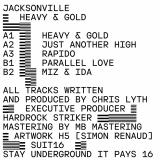
Jacksonville returns with Heavy & Gold, a powerful five-track EP rooted in the raw energy of underground house and analog machine funk. Produced by Chris Lyth, the record blends Chicago-influenced drum programming, hypnotic basslines and deep melodic textures into a set of highly functional DJ cuts built for the dancefloor. The EP moves between muscular jack tracks and deeper hypnotic moments, balancing driving groove architecture with subtle emotional tension. Heavy & Gold opens with the title track, a dense and rolling house cut driven by heavy drums and warm synth layers, before Just Another High delivers a tighter, more stripped-down groove with classic underground swing. Rapido pushes the energy further with a direct, rhythmic workout built for peak-time transitions. On the flip side, Parallel Love expands into a deeper and more atmospheric territory with evolving textures and hypnotic momentum, while closing track Miz & Ida delivers a long, hypnotic groove combining analog warmth and late-night dancefloor pressure. True to the Skylax philosophy, this release focuses on timeless groove design rather than trends, offering DJs and collectors a record built to last in the bag for years. Written and produced by Chris Lyth with executive production by Hardrock Striker and artwork by H5 (Simon Renaud), Heavy & Gold continues the Skylax tradition of uncompromising underground house music.
out of Stock
Last delivered 79 days ago available to reorder, subject to availability
The mighty Drumcode machine rolls on.. back again with the highly collectible DC4 Series now on its third volume. The DC4 series showcases a selection of four tracks from rising and established artists within the modern techno scene.
The EP features high-energy, peak-time techno tracks designed for dancefloors.
The Diary by Scarface returns to vinyl for the first time since 2014, now expanded to a 2xLP and featuring the never-before-released bonus track “Ease Up Now.” Newly remastered, this definitive edition includes the original 1994 artwork, carefully restored for vinyl by acclaimed designer Mr. Krum. Featuring fan favorites like “No Tears” and “I Seen a Man Die,” this platinum-certified classic is presented with upgraded audio and an expanded format, making it the most comprehensive edition to date.
The Diary by Scarface returns to vinyl for the first time since 2014, now expanded to a 2xLP for the very first time, including a previously unreleased B-Side!
Newly remastered, this definitive edition features the original 1994 artwork, carefully restored for vinyl by acclaimed designer Mr. Krum
Originally released October 18, 1994, The Diary debuted at No. 2 on the Billboard 200 albums chart, marking one of Scarface’s most commercially successful releases.
out of Stock
Last delivered 3 months ago available to reorder, subject to availability