Gatefold single vinyl LP with an 8 page 12" size bookelt in the other side of the gatefold.
We're thrilled to announce the return of Tobor Experiment, the visionary musical project led by the enigmatic Giorgio Sancristoforo, to the Bearfunk fold. After a twelve-year hiatus, Tobor Experiment emerges from the shadows with their second LP, "Available Forms". Picture the ethereal ambiance of a dimly lit jazz club colliding with the futuristic vibrations of a 1970s sci-fi TV show, and you'll begin to grasp the sonic experience that awaits. Giorgio draws on a whole host of musical inspirations, from the name checked Tim Gane & Letitia Sadier to the moog pioneers Claude Denjean & Jean Jaques Perrey. With the moogsploration of contemporary jazz Tobor Experiment invites listeners on an extraordinary musical odyssey where jazz meets electronica meets nu-disco.
Prepare to be captivated from the very first note of the infectious opener, "Lowpass Risotto" as Tobor Experiment masterfully combines familiar elements with their unique artistic vision. Resonating with undertones reminiscent of the timeless classic "Take Five" the track immediately grabs your attention. While the familiar drum shuffle sets a comforting foundation, Tobor Experiment takes an unexpected twist by infusing the composition with squelchy Moog lines and captivating hollow body guitar solos. The result is a harmonious blend of nostalgia and innovation that transports you to an entirely new sonic realm.
Continuing the journey, the mesmerizing 6/8 rhythm of "Up!" pays homage to the iconic sounds of Stereolab while showcasing Tobor Experiment's innovative spirit. As enchanting synth pads weave through the air, you find yourself immersed in a dream-like state, carried away by the hypnotic shifting patterns of the bass and drums.
With "Astounding Stories" Tobor Experiment returns to the energetic vibes of the album opener, inviting you to surrender to a sonic tapestry rich with musical exchanges. In traditional jazz style we receive solo's from all parties. Each instrument adding its unique voice to the narrative, creating a dynamic and engaging musical conversation.
As the album progresses, "Moonscape Dust" emerges, drawing inspiration from the atmospheric brilliance of "Low." This track serves as a portal to an otherworldly sonic landscape where time and space lose their hold. Here, organic drums step aside, making way for a low-fi drum pattern that lays the foundation for ethereal synth pads. The composition invites you to explore the depths of your imagination, transcending earthly boundaries and allowing you to float in an immersive soundscape.
The album's closing track, "Monsters" has an air of "Air" about it... the ethereal synths beckon you to surrender to the weightlessness of space, just allow yourself to be carried away by the infectious rhythms, intricate melodies, and atmospheric textures that shape this extraordinary musical journey.
Each track on "Available Forms" showcases Tobor Experiment's exceptional ability to transcend musical boundaries, creating a genre-bending album that defies all expectations. From start to finish, the soundscape presented is a testament to Tobor's relentless pursuit of musical innovation. Each composition is a fusion of diverse elements, seamlessly blending organic instruments and electronic textures in a way that challenges traditional genre classifications.
The AI-generated artwork serves as a portal to an alternate dimension. Paying homage to the retro-futuristic aesthetic of 1970s science fiction TV shows, it captures the essence of the album's fusion between organic and electronic realms.

Поиск:trans x
Все
Remastered with extra tracks - extra disc also includes Sound Sun Pleasure LP. Features the original space nymph cover art, which only appeared in cropped and washedout reproductions on an early 60s version. Cosmic Myth Records is dedicated to issuing remastered and fully authorized out of print titles from Sun Ra's independent Saturn Records catalog. Sun Ra's Jazz in Silhouette was enshrined in the Penguin Jazz Guide's "Core Collection" as an album that "will someday be recognized as one of the most important post-war jazz records." Jazz in Silhouette is the quintessential record of Sun Ra's late 1950s Chicago period. Recorded and issued in 1959, it marks a coda for the bandleader's bebop/hard-bop stage, as his interstellar traveller persona began to transform the band (and the music). It also charts the future, showcasing the brilliant tenor sax stylings of John Gilmore, and introduces the iconic playing of Arkestra mainstays Marshall Allen, Pat Patrick, and Ronnie Boykins. Many of the early works on these recordings would remain staples in Arkestra set lists for the rest of Sun Ra's life. This expanded edition includes the complete, contemporaneous Sound Sun Pleasure, rare stereo mixes, and bonus tracks.
- A1: Silvi's Dream (Damiano Von Erckert Remix)
- A2: What I Used To Play (Roman Flügel Remix)
- B1: The Worm (Robag Wruhme Remix)
- B2: We Are (Jonathan Kaspar Remix)
- C1: Feiern (Krystal Klear Remix)
- C2: Mystic Voices (Benjamin Damage Remix)
- D1: Sven | Väth – Nyx (Pas Deep Heet Remix)
- D2: Butoh (Robert Hood Remix)
- E1: Nyx (Planetary Assault Systems Remix)
- E2: Being In Love (Harald Björk Remix)
- F1: Catharsis (Mano Le Tough Remix)
- F2: Silvi‘s Dream (Florian Hollerith Remix)
The life-affirming energy at the heart of Sven Väth‘s recent album Catharsis is revisited, reanimated, and remixed by some of the most exciting names around, closing the circle on a superlative burst of
recent work that has not only given us the epic original LP, but also the extraordinary compilation What I Used To Play.
Roman Flügel, Benjamin Damage, Robert Hood, Planetary Assault Systems, Mano Le Tough… do we need to go on? This hand-picked list of luminaries have answered the call and certainly don’t disappoint, each fusing their signature sound with Sven‘s DNA to create a wild, uncompromising companion piece to the original album.
True to form, the running order is very much rooted on the dance floor, Silvi‘s Dream, revisited by Damiano von Erckert, explodes like a Balearic sunrise. Dreamy strings with a touch of Detroit create a lovely atmosphere while the beautiful piano sound goes right into your heart and appears as if you could feel the warm sun on your skin. Roman Flügel’s acidic rework of What I Used To Play is a homage to the 80s and the early sound of electronic music which creates nostalgic feelings and offers a greatly produced retro soundscape à la Kraftwerk. Staying close to the original, but with the perfect amount of spin, it’s a symbiotic interplay of synthetic bass pads, and a tiny bell melody. Robag Wruhme’s cranking minimal funk takes us down The Worm-hole. A concise interference sound builds
up sustained tension, tangled but structured, deep and yet driving. Robag took over the deep and dirty rhythms of the original perfectly and delivers a versatile piece. This opening salvo oozes quality and
sets things up perfectly for the electrified celebration of hi-octane technology come.
Jonathan Kaspar‘s growling interpretation of We Are provides a melancholic atmosphere with fascinating percussion parts. Zaps shoot through the air like small laser pistols while we let ourselves
be carried away by the bass, the frisky vocal stutter effect is the icing on the cake. Speeding things up, the euphoric trance that engulfs Krystal Klear’s epic version of Feiern. Expansive strings increase up
to ecstasy and guide us to a love-filled unity. This remix is sure to be an excellent peak-time smasher for the open-air season. On to a wild ride of pure techno with Benjamin Damage, who delivers a dry and uncompromising Berlin Techno version of Mystic Voices. Harder pace but the string synthesizer harmony brings light to an otherwise gloomy environment. Next up is Luke Slater’s PAS Deep Heet Mix to add a retro nineties vibe to proceedings on Nyx. Entering a rough space with gigantic clap impacts, we are blessed with straightforward Techno. Shimmering and spooling, this groove hits the
mark. Then, as if it was ever in doubt, Sven‘s lofty place in the techno firmament is underlined by a peak-time contribution by non-less than Detroit legend Robert Hood. Unmistakable, you must recognize the signature Robert Hood drive on Butoh. Chord stabs fulfill the Detroit feeling with offtaking string elements and high-energy vocal transformations. It’s a warm embrace that triggers emotions. Planetary Assault Systems then blasts things ever deeper into the cosmos on a second outing of Nyx. Reduced and to the point but of course, true to form, with powerful tribal percussion parts and intensive cutting hi-hats.
From there on in, the collection gradually re-enters the atmosphere, burning with a phosphorescent, melancholy glow. Harald Björk extrapolates Being In Love into a hypnotic groove for the early hours. A playful and atmospheric electronica interpretation to soothe our souls due to disharmonious synth pads and a dreamy deformation of the original melody. Mano Le Tough harnesses the ethno-rhythms
and brooding energy of Catharsis into a low-slung, tribal stomper. Anomalous organ parts ring out and link up with a trance-like sequence, summer feelings arouse as you feel like you can almost smell Ibizan air. The collection comes full circle with a second equally seductive interpretation of Silvi‘s Dream by Florian Hollerith. Stripped-down and hypnotic, the homage to Sven's girlfriend Silvi is extended as a reverence to Sven himself. Sven's profound vocal clearly infuse time and space and leave a forever-lasting memory of love.
By accident or design, it somehow leaves us with the reassuring sense that, although this specific part of the journey may be drawing to a close, the mission of the man behind it all most definitely isn't.
written & produced by: Sven Väth & Gregor Tresher
Black LP[26,85 €]
Mit 13 Tracks ist "War Eternal" das Arch Enemy-Album schlechthin. Es ist sowohl eine nostalgische Verbeugung vor der Vergangenheit der Band ("Never Forgive, Never Forget", "No More Regrets") als auch ein beeindruckendes Beispiel dafür, was in der Zukunft möglich ist ("Down to Nothing", "Time is Black"). Aber wenn es einen herausragenden Track gibt - eine Speerspitze - dann ist es der Titeltrack. "War Eternal", das der Welt auf Youtube vorgestellt wurde, marschiert trotzig gegen das Alltägliche an, zwei erhobene Fäuste gegen die Zwänge der Gesellschaft und den Käfig, den sie uns allen verzweifelt überzustülpen versucht. Hier beweist White-Gluz, dass sie die nächste Generation der Großen ist, während Amott und der Rest von Arch Enemy spielen, als wäre "War Eternal" ihr letzter Song. "Es gibt eine Menge Details auf diesem Album, die mich als Songwriter und Gitarrist begeistern", grinst Amott. Ich persönlich habe mich auf "War Eternal" als Spieler noch mehr angestrengt und habe das Gefühl, dass ich dieses Mal eine andere Ebene erreicht habe, was sehr lohnend ist. Das Album ist endlich wieder in den folgenden Formaten erhältlich: - Schweres 180g Vinyl in Schwarz und Transparent-Magenta, inklusive 2-seitigem Einleger - Special Edition CD, die in einem "PocketPac" (umweltfreundliche Verpackung) und einem 24-seitigen Booklet kommt
Ltd. transp. magenta LP[26,85 €]
Mit 13 Tracks ist "War Eternal" das Arch Enemy-Album schlechthin. Es ist sowohl eine nostalgische Verbeugung vor der Vergangenheit der Band ("Never Forgive, Never Forget", "No More Regrets") als auch ein beeindruckendes Beispiel dafür, was in der Zukunft möglich ist ("Down to Nothing", "Time is Black"). Aber wenn es einen herausragenden Track gibt - eine Speerspitze - dann ist es der Titeltrack. "War Eternal", das der Welt auf Youtube vorgestellt wurde, marschiert trotzig gegen das Alltägliche an, zwei erhobene Fäuste gegen die Zwänge der Gesellschaft und den Käfig, den sie uns allen verzweifelt überzustülpen versucht. Hier beweist White-Gluz, dass sie die nächste Generation der Großen ist, während Amott und der Rest von Arch Enemy spielen, als wäre "War Eternal" ihr letzter Song. "Es gibt eine Menge Details auf diesem Album, die mich als Songwriter und Gitarrist begeistern", grinst Amott. Ich persönlich habe mich auf "War Eternal" als Spieler noch mehr angestrengt und habe das Gefühl, dass ich dieses Mal eine andere Ebene erreicht habe, was sehr lohnend ist. Das Album ist endlich wieder in den folgenden Formaten erhältlich: - Schweres 180g Vinyl in Schwarz und Transparent-Magenta, inklusive 2-seitigem Einleger - Special Edition CD, die in einem "PocketPac" (umweltfreundliche Verpackung) und einem 24-seitigen Booklet kommt
A vinyl-only label out of NYC, Brooklyn Sway is back with their fourth release, this time varying slightly from their usual Various Artists format and enlisting two artists to fill out each side of the vinyl. The A-side features Montreal transplant, frequent collaborator, and minimal jazz master Ohm Hourani, who puts forth a tripped out, extended jam using classic Kim Cooper vocals and hypnotic beats. The B-side enlists live band N/UM for two improvised tracks, The Way and Any Time. N/UM is a 3-piece electronic band that uses classic analog instruments, vocals, modular synths, and guitar to create fully improvised live performances. In typical BK Sway fashion, interludes book end both sides of the record to tie the package together.
- A1: Vortex Count - Growthh
- A2: Translate - Nyquist
- A3: Pulso - Unexpected
- A4: Aural Research - <>
- B1: Droneghost - Cartographer
- B2: David Bowman - Ligo
- B3: Animatek - Black Cat
- C1: Hd Substance - Kormoran
- C2: Groof - Al Caer Sube
- D1: Dorian Gray - Arcadia
- D2: Andrey Detochkin - Brain Impulses
- E1: Pedro Pina - Peakoil
- E2: Victor Santana - The Feeling Of Never Giving Up
- F1: Hironori Takahashi - Velk
- F2: Subtraum - Binare Code Ii
- G1: Plural - Stowaway
- G2: Hanton - Astral Travel
- H1: Eleck & Alex Schultz - Engine Control
- H2: Lakej - Someone Lead The Way
Neurotwin is a Trilogy:
Part I
In the fight against Alzheimer's, epilepsy, schizophrenia and other diseases characterized by an imbalance in neuronal activity, there are chemical weapons, such as those that try to prevent the protein fragments known as beta-amyloid plaques from developing in the cerebral cortex , and physical, such as electrical stimulation that allow to restore the functionality of brain cells. This last resort, which has already been shown to be effective in modifying the activity of the cerebral cortex, is today a weapon of general intervention. Converting it to precision requires the development of individualized and predictive brain models that allow identifying where and how much to stimulate each patient. To achieve this, an international European team is working on the creation of virtual replicas of the most unknown organ in the body: the Neurotwin project.
According to recent research, the decrease in power in the neuronal oscillations of the gamma band of the cerebral cortex (a pattern whose frequency ranges between 20 and 50 Hertz) favors the development of protein fragments related to Alzheimer's.
Transcranial application of weak electrical currents has proven to be an effective and painless way to modulate brain activity without side effects.
The objective is to create complete computational models of the brain with real data of living beings (human patients) and that allow to anticipate and specify the effects of non-invasive stimulation techniques on neurological mechanisms.
"Never turn your back on a friend."
- Alfred Hitchcock
Part II
The Neurotwin project is the successor to an initiative that encompasses many projects called Virtual Physiological Human, which was based on the idea of creating a complete model of a human being on a computer, to perform non-invasive tests at the computational level. Now the concept has been derived to "Digital Twin", which seeks not only to have an equal computational model for everyone, but to create "twin" digital models of each patient in order to be able to make personalized medicine from the genome of each individual. Specifically, in our project, we have focused on digital twin brains, which would be representations of patient brains created from data extracted with current neuroimaging and brain activity monitoring techniques.
"Mirrors are used to see the face, Art to see the soul."
- George Bernard Shaw
Part III
A digital twin is a computer system programmed in such a way that, receiving the same inputs as the physical object or process it is a twin of, it provides the same outputs.
Characteristics of digital twin technology
1 Connectivity
2 Homogenization
3 Reprogrammable and intelligent
4 Digital traces
"There is no light without shadows and no fullness of mind without imperfections. Life requires for its realization, not perfection, but fullness. Without imperfection, there is no progress or growth."
- Carl Gustav Young
Stephen Steinbrink discovered a short YouTube video of a street magician who approaches a highschooler walking home in Barstow, California. “Here, let me show you my idea,” he says, as he places a quarter on the kid’s hand. The magician performs some relaxed flourishes, and the coin vanishes. In silence, the kid stares at his hand at the nothing where there once, indisputably, was something, until his wonder finds a single word: “Cool.” The title of Disappearing Coin, the new album from Oakland songwriter Stephen Steinbrink, comes from this short clip. “When I look at it now,” he says, “I relate to the kid, who’s obviously uneasy in his body, and going through the experience of being a teenager in the early 2000s growing up in a bleak desert town like I did. I also relate to the coin, an inanimate disc of possibility. And I relate to the magician, an absurd facilitator of sending what is tactile and concrete into the wispy conceptual realm.” “I’ve watched it probably a hundred times,” he says. “It cracked me up but also blew my mind open the feeling of wonder I experienced watching this video became a guide as I navigated new ways of staying in the realm of what’s both real and magical.” Following the 2018 release of Utopia Teased, Steinbrink completed an apprenticeship in the nearly-lost art of Stained Glass, becoming a glazier at a studio that over three years, fully restored the enormous 90-year-old windows in San Francisco’s Grace Cathedral. He committed to his Buddhist study, beginning lay monastic training before the process was thwarted by the pandemic. He dove deeper into music production for other artists, engineering two albums by Boy Scouts released on Anti- Records in 2018 and 2021. Steinbrink delighted in the way these pursuits pulled at the thread of ego’s tapestry and decentralized him from his craft, allowing him to embody a new role as a creative caretaker engaging in practices that felt communal and restorative. “As I slowly began writing for myself again, I tried to imbue my new songs with this sense of playfulness and wonder I felt while exploring these other interests.” He says. Feeling unlocked from the pressures of perfection that he often felt in his earlier work, creating Disappearing Coin felt buoyant and healing. “The album feels like an integration of all of my past musical selves zeroing in on the present,” Steinbrink explains, “I felt free to explore new ways of writing, through different perspectives, experimenting with fictional songwriting, visual archetypal language, and total collaboration.” This “total collaboration” was a joyous new venture after years of solo performing and recording. The album can be seen as a 42 minute session of show and tell, the manifestation of Steinbrink repeating the mantra of “Here, let me show you my idea” to himself over and over. Disappearing Coin is at once a welcome return for the veteran Steinbrink and the debut of a totally new artist, one who has found a new path to himself with new goals of openness, curiosity, and self-acceptance. “Recalls the magic pop purity of Arthur Russell...its minimalism manages to feel enlightened and transformative.” PITCHFORK // “Melodic and self-assured. Steinbrink delivers his knotted lyricism with a smooth lilt.
Vom Sinn in der Musik – Joep Beving präsentiert sein neues Soloklavieralbum Hermetism
“Eine leise Revolte gegen den Wahnsinn”
Joep Beving
Auf der Suche nach Schönheit erkundet Joep Beving antike Philosophie und seine Liebe zu Paris
Joep Beving, Himmelsstürmer in der Welt des Streamings zeitgenössischer Klassik, kehrt mit Hermetism
solo ans Klavier zurück. Das vierte Album des niederländischen Komponisten und Pianisten erscheint am
8. April 2022 bei Deutsche Grammophon. Antike Philosophie inspirierte Beving in seiner Aufnahme: »Ich
hoffe, dass die Musik tröstet und Gemeinschaft stiftet«, sagt er, denn obwohl Beving aus einem Gefühl der
Melancholie schöpft, möchte er Hoffnung wecken mit den zwölf Stücken, die er hier auf seinem geliebten
Schimmel-Klavier spielt.
Nach dem viralen Erfolg seines Debüts im Jahr 2015 erscheint Beving heute längst als Nummer eins auf
Streamingplattformen. Über eine halbe Milliarde Mal wurden seine Stücke bislang gestreamt und weltweit
sind auch seine Konzerte ausverkauft. Mit Hermetism versucht er den Hörer auf einer tiefen Ebene zu
erreichen. »In all dem Wahnsinn der letzten Zeit war das Album das, wohin ich zurückgekehrt bin«, sagt
er. »So ist Hermetism auch meine eigene Medizin gegen die Pandemie.«
2023 pressing on translucent green vinyl.
This is Fugazi's second release recorded in December 1988 with John Loder while the band was in England for a European tour.
These songs were combined with the tracks from the band's debut 7 Songs EP and was released on the 13 Songs maxi CD.
This 12" EP was re-cut and re-issued in October 2009 (with updated art).
Originally Released: June 1989
Ian MacKaye vocals & guitar Guy Picciotto vocals Joe Lally bass Brendan Canty drums
Recorded At Southern Studios Produced By John Loder
Questions will inevitably have to be asked here as to how / why Hooj have shamelessly broken the informal UN backed agreement to NOT REMIX / RE RELEASE C*F* D*L M*R, EVER AGAIN. But after the Hooj Catalogue owners cajoled the old A +R team into a Hooj Electronic Orchestra album in 2021, the then up and coming Borai + Denham Audio were enlisted for remixes, and fast forward a couple of years, the Bristol duo are smashing it in 2023, and vinyl does indeed beckon.
And with some justification it has to be said, as the Bristol duo took chunks of the original Wim Mertens melody and somehow still managed to drag it into new terrain, introducing rough breaks and hardcore sensibilities into proceedings, for the first time in the track's 30 + years journey.
On the B - side, another star turn from the early 90's get's the BDA treatment, as Transformer 2's Fruit of Love get's a more polished/ musical approach on the Audio Redux mix ( though with no compromise on bottom end / beats dynamics) , and Borai contributes a rolling, percussive 4/4 dub.
- A1: Welcome To The Party
- A2: Wild Bitches
- A3: Relax With Me
- A4: Right Now
- A5: Make A Mil
- B1: Break From Toronto
- B2: Tbh
- B3: Wus Good / Curious
- B4: Over Here Featuring – Drake
- B5: Ballin
- C1: East Liberty
- C2: Sls
- C3: Sex On The Beach
- C4: Her Way
- C5: Belong To The City
- C6: Grown Woman
- C7: Fwu
- D1: Recognize Featuring – Drake
- D2: Options
- D3: Thirsty
- D4: Bout It
- D5: Muse
- E1: High Hopes
- E2: Don’t Run
- E3: Nobody
- F1: Not Nice
- F2: Only U
- F3: Don’t Know How
- F4: Problems & Selfless
- F5: Temptations
- G1: Spiteful
- G2: Joy
- G3: You’ve Been Missed
- G4: Transparency
- H1: Brown Skin
- H2 19: 42
- H3: Come And See Me Featuring – Drake
- H4: Nothing Easy To Please
- I1: Nothing Less
- I2: Turn Up
- I3: The News
- I4: Split Decision
- J1: Loyal Featuring – Drake
- J2: Touch Me
- J3: Trauma
- J4: Showing You
- K1: Eye On It
- K2: Believe It Featuring – Rihanna
- K3: Never Again
- K4: Pgt
- L1: Another Day
- L2: Savage Anthem
- L3: Loyal Remix
This special vinyl box set contains all four PARTYNEXTDOOR studio albums - including the first album, Partynextdoor, never before issued on vinyl until the release of this completist collection. PARTYNEXTDOOR producer, songwriter and singer from Ontario released his self-titled, critically acclaimed mixtape in July of 2013 led by the singles “Over Here” and “Break From Toronto.” Contributions to “Own It” and “Come Through” on Drake’s Nothing Was the Same album and a deal with OVO Sound followed. He’s since written songs and/or produced cuts for Rihanna, Drake, Nipsey Hussle, Jay Electronica, Post Malone and many more
- A1: I Wanna Dance With Somebody (Who Loves Me) (Who Loves Me)
- A2: Just The Lonely Talking Again
- A3: Love Will Save The Day
- A4: Didn't We Almost Have It All
- A5: So Emotional
- B1: Where You Are
- B2: Love Is A Contact Sport
- B3: You're Still My Man
- B4: For The Love Of You
- B5: Where Do Broken Hearts Go
- B6: I Know Him So Well
Whitney did more than turn Whitney Houston into a pioneering sensation known around the world by her first name. Originally released in June 1987, the singer's blockbuster sophomore record became the first album by a female artist to debut at No. 1 on the Billboard 200 chart — a position it claimed for a total of 11 weeks en route to selling more than 10 million copies in the U.S. The Diamond platinum effort also contains four No. 1 Hot 100 hits that, when combined with the three chart toppers from her 1985 debut, gave her seven consecutive No. 1 singles — an accomplishment that no other artist has accomplished. Commercially and creatively, Whitney stands on hallowed ground — especially now that the record plays with a sound that puts into perspective just how extraordinary, engaging, and vital Houston's music remains.
Mastered from the original master tapes and pressed on MoFi SuperVinyl at RTI, Mobile Fidelity's 180g 33RPM SuperVinyl LP of Whitney invites listeners to experience the Rock & Roll Hall of Fame inductee's pivotal album in audiophile quality for the very first time. Free of the dynamic limitations and tonal flatness prevalent on prior vinyl and CD pressings, it lets the music breathe and reveals the copious detail, nuance, and texture within the immaculately produced songs. MoFi's SuperVinyl profile offers further advantages in the forms of a nearly inaudible noise floor, dead-quiet surfaces, and superb groove definition.
In addition to featuring extreme clarity and immediacy, this numbered-edition reissue does wonders for the attribute that inspired more than 20 million people around the globe to add Whitney to their record collections: that inimitable voice. Houston's trademark mezzo-soprano — an acrobatic instrument equally capable of taking off on fantastic flights and unwinding for hushed meditations — benefits from the fantastic airiness and transparency afforded by this meticulously restored edition. Whitney has never sounded or looked better. The crossover landmark deserves nothing less.
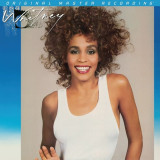
Issued just two years after Houston's breakthrough debut, Whitney immediately signalled the genre-defying singer's intent to continue to push ahead and expand her palette. Shot by photographer Richard Avedon, the album cover depicts an iconic image of Houston — captured with a gleaming smile, bright eyes, teased-out afro, toned arms, and a right hand that appears to wave a friendly hello — whose active, athletic profile stands in contrast to the extremely formal sit-down shot of her that graces her '85 record. The change is telling: Whitney overflows with unfettered joy, rhythmic vibes, and deep-seated emotions that forever endeared her to the hearts and minds of countless listeners — and which set the standard for the wave after wave of divas that followed in her footsteps.
It's no coincidence that the first track on Whitney is the declarative "I Wanna Dance with Somebody (Who Loves Me)." Like Michael Jackson's "Billie Jean" and Madonna's "Material Girl," the feel-good smash is one of the quintessential '80s gems — a lithe, melodic, celebratory release of pent-up energy and loneliness that glides across club floors, shouts to the rooftops, and shrugs off any concerns about vulnerability or embarrassment. Houston's swooping voice moves in sync with the sleek beats and dipping-and-diving synths. She practically takes her fellow musicians by their hand and leads them in a blissful dance that nobody would dare sidestep. Focusing on Houston's singing — a task made challenging only because of the impossible-to-ignore hooks and grooves — showcases the virtuosic facets of not only her register but her control, discipline, smoothness, and warmth.
That she replicates those feats for the entirety of the nearly 53-minute-long album makes Whitney that much more special. Houston reaches back and channels her childhood gospel training on the R&B-flared "So Emotional"; effortlessly slips into Quiet Storm mode on the duet with her mother, gospel great Cissy Houston, on "I Know Him So Well"; flirts with smooth jazz and collaborates with tenor saxophonist Kenny G on the lush "Just the Lonely Talking Again"; conjures dreamscapes and shadow-boxes with supple funk on a romantic cover of the Isley Brothers' "For the Love of You"; and, for the majestic power ballad "Didn't We Almost Have It All," displays the sky-scraping reach of her vocals amid a grand arrangement made even bigger by Houston's sweeping performance and triumphant finish.
Houston's once-in-a-generation talents weren't lost on the adoring public, radio deejays, or industry experts. In addition to harbouring four No. 1 hits and receiving nominations for four Grammy Awards, Whitney generated another Top 10 success in the guise of the Afro-Cuban-leaning "Love Will Save the Day." The album also netted Houston four American Music Awards; two Billboard Music Awards; back-to-back People's Choice Awards; a Soul Train Award; and various other accolades. It all makes the crux of the Washington Post's July '87 review of the album appear prophetic: "Her voice sounds stronger still and the songs are varied but so consistent she could garner 10 Top 10s out of a field of 11."
That claim still holds true. A brilliant fusion of pop, R&B, smooth jazz, and soul, Whitney is a showstopper – and one of the key reasons Houston is the most-awarded female artist of all time.
Translucent Dark Red & Black Marbled Colored Vinyl. Seine Stärke ist ein Songwriting das musikalisch wie poetisch kratzt und schabt: am amerikanischen Traum, an dessen Wirklichkeit und den Menschen die ihn bevölkern. Immer wieder wurde seine spröde Musik und einfühlsamen Texte mit denen von Leonard Cohen, Lou Reed und Bob Dylan verglichen und somit Gewicht verliehen. Zu großer Bekanntheit führte das nicht, Simon Joyner bleibt ein outsider mit seinem Loner-folk, aber für die, die ihn entdecken bietet er ein Kraft von rauher Schönheit. Conor Obers von Bright Eyes nennt Joyner, der seit 1990 seine dunklen Americana Songs veröffentlicht, einen entscheidenden Einfluß. Simon Joyner's neuestes Album gerät noch dunkler und eindringlicher. Sein Thema hier ist Isolation, und er übernimmt es gleich auch als Grundlage für seine Produktion. Ihm war es wichtig, dass die beteiligten Musiker allesamt alleine waren um ihre jeweiligen Parts zu finden. Die Abgeschiedenheit der einzelnen Musiker auf Songs From A Stolen Guitar bietet somit weniger Spontaneität vieler früherer Arbeiten von Joyner, führt aber zu einer Art Silberstreifeneffekt: Joyners Songs, die hier sorgfältiger und vielleicht absichtsvoller produziert wurden als auf jedem seiner früheren Alben, kommen viel klarer durch und stellen sowohl seine schillernden Wortspiele als auch seine klare Vision in den Vordergrund. Ein Kritiker bringt einen Vergleich zu Neil Young und meinte "Wenn (sein 2012 Album) 'Ghosts' sein 'Tonight's the Night' war - zornig, nackt und bodenlos - dann könnte sich 'Songs From A Stolen Guitar' als sein Harvest erweisen." Songs From A Stolen Guitar wurde in verschiedenen Städten aufgenommen. Joyner nahm seinen Gesang und seine Gitarre live in Omaha auf; Bassist Wil Hendrix fügte seine Parts zu Hause in San Francisco hinzu, Michael Krassner nahm seine Gitarren- und Klavier-Overdubs zu Hause in Phoenix auf, und Schlagzeuger/Percussionist Ryan Jewell nahm in Colorado auf. Dieser musikalische Kettenbrief machte sich dann auf den Weg zurück nach Omaha, wo David Nance (Gitarren und Backing Vocals), Ben Brodin (Orgel und Vibraphon) und Megan Siebe (Bratsche und Backing Vocals) - getrennt voneinander - ihre jeweiligen Beiträge einspielten. Dieses Vorgehen zahlt sich aus. Die "virtuelle" Band spielt eine unterstützende, aber komplementäre Rolle und erzeugt immer das richtige Maß an Spannung, um diese emotionsgeladenen Geschichten zu begleiten und zu umhüllen. Das Zusammenspiel ist einfühlsam und kohärent, auch wenn es aus geografischer Entfernung und Abgeschiedenheit zusammengefügt wurde und oft wie Musik klingt, die durch den Nebel eines Herbstmorgens gefiltert wurde. Doch wenn es um Simon Joyner-Platten geht, zahlt man sein Ticket, um großartige Songs zu hören, und auch in dieser Kategorie enttäuscht Songs From A Stolen Guitar nicht. Eins der seltenen Alben, das nach dem klingt, worum es geht: die Kluft zwischen Einsamkeit und Alleinsein, die Grenzen zwischen Liebe und Hingabe, der Unterschied zwischen dem Tornado und dem, was er hinterlässt.
Bob Dylan was at several crossroads in the mid-1970s. Artistically, he was largely written off as being past his prime. Emotionally, he was suffering through a painful divorce from his then-wife Sara Lowndes. Creatively, he appeared at a stalemate, his previous decade's unprecedented run of transformational brilliance finished. Then came Blood on the Tracks.
A start-to-finish cycle that documents a lover's pursuit of, entanglement with, and loss of a woman, the bracingly intimate 1975 effort remains one of the most encompassing break-up albums ever made and ranks as the most personal statement of the Bard's career. To hear it is to experience the agony, frustration, trauma, highs, lows, confusion, sadness, and, ultimately, requisite redemption associated with intimate relationships gone astray. Dylan maintains it's a work of fiction, but it's evident close-vested autobiographical premise is what helps make it universal: It's the icon singing through tears, going out of his mind, battling hallowing emptiness, firing shots across the bow, and accepting culpability. It is, in short, a consummate expression of love's darker sides and the consequences of what happens when dreams unravel.
As part of its Bob Dylan catalogue restoration series, Mobile Fidelity is thoroughly humbled to have the privilege of mastering the iconic LP from the original master tapes and pressing it on dead-quiet LP at RTI. The end result is the very finest, most transparent analogue edition of Blood on the Tracks ever produced – and the first-ever proper analog reissue. Fantastically presenting both the solo acoustic and band-supported songs with the utmost clarity, dynamics, presence, immediacy, spaciousness, imaging, and balance, this version shines a high-powered light on the fluid vocal phrasing, timbral shifts, functional rhythms, and inward-looking strumming that contribute to every song here serving as a wound-exposing confessional.
For all the melancholic pain, unresolved questions, shattered memories, wasted times, unrequited dialogues, and weary regret within, Blood on the Tracks remains as daring as it is reflective. Rather than follow for a monotone caustic vibe, Dylan's songs burrow into the subconscious for the manners in which they are even-keeled, mellow, and occasionally, even peaceful. Dignity, honour, poignancy, and fairness – all traits uncommon in any situation in which partners dissolve histories, change hearts, and attribute blame – instil the record with equilibrium on par with the consistency of the flowing melodies.
Throughout, tunes come on and proceed as if they could continue forever, Dylan spinning poetic verses and conversations amidst finely tied knots of acoustic notes, chords, and fills, the deceivingly simple architecture conjuring the intertwined refractions of a bezeled jewel, various angles, colours, and textures conjoining into a gorgeously inseparable whole. Backed by Tony Brown's flexible albeit subtle bass, Buddy Cage's country-streaked pedal-steel guitar, and Paul Griffin's soul-baring organ – an instrument used to shadow, tuck-point, and illuminate here as effectively as any time in rock history – Dylan pours soulful emotion, open his veins, and bleeds.
Ranked 16 on Rolling Stone's list of the 500 Greatest Albums of All Time, and replete with existential thought, piercing directness, raw singing, and majestic arrangements,
Given the sonic and artistic merit of this album, we anticipate huge demand.
How sad, if timely: this stunning reissue of the 1994 live album arrived in the very week that trumpeter Masekela passed away. One of the most successful ambassadors ever for African music, his fusing of the continent's rhythms and instruments with contemporary jazz and rock proved irresistible. Nearly every one of you has heard him, thanks to guess spots with The Byrds and Paul Simon. His breakthough hit from 1968 — the infectious "Grazing In The Grass" — is here, along with another 11 tracks recorded at Blues Alley, the U.S. club that gave us Eva Cassidy. Notably, despite its early-1990s origins, this is all-analogue." — Sound Quality = 90% - Ken Kessler, HiFi News, May 2018
"...Hope is one of those intensely visceral, large as life, and immediately present recordings that will make pretty much any system sound at least very good, and will cause better ones to raise goose bumps." - Wayne Garcia, The Absolute Sound, August 2008
"...The high quality original mix plus Analogue Productions' superb mastering has resulted in a terrific, very transparent sonic with great impact." - John Henry, Audiophile Audition
What more can be captured from the masterpiece that the late trumpet great Hugh Masekela left devoted fans, the effervescent Hope. Now cut at 45 RPM and spread over four 200-gram premium LPs, you're about to discover the answer to that question. The eight sides of vinyl reduce distortion and high frequency loss as the wider-spaced grooves let your stereo cartridge track more accurately. And this set is plated and pressed at Quality Record Pressings, Acoustic Sounds' own industry-lauded LP manufacturer. Virtually silent surfaces coupled with sharp delineation of musical detail are QRP pressing hallmarks.
Two Stoughton Printing old-style tip-on gatefold jackets house the four LPs, which are contained in a custom-designed slipcase reproducing the original artwork.
A longtime audiophile demonstration disc. Hope will show off your system's dynamic range as well as any record ever released. Hugh Masekela, the outstanding South African trumpeter, assembled a seven-piece group and recorded this great set live at Washington, D.C.'s Blues Alley. The songs stretch over a period of nearly five decades and serve as an informal guided tour of Masekela's life. The songs are honest and bare, and as for the sound — WOW!
Unlike a prior 45 RPM version that included seven songs, this 45 RPM reissue contains the full program as originally recorded with all 12 tracks included! Plus, as an added bonus, we've included a special insert — featuring an exclusive interview with Grammy/Emmy Award-winning engineer David Hewitt, who recorded Hope originally.
"Hugh's record is right up near the top for a lot of reasons," Hewitt says.
Hewitt and his team were afforded the time they needed, and they pulled out all the stops to pull off what's now recognized as an all-time great recording. They used better-quality microphones, they were mic-ing the room for ambient sound, and Masekela was performing for a sophisticated and appreciative audience.
"We used stuff from our stash of mics as opposed to what you'd find typically at a jazz club. We actually had control via the record label and producers, so we could take our time. We had the ability to mic the room for abient sound. ... you've got people that actually know and appreciate the music and respond accordingly. What you've got there is all the right stuff at the right time and the right people, and then something magical happens."
Listen to that magic unfold — put on this Analogue Productions 45 RPM 4LP reissue of Hope, and be transported.
- A1: Innocent Bystander
- A2: Goodnight Old Friend
- A3: Drop Back
- A4: Silverbird
- A5: The Show Must Go On
- A6: The Dancer
- B1: Tomorrow
- B2: Don't Say It's Over
- B3: Slow Motion
- B4: Oh Wot A Life
- B5: Why Is Everybody Going Home
In a career spanning 50 years, Leo Sayer has sold more than 80 MILLION records worldwide.
• 'Silverbird' is Leo’s incredible debut album, originally released late in 1973, reaching #2 in UK Albums Chart and includes
the debut single ‘Why Is Everybody Going Home’ and the hit ‘The Show Must Go On’ (#2).
• Co-produced by Adam Faith and David Courtney, ‘Silverbird’ was recorded at several locations including Virgin Records’
Manor Studios, The Who’s lead singer Roger Daltrey’s Barn Studio and Apple studios.
• Following another successful UK tour in Autumn 2022, Leo Sayer has recently been on tour in the USA for the first time in
decades; a country that took him to their hearts with two #1 Singles and a GRAMMY Award and although he now has
Australian citizenship, Leo remains one of the UK's great singer/songwriters and performers of all time.
• This 50th Anniversary celebratory half-speed master version has been newly mastered by Phil Kinrade, and expertly cut
using transfers of the original audio tapes using precision half-speed mastering by Barry Grint at AIR Mastering, London
and is pressed on heavyweight 180g vinyl, with a 4-page insert containing the lyrics.