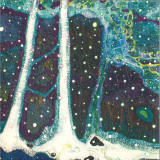
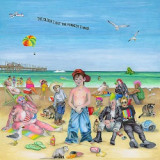
Each of the three hundred covers is different! All are numbered.
After two well-received albums of Normal Bias, the time has come for a solo debut in U Know Me of the half of this valued dub dub, i.e. Piotr Krupiński, better known as YAC.
The starting point for "We Have Much More In Common Than What Divides Us" was the rhythm, and on the one hand synthetic sounds of classic analog synthesizers with the legendary EMS VCS3 at the forefront, and on the other hand the organic hypnotic sound of Tibetan bowls and tubular bells. All together strongly processed and traditionally ground with dub techniques and marked by the tape's noise.
The amazing graphic design was created by Bartosz Szymkiewicz.
The cover design is the result of an attempt to graphically represent the album's minimalist but full of lively nuances music. Each of the forms on the cover corresponds with its surface area to the length of the work it depicts. The composition was procedurally generated by a computer program, resulting in 300 unique covers. Interestingly, the program definitely preferred to arrange the forms close together, which is an unforeseen reference to the title of the album.
Search:two em
Lucky', the title of Nada Surf's fifth album, is at once literal and ironic. Like the songs that singer / guitarist Matthew Caws, bassist Daniel Lorca and drummer Ira Elliot crafted for their previous two albums, Let Go' (2003) and The Weight Is A Gift' (2005), Lucky is filled with images of restlessness, longing and the elusiveness of love. Yet the band counterbalances the lyrical bitter sweetness with musical buoyancy. Intimate songs become in-it-together anthems, thanks to the chiming guitars, propulsive rhythms, and the emotional candour in Caws' vocals. A song like Beautiful Beat' segues from a sparsely arranged, confessional first verse into a harmony-laden chorus and reaches multi-layered, canon-like proportions before the track fades out. If Caws is often suggesting that romance and resolution may still be an inch or two out of reach, he's also proffering immediate musical solace. Turn up the volume, hit the repeat button, and your troubles, for a blissful three minutes or so, will disappear.
The three members of Nada Surf have played together now for a dozen years. They've survived overnight major-label success and the inevitable morning-after bleariness, persevering past obstacles that would have sunk a less resilient combo, to become one of America's most truly independent and respected bands. Experience has only made their work richer, bringing gravity to the subject matter and lightness to its presentation. Keeping things honest has become a modus operandi.
Punk pioneers Crass continue their vinyl reissue series, re-pressing their limited releases by adjacent artists through Crass Records, in association with One Little Independent. The series, including over twenty bands and solo artists recorded at the legendary Southern Studios and produced by Penny Rimbaud, continues with two more historic pieces from the Crass Records catalogue; The "Grey" EP by North London post-punks Lack of Knowledge, and "Beware" by US anarchists Sleeping Dogs. Sleeping Dogs were one of only two American bands to release on Crass Records and in 1982 their sardonic and sludgy, but politically sharp, hardcore made up the "Beware" EP. They were first formed under the moniker Arsenal by the late artist, and designer of the iconic Crass logo, David King. "Beware" showed the originality and potential of Sleeping Dogs, even as Rimbaud and Crass guitarist Phil Free augmented the band"s sound for the studio session. The front cover of the single featured its own striking image, courtesy of King. Sleeping Dogs disbanded shortly after, re-emerging briefly under the new guise of Brain Rust a few years later. Distorted, biting, and beat-driven, the collection is a well-researched and poignant expose of Western imperialism. First released on 7" vinyl, limiting the sound, the new series has been remastered for 12" by Alex Gordon at Abbey Road Studios, allowing them to be heard as never before. This, plus enlarged replicas of the original covers, brings new gusto to their already radical sound. Penny Rimbaud notes that "Our (Crass") interest was never in personalities, profits or power, and neither did we have time for reformist liberals. Our position was solidly revolutionary; we took no prisoners. Talking the talk was never enough for us, no, we demanded that we also walk the walk. Ours wasn"t a show, it was a battle, not a living, but a lifestyle, a lifestyle with a difference - rather than looking only to ourselves, we sought to share our gains. I feel that this willingness added great strength to the form of anarchism that we practiced both on stage and out on the street."
To confuse parts for the whole is inevitable with Palm. Drummer Hugo Stanley, bassist Gerasimos Livitsanos and guitarists/vocalists/high school sweethearts Eve Alpert and Kasra Kurt started making music together as teenagers, and spent much of their twenties in the kind of proximity unusual for adults, outside of touring bands and the International Space Station. For a number of years the band consumed the lives of its members to a point of exhaustion: “To be honest I think we got a little burnt out. There were times where it wasn’t clear if we’d make another record,” says Alpert. It was only after multiple freak injuries followed by a pandemic, forced a pause - from touring but also from writing, rehearsing, even seeing each other- that the four were able to regroup and see a way forward again.
On their latest effort, Nicks and Grazes, Palm embrace discordance to dazzling effect. “We wanted to reconcile two potentially opposing aesthetics,” Kurt says. “To capture the spontaneous, free energy of our live shows while integrating elements from the traditionally gridded palette of electronic music.” In order to avoid what Kurt refers to as “Palm goes electro,” the musicians spent years educating themselves on the ins and outs of production by learning Ableton while also experimenting with “the percussive, textural, and gestural potential” of their instruments. To this end, the band continued the age-old tradition of instrument-preparation, augmenting guitars with drumsticks, metal rods and, at the suggestion of Charles Bullen (This Heat, Lifetones), coiling rubber-coated gardening wire around the strings. The unruliness of the prepared guitar on songs like “Mirror Mirror” and “Eager Copy” contrasts with the steadfast reproducibility of the album’s electronic elements.
While Palm cite Japanese pop music, dub, and footwork as influences on this album’s sonic palette, they found themselves returning time and again to the artists who inspired them to start the group over a decade ago. “When we were first starting out as a band, we bonded over an appreciation of heavy, aggressive, noisy music,” Alpert reflects. “We wrote parts that were just straight-up metal.” Kurt adds, “I found myself rediscovering and re–falling in love with the visceral, jagged quality of guitars in the music of Glenn Branca, The Fall, Beefheart, and Sonic Youth, all important early Palm influences.” Returning to the fundamentals gave Palm a strong foundation upon which they could experiment freely, resulting in their most ambitious and revelatory album to date.
Carry On, issued in 2000, is Pat Green's third album and his last before signing to Universal Republic. One can hear transition in the sound of this record, and traces of Nashville's mighty presence in the production, but this is still very much a Texas record. Carry On is a more mature and artfully rendered collection than anything Green had released before.
On their third album, »Rideau«, Swedish trio Tape made their great leap forward. Released in 2005 on Häpna, following two albums of pastoral folk meets electronica, »Rideau« saw the trio of Andreas and Johan Berthling, and Tomas Hallonsten, working with an outside producer, Marcus Schmickler (best known for his post-rock outfit Pluramon). On »Rideau«, Tape’s music opened out considerably, embracing traditional minimalism, and luscious melodicism. Now, seventeen years later, »Rideau« has a new home with Morr Music, who are reissuing the album on vinyl, marking its first appearance on the format, including an extra track.
It’s only logical that »Rideau« should reappear via Morr Music. Like Tape themselves, Morr Music was a significant part of the worldwide gang busy reconciling electronica, pop, and acoustic, group- oriented sound across the 2000s, and »Rideau« sits neatly alongside other releases of similar heritage. And yet, »Rideau« feels contemporary, suggesting the creative discoveries made by the trio have ongoing resonance; their elliptical poetry echoes through recent music from the likes of Tara Clerkin Trio, and Tape’s sometime collaborators, Tenniscoats.
Asked about the album, Johan Berthling recalls, “»Rideau« was a special album for us to make”. While they had previously recorded their albums in rural Sweden, for »Rideau«, the trio decamped to Schmickler’s Piethopraxis Studio in Cologne. The creative space that Schmickler carved out for the group allowed them to explore this new material to its fullest. For his part, Schmickler found himself drawn to Tape’s music –“Their focus was a combination of seemingly timeless folk influences with noisy electronics and field recordings,” he explains. You can hear Schmickler’s influence at an almost molecular level – Tape had never sounded quite so graceful and assured with their compositions. “Marcus really shaped the music, working architecturally to build the form of the pieces,” Berthling recalls.
»Rideau« represents a collective exhalation for Tape, with the trio exploring more involved, longer pieces, which situates them in yet broader musical contexts. There are clear connections with the history of minimalism, for example, via the repeating organ phrase of »Sunrefrain«, and the insistent piano arpeggio of »A Spire«, which builds into a Reich-ian dream song, with sensuous electronics and glinting vibraphone dappling abstract shapes across the song’s stretched canvas.
Reflecting on Tape’s essence, Schmickler isolates their “uncompromised ethos, caring about small details.” This echoes most radically through the twilight environment of »Long Lost Engine«, which sets the listener adrift on impossibly radiant drones, while a gentle, almost Feldman-esque melody plays out over the song’s surface. It’s followed by the reissue’s extra track, Japanese electronica quartet Minamo’s remix of »Roulette«, a connection that would lead to a Minamo/Tape collaborative album, »Birds Of A Feather« (2007).
For now, though, here is the gorgeous, penumbral abstraction of »Rideau«, an album of whispers and clues, quiet moments and grand gestures, reintroduced to a welcoming world.
At the time of this recording, Mingus had been working regularly with the piano-less quartet of Eric Dolphy, Ted Curson and Dannie Richmond. The same group featured on the 1960 Candid release, Charles Mingus Presents Charles Mingus. The Mingus album, also recorded that year, features one track, "Stormy Weather," recorded with that same quartet, and two tracks recorded with a larger group featuring piano and additional horns. Of note, "MDM (Monk Duke & Me)" consumes the majority of this album. The piece consists of three intertwining themes - Duke Ellington"s "Main Stem", Thelonious Monk"s "Straight, No Chaser", and Mingus" "Fifty First Street Blues." Released in 1961, and recorded in the fall of 1960 by Candid A&R and Producer Nate Hentoff at the Nola Penthouse Sound Studios. The LP includes extraordinary liner notes written by Hentoff, giving a context and insight that adds to the experience of hearing these magnificent performances.
Clear Vinyl
Originally released in 2020 on cassette and digitally. more eaze is the nom de plume of Austin, TX mainstay m.maurice, a roving experimentalist who’s explored an astoundingly diverse range of sounds, from drone and computer music to avant-pop and beyond. claire rousay is a San Antonio, TX-based percussionist/composer/sound artist who uses physical objects and their potential sounds as a way to explore queerness, human physicality, and self perception. Together—through a suite of deeply personal aural collages—two of Texas’ most vital and vibrant sonic searchers beg the eternal question: If I Don't Let Myself Be Happy Now Then When?
Although only their debut album together, If I Don’t Let Myself… reveals a profound and fruitful relationship between m and claire. But the symphonic symbiosis goes even deeper still. Outside of musical breakthroughs, the pair helped each other conquer intensely personal changes, with m and claire transitioning and coming out as non-binary and trans, respectively.
As m explains, “to me this record is very much about this process of becoming—trying to reach something and getting there but sometimes not being quite where you want to be but at least getting closer. It’s about feeling alternately empowered and insecure socially as you transition and trying to cope with these conflicting emotions.”
Musically, the album showcases startlingly sincere sets of serrated but sedative situational music. A-side epic Drunk is a sprawling but taut rove of aural duality. Passages of exquisite elegance subtly clash with shimmering shards of sound. Pre-op is a poised and pensive piece of solemn reflection, harrowingly honest and delivered with clarity and composure, while Post-op closes out the set in a wholly uplifting and optimistic flair.
If I Don't Let Myself Be Happy Now Then When? is ultimately about coping during the respective transitioning phase in both of their lives, obliquely blissful and fraught with freedom.
Tape
Hailu Mergia & Dahlak Band's Wede Harer Guzo is the third release on Awesome Tapes From Africa for Ethiopian keyboard and accordion maestro. In the years since Shemonmuanaye, Mergia has revamped his touring career, playing festivals and clubs worldwide, including a recent tour supporting Beirut. By 1978, Addis Ababa's nightlife was facing challenges. The ruling Derg regime imposed curfews, banning citizens from the streets after midnight until 6:00 am. But that didn't stop some people from dancing and partying through the night. Bands would play from evening until daybreak and people would stay at the clubs until curfew was lifted in the morning. One key denizen of Addis' musical golden age, Hailu Mergia, was preparing a follow-up to his seminal Tche Belew LP with the famed Walias Band. It was the band's only full-length record and it had been a success. But his Hilton house band colleagues were a bit tied up recording cassettes with different vocalists. Still Mergia, amidst recording and gigs with the Walias, was also eager to make another recording of his instrumental-focused arrangements. So he went to the nearby Ghion Hotel, another upmarket outpost with a popular nightclub. Dahlak Band was the house band at Ghion at the time. Together they made this tape Wede Harer Guzo right there in the club during the band's afternoon rehearsal meetings, with sessions lasting three days. Dahlak Band catered to a slightly more youthful, local audience, while Mergia's main gig with the Walias at Addis' swankiest hotel had a mixed audience that included wealthy Ethiopians, foreign diplomats and older folks from abroad. Therefore, their sets featured lighter fare during dinnertime and a less rollicking selection of jazz and r&b. Meanwhile, Dahlak was known more for the mainly soul and Amharic jams they served up for hours two nights a week to a younger crowd. Mergia released Wede Harer Guzo ("Journey to Harer," a city in eastern Ethiopia) with Sheba Music Shop, which was located in the Piazza district but has long since shut down. His cassette copy is the only known source we could find. Jessica Thompson at Coast Mastering managed to restore the recording to clean up layers of hiss, flutter and distorted frequencies, made worse by years of storage. Although there are some remaining sonic artifacts of the era's recording and cassette duplicating quality, this reissue captures the band's inimitable vibe. Recalling the audience's positive reaction to Wede Harer Guzo's novel arrangements, he says it sold well and found many fans. However, as no trace of the tape can be found online, there's no indication as to why the cassette appears largely forgotten until now
Stand High Patrol unveils SH010, a new 45 RPM maxi, pressed for collectors and selectors fond of roots and one drop vibes. Slipped into a white sleeve adorned with a ghostly embossment, the 12 Inch features "The Ghost", "A Seed A Day" and their respective dub versions. Contained within the package are two minor-scale tunes voiced by Pupajim with lyrical themes of determination, revenge and hope, and two dubs mixed live at The Kerwax studio which expand the space-time and bring today's Loguivy-Plougras closer to the Kingston of the 1970s. With its assumed "Cool Ruler" influences, theremin notes of circumstance, clavinet parts ricocheting from skanks and formidable groovy hi-hats, the EP invites the listener to discover or rediscover the roots side of the versatile dubadub musketeerz's sound!
Pique-nique Recordings is proud to present People’s Dream, the latest solo release from NYC-based vibraphonist and electronic producer Will Shore.
Inspired by Francis Bebey and Don Cherry’s electronic music from the 70s and 80s, People’s Dream draws heavily from modal jazz, minimalism, and dance music. It blends tightly composed percussive phrases with freely moving melodic improvisations that feel as much at home in a DIY loft space as they do on a custom-built sound system at Nowadays.
Shore says: “The vibraphone is the thing that I know best, but I’ve always found the instrument quite limited. Its pure bell-like tone can seem too pretty to evoke a wide range of feelings. I normally find ways to obscure that pure sound: I distort it, pitch it down, or layer rougher textures over it. But for People’s Dream and Lucid, instead of obscuring the sound quality, I decided to embrace it.
I used the vibraphone for not only melodic parts but also as a driving rhythmic element. I let the entrances and exits of melodies appear and disappear in a dream-like way, and added electronics and percussion as texture, to create a more cinematic atmosphere.”
On the B-side, UK producer and label-head Tom Blip (Blip Discs) flips Lucid into a driving, bass-oriented club track, fit for vibrant dancefloors this summer. On the back of successful collaborations with East African artists Swordman Kitala and Mubashira Mataali Group, Blip unleashes a trademark peak-time drum track designed to elude any dream-like state.
People’s Dream is the seventh release on NYC/Sydney label Pique-nique Recordings, which worked with Shore in 2019 on their signature event, Take Two. Shore led a nine-piece band through a reinterpretation of Albert Ayler’s Spiritual Unity for the occasion, utilizing his mentor Butch Morris’ conduction technique to rapturous effect.
- A1: Rap Is Outta Control Intro Feat Dj Eclipse & Dj Riz (00 39)
- A2: Classic Position Feat Qnc (03 31)
- A3: Wine Spot Feat Empulse (02 48)
- A4: Toil Feat M-Dot (02 49)
- A5: U Can¹T Imagine How It Is Feat Kore (02 45)
- B1: Beastin Feat Wildelux (02 59)
- B2: Real Recognize Real Feat J-Live (03 08)
- B3: Girls Feat Dro Pesci (03 10)
- B4: Rise Feat Wnol & J57 (03 31)
- B5: Checkmate Feat Resolut (02 24)
Boggiedown Base has been a producer and remixer since debuting as part of Die Reimbanditen in 1993. His CV includes productions for Die Coolen Säue/DCS, Albino, Chaoze One, and Die Deutsche Reimachse. In 2005 he met the Backspin-Magazine-DJ DJ 12 Finger Dan and the two formed a production duo. As Soulbrotha, the two produced mainly for and with American artists such as Sadat X from Brand Nubian, DJ Premier from Gangstarr, Large Professor, Big Shug, Blaq Poet, Masta Ace, Beneficience, Cella Dwellas, El Da Sensei, Kev Brown, Edo G and much more. The two came into contact with the producer Roccwell from Munich by chance. Through the common love for soul samples, hard drums, the clanking of the E-MU SP-1200, dope raps and spectacular cuts, the idea of a collabo-album came up.
"In Good Company" is a celebration of the classic boom bap sound and comes up with top-class feature guests. Among others, the New York cult rapper J-Live was won for the song "Real Reconize Real". Q Ball & Curt Cazal aka QnC from the legendary D&D Studios in New York show on "Classic Position" why they are still relevant after more than 20 years in the game and the Boston MC M-Dot proves on "Toil" why there is a hype around his person. But there are also other top artists on the guest list, such as DJ Eclipse, DJ Riz or KORE. "In Good Company" is to be understood as a homage to the many rap classics of the last three decades and sees itself in their tradition, but always remains modern thanks to the contributions of many young and talented artists such as Wildelux, Duo Pesci, Resolute or Empulse.
- 1: Runner: I. Sixteenths
- 2: Runner: Ii. Eighths
- 3: Runner: Iii. Quarters
- 4: Runner: Iv. Eighths
- 5: Runner: V. Sixteenths
- 6: Music For Ensemble And Orchestra: I. Sixteenths
- 7: Music For Ensemble And Orchestra: Ii. Eighths
- 8: Music For Ensemble And Orchestra: Iii. Quarters
- 9: Music For Ensemble And Orchestra: Iv. Eighths
- 10: Music For Ensemble And Orchestra: V. Sixteenths
‘Runner is a calmly luminous orchestral piece with the pulsating, propulsive
rhythms that animate much of Mr. Reich’s music.’ – New York Times
‘Reich interweaves the two groups to create a dense textural tapestry that sounds like his most native orchestral thinking to date. A beautiful and dramatically charged masterpiece.' – San Francisco Chronicle
Nonesuch Records releases the first recordings of Steve Reich’s Runner (2016) and Music for Ensemble and Orchestra (2018), performed by the Los Angeles Philharmonic and conducted by Susanna Mälkki.
Reich says Runner is written “for a large ensemble of winds, percussion, pianos, and strings. While the tempo remains more or less constant, there are five movements, played without pause, that are based on different note durations. First, even sixteenths, then irregularly accented eighths, then a very slowed-down version of the standard bell pattern from Ghana in quarters, fourth a return to the irregularly accented eighths, and finally a return to the sixteenths but now played as pulses by the winds for as long as a breath will comfortably sustain them. The title was suggested by the rapid opening and my awareness that, like a runner, I would have to pace the piece to reach a successful conclusion.”
“Music for Ensemble and Orchestra is an extension of the Baroque concerto grosso where there is more than one soloist,” the composer continues. “Here there are twenty soloists – all regular members of the orchestra, including the first stand strings and winds, as well as two vibraphones and two pianos. The piece is in five movements, though the tempo never changes, only the note value of the constant pulse in the pianos. Thus, an arch form: sixteenths, eighths, quarters, eighths, sixteenths. Music for Ensemble and Orchestra is modeled on my Runner, which has the same five movement form.”
Nonesuch has recorded every new piece of music by Steve Reich since 1985, beginning with The Desert Music and continuing through 2018’s Pulse/Quartet, resulting in 22 albums and the two box sets Phases in 2006 and Works: 1965-1995 in 1997. Most recently, the label released his Reich/Richter, performed by Ensemble intercontemporain and conducted by George Jackson, in June 2022. The Times said, ‘What a delight to be able to focus on the music, delivered here with a clever mix of pinprick precision and reverberant haze by 14 members of Ensemble Intercontemporain. The more intently you listen, the more subtleties emerge among the shifting, criss-crossing textures and phrases, sometimes coloured with gentle melancholy but decisively upbeat by the end. Reich/Richter is an ear-tickling tonic and a happy companion to Reich’s newly published book, Conversations.’ Nonesuch will put out a collection of Reich’s complete works in 2023.
Reich released a book earlier this year, Conversations, that includes dialogues with past collaborators, fellow composers, musicians, and visual artists who have been influenced by his work, including: David Lang, Brian Eno, Richard Serra, Michael Gordon, Michael Tilson Thomas, Russell Hartenberger, Robert Hurwitz, Stephen Sondheim, Jonny Greenwood, David Harrington, Elizabeth Lim-Dutton, David Robertson, Micaela Haslam, Anne Teresa de Keersmaeker, Julia Wolfe, Nico Muhly, Beryl Korot, Colin Currie, and Brad Lubman. The Wall Street Journal called the book ‘a testament to the influence of an idea – one that triggered a cultural turning point,’ and the New York Times said, ‘The joy of the book is to hear artists from a variety of disciplines and backgrounds rhapsodizing about their relationship to Reich’s music and how it influenced their own creative processes.’
Steve Reich has been called ‘America’s greatest living composer’ (Village Voice), ‘the most original musical thinker of our time’ (New Yorker), and ‘among the great composers of the century’ (New York Times). His music has influenced composers and mainstream musicians all over the world. Music for 18 Musicians and Different Trains have earned him two Grammy Awards, and in 2009, his Double Sextet won the Pulitzer Prize. Reich’s documentary video opera works – The Cave and Three Tales, done in collaboration with video artist Beryl Korot – have been performed on four continents. His recent work Quartet, for percussionist Colin Currie, sold out two consecutive concerts at Queen Elizabeth Hall in London shortly after tens of thousands at the Glastonbury Festival heard Jonny Greenwood (of Radiohead) perform Electric Counterpoint followed by the London Sinfonietta performing his Music for 18 Musicians.
In 2012, Reich was awarded the Gold Medal in Music by the American Academy of Arts and Letters. He has additionally received the Praemium Imperiale in Tokyo, the Polar Music Prize in Stockholm, the BBVA Award in Madrid, and the Golden Lion at the Venice Biennale. He has been named Commandeur de l’Ordre des Arts et des Lettres and has been awarded honorary doctorates by the Royal College of Music in London, The Juilliard School, and the Liszt Academy in Budapest, among others. ‘There’s just a handful of living composers who can legitimately claim to have altered the direction of musical history and Steve Reich is one of them,’ states the Guardian.
Redefining what an orchestra can be, the Los Angeles Philharmonic (LA Phil) is as vibrant as Los Angeles, one of the world's most open and dynamic cities. Led by Music & Artistic Director Gustavo Dudamel, this internationally renowned orchestra harnesses the transformative power of live music to build community, foster intellectual and artistic growth, and nurture the creative spirit. This is the third recent recording by the orchestra on the label; the others were the Louis Andriessen pieces The only one and Theatre of the World. Additionally, the Los Angeles Philharmonic’s recordings of The Gospel According to the Other Mary and Must the Devil Have All the Good Tunes?, with Yuja Wang, released on Deutsche Grammophon, are included in this year’s John Adams Collected Works boxed set. Nonesuch also released an LA Phil recording of Adams‘ Naïve and Sentimental Music in 2002.
Susanna Mälkki is sought-after at the highest level by symphony orchestras and opera houses worldwide. About to embark on her final season as Chief Conductor of the Helsinki Philharmonic Orchestra, she concludes a seven-year tenure with a distinctive dynamism and imaginative flair to her programming. In addition to a full season in Finland, she will lead the Helsinki orchestra on tour to the prestigious Lucerne and Edinburgh festivals, New York’s Carnegie Hall, and Washington’s Kennedy Centre this season.
“This is for the family,” Abe Linx says. “It’s not really about who doesn’t love us, it’s about those that do. The ones we motivate and inspire. It’s for those people.” The World Famous La Familia Forever is the powerful sophomore effort from Abe Linx & Tully C., two incredibly gifted emcees who have crafted a contender for the best release of 2022. Across this EP’s 10 tracks, the Indianapolis-repping duo showcase their worldview, dig into their personal histories, and firmly plant themselves on the hip-hop map. And as Abe Linx spits on the stunning track “WORLDWIDE”: “Who the f*ck gon’ tell me different?” In addition to the passion of Abe Linx & Tully C. and their collaborators, TWFLFF stands on its own because it is just so sonically engaging. The production is equally crunchy and fascinating, because it flirts with sounds crafted by legends without sounding dated. This is timeless, raw hip-hop helmed by two talented rappers and their favorite producers like Nomstks & AWSME J, as well as longtime collaborators Baleboy Geechie & DJ GB.
You can tell that Abe & Tully took their time with these songs, meticulously piecing them together in the two years since their previous release. Each cut moves seamlessly into the next, bringing that special kind of cohesion. Just listen to how “RABIES” moves into “400MPH (skit)” and then “SKYSCRAPER,” a brilliant slice of showin’-out rap elegance. While there are only three guest features on the project, they’re used to great effect and make as much of an impact as their hosts. Planet Asia stomps all over the aptly titled “SHOWOFF,” while Willie The Kid complements the smoked-out vibes of “CHANDELIER.” And when Bub Rock shows up on “RABIES”? It’s a wrap as soon as he hops on that piano-laced, dusty instrumental. TWFLFF is a mission statement, with pieces that also sound like a word of warning to anyone looking at these two sideways. Or, as Tully C. raps so perfectly on “CHANDELIER”: “I be in this b*tch, with my clique/ So don’t act stupid.” The World Famous La Familia Forever drops on vinyl right in time for the holidays through their recent partnership with Fat Beats.
Originally from West Wales now residing in Amsterdam in a studio nestled beside the river Ij, Maroki now joins the ROOS family following a string of stellar releases. He leaves nothing to chance, using his classically trained skills and expertly engineered sounds into a pool of influences that range from breaks, moon-lit acid and headsdown chuggy goodness.
The record launches with title track 'Emerald City' a moody cut that whisks you away from the city's bustling streets and off the beaten track. Maroki's fixed hand helps elements blend seamlessly into another, in what feels like a personal guide through the emerald's subterranean. Then comes the gentle and tranquil electronics of 'Alfred Stole My Brain' both welcoming and meditative, while the swing in drums provide dance-floor functionality and set the pace. The A side comes to a grand close with 'Talk2Me' a brooding acid cut that mixes in elements of breaks and aquatic synths. The track's swelling energy feeds from the A side's previous two, culminating in a build up of emotion and speed.
'Total Recall' raises its hypnotic head, a series of winding synths and 4/4 kick drums creating a maze of sound, before perhaps the record's hidden gem 'All Be Over' arrives like an old friend. The track's familiar sound design coupled with Maroki's distinct personality create a warm and lasting friendship; melting together old and new perspectives. 'Slower' rounds off the EP, an equally stunning and fiery mix of breaks and angelic electronics.l
WRWTFWW Records is proud to announce the worldwide reissue of Midori Takada’s solo album from 1999, Tree of Life, available on vinyl for the first time ever in a new audiophile mix by the Japanese percussionist herself, and in full half-speed-mastered glory. The 180g LP comes in a heavy sleeve with a beautiful design by Kohei Sugiura. Tree of Life is also available in CD (digipack) and digital formats.
Originally recorded in September 1998 at legendary Ginza (Tokyo) studio Onkio Haus (founded in 1974 and where Ryuichi Sakamoto’s "Merry Christmas Mr. Lawrence" and many more were recorded) and released on CD only for the Japan market in 1999, Tree of Life is Midori Takada’s best kept secret, a lost gem of minimalism and percussive ambient. The album is separated in two parts, the first one finds Takada exploring her trademark environmental soundscapes with precise mastery of marimba, drums, and bells, notably on the magnificent fan-favorite "Love Song Of Urfa". The second half is a collaboration with Chinese virtuoso Erhu player Jiang Jian Hua, allowing Midori Takada to unveil new layers of her artistic mind with a slightly more theatrical approach and a beautiful crystallization of complex simplicity.
The entire album was given a fresh new audiophile mix by Midori Takada herself and was mastered at Emil Berliner Studios, with half speed cutting for the vinyl version, to ensure an audio presentation aligned with the Japanese pioneer’s vision.
This Tree of Life reissue follows two newly recorded Midori Takada albums, Cutting Branches For A Temporary Shelter and You Who Are Leaving To Nirvana, both available on WRWTFWW Records, along with her 1983 masterpiece, Through The Looking Glass.
With L'Amour Aux Mille Parfums, mim comes out of the shadows, naked, and gives a very personal vision of love that is at once accessible, profound and complex.
mim writes a politics of intimacy that grows out of the rubble of free pop tinged with experimental song. He turns clichés and expectations on their head in his own way in a "post-modern love" music that lowers its weapons and invites laughter and a form of enlightenment. Surprising and invigorating.
To accompany him in this adventure, he invites his friend, Charlène Darling, and together they stage their friendship in a dialogue full of sincerity and laughter. mim & Charlène had already collaborated on the excellent album "Saint Guidon".
Translated with DeepL Translator (free version)
We've heard it a million times: the story of the diary in music, the coming of age, the coming of age, the coming of age record. We've heard it a million times times, but never like this. With L'Amour aux mille parfums, mim comes out of the shadows, naked, and gives a very personal vision of a a record with a heavy heart, hemmed in by inner turmoil as much as by questions by inner turmoil as much as by questions about a socially stifling era. a kind of intimate politics that grows out of the rubble of a free pop tinged with experimental song.
L'Amour aux mille parfums is divided into two segments: a "social" A side and a "mystical" B side. and a "mystical" side B, both of which Mim has conceived of as two proponents of a of a vision embedded in the reality of the desire for love shattered by the outside world. world. Pas Malade is, according to its author, "a piece that breaks the screen, almost documentary". Bienvenue (which opens the album) states loud and clear, without any aesthetic irony "better a broken heart than a closed one". The The narrative and musical path of this album is naturally freed from the of love to wander with a certain malice in the sensitivity of the musician and the sensitivity of the musician and those who listen to him. It turns clichés and expectations on their head in its own way. clichés and expectations in his own way, writing a kind of "post-modern love" music music that lowers its weapons and invites laughter and a form of enlightenment.
Mondo, in partnership with WaterTower Music, is proud to present Michael Giacchino's absolutely brilliant score to Matt Reeves’ highly anticipated THE BATMAN. Featuring the music of Academy, Emmy and Grammy Award-winning composer Michael Giacchino, whose credits feature some of the most popular and acclaimed film projects in recent history, including THE INCREDIBLES, COCO, JOJO RABBIT, RATATOUILLE, STAR TREK, JURASSIC WORLD, ROGUE ONE: A STAR WARS STORY, SPIDER-MAN: HOMECOMING, and WAR FOR THE PLANET OF THE APES. This is the fifth film Reeves and Giacchino have collaborated on.
Giacchino proves himself, once more, as one of the greatest living composers, by introducing a powerful and instantly canonized new theme to one of the most musically iconic superheroes. When director Matt Reeves heard the theme for the first time, he was with film producer Dylan Clark. “I was blown away!” He exclaimed. “It was so emotional. The two of us literally cried…it was amazing.”
Though it's not only the world's greatest detective who emerges with a new theme - Selina Kyle / Catwoman's new string heavy theme is slinky and haunted like that of a classic noir's femme fatale. And Giacchino's take on The Riddler is far more haunted, accompanied by the Tiffin Boys choir, a truly terrifying and dread-inducing motif for one of the scariest takes on a Gotham villain, to date.
With nearly two hours of score, housed on three discs, featuring all new artwork by Henry Abrams.
Composed by Michael Giacchino
Artwork by Henry Abrams
Manufactured in Czech Republic
Ernest Hood’s Neighborhoods was released some two decades after the Portland, Oregon born and raised musician’s first forays into field recordings. These very recordings, and those captured over intervening years, define the universal sound and aural images of childhood, a theme memorialized by Hood’s privatelypressed opus of 1975.
Sprawling through a haze of zither, synthesizer melodies, and foraged pedestrian sound, Neighborhoods is both a score and documentary composed and directed by Hood to offer, in his words, joy in reminiscence. Hood’s nostalgic impulse ran parallel to the developments of other artists, writers, and filmmakers of the 1970s who were looking back to the 1950s to convey a collective memory of childhood. Unlike some of the widely embraced work of this nature, the music of Neighborhoods eschews irony or detachment for lucidity, striving above all for a dream-like return to the details of sensory memory.
Born into a musical lineage, Hood’s early, promising career as a guitarist in a globetrotting jazz outfit was cut short when he contracted polio in his late twenties. Moving from guitar to less physically-demanding stringed instruments in the late 1940s, Hood first began implementing field recordings in his jazz ensemble collaborations as early as 1956. In 1961, Hood and trumpeter Jim Smith collaborated on a local Portland television program, with their large, tight ensemble providing breakneck contemporary jazz for an action painting by famed West Coast modernist painter Louis Bunce. Hood incorporated his own field-recorded sounds of birds in the performance – an element that would resurface in Neighborhoods with great abundance among other found sounds.
2022 Repress
Angis Music, label run by the DJ Samuele Pagliai, is pleased to present HUMA: the new concept of Alberto Lincetto and Stefano Cosi, both musicians and producers belonging to the Italian experimental soul and jazz scene. Already active in other projects such as PCKT and Collettivo Immaginario, they boast collaborations with international artists such as Chauncey Yearwood, Tommaso Cappellato and Serena Brancale. The debut EP presents two very different scenarios where the solidity and minimalism of the rhythms blend with the deep yet refined harmonies. ""Moon Crab"" is the reminiscence of a cosmic journey with modern funk features, where a liquid and indefinite sound mass slowly evolves into a climax of drums and synthesizers, giving life to an irrepressible flow of emotions. "Absence", instead, with its melancholic tones and electronic acoustic sound represents a perfect epilogue with an open ending. The rest we will discover just by listening.
Die Musik von Surprise Chef basiert auf dem Hervorrufen von Stimmungen; ihre lebendigen Arrangements nutzen Zeit und Raum, um Klanglandschaften zu schaffen, die den Zuhörer in ihre Welt einladen. Der unverwechselbare Sound des Quintetts speist sich aus der Filmmusik der 70er Jahre, der funkigeren Seite des Jazz und den Samples, die die Grundlage des Hip-Hop bilden. Sie verschieben die Grenzen des instrumentalen Soul und Funk mit ihrem eigenen Ansatz, der durch unzählige Stunden im Studio, das Studium der Meister und - vielleicht am wichtigsten - durch die "Tyrannei der Distanz", die ihrer Musik eine einzigartige Perspektive diktiert, verfeinert wurde. Mit ihren ersten beiden Alben All News Is Good News und Daylight Savings haben sich die aus der Nähe von Melbourne, Australien, stammenden Musiker eine eingefleischte Fangemeinde erspielt und ihren Sound von ihrem Heimstudio aus in alle Ecken der Welt gebracht. Die Band ist nun bei Big Crown Records unter Vertrag und reiht sich damit in eine Reihe zeitgenössischer und klassischer Sounds ein, die die Musik von Surprise Chef seit ihrer Gründung im Jahr 2017 beeinflusst haben. Surprise Chef besteht aus Lachlan Stuckey (Gitarre), Jethro Curtin (Keyboards), Carl Lindeberg (Bass), Andrew Congues (Schlagzeug) und Hudson Whitlock - das jüngste Mitglied, das von der Percussion über das Komponieren bis zum Produzieren alles macht. Die selbsternannten "moody shades of instrumental jazz-funk" haben von allem etwas: druckvolle Drums, mitreißende Keys, eine Rhythmusgitarre, die man auf einer Studio One-Platte hören könnte, und Flötenlinien, die von einer Blue Note-Session stammen könnten. Aber wenn man einen Schritt zurücktritt und sich die Gesamtheit ihres Sounds und ihrer Herangehensweise anschaut, dann hört und sieht man eine Gruppe, die mehr ist als die Summe ihrer Teile. In vielerlei Hinsicht verkörpert Surprise Chef die Redewendung "the benefits of limits". Ihre Möglichkeiten waren insofern begrenzt, als es in Südost-Australien nicht viele Leute gab, die instrumentalen Jazz/Soul/Funk machten oder darüber sprachen, geschweige denn Platten herausbrachten. So mussten sie ihren Sound und ihre Herangehensweise in einer Art kreativer Isolation entwickeln, in der sich ein kleiner Kreis von Freunden und gleichgesinnten Musikern gegenseitig befruchtete. "Da wir in Australien so weit weg sind, bekommen wir nur flüchtige Einblicke in die Ursprünge dieser Musik", sagt Stuckey. "Aber als wir ein Label wie Big Crown hörten, wurde uns zum ersten Mal bewusst, dass man frische, neue Soulmusik machen kann, die nicht super retro oder einfach nur nostalgisch ist." Dieser Ansatz ist auf ihrem neuen Album Education & Recreation deutlich zu hören. Tracks wie "Velodrome" verbinden klobige Drums mit einer ohrwurmverdächtigen Synthie-Linie, die so klingt, als würde sie auf einer Ultimate Breaks & Beats-Compilation zu finden sein, während Nummern wie "Iconoclasts" zeigen, dass sie ein Händchen für die geschmackvolle Nutzung von Raum haben. Vom erdrückenden Intro von "Suburban Breeze" bis zum schwebenden, sanften Bop von "Spring's Theme" haben Surprise Chef ein Album zusammengestellt, das dich durch Höhen und Tiefen der Emotionen führt. Ein lebendiger, die Fantasie beflügelnder Sound! Dem weiten Spektrum dieser Instrumentalmusiksparte wird mit diesem neuen Album ein modernen Klassiker hinzugefügt.
Frankey & Sandrino drop ‘Brainscan’ on Rekids this September.
The German duo have been making music together for over a decade, running the Sum Over Histories imprint and releasing on revered labels such as Innervisions, Mule Musiq, Kompakt, and Diynamic. Now arriving on Radio Slave’s Rekids for the first time, the pair deliver two stunning productions that showcase their ability to craft emotive and punchy dancefloor tracks.
On the A-side, ‘Brainscan’ leads with wonky synths, trippy FX, and dense vocal chants evolving into a lush, chugging track. On the flip, ‘Condesa’ combines slow-motion breakbeats, dynamic progressions, and soaring leads for a riveting piece that perfectly rounds out the B-side.
Copenhagen-based HVAD releases a new solo album entitled YUG, an electro-acoustic shrine. The double LP also serves as the second release on HVAD's newly founded, self-owned label ULLLU. The album YUG consists of nine separate tracks but breathes as one unified piece, presenting something for the brain, something for the body and something for the soul in alternating measures throughout the one hour long release. YUG is Hindi for era or an age of time, framing the musical material by HVAD made over the last few years. The album reflects a continuum of creating a personal, musical language; building a new home by drawing upon classical Indian instrumentation as well as electronics, in total making for an expression that has been the foundation of HVAD's practice for more than a decade. The cover of YUG portrays HVAD's grandmother and her two sisters, bringing to the foreground family roots as a cornerstone of the album, ancestral ghosts running through the music. As a prerequisite of eerie emotion, this weaves together material across a broad musical spectrum with both determination and sensibility. Some tracks are in steadfast 4/4 while others are stretched out in free form with each their pulse or ambience, always seeking ahead towards some place that is even more free than the last.
- 1: A Plague Tale Requiem
- 1: 2 Beautiful Morning
- 1: 3 Hide And Seek
- 1: 4 The Dream
- 1: 5 No Turning Back
- 1: 6 The Friendly Lucas
- 1: 7 Arnaud's Men
- 1: 8 The Men After Me
- 1: 9 The Rage Within
- 1: 0 Unwilling Violence
- 1: The Rats And Hugok
- 1: 2 Reunion
- 1: 3 A New Foe
- 1: 4 A Wreck
- 1: 5 Along Togtherk
- 1: 6 Siblings
- 1: 7 Fragile
- 1: 8 The Wall
- 2: 1 The Storm
- 2: The Island
- 2: 3 L'efant Divin
- 2: 4 L'efant
- 2: 5 The Spirit Of The Island
- 2: 6 Heavy Heart
- 2: 7 The Truth
- 2: 8 La Nuit
- 2: 9 The Count
- 2: 10 The Duel
- 2: 11 A Knight
- 2: 1 At Peace
- 2: 13 Love And Friendship
- 2: 14 La Haut
- 2: 15 Brother
- 2: 16 Ma Belle Lune
Black Screen Records has once again teamed up with Focus
Entertainment to release the soundtrack to A Plague Tale:
Requiem - the sequel to the award-winning adventure game A
Plague Tale: Innocence - by IFMCA award-winning and BAFTA
nominated composer Olivier Derivière on 180g double vinyl and
CD. After signing the soundtrack for A Plague Tale: Innocence,
Olivier Derivière is back to enrich the intense emotional journey
of A Plague Tale: Requiem with his poignant compositions.
Olivier Derivière is a passionate video games composer and an
international star in the field, who won multiple awards and a
nomination for the 2017 BAFTA. His degree of implication is rare
among video games composers, putting the gameplay at the
center of his considerations and even influencing the
development through his input. The compositions also feature
the cellist Eric-Maria Couturier, and the Estonian Philharmonic
Chamber Choir. Eric-Maria Couturier is a distinguished member
of the Ensemble intercontemporain, a contemporary music
ensemble founded by Pierre Boulez, whom Eric-Maria Couturier
collaborated with among other eminent modern music icons.
The two-time Grammy Award-winning Estonian Philharmonic
Chamber Choir is one of the best-known Estonian ensembles in
the world. With a repertoire that extends from Gregorian chant
to contemporary music, it le
Die Originalbesetzung von Black Ox Orkestar ist nach einer 15-jährigen Pause wieder zusammen. Die aus der fruchtbaren Montréaler Post-Punk-Agit-Prop-Szene der frühen 2000er Jahre hervorgegangene Band besteht aus Scott Gilmore, Jessica Moss und Thierry Amar von Thee Silver Mt. Zion (Amar komponiert und spielt auch weiterhin Bass für Godspeed You! Black Emperor) und Gabriel Levine von Sackville. Black Ox Orkestar haben Mitte der 2000er Jahre zwei gefeierte Alben mit aufgewühltem akustischem Avant-Folk veröffentlicht, auf denen sie osteuropäische und nordafrikanische Folklore durch die Linse einer düsteren, resonanten Indie-Rock-Sensibilität erforschten und Interpretationen von Instrumentalstücken aus verschiedenen jüdischen, rumänischen und arabischen Traditionen den Originalen gegenüberstellten. Auch dank Gilmores politisch aufgeladenem jiddischen Gesang sind diese frühen Alben für eine neue Generation von Musikern und Fans der jiddischen, Klezmer- und jüdischen Diaspora-Musik zu Meilensteinen geworden. Das von Greg Norman (Jason Molina, Nina Nastasia, Electrical Audio) hervorragend produzierte Album Everything Returns macht genau da weiter, wo die Band aufgehört hat: ein einschneidend atmosphärisches, melancholisches und doch entschlossenes Album einzigartiger moderner jüdischer Folkmusik, bei dem Klavier, Geige, Kontrabass, Klarinette und Cymbalom die Kerninstrumentierung bilden und die Gesangsstücke hauptsächlich auf Jiddisch gesungen werden. ENG Everything Returns reunites the original Black Ox Orkestar lineup following a 15-year hiatus. Arising from the fertile Montréal post-punk agit-prop scene of the early 2000s, the band comprises Scott Gilmore, Jessica Moss and Thierry Amar of Thee Silver Mt. Zion (Amar also continues to compose and play bass for Godspeed You! Black Emperor) and Gabriel Levine of Sackville. Black Ox made two acclaimed albums of roiling acoustic avant-folk in the mid-2000s, exploring Eastern European and North African folkways through the lens of a gritty, resonant indie rock sensibility, juxtaposing interpretations of instrumentals from various Jewish, Romani and Arabic traditions with originals led by Gilmore's politically-charged Yiddish vocals. These early albums have since become lodestars for many among a new generation of Yiddish, Klezmer and radical Jewish diasporic music practitioners and fans. First revealing its resurrection in February 2022 with a surprise flexi 7" single issued by left journal Jewish Currents as a gift to its thousands of subscribers, Black Ox has indeed fully and fruitfully reunited. Exquisitely recorded by Greg Norman (Jason Molina, Nina Nastasia, Electrical Audio), Everything Returns picks up right where the band left off: an incisively atmospheric, melancholic yet resolute album of uniquely modern Jewish folk music, with piano, violin, upright bass, clarinet and cymbalom making up the core instrumentation, and the vocal tunes sung primarily in Yiddish, alongside album centerpiece "Viderkol" and closer "Lamed-Vovnik" where English also features. This is not fusion music, but diaspora music: a cross-cultural call and response of musical lexicons, emerging from the history of Jewish persecution and displacement, the musicology of 19th century repertoire from Jewish shtetls , the improvisational traditions of nusakh in Jewish music and taqsim in Arabic music, and a wider polyglot dialogue of Jewish, Slavic, Arabic, and Central Asian musical traditions. Lyrically and stylistically, Everything Returns connects key current issues_from refugees forced to leave their homes, to the return of fascism and exclusionary nationalism_with the legacy of modernist Yiddish poetry and song. The new Black Ox Orkestar album is a sublime, poetic, politically-informed statement of re-energized diasporic musical intent, where Gilmore's voice and the band's simmering arrangements conjure an ardent, doleful balladry that echoes the sound and sensibility of artists like Tindersticks, The National, Nick Cave and Leonard Cohen. Everything Returns is a haunting, richly textured, darkly sparkling song cycle at once from a vanished world and very much of our time and place. Thanks for listening.
SoiSong is the stunning but short-lived partnership of Coil co-founder Peter "Sleazy" Christopherson and veteran Russian electronic experimentalist Ivan Pavlov. Though friends since 1997, the project birthed roughly a decade later in Bangkok, where Christopherson relocated following the death of his Coil collaborator John Balance in 2004. Named after the Thai word for `two' along with a notorious red-light district street nearby, the duo dialed into a cryptic language of lurching synthetics, Eastern minimalism, and interdimensional glitch, oscillating between elegance and mayhem. qXn948s collects some of their earliest recordings, and remains as transgressive and transcendent a listen now as it was upon its release a decade and a half ago. Pavlov characterizes SoiSong as less a musical group than a "utopian, semi-alien platform for collaboration, devoid of pronounced personality or centralized authority_ more like a message from elsewhere that anyone is welcome to participate in and spread." Every facet of the project was disruptive and oblique: self-released CDs packaged in elaborate origami that had to be destroyed to be accessed; a website with password protected sections, where different passwords were provided for different events, objects or releases; performance merchandise of headphones and a Walkman melted shut so the music can only be heard as long as the set of batteries last. Theirs was a muse as unprecedented as it was uncompromising, equal parts pranks and profundity. qXn948s began with samples and software composed intuitively in tandem before a large monitor, then progressively processed and scrambled into bewildering arrangements of digital frequencies, alternately spartan and claustrophobic, uneasy and uncanny. Vignettes of small melody emerge and are obliterated; gamelan-esque tones spiral above cybernetic pulse programming and funereal didgeridoo; skeletal piano meanders in the distance while flickering circuitry pummels patterns of white noise. Pavlov describes his and Christopherson's chemistry as "unspoken and sincere, and very efficient." That music this aggressively disorienting and complex congealed in a smoothly organic fashion is testament to the rare vision of its creators.
Clear Vinyl
SoiSong is the stunning but short-lived partnership of Coil co-founder Peter "Sleazy" Christopherson and veteran Russian electronic experimentalist Ivan Pavlov. Though friends since 1997, the project birthed roughly a decade later in Bangkok, where Christopherson relocated following the death of his Coil collaborator John Balance in 2004. Named after the Thai word for `two' along with a notorious red-light district street nearby, the duo dialed into a cryptic language of lurching synthetics, Eastern minimalism, and interdimensional glitch, oscillating between elegance and mayhem. qXn948s collects some of their earliest recordings, and remains as transgressive and transcendent a listen now as it was upon its release a decade and a half ago. Pavlov characterizes SoiSong as less a musical group than a "utopian, semi-alien platform for collaboration, devoid of pronounced personality or centralized authority_ more like a message from elsewhere that anyone is welcome to participate in and spread." Every facet of the project was disruptive and oblique: self-released CDs packaged in elaborate origami that had to be destroyed to be accessed; a website with password protected sections, where different passwords were provided for different events, objects or releases; performance merchandise of headphones and a Walkman melted shut so the music can only be heard as long as the set of batteries last. Theirs was a muse as unprecedented as it was uncompromising, equal parts pranks and profundity. qXn948s began with samples and software composed intuitively in tandem before a large monitor, then progressively processed and scrambled into bewildering arrangements of digital frequencies, alternately spartan and claustrophobic, uneasy and uncanny. Vignettes of small melody emerge and are obliterated; gamelan-esque tones spiral above cybernetic pulse programming and funereal didgeridoo; skeletal piano meanders in the distance while flickering circuitry pummels patterns of white noise. Pavlov describes his and Christopherson's chemistry as "unspoken and sincere, and very efficient." That music this aggressively disorienting and complex congealed in a smoothly organic fashion is testament to the rare vision of its creators.
* King General’s follow-up to the classic `Money Run Tings’ (1996) arrives in the shape of `Broke Again’, originally emerging in 2009 on CD only.
* So now, on vinyl for the first time: 6 vocals from the General with 6 dubs from The Bush Chemists
* Including the singles `Them Wrong’ and the title track `Broke Again’
* Two tracks that couldn’t fit on this vinyl release: `Got to be Conscious’ and `Long Way to Go’ will appear separately on a forthcoming 12” (PRTL12014).
Broken Bone White Vinyl[41,98 €]
Draped in a flag of patriotic shame, the Hated stormed onto the scene just as D.C.’s Revolution Summer was swerving out of control. Channeling Bad Brains’ Black thrash and Hüsker Dü’s zen approach to hardcore, Dan Littleton, Erik Fisher, Colin Meeder, and Mike Bonner synthesized their own version of what became emo in 1985. Remastered from the original analog tapes, Best Piece Of Shit Vol. 4 compiles their D.I.Y. debut cassette, the No More We Cry EP, and 14 period bonus tracks from the Hated vault, spread across two LPs and annotated by fellow Annapolis hooligan Andrew Gebhardt. Decorated with extensive photo documentation and cut’n’paste ephemera, this Hated-approved set captures a band, a scene, and a country on the verge of either exploding or imploding. Never said it’d be like this, right?
Black Vinyl[38,61 €]
Draped in a flag of patriotic shame, the Hated stormed onto the scene just as D.C.’s Revolution Summer was swerving out of control. Channeling Bad Brains’ Black thrash and Hüsker Dü’s zen approach to hardcore, Dan Littleton, Erik Fisher, Colin Meeder, and Mike Bonner synthesized their own version of what became emo in 1985. Remastered from the original analog tapes, Best Piece Of Shit Vol. 4 compiles their D.I.Y. debut cassette, the No More We Cry EP, and 14 period bonus tracks from the Hated vault, spread across two LPs and annotated by fellow Annapolis hooligan Andrew Gebhardt. Decorated with extensive photo documentation and cut’n’paste ephemera, this Hated-approved set captures a band, a scene, and a country on the verge of either exploding or imploding. Never said it’d be like this, right?
Vol. 1 Transparent & Red Vinyl[31,89 €]
Vol. 2 Black Vinyl[30,46 €]
Vol. 2 Transparent & Red Vinyl[31,89 €]
‘Stranger Things 4 (Original Score From The Netflix Series)’ by
Kyle Dixon and Michael Stein, is now available.
Split over two volumes - this is Volume 1.
The double CD comes housed in a jewelcase.
The vinyl comes in a gatefold sleeve with printed inner sleeves.
The vinyl is available on ‘one disc clear / one disc blue’ coloured
vinyl and black vinyl.
“A pretty spectacular score from Kyle Dixon and Michael Stein”
- Collider
“A stunningly creepy original score by Kyle Dixon and Michael
Stein” - Billboard
Score written, performed and produced by Kyle Dixon and
Michael Stein (‘Native Son’, ‘Valley Of The Boom’, ‘Spheres’,
‘Butterfly’, and their band S U R V I V E).
‘Stranger Things’ has won seven Emmy Awards, and has been
nominated for 216 various awards, with 77 wins.
Starring Winona Ryder (Joyce Byers), David Harbour (Sheriff
Jim Hopper), Finn Wolfhard (Mike Wheeler), Millie Bobby Brown
(Eleven), Gaten Matarazzo (Dustin Henderson), among many
others
‘Stranger Things 4’ is Netflix’s most-viewed English language
series of all time.
Vol. 1 Black Vinyl[30,46 €]
Vol. 2 Black Vinyl[30,46 €]
Vol. 2 Transparent & Red Vinyl[31,89 €]
‘Stranger Things 4 (Original Score From The Netflix Series)’ by
Kyle Dixon and Michael Stein, is now available.
Split over two volumes - this is Volume 1.
The double CD comes housed in a jewelcase.
The vinyl comes in a gatefold sleeve with printed inner sleeves.
The vinyl is available on ‘one disc clear / one disc blue’ coloured
vinyl and black vinyl.
“A pretty spectacular score from Kyle Dixon and Michael Stein”
- Collider
“A stunningly creepy original score by Kyle Dixon and Michael
Stein” - Billboard
Score written, performed and produced by Kyle Dixon and
Michael Stein (‘Native Son’, ‘Valley Of The Boom’, ‘Spheres’,
‘Butterfly’, and their band S U R V I V E).
‘Stranger Things’ has won seven Emmy Awards, and has been
nominated for 216 various awards, with 77 wins.
Starring Winona Ryder (Joyce Byers), David Harbour (Sheriff
Jim Hopper), Finn Wolfhard (Mike Wheeler), Millie Bobby Brown
(Eleven), Gaten Matarazzo (Dustin Henderson), among many
others
‘Stranger Things 4’ is Netflix’s most-viewed English language
series of all time.
Vol. 1 Black Vinyl[30,46 €]
Vol. 1 Transparent & Red Vinyl[31,89 €]
Vol. 2 Transparent & Red Vinyl[31,89 €]
‘Stranger Things 4 (Original Score From The Netflix Series)’ by
Kyle Dixon and Michael Stein, is now available.
Split over two volumes - this is Volume 1.
The double CD comes housed in a jewelcase.
The vinyl comes in a gatefold sleeve with printed inner sleeves.
The vinyl is available on ‘one disc clear / one disc blue’ coloured
vinyl and black vinyl.
“A pretty spectacular score from Kyle Dixon and Michael Stein”
- Collider
“A stunningly creepy original score by Kyle Dixon and Michael
Stein” - Billboard
Score written, performed and produced by Kyle Dixon and
Michael Stein (‘Native Son’, ‘Valley Of The Boom’, ‘Spheres’,
‘Butterfly’, and their band S U R V I V E).
‘Stranger Things’ has won seven Emmy Awards, and has been
nominated for 216 various awards, with 77 wins.
Starring Winona Ryder (Joyce Byers), David Harbour (Sheriff
Jim Hopper), Finn Wolfhard (Mike Wheeler), Millie Bobby Brown
(Eleven), Gaten Matarazzo (Dustin Henderson), among many
others
‘Stranger Things 4’ is Netflix’s most-viewed English language
series of all time.
Vol. 1 Black Vinyl[30,46 €]
Vol. 1 Transparent & Red Vinyl[31,89 €]
Vol. 2 Black Vinyl[30,46 €]
‘Stranger Things 4 (Original Score From The Netflix Series)’ by
Kyle Dixon and Michael Stein, is now available.
Split over two volumes - this is Volume 1.
The double CD comes housed in a jewelcase.
The vinyl comes in a gatefold sleeve with printed inner sleeves.
The vinyl is available on ‘one disc clear / one disc blue’ coloured
vinyl and black vinyl.
“A pretty spectacular score from Kyle Dixon and Michael Stein”
- Collider
“A stunningly creepy original score by Kyle Dixon and Michael
Stein” - Billboard
Score written, performed and produced by Kyle Dixon and
Michael Stein (‘Native Son’, ‘Valley Of The Boom’, ‘Spheres’,
‘Butterfly’, and their band S U R V I V E).
‘Stranger Things’ has won seven Emmy Awards, and has been
nominated for 216 various awards, with 77 wins.
Starring Winona Ryder (Joyce Byers), David Harbour (Sheriff
Jim Hopper), Finn Wolfhard (Mike Wheeler), Millie Bobby Brown
(Eleven), Gaten Matarazzo (Dustin Henderson), among many
others
‘Stranger Things 4’ is Netflix’s most-viewed English language
series of all time.
Tuhka, like its titular cinder or ash symbolises new beginnings, fertile ground and creativity after a long lapse. In the same vein, the tracks on this edition were created after a long fallow period.
Tuhka was created out of archival snippets and new vocal loops created on the sunny top floor of Merlijnstraat in early 2022. Late lockdown there was spent writing on the balcony and walking or playing in nearby parks. This creative but relaxed time is embodied in the feeling on ’Tuhka,’ a release wrapping itself around the core of two long-form tracks:
Kärpässieni is a soft, pensive number, with an archival cheap synth track and a chopped-up mystery field recording mingling with a simple subdued vocal loop. There is a titular reference to amanita mushrooms, a fungi encompassing the mystery and the melancholy bitterness present in the track. The feeling is akin to a frosty morning spent on a walk to the Mercatorplein library and feeling your toes start numbing.
Varisevalehti means ’shudderingleaf’ and it consists of an airy, optimistic voice loop that progresses and winds around the length of the track. Alongside it, at times you can hear tape-manipulated samples from a ’learn Italian’ record I used to own. The feeling is more of a wander around Westerpark when the blossoms have started come loose and fly around in the air, forming soft pink deposits in the corners of streets.
Thanks to Haron Aumaj for enduring support and for the copious quantities of Banjaan borani.
RIYL: A Hawk And A Hacksaw, Leonard Cohen, Daniel Kahn, Xylouris White, Arooj Aftab, Tindersticks, Nick Cave, Alasdair Roberts, Geoff Berner, The Klezmatics. Deluxe 180gLP with 350gsm Arktika jacket/inner + 36”x12” art/lyrics fold-out + DL. CD in gatefold jacket + art/lyrics fold-out. Recorded by Greg Norman (Jason Molina, Nina Nastasia, Electrical Audio). Everything Returns reunites the original Black Ox Orkestar lineup following a 15-year hiatus. Arising from the fertile Montréal post-punk agit-prop scene of the early 2000s, the band comprises Scott Gilmore, Jessica Moss and Thierry Amar of Thee Silver Mt. Zion (Amar also continues to compose and play bass for Godspeed You! Black Emperor) and Gabriel Levine of Sackville. Black Ox made two acclaimed albums of roiling acoustic avant-folk in the mid-2000s, exploring Eastern European and North African folkways through the lens of a gritty, resonant indie rock sensibility, juxtaposing interpretations of instrumentals from various Jewish, Romani and Arabic traditions with originals led by Gilmore’s politically-charged Yiddish vocals. These early albums have since become lodestars for many among a new generation of Yiddish, Klezmer and radical Jewish diasporic music practitioners and fans. First revealing its resurrection in February 2022 with a surprise flexi 7” single issued by left journal Jewish Currents as a gift to its thousands of subscribers, Black Ox has indeed fully and fruitfully reunited. Exquisitely recorded by Greg Norman (Jason Molina, Nina Nastasia, Electrical Audio), Everything Returns picks up right where the band left off: an incisively atmospheric, melancholic yet resolute album of uniquely modern Jewish folk music, with piano, violin, upright bass, clarinet and cymbalom making up the core instrumentation, and the vocal tunes sung primarily in Yiddish, alongside album centerpiece “Viderkol” and closer “Lamed-Vovnik” where English also features. This is not fusion music, but diaspora music: a cross-cultural call and response of musical lexicons, emerging from the history of Jewish persecution and displacement, the musicology of 19th century repertoire from Jewish shtetls, the improvisational traditions of nusakh in Jewish music and taqsim in Arabic music, and a wider polyglot dialogue of Jewish, Slavic, Arabic, and Central Asian musical traditions. Lyrically and stylistically, Everything Returns connects key current issues from refugees forced to leave their homes, to the return of fascism and exclusionary nationalism—with the legacy of modernist Yiddish poetry and song. The new Black Ox Orkestar album is a sublime, poetic, politically-informed statement of re-energized diasporic musical intent, where Gilmore’s voice and the band’s simmering arrangements conjure an ardent, doleful balladry that echoes the sound and sensibility of artists like Tindersticks, The National, Nick Cave and Leonard Cohen. Everything Returns is a haunting, richly textured, darkly sparkling song cycle at once from a vanished world and very much of our time and place. Tracklist: 1 Tish Nign 2 Perpetual Peace 3 Oysgeforn / Bessarabia Hora 4 Mizrakh Mi Ma’arav 5 Skotschne 6 Viderkol (Echo) 7 Epigenetik 8 Moldovan Zhok 9 Lamed-Vovnik
Over the last two years, the Innate and We’re Going Deep labels – run by friends Owain K and Placid respectively – have become must-check imprints for those seeking brand-new, timeless-sounding electro, deep house, acid and techno. Now the pair are joining forces on a new collaborative venture that looks to the past for inspiration: InnDeep.
Focused on unearthing and showcasing slept-on gems from across the deep spectrum, the reissue-focused label will have an emphasis on UK producers and imprints whose work in the ‘90s and 2000s has arguably been criminally overlooked.
To kick things off, they’re taking a deep dive into the back catalogue of Headspace Recordings and Emoticon co-founder Tom Churchill, a Welsh producer whose trademark take on deep house achieved cult status in the late 1990s and early 2000s.
The Personal Interpretation EP was first released on Headspace way back in 1997, and dates back to a time when Tom was the very definition of a bedroom producer. He created the EP’s three tracks while still a teenager and mixed them down using the same pair of headphones he used for DJing.
Now painstakingly remastered, the EP sounds every bit as immersive and intergalactic as it did at the tail end of the last millennium. On the EP-opening title track, Churchill builds a sturdy, chunky groove out of clicking, hissing and metallic percussive elements and a wonderfully deep, tactile bassline, over which gorgeous chords, melodic motifs and eyes-closed vocal snippets stretch out as if reclining in the afternoon sun.
Churchill opts for a deeper, Detroit-influenced sound on ‘First Principles’, with undulating electronics and a raw analogue bassline working in unison with ghostly chords and deep space melodies, while ‘Crossed Wires’ is a tispy, off-kilter epic – all breathless drum machine rhythms, pots-and-pans percussion, woozy chords and weighty sub-bass. It provides a fittingly energetic, out-there end to a long-overlooked EP that remains as fresh now as it did back in 1997.
Since he first emerged at the end of 1999 with instant UK garage classic Re-Rewind, Craig David has scored 25 UK top 40 singles (16 of them top 10), nine UK top 40 albums (five of them top 10) and amassed over 5 billion (!) streams worldwide. In fact, over 1.5 billion of those came via his most recent releases, 2016's chart-topping comeback album, Following My Intuition, and 2018's career consolidating The Time Is Now. If you're more used to the old school metrics, that's 20m global sales. And speaking of global, he's played sold out tours everywhere from America to Australia, Japan to Germany. Across his twenty-plus year career, he's collaborated with the likes of Sting, Kano, Diplo and KSI, while also becoming one of the biggest DJs in Ibiza via his TS5 soundsystem. Award-wise we're talking 14 Brit Award nominations, two Grammy nominations, four MOBO awards and three Ivor Novellos honouring his songwriting. It's impressive, sure, but that's the past. It's ephemera. “I always feel like you need to be more real-time and present in the now,” David confirms.
That present involves an excellent new album, his eighth, in the shape of next year's 22. “It's 22 years since the first album, it will be 2022 when the album drops,” he explains of the title. This month sees the arrival of 22's glorious, MNEK-assisted lead single Who You Are, which cocoons a feel-good pop lyric about being present in a pristine UK garage casing courtesy of producer Digital Farm Animals. Like all Craig David classics it feels both box fresh and warmly nostalgic. “It will live in the world this song,” David says. “It feels so authentic, it has intention. Put on Who You Are to try and talk to someone that needs help.”
The idea of putting a smile on people's faces is at the heart of 22, an album whose title itself reflects myriad different themes. “There's also a spiritualism in the number 22 and what it represents,” he says. “In numerology it's a very powerful number and in terms of angel numbers it's bringing balance and equilibrium to my life. We're in a world where there's a lot of me against you, and so it's bridging the gap.” The title also represents distance; it's a date stamp that marks his career longevity. So what does the album's contents say about Craig David in 2022? “At its core it's still very much everything I've honoured since I was a kid, but in some ways I'm being more playful,” he says. “Loosening up the chains of my history. My debut is probably the most clear expression of who I am because it was my first outing – it's everything you are. So on this album there's that energy mixed with the wisdom and experience I can bring to the world. I've not mastered anything yet, I'm a newcomer still.” Still very much born to do it, just older and wiser.
Y Bülbül is back on the controls accompanied by Yumurta, a percussionist from Istanbul. Pingipung introduced the London based artist in 2020 with his psychedelic, synth-laden debut “Fever”.
“Not One, Not Two” is based on a one-way transmission of improvised drum recordings from an industrial estate in Maslak, Istanbul to another one in Tottenham, London, where Y Bülbül laid down fragmented layers of bass, synths, guitars and field recordings over Yumurta’s singular drum takes. The result is a free-form deep listening album for fans of dub, ambient and kosmische music, where the groove and harmonies are mystically interwoven, yet somehow manage to stay on the brink of collapse. Although the sessions were non concurrent and scattered over two continents, the collaboration evokes scenes of a telepathic communion where individual perspectives, circumstances and stories are exchanged between the two.
Resembling Moondog, Holy Tongue or Luis Paniagua in the sense that they favor the raw over the polished, holistic presence over conceptual perfection and questions over answers, the duo’s focus on bare sounds and repetition guides the listener throughout the album. The ride cymbal opening the minimalistic “I’m This”, for instance, briskly disarms the listener who might have been looking for more traditional songwriting or production clues. There are plenty of immediately rewarding moments too in “Not One, Not Two,” like the organic acid bassline in “Maurin Quina”, the euphoric drum fills of “Big K” and the intoxicating groove of the hypnotic vibe-setter “Jah Oto”.
Bülbül is Turkish for a singing bird while Yumurta simply means egg. Which one is first? Who is to follow? It’s this enigmatic entanglement between the two artists which creates the lurking tension, emphasized by the Zen Kōan-like title. The beauty in this album is a peculiar one, and it certainly is a rabbit hole too. Dissonance is fluid as everything moves, and whenever two sounds collide, a third one emerges.
Debut single for NEW label set up by Savage Pencil (Art), Al From Hell (Printer) and Agitated Records.. primarily to release tasty limited 7” records by awesome new musics.. first release is by Pensylvanian guitar manglers Laurel Canyon, evoking strains of the Stooges via a distinct Pacific Northwest pop filter.. Fluid, Tad, Screaming Trees, Mudhoney etc..are easy points of reference.. but these songs have fire and melody in equal measure and burn their own path, recorded earlier this year with Steve Albini. Punk rock band Laurel Canyon – Nicholas Gillespie, Serg Cereja, and Dylan Loccarini – formed in 2019 when Nick and Serg met through a mutual friend in their hometown of Allentown, Pennsylvania. After connecting over a shared interest in both Arthur Rimbaud and The Stooges, the two began to rehearse together in Serg’s garage. By October 2020, Serg and Nick began composing original songs together as Laurel Canyon. Following their first release, “Two Times Emptiness” b/w “Enemy Lines,” in May 2021, Nick and Serg traded in their characteristic jangle for fuzz pedals and established a relationship with veteran producer Bryce Goggin (Pavement, The Lemonheads) at Trout Recording in Brooklyn. They released their 5-track EP “Victim” digitally on January 14, 2022, rounding out the line-up with bassist Dylan Loccarini. The artist Savage Pencil, who has created artwork for Big Black and Sonic Youth, drew the EP cover. Singles “Daddy’s Honey” and “Eczema” created a buzz online and were featured in Spotify playlists “All New Rock” and “Smells Like Stream Spirit.” Their debut LP, recorded by Bryce Goggin and Steve Albini, will be released in early 2023. More news on that real soon!
Created and conducted by Sam McLoughlin (N.Racker, Sam and the plants) & David Chatton Barker (Folklore Tapes), Environmental Meditation Music (EMM) is a collaborative project with the natural world, where handmade instruments are placed in the environment and are played by the wind, rain, grass, snow and rivers. The instruments capture and channel the innate rhythms and frequencies of the elements, converting them into a fluid and detailed blend of modulating drones, birdsong, dripping water and the sounds of distant polyrhythmic drumming, overtone flutes and ringing chimes. The instruments include River Harps, Water Gongs, Clock Chimes and Aeolian Flutes, and are made using a variety of materials ranging from guitar strings, rubber bands, saw blades and jars, many of which are amplified using contact microphones. Since 2017 the duo have collected many hours of recorded material, which has been hewn into a long form digital edition and this two-sided 46min long playing record. For the record sleeves, a paintbrush was suspended on a branch using string. The sleeve was cut and placed upon a table with string passed around four bamboo canes in order to keep the brush contained above the card. Windy days were chosen to animate the brush. The brush was dipped into black drawing ink and begun at the middle of the card. Lastly the sleeve was left under rain drops. In total 305x card sleeves were created using this process and so each edition of the record is unique.
Second Editions presents a new collaborative work by Marja Ahti and Judith Hamann.
After their distinguished duet ‘Portals’ for Cafe Oto's Takuroku label, ‘A coincidence is perfect, intimate attunement’ is a wonderful sophomore collaborative work pieced together over two years of changing seasons, ideas, moods, and feelings. The release is formed from a shifting field of sound correspondence that pivots on moments of coincidence, of a tuning in.
What are we opening ourselves to when we tune in to sound? How can one be truly open to a sound? How can the activity of recording move beyond notions of capture and release into more generative frames? Rather than a tool purposed for preservation or ‘conservation’ of memory, of time and place, can recording sound instead form new vibrant or vibratory spaces of attunement?
‘A coincidence..’ is an LP length composition of multiple interlocking parts, created through exchange, alignment, unpredictability: the title borrowed from poet Fanny Howe falling right into place, a flock of birds in flight, pitches matched and moved across different geographies and temporal frames. Marja & Judith have created an intuitive, lyrical longform piece that considers the idea of attunement itself as, in some sense, the smallest form of measure or denominator connecting their respective practices: across field recording, just intonation, electronic sonorities and instrumental bodies. ‘A coincidence..’ reflects a sense of a willingness to tune in to impulses given, or gifted to the other, a position that embraces an intimate synchronicity.
Recordings & correspondances between 2020-2022. Mixed by Marja Ahti & Judith Hamann. Mastered and cut by Anne Taegert at Dubplates & Mastering in Berlin, 2022. Title quotation from Night Philosophy by Fanny Howe, Divided Publishing, 2020. Photogrpahy by Joshua Bonnetta. Thanks to Nino Bulling, Niko-Matti Ahti and leo. The work was supported by Kone Foundation, Akademie Schloss Solitude and NEUSTART KULTUR.
Marja Ahti (b. 1981) is a Swedish-Finnish composer and sound artist based in Turku, Finland. Ahti works with field recordings and other acoustic sound material combined with synthesizers and electronic feedback in order to find the space where these sounds start to communicate. She makes music that rides on waves of slowly warping harmonies and mutating textures – rough edged, yet precise compositions, rich in detail. Ahti has presented her music in many different contexts around Europe, in Japan and the United States. She is currently active in the duo Ahti & Ahti with her partner Niko-Matti Ahti and in the artist/organizer collective Himera.
Judith Hamann is a cellist and performer/composer from Narrm/Melbourne in so-called Australia, currently based in Berlin. Their work encompasses performance, improvisation, electro-acoustic composition, field recording, electronics, site specific generative work, and micro-tonal systems in a deeply considered process based approach to creative practice. Currently Judith’s work is focused on an examination of expressions and manifestations of 'shaking’ in solo performance practice, a collection of works for cello and humming, as well as ongoing research surrounding ‘collapse’ as a generative imaginary surface, and the ‘de-mastering’ of bodies (human and non-human) in European settler-colonial heritage instrumental practice and pedagogy. Judith likes working with and thinking-with other artists which sometimes includes people like Joshua Bonnetta, Dennis Cooper, Charles Curtis, Golden Fur (with James Rushford and Sam Dunscombe), Lori Goldston, the Harmonic Space Orchestra, Sarah Hennies, Yvette Janine Jackson, and Anike Joyce Sadiq.
- 1: Ella Fitzgerald - How High The Moon
- 1: 2 Etta James - I Just Want To Make Love To You
- 1: 3 Ayo - Throw It Away
- 1: 4 Andrews Sisters - Rum And Coca Cola
- 1: 5 Peggy Lee - Black Coffee
- 1: 6 Cyrille Aimée - Three Little Words
- 1: 7 Dinah Washington - Mad About The Boy
- 1: 8 Nina Simone - Love Me Or Leave Me
- 1: 9 Hailey Tuck - Coltrane
- 1: 0 Marilyn Monroe - I Wanna Be Loved By You
- 1: Nancy Wilson - Fly Me To The Moon
- 1: 2 Rosemary Clooney - Bali Ha'i
- 1: 3 Sarah Vaughan - Shulie A Bop
- 1: 4 Carmen Mcrae - Yardbird Suitelp
- 2: 1 Billie Holiday - Lover Man
- 2: Rose Murphy - Baby, Baby
- 2: 3 Anita O'day W. Gene Krupa - Tea For Two
- 2: 4 Cecile Mclorin Salvant - You're My Thrill
- 2: 5 Lavern Baker - Nobody Knows You When You're Down And Ou
- 2: 6 June Hutton - My Baby Just Cares For Me
- 2: 7 Chris Connor - All About Ronnie
- 2: 8 Irene Kral - Comes Love
- 2: 9 Della Reese - My Heart Belongs To Daddy
- 2: 10 Joan Chamorro & Andrea Motis - Moon River
- 2: 13 Doris Day - Keep Smilin', Keep Laughin', Be Happy
- 2: 14 Helen Merrill - Summertime
- 2: 11 Etta Jones - I Love Paris
- 2: 1 Dinah Shore - Mood Indigo
The exceptional 100% TSF Jazz collection is embellished with its latest " 100% Women " volume dedicated to the great female Jazz performers. Let yourself be carried away by the finesse of this selection which honors the women of Jazz. With: Cecile McLorin Salvant, Carmen McRae, Ayo, Nina Simone, Doris Day, Dinah Washington
'Breakfast in New Orleans Dinner in Timbuktu' is Bruce Cockburn's 1999
album written to encourage his fans to look forward to the new century,
while learning from the past
It contains a travelogue in the album's lyrics, both to familiar places of home and
family as well as social imperatives from visits to developing countries. Through
it all is Cockburn's reflections on the dynamics between men and women and
spiritual mysticism. Musically the album features the vocals of three women who
appear throughout the album. Jonell Mosser sings on two songs, including the hit
single "Last Night of the World"; Margo Timmins of Cowboy Junkies on the sultry
"Mango" and a cover of the Fats Domino nugget "Blueberry Hill", and most
significantly for the album's consistency, Lucinda Williams appears on four tracks.
Her standout track is "Isn't That What Friends Are For", a tender song of friendship
is made more poignant by Williams' ability to convey deep emotion.
Bruce Cockburn has written more than 400 songs on 35 albums over a career
spanning 50 years, of which 23 have received gold or platinum certification. He
has sold more than nine-million copies worldwide, is a member of the Canadian
Songwriter Hall of Fame, and is the winner of 13 Juno Awards from more than 30
nominations. His world-wide hits include "Wondering Where The Lions Are",
"Lovers In a Dangerous Time", "If A Tree Falls" and "If I Had A Rocket Launcher".
Exclusive to INDIE STORES: Hiss and Shake Records to release ‘Logically Yours’ – a limited edition, 5 x LP boxset of 50 essential recordings from seminal post-punk icon Lora Logic including 2 classic Essential Logic albums, early single releases, EPs, B-sides, rarities, vinyl exclusives + first new Essential Logic studio album in 43 years! Includes the classic Rough Trade Records releases ‘Beat Rhythm News (Waddle Ya Play?) + ‘Pedigree Charm’ + 2 retrospective compilations of early single releases, EPs, B-sides, rarities + vinyl exclusives ‘Aerosol Burns & Other Misdemeanours’ + ‘No More Fiction’ + new studio album ‘Land of Kali’ (first in 43 years) + 20 page booklet with introduction from Celeste Bell + Lora Logic Q+A. Susan Whitby, aka Lora Logic was one of the most distinctive talents from the post-punk era known for her intoxicating, rough-around-the-edges, yet exhilarating sax playing and haywire vocal style. Her offbeat, occasionally arresting lyrics tackled alienation, sexism, poverty and urban isolation, and with a complete disregard for convention, she carved her own path not only in her short-lived music career but also personal life. She was still in her teens when she answered an ad in Melody Maker “Looking for young punks,” and in 1976, with her friend Marion Elliot (aka Poly Styrene), she formed the punk band X-Ray Spex and acquired the pseudonym, Lora Logic. The duo soon achieved notoriety with the irresistible feminist protest single, ‘Oh Bondage Up Yours’ (1977) – Logic arguably stealing the show with her thrilling punk sax. “X-Ray Spex was my first band, I happened to be accepted, It happened to work, I happened to get famous overnight. I’d been playing sax in a cupboard in my room; I thought I better do something.” However, just prior to recording 'Germ Free Adolescents' (1978), X-Ray Spex's debut album, she found herself unexpectedly ousted from the band. With abundant enthusiasm and encouragement from Geoff Travis, founding director of Rough Trade Records, she went on to form Essential Logic, creating some of the most liberating and exciting music of the early post-punk era, not only as Essential Logic, but also as a solo artist. Hiss and Shake Records are pleased to present a limited edition boxset of 50 essential recordings from the irresistibly engaging Lora Logic archive, allowing for a new generation to become aware of her incredible creative output. Across 5 LPs, ‘Logically Yours’ includes in their entirety, the classic Rough Trade Records releases ‘Beat Rhythm News (Waddle Ya Play?) (1979) – Essential Logic’s sole studio album, and Lora’s solo album, ‘Pedigree Charm’ (1982) – her last studio album before turning her back on the music business, sad and disillusioned and fighting drug addiction, which saw her turn to a Hare Krishna lifestyle, alongside Poly Styrene, embracing a fresh new chapter. This totally absorbing and definitive collection also includes two retrospective compilations; ‘Essential Logic – ‘Aerosol Burns & Other Misdemeanours’, which comprises early single releases, B-sides and oddities including the gloriously chaotic ‘Aerosol Burns’, the essential punk/disco ‘Music Is A Better Noise’, and ‘Fanfare In the Garden’, showcasing Lora at her most pop. In addition, ‘Essential Logic – ‘No More Fiction’; contains 10 vinyl exclusives, including ‘Do You Believe in Christmas?’, recorded with the Krishna Kids Choir in 1985, alongside tracks recorded circa 1997, with Martin Muscatt, Dave Farren (Bad Manners) and Gary Valentine (Blondie), forming the basis of what would have been Essential Logic’s third studio album, ‘No More Fiction’. Having recently returned to the studio refreshed and rejuvenated, ‘Logically Yours’ also includes ‘The Land of Kali’ (co-produced by Youth), the first new Essential Logic studio album in 43 years, and features the forthcoming new single ‘Prayer for Peace’, a re-imagining of the X-Ray Spex track from the tragically overlooked album, ‘Conscious Consumer’ (1995) on which Lora also played sax. “Poly Styrene and I were living in a Krishna community in Worcestershire in the early 80s. We came together for the first time musically after X-Ray Spex to record the original version of this song. In 2019, I decided to record my own take as a tribute to the special times we shared. I hope Poly likes this new version too.” Further tracks penned for release from the album include the dystopian, lockdown-inspired ‘Alien Boys’ and ‘Sky Rocket’, written with daughter Malini, about the fairground of life. Despite her short-lived career in the music business, Lora still managed to perform and appear on releases with many artists including US experimental rock band Red Crayola between 1978 and 1981, and also appeared on recordings by The Stranglers, The Raincoats, Kollaa Kestää, Dennis Bovell, Swell Maps and later, Boy George. Undoubtedly an iconic figure of the UK post-punk scene, Lora Logic’s boldness, adventurousness and sense of fun can be seen as an influence on numerous female artists today including Karen O from Yeah Yeah Yeahs, Peaches and St. Vincent among others. Tracklisting: Essential Logic ‘Beat Rhythm News (Waddle Ya Play?)’ (1979). A1 ‘Quality Crayon Wax OK’ A2 ‘The Order Form’ A3 ‘Shabby Abbott’ A4 ‘World Friction’ B1 ‘Wake Up’ B2 ‘Albert’ B3 ‘Alkaline Loaf in the Area’ B4 ‘Collecting Dust’ B5 ‘Pop Corn Boy (Waddle Ya Do?)’…… Lora Logic – ‘Pedigree Charm’ (1982). A1 ‘Brute Fury’ A2 ‘Horrible Party’ A3 ‘Stop Halt’ A4 ‘Wonderful Offer’ A5 ‘Martian Man’ B1 ‘Hiss and Shake’ B2 ‘Pedigree Charm’B3 ‘Rat Allé’ B4 ‘Crystal Gazing’…..Essential Logic – ‘Aerosol Burns & Other Misdemeanours’. A1 ‘Aerosol Burns’ (1978) – Debut single A2 ‘World Friction’ (1978) – ‘Aerosol Burns’ B-side A3 ‘Eugene’ (1981) – Single A4 ‘Tame the Neighbours’ (1981) – ‘Eugene’ B-side A5 ‘Music Is A Better Noise’ (1981) – Single A6 ‘Moontown’ (1981) – ‘Music Is A Better Noise’ B-side B1 ‘Fanfare In the Garden’ (1981) – Single B2 ‘Stereo’ (1982) – ‘Wonderful Offer’ single B-side B3 ‘Rather Than Repeat’ (1981) – ‘Wonderful Offer’ single B-side B4 ‘The Captain’ (1979) – ‘Fanfare In The Garden’ B-side B5 ‘Soul’ (1983) – Previously unreleased on vinyl B6 ‘Stay High’ – Previously unreleased on vinyl….. Essential Logic – ‘No More Fiction’. A1 ‘Essential Logic’ (1991) – Vinyl exclusive A2 ‘On The Internet’ (1998) – Vinyl exclusive A3 ‘Under The Great City’ (1997) – Vinyl exclusive A4 ‘No More Fiction’ (1998) – Vinyl exclusive A5 ‘Love Eternal’ (1997) – Vinyl exclusive B1 ‘Barbie Be Happy’ (1998) – Vinyl exclusive B2 ‘Not Me’ (1998) – Vinyl exclusive B3 ‘The Beautiful and the Damned’ (1997) – Vinyl exclusive B4 ‘Marika’ (1997) – Vinyl exclusive B5 ‘Do You Believe in Christmas?’ (1985) with the Krishna Kids Choir – Vinyl exclusive……Essential Logic – ‘Land of Kali’ (2022). A1 ‘Prayer For Peace’ A2 ‘Alien Boys’ A3 ‘Mother Earth’ A4 ‘Never Know’ A5 ‘Charming Every Cupid’ B1 ‘Sky Rocket’ B2 ‘Serious’ B3 ‘Fallible Soldiers’ B4 ‘Land of Kali’ B5 ‘Beyond’
BLACK VINYL REPRESS
NYC´s Superbloom debut LP Superbloom is Brooklyn’s latest entry into the alternative rock scene. Their debut album, “Pollen” is a 12-track love-letter to heavy alternative music that spans infectiously bouncy hard rock, instantly nostalgic acoustic songs, sing-along choruses and undeniable hooks. The album was mastered by Will Yip (Quicksand, Mannequin Pussy, Code Orange), mixed by Joe Reinhart (Remo Drive, Joyce Manor, Hop Along) and produced by Superbloom. The album’s two recent singles, “Whatever” and “Mary on a Chain” have both landed in several Spotify curated playlists including All New Rock, New Alt-Rock Mixtape, Noisy and Alternative Noise. While the album’s feedback-laced instrumentation is hard-hitting at every turn, the band’s sonic signature is embedded in the vocal performance that fills each track with complex layering, earworm melodies and lush harmonies that deliver discoveries of nuanced detail with each listen. Press Quotes: "Your next grunge revival obsession." -The Noise "...buzzing guitars that aren’t too far away from the ones that dominated DGC Records during their heyday... reminiscent of a bygone era when rock dominated the airways. Superbloom are most definitely a guitar band and they play their instruments loud and with the urgency of a ticking time bomb, it’s aggressive and in-your-face, but also catchy as hell." -The Alternative "The group's sonic approach is rooted in the fuzzy guitar atmospherics of bands like Hum and Amusement Parks on Fire. The hooks are plentiful, the arrangements lean and mean, and there's a bouncy rhythmic quality to much of their work so far." -No Echo
Three-time Grammy nominees, the San Antonio, Texas-based quartet NOTHING MORE return with their highly awaited seventh album, 'SPIRITS'. It features thirteen focused, adventurous and intense songs, uniting introspective philosophical lyrics with unapologetically massive anthems, including the in-your-face 'TURN IT UP LIKE (Stand In The Fire)', their most recent Top 10 Billboard Active Rock radio single 'TIRED OF WINNING'. Since emerging in 2003, NOTHING MORE has made rock radio chart history with no. 1 singles for both 'This is the Time (Ballast)' and 'Go To War', while they also have seven Active Rock Radio Top 10 singles in their repertoire. 'SPIRITS' further proves their expertise in the rock genre and beyond. It documents the tumultuous time the world experienced over the past two years capturing the desperation and isolation of lockdown, the spiral of substance abuse, the pain of broken relationships and survival in self-reliance while summarizing the overall story and mission of NOTHING MORE: Reflect, Provoke, Inspire.
Igziabeher Yi mas gan (Let Jah be Praised!) - as we follow up with the next release forwarding from Ashanti Selah Music; we are proud to present a fresh combination to the label with Iqulah Rastafari who is a true ambassador and master of his faith as well as being a high-caliber artist in his own right; this release delivers the whole roots and nothing but the roots in its full entirety. Hailing from Jamaica and toured the 4 corners of the world with his band 'Giddeon Family' as well as performing many shows in Africa with the 'Azania Band' - Iqulah always brings the spiritual power and most honourable Rasta energy in connection with the music; making it a such an engaging experience when being among the vibration.
The Maxi-single offers two original vocals and two dub mixes per side with strong lyrics and heavy riddims to accompany!
If it's really a post-genre world, why does everything sound the same? The two halves of Tampa rap duo They Hate Change_Dre (he/him) and Vonne (they/them)_first came together in front of the apartment complex where they both lived as teens. Dre had just moved down from Rochester, NY; Vonne was trying to sell him bad weed. It was clear from the start that the two listen to music differently from most people_they're sonic omnivores, obsessive deep-divers, lovers of rare and radical sounds. Starting as kids trawling the internet for tracks, they've been collecting music from around the world and across the decades, amassing a shared sonic knowledge so deep that "encyclopedic" barely begins to cover it _ not just the East Coast hip-hop that Dre grew up on, or the hyperlocal bass-music variants like jook (the Gulf Coast's twerkably raunchy answer to house) and crank (think "Miami bass meets NOLA bounce"), but also drum `n' bass, Chicago footwork, post-punk, prog (they're, like, seriously into prog), grime, krautrock, emo, and basically any genre on the map. Once they graduated to DJs on the Tampa DIY scene _ which includes everything from punk rock house parties to the black "teen nights" that pop up in rec centers and ballrooms _ they figured out how to pull all these disparate sounds together into a cohesive style. More importantly, they figured out how to make it something people will actually move to. When they made the transition to rapping and making beats, they brought that pleasure-seeking approach to sonic experimentation with them. "With this album, Vonne says, "it's really like, okay, you know how you talk about the internet breaking down borders? Here's what that actually sounds like. It's not just a hip-hop record with a couple more weird sounds. You want homegrown DIY? This is a record that was written, produced, and recorded in a 150-squarefoot bedroom from the least cool city you could think of." Finally, New is what a truly post-genre musical landscape is supposed to be: building deep connections that transcend outdated distinctions between them, spilling over with the joy of exploration and possibility, and daring other artists to think broader, go deeper, take bigger risks. Let the rest of them keep playing by the old rules_They Hate Change will keep changing the game.
FEAT J.C. -
Bordello A Parigi’s latest release brings together two heavyweights for something particularly special. Aroy Dee, founder of M>O>S Recordings, has been at the coalface of machine music for more than twenty years; Marco Antonio Spaventi, an exceptional composer with over a decade’s experience. The pair offered the tear-stained vocoder ballad of “Desire” two years back, now they return for “Sorrow.” Crisp rhythms and considered synth scales form the bedrock from which J.C.’s emotion wrung lyrics ensnare. A tale of lovelorn pain, a psychological journey of lamentations and mistakes, the track adopts the heartache of wave romance and contrasts it with clean musical lines. The “Space Dub” of the flip transforms those powerful lyrics to give space for brightness to enter. Cascading chords and sunlight break through as arpeggio quivers introduce vocoder vocals in this superb re-interpretation that balances warmth with frigid shades.
- A1: Watch Your Tone
- A2: Ready (Feat Nov)
- A3: You Don't Know (Feat Kas, Jarv Dee & Jvde)
- A4: Maybe I Should Move To La
- A5: Heartache + U
- A6: Why Can't We Go Back
- B1: Come Closer (Feat Marcus Harmon)
- B2: Flirtation Avenue (Feat Foreign Tapes & Jvde)
- B3: Easy Come, Easy Go (Feat Jvde)
- B4: Flow (Feat Dave Giles Ii & Cor.ece)
- B5: Do Better (Feat Toribio)
- B6: Always With U
Bad Colours is back with his sophomore album, "Always With U," out on Bastard Jazz Recordings in November, 2022. The London-born, Maryland-raised, Brooklyn-based DJ, songwriter, producer, and multi-instrumentalist - aka Ibe Soliman - continues to build on the well-deserved acclaim from his 2021 debut LP, "PINK," as well as a slew of standalone singles and collaborations with the likes of Shabazz Palaces, Jarv Dee, and Stas THEE Boss.
"Always With U" sees Ibe further develop his talents as a songwriter and producer, while maintaining the signature balance of banging dance music and dense bars that he's quickly becoming known for. The album expands Ibe's role to a collaborator, band leader, and all-around star-of-the-show; it's certainly still a dance record, but there's also so much more. Live instrumentation accompanies every track, with the notable contributions of Nigerian bassist Akin-Alade Ogo heard across the album, as well as the NY-based saxophonist Carras Paton on the jazzy, upbeat house number, "Heartache + U."
The lead single, "Maybe I Should Move to LA," sees the proudly Brooklyn-based Bad Colours contemplate a move out West – an idea that came about following a trip to LA for the 20 Years of Bastard Jazz anniversary party (which he DJed) in November last year. Bright pads, a thumping four-on-the-floor beat, and a catchy vocal line make it the perfect accompaniment to a top-down joy-ride up PCH. The album's second single, "You Don't Know," features frequent collaborator and PNW darling Jarv Dee, as well as KAS and JVDE who have both been making waves in the Brooklyn scene (KAS for his work with Grammy- nominated producer Harmony Samuels featured on BET, and JVDE as the lead-singer of alternative band Blind Benny). "You Don't Know" turns up the heat with Jarv and KAS trading dense, rapid-fire verses over a high-tempo beat and detuned vocal; the kick cuts out for the bridge, replaced by syncopated keyboard stabs and JVDE's stacked vocals. "You Don't Know" is high-energy hip house at its finest: Super catchy and irresistibly dancey.
The two singles are emblematic of the rest of the album, which largely alternates between vocal and hip house, sometimes jazzy, other times touching on R&B or dancefloor influenced pop. Dave Giles II and Cor.Ece (who recently both contributed to Beyoncé's chart-topping "Renaissance" LP and Honey Dijon's "Work" single) feature on "Flow," while Toribio (of the acclaimed Brooklyn band Conclaves) provides vocals for "Do Better;" both tracks are on the mellower side, reminiscent of late-90s New York mid-tempo garage. Rising artist N.O.V. features on the second track, "Ready," rapping over a bass-heavy beat; MarcusHarmon makes a return after appearing on "PINK," with smooth vocals on the romantic "Come Closer." Aforementioned JVDE can be heard throughout the album, contributing to "You Don't Know," "Flirtation Avenue," and "Easy Come, Easy Go."
While Ibe's career has spanned nearly two decades - as both a DJ (alongside the likes of James Murphy, Mark Ronson, and Q-Tip) and producer (for Kendrick Lamar, Faith Evans, Keyshia Cole, and Rick Ross, among others) - the Bad Colours name only came into being in early 2020, with the debut LP, "PINK," being released in February, 2021 on the Brooklyn tastemaker label Bastard Jazz. By tapping into his deep network of artist friends, Ibe compiled a treasure-trove of vocal samples, snippets, sketches, and fresh instrumental loops into a beautiful debut record that touches on hip-hop, house, and left-field electronic, while remaining danceable.
A slew of singles throughout 2020 and 2021 included "Feelin' Like," featuring the Seattle rapper Jarv Dee, has become an underground hit, popping up everywhere from Best Buy ads, Hulu's "Woke," celebrity Peloton instructor Emma Lovewell's playlist, and even as a soundtrack to the Mayor of Madrid's TikTok video. Most recently, "Feelin' Like" had a prominent placement in the #1 Netflix film "Spiderhead," directed by Joseph Kosinski ("Tron: Legacy;" "Top Gun: Maverick") and starring Chris Hemsworth, Miles Teller, and Jurnee Smollett. The breakout success of "Feelin' Like" further led to a collaborative EP with Jarv Dee, titled "BLAKHOUSE," which saw additional features from fellow PNW natives Shabazz Palaces ("Clouds," featured in Hulu's "Shoresy") and Stas THEE Boss ("Black Skin"). This year, Bad Colours dropped the early Summer banger "Hit The Breaks," and served as the musical director for the influential MADE New York festival, a two-day fashion, music, and arts event presented by Public School NYC and Paypal, that saw performances by Nas, Heron Preston, and Bearcat among others.
"Always With U" is a testament to Bad Colours' versatility as a producer and artist, which has allowed him to bring together such a diverse group of friends and collaborators. Yes, the house and hip-hop roots remain, but "Always With U" shows an evolution of the Bad Colours sound into masterfully crafted dancefloor sounds. It's a truly stunning follow-up from an artist undoubtedly on the rise. The album is out on all platforms, via Bastard Jazz Recordings, November 11th, 2022.
Pusher returns to his own Indicate at the end of October with the two-track ‘Pianos By Day / Sounds Like Voodoo’ EP. Over the past few years Ireland’s Pusher has been unveiling a series of EPs on his own Indicate imprint, showcasing his own twist on contemporary House while stirring in elements of progressive, trance and electronica throughout. Here Pusher offers up the eighth release on the label and leading the way is ‘Pianos By Day’, as the name would suggest a piano laden, sun-drenched house anthem laid out across six and half minutes with robust, swinging drums, bumpy bass stabs and a sweeping, filtered hook at its core.
‘Sounds Like Voodoo’ follows on the flip side and embraces a more classic tech house feel via gritty bass stabs, intricately intertwined synth sequences, metallic melodies and playful vocal chants running atop an up-tempo organic drum groove throughout.
Before he co-founded the legendary Sunday afternoon event Body & Soul with fellow New York DJs Danny Krivit and Francois Kevorkian in 1996, Joaquin "Joe" Claussell was the driving force behind Instant House, an eclectic production outift who released a series of uplifting deep house records, several of which were spun by David Mancuso at the 90s iteration of his influential Loft parties.
In 1993, Instant House released their deepest single, Lost Horizons, through Jungle Sounds Recordings. The A-side, ‘Lost Horizons (The Mind Travel Saturday Night Sunday Morning Mix)’ is a seventeen-minute and twenty-second sojourn into the vibrant club sounds of early 90s NYC. Driven by a Latin-accented man-machine beat that marches into infinity, it comes backed by two shorter mixes, ‘Lost Horizons’ and ‘Lost Horizons (Percussion Bonus)’. Twenty-nine years later, Isle of Jura presents an official vinyl and digital reissue of this slow-burning deep cut.
The Instant House story begins in the late 80s at Dance Tracks, an East Village record store established by the businessman, DJ, and graphic designer Stan Hatzakis. Patronised by New York trendsetters like Frankie Knuckles and Larry Levan, Dance Tracks was considered one of the world's best underground dance music retailers.
During the winter of 1991, Stan got together with one of his best customers, Tony Confusione, to make music. A wall street guy by day and a keyboardist by night, Tony was also a serious DJ. Not long after their first recording sessions, they invited another Dance Tracks fixture, Joaquin "Joe" Claussell, to join them in Tony’s state-of-the-art home studio in Long Island. He brought a vibrant, percussive edge to the sample-based tracks Stan and Tony were cooking up. Emboldened, the three DJs began recording together as Instant House. That year, they released the Dance Trax EP.
In 1992, after Instant House had dropped two certified classics, 'Over' and 'Awade', for Jungle Sounds Records, Stan exited the group and sold Dance Tracks to Joe and his business partner, Stefan Prescott. Following Stan's departure, Joe and Tony headed into the studio for a special recording session. “I just remember how powerful the connection was while we were making that record,” explains Joe, recalling the creation of ‘Lost Horizons (The Mind Travel Saturday Night Sunday Morning Mix)’. “It was a very spiritual encounter in the studio.”
While laying out the drum patterns, sound effects, and arrangement, Joe explained the vibe to Tony, who played the lush cosmic chords and an effortless keyboard saxophone line over the top. “That was Tony completely feeling himself,” Joe reflects. “He performed majestically.”
After the release of the Lost Horizons 12”, Joe received a phone call from Cisco International Corp. A plane flight later, he was sitting in their label offices in Tokyo, talking to a senior record executive who wanted to introduce Lost Horizons to Japan. “What they were primarily doing at the time was pressing classical records - we’re talking thousand dollar plus classical reissues - and they wanted to license and distribute Lost Horizons,” Joe remembers. Three years later, Joe and Tony released 'Asking Forgiveness', their final 12” as Instant House, before parting ways with full hearts.
In the context of his career as a DJ, remixer, and producer, Joe is known for long songs and compositions. As Lost Horizons illustrates, he’s carried that impulse with him since his foundational days. “When I produce, I don’t believe in the beginning or endpoint of anything,” Joe explains. “I really despise the rules. To me, that’s not true to the art of creation. I just believe there is a flow in creation. When we were making music in the 90s, we were restricted by format, but that record could have gone on forever.”
The 12” is housed in a full sleeve jacket by Bradley Pinkerton based on the original release design.
Felix Laband’s The Soft White Hand is the masterwork of an artist who expresses himself through musical and artistic collage acting together to reinterpret his sources and to express significant elements of his own personal story.
Released by Munich-based Compost Records, the 14-track album is Laband’s first full-length offering since the critically acclaimed Deaf Safari in 2015. It is heralded by the single “Derek and Me”, and is being pressed on vinyl for distribution globally.
In The Soft White Hand Laband works with source materials that will be familiar to those who know his previous four records – Thin Shoes in June (2001), 4/4 Down the Stairs (2002), Dark Days Exit (2005) and especially Deaf Safari which reached deep into the South Africa scene and its political culture to inspire its vocal and music sampling. However, the disengagement he felt from his homeland during his latest album’s creation – an abiding sense of untethered-ness to place and space, exquisitely rendered in tracks like “Death of a Migrant” – is perceptible in Laband’s desire to illuminate instead aspects of his own life.
“For this album, my source material became almost autobiographical as opposed to African statements I’ve worked with previously,” says the artist. “I have sampled a lot from documentaries from the 80s crack epidemic in impoverished African American communities and believe my work speaks unapologetically for the lost and marginalised, for those who are the forgotten casualties of the war on drugs. In the past, I have had my issues with substance abuse, and I know first-hand about the nightmares and fears, what it feels like to be isolated and abandoned.”
Few artists have managed to air these intimate aspects of their life so luminously as Laband does in tracks like “5 Seconds Ago”, “They Call Me Shorty” and in the strange and meditative “Dreams of Loneliness”. “I’ve been building this weird, autobiographical story using other people talking. It’s kind of humorous but it is also sad and beautiful,” says Laband.
Yet, as in all of Laband’s recorded output, the delineations between emotions are never starkly drawn and The Soft White Hand is also shot through with beauty. Nature appears in recordings made in his garden in the intimate early morning hours, whether as in the calls of the Hadada Ibis and other birdsong in “Prelude” or of the vertical-tail-cocking bird in “Derek and Me”. The last is a wonderful track with Derek Gripper, the South African experimental classical guitarist of international renown, whose 2020 song “Fanta and Felix” imagines a meeting between Fanta Sacko and Laband.
Laband’s eloquence in reinterpreting classical composers such as Beethoven in “We Know Major Tom’s a Junkie” is another thrilling aspect of the new record. “I’ve been properly exploring classical music on this album,” explains Laband, “taking melodies from classical compositions and reinterpreting them”. A fresh quality comes to his work through this sonic adventuring: the tender manipulation of the mundaneness of the computer’s AI voice to reimagine and reinvent iconic lyrics and melodies in strange and unexpected configurations.
The Soft White Hand is Laband’s most cohesive body of work to date. Yet it remains, in its sheer artistic scope, impossible to describe fully. Darkness abuts the gossamer light. A song that summons the sunrise and all the hope of a new day could also be about the final dipping down of the sun that portends a troubled night ahead. Interludes are invitations to expand outwards or shift inwards. Mistakes and “weird fuckups” in the sound are cherished as convincing statements against what Laband calls the “grossness” of perfect sound in modern music.
For this world-leading electronic artist, the boundaries are unfixed. He is inspired by the German Dada artist, Hannah Höch, who memorably declared: “I wish to blur the firm boundaries which we self-certain people tend to delineate around all we can achieve.” His music consequently reflects a primal artistic impulse that is also visible in Laband’s considerable visual art output as seen recently in several solo exhibitions such as that held in the No End Gallery in Johannesburg in 2019 and in the works he produced during his 2018 Nirox Foundation Artists Residency. “My music is always about collage, as is my art,’’ he affirms. “Everything I do is collage. It is a medium I find very interesting because you are taking history and distorting it and changing its meaning and turning it upside down and back to front.” In her book Recollections of My Non-Existence, Rebecca Solnit calls collage “literally a border art”; it is “an art of what happens when two things confront each other or spill onto each other”.
With The Soft White Hand, Laband is confirming his singular ability to achieve this in both art and music, melting the divisions between the two creative disciplines until they become one. He is also affirming his belief that an album of music should be more than a collection of unrelated tracks, but should unfold a fully integrated, cohesive story as in the song cycles of the great classical composers. In doing so, he claims his position as one of the most significant artists working today.
Artist Statement – Felix Laband – August 2022
When the Khmer Rouge took their captives for processing, they identified their class enemies by looking at their hands. If they were sunburned, rough and calloused, they were those of a peasant, a proletarian to be spared. But if they were soft and white, then they were those of a city-dweller, an intellectual or bourgeois, an adversary to be liquidated.
In calling this album The Soft White Hand, I was reflecting on the Cambodian genocide and how it resonates in contemporary South Africa. The apartheid era is over, and gone with it is white political domination. Yet economic and social privilege is still held in soft white hands. But those who grasp it know just how tenuous is their hold, how it singles them out, and my music reflects their subconscious fears, the stress and guilt of clinging on to what others envy and desire.
The soft white hand of the title suggests to me a further image, one that relates to all of postcolonial Africa. In my mind’s eye, I see the soft, duplicitous handshake of the smooth representatives of the superpowers making deals and promising gifts that benefit only them, and not their African dupes.
Yet, soaring above the wailing of sirens sampled from the first day of the invasion of Ukraine, my music is also about love gained and passion lost. It is about the tender caress of a soft white hand that conducts you into a place of dreams to be enfolded by nocturnal melodies.
In four short years of existence, Green Lung have risen from the murk of the UK heavy underground to become a true cult band with a devoted following. Debut album Woodland Rites, released independently in early 2019, quickly garnered attention, resulting in a single being named ‘Track of the Week’ in the Guardian, plays on Daniel P. Carter’s Radio One Rock Show, a tour with fellow UK heavies Puppy and festival appearances across Europe. This brought the band to the attention of the wider music industry, and after multiple offers (including one from a major label) the band decided to stay true to their roots and sign with the Finnish audio wizards at Svart Records, home to several of their doomy inspirations including Reverend Bizarre and Warning. Svart’s deluxe reissue of the album, and the preceding EP Free the Witch,sold out several runs. Two years later, the folk horror-obsessed fivesome have re-emerged from their mulchy catacombs armed with dozens of freshly-whittled riffs. Black Harvest, the sequel to Woodland Rites, is a more colourful, widescreen reimagining of the band’s sound - Dawn of the Dead to its predecessor’s Night of the Living. Recorded at Giant Wafer Studios in rural mid-Wales over the course of two weeks with longtime producer Wayne Adams (Petbrick, Big Lad), it’s a more expansive and textured record than anything the band have done before, boasting a cinematic quality and more attention to detail.
Following the release of Barbie Bertisch’s debut album Prelude in June 2022, Love Injection is thrilled to announce Prelude Remixes via Love Injection Records, which features six artists new to the label, kicking off with a two-track 12” single followed by a full digital release. Love Injection is the label and fanzine Bertisch runs with her partner, Paul Raffaele. The duo are romantic about remixes as an artform and always intended to have reinterpretations be the next phase after Prelude. Often reduced to ways to extend a hype cycle, or disjointed add-ons, Love injection’s remixes exist in dialogue with the artist’s songs.
The 12 inch single will inaugurate the project, with Montreal’s Gene Tellem on the A side, and Panorama Bar residents Lakuti and Tama Sumo on the flipside. On the “GT Remix”, Bertisch gushes that “Gene is very good at creating and sculpting atmospherics in her productions. She really grabbed the song and took it to a different place.” Tellem's version of “After The Storm” is faster, elastic and pulsing with an almost primordial intensity.
Creative and life partners Lakuti and Tama Sumo take on “Fertile Garden (Emerge)”. Lakuti, originally from South Africa, got her start DJing in the Johannesburg house scene of the ‘90s. She is now based in Berlin and often DJs with Tama Sumo, who grew up in Bavaria and moved to Berlin in 199x and has been a staple in the scene there since. The duo, both residents of Berlin's Panorama Bar, turn “Fertile Garden” into an ecstatic, unrelenting beat-down, best fit for peak time.
"Hey, there's this new guy around that plays like Herbie Hancock!!". When Chilean pianist Matías Pizarro arrived in Argentina fleeing Pinochet's dictatorship, word spread like wildfire in the local jazz scene.
In the two short years that Pizarro spent in Buenos Aires, he became one third of the Viejas Raíces project alongside local jazz heroes Jorge López Ruiz and Pocho Lapouble, recorded with famed Italian trumpeter Enrico Rava and released his own solo album, Pelo de Rata ("Rat's hair").
Pizarro was no beginner though. Whilst in Chile he had already participated in several music projects and worked as a producer and arranger for the IRT label, and was connected to influential bands such as Los Jaivas and Blops. He had also studied in the Berklee School of Music where he not only met and lived with the cream of an emerging new wave of musicians, but he also had the chance to attend live performances of giants such as Miles Davis or Thelonious Monk.
In the recording of Pelo de Rata Pizarro is joined by fellow Chilean Alejandro Rivera (Sacros, Grupo Sol) on quena and charango, Swedish bassist Bo Gathu on bass, Uruguayan saxophonist Finito Bingert and an impressive percussion team featuring Pocho Lapouble, "El Zurdo" Roizner and the mighty Domingo Cura. The album draws from the US jazz fusion currents of the time (think Chick Corea and Miles Davies), adding an undeniable Latin American character, all projected through Pizarro's own musical prism which displays his acute sense of harmony and a musical intimacy that reminds of those sincere, dreamy moments in Viejas Raíces.
The 8-page booklet that accompanies the vinyl edition will give you a deeper insight into the story of Matías Pizarro, with previously unseen pictures and liner notes by Argentinean journalist Humphrey Hinzillo (La Nación , Rolling Stone Argentina).
In the spring of 2008, almost exactly two years after the last time they began recording, the band returned to Bogren's studio in Orebro to show there was still room for improvement with Twilight of the Thunder God.
Deca’s streak of entrancing releases continues with Smoking Gun, an album that deftly blends psychedelic, raw production with sharp insights and clever lyricism. But it’s also much more than that. Smoking Gun is a sonic representation of an artist grappling with living in America, a country with a network of broken systems that leaves Deca questioning when and if it may turn around. To say this all makes for a compelling listen would be a vast understatement, because the New York City-based rapper/producer knows the key to presenting this material. He does it in a way that’s both refreshing and new, but never isolating or simply too oddball. There’s a left-field quality to his work, but Deca knows exactly what he’s doing. To prove that point, he enlisted fellow outside-the-box thinkers like Blu and Homeboy Sandman to appear on some of the album’s standout cuts. “Shelter,” which features Blu, is a jazzy, dusty piece of thoughtful hip-hop with crazy flows and lyrics to match. It’s so good you’ll wish these two would record an entire project together, and the same goes for Boy Sand’s appearance on “Dawn Wind.” Backed by Deca’s own low-key funky production, both he and Homeboy Sandman go verse for verse, each offering their own take on how to liberate yourself from the machine that aims to surveil and control both our outer world and inner peace. Other tracks embody a similar energy, including the justifiably cynical “St. America (feat. DJ Stan Solo)” and stunning “Tuning.” The latter track may just be the most impressive piece on Smoking Gun, thanks in part to the mind-melting beat-switch. It’s a thrilling musical journey that furthers Deca’s narrative about mankind’s ethical plight, and the problems we collectively face. TRACKLIST: 1. Smoking Gun (Intro) 2. St. America (feat. DJ Stan Solo) 3. Tuning 4. Blight 5. Flight Path (feat. Ichiban, DJ AWHAT!) 6. Hive of Industry 7. Crab Apples 8. Shelter (feat. Blu) 9. Tunnel Under 10. Dawn Wind (feat. Homeboy Sandman) 11. War Heads 12. The Eagle's Descent
Vinyl LP[39,45 €]
A "cheval de frise" is a military defensive structure and the name Thomas
Bonvalet and Vincent Beysselance chose for their post rock duo, creating
anxious, agitated music with perpetually changing, almost baroque,
patterns
Urgent, emotional and paradoxically structured and thought out in the finest
detail, it drew much of its influences from the many forms of 90s American posthardcore, while being undeniably singular. The formation was instrumental and
the bass was abandoned for an amplified classical guitar. The band released their
first eponymous album in 2000 on Sonore, a label based in Bordeaux. It was well
received, allowing Cheval de Frise to tour all over Europe. Their second album,
'Fresques sur les parois secrètes du crâne', was recorded in 2002. The band split
in 2004 leaving their mini album 'La Lame du Mat' to be released posthumously.
Remastered by Carl Saff, 'Cheval de Frise' is reissued on New York label
Computer Students and is available for the first time ever in cassette and double
LP. The vinyl version is presented in a beautiful gatefold sleeve with an impressive
poster. The whole thing is packaged in a sealed foil pouch, a trademark of the
label.
"Intense, energetic, and audacious, this music is thrilling, unforgettable." - Pop
Matters
"An impressive debut that lingers in between pleasantry and pandemonium, o?
ering forty minutes of odd, deserving attraction." - Tiny Mix Tapes
"Highly in?uenced by many early jazz artists, this is an album that - in many ways -
de?es description." - Babysue
"This band is incredibly unique, and their music knows very few boundaries. What
these two people do with their instruments is rather amazing." - Ink 19
Three-time Grammy nominees, the San Antonio, Texas-based quartet NOTHING MORE return with their highly awaited seventh album, 'SPIRITS'. It features thirteen focused, adventurous and intense songs, uniting introspective philosophical lyrics with unapologetically massive anthems, including the in-your-face 'TURN IT UP LIKE (Stand In The Fire)', their most recent Top 10 Billboard Active Rock radio single 'TIRED OF WINNING'. Since emerging in 2003, NOTHING MORE has made rock radio chart history with no. 1 singles for both 'This is the Time (Ballast)' and 'Go To War', while they also have seven Active Rock Radio Top 10 singles in their repertoire. 'SPIRITS' further proves their expertise in the rock genre and beyond. It documents the tumultuous time the world experienced over the past two years capturing the desperation and isolation of lockdown, the spiral of substance abuse, the pain of broken relationships and survival in self-reliance while summarizing the overall story and mission of NOTHING MORE: Reflect, Provoke, Inspire.
Toronto’s Dan Lee steps out of the spotlight and into the producer’s chair on the new collaborative Lee Paradise LP, Lee Paradise & Co., due October 28 2022 on Telephone Explosion. Lee Paradise & Co. follows 2020’s critically acclaimed The Fink LP, and finds Lee flipping the shadowy nihilism of the project’s previous releases upward into a sort of cybernetic universality. This is Dan Lee in producer mode, veering away from the pursuit of a singular musical direction rooted in personal vision, towards of a process rich in collaboration, emotional expansion and tonal exploration.
Starting off as a set of mood-focusedinstrumental sketches drafted by Dan on his own, the compositions began coloringthemselves in after he started sending the tracks out to collaborators, asking them to contribute without much in the way of direction or intention. With help from an ensemble cast of artists including Carlyn Bezic (Jane Inc.), Jonathan Pappo (Scott Hardware, No Frills, Ducks Ltd), Scott Hardware, Isla Craig, Victoria Cheong (New Chance), Jay Anderson, Charise Aragoza & Lukas Cheung (Mother Tongues) and Daniel Woodhead (Moon King), nearly every aspect of this album’s creation eventually became open to collaboration, from musical performances, lyric writing, and vocals all the way through to mixing and mastering.
Sonically, the record is still unmistakably Lee Paradise: a widescreen polyrhythmic psychedelia that melts, bubbles, whirrs and klanks; the sound of the human and the machine grooving in accordance towards new futures. The album’s sonic palette is at once synthetic, warm and extraterrestrial. Arpeggiated square wave melodies dance in lockstep with crunching hi-hats, digital bells and chimes fall like crystal rain in stereo above plush pads and gurgling bass figures. Used to finishing the records on his own, Lee mixed this album with Montreal’s Asher Gould-Murtagh and the results are spacious, dusty and dubbed out. “Carnival” sets the scene with it’s stuttering, busted funk groove and ribbons of aqueous vocal harmony from New Chance’s Victoria Cheong. “Raffles”(featuring one of Daniel’s two vocal performances on the record) radiates a mellow optimism in its solar-warped balearic bliss. The album’s final track, “Youngish” is a gliding, melancholic downtempo instrumental thumper saturated in a kaleidoscopic array of lysergic tones. As always, the record anchors itself to the dancefloor with the screwed-down electro of “Cement”, the swinging midnight afterglow of “Leaving” and “CS2X”’s fluttering rave arpeggios.
Lee Paradise & Co. is the sound of an expert producer and sound sculptor conceding to the elusive flows of inspiration, knocking genre conventions askew and hopscotching between a variety of styles, musical identities and sound worlds with absolute panache.
Clear Vinyl Remastered Version
First vinyl pressing of Baroque by Japanese composer and multi-instrumentalist Susumu Yokota. The full length album was originally released by United Sounds Of Blue in 2014, a subdivision of Frogman Records in CD format. Now it is being re-released by Barcelona-based record label Modern Obscure Music as a double LP and in digital format. Baroque is one of the most significant albums of Susumu signed under his original name, and this is the first time the album will be pressed on a double LP 12". Yokota, was an eclectic, highly prolific electronic musician and composer from Japan who died in 2015 at 54. "There is always fear, rage, and ugliness existing behind beauty. I have been trying to express ki-do-ai-raku (the four emotions: joy, anger, sorrow, and happiness) through music. I would like to express even one's hidden emotion with reality. It's my eternal goal." Baroque is a clear example of this, thought the deep listeing of the album you can experiment all of that feelings in just one record and feel how his music infulenced the next generation of producers during the two next decades till today. The Tokyo-based artist devoted his time and creative energy to achieving this goal, and the result is a vast discography that begins with banging early acid house tracks in the 1990s, moves across the next two decades to include deep house and Detroit-influenced techno, a stunning run of ambient electronic albums and, in his last decade, a glorious confluence that wove his various skills into a series of borderless electronic records. Modern Obscure Music team is really excited to bring this gem to the light, Baroque is remastered and distributed in two 12" to be played in clubs and home sound-system bringing the best quality of sound to have the best experience. Susumu Yokota (?? ? Yokota Susumu, or ???·??? Susumu Yokota (April 22,1960 - March 27, 2015) Also known by the pseudonyms Stevia and Ebi, among other.
Eugene Lamont Johnson a.k.a E Lamont Johnson or Lamont Johnson holds the distinction of being the first internationally recognized fretless bassist in R&B music. Born April 20th 1955 in Highland Park, Michigan. Lamont rose to prominence as a session musician on Gloster Williams &The King Vision’s 1977 gospel album project “Together” (Gospel Roots -5005). In the same year Lamont featured as part of the celebrated Detroit based band Brainstorm their best-selling 1977 album “Stormin’” for Tabu Records. Brainstorm was initially formed during 1975 by bandleader and saxophonist Charles ‘Chuck’ Overton, and included lead vocalist Belita Woods, Lamont Johnson on Fretless bass, Renell Gonsalves on drums, Trenita ‘Treaty’ Womack on percussion, flute and backing vocals, Bob Ross (a.k.a Professor RJ Ross) on keyboards, Gerald ‘Jerry’ Kent on guitar, Jeryl Bright on trombone and ‘Leaping’ Larry Sims on trumpet and flugelhorn. The album was recorded during 1976 and released the following year. It contained the disco hit “Loving Is Really My Game” the popular “Wake Up And Be Somebody” and the radio hit “This Must Be Heaven” a beautifully crafted ballad featuring the lead vocals of Lamont which still receives continued airplay to this day. Lamont did not feature on the band’s two subsequent album projects “Journey To The Light” (Tabu 35327) in 1978 and “Funky Entertainment” (Tabu 35749) in 1979.
The year1978 was to prove to be one of the most prolific of Lamont’s recording career, playing bass on three studio albums. Firstly, on Hamilton Bohannon’s “On My Way” (Mercury SRM-i-3710), Jimmy McKee’s “First Time Out” (Champion- 8083N5) and Keith Barrows “Physical Attraction” (Columbia JC-35597) albums respectively. The final project of that year would be Lamont’s own album project “Music Of The Sun” (Tabu-35455) featuring Lamont on both bass guitar and vocals, the album also spawned two lead 45’s “Sister Fine/Yours Truly, Discreetly” and “Hey Girl/Differently”.
During 1979 Lamont would feature as a guest bassist on a further two studio album projects, firstly the self-titled debut album of fellow Detroit musicians Chapter 8 (Ariola 50056) followed by another self-titled album “Nightflyte” (Ariola 50060) who’s line-up included Howard Johnson prior to him embarking on a solo career. During 1980 Lamont began work on a second solo album for Tabu. Two lead 45 singles were recorded “Rock You Baby/Something More” (Tabu ZS9-5521) followed by the album’s title song “Rhumba” backed with the modern soul favourite “Masta Luva” (ZS9-5525) for whatever reason CBS/Tabu decided to shelve the remainder of the project. Later recording projects to feature Lamont instrumental talents were Was Not Was ‘s “Tell Me I’m Dreaming and Robert Lowe’s “Double Dip” jazz funk album. Later solo CD album projects from Lamont, “This Must Be Heaven” arrived in 2004 and “Amore’ Dance” in 2001 both on his own Allee Records Label. From the mid 70’s through to the present day, Lamont has been a notable electric bass instructor in the Detroit area and beyond. As well as the previously mentioned projects, Lamont and many of his prot’eg’es work can be found on many other world renown artists recording projects the most notable being, Earth Wind & Fire, The Dramatics, Anita Baker, Lady Gaga, Alicia Keys, Phyllis Hyman, Beyonce, Howard Johnson, David T. Walker, Aretha Franklyn, Stevie Wonder, Herbie Hancock, George Duke, The Temptations, The Winans amongst others.
Fast forward to the present and Soul Junction have licensed two previously unissued dance orientated Lamont Johnson produced compositions for this 45sinlge release with more to come. Under the project/artists name of “Lamont Johnson & Eugene” the recordings feature several different local Detroit musicians and vocalists. The a-side is a male vocally led early 90’s mid-tempo feel good dance number. While the b-side in contrast is a more synthesized bass driven 80’s female dancer which should appeal to the Boogie crowd,
Enjoy.
Available from Blank Forms for the first time since its original 1980 release on ALM-Uranoia, New Sense of Hearing documents a collaboration between Takehisa Kosugi and Akio Suzuki, two luminaries of Japanese experimental music in the lineage of Fluxus. Blank Forms's high-quality reissue of the sought-after, long out of print LP, is produced by musician-artist Aki Onda and mastered from the original tapes recorded on April 2, 1979, at Tokyo's Aeolian Hall. Described by Suzuki as the "culmination" of their sound,New Sense of Hearing features the two musicians improvising together in that empty Tokyo theater, Kosugi on vocals, violin, and radio transmitter and Suzuki on the Analapos, his namesake glass harmonica, spring cong, and kikkokikiriki, all apparatuses of his own invention. Suzuki and Kosugi first met at the city's Minami Gallery in 1976 on the occasion of "Sound Objects and Sound Tools," an exhibition of Suzuki's homemade instruments. Two years later, at the Festival d'Automne in Paris, Suzuki invited Kosugi to join him for a suite of performances as part of the exhibition "MA: Espace - Temps au Japon," organized by architect Arata Isozaki and composer-writer Toru Takemitsu. Suzuki and Kosugi performed together at the Musée des Arts Décoratifs, Paris, nearly fifty times, honing their approach to mutual improvisation, before traveling with the exhibition to Stockholm and New York_critic Tom Johnson wrote in the Village Voice that he had "seldom seen two performers so completely tuned in on the same types of sounds, the same performance attitude, the same philosophy, the same sense of what music ought to be."For New Sense of Hearing, the duo reunited in Japan and produced an extraordinary dispatch from their collaboration of arioso violin, echoing vocals and bangs, and metallic twangs. As Johnson observed in 1979, Kosugi and Suzuki are "in a very subtle artistic world where there can be no direct relationships. . . . Only coincidence." Takehisa Kosugi (1938-2018) was a composer, artist, and violinist from Tokyo. In 1960, Kosugi founded Group Ongaku, the country's first improvisational performance collective dedicated to Happenings, with Mieko Shiomi and Yasunao Tone. Four years later, Fluxus leader George Maciunas published Events, an eighteen-piece set of his text compositions. Between 1971 and '74, his band the Taj Mahal Travelers produced four live albums. In 1977, the Merce Cunningham Dance Company invited Kosugi to be their resident musician; from 1995 to 2011 he served as the company's musical director. The Whitney Museum of American Art presented "Takehisa Kosugi: Music Expanded," a two-day retrospective of Kosugi's work, in 2015. Akio Suzuki (b. 1941) was born in Pyongyang, North Korea, to Japanese parents. For the artist-musician's first Fluxus-style work Kaidan ni Mono wo Nageru (Throwing Things at the Stairs), 1963, Suzuki tossed a bucket of miscellaneous objects down a flight of stairs in Nagoya Station and listened to the sounds it produced. During the next decade, he would create original instruments including the Suzuki-type glass harmonica and the echo instrument Analapos. In 1976, Tokyo's Minami gallery hosted his first exhibition, "Akio Suzuki's World: Sound Objects and Sound Tools." For his 1988 performance piece Space in the Sun, Suzuki spent twenty-four hours listening to his surroundings on the meridian line which runs through Amino, Kyoto. Suzuki has performed and exhibited at many venues and music festivals, including Documenta 8 (Germany, 1987), the British Museum (2003), Musée Zadkine (France, 2004), Kunstmuseum Bonn (Germany, 2018), and the Museum of Contemporary Art Tokyo (2019).
dreamcastmoe is the recording project of singer, songwriter, producer, and DJ Davon Bryant, a lifelong resident of Washington, DC. His music moves freely between moods and modes, hypnotic, romantic, traversing electronic, R&B, funk, soul, and hip-hop... Resident Advisor dubs it "soulful, cross-genre dance music." This ability to adapt and finesse, to twist in different directions while staying true and coherent in vision, can be traced to his home city and its complex cultural history. "Most Black kids in DC don't ever get to this point," he says. "This is what I am making this music for, in the DC tradition of soul and empathy and love that is rooted in this city. My music is for real people dealing with shit every day." A versatile, modern artist and collaborator, dreamcastmoe has thrived in the underground since his first uploads to Soundcloud and Bandcamp in 2017 and subsequent releases with labels like People's Potential Unlimited, Trading Places, and In Real Life Music. Bryant's laid-back personality, emotional honesty, and infectious energy shine through his work and how he talks about it, as Crack Magazine notes in their 2021 Rising feature: "a steady combination of confidence, creativity, and calmness." He grew up playing drums in church; he's worked dead-end jobs, had ups and downs, even sold off all his gear one time, but never stopped reinvesting in himself. He is quick to praise his co-producers, rattle off influences _ the visual feel of NBA 2K, the comedic timing of Bernie Mac, the savvy legacy of Duke Ellington, for starters _ and credit resourceful DC breakouts like Ankhlejohn that showed him the roadmap. His voice, a steady instrument, seemingly connects it all, capable of slow falsetto flow, swaggering talk-rap, and outright croon. His storytelling style is choppy yet fluid, like a mixtape, which is how Bryant sees Sound Is Like Water, his debut on Ghostly's International's freeform label, Spectral Sound. The two-part project culminates as a full-length LP release in November 2022. The first side, released as Part I, opens on the blurred beats of "El Dorado," which dreamcastmoe dedicates to his journey. It's a head-nodder, an off-kilter earworm co-produced by Max D (Future Times, RVNG Intl, etc.), with Bryant harmonizing hooks with synth jabs and a pitched-down presence. "Complicated" is the slow jam, delivered smoothly from a Saturday night crossroads. dreamcastmoe is contemplative and committed... gliding and locking ad-libs into skittering rhythms courtesy of co-producer Zackary Dawson _ but also willing to let something go, "acknowledging that everything in life IS NOT easy." "RU Ready" takes off from the jump as a tribute, challenge, and promise to his partner and his city ("The times you sat with me when I needed you the most / Told me the things that I needed to see / Young black man, really trying to be what I can be / And I'm really from DC). In its potent two-plus minutes, the sonics (co-produced by ZDBT) press the message, all cymbal crashes, breakbeats, and serrated synth lines. "Cloudy Weather, Wear Boots" is a blitzing dance-punk track made in collaboration with Jordan GCZ on Bryant's first trip to Amsterdam. The album's flipside opens on "Much More," the first of two synth-and-beat ballads co-produced by ZDBT. Later on "Long Songz," he claims, "I'm not writing love songs no more," prioritizing the vibe with "all my day ones." He calls it "a cry for more normal moments. Everything doesn't have to be a fantasy love story, more time spent getting to the money, growing, and making a way." He saves two of his most propulsive cuts for the finale, co-produced by Sami, co-founder of DC dance label 1432 R. As their titles suggest, "Take A Moment" and "Make Ya Mind" operate as anthems for movement, with Bryant free-flowing commands above wildly-styled percussion. Per Bryant, the latter is both "wake & bake jam" and a "dance floor bomb." His parting line: "Action / You got to show me action / Reaction." The world of dreamcastmoe straddles virtual reality and the realness of DC, images both imagined and lived-in. Bryant has a knack for unexpected melodies but what makes his music so exciting is his capacity to defy the expectations of genre and image. A fluid ingenuity and vulnerability bottled by Sound Is Like Water, and this is just the beginning.
Repress in soon, note new price. Algernon Cadwallader was an emo band from Philadelphia comprised of Peter Helmis (Bass/Voc 2005-2012), Joe Reinhert (Guitar 2005-2012), Nick Tazza (Drums 2005-2008), Colin Mahony (Guitar 2005-2008) and Tank Bergman (Drums 2008-2012). Their succinct, evocative songwriting stretched across raw, distinctive vocal stylings and signature "twinkly" guitars have earned them near-cult status. Since their disbandment, publications including Rolling Stone and Spin have cited them on "Best of Emo" lists and credited them with influencing a new wave of emo. The members have gone on to play in a number of important DIY and indie bands, including Hop Along. For the ten-year anniversary of Algernon Cadwallader's first full length, "Some Kind of Cadwallader," Lauren Records and Asian Man Records are reissuing the record along with their second album, "Parrot Flies" (2011), and a new self-titled collection LP. The 16-track collection includes EPs, B-sides, previously unreleased versions, and two covers. Side A reflects one era of Algernon Cadwallader, and Side B the other. “Ten years and many label rosters’ worth of imitators later, Some Kind of Cadwallader still leaps out of the speakers...” - Pitchfork “Some Kind Of Cadwallader is essentially the starting point for the entire emo revival and thus also required listening for anyone interested in how DIY indie rock took shape in the past decade...” Stereogum…..
Extremely limited edition 7” vinyl pressing of Red Rum Club’s infectious new singles Vanilla and The River.
After recently kicking up a dusty, desert-pop storm on their US tour, Liverpool’s funk-infused, brass-driven rock sextet are offering their new wave of American fans a chance to take home a slice of Scouse swagger in the form of a super limited two-track 7” record.
Armed with unapologetically catchy melodies and oozing with an instantly likeable charm, the band have captured the true essence of their personalities on these two new singles. ‘Vanilla’ takes a vicious side-swipe at mundanity and provides the perfect antidote to “vannilla” living with its infectious hook, vibrant brass melody and brooding vocal delivery. Meanwhile, unreleased track ‘The River’ sees the band delve into their emotive side and produce an uplifting and heartwarming song that radiates a feel-good party atmosphere that will make you forget all your troubles in an instant.
Never afraid to wear their hearts on their sleeve, Red Rum Club have distilled the rock and roll flair, endearing lyrical honesty and hip-shaking musical energy of their wide-ranging discography into two tracks that epitomise them as a band. After releasing three albums in as many years, the group have truly refined their unique sound, combining the authentic grit of their native northern England with an eclectic, groove-laden funk sensibility and this exclusive new 7” is the perfect way to sample that concoction in its truest form.
Charbel Haber is Lebanese musician, performer, visual artist and composer from Beirut. His work has seen him collaborate with artists from a wide range of disciplines - film, video art, visual art, theatre, dance - both in Lebanon and abroad.
As a solo artist and as a member of post-punk band Scrambled Eggs, he has composed music for directors Khalil Joreige and Joana Hadjithomas, Ghassan Salhab, Mohamad Malas, video artists Lamia Joreige and Akram Zaatari, Maqamat dance company and playwrights Rabih Mroueh and Lina Saneh, to name but a few. His prolific and collaborative career includes free improv group Johnny Kafta Anti-Vegetarian Orchestra, psychedelic Arabic music ensembles Malayeen and Orchestra Omar, cold wave band The Bunny Tylers and minimal ambient duo Good Luck In Death. He is the founder of Those Kids Must Choke and co-founder of Johnny Kafta's Kids Menu - two experimental record labels - and he has recorded and collaborated with notable artists from the fields of free rock and improv such as Oiseaux-Tempête, Radwan Moumneh, Tarek Atoui, Jean Francois Pauvros, The Ex, Michael Zerang, Mats Gustafson, Eddie Prevost, Xavier Charles and Tony Buck.
And once again, here I am telling you to go look for the truth and its beauty in the words of dead poets, in the little tales of ravaged cities, in aborted dreams, in the melancholy of the ruins of tomorrow, in meaningless plastic totems, in the enigmatic end of restless fools.
I'll be here long after you all disappear.
These are the first and last sentences from Charbel Haber's latest offering, A Common Misunderstanding of the Speed of Light: a multi-media musing on the chronic and the chronological, the subversive nature of time. This combination of a record and book observes the slow passing of life and the illusion of retrogradation in his every day. Simply by documenting - via image, text and tune - Haber assigns value to everything that is cast in amber by this project. There's an acceptance and appreciation of the destitution he witnesses, it is an homage given in overlapping forms.
ACMOTSOL has two parts. The book, hardcover in an embossed orange, features photographs and texts taken from Haber's personal digital diary spanning from 2020 to the start of 2022. Broken into six chapters - named for the six tracks on the record - the entries are an artist's log of sorts during a peculiar period of global hyper stagnation and navigating the aftermath of the Beirut explosions. The 96 pages highlight Haber's interest in decay, negative space and the temporality of the human condition. Instead of presenting the images and texts as they were originally paired online, they're reordered and recontextualized in the book. New connections are formed, as tenuous and fleeting as the content they surround. The images interrupt the texts in many instances, forcing pauses and inviting distraction.
At the center of the book is a sudden burst of orange pages, with stylized pluckings of the text framing a QR-code that grants access to the record. With the brilliant orange covers and matching innards, pregnant with the music at the core, it's almost as if these central pages act as a way to turn the book inside out. There, the book's purpose is altered, fixated on a mirror image of itself. It forms a self-completing arc for the project, a loop.
ACMOTSO's second half is that mirrored album. Six tracks totalling just under 52 minutes. The music could be a continuation of his solo albums Of Palm Trees and Decompositions (2016) and It Ended Up Being a Good Day Mr. Allende (2012), an exploration into the expansiveness of seemingly simple loops of a lilting guitar. Careful electronic effects add dimensions or reground the listener. There's a swelling of sound, the illusion of the push of space before it retracts back into itself or fades into the distance. Much like the images and texts the music complements, the songs challenge the purity of cycles. Endings are beginnings, beginnings are endings or is everything just the middle? Haber is quietly and elegantly grappling with the troublesome act of place-making. In music, in words and in visual storytelling.
ACMOTSOL is a work that can be calming or disorienting, depending on what is requested of it. Similar to the way loops and cycles can signify both meditation and mania. The tendrils of Haber's past - his home of Beirut, fictional and real characters encountered, authors read, films watched, composers listened, walks taken - knit themselves together for a presentation of our immediate present. An evidence of a happening. A considered project of time.
All photographs, texts and music by Charbel Haber. Album mixed by Radwan Ghazi Moumneh. Design by Maziyar Pahlevan. Printed by Albe De Coker in Belgium.
This dual-part project will be released on XX XXX 2022 on 'Other People.'
Description by Nereya Otieno.
- 1: An Experience
- 2: Stay
- 3: Calling Me Home
- 4: White Lilly
- 5: Eternal Winter
- 6: A Second Time
- 7: Beside The Well
- 8: Apparition
- 9: Down And Up
- 10: Me In My Glas
- 11: Kingdom Comes
- 12: Only The Wind
- 13: Final Charity
- 14: The Tyger
- 15: Wolf In A Trap
- 16: Frantic Pain
- 17: An Experience (Single Version)
- 18: Doloures Echo
- 19: Response
The Local Moon (East Berlin 1987/88) The name The Local Moon originated from an intimation by the oriental jester Nasreddin that every city had its own moon. This idea did not go without a certain local colour in the bipolar frontline city of Berlin; from an astropolitical view, its divided sky never saw a full moon, the light conditions were ideologically broken. From the black light of those years emerged The Local Moon. René Le Doil and Ronald Lippok took wings like two crows from a pigeon’s nest when quite suddenly in 1987 light entertainment permeated East Berlin’s Offground and the two musicians were hired for the New Romantic revue New Affair. Before that, Le Doil had been involved in the Stattgespräch fashion spectacle and in Allerleirauh, the “thing of light, space, sound and leather”. Lippok had been the drummer for Rosa Extra, one of the earliest punk rock bands in East Berlin. Together with his brother Robert, who had already come into the picture with an avant-punk project named after the Jules Verne novel Fünf Wochen im Ballon (Five Weeks in a Balloon), Ronald Lippok then founded the post-punk commune Ornament & Verbre- chen, for whom Le Doil would occasionally guest as an... more credits released July 20, 2022 Tape (Side A, B, C – Track #1 - #16) Music by The Local Moon, recorded in April 1987 René Le Doil: accordion, bass, guitar, keyboards, piano, voice Ronald Lippok: acoustic guitar, keyboards, percussion, voice Produced by The Local Moon Single (Side D – Track #17 - #19) Music by The Local Moon, recorded in May 1988 René Le Doil: keyboard Ronald Lippok: keyboard, voice Charlotte Jansen: oboe, voice Alex Wolf: percussion Bo Kondren: emax, traktor Detelf Pegelow: guitar Robert Lippok: clarinet, ethno brass Produced by Bo Kondren Recorded at Gunther Krex Studio Vinyl published by Henryk Gericke Texts and liner notes by Henryk Gericke Remastered by Calyx/ Bo Kondren Digital distribution via aufnahmeundwiedergabe.de
Laurel Premo's latest solo work presents original and traditional music
voiced on finger-style electric guitar and lap steel
Perhaps by its most honest classification "roots guitar," the sonic vocabulary of
'Golden Loam' is informed by guitar's antecedents in American traditions - fiddle
and banjo, the rhythms, melody and intonation therein, as well as that music's
relationship to movement. Glowing, droning, tugging, scraping, revolving, Premo
bears renewed electric dirt, the golden loam layered by centuries of folk.
Following 'The Iron Trios' (2019), Premo's sophomore release builds on the dark
roots world she arranged, with seeking, untethered delivery and a masterful use
of space, on a dynamic wave of warm, gritty sustain. Laurel's vocals on two
pieces "Hop High" and "I Am A Pilgrim" are traditional calls beaconing the guitar's
response, and fold in timberly like additional instrumental lines sustaining the
drone. 'Golden Loam' was self produced and recorded during the pandemic
lockdown of summer/fall 2020. The majority of the record is solo performance,
but two featured collaborators are woven in to this embodied rhythmic collection.
Percussive dancer Nic Gareiss (Michigan) appears on tracks 5 & 9, and bones
player Eric Breton (Quebec) on track 3. Laurel Premo is a Michigan-based artist
who has been writing, arranging music and touring since 2009 with vocal and
instrumental roots acts. She is internationally known from her duo Red Tail Ring.
HEAVENLY ALBUMS TO BE RE-ISSUED ON VINYL - STARTING WITH ‘HEAVENLY vs SATAN’. Heavenly released four albums in the early 1990s. Skep Wax Records are going to re-issue all four of them over a two year period. Classic black vinyl. The albums will include a 7” booklet with lyrics and new sleeve notes by the members of the band. Heavenly were one of the pioneers of indiepop. Formed from the smouldering ashes of Talulah Gosh, they took all that energy and attitude and used it to fuel catchy, infectious pop melodies. The influence of 60s girl groups was never far from the surface. This was girl-pop, but with the girls in control. Loved by many but derided as ‘twee’ by some, Heavenly ignored the increasingly macho environment of the contemporary UK scene and forged a separate path, along with other bands on the Sarah Records label. Later, having co-released their albums on K Records in Olympia, Heavenly toured the US, hooking up with bands in the embryonic riot grrrl scene. Heavenly’s quiet feminism became louder and more articulate, and the hostility of the UK music press became irrelevant. Heavenly came to an abrupt and tragic end when drummer Mathew Fletcher took his own life in 1996. After a year’s hiatus, the group reformed as the short-lived Marine Research, before going their separate ways musically. Amelia Fletcher and Rob Pursey currently play in The Catenary Wires and Swansea Sound. Peter Momtchiloff plays in Would-Be-Goods and Tufthunter. HEAVENLY vs SATAN – THE FIRST LP. Recorded in the Oxfordshire countryside, the first Heavenly album was a bid to make a pure pop record. The punk noise of Talulah Gosh had exploded and expired. Amelia had had a go at making a disco hit (‘Can You Keep A Secret’, subsequently released on Fierce Recordings), which was fun, but wasn’t going to trouble the charts. Unbothered by critical or popular reactions, the new band decided to immerse themselves in the creation of a sweet, tuneful pop record. It’s true that the punk influences aren’t hard to discern (Mathew’s favourite band was The Ramones), but it’s Pete’s elegant guitar and Amelia’s melodies and multi-layered harmonies that win out on these recordings. The eight-track album was released as CD, LP and cassette by Sarah Records. Subsequent versions included a Danceteria LP and cassette (France), a Quattro CD (Japan) and a CD by K Records (US). These versions included various additional tracks from early 7” releases. The Skep Wax re-issue of ‘Heavenly vs Satan’ includes Heavenly’s first two Sarah Records singles – ‘I Fell In Love Last Night/Over And Over’ and ‘Our Love Is Heavenly/Wrap My Arms Around Him’. The vinyl reissue of second album ‘Le Jardin de Heavenly’ will follow in early summer 2023. ‘The Decline and Fall of Heavenly’ and ‘Operation Heavenly’ will arrive in 2024. Tracklisting 1 Cool Guitar Boy 2 Boyfriend Stays The Same 3 Lemonhead Boy 4 Shallow 5 Wish Me Gone 6 Don’t Be Fooled 7 It’s You 8 Stop Before You Say It 9 I Fell In Love Last Night 10 Over And Over 11 Our Love Is Heavenly 12 Wrap My Arms Around Him
Johannes Auvinen (Tin Man) and Max Ravitz (Patricia), two devotees in the cult of the TB-303, return to Acid Test with the Celestial Body Music series, a follow up to their 2020 LP Powers Of Ten.
Recorded in Ravitz’s studio in Asheville, NC, Celestial Body Music once again showcases the pair’s penchant for raw yet emotive dance music. With Auvinen’s signature TB-303 programming and Ravitz’s typical melancholic flair, the duo’s styles merge seamlessly over the course of 8 tracks that harken back to the heyday of American techno and house. Following on from Powers of Ten, the pair continue to fix their eyes firmly on the stars, as Celestial Body Music’s song titles conjure visions of listening to Dance Mania 12”s on the ISS. With a tonal palette that features the well-trodden sounds of classic analog hardware like the TR-808, TR-909, TB-303, and SH-101, Ociya demonstrate their ability to breathe new life into these old instruments through thoughtful programming, arrangement, and mixing. This is made all the more significant when considering every song was recorded live to 2-track with no editing over the course of a few days. Sweet and savory both, the new material strikes a perfect balance between emotive sensibility and dance floor appeal.
Johannes Auvinen (Tin Man) and Max Ravitz (Patricia), two devotees in the cult of the TB-303, return to Acid Test with the Celestial Body Music series, a follow up to their 2020 LP Powers Of Ten.
Recorded in Ravitz’s studio in Asheville, NC, Celestial Body Music once again showcases the pair’s penchant for raw yet emotive dance music. With Auvinen’s signature TB-303 programming and Ravitz’s typical melancholic flair, the duo’s styles merge seamlessly over the course of 8 tracks that harken back to the heyday of American techno and house. Following on from Powers of Ten, the pair continue to fix their eyes firmly on the stars, as Celestial Body Music’s song titles conjure visions of listening to Dance Mania 12”s on the ISS. With a tonal palette that features the well-trodden sounds of classic analog hardware like the TR-808, TR-909, TB-303, and SH-101, Ociya demonstrate their ability to breathe new life into these old instruments through thoughtful programming, arrangement, and mixing. This is made all the more significant when considering every song was recorded live to 2-track with no editing over the course of a few days. Sweet and savory both, the new material strikes a perfect balance between emotive sensibility and dance floor appeal.
It is our distinct pleasure to announce the debut solo effort from Thee Sacred Souls' own Jensine Benitez. Anyone who has had the privilege to catch Thee Sacred Souls live is already well familiar with Jensine. On a nightly basis, when she gracefully steps into the spotlight for one of her solos, her mellifluous voice and commanding stage presence sends the crowd into a frenzy of adoration and unadulterated joy. With this single she enriches that charm with honeyed melodies set to floaty rhythms that are sure to have you bobbing your head with the windows rolled down. "Ilusión de Amor" is a lilting lament sung en español about a forlorn lover whose deep, brooding sadness has left them yearning well beyond any hope of reconciliation. On the flip is "The Spar kle in Your Eyes," a vibey, mid-t empo mover that will have couples crowding dance-floors for decades to come. A stunning two-sider that epitomizes the kind of soul music we dig. Snatch this one up quick, or tears may fall..
A wise character once reminded her to tread the heavy ground with light feet. After a whirlwind two years since moving back to Hong Kong and starting from scratch, Xiaolin has re-emerged from the depths of her studio stronger than ever with a second EP - her first vinyl release to date.
Inspired by the Tower card from the Tarot, Tower Moment EP is a cosmic journey through four stages of healing: darkness, acceptance, transformation and freedom.
The record begins with “Dark Night” (of the Soul), followed by the gentle comfort of “Safe With Me”, a nostalgic electro ballad. On Side B: a chuggy tune layered with textures and samples, “Lemuria”, transports listeners to a surreal land of self-discovery, while Blue Hour completes the experience with his anthemic “Elevator” remix.
With her signature mix of 909 kicks and 808 breaks blended with acid bass lines, subtle percussion and ethereal melodies, Xiaolin’s organic approach to techno and electro showcases her colourful palette and sensitivity as a musician, along with a love for jazz and warm synth sounds from the early 90’s era.
Best listened to from inside the womb, Duster’s 1998’s debut Stratosphere simultaneously capped off and reinvented the slow core’s first wave. A four track dreamscape that will wake the neighbors and then lull them back to sleep. Hazy, arpeggiated guitars layer over a deliberate drummer with no real place to be, as semi-inaudible vocals warn of millennial malaise and subtly encourage the listener to “rock out, rock out, rock out, rock out.
“Music for dark spaces and closed eyelids, deeply psychedelic but without sprawl, ambient music with a serrated edge of punk.”—The Ringer
“Warm, fuzzed-out sounds that hit home like a tight, melancholic embrace from your favorite person.”—Vice
With thirty years of active, nefarious service under their bulletbelts, NECROPHOBIC are undisputed legends of the death and black metal underground. Formed in 1989 by drummer Joakim Sterner, the Stockholm blackhearts propagated a singular and fearless vision from the very start, confirming their prowess with now legendary debut album The Nocturnal Silence in 1993. Eschewing the self-conscious amateurism and primitive sonics that many of their peers held dear, NECROPHOBIC established a bold and vivid identity of their own, conjuring a densely melodic but endlessly wicked take on macabre extreme metal that countless lesser bands have since emulated. With “Hrimthursum”, the 5th full-length album, NECROPHOBIC already injected its blasphemous attack metal with melody and atmospherics, not to mention a great attention to instrumental detail, in the first place when the album was released in 2006. The Swedish black death metal legends are re-releasing this full-length record as first out of nine upcoming re-issues in total. The album will be available as Ltd. CD Jewelcase in slipcase, Gatefold LP & Poster and Digital album. A must have for every black and death metal maniac out there!
Chile-born and now Germany-based scourging black metal plague Vel'Har joins Sentient Ruin for a much awaited and long anticipated vinyl release of its 2020 light-consuming debut MLP "Letanía I". On the wretched offering cryptic mastermind H.S.V.H. unfolds two monstrous black metal blades adorned by three interludes to invoke an unholy sonic siege upon the ridicule of life and the purity of christendom. Baptized under the pentagram and spewn from the unholy jaws of oblivion, these five tracks sprawl and hiss like a horrifying morass of snakes, consuming reality and devouring everything in the wake of a monstrous tide of venom. The rawness and violence of these riffs is evident, but so is the ritualistic and esoteric majesty emanating from its death-scarred aura; an infernal force summoned as a liturgy or rite of passage toward a higher meaning and other form of existence. And that form is Satan's triumph, the zenith toward which every moving part of this wretched crucible converges. His glory as beacon and conduit of pestilent krafts conceived with the malefic design of insulting life and transporting the listener deep inside twisted and inverted dimensions of infinite dissolution and complete insanity.
Back with new music for an updated version of their holiday release from
the four-time Grammy Award-winning Australian duo
Added for the new version is bonus track "Do You Hear What I Hear". The album
stems from a concept that originated near the start of the band, as rehearsals for
a Christmas tour sparked the musical imagination of Joel and Luke Smallbone.
Executive produced by Grammy-winning musician and producer Aqualung (Matt
Hales) and orchestrally arranged by Davide Rossi of Coldplay fame, A Drummer
Boy Christmas includes 13 tracks and features two original Christmas songs
entitled "Heavenly Hosts" and an emotionally moving ballad from Joseph's
perspective "A Carol of Joseph. " A Drummer Boy Christmas was produced by
Tedd T. and For King & Country and co-produced by Benjamin Backus.
Laila Sakini's new album 'Paloma' arrives via Modern Love and is her most striking and ambiguous to date - a pointed and timely meditation on hope and hierarchies that riffs on Zbigniew Preisner's magical "The Double Life of Veronique" score and enduring outsider music tome "The Langley Schools Music Project". Subtly transcendent, fathoms-deep music.
When Laila Sakini's debut album ‘Vivienne’ arrived in 2020, it felt like the record we were waiting for to map out our tangled reactions to an uninvited reality. Never self-consciously strange, it revealed itself slowly and cautiously, like a shadow in the corner of the eye, or an alchemical symbol in a bowl of alphabet spaghetti. This time around Sakini has worked her unique world-building to an even finer point, forming six tracks around a theme that's so close to our heart it's almost beating in time. Initially inspired by Krzysztof Kieślowski's 1991 arthouse classic "The Double Life of Veronique", the cult Polish director's enduring modern fairytale that serves as a cosmic rumination on identity and choice. Detailing two identical women - both singers, both in love - the film lets one live as the other dies, forcing us to consider the implications of art and endurance in the face of life's myriad challenges.
Sakini takes Polish composer Zbigniew Preisner's influential score for the film and uses it as a jumping-off point for ‘Paloma’, bending the more grandiose moments into baroque awkwardness on opening track 'Fluer D'Oranger' and evoking the mood of scene-setting cues 'Weronika' and 'Véronique' on the recorder-led 'The Light That Flickers In The Mirror'. And while Preisner's score zeroed in on the musical virtuosity of the film's lead characters, Sakini reinterprets that as a metaphor for self-discovery. Playing piano, violin, glockenspiel, timbale, recorder, and occasionally singing, Sakini captures a mood of innocence that immediately transports the listener back to simpler times. Her music isn't self-consciously simplistic, but forcing herself to interface with instruments impulsively rather than studiously, her sounds are all heart, no filigree.
In spirit, it reminds us of cult Canadian album "The Langley Schools Music Project", a collection of 1970s recordings of school kids singing rudimentary renditions of pop songs in a school gymnasium. That album's genius was in the bottling of hope and innocence: the feeling of joy from hearing and wholesomely interacting with music that's known and loved without a sense of hierarchy or desire for cultural clout. Sakini subtly subverts this by evoking the amateur spirit in the most bewitching way; instead of sourcing her ideas from Bowie, Fleetwood Mac and the Beach Boys, her stock is the established art canon, and by reforming those sounds she makes an insightful comment on intellectualism and access. European classical music is all too often trapped behind the frosted glass of respectability and assumed skill - craft replaces spirit, and technique replaces soul. By approaching these gestures from a different angle, Sakini softens the edges sonically and intellectually, finding music that bubbles with emotion, and most strikingly - hope.
Her choice of instruments and the way she interacts with them allows us to feel as if we're not only listening but contributing. It's a bottom-up way of absorbing art that's traditionally been top-down, and a reminder that we're all part of the experience, whether we're humming along to the remnants of a theme as it dribbles out of an ear in the shower, or dreaming of spotlights in a parallel life that may or may not be real. Sakini's music is nostalgic in a sense, but nowhere near the buttered popcorn and high-fructose candy migraine of the Netflix/Spotify algorithm generation of regurgitated churn. She makes sounds that remind us of what time and experience may have stolen from us, and how we might recover it.
Sunda Arc are brothers Nick Smart and Jordan Smart. Best known as key members of folk and jazz influenced minimalists Mammal Hands, their Sunda Arc project takes inspiration from the likes of Jon Hopkins, Rival Consoles, Moderat and Nils Frahm as well as their own music world. Their debut EP 'Flicker' was released in December 2018 and now the duo are set to release their debut LP, 'Tides' on 7th February 2020.
Named for a volcanic arc in the Indian Ocean, created by the process of massive tectonic plates colliding, Sunda Arc strives to mingle electronic and acoustic sounds until they become almost indistinguishable from each other. It's a process where they draw the acoustic properties and quirks out of electronic sounds and find the electronic potential in acoustic sounds. "Finding the ghost in the machine or blending the human elements of playing live is something we are always trying to explore in our work.
Experimentation is a large part of our process and we tend to combine carefully composed material with chaotic ideas to find the balance between the two" — Sunda Arc 'Tides', their debut album, takes its name from the idea of unseen forces that can affect our lives in myriad ways, being pushed and pulled and at the whim of powerful forces outside of our control as well as offering a nod to things such as the tides on our planet, tectonic plate movements and weather systems. There are often chaotic elements in these systems that function in a way that produce a type of controlled randomness on a large scale. This is something they try to reflect in their music by adopting some of the ways these systems work into musical sequences, and using ideas such as chaos theory to control musical parameters. "Tides is a reference to themes we were thinking a lot about during the making of this album. These include the similarities between macro and micro systems, or the circulatory and nervous systems in the body. Things that produce a type of controlled randomness on a large scale". — Sunda Arc 'Hymn', the first single from the album, uses Nick's voice sampled and played back through a keyboard to create a human yet electronic feel.
It mixes soft vocals with heavier electronic elements to create a danceable yet human sound world. 'Dawn', is best described as uplifting-techno, its use of repeated phrases building in intensity and variations to put you into a hypnotic state whilst also being industrial and danceable. 'Daemon' is one of the tracks that really resonates live. Drawing on the sound of UK dubstep it's intense but fun and the bass clarinet blends with synths at the end to create a sound almost like a vocal. 'Secret Window' brings forward another side of the band, focusing around a lo-fi recording of felted piano and bass clarinet.
These are blended with granularised and processed versions of themselves which emerge like ghosts of the instruments throughout the track. 'Cluster' is another key track. It utilises a small group of notes looped in an unusual way to create a sense of cascading patterns over a solid danceable drum groove. It emphasises soprano sax blended into the sound world half-way through to lift into the final section.
2022 limited edition of this Japanese no wave gem from 1982. With extended liner notes and interviews with band members about the recordings of the album, as well as unpublished photographs from 1981 by Jibiki Yuichi.
The Japanese punk rock movement known as Tokyo Rockers began in the summer of 1978. It incubated an independent music culture as well as a host of fascinating, individualistic musicians. One of the more striking units was the male-female duo Maria 023. NON played bass for them, and it was here that she first attracted attention. However, Maria 023 was short-lived, and NON would not reappear until the following year, August 1979, on stage at the legendary concert event "Drive to 80s". Her unbilled performance at the event consisted of several songs for solo bass and vocals, and her combination of intensity and a distinctly female emotionality made a striking impression. In the months that followed, NON continued to play solo and she became a pivotal presence among the female rockers on the scene at the time.
Finally she shifted from solo to group performance, and formed NON BAND. After several member changes, the line-up stabilized into a unique trio with Kinosuke Yamagishi on violin and clarinet, and Mitsuru Tamagaki on drums. It was with this line-up that the group reached a musical peak. At the same time, the Japanese punk and new wave rock scene was moving in a new direction, as a second generation of artists appeared and mushrooming independent labels began to play an increasingly important role. I myself started a label called Telegraph Records in 1981 and worked hard on record releases and building a distribution network.
Since starting the label, I had wanted to release a record by NON BAND. There were many vicissitudes before it could happen, but in February 1982 NON BAND's first album was released as a 10-inch LP on Telegraph Records, the label's fifth release. In the early Japanese indies scene, if a release sold 1000 copies it was counted as a significant success. The NON BAND album went through several repressing and sold 2000 copies. The album was a hit and the band's critical reception and popularity suddenly took off.
The shows that followed the release of the album were given a boost by the addition of two female rockers, the guitarist Kummy and keyboard player Mitsuwa. The group was reaching a real musical peak and everyone expected more great developments, but just six months after the release of the album the group would grind to a halt. Members quit the band one after another, and with no possible replacements to be found, NON herself faded away from the scene.
NON BAND's career in the early Japanese indies scene was thus short-lived. But their sole album was reissued twice on CD, and remained popular with listeners. However, the group's history was to have a second chapter.
NON ended up returning to her hometown, snowy Hirosaki in the far northern prefecture Aomori. There she raised two children and took over the running of the family business, an arts supplies store. Her thoughts turned once again towards music, and in 1999 she took up her bass again and began to sing. She invited two fabulous musicians, Keiji Haino and Tatsuya Yoshida, to Hirosaki, and performed together with them as well as solo. This marked the beginning of a new phase for her, and she played live in Tokyo and released a solo album, "ie". She got back in touch with Yamagishi and Tamagaki and reformed NON BAND. They added Emi Sasaki on accordion and began to play a handful of gigs each year, bringing a mature depth to their undiminished power and dazzling a new generation of fans. In 2012 the group released an album of recent live performances entitled " NON BAND Liven' 2009-2012". I released the album on the newly reanimated Telegraph Records.
NON still lives in the north, in Hirosaki. The city is famous for its summer Neputa festival. The first track on this album, "Duncan Dancin'" is almost a theme song for NON BAND, but its rhythm is taken from the ohayashi music that is performed in this festival, as large floats and troupes of dancers wind their way through the streets. The title refers to the legendary dancer, Isadora Duncan. The image perfectly represents NON herself: Isadora Duncan dancing to the earthy rhythms bubbling up out of the north land.
Nov 9, 2016 Jibiky Yuichi (Telegraph Factory)
In order to achieve a meticulous sound quality the reissue version is cut on 12" vinyl instead of the original 10" format. The original cover artwork has been reproduced and there are liner notes by Jibiky Yuichi with unpublished photos of NON BAND.
A meeting of the minds between two Israeli DJs and producers. Adam Ten & Mita Gami release a combined two-tracker in September on Crosstown Rebels, dipping into dark and hypnotising waters while maintaining a club-cut aesthetic.
The pair pen a slow-burning chugger on the title track, merging tones of tech house, progressive house and techno. A high-pitched vocal weave’s throughout, in tandem with a distorted synthline and oddball sound FX—one for a wavey dancefloor. On the flip, Night Shift glistens with emotion as tribal-tinged percussion collides with long, drawn-out piano notes. A cosmic creation that blurs the line between melancholia and warmth.
Adam Ten is a Tel Aviv-born producer and resident DJ of institutional club The Block, located in his home city. Ten is a key artist on the Israeli scene, recognised for his all-night sets that blend a myriad of moods in electronic music. He’s played worldwide, spanning stints in Miami, Cape Town and Mykonos, amongst several other regions, and he’s channelled his compelling sound on labels like Diynamic, Multinotes, Disco Halal and Selador. As a co-founder of the event series TERRA, Ten curates some of the finest nature-orientated parties in Israel. Mita Gami hails from Tel Aviv. A multi-instrumentalist from a young age, he goes beyond the trope of entertainer. Instead, Gami invites his audience into immersive and almost trippy journeys during his performances via a hybrid set-up and enticing energy on-stage. Releases on REALM Records and Diynamic display his metaphysical approach. Beyond producing, Gami co-runs the label Blue Shadow Records and the Sunrise Kingdom area in Midburn Festival, based in the Negev Desert in Israel.
On their debut LP “Pome”, Liai has given us a stunning work of expertly crafted rhythmic ambience, inspired by the intimacy and solitude of the midwestern countryside. Having grown up in rural Missouri, Liai channels the mixed feelings that can accompany solo contemplation in nature - expansiveness, sentimentality, vulnerability and eeriness. This deeply personal set of tracks took 3 years to make, revealed in the precision of sound design and use of space. The work feels at once familiar and organic, yet technical and futuristic, almost alien - a product of digital melodies, granular processing and frequent sampling of their own previous works.
Bio:
By way of rural Missouri to Chicago to New York, Liai melds sonic elements of each city from pastoral, expansive drones to Chicago experimentalism and the rhythmic ambient that’s arriving on both coasts of the US. With two albums forthcoming, their work marks the meeting point of experimental sound design with emotional pop-like melodies.
Clear Vinyl
New Nordic jazz duo Svaneborg Kardyb sign to Gondwana Records and announce NPR Tiny Desk session and captivating third album Over Tage
Svaneborg Kardyb are Nikolaj Svaneborg - Wurlitzer, Juno, piano and Jonas Kardyb - drums, percussion a multi award winning duo from Denmark, where they won two "grammys" at the Danish Music Awards Jazz 2019: New artist of the year and Composer of the year. ?Drawing on Danish folk music and Scandinavian jazz influences, including Nils Frahm, Esbjörn Svennson and Jan Johansson's landmark recording Jazz På Svenska, their music is an exquisite and joyful melding of beautiful melodies, delicate minimalism, catchy grooves, subtle electronica vibes, Nordic atmospheres and organic interplay, all underwritten by the sheer joy of playing together. "We started in the earliest of mornings over the blackest of coffee, sometimes even without talking, just music.
Immediately we felt a connection between our personal style of playing and the compositions emerged like out of nowhere. The vibe from these early sessions is still the backbone of our little band".
Svaneborg Kardyb hail from Aalborg, in Jutland, in the north of Denmark where they first met in 2013 and discussed the possibility of creating a duo over late night talks. Six years went by as they both explored other projects before they eventually realised the idea of making music together. Like their new label mates, Vega Trails, Svaneborg Kardyb are a duo, a format that gives them a lot of space to occupy - or leave blank. "We enjoy the simplicity and focus it gives to the interplay. We come from very different musical backgrounds; Nikolaj from Scandinavian jazz, and Jonas from Roots, blues and folk, so the music is a sum of our personal contributions and doesn't thrive to be anything else than that. It's quite unique for us to have this shared musical tongue and friendship".
Their music is intentionally simple at first glance, but evolves and unfolds through listening over time, with plenty of room for exploration, reflection and improvisation. Their aim is to create music that is as honest and intimate as possible "with melodies and rhythms so strong that we are left as only the messengers". And their fast-developing music chemistry allowed them to give little thought to what their musical influences were. Giving their music a captivating charm. "We explored whatever sounds and musical structures our duality gave birth to and through long jam-sessions we found small seeds of ideas that turned into tunes. Danish traditional songs, community singing and hymns are a big inspiration too. Both the tonal language, the lyrical melodies and the way generations can gather around the music, is something that is close to our hearts".
Over Tage (over roofs) is their third album, following Knob (2019) and Haven (2020) and marks their debut for Gondwana Records a label noted for working with artists such as Mammal Hands, Portico Quartet and GoGo Penguin whose music, like that of Svaneborg Kardyb delights in exploring the fertile spaces between genres. For the duo it is their most serious and thoughtful record to date. "It may be our strongest and most honest record so far. Doubts and uncertainty were kind of the foundation for the sounds of the album but there is also hope and lots of uplifting moments and we're very pleased with how it came out." And it is that mixture of elevation and thoughtfulness, honesty and intimacy that makes the music of Svaneborg Kardyb so special and Over Tage such a joy to listen to. The world awaits.
2022 marks the 25th anniversary of Suction Records, the Toronto-based electro/IDM label founded in 1997 by two emerging producers, Lowfish (aka Gregory De Rocher) and Solvent (aka Jason Amm), the latter still overseeing the label to this day. The label’s inaugural release was a split Lowfish/Solvent 12”, marking both artists’ debut vinyl appearance.
Gregory and Jason had known each other since high-school, but a deeper friendship was forged during their university years, after Gregory introduced Jason to early Rephlex releases by Aphex Twin and µ-Ziq. Gregory had been making electronic music in his bedroom for more than a decade, but it was those Rephlex releases that ignited Jason’s passion to do the same. After several years of obsessive gear buying, music making, and playing tracks for each other, Lowfish and Solvent had hit their stride, and their demos even attracted the interest of legendary early IDM labels labels Skam (for Lowfish), and Isophlux (for Solvent). But things were slow-moving in those days — letters, faxes, phone calls… nothing was panning out. So that’s when they decided to start their own label, and put out 300 copies of this 12”, suction001.
The label was heavily inspired by contemporary artists like AFX, Autechre, and Panasonic, but on suction001, those influences collided with their ‘80s synth-pop and industrial roots to create something unique. 25 years later, it still sounds fresh, and like nothing else out there. On suction001, 808 drum machines are run through distortion and breakbeats are chopped and mangled, contrasting with melodic OMD-style leads and catchy synth-pop basslines — a sound the label would refer to as ‘distortion pedal new wave.’
Over the past 25 years, Suction’s sound has morphed and evolved, but in recent years has shifted back to it’s original Rephlex-inspired roots. That makes 2022 the perfect year to revisit this wild, 1997 debut, now reissued in a new, expanded edition for it’s 25th anniversary. The reissue adds 2 bonus tracks — a 1999 remix by Detroit electro-punk duo ADULT., along with a previously-unreleased version of Lowfish’s A1 cut, and also features new and improved artwork, including an insert with full label discography.
Limited to 500 copies, and comes with a Bandcamp download card.
- A1: Two Steps From Hell / Thomas Bergersen - Empire Of Angels - 6 : 40
- A2: Two Steps From Hell / Thomas Bergersen - Cannon In D Minor - 3 : 04
- A3: Two Steps From Hell / Nick Phoenix - After The Fall - 2 : 27
- A4: Two Steps From Hell / Thomas Bergersen - Unbreakable - 4 : 12
- A5: Two Steps From Hell / Nick Phoenix - Master Of Shadows - 3 : 05
- B1: Two Steps From Hell & Nick Phoenix - Fire Nation - 5 : 00
- B2: Two Steps From Hell / Thomas Bergersen - Evergreen - 3 : 02
- B3: Two Steps From Hell / Nick Phoenix - Am I Not Human? - 4 : 30
- B4: Two Steps From Hell / Thomas Bergersen - Blackheart - 4 : 26
- B5: Two Steps From Hell / Thomas Bergersen - Star Sky - 5 : 31
- C1: Two Steps From Hell & Thomas Bergersen - Wings For Ukraine - 5 : 05
- C2: Two Steps From Hell / Thomas Bergersen - Strength Of A Thousand Men - 4 : 11
- C3: Two Steps From Hell / Thomas Bergersen - Victory - 5 : 31
- C4: Two Steps From Hell / Nick Phoenix - Wolf King - 4 : 04
- C5: Two Steps From Hell & Thomas Bergersen - Flight Of The Silverbird - 3 : 22
- D1: Two Steps From Hell / Nick Phoenix - Titan Dream - 4 : 03
- D2: Two Steps From Hell / Nick Phoenix - Dragon - 3 : 44
- D3: Two Steps From Hell / Thomas Bergersen - Remember Me - 5 : 38
- D4: Two Steps From Hell / Thomas Bergersen - El Dorado - 4 : 14
- D5: Two Steps From Hell / Nick Phoenix - Fall Of The Fountain World - 4 : 39
- E1: Two Steps From Hell / Thomas Bergersen - Impossible - 9 : 07
- E2: Two Steps From Hell / Thomas Bergersen - Little Star - 4 : 33
- E3: Two Steps From Hell / Thomas Bergersen - New Life - 4 : 38
- F1: Two Steps From Hell / Thomas Bergersen - Never Give Up On Your Dreams - 5 : 12
- F2: Two Steps From Hell / Nick Phoenix - Rise Up - 4 : 50
- F3: Two Steps From Hell & Thomas Bergersen - Protectors Of The Earth - 2 : 45
- F4: Two Steps From Hell / Nick Phoenix - Stormkeeper - 2 : 55
- F5: Two Steps From Hell / Thomas Bergersen - Heart Of Courage - 3 : 07
Auf ihrem Sony Classical Doppel-Album Two Steps From Hell: Live - An Epic Music Experience definieren Two Steps From Hell - aka Thomas Bergersen und Nick Phoenix - die Schöpfer des "epischen Sounds", ihre fantastische Musik mit dem Odessa Opera Orchester, Chor und Rockband neu. Das Album enthält über zwei Stunden Musik und 28 der bekanntesten Titel der Gruppe, die im Rahmen ihrer erfolgreichen Europa-Konzerte im Sommer 2022 neu-arrangiert und aufgenommen wurden. Genre-Hits wie "Heart of Courage", "Victory", "Star Sky", "Protectors of the Earth" oder "Strength Of A Thousand Men" verbinden die in Kalifornien ansässigen Komponisten und Produzenten Thomas Bergersen und Nick Phoenix - die Masterminds hinter Two Steps From Hell - zu episch-akustischen Klangwelten zwischen Klassik, Filmmusik und Rock. Bei ihren Aufnahmen wurden die Multiinstrumentalisten von einer Reihe herausragender Solist*Innen begleitet wie Esther Abrami (Violine), Skye Emanuel (Gitarre), Elaine Correa (Keyboards), Saulius Petreikis (Windwoods) oder Greg Ellis (Drums) und den Sängerinnen Merethe Solvedt, Úyanga Bold und Kamila Nývltová. Two Steps From Hell sind eine der weltweit erfolgreichsten Produzenten für epische Musik und gehören zu den Vorreitern des "epischen Sounds". Seit ihrer Gründung im Jahr 2006 haben Thomas Bergersen und Nick Phoenix diverse Filmtrailer für Blockbuster (Avengers, X-Men, Star Trek, Harry Potter, Indiana Jones), Fernsehserien (Doctor Who, Breaking Bad, The Walking Dead) und Videospiele (Mass Effect, Resident Evil, League of Legends, Kill Zone) vertont. Ihr Song "Heart of Courage" leitete die Spiele der Fußball-EM 2012 und das Finale der Olympischen Spiele 2012 in London ein. Die Musik, die Thomas Bergersen und Nick Phoenix für Film, Fernsehen und Videospiele produzierten, löste euphorische Reaktionen bei den Zuhörern aus und sie begannen ganze Alben aufzunehmen und ihre Musik bei Musikportalen selbst zu veröffentlichen. Two Steps From Hell, ein Internet-Phänomen, war geboren und eine treue internationale Fan-Base sorgte für über fünf Milliarden Streams auf YouTube und anderen Plattformen, vier Platin-Alben, zwei Nummer 1 Alben in den Billboard Classical Charts ("Battlecry" und "Unleashed") und insgesamt 10 Platzierungen in den Top 10 der Billboard Classical Albums Charts.
Damian Schwartz makes a welcome return to Pulp for his third full-length album, La Sal De Tu Especie. The 11 track record was written over the last three years as a way of coping with some tough experiences and features remixes
from K15 and Gifted & Blessed. It once again finds the Madrid producer serving up the sort of richly musical house that has always stood him apart.
Schwartz has been away for a while but emerged in the early 2000s with an artful take on house music. As a student of jazz, composition and bass, his intricate grooves have always been embellished with real melodic craftsmanship. In the past, they have come on this label, Esperanza and A Harmless Deed which he co-runs with Jose Cabrera. He has put out two albums before now and also works under the Epiphany alias as a producer and live act. He is a real master of his analog machinery and someone who never fails to bring fresh ideas. This superbly adventurous and widescreen new album proves that once again and shows off diverse influences such as 90s broken beat by acts like Hanna and 4 Hero, the early IDM of LFO and Aphex Twin and the Detroit house and electro styles of greats such as Juan Atkins, Teknotika, Marcellus Pittman and Kyle Hall.
It kicks off with Renacido which is a cinematic synth opener that places you into orbit. La Elipa is expansive and jazzy house with cosmic chord work over the tight, punchy kicks and Lopp then gets physical with broken beat drums and funky bass dancing around each other to uplifting effect. The superb Zwei Danke is another masterclass in off-grid beat programming and soulful machine sounds that captures the essence of early Detroit house.
It is remixed by K15, a vital London beatmaker with credits on labels like Eglo and Wild Oats. His version showcases rugged, lo-fi and dusty drums softened by heart-melting chords and angelic vocal coos.
Schwartz's 'Morro Da Urca' is a suspensory ambient interlude that makes way for the crisp electro-funk and starry-eyed pads of 'Rufo,' then 'Meco' cuts loose
with boogie bass and glistening drums and perc that voyage through a whole eco-system of bright, nebulous synths. 'Mika' is another out of this world house composition with majestic leads and pixelated pads that bring warmth and future soul. There is real electricity in the freeform keys and corrugated drums of Coney Island that will ensure any dance floor takes off.
Final remixer Gabriel Reyes-Whittaker aka GB (Gifted & Blessed) is a composer and sound artist whose music is a constant exploration of the bridge between the technological and the ancestral. He flips 'Loop' into an Afro-future jazz dance with infectious percussion and expressive chords that never rest.
La Sal De Tu Especie is a timeless fusion of jazz freedom and house grooves that takes you into a magical new dimension.
clear vinyl
Colours Of Absence is the follow up to Original Soundtrack. Both albums were written during the 2020 pandemic lockdown, which was no doubt a phase of experimentation and pushing boundaries, as producers found themselves with a lot of time and no dancefloors.
This saw ASC pushing himself creatively and focusing on instrumentation within his ambient music, and in the case of both Original Soundtrack and Colours Of Absence, this meant the piano. The piano focus is a little less obvious in Colours Of Absence though, as this album attempts to strike a balance between ASC's 'traditional' beloved ambient work, and the aforementioned Original Soundtrack. 9 tracks spread over two slices of clear vinyl that will take your emotions on a journey like no other. Sit back and absorb Colours Of Absence.
Emerging from a live recording at St.Mary's Episcopal Cathedral in 2021, Alliyah Enyo’s ‘Echo’s Disintegration’ is a transformational project; a coded reflection on loss, metamorphosis and rebirth.
It’s a work of two parts, each incarnation informed by the parameters of the recording environment. In the initial live performance, Alliyah harnesses the organic echo and reverb formed by the vast open space of the cathedral. Her luminous vocals break through a dense sea of layered noise, a reverberating wailing drenched in heartache.
Her words are fractured and frayed, broken into segments, and enshrouded in mysticism. Yet through the ambiguity, there’s an innate spirituality to the work; iridescent melodies are heightened by the imposing presence of the surroundings.
The five studio tracks, made in retrospect, carry the live performance within the DNA of their reinterpreted sounds and loops. Recorded in Glasgow’s renowned Green Door Studio, constructed reel-to-reel tape loops further fragment and transform compositions, evoking the intoxicating tape feedback of Eliane Raidgue and the harrowing loops of William Basinski.
There’s a radiant clarity to the recordings, Alliyah’s voice implemented as the guiding instrument, the heady sensuality of her vocals layered and echoed in enchanting formation. Through the agony and longing, we reach reincarnation in the culminating euphoria of ‘the healer’. We’re left amongst the blissful reverberations of an awakened soul.
Echo’s Disintegration is the debut album by Alliyah Enyo. The work has received early support from Jack Rollo (NTS), Lucinda Chua (NTS), Pako Vega (Fade Radio, Athens), Elina Tapio (Radio Radio, Amsterdam), Conna Harrawy (INDEX:records) and Martyna Basta (Unsound festival).
Alliyah Enyo - Bio
Alliyah Enyo is an Edinburgh-based artist. She comes from a visual-arts background which is evident in her theatrical live performances that encompass elaborate stage design and choreographed dance. She recently performed her 9-month collaborative project ‘Selkie Reflections’ for Hidden Door festival, working with dancers and classical musicians to explore Siren and Selkie myth. She has performed at multiple venues across Scotland and previously supported Erika De Casier.
Somewhere Between Tapes - Bio
Somewhere Between Tapes is a Glasgow-based record label, formed in 2022 via connections made at local community radio station Clyde Built Radio and at Green Door Studio’s sound workshop.
The label is primarily drawn to working with artists who use experimental processes, often as part of an interdisciplinary practice, where live performance and visual accompaniments are intrinsic to the work. Our focus is on diaristic, sensitive approaches to sound, from ethereal ambient to avant-folk and psychedelic-infused electronics.
The label is run by Lizzie Urquhart and Tim Dalzell. Both are residents at Clyde Built and have contributed to Mutant Radio, Refuge Worldwide, Lyl Radio and Rinse FM. Collaboratively and independently their shows are characterized by their reflective nature, designed for deep listening. This is supplemented by their online mix series ‘Somewhere’, and involvement in co:clear; a new collaborative listening series formed with Conna Haraway of INDEX:Records that commenced with a performance by Berlin-based artist Perila.
The first new album in over a decade from world-renowned singer-songwriter, Nina Nastasia. Produced by Steve Albini. Riderless Horse is my first solo record, and it’s the first record my former partner, Kennan Gudjonsson, didn’t produce. I haven’t made an album since 2010. I decided to stop pursuing music several years after my sixth record, Outlaster, because of unhappiness, overwhelming chaos, mental illness, and my tragically dysfunctional relationship with Kennan. Creating music had always been a positive outlet during difficult times, but eventually it became a source of absolute misery. Riderless Horse documents the grief, but it also marks moments of empowerment and a real happiness in discovering my own capability. Steve Albini produced this record with me, and Greg Norman assisted. It was exactly the right environment to work on this record. We all had meals together, cried, laughed, and told stories. It was perfect. It made me realize how much I love writing, playing and recording music. Terrible things happen. These were some terrible things. So, what to do – learn something valuable, connect with people, move the fuck out of that apartment, remember the humor, find the humour, tell the truth, and make a record. I made a record.
For over two decades Bjørke has cut his own path, as a solo artist and enthusiastic collaborator. Bjørke’s Copenhagen home may be one of Europe’s great cultural hubs, and he’s certainly added a paragraph or two to that story, but his music is distinctly international. Even a cursory listen exposes an impressive, ever-evolving career. However, few expected him to initiate the collaborative ambient / neo-classical project Kasper Bjørke Quartet. In 2018 The Fifty Eleven Project was released on Kompakt Records, a deeply personal record that musically documents Bjørkes encounter with, and triumph over, cancer. The album topped many critics' lists, and was included among The Guardian’s Best Contemporary Albums of the year.
Mother, which will be released on October 28th, represents a quantum leap forward. Literally, when you consider the terrestrial shifts that informed it. Six compositions explore what the evolution of our planet sounds like. While Holst may have gotten there first, Mother singularly focuses on the orb where we reside, from its formation, to its likely conclusion. Other artists have tackled song cycles that parallel a day, a year, or even a lifetime. Mother spans a timeframe from 4.5 billion years ago up to humankind’s impending demise. It hints at how that may be sooner than we think, as well as the earth’s resilience, and the promise of another chapter.
Additional gravity comes courtesy of evocative choir arrangements - - and marimba recorded at the Copenhagen Opera House. “Formation” condenses 20 million years of runaway accretion into 20 minutes. It is sublimely padded by feature artist Sofie Birch’s gentle synths. “Abiogenesis” intimates a different type of emergence: the first life to inhabit our nascent planet. The entire cosmos is condensed into the layered vocals of Philip|Schneider. Birch returns on “Miocene,” which signals the divergence of proto-humans from primates not with foreboding, but rather cascaded notes and swells adumbrating a pure and curious being, revealing nothing of what the Catch-22 of knowledge will bring. That’s addressed in the diptych of “Anthropocene” and “Tipping Points,” respectively marking the dawn and foreshadowing the probable downfall of homosapians, through wondrous advancements and their climate damaging byproducts. It’s tempting to think the album’s finale, “Requiem,” implies only a dark conclusion, owing to its sparkling verrillon’s coronach, and the return of Philip|Schneider’s empyrean vocals, but its juxtaposition with revolving, enigmatic piano chords infers the earth will enter its next act.
Mother is a staggering achievement, encouraging contemplative thought. The album is released October 28th on Kompakt Records, both digitally and on limited edition double vinyl. The atwork is designed by multidisciplinary artist Trevor Jackson.
Seit mehr als zwei Jahrzehnten folgt Kasper Bjørke seinem ganz eigenen Weg, sowohl als Solokünstler als auch als umtriebiger Kollaborateur, während er gleichzeitig das Beste aus Techno, Pop, Elektro, New Wave, House, Ambient, Italo und klassischer Disco aufgreift und in seinen Produktionen zusammenfügt. Bjørke’s Heimat Kopenhagen gilt als eines der großen kulturellen Zentren Europas, und die Stadt hat dieser Geschichte sicherlich den einen oder anderen Absatz hinzugefügt, aber Kasper’s Musik ist eindeutig international. Schon ein flüchtiges Hineinhören gibt den Blick frei auf eine beeindruckende, sich ständig weiterentwickelnde Karriere. Nur wenige hätten jedoch erwartet, dass dieser Werdegang 2018 in der Gründung eines neoklassischen Quartetts gipfeln würde. In diesem Jahr wurde “The Fifty Eleven Project” auf KOMPAKT veröffentlicht. Ein sehr persönliches Album, das musikalisch dokumentierte, wie Bjørke seinen Kampf gegen den Krebs gewonnen hatte. Es wurde unter anderem in die Liste der besten zeitgenössischen Klassik-Alben des Jahres von The Guardian aufgenommen.
“Mother”, das am 28. Oktober erscheint, ist ein Quantensprung für das Kasper Bjørke Quartett. Im wahrsten Sinne des Wortes, wenn man die tektonischen Bewegungen bedenkt, die dem Album zugrunde liegen. Sechs Kompositionen erforschen, wie sich die Evolution unseres Planeten anhört. Gustav Holst (englischer Komponist, dessen bekanntestes Werk die Orchestersuite “Die Planeten” darstellt; Anm. des Übersetzers) war vielleicht zuerst da, aber “Mother” konzentriert sich ausschließlich auf die Erdkugel, auf der wir uns befinden, von ihrer Entstehung bis zu ihrem wahrscheinlichen Ende. Andere Künstler haben sich mit Songzyklen beschäftigt, die einen Tag, ein Jahr oder sogar ein ganzes Leben abdecken. “Mother” umfasst etwa 4,5 Milliarden Jahre, vom Anfang aller Zeit bis zum bevorstehenden Untergang der Menschheit. Das Werk deutet an, dass dies schneller geschehen könnte, als wir alle denken, aber auch die Widerstandsfähigkeit der Erde und das Versprechen auf ein neues Kapitel.
Für zusätzliche Erdanziehung sorgen stimmungsvolle Chor Arrangements und eine Marimba-Sektion, die im Kopenhagener Opernhaus aufgenommen wurde. "Formation" verdichtet 20 Millionen Jahre unkontrollierter Akkumulation in 20 Minuten, subtil untermalt von den sanften Klängen der Ambient-Künstlerin Sofie Birch. "Abiogenesis" beschreibt das erste Leben, das entsteht und unseren Planeten besiedelt. Der gesamte Kosmos verdichtet sich hier in den vielschichtigen Vocals von Philip|Schneider. Birch taucht erneut im Track "Miocene" auf, in dem das evolutionäre Streben des Proto-Menschen weg vom Primaten noch keine böse Vorahnung enthält, sondern mit kaskadenartigen Sounds und langsam anschwellenden Klängen musikalisch vom reinen und neugierigen Wesen des Menschen erzählt, in dem noch nichts von der Zwickmühle zum Vorschein kommt, in die ihn sein Wissen bringen wird.
Das wird im Diptychon "Anthropocene" und "Tipping Points" thematisiert, die den Anfang vom Ende, den Beginn des wahrscheinlichen Untergangs des Homo sapiens durch die Folgen des Fortschritts und seiner klimaschädlichen Nebenprodukte vorhersagen. Es ist naheliegend zu denken, dass das Finale des Albums, "Requiem", nur das düstere Ende von allem darstellt. Doch as funkelnde Glockenspiel und Philip|Schneiders eindringlicher Gesang in Gegenüberstellung mit sich windenden und erratischen Klavierakkorden deuten an, dass die Geschichte der Erde ein neues Kapitel aufschlagen wird.
Mother ist eine beeindruckende Performance, die zum Nachdenken anregt.
Emotional Rescue reaches its 100th reissue in its 10th year with a landmark, a collection of previously unreleased songs from Brenda Ray. Encouraged and cajoled since the label's inception, Brenda Ray's (Kenny) music has gone from cult curio to cult status in that time, as her mix of DIY/post punk, dub reggae, jazz and pop transcends reached admiring audiences.
Following the completion of Naafi Sandwich in 1985 and the subsequent recordings as Brenda And The Beach Balls - the sought after Volume 1 LP in 1986 and three singles on Siren/Virgin in 1987/88 - her releases might of stopped for almost two decades but she never stopped recording.
The 10 songs show not only continuous activity in her North-West home studio, but to be consistently creative, moving forward and relevant. Hip-Hop, Street Soul and House all feature alongside Brenda's unmistakeable Be-Pop-Dub-Pop song writing. Working as always with partner Gerry Kenny aka Sir Freddie Viadukt, plus a cohort of friends joining across the sphere.
Starting with 'Universal Purpose', poet and friend Eugene Lange delivers a lanquid breakbeat-dub sermon on struggle and love, as Brenda's vocals accompany. 'Spirit's So High' captures House music's dawning optimism to perfection, a swirling, uplifting 4.30 minutes as you'll ever hear. The doo-wop shuffle of 'MMMMoon Warp' experiments with Coldcut-lite sampledlica cut ups, alongside Brenda's unmistakable breathing-singing delivery, before 'Love's The Most' and 'Hope' are classic Ray love sentimental paeans, backed with latter day Balearic musicality.
Eugene Lange returns with the rap attack of 'Dancehall Exocet'. A conscious poetic stream over "Minister of Noise" industrial beats with backing and counter from Brenda, shows the breadth she was exploring at this time. Crude synth bass and chiming 4/4 percussion follow on 'This Was No Dream' with soft, humming vocals encapsulating some proto-house romantic escapism, before Eastern influences mix with flute, strings, bells and a doo-wop skiffle on the aptly named 'Tequila Sam'.
The album closes with a nod to what's gone before, in 'Return Of The Theme From A Tall Dark Stranger', an update on her "Volume 1" classic, all is replayed, overlayed and "mad"-mixed, Brenda's studio mastery shining through. An acoustic return of 'Love's The Most' bring the album to completion, but this is by no means the end but hopefully, the start of more undiscovered and discovered mini-masterpieces from Brenda Ray and friends to see the light of day.
repress
Levon Vincent returns with his fourth full-length studio album Silent Cities a striking departure from his previous records. This, his first release experimenting with the cassette format, Silent Cities is a kind of mixtape through more private moods and personal pitches (literally given Levon’s non-standard tunings).
While Levon has always pro
duced dance floor jams with the intention of raising people’s heart rates, Silent Cities began with 72 bpm: his average resting heart rate, and the concept of tuning the music he was making to his own body rather than increasing anything. This brought the tempos down to 72 bpm or even half of that, at 36bpm. Programming the record during the empty cityscape of Berlin lockdowns, this is the first time Levon’s created an album for the home stereo or for headphone listening whilst navigating through a city. A mixtape specialist in his youth; he was always wanted to play with the cassette format. The results are sure to delight any listener, with the ever-present ambient, krautrock, shoegaze, hip-hop and electro influences coming to the foreground on this work.
“I was expanding further along the lines of a surprise favourite from my previous LP, a song called She Likes To Wave To Passing Boats which was not a 4 on-the-floor piece to play in clubs but a more impressionistic piece of music that I wrote to expound some emotions one day” says Levon. “It was a song written using just intonation. I really love how warm the pure 4ths sound, so when working on the new LP Silent Cities I decided to use my own tunings”.
Historically, the use of just intonation has meant that such instruments could sound "in tune" in one key but at the expense of more dissonance in the other keys. None of the songs on Silent Cities use standard Western equal temperament, Levon created his own scale designs coupled with the ancient ratios found in just intonation.
Born in Houston in 1975, Levon’s life changed dramatically when his parents moved their family to New York in 1981, uprooted from what he knew, the shock, the change from Houston to New York at 6 years old, is referred to constantly in Levon’s Musical output over the years. Levon's family moved houses in and around NYC from 1981 -2010, never more than a mile or two from the WTC. He lived on the Lower East Side during his teenage years and early 20s. This time period and this locale are also a big theme recurrent in his music as he tries to convey how the "downtown" lifestyle and culture-melding affected him so much at a tender age. He cut his teeth working in record shops around lower Manhattan, and while working at the Halcyon Record shop in Brooklyn he (alongside DJ Jus-Ed) was instrumental in creating the wave that came to be known as the "NYC House Renaissance" circa 2010. During the Y2K years he studied 20th C post-minimalism at Purchase college of New York under James McElwaine (who tangentially produced Man Parrish’s Self-Titled proto-hip-hop debt LP). Levon was fortunate to study theory with avant-garde composer Dary John Mizelle and orchestration under conductor Joel Thome. He undertook masterclasses with Philip Glass and also served as intern for John Kilgore, engineer for Steve Reich, where he was present for notable mix sessions such as “Violin Phase.”
Post-minimalism clearly remains an influence not to mention the early sampler stars of 80s freestyle and synth pop. Mixing such far-reaching influences is something Levon executes tremendously well. The first track Everlasting Joy moves at a head nodding 96 BPM tempo, reflecting formative influences like Paul Hardcastle’s Rainforest or Art Of Noise’s Moments in Love. “Those types of songs were a big eye opener for me as a youth, because it was where I realised songs in popular culture didn’t have to be kept to just 3 minutes, and they didn’t require vocals either. So, Everlasting Joy is a song with that intention, one that might be radio-friendly, despite the long arrangement and without vocals. You could say it was inspired by 107.5 in NY because that was a station I listened to a lot in the 1980’s.”
The majority of demos on Silent Cities were recorded before Covid-19 hit the world - when Levon had found a studio space outside of home in his adopted city of Berlin. It was a career first - working on music outside the bedroom. This riding the train or bicycling ‘going to work’ in Berlin opened up a new mood in his music, using the time back and forth to be inspired - commuting as an NYC transplant who still feels as a tourist in Berlin, with a pair of headphones, looking out the window on the train, or stopping on bridges and parking his bike to enjoy Berlin's skyline and horizon. Then, the pandemic struck and “work” came to a halt. Levon had recorded so much material during that year in the studio out of house it seemed like an inflection point for him to lighten the burden of the possessions he was carrying.
“People close to me have watched me give away synths and hardware regularly and I have given away my record collection every few years for my whole life. As a struggling artist in my 20s who had worked in record stores that whole time, I learned that moving constantly with 12k records just wasn't the way to live. So, in light of the pandemic, I set up a shop online, and sold all my music equipment. I also created a separate shop for all my sneakers and clothes. Easy come, Easy go. This provided me with a slow drip type of income that carried me quite well through the pandemic and it allowed me to focus on my own art and music. Getting rid of all my possessions felt like a weight being lifted from my shoulders and I was able to stay the course and remain committed to the music. I needed a further 2 years to mix and arrange the LP. If it weren’t for the pandemic, I would not been able to make this type of LP, so in light of everything, I was able to turn a depressing time in to something lasting and musically very positive.”
You can hear how his approach to a cassette release retains the "Medium is the Message." ethos. Silent Cities is a spooling, warm piece about life memories and embodiment.
- A1: Good Life
- A2: Mecca & The Soul Brother
- A3: Go With The Flow Side
- B1: The Creator
- B2: All Souled Out
- B3: Good Life (Group Home Mix)
Pressed On Clear Vinyl! 1991 was the year that it all broke loose for producer Pete Rock and his rhyme partner, CL Smooth. But the duo was far from an overnight sensation. The two friends had been on the grind since high school in Mt. Vernon, NY in the mid-'80s, and Pete had been building up to his big moment since he first manned the decks on WBLS's hugely influential 'In Control With Marley Marl' radio show, starting in 1987. In '91, Pete's talent finally forced him from the studio shadows into the spotlight, and after remixes and co-productions for Heavy D (1989's Big Tyme album); Johnny Gill ('Rub You The Right Way,' 1990); and Elektra label-mates Brand Nubian ('Slow Down,' 1990); it was time for top billing. As Pete's rep skyrocketed with a revolutionary remix to Public Enemy's 'Shut 'Em Down' in 1991, the stage was set. The duo's debut EP, 'All Souled Out', was the perfect set-up - and bridge to - their flawless LP, Mecca & The Soul Brother, which appeared only one year later. Fans new (thanks to a recent revival, resulting from the song's use in a Google / Android commercial) and old are sure to know the EP's only single, 'The Creator.' The cut is a perfect slice of early '90s hip-hop - jumpy, funky and rolling along at a sprinter's pace, with killer horns that sew up the chorus. Interestingly, it's the only song on the EP where Pete Rock rhymes (and solo at that, with lines written by Brand Nubian's Grand Puba). The remaining five of the EP's songs, with CL Smooth in full charge of the mic, are no less impressive. The sleeper is perhaps 'Go With The Flow,' a kinetic groover with an egregiously thick, muted bassline, surgical cuts and never-endingly captivating lines by the liquid-tongued CL. 'All Souled Out' boasts all of the Pete Rock trademarks - a jumpy, filtered bassline; beautifully stitched horn samples on the hook; and this time with a faster tempo. CL has no issues with Pete's BPM challenge, proving he can drop knowledge at any speed. And of two different versions of 'Good Life' on the platter, the EP's final cut, the 'Group Home Mix,' is perhaps the winner, with an abundance of musical action to back up CL's lyrical musings on ways to achieve success and comfort in life. 25 years after its initial impact, 'All Souled Out' sounds as heavy and essential as ever, and will remind fans how important this duo was to the artform.
Opaque pink vinyl LP. For fans of: Tirzah, Caroline Polachek, Erika de Casier, Oklou, Smerz. Between the ages of 2 and 18, Cora Gilroy-Ware lived in a haunted place. On the outside, this small edge of Connecticut coastline was a quintessential New England town. Yet beneath its quaint surface was a netherworld that got steadily darker over the course of those sixteen years. From a serious drug problem to environmental pollution leading to deadly illnesses, frequent suicides and an above average number of fatal accidents, something about this place was cursed. Amid this world Cora was an outsider, someone who preferred pop and RnB to the music of her peers, who mostly subscribed to the dregs of a Deadhead culture that was more nihilistic than utopian. Still, she found herself on weekends drinking in the woods with the rest of them, playing along until it was time to leave. Christmas breaks and summer months were spent across the Atlantic in a completely antithetical environment. In London, the city of her birth, Cora spent her teen years taking the bus home at dawn after raves under the railroad arches, or riding the tube to her cousin’s house in Camden. For a long time, Cora’s life was composed of these two strands—ghostly East Coast suburbia and inner-city London—which she was forced to fold in and out of one another like a two-strand French braid. She quickly learned to adapt and be whoever the particular moment demanded. Her outsider status was intensified by the fact that, being of mixed Afro-Caribbean and European descent, her family didn’t look like the others in Connecticut. In the 2000s, this meant Cora had to contend with a deeply ingrained kind of folk-racism, both conscious and unconsciously expressed. Nobody talked about these things back then, and she internalized a lot of shame. The ability to shape-shift became integral to Cora’s artistic practice. Her survival mechanism at school was to carve out her own worlds through visual art and dance. Music was less of a creative outlet than a way of life, something like a form of religion for her family, who all played instruments and saw music as the form to which all art aspires. She studied violin and learned enough guitar chords to write her first songs. Cora always wanted to be a performer, but, having moved around constantly, craved stability and independence. Eager to make her own way in the world, she began to write about painting and sculpture, which eventually led to time spent working in Naples, Italy and a day job teaching the History of Art at university level. It wasn’t until 2018 that Cora first shared her first songs with the wider world. Having collaborated and played live with Jam City (Jack Latham, who has co-produced each of her releases), she finally embarked on a solo career, which for her felt inevitable, only a matter of time. Following four acclaimed EPs—Toxic Femininity (2018), Lashes in a Landfill (2019), Dreamcatcher (2020) and Maiden No More (2021), this year will see the release of her debut album The Golden Ass. For her artist name she chose, “Fauness”: a play on the Latin faunus, a woodland god with the body of a man and the horns, ears, and legs of a goat. The feminine equivalent—fauness—is a modern invention, made up by rococo sculptors in 18th century France. Cora was drawn to this pseudonym because of its temporal layers and amalgamation of beauty and beast, which, for her, captures something of her complex personal story. an utterly individual voice in underground pop music" - The FADER // "a sparkling sweet pop ride" – NYLON // “It is hard to write a perfect pop song. It’s even harder to make it look as easy as London artist Fauness” - GUARDIAN GUIDE // Tracks 01. Lonely 02. Mystery 03. Peaches 04. Hours 05. Siena 06. Grape & Grain 07. Laura 08. High 09. Cinnamon 10. Girl In The Moon
Crystal Shards is the debut full-album release from Hamilton Canada
based blackwinterwells
This twelve- track collection of songs was built over the course of two years,
comprising of previously released songs such as darkkmagician and useless,
while also introducing a more eclectic musical evolution in the form of tracks
such as vivisect and sulfur (featuring guest artists 8485 & Emotionals).
Time and duration are core themes in the work of both William Basinski and Janek Schaefer, and this long-distance collaboration took a suitably long gestation of eight years from start to finish. In that time, our collective perception of time has at times become disorienting. " . . . on reflection " remodels that instability as an exquisite work of art - one that is unmoored by time or space. Limitation breeds creativity, revealed as an expression of minimalism and close focus. Deploying a delicate piano passage from their collective archive, Basinski and Schaefer weave and reweave in numerous ways, forging an iridescent flurry of flickering melodies. The sounds of various birds heard from late night windows on tour can occasionally be heard throughout, ricocheting off mirrored facades, reflecting on themselves as they continually reshape their own environments with song. " . . . on reflection " looks backwards, a bustling revelry of positive emotions heard through the aging mirrors of memory. It is a celebratory meditation where sound shimmers through time like the light of the sea's waves glistening as it folds and unfolds upon itself. Created 2014-2022 between L.A. & London. Mixed at Narnia, Walton-on-Thames. For Harold Budd.
After Quiet Places (2020) Andreas Vollenweider has grouped his music
on his new album according to atmosphere and character: Slow Flow is a collection of pieces with a relaxed, flowing feel, while "Dancer" is full of movement and rhythm All 11 songs on "Slow Flow" and "Dancer" were created between 2010 and 2021 in collaboration with British producer Andy Wright (Eurythmics, Simply Red, Jeff Beck, Simple Minds, among many others). The two were supported in their
creative process by Vollenweider's talented circle of friends, who laid the foundation for the songs: Walter Keiser (drums), Andi Pupato (percussion), Daniel Kueffer (bass clarinet), Oliver Keller (guitars) and the young Swiss rapper and beat boxer Steff La Cheffe, a.k.a. Stefanie Peter. The music of "Dancer" also reflects Vollenweider's connection with Africa. The South African vocal harmony band Africapella and singer Ayanda Nhlangothi embody this connection. The London Session Orchestra, consisting of musicians from the Royal Symphonic
Orchestra under the direction of James McWilliam, filled out the sound.
Renowned British producer and arranger Peter Vettese is responsible for most of the orchestration. The recordings took place at Andreas' Lakeside Studios in Switzerland, as well as at SABC Studios in Johannesburg, South Africa, and finally at the legendary Abbey Road Studios in London. Andy Wright's long-time sound engineer Gavin Goldberg has set new sonic standards for Vollenweider's music
with his work, and is able to delight even the most discerning audiophiles with a punchy yet transparent, dynamic soundscape.
10” black vinyl + DL card.
Josephine Foster's peculiar 2000 home recorded debut There Are Eyes Above is an essential introduction to her music that’s unfolded now for over two decades. Released for the first time on vinyl, this limited edition 10-inch pressing comes packaged with brand new artwork and is adorned by one of Josephine’s illustrations. Lo-fi and unaffected by tradition or commercialism these initial recordings are sepia-tinted, folk-art music with powered by uke minimalism; it’s outsider music that still doesn't fit in. Just 30-minutes caught in time before her 2001 follow up Little Life - this humble first incarnation includes here for posterity super personal lullabies and a glimpse into her songwriting evolution. It’s music from an era that only exists in your mind, with a bow to Tin Pan Alley for good measure. This super rare collection, originally only released on CDR and sold at shows, remains an essential part of the curious oeuvre of this unique songwriter and singer. “A dissonant soprano and lyrics about benevolence and old-time faith, Foster expertly weaves ancient and modern” The Guardian. Track listing: Side A 1 One Hundred Songs I Sing 2 Emily Told Me 3 Teeter Totter 4 Little Life 5 I Am A Guest In Here. Side B 6 Robber Song 7 Hey Matthew 8 There Are Eyes Above 9 Godcake 10 Yippee I'm Leaving 11Two Not One
Double Black vinyl LP. The first album from Twain released via Keeled Scales In 3 years and Twain’s first-ever double album. Major Guest in Big Thief’s Massive Double LP “Dragon New Warm Mountain I Believe In You”. Matthew Davidson is a prolific contributor to beloved projects including Big Thief, whose latest album Dragon New Warm Mountain I Believe in You features Davidson’s distinct contributions on six songs, as well as a current member of Buck Meek’s band. Davidson is also a former member of The Low Anthem, Spirit Family Reunion, and Deslondes and has toured with the likes of Langhorne Slim, Courtney Marie Andrews and more. He made his label debut as Twain with Rare Feeling in 2017. Twain's music resonates a transcendental weight, his performances reliably noted as raw and intensely emotional. The long-awaited album from Twain released via Keeled Scales is his first-ever double LP titled Noon. Twain’s first album in three years, Noon looks to explore the balancing exercise between soul-fantasy and self-scrutiny. The songs on Noon try to sit in the liminal state between the spirit’s ambition for itself and the often harsh truth of the present. The hope is to erode the barrier between those two states. ‘Twain’ is Mat Davidson’s approach to reconcile those two states, and to forget that they could ever exist in opposition.
Grey Vinyl[24,79 €]
Experimental post-punk outfit GIRLS IN SYNTHESIS are set to release the eagerly anticipated follow-up to 2020’s incendiary debut, ‘Now Here’s An Echo From Your Future’. Entitled ‘The Rest Is Distraction’ and available this coming October 14th via the band’s own label Own It/Cargo Records, its mix of fractured guitar, crushing drums and bass, intense vocals and lyrical content - create as challenging a record as you will hear this year. Formed in 2016, GIRLS IN SYNTHESIS are John Linger (bass / vocals), Jim Cubitt (guitar / keys) and Nicole Pinto (drums). The trio’s double a-sided debut single ‘The Mound’/’Disappear’ came out in the early part of 2017, and since then they have established themselves as the most forward thinking, viscerally challenging band around with unmissable live shows that continue to excite and astound in equal measure. Recorded last year amidst the uncertainty of continuous lockdowns as a result of the global Covid-19 pandemic, ‘The Rest Is Distraction’ is far darker in content than its predecessor. Mainly exploring internal and mental struggles as opposed to external current affairs, it focuses on the claustrophobia of emotional anguish and continues to bravely delve into previously un-ventured topics. Featuring frequent collaborators funkcutter and Stanley Bad on horns and violin, respectively, two songs also see Eleni Poulou, ex-The Fall, on keyboards. The album was mixed by long-term collaborator Max Walker and features stunning landscape photography by Bea Dewhurst. The album was mastered in France by Ayumu Matsuo. Sonically atramentous and less one dimensional than the band’s debut, ‘The Rest Is Distraction’ takes its cues from ‘Join Hands’ era Siouxsie & The Banshees, Brainiac and Crass’ ‘Christ The Album’, among others. From the first crackle of electricity on the opening track, to the heart wrenching taped voice-recording on the final outro, this LP triumphantly retains every ounce of intensity and vitality that makes Girls In Synthesis the most captivating band to emerge from the UK DIY underground in recent years. Listeners will find ‘The Rest Is Distraction’ a challenging, yet ultimately cathartic listen. Prepare yourselves for a sonic cleansing, Girls In Synthesis style. Side A 1- It’s All Beginning To Change 2- Watch With Mother 3- Total Control 4- Swallowed Pill 5- Screaming
6- My Husband Side B 1- Cottage Industry 2- Not As I Do 3- Lacking Bite 4- Your Prayers Have Changed 5- To A Fault
Black Vinyl[24,79 €]
Experimental post-punk outfit GIRLS IN SYNTHESIS are set to release the eagerly anticipated follow-up to 2020’s incendiary debut, ‘Now Here’s An Echo From Your Future’. Entitled ‘The Rest Is Distraction’ and available this coming October 14th via the band’s own label Own It/Cargo Records, its mix of fractured guitar, crushing drums and bass, intense vocals and lyrical content - create as challenging a record as you will hear this year. Formed in 2016, GIRLS IN SYNTHESIS are John Linger (bass / vocals), Jim Cubitt (guitar / keys) and Nicole Pinto (drums). The trio’s double a-sided debut single ‘The Mound’/’Disappear’ came out in the early part of 2017, and since then they have established themselves as the most forward thinking, viscerally challenging band around with unmissable live shows that continue to excite and astound in equal measure. Recorded last year amidst the uncertainty of continuous lockdowns as a result of the global Covid-19 pandemic, ‘The Rest Is Distraction’ is far darker in content than its predecessor. Mainly exploring internal and mental struggles as opposed to external current affairs, it focuses on the claustrophobia of emotional anguish and continues to bravely delve into previously un-ventured topics. Featuring frequent collaborators funkcutter and Stanley Bad on horns and violin, respectively, two songs also see Eleni Poulou, ex-The Fall, on keyboards. The album was mixed by long-term collaborator Max Walker and features stunning landscape photography by Bea Dewhurst. The album was mastered in France by Ayumu Matsuo. Sonically atramentous and less one dimensional than the band’s debut, ‘The Rest Is Distraction’ takes its cues from ‘Join Hands’ era Siouxsie & The Banshees, Brainiac and Crass’ ‘Christ The Album’, among others. From the first crackle of electricity on the opening track, to the heart wrenching taped voice-recording on the final outro, this LP triumphantly retains every ounce of intensity and vitality that makes Girls In Synthesis the most captivating band to emerge from the UK DIY underground in recent years. Listeners will find ‘The Rest Is Distraction’ a challenging, yet ultimately cathartic listen. Prepare yourselves for a sonic cleansing, Girls In Synthesis style. Side A 1- It’s All Beginning To Change 2- Watch With Mother 3- Total Control 4- Swallowed Pill 5- Screaming
6- My Husband Side B 1- Cottage Industry 2- Not As I Do 3- Lacking Bite 4- Your Prayers Have Changed 5- To A Fault
For Fans Of: J. Tillman, Phosphorescent, Low, Damien Jurado, Bill Callhan. “It’s going to be hard to talk about this when it’s done.” So begins A Mold For The Bell, the new album from Colorado singer-songwriter and producer Logan Farmer. What follows that enigmatic lyric is a collection of stark and ambient folk songs, tethered solely by Farmer’s unadorned vocals, acoustic guitar, and moving embellishments from contributors, including saxophonist Joseph Shabason (who also mixed the album) and renowned harpist Mary Lattimore. With the help of Grammy-nominated producer Andrew Berlin (Gregory Alan Isakov), Farmer tracked all of the vocal and guitar parts over two days in the early months of 2021. The tracks were recorded quickly, live in the studio to capture the raw intimacy and immediacy of Farmer’s live performances. The rest of the album’s creation occurred remotely, over texts, phone calls, and emails with Shabason and a handful of other musicians, as wildfires, insurrections and the pandemic raged around them. “I was working at a bookstore that winter,” Farmer explains, “and I’d walk to my shift every day, obsessing over lyrics and early mixes in a cheap pair of earbuds.” These daily walks would take him past a church, where he’d often stop on the sidewalk and listen to the bells at the top of the hour. “I’ve always loved the sound of church bells, but as the situation worsened, what began as a comfort began to feel ominous, almost threatening.” This experience, alongside influences as disparate as Tarkovsky’s film Andrei Rublev and the novels of Olga Tokarczuk, led to a collection of songs that are similarly foreboding, expanding upon the stark and spacious universe of Farmer’s last album (2020’s Still No Mother) to reveal an atmosphere that’s even more oppressively still, like an abandoned Victorian home. Tracks: 01 Silence or Swell 02 Cue Sunday Bells 03 Horsehair (feat. Mary Lattimore) 04 Crooked Lines 05 William 06 The Moment 07 Renegade 08 South Vienna
Experimental black metal from Brooklyn featuring the conductor of the Glenn Branca Ensemble. For fans of Krallice, Mizmor, Liturgy. Also featuring member of Pyrrhon, Weeping Sores, Glorious Depravity, and Seputus. There’s a real sense of loss on Brooklyn experimental black metalists Scarcity’s debut album Aveilut, an inescapable presence of the realities of death. Multi-instrumentalist Brendon Randall-Myers (conductor of the Glenn Branca Ensemble since Branca’s passing) wrote Aveilut while processing the sudden deaths of two people close to him, tracked it while caught in Beijing’s first lockdown of 2020, and finished it while surrounded by the overwhelming plague visuals of New York’s early COVID peak. Back in Brooklyn, vocalist Doug Moore (of Pyrrhon, Weeping Sores, Glorious Depravity, and Seputus) soon found himself in the midst of an equally bleak lockdown experience—living next to a funeral home when New York City was America’s COVID epicenter. From conception through development, tangible death surrounded Aveilut. The result of such a profound closeness with death is this grief-stricken release, which takes its name from the Hebrew word for mourning. 72-note octaves, alternate tunings, psychoacoustic phenomena and macro-phrases embody the hugeness of loss, the inexplicable space of death’s void that Randall-Myers faced both on a personal and existential scale. Together with Moore’s gripping vocal delivery and stark lyrics, the album takes the form of a hyperobject, an entity with such vastness and reach that it’s difficult for the human mind to comprehend. Consisting of one 45-minute composition, the music is black metal roughly in the vein of Jute Gyte, Krallice, Mare Cognitum, and Enhare—with hefty doses of post-Branca microtonal guitar abuse, and a cinematic scope that draws on Randall-Myers’ work with orchestras. Aveilut’s mathematical abstraction and lyrical focus on the greatness of the void breed raw emotion, attempting to represent a catastrophe, the vastness and inevitability of things outside one’s control, as well as a direct expression of grief, a kind of requiem. Though born of Randall-Myers and Moore’s intense intimacy with absence, Aveilut is an attempt to present a harrowing universal representation of death’s true form. Tracklist: 1 I 2 II 3 III 4 IV 5 V
FULL PLATE presents: the 10th Anniversary edition of the debut full-length from Qwazaar & Batsauce - pressed on wax for the 1st time ever! Originally released in 2011 on Chicago's Galapagos4 label, 'Bat Meets Blaine' features Onry Ozzborn of Dark Time Sunshine, KP of The Pacifics, Denizen Kane of Typical Cats, Offwhyte, DJ Bizkid & Lady Daisey. Initially available on CD only, this dueling 'Red Meets Black' colored vinyl edition is the proper treatment to celebrate a decade of an indie underground classic.
It was around 2010 when Qwazaar, hailing from Chicago’s celebrated rap supergroup, Typical Cats connected with the up & coming beatmaker, Batsauce - who was making noise in a rap group called The Smile Rays helmed by Paten Locke, and producing for icons such as George Clinton. The two auteurs met in Europe on tour and formed an instant chemistry, rapidly amassing a formidable catalog of music - a pair of mad scientists, working feverishly in Bat's Berlin abode. What culminated from those sessions was a collection of EPs (Style Be the King, Stress Chasers) and the capstone LP, Bat Meets Blaine - the prelude to their 2021 release, Stoned Giant.
TRACKLIST: 1. A Choice 2. I Know 3. What Love 4. Chop Em Down 5. Eye to the Sky 6. Never Weaker feat. ONRY of Dark Time Sunshine, Offwhyte & DJ Bizkid 7. Surrealism feat. Lady Daisey 8. Power 9. If it Seems Wrong 10. I'm Gone 11. A Feeling feat. KP of The Pacifics & Denizen Kane of Typical Cats 12. The Dream 13. Til it's Done 14. Thank You
Improvisation, composition, language and culture meet, merge and
influence each other
Under The Surface knows no boundaries. On their extraordinary third album, the
group reflects on their own background and finds their own "folk".After the
group's first two completely free-improvisation albums, Under The Surface (2017)
and Trinity(2019), both nominated for an Edison, the nextstep for Under The
Surface is a fully composed album: Miin Triuwa.
Under The Surface was formed in 2015 and since then the band has enjoyed a
great deal of international success. Drummer Joost Lijbaart recognised the
group's potential early on and organized more than 200 concerts in 25 countries
on 4 continents: from Africa to South America, Asia, the Middle East and Europe.
Inspired by their many travels and the cultures they encountered, the group
developed a unique improvisation language thatcombines jazz, folk, ethnic and
electronic music.
With Miin Triuwa, Under The Surface embarks on a new musical journey with
compositions by guitarist Bram Stadhouders. He wrote a suite of eightpieces in
which the characters and qualities of the band members are transcendent. The
constantly changing improvisations that are so characteristic of the band are now
captured in a powerful musical statement that showcases what the band stands
for. Instead of traveling to other worlds, in this project the group looks inward and
explores how their own roots influence their music.
Under The Surface has a common drive to find the universal essence of different
cultures. Thus, for this album the connection was made with theband's own
"forgotten" language, Old Dutch. With the help of historical linguist PeterAlexander Kerkhof and the Dutch Language Institute, Sanne Rambags carried out
research and wrote beautiful lyrics for the album in Old Dutch. This is the
language that was spoken in the Netherlands from circa 600 to 1150 CE and
sounds similar to Gaelic and Icelandic. Below is a short excerpt from Track 3,
"Fear and Trembling," from the album Miin Triuwa.
One of the most distinctive recordings of the early 2000s, Jon Brion's one
and only solo album Meaningless is a master course in power popinspired art rock songwriting and production
Uniting psychedelic rock, classic songwriters, tape loop soundscapes, and
chiming folk jangle, the record offers a vivid backdrop for Brion's wry
observations on love, reality, and the elusive quality of meaning €"all that plus a
mind-bending Cheap Trick cover. More than two decades later, its emotional core
remains undiminished by year's spent in the major label wringer, both before and
after its creation. Like his work with artists including Aimee Mann, Fiona Apple,
and Elliott Smith, Brion's songs offer depth and resonance, and like his
soundtrack work on films like Magnolia, Punch Drunk Love, I Heart Huckabees,
and Eternal Sunshine of the Spotless Mind, its scope is widescreen. Remastered
and artist approved, Meaningless can finally be heard the way Brion intended.
Black Vinyl[23,49 €]
Faye Webster announces ‘Car Therapy Sessions’, an
EP of new and re-imagined songs by Webster
recorded at Spacebomb Studios with a 24 piece
orchestra. The orchestra was headed by Trey Pollard,
who was responsible for both conducting and
arranging, and Drew Vandenburg produced and mixed
the EP.
‘Car Therapy Sessions’ is available on Walnut Brown
vinyl.
“I have a vivid memory of walking around London in
2018 listening to a mix of ‘Jonny’, which I had just
written. I remember thinking ‘I want to perform this
song with an orchestra’. I truly have had my heart set
on it since then, always talking about it and figuring out
how or when to make it happen,” says Webster.
On the EP, Webster reimagines three songs from her
critically acclaimed 2021 release, ‘I Know I’m Funny
haha’, and 2019’s ‘Atlanta Millionaire’s Club’. The
songs ‘Kind Of’, ‘Sometimes’ and ‘Cheers’ take on a
cinematic and glimmering new sheen.
In addition to the title track, she also shares a
sprawling and emotional work - ‘Suite: Jonny’ - which
combines fan-favourites ‘Jonny’ and ‘Jonny (Reprise)’.
The two songs originally appeared on the ‘Atlanta
Millionaire’s Club’ tracklist, two different views on the
same narrative. Here they are presented together.
It’s remarkable how beautifully Webster’s work can
take on this orchestral treatment. Like Cole Porter, or
Judy Garland, her delicate and emotional delivery
packs a gut punch when dramatized by the EP’s
robust arrangements.
Vargmal Records is an independent record label and multidisciplinary platform founded by Gent Gjonbalaj. Operating from Prishtina, Kosovo, the imprint publishes hypnotic compositions of various forms, exploring the realms of electronic music and beyond. The label's debut release marks the birth of an initiative started several years ago, reflecting on a process of growth, research and refinement.
Conceived as a foundation record, the 'Classics' EP demonstrates Vargmal's concept and overall spirit. The Italian pioneer Leo Anibaldi inaugurates the label featuring two cuts on the A-side, originally produced in the early 1990s--'Muta 5' and an as yet unheard version of 'Endurance 4'--replete with Anibaldi's signature sound programming and high-octane output. On the flip, the torch is passed to another Italian master, Donato Dozzy, who takes them to another level with his peculiar and precise remix treatment. Where Anibaldi paves the way for a possible future, Dozzy applies a modern touch to the same fundamental approach--a balancing act that shows a spectrum within the conceptual framework from two different points in the continuum, transcending any individual style or place in time.
Selected by their ability to extract the full potentiality of the sound, the tracks on this release reflect a minimalist approach that is inherently resourceful and discerning, whilst maximizing effect and impact. The efficiency of the sound can be heard in the stripped-back elements, practical arrangement and execution of the creative idea. 'Muta 5' opens the EP, a throbbing mass of pressure cooker action, continuously building tension with rippling percussion lines and syncopated beats. Ahead of its time in 1993, 'Muta 5' has a raw, driving energy and commanding authority. Dozzy reworks it into a tighter, linear forma--whilst retaining the angst of the original, he applies new synth motifs and notches the speed down for extra poise. 'Endurance 4' (Version II) is a tribal workout with hallmarks of the classic Italian deep techno sound. With arching drones, chugging rhythms and dramatic narratives, 'Endurance 4' presents an idiosyncratic style and emotive character which later became the model for this sound. Dozzy's hypnotic faculty shines through on the remix, a polished re-run that elaborates on the ominous melodic theme, and lifts the sound majestically to a gliding altitude--marking the end of this record and the beginning of Vargmal's journey.
crystal clear vinyl / limited
Vargmal Records is an independent record label and multidisciplinary platform founded by Gent Gjonbalaj. Operating from Prishtina, Kosovo, the imprint publishes hypnotic compositions of various forms, exploring the realms of electronic music and beyond. The label's debut release marks the birth of an initiative started several years ago, reflecting on a process of growth, research and refinement.
Conceived as a foundation record, the 'Classics' EP demonstrates Vargmal's concept and overall spirit. The Italian pioneer Leo Anibaldi inaugurates the label featuring two cuts on the A-side, originally produced in the early 1990s--'Muta 5' and an as yet unheard version of 'Endurance 4'--replete with Anibaldi's signature sound programming and high-octane output. On the flip, the torch is passed to another Italian master, Donato Dozzy, who takes them to another level with his peculiar and precise remix treatment. Where Anibaldi paves the way for a possible future, Dozzy applies a modern touch to the same fundamental approach--a balancing act that shows a spectrum within the conceptual framework from two different points in the continuum, transcending any individual style or place in time.
Selected by their ability to extract the full potentiality of the sound, the tracks on this release reflect a minimalist approach that is inherently resourceful and discerning, whilst maximizing effect and impact. The efficiency of the sound can be heard in the stripped-back elements, practical arrangement and execution of the creative idea. 'Muta 5' opens the EP, a throbbing mass of pressure cooker action, continuously building tension with rippling percussion lines and syncopated beats. Ahead of its time in 1993, 'Muta 5' has a raw, driving energy and commanding authority. Dozzy reworks it into a tighter, linear forma--whilst retaining the angst of the original, he applies new synth motifs and notches the speed down for extra poise. 'Endurance 4' (Version II) is a tribal workout with hallmarks of the classic Italian deep techno sound. With arching drones, chugging rhythms and dramatic narratives, 'Endurance 4' presents an idiosyncratic style and emotive character which later became the model for this sound. Dozzy's hypnotic faculty shines through on the remix, a polished re-run that elaborates on the ominous melodic theme, and lifts the sound majestically to a gliding altitude--marking the end of this record and the beginning of Vargmal's journey.
- A1: Allo
- A2: Encore Un Peu D'amour
- A3: Oulala
- A4: Vitamines
- A5: Equilibre
- B1: Comment Ça Fait
- B2: Il N'y A Que Toi
- B3: Pli Du Coeur
- B4: Lâcher Prise
- B5: Ciel Radieux
- C1: Mets Les Voiles
- C2: San Diego
- C3: Tu Parles Trop
- C4: Elevé Par Des Loups
- C5: Les Morsures Monica
- D1: Avant Que L'on Se Lasse
- D2: Love De Moi
- D3: Enquête D'amour
- D4: Nouveau Départ
2022 repress.
Vickie Chérie and Leo Bear Creek, aka The Pirouettes, need no introduction: after two albums (Carrément Carrément, 2016, and Monopolis, 2018), incessant tours in France and abroad (culminating in triumphant concerts at the Cigale and the Olympia), and numerous collaborations, the duo has become one of the most striking and endearing figures in French pop today.
But after the announcement of their separation in love, one could fear the end of the musical adventure. Not at all, the Pirouettes are back with a new album whose title, Equilibre, is not insignificant.
"Equilibre tu es un rêve inatteignable" says the eponymous song. And yet, balance is the goal that Vickie and Leo have set for themselves in order to continue working together: an ideal of wisdom to which to turn, in the midst of the turmoil, and which has guided the Pirouettes, both as artists and as human beings, during the writing and composition of this new album. They had to relearn how to work together, put aside conflicts and mood swings, and find resources of calm and empathy. But their common will to write a new chapter, to continue to tell their story, for themselves as well as for the fans, resulted in a result as generous as it was touching.
This new album, balance obliges, takes more into consideration the desires of each one and gives more voice to personal expression. No more unison, everyone can now take turns expressing their point of view and asserting their personality. From this point of view, the idea of the double album is quite symbolic: to produce two equal sets and put 9 songs on each side of the scale.
Far over on the west coast of the USA we find a room full of drum
machines, samplers and keyboards. Hard at work is Israel ‘Iz’ Gravning aka Tone Scientist, who’s been using this Seattle studio to produce genre-defying future music for more than 25 years.
An avid student of jazz fusion, hip hop, house, techno and others, he
was galvanised to build his own studio after hearing jungle and drum & bass on a trip to London in 1995. His musical course thus intersected with the collectives then pushing new dancefloor sonics rooted in the rich tradition of Black music – like Nuyorican Soul over on the east coast, and the new broken beats of IG Culture, Dego and Bugz In The Attic in London. Then, in the early 2000s, Iz put out a handful of EPs under different aliases, including ‘Lion Dub’ on the Guidance sublabel Subtitled, but soon stepped back from the public stage. That’s not to say he stopped making or playing music, though. Far from it. Fast forward two decades and our very own Walrus, chilly but happy in the depths of a Toronto winter, happened across ‘Lion Dub’ in the legendary Play The Record store. Intrigued, he tracked Iz down and discovered he had been active all this time. A short email exchange later and this 2xLP of archive material was born.
These six tracks explain fully why Iz calls his studio the ‘Time Machine’: vintage equipment and instruments converse with up-to-date software; classic sounds and textures twist into fresh configurations; and Iz’s own creativity and musicality sings to us from a location beyond the trappings of time or genre.
All music written, produced and mixed by Israel Gravning aka Tone
Scientist in Seattle/Washington between 2005 - 2008 except for “Things
- A1: Waiting To Go (Feat Duskee & Disrupta)
- A2: Want You Back (Feat Mindstate & Emilie Rachel)
- A3: Comme Ci (Feat T95)
- B1: Can't Explain (Feat Document One)
- B2: Summer (Feat Tyler Daley & Dogger)
- B3: Shush (Feat Dub Phizix)
- C1: Embers Reign (Feat Calibre)
- C2: They Ain't Listening (Feat T95)
- C3: Kiss & Tell (Feat Monrroe)
- D1: Heaven's Not Cheap (Feat Drumantle)
- D2: Sweet Love (Feat Lsb)
- D3: Wake You Up (Feat Dogger & Mindstate)
The purest reflection of DRS as a musician to date, his self-titled 'Del-Rok-Ski' album sees one of the most heavyweight lyricists in the game delve deep into the intricacies of himself to deliver an honest, inward, and characteristically beautiful work of art. His fifth album in the space of three transformative years, the Manchester-based artist has found a home for his latest album on Shogun Audio, traversing an eclectic and beguiling selection of sonic soundscapes across twelve of the purest tracks that you'll hear this year.
Whilst incorporating the powerful messaging and undeniable lyrical expertise that DRS has demonstrated for over a decade, 'Del-Rok-Ski' offers something that none of the previous albums has been able to. Marking two years sober, this latest offering investigates previously unexplored territories for DRS. "I feel like music has never been me", says the vocalist, who truly feels that this album, which evolves from moods of darkness and loss to those of lightness and hope, is an unadulterated reflection of himself to its core.
Teaming up with a selection of hugely talented collaborators, including the likes of Calibre, LSB, Dub Phizix, Duskee, Disrupta, Monrroe, and many more, 'Del-Rok-Ski' sees DRS serve up a heartfelt, intimate, and personal lyrical journey that is arguably his best work to date.
Through the heartwrenching, high-energy feels of 'Can't Explain (Faded) ft. Document One', summer anthems such as 'Waiting To Go ft. Disrupta & Duskee' and 'Heavens Not Cheap ft. Drumantle', certified dancefloor destroyers like 'Comme Ci' and 'They Ain't Listening', which are both produced by T95, and many other gems embedded in this album, DRS further cements his reputation as one of the most unique, talented, and iconic lyricists to ever grace the drum and bass scene.
"I feel like I've never been so cleared-headed during my whole career of making music. 'Del-Rok-Ski' is me.
DRS
To celebrate the forthcoming release of 'Del-Rok-Ski', DRS is now embarking on 'The Man Who Fell To Earth Tour', which sees him tour the U.K and work with 8 Gold Rings, Dom Lawson, and Dogger to curate a deeply personal Live Show that'll see appearances from numerous special guests up and down the country.
The legendary Brownsville duo of Lil Fame and Billy Danze followed up their first group single "How About Some Hardcore" with their first full-length studio album, To The Death, in the Spring of 1994, and they haven’t let up the pressure since. While some solo offerings came earlier - most notably Fame’s appearance on The Hill That’s Real compilation- the classic aggressive energy the two emcees exhibit while trading rhymes back and forth is what street-rap fans have come to know and love from the group. If you are not into the that smash-ya-face-in style, then simply put, the Mash Out Posse is not for you. The album was produced entirely by DR Period, except for track "Guns N' Roses" (produced by Silver D), and it solidified what has become a successful 30 year career for M.O.P. Fame and Danze haven’t waivered from their grimy, crimey, high-energy boom bap style to this day, and the songs on this album established that fact early on. Tracks like "Rugged Neva Smoove", “Blue Steel”, “Guns N’ Roses”, and the robbery-story driven "Heistmasters" are early indicators of the ruckus they would later bring on anthems like “Stick To Ya Gunz” and “Ante Up”.
- A1: Only Happy When It Rains
- A2: Queer
- A3: Stupid Girl
- A4: #1 Crush
- A5: Push It
- B1: I Think I’m Paranoid
- B2: Special
- B3: The World Is Not Enough
- B4: Androgyny
- B5: Cherry Lips (Go Baby Go!)
- B6: Why Do You Love Me
- C1: Bleed Like Me
- C2: Witness To Your Love*
- C3: Blood For Poppies
- C4: Automatic Systematic Habit
- C5: Empty
- D1: Even Though Our Love Is Doomed
- D2: No Horses
- D3: The Men Who Rule The World
- D4: No Gods No Masters
Two LP best of collection including all the hits and classic album tracks from the bands 1993 breakthrough album Garbage to their recent 2021 release No Gods No Masters.
The collection is being released on transparent yellow coloured vinyl and features brand new liner notes and a rare recording called ‘Witness to Your Love’.
To celebrate the 10th anniversary of Recital, we present Autumn Fair: A group LP comprised of 44 guest players (full list below), curated and edited together by Sean McCann.
Autumn Fair aptly embodies the feeling of Recital as a record label; the infusion of abstract sound art and sentimental beauty – performed by both younger and older generations of artists.
Oren Ambarchi - guitar, Ed Atkins - paper shredder, Jason Bannon - family, Derek Baron - keyboard, Karla Borecky - upright piano, Andrew Chalk - guitar, crys cole - birds, Loren Connors - guitar, Philip Corner - grand piano, Maxwell August Croy - whistle, Sarah Davachi - electronics, Aaron Dilloway - SFX, Delphine Dora - voice, Giovanni Fontana - voice, Scott Foust - trumpet, Peter Friel - impression, Malcolm Green - camera, Judith Hamann - cello / voice, Mark Harwood - speech, Forest Juziuk - voice, Johnny Kay - tapping, Kajsa Lindgren - hydrophone, Rob Magill - guitar, Lia Mazzari - whip, Molly McCann - flute, Sean McCann - editing / voice, Nour Mobarak - voice sampler, Azikiwe Mohammed - interview, Charlie Morrow - MIDI piano, Kiera Mulhern - SFX, Zachary Paul - violin, claire rousay - SFX, Michel Samson - violin, Troy Schafer - strings, Eric Schmid - tone generator, Ben Schumacher - SFX, Tom James Scott - keyboard / SFX, Asha Sheshadri - reading, Patrick Shiroishi - winds, Sydney Spann - voice, Matthew Sullivan - instruments, Flora Sullivan-Kelly - percussion, Connor Tomaka - SFX / synth, Alex Twomey - upright piano.
I won't go into too much detail on the album itself, but after many twists and turns, the album concludes with “Recital Program,” an intense track that manically collages two-second excerpts from every Recital album to date.
I extend a sincere ‘thank you’ for all the incredible support for Recital over the past decade.
Ltd. LP Edition of 350 copies on 175gram black vinyl, gold foil printing, incl. program notes, comes with printed ticket, mechanically numbered.
- A1: Let Us Begin (Intro)
- A2: Star (Feat Sadat X, Lord Jamar & Sirius)
- A3: Feels So Good (Feat Keak Da Sneak & Ur67)
- A4: What Love Is
- A5: Christie (Feat Rum Boss)
- B1: Worldwide Peace (Feat Frequency Konstruct)
- B2: Cornbread
- B3: Eye 4 Eye
- B4: Godz Return (Feat Planet Asia)
- B5: Nice Like That (Guru Tribute) (Guru Tribute)
A Breath of Fresh Air is the triumphant, inspiring new album from Bread of Kaliwild, a longtime staple of the underground rap scene who continues to grow and shine as an emcee. And while he certainly made waves with the release of his solo debut, Daily Bread in 2019, Bread is on another level with the ten tracks on this project. It’s all part of his plan to capture the sound he loves and holds so dearly, all while pushing himself as a lyricist.
Specifically, the L.A. rap staple calls out “What Love Is” as one of his favorite lyrical moments, and it’s easy to see why when you hear it. During the third verse, he shows love to his children in a creative and heartfelt way like only he can. “What Love Is” is also one of several collaborations between Bread and living producer legend Nottz, one of the emcee’s go-to producers. The two linked for Daily Bread and kept creating magic for their tracks together on this record. Whether it’s on the politically charged “Eye 4 Eye” or on the moving Guru tribute “Nice Like That” (feat. Big Shug), Bread and Nottz are a force.
The Kaliwild rapper’s ear for production doesn’t stop there, either. His two other collaborators—beatsmiths Noah Ayala and Therealasethic—provide a wealth of warm, head-nodding instrumentals for Bread and his guests. Just listen to “Godz Return,” a funky West Coast banger produced by Ayala that also features Planet Asia. Or head to the Bay Area on “Feels So Good,” which boasts Therealasethic’s shimmering production and guest vocals from Keak da Sneak, URG7, and Gemini.
There’s so much to love about A Breath of Fresh Air, though the most remarkable aspect may just be Bread’s passion.
a 1 Let Us Begin (Intro) feat. DJ Romes
A true love letter to house music, Larson presents his account of the ubiquitous dance music genre diving deep into its origins. Connecting the dots with some of the genre’s most beloved innovators such as Larry Heard, Boo Williams, Ron Trent, Chez Damier or Chris Brann, the Belgian producer pays tribute by adding his own emphases. Setting a bright mood, at times aiming for the dance floor, at others comforting the listener into a casual vibe, Larson is not seeking, but spontaneously drawing attention with his graceful sounds, stripped to the bone and built on an intuitive factor.
Larson hails from Liège, the South Belgian city known for its meat balls and the mighty river La Meuse, and works as a sound editor in movie production. Recognised by those-who-know as one of the most quintessential figures of Liège’s burgeoning underground nightlife scene, the time is now for Larson to step forward. His 2x12” debut release dubbed ‘Interlace Joy Motions’ is one for the house heads, shifting between 121 and 130 BPM and showcasing the diverse sounds the producer has in store.
Opening track Our Inner Sun has smiles written all over. A simple yet effective piano loop, warm strings and a delicately running acid baseline are all Larson needs to set the standard for the beauty that is yet to come. Effortlessly entertaining for close to seven minutes, here is the essence of timeless house music at work.
Pushing up the speed up to 129 BPM, A2 brings the brand new label’s title track, Larson’s take on the many meanings the name may represent. Designed for jubilant dance floor action, Hi Scores is punchy and elegant at the same time.
On the flip side, Slack Breeze is an eleven-minutes-long breezy electro trip paying homage to Detroit music pioneer Juan Atkins and offers two mixes, nicely manufactured as one auditive whole on the vinyl record with a useful visual marker in between. Be aware of the slight tempo drop between the bold Club mix and the more laid back Sensual mix.
In a cultured and charming manner, Lethal Dance opens the second 12”. Driven by a fab bassline and soft as silk string arrangements, here is a slow burner for moments lost track of time. High Jazz Travel on C2 continues this trip to lofty spaces, speeding up the pace but holding on to Larson’s well crafted dream universe, with its mellow aura almost turning into a debonair lullaby for grown-ups.
Adding another layer to the cake is Chris ‘Funk’ Ferreira, the C12 resident DJ and ½ Senga Ferreira. Also active as the mixing engineer of this double 12”, on the D1 the Brussels based producer takes up the role as remixer with his stomping and energy building ‘Magic Force’ version of Hi Scores, contributing the single vocal sample to the EP. Things come to an end with Souvenir d’Enfance, a playful and innocent conga driven house track, cherished as a safe and sound childhood memory, forever in our hearts just as this excellent debut by Larson.
Max Loderbauer’s career in music spans the last 3 decades, yet he’s still managed to keep his listeners hungry by releasing only 3 solo albums to date. Two of those releases (Transparenz, 2013 and Donnerwetter, 2020) were on Tobias Freund’s label Non Standard Productions - his long time collaborator and Templehof studio mate. In between those releases, Loderbauer graced Marionette with Greyland in 2016, revealing a previously unheard youthful and sentimental side. Now in 2022, the seasoned mind voyager is back with Petrichor, making yet another rare and treasurable solo appearance.
Petrichor distills the elements of Loderbauer’s work that are fundamental to the initiation of the label. With his Buchla, modular synth, and Haken fingerboard, Loderbauer’s improvised studio maneuvers dilate into imagined journeys from glacial peaks into the exosphere. This is Maxi at his most exhilarating state, morphing through bittersweet and optimistic soundscapes to bleak moments of throbbing unease - all while maintaining a sense of grace and elegance. Petrichor is a reflection of Loderbauer’s impactful trips to the mountains, and returning from these summits with an electrifying urge to paint this mighty perspective. The harmonies and melodies on the tracks simulate emotional peaks and valleys, with vibration and rhythm rooted in the foundation of the sound, as though it's woven into the fabric of the fauna and flora.
Legendary collaborations like Vilod (with Ricardo Villalobos), the Moritz Von Oswald Trio, Non Standard Institute, Sun Electric in the early nineties, and the newly formed Ambiq ensemble have gained this unique artist the respect of the underground and avant garde scenes alike.
As a duo they embrace both sides of the coin, drums and guitar, chaos and order, male and female, ying and yang, the angel and the devil. They are more than the sum of both counterparts though, making for a maximalist auditory experience. PIKA brings her skills of mystifying performance to the table, all free-drum bluster and vocals veering between shrine maiden and wild spirit. Kawabata's guitar-work moves from a roar to a whisper, a yell to a sob, he's working on the same canvas of extremes. The aim of their unity is to write truly celestial hymns for the outer world and odes of love for the inner cosmic context.
No strangers to one another, the pair have not only gigged together with their respective bands but also recorded together, when these two outfits temporarily fused in 2005 to become Acid Mothers Afrirampo (releasing an album of the same name). Two years later they distilled their collaboration, all other players being stripped away to leave the core of Pikacyu's manic drums and pop vocal, and Makoto's schizoid guitar conjurings. In 2011 they spent five weeks touring the US and their first album, 'OM Sweet Home: We Are Shining Stars From Darkside', which was released by the esteemed UK label of all things heavy and brilliant, Riot Season. Last year they spent two weeks touring through Europe whilst writing a new album suffused with the outreaching sound and message of their impulsive live performances. This new album is entitled 'Galaxilympics' and will be released by Upset The Rhythm on August 4th on LP and CD.
'Galaxilympics' is an album of contrasts, so much colour, so much shade! 'Space Sumo' kicks off the record in explosive style. Pikacyu's drums jitter, crash and stumble, but steadfastly refuse to groove. Makoto attacks his guitar, cloaking himself in reverb to produce a wall-of-sound, alternating between melody and noise. 'Funifunikonefuni' follows with it's frenzied take on pop music, bubbling with energy and PIKA's multiple vocal layers. 'I'll Forgive' is chant-like in its devotion to following the tumbling melody line of the song even to absurd and unpredictable dimensions. 'Pika Mako Hall' is a more serene affair, with whispered echoes and guitar drones swirling amongst bursts of rapid sequencer ambience. 'Castle Of Sand' picks up on this more spacious approach with slowly developing programmed electronics, before the title track erupts with gurgling synths, soaring guitar trails and PIKA's most searching vocal yet.
The album concludes in reflective manner with the suitably titled 'Sayonownara', a song as much in the present as it is in the act of saying farewell. It's positively elegiac with washes of cymbal and deep acres of guitar drone for the first five minutes before PIKA's drums take things up a gear and into more psychedelic out-rock terrain. This insurgence eventually peaks and the album melts away to silence. PIKACYU-MAKOTO have made an album that takes you on a trip into your very soul before emerging once more at the edge of another galaxy. 'Galaxilympics' is a triumph of opposites united, it enjoys walking out into the unknown, but it's also a portal into the very real world of two musicians who find peace and semblance through their interaction. Hymns and odes to one side, this is a giant album of future-facing song and noise, where better to find harmony enthroned
Eight years after their first collaboration, ‘The Compass Joint’, slipped out as an ultra-limited white label, Charlie Soul Clap and Tom Trago have reunited to bring us a similarly warming, sun-splashed sequel, ‘The Compass Jawn’.
Like its predecessor – a now near-mythical 12-minute epic recorded late one night in Tom’s former squat-turned-studio close to legendary Amsterdam venue Trouw, and subsequently championed by DJ Harvey – ‘The Compass Jawn’ was inspired by the pair’s mutual love of both Caribbean keyboardist and FM synthesis enthusiast Wally Badarou, and the 1980s output of Chris Blackwell’s legendary Compass Point studio in Nassau, the Bahamas.
As sequels go, ‘The Compass Jawn’ is a bit of a belter. During the recording in 2019, Tom and Charlie sought to subtly evolve the original’s memorable lead line, reaching the for Yamaha DX7’s percussion patch – something utilized many times by Badarou during the 1980s.
The resultant ‘Studio Version’ is, if anything, even more emotive and uplifting than its predecessor. Underpinned by a shuffling rhythm pattern, the track ebbs and flows brilliantly, with jaunty synth stabs, undulating melodies and sparkling keyboard riffs ushering in held-note chords and a gorgeously rushing, ever-rising lead line. Throw in some starry pads and sunset-ready synth motifs, and you have another gorgeous, life-affirming treat.
‘The Compass Jawn’ comes backed with two top-notch alternative mixes. First up is an ambient ‘Dub’ mix from Trago that strips back the beats and instead focuses on the track’s many key melodic elements. Pushed forwards by drum machine handclaps, it’s a bubbly, sun-bright revision full to bursting with twinkling electronic motifs, jammed-out motifs, hands-aloft riffs and a bleeping take on the fluid and kaleidoscopic lead line.
Rounding off the package is the duo’s original demo mix – a raw, tough, and slightly more sub-heavy affair that’s notably more percussive and sweat-soaked whilst still sporting the key lead lines and FM synth sounds that make the studio version such a memorable and mood-enhancing affair.
- 1: Merry Christmas Baby
- 2: It’s Beginning To Look A Lot Like Christmas
- 3: Christmas Isn’t Canceled (Just You)
- 4: Merry Christmas (To The One I Used To Know)
- 5: Rockin’ Around The Christmas Tree
- 6: Glow (Feat. Chris Stapleton)
- 7: Santa Baby
- 8: Santa, Can’t You Hear Me (Feat. Ariana Grande)
- 9: Last Christmas
- 10: Jingle Bell Rock
- 11: Blessed
- 12: Christmas Come Early
- 13: Under The Mistletoe (Feat. Brett Eldredge)
- 14: All I Want For Christmas Is You
- 15: Christmas Eve
GRAMMY-winning global superstar Kelly Clarkson has released When Christmas Comes Around…, her ninth studio album via Atlantic Records. The 15-track collection sees Clarkson reunite with long time collaborators Jason Halbert, Jesse Shatkin and more for a mix of new original songs and Christmas classics.
The album features a mix of new original songs and Christmas classics, alongside show-stopping collaborations with Ariana Grande (“Santa, Can’t You Hear Me”), Chris Stapleton (“Glow”) & Brett Eldredge (2020’s hit single “Under The Mistletoe”). When Christmas Comes Around… marks the latest album from Clarkson since 2017’s Meaning of Life and her second holiday offering following 2013’s Wrapped In Red.
Kelly Clarkson is among the most popular artists of this era with total worldwide sales of more than 25 million albums and 40 million singles. The Texas-born singer-songwriter first came to fame in 2002 as the winner of the inaugural season of American Idol. Clarkson’s debut single, “A Moment Like This,” followed and quickly went to #1 on Billboard’s Hot 100, ultimately ranking as the year’s best-selling single in the U.S. Further, Clarkson is one of pop’s top singles artists, with 19 singles boasting multi-platinum, platinum and gold certifications around the world, including such global favourites as “Miss Independent” and “Because of You.” Clarkson has released eight studio albums (Thankful, Breakaway, My December, All I Ever Wanted, Stronger, Wrapped In Red, Piece By Piece, Meaning of Life), one greatest hits album, and two children’s books (New York Times Top 10 best seller River Rose and the Magical Lullaby and the follow up River Rose and the Magical Christmas). She is the recipient of an array of awards including three GRAMMY Awards, four American Music Awards, three MTV Video Music Awards, two Academy of Country Music Awards, two American Country Awards, one Country Music Association Award, and two Daytime Emmy Awards. She is also the first artist to top each of Billboard’s pop, adult contemporary, country and dance charts.
- A1: I Will Be True...' (From Lips Of Lying Dying Wonder Body #1) / Reign Rebuilder (Head)
- A2: Vienna Arcweld / Fucked Gamelan / Rigid Tracking
- B1: Steal Compass / Drive North / Disappear
- B2: Wild Dogs Of The Thunderbolt / 'They Cannot Lock Me Up... I Am Eternally Free...' (From Lips Of Lying Dying Wonder Body #2)
- B3: Omaha
- C1: There Is No Dance In Frequency And Balance
- C2: Côte D’abrahams Roomtone/’What’s Going On?...’ (From Lips Of Lying Dying Wonder Body #3)
- C3: Love Song For 15 Ontario (W/ Singing Police Car)
- C4: Injur: Gutted Two-Track
- C5: When I First Get To Phoenix
- C6: Shit-Heap-Gloria Of The New Town Planning
- D1: Jesus / Pop
- D2: Esquimalt Harbour
- D3: Two Tears In A Bucket
- D4: Fading Lights Are Fading / Reign Rebuilder (Tail Out)
Die lang erwartete erste Wiederveröffentlichung eines Klassikers, dessen (einzige) Originalpressung innerhalb weniger Wochen nach der Veröffentlichung am 15. Oktober 2001 ausverkauft und seitdem nicht mehr erhältlich war.
Vielleicht das dynamischste und abenteuerlichste Album, das die Montrealer Szene der frühen Nullerjahre um Godspeed you black emperor! hervorgebracht hat.
Aufgenommen über einen Zeitraum von fünf Tagen, handelt es sich bei dem beeindruckenden Debütalbum des 13-köpfigen Kollektivs aus Montreal, dem auch Mitglieder von Godspeed you black emperor!, A Silver Mt Zion und Fly Pan Am angehören, laut TimeOut um 'eines der grüblerischsten, dramatischsten, emotionalsten und eindringlichsten Alben, die jemals an deiner Seele gekratzt haben.' Auch Pitchfork zeigte sich beeindruckt und attestierte: 'ein wunderbar einfallsreiches und kraftvolles Album.'
Remastered bei Dubplates & Mastering.
- A1: Spotlight
- A10: Mirage (Don't Stop) (Don't Stop)
- A11: The Kill
- A12: Remember Where You Are
- A2: What's Your Pleasure?
- A3: Ooh La La
- A4: Soul Control
- A5: Save A Kiss
- A6: Adore You
- A7: In Your Eyes
- A8: Step Into My Life
- A9: Read My Lips
- B1: Please
- B2: Impossible
- B3: Eyes Closed
- B4: Overtime
- B5: Hot N Heavy
- B6: Pale Blue Light
- B7: 0208 (Feat Kindness)
- B8: Adore You (Endless Remix)
2021 has been an incredible year so far for Jessie Ware. ‘What’s Your Pleasure?’ re-entered the Top 10 following a brilliant Graham Norton performance of ‘Remember Where You Are’ which has proved itself to be one of Jessie’s most connective singles to date. In addition, Jessie has two BRITs nominations, one for Female Solo artist and one for Album Of The Year – the category with a historic four women up for the award. On 28th April Jessie returns with a brand new single ‘Please’ taken from the upcoming deluxe release of ‘What’s Your Pleasure?’ officially titled as ‘What’s Your Pleasure? The Platinum Pleasure Edition’. Released on 11th June, the album features 6 brand new songs and more.
Her newest track, ‘Please’ sees Jessie continue the energy of ‘What’s Your Pleasure’ in the form of a throwback to 70s and 80s dance music, and pulls it together in a wonderfully anachronistic style, all packaged with Ware’s outstanding vocals. The track fits perfectly into ‘What’s Your Pleasure - The Platinum Pleasure Edition’, Ware’s deluxe offering of her sensational 2020 record. This edition still bears the cohesive, complementary songwriting, the killer grooves and flawless production of the original version. The Platinum Pleasure Edition only serves to heighten the rich and powerful soul of last year’s release with tracks like Please, 0208 featuring synthpop visionary Kindness, the Endless Remix of ‘Adore You’ and a whole host more.
Talking about the upcoming deluxe and new single Jessie said: ”I had such an amazing response to the ‘What’s Your Pleasure?’ record that I didn’t want the lights to go up and the party to be over just yet! ‘Please’ is full of optimism and ready to be played in a place where we can all be together and flirt, dance, touch and kiss. A wonderful excuse not to stop the party from ending.”
It’s safe to say that the last twelve months have been pretty stellar for Jessie Ware. June 2020 saw Jessie release ‘What’s Your Pleasure?’ and gain not only her fourth UK Top 10 album of her career, but also her highest charting record when it entered straight into the UK Official Album Charts at No.3. As if this wasn’t amazing enough, she went on to release her first cookbook and continued her immensely popular podcast Table Manners and recently hit a massive milestone of 21 million individual listens, oftentimes featuring household names such as Dua Lipa, Kylie Minogue, Yungblud, Robbie Williams, Alanis Morissette., Dawn French and Dolly Parton to name a few.
Last year saw the album continue to receive widespread critical acclaim, with ‘What’s Your Pleasure?’ featuring heavily amongst ‘album of the year’ lists including for music critic Anthony Fantano, also known as The Needle Drop, who gave What’s Your Pleasure?’ the coveted no. 1 spot on his ‘Best Albums of 2020’ list, declaring it to be “a religious experience”. The record garnered praise from The Guardian who say it’s“Ware’s finest record yet"; Rolling Stone laude it as a “fantastic dance-pop record”; Pitchfork say “Jessie reminds us why we listen to dance music in the first place.”, GQ proclaim it as “the perfect album” and NME stated it was“pure escapism.”
The Older I Get, the Funnier I Was, which follows Thomas’ brilliant 2020 HBO special The Golden One and his Can't Believe You're Happy Here EP released earlier this year, surveys a range of emotion and offers a broad sonic palette, moving between pop punk, electro, and the obvious influence of the singer-songwriters he grew up listening to in early childhood. It conjures the ennui of Bright Eyes alongside the barefaced storytelling of John Prine, the overstuffed lists of Fred Thomas with the lackadaisical humor of Colleen Green, among many others.
Thomas attributes the dexterity of the record to Duterte, who recorded and engineered most of it in addition to serving up plenty of encouragement when Thomas got down on the process. “As a comic, I used to test out new songs during sets to see if the funny bits were hitting, but since I wrote this in isolation I ended up writing lyrics and worrying less about making jokes,” Thomas says. That said, the album’s plenty funny. Stand-out and lead single “Rigamarole” opens with a Thomas-voiced infomercial that recalls his oft-cited lookalike Jim Carrey as the Grinch, before launching into a buoyant pop song about being depressed.
Whitmer Thomas will admit that when he traveled home to small town Gulf Shores, Alabama to record his HBO stand-up special, The Golden One, he expected to be greeted as a returning hero, a conquering king, or at minimum, a guy with a moderately successful career as an entertainer in Los Angeles. “I expected a big welcome home, open arms, but when I went back I realized: nobody fucking knows me. Nobody remembers me,” Thomas says. “In the years I’d been performing that show, I’d been romanticizing my childhood in this mythologized place, but the visit made me see that I’m not really from there anymore.”
The sense of alienation compounded when Thomas recognized how few people in town remembered his mom, to whom The Golden One is dedicated and largely about. Thomas grew up watching her perform with her twin sister at the legendary Flora-Bama Lounge, where he set the special, and still counts her as one of his musical influences. His new album, The Older I Get, the Funnier I Was, isn’t overtly about his mom, her presence is deeply felt throughout. While in Gulf Shores, Thomas discovered dozens of her old recordings, all of which had been wrecked by Katrina, but upon returning to LA, Thomas paid “a fancy place in Hollywood” to fix the tapes and hired Melina Duterte (Jay Som, Bachelor, Routine) to mix them. The two struck up a collaborative friendship, and Thomas had the sound of his mom’s voice back. “I was listening to songs she recorded when she was about my age, just these heartfelt, sweet Americana songs,” he says. “I decided then that I wanted to lose the Ian Curtis voice I always sing with; I wanted to do what came naturally, because my mom always sounded like herself, even when she was singing some cheesy reggae song about, like, Jamaica.”
Thus he went into The Older I Get, the Funnier I Was knowing it was time to retire his darkwave persona, and leaning into his natural, chirpier voice, which he says sounds “like a 12-year-old’s.” It makes sense: much of the album chronicles what Thomas calls “being a kid and feeling like you have no control and overcompensating by being annoying.” “So much of the album is about witnessing drug and alcohol addiction as a kid and seeing what it does to people, but also realizing that there's nothing you can do about it,” Thomas says. It’s familiar territory (see: “Partied to Death”) but the methodology is different this time around; true to its title, The Older I Get, the Funnier I Was isn’t always looking for laughs. Thomas might’ve left his hometown behind, but his kid self is still tagging along, a Peter Pan shadow he can’t untether himself from. The first line he sings on The Older I Get, the Funnier I Was is: “There should be a room at every party where you can just sit and watch a movie.” Find a 12-year-old who wouldn’t say the same.
- A1: Ootw - Tapping Into The Machine 4 14
- A2: Bukez Finezt - Shaggy Mullet 5 31
- A3: Lewcid - Eschaton 2 26
- A4: Rational Soul - Hard R3S3T 3 00
- A5: Starkey Feat. Aprilfoolchild - Little Miss Sunshine 3 53
- A6: Jalaya & Dark Velvet - Infiltrate 3 40
- A7: Hawkword & Bakaman - Twist In The Sickness 3 02
- B1: Maysev - Gleam 5 15
- B2: Statx & Long Tongue - Caracara 3 40
- B3: Dgtlosgnl - Something For Your Mind 2 50
- B4: Prestus - Going Up 2 43
- B5: Dead End - Continuum 2 40
- B6: Not Yes - Forbidden Fruit 4 28
- B7: Dayzero, Finnoh & Jack - Dragon 5 10
Purple Vinyl in PicCover
"Since it's inception, the various artist compilation series SATURATED! has proven to be the epitome of curation in this small niche scene called bass music or whatever.
Each volume is carefully hand picked and is a picture in sound of the music at that point in time but overall has proven to be timeless.
The arrangement works in such ways that each tune flows perfectly into the next one and actually (given that you have two vinyls like a real dj), you could mix seamlessly from the first through the last track.
Saturate Records has become a hotspot for those seeking fresh sounds from well known and emerging artists within the scene.
Channeling the quintessential stylings of low-end driven beats from across the globe, they have been leading the way in all things bass heavy, broken-beat, experimental, glitch, hip-hop, psychedelic and trap for years now. Having featured releases from names like heRobust and G Jones early on in their careers, SATURATE! continues to help push the new school, hip-hop influenced sound forward with their fingers firmly on the pulse of future freshness.
A weird, wonky and wonderful journey through the raw attitude of the blistering beat driven electronic music scene.
The Locked Room imagines a protagonist who experiences the outside world as an endless escape room, a place where, in the early hours, every passing tail-light, train in the distance, hunched bike rider or crying bird might be a possible riddle, leading to a passage or the discovery of a key.
Once opened, however, a room locked from the other side could just be the same room as the one you're in - only slightly different. And maybe the person wanting to break free is not you at all, but the sum or remnant of all of your online actions and conversations, a locked-in avatar whose consciousness wants to experience the real world, and real emotion with it.
"This album is about a struggle with the experience of reality, and about the places and zones where you cross over into a different territory. I tried to address these fixations on steel mandolin and gut-string violone."
Clues and conclusions, finding your way like a kid in the dark, virtual illusions and contemporary gaming culture all have their place on The Locked Room, an album of minimal, kosmische mandolin and violone music that documents the elegant collapse of our 21st-Century grip on reality.
All music written and performed by Ameel Brecht on steel mandolin, violone and electric piano.
This is the first time ever Har Mar's breakout 2nd album is available on vinyl. Just in time for the 20th anniversary of its original release. This is the album that contain electro pop classics such as Power Lunch (feat. Beth Ditto) and EZ Pass. The album features collaborations with members of The Faint and Busy Signals. This LP also contains two vinyl-only bonus tracks, "Brothers and Sisters" and "EZ Pass (Mint Royale Remix.)." The artwork was re-imagined by Project Dimmel, who designed the original cover and layout back in the day, and the jacket cover is embossed for an extra-cool tactile feel! It was remastered for vinyl by Jesse Mangum at The Glow.
The inner sleeve contains new liner notes by Sean Tillmann and a bunch of fun pictures. TRACKLIST: 1. Intro 2. Power Lunch (feat. Beth Ditto) 3. Elephant Walk (feat. Clark Baechle and Tiny E) 4. We Could Be Heavy 5. You Can Feel Me 6. H.A.R.M.A.R. (feat. Beth Ditto) 7. One Dirty Minute (feat. Dirty Preston) 8. No Chorus 9. Let’s Get This Party Kickin’ 10. Freedom Summer 11. Love Jam No. 1 12. EZ Pass 13. Brothers and Sisters 14. EZ Pass (Mint Royale Remix)
- A1: Visioning Shared Tomorrows
- A2: Ant City
- A3: Whisper Fate
- A4: Onset (Escapism) (Escapism)
- B1: Scissors
- B2: Truth Flood
- B3: Reality Drift
- B4: Ascension Phase
- C1: Salt Lake Cuts
- C2: Seeing The Edges
- C3: Flight Path
- C4: Vectoral
- D1: As We Lie Promising
- D2: Work, Live & Sleep Incollapsing Space
- D3: Shutter Light Girl
- D4: Memory Rain
We are excited to reissue Kuedo's classic 2011 album 'Severant' on double vinyl for the first time, and with a bonus track 'Work, Live & Sleep In Collapsing Space'. The cover artwork has been redesigned by Raf Rennie (Who also designed Kuedo's recent album on Brainfeeder, Infinite Window). In terms of feeling, ‘Severant’ explores the space between the detached world of the imagination and the real-time world; that feeling of coming out of a daydream, on the edge of the drift from the day-to-day grind. Jamie says of this moment ”As reality shapes imagination and escapism affects your choices in the real world, there is a strange relational loop between the two and the space in between the two. There’s a bitter sweetness in that gap, it has a certain emotive quality, kind of in between being and non-being”. Again, musically ‘Severant’ is inspired by related themes. It sounds as if it’s in a sweet spot between the emotive, innately futurist synth soundtracks of Tangerine Dream and Vangelis, borne from a time when the very idea of futurism was more prevalent, in combination with musical ideas and inspiration from the emotionally ambivalent, materialist fantasies of ‘coke rap‘ such as The Clipse. Rhythmically the record is influenced by what Jamie calls ”the two ultra modernmusics of modern times”, footwork from Chicago, which Planet Mu has explored in depth on its recent releases, and again the drum machine grids of coke rap. Jamie says ”I wanted to capture a really futurist sentiment, kind of melancholy and grand luminescent, so I used the instrument that most evokes that for me - that sweeping Vangelis brass sound.” And on coke rap he talks about the emotional ‘half being’ of the music, the energetically charged, detached ambivalence of the MCs, and the admission that the MCs could be ”fantasising without admitting to doing so.”
Two of the finest tracks from Lance Ferguson's Rare Groove Spectrum Vol. 1, the stellar takes on EW&F's Brazilian Rhyme and James Mason's Sweet Power Your Embrace, have been picked up for this limited Japanese 7" edition courtesy of Jet Set Records - and a ridiculously strong pairing it is too.
Cut loud to 7" wax and served in a polybag with Japanese insert. We've not got many of these so get in quick!
- A1: Rock This Mother
- A2: Talk To Me Girl
- A3: You Can Find Me
- A4: Check This Out
- A5: Jesus Going To Clean House
- A6: Hope You Understood
- A7: Is It What You Want
- A8: Love Is Everlasting
- A9: This Is Hip-Hop Art
- A10: Opposite Of Love
- A11: Do You Know What I Mean
- B1: Saving All My Love For You
- B2: Look Out Here I Come
- B3: Girl You Always Talking
- B4: Have A Great Day
- B5: Take My Hand
- B6: I Need Your Love
- B7: Your Town
- B8: Talk Around Town
- B9: Booty Head/Take A Little Walk
- B10: I Love My Mama
- B11: I Never Found Anyone Like You
Vinyl LP[23,49 €]
As the sun sets on a quaint East Nashville house, a young man bares a piece of his soul. Facing the camera, sporting a silky suit jacket/shirt/slacks/fingerless gloves ensemble that announces "singer" before he's even opened his mouth, Lee Tracy Johnson settles onto his stage, the front yard. He sways to the dirge-like drum machine pulse of a synth-soaked slow jam, extends his arms as if gaining his balance, and croons in affecting, fragile earnest, "I need your love… oh baby…"
Dogs in the yard next door begin barking. A mysterious cardboard robot figure, beamed in from galaxies unknown and affixed to a tree, is less vocal. Lee doesn't acknowledge either's presence. He's busy feeling it, arms and hands gesticulating. His voice rises in falsetto over the now-quiet dogs, over the ambient noise from the street that seeps into the handheld camcorder's microphone, over the recording of his own voice played back from a boombox off-camera. After six minutes the single, continuous shot ends. In this intimate creative universe there are no re-takes. There are many more music videos to shoot, and as Lee later puts it, "The first time you do it is actually the best. Because you can never get that again. You expressing yourself from within."
"I Need Your Love" dates from a lost heyday. From some time in the '80s or early '90s, when Lee Tracy (as he was known in performance) and his music partner/producer/manager Isaac Manning committed hours upon hours of their sonic and visual ideas to tape. Embracing drum machines and synthesizers – electronics that made their personal futurism palpable – they recorded exclusively at home, live in a room into a simple cassette deck. Soul, funk, electro and new wave informed their songs, yet Lee and Isaac eschewed the confinement of conventional categories and genres, preferring to let experimentation guide them.
"Anytime somebody put out a new record they had the same instruments or the same sound," explains Isaac. "So I basically wanted to find something that's really gonna stand out away from all of the rest of 'em." Their ethos meant that every idea they came up with was at least worth trying: echoed out half-rapped exhortations over frantic techno-style beats, gospel synth soul, modal electro-funk, oddball pop reinterpretations, emo AOR balladry, nods to Prince and the Fat Boys, or arrangements that might collapse mid-song into a mess of arcade game-ish blips before rallying to reach the finish line. All of it conjoined by consistent tape hiss, and most vitally, Lee's chameleonic voice, which managed to wildly shape shift and still evoke something sincere – whether toggling between falsetto and tenor exalting Jesus's return, or punctuating a melismatic romantic adlib with a succinct, "We all know how it feels to be alone."
"People think we went to a studio," says Isaac derisively. "We never went to no studio. We didn't have the money to go to no studio! We did this stuff at home. I shot videos in my front yard with whatever we could to get things together." Sometimes Isaac would just put on an instrumental record, be it "Planet Rock" or "Don't Cry For Me Argentina" (from Evita), press "record," and let Lee improvise over it, yielding peculiar love songs, would-be patriotic anthems, or Elvis Presley or Marilyn Monroe tributes. Technical limitations and a lack of professional polish never dissuaded them. They believed they were onto something.
"That struggle," Isaac says, "made that sound sound good to me."
In the parlance of modern music criticism Lee and Isaac's dizzying DIY efforts would inevitably be described as "outsider." But "outsider" carries the burden of untold additional layers of meaning if you're Black and from the South, creating on a budget, and trying to get someone, anyone within the country music capital of the world to take your vision seriously. "What category should we put it in?" Isaac asks rhetorically. "I don't know. All I know is feeling. I ain't gonna name it nothing. It's music. If it grabs your soul and touch your heart that's what it basically is supposed to do."
=
Born in 1963, the baby boy of nine siblings, Lee Tracy spent his earliest years living amidst the shotgun houses on Nashville's south side. "We was poor, man!" he says, recalling the outhouse his family used for a bathroom and the blocks of ice they kept in the kitchen to chill perishables. "But I actually don't think I really realized I was in poverty until I got grown and started thinking about it." Lee's mom worked at the Holiday Inn; his dad did whatever he had to do, from selling fruit from a horse drawn cart to bootlegging. "We didn't have much," Lee continues, "but my mother and my father got us the things we needed, the clothes on our back." By the end of the decade with the city's urban renewal programs razing entire neighborhoods to accommodate construction of the Interstate, the family moved to Edgehill Projects. Lee remembers music and art as a constant source of inspiration for he and his brothers and sisters – especially after seeing the Jackson 5 perform on Ed Sullivan. "As a small child I just knew that was what I wanted to do."
His older brother Don began musically mentoring him, introducing Lee to a variety of instruments and sounds. "He would never play one particular type of music, like R&B," says Lee. "I was surrounded by jazz, hard rock and roll, easy listening, gospel, reggae, country music; I mean I was a sponge absorbing all of that." Lee taught himself to play drums by beating on cardboard boxes, gaining a rep around the way for his timekeeping, and his singing voice. Emulating his favorites, Earth Wind & Fire and Cameo, he formed groups with other kids with era-evocative band names like Concept and TNT Connection, and emerged as the leader of disciplined rehearsals. "I made them practice," says Lee. "We practiced and practiced and practiced. Because I wanted that perfection." By high school the most accomplished of these bands would take top prize in a prominent local talent show. It was a big moment for Lee, and he felt ready to take things to the next level. But his band-mates had other ideas.
"I don't know what happened," he says, still miffed at the memory. "It must have blew they mind after we won and people started showing notice, because it's like everybody quit! I was like, where the hell did everybody go?" Lee had always made a point of interrogating prospective musicians about their intentions before joining his groups: were they really serious or just looking for a way to pick up girls? Now he understood even more the importance of finding a collaborator just as committed to the music as he was.
=
Isaac Manning had spent much of his life immersed in music and the arts – singing in the church choir with his family on Nashville's north side, writing, painting, dancing, and working various gigs within the entertainment industry. After serving in the armed forces, in the early '70s he ran The Teenage Place, a music and performance venue that catered to the local youth. But he was forced out of town when word of one of his recreational routines created a stir beyond the safe haven of his bohemian circles.
"I was growing marijuana," Isaac explains. "It wasn't no business, I was smoking it myself… I would put marijuana in scrambled eggs, cornbread and stuff." His weed use originated as a form of self-medication to combat severe tooth pain. But when he began sharing it with some of the other young people he hung out with, some of who just so happened to be the kids of Nashville politicians, the cops came calling. "When I got busted," he remembers, "they were talking about how they were gonna get rid of me because they didn't want me saying nothing about they children because of the politics and stuff. So I got my family, took two raggedy cars, and left Nashville and went to Vegas."
Out in the desert, Isaac happened to meet Chubby Checker of "The Twist" fame while the singer was gigging at The Flamingo. Impressed by Isaac's zeal, Checker invited him to go on the road with him as his tour manager/roadie/valet. The experience gave Isaac a window into a part of the entertainment world he'd never encountered – a glimpse of what a true pop act's audience looked like. "Chubby Checker, none of his shows were played for Black folks," he remembers. "All his gigs were done at high-class white people areas." Returning home after a few years with Chubby, Isaac was properly motivated to make it in Music City. He began writing songs and scouting around Nashville for local talent anywhere he could find it with an expressed goal: "Find someone who can deliver your songs the way you want 'em delivered and make people feel what you want them to feel."
One day while walking through Edgehill Projects Isaac heard someone playing the drums in a way that made him stop and take notice. "The music was so tight, just the drums made me feel like, oh I'm-a find this person," he recalls. "So I circled through the projects until I found who it was.
"That's how I met him – Lee Tracy. When I found him and he started singing and stuff, I said, ohhh, this is somebody different."
=
Theirs was a true complementary partnership: young Lee possessed the raw talent, the older Isaac the belief. "He's really the only one besides my brother and my family that really seen the potential in me," says Lee. "He made me see that I could do it."
Isaac long being a night owl, his house also made for a fertile collaborative environment – a space where there always seemed to be a new piece of his visual art on display: paintings, illustrations, and dolls and figures (including an enigmatic cardboard robot). Lee and Issac would hang out together and talk, listen to music, conjure ideas, and smoke the herb Isaac had resumed growing in his yard. "It got to where I could trust him, he could trust me," Isaac says of their bond. They also worked together for hours on drawings, spreading larges rolls of paper on the walls and sketching faces with abstract patterns and imagery: alien-like beings, tri-horned horse heads, inverted Janus-like characters where one visage blurred into the other.
Soon it became apparent that they didn't need other collaborators; self-sufficiency was the natural way forward. At Isaac's behest Lee, already fed up with dealing with band musicians, began playing around with a poly-sonic Yamaha keyboard at the local music store. "It had everything on it – trumpet, bass, drums, organ," remembers Lee. "And that's when I started recording my own stuff."
The technology afforded Lee the flexibility and independence he craved, setting him on a path other bedroom musicians and producers around the world were simultaneously following through the '80s into the early '90s. Saving up money from day jobs, he eventually supplemented the Yamaha Isaac had gotten him with Roland and Casio drum machines and a Moog. Lee was living in an apartment in Hillside at that point caring for his dad, who'd been partially paralyzed since early in life. In the evenings up in his second floor room, the music put him in a zone where he could tune out everything and lose himself in his ideas.
"Oh I loved it," he recalls. "I would really experiment with the instruments and use a lot of different sound effects. I was looking for something nobody else had. I wanted something totally different. And once I found the sound I was looking for, I would just smoke me a good joint and just let it go, hit the record button." More potent a creative stimulant than even Isaac's weed was the holistic flow and spontaneity of recording. Between sessions at Isaac's place and Lee's apartment, their volume of output quickly ballooned.
"We was always recording," says Lee. "That's why we have so much music. Even when I went to Isaac's and we start creating, I get home, my mind is racing, I gotta start creating, creating, creating. I remember there were times when I took a 90-minute tape from front to back and just filled it up."
"We never practiced," says Isaac. "See, that was just so odd about the whole thing. I could relate to him, and tell him about the songs I had ideas for and everything and stuff. And then he would bring it back or whatever, and we'd get together and put it down." Once the taskmaster hell bent on rehearsing, Lee had flipped a full 180. Perfection was no longer an aspiration, but the enemy of inspiration.
"I seen where practicing and practicing got me," says Lee. "A lot of musicians you get to playing and they gotta stop, they have to analyze the music. But while you analyzing you losing a lot of the greatness of what you creating. Stop analyzing what you play, just play! And it'll all take shape."
=
"I hope you understood the beginning of the record because this was invented from a dream I had today… (You tell me, I'll tell you, we'll figure it out together)" – Lee Tracy and Isaac Manning, "Hope You Understand"
Lee lets loose a maniacal cackle when he acknowledges that the material that he and Isaac recorded was by anyone's estimation pretty out there. It's the same laugh that commences "Hope You Understand" – a chaotic transmission that encapsulates the duality at the heart of their music: a stated desire to reach people and a compulsion to go as leftfield as they saw fit.
"We just did it," says Lee. "We cut the music on and cut loose. I don't sit around and write. I do it by listening, get a feeling, play the music, and the lyrics and stuff just come out of me."
The approach proved adaptable to interpreting other artists' material. While recording a cover of Whitney Houston's pop ballad "Saving All My Love For You," Lee played Whitney's version in his headphones as he laid down his own vocals – partially following the lyrics, partially using them as a departure point. The end result is barely recognizable compared with the original, Lee and Isaac having switched up the time signature and reinvented the melody along the way towards morphing a slick mainstream radio standard into something that sounds solely their own.
"I really used that song to get me started," says Lee. "Then I said, well I need something else, something is missing. Something just came over me. That's when I came up with 'Is It What You Want.'"
The song would become the centerpiece of Lee and Isaac's repertoire. Pushed along by a percolating metronomic Rhythm King style beat somewhere between a military march and a samba, "Is It What You Want" finds Lee pleading the sincerity of his commitment to a potential love interest embellished by vocal tics and hiccups subtlely reminiscent of his childhood hero MJ. Absent chord changes, only synth riffs gliding in and out like apparitions, the song achieves a lingering lo-fi power that leaves you feeling like it's still playing, somewhere, even after the fade out.
"I don't know, it's like a real spiritual song," Lee reflects. "But it's not just spiritual. To me the more I listen to it it's like about everything that you do in your everyday life, period. Is it what you want? Do you want a car or you don't want a car? Do you want Jesus or do you want the Devil? It's basically asking you the question. Can't nobody answer the question but you yourself."
In 1989 Lee won a lawsuit stemming from injuries sustained from a fight he'd gotten into. He took part of the settlement money and with Isaac pressed up "Saving All My Love For You" b/w "Is It What You Want" as a 45 single. Isaac christened the label One Chance Records. "Because that's all we wanted," he says with a laugh, "one chance."
Isaac sent the record out to radio stations and major labels, hoping for it to make enough noise to get picked up nationally. But the response he and Lee were hoping for never materialized. According to Isaac the closest the single got to getting played on the radio is when a disk jock from a local station made a highly unusual announcement on air: "The dude said on the radio, 107.5 – 'We are not gonna play 'Is It What You Want.' We cracked up! Wow, that's deep.
"It was a whole racist thing that was going on," he reflects. "So we just looked over and kept on going. That was it. That was about the way it goes… If you were Black and you were living in Nashville and stuff, that's the way you got treated." Isaac already knew as much from all the times he'd brought he and Lee's tapes (even their cache of country music tunes) over to Music Row to try to drum up interest to no avail.
"Isaac, he really worked his ass off," says Lee. "He probably been to every record place down on Music Row." Nashville's famed recording and music business corridor wasn't but a few blocks from where Lee grew up. Close enough, he remembers, for him to ride his bike along its back alleys and stumble upon the occasional random treasure, like a discarded box of harmonicas. Getting in through the front door, however, still felt a world away.
"I just don't think at the time our music fell into a category for them," he concedes. "It was before its time."
=
Lee stopped making music some time in the latter part of the '90s, around the time his mom passed away and life became increasingly tough to manage. "When my mother died I had a nervous breakdown," he says, "So I shut down for a long time. I was in such a sadness frame of mind. That's why nobody seen me. I had just disappeared off the map." He fell out of touch with Isaac, and in an indication of just how bad things had gotten for him, lost track of all the recordings they'd made together. Music became a distant memory.
Fortunately, Isaac kept the faith. In a self-published collection of his poetry – paeans to some of his favorite entertainment and public figures entitled Friends and Dick Clark – he'd written that he believed "music has a life of its own." But his prescience and presence of mind were truly manifested in the fact that he kept an archive of he and Lee's work. As perfectly imperfect as "Is It What You Want" now sounds in a post-Personal Space world, Lee and Isaac's lone official release was in fact just a taste. The bulk of the Is It What You Want album is culled from the pair's essentially unheard home recordings – complete songs, half-realized experiments, Isaac's blue monologues and pronouncements et al – compiled, mixed and programmed in the loose and impulsive creative spirit of their regular get-togethers from decades ago. The rest of us, it seems, may have finally caught up to them.
On the prospect of at long last reaching a wider audience, Isaac says simply, "I been trying for a long time, it feels good." Ever the survivor, he adds, "The only way I know how to make it to the top is to keep climbing. If one leg break on the ladder, hey, you gotta fix it and keep on going… That's where I be at. I'll kill death to make it out there."
For Lee it all feels akin to a personal resurrection: "It's like I was in a tomb and the tomb was opened and I'm back… Man, it feels so great. I feel like I'm gonna jump out of my skin." Success at this stage of his life, he realizes, probably means something different than what it did back when he was singing and dancing in Isaac's front yard. "What I really mean by 'making it,'" he explains isn't just the music being heard but, "the story being told."
Occasionally Lee will pull up "Is It What You Want" on YouTube on his phone, put on his headphones, and listen. He remembers the first time he heard his recorded voice. How surreal it was, how he thought to himself, "Is that really me?" What would he say to that younger version of himself now?
"I would probably tell myself, hang in there, don't give up. Keep striving for the goal. And everything will work out."
Despite what's printed on the record label, sometimes you do get more than one chance.
Ever since jazz took its bop and free turn, each generation solved this eternal equation: how do you reconcile serious music and simple pleasure? On each of these occasions opinion was divided between orthodoxy and hedonism.
Trained in the theoretical rigours of classical music and jazz, experts on their instruments, and brought up on hip-hop culture, techno and house club scenes, Matthieu Llodra and Arthur Donnot - composers of KUMA – go against the conventional rules because they like to challenge their musical boundaries.
"Honey & Groat" is just like a bear (KUMA in Japanese, emblem of the band): behind the sweetness and apparent placidity, plenty of power. The resulting urban groove is reminiscent of 70's soul jazz with a contemporary sound: where instrumental talent meets pop simplicity.
Growing Bin say sayonara to summer with these bittersweet Balearic gems from Japan’s Nuback. Emotional pop and daydream dub to make you feel younger than yesterday. While the Discogs hipsters hastily hunt down the last, lost street soul OGs, Growing Bin choose instead to indulge in a little Nuback swing. Enlisting the talents of Tokyo’s Dai Nakamura, Hamburg’s home for sensitive sounds provide a much needed vinyl release for the misty-eyed ‘When The Party Is Over’ and ‘Heartbeat Summer’. Largely operating through his own Too Young Records, Nuback trades in textured soul, sympathetic synthesis and forlorn funk - a master at making you move while breaking your heart. Back in 2013, he waved ‘Goodbye To Summer, Again’, giving a digital release to these two tracks, which lurked a little low for the radar until Dai and Basso met somewhere beyond the algorithm, soon bringing this release to bloom. Opening with a fanfare of featherlight pads and full bodied bass, ‘When The Party Is Over’ is pure sonic seduction, holding both Balearic boogie and City Pop in a tender embrace. Delicate guitar and sparkling sequences tug the heartstrings with nostalgic beauty, and Dai’s smooth vocals are made to make you swoon. Emotional pop at its finest folks. On the B-side, ‘Heartbeat Summer’ drops the tempo and soaks up the sun, losing its cares in a haze of loved up dub. As soulful keys sink into spring reverb and steam kettle synths ride a rolling bassline, this downbeat delight lays back in the long grass, making shapes from the clouds and sipping a cool koshu. For summer lovers everywhere; A facemask ruins a first kiss, so start your romance right with Nuback.
DUBFIRE ANNOUNCES HIS DEBUT SOLO ALBUM ON HIS SCI+TEC IMPRINT
With a career spanning over 3 decades, Dubfire has achieved global success as an artist with relentless drive, talent, and intuition. Pioneering commercial notoriety came initially as one half of the Grammy award (2001) winning duo Deep Dish, before embarking on a truly groundbreaking solo career in 2007. A career filled with timeless tracks include his early works ‘Ribcage’ (2007), ‘Emissions (2007), ‘Roadkill’ (2007) and the highly acclaimed ‘Exit’ (2014) a debut collaboration with Kiss Kitten. Collaborative work highlights include Luke Slater, Moscoman, Oliver Huntemann, Chris Liebing, Tiga and co-producing two tracks on the legendary Underworld’s ‘Barking’ album. A true artist, he has always been heavily invested in exploring boundaries or audio and visual technologies, which he displayed more than ever with his HYBRID show. A two-year world tour with a goal to reinvent the concert experience in 2015, also became his muse for his retrospective album ‘A Decade Of Dubfire’. A collection of all his biggest tracks and remixes from the last decade, released in 2017. It may come as a surprise to many, with so many landmark releases, that Ali ‘Dubfire’ Shirazinia hasn't yet released a totally solo album, until now.
EVOLV is an 11-track visionary into the mind of Dubfire to be released on his long-standing label SCI+TEC. It’s concept? The journey of the ‘hybrid’ being and its evolution, which kicks off with ‘Dark Matter’ and ‘Dust & Gas’ set a brooding atmosphere. The rougher percussion, and eerie lead in ‘Dark Matter’ is accompanied by a stripped back sound and glitchy vocals sitting in a spaced-out atmosphere in ‘Dust & Gas’. Its deep and minimal drum work is exceptional. ‘Escape’, a deep, dark and pulsating track that sets the tone for the body of work on the album. Coupled with ‘Elevation’ and it’s understated arpNew Release Information and crisp percussion for the second single. ‘Bottom Dweller’ give you two different versions, the original is straight forward, yet effective for a late-night head down cut, where the ‘Meltdown Mix’ takes a minimal path, and faster pace. ‘Swerve’ sees Dubfire return to that stripped back sound with heavy swinging
percussion, a landmark and much-loved element in his music. Sonically, the journey so far has been like a dystopian landscape, but ‘Decent’ brings a kaleidoscope of colour and sound before dropping into the ‘CHALLNGR’ duo. ‘CHALLNGR 1.1’ is perhaps the most contemporary track on the album. Dubfire picks up the rhythm for a full-on dancefloor focused track. It’s no-nonsense techno at its best, with heaps of pure energy. Two versions appear on the album, ‘CHALLNGR 1.2’ retains the BPM but reigns in the percussion with a snappier approach and a more euphoric warped effect. Closing out, is a special digital only track ‘The Bells Tolls’. This one drives the energy back to ground level, into a more unsettling and mysterious end to a killer 11 track debut album. The music will also be accompanied by a new audio-visual show from the revered DubLab team based in Portugal. Test shows at DGTL (Amsterdam),
Caprices (Crans-Montana) and in Sofia between 2018 and 2019 had created lots of buzz just before the COVID-19 pandemic shut the world down for two years. But now the stage is firmly set for the new album
and live shows. As music evolves, so does Dubfire. EVOLV is a special project from this pioneering producer showing his interpretation of techno in his own unique vision.
Following on from last year’s acclaimed Sylva Sylvarum, the epic double LP from Ora Clementi (her collaborative project with James Rushford), crys cole returns to Black Truffle with Other Meetings. Originally commissioned and released on cassette by Boomkat Editions in 2021, Other Meetings is a major addition to the body of carefully hewn solo work cole has released over the last decade, offering up two side-long suites of her radically intimate approach to sound. After many years dominated by touring and travel, cole found herself in lockdown in her Berlin apartment, working in a limited space with minimal equipment. Digging through archives of recordings taken overseas and exploring the sonic potential hidden in the objects surrounding her (including a coffee pot and a vase of dying flowers), she crafted what in her liner notes she calls ‘an internal dérive, a journey that drifted through many places without a defining compass’. Totalling over 50 minutes, the two pieces unfold at an unhurried pace, each containing four individually titled subsections. Beginning with a sequence of the highly amplified small sounds characteristic of much of cole’s work, the opening moments of ‘The time between two durations of sleep’ are underpinned by a gentle rocking motion, weaving together contact mic crunch, metallic resonance, glimpses of bird song, and isolated drum machine hits, the sonic space expanding and contracting as focus moves between elements. Briefly side-lined by a tactile but unplaceable sizzling, this complex weave of voices then returns in a kind of dubbed-out ‘version’, the percussive accents echoing around the stereo space. In one of the record’s most beautiful and unexpected moments, these sounds are joined by a sparse melodic line performed on a broken 1980s digital synth, the vaguely New Age timbres being taken on a long, tonally ambiguous wander. Cole’s immersion in memories of travel comes to the fore in the final section of the first side, titled ‘Wat Paknam’ after a royal temple in Bangkok, where snatches of voices, ringing bells and distant waves of chanting blur together with synth tones into an increasingly abstracted wave of sound. The second side, ‘Slices of cake’, opens in a similarly hallucinatory outdoor space of echoing bird song and liquified traffic before abruptly zooming in on a microscopic world of subtly processed and highly amplified objects, explored with a starkness and quiet insistence that calls to mind the fringe not-quite-concrète of outsiders like Paul A.R. Timmermans or Knud Viktor, whose obsessive interrogation of dripping water might also serve as a point of reference for the following sub-section, the aptly titled ‘magischer Abfluss’ (magic drain).
While Other Meetings develops many aspects of cole’s previous work – the hyper-magnification of small gestures, the unsettling edits and fades partly inspired by hypnagogic states, the location recordings smeared into oneiric haze – it is almost as if these pieces are somehow songs, the remnants of an evaporated music of which nothing remains except isolated hits from a synthetic drum, a handful of notes, or simply a duration of emptied atmosphere. Radically reductive yet deeply musical, Other Meetings is a major work from an artist driven by an uncompromising and idiosyncratic vision.
Presented with an inner sleeve with photos and liner notes from the composer and remastered audio.
The Southern state’s musical giants have always had their own distinct recipe for
American roots: spiced with jazz, steeped in swamp-blues and cooked up a little
differently by every artist who performs it. As a second- generation child of the
Bayou State, Kenny Neal has taken his own inimitable guitar, gale-force harp and
roadworn voice all over the globe. But in 2022, the Grammy- nominated blues
master’s latest album, Straight From The Heart, finds him drawn by the siren call
of his hometown and musical ground zero, Baton Rouge.“This is the first album
I’ve ever recorded on my own turf, and it truly came straight from the heart,” says
Neal, who both led and produced a crack team of local musicians at his own
Brookstown Recording Studios. “All the tributaries of the blues converge here,
flowing into one rich tradition.”You’ll hear all of Neal’s travels in Straight From The
Heart, but this latest album brings it all back home in every sense. Lining up in the
studio alongside his Baton Rouge compadrés, the respect that Neal commands
on the scene also drew some special guests, including hot- tip blues sensation
Christone ‘Kingfish’ Ingram (who co-writes and plays stinger guitar on Mount Up
On The Wings Of The King), pop royalty Tito Jackson (on Two Timing) and two
songs with Rockin’ Dopsie Junior & The Zydeco Twisters. You’ll even hear Neal’s
supremely talented daughter Syreeta drive the vocal outro of Two Timing.“It was
like a family reunion,” says Neal of the good-natured sessions. “It was excellent
because I had all the musicians that grew up under me here in Baton Rouge. And
just being in my own studio, not worrying about the clock.”Straight From The
Heart is a fitting title for a record that salutes the many loves of Neal’s life.
There’s the brass-driven opener Blues Keep Chasing Me, which tips a hat to his
recently departed friend, Lucky Peterson. There’s the touching piano-led Someone
Somewhere, which salutes his beloved father, harp master Raful Neal, who put
him on this path. Elsewhere, Neal’s deep love for every side of his home state is
underlined by the zydeco chop of Bon Temps Rouler and New Orleans, whose
lyrics reference everything from “sippin’ on Hurricane” to “sittin’ on the Bayou
catching catfish”. Faced with such an open-hearted record, it’s impossible not to
reciprocate. And as the world opens up and Kenny Neal embraces his natural
habitat of the road, this Louisiana icon will bring a little bit of that Baton Rouge
spirit onto every stage he treads. “It don't cost nothing to share a little love and a
little respect,” he says. “And we can all rise above…”
The early ’80s were a fertile time for electronic music, as the explosion of relatively affordable synthesizers and drum machines gave creative musicians a new way to express themselves. For Danny Krivit, DJing at the Roxy and soaking in the sonics of the Paradise Garage, it meant an exciting collision of the worlds of dance music and hip hop. For our latest release, Mr. K has pulled out two of his sureshots from that era and given them a tune-up for today’s sound systems.
“Pleasure Boys” by Visage was released in 1982 and epitomized the new wave crossover sound that would be co-opted and expanded on under the Freestyle banner. While the track was conceived with the vocal taking the lead, that vocal was never heard at the Roxy, Krivit’s focus being the thunderous synth bass break that he’d extend to epic proportions using twin copies of the single. It’s this routine that he’s recreated on our featured edit, a bare bones riff that still sounds enormous on a club system.
For the flip, Krivit goes a little deeper with his edit of “Emotional Disguise” by Peter Godwin. Another cut originally released in 1982, Krivit again ditches the overwrought new wave vocal in favor of the atmospheric synth stylings of the instrumental, which he accurately describes as a standout, “played at the Garage and at the Roxy for the hip hop crowd.”
Energetic, atmospheric, and with huge sonic impact, these edits are appearing on 7-inch for the first time.
Walter Smith III and Matthew Stevens are two musicians at the forefront
of developments in jazz and improvised music, listing the likes of
Terence Blanchard, Ambrose Akinmusire, Esperanza Spalding and
Christian Scott as collaborators
The pair started working together in 2017, and four years later, they're back for
the third iteration of their highly commended In Common project. Previous guests
include Nate Smith, Linda May Han Oh and Marcus Gilmore; on 'In Common 3',
Kris Davis takes the piano chair vacated by Micah Thomas, and completing the
lineup are two legends of the game - Dave Holland and Terri Lyne
Carrington.What's new, third time around? "It's longer, freer, and yet more
spontaneous," says Smith. The successful In Common formula - inventive 'onepage songs' written with specific musicians in mind - disguises the through-line
that uniquely shapes this record: "The spotlight is on the community of musicians
as a whole," Smith comments. "The general vibe is sculpted by the musicians'
interpretations of what we bring in." Davis' influential presence means the project
leans into the aesthetics of free improvisation for the first time; the resulting
soundworld lends itself to electronic manipulation, another first for the series.
The span of fifteen tracks showcases the duo's knack for reinvention, slipping
into unfamiliar contexts without losing sight of the album's focused essence.

Smith is keen to emphasise the standalone nature of the divergent In Common
recordings. Some aspects carry through though, like their commitment to
remembering lost influences - opener 'Shine' serves as both a thank you and an
acknowledgement to McCoy Tyner, Wallace Roney, Chick Corea, Jimmy Health
and Ellis Marsalis. That introduces the remaining fourteen tracks, that divide
nearly exactly into spontaneously constructed ideas that introduce fully
composed tracks.
To confuse parts for the whole is inevitable with Palm. Drummer Hugo Stanley, bassist Gerasimos Livitsanos and guitarists/vocalists/high school sweethearts Eve Alpert and Kasra Kurt started making music together as teenagers, and spent much of their twenties in the kind of proximity unusual for adults, outside of touring bands and the International Space Station. For a number of years the band consumed the lives of its members to a point of exhaustion: “To be honest I think we got a little burnt out. There were times where it wasn’t clear if we’d make another record,” says Alpert. It was only after multiple freak injuries followed by a pandemic, forced a pause - from touring but also from writing, rehearsing, even seeing each other- that the four were able to regroup and see a way forward again.
On their latest effort, Nicks and Grazes, Palm embrace discordance to dazzling effect. “We wanted to reconcile two potentially opposing aesthetics,” Kurt says. “To capture the spontaneous, free energy of our live shows while integrating elements from the traditionally gridded palette of electronic music.” In order to avoid what Kurt refers to as “Palm goes electro,” the musicians spent years educating themselves on the ins and outs of production by learning Ableton while also experimenting with “the percussive, textural, and gestural potential” of their instruments. To this end, the band continued the age-old tradition of instrument-preparation, augmenting guitars with drumsticks, metal rods and, at the suggestion of Charles Bullen (This Heat, Lifetones), coiling rubber-coated gardening wire around the strings. The unruliness of the prepared guitar on songs like “Mirror Mirror” and “Eager Copy” contrasts with the steadfast reproducibility of the album’s electronic elements.
While Palm cite Japanese pop music, dub, and footwork as influences on this album’s sonic palette, they found themselves returning time and again to the artists who inspired them to start the group over a decade ago. “When we were first starting out as a band, we bonded over an appreciation of heavy, aggressive, noisy music,” Alpert reflects. “We wrote parts that were just straight-up metal.” Kurt adds, “I found myself rediscovering and re–falling in love with the visceral, jagged quality of guitars in the music of Glenn Branca, The Fall, Beefheart, and Sonic Youth, all important early Palm influences.” Returning to the fundamentals gave Palm a strong foundation upon which they could experiment freely, resulting in their most ambitious and revelatory album to date.
Over the past two decades, Dez Mona never ceased to surprise audiences. Less than a year after “Lucy”, a 'worldly oratorio' in collaboration with the Antwerp Baroque Orchestration X, singer Gregory Frateur and his companions now knock on the door with the cosmopolitan “Loose Ends”.
On the group's ninth studio album, rugged funk often alternates with bouncing disco pop. 'After the dark ballads from our previous projects, we consciously chose to make a cheerful, straightforward record', says Frateur. 'This time I didn't want to exhaust myself too much in metaphors: the lyrics had to be simple and 'in your face'.
On a compositional level, Gregory Frateur gave the steering wheel this time to guitarist Sjoerd Bruil and accordionist Roel Van Camp. This contributed to Dez Mona stepping out of their comfort zone on Loose Ends and experimenting with a new sound. On the new album, for example, Van Camp plays the piano more often than the accordion. Leaning towards a more electronic sound, some songs gravitate and take you on a fantastical, abstract journey. ’Indeed, sometimes Sjoerd adds strange angles in his compositions', the singer concludes. 'During performances, they force me to put myself aside as a singer and get completely absorbed in the instrumental trip'.
The emphasis is more than ever on the rhythm and groove. Drummer Karel De Backer, the newcomer in the band, gives the music extra punch, while the absence of a bassist is ingeniously compensated by Bruil and Van Camp. 'On Loose Ends we go 'back to basics', admits Gregory Frateur. “But without losing our recognisability.”
Multi-instrumentalist Tijs Delbeke, who was part of Dez Mona for many years, but has moved to Balthazar, was responsible for the production. Frateur prefers to surround himself with people with whom he feels at ease and who carry the DNA of Dez Mona.
"Since 2004, ALTER BRIDGE has been one of the most consistent bands to successfully represent the rock and metal communities with their driving melodies, blazing guitar riffs and topical lyrics that resonate with fans around the globe. Their seventh album, Pawns & Kings, continues that trend with 10 unforgettable new additions to their catalog. Coming off the launch of what was shaping up to be one of the band’s pinnacle moments with Walk The Sky (#1 US Billboard Top Albums, #1 US Current Rock and Hard Music, #4 UK Official Charts, #1 UK Independent and Rock/Metal, #5 Official German Album Charts), everything came to a halt as the world would forever be changed due to the events of a global pandemic. The time the members of ALTER BRIDGE spent apart sparked a new fire and heaviness when the quartet comprised of Myles Kennedy on vocals/guitars, Mark Tremonti on guitars/vocals, Brian Marshall on bass and Scott Phillips on drums would reconvene for what would eventually become Pawns & Kings. Teaming with longtime producer and collaborator Michael “Elvis” Baskette, the album shines with massive, menacing arena-ready production while emerging as another sonic testament to the seasoned Kennedy/Tremonti songwriting dream-team. The band deliver three epic anthems, including two that clock in at over six minutes – the reflective and absolutely epic title track “Pawns & Kings”, grim-riffed, progressive influenced “Sin After Sin”, and the emotive eight-and-a-half minute journey “Fable Of The Silent Son.” “Silver Tongue” is backed by a punishing intro riff that gives way to one of the band’s most infectious choruses as Myles Kennedy sings, “Truth of a crime. You can’t outrun. Under the spell of my silver tongue,” while tracks like “Holiday” and “Season Of Promise” ebb and flow within the trademark multi-faceted metallic rock attack that has enchanted ALTER BRIDGE fans for a generation. Songs like “This Is War,” “Dead Among The Living” and “Last Man Standing” showcase the heavier side of a band firing on all cylinders, with soaring leads, hair-raising vocals and introspective lyricism abound. Mark Tremonti helms lead vocal duties on the uplifting track “Stay” – an interchanging of skills that first debuted on the band’s fourth album, Fortress, and continues to this day. Nearly 20 years into their celebrated career, one thing is for sure – Pawns & Kings offers a musical snapshot of a band that shows no signs of slowing down and continues to push itself creatively for the whole world to see. before peaking with a frenetic, metallic bridge-breakdown and piercing solo worthy of rock legend.
TOWNES VAN ZANDT STUDIO SESSIONS FROM 1974 AVAILABLE ON VINYL FOR THE FIRST TIME EVER In 1974, Townes Van Zandt recorded what would have been his seventh album, ‘Seven Come Eleven’. Business issues prevented its release until the recordings surfaced two decades later as ‘The Nashville Sessions’. To commemorate the 50th anniversary of the beginning of Van Zandt’s turbulent musical career and launch of a major catalogue reissue programme, Charly has restored and re-mastered ‘The Nashville Sessions’ to present a stunning document of the folk-blues master at his absolute peak. “These are songs that tap into the timeless myth of the American troubadour, a place where wandering souls tramp the byways of their homeland...” Restored and mastered to vinyl from the original tapes provided by producer and manager Kevin Eggers. Full colour LP sleeve with original Milton Glaser portrait cover. Fully illustrated inner with detailed sleeve notes by Uncut magazine journalist Rob Hughes. Part of Charly’s 50th anniversary programme celebrating the start of Van Zandt’s career. All original Poppy and Tomato albums which Townes Van Zandt recorded at the peak of his career will be newly re- mastered, restored and lavishly repackaged and available on CD & limited edition 180g heavyweight vinyl. The death of Townes Van Zandt in 1997 at age 52 robbed the world of a troubled genius as well as one of America’s finest songwriters. His reputation and popularity has grown greater by the year inspiring books, a documentary and renewed interest from the media, passionately loyal fans and contemporaries such as Willie Nelson, Merle Haggard and Emmylou Harris who have covered his songs to the upper-reaches of the American charts. “From Neil Young and Willie Nelson, Bono and Bob Dylan (who reportedly once said that Townes was “in some ways the better writer”) to Tindersticks and Mudhoney, songwriters and musicians speak of Townes with reverence.” MOJO MAGAZINE “He was the best songwriter and most riveting solo performer I’ve ever seen.” STEVE EARLE “An effortless masterclass in emotionally effecting Americana”.
Surprise Chef’s music is based on evoking mood; their vivid arrangements utilize time and space to build soundscapes that invite the listener into their world. The quintet’s distinct sound pulls from 70s film scores, the funkier side of jazz, and the samples that form the foundation of hip hop. They push the boundaries of instrumental soul and funk with their own approach honed by countless hours in the studio, studying the masters, and perhaps most importantly, the “tyranny of distance” that dictates a unique perspective to their music. Hailing from just outside of Melbourne, Australia their first two albums, All News Is Good News and Daylight Savings amassed a die-hard fanbase and brought their sound from their home studio to every corner of the globe. The band is now signed to Big Crown Records, joining a lineage of contemporary and classic sounds that have influenced Surprise Chef’s music since their formation in 2017. Surprise Chef is Lachlan Stuckey on guitar, Jethro Curtin on keys, Carl Lindeberg on bass, Andrew Congues on drums, and Hudson Whitlock—the latest member who does it all from percussion to composing to producing. Their self proclaimed "moody shades of instrumental jazz-funk" have a bit of everything: punchy drums, infectious keys, rhythm guitar you might hear on a Studio One record, and flute lines that could be from a Blue Note session. But when you step back and take in the entirety of their sound and approach, you'll hear and see a group greater than the sum of its parts. In many ways Surprise Chef embodies the idiom "the benefits of limits." They were limited in that there weren't many people making or talking about instrumental jazz/soul/funk in Southeast Australia, let alone putting out records. This left them to develop their sound and approach in a kind of creative isolation where a small circle of friends and like-minded musicians fed off each other. "Being in Australia, being so far away, we only get glimpses and glances of this music’s origins," Stuckey says. "But hearing a label like Big Crown was one of the first times we realized you could make fresh, new soul music that wasn't super retro or just nostalgic." This approach is on full display throughout their new album Education & Recreation. Tracks like “Velodrome” pair chunky drums with an earworm synth line that has all the making of something you would find on an Ultimate Breaks & Beats compilation while numbers like “Iconoclasts” show their knack for tasteful use of space. From the crushing intro of “Suburban Breeze” to the floaty mellow bop of “Spring’s Theme” Surprise Chef has weaved together an album that takes you through peaks and valleys of emotion and provides a vivid soundtrack that will pull you deeper into your imagination. There is a beauty in the vast space for interpretation of instrumental music and they are adding a modern classic to the canon with this new album. Turn on the record and enjoy the ride, wherever it may take you.
THE NEW STUDIO ALBUM FROM THE JAPANESE LEGENDS - AN OPUS
OF DARK & ECLECTIC BLACKENED HEAVY METAL, SHROUDED IN
TRADITIONAL EASTERN INFLUENCES..
Cult Japanese black metal legends Sigh formed in 1989/90, featuring
mainman Mirai Kawashima, Satoshi Fujinami & Kazuki Ozeki
Following initial demos, Shinichi Ishikawa was brought in & Sigh set about
recording the masterpiece debut 'Scorn Defeat' for Euronymous' Deathlike Silence
Productions, going on to become one of the country's greatest & most revered
metal exports. With a journey through the strange & the psychedelic,
incorporating a whole eclectic mix of genre styles & experimentation throughout
their career, Sigh has remained a vital creative force in the avantgarde field whilst
maintaining their old school roots.
'Shiki' marks the latest chapter in the Sigh legacy & includes some of the band's
heaviest & darkest material for some years; a fine hybrid of at times primitive
black metal akin to early influences such as Celtic Frost amid more epic melodic
heavy metal riffing & solos. The album also utilises a whole host of instruments
to give further texture & dynamics to the compositions & eerie atmosphere,
incorporating traditional oriental instruments such as the Shakuhachi & Sinobue
flutes.
The word "Shiki" itself has various meanings in Japanese such as four seasons,
time to die, conducting an orchestra, ceremony, motivation, colour. The two
primary themes for the album are "four seasons" & "time to die".
The concept & artwork is based around a traditional Japanese poem & on 'Shiki'
Mirai explores how at this stage of life he himself is going through Autumn, with
Winter coming soon & so empathises with the contrasting sentimental feelings
from watching cherry blossoms (a symbol of spring) in full bloom.
Joining Mirai & Dr Mikannibal for this release are Frédéric Leclercq of Kreator,
plus US drummer extraordinaire, Mike Heller of Fear Factory, along with an
appearance by long-time member Satoshi Fujinami on bass. 'Shiki' was recorded
across multiple studios & mixed & mastered by Lasse Lammert at LSD studios in
Germany.
The Deer have built a devoted audience for their uninhibited, cosmic indie folk the old-fashioned way: playing their hearts out, night after night. In addition to extensive headlining, they’ve shared stages with the likes of Big Thief and The Head and The Heart. Their label debut Do No Harm, released in 2019, marked a set of career breakthroughs, topping the KUTX chart and earning a nomination for the Austin Music Awards’ Album of the Year. When live music took global pause, The Deer had momentum to sort. The five musicians took the energy reserved for tour and brought it into the studio, a pressure cooker not only for creativity but newly, for existential reflection. The result is two full albums, the first of which, The Beautiful Undead, will be released September 9, 2022, on tastemaking indie Keeled Scales. It’s an uninhibited collection of cosmic indie-folk reflecting upon what it means to lose your sense of purpose. The Deer, amidst turbulent assessment, transformed a paralyzing void into an empowering surrender of ego a rollicking submission to the immense unpredictability of existing. It's a free-spirited album fueled by hard-earned revelation. The rich are getting richer, the poor are getting poorer, the planet is getting warmer, and human extinction looms likely. The Deer handle their devastated call for change with an artful subtlety, an infectious sense of play, and a projection of internal learning onto the external world. Their genius is in creating palpable, emotional urgency not with boisterousness, but fact. Throughout The Beautiful Undead, The Deer radiate an intensity fit for the times, but not at the cost of dancing. Also Available From The Deer: Do No Harm LP / CD. Track listing: SIDE A: 1. Bellwether 2. I Wouldn’t Recognize Me 3. Baby Green 4. Columns 5. Lilacs SIDE B: 6. The Lion Or The Bear 7. Six-Pointed Star 8. Golden Broken Record 9. Up I Presume 10. Bowl
Red Hot Chili Peppers announce their brand new studio album, Return of the Dream Canteen which will be released October 14th on Warner Records. The surprise announcement was dropped at Denver’s Empower Field to rapturous response as the North American leg of their critically and commercially acclaimed global stadium tour kicked off.
The news of Return of the Dream Canteen's imminent release marks the band’s second album of 2022, hot on the heels of the platinum-selling chart topper Unlimited Love which was released in April debuting at #1 in the UK. It will also be the band's second Rick Rubin produced album of 2022, and reinforces their reputation as a band at their absolute peak, riding the crest of an undeniable creative wave.
Continuing to win over audiences across the generations, the band performed a run of sold-out UK/EU dates earlier this year, including two nights at London Stadium. "A scorching European touch-down from the California legends" – CLASH
We went in search of ourselves as the band that we have somehow always been. Just for the fun of it we jammed and learned some old songs. Before long we started the mysterious process of building new songs. A beautiful bit of chemistry meddling that had befriended us hundreds of times along the way. Once we found that slip stream of sound and vision, we just kept mining. With time turned into an elastic waist band of oversized underwear, we had no reason to stop writing and rocking. It felt like a dream. When all was said and done, our moody love for each other and the magic of music had gifted us with more songs than we knew what to do with. Well we figured it out. 2 double albums released back to back. The second of which is easily as meaningful as the first or should that be reversed. 'Return of the Dream Canteen' is everything we are and ever dreamed of being. It’s packed. Made with the blood of our hearts, yours truly, the Red Hot Chili Peppers.
Die Musik von Surprise Chef basiert auf dem Hervorrufen von Stimmungen; ihre lebendigen Arrangements nutzen Zeit und Raum, um Klanglandschaften zu schaffen, die den Zuhörer in ihre Welt einladen. Der unverwechselbare Sound des Quintetts speist sich aus der Filmmusik der 70er Jahre, der funkigeren Seite des Jazz und den Samples, die die Grundlage des Hip-Hop bilden. Sie verschieben die Grenzen des instrumentalen Soul und Funk mit ihrem eigenen Ansatz, der durch unzählige Stunden im Studio, das Studium der Meister und - vielleicht am wichtigsten - durch die "Tyrannei der Distanz", die ihrer Musik eine einzigartige Perspektive diktiert, verfeinert wurde. Mit ihren ersten beiden Alben All News Is Good News und Daylight Savings haben sich die aus der Nähe von Melbourne, Australien, stammenden Musiker eine eingefleischte Fangemeinde erspielt und ihren Sound von ihrem Heimstudio aus in alle Ecken der Welt gebracht. Die Band ist nun bei Big Crown Records unter Vertrag und reiht sich damit in eine Reihe zeitgenössischer und klassischer Sounds ein, die die Musik von Surprise Chef seit ihrer Gründung im Jahr 2017 beeinflusst haben. Surprise Chef besteht aus Lachlan Stuckey (Gitarre), Jethro Curtin (Keyboards), Carl Lindeberg (Bass), Andrew Congues (Schlagzeug) und Hudson Whitlock - das jüngste Mitglied, das von der Percussion über das Komponieren bis zum Produzieren alles macht. Die selbsternannten "moody shades of instrumental jazz-funk" haben von allem etwas: druckvolle Drums, mitreißende Keys, eine Rhythmusgitarre, die man auf einer Studio One-Platte hören könnte, und Flötenlinien, die von einer Blue Note-Session stammen könnten. Aber wenn man einen Schritt zurücktritt und sich die Gesamtheit ihres Sounds und ihrer Herangehensweise anschaut, dann hört und sieht man eine Gruppe, die mehr ist als die Summe ihrer Teile. In vielerlei Hinsicht verkörpert Surprise Chef die Redewendung "the benefits of limits". Ihre Möglichkeiten waren insofern begrenzt, als es in Südost-Australien nicht viele Leute gab, die instrumentalen Jazz/Soul/Funk machten oder darüber sprachen, geschweige denn Platten herausbrachten. So mussten sie ihren Sound und ihre Herangehensweise in einer Art kreativer Isolation entwickeln, in der sich ein kleiner Kreis von Freunden und gleichgesinnten Musikern gegenseitig befruchtete. "Da wir in Australien so weit weg sind, bekommen wir nur flüchtige Einblicke in die Ursprünge dieser Musik", sagt Stuckey. "Aber als wir ein Label wie Big Crown hörten, wurde uns zum ersten Mal bewusst, dass man frische, neue Soulmusik machen kann, die nicht super retro oder einfach nur nostalgisch ist." Dieser Ansatz ist auf ihrem neuen Album Education & Recreation deutlich zu hören. Tracks wie "Velodrome" verbinden klobige Drums mit einer ohrwurmverdächtigen Synthie-Linie, die so klingt, als würde sie auf einer Ultimate Breaks & Beats-Compilation zu finden sein, während Nummern wie "Iconoclasts" zeigen, dass sie ein Händchen für die geschmackvolle Nutzung von Raum haben. Vom erdrückenden Intro von "Suburban Breeze" bis zum schwebenden, sanften Bop von "Spring's Theme" haben Surprise Chef ein Album zusammengestellt, das dich durch Höhen und Tiefen der Emotionen führt. Ein lebendiger, die Fantasie beflügelnder Sound! Dem weiten Spektrum dieser Instrumentalmusiksparte wird mit diesem neuen Album ein modernen Klassiker hinzugefügt.
Completely unknown album by Salah Ragab's Cairo Jazz Band vocalist Maha, recorded in Cairo in 1979. Features productions by Hany Shenoda of Al Massrieen. Maha’s “Orkos,” originally released on cassette, is one of these standout musical diamonds that combines Jazz and Egyptian vocal traditions with Funk, Latin and Soul. Out via Habibi Funk October 10th.
Maha’s “Orkos” immediately catches your ear as a unique album. A strong and energetic voice, equally grounded in jazz as well as Egyptian vocal traditions, Maha sings over instrumentals that offer a wide palette of influences, sonically emblematic of the cultural changes that were occurring in the country. The album features rich compositions and productions by renown Egyptian musician Hany Shenoda, who’s group, Al Massrieen, Habibi Funk worked with in 2017 (the release led to sync placements in Hulu’s “Ramy” TV Series).
At the time of its release, however, the “Orkos” cassette quickly faded away among the growing number of releases populating the Egyptian musical soundscape. For more than 40 years, it sat in near obscurity before being given new life in the form of a properly licensed vinyl release. Habibi Funk and Disco Arabesquo are honored to play a part in sharing Maha’s story. Below is a bit more context around the release as well as the campaign schedule.
The arrival of the cassette brought a seismic shift in how music was produced and consumed around the world. Smaller bands and labels were able to release music without the logistical and financial barrier present in vinyl manufacturing. At the same time, in Egypt, a new crop of musicians and composers made their way into the scene, seeking to bring something fresh to what was perceived as the widely monophonic musical traditions of Egypt. Hany Shenoda, Mohamed Mounir, Magdy El Hossainy, Omar Korshid, Salah Ragab and Hamid El Shaeri are some names that come to mind. Many built their sounds combining their own musical upbringing with influences coming from the outside. The success of these projects varied widely, but for each there were numerous lesser-known bands and singers. Many of these often-short-lived projects would release their music on cassettes on tiny labels only to fade into the musical ether.
Maha’s “Orkos” album fits this category. Put out in a small run of cassettes, it’s fair to say that the singer’s sole recording outing was not a financial success when it was originally released by Egyptian label Sout El Hob in 1979. While it may not have found an engaged and open-eared audience upon its release, the first few bars of the album indicate this is a special, timeless album that transcends the musical boundaries that many artists were seeking to break through at the time.
From the funk sounds of “Law Laffeina El Ard” (Single 1, out September 1 with Pre-Order announcement); the moody, mellow sounds of “Kabl Ma Nessallem We Nemshy” (Single 2, out September 23) or “We Mesheet;” to excursions into Latin sounds in the title track “Orkos,” and disco with “Ana Gaya” (Album Focus Track, out October 10) the album is an amalgamation of genres that stands out from the immense creativity present in Egypt at the time.
We connected Maha in late 2021 and she was clearly surprised to have someone call about music she recorded more than 40 years ago. She also seemed interested in the idea in bringing her music back to people’s attention. A few weeks later we were speaking with our friend Moataz, who runs the Disco Arabesquo project and showed him this great new album we found and to our surprise he knew the album, having found a copy of it a year or two before, in Cairo. It was then obvious to team up for a collaboration for this project. You can find Moataz’s story about Maha and her music, as well as extensive interviews with Maha herself, in the booklet accompanying the release.
As always, both vinyl and CD come with an extensive booklet featuring interviews with Maha as well as unseen photos.
Contemporary DIY Street Soul, New Jack, Electro Funk studio project from Parisian DJ Raphaël Top-Secret & Antoine Kogut (Syracuse).
For lovers of Loose Ends, Larry Heard, Mad Professor, Strafe or Sade. This EP includes two smash-hit A-side remixes by LA and Vancouver underground celebrities Benedek and Pender Street Steppers (PPU / Mood Hut) that sound like 1986 or 1992 !
Original versions are found on the B-side with “Give It Up”, a smooth and romantic 112 bpm G-Funk jam that is the perfect track for your drive to the coast, while “The Way They Do …”, a 98 bpm dreamy electronic AOR indie-pop dubby, will take you to an island.
Using original vintage gear as the TR-808, Emulator II, DX-7 and Rhodes, electric guitar, studio bass arrangements, the release shows sophisticated skills in the production stages, while being a very refreshing pop and dance release.
A stunning debut for the Cachette label !
On his fourth solo album, much as in Oh! (2020), the French composer, pianist and vocalist follows his ongoing exploration of the crossroads between poetry and songs, piano and synth, old-time verses and contemporary sounds. Inspired by the rhythms, effects and speech patterns of urban music, he also delivers, with a warm and moving voice, the texts of three poetesses from the past.
Since 2013, Ezéchiel Pailhès has been crafting a unique French synth pop. On his first three albums, he switched between songs inspired by poetry, instrumental ballads and electronica with hummed
choruses. This latest record is a collection of eleven new songs, two of which he wrote: "Opaline" and "Ni toi, ni moi" (neither you nor me). The others are adaptations of poems written in the 16th, 18th and
19th centuries by French poetesses Louise Labé (1524-1566), Marceline Desbordes-Valmore (1786- 1859) and Renée Vivien (1877-1909).
Poetesses from the past...
From classical music to songs, poetry adaptation is an old French tradition. "My universe has always embraced the musicality of this literary genre," the artist recalls. He actually started this project in 2017 with poems and sonnets by William Shakespeare, Pablo Neruda, Victor Hugo and above all Marceline Desbordes-Valmore, who can be heard again on songs such as "Dors-tu?" (Are you sleeping?),
"Élégie" or "L'attente" (The wait). A figure of romanticism, the author left her mark on the early 19th century through the quality of her texts and her formal inventions, particularly praised by Balzac, and
apparently a decisive influence on Verlaine and Baudelaire. "Marceline's poetry is very musical," says Ezéchiel admiringly. "Her use of rhythm and repetition sounds great and takes on a new perspective when set to music. In fact, she wrote some of her texts with singing in mind.”
“Ces longs secrets dont l'amour nous accuse, Viens-tu les rompre en songe à mes genoux ? Dors-tu, ma vie ! ou rêves-tu de moi ?”
“These long secrets for which love accuses us, Do you come to my knees to break them in a dream?
Are you sleeping, my life! or do you dream of me” (“Dors-tu ?”, after “Les pleurs” (the tears), 1833)
Besides her, we find the more famous, and rebellious, Renée Vivien, whose texts inspired three songs, "Regard en arrière" (Looking backwards), "Mélopée" (Melopoeia) and "La fille de la nuit" (The
night girl). Sometimes nicknamed "Sapho 1900", this figure of lesbian culture and, more broadly, of female genius, combined in her work the themes of desire, dreams, melancholy and the relationship with nature.
“Ta forme est un éclair
Ton sourire est l’instant Tu fuis, lorsque l’appel
T’implore, ô mon Désir !”
"Your shape is a spark of lightning
Your smile, the very moment
You flee, when the calling
Begs you, O my Desire!"
(After “Parle-moi, de ta voix pareille à l’eau courante” (Speak to me, with a voice like flowing waters) and “Ta forme est un éclair” (Your shape is a spark of lightning), Renée Vivien, 1901)
Lastly, with "Tant que mes yeux" (As long as my eyes), Ezéchiel was inspired by a 1555 poem by Renaissance poet Louise Labé, whose main topic explored female love, physical and spiritual desire,
and the torments and pains they generate.
" At the start of the project ", Ezéchiel continues, " I was interested in many poets, men and women, past and present, before my selection was narrowed down to these three female authors. Their works,
often written in difficult or secret conditions, express a raging romanticism, a passionate soul, fuelled by desperate and tormented love. I found it interesting, as a man coming from another world and time, to face this otherness, to trade viewpoints. Obviously, I could loudly claim that the album was the result of a concept, that it reflects today's world, and that it allows me to explore the notion of gender,
giving visibility to the work of a few women, while at the same time pairing these ancient texts with a more modern and rhythmic music, and obviously, there is some truth in that. But more than anything, I
wanted to serve the text itself, to express the emotion and connection I felt with these works.”
Today's rhythms and prosody...
Ezéchiel Pailhès combines texts from French literature with electronic music, its effects and rhythms, as well as a form of scansion that echoes rap, R&B or the current fusion between hip hop and pop,
which is part of our musical background and that of younger generations. "I wanted to cross-reference texts from the beginning of the century with this type of music. I wanted to use today’s techniques to tell the tale of different daily lives and experiences.
The album is thus marked by contemporary electronic orchestrations, in which he drops his favourite instrument, the piano, and his digital collage technique to use more extensive synth melodies, enhanced by drum machines, bringing a gentle and bright vibe to the romantic texts. Lastly, we can hear slight digital tones of Auto-Tune, which Ezéchiel uses sparingly and inventively.
Beyond its sophistication, the term "melopoeia" means a "sung declamation", a "recitative song", sometimes interpreted in a monotonous way. On this album, it could also refer to a sense of phrasing, which does not come from rap, but rather from jazz, Ezéchiel's first love. " In the past, I tried to hide my jazz culture, but it naturally came back on this new album, as can be heard, for instance, in Regard en arrière.” With its verses anchored in our literary memory, the following track "Mélopée", perfectly illustrates the album's vision. It manages to transcend eras, mixing past romanticism with a modern
prosody, fuelled by the nonchalance of hip hop and the warm chords of jazz.
“Qu’un hasard guide enfin mon désespoir tranquille
Vers l’eau d’une oasis ou les berges d’une île,
Où je puisse dormir, mon voyage accompli,
Dans la sécurité profonde de l’oubli”
"May chance guide my quiet sorrow, at last
To the water of an oasis, the shores of an island,
Where I may sleep, having traveled my way,
In the safe depths of oblivion".
(After “Sillages” (Trails), René Vivien, 1908)
Martyn joins the Ninja Tune family to present his third long player. Universally respected for his ever-evolving, but inimitable sound, the Dutch-born, Washington DC-based producer brings an entirely new sonic direction with The Air Between Words. This is an exploration of the essence of all of Martyn's music: a rugged four-to-the-floor groove, intelligently sculpted and artfully composed
If someone would have told me years ago, when I started the label, that one day I would be releasing music by Ernesto Djédjé, the king of Ziglibithy himself, I would have personally driven them to the closest psychiatric institute such is the magnitude of the artist and his iconic tune “Zighlibitiens”.
The star of Ernesto Djédjé started rising in the late 60s, when he became the guitar player and leader of Ivoiro Star, founded by Amédée Pierre, star of Dopé, the leading musical style at the time. Annoyed by the “congolisation” of the Ivorian music that was taking place within the band, Ernesto left the group and emigrated to Paris in 1968 to record his first few singles arranged by Manu Dibango and influenced by Soul, Rhythm & Blues and Jerk. Those recordings reflect the musical mood at that time which was dictated by two musical trends within the Ivoirian scene: Traditional music, embodied amongst others by Amédée Pierre on one hand and imported music from the States, Cameroon and Zaïre on the other. And while the first trend was generally neglected, the youth fully embraced the second and as a result bands such as „Les Black Devils“, „Djinn-Music“, „Bozambo”, “Jimmy Hyacinthe”, shot to stardom overnight by recording mainly funk and disco music. It is within this context that Ernesto would draw the inspiration for a future formula.
Returning to Côte d‘Ivoire in 1974 Ernesto began looking for like minded musicians to form the mighty “Ziglibithiens”. Diabo Steck (drums), Bamba Yang (keyboards & Guitar), Léon Sina (Guitar) and Assalé Best (chef d´orchestre and Saxophon) would become the core of the group and together with Ernesto they began thinking of ways of combining the rhythms and chants of the Bété people and fuse them with Makossa, Funk and Disco and create a musical style that was both Ivorian and International. He called his experiment Ziglibithy and his first two albums, immortalised at the EMI studios in 1977 in Lagos and released on the Badmos label, took West Africa by storm turning Ernesto Djédjé into an icon overnight and one of the legends of African music.
Ernesto Djédjé died in mysterious circumstances on June 9th, 1983 - at the age of 35 - shocking the whole Ivorian nation. And although the end came abruptly, it didn’t come soon enough, and Ernesto had time - within 5 albums - to cement his legacy as one of the most innovative artists the Ivory Coast ever produced.
The song Zighlibitiens, brought to Colombia by an aeronautical mechanic in the early 1980, would become a huge hit on the Caribbean Coast. Renamed “El Tigre” by locals soundsystem operators - certainly due to the Badmos logo - that particular song would reach legendary status in Barranquilla and Cartagena. Setting fire to uncountable local parties, it has become one of the most sought-after Album in that part of the world. And so, while Ziglibithy has mostly disappeared from the airwaves of its country of birth, on the other side of the Atlantic, its fire continues to shine bright.
“If you can imagine a late 1960s folk-rock approach allied to a doomy atmosphere with added touches of lo-fi psychedelia, then you’re getting close to the timbre of Finland’s Hexvessel. There are clearly nods towards King Crimson, Black Sabbath, the Beatles, HP Lovecraft and The Doors, but what the band have managed to do is create something that belongs specifically to them.” – Malcolm Dome, Prog Magazine Hexvessel’s fan-favorite album from 2012, No Holier Temple, gets a luxury 10-year anniversary reissue via Svart Records! No Holier Temple was Psychedelic Forest Folk band Hexvessel’s second full-length album, released to critical acclaim, cult status and some of their biggest sales figures to date. The Finnish “mushroom-devouring pixies” follow up to 2011’s critically acclaimed debut album, Dawnbearer, was described by Roadburn Festival as “a passionate, urgent and gorgeously strange musical spell.” Hexvessel’s break-through album No Holier Temple reached new heights for the band with two Emma Gala (Finnish Grammy Awards) nominations. No Holier Tample also won two Femma awards, which is the Alternative Finnish Grammy Awards. Hexvessel played the prestigious Roadburn Festival in The Netherlands for the first time that year in the church venue of Het Patronaat. The festival sold out in 7 minutes. No Holier Temple also landed in the Main Finnish Charts at #20 and in Alternative charts at #7. No Holier Temple fuses the acoustic 70s folk vibe of its predecessor into a more psychedelic, electric, doom-folk sound with Manzarek-like keys, screeching rhythmic Velvet Underground violins, Miles Davis trumpets and hypnotic freakouts. Weaving the uncanny songs together are the narrative vocals of Mat McNerney, who on this album has matured into the bastard child of Burke Shelley, young Jon Anderson and Paul Simon. Inspired by the progressive, spaced-out haze of bands like Amon Düül II, Van Der Graaf Generator and Ultimate Spinach, whose song “Your Head Is Reeling” they cover with religious abandon. Their sound now expands outward from their eerie, signature, ritual-esque intros into a genre-twisting cauldron of otherworldly rock and the late-night, dreamy spoken-word of artists such as Jim Morrison (An American Prayer) and Ken Nordine.
“I think it’s a mistake to equate ‘perfection’ with flawlessness. To be human is to be perfectly flawed,” Johanna Warren observes while describing the joys of analog recording. Her new LP Lessons for Mutants was tracked live with a band to two inch tape—a revelatory new way of working for Warren. “Tape forces you to commit to a performance, eccentricities and all. The little glitches and anomalies that we’re tempted to ‘correct’ are often what make a thing magical.”
Lessons for Mutants is the prolific songwriter’s sixth solo LP and her second for Wax Nine/Carpark Records. The album’s running theme of metamorphosis (the title of the closing track, “Involvulus,” is Latin for “caterpillar”) reflects major changes in Warren’s personal life: after a decade of relentless touring, as the world was closing its borders, the American multi-instrumentalist unexpectedly found herself quarantining in rural Wales, where she’s now permanently homesteading.
Though tracking for the new album began in New York in 2018 in tandem with the sessions for 2020’s Chaotic Good, the majority of Lessons for Mutants was recorded in the UK surrounded by sheep, cows and a forager’s paradise of wild edible plants—a far cry from the urban jungle of LA that Warren had most recently called home. The body of work that emerged from this dramatic about-face is Warren’s most dynamic to date, shapeshifting seamlessly from searing punk screams to sparkly psych-folk soundscapes, from the bootleg ambivalence of Dylan’s Basement Tapes to cosmic stoner grooves reminiscent of Black Sabbath’s acoustic moments.
“Sometimes I can relate to myself/ I disassociate more than I’d like to, but what can you do?” Warren croons in “Tooth for a Tooth,” a wistful piano ballad that conjures the grainy romance of some smoke-filled 1940s jazz club. This kind of to-the-bone lyrical honesty has always been one of Warren’s strong suits, but these latest reflections are especially unflinching. Being forced to stop touring brought no shortage of self-examination for Warren, who quickly came to view her history on the road as an addiction from which she’s been detoxing. This sentiment dances through opening track “I’d Be Orange,” a drum-driven indie rock number replete with Beatles-esque male backing vocals: “Thirst for power, hunger for fame/ Always was a junkie for pain,” Warren confesses. This exploration of masochistic ambition and artistic martyrdom overflows into grunge anthem “Piscean Lover”: “It’s alright, we’re not ok/ We burn out not to fade away.”
“There’s this unspoken rule in modern music—modern life, really—that everything needs to be Auto-Tuned and ‘on the grid,’” Warren concludes. “This record is an act of resistance against that. There’s beauty and power in our aberrations, if we can embrace them.”
- 1: Signal
- 2: 49
- 3: Inside
- 4: Intercept
- 5: The Box
- 6: Nephyr
- 7: Beacon
- 8: Hypersona
- 9: Juliet
- 10: Dream Window
- 11: Forever
- 12: Track
- 13: Hollow
- 14: Find Me
- 15: Home
- 16: Tunnel
- 17: Geiga
- 18: Ghostfields
- 19: Fiona's Room
- 20: Siren
- 21: Darkroom Distortion
- 22: Equassa
- 23: Freefall Peak
- 24: Arc
- 27: Cocoon
- 28: Susurrus
- 29: Lithea
- 30: Deluge
- 31: Radio
- 32: Reunion
- 33: 1983
- 34: One
- 35: World After April
- 36: Seance
- 37: Dreamscape
- 38: Dayasan
- 39: Broken Toy
- 40: Leviatha
- 41: Levitate
- 42: Saphron
- 43: Saphron
- 44: Another World
- 45: Movarian Fields
- 46: Two Doors
- 47: Vision
- 48: Point Of No Return
- 49: Sine Orphan
- 50: Fressa Fa (Slow Version)
- 25: Lightout
- 26: Clear
Black Vinyl[170,80 €]
UK producer Dennis Huddleston goes by the artist name of 36. He is a much-loved producer with a fine back catalogue which is investigated here with The Box, a new collection of his earliest and perhaps most admired works. They were all written between 2005 and 2012 and are drawn from albums such as 2009's Hypersona, 2010's Hollow and 2012's Lithea. The bumper six vinyl collection also features a bonus album, Orphans, of all new and previously unreleased tracks. There is a real depth of range and emotion to these tracks so it is no wonder the artist says they are some of the most personally cherished works he has written.
- 1: バイババビンバ / Baibaba Bimba (2022 Remaster) 04:37
- 2: 鳴咽と歓喜の名乗り歌 / Oetsu To Kanki No Nanoriuta (Given Song By Sob And Joy) (0 Remaster) 07
- 3: まあるいひと / Marui Hito / Everyone (2022 Remaster) 04:17
- 4: ワン・スワン・スイム / One Swan Swim (2022 Remaster) 06:02
- 5: ウンバレパ! / Umbarepa! (2022 Remaster) 04:03
- 6: アビ、トラベルと / Abi And Travel (2022 Remaster) 03:14
- 7: ローリン・トレイン / Rolling Train (2022 Remaster) 04:44
- 8: うたがないのに / Uta Ga Nainoni / Like No Songs (2022 Remaster) 04:51
- 9: グッド.B / Good. B (2022 Remaster) 03:24
Just over a decade ago, Japanese indie-pop duo Tenniscoats recorded »Papa's Ear« (2012) and »Tan-Tan Therapy« (2007), two albums made with musical and production help from Swedish post-rock/folk trio Tape. Originally released on Häpna, they are beautiful documents of the exploratory music made by a close-knit collective of musicians, fully at ease with each other, playing songs written by Tenniscoats and arranging them in gentle and generous ways. Released during a prolific phase of collaboration for Tenniscoats – during the late ‘00s and early ‘10s, they would also collaborate with Jad Fair, The Pastels, Secai and Pastacas – they have, however, never been available on vinyl. In collaboration with Alien Transistor, Morr Music is now reissuing these albums with bonus material.
Filled with graceful pop songs, autumnal folk tunes, and gentle yet risk-taking improvisations, »Tan-Tan Therapy« was the first Tenniscoats album to be released in Europe, after a run of albums on Japanese labels, and the excellent »Live Wanderus« (2005) on Australian imprint Chapter Music. It was also the first recorded evidence of their collaboration with the three members of Tape and that group’s extended musical family. It opens with one of Tenniscoats’ signature songs, the pop fantasia of »Baibaba Bimba«, with Tenniscoats singer Saya repeating a light-headed incantation over joyous brass. The essence of Tenniscoats is contained in »Baibaba Bimba«: uplifting melody and playful musicianship, tinged with distant echoes of winsome melancholy.
From there, »Tan-Tan Therapy« explores many hues of lustrous blue. »Oetu to kanki no Namoriuta (Given Song of Sob and Joy)« is an aquatic arbour, the musicians’ gentle performances growing together like vines and seaweed as Saya’s voice swims through the waterway. »Umbarepa!« is full of play and pleasure, sparkling with glockenspiel as snare drum tattoos push the song ever-forward. »Abi and Travel« floats past, a lovely instrumental built from shifting layers of synthesizer and pianet; »Good B.«, an extra track originally only available on the Japanese edition of »Tan-Tan Therapy«, is added to this reissue, and follows a similar thread, its humming pump and Hammond organs swirling under beautiful vocals from Saya and guest performer Kazumi Nikaido.
Throughout, you can sense the deep empathy the members of Tenniscoats and Tape have for one another. It’s a conversational, tender and, at times, fragile music that can only be created out of mutual trust and kindness, with each of the players contributing to the community of sound they’re building. There’s an element here, too, of feeling out the possibilities of what this creative meeting can achieve, something reflected in the loose-limbs sprawl of »Marui Hifo (Everyone)«, which echoes the seaside drift of Bristol post-rock group Crescent, and the following »One Swan Swim«, a dreamsong redolent of the sleepy sensorium of Robert Wyatt’s »Rock Bottom«.
The freedom and liberty at the heart of Tenniscoats is something Tape and their friends have picked up on, beautifully so, and run with during the entirety of »Tan-Tan Therapy«. This is music with its wings outstretched, wanting to take to the air, ready to fly.