Madre Lingua is a collection of songs born via the constant interactions among the Artists that gravitated around Mother Tongue in the first two years since its opening.
On the back of this continuous exchange of musical ideas and vibes MT’s own Patrick Gibin full time coordinator and producer of many of the songs here worked on this project like painting a blank canvas inviting Tiombé Lockhart, Kaidi Tatham, K15, Mark de Clive-Lowe, Tommaso Cappellato, EDB, Gary Superfly and the mysterious 黒舌 (Infectious Madness) to bring their colourful and heartfelt contributions to this unique collection of songs.
Buscar:various ideas
- A1: Wlodzimierz Kotonski - Study For One Cymbal Stroke (1951)
- A2: Symphony. Electronic Music, Part I (Performed By Bohdan Mazurek) (1966)
- A3: Elzbieta Sikora - Letters To M. (1980)
- B1: Bernadetta Matuszczak - Libera Me (1991)
- C1: Elzbieta Sikora - View From The Window (1978)
- C2: Magdalena Dlugosz - Mictlan I (1987)
- D1: Barbara Zawadzka - Greya Part V (1991)
- D2: Krzysztof Knittel - Poko (1986)
A Collection of Sounds from the Studio Eksperymentalne Polskiego Radia (1959-2001)
Art by Zofia Kulik
"Would it sound just as bad if you played it backwards?" assembles a collection of audio experiments created at the Polish Radio Experimental Studio (PRES) from 1959 to the beginning of the millennium. These exceptional works are presented alongside images from the Polish artist Zofia Kulik, whose career reached its apogee between the late 1960s and early 70s. While PRES and Kulik remain important artifacts in the recent history of the Polish avant-garde, presenting them together in one release may not seem like an obvious choice. There are, of course, some historical intersections-he most notable being a shared interest in Polish artist and architectOskar Hansen's Open Form theory. Open Form promoted a modular theory of architecture that became a tool adapted by its users and inhabitants to ??????????????..Hansen's ideas influenced Kulik's early works and also manifested in the PRES's iconic "black room", a music studio designed by Hansen, himself, which was equipped with moveable sound panels that absorbed or reflected sounds to promote a greater, creative freedom from its users. And yet, as it usually goes, the most obvious connections are usually the most deceitful. Whereas Kulik initially followed Open Form, she later turned away from it. And as for the black room-it mostly worked in theory but not in practice. What is it then that makes the two work together?
Polish Radio Experimental Studio - PRES (Polish: Studio Eksperymentalne Polskiego Radia) was an experimental music studio in Warsaw, where electronic and utility pieces were recorded. The establishment of the Polish Radio Experimental Studio was conceived by W?odzimierz Sokorski, head of the Radio and Television Committee. Between 1952 and 1956 he was a Minister of Culture, and as a strong supporter of socialist realism he fought against any manifestations of modernity in music. The Polish Radio Experimental Studio was founded on the 15th of November 1957,1 but only in the second half of the following year was it adapted for sound production.23 It operated until 2004.4
Until 1985, for 28 years the studio was headed by its founder - Józef Patkowski - musicologist, acoustician, and the chairman of the Polish Composers' Union. The second most important person in the Studio was Krzysztof Szlifirski, an electro-acoustics engineer. Before founding the studio Józef Patkowski visited similar hubs in Cologne, Paris, Gravesono and Milan.5 Though the studio was a place where autonomous electronic pieces were recorded, this wasn't its main purpose. It was launched as a space for the creation of independent compositions, sounds illustrations for radio dramas, and soundtracks for theatre, film and dance.
"The focus of this project and presentation examines the art of mental persuasion and how the mind can control as well as fall vulnerable to subservient ways. It allows the means to look creatively and more in-depth to a subject that applies to every person and at every stage of life because how we perceive or sense something is part of our evolutionary survival pattern. " -Jeff Mills
Mind Power Mind Control
The focus of this project and presentation examines the art of mental persuasion and how the mind can control as well as fall vulnerable to subservient ways. It allows the means to look creatively and more in-depth to a subject that applies to every person and at every stage of life because how we perceive or sense something is part of our evolutionary survival pattern. Because there is no exact mental compatibility between any of us, speculation and misconceptions are not exemplary so, an emphasis on "the presentation of facts, ideas and methods and what we knew as true by example" are the major points that drives the overall purpose of this album project.
Mainly artistic but scientifically as well, the album will explore various techniques used to control minds, physicality of people and inanimate objects. The objective of this project is to examine, reveal and demonstrate how humans have created metaphysical and mind-bending techniques to control people, they're minds, societies and our outlook on reality and life.
-Jeff Mills
After a series of self-released vinyl singles, PM Warson emerged in 2021 with the album "True Story", combing elements of vintage R'n'B and Soul with an authenticity and energy that appealed fans and critics alike. Breakout single "(Don't) Hold Me Down" had surfaced initially among soul collectors, before finding a wider audience, first on a Fred Perry editorial, and then on mainstream European radio. Having tipped the album on his Funk & Soul Show, the BBC's Craig Charles also included the single on his popular "Trunk of Funk" compilation series. Not one to wait around, despite the various challenges of the pandemic, Warson returns, just over a year on, with his second offering: "Dig Deep Repeat".
While his debut record waited in line at the pressing plant, he began trying out ideas at a makeshift studio in an industrial storage space in Stoke Newington. As lockdown was lifted enough to bring in his rhythm section, a new set of tunes started to emerge. Despite a growing thirst following his first release, there was little opportunity to play live, with social and travel restrictions remaining in place on-and-off throughout the year. It became clear that his best way through was to make another LP. He expanded the operation, bringing in players, working to an 8-track recorder to forge a new record. Subsequent sessions at Gizzard Recording also produced a direct-to-tape session for Blues Kitchen.
On "Dig Deep Repeat" he further explores his vocabulary, with elements of 60s rock and soul, shades of New Wave, and some cosmic colors beneath the moody blues. It's a direct and focused LP, presenting an artist on the move, two albums deep, with time to make up for.
Climate - atmosphere is what we say. Soul with beautiful expression, is what they say in the modern jazz scene in the US. It's a necessary component for good jazz, as well as for swing. But to achieve an organic atmosphere which is therefore vital and alive, a relationship of intentions and views, and a congeniality of thoughts are needed. When Tommasi was in Rome for a few days and had Santucci and Scoppa listen to the latest pieces he had composed, the three musicians ideas, aspirations, and agreement in taste appeared to exist right off the bat, and the idea to do an album together was born almost instantly.
Now, with all things said and done, a certain climate seems to have been achieved, with no lack of a swing enriched with heat and energy. The two horn players, who up until now have played and recorded with a band from Rome, the Modern Jazz gang, have really and fully understood the spirit of the pieces written by Tommasi, and even if it's the first time they have met with the trio of the pianist from Trieste, they demonstrate that they have merged and combined into one, more than anyone had hoped for. The album was recorded by forging ahead and overcoming various obstacles like that of a geographical distance that they were not used to (the horn players reside in Rome, and the others in Turin, Bologna, and Lucca); but now that the project has been achieved rehashing the difficulties that they had to get past in order to finish the piece is no longer important (and nor is it well wished for).
On the tribute album Songs for Tres, Psychic Ills band members come together to commemorate the late Tres Warren who passed away just as the world turned upside down in March of 2020. Isolated, feeling helpless and lost by the death of her musical soul mate and collaborator of 18 years, bassist Elizabeth Hart found making music to be her only outlet in a time where people were unable to be physically together to mourn. So, she reached out to Adam Amram, Jon Catfish DeLorme and Brent Cordero, the main players in the Ills line up since the release of their last full length album Inner Journey Out (2016), to ask if they would embark on this cathartic journey with her. This was a different kind of production endeavor for Hart driven solely by “the aching need and urgency” to do something to honor her friend.
Hart, Amram, DeLorme and Cordero reunited for the first time five months after losing Warren at Amram’s loft – the same spot where they’d rehearsed countless times before – although this time with a different objective. In an effort to share, support and create, the old friends joined in the painful and healing experience of making this tribute album to cope with their loss. The band members wrote, arranged, and rehearsed for months and the result of their work culminated in a weekend of recording in the southern Catskill mountains at the end of 2020. This isolated and intimate environment was a perfectly serene and fitting location to finalize their story.
Throughout the album, Hart, Amram and DeLorme take turns as the vocal lead on each of the songs while Cordero showcases his finger-picking guitar skills in addition to his piano and organ playing, which he is known for. Along with the core band members, a number of other musicians played on the album, many of whom had collaborated on prior Psychic Ills releases and wanted to be a part of this last collaboration in memory of Warren. Keeping the project in the Ills family, Hart produced the album alongside Iván Diaz Mathé, the long-time Psychic Ills sound engineer.
The album consists of five original tracks and four cover songs. Initially, learning the covers was just a method for the musicians to “break the ice” and play together again for the first time without their band leader. However, those tracks became just as important to include as the originals because of their essential role in the process of coming together to make the album. The cover songs were chosen because of their unique connections to the band’s memories of Warren. Dennis Wilson’s "Rainbows" and Fleetwood Mac’s "Station Man" come from two of Warren’s favorite albums, Pacific Ocean Blue and Kiln House. The band also recorded Blaze Foley’s "Clay Pigeons" and Powell St. John’s "Right Track Now." The idea for the latter was suggested by Amram. Warren once sent him a clip of Roky Erikson singing a moving rendition of that song in the film Demon Angel and it had stuck with him ever since.
Hart wrote "I’ll Walk With You" on the day of Warrens’ passing, at the time not knowing what it meant. When she got the call with the heartbreaking news, it became clear to her what the song was about. Relying on a gently lilting string arrangement to set the tone, this duet features Mazzy Star vocalist Hope Sandoval alongside Hart. Sandoval previously collaborated with Psychic Ills accompanying Warren on "I Don’t Mind" (2016). The ideas for "Home" and "Walk Around," two other songs on the album by Hart, started simply with an acoustic guitar and lyrics, a hopeful exercise to connect with her lost friend. Brent Cordero’s instrumental "Whole Lotta Piece of Mind" is nothing short of a transcendental experience. By running his pedal steel through a Leslie speaker, Jon Catfish DeLorme crafts the unique tone showcased on Wonderful Feeling, a moving example of studio experimentation combined with old school techniques. DeLorme describes it as “an attempt to highlight the musical experience I shared with Tres both sonically and thematically. What resulted is the unguarded exaltation I feel lucky to have shared with my fellow bandmates.” Adam Amram’s “Into the Sea” was composed spontaneously the week Warren passed. The melodic tune has a hopeful lightness and Amram describes it simply as “a song to my brother”. Their connection shines through.
In fact, the entire album is one that radiates the layers of friendship, love and music that will forever exist between this family of musicians. As the band themselves state: “This album was made out of love and a commitment to honor our dear friend and bandmate.” A portion of the proceeds from the album will be donated to RAICES, a charity who aids children who have been displaced at the Texas/Mexico border.
2LP with a 4-page colour insert
As Guadeloupean vocalist and composer Marie-Line Dahomay writes in her liner notes to the compilation, gwoka is more than a style of music, it is “a way of living and thinking.” Rooted in the social, musical and ritual practices of enslaved African people and their descendants on Guadeloupe, gwoka has always sought to express the spirit of independence and resistance authentic to the island.Building on its traditional call-and-response form and the ideas of pivotal figures like Gérard Lockel and Christian Laviso, modern gwoka evolved throughout the second half of the twentieth century to include funk, jazz and electronic influences.
Defined by its propensity for innovation and experimentation, this compilation charts the most radical changes to modern gwoka, capturing a sensory riot of traditional répertoires, rhythms and makè techniques fused with genre-defying experimentation.Whether heard in the deeply cosmic, spiritual music of Dao, Freydy Doressamy and Gaoulé Mizik, or the jazz funk inflections of Gui Konket and Horizon, the music here is united by the feeling of santiman ka, crucial not only to gwoka music but the identity of Guadeloupe at large.
As co-curator Cédric Lassonde (Bueaty & The Beats) writes: “What unifies these selections is the depth of the compositions, the experimentation around the santiman ka, and the spirit of resistance and liberation against slavery, be it modern or ancestral. With a thirst for innovation typical of the island’s creole culture, the ka spirit is deeply rooted in collective history and in a quest for identity.”
Co-curator Brandon Hocura (Séance Centre) continues: “The creative energy of these musicians is powerful and demonstrates a universal pursuit of resistance, freedom and identity. Their voices are distinct, but the chorus rises high and carries their message far across the sea.”
Lèsprit Ka: New Directions in Gwoka Music from Guadeloupe 1981-2010 is the first compilation of its kind to bring the sound of modern gwoka to a wider audience, with many of the featured musicians still active today. Presented as a double LP, the release features a specially commissioned essay by Guadeloupean musician Marie-Line Dahomey, and extensive liner notes from Cédric Lassonde and Séance Centre’s Brandon Hocura.
True to the hybrid nature of the music, the compilation seeks not to provide a definitive sound, but express the variety of contemporary forms that have evolved from gwoka. Just as Guadeloupean trailblazers Kassav fused gwoka with funk and cadence to create zouk, so did the musicians on this collection push gwoka in new directions rarely heard beyond its shores.
In the words of Gérard Lockel, “gwoka is the soul of Guadeloupe”
A new hub solely for the Icelandic talent’s unreleased material, BJARKI will also serve as a platform to launch a wealth of forthcoming audiovisual projects in the coming months, with the label logo designed by Paul Nicholson, NUMBER 3, and all artwork designed by Thomas Harrington Rawle - the creative behind the Care More project. Operating and creating its own storyline with every release, intertwining projects between Harrington Rawle and Bjarki across various mediums, the imprint will also drop a series of offshoot white label releases while being reactive and unveiling random drops across its upcoming schedule. Delivering his first solo release since ‘Oli Gumm’ on трип in 2018, late-February marks the first release on the new label as he unveils his four-track ‘I Wanna Go Home’ EP.
“I want to share more of my unreleased works, especially the tracks that I have created specifically for parties in each city I play. People impact my work a lot, and I would like to share this music directly before or after the show. I don’t see any other way than to set up my own channel or label where I can share all these ideas. Next year will be a lot about sharing stuff and being in direct contact with the audience.” - Bjarki
Opening the label with authority, ‘I Wanna Go Home’ welcomes a quartet of cuts showcasing the genre-spanning polymath at his best, delivering a medley of serious yet playful productions which arc back to previous material while also looking ahead to the future. A creative force with an unrelenting swathe of experimental ideas, influences and directions, this new eponymous imprint looks set to home some of Bjarki’s finest and most unpredictable material to date.
4 Hands, an intimate and surreal musical conversation on the piano from German sound pioneer Hans-Joachim Roedelius and American composer Tim Story, is an example of all the warm yet otherworldly beauty that can come from approaching a shared love for a singular instrument from overlapping directions.
Recorded sequentially but on one and the same grand piano, Roedelius laid down a few impromptu piano études in May 2019 whilst visiting his transatlantic friend Story. Tim then learned all their intricate phrasings to add his own parts in the following months.
"Together we shaped the basic compositions, sometimes carefully preparing the piano with various materials (including my own hands), and Achim’s performances were committed to tape. I continued to compose and refine my parts in the following months. Because it was all recorded on the same piano, the result has a very appealing consistency of sound, and hopefully blurs our individual contributions into a single integrated voice,” Story explains.
4 Hands encapsulates rippling minimalistic patterns and delicate, ghostly interactions with surprising harmonic twists. Roedelius’ intuitive and instinctive approach based in improvisation, paired hand in hand with Story’s deliberate distilling of ideas over time, creates two sides of an engaging and thought provoking conversation that seems to evolve and deepen with each successive listen.
"4 Hands is not just a new album — the logical continuation of the long-standing friendship between two composers. It’s our tribute to awareness and listening, coaxing a new sound language from the endless possibilities of a single piano played by our four hands. For me, these pieces express a different kind of beauty, they evoke more than the sum of their parts, they are a wordless dialogue, a bridge across the great water that separates our cultures from one another. Allons enfants des deux patrie, haha!” adds Roedelius.
In an age of never-ending genre caveats, there’s something refreshing in a band simply referring to themselves as a rock band, plain and simple. Lonely Pirate Committee define themselves in such a way, and while their music encompasses a number of different strands and influences, they like the openness of that descriptor, the space it leaves for exploration and experimentation.
Moving through various iterations over the years, Lonely Pirate Committee remains in 2021 as the musical project of childhood friends Pearce Gronek and Fletcher Barton. Together, the pair has guided the band’s studio work, before bringing varying members to flesh out LPC’s high-volume and high-intensity live performances that juxtapose the more mellow and laid-back sound that mostly defines their recordings to date, save for the band’s occasional moments of skewed eccentricity.
Formed in Cleveland, the pair work both together and apart, splitting the band’s songwriting down the middle, working on their ideas at home before bringing them together under one defined vision. In early 2020 LPC released their second album, Everyday Ordinary, and it showcased a more refined version of the band than what had come before, the pair’s songwriting drifting into creative and hazy new textures across the album’s ten songs.
In early 2022, Lonely Pirate Committee release their first new work since those album sessions in the form of a brand new 7” single for Saddle Creek’s Document series. Formed of two new tracks, both recorded in late 2020, the release is led by “He Was in the Father”, a song which should be seen as a caricature of Middle-American suburbia; a white picket fence daydream through a shadowy lens. The track began simply as a sonic experiment but soon evolved into the full song we hear today – albeit one shaped by AI. “The track is partially written using AI music generation technology, in direct collaboration with the human composer,” the band explain.
Having spent two years rebuilding a Georgian farmhouse in the wild Welsh countryside, Rebecca Rose Harris and Franklin Mockett filled their car with a refined selection of instruments and a tape machine and headed to France for a three-week residency in early 2020. However, the world had different ideas and before the end of the first week they were given a simple choice: head home immediately or stay and ride out the incoming lockdown which would force the closure of all borders indefinitely.
They decided to stay and keep working, a decision which would lead to a new record - the duo’s second full-length album following 2019’s ‘Ascension’ LP, which was richly championed by Elbow’s Guy Garvey. 'All One Breath’, continues Samana’s enthralling musical journey, weaving between various musical styles and influences, from progressive folk to an experimental, transcendental take on soul, blues, and rock.
- A1: Willie Ninja - I’m Hot (Louie Vega & Josh Milan Remix)
- A2: Willie Ninja - I’m Hot (Expansions Nyc Dub)
- B1: Willie Ninja - Hot (Louie Vega’s Why Because I’m Hot Original Mix)
- C1: Ralph Falcon - Break You (Radio Slave Remix)
- D1: Ralph Falcon - Break You (Original Mix)
- E1: The Messenger - End This Hate (Tensnake Remix)
- E2: The Messenger - End This Hate (Todd Edwards Original Mix)
- F1: Beltram Presents Phuture Trax - Future Groove (Agent Orange Dj Rework)
- F2: Beltram Presents Phuture Trax - Future Groove (Maxed Out Original Mix)
- G1: Kim English - Unspeakable Joy (Dr Packer Remix)
- G2: Kim English - Unspeakable Joy (Maurice Joshua Original Mix)
- H1: Byron Stingily - You Make Me Feel Mighty Real (Kevin Mckay Remix)
- H2: Look Out - Let Your Body Go (Franky Rizardo Remix)
part 2[37,77 €]
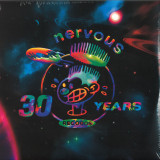
Nervous Records, the iconic label synonymous with the rise of house from the streets of New York City, will mark 30 years in the music industry by releasing the celebratory compilation LP ‘Nervous Records: 30 Years’ on October 1st (Part 1) and October 15th (Part 2).
Featuring original mixes of the label’s biggest tracks, plus remixes by some of its most celebrated acts, ‘Nervous Records: 30 Years’ is both a celebration of the past and of the future. Featuring a who’s who of electronic dance music, the long player sees names including Louie Vega, David Morales Darius Syrossian, Tensnake, Monki, Franky Rizardo, Danny Howard and more take on iconic Nervous cuts: ‘You Make Me Feel Mighty Real’, ‘Treat Me Right’, ‘Future Groove’, ‘Feel Like Singing’, ‘Get Up Everybody’, ‘Break You’, ‘Hot’, ‘End This Hate’, ‘Unspeakable Joy’, ‘Can Ya Tell Me’, ‘Jerk It’, ‘The Anthem’, ‘It Makes A Difference’, ‘Learn 2 Luv’ and ‘Don’t You Ever Give Up’.
The album marks one of the most enduring, extraordinary legacies to grace America’s illustrious music history, not just in electronica but far beyond. Founded in 1991 by Michael and his father Sam Weiss, and recognizable immediately by its distinctive character logo, the label grew rapidly, in no small part due to Michael Weiss’ practically unmatched passion for discovering new music.
“Louie Vega and Kenny Dope woke me at 4am on Tuesday night, Wednesday morning from their studio telling me they had something really different that I needed to hear,” Michael recollects. “I asked if they could play it over the phone. They said if I wanted to hear it I had to come to the studio. So of course I got myself up, got dressed and went there. That “really different track” ended up being ‘The Nervous Track’, a tune that became our signature release and was also highly instrumental in the emergency of London’s ‘Broken Beat’ movement.”
The label’s willingness to take chances on fresh sounds and innovative concepts rising up from the melting pot sidewalks of NYC ensured a body of work that has become a living musical history of the city. House cuts ‘Unspeakable Joy’ and ‘Nitelife’ (Kim English), ‘Get Up (Everybody)’ (Byron Stingily) and ‘Feel Like Singing’ (Sandy B) bump up against hip-hop anthems like ‘Who Got Da Props’ (Black Moon) and “Bucktown” (Smif-n-Wessun) and reggae cut ‘Take It Easy’ (Mad Lion); soulful flows from Mood II Swing (Kim English ‘Learn 2 Luv’, Loni Clark “Rushing”), Armand Van Helden (‘The Anthem’) and Nuyorican Soul (‘Mind Fluid’) sit alongside seminal techno singles like Winx’ ‘Don’t Laugh’. The young artists and producers who joined the Nervous Records’ family have gone on to become some of the most hallowed and celebrated dance acts of all time: Louie Vega, Kenny Dope, David Morales, Tony Humphries, Roger Sanchez, Armand Van Helden, Kerri Chandler, Kim English, Byron Stingily, Josh Wink, to name just a handful.
“We did a release with Josh Wink under his Winx alias entitled ‘Nervous Build-Up’,” Michael said. “It did well and it was obvious how talented Josh was. Subsequent to that release I was pretty persistent in asking him to continue to play me his new demos. During one phone conversation he said, “Mike I’m gonna play you something over the phone but don’t laugh when you hear it.” That demo ended up being ‘Don’t Laugh’, which became one of our biggest international hits and still to this day is one of America’s earliest and most impactful techno hits.”
As much a celebration of the label’s future as it is of their past, Nervous Records: 30 Years is but a marker in the imprints’ history, a clear sign of where they’ve been and also where they’re going. With 30 years behind them, the label’s determination to unearth new raw diamonds in the rough is as unwavering as ever.
“I’ve always been one to look at what others are doing (the industry at large) and think, “ok, are they doing this specific thing for a reason, or doing it because everyone else is doing the same thing” and make my decision based on that,” says Nervous Records’ General Manager Andrew Salsano. “In an age where data metrics and analytics reign supreme, I remain steadfast that they should be complementary to your decision and not the sole indicator to make one. So many songs today are written with 15 second hooks in mind for social media, and while there’s nothing wrong with that business model you will always be chasing the wave instead of carving out your own path and identity.
“My primary focus for the sound of the label has and will continue to revolve around signing good songs and music that has the ability to react at the street level first. The best results come from artists that are firstly given a bit of local love that grows into a global impact. Fresh ideas that express child-like curiosity and artists showing vulnerability in their music are also something I look for, artists and producers that are not making music with certain markets in mind, but rather their own style and signature that is unique but able to straddle the fine line of underground and overground.”
Still as raw, as underground and as finely tuned to the dance floor as they ever have been, perhaps the secret to the success - and the longevity - of Nervous Records has something to do with that hard, dogged, no-holds-barred NYC edge that runs through the veins of the label. With the next generation of producers rising from the clubs of New York, one thing is certain; Nervous Records will be there to find them, nurture them and bring them to the world at large, over the next decade and beyond.
Manchester's jazz scene has produced some of the UK's brightest and most original jazz groups. Now with its eighth releaseMatthew Halsall's Manchester based Gondwana record label shines a light on another of Manchester's well kept musical secrets, the expansive, brilliant piano trio GoGo Penguin.
Featuring pianist Chris Illingworth, bassist Grant Russell and drummer Rob Turner (all still in their twenties), GoGo Penguin, draw on a heady brew of influences from Aphex Twin to Brian Eno, Debussy to Shostakovich and Massive Attack to EST. GoGo Penguin who have already developed a growing cult following in the North West as well as turning in storming performances at the Gateshead International and Manchester Jazz Festival's first came to Halsall's attention when he heard them at a friends night (Norvun Devolution) at the Roadhouse in Manchester. He was immediately drawn to their sublime collective empathy and the seamless fusion of jazz, classical and electronica influences in their music. 'I was blown away the first time I heard them, for me tracks like Last Words and HF are modern anthems and I knew immediately that I wanted to release their music". I am very proud to welcome them to the Gondwana label"
GoGo Penguin met whilst studying music at the RNCM in Manchester. After doing frequent gigs together with various other bands and musicians they started jamming together and started creating new music. They had no specific sound in mind, but just wanted to be free to create freely and honestly. The new band quickly became a vehicle to combine all the best bits from the music they where influenced by and loved. Individually Illingworth brings a lyrical and melodic style influenced heavily by classical piano music and electronica. Turner brings a driving modern style of drumming influenced by jazz, electronica, ambient, classical and dance music. Russell brings a gritty energetic double bass style influenced by the likes of Charles Mingus but also more modern electronic producers. The band's modus operandi is to have one of them bring an idea to rehearsal. Then there's a lot of experimentation, they try out as many different ways to play the piece as they can think of, until it begins to sound like something they all like.
It is their unique ability to synthesis and develop each others melodic and harmonic ideas while drawing on music from classical to electronica that makes GoGo Penguin's music so enthralling and their debut album such a powerful opening salvo from a powerful new voice in UK music.
Editions Mego is proud to welcome Powell to its roster with a bizarre and strangely emotive new LP of synthetic computer works entitled Piano Music 1-7.
Via his own Diagonal Records imprint, his work on XL Recordings and, most recently, the opening of audio/film platform A Folder afolder.studio, Powell has firm footing in the contemporary electronic landscape. During a wry and obstinate musical life he has twisted myriad synthetic forms into shapes that explore and expand upon the districts of post-punk, techno, noise + computer music, and in the the last year alone he has released four albums of hi-def abstractions, each inspired by a formalisation of music proposed by Iannis Xenakis.
As an extension of this intense period of work/research/play with stochastic functions using probabilities to compose music, various processes emerged that Powell then began to apply to more traditional musical events. Where ordinarily in his work the probabilities and relationships are used to define parameters such as wave-shape, folding, FM, filter modes etc., he now began to use them to create musical formations and visual scores that could be played back using any software/MIDI instrument one of these can be seen on the rear cover of the LP release. While mapping out this cartography of relations, he used a basic Grand Steinway sampler as a placeholder instrument; the longer the process went on, though, the more he began to embrace the acoustic properties of the synthetic piano and make it the bedrock for this new constellation of work.
Piano Music 1-7, subtitled 'Music for Synthetic Piano and Assorted Electronics', consists of seven different synthetic islands strung together into a single composition. All were composed using the aforementioned processes that allowed Powell to play a piano, even if he never learned to do so with his hands. After all, 'In writing electronic music,' Robin Mackay once wrote, 'you also have to direct the invention of new tools.'
At times the piano skips gleefully over shadowing synthesis, whilst at others the synthetic sheets swarm and envelope the keys. The interplay between the two create a fantastical alternate reality, a cosmic machine in which time is eroded, shrunk and expanded, like a wax upon which operations and relations are inscribed or engraved. Many of the pieces express a playfulness or optimism verging on vitalism, as bundles of piano notes dance and interpolate with a never-repeating range of electronic gestures. The feel is of a brightly coloured flower-bed in various stage of bloom. This interplay of the artifical acoustic and the electronic builds on the pioneering processes developed by David Behrman in works such as Leapday Night, and Piano Music 1-7 could also be posited as a modern take on Conlon Nancarrow's investigations for player piano. Similarly, the razor-sharp sonic properties and unfolding of non-human events recall the computer works of Xenakis and the surgical precision of Mego mainstay Florian Hecker.
Recorded in late 2020, these new Powell works propose not just a bold and bright vision of electronic music but serve also as a map with which, for 35 minutes at least, we can navigate our way out of the current milieu. As the artist himself remarks in the sleeve-notes, '. . . What emerged from this fog or soup for me were ideas and processes that felt affirmative and life giving — sensations I had always hoped to convey in my music. Perhaps the optimism or positivity I felt at these musical events unfolding, these clusters and knots tumbling in different directions across time, can also be felt by you.'
- A1: Alpha – Anteludium – Omega Alive
- A2: Abyss Of Time – Countdown To Singularity – Omega Alive
- A3: The Skeleton Key – Omega Alive
- A4: Unchain Utopia – Omega Alive
- B1: The Obsessive Devotion – Omega Alive
- B2: In All Conscience – Omega Alive
- B3: Victims Of Contingency – Omega Alive
- C1: Kingdom Of Heaven Pt 1 – A New Age Dawns Part V – Omega Alive
- D1: Kingdom Of Heaven Pt 3 – The Antediluvian Universe – Omega Alive
- E1: Rivers – A Capella – Omega Alive
- E2: Once Upon A Nightmare – Omega Alive
- E3: Freedom – The Wolves Within – Omega Alive
- F1: Cry For The Moon – The Embrace That Smothers Part Iv – Omega Alive
- F2: Beyond The Matrix – Omega Alive
- F3: Omega – Sovereign Of The Sun Spheres – Omega Alive
For many years now, the comparative of epic has simply been EPICA. Since their formation in 2002 and their quick ascension to stalwarts of symphonic metal noblesse with trailblazing masterpieces “The Divine Conspiracy” (2007) or “Requiem for the Indifferent” (2012), Dutch metal titans only knew one way: Up. Especially with their last three releases “The Quantum Enigma”, “The Holographic Principle” and this years’ “Ωmega”, forming a metaphysical trilogy that’s both alpha and omega of all things symphonic metal, EPICA became rightful monarchs of a genre they themselves helped made become a global phenomenon.
Yet, as every other band, EPICA couldn’t take their latest installment of breathtaking cinematic grandeur to the seven corners of the world as they would have normally done. You know why. Thus, plans have been made and visions fulfilled to produce a once-in-a-lifetime event that couldn’t be further away from yet another streaming show. What EPICA unleashed upon the world on Saturday, June 12th, 2021, was a monument to their music, their career, and their enduring legacy as forebears of a whole genre. Now finally being released on Blu-ray and DVD and various audio formats, “Ωmega Alive” is the EPICA show of your wildest dreams, brought to life by blood, sweat, tears and a healthy dose of megalomania. Think Marvel meeting Cirque de Soleil in a Tim Burton universe.
Celebrating the release of their gargantuan new opus magnum, „Ωmega“, the streaming event saw fans from over a 100 countries flock to the screens to witness a show that has proven to be the defining moment in EPICA‘s concert history. A show that’s nothing short of the band’s most explosive performance to date, brought to life with an enormous production on an ever-evolving stage setting that’s full of visual surprises. For the first time ever, EPICA performed songs like ‘The Skeleton Key’ or the insanely monumental “Kingdom of Heaven Part 3” from “Ωmega”, alongside the band’s most popular songs, rare songs, fan favorites and huge surprises. “What started as a basic idea to do an online release show for “Ωmega” quickly spiraled out of control and became our most ambitious project to date,” creative director and keyboard wizard Coen Janssen says. “As usual, we wanted to push the boundaries, explore the limits, and think outside the box. We found ourselves back in our happy place. This concert film, our ray of light for you in the dark times that we have all been living in.”
For half a year, the band worked tirelessly on a show that’s been setting a new standard for concert films and streaming events. “What we wanted to do was the ultimate EPICA show where we could fulfill every dream we ever had, where there was room for all the ideas, effects and props that are just too big to be taken on tour.” Far from your usual streaming concert, the band developed a trademark feature called a “living backdrop.” Coen explains: “We built another stage right behind our stage where lots of things were going on the whole time. And we meant that very literally,” he laughs. “Every song got something extra, something unique that was fitting its world.”
He can say that again: Elaborate visuals, tailor-made videos and graphic effects, fire, and flames on a Nibelungen level, dancers and actors, artistic performances or fire performers all add to the aura of symbolism and cinematic splendor, setting the stage for a band that can’t be happier to finally bring their new album to life, harmonizing wonderfully and giving their A game for a show to remember. “It was so great finally playing with the band again, actually standing on stage with them. Boy, did we miss this,” Coen emphasizes and adds: “We also built a pretty cool new stage with some fire-breathing snakes and lots of rotating elements. Good thing is, we might also take it on the road when we can finally tour again.”
Until then, “Ωmega Alive” will be a more than efficient remedy against no-concerteritis – for bands, fans, and crew alike who all look back on an extra-long dry spell. Divided into five acts as there are letters in EPICA and “Ωmega”, each part gets a different theme, look, and feel, complemented with references to the history of EPICA, the symbolism of the band and the videos they did. It’s, in short, the best show they ever did, a two-hour spectacle spanning their storied career up to their latest endeavors and graced by Simone Simons’ breathtaking a-cappella rendition of ‘Rivers’ from “Ωmega” complete with choir, easily the most emotional and achingly beautiful moment in their entire career. Frankly, you don’t see this on a normal tour.
What EPICA brought to life here with the help of 75 artists and crew members is a testimony to their burning will to take their band ever higher – even now, in the darkest of times we ever had to endure. Let “Ωmega Alive” be your ray of light as it was theirs, a journey into the heart, body and soul of one of the most passionate and visionary metal bands alive today.
Truly adventurous and life enhancing music that invigorates your soul. TIP!
Press Release:
Gordan join traditional Serbian singing with abstraction, energy and minimalism. Their music is marked by radical reduction, seemingly endless ascension and a passion for experiments.
The Serbian singer Svetlana Spajić is an internationally recognized and acclaimed artist. She, like almost no other contemporary singer, is a master of all the complex local stylistic variations of singing from Balkan music. Guido Möbius plays bass and various electronic sound generators. Additionally he uses guitar amps, microphones and effects to provoke feedback which either harmonize or are juxtaposed with the song. It is a dialogue between sound and noise which is accentuated or fragmented by means of Andi Stecher’s expressive drumming. With a rich pool of ideas the percussionist drives the sound forward breathlessly and grounds it. Together the trio form a dynamic body of sound.
Gordan recorded their debut during the first wave of the Covid19 pandemic in Europe in March 2020. Due to the lockdown in Berlin at that time the city didn’t have many distractions to offer, so the trio just concentrated on work. The atmosphere of being isolated in a recording studio had a big impact on the musical results. All three band members came up with ideas for new pieces, which were immediately tested, worked out and recorded. On abstract instrumentals provided by Stecher and Möbius, Svetlana Spajic sometimes reacted with personal interpretations of serbian traditionals, and the other way around. Most of the time it was as if the music just happend to the band; playing together felt natural from the first moment on.
Some of the old serbian traditional songs that Spajic sang are extinct forms with a specific local melodic mode. The skillful improvisation of their lyrics and ornaments was of great importance and very estimated among village singers. The title song Down In The Meadow for instance originally is a love song from the village of Odevce in eastern Kosovo, Serbia. The singing manner is of a great intensity and sonority, with lots of specific local ornaments. It disappeared along with the village communities from the area. Oh, my Rose flowers is from the region of Kopaonik mountain (southwest Serbia) and the mode, scale is known as ”kopaonički glas” (Kopaonik mountain air). Svetlana adopted the style from the late singer Veličko Veličković from the village of Ostraće. It is an old mountain solo chant, rich in fast ornamentation movements and microtonal intervals. Don’t ask how I live is Svetlana’s homage to the new popular folk music movement from the 80ies known as Južni Vetar (Southern Wind) led by a musician and composer Mile Ilić, known as Mile Bas (“Mile the Bass”) which revolutionized popular music introducing tabooed oriental music and original arrangements.
All music by Spajic Stecher Möbius except ‘Don’t Ask How I Live’ by Miodrag M. Ilić, original title Što me pitaš
All lyrics are traditional, except ‘Don’t Ask How I Live’
Svetlana Spajic — vocals
Andi Stecher — drums & percussion
Guido Möbius — bass, feedback, electronics
Recorded by Alberto Lucendo at UFO sound studios Berlin in March 2020 mixed by Morphosis
Mastering by Neel at Enisslab, Rome
Artwork by Lorenzo Mason Studio
With governments finally admitting that UFOs do in fact exist, and humanity attempting to heal from a state of recent crisis, the timing couldn’t be more appropriate for the newest addition to the HYPOCRISY catalog: WORSHIP, due to be released Fall 2021 via Nuclear Blast Records. Aptly titled, the album cover shows a mass of humans reaching up mindlessly to the sky as glowing spaceships shaped like the HYPOCRISY crosses sigil beam down to descend upon earthen civilizations and Mayan temples. Designed by artist Blake Armstrong (Kataklysm, In Flames, Carnifex, etc.), WORSHIP’s artwork speaks to the history of the relationship between humanity and extraterrestrials. “They’re coming back to collect,” explains founder and HYPOCRISY mastermind Peter Tägtgren.
A track entitled CHEMICAL WHORE breaches the subject of pharmaceutical addiction, and those who engineer it. “We are all chemical whores. We regularly consume prescriptions and drugs because we think we need it; we use one pill to heal the damage done by another medicine... it’s a vicious cycle.” Musically, it’s the only song that was written by all 3 core members of the band and translates into a recognizable, mid-tempo HYPOCRISY sound much like ERASER or FRACTURED MILLENIUM. Traveling from Sweden to Russia, the band also shot an official music video for CHEMICAL WHORE.
The DEAD WORLD music was written by Peter Tägtgren’s son, Sebastian. “We actually started to write an album together, something like 11 or 12 songs, but we never put any vocals in there and we just sort of set it aside. Then when I started writing HYPOCRISY I realized I really liked the song… it feels fresh. I think my kid got some new blood in there.” While the song comes equipped with a modern feel, the writing is still old fashioned at its core. Going into detail about the illuminati and black ops government, the lyrics examine how miserable these figureheads and theories can make us. “Call it fantasy, call it sci-fi, there are plenty of conspiracies in the world but I find these ones interesting,” explains Tägtgren.
GREEDY BASTARDS is another track outlined by simplicity and catchiness. Chugging riffs encapsulate a sound that almost verges on the realms of thrash while still keeping its feet firmly planted in the world of death metal. The lyrics touch on the greed and methods of control that we see various governments around the world today; how they manipulate people against one another and abuse the masses.
For Tägtgren, the inspiration to write new HYPOCRISY comes in waves. “I believe we were out on tour for another project and I began to get hungry again. I started spitting out some new riffs and when I had 7-8 songs done, I invited the rest of the guys to join me and contribute, and from there we started putting everything together. We had a break for a few months, continued recording, went back on tour… it never stops. There was a lot of jumping back and forth, and then COVID came and things got really weird.”
Tägtgren was one of the many musically inclined who was forced into sudden isolation upon the onset of COVID 19, only for Tägtgren, this is common practice when creating new songs. “A lot of things in the world stopped, and it was time to finish everything I hadn’t finished.” As usual, all recording and mixing took place at Tägtgren’s home studio in Sweden.
It has been 8 long years since the last record, and HYPOCRISY fans can feel the itch. WORSHIP is 11 tracks of precise, ferocious musicianship. Commonly inspired by the fusion of the modern and the ancient, HYPOCRISY has once more found a way to combine innovative ideas with classic sound in order to deliver something metalheads can enjoyably consume with awe and brutal vigor. HYPOCRISY is Peter Tägtgren (Lead Guitar & Vocals), Mikael Hedlund (Bass Guitar), and Reidar “Horgh” Horghagen (Drums).
- 1: O Mar
- 2: I_Still Hear_The Roar Of A Distant Crowd
- 3: Small Piece With Walfisch And Autodrum
- 4: ??
- 5: Icaro
- 6: Cycloïd-E
- 7: Móbil
- 8: Escucha Para Acelerador De Partículas, Parancatadora Y Voz
- 9: Música Nocturna
- 10: Tripa Con Dientes
- 11: Uma Isis Esfera
- 12: Aerodrones
- 13 1: Prepared Dc-Motor, 1 Mdf Wheel, Touch Fasterner, Mdf Box 25X25X9Cm
HIGHLIGHTS: Objetos Musicais is a collection of 13 sound pieces created by artists from South America and Switzerland, who work in an intermediate zone among the craft of luthiers, visual arts and experimental music. Their works evoke the visionary ideas of Walter Smetak, a Swiss composer who lived in Salvador, Bahia (Brazil) Smetakian spirit tunes in with a new community of contemporary artists, who relate to the work of the so-called "experimental luthiers": artists who build their own instruments, lead them towards radical extended versions or take the exploration towards the building of resonant machines. DESCRIPTION: Objetos Musicais is a collection of 13 sound pieces created by artists from South America and Switzerland, who work in an intermediate zone among the craft of luthiers, visual arts and experimental music. Their works evoke the visionary ideas of Walter Smetak, a Swiss composer who lived in Salvador, Bahia (Brazil). Smetak was a pioneer of musical experimentation in that country and developed, in the 60s and 70s, a musical poetics that was captured in two seminal albums, Smetak (1974) and Interregno (1980), both of which, after being out of print for a long time, have been reissued today, hence the motivation for this tribute. On those two albums, Smetak combined Afro-Brazilian ritual traditions, theosophy, microtonality studies, collective improvisation and the use of unconventional musical instruments, which he called Plasticas Sonoras. Smetak came to build around 150 acoustic instruments, many of which are true sound sculptures of great visual impact. This latter aspect is the most directly evoked one on this album-and it so happens that the Smetakian spirit tunes in with a new community of contemporary artists, who relate to the work of the so-called "experimental luthiers", artists who build their own instruments (Marco Scarassatti, Phillipp Laeng, Maria Anália), lead them towards radical extended versions (Ruben Dhers, Claudio Merlet), develop hybrid projects involving instruments and sound sculpture (Javier Bustos, Alvaro Icaza and Verónica Luyo, Juan Pablo Egúsquiza, Edgardo Rudnitzky) or take the exploration towards the building of resonant machines (Nicole L'Huillier, O Grivo, Zimoun, Cod.Act), without these categories being mutually exclusive, but rather tending to mix, thereby opening up new sonic possibilities. This new community of artists has begun to create a whole new field of research and, in a way, a new discipline, understandable within the context of this new paradigm opened by the maker culture, which has pushed creators and developers from all over the world to conceive alternative-anti-hegemonic and DIY-forms of production. Therefore, this collection allows the artists to evoke Walter Smetak but also to connect his work to this new scene-to which it precedes-a link for this new art that makes its way at some point among the work of experimental luthiers, sound art, experimental music and the DIY ethics. Curated by Luis Alvarado and Chico Dub. Art by René Sánchez. Limited edition of 300 copies on vinyl. This project is part of the experimental music and sound art platform Incidencias Sonoras: COINCIDENCIA, by the Swiss Arts Council Pro Helvetia.
International power duo Dasom Baek (traditional Korean flutes) and Violeta García (cello) present their debut album. is the sound of two leading composers and improvisers pushing their instruments to the technical and creative limit, then beyond into places unnavigated, futuristic and often haunting.
Dasom and Violeta tussle with playful and at times brutal mastery between passages of sparse melody, acrobatic percussion and harmonic drift, while interjecting voices fracture and reassemble into intimate, improbable forms. It is hard to imagine an album more abundant in ideas and motifs, all atomised as soon as they are brought to life. The effect is a tapestry of rugged spirits - moving, and at times just plain beautiful.
Recommended for fans of Okkyung Lee, John Butcher, Messiaen, or Ernst Reijseger.
Dasom Baek is a composer, improviser and performer of traditional Korean instruments, mainly Daegeum, Sogeum. Dasom pursues ground-breaking and modern music rooted in traditional Korean instrumental performance. She is a Certified Master of Important Intangible Cultural Asset, no.45. She has achieved Bachelor's and Master's degrees from the Korea National University of Arts, and is currently undertaking a PhD course at Seoul National University. She has also represented Korea at the International Flute Festival. In 2019 she was selected as a fellow for the OMI Music residency in New York, collaborating with various genres of musicians from different countries. In 2020, she released her debut album, titled . In 2021 she was selected as a showcase artist at SXSW Festival.
Violeta García is a cellist, improviser and composer born in 1990 in San Nicolás de los Arroyos, Buenos Aires, Argentina. She studied at the Conservatory Astor Piazolla, and holds a degree in Composition from the Conservatory Manuel de Falla, with Ricardo Capellano. She also has a degree in Musical Arts, specialising in violoncello, from the Universidad Nacional of Arts (U.N.A).
- A1: Quiet Force - Listen To The Music
- A2: Barry Coates - Hovercraft
- A3: Andrew Gordon - Walking The Lonely Streets
- A4: Steve Bach - Rain Dance
- B1: Angelo Vanotti - Sketches Of Anderland
- B2: Slap & Powell - Sex Drive
- B3: Jordan De La Sierra - Nimbu-Pani The Lemon-Water Song
- B4: Jessie Allen Cooper - In My Heart
As escapism from corporate banality turned the corner in the `90s, a new generation of vibrant, software generated soundscapes emerged. Communal access to the internet propagated the new hive mind of ideas online, giving way to smoother, stress-free textures. The PC revolution opened the gateway to ray-traced playgrounds of color and light, allowing for visions of utopic proportions to manifest themselves on screensavers far and wide. Boot up your machine, load the software on this floppy diskette, and drop out of a reality bounded by the physical laws of the universe. Numero 95 is the soundtrack to the screen saver fever dream we're all trying to climb back into. Eight droplets of proto-vaporwave, synthesized in vinyl (or digital) form, fresh from Numero's archive of forgotten sounds. Are you looking for that half way point between smooth jazz and new age? Mac and PC? Quantum Leap and the X-Files? This software is for you. Housed in a replica floppy diskette, Numero 95 explores an early computer music unbound by scene or region. Eight solo pioneers vibing out at home in their headphones, traveling as far as the sound card would allow. This is music that barely escaped the hard drive and yet percolates at the edges of the algorithm 30 years later. Welcome to Numero 95.
‘The record is inspired by the idea of humanity’s ever-increasing entanglement with technology and artificial intelligence, balancing fears and moral concerns with the possibilities of evolution’s next phase’
A new Soccer96 album is a chance for Danalogue (Dan Leavers) and Betamax (Maxwell Hallett) to return to something of a spiritual creative home. Between them, the keyboardist and drummer have become synonymous with the thriving London jazz scene and, in their mind-bending incarnation as the astral synths-and-drums pairing, they’ve traversed stylistic worlds. Over nearly a decade, the duo have metamorphosed from a DIY outfit whose rough-edged recordings hit with a punk spirit, to cosmic dreamers that use sound to travel the reaches of the mind.
First single Dopamine features Nuha Ruby Ra on vocals who sings from the perspective of human and machine throughout the track. This concept overlaps with the music seamlessly, forming a meeting point between technological and human exploration.
Dialogues between the band and Nuha crystallised a shared vision of a future where humans and artificial intelligence are entangled in a codependent relationship based on the giving and receiving of pleasure hormones, the robots only source of dopamine is to receive it from humans, and the humans’ ability to unleash the monsters of the worst of human emotion.
Danalogue and Nuha sing together ‘It’s a Long Way down’ .. the feeling of jumping from the cliff of our current state as humans and ‘free-falling’ into the unknown of robot-human intertwining. By the outro they are pleading with each other over their dopamine co-dependency, in terms of both giving and receiving the hit. "Dependency leads to free-falling integration, a moment of freefall into robotic consciousness. Humans and machines are locked in a dance of addiction." explains Betamax.
Soccer96 has always been a vessel for Danalogue and Betamax to find clear water from their multitude of other collaborations, their most notable being as two-thirds of The Comet Is Coming alongside Shabaka Hutchings. Danalogue’s other recent production credits include Snapped Ankles and Calabashed, whilst Betamax has been making music with Champagne Dub and Coma World.
“Through collaborating with various artists and developing our own sonic language, it feels like we have created a sound of our own,” says Danalogue. “Now we think less literally and take more liberties to not necessarily sound like a duo. It’s more like a production team that can be augmented or stripped back depending on what the music calls for.”
Dopamine, though, sees the pair back together once again, incubating their findings of the past two years and moving Soccer96 into new territories. The record is maybe darker in some senses than what they’ve put out before; it’s inspired by the idea of transhumanism and humanity’s ever-increasing entanglement with technology and artificial intelligence It balances fears and moral concerns with the possibilities of evolution’s next phase. “The LP title Dopamine refers to the type of neurotransmitter associated with pleasure, that enables technology to hack into our minds and control us, creating addiction, dependency,” Betamax explains.
Dopamine began life as a sonic reaction to the graphic novels of ‘Moebius’ Jean Giraud. The duo then started swapping reel-to-reel tape ideas through each other’s letterboxes in lockdown, before eventually convening in the studio and displaying one of the revered French artist’s images in the middle of the studio for inspiration.
“All musical decisions would centre around this image,” Betamax says. “It was a depiction of a cosmic traveller gazing across a desert at a sort of crystal city. If the music was resonating with the image then we knew we were on the right path. We are both glad there is a lot of emotional warmth underpinning the whole thing. We are trying to connect with the human essence at all times.”
Grains is the debut album by Numinos on Mille Plateaux. The Cologne-based producer, DJ, author and lecturer has been writing the tech-reviews in "Groove" for many years, tests equipment for various specialist magazines and teaches at the Institute for Pop Music (IFPOM) and Institute for Computer Music and Electronic Media (ICEM) of the Folkwang University.In his current creative phase, he conceptually deals with the topic of "granular synthesis".
A "grain" is thus, to a certain extent, a tiny spectral snapshot from a larger musical context - an infinitely expandable, flowing intermediate state. This is also where the connection to the cover motif is found that shows the negative of a photograph of a wild field and has been taken Bernd Adamek-Schyma: The negative as an eternal intermediate state between the motif and the developed image. And despite the fact that "Numinos" has a fully equipped studio with a wide range of instruments, the 20 Euro iPad app "Borderlands Granular" turned out to be the creative catalyst that enabled the trained pianist to implement his sound ideas with direct haptic influence.The app gives the Cologne-based sound artist the opportunity to extract tiny fragments from the sample based on their specific tonality, to recontextualize them and thus work out structures that are not audible at the original tempo.
The results are polyrhythmic sound scenes that appear harsh, artificial and strange in a moment, only to transform into contemplative, warm and familiar frequency stratification minutes later. Numinos deceives the listener in many ways. Above all with the supposed rhythm that does not exist. Because in fact almost all granular clusters within the pieces run in completely asynchronous loops. The addition of a simple kick drum then forces the brain to suddenly hear apparent triplets, quintoles or dotted eighths in these mathematically completely chaotic structures, which are purely fallacy.
Mixed Colored Vinyl
The London label continues to innovate with their biggest release to date.
10 tracks – 10 incredible artists adding to their string of solid releases by new and established art-ists.
Setting fire to the rage of acceptance.
–
Sublime Creatures, defiant of society’s cages, its definitions of power, beauty and status. A higher stance above bitter re-sentment. A pro-active community of thin- kers. A patch-work of empowered souls, ideas and experiences.
Directly related to one of the sentences in our manifesto, Sublime Creatures is a call to our most powerful selves.
–
The name of the label itself is about us working on bettering ourselves and being united in all our differences. “Reptile” is about our relationship with the reptilian brain and our efforts to understand what truly means to be human (tools to perfect your instinct), becoming aware of our-selves and the others around us. “House of” is a direct allusion to the “house and ball culture” movements in NYC in the early 80s.
The sense of a real family of strangers coming together around a shared sense of purpose.
DIALOGUE was conceived as a series of musical letters written back and forth between Luke Slater, Anthony Child (aka Surgeon), KMRU, Lady Starlight, Speedy J and harpist Tom Moth (of Florence + the Machine) at the height of the pandemic between 2020 and early 2021. Using the common language of rhythmic ambient electronics, each DIALOGUE features three actors in a sonic conversation of longform improvisation between 15 and 25 minutes in length, with Luke Slater the common denominator. The results are a brooding, psychedelic exchange of melody, texture, bass, oscillation, key changes and volume swells, which organically merge into complete compositions. It’s music that both reflects and transcends the artists' common reality of isolation – a meditative, consciousness-expanding conversion of musical ideas born from necessity. Cosmic but not escapist. And very much of its time.
Spirits Having Fun records are ones made from and for shows and spaces—arrangements rooted in a deeply collaborative process, that come to life through intuitive and locked-in live improvisation. Following their 2019 debut Auto-Portrait, Two finds the New York and Chicago based four-piece continuing to challenge ideas of what a rock band can be, pulling apart their musical experiences and reimagining them as kinetic compositions, equally studied but palpably organic.
Two is constructed around gut feelings and strong grooves, elastic rhythms and playful pacing. Its twelve songs expand, contract, and make sharp turns between melodies under singer-guitarist Katie McShane’s meditative lyrics. “Broken Cloud,” which was also released last year on a compilation in support of Chicago Community Jail Support, offers a glimpse into her reflections on the natural world: "A city grew out of the ground / to a mountain it's only a blur."
True to its name, the internal logic of the band is also just a lot of fun, built on trust and deep-rooted musical relationships. Before there was Spirits Having Fun, McShane, bassist Jesse Heasly, guitarist-vocalist Andrew Clinkman, and drummer Phil Sudderberg had performed together in various arrangements over the years. McShane, Heasly and Clinkman met in a specific corner of the Boston underground in 2013, a time when a scene had coalesced around students from local music conservatories frequently collaborating with punk bands and noise artists, exchanging ideas and warping musical worldviews. Heasly and Clinkman played together in Cowboy Band, making mutant, free jazz-inspired takes on old country tunes. When Clinkman moved to Chicago, Heasly and McShane played in experimental groups like EKP and Listening Woman; in Chicago, Clinkman met Sudderberg playing in projects like jazz scene fixture Ken Vandermark’s high-powered band Marker.
Spirits first came together as an attempt at a long-distance collaboration among friends in 2016, driven by the simple feeling of missing each other; they’d meet up for marathon weekends here and there to practice, playing small loops through dive bars and art spaces around the Midwest—just enough for McShane and Heasly to afford plane tickets back home. Being split between Chicago and New York forced the project into a deliberate pace. “We tried to take it slow and let it be what it was,” said McShane. That sense of patience unexpectedly prepared them for March of 2020, when their planned tours and the release of Two were indefinitely delayed.
Two was mostly recorded in the summer of 2019 with the help of omnipresent Chicago engineer Dave Vettraino and DPCD’s Alec Watson, whose contributions on organ, synths, and piano are laced throughout the record. The album reflects a synthesis of solitary and communal songwriting processes—each song drawing on fragments written by individuals, which McShane threaded together and shaped through her distinct compositional lens, making the songs whole before returning to them to the band to mature collectively. When composing, McShane writes first on the keyboard before adapting parts for guitars played by herself and Clinkman. Their dueling approaches to guitar are complementary: McShane, being a newer guitarist, brings a freshness to the project (“I'm just discovering the whole time,” she says) while Clinkman has been playing since childhood.
“There's a lot more collaboration on this record,” says Clinkman, “in terms of all of us letting stuff bloom a little bit more.” The record’s first single, “Hold The Phone” is a good example of this process—it started with a playful intro riff from Clinkman, a melody and bridge added by McShane, a wobbly outro groove added by Heasly, which Sudderberg brought to life. Another single, the dynamic “See a Sky,” written primarily by Heasly, underscores the rhythm section chemistry at play across the record, the song ebbing and flowing around Heasly and Sudderberg’s eclectic percussive palettes.
“Entropy Transfer Partners” is the only song on the record with lyrics by Clinkman, and the album’s most politically direct—a call for solidarity in the face of systemic failures, an acknowledgment of the shared material devastation caused by our country’s ongoing healthcare and housing crises: “These are not things we're experiencing individually. We struggle through them collectively. And we could actually declare, all of us, that it doesn't have to be this way, and fight and organize to ameliorate some of those conditions.” (“We won't work to create the shit you monetize, to run our lives,” they sing.)
From front to back, Two is an absorbing listen simply for its impressive range. But as the members explain themselves, the complexity of the record is about more than its intricate riffs, or how often they count out an odd time signature, but how they reject the notion of boxing the songs in, letting the melodies take on lives of their own. “Making music that feels alive is important to us,” says Clinkman. “Music feels most powerful to me when it deepens our sensation of feeling alive and connected to other humans. It’s so easy to feel worn down and isolated; that your life’s value is fixed to your productivity at your job, or the things that you have or don’t have. Making music that feels joyful and fun seems like one effective antidote to that feeling.”
- A1: Say Yes (Detest Of Sirens)
- A2: Stay True (Vinyl Version)
- A3: Back Again (Vinyl Version)
- A4: Run The Streets (Vinyl Version)
- A5: Rekontext #1 (Berger&Apos;S Theme)
- A6: Where We At (Vinyl Version)
- A7: Cthru (Vinyl Version)
- B1: Cleanser #1 (Vinyl Version)
- B2: Losing Mine (Vinyl Version)
- B3: Rekontext #2 (Vinyl Version)
- B4: What I Meant (Vinyl Version)
- B5: Cleanser #2 (Detached Observer&Apos;S Theme)
- B6: Deià (Bends)
- B7: Test Of Sirens (Vinyl Version)
Oliver Torr is about to release his first full length solo album. The album features many moods and colours, with Oliver exploring the use of his voice and lyrics as a new form of his expression. Successfully mixing electronic avant-garde/experimental forms with pop-like harmonic structures is the main theme of the record.
The idea of recontextualisation and themes of observation are mainly inspired by the philosophical literature and ideas of John Berger, Marshall McLuhan, and many others was a driving force during the creation of the album. The lyrical and sound design content is mainly inspired by panic attacks and depression, and serves as a therapeutic tool to aid in personal psychological healing.
Tracks make use of creative sound design by utilising field recordings and various experimental instruments and sources of sound, such as the Radical Chip, designed by John Richards (one of Oliver's mentors) and Max Wainwright. Tracks like 'Deià' which create a chaotic sonic palette are the author's representation of his mind under the siege of an intense panic attack, experienced in the seaside town of the same name that is located on the island of Mallorca.
Oliver feels like the album has been writing itself for the past 5 years, and in the past few months it has decided to finally show its form. With the help of Aid Kid, who is mixing the album and providing additional production, Oliver has put together a 14-track rollercoaster record, with the help of some special guests. Guests on vocals include Chrysalism, BCAA's Bilej Kluk, and sci fi RnB newcomer LVCIFER. Other sonic collaborators include Sunnbrella (guitars on two tracks), Bastl Instruments' David Strobach (distorted samples in intro), Peter Kutin, and Radio Laude's DeSteffan and R.A. (distorted samples/vocal on one track).
The record's sonics are a combination of Oliver's conscious influences, including experimental music, classical avant-garde, shoegaze, IDM, EBM, electronica, hints of modern club music, as well as PC music influences.
Oliver Torr is known as a composer, music producer, performer and installation artist. Outside of his solo projects, he has worked with many prominent musicians and creative companies/film makers worldwide. He is the founder of XYZ project, a music label concentrating on electronic music and audiovisual art (xyzproject.bandcamp), and a member of the noise.kitchen crew (a music and synth shop run by Bastl Instruments in Prague). Oliver is also a part of the 2020 SHAPE Platform roster (shapeplatform.eu), and the 2021 Gravity Network roster (gravitynetwork).
Oliver releases the album prior to the release of his 'Trans Europe Postal Express' project (supported and arranged in collaboration with SHAPE Platform) and gallery exhibition at MeetFactory art space Prague, that will take place in March, and will further the sonic palette of the album.
The album's artwork is directed and designed by Kristyna Kulikova and photographed by Lukas Havlena (VICE, National Gallery of Prague).
The album's pre-release sees a teaser trailer shot and directed by Tereza Halamova and Filip Kettner that will be released 1st of February. A short movie music video with the same crew is scheduled a month after the album's digital release.
A remixed version with reworks from established European electronic musicians (including Peter Kutin, Fausto Mercier, Wim Dehaen, Natalie Plevakova, Evil Medved, NobodyListen, David Herzig, Ancestral Vision and Trauma), will be coming in the next few months after the release.
- A1: Disco Hospital
- A2: Teenage Lightning
- A3: Things Happen
- A4: The Snow
- A5: Dark River
- B1: Where Even The Darkness Is Something To See
- B2: Teenage Lightning 2
- B3: Windowpane
- B4: Chaostrophy
- C1: Further Back & Faster
- C2: Titan Arch
- C3: Lorca Not Orca
- C4: Love's Secret Domain
- D1: Disco Hospital (Unedited)
- D2: Teenage Lightning (Gtr)
- D3: Snow (Demonic Apollo A Version)
- D4: Dark River (Alternative Ruff From Point Studio Mix)
- E1: Teenage Lightning (Various)
- E2: Further Back & Faster (Didgeridoo)
- F1: Snow (Demonic Apollo B Version)
- F2: Carvers & Gilders (Chaostrophy) (Chaostrophy)
- F3: The Dark Age Of Love (Balance) (Balance)
- F4: Love's Secret Domain (Early Instrumental)
In 1991 Coil released the third of their early classic full-length albums “Love’s Secret Domain”, seemingly casting aside the gloom
and funereal beauty of its predecessors in favour of a painstakingly multi-layered hallucinogenic electronic beast, which unlike
some of their fellow ex-industrial contemporaries’ releases of the time wasn’t an attempt at easy accessibility or (the-godsforbid) danceability, but a vibrating psychedelic masterpiece unrivalled in their discography and still a landmark album.
To mark its 30 year anniversary Infinite Fog are beyond proud to present an expanded, fully remastered re-release of this fan
favourite available for the first time ever in its entirety on vinyl with 10 rare and mostly unreleased tracks and alternative
versions from the period added as a bonus to a luxurious 3LP/2CD set.
Love’s Secret Domain contains among its many highlights the Lynchian William Blake tribute of its title track and the
intoxicating single “Windowpane”, original versions of the later Coil live staple “Teenage Lightning” and the majestically warped
classicisms of “Chaostrophy”. Marc Almond guests on the typhonian “Titan Arch” and This Heat’s Charles Hayward provides
some amazing drum stylings.
This album is Coil pushing their sound ideas and probably their sanity to their very limits. Beyond the iconic Steven Stapleton
cover art here reproduced in unseen definition the doors of perception still open wide for both long-term Coil aficionados and
new-comers to this supremely innovative release to explore unknown depths. The long-overdue re-release illustrates how far
ahead of the curve Coil were with the sounds on this album, which still sounds as fresh and mind-blowing as it did back in the
early 90s.
Fragments, The Debut Album From Trifecta (Beggs, Holzman, Blundell)
Trifecta, a new addition to the Kscope roster, features 3 of the contemporary
music scene’s most lauded and revered musicians - bassist and songwriter Nick
Beggs, keyboardist extraordinaire Adam Holzman and completing the line-up,
Craig Blundell - one of the world’s most celebrated drummers.
Having performed together as part of Steven Wilson’s band, the three would
jam together after soundchecks and from these sessions the fledgling ideas for
Fragments were born. Nick Beggs comments “after the last tour with Steven
finished, we had a handful of tracks ready to work on and as we moved through
our various separate projects we agreed to work on Trifecta.”
The record primarily leans toward a fusion of jazz rock, being instrumental except for the first single (the wonderfully titled “Pavlov’s Dog Killed Schrodinger’s Cat”), the lyrics of which, Beggs states, “are written from the perspective of
a layman trying to understand quantum mechanics...and failing.”
Each band member completed the recording and engineering of their own
contributions in their various home studios, helping to bring their individual
production ideas to each track. Adam Holzman mixed the record at his New
York home studio with the mastering handled by Andy VanDette (Rush, David
Bowie, Deep Purple, Porcupine Tree, Beastie Boys) in New York.
Asked what fans of the musicians can expect from Trifecta, Beggs says, “Fission!
It’s like Fusion but less efficient and more dangerous.”
The debut album resulting from this “fission” of these extraordinary musicians
is entitled ‘Fragments’ and will be released on Kscope on 20th August 2021.
Airplay from Mary Ann Hobbs, Liz Alker and Tom Ravenscroft and beyond
Reviews in Mojo, The Wire, Quietus, Uncut and more
On October 9ththe multi-instrumentalist Jack Wyllie (Portico Quartet/Szun Waves) presents his new project Paradise Cinema. It was recorded in Dakar, Senegal in collaboration with mbalax percussionists Khadim Mbaye (saba drums) and Tons Sambe (tama drums).
The impressionistic and dream-like quality of 'Paradise Cinema' is a stunningly effective realisation of Wyllie's experience, in ahypnagogic state of aural consciousness:
"I had a lot of nights in Dakar, when the music around the city would go on until 6am. I could hear this from my bed at night and it all blended together, in what felt like an early version of the record."
Atmospherically 'Paradise Cinema' is vaporous and enigmatic, but also percussive; existing in a paradoxical sound-space that's amorphous,yet still purposeful, serene, but propulsive and aesthetically sharp.
Khadim Mbaye and Tons Sambe, provide the rhythmic backbone of the record. There are traditional elements of mbalax rhythm, but it is often deconstructed or played at tempos outside of the tradition, so while it hints at a location it occupies a space outside of any specific region.
'Paradise Cinema' is also informed by notions of hauntology – a philosophical concept originating in the work of French philosopher Jacques Derrida– on possible futures that were never realised andhow directions taken in the past can haunt the present.
On the album's title Wyllie comments, "there are a handful of old cinemas in Dakar – these big modernist buildings dotted around the city built around independence. They're old and derelict now, but feel to me like monuments to that period, when the city was flooded with utopian ideas about its potential futures."
As such it sits closely to 4thworld music – situated in an imagined culture and time that never came to pass. And while it contains rhythmic references to Senegal it combines these elements with ambient and minimalist music to produce a sound that sits outside of any tradition.
Setting the tone for the long-player's themes is the optimism-driven, balmy beauty of 'Possible Futures', where rich-toned drums throb and levitate in a stratospheric ether.
Like a time-lapse video of plants in bloom, 'It Will Be Summer Soon' is the sound of anticipation and growth. Rhythmically it flickers and flutters, evoking rainfall, or the blurred wings of a bird in in flight.
Casamance moves through field recordings drifting in and out of focus, beats pitched-down low and unfurling saxophone, whilst the ambient 'Utopia' was made mainly with processed saxophone and suggests a longing for a perfect world.
Galloping percussion juxtaposes with a wistful mood on 'Liberté' – a title that referencesa derelict modernist cinema in Dakar of the same name– a hauntological landmark, made more poignant by the its name being part of the French national motto.
Tying into the cover artwork, Jack explains, "the 'Digital Palm is a telecommunications mast disguised as a palm tree in central Dakar. As a modern piece of technology that on first glance looks natural, it mirrors the combination of modern and acoustic elements."
Perhaps eliciting a time that never came, or maybe still in hope of it yet to come, 'Eternal Spring' concludes the LP's otherworldly beauty with hypnotic drums powering a subtly-building, sparkling and powerful crescendo.
Jack Wyllie is a musician, composer, electronic producer who draws on influences of jazz, ambient, and the trance-inducing repetition of minimalism.
Wyllie performs and records in Portico Quartet, Szun Waves (withLuke Abbott and Laurence Pike)and Xoros. He has also collaborated with Charles Hayward, Adrian Corker and Chris Sharkey and released on Ninja Tune, Babel, Leaf, Real World and Gondwana.
Khadim Mbaye and Toms Sambe play in various mbalax groups in Dakar. Khadim has also toured internationally with Cheikh Lo.
Concentric Records presents Radiant, the third compilation of its introductory release trilogy. Featuring music by ASWA, HOLOVR, Max Loderbauer, Petre Inspirescu, Supply, The Waves, William Selman, the album evokes luminous, iridescent and ethereal sonic spaces - a journey that overcomes struggles, spinning upward towards the light.
The album opens with calm, bright and assertive tonalities, evoking mental spaces prone to exploration and wondering. Molecular textures and real-world sounds bring us closer to an intimate and physical sphere, a voice. Ultimately everything dissolves into a synthetic domain of acid-like washes, in a cinematic sense of departure.
MAX LODERBAUER has been an active engineer, producer, and musician across four decades. He first came to notice in the late ‘80s as a member of Fischerman’s Friend. Known then as Daimler Max, Loderbauer’s associates included Stephan Fischer and Tom Thiel, as well as producer Thomas Fehlmann. Once the group went dormant, Loderbauer and Thiel established Sun Electric; one of the leading sources of entrancing downtempo and ambient techno through the ‘90s. During the 2000s and 2010s, Loderbauer collaborated in numerous settings, including NSI with Tobias Freund, Chica & the Folder with Paula Schopf, and Moritz von Oswald Trio with Vladislav Delay and Moritz von Oswald. Loderbauer was partly responsible for some of the most progressive and experimental electronic music released during these years. In 2011, he and contemporary Ricardo Villalobos assembled Re: ECM, a project that involved radical transformations of ECM label recordings by the likes of Bennie Maupin, Christian Wallumrød, John Abercrombie, and Arvo Pärt. More recently he consolidated the collaboration with Ricardo Villalobos via the Vilod project, and with Samuel Rohrer and Claudio Puntin as Ambiq - both described as ‘a fertile patch of inspiration, shaking up the principles of minimal techno with the loose, expressive qualities of jazz’. The album opening track - ‘Harmonic’ - feels like a glowing dream. Composed of stunning electronics in a polychromatic, blinding and shimmering light; harmonious interwoven melodies calmly wind down invoking a serene mental state and grounding peace.
WILLIAM SELMAN was the very first artist ever approached by Concentric Records prior to the label’s birth, back in 2018, following his defining release ‘Musica Enterrada’. A musician and multimedia artist currently based in Portland, Oregon, his work employs analogue and digital synthesis techniques, live percussion and instrumentation, and his own rich field recordings to create compositions and sound art focused on the ideas of place and environment. Selman's recent works have been released on Mysteries of the Deep and Hausu Mountain.
PETRE INSPIRESCU is an extremely versatile composer. As co-founder of the legendary RPR Soundsystem together with Rhadoo and Raresh, he mostly produced club-ready, heavily textured takes on tech-house and minimal techno. In 2015 he released his first album on Mule Musiq, considered a significant departure from his previous work, scoring piano, strings and woodwind instruments for the first time, resulting in a set that sat somewhere between ambient and neo-classical. Since then, he continued to explore further sonic territories, adding in vintage synthesizers and occasional nods to dub techno, resulting in melodious sequences of musical movements that relate to the work of classical composers, American minimalists and ambient legends. ‘The Garden’ is a dreamy, intimate and nature inspired composition, recorded in his home studio in Ibiza sometime in the Summer.
DJ and producer SUPPLY (youngest so far on the label) was born and raised in Gießen, within sight of the skyscrapers of Frankfurt am Main, and has been living in Berlin since 2017. Musically socialised through hip hop, he found his connection to electronic music produced in Chicago and Detroit in the 90s by moving to FFM in 2013. For almost 6 years he has hosted his own events in his hometown. His productions connect the dots between hip hop, retro futuristic movie soundtracks and techno, he recently released on YAY Recordings. ‘Inhale / Exhale’ was created during a time of stress and mental tension, partly self-inflicted, partly result of my surroundings, as it turned out in retrospect. The track tries to capture a moment of taking a deep breath by releasing that tension for a moment. I came up with the first sketch one night around 4am, the final arrangement found its way onto a C60 Chromoxid Cassette - inhale - exhale.’ - Supply
THE WAVES is a post-punk and synthwave-inspired project led by Maayan Nidam, that places her vocals at its front and centre. As a musician obsessed with sound and the technology behind its creation, her workflow places a strong focus on the studio environment. Triggering chain reactions between guitar pedals, drum machines, modular synths and acoustic instruments, generating sounds in unpredictable ways. Drum machines keep a steady groove as to give support to an array of guitars and synthesisers, all topped with The Waves own, mostly unmasked, lyrics and voice. ‘Hold On’ was written by Maayan during the 2020 pandemic as she dived deeply in studio work in Berlin. Her lyrics are featured as part of the art print insert, and have became a central statement to the LP and its narrative - the power to hold on and break through.
Jimmy Billingham's HOLOVR project has racked up various releases on some of the most forward-thinking electronic music labels over the past few years, including Firecracker Recordings, Likemind, Further Records, Opal Tapes and his own Indole Records. Though best known for melodic, drifting acid techno and electronica, he's equally at home crafting textured ambient soundscapes. HOLOVR's deeply emotional synth passages and pads will take you on a journey into the outer. 'Melancholy of Time came out of a period exploring ways of producing and recording outside of the grid-based structures that I was previously working with. I wanted to strip it back to what I often find to be the emotional core of a piece of electronic music - ebbing and flowing synth pads - but to push and pull it a bit to create a slight disjointedness, unpredictability and shop-worn texture, as if it's coming apart and fraying, yet retaining a sonic clarity. I recorded it live using looped and layered synth phrases, underpinned by a layer of hiss and pin-prick textures. I find reflections on time and its passing to be a recurrent feature of my work, both in a more straightforward way of harking back to music of a certain period or pieces of equipment but also in a more abstract sense of creating a feeling where time doesn't matter - a deep feeling of now; that escape that you find in music and other ecstatic experiences. Though of course we’re always in - and running out of - time, and hence the melancholy.’ - Jimmy Billingham
Hailing from the German underground scene, ASWA aka Attila Fidan has an intricate, hypnotic style of electro, techno and ambient. Coming from visual arts and not primarily a trained musician, Attila produces under various and multiple monikers: ‘I never really start out knowing which moniker the track will be made under’. Since 2017 he runs a boutique Berlin label named ‘Tape Archive’. ‘Dust Palace’ is a synthetic piece that resonates with a cinematic vastness, closing the LP in an uplifting tone that evokes new departures and new beginnings.
- Bass Tone - Squidgy Black
- Bass Tone - Cem4430
- Bass Tone - Sleepy Sweep
- Bass Tone - Eric’s Wobble
- Bass Tone - Fisherman’s Friend
- Bass Tone - Hollow Cat
- Bass Tone - Shadows From The Moon
- Bass Tone - Ripley’s Insides
- Lead Tone - Mind Ray
- Lead Tone - Horny Solo
- Lead Tone - Mrs Pipes
- Lead Tone - Hand Sync
- Lead Tone - Speak To The Hand
- Lead Tone - Numan’s Car
- Lead Tone - Escape From New York
- Lead Tone - Year 2106Atonal Scratch Sounds
- Evolving Drum Sequence
- 133: 33 Bpm Bass Phrases
- Funk Bass Phrases
- Funk Phrases With Cm To Gm Blues Scale Bass And Lead
- Funk Progressions 1 With Em To Bm Blues Scale Bass And Lead
- Funk Progressions 2
- Soul Phrases And Chords 1 With Cm To Gm Blues Scale Bass And Lead
- Soul Phrases And Chords 2 With Em To Bm Blues Scale Bass And Lead
- Soul Phrases And Chords 3 With Dm To F Major Blues Scale Bass And Lead
- Soul Phrases And Chords 4 With D#M To F# Major Blues Scale Bass And Lead
- Major 7Th Chords - Circle Of 5Ths Sequence
- Major 7Th Chords - Circle Of 5Ths Sequence Variation 2
- Major 7Th Chords - Circle Of 5Ths Sequence Variation 3
- Minor 7 Chords - Circle Of 5Ths Sequence
- Minor 7 Chords - Circle Of 5Ths Sequence Variation 2
- Minor 7 Chords - Circle Of 5Ths Sequence Variation 3
- Experimental Tone - Avant Guard Dog
- Experimental Tone - Contact Made
- Experimental Tone - Tank Zapper
- Experimental Tone - Off Limits
- Experimental Tone - Arp Attack
- Skip Proof - Vocoded Fresh Ahh
- Skip Proof - Atonal Noise Sweeps
- Skip Proof - Atonal Noise Sweeps 2
Tones 1.0 is a record specifically made for the purpose of melodic scratching, although it is not limited to just that; it can be also used as a production tool.
Think of Tones 1.0 as a synthesized toolkit that blurs the lines between live performance and production.
Side A consists of 16 locked modulating tones (8 bass tones and 8 lead tones) that have been recorded from various analog synthesizers. They were recorded live while manipulating cut-off frequencies, resonance and LFOs to a click track at 133.33 BPM. This gives the tones extra rich sonics and more depth while being scratched. Each bass tone is recorded at middle C (C3) while each lead tone has been recorded an octave higher (C4).
Side B consists of musical phrases, chords, drums, experimental tones and skip-proof atonal scratch sounds, all of which have been recorded at 133.3 BPM.
You’ll find a rich tapestry of ideas to choose from ranging from funk basslines/chords and licks, soul chords and licks, drums, atonal scratch sounds and experimental tones that create futuristic atmospheres. Major and minor 7th chords follow the circle of 5ths so that they are all relative to each other, perfect for creating music quickly. Once you’ve created a beat/sketch you can then jump to the skip-proof atonal scratch sounds and solo over the top. Enjoy.
Binding a deep social and political conscious with rigorous musical experimentation, the Brussels based, Italian pianist, performer, composer, Giovanni Di Domenico, delivers Downtown Ethnic Music, the 4th instalment of Die Schachtel’s Decay Music series, focused on inspired contemporary experimental efforts in the ambient, ethereal, and emotively abstract music.
Over the last decade or so, Giovanni Di Domenico has carved a deep path through a diverse number of discrete fields within experimental music, working in various ensembles - Abschattungen, AufHeben, Bonjintan, Cement Shoes, Delivery Health, Going, etc. - as well as producing a discography of critically heralded solo efforts, and intimate collaborations with Jim O'Rourke, Tatsuhisa Yamamoto, Akira Sakata, Arve Henriksen, Tatsuhisa Yamamoto, Alexandra Grimal, Nate Wooley, Chris Corsano, and others.
Downtown Ethnic Music encounters Di Domenico reimagining the future of urban music, pluming the mysterious and emotive depths of self, to arrive at vision of sonorous utopia, radically divergent from those of the past. Hybridizing numerous forms of musical practice, while making a conceptual nod to Jon Hassell’s notion of the "fourth world”, as well as the cross-temporal transnationalism of Roberto Musci, Aktuala, Futuro Antico, and the Third Ear Band, Di Domenico’s vision of democracy - rendered through the creative metaphors of sound - is a true to life, bristling conflict, as open-ended as it is ordered, and as dramatic and tense as it is beautiful, playful, and refined.
A colorful tapestry of ideas, experiences, histories, and reference points, woven from a pallet of electronics, synthesis, and various acoustic sources - the intervening rhythms of drummer João Lobo, vocals by Pak Yan Lau and Patshiva CIE women choir, the horns of Ananta Roosens and Jordi Grognard etc. - across the length of Downtown Ethnic Music, the boundaries between idiom, expressive concept, collective, and individual blur, giving way to a visionary, forward-thinking rendering of electroacoustic music, that subtly reminds us of the social and political potential of art.
Seamlessly incorporating bubbling electronic abstraction, sprawling ambience and long tones, throbbing kosmische, acoustic free improvisation, and the human voice, Giovanni Di Domenico’s Downtown Ethnic Music represents a high-water mark in an already astounding career. Issued by Die Schachtel in a one-time edition of 250 copies, pressed to 180g marble vinyl and housed in a pro-printed inner sleeve and jacket, contained in a silk-screen PVC sleeve.
- Dark Strands - The Last Ride
- Dark Strands - We Own The Night
- Dark Strands - Black Dog
- Dark Strands - Wandering Star
- Vox Low - I'll Save You Anyway (Evelyne)
- Vox Low - I'm Coming To Your House (Feat. Tarik Ziour)
- Vox Low - Loving Hell
- High Boys - Drunken Master
- High Boys - Down With Chaos
- High Boys - This Is The Captain Speaking
- High Boys - No Hope For A Sexual Revolution
- Timothy J. Fairplay - Mindfighter
- Timothy J. Fairplay - Nightmare City
- Timothy J. Fairplay - Lost In The Mirror Maze
- Timothy J. Fairplay - Jennifer Has Some Strange Ideas
- Fontän - Sen Sen No Sen (Red Axes Remix)
- Fontän - Mangsebung (Timothy J Fairplay Remix)
- Fontän - Gangri (Khjinda Remix)
- Fontän - Bardo (Mythologen Remix)
- Fontän - Shadows (Pardon Moi Remix)
- Birds Of Paradise - Tito
- Birds Of Paradise - Joy-Rides
- Birds Of Paradise - Smoking Holiday
- Birds Of Paradise - Breather Resist
- Mythologen - The Joy I Feel
- Mythologen - Canavan's Peckham Pool Club
- Mythologen - Blackheath
- Mythologen - House Of Parakeet
- Jamie Paton - Enhance 224
- Jamie Paton - State Line
- Jamie Paton - Disk Memories
- Jamie Paton - Leviathan Aftermath
- Frak - Corridor
- Frak - Stetoskop
- Frak - Micro Fisson
- Frak - Arcitect
- Birds - Solitary Dancers
- Birds - Night Time Life
- Birds - Dont Drink The Acid Water
- Birds - Young Blood
What better way to celebrate 100 releases than with a handmade box containing soul expanding music!? Höga Nord Rekords have reached an important goal and releases a rare box set containing all 12” from the HNRUK-series plus a new record from Birds, unique for this box. Except Birds, this compilation includes Dark Strands, High Boys, Vox Low, Timothy J. Fairplay, Fontän, Bird Of Paradise, Mythologen, Jamie Paton and Frak.
The music is of course the main focus of all releases on Höga Nord Rekords but what birthday gift comes without a proper wrapping? This exclusive handmade box made in Norrmalms kartongfabrik in Stockholm, is a celebration to the Scandinavian Bronze age. You’ll find rock carvings like those on the artwork scattered over the land but mostly near Gothenburg, home of Höga Nord Rekords on the Swedish west coast.
Archaeological evidence proves similarities in ornaments and pictures between the Nordic and European Bronze age, just like you find common features in the music released on our label. Though the acts in this compilation box come from all over Europe and beyond, they stem from an obscured and mysterious common source of escapism, purity and creativity.
Lotus Wash drops his debut album on LBD Sounds, bringing a whole load of fresh material which came out from his experience as a session musician, and performing his experimental live sets around the Czech Republic. He connects the dots between classically trained musician and modular synth-head, working in Prague's DIY shop and creative community Noise Kitchen. The album spans across 6 original tracks of pure analogue bliss and live ideas, alongside three remixes from his closest allies, local producers Oliver Torr, Vision of 1994, and Hrtl.
The Field Theory was created during a period of deep fascination with quantum physics, with the tracks being conceptually and aesthetically inspired by some of its phenomena. Acoustically, it's mostly a slow and dark affair, with Lotus Wash only letting the light in very briefly when the sun is young (Magnetic Moment), keeping the shutter firmly closed for the rest of the record. His music does not rely on banging beats to drive it, instead letting intense grooves do the job from deep underground, just like on earth-shattering album opener Vacuum Fluctuation. He masters his craft of building atmosphere, a skill learnt during multiple collaborations with various Czech theatres. Of course, he lets the steam out occasionally, and always with devastating effect (Higgs Field, Casimir Force), but mostly choses to keep it capped, humming and hissing. When the sky clears, he opts for a minimalistic and hypnotic approach, only to disturb this peace with a killer bassline in one of the album's highlights – Spooky Action in A Distance – later re-imagined and re-electrified by Oliver Torr. Standard Model is anything but your standard techno, while Hrtl's remix of Magic Moment flirts with techno too, but on a dubbier and brighter side. Bringing the album to a close is Vision of 1994's downtempo take on the same track, finally letting you breathe out.
Ryley Walker currently resides in New York City. But his latest LP is a Chicago record in spirit. The masterful Course In Fable, the songwriter’s fi@h solo effort,
draws from the deep well of that city’s ferCle 1990s scene, when bands like Tortoise, The Sea and Cake and Gastr del Sol were reshaping the underground,
mixing and matching indie rock, jazz, prog and beyond.
Walker spent his formaCve years in Chicago, absorbing those heady sounds and finding ways to make them his own. Even though he emerged at first in folkrock
troubadour mode, it makes sense that he’s arrived at this point; each LP has grown more intricate and assured, his influences disClling into something
original and unusual. To put it simply: Course In Fable is Walker’s best record yet, full of acCve imaginaCon and endless possibiliCes.
Last October, Ryley went straight to one of the primary architects of the Chicago sound to make the LP. John McEn:re, Course In Fable’s producer/engineer/
mixer, can rightly be called a legend for his work with Tortoise, Stereolab, The Red Krayola, Jim O’Rourke and countless others over a prolific career that now
spans more than three decades. Seeing his name in an album’s liners is preVy much a trademark of quality.
Another Windy City exile, McEnCre is based on the west coast these days, working out of the Portland, OR studio he’s dubbed Soma West. On the seven songs
here, he delivers the signature shimmering and prisCne sonics he’s become known for over the years. But McEnCre was also inCmately involved with Course
In Fable’s overall creaCve process. “I told him to take the mixes and have at it,” Walker says.
The result is a rich, immersive affair — a headphones record if ever there was one. Course In Fable’s songs are twisty, labyrinthine things, stuffed full of ideas
(Walker half-jokingly calls it his “prog record”). But no maVer how complex it gets, the album is never overwhelmingly busy. Wiry guitars melt into gorgeous
string secCons (arranged by Douglas Jenkins of the Portland Cello Project). Tricky Cme signatures abound but feel as natural as can be. Melodies o@en dri@ in
unexpected direcCons but remain downright hummable. Like Walker’s beloved Genesis, the pop element is never too far from the surface even when shit
gets weird. (And speaking of weird, Ryley says that in addiCon to Genesis, much of the album’s inspiraCon comes from “Australian extreme scooter riders on
YouTube and balding gear heads on Craigslist.” Go figure.)
To help put together these various puzzle pieces, Ryley assembled a band made up of several longCme collaborators. Bill MacKay (another Chicago mainstay)
and Walker have made two excellent instrumental duo records of interlocking guitars and warm give-and-take — a rapport very much in evidence
throughout Course In Fable. The freakishly talented drummer Ryan Jewell has performed with Walker for years now in a variety of seangs, from
straighborward song-centric sets to blown-out improv extravaganzas. Bassist Andrew ScoJ Young (Tiger Hatchery, Health&Beauty) has logged many miles on
tour with Walker; he and Jewell are frequently astonishing, a buoyant-but-always-locked-in rhythm secCon, able to navigate someCmes dizzying turnarounds
with apparent ease. Listening to the interplay between Walker and these musicians and you might be fooled into thinking they’d spent a year roadtesCng
Course In Fable’s songs. But it all came together relaCvely fast, thanks to demos, rehearsals and the kind of musical empathy that comes from years of
playing together.
Beneath the wondrous interplay, you’ll find some of Walker’s most personal – if sCll typically crypCc — lyrics, hinCng at some of the trials the songwriter has
been dealing with in recent years. Balanced with necessary doses of dark humor and oddball poetry, Course In Fable feels most of all like a life-affirming
record, fresh air in the lungs, sun on your skin. “Fuck me, I’m alive,” Ryley sings at one point, a moment of both disbelief and pure joy.
Walker has released his albums on a who’s-who of independent labels over the past decade — Tompkins Square, Dead Oceans, Thrill Jockey and Drag City
among them. This Cme around, he’s doing it DIY-style, puang Course In Fable out on his own Husky Pants imprint. You’re in good hands. This is an album that
sounds great (mastered by Greg Calbi), looks great (artwork by Jenny Nelson and design by Michael Vallera). It probably even smells great. Whether you’ve
been onboard since the beginning or are new to the Ryley Walker universe, you’re in for a treat.
- A1: Quiet Force - Listen To The Music
- A2: Barry Coates - Hovercraft
- A3: Andrew Gordon - Walking The Lonely Streets
- A4: Steve Bach - Rain Dance
- B1: Angelo Vanotti - Sketches Of Anderland
- B2: Slap & Powell - Sex Drive
- B3: Jordan De La Sierra - Nimbu-Pani The Lemon-Water Song
- B4: Jessie Allen Cooper - In My Heart
As escapism from corporate banality turned the corner in the ’90s, a new generation of vibrant, software generated soundscapes emerged. Communal access to the internet propagated the new hive mind of ideas online, giving way to smoother, stress-free textures. The PC revolution opened the gateway to ray-traced playgrounds of color and light, allowing for visions of utopic proportions to manifest themselves on screensavers far and wide. Boot up your machine, load the software on this floppy diskette, and drop out of a reality bounded by the physical laws of the universe.
The eighth entry in Numero’s Cabinet of Curiosities series.
- 1: Erizonte - Obertura
- 1: 2Mecanica Popular And Erizonte - Dos Veces En La Vida
- 1: 3La Fura Dels Baus And Erizonte - ¡Mierda De Guerra!
- 1: 4Macromassa With Erizonte - Tonsura
- 1: 5Pelayo Arrizabalaga, Eli Gras And Erizonte - Miedo A La Verdad
- 1: 6Erizonte - Tres Piezas Para Teclados
- 1: 7Erizonte - (Des) Educación
- 1: 8Esplendor Geométrico & Erizonte - Clerecía
- 1: 9Mar Otra Vez - Calma
- 1: 0Erizonte - Difracción
- 1: Erizonte With Jesus Alonso - En El País Del Silencio
- 1: 2Scud Hero With Erizonte - Hipnosis Colectiva
- 1: 3Corcobado And Erizonte - Sol Sotnemurtsni Es Nacot
- 1: 4Erizonte - Coda
HIGHLIGHTS New pieces by Spanish pioneers from the 80's and before in Experimental rock, Electronica, Industrial, Avant-Garde, etc. Inspired by the mysterious and disturbing anti-Franco illustrator OPS, nowadays well known as El Roto. Second part of the Erizonte trilogy on drawing as a transmitter of progressive ideas, first part being Suite Los Caprichos by Francisco de Goya. Available only in vinyl gatefold edition. TRACKLIST: SIDE A A1. ERIZONTE - Obertura A2. MECANICA POPULAR and Erizonte - Dos veces en la vida A3. LA FURA DELS BAUS and Erizonte - ¡Mierda de guerra! A4. MACROMASSA with Erizonte - Tonsura A5. PELAYO ARRIZABALAGA, ELI GRAS & ERIZONTE-Miedo a la verdad A6. ERIZONTE - Tres piezas para teclados SIDE B B1. ERIZONTE - (Des) educación B2. ESPLENDOR GEOMÉTRICO & Erizonte - Clerecía B3. MAR OTRA VEZ - Calma B4. ERIZONTE - Difracción B5. ERIZONTE with JESUS ALONSO - En el país del silencio B6. SCUD HERO with Erizonte - Hipnosis colectiva B7. CORCOBADO and Erizonte - Sol sotnemurtsni es nacot B8. ERIZONTE - Coda More Details: In this collective creation directed by Erizonte well-known artists sharing ethics and aesthetics come together over the mysterious and disturbing drawings that appeared in some newspapers, books and magazines in the mid 1960's to mid 1980's, such as Hermano Lobo, Triunfo or Cuadernos para el Diálogo, signed OPS - later better known by the heteronym of El Roto. Musicians or sound artists, representatives of avant-garde music that emerged in the Spain of OPS, have composed a piece for this album on a given, recurring theme: repression, censorship, informative manipulation, induced or obligatory oblivion, the vices of clericalism, the horrors of war, imperialism, bad education or the lack thereof and gender violence. These are themes that coincide with those already undertaken by Goya in etchings, and of whom we can consider Andrés Rábago, the painter behind these two pseudonyms, as the legitimate heir, at least in this field. He himself has chosen the drawings that illustrate each of the covers corresponding to the individual editions of each piece as they appeared. The covers are all gathered here, along with a new cover. This album is part II of Erizonte's trilogy inspired by drawings in the media c. After the first part, the "Suite Los Caprichos de Goya", where 19th century ideals of the Enlightenment can be seen through the etchings of Francisco de Goya, while this second album corresponds to the OPS cartoons, anti-Francoism and its environment, as it was when they appeared in newspapers and magazines, the media of the 20th century. The artist and the graphic medium for the third and last part, corresponding to this 21st century, is yet to be discovered ...
*** UNRELEASED AOR / YACHT ROCK FROM 1979 AS FEATURED ON PRAISE POEMS 7***
It is a rare occurrence, especially when you consider that we are writing this in the year 2020, that an unreleased AOR/Yacht Rock album surfaces after 40 years. The Tramp crew first heard about it while discussing Penn Central's inclusion of their song "Sometimes" on "Praise Poems Vol.7".
The band Penn Central was formed about 1978 by Gary Phelps and his younger brother Shawn Phelps. They had been playing together in a few different groups in the Erie, Pennsylvania area since Gary returned there from Penn State in 1974. In 1978 Shawn was going to college at Edinboro State University, just south of Erie, where he met Curt Salvador, a student from the Pittsburgh area. They began playing together in a local Edinboro group when Shawn introduced Curt to Gary. Gary, Shawn, and Curt began to collaborate and soon Gary brought in friend and former high school bandmate Allen Bennett who was an accomplished musician on trumpet and percussion. Shawn then found Dave Lindgren who was playing drums in various bands locally and Penn Central was formed.
The group began rehearsing and playing small venues together. Soon, they began to work on original songs that Gary and the band were writing. They decided in 1979 to record some of the original music at a small independent studio in Erie that was owned and operated in by Keith Veshecco and John Mazza. Soon after recording 7 songs there, a large FM radio station, WDVE, in Pittsburgh sponsored a contest for local bands for a compilation album of local groups. Because of Curt's roots in Pittsburgh, he entered the Penn Central song "Sometimes" in the contest and it earned a spot on the 10 track album that was released in 1980. The band subsequently played in the area for the next few years before drifting apart as the members left college, began new careers, and started raising families. Gary, his brother Shawn, and Curt continued playing together and with other group configurations and as solo artists off and on since that time. They remain friends and share musical ideas to this day.
Key selling points:
- previously unreleased album from 1979
- all songs taken from the original reel-to-reel master tapes
- including full album download code
Frontman of Nottingham punk band Kagoule, Cai Burns, returns as Blood Wizard. Arriving with no fixed direction, Blood Wizard is a project that sees Burns explore himself as a brand new entity, an artist beyond boundaries and preconceptions.
First single ‘Breaking Even’, showcases Burns’ impeccable songwriting skills and acts as the perfect introduction to this exciting project. With jangled, stop-and-go instrumentation, it is sheer artistic satire with an added charm.
Burns says about ‘Breaking Even’: “Breaking Even is a song about doing a lot for someone, changing yourself to fit their ideas of you but not getting the same in return. It's a satirical commentary on the effect that can have on a friendship or relationship”
Western Spaghetti, out 5th March 2021 via Moshi Moshi Records. Filled with crisp hooks, it is an album that has a predominant folk undertone that also expertedly navigates through various textures and dark melodies. There was not an album in
mind when Burns first started recording with Tom Towle at Random Recording Studio - just fragments of songs that all came together when the world paused in the spring and Burns realised that what he had been working on over the last few months could become a full record. The structure of the album follows suit, chopping and changing between harder-edged sounds and acoustic meanderings.
There is a forward honesty and a witty wryness to Blood Wizard. “Hooray to the big news, got my mouth around the spoiled fruit” he sighs on Fruit, a song about keeping happy for your friends’ achievements while your life feels static. Meanwhile, Total Depravity’s stand-out, bittersweet lyric “I’m never going to get that jacket back” pinpoints a singular moment amongst an anxious blur and a time he cannot return to. The infectious and fuzzy Carcrash draws on the weird ways love can be displayed, whilst in stark contrast, the subdued Somehow I Knew tells of the people you’ve never got to know.
Previously unreleased recordings by various lineups drawn from Derek Bailey, Tristan Honsinger, Christine Jeffrey, Toshinori Kondo, Charlie Morrow, David Toop, Maarten Altena, Georgie Born, Lindsay Cooper, Steve Lacy, Radu Malfatti and Jamie Muir.
Journalists often make the brief history of Free Improvisation conform to the idea that the history of music is a nice straight line from past to present: Beethoven… Brahms… Boulez. Thus Derek Bailey, Evan Parker and John Stevens — together with Brötzmann and co across the Channel — were the trailblazing ‘first generation’, forging a wholly new language alongside contemporary avant-garde and free jazz. Figures like Toshinori Kondo and David Toop, willing as they were to incorporate snippets of all kinds of music, were the pesky ‘second generation’, happily cocking a snook at the ‘ideological purity’ of Bailey’s non-idiomatic improvisation.
‘Company 1981’ shows up the foolishness — the wrongness — of such storylines. Check the eclectic collection of guests Bailey invited to Company Weeks over the years. He had clear ideas about the music, but he was no ideological purist.
One of the founders of Fluxus, Charlie Morrow injects blasts of Cageian fun into half the recordings here, whether blurting military fanfares from his trumpet, or intoning far-flung scraps of speech. Cellist Tristan Honsinger and vocalist Christine Jeffrey join in the joyful glossolalia, while Bailey, Toop and Kondo contribute delicious, delicate, hooligan arabesques, by turns.
The remainder are performed by a different ensemble: Bailey, bassist Maarten Altena, former Henry Cow members Georgie Born and Lindsay Cooper on cello and bassoon, the insanely inventive Jamie Muir on percussion, and trombonist Radu Malfatti, showing his mastery of extended technique. Were that not enough, there’s the inimitable purity of Steve Lacy’s soprano ringing high and clear above the melee. Glorious!
There’s always been this idea that Free Improvisation is somehow Difficult Listening, but when the doors of perception are thrown open and prejudice cast aside, you realise that it’s not difficult at all. “Is it that easy?” chirps Morrow, at one point. Indeed it is.
Enjoy yourself.
Harry Bertoia's Glowing Sounds LP contains three versions of the same composition, each transferred at different tape speeds in accordance with the artist's instructions. This is the third LP to be released from Bertoia's extensive tape archive and it's the first, of many, to be released using instructions left behind by the artist himself.
Bertoia wrote the concept for this Glowing Sounds LP on a note in 1975 and slipped it into the master tape case where it sat unread for 45 years. The idea was simple, transfer the original recording at its original speed and two slower speeds. Bertoia noticed that the results, however, were profound.
Recorded on January 20, 1975 using two large gongs, Glowing Sounds is one of the most powerfully minimal recordings yet discovered in Bertoia's collection. The artist's note left with the tape indicated that it was recorded at a speed of 15 IPS (inches per second) but slowing it down to speeds of 7.5 IPS and 3.25 IPS were quite effective for enhanced playback. Side A features the original 15 IPS recording and the 50% slower 7.5 IPS recording. Side B features a 20 minute, ultra-slow version at 3.25 IPS.
Long, deep drones and powerful overtones define the sound of this recording. Comparison of the three speeds provides a revealing magnification of Bertoia's gongs, overtones and the artist's inventive approach to performance, composition and recording.
Bio:
Harry Bertoia first gained some artistic visibility in the early 1940s, then came into prominence with his sculptural, ergonomic chairs, produced by Knoll Furniture beginning in 1952, which quickly became classics of modernist furniture. Inspired by the resonant sounds emanating from metals as he worked them and encouraged by his brother Oreste, whose passion was music, Harry restored a fieldstone "Pennsylvania Dutch" barn as the home for this experiment in sounding sculptures which he had begun in the late 1950s. Bertoia was an obsessive composer and relentless experimenter, often working late into the night and accumulating hundreds of tapes of his best performances; Oreste, too, would explore and record the sculptures' sounds during his annual visits to his brother's home in rural Pennsylvania.
Harry Bertoia's recently dismantled Sonambient barn collection was an attentive listener's paradise full of warm, expressive instruments that were gorgeous visually and audibly. Nothing could prepare you, even on return visits, for the overwhelming experience of entering the spacious wood and plaster interior where gongs, some of them giant, hung among the ranks of standing sculptures of various metals. Over nearly twenty years of adding, culling and rearranging, Bertoia carefully selected nearly 100 harmonious pieces ranging in height from under a foot to more than fifteen feet. He considered this barn a full experience, sights and sounds comprising not a collection of works, but one piece unto itself. It was here, deep in the woods, that his Sonambient recording work took place.
Learning by experimentation was common for Bertoia and he mastered the art of tape recording, turning the Sonambient barn into a sound studio with four overhead microphones hanging from the rafters in a square formation. He would experiment with overdubbing by performing along to previous recordings, sometimes backwards, constantly improving his methods while also honing his performance skills. Bertoia was a careful editor of his own work and only chosen recordings remained, each with a date and carefully considered observations written on a note included with each tape. Through these pieces of paper a the artist's logic can be uncovered, a careful approach to composition, ideas, feelings and forms. The story of Sonambient barn collection will slowly be told through the release of recordings from the archive as well as installations and performances built from Bertoia's own recordings, lectures and a book.
“The Vale” is in immersive electronic album of dark soundtrack work. It’s the first of several Everyday Dust releases scheduled for Castles in Space in 2021.
Everyday Dust is RJ McConnell. Based in Scotland, RJ ditched piano lessons when he realised I had no interest in being an instrumentalist. Instead he wanted to create his own musical works from the ground up. He goes on, “I was much happier working my way through music theory books on my own and applying my learning to my own music. We had a little home studio when I was a child. My Dad was also a musician and was involved in local amateur theatre where he prepared and operated all the sound cues on reel to reel tape. So from an early age I was messing around with tape machines, making tape loops and recording music. For years I tried to make the most interesting tones I could from a Yamaha home keyboard by passing it through my Dad’s guitar pedals, or recording to tape and playing it back at different speeds etc. My first proper synth was the Roland SH101.” He went on to study music and sound for theatre and worked for many years as a theatre composer before branching into larger events and eventually film and documentary work.
The Vale story starts in 2018. RJ again, “I was brought in as composer for an independent horror short that was being filmed in Istanbul. The film was a vampire movie, very atmospheric and beautifully shot. I was aware of being a Scottish composer on a Turkish film and therefore didn’t want to attempt in any way to make anything that sounded traditionally Turkish. I wanted to represent the idea of these ancient beings who had existed in one of the oldest cities in the world for centuries. I wondered how I could imply this “ancient” world with the instruments I had to hand. I recorded various old metal whistles, which were slowed right down to become eerie arcane horn blasts that sounded like they had come from another time. I also recorded lots of melodica, which was again slowed down to sound like wheezing old harmonium drones. I spent another day recording inside an old piano, plucking individual strings and also hammering them percussively with wooden beaters. Using synthesizers and effects as the “glue” to bring these sounds together I started to work on the cues for the film. I had scored most of the film by the time I heard it was being cancelled. The concept and story had been taken over by a streaming site who wanted to make it into a series - with a drastically different tone and style.
“Later that same year I had worked on a project that incorporated the folklore of a celtic water sprite who kept the waterfalls and streams running smoothly so they could turn the mills of the local village. In return the villagers would bring the water sprite bannocks (Scottish flatbreads) each day. I started to daydream about a darker, Lovecraftian twist on this story. Some Ancient One dwelling in the forests and controlling the water - the very life essence of the village - in return for offerings of the soul. The concept was filed away in the back of my mind for some months.
“The following year I was on a flight to visit my friend in Bodrum. He had been the producer and editor on the original disbanded Vampire film, and I found myself thinking about the project again. I wondered if the sound cue files were still on my laptop, which they were. It had been a year since I’d even heard them. Hearing the eldritch folk-tinged sounds of the whistles and plucked strings my mind instantly returned to the idea of the Lovecraftian folk horror story. I started jotting down notes and musical ideas and by the time I landed in Bodrum I already had the album title - The Vale. Having the album concept and prototype ideas to work with was a huge head start in making the album. Although all of the original cues were so dramatically developed and transformed that they really just served as the initial clay on the wheel.
“I used a Doepfer A100 modular synth to create the animalistic yelps, conches and horns that were improvised over the original cues as a response to the arcane “folk” world of the acoustic instruments. This half-acoustic half-modular landscape was the sonic scene-setter I needed to move onto the composition and musical journey of the album. I composed and developed most of the musical parts on an Oberheim Matrix 6 synthesizer. However all the percussion, rhythmic sequences and ornamental synth sounds were created from improvised modular sessions multitrack recorded. A lot of editing later, the soundtrack to the movie in my mind was finally there.
In his essay ‘The Meaning of My Avant-Garde Hillbilly and Blues Music’, Henry Flynt talks about how his music should be analysed as an intellectual tribute to the music of the autochtone, setting aside plain folk references, but adopting academic insights to mold the music one makes as a folk creature. Much of Flynt’s discourse applies to the music of Glen Steenkiste’s Hellvete. Over the past twenty years he has been thoroughly investigating both the ethnic musical language of various regions as well as the contemporary pioneers that preceded him as a drone musician, internalizing concepts such as e.g. deep listening or just intonation. Casting off any redundant ideas or sounds, and stripping down the focus to develop singular concepts, his working method lead to pieces such as ‘Droomharmonium’, in which he shapes the endless variations on a theme, emphasizing detail and nuance rather than multitude. The Indian harmonium here serves as the main device to worship ancient ghosts and masters, and to preserve a continuum in a tradition that touches both folk and avant-garde culture. The materialisations are sustained tone compositions which become a means of appreciation of the people and cultures that paved the way for forms of mutual escapism. This might well be the core of what Hellvete’s music is about. As much as it is a form of self-entertainment – like folk music in the old days – it also invites the listener to a shared experience of sonic reverie, it is a casual gift to the community.
This is certainly true for the pieces presented on this album. They were first presented in a smoke filled and darkened art space in Ghent, Steenkiste surrounded by only a couple of candles and just enough stage light to see him erratically moving to the rhythm of the piece, occasionally twiddling the knobs of a Doepfer synth that processed the prerecorded harmonium tracks. Unlike most of his other performances this piece embraced the audience in a trance that was similar to that of an old-school rave club. Flynt writes: ‘The music should be intellectually fascinating because the listener can perceive and participate in its rhythmic and melodic intricacies, audacity of organization, etc. At the same time, the music should be kinesthetic, that is, it should encourage dancing.’ ‘Voor Harmonium’ does exactly that; it builds on the artistic ideas that have long been established in Hellvete’s oeuvre, but the ecstatic nature of these pieces merges the usual spiritual transcendence with one of determined physical bliss. It encourages both mind and body to step into the sound, to be enraptured, to celebrate.
Modern House Quintet present their debut album, an LP featuring their vision of what electronic music has to offer. This record sees the duo explore the various sounds and influences that make them what they are. Presented in two separate LPs, this first is a vibrant mix of inspirations, ideas and sounds. From deeper soulful music, to more upfront and synthetic and all the way through to pieces that incorporate instruments you might not always hear in this kind of music.
White Vinyl
For Intervals, Arndt's chose the family piano to begin the creative process. By placing less importance on the skittering rhythms, which propelled previous Near the Parenthesis collections, Arndt was able to focus more on the instant gratification of sitting down and just playing. These ideas became the back- bone in which he then composed eight tidal tracks, mostly in the early morning hours in his East San Franciso Bay creekside home.
In these sessions, Arndt utilized various synths, and percussion to provide additional depth and atmosphere to the tracks' original skeletal structures. Arndt says of Intervals, "The title has a dual meaning as there has been a decent period of time between my previous album Helical and the release of Intervals, Four years to be exact. This concept of time and the spaces between gives the title its other connotation, which is a nod to musical intervals and the spaces between notes. I think this becomes evident in my use of arpeggiation, which I feel is a grounding motif across the album."
As with many Arndt's Near The Parenthesis works, there is a gentile hopefulness sewn through Intervals forty-minute runtime that provides much-needed solace in such unsettling times.
- A1: Idealism – Somehow
- A2: Wun Two – Blue Avocado
- A3: Matt Mcwaters – Keep Her
- A4: Pastels – Looking Back
- A5: Swum – Aqua
- A6: Ta-Ku – Remember Me
- A7: Vhvl – Cght
- B1: Eevee – Serenity
- B2: Chief. – Merlot
- B3: Laguna – Lone Rider
- B3: Kerri – Parc
- B4: Saltyyyy V – Miss U
- B5: Peachy! – Stroll
- B6: Jinsang – Staring Off
Vol. 2[20,63 €]
After the very successful EP releases of quickly, quickly’s “Over Skies” in mid 2018 (27m spotify-streams) and Please Wait’s “Black & White” in late 2019 (6,4m spotify-streams to this day) Jakarta Records and Ta-ku take their joint label to the next level presenting 823’s very 1st longplayer - a compilation feat. an international line-up of already established as well as up & coming Lo-Fi producers, handpicked and curated by none other than 823 label-head Ta-ku himself.
1st single to be released on 21st of August is „Serenity“ by prolific 27 year old producer eevee (1,5m monthly listeners) from the Netherlands aka „the queen of Lo-Fi“ delivering a loopy and very hypnotic tune w/ quite jazzy horns feeling like watching the sunset on a desert planet like Dune - from outer space.
2nd single will be a double-single, coming on September 11th w/ finnish indie-producer Idealism (2,5m monthly listeners) and his tune “Somehow” – a steady and softened beat w/ colorfull and chilled piano chords – on the one side and Ta-ku’s “Remember Me” - another powerful Lo-Fi anthem by the Australian allrounder and 823 patron - on the flipside.
The compilation’s 3rd drop will be a double-single as well featuring 19 year old, US-based self made producer Peachy! (2,6m monthly listeners), delivering his Shanghai inspired, very spheric walk-by tune “Stroll” on one side while Laguna contributes his slowly uplifting but very keen “Lone Rider” on the flipside, catching that specific moment when switching from boredom to euphoria right away.
All singles off the compilation will be accompanied by customized visuals from different filmmakers catching the songs’ very own vibes. The compilation’s artwork comes along in its very own and unique 823-style.
Worldwide web promotion for this release will be handled and taken care of by Jonathan Kim.
_____
Ta-ku’s 823 label represents the appreciation for the people, ideas and places that inspire and push their protagonists forward. The artwork is shot by the artists themselves and each release has an accompanying photo zine that acts as a visual story to compliment the music being showcased. 823 is also the numerical representation of the phrase 'Thinking Of You'.
“823 celebrates the simple beauty of everyday life and the people in it that inspire us. In that spirit we are proud to present our very first compilation featuring artists we love. All Things Considered Vol.1” (Regan Matthews aka Ta-ku)
- A1: Xtra Brux - Hot Shot
- A2: Cengiz - Reminiscing
- A3: Entek - Yeye
- B1: Reginald Omas Mamode Iv - 400 Years
- B2: Wonky Logic - Boss Slug
- B3: Trev - Of The Sorcerer
- B4: Turbojazz - Rewind
- C1: Namebrandsound - Home Demo (Feat Aleisha Lee)
- C2: Szajna - Wriggle Shuffle
- C3: Evm128 - Bun Dat
- D1: Lcsm - Virtual Signal
- D2: Sivey - Secret Circuit
- D3: Coach Leo - Give It Up (Groove Chronicles Remix)
CoOp Presents an all-new double-album compilation entitled 'Plug One'. It features a plethora of global talent from in & around the world of bruk and beyond - some already well-established in the field, some very much on the come-up and some brand new artists - this compilation is an acknowledgment of a continually evolving sound from the label formed by IG Culture & Alex Phountzi a few years ago. 'Plug One' affirms this electric movement, with a deeply fluid current running throughout, with tracks ranging from the cosmic psych jazz of LCSM, to the classic UKG tweaks of Groove Chronicles, to the thought-provoking vibes of Reginald Omas Mamaode IV, to a veritable who's who of 2020 bruk talent including Xtra Brux, Sivey, EVM128, Cengiz, Wonky Logic & many more.
From its beginnings as a classic club night and label in the early 2000's, CoOp always carried an undefinable and potent creative energy. A sense of freedom and uninhibited exploration was positioned at the core of CoOp's sprawling community and consciousness, communicated via movement and sound. From this seed and throughout the years that followed, this same energy permeated the worldwide underground music ecosystem. As CoOp's legacy continued to influence new generations of music makers far and wide. The syncopated rhythms, soulful keys and infectious grooves synonymous with the broken beat sound, now known simply as Bruk, became entwined with new concepts and progressions, leading to new movements carrying on the essence of the bruk energy.
IG Culture and Alex Phountzi took the helm of their CoOp Presents label in 2018, with the vision of championing these new waves of emerging artists, continuing the all-important exchange of energy at the heart of the original CoOp movement, but also giving room for the music to be pushed into new and uncharted territories. With burgeoning producers from around the globe being drawn to the explorative and expressive nature of the project, an incubator was created, providing a space and platform for these ideals to take on new shapes and sounds. Just as every generation must rewrite its own history books, CoOp Presents was born from a combination of influences, ideas and personalities, and in turn is now encouraging the next generation to do some re-writing of its own.
'Plug One' will be released on vinyl & digital on CoOp Presents in November 2020.
Two years in the making, Future Ruins, TOM And His Computer’s debut album, will be released on Trentemøller’s In My Room label in October 20th. As a 20 year veteran of the Copenhagen music scene, Thomas Bertelsen has been releasing music under the sobriquet of TOM And His Computer for five years, merging the newest technologies with the old, while squeezing fresh sounds out of equipment that’s not only obsolete, sometimes it’s barely functioning at all. “I switch back and forth between the digital and the analog worlds. I’ll utilize old guitar pedals as well as the newest software,” says Thomas Bertelsen, producer behind TOM And His Computer. “It’s never about the gear, though, but rather finding that one little sound that can trigger an idea for an entire track.” Future Ruins was also co-produced and mixed by Trentemøller. While previous offerings have taken listeners to the outer boundaries of what can be considered “electronic music,” including nods to dark wave, dream pop, krautrock and modern psych rock, Future Ruins presents those influences in a new way and represents a great leap forward for the Copenhagen based producer.
The result is a genre-less collection of songs showcasing TOM’s obsession with propelling sounds of the past into the present, and future, combining noise and edginess with his “commitment to fresh ideas with a clear sense of melodies,” according to Clash Magazine. “My tastes are eclectic and I like to flirt with many different sub genres,” says TOM. “The aim was to combine various styles while trying to maintain a common denominator,” which committing to a full-length offered as an opportunity.
- A1: Miami - Chicken Yellow
- A2: The Sunshine Band - Black Water Gold
- A3: Freedom - Get Up And Dance
- B1: Joe Thomas - Polarizer
- B2: Herman Kelly & Life - Dance To The Drummer's Beat
- C1: T-Connection - Groove To Get Down
- C2: George Mccrae - I Get Lifted
- C3: Queen Samantha - Take A Chance
- D1: Ralph Macdonald - Jam On The Groove
- D2: Blowfly - Rapp Dirty
Presenting a collection of stone-cold classic breakbeats and b-boy jams from the sunkissed vaults of Miami's legendary TK Disco label!
NYC in the late 70's and early 80's saw a nascent street subculture fully evolve, a movement with it's own language, art, aesthetics, dances, fashion and way of living.
What would become what is now globally known as 'hip-hop' was in its infancy, with it's own legends and history being forged on an almost daily basis across the city's Black and Hispanic neighbourhoods. Music was central to hip-hop, the DJ was king and at the hands of people like Kool Herc, Grandmaster Flash, Grandmaster Flowers, Mean Gene, Jazzy Jay, Afrika Bambaataa, Charlie Chase and numerous other groundbreaking DJ's of the era, music took on a whole new meaning that would reverberate through popular culture for the rest of time.
The breaks - minute sections or breakdowns of a record where we get to the unadulterated groove and the band on the record cut loose - is what it was all about! Unlike the discotheque DJ's who favoured the long mixes and blends in their club scenarios, hip-hop DJ's were amassing huge collections of records that had these magical sections on them, often x 2 copies of each, so that they could elongate the best part of the record ad infinitum by cutting them up live - all killer no filler! These special on the fly mixes and edits were then unleashed in the local parks of their neighbourhoods, on gargantuan DIY sound systems for all of their friends and neighbours to party on down until the wee small hours. These breakbeat segments also gave the MC's space to address the gathered masses without their voices colliding with lavish string arrangements or vocals underneath. A clear, concise, stripped back slab of funk on which to put forth their ideas, feelings and rhymes for all to enjoy.
Collected here are some of those most infamous breakbeats, all from the TK vaults. These records were studied by these young DJ's, coveted, covered up, hunted down, whispered about in darkened corners by those who needed and obsessed over the freshest of beats. There's a good chance you will have heard these records in some form or another as they have been covered, sampled, recreated and spun in clubs across the galaxy for over 4 decades. These are the very building blocks upon which popular culture and club music have been built, and here they are all in one place for your listening enjoyment!
Released with love and respect by: Above Board and TK Disco, Miami FL. 2020.
7"
(This is...) one of Sascha Müller's weirdest, most experimental musical ideas brought to life as a limited, hand-numbered edition of 100 gold vinyl 7"es. Following the concept of recording crackling run-out grooves from various classic Pop albums and glueing them together into one crackly mess of a megamix this one is a collectors novelty piece for those searching for the most extreme, unusual vinyl releases they can get hold of. Expect looped crackles, pops, surface noise and all the good stuff related to listening to vinyl on a regular but do not expect any kind of structure or user friendly listening experience at all. This is for the die-hard collectors and vinyl freaks only.
Sublime, unique, sexy and peculiar unreleased scores by electronic and jazz pioneer Ron Geesin, made for the sublime, unique, sexy and peculiar films by maverick director Stephen Dwoskin. There. we’ve said it. And if you have not heard of one or either of these two dudes it doesn’t really matter. Geesin made great music and worked with Pink Floyd. Dwoskin made odd films, most of them are in the BFI permanent collection. They are great and a bit strange.
These superb unreleased soundtracks come from a fascinating, progressive and important period in British film history. They represent an intriguing collaboration between the lively Ron Geesin from Scotland and the American Stephen Dwoskin, who both met in London.
Musically they are minimal, charismatic and quite groundbreaking. Here is the story…
HISTORY:
Steve Dwoskin arrived in London in 1964, aged 25, with several 16mm films in his trunk, shot in the cold-water flats of Greenwich Village. He had been on the fringe of the Factory scene, and some of his films starred Beverly Grant, ‘the queen of the underground’. But they had scarcely been seen, and they didn’t have soundtracks. For almost a year they stayed in the trunk, and stayed silent. Then he met Ron Geesin, somewhere around Portobello Road.
‘Slept last night, completely dressed after working over 12 hours on sound tracks at Ron’s,’ wrote Dwoskin in his diary for 29 July 1965. ‘My films are not anywhere near being anything. I need more energy, more concise and positive ideas and less inhibition. And of course space, money and people.’ Dwoskin, who taught and practised graphic design by day, had recently decided to stay in London beyond the term of the Fulbright scholarship that had brought him there.
Ron, living with Frankie in a basement flat in Elgin Crescent – they would marry the next year, with Dwoskin as best man – was about to leave the Original Downtown Syncopators, the trad jazz band he had joined aged seventeen-and-a-half, and was trying to go solo. On stage he would make vigorous use of piano and banjo; at home Frankie had bought him a new kind of instrument – a tape recorder. ‘Soon I had one tape recorder, two tape recorders, three tape recorders.’
Ron, wrote Dwoskin in his unpublished autobiography, ‘loved to record, and to cut and splice the quarter-inch recording tape to make new sounds. This triggered in me the idea of getting back to my films and finishing them’. Soon he was living in a dank basement in Denbigh Road, a few minutes’ walk from Elgin Crescent. Ron’s soundtracks for Dwoskin’ films, recorded in the Geesins’ flat, encompassed Ron’s very eclectic range of styles – madcap piano and fretted banjo as well as tape manipulation.
Aside from Ron’s soundtracks, some of which belong to films that no longer exist (including Pot Boiler), Frankie would act in one of the films that Dwoskin either lost or never finished during these years. He was disabled, having contracted polio as a child, and Ron and Frankie were both carers and collaborators; Ron had met him when he was struggling into his car.
There was no London equivalent to the underground film scene that Dwoskin had known in New York, and his films remained unseen until such a scene began to come into being, in the autumn of 1966. Some of them made their debut at the Mercury Theatre, near Notting Hill Gate, that September. Dwoskin wrote that Alone, starring Zelda Nelson (from Ron Rice’s Chumlum), and Chinese Checkers, with Beverly Grant and Dwoskin’s friend Joan Adler, went over best.
Soon both Dwoskin and Geesin became involved in the nascent London Film-Makers’ Co-op, which put on screenings in Better Books on Charing Cross Road – ‘if you can call them screenings,’ Ron recalls; ‘I’d call it fifteen blokes in various stages of disarray, peering through the smoke’. One or more of the films had been ‘striped’ with magnetic audiotape; with others ‘we had no means of direct syncing to the picture, so he started the film and I started the tape recorder’.
In the same autumn, Dwoskin moved into a flat almost opposite the Geesins on Elgin Crescent. More collaborations followed, including Naissant, on which Gavin Bryars, whom Geesin had met during a stint on the northern club circuit with novelty act Dr Crock and His Crackpots, played double bass.
Around the end of 1967 Geesin released his first solo LP, A Raise of Eyebrows, and Dwoskin won recognition the Fourth Experimental Film Competition, aka EXPRMNTL 4, an occasional film festival staged at Knokke-le-Zoute in Belgium. By now the films had optical soundtracks.
It was only after this that Dwoskin completed his first ‘British’ films, including Me Myself and I, with Barbara Gladstone, an American dancer who had appeared in Barbara Rubin’s Christmas on Earth, and with whom Dwoskin and Geesin had at one point devised a stage show, never produced. For Moment, a single-shot film, Geesin provided his most experimental score yet. At the time of its debut in 1970, Dwoskin and the Geesins were sharing a house in Ladbroke Grove.
By then, Ron was working with Pink Floyd, and soon afterwards he and Frankie moved out to the country, to be replaced by Bryars both in the house and as Dwoskin’s principal collaborator.
Until now these scores have remained part of the Geesin Archive and have never been issued.
Fifth studio album featuring Malcolm Catto, D'Alma, Idd Aziz and Modou Touré. Includes the singles Sua Alma, In The End and Afande. His most accomplished album to date Will Dorey aka Skinshape moved out of his comfort zone to create a new sound while retaining his trademark feel. While Skinshape has often been influenced by African music ‘Umoja’ directly incorporates styles and rhythms from the continent. Drawing on London’s vast talent pool from across the globe collaborators bring the essence of Senegal, Portugal, Ghana and Kenya via Norway no name but a few. The initial plan was to travel to various African nations to record ‘Umoja’. This proved to be an unnecessary step because Skinshape's hometown of London ended up bearing many fruits. It was a challenging project for Dorey taking a year and a half of dedicated work to complete with many ideas left unfinished along the way. The album has a very global feel which was enhanced at the end of the process by a collaboration with Japanese painter Ken-ichi Omura. Fans of Skinshape’s distinctive voice will not be disappointed as he features on ‘In The End’ and ‘Sun’. Long-time friend and collaborator Jon Moody (from the band Franc Moody) wrote the album’s horn parts.
Lascelle 'Lascelles' Gordon - the driving force behind Vibration Black Finger – astonishes us yet again with a magnificent second album. Once more his inspiration is drawn from the obscure spiritual jazz collectives of the 1970s where he employs a vast array of like-minded collaborators to create a listening experience infused with an ever-present undercurrent of personal expression and cultural empowerment that's as enriched with ideas as it is progressive in its form.
Having earned his chops as founding member of the Brand New Heavies, Campag Velocet and Heliocentric World, Lascelle's latest album Can You See What I'm Trying to Say bursts with energy and vivid contrasts, flowing effortlessly between beat-laden grooves, oscillating improvisations, soulful recitations, audio verité and moody atmospherics. The album drops like a post-hip-hop reimagining of foundational genres, with a prayer to the future.
''Can You See What I'm Trying to Say' is a quote from Marion Brown, the great alto saxophonist' explains Gordon. 'The album was put together over the last three years, not in the conventional way of going into the recording studio with musicians, but starting from ideas I had on various formats (cassettes, mini disc, DATs & reel to reel). I also used field recordings. I did a lot of home recording with long time musical friends Ben Cowen & Diana Gutkind, some of them going back 20 years. The voices of my nieces (heard on Law of the Universe) were recorded 25 years ago. 'Only in a Dream' and 'Empty Streets' are the only songs that were recorded live in the studio.'
'I was blown away by the New Life Trio 'Empty Streets' (from 1978) and was fascinated by the vocals' continues Lascelles. 'I always thought it would be great to cover this tune'. Such is the power of this song, it's used to open the album, with vocalist Ebony Rose turning in a thoroughly haunting vocal performance. While not a concept album as such, Lascelles has nonetheless conceived and presented Can You See What I'm Trying to Say to be heard as a complete listening experience, with each track blending into the next, resulting in a seamless expression of music.
Following 'Empty Streets', some instrumental interludes segue into a dimensional drift of beats, space synths, horns and electronics; there's a vocal reprise of 'Acting For Liberation', sung with gusto by Maggie Nichols, and then there's the album's momentous finale, 'Only In A Dream', which takes off as an ominous drone before a delicious bassline from the late Ken Kambayashi transforms it into an intense, soaring epic which finally descends onto another world.
In a career spanning several decades, Lascelle Gordon remains an omnivorous musical force, whether as DJ, collaborator or radio broadcaster. As amply demonstrated on Can You See What I'm Trying to Say, he refuses to rest on his laurels and continues to impress with music that is as rich, vital and contemporary as anything he's done before, covering an incredible amount of musical ground in the process.
LIMITED EDITION 300 ONLY WHITE VINYL
There was a terrible egregious shift in vibration the day the transmission arrived. It came to me in a dream, as was natural for these particular occurrences, and left no time for preparation. The sound was unmistakable, a low baritone that echoed wildly and reeked of ancient fumes. A deeply monumental and monolithic apparition stood before what appeared to be a crowd of hexagonal beings. The vibrations worked through them in an apparent communicatory way, though would be impossible to translate in any logical linguistic fashion. I don’t know how but I knew they were aware of me, though their disposition was imminent of their consciousness as being collective, rather than individual; and were largely unbothered by my presence.
Once the transmission had finished it was clear that there had been a tamper. The kind of which Id seen before, and had resulted in definite yet undefinable change in the fabric of reality.
I initially stumbled upon the odd and highly dangerous musical practices of Perhaps while on an assignment in Bermuda. There had been rumors of a local tribesman partaking in occult practices, of which I knew was native strictly to the Goat Bleeding Bad Men of the Congolese jungle. These rumors intrigued my journalistic nature, so I took the afternoon off in the hopes to possibly glean something that would be an easy pitch to a tabloid back home.
Upon arrival it was clear there was a strange foreign intervention within the community of the tribe, which was largely uninhabited upon first glance. Much of the surrounding foliage had been strung with the entrails of various animals and there were several disturbing fixtures composed of bones and various organs lining the commune. I managed to track down the tribesman, who appeared to be in some deep trance and was entirely unable to communicate, though seemed to be fixated on a single task: the drawing of a peculiar symbol. My researching the symbol resulted in only one hit, a piece of musical literature by a band Perhaps, who I later found to be recording in the area just weeks before.
It didn’t take long for me to become fully fixated on Perhaps, who were anything but coy about their whereabouts and metaphysical practices. Wherever they went a small commune followed, which was typically composed of deranged acid freaks, occultists, and Norweigian dairy farmers who had sold all their assets to follow the band after “hearing their music speak from the mountains”. After managing to crack into one of their camps that was stationed in an abandoned motel, I spoke with Jim Haney of Perhaps regarding their cultish practices, who gave little in way of detail but claimed to be working towards a deconstruction of reality through a linguistic utilization of vibration.
My stint with the cosmic beings through the telekinetic transmission had lead to one conclusion; that Perhaps have been in the works on something new. It seems as if they may have landed on the result which Haney had mentioned years ago. Through my continued interest I’ve procured the names of other members of this current project, which include: Sean Mcdermott, Tom Weeks, Ricky Petraglia, David Khoshtinat, Ben Talmi, Makoto Kawabata, Lucas Brode, Isiah Mitchell, Olivia Kieffer, Tyler Skoglund, Chang Chang. Though I can’t say exactly what is to come, it seems as if the ideas that were proposed during my initial meet may have been surpassed. Perhaps’ plans have begun to surface, and we are all at risk, for whatever that means. The great column and the vibrational prismic beings have shifted their attention to earthly matters, it would be foolhardy to not heed their warning. Though, self-preservation may be an impossibility.
Sam Hailstone Dec 24/ 2019
Limpio Records is a vinyl and digital record label, founded in 2019 and based in Frankfurt am Main. The releases mainly focus on downtempo, organic and slow techno music. The first label release „Seltene Erden“ is a various artists EP, produced by artists that create new ideas of slow electronic and danceable music between 100 and 108 BPM. Our aim is to bring people, nature, cities and music together in a slow and powerful way. All our releases tell a story and are made for the dance floor.
- A1: Felix Kubin - Nachtflug Durch Die Weltenfalte
- A2: Lena Willikens & Sarah Szczesny / Phantom Con Ballett - Fragment 1
- A3: Esmark - Menge Ponge
- A4: Tintin Patrone - Con Papa` Nel Laboratorio
- A5: Asmus Tietchens - Der Heizer
- A6: Lena Willikens & Sarah Szczesny / Phantom Con Ballett - Fragment 2
- B1: Wolfgang Seidel & Ken Montgomery & Crystal Penalosa - Confluence
- B2: Phuong-Dan - About Rhythmus
- B3: Jessica Broscheit & Mark Boombastik - Anomaly
- B4: Carl & Sohn (Toben) - Yes
- B5: Rvds - Conrad Tanzt Im Regen
ERUPTION is an outburst of creaking energies, unconventional ideas, arhythmic thoughts, cacophonous images and musical phantasms. ERUPTION is also the name of the second album by Kluster, a band project of the musician and video artist Conrad Schnitzler, who died in 2011, together with his colleagues Dieter Moebius and Hans-Joachim Roedelius. ERUPTION was also the name of a two-day festival that took place in July 2018 at the Golden Pudel Club in Hamburg. For two days, artists and musicians from different generations and working in various fields met here, who were in one way or the other inspired by the comprehensive oeuvre Conrad Schnitzlers’, as well as by his free-spirited thoughts and actions. The result was a multi-faceted programme of concerts, performances, sound and video installations, which resulted in the release of these two special records on Pudel Produkte, the house-own label of the Golden Pudel Club. The single features a previously unreleased piece by Conrad Schnitzler & Ken Montgomery as well as a story told by Asmus Tietchens about his father and Schnitzler, who unwittingly crossed the Atlantic together on the steamboat Bornhofen in the late 1950s, one as an engineer, the other as a heater. The LP brings together the festival's invited artists, Schnitzler‘s contemporaries
such as Ken Montgomery, Wolfgang Seidel and Asmus Tietchens, as well as young artists who developed works especially for ERUPTION. Among them are Lena Willikens & Sarah Szczesny with fragments from their performance Phantom Con Ballet, the DJ Phuong-Dan who composed a musical collage from the poem About Rhythmus and rhythm studies by Schnitzler, a piece from the performance of Felix Kubin, who uses a light scanner and his modular synthesizer to convert graphic notation into sound, a theatrical sound piece by Carl & Sohn (also known as Les Trucs), the producer and DJ RVDS, who interacted with the piece Tanz im Regen by Conrad Schnitzler and many more. Initiated and curated by Nika Son, a musician and artist based in Hamburg
- A1: Felix Kubin - Nachtflug Durch Die Weltenfalte
- A2: Lena Willikens & Sarah Szczesny / Phantom Con Ballett - Fragment 1
- A3: Esmark - Menge Ponge
- A4: Tintin Patrone - Con Papa` Nel Laboratorio
- A5: Asmus Tietchens - Der Heizer
- A6: Lena Willikens & Sarah Szczesny / Phantom Con Ballett - Fragment 2
- B1: Wolfgang Seidel & Ken Montgomery & Crystal Penalosa - Confluence
- B2: Phuong-Dan - About Rhythmus
- B3: Jessica Broscheit & Mark Boombastik - Anomaly
- B4: Carl & Sohn (Toben) - Yes
- B5: Rvds - Conrad Tanzt Im Regen
- A1: Tracklist 7“ Conrad Schnitzler & Ken Montgomery - 27 8.87
- B1: Tracklist 7“ Asmus Tietchens - Wilhelm Bornhofen
12"LP plus 7", ltd copies
ERUPTION is an outburst of creaking energies, unconventional ideas, arhythmic thoughts, cacophonous images and musical phantasms. ERUPTION is also the name of the second album by Kluster, a band project of the musician and video artist Conrad Schnitzler, who died in 2011, together with his colleagues Dieter Moebius and Hans-Joachim Roedelius. ERUPTION was also the name of a two-day festival that took place in July 2018 at the Golden Pudel Club in Hamburg. For two days, artists and musicians from different generations and working in various fields met here, who were in one way or the other inspired by the comprehensive oeuvre Conrad Schnitzlers’, as well as by his free-spirited thoughts and actions. The result was a multi-faceted programme of concerts, performances, sound and video installations, which resulted in the release of these two special records on Pudel Produkte, the house-own label of the Golden Pudel Club. The single features a previously unreleased piece by Conrad Schnitzler & Ken Montgomery as well as a story told by Asmus Tietchens about his father and Schnitzler, who unwittingly crossed the Atlantic together on the steamboat Bornhofen in the late 1950s, one as an engineer, the other as a heater. The LP brings together the festival's invited artists, Schnitzler‘s contemporaries
such as Ken Montgomery, Wolfgang Seidel and Asmus Tietchens, as well as young artists who developed works especially for ERUPTION. Among them are Lena Willikens & Sarah Szczesny with fragments from their performance Phantom Con Ballet, the DJ Phuong-Dan who composed a musical collage from the poem About Rhythmus and rhythm studies by Schnitzler, a piece from the performance of Felix Kubin, who uses a light scanner and his modular synthesizer to convert graphic notation into sound, a theatrical sound piece by Carl & Sohn (also known as Les Trucs), the producer and DJ RVDS, who interacted with the piece Tanz im Regen by Conrad Schnitzler and many more. Initiated and curated by Nika Son, a musician and artist based in Hamburg
- A1: Lentz 1 Mg (Viersen / D)
- A2: Grossenhainer Eu (Grossenhain/ D)
- A3: C.a.roscher Bo (Oberlausitz / D)
- A4: Henry Livesey Bo (Blackburn / Gb)
- A5: Lentz 2 Mg (Viersen / D
- A6: Saurer Mg ( Aarbon Ch)
- A7: Ruti / Łódź / Pl, 1892 Rec M.w
- A8: Saurer 400 Bo (Aarbon Ch & F)
- A9: Günne (Irmscher) Bo
- A10: Bändchen Mg (Jacquard F? Unbekannt)
- A11: Dornier Mg (Lindau / D)
- A12: Transmission / Bo
- A13: Elitex Jet Mg. (Cz)
- A14: Robert Hall Mg Solo (Bury / Gb)
- A15: Fred Greenwood Mechanical Works / (Łódź / Pl 1889) Rec M.w
- A16: Kleiner C.a.roscher Bo (Oberlausitz / D)
- A17: Jean Güsgen Bo (Dülken / D)
- A18: Grossenhainer Eu / Lower Floor (Grossenhain/ D)
- A19: Grossenhainer Eu (Grossenhain / D)
- A20: Grossenhainer Eu Lower Floor / Variation1 (Grossenhain/ D)
- A21: Looms/ Group* Łódź, Pl / Rec M.w
Editions Mego is proud to present the latest addition to the compelling discography of Thomas Brinkmann. Throughout his career Brinkmann has focussed on the human operating amongst industry alongside rhythms that manifest as a result of technological advancement. With this new release Brinkmann makes a u-turn, looking back to the early industrial age. Comprised of recordings of various looms, Raupenbahn investigates the sonic properties and consequences of the first automatic loom as constructed by Jacques de Vaucanson in 1745. Thomas Brinkmann once again adheres to his tendency for clarity and simplicity whilst further investigating not only the sound and rhythms of the machines (looms) but also what role they serve in society and what consequences they have on the environment. Raupenbahn presents 21 tracks in total, 11 feature on the vinyl, the remaining 10 as digital bonus tracks. The majority of recordings were undertaken by Brinkmann in 2017 with a Neumann KM 184 stereo set. Additional recordings were sourced with permission from Monika W. recs. from 2014 Central Museum of Textiles Łódź, Poland. Each piece presents a diversity of material which borders on the breathtaking and beautiful in richness and complexity. The various looms unravel rhythms and patterns unexpected from machines of the early industrial age.
The loom holds a significant role in shaping our world being the catalyst for Charles Babbage's Analytical Engine which, alongside the subsequent work of Byron's daughter Ada Lovelace, paved the way for modern computing. There is a linage of the loom that fits succinctly in Brinkmann's overall argument. Here we encounter a parallel between machine driven economies and the music that rose from such places, consider the Sheffield steel industries, the Manchester weaving industry or the Rhineland / Düsseldorf loom and machine industry. Is it a coincidence that the practice of such machines in the environment gave rise to today's predilection for electronic dance music, in pop, soundtracks, etc.
Raupenbahn features no treatment or processing and explicitly displays varying tempo and timbres which ascertain a wide range of acoustic structures. The artwork features Ingrid Wiener, Rosemarie Trockel and Alexandra Bircken, three different generations who would with ideas of fabric weaving, loming and the like. This exceptional release works on a number of levels alongside it's striking sonic palette.
i 9 Günne (Irmscher) BO Möhnesee / D
In order to celebrate 5 thrilling and inspiring years, we gathered well-known artists, Goldmin regulars and emerging talents. It was really important for us to express the elusive nature of the Goldmin sound, in the form of a compilation tracklisting. Over the past 5 years, we had the chance to meet most of these guys in person, follow their very own creative path, share ideas, thoughts and there's no doubt that they all had their part to play in crafting our sound. This intimate and stimulating kind of collaboration had to be expressed and there couldn't be a better way to capture what we've been busily working for, than a serie of Various Artists 12". What it comes down to is a quintessential, hard-to-follow Goldmin selection devoid of any specific standard or norm. And this whole compilation seems to reflect that non-septate artistic direction, this little something, which has grown throughout our whole catalogue, since the label's birth.That's why, picking these select few tracks, that could illustrate Goldmin Music's essential freedom was probably our toughest work yet. It was also important to pick only the most original and iconic tracks from each artist. In the end each track had to be their most Goldmin one and they all have been tried in all types of situations, in club at 1 and 5 AM, on the highway at night or even staring at the ceiling during a sleepless insomnia session. They all fullfilled their duty.
Apparel Tronic comes back after the heat of summer introducing the first V/A on the catalogue as well as its 10th release overall (Varioustronic 1). This 3 tracks V/A is an ambitious project that unites 3 great artists with diverse approaches to music production, 3 different minds and visions, 3 declination of the same verb brought together under the same roof, our roof. We always like to experiment, to try and push our boundaries over again in everything we do and surely this is an organic evolution to the so-called "Bliss-Beat": the identificative concept behind our ideas. The 3 producers we chose, Anton Kubikov, Artizhan & Tommy Vicari Jr. need no introduction so we're simply grateful to them for their availability to huddle up and create some great music for one cause and it's surprising how the three tracks, colliding, offer different but likeminded perspectives, like fragmenting planets creating new ones. This release is the result of 2 years of research, ending up choosing Anton's "Freak Out Little Bit", Artizhan's "Birthday" and Tommy's "Conceal" amongst many others. APLTRONIC010 V/A is clear for the take-off, on vinyl and digital versions, and we hope you'll like it!
In celebration of 5 thrilling and inspiring years of work, we've gathered well-known artists, Goldmin regulars and emerging talents for a new compilation of Various Artists 12s". It was really important for us that the compilation express the elusive nature of the Goldmin sound. Over the past 5 years, we've had the chance to meet most of these artists in person, and follow their very own creative paths, as well as share thoughts and ideas. They've all had their own part to play in crafting the sound of the label. What it comes down to is a genre defining selection devoid of any specific standard or norm. The compilation reflects the unique sound which has grown throughout our whole catalogue, since the label's birth 5years ago. That's why, picking this selection of tracks, that we feel illustrate Goldmin Music's essential freedom was one of toughest things we've ever done. It was also important to pick only the most original and iconic tracks from each artist. In the end each track had to be their most Goldmin one and they've all been tried in all types of situations, in club at 1 and 5 AM, on the highway at night or even staring at the ceiling during a sleepless insomnia session, and they all fullfilled their duty!"
- A1: Jacques Thollot - Cécile
- A2: Philippe Besombes - La Plage
- A3: Igor Wakhévitch - Materia-Prima
- A4: Mahjun - Les Enfants Sauvages
- B1: Lard Free - Warinobaril
- B2: Etron Fou Leloublan - Le Désastreux Voyage Du Piteux Python
- B3: Jean Cohen-Solal - Captain Tarthopom
- C1: Z. N. R. - Solo Un Dia
- C2: Red Noise - Sarcelles C’est L’avenir
- D1: Pierre Henry - Générique (Thème De Myriam)
- D2: Horrific Child - Freyeur
- D3: Dashiell Hedayat - Fille De L’ombre
- D4: Jean Guérin - Triptik 2
After years of mythology, misinterpretation and procrastination Nurse With Wound’s Steven Stapleton finally chooses Finders Keepers Records as the ideal collaborators to release “the right tracks” from his uber-legendary psych/prog/punk peculiarity shopping list known as The Nurse With Wound List, commencing with a French specific Volume One of this authentically titled Strain Crack Break series. Featuring some Finders Keepers’ regulars amongst galactic Gallic rarities (previously presumed to be imaginary red herrings) this deluxe double vinyl dossier demystifies some of the essential French feee jazz and Parisian prog inclusions from the alphabetical “dedication” inventory as printed the anti-bands 1979 industrial milestone debut.
When Steven Stapleton, Heman Pathak and John Fothergill’s anti-band Nurse With Wound decided to include an alphabetical dedication to all their favourite bands on the back of their inaugural LP the notion of creating a future record dealers’ trophy list couldn’t have been further from their minds. By adding a list of untravelled European mythical musicians and noise makers to their own debut release of unchartered industrial art rock they were merely providing a suggestive support system of existing potential likeminded bands, establishing safety in numbers should anyone require sonic subtitles for Nurse With Wound’s own mutant musical language. Luckily for them, the record landed in record shops in the midst of 1979’s memorable summer of abject apathy and its sound became a hit amongst disillusioned agit-pop pickers and artsy post-punks, thus playing a key role in the bourgeoning “Industrial” genre that ensued. On the most part, however, the list , like most instruction manuals, remained unreadable, syntactic and suspiciously sarcastic... As potential “real musicians” Nurse WIth Wound became an Industrial music fan’s household name, but in contrast many of the names on The Nurse With Wound List were considered to be imaginary musicians, made-up bands or booby traps for hacks and smart-arses. It took a while for the rest of the record collecting community to catch on or finally catch u
Since then, many of the rare, obscure and unpronounceable genre-free records on The Nurse With Wound List have slowly found their own feet and stumbled in to the homes of open-minded outernational vinyl junkies, D’s and sample hungry producers, self-propelled and judged on their own merit, mostly without consultation of the enigmatic NWW map. But, to the inspective competitive collector’s chagrin, one resounding fact recurs, NWW got there first! Via vinyl vacations, on cheap flights and Interrail tickets, buying bargain bin LPs on a shoestring while oblivious to the pending pension worthy price tags after their 40 year vintage, Stapleton and Fothergill, even if you’ve never heard of them, were at the bottom of the pit before “digging” became paydirt. And NOW at huge international record fairs that occur in massive exhibition halls (or within the confines of your one-touch palm pilot) amongst jive talk acronyms such as SS, PP, BIN, DNAP and BCWHES the coded letters NWW have begun to appear on stickers in the corner of original copies of the same premium progressive records accompanied by a customary 50% price hike to titillate/coerce the initiated as dealers extort the taught. Like “psych” “PINA” or “Krautrock” did before, “NWW” has become a buzzword and in the passed decades since its first publication The List has been mythologised, misunderstood and misconstrued. It’s also been overlooked, overestimated and under-appreciated in equal measures, but with a growing interest it has also come to represent a maligned genre in itself, something that all members of the original line-up would have deemed sacrilegious. Bolstered by the subtitle “Categories strain, crack and sometimes break, under their burden,” all bands on the inventory (many chosen on the strength of just one track alone) were chosen for their genre-defying qualities... A check-list for the unchart
Forty years after Nurse With Wound’s first record, Finders Keepers Records, in close collaboration with Steve Stapleton remind fans of THIS kind of “lost” music, that there once existed a feint path which was worn away decades before major label pop property developers built over this psychedelic underground. As long-running fans and liberators of some of the same records, arriving at the same axis from different-but-the-same planets, Finders Keepers and Nurse WIth Wound finally sing from the same hymn sheet resulting in a collaborative attempt to officially, authentically and legally compile the best tracks from the list, succeeding where many overzealous nerds have deferred (or simply, got the wrong end of the stick). Naturally our lavish metallic gatefold double vinyl compendium would only scratch the surface of this DIY dossier of elongated punk-prog peculiarities hence out decision to release volume one in a series which, in accordance with Steve’s wishes, focusses exclusively on individual tracks of French origin, the country that unsurprisingly hosted the highest content of bands on the list. Comprising of musique concrète, free jazz, Rock In Opposition, Zeuhl School space rock, macabre ballet music, lo-fi sci-fi, and classic horror literature inspired prog, this first volume of the series entitled Strain Crack And Break throws us in at the deep end, where the Seine meets the in-sane, introducing the space cadets that found Mars in Marseilles.
Like the Swedish flat-pack record shelves that attempt to house the vast amounts of vintage vinyl that goes into a multi-volume compilation like this, its time to prepare your own musical penchants and preconceived ideas about DIY music and hear them slowly strain, crack and b
In order to celebrate 5 thrilling and inspiring years, we gathered well-known artists, Goldmin
regulars and emerging talents. It was really important for us to express the elusive nature of
the Goldmin sound, in the form of a compilation tracklisting. Over the past 5 years, we had
the chance to meet most of these guys in person, follow their very own creative path, share
ideas, thoughts and there's no doubt that they all had their part to play in crafting our sound.
This intimate and stimulating kind of collaboration had to be expressed and there couldn't be a
better way to capture what we've been busily working for, than a serie of Various Artists 12".
What it comes down to is a quintessential, hard-to-follow Goldmin selection devoid of any
specific standard or norm. And this whole compilation seems to reflect that non-septate
artistic direction, this little something, which has grown throughout our whole catalogue,
since the label's birth.That's why, picking these select few tracks, that could illustrate Goldmin
Music's essential freedom was probably our toughest work yet. It was also important to pick
only the most original and iconic tracks from each artist. In the end each track had to be their
most Goldmin one and they all have been tried in all types of situations, in club at 1 and 5
AM, on the highway at night or even staring at the ceiling during a sleepless insomnia
session. They all fullfilled their duty.
rendon Moeller is an artist that needs no introduction. The South African born living in the US, like few of his generation constantly challenges himself with new concepts and ideas, has incorporated techno, dub, jazz, ambient, sound design, to his works throughout the years. Never chased the limelight, but instead the work, one idea after the next, one project after the other, restless. He has collaborated with labels like Echocord, Third Ear, Electric Deluxe, Prologue, Mord to name some. "Materialize" is his first work for Vibrant Music.
From his early days in various bands in the 80's and 90's, Brendon liked indie, shoegaze, ambient, moody, cinematic scapes.
With Materialize he came full circle, reaching out to his early influences, but with the knowledge and experience of many years of exploration of modular synths, to create a concept space that feels intimate, and at the same time vivid evoking visual imaging.
It explores the time space through a minimalist, stoic approach.
It tells the story of how we are all linked into this tree of music we call electronic music, wherever each one is coming from.
A celebration of life through the mind of one of today's scholars of electronic music.
A liberation from the strictness of tempo and metronomes, to reach to a more creative state.
Vibrant Music continuous the quest, to bring to you unique collaborations and sides of artists that we like.
Purveyors of contemporary electronic music Anagram return with their second remix EP that calls upon some of the scene's most compelling and uncompromising names. Coalescence, the next chapter from the label, will unfold as a series of remix EP's reinforcing the labels core values of community, togetherness and growth. The first instalment reflects on their previous three releases reimagining four titles under the controls of Drugstore resident Tiljana T, Ostgut Ton legend Ryan Elliot, Klockworks artist Newa and the Tel Aviv based Yotam Avni. Orchestrating the rework of Elad Magdasi's 'Liquid Dreams' is Serbian talent Tiljana T who runs with the cinematic ideas behind the original but uses snapping hits, ebullient bass notes and plenty delay to fuel the cut with a new lease of life. The accompanying A-side sees Ryan Elliott do what Ryan Elliot does best by keeping things straight up four to the floor transforming 'Sound of the Siren' by Barbara Ford into pulsating peak hour material. On the flip side are two remixes taken from label co-founder Sinfol's latest solo EP 'Pull Back'. First up, Newa gets the blood rushing injecting breaking beats and furious energy into 'Life Of Measure' resulting in a high tempo no-nonsense techno affair that embodies the sound of the bustling Tbilisi scene. Tying together Coalescence Vol. I is arguably the most dynamic choice of the four remixes in Yotam Avni's 'Final Push' Remix. With a meticulous assortment of intricately crafted synth lines and sequences, he manages to deconstruct Sinfol's title cut of its acid workouts and replenish it with an equally rivalled amount of energy. Four artists, four remixes, Coalescence Vol. I!
180g
In order to celebrate 5 thrilling and inspiring years, we gathered well-known artists, Goldmin regulars and emerging talents. It was really important for us to express the elusive nature of the Goldmin sound, in the form of a compilation tracklisting. Over the past 5 years, we had the chance to meet most of these guys in person, follow their very own creative path, share ideas, thoughts and there’s no doubt that they all had their part to play in crafting our sound. This intimate and stimulating kind of collaboration had to be expressed and there couldn’t be a better way to capture what we’ve been busily working for, than a serie of Various Artists 12″. What it comes down to is a quintessential, hard-to-follow Goldmin selection devoid of any specific standard or norm. And this whole compilation seems to reflect that non-septate artistic direction, this little something, which has grown throughout our whole catalogue, since the label’s birth.That’s why, picking these select few tracks, that could illustrate Goldmin Music’s essential freedom was probably our toughest work yet. It was also important to pick only the most original and iconic tracks from each artist. In the end each track had to be their most Goldmin one and they all have been tried in all types of situations, in club at 1 and 5 AM, on the highway at night or even staring at the ceiling during a sleepless insomnia session. They all fullfilled their duty.
- A1: Síria (Diana Combo): Por Riba (Beira Baixa)
- A2: Random Gods: Gazulo À Estronca Da Santosa (Beira Alta E Trás Os Montes)
- A3: Ondness: Malta Inquieta (Beira Litoral)
- A4: Filho Da Mãe: Manta (Outras Regiões)
- B1: Live Low: Montemor (Baixo Alentejo)
- B2: Banha Da Cobra - Asylo (Alto Alentejo)
- B3: Fantasma: Lamento Das Beiras (Beiras)
- B4: Gonzo - Tromba Rota
- B5: Luis Natero - Pastagens Sonoroas Ii
In 1959 Michel Giacometti moved to Portugal and dedicated the following thirty years of his life recording traditional music all over the country. In the present decade Portuguese music has been thriving and finally travelling abroad, long gone are the days those hidden gems were kept in secret in this distant corner of Europe. The discovery of current Portuguese music sparked an interest to Portuguese music, past and present.
With both of those ideas in mind, Giacometti and the interest in Portuguese music, 'Antologia de Música Atípica Portuguesa' creates an anthology of current sounds to the future. You can see it as history being made or a broad catalog of sounds that live and breathe the experimental and electronic that is happening in Portugal. The first step happened two years ago with the releasing of the first volume on this anthology, 'O Trabalho' ('The Labour') and we now move onto Vol. 2, 'Regiões' ('Regions'), with each track connecting with a different province from Portugal.
Some names return to this volume, like Live Low with the beautifully haunting 'Montemor' or Gonzo (our own Gonçalo F. Cardoso), affirming his path in building detailed and processed field recordings music. More than a list of names, or songs, this second volume of 'Antologia de Música Atípica Portuguesa' recreates a passage throughout different landscapes of Portugal, constantly leaving a trail of past, present and future. The trail doesn't limit itself to the music, but to the traditions contained in the sounds and the stories spelled by the words.
The beautifully slowed haunting-waltz 'Por Riba', by Síria (Diana Combo), sets everything in motion and builds the way to Random Gods' upbeat march 'Gazulo à Estronca da Santosa'. 'Malta Inquieta' (Ondness) embraces the most modern/contemporary side of this volume, proving that 'Regiões' goes beyond the idea of catalog or even its own concept of 'anthology' and provides music that's hard to categorize or even judge by modern standards. We are not afraid to say it: 'Malta Inquieta' is an experimental jazz-electronic modern gem.
It's followed by the guitar of Rui Carvalho, aka Filho da Mãe, with 'Manta', closing the A side with one of his enchantments. B side strikes with the aforementioned 'Montemor', setting the tone for a different trip, building up on more abstract and freeform music by Banha da Cobra ('Asylo'), Fantama ('Lamento das Beiras') and the track by Gonzo. 'Regiões' finishes with the right tone, fields recordings worked by Luís Antero, that tie the connection between Giacometti and the now - with the now still happening and building up on the story of the future 'Antologia de Música Atípica Portuguesa'.
Stefan Smith has channeled an elevated reverence for process, texture and synth-extrapolation with the forthcoming release of his self-titled LP on the Sapiens imprint. A relative new-comer to the land of rapid fire releases and dance floor formulae, Smith is deeply steeped in the art of music creation, performance and theory.
As a graduate of Mills College's revered music department, Smith's prosaic understanding of music partially explains his migration to Sapiens, a label headquartered in Paris, France, which, under the direction of techno luminary, Agoria, has been expanding the realm of possibility for what a techno label can become. Collaborating with musicians, visual artists, film directors, shamans and sound designers, the young Sapiens platform releases may include political speeches, radio hits, dance floor tunes, sensorial or cognitive music or a gentle computer
virus'. Smith's LP contribution will definitely fall on the more delicious end of this spectrum, having woven a synth-lovers dream tapestry.
The nine tracks composing the album, Stefan Smith', draw the listener in on a river of oscillators, which push just past the banks of perceptible sound with with flawless production and loving sound treatment. The idea behind the album is very raw and organic. Stefan Smith focuses on atmosphere, mood, tones, and frequencies, rather than melodies. His productions are a response to the subliminal, and about feeling.
This album came together from a natural flow of working with computers and synthesisers, and also from the musical connection fostered Sebastien Devaud (Agoria). His approach to the album's production was to edit as little as possible, keeping the original feeling of chance and temporality intact. We can sense here Smith's intuition as sound designer, a role which has enabled him to work with artist Nicolas Becker and through this association further contribute work to the Philippe Parreno 'Anywhen' exhibition in Tate Modern Turbine Hall. The feedback
generated by studio experimentation gives birth to new ideas for aural shapes and textures. If one were only to lie back and identify the various wave forms, like butterflies and birds flittering through dappled sunlight, in each track's canopy of bountiful synth elements the mind's eye would dance with the steady intervals of Smith's real-time probe of his machinery, however, deep tracts of emotion and effortless grooves won't allow for a purely sensory listen. In the spirit of exploration, enjoy the ride.
Having started out throwing DIY raves in Toronto Canada, the Forth collective became influenced by the city's hunger for self-expression. Various Artists Vol. 2 is the second instalment in a series of compilations that gives Toronto artists a chance to realise their ideas on the local and international stage.
It took a while before it was this. It was a place to find clothes made by people lost in a minefield of ideas who liked to party. It was a place for temporary visions that turned out to happen and were then forgotten. It was always a place to find a new circle of friends. A place for expression where the throttle had been loosened and we all careered into the next day and the day after that. We all need to meet in the flesh away from the pixels and connect our first thoughts. Somewhere to ruffle our own feathers and take off on a phantom flight. It has been all this and it still is. Only now there is a record label to try and actually document a little of all of that. Welcome to Sameheads.
This record is a morsel from the community. Novo Line, Twoonky, Kruton, Kris Baha and Antoni Maovvi and Balance Crew aka Dane Close & L. Zylberberg. Six acts whose sweat is in the carpet and who all owe more than seven euros to the place for one reason or another. Six songs that electrify a new way to no wave. Don't forget, this a mince based dish. Enjoy.
J R Seaton aka Call Super
- A1: Dim Grimm -Drivel To Balsam
- A2: Zimpel / Ziolek - Wrens
- A3: Tujiko Noriko - Tennisplayer Makes A Smile
- A4: Gerhard Zander - Wabi Sabi 35
- A5: A.p.a.t.t - Young Free & Parasite
- A6: Ssellf - Visitors
- B1: The Reboot Joy Confession - Enjoy Solitude
- B2: Merz Feat. Sartorius Drum Ensemble - The Hunting Owl (Julian Sartorius Drum & Vocal Rendition)
- B3: Helen Money - Mf
- B4: Oceaneer - The Sea
'For The Colleagues Of Ubu & Their Authorities' is the brainchild of Vienna based vinyl enthusiast, DJ & producer The Reboot Joy Confession. What once started as a series of mixes has been expanded into this compilation, on which he brings together diverse genres of music like electronica, modern minimalism, folk, post-rock, avant-garde or modular music, which also reflect his own versatile musical taste. 'As I stopped thinking in genres, my attempt was to merge my musical taste in the most fluent way possible onto one record. There are mesmerizing songs from some of my favourite contemporary artists - I feel a timelessness in their music, I can ´t get tired of. With the compilation I wanted to create a contemplative, fictitious, surreal world, merging those different styles together. Giving it that title, I wanted the listener to be able to imagine a tale that is building up with each song. I am really happy about the outcome of this compilation and hope that many other listeners can feel the magic.' The compilation includes the surreal work of Swiss producer Dim Grimm (also known as Dimlite), as well as a collaboration between Merz & Julian Sartorius Drum Ensemble who radically altered the original version of 'The Hunting Owl' into a monstrous percussive live version. Taken off the debut album from one of Poland ´s most interesting musicians at the moment, Waclaw Zimpel & Kuba Ziolek, 'Wrens' is a fusion of folk, jazz and modern minimal music. Experimental pop musician & filmmaker Tujiko Noriko appears with an emotional piece that challenges the paths between pop and avant-garde. Gerhard Zander, whose musical work started on the outskirts of experimental pop music in the early seventies in Germany, delivers a modular synth masterpiece with unique sounds, textures and a far-out synth choir. Rock and ambient influenced musician Helen Money (also known as Alison Chesley) is a Los Angeles based cellist and composer who appears with a massively dark post-rock song called 'MF', which was recorded at Steve Albini's Electrical Audio studio in Chicago in 2009. Often compared to Frank Zappa and known for their richness of ideas, Liverpool's a.P.A.t.T. contribute the hypnotic 'Young Free & Parasite', with references to British glam, post-punk or synth rock, but in a fresh and obscure sounding outfit. SSELLF, the moniker of New Zealand ´s Christoph El Truento, inspired by post-punk and noise. 'Visitors' is simple and simply in your face, with lo-fi drums, distorted synths and raw vocals by Christoph himself. After a few seclusive years, The Reboot Joy Confession returns with a new, crispy and soulful track. Cinematic strings written by Martin Riedler, arranged by Flip Phillip, and recorded at the established Vienna Konzerthaus, based on a properly arranged drum outfit and played by a villain named Gurlimu. Both strings and drums are guiding through the whole song and culminate in Glockenspiel and Rhodes melodies. Oceaneer aka Japanese pianist Oneechan Nanashi completes the compilation with her beautiful and profound composition 'The Sea, Forever'. She describes her music as 'improvised instrumental underwater music from the bottom of the Pacific Ocean, played with broken instruments, directed by the spirit of drowned people who are talking through the hands of the pianist. It's lonely and bleak music for the dead.'
- A1: Happy To Be Alive
- A2: Basie 77
- A3: It's Easy
- A4: Expanding Markets
- A5: Land Of Opportunity
- A6: Against The Odds
- A7: Ooops!
- A8: Pride In Purpose
- B1: Winner Takes All - Opening
- B2: Winner Takes All - Closing
- B3: The Road Forward - Opening
- B4: The Road Forward - Closing
- B5: Trademark
- B6: Tense Preparation
- B7: Light Preparation
- B8: Under Pressure
- B9: Speedway
- B10: Double Quick
- B11: Made It
- B12: Pick Up
- B13: Accolade
LP,180g, 2018 REISSUE - REMASTERED FROM ORIGINAL TAPES, CAREFULLY REPRODUCED ORIGINAL ART
Released in 1976, Distinctive Themes / Race To Achievement is legendary arranger Nick Ingman exploring the two distinct ideas of 'impressive themes varying in style from 'Basie to Elgar'' and 'a study in the pressure and rewards of achievement'.Distinctive Themes is a veritable indulgence of variously-tempoed, full orchestra, big band workouts, from relaxed swing to more propulsive themes. The progressively building 'Expanding Markets' is a true highlight, with its rolling pianos, contemplative electric guitar solos and moody horns over skipping beats.
The dramatic 'Against The Odds' is another stand-out.
Race To Achievement is all rugged funk with stabbing chords and strutting horns and it's probably our favourite side. Of course we have to acknowledge the fantastic 'Tense Preparation', sampled by Prince Paul and Dan The Automator for Handsome Boy Modeling School's seminal 'Magnetizing' with Del Tha Funky
Homosapien. But the whole side's range from tense underscores to fast and punchy chase themes makes this is a gem of the KPM catalogue.
As with all ten re-issues, the audio for Distinctive Themes / Race To Achievement comes from the original analogue tapes and has been remastered for vinyl by Be With regular Simon Francis. We've taken the same care with the sleeves, handing the reproduction duties over to Richard Robinson, the current
custodian of KPM's brand identity.
Kalita Records are proud and honoured to announce the first
ever and official reissue of Kallaloo's sought-after 1982
disco single 'Star Child', accompanied by interview-based
liner notes. Originally released on Jeffrey Turpin's
Trinidadian record label IDA, 'Star Child' has since become
highly sought-after by both DJs and collectors alike as an
invisible, yet astonishing piece of Caribbean disco. Unable
at the time to gain the traction and success that it deserved,
we hope that this re-release provides an opportunity to bring
such a great record to a much wider audience.
Kallaloo consisted of various Trinidadian musicians including
Keith Alexander and Peter Wayne Barkley. Keith had been
well-respected as a member of the Trinidadian group Impact, and
was later to become an in-demand producer and composer under
the name of Keith Diamond, responsible for various hits by Billy
Ocean, Donna Summer, Starpoint and Melba Moore. In contrast,
Peter was a well-known recording session drummer, but after
'Star Child's' release he moved to North Carolina to pursue other
interests and 'was never heard from again'.
'Star Child' was recorded at Right Track Recording, in mid-town
Manhattan, New York. As Jeffrey recalls, the atmosphere in the
studio was 'great', with 'everyone upbeat, the cream of the crop
just looking for that break... everyone was talented and just
wanted the chance to express their own ideas'. Five hundred
copies of the record were released on IDA with a white label
design, and they were sold both in Brooklyn, New York and Port
of Spain, Trinidad. It was also released on a red label, however
this was not to Jeffrey's knowledge at the time.
Jeffrey explains that the reason why the record didn't fare well at
the time was because of the difficulty in getting the song played
on the radio. As he recalls, radio stations were much more likely
to play 'radio versions' of songs which lasted for a couple of
minutes, rather than five or seven minute 'extended' versions
such as 'Star Child', which were more suitable to a club
environment. In addition, as Jeffrey explains, radio airplay is a
'political business', and also within a short while band members
such as Keith got their own breaks, and the Kallaloo era was over
as quickly as it had started.
Optimo Music is delighted to release the new album from Lia Mice, Australian-born but UK-residing DJ, producer and instrument designer.
Here's a few words from Lia - "When I moved to London in 2015, many things changed at once - I started going to more techno and electro nights, I changed my live-set setup, and I had access to a fully-equipped recording studio through my music masters programme. At the same time I was reading a lot of books on time travel, not just science fiction but also psychology and neuroscience - like how the human brain perceives time from moment to moment, how we can experience overlapping time, and how we interact with our past and future through memory and imagination. 'The Sampler As A Time Machine' is the result of all these new influences coming together. The tracks were developed out of ongoing studio experiments interpreting these different ideas of time travel by using samplers and tape to re-sample and manipulate original music performed by me on various instruments including my voice."
Nick Klein is an artist making electronic music born in southern Florida and based in Brooklyn, New York since 2012. Upon moving to New York the concentration of his works output has been to mine and investigate the troped qualities in various forms of electronic music, and then to realize singular directions in how to communicate these ideas himself. Alongside Miguel Alvarin~o he runs the music imprint Primitive Languages.
His latest offering since the January 2018 EP "Lowered Flaming Coffin" (Alter) is a continuation of his burnt dance music explorations with "The Bathroom Wall" on Bank Records. As a totem to reflect onto with text, to rest ones eyes in blur, or to physically hold ones self up in the throes of intoxication, the bathroom wall takes and gives numerous gestures of use. Klein uses the symbology of the bathroom wall to construct five disparate wall scrawlings and hazed meditations into the compositional grounds for four meaner mid-tempo, rhythmic purges. Tracks "The Worst Band In The World" and "American Gut" take on the pulsing build of an intoxicated night out. The record divides in on and itself in tone with "Rather Be Your Enemy", an homage in title to the legendary Lee Hazelwood song, wherein the synthesizer convulses slowly conjuring the bleaker qualities of tinnitus taking the lead over your senses. Side B of the record throbs quickly with the blown bass drums and hissing rhythms of "Pushing Your Luck" and comes to a drawn conclusion with the ten minute come-down at sun rise burner of "Poor Me Another".
The record was recorded using a modular synthesizer to tape by Nick Klein and mastered by Josh Bonati. Design work taken on by visual provocateur Chris Norris (Steak Mountain).
Detroit label My Baby focusses on letting underground local talent shine, and that is the case with the second EP, a various artists affair featuring label boss Mister Joshooa, plus Remote Viewing Party and Tammy Pickle with a remix from My Baby.
The acts featured on this release are all residents of the famous TV Lounge/TV Bar venue in Detroit. The 12" includes Eddie C along with My Baby boss and TV Bar booker Mister Joshooa-who work together here as Tammy Pickle-plus Rickers, who is one half of ATAXIA, and How to Kill Detroit co-founders Remote Viewing Party, while Rickers and Joshooa also link as My Baby to remix one of the tracks.
First up are Remote Viewing Party with the superb '410'. It's five bumping minutes of silvery tech with whirring machines and gurgling synths all weaving around well programmed and punchy drums. Sure to infect real energy and freakiness into any club set.
Mister Joshooa makes his first appearance with the alluring 'Alright Fine', a slow and absorbing track of gloopy bass, percolating drums and unsettling vocals. Subtle acid lines and prickly hi hats all make this one really jump out of the speakers.
Next up, Mister Joshooa links with Rickers for a standout remix of '410' that is even more physical and driving. The metallic groove is run through with alien sounds, shooting synths and ghoulish voices that are filled with paranoia and will make a great atmosphere in the club.
Joshooa and downtempo disco don Eddie C then collaborate as Tammy Pickle for 'Indifference,' which is a perfectly slow and sensuous number with elastic synths and bass. Crisp hits drive it along and encourage you to sink deep into the groove.
This record is jam packed with talent and original ideas, and one that marks out this label as one to watch.
One of Australia's most dynamic up & coming acts acts, The Goods have become vital members of Sydney's rising soul/electronic scene in just a few short years. With word spreading internationally and the band recently joining forces with Brooklyn-based label Bastard Jazz Recordings, The Goods are gearing up to release their hotly anticipatedMake Your MoveEP as they put the finishing touches on their debut album out later this year.
Consisting of founding members Badmandela and Rosario, along with the more recent addition of vocalist Black Tree, The Goods first burst onto the scene in 2016 with the release of their self-titled double EP rooted in a steady stream of hip-hop, space funk, low slung house and soul. Recognised by outlets such as Complex, MTV, VICE and Indie Shuffle, The Goods have also been heralded for their smashing live sets, sharing stages with the likes of Oddisee and Onra, in addition to highlight performances at various music festivals.
TheMake Your Move EPdocuments The Goods' exploration into faster tempos and broken rhythms, and was created in a much more collaborative spirit than their previous work. With Black Tree now an official member, the trio has tapped back into their roots as improvising musicians, with experimentations and ideas developed during their live shows making their way back into the studio, and fine-tuned into the tracks on this new EP.
Led by the bumping, soulful vibes of singles "Make Your Move" and "Glow", the new EP is an exciting taste of what's to come from The Goods in 2018.
- 1: Intro
- 2: Octopussies - Don't Skip That
- 3: Octopussies - Future Classic (Feat. Mista Min)
- 4: Blockboy - World Against Us (Feat. Mista Min)
- 5: Primatune - King Kong Rap (Feat. Masta Ace)
- 6: Blockboy - Bunnybreak
- 7: John Pussner - Riesen Himbeer Bonbon
- 8: Big Mama's Boys - Müncheeen (Feat. Epi.kur)
- 9: Epi.kur - Bis Wann
- 10: Mike Sense - Grown As Man
- 11: Danny Decock - Mosca
- 12: Blockboy - The Renaissance
- 13: Blockboy - Runaway (Feat. Ethic)
- 14: Primatune - Primat City Radio
- 15: Primatune - Oleg, Oleg (Feat. Gasreiz & Thk)
- 16: Primatune - Primat City Radio Werbepause
- 17: Dharmabums - Wassn Dassn!!
- 18: Primatune - So Sieht's Aus (Feat. Wordsworth)
- 19: Epi.kur - Wohin Die Reise Geht
- 20: Mikzn70 - Keinsommertrack (Feat. E.p.eazy & Pat Riot)
- 21: Blockboy - Blasdudler
- 22: Octopussies - Slidin
- 23: Mike Sense - Green Gold (Feat. Declaime)
- 24: Blockboy - Well Wicked
- 25: Blockboy - Woodbox Sonata No. 4
- 26: Blockboy - E E E (Jon Kennedy Remix / Pussner Edit)
- 27: Blockboy - Apache Walk (Asagaya Remix / Pussner Edit) (Feat. Nahawa Doumbia)
- 28: Lippovic - C.u
At a time when on every street corner, adolescent wannabe gangstas believed they had to tell everyone and their dog about their greatness and the inferiority of all others, there was a cadre of Munich-based Hip-Hop artists producing incredibly fresh and imaginative music, inspired, of course, by the golden era of the 90s. They played gigs in small clubs in front of some dozens of people, spread mixtapes and Eps and were celebrated by their friends and the rest of the scene. The world took no notice - until now ! Tramp Records, specializing in unearthing forgotten pearls of musical art, documents with "Golden Hits", an era of Munich underground Hip Hop which flew completely under the radar, spanning ten years from 2005 to 2015. The musical bandwidth and quality of the tracks is astonishing, but so much more could have been possible. Much of this music remained fragmented or unreleased for a host of reasons, families, stressful jobs, musical reorientation, and even lost hard disks... but one story has a happy ending! When Masta Ace had a live show at the legendary Atomic Cafe, Primatune's Fid Rizz was able to hand over a CD with demo beats. Unfortunately the CD was blank by mistake! But the curiosity of Masta Ace had been piqued, and he got back to him, the rest is history. Features of other stateside rap heroes like Wordsworth or Declaime followed.
The very best of this era, including tracks never before heard and ideas remaining fragmented, has now been compiled by Tramp Records to take you for a fascinating listening journey.
Hip Hop, as it was since it's inception in the Bronx, fresh and real, and made with passion by neighborhood kids spitting truth about life and the struggle!
Key selling points:
- including many unreleased songs
- the vinyl LP comes with a full album download code
WHITE RING mark a triumphant return with a brand new full-length Gate Of Grief, due out on Rocket Girl on 22 June 2018. Their debut album arrives a full eight years since their benchmark EP, Black Earth That Made Me, which sold out almost instantly, making their records some of the most highly sought after on the underground scene and earning them a cult following across the globe. Swerving from aggressively abrasive to beautifully ethereal, musically they draw from varied and challenging palette, whilst tackling themes of loss and acceptance due to struggles with drug addiction and existential dread on a broader scope.
WHITE RING were originally formed by Bryan Kurkimilis and Kendra Malia, before they were joined by Adina Viarengo, with Bryan and Adina currently touring as a duo. One of the most acclaimed proponents of the "Witch House" movement, WHITE RING blend heavy, distorted electronics with eerie, unsettling vocals. However, their new material, created over the course of seven years, pushes the boundaries further, subverting genre ideas and mashing them all together, with industrial, metal, rave, chopped and screwed, rap, grunge, neo folk, post punk and new wave all in the mix. As Bryan Kurkimilis explains; 'We treat our influences like tools to create a certain feeling. We are interested in covering more ground than sticking to a certain formula.'
Bryan and Kendra originally met on Myspace in 2006. At the time Bryan lived in New Orleans and Kendra was in New York, and they didn't even meet face-to-face until 2008 after they had already released a few singles. In 2010 they released the EP Black Earth That Made Me, which was a collection of songs that they mostly recorded before they met in person. The record confounded expectations by selling out immediately on pre-order, making it very rare and highly sought after, with copies going on Ebay for large sums. It was reissued by Rocket Girl in 2011 and still continues to sell in voluminous amounts.
They started playing live in 2009 and rapidly grew a reputation for their captivating performances, usually bringing their own lighting equipment and putting on a spectacular laser show. They have played for large crowds in their hometown of NYC and toured the UK in 2010 in support of their sold out split 7" with oOoOO, playing InTheCity and SWN festivals - which were their first shows outside of New York. They have since shared the stage with the likes of Cold Cave, araabMUZIK, Liturgy, Blank Dogs, Gatekeeper, Blondes, oOoOO, Clams Casino, and others.
They started recording Gate Of Grief in 2010, with the hope of exploring new musical territory, however they took a while to find their path. Bryan and Kendra had some tough personal battles to fight, a sense that pervades the whole album. Thematically it delves in to some pretty dark places whilst exploring the concept of time and what it does to people, relationships and society. As Bryan explains; 'There is a lot of tragedy in this album but there is also hope at the end of it.'
By 2016 pressure was building to finish recording, however due to Kendra's ill health, they needed to bring in someone new to assist with vocals. Fortunately they found Adina Viarengo, who had played in various bands and gave them the impetus needed to complete the album. Shortly after meeting in Brooklyn, Bryan and Adina moved to Joshua Tree, California to finish recording the album, before settling in Massachusetts. Her vocal style fitted in seamlessly with what Kendra had been doing, and although she sang on half the songs, it's almost impossible to tell who is singing on which track, thus making her the perfect addition to the band.
Gate of Grief can be considered the second part of Black Earth That Made Me, or rather, they are the first two chapters in an overarching trilogy about evolution. As Bryan explains; 'First you are born but then you realize what you are and what is against you and it's a flood of emotion that you can only hope to hold on for and let it pass.'
The album title, Gate of Grief, refers to the real gate between Africa and Saudi Arabia that is believed to be the spot where the first humans migrated out of Africa and went on to populate the rest of the world. The album art ties in with this concept, with an image depicting a group of settlers in the USA in early 1900 during a parade. They were actually from a cult in the early 1900s in Bryan's hometown of Fort Myers, Florida.
M 13) Burn It Down
Black To Comm's Marc Richter returns under his Jemh Circs guise for a 2nd album of sonic abstractions. In contrast to Black To Comm's analogue tape and vinyl based sound, in Jemh Circs he works with digital sources by primarily sampling modern Pop Music (and various other oddities) on YouTube (et al.) and sending chunks of it through a variety of arcane transformations and mutations.Using similar esoteric methods as on his 2016 debut album but with very different results the record deconstructs the hypermodern sound of Pop Music with a Post Punk attitude, energy and primitivism. Richter's combining disparate elements that shouldn't really work together but somehow all the chaos is making strange sense creating a collection of oddly diverging sonic vignettes with a surreal and anarchic spirit. This is music deeply rooted in the present but still difficult to pinpoint to a certain year or style."(untitled) Kingdom" converts a seemingly one-dimensional concept into a complex puzzle of ideas, sounds and narratives, completely assimilating the original sources and transforming them into novel entities with an unexpected melodic and rhythmic quality.Some press clips for previous releases:The overall effect is quite remarkable. Each track is like a hologram of pop music itself, a tiny part that reflects the whole. You almost feel that you could open them out and re-create entire popular music cultures. We'll be grateful for that when the next solar storm fries all of our hard drives. (Ian Sherred / The Sound Projector) In that way Jemh Circs is a record about process - not just how Richter loops and distorts and mutates his samples, but how the sounds of pop music create a particular sonic signature, one that gets more interesting the farther they're pulled from their original context. (Marc Masters / The Out Door) Recycling random audio off YouTube, Jemh Circs' process couldn't be less sentimental, but the results turn out to be sneakily emotive. (Philip Sherburne / Pitchfork)
Brett Naucke returns to Spectrum Spools with his sophomore LP for Spectrum Spools following the "Seed" LP (SP-034) as well as a string of exceptional cassette releases on Umor Rex and Hausu Mountain.
"The Mansion" finds Naucke at the peak of his powers with a fresh array of meticulously composed psychotropic tapestries. Themes based on a childhood home, now a distant memory, reveal a mysterious narrative in mind-bending sonic detail. These complex ideas fuse conflicting states of tension and beauty with an organic acumen, each track a piece of the greater whole.
"The Mansion" is a fine mixture of contemporary concrète structure interlaced with tightly crafted melodic arrangement and hi-fidelity electronic exploration. In addition to his stalwart synthesis, Naucke employs additional personnel featuring vocal duties from Natalie Chami (of Goodwill Smith and TALsounds) and Viola sounds from Whitney Johnson (of Matchess). Field recording, piano and other various instrumentation are also carefully implemented adding a new, deeper dimension to the Naucke oeuvre.
With his most realized set of compositions yet, "The Mansion" finds Naucke at the paragon of his conceptual and sonic ethos with a work that's at once deeply meaningful and profound in it's auditory breadth.
- A1: Love Love Love
- A2: Carnival (Feat. Shermar)
- A3: Work It Out (Feat. Fritz Helder)
- B1: Morse Code
- B2: Painting By Numbers (Feat. Uhahuh)
- B3: The Huggers
- C1: Porcelain (Feat. Iwona Skwarek)
- C2: Open House (Feat. Tee Flowers)
- C3: Daydream (Feat. Da Chick)
- D1: Hidden Affection (Feat. Best Youth)
- D2: Like A Man (Feat. Marta Ren)
- D3: Say It Slow (Feat. Georgia Anne Muldrow)
- D4: My Ladybug
Moullinex is back with his finest album up to date, HYPERSEX, a collective love letter to club culture and its celebration of difference, freedom and love. In his third length, Moullinex reached out to several guest singers: Fritz Helder (Azari & III), Georgia Anne Muldrow (Flying Lotus, Mos Def), Iwona Skwarek (Rebeka), Best Youth, Marta Ren, Da Chick, UhAhUh and Tee Flowers, crafting a uniquely fresh piece that combines many of his musical influences, from the funk, groove and sunshine of his debut "Flora" to the psychedelia and tropicalia of 'Elsewhere'. Moullinex is the alter ego of the Portuguese producer and multiinstrumentalist Luis Clara Gomes. He's established himself as one of the leading artists in the modern disco scene, with several singles such as 'Take My Pain Away' and 'Maniac' ft. Peaches, and remixes of acts like Røyksopp, Cut Copy, Two Door Cinema Club and Grammyawarded artist RAC. The road to HYPERSEX has been paved by various singles and videos in 2017, expanding the spirit of collaboration to directors and visual artists, and gathered wide support from international tastemakers across the globe, including Vice, NPR, KCRW, Triple J, Majestic Casual, Les Inrockuptibles and Tsugi Mag. HYPERSEX is like Hypertext between humans, a system designed to multiply ideas and connections between people. The dance floor is the perfect medium.
What A decade deep into its ongoing investigations, documenting and pushing the sonic frisson and fusion between science and technology, SCI+TEC remain at the very forefront of electronic music. Its feet firmly on the dancefloor, its spirit deep inside the machines, its sights set on the future: Dubfire's label has continuously forged its own deep furrow and has been doing so from day one. With breakthrough Dubfire releases such as 'Roadkill' and 'I Feel Speed' SCI+TEC has managed to create a whole new framework for 21st century techno. All the while SCI+TEC has consistently championed and encouraged new and unsung talent from around the world, amplifying legions of rising names; Davide Squillace, Paul Ritch, SHADED, Simi, Delete, Harvard Bass, Joop Junior and countless more include SCI+TEC releases in their rich histories. This precision balance of stark sonic signature, technical ideology and nurturing new ideas and talent has led to SCI+TEC's perpetual momentum into every house and techno DJ's playlists and sets for the last 10 years. Be it the label's penchant for deep, undulating subby grooves or its passion for warehouse-razing thunder-powered techno, the SCI+TEC sound covers every corner of the floor and every chapter of the night; as proved by the label's many world tours. And proved once again by this fittingly stacked anniversary album. 10 tracks to celebrate 10 years from 10 of the label's most exciting artists, every track brings home the SCI+TEC message: The breath-taking atmospheres of Alex Mine's album scene-setter
From the Irish techno front line , RLSD land again with a heavy batch of dancefloor pressure.
Jon Hussey has been one of the islands most celebrated djs for the best part of 20 years and makes his long overdue debut as a solo artist with Dark Motif. His deep understanding of the music is on display as he delivers an immersive techno cut with acidic touches & crisp bleep techno character. Takaaki Itoh steamlines the ideas into a pilerdriver suited for the peak hours.
On the flip Fran Hartnett grinds out a typically floor burning track loaded with his trademark poly-rhythms and modular bleeps. Rory St John rounds of proceedings with an ever shifting rhythmic workout which has an off-kilter sensibility guaranteed to make more adventurous floors freak.
* Includes a DIN A2long poster inside the 12" sleeve with edition number and music download code
* Rogue Style 1 EP is an international homage to b-boy culture, where the worlds of breakbeat music and breakdance collide. Sinistarr (USA), Kiat (Singapore), Kabuki (Germany) and HomeSick (Canada) are connected in many ways, now they lay bare their hip-hop roots and give something back with a fresh take through the eyes of drum & bass and juke/footwork. Here is what they have to say:
Sinistarr: "As a teenager I grew up as a b-boy, dancing anywhere I could: schools, parks, festivals, you name it, my crew was there with cardboard and a speaker. I eventually got deeper into DJing and making music and learned to bring a sound that's not just for the crowds and the purists, but also for all the dancers!"
Kiat: "Hip Hop has taught me to keep evolving, to explore new forms in all my art. Progression is the key to evolution. -- I met Sinistarr online thru myspace and we had a musical connection which led to our first collaboration 'Black Diamonds' which is still one of my personal favourite tunes I've been fortunate to be part of it's creation. With Kabuki, i've always been a fan of his work since his 'Makai' alias on No U-Turn, despite meeting him only recently thru the label.I've always known him to be constantly progressing his ideas in his music which I respect alot."
Kabuki: "B-boy culture has always been a strong influence on how I pursued my art, mainly because of its DIY ethos and attitude of perfecting your craft. Incidentally these were also the aspects that drew me to Jungle when I first discovered it in the nineties. -- I'm happy to rub shoulders with Kiat, Sinistarr and HomeSick on this release, as I'm a fan of their music foremost, but also because we became friends through the music."
HomeSick: "I was only a child in the 90s and as a result I feel like my understanding of b-boy culture was experienced second hand thanks to 90s/early 2000s hip hop music. I appreciate the parallels I can see with footwork culture, particularly the similarities to the community mentality of break dancing. -- I know Sinistarr through booking him for our local party night in Alberta, Canada called Percolate. Our city must have left an impression on him because a year later he made the move here from Detroit. Had the pleasure of hosting him as a room mate for a little over half a year, the home was a very potent creative space during this time. Kabuki hit me up a few years ago and we very quickly got to sharing tracks and collaborating together. Mans a master of production and a super important part of the global scene."
The idea for a reminiscence of b-boy culture stem from label owner Booga:
"Why am I interested in this so much I grew up in East Germany and as the movie "Beat Street" premiered in 1985 over here I was age 13 and blown away by the energy, the music, the wit, the style - everything in this movie was better than everyday life in Leipzig. So I started saving for a cassette recorder and taped music shows from West German radio and prepared tapes for school disco gigs to the hope somebody would do the "robot" to Arthur Baker "Breaker's Revenge". Unfortunately that never worked out hahaha. But I was hooked since then and as the wall came down in 1989 I travelled to West Berlin just to buy the Beats, Breaks and Scratches 1-4 vinyl box by Simon Harris. The fascination for breakbeats never stopped and before I discovered Jungle around '94 I was down with the British cut up house thing from the likes of Marrs, Krush and Coldcut as another form of breakbeat music. The "do it yourself" spirit from hip hop culture inspired me to start a local website called breaks.org in 2000 to locally promote the drum and bass scene with emerging producers, djs and mcs for a wider audience and I threw in some interviews with Storm, Kabuki, Rob Playford, Klute and John B. That turnt into a multi author blog called itsyours.info in 2004 which still exists - that is where I had the pleasure to introduce Kiat and Ash in 2007. All these years I was listening and playing drum and bass tunes when the occasional "bboy tune" came up, some were obvious like Alex Reece "B-Boy Flavour", Lemon D "B Boyz", Commix "Change" and some were not so much self-explanatory like Digital & Spirits "Phantom Force" and the remixes by T-Power & Codeine or Fracture's Astrophonica Edit - but I felt the hidden force of breakdancing nevertheless. With the Rogue Style series I have the first class opportunity to ask established and new Defrostatica artists to present a current interpretation of b-boy culture. This is a dream coming true."
Avian's first release since absorbing its sister label Mira comes from Chicago based musician Connor Camburn under the alias Litüus, with an entirely beatless collection that well establishes Avian as the home for the kind of searching electronic experimentation that would have been found on the ten-inch focused imprint that Shifted recently announced would merge with its parent label. The EP follows previous cassette releases under the Litüus name for Brave Mysteries, Notice Recordings and Mazurka Editions and comprised entirely of real time single-take recordings on hardware instrumentation.
Shorn of percussive elements yet not without their own rhythmic structures, Camburn's six compositions are free of immediate electronic genre influences and instead draw primarily on non-musical inspiration in addition to various other contextual reference points, as he sought to express ideas of the unraveling or "de-composition" of musical or architectural spaces through musical forms imagined as inverted contours and negative spaces.
Written & Produced by Connor Camburn / Mastered by Matt Colton at Alchemy, London / Avian 2015 Published by Copyright Control
Something is looming on the horizon, a flickering presence, a sparkle in the twilight, hardly visible at first, then slowly taking shape and finally coming into view: "I will depart/I see, I will, I won't go far," Stefanie Boehm (Couch) sings on "Sirens", one of 10 tracks Ms. John Soda have recorded for "Loom", their first album in eight years – and it's true: It's a return that often feels like yet another departure, like it's time to say farewell once again, one last hug and off it goes into the valley, where life is already waiting.
A lot has changed since Ms. John Soda released the first 7" back in 1998, since Micha Acher (The Notwist, Tied & Tickled Trio, Alien Ensemble) joined Stefanie Boehm and completed the creative nucleus of this band around the turn of the millennium; day-to-day life indeed feels different some 16 years later (and half as many since the release of their sophomore album, "Notes and the Like"), but the basic chemistry, the intricate balance of electronic and analog molecules that orbit this nucleus – and thus, the resulting mood and vibe -, they're still recognizable, still undeniably Ms. John Soda: Whether it's the dense, intensely rushing soundscapes of "Hero Whales", numerous layers pushing and taking off into the same direction, the propelled clatter of "Sirens", a track like "Millions" that blows off more and more steam, a glistening, wheezing sort of madness even (though there is a tender side to it as well), the perpetual, magic lantern-like motions of "Name It" (think Trish Keenan and Broadcast) or the gradually descending melodies of opening track "In My Arms" – they're all lined with a certain tension, underpinned by a certain atmosphere, a unique brand of melancholy that never quite gives in, keeps searching for new outlets and answers.
The album title Ms. John Soda have chosen for their third full-length, "Loom", obviously hints at this feeling of re-emergence, gathering and looming, but according to the singer, it also refers to a weaving loom: It's about "weaving and combining a vast number of influences, ideas, instruments, melodies, rhythms, and layers to create a whole," says Boehm, whose vocals span these new tracks like thick, reliable ropes that glow with marine luminescence. "It's about weaving individuals into a group ('Millions'), weaving and merging former ideals and hopes with reality ('The Light'), combining 'hi' and 'bye', beginning and end ('Hi Fool'), interweaving opposite or contradicting concepts, such as pushing forward vs. being pushed ('In My Arms')." And while the weaving, just like life itself, can easily get out of hands, "because you lose track, and yet life goes on ('Name It')," a lot of these songs – e.g. "Hero Whales", the billowing "Sodawaltz", "Fall Away" – revolve around a shimmering sense of something we can't quite grasp or put a finger on just yet: "Intuitions, hopes, dreams, wishes, affinities, distances, temptations…"
Whereas Cico Beck aka Joasihno (drums, electronics), also part of Aloa Input and the latest addition to Ms. John Soda's live band, and drummer Thomas Geltinger helped out on various tracks they recorded with Oliver Zülch in Weilheim, Boehm and Acher were also joined by Karl-Ivar Refseth (percussions) and Matthias Götz (trombone). Together, they keep feeding the loom with countless spools of yarn, until epic piano closer "Fall Away" seems to offer a temporary respite: "find your way/take the dry suit off/for a night". Time to rest, to take a deep breath. Or is it already the first rays of dawn looming on the horizon?
With Contemplative Figuration we see Broshuda pushing his amorphous, impossible-to-pin-down music in exciting new directions. Stitched together in various European cities over the last few years, it is the artist’s most dynamic and ambitious release thus far, drawing equally from musique concrete, beat research, ambient, tape collage, and spoken word. Episodic in nature, the collection functions well as a sort of impressionistic travelogue, with romantic, hazy atmospheres coaxed from borrowed equipment, serendipitous recording sessions with old friends, and even a drum sequence programmed with Mario Paint, among other curios and sleights of hand. Broshuda deftly wrings bonafide cohesion and balance from these disparate source materials, tools, and locations, as on opener “Kakigori,” which allows a snaking harmonic drone the space to evolve before exploding it into a sort of seething, dubbed out pointillism. Later, “Lied Für Hase” concocts a potent, humid atmosphere of beautifully evolving acoustic piano loops and elegant narration. Taken as a whole, Contemplative Figuration is a weightless, transportive record, one that is bursting at the seams with ideas, mischief, and a restless spirit.
Mastered by Helmut Erler at D&M, Artwork by Alex McCullough and Niall Wynne Lewis.