• At the request of the Teenage Cancer Trust, after a seven-year hiatus Suede reformed to play what they believed would be a one-off concert at the Royal Albert Hall on 24th March 2010. As a result of the extraordinary reaction from the audience, the band decided to reform permanently, and have gone on to record three new studio albums.
• Featuring exhilarating versions of their most popular songs, including ‘Beautiful Ones’, ‘Animal Nitrate’, ‘Trash’, ‘Saturday Night’ and ‘The Wild Ones’, luckily this incredible performance was captured on tape, and is now available again as a 3LP set, pressed on 180 gram clear vinyl.
• The inner sleeves feature Paul Khera’s beautiful photos of the event.
In a time where everyone from Whitney Houston to Frank Zappa have been re-created in hologram form, where Grimes recently suggested in an interview that “we were at the end of human art”; there could scarcely be a better time for genre-shifting Leeds-based six-piece Team Picture to bring forth the thrillingly expansive synth-pop opus of their debut album The Menace of Mechanical Music.
Inspired by an early 20th century essay under the same name by American marching band leader John Philip Sousa, Team Picture take a look at the automation of creativity on this, their first record with a fully settled line up. Themes centre around the value of creative identity in an automated age, the increasingly disposable nature of art and where that leaves its creators. At twelve songs split into a three-part suite; The Menace of Mechanical Music is emphatically maximalist.
Tracks like the breathy, twinkling Flowerpots, Electric Beds and Handsome Machines’ Icarus-like striving for the sun are an antidote to a music world awash with digital production manipulation and songs written to algorithm. In debating the loosening of the human grip on creativity, Team Picture have poured every last drop of emotion into the recording process.
The group’s now trademark three-way vocal delivery and blurring of textures takes on new structure and purpose. They’ve always had a self-awareness to themselves, too. Initially grouped in with the guitar psych crowd, thanks to their fledgling repeato-rock, they were quick to disassociate themselves from that on 2018's mini-album Recital. With The Menace of Mechanical Music, they expand their sound further still, pirouetting from the likes of Sleeptype Auction – which glimmers like a late 80’s 4AD artefact – through various FX-laden dreamscapes, to the squelchy post-punk of closer Quit Reading. Yet the group were as much influenced by the work of the Early Netherlandish painter Hieronymus Bosch, and his triptych The Garden of Earthly Delights, as they were music touchstones ranging from Kate Bush, Cass McCombs and The Cure.
It’s Sousa words that resonate most deeply within the record however: “The fears of Sousa echo the fears of today's musician,” says Lewis of the late band leader’s 1907 text. “The re-appropriation of funds and support that the artist needs to survive, the gradual erosion of musicianship and self-improvement, that art will become disposable, and that our cultural identity will disappear.”
Recorded with producer Matt Peel (W.H Lung, Eagulls), half the group were unemployed during the session and a daily routine would see them undertake universal credit meetings and job interviews in the morning, before heading to the studio to work into the night. “It was an anxious process but an enjoyable one” says the band’s guitarist Josh Lewis. Indeed, beyond the increasingly golden gated idea of ‘making it’ as an artist, this new album is simply about surviving as one.
Sousa’s vision of a society that had deferred to automation, where babies were rocked to sleep by wheels and pulleys, and people no longer played piano with their own hands. Well over 100 years later and on the precipice of a technological shift never seen before, The Menace of Mechanical Music is the most human response that Team Picture could have given.
Before fronting classic post-punk group The Sound, Adrian Borland was a Wimbledon teenager enamored of Iggy Pop and the Velvet Underground. With friends, he formed The Outsiders. In 1976, they home-recorded Calling On Youth, a searching full-length that straddles nihilo-punk argot (“Terminal Case” and “I’m Screwed Up”) as well as smudged glam balladry (“Start Over” and “Weird”). Its release in 1977, on the group’s own Raw Edge label, with Borland’s cityscape abstraction on the cover, marked the first independent punk full-length in the United Kingdom.
The Outsiders, featuring bassist Bob Lawrence and drummer Adrian “Jan” James, were punk in the moment before punk cut ties with solos and five minute songs. (Close Up, released in 1978, is more streamlined.) Like the Saints or Crime, they still trafficked in rock ’n’ roll. Calling On Youth, though, announces Borland as more than a precious teenage bandleader. The nervous introspection, wiry leads and negative space that he would refine solo and in The Sound, Second Layer and Witch Trials glistens throughout Calling On Youth, beckoning rediscovery.
Kiwi Jr. are a phenomenal rock and / or punk and / or indie rock (whichever you like more) band from Canada, made up of Jeremy Gaudet (mic, guitar), Brohan Moore (drums), Mike Walker (bass) and Brian Murphy (guitar). ‘Cooler Returns’ is their second album and their first for Sub Pop.
Despite being a snapshot of the pandemic-infused beginnings of this decade, ‘Cooler Returns’ is truly a whole lot of fun. For fans of indie pop from down under and things that are smart / exuberant / catchy all at once.
‘Cooler Returns’ was produced by Kiwi Jr., mixed and engineered by Graham Walsh (METZ, Bully) in Toronto and mastered by Phillip Shaw Bova at Bova Labs in Ottawa, Ontario.
Ecstatic Meditations’, the follow up to 2016’s acclaimed debut solo outing ‘Interludes’, features six beautifully crafted new tracks leading with an edit of the 20 minute album opener and lead track ‘Journey In Ecstasy’. An adventurous deep listening experience, the new collection was recorded, mixed and mastered by Furse at his electronic studio on the Margate coast.
A sonic tapestry of sound that takes inspiration from the likes of Alice Coltrane, Laraaji, Eno and Steve Reich together with a new found appreciation for Japanese environmental music composers such as Akira Ito and Yasauki Shizimu. The result is an intense yet playfully refreshing take on ambient and electronic music.
This reissue of ‘Stan Getz Meets Oscar Peterson’ includes one bonus track from the same session produced by Norman Granz in 1957. With Getz on tenor saxophone and Peterson on piano are guitarist Herb Ellis and bassist Ray Brown.
The specially prepared liner notes are by Penguin Guide to Jazz’s writer Brian Morton and by France’s prestigious Jazz Magazine. “Even though summit meetings don’t always end up with the expected results, this one, on the contrary, marks the blend of one of the most beautiful saxophone sounds in history with the most dazzling bouquets of notes ever imagined on a piano keyboard.” Jazz Magazine
This reissue of ‘Louis Armstrong Meets Oscar Peterson’ includes 4 bonus tracks, also recorded in 1957 and produced by Norman Granz and the LP has 2 bonus tracks.
With Armstrong on both vocals and trumpet and Peterson on piano are guitarist Herb Ellis, bassist Ray Brown and drummer Louie Bellson. The-20 page booklet contains complete information with specially prepared liner notes by Penguin Guide to Jazz’s writer Brian Morton and by France’s prestigious Jazz
Magazine.
This reissue of Nina Simone’s ‘Forbidden Fruit’ includes a bonus album, ‘Nina Simone sings Ellington’ plus 2 bonus tracks. On the 1960/1 recording Nina sings and plays piano, accompanied by Al Shackman, guitar Chris White, bass and Bobby Hamilton, drums.
The bonus album was recorded in 1961 with an orchestra conducted and arranged by Ralph Burns. The two bonus tracks are from 1957 with Jimmy Bond on bass and Albert “Tootie” Heath on drums. The 20-page booklet contains complete information with specially prepared liner notes by Penguin Guide to Jazz’s writer Brian Morton and by France’s prestigious Jazz Magazine. “With Forbidden Fruit, Simone became one of the defining voices of the 1960s.” Penguin Guide to Jazz
Abbey Lincoln, often remembered for her seminal work with Max Roach, was a powerful performer and indeed one of the greatest Jazz voices of all time. "Straight Ahead" stands as one her best albums. Lincoln is matched here by a ultra-stellar line up including Jazz masters such as Booker Little — trumpet, Julian Priester — trombone Eric Dolphy — alto saxophone, bass clarinet, flute, Walter Benton and Coleman Hawkins — tenor saxophone, Mal Waldron — piano, Art Davis — bass, Max Roach — drums, Roger Sanders and Robert Whitley — congas. "Straight Ahead" is the perfect combination between Lincoln 's strong "Afro-Blue" tone singing, conscious lyrics and angular modern Jazz arrangements. Recorded in New York in a one-off studio session held on February 22, 1961 and released by Candid Records in the same year, the album includes highlights such as Oscar Brown jr's "When Malindy Sings", Thelonious Monk's "Blue Monk", Billie Holiday and Mal Waldron's "Left Alone" and "African Lady" a Randy Weston composition based on lyrics by the great writer Langston Hughes.
This album from the late 60's features Eddie Boyd backed by some of the best British blues musicians of the time. Player on this album include John Mayall, Tony McPhee, Peter Green, John McVie (Peter and John later known for their involvement with Fleetwood Mac) and Aynsley Dunbar - one of rock's most definitive drummers having played with John Mayall's Bluesbreakers, the Jeff Beck Group, Frank Zappa, and Journey before joining Jefferson Starship for three albums. The album was produced by the legendary Mike Vernon.
Thinking about a fox face may give many warm, fuzzy feelings,
but don’t forget that foxes have teeth.While Milwaukee quartet
Fox Face may not bite one’s face, their new album End Of Man
might just melt it off.
Featuring players drawn from various corners of the Brewtown
music scene, Fox Face came together organically ahead of the
recording sessions for their November 2017 debut album, Spoil
+ Destroy. Main songwriter Lindsay DeGroot (The Olives)
started working on her songs with multi-instrumentalist Lydia
Washechek (Static Eyes). Eventually fellow Olives member
Mary Hickey joined up on bass, and the final piece of the band
was found with the addition of drummer Christopher Capelle
(Midwest Beat, Long Line Riders). Spoil + Destroy was one of
the best garage punk albums of 2017-2018, taking on science
deniers, misogynists and other jerks with songs anchored by
fiery guitar playing and rock-solid ensemble playing.
End Of Man bumps up the furious guitar sound of Spoil +
Destroy a few more notches. It’s not hard rock, per se, but the
album’s sound edges in that direction. And one can tell that Fox
Face has been playing together for several years now, because
these recordings are tight AF. There’s no filler or extraneous
padding; the arrangements and playing make for a cohesive
whole, and lyrically the songs are direct and to the point while
still remaining universal enough to be met on personal terms by
the listener.
End Of Man may not be a party record … at least, once letting
the lyrics filter past the lizard brain enjoyment of the blazing
riffs. But art is not supposed to be all fun and games. Standing
up and speaking truth may not be the easiest path for a band or
its listeners, but there is much to be said for catharthis. Anyone
feeling despair and helplessness about the current political and
societal breakdown should find some common ground to rage
along with these new songs from Fox Face.
Das Belfaster Duo Bicep veröffentlicht sein heiß ersehntes zweites Album, „Isles“, auf Ninja Tune!
Zwei Jahre in Arbeit, erweitert „Isles“ die kunstvolle Energie des 2017 erschienenen selbstbetitelten Debütalbums von BICEP und vertieft gleichzeitig die Klänge, Erfahrungen und Emotionen, die ihr Leben und ihre Arbeit beeinflusst haben. Sie beschreiben „Isles“ als „eine Momentaufnahme“ ihrer Arbeit in dieser Zeit, wobei die Stücke so konzipiert sind, dass sie sich in ihren verschiedenen Durchläufen von der Aufnahme bis zur Live-Show und darüber hinaus entwickeln.
Der weltweit beliebte Sound von Bicep entstand, als ihr eigener rasanter Aufstieg im Musikbusiness begann. Nach dem Start ihres legendären FeelMyBicep-Blogs im Jahr 2008 entwickelte sich ihre simple Website, die stets neue Italo-, House- und Disco-Juwelen aus der Musikgeschichte präsentierte, zu einem durchschlagenden Erfolg, der regelmäßig über 100.000 Besucher pro Monat verzeichnete. Nachdem der Blog ein Plattenlabel und eine Clubnacht hervorgebracht hatte, wurde das Duo mit begehrten DJ-Sets, die die musikalische Vielfalt ihres Blogs widerspiegelten, auf die internationale Bühne gehoben. Nach den Erfolgen mit Produktionen für Throne of Blood und Aus Music wurden Bicep 2017 bei Ninja Tune unter Vertrag genommen, wo sie im darauffolgenden Jahr ihr umjubeltes, selbstbetiteltes Debütalbum veröffentlichten, das einen Top-20-Einstieg in die britischen Charts erreichte und in der Groove schaffte, was in der langen Geschichte des Magazins noch kein Release bewerkstelligen konnte: sowohl die Kategorie „Album des Jahres“ als auch mit „Glue“ die Kategorie „Track des Jahres“ zu gewinnen. Titel wie „Opal“ - und der bald folgende Four Tet-Remix - sowie die eben erwähnte Lead-Single "Glue" mit dem von Joe Wilson entwickelten Video wurden 2017 zu Meilensteinen der elektronischen Musik, wobei letzteres vom DJ Mag ebenfalls zum „Track of the Year“ gekürt wurde.
out of Stock
Last delivered 4 months ago available to reorder, subject to availability
NEW REPRESS IN HARD CARDBOARD SLEEVE + OBI + INSERT WITH LINER NOTES
+ RESEALABLE OUTER SLEEVE.
Christopher were an underground acid rock trio featuring future Josefus drummer Doug Tull. They evolved from United Gas, a psychedelic band from Houston who rubbed shoulders with legends like The 13th Floor Elevators and Moving Sidewalks . After relocating to Los Angeles - where they changed his name to Christopher - they played at numerous biker parties and recorded their sole album in 1970 for the Metromedia label. It’s an amazing example of West Coast psychedelia / acid-rock featuring strong fuzz-wah guitar, great compositions and superb musicianship. It was housed in a terrific cover depicting the band at the same hippie crash-pad where some scenes from the “The Trip” movie were filmed.
One of the holy grails of American psychedelic-rock and the rarest album originally released by the collectable Metromedia label.
Remastered sound, original artwork, insert with liner notes.
Note: This is the only legitimate, fully-authorized vinyl reissue of Christopher in the current market. Beware of inferior, low-quality bootlegs.
Early summer 2019, João Lobo started recording his compositions at les Ateliers Claus in Brussels, with guitarist Norberto Lobo, bassist Soet Kempeneer and recording engineer Christophe Albertijn. The recording sessions were planned over the course of one week, however the job was mostly done in just a few takes. With the addition of some overdubs, the whole process was finalised in a spontaneous wave. It is too simplistic to define Joao Lobo’s compositions with one term, and the association of the album “Simorgh” with this ingenious partnership’s new creations, is inevitable.
While the mix of genres and styles may be easy to distinguish, the focus centres on the result of the mixing: a highly grooving and an occasionally paused and introspective music that seems out of time and out of space. It is difficult to grasp or define a specific period in time or a geographic origin in this fusion of references, as what you listen to is a bold creation of original and surprising elements. Drummers – such as João Lobo – employ a multi-layered concept in their music, weaving the different tracks into a linear wash of sound. He plays the song with the drum set while the other members fly in and out of the compositions, always gathering around their phoenix in order to attain enlightenment.
What João Lobo and many of his contemporaries are up to, can be explained through simple terms as a future exploration of the emotionally expressive possibilities of sound. It breaks away from the conventional order providing space for the discovery of a new order. Simultaneously it allows a more profound and broader expression of what the current reality of music is and represents. It was instantly clear for me that we had to share his music with our audience and create this medium for happiness.
This release is the trio’s debut record, which is the impetus for their personal development in the realisation that features João as a mentor in the creation process. The featured compositions highlight the musicians’ unique physical aspect to control their instruments and their hidden techniques that underlying these tracks. The result is an ongoing aural interplay. It was love at first sound.
This album is a co-release between Les Albums Claus and Shhpuma.
out of Stock
Last delivered 4 years ago available to reorder, subject to availability
Sabaturin is Charles-Émile Beullac (Galerie Stratique, Canada) and Simon Crab (Bourbonese Qualk, United Kingdom). In the spirit of old school tape exchanges that resulted in musical collaborations developed over long periods of time but informed by the infinitely easier processes of the digital age, "Kenemglev" was assembled without the musicians ever meeting.
The title "Kenemglev" means "consensus" in Breton, something which quite naturally had to be achieved between both musicians. The other consensus was a sort of virtual middle ground symbolized by the Breton language, particular to a geographical area (Brittany) that both agreed would stand for a neutral meeting point between their respective native languages and, consequently, cultures. All titles are Breton words and the name Sabaturin ("standing on one feet", "to be off-balance") expresses mainly Charles' excitement: "Simon's bold approach has been some kind of a shock therapy for my music".
The sleeve was designed by Simon Crab, using a Chladni pattern simulation based on specific pitches. Looking like stained glass, it sort of reflects the way the music is presented: although including 9 titles, the album's tracklist flows uninterrupted on each side of the vinyl, semi-mixed, blended.
Detailed electronic ambience, glitches, loops and tiny details are augmented by a sort of signature rhythmic grid we recognize from "My Government Is My Soul"-era Bourbonese Qualk. It never settles into a formula and so the music remains loose, as much Mille Plateaux as classic 80s industrial shortwave-sampling or dub, rolled into one same entity, touching base with the gorgeous glitch dub "Morgouskus". This concludes a gentle and discreet album that doesn't require the validation of being associated with any of the current keywords in the electronic music scene.
out of Stock
Last delivered 5 years ago available to reorder, subject to availability
fter a small digital break, here is new record from the Comic Sans' vaults. First world appearance for Low Khey with 10 tracks exploring the 90-100 bpm side of experimental bass music. Call it mutant dancehall, deconstructed dub or industrial riddims, it's difficult to describe precisely in which genre the release falls.
Let's just imagine that Vybz Cartels' beats met Adrian Sherwood's punk dub sound design and that the whole thing was supervised by the evil twin of DJ Python. The big space left to the drums and the precise use of robotic sound-effects give a hyper-mechanical aspect to the riddim tracks which are aired by several interludes made of weird FX making it sound like futuristic commercials for spaceships or intergalactic bitcoin exchange.
The whole project has hidden references to artificial intelligence and problems that human are facing regarding the technology. The world in wich Low Khey lives is dominated by machines, and mankind is having a rough time to say the least! But there is hope for our Homo Sapien friend... If only he kept in mind this simple advice : Never. Trust. A. Cyborg.
out of Stock
Last delivered 5 years ago available to reorder, subject to availability
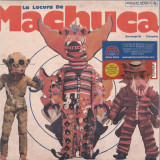
La Locura de Machuca is the story of one man’s bizarre odyssey into Colombia’s coastal music underground, and the wild, hypnotic sounds he helped bring up to the surface.
One night in 1975, a successful tax lawyer named Rafael Machuca had his mind blown in Barranquilla’s ‘Plaza de los Musicos’. Overnight he went from a high ranking position in the Columbian revenue authority to visionary production guru of the newly formed record label that bore his name, Discos Machuca, and for the next six years he devoted his life to releasing some of the strangest, most experimental Afro Psychedelia Cumbias ever produced. La Locura de Machuca is the story of one man’s bizarre odyssey into Colombia’s coastal music underground, and the wild, hypnotic sounds he helped bring up to the surface.
The Colombian music industry was thriving in the mid-seventies, but while homegrown bolero and vallenato tunes were doing well on the charts, it was imported African records that were setting crowds on fire at the picos – the sound-systems that fuelled neighbourhood parties – and wherever those records were played there were always a handful of groups who were inspired to plug traditional Cumbia directly into the electric currents coming from across the Atlantic.
It was these obscure bands, who fused Colombian and African rhythms with the swirling organs and psychedelic guitars of underground rock, that fired Machuca’s imagination. While the label made its money releasing popular hits by legends such as Alejandro Durán and Aníbal Velásquez, that money was poured back into a unique run of experimental releases by fringe artists such as La Banda Africana, King Somalie, Conjunto Barbacoa, and Abelardo Carbono, one of the godfathers of Champeta Criolla.
When Machuca couldn’t find groups to realise his particular vision, he simply created them himself. Drawing on a fearsome roster of musicians associated with the label, he assembled bands that lasted only as long as it took to record an album ,and unleashed the results – complete with arrestingly unusual album covers – under a series of different names such as Samba Negra or El Grupo Folclórico. This unorthodox approach led his longtime recording engineer, Eduardo Dávila, to describes Machuca’s productions as the “B-Movies of Colombian music.”
The story of Doctor Machuca and his eccentric exploits tells of one of Colombia’s most atypical and peculiar record companies; a defining pillar of Afro-Caribbean psychedelia. His productions have come to represent the roots of Champeta and set the pedigree standards for Afro and Costeño avant-garde. The seventeen tracks on La Locura de Machuca, harvested from the darkest, strangest corners of the Discos Machuca catalogue, sound like little else recorded before or since.
out of Stock
Last delivered 5 years ago available to reorder, subject to availability
Legendary Turkish psych innovators Moğollar grace the Artone Studios in Haarlem for a masterclass in the original Anadolu psych roots, cutting a compendium of their rawest hits and most-wanted psychedelic rock classics – including the J.Dilla-sampled ‘Haliç’te Güneşin Batışı’ – for the latest edition of Night Dreamer’s essential Direct-to-Disc series.
In the beginning, there was Moğollar.
Formed at the end of 1967 with five young musicians, Moğollar were the original Anadolu psych originators. They were the first Turkish pop band who tried to blend the microtonal folklore and traditional instruments of rural Anatolia with Western pop and rock; they were the first Turkish psychedelic band to achieve overseas recognition, winning the prestigious French Grand Prix Du Disque in 1971 after a period in Paris; and they coined the very phrase ‘Anadolu Pop’ with their first album release. They were radical, innovative, and hugely popular, and when the great artists of the Turkish rock revolution appeared on the scene, Moğollar were already there – stars including Barış Manço, Selda, Cem Karaca and Ersen all recorded with them or briefly joined the line-up. Moğollar were and are the undisputed pioneers of the style.
More than fifty years after first forming, Moğollar materialised in the Artone Studios to give a masterclass in fuzzed-out folklore and Turkish psychedelic roots for Night Dreamer’s Direct-to-Disc series – a fitting follow-up to Night Dreamer’s BaBa ZuLa set, coming straight from the group who laid the foundations of the genre.
In 1971, having already released numerous singles, they secured an album deal with French label Guild International du Disques. Travelling to Paris that year, they recorded their first major statement, Danses Et Rythmes de la Turquie d’Hier à Aujourd’hui, a set later released in Turkey as Anadolu Pop. The album won a prestigious French award – the Grand Prix du Disque from the L’Académie Charles Cros, an honour that had been won in the past by Jimi Hendrix, Pink Floyd and Soft Machine. Moğollar, and Anadolu psychedelic pop, had arrived on the international scene.
In 1976, after many more releases and line-up changes, and pressured by an increasingly difficult political situation in Turkey, the group dissolved for seventeen years, and various members dispersing to exile in Paris and Berlin. However, after a petition from their fanbase asked them to reform, they agreed to play a comeback concert in 1993. It was a huge success, and reunited, they went on to record some of their greatest work. Led today by original member Cahit Berkay alongside original bass player Taner Öngür, and joined by Cem Karaca’s son Emrah, Moğollar continue to push their uniquely original brand of fuzz-scorched folk-rock and crackling Anadolu psychedelia forward into a new millennium.
For this Night Dreamer session, Moğollar spent two days in the Artone studios, recording sides A and B on the first day, and C and D on day two. With BaBa ZuLa’s Murat Ertel adding contemporary sonic punch behind the boards, the band revisited their most renowned hits to lay down energised new versions, and dusted off some of the most sought-after cuts from their enormous catalogue. The result is a showcase set by a band that are one of true pioneers in global psychedelic rock, and a masterclass in the true roots of the Anadolu psych sound: fuzzed-out, committed, and straight from the source.
Highlights of the set include:
-‘Haliç’te Güneşin Batışı’, an Anadolu psych classic which was first issued as the b-side to the ‘Ternek’ single in 1970, before being recorded again for the Danses Et Rythmes de la Turquie d’Hier à Aujourd’hui LP in 1971. A tense slab of roughneck psychedelia, the final breakdown of the original recording was sampled by none other than J. Dilla for the ‘Intro’ cut on Welcome To Detroit.
-‘Gel Gel’, a 1974 song with head-nodding tempo change, originally featuring Cem Karaca. It is here voiced by his son Emrah Karaca, now a permanent member of Moğollar.
-‘Çığrık’, a 1972 cut which originally appeared on one of Moğollar’s most coveted singles, is a funky psych-rock workout with an unforgettably riff, a ringing guitar motif, and twist of Led Zeppelin.
-‘Düm Tek’, the title track of the bands second full LP (Düm Tek, 1975), a raw psych screamer, laced with hardcore davul drum patterns.
-‘Bi’Sey Yapmali’, first recorded for the 1996 Dört Renk album, became the anthem of huge street protests that took place in Turkey that year after an investigation uncovered a huge network of state, police and mafia corruption.
-‘Dinleyiverin Gari’, a hit from the 1994 come-back album Moğollar 94, addresses a notorious corruption scandal of the era.
out of Stock
Last delivered 5 years ago available to reorder, subject to availability
Following the stellar trip through Woo’s Arcturian Corridor , Quindi Records continues to explore intimate, inviting sounds with an experimental bent by facilitating the return of overlooked Italian duo Cabaret du Ciel.
Initially formed in 1986, Cabaret du Ciel’s debut album Skies In The Mirror was a low-key and extremely rare cassette release of spellbinding electro-acoustic ambient music created by Gian Luigi Morosin and Andrea Desiderà. A reissue on Hybride Sentimento in 2018 brought renewed attention to the startling music contained within this unique project.
The Breath Of Infinity is an album comprised of new works recorded over the past year, either as new pieces or reworked from old ideas with the assistance of Giorgio Ricci. Morosin and Desiderà’s natural instincts as multi-instrumentalists shine through across the record as they did on Skies in the Mirror , although these tracks were in fact composed as raw live takes using electronic workstations (with a little additional fretless bass provided by a close friend Giampaolo Diacci on “Different Suns” and “Climatic Variations”).
There is a crisp, digital timbre to the worlds Cabaret du Ciel shape out on The Breath Of Infinity – utopian pastureswith an air of optimism similarly expressed in the first waves of ambient electronica. Folk traditions exert a guiding influence on the sparkling, ethereal melodies and full-frequency harmonisation, but this is music enamoured with timeless plateaus rather than hackneyed interpretations of the past, present or future.
It’s also an album of variety. “Different Suns” tumbles with a pastoral, elemental earthiness thanks to the interwoven rhythmic murmuring of percussion and live bass, while “Lakota” pivots in sharply rendered bio-mechanical formations.
There’s a widescreen bombast to “Theatre Azure” which calls to mind mid-90s US electronica, while “Meredith” reclines in a blissful bath of plush 80s FM synthesis. “Sunset Parade March” has a distinct sense of propulsion thanks to its overdriven, broken techno rhythm and “Highlands” skips with an infectious energy despite not using any formal
kind of percussion, but even in these more kinetic moments a preference for mellow musicality maintains the dreamlike mood.
Consider The Breath of Infinity like an archipelago, where each track functions as its own distinct island of ideas while being intrinsically interconnected to the others. In a similar fashion to acts such as Ultramarine (who appeared as remixers on Quindi 001), Cabaret du Ciel emphasise the musicality in their electronic music, shaping out an
evocative, imaginative environment to idly glide through or attentively explore.
out of Stock
Last delivered 5 years ago available to reorder, subject to availability
Nuno Canavarro's Plux Quba hails from three decades in the past, yet the simple profi le of it's abstract/ambient/cutup collage makes it a record that sits quite comfortably in our IDM-informed future. In 1988, Plux Quba was a primal dark horse in the world of pants-forward electronic music - an obscurity issued with little explanation from the laid-back west coast of Europe: Portugal, of all places! - though the casual listener could hardly know that from an examination of the LP jacket. The vanguard of electronics in late-80s Europe was being pushed by organizations like Nurse With Wound, The Hafler Trio, HNAS - and yet, when Christoph Heemann came across this recording, it struck his ears and the ears of fellow listeners like nothing before. Plux Quba was handed around between the principles of the early 90s A-Musik scene: Jan St. Werner, C-Schulz, Frank Dommert, Georg Odijk, plus interested fellow travelers like Jim O'Rourke, to the intense curiosity of all. To ears that were already saturated with all things kraut, the dark corners of prog and the frontline of experimental and improvised music, it proved elusive. Not simply in how it sounded and how that sound was achieved, but in where it was coming from - like later Robert Ashley at times; certain stretches of melody recalled some of Eno's ambient pieces - but mostly, it was a completely alien soundscape!
In 1978 Pharoah Sanders went into the studio with pianist, Ed Kelly, who was an important figure in the local San Francisco and Oakland jazz scene. The two of them recorded six tracks which ranged from covers of standards, through soul jazz through to two real gems. The album was originally released as Ed Kelly and Friend due to Pharoah being contracted to Arista Records at the time. Indeed, as you can see, the cover shows Kelly playing next to Pharoah’s hat, shoes and Selmer tenor saxophone.
Rainbow Song, a Kelly composition, opens matters in a manner far removed from Pharoah’s work on his Impulse albums (although there had been a dramatic change of course when he signed with Arista and recorded). This is firmly in Grover Washington Junior territory with a liberal sprinkling of oh so tasteful strings. The Master’s sound is full and mighty as ever.
With the radio track out of the way it is business as hoped for and Newborn is a Sanders composition that burns with intensity. The power of his solo is as good as anything he has produced and he runs over the full span of the tenor’s range and onwards into territory lesser known or explored by 99% of sax players.
Sam Cooke’s You Send Me is treated with reverence and respect, with Pharoah delivering a sensitive and heartfelt rendition and ending with some extraordinary phonics, which we will meet again on later albums. Kelly’s accompaniment complements Sander’s playing before he receives his own space for a shimmering yet restrained solo which discloses what this non-pianist assumes to be an agile right hand.
Answer Me My Love is an early 50’s ballad with a fascinating back story. On its initial release in post-war Britain, covers of this fine melody stirred sufficient controversy for the song to be banned by the BBC. What led to it being barred from broadcast on the Light Programme and treated like Anarchy For The UK, Wet Dream and Give Ireland Back To The Irish? I can reveal that the reason for this draconian action was that the original version was entitled ‘Answer Me, My Lord’. In the olden days, it seems that a direct appeal to God was considered to be blasphemous- especially if set in a secular or selfish. Further research indicates that Nat King Cole made the most celebrated recording and that Bob Dylan used to sing it live in the 1990’s, presumably during his overtly Christian phase. Anyway, it is a grand tune.
Pharoah went on to record at least three studio versions of his great anthem You’ve Got To Have Freedom but the one here is the earliest incarnation that I am aware of. It is also the most restrained treatment of the theme, although Pharoah’s solo shows his ability to play with fire and power over the entire range of the horn. There’s plenty of space for Kelly’s piano too and he provides an elegant setting for Sanders’ exploratory work.
Remastered by Bob Weston, ‘Mountains’ comes back to us as a gold foil-embossed gatefold double LP and includes the previously unreleased original takes of ‘Return to Pirates’, ‘Poison Moon’ and ‘Killed by the Telephone’, which were delivered along with the original master tapes 20 years ago but were omitted from the final album.
The record is completed by a newly recorded orchestral version of ‘Valley of One Thousand Perfumes’ produced by composer Joe Wong (Russian Doll, Midnight Gospel) and mixed by Dave Fridmann.
At the turn of the Century, Timony (Ex Hex, Wild Flag, Hammered Hulls) was already a celebrated presence in American underground music - a fixture of D.C. and Boston rock ’n’ roll via her work in Autoclave and Helium respectively. By 1998, though, Helium was drawing to a close and Timony was feeling uncertain about the future. “I had never been good at the rock ‘n’ roll business, and making a living from being in a band just didn't seem like it was in the realm of possibility for me,” she writes. “I just knew I wanted to make another record because that was the part of being in a band that I liked the most.”
ACCEPT ARE BACK! The German kingpins of heavy metal will release their new, eagerly-awaited studio album via Nu- clear Blast on January 15th 2021. The ingenious title of the masterpiece is “Too Mean To Die”.
Speaking of heavy metal kingpins, when ACCEPT first launched at the end of the 70s, the metal genre didn’t even exist - at first the band could only be labelled with the (quality) seal “crazy loud and crazy wild”. Today we know that this was (and is) metal par excellence. And we also know that ACCEPT opened the door to thrash metal, inspiring giants such as Metallica. Guitarist Kirk Hammett recently stated in the German magazine “Gitarre & Bass”: “Wolf Hoffmann has a huge influence on me.“
ACCEPT, who once had their origins in the city of Solingen, a city of sound, have been a worldwide music phenomenon for more than 40 years. They still impress with razor-sharp guitar licks and a steel-hard sound. The band created all-time metal classics like “Balls To The Wall”, “Metal Heart” and many more.
Countless world tours and headline slots at the biggest, cutting-edge festivals cemented the band’s reputation as one of the best, hottest and loudest live acts ever. In addition, the band has sold millions of records, has achieved gold status in the USA, top 10 chart positions worldwide and a number 1 album (Germany, Finland) for “Blind Rage” (2014).
Now with “Too Mean To Die” their 16th studio album is in the starting blocks - it is the fifth album that US vocalist and front man Mark Tornillo has put his incomparable vocal stamp on.Recorded in the world music capital of Nashville (USA), ACCEPT’s music was once again produced by British master producer Andy Sneap, who is responsible for the mix. Sneap, who works for Judas Priest and Megadeth among others, has also been responsible for all ACCEPT productions since 2010.
Special circumstances often lead to very special albums. This is certainly true for “Too Mean To Die”, which of course alludes to the Corona period, although in a different way than one might assume. Hoffmann says: “Its to be expected that many musicians will address the Corona situation in their songs. There will certainly be slogans for cohesion, through which positive vibes should be spread, which is also good. But we have decided to not let ourselves be influenced by it. The fans will get a hard, direct and uncompromising metal album, but of course accompanied with a wink: We are too mean to die! Weeds do not go away! ACCEPT do not let themselves get down!”
Wolf isn’t wrong - the title track is a classic Accept cracker: dynamic and unwavering, turned up to eleven!
Zombie Apocalypse’, also relentless and hard, strikes the same note in the band’s signature style.
The first single - which will be released on October 2nd 2020 together with a remarkable video - is different. Titled ‘The Undertaker’, its a terrific midtempo number with great vocals and a built-in character that chugs along – certain to deliver some mermorable live moments! According to Wolf Hoffmann its one of the most catchy, pleasing pieces of the album.
New to the band, and thus to be heard for the first time on an ACCEPT album, is Philip Shouse (Gene Simmons Band, among others). The US guitarist fights hot duels with Hoffmann, while Uwe Lulis makes the guitar trio perfect and pro- vides the right rhythm. “Phil was part of our orchestra project and was also completely convincing live. We recognised his great talent immediately and simply didn’t let him go,” explains Hoffmann.
Just how varied the ACCEPT guitar trio performs on the new album is proven by one of the secret highlights: ‘The Best Is Yet To Come’ – a beguiling ballad in which Mark Tornillo is at his best. The metal world knows that Mark can scream like no other, but here it shows once again that the frontman can also sing magnificently. “Mark sang this, for us rather unusual song stunningly well. The fantastic thing about Mark is that he not only masters the typical metal screams, but can also sing melodically and beautifully. He proves this impressively in this song”, chief guitarist Hoffmann raves.
In addition, ACCEPT have strengthened their team even further with newcomers Martin Motnik (bass) and Philip Shouse (guitar), thus forming an unbeatable team together with “Drum God” Christopher Williams and “Rhythm Mas- ter” Uwe Lulis.
There’s no doubt that with “Too Mean To Die” Accept are once again playing at the top of the Champions League of the genre. Wolf Hoffmann & Co. present the (music) world eleven masterpieces at the beginning of 2021 - eleven songs for eternity!
DAUW present the release of What the Fog, the second album of David Allred & Peter Broderick. The album is a follow-up of their first full-length LP Find the Ways, which was released through Erased Tapes in 2017.
The music itself was originally composed as a soundtrack for an 11-hours slow motion journey in the Louvre museum in Paris. The title, #monalisa, can be interpreted as a new way of perceiving art through technology and social media such as Twitter or Instagram. The movie is directed by Jennifer Anderson and Vernon Lott and tries to make us more aware of the presence of technology in our lives as well as the way we experience an exhibition or art itself. The album is a 42-minutes extraction of the 11-hours journey they went through. Each track is built in a way that makes it possible for the listener to travel from one place to the other, as if you were walking in the museum yourself. In that way, the record can even be perceived as a music documentary.
Being completely instrumental, What the Fog distinguishes itself from their first album in which the voices of both artists held a central place. Nevertheless, in line with an earlier observation from Clash Magazine, the music still combines minimalism and serenity to construct intense pieces of music.
“It presents a moment of calm that uses sparsity to create something quietly intense.” (Clash Magazine on their debut album)
Born in Maine, raised in Oregon, Peter Broderick learned to play several instruments such as piano, banjo and violin. In 2007 he joined the Danish ensemble Efterklang on their tour and had numerous collaborations with artists such as Machinefabriek and Nils Frahm. His most recent release Blackberry was released this August through Erased Tapes. It marked his first vocal album in 5 years and once again showed the variety in his ever growing repertoire.
In a relatively short period of time, Portland-based musician and multi-instrumentalist David Allred showed his songwriting capabilities through several releases on Oscarson and Erased Tapes. Besides his own music, he played as a session musician for several artists and ensembles such as Heather Woods Broderick, Masayoshi Fujita and The Beacon Sound Choir. His most recent album Felt the Transition sees the light late December 2020 through Erased Tapes.
On her third album Welsh Music Prize winner Georgia Ruth returns to her roots. Having moved back to her native Aberystwyth ‘Mai’ was recorded in the town’s Grade-II listed Joseph Parry Hall over the course of one week in Spring 2019. Named after the renowned composer and professor, the room was used as a venue for chamber concerts throughout the twentieth century and offered musicians a view of the sun setting over the castle as they worked.
But despite this setting Mai (meaning May) is an intimate collection of songs written from within the depths of a house during stolen moments. At its heart sits a beautiful and simple setting of Eifion Wyn’s poem – ‘Gwn ei ddyfod, fis y Mel’ (I know it’s coming, month-of-honey).
Mai is a meditation on finding hope and renewal in the seasons, in a world where the certainty of Spring feels increasingly fragile.
The album was produced with Iwan Morgan (Meilyr Jones, Cate Le Bon, Richard James) who also engineered mixed and mastered. Additional parts were recorded at his studio in Liverpool. With improvised strings, pedal steel and saxophone sitting alongside harp, the album presents a sound which is both lush and sparse in turn.
"I first heard Lady In Satin in a mega-shopping mall somewhere in San Francisco. I was about 20 years old and didn't know much about Billie's records or her life or how her voice changed over the years. Anyway, the sound was coming from the other side of the mall and I remember mistaking her voice for a beautiful perfectly distorted electric guitar - some other-world thing floating there on this strange mournful ocean of strings and I was hooked for life. Ten years later in 2006 I recorded an electric guitar instrumental version of "I'm A Fool To Want You" for my album Post-War. In 2018 I performed a concert in LA. of all the songs from Lady In Satin as a quintet and began preparing guitar arrangements for the recordings compiled on this record - Think of Spring. The title comes from a poem written in 1924 by Jane Brown-Thompson that eventually became "I Get Along Without You Very Well" in 1938 - the first song here. The conceit of Think of Spring is to filter the songs and strings from Lady In Satin through a single acoustic guitar using various alternate tunings and a minimal amount of textures and studio manipulation. most of the songs were recorded on an analog Tascam four track. Think of Spring is inspired by Billie Holiday, Ray Ellis, J.J. Johnson, John Fahey and Robert Johnson. Proceeds from this record will benefit Inner-City Arts & Donors Choose via PLUS1 for Black Lives Fund." - M. Ward
It was inside Jeff Tweedy’s second home, The Loft in Chicago, that Love Is The King was recorded in April of 2020. Surrounded by an assemblage of treasured instruments and loved ones in a world that felt more and more alien by the day.
Out on dBpm Records, Love Is The King, a “beautifully honest ode to love and hope,” is the follow-up to 2018’s WARM and 2019’s WARMER, and comes on the heels of Tweedy’s second book, How To Write One Song, out October 13th via Penguin Random House's Dutton. “At the beginning of the lockdown I started writing country songs to console myself. Folk and country type forms being the shapes that come most easily to me in a comforting way. 'Guess Again' is a good example of the success I was having at pushing the world away, counting my blessings — taking stock in my good fortune to have love in my life,” comments Tweedy. “A few weeks later things began to sound like 'Love Is The King' — a little more frayed around the edges with a lot more fear creeping in. Still hopeful but definitely discovering the limits of my own ability to self soothe." –Jeff Tweedy
Based on a short-story by the master of horror and fantasy, author Clive Barker (Hellraiser), Rawhead Rex is set in 1980’s rural Ireland. The Demon, alive for millennia and trapped in the depths of hell, is unleashed on the sleepy local farming community. Remembered faintly through pre-Christian myth, the only one that can stop Rawhead's bloody rampage is the historian, desperately racing against the time.
This is the first ever release for the soundtrack by Colin Towns, one of Europe’s most prolific film, television and theatre composers, but also a pianist, songwriter, arranger, producer and collaborator, known for The Puppet Masters, Space Trackers, Maybe Baby, Foyle’s War, Doc Martin, Pie In The Sky.
"The first film I scored was Full Circle which starred Mia Farrow and is still in the BFI top ten for best score for horrorfilms. I felt that film was more of a dark scary mystery. Rawhead Rex on the other hand was clearly a horror film 100%. I visited the film set in Ireland during the filming to take in the atmosphere and meet the actors after which I decided to record the music at CTS in London with a sixty piece orchestra plus electronics. I have always orchestrated my own work and had a wild time with Rawhead which is what I really love doing". Colin Towns
A gentle descent into washed out shoegaze memories, swallowed by windswept drones and distortion.
March 2020, lockdown No. 1 ''I don't believe that this music was actually created by myself. In fact isolation established the environment for its appearance.
Instead of thinking about music, as i went pacing the floor, I fell to counting my footsteps until I felt about to go mad.
A body needs at least three points of support, not in a straight line, to fix its position.
A body does not tip over when the force holding it upright in place is stronger than the force pushing it over. Lawfulness of the material.''
(She Was A Visitor, November 2020)
The fourth 10-inch EP from the 10th anniversary of U Know Me Records series comes from Immortal Onion. The album consists of 5 pieces. For those missing live concerts there are 2 songs taken from the band's performance on 8th of August at Jassmine club in Warsaw. The B-side starts with a rework of the song called "Leaving", originally composed by Hania Rani (who often performs with 2 members of Immortal Onion). The next song ("Zu Hause") was created especially for this album as the result of the band's experiments with electronics. The EP closes with a rework of "Eye Tracking" - a song from "XD Experience Design - made by Kadrych.
The rework of "Leaving" will be released only on vinyl and won't be available on streaming services.
Strictly limited edition - 300 hand-numbered copies. The first hundred will be released on red vinyl and copies from 101 to 300 as classic black ones.
The album was created with help of trusted people, who also worked on "XD Experience Design" - graphic design by Martiszu, mix by Envee (except the last song mixed by Maciej Stendek) and mastering by Eprom.
"When Candy Opera first appeared on the kaleidoscopic early 1980s Liverpool music scene, by rights they should have changed the world" ~ Louder Than War
"Very welcome news as a highly underrated band who is now back with a force. While their previous output is stellar, this new single is even more commanding of attention. This is absolutely stunning, the band reaching higher than ever before" ~ Big Takeover Magazine
Sometimes it takes a while to realise what you’ve got. So it goes with pop craftsmen Candy Opera, who emerged during Liverpool’s 1980s golden age and whose new LP 'The Patron Saint of Heartache' is their first collection of new material in nearly three decades.
Ahead of that, they present 'These Days Are Ours', a rally cry of hope for the current times and the first single from this long-play, which is due for release in mid-November via European / UK label A Turntable Friend Records. The video was created / produced by James Davies and Paul Malone.
Mixed by Grammy award-winning producer Guy Massey and featuring back vocals by Paul Simpson of The Wild Swans, the track was recorded at Elevator Studios in Liverpool.
With all the hallmarks of an enduring pop anthem, this impeccably produced, adrenalin-fuelled song captures the essence of Candy Opera’s infectious energy and celebrates life with a genuine wonder-lust, whilst delivering the excitement of their live performances.
Following the overdue release of two archival sets - '45 Revolutions Per Minute' and 'Rarities' (released in 2018 by Firestation Records., quickly selling out of their first runs) - their new album 'The Patron Saint of Heartache' picks up where the band left off, with 14 fresh songs ready for discovery of a sound as timeless as any Candy Opera output.
Candy Opera were formed in Liverpool in 1982 and went through various incarnations before calling it a day in 1992. By 1985, the band had played alongside the likes of The Pogues, The Go-Betweens and The Redskins, as well as appearing on Granada TV.
The band's current line-up is drawn from all eras of the band’s existence and features Brian Chin Smithers (guitar, vocals), Alan Currie (drums), Frank Mahon (bass), Paul Malone (vocals, guitar), Ken Moss (guitar) and Gary O'Donnell (keyboards, vocals, percussion).
This new LP also features a swathe of friends and contemporaries, including Paul Simpson (The Wild Swans) and Phil Jones (Afraid of Mice). The result is an exquisite piece of pop craftsmanship that brings their songs into the light. This is a labour of love born of experience, but retaining the sense of wonder that brought the band together in the first place.
Spirit is the seventh studio album by Earth, Wind & Fire, released 45 years ago, in, 1976 by Columbia Records. The album rose to No. 2 on both the Billboard 200 and Top Soul Albums charts.
Two singles became huge hits; “Getaway” reached No. 1 on the Billboard Hot Soul Songs chart. The single also rose to No. 12 on the Billboard Hot 100. “Saturday Nite, peaked at No. 4 on the Billboard Hot Soul Songs chart and No. 21 on the Billboard Hot 100 chart.
Spirit received critical acclaim. The New York Times wrote; “What is most interesting about Maurice White and his musicians, is their refusal to be locked into any stylistic format Mr. White’s record will be labeled ‘disco’ in some quarters, and indeed parts of if, would not sound out of place in a disco. But, generally, Earth, Wind and Fire is closer to
jazz, or to jazz‐rock, than to the thumping formulas of disco. And yet the group isn’t afraid
to slip in a ballad, either.”
Issac Hayes called Spirit one of Earth, Wind & Fire’s five essential recordings. Spirit was also nominated for an American Music Award for Favorite Soul/R&B Album. A song from the album called “Earth, Wind and Fire” was also Grammy nominated in the category of Best Instrumental Composition.
"When Candy Opera first appeared on the kaleidoscopic early 1980s Liverpool music scene, by rights they should have changed the world" ~ Louder Than War
"Very welcome news as a highly underrated band who is now back with a force. While their previous output is stellar, this new single is even more commanding of attention. This is absolutely stunning, the band reaching higher than ever before" ~ Big Takeover Magazine
Sometimes it takes a while to realise what you’ve got. So it goes with pop craftsmen Candy Opera, who emerged during Liverpool’s 1980s golden age and whose new LP 'The Patron Saint of Heartache' is their first collection of new material in nearly three decades.
Ahead of that, they present 'These Days Are Ours', a rally cry of hope for the current times and the first single from this long-play, which is due for release in mid-November via European / UK label A Turntable Friend Records. The video was created / produced by James Davies and Paul Malone.
Mixed by Grammy award-winning producer Guy Massey and featuring back vocals by Paul Simpson of The Wild Swans, the track was recorded at Elevator Studios in Liverpool.
With all the hallmarks of an enduring pop anthem, this impeccably produced, adrenalin-fuelled song captures the essence of Candy Opera’s infectious energy and celebrates life with a genuine wonder-lust, whilst delivering the excitement of their live performances.
Following the overdue release of two archival sets - '45 Revolutions Per Minute' and 'Rarities' (released in 2018 by Firestation Records., quickly selling out of their first runs) - their new album 'The Patron Saint of Heartache' picks up where the band left off, with 14 fresh songs ready for discovery of a sound as timeless as any Candy Opera output.
Candy Opera were formed in Liverpool in 1982 and went through various incarnations before calling it a day in 1992. By 1985, the band had played alongside the likes of The Pogues, The Go-Betweens and The Redskins, as well as appearing on Granada TV.
The band's current line-up is drawn from all eras of the band’s existence and features Brian Chin Smithers (guitar, vocals), Alan Currie (drums), Frank Mahon (bass), Paul Malone (vocals, guitar), Ken Moss (guitar) and Gary O'Donnell (keyboards, vocals, percussion).
This new LP also features a swathe of friends and contemporaries, including Paul Simpson (The Wild Swans) and Phil Jones (Afraid of Mice). The result is an exquisite piece of pop craftsmanship that brings their songs into the light. This is a labour of love born of experience, but retaining the sense of wonder that brought the band together in the first place.
As Midnight Sister, multi-disciplinary LA artists Juliana Giraffe and Ari Balouzian make motion pictures. Yes, sometimes with moving images _ but most often only with the music they create together. Balouzian's serpentine, string compositions are movie scenes that allow Giraffe, a brilliant character actor, to cloak herself in a new roles and voices. A bit of Jon Brion's score work; some old Hollywood strings; a solid dose of glam and outsider disco from 70s independent cinema. Any perceived artifice is always matched by an indelible human fingerprint, something perfectly off. Giraffe and Balouzian's respective work in fashion, visual art, video and film scoring _ along with the gang of virtuosos with which they surround themselves _ all wonderfully coalesce as Midnight Sister. And if 2017's `Saturn Over Sunset' was their collection of short films about outcast life in The San Fernando Valley, then their new album `Paining the Roses' is the inventive, meta motion picture that cements them as auteurs. `Painting the Roses' is in many ways a fairy tale -- not so much the sweet-and-happyending kind as something richer, packed with imagination and rooted in the complex human messiness beneath a story's artifice. Frontwoman Giraffe describes it as "this tightrope of being real yet synthetic, organic yet staged, light yet dark, logical yet irrational, beautiful yet dilapidated. Joyful nonsense." Here, disguises like masks and paint are not meant to hide but to liberate, to "set a part of us free", and Midnight Sister often embody this themselves, appearing highly stylized, curious, warm and inviting but a little askew. `Painting the Roses' is a story told through the looking glass, one where we examine ourselves in a funhouse mirror but find clarity in its twists. Giraffe traveled to visit family in Argentina during the making of the album and reconnected greatly with that part of her family history, art and culture. Balouzian created the core album opener "Doctor Says" during a session in the desert outside of LA. The guitar, which reminded Giraffe of South America, has a slow, sweltering surf-tango to it, like Dick Dale doing Carlos Gardel. And even though the song was inspired by Giraffe's reconnection with Argentina, the song is about the fading of some close friendships during the making of the album. "Man, you have changed," Giraffe sings, unclear if tis directed to a friend or to herself. Later on the album, "Wednesday Baby" _ named after Giraffe's rescue dog _ is patient, subtly baroque pop. It follows Giraffe through one of those gloomy days spent in tunnelvision doldrums from which only a sunbathing turtle or your canine companion can pull you out. By the time collaborator Max Whipple's saw comes beaming down from heaven in the song's 3rd part, we're hypnotized by the song's charming ennui. The song lands someplace both familiar and aloof, a little slice of timelessness taken straight from The Cake of Perfect Songcraft.
Pascal Comelade and Richard Pinhas met in Paris in 1974, when Pinhas was beginning to go on stage with his group Heldon. With Heldon and, afterwards, solo, Pinhas became the pioneer and accelerator of electronic music in France, and a fundamental reference throughout the world. Comelade's electronic period was much shorter, from 1974 to 1981. From 1983 on, he developed his policy of instrumental, strictly acoustic music. In 1975, Pinhas recorded the introduction to Comelade's Fluence album. In 1996, Comelade recorded 'Back to schizo' with Pinhas. In 1999, Comelade and Pinhas recorded their first duo album, a CD for the Les disques du soleil et de l'acier label: Oblique Sessions II. In 2012, they released a second CD album for the G3G label in Barcelona, Flip Side of Sophism. In 2018, Comelade again invited Pinhas on his album Le cut-up populaire. During the last few years, they have had several concerts as a duo in Paris (Cité de la musique, La Maroquinerie) and Barcelona (Sónar Festival). They met again in 2020 for this LP album, Le plan de Paris. It contains six titles that were either previously unreleased or completely revisited, developed, remixed.
While on lockdown, Senbeï exchanged a lot with his fans on social networks, offering them a collaborative project. From these discussions a dedicated Facebook group has been created on which his fans proposed ideas, arrangements and instrumental interpretations.
So many possible inspirations that allowed Senbeï to then play the conductor, composing new titles based on these exchanges.
The fans were also invited to propose titles for the album and graphic proposals ... TOITSU - unification in Japanese - as well as the work of Adrien Waterlot (a fan) were chosen by the members, to represent this work common.
SENBEÏ talks about it:
This project was launched during the 2020 lockdown. Like a lot of people, I found myself stuck at home, no more work, no more touring. I wanted to take the opportunity to launch a collaborative project by appealing to my fans via social networks. At first, I just imagined doing a song, picking from their ideas, a sample here, a guitar take there. I didn't think it would take on this magnitude. We quickly reached more than 500 people on a dedicated discussion group. And then it all got wrapped up. 4 months later, Toitsu was complete.
It wasn't just music, but also incredible general goodwill, good mood, lots of support, sharing, dedication and humor. All of that helped me orchestrate this happy mess in record time.
"Toitsu" means "Unification". Without those who participated, this album would not exist.
In 1990 Neil Hannon started recording and releasing under the name The Divine Comedy. Thirty years and twelve great albums later, Hannon is rightly adjudged one of the finest singer songwriters of his generation. To celebrate, Divine Comedy Records are updating and reissuing the band’s catalogue.
‘Foreverland’ - a record about “meeting your soulmate and living happily ever after... and then what comes after happily ever after” - was first released in 2016. Mojo described it as “Funny, learned and
poignant by turns,” while Uncut said it was “sumptuous, orchestral pop laced with lyrical absurdity.”
The album includes singles ‘Catherine The Great’ ‘How Can You Leave Me On My Own’ and ‘To The Rescue’.
The updated LP edition consists of the original album, packaged with a digital download code for the album plus bonus tracks of demos and alternate versions lovingly curated by Neil Hannon, much of which have never been heard before.
The LP is pressed on heavyweight black vinyl in a gatefold sleeve accompanied with photos, credits and extensive liner notes written by Neil, covering the context and inspiration behind the album and
its songs.
Jeremy Gara, drummer of Arcade Fire, releases his second solo album ‘Passerine Finale’ on Invada Records.
The album was mastered by Helge Sten (Deathprod, Supersilent) and composed, produced and recorded by Jeremy over the last three years. ‘Passerine Finale’ is a varied collection of songs and disparate sounds, from arranged static noise to extended melodic drones, improvised and chiselled at, ignoring form or structure, and completed the moment things ‘felt’ something.
The album comes pressed on silver vinyl and is housed in a heavyweight sleeve with digital download card included, with artwork throughout by Jeremy himself.
Jeremy explains: “‘L_06’ - the visual thing, like the song it accompanies, comes from trying to push really simple objects and figures to a place where they hopefully, somehow, become imprinted with a kind of emotional energy - attempting to entwine single note drones and simple straight lines together tightly enough that they dance a little.”
Originally from Ottawa, Canada, Jeremy has been a member of Arcade Fire since 2004. Outside of the band, he has recently collaborated with bandmate Sarah Neufeld and world-renowned dancer and choreographer Peggy Baker on composing music for a large-scale dance production called Who We Are In The Dark and performed it live at various dance festivals. He’s also been touring and performing his solo material across the world since his first album, ‘Limn’, was released in March of 2016.
It seems that every major jazz artist has a one-off sort of record in their discography, be it with strings, voices, spoken word or - as in this case - a foray into the funkier side of jazz. Charlie Rouse (going here as Charles Rouse) gets his chance on Two Is One, a funky soul jazz excursion on Strata-East, the artist-run label where creativity and pushing boundaries was at the forefront. Playing mostly with a group of session musicians, Rouse put together an album that may stray a bit from his hard bop roots, but is nonetheless an enjoyable and at times inventive record. The style of music played here - sophisticated soul jazz with some post bop and spiritual jazz thrown in for good measure - is very much a product of it's time. 1974 saw a whole slew of artists stretching the boundaries of what jazz music could be, combining elements from the past two decades into electric jazz adventures. The piano-less group that Rouse put together is a funky one, with lots of rhythmic playing behind either the searching solos of Rouse on the tenor or some inventive electric guitar work from either George Davis or Paul Metzke who appear together on all but a couple of tracks. Cal Scott gets plenty of time to shine throughout on what sounds like an electrified cello, an unusual instrument for modern jazz to be sure, but one that manages to fit in just fine here.
The first side of the album is all slow burning soul jazz, highlighted by the opening track "Bitchin'" where Rouse shows off that he is more than capable of setting down soulful lines over a funky backbeat. The second side is where the group gets a whole lot more inventive, particularly on the title track where they mix some post bop madness with the soul jazz sound. "Two Is One" features different tempos throughout: in the "first section" the bass plays in 9/8 time, the drums in 6/8 time and the cello and tenor are in 3/4 time. For the "second section" the rhythm section switches to 7/8 time while cello and tenor move to 4/4 time. Stanley Clarke is on bass here and his deep and twisty electric bass line is placed prominently up front.
"Two Is One" is certainly the highlight of the album from a pure jazz standpoint, and it lives up to it's title, which according to Gene Lewis' liner notes is taken from a Thelonious Monk phrase meaning two people so in tune with one another that they become one. The album finishes off with "In His Presence Searching," a spiritually informed jazz number that is reminiscent of the work being done during this period by the likes of Pharoah Sanders and Gary Bartz, (while not being quite as out there as their best work). The tune is all rhythmic glory, with Rouse and Scott playing introspective and penetrating solos throughout. It's a nice album closer, and a good reminder that while Two Is One may be best known for it's funkier excursions, Rouse had a few tricks up his sleeve and the album, when taken as a whole, is a complete statement from a legendary jazz musician.