Musique Plastique (Visible Cloaks, Pedro) rescue a nearly lost soundtrack to a Belgian avant-theatrical work from the 80s. For fans of Nuno Canavarro, Roberto Musci and Vito Ricci.
Producer, multi-instrumentalist, composer, songwriter and vocalist Devonté Hynes returns with his fourth album as Blood Orange, Negro Swan, released on Domino on August 24, 2018.
Raised in England, Hynes started out as a teenage punk in the UK band Test Icicles before releasing two orchestral acoustic pop records as Lightspeed Champion. In 2011, he released Coastal Grooves, the first of three solo albums under the moniker Blood Orange. His last album, Freetown Sound, was released to critical acclaim in 2016, and saw Hynes defined as one of the foremost musical voices of his time, receiving comparisons to the likes of Kendrick Lamar and D'Angelo for his own searing and soothing personal document of life as a black man in America. He has collaborated with Solange Knowles, Skepta, fka twigs, Carly Rae Jepsen, A$AP Rocky, Charlotte Gainsbourg, Blondie, and many other artists, and was recently one of four artists invited to the Kennedy Center to perform alongside Philip Glass. In addition to his production work, he scored the film Palo Alto, directed by Gia Coppola.
Negro Swan was written and produced by Hynes. Says Hynes:
'My newest album is an exploration into my own and many types of black depression, an honest look at the corners of black existence, and the ongoing anxieties of queer/people of color. A reach back into childhood and modern traumas, and the things we do to get through it all. The underlying thread through each piece on the album is the idea of HOPE, and the lights we can try to turn on within ourselves with a hopefully positive outcome of helping others out of their darkness.'
This Album Is A Curve Ball. Mr. G Is Showcasing Some Of His Deep And Sample Oriented Works On ''a Part Of Me Vol.2.'' A Touching Collection Of Tracks Taking The Listener Into The Depths Of The Uk Based Artist's Perception.
out of Stock
Last delivered 6 years ago available to reorder, subject to availability
HINOSCH are a duo of Koshiro Hino from Osaka and Stefan Schneider from Düsseldorf, they first (met and) began their collaborative work of musical interaction and exploring contrasting possibilities in 2017. After a number of concerts in the EU and in Japan a debut EP (HINOSCH EP/TAL05) was released in late 2017. Fully instrumental, their first full-length album HANDS offers a more steeply focussed approach than its largely improvised predecessor.
Encouraged by the momentum generated during a number of on-the-spot recordings in Osaka, where Schneider had held a residency in April 2017, the overall sound of the album has been honed down through meticulous studio engineering. One of the outstanding qualities of HANDS certainly is an unprejudiced approach of sound and song structures. The instrumentation is condently reduced to a small range of analogue and digital machines. Snatches of tape-loops deliver lower-pitched vocal and drum machine samples. This characteristic technical set up soon proved ideal in order to dene a tactile vocabulary of fully unsynchronized rhythm patterns. The word tactile perfectly conjures that quality which is the very essence of HANDS. It is the result of the manner in which interdependent threads of rhythm units are deliberately disconnected to form a cohesive, soulful and exible whole. Most tracks on HANDS are devoid of a central motif and examine an unpredictable dialogue. A fantasy of constant change and a search for musical suggestions is the most vital ingredient in this abstract environment.
The album title HANDS refers to physical aspects of electronic music production. Every live concert of Hinosch usually starts out with a hand shake between Hino and Schneider. The general process of collective music making, programming, button pushing, playing, recording, decision making, all demand utmost concentration. The image on the front of the abum sleeve (designed by Takashi Makabe) reects the general approach of HANDS: layers of tuckled fabrics confronting one another to articulate a form for themselves to no other end than their own orchestration.
After having emerged from the ever thrilling Osaka music scene onto the international playgrounds of electronic music just a few years ago Koshiro Hino's solo activities as YPY and his involvement with the band GOAT have already garnered him a very favourable international reception. Stefan Schneider has over the years produced and collaborated with a.o. Joachim Roedelius (Cluster), Arto Lindsay, Klaus Dinger (NEU!), Dieter Moebius (Cluster), Alexander Balanescu, John McEntire (tortoise), Katharina Grosse, Bill Wells and St.Etienne.
By now, the story of how Jlin went from working in a steel factory in Gary, Indiana to being one of the most widely appreciated electronic musicians is well known. 'Black Origami' was one of the most reviewed and lauded albums last year. Seriously prolific and seriously hard-working, she has toured constantly since its May 2017 release and despite being involved in a wide range of projects, still manages to find a balance and 'do some personal healing and growing.'
Here we are over a year later with 'Autobiography,' the score for her collaboration with renowned British choreographer Wayne McGregor arranged by Unsound. This isn't technically her third album (that's due to arrive in 2019 or 2020), but the soundtrack stands up on its own with all the emotional peaks and troughs of a well-sequenced longplayer.
For Jlin, making music for dance is the fulfillment of one of her lifelong dreams - and remarkably, Company Wayne McGregor's performance was the first show she'd ever seen. She describes the process of working with Wayne: 'We first met face to face in October 2016 in a downtown Chicago hotel, talking for about a solid two hours. Immediately, I saw Wayne was very friendly and energetic. He's brilliant, witty, and knows exactly what he wants; an absolute gem to work with. Before I even started composing for Autobiography, Wayne told me so gently that he trusts me completely with my direction of creating the score. That was the best feeling in the world. I would wake up at two in the morning and work until six in the evening until I completed all the pieces. We were both very happy with the outcome. Creating the score for an impeccable piece of work such as Autobiography changed my life as an artist.'
'Autobiography' is a highlight in an evolving and growing career. During the last year, Jlin has also become an in-demand remixer, securing her place among a roster of music heavyweights. Unsurprisingly, given her positive and outgoing nature, she also developed friendships with the artists she has remixed such as Björk, Max Richter and Ben Frost.
Jlin will be touring with Company Wayne McGregor performing 'Autobiography' this year in addition to completing a commission for the Kronos Quartet titled 'Little Black Book.' She still approaches every performance 'with the same attitude of doing my best to execute a good show, no more, no less. Doing my best is what's most important to me.' She also still lives in Gary, Indiana, which keeps her grounded. She notes with her typical humility, 'The local community is a little more knowledgeable of me now. But I don't mind my community taking its time.'
Scored for Maurice Béjart's choreography to the 'Orphée Ballet', based on the Greek god Orpheus, this is one of Pierre Henry's finest works of musique concrète, the genre in which Henry was an early innovator and to which he devoted his career. After years working for the French national radio (RTF) and honing his studio chops on radio spots and editing/composition, Henry formed his own studio in 1958 and began working on modern dance and ballet and soundtrack work. Incorporating percussion, industrial soundscapes, nature sounds, spoken French narrative, and synthesized tones, 'Orphée Ballet' is a beautiful piece that, while less known than what is perhaps his most famous work, also for Béjart's ballet production, 1967's 'Les Jerks Électroniques De La Messe Pour Le Temps Présent Et Musiques Concrètes Pour Maurice Béjart', is equally compelling and groundbreaking. Following his passing in 2017 at age 89, Henry's work has found renewed interest, and this is a welcome reissue of one of his rarest and finest works. Truly brilliant.
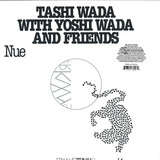
Composer Tashi Wada has performed for years with his father Yoshi Wada—artist, composer, and early member of the Fluxus movement. However, they have rarely appeared together in studio settings. Nue, the fourteenth entry in RVNG Intl.'s intergenerational FRKWYS series, finally brings Tashi and Yoshi, along with an eclectic group of close friends and extended family, together on tape.
Nue draws on aspects of Tashi's background for his widest vision to date—among them the minimalist bagpipe music of Yoshi, who co-composed three of the tracks, the psychoacoustic and perceptual explorations of his mentor, composer James Tenney, and reimagined forms of ancient and devotional music. The album, however, is not a tribute to the past or a recapitulation of familiar sounds. Instead, Nue is an intertwining of people and ideas as a means of growing, of looking inward to move outward, and of looking back to move forward.
To achieve this growth, Tashi assembled a core group of fellow travelers, including Yoshi, composer Julia Holter, producer Cole MGN, and percussionist Corey Fogel, to give life to this multifaceted suite. As an experience, Nue subtly navigates the interactions, intimacy and spaciousness of this group.
The album's title itself is a nod to Tashi's abiding interest in duality and the unknown: nue is a mythological Japanese chimera with the face of a monkey, the legs of a tiger, and a snake for a tail, a composite form, at once disturbing and otherworldly. But, as the composer points out, nue is also French for naked—stripped of complexity, bare and exposed, but also raw and essential.
From the doubling of tones—and the world of harmonic nuances such an action produces—to the rich interplay between individual musicians, all baring their own personalities and experiences through shared performance, Tashi's compositions allow space for these elements to join and grow. The multipartite creature that is an ensemble melds in the simplicity and purity of the music itself.
As explained by Tashi, each part was written with an individual in mind, not simply an instrument. And each individual performer makes their mark, from Holter's vocal performances on the cresting, oceanic 'Mutable Signs' and 'Ondine' with guest vocalists Simone Forti, Jessika Kenney and Laura Steenberge, to Fogel's resonant, precise percussion on 'Bottom of the Sky.' Producer Cole MGN, who has worked extensively with artists like Beck and Ariel Pink, helped to create a world of sound with minimal yet multi-dimensional materials. Like many of its influences, Nue uses deceivingly simple means to create complex, coherent worlds and narratives.
Tashi notes the influence of legendary Brazilian writer Clarice Lispector, whose work looked inward, investigating memory and emotion and dream, to understand the often overwhelming world outside the self. Like Lispector's classic novel Near to the Wild Heart, Nue cleaves these archetypal dualities—world/self, old/new, complex/simple—to create a work that allows them to coalesce into something singular.
As Tashi states in his liner notes: 'My desire was to create something both old and new sounding—ancient and futuristic—and ultimately something of its own world and other. Nue is a vision, an endless night of dreams, and a personal history of sorts, full of joys and demons.'
New Orleans Based Artist Hirakish Is A Vanguard Visionary And A Show-stealing Hba Catwalk Star. His Evolving Practice Spans Music, Acting And Performance. Active In New Orleans, New York And La, He Recently Performed Live At Moma Ps1 For The Premiere Of "the Mean Of Life" A Film By Shane J Smith And Is Currently Working On A Project With Yves Tumor. 'black Velvet' Is A Look Inwards, At One's Own Struggle With Paradoxes Of Love, Sorrow, And Desire. The Four Tracks Move Effortlessly Through Romanticism, Suffering And Ecstasy. Awash With Blistering Guitars, Synths And Hard Hitting Vocals Laced With Fragile & Reckless Lyrics, Together Yield A Spiritual And Subtle Hallucinogenic Air. Hirakish And Co Have Created A Soulful Antidote With A Razor-sharp Sound Scape That Reincarnate The Soul. Hirakish Will Premiere A New Live Performance 'velvet Cafe' In London At Cafe Oto This Coming Fall With Nyx Unchained.
Those of you who have followed Lucky Brown's tireless efforts since joining the Tramp family in 2007 can hear without a doubt the progress he and his various ensembles have made in almost every musical aspect. His songwriting skills amazed us right from the start of our relationship. What deserves much more respect is that during the past years he has proved to be probably one of the most authentic and steady but at the same time most innovative creative minds on the contemporary funk scene. Sure, many of today's funk bands are able to deliver a two-and-a-half minute funk killer, what distinguishes Lucky Brown, however, is his ability to create compositions which also employ the idiom as a means to deliver an artistic message, a hard-to describe feeling, or a conscious concept, just like James Brown and Fela Kuti mastered in the 1970s. Furthermore, Lucky has developed his own trademark production and sound whose depth and honesty form a basis from which his work will ever remain timeless.
But that's nothing new as you can hear on both of his first two albums for Tamp ("Lucky Brown's Space Dream, 2011 and "Mystery Road", 2015) On "Mesquite Suite" he is forging new paths by soaking up musical styles from all over the world to infuse with his own totally unique way of producing. Perfect examples are the Mulatu Astatke-ish tracks "Pauraque" and "Mother Corn Stalk" with its distinctive New Orleans Swamp-Jazz flavor. Fans of the Menahan Street Band or El Michels Affair may see in "Taterbug" and "Estrellas De La Tierra" their favourite tracks. But it's the entirety which makes this album standout.
It has been Lucky Brown's aim to paint for the world a picture of the vernacular jazz that America's neighborhoods once crafted as their own homegrown cultural heritage. Lucky Brown's music is a rejection of the elitism, classism, and status of the music industrial complex and is an antitoxin to it's resultant homogeneity. He wants with his heart and his art to transmit an everyday people's sound, made by everyday people, dedicated to the upliftment of all people.
Tobias Kirmayer, August 2018
key-selling points:
- limited to 500 hand-numbered copies
- incl. full album download code
- double vinyl LP with deluxe gatefold cover
(comes in different coloured sleeve we cannot guarantee which one you will recieve)
Building on his very sexy works for the Borft weirdos, Jon Doppler's Security is a meeting of Sued's minimal funk sound and the post-acid house trip of early Rephlex. The elasticized acid of Ciphertext, the skanky dub of Wonwah, and the mammoth low end of Lag Down all propel from below, while the swollen synthwork on Hot Sauce and showstopping
MK650 inspire from above. These are late, late night jams that growl ominously in the bassbins, enhancing the foggy atmosphere and begging you to stay for one last dance.
After years of working as a graphic artist, designer, and creative director, Pilar Zeta will release her debut album Moments of Reality on Ultramajic Records on October 5th, 2018.
Inspired by Japanese post-modern art from the 1980s and produced using synthesizers from the 1990s, the new age album of nine electronic pieces is ambient and cinematic with an off-world feeling.
Her sound draws on the style of bands like Art of Noise and Steve Roach that she was exposed to early in her life and evokes the work of Yasuaki Shimizu, Yello, and Laurie Anderson. Each of the nine tracks will feature a cover with different objects in absurdist settings. Much the same way Zetas visuals seem to be artifacts from a parallel universe, Zetas ethereal and melodic compositions sound like a coded language transmitting from a neighboring galaxy.
I feel privileged to be able to translate my visual world into sound, the unknown was the most fun and fascinating aspect of it
Fueled by a lifelong love of the paranormal, Zetas metaphysical iconography and music exist in futuristic, surreal, and elegant spaces. Her visual and sonic works function as a form of practical magic in a machine-centric world, connecting different mediums through a singular, transcendent vision.
This is a long overdue collaboration and we couldn't be more excited to present a brand new EP from our man, Jena's mad scientist funk freak himself, Metaboman. A stalwart veteran of the legendary Musik Krause camp, which has been a kindred spiritual sister label of sorts of ours since the millennium-turn heydays, being fellow purveyors of bold and raw dance floor music, still brimming with new ideas galore and bucket loads of soul. Here with the Wireless Dancer EP we have Metaboman in top form offering nothing less than his finest work: 'Doppeldenk' starts things off with some classic Krause bump that brings to mind the heights of the Duo at their peak but updated, like an STL banger turned up to 11 with sinewy melodic lines and that special Thuringen twist. 'Hanno' follows up with a guest spot by jazz saxophone master Thomas Prestin, and guarantees to bring down the house with a storm of swinging stabs, rough riffs, and fresh-as-it-gets drum work. On the flip, 'Splitit' does exactly that, whether referring to wigs, legs, or that last drink ticket - where dusty blues vox chops and a rolling percussive smack down will revive any fading floor faces. And finally, 'EchterG' rounds it all out nicely with the illest of atonal trips and subsonic bass tones that the finer sound systems out there will fully indulge. Much love from Jena & Paris to the World!
out of Stock
Last delivered 4 years ago available to reorder, subject to availability
Following Gruth 's Limited Edition Cassette Release Laments I N Late July, Befallen Is A Sister Piece To His Debut Vinyl Ep Futile Demise , Released Earlier This Year On Tormenta Electrica . Taking His Dark And Experimental Signature Sound A Step Further, Befallen Mixes The Artist's More Recent Material, Written In Brazil, With A Selection Of Older Works Executed In Berlin.
The Opening Track 'disdained Doctrine' Showcases New Production Methods That Fit Within The Techno Bpm-range And Introduces Processed Black Metal Vocals, As Well As A Return To The Artist's Original Instrument: The Electric Guitar. 'jurupari Despumation' Explores The Outskirts Of Halftime 160 Bpm Post-jungle, Blending Industrial Textures With Evil Reese Synths. The Closing Track Of A-side, 'hoarfrost', A Collaboration With Mord Records' Kamikaze Space Programme , Depicts A Frozen Landscape, With No Beats Or Traditional Sequencing Required. The B-side Of The Record Includes Works Completed With Gruth's Native-finnish Peers: 'exhumed Black' Is An Industrial Techno Journey With Helsinki Techno/ambient Artist Ikola , While 'befallen' Is A Haunting And Emotional Violin-piece Composed With The Mysterious Violinist And Sound Designer Kujo .
Focusing on low-slung IDM, Acid and atmospheric Electro with nods to Krautrock & Ambient sounds, Steve Hyland's ATTRAKTTA project gets an extended outing on the FILM label. Across eight beautifully produced tracks, Hyland - one of the founding members of AI Records and subsequently Concrete Plastic, explores vibrant synthesis and intricate drum programming, with the music arriving at a sweet spot between home listening material & club-ready workouts for more intelligent dance floors.
Eschewing straightforward synth sequences in favour of blissed out - almost disharmonious sonics, Hyland transmits a curious psychedelia on his debut LP. Sounds pitch and warp organically, buoyed up by saturated low end and punchy drum machine percussion. There remains a decidedly accomplished precision to the work, though - with the music bearing all the hallmarks of an artist of some considerable experience - testament to the British producer & label head's 19 years working in the industry.
A colourful, exquisitely composed LP that riffs on a timeless production aesthetic with considerable style, Echo Principle is a fantastic entry into the FILM Records discography.
If you check the credits of The Rolling Stones' Goats Head Soup LP from 1973 you'll find a certain "Pascal" listed on the percussion section. That is none other than Los Angeles based artist Nicolas Pascal Raicevik (1933-1994), aka 107-34-8933, aka Head, aka Nik Pascal, aka Nik Raicevic. Besides his hitting the bongoes on the Stones album, Nik was a great artist on his own, both as a painter and as a musician. As a musician, he was a pioneer in the use of synthesizers, preceeding the Berlin school by some years when his Head LP was released on on Buddah in 1970. Buddah probably saw in Head the opportunity to cash in some money from the remains of the psychedelic scene - the three tracks on the LP are named after drugs used in the late sixties. The sounds, however, are accomplished works that show Raicevic as one of the most interesting pioneers in the use of synths. The album probably didn't do too well, since Buddah didn't renew the contract with Raicevic, who instead took his own way releasing his works on his very own Narco Records and Tapes label. Between 1968 and 1975 Narco would issue 4 LPs credited either to Nik Raicevic (Beyond The End... Eternity) or Nik Pascal (The Sixth Ear, Magnetic Web and Zero Gravity) plus one credited to 107-34-8933 (Numbers, which is in fact the same LP as Buddah's Head, albeit with different cover art). Copies of these LPs came with an ironic sticker over the shrinkwrap that read "Do not listen to this LP if you are stoned".
Nik's last album, Zero Gravity (Narco NR123) came under the Nik Pascal name and had a fantastic side long piece on the title track which reminisces of the works of Cluster. B side features four tracks that also bear some Conrad Schnitzler reminiscences. This was to be Nik's last LP before he would sell all his synths to ex car racer and future electronic/ambient music star Steve Roach.
Besides his musical explorations, Nik was also an interesting painter. His paintings are auctioned from time to time, and are consciousness expanding works influenced by abstract cubism and surrealism, some kind of Salvador Dalí on drugs exploring the outter and inner space. All the artwork on the sleeves of his LPs is done by himself. Spacey landscapes and psychedelic colours that fit perfectly to the music they contain.
"Nik Raicevic's music is at the intersection of radical psycho-electronic weirdness and kraut kosmische music (in particular the scifi-hypno-minimal modules of Conrad Schnitzler in Grun, Rot and Blau). It presents mega epic & tripped out electronic improvisations.
"This is an absolute must for collectors and fans of visceral, neurotic soundscapes."
"As far as late-60s / early-70s American Bedroom' Electronic Music goes, these LPS have to be among the first transmissions from this sector, made all the more attractive when coupled with Raicevic's alien topographIes - the covers are high-color portrayals of Venusian lanes, knotted growths, & future-past architecture in a style you might equate with Vintage' sci-fi pulp-novel covers - & copious Downer' sentiment. This music is imbued with a sort of lonely, anti-social sensibility that's about as far as you can get from the Academic' Early Electronic vector. I will say that if the Steve Birchall, Cellutron & the Invisible, and/or Pythagoron™ seed your garden, this will likely do the same."
Never reissued before on vinyl format, the Wah Wah reissue features original sleeve artwork made of paintings and drawings by Nik himself, and reproduction of the famous ironic "Do not listen if you are stoned" sticker. Limited edition, 500 copies only.
If you check the credits of The Rolling Stones' Goats Head Soup LP from 1973 you'll find a certain "Pascal" listed on the percussion section. That is none other than Los Angeles based artist Nicolas Pascal Raicevik (1933-1994), aka 107-34-8933, aka Head, aka Nik Pascal, aka Nik Raicevic. Besides his hitting the bongoes on the Stones album, Nik was a great artist on his own, both as a painter and as a musician. As a musician, he was a pioneer in the use of synthesizers, preceeding the Berlin school by some years when his Head LP was released on on Buddah in 1970. Buddah probably saw in Head the opportunity to cash in some money from the remains of the psychedelic scene - the three tracks on the LP are named after drugs used in the late sixties. The sounds, however, are accomplished works that show Raicevic as one of the most interesting pioneers in the use of synths. The album probably didn't do too well, since Buddah didn't renew the contract with Raicevic, who instead took his own way releasing his works on his very own Narco Records and Tapes label. Between 1968 and 1975 Narco would issue 4 LPs credited either to Nik Raicevic (Beyond The End... Eternity) or Nik Pascal (The Sixth Ear, Magnetic Web and Zero Gravity) plus one credited to 107-34-8933 (Numbers, which is in fact the same LP as Buddah's Head, albeit with different cover art). Copies of these LPs came with an ironic sticker over the shrinkwrap that read "Do not listen to this LP if you are stoned".
Magnetic Web was released in 1973. It appeared under the Nik Pascal monicker and showed a clear evolution in sound, favoured by the addition of an Arp 2600 and some rhythm boxes. It also included percussions and cymbals. The Two Headed Dog site thinks "this is his masterpiece in all of its acid-laced glory."
Besides his musical explorations, Nik was also an interesting painter. His paintings are auctioned from time to time, and are consciousness expanding works influenced by abstract cubism and surrealism, some kind of Salvador Dalí on drugs exploring the outter and inner space. All the artwork on the sleeves of his LPs is done by himself. Spacey landscapes and psychedelic colours that fit perfectly to the music they contain.
"Nik Raicevic's music is at the intersection of radical psycho-electronic weirdness and kraut kosmische music (in particular the scifi-hypno-minimal modules of Conrad Schnitzler in Grun, Rot and Blau). It presents mega epic & tripped out electronic improvisations.
"This is an absolute must for collectors and fans of visceral, neurotic soundscapes."
"As far as late-60s / early-70s American Bedroom' Electronic Music goes, these LPS have to be among the first transmissions from this sector, made all the more attractive when coupled with Raicevic's alien topographIes - the covers are high-color portrayals of Venusian lanes, knotted growths, & future-past architecture in a style you might equate with Vintage' sci-fi pulp-novel covers - & copious Downer' sentiment. This music is imbued with a sort of lonely, anti-social sensibility that's about as far as you can get from the Academic' Early Electronic vector. I will say that if the Steve Birchall, Cellutron & the Invisible, and/or Pythagoron™ seed your garden, this will likely do the same."
Never reissued before on vinyl format, the Wah Wah reissue features original sleeve artwork made of paintings and drawings by Nik himself, and reproduction of the famous ironic "Do not listen if you are stoned" sticker. Limited edition, 500 copies only.
If you check the credits of The Rolling Stones' Goats Head Soup LP from 1973 you'll find a certain "Pascal" listed on the percussion section. That is none other than Los Angeles based artist Nicolas Pascal Raicevik (1933-1994), aka 107-34-8933, aka Head, aka Nik Pascal, aka Nik Raicevic. Besides his hitting the bongoes on the Stones album, Nik was a great artist on his own, both as a painter and as a musician. As a musician, he was a pioneer in the use of synthesizers, preceeding the Berlin school by some years when his Head LP was released on on Buddah in 1970. Buddah probably saw in Head the opportunity to cash in some money from the remains of the psychedelic scene - the three tracks on the LP are named after drugs used in the late sixties. The sounds, however, are accomplished works that show Raicevic as one of the most interesting pioneers in the use of synths. The album probably didn't do too well, since Buddah didn't renew the contract with Raicevic, who instead took his own way releasing his works on his very own Narco Records and Tapes label. Between 1968 and 1975 Narco would issue 4 LPs credited either to Nik Raicevic (Beyond The End... Eternity) or Nik Pascal (The Sixth Ear, Magnetic Web and Zero Gravity) plus one credited to 107-34-8933 (Numbers, which is in fact the same LP as Buddah's Head, albeit with different cover art). Copies of these LPs came with an ironic sticker over the shrinkwrap that read "Do not listen to this LP if you are stoned".
1972 saw the release of The Sixth Ear (Narco NR666), this time credited to Nik Pascal. A more complex work than Beyond The End..., it adds consistent rhythmic patterns to the mix with the addition of bongoes and also explores some interesting chord progressions.
Besides his musical explorations, Nik was also an interesting painter. His paintings are auctioned from time to time, and are consciousness expanding works influenced by abstract cubism and surrealism, some kind of Salvador Dalí on drugs exploring the outter and inner space. All the artwork on the sleeves of his LPs is done by himself. Spacey landscapes and psychedelic colours that fit perfectly to the music they contain.
"Nik Raicevic's music is at the intersection of radical psycho-electronic weirdness and kraut kosmische music (in particular the scifi-hypno-minimal modules of Conrad Schnitzler in Grun, Rot and Blau). It presents mega epic & tripped out electronic improvisations.
"This is an absolute must for collectors and fans of visceral, neurotic soundscapes." (progarchives)
"As far as late-60s / early-70s American Bedroom' Electronic Music goes, these LPS have to be among the first transmissions from this sector, made all the more attractive when coupled with Raicevic's alien topographIes - the covers are high-color portrayals of Venusian lanes, knotted growths, & future-past architecture in a style you might equate with Vintage' sci-fi pulp-novel covers - & copious Downer' sentiment. This music is imbued with a sort of lonely, anti-social sensibility that's about as far as you can get from the Academic' Early Electronic vector. I will say that if the Steve Birchall, Cellutron & the Invisible, and/or Pythagoron™ seed your garden, this will likely do the same." (twoheadeddog)
Never reissued before on vinyl format, the Wah Wah reissue features original sleeve artwork made of paintings and drawings by Nik himself and reproduction of the famous ironic "Do not listen if you are stoned" sticker. Limited edition, 500 copies only.
After more than a decade of deep, expansive productions on labels such as Detroit Underground and CPU, Annie Hall arrives on MUSAR for a record typically rich in texture and understated grooves.
Opening track 'Linium' immediately seduces listeners with a complex drum pattern that somehow feels spacious, subtly twisting and turning its way around Hall's analogue world. Dutch artist Mattheis maintains this understated feel but adds a soft, compelling kick in response on his suspenseful remix of 'Lavandula'. The original, moodier version of this cut the follows to open the B side, gradually erupting around a killer distorted bassline. The EP continues to hit a more urgent note with the tense machinations of 'Silene', where dense layers of stuttering, frenetic drums interweave with Hall's trademark, melancholy keys. The record concludes on a weightless, transcendent note with 'Santolina', taking each visceral element featured thus far and slowing each down, with affecting results.
Indebted to vintage electro and IDM, Hall's music is no throwback, always looking forward and moving dancefloors in the most unexpected ways.
DJ FEEDBACK
Early support from
Michael Mayer (Kompakt) : Nice vibes from Mattheis... will play for sure!
James Zabiela (Born Electric) : Linium is a nice one, thanks.
Arnaud Le Texier (Cocoon / Chronicle) : Nice music. Thx!
Marcel Dettmann (Ostgut Ton/MDR) : Thx!
Carl Craig (Planet E) : Thx!
Gonno (Beats In Space Records / Endless Flight) : I like Mattheis' :)
Thomas Hessler (Index Marcel Fengler) : Nice one! Thank you!
Tom Lye (Melodic Distraction - Liverpool) : Big fan of the whole EP. Strong, building electro with different moods. Essential!
Afrodeutsche (NTS / LuckyMe / Skam) : Glitchy melodica... Right up my Strasse...
DJ Shiva / Noncompliant (Valence / Detroit Underground) : Stellar music here. Moving beyond "DJ music", this is just really fantastic to listen to in headphones. Gorgeous stuff.
Lonya (Asymmetric Recordings) : Great stuff here!
Nori (Posivision) : Cool work.
Cinnaman (Rush Hour / Naked Naked) : Lavandula and Santolina are my favorites! thanks
Dj Windows XP (E-Beamz) : Dope E.P. Will play Lavandula.
Ambivalent/LA-4A (Delft/Cocoon/Ovum) I'm a huge fan of Annie Hall and Mattheis!!! This is a FANTASTIC release!! One of my favorites of recent months just on first listen!!
Benoit C (Tsugi) : Linium for me
Ian Blevins (ESP Institute / Sulk Magic) : Linium and another bit of top work from Mattheis. Santolina is pushing my buttons too. Aphexy vibes.
Joe Europe (Ransom Note) : Very nice!
Azterisco: Very interesting record. Nice remix!
Oded Peled : What a fantastic release! Was hard to choose a favourite between Linium and the Mattheis Remix of Lavandula. Both will come in handy in my sets. ....Thanx a lot and keep em coming.
Naduve (Cocktail d'Amore / Disco Halal) : Both A1 and A2 are great!..Thanks.
Anastasia Kristensen (Nous) : I dig this a lot, it's a crazy well produced record.
Demia E.Clash (Darknet) : Such a good ep-.i love them all,quality production yess.
Pedro Martins (Karakter Records) : Nice EP overall. Linium, Silene, and Santolina are my favorites. Thank you so much!
Xinobi (Discotexas) : Great record. I'm specially enchanted by the original version o Lavandula. Congratulations.
Scan Mode (DJ Mag Spain) : Lavandula in both mixes for me
John Osborn (TANSTAAFL) : Can't pick a fav. it is all Devine. thank you.
Madloch (Sound Avenue) : Nice EP, Linium & Lavandula original are my favs, thanks.
DVS NME (Transient Force) : The standout track is Lavandula.
out of Stock
Last delivered 5 years ago available to reorder, subject to availability
Black Truffle is honoured to present the first reissue of a true underground masterpiece, Massimo Toniutti's Il Museo Selvatico (The Wild Museum), originally self-released on LP in 1991. Like his better-known brother Giancarlo (whose classic 1985 Broken Flag LP La Mutazione was reissued by Black Truffle in 2015), Massimo Toniutti was active in the vibrant underground industrial/noise scene of the 1980s, contributing to releases on legendary labels such as Broken Flag and RRR and self-releasing a series of cassettes between 1984 and 1988. Existing in a private world apart from the noise and dark industrial tropes of many of his contemporaries, Toniutti's Il Museo Selvatico is an entirely singular work of domestic electro-acoustic exploration. Made up primarily of what Toniutti calls 'small and rare noises' or sonic 'knick-knacks' recorded between 1987 and 1990, the five pieces that make up the original LP usher us into a crepuscular space populated by mysterious traces of everyday life. Toniutti weaves a loose net of distant clanks, dull thuds, metallic resonance and skittering percussive sounds, allowing the sounds to breathe against a backdrop of near-silent atmosphere. Although the haunted ambience recalls the work of contemporaries like Organum, Toniutti generally steers clear of long tones and drones, preferring to arrange brief, sometimes staccato sonic objects into patters of repeating figures and isolated events whose overall compositional shape remains somehow ungraspable. Although glimpses of recognisable location recordings and instrumental sounds can occasionally be made out, for most of the record the sources of the sounds we hear remain teasingly mysterious, an abstracted memory of everyday actions and atmospheres. l Museo Selvatico is accompanied here by an additional LP of material recorded at the same time, composed especially for this reissue into two side-long suites that inhabit the same haunted space as the original LP while occasionally making use of more maximal compositional strategies. Black Truffle is pleased to return this overlooked masterwork to the world. Essential listening for fans of Organum, Nurse With Wound, Christoph Heemann, and the tradition of outsider musique concrète. Lovingly presented as a double LP in a lavish gatefold with printed inner sleeves featuring archival images and notes. Remastered and cut at D&M, Berlin
An Invitation To Disappear is the debut LP by British electronic musician Inland aka Ed Davenport - and his first release for A-TON. Based on his soundtrack for a video installation by conceptual artist Julian Charrière, Davenport has recast the material and field recordings into eight tracks of rhythmically intricate electronics and spectral, ambient techno, inspired by Charrière's visually striking, 76-minute tracking shot through a palm plantation toward a totemic soundsystem on full blast.
Both the album and original soundtrack were created in response to the 200th anniversary of the eruption of Indonesia's Tambora volcano in 1815, which plunged the world into darkness and caused a series of extreme weather conditions. At the time, the natural climate change crisis resulted in numerous global famines and is known throughout the northern hemisphere as 'The Year Without Summer', with global communities forced to adapt to sudden radical changes in temperature and weather.
An Invitation To Disappear offers a contemporary parallel, leading viewers - and listeners - down a seemingly endless direct path of gridded palms from dawn to dusk; a bio-commercial monoculture where ancient jungle once flourished. Light flickers between rows of fruit-laden trees and a distant fire burns in the undergrowth where the border between natural image and computer simulation breaks down. At the same time, formerly incoherent rumblings of sub-frequencies begin to transform into the contours of rhythm. This is reflected sonically in eight perspectives on the lush, synthetic jungle, made of myriad buzzing fauna, morphing melody and colossal bassweight. All paths lead toward an apocalyptic dancefloor, though speeds vary widely; rhythms dissolve from straight to broken, synth tempos operate by their own internal clocks (and logic). Juxtaposing industrial agriculture with rave culture, the album explores the industrialization and refinement of nature, and the new strange forms emerging from the synthetic grids of both.
As Inland, Davenport has previously contributed soundtracks to other installations by the Swiss-born Charrière, whose artistic practice focuses on bridging environmental science and cultural history, often taking place in remote geophysical locations, including ice fields, volcanos and radioactive sites.
Julian Charrière is a French-Swiss artist based in Berlin. A former student of Olafur Eliasson at the Institut für Raumexperimente, Charrière's art explores post-romantic constructions of nature, staging tensions between deep or geological timescales and those relating to mankind. His work has previously been shown across the globe, including at the main exhibition of the Venice Biennale in 2017, a solo show at Kunsthalle Mainz this past Spring and an upcoming solo show at the Berlinische Galerie opening September 26.
Inland (real name Ed Davenport) is a British producer, DJ and founder of Counterchange Records based in Berlin. Known for his detailed and explorative house and techno releases on his own label, Infrastructure, Naïf and more, Davenport has recently gravitated toward the contemporary art world, finding inspiration in the cross-pollination between Berlin's art and music scenes. Previous sound design collaborations with Charrière have been exhibited in institutions such as the Musée des Beaux-Arts de Lausanne in 2014 and Thyssen- Bornemisza Contemporary in Vienna in 2017.
The gallery version of An Invitation To Disappear premiered this past April at the Kunsthalle Mainz and will be on display at the Berlinische Galerie as part of Charrière's solo exhibition As We Used to Float, opening September 26, 2018. The LP will premier live together with the video installation during a special presentation in Berghain the same day for Berlin Art Week.
For Our Number 013 We Have Label Boss And Founder On Command. Kessell Delivers Four Slices Of Precise, Expertly Crafted Modern Techno. The Minimum For The Maximum Motto Works Perfectly To Describe This Ep, Nothing Is Left Over, All The Components Are Carefully Chosen To Convey Sensations And Say Something.
Linear Synth Sequences Constantly Evolving, Profound Kicks And Sharp Hi Frequencies, Continuous Arrangements And Solid Components, No Drones, No Breakdowns, No Big Reverbs. Functional Tools For The Real Players Out There.
out of Stock
Last delivered 5 years ago available to reorder, subject to availability
Previously on All City via The Smoke Clears, West 2 West & Night Christ John Daly a six 6 track edition of his 10 track digital album 'We Will Live Again'.
.
According to John:
"This music was made over a year and a half period, while i was losing my father to cancer. I don't usually work with concepts, and certainly didnt have one in mind making this, but with something this heavy as the backdrop it had to be an influence, especially since my musical gift came from him. This I am only truly realising now.
The drums and vocals were added later. Dan Walsh from Fixity and others in Cork played the drums. The vocals are by an Italian singer based in Galway, Barbara Vulso.
This is the third album under my own name, having worked with aliases for albums since 2012. It was always going to be so, and again I now realise that given the personal nature of the project it could only be that way, though i didn't know or question why at the time"
As Hans Peeman's side project next to his Junktion moniker, New Franklin Theory returns to Outplay with a very personal project. Five carefully produced songs in the form of a mini-album of sorts, which showcases his journey into more melodic synth heavy work. Starting off, 'Andromeda Beach' eases you into the spacey atmosphere of the record with dreamy rhodes supported by his distinctive percussion and bass work.
Following, 'Homeward' introduces melancholic synth lines grounded by an infectious bass line for a Balearic inspired feel. 'Afterburner' ups the tempo with warm arpeggiated Juno sounds and saxy disco samples, which will remind you of his previous work. Space-funk-synth-boogie, that's what comes to mind when listening to 'In Orbit'. Instant groove with a solid beat interspersed with brief vocal samples and dreamy rhodes chords. As the closer, 'The Holtzman Effect' (award for 2018's most nerdy song title, look it up) sets you off floating away on warm chords and bass together with characteristic space bleeps.
Matthew Dear's Black City Can't Be Found On Any Map. It's A Composite, An Imaginary Metropolis Peopled By Desperate Cases, Lovelorn Souls, And Amoral Motives. Like Most Literary Gothams, Black City Is A Place To Love And Hate, As Seedy As A Nightclub's Back Room And As Seductive As The Promise Of Power. Matthew Dear, The Musician, May Live In New York City, But The Matthew Dear Of Black City Inhabits A Sound-world Unlike Any Other: A Monument To The Shadowy Side Of Urban Life That Bumps And Creaks, Shudders And Wakes Up Screaming In The Middle Of The Night. Black City Is Matthew Dear's Third Album On Ghostly International, And It's His Darkest And Most Engrossing Work To Date.
From The rst Notes Of Album Opener "honey", It's Clear That The Love-obsessed Matthew Dear Of 2007's Asa Breed Has Given Way To A More Existentially Paranoid Entity, As Creeping Tempos Dominate, Cavernous Atmospherics Envelop The Listener, And Strange Distortions Crackle On The Horizon. In Black City, Nothing Is At It Seems: Leadoff Single "little People (black City)" Is A Nine-and-a-half Minute Disco odyssey, subverting its gleaming electronic lead with eerily giddy backing vocals and cryptic, ominous lyrics ("a frozen wasted heart / has died", "love me like a clown"); "You Put a Smell on Me" is a sordid sex romp set to hysterically chattering percussion and a serrated synth line that will set your teeth on edge; "More Surgery" at rst recalls the barely-there Krautrock of Harmonia in its burbling minimalism, until Dear's chanted chorus of "Alter genetics / to make my body glow / I need more surgery / there's so much more to know" sends the track hurtling into a dystopian future.
And yet, for all the foreboding moods on Black City, it's the album's sweeter moments that illustrate Matthew Dear's growing maturity as a songwriter. "Slowdance" is a futuristic lullaby in which Dear articulates a lover's helplessness ("I can't be the one to tell you everything's wrong") over breathy, Arthur Russell-esque cello swishes; the album-closing "Gem" is an achingly simple, reverb-drenched piano ballad that ends with a long, slow fade. Even in Matthew Dear's Black City, there is hope.
Almost three decades after he put out his first record as one half of Tummy Touch twosome Tutto Matto, Paulo Guigliemino continues to produce effortlessly brilliant music that joins the dots between vintage disco, boogie, proto-house and sun-kissed Balearica. For proof, just check the heavyweight dancefloor sunshine that is 'Bella Topa', his first release on Leng Records.
Slow, sensual and blessed with all manner of delay-laden drum machine percussion hits, the track fixes the producer's usual colourful, boogie-era synth flourishes and ear-pleasing instrumentation (think fluid electric pianos, fluttering flutes, eyes-closed jazz guitar solos, lilting saxophones and spacey electronic chords) to a chugging, head-in-the-clouds groove reminiscent of Lindstrom and Prins Thomas's early collaborative work. 'Bella Topa' cleverly shifts shape several times throughout, utilising jazzier rhythms and bolder melodies to light up key moments.
Remixes come from Guigliemino's old pal Federico Marton, a producer best known for being one half of sometime Get Physical, Superfiction and Snatch Recordings artists Italoboyz. He lays down two distinctive revisions, starting with a 'Slow' club reconstruction that adds additional percussive heaviness and sparkling electronics to Super Paolo's twinkling, sun-baked original.
His other version, a 'Fast' club reconstruction, drags Guigliemino's track towards peak-time dancefloors kicking and screaming. Making the most of his friend's killer groove and finding sufficient time and space for each life-affirming musical element to sparkle, his mix bobs, weaves and eventually soars for 12 mesmerizing minutes. The mix, like his slow version, makes use of additional percussion and wisely gives more prominence to the A-side's spacey electronics and boogie-influenced synthesizer flourishes. The results are little less than breathtaking.
Cadans continues an incredibly strong run of releases with 'Curved', his first drop for Ben Sims on-point Hardgroove imprint.
Previous output for Clone Basement Series as well as Darko Esser's Wolfskuil and Balans as well as a collaboration with Randomer for Tasha's Neighbourhood imprint have quickly established Cadans' (Dutchman-in-London, Jeroen Snik) rep.
On 'Curved' we're treated to yet more of the rising star's strident and sometimes disorientating rhythms. 'Creep' and 'Dank' open the EP with blistering purpose - all distorted 909 kicks and and hazy memories of strobes on seething dance floors. The title track kicks off the b-side with an aptly undulating and enjoyably unsettling slant to it's main riff while the EP wraps up with 'Chant' - a brilliantly effective drum-machine and vocal/horn sample workout.
out of Stock
Last delivered 17 months ago available to reorder, subject to availability
American composer and multi-instrumentalist Alvin Curran has remained one of the great emblems of experimental music for the last half-century. In 1966, along with Frederic Rzewski and Richard Teitelbaum, Curran co-founded Musica Elettronica Viva, a seminal gesture in collective free improvisation. In the early '70s, his solo work would become a crucial bridge between minimalist traditions on both sides of the Atlantic.
Canti E Vedute Del Giardino Magnetico, Curran's solo debut, was recorded by the artist himself and issued on Ananda, the small Italian imprint started by Curran and fellow composers Giacinto Scelsi and Roberto Laneri. The piece itself was put together in the winter of 1973 and presented for the first time at Teatro Beat 72 (Rome's The Kitchen).
Encouraged by the work of Terry Riley, La Monte Young, Charlemagne Palestine and Simone Forti, Curran binds the listener to aberrant notions of place and time: blending field recordings (wind, high-tension wires, beach waves, etc.) with simple and often primitive instruments. Across two sidelong tracks, Giardino Magnetico forms a lyrical collage of synthesizer, glass and metal chimes, plastic tubes, brass and the composer's alluring voice - converging in an immersive realm of Curran's inner / outer experiences.
This first-time vinyl reissue is recommended for fans of Harry Bertoia, Michel Redolfi and Lino Capra Vaccina.
Following the release of lo-fi electronic masterpiece I Don't Remember Now / I Don't Want To Talk About It and his brilliant follow-up Plaster Falling, Cincinnati-based artist John Bender began assembling his third and last album, Pop Surgery, in late 1982.
While all of Bender's work draws from intimate home recordings - featuring the artist alone with various keyboards, analogue sequencers and tape delays - Pop Surgery remains the one that perhaps best distills his arrant deconstruction of the "pop" concept. These twelve frenetic tracks, meticulously stitched together with dubbed-out vocals and disjointed drum machines, stretch the boundaries of bedroom electronics.
Bender would forgo the handmade LP sleeves typical of his Record Sluts imprint. The cover depicts an imposing scrapyard crane, ready to pick up discarded objects with its bright red electromagnet, while the center labels détourn Columbia's classic '70s style.
"I pressed a single run of 500 copies," Bender recounts. "The only review I remember railed at the poor production quality. The DIY era had clearly come to an end."
This first-time standalone reissue is recommended for fans of Suicide, TG's 20 Jazz Funk Greats and early Cabaret Voltaire. Liner notes by John Bender.
Second instalment of Mecanica Records compilation focused to obscure techno/EBM/electro. A selection of new and unreleased tracks by six projects from different latitudes. The opening track is a collaboration between Dmitry Distant (Latvia) and Gestalt (Russia) with a dark electro tune that works perfect as warm-up. Deep Pill (USA) offers a versatile technoid tune and Blac Kolor (Germany) closes the A side with a hard and hypnotic piece. Viktor Kalima (Finland) opens the B side with a body music attack, followed by Santiago (USA) with four minutes of pure psychosis and dementia, and Rendered, the duo formed by Daniel Myer (Germany) and Clément Perez (France), closes this sonic trip with a strong and massive cut that will leave you attached to a never ending loop in your head.
Flevans returns with a killer 45 for the funky dancefloor! Leading the way is 'Who's Got Me' - an up tempo disco/boogie cut with more slap bass than a clone army of Larry Grahams... It's a tasty dancefloor number with a BIG top line from none other than Laura Vane (MJ Cole, Gnarls Barkley, Laura Vane and the Vipertones) who absolutely owns the vocal duties as anyone who is familiar with her work would expect. Oooh Weee!
Over on the other side we have more classic-sounding Flevans material with the party starting funk breaks of 'Take Your Money'. His signature jazzy keyboard and guitar licks converse with cheeky vocal samples all flying in and out of this slick production in a delightful fashion. It's all about the beats on this one - it's a guaranteed foot mover!
Composer, filmmaker and photographer Phill Niblock is a true pillar of the New York avant-garde. In the past 50 years, he has curated over 1,000 performances at his Centre Street loft and steadfastly built a massive, multidisciplinary body of work. While his earliest musical compositions date back to 1968, Niblock waited until the early '80s to release any recordings. Nothin To Look At Just A Record, a powerful debut with densely layered trombones, would be the first to unfurl his unique approach to sound.
The second album and perhaps the most rare in Niblock's vast catalogue, 1984's Niblock For Celli / Celli Plays Niblock is a meeting of two great minds. Working with reed player Joseph Celli (a composer in his own right, who has collaborated with John Cage, Pauline Oliveros and Ornette Coleman), Niblock nimbly removes the breathing pauses from Celli's oboe and English horn to create seamless, enchanting drones.
Niblock insists that his music be played loud: only in this way can one experience the visceral ringing of these long instrumental tones through the speakers and their natural overtones generated by the room. Niblock For Celli remains deeply absorbing.
This first-time reissue is recommended for fans of Alvin Lucier, Yoshi Wada and Dome.
Hot On The Heels Of The Well Received Dirty Channels Vs Danny Russell 'watchin Out/ Frazelle 'today Is The Day' (linkwood Edit), We Bring You More Twelve Inch Heat. This Time In The Shape Of An Unreleased Nugget From Funk And Soul Legend, Bobby Boyd, The Founding Member And Lead Singer Of Bobby Boyd's Congress - Who Metamorphosed Into The Lafayette Afro Rock Band, After Bobby's Departure In 1971.
On The A-side, Producer And Engineer Extraordinaire Bob Blank - Who's Worked Closely With The Likes Of Arthur Russell, Taana Gardner,sun Ra, Larry Levan And Kid Creole - Turns Out A Mix That Hits The Sweet Spot Between Boogie And Proto-house With A Hint Of Latin Freestyle.
Whilst The Flip Sees Darting Synths And Swirling Pads Layered Over A Tight Machine Groove, As Bobby Reminds Us Of The Simply Joy That Dancing Can Bring.
Cassegrain announce collaborative EP. The Berlin based duo of Alex Tsiridis & Hüseyin Evirgen will release new work recorded alongside DJ Nobu, Tensal & Lady Starlight via their own Arcing Seas imprint in September. Leaning towards the more heady, high octane end of the genre - the three track EP showcases the duo's natural affinity for collaboration, maintaining Evirgen & Tsiridis' characteristic finish and atten-tion to detail, whilst providing ample space for the guests to properly colour the work. CT01, alongside Tensal, marries caustic drones with a potent lead sequence to produce a perfect peak time roller; whilst CN01, with DJ Nobu, riffs on a more melodic, stepping approach - maintaining that same rousing energy, but with a more psychedelic bent. CLS01, the duo's collaboration with La-dy Starlight comes in at almost 11 minutes, an ambient Techno journey that warps and shifts organi-cally across it's extended run time - complete with beat-less intro and multiple segues that work to bind the piece and it's different sections into one, cohesive narrative. Effective and impeccably produced - but with a keen ear for new & exciting sonics within the genre - this first collaborative outing proves an enviable addition to the duo's already impressive discogra-phy.
Wild Style Lion feat. Kim Gordon how the fuck did that happen
Or better ask: how did this young band end up on a record box-set called Psych Box with Hawkwind, MC5, Nico and Kim Fowley out on Cleopatra Records
And if that was not enough they toured Europe with Dinosaur Jr. in Beyoncé's custom made night-liner for a whole freakin' month.
So you would think these guys sit back and get their hard-disks sucked but instead they keep partying and drop ecstasy at Berghain where Khan used to host a monthly party called Smegma with DJ Nd Baumecker presenting bands like The Gossip, GusGus, Opal Bastards or even Lady Gaga.
Wild Style Lion is Philipp Virus and Khan Of Finland a hard working producer-duo from Berlin. Tallmen 785 responsible for the B-side remix who already reworked for the likes of Little Dragon or his good fella Scuba.
Wild Style Lion currently working on a transgender Hip Hop project with mc BIG T shooting to drop a 12' in fall 2018 and a new full length album in spring 2019.
What works reliably is to know the raw silk, hold the uncut wood. Need little. Want less. For- get the rules. Be untroubled.Laurel Halo presents six instrumental pieces that form a meditative, cinematic listening ex- perience. Inspired by recent film score work for Metahaven and Ursula Le Guin's translation of the Tao Te Ching. Featuring cello work by Oliver Coates and percussion by Eli Keszler.Working in abstraction leads to a deeper lon- ging for touch and closeness.The tactile sen- sation of struck organ keys and bowed strings, wood and felt on drum heads. Smoke and dirt and stone. Febrile and tactile, hairy and hissy. A clover of highway onramps, a continuous flow, like old leaves melting on their way down a stream at the back of a house. Constant contradiction, the truth's nowhere.
Inner is the 5th full-length from Bordeaux composer Franck Zaragoza's Ocoeur. Inner evolves from 2016's Reversed by arching away from the piano-centric works and focusing a bit more on ambient synth motifs. The piano (Mother, Unseen), strings (Inner, Shelter), and sound design (Passage, Echo) are still ever present, but Zaragoza elongates his sounds out by allowing the synths to swoon, drift, and decay. Each note having its proper and due time to ascend. While there is a transition in the overall feel of Inner from Zaragoza's previous output, it feels like the natural progression in the Ocoeur catalog.
Parisian-based Kodäma's experimental electro-soul is absolutely sublime (...) a warm and delightful sound to your ears !
Kodäma presents its second EP «Black Cloud», featuring five tracks to be released in spring, after the success of the debut EP end of 2016, highly acclaimed by Gilles Peterson and Bradley Zero. A mature and elaborate work, in which the band's influences take shape. From «Wonder» featuring Kiala Nzatovunga, to the impressing «Water No Get Enemy», covering Fela Kuti, along with «Black Cloud» 's enveloping harmonics, Kodäma delivers a unique & personal sound. The record was mixed in Los Angeles by Benjamin Tierney (Kamasi Washington, Shaq Husayn...) and mastering has been done by engineer Kelly Hibbert (J Dilla, Madlib, Flying Lotus...).
Formed in 2007 by Jakob Seidensticker, Florian Schirmacher and Henrik Raabe, Wareika was accidentally gathered on stage for the first time at Hamburg's mythical Mojo Club. Since then, the german trio has built a very singular sound signature after a decade of playing together. Revealing the diverse influences and musical educations from all three individuals, the band's discography has been built over a solid live experience. Being academically trained in Jazz and Classical but also self taught through electronic music, Jakob, Florian and Henrik are able to sing, play guitars, drum machines, pianos, synthesizers, bass, percussions and way more. Concocting their stylistic blend with meditative Jazz, hypnotic Dub, meticulous Techno and subtle House, it leaves no surprise as you think about the high level of versatility of Wareika's musical spirit. Calling from King Tubby, Sun Ra or afrobeat master Fela Kuti, they develop a dazzling kaleidoscope of melodies and polyrhythmic patterns over four to the floor beats that is entirely unique in the electronic music scene. When it comes down to live gigs Wareika is putting a stress on quality and delivers an outstanding sound. As a trio of singular performers the band jumps on stage without computers, setting up an improvised dialog based on their original material but always handing over a unique piece taking form in the moment. Jakob Seidensticker on MPC arrangements, drum machine sequencing and mixing, Florian Schirmacher on vocals, synthesizer, percussions and Henrik Raabe on guitar, synthesizer and percussions, the trio holds the mastery of enhancing a crowd with a multitude of tools and elements, sometimes for more than four hours. Also occasionally rendering live versions of their own full-length releases, they always cross borders of their studio work to unfold their creations into a whole new level.
out of Stock
Last delivered 6 years ago available to reorder, subject to availability
Roll the Dice is the Swedish duo consisting of Malcolm Pardon and Peder Mannerfelt. Pardon is a storied composer of film and television music. Mannerfelt's acclaimed third solo album 'Controlling Body' cemented him as in the top handful of creative forces working in experimental electronic music.
This theatrical, surprising, world premiere performance cemented the two musicians as spearheads of a fractured type of future basement jazz. For this record they selected extracts in 2017.
- special Thanks To My Family, Friends, And All Those Who've Inspired Me To Keep Making Music. These Compositions Are A Reflection Of My Musical Journey, Reminding Me There's Always More Room To Grow. - Like (pac Div) gabriel Brings The Funk And The Soul, Fresh Drum Patterns With The Right Swing And Most Importantly, The Diversity Of Every Single Track Makes This Record Never Boring.' - Lefto (worldwidefm, Brussels) gabriel Is Fusion Cuisine At Its Finest. Like Combines Ingredients That Shouldn't Work Together, But Do, Because He's A Ill Chef Like That.' - Ivan Ave (mutual Intentions, Jakarta Records)