REISSUE
Associated with Charles Mingus - with whom he recorded 10 albums between 1958 and 1961 - Booker Ervin is one of the great saxophone players of his generation. That"s It! is Ervin"s third outing as a band leader. The sessions are influenced by Ervin"s time with Mingus" Jazz Workshop, and indeed Mingus is quoted extensively in the album"s liner notes with singular praise for the saxophonist. This brand new reissue of the 1961 album is available on CD and LP, and has been remastered from the original Candid Records master tapes by Bernie Grundman.
Buscar:workshop
"Sie sind feindselig, diese Sensoriten, aber auf die seltsamste Weise …" Demon Records präsentiert einen weiteren kommentierten TV-Soundtrack aus der allerersten Serie von 'Doctor Who' mit William Hartnell als Doctor. Die TARDIS landet an Bord eines Raumschiffs im Orbit um einen Planeten, der als Sense-Sphere bekannt ist. Der Doktor und seine Gefährten erfahren, dass die menschliche Besatzung von den Sensoriten auf ihrem Schiff eingesperrt wurde, die sie für die Einführung einer tödlichen Krankheit verantwortlich machen. Als die Sensorites das TARDIS-Schloss stehlen, sind die Reisenden gezwungen, mit den Außerirdischen zu ihrem Planeten zu gehen und zu versuchen, Frieden zwischen den Rassen zu vermitteln. Aber viele Gefahren liegen vor uns …
Dieses TV-Abenteuer aus dem Jahr 1964 wird auf 3 x 140 Gr. Sense-Sphere-Marmor-Vinyl-LPs präsentiert und von William Russell erzählt, der auch Ian Chesterton spielt. Die Nebendarsteller sind Jacqueline Hill als Barbara und Carole Ann Ford als Susan.
Die Begleitmusik wurde von Norman Kay komponiert, und die bekannten Klänge des Doctor Who-Themas wurden vom BBC Radiophonic Workshop zur Verfügung gestellt. Ein geprägter Kunstdruck begleitet die farbigen Vinyl-LPs, die in individuellen Sleeves präsentiert werden, und eine doppelseitige zusammengesetzte Illustration zeigen. Ein Begleitheft enthält ausführliche Liner Notes.
As a collective thought, Spice's Self-Titled debut album offers a deliberate isolation of pain as interpreted through different vehicles. Less than 30-minutes in length, the record diverts from a singular mood, tempo, or delivery, instead focusing on orchestrating emotional drain as single impulses_fast, slow, driving, simple, and layered_that coalesce in their machinations. At its core, Spice's SelfTitled album is wired together by brawny and brittle guitars, lock-groove rhythms, and vocals announce each moment and mood. Formed in 2018 and based across California, each members' roots are in the North Bay of San Francisco. Comprised of Ross Farrar (vocals) and Jake Casarotti (drums), both of Ceremony, along with Cody Sullivan (bass), Ian Simpson (guitar), and Victoria Skudlarek (violin), Spice's sound pulls from the sense of melody and drive inherent to Bay Area pedigree, peppered with modernity and awash with an anthemic haze. The hook is in the connection as much as melody, with each song building its inner narrative and exploration of affliction. Traversing guitar-driven indie-pop and call-to-action impulse, Spice balances their urgency by interspersing violin melodies and layers, creating depth without oversaturating the heart of each song. Building complexity with laser focus, Spice shares the authoritative drive of Jawbreaker, J Church, The Horrors, and Fugazi, set in their own world of unrest. The treatment of each song is a statement that informs the whole - anecdotes that can bleed slowly or swirl quickly. In a sense, the Self-Titled album itself is an entire song, with each track becoming the verses, choruses, and interludes that narrate its intent. Ending with the final track they workshopped for the album titled "I Don't Wanna Die in New York," the album ends with a punch before winding back into meditation. Honed over late nights at Panda Studios in Fremont, California with producer Sam Pura (Basement, The Story So Far, Self Defense Family), Spice spent hours tweaking it until it became a little world formed by what they refer to as "the power of groupthink." Sprinkled with field recordings_audio snapshots from the member's every-day-lives_the record offers an intimate twist that builds on its theme of a single thread that connects everything with continuity, making it a single organism with as many depths as questions.
Note price increase and cat number change from last time around. In 1968, Don Cherry had already established himself as one of the leading voices of the avant-garde. Having pioneered free jazz as a member of Ornette Coleman's classic quartet, and with a high profile collaboration with John Coltrane under his belt, the globetrotting jazz trumpeter settled in Sweden with his partner Moki and her daughter Neneh. There, he assembled a group of Swedish musicians and led a series of weekly workshops at the ABF, or Workers' Educational Association, from February to April of 1968, with lessons on extended forms of improvisation including breathing, drones, Turkish rhythms, overtones, silence, natural voices, and Indian scales. That summer, saxophonist and recording engineer Göran Freese who later recorded Don's classic Organic Music Society and Eternal Now LPs invited Don, members of his two working bands, and a Turkish drummer to his summer house in Kummelnäs, just outside of Stockholm, for a series of rehearsals and jam sessions that put the prior months' workshops into practice. Long relegated to the status of a mysterious footnote in Don's sessionography, tapes from this session, as well as one professionally mixed tape intended for release, were recently found in the vaults of the Swedish Jazz Archive, and the lost Summer House Sessions are finally available over fifty years after they were recorded. On July 20, the musicians gathered at Freese's summer house included Bernt Rosengren (tenor saxophone, flutes, clarinet), Tommy Koverhult (tenor saxophone, flutes), Leif Wennerström (drums), and Torbjörn Hultcrantz (bass) from Don's Swedish group; Jacques Thollot (drums) and Kent Carter (bass) from his newly formed international band New York Total Music Company; Bülent Ates (hand drum, drums), who was visiting from Turkey; and Don (pocket trumpet, flutes, percussion) himself. Lacking a common language, the players used music as their common means of communication. In this way, these frenetic and freewheeling sessions anticipate Don's turn to more explicitly pan-ethnic expression, preceding his epochal Eternal Rhythm dates by four months. The octet, comprising musicians from America, France, Sweden, and Turkey, was a perfect vehicle for Don's budding pursuit of "collage music," a concept inspired in part by the shortwave radio on which Don listened to sounds from around the world. Using the collage metaphor, Don eliminated solos and the introduction of tunes, transforming a wealth of melodies, sounds, and rhythms into poetic suites of different moods and changing forms. The Summer House Sessions ensemble joyously layers manifold cultural idioms, traversing the airy peaks and serene valleys of Cherry's earthly vision. In the Swedish Jazz Archive quite a few other recordings from the same day were to be found. Some of the highlights are heard as bonus material on the CD edition of this album. The octet is augmented by producer and saxophone player Gunnar Lindqvist, who led the Swedish free jazz orchestra G.L. Unit on the album Orangutang, and drummer Sune Spångberg, who recorded with Albert Ayler in 1962. The bonus CD also includes a track without Cherry featuring Jacques Thollot joined by five Swedes including Lindqvist, Tommy Koverhult, Sune Spångberg, and others. With liner notes by Magnus Nygren and album art featuring a cover painting by Moki Cherry: Untitled, ca. 1967-68. Track list: 1. Summer House Sessions 2. Summer House Sessions.
- 1: ) The Changeling
- 2: ) Love Her Madly
- 3: ) Been Down So Long
- 4: ) Cars Hiss By My Window
- 5: ) L.a. Woman
- 6: ) L'america
- 7: ) Hyacinth House
- 8: ) Crawling King Snake
- 9: ) The Wasp (Texas Radio And The Big Beat)
- 10: ) Riders On The Storm
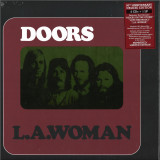
L.A. Woman is the sixth studio album by the American rock band the Doors, released on April 19, 1971, on Elektra Records. L.A. Woman was recorded in November 1970 over six days at the Workshop, the band’s rehearsal space on Santa Monica Boulevard. A success both critically and commercially, the album contains some of the band’s most enduring music, including hits “Riders On The Storm,” “Love Her Madly,” and the title track.
December 2021 saw the release of L.A. Woman (50th Anniversary Deluxe), a new 3-CD/1-LP set to commemorate the album's 50-year anniversary. Featured on the album anniversary set, this 1LP, 180g black vinyl release is the newly remastered breakout of the original studio album.
Jon K & Elle Andrews' MAL imprint returns with its second release - a long rumoured excursion from Equiknoxx skippers Gavin “Gavsborg” Blair and Jordan “Time Cow” Chung operating under the Gav & Jord masthead for the first time. It’s their most probing x tight set of productions thus far - showcasing that naturally wild rhythmic mutability that’s earned them followers in every corner of the experimental paradigm over the last few years.
‘Writings Ov Tomato’ ties off a loop between Equiknoxx and their early supporter Jon K, who was pivotal in bringing their productions to the attention of Sean Canty at DDS, who went on to release their by-now seminal ‘Bird Sound Power’ album a good half-decade ago. This new set of tracks came about after MAL urged to the duo to explore any under-excavated musical territory they’d been thinking about since they began to tour the world, and the result is this incredible, purely instrumental LP that romps between Autechrian mutations, avant R&B swangers, Jersey-style sluggers and proper, wig-flipping club missiles.
Who else would boot off a new LP with a track titled ‘Childish House Mafia’? The fact it sounds like Actress formulating an industrial noise tape using ritual chants just makes it all the more screwy. The title track returns the duo to more familiar ground, with prickly “Bird Sound Power” drums notched up a few BPM and spliced with whirring trap hats and disorienting synths. ‘A Yow Jon K’ is a Kingston-fried take on sun-bleached Miami electro, with a rolling beat filled out by Gav & Jord’s hard boiled soundboard x foley crunches, before ‘Pig Pilot’, the record’s most substantial cut, loops JBC Radiophonic Workshop convulsions around a booming 4/4 that wouldn’t sound completely out of place at Berghain’s Klubnacht. Saturating the hook and allowing ferric hats to fill in the gaps, the pair manage to fabricate a sound closer to 1970s library music than Villalobos, and we’d wager you ain’t ever heard owt like it.
Combine all this with lower-key slithering industrial-ambient moments like the plughole-wonked outro ‘Brent Bird’ (named after Gav’s producer brother), the tuned tinkle of ‘No Sweat in my Sweatpants’ and the airborne elegance of ‘Appinness’, and you’ve got another Equiknoxx joint that draws from the syncretic mosaic of Afro-Latin-Sino-US influences and re-contextualises them into remarkably odd and effective structures that dance in the integers of a myriad styles.
Daje Funk Records makes a triumphant return with the latest instalment to the spectacular ‘Slam Dunk’ series bringing you the Slam Dunk EP3.
First up on the A-Side of this stellar four tracker is Strange, with the acid laced disco burner, ‘Keep On’. From the intro of delicious 120bpm beats with added ‘Bongonaise’, the cleanest of guitar riffs leads to a hot disco bass with stabs of Rhodes keys lovingly applied. Just when you think you have it all worked out, the acid rug pull is a masterstroke. ‘Keep On’ has a classic (but often elusive) disco vibe with a wickedly acidic twist. ‘Strange’ will rule the summer, guaranteed. Any questions?
For A2, the considerable production chops of Ezirk are on full display with ‘Erotik’ - an 80s funk inspired taxi ride through rush hour traffic to the best cocktail bar on the planet. It’s infectious, demanding fist bumps and virtual high fives. It’s a melody that sets all the possibilities of a great night out through wielding the ultimate synth power. And that breezy sax? Heaven. Put the needle down and let it take you!
On the B Side, we start with label co-owner and master of the groove, De Gama and his carefully crafted ‘Higher’. The tempo is dropped right down here, with De Gama showing his darker and funkier side. Like a joint Gil Scott Heron and Robert Plant fever dream, ‘Higher’ is an intricate lecture in immaculate beats, unimaginable concepts and chord progressions. Serious grooves. Very serious.
Rounding things off on the B Side and closing the EP is ‘R.O.C.K.’ by Hungary’s The Magic Track. These boys know how to deliver a chugger from the MT workshop. You expect them to lure you in, and ‘R.O.C.K.’ does just that. One minute you’re in church, the next in a heaving club with retro beats, thumping bass and driving piano filling the air. The Magic Track are selling magic dreams and you’re buying. The whole bag.
The Slam Dunk EP 3 slam dunks with such force it shatters the backboard. Get it in your record boxes for the summer, and let it stay there!
Winston 'Niney' Holmes AKA The Observer, must be one of Reggaes finest Roots Rebel producers. Capable of making some of the heaviest, innovative music, not only in sound but also in the Cultural/Political sense.
Born George Boswell, Montego Bay, Jamaica 1951, and name checked 'Niney' due to losing a thumb in a workshop accident. He began his career in music by organising bands to play at school dances. But his first steps learning the musical ropes came working under the tutelage of producer Bunny Lee around 1967, organising sessions for Bunny's stable of artists. He moved on to work alongside Lee Perry at Joe Gibb's 'Amalgamated' label setup, where on Lee Perry's leaving in 1969 to start his own 'Upsetter' label, Niney became chief engineer.
Inspired by Perry's success it wasn't long before his own 'Destroyer' label was under way. It was 1970, and his first production entitled 'Mr Brown' by DJ's Dennis Alcapone and Lizzy, proved to be a minor hit, but his own 'Blood and Fire' track released in December of that year would become a major hit. After initial problems with it's likeness to Bob Marley's track ' Duppy Conqueror' being ironed out, it's reissue on his now named 'Observer' label, saw it go on to become, Jamaican Record of the Year 1971. Far out selling Bob Marley's track to the tune of 30,000 copies in Jamaica alone. A roots classic...
Niney's reputation for building great roots tracks, was furthered with more success working with singer Max Romeo. Issuing cuts such as 'Beard Man Feast', the great 'Reggae Matic' and 'Aily Ailaloo' and renewing his friendship with Lee Perry on the track 'Rasta Band Wagon', who's production credit read Perry, Niney, Maxie. In 1973, Niney began working with Dennis Brown, who was already an established star from an early age, they found a chemistry that went on to produce some of Dennis' finest work. The 1973 hit 'Westbound Train' was followed in 1974 by 'Cassandra', 'I am the Conqueror' and the timeless 'No More Shall I rOam'. Another important connection around this time was the great King Tubby who Niney would take his tapes along to and even record some of his tracks at Tubby's house, 18 Drummlie Avenue, Kingston, which doubles as his Studio of Dub.
It's these tracks that we are concentrating on here. Tubby would strip the tracks back to the bone and rebuild then sometimes leaving off the hook line. Whether that be the horn line or keyboard line and adding effects over the top that could disguise the cut even more. Even Niney stating that when Tubby had finished with a cut, he found it hard to recognise the track himself. Its these tracks as dub plate specials that Tubby would play on his Hometown HI-FI Sound System and it's these such tracks that we have compiled for this release. Dub Plated that have not seen the light of day since tragically the great Osborne Ruddock AKA King Tubby was gunned won and murdered on the 06th December 1989. For a few dollars and a gold chain, reggae music has lost one of it's most creative, inventive forces.
Niney also cut tracks with many other Reggae giants such as Gregory Issacs, Michael Rose, Junior Delgado, Horace Andy and Delroy Wilson to name but a few. As in house producer at the legendry Channel Studios and supervising sessions at Dynamic and Randy's Studio 17, his magic touched many. DJ, Arranger, Producer, his Roots Rebel music still stands the test of time.
Hope you enjoy the set.....
Charles Mingus is considered one of the giants of jazz. Bassist, pianist, composer, band leader, his career spanned three decades. The combo here, referred to by Mingus as The Jazz Workshop, had been in residence at the Showplace on W. 4th St. in Greenwich Village for nearly a year when they entered the studio to record what became the album Charels Mingus Presents Charles Mingus in October of 1961.
Samosa Records continue their hot streak with ‘The Difference EP’ - a superb four tracker from a producer who is all about the funk, Gledd.
This wonderfully constructed EP kicks off with the first track on the A-side - ‘I Don’t Know’. From the get go, this is a slinky, catchy funky number. The warm, all consuming bass line jogs along, aided by subtle guitar riffs that light up the melody. The chugging train suddenly breaks for an outrageous blues vocal - deep growls and female backing singers take control before the track launches straight into the stratosphere. A guaranteed dance floor bomb.
Next up on the A-side is ‘Amapola Sunrise’, a latin infused 125bpm slice of heaven. Gledd knows these rhythms inside out - and this hypnotic ‘love dance’ of a track proves it. You can only imagine the sunrises and sunsets this will provide the soundtrack to. It’s a deep, glorious journey into hedonism - let the lead guitar and sax take you by the hand to the rug-pull breakdown. Gledd at his incomparible best.
Meanwhile, over on Side B, De Gama is setting out the party stall early with his ‘Re-Groove’ of Muni. When De Gama masters the grooves in the ‘Re’Groove’ workshop, the flames can be seen for miles. African horns, organ stabs and Mali-inspired guitar riffs combine with the superb vocals. It’s a tribal, ethereal and very spiritual funk dream, which is De Gama’s trademark.
Closing off this excellent EP is B.2 - ‘Japan Lips’. In no time, we’re off around the seedy back street bars where gifted but washed up bass players hang out to find work. The bass line is as clean as a whistle as it kicks against the snares and cymbals of the beat, and the melody wraps around you instantly with rhythm guitar, jazz flute and breaks. Another mesmerising piece from a man who knows how to mesmerise. The perfect topper to this thoroughbred release.
‘The Difference EP’ is a welcome Samosa debut for Gledd and is sure to be a hit with lovers of the groove. This has to be in your collection.
Recorded back in 1999, 'Half a Dove in New York, Half a Dove in Buenos Aires' is the recorded debut of a NetCast improv between deep listening pioneer Pauline Oliveros and Argentinian free music trio Reynols >> a fascinating early example of the internet’s capacity to foster remote creativity in-the-moment that deploys the slowest electronics, accordion, voice, trombone and computer sounds on a next level ritual drone incantation recorded in another era, but made for our time.
As the story goes, Oliveros first met Reynols in the mid ‘90s at a Deep Listening workshop she held in their home city, Buenos Aires, where they impressed her with an improvised brass serenade. Years later, in 1999, they met again via NetCast - a series of very early online live improvisations - to explore the Internet’s potential for collaborations between artists thousands of miles apart. Finally mixed down in 2021 and mastered by Helge Sten (aka Deathprod) after marinating in the archive for 22 years, the album resonates with the late, great Oliveros’ legendary work in exploring alternate tunings, spatial dynamics and methods of intuitive performance - a remarkable slab of omnidirectional drone bearing traces of Miguel Tomasin's vox and Oliveros’ just-intoned accordion embedded in its cosmic roil.
Broadcasting from fabled record shop The Thing in NYC, with Oliveros (Accordion) joined by Jennifer McCoy (ICR), Kevin McCoy (Computer processing), and Monique Buzzarté (Trombone), and Reynols revolving Miguel Tomasin (Electronics, subliminal voice & Alclorse drums), Rob Conlazo electronics, leather gloves & e-gtr), and Anla Courtis (electronics, rubber foot & e-gtr) and dialling-in from Florida 943 in Buenos Aires, the results are an incredibly absorbing and consistently surprising testament to vanguard, experimental spirits prizing the internet’s nascent, unprecedented ability to connect minds and art across continents, language barriers, and modalities.
The album's first side, titled 'Micro Macro Wind Dance', puts Oliveros' accordion under a microscope, enhancing it with lower case rumble and noise from Reynolds' arsenal. Shifting glacially over 22-minutes, Oliveros plays subtly and slowly at first, letting the accordion breathe in-and-out like a sleeping mythical beast, before she transitions to fluttering bird-like phrases by the end of the side.
'Astral Netcast Pigeon' expands the dissonant drones to widescreen, submerging Oliveros' trills and drones beneath layers of dirt and grit. It's time-altering music that dissasembles yr head before you've completely worked out what's happening >> basically the perfect mid-point between Oliveros' deep listening practices and Reynols' wildly inspirational free-noise-drone freakouts.
The British composer, musician and audio engineer Daphne Oram was a pioneering figure in the use of electronic music. Coming to prominence through her work with the BBC Radiophonic Workshop, which she co-founded, Oram was one of the first British composers to feature electronic instruments in her work and has been rightly hailed as helping musique concrete to become accepted in Britain. Born in 1925 and raised in rural Wiltshire, close to Stonehenge and the ancient stone circle at Avebury, Oram eschewed a place at the prestigious Royal College of Music to take a junior engineering role at the BBC in 1942, she was often tasked with creating sound effects, leading to cut-up experiments with tape recorders and the development of synthetic sound; her composition Still Point, involving two orchestras, two turntables and five microphones, was deemed too radical by the BBC, though she was promoted to studio manager in 1950, leading to the gradual introduction of electronic music and musique concrete techniques on BBC soundtracks. In 1957, she composed the music for the play Amphitryon 38, using a sine wave oscillator and homemade filters, and this and other subsequent works led to the establishment of the BBC Radiophonic Workshop the following year, but Oram soon tired of the conservative constraints of the BBC, leading to her resignation in 1959 to pursue her own vision at the Oramics Studios for Electronic Composition, located in Tower Folly, a former hop kiln located at Fairseat, near the village of Wrotham in rural Kent. Oramics was a radical sound composition technique that sought to transform images to music, enacted by drawing onto 35mm film, which would then be read by photo-electric cells; in addition to its use in Radiophonic Workshop material, Oramics was also employed for sound installations, theatre productions and feature films, such as The Innocents, though financial pressures forced Oram to seek a range of commercial engagements in addition to creating her own artistic works. The Listen Move And Dance series of BBC programmes were devised as a radical new technique to help British schoolchildren learn how to dance; on the LP releases, Vera Gray arranged short adaptations of classical pieces by Bartok, Stravinsky, Shostakovich and others, designed for “stamping, punching, kicking and jumping” movements, as well as “running lightly, dancing on toes” and “shaking all about,” which contrasted sharply with Oram’s electronic abstractions, which seemed to have been beamed in from outer space.
To a degree, all musicians are a product of their environment, the places they record and the venues they play. For proof, check out the alumni of the n-wave era CBGBs venue in New York, Cabaret Voltaire’s Western Works studio in Sheffield or more recently London’s Total Refreshment Centre.
We can now add to that list the Constellations Workshop in Colwick, Nottingham, a project that provides employment through making studio furniture, for out-of-work musicians. It was here, after-hours, that the music on Brown Fang’s impressive and ear-catching debut album took shape.
Both members of Brown Fang, bassist John Thompson and guitarist Henry Scott AKA Henry Claude, have a long association with the Constellations Workshop. Though their musical projects are manifold – Thompson having toured with the likes of The Nectarine No9 and The Selecter, with Scott being both a mainstay of Nottingham jazz circuit and recording ambient music as Fang Jr – the work provided by the community-minded project has kept their heads above water and allowed them a space to record in when the shutters go down and the bandsaws get switched off.
Yet the music showcased on Sherwood Pines is more morning-fresh and sun-kissed than industrial and sawdust-sprinkled. Combining the pair’s brilliant musicianship – think languid bass guitars and Pat Martino-esque jazz guitar licks – with saucer-eyed electronics, occasional downtempo drum machine rhythms and plenty of glistening special effects, the set’s eight tracks are as blissful and becalmed as an early morning saunter through Sherwood Forest on a misty autumn morning.
For proof, check epic opener ‘Tracing Paper’, a slow-build ambient soundscape in which bubbly electronic lead lines and colourful chords sashay around Scott’s sparkling, laidback guitars, and the beguiling ‘That’s All You Can Think’, a subtle tribute to Steve Reich masterpiece ‘Electric Counterpoint’ in which slow-burn, stretched out synthesizer sounds wave in and out of a gradually evolving cycle of delay-laden electric guitar motifs.
The band’s love of classic American minimalism – as well as a shared love of the Duratti Column and Robert Fripp – comes to the fore on ‘HDMI I Love You’, which boasts a deliciously dubby bassline, Tangerine Dream style synths and the deepest of ambient chords, while ‘I Nearly Married a Human’ and ‘Fridgewords’ balance bespoke electronics – languid, dewy eyed and comforting – with Scott’s gorgeously laidback, slow-release guitars.
Every great album needs a triumphant conclusion, and Sherwood Pines is no different. You can hear everything that makes Brown Fang great on ‘Goodbye Donkey Jacket’, from the pin sharp, effects laden jazziness of Scott’s guitars and the fluid dexterity of Thompson’s bass, to the pleasingly spacey pulse of the synths and the gentle rhythms of the soft-focus machine drums. It’s a confident, ear-catching conclusion to a debut album that’s been years in the making.
Artist-turned-writer-turned-DJ-turned-producer-turned-chef Kiki Kudo, following up releases on Good Morning Tapes, Workshop and Incienso with two kitchen wave rollers for TTT.
Demon Records präsentiert das erste Doctor Who-Abenteuer von Douglas Adams - dem Schöpfer von The Hitchhiker's Guide To The Galaxy - mit Tom Baker als Doctor. Auf der Jagd nach dem Schlüssel zur Zeit geraten der Doktor, Romana und K9 auf dem Planeten Calufrax in lokale Ereignisse und zwischen die Fronten des bombastischen Captain - halb Mensch, halb Maschine - und den finsteren Mentiads. Jemand plündert ganze Planeten nach ihrem Reichtum, und gerade als der Doktor herausfindet, wer dahintersteckt, gerät etwas anderes in Gefahr: die Erde!
Der kultige TV-Soundtrack von 1978 wird auf 2 x 140Gr. Sky Demon Splatter-Vinyl-LPs präsentiert und von John Leeson, der Originalstimme von K9, erzählt. Zur Nebenbesetzung gehören Mary Tamm als Romana mit Bruce Purchase, Andrew Robertson, David Warwick und Rosalind Lloyd. Die Begleitmusik wurde von Dudley Simpson komponiert, und die bekannten Klänge des Doctor Who-Themas wurden vom BBC Radiophonic Workshop zur Verfügung gestellt.
Die farbigen Vinyl-LPs werden in einer vollständig illustrierten Gatefold-Hülle mit Besetzung und Credits sowie bedruckten Inner Sleeves präsentiert.
Rare Nigerian Afrobeat-Funk from 1976.
First vinyl reissue since 1976.
First Ever Release Outside Of The African Continent.
Comes With Insert/Liner Notes.
180g BLACK vinyl limited to 500 copies (w/obi strip) - Non-Returnable.
THE FRIIMEN MUZIK COMPANY (also known as FRIIMEN) was formed after the Biafran war in 1973-1974 in the town of ABA in the eastern part of Nigeria. Aba was the Number 1 Music Hub in the entire Eastern Region of Nigeria. While bands and artists like ‘Ofege’ and ‘Fela Kuti’ ruled the LAGOS scene, bands like ‘Friimen’ and ‘The Apostles’ were ruling the ABA scene.
Before forming the band, most of its members were already working together as freelance session musicians backing up solo artists on several recordings and concerts (or were playing in military bands that gradually became civilian bands because the war had just ended). FRIIMEN members’ credits were numerous and they played, wrote or performed on recordings from well-known acts like The Funkees, The Jets, The Apostles…and countless others.
When they started concentrating on writing their own songs, the group instantly took off and became an overnight hit that resulted in them doing multiple successful nationwide tours. FRIIMEN would go on to record three albums: Free Man (1976), We Can Get It On (1978) and Merry Man (1979). All three albums were released on the Aba based label Anodisc Records (THE key label to be on if you wanted your music heard and out there), Anodisc also released hit records by ‘Sweet Unit’ and ‘Voice Of The Cross’ but The Friimen Muzik Company was the label’s signature band.
The Friimen Muzik Company was so solid that every new group or artist wanted the Friimen to back them up in the recording studio. As a result, Anodisc Records received tons of demo cassettes from aspiring artists…the label would then first consult the Friimen members to see if these new acts were worthy of giving a chance to record and release an album for Anodisc. Over the course of the years the band went through several line-up changes…but in 1980 the band finally broke up and their story came to an end.
The album we are presenting you today (Free Man from 1976) was recorded at the famous Decca Studios in Lagos and comes swinging right out of the gate with a set of no less than EIGHT monster tunes. Expect nothing less than crazy afrobeat and over the top melodic funk influenced by a wide array of artists (both local and international). Mesmerizing solos, captivating grooves, impeccable sequences that turned many heads…everything you need to get a dancehall into a complete uproar. The musicians’ skills are just plain incredible! FREE MAN is a quintessential record that every serious collector or fan needs to have in his/her collection.
This reissue also comes with an insert featuring pictures of the band and extensive liner notes from band-member Arthur Freds.
Tracklist:
Release Yourself , Free Man , My Dreams , Funky Workshop , Word of the Lord , We'll Get Our Share , You Can't Change Anything , Gimme Some Time
Recorded in 1997 in Vienna as part of a workshop named "Greguar" which took place at the University of applied Arts in Vienna, and was produced by the Institute of contemporary Art Vienna. Official re-release!
Mercurial London artist Nilüfer Yanya announces her hugely anticipated second
album, ‘PAINLESS’, for release via ATO Records.
‘PAINLESS’ is the follow-up to Nilüfer Yanya’s renowned 2019 debut album, ‘Miss
Universe’, which fully established her as a singular artist and a distinctive voice that
simply has to be heard.
The critically acclaimed ‘Miss Universe’ - a widescreen concept record that took a
tongue in cheek swipe at the most self-involved corners of the health and wellness
industry - was followed last year by the three song EP ‘Feeling Lucky?’, which further
explored Yanya’s fascination with ‘90s alt-rock melodies and drew on themes of
resentment, her fear of flying, and the concept of luck. Pitchfork summed up ‘Feeling
Lucky?’ and her now peerless songwriting aptitude best: “Nilüfer Yanya’s melodies
have a pull so strong they almost necessitate their own law of physics.”
Yanya also re-released her early EPs on vinyl for the first time this year, on the
record ‘Inside Out’. The release is a fundraiser for Artists in Transit, a collaborative
not for profit group she founded with her sister Molly that delivers art workshops to
displaced people and communities in times of hardship.
As the daughter of two visual artists (her Irish-Barbadian mother is a textile designer
and her Turkish-born father’s work is exhibited at the British Museum), creativity was
always destined for Nilüfer Yanya’s future. Now she enters the next stage of her
creative journey - Yanya is running head first into the depths of emotional
vulnerability on her sophomore record, ‘PAINLESS’. The album was recorded
between a basement studio in Stoke Newington and Riverfish Music in Penzance
with ‘Miss Universe’ collaborator and producer Wilma Archer, DEEK Recordings
founder Bullion, Big Thief producer Andrew Sarlo and musician Jazzi Bobbi.
Where ‘Miss Universe’ stretched musical boundaries to include a litany of styles from
smooth jazz melodies to radio ready pop, ‘PAINLESS’ takes a more direct sonic
approach. By narrowing down her previously broad palette to a handful of robust
ideas that revolve around melancholy harmonies and looped industrial beats to mimic
the insular focus of the lyrics, Yanya has smoothed out the idiosyncrasies of previous
releases without losing what is essential to her.
‘PAINLESS’ is a record that forces the listener to sit with the discomfort that
accompanies so many of life’s biggest challenges whether it be relationship
breakdowns, coping with loneliness, or the search for our inner self. “It's a record
about emotion,” Yanya explains. “I think it's more open about that in a way that ‘Miss
Universe’ wasn't because there's so many cloaks and sleeves with the concept I built
around it.” Summing up the ethos of the new album, she adds, “I’m not as scared to
admit my feelings.”
Should stock of ATO0594BI1 sell out, a different standard vinyl format will be made
available (ATO0594LP).
“A distinctive new voice in indie rock, a deeply expressive singer and sharply
inventive guitarist” - Uncut
“On a musical and human level, then, the world needs more people like Nilüfer
Yanya” - MOJO
“A true original” - The Guardian
Following a four-year hiatus, our main imprint is back with a new outing by our long-time friend, Laslo. His previous works found home on quality record labels like Greta Cottage Workshop, Greta Cottage Woodpile and Soundscape Versions. Now he is delivering three originals, all shaped and arranged along his dub-infused, peculiar sound. As label heads, we rarely focus on remixes, but in the case of this EP we could not resist the chance to get one by the Hungarian drum & bass veteran Ghost Warrior (31 Records, re:st, Well Street Records), who did his first ever remix for Tape Hiss, this time exploring the mid-tempo territory.
Kapingbdi came together in Liberia, West Africa, during the late 1970’s and had their own unique style. This six to seven-piece band played original compositions in a vibrant mix of African Rhythms, Soul, Spiritual Jazz, Funk and Rock. Led by Kojo Samuels on sax, flute and vocals “Born in The Night” presents the essential tracks from their rare studio LPs produced between 1978-1981. The work has been carefully edited and remastered in 2019 for vinyl LP and a 6-Page Digipack CD, which includes two additional recordings. Kapingbdi toured through Europe and the U.S. and were the only Afro funk band to ever come out of Liberia.
Kapingbdi hail from Liberia, West Africa and have their own imitable style. They effortlessly combine traditional African music in a modern mix of Jazz, Funk, Soul and Rock. The band is a fusion of the old and the new.
The word "Kapingbdi" is taken from the Sierra Leone language Mende and means "born in the night". Kojo Samuels was given the name by his Latin teacher whilst attending high school in Freetown, They often meet and debate at night in the city and soon after Kojo is called Kapingbdi. The name serves as a description of his origin. Born In Lagos, Nigeria in 1943. The son of slave children. His mother from Nigeria and father from Sierra Leone who moved the family to Liberia, during the 1950’s.
Kojo has played music for as long as he can remember. He starts with the harmonica and later becomes a drummer and percussionist in his first band at school. During his art studies 1965-1972, he tours Germany and works as an art teacher in the USA. His band Kapingbdi is reorganized five times and consists of up to seven musicians. In a VW-Bulli he drives the group from concert to concert and if the drummer fails, he jumps in himself. Between 1978 and 1981 three Kapingbdi LPs are produced for the independent label Trikont, recorded in Hamburg and Munich. During this creative period, the band plays at festivals in Africa and Europe. In 1984, the band tours the United States and shortly after, they came to an end.
At their best, Kapingbdi would rouse the audience with original compositions like "Human Rights", justice for all, especially for South Africans, and "You Go Go You Go Come". The officials and employees in the government departments have no time for the common man, for any questions such as job search, scholarship or similar, he receives the answer "go, come back tomorrow" and the same thing the following day. Or "Now Is The Time For Cry For Love." Now it is time to scream for love and finally, time for humanity and justice. Despite immense difficulties, the musicians consciously live and work in Africa and are at home in Liberia.
On April 12, 1980, ordinary soldiers and non-commissioned officers organize a coup against the government. This is an attempt to put an end to a policy of exploitation of the Liberian people. Whilst efforts to eradicate poverty, lawlessness and illiteracy are obvious throughout the country, Liberia is still Americanized to a high degree. This is evident, as the radio programs of that time almost exclusively played American disco music. Under these conditions, the people seek a reconnection to their folk music, and Kapingbdi were aware of this. Kojo tried many times to come together with traditional Liberian musicians. This passion takes him north of the country. Meeting and playing with the old hornblowers and playing music on traditional instruments, such as the elephant tusk.
Kapingbdi make high quality tape copies of their own vinyl LPs and patiently try to displace all unauthorized tapes from the domestic "market". Nevertheless, it is hard to make a living through music in Liberia. Kapingbdi, is now celebrated. The radio plays are in abundance, but royalties are not forthcoming. Their musical link is the feeling of Afrobeat and Highlife, which is found in each of the many Kapingbdi pieces. They embody Jazz, which is understood to be the most refined example of black music outside of Africa. In Liberia, Jazz is virtually impossible to hear. Bright shining names such as John Coltrane, Charlie Parker or Miles Davis were widely unknown. Thus, the Black Jazz, including its Back-To-Africa movement of the 60’s and 70‘s, passes by without leaving a trace in Africa itself.
Kojo's claim at the time, was to make African music with the depth, sensitivity and the freedom of the technical level of Jazz. This makes Kapingbdi the torchbeares. The underpaid prophets in small Liberia. It is the passion with which the founder of the band continues to work on their music for years. Tirelessly, stimulating and encouraging his fellow musicians. This is ultimately responsible for the success of Kapingbdi in Liberia itself. The local audience seems to listen to the band in fascinated astonishment. One wonders about the ability to develop as demonstrated by Kapingbdi on the basis of their music. It is African and unusually jazzy, danceable and better than the American disco music heard on the radio.
Rather than chase the money and the job opportunities in Europe, Kapingbdi are firmly rooted in Africa. The musicians live in Monrovia, the capital of Liberia, at the Kabingbdi workshop, located in the Congotown area on the eastern edge of the sprawling city. Kojo works here as a sculptor, painter, batik artist and musician. The sales revenue that his activities generate, gives him the opportunity to support the development of African Jazz music. The highest percentage of funds are from Germany and Kojo’s work ethic is “to work on your own thing“. The stance taken aims to support the welfare of Liberians and Africans. The other musicians of the group live in a second house that is nearby.
For the sake of consistency, Kapingbdi is a full-time band. However, the revenue, from all of the sources, could not keep them afloat. Equally, as important to the group are Kojos's knowledge of traditional African music and his sculpting skills. His knowledge is shared with others at the afternoon workshops. It is here that they discuss new lyrics, engage in political debate and the self-imposed task of improving conditions in Africa. At times the debate became heated, especially during rehearsals. This was regarded as good and integrative, sowing the seeds of innitiative to keep the band together.
From 1980 to 1985 Kojo also opened and ran the club "Panjebota", located on the grounds of the U.S. Consulate in Monrovia. Almost every evening Kapingbdi perform the song "Wrong Curfew Walk", whose lyrics lament the killing of citizens during the curfew imposed by the Liberian government. When the head of state Samuel Doe hears the song, he behaves agressively and forces Kojo to close the "Panjebota". Kojo had already moved on. Soonafter he meets Fela Kuti at the Africa-Festival and plays concerts in Germany with Cecil Taylor's workshop band.
Kapingbdi is for thinking, dreaming, dancing. What they sing about is what they have experienced. Kojo Samuels is 76 years old today and still follows his vocation as a critical musician, artist and activist.
Ekkehart Fleischhammer / Sonorama 2019 (with the help of original press sheets and the memories of Kojo Samuels)
Guitarist and producer HANS DEVILLE cut his rock’n’roll teeth with highly respected ska-punks KING PRAWN. It’s not an uncommon story, and during the pandemic this isn’t the only project born from a musician’s desire to keep creating.
Setting up a studio in his Stained-Glass workshop, a hybrid album of mariachi, sea shanty and twangy western began to develop. Live brass was recorded by his ska punk buddies, even his mum lending an accordion playing hand on first single Porbandar.
In addition to the KING PRAWN brass boys, Richard Glover bass player of the mighty DUB WAR, makes a special appearance on the Latino flavoured “Diva”.
On hearing the works in progress, old time friend Karl “Lost” Horton introduced Hans to “dark country” singer ANDREW J DAVIES. The pair immediately hit it off with Andrew laying down the vocals that very evening, taking influence from his Welsh roots by incorporating four level harmonies, much favoured by male voice choirs, on Porbandar the sea shanty evoking first single. The collaboration continued with half the album featuring the Hastings based vocalist.
It did not stop there. Eager to take the album “on the road”, a band of Hastings based musicians were assembled. The first show in London at Paper Dress Vintage was a sell out. Videos from the night were circulated with festival offers already coming in.
"In Vivo" is the result of the photographic work of Klavdij Sluban at the Fleury-Mérogis Young Offender Institution (France) from 1995 to 2016 Beds in addition to his work from Izalco prison, located in El Salvador, from 2008 visiting rooms connected to the music of Gareth Davis.
Gareth Davis is an artist, composer and musician living in Amsterdam. He plays clarinet(s), the result of a somewhat impulsive purchase whilst window shopping in Covent Garden, London, around ten years before the turn of the century. The serendipitous location of a rather wonderful (and equally important, rather cheap) second hand record shop less than 10m from the bus stop required for seven years of schooling, combined with delivering newspapers on a daily basis, lead to a somewhat eclectic, dusty and generally unclassified taste in music.
The result. Activity covering sonic art and contemporary classical music through rock, improvisation and noise with collaborations that have included the premiering of new written pieces by composers such as Bernhard Lang, Peter Ablinger, Toshio Hosokawa and Jonathan Harvey, soloist with orchestras including the SWR Symphonieorchester, Warsaw Philharmonic and Orquesta de la Comunidad de Madrid, performances with groups and performers ranging from the Neue Vocalsolisten and Arditti Quartet through to improvisers Elliott Sharp and Frances Marie Uitti, electronic artists Robin Rimbaud and Merzbow and multimedia work with artists including Christian Marclay and Peter Greenaway.
"In Vivo" is his second solo release after to have recorded a bunch of collaborative albums with artists such as Scanner, Machinefabriek, Steven R. Smith, Kleefstra Brothers, Frances-Marie Uitti, Merzbow, Adain Baker, Duane Pitre and more...
Klavdij Sluban, winner of the European Publishers Award for Photography 2009, of the Leica Prize (2004) and of the Niépce Prize (2000), main French prize in photography, is a French photographer of Slovenian origin born in Paris in 1963.
He develops a rigorous and coherent body of work, nourished by literature, never inspired by immediate and sensational current affairs, making him one of the most interesting photographers of his generation. The Balkans, the Black Sea, the Baltic Sea, the Caribbean, Central America, Russia, China and the Antarctic (first artistic mission in the Kerguelen islands) can be read as many successive steps of an in-depth study of a patient proximity to the encountered real.
His images have been shown in such leading institutions as the Metropolitan Museum of Photography of Tokyo, the Maison Européenne de la Photographie in Paris, the Rencontres d’Arles, the Museum of Photography in Helsinki, the Fine Arts Museum in Canton, the Musée Beaubourg, the Museum of Texas Tech University. His many books include East to East (published simultaneously by Actes Sud, Dewi Lewis, Petliti, Braus, Apeiron & Lunwerg with a text by Erri de Luca), Entre Parenthèses, (Photo Poche, Actes Sud), Transverses, (Maison Européenne de la Photographie) and Balkans -Transit, with a text by François Maspero (Seuil). Since 1995, Sluban has been photographing teenagers in jails. In each prison he organizes workshops with the young offenders to share his passion. First originated in France, in the prison of Fleury-Mérogis with support of Henri Cartier-Bresson during 7 years, as well as Marc Riboud and William Klein punctually. This commitment was pursued in the disciplinary camps of Eastern Europe –Serbia, Slovenia, Ukraine, Georgia, Moldavia, Latvia – and in the disciplinary centres of Moscow and St Petersburg as well as in Ireland. From 2007 to 2012, Sluban has been working in Central America with imprisoned youngsters belonging to maras (gangs) in Guatemala and Salvador. In 2015, he started photographing imprisoned teenagers in Brazil. In 2013, the musée Niépce showed a retrospective of K.Sluban’s work, After Darkness, 1995-2012. In 2015/16, he was awarded the Villa Kujoyama Residence in Kyoto, Japan. K.Sluban is member of national and international jurys, such as prix Niépce, prix de la Jeune Photographie de Niort, prix Leica, All About Photo…
- A1: Class Compliance – Cuadro
- A2: Cotonete – Super Vilain Wants Love (Dj Deep & Romain Poncet Remix)
- A3: James Holden & The Animal Spirits – The Neverending
- B1: Bantu Clan Vs. Sarabi – Africa Ni Leo (Esa & Nonku Phiri Kaap Mix)
- B2: Shina Williams & His African Percussionists – Agboju Logun
- C1: Lucas Croon – Türkischer Tee
- C2: Mille & Hirsch – Pentagon Flow
- D1: Typesun – Last Home (Dj Nature Remix)
- D2: Brandi Ifgray – Bones (Maurice Fulton Vibe Mix)
- D3: Ben Sturm – Francebeat
- E1: Toshio Matsuura Group – At Les
- E2: Marni – Floor Of Soul
- E3: Oliver Kieser – Oscura Serenata
- F1: Aera – Line Of Conception
- F2: Martin Buttrich – Meeting Dave Dish
- F3: All Is Well – Day Two
- G1: Arnau Obiols & Kayyak – Tunacheza
- G2: Kevin Yost – Another World (Original Mix)
- G3: Ron Deacon Feat. Johanna Jaeremo – Untitled B2
- H1: Don Carlos – Mediterraneo
- H2: Rudoulpho – Sunday Afternoon
2024 Repress
Cool - gelassen - überraschend: Volume 15 dieser superlativen Serie wurde wieder von Compost’s Mentor Michael Reinboth zusammengestellt. Das pralle Paket birgt 21 Tracks, davon 8 exklusive unveröffentlichte Delikatessen und gibt es als 4-LP / 2xCD. Viel Vergnügen.
Die exklusiven Tracks kommen von: Area (schätze, man kennt seine brillianten Innervisions Veröffentlichungen), Arnau Obiols & KAYYAK (schwer von Gilles Peterson gefeatured, ihre EP “Chang‘an” war in seiner 2021 top 5 Liste), Ron Deacon (gehört zur Workshop-Crew mit Move D, Even Tuell and Kassem Mosse), Class Compliance, oh man was für ein Hammer Track, Mille & Hirsch (Operatoren des feinen Polish Records - Labels), All Is Well (dahinter steckt natürlich Fred Everything), Ben Sturm (ein neues Talent aus Leipzig’s viraler Underground Szene) und Oliver Kieser (bestens bekannt als Teil von Kieser & Velten mit einigen Platten auf G-Stone).
Gut, schön, wie immer, fast alle Tracks sind wunderbare Hybride, perfekt für jedes eklektische Set, aber auch für den entspannten Genuss von Wein, Bier, härterem oder grünem Zeug. Vielleicht besonders zu erwähnen wäre der Esa Williams Remix von Bantu Clan Vs Sarabi and Kevin Yost’s Original Mix von “Another World”, die gab es so in den Versionen bisher nicht auf Vinyl.
Diverse Magazine haben die Future Sounds Of Jazz als eine der besten Compilation - Serien aller Zeiten gewählt. Wir sind geschmeichelt. Mit dem Start der Reihe 1995 wurde das Genre Future Jazz quasi aus der Taufe gehoben, unetabliert.
Charismatic trombonist and pianist Malcolm Jiyane debut album as frontman is more than merely one individual’s breakthrough. Workshopped and recorded within two days in Johannesburg, UMDALI stretches the idea of what it means to improvise within the context of jazz.
Operating from the fringes of the South African jazz scene, the enigmatic yet charismatic trombonist and pianist Malcolm Jiyane delivers a major contribution to the canon -- one shaped around dedications to key figures in his personal and professional life. Several years ago, Jiyane was dealing with the death of a band member, the birth of a daughter and the passing of his beloved mentor Johnny Mekoa, founder of the Music Academy of Gauteng, which Jiyane attended from a young age. These life-altering events give shape to the music’s emotional register and its thematic concerns.
In Black Music, his book of essays and critiques, Amiri Baraka makes the point that jazz musicians, be it in the construction of solos or in other aspects of composition, always draw on the works of their contemporaries or elders. How much outsiders pick up on that is really dependent on how au fait they are with the music. In this album, Jiyane finds comfort in this well-trodden path. Two songs make for great examples. Umkhumbi kaMa, a jazzfunk track celebrating the creative force as inhabited by women, the motif to Herbie Hancock’s Ostinato (Suite for Angela) is a clear reference, connecting in one swift move, not only the musical traditions of the Black Atlantic but also the struggles and triumphs of women across space and time. On the same note, the free-form Solomon, Tsietsi & Khotso, conjured in the same jam session that yielded SPAZA’s UPRIZE!, appears here in a more fleshed out form as Senzo seNkosi; a tender dedication to Malcolm Jiyane Tree-O bass player Senzo Nxumalo.
Jiyane’s path to the realisation of his debut album as frontman is more than merely one individual’s breakthrough. Workshopped and recorded within two days in Johannesburg, UMDALI, not unlike Miles Davis’ landmark Kind of Blue, stretches our idea of what it means to improvise within the context of jazz.
"In Vivo" is the result of the photographic work of Klavdij Sluban at the Fleury-Mérogis Young Offender Institution (France) from 1995 to 2016 Beds in addition to his work from Izalco prison, located in El Salvador, from 2008 [visiting rooms] connected to the music of Gareth Davis.
Gareth Davis is an artist, composer and musician living in Amsterdam. He plays clarinet(s), the result of a somewhat impulsive purchase whilst window shopping in Covent Garden, London, around ten years before the turn of the century. The serendipitous location of a rather wonderful (and equally important, rather cheap) second hand record shop less than 10m from the bus stop required for seven years of schooling, combined with delivering newspapers on a daily basis, lead to a somewhat eclectic, dusty and generally unclassified taste in music.
The result. Activity covering sonic art and contemporary classical music through rock, improvisation and noise with collaborations that have included the premiering of new written pieces by composers such as Bernhard Lang, Peter Ablinger, Toshio Hosokawa and Jonathan Harvey, soloist with orchestras including the SWR Symphonieorchester, Warsaw Philharmonic and Orquesta de la Comunidad de Madrid, performances with groups and performers ranging from the Neue Vocalsolisten and Arditti Quartet through to improvisers Elliott Sharp and Frances Marie Uitti, electronic artists Robin Rimbaud and Merzbow and multimedia work with artists including Christian Marclay and Peter Greenaway.
"In Vivo" is his second solo release after to have recorded a bunch of collaborative albums with artists such as Scanner, Machinefabriek, Steven R. Smith, Kleefstra Brothers, Frances-Marie Uitti, Merzbow, Adain Baker, Duane Pitre and more...
Klavdij Sluban, winner of the European Publishers Award for Photography 2009, of the Leica Prize (2004) and of the Niépce Prize (2000), main French prize in photography, is a French photographer of Slovenian origin born in Paris in 1963.
He develops a rigorous and coherent body of work, nourished by literature, never inspired by immediate and sensational current affairs, making him one of the most interesting photographers of his generation. The Balkans, the Black Sea, the Baltic Sea, the Caribbean, Central America, Russia, China and the Antarctic (first artistic mission in the Kerguelen islands) can be read as many successive steps of an in-depth study of a patient proximity to the encountered real.
His images have been shown in such leading institutions as the Metropolitan Museum of Photography of Tokyo, the Maison Européenne de la Photographie in Paris, the Rencontres d’Arles, the Museum of Photography in Helsinki, the Fine Arts Museum in Canton, the Musée Beaubourg, the Museum of Texas Tech University. His many books include East to East (published simultaneously by Actes Sud, Dewi Lewis, Petliti, Braus, Apeiron & Lunwerg with a text by Erri de Luca), Entre Parenthèses, (Photo Poche, Actes Sud), Transverses, (Maison Européenne de la Photographie) and Balkans -Transit, with a text by François Maspero (Seuil). Since 1995, Sluban has been photographing teenagers in jails. In each prison he organizes workshops with the young offenders to share his passion. First originated in France, in the prison of Fleury-Mérogis with support of Henri Cartier-Bresson during 7 years, as well as Marc Riboud and William Klein punctually. This commitment was pursued in the disciplinary camps of Eastern Europe –Serbia, Slovenia, Ukraine, Georgia, Moldavia, Latvia – and in the disciplinary centres of Moscow and St Petersburg as well as in Ireland. From 2007 to 2012, Sluban has been working in Central America with imprisoned youngsters belonging to maras (gangs) in Guatemala and Salvador. In 2015, he started photographing imprisoned teenagers in Brazil. In 2013, the musée Niépce showed a retrospective of K.Sluban’s work, After Darkness, 1995-2012. In 2015/16, he was awarded the Villa Kujoyama Residence in Kyoto, Japan. K.Sluban is member of national and international jurys, such as prix Niépce, prix de la Jeune Photographie de Niort, prix Leica, All About Photo…
Hannes Buder (born 1978 in the former GDR) is a musician, composer and improviser in the field of experimental music. His works concentrate on issues of movement, authenticity, intuition, minimalism, and slowness.
Buder's current projects include the bands 'Zug Zug' with Todd Capp and Andrew Lafkas, 'Gravity' with Hannes Lingens and Andrew Lafkas, the duo Nothingness with Sarah Jegelka, and his solo projects. Beyond that he has collaborated with Audrey Chen, Tony Buck, Audrey Lauro, Hilary Jeffery, Mike Majkowski, Steve Heather, Nicole Mitchell's Black Earth Ensemble, the Berlin Improvisers Orchestra and many others. Hannes Buder's Solo recordings include "Changes" (2000), "Dunkelbunt" (2004), "Openyoureyescloseyoureyes" (2006), "Changes II" (2015) and "Oustide WOrds" (2021). He performed concerts in Europe, Australia and in the USA.
Buder has also composed, improvised and recorded music for different dance (Oxana Chi, Judith Sanchez Ruìz), theater (Jörg Mihan, Johannes Maria Schmit) and film projects (Barbara Lubich, Annick Gaudreault). He's been giving workshops at festivals, music schools and with prisoners in jail. He studied guitar in Weimar and Dresden.
Michael Hurley's first new studio record in 12 years features eleven songs recorded in Astoria, Oregon during the brief time of year when the foxgloves bloom. Hurley had been workshopping the set at home for the past few years. Friends and collaborators came into town and contributed from afar. The songs are lifted by violin, organ, upright bass, banjo, percussion - but at the center, of course, is the enigmatic Snock, whose songs have grown only more unique and more 57 years after his debut album (First Songs - Folkways, 1964). It could only be Snock. Heartbreaking, heartfelt, easy and carefree. The glorious opener “Are You Here For The Festival” – punctuated by a pair of violins – came to him while working in the garden. “Little Blue River” floats by on a cloud. The haunting “Jacob’s Ladder” sounds beamed in from another era. Or dimension. Foxgloves is as comforting and wonderful as any Hurley record that has come before it.
- A1: The Changeling (Lp La Woman Original Stereo Mix Remastered)
- A2: Love Her Madly
- A3: Been Down So Long
- A4: Cars Hiss By My Window
- A5: La Woman
- B1: L'america
- B2: Hyacinth House
- B3: Crawling King Snake
- B4: The Wasp (Texas Radio & The Big Beat) (Texas Radio & The Big Beat)
- B5: Riders On The Storm
- CD1-1: The Changeling (Cd1: La Woman: Original Stereo Mix Remastered)
- CD1-2: Love Her Madly
- CD1-3: Been Down So Long
- CD1-4: Cars Hiss By My Window
- CD1-5: L A. Woman
- CD1-6: L’america
- CD1-7: Hyacinth House
- CD1-8: Crawling King Snake
- CD1-9: The Wasp (Texas Radio And The Big Beat)
- CD1-10: Riders On The Storm
- CD1-11: Hyacinth House (Demo)
- CD1-12: Riders On The Storm (Sunset Sound Version)
- CD2-1: The Changeling (Cd2: La Woman Sessions Part 1)
- CD2-2: Love Her Madly
- CD2-3: Riders On The Storm
- CD2-4: L A. Woman (Part 1)
- CD3-1: L A. Woman (Part 2)
- CD3-2: She Smells So Nice
- CD3-3: Rock Me Baby
- CD3-4: Mr Mojo Risin
- CD3-5: Baby Please Don’t Go
- CD3-6: L A. Woman (Part 3)
- CD3-7: Been Down So Long
- CD3-8: Get Out Of My Life Woman
- CD3-9: Crawling King Snake
- CD3-10: The Bastard Son Of Jimmy & Mama Reed (Cars Hiss By My Window)
- CD3-11: Been Down So Long
- CD3-12: Mystery Train
- CD3-13: The Wasp (Texas Radio And The Big Beat)
LP + 3xCD + booklet !
The Doors found their mojo (and Mr. Mojo Risin’) in November 1970 as they recorded L.A. Woman over six days at the Workshop, the band’s rehearsal space on Santa Monica Boulevard. A success both critically and commercially, the album was certified double-platinum and contains some of the band’s most enduring music, including the Top 20 hit “Love Her Madly,” “Riders On The Storm,” and the title track.
To commemorate the album’s 50-year anniversary, Rhino keeps on risin’ with a 3-CD/1-LP set that will be available on December 3rd. L.A. WOMAN: 50TH ANNIVERSARY DELUXE EDITION includes the original album newly remastered by The Doors’ longtime engineer and mixer Bruce Botnick, two bonus discs of unreleased studio outtakes, and the stereo mix of the original album on 180-gram virgin vinyl.
For this new collection, the original album has been expanded with more than two hours of unreleased recordings taken from the sessions for L.A. Woman, allowing the listener to experience the progression of each song as it developed in the studio. An early demo for “Hyacinth House” recorded at Robby Krieger’s home studio in 1969 is also included.
The outtakes feature Jim Morrison, John Densmore, Robby Krieger, and Ray Manzarek working in the studio with two additional musicians. The first was rhythm guitarist Marc Benno, who worked with Leon Russell in The Asylum Choir. The other was bassist Jerry Scheff, who was a member of Elvis Presley’s TCB band.
Deviation Records is pleased to present you their latest and exiting collaboration with the Mieruba Label Team.
The Super Biton has existed since the 60s, like Ségou, its orchestra, the Super Biton has always remained behind what was done in Bamako and in the big cities of Africa. The Ségou orchestra developed and incorporated amplified instruments that mingle with brass, in particular electric guitars, symbols of modernity at the time. It opens up to Cuban music, and congas and bongos complement the sound of the orchestra. The group drew a unique sound from it, a perfect balance between tradition and the modern. There are about fifteen artits on stage, singers, guitarists drummer and percussionists. The Super Biton has for years been the best known and most sought-after orchestra of Mali outsid the country's borders, the Super Biton transcends the only Bambara heritage with its repertoire. Ségou is crossroads between Bambara, Fulani, Mandingo and Somono cultures and Biton has drawn on all these traditions to creat a repertoire extremely rich in rhythms and words. Some musicians completed their training in Cuba. They play "bambara jazz", incorporating a lot of
brass instruments such as saxophone, trumpet, clarinet. The compositions are modern and sophisticated.
Mieruba Art Center is a place dedicated to the transmission and safeguarding of Malian musical heritage through musical exchange between the older and newer generation - Artist residences, music lessons, rehearsals, Workshops, Masterclasses - and so on. Just as happy former musicians of Mali, the members of Super Biton give lessons on site. It is also the office of the Mieruba-ML label in the same place where Deviation Records is collaboration for the second time on the album - After the « Lost Maestros Collection » - with the
support of La Manufacture de Vinyles. Phil of Deviation Records tells: "I am very enthusiastic at the idea of offering you these two volumes of the History of the Super Biton of Ségou, Clique of Super Heroes of sound,
a source of inspiration for generations of musicians, DJs and also griots and storytellers of great renown! This double LP compiles the first Chapter of the rich Afro-Jazz-Folk Collection whose tapes have been remastered by Monsieur Jonin and cut at the MB Mastering Studio in Aubervilliers .The gatefold artwork is conceived by
Ewwanuelle Collage and formatted by Bertrand Tondeur, Graphic designer of Les Mouches. All that’sleft to say is that i hope that you enjoy listening to the final result !"
Have we ever needed great storytellers so badly? Voices to snap us out of our collective grey funk, to pull us out of our narrow, hemmed-in worlds and to lighten our days and enlighten us with their perspectives, Immersing us in their worldview and history. People who can make us laugh, cry, gasp or nod sagely, to see our world anew and not feel so alone. We need stories, vignettes, new windows to look out of, and narrators to help those new visions make sense.
In short, we need Scott Lavene. Born and raised in Essex, but a man of the world who has wandered far and wide, Lavene’s a storyteller who can capture all the madness, joy and frustration of life while singing about worms writhing in the ground. Lavene’s been in bands since his teens, but only really located the voice that makes his new album Milk City Sweethearts so remarkable – that combination of wry observation, humble wisdom, unguarded vulnerability and unpredictable humour – in a music workshop for alcoholics and addicts, long after he’d bid farewell to childhood dreams of pop stardom, and the ghosts and demons that accompany those dreams.
He released an album as Big Top Heartbreak, 2016’s Deadbeat Ballads, and followed it with his first album under his own name, 2019’s droll and marvellous Broke. “I was signed to a little label in Bristol, but then they went skint,” he remembers. This time, however, the disappointment didn’t shake his confidence or his resolve. “I started writing prose, like ‘flash fiction’, and I’ve begun a novel,” he says. “And I’ve started some creative writing workshops for people who’ve come out of my situation.”
Amid all this activity, the songs that became Milk City Sweethearts began to take shape. Lavene noticed the border between his prose and his songwriting beginning to become porous, and the album feels like a clutch of excellent short stories set to music. Without a label, he recorded the album at home, and assembled it in a week in his mum’s garage during lockdown’s heavy manners. It’s a warm, witty, charismatic record with a dark heart at the centre, Lavene sounding dislocated and therefore able to write his everyday stories with a left-handed brilliance and blunt honesty that keeps them so fresh, like classic Kinks, or David Bowie if he’d never had to go to space to feel otherworldly. His songs are talking blues, set to loose and minimal and excellent art-rock with a pop sensibility, the honk of Roxy sax and the guttural weird-funk of Ian Dury’s Blockheads haunting their grooves.
Have we ever needed great storytellers so badly? Voices to snap us out of our collective grey funk, to pull us out of our narrow, hemmed-in worlds and to lighten our days and enlighten us with their perspectives, Immersing us in their worldview and history. People who can make us laugh, cry, gasp or nod sagely, to see our world anew and not feel so alone. We need stories, vignettes, new windows to look out of, and narrators to help those new visions make sense.
In short, we need Scott Lavene. Born and raised in Essex, but a man of the world who has wandered far and wide, Lavene’s a storyteller who can capture all the madness, joy and frustration of life while singing about worms writhing in the ground. Lavene’s been in bands since his teens, but only really located the voice that makes his new album Milk City Sweethearts so remarkable – that combination of wry observation, humble wisdom, unguarded vulnerability and unpredictable humour – in a music workshop for alcoholics and addicts, long after he’d bid farewell to childhood dreams of pop stardom, and the ghosts and demons that accompany those dreams.
He released an album as Big Top Heartbreak, 2016’s Deadbeat Ballads, and followed it with his first album under his own name, 2019’s droll and marvellous Broke. “I was signed to a little label in Bristol, but then they went skint,” he remembers. This time, however, the disappointment didn’t shake his confidence or his resolve. “I started writing prose, like ‘flash fiction’, and I’ve begun a novel,” he says. “And I’ve started some creative writing workshops for people who’ve come out of my situation.”
Amid all this activity, the songs that became Milk City Sweethearts began to take shape. Lavene noticed the border between his prose and his songwriting beginning to become porous, and the album feels like a clutch of excellent short stories set to music. Without a label, he recorded the album at home, and assembled it in a week in his mum’s garage during lockdown’s heavy manners. It’s a warm, witty, charismatic record with a dark heart at the centre, Lavene sounding dislocated and therefore able to write his everyday stories with a left-handed brilliance and blunt honesty that keeps them so fresh, like classic Kinks, or David Bowie if he’d never had to go to space to feel otherworldly. His songs are talking blues, set to loose and minimal and excellent art-rock with a pop sensibility, the honk of Roxy sax and the guttural weird-funk of Ian Dury’s Blockheads haunting their grooves.
This new SPAZA release is the original motion picture soundtrack of the film UPRIZE!, but it serves a parallel function. Recorded in Yeoville, Johannesburg, during a three-day improvised scoring workshop in 2016, the recording is almost the underside of the film, which strikes a defiant pose both in the selection of speakers and in the tone of much of the archival footage.
Operating from the fringes of the South African jazz scene, the enigmatic yet charismatic trombonist and pianist Malcolm Jiyane delivers a major contribution to the canon -- one shaped around dedications to key figures in his personal and professional life. Workshopped and recorded within two days in Johannesburg, UMDALI stretches the idea of what it means to improvise within the context of jazz.
Leng Records has long admired Andrew Meecham’s work as the Emperor Machine. Last year, Meecham made his first appearance on the label via a fine remix of Harks & Mudd favourite ‘Susta’. 12 months on, Meecham returns to Leng with his first Emperor Machine outing of 2021, a typically eccentric, heavily electronic dancefloor outing featuring the seductive vocals of rising star Séverine Mouletin. Meecham is one of British dance music’s most experienced and lauded producers, with a packed history stretching right back to the acid house era. He first rose to fame as part of Bizarre Inc and Chicken Lips (both alongside long-term studio partner Dean Meredith), but over the last two decades has devoted far more time to solo work as The Emperor Machine. In the process, he’s developed a sparse, hypnotic, heavily electronic trademark sound that combines analogue and modular synthesizer sounds with nods to post-punk disco, new wave, trippy proto-house and the mind-altering experiments of the Radiophonic Workshop.
‘Dance Par Amour’, his first solo single on Leng, is typical of his now familiar personal sonic style, with echoing, alien-sounding synthesizer motifs (some reminiscent of those that marked out Chicken Lips’ club classic ‘He Not In’), with bubbly sequenced bass, unfussy machine drums, rubbery slap-bass riffs and flashes of post-punk disco guitars.
Sparse but weighty and pleasingly trippy, the EP-leading ‘Extended Vocal Mix’ is classic Emperor Machine: a near ten-minute workout in which Mouletin’s tender but confident vocals rise above Meecham’s stylish and note perfect backing track, which sits somewhere between early ‘80s ‘no wave’ New York disco, lo-fi European synth-pop and the trippy late night dancefloor dubs that were once a feature of American boogie and proto-house records. Meecham further explores his love of these sparse, effects-laden “synth-dubs” on the accompanying ‘Erotique Dub’, a thrillingly heavy, heads-down affair awash with echoing vocal snippets, hypnotic drums and synthesizer flourishes that attractively echo across the sound space. Like the best DJ-focused dubs of the early 1980s, the remix is propelled forwards by a strong bassline, around which other elements – guitar, bass guitar, sparkling synth sounds and mind-mangling electronics – appear, make their mark and then drift off into the ether. With key passages of Mouletin’s vocal appearing periodically to encourage people to dance, it’s the kind of delightfully wayward revision that will keep people dancing well into the early hours.
- Living Proof
- Harmonia’s Dream
- Change
- I Don’t Wanna Wait
- Victim
- I Don’t Live Here Anymore
- Old Skin
- Wasted
- Rings Around My Father’s Eyes
- Occasional Rain
The War On Drugs first studio album in four years, ‘I Don’t Live Here Anymore’. Over the last 15 years, The War on Drugs have steadily emerged as one of this century’s great rock and roll synthesists, removing the gaps between the underground and the mainstream, between the obtuse and the anthemic, making records that wrestle a fractured past into a unified and engrossing present. The War On Drugs have never done that as well as they do with their fifth studio album, ‘I Don’t Live Here Anymore’, an uncommon rock album about one of our most common but daunting processes—resilience in the face of despair.
Just a month after The War On Drugs’ ‘A Deeper Understanding’ received the 2018 Grammy for Best Rock Album, the core of Granduciel, bassist Dave Hartley, and multi-instrumentalist Anthony LaMarca retreated to upstate New York to jam and cut new demos, working outside of the predetermined roles each member plays in the live setting. These sessions proved highly productive, turning out early versions of some of the most immediate songs on ‘I Don’t Live Here Anymore’. It was the start of a dozen-plus session odyssey that spanned three years and seven studios, including some of rock’s greatest sonic workshops like Electric Lady in New York and Los Angeles’ Sound City. Band leader Adam Granduciel and trusted co-producer/engineer Shawn Everett spent untold hours peeling back every piece of these songs and rebuilding them.
One of the most memorable sessions occurred in May 2019 at Electro-Vox, in which the band’s entire line-up — rounded out by keyboardist Robbie Bennett, drummer Charlie Hall, and saxophonist Jon Natchez — convened to record the affecting album opener “Living Proof.” Typically, Granduciel assembles The War On Drugs records from reams of overdubs, like a kind of rock ‘n’ roll jigsaw puzzle. But for “Living Proof,” the track came together in real time, as the musicians drew on their chemistry as a live unit to summon some extemporaneous magic. The immediacy of the performance was appropriate for one of the most personal songs Granduciel has ever written.
The War On Drugs’ particular combination of intricacy and imagination animates the 10 songs of ‘I Don’t Live Here Anymore’, buttressing the feelings of Granduciel’s personal odyssey. It’s an expression of rock ’n’ roll’s power to translate our own experience into songs we can share and words that direct our gaze toward the possibility of what is to come.
Nilüfer Yanya's new release, ‘Inside Out’, is a
compilation of her previous EPs, ‘Small Crimes’,
‘Plant Feed’ and ‘Do You Like Pain?’.
Nilüfer Yanya is donating her release profits to the
organization Artists in Transit, a non-profit
collaborative artists project bringing creative
workshops to displaced communities and people in
times of hardships.
Transparent pink vinyl.
600W is a non hierarchical workshop organised by an art school team in the west suburbs of Paris. It's more about disability studies than pure outsider art / music considering handicap as a social and cultural fight, anyways we were just stunned at Dizonord when the team showed up and are very happy to propose you a fair amount of copies of this LP !
Hardback: 224 pages
Product Dimensions: 22.7 cm x 17.7 cm x 1 cm
• An A-Z compendium featuring over 100 composers active with tape and electronics in the analogue era.
• Containing information never previously uncovered, it shines a fresh light on many sound experimenters unacknowledged in the history of British electronic music.
• First published by Sound On Sound Magazine in 2016, this is the first time it’s been available outside their shop.
• Deluxe coffee table hardback book in full colour on 130 gsm matt art paper.
Tape Leaders: A Compendium Of Early British Electronic Music Composers is a richly illustrated A-Z compendium featuring over 100 composers active with tape and electronics in the analogue era. Containing information never previously uncovered, it shines a fresh light on many sound experimenters unacknowledged in the history of British electronic music.
With an individual entry for each composer, it covers everyone from famous names like William Burroughs, Brian Eno and Joe Meek to the ultra-obscure such as Roy Cooper, Donald Henshilwood and Edgar Vetter. There are sections for EMS and the BBC Radiophonic Workshop and amateurs, groups and ensembles that experimented with electronics, including The Beatles, Hawkwind and White Noise.
“Until now, the Radiophonic Workshop has somewhat eclipsed other players in British early electronic music history. The extent of this is laid bare in the revelatory book Tape Leaders - a landmark survey by the composer, film-maker, instrument-builder and researcher Ian Helliwell, who has uncovered hitherto unacknowledged independent electronic music composers.” Fortean Times
“For anyone with an interest in the early years of electronic music, Ian Helliwell’s book takes the reader on an enthralling tour of the pioneering British contributors to this genre.” Sound On Sound
Moondust For My Diamond’ is the second album by
Hayden Thorpe, released on Domino Recordings.
In contrast to ‘Diviner’, a critically acclaimed album
steeped in solitude and fragility, ‘Moondust For My
Diamond’ moves into a more natural visual and sonic
palette. Hayden is interested in, he says, “the meeting
point between science and religion, the grand struggle for
reality that shapes so much of our time.” Thorpe has made
an album that is galvanizing, reassuring, elegant and
seductive: it oozes Big Cosmic Energy.
The pastoral evolution of last year’s ‘Aerial Songs’ EP
hinted at an expanding palette that reflected Thorpe’s
return to The Lake District, the natural environment he
grew up surrounded by. These additional influences seep
into ‘Moondust For My Diamond’, along with Hayden’s
involvement with Wavepaths, a pioneering project
integrating music into psychedelic therapy, plus ‘hybrid’
gigs and breath workshops with pioneering breath
practitioner Richie Bostock. It’s those surrenders,
experiments and collaborations that make this such an
enticing, sensory, soul-expanding album