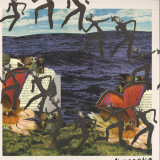
Mit seiner „Marcus King Band” hat sich der 27-jährige seit 2013 in der Musikwelt einen Namen gemacht. Sein Solo-Debüt „El Dorado” aus 2020 sicherte ihm eine Grammy-Nominierung in der Kategorie „Best Americana Album”. Auf seinem neuesten Werk präsentiert der US-Amerikaner erneut sein breites musikalisches Talent, von Jazz über Hip - Hop bis hin zu modernem Pop. Auf „Mood Swings” bleibt jedoch eine Konstante: Marcus’ soulige Stimme, die seine Gefühle authentisch ausdrückt. Das Album zeigt Marcus bekannterweise von seiner sehr persönlichen Seite und begleitet uns auf einer emotionalen Reise durch Zeiten der Trauer und Hoffnung. “I hope this album can act as a safety blanket, a rescue, or a refuge for anybody struggling with mental health, substance abuse, or relationship issues. That’s what it is for me“, sagt Marcus King über “Mood Swings”.
At the same time that Neville 'Bunny Wailer' Livingston recorded his debut solo long playing masterpiece, 'Blackheart Man', he was also creating a series of singles for his own Solomonic label. These records were every bit as good, at times even better, but they have never been released outside of Jamaica. Until now...,
It is next to impossible to ever overstate the importance of The Wailers to the history of Jamaican music and, as the last surviving member of the group, Bunny Wailer rightly regards himself as the sole keeper of their history ever mindful of the group's exalted position in the story of reggae music and the importance of their legacy. In 2010 Dub Store were proud to be able to work with Bunny on re-releasing a selection of his earliest recordings for the Solomonic label, lovingly restored and presented in reproduction sleeves and labels, on limited edition seven and twelve inch singles. Now, taking another step forward, we are more than proud to present Bunny's timeless music on two beautifully packaged CD's and double LP's. Bunny's first solo album, 'Blackheart Man' originally released in 1976 on his own Solomonic label in Jamaica and on Island in the UK, is one of the undisputed all time classics of Jamaican music and established Bunny Wailer as a highly respected, world renowned artist in his own right. During this period Bunny also produced a series of singles released in Jamaica and the UK in strictly limited quantities without the benefit of international distribution, that are every bit as good and, in some cases, even better than this awesome debut long player. Original copies have subsequently become highly prized, and highly priced, collector's items. "Classic rarities" is an overused and abused term too often employed to describe average records that failed to sell on their initial release but both 'Tread Along' and 'Rise & Shine' are packed from beginning to end with a searing selection of some of the greatest and hardest to find reggae records ever produced. 'Tread Along' opens, naturally enough, with 'Tread Along' from 1969, one of the last singles for The Wailers' own Wail N Soul M label, and runs through the first release on the Solomonic label, 'Searching For Love' also known as 'Search For I', 'Bide Up' released as 1974 drew to a close, a radical reworking of 'Pass It On' and a marked contrast to the version on The Wailers' 'Burnin'', album, 'Life Line' and the prophetic 'Arabs Oil Weapon' kept the pressure on as Bunny began outlining the flawless 'Blackheart Man' album. Each release was a certified classic in its own right. Peter Tosh's melodica version to Bunny's 'Amagideon' ('Armageddon'), the first track on 'Rise & Shine', is followed by 'Love Fire', an update of another Wail N Soul M track, 'Fire Fire'/'Babylon Burning', through to one of the deepest roots records ever created, 'Rise & Shine', on to 'Riding' from the 'Bunny Wailer Sings The Wailers' sessions (but not featured on the album) and a huge hit in the UK in 1981, and closing with 'Rule Dance Hall' from 1985. No idle boast..., The liner notes feature the story of The Wailers, as told to Dub Store by Bunny himself in Kingston in an enlightening 2012 interview, and rarely seen contemporary photographs complete these essential releases. The music of Bunny Wailer was not only a medium for change and protest but also to elucidate and educate and 'Tread Along' and 'Rise & Shine' finally complete the canon of un-compiled Wailers music. "I'm quite satisfied, you know, reggae music is the kind of music that although sometimes you would look at it and say..., boy, it's hard..., then again you look at what it has done for the people of the world you know that that couldn't be locked up in a little place like Jamaica!" Bunny Wailer
Dire Straits never made a big to-do about its final run. In classic understated British fashion, the band simply let its music speak for itself. And how. Originally released in September 1991, On Every Street became the group's swan song – a lasting testament to the influence, musicianship, and integrity of an ensemble whose merit has never been tainted by cash-grab reunions or farewell treks. It remains an essential part of the Dire Straits catalog and a blueprint of the distinctive U.K. roots rock the collective played for its 15-year career.
Sourced from the original master tapes, housed in gatefold packaging, and pressed at RTI, Mobile Fidelity's 180g 45RPM 2LP set of On Every Street presents the album like it has always been meant to be experienced: in reference-grade audiophile sound. Recorded at AIR Studios in London and produced by Dire Straits leader Mark Knopfler, it features all of the band's sonic hallmarks – wide instrumental separation, visceral textures, seemingly limitless air, broad soundstages, atmospherics that you can almost reach out and feel. Each element is made more vibrant, physical, and lifelike on this collectible reissue, which marks the first time this 60-minute work has been available at 45RPM speed.
Afforded generous groove space and black backgrounds, the songs from On Every Street burst with nuanced details and vibrant colors. Dire Straits' playing appears to float, their intricate performances organized amid hypnotic, fluid, three-dimensional arrangements. Mobile Fidelity's definitive-sounding set also brings into transparent view Knopfler's finely sculpted guitar lines, expressive tones, and laid-back vocals – as well as the balanced accompaniment from his band mates. Here's a record on which you can hear the full blossom and decay of individual notes, and imagine the size and shape of the studio. It is in every regard a demonstration disc. And it happens to be filled with timeless fare.
Remarkably, On Every Street almost never came to light. Dire Straits initially dissolved in September 1988 after touring behind its blockbuster Brothers in Arms and suffering the departure of two members. At the time, Knopfler professed his desire to work on solo material; bassist John Illsley also explored side projects. But Knopfler's decision in 1989 to form the country-leaning Notting Hillbillies reignited a spark to reconvene his primary band and craft a fresh batch of songs. Six years removed from Brothers in Arms, Knopfler, Illsley, keyboardist Alan Clark, and keyboardist Guy Fletcher teamed with A-list session pros – steel guitarist Paul Franklin, percussionist Danny Cummings, saxophonist Chris White, guitarist Phil Palmer included – to create what still stands as an unforgettable farewell.
The platinum record brings the band full circle in that it returns Dire Straits to a quartet formation; finds the group refreshingly out of step with the era's prevailing trends; and sees Knopfler and Co. knocking out song after song with the deceptive ease of a punter tossing back a pint at a pub. That subtle cool, clever poise, and innate control – signature traits that no other band ever matched – dominate On Every Street. Knopfler's clean, virtuosic six-string escapades unfurl with dizzying melodicism and economical efficiency. Led by his winding fills and focused solos, Dire Straits traverse a hybrid landscape of rock, jazz, country, boogie, blues, and pop strains with near-faultless prowess.
More than any other entry in the group's oeuvre, On Every Street welcomes quick detours down back alleys and into the depths of human souls. What makes it more brilliant is its staunch refusal to cater to commercial expectations or take advantage of prior successes; every passage feels true, every measure echoed in the service of song. It's evident in the humorous satire of "Heavy Fuel," closeted desperation of the witty "Calling Elvis," and shake-and-bake bounce of "The Bug." It pours from the album's darker corners, as on the high-and-lonesome melancholy of the title track and bruised emotionalism of "When It Comes to You."
Hinting at the open-minded approaches and boundless curiosity he'd embrace as a solo artist, Knopfler doesn't limit himself when it comes to style or subject matter. Look no further than "You and Your Friend," a shuffle whose all-inclusive lyrics encourage an array of interpretative meanings. Another of the album's deep cuts, "Iron Hand," comes on as one of the band's most memorable moments – the narrative addressing the abuses of power at the 1984 Battle of Orgreave during the U.K. miners' strike. Given cinematic heft by the expert production, the true-fiction account puts into perspective the richness, poetry, and depth of On Every Street.
"Every victory has a taste that's bittersweet," sings Knopfler on the title track. At least that bittersweetness seldom sounded so damn good on record.
Bay Area post-punk outfit Topographies deliver their sophomore LP, Interior Spring, via Dark Entries. Formed in 2018 in San Francisco by Justin Oronos, Jeremie Ruest, and Gray Tolhurst, Topographies link the icy riffs and gloomy atmosphere of early coldwave with the textural depth and warmth of classic shoegaze, emerging with a style that’s both contemporary and timeless.
On Interior Spring, Topographies explore themes of guilt, inherited trauma, and recovery. The meaning of its title is triplicate: a submerged river carrying hope, an anxiously wound clock, and a season where wildflowers bloom on the graves of the past. While the work of Tolhurst’s father - Laurence Tolhurst from The Cure - provides a clear influence, Topographies expertly channel acts like Asylum Party or The Chameleons on anthemic pearls like “Night Sea” and “Chain of Days”. Tolhurst’s lyrics draw on his own experience in recovery from substance abuse to examine the cycle of use and hopelessness that characterizes addiction. Through these ten songs, the group hopes to present the idea that freedom is not an escape but an embrace of the quotidian beauty of human life.
out of Stock
Last delivered 17 months ago available to reorder, subject to availability
The third album by RICO FRIEBE is a clearance, an outcry, an universe within itself, a hope and a message at once – sending out ANTHEMS FOR A LOST GENERATION!
After his preceding albums of intimacy WORD VALUE and FACES MEET, based on personal tragedies and the accompanying struggles, RICO FRIEBE has something to tell to a whole generation and delivers ten radiant and distinct top-notch productions that find a most modern and futuristic sound within different styles of pop music while his soft and emotive voice is hovering above all.
Originally, ANTHEMS FOR A LOST GENERATION has been recorded as an acoustic double-album, but RICO FRIEBE threw it all out, wrote new songs and found a truly more fitting sound after he realised that there could only be one musical outcome to tell these stories: Songs like BAD SEED, I LIKE MEMES, REDO, GAMES or LAZY, BORED AND SAD are milestones of capturing a complete zeitgeist and beyond. Each line within the lyrics is taken from close and personal experiences and interactions that made him undergo a whole spectrum of emotions, creating deep worries and sadness, but also a far hope.
Feel lost? Be found! With ANTHEMS OF A LOST GENERATION...
SOURCED FROM THE ORIGINAL MASTER TAPES: 2LP SET PRESENTS 1991 ALBUM IN 45RPM SPEED FOR FIRST TIME.
PCM Digital Master to Analog Console to Lathe.
Dire Straits never made a big to-do about its final run. In classic understated British fashion, the band simply let its music speak for itself. And how. Originally released in September 1991, On Every Street became the group’s swan song – a lasting testament to the influence, musicianship, and integrity of an ensemble whose merit has never been tainted by cash-grab reunions or farewell treks. It remains an essential part of the Dire Straits catalog and a blueprint of the distinctive U.K. roots rock the collective played for its 15-year career.
Sourced from the original master tapes, housed in gatefold packaging, and pressed at RTI, Mobile Fidelity’s 180g 45RPM 2LP set of On Every Street presents the album like it has always been meant to be experienced: in reference-grade audiophile sound. Recorded at AIR Studios in London and produced by Dire Straits leader Mark Knopfler, it features all of the band’s sonic hallmarks – wide instrumental separation, visceral textures, seemingly limitless air, broad soundstages, atmospherics that you can almost reach out and feel. Each element is made more vibrant, physical, and lifelike on this collectible reissue, which marks the first time this 60-minute work has been available at 45RPM speed.
Afforded generous groove space and black backgrounds, the songs from On Every Street burst with nuanced details and vibrant colors. Dire Straits’ playing appears to float, their intricate performances organized amid hypnotic, fluid, three-dimensional arrangements. Mobile Fidelity’s definitive-sounding set also brings into transparent view Knopfler’s finely sculpted guitar lines, expressive tones, and laid-back vocals – as well as the balanced accompaniment from his band mates. Here’s a record on which you can hear the full blossom and decay of individual notes, and imagine the size and shape of the studio. It is in every regard a demonstration disc. And it happens to be filled with timeless fare.
Remarkably, On Every Street almost never came to light. Dire Straits initially dissolved in September 1988 after touring behind its blockbuster Brothers in Arms and suffering the departure of two members. At the time, Knopfler professed his desire to work on solo material; bassist John Illsley also explored side projects. But Knopfler’s decision in 1989 to form the country-leaning Notting Hillbillies reignited a spark to reconvene his primary band and craft a fresh batch of songs. Six years removed from Brothers in Arms, Knopfler, Illsley, keyboardist Alan Clark, and keyboardist Guy Fletcher teamed with A-list session pros – steel guitarist Paul Franklin, percussionist Danny Cummings, saxophonist Chris White, guitarist Phil Palmer included – to create what still stands as an unforgettable farewell.
The platinum record brings the band full circle in that it returns Dire Straits to a quartet formation; finds the group refreshingly out of step with the era’s prevailing trends; and sees Knopfler and Co. knocking out song after song with the deceptive ease of a punter tossing back a pint at a pub. That subtle cool, clever poise, and innate control – signature traits that no other band ever matched – dominate On Every Street. Knopfler’s clean, virtuosic six-string escapades unfurl with dizzying melodicism and economical efficiency. Led by his winding fills and focused solos, Dire Straits traverse a hybrid landscape of rock, jazz, country, boogie, blues, and pop strains with near-faultless prowess.
More than any other entry in the group’s oeuvre, On Every Street welcomes quick detours down back alleys and into the depths of human souls. What makes it more brilliant is its staunch refusal to cater to commercial expectations or take advantage of prior successes; every passage feels true, every measure echoed in the service of song. It’s evident in the humorous satire of “Heavy Fuel,” closeted desperation of the witty “Calling Elvis,” and shake-and-bake bounce of “The Bug.” It pours from the album’s darker corners, as on the high-and-lonesome melancholy of the title track and bruised emotionalism of “When It Comes to You.”
Hinting at the open-minded approaches and boundless curiosity he’d embrace as a solo artist, Knopfler doesn’t limit himself when it comes to style or subject matter. Look no further than “You and Your Friend,” a shuffle whose all-inclusive lyrics encourage an array of interpretative meanings. Another of the album’s deep cuts, “Iron Hand,” comes on as one of the band’s most memorable moments – the narrative addressing the abuses of power at the 1984 Battle of Orgreave during the U.K. miners’ strike. Given cinematic heft by the expert production, the true-fiction account puts into perspective the richness, poetry, and depth of On Every Street.
“Every victory has a taste that’s bittersweet,” sings Knopfler on the title track. At least that bittersweetness seldom sounded so damn good on record.
Lady Wray released her Piece Of Me album. A deeply personal record that takes on the good and the bad in life from deception and abuse to the joys of motherhood and long awaited professional triumph. The accolades the album has received since its release speak volumes. From performing on The Stephen Colbert Show to selling out multiple US tours to cleaning up in the best of 2022 lists to crushing an NPR Tiny Desk on the 1 year anniversary of the album, Piece Of Me continues to prove itself a timeless classic. In March of 2023, Lady Wray had Ghostface Killah join her on the "Piece Of Me" remix and had Pete Rock lend his legendary remixing skills to "Joy & Pain". Now it's a Big Crown family affair as Les Imprimés lends his production prowess to a remix for "Come On In" and Surprise Chef take the warm weather anthem "Under The Sun" and give it their unorthodox Jazz / Funk treatment. Both of these remixes put brand new energy on the originals that will hold us over while Lady Wray is finishing her new album with El Michels Affair.
out of Stock
Last delivered 2 years ago available to reorder, subject to availability
Miyuki Omura's "Thats Me" EP is one serious piece of work!
A heavy dose of Industrial Hardcore Techno that sucks you in, chews you to bits, spits you out and leaves you craving for even more sonic abuse.
"That's me" is a 3 track EP filled to the rim with emotional distorted sound design heavily influenced by Miyuki's deep love for traditional Dutch industrial hardcore,
while also heavily flirting with schranz techno and UK infused breakbeat culture.
She perfectly blends the power of industrial hardcore with the grooves, textures, and functionality of "Techno" to her tracks.
"That's Me EP" by Tokyo based artist Miyuki Omura is sophisticated, diverse, creative.. But most importantly.. Hard As Nails!
An impressive PRSPCT debut by an impressive lady!
out of Stock
Last delivered 11 months ago available to reorder, subject to availability
Hard-hitting, outspoken West Coast metalcore trio MUGSHOT has announced plans to release a new EP, "Cold Will," on November 3rd with their new label Pure Noise Records. The furious 5-track, neck-snapping record is an uninhibited commentary on sociopolitical travesties infecting the country, set to the tone of merciless rage and crushing riffs. Commenting on the EP, the band says: "'Cold Will' is crafted by the pains of life: Abuse, depression, manipulation, trauma, and other existential themes that present themselves as the rudder that directionally steers this record’s “ship.” Lyrical themes are met by and married with the crushing weight of dissonant riffs and frenetic drum patterns that further push the listener into this mental space of this record’s daunting thoughts and overall aggression. The hardcore inspired metal record consists of a frenzy of chaotically heavy riffs, abrupt tempo changes, and pure unbridled anger that all coalesce into one definitive statement. This record serves as the callout to any abusive person that has manipulatively used their power or title to take advantage of another. And to the people who we’ve lost because of these types of actions – this record is dedicated to them. When one’s voice is lost due to the distortions of life – our responsibility should be to amplify their voice and bring awareness to it."
Stand by your friends that are hurting. That’s what New Jersey power punks Teenage Halloween do
through soaring arrangements of melodic angst, wracked vocals that insist “I love you so much I would
die for you”, and passion-packed two-minute dispatches tackling topics from gender euphoria, to state
abuses, and an eternal quest for mental wellbeing. The results are potent punk vistas that document
young queer life at the edge of America. In February 2023, the group headed into Headroom Studios
in Philadelphia, PA, under the guiding hand of producer Joe Reinhart (Hop Along, Beach Bunny,
Joyce Manor), and tracked the 13 dispatches on isolation, uncertainty, and hope for better days, that
make up Till You Return. This second full-length outing (due for Oct 20th release via Don Giovanni)
finds the band, which operated as a ‘rotating cast’ in it’s early years, now firmly entrenched as an
essential four-piece comprised of Henderiks alongside Eli Frank (guitar, vocals), Tricia Marshall
(bass, vocals) and Peter Gargano (drums). The quartet maintains the vital energy of their previous
incarnations but brings an even more focused punch to the arrangements that leaves greater room for
Henderiks’ lyrics. Fans of the band will also have noticed the creative assent of Marshall who takes
the vocal lead on multiple songs that have become defining features of the band’s recent live shows
and which bring a fresh new viewpoint to the band’s ongoing sonic mission for a more equal and just
world.
The dual forces of shadow and light, despair and hope, frustration and catharsis are at play in the music of Cupid & Psyche, the Los Angeles-based indie rock duo of Michael Vidal and Juan Velasquez. First gaining recognition in the late aughts as members of the punk band Abe Vigoda, whose 2010 album Crush was named one of the "Best 50 Albums of the 2010s" by Pitchfork, the two have reunited as collaborators for the first time in a decade. Cathartic jam sessions would birth the emotionally resonant songs that appear on their debut album, Romantic Music. Though they pull from a wide array of `80s and `90s influences, Cupid & Psyche bring together these disparate moods and genres through their own esoteric lens on Romantic Music_making for a singular sound that at once feels familiar and alluringly hypnotic. Listeners will detect the gloom of post-punk and goth, the haziness of dream-pop and shoegaze, the bittersweet guitar melodies of second-wave emo, and the manic electronic rhythms of trip-hop and big beat. The immersive soundscapes on Romantic Music are sometimes agitated and driving, while other times ethereal and transcendent. This duality matches the album's lyrics of looking for a divine escape from the grim realities of existence, as well as the darkest parts of one's psyche. "The thesis of the album is trying to transcend the limits of life and the struggle therein," Vidal says. "There's a lot of lyrics about feeling trapped or frustrated, and then trying to find a way out. There's a lot of times I sing of hope and grasping towards love. But maybe in trying to escape, you take the wrong door, be it substance abuse or other vices." Now as Cupid & Psyche, Vidal and Velasquez return to a friendship that creatively feels like home_except this time, with more experience, self-knowledge, and less pressure to make anything other than the music that emerges naturally. The LP's title Romantic Music is tongue-in-cheek, since there are no love songs proper on the project, and the phrase itself can imply a kind of light listening. But it befits that deep bond that the members have, as friends who understand and empathize with each other's worst, so they're capable of bringing out each other's best.
She Spread Sorrow is the work of Italian industrialist Alice Kundalini. In her sparse and grimly atmospheric applications of noise, tone, and electronic sequencing, She Spread Sorrow expresses a volatile emotional core that speaks to abuse and repression with an unblinking candidness.
Orchid Seeds was originally published as part of the instantly out of print On Corrosion - a 10 cassette anthology from 2019 that was housed in a handcrafted wooden box and featuring full albums from Kleistwahr, Neutral, Pinkcourtesyphone, Alice Kemp, She Spread Sorrow, G*Park, Relay For Death, Francisco Meirino, Fossil Aerosol Mining Project, and Himukalt. The collection also stood as the 50th release for The Helen Scarsdale Agency, an imprint founded in 2003 and dedicated to post-industrial research, recombinant noise, surrealist demolition, existential vacancy and then some.
Kundalini’s signature whispered vocals once again beckons her audience closer on Orchid Seeds. Kundalini states that the album, “is about 5 different women of my family. Each track is about one of them with their difficult story and strengths. My family is totally destroyed now, no relation between anyone, but in the past there was a strong tradition of women with interesting personalities.” This sibilant allegorical history comes into focus amidst a claustrophobic and cinematic pall of dark ambient blight and death industrial torpor.
Blue Dolphin was a wild, iridescent punk band from Austin, Texas circa 2016. Over the course of a year, they created a buzzing, liberatory sound, a dark blood mix of melodic ease and existential gloom. This pairing suggests monuments like ’Peace?’ or ‘Is This Real?’ but Blue Dolphin found this path all on their own, through trust and reliance, that practice space unity that the best bands build simply through the joy of playing with each other.
Emboldened by this connection, the band birthed memorably fractured, brisk music full of daring and revelation.
At times, the songs barrel along as if the band is struggling to keep their instruments under control, an unrestrainable, breathless frenzy of notes. Other times, they take on a pensive ache, a weighted despair. Every time they form a perfect skeleton for Sarah Sissy’s vocal shove. The songs will squall and sway, reach overload, rattle half to death, and yet the moment Sissy begins singing they snap into a focused beam, a bulldozing, clear-eyed force.
‘Robert’s Lafitte’ is a rush of darkness, resilience, mystery and bliss, exactly what you’d want from a record named after Texas’s oldest running gay bar, and a band maybe named after the indescribable freedom of ocean life or maybe named after a type of ecstasy.
The LP contains the entire recorded output of Blue Dolphin, including all three self-released tapes and four previously unheard songs.
Members of Blue Dolphin have played in other bands like C.C.T.V., Chalk, Mystic Inane, Chronophage and NOSFERATU.
For fans of Silver Abuse, Chalk, Twelve Cubic Feet, Chronophage, C.C.T.V., Mystic Inane.
"If you can imagine a love child between MAC DEMARCO and SPAR-KLEHORSE, then this would be what you're left with." - SO YOUNG MAGA-ZINE
Raised in North Queensland, Australia, Jarrod Mahon is not one to shy away from bold new endeavors. Once parting ways with his previous record label in 2019, Mahon chose to go fully independent, relocating to Berlin in 2019 (where he still resides), despite having no contacts at all in the country. What’s more, having recorded/performed under the pseudonym Emerson Snowe for over a decade - during which time he home-recorded five albums and 13 EP’s, toured with the likes of King Krule or Ariel Pink, played showcases SXSW and the Great Escape, the works - Mahon took that brave, most uncommercial decision to release under his own name and start almost totally anew.
“There was never really a concept to that name Emerson Snowe other than having some kind of separation from who I was as a person,” Mahon explains, “using a moniker gave me that confidence to push myself further mentally and to give myself some kind of a freedom”. And through the process of creating what would become his debut album, Mahon saw that he had outgrown the need for this protective persona. ‘Everything Has A Life’ was meant to be the debut Snowe album”, he admits, “but after I finished mixing it with Syd Kemp, co-producer I realized that I had actually grown a lot and was much more comfort-able with who I am and what my personal beliefs are.”
The choice of ‘Everything Has A Life’ as the album title, pulled from beauteous opening track ‘All I Know’, neatly summarizes this new outlook: moving on from ‘self-pity’ of the past-self by becoming present for the loved ones around you, improving understanding of one’s own self, via the wider world at large.
That track marks the first written during a lockdown stint in LA where Mahon wrote and recorded every day for 2 months, produced nigh on 250 demos and birthed the bulk of the record. It also brought Mahon back to his all-time favorite, Sufjan Stevens’ Ilinois and its blend of widescreen orchestral landscapes and more candid, naked acoustic-leaning variations - an important influence for the album's stylistic contrasts. Another key inspiration for the record too brought Mahon back to his roots - those full-bloom strains of his Mum’s Beloved Neil Diamond, an annual Christmas irritant to Mahon as a child, yet an artist he’s come to respect in adulthood. “Whatever the reason, with age I came to love the big show band sounds,” he says, “the idea of a performer on stage with a mas-sive orchestra with strings was amazing to me.”
With the help of producer Syd Kemp (Ulrika Spacek, Vanishing Twin), such grand designs could be met. - “When we first met, he asked me if I would like real strings on it. I said of course.” Enter Magda Mclean on violin (Caroline/the Umlauts), and Gamaliel Rendle Traynor on Cello (Sweat, Fat White Family), whose strings helped lift the record to romantic new heights.
He continues: “I said to Syd that the only thing I wanted to achieve with this rec-ord was that I wanted it to make me cry at one point. And we got there eventual-ly.” The final culmination of all these strands, ’Everything Has A Life’ is indeed a treasure trove of emotive riches. Locking into that bittersweet, quintessentially ‘pop’ combination of triumphant rhythms and confessional, stream-of-consciousness lyrics plucked straight from the heart, Mahon faces up to years of substance abuse with a series of gorgeous, blushing melodies: “I was using, I was drinking, I was lying to my friends, I was messing up again, I was hiding from myself”, he joyously chants on ‘The Growing’.
A banquet fit for an indie king, Everything Has A Life is loaded with psych-pop lusciousness (‘All I Know’) and anthemic glam fuzz (‘Death Of The Ladies Man’, ‘Deadstar’, or ‘Sonny is my Best Friend’); recalling that foundational Sufjan Ste-vens influence too with shambling flecks of country (‘Charly (Romantic Heart)’). There’s also those lo-fi crepitations of ‘My Man’ and ‘I can’t’ harking back home-recorded demos that lie at the core of Mahon’s creative process.
Raw Energy by JD Twitch showing Petersen's Trance (Not Trance) the way to the dancefloor.
Synths and sitars for eternal bliss on the flipside. Another pin glowing!
Back in 2017, Basso delved into his micro-press cassette collection to treat us to the first retrospective of kosmische wizard Trance. Spanning both the bucolic and galactic, ‚Tapes' (GBR010) suspended time and space, enveloping us in the nebulous beauty of Jürgen Petersen's misty ambience.
Among the appreciative audience for this mind expanding release was one JD Twitch aka Keith McIvor, one half of the mighty Optimo. Keith's vision of remixing Jurgen's ‚Purification' for the club was embraced by both the artist and the label guy with glowing eyes. Charting a course through progressive house, ambient techno and the weirder bits of the solar system, McIvor combines the celestial synthesis of the original with some tough and tracky drum programming, turning the intensity up to 11 in pursuit of early morning ascension. A sensitive arrangement allows space for Peterson's waveforms to work their magic, while laser fire and additional fx abuse unlock evolutionary abilities buried deep in your unconscious mind.
The previously unreleased, largely unheard ‚Contemplation' was originally intended to feature on the ‚Tapes' compilation, but fell off the edge of that flat Earth thanks to its maximal runtime. Too good to remain a secret, this crepuscular creation enjoys the entirety of the B-side, drifting through the eons via meditative electronics, delicate sitar and a touch of tapey flutter.
Embrace the almost 40 year old tape's flaws and imperfections that could not be restorated and dive into the immersive and unparalleled.
This is music for higher beings.
out of Stock
Last delivered 3 years ago available to reorder, subject to availability
First new recordings from GODFLESH since 2017's critically acclaimed full length 'POST SELF'.
'PURGE' musically, amongst the many layers of dirt, revisits and updates the concepts explored on the 'PURE' album from 1992; 90's hip hop grooves mangled and put through the GODFLESH filter to create something that is still unique and futuristic in style.
Both minimal and maximal, with layer upon layer of filth and heaviness, Godflesh deliver alien grooves that swing whilst also retaining the psychedelic / bad trip edge that Godflesh has always obsessed over. This is, and always has been, feel bad music; the title alone 'PURGE' references directly how songwriter / creator Justin K Broadrick utilises this music as temporary relief from his diagnosed autism and PTSD, a journey he has been on since he began creating music and feeling alone and as an outsider in any 'scene' or 'group' from childhood and throughout his adulthood.
Godflesh gives him the means to express a lifetime of feeling misunderstood and overwhelmed by hyper sensitivity, the band being the vehicle to give him some sense of catharsis and transcendence; a way of communicating overload and constant disenchantment at the human condition, and man's abuse of power and the systems that chain us.
The album references the cycle of horror that man has always and will always put us through; those in positions of power revel in the infliction of pain and horror upon individuals, in the name of their religion, their power, their money, their flags....
8 songs, delivered in a concise fashion for fellow outsiders.
Raised on Colombia's Caribbean coast and united by its capital, Bogota, Ghetto Kumbé combines the rich musical heritage of their home, to invoke the spirit of digital rumba in audiences all over the world. The secret behind their irresistible electronic ritual lies in their powerful percussion base; Caribbean house beats and traditional afro-Colombian rhythms inherited from West Africa. The album's co-producer, The Busy Twist, adds all the legacy of UK's Bass scene to the Afrofuturistic sounds of the 3 Colombians. Inspired by the different revolutionary movements emerging all over the world, Ghetto Kumbé will release their first full-length album in July 2020 on pioneering Latin Ameri-can electronic label ZZK. Their self-titled debut is visceral, committed, and rebellious, denouncing through frantic rhythms the inequalities and abuses imposed by corrupt governments, while simultaneously enticing listeners to join in the fight. Dance mingles with awareness to create a global community, where family, friends, and strangers come together through our shared love of music and activate change amongst themselves. Using musical motifs from Africa and Colombia's Caribbean coast such as the gaita, call-and-response vocals, and an array of hand drums and rhythms, coupled with the elegant electronic production of Tech/House, Ghetto Kumbé creates an Afro-futurist soundscape with lyrics to motivate, elevate, and inspire. Their first single to come out, `Vamo a Dale Duro', is a fluorescent criticism of the unjust divide between the poor and the rich, the rising prominence of dirty politicians, and the ethics of the capitalist sys-tem while encouraging people to stand up and fight for a dignified existence. The al-bum's tone fluctuates fluidly between tracks that include ancestral chants, voices both deep and resounding, and anthems to uplift and inspire, as well as features by up-and-coming Réunion island artist Melanie and the Palenque-based folk/hip-hop band Kombilesa Mi. In the Americas, Ghetto Kumbé has become one of the most important alternative groups to come out of Colombia. They've played Barranquilla's world famous Carnival, Bogotá's recent Boiler Room, and have even opened for Radiohead. The ancient yet modern sound of the three powerful musicians has made them a legitimate representative of the new Afrohouse scene burgeoning all over the world.
out of Stock
Last delivered 3 years ago available to reorder, subject to availability
From teddy grahams to pussy hats, California forest fires to cash cabs, the stuff of American nostalgia and horror adorns a personal reckoning on Christina Schneider’s triumphant third album as Locate S,1. With a name culled from a Daschel Hammitt noir novel, Wicked Jaw pulls from wildly disparate references and textures to survey the history of American pop music. Like Pat Benatar soundtracking an Adam Curtis documentary, the album trades in dramatic juxtapositions across its kaleidoscopic ten tracks. Only Schneider could pull off singing a line like “season finale 2020 death machine” as a soothing lullaby, but jarring contrasts echo the tumultuous personal journey woven throughout. “I was in hell ... and loving it,” Schneider said of her childhood, describing a murky cocktail of sentimentality and despair. “It’s like when you escape the matrix and then you remember your wonderful time in the matrix.” The Athens, Georgia based songwriter, producer, and virtuosic pop connoisseur authored the album over two years while beginning treatment for childhood sexual abuse by a relative. “I was using these songs as an expression valve for all of these
On January 28, 2022, Lady Wray released her Piece Of Me album. A deeply personal record that takes on the good and the bad in life from deception and abuse to the joys of motherhood and triumph. The accolades the album has received in the year it has been out speak volumes. Performing on The Stephen Colbert Show, selling out multiple US tours, cleaning up in the best of 2022 lists, and then crushing an NPR Tiny Desk on the 1 year anniversary of the album.
Piece Of Me continues to find its way to new ears and has already proved itself a timeless classic. So where do you go from here? When Ghostface Killah reaches out and says he wants to do a remix of the title track you do that. The A side, "Piece Of Me" (Remix) features Ironman himself who puts down a verse about a relationship that ran its course but no one is sure they did the right thing in. Ghostface sounds right at home over the gully Leon Michels produced track and takes the already rock solid tune to another level. Then what do you do for a B side.... You call The Chocolate Boy Wonder, Pete Rock and get him to remix "Joy & Pain". Pete takes one of the stand out tunes on the album and gives it an entirely different energy with thundering drums and a bassline that shake the windows in the car.
out of Stock
Last delivered 2 years ago available to reorder, subject to availability
One unrealesed long tune on A-side, with a Sample taken out from Cavage records... (everything happens...) And, B-side 2 repressed (and remastered) tunes from FKY, coming from the Electro Lab Factory albumm W33dbass. Enjoy !
out of Stock
Last delivered 3 years ago available to reorder, subject to availability
IFP represses... Mr Gruber minimals acid elements ... B side opens with THE track from IFP... Offfering a High freq abuse to turn minds into madness for a kick.... Diving break !! Last track is a slo a reverbless kick. Kind of a bloody dancefloor minimalistic ! Esta Loca !
out of Stock
Last delivered 3 years ago available to reorder, subject to availability
The afrobeat-inspired eight-piece drop their hotly-anticipated debut.
A horn-fuelled, soul-shaking introduction to the young collective.
Their first solo release after featuring on london jazz primer we out here.
Kokoroko are part of the thriving scene that's grown out of london's young, jazz-influenced musical circles. Led by bandleader Sheila Maurice-Grey, their self-titled ep is the group's first solo release, following their early 2018 debut with 'Abusey Junction', a track that has gone on to accrue over 15 million plays on youtube and 2.6 million on spotify. Across the E.P's four tracks, the eight-piece deliver on the promise of that memorable introduction, offering a bigger vision of their afrobeat-influenced, soulfully-imbued sound, west african roots shaded with inner London hues.
'Abusey Junction' was first featured on we out here, the 2018 Brownswood compilation documenting London's bright-burning, jazz-influenced musical underground, picked by Rough Trade as compilation of the year 2018, and praised by the Wire, Monocle and the New York Times. Writing and performing as a group since 2014, Kokoroko have played at iconic venues from ronnie scott's, performed at the festival, Afropunk, and toured in Brazil, Colombia and France. Inspired by Fela Kuti, Ebo Taylor, Tony Allen and the great sounds that come out of West Africa, Kokoroko put on a performance to honour the masters that taught them.
out of Stock
Last delivered 4 months ago available to reorder, subject to availability
Following on from the Bergisch-Brandenburgisches Quartett’s anarchic Live ’82 (BT095), Black Truffle continues its deep dive into the archives of legendary drummer/accordionist/photographer/composer/conceptual prankster Sven-Åke Johansson with Scheisse ’71. Recorded in November 1971 during the Berliner Jazztage at a heavy-hitting concert that also included the Spontaneous Music Ensemble and groups led by Peter Brötzmann, Manfred Schoof, and Masahiko Sato, Scheisse ’71 is the only document of a wild, otherwise unrecorded quintet featuring Johansson on drums, accordion and oboe d’amore, legendary free jazz vocalist Jeanne Lee, her husband Gunter Hampel on vibes, flute and bass clarinet, live electronics pioneer Michael Waisvisz on modified Putney (VCS 3) synthesizer, and the unknown Freddy Gosseye on electric bass. Part of a festival centred on giants of jazz like Duke Ellignton and Dizzy Gillespie, the radical performance shocked its audience, who can be heard heckling and yelling abuse at points, including the titular exclamation of ‘Scheiße!’ Clocking at just over half an hour and recorded in raw but detailed stereo by Johansson himself, the music burns with intensity while also making room for spacious passages and frequent dynamic movement. Beginning with Lee’s voice, Hampel on flute and Johansson on oboe d’amore in a bird-like game of call and response, the unexpected entry of Waisvisz’s tortured, squelching synth bursts prompts the first of many changes in energy and instrumentation, as Gosseye’s busy, roving bass enters and Johansson moves to the kit, his swinging cymbal work and juddering toms extending the approach of Sunny Murray or early Milford Graves. The presence of synthesizer, electric bass, and Lee’s highly amplified voice moves the quintet away from conventional free jazz textures, at times pushing into zones of abstract free sound reminiscent of what groups like MEV, AMM or Johansson’s MND were exploring in the same years. But the energy and joyful melodicism of the music keep it rooted in the tradition of American fire music and its European inheritors. Capable of changing gears in an instant from ferocious blow outs to fragile tapestries of chiming vibes and fizzing synth, the music finds space for Lee’s post-bop free scat (which integrates shrieks and howls just as a post-Ayler saxophonist might), Gosseye’s virtuosic bass runs (a rare attempt to apply the classic free jazz style of players like Alan Silva or Henry Grimes to the electric instrument), Johansson’s folkish accordion interjections, and even a sustained passage of unison bass clarinet and electric bass riffing in its second half. Special mention should be made of Waisvisz’s Putney performance, one of the earliest documents of this under-recorded instrument inventor and player, here playing a major role in giving the music its wildly exploratory, primordial air, his buzzing glissandi and bubbling filter sweeps at times howling like a distressed monkey. Arriving in an austerely stylish sleeve with beautiful black and white photographs by Johansson, Scheisse ’71 is an essential recording that adds yet another layer to our appreciation of this golden era of radical free music.
out of Stock
Last delivered 3 years ago available to reorder, subject to availability
`Oh Me Oh My' is both elegant and ferocious. It is stirring in one moment and a balm the next. It details histories both global and personal. Lonnie Holley's harrowing youth and young manhood in the Jim Crow South are well-told at this point _ his sale into a different home as a child for just a bottle of whiskey; his abuse at the infamous Mount Meigs correctional facility for boys; the destruction of his art environment by the Birmingham airport expansion. But Holley's music is less a performance of pain endured and more a display of perseverance, of relentless hope. Intricately and lovingly produced by LA's Jacknife Lee (The Cure, REM, Modest Mouse), there is both kinetic, shortwave funk that call to mind Brian Eno's `My Life in the Bush of Ghosts' and the deep space satellite sounds of Eno's ambient works. But it's a tremendous achievement in sonics all its own. It's also an achievement in the refinement of Holley's impressionistic, stream-of-consciousness lyrics. On the title track which deals with mutual human understanding", Holley is able to make a profound point as ever in far fewer phrases: "The deeper we go, the more chances there are, for us to understand the oh-me's and understand the oh-my's." Illustrious collaborators like Michael Stipe, Sharon Van Etten, Moor Mother and Justin Vernon of Bon Iver serve as not only as choirs of angels and co-pilots to give Lonnie's message flight but as proof of Lonnie Holley as a galvanizing, iconoclastic force across the music community.
out of Stock
Last delivered 3 years ago available to reorder, subject to availability
Though she had been performing professionally since the late 1920s, as a teenager in Harlem, during its Renaissance, the immortal Billie Holiday didn't play a single night on the European continent until 1954. It was in that year that the great journalist and musician Leonard Feather, and a Swedish promoter organized the Jazz Club U.S.A. tour, named after Feather's wildly popular radio program. Featuring Red Norvo, Sonny Clark, and more, the centerpiece of Jazz Club U.S.A. was, undoubtedly, Lady Day. Recorded at various dates across the tour, Lady Love shows Holiday still had it, despite the turmoil, and drug and alcohol abuse, her voice remained strong, a stunning document of one of America's greatest treasures on her first ever tour of Europe.
On Giver Taker, the gorgeous debut album by Anjimile, death and life are always entwined, wrapping around each other in a dance of reverence, reciprocity, and, ultimately, rebirth. Giver Taker is confident, intentional and introspective. Anjimile Chithambo (they/them, he/him) wrote much of the album while in treatment for drug and alcohol abuse, as well as while in the process of living more fully as a nonbinary trans person. Loss hovers over the album, whose songs grieve for lost friends ("Giver Taker") and family members ("1978") along with lost selves ("Maker," "Baby No More," "In Your Eyes.") But here, grief yields an opening: a chance for new growth. Each song on the album is its own micro-journey, adding up to a transformative epic cycle created in collaboration with bandmate Justine Bowe of Photocomfort and New-York based artist/producer Gabe Goodman. "1978" and "Maker" both begin as Sufjan Stevens-esque pastoral ballads with Chithambo's mesmerizing voice foregrounded against minimal instrumentation and swell into the realm of the majestic through the addition of warm, steady instrumentation (informed by the mix of 80's pop and African music Chithambo's Malawi-born parents played around the house) and harmonies by Bowe. "In Your Eyes" starts out hushed and builds to a crescendo via a mighty chorus inspired by none other than the Lion King. The allusion is fitting: each song encapsulates a heroic voyage, walked alone until accompanied by kindred souls. The choirs present throughout are equally deliberate. Chithambo grew up as a choir boy himself, and several songs (notably "Maker") grasp not only towards reconciliation between his trans identity and his parents' strong religious beliefs, but towards reclaiming his trans identity as an essential part of his own spirituality.
Damage and Their Slices” is a collaborative album NVST and Theo Muller, in which they invite the listeners to a deep dive into an esoteric universe where dark magic meets political revolt.
The Swiss artist NVST shouts, preaches, stirs up and questions the consciences of his audience with a deluge of words about this sick society, the capitalist infection and the abuse of power. In tune with this mantra of georgeorwellian rhetoric, the music by Frenchman Théo Muller turns the malaise of the content into form: paranormal psychedelia, arcane dub, industrial ectoplasms, esoteric ambient and paranormal drones. In short: a friction of electronic sounds that Kraftwerk, years ago, unwittingly defined as metal on metal. Live, this call to action to necromancy and revolution takes on an amphibious, organic, almost cathartic and revealing form.
out of Stock
Last delivered 3 years ago available to reorder, subject to availability
Pyramid Of Knowledge fires up the jets again for the Seoul-based producer's second interstellar adventure on Dream Ticket. Almost 30 years on from the precise, angular breaks and acid of UR's Electronic Warfare and the components of those potent battle weapons remain in full service, here honed by POK's controlled studio hand and ready to dash full-pelt against the enemy. Whose side are you on?
out of Stock
Last delivered 10 months ago available to reorder, subject to availability
`Oh Me Oh My' is both elegant and ferocious. It is stirring in one moment and a balm the next. It details histories both global and personal. Lonnie Holley's harrowing youth and young manhood in the Jim Crow South are well-told at this point _ his sale into a different home as a child for just a bottle of whiskey; his abuse at the infamous Mount Meigs correctional facility for boys; the destruction of his art environment by the Birmingham airport expansion. But Holley's music is less a performance of pain endured and more a display of perseverance, of relentless hope. Intricately and lovingly produced by LA's Jacknife Lee (The Cure, REM, Modest Mouse), there is both kinetic, shortwave funk that call to mind Brian Eno's `My Life in the Bush of Ghosts' and the deep space satellite sounds of Eno's ambient works. But it's a tremendous achievement in sonics all its own. It's also an achievement in the refinement of Holley's impressionistic, stream-of-consciousness lyrics. On the title track which deals with mutual human understanding", Holley is able to make a profound point as ever in far fewer phrases: "The deeper we go, the more chances there are, for us to understand the oh-me's and understand the oh-my's." Illustrious collaborators like Michael Stipe, Sharon Van Etten, Moor Mother and Justin Vernon of Bon Iver serve as not only as choirs of angels and co-pilots to give Lonnie's message flight but as proof of Lonnie Holley as a galvanizing, iconoclastic force across the music community.
The name of the 8-track project is Simple, which refers to a neighborhood called “Simple City” in southeast Washington, D.C.. According to the rapper, the area got its namesake as a result of the senseless violence that occurs there.
“There’s a neighborhood in my city called ‘Simple City,’” IDK said in a statement. “It gets its name because you can get killed for any simple reason. Simple City is also the birthplace of Marvin Gaye. I wanted to tell the story of Simple City in a way that it’s never been told before. From drug abuse to crime and murder, I wanted to cover what it feels like to be from Simple City and teach the world that the fix to helping disadvantaged black communities isn’t as simple as you think.”
Strut revives a lost recording from the archives in January with a 2002 collaboration between acclaimed South African folk singer Vusi Mahlasela, singer songwriter Norman Zulu and Swedish jazz / soul collective Jive Connection. Sotho folk singer Vusi Mahlasela, dubbed "The Voice" Of South Africa, performed at Mandela"s inauguration in 1994 and has enjoyed his own long relationship with Sweden, regularly embarking on cultural exchanges and forging a strong bond with the Jive Connection band, featuring guitarist / bassist Stefan Bergman and Little Dragon drummer Erik Bodin within its line-up. Although touring regularly, the collaboration has rarely been documented beyond a lone studio album in 1994. This "lost" recording, discovered in the archives of producer Torsten Larsson, also features songwriter / vocalist Norman Zulu and showcases their natural musical chemistry together. Vusi"s songs have traditionally addressed the struggle for freedom and the need for reconciliation and, here, his lyrics are as powerful as ever, ranging from parables ("Prodigal Son") to an unflinching lament on child abuse ("Faceless People"). Jive Connection vary the soundtrack, bringing in hints of reggae, jazz and post-punk alongside traditional township arrangements.
Philly’s own Chained Bliss set tongues a-waggin’ back in 2019 with their Stained Red cassette EP, gathering more than a few comparisons to the Wipers’ early racket in the process. Well, now they’re back with a debut album that seems to have skipped right ahead from Is This Real? to Over The Edge: this self-titled LP has all the gut-punching ramalama, knockabout guts’n’glory of that first tape, with added layers. Melodic guitar lines come perilously close to jangling over crunching power chords, while furiously yelped choruses give way to sumptuously put-together breakdown sections that catch you off guard and kick you in the shins before legging it down the street. Chained Bliss clearly love scrappy, skatey garage rock (echoes of Agent Orange’s Living In Darkness abound) as much as they love pushing that raucous clatter into something spacious - the meditative sections that flow effortlessly into absolute ripper Pillars Of Abuse are as unexpected as the thoughtful but head-spinningly energetic sections that bring Creative Seizure so thrillingly to life. Other times they’re just as happy to keep you careening towards the pit with two-minute bangers, but that’s the beauty of this record: it’s never smarter than when it’s playing dumb, and the rest of the time it’s just pretty damn smart. Here’s a challenge: can you listen to Ominous Life’s gnarly pop without raising those fists of yours skywards and landing a firm thump on the air? Or Drifter’s swaggering stomp? Or, or, or… ahhh hell, you get what I’m saying here. Every single cut slays, every single hook snags itself on your brain. You’ll come back for more, and more, and more. Are Chained Bliss your new favourite band? Well, gee, we’ve never met and I don’t know what you like and it’s not for me to say… but on the other hand, yes. Yes, they are. They’re heading straight for your heart and they ain’t budging. Will Fitzpatrick
140g LP, High UV Gloss Gatefold Jacket and 60cm double-sided fold-out poster.. it's a big release! TIP!
Raised across multiple cities, Amaarae’s music reflects a life split between New Jersey, Atlanta and Accra. As indebted to raw Southern rap as it is dancehall, her work also holds echoes of glossy mall rock and bubblegum pop. Embraced and endorsed by the Nigerian Alté scene as it was exploding into action several years ago, THE ANGEL YOU DON’T KNOW is an exuberant opening statement from Amaarae, anchoring her sound in her heritage and myriad influences, channelled through female empowerment. Whilst working on the record, Amaarae’s
reference points ranged from Paul Wall to Meat Puppets, reflected in the kaleidoscopic vision of the album, effortlessly jumping from the country trap of FANCY to an Afro-house comedown in 3AM. The vinyl release of TAYDK is packaged in a UV gloss gatefold sleeve with double- sided poster insert. It features an exclusive remix of FANCY, featuring London rap royalty Bree Runway.
Press:
"The future of Afro-pop” New Yorker “An instant classic” The Guardian
“One of the most compelling new acts on any continent” Pitchfork
out of Stock
Last delivered 8 months ago available to reorder, subject to availability
Judas Triste is a metatechno band based in Porto, created by David Machado, Dora Vieira and Nuno Oliveira to announce a new era of darkness to planet Earth. Born in the shadows of Favela Discos, this prophetic trio of alchemist-musicians transfigures electricity operating an ensemble of electronic appliances and objects mechanically abused. Between explosive discharges of distortion and mysterious atmospheres, the ruthless art of Judas Triste is harsh, perverse and heavily based on improvisation.
After their debut self-titled album released in 2018, Antropomância is their second Sacrificial editorial release, an ancient lost rite of divination through human entrails. This was materialized in a 7’’ Vinyl through a Blood Pact between the record labels Love And Hate and Favela Discos.
Antropomância encapsulates two Bestial musical profanations named "Antropomância" and "Corpo Aberto", written and produced during Seven sessions of musical experimentation and technical violation. The cover was psychographed by the painter João Alves, and the Abject contains in its inside a 16 pages facsimile of Book of the Open Body.
Wu Tang & Staten Island MC/Producer come together again in new vinyl release Wutang x Remedy. Remedy is a MC/producer from Staten Island, New York who first made his mark with the song "Never Again" off the Wu-Tang Killa Beez' debut album The Swarm in the summer of '98. He eventually made his full-length debut The Genuine Article in the spring of '01 & followed it up with Code Red about 2« years later. The last we heard from him on his own was when It All Comes Down to This was released in 2010. But as the 12-year anniversary of that approaches in a few weeks, he's enlisting a star studded cast of veterans to be featured on his 4th album. Ghostface Killah tags along for the opener "Modern Day Miracle" working in an occultist loop to verbally abuse anyone who wants to challenge them whereas "Death Defying" with Inspectah Deck finds the 2 over an operatic instrumental talking about choosing whether to kill or be killed. "Sparrow" takes a more soulful route feeling comparing himself to the titular bird leading into Ghostface returning alongside Conway the Machine for "The Pulpit" incorporating some orchestral samples talking about the street life.The penultimate track "Noir Story" is a full-on Killah Priest solo cut with a drumless instrumental & his lyricism on here is a reminder as to why he's this reviewer's 2nd favorite affiliate right behind Killa Sin in terms of lyrical skill, the previous cuts. "Never Again" then ends the album by mournfully paying tribute to those we've lost along the way.If you're a diehard Wu fan like I am, then you're gonna come away from this highly impressed. It's great to hear Remedy completely rejuvenated & he does an awesome job of paying homage to my all-time favorite hip hop group from the guests to the production.
out of Stock
Last delivered 3 years ago available to reorder, subject to availability
Originally released in 2014, “Instruction Booklet N. 1232” marks the first cassette release on Dauw for Tatersall under his The Humble Bee moniker. Taking advantage of the format, each side on “Instruction Booklet N. 1232” is reserved for a single piece nearing the 20-minute mark.
“Exploding View” (aka Side A) swells into existence with a very grand sounding synth-driven melody. Of course the other thing that’s present is the decaying sound of the tape loop that’s working to bring that music to life. At first, the melody grows and grows, fairly undisturbed, but eventually the sound of so-much tape warble threatens the rising nature of the piece until it sounds as though it is one loop away from total decay and simply fluttering out of existence.
But of course that’s the point. There’s a tension between that grand melody that opens these moments and that warble. It’s a lesson in opposites: the mechanics of a tape loop, guaranteed to break down, placed in contrast with those signature Tatersall melodies, which somehow seem eternal. And just as that tension seems too much to bear — the melody dies to be replaced by something altogether new. What comes next is something much quieter, driven by a sub-aquatic bassline, some rhythmic tape hiss and some gentle piano.
It’s a very dramatic and sudden break. The technical elements of that could be attributed to Tattersall’s understanding of how far a melody can be pushed before it succumbs to the abuse of being processed out of existence — perhaps the tape had been looped and processed to its breaking point. Regardless of whether it was a technical or artistic choice, that hard break serves an important narrative function. Frequently in instrumental music, musicians play with opposites (quiet-loud, clean-distorted) to create a narrative to their work since they don’t have words/lyrics as a tool. In the case of The Humble Bee’s use of tape loops, one set of opposites in tension is always driven by the fragility of the melodies and the limitations of a machine guaranteed to inevitably decay the media it is designed to support. And where one thrives, the other takes a backseat. As side A winds down, the melodies are much more sparse — appropriate for en ending, yes; but it also gives more space for those hisses and crackles to claim their moment.
Side B is filled out by “Manual with Foot Pedal” and it begins as gently as its predecessor ended. Slowly eking outing it existence – it’s as if watching Tatersall set the board, showing his players on opposite sides of the table before really setting them in motion to do their thing. By the piece’s midpoint, melody has taken centre stage as a glitchy, piano-led rhythm marches its way forward, clearly carving out its space and claiming its territory. And almost immediately following that: the decay takes over again and those tape loops seem processed to near death — the melody almost barely decipherable as it flutters under the weight of the history of being looped/played ad nauseum. And in the very final moments, the melodies are sparse again, giving the tape hiss room to play its part — it’s as if Tatersall is giving both players enough space to take their final bows.
Three-time Grammy nominees, the San Antonio, Texas-based quartet NOTHING MORE return with their highly awaited seventh album, 'SPIRITS'. It features thirteen focused, adventurous and intense songs, uniting introspective philosophical lyrics with unapologetically massive anthems, including the in-your-face 'TURN IT UP LIKE (Stand In The Fire)', their most recent Top 10 Billboard Active Rock radio single 'TIRED OF WINNING'. Since emerging in 2003, NOTHING MORE has made rock radio chart history with no. 1 singles for both 'This is the Time (Ballast)' and 'Go To War', while they also have seven Active Rock Radio Top 10 singles in their repertoire. 'SPIRITS' further proves their expertise in the rock genre and beyond. It documents the tumultuous time the world experienced over the past two years capturing the desperation and isolation of lockdown, the spiral of substance abuse, the pain of broken relationships and survival in self-reliance while summarizing the overall story and mission of NOTHING MORE: Reflect, Provoke, Inspire.
Mondo, in conjunction with Troll Court / WaterTower Music, is proud to present the premiere vinyl pressing of the latest mix-tape masterpiece curated by writer/director James Gunn ... the soundtrack for his superhero action-adventure film THE SUICIDE SQUAD
Felix Laband’s The Soft White Hand is the masterwork of an artist who expresses himself through musical and artistic collage acting together to reinterpret his sources and to express significant elements of his own personal story.
Released by Munich-based Compost Records, the 14-track album is Laband’s first full-length offering since the critically acclaimed Deaf Safari in 2015. It is heralded by the single “Derek and Me”, and is being pressed on vinyl for distribution globally.
In The Soft White Hand Laband works with source materials that will be familiar to those who know his previous four records – Thin Shoes in June (2001), 4/4 Down the Stairs (2002), Dark Days Exit (2005) and especially Deaf Safari which reached deep into the South Africa scene and its political culture to inspire its vocal and music sampling. However, the disengagement he felt from his homeland during his latest album’s creation – an abiding sense of untethered-ness to place and space, exquisitely rendered in tracks like “Death of a Migrant” – is perceptible in Laband’s desire to illuminate instead aspects of his own life.
“For this album, my source material became almost autobiographical as opposed to African statements I’ve worked with previously,” says the artist. “I have sampled a lot from documentaries from the 80s crack epidemic in impoverished African American communities and believe my work speaks unapologetically for the lost and marginalised, for those who are the forgotten casualties of the war on drugs. In the past, I have had my issues with substance abuse, and I know first-hand about the nightmares and fears, what it feels like to be isolated and abandoned.”
Few artists have managed to air these intimate aspects of their life so luminously as Laband does in tracks like “5 Seconds Ago”, “They Call Me Shorty” and in the strange and meditative “Dreams of Loneliness”. “I’ve been building this weird, autobiographical story using other people talking. It’s kind of humorous but it is also sad and beautiful,” says Laband.
Yet, as in all of Laband’s recorded output, the delineations between emotions are never starkly drawn and The Soft White Hand is also shot through with beauty. Nature appears in recordings made in his garden in the intimate early morning hours, whether as in the calls of the Hadada Ibis and other birdsong in “Prelude” or of the vertical-tail-cocking bird in “Derek and Me”. The last is a wonderful track with Derek Gripper, the South African experimental classical guitarist of international renown, whose 2020 song “Fanta and Felix” imagines a meeting between Fanta Sacko and Laband.
Laband’s eloquence in reinterpreting classical composers such as Beethoven in “We Know Major Tom’s a Junkie” is another thrilling aspect of the new record. “I’ve been properly exploring classical music on this album,” explains Laband, “taking melodies from classical compositions and reinterpreting them”. A fresh quality comes to his work through this sonic adventuring: the tender manipulation of the mundaneness of the computer’s AI voice to reimagine and reinvent iconic lyrics and melodies in strange and unexpected configurations.
The Soft White Hand is Laband’s most cohesive body of work to date. Yet it remains, in its sheer artistic scope, impossible to describe fully. Darkness abuts the gossamer light. A song that summons the sunrise and all the hope of a new day could also be about the final dipping down of the sun that portends a troubled night ahead. Interludes are invitations to expand outwards or shift inwards. Mistakes and “weird fuckups” in the sound are cherished as convincing statements against what Laband calls the “grossness” of perfect sound in modern music.
For this world-leading electronic artist, the boundaries are unfixed. He is inspired by the German Dada artist, Hannah Höch, who memorably declared: “I wish to blur the firm boundaries which we self-certain people tend to delineate around all we can achieve.” His music consequently reflects a primal artistic impulse that is also visible in Laband’s considerable visual art output as seen recently in several solo exhibitions such as that held in the No End Gallery in Johannesburg in 2019 and in the works he produced during his 2018 Nirox Foundation Artists Residency. “My music is always about collage, as is my art,’’ he affirms. “Everything I do is collage. It is a medium I find very interesting because you are taking history and distorting it and changing its meaning and turning it upside down and back to front.” In her book Recollections of My Non-Existence, Rebecca Solnit calls collage “literally a border art”; it is “an art of what happens when two things confront each other or spill onto each other”.
With The Soft White Hand, Laband is confirming his singular ability to achieve this in both art and music, melting the divisions between the two creative disciplines until they become one. He is also affirming his belief that an album of music should be more than a collection of unrelated tracks, but should unfold a fully integrated, cohesive story as in the song cycles of the great classical composers. In doing so, he claims his position as one of the most significant artists working today.
Artist Statement – Felix Laband – August 2022
When the Khmer Rouge took their captives for processing, they identified their class enemies by looking at their hands. If they were sunburned, rough and calloused, they were those of a peasant, a proletarian to be spared. But if they were soft and white, then they were those of a city-dweller, an intellectual or bourgeois, an adversary to be liquidated.
In calling this album The Soft White Hand, I was reflecting on the Cambodian genocide and how it resonates in contemporary South Africa. The apartheid era is over, and gone with it is white political domination. Yet economic and social privilege is still held in soft white hands. But those who grasp it know just how tenuous is their hold, how it singles them out, and my music reflects their subconscious fears, the stress and guilt of clinging on to what others envy and desire.
The soft white hand of the title suggests to me a further image, one that relates to all of postcolonial Africa. In my mind’s eye, I see the soft, duplicitous handshake of the smooth representatives of the superpowers making deals and promising gifts that benefit only them, and not their African dupes.
Yet, soaring above the wailing of sirens sampled from the first day of the invasion of Ukraine, my music is also about love gained and passion lost. It is about the tender caress of a soft white hand that conducts you into a place of dreams to be enfolded by nocturnal melodies.
out of Stock
Last delivered 3 years ago available to reorder, subject to availability