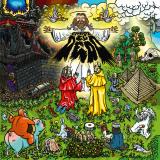
For the 23rd entry in our ICONYC catalogue, we welcome rising Swedish star Fahlberg and his collaborative single with German maestro Paul Brenning, ‘Show Me’. Amped by reworks and edits by Hunter/Game, BAILE, and KEVSKI, our latest delivery is a monumental EP that is bound to awe and inspire in equal measure.
Hinting at something emotionally gripping from the onset, the original version of ‘Show Me’ unfurls over a tight frame as a synthetic bed surges to the front before Fahlberg deploys a thundering bassline. Slowly, we start to sway, making our way to a break in the cloud while Brenning’s ever-alluring vocals glide over the piece in a spectral presence, immersing us deeper into the narrative, as crisp arpeggios make their way through brass swells and backing chords. Blissful, yet exciting at every turn, ‘Show Me’ is a dazzling collaboration that invites us to revel in the possibility of a new, warmer dawn.
Taking ‘Show Me’ in a slightly darker direction, Hunter/Game presents us with their own interpretation, an introspective juggernaut that is constantly evolving as it walks the tightrope between light and shadows like only this acclaimed duo can.
Adding a new layer of depth to this package, BAILE gifts us a wondrous remix that fragments ‘Show Me’ in a different light. Employing broken beats and lush, evocative moments, this softer twist is a mesmerizing creation bound to wash the pain away.
Completing this aural gem that is ‘Show Me’, avant-garde electronic-classical duo KEVSKI unveils an exquisite masterpiece, deconstructing the original skyscraper into a sublime menagerie of textures and melodic flourishes that blossom somewhere between melancholy and hope.
Поиск:broke
Все
- 1: Notax - Broken Brain
- 2: Cyberpunkers - Leaper
- 3: Malke & Mr Madness - Djenty
- 4: Chrs - Ly1.2
- 5: Perimix - Deep Breath
- 6: Pisapia- Scream
- 7: Satronica & Narc - Battle Stations
- 8: A-Kriv & Wzx_O - Drugs In The Club
- 9: Mozzy Rekorder & Purple Mash - Alizee
- 10: Lazy Ants - Low Drive
- 11: Cobra Cane - Speedway Tripper
- 12: Xhl Unit & Virus Voice - Reality
Wasteland is a record that is unafraid to plunge into the darkness of the modern world and embrace the weirder, edgier and more unnerving moments that come from doing so. It is an album that captures all the enormity of life from the micro to the macro, zooming in on the personal as well reflecting on broader societal issues.
“Wasteland is about the idea of a place once known or familiar that is now broken down and unrecognisable,” says Ghedi. “It’s about exploring the process of watching someone’s surroundings and environment collapse.” And within that you have a lot going on. “It also explores death, personal loss, grief, mental health and how the natural world provides solace and meaning for that loss and how these worlds blur into one another.”
Ghedi has always been an artist that in many ways perfectly encompasses folk music in its purest form but he is also someone that frequently pushes the boundaries of that label and no more so is that apparent than on this record. As like previous albums, such as 2018’s A Hymn for Ancient Land and 2021’s In the Furrows of Common Place, Ghedi uses traditional folk songs as a means to explore contemporary issues via modern and experimentally-leaning music. “With the traditional material on this album I wanted to find songs with content that resonated with me,” says Ghedi. “But also that were based roughly around the north of England.” This is a central underlying theme to the album for Ghedi. The feelings of loss, erosion, and degradation are often most pronounced in working class communities and this was something he wanted to weave in. “It was important to voice and choose material that represented or expressed issues that correlated with things going on around me.”
However, as remarkable as some of the traditional material is, some of the most arresting work on the album is Ghedi’s entirely original compositions. Lead single ‘Wasteland’ is a stunning piece of work that while rooted in an environment being corrupted and broken – “there’s violence on these hills” Ghedi sorrowfully sings, before claiming this is no longer somewhere that can be called home – it is also a stirringly beautiful composition that soars and glides as it opens up, as sweeping strings swoop and in and out of Ghedi’s twangy electric guitar.
The decision to incorporate more fuller sounds, such as electric guitar and huge drums, results in a notable shift and evolution in tone for Ghedi. “The lyrical content needed something more band-driven and loud to deliver them,” he explains. “Incorporating the electric guitar in my songwriting was also a big part of opening the sound up, using drop tunings pushed me to use my voice in a wider range, which forced me to use falsetto a lot which I haven’t previously done before. That then opened the sound up and gave me creative ideas for bigger arrangements and to sonically really push things.”
What Ghedi has done in creating his masterpiece is construct a remarkable space where deeply intimate and personal feelings coexist with reflections on environment, place and society, while also interweaving historical context via traditional songs. Wasteland is as much of a world to explore and exist in as much as it is an album, with Ghedi carving out his distinctly unique sonic language and voice to explore that singular environment.
Wasteland is a record that is unafraid to plunge into the darkness of the modern world and embrace the weirder, edgier and more unnerving moments that come from doing so. It is an album that captures all the enormity of life from the micro to the macro, zooming in on the personal as well reflecting on broader societal issues.
“Wasteland is about the idea of a place once known or familiar that is now broken down and unrecognisable,” says Ghedi. “It’s about exploring the process of watching someone’s surroundings and environment collapse.” And within that you have a lot going on. “It also explores death, personal loss, grief, mental health and how the natural world provides solace and meaning for that loss and how these worlds blur into one another.”
Ghedi has always been an artist that in many ways perfectly encompasses folk music in its purest form but he is also someone that frequently pushes the boundaries of that label and no more so is that apparent than on this record. As like previous albums, such as 2018’s A Hymn for Ancient Land and 2021’s In the Furrows of Common Place, Ghedi uses traditional folk songs as a means to explore contemporary issues via modern and experimentally-leaning music. “With the traditional material on this album I wanted to find songs with content that resonated with me,” says Ghedi. “But also that were based roughly around the north of England.” This is a central underlying theme to the album for Ghedi. The feelings of loss, erosion, and degradation are often most pronounced in working class communities and this was something he wanted to weave in. “It was important to voice and choose material that represented or expressed issues that correlated with things going on around me.”
However, as remarkable as some of the traditional material is, some of the most arresting work on the album is Ghedi’s entirely original compositions. Lead single ‘Wasteland’ is a stunning piece of work that while rooted in an environment being corrupted and broken – “there’s violence on these hills” Ghedi sorrowfully sings, before claiming this is no longer somewhere that can be called home – it is also a stirringly beautiful composition that soars and glides as it opens up, as sweeping strings swoop and in and out of Ghedi’s twangy electric guitar.
The decision to incorporate more fuller sounds, such as electric guitar and huge drums, results in a notable shift and evolution in tone for Ghedi. “The lyrical content needed something more band-driven and loud to deliver them,” he explains. “Incorporating the electric guitar in my songwriting was also a big part of opening the sound up, using drop tunings pushed me to use my voice in a wider range, which forced me to use falsetto a lot which I haven’t previously done before. That then opened the sound up and gave me creative ideas for bigger arrangements and to sonically really push things.”
What Ghedi has done in creating his masterpiece is construct a remarkable space where deeply intimate and personal feelings coexist with reflections on environment, place and society, while also interweaving historical context via traditional songs. Wasteland is as much of a world to explore and exist in as much as it is an album, with Ghedi carving out his distinctly unique sonic language and voice to explore that singular environment.
- A1: Bluebell
- A2: Japan Greatly (Feat. Reek0 And S.i)
- A3: Turn Me On
- A4: Dinero (Feat. P Wavey)
- A5: Down 4 (Feat. Osquello)
- A6: Strike A Pose (Feat. Camille Munn)
- B1: Longest Road (Feat. Pk)
- B2: Komodo
- B3: Somebody Jump (Feat. Reek0)
- B4: Wonderluv
- B5: Tek Control (Feat. Liam Bailey)
- B6: Guiding Star (Feat. Reek0)
East London producer and DJ IZCO announces his debut solo studio album ‘POWERSCROFT’, set for release on 1st May via Brownswood Recordings. The album’s first single, ‘Strike a Pose’ featuring the vocals of Camille Munn offers an early glimpse into the project. To celebrate the release, he will go on a run of UK dates from March to May, culminating at London’s Jazz Cafe.
Named after the road where he grew up, ‘POWERSCROFT’ marks a defining new chapter for an artist who has spent the past decade shaping the sound of UK dance music. Drawing from jungle, broken beat, grime, garage, soul and dub, the album channels the energy of the dancefloor while remaining deeply rooted in memory, instinct and identity. It captures what it feels like to be inside IZCO’s world, where thoughts, memories and influences collide.
Hailing from East London, IZCO is a producer and DJ spearheading a new generation that is bringing soul back to the dancefloor. Shaped by the rich musical heritage of his hometown, he has developed a sound that feels familiar yet forward-looking, diverse yet distinctly his own. That sound has taken him across the globe, from New York to Tokyo, alongside standout sets at We Out Here, Outlook and Glastonbury.
IZCO began his journey making grime beats for local rappers including Capo Lee, Novelist and Reek0, before becoming a key figure in the UK’s evolving garage and dance music landscape. In 2018, he launched his long-running Rinse FM show and released his debut EP Tek 5, earning early underground acclaim. His production credits include PinkPantheress’ breakout track ‘Passion’, created alongside Jkarri, as well as collaborations and remixes for artists such as Katy B and Greentea Peng.
Beyond his solo work, IZCO is a label head, promoter and co-founder of the Brighter Days Family, a collective built on community, craft and cooperation. With ‘POWERSCROFT’, he steps fully into the spotlight, presenting his most personal and fully realised body of work to date. “This album is about channeling my true musical personality and character,” he says. “I’m marking a new chapter by paying tribute to my foundations.”
A rising artist of the French electronic scene, Naajet asserts her identity with The Night Starts Now, a four-track EP that celebrates the freedom and intensity of the night. Co-founder of the Bande de Filles collective and known for her explosive universe blending House, Hardgroove and Breaks, as well as for the unique energy inherited from her dance background, Naajet delivers here a sonic manifesto conceived as an ode to club culture and to the present moment.
“I imagined this EP as an anthem to the world of the night. The night offers us unparalleled freedom, an outlet that allows us to be ourselves, to create, to love. The Night Starts Now captures this celebration of the present moment and this declaration of independence.” Naajet Opening the EP, “Ready To Shine” unfolds radiant House nourished by Pop and 90’s sounds. With a clear and ascending rhythm, the track combines euphoria and introspection. “I composed this track as a joyful and introspective journey that prepares us to embrace the night. For me, it is a call to accept our wounds, to transform them into light and strength, so that we may shine brighter when we enter the club,” explains Naajet. Between ethereal vocal lines and shimmering pads, the track acts as a ritual of entering the night, inviting us to turn wounds into strength and to shine on the dancefloor. The second track of the EP, “Sugar”, embodies the effervescence of the club. Carried by a hypnotic voice and an effervescent rhythm, the track celebrates the communion of bodies and the liberating energy of dance. “It is an ode to dance and to bodies coming together. This track speaks of those moments when, on the dancefloor, boundaries fall: we sweat together, we free ourselves together, and energy flows from one body to another,” says Naajet. A true concentrate of intensity, “Sugar” captures the moment when sweat, rhythm and abandon merge into a collective movement towards freedom.
With “I Can Be Anything”, Naajet changes register and flirts with deeper, even techno textures. Built on a throbbing pulse and sharp synths, this track is meant as a manifesto of identity. “I really wanted to propose a track that claims our right to free and plural expression and sexuality. I Can Be Anything is about our multiple identities, our ability to reinvent ourselves and to refuse any form of formatting,” she says. Between club intensity and political resonance, “I Can Be Anything” questions our multiple facets and embodies the assertion of an elusive and free self. Closing the EP on an euphoric note, “May It Never End” stands out with its broken rhythms and powerful synths. The track conveys the transcendent energy of the end of the night, when dawn arrives but we refuse to leave the collective trance. “I wanted to put into music this feeling of infinite energy, when time is suspended and the party seems to never have to stop. It is this euphoric vertigo that connects us all in the same breath, this utopia of a night that would never end,” says Naajet. A true apotheosis, this track embodies the utopia of an eternal night.
DJ, producer and co-founder of the Bande de Filles collective, Naajet has established herself with a singular universe where House, Hardgroove and Breaks blend, nourished by her background as a dancer and an instinctive sense of groove. For the past three years, she has performed on French and European stages – from Berlin to Amsterdam, via Geneva and Oslo – and has made her mark in clubs such as Rex Club, Le Sucre and Badaboum, as well as festivals like Nuits Sonores and Kolorz. On the production side, she has released several acclaimed EPs on renowned labels such as Shall Not Fade and Monki & Friends. In 2025, she takes a new step with the launch of her label SWEAT Records and a residency at Le Sacré in Paris, affirming her role as an ambassador of a free and intense club culture. She also collaborates with the waacking company MADOKI, for which she composes and mixes projects at the crossroads of dance and music. With The Night Starts Now, Naajet confirms her status as an essential artist of the new electronic generation1
Welcoming prolific and essential Mexican artist Andy Martin to Animalia, with his mesmerising, mind-bending musical interpretation of the Nahual, a common & integral figure of the belief systems of ancient Indigenous peoples of the Americas, which embodies the spiritual connection between humans & animals. In some traditional stories, this connection is so strong that they are said to transform into one of them. Tierra de Nahuales refers to a region of ancient America inhabited by these mythological beings, which in this EP become part of the Animalia universe, shaped by psychedelic broken rhythms, tribal sounds, and dub influences. A release that feels both deeply personal to Andy's musical & cultural identity as well as the label's own - a telling ode to the abilities of the depth & outer worldly sense to his music - a world-building, shapeshifting & one of a kind artist who feels truly at home in the Animalia family.
Tomos is no stranger to reinvention. Over the years, his sonic explorations have spanned genres, yet one thread has remained constant—his deep-rooted connection to house music. His earliest co-releases under the alias Vanguard were high-energy French House cuts, built on the foundations of crate-digging and sample collage, channeling the spirit of Daft Punk and the wider French electronic movement.
Now, 15 years later, he returns to those techniques with a fresh perspective, releasing his latest EP Soul Feels Good through the esteemed Noire & Blanche.
Soul Feels Good isn’t just a nod to the past—it’s a showcase of the vast influences that drive his ever-evolving sound. Tomos weaves together an intricate patchwork, merging the meticulous sampling techniques of his early career with a broader, more mature musical palette. The result? A genre-fluid blend of Jazz, House, Dub, Soul, Gospel, Broken Beat, Downtempo and Disco—stitched together with the finesse of an artist who has spent years honing his skills.
For listeners who appreciate the craft of sampling and fans of genre-defying, groove-driven music - Soul Feels Good is a record that demands attention.
Black Vinyl[26,85 €]
Broken Social Scene have announced the May 8 release of their new album Remember the Humans via City Slang/Arts & Crafts
Features Contributions From Feist, Lisa Lobsinger, Hannah Georgas & more
Ltd Cream White Vinyl[27,94 €]
Broken Social Scene have announced the May 8 release of their new album Remember the Humans via City Slang/Arts & Crafts
Features Contributions From Feist, Lisa Lobsinger, Hannah Georgas & more
- A1: Schmetterlinge Im Bauch (Mary Olivetti Remix) (5:52)
- A2: Children Of Zu Zu (Moodorama Remix) (4:08)
- A3: Zu Zu Music (Charles Petersohn Mystery Mix) (6:34)
- B1: Myth Versus Reality (Als420 Remix) (6:06)
- B2: Myth Versus Reality (Viktor Marek Remix - Extended Version) (6:06)
- B3: Myth Versus Reality (Greater Manchester Housing Authority A Spiritual Space Rework) (3:29)
Das Remix Paket für Charles Petersohn’s Children Of Zu Zu EP glänzt durch seine Vielfalt zwischen jazzy Broken Beats und Afro/Deep House, mit Re-Works von Mary Olivetti, Moodorama, als420, Viktor Marek, The Greater Manchester Housing Authority und Charles Petersohn selbst.
“Der gemeinsame Wunsch, dass die Tracks der EP an die Idee anknüpfen sollen, dass ein Remix ein eigenes Kunstwerk sein kann, ist voll aufgegangen. Alle Mixe haben eine persönliche Handschrift, nutzen die Originals als Material, mit dem nach Herzenslust gespielt wurde. Ich bin sehr glücklich!” Charles Petersohn
Format: Vinyl 12“ Full Cover mit schwarzer Innenhülle und rundem Sticker
- 1: Time Waster
- 2: Wired
- 3: Deadweight
- 4: Broken By Design
- 5: Pick Up The Pieces
- 6: Embrace
- 7: Sever
- 8: The Way I Feel
- 9: Satisfy
- 10: Head Alight
- 11: Longshot
- 12: Summer's End
"Wired" ist ein harter Neustart für Basement. Es markiert das erste Album der britischen Band seit acht Jahren, eine Wiedervereinigung mit ihrem ursprünglichen Label Run For Cover Records und eine Rückkehr zu jener ungebändigten Leidenschaft und kreativen Intuition, die schon immer ihr bestes Material ausgezeichnet hat. Seit ihrer Gründung im Jahr 2009 besteht Basement aus denselben fünf Freunden - Sänger Andrew Fisher, den Gitarristen Alex Henery und Ronan Crix, Bassist Duncan Stewart und Schlagzeuger James Fisher - und derselben alchemischen Verbundenheit. Das Einzige, was sich in den letzten Jahren verändert hat, ist ihr erneuertes Gefühl von Zielstrebigkeit. Und das macht ihr neues Album deutlich hörbar. "Wired" ist das dynamischste, mutigste und inspirierteste Werk, das Basement je geschaffen haben, und bewahrt zugleich die zeitlosen Grundlagen ihres einzigartigen Sounds: grollende Gitarren, mitreißende Refrains und eindringliche emotionale Sprache. Basement sind zurück und laufen auf allen Zylindern, aber sie haben kein Interesse daran, alte Erfolge zu wiederholen. Die gesamte Band war entschlossen, dass "Wired" ihr bisher klarstes künstlerisches Statement werden musste. Der Titelsong ist das drängendste Stück ihrer Karriere - ein sicherer Live-Favorit, getragen von stechenden Gitarren, einem wuchtigen Schlagzeug und einem himmelhohen Hook, bei dem Fishers Stimme in Bestform ist. "Broken By Design" zeigt den gegenteiligen Charakter: düster, zart, bassgeführt, aber dennoch typisch Basement in seiner sofortigen Eingängigkeit und stimmungsvollen Atmosphäre. Nichts auf Wired klingt stagnierend, kein Teil wirkt unausgereift. Die Band ließ sich von einer Vielzahl abenteuerlustiger Vorbilder inspirieren (R.E.M., Interpol, Smashing Pumpkins, um nur einige zu nennen), ohne jemals wie eine dieser Bands zu klingen - und auch nicht wie eine Kopie ihrer selbst. Der Albumtitel fasst all das in einem einzigen Wort zusammen. Die texturalen Konnotationen von "Wired" - metallisch, scharf, zackig - spiegeln die stählernen Klangwelten des Albums wider. Auf konzeptioneller Ebene spricht der Titel für die unerschütterliche Zähigkeit der Band: eine analoge Band, die in einer immer digitaleren Welt erfolgreich bleibt, ohne sich auf nostalgische Bequemlichkeit zu verlassen. Fünf Freunde, die mehrere Trennungen und Neuanfänge überstanden haben und dabei als Menschen und musikalische Einheit gewachsen sind. Basement müssen ihr Schicksal akzeptieren: Sie sind einfach dafür gemacht.
Continuing Blueprint's 30th anniversary celebrations, James Ruskin welcomes the return of Oliver Ho, whose relationship with the label is deep-rooted.
Oliver Ho has spent the last 30 years devoting his life to creating some of the most intense and compelling electronic music out there. Debuting his signature raw sound in 1996 on Blueprint Records, he cemented himself in the underground of the '90s UK techno scene. With a plethora of aliases, he has navigated his way through many different genres. From the frenetic tribal sounds of his own Meta imprint, the off the wall house music made as Birdland and Raudive, the grinding industrial of Broken English Club and the heavily textured ambient of his Slow White Fall and Zov Zov projects. While pushing and pulling at the fringes of electronic music, at the very centre has always been the beating heart of hypnotic techno, an art form that is both brutal and bewitching; techno as ritual magic. Oliver's live shows and DJ sets showcase this expression of music as shamanic experience, metallic and relentless, pure and direct.
An integral figure in shaping Blueprint's early sound, Oliver Ho returned in 2016 for their 20th anniversary with the "Burning Heretics EP", which was followed by a remastered reissue of 1999's "Awakening The Sentient". So it's fitting that he's now back for this latest milestone with a new EP, "Our Secret Religion" dropping in May.
Art Bound launches its label with Ghost Signal Theory, a split EP by Brazilian producer Artürst and Georgian producer Toke, exploring a dark, progressive and electro-oriented sound where each track develops its own atmosphere while contributing to the overall flow and cohesion of the project.
Side A features Artürst with two tracks blending progressive grooves with layered textures and subtle acid-infused elements, delivering a hypnotic drive built for peak-time sets.
Side B is a three-tracker exploring Toke’s take on the Tbilisi underground, moving through high-energy electro and trance-infused passages, before closing with a deeper broken rhythm that shifts the pace and brings the journey into a more contemplative space, offering a final moment of suspension.
Prolific beat pharmacist par excellence Brendon Moeller continues his hot streak with a return to Samurai to serve up the exquisite craftsmanship of Shadow Language. Across 15 fresh productions the seasoned house and techno producer demonstrates yet more variations on his rejuvenated sound since pivoting towards 160 tempo zones. Heavyweight dub techno pulses collide with D&B pressure and dubstep snarl, delivered with devastating restraint and mediative warmth.
Moeller's dub-informed, high-grade production hit a hot streak as he started to experiment with faster tempos and more broken rhythms, reaching into thrilling new sound fields where fast-slow rhythmic intrigue meets with spatial subtlety and constantly evolving synth voices. The past year has seen him release a swathe of albums, from Further on Samurai to outings on Constellation Tatsu, ESP Institute and Quiet Details that all burst with inspiration, each distinct from the last and offering an original perspective on this rich seam of crossover electronics.
Shadow Language shows Moeller burrowing even deeper into this new era of his work, continuing the hypnotic approach set out on Further while edging more forthright ingredients into the mix. From the outset 'Division By Zero' hits with immediacy even as it dips into a dubwise breakdown, with snatches of vocal and even the iconic loom bird making the slightest of appearances. 'Feral Hymn' finds a curious kind of uplift in the synth chord that twists in and out of the mental techno murmurations of the rhythm section. 'Impermanence' has some snarling bass that belongs in the gnarliest tech-step, while the nagging hats ticking through 'Junkyard Syntax' hint at a shockout without resorting to brute force. The majestic dub techno chords of 'Driftform' create a through-line across Moeller's extensive catalogue, but here they dominate the mix above a spongy bed of sub bass throb and framed by the tiniest slithers of percussion.
Throughout the album, it's the implications Moeller suggests with the tools at his disposal that create a powerful energy. Restraint governs the delivery, guiding the listener in deeper until they find a maximal experience from each elegantly understated roller. The weight and presence is abundant across every track, fuelled by the invigorating power of each tone and frequency while avoiding the clutter of overloaded arrangements.
Finding the notes in between and half-hidden rhythms, Moeller himself perfectly summed up his latest opus as he continues to develop his own compelling Shadow Language.
HAVEN are back with their vinyl operation with a fresh plate of grubby Techno heat from Irish heavyweights Faetch & Sunil Sharpe on the Grotteca EP. Featuring 4 original rippers and a remix from Italian legend DJ Plant Texture of upfront club pressure, the NZ-based label are proud to transmit some of the finest in creeping electronics from across the globe.
The A-side kicks off with 'Bleed In' with its tough drum-work and hypnotising atmospheres eventually descending in to an all-out stomp with one of the filthiest synth-lines in the label's history hitting half-way through. This is followed up with 'Test Breaks' - a broken-beat slammer with a ton of gritty synth design and rear-shaking rhythms. The first side is closed with DJ Plant Texture's remix of 'Bleed In', where driving 909 hits combine with the original synth line for a club-ready weapon ready to get those feet moving.
On the B-side 'Vapornation' keeps the energy rolling with its rolling congas, heavy kick, and eerie atmospheres tailor-made for a concrete basement. Finally, 'Shinplant' closes the record with full-steam-ahead drums and squalid synth rhythms to end yet another plate of dance-floor ammunition from the HAVEN camp.
Thessaloniki is a hotbed of electronic talent. Tendts are testament to this. The triumvirate of brothers Christos and Fotis Papadakis, joined by guitarist Elias Smilios, have carved out a truly unique sound. Blending disdainful punk with synth‑pop sheen, the group arrive at the Bordello with Ghost Boys. Cymbals crash in the title piece, a lone key circling percussive precipitation before rich guitar strings bring balance and ballast. The song, an emotion‑stripped story of missed opportunities and narrowing prospects, is sensitive and sharp; an emblazoned anthem to the lost and forgotten. Distilled down to a powerful essence, the radio version focuses on the throaty message, meandering synth melody, and smoky strings.
Lauer steps in for remix duties, dipping the original into a blue acid‑electro syrup before it re‑emerges as a fresh‑faced reimagining, its chorus lanced with vocoders while a minimal melody simmers beneath Chicago‑style knob twists. Taking another direction, Boys’ Shorts melt broken‑beat revelry into their countrymen’s original. Smilios’ guitar riff becomes a central column around which samples spin and house warmth emanates. Sheer quality from needle drop.
Neue Grafik has steadily built a strong reputation in recent years with releases on esteemed labels such as Rhythm Section, 22a, CoOp Presents, and Wolf Music. His sound is a distinctive fusion of jazz, house, and hip hop, infused with his African heritage, Parisian background, and a deep appreciation for London genres like broken beat and grime.
Neue Grafik first made a lasting impression on the community at Total Refreshment Centre (TRC)—the heart of London’s thriving jazz scene—during a spontaneous after-hours jam. Since then, there has been collaborations with notable artists including Nubya Garcia, Emma-Jean Thackray, Brother Portrait, Lord Apex and Allysha Joy.
The new album, ”Rachael”, is set for release on January 30th 2026. It stands as Neue Grafik's most ambitious project to date. Developed over the past year, the album explores themes inspired by the character of Rachael from the movie Blade Runner, representing the journey of love in all means, intimate, raw, tough, organic and honest offering a rich, emotional journey that balances lightness with depth—an introspective dive into the artist's evolving musical identity.
- A1: Ros Serey Sothea - Jam 10 Kai Thiet (Wait 10 More Months)
- A2: Yol Aularong - Yuvajon Kouge Jet (Broken Hearted Man)
- A3: Pan Ron - Why Follow Me Wav
- A4: Tet Somnang & Meas Samon - Khnyom Jah Karake
- A5: Houy Meas & Dara Chom Chan - Nek Na Min Rom (Who Isn't Dancing)
- A6: Choun Malai - Jomreang Oun Chreang
- B1: Sinn Sisamouth - Navy A Go Go
- B2: Liev Tuk - Rom Sue Sue (Dance Soul Soul)
- B3: Thra Kha Band - Do You No Wrong Again
- B4: Yol Aularong & Liev Tuk - Sou Slarp Kroam Kombut Srey (Rather Die Under The Woman's Sword)
- B5: Eng Nary - I Wonder. B6- Baksey Cham Krong + Mol Kamach De Quoi Pleures - Tu
Repress!
Before the Khmer Rouge took power in 1975, unleashing a horrifying genocide, Cambodia had one of the most vibrant and exciting music scenes in Asia. With a mixture of traditional Khmer music and a myriad of western genres (from French and latin music, to rock-and-roll , rhythm-and-blues, surf, psychedelia, soul and many more) the few pre 75 Cambodian recordings that survived -most of them were destroyed- are enough to make anyone with a taste for good music shocked by the amazing quality of the sounds created during those golden years. Gathered in this amazing album are some of the most talented and unique musicians from that amazing era with an explosive collection of tracks sure to blow the mind of the listener. A celebration of some of the best music ever made.
Federsen’s Alt/Dub imprint returns with its second instalment of its Artist Series featuring Forward Memory, Thomas + James, Gradient and Beppu.
Federsen, known for his deep Dub Techno sound, launched his label Alt Dub in 2024. The imprint focuses on warm and spacious dub aesthetics, carrying the torch for Dub Techno’s origins. Since its debut release in early 2024, Alt Dub has expanded with collaborations and artist series featuring names like cv313 and Fletcher, establishing itself as a forward- thinking force in modern Dub Techno.
Forward Memory’s ‘Scholz’s Star’ leads the release, laying down organic percussion and twitchy, oscillating synth grooves alongside, subtly evolving textural components and evolving bottom end swells.
Glaswegian duo Thomas + James follow next with ‘Chosen Colour’, a deep immersive journey fuelled by billowing ethereal pads, bumpy bass stabs and a raw, reduced rhythm section.
Respected Dub Techno artist Gradient follows next on the flip side with ‘Vibes Realm’, delivering his signature floaty style via shimmering dub stabs, crisp drums and a swaying bottom end drive.
Beppu’s ‘Conversions’ then concludes the EP, shifting gears once again as spiralling dub echoes, hissy atmospherics and wide bass intertwines with delayed, broken rhythms.
Be As One boss Shlomi Aber returns to Chris Liebing's CLR with the 'Schema' EP, arriving 24th April 2026 alongside a remix from James Ruskin. Active since 1994, Aber has been a cornerstone of underground techno for over three decades, with his focused, hypnotic approach in both the studio and DJ booth leading to releases on some of the scene's most respected labels, including Cocoon, Ovum, Nonplus, and Figure. With the 'Schema' EP, he follows his recent 'Retrospective' EP for Ben Klock's Klockworks, as well as previous CLR outings such as the 'Limelight' EP (2025), and the 'Remote 101' EP (2023), which both kept a spot in the Beatport Techno chart for over two years after release, while winning support from the likes of Carl Cox, Alienata, Dave Clarke, and many more.
Shlomi Aber's 'Schema' EP opens with the title track and heads straight into subterranean territory, pairing weighty low-end pressure with tightly controlled tension. Rattling bass foundations are o?set by sharp hi-hats and static-laced textures that flicker through the mix, keeping the groove locked and the atmosphere charged.
On remix duties, James Ruskin, founder of the seminal Blueprint, delivers a shadowy, atmospheric rework. Eerie pads hang in the background as swampy bass anchors the rhythm, with haunted melodic elements slowly unfolding to create a deep, immersive take built for late hours and dark rooms.
Closing track 'Gasolina' sees Aber shifting into broken-beat territory, where warm, glitchy rhythms loop with hypnotic precision. Ghostly synth motifs drift in and out of focus, giving the track a cinematic, heady quality that rounds out the release with understated intensity.
Founded by influential techno lynchpin Chris Liebing in 1999 and reemerging in 2021 after a five-year hiatus, Create Learn Repeat (CLR) has hosted a range of artists like Dubfire, Flug, Bjarki, DJ Dextro, and more while also focusing on developing newer acts in the scene, such as Risa Taniguchi, The Southern, and Klint.
- 01: My Brain Is Broke
- 02: I Just Can&Apos;T Get It Up
- 03: Manopause
- 04: Dental Breakdown
- 05: I Got Hacked
- 06: Colonoscopy
- 07: Back Ache
- 08: Taking Out The Trash
- 09: I Can&Apos;T Remember My Password
- 10: Dirty Clothes
Shawn Lee, the Silver Fox, did it again! He managed to persuade David Fostex to reord a follow up to his intriguing 2023 offering "Dark Yacht" with an even more cutting-edge venture into the world of sinister, mysterious world of the super yacht sounds and releases "Dark Yacht 2" including 10 new, original compositions written during a frosty, starry night somewhere near Marina Del Ray.
"As I find myself entering into the new era of my personal musical odyssey, I reflect back to a simpler time -a kinder, more gentle world where people listened without hearing," says David Fostex. "An artistic genius such as myself could easily live a life of excess and luxury without even breaking a sweat. I now find myself slaving away in a hot cramped home studio perspiring profusely over childlike chord structures and rudimentary themes. However, I am still reaching for musical greatness and to be perfectly honest, I am creating sonic masterpieces beyond the shackles of my so-called peers- if you can even call them that. My work speaks for itself and I speak for myself. So it is with great pride that I present to you ,Dark Yacht 2', an intimate journey into the mystical world of DAVID Jeremiah FOSTEX the living legend and purveyor of all things good and true. You will laugh-you will cry… Find a friend or a loved one… hold them close and listen to the splendour of what no doubt will be considered to be one the greatest albums of all time. You're welcome".
Visionary producer Ibrahim Alfa Jr, who's been traversing the rave's farthest fringes since the late '90s, returns with his most focused and concise set to date, an anthology of undulating, bass-heavy experiments that surveys techno and its distorted history, printing fractured pulses and cybernetic synths over vanishing snapshots of jazz, funk, trip-hop, broken beat, dub and ambient music. It's a body of work that coalesced during a difficult time for Alfa.
After returning to Brighton and sobriety in 2022, he was diagnosed with a pulmonary embolism, subsequently suffering two debilitating heart attacks. With his immune system compromised, isolation was the only option, so for months on end Alfa devoted each waking hour to his art, recording samples, building digital synths and effects and meticulously sequencing some of his waviest, most experimental material to date. Over this period he finished over 500 tracks, writing impulsively and constantly challenging himself. "There was nothing to hold me back," he explains. "I just had music, I didn't know if I would see the next day."
Now recovered from his ordeal, Alfa looks back at this prolific period with optimism and fondness. It was a chance for him to reconnect with his art holistically, writing purely for himself without any outside influence. Because, at this stage in his life, Alfa has already been through a series of artistic evolutions. When he was still just a teenager, he penned a slew of grinding, jacking techno 12"s (under a variety of mysterious monikers) in the late '90s before re-emerging a decade ago with the acclaimed 'Hidden By The Leaves', an album made up of deeply personal archival tracks that were thought to have been lost. A few years later, Alfa returned wholeheartedly with a series of records for Mille Plateaux that redrew the boundaries of his "Black political music without words." And on 'Infinite Black Inside', those different strands are muddled with Alfa's profound life experiences and he expresses himself free of any self-imposed boundaries, writing quickly on a hybrid analog-digital setup to document as many ideas as possible.
There's a palpable sense of liberation that drives the album's opening track, 'Subutrax', lubricating polyrhythms that isolate the connective tissue between footwork and Detroit techno as they slip between looped electric piano vamps and vaporous synths. On 'Naked Lunchbreak' meanwhile, the beat generation's excesses are illustrated by mesmeric fast-paced acoustic drums that Alfa balances out with brassy drones and euphoric keys. He captures rubbery hits from a Ghanaian djembe on 'Drum Slinger', re-sequencing them into seismic waves that rumble underneath live woodwind blasts. And on 'Capture', decelerated breaks and garbled voices tumble into humid pads, suspending the album somewhere between the chill-out room and the night sky. It's a record of new beginnings and fresh narratives that collapses the hardcore continuum, revealing a sonic signature that's Alfa's alone.
Consistent funk operator Ralo is back with a brace of tunes that will shake your bones loose. First up is 'Broken Way', a magnificently jumbled rhythm made from languid bass and kicks, peppered with organic percussion and heated through with soft synths. It's atmospheric and real, like the overheard soundtrack to a party happening in your kitchen. 'Djembe' then brings out some brassy horns to take things to the next level. They jump out of the low-slung drums and add jazz, soul and colour that cannot be ignored. Gledd and Monsieur Van Pratt step up on the flip with cultured reworks that turn things up to 11.
- A1: Orchestral Intro (Feat. Sinfonia Viva)
- A2: Welcome To The World Of The Plastic Beach (Feat. Snoop Dogg And Hypnotic Brass Ensemble)
- A3: White Flag (Feat. Bashy, Kano And The National Orchestra For Arabic Music)
- A4: Rhinestone Eyes
- B1: Stylo (Album Version) (Feat. Mos Def And Bobby Womack)
- B2: Superfast Jellyfish (Feat. De La Soul And Gruff Rhys)
- B3: Empire Ants (Feat. Little Dragon)
- B4: Glitter Freeze (Feat. Mark E Smith)
- C1: Some Kind Of Nature (Feat. Lou Reed)
- C2: On Melancholy Hill
- C3: Broken
- C4: Sweepstakes (Feat. Mos Def And Hypnotic Brass Ensemble)
- D1: Plastic Beach (Feat. Mick Jones And Paul Simonon)
- D2: To Binge (Feat. Little Dragon)
- D3: Cloud Of Unknowing (Feat. Bobby Womack And Sinfonia Viva)
- D4: Pirate Jet
What can be said about Joey Beltram’s ‘Energy Flash’ that hasn’t be said already! The track still gets rinsed, week in, week out, across radio stations, clubs and festivals, testimony to the sheer importance of this techno classic.
Released originally in 1990 on the R&S Records label, ‘Beltram Vol. 1’ included the aforementioned ‘Energy Flash’, alongside three equally ground-breaking dance tracks that possibly get overshadowed by the big lead track. But tracks like ‘Subsonic Bass’ broke the mould and went on to influence a raft of rave and drum ‘n’ bass tunes, thanks in part to its use of the now legendary ‘hoover’ bass sound. The sinister acid of ‘Jazz 3033’ still sounds as fresh today as it did 33 years ago, and the menacingly titled ‘Psycho Bass’ reveals the EP’s most passive moment, as its solid breakbeat cuts through ethereal tones and chugging synths.
‘Beltram Volume 1’ has been remastered by Beau Thomas at Ten Eight Seven Mastering, and the release comes in an updated sleeve, faithfully recreating the 1990 packaging.
‘Beltram Volume 1’ by Joey Beltram is available on R&S Records from 10th February 2023.
CAY unveils his personal side on Another Life, a debut album rich in melancholic euphoria
The expressive, multi-faceted 10 tracker comes on Mind Against's HABITAT label in January 2026
Cologne-born producer CAY explores beyond the dancefloor with Another Life, a debut album that trades peak-time pressure for an ambitious and artful exploration of self. Far from being rooted in one genre, the record weaves his own honest vocals with a wide range of powerful rhythms that pull from progressive, broken beat, techno and trance.
For CAY, making music has always offered refuge and a place to calm his mind, process life’s chaos and channel personal experiences into sound. His journey started in the clubs of Cologne, in illegal forest raves and with trips to Berlin to soak up big room techno. His search for more purpose, away from mental demons and the darker side of the party lifestyle, led him to production. DJing followed after a push from his brother turned Manager, and while those experiences around Europe shaped his understanding of dance floor dynamics, he was never in a rush to release his early experiments.
Instead, CAY took private time to evolve into an accomplished artist with his own musical voice. Label heads Mind Against were so impressed when they heard what he sent to their demo inbox, they both reached out to collaborate, and he has since released on their label HABITAT.
With Another Life, he is making music that is multilayered and rich in narrative, rather than defined purely by big moments. It is drawn from years of writing, with more than 60 tracks whittled down to one concise, impactful statement. "There wasn't one big concept,” says CAY “but there was direction. It's a big risk for me, but I wanted to introduce people who like club music to something deeper. I want the music to say something real.”
Because of that, Another Life introduces CAY the vocalist. For the first time, he sings on several tracks. The subjects are real, whether that's an important friend, a moment with his girlfriend or, on 'Runaway', the thought of giving up and escaping everything. The lyrics are honest but often slightly oblique, so they invite your own readings rather than spelling everything out.
Sonically, the album moves between optimistic grandeur and introspective reality. It's cinematic but personal and bridges the gap between dancefloor drive and vulnerable storytelling. There is a grand scale to many of the tracks, with arching synths reaching and heavyhearted drums anchoring a groove: you'll dance, you'll cry, maybe both at the same time.
Another Life is the sound of a producer granting himself permission to sing, turn inwards and risk audience expectations. It’s intimate without being insular, club-capable without being confined, and a compelling first chapter for an artist who has spent years building toward this moment of truth.
Ezekiel presents No More, a 4-track EP on 12-inch vinyl. We dive into a powerful journey filled with pounding drums that shake the room, subtle resonances, and hypnotic bells. Close your eyes and let yourself be carried away by the minimalist details woven into every beat--a dramatic sequence crafted for the perfect mental journey.
Repress!
Second Phase (aka Joey Beltram and Mundo Muzique) are 2 legendary producers whose output shaped an entire generation of ravers, DJs and producers minds.
'Mentasm / Mind To Mind' is one such influential release, literally creating new styles, new directions and impacting on dance music for decades to come. Unique programming and fresh sounds made their records stand out head and shoulders above everyone else's output. 'Mentasm' particularly broke ground with it's now infamous 'hoover sound', influencing house, techno and trance music to come and even spilling over into the nascent hardcore, jungle and D&B scenes where it was often imitated or sampled by producers who wanted that ruff, visceral feel for their own tracks, but didn't know how to create it themselves. A new energy was born and it emanated from this milestone 12". 'Mind To Mind' on the flipside is equally as deadly, but in a deeper, more spaced out realm it maneuvers and pulls into a trippy early morning space, the yin to 'Mentasm's yang. This is a quintessential techno record, a glimpse of innovation from back in the day. File under 'classic'.
This special 2021 edition is reissued by R&S Records from original master sources, remastered by Curve Pusher.
- A1: Uncanny Unit - El Futuro Está En Vuestras Manos
- A2: Allumynd - Mind Limits Broken
- A3: Fabio Vinuesa - Corrupted Data
- B1: Robot City - Intercom 82 (Bastardo)
- B2: Synth Alien - Electric Abyss
- B3: Vema-Diodes - Train Light
- C1: Univac - Helicon
- C2: Telephasycx! - Chaos Theory
- C3: Ørbitā Secundariā - Submodulo Ba73
- D1: Nightcrawler & Dark Vektor - Oscuridad-Sintetica
- D2: Shhgrr & Igal - Decadence
- D3: Estado De Bienestar Feat. Chayell Zen / Peter Bonne - Guardianes Del Tiempo (Danos Mucho Beis Mix)
El Elektro Compilado Padrísimo Vol. 1 is a double 12” compilation curated by Spanish artist Elektro’s Grandfather, Dark Vektor featuring his personal selection from today’s scene. A fearless snapshot of the Spaniard national electro scene. Established figures stand shoulder to shoulder with new blood, generating a current where tradition and innovation collide in sparks. Every track is a charged fragment of a collective identity, soldered into one unstoppable groove. A declaration that the Spanish electro underground is alive, mutating, and absolutely padrísimo. Presented in ONE-OFF truly limited edition of 300 copies lacquered pressed on 180 gr. high quality solid BLACK vinyl. All tracks have been specially remastered for vinyl by Daniel Hallhuber at Young and Cold Studios (Germany).
- A1: Hurts And Noises
- A2: Wake Up
- A3: I Don't Wanna Be A Rich
- A4: Terrorist Bad Heart
- A5: Provocate
- A6: Lucifer Sam (Pink Floyd)
- B1: Happy!?
- B2: So Lazy
- B3: I Feel Down
- B4: Stupido
- B5: Guilty
- B6: Caroline Says (Loo Reed)
UILTY RAZORS, BONA FIDE PUNKS.
Writings on the topic that go off in all directions, mind-numbing lectures given by academics, and testimonies, most of them heavily doctored, from those who “lived through that era”: so many people today fantasize about the early days of punk in our country… This blessed moment when no one had yet thought of flaunting a ridiculous green mohawk, taking Sid Vicious as a hero, or – even worse – making the so-called alternative scene both festive and boorish. There was no such thing in 1976 or 1977, when it wasn’t easy to get hold of the first 45s by the Pistols or the Clash. Few people were aware of what was happening on the fringes of the fringes at the time. Malcolm McLaren was virtually unknown, and having short hair made you seem strange. Who knew then that rock music, which had taken a very bad turn since the early 1970s, would once again become an essential element of liberation? That, thanks to short and fast songs, it would once again rediscover that primitive, social side that was so hated by older generations? Who knew that, besides a few loners who read the music press (it was even better if they read it in English) and frequented the right record stores? Many of these formed bands, because it was impossible to do otherwise. We quickly went from listening to the Velvet Underground to trying to play the Stooges’ intros. It’s a somewhat collective story, even though there weren’t many people to start it.
The Guilty Razors were among those who took part in this initial upheaval in Paris. They were far from being the worst. They had something special and even released a single that was well above the national average. They also had enough songs to fill an album, the one you’re holding. In everyone’s opinion, they were definitely not among the punk impostors that followed in their wake. They were, at least, genuine and credible.
Guilty Razors, Parisian punk band (1975-1978). To understand something about their somewhat linear but very energetic sound, we might need to talk about the context in which it was born and, more broadly, recall the boredom (a theme that would become capital in punk songs) coupled with the desire to blow everything off, which were the basis for the formation of bands playing a rejuvenated rock music ; about the passion for a few records by the Kinks or the early Who, by the Stooges, by the Velvet mostly, which set you apart from the crowd.
And of course, we should remember this new wave, which was promoted by a few articles in the specialized press and some cutting-edge record stores, coming from New York or London, whose small but powerful influence could be felt in Paris and in a handful of isolated places in the provinces, lulled to sleep by so many appalling things, from Tangerine Dream to President Giscard d’Estaing...
In 1975-76, French music was, as almost always, in a sorry state ; it was still dominated by Johnny Hallyday and Sylvie Vartan. Local rock music was also rather bleak, apart from Bijou and Little Bob who tried to revive this small scene with poorly sound-engineered gigs played to almost no one.
In the working class suburbs at the time, it was mainly hard rock music played to 11 that helped people forget about their gruelling shifts at the factory. Here and there, on the outskirts of major cities, you still could find a few rockers with sideburns wearing black armbands since the death of Gene Vincent, but it wasn’t a proper mass movement, just a source of real danger to anyone they came across who wasn't like them. In August 1976, a festival unlike any other took place in Mont-de-Marsan – the First European Punk Festival as the poster said – with almost as many people on stage as in the audience. Yet, on that day, a quasi historical event happened, when, under the blazing afternoon sun, a band of unknowns called The Damned made an unprecedented noise in the arena, reminiscent of the chaotic Stooges in their early adolescence. They were the first genuine punk band to perform in our country: from then on, anything was possible, almost anything seemed permissible.
It makes sense that the four+1 members of Guilty Razors, who initially amplified acoustic guitars with crappy tape recorder microphones, would adopt punk music (pronounced paink in French) naturally and instinctively, since it combines liberating noise with speed of execution and – crucially – a very healthy sense of rebellion (the protesters of May 1968 proclaimed, and it was even a slogan, that they weren’t against old people, but against what had made them grow old. In the mid-1970s, it seemed normal and obvious that old people should now ALSO be targeted!!!).
At the time, the desire to fight back, and break down authority and apathy, was either red or black, often taking the form of leafleting, tumultuous general assemblies in the schoolyard, and massive or shabby demonstrations, most of the time overflowing with an exciting vitality that sometimes turned into fights with the riot police. Indeed, soon after the end of the Vietnam War and following Pinochet’s coup in Chile, all over France, Trotskyist and anarcho-libertarian fervour was firmly entrenched among parts of the educated youth population, who were equally rebellious and troublemakers whenever they had the chance. It should also be noted that when the single "Anarchy in the UK" was first heard, even though not many of us had access to it, both the title and its explosive sound immediately resonated with some of those troublemakers crying out for ANARCHY!!! Meanwhile, the left-wing majority still equated punks with reckless young neo-Nazis. Of course, the widely circulated photos in the mainstream press of Siouxsie Sioux with her swastikas didn’t necessarily help to win over the theorists of the Great Revolution. It took Joe Strummer to introduce The Clash as an anti-racist, anti-fascist and anti-ignorance band for the rejection of old-school revolutionaries to fade a little.
The Lycée Jean-Baptiste Say at Porte d’Auteuil, despite being located in the very posh and very exclusive 16th arrondissement of Paris, didn’t escape these "committed" upheavals, which doubled as the perfect outlet for the less timid members of this generation.
“Back then, politics were fun,” says Tristam Nada, who studied there and went on to become Guilty Razors’ frontman. “Jean-Baptiste was the leftist high-school in the neighbourhood. When the far right guys from the GUD came down there, the Communist League guys from elsewhere helped us fight them off.”
Anything that could challenge authority was fair game and of course, strikes for just about any reason would lead to increasingly frequent truancy (with a definitive farewell to education that would soon follow). Tristam Nada spent his 10th and 11th unfinished grades with José Perez, who had come from Spain, where his father, a janitor, had been sentenced to death by Franco. “José steered my tastes towards solid acts such as The Who. Like most teenagers, I had previously absorbed just about everything that came my way, from Yes to Led Zeppelin to Genesis. I was exploring… And then one day, he told me that he and his brother Carlos wanted to start a rock band.” The Perez brothers already played guitar. “Of course, they were Spanish!”, jokes their singer. “Then, somewhat reluctantly, José took up the bass and we were soon joined by Jano – who called himself Jano Homicid – who took up the rhythm guitar.” Several drummers would later join this core of not easily intimidated young guys who didn’t let adversity get the better of them.
The first rehearsals of the newly named Guilty Razors took place in the bedroom of a Perez aunt. There, the three rookies tried to cover a few standards, songs that often were an integral part of their lives. During a first, short gig, in front of a bewildered audience of tough old-school rockers, they launched into a clunky version of the Velvet Underground's “Heroin”. Challenge or recklessness? A bit of both, probably… And then, step by step, their limited repertoire expanded as they decided to write their own songs, sung in a not always very accurate or academic English, but who cared about proper grammar or the right vocabulary, since what truly mattered was to make the words sound as good as possible while playing very, very fast music? And spitting out those words in a language that left no doubt as to what it conveyed mattered as well.
Trying their hand a the kind of rock music disliked by most of the neighbourhood, making noise, being fiercely provocative: they still belonged to a tiny clique who, at this very moment, had chosen to impose this difference. And there were very few places in France or elsewhere, where one could witness the first stirrings of something that wasn’t a trend yet, let alone a movement.
In the provinces, in late 1976 or early 1977, there couldn’t be more than thirty record stores that were a bit more discerning than average, where you could hear this new kind of short-haired rock music called “punk”. The old clientele, who previously had no problem coming in to buy the latest McCartney or Aerosmith LP, now felt a little less comfortable there…
In Paris, these enlightened places were quite rare and often located nex to what would become the Forum des Halles, a big shopping mall. Between three aging sex workers, a couple of second-hand clothes shops, sellers of hippie paraphernalia and small fashion designers, the good word was loudly spread in two pioneering places – propagators of what was still only a new underground movement. Historically, the first one was the Open Market, a kind of poorly, but tastefully stocked cave. Speakers blasted out the sound of sixties garage bands from the Nuggets compilation (a crucial reference for José Perez) or the badly dressed English kids of Eddie and the Hot Rods. This black-painted den was opened a few years earlier by Marc Zermati, a character who wasn’t always in a sunny disposition, but always quite radical in his (good) choices and his opinions. He founded the independent label Skydog and was one of the promoters of the Mont-de-Marsan punk festivals. Not far from there was Harry Cover, another store more in tune with the new New York scene, which was amply covered in the house fanzine, Rock News (even though it was in it that the photos of the Sex Pistols were first published in France).
It was a favorite hang-out of the Perez brothers and Tristam Nada, as the latter explained. “It’s at Harry Cover’s that we first heard the Pistols and Clash’s 45s, and after that, we decided to start writing our first songs. If they could do it, so could we!”
The sonic shocks that were “Anarchy in the UK”, “White Riot” or the Buzzcocks’s EP, “Spiral Scratch” – which Guilty Razors' sound is reminiscent of – were soon to be amplified by an unparalleled visual shock. In April 1977, right after the release of their first LP, The Clash performed at the Palais des Glaces in Paris, during a punk night organised by Marc Zermati. For many who were there, it was the gig of a lifetime…
Of course, Guilty Razors and Tristam were in the audience: “That concert was fabulous… We Parisian punks were almost all dressed in black and white, with white shirts, skinny leather ties, bikers jackets or light jackets, etc. The Clash, on the other hand, wore colourful clothes. Well, the next day, at the Gibus, you’d spot everyone who had been at this concert, but they weren’t wearing anything black, they were all wearing colours.”
It makes sense to mention the Gibus club, as Guilty Razors often played there (sometimes in front of a hostile audience). It was also the only place in Paris that regularly scheduled new Parisian or Anglo-Saxon acts, such as Generation X, Siouxsie and the Banshees, the Slits, and Johnny Thunders who would become a kind of messed-up mascot for the venue. A little later, in 1978, the Rose Bonbon – formerly the Nashville – also attracted nightly owls in search of electric thrills… In 1977, the iconic but not necessarily excellent Asphalt Jungle often played at the Gibus, sometimes sharing the bill with Metal Urbain, the only band whose aura would later transcend the French borders (“I saw them as the French Sex Pistols,” said Geoff Travis, head of their British label Rough Trade). Already established in this small scene, Metal Urbain helped the young and restless Guilty Razors who had just arrived. Guitarist for Metal Urbain Hermann Schwartz remembers it: “They were younger than us, we were a bit like their mentors even if it’s too strong a word… At least they were credible. We thought they were good, and they had good songs which reminded of the Buzzcocks that I liked a lot. But at some point, they started hanging out with the Hells Angels. That’s when we stopped following them.”
The break-up was mutual, since, Guilty Razors, for their part, were shocked when they saw a fringe element of the audience at Metal Urbain concerts who repeatedly shouted “Sieg Heil” and gave Nazi salutes. These provocations, even still minor (the bulk of the skinhead crowd would later make their presence felt during concerts), weren’t really to the liking of the Perez brothers, whose anti-fascist convictions were firmly rooted. Some things are non-negotiable.
A few months earlier (in July 1978), Guilty Razors had nevertheless opened very successfully for Metal Urbain at the Bus Palladium, a more traditonally old-school rock night-club. But, as was sometimes the case back then, the night turned into a mass brawl when suburban rockers came to “beat up punks”.
Back then, Parisian nights weren’t always sweet and serene.
So, after opening as best as they could for The Jam (their sound having been ruined by the PA system), our local heroes were – once again – met outside by a horde of greasers out to get them. “Thankfully,” says Tristam, “we were with our roadies, motorless bikers who acted as a protective barrier. We were chased in the neighbouring streets and the whole thing ended in front of a bar, with the owner coming out with a rifle…”
Although Tristam and the Perez brothers narrowly escaped various, potentially bloody, incidents, they weren’t completely innocent of wrongdoing either. They still find amusing their mugging of two strangers in the street for example (“We were broke and we simply wanted to buy tickets for the Heartbreakers concert that night,” says Tristam). It so happened that their victims were two key figures in the rock business at the time: radio presenter Alain Manneval and music publisher Philippe Constantin. They filed a complaint and sought monetary compensation, but somehow the band’s manager, the skilful but very controversial Alexis, managed to get the complaint withdrawn and Guilty Razors ended up signing with Constantin with a substantial advance.
They also signed with Polydor and the label released in 1978 their only three-track 45, featuring “I Don't Wanna be A Rich”, “Hurts and Noises” and “Provocate” (songs that exuded perpetual rebellion and an unquenchable desire for “class” confrontation). It was a very good record, but due to a lack of promotion (radio stations didn’t play French artists singing in English), it didn’t sell very well. Only 800 copies were allegedly sold and the rest of the stock was pulped… Initially, the three tracks were to be included on a LP that never came to be, since they were dropped by Polydor (“Let’s say we sometimes caused a ruckus in their offices!” laughs Tristam.) In order to perfect the long-awaited LP, the band recorded demos of other tracks. There was a cover of Pink Floyd's “Lucifer Sam” from the Syd Barrett era – proof of an enduring love for the sixties’ greats –, “Wake Up” a hangover tale and “Bad Heart” about the Baader-Meinhof gang, whose actions had a profound impact on the era and on a generation seeking extreme dissent... On the album you’re now discovering, you can also hear five previously unreleased tracks recorded a bit later during an extended and freezing stay in Madrid, in a makeshift studio with the invaluable help of a drummer also acting as sound engineer. He was both an enthusiastic old hippie and a proper whizz at sound engineering. Here too, certain influences from the fifties and sixties (Link Wray, the Troggs) are more than obvious in the band’s music.
Shortly after a final stormy and rather barbaric (on the audience’s side) “Punk night” at the Olympia in June 1978, Tristam left the band ; his bandmates continued without him for a short while.
But like most pioneering punk bands of the era, Guilty Razors eventually split up for good after three years (besides once in Spain, they’d only played in Paris). The reason for ceasing business activities were more or less the same for everyone: there were no venues outside one’s small circuit to play this kind of rock music, which was still frightening, unknown, or of little interest to most people. The chances of recording an LP were virtually null, since major labels were only signing unoriginal but reassuring sub-Téléphone clones, and the smaller ones were only interested in progressive rock or French chanson for youth clubs. And what about self-production? No one in our small safety-pinned world had thought about it yet. There wasn’t enough money to embark on that sort of venture anyway.
So yes, the early days of punk in France were truly No Future!
- 1: Christus Christus (The Shells Have Cracked)
- 2: Falling Back In Fields Of Rape
- 3: From Broken Cross, Locusts
- 4: Raio No Terrasu (Jesus Wept)
- 5: St. Peter's Keys All Bloody
LIMITED POSTER EDITION (inclusive stickers)
From the dark circuitry of the American underground, Signal 72 transmits a raw message through Zodiak Commune Records. Loosing The Station is not about losing control, it's about releasing it. Letting the system breathe, unhooking from order, and giving the machines room to speak in distortion and pulse.
The sound is intense and immersive: heavy electro rhythms, dense sub pressure, and acidic 303 lines that twist through the mix like voltage on the edge of overload. It's the friction between chaos and precision, mechanical yet human, destructive yet alive.
Each element feels driven by instinct and recorded in the moment. The result is a tense, physical energy that connects directly to the roots of underground electronics, the sound of resistance, transmission, and release.
Broken symmetry. Acid eternal.
The return of Jonne Lydén aka 53X is an exhilarating welcome for Emotional Especial with 4 more seismic analogue psychedelic jams that are becoming recognisably a unique and hypnotic statement.
Lydén’s studio time is distillation for personal contemplation and perfection just 3 releases in 5 years that are worth the wait. The heady demand for his debut ‘Synapse’ and the following ‘Zen ‘23’ on Especial (limited repress incoming!) show constant development a sound of widescreen technoscope where dub beats trance pyrotechnics and 303 mind-melt swirling in a cosmic matter.
His return takes this further his music heritage in Finland’s hardcore punk scene to finding the techno of Detroit and Berlin before submerging in synths and drum programming jamming recording and mixing these trip-out electronic journeys live.
This heavy 4/4 jack is apparent on opening Sanctuary. Like his recent outings ‘Radar’ found on the Especial 50th “sampler” release ‘Gracias Especial’ (EES050) and also ‘Simulaato’ hidden away on blink and you miss it cult label Avidya (AVI003) this is a pure undiluted bang. Straight forward heavy bass kicking charged with acid 303 and monotonic vocal insights the track is a flourishing temple a call of embrace.
The eponymous Cyan Haze showcases 53X’s cinematic finest panoramic audio and sound design creating expansive phonics. BPMs drop samples flourish around break drops and rolling bass – breathing looping shouting lifting.
Owls enlightens. Hardware rumbles cerebral a temporal universe awakening. The collage of found sound successive sequential all encased by hypnotic broken chords rolling bass and melancholic piano refrain. Meta worming braindance ecstatic tribal industrial gliding by Shiva into the night.
Dust closes apt its basement collage pounds Lydén to techno genesis. Proto-zeitgeist steppa dark room incantation pulling and expanding the fantasy to strange dreamscapes. Reincarnation and hope in 2026.
Transition features the inimitable Nathan Haines on saxophone and flute, and Laroye on remix duties
Written as a reflection on movement, change, and creative renewal, Transition captures the emotional landscape of an artist evolving through sound.
The original version is a warm and melodic six-minute trip through soulful house textures, layered keys, and Haines’ fluid, expressive sax, a record built for that moment when the dancefloor exhales and reconnects.
On the flip, Tom Laroye reimagines Transition with his signature jazz-tech fusion, fusing broken rhythms, deep house stabs, and afrobeat-inspired percussion into a sophisticated, floor-ready reinterpretation.
SUPPORT FROM:
Jimpster, Fouk, Peter Kruder, Craig Smith (6Th Borough Project), Pete Herbert, Mr Redley (Rinse), Louise Chen (NTS), Pete (BBE), Bill Brewster
- A | Side A
- B | Side B
Another DINTE tape curated by cult WFMU show and blogger Bodega Pop; Gary Sullivan's long-running project rooted in a passion for digging for music in bodegas and cell-phone stores across NYC's boroughs. This edition focuses in on late 1990s and early 00s hip-hop & rnb from across Southeastern Asia.
"While on a work trip to Chicago in the mid-2000s, I was craving a bowl of pho. A bit of sleuthing led me to hop on the red line "L" up to Argyle Street, ground zero of Chicago's Little Saigon. In the 1960s, Chicago restaurateur Jimmy Wong invested in property on Argyle Street with a vision to build the city's new Chinatown, a kind of mall with pagodas, trees, and reflecting pools. In 1971, the Hip Sing Association, a labor/criminal organization, established itself in the area, and along with Wong, they bought up 80% of the buildings on a three-block stretch of the street. Wong reportedly broke both hips in an accident, leaving his dream to wither; in 1979, Charlie Soo of the Asian American Small Business Association brought it back to life.
Soo expanded the area into a vibrant mix of Chinese, Vietnamese, and other Southeast Asian businesses, pushing for renovations, including an Argyle station facelift and the Taste of Argyle festival. At the time I exited the station and crossed the street to get a better look at a shop with a poster for A Vertical Ray of the Sun in the window, the area was home to some 37,000 Vietnamese residents.
Opening the door, I was gobsmacked by a cavernous Southeast Asian media store, bigger than any I'd been to in Dallas, Montreal, New York, or Seattle. I spent some time at the bins, pulling out collections by some of my then-favorite singers — Giao Linh, Khánh Ly, Phương Dung — before approaching the register to ask the young woman behind the counter if the they carried any Vietnamese rap. It was a longshot, I knew, but if such a thing existed on physical media and anyone carried it, it would be this place.
'Have you heard Vietnamese rap?' she replied, her tone of voice and facial expression betraying a comically exaggerated level of distaste. I admitted my ignorance but assured her that I had long cultivated a high threshold for cheesy pop music of all kinds and genuinely tended to like hip hop from around the world.
She rolled her eyes and pointed to an area I had missed. I walked toward a far corner of the store and knelt over a small box on the floor sparsely populated with CDs, VCDs, and cassettes. I pulled out half a dozen Vietnamese hip hop compilations and a strange-looking CD with a cavalcade of odd typefaces in a queasy multitude of colors: THAILAND RAP HIT, it boasted, with 泰國 "燒香" 勁歌金曲 below it. The information on the back provided an address in Kuala Lumpur and the titles in Thai and English translation. The first track included three simplified Chinese characters after the English-language version of the title, "The Chinese Association": 自己人.
WTF was going on here? Walking back to the register, I waved the CD, asking "What's up with this one?" She gave me a look. I placed it on the counter so she could bask in the cover's full glory. She shrugged. "I'm guessing it's Thai rap?" She looked disappointed in me when I said I'd take it.
It turned out to be a Malaysian pressing of half-Chinese Thai hip hop artist Joey Boy's third album, Fun Fun Fun from 1996, and it completely changed my sense what the genre could sound like. The rapper's self-assured, effortless, silly-but-cool rapid-fire delivery weaved in and out of the most bizarre, antic beats I'd ever heard. The six Vietnamese hip hop CDs were a mixed bag, mostly "serious" sounding mimicry of US rapping over predictable production, but the highs were very high. When I got home and listened to it all, I made a point to find as much hip hop from this part of the world as I could.
The tracks collected here provide a limited but potent reflection of the two-decade ascendency
and ultimate world-takeover of hip hop, as it displaced rock and its endless variants for millions of listeners. This not a fair and balanced overview of regional production: I've only included tracks from Cambodia, Indonesia, Myanmar, Philippines, Thailand, and Vietnam. Nor is this a biggest or most important artists collection; instead, I've tried to recapture the pure visceral thrill of that first time I heard Joey Boy, choosing bangers that sound like nothing else, from nowhere else."
—Gary Sullivan