
Search:cache


- A1: Nous Sommes
- A2: Nana Electronique
- A3: L'eurasienne (Alternat. Cover)
- A4: Amazone
- A5: Bobby Bonbek (Alternat. Cover)
- A6: Chapeau Volant (Alternat. Cover)
- A7: Sexy, Absolutely Nice
- A8: Une Petite Plume
- B1: Gogol Le Mongol
- B2: Funky Cat
- B3: La Machine A Rêver (Alternat. Cover)
- B4: Alcool (Alternat. Cover)
- B5: La Mort
- B6: Le Fils De L'homme
- B7: Cobaye

Limited to 100 copies / Maxi printed sticker / download code
A side brings 2 Industrial Tek-Core tunes, and the flip opens with a Jungle/Hardcore question/answer tune and then a Speedcore at the Bugcore frontier...
Back to the spirit of UPR 01 ?

The next edition of the Dispatch Blueprints series comes from NC-17 and Kumarachi. Inspired by the original breakbeats / drum sampling production techniques, NC-17 continues the Blueprints ethos with two spectacular tracks that celebrate the old skool drum and bass flavours.
Whilst working on the latest edition of NC-17's ongoing album series "Most Violent Year" we received the two tracks that make up this release and all agreed that they would find the perfect home on the Blueprints imprint.
"Cache" is a drum heavy collaboration with Kumarachi that makes perfect use of rasping bass synths, razor sharp drum edits and well timed vocal samples, channeling the energy of a Blue Note era banger.
"Rules of Hell" is pure NC-17 magic - a dark, broody, cinematic journey through the depths of drum and bass grit. Tuned to make whole dancefloors shake, this one is a real monster. Watch out for that bassline.
Orde

9
* From the pumping heart of The Magnetic System comes the 'dirtiest' Da-Da-dancefloor anti-jams with this lost 1979 blueprint of Italian conceptual cosmic disco played by the cream of the Goblin studio band. Ultra-rare and unscrubbed,Finders Keepers finally snip the trip from the cash machine to the trash machine.
* Carving its own grubby niche as an early prototype of cosmic disco cum Italo space funk whilst simultaneously harbouring Dada hat stand satire with a junkshop glam aesthetic, this ecological illogical poplitical crab cabaret clearly broke the mould before way before the jelly had set.
* Fans of 'other' obtuse outernational agit-camp might find a fantasy fusion between France's JP Massiera and Sweden's enviroMENTAL marvel Kaptain Zoom while trying to unravel the Madfilth tangle - but rest assured there were method men behind this madness and a portal to Italian funk royalty still festers
at the bottom of the psych rap scrapheap.
* Originally drip-fed out of Cesare Andrea Bixio's Cinevox stable as one of a tight grip of non-soundtrack LPs, made to test the label's commercial potential, Madfilth would follow the band Goblin (and their non-cinematic Roller) as well as the hens' teeth eponymous long player by the group The Motowns in what was perhaps the last-ditch attempt at custom built popsploitation - combining the skills of overqualified composers with undercooked conceptual mind belches. Naturally, after almost 40 years in the barrel, this micro-brewed oddity finally quenches the acquired taste of a new breed of shambolic psychotropic guzzlers proving that 1979 was obviously good year for fool's gold. The Madfilth medicine has finally come to cure your psychic ills so open wide and don't bite the spoon.
* It is beneath the flamboyant rhythm rants and vari-speed osric slop of alt-comedic sarcy-satirist Alberto Macaro (a genetic beneficiary of a vaudevillian comic bloodline) that we find The Magnetic System maestros Franco Bixio and Vince Tempera as the sonic driving force behind this unmarked treasure trove of
B-musical diamanté discoids. It will also come as little surprise that
Cinevox/Dario Argento favourites Goblin were not too distant from the whiff of this curate's egg with the men who many consider to be the group's greatest assets - bass player Fabio Pignatelli alongside sports rock drummer Agostino Marangolo. It was this unison that remained consistent throughout Goblin's career, weathering the temporary departure of Claudio Simonetti and
maintaining the stylistic heartbeat of the group. Madfilth's inclusion of Goblin synth Maverick Maurizio Guarini and the band's mid-period guitarist Carlo Penessi (founder of the band Etna) pinpoints the jobbing Goblin session group during the time they recorded the soundtracks for the films 'Buio Amiga' and 'Squadra Antigagsters'. This lesser-celebrated late 70s era also witnessed the mutating Goblin rhythm section providing discoid backbeats for records such as Giorgio Farina's 'Discocross' album, Simonetti's own Capricorn alter-ego and the homoerotic nightclub spin-off Easy Going - all of which, alongside Madfilth,
provide a strong mutual stylistic support system for their claim to cosmic disco's deep red bloodline.

12
After decades in the making Finders Keepers Records present the first-ever pressing of Serge Gainsbourg's most elusive and coveted soundtrack studio recordings - co-written, arranged and orchestrated by the genius Jean-Claude Vannier (Histoire De Melody Nelson) during what many consider to be the dynamic duo's most definitive creative period.Believed to have been lost in a studio fire by Gainsbourg enthusiasts for over forty years (a myth that also shrouds Morricone's lost Danger Diabolik soundtrack) the misplaced master-tapes for the drug-fuelled/Mai 68 cash-in/road-movie Les Chemins De Katmandou have been widely considered the final audio jigsaw piece in an immaculate discography/filmography thus earning this soundtrack bone-fide Holy Grail status amongst the most avid disc detectives.Featuring the original crack team of Paris based players now recognised as French library music royalty, this LP epitomises the inimitable musical direction and expert psychedelic pop musicianship that graced classic Gainsbourg/Vannier soundtracks like La Horse, Cannabis and Sex Shop. Laying the stylistic, future-proof foundations for subsequent decades of forward-thinking Gallic funk mastery. Comprising Vannier's signature recipe of thick plucked bass lines, close-micced drums, biting Clavinet and Eastern influenced strings and percussion (and a sprinkling of subtle traditional French instrumentation) the soundtrack to Les Chemins De Katmandou (aka The Road To Katmandu or The Pleasure Pit) captures Vannier and Gainsbourg in the first year of their creative partnership capturing their unique embryonic energy.
12
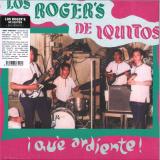
"¡Qué ardiente!" combines the best of Los Roger's limited discography, one of the most influential Amazonian cumbia bands from Iquitos, Peru.Their discography dives deep into Cuban-influenced sounds, where the guitar shares the spotlight with powerful percussion and-with tracks like 'Descarga Roger's'-with the vocals as well. A thorough look into one of the most essential Psychedelic cumbia bands in Peru. Iquitos, one of Peru's most remote cities and the capital of its Amazon region, was the epicenter of the psychedelic cumbia movement. Countless bands emerged from this place, each with a different fate in their musical journeys. Some rose to become international stars and flag bearers of cumbia, while others remained local legends, their fame never traveling far beyond the Amazon jungle. Los Roger's achieved great success in Iquitos and served as the foundation and inspiration for many local bands that emerged in the late 1960s and early 1970s. "¡Qué ardiente!" combines the best of the band's limited discography. The recordings come from their first 45 RPM single and their two mini Long Plays for the FTA label, as well as their only elusive LP from 1971, "¡Qué ardiente!", ("How Burning!") recorded for the prestigious IEMPSA label. Los Roger's came to an abrupt end just one year after the release of their LP, at the peak of their career, due to their disappointments with the music industry.

9
2025 Repress
Quickly following March’s The Fool - our label debut - Sa Pa reveals his new album Ambeesh on Short Span.
Coming five years after In A Landscape, and nearly a decade since his debut Fuubutsushi, Ambeesh pulls together a previously hidden body of work.
Written between 2014-2019 and long held in reserve awaiting the right moment for release, the album has often been grouped conceptually as a follow up to his FORUM debut. There’s a strong through line connecting the unique language and liveliness of ambient, layered field recordings, and dub techno found in those earlier records, as well as the seamless skydive through pressure formations found in the Enter Sa Pa production mix, which hinted at several of these tracks.
These pieces have taken time to surface and fully catch the light, but there’s still little else that compares. It’s a cache of some of his deepest and most texturally thrilling music, some of which have been rattling around in our ears and minds and conversation for years and have now found the right home and time. Forward thinking and singular in its combination of atmosphere; Ambeesh can press on the body at the right volume, and moves in thrust and riposte with the listener’s circadian rhythms. Sa Pa continues to dissolve the border between club-informed experimentation and intimate headphone listening.
Ambeesh also marks the artist’s return to Australia and the beginning of a new phase.
Mastered by Miles. Digital release of Lexanconical mastered by CGB @ Dubplates & Mastering.
Art from The Designers Republic.

LOS AMIGOS INVISIBLES
THE NEW SOUND OF THE VENEZUELAN GOZADERA 2x12"
- A1: Güelcome 00 18
- A2: Ultra-Funk 03 38
- A3: Mi Linda 03 46
- A4: Sexy 03 24
- A5: Las Lycras Del Avila 03 01
- A6: Groupie 04 40
- B1: Otra Vez 06 20
- B2: Cachete A Cachete 04 47
- B3: Baiada De Chusy 03 52
- B4: Asomacho 01 16
- C1: Ponerte En Cuarto 04 32
- C2: Mango Cool 02 54
- C3: Nerio Compra Una Contestadora 00 24
- C4: Quiero Desintegrar A Tu Novio 03 26
- C5: El Disco Anal 06 14
- C6: No Me Pagan 03 20
- D1: Cha-Chaborro 02 44
- D2: Aldemaro En Su Camaro 03 31
- D3: The New Sound Of The Venezuelan Gozadera 12 10
19
also available
Gold colored vinyl[36,09 €]
When Los Amigos Invisibles first released "The New Sound" (1998) - more than a quarter of a century ago!) - was the ultimate party album. Time has passed, but the party has kept on - and this party music, full of non-stop funked out grooves-traveling through house, funk, acid jazz, and bossa nova, to name a few musical avenues - is a journey deep into the pants of rhythm. (We won"t even mention the old sound of the Venezuelan Gozadera).

6
The Australian act Cutting Room strikes back with a EP extracted from their latest album “5 Years of Pure Energy”, they deliver one of the most modern and mental stimulating planetary electro/breaks sound, akin to AtomTM or Cultivated Electronics label. Presented in ONE-OFF truly limited edition of 300 copies lacquered pressed on 180 gr. high quality solid BLACK vinyl. All tracks have been specially mastered for vinyl by Daniel Hallhuber at Young and Cold Studios (Germany). Includes inmediate digital download.

12
I Talk To Water, the fifth album for Kompakt by Danish producer Kölsch, is the artist’s most personal statement yet. While all the trademarks that make his music so popular and powerful are still present – lush, melodic techno; swooping, trance-like figures; sensuous, shivery texturology – I Talk To Water is also a deep and intimate rapprochement with family and history, a beautiful, finely detailed document of loss and memory, and a tracing of the long, unbroken thread of grief that runs through our lives once we’ve lost those we loved.
The emotional core of I Talk To Water, then, is a cache of recordings by Kölsch’s father, Patrick Reilly, who passed away in 2003 from brain cancer. With time rendered elastic by the pandemic and its associated lockdowns, its sudden, alienating shifts in everyday living, Kölsch found himself reflecting on his father’s passing and ongoing spiritual presence, thinking about how best to memorialise such a significant figure in his own life. Those recordings opened a gateway, of sorts, for Kölsch to move through – a way to bring past and present together and entwine them in a sensitive, poetic manner.
Kölsch’s father was a musician – “touring in the sixties and seventies, in the Middle East especially, he was doing the whole hippy trail, playing guitar, and wrote some songs over the years,” he recalls. “But all in all, he decided to focus on family rather than pursue a musical career.” Reilly kept playing and writing music over the years, though Kölsch hadn’t listened to the material for some time: “I’d never had the guts to listen to it, because I just felt too fragile listening to his voice. It’s such a tough thing to go through.”
During the pandemic, though, Kölsch listened through the fragmented body of work that his father had produced over the years. “I decided I’m gonna finally release my dad’s music twenty years after his passing,” he reflects. “This whole album is about the process of loss, and for me it’s been one of my main driving forces in my musical life, the whole emotional aspect of whatever I’ve done has been based in that feeling that he’s not there anymore.”
Recordings of Reilly appear on three songs across I Talk To Water. His guitars drift pensively across “Grape”, offering a lush thread of melody that Kölsch wraps with clicking, driftwood rhythms and droning, melancholy bass. “Tell Me” is a lovely three-minute art song, a sadly beautiful reflection, minimally adorned with gentle keys and a muted pulse. And on the closing “It Ends Where It Began”, Kölsch lets his father’s acoustic guitar take centre stage for a lament that’s unexpectedly folksy, a guitar soli dream, which Reilly originally recorded in 1996. “He actually recorded it for my first album that never came out,” Kölsch reveals, “and I had it sitting around forever. That is purely him.”
These three imagined collaborations between father and son are poised and delicate. But their relationship also marks the gorgeous music Kölsch has made across the rest of I Talk To Water, from the itchy yet lush “Pet Sound” (titled in tribute to one of Reilly’s favourite albums), the flickering synths and yearning vocal samples that slide through “Khenpo”, the ecstatic shuddering that marks “Only Get Better”, or “Implant”’s slow-motion pans and subtle reveals.
There’s also the title song, where Kölsch is joined by guest Perry Farrell (Jane’s Addiction, Porno For Pyros), singing a mantra for internal reflection: “I talk to water / Searching for myself / Looking for answers / Oceans of you.” Farrell’s appearance brings another timbre, another spirit to the album, aligning neatly with his recent interest in electronic music. “He was completely taken by this idea of talking to water,” Kölsch says, thinking about the ways we collectively lean towards the natural world as a comfort and a listener, a guide through mourning, a way to map out the terrain of the heart. This mapping is something that Kölsch has proven remarkably adept at through the years; dance music for both body and mind, but also both for the here-and-now, and for the hereafter.
“I Talk To Water”, das fünfte Album des dänischen Produzenten Kölsch für Kompakt, ist zweifellos das persönlichste Statement des Künstlers bislang. Während alle Markenzeichen, die seine Musik so beliebt und kraftvoll machen, immer noch präsent sind – üppige, melodische Techno-Tracks; schwebende, tranceartige Elemente; sinnliche, fiebrige Texturen – ist “I Talk To Water” auch eine tiefe und intime Annäherung an Familie und Geschichte. Es ist ein wunderschönes, fein ausgearbeitetes Dokument des Verlusts und der Erinnerung, und es verfolgt den langen, ungebrochenen Faden der Trauer, der durch unser Leben läuft, sobald wir diejenigen verloren haben, die wir liebten.
Der emotionale Kern von “I Talk To Water” besteht aus Aufnahmen von Kölschs Vater, Patrick Reilly, der 2003 an Hirnkrebs verstarb. Durch die Pandemie und ihre damit verbundenen Lockdowns, die plötzlichen, entfremdenden Veränderungen im Alltag, fand Kölsch sich in Gedanken an den Tod seines Vaters und seine fortwährende spirituelle Präsenz wieder. Er überlegte, wie er eine so bedeutende Figur in seinem eigenen Leben am besten verewigen könnte. Diese Aufnahmen öffneten ihm sozusagen ein Portal, um Vergangenheit und Gegenwart miteinander zu verbinden und sie auf sensible und poetische Weise zu verweben.
Kölschs Vater war Musiker – “er tourte in den sechziger und siebziger Jahren, vor allem im Nahen Osten, auf dem Hippie Trail, spielte Gitarre und schrieb im Laufe der Jahre einige Songs”, erinnert sich Kölsch. “Aber alles in allem entschied er sich, sich auf die Familie zu konzentrieren, anstatt eine musikalische Karriere zu verfolgen.” Reilly spielte und schrieb jedoch im Laufe der Jahre weiterhin Musik, obwohl Kölsch das Material lange Zeit nicht angehört hatte: “Ich hatte nie den Mut, es anzuhören, weil ich mich einfach zu zerbrechlich fühlte, seine Stimme anzuhören. Es ist so schwer, das durchzustehen.”
Während der Pandemie hörte sich Kölsch jedoch durch das fragmentierte Werk, das sein Vater im Laufe der Jahre produziert hatte. “Ich beschloss, die Musik meines Vaters zwanzig Jahre nach seinem Tod endlich zu veröffentlichen”, reflektiert er. “Dieses ganze Album handelt von dem Verlustprozess, welcher für mich generell eine der Hauptantriebskräfte in meinem musikalischen Leben ist. Der ganze emotionale Aspekt von dem, was ich getan habe, basierte auf dem Gefühl, dass er nicht mehr da ist.”
Auf “I Talk To Water” sind Aufnahmen von Reilly in drei Songs zu hören. Seine Gitarren ziehen nachdenklich durch “Grape”, bieten einen üppigen Melodiefaden, den Kölsch mit klickenden, treibenden Rhythmen und dröhnendem, melancholischem Bass umwickelt. “Tell Me” ist ein schönes dreiminütiges Kunstlied, eine traurig-schöne Reflexion, minimal geschmückt mit sanften Tasten und einem gedämpften Puls. Und auf dem Abschlusstrack “It Ends Where It Began” lässt Kölsch die akustische Gitarre seines Vaters im Mittelpunkt stehen, ein überraschend folkiger Klagegesang, den Reilly ursprünglich 1996 aufgenommen hatte. “Er hat es tatsächlich für mein erstes Album aufgenommen, das nie veröffentlicht wurde”, enthüllt Kölsch, “und ich hatte es ewig liegen.”
Diese drei erdachten Kollaborationen zwischen Vater und Sohn sind ausgewogen und zart. Aber ihre Beziehung prägt auch die wunderschöne Musik, die Kölsch im Rest von “I Talk To Water” geschaffen hat, angefangen bei dem nervösen, aber üppigen “Pet Sound” (benannt als Hommage an eines von Reillys Lieblingsalben), den flimmernden Synthesizern und sehnsüchtigen Vocal-Samples in “Khenpo”, den ekstatischen Erschütterungen in “Only Get Better” oder den langsamen Schwenks und subtilen Enthüllungen in “Implant”.
Es gibt auch den Titelsong, in dem Kölsch von Gast Perry Farrell (Jane’s Addiction, Porno For Pyros) begleitet wird, der ein Mantra für die innere Reflexion singt: “I talk to water / Searching for myself / Looking for answers / Oceans of you.” Farrells Auftritt bringt eine weitere Klangfarbe, einen weiteren Geist in das Album, der gut zu seinem jüngsten Interesse an elektronischer Musik passt. “Er war völlig fasziniert von der Idee, mit Wasser zu sprechen”, sagt Kölsch und denkt darüber nach, wie wir kollektiv zur Natur als Trost, Zuhörer, Führer durch die Trauer neigen, um die Gelände des Herzens zu kartieren. Diese Kartierung ist etwas, in dem Kölsch im Laufe der Jahre erstaunlich geschickt war; Tanzmusik für Körper und Geist, sowohl für das Hier und Jetzt, als auch für das Leben danach.

Razor-N-Tape welcome hometown hero Danny Krivit into their stable of editors with a 2-track EP that sources a pair of vibes from the catalog of the ubiquitous "Q."Stuff" begins with a mysteriously looped and reverbed-out saxophone sample, building perfectly toward an eventual explosion of soulful horn stabs and vocals over a percolating rhythm section, in classic Q style. "The Story" tells a mellower yet mesmerizing tale, with its lush string arrangement and artful groove, perfect for those early warmups or late-night comedowns. A true living legend of NYC's rich DJ history, Danny dug deep into his personal cache of edit weapons for this very special record. Absolutely essential!

8
Fuckthegovernment.Ltd, a.k.a. F.T.G (Alfredo Trastulli) and Music Box head honcho, Marco Riff, return to the Skylax fold in 2016 with a cache of house nuggets for our listening pleasure. Their last venture on Skylax saw F.T.G collaborate with a bunch of his friends, resulting in some of the best tracks we'd heard all year, including the unforgettable Fuckthegovernment theme. Their tracks have been celebrated and hailed by some of the best DJs in the game, names such as Derrick May, Ricardo Villalobos, Raresh, and DJ Harvey. The bar set by the first record remains sky high, and somehow, these two manage to raise the bar even higher. It may be the biggest cliche going when talking about an album, but the duo certainly do take us on a journey, through the past and present of house music. It's a record not too dissimilar in tone to Paranoid London's from a few years back, but F.T.G and Marco strip things back even further than those guys did, in our opinion; The sound is more raw with less frills, and no track names to predispose feelings in the listener either. This eight track project is cohesive and elaborate, with movements through sounds both acid and jazzy, minimal and maximal. It explores sounds that came to prominence in famous house locales such as Detroit and Chicago over in the U.S., but the underground European influence is definitely present, from Paris to Berlin, and of course F.T.G and Marco's home of Italy. With this album, these guys add to the underground sound that has cultivated in the city of Perugia for years now, a place that has seen the likes of Simoncino and Nicholas hone their craft.Don't miss out on a piece of Skylax history!

- A1: Les Marie Louise
- A2: Ces Gredins De Légumes
- A3: Le Rêve De La Maison Dans La Maison
- A4: Coteau Caché
- A5: La Paix Du Dimanche
- B1: Ce Que Le Chien Veut
- B2: A Qui N'a Rien
- B3: Le Jus D'une Cerise
- B4: Sur Les Chemin De Contrebande
- B5: Les Morsures D'escargo
also available
Vol.2[17,94 €]
With the album Cousin Zaka Vol. 3, Blundetto is closing the series he began in 2019, ending it on a psychedelic note.
A voodoo spirit of harvests, Zaka is the guardian of agricultural activities and, by extension, a protector of nature.
It is under his protection that Max Guiguet delivers his wandering music and instrumental escapades — those in-between states he strives to capture in his notebooks, mood journals composed between each album and collaboration.
Rooted in the landscape and nourished by long observation, it allows itself to distort, stretch and blur the outlines of this peaceful scenery.
For this last volume of Cousin Zaka, the atmosphere is psychedelic, hippie, and free.
A freedom drawn as much from the poetry of Francis Picabia as from that of musicians Pierre Barouh, Moondog, and Eden Abhez — free spirits whose work informed the composition of this record. The idea is to take a path and let oneself be carried away, to drift as one would during a long walk in the forest.
Cousin Zaka, Vol. 3 is a wide, gentle experience, reminiscent of 1970s freedoms.

Unearthed from a cache of home demos and reel-to-reel recordings, Boots No. 2: The Lost Songs is the second release of archival music from the vault of Gillian Welch and David Rawlings. Reissued on high quality audiophile vinyl for its fifth anniversary, this remarkable 48 song collection, spread over three volumes, was recorded between the making of Time (The Revelator) and Soul Journey. It is an intimate glimpse at the artist's sketchbook, containing some lifelong themes as well as some flights of fancy.

2025 Repress
Roberta returns to her own Night Moves label with her most accomplished work to date on NMR012. After a string of recent underground hits on prominent labels like NDATL, Worldship Music, and Innermoods, it is easy to wonder where she would go next. With all that cachet built up, a return to her roots with increased confidence has paid off in this exquisite and refined record.
"Your Touch" kicks off with Roberta's signature dusty drum sound before sultry vocals and electric piano drop in, setting a proper atmosphere for dancefloor action. Moody strings along with instrumental solos including one from James Duncan on mute trumpet elevate this track to an even higher level, certain to be big with the best deep and soulful house DJs across the globe.
On the flipside, "All The Things" works with a similar sound palette, but focuses more on harmony. Jazzy Rhodes chords slide over each other into an extremely infectious and memorable pattern, playing off the bumping and melodic bassline. The vibraphone solos are the cherry on top of what would be an A1 killer on any other record. Here it has to settle for being an unreasonably hot B side jam for the heads.

- My Blue Heaven
- I'm An Errand Boy For Rhythm
- It Could Happen To You
- Lady Be Good
- The Touch Of Your Lips
- Take My Smile
- Stray Horn
- Oh Me, Oh My, Oh Gosh
- Don't Get Around Much Anymore
- Gee Baby Ain't I Good To You
- Candy
Recorded in 1990 for the noted New York audiophile label Chesky Records, My Blue Heaven was John Pizzarelli's frst signifcant album release, heralding the arrival of a major talent and future Grammy- winning star
Supported by a dream team line- up of veteran jazz stars - including Pizzarelli's guitarplaying father, Bucky, together with trumpeter Clark Terry , bass supremo Milt Hinton, and drummer extraordinaire Connie Kay - the New Jersey- born singer and virtuoso of the seven- string guitar serves up a swinging cache of evergreen jazz standards. With the album's highlights ranging from spirited revamps of the Nat King Cole Trio's 'Candy,' and Dave Frishberg's 'Can't Take You Nowhere,' the impeccably recorded My Blue Heaven represented a signifcant step in Pizzarelli's early musical journey, helping to introduce him to a wider audience. The album is reissued on 180g One Step Pressing Vinyl LP.

Rival Schools's Found is a collection of rarities, demos and alternate takes of songs collected in the years following the release of their 2001 debut United By Fate. Initialy released over ten years ago, the band has teamed up with Run For Cover Records for a limited reissue to release alongside the reissue of their 2011 album Pedals. Found features eleven songs that show the range of sounds the band tinkered with in the ten years between these albums - it's a must have for any fan of the band, available again on limited color vinyl.Rival Schools started as the once-new project of vocalist/guitarist Walter Schreifels, who as a member of Youth of Today, Gorilla Biscuits and Quicksand routinely reinvented the sound of hardcore. In Rival Schools he was joined by bandmates Ian Love, Cache Tolman and Sammy Siegler, whose other projects at the time include Iceburn, CIV and Glassjaw.

7
Another foggy day in Yorkshire. A steel grey sky. Raindrops tracing one another down the windowpane. Kirk Barley sits in his studio and assembles compositions from scraps of found sound and live instrumentation. Melodies swell, withdraw and repeat like waves. Time slows. Accelerates. Slows again. The light bends, tweaked at the edges. Twisted by rhythms that never quite resolve.
Written, recorded and produced by Barley in Yorkshire in early 2024, Lux picks up where 2023 LP Marionette leaves off, conjuring a mystical, reflective space between formal minimalism and sonic imaginaries of northern landscapes.
And yet, where Marionette relied at times on more recognisable field recordings, Lux leans into Barley’s skill as an instrumentalist and sound designer, working from a palette of short samples and utilising a variety of alternate tuning systems to build, layer and coax his compositions into being. Most evident on tracks ‘Vita’, ‘Sprite’ and ‘Descendent’, these tunings create an otherworldly harmonic language that is easier to perceive than describe.
Alongside more familiar instruments of guitar, bass, drums, organ and clarinet, here Barley draws on plastic saxophones and bells, and recordings of glass, wood and metal sound objects to provide the organic matter. Rather than directly representative of the natural world, Lux enters into a dialogue with it which, like the grasses and flowers of the album’s cover, exists somewhere between reality and artifice.
On album opener ‘Cache’, Barley constructs his own sense of time from a recording of an umbrella crank, a sparse and spectral piece which hints at memories embedded in the track’s title. Introspection blossoms into new life on ‘Vita’, crumpling again into the percussive ambience of ‘Verre’. A track that takes its harmonic lead from the clinks of glass, it features Barley’s long-time collaborator Matt Davies on drums, whose nuanced, tonally sensitive playing gives ‘Verre’ a fizzing, ice-like quality.
There are several moments where Lux picks up on themes Barley explored under electronic moniker Church Andrews on recent works with Davies, stretching and distorting temporalities most explicitly on ‘Descendent’, whose ritualistic air unfurls around a pattern in exponential decline.
Embracing the surrealism Barley absorbed over years watching classic film noir and the works of David Lynch and Federico Fellini, Lux wends its way through the enchanted sound worlds of ‘Sprite’ and ‘Balanced’ before arriving at the album’s title track.
An expression of his recent experiments in live, prepared guitar, ‘Lux’ brings the album back to earth, returning us to the room where the rain has stopped, the clouds have parted, and the soft warmth of the spring sun is pouring in through the open window.

First vinyl edition of Carme López’ debut album of entrancing bagpipe arrangements. Unravelling forms of early music and funereal, queered droneworks full of strange tonalities, phased harmonics and curious subversions.
Carme López is a researcher and teacher of traditional Galician oral music, and ‘Quintela’ features her debut recordings for the Galician bagpipe, split into four longform movements totalling 40 minutes of supremely engrossing drone flourishes. Misunderstood by many, the bagpipe is here brought into the experimental realm as a form of decontextualisation, fashioning the instrument’s naturally peculiar timbres into soft, wavering tones.
Despite its unusual resonance, in López's hands the bagpipe almost becomes a pipe organ, producing long, swaying, sustained tones that highlight the instrument's complex timbral qualities. López plays with its breathy overtones, placing microphones on the bag itself to pick up residual sounds while she sculpts its squeals into cavernous siren calls, and then extracting half-rhythms from its reeds on the elegiac closer 'iv: CACHELOS. a César De Farbán'.
The instrument’s inherent wheezing and anomalous timbre lend the recordings a wavering foundation that feels designed to unsettle, but somehow becomes nothing short of entrancing through almost imperceptible harmonic shifts and odd tunings. It’s meditative music that requires active participation, focussed listening - so as to make sense of all the infinitesimal shifts and faults - in a way that feels unique to this most maligned, misunderstood, almost mystical instrument.

also available
Coloured Vinyl[27,52 €]
The third album Fort Sensible by Brisbane alt-rockers Tape/Off is a genuine labour of love, a passionate dose of opinionated heart-on-sleeve rock’n’roll representing not just a place but a time with its cache of meticulously-crafted guitars, robust rhythms and socially-conscious lyrics mining both the personal and the political.
While musically they veer seamlessly between intricacy and intensity their words cut straight to the quick, the songs caustic and catchy in equal measure, making Fort Sensible by far the most ambitious and accessible album in the band’s storied decade-plus history.
Tape/Off’s first two albums - Chipper (2014) and Broadcast Park (2018) - were both longlisted for the prestigious Australian Music Prize, yet Fort Sensible takes the tried and tested Tape/Off aesthetic to a whole new level as the band seek to both share the creative load and fully harness their innate collective chemistry.
The guitars of Nathan Pickels and Ben Green weave together like an electric tapestry, the resultant soundscapes both intricate and ambitious whilst still entirely capable of busting out massive riffs with the best of them, their inherent simpatico now built upon by years of experience playing off each other. From a rhythmic perspective Tape/Off's propulsive drummer Branko Cosic's immense power and Cameron Smith's robust, expressive basslines combine to provide the perfect rhythmic bottom-end throughout the record.
Excitingly Tape/Off's sonic palette has been broadened substantially on the new album, with Pickels' angry and angst-laden diatribes throughout Fort Sensible now augmented by Green and Smith taking vocal turns at junctures, adding a whole new dynamic and dimension to proceedings.
At a time when our leaders seem lacking and the world needs the redemptive powers of art and music more than ever, Tape/Off announce themselves as a serious force to be reckoned with the uncompromising power and beauty of Fort Sensible!

- A1: Intro/Love (Feat Coco Maria)
- A2: Casa Loca (Feat Baldo Verdú)
- A3: The Cheeky One (Feat Coco Maria)
- A4: Cachetón
- A5: Sabrohito (Feat Coco Maria)
- A6: Gwely & Môr (Feat Elan Rhys)
- A7: Vamonos! (Feat Coco Maria)
- A8: El Cañon (Feat Baldo Verdú)
- A9: The Mountains Of The Mind (Feat Coco Maria)
- A10: Padre Tiempo (Feat Luzmira Zerpa)
- B1: El Konto (Feat Coco Maria)
- B2: Esa Tristeza (Feat Nina Miranda &Amp; Little Barrie)
- B3: Bom Dia! (Feat Coco Maria)
- B4: Oh Minha Querida (Feat +2`S)
- B5: A Secret Rendez-Vous (Feat Coco Maria)
- B6: Sempre Amor (Feat Elan Rhys)
- B7: For All The Side Chicos & Chicas (Feat Coco Maria)
- B8: Maybe Man (Feat Silvia Machete)
- B9: Hay Esperanza (Feat Coco Maria)
- B10: She`s In L A. (Feat. Young Gun Silver Fox)
- B11: Todo Chévere (Feat Baldo Verdú, Coco Maria & Don Leisure)
21
By it's very nature "Radio Chevére", the new album by Rio 18 and their host of guests cannot be categorized simply: at once both a Latin mixtape and a radio show, it's also an internationalist love letter, an offering to the goddess of Tropical Music and all that it encompasses. Ambitious, yes. Foolhardy, possibly. But sincere, committed and FUNKY? Definitely.
With the voice of guest DJ Coco Maria as our guide, "Radio Chévere" takes us on a journey through myriad musical styles and stories. Stopping off at Uruguay, Brazil, Venezuela, Colombia, Mexico, California, New York and countless other sonic destinations via Samba, Salsa, Funk, Cumbia, Joropo, Disco, Psychedelic and Electronic stylings, "Radio Chévere" is also a musical metaphor for migration - a journey from one continent, one life to another.
This album features songs in no less than four languages (Spanish, Portuguese, Welsh and English) and includes collaborations with Brazilian legends the +2's (Moreno Veloso, Kassin and Domenico Lancellotti) on the tender samba ballad, "Oh Minha Querida", transatlantic Yacht Rock gods Young Gun Silver Fox ("She's In LA"), "Sao Paulo's finest" Silvia Machete on the sweaty funk "Maybe Man" and Venezuelan Llanera and Joropo queen Luzmira Zerpa sings "Padre Tiempo", set to an incessant Afro-Venezuelan pulse. Why this torrent of eclectica now? Having recorded three albums in Welsh, predominantly inspired by Brazilian music, Rio 18 founder, Carwyn Ellis had a hard time following 2021's "Yn Rio": "We'd made a concept album with an orchestra. How do you follow that?" he says. "So I retreated to my laboratory, learned as much new music as I could, started learning Spanish too, and ended up writing tunes in a bunch of languages and styles, all of which reflected things I've learned or experienced over the last couple of years."
Since the group's inception in 2018, on the suggestion of Chrissie Hynde when he toured South America as a member of the Pretenders, Carwyn has been on a voyage of musical discovery through the styles of that continent. And in those five years he learnt a lot! But in a radical new move, Carwyn has stepped back from the mic, preferring to focus on writing and producing, handing over the vocal duties to band members Baldo Verdu (Venezuela) and Elan Rhys (Wales) plus a host of collaborators. "They can sing and express what I'm feeling so much better than I can, and both Elan and Baldo bring an authenticity and strength to our songs that surprise and elevate me. Collaborating with so many other inspiring artists on this album has helped us to grow and assimilate more styles - we're halfway through our next album already."
Rio 18 is an internationalist collective with Celtic and Latin roots and love at their core. With eye popping carnivalesque cover art by the brilliant Colombian graphic artist, Yoda, "Radio Chévere" is both timely and timeless.

14
The true test of originality for any musician comes when you hear an instrument being played and you instantly know who’s playing it. For electric guitarists, certainly Hendrix qualifies; Page and Clapton, too. Maybe Eddie Van Halen before the legion of imitators. You probably have your own list, but to us, standing toe-to-toe (or pick-to-pick) with those legends is Television guitarist and solo artist Tom Verlaine. His self-taught, jazz-influenced style, largely devoid of effects, and vibrato tone (oh, that tone!) makes any Verlaine solo unmistakably a Verlaine solo. That he was quite an accomplished, idiosyncratic songwriter is just a bonus. Real Gone Music is very, very proud to announce that we have arranged with the Verlaine estate to release Tom’s last three solo albums on LP; Songs and Other Things was the last record he released, in the same year (2006) as the all-instrumental Around. As the title indicates, this was indeed a return to lyrics and vocals, the first record with “songs” since 1990’s The Wonder (although the first track, “A Parade in Littleton”—one of the “Other Things”—is a low-key, funky instrumental that would have been home on a late Talking Heads album). The time off clearly allowed Verlaine to build up a strong cache of compositions, with “Nice Actress” and “The Earth Is in the Sky” among the highlights. The record also marks a welcome return of Verlaine’s enigmatic lyrics, which as always prompt head scratching while somehow making intuitive sense. But in the end, it’s the amazing guitar work—ably supported by Fred Smith of Television fame and Jay Dee Daugherty of The Patti Smith Group among others—that elevates Songs and Other Things to essential status, worthy of its exalted position as the final release of Tom Verlaine’s career. Bassist and original engineer Patrick Derivaz has mastered the album for its vinyl debut; Verlaine’s long-time partner Jutta Koether contributes notes. Teal vinyl pressing!

13
Continuing our exploration of São Tomé and Príncipe with DJ Tom B., Les Disques Bongo Joe proudly announces the release of África Negra Anthology Vol. 2. We've carefully selected and remastered 13 standout tracks for this volume, digitized from studio tapes by their tour manager. The album includes a booklet with updated liner notes and vintage photos of the group.
África Negra, established in the early 1970s by Horacio and Emidio Pontes, is São Tomé and Príncipe's most renowned musical group. Their blend of Puxa and Rumba, infused with Leonildo Barros' guitar riffs, Armando Tito's bass lines, and vibrant percussion, gained them recognition beyond the archipelago. This volume offers a glimpse into their musical journey, featuring unreleased sessions from 1979 and 1990, showcasing lead vocalists like João Seria and Sergio Fonseca.

13
Continuing our exploration of Sao Tomé and Príncipe with DJ Tom B., Les Disques Bongo Joe proudly announces the release of Africa Negra Anthology Vol. 2. We"ve carefully selected and remastered 13 standout tracks for this volume, digitized from studio tapes by their tour manager. The album includes a booklet with updated liner notes and vintage photos of the group.

'Quintela', the debut album by Carme López, a performer, teacher and researcher of traditional oral music from Galicia, is a new experimental work for Galician bagpipe. Influenced by the approach of composers like Éliane Radigue or Pauline Oliveros, the Spanish composer creates slowly modulating sound environments, and stretches the sonic the possibilities of the bagpipe to its absolute limit. 'Quintela' is structured in four movements, plus a prologue and an epilogue, which serve as a link to the contemporary language of the instrument.
The bagpipe is strongly tied to traditional musics; its use in different genres and musical contexts is extremely limited and unimaginative. 'Quintela' brings it to a wholly unknown field, decontextualising the bagpipe in order to elevate a personal approach, and leaving behind its male-dominated past (in which it relates to ideas of prestige, dominance or carries even sexual connotations). López expertly demonstrates its grandeur and breadth; the music on 'Quintela' ranges from barely audible sounds of air passing through the hide bag through rhythmical use of its reeds to all-encompassing drones with complex harmonic structures and vibrant overtones.
The narrative arc focuses on the composer's past, its people and places, and could be conceived as a journey in and of itself. A homage to those in our memories, but also a step into the unknown, 'Quintela' is an ambitious, graceful and captivating debut.

Santiago Salazar, aka S², presents four funky, soulful electro-techno tracks for Limited Network’s – ninth release. Dynamic Allocation starts the EP off with captivating string and bassline arrangements, harkening back to the spirit of UR. Cache Memory follows up with dark pads and a UR-sounding deep and detuned grungy bassline supported by an electro drum workout. Accumulator is when Miami Bass meets Detroit techno seasoned with Santiago’s signature sound design. Data Hierarchy closes the EP with a spiritual universal electro jam arranged to move your mind and body.
6
030/313 – Berlin/Detroit, the fundamental techno union. Now Carhartt WIP, whose roots can be traced to Detroit, Michigan, join forces with Tresor for a collaboration that celebrates the enduring spirit of two music metropolises. Referencing the early 90s compilations like “Tresor II – A Techno Alliance”, they present a 12” mini compilation with exclusive material from both cities.
The compilation opens with “I.D.L.E.”, a lost Model 500 track, of essential funk that touches the techno soul of The Motorcity, with trippy melodies and cosmic drilling traversing electrified Mojo freeways. It’s followed by another true Detroiter: Ectomorph’s “Searching (Live At Globus)”, a first extract from their live set at Globus in 2021, which BMG and Erika played on borrowed equipment after Erika’s case was lost on a flight. The A-Side stays in Detroit and finishes with “Your Body”, an exclusive track by AMX, also known as The AM, one of Detroit’s freshest funk techno sensations. She carries on the mentorship mindset by having learned from two of the greatest: D.I.E. and Scan 7. “Your Body” is a classic techno feel swinger, where subtle chords meet drum machine funk in the spirit of early Detroit techno.
DJ Stingray 313 opens the B-Side with a bang. Precisely hacked techno, full of dark funk and that special industrial jack, that the man in the mask has made his own. A total “Dynamic Instability”. Magic & furious. The thrill continues with “Metal Goat”, by JakoJako, one of Berlin’s brightest synth sensations. She provides an introspective grower that slowly evolves into a fast-paced techno grinder, laden with micro shifts and magic twists. The final tune comes from Erik Jabari, a newcomer from the 030 zone, emerging from the Hard Wax peers with haunting modular synth techno–a feverish minimalistic trip of motorized kicks. DJ Pete performed as spiritual guidance on this one. It’s floor proven. An overall cachet of “030313” - the small compilation with a huge techno heart.

- A1: Pourquoi Tu Veux Que Je Parle Si Tu T’en Fous? 00 01:15
- A2: Se Goinfrer De Rage 00 02:09
- A3: Boule Et Bill 00 03:57
- A4: La Plus Grosse Angoisse 00 07:10
- A5: C’est Qui Ton Papa? 00 00:22
- B1: Les Cerisiers, Mon Cœur 00 03:00
- B2: Drôle D’odeur 00 01:07
- B3: Tes Nouilles Trop Cuites 00 03:08
- B4: Si J’avais Un Enfant Handicapé Mental 00 04:42
- B5: Schultz & Damien 00 02:57
10
In the wake of a profound loss, Marie Klock, a neo-chanson singer and multi-instrumentalist from Paris, presents a poignant tribute with her debut on Pingipung. On “Damien est vivant” Marie Klock pays homage to the poet Damien Schultz, who has recently passed. They were intertwined both in artistic collaboration and deep friendship.
Marie Klock creates a powerful ode to Damien Schultz's surreal, anarchic, witty and at times provocatively obscene French (English translations are included in the vinyl release). The poet's own voice resounds alongside Klock's, oscillating between spoken word and neo-folk vocals. Recorded in an intimate lo-fi setting with co- producer Julien Louvet, the 10 songs are far from a mournful requiem. They showcase idiosyncratic pop music brimming with humour and absurdity. “Damien est vivant” is a celebration of the unique bond they shared, in past and present. The melancholy sometimes takes on an almost whimsical quality, an allusion to the world as perceived through the lens of two kindred spirits.
Marie Klock has appeared as keyboardist on international stages with Sofia Portanet and collaborated with artists such as Jean-Louis Costes, Chilly Gonzales, Charlotte Brandi and Adrienne Pauly. Her self-titled solo LP (2020, Les Disques De La Face Cachée) was a cheeky outing of her synth-chanson act. She is currently working on a duo album with Anadol, to be released on Pingipung in autumn 2024.
“Damien est vivant” will be released on Good Friday 2024. Marie Klock will present the album in live ceremonies.

6
Experiences Limited, now 3XL, with a new LP from Exael on a highly atmospheric ambient jungle tip, deploying 30 mins of percussive spasms seeping into smoked-out zoners - highly tipped if yr into anything from Lee Gamble to Malibu.
Clearing their cache of stray bullets, Exael returns with a gyring plunge into percussive wormholes and low-lit mood enhancers .The tracks are broadly cleft along schisms of dark/light and demonic/angelic, switching from restive propellers to more sublime sensations in a fine testament to their practice - making for prob our favourite Exael release thus far.
On the “darker” side, they commit the convulsive, fractious footwork pulses and warped tones of ‘Circle (Squishy Mix)’ in a sort of parallel to 33EMYBW’s insectoid rhythms and combustion systems, while ‘Ice That melts The Tips’ trades in rapid, ice-skating thizz and ‘Ghoul Search (Demonic Attachment Mix)’ fires up the junglist particle accelerator for a proper gauntlet of hyper techstep dynamics.
The contrast is epitomised by ’Composure’, arranging flinty breaks on a luscious waterbed of floating pads, before ‘Eidolon’ renders a sort of airborne dembow pressure in the vicinity of Ben Bondy & special guest dj’s xphresh works. ‘L-theanine’ closes the session on a fine tread inside emo ambient styles and flurries on the same spectrum between DJ Lostboi and Teresa Winter, complete with a reverberating, half-buried vocal.

10
"L'idée nous est venu lors d'une conversation un peu arrosée dans un pub du sud de Londres avec Philippe du label Tapeworm" dixit François Kirmann Gamaury alias Franz Kirmann alias Dj Salinger – producteur français établi à Londres depuis plus d'une vingtaine d'années.
"Voyage voyage voyage" est une mixtape. Mais pas dans le sens traditionnelle du terme. Kirmann l'appelle une mixtape subjective, où les morceaux ne sont pas joués tels quels mais présentés tels qu'ils sont ressentis par l'artiste.
Un peu comme le DJ Vladimir Ivkovic qui ralentit certain morceaux sur ses platines pour en révéler un autre aspect, Kirmann zoom dans l'étoffe même des enregistrements, étire les notes et les sons à l'infini, pour en mettre à jour un sens caché, altérer notre perception de ces chansons qui peuvent parfois sembler un peu désuètes. Ici elles sont transformées en nappes fantomatiques et envoutantes qui évoquent un souvenir d'une période de sa vie, une trace sonore d'une époque un peu naive, qui revient aujourd'hui sous forme d'echo, une musique nostalgique trempée dans la reverb et la distortion.
Kirmann a grandit au Sénégal pendant les années 80 et il se souvient des étés de son enfance passé chez ses grand parents, les chansons à la radio, dans le bus du centre aéré, dans un Prisunic en Dordogne, où une fête de camping en Alsace: Catherine Lara, Elsa, Veronique Jeannot et bien sûr Desireless et son fameux tube "Voyage voyage".
Les chansons sélectionnées pour la cassette ont toutes en commun une incitation au départ, une recherche de l'ailleurs, un amour perdu, un souvenir, les thèmes de predilection d'une certaine pop française que l'on nommait variété.
Ces idées d'évasion sont accentuées ici par le traitement sonore qui leur est appliqué. Les chansons sont paralysés dans le temps, figées dans le son, comme si l'on avait souligné certain passages dans un roman pour les détacher du texte intégral.
Distortion, écho, réverbération et autres effets sont appliqués et donnent à la musique et au son une qualité rêveuse et distante. Certains passages reconnaissables se dévoilent et sortent de la brume sonore, ils se révèlent plus net, d'autres sont noyés dans un brouillard imprécis, une musique proche de l'ambient qui enveloppe l'auditeur.
Kirmann: "Chaque track est basé sur une chanson de variété française des années 80, je voulais re-créer une impression de distance, quelque chose de lointain. Les morceaux deviennent des sortes de tapisseries sonores mais dont l'essence de la chanson originelle est toujours présente. Il y'a un roman de Patrick Modiano où les personnages lancent des avis de recherche pour la France à partir d'une station de radio d'un pays lointain. Le son est brouillé, les voix étouffées. J'avais un peu cette idée en tête de faire quelque chose de similaire, comme si les chansons étaient entendus sur un vieux poste de radio mais émises d'une station lointaine et d'un autre temps."
Le résultat est un voyage nostalgique, une musique ambient et nébuleuse façonnée à partir de tubes synthétiques 80's. Imaginez Fennesz ou My Bloody Valentine jouant des reprises de Laurent Voulzy et vous y êtes presque…
Loveless non, Desireless oui!
DJ Salinger. Voyage Voyage Voyage – Disponible en cassette uniquement. 100 exemplaires sur le label Tapeworm.
—
Franz Kirmann is a French music producer living in London. He has made albums for various labels including Denovali, Bytes, Mercury KX. He also writes music for film and TV and is a lecturer in music production at Point Blank Music school.

10
With their profound take on electronic music, Animistic Beliefs have steadily solidified their spot in the global underground. Influenced by cultural concepts such as ancestry, animism and mythology, as well as the languages of political techno, punk, bubbling and IDM, Linh Luu and Marvin Lalihatu consistently translate their visions into sensitive productions as well as high-octane live performances. On MERDEKA, the artists explore and embrace their cultural heritage in all of its pride, pain and complexity. It symbolizes Animistic Beliefs' breaking free, coming to terms with their changing selves and letting go of external expectations. The record rethinks childhood memories, confronts the generational trauma left by (post-)colonialism, and re-connects Linh and Marvin â?? respectively of Vietnamese-Chinese and Dutch-Moluccan descent â?? with their formative cultures. MERDEKA marks their first step in an overall departure from western club music. For its layered sound, Animistic Beliefs once again draw from the past, present and future of global club music, creating a sonic space where fast techno, warped breakbeats and ambient soundscapes make way for the augmented influence of (Southeast Asian) tribal music. The record incorporates Indonesian scales and recordings of the Tahuri (a wind instrument made out of a conch shell), Totobuang (Gamelan-like gongs) and Tifa drums, known as â??the Moluccan heartbeatâ??. In true Animistic Beliefs fashion, MERDEKA will set fire to sweltering clubs and (sleepless) dreams. Yet, for the artists, it is essential to amplify the stories that spark that flame and keep it burning. The release of MERDEKA follows CACHE/SPIRIT, their ongoing collaboration with visual artist Jeisson Drenth, which extensively explores the artistsâ?? intersectional identities. As such, the latest album is the next step within a bigger, introspective investigation. More unapologetic than ever, MERDEKA embodies a turning point on Animistic Beliefsâ?? ongoing journey towards self-acceptance â?? fuelled by the sound of urgency.

13
Hot off of the success of their multi-platinum self-titled debut, The Youngbloods shuffled their line-up (with the departure of co-founder Jerry Corbitt) and used their heightened caché to go big on their follow up, the Charlie Daniels-produced Elephant Mountain. Over multi-layered acoustic-folk and electric-rock instruments, Jesse Colin Young, Banana Levinger, and Joe Bauer create a free-feeling set of tunes that playfully careen between front-porch folk and stadium rock (best exemplified in the classic single "Darkness, Darkness"). That this diverse set of musical influences remained cohesive and artistically daring makes it an underground classic whose admiration continues to grow today. Impex is proud to bring it to you in pristine all-analogue glory!

"Welcome to the first of the Masters Series, a cache of limited releases for people who understand that some things, no matter how hard you try, just can't be tamed. (Read: these are scratchier/rougher recordings that are cleaned up as best we can get them - if that's going to not work for you, don't order!)
Already championed by the likes of Michael Robinson (Dig Deeper, NY) and just entering the collective consciousness of the R&B scene worldwide, this release is a double-sided dancefloor destroyer. Both sides rip with tremendous energy.
Those who know will recognize the name Carl Holmes from well established winners like ""Soul Dance No. 3"" and ""Unchain My Heart"". Here he is with an unreleased song called ""Love With A Feeling"", featuring a raucous drum break with his soulful vocals throughout. Not that the tune needs a pedigree, but things like that never hurt.
On the flip is an unknown funky Soul R&B bomb ""Some Of These Days"". This female led tune is perfect for either a Northern Soul or R&B party.
The story behind The Masters Series
In our hunt for unreleased soul, we occasionally find some incredible gems that are just a bit too beaten to restore to the ears of the general public. Rather than return them to the dusty basements from whence they came, we press them in small batches to share with those who love to share."

- A1: Güelcome 00 18
- A2: Ultra-Funk 03 38
- A3: Mi Linda 03 46
- A4: Sexy 03 24
- A5: Las Lycras Del Avila 03 01
- A6: Groupie 04 40
- B1: Otra Vez 06 20
- B2: Cachete A Cachete 04 47
- B3: Baiada De Chusy 03 52
- B4: Asomacho 01 16
- C1: Ponerte En Cuarto 04 32
- C2: Mango Cool 02 54
- C3: Nerio Compra Una Contestadora 00 24
- C4: Quiero Desintegrar A Tu Novio 03 26
- C5: El Disco Anal 06 14
- C6: No Me Pagan 03 20
- D1: Cha-Chaborro 02 44
- D2: Aldemaro En Su Camaro 03 31
- D3: The New Sound Of The Venezuelan Gozadera 12 10
19
also available
Orange colored vinyl[36,09 €]
Anniversary Edition 2xLP in 25th-Anniversary-Pot-At-The-End-Of-The-Rainbow Gold, in a gatefold jacket.
When Los Amigos Invisibles first released "The New Sound" - exactly a quarter of a century ago!) - it was the ultimate party album. Time has passed, but the party has kept on- and this party music, full of non- stop funked out grooves - traveling through house, funk, acid jazz, and bossa nova, to name a few musical avenues - is a journey deep into the pants of rhythm. (We won"t even mention the old sound of the Venezuelan Gozadera).

11
Montreal new-age punk outfit NOBRO were playing a show the day after the United States Supreme Court overturned the right to access an abortion in the country. The four band members, Kathryn McCaughey (vocals, bass), Karolane Carbonneau (guitars), Lisandre Bourdages (keys/percussion), and Sarah Dion (drums ) all women, were shaken and furious! But that night McCaughey led a righteous toast against the decision: “This next song is dedicated to setting our vaginas free!” Set Your Pussy Free is a caustic, celebratory, glorious party-punk firework show. It’s a record about the ecstatic pursuit of personal escape and liberation even as the walls are closing in, a 21st century power-punk analog of Born To Run that rages against modern life’s restrictive pressures and dares them to a game of chicken. If a hurricane is bearing down on NOBRO, they’re spitting into it, arm-in-arm, with middle fingers raised.

Teakup is Lauri Reponen, the Columbus, Ohio DJ, producer and torch-bearer for the city’s proud Techno heritage. Following in the footsteps of Columbus originators, Titonton Duvanté, Archetype and Todd Sines, Teakup has spent the past decade forging a sound of his own via a genre alchemy that embraces genres past and present. Hardcore’s staccato samples and chopped breakbeats, UKG’s crunchy triplet hi hats and mellifluous House melodies combine in novel forms. Titonton’s wonky Tech House takes, Todd Sines’ stripped minimalism and Archetype’s broken rhythmic exploration are more key ingredients in the Teakup stew. This recipe has cooked up a massive cache of unreleased tunes as well as previous 12”s on is / was, Residual, Shut Off Notice and Lauri’s recently-minted TKP imprint.
Compiled from over 200 demos, Signal 23 has Lauri flexing a new level of genre-mastery. The title track explores Spiral Tribe’s ripping, psychedelic Freetekno. ‘Valve’ is cutting-edge rhythm hypnotism. ‘Felopzd’ loops into ecstatic trippy crescendo and ‘Pad Thai Mystic’ takes you on the spiritual voyage of late-night food delivery in middle America. Four modes, four hitters – to warm floors, open hearts or split psyches.

6
Freestyle Records proudly present a reissue of Gloria Weems' ace 1983 long-player "Lovelight" - previously only available on a rare South African pressing, and featuring the single "Wanna Dance With You" (licensed for a 12" on storied NYC label Prelude in the same year).
The record was written and produced by Jim Duncombe and Chris Palmer - owner of London's legendary Groove Records and also the man behind UK funk/disco label Groove Production (Surface Noise, Linda Taylor, Caché etc). Chris & Jim had met earlier in the year at the Midem music conference in Cannes, and started writing together shortly after. The initial recording sessions were completed at Duncombe's Powerplay Recording Studios in Switzerland, with American vocalist Gloria Weems (then on a club tour of Switzerland) brought in on vocal duties.
Palmer then added additional recordings and mixed the record down at Groove Production's London base. Criminally it was only ever picked up for release in super limited numbers through the South African label CCP Records - though Chris, through an ongoing licensing relationship via his Groove Production label, managed to license "Wanna Dance With You" and it's dubbed-out b-side "Wanna Version" to the legendary NYC label Prelude. Nevertheless the Lovelight LP represents a lost classic and a rare example of a transatlantic disco-boogie project in the era's golden period, in it's linking up of UK, European and American elements.

Smos & Baby Bee: Party Flyers And More. Reminiscences Of A Unique Era In Belgian Nightlife Culture. (1993–2010)
Throughout 326 flyers and many stories from the personal archives of Baby Bee, Smos and a bunch of friends and fellow DJs, the story of the legendary duo was recreated.
Sad news shook up our scene in April 2020: Smos had passed away. Aged 53, the Antwerp based DJ was a key figure of our Belgian nightlife scene. As yin to yang, Smos was connected to Baby Bee. The inseparable duo - who have been lovers as well - has rocked dance floors all over Belgium and abroad for 20 years of which 18 as resident DJs in Café d’Anvers and four in the Motion room in Fuse in Brussels. Having started their DJ career in the early nineties,
their story is closely linked with the beginnings of Belgian DJ culture and the electronic music scene.
Smos & Baby Bee were prominently rocking the electronic music scene since its dawn, shortly after the infamous second summer of love in the UK during the late 1980s and the rising of a new youth culture, a pivotal point in music history when under the spell of XTC a large audience became enthralled by the exciting new style of music coming from American cities such as Detroit and Chicago. They were DJing all over Belgium and through their genuine approach and straight forward mentality bringing together scenes from Brussels, Ghent, Antwerp or Wallonia. They were a DJ duo, a constellation nowadays well known but at the time truly rare. And not to forget, Baby Bee was a female acting in a mostly male world.
The visual archive presented in this publication generates an important cache of a creative culture that has been going through ups and downs, but is still very much alive and kicking to this very day. The book wishes to commemorate Smos, who is missed by many and remains in our hearts forever.
Written by Koen Galle
Flyers photographed by Baby Bee from her and Smos’ archive
Photography by Benoit Meeus, Jockum Klenell, Baby Bee & Jamila De Backer
Designed by Otis Verhoeve
