4

This is Mulatu Astatke’s protege and Ethiopian saxophonist and composer Jorga Mesfin’s debut album. It’s a long foray into Ethio-jazz that takes this courageous syncretism further by fusing spiritual experimentation with bits from all kinds of situations in Ethiopian music, jazz music, and specifically Ethiopian jazz music that precedes it.
Jorga Mesfin is widely regarded as one of the most talented contemporary musicians and composers in Ethiopia. He started his professional career at the young age of 17 and has since collaborated with numerous renowned artists, including Tsegaye Gebremedhin, Carolyn Beard Withlow, The Last Poets, Vijay Iyer, Wayna Wondossen, Kirk Whalum, Takana Miyamoto, Gizze Reggae band, Dionne Farris, Aster Aweke, Mahmoud Ahmed, and Mulatu Astatke. Additionally, Mesfin was a resident at Astatke's legendary African Jazz Village in Addis Ababa every Thursday.
Jorga Mesfin is the founder of the Ethio-jazz group called Wudasse. He composed the music for the epic Ethiopian film "Teza" directed by Haile Gerima. His work on the film earned him the Best Music Award at the 22nd Carthage Film Festival and Best Composition at the 5th Dubai International Film Festival.
Muzikawi is a record label, music publisher, studio, artist management, and event organizer based in Addis Ababa and Stockholm. With extensive experience in curating and representing artists from all regions, Muzikawi has a deep understanding and appreciation of Ethiopia's culture.

‘Diré’, Idrissa Soumaoro new album, comes as a surprise to Malian and international audiences. Composer, singer, guitarist and master of the kamalen n’goni Idrissa Soumaoro presents here a beautiful collection of songs on his third album, Diré, named in honor of the town where he met his wife and where his first daughter, who is no longer with us, was born.
In 1971, after his studies at the INA in Bamako, Idrissa was transferred to Diré to teach music at the lPEG (Pedagogical Institute of General Education). He was 22 years old when he arrived in Diré. Idrissa has always been nostalgic for this beautiful place in the 333 Saints of Timbuktu region. As Idrissa sings in ‘Diré taga’ (Going to Diré), the track that opens the album, the city evokes deep emotions for the artist, as if it were a long-lost friend or lover. Celebrating the memory of the city of Diré leads the artist to retrace stories and lived situations that marked and animated him in years gone by: ‘I really miss the people, the colleagues, the friends and that period. Despite the time that has flown by, I would ardently wish to see Diré again’. Today, at the difficult time Mali is experiencing, remembering the city of Diré in the 1970s also means for the artist not giving up hope for peace: ‘The memory of Diré, a beautiful town in northern Mali, strengthens my hope for peace, union and real independence for the happiness of my people’; as he sings in ‘Sababou’, ‘Without hope, there is no life. Together we will succeed’.
The ten highly original compositions of the album are strongly based upon traditional music of Mali, but Idrissa’s life experiences, travels, education, collaborations and personal musical career have led him to compose and perform music with other influences. As Idrissa quotes: ‘My inspiration generally comes from the donso n'goni, a Bambara instrument played by and for hunters throughout Mali. This is a pentatonic instrument, similar to the blues exported to the USA by black African slaves. I've also spent so much time playing a variety of music that my music also reflects rumba, salsa (as well as Bamanan blues and a few derivatives: jazz, country, soul, rhythm and blues) etc. I have looked for and hope to have found my own form of expression from these influences’.
Throughout the album, his strong, clear voice sings in French, Bambara and English. It rides seamlessly upon a complex rhythmic sea of distinctly West African stringed instrumentation and percussion with accents of flute and balafon. There are keyboards in a few songs, but these, happily, do not dominate the music as we hear so often in today’s music. This album presents the music of a mature artist who has ‘been there, done that’ and returned to celebrate his country, his roots and his dreams in a flawlessly produced collection of songs of love, reassurance, fatherly advice and hope.
The album already has a long history: it was initiated in 2012 by Marc-Antoine ‘Marko’ Moreau, former producer and manager of Amadou and Mariam. Moreau had plans to produce the album and invited Idrissa Soumaoro to start recording in Manjul's studio in Bamako. When Moreau suddenly passed away, work on the album was still missing. The pandemic still added time for the production to continue. With the help of Climax Orchestra, arrangements and orchestrations were finalized in France. At the artist's behest, 'Diré' will finally be presented to the public by Mieruba, the independent label based in Ségou, the home of the blues in Mali. 'Let's stand together so that Mali can flourish': from conception to production and distribution, this is the message that 'Diré' carries.

There’s nothing that brings us greater pleasure at Bordello A Parigi than celebrating the inspirational. Alex Virgo’s debut with us is just that. “The Promise” combines the instrumental elegance of Virgo with the smokey vocals of Olugbenga Adelekan, a musician whose trailblazing work with Metronomy has been beyond influential.
A puttering motor of cow bells, hi-hats and steady kicks are the motor of this double dipped disco delight. Bright melodies support Adelekan’s lyrics, lyrics that promise that “things will come easier” from a track guaranteed to put a smile on faces. Those vocals hand the stage over to the musical composition for the instrumental version, those bold and brilliant bars spilling happiness through speaker cones.
Kicks give way to ascending astral notes in the joy of “Event Horizon”. Key stabs pierce deep sonorous drifts as disco echoes mingle with sci-fi daydreams and the floor in this addictive finale.

A veteran of the great Malian orchestra, the Super Biton de Ségou, Mama Sissoko is an accomplished musician. His music traverses Mandingo, Bambara, Sarakolé, Songhai, Bobo, Peul, Malinke and Bozo traditions, all while flirting with jazz. On stage, Mama Sissoko is a purist who engages with the audience bringing his energy, urgent vocals and truly inspired guitar solos throughout the concert. ‘Live' brings together recordings from a concert given in Paris at La Villette in 1998 and takes us back to a high point in Mama Sissoko's career.
In ‘Live’, we find tracks from Mama Sissoko's second solo album 'Soleil de Minuit', which was released in 1999 by Buda Music. As on the album, the different guitars overlap without compromising the unity of the music, rendering an earthy atmosphere despite being very complex. The recording of this concert was superb. We can hear every note, every nuance, every instrument and voice in the many-layered compositions.
As on the album ‘Soleil de Minuit’, this live recording opens the session with ‘Diarabi’, followed by ‘Safiatou’. Both are up-tempo love songs in which Mama Sissoko's powerful voice sings with all of the passion that such love songs deserve over a clean rhythm driven by the percussion of several guitars. The heavy bassline of ‘Safiatou’ adds to the urgency of the song. After these two beautiful renditions, the energy continues with the guitar-driven ’Fisiriwale’ and then a surprisingly original version of Super Biton’s famous song, ‘Iri’. We are then treated to a lively version of his ‘Soleil de Minuit’, called out by the artist as a ‘salsa Africana’ with a shout out given to Cuban salsa mid-way through when he calls the song ‘El Sol de Medianoche’ in perfect Spanish.
Throughout this concert, Mama Sissoko’s deep and melodic voice seems to emanate effortlessly from his body and soul. Multiple guitars back up his signature solos adding depth to the music that harkens back to the traditional music of Mali. Perfect examples of this are given in the songs ‘Douga’, ‘Manssane’ and ‘Hommage a K’. The last song, before a rousing second version of ‘Soleil de Minuit’, is ‘Boma Ma’, a truly modern rendition of a traditional Malian hunters’ song with multiple guitars, shakers, lively djembe and an outstanding vocal duet with Toussaint Sainé, Mama Sissoko’s long time musical collaborator.
Accompanied by incredible musicians, including Toussaint Sainé, his partner in the Super Biton orchestra, "Live" plays in the timeless way of Malian music. What's more, it gives us the gift of its most direct and powerful dimension, that of live music, as if 20 years hadn't passed.

Yes, *that* Al Hirt record. Featuring the godlike "Harlem Hendoo", looped unforgettably by De La Soul for the legendary Buhloone Mind State cut, "Ego Trippin' (Part Two)"!
Al Hirt's infamous Soul In The Horn is inextricably tangled up in crate-digger lore. Originally released in 1967, the album has been in heavy, heavy demand for over 30 years, entirely down to the majestic soul-jazz fire of "Harlem Hendoo". And it's a song so good, so vital, so timeless, that it will always tower above everything else in its proximity. This one track alone is worth the price of admission - even if the cost of entry were $100 or even $1000.
However, it would be an error to dismiss this record as merely a one tracker, loaded as it is with dope samples for adventurous beat makers. Certainly the funkiest Al Hirt record, it definitely lives up to the "soul" in the title. Thanks to composer Paul Griffin and arranger Teacho Wiltshire, Hirt got uncharacteristically free and groovy throughout. It comes on more like an obscure KPM library funk record than the easy listening Al was notorious for.
A Louisiana trumpeter and band leader who made Allen Toussaint’s “Java” famous, Al Hirt was also known for TV themes, Dixieland, Swing and being a minority owner of the New Orleans Saints. Unlike every other Al Hirt record - and despite most "diggers" claiming otherwise - this here gem is genuinely hard to come across "in the wild". Normally, you can't give Al Hirt records away, except this particular one, which raises pulses in the crate digging community to life-threatening levels. For every owner claiming to have found their copy for a dollar, there's scores more claiming to have *never* unearthed one in the field. So, paradoxically, you can consider this the most tricky-to-pull "thrift store record", ever. This is why we're finally making it available for everyone, not just those with endless hours to spend scouring the global goodwills!
Soul In The Horn represented an expressive detour into authentic soul-jazz for Al Hirt. Throughout, we're struck by a fierce, fiery energy that's otherwise absent from his typically easy listening work. Without question, the slinky, magical "Harlem Hendoo" is the standout, here. It's also the reason why the record is so scarce and commands awe among crate diggers, sounding like something from an obscure and deeply revered spiritual jazz record. As is often the case, the true genius of the song is tricky to do justice to; it's like a minor miracle of songwriting and performance that simply swooned down from the heavens on the back of horns, bells and harpsichord. It's one of the sweetest musical compositions ever recorded inside a studio - it's only failing is that it's just too short. Sampled brilliantly by De La Soul, it has also been used by The Roots for "Stay Cool" and Nightmares On Wax for "Damn".
The rest of the record makes for a mighty fine listen. From the opening cover of Booker T. & The MG's "Honey Pot", to the propulsive, ultra-funky "Mess Around", it's nothing but a good time. Given its title, the elegant stepper "Calypsoul" sounds exactly as you'd hope whilst the melancholic, wistful "Long Gone" hurts so good. Truly, this is just dying to be looped up, Al's muted playing capturing a soulful longing only horns can often achieve. The bluesy, slo-mo swing of "Sweetlips" oscillates between cool disaffection and swelling pride whilst the graceful, low-key funky "Girl" closes out the A-Side in the fine style. Ushering in the B-Side, the brief but brilliant strut of "Love Ya' Baby" shines brightly before the skipping funky-jazz of true highlight "Sunday-Goin' To Meetin' Time" demands both your attention and your dancing shoes. The mellifluous piano-funk of bass and horn-drenched "Snap Back" serves as the sumptuous prelude to "Harlem Hendoo"'s main character energy before the irrepressible, upbeat R&B of "Ludwig" closes out this quite remarkable album. An album deserving of a place in every serious record collection.
The audio for Soul In The Horn has been carefully remastered by Be With regular Simon Francis, ensuring it sounds better than ever. Cicely Balston's expert skills have made sure nothing is lost in the cut whilst the records have been pressed to the highest possible standard at Record Industry in Holland. The original sleeve has been restored here at Be With HQ as the finishing touch to this long overdue re-issue. This is after-hours music. Let it speak for itself. Listen. Listen to the soul in Al Hirt's horn.

Cool Million by now is a household name, when it comes to the Boogie Funk style.
They are deeply rooted in this musical genre, that we lost by the end of the 1980s and they
reinvigorated it for us with their very own sound.
Cool Million feature singers from today and the original era of the 80s Soul, Funk and Boogie.
English soul singer and UK Top 40star Kenny Thomas is well known as one of UK’s beloved voices,
when it comes to the original UK Soul sound.
With eight Top 40 singles and two top 10 albums, Kenny Thomas plays a major role in keeping the
UK soul scene alive and kickin’.
With ‘Without Your Love’ he delivers a perfect example for this sound. Definitely one of Kenny
Thomas best moments of his recording career.
The track is a driving uptempo track with an uplifting, funky feel.
This recording follows the path of the Cool Million Boogie Funk sound and with the dub version on
the flip side delivers a highlight for all the DJs, cutting their own mixes on turntables worldwide.
This new release on SEDSOULCIETY RECORDINGS is accompanying Kenny Thomas’ recent comeback
and Europe wide live touring.


DJ Support: Kerri Chandler, Jimpster, Dave Lee, Kevin Yost, Brian Tappert, Don Carlos, Seamus Haji, Marcel Vogel, David Harness, Marc Cotterell, Dirtytwo, Demarkus Lewis
Get yourself geared up for summer season with some fierce dancefloor prime time certified with the Groove Culture Deep Stamp. DEEP INTO HOUSE vol.2 includes some fresh House/Deephouse actions from Milton Jackson, Sebb Junior, Luca Olivotto and Folkness. Energy, Groove, moods and vibes. An essential package for diggers.

Pariter has lined up a trio of classic house reissues for your enjoyment this Spring. They come from Smooth & Simmonds who are famous for managing to smooth out the differences between house, garage and techno and are firm favourites of deep-digging heads for that reason. All of these cuts - which like the other two EPs have been freshly remastered for the occasion - are some 30-odd years old and are textbook examples of timeless grooves. 'Climax' has tight, kinetic drums that punch out an irresistible pattern as swirling pads fishing them off up top in some style.

The definition of deep roots, here are a pair of almost never before heard tracks from the mythical Creole.
The A-side "Fishers of Man" is an extended mix, while the B-side "Walls of Jericho" is a vocal cut followed by a synth added version retrieved from dubplate. The vocal cuts are the band's personal rough mixes, which thankfully survived to now be heard. These tracks were meant for an LP that never materialized

This month we have three beautifully pressed mostly unreleased Ike Noble 45s with o.g style silver Ink overprinted labels, they look just
On side A we have the only previously released (but very rare) track on these three 45s. A brilliant, mid-tempo soul chugger that falls between Syl Johnson and James Brown, undeniable, how this did not blow up at the time is beyond comprehension.
On the flip, it is Deep Soul time again with a version of 'Best of Luck to You', also recorded by Sam baker and Earl Gaines, but easily toping both.

Singer, songwriter and producer Johnny Burgos returns with veteran producer Jeremy Page (Kendra Morris, Czarface, MF Doom) for "Hit Me Like," the
instrumental is dripping with retro soul nostalgia, serving up the drums and bass-forward and funky, under
a blanket of buttery guitar chords. The production carries Burgos' silky smooth and heartfelt delivery
effortlessly, offering a brilliant take on a timeless-sounding, soul-inspired love song.
Singer, songwriter, and producer Johnny Burgos returns with
veteran soul producer, Jeremy Page, (Kendra Morris, Czarface, MF Doom, That Handsome
Devil) for "Get Back." The fourth single off of the duo's upcoming album titled, 'All I Ever Wonder,' is a vulnerable retrospective of a love gone cold, with hopes of rekindling the
magic that once kept its flame alive. In true Neo Soul form, the song is driven heavily by the
drum and bass groove, distinctly reminiscent of an early 2000's J Dilla beat. Page's signature
colorful chords evoke the struggle in Burgos' story, as he confronts his inability to accept the fate
of his relationship and let go of the magic it once embodied.
Johnny Burgos is a Brooklyn - born singer, songwriter, producer & engineer. His brand of retro-soul embodies a
raw uncompromising sound revealing beauty from pain, hope from despair, and the will to keep fighting.
Influenced by his uncle and world-class percussionist, Andre Martinez, growing up Johnny developed a
fascination with the percussive rhythms of salsa and soul music, eventually manifesting into a devoted passion
for hip-hop production using an Akai MPC. With influences from Michael Jackson, OutKast, J Dilla, Lauryn Hill
and D'Angelo, Johnny's music draws upon the core principles of R&B, while encompassing elements of
hip-hop, funk, pop, salsa, and reggae. Collaborations include artists such as DJ Skizz, Mobb Deep & M.O.P.,
Marco Polo, Frans Mernick, and Liza Colby (The Gold Setting) and his band Bridge City Hustle, with whom he
toured nationally.
As a solo artist Johnny debuted with back-to-back brand endorsements from French's Mustard and Samsung
US, using them as a platform to launch his 2018 EP Love Through it All. In March 2021 his debut album Gone
Into The Grey received critical acclaim and has since been added to multiple editorial playlists by Spotify, Apple
Music and Tidal, resulting in an ever-growing listening fan base. In 2022, Burgos' song "Wild About You" was
then used as the soundtrack for Neiman Marcus' It's Your Moment global streaming campaign.

Glasgow based Seated Records return with more 1980s Scottish Post-Punk / New Wave material. In this 8-track mini compilation the label introduces the work of Stirling band 22 Beaches, offering a deep dive into music recorded between 1980-1984 - the majority of which has never seen the light of day!
22 Beaches formed in Stirling in the late 1970s as an evolution of the short lived group ‘Alone at Last’ - drummer Fred Parson’s and guitarist Stephen Hunter being the two who spanned the divide. Out of the six members of 22 Beaches, many were school friends, and the rest naturally fell together. The band toured extensively and played at a truly diverse set of venues across the UK: from a local swimming pool boiler room, to small nightclubs and university parties, to several fundraisers for the miners strike. Maybe most notably of all, drummer Fred Parsons described playing at what he calls “the Grangemouth International”, organised by local promoter Brian Guthrie and which featured an all-star lineup of 22 Beaches, The Exploited and the first incarnation of The Cocteau Twins. A coach was hired to ship the audience to Grangemouth from Stirling, the cost of which was included in the ticket. The gig then paused halfway through for a 'help yourself' buffet. Young promoters take heed. This is how it's done!
Over the course of the 80s the band released music on three different, and now sought after, various artists compilation cassettes. “What Day Is It?” and “Sadie When She Died” were released on a compilation of local Stirling artists 'The A.N.K.L.E File'. The track from which the current record takes its namesake - “Dust” - was initially released on a compilation-tape for the fanzine 'Another Spark'. And ‘‘Zoo” (also featured on this record) was first released on Glasgow label Pleasantly Surprised via compilation, 'An Hour Of Eloquent Sounds', where 22 Beaches rubbed shoulders with early music from Scottish names Primal Scream, Cocteau Twins, The Wake and Sunset Gun. Unfortunately, 22 Beaches never met the same level of commercial success as these others and decided to retire the project in 1984 - leaving their recordings and demos to gather dust (hehe)…until now!
This compilation, “Dust: recordings 1980-1984” follows the band's journey and the changes in their sound over the years. It moves from the raw, punk energy of early DIY recordings through to the A Certain Ratio style Balearica of their later pieces. The record's opener and title track “Dust” is perhaps the most shining example of the latter. Characterised by the plenitude of sonic space in the mix, “Dust” has an almost dub sensibility that is communicated through centrality of Parsons’ drums, McChord’s percussion, and Fildes’ Bass while the harmonising vocals of Sharkey and McGregor chant over the top to give the track its distinctive psychedelic edge. This is an atmosphere only exacerbated by the lofi quality of the recording which sits the vocals in the same aural realm as much 1960s psych-folk. On “Cartoon Boy”, the band strips things down further. A droning bass line persists through the tape fuzz and is accompanied by the sounds of a sole looping guitar chord sequence and McGregor and Sharkey’s vocals - respectively and carefully dancing around one another before harmonising in the most beautiful way. The result is a haunting and abstract Marine Girls style heartbreaker. ‘That Girl’ again delivers a dub adjacent rhythm section similar to that of “Dust”. However, on this instance crisp guitar chords, a distant, phased organ and blue-eyed soul vocal delivery, produce a track that could easily have been a lost Orange Juice recording from their sessions with Dennis Bovel. On “Somebody Got It Wrong” and “One Of Us” the band employ a more macro approach where a jangling guitar with an almost highlife-influenced tone, vocal ad-libs and syncopated percussion give the music a Talking Heads-esque swagger.
Taken together these tracks illustrate a clear trajectory in the band's sound, moving from from the high energy no-wave quality of early recordings towards a more dub influenced, and stripped-back sound - a sonic trajectory followed by so many bands of the time, not least those emerging from the diaspora of Manchester’s Factory Records.
On “Breathing’’ we hear the beginning of this transition, with the strong influence of the oddball NYC disco styles of Was (Not Was) and ZE records. All of this is meshed together with the residual punk rock energy of 1980s UK. This combination is employed to excellent effect with the addition of the distinctly Scottish (and what the band confirmed to me to be spontaneous) vocal delivery of: “Do you love me? Do you want me?” “Aye!” “Do you love me? Do you need me?” “Naw!”.
On the record’s closing tracks, “Zoo” and “Talent Show”, we hear early examples of the band’s work, playing with their rawest all-in-one-take live energy where Hunter’s spiralling guitar riffs and McGregor's distorted vocal exclamations lead the charge. The band recalls that these initial-forays did not always translate so well into multitrack recording and overdubbing: “the deconstruction took away some of the band's natural feel”. On “Talent Show” the record ends with Sharkey delivering an almost unintelligible spoken word section over the top of the track, making for one final, disorientating, almost manic slice of post-punk.
These tracks from 1980-1984 chart the progress of a unique contribution to the world of Scottish Post-Punk and New Wave, encapsulating not only the musical trajectory of 22 Beaches but also echoing the broader sonic landscape of 1980s UK, a testament to the adaptability and creativity of the UK’s underground music of the time.

Vinyl only. Limited. No Repress.
Begin a journey of sound with NOREPRESS Sounds' enthralling launch, NRP003 - VA - NOREPRESS 003. A challenging 4-tune EP, an offshoot of MixCult Records, bids you to dive into modern-day electronic music's essence, each tune offering an individual trek through tone and ambiance.
Keny G’s “Permission” (A1) escorts us into the tech house domain, laced with late 2000s tech house resonances yet revamped for today's ear. Its throbbing beats and echoey cymbals craft a catchy rhythm that bridges reminiscence and novelty, tempting foot-tappers to immerse in its enchanting pull.
Gonzalo Villarreal’s “Segment Two (Ian Oskadev Remix)” (A2) alongside Genning’s “Observation Glass Scenery” (B1), submerge deeper into dub techno mysteries, spinning a narrative filled with enigma and allurement. Both pieces radiate dark but potent vibes whereby profound basses mingle with ghostly tunes crafting auditory terrains full of allure and secrecy. Each chord hints at undiscovered territories beckoning ears toward acoustic curiosity.
Closing the EP is by Zone+'s "Evening Ride" (B2), giving nods to timeless deep house while introducing refined tweaks propelling it higher. This piece oozes grace and classiness reflecting those memorable deep house anthems’ spirit consistently entrancing audiences. With unfolding notes listeners get swathed in smooth harmonies alongside heartfelt rhythms —a flawless finale for traversing diverse electronic sounds realms.
NOREPRESS 003 is a testament to the versatility and creativity within the electronic music landscape, showcasing a range of genres and influences that captivate the senses and stir the soul. So immerse yourself in the music, let the rhythms guide you, and experience the magic of NRP003 firsthand.
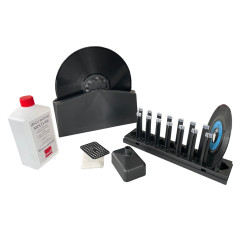
Shipping by UPS NOT possible !
...because of Disco-Antistat-Mixture
EN:
Makes LPs durably antistatic with the alcohol-free Disco-Antistat mixture, a special liquid that automatically removes dust, dirt particles and dried liquids without leaving any residue and deep into the grooves.
The care set consists of:
Wash case with inserted goat hair brushes
Label cover with hanging axle for LPs, singles and 10 inch discs --> Adapter included
1 litre cleaning fluid DISCO-ANTISTAT Mixture (alcohol-free)
Funnel incl. filter grid and filter fleece (5 pieces), with which the liquid is filtered back into the bottle after use.
Drip stand (drying rack) with drip tray for up to 15 LPs or singles (slides into the casing after use)
Device can be stored in our original Archifix box (Art. 1202431) to save space.
DE: Disco-Antistat, das praktische Pflege-Set für die Grundreinigung.
Macht LPs dauerhaft antistatisch, mit der alkoholfreien Disco-Antistat-Mixture, einer Spezialflüssigkeit, die selbsttätig, rückstandslos und rillentief Staub, Schmutzteile, sowie eingetrocknete Flüssigkeiten entfernt.
Das Pflege-Set besteht aus:
Waschgehäuse mit eingesetzten Bürsten aus Ziegenhaar.
Labelschutz mit Aufhänge Achse für LPs, Singles und 10 Inch. --> Adapter inklusive
1 Liter Reinigungsflüssigkeit DISCO-ANTISTAT Mixture. (alkoholfrei)
Trichter inkl. Filtergitter und Filterflies (5 Stück), mit dem die Flüssigkeit nach Gebrauch wieder in die Flasche zurückgefiltert wird.
Abtropfständer (Trockenständer) mit Auffangschale für bis zu 15 LPs oder Singles (wird nach Gebrauch in das Gehäuse geschoben)
Gerät kann platzsparen in unserer Original Archifix-Box (Art. 1202431) verstaut werden.

Following his debut EP ‘En clair-obscur’ and a series of singles earlier this year cementing his place as a rising name in the world of cinematic soul & funk, Hamburg’s finest cinematic soul artist ‘The Offline’ announces his debut album 'La couleur de la mer'.
Reminiscent of film scores from the 60s and 70s, The Offline worked with co-producer Tim Liztenberger to channel the influence of film composers such as Francois de Roubaix and Brian Bennet, creating his own soundtrack on ‘La couleur de la mer’. Inducing images of manorial, fog-swept villas at the sea's edge, silhouetted sailing boats and cigar-chomping villains attempting to thwart the mission of an imaginary hero, the record is a masterfully composed sonic journey. Experimenting with themes and atypical song structures, the music moves from dramatic cues to fragile romanticism. It incorporates psychedelic spaciness, retro soul and hip-hop sensibilities informed by The Offline’s extensive record collection and crate-digger status.
“Ever since I was a child, I was fascinated by the soundtracks from the 60s and 70s, and I always wanted to make an album in the film score direction. I wrote about 30 demos, kicked half of it and stuck to the ones that felt right in the dramaturgical structure of the ‘movie'. Interestingly the main theme was set early on while writing the album, which made the writing process much easier.”
Aptly named, ‘Thème de la couleur de la mer’ opens proceedings, establishing the core motifs of the record. Haunting flutes and xylophones lead the way into Khruangbin-esque guitar lines, which sit against a hip-hop canvas that returns on boom-bap head boppers like ‘Quelque chose reste’. Retro soul revival takes precedence on deep cuts like ‘Un bout de chemin’, with wah-gated guitars interacting with emotive cello lines and symphonic string & horn sections.
The Offline came to life when composer and photographer Felix Müller travelled the Atlantic coastline in the south of France with his analogue camera, capturing beach life on film. After coming back to Hamburg, he started writing songs as the sonic counterpart to the analogue visuals. His Debut EP ‘En Clair-Obscur’ includes five tracks that capture the essence of his journey and the feeling of a cool summer soundtrack.

“Omni – meaning all-encompassing – is an apt title for celebrating over a decade of music on Blue Hour Music. Marking the musical diversity and longevity of Blue Hour’s imprint, the Omni V/A series brings together a wide range of artists from the full electronic music spectrum, plunging into a pool of techno, trance, breaks and everything in between.“
*** Sides C-D are vinyl exclusive until Autumn 2024 when Part 2 will be announced ***

The Issues label keeps up its fine early momentum with a new EP from Pau Roca with a remix from Crue. It is another tasteful 12" that comes on the heels of a deep outing from Dubbyman and an inaugural release featuring fresh versions of Joan Bibiloni by Kiko Navarro & Willie Graff.
Opener 'Daradada' is a spiritual deep house cut with swirling pads and classic vocals drifting next to the jazzy keys. It's expansive and cosmic in design and one that touches the heart on many levels.
'Here Comes The Moon' is another cut that shows off Roca's mastery of astral melodies. His gorgeous chords and delicate keys rise up to the stars as warm, dynamic drums bring the weight down low and spoken words unfurl in a seductive fashion. The Crue remix of 'Daradada' then brings more drive with harder but still organic house drums and hits.
The chords take on a melancholic quality and an elastic bassline pumps the party with a playful sense of energy. Last of all is 'Get Down' which once again sinks you into a beautifully warm and heady world of soft focus chords and late-night synth work.

Respect The Craft Enterprises welcomes Niko Maxen to the label with 4 stripped back and textured grooves exploring the depths of his style.
Niko is no stranger to releasing quality underground music after a string of releases on the likes of Constant sound, Liniar, Rowle, and many more. Niko blends rolling drums and intricate percussion with deep spacey melodies to create a 4 distinctive journeys across the EP.
