The debut release from new Scottish producer North Sea Dialect, Local Guide is a dense musical world made of uneasy ambience, shimmering distortion, subdued rhythm and propulsive melody.
Buried in its soundscapes are the echoes and surrealness of alienated life - expectant youth, distant voices and broken folklore. It's industrialised music tied together with found sound, adrenaline fuelled synthesis and the depths of late night solitude. Conceived during a move from Glasgow across Scotland and composed in isolation, a blistering sense of reality creeps through the recordings.
Local Guide is accompanied by three videos for the tracks Mossy Cyphol, Subarctic Baltasound and Gloup. The short films are haunted and illuminated by the serenity of rural freedom, the power of the sea, and the collapse of industry.
Cerca:its a musical
- A1: Markus Gibb - Kuru
- A2: C O N T R A - Taurus
- A3: Ben Shemie - A Million Kinds
- B1: Drvg Cvltvre - Last Rites
- B2: Sutja Gutierrez - Allodoxaphobia
- B3: Théo Muller - Douce Transe
- C1: Dave E Brun Vs Frank Agrario - Grace
- C2: Benedikt Frey - Iaon
- C3: Lauer - Pythor
- D1: Bajram Bili - Restart
- D2: Il Est Vilaine - Fahrenheit 451
- D3: Jonathan Fitoussi - Cercles Polaires
- D4: Lumi - Izerditan
In just a year of existence, Chloé's Lumière Noire has brought emerging artists and promising newcomers together - and this first compilation of 13 brand new tracks expands the roster, exposing the label's eclectic vision in full daylight. When Chloé talks about her label, she puts forward the fundamental values that informed her own musical journey, her trust in her own musical taste - and, of course, the predominance of human relationships: 'I followed
my bliss and only commissioned tracks from artists that I respect and whose music I love. That to me is Lumière Noire's musical palette.' With this 13- track, unmixed compilation, Chloé makes a case for a label aesthetic that is based in open-mindedness. Familiar, elemental Lumière Noire artists are represented, as are new faces, producing a kind of group photo presaging what's next for the fledgling label. Lyon's Markus Gibb leads the track listing with Kuru with a deep chiaroscuro matching the label's ethos, followed by other mainstays Il Est Vilaine's Farenheit 451, which evokes Ray Bradbury's retro-dystopic angst with the
band's usual electro-pop elegance. Sutja Gutierrez, who released in debut EP, The Legend of Time on Lumière Noire in April, pursues his electro Shamanism with the ceremonial Allodoxaphobia, while Iñigo Vontier (whose EP Aluxes came out on the label in late 2017) brings his C O N T R A project
online with track Taurus, a further development in voodoo house. Elsewhere, Suuns lead singer Ben Shemie, who lent his fascinating art-rock croon to Recall, a single from Chloé's Endless Revisions LP, contributes A Million Kinds, a synthy, psych-pop debut that is as brilliant as it is surprising. On to the freshman class: Dutch producer Drvg Cvltvre (who gets personal kudos
from Chloé with each new 12') brings the uncompromising dark electro of his hypnotic and claustrophobic Last Rites. Jonathan Fitoussi's airy, minimalistic Cercles Polaires brings the respite of his recent Versatile Espaces Timbrés LP (a collaboration with Clemens Hourrières): 'I met him at Xavier Veilhan's
Studio Venezia at the Venice Biennale. He's a great guy, and his universe is unique,' says Chloé. Benedikt Frey's deep techno track Iaon, is on par with his smash 2017 album, Artificial, out on ESP Institute. First-timers are also part of the recruits: Bajram Bili with the ten cerebral minutes of Restart, Théo Muller with the ultra-deep Douce Transe, and Lumi, a Basque band that fuses
electronic sounds with acoustic instruments, brings the ompilation to a close with a track commissioned by Chloé. These audacious choices are anchored down with the likes of Permanent Vacation pioneer Lauer's hooky, 80s-infused Pythor ('Just like him, I was a resident of the Robert Johnson, and he was a guest of mine at one of my Lumière Noire nights at the Rex. He is one of these people whose music I highly appreciate'); Aergeworc & Franck Agrario, half of English duo Swayzak David Brown's project, weaves an ethno* mood into Grace's techno. Bringing together different generations, genres, and styles That may not necessarily be Chloé's MO. She invokes a more arbitrary, personal logic: 'I like to mix of-the-moment tracks and more timeless one, but the rule is above all 'do I love this or not'. That was my ethos when I started Lumière Noire.' In that way, the label is definitely in keeping with its time
Circle Sky is an electronic band and communications network.
Based in London, with operatives working worldwide, the network is anonymous by nature, but inclusive and open source by design.Iris is the current voice of the network, its messenger, its communicator and its focal point. She is always in the present.
The network is evolving in real time and its actions are guided by the response from its members, for whom all like minds are welcome to participate.The network has started online but will continue offline as connections are made IRL with performances and transmissions. Circle Sky represents positive use of technology. There will inevitably be glitches in the network however. Which is where the fun starts...
The objective is to create a world and inclusive communications network around the band, using current and future technology.
Circle Sky is music first. The network is brought together by the music, and is there to support the musical connection with fans around the world. Circle Sky is a network.
- A1: Mahy - Antilles Méchant Bateau
- A2: Guy Conquete - Ban Moin Clé A Titine
- A3: Dolor - A Dardonnel
- A4: Joseph Lacides - Yo Ka Biguiné Joseph
- A5: Tino Saint-Val Mam\'Zelle Cancan
- A6: Dolor - Ki Vino
- A7: Dolor - Socié Cabrite
- B1: Gaby Siarras - Moana
- B2: Joseph Lacides - Citation Créole
- B3: Casimir Letang - Ménage Chalviré
- B4: Manuela Pioche - Pas Ban Moin Coup
- B5: Gerard Valton - Bel Mè A Présent
- B6: Beaujour - Ti Té Ya
- B7: Josianne Saint-Louis - Jeines Gaçons
- B8: Dolor - Vini Sauvé Moin
Fifteen track completion of deep biguines and Gwo Ka from the '60s French West Indies. The vinyl edition included a 4 page booklet + download code.
Biguine is a rhythmic style of music that originated in Guadeloupe and Martinique in the 19th century, which fuses 19th-century French ballroom
dance steps with African rhythms. Gwo Ka is found among all ethnic and religious groups of Guadeloupean society.
It combines responsorial singing in Guadeloupean Creole, rhythms played on the Ka drums and dancing. Gwo Ka is the musical and cultural product of the
region's African ancestry, forcibly brought to the Caribbean through slavery. Gwo Ka exists only in Guadeloupe, which is a very different island from much of
the Caribbean, in that it remains a 'department' of its original colonial master, France. Here the currency is the Euro and the baker sells croissants and café
au lait. This constant 'European-ising' of the island means that Gwo Ka plays a fundamental and important role in the defining of Guadeloupean identity.
'Antilles' Méchant Bateau', a low-tempo number with a bolero feel, indeed a pure case of the blues, and a terrific saxophone solo. What else would you
expect to set the tone for this selection, in which beguine regains its original colours, in the darkness of the Gwo Ka drums. This 45 by André Mahy, released
under the Aux Ondes sublabel, was recorded in the 1960s at Célini's, one of Guadeloupe's two main houses. Through its drum rolls and harrowing chant, it
recalled how, long before the mid-1960s, the Antilles' history was written in an ocean of teardrops - namely the Black Atlantic.
Matthew Dear is a shapeshifter, oscillating seamlessly between DJ, dance-music producer, and experimental pop auteur. He is a founding artist on both Ghostly International and its danceoor offshoot, Spectral Sound. He writes, produces, and mixes all of his work. He straddles multiple musical worlds and belongs to none, now nearly 20 years into his kaleidoscopic career, with ve albums and two dozen EPs plus millions of miles in the rearview of his biography.
Bunny is the name of Matthew Dear's fth album. His rst since 2012, it bounces into plain sight preceded by two slyly different singles in 2017: the moody, urgent "Modanil Blues' and the buoyant, blithe, Tegan and Sara-featuring 'Bad Ones.' Bunny follows both modes, among others, parading down a rabbit hole of unhinged phrasings, dreams, and interludes. It saunters in the shadows; it stands brightly in the moonlight. Bunny is a dual vision of avant-pop; an artistic reckoning from a 21st-century polymath; persona splintered, paradox paraphrased, a riddle rendered.
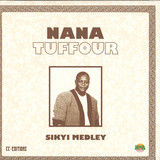
Kalita Records and CC:EDITIONS (a new venture by
Australia's CC:DISCO) jointly announce a 12' EP
comprised of four of Nana Tuffour's greatest electronic
burger highlife tracks, accompanied by interview-based liner
notes. Here, in partnership with Nana, we select two highly
sought-after songs from his 1993 release 'Genesis', namely
'Sikyi Medley' and 'M'Anu Me Ho', and pair them his with two
lesser known yet equally deserving tracks 'Asamando' and
'Jesus' from his 1997 CD-only release 'Highlife Tropicana'.
Hailing from Kumasi, the capital of the Ashanti region in Ghana,
Nana Tuffour is by far one of the most important exponents of
modern highlife music. He studied piano at college and cut his
teeth in the '70s as an organist and vocalist for the incomparable
Kyeremanteng Atwede and Dr. K Gyasi's Noble Kings Band.
Fast forward to 1981 and Ghana was at the apex of its golden age
of music. This era was brought to an abrupt end by political
upheaval when the military took over the government and as a
result a restrictive dusk to dawn curfew was imposed between
1982 and 1984. This resulted in a total obliteration of the country's
night life, and Nana just like many other prominent musicians
including Pat Thomas and George Darko left Ghana for greener
pastures, the most popular destinations being Nigeria and
Germany. The Rheinklang Studio in Düsseldorf run by a young
inimitable German sound engineer Bodo Staiger and another
'exiled' Ghanaian musician Charles Amoah played a crucial role
for those musicians who had chosen Germany. This studio
became the focal point for Ghanaian musicians and the birthplace
of a new sound, now known as 'Burger highlife' - traditional
Ghanaian highlife infused with the more up to date electronic and
disco sounds of the West. It is arguable that Nana has played a
crucial role in Burger highlife and developing the sound of
traditional Ghanaian highlife more widely to what it is today, with
his innovative use of electronic accompaniment pushing its
boundaries to its creative extremes.
It is Burger highlife's transcendence of traditional musical
boundaries that helps make it so accessible to listeners,
appealing not only to Ghanaians back home but now highly
regarded and sought-after by those in the West interested in
more occidental disco and electronic sounds. We hope that you
enjoy the four songs offered here, each chosen to demonstrate
Nana's singular influence on the development of Burger highlife.
Marti Caine's infamous Point Of View is a groovy blend of slow-mo funk, dark disco and precise pop. Originally released on BBC Records in 1981, it has attracted a considerable cult following this century. The odd charity shop score aside, it has been impossible to find a copy for less than eye-watering sums (often selling for over £200) and, as such, it's an honour to present the first officially licensed vinyl reissue of this sublime record. Featuring expert liner notes written by Bill Brewster - perhaps the record's most notable champion - this lovingly curated release is limited to just 500 copies.
Marti Caine was a popular UK TV entertainer in the late 1970s onwards and Point Of View presented her with an opportunity to proceed in a hip direction by working with British R&B heavyweight Barry Blue. His legendary reputation was secured with a string of great records, among them the first three Heatwave albums, the Balearic hit "Afro Dizzi Act" by Cry Cisco and the cult smash "Breakin' In" by Javaroo. However, despite the array of talent working on the album, Point Of View sank without trace at the time. It's something that Blue attributes to the bizarre way BBC Records worked, and he entertainingly expands upon this within the liner notes.
Musically, the highlights are many and memorable. Its most notorious track is the sublime soul stepper "Love The Way You Love Me", the reason most people covet this album so profoundly. However, from the dark dubby disco of "Snowbird City" to the moody ballad "Love Is Running Through Me", the lesser heralded tracks are nothing short of exquisite. Indeed, the chugging elegance of sleazy disco opener "Can I Speak To The World Please" showcases a string-drenched strutting-funk that would've been enviable the world over. It's that good.
The outlandish artwork - presenting a striking, green-eyed Marti treating a tiger to a headlock - has been faithfully restored and is arguably worth the price of admission alone. With access to the original tape transfers, Simon Francis' sensitive mastering elevates the sound throughout and, as ever, it has been pressed at a reassuringly weighty 180g. Sadly, Marti died of lymphatic cancer at the tragically early age of 50 in 1995, so is not here to experience what we hope will be a long overdue reappraisal of the hitherto underheard genius of Marti Caine, the singer
In 1975, the prolific and multi-talented Brazilian comedians Chico Anysio and Arnaud Rodrigues recorded an album based on the protagonist of one of their most celebrated TV series. Sporting a dodgy moustache and an equally troubling haircut, Carioca conman Paulo Maurício Azambuja (played by Anysio) would flog his own mother's leg if he could, and his ever-ridiculous scams are inevitably always destined to fail. This soundtrack/musical re-imagining of the series combines jazz-funk with samba soul and MPB, with the help of cult Brazilian trio Azymuth. Keyboard maestro Jose Roberto Bertrami, who arranged the album alongside renowned conductor and composer Jose Menezes, elevates the groovy odd-ball sound to another dimension, with his set up including Fender Rhodes, Arp Strings, Arp Omni, Clavinet and Hammond organ. Remaining Azymuth members Ivan Conti (drums) and Alex Malheiros (bass) provide the signature Azymuth foundation, and saxophone prodigy Victor Assis Brasil and legendary multi-instrumentalist producer Durval Ferreira also feature.As well as its distinctly comedic character, what makes the music so special is the coming together of traditional samba roots, and Azymuth's ahead-of-its-time psychedelic funk influence. Each side ends with a comedy monologue, complete with live audience laughter, but before that you get seven tracks of weird and wonderfully emotive Brazilian groove music.
Fast-moving Times, In Which Popularity And Quality Are Often Equated Or Commonly Confused With One Another, Aids And Abets This Imitation Game Some Call Conformity, Others Professionalism. In The End, Both Paths Will End Up In Predictability. Here's Where Stathis Kalatzis, Aka Mr. Statik, Comes To Play. The Resident At Athens' Multi-purpose Cultural Space Six D.o.g.s Has Not Only Been One Of The Scene's Pivotal Figures, But Since He Started To Release His First Solo Releases In The Mid-00s, The Now Berlin-based Greek Dj Has Earned A Reputation For Being A Trend-ignoring, Unconventional Producer.
Whether His Output For Bpitch Control, Rotary Cocktail, Or Even Last Year's Debut Ep "rogue
Cherub" For Away - Mr. Statik Enjoys Thinking Outside The Box By Crossing His Diverse Pop-cultural Interests And Pulling In Expertise And Perspective From Beyond The Usual Functional Formulas. After A Decade Of Not Staying In One Comfort Zone Or Sticking To One Musical Direction, He Finds Himself More Comfortable In His Producer Shoes Presenting His Debut Album "metamorphose". Housing A Few Film References In This For Mr. Statik Typical Nebulous Fashion, The Ten Tracks Not Only Carrying The Narrative Potential Of An Imaginary Score, But Primarily Exploring A Versatile Array Of Influences, Themes, And Contradictions (which Mr. Statik As An Illustrator Also United On The Albums' Artwork). Ranging From The Sci-fi Infused Album Opener "insomnia", The First Non-dancefloor Piece He Ever Produced Around 7 Years Ago, Over "atastrophe", An Homage To Ancient Greek Theater, To Collaborate With Others Such As Beatrice Ballabile, Jan Niklas Jansen (locas In Love), And Rbma Alumnus Claude Speeed, Who Contributed Synth Work On "soulfur".
"metamorphose" Succeeds In Constantly Changing Its Tones, While Maintaining An Emotional
Frame, In Which Mr. Statik's Melancholic, Introvert, At Times Hopeful And Euphoric, Bottom End
Inclined Electronic Music Can Elaborate.
Mr. Statik On His Album Debut:
"i Have Always Tried To Approach Producing As Storytelling Exercises. This Allowed Me To
Experiment Finding Myself In Uncharted Territories, More Specifically In Music That Doesn't
Necessarily Fit To A Dance Floor - Unless It's A Very Adventurous One. 'metamorphose'' Is Loyal To That Mindset. I Usually Draw Inspiration From Cinema And Comic Books And Have Always Been Fascinated With Sci-fi, South Asian Culture, Surrealism And The Dreamworld. Initially The Album Was Supposed To Be A Collage Of The Various Influences That Had Shaped My Life, But Ended Up Being Something Very Different. During The Conceptualization And Recording Process A Lot Of Things Around Us Have Changed, Primarily For The Worse. I Became More And More Sensitive And Susceptible To Pessimism And Trendy Visions Of 'dystopian Futurism', So That The Lp Emerged Being An Exercise In Positivity: 'metamorphose' Is A Verb Describing The Act Of
Conversion, But In Greeklish It Is Describes The Urge Towards Others To Start Transforming Their
Environment, In This Case For The Better."
Sao Paulo's acclaimed 10-piece instrumental collective return for their 4th album. Urban Afro-Brazilian grooves, empowered horn-driven melodicism and massive dance floor inspiration. One of South America's
most exhilarating musical propositions. Available on CD or Double 180gr Heavyweight Vinyl that includes a digital download. Quebra Cabe a is a very memorable set of hummable earworms, from the title
cut that opens up the album and continuing, sinewy and cool and relentless, all the way to the final note of 'Portal.' Throughout though, the heartbeat of everything remains utterly African, refracted through the prism of the band's
home in the Bixiga neighbourhood of Sao Paulo. And Bixiga 70 has always been a reflection of the streets where they live. The result still captures the incendiary excitement of Bixiga 70 live, but the
freedom of the studio brings more shade and subtlety than before. The rhythms are more sinuous than ever, snaking through the funk in way that looks more to Ghana or Nigeria than Memphis or Muscle Shoals, while the horns strut in
powerful harmonies. It's music that forges connections and retraces history while sounding absolutely contemporary. But for Bixiga 70, African will always be the root, and Brazil its beautiful, vibrant flower.
- A1: Intro
- A2: Halloween Theme
- A3: Laurieas Theme
- A4: Prison Montage
- A5: Michael Kills
- A6: Michael Kills Again
- A7: The Shape Returns
- A8: The Bogeyman
- A9: The Shape Kills
- A10: Laurie Sees The Shape
- A11: Wrought Iron Fence
- A12: The Shape Hunts Allyson
- A13: Allyson Discovered
- B1: Say Something
- B2: Ray's Goodbye
- B3: The Shape Is Monumental
- B4: The Shape & Laurie Fight
- B5: The Grind
- B6: Trap The Shape
- B7: The Shape Burns
- B8: Halloween Triumphant
Blood Knife Coloured Vinyl[27,69 €]
When the new Halloween movie hits theaters in October 2018, it will have the distinction of being the first film in the series with creator John Carpenter's direct involvement since 1982's Halloween III: Season of the Witch. Carpenter serves on the new David Gordon Green-directed installment as an executive producer, a creative consultant, and, thrillingly, as a soundtrack composer, alongside his collaborators from his three recent solo albums, Cody Carpenter and Daniel Davies.
The new soundtrack pays homage to the classic Halloween score that Carpenter composed and recorded in 1978, when he forever changed the course of horror cinema and synthesizer music with his low-budget masterpiece. Several new versions of the iconic main theme serve as the pulse of Green's film, its familiar 5/4 refrain stabbing through the soundtrack like the Shape's knife. The rest of the soundtrack is just as enthralling, incorporating everything from atmospheric synth whooshes to eerie piano-driven pieces to skittering electronic percussion. While the new score was made with a few more resources than Carpenter's famously shoestring original, its musical spirit was preserved.
Hosono's solo career would take many twists and turns from this point forward, with forays into exotica, electronic, ambient, and techno, culminating in the massive success of techno pop group Yellow Magic Orchestra (YMO), who made their debut in 1978. Admired by artists ranging from Van Dyke Parks to Mac DeMarco, Hosono continues to forge ahead as he heads into his fifth decade as a musician. With the re-release of his key albums for the first time outside of Japan, his genius will be discovered by a whole new generation of fans around the world.
.
The unbelievably prolific Haruomi Hosono is one of the major architects of modern Japanese pop music. With his encyclopedic knowledge of music and boundless curiosity for new sounds, Hosono is the auteur of his own idiosyncratic musical world, putting his unmistakable stamp on hundreds of recordings as an artist, session player, songwriter and producer.
Born and raised in central Tokyo, his adolescent obsession with American pop culture informed his early forays into country music, which he would revisit later in his career. Hosono made his professional debut in 1969 as a member of Apryl Fool, whose heavy psychedelia was somewhat at odds with his influences, which leaned towards the rootsy sounds of Moby Grape and Buffalo Springfield. The latter was one of the main inspirations for his next group, Happy End, whose unique blend of West Coast sounds with Japanese lyrics proved to be highly influential over the course of three albums. After the band’s amicable break up in 1973, Hosono began his solo career with Hosono House, an intimate slice of Japanese Americana recorded inside a rented house with recording gear squeezed into its tiny bedroom.
- A1: Subterranean Homesick Blues (Tristezas Del Blues Nostálgico Y Subterráneo)
- A2: 45.000$ (Guapapasea)
- A3: Sabes Quién Te Quiere
- B1: Un Limón En La Cabeza
- B2: Te Estás Equivocando
- B3: How Come You Do Me Like You Do Me (Big Bang Romeo)
- C1: Rainbow Country
- C2: Psychocalimba
- C3: Niña Del Guadiana
- D1: Did Ya Black Up Today
- D2: Dime Que Te Quéa
- D3: Dizzie
- D4: Monk Among Us
Guapapasea! is the first album by Gecko Turner, a unique creator from southern Spain. Born and bred in Extremadura, near Portugal, Gecko has an original and tasteful Latin personality, and during the 90s he was responsible for some locally quite successful bands like Perroflauta, and The Reverendoes.
Acclaimed by Spanish critics as the best debut album upon its original release in 2003, Guapapasea! is a musical journey blurring the boundaries in Latin music. It's a nice blend of different styles - from soul and Brazilian-flavoured songs like the free and easy (and all-time underground hit) "Un Limón en La Cabeza"; Afrobeat-driven tracks like "45.000$ (Guapa Pasea)"; and the flamenco-reggae of his rendition of Bob Marley's "Rainbow Country", to the infectious Latin rhythms of "Did You Black Up Today"; Monk tribute "Monka Mongas"; the original adaptation of Bob Dylan's "Subterranean Homesick Blues"; and the radio-friendly, straightforward reggae track "Te Estás Equivocando".
Guapapasea! features contributions by some of the greatest musicians active at the time on the Spanish Afro-Cuban jazz scene, such as Rubem Dantas (Paco de Lucía's percussionist and regular member of Chick Corea's band), Rodney Dássiff, and Brazilian trumpeter Irapoam Freire. The album was licensed to Quango in the US.
It's been 15 years since its original release, and to celebrate this, Lovemonk's reissuing the album on double 12" vinyl for the first time, alongside Gecko's second album, Chandalismo Ilustrado, and the CD compilation Soniquete: The Sensational Sound Of Gecko Turner. The CD version features bonus remixes by Quantic, Mexican Institute Of Sound and Watch TV.
- Spectral Decay' is a collection of musical reflections about the paradoxical contemporary state of humankind, whereas its own technological, social, cultural and economical development seems to entrench the possible points of a structura downfall. The narrative of - Spectral Decay' starts with heavy, mesmerizing industrial vibes. Due to the notable sound design techniques of Japanese artist Tetsumasa, his hefty piece - Nex' evolves into a harsh but still amazingly cinematical music sculpture.
Subsequent mid-tempo composition - Onzour Shayatini' by Meer dynamically follows the dark, experimental path of drone and noisy structures. Violent accents smoothly lead to the deconstruction of drum & bass patterns and turn into strident 90s metal riffs. The track progressively penetrates obscure subterranean abysses and becomes a perfect introduction to the next theme by Yuji Kondo - - Hades'. In Greek mythology Hades was the ancient god of the underground kingdoms, darkness, death and metals. Therefore, Kondo's music piece turns into an infernal portrayal of the underworld where tenebrous layers of bass frequencies, raw textures and Drexciyan sounds build up an enormous and lasting tension.
Side B begins with the track - Anthropocene' produced by Arboretum co-founder - Mogano. The whole composition refers to the present geological epoch we live in, characterized by environmental pollutions, depletion of fossil fuels and accelerated urbaniza- tion of the world. It is a deeply conceptual soundscape of a powerful system, that incorporates both - the destructive forces of technology and the infinite energy of the whole universe, that interweave in a devilish dance of post-techno, breakbeat and dub tones.
Thereafter, ~Raw in his piece - Poly Bios' pictures the interference of human structures in the nature. Creating a mosaic from indus- trial and tribal, organic sounds, he tells a mystical story of fear, hope, escape and primeval instincts.
The narration concludes with an atmospheric composition of NWRMNTC - solo project of Ana Quiroga from experimental ambient duet LCC. - Beyond' is a boundless, spectral reflection on collective human consciousness, where haunting vocals evoke a recon- dite, ineffable pain, leaving the listeners in a profoundly meditative state.
Laura Polan´ska
Limited Edition 400 Only Translucent Violet Coloured Vinyl Lp. Housed In A Full Colour Outer Sleeve With Mind Bending Artwork And Download Code.
Third Earthling Society Album For Riot Season Following The Previous And Now Sold Out 'england Have My Bones' (2014) & 'ascent To Godhead' (2017)
'mo - The Demon' Was Recorded At Leeds College Of Music Between November 2017 - February 2018. The Basis Of The Album Was To Record An Imaginary Soundtrack To The Shaw Brothers Bat Shit Psychedicrazy Kung Fu Horror 'the Boxer's Omen' Aka Mo Or Demon.
The Story Is An Everyday One.
After A Hong Kong Kick Boxer Is Paralysed By A Cheating Thai Competitor, His Mobster Brother Vows Revenge And Journeys To Thailand For A Duel. Along The Way, Our Hero Is Met By Bizarre Visions, Entered Into A Buddhist Monastery, And Begins A Quest To Save The Soul Of A Deceased Monk (his Twin Brother In A Past Life) Who Died At The Hands Of A Powerful Black Magician.
We've All Been There. However The Movie Descends Into A Kind Of Spiritual Jodorowsky Mushroom Fest That Is Completely Deranged And Is Therefore One Of Those Perfect Midnight Movies.
So We Got Free Studio Time At Lcm In November And Just Went 'fuck It' Lets Make An Imaginary Soundtrack In Homage To Such A Great Movie.
Taking Inspiration From All The Things Musical That Have Inspired Us Over The Years. Berlin Era Bowie, Prime Magazine Circa 'correct Use Of Soap', Electric Funk Miles, 'caravanserai' Santana, Embryo And God Knows What Else (it Doesn't Really Matter As It All Ends Up Earthling Society), We Think We've Made A Groovy As Fuck Concept.
Then, Invited Back In February We Decided To Record 2 Stand Alone Pieces 'spring Snow' And 'jetavina Grove' And Bring All Our Space Rock Elements And Psych Raga Back Into The Fray. Throw In Some Super Cool Korean Vocals Courtesy Of Bomi Seo Of Tirikiliatops And Run The Guitars Through A Harmonizer H910 (as Used By Visconti On Low An Heroes) And Its The Perfect Swansong To The Last 14 Years Of Playing Live And Recording Together.
'Shlom Hatzibur' - 'Yanshuf al Anaf Gavoha' a repress of a long lost new wave single along with edits by 'The Models' and 'Mule Driver'.
'Shlom Hatzibur', a band formed by Yuval Banay and Oren Elazary, was active between 1984-1985. This was the year in which the band 'Mashina' paused their activity. ('Mashina' was established in 1983 - and is considered by many ones of the most influential rock bands in Israel). In 1984, they independently published two singles, one of which was 'Yanshuf al Anaf Gavoha'.'Yanshuf al Anaf Gavoha' (Owl on a High Branch) represents a rare moment in Israeli musical history and culture: a moment of disillusionment and expression of personal voice, contemporary sound, and rhythm which stood out during a turbulent political period.
During the First Lebanon War, in the 80s, a generation of young people traveled on the weekends from the battlefields of southern Lebanon and flocked to the rising nightclubs in Tel Aviv. From army discipline to individual freedom, from the threat of death to the city's vibrancy. It is a song of adolescence in a divided and alienated society, and its reissue is more relevant than ever.
The song mixes industrial rhythm with Post-Punk, Rock and Ska. The unusual musical production and the use of a drum machine were influenced prominently by the musical soundtrack played in Tel Aviv's record shops and alternative nightclubs (eg, 'Fuzz', 'Penguin').
Slovenska Televiza Are A Two-piece Act Based In Valladolid And Barcelona. They Produce Music That Is Hard To Define With Simple Comparisons Or Oblique Generalisations, But Perhaps An Amalgam Of Minimal Synth And Coldwave Would Best Express Their 'sound'. With That In Mind, There Is Also A Melancholy Underpinning This Release, Perhaps It's The Haunting Vocals Of Lunademayo, Or The Heavily Reverb Laden Soundscapes Of Wladyslaw Trejo's Analogue Synths. You'll Have To Wait Patiently To Find Out....
Slovenska Televiza
Slovenska Televiza Is A Minimal Electronics Duo Based In Valladolid And Barcelona. Wladyslaw Trejo And Lunademayo Stays Close To Coldwave Then Expands To Avant-garde And Experimental Approaches, Reaching A Proposal As Strange As It Is Fascinating.
It Must Be Said That Slovenska Televiza Is Not Only Limited To The Musical Arena, Its Commitment Extends To Other Artistic Facets As Already Shown With Their Very Special Debut, A Performative Action Implemented In Latvia, Where They Traveled To Leave Behind The Entire Output In Several Locations.
HINOSCH are a duo of Koshiro Hino from Osaka and Stefan Schneider from Düsseldorf, they first (met and) began their collaborative work of musical interaction and exploring contrasting possibilities in 2017. After a number of concerts in the EU and in Japan a debut EP (HINOSCH EP/TAL05) was released in late 2017. Fully instrumental, their first full-length album HANDS offers a more steeply focussed approach than its largely improvised predecessor.
Encouraged by the momentum generated during a number of on-the-spot recordings in Osaka, where Schneider had held a residency in April 2017, the overall sound of the album has been honed down through meticulous studio engineering. One of the outstanding qualities of HANDS certainly is an unprejudiced approach of sound and song structures. The instrumentation is condently reduced to a small range of analogue and digital machines. Snatches of tape-loops deliver lower-pitched vocal and drum machine samples. This characteristic technical set up soon proved ideal in order to dene a tactile vocabulary of fully unsynchronized rhythm patterns. The word tactile perfectly conjures that quality which is the very essence of HANDS. It is the result of the manner in which interdependent threads of rhythm units are deliberately disconnected to form a cohesive, soulful and exible whole. Most tracks on HANDS are devoid of a central motif and examine an unpredictable dialogue. A fantasy of constant change and a search for musical suggestions is the most vital ingredient in this abstract environment.
The album title HANDS refers to physical aspects of electronic music production. Every live concert of Hinosch usually starts out with a hand shake between Hino and Schneider. The general process of collective music making, programming, button pushing, playing, recording, decision making, all demand utmost concentration. The image on the front of the abum sleeve (designed by Takashi Makabe) reects the general approach of HANDS: layers of tuckled fabrics confronting one another to articulate a form for themselves to no other end than their own orchestration.
After having emerged from the ever thrilling Osaka music scene onto the international playgrounds of electronic music just a few years ago Koshiro Hino's solo activities as YPY and his involvement with the band GOAT have already garnered him a very favourable international reception. Stefan Schneider has over the years produced and collaborated with a.o. Joachim Roedelius (Cluster), Arto Lindsay, Klaus Dinger (NEU!), Dieter Moebius (Cluster), Alexander Balanescu, John McEntire (tortoise), Katharina Grosse, Bill Wells and St.Etienne.
Those of you who have followed Lucky Brown's tireless efforts since joining the Tramp family in 2007 can hear without a doubt the progress he and his various ensembles have made in almost every musical aspect. His songwriting skills amazed us right from the start of our relationship. What deserves much more respect is that during the past years he has proved to be probably one of the most authentic and steady but at the same time most innovative creative minds on the contemporary funk scene. Sure, many of today's funk bands are able to deliver a two-and-a-half minute funk killer, what distinguishes Lucky Brown, however, is his ability to create compositions which also employ the idiom as a means to deliver an artistic message, a hard-to describe feeling, or a conscious concept, just like James Brown and Fela Kuti mastered in the 1970s. Furthermore, Lucky has developed his own trademark production and sound whose depth and honesty form a basis from which his work will ever remain timeless.
But that's nothing new as you can hear on both of his first two albums for Tamp ("Lucky Brown's Space Dream, 2011 and "Mystery Road", 2015) On "Mesquite Suite" he is forging new paths by soaking up musical styles from all over the world to infuse with his own totally unique way of producing. Perfect examples are the Mulatu Astatke-ish tracks "Pauraque" and "Mother Corn Stalk" with its distinctive New Orleans Swamp-Jazz flavor. Fans of the Menahan Street Band or El Michels Affair may see in "Taterbug" and "Estrellas De La Tierra" their favourite tracks. But it's the entirety which makes this album standout.
It has been Lucky Brown's aim to paint for the world a picture of the vernacular jazz that America's neighborhoods once crafted as their own homegrown cultural heritage. Lucky Brown's music is a rejection of the elitism, classism, and status of the music industrial complex and is an antitoxin to it's resultant homogeneity. He wants with his heart and his art to transmit an everyday people's sound, made by everyday people, dedicated to the upliftment of all people.
Tobias Kirmayer, August 2018
key-selling points:
- limited to 500 hand-numbered copies
- incl. full album download code
- double vinyl LP with deluxe gatefold cover
The Leap is the new project of Dutch producers Tripeo & Doka who are now taking the logical next step in their musical journey and present an EP that touches on genres all across the electronic board. The Leap is about more than just music, which will reflect in the track titles. Current developments in the world take center stage and inspiration is taken out of politics, literature, media, (green) activism and much more.
The opening track 'Shock Doctrine' is a slow building yet powerful piece of gloomy, hypnotic techno, followed by the exceptionally deep and undulating 'Borrowed Time' that combines soft atmospheric textures with distinct fragile melodies and could easily be the soundtrack of a dystopian reality. On the flip side the duo showcases once again seamless production skills and with 'Green Capital' they set a nostalgic mood, a trancey journey filled with crisp hi-hats and snares, resulting in an effective techno tool. The mind bending closing track 'Sustainable Communities' creates dance floor tension with its piercing metallic synthlines & just like the whole EP it provokes the listener to think outside of the techno sphere.
Italian sound artist GIULIO ALDINUCCI drops his 2nd album on Karl: "Disappearing In A Mirror" is again a truly masterfully composed and sound-designed ambient masterpiece and a more than worthy follow-up to the critically acclaimed "Borders And Ruins" which made it onto several year's best lists for 2017.
Over the course of four solo albums on labels like DRONARIVM plus EPs and collaborative albums (a.o. with IAN HAWGOOD), GIULIO ALDINUCCI successively has been refining his skills as composer and sound designer. His elegant style which blends ambient and field recordings came to full impact on his 2017 album "Borders And Ruins" which gained the Italian sound artist a lot of critical praise and made it onto several year's best lists, a.o. ALDINUCCI's latest effort is again not only a musical masterpiece ofsublime beauty and sacral majesty, it also deals with philosophical concerns. Where "Borders ..." was areflection on the instability of borders - borders as an extreme attempt to discriminate and rationalize that turnsinto a source of chaos and cultural ruins on both sides - and their impact on the relationship between people and territory, "Disappearing In A Mirror" raises the very personal question of identity. In the words of ALDINUCCI himself:
" 'Disappearing In A Mirror' focuses on the fluidity of the identity concept, highlighting the harmonious coexistence of contradictory elements and the transitional features that characterize every transformation. It is a reflection on the current situation of change and disruption and at the same time it is a gaze into the human timeless soul and its inner soundscapes."
Upon examining the eventful life of Can bassist Holger Czukay,
one might conclude that this intrepid musician was a loner. His
turbulent career exuded an enduring eccentricity governed by a
boundless free spirit. Yet Czukay, who passed away
unexpectedly last year at the age of 79, constantly emphasized
that his creativity was always contingent upon a musical
partner, whether that was a skin-and-bones counterpart or an
anonymous manifestation that interacted with him through
radio waves or, as happened later, the internet. Nonetheless,
most of his partners were of flesh and blood.
His oeuvre, which is in itself cinematic in nature, boasts a cast
worthy of a Martin Scorsese film. Only the most interesting
character actors were cast: Brian Eno, Phew, Rolf Dammers,
David Sylvian, Annie Lennox, Jah Wobble, his Can bandmates...
the list could go on and on.
Many of these masterpieces are now out of print, so Groenland
Records, who already released the highly acclaimed
retrospective 'CINEMA' to mark the occasion of Holger's 80th
birthday at the beginning of the year, has taken it upon
themselves to release reissues of Holger's music in order to
make it accessible once again.
A captivating collection of early singles by the renowned Zimbabwean Mbira master and a true African music icon. The songs were mostly recorded in the 1970's, during the buildup to the Chimurenga revolution,
and were only ever released in Stella's home country. Deep resistance & culture. 'I am a rebel', smiles the 70-year-old Stella Chiweshe. Her album 'Kasahwa: Early Singles' offers a fascinating introduction to the world
of Mbira, with the term not only referring to the instrument, consisting of 22 to 28 metal keys mounted on a wooden healing tree body, but also to a musical genre - and on a much wider level, to an entire culture and deeply spiritual
lifestyle, very much at the core of the young Zimbabwean nation. 'Kasahwa' is a collection of impossible-to-find early seven inches, eight cuts spanning the period from 1974 to 1983 and representing Mbira in its purest
form. None of these songs has been released outside of Africa so far.
If you check the credits of The Rolling Stones' Goats Head Soup LP from 1973 you'll find a certain "Pascal" listed on the percussion section. That is none other than Los Angeles based artist Nicolas Pascal Raicevik (1933-1994), aka 107-34-8933, aka Head, aka Nik Pascal, aka Nik Raicevic. Besides his hitting the bongoes on the Stones album, Nik was a great artist on his own, both as a painter and as a musician. As a musician, he was a pioneer in the use of synthesizers, preceeding the Berlin school by some years when his Head LP was released on on Buddah in 1970. Buddah probably saw in Head the opportunity to cash in some money from the remains of the psychedelic scene - the three tracks on the LP are named after drugs used in the late sixties. The sounds, however, are accomplished works that show Raicevic as one of the most interesting pioneers in the use of synths. The album probably didn't do too well, since Buddah didn't renew the contract with Raicevic, who instead took his own way releasing his works on his very own Narco Records and Tapes label. Between 1968 and 1975 Narco would issue 4 LPs credited either to Nik Raicevic (Beyond The End... Eternity) or Nik Pascal (The Sixth Ear, Magnetic Web and Zero Gravity) plus one credited to 107-34-8933 (Numbers, which is in fact the same LP as Buddah's Head, albeit with different cover art). Copies of these LPs came with an ironic sticker over the shrinkwrap that read "Do not listen to this LP if you are stoned".
Magnetic Web was released in 1973. It appeared under the Nik Pascal monicker and showed a clear evolution in sound, favoured by the addition of an Arp 2600 and some rhythm boxes. It also included percussions and cymbals. The Two Headed Dog site thinks "this is his masterpiece in all of its acid-laced glory."
Besides his musical explorations, Nik was also an interesting painter. His paintings are auctioned from time to time, and are consciousness expanding works influenced by abstract cubism and surrealism, some kind of Salvador Dalí on drugs exploring the outter and inner space. All the artwork on the sleeves of his LPs is done by himself. Spacey landscapes and psychedelic colours that fit perfectly to the music they contain.
"Nik Raicevic's music is at the intersection of radical psycho-electronic weirdness and kraut kosmische music (in particular the scifi-hypno-minimal modules of Conrad Schnitzler in Grun, Rot and Blau). It presents mega epic & tripped out electronic improvisations.
"This is an absolute must for collectors and fans of visceral, neurotic soundscapes."
"As far as late-60s / early-70s American Bedroom' Electronic Music goes, these LPS have to be among the first transmissions from this sector, made all the more attractive when coupled with Raicevic's alien topographIes - the covers are high-color portrayals of Venusian lanes, knotted growths, & future-past architecture in a style you might equate with Vintage' sci-fi pulp-novel covers - & copious Downer' sentiment. This music is imbued with a sort of lonely, anti-social sensibility that's about as far as you can get from the Academic' Early Electronic vector. I will say that if the Steve Birchall, Cellutron & the Invisible, and/or Pythagoron™ seed your garden, this will likely do the same."
Never reissued before on vinyl format, the Wah Wah reissue features original sleeve artwork made of paintings and drawings by Nik himself, and reproduction of the famous ironic "Do not listen if you are stoned" sticker. Limited edition, 500 copies only.
This Geneva-based band have finely honed their instrumental "post-internet groove", creating the perfect blend of old-school funk, afro-beat, 70s soundtrack fusion, always adding a pinch of futuristic production and a touch of modernity aimed at bring the groove genre to new generations.
Side A, 'Funky Splash' is an original composition, understated in its groove but with the punch and crunch falling in all the right places, hence can be enjoyed either stewing in the background or as a dancefloor filler. The wah-wah and off-the-wall synths are both used to great rhythmic effect.
Side B, 'O Caminho do Bem', is a cover version of the Brazilian musical heavyweight Tim Maia. Always hard to revisit a classic, but L'Eclair's tight musicianship, perfect pacing and futuristic twist all add an extra layer of groove onto the mellow funk of the original.
Another slice of immaculate sounds for the ears and feet from Switzerland's finest export, Rocafort Records.
- special Thanks To My Family, Friends, And All Those Who've Inspired Me To Keep Making Music. These Compositions Are A Reflection Of My Musical Journey, Reminding Me There's Always More Room To Grow. - Like (pac Div) gabriel Brings The Funk And The Soul, Fresh Drum Patterns With The Right Swing And Most Importantly, The Diversity Of Every Single Track Makes This Record Never Boring.' - Lefto (worldwidefm, Brussels) gabriel Is Fusion Cuisine At Its Finest. Like Combines Ingredients That Shouldn't Work Together, But Do, Because He's A Ill Chef Like That.' - Ivan Ave (mutual Intentions, Jakarta Records)
Lockjaw introduces his upcoming LP 'Human Research' with the release of the 'Human Research Sampler EP' on Locked Concept. A longtime curator of adroit, technical drum & bass through his Locked Concept imprint, Lockjaw now steps to the foreground, revealing four tracks from his forthcoming album that exemplify a continued dedication to this guiding principle, whilst displaying his expert abilities across an eclectic array of tracks that give a tantalizing taste of what is to come from the full LP.
The titular 'Human Research' opens with glistening chimes and a pensive drone, quickly joined by a wandering bassline that sweeps through the shadowy milieu of the track's opening, winding its way forwards amongst a series of increasingly sharp and distorted pulses towards the track's main section, where the combination is joined by a frantic drumbeat that rushes forwards with single minded determination.
'Without You' bears a tangible nostalgia, its opening drums carrying a classic, rave inspired piano riff and vocal reminiscent of an earlier era that reaches its climax amongst rising saw stabs, before locking into a dynamic bassline groove still rippling with the same jubilant energy introduced at the track's beginning.
'Velveteen' features the vocals of QUAILS, who provides an ethereal verse that daydreams about possible affection over soft, floating keys and a pulsating bassline, which drift aimlessly until the track grows with excitement in the second chorus amongst rising percussion & desirous guitar. 'Second Chance' considers the prospect of beginning again, as its sweeping pads grow from muted beginnings to produce an originally subdued drumbeat which exudes a humanizing growth in confidence that waxes as its complexity increases, with a rolling bass and stirring percussion introduced alongside wistful pads still wary from the outcome of the unspoken first attempt.
With the 'Human Research Sampler EP', Lockjaw, demonstrates in brief his unique ability to bestow deeply human qualities to his musical productions across a wide array of tones. In debuting these four sample tracks, he issues firm assurance that the forthcoming 'Human Research LP' will be no less mystifying as its researches the condition of humanity and the emotions most central to it.
- 1: Folly
- 2: Better In My Day
- 3: Little Lambs
- 4: Old Thorn
- 5: Dieu Et Mon Droit
- 6: Throne
- 7: Mongrel
- 8: Glory
- 9: Tea Rooms
- 10: Jerusalem
- 11: Dance Of The Peddlers
- 12: Hobby Horse
- 13: Sunny Stories
- 14: Over The Hills
Coloured[16,77 €]
'Bound to shake your walls and rattle your windows' Max Reinhardt, BBC RADIO 3 "The first bit of evidence that Elizabeth Bernholz's next album Pastoral - due out in September - could be her best to date". THE QUIETUS "Will likely be one of the year's very best records.' CLASH 'What species is this What century' Forged in a rural idyll in Middle-England, the new album Pastoral, by Gazelle Twin, exhumes England's rotten past, and shines a torch over its ever-darkening present. Told through a troupe of multi-gender voices, in vernaculars old and new; from the shrill echo of folksong to tabloid-tinged jaunts, the artist aka Elizabeth Bernholz, presents the notion that 'there is horror in every idyll, and danger lurking beyond the 'quaint' '. The village square - once host to centuries of public torture - becomes a floral framed postcard, dolled-up for the Summer Fête. A sunny, afternoon walk over the hills unsettles a cloud of angry flies feeding from unidentifiable remains. Bigoted vitriol gently murmurs amidst tearoom chatter, as the neatly framed pastoral picture dissolves into a solemn ennui. Four years in the making, amidst life-changing events, including a move far out of the city, Pastoral will be the first major release by the artist since her widely acclaimed LP UNFLESH (2014, Anti-Ghost Moon Ray) and is seamlessly on-theme, together with Bernholz's J.G. Ballard-inspired A/V show 'Kingdom Come' (soundtrack released November 2017, Anti-Ghost Moon Ray) - a fascism-infused hellscape, this time set in deepest Old England. As its sole creator, Gazelle Twin 'The Composer, Musician and Producer' has crafted an album overflowing with a frenzy of traditional and contemporary musical tropes; from early music instrumentation - the harpsichord and the humble recorder, fed through myriad electronics - to the compelling, ritualistic application of found sample-looping. Beyond Bernholz's signature choral-infusions, here reverberating like a warped Sunday Service, there are even shades of '90s house and the once-thriving rural rave scene, albeit recalled as a watery, second-hand memory. In its consummation it is an album that feels pan-century, even pan-species. Set against a verdant backdrop of hedgerows and steeples, Gazelle Twin 'The Artist and Performer', constructs an eccentric and commanding visual embodiment of all-of-the-above - a costume fit for a court Jester of the 21st Century. The colours of Neo-Nationalism. Coke cans, and DANGER. 'It' (not 'she') hints at folkloric traditions with a footy mascot twist. The 'Ye Olde' and 'The Everyman' of the English cliché. Brandishing a sneer and a hobby horse. A riddle and a recorder. A jeer and a square dance in red, Adidas Gazelle's, and a mad, fixed GRIN - first glimpsed in the single, 'Hobby Horse' (22 June, Anti-Ghost Moon Ray). A deranged, absurd reflection of deranged and absurd times.
New Yorker Electronic Producer Dj Spider Is Back On Itay's Out-er With A Muggy, Abstract Techno Release 'human Erosion Field Ep', Similarly To Its Debut 'v Ep', Released In September 2017 And Produced In Featuring With His Longtime Friend Phil Moffa.
Italian Label Out-er Presents Its Twenty-sixth Release Continuing To Explore The Diverse Musical Path Between House, Techno And Experimental Electronic - Which Appears In Most Cases On Out-er's Sub-label Pregnant Void. 'human Erosion Field Ep' Otherworldly Showcases Both A Radiant Take On Electronic As Well As Gloomy And Wild-eyed Pieces, An Aesthetic Approach For Which Dj Spider Has Been Most Known In The Scene. Overlooking To The Style Of The Tracks, The Release Does Contain A Sinister Mood And A Dense, Solid Sense Of Groove Overall, A Typical Recurring Feature Of The Producer's Previous Outputs.
Herbert Bodzin's Revival II' is the next exciting vinyl highlight on this young label. It features completely unreleased electronic music which was recorded between 1979 and 1982. Check!
.
On the album you can hear the sounds of legendary machines like the ARP 2600, the Korg PS-3300, the Roland System-700 Modular synthesizer, the PPG Waveterm and the PPG Wave 2.2 as well as classic synths like the Roland Jupiter-8, the Polymoog and the Prophet-5 - the same equipment used by big names of the German and international avantgarde electronics scene at that time. For example, the ambient Red Ocean' was recorded entirely with the polyphonic Korg PS 3300, one of the most desired and biggest synths of all time. The project features Bernd Hollendiek, as well as Bodzin's two sons, Stephan and Oliver Bodzin on additional synthesizers and partly on drums. The songs are a mixture of mostly ambient, deep, psychedelic, yet experimental and futuristic sounds as well as two more vibrant synth rock recordings with drumming.
We hope that this album will find its way to the hearts and collections of electronic music lovers - somewhere in between the classic albums of Tangerine Dream, Klaus Schulze, Cluster or Eberhard Schoener. As a side note, the album may also show early musical influences of Stephan Bodzin, who became world famous in the 1990s as one of the leading techno producers. Without any doubt, Revival II' should be an exciting lost masterpiece of German electronic music and a must have for synth music lovers - revived and finally alive!
You May Not Have Heard The Name Jackson Almond Before, But You Will Have Likely Heard Some Of His Music. Having Released On Wotnot Back In 2013 Under The Name Real, With A Flurry Of Eps, Remixes And Bootlegs Under This Name And As Part Of Duo Boean (on Bbe, Warner, Xvi & Slowfoot Among Others), Jackson Has Been Delighting Ears For A While Now, With A Particular Knack For Balancing Hooks And Earworms With Original Ideas And Creative Production.
This Ep Began Life As A Series Of Headphone Jams Written When Jackson Was Living Outside Of The City In Self-imposed Exile, Tuning Into The Goings On In Dance Music From An External Position. It Was Then Polished Into Dancefloor Gems At The Wotnot Studio At The Total Refreshment Centre. The Music Reflects This, With The Sonic Palette Reflecting Lo-fi And Outsider House, But With A Warmth, Depth And Musicality Specific To His Own Personal Situation.
The Music Embodies The Hook Of The Title Track - Open Your Head - A Mix Of Influences And Sounds From World, Soul, Jazz, House And Techno Sources. In Oyh, A Child's Voice Floats Over Percussive Drum And Mbira Layers With African Flavours, While Soulful Guitar Stabs Widen The Palette. Ee Ye Follows A Similar Idea With Overseas Sounds Opening To Infectious House Organ Stabs. People, Places, Things In Spaces Is An Immersive Roller With Warming Wurlitzer Chords Providing An Almost Gospel-like Inflection.
The Attention To Detail Throughout The Ep Is Astonishing, The Best Example Being The Arrangement Of Our Personal Favourite Common, With The Irresistible Chord Progression Working Its Way Around Instruments, Patiently Building To Hit Its Peak Halfway Through The Track For The Ultimate Screwface Moment.
Ultimately This Rebirth Of Jackson Almond Sits Nicely With A Label Finding Their Stride Again, With Widely-praised Releases From Danvers And K15 Already This Year, Wotnot Are Staking Their Claim On People's Ears Once Again.
Early Dj Support:
Atjazz, Jimpster, Dave Harvey Futureboogie, &me, Robert Luis (tru Thoughts), Severino Panzetta (horsemeat Disco)
- 1: The Room
- 2: Hbw
- 3: Rythm A
- 4: Groovin' With The Eternal Now
- 5: Don't Move!
- 6: Feel Better
- 7: Like A River
- 8: Just The Rain
- 9: Haha Lol
- 10: Two Doors
"The Room", Fenster's fourth album and their first release on Altin Village & Mine marks the beginning of a new chapter for the band. After releasing three albums, a feature length film, and touring extensively throughout Europe and North America since 2012, "The Room" serves as an entry point into their sonic evolution. The essential characteristic of the band is transformation - within and between genres, albums, and songs. Their sound is a window framing psychedelic, groovy, hypnogogic, playful pop.
Fenster is Elias Hock (Germany), Jonathan Jarzyna (Germany), Lucas Ufo (France) and JJ Weihl (USA). Their mission in creating this album was to compose and arrange every song together in a room. It is an experiment in collective creativity that pushed all of them to transcend their individuality and create something together which is greater than the sum of its parts.
The songs were tracked live in a house where the band ate, slept, and played together. Often the songs were recorded without implementing a click track. They were intent on finding and locking into a human groove—one open to imperfection—while still maintaining a tightness between them. They wanted to make the songs feel alive—as if the listener were present in the room with them in the moment of creation.
The album's title track "The Room" opens the record like a rollercoaster ride. There is a tension in the first bars that ties us to earth, a minimal riff that guides us to the first chorus where we feel we are slowly lifting into the air—and by the time we reach the second chorus it has exploded into a space far away from the planet's gravitational pull.
The band's use of juxtaposition is not just a way of channeling a vast library of musical genres and concepts, it is a means of expression. Combining tender pop melodies with kraut-beats, disco grooves and psychedelia frees the band from any one sound and creates a genre all its own.
This playfulness is especially vibrant in songs like "Rhythm A" and "HAHA lol" which deconstruct and fuse together disparate moments of explosive rock, tender harmonies, percussion made of splashing water, voices from a radio, and electric piano. Even "Feel Better", a sparkly pop ballad is cracked wide open by a long trippy interlude that appears unexpectedly within an otherwise classic structure.
The cover art, created by the band's own Lucas Ufo, invites us into a room in the shape of a human skull. If one looks "out" the window in the picture, one finds oneself looking in to an infinite portal of rooms within rooms. The record plays a lot with this idea of perception. In "HBW", the relationship between the bass and the drums creates the feeling of an infinity loop. The lyrics lend an enigmatic tint to the landscape of so called objective reality v. perceived reality: "I was a phase — you were going through — said I was the one but there is no one — there's only the sun — that gives shape to the moon"
The record starts with "The Room" and ends with "Two Doors". Maybe one door is an exit, and one leads to another room... who knows The song has something mysterious and expansive, like a digital ocean flooding the room, carrying everything away. The whole process of making a record is about capturing a moment in time. This is the record they made - in this point in time, all together, in a room. The last words of the record roll out with the waves: "What you leave behind for someone else to find — Two doors inside — neither one is right"
Tracklisting
Solar Phenomena continues a high quality and high rate of releases after EP's from the likes of STL and Fluxion with a new one from Mystica Tribe - the musical alias of Tokyo-based producer, Taka Noda. Here he draws on everything from dub, soul, bass music, rhythm and blues and will always freak you out with his unusual sounds.
This excellently absorbing EP starts with Love Is All Right, a fusion of Asian percussion and reggae drums that is high tempo and funky. The bright steelpan sounds offset the razor sharp percussion and make for a sunny dub that will get any crowd going. The same fusion vibes continues but in more blissed out and slow motion fashion on 'Lawn Track', the beautiful cosmic psyche-out that is 'Ash' and supple space journey that is 'Voyage' with its intoxicating melodies and loose, tumbling percussion. This is unusual but essential music from an exclusive talent.
Nach Dem Sensationellen Erfolg Des Ersten Albums - oracle Im Letzten Jahr, Erscheint Nun Das Zweite Album Der Deutschen Jazz-supergroup Web Web. - dance Of The Demons Ist Ein Furioser Tanz Mit Den Dämonen - Mal Im Positiven Spirit Soul Jazz Rausch Wie Bei - land Of The Arum Flower , Das Mit Seiner Ergreifenden Melodie An Ethopian Jazz Der 60er Jahre Erinnert, Oder Mal Verrückt, Entfesselt Wie Bei - sandia .
Web Web Spielt Nun Mittlerweile Seit 2 Jahren Intensiv Zusammen, Man Hat Duzende Konzerte Absolviert Und Man Spürt Förmlich Die Geschlossenheit, Intensität Und Kraft, Die Sich Als Homogener Organismus Aus Einem Guß Heraus Zu Einem Phantastischen Sound Zusammenbraut.
Als Einen Besonderen Glücksfall Konnte Die Band Den Berühmten Marrokanischen Sänger Und Gembri-spieler Majid Bekkas Gewinnen, Der In Rabat Beheimatet Ist. Tony Lakatos Arbeitete Mit Majid Und Joachim Kühn In Den Letzten Jahren Immer Wieder Zusammen, Ebenso Roberto Digioia In Zusammenhang Mit Klaus Doldinger. Insofern Lag Es Nahe, Diesen Brillianten Musiker Mit Seinen Nordafrikanischen Wurzeln Mit Dem Ungeschliffenen Konzept Von Web Web Zu Verbinden. In - maroc Blues , Einer Soloperformance Von Majid, Hört Man Den Warmen Klangkörper Der Gembri, Einem Kontrabassartig-klingendem Instrument (dreisaitige Langhalslaute), Sowie Auch Majids Wunderbare Stimme, In Der Sich Die Jahrhunderte Alte Tradition Der Berber Widerspiegelt. - safar Zeigt Ebenso Die Große Improvisatorische Klasse Von Web Web, Vor Allem Wie Sie Auf Allen Ebenen In Die Spirituelle Sprache Eintauchen.
Majid Bekkas Ist Einer Der Bedeutendsten Musiker Und Vertreter Der Gnawa-musik, Die In Der Südlichen Sahara Beheimatet Ist. Am Konservatorium Für Musik Und Tanz In Rabat Studierte Er Seit 1975 Klassische Gitarre Und Oud.
Nach Ersten Erfahrungen Mit Eigenen Bands In Den 80er Jahren Gründete Er 1990 Sein Trio Gnaoua Blues Band, In Dem Er Blues Mit Gnawa-musik Verband. In Den Darauffolgenden Jahren Interessierte Er Sich Zunehmends Für Jazz, Trat Schon Bald Mit Größen Wie Archie Shepp, Louis Sclavis, Peter Brötzmann Oder Hamid Drake Auf.
- dance Of The Demons- Wurde Wie Auch - oracle An Einem Wochenende Live In München Eingespielt
Toningenieur Ist Wie Auch Bei - oracle Jan Krause (beanfield, Poets Of Rhythm U.v.m.)
Das Nächste, Dritte Web Web Album Wird Im Winter 2018 Ebendort In München Aufgenommen, Und Es Werden Wíeder Ein Oder Zwei Hochkarätige Gäste Dazu Eingeladen.
Web Web Sind: Roberto Di Gioia (piano, Synth, Percussion), Tony Lakatos (tenor- Und Sopranosaxophone), Christian Von Kaphengst (upright Bass) Und Peter Gall (drums).
Roberto Di Gioia Arbeitete Mit Zahlreichen Jazz-legenden Zusammen, Wie Z.b. Mit Woody Shaw, Art Farmer, James Moody, Johnny Griffin, Charlie Rouse, Clifford Jordan, Clark Terry, Roy Ayers, Gregory Porter U.v.m.
Anfang 1990 Wurde Er Mitglied In Klaus Doldingers Passport.
Als Pianist Machte Er U.a. Aufnahmen Mit Udo Lindenberg (mtv-unplugged,2011), Charlie Watts (- music Of The Rolling Stones , 2005), Console (- reset The Preset , 2003), The Notwist (- shrink 1998, - neon Golden , 2002).
Seit 2007 Arbeitet Er Zusammen Mit Samon Kawamura Und Max Herre Als Kahedi: Max Herre (- hallo Welt , 2012), Joy Denalane (- gleisdreieck , 2017), U.v.m.
Seine Eigene Band Marsmobil (produziert Von Peter Kruder) Wird Im Herbst Ihr 4.studioalbum Veröffentlichen.
Tony Lakatos Stammt Aus Der Berühmten Lakatos-familie Aus Budapest, Ungarn. Sein Vater War Ein Berühmter Geiger, Ebenso Sein Jüngerer Bruder Roby. Er Begann Mit Dem Saxofon-spiel Als Er 15 Jahre Alt War.
Tony Studierte Auf Dem Bela-bartok-konservatorium In Budapest, Machte Seinen Abschluß 1979 Und Spielte Seither Auf Über 350 Jazzproduktionen Weltweit Mit, U.a. Mit Al Foster, Kirk Lightsey, Randy Brecker, George Mraz, David Witham, Terri Lyne Carrington, Anthony Jackson. Tony War Mitglied Der Band Pili Pili Von Jasper Van´t Hof. Seit 1993 Ist Er Solist In Der Hr Radio-bigband.
Christian Von Kaphengst Bekam Mit 6 Jahren Klassischen Klavierunterricht Im Peter-cornelius-konservatorium In Mainz.
Von 1988 Bis 1995 Studierte Er Jazz-kontrabass Sowie Instrumentalpädagogik An Der Musikhochschule In Köln.
Sein Jazzquartett - cafe Du Sport Absolvierte Im Auftrag Des Goethe-instituts Tourneen Nach Pakistan, Indien, Türkei Und Westafrika. Seit 1999 Ist Er Regelmäßig Bassist Von Patti Austin Sowie Der New York Voices Für Europäische Konzerte.
Von Kaphengst Spielte U.a. Mit Randy Brecker, Nat Adderley, Roy Hargrove, Joe Sample, Charlie Mariano, Katja Ebstein, Xavier Naidoo, Roachford, Yvonne Catterfeld.
Peter Gall Gewann Bereits In Jungen Jahren Erste Preise Bei Jugendjazzt Und Tourte Mit Dem Bundesjazzorchester Unter Leitung Von Peter Herbholzheimer. Er Studierte An Der Berliner Universität Der Künste Und Am Jazz Institut Berlin Bei John Hollenbeck. Gall Absolvierte Sein Masterstudium An Der Manhattan School Of Music Bei John Riley.
Er Arbeitete U.a. Mit Kurt Rosenwinkel, Seamus Blake, Ben Street, Gabriel Rios, Jasmin Tabatabai, Thomas Quasthoff, Peter Fessler.
Feedback - Web Web - oracle :
"oracle Ist Nicht Nur Ungemein Packend, Sondern Klingt Auch Absolut International, Bewegt Sich Auf Einer Ebene Mit Leuten Wie Kamasi Washington Oder Shabaka Hutchings." - Jazzthetik
"ein Wirklich Erstaunliches Erstes Album" - Süddeutsche Zeitung
"sun Ra Wäre Stolz Gewesen Auf Web Web Und Ihr Erstes Album Oracle." - Soultrainonline.de
"...the Album Is Engaging And Fascinating In Equal Measures. ... Sonically, The Album Embraces The Various Late 1960s And '70s Jazz Aesthetics Of Modal, Fusion And Spiritual Jazz Soundscapes, But 'oracle' Isn't A Strata East Or Black Jazz Tribute Record. This Is Very Much A Contemporary Affair With Its Richness Emanating From The Group's Varied Musical Tastes And Sensibilities And It Favours An Entire Listening Experience." - Ukvibe.org
"raise A Glass And Toast This Supremely Enjoyable Recording." - Birdistheworm
"oracle Contains 13 Tracks Of Pure Retro Sounding Perfection. This Is Like A Long Forgotten Treasure. It's Certainly An Album Serious Lovers Of The Genre Will Embrace." - Reviewgraveyard
"wonderful Album!!" - Simon Harrison / Basic Soul
"this Is Amazing. Going To Have To Grab A Vinyl Copy For The Collection" - Kev Beadle
"fantastic Record ! Love It ! We Need More Music Like This !!" - Peter Kruder
Thomas Fehlmann steps away as co-member of The Orb following two acclaimed full lengths on Kompakt (COW - 2016, Moonbuilding 2703 AD - 2015) and embarks back on his solo career with a career defining album 'Los Lagos' - from Detroit to Schaffel techno he conducts a broad spectrum of electronic music into a seamless flow.
Thomas Fehlmann has been active since the late 1970's from Palais Schaumburg, the Tresor defnining trio 3MB (with Moritz von Oswald and Juan Atkins), Ocean Club (together with Gudrun Gut) and of course The Orb.
Artwork direction and design by DESIGNERS REPUBLIC.
'Los Lagos' is Thomas Fehlmann's seventh solo full-length, his 4th for Kompakt following his Berlin inspired 2010 full length 'Gute Luft'. in the musician's own words it's about "checking the juice".
Establishing a picture of his current artistic condition, as suggested by the title - los lagos / die lage / the situation (literally translating to 'the lakes' but taking the meaning of 'wassup' in the context of a relaxed discussion between friends), the album refers to Fehlmann's "musical motivation, dreams and wishes" through the language of music exclusively: a way to "allow myself to techno" he says, "to techno as a means to deconstruct and rebuild again. Set up an area of tension, loose it in the flow of the grooves. Magnifying some detail out of proportion, regroup around that and slowly knit a texture. Expand."
"It was time to take a bend and head where the sun rises or sets, wherever my heart drives me." This is pretty much the kind of decision Thomas Fehlmann has made. 61 and shining, longstanding member of The Orb, multi-talented composer and boundless experimentalist, had to make in the twilight of his collaboration with Alex Paterson, eager to taste the flavours of the unknown on his own again. "It was the moment when felxibility would have become compromise'. Far from being the demise of their joint dream, this was bound to split it in two distinct, parallel fantasies - rich of their own singularity.
As goes with that essential love of his for the free-flowing nature of electronic music, a fascination born out of its "lack of borders", capable of "inventing, changing the emphasis, experimenting with an unpredictable outcome", 'Los Lagos' "freely connects disparate extremes. Art, disco, minimalism, schmalz, jazz and funk". As he likes to say, Fehlmann's head functions as a sampler, capturing elements and re-assembling them under his own embracing perspective ; not afraid to leap from a deep, dubbed-out hypnotism ('Window', 'Morrislouis', 'Freiluft') to the playfulness of '90s-style bleepy schaffel ('Tempelhof' featuring Max Loderbauer), through out-there, muscle-flexing dancefloor cuts ('Triggerism') onto the calmness of ambient ('Geworden').
In need to keep his inner balance in check, Fehlmann committed himself to "switch off the control" and follow his intuition, which isn't so much of an easy process as he also wanted to incorporate the side disturbances experienced: "it's a complex process of search and destroy to bring out a new beauty trying to expand my vocabulary". With 'Los Lagos', Fehlmann looked at finding "the structure that's surprising, disturbing and rewarding". The artwork for the record, courtesy of contemporary artist and friend Albert Oehlen whom he shares lots of artistic ambitions with, echoes the producer's "funky use of shape and space, sludge and clarity" like a second skin. A search for light and harmony that Fehlmann sums up eloquently: "Does your inner musical voice respond", that is the question. Then "doors open up in unexpected corners, rays of light appear; you follow through and you're in - in your oasis."
Artilect's varied musical background is one of the primary reasons why his production is so coveted throughout the back catalogue of the labels he's released on. Beginning his career in Manchester during the mid 90s, his love of breakbeats lead him into the world of hardcore and jungle, where his appreciation of electronic music grew year by year, whether that was the sounds of Detroit or Acid Techno. Having supported artists like the legendary Marcus Intalex at Guidance, his part in the Northern collective Audiosalad helped promote his finely honed craft to a more widespread audience. And now he joins the roster of Horizons Music, an imprint who strives to only deliver the most cutting-edge records from the underground; it seemed like the perfect home for an artist who has only offered the same standard with every track he's released. And the 'Black Fire' EP is no different, with its full spectrum look at the influences which have enabled Artilect to reach this monumental stage in his career.* Title-track 'Black Fire' is chaotic with its swathes of crashing percussion; its impact gains more and more momentum as it gradually builds and crashes along its finely-chiselled bassline. 'Hoax' has the same old-school feel, paying homage to the producer's roots whilst he flexes his ability to create hard-lined breaks which crash against the record's firing drum sequences. 'Deep Signals' is moodier in its approach, with each weighty bass pad lowering the tone as it draws you in gradually. Whilst 'Deep Signals' still nods its head to the type of music which made drum & bass so infamous during its explosion, it alludes to its more contemporary world, with Artilect enabling you to become fully immersed within it. Finally, 'Tryptamine' once again offers a darker edge although this time is goes to even filthier depths, taking you along for the journey through shaking subs and cranking atmospherics. It has a creeping blow, proving that Artilect reigns supreme over his soundscape; another reason why Horizons brought him on board to deliver such a mind-bending release, alongside his eloquent production standard and refusal to bow against commercial pressure.
Originally from West Yorkshire, but now resident in Manchester, composer, bassist and producer Phil France is probably best known as a key collaborator alongside Jason Swinscoe in the Cinematic Orchestra, where he co-wrote, arranged and produced on classic albums including Everyday, Man With The Movie Camera, Ma Fleur and also the triple award winning soundtrack for The Crimson Wing nature documentary. In 2013 France released his debut solo album, The Swimmer (GOND016), an emotive, epic record influenced by the great second wave of film composers including John Carpenter and Vangelis, as well as minimalist composers such as Steve Reich and Philip Glass
Five years later, France presents the follow up, the enigmatically titled, Circle, which again represents a very personal journey for the artist. For France the album is an extension of work he began on The Swimmer. A process he has described as: " blocks of sound containing intricate minimal arpeggiated patterns and electronic textures that develop and shift in subtle, original and melodic ways. The trancelike quality, mood and electronic character of title track Circle led France to think of the circular patterns which eventually became a potent concept for the album. "Ideas and fashions repeat themselves in cycles. Events are said to travel 'full circle' and this is important to me because it represents my own recent personal and musical journey after 15 years touring as bassist and composer with The Cinematic Orchestra. I consider circles to be a strong symbol of unity, strength and inclusiveness and ultimately I've aspired to make something beautiful with those values at its heart".
The album opens with the title track, Circle, built on a minimal looped pattern with melodic embellishment and shifting additional harmonic textures. Bells was developed from the arpeggiator and offers a nod to the melodicism and atmosphere of French electronic music. The Jackal features an idea originally developed for The Crimson Wing score but which finally bears fruit here. Cathedrals features an improvised intro, Philip Glass inspired organ and vocal textures inspired by the work of Colin Stetson. Finally, the album ends with a reprise of Circle this time featuring layered pianos. But it isn't the conclusion of the journey, for France: "The Circle is infinite - During the process of making this record, I have been constantly reminded that nothing ever stays the same and that all is in constant flux. The challenge for me is always to respond positively, be aware of and seize the opportunity for progression constant change provides" And it is that sense of movement and flow, but also calm and beauty that permeates Circle and make it such a worthy successor to The Swimmer.
The young virtuoso producer Prins Emanuel follows up his acclaimed debut album on Music For Dreams with something quite different than what we're used to hearing from him. While Arbete & Fritid was an epic odyssey into the furthest corners of disco with an array of studio wizardry and complex rhythms, Diagonal Musik is a sparse and delicate exploration of the acoustic guitar. Steering away from his comfort zone, the Prins follows his intuition for experimentation and lands somewhere in a field of genre-defiant folk-jazz meditations; a development that fits like hand in glove for the eccentric nature of Music For Dreams. The album reads like a soundtrack to the country house Emanuel shares with his family and friends, a place on the map called Oran. From atop a hillside overlooking a lake, Oran is lodged deep in the heart of the Skåne landscape, the southern part of Sweden that once belonged to Denmark. This place encompasses the whole of the album, as the track titles all pinpoint crucial locations on the courtyard and its surroundings. 'Orön' which opens the album is named after the small half-island that sits in the centre of the lake. There's the hand-built sauna ("Bastun") at the edge of the yard, and behind that in a slope the old root cellar ("Jordkällaren"). While the nature here is anything but balearic, the overwhelming calm of the country life seems to inspire the same laid-back attitude and passion for all things organic (and not just musically, as this is where Emanuel also makes cider from local apples according to the vin naturel school). Upon listening to Diagonal Musik one might be keen to draw references to works in similar style, such as the output of late 80's new age label Windham Hill or the dreamy lullabies of long-time friend and Music For Dreams affiliate 55 Cancri e. This is all circumstantial however, surprising as it may seem.
Originally released in 1972, Lord Of Lords was Alice Coltrane's final album for Impulse! and the last installment in her awe-inspiring trilogy that also included Universal Consciousness and World Galaxy. While all three records featured strings alongside a jazz ensemble, Lords Of Lords stood apart from its predecessors due to the sheer size of the orchestra (12 violins, 6 violas and 7 cellos, arranged and conducted by Coltrane herself) and its refined, blissful performances - shining a vital light on the devotional path that she would follow for the rest of her career.
On the first two pieces, "Andromeda's Suffering" and "Sri Rama Ohnedaruth" (titled after the spiritual name for her late husband), Alice's dazzling piano and harp blend perfectly with the blanket of strings, while the haunting rhythm section of Charlie Haden and Ben Riley and a magnificent, droning electric organ emerge immaculately on the title track and closer "Going Home." Coltrane's musical vision is bold in its imagination and cosmic in scope, yet remains intensely personal and immediate. Lord Of Lords points inward as much as to the beyond, recalling her classical roots and recasting Eastern modes to radically invert the American avant-garde and spiritual jazz traditions.
This first-time vinyl reissue has been carefully remastered from the original master tapes.
Set for release on June 23 via Asylum Records, x (multiply) is the hugely anticipated new album by Ed Sheeran.
It follows his critically acclaimed and hugely successful 2011 debut +; an album that was certified 6 times platinum in the UK alone and has achieved worldwide sales of over 4 million copies to date. It also saw Ed asthe recipient of various awards for the record, including 2 Brits, an Ivor Novello and multiple Grammy nominations.
Never an artist to stand still, Ed recorded x at various locations around the globe (all the while drawing on experiences and influences encountered on his over three years of unrelenting touring) with such luminary producers as Rick Rubin (Eminem, Jay-Z, Red Hot Chilli Peppers), Pharrell Williams (Daft Punk, Robin Thicke, N.E.R.D), Benny Blanco (Rhianna, Wiz Khalifa) and Jeff Bhasker (Alicia Keys, Jay-Z) adding new flavours to the classy work of key collaborators Johnny McDaid (Snow Patrol) and Jake Gosling (who produced +). xhas the musical ingredients to make it one of the most important global releases of this year.
The new set showcases the exponential growth (both vocally and musically) of an incredible artist, who at 23 exhibits the poise of a seasoned veteran. The songs for x came together whilst touring + and, in the same way as the latter was a snapshot of his life and relationship to-date, x charts his loves and life since. Only 'One', the perfect album opener and first song written for the record (in 2011 whilst on tour in Australia) looks back to that time and is the link between the two records. With 'One' under his belt, almost before he noticed he was writing, Ed had ten new songs and counting.
The breath-taking album-closer 'Afire Love' was written about his grandfather who passed away last Christmas. 'Always the hero of the family - such a cool guy - he'd been suffering with Alzheimer's for some time and I actually started writing that song two weeks before he passed away," Ed says. "I was thinking 'What if' and then he did...' Then there is the timeless ballad 'Photograph' written in May 2012 in a hotel room in Kansas whilst on tour with Snow Patrol. McDaid had a piano loop playing on his laptop while Ed was making a Lego X-wing Fighter to give to a charity auction. He just started singing as he put the pieces together and the song grew from there. 'Don't' started life as a riff on his phone and grew into another of x's massive moments. The deluxe version of the album also includes the original song, 'I See Fire', which Ed wrote, produced and recorded for the second Hobbit movie. This was after Academy award-winning filmmaker Peter Jackson personally commissioned him. With no promotion besides 3 tweets from his personal twitter account, it reached #2 on the UK iTunes chart.
However it's the Pharrell-produced lead single 'Sing', due out in the UK on June 1, that's pushing the envelope for Ed. #Sing was the number one trend on twitter globally ahead of launch with the track immediately tearing up airwaves nationwide including a 7-week add to Radio 1 and an unprecedented addition straight to the Super Hit list at Capital FM and Kiss Network. The audio upload on YouTube was Ed's biggest ever video launch, clocking 650k views in its first 24 hours. Already i-tunes Top 5 in 15 different countries (number 3 in the US), Top 20 in 36 countries and with all chart positions climbing, 'Sing' is well on the way to being a global smash.
On the back of 'Sing's' launch, x reached No.7 in the UK iTunes chart on pre-order alone with that success mirrored internationally with No.1 positions in the US and Canada, Top 5 in New Zealand, Sweden, Australia and Top 10 in 20 countries.
'I'm really proud of my new album and can't wait for people to hear it.' Ed says. 'It's definitely my best work.'
It is said that every generation casts its mind back to a previous era in times of crisis; the resources that will allow us to decode the questions of our moment may lie in the myths of another era.
Le Renard Bleu, the new musical and cinematic collaboration between Lafawndah and composer Midori Takada, and filmmakers Partel Oliva, takes a cross- generational echo as ground zero for recovering a crucial myth for uncertain times: the blue fox.
As transmitted by Takada, the fox appears in both ancient Senegalese and Japanese folktales as the trickster archetype; belonging both to the heavens and to the earth, the fox is the agent of chaotic good, shaking the world up when its energy has become stagnant. Above all else, the fox is famous for its cunning nature.
Renard Bleu marks the first new music released by Takada in nearly twenty years; it would be difficult to overstate the importance of her return to the public eye. Her first solo record, 1983's Through the Looking Glass, has been rediscovered and heralded as a lost classic; the influence of her percussion trio, the Mkwaju Ensemble, continues to permeate and inspire a new generation entranced by its lucid beauty, playfulness, and sensual patience. Takada has performed in numerous film score orchestras, including the ensemble for Akira Kurasawa's Dreams, coincidentally a key influence on Renard Bleu.
In the ensuing years, Takada has worked closely with theater group the Suzuki Company of Toga on productions of Electra and King Lear, an experience, she says, that allowed her to pursue 'a unity of music, body and space.' Recent live solo performances have evinced the depths of her exploration of all three.
Equally, it is Lafawndah's freedom of tone, decentralized maps of ancient and modern music cultures, and alloying of devotional intensity with modern songcraft casts her as a distinct relative of Midori Takada's.
Over the course of two EPs, self- directed music videos, and countless live performances, Lafawndah has drawn out an uncompromising exploration of how theater, situational intervention, and choreography can amplify the affective palate of forward pop music. One can trace the influence of artists such as Meredith Monk, Carlos Sara, and Andy Kaufman as much as musical antecedents AR Rahmann, Missy Elliott, or Geinoh Yamashirogumi.
It is in a mutual commitment to this unity that Lafawndah, Takada and Partel Oliva find fertile aesthetic common ground.
The music of Renard Bleu originated in Takada's preoccupation with the legend of the fox; after constructing a vivid instrumental composition dramatizing the spirit animal's journeys through waterphone, bells, marimba and various forms of drums, Lafawndah responded - in her inimitable mix of fairytale and undertow-- with melodies and lyrics capturing a dialogue between her and the fox himself. Eventually, the duo met in Tokyo for a week of communing with the material at Avaco Creative Studios, where new elements were composed on site.
Created in partnership with KENZO and premiered today via their channels, it was Partel Oliva who imagined a contemporary cinematic frame for the myth of the fox to re- appear, creating a hybrid of choreography and narrative around Takada and Lafawndah's performance of their joint composition (also titled Le Renard Bleu.) Returning to film in Japan for the third time, Partel Oliva's moving image work (Club Ark Eternal, The Pike and the Shield) has set the standard for and revolutionized the fashion art film. Their deployment of original music, dance, and a highly stylized mis en scene coalesces here in the casting of Los Angeles krump artist Qwenga as the eponymous fox, stalking the halls of the ancient Noh theater in which Takada and Lafawnda's performance takes place.
Why call up the myth of the fox now In Le Renard Bleu, Lafawndah and Takada's collapsing of distance between generations, styles, and milieus intimates that the relationship to time must be shaken. The future lies in fragments in the past; to remember is to recover it; the fox rises to thicken the plot.
2022 repress
currently the rediscovery of long forgotten japanese electronic, jazz and new age music is at a peak like never before. but although many re-issues already flood the record stores around the world: the large, diverse musical culture of japan still got some gems in store that are really missing.
for example, it is still quiet around the the work of japanese bass player, new-age and ambient musi-cian motohiko hamase. when the today 66-years old artist started to be a professional musician in the 1970's, he quickly gained success as a versed studio instrumentalist and started to be part of the great modern jazz isao suzuki sextett, where he played with legends like pianist tsuyoshi yamamoto or fu-sion guitar one-off-a-kind kazumi watanabe.
he also was around in the studio when legendary japanese jazz records like 'straight ahead' of takao uematsu, 'moritato for osada' of jazz singer minami yasuda or 'moon stone' of synthesizer, piano and organ wizard mikio masuda been recorded.
in the 1980's hamase began to slowly drift away from jazz and drowned himself and his musical vision into new-age, ambient and experimental electronic spheres, in which he incorporated his funky medi-tative way of playing the bass above airy sounds and arrangements.
his first solo album 'intaglio' was not only a milestone of japanese new-age ambient, it was also fresh sonic journey in jazz that does not sound like jazz at all. now studio mule is happy to announce the re-recording of his gem from 1986, that opens new doors of perception while being not quite at all.
first issued by the japanese label shi zen, the record had a decent success in japan and by some overseas fans of music from the far east. with seven haunting, stylistically hard to pigeonhole compo-sitions hamase drifts around new-age worlds with howling wind sounds, gently bass picking and dis-creet drums, that sometimes remind the listener on the power of japanese taiko percussions. also, propulsive fourth-world-grooves call the tune and all composition avoid a foreseeable structure. at large his albums seem to be improvised and yet all is deeply composed.
music that works like shuffling through an imaginary sound library full of spiritual deepness, that even spreads in its shaky moments some profound relaxing moods. a true discovery of old music that oper-ates deeply contemporary due to his exploratory spirit and gently played tones. the release marks another highlight in studio mule's fresh mission to excavate neglected japanese music, that somehow has more to offer in present age, than at the time of his original birth.
The music on this EP was conceived in China, between 1989 and 1993. The original tracks were mixed to DAT in real time, in a small neighbour-proof studio inside my apartment in Macau, a 19th floor with a view to the hurricanes. There's a small, unexpected or improbable story behind each track, some little magic fused with the local atmosphere, certainly guaranteeing their lasting authenticity 25 years later.
TAIPEI DISCO
Late 80s Guangzhou was an exotic city where the traditional past coexisted in harmony with the present and even already with the future.
I'd rather spend my weekends in Guangzhou than diving into Hong Kong consumerism - as most ex-pats in Macau did. I took a cab at the border and travelled 150 Km through chaotic roads with family and friends until reaching the hot, humid, mega South China metropolis.
We ate on street joints in the evenings, went on to a karaoke bar and ended up at Taipei Disco, the only proper club in town. All the others were inside hotels and played generic music or they were seedy, sleazy, smoky cabarets.
Taipei Disco used to be a cinema and played cantonese pop music and anglo-saxon pop/rock (that was new). The spacious dance floor was generously lighted, the atmosphere was airy and modern. Boys and girls were in the habit of dancing in pairs, one in front of the other, observing a respectful yet sensual distance. When the girl took a few steps back, the boy went along and vice versa. With legs and feet (more than the upper bodies) synchronized with the music, they never exceeded in extroversion. Cool.
I always carried a MicroComposer and a portable DAT recorder in my travels through China and weekends in Canton. Any spontaneous musical idea was imediately recorded and memorized. The MicroComposer allowed multitrack recording, which was very handy on the road. Based on the emphatic choreography of Taipei Disco's dancers, i started to compose a rhythm track while sitting at a table, with headphones, listening to Cantopop in the background. As if by magic - not a rare occasion in music - everything began fitting together. Odd as it may seem, the track ended up sounding more germanic (Kraftwerkian) than Cantonese pop.
The story ends in a circle: the cantonese DJ at Taipei Disco, whom i used to ask to play certain records, wanted to play my music at the disco when it was basically only just a rhythm track and little else. From a cupboard under his set up he took out a battered keyboard (unrecognizable brand) and invited me to play over the track with the available sounds on the keyboard. The circle was complete, with Cantonese clubbers happily dancing forwards and backwards, as if it were another Cantopop hit.
I didn't get payed but the house offered us free ice cream cups in which little Portuguese flags were sticked.
The track would be finished later, in studio, with vocoder strings ensemble and synth solos.
TAIPEI DISCO (LIVE)
The live version of 'Taipei Disco' was recorded during a live set at the China Pop venue, in Macau, 1993. China Pop was a rock club built in the ample space of an old fishing warehouse, located in the labyrinthic Inner Harbour area. It was decorated with large Mao Zedong and Cultural Revolution posters and memorabilia and had a unique atmosphere, fusing Pop Art with film noir. We began our performance at 1AM, pretty early for Macau's nightlife standards. We were lucky. An audience showed up. And in Macau there were always several friends among the audience, which tranformed a musical performance into a relaxed party.
The atmosphere was particularly surreal on that night. The front row was dominated by French Crazy Horse dancers, a sort of Oriental Moulin Rouge. The girls had finished their last performance of the evening at the Crazy Horse and were still energized from their show. During our performance, right in front of us and perfectly synched, we could hear the famous irreverent screams of can-can dancers. You always had to expect the unexpected in Macau.
RED MAMBO (IMPROMPTU)
I was familiar with the Portuguese-speaking African countries well before having lived in China. I found myself returning several times to one in particular, always attracted by its magic and very distinct, identitary culture and music: Cape Verde.
During the early years of DWART a lot of the inspiration for drum machine rhythms (Roland's TR series) came from African music, especially from new musical trends that gained full autonomy with Cape Verde's independence from Portugal, as was the case with funaná.
I had the privilege of having known and befriended some of the greatest Capeverdian composers, musicians and singers during the 70s and 80s, such as Bana, Luís Morais, Cesária Évora, Paulino Vieira, Chico Serra, Tito Paris, and historical bands such as Bulimundo (ambassadors of funaná) and Os Tubarões (great innovators of morna, coladera and funaná, with the sonic impact of an afro-beat big band).
When Luís Filipe de Barros began playing Os Tubarões for the first time on Portuguese radio, that was the turning point for African music in Portugal. The 'Tabanca' album was so widely heard and talked about that it quickly got a Portuguese release through one of the big labels of the time.
The mystic of this band from the Santiago Island would reach the East. Os Tubarões played to a packed room in Macau in 1992, and after the bombastic gig we arranged a dinner and party at my place.
We ate and drank generously and the moment came for a jam session at the small studio on the 19th floor. Because Os Tubarões didn't all fit in the studio, we recorded an impromptu with only three of the musicians: Tótó Silva (electric guitar), Mário Russo Bettencourt (bass) and Zeca Couto (piano). And there we were improvising without barriers, suddenly detached from cultural roots, labels and constraints, a truly unique moment. The track is now being released exactly as it was recorded, imbued with the real communion between the musicians. And it could only be titled 'Red Mambo'. I wish to dedicate it to the memory of Ildo Lobo and Jaime do Rosário, founders of Os Tubarões, sadly and too soon departed from the land of music.
Apart from being known for founding the infamous vinyl imprint Subaltern Records and for his residency on SUB.FM, Gabriele Romeo aka. Mentha has made quite a name for himself with his Jazz-influenced bass music productions. This LP is a selection of tracks from his vault, showcasing his musical abilities and tasteful compositions in this self-release.
1 - All Or Nothing
Greeting the listener with melancholic yet optimistic vibes is the first track of the LP, 'All Or Nothing'. Setting the loungey and open space feeling for the release, captivating chords and soothing melodies join a potent sub-bass in this introspective overture.
2 - Same Spot ft. Vale
'Same Spot' picks it right up where the first track left it, emerging further into a vast ethereal space. Charming guitars pave the way to uplifting trumpet lines, masterfully executed by Vale. A meditative bass-line seamlessly merges all elements together into a seductive modal composition.
3 - Sunflower
Showing off his instrumental skills yet again, Mentha delivers a sunny and laid-back masterpiece with an apt title, rounded off by a perfectly executed contrast between bumping subs, crispy drums and radiant spaces. Bossa-inspired rhythms bond with Rhodes, jazzy horns and crystal guitars shifting through the realms of major and minor.
4 - Natural Rain
Natural Rain maintains the meditative vibe while entering mysterious spheres of consciousness. Like sunrise in an enchanted forest, this track is magically captivating and keeps the listener under its spell throughout. Oneiric melodies encounter pads and polyrhythms, leading to a climax which completes this mystical journey.
5 - Water March
Like a light breeze on a hot day, Water March takes it easy. Marked by Mentha's very own signature guitar and trumpet, this peaceful march unfolds playfully. While surprising with energetic bass frequencies and instrumental intricacies, this piece shows an insight of the artist's musical roots.
6 - In My Head ft. Aphty Khéa
A psychedelic masterpiece, 'In My Head' sets a strong statement at the end of the release. The unsettling atmosphere of the track is tastefully matched by Aphty Khéa's pristine voice. Creating an eerie yet soothing vibe, this track lets the mind roam freely through time signature changes, dynamic transformations and instrumental layers which remind of Steve Reich.
Jonny Drop's debut, Sub Plot, was the very first album release on the fledgling Albert's Favourites label at the beginning of 2016. The initial offering, a 7" of album favourites Mind Field and This Is The One had quickly been picked up on by the good people at BBC Radio 6 Music as well as some of Drop's personal heroes including Kenny Dope, Mr. Thing and Nightmares On Wax.
But when the infectious rhythms and warm production of the beat tape landed, its impact was greater than anyone at the label could have hoped.
Although Jonny never stopped producing beats in the following years, he was also kept busy as a drummer, playing live for Andrew Ashong, The Bongolian and Connie Constance, whose Boring Connie EP he also laid down beats for.
Then in early 2018 his band The Expansions delivered their celebrated Murmuration LP. All the while, with the support of his label family, Drop had been evolving his solo sound too.
'The Only Sound sees a huge progression in my writing direction, as I collaborated with multiple vocalists and musicians, instead of the usual 'one-man band' approach.
The development of these processes make this LP a steady departure from the beat-tape influence of my past releases, and hopefully, showcase the more original sound I've been working to achieve over the past few years.'
The new album is more atmospheric, emotional and expressive. It is filled with beautiful vocal performances, musical contributions from label partners and close friends Deoke and James O'Keefe, and inspirational London jazz composer, flautist and master saxophonist Tamar Osborn (Collocutor/On The Corner).
Voices here include Shea Soul, Grace Walker, former Myron and E soul man Eric Boss with his Lucid Paradise and Pendletons partner Ishtar, plus First Word Records producer/Golden Rules collaborator Sarah Williams White.
While there are thoughtful, down-tempo moments of electronica in abundance here, Drop brings his favourite elements of disco and soul into the picture too.
And there's no shortage of low end throughout. The Only Sound is a welcome next step from Jonny Drop, the sound of a beat maker not just finding his feet as a composer, but thriving in new territory.
Huey Morgan (BBC Radio 6 Music),
Music Is My Sanctuary premiere for All This Trouble, Bonafide Magazine premiere for Looking Glass
'A really talented musician, absolutely loving that" Lauren Laverne on This Is The One, BBC Radio 6 Music
Meet Me On The Corner is taken from the band's sophomore album, Orange Whip, which itself was BBC 6Music's Album of The Day on its release. It follows previous singles Whatever You Do and Sinner, which garnered support from Craig Charles, Tom Ravenscroft and Huey Morgan. The song showcases Honeyfeet at their funkiest and chunkiest. A pounding beat beefed up by bass, guitar and brass propels forward while Rioghnach Connolly sings lyrics that could be straight out of the playground, but suggest something deeper, possibly mystical even, in its demands for a dalliance on the street.
Remixes on this more foot friendly single come courtesy of homegrown legends of funky house music, Crazy P who come through with both a vocal and dub version. Honeyfeet's latest opus is turned into a straight up soulful disco monster by the boys from Nottingham, with Rioghnach's rasping vocals playfully meandering over Hot Toddy and Ron Basejam's crisp beats and trademark live bass. Elsewhere, much hyped Russian production don, I Gemin, delivers his take - still aimed at the dance floor of course, but a slightly deeper house affair based around jazzy keys and chopped up vocals that take the song into more sonorous territories.
As a bonus, the 12" package also features the acclaimed remix of previous single, Sinner, courtesy of erstwhile Polish Innocent Sorceror, Envee - his shuffling, moody take only previously being available on vinyl via a super limited (and now impossible to find) 7-inch release late last year. For the last couple of years Honeyfeet (whose name comes from a line in the Blues Brothers film) have been a conduit for the ideas and expressions of an exotic mixture of Manchester based musicians. This genre-defying band incorporate styles including jazz, folk and hip hop into their music.
The band are fronted by Rioghnach Connolly - also known for her work with Real World artists Afro Celt Sound System and The Breath - "A remarkable singer and flutist who...can ease from Irish traditional influences to soul" (The Guardian). The line-up is completed by Rik Warren (vocals/harmonica), Gus Fairbairn (tenor sax), Biff Roxby (trombone/vocals), Ellis Davies (guitar), Lorien Edwards (bass guitar), John Ellis (keyboards) and David Schlechtriemen (drums).
Since their self-released debut album, 2013's It's a Good Job I Love You, keyboardist John Ellis jumped on board as full-time member, bringing his unique musical presence. This enabled the development of a more texturally adventurous style, as witnessed with the dual atonal solo between himself and guitarist Ellis Davies on Sinner. Similarly, for their current LP, Orange Whip, engineer, bassist and spiritual guide Lorien Edwards makes his Honeyfeet recording debut, so completing the 'kitchen' of this very special band.
- The album, Orange Whip, is out now.
Opening track 'In The B' kicks off proceedings in no uncertain fashion. It's 100% wall shaker material, the type of techno music best paired with strobe lights and towering speaker stacks. It mesmerises with its low-slung undulating bassline and Detroit rhythms before giving way to some riotous old school Essex stabs and sharp claps. No messing, this is a certified 3 AM red light burner! Track 2 'Chocolate Biscuit' accelerates proceedings! Beginning with unfussy drums and a robotic, bleep-heavy melody driving it off into a wonderfully off-kilter direction. Its arpreggio'd rhythms may be brutish and wrestle a growling sense of menace out of the track, but the overall feel, however, suggests considerable care and attention has been paid to make it sound this way. There's clearly an uncommon musicality at play here to make something this complex feel so simple.
The BPM drops next on 'Jenny's Hall' but from the offset, there's enough funk and thrust in the motorised synth line to get bodies gently grooving without the beauty getting lost in the slower loop. This is blissed out, psychotropic techno - the kind of track where it feels like you're floating and falling at the same time, but all the while making sure you still remain fit for purpose on the dancefloor. Ian Blevins takes on remix duties this time and the Berlin-based DJ/producer offers up a sleek peak-time banger that fizzes, bubbles and percolates. He gives the rhythm on 'Jenny's Hall' less space to swing and ties it to a tight motorik beat turning it into a slice of shiny, modern techno but with extra shoulder-checking force. Its vibe drawing from a sense of outsider-party fun with a wry smile, and a knowing wink running throughout before bringing the package to a suitably left of field crescendo.
New album from Anthony Ferraro aka Astronauts, etc, who for most of his music career, served as Toro y Moi's keyboardist, with this album 'Living In Symbol' being his debut solo record.
Sonically, the album weaves its influences into an alien drapery. 'The Border' introduces Latin psychedelia to a groove à la David Axelrod, setting the stage for a vocal performance that manages to be equal parts Lee Hazlewood and HAL 9000. On 'The Room', a Borgesian story gets dressed up in an eerily graceful string arrangement reminiscent of Les Baxter. And 'Who I Talk To' nods to George Harrison in a soft rocking arrangement that supports Ferraro's ghostly croon.
Living In Symbol Is An Ode To Ambiguity, The Future, And Saying 'so Long' To The Known. A Member Of The Last Generation To Experience Life Before Total Interconnectedness, Anthony Ferraro (digitally Known As Tony Peppers) Aims To Be A Bridge Between Two Very Different Realities.
The Spirit Of Change Is Especially Pronounced In California's Bay Area, Where Technologies Dawn And Disruption Is The Noblest Goal. Critics And Advocates Of All Stripes Write Columns And Fill Talk Radio Hours With Their Analyses Of The Times. Ferraro Is A Funny Case: A Sometimes Luddite With A Romantic Streak, He Would Probably Be A Doomsayer If It Weren't For His Being Situated In The Middle Of It All. As It Happens, He Ended Up Writing A Generative Music Algorithm That Sold On Auction At The Smithsonian For $5,000.
His Take On Tomorrow Is Nonjudgmental, Meditative, Imaginative. It Keeps Away From Unqualified Hope Or Outright Alarmism, Choosing Instead To Embrace The Indeterminacy As Food For Dreaming.
Ferraro's Friendship With Chaz Bear, Who Co-produced The Album, Began Modestly Enough: Bear Walked Into The Coffee Shop Where Ferraro Worked While Attending Uc Berkeley. The Two Became Friends, And When Ferraro Graduated The Following Summer, He Signed On As Touring Keyboardist For Toro Y Moi. Musical Bonds Were Forged Over The Next Few Years, And The Pair Began Collaborating On What Would Become Living In Symbol.
Living In Symbol Is A Series Of Rooms, A Choose-your-own-tomorrow Story. Step In And Peer Through Its Open Doors.
- A1: Desmond Dekker & Aces - Israelites
- A2: Dave & Ansel Collins - Double Barrel
- A3: The Maytals - Monkey Man
- A4: Harry J All Stars - Liquidator
- A5: The Pioneers- Longshot Kick The Bucket
- A6: The Upsetters - Return Of Django
- B1: The Paragons - The Tide Is High
- B2: Desmond Dekker & Aces - It Mek
- B3: Tony Tribe - Red Red Wine
- B4: Desmond Dekker & Aces - 0.0.7 Shanty Town
- B5: Dave & Ansel Collins - Monkey Spanner
- B6: The Maytals - 54 46 Was My Number
- C1: Ken Boothe - Everything I Own
- C2: Dennis Brown - Money In My Pocket
- C3: John Holt - Help Me Make It Through The Night
- C4: Susan Cadogan - Hurt So Good
- C5: The Pioneers - Let Your Year Be Yeah
- C6: Sophia George - Girlie Girlie
- D1: Althea & Donna - Uptown Top Ranking
- D2: Desmond Dekker - You Can Get It If You Really Want
- D3: Bob & Marcia - Young, Gifted & Black
- D4: Greyhound - Black And White
- D5: Nicky Thomas - Love Of The Common People
- D6: Errol Dunkley - Ok Fred
To mark the 50th anniversary of Trojan Records comes 'Trojan Ska & Reggae Classics', a double vinyl album comprising 24 of the most celebratory Jamaican music hits from the iconic label's legendary catalogue.
Released in tandem with the TV advertised 3CD version of the same name, this joyous collection showcases the very best in classic Caribbean sounds, from rude boy ska to dancehall anthems, with the set featuring an incredible 22 Top 50 UK chartbusters, including 4 UK Number 1s and 13 Top 10s.
The perfect musical accompaniment for the summer of 2018 and beyond, this blistering 2LP vinyl collection compilation ably demonstrates just what makes Trojan so special and why it remains the world's greatest reggae label, half a century since its launch.
As an integral part of the Trojan 50 marketing campaign, the LP will be heavily promoted via the label's website, Facebook & Twitter pages, Instagram and YouTube channel.
[T] D2 | Desmond Dekker - You Can Get It If You Really Want
This four-track EP named 'Curiosity' from techno duo, Abstract Man marks the beginning of the new On the 5th Day imprint, the latest branch to extend from the heart of the London-based underground techno project. The final outputs of a year-long creative journey in the studio with a focus on analogue machines, 'Curiosity' (including Mike Parker remix) represents a chapter of exploration into sound design and manipulation, and the unity and evolution of two separate musical identities through the collaborative process.
The debut release from Abstract Man begins with 'Curiosity' itself, portraying the first stages of the pair's collaboration and inspired by a shared appreciation for driving, hypnotic techno. Mesmerizingly linear and highly textured, the components forming Curiosity's foundations each command their own space, separately evolving with clear purpose whilst interacting in a compelling, ritualistic dance to lock in the listener. Its overall progression, including an emerging chant-like drone, signifies the manifestation of a new artistic voice, all together making this a symbolic achievement for Abstract Man, as well as a compelling and highly effective tool for the dance floor. The subsequent Mike Parker remix of the same track is another striking portrayal of his distinguishable sound and style, whilst developing to present something surprising and perhaps unexpected from the techno veteran, making this a must for collectors of his work.
Then follows 'Proposition', exploring the powerful possibilities through simplicity and symbolising the 'less is more' approach which fuelled much of the first chapter of Abstract Man's time in the studio. The joining of its elements creates a dark, seductive and unwavering tension, making it the ultimate tester for any venue's sound system!
Finally, 'Exploration' steps in a with an uplifting vigour and propulsive, rhythmic magnetism, rounding off the EP nicely with its feeling of freedom and completeness, leaving a sense of intrigue in readiness for their next instalment.
Following a self-titled EP last year, Dario Rojo Guerra aka Natureboy Flako is set to release his second album 'Theme For A Dream' on Five Easy Pieces on 20th July 2018. Exploring the boundaries of music, science and spirituality through a prism of colourfully synthesised-sound, heart-pounding rhythm and cinematic soundtracks; the core essense of 'Theme For A Dream' is the exploration of the human inne space, the balance of musical energies and music's healing capabilities. 'Theme For A Dream' is a more electronic sounding record than his debut. Guerra makes extensive use of old and new analogue equipment such as the Juno 106, Korg's MS-20, ARP Odyssey or Roland's SH-2000 synthesisers, alongside recordings of vocals, guitars and other instruments. This serves to create a dynamic and eclectic sound spectrum, all unique to his musical handwriting. 'Theme For A Dream' will be accompanied by an experimental and interactive website that allows users to preview music while being an immersive, unique multi-sensual 4D xperience of its own. Snippets of the music from 'Theme For A Dream' become audio visual poetry and an immersive exploration of state of the art technology and oneself. 'I don't think technology necessarily means not being natural. Technology can be very much in balance with nature, since it is mostly just trying to imitate or trying to understand something from within nature. Around recording 'Theme For A Dream', Guerra also co-produced/co-wrote and engineered Kutmah's recent debut and Jitwam's forthcoming album, as well as produced almost half of Fatima's follow up album to 'Yellow Memories'. He is currently working on a film project with a London based production company and is already working on a new album, which is expected to bring back his vocal talent, previously released under the moniker Dirg Gerner.
A warm human hand sculpts the icy machine-like sounds into a meticulous harmony over undulating bass and entrancing snares, clasps and industrial heartbeats. This continuous circulation of sound and its ever beating rumbling-flexed sub bass found in Rebecca Goldberg's newest batch of acid-techno arrangements effectively replicate the natural functions of omega 3, or -3, fatty acids albeit in musical-form. Whereas ingesting the special carboxylic acids found in plant and marine oils woll fortify your vascular system into a well-oiled machine, Goldberg is using a table of various analog machines to manifest a similar, yet uniquely propulsive flow of energy through a composite of frenetic hi-hats and trudling kick drums, looping under spacey Rolands waving out reverb splashed frequencies coiling synthetic intonations.
The beats reach the feet, the bass unlocks the hips and the synths pull and twist the shoulders, staving off stagnation or decimating a collective clotting - we are loosened in restorative ways to the sleek assemblages of one of Detroit's leading DJs/composers on the electronic music scene. Goldberg's 25-minute odyssey is unceasing in its sinuous stream of mesmeric techno music, as if powered on by relentless agents found in the healthful acids for which this EP gets its title.
Goldberg has distinguished herself by cultivating the seeds of techno into something that designedly meditates on the enduring vitality of the organic and the holistic in our lives--even as our socialization, and maybe even our dance floors, are predominantly digital in character and operation. -3 continues to stimulate our brains in two ways, just like 2017's 313 Acid Queen. Her previous record used field recordings and found sounds from the shores of Detroit's Belle Isle and other neighborhood sidestreets to thread the simple majesty of the flora and fauna that sustains even if at the corners of a concrete metropolis. -3 is bringing you from the outdoors into the inner workings of your body--particularly the blood cells that act as fuel for your limbs, your lungs and your brain. It's the -3 fatty acids that keep your system strong and smooth. It's Rebecca Goldberg's latest acid techno fever dream that keeps you perceiving that (and other things) even as you dance...
Taking a turn to some of its roots, Emotional Rescue offers a reissue of Ramjac Corporation's UK house/breaks anthem Cameroon Massif!. First released on the increasingly cult-status Irdial Discs in 1990, this was very much the sound of the big bang explosion of Acid House morphing and splintering, as subsequent multi-genres developed, formed, imploded and reformed in new ways that still subsists today.
Within the melting pot of anything goes, chemically-enhanced optimism that spread across the UK during that return to the summers of love from 1987 onwards, the nascent sounds coming from Chicago and Detroit were mixed with a hybrid of 80s British influences, taking in European synth pop, US electro, new beat, hip hop and reggae. Out of this appeared a new sound, mixing that love of techno and house with dub bass and break beats into a proto-jungle swirl.
Like many growing up through the ever-evolving 60, 70s & 80s British music scene, Paul Chivers' early years of learning piano and guitar, moved from Beatles era pop to take in punk, jazz and anything an eager musical mind could explore. Developing a long-term interest and study of Cuban and Afro-drumming, his acquisition of an Atari and sampler soon moved to programming of both drum machines and TB303 and with that, Ramjac Corporation was born.
Playing live at some of the earliest raves in 1988, as often through luck and "right time, right place", including the infamous Back To The Future and Energy parties, Ramjac went from playing from 50 to 10,000 ravers in a matter of months, as the nation was gripped, depending on your cultural standing, by either a mixture of drug apocalypse paranoia or ecstatic celebration.
It was a meeting with Akin Fernandez, founder of Irdial Discs, that led some of the first studio experiments and creation of Cameroon Massif!. Utlising Akin's in-house studio and production skills, alongside Chivers' jazz influenced outlook of improvisation over arrangement, the track took shape, mixing the live programmed percussion, heavy doses of phase, delay and reverb and Sun Ra inspired keys that resulted in a number of mixes of Massif!.
Collected here are the original 12" "Massive" and "Massing" mixes, plus a special live version taken from the "Live At The Brain" reunion gig of 2009. The sought after 1990 versions and original Live mix are taken a step further with this 13 mins + mix, in essence a resampling and remixing reversion with didgeridoo and live on mic MCing, that gives a real glimpse of those early live sets. With more Ramjac Corporation material upcoming and a live reel-to-reel show appearing soon, the return of Cameroon Massif! is now.
"Manchester has produced some of the world's most loved artists and bands - from indie to acid house - listened to by millions around the world.
Ad Hoc Records continues this musical tradition, as a record label dedicated to showcasing the very best of Manchester's music scene - with a firm 21st century, 'post-everything' mentality. First, Banana Hill's very own: Cervo (Black Acre/Lumberjacks in Hell); with its pulsing beat and bassline, Hesse Groove makes you want to discover a new part of town late at night. Next, is Taurtollo with an outstanding, universal composition that will be sure to delight ears and dancefloors. Penultimately, Paul Chamber's brings a raw, Fela Kuti sampling afro-house cut sure to get your head bobbing. Lastly, Ad Hoc regular Yadava (Church/Banoffee Pies/So Flute) brings the relaxing jazz-funk number Kadampa 125. If this doesn't get you moving whilst simultaneously achieving a zen state of mind, nothing will."
Death To Techno'Death to Techno is a new, futuristic ep of "The White Screen", ever before into a world of ruff beats, dark electronics and analog effects. Musical producer Dori Sadovnik, the sound genius from Red Axes, produced this ep at Garzen Studios, diving together with the whites into a new world of unknown pleasures and sins.
A mind and body bender between techno rhythms and broken rock n 'roll tapes, between the dancefloor and a campfire, between darkness and light - the new recordings are asking big questions about past and future, vintage and electro, about the screen and about the white.
"Death to Techno," the main track that opens the record, is also treated in a wildly remix version of the RED AXES pair. The cover of the album - "Hellenic Plasticine Party" - was created by multidisciplinary artist Oren Fisher, who has been accompanying the band since its inception.
Produced by: Dori Sadovnik
Musicians:
Stav Ben Shahar - Drums
Noa Ayali - Chello
Liat Raz - Vocals
Nimrod Goldfarb - Contra Bas
Shay Landa - Organs
Echocord's Colour sub-label returns early June with a four- track EP from Eindhoven's Albert Van Abbe in the shape of 'Klangbilder'. Dutch Techno artist Albert Van Abbe has nearly two decades of experience under his belt in various forms of musical and visual expression, releasing on his own Vanabbe imprint, Figure Jams, Semantica and No Comment, as well as playing live and DJing at hot spots across the globe such as Berghain, Tresor, DGTL and Awakenings festival. 'Klangbilder 1' leads with a robust rhythmic drive, employing bumpy toms, shuffled hats and lumpy kicks at its core as vacillating synths, tension building drones and menacing pizzicato strings develop throughout. 'Klangbilder 2' takes things deeper next, retaining the dusty drums sound of the previous cut whilst stirring in airy ethereal pads and choppy, resonant stab sequences. 'Klangbilder 3' kicks off the B-Side with modulating synth whirrs, emotive organ tones and a muted drum tones throughout before 'Klangbilder 4' closes the package, taking things beatless and cinematic via emotive synth leads, droning subs and expansive echoes.
The first chapter of Armand Jakobsson's musical career has been
nothing short of remarkable. After establishing himself with rough
but emotive house as Rimbaudian and jungle as Birds of Sweden,
he unveiled his DJ Seinfeld alias to the world, first with underground hit single 'U', then with his Time Spent Away From U album on Lobster Fury in November 2017. It was a post break-up love letter to the dance floor with heart-on-sleeve emotions colouring the dusty and analogue house grooves. Acclaim came in from far and wide, with everyone from Rolling Stone to Pitchfork fawning over its heart swelling nostalgia and melancholic immediacy. Jakobsson approached his DJ-Kicks with the intention of representing all the things that made him fall in love with dance music more than a decade ago, as well as showing some of the progression that has occurred in that time and 'reflecting the simultaneous fear of leaving something safe behind as well as the excitement of venturing into unknown territories, musically and emotionally.' In order to make it as personal as possible, he called upon the many talented people around him making music. They returned with an enthusiasm that reminded Jakobsson of his own early passion, and in turn invigorated him and the whole process of assembling the mix. It was finally recorded at Inkonst club in Malmo because, recently back from years in Barcelona, he has not yet set up a studio in his hometown. DJ Seinfeld's DJ-Kicks is not only a testament of his characterful DJ skills, but also a complete artistic statement that showcases his unique vision of dance music
As The Title Suggests, Joakim Recorded This New Album Last Year At Studio Venezia, The Installation/sculptural Ensemble/recording Studio Created By Xavier Veilhan For The Prestigious 2017 Venice Art Biennale. Built Inside The French Pavilion & Inspired By The Grotto-like Merzbau By Kurt Schwitters, Studio Venezia Had Dozens Of Artists Create And Record There Over The 6 Months Of The Biennale (from Chassol To Brian Eno, From Joakim To Sebastien Tellier), Invited By Xavier Veilhan Himself With The Help Of Co-curator Christian Marclay.
With An Impressive Collection Of Rare Instruments From Medieval Horns To Rare Modular Synths (baschet Crystals And Percussions, A Buchla, A Clavinet...), Studio Venezia Was An Amazing Creative Playground For The Adventurous Musician. Those Instruments Were Captured By A Team Of Sound Engineers In The Best Possible Way Thanks To Nigel Godrich's (beck, Radiohead...) Mobile Studio Loaded With State Of The Art Vintage Recording Gear.
Before Going There In May 2017, Joakim Examined The Instrument List And The Specific Context Of A Studio Open To The Public Within An International Contemporary Art Exhibition To Anticipate His Creative Process. Instead Of Drafting Compositions And Demos Ahead Of The Recording Session, He Decided To Have An in-situ' Approach By Creating A System Involving The Visitors Of The Studio In The Composition Phase. Joakim Asked Random Visitors Of The Pavilion To Pick A Word, A Letter (between A And G), Tap A Tempo And Sometimes Choose The Instruments That He Would Play For Each Piece. The Word Was Translated Into A Chord Using A Transcription Table Joakim Invented. Hence The Song Titles Made Of The Given Word Plus The Name And Origin Of The Contributor. The Music Was Then Mostly Improvised, Based On Those Chords, Scales And Tempi. The Recordings Were Then Taken Back To New York Where Joakim Made Some Light Editing And Mixed The Pieces.
In Terms Of Influences, Joakim Tried To Channel The Spirit Of Proto-ambient German Heroes Cluster, 60s And 70s Modal Jazz, Japanese Evocative Minimalism And Drone Composers' Hypnotic Transcendence.
One Can Hear The Studio Through These Recordings, Which Was The Point, To Use The Studio As An Instrument, Like The Kraut Rock Pioneers Did. You May Hear The Floor Cracking, People Talking Or Coughing, And The Peculiar Quality Of Music Recorded In A Large Space With Its Acoustic Properties, A Rare Occurrence When Everyone Is Now Working From Small Home Studios And Major Large Studios Are Closing Down. This Album Also Marks A Return For Joakim To His Musical Education As A Classically Trained Pianist As You Can Hear Him Improvise On The Piano ( arms', air', dream'), Fender Rhodes ( trust') Or Harpsichord ( absense').
Following The Release Of The Studio Venezia Sessions, Joakim Will Create A Live Performance Based On His Experience In Venice. The Premiere Of This New Solo Performance Is Commissioned By The Villa Medicis In Rome For Their Villa Aperta Festival Early June. More Shows Will Follow.
'syncho Sound System & Power' Features The Music Of Nigeria Fuji Machine,
Which Includes Some Of The Country's Finest 'fuji' Master Drummers And Singers, And Is Newly Recorded By Soul Jazz Records In Lagos, Nigeria. Fuji Is The Heavily Percussive And Improvisational Style Of Nigerian Popular Music, At Once Modern And Yet Deeply Rooted In The Traditional Islamic Yoruba Culture Of Nigeria.
Here On This Album Nigeria Fuji Machine's Striking And Powerful Lead Vocalist Taofik Yemi Fagbenro Soars Above A Wild And Energetic Backdrop Of Polyrhythms Played On Traditional Talking Drums, Trap Drums, Electronic And Street Percussion To Create A Powerful Wall Of Intense Sound. Fuji Is A Hi-energy Street Music, Heavily Percussive Which Evolved Out Of The Islamic Celebration Of Ramadan, Which Became A Major Event In Mid-20th Century Lagos. Groups Of Young Men Walked Through Muslim Neighbourhoods At Night Singing Improvised 'wéré' Music To The Accompaniment Of Pots, Pans, Drums, Bells
And Anything Else Available, Waking Believers For The Early Morning Prayer. By The Early 1970s This Music Had Crossed-over Into Popular Nigerian Culture Where It Came To Be Known As Fuji, First Made Popular By The Artist Alhaji Sikiru Ayinde Barrister, As The Music Began To Be Performed Commonly At Parties And Social Events. In The 1970s And 1980s Three Nigerian Artists - King Sunny Adé, Chief Ebonezer Obey And Fela Kuti - All Secured International Major Record Deals Bringing Popularity To The Nigerian Musical Styles Of Juju (adé And Obey) And Afro-beat (fela Kuti's Unique Mixture Of Highlife, Funk And Jazz) Abroad, But In The Process Ignoring Much Of Nigeria's Rich Musical Landscape. Fuji Is, Alongside Highlife, Juju, Afro-beat, Sakara, Afro-reggae, Waka, Igbo Rap, Apala And Numerous Others - One Of These Central Styles Of Nigerian Music. The Singer Barrister Described The Music As Follows: 'fuji Music Is A Combination Of Music Consisting Of Sakara, Apala, Juju, Aro, Afro, Gudugudu, And Possibly Highlife.' Juju Performer King Sunny Adé Described The Difference Between The Two
Styles Of Fuji And Juju Somewhat Competitively Thus: 'fuji Music Is More Or Less Like My Music Without Guitars. It's Like I'm Singing In A Major Key And They Are Singing In A Minor. The Music Itself Is The Music Of Juju Music.' Today Fuji Remains A Powerful Popular Music With Deep And Powerful Islamic Roots
Which Continues To Modernise And Attract New Generations Of Young Nigerians And Nigeria Fuji Machine's 'syncho Sound System & Power' Is A Powerful And Intense Musical Experience. This Album Is Released As A Limited-edition Heavyweight Vinyl Edition (+free Download Code), Deluxe Cd And Digital Format.
Moscow Is Mythologized For Its Grandeur And Gravity But Its Parable Pleasures Offer Splendor And Even Absurdity. Over The Ten, Symmetrical Pieces Of For, Kate Nv Scores Her Native Urban Environment With Just Enough Whimsy To Gurgle Through The City Cracks And Grow Psychotropic Foliage. Each Sound Assumes Its Own Personality, Moving Through The Album Metropolis Like Miniature, Mutating Molecules Viewed From Nv's Apartment Window.
Alternately A Guitar-wielding, Post-punker And One Within The Multitude Of Moscow Scratch Orchestra's Avant-garde, Nv Is A Versatile Artist That Maneuvers Instinctively In Whatever Musical Environs She Finds Herself. Nv's Second Solo Album Is An Even More Abstract Endeavor Than The Hybrid Pop Of 2016's Binasu. Inspired By Casual Moments Of Ephemeral Sound From Within And Beyond Her Apartment Walls, The Record Has A Clarity Arrived Altogether And From Right Under Her Nose. Recorded At Home, Nv Says It Was As If The Music Was Not Written By Herself, But Her Chair.
For Inhabits A Stage That Piero Milesi & Daniel Bacalov, Ann Southam, Or Hiroshi Yoshimura May Have Written Music For And Dresses It With Viktor Pivovarov's Psychedelic Depictions Of Moscow - Contorting Bodies, Flying Pencils, And Multi-dimensional Faces Dance With Subtle Arpeggiations, Conversational Voice Synthesis, And Anthropomorphic Midi. Animating Objects Is Essential To The Album. Like A Surreal Still Life, Each Piece Is An Alien Arrangement Of Common Elements That Extend The Everyday Ritual Into An Eternal Landscape Of Unconscious Activity. Somewhere Along That Landscape, Kate Awaits And Greets With Apples For Hands And Fish For Feet.
Like The Album Title, Each Composition Contained Within Is Represented As A Three Letter Word, In Russian And English. The First Half Of For Was Written In The Spring. Starting With yxo Ear,' Previously Released On The Peaceful Protest Compilation Cassette In 2017, Melodies Meander And Lollygag. a Two' Incorporates Human Breath Played Like Notes On A Pump Organ. Oak' Offers A Warm Tune To Tango. How' Loops Curious Notes That Bump Into Each Other With A Chirpy Acknowledgement. You,' The Only Track On For With Lyrics, Sets A Wassily Kadinsky Poem To Song.
The Second Half Of The Album Was Written In The Autumn. The Feathery Edges Of One' Extend Like Watercolors Bleeding Off A Rubber Scroll. See' Is A Subdued, Shadowy Variation Of How', As If The Same Song Were Played In Different Weather, Dimmer Light, Or By Kate's Devious Doppelganger. The Electronics Unravel And Unwind On Dog' Until The Final Track, Who,' Ends With Vague Solemnity And Rattled Metals.
A Short Online Film Series By Shura Kulak Will Accompany The Release Of For. The Films Follow A Solitary Figure Performing Ordinary Tasks Through A Slow, Warped Lens — Each Song Enacting A Daily Habit: Waking, Dressing, Reading, And So On. In Her Live Performances Around The Album, Kate Nv Will Play Each Song From Memory, Allowing For Variation From The Recorded Tracks, And Scenes From The Films Will Be Re-created And Improvised In The Moment.
2x12" !
An der Grenze (ADG) is glad to introduce you to its 5th release "Talka" on 2 x 12" (ADG005) by Moscow- based composers, live performers & DJs OID & Anrilov, and revisited by Unbroken Dub.
Whereas OID, a versatile artist, has made a name for himself with releases on DJ Koze's PAMPA, Milnormodern and PNN, Anrilov releases here his first solo track. Unbroken Dub, for his part, already has a significant experience with multiple releases on Rawax as well as solo EPs on Delsin and Resonance Moscow, amongst others.
On vinyl 1, each artist presents his own version of "Talka". Whereas OID proposes a dark, mind-blowing and bewitching version, Anrilov opts for a rather cadenced, breakbeat and mystic one.
On vinyl 2, Unbroken Dub delivers two different interpretations of "Talka". On the A-side, his Refix is deep, linear and mystic whereas, on the B-side, his remix appears to be the best musical translation of his artist name: serene and dubby.
Steve Reich's Drumming is regarded as one of the most important musical works of the last century. Distilled through his studies of African percussion in Ghana during 1970 and Balinese gamelan music, Reich revolutionized our understanding of polyrhythms, sculpting a new sonic territory to illuminate the radical potential of Minimalism.Divided into four sections, performed without pause, Drumming is written for eight small tuned drums, three marimbas, three glockenspiels, piccolo and voice. The singers recite melodic patterns that mimic the sounds of the instruments, gradually rising to the surface and then fading out. The overall effect can be transfixing - pulling listeners into the rhythm and possessing a raw immediacy, directness and energy.The premier performances of Drumming took place in December 1971 in New York City - first at The Museum of Modern Art, then at Brooklyn Academy of Music and finally at Town Hall where this recording was made - and featured the composer along with a cast of longtime collaborators including Art Murphy, Steve Chambers, Russ Hartenberger, James Preiss, Jon Gibson, Joan La Barbara, Judy Sherman, Jay Clayton, Ben Harms, Gary Burke, Frank Maefsky and James Ogden.Originally released in 1972 by gallerist John Gibson in a small private edition, Drumming represents the culmination of Reich's investigation into rhythmic phase relationships and its early realization captures a remarkably organic feel, especially compared to the more widely known version on Deutsche Grammophon from 1974.This first-time vinyl reissue and first-time CD release has been carefully remastered from the original master tapes.
One of our humble imprint's closest allies and a longstanding pillar of Philadelphia's electronic music community, Billy Werner has been a constant presence in the booth at parties throughout the Northeast Corridor since 1998. We debuted his M//R alias in 2014 with the 'Gathering Response Data' 12" . Since he's been busy bringing the grit to points beyond the City of Brotherly Love, putting in work for the likes of DetailsSound, L.I.E.S. and JackDept. Most recently, he turned out a remix of Karen Gwyer's 'Why Does Your Father Look So Nervous' for the 'Rembo' remixes on Don't Be Afraid, as well as another for Chaperone's 'Grit Neglect' on the aforementioned 'SnapbackBalaclava'EP.
Written, recorded, and mixed over a period of 15 months,'Among The Methods' is in no small part a reflection of the affinities and sensibilities Billy holds as both selector and producer. Referencing a variety of influences from jazz to dub to electro, the album's allure stems from his deft ability to recontextualize those genres' disparate aspects into a familiar-yet fiercely idiosyncratic-musical context.The end result is at once wildly fractured and precision-focused as 'Among the Methods' finds its own seductive rhythm within a matrix of dub echoes and modulated low-end. It's heady ground,to be sure;as well as the most declarative aesthetic statement fromM//R to date.
Presented without further comment. The music is the message
s
Sun Yellow Vinyl[19,29 €]
Helsinki's We Jazz Records Presents "y-otis", The Debut Lp From Berlin-based Swedish Saxophonist/composer Otis Sandsjö, Joining Forces With Keyboardist Elias Stemeseder, Bassist Petter Eldh And Drummer Tilo Weber. The Album Is A Forward-reaching, Multilayered Collection Of Eight Originals Penned By Sandsjö And Produced By Sandsjö And Eldh. What You Get Is A Form Of "liquid Jazz", Born In An Era Where The Understanding Of Jazz As A Musical Language Has Evolved Way Beyond The Concept Of The Previous "modern". Informed By Hiphop And Electronic Music, "y-otis" Is Pure Jazz In That The Quartet Stays True To Its Constant Mission Of Creating A New Form Of Musical Communication. Sandjö's Circular Sax Riffs, The Album's Rich Production Touch, And The Chopped-up Jazz Form Creates A Musical Concept Which Stays Melodic And Beat-laden While Being "free" Right To The Edge Of Avantgarde. It's As If The Music Is Sampling Itself, Constantly Keeping Ahead Of The Curve In The Musical Lineage Of Jazz.
Otis Sandsjö (b. 1987) Hails From Gothenburg, Sweden. He Is Known Previously For Example For His Inspired Work On Singer Lucia Cadotsch's Globe-trotting Trio Formation "speak Low", Also Featuring "y-otis" Co-producer And Bassist Petter Eldh. Elias Stemeseder Was Dubbed One Of The Top 15 Young European Musicians To Watch By All About Jazz In 2017. Tilo Weber Ranks Among The Most Creative Young Drummers In The Scene. Stemeseder Is Currently Based In New York, While The Remaining Three Musicians Here Live In Berlin. Live On Stage, The Band Performing The Material On The New Release Is Called Y-otis.
Crosstown Rebels deliver their next album in the form of a masterful offering from Chic Miniature. The cosmic duo, Ernesto Ferreyra and Guillaume Coutu Dumont make a welcome return to the label with eight tracks of melodic bliss.Fourteen years in the making, a thread of mystery weaves its way through the tapestry of this melancholic LP. It's a true journey through a sublime sonic soundscape. Opening track Adormecido is shrouded in mystery, closely followed by Miso Drunky with its tribal drums and dramatic synth stabs. Kaléidoscope bubbles up next, swiftly followed by Tilt with its genteel cowbell. Then comes Año Uno the first track created back in 2004 with its impressive church-like bells. Suki Ni is twinkling and sublime that flows into the delicate groove of Let It Slide, which samples an ambient rain storm. The album closes on La Sandunga gracefully littered with plentiful percussion.Of the album, the pair explain how they were 'raised on old technology and integrated the newer technology in our everyday lives as it was developing' a fact that is clearly apparent upon listening to the album. They give a sonic hat tip to their 'love of melancholic melodies....almost always rooted in the past, but to us, no time is attached. Are the new machines dreaming about the past, or are the new ones contemplating the future that lays ahead'. The album proves their ability to fuse the new with the old to create an album bursting with timeless tracks.Ernesto Ferreyra and Guillaume Coutu Dumont's partnership is a true meeting of musical minds. Their first release was gifted to us way back in 2005- the Conexio´n Califa EP released on German imprint Raum Musik. Since then they've released on Musique Risque´e as well as a previous EP on Crosstown Rebels. Individually, they've released a plethora of music with Ferreyra also heading up his own label Loosen Up Records and Guillaume signing music to Musique Risquée amongst others.
Austin Based Experimental Collective Thousand Foot Whale Claw Is Back With The New Cosmic Full Length black Hole Party, Out June 29, 2018. Featuring Members Of S U R V I V E, Troller, Single Lash And Future Museums, This Is The Supergroup's Second Lp And Their Most Accomplished Work To Date. Inspired By Progressive 70's German Kraut-rock, Thousand Foot Whale Claw Maintains A Classic Style While Establishing An Original Voice. With Album Art By Renowned Contemporary Sci-fi/fantasy Illustrator Kilian Ang, black Hole Party's Aesthetic Is Cohesively Curated Throughout Its Dense, Multi-layered Track List, Ranging From Serene Sound Baths To Driving Dance Beats.
Tfwc Was Founded In San Marcos, Tx By A Core Group Of College Friends Who Bonded Over Loose Collaborative Jams Of Effects Driven Improvisations. Eventually These Unstructured Practices Evolved Into Refined Studio Sessions And Intense Live Performances, Leading To A Rich Discography And Enthusiastic Fanbase. Balancing Repetition With The Unexpected, Tfwc's Sustained Motifs Slowly Reveal The Band's Signature Free-form Experimentation. Known For Heavy Walls Of Guitar And Electronic Drones, Tfwc Spirals Into Circular Rhythms And Looping Riffs Stacked With Shredding Guitar Solos And Ambient Soundscapes. Explorations Spurring From A Central Theme Is The Basis For The Band's Compositional Approach, Always Seeking New Instruments, Sound Sources And Production Techniques For Each Piece. Recorded And Engineered At Stassney Studios In Austin, Tx With Producer/artist Dylan Cameron, black Hole Party Has Become The Band's Most Defining Body Of Work Thus Far.
On black Hole Party, The Polished Structure And Acute Development Of All Six Tracks Is Distinct And Tangible, Making This Record More Composed Than Any Of Their Previous Releases. Propulsive Songs Such As deridium Rail' And The Album's Title Track Are Driven By Four-on-the-floor Dance Beats And Arpeggiated Synthesizers, Contrasting Songs Like genesis Effect' That Predominantly Features The Natural Tones Of 12-string Acoustic Guitar And Harmonium. The Wide Variety Of Sonic Flavors Is Reflective Of Tfwc's Vast Musical Tastes, Refusing To Settle On One Approach And Allowing The Band's Idiosyncrasies To Shine Regardless Of Genre. To Classify Tfwc As An Instrumental Psych Band Is Only Partially Accurate, However There Are A Lack Of Proper Terms To Fully Encapsulate The Band's Broad Scope. Black Hole Party Is The Latest And Brightest Collection Of Songs From Thousand Foot Whale Claw, Meant To Be Enjoyed In A Multitude Of Environments For All Fans Of Expansive Listening.
"it Sounded All Right Through Two Walls, So What's The Problem" The Final Words Of 'two Walls', The Fast And Very Catchy Leading Track Of Dj Marcelle's New Record, Sum Up An Aesthetic Almost Lost In Today's Musical Climate, Where Often A Pleasing Attitude And Overproduced Music Sadly Rule, Even In So-called 'alternative' Circles.The Quote Comes From The Late Mark E. Smith (1957 - 2018), Legendary Frontman Of The Fall, And Is Taken From Some Of The Conversations Marcelle Had With Smith Over The Years. Smith Is Referring To A Recording Process But For Marcelle His Words Stand For Something Bigger.Although The Fall Have Been With Marcelle During Her Whole Musical Life (which More Or Less Started In 1977 During The Punk Wars) And She Has A Deep Love For Their Music, It Was Especially Smith's Attitude That Inspired Marcelle.Smith Was An Iconoclast, A Surrealist Dadaist Breaker Of Conventions In Music And Art More Generally. A Magically Creative Individual, A Brain-twisting Wordsmith. An Attacker Of The Pretentious And Dishonest Elements In Society And Music Scenes. An Autodidact Whose Singular Vision, Fired By Both Humour And Sharp Observation, Found A Voice In A Body Of Work Unlike Anything Else.The Day After Marcelle Heard Of Smith's Passing She Created A New Track, Lauding Smith, Whose Name Was An Institution In Itself: Mark E. Smith! Therefore, The Repetitious Use Of A John Peel Sample Pronouncing Smith's Name Celebrates The Life Of This Totally Unique Artist.This Track Opens With Another Smith Quote: "you're Probably Right, Marcelle". And Indeed, The Dutch Producer / Dj Shares Many Of Smith's Attitudes In That She Tries To Stay True To Herself, Doesn't Think Too Much About Audience Expectations And Always Tries To Stay Ahead Of The Public. 'punky' Energy Combined With The Avant-garde And Always Going Forward With Fresh Productions And Dj Sets. To Make And Play Music Which Reflects The Present And Doesn't Rest In The Comfort Zone Of One Dimensional Party Music.There Are Five More Versions Of 'two Walls' On This Ep, But They Differ So Much From The Original That You Can Count Them As Different Tracks. 'dubai Muezzin Dub' Was Partly Recorded In The United Emirates When Marcelle Played There Earlier In 2018. 'problematic Dub' Is Pure Industrial Techno Torn Apart By The Wildest Dub Effects, Its Coming And Going Of Sounds Equals A Ride In A Calypso. 'studio Door Dub' Celebrates The Repetition Of The Fall And The 'emerson, Lake & Palmer Symphony Dub' Is Both Pure Avant-garde And Hilarious Fun. And Belp, Who Owns The Jahmoni Label, Comes With A Wicked Abstract Noise Remix. The 'for' Ep Is The Fourth (get It) Vinyl Release Of Marcelle On The Munich Label Jahmoni Since 2016. As Always, Sleeve And Label Are Very Colourful. Both Labels Show Special Photos: On One Side We See An Old Picture Of Smith Embracing Marcelle, The Other Side Depicts The Label Of A 1985 The Fall Test Pressing That Once Belonged To John Peel But Which Was Stolen Out Of His Car In Amsterdam. Later Marcelle Found The Record On A Flea Market, Recognising Peel's Handwriting. "when I'm Dead And Gone" Smith Sang In The 1979 Song 'psychik Dancehall', "my Vibrations Will Live On, In Vibes On Vinyl Through The Years. People Will Dance To My Waves."Now We Can Listen And Dance To A Vinyl 'for' The Incomparable Mes, Made With Total Commitment And Which - Like The Fall - Defies Comparison.
Mehmet Aslan returns to his own Fleeting Wax imprint, in order to deliver the first in a series of releases as part of a new project, ghost station, including a collaboration with fellow Turkish singer, songwriter and vocal producer, Idil Mese.
Efsun, translating to enchantment in Farsi, is the sound of Idil Mese transforming an understated, somewhat folksy instrumental of Aslan's into a bewitching and subtle musical spell. Initially tense,
Idil Mese's vocal spell wraps beautifully around a brittle guitar motif, inches above a sea of atmospheric ambience. In it's second half, synthesis and sitar unite, taking efsun into more revelatory territory, employing a playful melody and warm, cosmic textures.
Meanwhile, on 'ghost station', from which the project takes its name, layers of meaning and recording slowly unravel, revealing a compelling soundscape. Recorded in one take, and completed across one night, 'ghost station' began with Aslan and his sampler surfing the busy radio waves of Berlin, eventually settling on a beautiful score broadcast on one of the city's classical stations. Just as soon as Aslan had the frequency on lockdown, the signal disappeared unable to be retrieved quickly enough, if ever. Loosely inspired by the work of Swiss visual artist and musician Pipilotti Rist, the track instead unfolds woozily like a dream, undulating through offbeat bleeps, ghostly voices and improvised swells of noise, while still maintaining it's own quietly propulsive groove.
Sounding more like himself than ever on his own Fleeting Wax outlet and incorporating an impressive range of musical techniques over just two tracks, 'ghost station' further establishes Mehmet Aslan as a restlessly inventive musical talent. -Text by John Thorp
the producer, multi-instrumentalist, DJ and record collector Gabriel Cyr AKA Teleseen releases 5th album 'The Emotional Life of Savages' via French imprint Goldmin Music.
African rhythms, Latin heat and otherworldly electronics collide like neurons, processed through a New York state of mind. The pancontinental sounds are mirrored in his own life, which has oscillated back and forth between various countries.
A jazz background combined with a love for house and techno are ingrained in the grooves. Also key is the samba, baile funk and MPB that inspired him while living in Rio de Janeiro, plus the sounds he reabsorbed on returning to NYC's club scene.
This wide range of influences spanning the global underground coalesces into a rich, vital and coherent whole. Warm and soulful, but also evoking an intoxicating, heady atmosphere, the hypnotic and ultra-rhythmic tracks subtly shift and build to fever pitch, due primarily to deft polyrhythmic drums and percussion - both played and sequenced.
"Working on this record I finally found myself able to manifest a certain sound I'd been hearing in my head for years, combining the rhythmic intensity of afro-house and afro-Brazilian music with the more cosmic sounds of Detroit and deep house", explains Cyr on his musical vision.
The gentle sundowner glow of 'Myrtle Avenue' with its textured synth waves and wandering Parrish-esque keys acts as a precursor to the potent nocturnal adventure to follow: 'Espelhos' captures a similar essence to Black Science Orchestra's classic 'Save Us (The Jam)', before the heat goes up and heads go down for the eastern-tinged, autotune-laden fire of 'Khalil'.
The album then intensifies further still on the percussion-heavy, big bottomed cosmic throb of 'Jaguar', whilst Brazilian flavour meets tech house rush on 'Fundos', before the party reaches its feverish close on the wiggling batucada- meets-tribal-house of 'Temporada De Seca'.
Born in the north eastern United States, as an adult Cyr has always been nomadic. He has sought to live and immerse himself in other cultures and absorb their sounds, but eventually always succumbs to the Big Apple's magnetic pull. Back home, a key inspirational catalyst for the album was the Brooklyn-based party Africainoir, where he's a resident DJ.
Alongside cutting his teeth producing illbient/hip hop and working as an engineer, he ran his own studio for period, before starting his own label Percepts, on which to release his dub techno style debut. He has since released on 100% Silk, Boomarm Nation and Feel Up Records, and now 'The Emotional Life Of Savages' marks Teleseen's first album for Goldmin.
As a Dutch label, we're proud supporters of the homegrown sounds of guys like Nachtbraker, Frits Wentink and Fouk. Adding another Dutchie to our list of exquisite producers, we present you 'Pitto' with his debut on Heist Recordings. Pitto is a musically omnipotent creature, venturing into deep house with the underground hit 'Richklap' on Wolfskuil back in 2012 and dreamy electronic pop with his album 'Breaking up the Static' on Sonar Kollektiv and Virgin. He has also moved beyond producing his own music, running 'Studio Stekker'; a Dutch music festival that focused on freeform creative interactions between musicians where the artists performing on the festival locked themselves up a week in advance in Kytopia (Colin Benders' synth paradise) to make new music together. Through this, he's worked with people like Kyteman, Matthew Johnson, Sebastian Mullaert and Colin de la Plante, better known as 'The Mole', who is also present on Pitto's Heist debut with a remix.
The 'Late night studio moves' ep is one of varied styles, where Pitto's inspiration from African music, jazzy and soulful samples becomes evident. He finds his 'funk' in repetition, clever sample combinations and combining electronic and live elements in the most organic way.
'Late night studio moves' finds its basic groove in an African percussive loop. Over the 9:26 minutes, the track slowly adds elements, chopped African chants and piercing synth hits. It's all really dreamy and energetic at the same time, but it is when the bass and main keys kick in, that you really feel the euphoric vibe of the track. The Mole chose to remix this track and he turned it completely upside down, both in vibe and tempo. His version is an atmospheric and mesmerizing downtempo track, where the percussion works in an intoxicating way and bells, birds and chants move in and out of the spotlight.
Pitto's second original track on the ep is the mesmerizing 'Treat me like a fool'. 16th hi-hats, claps on the hats, and a chopped piano loop set the mood here, but it's the vocal that steals the show. A mantra like 'You love me' builds up and breaks down into 'you love me like an angel, but you treat me like a fool'. Each time, the track builds and builds, never quite giving in to a massive drop, but instead, focuses on the stripped back soul that is the heart of the track.
'Jazz kids' evolves around a jazzy bass loop and a set of quirky African percussive elements that you could imagine Henrik Schwarz making if he were in a more leftfield mood. A syncopated synth melody filters in and out throughout the track and a basic kick and hi-hat combo keeps the energy going strong on this on.
We're proud to bring you this deep, dreamy and provocative EP by Pitto and hope you'll enjoy it as much as we do.
Left of centre experiments from the Dutch underground of yesteryear. Muziekkamer was the name of the home recording studio that gave birth to the twelve tracks on 'Popmuziek', an intriguing document of sketch arrangements and primitive, fairytale sampling wave cuts. This is music which excels due to its inherent naivety; the limitless ambition of 'Black Box' almost sounding like a precursor to the 90s ambient techno of Likemind or Stasis. On 'Being Home Tonight' we can hear an early form of what the likes of Tolouse Low Trax have been bringing to the forefront of contemporary club culture whilst the erratic art-rock of 'Walkman' mirrors what Leven Signs & co were doing over the pond. In trying to create something which represented 'intrusiveness' as a contrast to an earlier ambient tape the trio incidentally blurred the lines between various musical fashions to come. An amazing snapshot of time and place!
Cassette[10,29 €]
Helsinki's We Jazz Records presents "Y-OTIS", the debut LP from Berlin-based Swedish saxophonist/composer Otis Sandsjö, joining forces with keyboardist Elias Stemeseder, bassist Petter Eldh and drummer Tilo Weber. The album is a forward-reaching, multilayered collection of eight originals penned by Sandsjö and produced by Sandsjö and Eldh. What you get is a form of "liquid jazz", born in an era where the understanding of jazz as a musical language has evolved way beyond the concept of the previous "modern". Informed by hiphop and electronic music, "Y-OTIS" is pure jazz in that the quartet stays true to its constant mission of creating a new form of musical communication. Sandjö's circular sax riffs, the album's rich production touch, and the chopped-up jazz form creates a musical concept which stays melodic and beat-laden while being "free" right to the edge of avantgarde. It's as if the music is sampling itself, constantly keeping ahead of the curve in the musical lineage of jazz.
Otis Sandsjö (b. 1987) hails from Gothenburg, Sweden. He is known previously for example for his inspired work on singer Lucia Cadotsch's globe-trotting trio formation "Speak Low", also featuring "Y-OTIS" co-producer and bassist Petter Eldh. Elias Stemeseder was dubbed one of the top 15 young European musicians to watch by All About Jazz in 2017. Tilo Weber ranks among the most creative young drummers in the scene. Stemeseder is currently based in New York, while the remaining three musicians here live in Berlin. Live on stage, the band performing the material on the new release is called Y-OTIS.
Sun yellow vinyl, comes with download.
Airplay: Worldwide FM
'Middle of the Road Less Travelled' is not only the debut release by Michal Turtle on Light of Other Days, it is also his first new material released since the amazing reissues put out by Music From Memory in recent years. The three tracks on this EP were written and produced by Michal in 2017 with additional production and guitar playing by Light of Other Days' very own HOVE.
The two met back in 2016 when HOVE contacted Michal after he heard the 12' «Are you Psychic» and was blown away. As it turned out Michal was living in Basel which is only a short train ride away by train from the Light of Other Days home base in Zurich. The two started meeting and playing music together. Soon after, they put together a live-show for Michal's music which had its debut show at Phono Festival in Denmark in 2017. During this time, they started working on new music together as well. The result is this EP.
The music on 'Middle of the Road Less Travelled' is a continuation of Michal's musical exploration into other-worldly territory. Michal is a master in building hypnotic textures from repetitive rhythms that collide with trippy and atmospheric synthesizers. The delayed and dubby guitar lines by HOVE were recorded during rehearsal sessions in Michal's living room in Basel and the last track of the EP 'Agallo (Real)' ends with vocals performed by Lucianne Lassalle. Besides playing in local bands with Michal back in the 80s, Lucianne also performed and co- wrote early Michal Turtle tracks like 'Phantoms of Dreamland' or 'Village Voice' from his first record 'Music from the Living Room'.
FLIES 45-04
BRAEN & RASKOVICHAfro Beat / Afro Flower
7'' Limited Edition 400 copies
Four Flies Records continues its 7" line-up with anotherde rigueur repechagethat will have your dancefloor jump frantically up and down. Two freaky afro- flavoured tracks, written by Giuliano Sorgini and his partner in musical delices Alessandro Alessandroni. Recorded during a non-specified session which may be traced back to the recording of Sorgini'sUnder Pompelmoand Pawnshop's first 7". The sound and the ideas behind the music are exactly the same, even though there's more rhythmic and percussive emphasis on both tracks. Two little precious gems, unreleased to this day, brought back to light and finally available for DJs and fans all over the world.Afrodelic breaks for your pleasure!
It's been over 10 years since the release of Gui Boratto's breakthrough full length debut 'Chromophobia'. As to what its title suggests, he shook up the techno game with a contrast of lushly coloured minimal grooves and melody, whilst many will recall that the album included the highlight single Beautiful Life' which became a dance floor anthem for that era. Four albums in and countless EPs and remixes under his belt, the Brazilian producer's unique savoir-faire in carving out a functional album out of diversely routed singles and features is back at it on his fifth studio LP, 'Pentagram'. Here Gui Boratto lays down a nuanced 12-track narrative that reinvigorates his signature sound into a refreshingly different perspective that feels all too familiar - including the return of Beautiful Life' vocalist (and Gui Boratto's wife) Luciana Villanova on the single "Overload".
Through his signature kaleidoscopic approach, Boratto delivers an album built as a far-reaching hub-and-spoke system, broadly inclusive as can be. From the opening cut, 'The Walker' - hot on the trail of Tears For Fears 'Elemental' (one of Boratto's "favourite 80's bands") - to the hi-NRG euphoria of 'Forgotten' and its pounding tech alter ego 'Forgive Me'. "I was going into 2 different directions", Boratto says, "the typical indie- electronic-rock' Boratto kind of production like It's Majik' or Like You' and a much more techno approach." He goes on, "I decided to split them into two twin sister songs. When I play live I always put these two songs together."
The Brazilian Producer further embraces the pop-friendly essence of his past work on tracks like 'The Phoenix', featuring vocalist Nathan Berger, and 'Overload', both melding acidulous synthlines with laser-precise breaks, vox hooks and drops calibrated for extended radio and club use, although sieved through his distinctive rainbow-hued musical prism. For the symbolists out there, the album's pared-down closer '618' duration accidentally happens to equate the proportions of the said pentagram. "Coincidence" Boratto questions, and capsulises, "not so ufanista and supporter of Brazilian neo-concretism, but I guess the brazilian sculptor Lygia Clark also inspired me a lot. Not the meaning of her sculptures, but the shape of the hinge of most of her work. I've wanted to transmit the scientific pentagram's point of view. It's not a religious kind of thing."
Whereas 'Spur' (a field-tested 808 and 909-heavy "purist track", "very, very old school" Boratto insists) and 'Alcazar' are sheer smooth-edged four-to- the-floor epics, the album also shares its lot of startling moments, such as with the John Barry'esque 'Scene 2' (with a hint of Amon Tobin, 'Easy Muffin' style, throw in) and its refined string-laden buildup, 100% fitted for a 007 opening credit sequence, or with 'Hallucination' (feat B.T.) and the further James Holden-ish title-track 'Pentagram' (think 'The Idiots Are Winning'), "one of those exercises I did when I got my Buchla modular synth" Boratto analyses, "I think I've used more then 30 different snares, with different delays and reverbs. The whole song is alive". And so is 'Pentagram' in its entirety: alive and definitely just as manifold and hopeful as its architectonics are the stuff of science and dreams all at once.
Es ist zehn Jahre her seit der Veröffentlichung von Gui Borattos bahnbrechendem Debütalbum - Chromophobia . So wie der Titel vermuten ließ, war das Album mit seinen kontrastreichen Minimalgrooves und den üppig gefärbten Melodien ein Schocker im besten Sinne. Ihr erinnert euch sicher noch an die Hit-Single - Beautiful Life , eine Dancefloor-Hymne aus dieser Zeit. Nach vier Alben und unzähligen EPs und Remixen ist das einmalige Savoir-faire des brasilianischen Produzenten, aus vielfältigen Singles und Features stimmige Alben zu schaffen, auch auf seinem fünften Studioalbum - Pentagram zu hören. Hier legt Gui Boratto ein Zwölf-Track-Narrativ vor, das seine Handschrift auf erquickende Weise wiederbelebt. Wiederbelebt wird auch die Stimme von - Beautiful Life (die der Frau Gui Borattos gehört) auf dem Stück - Overload .
Durch seinen charakteristisch kaleidoskopischen Ansatz liefert Boratto ein Album, das gebaut ist wie die Speichen deines Fahrrads, von dem Opener - The Walker - direkt auf der Spur von Tears For Fears - Elemental (einer von Borattos - favourite 80's bands ) - zur Hi-NRG-Euphorie von - Forgotten und seinem stampfenden Counterpart - Forgive Me . - Ich bin in zwei unterschiedlichen Richtungen gegangen , sagt Boratto: - den typischen ,Indie-Electronic-Rock'-Weg wie in - It's Majik oder - Like You und den Techno-Weg. Er fügt hinzu: - Ich hab mich entschieden jedem Track seinen Zwillings-Track an die Seite zu stellen. Immer wenn ich live spiele lege ich die zwei Stücke zusammen.
Der brasilianische Produzent erschließt weiter die Pop-Essenz seiner vergangenen Arbeit auf Tracks wie - The Phoenix (feat. Nathan Berger) und - Overload . Beide kombinieren zwitschernde Synthi-Melodien mit lasergenauen Breaks, Hooklines, Drops und sind wie gemacht für die Rotation und den Club. Und für die Symbolisten da draußen: die Länge des reduzierten Closers - 618 beträgt zufälliger Weise genau die Proportionen des besagten Pentagramms. - Fügung , fragt Boratto und fasst zusammen: - Ich bin kein Anhänger des brasilianische Neo-Konkretismus , aber ich glaube die brasilianische Künstlerin Lygia Clark hat mich sehr inspiriert. Nicht die Bedeutung ihre Skulpturen aber die Form der meisten ihrer Arbeiten. Ich wollte den wissenschaftlichen Blickwinkel auf das Pentagramm übersetzen. Nicht im religiösen Sinne oder so."
Während - Spur (ein erprobter - purist track auf der Basis von 808 und 909, - sehr, sehr old school , wie Boratto betont) und - Alcazar glatte Vierviertel-Epen sind, hält das Album auch Überraschungsmomente bereit. Z.B. das John Barryschen - Scene 2 (auch eine Spur von Amon Tobins - Easy Muffin ist darin zu hören) und seinem Streicher-Aufbau, der hundertprozentig geeignet wär für eine Eröffnungssequenz in einem Bond-Film. Auch - Hallucination (feat. B.T.) oder der James-Holden-hafte Titeltrack - Pentagram (wir denken da an - The Idiots Are Winning ) wäre da zu nennen. - Einer dieser Übungen, die ich gemacht habe, als ich meinen Buchla-Modular-Synthesizer bekommen habe, war , erinnert sich Boratto, - mehr als 30 verschiedene Snares, Delays und Reverbs zu verwenden. Der ganze Song sollte am Leben sein. Und so ist - Pentagram im Ganzen: lebendig und sicher genau so vielfältig wie sein Bauplan, der auch der Wissenschaft und den Träumen zugrundeliegt.
- A1: The Hell Raisers - Syd Dale
- A2: The Eyelash - Johnny Hawksworth
- A3: Walk In A Nightmare - Syd Dale
- A4: Beat Street - Johnny Hawksworth
- A5: Walk And Talk - Syd Dale
- A6: Big Bass Guitar - Bill Martin / Phil Coulter
- A7: Mr. Chestertons Dog - Bill Martin / Phil Coulter
- A8: Mods & Rockers - Bill Martin / Phil Coulter
- A9: L.s.d. - Bill Martin / Phil Coulter
- B1: Stand By - David Lindup
- B2: Take A Goosie Gander - Syd Dale
- B3: Juggernaut - David Lindup
- B4: Grand Prix - Johnny Pearson
- B5: Veiled Threat - David Lindup
- B6: Sixth Sense - David Lindup
- B7: Funky Flight - Keith Mansfield
- B8: Raver - Alan Hawkshaw
- B9: The Washington Affair - Syd Dale
Way back in 1967, an animated superhero cartoon was released into the world. It was created by Grantray-Lawrence Animation and was based on a web-spinning, crime fighting blue and red dressed character that had originated in1962, in Marvel Comics by Stan Lee and Steve Ditko. This amazing series (that we're not allowed to mention the name of for legal reasons) ran on ABC TV in the USA, then Canada, then a few years later started to spread its web further, running here in the UK throughout summer holidays, after school and possibly early mornings at weekends in the late 1970s. The series then got released on VHS video (and probably Betamax too) in the mid 1980s and still continues to spin its animated magic around the world through further broadcasts, YouTube and DVDs.
The series was notoriously low budget, with animated errors everywhere and numerous scenes, sequences and backgrounds being re-used all the time, often across the same episode. Even a certain spider logo on a costume would appear with six legs, then eight legs later on, then back to six again in the same show.
Series One opened with a newly written spider theme, a classic, hooky song all about doing whatever spiders can, and had, as Big George (RIP) once pointed out to me, a set of session singers falling slightly out of time with the backing track after the first verse. Series One also featured background music by jobbing composers Bob Harris and Ray Ellis but these cues and master tapes are now believed to be lost.
After Series One the company Grantray-Lawrence went bankrupt, so the amazing spider series (that we're not allowed to mention for legal reasons) was taken on by producer Steve Krantz. He brought in new talent, including animation director Ralph Bakshi who later went on to turn a Robert Crumb strip cartoon into the feature Fritz The Cat. Krantz also slashed the already cripplingly small spider budget, and brought in the idea of using economic library music. Here, thanks possibly to an independent sync agent (it has been suggested that a company called Music Sound Track Services may have been the one) production turned to the KPM catalogue. This was one of the few really established library catalogues around at the time with a modern edge, it was full of fabulous, modern dramatic music tracks - often all on the same LP. But more importantly all the tracks were far longer than the one minute musical cuts that many of the fledgling USA library companies were issuing at the time. Not only would this KPM music be efficient, affordable and very easy to use, it would also mean syndication worldwide would not be held up by any future musical issues. Krantz produced two amazing spider series (that we're not allowed to mention for legal reasons), and both were smothered with KPM music. In fact barely a spider second goes by without music playing in either the background or foreground.
For many years I - and many nostalgic others - have been thinking about putting this vinyl album together. For many enthusiasts this really is formative music - a junior foray into hip swinging crime jazz and esoteric musical grooviness. I've also read on line accounts by DJs from WFMU on the trail of original spider master tapes, and there's even a whole forum dedicated to Spidey-Jazz'. Then recently I was looking at an old spider tracklist and realized that several of my favourite KPM cues were there including Syd Dale's Hell Raisers' and Walk And Talk', both from one of the most elusive and desirable KPM albums of all time (yes, you just try and find yourself a copy of KPM 1002 right now), so I decided to push on and get the album made.
So, what features on this Spider-Jazz Lp Well it's music from the amazing TV series we are not allowed to mention for legal reasons, BUT, not music from Series One. No, but it is all from Series Two and Series Three. From looking at archival cue sheets, over 50 tracks from various early KPM 1000 series albums were used across episodes. I've distilled this down into one exciting and enthralling LP, and if this works a further Spider Jazz album may well swing in to production. If you're interested (and I'm sure you may well be) cues here came from KPM1001, KPM1002, KPM1015, KPM1017, KPM1018 and KPM1043 and were composed by master library composers of the era - Dale, Hawkshaw, Hawksworth, Mansfield etc.
And if you are listening over there in the USA, you may well recognize many of the cues here not just from the amazing TV series (that we're not allowed to mention for legal reasons) but also from classic 1960s and 1970s NFL highlight shows that we are allowed to mention.
The remarkable thing about BELP's new album is its two-dimensional function. It works both on a loud and a quiet volume. Some tracks would go down well as a club track, like opener 'Travelling Thru Galaxies'. This track brings back memories of the best work released on the Hyperdub label, with it's fine combination of synths and irresistible, dubby beats. Elsewhere, 'Off Ending' might start off as 'dancehall-but-not-quite dancehall' track but when half way the synths kick in they change the feeling of the track to a more cerebral level.
BELP is the artist name of Sebastian Schnitzenbaumer. Born in Munich, he partially grew up on the Seychelles islands off the coast of East Africa. Educated in classical piano, those two gravitational poles, European and African influences, form the basis for his musical development. Currently he has close ties to the (dub) Sausage Studio in Hackney, London. In his hometown Munich, the Bavarian capital, BELP took a central role in a series of discussions and events aiming to improve the image and possibilities of Munich, which to his regret is a predominantly posh and hedonistic city where optimistic and uplifting music take central role.
In different guises Schnitzenbaumer works as a much needed antidote. Since 2013 he runs the Schamoni label, focusing on supporting local artists like Leroy and Protein. Its sublabel Jahmoni is responsible for recent works by international artists like Aaron Spectre and DJ Marcelle/Another Nice Mess.
BELP's music is dark, serious and layered. His love for dub and dancehall shines through in his broken beats. At the same time the synth layered tracks give the album an atmospheric feeling.
This also is what makes this album essential: it's refusal to be pigeonholed. The last track on side A, 'By Beauteous Softness', is an a cappella rendition of a 17th century Henry Purcell piece, beautifully sung by Alexander Schneider. This track is preceded by 'Transmission', which is a brilliant abstract work, sounding like wind closing on you from all sides. And you can sip a cocktail whilst listening to the jazzy 'Time And Again' (BELP once worked as a jazz pianist).
It's clear to hear BELP took a long time recording this album. Every note, synth, drum beat, is carefully placed. But what the album might lack on spontaneity it more than compensates this with its sheer musical beauty. This also reflects on the abstract sleeve, like 'Elephants' designed by BELP himself.
Enjoy this album on big speakers, as background music or simply on headphones. There will always be new sounds and layers to be discovered!
Enigmatic producer Waxwood has a genuinely global outlook. Born in Russia, resident in Brooklyn and a regular visitor to Los Angeles, he can often be found jetting off to far-fung parts of the World in order to make feld recordings and immerse himself in different musical cultures.
You can hear these disparate global infuences and inspirations in
Waxwood's frst single for Claremont 56, which comes on the back of a near legendary 2015 cassette for NYC's Styles
Upon Styles, Sahasraha, which magically fused tropical hand
percussion and densely layered feld recordings with lilting ambient chords, hypnotic electronic rhythms and all manner of intoxicating
aural fourishes. 'Kama' is a slightly different beast from its' predecessor, with a sunny disposition and laidback breeziness throughout. Although underpinned
by a sturdy kick-drum pattern, its chiming melodies and metallic
percussion fourishes - reminiscent of indigenous music from far-
fung nations such as Malaysia and Indonesia - combine with gentle acoustic guitar motifs and waves of acid-esque electronics to create a beguiling and life-affrming mood. It offers more proof that Waxwood is a producer with a unique musical vision. The track's inherent gentle breeziness is explored in greater detail on the accompanying remix, which has been provided by Phantom Island regulars Fuga Ronto (AKA Swiss musicians/producers Ron Shiller and Tobi Schweizer). Riffng on Waxwood's original, they've added superb new vocals and instrumentation - think dreamy harmonies, tumbling synthesizer melodies and mesmerizing guitar parts - to create a sunset-friendly Balearic revision that's both stunningly beautiful and dazzlingly sun-kissed.
- A1: Heron Dance
- A2: Twilight Song
- A3: Yes—Singing
- A4: Dragonfly Song
- A5: A Homesick Song
- A6: The Willows
- A7: Lullaby—Lahel
- B1: Long Singing
- B2: The Quail Song
- B3: A Teaching Poem
- B4: A River Song
- B5: Sun Dance Poem
- B6: A Music Of The Eighth House
Music and Poetry of the Kesh is the documentation of an invented Pacific Coast peoples from a far distant time, and the soundtrack of famed science fiction author, Ursula K. Le Guin's Always Coming Home In the novel, the story of Stone Telling, a young woman of the Kesh, is woven within a larger anthropological folklore and fantasy. The ways of the Kesh were originally presented in 1985 as a five hundred plus page book accompanied with illustrations of instruments and tools, maps, a glossary of terms, recipes, poems, an alphabet (Le Guin's conlang, so she could write non-English lyrics), and with early editions, a cassette of field recordings' and indigenous song. Le Guin wanted to hear the people she'd imagined, she embarked on an elaborate process with her friend Todd Barton to invoke their spirit and tradition.
For Music and Poetry of the Kesh, the words and lyrics are attributed to Le Guin as composed by Barton, an Oregon-based musician, composer and Buchla synthesist (the two worked together previously on public radio projects). But the cassette notes credit the sounds and voices to the world of the Kesh, making origins ambiguous. For instance, The River Song' description reads, The prominent rhythm instrument is the doubure binga, a set of nine brass bowls struck with cloth-covered wooden mallets, here played by Ready.' According to writer and long-time friend of LeGuin, Moe Bowstern (who pens the liners for the Freedom To Spend edition of Kesh), Barton built and then taught himself to play several instruments of Le Guin's design, among them the seven-foot horn known to the Kesh as the Houmbúta and the Wéosai Medoud Teyahi bone flute.' Barton's crafting of original instruments lends an other-worldly texture to the recordings of the Kesh, not unlike fellow builders Bobby Brown and Lonnie Holley. Bowstern notes, Other musician / makers have crafted their own Kesh instruments after encountering the earlier cassette recordings that accompanied some editions of the book.' Both Barton and Le Guin are sensitive to the sovereignty of indigenous Californians and were careful not to trample the traditions of the Tolowa people who lived in the valley long before the Kesh. You research deeply, and then you bring your own voice to the table,' said Barton. Within the Kesh culture, the numbers four and five shape the lives, society and rituals. Barton composed loosely around these numbers, patiently listening to the land of Napa Valley for signs and audio signals from the natural elements. Todd incorporated ambient sounds of the creek by Le Guin's house and a campfire they built together. The songs of Kesh are joyful, soothing and meditative, while the instrumental works drift far past the imaginary lands. Heron Dance' is an uplifting first track, featuring a Wéosai Medoud Teyahi (made from a deer or lamb thigh bone with a cattail reed) and the great Houmbúta (used for theatre and ceremony). A Music of the Eighth House' sends gossamer waves of the faintest sounds to float on the wind.' Like the languages invented in the vocal work of Anna Homler, Meredith Monk, and Elizabeth Fraser, the Kesh songs and poems play with the shape of voice.
The Music and Poetry of the Kesh cassette was meant to accompany and enhance the experience of reading Always Coming Home. Presented in this edition as a long-playing album, where only traces of the book linger (the jacket offers some of Le Guin's illustration, and a letterpressed bookmark featuring the the narrative modes of western civilization and the Kesh valley is included), the music alone breaking the silence of what might be. It can transport—offering a landscape for imagining a future homecoming. One in which we are balanced, peaceful, and tend to the earth and its creatures. A line from the Sun Dance poem reminds us, We are nothing much without one another.' Freedom To Spend gives new life to the recordings of the Kesh people in the first ever vinyl edition of Music and Poetry of the Kesh, out on LP, and digital formats on March 23, 2018. The LP will include a deluxe spot printed jacket with illustrations from Always Coming Home, a facsimile of the original lyric sheet, liner notes by Moe Bowstern, multi-format digital download code and a limited edition bookmark letter pressed by Stumptown Printers in Portland, OR.
This past Monday, January 22, Ursula passed from this realm to another leaving a life spent building and exploring other worlds while challenging social concepts of the real word she inhabited.
Freedom To Spend had been working under Ursula's enthusiastic endorsement and with Todd Barton, her musical collaborator on Kesh, to give the music that accompanied her 1985 epoch a new life. With the Le Guin family's encouragement to move forward with our planned release, we are humbled to play this small role in sharing Ursula's work.
As Pete Swanson, one third of Freedom To Spend, stated, Ursula's legacy is her work which transformed the world, and this is another piece of the universe that her imagination birthed becoming real.' Listen to A Teaching Poem / Heron Dance' below.
Fresh on Francis Harris' Kingdoms imprint comes Rasmus Juncker's 'Ophold' - six tracks of sublime atmospheres and textures. The Danish musician, sound composer and DJ fits perfectly with the label's aesthetic, joining the dots between ambient, leftfield electronica and modern classical.
Juncker has a background in studying jazz drumming and has been playing improvised music within the jazz domain for many years. He also started to DJ at the age of 14 and was introduced to the world of electronic music production at the same time.
When Rasmus started to think about his debut album he spent several months trying to find his own way to combine his favourite musical influences, improvisation, electronics and classical music. 'Almost a year later', Juncker says, "I went to a sensory deprivation floating tank in Copenhagen while researching for another performance and while I was lying there, floating in the water, deprived from most of my senses, I got the idea to do something drastic in my musical process. Philosophers like Immanuel Kant describe this deprived state as a mental 'Cesura', which became some sort of guideline for the album."
So Juncker decided to start working on the album by leaving the process as well as the final result completely open. 'I wanted to create sounds and music that I had no idea what they would sound like, but would feel like a mental 'Cesura', an 'Ophold' (in Danish)' he states.
He invited musicians, one after the other, to his studio. "I had an electronic musician to improvise patterns and new interesting sounds based on my experience in the deprivation tank. I chose some of the takes and some weeks later I invited a jazz guitarist to listen and improvise on top of what he heard. Then a classical string quartet and a double bass player came to my studio months later, and finally I recorded myself on percussion and drums.
Throughout the recording process I've been experimenting with special microphones in various setups, used noises from the recordings and the room became absolutely essential for the pieces." Juncker states.
"The material I used was all first take improvision which I arranged, layered and edited into compositions. The final pieces were mixed by Andreas Pallisgaard with the same improvised and experimental approach of the recording and the production. None of the musician met each other, but their sounds developed into something completely fantastic I think. The presence of the acoustic instruments and the depth and complexity of the synthesized layers gave some kind of an indescribable sounding music from another galaxy.
Track by track:
'Norddrum' starts proceedings - ethereal, grainy sounds merge and disassociate, as a distant rhythm gradually finds its way to the fore.
The second track, 'Sora' , clocking in at under 2 minutes, is an interlude full of strings, pads, and percussive hits, rich in feeling. This strong sense of sound design and seemingly disparate sounds woven together into a whole carries through into 'Eksotisk Tirsdag' - the strings, plucked instruments and electronics harking back to 4th world adventurers like Jon Hassel and Brian Eno.
'Cyklus' dives into drone textures, pulsing and modulating to create an unearthly soundtrack.
'Havekunst' is another 2 minutes interlude, this time bringing a fully charged rhythmic barrage to the front.
'Cesura', the final track is in essence the EP's centerpiece - a sprawling 8 minute journey that traverses tense, fibrous sections and on into pulsing modular passages, before opening up into glorious moments of wonder and brightness. It's a hugely bold yet fragile endeavour, in line with the whole release.
Special vinyl re-issue of Trentemøller's groundbreaking debut album. Includes all of the 13 songs on vinyl for the first time. Triple-vinyl in gatefold sleeve.
Trentemøller's debut album remains one of the few genre-defining and groundbreaking albums in many regards. It's still being praised for its composition and sounddesign alike and sounds as fresh and breathtaking today as it did when it was originally released in 2006.
The Last Resort - a beautifully crafted, astonishing masterpiece, that will leave you breathless. The 13 instrumental tracks together form a wordless musical story, almost like the soundtrack of a movie. It
manages to capture a whole range of emotions in subtle melodic miniatures, dreamy ambiences, dusty beats, deep dub-tracks and driving groove-excursions. An ever-changing kaleidoscope of colours and moods. Although it's an electronic album, it also incorporates live-drums, guitars, bass and other acoustic instruments like celesta, glockenspiel, melodica and even DJ scratching to create a more organic feel. The album received fantastic acclaim from both music fans and journalists around the world and made it into the top-lists of the month, the year, the decade - alongside an array of awards for best production or best album.
Back in 2006, the original pressing only included a selection of songs from the original 13-track album release. It missed out on songs which had been released on singles or didn't "fit" on the so called "vinyl edition". Due to 'public demand' and simply because this album deserves a proper vinyl release we are happy to finally present, for the first time, the full album on vinyl. It spans of three vinyl discs and is packed in a beautiful gatefold sleeve which also holds a download-code. The recut has been carefully crafted from first generation, orignal masters by Calyx in Berlin. Since the album has been praised for its fantastic sound the primary directive was to cut the lacquers for the re-issue so that they would sound exactly the same as the original release, which has been the CD version of the album. No 'digital remastering' or any other alterations have been applied.
All 13 songs of the classic album on one vinyl release for the first time. Triple-Vinyl edition. Gatefold sleeve. download code. original sound-quality. NO digital remastering.
- A1: A Min We Vo Nou We - Les Sympathics De Porto Novo
- A2: Asaw Fofor - Ignace De Souza & The Melody Aces
- A3: Dja Dja Dja - Stanislas Tohon
- B1: L´enfance - Elias Akadiri & Sunny Black´s Band
- B2: Mé Adomina - Picoby Band D´abomey
- B3: Nounignon Ma Klon Midji - Antoine Dougbé
- B4: Moulon Devia - Orch. Poly-Rythmo De Cotonou
- C1: Paulina - Black Santiago
- C2: Glenon Ho Akue - Lokonon André Et Les Volcans
- C3: Sadé - Sebastien Pynasco And L´orchestre Black Santiago
- C4: Baba L´oke Ba´wagbe - Super Borgou De Parakou
- D1: Gangnidodo - Cornaire Salifou Michel Et L´orchestre El Rego & Ses Commandos
- D2: How Much Love Naturally Cost - Gnonnas Pedro And His Dadjes Band
- D3: Idavi - Orchestre Poly-Rythmo De Cotonou
African Scream Contest 2
A great compilation can open the gate to another world. Who knew that some of the most exciting Afro-funk records of all time were actually made in the small West African country of Benin Once Analog Africa released the first African Scream Contest in 2008, the proof was there for all to hear, gut-busting yelps, lethally well- drilled horn sections and irresistibly insistent rhythms added up to a record that took you into its own space with the same electrifying sureness as any favourite blues or soul or funk or punk sampler you might care to mention.
Ten years on, intrepid crate-digger Samy Ben Redjeb unveils a new treasure- trove of Vodoun-inspired Afrobeat heavy funk crossover greatness. Right from the laceratingly raw guitar fanfare which kicks o Les Sympathics' pile-driving opener, it's clear that African Scream Contest II is going to be every bit as joyous a voyage of discovery as its predecessor. And just as you're trying to get o the canvas after this one-punch knock out, an irresistible Afro-ska romp with a more than subliminal echo of the Batman theme puts you right back there. Ignace De Souza and the Melody Aces' Asaw Fofor" would've been a killer instrumental but once you've factored in the improbably-rich-to-the-point-of-being-Nat-King-Cole-influenced lead vocal, it's a total revelation.
The screaming does not stop there, in fact it's only just beginning. But the
strange thing about African Scream Contest II's celebration of unfettered Beninese creativity is that it would not have been possible without the assistance of a musician who had been trained by the Russian secret services to "search and destroy" enemies of the country's (then) Marxist-Leninist president Mathieu Kerekou.
Already familiar to fans of the first African Scream Contest as a mainstay of ruthlessly disciplined military band Les Volcans de la Capitale, Lokonon André vanished in a cloud of dust at Ben Redjeb's behest with a list of names and some petrol money, only to return a few days later having miraculously tracked down every single name he'd been given. The source of this Afrobeat bounty-hunter's impressive people-finding skills - his training with the KGB - highlights the tension between encroaching authoritarian politics and fearless expressions of personal creative freedom which is the back-story of so much great African music of the 60s and 70s. Happily, in this instance, Lokonon was tracking the artists down to oer them licensing deals, rather than to arrest them.
Where some purveyors of vintage African sounds seem to be strip-mining the
continent's musical heritage with no less rapacious intent than the mining companies and colonial authorities who previously extracted its mineral wealth, Samy Ben Redjeb's determination to track this amazing music to its human sources pays huge karmic dividends.
Like every other Analog Africa release, African Scream Contest II is illuminated by meticulously researched text and eortlessly fashion-forward photography supplied by the artists themselves. Looming large - alongside Lokonon André - in the cast of biopic-worthy characters to emerge from this seductive tropical miasma is visionary space-nerd Bernard Dohounso, who laid the foundations for Benin's vinyl predominance by importing and assembling the turntables that would play the products of his Bond villain-acronymed pressing plant SATEL, a factory that would revolutionise the music industry in the whole region.
The scene documented here couldn't have been born anywhere else but in the Benin Republic , and the prime reason for that is Vodoun. It's one of the world's most complex religions, involving the worship of some 250 divinities, where each divinity has its own specific set of rhythms, and the bands introduced on the African Scream Contest series and other compilations from that country were no less diverse than that army of dierent Gods. At once restless pioneers and masters of the art of modernising their own folklore, the mystic sound of Vodoun was their prime source of inspiration.
One especially irascible Vodoun-adept was Antoine Dougbe, who styled himself The devil's prime minister' while turning ancestral rhythms into satanically alluring modern beats. As Orchestre Poly-Rythmo songwriter Pynasco has observed sagely, Evil is not elsewhere, evil extends into the house'. And African Scream Contest II is a gloriously cinematic road-trip through an undiscovered realm of music lore whose familiarity is every bit as thrilling as its otherness.
Written by Ben Thomson, March 2018
Prairie is the project of multi-instrumentalist and producer Marc Jacobs, hailing from Brussels with roots in The Netherlands. He previously released an EP (I'm so in love I almost forgot I survived a Disaster - 2013) and an LP (Like a Pack of Hounds - 2015) on the Berlin imprint Shitkatapult. On stage, Prairie plays with two or three musicians and together they re-create a free association of musical ideas and atmospheres. Prairie has played in selected venues and festivals across Europe and toured with Apparat in 2016.If the apocalypse was painted in several layers of pastel gouache, its soundtrack might be PRAIRIE's Flash Flood. Listening to the album, we drift through a series of frozen landscapes that gesture at a post-apocalyptic ambience. This is a kind of blackened music that has been left to sediment, excavated from traces in ice core samples. Flash Flood showcases a deep sensitivity to narrative and rich cinematic textures as Marc Jacobs returns with palimpsestic sonic layers. It has been three years since PRAIRIE's last release—the 2015 Cormac McCarthy-inspired Like a Pack of Hounds—and it is clear that it has been several years of pensive reflection. Now, PRAIRIE takes the sentiment of his 2012 debut, I'm So In Love I Almost Forgot I Survived A Disaster, several steps further: it is after the apocalypse, and no one has survived. And yet with Flash Flood, we can hear the hum of this impossible future.
'After the Flash Flood' introduces the sonic ruins of distorted guitars, field recordings, drum programming and synths that create the textures of the entire album. The melancholic and subdued black metal churn of 'Raindeath' becomes the cold backdrop for unnerving, paranoiac speech. The third track, 'Sisters', foregrounds this coldness while slowly moving away toward alternate vistas where the acoustic timbres of the saz-driven 'A Permanent War Economy' take over. 'Underwater Body Hunting' and 'Rabid Ibrahim' are hard hitting beat-oriented tracks that insist on burning slow. There is a patience with PRAIRIE's FLASH FLOOD that is difficult to deny. The lamentation of 'Elephants Will Rise Again' perhaps signals that it is not only the human that is lost after catastrophe. The album closes with 'Hard Water: Cracked Ice' and 'Hayashi Clock'. The former is a beautiful coalescence of clean harmonious tones and softly overdriven drums, while the latter brings us back to a meditative state, drifting through the final pastel tapestry.
"... his cosmos is located somewhere between Bohren & der Club of Gore and Sunn O))), ambient is as familiar to him as brachial sounds, and he is as much acquainted with guitars as with synths and modern technology" (GROOVE)
"... Like Ben Frost, (Prairie) exudes a certain harshness while tempering his work with moments of sublime beauty. This isn't club material, it's music for the hammer in one's hand, the confrontation of the demon, the soul-shattering revelation." (A Closer Listen)
Raga Abhogi
1) Alap
2) Jod
3) Jhala
Raga Vardhani
4) Alap
5) Jod
6) Jhala
Zia Mohiuddin Dagar : rudra veena
Annie Penta : tanpura
Concert recorded at the home of Shantha and Niranjan B. Benegal, Seattle, Washington 9 March 1986.
Recorded by Niranjan Benegal. Files obtained from Jeff Lewis.
Mastered & Cut by Rashad Becker at Dubplates & Mastering 1117 & 0318.
Liner notes by Renaud Brizard, edited by Stephen O'Malley & Ian Christe.
Front and back cover photos by unknown.
Interior photography by Niranjan B. Benegal, Dan Neuman & unknown, Seattle 1978-1980. .
Around ten years ago, deep into a cozy and hazy night following a concert with my sound brothers Daniel O'Sullivan and Kristoffer Rygg in London (as Æthenor), they graciously introduced me to a recording of rudra veena (a kind of noble deeper bass relative to the sitar, in a way) as performed by dhrupad master Zia Mohiuddin Dagar.
Dhrupad, for those who do not know, is a branch of Hindustani classical music said to "show the raga in its clearest and purest form". It's pacing concentrates heavily on the slow, contemplative alap section and works with specific microtonal gestures and deep characteristics of resonance ... in short I was hooked on this new (to me) and ancient form of music from the first listen, and feel that a more or less continual listening & reviewing of Zia Mohiuddin Dagar's recordings in the years that followed have influenced my own approach to music quite heavily (if, albeit, indirectly).
In early 2015 I was able to make contact with Zia Mohiuddin Dagar's son Bahauddin and some of his American students/disciples, primarily Jeff Lewis. Over time we developed a friendly and educational exchange, access a massive archive of recordings and developed these two paired titles for my label. It's been a long path to arrive at actually releasing them but also probably in many ways one of the most significant releases I've worked on. And I'm proud to be able to reveal these to date unreleased archival recordings of one of the masters of dhrupad, Z. M. Dagar, to the public for the first time.
Zia Mohiuddin Dagar was the nineteenth generation in a family tradition known as Dagar gharana, a rich lineage which continued and performed the musical form of dhrupad (Bahauddin Dagar continues the lineage as a master rudra veena dhrupad player of note today). Initially, dhrupad was a rigorous, austere, devotional genre that was sung in Hindu temples. But between the 16th and the 18th centuries, it became the preeminent genre in royal courts in North and Central India, and the Dagar gharana developed and continued publicly following the eventual loss of court patronage for dhrupad in the 19th century. The French ethnomusicologist Renaud Brizard covers the story of Zia Mohiuddin Dagar's life and teaching (a long story also in Seattle, my hometown!), the Dagar family and gharana, the rudra veena and more topics in an extensive set of liner notes in this release.
Ragas Abhogi & Vardhani were recorded in a private house concert in Seattle at the home of the Benegals in March 1986 (the week before the accompanying release SOMA029 Raga Yaman was recorded). The Benegals were friends (& Shantha Benegal was also a student) of Dagarsahib who sometimes hosted Hindustani music concerts in their home. It's a rare glimpse of a more intimate, personal and perhaps different kind of performance considering the form of dhrupad.
-Stephen O'Malley, March 2018, Paris, France
Stephen O'Malley would like to especially thank Bahauddin Dagar, Jeff Lewis & Jody Stecher for their enthusiasm, cooperation, patience, insight & advice toward developing these editions. Thank you also to Laurel Sercombe & John Vallier from the University of Washington Ethnomusicology Archives, Shantha Benegal, Philippe Bruguière, Dan Neuman, Ira Landgarten, Renaud Brizard, Ian Christe, Peter Rehberg, Rashad Becker, Daniel O'Sullivan & Kristoffer Rygg, all for their direct or indirect cooperation, assistance & patience.
Raga Yaman
1) Alap
2) Jod
3) Jhala
4) Gat (Composition in Chautal)
Zia Mohiuddin Dagar : rudra veena
Manik Munde : pakhawaj
Gayathri Rajapur & Annie Penta : tanpuras
Recorded by unknown at the University of Washington, HUB Auditorium, Seattle, Washington 15 March 1986 , concert co-sponsored by the UW Ethnomusicology Division and Ragamala.
Original digitally processed audio recording made with Panasonic PV-9000 VCR, Sony PCM-F1, PZM mics. Mastered & Cut by Rashad Becker at Dubplates & Mastering 1117 & 0318.
Liner notes by Renaud Brizard, Stephen O'Malley & Ian Christe.
Front and back cover photos by Niranjan B. Benegal, Seattle Center Folklife Festival 1979. Elizabeth Reeke & Annie Penta on tanpuras.
Inner gatefold photography by Niranjan B. Benegal & Ira Landgarten.
Around ten years ago, deep into a cozy and hazy night following a concert with my sound brothers Daniel O'Sullivan and Kristoffer Rygg in London (as Æthenor), they graciously introduced me to a recording of rudra veena (a kind of noble deeper bass relative to the sitar, in a way) as performed by dhrupad master Zia Mohiuddin Dagar.
Dhrupad, for those who do not know, is a branch of Hindustani classical music said to "show the raga in its clearest and purest form". It's pacing concentrates heavily on the slow, contemplative alap section and works with specific microtonal gestures and deep characteristics of resonance ... in short I was hooked on this new (to me) and ancient form of music from the first listen, and feel that a more or less continual listening & reviewing of Zia Mohiuddin Dagar's recordings in the years that followed have influenced my own approach to music quite heavily (if, albeit, indirectly).
In early 2015 I was able to make contact with Zia Mohiuddin Dagar's son Bahauddin and some of his American students/disciples, primarily Jeff Lewis. Over time we developed a friendly and educational exchange, access a massive archive of recordings and developed these two paired titles for my label. It's been a long path to arrive at actually releasing them but also probably in many ways one of the most significant releases I've worked on. And I'm proud to be able to reveal these to date unreleased archival recordings of one of the masters of dhrupad, Z. M. Dagar, to the public for the first time.
Zia Mohiuddin Dagar was the nineteenth generation in a family tradition known as Dagar gharana, a rich lineage which continued and performed the musical form of dhrupad (Bahauddin Dagar continues the lineage as a master rudra veena dhrupad player of note today). Initially, dhrupad was a rigorous, austere, devotional genre that was sung in Hindu temples. But between the 16th and the 18th centuries, it became the preeminent genre in royal courts in North and Central India, and the Dagar gharana developed and continued publicly following the eventual loss of court patronage for dhrupad in the 19th century. The French ethnomusicologist Renaud Brizard covers the story of Zia Mohiuddin Dagar's life and teaching (a long story also in Seattle, my hometown!), the Dagar family and gharana, the rudra veena and more topics in an extensive set of liner notes in this release.
Raga Yaman was recorded at a public concert in Seattle at the HUB Ballroom at the University of Washington in March 1986 (the week after the accompanying release SOMA028 Ragas Abhogi & Vardhani was recorded) at the end of his last tour of the United States. Yaman was a special raga for Zia Mohiuddin Dagar, one of his signature raags. For centuries, Yaman has been considered as one of the most fundamental ragas in Hindustani music and is one of the first ragas which is taught to students. A deep knowledge of Yaman gives a key for understanding many other ragas. It's filled with tranquility, contemplation, pathos and spiritual yearning. .
-Stephen O'Malley, March 2018, Paris, France
- A1: Los Pastores
- A2: Ilaló (Feat. Mateo Kingman)
- A3: Barú
- A4: Nadie Lo Riega (Feat. Miriam García)
- A5: Sierra Nevada
- A6: Niño Hermoso (Feat. Gianluz)
- B1: El Señor Del Flautín (Interludio)
- B2: La Victoria (Feat. Lido Pimienta & Manu Ranks)
- B3: Kawa Kawa (Feat. Kaleema)
- B4: Alegría
- B5: Indios Tilcara
- B6: Gira Gira
For the last decade, Argentina has become the epicenter of a musical explosion that characteristically blends folk music from the surrounding Andes and electronic beats. The artist arguably responsible for its emergence on a global platform is one named Chancha Via Circuito- a Buenos Aires native named Pedro Canale whose first album Rodante (2008) opened the floodgates by pushing the borders of Cumbia listeners weren't even aware existed. He's gone on to release other highly acclaimed albums such as Rio Arriba (2010), which Resident Advisor described as 'aural magical realism', and Amansara (2014), which catapulted him onto acclaimed international stages and received praises from Pitchfork to the New York Times.
Four years later, in the midst of some very notable global turbulence, Chancha Via Circuito brings us his highly anticipated new album Bienaventuranza- a word that essentially means bliss. Replete with his signature touches of Andean instruments (think lots of flute and charango), the folkloric elements on this album blend fluidly with danceable and digestible electronic beats. He's been cooking this record slowly, with unprecedented amounts of care and in a much more collaborative manner than his past albums.
Appearing on the album are heavy hitters in the digital cumbia scene, including Mateo Kingman, Kaleema, and Lido Pimienta, all of whom contribute their highly distinguishable sounds to the natural flow of the album. Most of these collaborations came about almost effortlessly. La Victoria is a track that blends cumbia, dancehall, and a bit of mysticism- carried by Lido Pimienta's luminous voice, Colombian Dancehall wizard Manu Ranks happened to be in town and slipped into the song naturally. Kawa Kawa came from an improv jam during rehearsal one day with Kaleema (Heidi Lewandowski) and Federico Estevez (percussionist in Chancha Via Circuito). Niño Hermoso, which is lyrically a fable, sounds the way it does because Pedro saw a video of Gianluz (Gianluca Zonzini), who he knows from dance classes, singing a Pocahontas song on Youtube.
As dancefloor-friendly as it is mystical, Bienaventuranza is as Chancha as it gets- with elements from Cumbia to Dancehall to Andean Folk to Global house, crystal clear production, and collaborations that are evidently natural and genuine, the record holds true to the sound that Canale has played such a huge part in creating. Since the release of his last album, the digital folk scene has also grown exponentially. From a new generation of producers to more listeners in unassuming parts of the globe, Pedro has been humbled to see the sound develop- and proves with this album that he's grown swiftly alongside it.
A continuation of his kaleidoscopic sun-dappled cosmic-disco, Neon Leon was the much-loved CD-only sophomore album by Sorcerer. Just in time for Spring/Summer, we present the first ever vinyl issue, released as a deluxe double LP.
A perfectly formed suite of ten tracks featuring soft guitars, subtle synths and lightly grooving percussion, Neon Leon magically evokes that elusive summer feeling throughout. The guitar-driven "Algorhythm" serves as the album opener, blasting bold, sun-drenched jazz chords atop bright synths and groove-based drum programming. "Ride The Serpent" and "Distort Yourself" are guided by a more sultry, slo-mo disco impulse whilst the staggering "Chemise" and strident "Face It" merge 80s West Coast production sheen with Sorcerer's trademark laid back, gentle disco. "Raydio"'s undeniable head-nod groove adds a rare vocal to the proceedings, joyously combining with the bubbling cosmic funk.
Since its initial release in 2009, exceptional producers have created vibrant variations on the dreamy, dubby, melodic nu-disco theme. Happily, the emergence of such luminaries as Jex Opolis, Harvey Sutherland, Suzanne Kraft, Tornado Wallace et al has only served to make the master - Sorcerer - sound ever more brilliant and vital.
Utilising his array of guitars, drum machines, synths, and trusty MPC, the loved-up Sorcerer sound inspires halcyon memories of warm days, endless sunsets and pure youthful abandon. Influenced by surf, 80s dance pop, acid-R&B, space jazz, krautrock, disco, dub, and am radio gold, his music maps a tour through a uniquely Californian lifestyle. Yet when music so vividly captures a vibe and a feeling, it can make writing about it appear almost redundant. Instead, to glean the full colour of what your turntable will soon gratefully radiate, we prescribe the generous soundclips presented here.
And, for a unique insight into the process behind the wonderful sounds conjured up, here's Sorcerer himself:
"Neon Leon's is the name of a bar in a Elmore Leonard book I was reading on a vacation to Belize with my future wife. I was soaking up his brand of noir during the making of the songs on this record, along with another favorite Ross Macdonald. We were living in a small apartment in the Mission District of San Francisco where i had my own room to jam. It was painted Orange and Turquoise and was a very inspiring place to create and focus. I could walk out of my house to any number of hole in the wall bars where people were deejaying, hanging-out, and knew about me and my music.
After White Magic I developed more confidence in my style and process so I stuck with it and I believe it shows in the tunes I selected for the record. The sounds are rich and I dug deeper into sampling from obscure dollar records and getting looser musically. I made a handful of collage videos for the tracks at this time as well, which represent where my mind was at visually. In my mind it's Cosmic Funk that rules the day and I am thankful to have the opportunity to share it with the world again."
Lovingly remastered by the esteemed Simon Francis, cut reassuringly loud on to heavyweight double vinyl and presented in a deluxe gatefold jacket with freshly commissioned artwork throughout from original designer Rich Robinson, this limited edition of 500 copies is sure to fly.
WHEN YOU'VE FINISHED LOOKING AROUND THE WEBSITE, YOU CAN FIND US ON THESE SOCIAL CHANNELS
South African Mbaqanga And Bubblegum Instrumentals For The Dance-floor. First Time Available Outside South Africa. Cult Favorite Among Collectors. Follows The Successful Reissue Of bafana Bafana' Last Year. Professor Rhythm's 1991 Recording Professor 3 Is A Vivid Reflection Of Urban South Africa As Apartheid Was Ending. Thami Mdluli's Production Project Had Young And Old Dancing To A Sound That Sought To Unite Blacks Within Southern Africa. our Music Gave Hope To The Hopeless,' He Says. Mdluli's Third Instrumental Album (which Contains Some Background Vocals, To Be Exact), Portrays The Moment When The Dominant Mbaqanga And American R&b-based Bubblegum Sounds Being Produced In Johannesburg And Other Urban Centers Were Transforming Into House And Hip-hop-inspired Kwaito. The Pop Of The 80's And All That Went With It—from The Models Of Synths And Drum Machines To The Lyrical Style—gave Way To A Changing Melodic Emphasis And New, Much Slower Tempi Using A Completely Different Rhythmic Skeleton. Upbeat, Chipper Bubblegum, Often With Double-time Breakdowns And Upstroke Syncopations, Faded And The Sounds Began To More Closely Resemble Those Of Contemporary Black America—where Hip-hop Was Slowing Down And The Bass-lines And Melodies Were Getting Moodier, Darker In General. At The Same Time House Music Had Briefly Reached Mainstream Acceptance In The States And That Popularity Continued To Feed Into Awareness Overseas. These Two Influences Blended With The Burgeoning House Music Scenes In Johannesburg And Pretoria As Professor Rhythm 3 Was Being Produced In March 1991 (the Same Year Apartheid Ended). Mdluli Explains, we Were Influenced By Foreign Bands And So People Updated Their Sound.' According To Mdluli, The Evolving Sound Was Bolstered By Widening Availability Of House And Rap Records From Abroad While, Most Importantly, An Increasing Sense That Apartheid Might Soon Be Finished Was Met With A New Positivity Vibe Society. 1991, '92, '93... Mandela Was Released. People Were Upbeat, They Were Happy, The Music Was Good.' Professor 3 Came Out On Vinyl As The Lp Business Was Dying In South Africa And Sold Around 20,000 Copies. It Was Mainly Distributed On Tape, Which Sold Closer To 100,000. With The Help Of Engineer Fab Rosso, The Recording Features Backing Vocalists From Mango Groove. After Making A Half-dozen Records As Professor Rhythm, Mdluli Once Again Shifted His Focus Musically. By The Mid-90's He Had Veered Off Gospel Music— And Left Playing In Bands And Started Making His Own Solo Recordings. His Enormous Success In The Gospel Realm In The Years Since Is A Remarkable Story In Its Own Right, But For Now We Are Only Dancing.
- A1: Moment Of Collapse (Feat. Heidi Vogel)
- A2: Palmares Fantasy (Feat. Hermeto Pascoal)
- A3: Waltz For Hermeto (Feat. Hermeto Pascoal)
- A4: The Blonde
- B1: Montreux (Feat. Hermeto Pascoal)
- B2: Said (Feat. Hermeto Pascoal)
- B3: Tudo Que Voce Podia Ser (Feat. Sabrina Malheiros)
- B4: The Conversation (Feat. Hermeto Pascoal)
For his third album for Far Out Recordings, London based multi-instrumentalist and one of Europe's finest saxophonists Sean Khan ventures to Rio de Janeiro to collaborate with iconic Brazilian polymath Hermeto Pascoal. Taking its title from the escaped slave settlement 'Palmares' in the Northeast of Brazil during the 1600s, Palmares Fantasy is Khan's utopian jazz message for the world, and features Azymuth drummer Ivan 'Mamao' Conti, bassist Paulo Russo, guitarist Jim Mullen, and guest vocals from Brazilian chanteuse Sabrina Malheiros, and Cinematic Orchestra frontwoman Heidi Vogel.
Like Hermeto Pascoal, Sean Khan is a self-taught musician. Never able to afford his original dream of studying at Berklee, and having been turned away from Guildhall School of Music for being 'too raw', he became disillusioned with what he saw as the exclusivity, elitism and dangerous institutionalisation of the jazz world. Yet Sean's love for music and the drive to create never faltered.
Hermeto Pascoal, the man Miles Davis once dubbed the most impressive musician in the world', is a similarly independent artist. A true maverick whose ingenuity and freedom from conventional restraints is so great that he has essentially conceived his own musical language, made him the dream collaboration for Sean.
Aspiring to inclusivity and equality also informs the message in Khan's music. Inspired by the 17th Century settlement of Palmares in Brazil's Alagoas region, which was free from the Portuguese crown's murderous exploitation of South America for a century, Khan notes his fascination with the fact that while majoritively made up of escaped African slaves, many deserter conquistadors also joined the settlement.
Hearing the deep-grooving title track with this history in mind, the listener is transported to a futuristic musical eden, with Mamao's insatiable 10/8 rhythm back-boning Hermeto's wild improvised vocals, rhodes and whistles, while Sean's harmonically brilliant sax and flute add more layers of moody, characterful expression. 'Moment of Collapse' is Sean's poetic study on the uncertainties of modern day western civilisation, delicately presented by the gorgeous vocals of Heidi Vogel and drenched in lugubrious strings and Alice Coltrane-esque harp. The two covers on the album are of Hermeto's own 'Montreux' (on which Hermeto plays solos on a teapot and a pint of water), and an uplifting soulful jazz-funk take on Milton Nascimento & Lo Borges MPB classic 'Tudo Que Voce Podia Ser' featuring the vocals of pioneering nu-bossa voice Sabrina Malheiros.
The recording sessions for the album were part of an intensive and hugely productive eight-week excursion to South America for Far Out boss Joe Davis in the summer of 2016, which also saw the sessions for Azymuth's Fênix and a forthcoming album from Uruguayan fusion legend Hugo Fattoruso.
Fantastic' Gilles Peterson
Loving this!' Opolopo
Thank you!' Sassy J
Proper! Great track.' Colin Dale
this is great!' Yannick Elverfeld (RBMA / Needs Records)
I've enjoyed Sean Khan's earlier releases, but this really seems like he's grown into his fairly considerable talent.' Mark Sampson (Songlines)
His last album was his best so far, but I think this one may be even better.' Laurence Pragnell (Soul Brother Records)
dope!!!' Kyri (R2 Records)
this is great - really cool vibe!' Sam Redmore
wonderful track - can't wait to hear the lp.' Simon Harrison (Basic Soul Radio)
This is very tasty indeed.' Gavin Boyd (Soul Has No Tempo)
Stunning!!!' Mark Milz (Further In Fusion)
Oi Oi' Samuel Lloyd (Balamii Radio)
PRESS / ONLINE
VINYL FACTORY (UK) News (Anton Spice) 09/03/18 online
SOUNDS & COLOURS (UK) News (Gabriel Gahan) 09/03/18 online
THE WIRE (UK) Review confirmed (Joseph Stanard) print
EVENING STANDARD (UK) Review confirmed (Jane Cornwell) print + online
ECHOES MAGAZINE (UK) Review confirmed (Laurence Pragnell) print
LIBERATION (FR) Feature confirmed (Jacques Denis) print + online
MUSIC IS MY SANCTUARY (CA) Premiere confirmed (Mike Jones) online
JAZZ MAGAZINE (FR) Review confirmed (Frederic Goaty) print
SHINDIG! (UK) Review confirmed (Grahame Bent) print
MUSICA MACONDO (UK) Premiere confirmed (Tim Garcia) online
RAWCKUS MAGAZINE (USA) News (Randy Radic) online
KIND OF JAZZ (UK) Review confirmed (Fernando Rose) online
TONART MAGAZINE (DE) Review confirmed (Michael Moehring) print
WORLD MUSIC NETWORK (USA) Review confirmed (Raul Da Gama) online
BADD PRESS BLOG (USA) Review confirmed (Kevin Press) online
ORKESTER JOURNALEN (DK) Review confirmed (Patrik Sandberg) print
LIVE
WORLDWIDE FM (UK) Sean Khan live session confirmed (Gilles Peterson)
RADIO
BBC RADIO 6 (UK) Gilles Peterson - Palmares Fantasy (24/02/18) link
OTHER
BRITISH AIRWAYS On board BA flights (June 2018)
- A1: Princess Of Dawn
- A2: Winter Sun
- A3: Triad
- A4: Tom Bombadills Dance
- A5: Pearls
- A6: Arabia
- A7: Cray-Fish
- A8: Deep Sea
- A9: Starlight
- B1: Phoenix
- B2: Hoodle-Doodle
- B3: Gotic Velvet
- B4: Green Cherub
- B5: Desert-Rock
- B6: Synthi-Effect
- B7: Flea-Dance
- B8: Flea-Dance Ii
- B9: Laser
- B10: Up And Down
- B11: Desert-Rock Ii
- B12: Kolibri
- B13: Elefantentempel
- B14: Reed
- B15: Singing Bell
- B16: Evening
- B17: Together
New Lp-edition of a private press library recordings of the early '70s.
Together with Florian Fricke and Peter Michael Hamel, Deuter is certainly the main responsible of a fruitful encounter between European sensibility and Eastern aesthetics in the German music of the 1970s. Soundtrack was originally produced by Kuckuck in 1973 not for an official and public release, but as a library' to be used for films, TV and radio. As a library it respects the canonical and typological structure of the genre with 26 short sonic fragments, sequences imagined and conceived like fulminating illuminations. There's still a solid electronic vocation that, however, has put aside the most disruptive effluvia of D (1971) of pure kraut' ancestry. In fact, the album is more like an ideal passing bridge between some ritual instances of the previous Aum (1972) and the following successful phase of Deuter during the period when he stays in the Bhagwan Shree Rajneesh's ashram in Poona realizing, in parallel to a renewed inner life, masterpieces like Celebration, Haleakala, Ecstasy and Silence is the Answer. Musically speaking, Soundtrack presents itself as a heterogeneous work with nocturnal, cinematic, galactic and atmospheric-environmental implications. Electronics remains the predominant factor but can vary from mantra drones of more ceremonial and meditative space-relax' tones of some tracks (Triad, Deep Sea, Gothic Velvet or Evening) to the most amused formulations of pulsating analog synths that in the hands of Deuter become toy-equipement' to modulate and explore (Desert Rock, Synth Effect, Flea Dance or Laser). There is no lack of acoustic moments more ethnically inspired with Arabian and Indian (Reed, Arabia) or devotionally solar themes (Tom Bombaddils Dance), so evoking an air of diffuse peace then completely conquered in the beloved India.
Danny McLewin (Psychemagik) and Jamie Cruisey have a new label of original signed artists called SPIRITS. The first release is from Mexican hotness 'Lokier' of She Made Monster and 'Jason Greer' aka 'The Machine', one of the Californian undergrounds best kept secrets. They met in 2015 at a festival in London and after spending a few days together, became musically obsessed with each other. That summer, as Jason bounced around Europe, he stayed with Lokier in Barcelona for some weeks and after long night walks, some tapas and absinthe bars they came up with their first EP together.
A1 "White Room's" slo-mo headnod film score, kick starts the EP, brooding synths buzzing with electric cocaine gloss, their oscillators fluttering like cyborg butterflies around the pulsating strobelight beat. Creepy.
A2 "Stained Glass" hits tough straight out the gate with subterranean bubbling acid bass and charges headlong into deep psychedelic territory with a goth-inspired guitar, reverb on 11, turning the track into a next-level robo-Giallo monster!
B1 "Pearly Hate" begins as if a menacing swarm of bionic rave bees is slowly surrounding you, the tension of their impending drone amping up steadily as your brain thinks: Do I run This midtempo Carpenter-esque jam is atmospheric putty in the hands of sleazoned DJ's and sounds like the beginning of a long, strange trip.
B2 "Red Floor" is a chugging, barely restrained dark disco beast, flagrantly wearing its Weatherall and Neu Beat-ing heart on its tattered sleeve, elliptical melodies keeping you from your sanity with a solid drop for the dancefloor - another one for DJ's who ride it rough.
Thus completes the first release for new label SPIRITS. Four tracks exploring another corner of otherworldly analogue hedonism for extra-dimensional travel. Keep your ear on "Red Floor", as its potential for dancefloor uplift is proven and Machine-ready! Stay jacked in for more missives soon...
Ivan Smagghe:
"When your best Mexican chola low-rider meets our favourite Californian mechanic, you get a proper slice of (Lokier and) Machine funk. This is grease electronics, black leather under the very dark sun of 'Pearly Hate' or in the bright isolation tank of 'White Room''
Lithuanian based label Sodai started its journey in 2016, making it a label still in it's infancy but making a big impression. Owned by artist Gardens Of God, who started the label to create his own 'no limits' platform for his experimental sounds and projects. While at the same time a platform to give other artists the chance to also have freedom with art and music.
With releases from Raxon, Few Nolder and Alex Krell under their belt, they can announce the exciting debut from UK producer Third Son this April. 'I've been an admirer of Gardens Of Gods' music for a long time, when he asked me if I could do something for his imprint, I was more than thrilled!' adds Joseph.
'Syncope's' synths spread far and wide, making this a journey of a track, modulating and panning in and out, pushing and pulling along a percussive drive. His broad musical range can be felt in this mix, with its slightly hypnotic tones.
'Irony' has a punctuated low end, which creates a deep and dark groove. The synthetic elements in this track gain in attitude, on top of ambient pads, leading nicely into 'Bach' to close out the release. It's driving and determined bass makes the backbone of the track, with a modulating hook line, along building and expanding frequency ranges.
The whole package makes for a very strong first release from Third Son, and Sodai are excited to be welcoming him to the family.
The Saqqara Ep Is A Multilayered, Sonic Canvas From The Mind Of Chris Barratt, As He Launches His New Alias, Baratt, For Life And Death. Fine Brushstrokes Move From All Areas Of His Musical Hideout, Spreading Over Five, Varied, Aural Sculptures, Each One Warping And Weaving On Its Own Cosmic Trajectory. Pooling From Key Aspects Of His Eagles & Butterflies Project, Barratt Induces New Musical Shades, Hinting At Moments Of Disco And Funk, Through A Lens Of Psychedelia. The Title Track Is A Late-night Floor-filler - A Bold Yet Uniquely Personal Necropolis Built From Riveting Delays And Arpeggiators. Time Bending Sees Dj Tennis Join In, Stepping Up With His Trademark, Rough Around The Edges Production Aesthetic, En Route To Unknown Destinations. Barratt Hones-in On A Confident, Stripped-down Style On Khaos - Rhythm Versus Melody - Just In Time For Festival Season. 1983 Soundtracks A Ride To Utopia On A Rocket-fueled Vespa, Leading To Collider, The Land Of Un-quantised Madness, Where The Most Treasured Of Synthesisers Live Amongst Their Drum Machine Counterparts. Flowing Yet Incredibly Interconnected, Saqqara Is Best Interpreted As A Mini Artist Album - The First Of Many Barratt Offerings.
From his Saint Denis apartment, and with the help of his machines, Labelle has laid the foundations of an electronic maloya, modern and deeply rooted in its home territory: La Réunion. On 'univers-île' his latest album released in September 2017, the sound of the Creole Reunionese language played a key role. On 'Post-Maloya", Labelle release a fascinating EP of introspective trance music. Post-Maloya EP is characterized by vivid dream-like journey through which traces a path of exploration. Here you will find the maloya stamp, which is Reunionese traditional music, both in the rhythms and the instruments used, like the valiha. This traditional tubular harp from Madagascar is played by Vola on the track 'Jaojoby'. Vola was taught by Rajery himself, who is widely considered as master of this instrument. This track is an homage to Jaojoby, king of Salegy, a popular musician in Madagascar. The hypnotic sounds evoke distant dimensions and resonate like shamanic incantations whose aim is to gently lead us towards the trance. As the title suggests - 'Post-maloya' is the exploration of new musical processes mixed with the use of traditional maloya instrumentation. This is an appropriate name for this new opus, which is more electronic and percussive; carving an experimental path between electronic and traditional music. In parallel with the creation this EP, the Regional Conservatory of Réunion Island has given free reign to Labelle to create a series of live performances which he played all around the island last month, including an original creation linked to his expression of 'Post-maloya' supported by an ensemble of eleven musicians from Réunion Island's regional orchestra.
Following the U.S. Army's liberation of Munich in May 1945, the world's first Amerikahaus was inaugurated there with a library, a magazine reading room, a children's library, a record and lm department, and lecture and seminar rooms, together with a concert hall and exhibition space. Up to 80,000 people a month utilized the offerings of Amerikahaus during its early years. Beginning in 1953, the United States Information Agency (USIA), an institution founded as an instrument of the Cold War, began to finance Amerikahaus. In addition to representing the U.S., its principal task in West Germany was to democratize and denazify the postwar population. After the beginning of the Cold War, many of these re-educative measures also served as propaganda in a programmatic linking of democratic and economic principles meant to strengthen transatlantic relations against the Communist Bloc. In 1997, the U.S. government concluded its work at Amerikahaus in Munich and shipped almost all its items back to the States. However, 1,630 long-playing vinyl records from the library were left behind in cardboard boxes in the basement. When Michaela Melián looked through this forgotten collection, one of the first things she came across was Don Gillis' 1940 tone poem »Portrait of a Frontier Town«, whose second movement is entitled »Where the West Begins«. Don Gillis, a composer and radio producer, used the musical styles and genres of that decade to create an explicitly American program music. Michaela Melián's »Music from a Frontier Town« is fueled by the diverse sonic material of this extensive record collection once considered as an instrument of cultural education. This record has been produced in addition to Melián's twenty-four hour performative music installation »Music from a Frontier Town« in the garage of what is now the Bavarian Center for Transatlantic Relations at Karolinenplatz, Munich (4-5 May 2018).
Here We Are Releasing The Second Album Of Cologne Born Producer Thyladomid Who Is Familiar To Many Through His Work On Hamburg Label Diynamic Which Has Lead Him To Perform Around The World, Together With Artists Such As: Adriatique, Solomun, Kollektiv Turmstraße, Hosh, David August, Stimming, And Many More. More Then 30 Minutes Playing Time, 6 Tracks And Artwork By Florian Kramer Offer A Lot To Discover. Thyladomid Is Famous For His Forward Thinking Deep Melodic Dance Music Which Earned Him Respect And Support From Many People Of The Scene And Evolved Also In Cooperations With Adriatique And The Singer Mahfoud. You Can Find Two Tracks Featuring Mahfoud On The Album. With His First Album "interstellar Destiny" In 2015 Thyladomid Has Already Changed Towards More Introspective Music And You Will Hear He Has Taken That A Step Further Here. In Comparison To His First Album, "places" Refers To Different Places Which Inspired Him To Write The Album And Offers A Higher Level Of Complexity In The Making Of Music Which Has Helped Thyladomid To Enhance The Moody Quality In A Dazzling Way Sometimes Even Spine Tingling When You Let Yourself Go To Explore The Abundance Of The Trax. As He Said In His Own Words: - the Albums Intention Was That Of An Organic Produced Album With Different Moods. Instruments Such As Piano And And Violin As Well As Field Recording Bring Alive A Special Quality. The Bouncing Of Stones On A Frozen Pond Recorded With Multiple Microphones Suggest For Example An Authentic Spacious Quality. The Self Recorded Percussion, Sometimes Quite Exotic Were Included In All Of The Tracks. The Combination Of Synthetic Sounds With Traditionally Instruments Was One Of The Big Challenges For Me. The Piano And Prophet 6 Und The Moog Sub37 Were The Main Instruments Used For The Album'. Thyladomid Started Working On The Album 2 1/2 Years Ago. His Classical Training On The Piano Helped To Quickly Come Up With A Musical Theme Which Is Based On Different Tonalities Which Were Then Linked To Each Other And Which Actually Helped To Structure The Whole Release. The Good Weather In Summer Was A Good Inspiration And Finally Led To The Idea To Dedicate Tracks To A Certain Place, A Place Which Means A Lot For Him. From That Idea The Title Of The Whole Album Derived: "places ". "a Little Church In Amsterdam" As He Says "is Such A Track Encouraged By The City Of Amsterdam I Love And Respects So Much And Actually Have Spend So Much Time In. It Is A Track I Played Outside In My Garden To Friends And Which Works Perfectly For Me.' "a Little Church In Amsterdam" Is A Track Where Melodies Bloom And Flourish. It Feels Like Zooming In On Nature Grasping A Time Lapse Symphony. "blossoming Limburg Ft Mahfoud" Was Born In The Capital Of Limburg Which Is Located In The South Of The Netherlands And Reflects The Summer Of 2017 And Was Recorded In A Warehouse. It Reflects The Intimacy And Synergetic Level Between Mahfoud And Thyladomid. The Fantastic Deep Vocal Track Is Spiced Up With Lots Of Acoustic Details Which All Happen In The Background But Effectively Surface To Pull The Listener Into His World. "night Owl" Is A Lyrical Dreamy Piano Piece With A Melancholic Note And An Ear For Details. Acoustic Finesse Presented On An Episodic Scale. We Guess The Track Was Influenced By The Works Of Four Tet Or Pantha Du Prince. "kollwitzplatz" Is A Small Park In Berlin's Prenzlauer Berg Which Was Thyladomid's Home For 2 Years . - the Cafes And Restaurants Laced By The Alleys Of The Kollwitz District Resemble A Piece Of Home For Me And Represents The Time Of My Stay In Berlin'. Musically "kollwitzplatz" Is Full Of Life. You Can Hear Children Talking While The Piano Attracts Sounds Like Moths Are Attracted To Light. The Track Offers This Richness Of Percussive Elements And Sound Sources Creating A Stunning Complexity Which Does Not Limiting Itself But Rather Creates This Free Flow Of Acoustic Signals. You Instantly Will Feel: There Is A Lot To Discover At "kollwitzplatz". "underwater Rhapsody", The Title Says It All: It Has That Episodic, Free-flowing Structure, Featuring A Range Of Highly Contrasted Moods, Color And Tonality. What It Actually Means To The Listener Is That Grande Chords Meet Dissonances Of Sound That Fly In Like Drones Cross The Big Time Melodies That Gain A Centrifugal Force At Times... And All This Leaves You Dizzy And Creates Another Big Listening Experience As The Whole Album Is Directed To Entertain You In A Smart And Distinguished Way.
[E b2 | Places Ft. Mahfoud
The Safe Trip Organisation Has Been Broadcasting Their Musical Version Of A Traditional "numbers Station" On The Frequency 5079. Human Intelligence Suggests The Agent Behind Four Regular, Ear-pleasing Transmissions Is The Safe Trip Associate "artis".
.
Using A Specially Modified "one-time Pad", We Were Able To Decipher These Undercover Operatives. The Ethereal, Dreamy, Arpeggio-driven Throb Of "panthera Pardus", With Its Poignant Tone And Undulating Lead Lines, Was Clearly Meant As A Warning.. The Same Could Be Said Of "cetacea", Where Melancholic Synthesizer Sounds And Meandering Electronics Gently Wind Their Way Around Hybrid Electronic/acoustic Percussion.
Panic Set In Once We Deciphered "giganthopithecus", A Composition Littered With Frequent Increases In Percussive Intensity And A Mind-altering Melodic Refrain. Our Hunch That Artis Was Ordering Immediate Action By Agents Was Confirmed By "delphinae", Whose Colourful Melodic Fluidity, Futurist New Age Construction And Layered Wooden Drum Hits Deeply Affected Our Researchers. We Ordered Our Own Agents To Raid The Station, But Artis Had Long Since Scuttled Off Into The Hazy Morning Sunshine.
Audio-visual artists Soundwalk Collective were granted exclusive access to the personal archive of the groundbreaking filmmaker and present their ambitious New Album and Remix EP: What We Leave Behind released on 18th & 25th May 2018.
The NYC and Berlin based group were invited to aurally explore the archive of the seminal French director Jean-Luc Godard and release their interpretations in an innovative new album What We Leave Behind. Drawing on Godard's personal collection of shot film, reel- to-reels and historical ephemera, the recordings reveal the moments before and after the camera rolls, from stage directions and on-set asides to rehearsals, false stars and outtakes.
'There are boxes filled with sounds, words, chaos, and also silence. For Godard sound is a musical composition and when I began listening to the tapes and heard his voice between takes, it was like little bits of life...each sound has its own value. It has always been part of our working practice to venture into untapped sonic territories, discover the poetics behind them, and explore how we (as humans) relate to it, it is part of a larger discourse.' - Stephan Crasneancki, Soundwalk Collective
Revealing much insight to the director's process and personality, the 6-track album will be followed by a remix EP, featuring unique reworks from Ricardo Villalobos, Jan Jelinek and Petre Inspirescu.
What We Leave Behind, and the subsequent remix EP, arrive 50 years to the day that the the Cannes Film Festival, 1968, was closed after Jean-Luc Godard, Francois Truffaut and Claude Lelouche, publicly announced their closing of the festival in solidarity with workers and students protesting across the country.
The LP features a conversation between Stephan Crasneanscki, of Soundwalk Collective, and Franc¸ois Musy, Jean-Luc Godard's sound engineer, printed on a translucent paper insert. The LP and Remix EP both contain imagery taken by Stephan Crasneanscki of the archives, which he has also filmed to create a series of mesmeric short music videos of original and remix tracks.
An international genre-bending group of artist-musicians with studios in New York City and Berlin, the three members of Soundwalk Collective (Stephan Crasneanscki, Simone Merli, and Kamran Sadeghi) formed in Manhattan to produce concept albums, sound installations, and live performances, and have worked with a diverse range of collaborators, from Nan Goldin and Patti Smith to Berghain and Zaha Hadid.
Grammy-nominated Ostinato Records presents "Abu Obaida Hassan & His Tambour: The Shaigiya Sound of Sudan" in a gatefold LP packaging with vintage photos and authentic Sudanese designs.
A complex blend of Arab melodies, Nubian rhythms, and signature Sudanese call and response by a legend of Shaigiya music from nothern Sudan.
Abu Obaida Hassan and the wonders of his five-string tambour remained largely a mystery. In the early 2000's, a prominent Sudanese newspaper declared him dead. Internet forums confirmed his passing. Many in Khartoum, Sudan's capital, said he had indeed died.
But rumors that he was still alive persisted.
What was always certain is Abu Obaida Hassan's mercurial talent.
His command of a modified tambour, backed by a chorus and two drummers, unleashed swirling melodies alongside complex Nubian rhythms and hypnotic Sudanese call and response. His bands roster constantly changed, but he remained at the helm, playing for sold out shows in cities across the country and capturing the dancefloors and youth of 1970's and 80's Sudan. This is a rich, raw example of the human experience with sound from northern Sudan, an ancient part of the world, and the birthplace of civilization. Music like this isn't mastered overnight.
The Ostinato team first came across Abu Obaida's recordings in 2011, finding scratchy bits and pieces along the years. We traveled to Sudan in 2016 to find the clues to piece together the Abu Obaida Hassan puzzle. Through some extensive detective work with our man in Khartoum, Ahmed Asysouti, and a generous dose of good fortune, we tracked Abu Obaida to the rural outskirts of Omdurman, the old capital just across the White Nile from Khartoum. Age has taken its toll, but he remains full of life and music, ready to jointly curate a selection of his eight best cuts. He has written over 100 songs, only 30 were recorded.
Abu Obaida comes from the Shaigiya people, whose culture is spread around the ancient city of Merowe, home of traditional Nubian culture, where pyramids older than those in Egypt still stand. They trace their entire lineage to one man, Shaig, who migrated from the Arabian peninsula in the 15th century. An endlessly rhythmic syncretism between Arab and Nubian styles, Abu Obaida's Shaigiya music was an in demand party affair in an era when a vibrant nightlife and roving sound systems were a staple of life in Sudan.
It was music for a modern era, and Abu Obaida, at just 19, rebelliously abandoned traditional Shaigiya music traditions, pioneering a new sound by adding an extra string to his tambour and electrifying an instrument adored across East Africa. The result was complexity in simplicity and a hyper-talented artist who mirrors the story of Sudan's highs and lows, from the leading tambour maestro of the hour to such obscurity on the fringes that he was believed dead. "They killed me!", he likes to joke.
Abu Obaida Hassan, his music and the musical traditions of the Shaigiya remain alive and kicking. A culmination of a 7-year journey — from first hearing Abu Obaida's distinct sound, found only in Sudan, to finding the man — has produced the first global release of Shaigiya music and is just the beginning of Ostinato's immersion into Sudan, with a full compilation of the lavish musical history of one the most diverse countries in Africa due later this year. All brought to you by the Grammy-nominated team behind last year's "Sweet As Broken Dates."
Radical Connector was originally released in 2004 and is now fnally back on vinyl. This re-issue is pressed on mixed splatter color vinyl and presented in a high gloss jacket with free download card.
Though reference points like Daft Punk and Prince have rightly been thrown around, Radical Connector is in fact a strange album that doesn't sound like much else.' - Pitchfork
Mouse on Mars is recognised as one of Germany's most defning and versatile electronic music projects. With their
anarchic mixture of sound that oscillates between uncontrollable chaos and meticulously arranged structures,
Jan St. Werner and Andi Toma have forged a unique musical language, which is readily decomposed by the
unpredictability of its myriad mutations. Free from schools of thought, genre conventions, and from the constraints
of the music establishment, they have worked under the Mouse on Mars alias for 24 years, mapping their own
idiosyncratic trajectory through a no man's land between pop, art, club music, and the avant-garde. - Jan Rohlf
Sexy robot vocals slip and slide all over juicy squeals, raindrop plops, and jungle-thick beats.'
- Entertainment Weekly
Stirring songs drift out of its frantic aural mishmashes, fnding a controlled center amid all the dizzy spin.'
- AV Club
Mouse on Mars have a gift for making electronic bleeps and buzzes sound like tangible objects that bounce,
bend and collide in physical space.' - Rolling Stone
DJ, producer and Rex Club resident Molly presents the third EP for her RDV Music imprint, drawing on talent from across her native France, featuring fellow Parisian Aleqs Notal (Clek Clek Boom, Sistrum) and 1977, as featured on Syncrophone's For Those Who Know imprint. While each side and artist offer their own distinctive flavour, percussive, classy late-night house music is the main course; ideal for late nights under dim red lights.Aleqs Notal pays tribute to the timeless appeal of spinning analogue wax throughout opening track, 'Sweet Rotation'; a simple hymn to the essence of house music, bubbling gently on bright keys and woozy basslines. 'Hands On' follows, offering a more nocturnal angle on this enduring aesthetic, reducing the energy but enhancing the atmosphere even further, both on-record and across any packed dancefloor.The more Southern sensibility of 1977 brings drumwork to the fore, weaving an exotic, patient tapestry of bubbling, alluring synths and analogue feedback across two confident, percussive jams. While 'Vodoom' indulges in tension and intrigue, EP closer 'Jdlf' is pure, unwinding pleasure, across which each of 1977's influences and instruments are offered freedom to breathe and evolve.With this installment of emminently classy and supremely confident house, RDV Music continues to prove itself as one of the most worthy musical institutions on the contemporary Parisian scene.
Transversales Disques present a reissue of Bernard Baschet and Michel Deneuve's 4 Espaces Sonores, originally released in 1982. Rare 1979 recording of Bernard Baschet performing on his Sound Sculptures.The Baschet brothers are known worldwide as creators of Sound Sculptures, fantastic shapes of moulded metal and glass, which combine the visual arts with music.François Baschet had always been fascinated by acoustics, by the relationships between the shape and material of an intrument and the beauty of its sound.Bernard Baschet was passionately interested in contemporary music and firmly believed that such instruments were the proper tools for modern music, for they offered to the artist and performer a personal means of expression denied by electronic devices.Together the brothers began to design and produce Sound Sculptures, which could also be regarded as musical instruments.Circa 1965, Bernard worked alongside Pierre Schaeffer as a member of the GRM (Musical Research Group) on the elaboration of what was to become Schaeffer's "Traité des objets musicaux" (Treatise on Musical Objects).The Baschet brothers also created structures and instruments of all sizes, including bell towers, windmills and fountains, using the natural elements of wind and water to make music. Bernard Baschet was especially proud of his pedagogical work amongst deprived and handicapped children, with the instrumentaium made up of fourteen pieces.
Following the release of Baba Commandant's debut album "Juguya" in 2014 on the mighty Sublime Frequencies label, Mawimbi is proud to present Wasso, one of the best cut from the
album in brand new mixing shape alongsides killer electronic remixes from the likes of Mawimbi signee Loya and Mr. Boom.
A rather eccentric and mysterious character from the Ouagadougou underground scene, Baba Commandant started out as a traditional Bobo dancer, before engaging in a rich musical career and joining Burkinabé star Victor Démé as one of his touring musicians. Influenced by the likes of Fela Kuti, King Sunny Adé and Moussa Doumbia, Baba Commandant plays dozo n'goni, an instrument associated with traditional Donso hunters, bridging the gaps between different generations and strata of Burkinabé society. Recorded at the notorious Ouaga Jungle Studios, "Wasso" is a prime example of the band's unpolished and raw sounds, merging Mandinka blues, dub and Nigerian afrobeat with a punk feel. The A-side also features a remix by Mawimbi signee Loya, whose leftfield reinterpretation moves at
a much higher pace with epic modular synth motifs and subtle organic layers of sounds. The B-side of the record is made of two DJ-friendly remixes with impressive mixing work from Toulouse-based producer Mr. Boom. Stripping the original track down to its most lively elements, both mixes are perfect club-ready weapons for tropical-minded and house DJs alike.
The optimum effect of Music of the Five Elements will be achieved if each side of this recording is played through, from beginning to end without interruption. Music of the Five Elements, when used as a meditational or body work tool, rather than entertainment, will increase in effect over time. Overplaying or improper use, however, may eventually diminish its designed effect'
.
Music is the healing force of the universe. It's an ancient idea bandied about by Pythagoras and Plato. In the last century, music as medication has been explored by musicians as diverse as Albert Ayler, Spacemen 3 and Pauline Oliveros. Nowhere did this concept gain more traction than in the so-called realm of New Age Music, an entire movement of synth droners and echoey flautists recording home-baked healing mantras on 4-track. In recent years, thanks to cassette collecting devotees and open-minded music journalists, New Age has shed its flowing robes and is being mined for the truly incredible music that swells under its pastel surface. Musician/acupressurist Sam McClellan's 1982 Music of the Five Elements is one of those revelatory discoveries, an unrivalled work of intense research and focus, simultaneously a near perfect work of art and a scientifically sound elixir for body and mind.
After studying electronic composition at Hampshire College with Randall McClellan (no relation), Sam McClellan became intrigued with the possibilities of healing through music. He explored this idea by applying the ancient Chinese philosophy of medicine to the principles of musical composition. Using the pentatonic scale (the traditional scale of Chinese music), McClellan related each of the notes to one of the five elements (Wood, Fire, Earth, Metal Water), and created five variations for each. He experimented with tempo, beat, pitch, duration, and sound quality, studying the effect on people's energy levels. Using the results of his tests he developed a comprehensive theory of sonic healing and spent the next year composing an album designed to help people achieve inner balance, reducing anxiety and energy depletion.
Music of the Five Elements is not only the acoustic massage' that McClellan set out to make, but is a fully realized and peerless piece of music. Taking cues from Minimalism, American Primitive guitar (Fahey & Basho) and even psychedelia, the album is a continuous sound voyage for voice, synthesizer, guitar, bowed bass, piano, effects and ciao (Chinese flute) all played by McClellan himself. Although divided into sections, the journey is best undertaken as a whole, without distraction.
· Bart Davenport's 7th album since his 2002 solo debut
· West Coast yacht rock meets '80s English pop
· Produced by L.A. Takedown's Aaron M. Olson
· Confirmed live dates in Los Angeles, San Francisco, Portland, Seattle, San Diego, Vida Festival (Spain)
Recorded in Boyle Heights, Los Angeles, Blue Motel is the new album by Bart & The Bedazzled, a brand new musical enterprise by Bart Davenport and his seventh album proper since his solo breakout in 2002. Alluding to Los Angeles with the lights down, it's an amalgam sound of '80s English pop and West Coast yacht rock jams, sprinkled with cinematic flourishes clearly influenced by the understated production of L.A. Takedown's Aaron M. Olson. The jangly pop aesthetic, resplendent with choppy chorus tinted guitar, snappy snares, sax and bass is underlined with life trodden stories about day jobs, dating, financial insecurities, lost innocence and most prominently, time travel.
The album lives somewhere in an imagined past (or future) that is curiously both the 1960s and 1980s conveying the groups's nostalgia for a fantasy world with a cheeky cynicism, despite a perception of a world that is, for Bart, on the downfall. To that end, Davenport's songs are, as always, delivered with a happy and sad sensibility reminiscent of the great Burt Bacharach. From the surreal yet humorous 'The House That Built Itself' to the sad surf music of 'Halloween By The Sea' or the romantic L.A. noir of the title track, Blue Motel arrives with a spoonful of tears, a nod and a wink.
The Bedazzled band lineup, united by their love of the 'Elegant '80s', includes the guitar of Wayne Faler (Dream Boys), drums, percussion and beats by Andres Renteria (Jose Gonzales) and post-punk bass lines from Jessica Espeleta (L.A. Takedown). The four friends from Los Angeles, united in their affection for the more sophisticated sounds of English '80s groups like Prefab Sprout and Style Council give the setlist a more distinctively pop flavour compared to Bart's soulful last outing on his album Physical World, also released on Lovemonk. Blue Motel features regular appearances from female vocalist Nedelle Torrisi (Domino, Asthmatic Kitty) who notably adds the lush layers of harmony on 'The Amateurs'. Saxophonist Billy McShane is also featured on three songs with improvisations that evoke the scene of whales in outer space.
Producer Olson often incorporates soundtrack and avant-garde elements in his own work. His gift for song arrangement, understanding of the synth and penchant for subtlety all shine brightly on Blue Motel.
From the redwood forests of Big Sur and the industrial warehouses of downtown Los Angeles comes PFEIFFER, a label dedicated to quality and a diverse musical output. Pfeiffer follows in the footsteps of labels such as Svek and Kompakt, known for releasing a wide range of techno and house with a common thread of unique and unpredictable energy. Looking to bring this type of eclectic curation into the modern era, Pfeiffer draws inspiration from the raw simplicity and effortless magnetism of its namesake location on the central coast of California.
The sophomore release from Pfeiffer is here, and with it new sounds and styles from the label's anonymous lead producer. 'Forgot' kicks things off with an off kilter, swinging groove and clever zany synth work to match. Shifting basslines bounce under classic Robert Owens vocals, evolving into a huge riff over the course of the tune. On the flip, 'Feel The Love' follows suit with a sub-heavy, stomping groove, staying in the deeper end of the spectrum. A playful synth riff grows throughout the track, weaving throughout the combination of chopped vocals, analog sounds and hand played percussion.
Fresh on Francis Harris' Kingdoms imprint comes Adamo Golán's seven track LP, 'Exile And The New'. Golán is the alter ego of British-German artist Laurens A. Schmidt, who has been pursuing a more club-focused techno project, while developing an ever deeper fascination with experimental music, ambient and film scores. Drawing influence from his adopted homes Berlin and currently London, the 26-year-old has been uncompromisingly trying to develop his own musical voice.
'Exile And The New' expresses this ongoing pursuit and, being the first full-length and first ever release by Adamo Golán, marks the start of his most personal project to-date. Stretching over seven tracks, it touches upon a diverse set of sceneries, moods, and emotions whilst a distinctive sound design gives the work a subtle framework and guiding thread.
'Fis' starts the proceedings, introducing drones and field recordings and enveloping the listener in Golán's distinct sound world. 'Just Friends' merges distant snapshots of disembodied vocals with granular sound design and a sense of both space and creeping claustrophobia simultaneously. It's an approach the young producer has mastered - 'Replica' maintains an ambience of the deeply personal and a wider, hazy focus, realised via exquisite melodic fragments against a backdrop of pads and chiming electronics. Title track 'Exile And The New' unfolds around another cinematic world scored via a single stringed instrument, static interference and oceans of space. 'Lie to Me' brings a piano refrain to the fore, wrapped in luscious ambience and more fragments of a conversation heard through the rain. 'Then Rely On Me' slowly develops out of a haunting atmosphere and finds an uneasy but strangely beautiful flow, before 'The Hungry Years' closes out the album as it started - floating in space.
The 26-year-old artist sees the album as a journey that should captivate but never impose itself on the listener. It´s a gracious and neighborly invitation to dive in, get lost and explore its facets and peculiarities
Bergen is the next, and natural step in the expanding career of Dutch producer Tom Trago. The acclaimed producer behind Voyage Direct will release his fourth LP, with the label and crew he's built a close relationship with over the past ten years - Dekmantel. With a new studio and approach to music, Bergen is Trago sounding at his very finest, returning to his roots with a focussed, and dedicated production ethos.
.
'If you change your environment, your music will also change with you,' Trago reflects on the new album. A staple in the Amsterdam club scene, Tom Trago has been a familiar face at the Dekmantel events for over ten years. 'I was even playing Dekmantel parties, before they were even called Dekmantel,' he states. Tom Trago's collaboration with Dekmantel has allowed him the space to grow and finish his most accomplished, and honest album to date. Bergen is an LP that connects his legacy, family, and commitment to dance music in one resplendent package.
Having relocated from Amsterdam, Tom Trago set up his new studio in the coastal town of Bergen, located in the northern Netherlands. Recorded in his family house, with the sea at one side, and the countryside to the other, the resultant record is a craftful piece of art, full of space, and the classic machine-driven, house music aesthetic that has come to represent Trago's sound. Bergen was made with the aim of re-creating a global-music sound, along with the music that has influenced him throughout his life, with a new approach influenced by Trago's immediate natural environment. 'I would take long walks in-between tracks,' explains Tom about the music making process, "and the creative ideas would happen in the forest."
The spacey-passively-paced LP intro 'Bergen' was the first to be picked up by Dekmantel's Casper Tielrooij, who upon hearing the track stated - 'now we are talking album business'. Yet it was the electro- orientated 'Zeeweg' that became the template for the rest of the record. 'The LP was built around this track,' Trago states. The b-boy electro vibe, with its melodramatic synth melody was influenced by the road that leads to his scenic retreat - with slow, steady curves, and a gentle, upward trajectory, Zeeweg and its album namesake, twist and turn in fluid synchronicity. 'The Creation of Lalibela' plays on this world music vibe, with ethereal and fun key patterns, influenced by the work of Mulatu Astatke. 'Always be with you' is one of the LP's standout tracks, epitomising the new album's country settings, and featuring his girlfriend on vocals; it swings at a steady, up-beat pace, rich with harmony, colour and melody. Elsewhere on the album, Trago sticks to his dance floor roots, 'Faith Belongs to Us' is moulded in a Chicago-to- Amsterdam house style, while album closer 'Working Machines' plays with resonance and atmospherics, creating a moody, pulsing yet stylish rhythm.
Having been raised in a musically-driven, and open-spirited household in which the producer grew up learning the piano, it didn't take long for Tom Trago to be indoctrinated into the new school of Amsterdam producers. Studying at a private jazz school while still a teenager, Trago would eventually come to cross paths with the hip-hop loving Dutch duo Rednose Distrikt, who left a permanent imprint on his approach to music. 'They showed me a world of music making using the MPC,' Trago says. 15 years later, the Dutch producer still sticks to this template. Looking to recreate this production approach that influenced him from the very beginning, Trago stripped down his studio to a simple setup with just a few, key 'weapons of choice'. Removing the computer from the setup, the MPC 2000 XL once again became the heart of the music making process. Bergen's analogue tools lend to its organic sound, one honed and crafted by its natural surroundings, and matured approach by one of the Netherland's most accomplished producers.
For over 4 years, David Coccagna aka Chaperone has been a constant part of Great Circles, as musician, art director, and muse. With Snapback Balaclava he once again fully embodies all of those roles, delivering three inspiring tracks, selecting his remixers with specific attention to their musical histories, and designing his cover art.
Across the A-side, Chaperone scrapes away at the grit - personal grit, the grit of anxiety, and Philly grit. These are meditations on loops, and loops on meditations. Each one appears on the surface to be a brief quote, but time dilation takes over, and minutes later we discover that Chaperone has welcomed us into and back out of his own healing moment.
Like Chaperone's P O N D release (GRCR-009), the B-side of Snapback Balaclava is a Great Circles extended family affair with a trio of diverse remixes that expose and exploit fragments of the chaos Chaperone so carefully contained.
Hitoshi Kojima (Thrive) reinterprets Pulse Feels Swells Beating with relentless syncopated rhythms and synth lines that hang like massive string drones. M//R lays down a signature percussion ensemble palette, zeroes in on otherwise peripheral elements of Grit Neglect, and then deftly navigates sea change with both. Matt Korvette and Sean McGuinness of Philly punk band Pissed Jeans open up the pit and finish the story, taking Femur Baseball Bat to its literal and brutal potential with monstrous vocals and kicks.
- A1: Gee Gee Shinn & Boogie Kings - Fever
- A2: Connie Kaye Trio - I'm A Woman
- A3: Bus Brown - Mr. L.b.j
- A4: Earl Demus Band - Her Spare
- A5: Chuck Finney Combo - I Want A Man Like You
- B1: Chick Willis - Sometimes Soon
- B2: Australia - Wide Awake
- B3: J.r. - Any Time Now
- B4: Joe Akens - Nice
- C1: Hummingbird 4 - Cho Cho San
- C2: Evangeline Made - Burnt Flesh
- C3: Dario & The Inferno - Brother, Where Are You
- C4: Swoop - Upside Down
- D1: You - You Got It
- D2: Hot Cakes - Harlem Shuffle Theme
- D3: Reunion - When The Well Runs Dry
- D4: The Counts - Get Up, Get Dancin
2x LP + 7"[22,65 €]
IT'S TIME TO PAAAARTY! Why The Universe knows that Tramp is celebrating their 40th trip around the sun in 2018. And what about planet Earth Well... it is as blind as it is in so many other situations. Therefore, it is time to shine the light on Tramp for all of its unremitting efforts. As musical diversity is vanishing, especially in the field of African American music from the 1960s/70s, it is our duty to stop the extinction of threatened species of music in the same way an animal welfare activist would do anything to save a gorilla's life. Tramp Records keeps this beautiful heritage alive, every single day, again and again and again. So we are here wondering why Earth people and especially to those from our beloved home country, why why are you just sitting there, going about your life unaware of this historic event What a pity!
The announcement is especially striking when it comes to the prestigious "Movements" series. Like all its predecessors, this ninth volume contains Rare Groove nuggets recorded between the early 1960s and the late 1970s. The fact that only one of the songs appear anywhere else is a jaw-dropping phenomenon! The chronological track listing starts with two amazing cover versions: "Fever" by Gee Gee Shinn & the Boogie Kings and "I'm A Woman" by Connie Kaye Trio. Bus Brown, Earl Demus and Chuck Finney remain in the same direction although their contributions are slightly jazzier. Chick Willis' gut-wrenching "Sometime Soon" easily rivals James Brown's "It's A Man's World" and the recordings by Australia, J.R. and Joe Akens are beautiful examples of privately produced soul from the 1970s. The latin-soul of "Cho Cho San" by Hummingbird 4 heads the sound in another direction for the next three tunes, highlighted by one more stunning cover version, Oscar Brown Jr.'s "Brother, Where Are You". The album closes with some pre-disco tracks from The Counts, Reunion and Hot Cakes' dance floor bomb cover of "Harlem Shuffle".
Over a hundred great unknown songs have been re-released on the first eight volumes in the "Movements" series, the majority of which can not be found elsewhere, and Vol. 9 is no exception. The work of Germany's tiniest but grooviest record label is still incomprehensibly underestimated. We know you diggers, collectors, mavens, aficionados, fanatics, completists, enthusiasts, and just plain record geeks know what's up and we heartily salute you! Without your support there would be no Tramp Records. But now it's time for a broader cultural shift for good music and a sweeping move to uphold the legacy of the unsung heroes of funk and soul. Therefore, we humbly petition you: in 2018, Don't keep all this glory to yourself! Turn your friends and neighbors on! Thank you!
- the double vinyl LP comes with a full album download code
- deluxe double-gatefold LP with detailed liner notes, label scans & unseen photographs
- all but one song appear on vinyl-LP for the very first-time
Born in Cameroon, Vicky began banging the drums at the age of 9. By 13 he had moved onto bass and within a couple of years he was playing every night from 10pm to 5am in the Castel Douala Cabaret. At the age of 19 Vicky moved to Paris to study Banking and Commerce and cram in even more music. He took classes at Épinay-sur-Seine Conservatoire music school and it was here that he met Bandmates of his Dikalo project.
Word spreads and he soon becomes one of the most sought after bass players in the Afro arena. His session work features on many scenes stars, Manu Dibango, Eko Tala AM, Kemayo, Sammy Massamba, Toto Guillaume and many more. A chance meeting with the Gibson brothers also see him play on two of their hit albums. In the 80's Vicky moved to the US for spell and excels as a session bassist and touring musician.
We pick up the story in 1981. With his stature as a musician and bass player riding high he takes a detour to Nigeria to record with the Afrodisia label in Lagos. The "Thank U Mamma" album is the result. It is repressed for the first time, here in 2018 on the revitalised Afrodisia label.
Musical proceedings open up with the heartfelt ode to his mother "Thank U Mamma", smooth pop meets afrobeat boogie. "Marina Drive" slows things down with its smoldering jazz. Side Two opens with "Its Not Serious" a catchy vocal number underpinned with funky guitars and striding basslines. "Stormy Rain" is lazy guitar jazz swansong. We close off the album with the ever so funky "You". Slick funk grooves powered along with a dose of slap bass. As a side note Vicky actually plays left handed but with a "upside down" right handed bass. This upside-down precursor making his effortless slap playing even more impressive.
Vicky went on to record a two other albums and still tours and plays as an ever-in-demand session musician.
Mouse on Mars' Andi Toma and Jan St. Werner return with their most
inventive album to date, Dimensional People. The electronic music pioneers
have been critically acclaimed for their playful and inventive sound and
production techniques on releases spanning from the early '90s to now. In
demand from a surprising array of artists their most recent contributions are
featured on the Grammy award winning album Sleep Well Beast by The
National.
The duo are joined on Dimensional People by an impressive list of guests
: Justin Vernon (Bon Iver), Aaron and Bryce Dessner (The National), Zach
Condon (Beirut), Spank Rock, Swamp Dogg, Eric D. Clarke, Lisa Hannigan,
Amanda Blank, Sam Amidon, Ensemble Musikfabrik, and about 20 more
musical collaborators. The cast of characters are as unique as they are vast,
clearly a rich quarry for the prodigious duo.
Dimensional People is by it's nature a collaborative album. Originally
premiering as a spatial composition using object-based mixing technology
playing with the possibilities of sonic design (4D Sound) and collective
musicianship, the recording expands upon these ideas. Dimensional People
expresses itself as a dynamic 50-piece orchestra, telling a story in sound.
Mouse on Mars offer sound as a means to encourage open-minded societies,
aided by cutting-edge technology including their own MoMinstruments
music software or a spatial mixing technique called object based mixing,
with which a spatial version of the work was created. It is a conceptual
puzzle composed around one harmonic spectrum within one rhythmic
scheme, mostly in the tempo of 145bpm (inspired by Chicago footwork,
so the dance oor is not entirely absent). Looking ahead, Dimensional
People will also be realized through installation, presenting the work as an
immersive listening experience, as well as performance.
Having grown up with and on the internet, Martin Steer (1986) has transformed its pull into a concept album that is just as immediate and intangible as the digital world. Bad Stream is guitars and machines vanishing in the spaces between Radiohead and Nine Inch Nails only to reemerge amidst Ambient, Noise, and Drone. Bad Stream, then, is his modus operandi - a hybrid soundtrack to the feelings of resignation, isolation, and cynicism within neoliberal cyberspace and to that strangely numbing comfort of bodies transmuting into zeros and ones in real time.
'I look at my phone even when I play guitar,' says Martin Steer, 'and that isn't even entirely voluntary. The 2010s really changed my perception of how digital technologies and social media affect me as a musician. Through Bad Stream I want to make sense of this particular kind of anxiety, and to use sensory overstimulation as a way to develop an independent and progressive musical language.'
The past seven years took Martin and his laptop and guitar from Berlin to Mexico and Nepal and, as a founding member of Frittenbude, into the German charts and to various festival stages. And yet, Bad Stream is a true 'Berlin album,' out of Friedrichshain, Neukölln, and Kreuzberg and will be released on Martin Steers own label ANTIME. It was recorded with real drums and programmed beats, with shoegaze guitars, acid baselines, piano, smartphone synths, violins, field recordings from the darknet and his voice, whose hopeless timbre conveys reflections on systems, the future, drugs, people, and his own place. In his ever expanding A/V live shows and in the music videos, this is supplemented by complex visuals.
The 12' you're about to read a few lines about is a laconic introduction to the music of an elusive new musician on Antinote. Biographical details about him would probably not help comprehend his music and might even seem slightly contradictory with the music itself, as Reigi / Haipa has been produced in Reims - at least, it would have been much more accommodating if the capital of Champagne was located somewhere in-between Sheffield and London...
.
Indeed, at first listen, Slowglide's music seems deeply rooted in a very British history of dance music. Reigi, on the A-side, unfolds a cavernous syncopated kick on which relies a compressed, flangered, smart but somehow handcrafted sound with an extra Kraftwerkian treatment (the obsessive robotic arigato gozaimasu' and the pocket calculator' bleeping melodic line), enlightened by discreet synth waves appearing in the middle of the track.
Haipa, the atmospheric B-side, is an even stronger throwback to a time when Intelligent Dance Music was ruling over electronic music, the likes of Aphex Twin and his fellow Warp-affiliates were about to be crowned kings and Ghost In The Shell was establishing itself as one of the most culturally significant pictures of the late past century.
Slowglide's music is not backward-looking, though. There's something that relevantly resonates with today's diffracted musical landscape, as the French producer gathers and updates bits and pieces from a thirty-andsomething yearlong history of electronic dance music. The result is probably Bass Music', something that one might have been tempted to describe as the future of Dance Music' a few decades ago - to quote these prophetic words written many times. It's probably not, but these two songs are certainly fresh and futuristic.
Hailing from sunny California, Subtle Mind have been making not so subtle waves in the US bass scene for quite some time. Their debut release on Subaltern Records brings in a different style to the imprint with a flavourful, melodic yet weighty selection.
Tracklist:
A: Ambitions feat. Ill Chill
Opening the EP, and featuring Bay Area artist, 'Universal Future MC' Ill Chill on the vocals, lounge vibes greet the listener before sinking into a bathe of bliss and bass. Words and synth lines transcending with low frequencies and space, 'Ambitions' is floating above clouds and diving in the deep ocean at the same time.
AA: Gelato
Subtle Mind are putting the classic 808 drum kit through its paces in 'Gelato'. Mellow pads disguise the heaviness at first, but once the ground shaking bass-line hits, there is no doubt that this one is a tactical weapon; it carries the dance easily while satisfying your melodic desires.
AA2: Standard Strain feat. Saule
With this high-grade collaboration we are welcoming the incredibly talented San Francisco-based Saule to the imprint. Carried by airy bells and soulful vocal hits, Standard Strain brings a jazzy twist to the table. Contrasted by dark synth shots and a bumping bass-line this track is an excellent showcase of the producers' musicality.
The second of Alma Negra's 12 Rhythms Series is dedicated to the Maloya sound from La Réunion, a tiny island where a
melting pot of cultures is reflected strongly in its music. Maloya's roots go back to the time of slavery, its quick tempo and raw
energy making it not only a popular dance music but also a powerful protest through movement.
On their Maloya EP, the Basel collective pay tribute to the hypnotic rhythms that were feared both by the Catholic Church and the French government for the musical form's subversive part in the rebellion against colonialism.
The release revolves around two contrasting Alma Negra re-workings of Lindigo's Tany Be. The first takes a classic call &
response structure in 12/8 and 6/8 rhythms, adding a driving bass line and guitar licks. A solid 909-kick locks things in step,
along with a sax flourish and FM synths. Their re-imagining of African and Tamil influences for modern dancers is a triumphant
manifestation of the music's origins.
With the main reworking focusing on a rolling dance floor groove, the Dub Mix concentrates on trance-inducing aspect of
Maloya. Using a modular set up to pick apart layers of percussion, it is a dense and heady trip into the spirit world.
The B side focuses on Christine Salem, one of today's stars of the Maloya scene. Without wanting to squeeze the soul from her
deep tones, Kabaré is slowed down a notch, with drums added sparingly. This sensitive treatment gives the track just enough
weight and tension to punch in on todays dance floors without losing the intent of the original.
The source material for this EP has been road tested from the very beginning of Alma Negra's journey. The collective have gone
to great lengths to ensure the original creators are on board with their treatment of their music and are honoured to be given the
chance to distil their own ethos into a record that is bubbling with today's dance floor drive. Their reverent treatment aims to
preserve the power and beauty of the source material, to bring uncovered gems to a new audience.
Limited Edition Clear Vinyl
Includes 12' Vinyl and Deluxe CD album, 30 page hard back book
Now that I've been to Nashville,' Kylie Minogue says with audible affection, I understand. It's like some sort of musical ley-line...'
Golden, Kylie's fourteenth studio album, is the result of an intensive working trip to the home of Country music, a city whose influence lingered on long after the pop legend and her team returned to London to finish the record: We definitely brought a bit of Nashville back with us,' she states. The album is a vibrant hybrid, blending Kylie's familiar pop-dance sound with an unmistakeable Tennessee twang. It was Jamie Nelson, Kylie's long-serving A&R man, who first came up with the concept of incorporating a Country element' into Kylie's tried-and-trusted style. That idea sat there for a little while, with Minogue and her team initially unsure about how to bring it to life. Then, when Grammy-winning songwriter Amy Wadge's publisher suggested Kylie should come over to collaborate in Nashville, a city Kylie had previously never visited, something clicked. You know when you're so excited about something,' she recalls, that you repeat it an octave higher and double the decibels I was like that. 'Nashville! Yes! Of course I would!'. I hoped it would help the album to reveal itself. I thought 'If I don't get it in Nashville, I'm not going to get it anywhere.''
Kylie's Nashville trip involved working alongside two key writers, both with homes in the city. One was British-born songwriter Steve McEwan (whose credits include huge Country hits for Keith Urban, Kenny Chesney and Carrie Underwood), and the other was the aforementioned Amy Wadge, another Brit (best known for her mega-selling work with Ed Sheeran). It was then a truly international project: Golden was mainly created with African-German producer Sky Adams and a list of contributors including Jesse Frasure, Eg White, Jon Green, Biff Stannard, Samuel Dixon, Danny Shah and Lindsay Rimes, and there's a duet with English singer Jack Savoretti.
However, the album's agenda-setting lead single Dancing was, significantly, first demoed with Nathan Chapman, the man who guided Taylor Swift's transition from Country starlet to Pop megastar. If anyone knows how to mix those two genres, Chapman does. Nathan was the only actual Nashvillean I worked with. He's got a huge studio in his house, which is probably due to his success with Taylor... there's plenty of platinum discs of her, and others on his walls.' There's something of the spirit of Peggy Lee's Is That All There Is, of Dylan Thomas' Do Not Go Gentle Into That Good Night, even of Liza Minnelli's Cabaret about Dancing, a song which not only opens the album but sets out its stall, providing a microcosm of what is to come. You've got the lyrical edge, that Country feel, mixed with some sampling of the voice and electronic elements, so it does what it says on the label. And I love that it's called 'Dancing', it's immediately accessible and seemingly so obvious, but there's depth within the song.'
The experience of simply being in Nashville was an overwhelming one, before Kylie had even arrived. Once I knew I was going to Nashville, people talked about the place with such enthusiasm. They said without doubt I would love it and, I would come back with songs. They were sending lists of restaurants, coffee shops and bars. It really was a beautiful and genuine response and it felt like I was about to have a life changing experience and in a way, I did.' The reality came as something of a surprise, when she found a far more modern metropolis than the vintage one she'd envisaged. I thought it would be like New Orleans: little houses and bars, with music spilling out onto the street. It reminded me more of Melbourne: apartment blocks going up everywhere! The main strip, Broadway, where the honky tonk bars are, that's where the street was filled with music and it was just amazing.' Mainly, Minogue remembers the heat and humidity. It was 100 degrees. It was like it was raining with no rain.' She also relished the chance to wander around unrecognised, visit a few venerable music bars and soak in the atmosphere. I didn't get to the Grand Ole Opry or the music museums but I managed to go to a couple of the institutions there like The Bluebird Cafe and The Listening Room, and just by being there, through some kind of osmosis, you get this rejuvenated respect for The Song, and the writing of The Song. There's no hoo-hah around it. There's a singer-songwriter there, talking about the song and singing the song, to an audience who are there to listen. Although, I have to confess I was guilty of starting to clap too soon during a long pause at the end of one of the songs. The guy made a bit of a joke out of it and got a laugh from it, but I thought 'Of all people in the audience, no...''
It's probably no coincidence, therefore, that every track on Golden is a Kylie co-write, making it arguably her most personal album to date. The end of 2016 was not a good time for me,' she says, referring to well-documented personal upheavals, so when I started working on the album in 2017, it was, in many ways, a great escape. Making this album was a kind of saviour. I'd been through some turmoil and was quite fragile when I started work on it, but being able to express myself in the studio made quick work of regaining my sense of self. Writing about various aspects of my life, the highs and lows, with a real sense of knowing and of truth. And irony. And joy!'
The songwriting process allowed Kylie to get a few things out of her system. Initially, she admits, it was cathartic, but it also wasn't very good. I think I was writing too literally. But I reached a point where I was writing about the bigger-picture, and that was a breakthrough. It made way for songs like Stop Me From Falling and One Last Kiss. It also meant I had enough distance to write an autobiographical song, like A Lifetime To Repair, with a certain amount of humour. The countdown in that song: 'Six-five-four-three, too many times...'. I don't know if that will be a single, but I can just imagine a girl with framed pictures of past boyfriends, and kind of going 'Oh god, when am I going to get this right'' When she listens back to Golden, Kylie can vividly hear the Nashville in it. It is, she'll agree, probably the first time that a Kylie album has sounded like the place it was made. You wouldn't normally relate my songs to the cities. Can't Get You Out Of My Head sounds more like Outer Space than London. But Shelby '68, for example, was written in London but it was done with Nashville in mind. It's about my Dad's car, and my brother recorded Dad driving it! I don't think I'd have written a number of the songs, including Shelby '68 and Radio On without having had that Nashville experience.'
The latter, she says, is about music being the one to save you.' Throwing herself into the making of the record, she says, crystallised that idea. If there's one love that will always be there for you, it's music. Well, it is for me, anyway.' That song, in particular, carries nostalgic echoes of the golden age of Country, as heard through Medium Wave transistors and tinny home stereos in the distant past. Like any child of the Seventies, Kylie had a basic grounding in Country music, mainly absorbed from older family members. My Step-Grandfather was born in Kentucky and though he lived most of his adult life in Australia, he never stopped listening to his beloved Country artists.' If there's any classic Country singer whose imprint can be heard on Golden, it's Dolly Parton.
Kylie saw Dolly live for the first time at the end of 2016, at the Hollywood Bowl. It was like seeing the light,' she beams. It was incredible. Everyone, whether they know it or not, is a Dolly Parton fan. When I was in Nashville, I did pick up a T-shirt that said 'What Would Dolly Do' Maybe that should be my mantra.' And, whether consciously or otherwise, there's a timbre and trill to Kylie's vocals on Radio On that is distinctly Parton-esque. My delivery is quite different on this album,' she says. A lot of things are 'sung' less. The first time I did that was with Where The Wild Roses Grow. On the day I met Nick Cave, when I recorded my vocals, he said 'Just sing it less. Talk it through, tell the story.' This album wasn't quite to that extreme, but a lot of the songs were done in fewer takes, to just capture the moment and keep imperfections that add to the song. I remember on my last album, a lot of producers were trying to take out literally every vibrato they heard. And that's not natural to my voice. I mean, I can make myself sound like a robot, but it's nice to sound like a human!' Working within the Country genre also gave Kylie permission to write in the Nashville vernacular. Because we were going there, I wasn't afraid to have lines like 'When he's fallen off the wagon we'd still dance to our favourite slow song', 'Ten sheets to the wind, I was all confused', 'I'll take the ride if it's your rodeo'. The challenge of bringing a Country element to the album made the process feel very fresh to me, kind of like starting over. I started to look at writing a different way, singing a different way.'
If ever Kylie lost confidence in the Country-Pop concept, and found herself pondering This is great, but back in the real world - my real world - how will this work', Jamie Nelson was there to badger her into sticking to the path. We found a way to make it a hybrid with what we'll call my 'usual' sound. It had to stay 'pop' enough to stay authentic to me, but country enough to be a new sound for this album. The closer we zoomed in, and the more we honed it, I knew Jamie was right. We sacrificed good songs that weren't right for this album, because we wanted it to be as cohesive as possible. The songs that were hitting the mark were these ones, so we decided to be strong, and that's how we wrapped up the album. What he said, that stuck with me, was that 'I'd hate to get to the end of this and really wish we'd gone for it.'' Having worked with Kylie for so long, Nelson was able to put this latest shift of direction into perspective. He said 'You've traditionally done it throughout your career. You had your PWL time, then you did a complete turn when you went to deConstruction, then another complete turn with Spinning Around, and R&B dance-pop, and then another turn with Can't Get You Out Of My Head, icy synth-pop, and this is another one.' He was right. It felt like the right time to have a change sonically. New label, new stories to tell, and a new decade almost upon me.'
Kylie Minogue will, it's scarcely believable, turn 50 this year. This looming milestone is partly behind the album's title, and title track. I had this line that I wanted to use: 'We're not young, we're not old, we're golden' because I'm asked so often about being my age in this industry. This year, I'll be 50. And I get it, I get the interest, but I don't know how to answer it. And that line, for my personal satisfaction, says it as succinctly as possible. We can't be anyone else, we can't be younger or older than we are, we can only be ourselves. We're golden. And the album title, Golden, reflects all of this. I liked the idea of everyone being golden, shining in their own way. The sun shines in daylight, the moon shines in darkness. Wherever we are in life, we are still golden.' One of the album's shiniest moments is Raining Glitter, an exuberant banger which ventures closest to Kylie's traditional dance-pop comfort zone. Eg White, who is one of the producers and writers and a great character, was talking about disco one day. I said 'I love disco, but you know the brief.' We needed to be going down the Country lane, so to speak. But we managed to bring them both together. When I wrote it, I was thinking about the Jacksons video for Can You Feel It where they're sprinkling glitter over everyone. And I think there's a Donna Summer record that's got that feel to it. I think that's my job: I basically leave a trail of glitter after every show I do anyway.'
Kylie is looking forward to the challenge of incorporating the Golden material into her live shows. Mixing these songs in with my existing catalogue is going to be fun. And it could be fun to do some of those songs with just a guitar. It'll make my acoustic set interesting...'Her incredibly loyal fans - to whom one Golden song, Sincerely Yours, is intended as a love letter' - will, she believes, have no problem with her latest stylistic shift. My audience have been with me on the journey, so I shouldn't be afraid that they won't come with me on this part. I've had fun with it, and I'm sure they will too.'
The time spent making Golden has, Kylie says, been a time of creative and personal renewal. I've met some amazing people, truly inspiring writers and musicians. My passion for music has never gone away, but it's got bigger and stronger.' And if there's an overriding theme to the record, it is one of acceptance. We're all human and it's OK to make mistakes, get it wrong, to want to run, to want to belong, to love, to dream. To be ourselves.'
I was able to both lose and find myself whilst making this album.'
Black Truffle is pleased to make Oren Ambarchi's Grapes from The Estate available once more on vinyl. Originally released on CD on Touch in 2004 and reissued on Southern Lord as a limited double LP in 2006 during Ambarchi's tenure as a member of Sunn O))), Grapes from the Estate was a landmark release for Ambarchi, seeing him expand his sonic palette beyond the clipped, bass-heavy electric guitar tones he was known for at that point. Incorporating subtle layers of strings, keyboards, percussion over a bedrock of his signature guitar tones, in retrospect this album can be seen as the beginning of a broadening and evolution in Ambarchi's work that would lead to his acclaimed, densely layered epics for Editions Mego, Quixotism (2014) and Hubris (2016). Beginning with the shuddering pure tones of opener 'Corkscrew', which looks back to previous guitar-only releases such as Suspension (2001), the album's next two pieces show a progressive broadening of the instrumental palette and a corresponding move away from textural abstraction and sustained tones towards more traditional notions of musicality. This reached its high point on the album's third piece, the fifteen-minute long 'Remedios The Beauty', where guitars, both acoustic and electric, strings, piano, and bells build from a murmur to an interlockinging web of repeating melodic patterns over gently swinging brushed snare and cymbals. The epic closer, 'Stars Aligned, Webs Spun', returns us to a space populated only by the electric guitar, but unlike everything Ambarchi had produced up until this point in his career, the piece has a liquid, psychedelic edge that looks forward to the shimmering harmonics of his more recent work. As Brendan Walls wrote at the time of the original release, this is 'another outpouring of personal, intimate and enduring music from Oren Ambarchi'. Presented in a stunning gatefold sleeve featuring the original artwork and design by Jon Wozencroft. Redesigned by Stephen O'Malley Remastered and cut by Rashad Becker at D&M, Berlin.
There are some records that manage to sound both of a time and utterly timeless and Bon Voyage Organisation's Jungle Quelle Jungle (a nod to Supertramp's Crisis What Crisis) is one of those albums. Its silken-smooth production, irresistible grooves, funk-tinged guitars, lush soundscapes and general glowing presence could easily lead one to believe that have dug up a lost disco gem from the 1970s. However, behind the disco-pop gleam lies eerie dystopian sci-fi ruminations of a futuristic bent and tones that can often feel as French as they do Asian or African.
This sort of cross-continental exploration is an expansion on BVO's previous two EPs, the man behind the Organisation, Adrien Durand, says. 'I tried to continue the musical expedition between dystopian Science-Fiction Haunted Africa - plus Haitian Vaudou on 'Soleil Dieu' - and futuristic Asia. Addressing, in a double entendre manner, some of the political issues that I am sensitive to.' In fact the jungle in question in the album's title is a metaphorical one and one that creates a vast series of environments for Durand to explore such subjects as world trade, utopian ideals and themes of idols, as well as of time and communication. However, one will need to speak French to decipher such explorations, as well as shake off the natural impulse to move with every glorious beat on its 13 tracks, of which are moved along by Maud Nadal and Agathe Bonitzer's golden vocals.
Durand is a full-time producer based in Paris, working with the likes of Amadou & Mariam, so it makes sense that this record would absolutely sparkle in this department. Durand feeds off the variety of musicians coming and going during recording sessions as well as the rotating members and numbers of people involved with the band but fundamentally he writes all songs on piano first before bringing them to record live. 'We recorded a rhythm section of five - drums, percussion, guitar and myself on bass/synth bass and keyboards - at La Frette which is a studio located in a mansion outside of Paris and fitted with a beautiful 1973 NEVE desk. We only used analogue gear, by taste really, and found it a pretty reliable way of doing things. This simply consists of putting good players together in a room and waiting for the right take to happen.' Two four-day sessions and a 'cooling off' period (to let the recordings settle) soon followed before Durand picked the material back up to give it a final polish.
The resulting album is one loaded with intricacies and idiosyncrasies, something that Durand puts down to his own unique approach. 'I don't consider myself much of a songwriter but I love arranging rhythm sections and I'm pretty proud of the ones on this record.' This applies when it comes to working with such musicians as Inor Sotolongo Zapata, who with Durand used traditional Cuban percussive instruments and explored Haitian rhythms. When Durand expands on some of the ideas and influences that were funnelled into the record, you begin to get a sense of the vastness of the sounds that fill his world, from Trevor Horn's production work on ABC's Lexicon of Love, to the literary work of JG Ballard to the visual flair of the original Blade Runner and even the Tuareg sounds of Tinariwen, due to the fact that his studio neighbours their manager's and he would hear their rhythms bleeding through the walls. You therefore end up with an album that offers tracks such as 'GOMA' that fuses Chinese and African rhythms as well as 'SI D'Adventure' a piece of pop music that is dazzlingly hook-laden.
As a result of this cooking pot of sounds, influences, thoughts and creations, Durand has more of a gumbo approach to making this music than a set-out scientific formula. 'There is no definite recipe for me to like the production of a record,' he says. 'Of course it really sticks out that my work is really influenced by the 1978-1983 period, the golden age and last stand of analogue studios and session musicians.' Whilst Durand adores the traditional and conventional music, he really views this as something bigger and wider. 'I have a taste for the otherworldly vibe from records coming from less sought-after musical scenes, particularly Poland, Haiti, Ethiopia, Somalia, Congo and early Cantonese pop. Languages and the rapport of the people involved in the making of those records really inspires me. I particularly hate the use of the word 'World Music' as a potpourri for everything that doesn't sound quite western enough.'
Tim (aka Jean Marie Tiam)and the sadly departed Maurice Foty who died in 2011. The musical cousins hails from Bafoussam in Cameroon. Their signature vocal harmony sound may be the first thing you hear, however they also have produced a host of funkiest African funk around. They sing in their native language Ngomâlah, as well as Duala and English.
We start the album off slowly with the scene-setting and largely instrumental "Douala By Night". Tight guitar and choppy clavi drive this song along. The groove is so deep even Missy Elliot couldn't resist a cheeky sample. "Funky Bafoussam" carries on the theme and expands it to include a kick-ass horn section. "More And More" is next and here the vocals burst forth over this up tempo punchy pop-funk track. With "Love Is Light" the pair show their versatility with a smooth English-sung soul ballad.
The hopelessly upbeat "Aie" is next with its earworm keyboard riff, slice guitar and catchy falsetto vocal. "Not So Bad" brings on the boogie. "I Love Yaounde" is a smooth swinging boogie-ballad with a killer chorus hook. "Eda" is a hit from early in their career. We close of the comp with the disco funk of "Funky Boogie Love" and synth grooves of "Eya Mba".
The songs on the comp represent only a 2 year period but some of the finest from the duo. These days Tim keeps the Tim and Foty flame alive. He currently lives between France and Cameroon. A musical flame that most definitely is burning bright.
It was chance that brought about the release of One/Three, Dabrye's debut album. Early demos were tucked on the B side of a cassette Tadd Mullinix passed to Sam Valenti in 2000 while working at the Dubplate Pressure record shop in Ann Arbor. Mullinix had spent the late '90s producing jungle, techno, house, hip-hop and more using the All Sound Tracker software as a primary instrument. Each style pulled from a similar sound palette as Mullinix used limitations to define the contours of di-erent musical personalities. Dabrye was his hip-hop wildstyle, a captivating collage of sparse instrumentals inspired by the laid back vibes of midwestern hip-hop and east coast boom bap, the futuristic funk of Umma-era Jay Dee, and the calculated subtlety of Detroit dance music. Released in 2001 as the first in an intended trilogy, One/Three announced Dabrye's arrival with an unavoidable contribution to Detroit hip-hop. Ghostly International is reissuing the album in 2017 for the first time, including a long overdue vinyl edition.
On its release One/Three was the rare album that appealed to both fans of Slum Village's smooth yet rugged hip-hop and enthusiasts of the distinct American IDM released by labels like Schematic. Over the following decade, the inadvertent demo submission turned into a body of work that placed Dabrye alongside innovators such as Prefuse 73 amid the cannon of a new generation of producers. Today, One/Three remains a concise and intriguing study in instrumental hip-hop that helps join the dots between J Dilla and Flying Lotus.
One/Three is a record that says much with little. There are no obvious hip-hop tropes. Instead Mullinix captures the ingenious minimalism of '90s hip-hop instrumentals to build tracks both supple and hard, joyous and melancholy, full of sharply angled rhythms and warm rubbery basslines: 'The Lish' throws a sickly sweet saxophone against digitally fragmented melodies, 'How Many Times (with this)' draws you in with an irresistible, clipped guitar groove, the rhythmic stutter of 'Smoking The Edge' makes your head spin with pleasure. Playing with his inspirations, Mullinix injects omitted downbeats for imagined rhymes and repurposes the intricacy of ragga jungle for breakdowns.
But what really defines One/Three is the rhythmic sensibility and metric modulation of Detroit's school of hip-hop production, which Mullinix was a fervent student of. The beats feel like they're constantly escaping a rigid tempo grid even though they are, in fact, pretty tight. A lot of it is nuance,' Mullinix explains. I've been known to say that I'm not impressed by spectacle. I think that nuance is what really captivates people.'
If you like your beats with a dash of class, do not miss this. An essential purchase of the highest order.' -BBC
- First time all tracks from the original 2001 release appear on vinyl.
- Remastered by Daddy Kev
- Standard weight black vinyl is inserted in to 3.5mm matte finish vinyl jacket.
- Download card includes free download of the Payback EP
Montreal electronic duo Essaie Pas are back with their fifth album (their second on DFA Records).
Essaie pas always seek out fresh challenges. After all, there's a whole universe of sounds, sights, and new ideas to explore. Emerging from Montreal's sprawling electronic scene, the duo - Marie Davidson and Pierre Guerineau- feel completely free to express themselves, to sketch out hitherto unmapped musical regions.
Forthcoming album New Path takes this one step further. The duo's fifth album to date - and second on powerhouse label DFA Records -is loosely based on Philip K. Dick's A Scanner Darkly', a classic of dystopian science fiction.
I read the book a long time ago, maybe 15 years ago, and it had a strong impression on me,' explains Pierre. In our previous work we always looked to music as inspiration in our lives, but this time we felt the desire to try something different, that's not based on ourselves but on someone else's universe. It was going to be more conceptual, more political.'
New Path touches on personal ground, on addiction, loss, and the lingering strength of identity within late capitalism's mass media paranoia. It pins down the central character's destructive addiction, using this as a metaphor to explore the dichotomous rupture between our inner lives and our social environment, one that is often fed and soothed by drug abuse, social media, or any kind of dependence.
I think it touches us on many levels,' Pierre continues. We can talk about drug addiction issues, we can talk about the mass surveillance world we live in, but there's also the experience of loss, of grief. I was surprised by how the book felt so modern and accurate to the time we live in right now. Dick's visions of surveillance are the reality of social control today.'
It's a record that continually ties itself in knots, a puzzle that is outwardly beguiling while the solutions remain inherently allusive. As Pierre points out, it's even present in the title. I like the fact that it sounds optimistic, but in the book it's actually an illusion,' he explains.
But it's a challenge met with humour, picking up on the wry elements of Philip K. Dick's own writing - witness the subtle wit of songs such as 'Complet Brouillé', 'Les Agents Des Stups' or as in 'Futur Parlé's tripped-out lyrics, offsetting intense themes with something a little more playful.
The conceptual nature of New Path belies the subtle personal shifts within the band. A husband and wife duo, Essaie pas thrive on freedom, on parting to focus on outside projects in Montreal and Berlin before returning renewed, flushed with fresh inspiration.
Both personally and for Essaie pas it's good that both of us have separate projects,' he explains. Marie has been constantly touring solo for the last year. On my side I've been producing other people's music (Bernardino Femminielli, Pelada or Sleazy to name a few). Collaborating in the studio with talented people with unique aesthetics and different creative processes is really refreshing as an artist.'
The complexity of the project mirrors the complexities within Essaie pas' career to date - forever unpredictable, their wiry, individual sound offers a tangled vision of tomorrow's aesthetics. I think this was the main challenge,' muses Pierre. To adapt what we've been doing live, which before was always changing, and corner it, make it cohesive'.
Ultimately, what the duo want is a challenge, to be forced to raise their expectations again and again, to look continually to the future. This is cold music for cold times, yet beneath this lies a continual search for the humane.
Darren Cunningham's eagerly~awaited new album is an adventurous, ultramodern, thoroughly British affair, rummaging about in the inner lives of house and techno, and brilliantly elaborating the accomplishments of his debut, Hazyville.
Determinedly off~the~map and resistant to pigeonholing, Cunningham is an enigmatic and playful figure, citing Francis Bacon and Monet as inspirations longside Theo Parrish, Anthony 'Shake' Shakir, Daft Punk, 'binary codes and numeral systems', and The Avengers. He's a hard man to pin down - somehow a key player in the post~dubstep diaspora and yet not there at all - but everything comes across in his shape~shifting, richly textured music.
The South Londoner's acclaimed debut lived up to its name: a series of dreamlike sketches and ideas. For Splazsh the fog has lifted, the sounds are less submerged than before, but still sticky and close - a signature combination of exuberance and introversion, luminescence and puzzlement. Unconstrained by the formal cliches of the dance music he loves, Actress' melodies and arrangements are enthralled by their own genies. Worlds of disturbance and melancholy revolve giddyingly inside the insidious funk of tracks like Get Ohn and Lost. A range of musical influences is redrawn, from speed garage (Always Human) to grime (Wrong Potion), with none crowned king. There is a reflectiveness - the ambient drift of Futureproofing, the radiophonic judder of
Supreme Cunnilingus - in amongst the industrial, synth~wave flavours of Casanova, and the stirring, stately Maze.
Actress has quickly and justly become one of the most respected names in the UK's new dance music underground. His own label, Werk Discs, has proven itself one of the most formidable and taste~making UK independents of recent times, bringing the world extraordinary albums from Zomby, Lukid, Lone and Actress himself. In love with the mysteries of groove and repetition, Splazsh is both a culmination and a new beginning for Actress, a substantial and eccentric work from a brave and coolly individual artist.
With international press interest gathering - photo features in Dazed And Confused, and Fader in the US, and a session with Wolfgang Tillmans for the cover of the German magazine Groove - the stage is set for Actress.
This iconic LP was originally released by Incus in 1974. Recorded at a private house in West London, the side-long title track is a masterwork: a twenty-two-minute, starkly personal, freely expressive, itchily searching re-casting of orders of rhythm and sound into a new, quicksilver kind of affective and musical polyphony. Never mind the guitarist's championing of 'non-idiomatic improvisation', the poet Peter Riley gets the ball rolling in his identification of the various hauntings of Bailey's playing at this time: 'mandolins & balalaikas strumming in the distance, George Forby's banjo, Leadbelly's steel 12-string, koto, lute, classical guitar... and others quite outside the field of the plucked string.'The five pieces on side two were recorded back home in Hackney around the same time — with the exception of Improvisation 104(b), from the year before (and issued by Incus in its TAPS series of mini reel-to-reel tapes) — opening with ventriloquised guitar feedback, and taking in some cod banter about colleagues like Mervyn Parker, Siegfried Brotzmann and Harry Bentink. Crucial.
Alien Ensemble's trombone man Mathias Goetz caused quite a splash when he released his eponymous debut LP under his Le Millipede moniker back in 2015: The multi-instrumentalist's initial offering was clearly something else, impossible to grasp, a musical vessel beyond genre, beyond style or era, seemingly beyond space and time even, a vessel that carried an almost cosmic kind of song-craft - music with no fixed stamp of origin, though it did somehow feel like an Alien Transistor release. Followed by remix album Mirror Mirror, which comprised reworks by 1115, Protein, LeRoy, Olaf Opal, and Saroos, to name a few, it's now time for album #2: The Sun Has No Money.Let's face it: There's nothing as majestic as the sun. At least not in our world. If it runs out of juice one day, it's game over: The End. Light's out. For everyone. At that point, it wouldn't even matter if you're rich or poor. We're all equal under the sun. Same level. And yeah, this might not be major news, but then again... we're talking about the sun. The sun! Guess it's about time to acknowledge its power and superiority, right In fact, you can feel it on your bicycle: pedaling at night, when it's on duty in other hemispheres, and you're working hard at the dynamo, sweating, you can actually feel how powerful it is. In the end you get off the bike all recharged, a tune on your lips - and somehow feeling like a miniature version of the sun yourself. And whenever you feel like that, that's exactly the right moment to grab a melodica and get to work.Following an initial warm-up round sans electricity, this new album soon begins to glow: Mathias Goetz aka Le Millipede doesn't need pedals, he boosts circulation by single-handedly* playing tons and tons of different instruments - it actually feels like thousands, easily. And thus begins a show that has countless levels to it: There are various sonic illusions... and yet Le Millipede doesn't hide anything: He's also willing to show the inner workings, the actual recording process and everything else. In short: he goes meta. Makes songs about making songs. That's right: why not use all these beautiful means to address the issue of money It's not the sun that casts shadows, all it does is recharge, fuel: growth & thriving, that's the sun's area of responsibility. And yet there came a man whose plan was simple: steal the fruit from your garden, only to sell it right back to you, for money. We can hear the sea gulls crying in the distance, as somebody is throwing breadcrumbs up into the wind that carries their voices...It's not the sun that casts shadows - all it does is radiate light. And yet there came a time when someone blocked those rays of light. Now if you're some kind of Diogenes, you'll simply say, Move at least a little out of the sun.' But if you're a teacher, you'll maybe light up your pipe and use that to lighten up. What matters is that the percussion parts, in this case, resemble some serious musique concréte. The sun doesn't know shadows - all it knows, is itself. And yet somebody entered the picture and built an entire city. A city full of streets, so that houses can cast shadows into these avenues. Plus, there's music in the streets, music originally written inside the walls of said houses.One of those streets is known as the Tin Pan Alley: a place that got its name from a music writer who compared the sound of so many pianos to the banging of tin pans. That sound: that's one side of the road that is this album. Some of these melodies appear to be shadows of earlier tunes, dating back to, say, 1898 or even before that, melodies that were first registered in the Tin Pan Alley publishers' offices back in 1912 or 1917. We actually get to see this Alley at that point in time. We see the ropes, the workings. How things come together, the actual act of creation. Suddenly, we can hear the shadows!
Okay, so one side of this street is America. The US of A. The opposite side: Russia. And smack dab in the middle: Europe. A pothole in the center. All the back-and-forth that occurs between these two poles ultimately depends on the movement of the sun. Night and day, taking turns, commuting in and out of sight. We get to meet Prokofiew's and Scriabin's ghost, among other spirits, reframed and published by Le Millipede's own imaginary label imprint on the historic Tin Pan Alley. Indeed there are moments on this album when Le Millipede seems to be playing Scriabin's clavier a` lumie`res (tastiera per luce), when his performance seems to be based on synesthesia, a wild cross-pollination of colors and sounds. In case you didn't know this: In the States, Prokofiew goes by the name Brian Wilson, and Scriabin's also known as Sun Ra - yet another guy who's usually broke, but gets to spend a lot of time out in the sun. Together, these assorted protagonists ask the people of the Antilles for Mutabor dance-tokens and send postcards to Moondog in Germany, right back into the darkness. On the postcards you can see people dancing the Biguine...Firing foreign fossil fuels from all pipes (Brennelementsteuer!), Le Millipede controls the very center of this hustle and bustle: going as far as to employ some southern Chopped & Screwed styles, he's 100% current and zeitgeisty! Houston, we've got a problem: there's some kind of myriapod, centi- or millipede on the loose! Well, give me another sip of lean, sizzurp, dirty Sprite, and on goes the journey in the Pullman coach. Let's follow the sun! Keep on moving, keep things motorik! Here comes the Trans-Eureka-Express. Cherish the backpacking days! A piercing rhapsody of sound (bohrende Rhapsodie), we'll remember them fondly! And thus things move on, the sun, the days, the earth: rise, set, action, round and round... onwards eternally. The sun: the biggest loop known to mankind. As if it was some kind of sonic Rube Goldberg contraption, time seems to be stretching out while listening to that hmmm. After all: time is a lot (a lot!) more than just money. And yeah, the sun is the real big shot on (or rather: above) Planet Earth. Le Millipede's live line-up also includes Markus & Micha Acher (The Notwist etc.), Nico Sierig (Joasihno), and Manuela Rzytki (G. Rag & die Landlergschwister, Kamerakino etc.).
*sole exception: Evi Keglmaier (Zwirbeldirn, Hochzeitskapelle) plays the viola. Words/sun worship: Pico Be
more talking all that jazz, more high aiming music by fumio itabashi: mule musiq is ready to release another record by the legendary japanese jazz pianist, born in ashikaga, tochigi in the year 1949.
this time his first solo record ever: the heavy jazzing 'nature', which has never been reissued on vinyl since its birth in 1979. it has been recorded at nippon columbia 1st studio, tokyo from march 13 to 15 in the year of its release.
it features itabashi making feverish love with the piano and sharing the studio with the great bass players hideaki mochizuki and koichi yamazaki, drummers kenichi kameyama and ryojiro furusawa, soprano saxophonist yoshio otomo and vibraphone wizard hiroshi hatsuyama.
they all joined him to perform his very own songs, composed by itabashi himself and produced by ryonosuke honmura, who also produced japanese jazz heroes like saxophonist keizo inoue during his career.
but enough background information. what counts is sound. it is fresh, propulsive, twitchy and melodi-ous from the first to the last tone. sometimes the instrumentalists play a classic solo in an overall deep modal jazz atmosphere that seems to be made for cats that love the good old stars and inventors - from john coltrane to mile davis, from thelonious monk to art blakey.
'nature' also shows how deep itabashi studied the history of the genre, while keeping his very own vision of jazz alive. the man that made his professional debut as a member of the sadao watanabe quintet in 1971 and that also was a member of the elvin jones jazz machine world tour from 1985 to 1987, plays the piano in all tempos: nervous high-flying quick, deeply blue blues style slow.
besides the traditional jazz flavours, you get a feeling of mind-expanding spiritual jazz, that grand mas-ters like pharaoh sanders or gary bartz turned into a sacred music genre. a master-class record in ravishing big city jazz music, adventurous, sometimes meditative, sometimes faster than the speed of light, always grooving with a bright, pure-toned sensibility and deeply soulful melodic imaginations.
it extends the jazz history with a fine balance between tradition and innovation. and it stays infectious all the time while sounding surprisingly fresh due to a lot of thrilling musical spontaneity that touches profoundly even though all notes have been written down by fumio itabashi before he and his combat-ants entered the studio.
and maybe that's the mystery of these timeless five at times epic recordings: all notes been written on paper but each musician had the freedom to dance with them in his very own unique way. so, turn the volume loud and get ready to be steamrolled by fumio itabashi's 'nature', an inebriant album that is talking all that jazz deeply!
Since composer Sean McBride unveiled his first utterance as Martial Canterel almost 2 decades ago, he has produced a body of work both substantial and alluring within the field of live analogue electronic music. Effortlessly fusing a variety of styles and influences, Martial Canterel is one of the premiere outfits utilizing analogue electronics and modular synthesizers. In particular FM synthesis is employed to produce clustered polyphonies and organic atmospheres - a staple of his signature style.Three years have passed since Martial Canterel's last full length album Gyors, Lassù was released on Dais Records. During this down time, McBride found himself in a state of flux, ebbing back and forth between material displacement and musical aestheticism. His expert pedigree in electronic sound and arrangement bridges the gap created by an undecidability between life at home and abroad - his new album, Lost At Sea, is an attempt for the artist to locate common ground, mutating fable with reality, exteriority and interiority.
The album's introductory track, Giving Up, has all of the hallmarks that Martial Canterel has utilized in the past...melodic chorus, upbeat rhythm and classic sequential dynamism. Where the song diverges is in its core theme of nature: nature's return to a period of restoration after the failures and recklessness of humankind. Although this first glance refamiliarizes one with the tight, upbeat appeal typically found within the genre, Lost at Sea quickly takes a more serious and sobering tone.The slower pace of songs like Scampia and Puszta yearn for McBride's complex love affair with far flung destinations. Re-evaluating the political strife and social unrest in these historical locations, McBride delves deeper into political and geological reference points creating symbolic representations using mechanized percussion, white noise and various sine waves.The conceptual nature of Lost at Sea reaches even deeper depths within the waveforms of Astralize, a track based upon academic Donna Haraway's pre-civilized theories of human neglect after the 'azstralization'.
About this release *First 10 tracks only come with the limited edition Nijmegen's ESHU welcomes co-founder Ivano Tetelepta for his first solo release on the label. It is also the imprint's first full length, but Tetelepta's second album after the hypnotic drum workout that was True Colours, his debut on Fear of Flying in 2012. It comes as a double vinyl release with the first disc being limited, and finds the producer casting himself free from the dance floor and serving up a beautifully atmospheric soundtrack that would be a perfect companion for a nature documentary. When making EPs and 12"s, Tetelepta's smooth and infectious drums are always front and centre in his work, whether solo or as producing with label mates under the ESHU alias. He's also worked with labels like Siena and KERING, but here he shows another side that focusses on short pieces, melody and blissful sound design. To give this album its perfectly warm analogue sound, the whole thing was recorded via cassette and revox tape. The first ten tracks are short, immersive musical worlds with poignant chords and glistening melodies. Some twinkle and shimmer, some sound like an underwater eco system coming to life, and others seem to come from deepest space where solar winds and sonar pulses pass you by. It's cinematic and evocative stuff that takes you away from the here and now and into a different realm. The four tracks on disc two then start with Senang, a suspensory and multi-layered piece of music that has keys, modulations and samples wrapping all around you before Whistle Of Patience has a supple minimal drum line that slowly gets under your skin. Ede 2 Nijmegen is then a turbulent dub track which builds a darker mood before closer De Test sinks back into supple, rubbery and warm drums laced up with hypnotic pads that circle all around. This is an ambitious album of meditative music that offers a beautiful place to lose your mind.
* From the pumping heart of The Magnetic System comes the 'dirtiest' Da-Da-dancefloor anti-jams with this lost 1979 blueprint of Italian conceptual cosmic disco played by the cream of the Goblin studio band. Ultra-rare and unscrubbed,Finders Keepers finally snip the trip from the cash machine to the trash machine.
* Carving its own grubby niche as an early prototype of cosmic disco cum Italo space funk whilst simultaneously harbouring Dada hat stand satire with a junkshop glam aesthetic, this ecological illogical poplitical crab cabaret clearly broke the mould before way before the jelly had set.
* Fans of 'other' obtuse outernational agit-camp might find a fantasy fusion between France's JP Massiera and Sweden's enviroMENTAL marvel Kaptain Zoom while trying to unravel the Madfilth tangle - but rest assured there were method men behind this madness and a portal to Italian funk royalty still festers
at the bottom of the psych rap scrapheap.
* Originally drip-fed out of Cesare Andrea Bixio's Cinevox stable as one of a tight grip of non-soundtrack LPs, made to test the label's commercial potential, Madfilth would follow the band Goblin (and their non-cinematic Roller) as well as the hens' teeth eponymous long player by the group The Motowns in what was perhaps the last-ditch attempt at custom built popsploitation - combining the skills of overqualified composers with undercooked conceptual mind belches. Naturally, after almost 40 years in the barrel, this micro-brewed oddity finally quenches the acquired taste of a new breed of shambolic psychotropic guzzlers proving that 1979 was obviously good year for fool's gold. The Madfilth medicine has finally come to cure your psychic ills so open wide and don't bite the spoon.
* It is beneath the flamboyant rhythm rants and vari-speed osric slop of alt-comedic sarcy-satirist Alberto Macaro (a genetic beneficiary of a vaudevillian comic bloodline) that we find The Magnetic System maestros Franco Bixio and Vince Tempera as the sonic driving force behind this unmarked treasure trove of
B-musical diamanté discoids. It will also come as little surprise that
Cinevox/Dario Argento favourites Goblin were not too distant from the whiff of this curate's egg with the men who many consider to be the group's greatest assets - bass player Fabio Pignatelli alongside sports rock drummer Agostino Marangolo. It was this unison that remained consistent throughout Goblin's career, weathering the temporary departure of Claudio Simonetti and
maintaining the stylistic heartbeat of the group. Madfilth's inclusion of Goblin synth Maverick Maurizio Guarini and the band's mid-period guitarist Carlo Penessi (founder of the band Etna) pinpoints the jobbing Goblin session group during the time they recorded the soundtracks for the films 'Buio Amiga' and 'Squadra Antigagsters'. This lesser-celebrated late 70s era also witnessed the mutating Goblin rhythm section providing discoid backbeats for records such as Giorgio Farina's 'Discocross' album, Simonetti's own Capricorn alter-ego and the homoerotic nightclub spin-off Easy Going - all of which, alongside Madfilth,
provide a strong mutual stylistic support system for their claim to cosmic disco's deep red bloodline.
Intimate November tour also announced After their 2012 Mercury Prize nominated debut and 2015's Top 20 follow-up 'Born Under Saturn', musical adventurers Django Django are back for 2017, exploring new sounds with their brand new album 'Marble Skies' which will be released on January 26th on Because Music. Today the album launches with first single 'Tic Tac Toe', a rousing, trippy upbeat rock track with an enormous echoing hookline which will excite fans of the band's rockabilly-influenced elements. The accompanying video for 'Tic Tac Toe' was directed by John Maclean, brother of Django Django drummer/producer David Maclean and director of the critically acclaimed modernist western 'Slow West'. It depicts vocalist/guitarist Vincent Neff enjoying a rapid-fire day-trip to Hastings which takes a turn into the surreal and sinister when a ghost train puts him on a collision course with a grim reaper inspired by Ingmar Bergman's The Seventh Seal. As John Maclean explains: The film could be about the fading era of the beach arcades, time moving too fast, love and games, horror and happiness but it is actually about a man who needs to go buy a pint of milk to make a cup of tea.' After the brilliant, rave-shaped grooves and expansive arrangements of its predecessor, 'Marble Skies' is a more concise and focused offering which recalls the dynamic, genre-blurring music of their debut. It's a return to form, an album which finds them returning to the handmade, cut-and-paste approach of the past. Upon finishing the 'Born To Saturn' tour, Dave ventured to LA to work on a production project, whilst the other band members went to India with the British Council. When they returned, the new album process began with a back-to-basics approach which recalled the DIY ethos of the band's early days, Django Django - minus an absent Maclean - assembled at Urchin Studios in Tottenham, London with Metronomy drummer Anna Prior to experiment with the idea of coming up with new tracks through loose jamming sessions. After ten days of recording, there was plenty of raw material to send up to Dave (then back in his hometown of Dundee) for him to edit, refine and evolve. As ever, all four band members (completed by Tommy Grace on synths and bassist Jimmy Dixon) contributed to the band's music, melodies and lyrics as the final album took shape. Parts of 'Marble Skies' find Django Django sailing into uncharted territories, not least the driving title track (propelled by Prior's drumming), with its echoes of Krautrock and Suicide. Meanwhile, the hazy Zombies-like summer pop of 'Champagne', which explores the joys and ills of alcohol, was inspired by the band's over-indulgence during a boat trip on the Seine that was hosted by their label. Those drawn to the more dance-orientated side of Django Django will find much to love in the twisted '80s electro pop of 'In Your Beat' and the dancehall-influenced 'Surface To Air', a dreamy-headed pop song fronted by Rebecca Taylor of Slow Club. The collaboration came as a result of the two bands meeting up at SXSW some years ago, where Rebecca and Dave in particular bonded over shared interests in R&B, hip-hop and dancehall. Another more surprising collaborator is Jan Hammer, the Czech-born, American-based jazz-fusion and electronic artist who shares writing credits with the band on the gorgeously floaty 'Sundials'. If there's a mood running through 'Marble Skies', it's one of reflection on things past and present, and finding some kind of peace with your place in the grand scheme of things.
- A1: Dj Caress - Stories (Feat. Shimon Adaf & Herzel Shviro)
- A2: Rabo & Snob - Ilussions
- B1: Jerome C - Dont Say Im Crazy (Feat. Einat)
- B2: Roy Harmon - Geshem+Geula
- B3: Ahmed Silan - Hemalot
- C1: Assaf Amdursky - Yona
- C2: Ryskinder - No Love At The Basketball Team (The Models Remix)
- C3: Mo Rayon - One Night (At Erawan Resort)
- D1: Zohar Wagner - Shtucha
- D2: Alek Lee - Amore
- D3: Ori & Yehezkel - Honesty
'Rothschild 12' operated between 2009 and 2017 in the heart of Tel-Aviv, near the bustling intersection of Herzl street and Rothschild boulevard. Located on the ground floor of an elegant eclectic-style building which was built by Mr. Abraham Fogel exactly 100 years before it opened, 'Rothschild 12 began as an art gallery and quickly became a popular relaxed café and bar. While its front terrace faced the hustle and bustle of the city's main boulevard, in its back room 'Rothschild 12' hosted nightly live shows by a variety of established as well as up and coming independent musicians. What started off as improvised jam sessions soon developed into a full program ranging from jazz and rock to world music, hip hop and electronica. Now that 'Rothschild 12 is relocating to a new venue on Herzl street, it is time for a summary - a snapshot of the musical diversity which filled its walls - in the form of the compilation you are now holding. This musical summary of 'Rothschild 12' brings together a modern remix to a pioneering Israeli-Yemenite disco number from the seventies, a bundle of colourful and psychedelic beats,
We got to know Dan Only, an exciting emerging artist from the Toronto underground, when he collaborated with Jesse Futerman on our recent 'Deep Love 2017 compilation. His debut record, released on Adam Marshall's 'New Kanada' imprint, introduced his deep instinct for electronic music and unique, boundless approach to deep house. An avid collector of old school gear you can hear the analogue warmth throughout this intricately detailed yet heavy hitting four-tracker. 'It's Clear' opens. A solid House jam, its thumping drums and resonating melodies follow a steady bass groove ready to heat up the dance floor. 'Be Major...Believe' leads in more gently before warbling key lines and synth details layer over gritty percussion pushing the mood closer and closer to bursting. This one conjures images of summer nights and distant coast lines. On the B, simmering vocals and tropical rhythms dance amongst straight forward house energies on 'Don't You Understand". Rich with subtleties, it's somehow smooth while seriously impactful. Finally we have 'Truffles". A very modern twist on Disco vs House it's an original Italo infused gem with an edit feel, that maintains the vibe of an 80s era hedonistic night throughout. Perfect as a peak time mood elevator or blissful, hands-in-the-air closing record. We're convinced Dan Only's future is bright and are overwhelmed by the quality and musicality of this, his first solo EP on Dirt Crew Recordings.
TONE SERIES (TS) is glad to introduce to you to its second release TSRS02. In 2016, we launched TONE SERIES. So far, we've have released five EPs (consisting of two tracks each) all composed by French musician David K.
Midway between the first release TS10 and the last one TS01 (TS06 came out at the beginning of September 2017), we thought it would be interesting to ask artists we like to reinterpret one of David K's creations. As a result, we're delighted to present you TSRS02, 2nd EP of the TONE SERIES Remix Series, 2nd EP of the TONE SERIES Remix Series ... consisting of :
A-SIDE: 24 BARS PER DAY (TS08) remixed by English music producer, live performer and Mosaic label owner Steve O'Sullivan,
B-SIDE: FRIENDS (TS06) remixed by French music composer, DJ and C.S.R. label owner Cesar Merveille.
TONE SERIES is an ephemeral French music label dedicated to deep-house music. The project is originally inspired by David K and the different colours that emerge from his music. The name 'TONE SERIES' brings together the idea of interdependence between music and design: what colour follows on from music and, in return, which musicality comes out of a colour.
Snad aka Shyam Anand is an artist from Chicago of Indian descent. He just moved to Berlin. And this is his first release on Suol.His debut EP for us is a three-tracker and absolute quality. Its title 'Home Away From House' alludes to a musical career spanning three continents and to the 'most enlightened circles', as Snad puts it, 'who still travel the Silk Roads and who take their underground seriously -- wherever they call home'. What this means becomes apparent quickly as the title track drops us straight into a softly stabby, hypnotic little sequence on top of an elegantly subtle combination of a drum machine groove and synth bass. Things build up patiently with luscious delayed chords before rising strings transport us to a beautiful place where the Goa sun shines onto the streets of Chicago. Just like all tracks on the EP, 'Cut!!!' is purely instrumental but it doesn't need words to tell its story. Clever drum programming and cool reverbs are in perfect harmony with a melodic bass riff and a silky, modulating analogue lead that guides us to the end with a smile.
'Deep Looking', the EP's final track, has a solid groove at its centre and some delicious ear candy around it. Syncopated toms and claps join forces with a fast hi-hat pattern to provide plenty of momentum for this otherwise dreamily floating acid house number.
Bleu Nuit (BN) is glad to introduce to you to its second release Red Light City (BN02) by Nice-based French duo Gabardines.
Rising French DJs from the South of France, Gabardines is composed by Olivier aka Ghini-B and Régis aka Redj.
If Ghini-B and Redj already have a couple of vinyl-only releases to their respective solo alias, Gabardines is about to release his first EP under this name. Indeed, in 2017, Gabardines brought out Sweat Things EP on Simple Things Records via bandcamp as well as a remix of Lady B's Liaisons on their own imprint Swipe White Limited a couple of years before.
Red Light City EP follows the lead or rather, the musical line, introduced by both the label and Gabardines' predecessor Flavio Folco (BN01). As can be listened from all three tracks, Gabardines are sticking to these break and gangster beats, offering a balanced release with some warmup (A1), peak-time (A2) and closing/after spirit (B1).
- A1: New Age Synthesis ( Unzipping The Zype )
- A2: Hurdy Gurdy Glissando (Live At Philips Halle )
- B1: Light In The Sky ( Live At Philips Halle )
- B2: Unidentified (Flying Being )
- C1: Radio ( Live At Philips Halle )
- C2: The Dervish Riff ( Live At Philips Halle )
- C3: Hurdy Gurdy Man ( Live At Philips Halle )
- D1: Motivation ( Live At Philips Halle)
- D2: 1988 Aktivator ( Live At Philips Halle )
- D3: Crystal City ( Live At Philips Halle )
- E1: Activation, Meditation ( Live At Philips Halle )
- E2: The Glorious Om Riff ( Live At Philips Halle )
- E3: Meditation Of The Dragon ( Live At Philips Halle )
- F1: It's All Too Much ( Live At Philips Halle )
- F2: Encore 1 : Electrik Gypsies ( Live At Philips Halle )
- F3: Encore 2 : Talking To The Sun ( Live At Philips Halle )
Some gigs are simply meant to be out there - even if they take decades to actually make it into our hands. This is without doubt one of those concerts, recorded at the Philips Halle, D sselsdorf on the 28th March 1979
during the Live Herald Tour. Includes the only known live recording of Talking to the Sun' Released following the AIM-nominated deluxe box set from Hillage, 'Searching for the Spark', this new 'Dusselsdorf' double CD showcases the Steve Hillage Band's prowess with excellent sound quality - a quality so high that you'll forget that it's a live recording until the applause. This is a band at the height of its powers, with Steve in great voice throughout, and most obviously utterly
enjoying themselves. The vibe is completely infectious and doesn't let up throughout the entire gig. Featuring Steve's own adventurous compositions and covers of Beatles and Donovan classics, all are approached with a joie-de-vivre and high sensibility. The trademark heady combination of vibrant psychedelic rock interwoven with an irresistible full blooded groove, interspersed with the smoothest of deepspace synth/guitar trips gathers all before it in a tsunami of up-lifting music.
With the benefit of hindsight, Steve's musical trajectory from the creative space riffs of Gong to the trance and techno of System 7 is made instantly clear. This version of 'Dusseldorf' will be released as a double CD presented in
mediabook packaging complete with a 24-page booklet and 3LP gatefold pressed on to 180g heavyweight vinyl.
It's the big 5! Berlin - Frankfurt based label House Is OK is celebrating its five-year long presence and has decided to mark that period with something special Label's story started with a sticker Homeboy printed in his former hometown, Zagreb, saying House Is OK'. Catchy, right It became an underground slogan of the local scene. It didn't take long for people to embrace the idea stating that it's OK to be into melodic, fresh, groovy yet, at times, a bit awkward dance music.
Just around the same time Homeboy's Frankfurt based bro's Oliver Achatz and Janis played with the idea of starting a record label. Guess what the logical choice for the name was
Ten records, dozens of original songs and remixes later House is OK continues to grow.
Literally. What was once a platform for the original three founders is now an international family affair supporting the talented artists from Frankfurt, Stockholm, Alexandria and Orlando. Nurturing the friendly approach this musical family continues to grow.
Looking back at the first five years, not only at the music that connected them all but at the bonds that deepened through the production process, House is OK crew wanted to take
create a proper reminder and thank the ones supporting them throughout the years. A double 12' pack titled Gemišt' seemed like a proper way to do that.
- Gemišt will be released as two separate EPs featuring the original music from Kornél Kovacs, Roman Flügel, Gavri & McQueen, TCB, House Of Life and the label makers themselves. Oliver and Janis deliver tracks under their known names, while Homeboy
introduces his new project with fellow Wilde Renate resident The Swift, called Longhair.
Croatian artist Ugruv Smek marks his yearlong collaboration with the label delivering yet another smashing artwork.
Mark the upcoming February when Gemišt part I' is to be released and while you're at it, move on to March just so you don't miss the Gemišt part II' release. And yeah, in case you're wondering - of course it's both 12' EP release and in digital format. House is OK's got you covered.
After 20 years in the lab Conny Frischauf releases her debut EP for International Major Label. - Effekt und Emotion is on point when it comes to songwriting, sound aesthetic and craftsmanship. Made with a deep understanding of soundscapes and pop culture, the musical language of Conny Frischauf breathes a magical and melancholic vibe that transfers itself into the subconscious of the listener without any comment. Full of unexpected moves and elegant references which disappear right before getting aware. Music for advanced dreamers. Discrete, unique, peerless and therefore a perfect match for the IML collection.
Mouse on Mars is recognised as one of Germany's most defning and versatile electronic music projects. With their
anarchic mixture of sound that oscillates between uncontrollable chaos and meticulously arranged structures,
Jan St. Werner and Andi Toma have forged a unique musical language, which is readily decomposed by the
unpredictability of its myriad mutations. Free from schools of thought, genre conventions, and from the constraints
of the music establishment, they have worked under the Mouse on Mars alias for 24 years, mapping their own
idiosyncratic trajectory through a no man's land between pop, art, club music, and the avant-garde. - Jan Rohlf
Idiology takes the acoustic experiments of Niun Niggung even further, and it's this combination of electronic
and 'traditional' music -- melding keyboards and synthesizers with french horns and guitars and trumpets into a
seamless whole -- that points the way through the dead-ends of most electronica.'
- PopMatters
Andi Toma and Jan St. Werner continue to create soundscapes that blur the line between programming and live
musicianship, and sometimes between Earth and outer space.' - The A.V. Club
On April 13th Mouse on Mars will release Dimensional People,
their brand new studio album on Thrill Jockey.
The album features Werner and Toma joined by a number of
prolifc guests: Justin Vernon (Bon Iver), Zach Condon (Beirut),
Spank Rock, Aaron and Bryce Dessner (The National), Swamp
Dogg, Eric D. Clarke, Lisa Hannigan, Amanda Blank, Sam
Amidon, Ensemble Musikfabrik, and about 20 more musical
collaborators.
After a series of notorious dance oor releases, Dimensional
People reveals them working deep within their own vernacular,
digging into fertile terrain of their inexhaustible vault of digital
and acoustic experimentation, and charismatically making
elemental components new again. This album makes clear how
their craft is of discovery, of fnding new contexts for places,
sounds, memories, sensations, ambiences, technologies,
relationships, and of course, people.
Cut by CGB at Dubplates & Mastering, Berlin, June 2017
Digital Transfer: Jonathan Fitoussi
Translations: Valérie Vivancos
Layout: Stephen O'Malley
Coordination GRM: Daniel Teruggi & François Bonnet
Executive Production: Peter Rehberg
Tremblement de terre très doux (1978), 28'14
climate 1 / transit 1 / landscape 1 / climat 2 / landscape 2 / transit 2 / landscape 3 (walking - jumping - sliding - flying) / climate 3 / landscape 4 / climate 4 - transit 3 / landscape 4, end.
The familiar generates the strange.
These rolls, these hums, these sudden rushes, this song, these peaceful circlings, these sudden outbursts, these returns to quiescence - what do they remind us of
This piece's trajectory could also be a representation of the dramatic unfolding of a day - of a life - from sunrise (climate 1) to night-time (landscape 4) via restless encounters, transitions (1 to 3) that announce the drama climaxing in landscape 3, before reaching its denouement in climate 4... A whole concrete 'story'.
The subterranean properties inherent to listening gently shift our ideas...
François Bayle
First performance: 19 March 1979 - Grand Auditorium of Radio-France,
Ina-GRM's Cycle Acousmatique. .
Toupie dans le ciel (1979), 21'
A wave is swaying on two minors thirds. This constantly uniform yet constantly varied swaying revolves in a swarm of sharp designs that blink on and off in a layer of growing density and mobility.
Distance, speed, pressure, density, temperature, colour, intensity, are the "themes" of the 27 short interconnected cells flowing together though this seemingly unified movement.
Occasionally, a breach in the texture reveals skyes dotted with little comets. In the centre, a slow gliding picks up the distant harmonics of a basic chord. Toward the end, this gliding returns with a fiery burst.
Fine lines and whirs are generated from the song of a spinning antique top.
To end on a lighter note the title Toupie dans le ciel - Spinning Top in the Sky reminds us of Lucy in the Sky with Diamonds by The Beatles as well as Lucy, the oldest Australopithecine (3 million years), our African grandmother in the Erosphere...
The overall title Erosphere alludes to the desire inherent to the listening experience, and to the very primitive cues that sustain the auditory attention and are the basis of all musical pleasure.
François Bayle
First performance: 21 January 1980 - Grand Auditorium of Radio-France,
Ina-GRM's Cycle Acousmatique.
Seven years ago, Unbalance created his own label as a base for his musical ideas; a platform to play around with the conception of what "techno" is and would be alongside his own creative progression. Come to present day and the label is now at its ninth release, reaching a point where the line of accumulated experiences must be drawn in the sand — and the experiences of previous projects and releases lead to venerable conclusion.
Enter Ten, an album of internalized strife that was created during a period of big changes in the artist's life. Between enduring personal experiences, his creative output veering between his straightforward club eccentricities and subdural sensibilities; Unbalance cultivates a symbiotic link between sounds played and sounds portrayed — whilst paying tribute to the essence of groove, vibration and the hypnotic unknown that exists to balance the scales. This album will be the final point in the label's journey into the depths of multifaceted techno music.
2x12" Repress
Answer Code Request returns with his sophomore album Gens on Ostgut Ton, entering darker but equally bass-heavy territory.
Answer Code Request's 2014 debut LP Code was an exciting moment for electronic music in Berlin - one that offered a break from the eternal hall and monolithic 4/4 kicks that ruled the city's club landscape. As a hybrid gesture, the album's spirit recalled an especially fruitful era in the German capital from the mid-90s to early 2000s, when dub and paddriven Detroit techno cross-pollinated with Berlin's industrial aesthetic to create one of the city's most exciting musical chapters.
Today the musical vision offered by Berghain resident Answer Code Request, real name Patrick Gräser, has proved far-sighted. While at first glance electronic music in 2018 seems increasingly balkanized, borders between genres have once again become fuzzier.
Now, on his follow up LP Gens, Gräser looks beyond the bass euphoria of Code toward darker horizons and a desolate atmosphere befitting of current global circumstances.
In a sense, Gens (Latin for tribe or lineage) reverses the notion of the hardcore continuum as proposed by music journalist Simon Reynolds: embedded in a tradition of US andcontinental European techno, Gräser seeks its disruption through hardcore outgrowths, from ambient jungle to later variations of British bass music and IDM. It's an interesting twist when seen in the larger biographical context of Gräser who, born and raised outside of Berlin in early 1980s, jumped from East German youth radio DT64 to American hip-hop, acid and early UK hardcore - a radical shift of musical interest born of a radical shift in political circumstances. On Gens, the unsettling atmosphere is established early on with the fading rave opener of the album's synonymous title track, and continues through the scrambled military communications and post dubstep rhythms of 'Sphera'. From there, sci-fi pads, heavy phasing and alien syncopation lead explorative third track 'Ab Intus' out into space. Aglimmer of otherworldly positivity arrives with the warm, distorted breakbeats and interwoven synth melodies of album standout 'knbn2', while Gräser's most dancefloororiented melds jungle and techno, Amen and 4/4 kicks, on 'Cicadae'.
Following up 'Drawn With Shadow Pens' on Spectrum Spools, Belgian sound artist Yves De Mey returns with 'Bleak Comfort', his third solo full-length. Geared towards serving up an intense musical experience, the album deconstructs regular club music to highlight some of its key elements in a transformative way.
An album about absence, malfunction and disorientation, 'Bleak Comfort' is equally packed with floor-functional material and left-of-centre electronics. By turn sizzling and spherical, convulsive and atmospheric, Yves De Mey ushers his listener in a hypnotic kaleidoscope of sounds, providing a fascinating picture of his ever dynamic grammar at variable scales and tempos.
Phantasm is a new vinyl label and collaboration between Amsterdam's Sinchi Collective and the much-admired Night Noise outlet, based in Geneva. It kicks off with a strong EP from The Soviet Union aka Richard Baldwin, including classy remixes from Sinchi themselves and In Flagranti.Baldwin has a signature style that is cinematic and synth heavy and has been formed over the last decade plus. A fine DJ, experienced promoter and self-confessed addict of vintage analogue synthesizers and drum machines, Richard pulls his influences from early electronica, 80s film-scores, and shades of techno right up to the present day. This track was first written on a cold evening in December 2010 using a Roland TR707 and JX8P Synth. After collaborating with his songwriting partner the track was given a haunting vocal and released as 'The Disappearance of Becky Sharp', while the original remained on Baldwin's Soundcloud and got ID requests from all over the world. 7 years later it comes back to life in the form of its original instrumental, with a 2017 rework, plus remixes by Sinchi and In Flagranti.The superb original is a perfectly spaced out and a retro-future bit of synth heavy electronic music. Arpeggiated bass props up rueful chords and icy percussion brings that essential cosmic vibe. It's a timeless track that overflows with emotions and is sure to really make a mark in any DJ set thanks to its rich musicality. The 2017 Rebuild is even more lush and zoned out with sombre chords forcing you to reflect on the deeper meanings of life. In Flagranti—the Codek Records duo based in Switzerland—then lace in some hip swinging claps and make this one a deep disco track that is riddled with little synths, chords and melodies that exude warmth and sci-fi soul. Last of all, Amsterdam's Sinchi cook up a storm with corrugated basslines, long tailed pads and turbulent solar winds that make it that bit darker and moodier. This is a brilliant package of emotive music that is a real statement of intent.
Next up on Francis Harris's newly-founded record label Kingdoms comes something very special from Brooklyn-based film composer, songwriter, producer and performer Léah Lazonick. Movimenti della Luna D'Oro ('Movements of the Moon of Gold' translated from Italian) is a four-track EP from one of the most exciting musicians and performers around - a beautiful quartet of contemporary classical music with a twist. Lazonick is something of a polymath, having composed and conducted orchestral and electronic scores for short films and commercials as well as being a classically-trained pianist. Lazonick is also a connoisseur of analog synths and vintage drum machines, and will release a second EP focussing on these passions during the course of 2018. Here we are treated to three luscious works for piano and string quartet, written for a one-off performance at Studio OFF Interarts, an art gallery in Montreal. The piece was performed in a forest-like immersive environment, and was originally called In a Forest (A Piece in Three Movements). Lazonick performed the piano parts along with a string quartet she had assembled for the performance/recording. Lazonick explains: 'As opposed to most of the other songs/compositions I have written, I have no concrete sentimental story behind writing this piece. The motivation, inspiration and overall idea behind composing it was of a more technical nature; attempting to relay the music in my head at its purest form, without any compromises, by primarily making use of melodic and harmonic dissonances whilst still keeping the content captivating, musical and continuous.
The people at Antinote are always excited to introduce new names to its roster and Sign Libra, its latest addition, makes no exception to the rule.
.
Released under the moniker Sign Libra, Closer to the Equator is the work of Latvian artist and composer Agata Melnikova. Composed for a contemporary ballet at Latvian National Opera in Riga, the music on this record strongly relies on Melnikova's appreciation of BBC-produced nature documentaries. Projecting the life of each creature that inhabits the British TV-program into her very personal and highly synthetized world, Sign Libra lends these microscopic beings her own voice. Each song works like a musical tableau' in which the main protagonists - plants and animals - come on stage to play their part in a ballet carefully choreographed by the Latvian artist.
Sign Libra's mental and musical incarnations of the microcosm of the rainforest have something to do with Software's album populated by exotic insects and crawling plants, a Carnaval des Animaux' released on Sky by a MIDI-addicted Hector Berlioz. These microscopic beings incarnate themselves in resonated melodies that echo through a technicolour rainforest, while winds blow through holographic ferns, vines and palms.
Closer To The Equator synthesizes visions panning treetops as the sun's rays pierce through clouds nearby. Sign Libra takes you into a harmonic world that shines brightly wherever you stand, and offers a genuine synesthetic experience.
ossession Records proudly present the new album by Soft Riot, entitled 'The Outsider In The Mirrors'.Soft Riot is the stylised musical alter-ego of JJD, Canadian by birth and an ex-resident of London and Sheffield, now based in Glasgow (so not unfamiliar with sites of post-industrial decay!). With over twenty years of playing in various post-punk and synth-punk bands, he has been crafting the sound of Soft Riot since the early turn of the decade, releasing a slew of albums across a multitude of labels and touring obsessively around Europe and beyond.With 'The Outsider In The Mirrors', his sixth full-length, he has found a new home for his sound on Possession Records, a fledgling Glasgow imprint founded by JJD, Claudia Nova (aka Hausfrau) and Andy Brown (Ubre Blanca). Their aim is to bring together their pool of musical talents and provide a more permanent home for their future creative endeavours, whether it be music, video or otherwise and to experiment with what it is to be a 'label' in the ever evolving 21st century. Future projects and releases will see them getting a select group of their peers and friends involved in Possession's focused vision, locally or from further afield.'The Outsider...' is a consolidation of all the stylistic elements Soft Riot has pursued in the past; the manic propulsive energy of 'Waiting For Something Terrible To Happen', the infectious, off-kilter dynamics of opener 'The Eyes On The Walls' and the pulsing, elegiac synth washes of 'The Saddest Music In The World'. Throughout the album Soft Riot fuses his maximalist sonic palette with a sharp-edged sense of post-punk anxiety, unique synth interplay and brooding, claustrophobic new-wave dread. Comparisons to musical kindred spirits like John Foxx, DAF, early Depeche Mode, Fad Gadget and Virgin-era Cabaret Voltaire would be analogous, but JJD is defiantly fusing these basic references into something highly idiosyncratic and personal.
The music on 'The Outsider...' is evocative of an kind of nostalgic futurism, of a refusal to give up on a desire for the future (dystopic or otherwise) and the unpredictable nature of the urban situation. The music is tense, synthetic and precise, embodying and exploring issues of isolation, urban alienation and social paranoia. Yet despite these dark thematic preoccupations the Soft Riot sound is not without its warmth and humour. Wry and self aware without irony, the songs are hook laden, infuriatingly catchy and designed for dancing as much for static listening. It is a peculiarly Soft Riot take on the electro pop sound that will engross and captivate any adventurous listener.
It's the big 5! Berlin - Frankfurt based label House Is OK is celebrating its five-year long presence and has decided to mark that period with something special Label's story started with a sticker Homeboy printed in his former hometown, Zagreb, saying 'House Is OK'. Catchy, right It became an underground slogan of the local scene. It didn't take long for people to embrace the idea stating that it's OK to be into melodic, fresh, groovy yet, at times, a bit awkward dance music. Just around the same time Homeboy's Frankfurt based bro's Oliver Achatz and Janis played with the idea of starting a record label. Guess what the logical choice for the name was Ten records, dozens of original songs and remixes later House is OK continues to grow. Literally. What was once a platform for the original three founders is now an international family affair supporting the talented artists from Frankfurt, Stockholm, Alexandria and Orlando. Nurturing the friendly approach this musical family continues to grow. Looking back at the first five years, not only at the music that connected them all but at the bonds that deepened through the production process, House is OK crew wanted to take create a proper reminder and thank the ones supporting them throughout the years. A double 12' pack titled 'Gemišt' seemed like a proper way to do that. - Gemišt' will be released as two separate EPs featuring the original music from Kornél Kovacs, Roman Flügel, Gavri & McQueen, TCB, House Of Life and the label makers themselves. Oliver and Janis deliver tracks under their known names, while Homeboy introduces his new project with fellow Wilde Renate resident The Swift, called Longhair. Croatian artist Ugruv Smek marks his yearlong collaboration with the label delivering yet another smashing artwork.
DualExercise_l is elaborated on the premise of collaboration and reinterpretation, it presents the original work of two artists along its respective recompositions.
As a musical release produced by Manchester's Daniel Ruane & oqko co-founder smog, DualExercise_l opens up with side A comprehended of two the original compositions which go through reinterpretation on the flip side. Taking the concept of entropic degradation for focus, with harsh textural depth, twisted mechanistic noise and glimmers of breaks, bass and broken techno providing the sonic backdrop, Ruane and smog serve out their singular visions of pandemonium across four slabs of high octane compositions.
The current resurgence of jazz in all its' forms has certainly been impossible to ignore in recent times - from the chart-bound, mainstream crooning of Gregory Porter, to the left field 'jazz not jazz' soundscapes of Kamasi Washington, Moses Boyd, Nubya Garcia and Snarky Puppy proves this is a worldwide phenomenon. One artist who has been been ploughing this furrow in the southern hemisphere for longer than most is Lance Ferguson. As the driving force behind The Bamboos, Cookin' On 3 Burners, Lanu, and the Black Feeling series, these are the varied and versatile projects on which he has built an enviable reputation.
Menagerie 'They Shall Inherit' saw the light of day in 2012 (Tru Thoughts Records) and established the fact that jazz of the contemporary type could reach back to it's essential roots and present itself, refreshed and vital for a contemporary audience.
Lance himself explains: "The Arrow Of Time' draws its inspiration conceptually from the themes of space exploration, human evolution and the future of humankind. It's pretty big stuff to be underpinning an album of modal Jazz tunes - but the main message is one of hope, and I hope that comes across in the music"
Late 2017 saw the 2 track album sampler 'Evolution/Arrow Of Time' create a genuine buzz of anticipation, being playlisted on Jazz FM, and also supported by Jamie Cullum (BBC Radio 2) and both Don Letts & Gilles Peterson on their BBC 6 Music shows - having as it does the spirit of deep jazz, but combining an accessible sound that reached way beyond the usual jazz hungry audience - due in one part to Evolution's immensely catchy hooks, with the voice of Fallon Williams focusing the listeners attention on the philosophical themes Lance highlighted above. Now the album, laid out in its' entirety can be experienced, attempting to encapsulate the music with the written word feels like a somewhat futile exercise, so it is best to consider Lance Fergusons' final thoughts about its inspiration, influences and ongoing appeal.
"The sound of record labels like Strata East, Tribe and Black Jazz has been a massive influence on Menagerie. To me that sound is timeless, exciting and just as vibrant as a musical format in 2018 - and the proof is that we're hearing more and more young musicians embracing it"
Captivating, ethereal and majestic, Mammal Hands (saxophonist Jordan Smart, pianist Nick Smart and drummer and percussionist Jesse Barrett) has carved out a refreshingly original sound from a disparate array of influences: drawing on spiritual jazz, north Indian, folk and classical music to create something inimitably their own. Hailing from Norwich, one of Britain's most isolated and most easterly cities, they have forged their own path away from the musical mainstream and their unique sound grew out of long improvised rehearsals. All three members contibute equally to the writing process: one that favours the creation of a powerful group dynamic over individual solos. Their records are entrancing and beautiful affairs, while their hypnotic live shows have seen them hailed as one of the most exciting bands in Europe as they push their unique line-up to the outer limits of its possibilities.
Shadow Work is their third album and the first they have self-produced. Recorded at 80 Hertz Studios, Gondwana Records home from home in Manchester, it is the result of 18 months of intensive touring and mammoth writing sessions. The energy from their exhilarating live performances has fed into the writing process and yet there is a quiet reflective side to this album, giving it an expanded emotional range that draws the listener deep into Mammal Hand's sound world. One that builds on the sound of their previous recordings, Animalia and the beautiful Floa, but is wider than ever, with the use of prepared piano strings, more prominent effects and field recordings all adding to the band's most ambitious and accomplished album to date. The striking artwork is by Daniel Halsall and reflects the organic, natural influences underpinning the band's music alongside a darker, modern minimalism.
Temperatures are dropping and we're all feeling the effects. Bordello A Parigi is letting the cold winds of the north swirl inside its doors with Russia's Volta Cab bringing a fresh 2LP to the table. A spread of influences come together for the eleven tracks of Rise Again. Take 'Emerald's Phantasy', a piece built on layers of percussion that blends elements of disco with notes of techno. 'Dark Room' is a different affair. Arctic chords are cut with electro and distant vocals for an unsettling treat. 'Kruger' stomps to a terse beat before lush pads bloom in a work that builds to dizzying peaks. Warm blasts balance these colder moments, the rich grooves of 'Savage Fury', the floor filling funk of 'Board Scandinavia' and the removed romance of 'Sweet Exorcist' all show another shade to the Volta Cab sound and of course there's more. Rise Again is an audio collection of vibrant colours and hues, tracks pitch from icy blues to autumnal ambers and fiery reds; a musical kaleidoscope that stretches across a spectrum of styles.
Don't wanna move to Southern California / I wasn't really meant for LA...' So sang Dent May once upon a time, now he's eating those words with a side of avocado toast in his new Los Angeles bungalow. What made the lifelong Mississippi boy pull up stakes and head west No one looks at you funny if you wear a tuxedo to the supermarket.' What he means is he moved there to shake up his surroundings, clear his head, and write the most accomplished record of his young career, the magical mystery tour de force Across the Multiverse.
Following the lead of musical-polymaths-with-LA-ties before him like Brian Wilson, Van Dyke Parks, and Harry Nilsson, Dent's style on Across the Multiverse will be familiar to fans of his previous work. Yet there's something more refined about this collection... Stately strings mingle with boogie piano like old friends. Synths weave a celestial backdrop throughout. Every verse, bridge and chorus in its right place, giving it the unmistakable feel of a true songwriting craftsman at work. Lyrically Dent has never been sharper, musing on themes like modern romance ( Picture on a Screen', Face Down in the Gutter of Your Love'), existential dread ( Dream 4 Me', I'm Gonna Live Forever Until I'm Dead'), and the distance to the moon ( Distance to the Moon') as he searches for meaning among the infinite scrolling feeds of our 21st century augmented reality. The title track, a duet with Frankie Cosmos, is a deep space love song about finding love beyond impossible boundaries.
Across the Multiverse was written and recorded in a sunny bedroom in LA's Highland Park neighborhood, with Dent producing and playing nearly every instrument himself. The tracks were selected from dozens of songs written after the LA move, a gold rush of productivity inspired by late nights DJing rare disco funk cuts at local watering holes. It's his first record for new label Carpark and will be released August 18th.
Dent May is a self-described hotel bar lounge singer and aspiring daytime TV talk show host - has been charming his way into the hearts of music fans since the release of his debut album The Good Feeling Music of Dent May & His Magnificent Ukulele on Animal Collective's Paw Tracks label in 2009. The Mississippi-born, Los Angeles-based songwriter, performer, and Dolly Parton enthusiast has since released two more acclaimed records, Do Things (2012) and Warm Blanket (2013), dropped the holiday smash I'll Be Stoned For Christmas', and played hundreds of shows from Shanghai to Chicago. His latest album, Across the Multiverse, is an interstellar voyage of mythic proportions.
- A1: Introduction
- A2: C'était Il Y A Très Très Très Longtemps
- A3: Cosmogol 999 Carburant De La Fusée Gibi
- A4: Au Fond Du Cosmos
- A5: Le Lancinant Voyage Dans L'espace
- A6: Les Humeurs Géophysiques De La Planète Shadok
- A7: Le Devin Plombier Soigne Un Shadok Malade
- A8: La Machine À Pomper Dite Cosmopompe
- A9: Le Professeur Shadoko Parle De Son Invention
- A10: Shadok À Bicyclette Dans Une Route Et Sur Et Sous Et Dans Des Escaliers
- B1: Thème Gibi Classique
- B2: Air Gibi Hot
- B3: Air Gibi Sériel
- B4: Menuet Variation
- B5: Départ Solennel De La Shadokaravelle
- B6: Sérénade À Gégène
- B7: Faux Départ
- B8: Fête Gibi Et Errance Des Shadoks Dans L'espace
- B9: Fuite Dans L'espace
- B10: La Planète À Poissons
- B11: Guerre Musicale
- B12: Ambiance Nouilles
- B13: Difficile De Cuisiner Dans L'espace !
- A1: Bonus 7" Arrivée Des Shadoks Sur Terre
- B1: Bonus 7" Fuite Des Shadoks
Les Shadoks (50th Anniversary Edition) - Collector's VINYL Edition (LP + 7"): High glossy gatefold sleeve, French + English liner notes / poster inlay with Shadok drawing by Robert Cohen-Solal, hype sticker
- Les Shadoks soundtrack by Robert Cohen-Solal available for the first time ever in its entirety, cut and mastered from the original reels, made in cooperation with the artist.
- For fans of musique concrète, electro-acoustic, psychedelic, early electronics, experimental, soundtrack, library, oddities, cartoons, 60s and 70s music, Prospective 21ème Siècle series, Bernard Parmegiani, Jean-Jacques Perrey, Luc Ferrari, Pierre Schaeffer, Pierre Henry, Bruno Spoerri, Groupe de recherches musicales (GRM).
WRWTFWW Records is delighted to announce the release of the complete soundtrack of cult French animated TV series Les Shadoks (1968-1974) by Robert Cohen-Solal, available for the first time ever in its entirety. Right in time to celebrate the 50th anniversary of Jacques Rouxel and René Borg's legendary television cartoon, this collector's item comes in two versions: a limited edition 12" + 7" vinyl album housed in a high glossy gatefold and with an exclusive Shadok drawing by Robert Cohen-Solal, and a digipack CD. Both versions are cut and mastered from the original reels under the supervision of the artist, and contain liner notes in French and English.
Electro-acoustic pioneer and eminent member of the illustrious GRM (Groupe de recherches musicales, the French equivalent of the BBC Radiophonic Workshop), Robert Cohen-Solal has explored music and sound alongside luminaries such as Bernard Parmegiani, Pierre Henry, Luc Ferrari, and Iannis Xenakis, and is responsible for numerous projects in the field of applied music, soundtracks (documentaries, shorts etc.), and experimental recordings. His work on Les Shadoks is simply extraordinary - a fascinating and bizarre collage of wacky electro pop (à la Jean-Jacques Perrey), drones, musique concrète, classical, and dadaist sound experiments seamlessly mixing into a cohesive and cinematic listening experience. The ideal soundtrack for what will remain one of the weirdest animated TV series ever created!
A true literary, cultural and philosophical phenomenon in France, Les Shadoks caused a sensation while airing between 1968 and 1974. Its unique combination of Alfred Jarry-style surrealism, off-centered British humor, and US comic strip inspiration, all brought to life by illustrated bird-like creatures (reminiscent of Paul Klee's La machine à gazouiller), left a lasting mark, making the term Shadok an often-used satirical expression to describe policies and attitudes considered to be absurd.
Inspired by a longstanding respect for the pioneering sounds of Cluster, Neu!, Harmonia & John Foxx, the legendary K. Leimer fuses tape loops, Moog tones and a variety of real and imagined instruments into an immersive journey brimming with electronic emotion throughout this homage, 'Mitteltöner.'
A key figure in America's musical avant garde, Leimer's experiments with tape manipulation, fractal loops and textured ambience have been well documented in recent times, with RVNG and VOD both offering excellent and exhaustive retrospectives of the artist's seventies and eighties output. Tracing Leimer's discography from 1979's 'Translucent: / Memory' to 1983's 'Installation View', via the dislocated rhythms of the Savant project, these archival releases detail a move from the pastoral synthesis of kosmische into more angular, experimental territories. Simultaneously looking to the past and the future, this Origin Peoples release is both a return to Leimer's earliest stylistic explorations, and his first vinyl release of original work in twenty five years.
Oddly for such a sonic outlier, 'Mitteltöner' (midrange to non teutophones) takes its conceptual cues from the idea that the midrange contains all the core information. Over ten tracks, Leimer employs subtlety and skill to navigate the emotional depth of the kosmische genre while maintaining the focus and detail which has remained constant in his work.
Opener 'Dunne Luft' owes as much to post rock as krautrock, evolving from chiming harmonics and understated rhythms into an optimistic roar of motorik percussion and towering guitars. From there, 'Webermelodie' dives into crystalline calm, tracing delicate arps around a processed groove before 'Anode' sends us skywards, drifting through glistening piano refrains and hypnotic sequences. Te dramatic 'As Long Ago As This' glides through a deserted city of metal and glass leaving the measured ambience of 'Entferntemusik ' to close out the side in a swell of static.
Leimer shifts tone as we move onto the flip, segueing the stomping, cybernetic Sturm Und Drang of 'German Defaults' into the propulsive electronics of 'London Interiors', a dynamic sample-topped suite in the tradition of Bill Nelson. The addition of graceful piano motifs and swathes of hazy synthesis lends a tranquillity to the pulsating bass of 'Auf Einem Fahrrad', while 'SHM' marries soothing melody and crunching rhythm into a thoroughly medicated experience. Finally, 'Café Florian' pays homage to Schneider or Fricke with a euphoric fusion of metallic percussion and esoteric energies.
Far from a simple homage to the electronic idols of his youth, 'Mitteltöner' finds K. Leimer reimagining their nuanced sonic framework through a lifetime of musical experience and experimentation.
- A1: Gee Gee Shinn & Boogie Kings - Fever
- A2: Connie Kaye Trio - I'm A Woman
- A3: Bus Brown - Mr. L.b.j
- A4: Earl Demus Band - Her Spare
- A5: Chuck Finney Combo - I Want A Man Like You
- B1: Chick Willis - Sometimes Soon
- B2: Australia - Wide Awake
- B3: J.r. - Any Time Now
- B4: Joe Akens - Nice
- C1: Hummingbird 4 - Cho Cho San
- C2: Evangeline Made - Burnt Flesh
- C3: Dario & The Inferno - Brother, Where Are You
- C4: Swoop - Upside Down
- D1: You - You Got It
- D2: Hot Cakes - Harlem Shuffle Theme
- D3: Reunion - When The Well Runs Dry
- D4: The Counts - Get Up, Get Dancin
2x LP[17,61 €]
**INITIAL 400 LPs CONTAIN A BONUS 7" BY MEL-O-MADNEZZ**
IT'S TIME TO PAAAARTY! Why The Universe knows that Tramp is celebrating their 40th trip around the sun in 2018. And what about planet Earth Well... it is as blind as it is in so many other situations. Therefore, it is time to shine the light on Tramp for all of its unremitting efforts. As musical diversity is vanishing, especially in the field of African American music from the 1960s/70s, it is our duty to stop the extinction of threatened species of music in the same way an animal welfare activist would do anything to save a gorilla's life. Tramp Records keeps this beautiful heritage alive, every single day, again and again and again. So we are here wondering why Earth people and especially to those from our beloved home country, why why are you just sitting there, going about your life unaware of this historic event What a pity!
The announcement is especially striking when it comes to the prestigious "Movements" series. Like all its predecessors, this ninth volume contains Rare Groove nuggets recorded between the early 1960s and the late 1970s. The fact that only one of the songs appear anywhere else is a jaw-dropping phenomenon! The chronological track listing starts with two amazing cover versions: "Fever" by Gee Gee Shinn & the Boogie Kings and "I'm A Woman" by Connie Kaye Trio. Bus Brown, Earl Demus and Chuck Finney remain in the same direction although their contributions are slightly jazzier. Chick Willis' gut-wrenching "Sometime Soon" easily rivals James Brown's "It's A Man's World" and the recordings by Australia, J.R. and Joe Akens are beautiful examples of privately produced soul from the 1970s. The latin-soul of "Cho Cho San" by Hummingbird 4 heads the sound in another direction for the next three tunes, highlighted by one more stunning cover version, Oscar Brown Jr.'s "Brother, Where Are You". The album closes with some pre-disco tracks from the mid-to-late 1970s. Funk 7" collectors will freak out to finally get a chance to listen to Mel-O-Madnezz' superheavy "What You Getting High On" but will certainly also enjoy The Counts, Reunion and Hot Cakes' dance floor bomb cover of "Harlem Shuffle".
Over a hundred great unknown songs have been re-released on the first eight volumes in the "Movements" series, the majority of which can not be found elsewhere, and Vol. 9 is no exception. The work of Germany's tiniest but grooviest record label is still incomprehensibly underestimated. We know you diggers, collectors, mavens, aficionados, fanatics, completists, enthusiasts, and just plain record geeks know what's up and we heartily salute you! Without your support there would be no Tramp Records. But now it's time for a broader cultural shift for good music and a sweeping move to uphold the legacy of the unsung heroes of funk and soul. Therefore, we humbly petition you: in 2018, Don't keep all this glory to yourself! Turn your friends and neighbors on! Thank you!
- initial 400 LPs contain a bonus 7" by Mel-O-Madnezz ("What You Getting High On")
- the double vinyl LP comes with a full album download code
- deluxe double-gatefold LP with detailed liner notes, label scans & unseen photographs
- all but one song appear on vinyl-LP for the very first-time
The Berlin-based Citylow label has been releasing quality house and techno for some time now. Born from a mix of musical influences from the metropolitan suburban life, the label is characterized by vintage, analogue sounds, modular systems and the many other influences of label manager Alfredo Trastulli aka F.T.G. The heart of the label is Citylow Humans Crew, a movement of underground artists around the world who day-after-day match their story with an underground music philosophy.
Staunchly dedicated to vinyl culture and with an ethos that tends to veer toward assured, confident sounding house and techno, theirs is a modus operandi that's served them very well indeed. For their latest, the attention switches to Fuckthegovernment.Ltd label boss F.T.G, who hooks up with regular collaborator Brando Torri aka Siyha Kuma for another release that speaks volumes of their talents. The A side features the remix, which comes at us from none other than the fucking parisienne talent Jef K, who in this instance has hooked up with Mikael Weill to supply a differing take on the original. Jef K of course, is a man who needs no introduction to house music fans. One of Paris' most acclaimed DJs and producers, he has a monthly gig at famed club Concrete, where he's renowned for sumptuous basslines and exquisite house music. Gritty and relentless, their remix is characterised by some steely bass hits and a stubborn refusal to compromise. A gnarly jam that soon comes to life courtesy of a quite brilliant bassline, this one is sure to make an impression wherever it's let out of the bag. Exceptional stuff we're sure you'll agree. Elsewhere, the B side features the original, which we soon realise is where the aforementioned remix earned its industrial stripes.
Hot on the heels of the critically acclaimed 2017 LP Windswept - which soundtracked David Lynch's Twin Peaks, Digital Rain is Johnny Jewel's latest album. Jewel is known for his extensive collaborations with film makers David Lynch, Nicolas Winding Refn, and Ryan Gosling, as well as for his work with groundbreaking musical groups such as Chromatics, Glass Candy, and Desire.
The 19 movements of Digital Rain are three dimensional beds of analogue warmth encompassed in raw electronic moisture. The result is an expansive pallet of soft color amid canyons of jagged oscillations. According to Jewel, "Digital Rain is a mirror image of itself designed to play as a singular liquid movement."
"After living a few years in a desert climate, I realized I was nostalgic for the constant presence of precipitation from every city I once called home. The sound of hail ricocheting off my roof in Houston...The floods crashing in from the Gulf of Mexico that would destroy my mother's house three times...The constant kiss of drizzle on the streets of Portland, and the morning rain against the windshield of Trimet city bus number 15 that I would ride home after recording all night...The snow buried row houses of Montreal where my daughter was born, and the rhythmic feel of ice cracking under my boots for six months straight."
"The desert is constant, and I love this repetitious ritual of Los Angeles so much. As moisture and humid weather seem more and more like a dream I once had or a fading memory of the places I fell in love with...I wanted to make a record without drums, without lyrics, vague in form. Each track morphing and eclipsing the next like the ever-changing movement of clouds obscuring the moon."
Cut By The Legendary Bernie Grundman In Hollywood. Recorded in Joshua Tree / Mixed in Los Angeles.