Sasu Ripatti presents the fifth and last volume in his "Dancefloor Classics" series. Music for imaginary dancefloors, released on Ripatti's own label "Rajaton".
--
”Look up, into the light” she said, while the camera shutter clicked. ”Like this? Does it look holy?” His neck felt stiff. Her reply: ”Yes, just like that. What do you mean holy? Like religious? ”No, more like trying to look very far, somewhere beyond what we can see.” ”Okay, stand still, I’m going to come close to you now. The light hits your face great.” click, click, click.
He noticed her fingernails. They were not polished. Natural. Even somewhat rugged, as if something wore out the fingers slightly. What had these hands held besides the camera? What made the edges of her fingernails drift off?
He thought it’s weird to look straight into the camera. The photographer had closed her left eye, the one not looking into the lens. Then it opened, she looked up, perusing the surroundings, then she closed her eye again, then looked up, closed, looking up, very quickly. It all seemed very professional. Maybe she calculated the light, making sure it’s close to perfect. ”What will these photos look like?” – the thought popped into his head briefly. It was liberating to think it wouldn’t matter.
”What’s that song playing?” he asked. ”Wait a sec, Ol’ Dirty Bastard?” she replied. ”Oh yeah, right. But the sample?” ”Hey, could you look up again, like that. No, lower.”
New directions: ”Look out from the window, turn left.” ”My left or yours?” ”Yours, I always try to think from the direction of my model.” How professional! This is a good shoot, so natural. Should I worry about how the photos look like? No, I don’t want to. His thoughts bounced around. What would the story be like? It’s a big newspaper, everyone will read it. Maybe someone drinks coffee and eats a stroopwafel while they do it. Will they place the waffle on top of the mug for a brief while, so that it gets hot and the syrup melts a little? Then it feels wet, and you can bend the cookie.
She broke his train of thought off midway through: ”Now turn right, but look left, and slightly up, but don’t turn your face right.” ”Umm, like this? Sounds like a set of pilates instructions.” she laughed ”You do pilates?” ”Yeah, it’s hard sometimes. Have you tried?” ”No”, she said. ”I’m not good for sports that are done in groups.” ”Yeah, but in pilates you can just be inside your mind, drowning in your private thoughts.”
”What are you thinking in pilates?” she asked, taking more photos. ”Well, mostly just which way is right. And which left.” click, click.
out of Stock
Last delivered 2 years ago available to reorder, subject to availability
The unconscious and unknown must be really nice places. In any case, if you take the second album of Menelaos Tomasides under his given name as travelogue. A trip into dreamlike territory, yet concrete enough, a journey without target yet looking forward and looking back into familiar places, „dreamhike“ both continues and departs from the style Menelaos has found earlier, in “When the Moon Comes Through”, or his more conceptual-intentional “31 Minuten” works. As the album title - which roughly translates to “dream hiking” but also hints on “walkabout” and “songlines” – suggests, we are rambling between the real and the imaginary. From the bucolic border triangle of Belgium, Germany, and the Netherlands to the buzzing streets of the capital of Cyprus, where Menelaos has lived for many years, the tracks are about real places, about real experiences and emotions yet interwoven with a dreamlike fabric. Something that is just not tangible, yet substantial and palpable. Something concrete that manifests in the genuine and special sound design of this records - basically all of Menelaos’ works - his really special treatment of dynamics and loudness. It is one of the very few records where the established language of music making, specifically Techno, House, Dub, and early 2000’ Electronica, the clicks, thumps and plops from an earlier age of electronic music, transmogrify into slow movements of something new. Something that is gentle and truly personal, looking inwards. There are four-to-the-floor beats, there is wobbly bass, and dubby chords, even sublimated clarion calls. There is an immense energy in these tracks, the sheer materiality of low frequencies of a massive sound system manifested in a tiny room. Yet it is without any aggression, stripped bare of sonic pressure. It is quiet music no matter how high you turn up the volume. A rare treat, that requires exceptional skills and exceptional restraint and control on the technical side of music making. Probably it is a result of Menelaos specific combination of instinctual, intuitive approach to making music, which meets a genuine love for sound in seemingly endless loops of refinement that can lead to such a result as „dreamhike“. The elegant floating balance of control and playful experimentation manifests for example in a track that continues the ongoing collaboration with seasoned Cologne improviser Achim Fink on bass trumpet. Not only in this respect, the album can be described as a product of openness. It comes from a lot of taking in the world, of travel, of places and people met, of friendship and conversation (not necessarily with words). The deep trip of “dreamhike” further manifests Menelaos as one of the truly independent voices of electronic Cologne and beyond. Somewhat alike in character and attitude probably to what late Pete Namlook has established for Frankfurt with his label Fax +49-69/450464 (though ultimately warmer and much less uncanny) Menelaos has found his very own sound and vision. Music that answers to no one but speaks to everyone. Uncompromising yet gentle to the core: kind sounds from a kind spirit, arguably the most extraordinary and valuable quality music can have these days.
out of Stock
Last delivered 2 years ago available to reorder, subject to availability
Spanish new grooves for the new era! The latest sample of some of the best tracks from the effervescent and creative new scene of funk, soul and R&B produced in Spain!
For the first time on vinyl! We present the fourth volume of the SAMPLADELIA series. After the resounding success of the previous volume, Enlace Funk magazine has selected sounds from funk, soul and R&B made in Spain 2023 and which are published for the first time on vinyl format.
The fourth installment of Sampladelia opens with an infectious tribute to Prince by Calequi, El Sr. Rojo brings then a bomb of raw hip hop and funk. Astrid Jones & The Blue Flaps delights us with their luxury soul and Chacho Brodas with the production by Griffi, surrounded by an all-star of names, offers solid R&B.
Lalo López ends the side A with his Limited Orchestra with the best electro funk hit. The B side starts with Julia Martín´s modern soul anthem with a positive message for the dance floor. The second track, the debut of Donny's Black Shoes, is a shocking declaration of principles that will give a lot to talk about.
Drunk In Palace updates the sound of the 80s in a personal way and Juli Giuliani brings the groove to the dancers. The last track, “Las paro todas” by Javier Simón offers R&B loaded with a message. This volume of Sampladelia presents the effervescent and creative new scene of proposals based on funk, soul and R&B made here in Spain and never before published in physical format.
Tracklist Side A A1. Calequi Y Las Panteras: Sandía A2. El Sr. Rojo: Dos Gatos A3. Astrid Jones & The Blue Flaps: Shine A4. Chacho Brodas: Sta. Mandanga A5. Lalo López Limited Orchestra: Contradicciones (Ft. Brigitte Emaga Y Kapi One) Side B B1. Julia Martín: Low B2. Donny´S Black Shoes: Why?! B3. Drunk In Palace: Hardfunk B4. Juli Giuliani: On My Way B5. Javier Simón: Las Paro Todas
out of Stock
Last delivered 2 years ago available to reorder, subject to availability
Emotional Response returns with a second volume of its All Trades compilation which is named after its own NTS show. It is just as vast both in terms of style but also the eras it spans with a mix of dub, new wave, slow motion electronics and plenty in between. Tolouse Low Trax kicks off with the filthy dirty and seriously heavy dub glitch of 'Ossia' to provide an early highlight before the likes of Al Wootton get percussive and tribal with 'Altai' and HLM38 channels some African Head Charge on another devastating dub cut. Later on, London's Good Block brings a little more light and sunshine with their lovely 'Strong Relax.'
DJ Feedback
Vladimir Ivkovic (Offen):
"I don’t like it, I love it!"
DJ Gibl’r (Versatile):
"A trip through so many electronic styles, much of which has been featured on my Rinse show and DJ sets beyond. "
Valentina Magaletti (CZN / Holy Tongue / Tomaga / Vanishing Twin):
"Delighted to be part of the Emotional Response 10th birthday celebrations and what an amazing selection."
Lovefingers (ESP Institute):
"Always an inspiration, Emotional Response has weaved a long, wide road this past decade and the All Trades compilations are the zenith of that music journey. "
Lena Wilikins (Salon Des Amateurs):
"Great to see so many artists that have represented our scene for the past years, including D�sseldorf luminary Stefan, aka While My Sequencer Gently Bleeps."
Sean Johnston (A Love From Outer Space / Hardway Bros):
"The perfect music to listen to before or after the party. Bravo! "
Trevor Jackson (Output / NTS):
"Congratulations on 10 years anniversay Emotional Response. This compilation covers a lot of bases perfectly."
out of Stock
Last delivered 9 months ago available to reorder, subject to availability
The impact, influence, and importance of Run-D.M.C.'s self-titled debut – the album that invented hardcore hip-hop and bridged rap, rock, and funk in then-unparalleled ways – cannot be measured. The first full-length record released by Profile Records, the 1984 set permanently changed the sound of music, broadcast streetwise wisdom to every corner of the country, and made the notion of a one-man band a distinct reality. Bolstered by an incendiary blend of staccato deliveries, stark beats, aggressive exchanges, evocative hooks, and socially conscious messages, Run-D.M.C. still hits listeners in the jaw with the same intensity it did nearly 40 years ago when it could be heard booming from ghetto blasters carried around city blocks nationwide.
Sourced from the original master tapes, pressed on MoFi SuperVinyl, and strictly limited to 3,000 numbered copies, Mobile Fidelity's 180g SuperVinyl 33RPM LP is the definitive-sounding version of the groundbreaking work cited by Rolling Stone as the 378th Greatest Album of All Time. This reissue also represents the first time this gold-certified effort has been presented in audiophile quality. Benefitting from the ultra-low noise floor, superb groove definition, and dead-quiet surfaces of SuperVinyl, Run-D.M.C. now plays with a clarity, immediacy, punchiness, and directness worthy of the artistry, urgency, and intellect of the trio's material.
The brilliance of Russell Simmons and Larry Smith's production comes into view as if the music is being broadcast on a giant system in a small club — only more focused, lively, and unlimited. Free of dynamic constraints and fatiguing harshness, this LP invites you to turn up the volume and experience the raw, rough, invigorating songs that changed the look, sound, and feel of hip-hop overnight. Think the trio’s sparse framework of drum machines, tag-team rhymes, keyboard accents, and turntable scratches is stuck in the mid-80s? Spin MoFi’s SuperVinyl LP and gain new appreciation for the music, messages, and production on display on Run-D.M.C.
Recorded in the wake of two successful and pioneering singles, both included on the album, Run-D.M.C. effectively took a sheet of coarse-grit sandpaper to the polish, sheen, and linear presentation of all the hip-hop that preceded it. Stripped to bare-bones foundations, the songs grab your attention and shake you by the collar with a combination of industrial-leaning rhythms, staggered deliveries, dance drama, and hard, minimalist percussion. Then there are the lyrics.
The LP broadcasts a smart mix of boots-on-the-ground reports, uplifting advice, and then-nascent b-boy culture. In one fell swoop, its narratives and music rendered the scene’s proclivity toward glamor and softness passé. Run-D.M.C.’s tough, cool-minded fashion sense showed the trio walked its talk and gave fans — particularly those living in long-ignored urban areas — heroes which with they could identify. Kangol hats, black jeans, leather jackets, Adidas sneaks, and gold chains were the new currency.
In every regard, Run-D.M.C. signifies the birth of modern hip-hop. Never more obviously than on the groundbreaking “Rock Box,” where rap and rock were first fused. As the first hip-hop video to receive regular rotation on MTV, the track eviscerated racial and social boundaries, awakened musicians and listeners to new possibilities, and redefined both popular music and, ultimately, popular culture. As the Roots’ Questlove has stated, it “ knocked down many obstacles, enabling hip-hop to become the new gospel."
Such teaching includes the real-world scripture of “Hard Times,” utopian hopefulness of “Wake Up,” and observational truths of “It’s Like That.” Released as the group’s debut single well before its eponymous album, the latter tune established themes and outlooks Run-D.M.C. would embrace during its career. Namely, the keen awareness of various prejudices, economic ills, and disruptive violence as well as the knowledge that education, self-motivation, and hard work were the ways to escape disadvantages and disillusionment.
Inspired and inspirational, the song reflects the spirit and shrewdness that courses throughout Run-D.M.C. That includes a detailed account of the trio’s not-so secret weapon (“Jam-Master Jay”), purpose statement (“Hollis Crew (Krush-Groove 2)”), and a revolutionary hybrid autobiographical narrative-dis track (“Sucker M.C.’s (Krush-Groove 1)”) widely regarded as one of the best hip-hop songs ever created. The same can be said for every moment on Run-D.M.C.
MoFi SuperVinyl
Developed by NEOTECH and RTI, MoFi SuperVinyl is the most exacting-to-specification vinyl compound ever devised. Analog lovers have never seen (or heard) anything like it. Extraordinarily expensive and extremely painstaking to produce, the special proprietary compound addresses two specific areas of improvement: noise floor reduction and enhanced groove definition. The vinyl composition features a new carbonless dye (hold the disc up to the light and see) and produces the world's quietest surfaces. This high-definition formula also allows for the creation of cleaner grooves that are virtually indistinguishable from the original lacquer. MoFi SuperVinyl provides the closest approximation of what the label's engineers hear in the mastering lab.
out of Stock
Last delivered 2 years ago available to reorder, subject to availability
Dark Entries and Honey Soundsystem Records have teamed up once more to release the final volume of gay porn soundtracks by San Francisco-based musician and producer, Patrick Cowley. One of the most revolutionary and influential figures in the canon of disco, Cowley created his own brand of Hi-NRG dance music, The San Francisco Sound.' Born in Buffalo, NY on October 19, 1950, Patrick moved to San Francisco in 1971 to study at the City College of San Francisco. He founded the Electronic Music Lab at the school, where he would make experimental soundtracks by blending various types of music and adapting them to the synthesizer.
By the mid-70's, Patrick's synthesis techniques landed him a job composing and producing songs for disco superstar Sylvester, including hits like You Make Me Feel (Mighty Real)', Dance Disco Heat' and Stars.' This helped Patrick obtain more work as a remixer and producer. His 18-minute long remix of Donna Summer's I Feel Love' and his production work with edgy New Wave band Indoor Life were both of particular note. By 1981, Patrick had released a string of dance 12 singles, like Menergy' and Megatron Man'. He also had founded Megatone Records, the label upon which he released his debut album, Menergy'. Around this time Patrick was hospitalized and diagnosed with an unknown illness: that which would later be called AIDS. Throughout 1982, he recorded two more Hi-NRG hits, Do You Wanna Funk' for Sylvester, and Right On Target' for Paul Parker, as well as a second solo album Mind Warp'. On November 12, 1982, he passed away.
In 1979 Patrick was contacted by John Coletti, owner of famed gay porn company Fox Studio in Los Angeles. Patrick jumped on this offer and sent reels of his college compositions from the 70s to John in LA. Coletti then used a variable speed oscillator to adjust the pitch and speed of Patrick's songs in-sync with the film scenes. The result was the VHS collections Muscle Up' and School Daze' released in 1979 and 1980. Afternooners' is the third collection of Cowley's instrumental songs, recorded in May 1982. These recordings were culled from two 23-minute reels in the Fox Studio vaults. All songs were originally untitled, so we've used the titles from Fox Studio's 8mm film loops. This compilation also includes three bonus tracks found in the archives of fellow Megatone Records recording artist Paul Parker and the attic of teenage friend Lily Bartels. Influenced by Tomita, Wendy Carlos, and Giorgio Moroder, Patrick crafted a singular sound from his collection of synthesizers, percussion, modified guitars, and hand-built equipment. The listener enters a world of forbidden vices, evocative of Patrick's time spent in the bathhouses of San Francisco. The songs on Afternooners' reflect the advances of the equipment available at the onset of the 1980s. Cowley's unadulterated electronic forms are stripped down and dubbed up. Lush electronic percussion, soaring synthesizer riffs and low slung funk grooves comingle on these magnificent soundscapes.
Featuring 70 minutes of music never before released on vinyl. All songs have been remastered by George Horn at Fantasy Studios in Berkeley, CA. The vinyl is housed in a gatefold jacket designed by Berlin-based artist Gwenael Rattke, featuring black and white photos of Patrick in his studio that opens to a full color array of x-rated scenes from the Fox Studio vaults. Included is a fold-out poster featuring a handmade collage using photography and xeroxed graphics of classic gay porn imagery and an essay from Drew Daniel of Matmos. For Patrick's 67th birthday, Dark Entries and Honey Soundsystem Records present a glimpse into the futuristic world of a young genius. These recordings shed a new light on the experimental side of a disco legend who was taken too soon.
4-channel rotary mixer with 3-band frequency isolator and filter section for DJs
OMNITRONIC TRM-422: THE ROTARY MIXER ON A NEW LEVEL
The desired child
Omnitronic's popular TRM series has been expanded: the TRM-422 combines all the proven features of the previous models, but additionally offers functions that numerous fans had wished for. During the development of the mixer, the focus was on the demands and suggestions of the community.
FULL CONTROL
Each of the 4 input channels has 2 line inputs, one of which can become a phono input at the touch of a button. The channels are each equipped with a volume as well as a gain control. In addition to the master isolator (bass, mid & high), the DJ has the option to activate a filter with HPF, BPF, LPF, resonance and sweep controls in each of the 4 input channels.
The master output is available to the DJ in both XLR and RCA versions.
EFFECT WAYS
The use of external effect devices is possible through an FX-In and FX-Out via 6.3 mm jack. The mixer's master insert is also equipped with a send & return (unbalanced) path. This allows additional external effects to be looped into the mixer.
DVS INTEGRATION
The mixer's timecode outputs allow easy integration of a DVS system (Digital Vinyl System) such as Traktor or Serato.
MONITOR SECTION
The booth output of the TRM-422 is provided with one XLR and one RCA connector. The signal of the booth output can be easily adjusted to the conditions in the DJ booth with the help of an EQ (High & Low).
MICROPHONE INPUTS
The TRM-422 offers 2 microphone inputs. The first mic input gives the DJ the ability to modify the mic signal with EQ (high & low).
BACKUP SOURCE
With the help of the AUX input on the front panel, players such as smartphones, tablets or MP3 players can easily be connected via mini-jack (3.5 mm) and thus serve as a backup solution.
ACTIVATABLE CROSSFADER
If you don't want to do without a crossfader during your DJ set, you have the option to assign each of the 4 channels to the integrated crossfader. If the crossfader is not used, it can easily be switched off.
SET RECORDING
The RCA record-out makes it easy to record your own DJ set.
FEATURES
4-channel rotary mixer with 3-band frequency isolator and filter section for DJs
3-band master frequency isolator with vintage ALPS potentiometers (Blue Velvet RK27)
Kill cut feature allows DJs to completely remove low, mid and high frequencies for amazing mixing
Filter section with HPF, BPF, LPF, resonance and sweep control for creative sound shaping
4 stereo input channels with gain control, clip LED, 3-way equalizer and phono/line switching
2 microphone input channels with gain control, 2-way equalizer on air switch
High-grade components ensure long life and excellent sound quality
16-digit stereo LED level meter, switchable between master and booth outputs
Booth output with separate 2-way equalizer and level control
PFL section with 16-digit stereo LED level meter, level control, PFL/master mix control and cue mix/split option
Fully assignable VCA crossfader with adjustable curve
2 effects send/return paths
4 direct outputs for Timecode applications
Inputs: 8 x line and 4 x phono (RCA L/R), 1 x front aux (mini jack)
Outputs: master and booth (XLR/RCA L/R), record (RCA L/R), master insert send/return (RCA L/R), FX in/out (stereo jack)
483 mm rack installation possible with supplied mounting brackets
Desktop console housing
TECHNICAL SPECIFICATIONS
Power supply: 100-240 V AC, 50/60 Hz
Power consumption: 24 W
Protection class: Class I
Power connection: Mains input IEC connector (M) mounting version Power supply cord with safety plug (provided)
Frequency range: Microphone 20 - 20000 Hz
Line 20 - 20000 Hz
Phono 40 - 18000 Hz
S/N ratio: >97,2 dB line
>91,7 dB Microphone
THD: Line -68 dB
Control elements: Power switch, source selector, Crossfader, Crossfader selector switch, Crossfade curve switch; Cue mix split function, EQ controls
Status LED: Power, master level meter, clip, CUE
Connections: Input: 4 x line via stereo RCA
Input: 4 x line/phono via stereo RCA
Input: 2 x Microphone via 3-pin XLR
Output: 1 x headphones via 6.3 mm jack socket (stereo) mounting version
Output: 1 x headphones via 3.5 mm jack (stereo) mounting version
Output: 1 x rec. via stereo RCA
Output: 2 x booth via 3-pin XLR
Output: 1 x booth via stereo RCA
Output: 2 x master via 3-pin XLR
Output: 1 x master via stereo RCA
Output: 1 x AUX sends via 6.3 mm jack socket (stereo) mounting version
Output: 1 x AUX returns via 6.3 mm jack socket (stereo) mounting version
Chanals: Input chanel: 4 x stereo with Line-Line/Phono switch via RCA, channel control via Rotary, 3-band tone control EQ, source selector, gain control, CUE switch, FX routing switch, Crossfader selector switch,
Microphon chanal: 2 x mono via XLR, channel control via Rotary dial, ON AIR switch,
Master output: 2 x stereo via XLR, channel control via Rotary
Booth output: 2 x stereo via XLR, channel control via Rotary
Rec. output: 1 x stereo via RCA
Headphones output: 1 x stereo via Plug 6,3mm/3,5mm (Jack), channel control via Rotary dial, Cue mix split function,
Max. level: Output: +18 dBu
Material: Metal
Housing design: Desktop console housing
Dimensions: Width: 41 cm
Depth: 28,5 cm
Height: 10,5 cm
Weight: 5,74 kg
Meghan Parnell (vocals) and Dave Barnes (guitar) are the founding
members of Bywater Call, a powerhouse seven-piece Southern soul,
roots rock band from Toronto, Canada
The band is completed by Bruce McCarthy on drums, Mike Meusel on Bass,
newest member, John Kervin on Keys, Stephen Dyte on Trumpet and Julian Nalli
on Tenor Sax. Bywater Call has received multiple Independent Blues and
Maple Blues Award nominations including Entertainer, Electric Act and Best
Female Vocalist for the 2024 Awards Season. They have toured extensively in
Europe where shows have been praised by Dutch, German and UK media, with
references to Meghan as one of the best female voices in blues and roots today.
In August 2023, the band participated in Joe Bonamassa's thirdKeeping the Blues
Alive at Sea Mediterranean Cruise alongside headliners Blackberry Smoke and
Christone "Kingfish" Ingram, and were invited to perform at the All-Star Jam on
the mainstage with Bonamassa himself. Guitarist Dave Barnes was also asked to
join legendary blues artist Jimmy Vivino (Conan O'Brien's Basic Cable Band) on
stage. On October 24, 2023, Bywater performed a live stream performance for the
famed German TV show and festival Rockpalast. The band's music is an
exploration of life's highs and lows. From intimate ballads that lay bare the
complexities of human emotion to electrifying anthems that demand to be played
at full volume, their catalogue is a journey through the human experience,
incorporating influences from the likes of The Band, The Wood Brothers, Tedeschi
Trucks Band, Otis Redding, Little Feat, Sly and the Family Stone, among others.
Video Link:
12" compilation with new tracks by Eoism, Voertuig, Colkin and a lost gem by Peter Seiler featuring Sheryl Hackett. Picture sleeve with a bold artwork based on a sculpture by Hede Bühl. Limited to 500 copies.
Colkin (Raw Soul, Mauke Club) kicks off the a-side with a spheric acid house meditation. Next is a track by Peter Seiler which could be found on the extended reissue of his 'Flying Frames' debut LP on Innovative Communication in 1989. It features the soulful voice of Sheryl Hackett. An extraordinary groover that is meandering between song and jazz improvisation. Eoism (Pulse Drift, Undersound, Inch By Inch) complete the a-side with some low-swung electro flavors, driving you straight into sunset.
On the b-side Voertuig (Tonal Oceans, Cobra Club) hit us with a serious and raw acid jam - dark and dirty. On the following track they show us their experimental jazzy side and cool things down again. A track the 1990s downbeat era was missing. Eoism close the first volume of FUTUR with a floating, futuristic banger from their lab.
Benedikt Meger's aspiration for funkscapes was always to feature funk grooves, old and new, fresh and relevant for today. Whether some rare, not so rare or just under the radar recordings from the past or new productions from today's artists across different electronic genres. This idea now culminates into the selection for the compilation FUTUR.
Enjoy the ride.
out of Stock
Last delivered 2 years ago available to reorder, subject to availability
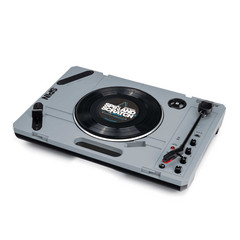
Portable turntable for vinyl lovers & scratch artists
Mobile fun with your turntable, anywhere you go
Outstanding for mobile scratching and cutting
Out of the box: comes with 7'' scratch vinyl, pre-installed 45-mm-crossfader & cartridge, integrated speaker, Bluetooth audio receiver, USB recording function, slipmat, and dust cover
High-grade 7''-scratch-record: professionally recorded samples for scratching and beats for juggling
Bluetooth audio streaming: wireless streaming of music or beats to the device
Smart USB recording: direct recording of scratches & cuts to USB in MP3 format
Can also be used for digitizing vinyl
Integrated speaker on the turntable's left
3 selectable speeds (33 1/3, 45 & 78 rpm)
Extremely stable tone arm with transport lock
Cartridge with excellent tracking features
Precise 45-mm-crossfader with two-rail glide technology
Crossfader can be installed on preferred side (both-way)
Two headphones connections for listening and monitoring
AUX input facilitates connection of several turntables (daisy chain)
Easy battery charging via USB PSU or USB power bank (sold separately)
Installed start/stop button
Precise speed adjustment via pitch control with +/-20 %
Tone control to adjust low frequencies by +/- 10 dB
Volume control for AUX input and master/headphones
Power LED indicates the turntable's operational status
7'' record puck adaptor with holder
Anti-skip rubber feet for secure stand
Especially sturdy and portable shape factor with optional battery operation
Additional protection thanks to dust cover; can be transported via carrying handle when closed
Locking of dust cover for safe transport
Can be operated with regular USB PSU (5 V, 2 A), USB power bank or batteries (sold separately)
Batteries can be inserted into battery compartment on the device's bottom 2x Li-Ion 18650 (sold separately)
Incl. 7'' scratch vinyl, pre-installed cartridge, slipmat, dust cover, puck adapter, USB cable, instruction manual and Super Spin Duck Looper app
Technical Data
Belt drive
Inputs: AUX 3.5 mm stereo, Bluetooth audio
Outputs: master RCA, USB (USB-A), headphones 3.5/6.3 mm stereo
Recording format: MP3 with 192 kbit/s
Recording quality: 16 bit / 44.1 kHz
Battery type: 2x Li-Ion 18650 (batteries sold separately)
Power supply: 5 V, 2 A micro USB (PSU sold separately)
Dimensions: 370 x 95 x 260 mm
Weight: 2 kg
Although it felt like the world had stopped spinning, at times, it was during these days, months, and years of uncertainty that many of Venice’s “Stained Glass” songs were conceived. Each member of Venice was quietly and privately cataloguing their artistic interpretation of this new reality and uncertainty by recording or writing down little snippets of ideas, like guitar riffs, melodies, or lyrics…all of these came about while looking at life through a new lens.
They set up the writing circle using an electronic drum kit, small tube amps, direct acoustic guitars and bass and the sm58 stage microphones for vocals. This small and simple setup allowed the band to work on ideas at low-volume levels by using headphones or low-level playback through studio monitors without bothering the neighbors with live drums. “Lunches made by Michael’s wife, Danielle, and visits from their dog Sachi, kept us grounded and let us stay in the creative bubble without leaving that space”, says bassist, Mark Harris. Michael and drummer, Andre Kemp, who co-produced Stained Glass, would later re-record the drum tracks with real drums in a friend’s studio.
“The beauty of this approach on Stained Glass was that one person’s idea would be presented to the other 5 musicians and each guy added a different color to that idea”, says Michael. “Whether it was an unexpected drum beat, or a moving guitar line, those simple ideas turned into pieces of art, colored by the different musical and lyrical contributions. That only happens when you are working that idea out, together, and playing as one unit”.
That was the main inspiration for the album title; like a kaleidoscope, each guy's experience and taste in music was bringing a different color to the songs, but together their contributions made one piece of art, one song. Michael concludes, “if you zoom out, each song becomes its own color and all those songs or colors come together to form one big piece of art, one big piece of ‘Stained Glass’”.
Dedicated global following with fans of vintage downtempo soul music. Pratt & Moody are cherished in California’s lowrider ballad circles based on their underground soul hits “Lost Lost Lost” and “Wheels Turning”. Enter the captivating realm of Pratt & Moody as they unveil their new deep-as-the-oceans single, ‘Creepin’ Around’. This dynamic duo – consisting of Pratt and Moody – have honed their craft channeling their collective prowess into a singular fusion of dark soul and haunting melodies. Their previous sleeper hits “Lost Lost Lost” and “Wheels Turning” still resonate in spaces where contemporary soul ballads are treated as a valuable commodity. With ‘Creepin’ Around’, Pratt & Moody dive deep into the shadows, crafting a sonic narrative about infidelity that transcends boundaries. The velvety vocals of Pratt wrap themselves around Moody’s evocative guitar, creating a timeless soundscape that resonates with raw emotion. As the instrumental version gracefully embraces the absence of words, the music is left to speak volumes. Accompanied by the rock-solid artistry of Cold Diamond & Mink, ‘Creepin’ Around’ transports you to the hazy realm of late-night introspection, where each note carries the weight of longing and desire. The track immerses you in a David Lynch like world where melancholy, darkness and passion coexist.
Dedicated global following with fans of vintage downtempo soul music. Pratt & Moody are cherished in California’s lowrider ballad circles based on their underground soul hits “Lost Lost Lost” and “Wheels Turning”. Enter the captivating realm of Pratt & Moody as they unveil their new deep-as-the-oceans single, ‘Creepin’ Around’. This dynamic duo – consisting of Pratt and Moody – have honed their craft channeling their collective prowess into a singular fusion of dark soul and haunting melodies. Their previous sleeper hits “Lost Lost Lost” and “Wheels Turning” still resonate in spaces where contemporary soul ballads are treated as a valuable commodity. With ‘Creepin’ Around’, Pratt & Moody dive deep into the shadows, crafting a sonic narrative about infidelity that transcends boundaries. The velvety vocals of Pratt wrap themselves around Moody’s evocative guitar, creating a timeless soundscape that resonates with raw emotion. As the instrumental version gracefully embraces the absence of words, the music is left to speak volumes. Accompanied by the rock-solid artistry of Cold Diamond & Mink, ‘Creepin’ Around’ transports you to the hazy realm of late-night introspection, where each note carries the weight of longing and desire. The track immerses you in a David Lynch like world where melancholy, darkness and passion coexist.
Octave One stride into 2024 with a fresh four-track EP that once again showcases their unique take on techno with three new versions of classic tracks alongside an all-new cut.
Detroit's legendary Burden Brothers had a big 2023 that saw them release their superb Never On Sunday album, which was a nod to their 90s downtempo project of the same name. The bumper collection traversed deep techno, house, and tech in their usual inimitable style while the pair themselves continued to push techno forward with their incomparable live show at the world's most notable clubs and festivals. They now show that their creative reserves continue to run deep with four more essential tracks.
The first one is a new Mothership Remix of 'Price We Pay' with long-time vocal collaborator Karina Mia. The original appeared on Never on Sunday and this version comes on strong with vast rubbery kicks powering a deep and seductive groove. Muted synths roam down low while twinkling melodies fall from above next to the controlled, soulful vocal. The superb 'Mirror Image' is a new track that rides a heavy broken beat. Downtempo chords are melancholic but stirring and have a dramatic sense of finality to them.
'A Better Tomorrow' also gets a new Mothership Mix following its original release on the Burn It Down album back in 2015. Here it is a surging cut with funky guitar riffs and bleeping synth sequences that bring to life the thundering low end. It's a hi-tech and soulful fusion of the organic and the synthetic that will blow the roof off.
Last of all is a Mothership Instruments version of 'Price We Pay' that powers along on thudding drums with edgy synth stabs riding up and down the scales. Deft keys shine and twinkle and signature Octave One arps break out at the midpoint to take things to a higher level.
These are four more classic techno sounds steeped in great synth craft from The Burden Brothers.
out of Stock
Last delivered 3 days ago available to reorder, subject to availability
THE COMPLETE DILLA INSTRUMENTALS FROM THE CLASSIC ALBUM PRESSED ON RANDOMLY MIXED COLORED VINYL
The contributions of the late Detroit producer James DeWitt Yancey - better known to the world as J Dilla- to the world of hip-hop can’t be overstated, and nowhere is his legacy more apparent than his work as a member of Slum Village. A founding member of the trio, (Alongside rappers T3 and Baatin) Dilla provided the groups distinctly esoteric, free-wheeling sound, built around winding basslines, quirky drumbeats, subtle low-end frequencies, and classic jazz & soul samples. After the success of Slum’s 1997 studio debut, Fan-Tas-Tic Vol. 1, the group went to work on their follow up. Though the project was completed in ‘98, label turmoil kept the project on ice until 2000. By the time Fantastic Volume II hit, Dilla was well on his way to his status as a hip hop legend having produced cuts for Common, Busta Rhymes, Erykah Badu, A Tribe Called Quest and many more. Later works from Slum Village may have had more of an impact sales-wise (in the immediate) but Fantastic Volume II had fans and many critics saying that Slum Village, and Dilla in particular, may single-handedly save rap music. Perhaps that statement is hyperbole but many consider Fantastic Volume II to be Slum Village’s, and J Dilla’s, finest work ever. Ne’Astra now presents the complete Dilla instrumentals from this landmark release.
Most audiophiles know Alan Parsons Project's I Robot by heart. Engineered by Parsons after he performed the same duties on Pink Floyd's Dark Side of the Moon, the 1977 record reigns as a disc whose taut bass, crisp highs, clean production, and seemingly limitless dynamic range are matched only by the sensational prog-rock fare helmed by the keyboardist and his creative partner, Eric Woolfson. Not surprisingly, it's been issued myriad times. Can it be improved? Relish Mobile Fidelity's stupendous UltraDisc One-Step 180g 33RPM box set and the question becomes moot.
Mastered from the original master tapes and pressed at RTI on MoFi SuperVinyl, I Robot comes to life with reference-setting realism on this numbered, limited-edition reissue. Boasting immaculate highs and lows, generous spaciousness, and see-through transparency that takes you into the studio with Parsons and Woolfson at Abbey Road, this definitive edition is designed to demonstrate the full-range capabilities of the world's best stereo systems while offering listeners the convenience of having all the music on one LP.
Featuring a nearly inaudible noise floor, this transcendent UD1S edition functions as a repeat invitation to savor reference-grade soundstages, immersive smoothness, sought-after instrumental separation, three-dimensional imaging, and consummate tonal balances. Able to be played back at high volumes without compromise or fatigue, it is a demonstration record for the ages – the likes of which are no longer being made. This is the very reason you own and invest in high-end audio gear.
The special characteristics of this UD1S version extend to the premium packaging. Housed in an elegant slipcase, the reissue features special foil-stamped jackets and faithful-to-the-original graphics. Aurally and visually, it is made for discerning listeners who prize sound quality and production, and who desire to fully immerse themselves in everything about this conceptual landmark. The Alan Parsons Project's most famous record deserves nothing less.
Inspired by and loosely based around the Isaac Asimov stories of the same name, I Robot delves into themes of artificial intelligence and technological dominance that make the record extremely relevant in the 21st century. Indeed, Parsons and Woolfson's pinnacle creation dovetailed with the ascendency of Star Wars, which itself is experiencing a rebirth in an age of self-driving cars, smart devices, and mindless automation. Lyrically, songs such as "The Voice" call into question human behavior – and their relationship to increasing robotic supremacy – in everyday life. Parsons and Woolfson reflect the associated paranoia, dichotomy, and transformation via shifting sci-fi arrangements steeped in drama and moodiness.
The absorbing tunes on I Robot also continue to fascinate due to their perfectionism and innovation. Borrowing from Pink Floyd's strategies, Parsons and Woolfson utilize a looped sequence on the title track to create new downbeats. "Some Other Time" employs two different lead vocalists and yet gives the illusion that only one is involved. Captivating strings, a piccolo trumpet, and bona fide pipe organ grace "Don't Let It Show." The origins of "Nucleus" stem from a unique analog keyboard concoction dubbed "the Projectron," devised by Parsons and electronic engineer Keith Johnson. Andrew Powell's orchestral and choral arrangements top it all off, with "Total Eclipse" arriving as a frightening track that presages the climactic "Genesis Ch. 1 V. 32."
Does man or machine win in the end? Decide as you get lost in Mobile Fidelity's UltraDisc 180g 33RPM LP pressing. Secure your numbered copy today!
More About Mobile Fidelity UltraDisc One-Step and Why It Is Superior
Mobile Fidelity Sound Lab's UltraDisc One-Step (UD1S) technique bypasses generational losses inherent to the traditional three-step plating process by removing two steps: the production of father and mother plates, which are created to yield numerous stampers from each lacquer that is cut. For UD1S plating, stampers (also called "converts") are made directly from the lacquers. Since each lacquer yields only one stamper, multiple lacquers need to be cut. Mobile Fidelity's UD1S process produces a final LP with the lowest-possible noise floor. The removal of two steps of the plating process also reveals musical details and dynamics that would otherwise be lost due to the standard multi-step process. With UD1S, every aspect of vinyl production is optimized to produce the best-sounding vinyl album available today.
MoFi SuperVinyl
Developed by NEOTECH and RTI, MoFi SuperVinyl is the most exacting-to-specification vinyl compound ever devised. Analogue lovers have never seen (or heard) anything like it. Extraordinarily expensive and extremely painstaking to produce, the special proprietary compound addresses two specific areas of improvement: noise floor reduction and enhanced groove definition. The vinyl composition features a new carbonless dye (hold the disc up to the light and see) and produces the world's quietest surfaces. This high-definition formula also allows for the creation of cleaner grooves that are indistinguishable from the original lacquer. MoFi SuperVinyl provides the closest approximation of what the label's engineers hear in the mastering lab.
Étrange Hiver (Strange Winter) is UK songwriter, Tom McRae's 9th studio album. An exquisite collection of original duets with renowned French artists, such as Keren Ann, Chien Noir, Alex Beaupain, Clou and more. McRae decided to collaborate on these 11 new songs with various artists as a way of acknowledging his deep love of French music, and deepen his relationship with mainland Europe, following Britain’s disastrous decision to leave the EU. Tom’s debut album went Gold in France in 2001, selling over 60,000 copies, and he has divided his time between Paris and Wiltshire since 2021. Says Tom: “I grew up being intrigued by classic French songs. Before streaming services made all music readily available, only the huge crossover pop songs made it across the channel, but while my friends were listening to Vanessa Paradis, I was listening to Serge Gainsbourg. It seemed exotic, adventurous, and to be from another planet, let alone a country only 21 miles away from my own.” During Covid, McRae released a single with his Belgian friend, Wannes Cappelle, a reworking of one of Tom’s songs in English and West Vlaams, as well as an album of duets with a Welsh artist, Lowri Evans. Both projects sparking his interest in collaboration with other artists. “It’s not been a great time to be British since 2016”, says McRae. “We’ve become politically, economically and culturally isolated since Brexit - and I want to show that I feel more of a European than simply just an English person.” “But mostly this album, Étrange Hiver, is about beautiful songs, some in English, some in French. Sung as duets with friends (some established artists, as well as some new or undiscovered voices) and creating 11 little emotional moments in a crazy world. Some cinematic, some more intimate and personal, all of the songs addressing the important things in life: love, loss, political populism, impending climate collapse… written at a time when it feels as if the world may never escape from this long, strange winter.“ Artists duetting on this album with Tom include: Keren Ann, Chien Noir, Clou, Alex Beaupain, Rose, Naya, Vanille, Helena Noguerra, Alma Forrer, Aïtone, Julien Brocal, and now more are lining up to sing with Tom on a volume 2
Record label boss, producer / DJ, and revered collector Marc Davis returns to his Chi-Talo series with the much-anticipated second volume. A concept of a split EP, taking one ultra-rare Chicago gem and the other a scarce Italian disco record and re-interpreting them for the modern dancefloor aesthetic.
With the first volume, released on Marc’s own Black Pegasus label, now trading hands for considerable amounts of money, round two sees him impart another double dose of digging sorcery for this Mr Bongo 12”.
Marc began his illustrious career in the Windy City in the ‘80s and was one of the first out of Chicago to be recognised for his eclectic approach to DJing. Presenting a global sound palette that took in choice cuts from Brazil, Africa, jazz fusion, house, soul and disco, whilst mixing it together Chicago style. Decades of knowledge and experience that is now distilled down into the Chi-Talo series.
The Italo selection came via a tip from Marc's Swedish friend, Julian Wareing. Hearing the track led Marc down the rabbit hole to secure a copy of this Italo-Disco, album cut oddity by the New Sound Quartet from 1979. The original of 'Bass Construction', measures in at four and a half minutes and is already a feverish funk groover. But Marc saw an opportunity to extend and re-edit the track, keeping in the vein of the original but giving it space to breathe. Tweaking out every last ounce of goodness, Marc locks you into a hypnotic groove for maximum dancefloor deliverance.
The Chicago side is as rare, as the rarest of hens-teeth, only ever existing as a one-off acetate by the band The Saucer Planes. One of the members of the group was the sadly passed-away older brother of Marc’s DJ mentor, Jahmal Anderson. From the very first listen, Marc knew he’d been hooked up with an undiscovered boogie gem. A long-lost track that the world needed to hear. But the project has remained dormant until now, not least due to the fact that the original recording of this low-fi vocal boogie groove is housed on an ever-deteriorating solo acetate. Rescued, restored and given a brand-new lease of life, Marc has turned the track into a low-slung, psychedelic instrumental boogie bounce. Raw, rough and mesmerising, it’s a refreshed relic that is a testament to Chicago’s club sound and swagger.
Whichever side you draw for, this is guaranteed to move bodies as much as it wins over hearts.
out of Stock
Last delivered 2 years ago available to reorder, subject to availability
Presenting the second thematic volume on the “Aquapelagos" series - a collection of split LPs where selected artists offer their own take into water surrounded cultures and communities. After the initial release of the Anthology compilation Aquapelago in 2022 (Discrepant ,CREP91) and the split LP Atlantico by Lagoss & Banha da Cobra (Keroxen, KRXN027) we proudly introduce an unique collaboration in the series in the shape of no other than two improvising giants, Mike Cooper and Pierre Bastien.
This second volume blows the lid wide open with a sound journey inspired by the equally majestic and mysterious Indian Ocean, a wide space of open ocean bounded by Africa, to the west, Asia to the north and north-west and Australia, to the south west.
From Philip Hayward and Matt Hill’s liner notes:
‘’The album opens with Return To Chagos by emphasising human presence in the oceanic space, opening with gentle percussive taps and distant looped male vocalisation that gradually come into sharper focus, layered and thickened, accompanied by thicker percussion and mouth harp. The sense of departure is taken up in Trincomalee, which lifts over the oceanic textures, opening with slow, struck and scraped metallic sounds before thick low pitched wind instrument sounds enter, oscillating around shifting microtonal frequencies. The shore returns on Side 2, with the miniature epic of Nicobar elaborated over looped ‘atmos’ sounds of birds and insects over which tonal, slightly distorted electric guitar lines enter before looped high pitched feedback squeals join the texture. Summoning tropical storms and the disruption to the region caused by western intrusion, strong and startling brass accents appear, melding with the looping guitar feedback, creating eeriness and a sense of alarm. Tuangku is permeated by restrained dynamics and an expressive, breathy, low pitched, animalistic melodic voice that offers intermittent and ambiguous utterances, as if rendered in a language essential to and evocative of a place and time but impossible to precisely comprehend – coming from an ocean-aquapelagic beyond that can only be glimpsed and rendered by affect.’’
Philip Hayward and Matt Hill, March 2022
Van Halen did more than announce to the world the earthshaking arrival of a revolutionary guitarist. Performed by an enterprising California quartet that took its name from two of its principal members, the 1978 debut ripped headlines away from punk, injected fresh energy into a then-moribund rock 'n' roll scene, reimagined how heavy music and throwback pop could coexist, and invited everyone to experience the top-down pleasures of a beach-front Saturday night every day of the week no matter where they lived. Painstakingly restored by Mobile Fidelity Sound Lab, and the first of a multi-album series in an exciting partnership between the famous reissue label and Van Halen, Van Halen delivers feel-good thrills and hormonally charged desires like never before.
Limited to 12,000 numbered copies, pressed on dead-quiet MoFi SuperVinyl at RTI, and mastered from the original analogue master tapes, Mobile Fidelity's ultra-hi-fi UltraDisc One-Step 180g 45RPM 2LP collector's edition pays tribute to the record's merit and allows fans to experience Van Halen's original blend of raw power, Hollywood flair, and vaudeville fun for generations to come. Playing with reference-setting sonics that elevate a 10-times-platinum landmark whose importance cannot be quantitatively measured, this definitive version provides a clear, clean, transparent, balanced, and turn-the-volume-up-to-11 view of an album that birthed entirely new styles. Since MoFi's unique SuperVinyl compound allows you to crank the decibels to your wildest desires without risking noise-floor interference, prepare to not only hear but feel Van Halen in your chest, no fifth-row concert seat necessary.
The premium packaging and gorgeous presentation of the UD1S Van Halen pressing befit its extremely select status. Housed in a deluxe box, it features special foil-stamped jackets and faithful-to-the-original graphics that illuminate the splendor of the recording. No expense has been spared. Aurally and visually, this UD1S reissue exists as a curatorial artefact meant to be preserved, touched, and examined. It is made for discerning listeners that prize sound quality and production, and who desire to fully immerse themselves in the art – and everything involved with the album, from the iconic cover art to the meticulous finishes and, yes, of course, Eddie Van Halen's pioneering fretwork and his brother Alex's double-bass percussion.
Indeed, could a piece of music that transformed how countless guitarists approached their instrument be more fittingly named than "Eruption"? Likely not, and in just 102 seconds, Eddie Van Halen rewrote, reimagined, and reconfigured a vocabulary last significantly updated a decade earlier by fellow six-string wizard Jimi Hendrix. Akin to the Washington State legend, Eddie Van Halen developed his own techniques and tones all the while making his seismic accomplishments seem effortless. Devoid of the pretence, ego, and showiness that infected many of his imitators, the Dutch native sticks to a straightforward approach that underlines the authority, prowess, and visionary scope of his playing and then-unheard-of finger-tapping skills. Throughout Van Halen, he establishes himself as an instant idol – a savant whose otherworldly combination of breadth, poise, feel, speed, force, and melody seems beamed in from another galaxy.
As does nearly every song on the record, whose cohesiveness and dynamic put into perspective the advanced chemistry and one-for-all spirit the youthful band had out of the gates. Having paid its dues for years in bars and clubs – going as far as recording a 24-track demo for Kiss bassist Gene Simmons at Village Recorders only to be spurned by management companies that felt its music wouldn't go anywhere – Van Halen finally got a deserved break when Warner Bros. executives signed the group in 1977. The subsequent recording sessions further testify on behalf of the band's synergy and alignment. Completed in just a few weeks with producer Ted Templeman, Van Halen was primarily cut live in the studio with minimal overdubs and edits. The explosiveness, energy, and electricity remain definitive, and as heard on this UD1S set, put the group on a private stage – humming amplifiers, Frankenstrat guitar, bright spotlights, sweaty headbands, and then some.
Van Halen yielded just one hit in the form of a Top 40 single (a breathless cover of the Kinks' "You Really Got Me") but practically every song on the revered LP has become a staple. Named the 202nd Greatest Album of All Time by Rolling Stone and considered by countless experts as one of the best debuts in history, the record displays what can happen with four distinct talents gel and strive for the same purposes. In Van Halen's case, the latter almost always involved partying, freedom, sex, and, in the immortal words of singer David Lee Roth, living "life like there's no tomorrow." The celebration manifests from the opening notes of the strutting "Runnin' with the Devil" – announced with the blare of droning car horns, Michael Anthony's robust bass line, and Alex Van Halen's thumping drumming – and continues through the conclusion of the white-hot "On Fire," goosed by Eddie Van Halen's race-track-ready lines, Roth's flamboyant deliveries, and the rhythm section's cat-like pounce.
Picking out individual highlights on Van Halen is akin to trying to count all the stars in a clear nighttime desert sky: There are far too many to identify, once you see one you notice another dozen you didn't spot before, and the cluster is best enjoyed as a whole. What's evident over repeat listens is the sheer diversity, a fact that's often overlooked: The high harmonies and background funk of "Jamie's Cryin'"; the insistent cane-and-a-tophat shuffle and doo-wop shoo-bop vocal break on "I'm the One"; the throwback acoustic blues that spreads into fast-paced, single-entendre wildfire on the Roth-led standout interpretation of John Brim's "Ice Cream Man." Like the man says, on Van Halen, all the flavours are guaranteed to satisfy.
More About Mobile Fidelity UltraDisc One-Step and Why It Is Superior
Instead of utilizing the industry-standard three-step lacquer process, Mobile Fidelity Sound Lab's new UltraDisc One-Step (UD1S) uses only one step, bypassing two processes of generational loss. While three-step processing is designed for optimum yield and efficiency, UD1S is created for the ultimate in sound quality. Just as Mobile Fidelity pioneered the UHQR (Ultra High-Quality Record) with JVC in the 1980s, UD1S again represents another state-of-the-art advance in the record-manufacturing process. MFSL engineers begin with the original master recordings, painstakingly transfer them to DSD 256, and meticulously cut a set of lacquers. These lacquers are used to create a very fragile, pristine UD1S stamper called a "convert." Delicate "converts" are then formed into the actual record stampers, producing a final product that literally and figuratively brings you closer to the music. By skipping the additional steps of pulling another positive and an additional negative, as done in the three-step process used in standard pressings, UD1S produces a final LP with the lowest noise floor possible today. The removal of the additional two steps of generational loss in the plating process reveals tremendous amounts of extra musical detail and dynamics, which are otherwise lost due to the standard copying process. Every conceivable aspect of vinyl production is optimized to produce the most perfect record album available today.
MoFi SuperVinyl
Developed by NEOTECH and RTI, MoFi SuperVinyl is the most exacting-to-specification vinyl compound ever devised. Analogue lovers have never seen (or heard) anything like it. Extraordinarily expensive and extremely painstaking to produce, the special proprietary compound addresses two specific areas of improvement: noise floor reduction and enhanced groove definition. The vinyl composition features a new carbonless dye (hold the disc up to the light and see) and produces the world's quietest surfaces. This high-definition formula also allows for the creation of cleaner grooves that are indistinguishable from the original lacquer. MoFi SuperVinyl provides the closest approximation of what the label's engineers hear in the mastering lab.
Die ultimative Zusammenstellung von Fu Manchu's 30th Anniversary Vinyl Serie, Fu30. Volume I-III, enthält nicht nur alle 9 Songs der (fast) ausverkauften limitierten 10 "s, die in den letzten 2 Jahren veröffentlicht wurden, sondern enthält auch einen Bonustrack des neuen Scott Hill Mixes der Band von Rush's "Working Man". Ursprünglich wurde der Song im Januar 2020 als Tribut an den verstorbenen Neil Peart aufgenommen und als digitale Single zu Gunsten der Hirntumorforschung am Cedars-Sinai Medical Center veröffentlicht. Diese auf 2000 Stück limitierte Veröffentlichung ist in einer Doppelplatinhülle mit Prägung und Spotlackierung verpackt und enthält einen zweiseitigen Einleger mit Artwork aus der ursprünglichen 10"-Serie und neuen Fotos. Wie das letzte Album der Band, Clone Of The Universe, wurden auch diese Songs im The Racket Room in Santa Ana, Kalifornien, von Jim Monroe (Adolescents, Ignite) aufgenommen und von Fu Manchu mitproduziert. Zusätzlich zu den 6 neuen Originalen enthält das Set die einzigartige Interpretation der Band von "Takin' It To The Streets" von den Doobie Brothers, "My Wave" von den Surf Punks und "A Million Miles Away" von den Plimsouls mit dem Gesang von Neil Fallon von Clutch. Die auf 2000 Exemplare limitierte Vinyl-LP ist silberfarbend. Beide Formate (LP/CD) mit geprägtem Cover-Artwork. Erscheint am Black Friday 2023.
“Incident At a Free Festival” is a tribute to the mid-afternoon slots at Deeply Vale, Bickershaw, Krumlin, Weeley, and Plumpton – early 70s festivals that don’t get the column inches afforded the Isle of Wight or Glastonbury Fayre, but which would have been rites of passage for thousands of kids. Bands lower down the bill would have been charged with waking up the gentle hippies and appealing to both the greasy bikers and the girls in knee-high boots who wanted to wiggle their hips. And the best way to do that was with volume, riffs and percussion.
Compiled by the venerated Bob Stanley and Pete Wiggs of Saint Etienne, this is the heavier side of the early 70s they summarised on the acclaimed “English Weather” collection. There’s an air of menace and illicit thrills among tracks by Andwella, Stack Waddy and Leaf Hound (whose “Growers of Mushroom” album is worth well over £1,000). Bigger names include the rabble-rousing Edgar Broughton Band and kings of the festival freakout, Hawkwind. They are represented by their rare version of ‘Ejection’
For every mystical Tyrannosaurus Rex performance there was something like Atomic Rooster’s Tomorrow Night or Curved Air’s Back Street Luv to capture the spirit of the day and stir the loins of festival goers; the tracks on “Incident At a Free Festival” were inspired by both Chicago’s percussive wig-outs and the Pink Fairies’ anarchic spirit. The sounds were heavy and frequently funky, with a definite scent of danger. Their message was clear and simple: clap your hands, stamp your feet, hold on to your mind.
So, put on your wellies in your living room, drop the needle and enjoy...
Volume 3 of the TRUST XY recombination series again sees four unique artists channel sonic echoes from the label's past. Stenny is up first, the Italian producer whose name is synonymous with Ilian Tape's much acclaimed crossover of techno and bass music. He complements the deep pads of Versalife's 'Nova Prospekt' with a scorching bass line and rolling breaks programmed in his unmistakable style. Canadian producer and Planet Euphorique label owner D.Tiffany is a champion of complex percussions and an obvious choice to rework Alex Cortex's percussive electro anthem 'We Run Your Life'. Her take chops and warps Cortex's vocals around a twitching techno beat that's both experimental and effective. Side B has UK electro and breakbeat pioneer Clatterbox return to TRUST, reshaping one of the very first Microthol tracks into modern form. At his hands 'Intertronic' turns into a bleeping and hissing, snarling and growling electro bass monster. Lastly Delsin's dub master and TRUST alumni VC-118A takes on 'Tides' by /DL/MS/, replacing the original's sparse funk with a low slung dub techno groove that serves as the foundation for perpetually cascading ebbs and flows of lush and dreamy soundwaves.
out of Stock
Last delivered 22 months ago available to reorder, subject to availability
The late percussionist Milford Graves was one of the most unique artists the world has ever seen. Born in Jamaica, Queens in 1941, he began his career in the early '60s as a part of New York's vibrant Latin jazz scene. His focus quickly turned inward, shifting towards a practice that explored the very nature of self. From his work in the New York Art Quartet and collaborations with Albert Ayler, Sonny Sharrock and more to his important contributions during NYC's loft era – he is, simply put, free jazz royalty.
In April 1966, the duo of Graves and pianist Don Pullen played at Yale University. As John Corbett writes in the liner notes, "This performance was something of a turning point for Graves. Until then he had been working in other people's bands or collective ensembles. He was phenomenally busy. In 1965 alone, he recorded with NYAQ (two LPs), Giuseppi Logan Quartet, Paul Bley Quintet and Lowell Davidson Trio, and he made his first recording released under his own name, Percussion Ensemble. Every one of these is important in its own way, but none of them quite anticipate how radical was the music that he and Pullen would unleash that evening in New Haven."
Originally released on the artists' own Self-Reliance Program label, this legendary one-night performance would be split into two volumes: In Concert At Yale University and Nommo. While rooted in African rhythms, Graves' music has its own sense of time. As the drummer stated in a 1966 DownBeat interview, "Time was always there, and the time I see is not the same as what man says time is. It works by impulsion."
The late percussionist Milford Graves was one of the most unique artists the world has ever seen. Born in Jamaica, Queens in 1941, he began his career in the early '60s as a part of New York's vibrant Latin jazz scene. His focus quickly turned inward, shifting towards a practice that explored the very nature of self. From his work in the New York Art Quartet and collaborations with Albert Ayler, Sonny Sharrock and more to his important contributions during NYC's loft era – he is, simply put, free jazz royalty.
In April 1966, the duo of Graves and pianist Don Pullen played at Yale University. As John Corbett writes in the liner notes, "This performance was something of a turning point for Graves. Until then he had been working in other people's bands or collective ensembles. He was phenomenally busy. In 1965 alone, he recorded with NYAQ (two LPs), Giuseppi Logan Quartet, Paul Bley Quintet and Lowell Davidson Trio, and he made his first recording released under his own name, Percussion Ensemble. Every one of these is important in its own way, but none of them quite anticipate how radical was the music that he and Pullen would unleash that evening in New Haven."
Originally released on the artists' own Self-Reliance Program label, this legendary one-night performance would be split into two volumes: In Concert At Yale University and Nommo. While rooted in African rhythms, Graves' music has its own sense of time. As the drummer stated in a 1966 DownBeat interview, "Time was always there, and the time I see is not the same as what man says time is. It works by impulsion."
Through 35 hedonistic highlights stretched across three volumes, Music For The Radical Xenomaniac delivers the first ever deep dive into The Netherlands’ colourful house sound of the 90s and the under-celebrated producers and record labels whose music soundtracked a countrywide cultural movement.
Plenty of books and documentaries have celebrated the riotous raves, legendary clubs, high profile DJs and promoters who shaped The Netherlands’ hedonistic house scene throughout the 90s. Music For The Radical Xenomaniac dares to challenge these narratives by shining a light, for the first time, on those who created the scene’s kaleidoscopic, game-changing and globally influential soundtrack.
Leading the charge were a disparate group of key creators who not only forged links with their counterparts in Detroit, Chicago, New York, Belgium, Germany and the United Kingdom, but also became celebrated figures on the worldwide electronic underground (Eric Nouhan, Aad De Mooy, Orlando Voorn, Stefan Robbers and Steve Rachmad). Alongside key underground imprints (Stealth Records, Basic Energy, ESP, Prime and Outland Records included) and lesser-known producers, these pioneers gave flavour to a radical musical movement via open-mindedness, unheard-of creativity and a genuinely futuristic ethos. All of these artists and labels are represented throughout the series.
So, what defined this hedonistic house sound from The Netherlands? Stylistically, it was varied – as the series so emphatically proves – but was defined by a set of distinctive sonic characteristics: emotive musical motifs, high-frequency synth sounds, mellow basslines, pulsating rhythms and more than a touch of hallucinatory intent.
Volume 3 is packed with in-demand tracks and hard-to-find gems, including a previously CD-only cut from Dutch techno originator Orlando Voorn (1999’s ‘Still’), a genuine rave classic from The Hague by hardcore DJ Charly Lownoise as Fluxland, and a killer cut from prolific producer – and genuinely influential pioneer – Aad De Mooy AKA D-Shake. He’s represented on this volume by Paradise 3001 cut ‘Surfin The Cuban Waves’, which first appeared on ESP Records in 1993.
Other highlights include Direct Movement’s ‘Natural Chemistry’, a sought-after slow house cut produced by Dennis Buné, who had an enormous impact on the Dutch house scene as Jaimy, and ‘Delphi (Rewaxed)’ by NYX, a highly regarded and hard to find single from former new wave and synth-pop producer Bart Barten, and occasional studio partner Hanz Meyer.
Packed full of forward-thinking 90s gems remastered for today’s dance floors by Alden Tyrell, Music For The Radical Xenomaniac Volume 3 is a life-affirming celebration of a distinctly Dutch musical movement, whose rich textures and melodies are still inspiring new generations of DJs and dancers today.
out of Stock
Last delivered 20 months ago available to reorder, subject to availability
Kompakt unveils the third volume of Jörg Burger’s Velvet Desert Music compilation series, dedicated to music that hits the sweet spot between the cinematic, the (pop) ambient, and the psychedelic. With Velvet Desert Music Vol. 3, Burger and his friends wander afar, taking trips away from, or adjacent to, the dancefloor that’s acted so long as the crucible for the Kompakt aesthetic. Like its predecessors, it’s a gorgeous, lambent collection of late-night mood music.
Because it’s such a broad church, Velvet Desert Music admits all kinds of new experiences, as well, with Burger looking for music that "leads out of the desert into the velvet universe". Indeed, of all the volumes in the series, this third instalment feels closest to an album made by a true collective. The roster has changed, with new contributors Flug 8 and Seb Martel, both with his trio Las Ondas Marteles and with Chocolate Genius and Zsela as La Finca, joining regulars The Novotones, Mount Obsidian, The Golden Bug, Paulor and Sascha Funke.
Burger himself reappears, too, alongside Fritz Ackermann (of The Novotones), Max Würden and Thore Pfeiffer, in The Velvet Circle. Their contributions are pure lush life electronica: “Our Tribe” hitches a ride with a low-slung groove, flickering psychedelic reels of acoustic guitar traipsing across moody bass and taffeta layers of drone; their opening remix of Flug 8’s “Puerto Rico” gently introduces the album with softly tangling electronic tones, while guitars, drenched in reverb, pirouette in the background. A Mount Obsidian remix of “Sacrosanct” by Burger’s The Black Frame -project is a swirling treat for the ears.
La Finca’s electronics and voice miniature, “What Clouds Say”, is a masterclass in poetic restraint; Martel’s “Dark Mambo”, remixed by Burger, is one of the collection’s big surprises, for it indeed does what the title says, a drifting, surrealist take on the mambo form, full of pensive chords, rich with unrequited longing, a breathy saxophone whispering under the song’s sly rhythmic carriage.
Elsewhere, The Novotones chime in with a slyly propulsive, Krautrock-esque charmer, “Liberty Bell”, and the guitar-led tone-drift of “Valley of Oblivion”; Paulor’s “The Last Coke in the Desert” is a chiming, lilting dreamscape; Mount Obsidian are joined by vocalist Charlotte Jestaedt for two modern takes on early-hours art song, “Marole” and “Fade”; Sascha Funke’s “Mathias Rust” is a lavish dancefloor dream, vocal samples drifting through the song as it slowly envelops the listener in its opulent radiance.
This is just a taste of the rich pleasures of Velvet Desert Music Vol. 3, a triumph of a compilation that takes the psychedelic visions of its predecessors and looks for the desert within, a dusty kiss, a road-movie hallucination flickering on the listener’s eyelids, a cinematic projection from deep inside the mind.
out of Stock
Last delivered 16 months ago available to reorder, subject to availability
Heavenly Recordings release the next two volumes in their series of remixed classics and unreleased versions. ‘Heavenly Remixes 7 & 8’ sees the label going back into the archive, as well as picking off some more recent remixes, and both albums primarily feature either previously unreleased versions or re-workings available for the first time on vinyl and CD.
Heavenly have always seen immense value in the remix, a value way beyond what it might bring commercially. Since their first release in 1990 (where Andrew Weatherall overhauled a one-off single by club kids Sly and Lovechild) Heavenly remixes have been carefully curated and treated as a key part of the A&R process. It’s an opportunity to view an artist through a different prism, to play out a musical ‘what if’ scenario. It’s the kind of exploration that’s happened consistently through the thirty plus years the label has released music.
The ‘Heavenly remixes’ series continues to showcase the very best remixes, versions, meditations, re-rubs and dubs from all around the world of artists right across the roster of the country’s most exciting record label. In most cases, the albums offer the first physical release for a remix, elevating them from streaming playlists to their rightful, spiritual home on super heavy vinyl (or shiny, super-packed compact disc).
Heavenly remixes 7’ heads to Belfast, where David Holmes - a producer who first appeared on Heavenly in 1994 amping up the acid on Saint Etienne’s ‘Like A Motorway’ - appears as solo artist and as one third of Unloved, who get a lift right to the heart of a Vauxhall sweatbox by Horse Meat Disco. It draws a line between Amsterdam and Frankfurt as Ludwig A.F. amps up the electronics on Pip Blom’s ‘Keep It Together’. It stops off in a south London studio where super producer Dan Carey plays the desk with Toy, then relocates LA psych rock band Fever The Ghost to an Ibizan shoreline as the sun sets on the horizon. It cements Sheffield’s reputation as the home of modern British techno with the return of true originators Forgemasters. And it pitches up in front of a renegade soundsystem late night at Glastonbury as Erol Alkan’s mighty rework of Con Man gets its third rewind of the night.
‘Heavenly remixes 8’ opens with Space Afrika’s lush, ambient reimagining of the Orielles’ ‘BEAM/S’ before Justin Robertson stretches Amber Arcades’ ‘Turning Light’ into eight minutes of electronic dub. Elsewhere, Baxter Dury’s peerless ‘Miami’ becomes a string-laden electro skank in the hands of French producer Pilooski; Edinburgh’s bedroom techno genius Eyes of Others’ ‘Safehouse’ turns into an East End bathhouse courtesy of disco deviants Decius; Ashley Beedle’s Black Science Orchestra turns Unloved’s heartworn torch song into seven minutes of glimmering dreamlike percussive house and Katy J. Pearson’s freak flag is flown high thanks to The Umlauts’ throbbing filtered electro mix. It ends similarly to how it began as TONE takes
Fran Lobo’s ‘All I Want’ on a gorgeous slow motion spacewalk.
out of Stock
Last delivered 32 days ago available to reorder, subject to availability
The “Windows” series is designed to be a side project for material written by Jesper Lindell that doesn’t fit his regular band. Jesper’s in a highly creative phase and great songs keep coming. Volume 1 of “Windows” contains five new songs in a singer/songwriter style, more low key and semi acoustic.
Colours collects ParyNextDoor's 2014 EP Colours 1 - long heralded as a contemporary classic - with his critically acclaimed Colours 2. Both rank among the most memorable works in PND’s stellar catalog. The first volume showcases emotionally raw, true-to-life narratives and the range of his arresting vocals. Whether it's songs like "Girl From Oakland" or the Travis Scott-assisted "Jus Know," PND proves himself one of this generationís most gifted songwriters. He confirms as much with each subsequent record, including slow jams like "Freak In You" from Colours 2. Now that both EPs are side by side, listeners can trace PND’s artistic growth by revisiting these early classics, and for the very first time, fans can listen to this joint project on limited edition white vinyl!
Still on and about after years of the most intense crate digging, gem mining, desperate head-scratching and avid schooling, thirsty as ever for the next musical thrill to wrap our ears and brains around, here comes the fruit of our life-long love story with Japanese electronics, Denshi Ongaku No Bigaku Vol. 1 and Vol.2. From the soul-fulfilling first crush felt upon hearing the iconic soundtrack of ‘Merry Christmas Mr. Lawrence’ by Ryuichi Sakamoto onto our release of Inner Science ‘Cosmo Tracks’, through the life-affirming sets of Laurent Garnier at Dijon’s seminal club, l’An-fer, which have at all times nurtured and expanded our taste for Easternmost delicacies, the influence of Japanese music on our vision and endeavours was paramount to the development of our catalogue, whether directly or indirectly.
This first volume gets the ball rolling with a fine assortment of mostly ambient, electronica and deep house-focussed joints. Draped in organic membranes and ASMR-like synth tapestries, K. Inoue’s nu-agey opener ‘Em Paz’ takes us on a ride across the most serene dreamscapes. Jazzing up these lush and oneiric coastal vibes, Gabby & Lopez ‘Drive form the Miracle’ merges a sense of Californian psychedelia with a straight out hard-bop swing. No stranger to our catalogue, Inner Science returns to serve up a crystalline slice of laid-back house on a mystique-imbued tip he holds the secret to. Flip it over and here comes Aquarium with the splendidly immersive ‘Rainy Night in Shibuya’, which very much feels like wandering amidst its neon-upholstered streets and swarming hallways in a bubble of your own.
Naohito Uchiyama treats us to a synth-drenched nocturnal ballad with the ‘80s-inflected vibes of ’Shugetsu’, whereas Keta Ra cuts a path of ethereal sublimation via the mischievously fun and bouncy balearic lounge of ‘equals’. Masterly crafted by Yuu Udagawa, ‘Infinite Possibility’ eases us in a realm where weightless pop and low-slung abstract hip-hop combine to further exhilarating effect. All in harp-driven brittleness and velveteen sub-bass stealth, Noah ‘Gemini - Mysterious Lot’ has us drifting to a lavishly orchestrated headspace, laying down an impressive work on textures and arrangements. All in on the sedated drip-tease flex, Sauce81 ’Sign of Secret Love’ is a blast of freaky hedonism, just as ready to cast its hypnotic spell down the sweatbox as it was upon its original release ten years ago.
Languid jacking house tune ’Tai+Dai’ from Keita Sano blows the winds of discoid luvin’ across the room with its impeccable balance of sharp, glimmering synthwork and driving bass onslaughts from the depths. An odd slice of reshuffled folk music, Waltz ‘Folkesta’ makes for some eerie invitation of sorts, enchanting and spookily haunting in equal measure. Back to a fevered, hip-swaying mindset, Kuniyuki hi-NRG jazz number ‘Free’ is an absolute wonder of piano and drums-driven boogie, cut from the same cloth as some of Blue Note’s finest Cuban jazz classics. Rounding off the package, Japanese legend Ken Ishii’s version of Larry Heard’s house Hall-of-Famer ‘Can You Feel It’ is pure bliss in a can, tailored to turn any crowd into a shapeless cloud of balmy euphoria and universal love, whatever the place or time.
out of Stock
Last delivered 2 years ago available to reorder, subject to availability
Still on and about after years of the most intense crate digging, gem mining, desperate head-scratching and avid schooling, thirsty as ever for the next musical thrill to wrap our ears and brains around, here comes the fruit of our life-long love story with Japanese electronics, Denshi Ongaku No Bigaku Vol. 1 and Vol.2. From the soul-fulfilling first crush felt upon hearing the iconic soundtrack of ‘Merry Christmas Mr. Lawrence’ by Ryuichi Sakamoto onto our release of Inner Science ‘Cosmo Tracks’, through the life-affirming sets of Laurent Garnier at Dijon’s seminal club, l’An-fer, which have at all times nurtured and expanded our taste for Easternmost delicacies, the influence of Japanese music on our vision and endeavours was paramount to the development of our catalogue, whether directly or indirectly.
This first volume gets the ball rolling with a fine assortment of mostly ambient, electronica and deep house-focussed joints. Draped in organic membranes and ASMR-like synth tapestries, K. Inoue’s nu-agey opener ‘Em Paz’ takes us on a ride across the most serene dreamscapes. Jazzing up these lush and oneiric coastal vibes, Gabby & Lopez ‘Drive form the Miracle’ merges a sense of Californian psychedelia with a straight out hard-bop swing. No stranger to our catalogue, Inner Science returns to serve up a crystalline slice of laid-back house on a mystique-imbued tip he holds the secret to. Flip it over and here comes Aquarium with the splendidly immersive ‘Rainy Night in Shibuya’, which very much feels like wandering amidst its neon-upholstered streets and swarming hallways in a bubble of your own.
Naohito Uchiyama treats us to a synth-drenched nocturnal ballad with the ‘80s-inflected vibes of ’Shugetsu’, whereas Keta Ra cuts a path of ethereal sublimation via the mischievously fun and bouncy balearic lounge of ‘equals’. Masterly crafted by Yuu Udagawa, ‘Infinite Possibility’ eases us in a realm where weightless pop and low-slung abstract hip-hop combine to further exhilarating effect. All in harp-driven brittleness and velveteen sub-bass stealth, Noah ‘Gemini - Mysterious Lot’ has us drifting to a lavishly orchestrated headspace, laying down an impressive work on textures and arrangements. All in on the sedated drip-tease flex, Sauce81 ’Sign of Secret Love’ is a blast of freaky hedonism, just as ready to cast its hypnotic spell down the sweatbox as it was upon its original release ten years ago.
Languid jacking house tune ’Tai+Dai’ from Keita Sano blows the winds of discoid luvin’ across the room with its impeccable balance of sharp, glimmering synthwork and driving bass onslaughts from the depths. An odd slice of reshuffled folk music, Waltz ‘Folkesta’ makes for some eerie invitation of sorts, enchanting and spookily haunting in equal measure. Back to a fevered, hip-swaying mindset, Kuniyuki hi-NRG jazz number ‘Free’ is an absolute wonder of piano and drums-driven boogie, cut from the same cloth as some of Blue Note’s finest Cuban jazz classics. Rounding off the package, Japanese legend Ken Ishii’s version of Larry Heard’s house Hall-of-Famer ‘Can You Feel It’ is pure bliss in a can, tailored to turn any crowd into a shapeless cloud of balmy euphoria and universal love, whatever the place or time.
out of Stock
Last delivered 19 months ago available to reorder, subject to availability
The contributions of the late Detroit producer James DeWitt Yancey -better known to the world as J Dilla- to the world of hip-hop can't be overstated, and nowhere is his legacy more apparent than his work as a member of Slum Village. A founding member of the trio, (Alongside rappers T3 and Baatin) Dilla provided the group's distinctly esoteric, free-wheeling sound, built around winding basslines, quirky drumbeats, subtle low-end frequencies, and classic jazz & soul samples. Against the backdrop of Dilla's rich production, T3 and Baatin's free-flowing style of rhyming would also earn wide critical praise, leading to comparisons as the successors to A Tribe Called Quest. (A label they themselves have rejected.) After the success of Slum's 1997 studio debut, Fan-Tas-Tic Vol. 1, the group went to work on their follow up. Though the project was completed in '98, label turmoil kept the project on ice until 2000. By the time Fantastic Volume II hit Dilla was well on his way to his status as a hip hop legend having produced cuts for Common, Busta Rhymes, Erykah Badu, A Tribe Called Quest and many more. Later works from Slum Village may have had more of an impact sales-wise (in the immediate) but Fantastic Vol. 2 had fans and many critics saying that Slum Village, and Dilla in particular, may single-handedly save rap music.' Perhaps that statement is hyperbole but many consider Fantastic Volume II to be Slum Village's finest work ever to this day. Ne'Astra Media Group now presents the album reissued on vinyl, for the first time in several years. Every wobbling bass note of J Dilla's production has been preserved to maintain the legacy of this hip hop rap classic and maintain the legend of one of hip-hop's greatest beatsmiths.
out of Stock
Last delivered 3 years ago available to reorder, subject to availability
N0!zy blighter Russell Haswell returns to Diagonal 5 years after his label debut with a spontaneously combusting follow-up to ’37 Minute Workout’ generated again from a mix of analog/digital synths and modular systems edited on a computer. It was inspired by a visit to CERN, The European Organisation for Nuclear Research, in Geneva; and dinner with Ted Nelson, whose theories of interwingularity and transclusion chimed with the direction recordings took.There are few artists who can genuinely make music that sounds like your needle and/or record is melting, but Russell Haswell is one of them. His 2nd volume of extremely kinky calisthenics is a potent example of daring to be different in a world where exponentially increasing production options are leading producers of all stripes to the exact same conclusions. But, with thanks to Russell’s iconoclastic intent, restless nature and ascetic aesthetics, he still sounds quite like nobody else, and, even better yet, doesn’t give a shit if you like it or not. For the record (this one in particular), we’re all over it like a hot rash.
Since reincorporating his early love of freestyle electro and Industrial dance music into his patented n0!ze matrices circa the 1st volume of ’37 Minute Workout’, Russell has steered that rhythm-driven style into a string of fizzy bangers for Diagonal and even applied it to his production for Consumer Electronics with typically radical results. Russell’s 2nd volume of ’37 Minute Workout’ is cut from similarly (but never the same) ragged material as the first batch, and spits, kicks and claws with equal amounts of eething, pent energy and rambunctiousness ready to jab the ‘floor in the eye or dissolve a party where needed.
Crowbarring cues ranging from the Latin Rascals to Incapacitants and Jeff Mills into 7 wickedly awkward designs, Haswell keeps his avant aerobics radically irregular as he hops from the tendon-twitching angularity of ‘The Wild Horses of the Revolution have arrived Without Knight’ to steel-hoofed clatter in ‘Central Crisis Management Cell’ and the lacquer-eating dynamics of ‘Painful
Memories From The Past Need To Be Acknowledged’, before toning a proper nasty acid special in the UR inversion ‘Dancing on the Head of an Eagle’, and seemingly sucking your brain out thru a straw with ‘Starting Something You’re Not Able To Finish’, with the dry witted, skeletal jazz-funk squirm of ‘Diplomatic Cocktail Circuit’ closing the party down in style.
LOCUS returns with its latest VA ‘LOCUS Trax Vol. 3’, welcoming label debuts from Jamahr, Mehlor, Project89, Manuel De Lorenzi and Giacomo Silvestri.
Now established as a standalone label in its own right, FUSE’s sister imprint LOCUS continues to prove itself as a go-to stop for forward-thinking and fresh house music with minimal-leaning influences from both established and emerging talent. Returning with the third instalment of its VA series ‘LOCUS Trax’, April brings five new names to the label as Captea boss Jamahr, Leeds-based DJ/producer Mehlor, and Dutch talent Project89 serve up fresh singles alongside a slick collaboration from Italian pairing Manuel De Lorenzi and Giacomo Silvestri.
Jamahr opens the package with an impactful combination of slick drums, resonant vocals and warped basslines across ‘Night Tales’, while Mehlor’s ‘BSOD’ offers up off-kilter electronics, skippy percussion and woozy low-ends. On the flip, Project89’s ‘What’s Going On’ delivers a peppy groove accented by atmospheric pads and spaced-out aesthetics, before closing via the tight, rolling grooves of Manuel De Lorenzi and Giacomo Silvestri’s ‘Sit Down’ as the two unveil a heads-down, hands-up terrance anthem.
LOCUS Trax Volume 3 drops on 26th May 2023 via digital and physical formats.
out of Stock
Last delivered 3 years ago available to reorder, subject to availability
Sasu Ripatti presents the third volume in his "Dancefloor Classics" series with five 10" releases coming throughout 2023. Music for imaginary dancefloors, released on Ripatti's own label "Rajaton".
--
”Look up, into the light” she said, while the camera shutter clicked. ”Like this? Does it look holy?” His neck felt stiff. Her reply: ”Yes, just like that. What do you mean holy? Like religious? ”No, more like trying to look very far, somewhere beyond what we can see.” ”Okay, stand still, I’m going to come close to you now. The light hits your face great.” click, click, click.
He noticed her fingernails. They were not polished. Natural. Even somewhat rugged, as if something wore out the fingers slightly. What had these hands held besides the camera? What made the edges of her fingernails drift off?
He thought it’s weird to look straight into the camera. The photographer had closed her left eye, the one not looking into the lens. Then it opened, she looked up, perusing the surroundings, then she closed her eye again, then looked up, closed, looking up, very quickly. It all seemed very professional. Maybe she calculated the light, making sure it’s close to perfect. ”What will these photos look like?” – the thought popped into his head briefly. It was liberating to think it wouldn’t matter.
”What’s that song playing?” he asked. ”Wait a sec, Ol’ Dirty Bastard?” she replied. ”Oh yeah, right. But the sample?” ”Hey, could you look up again, like that. No, lower.”
New directions: ”Look out from the window, turn left.” ”My left or yours?” ”Yours, I always try to think from the direction of my model.” How professional! This is a good shoot, so natural. Should I worry about how the photos look like? No, I don’t want to. His thoughts bounced around. What would the story be like? It’s a big newspaper, everyone will read it. Maybe someone drinks coffee and eats a stroopwafel while they do it. Will they place the waffle on top of the mug for a brief while, so that it gets hot and the syrup melts a little? Then it feels wet, and you can bend the cookie.
She broke his train of thought off midway through: ”Now turn right, but look left, and slightly up, but don’t turn your face right.” ”Umm, like this? Sounds like a set of pilates instructions.” she laughed ”You do pilates?” ”Yeah, it’s hard sometimes. Have you tried?” ”No”, she said. ”I’m not good for sports that are done in groups.” ”Yeah, but in pilates you can just be inside your mind, drowning in your private thoughts.”
”What are you thinking in pilates?” she asked, taking more photos. ”Well, mostly just which way is right. And which left.” click, click.
--
out of Stock
Last delivered 3 years ago available to reorder, subject to availability
Official reissue of Civilistjävel!'s first, self-titled archival LP in sky-blue embossed sleeve, 500 copies.
A minor masterpiece of high-lonesome, ultra-spacey existential electronics, recorded in the ‘90s and early 2000s, the music on this album had never been heard outside the Swedish artist’s private tape/CD-R trading networks until 2018 - when London’s Low Company presented it in a hand-assembled vinyl edition of 250 with scant context or biographical info. Some people understandably thought the project might be a ruse - was it really plausible that material this accomplished and affecting had fallen under the radar for 20-odd years? Implausible, perhaps, but true nonetheless. Five years on we know that Civilistjävel is indeed the real deal: the alter ego of a discreet but by no means reclusive solo artist based in Uppsala who has for decades been quietly honing his craft without worrying about who's listening. Since 2019 he has become more visible: performing live several times in and around Europe, and last year releasing a brand new studio album, Järnnätter, on Felt Records. Meanwhile Low Company has put out four subsequent, vinyl-only volumes of archival material. These have increasingly tended towards the more rhythmic/techno-oriented impulse in Civilistjävel, so it’s interesting to return now to Volume 1: comprised of the most introspective and isolationist of his works, tapping into deep wells of northern European melancholy. It’s a music made with no audience in mind, but simply to suit itself: cold-world kosmische, intimate minimal synth etudes, bowled percussion clusters and impossibly yearning, 30-days-of-night ambient dronescapes. Created mostly using a Juno60 and Korg MS20, and home-recorded to DAT (crackles and surface-noise preserved intact), you can hear in these seven expansive instrumentals unconscious echoes of Serge Bulot and Anna SjalveTreje’s crepuscular dream-sequences, Scandinavian black metal's mist-cloaked forest-fantasies, the austere dub-techno of Thomas Köner and Basic Channel, and the gristly, consumptive concrète of Nurse With Wound and Asmus Tietchens.
out of Stock
Last delivered 3 years ago available to reorder, subject to availability
160-gram heavyweight Vinyl LP with gatefold jacket displaying the painting series that inspired the music, and the story of Newtok. Newtok is a remote Alaska Native village situated on the Ningliq River, near the west coast of Alaska. Although a very remote and quiet place, Newtok has come face-to-face with climate change. Due to a combination of thawing permafrost, low levels of sea ice, and strong storms, the coastal land of Newtok is eroding dramatically. In 2016, Chicago visual artist Jennifer Cronin embarked on a trip to Newtok to document this changing environment. Upon returning, she spent the next several years developing a series of paintings and screen prints titled Seen and Unseen that captured this eroding landscape. In 2019, Cronin and musical Artist Patrick Mitchell (a/k/a Dusty Patches) began discussing the project after Cronin asked him to perform at the Gallery opening for the series. As a result, Mitchell created this album, Newtok - inspired by Cronin's Seen and Unseen series and the story of Newtok, Alaska. Mitchell is a multi-instrumentalist songwriter and producer from Chicago who has led numerous past projects in the Chicago DIY community including De Triomphe, New Color, and Whiskey Wise. He dove headfirst into synths in 2017 and adopted the electronic alias Dusty Patches. Dusty Patches released his debut project Filthy Four Track Machine: Volumes I & II (2018, Sooper Records), largely made with the Teenage Engineering Pocket Operators and OP-1. In 2020, he released Nocturnal Emissions from the Dablatory, his first project fully realized with modular synthesis. In approaching Newtok, Mitchell composed all of the constituent musical elements of the work and then recorded and live mixed the album during a single live performance on modular synthesizer. The album draws heavily on sprawling ambient synths, electric and acoustic post-punk guitar motifs, cryptic vocal sampling, vintage drum machines, and modular patches that often sound like birds or the sea. The subject matter of the album, the complexity of its arrangement, and its execution as a single live recorded performance makes Newtok a unique musical experience. About Newtok, Mitchell says: This record was an exploration of themes. When faced with the immense canvases Jen Cronin produced upon her return from the village of Newtok, one can't help but feel awe. With the sheer size of the works towering above you, you are compelled. There is overwhelming beauty, desolation, a sense of urgency, and a sense that it is, in fact, far too late. These visual themes, and the emotions they evoke, were connected to the sounds and compositions of this record. There is a coldness to the digital soundscape, but organic sounds of nature and humans tether and steer the album through a journey of musical storytelling. Newtok is a journey of musical storytelling about the tragedy of the Anthropocene in the age of climate change. FOR FANS OF: Mother Earth's Plantasia, Black Moth Super Rainbow, Boards of Canada, Bibio
Gotts Street Park are a proud bunch of throwbacks. The Leeds-based trio - Josh Crocker (bass, production), Tom Henry (keys) and Joe Harris (guitar) - met through various music studies and friendship networks. Individually their tastes are diverse: from North Indian classical to experimental jazz, soul to alternative hip hop but their vision is united: “The idea of doing things live in one room has always been important,” remarks Josh. “That’s how they used to do it. Our identity evolved from that.”
The inception of the collective goes back to around 2012. There have been minor line up tweaks - they currently record with a rotating list of drummers - but the philosophy has stayed the same: an ongoing pursuit to capture the raw, unparalleled vibe that comes from recording music together, usually as one take, sometimes to analogue tape.
That approach is a deliberate call back to the methods made famous by legendary studios like Sun and Stax in Memphis, or FAME and Muscle Shoals in Alabama and their in-house bands. That’s why for years, GSP set up their own studio in a shared house in a tough (but, crucially, affordable) corner of west Leeds, Armley. Gotts Park (historically the home of industrialist Benjamin Gott) was close by - the group’s name was a nod to their local geography but also the fact it sounded like an area plucked straight out of some of their favourite East Coast hip hop releases.
Their work was quickly noticed, and it was from that base where they began working with an eye catching list of collaborators: Rejjie Snow, Kali Uchis, Cosima, Yellow Days, Chester Watson, Greentea Peng and Benny Mails. Tom also played keys in Mabel’s band. Early on, while performing as a band for hire for those artists, they were simultaneously honing their own sound; a deliberately retro “heavy, saturated” atmosphere that married the languid vibe of traditional soul with the pin sharp clarity of contemporary hip hop. Old leanings, sure, but upcycled with their own modern twist. “We’re constantly trying to build a catalogue,” says Tom. “Writing new stuff and sending it out to people.” That’s why after the release of their debut EP, ‘Volume One’, in 2017 the invitations kept coming; most notably from Brits Rising Star award winner Celeste, with whom they recorded two tracks on her debut EP ‘Lately’.
‘Volume Two’ once again features an impressive raft of vocalists - all female - from established names to fresh talent. This time, musically, the overall tone is lighter; less gritty, more optimistic. “It’s definitely not as gloomy,” says Josh. “Still though, there is this kind of dark, mysterious thing that we do a lot that works,” he continues. “Like the song we’ve done with Grand Pax, for example - it’s got that kind of witchy darkness to it. I think if you do a really straight male soul voice, it can be a bit cheesy and sound like you’ve heard it a million times before.”
Their collaborations might be some of the freshest of 2020 but make no mistake: Gotts Street Park are out there looking to create something timeless.
out of Stock
Last delivered 3 years ago available to reorder, subject to availability
Just over a decade on from the launch of Leng Records, the Simon Purnell/Paul ‘Mudd’ Murphy-helmed label is set to release its’ 50th 12” single. Fittingly, it’s the first of a series of sampler EPs that form part of the imprint’s belated 10th anniversary celebrations.
Later in 2020, label fans will be treated to a celebratory compilation featuring a mixture of Leng classics, overlooked favourites and previously unheard material. Some of this music will also be released on a series of vinyl EPs, with this first volume focusing on unreleased material from long-time friends of the family Q&A and Lex.
Q&A is a collaboration between Phenomenal Handclap Band founding member,
Quinn Luke, and long-time friend and musical associate Alexis Georgopoulos, formerly of San Francisco dub disco/punk funk heroes Tussle. The pair worked together extensively at the tail end of the 2000s, but only ever released one single: 2009’s “Tumbling Cubes/Trap Door” on celebrated NYC label DFA.
The two tracks showcased on this Leng Records sampler were recorded during the same period as that celebrated single but are only now seeing the light of day. “Revolving Mirrors” is a typically low-slung and percussive affair that sees Luke and Georgopoulos wrap bubbly electronic melodies and glassy-eyed aural textures around a suitably weighty dub disco groove. In contrast, “Pulse” is a deliciously hypnotic, mind-altering affair: a bona-fide late night throb-job in which trippy electronic motifs, chiming melodies and crunchy Clavinet riffs vibrate attractively atop another killer punk-funk bassline and locked-in drums.
out of Stock
Last delivered 3 years ago available to reorder, subject to availability