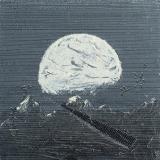
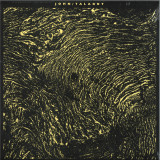
Ten years on, Joana Gama and Luís Fernandes show no signs of slowing down. Over the past decade, the duo has released five albums, composed soundtracks for film and television, and created pieces for performing arts. With “Strata”, they embark on a bold exploration of their musical identity, breaking new ground by seeking the primordial, the raw, and forging a deeper creative synergy. This evolution makes their music feel less like a conversation and more like a unified, introspective monologue.
Until now, their work has largely been defined by dialogue - a dynamic exchange of ideas evident in their earlier records. However, in their relentless drive to push boundaries, they now turn inward, embracing a monologue as a pathway for growth, innovation, and celebration of their journey so far. Two key elements shape this transition: Joana’s growing affinity for synthesizers over piano, a direction initiated in “There’s no knowing”, and her integration of field recordings gathered from diverse locations around the world. Rather than stepping into each other’s domain, the duo finds common ground, creating music that thrives on harmony and introspection.
“Strata” stands as Joana and Luís's quieter and most cohesive record to date. It reflects their desire to craft music that resonates with the natural world, unfolding as a seamless stream of sound that enhances their connection and invites the listener into their creative process. While their previous works were compelling, they often felt distant, as if the listener was observing from the sidelines. “Strata”, by contrast, draws the listener in, encouraging them to fill the spaces and find their own place within the duo’s monologue.
This process climaxes in the closing track, "Geode," where the subtle sounds of debris underscore the tightly woven structure of “Strata”. It’s a testament to the duo's commitment to evolution and their ability to surprise both themselves and their audience. A decade into their collaboration, “Strata” reaffirms Joana and Luís's creative vitality, offering a record that feels both fresh and deeply rooted in their artistic vision.
Cerca:natural element
In Signal, Brendon Moeller takes his expertise in techno, ambient and dub techno into deeper ambient and drone territory, crafting a richly atmospheric journey through sound for Constellation Tatsu’s thoughtful cassette label.
This album gently balances textures, merging natural and synthetic elements for a unique sonic experience. Highlights include the track 'Light', which opens with a minimal drone and subtle, pulsing sub-bass notes, setting a calm yet immersive tone. In 'Wires', Moeller skillfully intertwines organic and electronic soundscapes, bringing together the natural and technological in seamless harmony. 'Nowhere' shifts to a more aquatic feel, conjuring the sensation of being submerged in an otherworldly lagoon. The serene, electronic layering in 'Bask' adds beauty and peace through calm sequencing and warm tones. Closing with 'Beam', Moeller expertly blends real-world sounds and hints of a surreal, alien atmosphere, rounding out an album that’s both tranquil and otherworldly. Signal encapsulates Moeller's thoughtful production approach, giving listeners a deep dive into ambient landscapes that feel as expansive as they are introspective and adventurous.
DaRand Land, who hails from the post industrial confines of Buffalo, NY was one of the leading figures of Deep4Life, a cult label known for submersible oriented, yet dancefloor-friendly productions. With ambient synth-driven tones and heavy funk basslines being at the center of his sound, DaRand Land’s music often evokes an introspective quality, without losing its groove fundamental. DaRand’s works, which span decades on deep house labels such as Downbeat, Confluence and Pulp have been described as “uncompromising” and has afforded him a passionate following of listeners who seek a more emotive, thought-provoking brand of underground music.
Teaming up once again with Scissors and Thread - the perfect fit for his sound - DaRand Land drops an album full of crafty, trippy house for the heads. Wander Being contains 10 tracks on the double vinyl release with a pair of additional tracks for the digital release. The vibe is deep and sleek, with a rough, bumping edge. The title track sets the tone, a smattering of percussion accompanying a thick, round kick drum and Rhodes chords, giving off a classic Detroit feel. Tracks like Turn to The Music ramp up the energy somewhat, but overall the tracks sit in the sweet spot between dancefloor burners and soulful, jazzy, deep cuts. Noticeable is the space given to each element across the tracks - the hi-hats sparkle, the snare snaps, and the basslines roll and rumble. Add to this the magic melodic flourishes provided by the pads and synths, reminiscent of the late Mike Huckaby in places, made this whole album a thoughtful, joyful experience.
„The genesis for the Wander Being LP”, says DaRand “was a desire to return to the essence of some of my original Deep4Life productions. How was this accomplished? Principally, through the exclusive use of hardware components, minimalist arrangement, and a minds-eye approach to source the musical elements. In particular, the single, The Nature of Reality was written to convey a sense of what it feels like to be in a state of suspended animation. There is a natural tension introduced via the organic, swirling pad progression juxtaposed against endless vocal echoes and the low-end groove of the bassline. Thematically, I wanted to carry this forward through the entirety of the album.
balancing subdued keys and strings with ethereal tones and atmospheres
- Will You
- Rain
- Alone With People
- Addiction
- A Mess Like This
- Remember
- Waves
- Kill Me Twice
- You're Lying
- Jasmine
- Love
Hailing from Nancy, France, Cyann is a young artist aged 19. She is preparing a debut album that will surprise you with its maturity, so abundant is her work and her imagination fertile.Cyann or Wysteria, her stage name, has been immersed in the world of musical environment.A multi-instrumentalist, she began her musical career learning to play the harp at the age of four, then violin at Nancy Conservatoire. Dedicated and passionate Cyann went on to teach herself piano and acoustic guitar, two instruments that are now at the heart of her creative process. A singer-songwriter, Wysteria is the heir of a light, airy and genuine folk sound and modern Pop, from Vashti Bunyan to Billie Eilish. Yet her music remains coherent in the themes it tackles. If Cyann is naturally gifted as a composer, she is also an excellent lyricist.She writes stories as well as poems.At ease in both English and French, her texts are a true declaration of love to nature and life. Water, air, fire and all the natural elements are inexhaustible sources of inspiration for Cyann, who succeeds in associating an imagery and an atmosphere with simple, meaningful sensations.Cyann is a spontaneous artist, and her voice doesn't betray her. Her singing comes straight from the heart, natural, unadorned singing, comparable to that of Beth Gibbons (Portishead). Bold and inspired, Cyann has many strings to her bow. The breathtaking freshness and the wide range of her repertoire will surprise many a listener
Cosmic Tribe is excited to release CALAGAD 13’s latest EP, “Bio-Synthetic,” a compelling exploration of a dystopian future where biology and technology intersect. This limited edition white vinyl release, with only 150 copies available, features the original tracks “Biomantics” and “Synthogerm,” alongside standout remixes by CREASOL, C-SYSTEM, 5ZYL, and EC13.
“Biomantics” immerses listeners in a dark sci-fi realm where scientific advancements manipulate memory and energy, introducing a biotechnological entity that defies natural boundaries. The track explores the fusion of biology and technology in a dystopian world.
“Synthogerm” continues this theme with its depiction of hybrid beings created from the combination of synthetic and biological elements. It offers a glimpse into a future where scientific frontiers are continuously evolving and life is constantly reshaped.
The EP’s remixes add diverse stylistic interpretations from leading names in the European underground electronic scene:
CREASOL and EC13 offer unique takes on “Biomantics,” with CREASOL providing an 80s synth wave flair and EC13 delivering an Electro-techno twist.
5ZYL and C-SYSTEM reimagine “Synthogerm,” with 5ZYL infusing it with an Electro/Breaks vibe and C-SYSTEM adding a techno edge.
The “Bio-Synthetic” EP is a must-have for collectors and enthusiasts, available in a limited edition white vinyl format.
After navigating the labyrinthine musical chambers of their 2023 modern exotica album 'Palace Of A Thousand Sounds', Reno. Nevada’s Whatitdo Archive Group has returned with their first-ever holiday offering—venturing into the darker side of Christmas folklore with their new ice-cold 45, 'Wild Man'. Drawing inspiration from a global archetypical myth of the same name, Whatitdo Archive Group examines the ancient story of the Wild Man—the hairy, half-human, half-beast that stalks the shadows of humanity’s shared primeval past. The myth of the Wild Man is a folktale that goes by many names: The Yeti of the Himalayas, the Bigfoot of North America, and, of course, Krampus of Eastern Europe—a yuletide beast with a reputation as a child-devouring "Anti-Claus" who now finds himself the subject of Whatitdo’s latest musical exploration.
‘Wild Man’ gives us a glimpse into the band’s newest sonic direction. With a heavy rhythm section carried by Alexander Korostinsky’s driving bass line, the sticky wah-guitar of Mark Sexton’s L-5, and the acrobatic lines of the Wurlitzer electric piano, “Wild Man” revels in the spiritual jazz flavors of Pharoah Sanders and grooves hard like the classic soul-jazz stylings of Ramsey Lewis. Much like the Krampus myth itself, 'Wild Man' is meant to weave an ominous spell over any Christmas cocktail party long after the kids have gone to bed. Hear the warning for yourself in the song’s haunting chant: "You better watch out for your life, when the Wild Man comes in the night".
But mythology isn’t abandoned on the B-side. The band takes the traditional English folk melody 'Greensleeves' and reimagines it through the musical lens of Ethio-jazz. Recorded live at the Archive Group Studios, the track exudes a dark, roomy atmosphere, drenched in unease and mystery courtesy of the wandering electric piano dancing above the hypnotic rhythm section and mesmeric groove of the distant Batá drums. This fresh reimagining taps into the ancient, cross-cultural lineage of the "Green Man" myth, a pagan symbol of rebirth and the power of the natural world, further blurring the lines between holiday cheer and the primal, elemental forces enshrined in our collective cultural memory.
After the band’s 'Palace Of A Thousand Sounds' was named 2023’s "Best Library Record" by PopMatters Magazine, their new 'Wild Man' 7” capitalizes on the same creative process that shaped their last record, while now exploring new conceptual territory. By drawing inspiration from archaic global folklore and again utilizing their peculiar recording techniques, W.A.G. has crafted a truly unique holiday offering that unearths the darker, more primal undercurrents of the Christmas tradition. The 'Wild Man' 7" is released as part of the Snowflakes Christmas Singles Club, pressed on snow-white bio-vinyl and limited to 300 copies.
»Nuts of Ay«, the thirteenth album by the Berlin-based electronic pop duo Tarwater (Ronald Lippok and Bernd Jestram), is their first in a decade, since 2014’s »Adrift«. Beautifully poised and smartly dressed, it's an album that draws Tarwater’s various pasts into a high-definition present, while bringing the duo, yet again, into productive dialogue with all kinds of fellow travellers.
Tarwater’s music has always been marked by a hypnotic pop-ness, but that’s particularly evident on »Nuts of Ay«, where a song like »Hideous Kiss« weaves together jangling guitar, pastoral flute, and flittering electronics into a gem-like construction. While the lyrics of »Hideous Kiss« are written by the duo, »Nuts of Ay« also continues a longstanding Tarwater tradition of recasting the words of others in their own mould. This time, their remit is broad: poetry from Derek Jarman (»All Nuns«) and Millner Place (»Trapdoor Spider«); lyrics from Jean Kenbrovin (»I’m Forever Blowing Bubbles«), the late Shane MacGowan (»USA«) and, again, John Lennon (»Everybody Had a Hard Year«).
This cast of found and borrowed lyricists also finds collaborative echo in the guest musicians dotted throughout »Nuts of Ay«. Schneider TM turns up on the lovely, Felt-like »Spirit of Flux«, where guitars channel the tangled reveries of Vini Reilly and Maurice Deebank into lush pop. Carsten Nicolai joins, as Alva Noto, dappling »On Waves and Years« with intimate glitching textures; he also provides the album cover art. Elsewhere, Masha Qrella appears on »Down Comes the Goose«, and actor Lars Rudolph pitches in for »USA«.
It may have been ten years since the album's predecessor, but Lippok and Jestram have kept active with other projects. They’ve collaborated with Masha Qrella, Immersion, and Iggy Pop; worked on radio plays with Kai Grehn, some based on the writing of Nick Cave (»The Sick Bag Song«, featuring Tilda Swinton, Paula Beer and Alexander Fehling) and William S. Burroughs (»The Cat Inside«); and made music for several radio-tatorts (radio plays based on »Tatort«, a long-running German police TV series) by playwright Tom Peuckert.
Both voracious and committed in their creative energies, Jestram and Lippok report back from these experiments with »Nuts of Ay«, one of their most compelling, deeply lustrous, dreamlike albums yet. They say there was no concept for the album, which is surprising, perhaps, given its holistic mood, explaining it »grew together like a coral reef in the studio over a period of several years«. There’s something to be said for letting an album gather and mutate naturally, without an overarching framework in place, and »Nuts of Ay« certainly feels like an unforced collection of material that nonetheless inhabits a similar space, one where guitars twist like driftwood next to amorphous, aqueous electronics, Lippok’s droll yet completely convincing vocal delivery riding songs that pulse and plume with curious, unpredictable rhythms.
But you can also hear elements – submerged but still present – of other music that’s inspired the duo: they’ve drawn some connections for us with psychedelic folk, Bowie in Berlin, Burial, and the film music of Popol Vuh and Krzysztof Komeda. This music shares a strong sense of place – whether in the world, or the mind – and the twelve songs on »Nuts of Ay« have such similar presence; a shared mood, a shared world, a shared sense of the possibilities of what electronic pop music could, and should, be. A bold and brave pop experiment.
Artwork by Carsten Nicolai
Mastering by Bo Kondren, Calyx Berlin
»Trapdoor Spider«, »On Waves and Years« & »Breaking Day«: lyrics by Milner Place
»All Nuns«: lyrics by Derek Jarman
»USA«: lyrics by Shane MacGowan
»Down Comes the Goose«: lyrics from a traditional song
»Forever Blowing Bubbles«: lyrics by Jaan Kenbrovin
»Everybody Had a Hard Year«: lyrics by John Lennon
Born in Recife, Brazil, and currently residing in Lisbon, Sam Nóbrega is a singer-songwriter, multi-instrumentalist, arranger, and producer.Influenced by the Brazilian melodies his parents sang and listened to at home and on the radio, and driven by his love for Brazilian folk songs, street culture, and genres and movements like samba funk, forró, Ijexá, Manguebeat, and Bossa Nova, Sam embarked on a journey of musical self-discovery. In 2017, he took the stage with his first shows presenting his original music, performing at the Misturada festival in Florianópolis, southern Brazil, and at renowned venues in his hometown. However, it was in 2019 that Sam Nóbrega unveiled his debut single, "A Vida Vai e Volta," showcasing his instrumental prowess in a live video on top of a building. Subsequent releases like "Ruas Desertas," an independent release during the pandemic, demonstrated Sam's versatility.
His debut album "Ponta de Dois Lados," produced by Sam and Pedro Diniz, is slated for release by the British label Freestyle Records late November 2024. It is a rich sonic tapestry of Brazilian culture, blending traditional and popular elements with an indie and contemporary touch, creating an intriguing fusion of old and new sounds. Influences from João Donato, Marcos Valle, Milton Nascimento, Jorge Ben, Gilberto Gil, Novos Baianos, to the Manguebeat, Tropicalismo, and Vanguarda Paulista movements.
Underground house heavyweight **Enzo Siragusa** is back with a fresh offering, his highly anticipated new EP *Odyssey*, set to drop on **fabric Originals** this month. This marks another standout release for Siragusa, coming hot on the heels of his recent contribution, "Last E," to the *fabric Selects V* compilation, which landed earlier in October.
*Odyssey* features three meticulously crafted tracks that showcase Siragusa’s signature fusion of classic rave elements, deep grooves, and stripped-back house aesthetics. The title track "Odyssey" is a masterclass in his deep production style, while "95 Variant" leans into the artists UK influences. Perhaps the standout cut is "Listen," a nod to the golden era of speed garage, effortlessly blending bass-driven energy with Siragusa’s refined touch.
The EP is a natural evolution of Siragusa’s sound, one that continues to command respect across the underground scene. Known for his ability to channel a range of UK rave influences while remaining firmly forward-thinking, Siragusa’s work is consistently pushing the boundaries of what modern house music can achieve.
In support of the release, Siragusa will be returning to fabric with Enzo Siragusa Invites, where he’ll take control of the decks alongside a curated selection of top-tier talent. The event is set to be a fitting celebration of the new EP and promises to be an essential date in the London clubbing calendar.
On alene et, Michaela Turcerová, a Copenhagen-based, Slovakia born musician, takes minutiae — the tiniest scrapes and breathiest hums — and distorts them into sprawling, collaged webs that barely resemble the instrument in its natural state. Each shard, when pieced together, makes a rhythmic, undulating sound born from the subtlest motions.
Alene et marks Turcerová’s debut as a soloist, putting a spotlight on the exploratory approach she has developed on her own and across a variety of collaborations. She has long studied the quiet excavation of her instrument, pulling it apart to find a new vocabulary. To develop this language, she unearths shards of sound from the instrument, muting it or bringing out its scratchiness and grittiness. Primarily working with open-ended scores and improvisation, she is inspired by various percussive music, looking to deep sonic awareness to guide her. As a soloist, her music harkens to the abstracted electronics present across the Editions Mego catalog or the distorted ruminations of Nyege Nyege tapes. And no matter where she goes, she is constantly in the pursuit of the unknown — the hidden elements of music that come to life through experimentation and listening.
With alene et, Turcerová presents her singular language on the saxophone to the fullest. To make this music, she placed many microphones close to her instrument, zeroing in to each sound and examining it from multiple different angles. She emphasizes the percussive possibilities of her instrument, puzzle-piecing each note into pulsating webs. Each track highlights a different side of the saxophone — the bristling distortion and amplification of a column of air as it blows through her saxophone’s body, the trickling tapping of the keys as she places her fingers onto them.
At its core, alene et presents Turcerová’s curiosity. The saxophone lives many different lives within her hands, shapeshifting through the uncovering of its possibilities. She shows us how the instrument is an ever-changing entity, a distorted and blown out drone with a thousand shards poking out from inside of it. But more than just a showcase of an individual instrument, alene et feels like a statement of the act of exploration. Turcerová is an excavator, always looking for new worlds hidden within her saxophone, and leaving room for more to come alive with each listen.
Tristan Arp returns to Wisdom Teeth with his sophomore LP: ‘a pool, a portal’ - a vast, multi-dimensional record of pin-drop rhythms, hushed vocals and swirling ambience that maps out a vivid limbic space between the natural and the digital worlds. The LP began life while Tristan was still living in Mexico City, and was subsequently finished in New York. Carrying on from where his acclaimed debut ‘Sculpturegardening’ left off, the record marries hallucinatory modular synths with cello, found sound and spoken word, creating a rich sonic world in which machines mimic nature and acoustic instruments merge with their digital counterparts. Across the record’s narrative arc, listeners are invited to imagine a future world in which nature and machines collaborate to rewild and search for new modes of being. Far from apocalyptic, the artist’s vision is yearning and hopeful - a reflection on how we might evolve to overcome our very human limitations. “Hopefully we can all open a little portal into another world and integrate what we learn into our own”, Tristan offers. True to his word, Tristan shared much of the creative process with his machines, using modular generative processes to create randomised, improvisatory moments that he could collaborate on as artist and observer. Most of the tracks were captured in single takes as live performances and improvisations that were subsequently edited and cut down. Speaking of ‘Life After Humans’ - the record’s beguiling 10-minute centrepiece - Tristan recalls: “I neglected to record multi-track outs, but it was actually super empowering to be left with just a stereo track: I couldn’t mix individual elements even if I wanted to after the recording, but I’m happy I inadvertently limited myself in that way.” Alongside his own voice, the record features a stunning appearance from fast-rising Guatemalan cellist and vocalist, Mabe Fratti. The pair met in Mexico City in 2020, where she helped Tristan to learn cello - an encounter that ultimately went on to inform the recordings that made up ‘Sculpturegardening’. Her appearance on ‘a pool, a portal’ marks a full-circle moment in their creative relationship. The album’s artwork features photography by Zhang An - a photographer based in Nanjing, China. Despite their appearances, these are unmanipulated photos of real-world ice formations. As is the case throughout ‘a pool, a portal’, the lines between the natural and the artificial are playfully indistinct.
The sea has long been central to Japanese culture, symbolizing both sustenance and spiritual depth. Charles A.D.'s Deep Diver draws inspiration from this, channeling the ancient traditions of diving and fishing into his music. Historically, the sea has influenced everything from Shinto rituals to the livelihoods of coastal communities. In Deep Diver, this reverence flows through aquatic soundscapes, where rhythmic waves of 90s house and Detroit techno meet Japanese minimal production techniques, New Age and Pacific Jazz. Like the tides, the album ebbs and flows, creating a serene yet dynamic homage to the timeless connection between Japan and the sea.
The opening track 'Deep Diver' plunges into the depths, its abstract sound design capturing the sensation of deep-sea propulsion. Rhythmic bubbles pulse gently alongside slow-moving chords, creating an otherworldly atmosphere. The textures are lush yet restrained, setting a tranquil stage that pulls the listener into a submerged world. 'Underwater Ruins' builds on this aquatic theme, introducing rhythmic layers and bass-heavy notes reminiscent of mid-90s Japanese ambient techno. The smooth, melodic flow nods to pioneers like Mr.YT and Susumu Yokota, while subtly incorporating the Detroit techno influence through soulful, deep basslines.
The track feels like a fusion of ambient and techno, balancing serene tones with a rolling groove, emblematic of Japanese techno soul. As the album progresses into 'Bubble Ring', it becomes clear that Charles A.D. is a master of minimalism. The production is timeless, leaning
on analog techniques where echo-drenched chords and carefully layered soundscapes take on an addictive, hypnotic quality. The simplicity of the composition is deceptive, as each element carries weight, drawing the listener deeper into the rhythm and space between the notes.
'Merperson' is where organic rhythms truly come into play. Charles A.D. gently evolves the patterns, allowing each percussive hit to flow naturally into the next. Soothing melodies emerge from within the track’s structure, eventually reaching an emotional peak without ever feeling forced. The organic nature of the arrangement creates an effortless progression that feels deeply connected to the natural movement of water.Starting the second half with 'Deep Exploration', the theme of underwater excursions becomes even more pronounced. Light, steady drumming anchors the track, allowing the melodic layers
to develop gradually. It unfolds with a calm, measured pace, before ending softly, almost as if the sounds are drifting off into the oceanic depths. 'Diffuse Reflection' stands out as the most dub house-influenced on the album, with rolling rhythms and hypnotic elements reminiscent of Maurizio's deep, pulsing sound. Yet here, the production feels submerged, with aquatic effects swirling around the rhythmic core, blending dub house with a fluid, oceanic touch. 'Traitors' delves even deeper into dub-inspired territory. Deep, resonant bass hits combine with wooden drums, while static-like sounds evoke the image of a radio tuning through static to find clarity.
Chords shimmer briefly before fading back into the liquid depths, evoking the ebb and flow of the tide. The final track on Deep Diver 'Levitation', is a fitting conclusion, as the rhythms merge and overlap like waves gently lapping the shore. The minimalistic arrangement allows each element to blend effortlessly into the next, creating a sense of unity and closure. The sounds move with the gentle grace of water, ending the album in a way that feels both complete and
open-ended, like the infinite motion of the sea.
"One of the most iconic groups of the late 20th century, Dire Straits established their timeless sound from the
moment they first appeared on the London gig circuit, in 1977. With faultless musicianship and memorable songs
that quickly connected with music lovers, it was clear the group would set their own path, proving that, even amid
the new-wave era, classic songwriting would never go out of fashion.
After three years of relentless hard work, touring, writing and recording their music, the group entered the 1980s
well on their way to becoming the biggest-selling band in the world. That year’s Making Movies album would also
make its presence felt on the silver screen, thanks to the inclusion of the UK No.8 single ‘Romeo And Juliet’ – later
used in films such as Empire Records, Hot Fuzz and I, Tonya – and live favourite ‘Tunnel Of Love’, which featured in
the 1982 Richard Gere film, An Officer and a Gentleman. Dire Straits’ frontman, Mark Knopfler, would later explain
to The Times how satisfying it was to write ‘Tunnel Of Love’: “It’s the moment when you know you’re really on to
something,” he said. “There’s a certain part of the song that I call the breakdown and when I got there I could feel
the drums, the piano, all the things that I wanted all the instruments to do. When you get to that state, there’s a
strange sense of one thing following another, of elements falling into place quite naturally.”
Paying extra attention to those elements, this half-speed master of Making Movies has been overseen by Miles
Showell at Abbey Road Studios, in London, resulting in a cut that has a superior high-frequency response (treble)
and very solid and stable stereo images. Pressed on 180g vinyl, it comes with alternative artwork that swaps the
red and the blue of the original album sleeve, plus a printed inner sleeve, a “Half-Speed Master”-branded obi-strip
and an Abbey Road certificate of authenticity.
"
Norwegian pianist Eyolf Dale’s lateral approach to composition is given full range on his beautiful new album. Featuring his trio with the Norwegian Radio Orchestra, conducted by Edition Records artist Japanese maestro Miho Hazama, The Space Between Two Notes is a nuanced investigation of sound and space.
Eyolf Dale, the renowned Norwegian pianist and composer, releases his latest album, The Space Between Two Notes, his 7th album released under Edition Records. This new album elegantly reimagines selections from Dale's celebrated trio albums, Beingand The Wayfarers, with rich orchestral arrangements featuring the Norwegian Radio Orchestra, conducted by fellow Edition artist, Miho Hazama.
The Space Between Two Notes explores a mesmerising blend of jazz and classical music, harmoniously integrating the intimatedynamics of a trio with the grandeur of an orchestra.
The album is an exploration of musical intervals—the nuanced spaces between notes—which shape the auditory landscapes of Dale’s compositions. This approach sets it apart from traditional jazztropes, which often emphasize vertical structures, like chords and melodies. Dale, however, crafts his music horizontally, focusing on the relationships and distances between sounds.
Eyolf Dale’s approach to music is profoundly influenced by his rich musical upbringing and an early fascination with the varied textures of sound: from the intricate works of Pat Methany to the vibrant tones of Norwegian jazz. This diverse background informs his unique musical language, which is not confined by genre but instead resides in the intriguing liminal space between established musical traditions.
The album features not only Dale's pianistic finesse but also the empathetic interplay of his trio, including Audun Kleive on drums,whose sensitive accompaniment ensures the music's purity of expression. As Eyolf points out "One of the most challenging aspects, in my opinion, of blending classical and jazz elements lies in the delicate balance of the drummer's cymbals.” Together,they achieve a unity of sound that transcends the sum of its parts, further enriched by the poised bass playing of Per Zanussi andthe orchestral collaboration. This synergy allows the music to unfold naturally, each note and silence carefully articulated to communicate more than mere melody.
Limited Edition Orange Coloured Vinyl.
Green[23,95 €]
‘What makes Sex Swing so powerful is that they transcend the limitations of rock music. Their sound is so full of possibilities, violence, sexuality, sacrifice, even religion. If there was a future to look forward to for heavy guitar music, this is it’ The Quietus The locals call it Sop Ruak – eighty thousand square miles of mountains and mystery and unholy medicine. “It really is an endless seam of activity,” Sex Swing frontman Dan Chandler explains of Golden Triangle – both the title of their new album and the region between Myanmar, Thailand and Laos that inspired it. To know this contradictory corner of the world is to understand fully why the cult-beloved noise-rock artisans turned to it when writing their hotly-anticipated third full-length. The real-life Golden Triangle is a groundswell of both natural wonder and drug production, and who combines beauty and narcotic brutality better than Sex Swing? For a decade now, this
collective of revered UK underground musicians, comprising members of Earth, Mugstar, The Keep and Jaaw, have been pulling audiences into drug- like slipstreams with their alchemy of pummelling rhythms, towering guitars, and unrelenting saxophone through which glimmers of light occasionally pierce through. No wonder their Golden Triangle is an album telling distortion-shrouded tales from one of the most storied, enigmatic places on the planet, with enough invention within to fill eighty thousand miles and more.
Where does this violent, hypnotic aural travelogue take you within the Sop Ruak? The seven tracks that make up The Golden Triangle see the band – completed by bassist Jason Stoll, drummer Stuart Bell, guitarist Jodie Cox, synthesist/guitarist Oli Knowles and saxophonist Colin Webster – adventure first to ‘The Confluence of the Ruak and Mekong Rivers,’ full of shimmering orchestration and feather-light ambience. Then come stops in ‘Myawaddy’, named after a small town embroiled in bloodshed on the border of Myanmar
and Thailand, and ‘Boten, Route 13’ – sparked by stories of a seemingly endless stretch of road from Laos into China. Before long, listeners are plunged into ‘Hpakant’, one of the album’s most invigorating and singular moments, lyrically inspired by a jade mine in Myanmar, where the spoils of forced labour are exchanged for prostitution and methanphetamine. The result is a mesmerising slow-burn of sax, snaking rhythms and sinister spoken word courtesy of the Scottish-born Bruce McClure, who “took the theme and turned it into a sci-fi story of exploitation and vice,” explains the frontman. It’s a track that, like the rest of Golden Triangle, underlines the evolution Sex Swing have undertaken since forming in 2014. From the raw and primitive sounds of the self-titled debut full-length, followed up by the coruscatingType II in 2020. Sex Swing’s third effort retains those early primitive elements and adds layers of structure and complexity. Golden Triangle initial formation was that of programmed beats and bedroom recordings shared electronically in the height of the pandemic. Those ideas were then completed during intensive writing sessions at a secluded farm in Oxfordshire.
Album credits consist of recording by Stanley Gravett at Holy Mountain Studios in Hackney, mixing by Wayne Adams at Bear Bites Horse, mastering from James Plotkin, and the continued aesthetic collaboration with artist Alex Bunn. Golden Triangle bristles with a rawness familiar to fans of the British sonic punishers, but adds new elements indicative of a group never resting on their laurels or sitting in one place. Why would they, after all? There’s an entire world of mountains and mystery and unholy medicine out there to be explored. The Golden Triangle, it seems, is just the beginning.
Black[23,95 €]
‘What makes Sex Swing so powerful is that they transcend the limitations of rock music. Their sound is so full of possibilities, violence, sexuality, sacrifice, even religion. If there was a future to look forward to for heavy guitar music, this is it’ The Quietus The locals call it Sop Ruak – eighty thousand square miles of mountains and mystery and unholy medicine. “It really is an endless seam of activity,” Sex Swing frontman Dan Chandler explains of Golden Triangle – both the title of their new album and the region between Myanmar, Thailand and Laos that inspired it. To know this contradictory corner of the world is to understand fully why the cult-beloved noise-rock artisans turned to it when writing their hotly-anticipated third full-length. The real-life Golden Triangle is a groundswell of both natural wonder and drug production, and who combines beauty and narcotic brutality better than Sex Swing? For a decade now, this
collective of revered UK underground musicians, comprising members of Earth, Mugstar, The Keep and Jaaw, have been pulling audiences into drug- like slipstreams with their alchemy of pummelling rhythms, towering guitars, and unrelenting saxophone through which glimmers of light occasionally pierce through. No wonder their Golden Triangle is an album telling distortion-shrouded tales from one of the most storied, enigmatic places on the planet, with enough invention within to fill eighty thousand miles and more.
Where does this violent, hypnotic aural travelogue take you within the Sop Ruak? The seven tracks that make up The Golden Triangle see the band – completed by bassist Jason Stoll, drummer Stuart Bell, guitarist Jodie Cox, synthesist/guitarist Oli Knowles and saxophonist Colin Webster – adventure first to ‘The Confluence of the Ruak and Mekong Rivers,’ full of shimmering orchestration and feather-light ambience. Then come stops in ‘Myawaddy’, named after a small town embroiled in bloodshed on the border of Myanmar
and Thailand, and ‘Boten, Route 13’ – sparked by stories of a seemingly endless stretch of road from Laos into China. Before long, listeners are plunged into ‘Hpakant’, one of the album’s most invigorating and singular moments, lyrically inspired by a jade mine in Myanmar, where the spoils of forced labour are exchanged for prostitution and methanphetamine. The result is a mesmerising slow-burn of sax, snaking rhythms and sinister spoken word courtesy of the Scottish-born Bruce McClure, who “took the theme and turned it into a sci-fi story of exploitation and vice,” explains the frontman. It’s a track that, like the rest of Golden Triangle, underlines the evolution Sex Swing have undertaken since forming in 2014. From the raw and primitive sounds of the self-titled debut full-length, followed up by the coruscatingType II in 2020. Sex Swing’s third effort retains those early primitive elements and adds layers of structure and complexity. Golden Triangle initial formation was that of programmed beats and bedroom recordings shared electronically in the height of the pandemic. Those ideas were then completed during intensive writing sessions at a secluded farm in Oxfordshire.
Album credits consist of recording by Stanley Gravett at Holy Mountain Studios in Hackney, mixing by Wayne Adams at Bear Bites Horse, mastering from James Plotkin, and the continued aesthetic collaboration with artist Alex Bunn. Golden Triangle bristles with a rawness familiar to fans of the British sonic punishers, but adds new elements indicative of a group never resting on their laurels or sitting in one place. Why would they, after all? There’s an entire world of mountains and mystery and unholy medicine out there to be explored. The Golden Triangle, it seems, is just the beginning.
"A Singular Blend of Dynamic Post-Pop & Electronic Production Featuring The Vibraphonist’s Remarkable Quartet Special Guests Gerald Clayton and Marquis Hill Named One Of Downbeat's 25 For The Future
“His music is fresh, it speaks to everyone. Never heard anyone play vibes like that before.” -Herbie Hancock
“Best vibes player I’ve heard...” -Quincy Jones
In discussing Elements of Light, his fifth album as a leader, the vibraphonist-composer Simon Moullier often returns to a specific term: unfolding.
“This is an important word — the unfolding of a song,” says Moullier, who was born in France and lives in New York. “It’s something I’m very attached to, and something I’m always working on.” As he explains, many of his essential influences —Wayne Shorter, Milton Nascimento, Toninho Horta, Radiohead’s Thom Yorke, Ravel, — have been masterful unfolders in their writing. Moullier admires the movement and design in their music and harmony, the way one section of a tune leads into the next, everything flowing in a natural, beautiful, inviting way. Even the most serious intellectual musical concepts are rendered with a directness, a simplicity that can captivate a general audience. “For me, no matter how complex an idea can get,” he says, “clarity is always key.”
That’s a mature, evolved outlook for a millennial jazz musician to embrace, and it’s shared among Moullier’s youthful quartet featuring pianist Lex Korten, bassist Rick Rosato and drummer Jongkuk “JK” Kim. What’s more, these musicians of astonishing technical facility interact with the selflessness and good taste that Moullier’s song-focused music requires; to say it another way, they use their virtuosity to make the bandleader’s compositions sound as human and affecting as possible — never to preen."
Coming out on September 6th on Sharptone Records, Sundiver is Boston Manor’s fifth album and one that represents a glimmering dawn for the Blackpool five-piece. Grown from a seedbed of optimism and sobriety, the LP celebrates new beginnings, second chances and rebirth. With two members recently stepping into fatherhood, hope is baked into every note. “Datura came out of these really dark few years over the hangover of the pandemic,” Henry reflects. “I'd been struggling a lot with drinking and not taking care of myself and bad mental health and stuff. We wanted Sundiver to be the next morning of the following day.” He explains that it feels good this time round to write through the lens of positivity. “The themes began to emerge, of rebirth, spring, dawn, sunshine and then other elements just started to fit into that.” It was during the making of Sundiver that Henry found out he was going to be a dad. This album is a significant one for the band. Originally coming out of the emo and pop punk scene, they’ve explored sonics and genres throughout their career, taken risks and achieved more than they could ever had dreamed of. They’ve grown up as Boston Manor – their lives and the world changing around them. They’re now taking stock, at a crossroads of the band they were and the band they could be.
While writing the album, they revisited the bands that shaped them in the late 90s and early 00s. “I was listening to the music I loved when I was a teenager and I just thought, why don't we make music like our favourite bands?”, guitarist Mike Cuniff remembers with a smile. “So we brought our interests to the table that way. Y2K kind of vibe. There are elements of Deftones, there are elements of Portishead in there, some Garbage, The Cardigans.” He laughs and adds NSYNC to the list of inspirations. From this cocktail of classics comes a dynamic and ambitious record, rich with depth, groove and more hooks than Peter Pan’s nightmares. Lyrics that foxtrot from parallel universes to personal growth, vivid dreamscapes to raw grief. Individually they’re single strokes full of meaning and magic. Together they’re a landscape.
Container (out Feb 15th) is the first single and it’s them at their best – impassioned and infectious. “This song is about the stagnancy of life creeping up on you & how that can bring about change.,” Henry explains, citing Ocean Song by US band Daughters as an inspiration.
The concept of the butterfly effect is present on Sundiver – how small actions can lead to big changes. This is no clearer than on their second single, Sliding Doors (out April 5th). It has the golden sound of late 90s Lollapalooza rock – think Smashing Pumpkins - rebooted with crisp 2024 production and a potent heaviness. In the lyrics Henry wonders, what if?, pondering on what could be. The idea that there are infinite versions of you whose lives splinter off in different directions at every decision you make. That there’s another you out there somewhere right now reading this sentence, and another me writing it. “So much is down to chance and circumstance,” Henry says. “You might catch that train and your life totally changes. Or you might miss it and things stay the way they are.”
Heat Me Up (out May 30th) is defiant and victorious, the audio equivalent of quitting your shit job and driving into the hot summer sun with a head full of dreams. “The lyrics are about love and gratitude,” Henry shares. “Another theme on the record is just appreciating what you have. It’s about not taking for granted the things that you've been afforded.”
There was some natural magic in the creation of Sundiver. They worked with their usual producer, Larry Hibbitt, and engineer, Alex O’Donovan, but instead of recording in London again they ended up in the green pastures of Welwyn Garden City. “Because Larry lives out in the countryside now, it was a way different environment and way different experience recording this time,” Mike remembers. “That contributed a lot to the brighter sound of the record.” The daily barbecues they had during their recording sessions imbued the process with harmony – five old friends spending quality time together and making quality music.
However, the album is by no means one-note. Birthing this new world they’ve created wasn’t without it’s pain, and that can be heard in the heavier moments on Sundiver. What Is Taken Will Never Be Lost is the most-stripped back on the album, a slow rock number seasoned with the downtempo Portishead influence. The heartfelt lyrics are Henry’s way of processing the loss of his grandfather, who died in a hospice last year(?). “It was just fucking horrible. It was always cold when I went there and they were always trying to get rid of me. The song title, What Was Taken Can Ever Be Lost, is the idea of his memory fading at the time because of dementia.” Henry goes onto explain that shoeboxes of photographs, diaries and a legacy is what he’s left behind. “He lived a really rich life and it has really impacted me and my father. His legacy is etched into the fabric of history in a very small way.” This song continues the connection between his grandfather and the band, as his painted face is emblazoned on the cover of the very first Boston Manor EP, Driftwood. As well as emotionally heavy themes, there’s heaviness in the music of Sundiver too. The closing song, Oil In My Blood, descends into an intense shoegaze outro with Debbie Gough from Heriot screaming hellfire. It’s in moments like this that the band show us aggression and fury can be as much a part of positive change as quiet introspection. The last lyrics of the song, “It resets and starts again,” leaves us in contemplation as the final chord rings out.
Touring the US, Europe and Japan over the years makes for an impressive CV, but if you know anything about Boston Manor you’ll know that they’re all about their hometown. Their choice to work with Blackpool-based photographer Nick Barkworth is testament to that. They’ve been working with him since the pandemic. “He captures Blackpool in a light that really reflects the weirdness and quirkiness of the town,” Henry says.” He's got a really good way of presenting that.” For the Sundiver cover, Nick photographed a 30ft tall abstract glass sculpture made by the local artist John Ditchfield. A striking and bewitching monolith that’s familiar to them but unusual to most people. “It has such kind of a gravity and power to it,” Henry describes the sculpture which stands in a field just outside of the seaside town. “It reminds me of either an explosion or a star or a supernova. To me it represents new life, power and radiance.” Boston Manor have got a knack for that - connecting the otherworldly and the everyday, the stars and the streets.
They’re a band known for using their music to make bigger statements about society. This time round they’re harnessing the uplifting power of music, and the communion it creates, as an antidote to the daily doom and isolation. “It seems like absolute chaos out there at the moment,” Henry says. “You’ve got Gaza and Israel, you've got Russia, you've got the fact that 40% of the world is going to have an election this year and increasingly most governments are leaning very far to the Right. The internet is dividing everybody, people are getting poorer and more desperate. It's really, really scary.” They considered trying to tackle the weight of it all in their music. “We could’ve written Welcome to the Neighbourhood on steroids, where it's just absolute darkness and misery”. He’s referring to their 2018 concept album that deals with class, inequality and the bleaker side of Blackpool. “But I think it's really important to write something that people can be immersed in and find some sort of solace in. Somewhere they can escape to from the modern day pressures and everything that’s going on. We’re all in this together.”
This eponymous release from Three Body fuses digital futurism with cosmic organica. Hedonistic breakbeats, woodwind and keys interpolate six melodious tracks, stemming from live recordings, revolving around percussive conversations. With the band's raw minimal approach and combination of natural and synthetic instrumentation, this elemental EP offers an innovative study of contemporary electronic music and its relationship with ethnic rhythms and tones.
With the world in the throws of lockdown, the record never received its live inauguration, but it got nuff love on radio, with 6Music, WWFM and NTS all championing the release. It's since gained cult status amongst DJs with an ear for earthy tones, with tracks 'Palm Leaf' and 'Jampa Gawa' regularly spreading their wings. The trio's unique approach to sound is shaped by years of impromptu improvisations. The characterful drums and synthesis of Tom Towle, masterful sampling and engineering from Guohan and the wandering woodwind of Pete Beardsworth form the skeleton of this record, meticulously fleshed out in subsequent studio sessions.
GARDENIA is an existing land located at the Limpopo province of South Africa, right at the border with Botswana. The place's real name is Mmabolela and it's a private nature reserve covering 6500ha of subtropical savanna and part of Limpopo River.
In November 2019 I had a chance to visit the location and participate in an annual residency for composers and sound artists called 'Sonic Mmabolela', initiated and curated by Francisco López.
We lived in an isolated property in the middle of savanna having a unique opportunity to exist in undisturbed touch with the African wilderness.
For the past decade or so, Polish musician Michal Jacaszek has been exploring a new, resolutely modern chapter in Eastern Europe's long, storied love affair with classical music. His creations are painstakingly crafted collages of electronic textures and baroque instrumentation.
All the natural sounds later used to create Gardenia were captured there — during longtime recording sessions over the virgin interior of Mmabolela Reserve.
The album's field recording content was selected from several hours of birdsong, calls of frogs, insect noises, sounds of trees, bushes, grass as well as non-living natural elements like stones or shells.
These field recordings were later digitally processed and used as part of 9 musical arrangements.
However the recording sources and the location of Gardenia is defined, it was not my intention to document a South African natural soundscape nor create any other kind of strict concept album.
All I do in my work is an affirmation of beauty hidden in various aspects of the Creation. MJ
Biomes are little worlds of organic relationships, full of struggles, symbiosis, and sheer obsolete noise. In "De Silenti Natura," Henrique Vaz is meticulously crafting synthetic auditory biomes, sprouting from their own fuzzy logic. Unfolding across two distinct acts, the Brazilian artist interprets and replicates the complex, often ambiguous sounds of (un)natural environments, creating imaginary systems to inhabit over two sides of tape. The soundscape of the first side and title track is entirely algorithmically synthesized, with no samples used, leveraging Supercollider for real-time sound generation. The environment thus built is a flourishing one, seemingly unable to escape its own grandeur as insect-like buzzing and crackles expands into mountain ranges and forests of erupting sonorous drama. The second side introduces 'hydrophone' water synthesizers, submerged in a goldfish bowl to interface with the unfurling waves of electronic chords, creating a unique blend of damp and unwieldy sloshing movements, prismatically scattered into a luscious soundscape, and resembling everything from the bridge of a starship to the echoed drip-drip of stalactites.
Both sides of the album slowly unwrap and uncrinkle, revealing layers of hisses, distant digital choirs, warm enveloping chords, and juddering bleeps. Despite their unwieldy and strange nature, myriad elements convey a familiar sense of environment, flitting between the blossoming of new (manmade) life and the doom and destruction of the (real) world.
As the ringing of bells (fully synthetic; no samples were used) hove into view during the closing movement of side one, a simulacrum cacophony of voices is ushered in. It’s a reminder of the holy nature of sound itself, beamed into our heads intangibly. The flipside’s water ritual, frantically dunking ‘water synthesizers’ to birth swooping melodies and yawning tones, is jabbing at sleeping giants. It’s pushing and pulling the stars in the night sky into place. It’s both a simple act of beautiful creation, and a storm in a teacup.
- A1: Everything Forgotten Flows
- A2: Silicate Tusks
- A3: Learn To Fly (Feat Sabola)
- A4: Segue
- B1: Ruins
- B2: Like It Shouldn’t
- B3: Thick Air
- B4: Eternal (Feat Ex-Terrestrial)
- C1: Wake (Feat James K)
- C2: Grimoire
- C3: Basalt Tones (Feat Jesse Osborne-Lanthier)
- C4: Moonstone (Feat Ben Bondy)
- D1: Frayed
- D2: To See Our Secret Die (Feat Sabola)
Acclaimed Canadian electronic producer Francis Latreille, known as Priori, unveils his new singles "Learn To Fly" and “Segue” today, marking the first releases from his upcoming third album, This But More. "Learn To Fly" offers a taste of the album's lush, dubby techno soundscapes, while "Segue" showcases the album's ambient side. Arriving May 24th via NAFF, This But More marks a sonic departure for the artist, exploring a richly textured landscape of electroacoustic compositions inspired by literature, cinema, and the transformative power of nature.
Priori delved into This But More from September 2023 to March 2024, drawing upon archival recordings and fresh ideas. "This album is about healing," Priori explains. "Not necessarily 'music that heals', but about the process in its ups and downs, its beauty and uncertainty." Themes of protection, healing, sleep, and decay naturally emerged during the creative journey.
To craft this immersive world, Priori collaborated extensively. Writer and musician Devon Hansen penned a series of "Suggested Stories" to accompany the album, adding depth to its lore. Musically, Priori teamed up with James K, Ben Bondy, Sabola, Adam Feingold, and Jesse Osborne-Lanthier, infusing the album with diverse instrumentation, including violin, guitar, software instruments, and field recordings.
This collaborative spirit extends to the album's striking visuals. Jesse Orsborne Lanthier designed the main and single artworks, while Ulysse De Lezenne crafted a unique jewel, both pieces seamlessly connected to the album's narrative.
The intricate world-building sets This But More apart. "It's the biggest collaborative project I have tackled so far," Priori notes. This spirit of exploration extends to the second single, “Wake”, featuring Priori's first vocal collaboration with close friend Jamie Krasner (James K).
Priori's artistic process is grounded in self-awareness and intuition, asking vital questions about how each element serves the greater purpose of the music. Swimming sessions between studio work provided clarity and focus throughout the album's creation. These meditative moments reflect in the music, inviting listeners into a contemplative, dreamlike state.
Beyond music, Priori draws inspiration from the literary worlds of Gene Wolfe, Ursula K LeGuin, China Mieville, Brian Caitlin, the evocative games of Hidetaka Miyazaki and Yoko Taro, as well as the ever-evolving beauty of myths and nature.
Chicago's Black Diamond debuts on We Jazz Records with their new album Furniture Of the Mind Rearranging on 26th July. Co-led by Artie Black and Hunter Diamond (composers, saxophones, and other woodwinds), Black Diamond appears in both quartet and duo formations. The first three album sides present the quartet, complete with long standing band members Matt Ulery (double bass) and Neil Hemphill (drums), under the heading Furniture Of the Mind. The remaining two tracks on side D fall under the title The Mind Rearranging, with Black and Diamond presenting a meditative duo encounter of two tenor saxophones.
Furniture Of the Mind Rearranging is an assemblage of new compositions and improvisations that develop the band's established sound and exemplify the way in which this band folds into the Chicago creative music community. The quartet traverses their familiar aesthetic ranges between driving off-kilter groove, plaintive minimalism, and intimate chamber music, with the everpresent spirit of small-group jazz and a hovering influence of Chicago’s improvised music culture. And while this collection represents three previous
albums and more than a decade of close kinship and artistic evolution between co-leaders Black and Diamond, neither are too precious about any one element on the album. This is very simply the latest work in what continues to be an expanding body work founded on a guiding principle: cultivation without expectation.
The four sides with two formations flow together in a natural way, forming an idiosyncratic musical entity that is sure to grow with each new spin on the turntable.
Facta & K-LONE’s Wisdom Teeth imprint continues its busy schedule of 10 year celebrations with the debut LP by H TO O: a new collaborative project by Japanese ambient artists H. Takahashi and Kohei Oyamada. Set across six distinct movements, the LP maps the different stages of the cosmic cycle through a series of dynamic ambient set pieces: from the exponential expansion of the universe in its infancy - here invoked by the bright, chiming album opener ‘Inflation’ - through to its inevitable collapse and rebirth, captured by the record’s driving, ominous closer, ‘Ever’. The record started life in Takahashi’s hands, initially intended as a solo follow-up to his acclaimed 2018 LP, Escapism. The Kankyō Records founder shared his early sketches with friend and collaborator Oyamada, who began to play with the arrangements, taking the work in an experimental new direction. Naturally the project evolved into a cooperative effort, and its final form is the result of an honest and fluid back-and-forth between the two artists. The collaboration marks a considerable shift in energy to the artists’ previous works - most of all in its foregrounded use of rhythm. Where Escapism was built from a series of gently lilting, dream-like vignettes, each movement of Cycle has a clear sense of forward momentum and purpose. Each composition builds from a set of sparse, meandering elements into something dense, cinematic and, at points, discordant. Although Cycle is at heart an ambient record, there is a club-informed feeling of forward motion running through the record, placing it in a similar sonic world to the beatless-but-rhythmic ambient techno of artists like Barker, Lorenzo Senni and Sunareht. Delicate and dramatic in equal measure, Cycle is a vital and exciting debut dedicated to the building of worlds - and to their eventual and inevitable dissolution. Genre: Electronic / Ambient
- A1: The Look - Thrupence, Jack Vanzent
- A2: Solitude - Koji
- A3: Aperol - Houis Feat. Foreignlocal. & Inq
- A4: Lost & Found - Moirésun
- A5: Decompress - Tambala, Makzo, Falcxne, Seb Zillner
- A6: U & I - Den Brooks Feat. Hari & Noé
- B1: Sticks & Stones - Lovesome Feat Swoo
- B2: Save You - Tambala Feat. Dhan
- B3: Splash - Lucid Green
- B4: Equinox (Feat. Erica Tucceri) - Alexander Flood
- B5: Cape Town - Cabu
- B6: Baby Slow Down - Mxxwll
The multifaceted Perth-based record label 823, founded by Australian producer and creative powerhouse Ta-ku, is gearing up for "All Things Considered Vol. 3." Committed to detail and a celebration of life's simple pleasures, this LP refuses to be confined to any single genre. Noteworthy releases from 823 include Cabu's "So Far To Go" EP, Ta-ku and Matt McWaters's collaboration "Black and White," featuring the Masego collaboration "Flight 99," and their debut project with Australian producer and instrumentalist Kuzich.
This time, The guest list includes Jakarta Records beat-veterans Alexander Flood, Lucid Green, and Cabu, bringing RnB with a soulful twist that's sure to warm the heart. Playfully melodic artists Makzo, falcxne & Seb Zellner blend jazz, soul, and sweetness creating a natural and playful sound for the LP. Den Brooks, Lovesome, and Tambala all contribute to the rhythmic neo-soul zest on the iconic 808 beat.
On the whole, "All Things Considered Vol. 3" embarks on a forward-thinking rhythmic journey into the creative minds behind the LP. It's as diverse and eclectic as those minds themselves and proudly follows up on its first and second volumes. Natural sounds blend seamlessly with electronic elements, from lush melodies to wintery vibes. Playful vocals adorn this 12-track gem, from Lucid Green's ethereal journey "Splash" twisted in UK garage vibes to the jazz-pop infused "Lost & Found" by Makzo & friends, echoing Jamiroquai-esque beats. The first single, "Babyslowdown" by MXXWLL, takes center stage with its strings, while Alexander Flood's James Bond-inspired melody receives a funky update.
Veiga lands straight on the dancefloor, no ambiguity about it. Spurred by the guys from RS Produções, he's been honing his DJ skills since he was 17 (currently 23), initially with partner Nunocoox, who gave him even more motivation. Production came naturally sometime in 2020. We venture: maybe one of the good things coming out of the lockdown? Summer of '22, his debut at Musicbox (at the Príncipe monthly residency) is recorded as a festive, lively set, punctuated by the kind of crowd shouts only heard when things go really happy and sweaty. Since then, Veiga's name has been spotted regularly in the afro club scene, growing in reputation
This side of kuduro, "Leandro" is as expressive as it gets, with percussive forces pulling in deceitfully different directions, much in the same style as the slower form of tarraxo. But we can call this house, yeah? No niceties, however: little over 3 minutes and the track abruptly cuts into silence, exuding the raw power of something made for the mix, not in the least "for the people". In a similar pragmatic mode, the stabs in "Sem Nome" get the party started unannounced. Full mode, for the duration. Minimal groove, broken beats and emotive highlights. "Boiler Room" may be wishful thinking, an interpretation of what is required to rock the place or, ultimately, just a title to wrap up the project. In any case, here's a feisty vocal-and-whistle driven stormer, building up to perfection over three and a half minutes. All elements exactly where they belong. Relentless pace in "X de Destroi", a dark side operation, unreal ambiance, breakneck beats, a purgation?
The title "Tudo É No Guetto" contains all the necessary theory. Everything happens in the ghetto. This uplifting house slab celebrates life as it is, freezing hardships for a moment, the ghetto seen as welcoming, a natural place to be. Vocals stashed away in his cell phone come from the animação crew Os Twinni (he joined them for a while). Clipped, repeated and manipulated to convey the very simple feeling of good times. Veiga himself talks about growing up with minimum resources but still happy. That is the memory he retains from being a kid in the ghettos of Amadora, just outside of Lisbon, born to a Cape Verdean father and Portuguese mother. Though the music sounds carefree and the message is chilled, let us not be tempted to rebrand Reality.
The phenomenal three-piece band includes members of Oranssi Pazuzu, K-X-P, Grave Pleasures and Aavikko
Svart Records is proud to release the debut album, I, from Haunted Plasma, a powerhouse of futuristic synth in symbiosis with the super violent atmospherics of kosmische Black Metal. Haunted Plasma is “man meets machine” in a cybernetic wasteland, set to a conceptual backdrop of William Gibson and Phillip K. Dick style mind-melt. The highly evolved creatives at the heart of Haunted Plasma’s sound, cite Terry Riley, Massive Attack, a contemporary take on Krautrock hypnosis, psychedelic Black Metal and 90s Techno, resulting in an orgy of mutant sound.
The phantoms at the beating nucleus of this unearthly machine are Juho Vanhanen (Oranssi Pazuzu, Grave Pleasures), Timo Kaukolampi (K-X-P, Op:l Bastards) and Tomi Leppänen (Circle, Aavikko, K-X-P), transmitting a music form evolved from a life of redefining sonic boundaries in their respective projects. Also featuring guest vocals from Mat McNerney (Hexvessel, Carpenter Brut, Grave Pleasures/Beastmilk), Pauliina Lindell (Vuono, Dust Mountain) and Ringa Manner (Ruusut, The Hearing). Haunted Plasma promises an extraterrestrial experience from some of the foremost contemporary musicians at the heart of the Finnish heavy and avant-garde musical underworld.
Haunted Plasma reveals:
“We are liberated futurists, embracing free-form and natural composition, mirroring the merciless forces of cosmic creation. We have a motto to stay true to our feelings, to spawn a sound that’s never been heard before. Servants of music. Energizing, radical and pure”
The first single from Haunted Plasma’s cascading debut, Reverse Engineer, is a creepy, slowly erupting, synthetic nightmare, of a downloaded being waking up in the wrong future. Ghostly vocals demand the listener to “give us what we want” in an Orwellian glimpse into the current dystopia we live in, where information is controlled, and thoughts are bought and sold. As McNerney intones the words “technology of power” he describes the threat of a malevolent and omnipresent artificial intelligence, as much as describing the oppressive and electromagnetic sonar pulse of Haunted Plasma’s sound itself. Psychedelic guitar hypnosis from Vanhanen snakes around Kaukolampi’s molten and morphing synths, while Leppänen’s uncanny man/machine rhythms pull our strings and animate their other-worldly mechanisms. Have a look at the official visualiser of "Reverse Engineer" on the Svart YouTube channel here
Culminating in the full-blown fast Krautrock of the final self-titled track, oozing with blistering noise elements and enigmatic vocals from Ringa Manner, the album's journey reaches its zenith, taking you to unknown territories on a Kubrikian space trip. I is a rare record of talented musicians coming together to create a completely new sound, which is entirely their own, boldly glowing, where no light has shone before. From the dreamy psychedelia of Echoes to the discombobulated Spectral Embrace, Haunted Plasma is a willful force of deliberate sound contortion.
Whether you want to give in to Haunted Plasma’s sound or not, you are being watched, you are being recorded and your every move is monitored. Haunted Plasma will enter your system on the 31st of May 2024. Turn on your phantom circuits and be prepared for an interdimensional excursion into Haunted Plasma’s alien dreams.
The debut album from Haunted Plasma will be packaged in a beautiful tip-on sleeve, swirling fog artwork, complete with 12” booklet and pressed on 3 exclusive vinyl colours: 300 copies on Standard Black Wax, 500 copies in Amber + Black Smoke and 200 copies of Svart exclusive Turquoise/Black Marble. The album will also be available on CD and digital platforms.
2024 reissue of Thomas Bückers debut album as Bersarin Quartett, originally released in 2008 on Lidar.
With some albums, you realize within a few seconds that here you have come across something really special. It is music that touches you straight away. Music that is important, that has a story to tell – and that manages to do so without even a single line of lyrics.
Wonderful orchestral pieces full of longing and melancholy. It is that certain kind of melancholy that seizes you when you are moved while following the final credits of an emotionally touching movie, remembering special moments that have faded in the course of many years and linger hazily in your memory, when you are somewhat wistfully contemplating old, worn photographs from days passed by … not a feeling of failure or hopelessness, but a bittersweet reflection.
Orchestral cinemascope sounds provide the emotionally moving fundament, wrap the tracks up in a warm coating. Graceful strings pile up, creating big moments and repeatedly ending inmelodies that are simply heart-rending, cinematic and tragic. But the Bersarin Quartett does not merely rely on these ingredients. The songs are also repeatedly interspersed with suspenseful and surprising elements, be it frail electronica, hypnotic soundscapes, drums or reverbed guitars. Rarely has amelange sounded as convincing and natural as this, and rarely has it sounded so well produced.
Thomas himself calls his music “imaginary fictional filmscores“. And it is hardly possible to come up with a more apt term. 10 tracks for 10 movies that have yet to be shot. Music that radiates such an enormous and authentic passion in every single minute, that one can’t help but completely abandon oneself to it. And honestly: Can there be anything more wonderful that can be achieved through music?
With this new project, their fourth full-length work, Tupperwear completely departs from the "stylish" electronics and trends to delve into a profound exploration of the fundamentals of music.
It involves a quest or even a game through the extrapolation of geometry into various musical parameters, encompassing classical aspects like pitch, timbre, rhythm, intensity, etc., as well as noise, textures, or the implicit mathematics in natural or irrational elements.
Pentagonono delves into cosmology and nature. It is a musical approach without prejudices to basic numerology that unveils the universe, the harmonic scale, the number e, and logarithmic spirals. The golden ratio (phi) and the omnipresent number pi are also explored. Geometric shapes, proportions, and divisions of vibrating elements are transmitted through the air, internalized by humans, and transformed into music.
Following in the footsteps of previous sound explorers from various spatial and temporal origins such as Gamelan music with its infinite polyrhythmic replication, Psychedelia, Serialism, Musique Concrète, Bach, or J Dilla, this album presents itself as a materialization of ideas and concerns that, while already present in the band's musical understanding, are now brought to the forefront as if it were a vital manifesto.
Glasgow’s Somewhere Press return with their inaugural vinyl release, a new album from Madelyn Byrd aka Slowfoam. Mining the seam between ecology and technology, Byrd offsets syrupy, dissociated electronics with sparse acoustic instrumentation and expressive field recordings.
The polyrhythmic pulse of the natural world surges through Byrd’s productions, and though the sounds are mostly electronic and strictly metered, a landscape teeming with insects, birds, and wildlife fills the horizon. We’re languidly ushered through the gates on the opening 'Enlightened Smudge on the Machine', juxtaposing glassy tones with flute (from Berlin-based sound artist Diane Barbé) and skittering percussion that could have been lifted straight off Björk’s 'Vespertine'. "No traffic, under the stem," a stoic voice muses while sounds dissolve into waterlogged ambience. There are hints of vintage West Coast new age music, but Byrds' over-arching theme is one of a contemporary digital reality slowly harmonising with its distant, bucolic past.
Field recordist Pablo Diserens provides some of the album's most arcane material, handing over environmental recordings of sulphur pools, Arctic terns and glacial streams. The lengthy 'Divine Morpho, Shimmering' deploys a swarm of insects, forming a looped, uneven rhythm that counters Byrd's pulsing electronics. Choral stems mesh with uncanny strings, blurring the line that separates artificial from organic sound sources. Byrd uses mutation and reconstruction as a form of "speculative melting" to bring us closer to utopia. On 'Like Phantom Memories In The Slinking Storm’, one of the album's most levitational moments, they tease twangy harp-lyre plucks into dubbed-out smudges, eventually given a reprise on 'Grief Rituals' where the same riffs are stretched into slower phrases, queered against giddy, xenharmonic drones.
Bird calls and tremulous exotica mark the brilliant 'Fragrant Dusking', and ‘Soft Body Virisdescence' takes us to a gurgling, kaleidoscopic climax, with electronic processes thrust into the foreground. 'Of Data & Delight' distills all the album’s sonic elements into a sort of delirious fever dream, using pitched animal calls to signal sensuality. It's not ambient, exactly, even if it shares space with the 3XL crew's sludgy eroticism, and it's not wholeheartedly electro-acoustic either. The record exists at a place of convergence, as one era wrestles with a new dawn, and real life glimpses high fantasy.
2024 Repress
Clear Vinyl
This is the second installment of the Warm Up Bandcamp Vinyl series and comes again signed by label boss Oscar Mulero. Limited edition vinyl EP with three cuts of merciless techno designed to shake minds and feet.
"Gradual Blending" starts with the core elements up, distorted kicks, shuffled hats, resonant percussive components, super reverberated claps, density and obscurity aligned in an hypnotic structure.
"Evolutionary Decay" is elastic and physical, a solid subbass / kick / hat groove, phased synthetic layers, atmospheres and liquidness: Intelligent tool.
"Natural Resources" relies again on distorted drums, asymmetrical sinoidal sequences and Fm synths all designed in a wise arrangement.
Timeless, hard and mental for the real players out there.
gold LP[32,98 €]
Returning after three years with their second studio album, Double Dog Dare, WHITE DOG have been revelling in a state of creative flux and are poised to share their revelations with the world. Formed in 2015 in Austin, Texas, White Dog began with a shared vision of blazing, fuzzed-out rock that drew gleefully from their home city's rich cultural melting pot. Emboldened by an us-against-the-world gang mentality and inspired by everything from dusty roots rock to explosive old school prog, the band's self-titled album emerged in 2021, courtesy of natural home Rise Above Records, and immediately stood out as a sophisticated, earthy and characterful new strain of retro rambunctiousness.
Recorded over a period of eight days at Stuart Sikes Audio (with engineer Andrew McCalla) in Austin, Double Dog Dare takes all of the debut album's deftly assembled ingredients and allows them to fly free, liberated from expectation. At times mellower than its predecessor, at others strident and ferocious, these new songs showcase White Dog's organic development, with elements of everything from wistful southern rock to crusty-eyed jazz rock finding a place. Somehow even more fluid and fiery than before, this band are growing and expanding before our ears.
Now free to peddle their incendiary wares, they return to the stage with their strongest material to date, and a newfound enthusiasm for giving The Riff the respect and imagination it deserves.
black LP[31,72 €]
Returning after three years with their second studio album, Double Dog Dare, WHITE DOG have been revelling in a state of creative flux and are poised to share their revelations with the world. Formed in 2015 in Austin, Texas, White Dog began with a shared vision of blazing, fuzzed-out rock that drew gleefully from their home city's rich cultural melting pot. Emboldened by an us-against-the-world gang mentality and inspired by everything from dusty roots rock to explosive old school prog, the band's self-titled album emerged in 2021, courtesy of natural home Rise Above Records, and immediately stood out as a sophisticated, earthy and characterful new strain of retro rambunctiousness.
Recorded over a period of eight days at Stuart Sikes Audio (with engineer Andrew McCalla) in Austin, Double Dog Dare takes all of the debut album's deftly assembled ingredients and allows them to fly free, liberated from expectation. At times mellower than its predecessor, at others strident and ferocious, these new songs showcase White Dog's organic development, with elements of everything from wistful southern rock to crusty-eyed jazz rock finding a place. Somehow even more fluid and fiery than before, this band are growing and expanding before our ears.
Now free to peddle their incendiary wares, they return to the stage with their strongest material to date, and a newfound enthusiasm for giving The Riff the respect and imagination it deserves.
After a successful tour following the release of "Alors quoi!" on Bongo Joe records, accompanied by a drummer/percussionist change, the prospect of what comes next naturally arose. Elements surfaced, including a desire for more low frequencies, a fascination with the marimba/vibraphone, and a liberating indifference to the difference between recorded and live performances. To evolve, the team collaborated with outsider Kwake Bass, known for collaborations with Kae Tempest, Tirzah, Mica Levi, and others. Despite aesthetic differences from Meril Wubslin's previous albums, this divergence was seen as key—an enriching risk that resulted in a unique blend of influences. The acoustic core of Meril Wubslin now embraces electronic elements, revealing a more powerful and urban dimension. While maintaining a commitment to French lyrics, the themes explore the concrete yet remain grounded in the intimate and the sensitive, avoiding overly clear and univocal messages.
- A1: Corridor Of Dreams Feat. Systur (Sisy Ey) & Oilly Wallace
- A2: Ugle (Drømmen Om Møn)
- A3: So Much Feat. Woolfy
- A4: I Was There
- A5: Tears We Haven’t Cried Feat. Toby Ernest
- A6: Save Me Feat. Toby Ernest & Oilly Walace
- B1: Conversations Feat. Systur (Sisy Ey)
- B2: Le Trois
- B3: Love My Way Feat. Jacob Bellens
- B4: Club Paradisco
- B5: Coming Home Feat. Toby Ernest
- B6: Reflector (Reprise)
Just when you thought you had Kasper Bjørke figured out he comes back with another great musical surprise. His new album Puzzles, which will be released April 5th on hfn music, follows two recent collaborative EPs on Live at Robert Johnson and Mule Musiq as well as his second Kasper Bjørke Quartet neoclassical/ambient album Mother on Kompakt.
Puzzles is Kasper’s love letter to the sound of early 2000s New York - merged with his Scandinavian sense of producing songs that goes beyond conventional club music; combining disco tinged instrumentations mixed with elements of 80s funk, jazz and contemporary pop songwriting, creating something familiar yet, something very fresh and innovative at the same time.
The album includes collaborations with a wide range of musicians and vocalists. From California based indie-disco troubadour Woolfy (DFA, Rong, Permanent Vacation etc.) to the Icelandic dream-folk trio Systur aka Sísý Ey (who also featured on Kasper’s 2014 single Apart, where the Michael Mayer remix became a timeless club anthem), as well as other longtime collaborators and artist friends: Toby Ernest, Jacob Bellens, WhoMadeWho’s Tomas Høffding on bass, Posh Isolation affiliate Frederik Valentin on guitar and the young, rising jazz star Oilly Wallace on saxophone and flute. Essentially, the majority of Puzzles is played and recorded live, including the drums by Rasmus Littauer (School of X, MØ). Many of the songs emerged from chord progressions written during studio sessions between Kasper and Toby - which Kasper then produced into a colourful and effective album, rooted in an expressive live feeling far from programmed patterns.
Puzzles is a new step for Kasper as a producer and artist, showcasing his ability to move and flow freely between genres and expressions, however still deeply rooted in his love and affection for the classic disco groove - which is only natural after more than two decades as an active DJ.
Another piece has been added to the musical puzzle of Kasper Bjørke
If 2022’s The Children Of Scorpio was the debut album that turned people onto the world of Project Gemini aka Paul Osborne, Colours & Light is the body of work that will be buried deep into their hearts. It is a majestic album, bringing together the worlds of folk rock, psych soundtracks and hazy cinematic funk.
A growing confidence and ease emanate from the writing and production of this sophomore LP, bolstered by the reception to his standout debut. “It’s a more layered and diverse record” Paul mentions, “with a more outward-looking, global sound, born out of the records I was listening to and the musicians I was lucky enough to collaborate with”. It feels relaxed yet self-assured, with a kaleidoscope of sounds that twist together in a mesmerising fashion.
The theme of the album developed naturally through the lyrics Paul began writing. A creative process both plagued and fed by insomnia, nourished by relationships, entwined in emotions, nights out, nights in and the after-effects on the human condition. Relatable themes yet seen through the prism of a soundscape that takes in many a different culture and scene. From acid folk to psych-funk, Francophile elements to Anatolian and Eastern inspirations, all interlocking and rotating as one.
Drawing inspiration from those he admires, Colours & Light radiates with collaborations. The title track, which tips its hat to a live 1973 TV version of Pentangle’s ‘Wedding Dress’, features the folk rock, guitar brilliance of Jack Sharp from Wolf People/Large Plants.
Elsewhere, two tracks are blessed by the sultry, smokey French vocals of Gloria’s Wendy Martinez, ‘Extra Nuit’ and ‘Entre chien et loup’. The former echoes Paul's love of classic French psych-pop from the late ’60s and early ’70s and artists such as Laurance Vanay, Calcium, Leonie, and Serge Gainsbourg. Martinez's sublime vocal work nestles perfectly within Paul's psych-folk-funk productions, as her Gloria partner, Alexis Morel (aka Kid Victrola) sprinkles a dose of entrancing guitar line magic on proceedings.
The list of collaborations extends further with Raz and Markey Funk, drummer Tony Coote and percussionist Paul Elliott all featuring. Regular collaborator and underground icon Barrie Cadogan (Little Barrie) returns along with Bert Page from The Cromagnon Band, who between them provide a hit of whacked-out, fuzzed-up country guitar and Moog madness respectively on ‘Lost In The Woods (Bacchanal)’.
Rounding off the record Paul’s daughter, Olivia Osborne, supplies the keyboard intro on the penultimate track ‘Twilight’. Dorian Conway from The Soundcarriers (whose bandmate Paul Isherwood returns on mixing duties) then layers echoing heavy flute parts to magically capture the psychedelic sunrise images brought to mind.
Balancing light and shade on this record, there is beauty and tension all wrapped up in Paul’s vivid and visceral, storytelling gift.
If 2022’s The Children Of Scorpio was the debut album that turned people onto the world of Project Gemini aka Paul Osborne, Colours & Light is the body of work that will be buried deep into their hearts. It is a majestic album, bringing together the worlds of folk rock, psych soundtracks and hazy cinematic funk.
A growing confidence and ease emanate from the writing and production of this sophomore LP, bolstered by the reception to his standout debut. “It’s a more layered and diverse record” Paul mentions, “with a more outward-looking, global sound, born out of the records I was listening to and the musicians I was lucky enough to collaborate with”. It feels relaxed yet self-assured, with a kaleidoscope of sounds that twist together in a mesmerising fashion.
The theme of the album developed naturally through the lyrics Paul began writing. A creative process both plagued and fed by insomnia, nourished by relationships, entwined in emotions, nights out, nights in and the after-effects on the human condition. Relatable themes yet seen through the prism of a soundscape that takes in many a different culture and scene. From acid folk to psych-funk, Francophile elements to Anatolian and Eastern inspirations, all interlocking and rotating as one.
Drawing inspiration from those he admires, Colours & Light radiates with collaborations. The title track, which tips its hat to a live 1973 TV version of Pentangle’s ‘Wedding Dress’, features the folk rock, guitar brilliance of Jack Sharp from Wolf People/Large Plants.
Elsewhere, two tracks are blessed by the sultry, smokey French vocals of Gloria’s Wendy Martinez, ‘Extra Nuit’ and ‘Entre chien et loup’. The former echoes Paul's love of classic French psych-pop from the late ’60s and early ’70s and artists such as Laurance Vanay, Calcium, Leonie, and Serge Gainsbourg. Martinez's sublime vocal work nestles perfectly within Paul's psych-folk-funk productions, as her Gloria partner, Alexis Morel (aka Kid Victrola) sprinkles a dose of entrancing guitar line magic on proceedings.
The list of collaborations extends further with Raz and Markey Funk, drummer Tony Coote and percussionist Paul Elliott all featuring. Regular collaborator and underground icon Barrie Cadogan (Little Barrie) returns along with Bert Page from The Cromagnon Band, who between them provide a hit of whacked-out, fuzzed-up country guitar and Moog madness respectively on ‘Lost In The Woods (Bacchanal)’.
Rounding off the record Paul’s daughter, Olivia Osborne, supplies the keyboard intro on the penultimate track ‘Twilight’. Dorian Conway from The Soundcarriers (whose bandmate Paul Isherwood returns on mixing duties) then layers echoing heavy flute parts to magically capture the psychedelic sunrise images brought to mind.
Balancing light and shade on this record, there is beauty and tension all wrapped up in Paul’s vivid and visceral, storytelling gift.
- A1: I Am Missing You
- A2: Kahān Gayelavā Shyām Saloné
- A3: Supané Mé Āyé Preetam Sainyā
- A4: I Am Missing You (Reprise)
- A5: Jaya Jagadish Haré
- B1: Overture
- B2: Festivity & Joy
- B3: Love - Dance Ecstasy
- B4: Lust (Rāga Chandrakauns)
- B5: Dispute & Violence
- B6: Disillusionment & Frustration
- B7: Despair & Sorrow (Rāga Marwā)
- B8: Awakening
- B9: Peace & Hope (Rāga Bhatiyār)
Purple Vinyl[27,52 €]
Out of print as a stand-alone release for decades since its original 1974 issue. Produced by George Harrison, Shankar Family & Friends is an almost-forgotten masterwork – an emotional and sonic pact between two like-minded souls to both advance their spiritually minded bond and unite musical styles, cultures, and sounds in wondrous fashion Contributions from Ringo Starr, David Bromberg, Billy Preston, Nicky Hopkins, Jim Keltner, Klaus Voorman, and a host of virtuosic Indian musicians add to a diverse album that melds Eastern and Western traditions; encompasses jazz, funk, bhajan, Indian, and pop; and represents the spirit and breadth of Harrison's Dark Horse Records imprint.
Memorable contributions from an A-list of American and English musicians — Ringo Starr (drums), David Bromberg (electric guitar), Billy Preston (organ), Nicky Hopkins (piano), Jim Keltner (drums), Klaus Voorman (bass), Robert Margouleff (Moog), Malcolm Cecil (Moog), Tom Scott (saxophone) included — add to the richness of a set that melds Eastern and Western traditions. These “names” mesh with a host of Indian virtuosos — Alla Rakha, Ashish Khan, Kamala Chakravarty, Hariprasad Chaurasia included — who turn Shankar Family & Friends into a journey laced with percussive, string, and vocal components that aren’t soon forgotten.
Throughout, Shankar Family & Friends remains true to its title — a mesmerizing record named to reflect the group participation approach of its creators. The idea started when Shankar told Harrison about a ballet he wrote. The Beatle, who first met Shankar in June 1966 — roughly a year after Harrison became interested in Indian music after overhearing it in a restaurant while filming Help! — immediately was convinced they needed to record it. Harrison’s staunch admiration of Shankar and serious approach to Eastern styles are reflected throughout the album.
Indeed, for Harrison, Shankar Family & Friends marks the culmination of a years-long effort to master the sitar, study Hinduism, and incorporate elements such as drones, unusual chords, and expressive picking into his own songs. The seeds of this unique collaboration can be heard in Beatles works such as “Norwegian Wood,” “Love to You,” and “Within You Without You.” Both musicians were also fresh from performing at the 1971 Concert for Bangladesh shows. Yet Shankar Family & Friends remains entirely unique in each visionary artist’s history — and ultimately, led to a collaborative tour Harrison and Shankar staged across North America.
Encompassing jazz, funk, bhajan, Indian, and pop, Shankar Family & Friends is thematically split into halves. Side One reveals Shankar’s uncanny ear for melody — even when applied to Western forms. The lead-off “I Am Missing You,” the first single ever released by Dark Horse Records and reportedly the first pop composition Shankar completed, underscores his skills as a composer and global ambassador. Beautifully sung across three octaves by his sister-in-law, Lakshmi Shankar, the devotional song features multiple drummers and production that mirrors Phil Spector’s Wall of Sound approach. Harrison plays autoharp and guitar; Starr sits in on drums; Scott handles flute and soprano saxophone. It’s the inviting start of a musical adventure teeming with color, majesty, and mysticism.
A second version of the track — designated with a “(Reprise)” tag — appears minutes later. Unfolding in different ways, it follows a folk ballad structure stitched together with Indian instrumentation. Here, according to Shankar, the musicians “attempted to convey the sounds and atmosphere of Vrindavan, the ancient holy place where Krishna grew up.” Both renditions speak to the cross-continental fusion that came so naturally to Harrison and Shankar, whose oversight on the side’s other vocal tracks ensures listeners familiar with Western methods gain easy access to the hypnotic allure of his native country’s music.
Nowhere is this more evident than on Dream, Nightmare & Dawn (Music for a Ballet), the side-long piece that served as the genesis for Shankar Family & Friends. Launched with an airy overture and unfolding across three movements, the mostly wordless suite features everything from call-and-response interplay and classical lyricism to uptempo dance figures, stacked rhythms, and intoxicating grooves. Blurring the lines between contemporary and traditional, and Western and Eastern, the inspirational work is the exclamation point on a record that defined “world music” well before the term became co-opted as a catch-all genre.
- Antena Magne?Tica Captando Campos Electromagneticos I
- Antena Magne?Tica Captando Campos Electromagne?Ticos Ii
- Micro?Fono De Contacto Captando Vibracio?N Del Puente Llacole?N
- Micro?Fono De Contacto Captando La Interaccio?N Entre El Viento Y Un A?Rbol
- Micro?Fono De Contacto En Elementos Vibrantes
- Micro?Fonos De Contacto Captando Granizos
- Micro?Fonos De Contacto En Autobu?S
- Hidro?Fono Bajo El Fondo Del Mar
- Vibraciones De Materiales Geofon Ii
- Vibraciones De Materiales Geofon I
- Vibraciones De Materiales Geofon Iii
- En La Direccio?N Del Viento
- Ronroneo De Selai
- Rai?L
- Efectos Sonoros En La Naturaleza
Valentina Villarroel is a sound artist and phonographer who explores the intricate dynamics within various Southern ecosystems. Her work revolves around the profound potential of acoustic ecology, particularly in the face of encroaching real estate development on natural spaces. She also delves into the consequences of sound pollution on numerous species, contributing to their decline or disappearance. In recent years, her focus has extended to urban soundscapes and significant sonic events, such as the October 18th protest in Chile. With a solid background in bioacoustics applied to both human and animal well-being, Valentina assumes the role of co-director at AOIR Sound Laboratory. There, she spearheads an interdisciplinary initiative that centers sound as its core element. This includes the creation of the sonic cartography portal aoir.cl, as well as the development of handmade electronic devices like the Bowerbankii and the creation of various experimental microphones.
Violist, violinist and singer-songwriter Marla Hansen returns to Karaoke Kalk with "Salt", her second full-length album to date. Building upon the sonic palette the Berlin-based musician established with her debut "Dust" in 2020, "Salt" takes the delicate mixture of acoustic instruments such as viola, violin, piano and guitar combined with subtle electronics to the next level. The new album is both a remarkable departure and at the same time sheds a new yet reassuring light on Hansen's work and creativity. "Salt" features numerous collaborations with like-minded musicians and friends, e. g. producer and composer Simon Goff, The Notwist's drummer Andi Haberl and the renowned artist DM Stith.
The "Dust" has settled. After having recorded her solo debut of that name, in 2020 the world came to a grinding halt, leaving Marla Hansen left to her own devices in her adopted home of Berlin. For Hansen, who previously had lent her talent to many creative minds such as The National, Sufjan Stevens, The Hidden Cameras, Jay-Z and Ravi Coltrane, the collaborative aspect of writing and producing music had always played a crucial part in finding her own path as a solo artist.
"I started to explore synthesizers and electronic production myself," she remembers of the time when meeting other musicians in person was out of the question. "I am proud that I accomplished many of the electronic elements of the new album by myself, and otherwise laid the groundwork for the final electronic structures through my own experiments. I always wanted to record a 'big' record, one that has a lot of power and sound, and this one is 'bigger' than anything I have done so far."
"Salt" is big, indeed. The opener "Chains" is driven by a gliding bass line, bobbing 808 snares, deep chords and a mesmerizing chorus doubled by luscious strings, marking the beginning of a new chapter in her creative journey. A stark statement, both musically and lyrically. Meanwhile, the title track of the album is an almost abstract sounding ambient miniature, sketch-like, dark and haunting, showcasing Hansen's voice in a shy, brittle and fragile state. If This Mortal Coil/The Hope Blister were ever to record another album, these songs should be high up on the shortlist of tunes to pick. "The One Time" - a duet with Hansen's long-time friend DM Stith - gently meanders between a Philip Glass-inspired piece for chamber orchestra and a vocal ensemble performing on Top Of The Pops. In this range of styles and approaches, Hansen's vision is more present than ever.
For refining and finishing the songs, Hansen turned to Simon Goff, who produced the album and engineered much of the recording, merging Hansen's newly-found songwriting approach with the artistic delicacy which made her debut album an exceptional piece of work. Features include among others: Alice Dixon (Oriel Quartett) on cello, Kyle Resnick (The National, Beirut) on trumpet, Benjamin Lanz (The National, Beirut) on trombone and tuba, and Miles Perkin on bass. And then there is The Notwist's Andi Haberl, who "crafted perfect drum and percussion parts to move the songs wherever they needed to go, either into their driving grooves, slow-build explosions or gentle swells of feeling."
But what are songs actually about? "The themes revolve around a feeling of being trapped. Having to stay inside during the pandemic, with all the silence and stillness coming with it. Simultaneously, I was caught up in a professional situation that was not working for me, yet it required a lot of energy and time. I was thinking a lot about how to break old habits and patterns. Patterns in my life, patterns I saw my friends and loved-ones stuck in. There are a lot of ways that people can be trapped, and breaking out of that requires a lot of courage and energy - on all levels. The title 'Salt' seemed to fit, ocean themes showed up naturally in some of the songs, and I thought often about the quote: 'The cure for anything is salt water: sweat, tears or the sea.' Maybe I was just dreaming of the ocean, since it was inaccessible for the first time! But I wanted a cure for this feeling of being trapped, in a time of uncertainty and anxiety, salt as a remedy seemed to have some truth in it: sweat, tears or the sea."
Perseverance and the urge for freedom prevailed in the end. "Salt" is a bold artistic achievement, with songs as big as the biggest waves imaginable. With melodies as alluring as the most comfortable breezes. Perfect from start to finish.