2016 reissue of an earlier album by Apparat, aka Berlin's Sascha Ring, who's also singing in Moderat, originally released in 2007.
"Apparat has had one hell of a year. His collaboration with Ellen Allien, the critically acclaimed album Orchesta of Bubbles, forged electrifying new connections between techno, electro and pop music. They developed the material into an electrifying live show that wowed clubs and festival audiences the world over. Apparat kept honing his solo show at the same time, delivering a powerful electro/techno laptop attack that would leave crowds twitching in its wake. And somewhere, in between all those activities, he managed to record Walls, his first solo studio album since 2003's Duplex. Despite its title, Walls isn't about dividing lines. Instead, it describes a circle that pulls many elements together into a protected, enclosed space where they jostle and roam free: strings and mallet instruments; rock guitar and gravelly sawtooth synths; stuttering digital percussion and muscular studio drumming."
out of Stock
Last delivered 10 months ago available to reorder, subject to availability
You can call them a »supergroup«, but Moderat understands that it's the »group« aspect that makes them interesting.
Gernot Bronsert, Sebastian Szary (aka Modeselektor) and Sascha Ring (aka Apparat) have been working together as a trio almost as long as their two separate projects have existed. We've seen their collaboration grow from »laptop boy-band,« (as Ring playfully puts it) in 2003—with computers synched using software Ring himself had written, because at the time, »there was just no live performance software around.«
Ring confesses that Moderat wasn't »really meant to be a recording act ,« with Bronsert agreeing that, »it was really just about fun.« This maybe explains the six-year break that followed Moderat's first EP before they finally returned in 2009 with their selftitled debut album. Intent on creating something that contrasted with their own projects, the group started the cycle which blossoms on their second album, aptly titled II, culminating now in the trilogy's completion, III. Whereas I was the combination of two separate entities, II brought the members closer together, and in III, the final chapter in the trilogy, Moderat sounds like one band.
Both Szary and Ring will tell you that Moderat moved progressively from making tracks towards a more traditional writing approach of making songs - a process more fully realized on III. That's partly why the vocals have become more prominent. Mostly, you hear Ring singing (there are no guests this time), as he so often does as Apparat, but listen closely to »Ghostmother« to hear Bronsert and Szary backing him up. Stepping out of their comfort zone is the kind of thing that helped create their interplay between pop and electronics; doing it right won them the Resident Advisor Best Live Act honor as early as 2009, and they continue to gain popularity while remaining independent and underground.
Szary describes the idea behind Moderat as, »imagin(ing) yourself sitting in the cinema and watching a movie with an incredible soundtrack.« This is true with Moderat in general, but III in particular pairs an emotional pull with sensual imagery, creating dynamic sound and depth with lyrics such as »the calming scent of lavender fills the air,« or »burning bridges light my way.« You'd have
to ask them whether they're intending to manipulate the listener in the same way that John Williams or Hans Zimmer might with traditional orchestras.
One of the best parts of Moderat is their use of electronics to achieve orchestral diversity. They update the songwriting tradition with an intriguing palette, borne of careful attention and skill, informed by their »experiences with sounds of nearly 25 years of suband club culture.«
Let's not forget that these three were brought together by Berlin's now legendary rave scene. With this as their common foundation as individuals, III signifies Moderat's maturation in modern pop — an achievement shared under their collective belt.
Bronsert explains that, »the new album isn't based on jams. We went into the studio and knew exactly what we needed to do.« This is reflected in the sophisticated themes explored in the music. Take »Ghostmother,« which ponders inner peace, acceptance, fear of the unknown and how facing that fear often reveals something not so scary. Or »Running,« which is about being part of a mass that constantly needs to move to function, but doesn't have the power to decide the direction of motion. Or how about the wisdom of »Reminder,« which recognizes the world for its flaws and our role we've each played in that, but choosing to act differently and light the way to something better.
Given that, it's a bit of an understatement when Bronsert says, »I'd say our music has definitely matured.« Successful in their own endeavors, now they've mastered the »group«. It doesn't mean the end of Moderat, but it does mean they'll have to find something else to excel in.
out of Stock
Last delivered 5 months ago available to reorder, subject to availability
Our leading lady of the series, Claudia, is back once again, this time with a double A-side.
'Macumba' is taken from one of her several self-titled LP's, the one in question released in 1970 on Premier, Brazil. Sought after in its original form.
Psychedelic, orchestral, MPB, exotica with hints of Bollywood! Horns strings and spaced out male vocals back Claudia's amazing lead. Highly unique.
'Baoba' is taken from Claudia's all-killer-no-filler Jesus Cristo LP,
from Odeon released in 1971.
Heavy on the strings and tough on the funk drums, before it breaks into a vocal jazz section, then back into the groove. Reminiscent of Swedish folk-funk singer Doris, whose album we reissued in the past.
Ethiopian dance floor Funk rarity originally released on Kaifa 7' (KF 31) in 1976. Hand claps, guitar lines and call and response lead vocals punctuate the driving bass line and understated drum groove.
Mesfin played primarily at the Lumumba Club in Addis Ababa's red light district and released many 45's and cassettes during the mid seventies.
He worked very closely with the Black Lion Band (or Tequr Ambessa Orchestra)
AA. Mulatu Astatke ft. Feqadu Amdé-Mesqel - Asmarina
Laid back, drum-heavy, Ethipian jazz taken from the legendary Ethio Jazz' LP on Amha (AELP 90). Typifies the sound of the country and the period, truly classic stuff.
Mulatu will be touring heavily in 2016, which we are very much looking forward to.
A sweet groover from the Italian scene of the 70's - music that's got a lush feel, but a funky one too - a great mix of strings and electric instrumentation that rivals the best cop/crime work of the time - yet also has a nice sexy feel too! There's almost a blaxploitation vibe to the record at times - and although some instruments solo at points, the real groove lies in the tight vamping of the orchestra - which hits all the right notes to really send the whole thing soaring - often with a nice use of tone and color too!
After closing the year with four tracks of wintery house from San Laurentino, Aficionado set their sights on the spring with their latest release, which comes courtesy of Glaswegian trio Imperfect Product.Opening with a drifting dreamscape, reminiscent but intangible (entirely fitting for a track reborn out of decade's old rehearsal tapes) 'Solina' blooms into colour and focus at the rattle and crash of a jazzy drum break. An irresistible rolling bassline carries the groove onwards and upwards, loosening your shoulders nicely before spiralling synthesisers, swaggering wah guitar and rippling piano take your breath away completely.
As the fuzzy organ stabs and shimmering drones flood the soundscape, you're overcome with memories of youthful mixtapes where Innerzone Orchestra and Eddie Henderson rubbed shoulders with 'Summer Madness'. Understated but overwhelming, 'Solina's' sweltering perfection works just as well as an end of night life changer as the soundtrack to a spliff and sangria in the back garden.
On the B-side, London's Les Crocodiles deconstruct the track inna dubwise style, turning up the heat for some far out Balearic beat. The head nodding rhythm holds things together perfectly while the acid-tinged rubber bassline, echo drenched middle eastern strings and psychedelic synth lines do their very best to totally blow your mind.
As you head deeper into the groove, the dreamy piano of the original leads us into a euphoric breakdown before pulling us back in for more ecstatic dancing.
A score of releases in and with no two records sounding the same, Aficionado continue to fly the flag for open minded music.
Officially Aficionado.
I started this album simply writing a script, I think it is important that an album has a continuity that gives the album a cinematic sense, basically this must to tell you a story. For this time I chose the topic of: the development of human evolution in the future.'
I find it interesting to experiment with the sound and textures of the classical music, but not with the idea of how to adapt a techno track with classical instruments, I prefer to writing scores from scratch for each of the instruments and adapting synthesizers as part of that orchestra. I think that all this brings us an epic ingredient, that from the beginning I think it was the link between classical and techno music.
Besides the classical music, I have been experimented with different kinds of recording and synthesis, also I created almost all the sounds from zero. I have included different fx sounds, developed it with techniques as morphing and overlapping layers of sound, all to setup the tracks with a complex and rich textures, but with care about do not obtain something pasty.
I worked a lot with the space' in the tracks, trying to place each sound in a particular three-dimensional situation with clean reverbs, also the feeling of tension' is highly significant in this work, but ultimately the most important thing has been to build on a script written -as I said before- so that the narrative is a fundamental part of the album.
Over the course of five albums, Manchester based trumpeter, composer, arranger and band-leader Matthew Halsall has carved out a niche for himself on the UK music scene as one of it's brightest talents. His languid, soulful music has won friends from Jamie Cullum and Gilles Peterson to Jazz FM and Mojo as well as an ever-growing international following. His new album Into Forever, puts the spotlight on Halsall the composer, arranger and producer. Halsall draws on a diverse range of influences from Alice Coltrane, Dorothy Ashby, Phil Cohran and Leon Thomas to the more contemporary sounds of The Cinematic Orchestra, Max Richter and Nils Frahm to deliver his most complete recording to date. Into Forever features renowned Manchester based soul poet Josephine Oniyama and rising star vocalist Bryony Jarman-Pinto (Werkha) as well as regular collaborators, flautist Lisa Mallett, harpist Rachael Gladwin, koto player Keiko Kitamura, pianist Taz Modi, bassist Gavin Barras and drummer Luke Flowers (The Cinematic Orchestra) and two percussionists Sam Bell and Chris Cruiks. The result is arguably Halsall's finest record, asublime melding of stripped back soulful funk and deep, minimalist, spiritual jazz, that will take you on a journey deep into forever!
Confirmed reviews Mojo, BBC Music Mag, Jazzwise, Record Collector Independent On Sunday, Guardian, Quietus, all main jazzy blogs, Airplay from Jamie Cullum, Gilles Peterson, 6 Music, Jazz Line-up, Patrick Forge, Ross Allen and many more
9 date national tour including Liverpool Capstone Theatre Oct 1, Bristol St Georges Oct 15, Manchester St Peter's Church Oct 23, St Mary's Hastings Oct 28 and London Union Chapel Oct 29 plus Uber Jazz Hamburg Oct 31
Rich, sweet, orchestral bossa nova/MPB from the excellent Claudia, another of our favourite artists and featured several times in this series. Taken from her 'Você, Claúdia, Você' LP released in 1971 by Odeon Brazil.
Os Tres Morais - Freio Dynamico
Uptempo, cinematic, vocal MPB/Jazz with muted trumpets, pinging bass guitar strings and even a little bit of fuzz for good measure! Os Tres Morais we're two brothers and a sister; Jane Vincentina, Sidney and Roberto do Espírito Santo. They formed in 1963.
'Freio Dynamico' is taken from the groups self-titled LP on Odeon 1971.
Sheffield DJ/Producer Louis 'Taiko' Robson has consistently agitated the boundaries of dubstep music, manipulating eclectic influences in to his productions with bold, original arrangements, intricate percussion, experimental instrumentation and unforgettable subs, and he's not held back with ALBION002.
Title track Splinted dons the A Side of the release and sets the standard high with its heavy sub, percussive melody, and string lead. Robson has taken inspiration from contemporary orchestral composers such as Terry Riley and Steve Reich initiating the creation of the drums and percussion, which add a rich analogue sound to the track, and with that an almighty atmosphere. Folk-like scratchy strings take the lead which is a theme set for the EP and highlights Taiko's tenacity for sound design and disregard for convention. Each eclectic element of the track compliments the next resulting in a guttural, energetic dance floor cut, with dark undertones making the listener feel agitated or anxious. A pulse raiser strictly for sound system use.
Over on the flip side, starting with the outer, Taiko offers a much warmer vibe throughout Fractal, flexing another experimental set of instrumentation, this time round building rhythm with an accordion sample. An enormous rolling sub bass instantly becomes dominant after the short intro and meticulous percussion exaggerates the astounding impact from the drums. In the break expect a much murkier tone with a grimey string sample leading to the second drop. Robson achieves a certain level of feel-good whilst maintaining a dark and aggressive tone in his unmistakably raw track.
Nickel takes the inner side on the flip, following form to the prior with its accordion sample adding a distorted guitar drone for the melodic intro. The acoustic instrumentation couples up with irregular drum work solidifying the EP's 'live' aesthetic, whilst maintaining a dance floor orientation. Tonnes of energy meets masses of bass, Nickel is a recommended set opener and a great close to the EP.
With our first release of 2016, we welcome one of South London's _nest, Dullah Beatz, with his EP "Ballys On". Known to the label for a while, Dullah has been around since Grime started but the availability of a lot of his beats has been sparse. So after a guest appearance on our first album, JT The Goon's "King Triton," we're proud to present Dullah's most substantial release yet. On the A side for the 12th release on Oil Gang, the orchestral minimalism of the title track gives way to the Indian scales of "Time," both of them full of sub and menace. Then on the B side, there's a track called... "Oil Gang". This was Dullah's choice, we're not just going on an ego trip. The echoes of the label's recent styles are there though, a JT style flute riding gunshot hats and amsfeedback. The last track, Floating, rounds up the EP with a bit of tribal space and steel drums riding Dullah's inimitable style. This is the first time theres been a proper Dullah Beatz statement on vinyl and we're really happy it gets to be us at Oil Gang that got to do it.
Sasha Siems Debütalbum repräsentiert einen Songzyklus aus 12 Tracks, die ihre unterschiedliche musikalische Sozialisation widerspiegeln. Über Jahre komponierte die in Englang geborene Halb-Norwegerin klassische Musik, die weltweit mit Preisen ausgezeichnet wurde. Gleichzeitig aber übten zeitgenössischen Pop-Musiker wie Andrew Bird, Tom Waits, Björk und Joanna Newsom mit ihrem innovativen Songwriting und ungewöhnlichen Arrangements eine wahnsinnige Faszination auf Sasha aus. Im Ergebnis ist Most Of The Boys eben das, was es ist - ein ungwöhnliches Album, idiosynkratrisch und groß. Siem wuchs in London auf als Tochter eines norwegischen Vaters und einer englischen Kunsthistorikern auf. Sie begann mit 5 Jahren Klavier zu spielen, kurz danach kam Cello dazu und mit 11 Jahren studierte sie an den Wochenenden an Londons Guildhall. Bereits mit 20 Jahren hat sie für angesehene Orchester wie das London Symphony Orchestra, das London Philharmonic Orchestra und das Norwegian Chamber Orchestra komponiert. 2010 gewann sie den British Composer Award. Ihre Liebe zur Poesie brachte sie schließlich dazu, Ausdrucksmöglichkeiten neben der Klassik zu suchen und sie fand sie in ihren Songs die schlussendlich zum Album Most Of The Boys wurden.
This sampler 12" contains a special selection of Prins Thomas edits. Includes tracks by The Mackenzie, A Thunder Orchestra, Zazou Bikaye & CY1, and A Split - Second.
Dear Vinyl Enthusiast,
Thank you for purchasing this individual Paradise Goulash sampler 12".
I've cherrypicked 4 very special songs, edited them slightly where I thought they could benefit from it, quality checked the mastering personally and made sure only the highest quality virgin vinyl was used in the pressing.
All audio has been sourced from the highest quality formats available to use and they can (should) be played loud on both big club rigs as well as on your home stereo.
Prins Thomas, 28th of July 2015
Einzelkind returns to Infuse, this time teaming up with Simon Birkenfeld for their new project Hot City Orchestra.
The Observatory EP kicks off with Futuro, a deliciously tripped out slice of house whilst flipsides title track The Observatory ploughs a deeper furrow with warm pads imbuing the track with a subtle uplifting flavour.....
out of Stock
Last delivered 6 years ago available to reorder, subject to availability
There are some elements in electronic music that make them timeless, elements that if melted togheter they can give an impressive result, to the mind and to the body. Sawlin - Ursprung is the first album of the career of Sawlin, after his debut in 2010 he evolved like a wonderful orchid, an orchid that never followed the flow of the other flowers around him, but found his own way to the music. Ursprung is the result of an interminable evolution in the mind of the artist, 8 elements that complete a circle
builded on a very mysterious athmosphere, like a film that you never saw, but you always had in your head,
something more bigger then a memory, and something more deep then a picture. This 8 elements are the blueprint of the work that comes from the background of the artist, Deep raw imaginary pictures, mixed with oldschool wallpapers of a new wall based on an old concrete. Sawlin Mix the new to the old in a way that no-one can do, and probably no-one risked to do. This is the power of an artist that needs more attention and more time, you can feel at the first listening
that there is something really big going on, but you need time to understand what he wanted to create, miticulous details that he wanted to paint, in a way that we cannot see them at first, but we find them quite impressive after.
Sawlin present himslef in the most modern way he can, no compromises, he don't want to please you, he want to paint the future. in the most Artistic way possible. This is Sawlin - Ursprung LP on ARTS.
Soul Jazz Records’ new album 90 Degrees of Shade features the music of the Caribbean – Mambo, Calypso, Mento, Merengue, Latin Jazz and much more. The music of Cuba, Jamaica, Haiti, Puerto Rico, Dominican Republic and more all feature in this lightning journey through the many island sounds.
This is the sound of independence, righteous and hot jump-up sounds from the 1950s and 60s, an exciting period of endless new musical styles that would travel across the world – Mento, the Jamaican precursor to reggae; mambos and descargas from Cuba, Dominican merengue, Haitian compas – and more.
This album coincides with the release of Soul Jazz Records’ massive new deluxe large format hardback book 90 Degrees of Shade: 100 Years of Photography In The Caribbean (with foreward by Paul Gilroy) featuring hundreds of fascinating and unique photographs spanning one hundred years of Caribbean history.
The new album comes as a deluxe two-CD pack complete with large outsize booklet, packed full of info and original artwork. There are also two limited edition separate heavyweight double LP vinyl editions, each one housed in gatefold sleeves complete w
Soul Jazz Records’ new album 90 Degrees of Shade features the music of the Caribbean – Mambo, Calypso, Mento, Merengue, Latin Jazz and much more. The music of Cuba, Jamaica, Haiti, Puerto Rico, Dominican Republic and more all feature in this lightning journey through the many island sounds.
This is the sound of independence, righteous and hot jump-up sounds from the 1950s and 60s, an exciting period of endless new musical styles that would travel across the world – Mento, the Jamaican precursor to reggae; mambos and descargas from Cuba, Dominican merengue, Haitian compas – and more.
This album coincides with the release of Soul Jazz Records’ massive new deluxe large format hardback book 90 Degrees of Shade: 100 Years of Photography In The Caribbean (with foreward by Paul Gilroy) featuring hundreds of fascinating and unique photographs spanning one hundred years of Caribbean history.
The new album comes as a deluxe two-CD pack complete with large outsize booklet, packed full of info and original artwork. There are also two limited edition separate heavyweight double LP vinyl editions, each one housed in gatefold sleeves complete with insert, full text and free download code. Also comes as a worldwide digital release.
On his album Songs from Okinawa, Sven Kacirek explores the traces of a unique traditional music from the famed Pacific islands south of Japan. He recorded a wide range of local musicians - both amateurs and well-known figures - and carefully wove in his own instrumentation: marimba, xylophone, and piano. The result is an album of timeless beauty and quiet elegance. The southern Japanese archipelago of Okinawa has a complex and turbulent history, particularly shaped by the conflicts between Japan and the United States - an aspect thoughtfully outlined in the liner notes by Mina Mermoud. Over the centuries, this layered past has given rise to a rich and distinctive musical culture. During the U.S. military occupation of the islands, Okinawan musicians began blending traditional forms with Western styles. Today, Okinawan music is recognised in Japan as a genre of its own. "I"m fascinated by the sublime simplicity and precision of Okinawan music - from its orchestration to the phrasing of the singing voice," says Kacirek. True to this admiration, he keeps many of the original vocal and instrumental recordings intact, gently adding his marimba or percussion without ever pushing himself into the spotlight.
out of Stock
Last delivered 10 years ago available to reorder, subject to availability
Where Are You Now is the fourth proper album from Italian widescreen dancegaze trio port-royal.
Limited Edition Clear and Cyan Vinyl w/ Download Card
It's been nearly six years since their previous full length Dying in Time (n5MD) and not counting compilation appearances, remix and rarities anthology 2011s 2000-2010: The Golden Age Of Consumerism (n5MD) and the Diamat album that port-royal architect Attilio Bruzzone orchestrated in 2013 port-royal has appeared somehow eerily silent. We now know that they've been very hard at work.
The old adage that good things come to those who wait has never been more true. Where Are You Now spans the six year gap effortlessly with the band's familiar and reoccurring themes ever looming while adding newer complimentary components to their soaring tapestries. Such elements are present in the pop shimmer of tracks like "Death of a Manifesto" and "Alma M." to the more muscular almost industrialized beat mangling included in select sections of "Karl Marx Song" and "Theodor W. Adorno".
To those that may be worried at such additions, they, in port-royal's hands, are now inseparable components with the band's already signature blend of post- rock, dream-pop and dance music.
Finale Sessions is really pleased to launch new series Finale Sessions Limited with Berlin up and coming act Arcarsenal. Duo comprised of Alan Mathias and Etienne Dauta, both founders of Bass Cadet Records and its dedicated vinyl store located in the heart of the german capital, they are also active members of the large Underground Quality family. Arcarsenal have already started to establish themselves as proponent of a crossover sound, mixing many influences from jazz, house, ambient to dub and techno. They are always giving a prominence to jam, improvisation and textures work in their studio routine. This EP called « Dark Skies & Wetlands », even if slightly grittier than usual, is no stranger to the rules of the duo. The opening track « Different Planet » is an epic dark deep house cut which develops itself over a course of 8:40. Starting with a stamping ground bassline and hazy atmosphere, the track opens up with synth attacks, dub echoes and slowly brings in a blissful melody that ends up linking all the elements. « Substance Of Arjuna », the following track on the A-side, is a-contrario a short but intense ambient work. Shot in one take, this subtle cut showcases the kind experimentations that Mathias and Dauta can end up doing late at night in front of their machines. The b-side of the EP leaves all the space to « Racoons », one of the weirdest and yet most powerful work of the duo to date. Tribal techno could be a short try to define what they achieved here, but the track goes far more than this. Built on a gritty mental acidic bass and a huge drum kick, the frenchmen bring over aggressive synth work that could sound like an orchestra on rehearsal, pachydermic screams or an overdriven guitar larsen. Underlined by a complex percussion pattern recorded live in their nest and chopped up to the best effect, the track ends up in a looping transe from which the listener might not leave in a normal state.
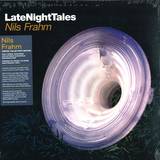
Composer, musician and producer Nils Frahm steers the new edition of Late Night Tales, set for release on 11th September. A hypnotic voyage through modern and classical composition, experimental electronics, jazz, dub techno, soundtracks and soul; Frahm's Late Night Tales haunts and beguiles. It's not mixing, so much as gently layering, like a particularly fluffy goose-down duvet folding in on itself, the folds part of the attraction, the layers part of the overall picture being painted. Many of the tracks have been edited, effected and re-made. The subtly overdubbed parts on Rhythm & Sound's 'Mango Drive' adding to the haunting hypnosis, while choral interruptions aid Miles Davis' 'Générique' on its journey towards the light. Meanwhile, on Boards Of Canada's 'In A Beautiful Place Out In The Country', the tempo is somewhat sluggish, the organs slurred, as Frahm slows it down to a funereal 33rpm that nevertheless fits perfectly. The purring of his girlfriend's cat Cleo transitions playfully between Nina Simone's definitive version of 'Who Knows Where the Time Goes' and unearthing the gentle electronics of Dub Tractor. Eddy Arnold's 'You're The Only Star', a country tune that sounds like its transmitting from a mid-west diner wireless circa 1947, is straight from the soundtrack to an imaginary David Lynch movie, comforting and dismaying all at once. This crackly reality abounds, as on Finnish band Gentleman Losers' 'Honey Bunch', that adds an unsettling texture, with a sound that is modern but as nostalgic. Frahm's own tracks bookend the mix, opening with an inspired "rework" of the infamous silent John Cage piece '4:33' ("I sat at the piano in silence and worked from
there. I listened and took in the atmosphere and this is what came out of it") and ending with a solo piano version of 'Them', taken from his recently released score of the film 'Victoria'. The traditional Late Night Tales spoken word epilogue is voiced by actor Cillian Murphy (Inception, Batman, 28 Days Later), reading a short story by Edna Walsh (Hunger, Disco Pigs).
180gr! This 12" features remixes from Henry Wu and Ben Hauke, two rising South London natives whose dusty house sounds are reminiscent of the jazz-wise swing of the West London broken beat sound, a movement Sean Khan himself was heavily involved in.
London based jazz appassionato Sean Khan, will release his second album 'Muriel' later in 2015. Dedicated to the driving force behind his musical career, his mother Muriel McGinley, the album is virtuosic free, Latin and nu-jazz experimentation, drenched in soul with the help of the vocal talents of Omar, Sabrina Malheiros and Heidi Vogel (Cinematic Orchestra).
This 12' features remixes from Henry Wu and Ben Hauke, two rising South London natives whose dusty house sounds are reminiscent of the jazz-wise swing of the West London broken beat sound, a movement Sean Khan himself was heavily involved in.
On the A side, Henry Wu, a key member of the tight-knit label/ loose collective 22a Records (also home to the likes of Mo Kolours and Al Dobson Jr.), imbues the original track with a distinctly organic and off-kilter groove: a loose and earthy quality which is hallmark of the Wu sound and makes for a perfect complement to Khan's delicious melting pot of jazz, soul and broken beat flavours. Sturdy yet swinging with strong jazzy synth stabs and topped with a child-like, wordless, sing-along vocal, it's sure to be an underground summer club hit.
The B Side sees the mysterious Ben Hauke, whose previous releases have been courtesy of Melodica Recordings, steep Khan's 'Things to Say' in his own murky yet soul-drenched sound, one that falls somewhere between hip-hop and broken house. Not much is known about this young producer, but what we can glean from his work on this remix is a sound drenched in syrupy, slightly sinister keys and a plodding, unpredictable thump not entirely dissimilar from previous Far Out remix contributor Theo Parrish. Like the work of that Detroit innovation, these two young Londoner's contributions both look set to lend a funkily idiosyncratic and offbeat edge to all the right dance floors.
Amazones de Guinee - SambaPure vibes to start our series. Live and direct, high energy African funk with a powerful vocal, recorded live in Paris in 1983.Hailing from Guinea they were the countries first all female group, formed by members of Guinean army nonetheless. Their lead percussionist Kade Diallo was killed in a car crash just days after returning from a tour of France in the early 80's. The group did not record again until 2008, but they continue to tour now, with a new generation of fans.Taken from the sought after 1983 album 'Au Coeur De Paris', previously unreleased on 7'.Moussa Doumbia - SambaMalia born Moussa Doumbia and was a prolific saxophonist, composer and arranger, who lived in Abidjan, Ivory Coast.He fused African and Funk rhythms in his own unique style, comparable to the likes of Fela Kuti, Orchestre Poly Rythmo de Cotonou and Ebo Taylor. Moussa's voice is strongly reminiscent of the almighty James Brown. Similarly to Fela and The Shrine, Moussa played at 'Boule Noire', a club in the cosmopolitan area of his town, Treichville. Every night they would play their own styles for hours to rich businessmen and locals.'Samba' is taken from his 1980 LP 'Lassissi Presente Moussa Doumbia' released on Sacodis. Extremely hard to find.
Over the past few decades, there has been a seismic shift in Brazil's musical landscape. A plethora of varying musical undergrounds has developed across the nation. While Rio and São Paulo have been overwhelmed with networks of talented musicians for a long time, creative life is now bursting all over the country. Amplificador exists to document and propagate the wonderfully diverse music currently blossoming from Brazil's vivacious and geographically varied musical undergrounds. Presenting an up-to date insight into Brazilian music, this compilation draws together some of the components of 'Novíssima Música Brasileira' (brand new Brazilian music), ranging from afro-grooves to rock, to modern samba and MPB. The music reaches back across Brazil's incredibly rich musical and cultural traditions, while also taking in influence from other movements around the globe.
Having begun life in 2012 as a Brazilian music blog run by Marcelo Monteiro, Eduardo Rodrigues, Mateus Campos, and Ricardo Calazans, the aim of Amplificador is to document and propel to wider audiences, Brazilian music of the '00s and '10s generation. This is a task made more significant by obvious changes in the way music is consumed. 'People are no longer obliged to listen to what the radio and TV are presenting. There is a whole new generation that wants to listen to new bands and new sounds and we try to connect those bands with other bands, producers, fans and even the mainstream.' These changes in technology and the way music is discovered and shared have developed parallel to the proliferation of these emerging scenes. The ostensible decentralization of the music industry means the promoting and filtering work of journalists and blogs, like Amplificador, have become increasingly important, as people try to keep up with the tsunami of new music and media flooding the country on a daily basis.
Marcelo uses the example of the Mangue Beat movement to explain a trend in contemporary Brazilian music that looks both inwards, to Brazil's own musical traditions and outwards, to movements around the world to create a novel, localised identity: 'The 90's Pernambuco art-social movement was inspired by Coco, Maracatu and Forró all mixed with modern riffs and grooves. The mythical
revolutionary Chico Science, his Nação Zumbi, Mundo Livre, Siba, and many others do this blend perfectly. There are also the references to the older generations and masters - Gil, Caetano, Luiz Gonzaga, João Gilberto, Tim Maia, Jorge Benjor - as a constant inspiration for all bands.' This is very much the case for the Brazilian artists of today.
Music is unquestionably informed by place. Brazil has always been famed for its regional differences in this sense. Indeed there are still pronounced variations between the scenes of Rio, Sao Paulo, Natal, Goiânia, Belo Horizonte and Belém for example, there are also great divergences within cities and while technology has brought changes to the way musical influences are shared, there are cultural differences, rooted in folkloric traditions, that aren't going away. Expressing his appreciation for this fact, while highlighting the potential of Brazil's spread of musical flavours, Marcelo explains that 'what we have now is new ingredients to make an even better mixture.'
This compilation heavily features music from a scene in Brazil's current musical make-up, which draws inspiration from African music, particularly Afro-beat music. Abayomy Afrobeat Orchestra from Rio formed because of their shared love of the music of Fela Kuti, uniting initially in 2009 for a jam session in his honour. But what sets Abayomy apart from other groups of a similar nature, is the fact that their sound also brings with it the songs and rhythms of candomblé. In this sense, Abayomy was the first band of its kind. The thirteen members of the orchestra have a palpable current of Rio's musical heritage - its rhythms and culture - running through them. So while their sound is distinctly African, it is also inherently Brazilian. Similarly, Zebrabeat Afro-Amazônia Orquestra draw upon traditional guitarradas and carimbos from the state of Pará and fuse these with the poly-rhythms of Afrobeat to create another regional hybrid, which stays true to both its Amazonian and African roots, yet which results in a very fresh, Brazilian sound. From Belo Horizonte (capital of Minas Gerais), Iconilli are another key band on Brazil's Afro-groove scene. With influences as varied as funk, jazz and psychedelic rock, congado, mining harmonies, maracatu, coco, ijexá, carimbó, Iconilli somehow manage to balance all of these sounds in such a way that makes it impossible to pin them down. From the Northeastern city of Joao Pessao, Parayba, Burro Morto's pshychadelic afro sound leans more towards rock and funk influences, with hint of regional Brazilian rhythms such as frevo and forro. They add another flavour to the Brazilian afro-groove scene: just one of the many exciting facets of Novíssima Música Brasileira.
While African-inspired music features heavily on the compilation, it is just one of the many styles within. Ive Seixas has a fresh approach to MPB, based on traditional rhythms and instrumentation, punctuated by a pop sensibility, coupled with a powerful female vocal. As an artist she is a product of a 'Do It Yourself' outlook to creativity, taken from her love of rock growing up. In 2013 she embarked on a project of street performance: wandering, like a lonely troubadour with just her guitar. Ive and her project began to gain notoriety and shortly after, her first EP was recorded, featuring some important names of South Rio's underground scene. 'Cervejas Populares' taken from the EP, is a beautiful, sombre piece of modern Brazilian pop, with a traditional samba rhythm. Another artist of the new MPB scene is Fabricio, from the city of Vitoria, who's 'Feito Tamborim' melds rock and funk and is also clearly reminiscent of the old Brazilian masters. It's an appreciation for the national musical heritage, alongside a keen ear for melody and an acceptance of foreign influences that results in these promising new sounds of Brazilian MPB.
Sao Paulo's super group of the underground 'Passo Torto' have been at the helm of an emerging scene in the city: an innovative approach to samba which draws in and experiments with afro grooves, jazz melodies and rock structures. Their sound is naturally very Brazilian, but the nylon twang of Faira Lima Pra Ca, interspersed with ominous strings and light rolling percussion, seems reminiscent of Captain Beefheart or Tom Waits, as the band lament their frustrations with their native city through their music.
The Future of Novíssima Música Brasileira looks very bright. The main challenge (and purpose of this album) is to get the music beyond Brazil's underground and into view of international audiences. In the last 10 years this goal has become somewhat more attainable, as the Brazilian government has begun to see the internationalisation of the nation's culture as a strategic objective, with public projects gaining increased investment and backing. The continuing project of Amplificador is to reinforce this international bridge by writing, filtering and promoting the scene as a whole. There is a wealth of great music currently blooming in Brazil and using new media tools, Marcelo and the team, alongside many others, will passionately continue to get the voices of Brazil's underground heard.
The enigmatic Amara Touré from Guinée Conakry finally getting a well deserved compilation showcasing all of the 10 songs ever released between 1973 and 1980. Cuban influenced music of a different kind featuring amazing spaced-out guitar works!! Analog Africa compiles a complete collection of Amara Touré's Afro-Cuban compositions, originally released between 1973 and 1980."Lamento Cubana and Temedy are the two finest Afro-Cuban compositions ever recorded. As if they were played in a smokey, poorly lit ballroom where dark rum was sipped ever so slowly" - Vikram Sohonie - Ostinato Records
Analog Africa to release a compilation by Amara Toure, the enigmatic Afro-Cuban musician from Guinea-Conakry, showcasing all of the 10 songs he ever released between 1973 and 1980.
"Latin music, is it really foreign to us Africans I don't think so. Listen to the drums, to the rhythm. It all seems very close to us - it feels like it's our own culture," declared enigmatic singer Amara Toure. It is the late 50s, and Senegal is going crazy to the groove of Son Montuno and Patchanga. Brought to West Africa by Cuban sailors in the early 40s, these styles were immediately adopted by a flourishing music scene that did not hesitate to embrace the Caribbean sound, mixed it with their own Folklore, and, in the process, created something new. Through the unique cultural fusion of West African and Caribbean influences, Latin music took on a new and unique sound - the format was reinvented. Producer Ibra Kasseì and his Miami nightclub acted as the spearheads of this movement. They brought a breath of fresh air into Dakar's nightlife, further energising one of West Africa's most exciting cities. The demand for ballroom parties and live acts exploded, attracting numerous musicians from surrounding countries. One of the musicians who answered this call was percussionist and singer Amara Toureì, from Guinea-Conakry. Spotted by Kasseì while performing with Dexter Johnson, Toureì was asked if he would like to be part of a new project. Little did he know that this project would become a phenomenon.Immensely important for the development of Senegalese modern music, Le Star Band de Dakar, led by Mady Konate, became a sort of musical incubator and workshop, where many musicians learned and practiced their trade before moving on to become stars in their own right. Toureì's talent on percussion was undeniable, but it was his powerful and raw voice that captivated the producer. The fascinating way Toure interpreted Cuban music was unparalleled, and it was this feature that encouraged Kasse to recruit the unknown artist.
Although already brimming with incredible talent, Amara Toure's joining of Le Star Band de Dakar in 1958 began the band's meteoric rise to the top. The band quickly became Dakar's number one orchestra, and it cemented the reputation of the Miami nightclub as the hottest spot in the country. The place was packed nightly, and Dakar was boiling.
Amara Toure's Senegalese adventure lasted for ten years when he received an irrefutable offer and in 1968, joined by a few talented Senegalese musicians, headed to Cameroon and immediately formed the Black and White ensemble. Many live gigs later and it was time for the first songs to be recorded. A total of three singles were produced between 1973 and 1976. These singles, representing the first six songs on this compilation, fully epitomise and distill the essence of what Toureì had learned during his career. His Mandingue roots fused with the Senegalese sound that he had mastered - the perfect foundation for the Toureì's Cuban interpretations.
If Toure's intention was to create the most sensual music ever recorded in Africa, he might very well have reached this goal. The musicians on the recording sound like they are playing in a smokey, poorly lit juke joint, where dark rum was sipped ever so slowly, and the pulse of the music took up a life of its own. How many couples have danced, swayed, and melted together to the distinct sound of Amara Toure Nobody can say for sure ...
Amara Toureì's success poured across the borders of Cameroon, and in 1980 he went to Libreville, Gabon, to team up with the powerful Orchestre Massako. Toureì recorded an LP at that time which is hailed by many music aficionados as one of the very best African albums. The songs from that LP are the last four on this compilation. It took only ten songs for Amara Toureì to become a legend. These ten treasures, representing Toure ìs complete discography, have been carefully re-mastered from original session tapes and vinyl records, and will be released by Analog Africa on 22 June 2015. After the release of his LP in 1980, Toureì seems to have disappeared. Apparently he was last seen in Cameroon but it is unknown if he is still alive today. His music though is definitely alive.
Over the last sixteen years Moods & Grooves has amassed a staggeringly impressive label family that includes names like Theo Parrish, Mr G, Kyle Hall, Rick Wade, Andres & Kenny Dixon Jr. aka Moodymann. This May the legendary Detroit label returns with a seminal thirteen-track album from veteran DJ & producer Joe Le Bon entitled 'House Music Love Music'.
With this new LP Jarno Eerola aka Joe Le Bon demonstrates his inimitable production prowess, garnered from a musical career spanning more than twenty years and encompassing releases on labels such as International Deejay Gigolo Records, Pro-Tez, Plastik.FM and Blumenbeat. Alongside his own output the Berlin-based artist has written tracks and remixes for numerous producers, most notably composing DJ Hells chart- smashing remix of Tim Deluxe 'Transformations' which saw six continuous weeks at number one on Beatport.
Jarno's polished production ability and aptitude for exploring diverse sounds and rhythms whilst maintaining a resolute warmth and depth to every cut is the most prevalent footnote across the course of the album. For 'Ghosts On Cassette' the Berlin-based producer works whirring space-like atmospherics over hypnotic beats and shuffling snares to dish up a smooth and captivating opener. 'For Yasuni' and 'The Road Is Under Repair' get worked over subtle synth patterns and crisp percussion to offer up some of the more emotive provisions on the album. This in contrast to the deep driving beats of 'House Music Love Music' and the more club-ready tracks like '82 Degrees' or 'Like Cotton Deep Orchestra' truly exemplifies the wide-ranging nature of the album.
All in all Joe Le Bon has structured a sublime body of work that can be enjoyed in the comfort of your own home or the middle of a dance floor, each and every track oozes depth and sits as a true testament to his abilities in the studio.
out of Stock
Last delivered 4 years ago available to reorder, subject to availability
a1. Celestial Encounter (Original Mix) 6:08 - 4×4 driven groover laced with choppy hi-hats, complexed rhythms, and orchestration only fit for mental travels. An uplifting tune of spirit and electronic sorcery.
a2. Ominous 4:58 - Steely industrial percussion, creepy atmospheres, dance floor know-how....The honest depiction of the title lurking within the corners of your psyche.
a3. Celestial Encounters (Interlude) 1:22 - A fine example of the latest in signature interludes from the 'Optic Nerve' project. Movement & Imagination.
b1. Jazzy Circuitry 4:49- Moody, computer-ridden textures walking along side a odd-time signature until the introduction of the bassline and trippy piano keys seal the deal on craft & creation. Niceness, Indeed.
b2. Jazzy Circuitry ( Blaktony's Step Glide Remix ) 4:18 Traditional 'Optic Nerve' ambience is chopped & rehashed into a 1/2 step groover; Then.... blasted into a full jam session by 'Blaktony'. Madness/A complete new trip on the original structure & tune.
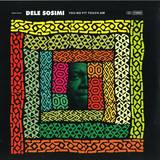
Wah Wah 45s are very proud to present the first full-length album in almost a decade from vocalist, keyboard player, Fela Kuti collaborator and afrobeat legend, Dele Sosimi!
You No Fit Touch Am represents where Dele is today - something of an untouchable force in the music scene that he has always been such a vital part of. The title is an uncompromising message that this man means business, and with his mammoth afrobeat orchestra on board that is definitely the case. Recorded at the Fish Market Studios in North-West London by Benedic Lamdin (AKA Nostalgia 77) the album provides a musical representation of Dele's strong socio-political opinions, as well as delivering classic song-writing that could have come straight out of 1970s Lagos!
Born in Hackney, East London, but soon to return to his parents' native Nigeria at the age of four, Dele Sosimi was schooled and raised in Fela Anikulapo Kuti's shadow at the height of early 70s afrobeat. Having been chosen by Fela to join his band at somewhat of a tender age, he was still a young man when sharing Fela's Glastonbury stage in 1984, and became both Musical Director for both Fela's Egypt 80 and Femi Kuti's Positive Force.
After Fela's passing in 1997, Dele went on to concentrate on his own solo career and, with diligent patience, carved out his own afrobeat crown. In London, where he now resides, his Afrobeat Vibration all-nighters are charged with his passion, labours and his unrelenting spirit.
Following on from his first two studio albums, Turbulent Times and Identity, this third long-player is sure to cement Dele Sosimi's position as a major player within afrobeat and beyond!
out of Stock
Last delivered 3 years ago available to reorder, subject to availability
The follow-up to the great Holla EP by Johannes Brecht Henrik Schwarz's Sunday Music imprint. In the meantime labels like Mule Musiq and Boso succesfully released their own Brecht tracks and extended the audience worldwide. In My Time Of Dyin' continues the deep, musically output of Henrik Schwarz's Sunday Music label in the best way possible. Very recent, reflecting jazz, classical minimal music into electronic music. Deep trippy music with a strong swing on the A-side. Cleverly written music patterns with a hypnotic vibe. Side B features a live jazz version in 6/8 signature on piano and drums (drummer of german popstar Max Herre). Johannes Brecht is by the way the classical music arranger on Henrik Schwarz upcoming full orchestra album, coming in April 2015. When Henrik Schwarz heard the music from Johannes Brecht he knew now was the time to reactivate his label SUNDAY-MUSIC again that hasn't released a record in quite a while now. Johannes is a wonderful musician that plays bass and keyboards and also writes music for orchestra. When a classically trained musician looks into electronic music and manages to bring together the best of both worlds the result can be very exciting.
The latest chapter in the unfolding story of Chronicle finds the New York techno label reaching out to Japan once again, calling upon the considerable talents of Hironori Takahashi to deliver a nerve -shredding manifest on cinematic scope and malicious intent in the darker corners of contemporary techno. Takahashi has previously shared his vision for malevolent dancefloor crushers on such highly regarded labels as Semantica and Stroboscopic Artefacts, not to mention holding down a job at the world-renowned Disk Union record shop in Tokyo.
Proceedings start somewhat inviting on EVENT0009, as the warm, dub-inflected chords of 'Ariast' drift through the stout rhythmic throwdown with orchestral grace. There is of course plenty of space left for brooding, uncertain elements underneath this melodic calm, but it's still a positively mellow offering compared to the jackhammer drum damage of 'Dazre' with its monstrous industrial intent and soaring sound design.
'Cecilleatis' is a more patient beast that simmers its tough ingredients into a predatory whole, using atmospheric pressure instead of sheer volume to create the required intensity. It's not all steel furnace fury though, as the track comes equipped with an epilogue that cools the fires of the EP with some glacial tones and distant machine bleeps that continue Chronicle's commitment to showcasing different sides of their chosen artists.
out of Stock
Last delivered 6 years ago available to reorder, subject to availability
Objektivity is starting the year with launching the long-awaited vinyl-only sub-label called OBJ Analogue. As the name says, the concept behind this is that in order to make the record, it has to be totally hardware based: No plug-ins! Objektivity head-honcho Dennis Ferrer says: "The OBJ Analogue is a special project for me and is dear to my heart because I love analogue gear, vinyl, and hardware, so I keep that side of me happy."
The first OBJ Analogue release is coming by VIVa Music's Steve Lawler, who delivered a very rough two-track EP called - Inna State / Recuperate", produced with the Roland 808, 909 and 606 drum machines. The bass lines are recorded and played from Moog Voyager and the piano on - Recuperate" is coming from Emu Orchestra Rack Mount. Completely analogue!
Make sure you get your hands on the vinyl as there will be only a few limited copies out.
In our series of related incidents we were out searching for a suitable incident to occur after our well received Black Merlin (George Thompson) voyage in early 2014 (it's been a long time, yes).
The following happened.
We approached "Will Flisk'' somewhere in the digital Jungle. Totally unaware that Will and George are actually long time friends.
ALL OF THESE INCIDENTS ARE RELATED.
Havamal inspired Briton 'Will Flisk' takes his filmic approach to music to the streets with his first output on our curious little imprint.
With the help of good friend Black Merlin (George Thompson) on synths and drum machines and Natasya Hodges on Cello, this amazingly orchestrated title track (Red Planet) takes us to different planets and back, even though our money is too short for commercial space travel.
Nashville, Tennessee's very own Grey People (Alex J Michalski) works his distortion on a sinister remix (B1) that's leaning towards the more techno side of things. for the B2, Will bestowed an amazing bit of roughness upon us.
With the blessing of Zoroaster the vinyl release will take place in January.
Davide Squillace, the Italian DJ and producer behind the This And That Lab and Hideout imprints, has kept up a hugely productive schedule since the 1990s, and lands on Luciano's Cadenza Music this fall with the 'Goiânia' single release. Previous musical output on a multitude of labels such as Primate, his own Sketch Music & Minisketch labels, Ovum, Supernature and M_nus has also seen the artist collaborate with plenty; Guti, Martin Buttrich and Philip Bader among those who he has conjured up some inventive and dancefloor-centric minimal electronic music with. On the lead track 'Goiânia', Squillace opens up a highly musical pot of orchestral stabs and brass hits, morphing bottom end and freestyle synth licks, cavorting around a steady percussive beat to great effect.'Blossom' comes heavier in vibe, but maintaining the classical atmosphere developed on the EP's opener. Pizzicato synths play a call and response with dramatic strings whilst an electro tinged drum pattern and sizzling hats lay the foundations of a track with more than a nod to the classic house sounds developed on labels like Innervisions and Ibadan. 'Unit 9 closes the release, and Squillace goes on a Galactic ride through meteoritic bleeps and humungous pads for a cosmic and pacey techno number, dubbing it up midway for a most enjoyable ride and a fitting closure to a classy release on Cadenza.
Erlend Øye is a skinny nerd, but maybe that's what makes him a pop star. His huge thick spectacle-lenses act as an interface between his inner life and his numerous collaborators and fans. Erlend Øye is a travelling singer-songwriter, who has been making music in various constellations since the late nineties. He sang for Röyksopp, while his own bands are Kings of Convenience and The Whitest Boy Alive, who recently split up. A laid back, everyday vibe runs through Erlend Øye's music. Erlend is not larger than life, at the most his songs may be. The pop star from next-door doesn't make any drama, but leaves that to life itself. His relaxed, laid back sound opens your eyes and ears for places, situations and encounters. A certain mournfulness runs through the songs, although they deal with a longing for self-fulfilment. Erlend sings of loneliness, and in doing so, he creates a 'we'. Until now Erlend's projects have often been based on simple concepts - two guitars and two vocals with Kings of Convenience, and four instruments with The Whitest Boy Alive. With his new solo album he frees himself of these parameters; for the first time everything is possible, for the first time Erlend Øye stands alone. The songs on 'Legao' were arranged and recorded with the Icelandic reggae band Hjálmar.
The magic of 'Legao' lies in the fact that Erlend's vulnerable vocals and his sincere lyrics are supported by the elegance and consistency of the band. Today roughness is often used to counterbalance roughness, whereas on Legao a equilibrium is sought - and found. A simplicity, clarity and minimalism is created that is rarely found in pop music. Erlend Øye has grown up. He accomplishes nothing less than the step towards an independent, free-standing solo musician, who can perform in any constellation - with a band, orchestra or alone with a guitar.
Raw District is Belgian duo Vernon Bara and Massimo DaCosta, Under the Vernon&DaCosta moniker, they have released music on labels such as OM Records, AMA Rec, Robsoul, Aroma, OFF, Icon, Doubledown and many more of the world's finest underground house labels.
They have remixed artists such as Brett Johnson, Fred Everything, Style of Eye, Miguel Migs and JT Donaldson and have garnered a reputation as important international producers and DJs with respect paid by great DJs like Luciano, Ricardo Villalobos, Jamie Jones, Mark Farina and DJ Sneak.
Vernon Bara also makes music as Ultrasone alongside Igor Vicente, which is a more techno orientated project that can count releases on Hot Creation and Supplement Facts to its name.
Ladybird is well known for being the singer of Soldiers Of Twilight and vocalist on one of the most famous Llorca's song My Precious Thing among the tons of project she been working for, One of the best, if not the best, soulful singer in Paris,
And now they can add to their resume that there are the very first new release on the briquerouge reboot, Orchestrated by David Duriez himself, the label is back for a new series of releases and reworks from the back catalogue with brand new top names added to the roster.
On this release you can enjoy top remix works by the likes of Nacho Marco (Ovum / Loudeast / Saw) and the head honcho David Duriez (2020Vision / Ovum / Classic) both on the acid side but in a very different way, A very complete package for the deep house heads as well as proper house djs.
DJ SUPPORT:
Detroit Swindle
Richy Ahmed
Jamie Anderson
Kiko Navarro
Chilli Davis
Inland Knights
Spencer Broughton
Orde Meikle Slam
Jozif
Bryan Zents
Flash Brothers
DJ T
Dubfire
nathan detroit
Hernan Cattaneo
Snooba
Tristan da Cunha basics, redux , 2020
Julian M
Florian Meindl
Sleazy Mcqueen
Dan Ghenacia
Chris Fortier
Jussu Pekka
Peter Gelderblom
Phonogenic
The Henchmen
Nuno Dos Santos
Tiger Stripes
Agoria
Timo Garcia
Ekkohaus
During the '70s, work days at Umiliani's Sound Workshop Studios were hectic; thousands of sessions were held in order to keep up with a very busy Italian movie industry: Hundreds of soundtracks alongside with music library were recorded and released on vinyl in very limited quantities for TV and film production use only. Those LPs are now proper collectors' items, extremely hard to find.
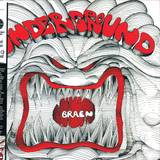
Filled with hypnotic bass lines, heavy drums and screaming fuzz guitars "Underground", the first LP of the fictitious group known as Braen's Machine, is one of the rarest and the most expensive of them all, always "reaching" sky high prices throughout the second hand vinyl market. A fast-beat jam with hammond scales and a twin lead guitar theme ("Flying") opens the A Side soon followed by "Imphormal", a classicfunk-beat-meetsfender- rhodes-and-psychedelic-guitar number. The music then switch to "thriller territories" with "Murder" which is based on prepared piano swells and a deeply hypnotic walking bass, reminiscent of the best Morricone's soundtracks for Dario Argento's movies. Two highly percussive songs complete the A Side: "Gap" is an improvised song with guitar and keyboards dwelling over an infectious drum rhythm while a marching snare and a vibraslap effect are the special features on "Militar Police".
The mood relaxes slightly on the opening of the B Side with a lazy jazz groove on "New Experience" but the rock influences are soon brought back on the following track "Fall Out". "Obstinacy" is all about keyboards with syncopated rhodes themes and distorted hammond sustained notes whilst the fuzz guitar is back again screaming through the left channel on the last song of the album, "Description". We could happly say that that was the golden age of the Italian music library. But who's behind the name "Braen's Machine" On the original cover the songs are credited to the composers Braen and Gisteri. Braen was a pseudonym often used by Alessandro Alessandroni, an extremely skilled and versatile musician, and one of Umiliani's closestcollaborators. He could write, conduct and arrange, he could sing (ever heard "Mah Na Mah Na"), he could whistle (ever heard Morricone's "For a fistful of dollars") and he could play almost anything: guitar, bass tuba, accordion, sitar and the list grows..... His first album "Alessandro Alessandroni e il suo complesso" (Sermi, 1969), had transformed the Italian library music from orchestral sound beds into the psychedelia we all love; the extremely fuzzy guitars are very "present" on "Underground" too. For a long time Gisteri's real identity was rather mysterious; often wrongly attributed to Umiliani. Gisteri was the pseudonym of Oronzo De Filippi, art name of Rino De Filippi, music supervisor to the Italian public broadcast company (RAI) between the '60s and the '70s. De Filippi composed other notable pieces such as "Riflessi" (Edipan, 1975) and "Nel mondo del lavoro" (Sermi, 1972).
De Filippi passed away few years ago but we were able to contact Alessandroni to talk about this LP. Remembering "Underground" recording session as one of the thousands he took part of, Alessandroni told us that this record was produced very quickly, in two days maximum. This was made possible by a team of wonderfully capable session musicians and the creative genius behind the mixing desk; this incredible combination helped to focus on the mood of each track even more. Unfortunately there are no liner notes but Alessandroni's memories and speculations, based on other music tracked in the same period at Soundworkshop by resident engineer Claudio Batussi, led us to identify this as the most probable lineup: Munari on drums, Majorana on bass, Vannucchi on keyboards and Alessandroni himself on guitar. For this reissue the sound has been restored and the cover art reproduced exactly as it was.
Disco Bucuresti is an audio homage to Romania's capital, Bucharest. Growing up between the city's communist blocks of flats and maturing in the city's underground discos left a distinct creative mark on Andrei Idu (The Legendary 1979 Orchestra). Ever since leaving Bucharest for Amsterdam, Andrei felt the need to tribute the place that shaped him. However, it was only until recently that he found the means necessary to express the feelings he felt. Thus, records released during the 70s and 80s in Romania as sole sample source, analog drum machines, delays, filters and reverbs, all recorded in live takes come together in this evocative EP.
Auf dem Album feiern Künstler wie Angelique Kidjo, uestlove (The Roots), M1 (Dead Prez), tUnE-yArDs, Kronos Quartet, Baloji, Spoek Mathambo, Nneka oder Tony Allen in dreizehn grandiosen Neubearbeitungen Fela Kutis musikalisches Vermächtnis. Außer der Compilation veröffentlicht Knitting Factory Records ebenfalls am 15. Oktober die letzten sechs Titel in der Reissue-Serie von Fela Kutis Gesamtwerk, die im März dieses Jahres mit der Compilation "The Best Of The Black President 2" und der ersten Staffel der CDs begonnen hatte.
out of Stock
Last delivered 6 years ago available to reorder, subject to availability