Auf Deerhoof ist Verlass: 2020 veröffentlichte die Band "Future Teenage Cave Artists" und überraschte mit dem Gratis-Album "Love-Lore" (auf dem sie 43 Songs in 35 Minuten coverten!), schon lassen die experimentellen Indie-Rocker bereits ihr nächstes Werk folgen. Mit "Actually, You Can", ihrem insgesamt 18. Studioalbum, beweisen Deerhoof, dass - von der kreativen Neuerfindung nach 25 Jahren Karriere bis zur Selbstverwirklichung inmitten einer globaler Umwälzung - alles möglich ist. Das Ergebnis ist Deerhoofs "Barock goes DIY"-LP, die von der Band selbst produziert wurde und mit nur nur zwei Gitarren, Bass, Schlagzeug und Gesang auskommt. Dabei nutzen Satomi Matsuzaki, Ed Rodriguez, John Dieterich und Greg Saunier ihren Witz und ihre Skurrilität, um eine neue gemeinsame Sprache der Revolution zu erschaffen. Eine, die von lyrischen Labyrinthen und thrashigen Melodien angetrieben wird. Das Album markiert außerdem Deerhoofs Rückkehr zu biblischen Referenzen, wie man sie von ihren früheren bahnbrechenden Noise-Rock-Werken kennt. Während das gefeierte "Future Teenage Cave Artists" märchenhafte Visionen der Post-Apokalypse und den Anti-Helden als Retter der Menschheit erforschte, schlägt die Band auf "Actually, You Can" optimistischere Töne an.
Cerca:phil bar
- 01: My Key
- 02: The Last To Say
- 03: Became
- 04: Just For Show
- 05: She’s Enough
- 06: Bad Bad Daddy
- 07: Millenium Dodo
- 08: Millenium Dodo 2 (Bonus Track)
- 09: Cut You Down (Bonus Track)
- 10: Who I’ll Never Be
- 11: I Don’t Need Brighter Days
- 12: Ain’t Nobody
- 13: Your Name Here
- 14: If You Can Save Me Now
- 15: Something So
- 16: My Notes
- 01: By Your Side
- 02: Bar Food
Atmosphere have distinguished themselves from their peers by creating albums encompassing the entire spectrum of human emotion while tethering each piece to a central aural aesthetic. The Family Sign took this philosophy to new realms of solidarity with Slug metaphorically touching on themes of fatherhood, loss, love, disappointment and jubilation, and tailoring them to an
instrumental framework that draws emotion out of the listener, skillfully composed by producer Ant. The Family Sign was evidence that hip-hop wields the ultimate potential to address and convey life’s virtues and shortcomings.
On Now Where Were We, The Exbats hit the ground running like
a dystopian garage rock version of the Shangri-Las, or like
a message to the future from the pre-Velvet Underground doowop
wannabe Lou Reed. The album rings bright, like a beacon
in the wilderness: eminently, effortlessly catchy, and loaded
with buoyant choruses that rank alongside the best chart-toppers
launched by the Brill Building or Phil Spector’s Wall of Sound.
Kenny McClain and his daughter, vocalist and drummer
Inez McClain, formed the nucleus of the Exbats over a decade
ago, when Inez was just 10 years old; today, Bobby Carlson
rounds out the group on bass. Despite their remote location in
Bisbee, Arizona, just eleven miles north of the U.S.-Mexican
border, the group quickly racked up accolades citing a wealth of
influences that run from cartoon quintet the Archies to punk rock
originators the Avengers, and from the so-sweet-it-hurts 1910
Fruitgum Company to Los Angeles antiheroes the Weirdos.
Truthfully, The Exbats embrace a wider swath of musical styles,
incorporating blue-eyed soul, tongue-in-cheek country, Brit
pop, psych, and R&B into their sound.
The McClains describe this album as “more ambitious” than
its predecessors. They tooled ninety minutes northeast to Tucson
to record, per usual, with Matt Rendon at Midtown Island Studios.
Months later, the Exbats emerged with an album imbued
with harmoniously cautious optimism—the musical equivalent
but psychological antithesis to the Brian Wilson-Tony Asher
masterpiece “I Just Wasn’t Made For These Times.” While Wilson
was looking for “a place to fit in,” The Exbats have found
sanctuary via the brilliant “Ghost In The Record Store,” which
is “for all of us who need the joy of a little bit of plastic making
lots of noise.” Like the best records to croon along with, Now
Where Were We is captivatingly simple, yet hardly simplistic.
The Exbats are singing from their hearts—and they aren’t afraid
to bare their souls.
"WHAT THEN?" is the second album from Irish singer-storyteller David Keenan. The follow-up to his critically acclaimed 2019 debut "A Beginner's Guide To Bravery", which charted at Number One on the official Irish independent album charts, and Top 10 on the national album charts. It was also one of the best selling vinyl album releases by an Irish artist of 2019. At the end of 2019, David Keenan premiered his concert film 'Alchemy & Prose' at the London Doc'N'Roll film festival. "WHAT THEN?" has been produced by Jonathon Mooney of Portland, OR cinematic-indie rockers Other Lives. Guests on the album include celebrated Scottish author, namesake and soul brother David Keenan, Irish poet Stephen Murphy and Nashville drummer Aaron Steele, best known for his work with Portugal. The Man and Hayley Williams. David Keenan will be touring America in September as special guest of Rodrigo y Gabriela before returning to Europe to headline his own tour through October to December.
Featuring an impressive list of collaborators, including Ty Segall and
members of Woods, Cibo Matto, Sharon Van Etten’s band, Wand,
Heatwarmer, Mega Bog and Bonnie “Prince” Billy, ‘Geist’ is the
follow-up to Shannon Lay’s 2019 Sub Pop debut, ‘August’, which
featured friends and collaborators Ty Segal (whose band Shannon
played in) and Mikal Cronin.
‘Geist’ feels like a window - or a mirror - into possibilities of the self
and beyond. Shannon Lay’s new album is tender intensity, placeless
and ethereal. It exists in the chasms of the present -- a world
populated by shadow selves, spiritual awakenings, déjà vu and past
lives. “Something sleeps inside us,” Lay insists on the opening track,
and that’s the guiding philosophy throughout. A winding, golden,
delicate thread of intuition that explores the unknown, the possibility.
Its title, ‘Geist’, the German word for spirit, is rife with an otherworldly
presence, the suggestion of another. The promise that you are never
alone.
Lay tracked vocals and guitar at Jarvis Tavinere of Woods’ studio,
then sent the songs out to multi-instrumentalists Ben Boye (Bonnie
“Prince” Billy, Ty Segall) in Los Angeles and Devin Hoff (Sharon Van
Etten, Cibo Matto) in New York; trusting their musical instincts and
intuition. She then sent those recordings to Sofia Arreguin (Wand)
and Aaron Otheim (Heatwarmer, Mega Bog) for additional keys, while
Ty Segall contributed a guitar solo on ‘Shores’.
As a whole, ‘Geist’ is both esoteric and accessible. Songs range from
a concise, pared-back cover of Syd Barrett’s tilt-a-whirl-esque ‘Late
Night’, to the meditative, Dune-inspired ‘Rare to Wake’, to the mostly
a-cappella ‘Awaken and Allow’, which channels Lay’s deep Irish
roots, a moment of reflection, before a drop happens - its intensity
mirroring the anticipation and anxiety that come with taking the first
step to accepting change for yourself. And the title track ‘Geist’, a
song about the power living in all of us, is a love song to the
possibility of healing, an ode to falling into the arms of what you’re
becoming. It’s a glimpse into the parts of yourself you have yet to
meet.
Initial copies of the LP pressed on Sun Yellow coloured vinyl.
Der Klassiker des einstigen Pfarrers und Kreuzzügler des Allgemeinwohls PASTOR T. L. BARRETT & THE YOUTH OF CHRIST CHOIR von 1971 gilt bis heute als der heilige Gral des Gospel-Soul. Mit dem seinerzeit selbst veröffentlichten Werk des JESSE JACKSON JR.-Mitstreiters demonstrierte BARRETT seine Leidenschaft für die Musik, seine wilde Entschlossenheit, Kinder vor der Straße zu bewahren und sein Talent für mitreißende Predigten (die nebenbei Künstler wie EARTH, WIND & FIRE und DONNY HATHAWAY dazu brachten, seine Kirche zu besuchen) mit einem Album, das vom Chess Records Saxophon Helden Gene Barge und einer Reihe von Musikern wie Richard Evans, Phil Upchurch und dem stürmischen Gesang des YOUTH FOR CHRIST CHOIRs profitiert. Heilige Grooves, Breaks, Beats und Lobpreisungen mit eingängigen Refrains. Chicago pastor and activist T.L. Barrett's rare gospel soul classic Like A Ship. (Without A Sail) is one of the holy grails of gospel soul. Self-released in 1971, Like A Ship was the result of Barrett channeling his passion for music, a determination to keep children off the streets, and his charismatic preaching (which attracted the likes of Earth, Wind & Fire and Donny Hathaway to his sermons at Mount Zion Baptist Church) into the production of the album, a project bolstered by the saxophonist and arranger Gene Barge of the famed Chess Records, and backed by a cast of players that included Richard Evans, Phil Upchurch and the rapturous vocals of the Youth For Christ Choir. Like A Ship... is filled with sanctified grooves and spiritual praise delivered with a righteous, infectious chorus.
In These Silent Days, the highly anticipated new studio album from six-time Grammy Award-winning singer, songwriter, performer, producer and New York Times Best Selling author Brandi Carlile, is out October 1. Ahead of the release, the album’s first single, “Right On Time,” featuring a music video directed by Courteney Cox launched on announcement
Inspired by the mining of her own history while writing this year’s #1 New York Times Best Selling memoir Broken Horses, In These Silent Days was conceived of while Carlile was quarantined at home with longtime collaborators and bandmates Tim and Phil Hanseroth. The ten songs chronicle acceptance, faith, loss and love and channel icons like David Bowie, Freddie Mercury, Elton John and Joni Mitchell—the latter two who, by some sort of cosmic alignment of the stars, have turned out to be close friends in addition to being her biggest heroes and inspirations.
In These Silent Days follows Carlile’s 2018 breakthrough GRAMMY Award-winning album, By The Way, I Forgive You, which Rolling Stone declared, “…an Adele-meets Joni Mitchell tour de force.” In the years since—in addition to collaborative projects with The Highwomen, Tanya Tucker, Soundgarden, Alicia Keys, Dolly Parton, Barry Gibb, Leslie Jordan, Brandy Clark and more—she has earned six Grammy Awards recognizing her work as a performer, songwriter and producer, was awarded Billboard’s Women In Music “Trailblazer Award,” CMT’s Next Women of Country “Impact Award” and received multiple recognitions from the Americana Music Association Honors & Awards including 2020’s Album of the Year (Highwomen), Group of the Year (The Highwomen) and Song of the Year (“Crowded Table”) and 2019’s Artist of the Year. Carlile was also once again nominated for Artist of the Year and Group of the Year (The Highwomen) at the 2021 ceremony.
Dans le Sable is the first new album in over 40 years by composer, pianist, and digital audio pioneer Loren Rush (b. 1935). Active in the Bay Area new music scene since the late 1950s alongside composers such as Robert Erickson and Pauline Oliveros, he also co-founded the Stanford University’s Center for Computer Research in Music and Acoustics in 1975. His music has been performed by the Boston Symphony, the New York Philharmonic, and the San Francisco Symphony Orchestra amongst others.
The title piece "Dans le Sable" (1967-68, 70) covers the first side of the record, of which Charles Shere in the Oakland Tribune (1972) writes: “A surreal opera scene. A narrator dwells on the significance of passing time. A soprano sings Barbarina's cabaletta from Figaro, which describes her distraught search in the sand for a lost pin. The chamber orchestra—mostly solo instruments—plays soft, half-forgotten tunes reminiscent of the Parisian music hall. If Marcel Duchamp wanted to put painting once more at the service of the mind, so did Rush seem to want to make a composition that speaks directly to that thing behind the mind—the point where it connects with the soul. And he succeeded. But only because the work is so brilliantly constructed, so careful in its structure and the timing of its phrases, so well balanced in the disposition of its parts that it quite overcomes the audience.”
The second piece on the album “Song and Dance” begins with the watery held tones of “Song.” Melancholy phrases are deconstructed and stretched in different retellings, invoking a harmonic fog. We are then thrust into “Dance,” one of the first orchestral pieces to employ computer-generated digital synthesis. A hypnotic and percussive march is propelled into a storm of early computer-processed cannonades.
Recital is proud to now illuminate the deeply overlooked composer Loren Rush, whose meticulous attention to detail has perhaps kept his toiled-upon works in the shadows these past decades. Dans le Sable is among the most gorgeous records I have heard.
It’s one thing to take the drone rock of your debut album in an entirely new direction but quite another when the result is an ambitious 30 track three-part album.
But that’s what London collective Moderate Rebels have done on their biggest project to date, the opus ‘If You See Something That Doesn’t Look Right’. Fearless in their refusal to be pigeonholed, they touch on everything from driving rhythmic repetition, discordant guitar fuzz and hazy psychedelia, to late 60s-indebted folk and lilting melodic hooks, via twinkling piano ballads, drum machine rigidity and playful synth pop.
‘If You See Something That Doesn’t Look Right’ will be released in three ten track parts in 2021.
The album touches on the progressive works of Phil Spector, Fripp & Eno and Syd Barrett, the transcendental pop of Spiritualized, St Etienne and Stereolab, and the wry humour of 80s Pet Shop Boys. But it comes stamped with the group’s own inimitable identity.
'The Works and Days: The Black Sections' is a sound collage album that emerged out of the production material of the film, The Works and Days (of Tayoko Shiojiri in the Shiotani Basin). The film — winner of the Encounters Golden Bear for Best Film at the 2020 Berlinale — is the second feature of C.W. Winter & Anders Edström. It is an eight-hour fiction shot for a total of twenty-seven weeks, over a period of fourteen months, in a village population forty-seven in the mountains of Kyoto Prefecture, Japan. It is a geographic description of the work and non-work of a farmer. A portrait, over five seasons, of a family, of a terrain, of a sound space, and of a duration. The film was named one of the Ten Best Films of the Year by critics at: Artforum, Cargo, Cinema Scope, Desistfilm, Filo, La Internacional Cinéfila, Mubi, Nobody, Senses of Cinema, and Sight & Sound.
The film is accompanied by this LP, TheWorks and Days: The Black Sections, by C.W. Winter, and the photo book, Shiotani, by Anders Edström. The album features musical excerpts from Tim Berne & Bill Frisell, Tony Conrad, Graham Lambkin, Mary Jane Leach, Alvin Lucier, Phill Niblock, Folke Rabe, Éliane Radigue, and Akio Suzuki. Producing, editing, and recordings by C.W. Winter. Mastered by Stephan Mathieu.
Winter & Edström’s first feature, The Anchorage, won a Golden Leopard at Locarno Film Festival and won the Douglas E. Edwards Independent/Experimental Film/Video Award from the Los Angeles Film Critics Association. It was named one of the Ten Best Films of the Year by critics at Cinema Scope, Film Comment, Senses of Cinema, Variety, and Indie Wire and was named Best First Film of the Year by The New York Times. Their first film, a documentary short called One Plus One 2 was made in collaboration with the late British guitarist, Derek Bailey. Their film/video work has shown at such venues as the Institute of Contemporary Art (Boston), Centre national de la photographie (Paris), Kunstmuseum Wolfsburg, Fotomuseum Winterthur, NRW-Forum (Düsseldorf), the Harvard Film Archive, Anthology Film Archives, the Wexner Center for the Arts (Columbus), Centre de cultura contemporània de Barcelona, the Tokyo Metropolitan Museum of Photography, and the National Museum of Modern Art (Kyoto).
C.W. Winter was born in California. In 2020, he completed his DPhil in Art Practice & Theory at The Ruskin School of Art at the University of Oxford. He received his MFA from California Institute of the Arts where he studied closely under Thom Andersen, James Benning, and Allan Sekula. His writing has appeared in Cinema Scope, Moving Image Source, Purple, and Too Much. He lives in the United Kingdom where he is currently a Visiting Professor at the Royal College of Art and a Lecturer at the University of Oxford.
Side A excerpts:
“Thursday, May 5, 1977 & Friday, May 6, 1977: Part 4” Performed by Tony Conrad. Used by arrangement with The Tony Conrad Estate
“Sethwork” Performed by Phill Niblock. Used by arrangement with Phill Niblock
“What?? (Second Version)” Performed by Folke Rabe. Used by arrangement with the Folke Rabe Estate
“Pipe Dreams” Performed by Mary Jane Leach. Used by arrangement with Mary Jane Leach
“What?? (Second Version)” Performed by Folke Rabe. Used by arrangement with the Folke Rabe Estate
“2011” Performed by Tim Berne & Bill Frisell. Written by Tim Berne. Published by Party Time Music BMI. Recording courtesy of Minor Music Records/Screwgun Records
Side B excerpts:
“Ceremoniolose” Recorded by Graham Lambkin. Used by arrangement with Graham Lambkin
“Kugiuchi” Performed by Akio Suzuki. Recorded live for TheWorks and Days Used by arrangement with Akio Suzuki
“Music on a Long Thin Wire (Side A)” Performed by Alvin Lucier. Used by arrangement with Alvin Lucier
“A Third Trombone” Performed by Phill Niblock. Used by arrangement with Phill Niblock
“Triptych: Part 1” Performed by Éliane Radigue. Used by arrangement with Éliane Radigue
Could the missing link between Eric Dolphy and Albert Ayler be the Michel Portal of 1970? After having worked alongside François Tusques defending a free jazz “made in France”, we find him here, heading up an international quintet of which each member is on fire: John Surman, Barre Phillips, Stu Martin and Jean-Pierre Drouet. The quintet had full leeway to break out the free-form in long ambient tracks to compose this Alors!!! which leaves listeners with just one word to say: More!
Do we still need to present Michel Portal?... Clarinetist destined for the classical and contemporary world after his passage in the Paris Conservatory, he decided to try his hand at jazz, with an incendiary flamboyance! After his first experience with André Hodeir and Pierre Michelot, he would break all the codes with François Tusques (Free Jazz, in 1965) before starting the emblematic Michel Portal Unit. It is the Portal of those years that Alors!!! offers us the chance to listen to again.
“There are periods of insolence”, the musician declared and the year 1970 was one all on its own. Heading up an impetuous international troupe, a quintet consisting of John Surman (saxophones, bass clarinet), Barre Phillips (double-bass), Stu Martin (drums) and Jean-Pierre Drouet (percussion), Portal moves from alto sax to clarinet in the compositions shared with his partners.
From the off, the group sparks an explosion with the sound of “OO Bam Ba Deep” battered by the horns and percussion. Next up is the fabulous free jazz of “Yes, Oh Yes, You Wonderous Sun Kissed Maiden!” and the fantastic disjointed march of “Ça Boom?” which shakes up the musicians every which way. The quintet imagined that listeners would need to catch their breath, and thoughtfully added: “Billie the Kid” and “Undercurrent”, marvelous moments of ambient mystery.
Audacious from beginning to end, including the sleeve – the bird-man and his quintet brain designed by Avoine, –, the album is a fabulous object, to which the label Futura gave wings at the time. And as it is being reissued today there is just one word to use: the French translation of the title, So!!!
Originally from Philadelphia, invited to New York by Miles Davis, playing at Antibes in 1960 with Charles Mingus and Eric Dolphy, here is trumpeter Ted Curson in 1971... in Paris. With him, a legendary trio: Georges Arvanitas (piano), Jacky Samson (double bass) and Charles Saudrais (drums). A new transatlantic alliance in the service of jazz of all kinds: classic, modal, fusion and even free... Pop Wine is – between Coltrane and Miles with a nod to roots in the club the Caveau de la Huchette – an explosive cocktail but which leaves no stains!
In 1960, trumpeter Ted Curson played with Charles Mingus and Eric Dolphy on stage at the Antibes jazz festival. Eleven years later he was in Paris to record one of the gems of his discography, with a hard-hitting French trio: Georges Arvanitas (piano), Jacky Samson (double bass) and Charles Saudrais (drums).
Arvanitas was also someone who had travelled widely. Originally from Marseille, he had accompanied visiting American musicians in Paris before moving to the States. It was when he came back that the charismatic trio was created with Samson and Saudrais and who recorded, in 1970 on Futura, the unforgettable In Concert and then, the following year, Pop Wine with Ted Curson.
Pop Wine: don’t be fooled into thinking you are going to hear jazz musicians trying to play pop after uncorking too many bottles. For, although the album occasionally tends toward fusion, it is first and foremost a wonderful jazz recording; and a recording with enough fizz to make your head spin!
There are five tracks in total: Quartier Latin reminds us a little of Olé Coltrane (Curson, like the saxophonist, is originally from Philadelphia), Flip Top where the trumpet and piano play out a chase scene through the streets of Paris, Pop Wine where funk and cool jazz meet on the barricades of black and white, L.S.D. Takes A Holiday which breaks out in a style close to free jazz, and finally Lonely One, with the impression that ends this unclassifiable album. Unclassifiable, unless we decide to elevate Pop Wine to the rank of a great vintage.
A deep dive into the one of most collectable jazz catalogues in the world, a selection of some of the rarest and most sought-after recordings from the 60s and 70s, a time when British jazz began to find its own identity. Drawn from the iconic labels of Decca, Deram, Argo, EMI Columbia/Lansdowne Series, Fontana, Mercury, & Philips. If one were asked to pick an album that represented the best of British jazz in the 1960s, Le Déjeuner Sur l’Herbe by the New Jazz Orchestra would be a serious contender. Recorded in September 1968, it draws together many of the key streams that had developed in British jazz in the preceding years, and also presages much of what was to come. Notwithstanding the line-up, which includes some of the very best British jazz musicians directed by an inventive and ingenious leader in Neil Ardley, the session features pieces written by the most distinctive jazz composers active in Britain at that time alongside idiosyncratic interpretations of works by John Coltrane and Miles Davis. And it’s all captured beautifully by engineer Howard Barrow and producer Tony Reeves and it features a stella cast of some of the greatest musicians, not just from that era or genre but beyond; Jack Bruce, who would become one of the founding members of Cream, Barbara Thompson, Ian Carr, Michael Gibbs, Dave Gelly, Dick Heckstall-Smith and Jon Hiseman, who went on to form one of the greatest jazz/progressive/rock bands – Colosseum.
Spirits Having Fun records are ones made from and for shows and spaces—arrangements rooted in a deeply collaborative process, that come to life through intuitive and locked-in live improvisation. Following their 2019 debut Auto-Portrait, Two finds the New York and Chicago based four-piece continuing to challenge ideas of what a rock band can be, pulling apart their musical experiences and reimagining them as kinetic compositions, equally studied but palpably organic.
Two is constructed around gut feelings and strong grooves, elastic rhythms and playful pacing. Its twelve songs expand, contract, and make sharp turns between melodies under singer-guitarist Katie McShane’s meditative lyrics. “Broken Cloud,” which was also released last year on a compilation in support of Chicago Community Jail Support, offers a glimpse into her reflections on the natural world: "A city grew out of the ground / to a mountain it's only a blur."
True to its name, the internal logic of the band is also just a lot of fun, built on trust and deep-rooted musical relationships. Before there was Spirits Having Fun, McShane, bassist Jesse Heasly, guitarist-vocalist Andrew Clinkman, and drummer Phil Sudderberg had performed together in various arrangements over the years. McShane, Heasly and Clinkman met in a specific corner of the Boston underground in 2013, a time when a scene had coalesced around students from local music conservatories frequently collaborating with punk bands and noise artists, exchanging ideas and warping musical worldviews. Heasly and Clinkman played together in Cowboy Band, making mutant, free jazz-inspired takes on old country tunes. When Clinkman moved to Chicago, Heasly and McShane played in experimental groups like EKP and Listening Woman; in Chicago, Clinkman met Sudderberg playing in projects like jazz scene fixture Ken Vandermark’s high-powered band Marker.
Spirits first came together as an attempt at a long-distance collaboration among friends in 2016, driven by the simple feeling of missing each other; they’d meet up for marathon weekends here and there to practice, playing small loops through dive bars and art spaces around the Midwest—just enough for McShane and Heasly to afford plane tickets back home. Being split between Chicago and New York forced the project into a deliberate pace. “We tried to take it slow and let it be what it was,” said McShane. That sense of patience unexpectedly prepared them for March of 2020, when their planned tours and the release of Two were indefinitely delayed.
Two was mostly recorded in the summer of 2019 with the help of omnipresent Chicago engineer Dave Vettraino and DPCD’s Alec Watson, whose contributions on organ, synths, and piano are laced throughout the record. The album reflects a synthesis of solitary and communal songwriting processes—each song drawing on fragments written by individuals, which McShane threaded together and shaped through her distinct compositional lens, making the songs whole before returning to them to the band to mature collectively. When composing, McShane writes first on the keyboard before adapting parts for guitars played by herself and Clinkman. Their dueling approaches to guitar are complementary: McShane, being a newer guitarist, brings a freshness to the project (“I'm just discovering the whole time,” she says) while Clinkman has been playing since childhood.
“There's a lot more collaboration on this record,” says Clinkman, “in terms of all of us letting stuff bloom a little bit more.” The record’s first single, “Hold The Phone” is a good example of this process—it started with a playful intro riff from Clinkman, a melody and bridge added by McShane, a wobbly outro groove added by Heasly, which Sudderberg brought to life. Another single, the dynamic “See a Sky,” written primarily by Heasly, underscores the rhythm section chemistry at play across the record, the song ebbing and flowing around Heasly and Sudderberg’s eclectic percussive palettes.
“Entropy Transfer Partners” is the only song on the record with lyrics by Clinkman, and the album’s most politically direct—a call for solidarity in the face of systemic failures, an acknowledgment of the shared material devastation caused by our country’s ongoing healthcare and housing crises: “These are not things we're experiencing individually. We struggle through them collectively. And we could actually declare, all of us, that it doesn't have to be this way, and fight and organize to ameliorate some of those conditions.” (“We won't work to create the shit you monetize, to run our lives,” they sing.)
From front to back, Two is an absorbing listen simply for its impressive range. But as the members explain themselves, the complexity of the record is about more than its intricate riffs, or how often they count out an odd time signature, but how they reject the notion of boxing the songs in, letting the melodies take on lives of their own. “Making music that feels alive is important to us,” says Clinkman. “Music feels most powerful to me when it deepens our sensation of feeling alive and connected to other humans. It’s so easy to feel worn down and isolated; that your life’s value is fixed to your productivity at your job, or the things that you have or don’t have. Making music that feels joyful and fun seems like one effective antidote to that feeling.”
Over the last few years, NuNorthern Soul has established a number of traditions, most notably annual releases that provide a snapshot of the label’s output while also considering their suitability for certain seasons. Perhaps the most popular is founder Phil Cooper’s Summer Selections series, which each year showcases warm and sunny gems mined from a range of forthcoming releases.
The 2021 edition of the sampler, the third in total, may well be the best yet. Six tracks deep and as subtly varied as you’d expect, the entertaining set features tracks from a mixture of exciting newcomers, experienced producers and long-time members of the NuNorthern Soul family.
To kick things off, Cooper introduces us to Marshall Watson, an American producer who later in the year will release two five-track EPs on the label. ‘A Door To The Sky’, which will feature on the Sunsets On Larkin Part 1 EP, is sumptuously sun-kissed, with delay-laden electric guitar textures and sparkling electronics reclining over a tactile electronic groove.
LOVA’s ‘Echoes of Memories’, the track that follows, recalls the atmospheric, synthesizer-sporting new age Balearica popularised by Quiet Force in the late 1980s. The Italian producer was signed after bringing a USB stick of productions to one of Phil Cooper’s gigs in Ibiza; his Gypsophilia EP will be one to check when it drops later in the year.
Gusk’s ‘Sketch #4 - Anafi Nights’ is seductive and exotic. It’s a crackling and atmospheric musical painting that daubs starry stabs and yearning melodies atop a bubbly, lo-fi drum machine beat. It provides a perfect snapshot of the Greek musician’s Mediterranean Sketches EP, which gathers together home recordings made between 1997 and 2003.
Arguably even more immersive and enveloping is ‘Aqua Blancas Sunrise’ by Tambores En Benirras, the musical project of Cumbrian selector DJ Gripper. A slow-burning delight full of intricate musical flourishes –think drifting female vocalizations, Indian-influenced percussion, twinkling pianos and haunting clarinet motifs the track is one of the many highlights on the Barrow in Furness based producer’s forthcoming debut album for NuNorthern Soul.
To round things off, Cooper has chosen to offer-up cuts from two very experienced artists. George Solar (real name Georg Boskamp) is an Ibiza-based German producer who has been collaborating and releasing music since the late 1980s. ‘Infrared’, his contribution to Summer Selections 3, is a languid and glassy-eyed slab of slow-motion Balearic dub. His Los Ra-yos Del Sol EP will be one to look out for later in the year and is his debut solo release.
The sampler’s final missive fittingly comes from long-time friend of the family B.J Smith, a regular contributor to NuNorthern Soul releases who has reunited with Huw Costin – a vocalist he previously worked with on Smith & Mudd releases for Claremont 56 for a double A side single due later in 2021. ‘Sun When You Come’ is as warming and hazy as you’d expect and features Costin’s emotive, reverb-laden vocals and mazy electric piano solos rising above a suitably horizontal groove. It provides a stunning, sunset-ready conclusion to another superb set of Summer Selections.
After the release of ‘Kuarahy’ concurred with the blast of the worldwide pandemic and all the consequences it has generated, WHITE STONES - Martín Mendez’s project (OPETH’s bass player) - are ready to launch their second record.
When WHITE STONES released ‘Kuarahy’ they became the first Spanish band signed to Nuclear Blast Records, cementing their first album as an unprecedented milestone. Now, with ‘Dancing Into Oblivion’, the band returns with a more compact sound, having been hard at work ensuring the utmost attention to every detail for a result that is even better than the first record.
The topics covered on this second album draw on the feelings that Martín himself affirms he has lived through during the lockdown imposed by the covid-19 pandemic. “I started it very calmed in March when »Kuarahy« was released and the lockdown started. I wrote the new record and it just flowed so well. It’s my point of view, of the feelings I had during the lockdown period, in this weird year. I took advantage of the moment and I feel excited about it”, reveals the musician.
The most outstanding musical elements on this new record are the disparate genres that manage to co-exist. There is an element of aggression, that can be seen rearing its head in an instrumental frenzy, as well as soft and delicate intricacies that develop an atmosphere which surrounds the listener. There are distinct dynamics among the songs, with interludes allowing the listening to take a breath and appreciate what they’re hearing.
The writing process of ‘Dancing Into Oblivion’ has been pretty similar to the previous ‘Kuarahy’ but with some clear changes. Martín composed all of the instrumentals for the album but, as he says, “I’ve left sections open to the interpretation of each of the other musicians, both in the drums and in the vocals. Eloi wrote the lyrics this time and we then workshopped them together whilst working out the vocal parts to get the final result in the studio”.
WHITE STONES once again recorded at Farm Of Sounds Studios (Barcelona), owned by their singer Eloi. They were satisfied with the sound of ‘Kuarahy’ and the experience of the recording of that album and the comfort of making everything with their own tools made it all easier. “Everything has been ‘homemade’ because it’s a way of working and a philosophy I like. You have more control and you can better enforce your ideas”, Méndez explains -who also created the cover for ‘Dancing Into Oblivion’ together with Sandra, his partner for many years.
The final mix and mastering of this second album was done by Jaime Gómez Arellano at Orgone Studios (UK) because the band were more than satisfied with the work he did on ‘Kuarahy’ and they wanted to repeat that great experience. Eloi, as the singer and also the guy who recorded the music sent to Orgone Studios, acknowledges “the recording had more experience and a better sound quality because we made better decisions during the pre-production thanks to a higher level of self-awareness of ourselves as a band. Jaime knew us better too, so that simplified the process and in turn helped to make »Dancing Into Oblivion« as good as it can be”.
The line-up has been enhanced with the participation of the multifaceted Joan Carles Marí Tur on drums (who also plays in other bands like FACE THE MAYBE). The guitar solos were the job of Joao Sassetti (who was already a member of the touring line-up of WHITE STONES). Sassetti lives in Portugal and he couldn’t be in the studio in Barcelona, so he recorded his solos and digitally sent them over for integration into the final songs. The recording of the instruments has been more organic and as Boucherie says. “The original sound has been retained as much as posible in each and every element” and it has brought a natural/raw touch for ‘Dancing Into Oblivion’ just as the band had hoped and expected.
Mega Bog (der kosmopolitische Moniker der Musikerin/Künstlerin Erin Birgy) wendet sich von von der schwülen Atmosphäre der Grünlilien-Plantage des Vorgängeralbums "Dolphine" (2019) ab und bringt uns mit "Life, And Another" zurück auf unseren Heimatplaneten, in den dünnen Luftdruck eines Wüstentals, wo die vierzehn Songs geschrieben und wie Steine in der Landschaft verstreut wurden, jeder einzelne ein kostbares Juwel, das Birgy gemeißelt hat. Es ist eine weitere fantastische Off-World-Übertragung und ihr bisher anspruchsvollstes, forschendstes und zugänglichstes Statement. "Life, And Another" inszeniert ein halb-fiktionalisiertes Drama im Inneren des Ichs, mit Szenen kollektiver Sehnsucht auf der Bowlingbahn, Auseinandersetzungen über eine aufgeblähte Erinnerung außerhalb der Bar und einsamen Kreisen auf der Terrasse, die in sturer Ehrfurcht über den Hof hinausschauen. Diese Erinnerungen, sowohl aus der Vergangenheit als auch aus der Zukunft, sprudeln das ganze Album hindurch und präsentieren ihre Charaktere als neue Einträge in das Mega Bog Book of Symbols. Zusammen mit dem Co-Produzenten, Tontechniker und Perkussionisten James Krivchenia (BIG THIEF) lebte Erin Birgy in einer kleinen Hütte in der Nähe des Rio Grande und war zwischen ihren Tourneeplänen oft allein. In diesen Isolationen erlebte sie den teilweisen Verlust des "bekannten" Selbst inmitten der Weite. Aufgenommen in mehreren Sessions in verschiedenen Studios enthält "Life, And Another" instrumentale Beiträge von langjährigen und neuen Mitstreitern, darunter Aaron Otheim, Zach Burba, Will Segerstrom, Matt Bachmann, Andrew Dorset von Lake, James Krivchenia von Big Thief, Meg Duffy von Hand Habits, Jade Tcimpidis, Alex Liebman und die Co-Engineers Geoff Treager und Phil Hartunian. Ihre Hörer wissen inzwischen, dass sie MEGA BOG vertrauen können, dass sie kontinuierlich in tiefere und wildere, spirituelle Pop-Gefilde geführt werden. Flirrende Piano-Glissandi, eindringliche psychische Hintergrundstimmen und Tequila-inspirierte Improvisationen schleichen und kriechen über die dunkle Nacht-der-Seele-Rock'n'Roll-Traumlandschaft, bevor sie verschwinden, um Platz zu machen für Beschwörungen von stiller Klarheit und lebendig-atmenden Instrumentalpassagen. In "Life, And Another" verwandelt Mega Bog die brutale Schwere der Welt in den kollektiven Kampf des Lebens.
- A1: Territory (Feat David Ellefson)
- A2: Cut-Throat (Feat Scott Ian)
- A3: Sepulnation (Feat Danko Jones)
- A4: Inner Self (Feat Phil Rind)
- B1: Hatred Aside (Feat Angelica Burns, Mayara Puertas & Fernanda Lira)
- B2: Mask (Feat Devin Townsend)
- B3: Fear,Pain,Chaos,Suffering (Feat Emmily Barreto)
- B4: Vandals Nest (Feat Alex Skolnick)
While the pandemic paralyzed the entire world and prevented bands from touring, Latin America's biggest metal export SEPULTURA refused to sit back and act like an animal trapped in a cage. Like the flowers growing out of the deceased bird’s body depicted on the stunning colourful cover artwork by Eduardo Recife, the thrash metal pioneers from Belo Horizonte made good use of their unexpected free time to start a project that kept them busy throughout the entirety of 2020:
‘SepulQuarta’ was born at the very beginning of the pandemic when everything was halted”, guitarist Andreas Kisser remembers. “We had a new album out, but we couldn’t tour for it. Therefore, we created this recurring event where we could talk with our fans around the world, play our music and exchange ideas, it was a blast! »SepulQuarta« kept us alive and strong throughout one of the most difficult times in human history.”
“Doing Sepulquarta during this period allowed me to stay in contact with music. Playing my instrument was the only thing left to do in this pandemic,” adds drummer Eloy Casagrande, and indeed, music seemed to be a good way of coping with the never-ending lockdown and fear of loss and isolation that haunted people worldwide. Obviously, the Brazilian pioneers were not the only musicians feeling this way, so they started to connect with friends and colleagues worldwide and asked them to not only be part of their weekly podcast, but also join them in playing one of SEPULTURA’s classics tracks. From the safety of their homes, international stars like David Ellefson, Scott Ian, Danko Jones, Devin Townsend, Matt Heafy and many more recorded a SEPULTURA track together with the band, which have now been mixed and mastered by Conrado Ruther.
“We invited our amazingly talented friends to be a part of our project, either jamming with us or as a guest in the many Q&A’s we promoted,” Andreas explains. “We talked about our history, music, politics, sports, philosophy, depression and the environment among other things. We learned a lot with specialist guests and many of the great minds of today. Here you will find unique performances of SEPULTURA’s music from the many phases of our career, with amazing guest musicians that lent us their talent and energy to record these historical versions!”
Andre Navarra,Josef Suk,Czech Philharmonic Orchestra
BRAHMS: CONCERTO FOR VIOLIN, CELLO AND ORCHESTRA
This LP is extracted from the CD “Cello” box set which received rave
reviews. Awarded the first prize at the Conservatoire de Paris by
unanimous decision of the jury when he was only 13, Andre Navarra was
barely 20 years old when his soloist career began, taking him across Europe
as he performed with the finest orchestras to play all the concertos
of the repertoire.
Navarra took first prize at the Vienna International Competition in 1937. But
the war put a temporary obstacle in the way of his ascension. Unlike some of
his fellow musicians, he refused to collaborate with the occupiers and he took
refuge behind his music stand, playing as an ordinary member of the Paris Opera orchestra. From 1945 onwards, he could again be heard in the capitals of
Europe, conducted by the likes of Munch, Paray and Barbirolli, and later Mehta,
Ristenpart and Ancerl.
A parallel career opened up for him: teaching. He taught in Paris, Sienna, SaintJean-de-Luz, Nice, London, Vienna, Sion and Detmold. His mastery of the bow
was unique: he borrowed the technique used by violinists. It revolutionized
the method of cello playing, bringing roundedness, sensitivity and strength. He
pursued his two callings with equal intensity, one career enriching the other, as
this collection shows so clearly.
He approached every repertory with the same passion: contemporaries such
as Jolivet and Schmitt; classics such as Bach, Boccherini and Haydn; romantics
such as Dvorak, Brahms, Schumann, Bruch and Bloch; and early 20th century
composers such as Prokofiev, Kodaly and Martin.
Navarra died under the Tuscan sun that was so dear to him, his legacy a school
of cello playing that is unique in the world and whose technique and phrasing can still be recognized in the playing of those who use it, from Heinrich
Schiff, Frederic Lodeon, Philippe Muller, Roland Pidoux, Marcel Bardon, Rene
Benedetti, Anne Gastinel, Valentin Erben, Dominique de Williencourt, Marcio
Carneiro, Yvan Chiffoleau and Christophe Coin to Gautier Capu on, Yan Levionnois, Xavier Phillips, Taeguk Mun, Victor Julien-Laferriere and Bruno Philippe.
His perpetual, intense energy notwithstanding, Navarra leaves us with the image of a warm-hearted, unassuming man, who could, after a day alone with his
cello, invite his students on the spur of the moment to fun-filled spaghetti parties. Pablo Casals, who admired Navarra’s free spirit, said to him at a competition in Mexico City, “Ah, there you are, Andre. The man who never comes when
I invite him. I thought you were afraid of me. But no, the cello is your only love.”
CRESCENT was formed in 1998 by Ismaeel Attallah and Amr Mokhtar in Cairo, Egypt. It started as a Black Metal band influenced by the Swedish Black Metal scene. In 2014, the band released their full-length debut ‘Pyramid Slaves’, focusing on Ancient Egyptian history/mythology, which marked the band’s complete transformation towards Black/Death Metal infused with Egyptian elements. In the following years, CRESCENT was booked to major Metal festivals such as Wacken Open Air, Inferno Metal Festival, Fall of Summer festival among others . 2017 CRESCENT ’s much anticipated second full-length ‘The Order of Amenti’,a tribute to the Ancient Egyptian gods, showed more emphasis on the blackened death Metal epic soundscapes and thematic atmospheres while maintaining its primordial Egyptian Death Metal essence. CRESCENT’s new album 'Carving the Fires of Akhet' was mixed/mastered by Victor ‘Santura’ Bullok (Triptykon, Dark Fortress) at Woodshed studio. The artwork was done by Khaos Diktator (Thron) , which is a Baroque-style recreation of one of the most influential and ancient Egyptian relics. The album title acts as the thread that holds all tracks together. The Fires of Akhet represents the great divine will that was carved into humanity's history and future. A value that brought nations to their apex and brought others to their knees, and the cycle goes on. Lyrically, the album touches upon a primeval epic story that is full of struggle and blood. It also reflects drunkenness with divine power, and pure evil in its religious and historic form (and beyond). Finally, the album lays a dark path of philosophical and material decay. The themes will not only be represented by the sound, but also by artworks that relays the sub-themes. It manifests CRESCENT's growing identity and beyond any of its previous works, starting a new era for the band.
Originally released onPrivilege, a sub-label of Polydor, this soundtrack by free jazz saxophonist Marion Brown is almost impossible to find in its original pressing. Nowmore than fifty years later it is finally reissued, to the delight of free jazz enthusiasts and film music collectors.
By 1967, Brown, then aged 36, already had a very successful career in the United States, appearing on John Coltrane’s ‘Ascension’, Archie Shepp’s ‘Fire Music’, performing with Sun Ra and Pharoah Sanders and recorded several records under his name for renowned avant-gade jazz label ESP Disk.
That year, he however decided to move to Europe where he met with German saxophonist and vibraphonist Gunter Hamphel. Accompanied by Steve Mc-Call (drums and percussions), Barre Phillips (double bass), Alain Corneau (Cowbells) and Ambrose Jackson (trumpet), they recorded in 1969 in the legendary Parisian studio Davout, the soundtrack of the movie by Marcel Camus entitled
“Le temps fou”.
This film, which starred Nino Ferrer, was released in 1970 under the title “Un été sauvage” and unfortunately it did not make history in cinema. Fallen into oblivion, only his two original soundtracks (there is also a 7’’ with titles composed by Richard de Bordeaux and Daniel Beretta) are spreading the word.
The album features a notable line-up of musician such as: Sami Yaffa (New York Dolls/Joan Jett), Dave Richmond (Serge Gainsbourg/Elton John), Christophe Deschamps (Jean-Michel Jarre), Kath Guifford (Stereolab), Will Crewdson (Adam & The Ants/The Selecters), Danny Ray (Bo Diddley/Brian Setzer)...Mastered at the legendary Abbey Road Studios and cut to vinyl across a 180g LP in a gatefold sleeve with booklet. L'homme de l'ombre immerses you from start to finish in a sonic and lyrical journey that rewards your mind and emotions. Here you will find the glamorous rock attitude of Marc O's musicianship colliding brilliantly with the wise and witty writing of french philosopher Bruno Pons Levy. The result is not so much a double identity, but an intangible and powerful third element, much like the mathematical equation described in the song The triangle squared (Le triangle au carré). This song is emblematic of Marc O's persona: a musician of style and vision, crossing cultures and decades to collaborate with a remarkable team and create this, his most personal album. Press quotes: Ten well realised, vintage aesthetic fantasies ****" MOJO "Singular debut set that lurches from glam-punk to Air-meets-Gainsbourg purr, infectiously Pulp-ish electro-rock and gauche, Bowie-esque panther strut. Formidable! 8/10" UNCUT "Never less than fascinating, this is an important and hugely enjoyable work ****" RECORD COLLECTOR "Propelled by his core rhythm section and lyricist collaborator, they address some weighty subjects with passion ****" SHINDIG! "Blends aggressive and powerful textures and melancholic soundscapes to break down language barriers and deliver a powerful, evocative and stunning album" LOUDER THAN WAR "The music is as strong as Pons Levy's lyrics, mingling melodic rock with chanson in the grand tradition ****" RNR
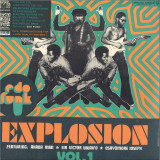
- A1: Africa Is My Root - Osayomore Joseph And The Creative Seven
- A2: Ta Gha Hunsimwen - Akaba Man The Nigie Rokets
- A3: Popular Side - Akaba Man And The African Pride
- B1: Iranm Iran - Victor Uwaifo And His Titibitis
- B2: Sakpaide No 2 - Victor Uwaifo And His Titibitis
- B3: Ta Ghi Rare - Akaba Man The Nigie Rokets
- C1: My Name Is Money - Osayomore Joseph
- C2: Ogbov Omwan - Akaba Man The Nigie Rokets
- C3: Aibalegbe - Victor Uwaifo And His Titibitis
- D1: Who Know Man - Osayomore Joseph And The Ulele Power Sound
- D2: Obviemama - Victor Uwaifo And His Titibitis
- D3: Ororo No De Fade - Osayomore Joseph And The Ulele Power Sound
Analog Africa Presents Edo Funk Explosion Vol. 1, available on
2xLP/Gatefold LP with 20-page booklet / CD with 36-page booklet. It was
in Benin City, in the heart of Nigeria, that a new hybrid of intoxicating
highlife music known as Edo Funk was born.
It first emerged in the late 1970s when a group of musicians began to experiment with different ways of integrating elements from their native Edo culture
and fusing them with new sound effects coming from West Africa s night-clubs.
Unlike the rather polished 1980 s Nigerian disco productions coming out of the
international metropolis of Lagos Edo Funk was raw and reduced to its bare
minimum.
Someone was needed to channel this energy into a distinctive sound and Sir
Victor Uwaifo appeared like a mad professor with his Joromi studio. Uwaifo
took the skeletal structure of Edo music and relentless began fusing them with
synthesizers, electric guitars and 80 s effect racks which resulted in some of the
most outstanding Edo recordings ever made. An explosive spiced up brew with
an odd psychedelic note known as Edo Funk.
That’s the sound you’ll be discovering in the first volume of the Edo Funk Explosion series which focusses on the genre’s greatest originators; Osayomore
Joseph, Akaba Man, and Sir Victor Uwaifo: Osayomore Joseph was one of the
first musicians to bring the sound of the flute into the horn-dominated world
of highlife, and his skills as a performer made him a fixture on the Lagos scene.
When he returned to settle in Benin City in the mid 1970s - at the invitation of
the royal family - he devoted himself to the modernisation and electrification
of Edo music, using funk and Afro-beat as the building blocks for songs that
weren’t afraid to call out government corruption or confront the dark legacy of
Nigeria’s colonial past.
Akaba Man was the philosopher king of Edo funk. Less overtly political than Osayomore Joseph and less psychedelic than Victor Uwaifo, he found the perfect
medium for his message in the trance-like grooves of Edo funk. With pulsating
rhythms awash in cosmic synth-fields and lyrics that express a deep personal
vision, he found great success at the dawn of the 1980s as one of Benin City’s
most persuasive ambassadors of funky highlife.
Victor Uwaifo was already a star in Nigeria when he built the legendary Joromi
studios in his hometown of Benin City in 1978. Using his unique guitar style as
the mediating force between West-African highlife and the traditional rhythms
and melodies of Edo music, he had scored several hits in the early seventies,
but once he had his own sixteen-track facility he was able to pursue his obsession with the synesthetic possibilities of pure sound, adding squelchy synths,
swirling organs and studio effects to hypnotic basslines and raw grooves. Between his own records and his production for other musicians, he quickly established himself as the godfather of Edo funk.
What unites these diverse musicians is their ability to strip funk down to its
primal essence and use it as the foundation for their own excursions inward to
the heart of Edo culture and outward to the furthest limits of sonic alchemy.
The twelve tracks on Edo Funk Explosion Volume 1 pulse with raw inspiration,
mixing highlife horns, driving rhythms, day-glo keyboards and tripped-out guitars into a funk experience unlike any other.
Re-mastering by: Ray Staff at Air Mastering, Lyndhurst Hall, London
Morgan was one of the most active artists in the Los Angeles underground jazz scene, and a member of the late great Horace Tapscott‘s artist collective Union of God’s Musicians and Artists Ascension (UGMAA). He performed alongside Tapscott, and other Nimbus recording artists like Jesse Sharps, who he introduced to Tapscott. He also performed with Arthur Blythe, Gary Bartz, Azar Lawrence, as well as soul icons Willie Hutch (notably on the Foxy Brown soundtrack) and Rufus & Chaka Khan. Most recently he contributed to Carlos Niño’s 2016 album Flutes, Echoes, It’s All Happening!, and was a part of Niño and vocalist Dwight Trible’s soul-jazz group Build An Ark (which also featured Tribe’s Phil Ranelin).
Journey Into Nigritia was Morgan’s debut as a leader, and the first of three recordings he released for Nimbus West. The album has a strong post-Coltrane spiritual feel, with some modal-based melodies, and some fiery solos from saxophonist Dadisi Komolafe. The record also features a solid rhythm section featuring bassist Jeff Littleton and drummer Fritz Wise.
Review by T J Gorton
At the dawn of the Reagan years, LA jazz pianist Nate Morgan recorded his first album for Nimbus West. Journey Into Nigritia portrays an artist marked by the icons of his day, and striving for reinvention. Although he came from a solid jazz background, coming up through the Pan Afrikan People's Arkestra, Morgan found more exciting work with pop bands in the seventies, including glory years with Rufus w/Chaka Khan. On Journey into Nigritia, Morgan re-embraces jazz. Included in the band are Jeff Littleton on bass, Fritz Wise on drums, and Dadisi Komolafe on alto sax.
The collection opens with the Trane-ish Mrafu. Komolafe blasts off in short order, and while the modal chording recalls Tyner, Morgan shows flashes of the nimble loquacious gift that define him. While Alice Coltrane incense perfumes "Morning Prayer, Morgan's devotional sincerity and personnel expression triumph.
Suitably complex with yearning minors, Mother features the trio performing a memorable composition. Littleton's deep-note sustain contrasts Wise's shimmering cymbals, while Morgan tells heart-wrenching truth. With a somewhat solemn theme, He Left Us a Song regularly bursts through into straight-ahead fast break sprints up and down the court. The unexpected "Study in C.T. offers an homage to Cecil Taylor and Morgan's musical roots with free improvisations on a dense and spiky theme. The exhilarating result has Morgan exploring his own way, with a winking slinging of jagged bass chords halfway through.
While a quarter century's experience has nurtured Morgan's prodigious gifts beyond this ambitious debut, Journey Into Nigritia offers enjoyable insights into his artistic evolution, while adding another precious title to the discography of one of the most woefully under-recorded greats of our time.
Robert Schwarz’s background lies in both architecture and computer music. Across a handful of labels, he’s presented field recordings and experimental works, and he’s participated in exhibitions with some of Europe’s most prominent institutions for adventurous art practices. He is also the co-founder and curator of the Viennese festival ”PARKEN; Or, Live in the Park”, which aims to mediate experimental forms of music in public spaces and co-author of the works ”Los Bar”, ”Strookoffer” and ”Lax Bar”, a series of artist run spaces in Los Angeles, Brussels and Vienna.
Recently he presented a row of debut releases with new side projects like She Was A Visitor, Privat and Ausgsburger Messer.
Nonesuch Records releases an album of songs written and performed by Caroline Shaw and Sō Percussion, Let the Soil Play Its Simple Part. The musicians, who have known each other since their student days, were presented with three days of gratis studio time and decided to experiment with ideas they had begun putting to tape during the sessions for their January 2021 Nonesuch release Narrow Sea. With Shaw on vocals and Sō – Eric Cha-Beach, Josh Quillen, Adam Sliwinski, and Jason Treuting – filling out this new band, they developed songs in the studio, with lyrics inspired by their own wide-ranging interests: James Joyce, the Sacred Harp hymn book, a poem by Anne Carson, the Bible’s Book of Ruth, the American roots tune ‘I’ll Fly Away’, and the pop perfection of ABBA, among others. The album is co-produced by Shaw, Sō Percussion, and the Grammy Award–winning engineer Jonathan Low (The National, Taylor Swift).
Shaw, who won a Pulitzer Prize for her vocal composition Partita for 8 Voices, written for and performed with Roomful of Teeth, makes her solo vocal debut with Let the Soil Play Its Simple Part. The album’s first track, ‘To the Sky’, from the Sacred Harp, takes its lyrics from Anne Steele. “I love the songs about death, and going home, and looking toward a time that is better or brighter, which, if there’s one thing to think about in the world, maybe that’s the thing,” Shaw says. “This one I love in particular. There’s a line, ‘Frail solace of an hour / So soon our transient comforts fly / And pleasure blooms to die.’ It’s meditation on the ephemeral, and I love it.”
“I hadn’t written very many songs, but I have certainly loved many in my life. I’ve been thinking of making a solo album for seven or eight years, but it takes having the right friends and community in the room,” Shaw says. “The prompt for all of us was: What would we make in the room together with no one person in charge, like a band writes in the studio?”
Cha-Beach recalls of the early test run during the Narrow Sea session: “It had that capturing-lightning-in-a bottle feeling.” When the opportunity to have three days in their friends’ studio, Guilford Sound, came up, the five musicians decamped for Vermont with engineer/co-producer Jonathan Low. “Jon is an amazing editor,” Cha-Beach says. “He is so helpful in thinking about: ‘We have these ideas: how do we shrink those and make them come across on an album?’”
One such idea was for Shaw to do a duet with each member of Sō. She sings with Josh Quillen on steel drums on the title track, which she wrote in under an hour in a “free-writing zone, very inspired by James Joyce, taking on that brain space,” she says. Lyrically, the song is “related to some math bits that I love, but also memory, and love songs of somebody who’s gone or passed away, or that you’re no longer with: what is the sound of that kind of devastation or confusion or love?” They recorded the song only twice, and the first take is on the album. “It’s very spare. The playing is very Josh; it’s so sensitive,” Shaw says.
Adam Sliwinski’s marimba duet with Shaw is an interpretation of the ABBA song ‘Lay All Your Love On Me’. She explains, “It’s really a Bach chorale. Also, the idea of someone singing ‘Don’t go wasting your emotion / Lay all your love on me / Don’t go sharing your devotion / Lay all your love on me,’ over and over again very slowly, there’s a certain tragedy in it. And then Adam did some absolutely exquisite layering that built this stunning world from the marimba.”
Jason Treuting on the drum kit joined Shaw for ‘Long Ago We Counted’. She suggested, “Why don’t we start with the voice and the kit having a weird conversation, sort of like two babies talking to each other? And then we built this loop, and we go from this place that’s totally uncomfortable and nonsensical to something that’s rich and rolling and satisfying.” For ‘Some Bright Morning’, the duet with Cha-Beach – who here plays electronics, piano, and Hammond organ – Shaw drew upon a twelfth century liturgical hymn she had sung regularly in church during her college years: ‘Salve Regina’.
“Some songs on Let the Soil… were very specifically composed by Caroline,” Cha-Beach says. “But others were this assemblage of ideas: finding words, an idea for how a melody could work, a harmony, and then tossing it in a blender and trusting each other.” Shaw adds, “What I love about Sō is the curiosity about how objects make sounds and how they speak to each other. There was an underlying thread of thinking about what goes into soil, how we take care of it, how we allow it to be itself, how we contain it, and what can come out of it if you cultivate the right environment, which for me is always this wonderful metaphor for creativity and collaboration: let people be themselves and see what happens,” she concludes.
Caroline Shaw is a New York–based musician – vocalist, violinist, composer, and producer – who performs in solo and collaborative projects. She was the youngest recipient of the Pulitzer Prize for Music in 2013 for Partita for 8 Voices, written for the Grammy–winning Roomful of Teeth, of which she is a member. Shaw’s film scores include Erica Fae’s To Keep the Light and Josephine Decker’s Madeline’s Madeline as well as the upcoming short 8th Year of the Emergency by Maureen Towey. Hailed for ‘astonishing both the pop and classical music worlds’ (Guardian), she has produced for Kanye West (The Life of Pablo; Ye) and Nas (NASIR), and has contributed to records by The National and by Arcade Fire’s Richard Reed Parry. Shaw currently teaches at NYU and is a Creative Associate at The Juilliard School. Her 2019 Nonesuch/New Amsterdam album Orange won a Grammy Award.
Through its interpretations of modern classics, innovative multi-genre original productions, and ‘exhilarating blend of precision and anarchy, rigor and bedlam’ (New Yorker), Sō Percussion has redefined the scope and role of the modern percussion ensemble. Sō’s repertoire ranges from twentieth century works by John Cage, Steve Reich, and Iannis Xenakis, to commissioning and advocating works by contemporary composers such as David Lang, Julia Wolfe, and Steven Mackey, to collaborations with artists who work outside the classical concert hall, including Shara Nova, choreographer Susan Marshall, The National, Bryce Dessner, and many others. Sō has recorded more than twenty albums, including a performance of Reich’s Mallet Quartet on the Nonesuch record WTC 9/11; appeared at Carnegie Hall, Lincoln Center, Walt Disney Hall, the Barbican, the Eaux Claires Festival, MassMoCA, and TED 2016; and performed with Jad Abumrad, JACK Quartet, the Mostly Mozart Festival Orchestra, and the LA Phil and Gustavo Dudamel, among others.
- A1: Anthony
- A2: The Rest Of My Life
- A3: For Colette
- A4: The Next Time
- B1: Beautiful Lies
- B2: My Irascible Friend
- B3: Believe In Me
- B4: Fermina
- C1: Where I Should Be
- C2: Fado
- C3: Madre Mio
- C4: Blue Period
- C5: War Torn
- D1: Picking Guitar For The Shrimp
- D2: The Celestial Bar
- D3: Jumble Drums, Growling Bass & The Whammy Bar
- D4: For Cameron De La Isla
Factory Benelux presents an expanded double vinyl edition of Sex and Death, the 11th studio album by lauded Factory Records ensemble The Durutti Column.
Originally released in 1994 on CD only, the album has now been re-mastered with 5 bonus tracks and appears on vinyl for the VERY FIRST TIME in a coloured vinyl edition limited to 1500 copies.
The vinyl edition is housed in a gatefold sleeve . Disc 1 is pressed in blue vinyl, and disc 2 in silver. A 2xCD edition is also available (FBN 201 CD).
The writing and recording of Sex and Death closed an uncertain period for Vini Reilly and the group following the collapse of Factory Records in 1992. Factory founder Tony Wilson remained in post as manager of the band, but Sex and Death would be their last album with producer Stephen Street, famed for his work with Morrissey, The Smiths and Blur.
Writer and master guitarist Vini Reilly remained philosophical. “People say the Durutti Column is this or that. I don’t care, so long as we make good music. There’s screaming feedback on some tracks, heavy metal guitar, Spanish picking. It’s not just this ethereal trip. Don’t listen to the form, never listen to the form. Listen to the content.”
Stand-out tracks include Anthony (dedicated to Wilson), The Rest of My Life, and Believe In Me. Guest musicians include viola player John Metcalfe, vocalist Ruth-Ann Boyle (later to form hitmakers Olive with Tim Kellett), programmer Martin Jackson (Magazine, Swing Out Sister) and bassist Peter Hook, then on furlough from New Order post-Republic.
All 5 bonus tracks are previously unreleased, having been retrieved from a long-lost DAT tape located in Tony Wilson’s personal archive. All tracks on the album have been newly re-mastered in 2020 by Peter Beckmann and Technology Works.
”Saskadelphia” steht sinnbildlich für den kreativen und Live-Höhepunkt von The Tragically Hip und gilt
als das verlorene Album der Band. Es kommt nun als Teil der einjährigen Feier zum 30-jährigen Jubiläum
von ’Road Apples’.
Der Albumtitel entstand durch die Vielzahl an Live-Shows der Band zu der Zeit, da sie nie wussten,
ob sie in Saskatchewan oder Philadelphia aufwachen würden. Als der Titel abgelehnt wurde, antwortete
die Band mit ’Horseshit...Road Apples’ und Road Apples’ wurde dann ausgerechnet das erste #1 Album
der Band in Kanada erreichte schließlich Diamantstatus.
Das Album beinhaltet alle bisher unveröffentlichten Tracks, wurde von Don Smith (Tom Petty & The
Heartbreakers, Keith Richards, 10.000 Maniacs, Roy Orbison) produziert und in den Barris-Studios in New
Orleans 1990 aufgenommen. Mit dabei auch die Single und das Video - # 1 ’Ouch’.
The second album from Brighton based Balearic duo Andres y Xavi. This time with a little help from Rolo McGinty of Peel faves and Balearic Beat legends The Woodentops. This is a love letter to the forgotten side of Ibiza: dusty lanes, olive groves and clearings with sea views that go on for miles.
10 original compositions plus a cover of Talk Talk’s Renee.
The self released and distributed first album found favour with Balearic DJs across the world. Lead track ‘My alibi’ was picked out by the likes of Kenneth Bager, Danny Psychmagik and ‘Never seen Ibiza’ was a firm favourite of Phat Phil Cooper and Balearic Ultras.
Rolo adds guitar and vocals and a Woodentops vibe to two tracks on the album ‘What do you see in me?’ and ‘Walking in the sun’, his personal tribute to Jose Padilla.
First album received support from Kenneth Bager (Music for Dreams), Phat Phil Cooper (NuNorthernSoul), Chris Coco, Mike Salta, Leo Mas, Balearic Ultras, David Pickering (OneMillionSunsets) and many more!
And was described by Dr Rob (Ban Ban Ton Ton) as "Smokey Muscle Shoals organ plays, strings swoon, and Kosmische synths blink like distant stars... an overall “vibe” somewhere between Mo`Wax and the Sunday Best of Bent and Dan Mass... adorned by cascading Indie “neo-acoustic” guitar jangle. Like The Stone Roses by way of Horsebeach."
Captain Rip Hayman (b.1951, New Mexico) has come ashore again, bearing fresh cargo. A student of John Cage, Ravi Shankar, and Philip Corner, Rip was a founding editor of the notable Ear Magazine (1975-1991), and since 1977 he has run New York's oldest bar, the Ear Inn. The focused minimalism of his new LP Waves: Real and Imagined varies from the collaged spectacle of his first Recital LP, Dreams of India & China (2019).
This oceanic dish holds two side-long works: “Waves for Flutes,” a multi-tracked flute composition recorded by the artist in 1977. ‘Angelic’, ‘Grave’, and ‘Sad’ modes overlap an effect of medieval choral organum, as shifting patterns evoke water and wind variations of the shore and vast sea beyond. An enchanting and arresting piece.
The second side holds “Seascapes,” which was recorded on the Pacific ocean in February and March of 2020 – through calm seas and tempestuous storms. The ship as the instrument played by the sea. We feel both lost and saved when at sea, the landfall feared or longed for.
The album is dedicated to all those whose souls have been lost and found at sea amidst the waves, for each sea wave is a child of Oceanus & Tethys, Greek gods of the sea, every one sent on their way to play...
It all starts with a great song and “You Baby” has it all! Penned by husband and wife team Barry Mann and Cynthia Weil with the magic touch of Phil Spector – what an awesome trio – and the bedrock of a future classic.
The song was originally produced by Spector for the Ronettes, signed to his Philles label, and appeared on their 1964 breakthrough album ‘Presenting The Fabulous Ronettes’ featuring, of course, his wife to be Veronica Bennett. The song was also recorded in the U.S. by pop/rock band the Lovin’ Spoonful for their 1965 debut album ‘Do You Believe In Magic’.
However, in January 1966 Pye Records unleashed JACKIE TRENT’s epic Northern Soul version produced by her husband Tony Hatch. Heralded by a pounding drum beat and trumpet blast it is no wonder that Jackie’s definitive cover shook the walls at Wigan Casino a decade later. And its popularity has never gone away, hence its current price tag of £300-400! Check out Jackie’s performance on the Morecambe and Wise Show on YouTube, what an intro!
“You Baby” was also recorded in May ’66 by Cameo Parkway’s Lovenotes in a very similar vein and in November ’66 by the legendary Len Barry. Other notable cover’s include Sonny & Cher, the Bubblegum pop group Salt Water Taffy and, in 1975, John Holt’s reggae version.
“Lost Summer Love” was originally recorded in 1964 by U.S. actress Shelley Fabares known for her long-running role as Mary Stone in the sitcom ‘The Donna Reed Show’ and as Elvis Presley’s leading lady in ‘Girl Happy’, ‘Spinout’ and ‘Clambake’. She also scored a No.1 pop hit in 1962 with the teen anthem “Johnny Angel”. But, as with our ‘A-side’, it was reborn as a Northern Soul classic when Pye Records picked the song up in 1965 and recorded it on their latest signing, teenager LORRIANE SILVER. Once again the stomping drum track, percussion and handclaps propel you to the dancefloor where you’re greated with an unforgettably catchy tune, a bevvy of backing vocals and Lorraine’s effervescent vocal.
Two fabulous reasons to make this one of the top reissue 45s of 2020!
Sub Rosa presents in their Early Electronic series, the final chapter of music by Beglian key composer of early electronic experiments, André Stordeur (1941-2020). Side A features a previously unreleased, stark and poignant composition from 1979; while the B side is vibrant and almost playful of pieces from the 2000s.
André Stordeur His musical career started in 1973 with a tape composition for the soundtrack to a film on Gordon Matta-Clark titled Office Baroque. Later in the 1970s, he participated to avantgarde music ensemble Studio voor Experimentele Muziek, founded in Antwerp, Flanders, by Joris De Laet. Since 1980, Stordeur composes exclusively on Serge synthesizer, either a Serge series 79 and a Serge prototype 1980, which was especially built for him by Serge Tcherepnin himself. In 1981, Stordeur composed the music of Belgian film director Christian Mesnil's documentary Du Zaïre au Congo. He studied at IRCAM in 1981 with David Wessel and then flew to the US to study with Morton Subotnick. Stordeur became an influential sound synthesis teacher and, in 1997, completed his Art of Analog Modular Synthesis by Voltage Control,4 a guide to everything modular.
Oberheim While 'Oberheim' is the centerpiece of this LP, we pressed for the first time on vinyl three pieces from the session André called 'Synthesis Studies,' previously featuring on Complete Analog and Digital Electronic Music, 1978-2000. 'I was helped in my studies by a must-have book: The Techniques of Electronic Music, by Thomas Wells and Eric Vogel (University Stores, 1974). That book aside, I learned synthesis on my own. After a trip to India in 1968, I discovered Indian music and took tabla and sitar classes in New Delhi; my teachers were students of Chatur Lal and Ravi Shankar. Later, in the 2000s, while living in the US, I tried to recreate through synthesis all the Indian musical instruments I loved so much.' 'Drone' is one of his most spectacular works.
Australian artist Indigo Sparke Brings her deeply personal lived experiences to her music, highlighting the spaces between the polarity of softness and grit. Pulling from her experiences of addiction, of healing, of queerness, of heartbreak, of joy, of connection, of the softness and of the grit alchemizing it all into tenderness through her music, she conjures up a myriad of feelings that is undeniably potent. It was in 2019 that Indigo lived and travelled across America, in places like NYC, Minneapolis, Topanga, Taos, in many hotel rooms and amidst the vast stretching landscapes on the never ending highways, channelling her creative energy into the completion of her debut album, echo. echo was recorded between LA, Italy and New York, co-produced by Sparke, Adrianne Lenker (of Big Thief), and Andrew Sarlo (producer of Big Thief, Nick Hakim, Bon Iver, Hand Habits, etc). The record was completed at Figure 8 Studio in New York City, studio of musician Shahzad Ismaily. Phil Weinrobe (producer/engineer for Leonard Cohen, Damien Rice, Adrianne Lenker, Buck Meek, etc) engineered and mixed the album. "Indigo's writing and voice are ethereal and angelic and guide me through internal canyons and plains. I'm deeply grateful to have been part of this and to have gotten to play and sing along side Indigo, and to have been able to eternalize a very special space and time with her, which I will always cherish." -Adrianne Lenker "With these songs and her filament voice, Indigo brings us in to a private place and lights a fire there." -Feist
- A1: If Your Poison Gets You
- A2: Johnny Barleycorn
- A3: Fast Man
- A4: You Can’t Crucify Yourself
- A5: Dirty Old Town
- A6: Wanderlust
- B1: Seven Days
- B2: Raider Man
- B3: The End Of The Summer
- B4: Dog Sleep
- B5: When The Paint Grows Darker Still
- B6: I’m Not Dead (I’m In Pittsburgh)
- B7: Golden Shore
- C1: In The Time Of My Ruin
- C2: Down To You
- C3: Highway To Lowdown
- C4: Kiss My Ring
- C5: My Terrible Ways
- C6: Fitzgerald
- C7: Elijah
- D1: It’s Just Not Your Moment
- D2: The Real ‘El Rey
- D3: Where The Wind Is Going
- D4: Holland Town
- D5: Sad Old World
- D6: Don’t Cry That Way
- D7: Fare Thee Well
Demon Records is proud to present a new series of vinyl reissues from American singer-songwriter Black Francis / Frank Black
• First released in 2006, Fast Man Raider Man is the eleventh studio album by Frank Black. Recorded as a follow up to 2005’s
Honeycomb, Black returned to Nashville to work with a team of all star musicians including Al Kooper, Bob Babbitt, Levon Helm,
Lyle Workman, Steve Cropper, Jim Keltner, Rich Gilbert, Simon Kirke, Ian McClagan, Chester Thomspon, Dave Phillips and
Spooner Oldham.
• Album highlights include ‘Johnny Barleycorn’, ‘In The Time Of My Ruin’ and ‘If Your Poison Gets You’.
• Now available on vinyl for the very first time, this reissue features the complete album pressed on two 140g translucent vinyl.
Backed by members of the David Nance Group, Rosali (Long Hots, Wandering Shade, Monocot) wades through the emotional mire with infectious, earworm melodies led by her luminous voice. With their rich, raw instrumentation, these rock ballads sound like the resilience discovered in facing one’s darkest moments, the assurance of the calm and clarity that comes after the storm. As she sings on the second track, “Bones,” “Through the darkness of the field / I walk through without yielding / To the rest of the feelings / I’m carrying.” With her confident song craft, Rosali illustrates the ability to push through, moving toward something greater without being destroyed by the weight of trauma.
Engineered by James Shroeder and featuring Kevin Donahue (Simon Joyner), James Shroeder (Simon Joyner, DNG, Connor Oberst), David Nance, Noah Sterba, Colin Duckworth, and Daniel Knapp, the album was recorded in ten days and the raw immediacy of the music is palpable across these ten tracks. Added adornment was contributed by Philadelphia's Robbie Bennett (War on Drugs) on organ and keys, and Matt Barrick (The Walkmen, Jonathan Fire Eater, Muzz) makes a percussion cameo on “Whisper,”which was tracked at Philly’s Silent Partner Studio, where No Medium was mixed by Quentin Stoltzfus (Mazarin, Light Heat). The open creative collaboration elevated the songs, resulting in the exciting, vibrant sound of the album.
Rosali wrote the bulk of these songs in January of 2019 while on a self-imposed two week residency in the hills of South Carolina. Alone in an old farmhouse, she experienced supernatural events and faced her own demons in the deepest darkness. Perhaps as a result, there is a boldness that permeates the album, a daring vulnerability in both the lyrical themes and their musical accompaniment. Rosali says, “I approach guitar playing the same intuitive way I sing, which is profoundly spiritual for me. Where words fail, the guitar becomes the conduit for raw feelings, providing a direct connection to them. I’m constantly working on being fearless in my work, which means showing the rough side, the mistakes along with the triumphs.”
While writing No Medium, Rosali was inspired by harmonographs—swinging pendulums that create beautiful illustrations of the mathematics of music—considering how the mind, too, creates images through song. She imagined herself as the swinging pendulum—“a body suspended from a fixed point” (Encyclopedia Britannica), governed by the forces surrounding her. She thought about the pendulum’s relationship to time, movement, and even its use in divination practices. The album’s title, lifted from Charlotte Brontë’s, Jane Eyre, resonated with this vision: “I know no medium: I never in my life have known any medium in my dealings with positive, hard characters, antagonistic to my own, between absolute submission and determined revolt. I have always faithfully observed the one, up to the very moment of bursting, sometimes with volcanic vehemence, into the other.” With the multiple meanings of “medium”—as middle ground, a term for psychics, and as the material of artistic expression—No Medium felt like the appropriate name, describing how the self is shaped by the patterns of life .
The influences for the sound of No Medium reflect this pairing of assured vulnerability, in the stylistic coherence of Bob Dylan’s Desire, the tender delivery in Iain Matthews’ Journey From Gospel Oak, the strut and swagger of Bowie’s Hunky Dory, the ambition and beauty of Gene Clark’s No Other, and the playful catharsis of Harry Nilsson’s Nilsson Schmilsson. The Richard and Linda Thompson-esque album opener “Mouth,” places Rosali within both a physical and emotional space. “East of the river I was travelling on / watch me lie, undone / rest me in a forest, overgrown / until I am free of all that I’ve known,” she sings. There is movement, both within a cityscape, and in her outlook on love. Speaking of her thought process when writing the song, she says, “I imagine confidently walking away from the past, toward a new approach to love and intimacy to achieve a closer relationship with myself.”
In “Pour Over Ice,” Rosali explores her relationship with alcohol and her former reliance upon it as a social lubricant to quell her social anxiety, an energizer to keep moving, a means to cope and self-medicate, and most addictively, to lure out her wild side as a free flowing, good time girl. While drinking helped her through some shitty times, it eventually got the upper hand and became an insatiable hole within. She says, “The ‘you’ in the song is really me, talking to that component of myself struggling with drinking and self-sabotage, caught up in the cycle, and all the bad choices I made.” She sings, “Maybe I didn’t care enough / or can’t remember / chasing small pleasures / making fire from embers.” Rosali wanted her lead guitar on this track to simultaneously sound like a slow motion car crash propelling her through the day, and the sound of a gnawing hunger for something more.
Rosali’s alliance with the Omaha musicians that orbit David Nance Group (including Nance himself) came about while on a Long Hots / DNG tour in the summer of 2019. Great friendships formed and one night after playing in Detroit, Dave suggested they be her backing band. The pairing was effortless and natural, and in November of the same year, they were recording No Medium in a basement in Omaha.
- A1: Esther Phillips – That’s All Right With Me
- A2: Al Green – I Wish You Were Here
- A3: Eddie Kendricks – Intimate Friends
- A4: Sylvia – Sweet Stuff
- A5: Betty Wright – Girls Can’t Do What The Guys Do
- A6: The Ambassadors – Ain’t Got The Love Of One Girl (On My Mind)
- B1: The Dynamics – Get Myself High
- B2: Carolyn Sullivan – Dead ! / B3. Brenton Wood – Trouble
- B4: The Floaters – Float On / B5. Faze-O – Riding High
- C1: Ernie Hines – Our Generation
- C2: Jerry Butler – I’m Your Mechanical Man
- C3: J.j. Johnson – Keep On Movin’ (Vocals By Martha Reeves & The Sweet Things)
- C4: Monk Higgins & Alex Brown – A Good Man Is Gone (Vocals By Barbara Mason)
- C5: The East St. Louis Gospelettes – Have Mercy On Me
- D1: Jean Plum – Here I Go Again
- D2: The Staple Singers – Let’s Do It Again
- D3: The Sylvers – Only One Can Win
- D4: Della Humphrey – Don’t Make The Good Girls Go Bad
- D5: Freda Payne – I Get High (On Your Memory)
- D6: Carla Thomas – What The World Needs Now
Duke Ellington once said that there are 2 kinds of music: the good one and the bad one. With the compilation series “Shaolin Soul” we are always certain to be on the right side of the line since its 1st episode released in 1998 and which compiled two dozens of tracks sampled by RZA and the Wu-Tang Clan. Following a second episode in 2001 and a third one in 2014, the famous curator Uncle O is back to celebrate the 20th anniversary of the Shaolin Soul series with a fourth episode compiling 22 tracks among the rarest and finest treats of soul music, because “everybody’s talking about the good ol’ days !”.
Divine Invasions is the sophomore release from Welsh electro post-rock duo Ritual Cloak. The album builds on the cinematic soundscape themes of their debut, with the addition of vocals scattered throughout the record.
Work on Divine Invasions began as soon as the first album had been finished back in September 2019. The first album saw sparing use of guitar, instead mainly writing around piano. When it came to writing the second, Sanders and Barnett didn’t want to fall into the same routine, choosing to embrace exploring new sounds, experiment with new effects, making guitars sound like synths and using vocals for the first time.
The title Divine Invasions is inspired by the Philip K Dick biography. Dick was plagued by nervous breakdowns and driven to near insanity by visions of God.
For Fans Of:Mogwai, Radiohead, Sigur Ros, Kiasmos
LTD. NEON PINK & NEON GREEN VINYL
The Impossible Kid, released in 2016 on Rhymesayers Entertainment, marked Indie-rap mainstay Aesop Rock's first solo venture since 2012's Skelethon. Aesop continued finding new ways to improve on the skills that have made him one of the kings of indie hip-hop. His creative process now includes a newfound willingness to open up about his personal life, going deep on topics like depression, his sometimes rocky relationship with his family, and the turbulent handful of years that culminated in Aesop leaving his adopted home of San Francisco to live in a barn out in the woods, where he recorded the foundations of The Impossible Kid. There's also moments of levity though, as Aesop taps into the funny side of his persona that he suppressed during the period where being taken as a serious lyricist was more of a priority. Like Skelethon, Aesop exercised complete creative control over every aspect of the album, from the production (which he handled himself, with instrumental help from Philly's Grimace Foundation) to conceptualizing the cover art by his friend Alex Pardee.
On February 27, 2018, Chris Forsyth & The Solar Motel Band (comprised, in this iteration, of long-time SMB bassist Peter Kerlin and Kerlin’s Sunwatchers battery mate Jason Robira on drums) were close to wrapping up an 18-date tour of the EU and UK with a two-set, one hour and 45 minute show at Cafe OTO, London’s premier venue for adventurous music. Highlights of that show are included in this live release, RARE DREAMS: SOLAR LIVE 2.27.18, recorded before a packed house seated mere feet from the band’s amplifiers. These recordings reveal a band that is clearly in high spirits and high gear, operating with an expansive, improvisatory fleetness that allows them to stretch the material to almost ludicrous extremes and then let it to snap back to some semblance of form while somehow seemingly never wasting a note, a beat, a gesture. The four tracks included here comprise material culled from (at the time) the two most recent Solar Motel Band records DREAMING IN THE NON-DREAM (No Quarter, 2017) and THE RARITY OF EXPERIENCE (No Quarter, 2016) plus covers of two Neil Young songs - the autobiographical plaint “Don’t Be Denied,” lyrically relocated by Forsyth from Young's Canada and Hollywood to the more personally relevant geography of New Jersey and Philadelphia, and encore “Barstool Blues” (they’d run out of material to play, so another Neil Young tune it was). While the covers establish Forsyth’s basis, serving as an homage to Young and the quest for self-realization, the long tracks’ jams showcase the trance-inducing power of the Solar Motel Band as a performing entity. Kerlin’s gymnastically propulsive bass playing locks in with Robira’s relentless thud, each serving as counterpoint to some of the most blistering guitar work of Forsyth’s career. The telepathically dynamic interplay of the trio explodes with whiplash intensity across the 15-plus minute takes of “Dreaming In The Non-Dream” and “The First 10 Minutes of Cocksucker Blues,” each song’s structure serving as a framework for extended lava flows of energy. At one point late in the “Dreaming” jam, Forsyth unplugs the jack from his guitar, dragging it across the strings and lashing the body of his single-pickup “parts" Esquire, producing a desiccated barrage of percussive static. This is music beyond the notes; it is an expression of pure electric ecstasy, a simultaneous negation and celebration of rock music’s (indeed all musics’) essential energy. In contrast to the expansive but meticulously detailed guitar arrangements of his recordings, here Forsyth’s unhinged live guitar sound positively roars with a barely restrained vocal intensity, from liquid melodic lines to gnarled blasts of free jazz scree, to pulsating lead/rhythm vamping. I’ve had the pleasure of witnessing this band up close for a number of years now and I can authoritatively attest that while every show is different, when the SMB is running down a steep hill at full speed (as on these takes), they become a single leaderless vibrating sonic tornado, possibly beyond the control and logic of the players themselves, picking up listeners along the way and taking them along for the ride straight into a solar furnace of sound. - Jerome Onfront, Philadelphia
2LP on crystal clear vinyl. In these trying times, where intimacy and closeness are fraught with danger, Dans Dans (Dance Dance) brings you the sound of connection, communication, passion and togetherness.
In these trying times, where intimacy and closeness are fraught with danger, Dans Dans (Dance Dance) brings you the sound of connection, communication, passion and togetherness.
Dans Dans unites the talents of three of Belgium's most prolific music makers in Bert Dockx (Flying Horseman), Fred 'Lyenn' Jacques (Lyenn, Lanegan band) and Steven Cassiers (Dez Mona, DAAU). An utterly unique musical collective, the trio are set to release new album 'Zink' on the 23rd April via Ghent based independent, Unday Records.
From jazz, psychedelic blues and ecstatic noir soundtracks to spacey rock 'n' roll, Dans Dans cut their teeth on the cool jazz cafe scene in Flanders, Brussels with their sensational live performances and have since gone on to become a mainstay on the flourishing Belgian musical landscape.
Releasing their self-produced, eponymous debut album back in 2012, their highly distinctive, intuitive mix of musical styles and their ever-imaginative live shows caught the attention of discerning music lovers, journalists and promoters. A relatively unknown tour de force outside the Benelux region, Dans Dans have built a solid fan base since their inception with limited edition runs of early releases becoming collector's items among vinyl enthusiasts.
Well-received appearances at Cactus Festival, North Sea Jazz and Pukkelpop, as well as Gent Jazz, Ljubljana Jazz and Jazz Middelheim have confirmed their reputation as one of the most unique and exciting bands to come out of Belgium. In recent years, the group has been touring throughout Europe, garnering enthusiastic reactions beyond the Belgian borders as well. There's a case to be made that Dans Dans even played a key role in breaking down the wall between the Belgian jazz scene and the pop/rock circuit (years before pop journalists began referring to a New Wave of Belgian Jazz).
Opening with the moody noir rhythms of 'Cinder Bay', Dans Dans look to construct their own musical universe across 'Zink'. 'Naiad' unfolds into a devastating explosion of heavy feedback and wild, crashing drums before subtle electronica and baroque art-rock collide on 'Anemone' giving a good indication of Dans Dans' eclecticism. There's unquestionably a deep, underlying filmic beauty to the music, an evolving darkness and a perpetual sense of dread and paranoia. Elsewhere, 'Ravine' is intoxicating, provocative and uncompromising while the beatific 'Shell Star' is an infectious exploration of hypnotic grooves, atmospheric sounds and mind-bending melodies.
Producer Christine Verschorren (Philippe Catherine, Ivan Paduart) accentuates the music's wondrous fluidity throughout 'Zink'; the intriguing interplay; the subtle ties; the deep layering. Musical styles and influences are being blended organically and sublimated into what can only be called Dans Dans-music. "This is no fusion, no rock or jazz or ambient. This is the sound of the searching, intuitive human; of a timeless, mysterious dream; of the heart, the gut and the soul," says Dockx.
- A1: Feelin (Rashad Ft Spinn & Taso)
- A2: Show U How (Spinn & Rashad)
- A3: Pass That Shit (Rashad Ft Spinn & Taso)
- A4: She A Go (Rashad Ft Spinn & Taso)
- B1: Only One (Rashad Ft Spinn & Taso)
- B2: Everyday Of My Life (Rashad & Dj Phil)
- B3: I Don't Give A Fuck (Rashad)
- B4: Double Cup (Rashad Ft Spinn)
- C1: Drank, Kush, Barz (Rashad Ft Spinn)
- C2: Reggie (Rashad)
- C3: Acid Bit (Rashad & Addison Groove)
- D1: Leavin (Rashad & Manny)
- D2: Let U No (Rashad Ft Spinn)
- D3: I'm Too Hi (Rashad Ft Earl)
Die Footwork Legende aus Chicago, DJ RASHAD, beschließt ein erfolgreiches Jahr auf Hyperdub mit seinem ersten Album für das Label und baut damit auf zwei EPs auf, die deutlich demonstriert haben, wie sich der Sound von ihm und seinen mannigfaltigen Teklife Kollaborateuren im Jahr 2013 entwickelt hatte. Benannt nach dem Freizeitcocktail aus Sprite und Kodein treffen auf ,Double Cup" traditionelle 808 Footwork Ausbrüche auf die neuesten Mutationen des Sounds und zeigen so die Vielseitigkeit und Kraft der Chicago Szene im Jahr 2013. Das Album wirft Hip Hop, R&B, Acid, House, Techno und Jungle in seinen Footwork Shredder und spuckt diese auf der anderen Seite als zusammengeklebte Fragmente wieder aus, zusammengehalten durch schnurrende 808 Subtriplets und kantige Polyrhythmen. Das Album wärmt sich langsam mit einem G-Funk Swing auf, der typisch ist für RASHAD und SPINNs Kollaborationen mit TASO aus San Francisco. Diven mit Schluckauf räkeln sich auf den Rhythmen von ,Show U How", ,Only One" und ,Everyday Of My Life" mit Raps von der Crew auf ,Pass That Shit", ,She A Go" und ,Kush, Drank, Barz". Das bereits veröffentlichte "I Don't Give A Fuck" markiert den düsteren Dreh- und Angelpunkt des Albums; das Tempo zieht in der zweiten Hälfte an mit dem treibenden Viervierteltakt des Titeltracks ,Double Cup", dem donnernd gepressten ,Acid Bit" und dem Chicago House von ,Reggie" und ,Leavin. Den Höhepunkt markiert die Breakbeat Wissenschaft von ,Let U No" und ,I'm Too Hi". ,Double Cup" ist vorausschauende Musik für die Tanzfläche und unterstreicht, dass Footwork an der Macht ist.
Master craftsman James Welburn’s new LP, Sleeper in the Void, marks the 50th Miasmah release.The six years after his monumental debut have bred six tracks Welburn brings to fruition with the help of past co-conspirators from the Norwegian underground scene - Tomas Järmyr (Motorpsycho, Zu, Barchan), Hilde Marie Holsen (Hubro Records), and vocal artist Juliana Venter (W/V, Phil Winter).
On Sleeper in the Void, Welburn expands the domain of his sound, unveiling surprises until the very end of the album’s 36 minute playtime. While the character of the record is unmistakably his own, the tracks veer into many different territories, including a banging foray to the dancefloor.
The LP begins slowly with Raze, where Järmyr’s ritualistic cymbals introduce layers of Welburn’s signature sculpted bass drones and noise, building into a heart-wrenching epic of a track. This is perhaps the closest we ever get to Hold - Welburn’s previous LP. Falling from Time immediately surprises with it’s subdued mechanical techno beat, stark and cold as a glacier. Welburn’s texture-work is the star of the show, creating curious nooks and crannies of drone adorned with eerie melodies straight out of oblivion. This sense of wonder shines through to the album’s title track as well, where Welburn and Järmyr build another patient, echoing, and deeply cinematic piece, the drum patterns slowly shifting around a metallic hum that evokes the vision of church bells, ringing out under tonnes of seawater.
Sleeper in the Void feels like a story in two parts, rising lethargically, but with gargantuan power. The second begins with the momentous In and out of Blue, where Juliana Venter’s disembodied, spectral dirge takes center stage among the furious drums and bassy riffs, reaching a full crescendo with seconds to go. Parallel marks a release - Hilde Marie Holsen’s nostalgic soundscapes, pristine as glass, meeting the distant thunder of Welburn’s strings on the horizon. And finally, Fast Moon ends the record in a most surprising way - a tribal industrialized banger, complete with vile distorted beats and every other spice in demand on a blackened dancefloor.
Welburn’s Sleeper in the Void is a generous shapeshifter. Every inch of its soundwave breathes emotion and imagery - an invitation to take a dive and linger.
"...a swirl of the bedrock elements that make up modern music, his LP lifts from Soul, Funk and Hip-Hop to create this ode to Detroit House."
A NATION OF MILLIONS
EARLY SUPPORT FROM ALEXANDER NUT ("Tight beats from Snips as always. Dexters Pain is my fave here. Big ups"), KARIZMA ("Proud to hear a friend grow musically, great work on the album my friend...Full Support. K'), RED RACK'EM, SK VIBEMAKER
SNIPS delivers the first vinyl release on Houseology. The Barbershop LP is a tongue in cheek play on the production techniques Todd Worsnip aka Snips normally uses when making his Hip-Hop work. This 8 track LP is meeting of the two worlds of House and Hip-Hop tapping into Snips' raw ability to find the best cuts and chops needed for any genre.
DJ Snips began his career at legendary London record store Deal Real', where he ran the open mic night alongside British host and comedian Doc Brown, Snips' years at Deal Real saw him DJ'ing alongside performances from several US heavy hitters including Kanye West, Mos Def and the Black Eyed Peas.
Snips' knack for manoeuvring through a wide range of Hip Hop oeuvres has seen him play around the world, Specifically in NYC where he has been a guest at legendary parties including Everyday People, Bible Study, Mobile Mondays and Ginny's Supper Club. As well as being a regular in NY, Snips has also headlined events in The Philippines, Australia, Germany, Hong Kong, The Netherlands, Qatar, France, Norway and Spain. When Snips isn't touring or on the Club circuit, he's known for churning out beats for some of the most talented MCs on both sides of the Atlantic. His production work includes tracks for several major US recording artists including M1 (Dead Prez), Capadonna (Wu Tang), Sean Price.
Work on the Houseology record label allows Snips the opportunity to articulate himself even more so within his skilled production, by drawing a definitive line between the House/Hip-Hop relationship which has existed for years.
• One of the first punk rock bands of the 70s music revolution, and certainly the first in Ireland, the Radiators From Space came roaring out of a 7-inch 45 with (I’m gonna smash my Telecaster through the) ‘Television Screen’ in April of 1977, a month after ‘White Riot’.
• Before the year’s end, a second 45 ‘Enemies’ (sometimes NMEies) and the “TV Tube Heart” long-player had appeared. Although the second single was on there, the debut was recorded in an altogether more relaxed style, presaging that there would be more to the Radiators than three chords and a polemic. In fact, they were obviously more sophisticated players than some of their contemporaries.
• The album was a full-on assault on all that any self-respecting youth would find wrong about the world at the time. All band members contributed to the songs, but it was Philip Chevron’s acerbic, angry, pointed and literary lyrics that gave the band such an edge. Philip strutted a gritty lead guitar counterpointing Pete Holidai’s underpinning rhythm, with Mark Megaray’s flowing bass lines belying the instrument’s more usual role to sit in with drummer Jimmy Crashe’s taut, driving rhythm. Steve Rapid fronted the band on some tracks, but Pete and Philip carried most of the lead vocals. Steve left before the record came out – he became a successful graphic designer and has re-imagined the sleeve for this 10-inch issue. He also designed the original.
• A second album, “Ghostown”, produced by Tony Visconti, came out in 1979, hailed now as one of the classic Irish albums of all time. Over the years the band periodically re-formed, first with the gay love song of great yearning ‘Under Cleary’s Clock’, and then making two more great albums in “Trouble Pilgrim” and “Sound City Beat”, covering great Irish 45s of the 60s and early 70s.
• Philip went on to a career as a Pogue, sadly leaving us way too young in 2013. Mark Megaray likewise departed at an early age. Pete and Steve keep the flame alive with Trouble Pilgrims, and if you are lucky you can catch them at a Dublin club sometime – well worth it.
• But “TV Tube Heart” is where it all started for Dublin’s finest.
At the Moonbase, the fourth full-length album from Slaughter Beach, Dog, is a return to form for Philadelphia bandleader Jake Ewald. Written and recorded alone at home and at The Metal Shop, Ewald’s East Kensington recording studio, the album tracks an exercise in solitary production not unlike Slaughter Beach, Dog’s 2016 debut Welcome or 2017’s Motorcycle.JPG. On the heels of 2019’s Safe and Also No Fear, Ewald’s latest offering brings expanded arrangements and sharpened storytelling as he taps into salad days over slacker rock (“Do You Understand”), the dark grooves of seedy city life (“Song for Oscars”), and even a barroom-piano-driven “escapade through the great American bedroom” (“A Modern Lay”). At the Moonbase arrives March 26th on Lame-O Records.
“I made this record for young women to feel invincible.” - Izzy B. Phillips, Black Honey Having last week been pre-empted by the landing of their colossal new single ‘Run For Cover’, today Black Honey have announced their brand-new album – ‘Written & Directed’. ‘Written & Directed’ will be released on the 29 th of January 2021 on Foxfive Records. ‘Written & Directed’ is Black Honey’s second album. It follows their outstanding self-titled debut released back in 2018 when the world that surrounded the Brighton four piece looked and felt like a very different place. Black Honey however are still the bad-ass, truly original band they have always been, they’ve just graduated from the intriguingly anomalous newcomers to becoming one of UK indie’s most singular outfits. They've travelled the world and released a Top 40 album; graced the cover of the NME and become the faces and soundtrack of Roberto Cavalli's Milan Fashion Week show; smashed Glastonbury and supported Queens of the Stone Age, all without compromising a shred of the wild, wicked vision they first set out with. It's now time for the next instalment of their story – ‘Written & Directed” – which see’s Black Honey deliver one, very singular, message – a 10 track mission statement that aims to unashamedly plant a flag in the ground for strong, world-conquering women. For fierce frontwoman and album protagonist Izzy B. Phillips – it’s the most important message she could send to inspire her cult-like fanbase and fill the female-shaped gap that she felt so acutely when she was growing up and discovering rock music for the first time. Written throughout 2019 and recorded in fits and spurts between touring, ‘Written & Directed’ is drenched with a hedonistic, anything-goes attitude. It’s also the most full-throttle collection of music that Black Honey have ever-written – egged-on by their run of shows supporting long-term friends and collaborators Royal Blood. Exploring everything from womanhood, to identity and power, it’s an album that revels in the rich history of pop culture, throws a wink to its rock- and-roll heroes, but ultimately (and in true Black Honey fashion) it stands on its own two feet. With a typically hyper-visual world referencing grindhouse cinema, kitschy pulp films and a flip-reverse of female cinematic representation all primed to unfurl and explode around them, 'Written & Directed' is the sound of Black Honey strapping in and saddling up, of harnessing their quirks, and, as the Phillips has always hoped, riding them joyously into the sunset.
Pale Spring wrote and recorded CYGNUS in Baltimore, whose fertile music scene has seen acts like Lower Dens, Ami Dang and Beach House build rich, self-contained worlds of sound.
CYGNUS expands on this foundation, with stately, smooth pop songs incorporating layered harmonies, glitches, and, on “Old Sounds” dog barks. Music runs in Harper Scott’s family: a classically trained musician herself, her grandfather studied at Juilliard under his uncle, who played for the New York Philharmonic.
Scott’s grandfather sang doo wop, and his influence paved the way for Scott to explore music; eventually, he taught himself how to sample. His accompaniment provides an underpinning for Harper Scott’s vocals and instrumentals.
Critics noticed CYGNUS when it first came out last year, with glowing reviews in Bandcamp, Tiny Mix Tapes and DAZED.
American Dreams Records’ vinyl reissues of CYGNUS and DUSK mark the first time they’ve been made widely available as physical media.
- 1: Capitalism A..f
- 2: The Flood
- 3: Two Minutes To Midnight
- 4: Riffin On Jimi
- 5: De-Escalate And Dialogue Now
- 6: Music Is The Sound Of Life
- 7: I Nt Ernationalism
- 8: Mutual Aid
- 9: Weed
- 10: Lamenting Autotuned Life
- 11: Musica Sin Fronteras
- 12: Noise Dancer
- 13: Who Controls The Past
- 14: The Ol' Mass Extinction Blues
- 15: Robot Flamenco Shit
- 16: The Chickens Are Coming Home
- 17: The Machine
- 18: From Civilization To Barbarism
Consolidated, the political dance/industrial music band from the early 90ties joined again for a studio session in San Francisco last summer, resulting in a new album. 'We're Already There'. The first release on Consolidated's own label 'The End Of Records'. What else to expect, the new recordings are an innovating mix of industrial, to hip-hop, to rock and funk with mixtures of live instruments and electronics. Topped with left political activism and politically radical lyrics address issues such as America, Covid and ecocide with song The Flood, demand *'Free Music, Stop America'* with Musica Sin Frontieras & welcome guest vocalist GRETA THUNBERG on the track The 'ol Mass Extinction Blues. The album starts in 'traditional Consolidatedgroove' with the song 'Capitalism A.F.', a mix of beats, industrial sounds and hiphop. Followed by funkypop songs, danceable industrial jams, techno beats, reggae and blues influences plus a remarkable noise track. Main musicians are Adam Sherburne (guitar/vocals) and Mark Pistel (synths/beats) backed by Lynn Farmer (Meat Beat Manifesto) on drums, who replaces the original drummer Phil Steir. The complete album is recorded, mixed and mastered by Mark Pistel at 'Room 5' in San Francisco. The cover shows art paintings from Ayelet Hay (front) and William Kendall (back). On 'We're Already There' Consolidated plays more music than ever. "I have zero interest in being in a band, especially my own_" "I had to develop a different way to be involved with music for aesthetic and mental health reasons_" "FREE MUSIC! is not to the detriment of artists, it's literally the end of artists-as anyone perceives them in the last 500 years" -Adam Sherburne - Consolidated are known for their live performances, in which a microphone is passed among audience members to discuss, rebut, argue or elaborate on song topics. Consolidated: Adam Sherburne & Mark Pistel.
Snips is the founder of Barbershop Records and co founder of Livin Proof, with over 15 years experience as one of Londons most prolific DJs and over 10 years worth of production credits across Hip Hops underground. 2018 has seen Snips emerge as a budding solo artist, fusing the production styles of Hip Hop, House, Soul and Funk in the same fashion as he is known to do behind the turntables.
With his debut album "The Barbershop" making waves on both sides of the Atlantic and his Single "The Product" On Classic Records garnering support from a cross genre selection of heavyweights such as Karizma, Benji B, Eli Escobar, House Shoes, J Rocc, DJ Spinna and Henry Wu, Snips returns on his own label Barbershop Records and delves into Edit territory once again with a second limited 45'. This release delves into some modern soul and jazz, flipping some new age cult classics to club friendly future anthem
Nils Petter Molvær and Mino Cinelu had both come a long way in their careers before they met. Cinelu gained international renown on Miles Davis’ albums We Want Miles and Amandla, also noted for his playing with the likes of Weather Report, Gong, Herbie Hancock, Pat Metheny, Sting, Santana, Lou Reed and Laurie Anderson, to name just a few. He has also released 3 solo records and collaborated with Dave Holland and Kevin Eubanks on the World Trio album. Nils Petter Molvær, meanwhile, is one of the most outstanding figures in European jazz. In 1997, he made his debut on ECM Records with the album Khmer, combining the Nordic feeling of nature with the Southeast Asian philosophy of sound. His journey into the uncharted areas of music spans almost a dozen records, on which he explores various combinations of acoustic and electrical sounds. He collaborated with Berlin’s electronic producer Moritz von Oswald in 2013, with the reggae philosophers Sly & Robbie in 2018 and with Bill Laswell on several occasions.
Cinelu and Molvær in some senses represent two worlds, which – at first glance – could hardly be more different. Their musical home is the entire planet, but while Molvær's hoarse and cloudy trumpet sound evokes boreal cold, Cinelu stands for the rhythmic fire of Latin America and Africa. On ‘SulaMadiana’, they’ve found their common playground - the album’s title itself a tribute to the two musicians’ heritage. Sula is the Norwegian island from where Molvær grew up, and Madiana is a synonym for Martinique, from where Cinelu's father hails.
SulaMadiana is a cornucopia, spilling out reverberations of Miles Davis, Gong, and previous works of Molvær, and yet Molvær and Cinelu open up doors to entirely new worlds. Cinelu becomes a singer on his percussion, while Molvær's electronically distorted sounds create a driving pulse. Cinelu plays acoustic guitar, Molvær conjures up drones on the electric guitar. The interplay between the two musicians is key, Molvær observing; “We are different, but what we have in common is that we like to give some space to things. I create space for him, he creates space for me, and we both create space for music.” Cinelu adds: “It doesn't matter who has what share in music. We both know each other’s cultures, we find bridges and crossings, and often we walk these paths that lead in the same direction. We wrote everything together and followed our feelings. There are no limits or barriers.”
Heady power pop trio Portable Radio announce the release of their debut eponymous LP on March 12th 2021 on Crimson Crow Records. Lead track and first single Hot Toddy, out in February, introduces the album with its ethereal brooding pop arrangement.
Some years ago, the world started to go weird – and that’s when the then duo, Portable Radio, decided it was as good a time as any, to start making first steps.
Phil … and Mof … shared some messages and a love of melodies, and as a gift to friends and those feeling the weight of everything, recorded a version of Brian Wilson’s gorgeous opus, ‘Love & Mercy’. The result was enough for them to start writing songs, and the blueprint for Portable Radio was born – hope, empathy, fun, love, and mercy.
Phil had cut his teeth in the Beep Seals and Mof was a DJ and student of pop, and in each other they both wanted to make music that was a tonic for the times; what transpired was a clutch of songs that were filled with uplifting, rich harmonies – stirring power pop inspired by Todd Rundgren, Wings, Carole King, Electric Light Orchestra, NRBQ, Emitt Rhodes, ‘70s West Coast AOR, The Zombies, and of course, The Beach Boys.
The duo released their Baroque Pop debut single with You Are The Cosmos recordings – the double A-Side of ‘Seven Hills’ and ‘Parades’. A cult following started and some shows and radio sessions ensued, joined by extended family – tap room-Mozart Jim Noir, shed-pop wizard Aidan Smith, and Phil’s previous bandmate, the supremely talented Ian Smith (Beep Seals/Alfie).
Soon, Robyn Gibson (The Junipers/Bob Of The Pops) joined the ranks for their star turn and appearance on the ‘12 String High’ compilation. The two becoming a trio, the output cranked up, seeing the release of the debut Portable Radio EP (produced by Jim Noir) and the Christmas Selection Box, all loaded with killer hooks, washes of dreamy harmonies, and just a sprinkling of cynicism because no-one is impervious to the all-encompassing weirdness of the last couple of years.
All of these things were the groundwork for the imminent full-length, self-titled debut, out in March 2021. The LP (vinyl/download/streaming) is full to bursting with big choruses, reflective popsike, FM ready pop, melancholic ballads, with each song is treated like it’s going to be a single.
WRWTFWW Records is beaucoup happy to announce the official reissue of Pierre Barouh's hard-to-describe-but-easy-to-enjoy French flair meets Japanese avant-garde lost treasure of experimental-electronic-chanson-pop with a new-wave-minimal-bossa touch, Le Pollen. Originally recorded July 1982 at Nippon Columbia Studio in Tokyo and composed, arranged, and played by a who's who of Japan's most groundbreaking musicians of the 80s, the album comes as a LP with bonus 7inch, housed in a heavy sleeve displaying two immaculate photos of Barouh and holding a printed lyrics insert.
A free-spirited world traveler with an incredible ear for music, Paris-born singer and activist Pierre Barouh introduced the sounds of Brazil (and more) to Europe and pushed the envelope with his pio-neering label Saravah, home of adventurous innovators Brigitte Fontaine, Areski, Jacques Higelin, Naná Vasconcelos, and Roland Bocquet's Catharsis among many others. His bohemian border-free vision of modern chanson, blending musical tradition from various parts of the globe with forward-looking artistry, resonated particularly well in Japan, where the scene spearheaded by Yellow Magic Orchestra fell in love with everything Barouh.
And so one day in 1981, Pierre Barouh received an invitation from a Japanese label to come record an album in Tokyo. Not one to turn down an escapade around the world, the French visionary jumped on a plane and landed in a studio surrounded with a dream line-up of musicians: Yukihiro Takahashi (who had named his solo debut Saravah! after Barouh's imprint) and Ryuichi Sakamoto of YMO, Yasuaki Shimizu and his Mariah bandmates Masanori Sasaji and Hideo Yamaki, members of the Moonriders, Motohiko Hamase, Mitsuru Sawamura of Interior, Kazuhiko Katoh and the list goes on. Also participating in the making of the album were longtime collaborator Francis Laï and the mys-terious and beautiful David Sylvian.
The result is Le Pollen, a sincere and affectionate mix of nouveau chanson, techno-pop, post-punk, jazz, bossa, ambient, and minimalism. And probably something else entirely. Honestly impossible to classify in a particular genre, Pierre Barouh's fascinating cosmopolitan music melting pot is, above all, a reassuring ode to humanity, where friendship, exchange, and collaborative creativity breeze freely. Making music together. It's all love.
Pierre Barouh sadly passed away in December 2016, leaving behind a monumental legacy of music and art for us to cherish, and a life philosophy that's well worth considering:
La vie, qu'elle soit longue ou brève
Moi, tous mes rêves
Je les prends toujours au sérieux
Quand l'utopie brise les chaînes
C'est l'oxygène,
De ceux qui sont restés curieux
Life, be it long or brief
Me, all my dreams
I always take them seriously
When utopia breaks the chains
It's the oxygen,
Of those who've remained curious
From the song "L'Autre Rive" on Le Pollen.
After numerous successes across nearly every notable MC/DJ battle of the late 90's and early 00's, followed by their poignant debut, First Born (2001), and the innovative follow-up, E&A (2004), Eyedea & Abilities expanded upon their reputation for multi-dimensional lyricism and production, establishing the duo as a progressive and integral part of the underground hip-hop sound. In 2009, they re-emerged with rap-punk vocals, gutted guitar riffs, and synthesized drum beats on By The Throat, their final studio release before Eyedea's untimely passing in 2010. Together, the experimental and philosophical rapper Eyedea, synchronizing with the precision and ingenuity of producer/turntablist Abilities, curated a raw form of escapism that still resonates ten years later. While a song like "Spin
Cycle" delicately unravels the barriers of human intimacy, “Smile” immerses us into the horrors of poverty and hardships, and our society's obliviousness to them. In each track, Abilities compliments Eyedea’s fluctuating patterns by maintaining ranges from each
side of the spectrum, ensuring their advanced creation still stands as a testament of their dedication to the craft. Now, the long out-of-print vinyl is being reissued for the 10 year anniversary on a custom formulated watercolor swirl vinyl, wrapped art paper jacket of original watercolor artwork by Michael Gaughan with film lamination finish, full color printed record sleeve, insert with full album lyrics and free download card.
Johnny Cash had a birth certificate marked J. R. Cash because his parents couldn’t decide what to call him. Their environment was the recurrent poverty that reigned in Thirties America, a background of depression where J. R. went to work in flooded fields, learned music and sang along with other cotton pickers, picking up jobs here and there, and finally signing up for three years in the Army.
In 1954 he went back to civilian life, married Vivian Liberto, and went through the studio doors at Sun Records, where Sam Phillips recorded his first hits. In ’57 he joined Columbia Records and a decade later married June Carter (of The Carter Family) in 1968. The following years were complicated by drugs, alcohol and constant tours, yet the pair remained together until June passed away in 2003. Johnny Cash only survived another four months.
His original country music showed empathy for those who had been rejected, and his vision of the misery around him. But he also had an especially warm baritone, and it gave Johnny Cash an immense and faithful audience. He sold 90 million albums, confirming him as one of the greatest artists in music, all genres included.
Stimulator Jones breaks new ground on his sophomore LP, La Mano. The Stones Throw affiliate heads over to Mutual Intentions for a novel instrumental record that expands a musical dialect built on his singular fusion of sounds. The artist explores the musical possibilities contained in his hands as he moves between keys, guitars, drums and wind instruments in arrangements that break down the intellectual barriers of genre for the corporeal intimacy of the soul.
Vital Sales Points:
The title track is already picked up and compiled by Gilles Peterson on Brownswood Recordings.
La Mano is Stimulator Jones first instrumental LP between two Stones Throw albums as a singer.¨
Scroll to next page for audio and artwork links + resources…
-LTD. 180G RED VINYL-
Jonathan Bree's fourth album `After The Curtains Close' sees the producers trademark orchestral pop take a few unexpected turns both into the experimental and into kitschy territory populated by some of his french heroes of the 1960s. The end result is an album that retains Bree's musical DNA while being fun and varied. What could be described as Bree's `sleazy' album could also be described as Bree's break-up album. Dealing with the break-down of a major relationship Bree opens up to reveal a year of loneliness and mental trauma while also channelling positive feelings by embracing sex and sleaze in his music, subject material more traditionally reserved for the single man. Bree strikes a great balance here between darkness and silliness and he does this without appearing snide, which is a line some artists can seem all too happy to cross. Bree's vocals are on display in a full range of styles, his baritone croon jumps octaves and everywhere in between across the 12 tracks and he is even present singing his own back-up vocals in child like falsetto. Opening track `Happy Daze' is a ray of heady sunshine and wall of strings celebrating worrying about nothing else while in a lovers arms. First single `Waiting on The Moment' has been accurately described as a celebratory break-up song, with cynical and slightly mean lyrics set to a grand and danceable 80s pop arrangement. Bree celebrates new romantic encounters with fun orchestral pop songs full of double entendres ('Heavenly Visions', 'Kiss My Lips' feat Princess Chelsea, '69' feat Crystal Choi) and his talent for writing for the female lead vocal has not been so obviously on display since his work with The Brunettes, also evident on 'Meadows in Bloom', a tragic Shangri-La's inspired narrative about the pitfalls of sleeping with the drummer, in which Britta Phillips (Luna) takes lead vocal duties.
This new album (the tenth in their discography) was born from two ambitions: to pay tribute to Soft Machine's Third on form (4 sides / 4 titles) and to philosopher Gilles Deleuze (Difference and Repetition is the title of his thesis) on the contents. The 4 long pieces of this double concept album were developed over 2 years and each has a different style and climate. Bold and kaleidoscopic, Difference and Repetition perfectly synthesizes the musical and literary obsessions of Palo Alto.
Formed in Paris in 1989, Palo Alto released his first album (a cassette) on the Italian label Old Europa Cafe in 1990. The year 2020 is therefore an opportunity to celebrate the 30th anniversary of this first stone, the founder of a discography rich with 10 albums. The band is now composed of Jacques Barbéri (also a science fiction author), Laurent Pernice (ex-member of the French industrial band Nox) and Philippe Perreaudin (also coordinator of several compilations and reissues: Legendary Pink Dots, Un Département, Nino Ferrer Revisited, Ptôse, Hardy FoxŠ). Literature, and particularly science fiction, is a leitmotiv in the band's work. Antoine Volodine, Thomas Pynchon, Philip K. Dick, Lewis Carroll or J. G. Ballard have been invoked many times. In recent years, Palo Alto has multiplied musical collaborations with, among others, The Residents, Ptôse, Klimperei, Tuxedomoon... From industrial music to inextricable electronic ramifications, by making a detour through improvisation, the musical universe of Palo Alto is multifaceted. Their new album is no exception to this ruleŠ
- A1: Phantoms Of Dreamland (Lh Mix)
- A2: Men In Green (Neue Grafik Rework)
- A3: End Of An Era (Felicia Atkinson Fennel And Moon Mix)
- B1: Our Man In (D.k. Remix)
- B2: Rainwater Fjit (Jimmy Edgar Remix)
- B3: Phil 5 (Lucrecia Dalt Remix)
- B4: Ball Of Fire (Object Blue Version)
- C1: Maid Of The Mist (Nick Höppner Remix)
- C2: Spookie Boogie (Luca Durán Remix)
- D1: El Teb (Mehmet Aslan Remix)
- D2: Are You Psychic (Parco Palaz Remix Pt I)
- D3: Are You Psychic (Parco Palaz Remix Pt Ii)
- D4: Maid Of The Mist (Oso Leone Rework)
Born in Croydon, UK in 1960 and working in Switzerland for decades, Michal Turtle has led a storied career as a composer, arranger, technician and producer, consistently aligned with some
of the most exciting bands and projects within the realms of pop and experimental music. A figure as masterful in the realm of expansive ambient recordings as advertising jingles, it’s only in recent
years that Michal’s solo productions have gained acclaim and a cult following that continues to grow ever wider.
Turtle made a long-awaited return earlier in 2020 with the extended ‘On a Canvas Lived a Baby’, a one-sided twelve of new material released on Planisphere Editorial. Now, the Basel based label
invites a diverse and international cross-section of electronic musicians to reinterpret the artist’s back-catalogue, each delivering a thoughtful remix driven by the same sense of curiosity,
exploration and genre-blurring that Turtle himself helped pioneer. Each track on the remixes collection was originally recorded between 1980 and 1985, in between Turtle’s regular tours with established bands. Opening the collection, Laurel Halo adopts her LH alias for a textural and tripping revisit to ‘Phantoms of Dreamland’, transporting the haunting original to a hyper-detailed alternate dimension. Zoning back in, Neue Grafik finds typically eclectic form with ‘Men in Green’, turning the dials and blending ideas as if tuning between the emerging musical scenes that defined Turtle’s early-eighties life in Camden, London. In stark contrast, avant-garde polymath Felicia
Atkinson designs a ‘Fennel and Moon’ version, weaving between earthy field recordings and an aching piano line, conjuring an almost ritualistic atmosphere, far from the city. Radical musical turns continue to define the collection as son of Detroit, Jimmy Edgar takes
‘Rainwater Fijit’ down a dark, damp tunnel, expanding on the pitter patter of Turtle’s more outlandish studio experiments, blending vocal experiments with fresh funk. Colombian experimentalist Lucrecia Dalt pulls further bizarre shapes from a patchwork of samples, a heaving,
gasping industrial shuffle, before French producer D.K. returns a stronger rhythm, both building on Turtle’s lovingly naive tributes to the legacy of sample culture and his trusty ARP2600.
Ostgut Ton mainstay and Panorama Bar resident Nick Höppner proceeds to sensitively rewire ‘Maid Of The Mist’ into a blossoming, introspective celebration of melody and ambience, an
almost weightless experience that lends itself well as a breather before Luca Duran’s analogue, acid-tinged take on Spookie Boogie takes Turtle’s esoteric touches back into the direction of the
funk and italo records at the heart of his initial inspiration.
The Remixes final chapter continues to expand in distinct and wide-reaching sonic directions. London’s Object Blue seems to slow time itself across her sublime interpretation of ‘Ball Of Fire’.
Initially Turtle’s tribute to Howard Hawks 1941 film classic and the legacy of old Hollywood, worlds further collide into rolling, weightless bliss.
Fellow Swiss citizen Mehmet Aslan stirs an enchanting, percussive mystery that unfolds with great
pleasure on El Teb, while Parco Palaz conjures not one but two radically different remixes of ‘Are
You Psychic?’, demonstrating both their imaginative nous, as well as the depth of Turtle’s legacy.
Finally, an irresistible vocal contribution from Oso Leone adds even further colour and joy to ‘Maid
of The Mist’, sending off this ambitious collection on a transformative, dream-pop high.
With further details set to be revealed, there is an ongoing development focused around the
accompanying art and visuals. The Peruvian born and now Amsterdam based graphic designer
Jonathan Castro leads the art direction, along with visual artist Chris Harnan. Both artists look to
explore the intersection between sound, imagery and its reorientation, exhibited through the
musical contributors and visual translation.
“I am happy and honoured to have been the spark for this remarkable compilation.
The magnificent work done by this collection of very special people speaks for itself, so listen and
be transported. It has been half a lifetime since my original tracks were written, and I am gratified
to know that they are somehow still relevant enough to be reworked and reinvented.”
MSG is a legendary name. After two phenomenal records under the guise of Michael Schenker Fest, a true guitar hero is returning to his roots. By forming Michael Schenker Group (MSG) back in 1979, Michael Schenker laid the foundations for one of hard rock’s most glorious solo careers of all times. And while nobody expected anything less from a former guitarist for Scorpions and UFO, it’s close to impossible mentioning everything Michael has built over the past 50 years, or the countless people he influenced or played with. This, truly, is the stuff that hard rocking myths are made of.
“I never looked back,” is how Michael dryly sums up an extraordinary career. Due to this mindset, he only realised much later what a huge impact his playing had made on the world of metal and hard rock. Very few guitarists can be cited as a primary influence for the likes of James Hetfield, Kirk Hammett, Dave Mustaine, Dimebag Darrell, Slash or Kerry King. However, to understand Michael Schenker means to understand one primary thing: he’s not here to be worshipped or adored, he’s not here to get rich, he’s here to play. And at 65, he’s doing it with the same swagger, verve and dizzying artistry as always. “I’m still 16 in my head,” he laughs.
Right in time for his 40th anniversary as a solo artist and his 50th birthday as a musician, he resurrects the immortal Michael Schenker Group. “Immortal” is also the name of his new album, recorded by likely the strongest line-up in his long history. Its a lightning bolt of an album that sounds fresh, bloodthirsty and agile. “Immortal” showcases the gargantuan vocal talents of Chilean hard rock prodigy Ronnie Romero (Rainbow), backed by singers Ralf Scheepers (Primal Fear), Joe Lynn Turner (ex-Deep Purple) as well as Schenker’s brother in arms, Michael Voss (Mad Max) who again produced the record alongside Michael Schenker – flawlessly, punchy and at full steam as if their very lives depended on it.
Next to Michael Schenker caressing his iconic black and white Dean Flying V, we hear bass player Barry Sparks (Dokken), keyboard player Steve Mann as well as the three drummers Bodo Schopf, Simon Phillips (ex-Toto) and Brian Tichy (ex-Whitesnake) pumping gallons of fresh blood through the tracks. And that’s not all, keyboard wizard extraordinaire Derek Sherinian (Dream Theater, Black Country Communion) gives the listener a baptism of fire in the blistering, heavy hitting opener “Drilled to Kill”, powered by Ralf Scheepers’ unbelievable vocal tornado.
Michael Schenker doesn’t live to play, he plays to live, and there’s no better way of summing up his relationship to his music than this – now for half a century and counting. The most emblematic representation of this relationship is the monumental closing track “In Search Of The Peace Of Mind”, a new recording of the very first song he ever wrote. “I composed this track in my mother’s kitchen back when I was 15,” he looks back half a century and smiles broadly: “The solo is just so perfect, I wouldn’t change a single note even today. This is the most important song of the last 50 years for me. It’s what started it all.”
When it finally got released in 1972 on the Scorpions’ debut “Lonesome Crow” Schenker had already moved on to UFO. What followed were several decades of pure hard rock ecstasy on and off stage, featuring a rotating cast of stellar players, always pressing the pedal to the metal. Now, in 2020, he reaps what he sowed. Alongside many of his peers, friends and contemporaries, he is celebrating 50 years of hard rock – fittingly with an album that is something like a zeitgeisty reminiscence of everything he’s ever done. The massive midtempo smasher “Don’t Die On Me Now” sees Joe Lynn Turner going all in, Ronnie Romero works his magic in “Knight Of The Dead” while Michael Voss cuts a grand figure before the microphone as well as behind the mixing desk on the furious second single “After The Rain”.
Towering above them all, Michael Schenker and his guitar prove they’re truly and utterly invincible. The celebrated icon pulls out all the stops – including his legendary “howler”, the fabled magnet he’s used on his fingerboard for a while now. And here’s yet another thing that’s just so archetypically Schenker, when bringing up his fiery and dedicated performance on “Immortal” he nonchalantly shrugs it off: “I simply played from the heart, as always.” This, dear Michael, is the understatement of the year – all the more so for a record that is already one of the top contenders for hard rock/metal album of the year.
MSG is a legendary name. After two phenomenal records under the guise of Michael Schenker Fest, a true guitar hero is returning to his roots. By forming Michael Schenker Group (MSG) back in 1979, Michael Schenker laid the foundations for one of hard rock’s most glorious solo careers of all times. And while nobody expected anything less from a former guitarist for Scorpions and UFO, it’s close to impossible mentioning everything Michael has built over the past 50 years, or the countless people he influenced or played with. This, truly, is the stuff that hard rocking myths are made of.
“I never looked back,” is how Michael dryly sums up an extraordinary career. Due to this mindset, he only realised much later what a huge impact his playing had made on the world of metal and hard rock. Very few guitarists can be cited as a primary influence for the likes of James Hetfield, Kirk Hammett, Dave Mustaine, Dimebag Darrell, Slash or Kerry King. However, to understand Michael Schenker means to understand one primary thing: he’s not here to be worshipped or adored, he’s not here to get rich, he’s here to play. And at 65, he’s doing it with the same swagger, verve and dizzying artistry as always. “I’m still 16 in my head,” he laughs.
Right in time for his 40th anniversary as a solo artist and his 50th birthday as a musician, he resurrects the immortal Michael Schenker Group. “Immortal” is also the name of his new album, recorded by likely the strongest line-up in his long history. Its a lightning bolt of an album that sounds fresh, bloodthirsty and agile. “Immortal” showcases the gargantuan vocal talents of Chilean hard rock prodigy Ronnie Romero (Rainbow), backed by singers Ralf Scheepers (Primal Fear), Joe Lynn Turner (ex-Deep Purple) as well as Schenker’s brother in arms, Michael Voss (Mad Max) who again produced the record alongside Michael Schenker – flawlessly, punchy and at full steam as if their very lives depended on it.
Next to Michael Schenker caressing his iconic black and white Dean Flying V, we hear bass player Barry Sparks (Dokken), keyboard player Steve Mann as well as the three drummers Bodo Schopf, Simon Phillips (ex-Toto) and Brian Tichy (ex-Whitesnake) pumping gallons of fresh blood through the tracks. And that’s not all, keyboard wizard extraordinaire Derek Sherinian (Dream Theater, Black Country Communion) gives the listener a baptism of fire in the blistering, heavy hitting opener “Drilled to Kill”, powered by Ralf Scheepers’ unbelievable vocal tornado.
Michael Schenker doesn’t live to play, he plays to live, and there’s no better way of summing up his relationship to his music than this – now for half a century and counting. The most emblematic representation of this relationship is the monumental closing track “In Search Of The Peace Of Mind”, a new recording of the very first song he ever wrote. “I composed this track in my mother’s kitchen back when I was 15,” he looks back half a century and smiles broadly: “The solo is just so perfect, I wouldn’t change a single note even today. This is the most important song of the last 50 years for me. It’s what started it all.”
When it finally got released in 1972 on the Scorpions’ debut “Lonesome Crow” Schenker had already moved on to UFO. What followed were several decades of pure hard rock ecstasy on and off stage, featuring a rotating cast of stellar players, always pressing the pedal to the metal. Now, in 2020, he reaps what he sowed. Alongside many of his peers, friends and contemporaries, he is celebrating 50 years of hard rock – fittingly with an album that is something like a zeitgeisty reminiscence of everything he’s ever done. The massive midtempo smasher “Don’t Die On Me Now” sees Joe Lynn Turner going all in, Ronnie Romero works his magic in “Knight Of The Dead” while Michael Voss cuts a grand figure before the microphone as well as behind the mixing desk on the furious second single “After The Rain”.
Towering above them all, Michael Schenker and his guitar prove they’re truly and utterly invincible. The celebrated icon pulls out all the stops – including his legendary “howler”, the fabled magnet he’s used on his fingerboard for a while now. And here’s yet another thing that’s just so archetypically Schenker, when bringing up his fiery and dedicated performance on “Immortal” he nonchalantly shrugs it off: “I simply played from the heart, as always.” This, dear Michael, is the understatement of the year – all the more so for a record that is already one of the top contenders for hard rock/metal album of the year.
MSG is a legendary name. After two phenomenal records under the guise of Michael Schenker Fest, a true guitar hero is returning to his roots. By forming Michael Schenker Group (MSG) back in 1979, Michael Schenker laid the foundations for one of hard rock’s most glorious solo careers of all times. And while nobody expected anything less from a former guitarist for Scorpions and UFO, it’s close to impossible mentioning everything Michael has built over the past 50 years, or the countless people he influenced or played with. This, truly, is the stuff that hard rocking myths are made of.
“I never looked back,” is how Michael dryly sums up an extraordinary career. Due to this mindset, he only realised much later what a huge impact his playing had made on the world of metal and hard rock. Very few guitarists can be cited as a primary influence for the likes of James Hetfield, Kirk Hammett, Dave Mustaine, Dimebag Darrell, Slash or Kerry King. However, to understand Michael Schenker means to understand one primary thing: he’s not here to be worshipped or adored, he’s not here to get rich, he’s here to play. And at 65, he’s doing it with the same swagger, verve and dizzying artistry as always. “I’m still 16 in my head,” he laughs.
Right in time for his 40th anniversary as a solo artist and his 50th birthday as a musician, he resurrects the immortal Michael Schenker Group. “Immortal” is also the name of his new album, recorded by likely the strongest line-up in his long history. Its a lightning bolt of an album that sounds fresh, bloodthirsty and agile. “Immortal” showcases the gargantuan vocal talents of Chilean hard rock prodigy Ronnie Romero (Rainbow), backed by singers Ralf Scheepers (Primal Fear), Joe Lynn Turner (ex-Deep Purple) as well as Schenker’s brother in arms, Michael Voss (Mad Max) who again produced the record alongside Michael Schenker – flawlessly, punchy and at full steam as if their very lives depended on it.
Next to Michael Schenker caressing his iconic black and white Dean Flying V, we hear bass player Barry Sparks (Dokken), keyboard player Steve Mann as well as the three drummers Bodo Schopf, Simon Phillips (ex-Toto) and Brian Tichy (ex-Whitesnake) pumping gallons of fresh blood through the tracks. And that’s not all, keyboard wizard extraordinaire Derek Sherinian (Dream Theater, Black Country Communion) gives the listener a baptism of fire in the blistering, heavy hitting opener “Drilled to Kill”, powered by Ralf Scheepers’ unbelievable vocal tornado.
Michael Schenker doesn’t live to play, he plays to live, and there’s no better way of summing up his relationship to his music than this – now for half a century and counting. The most emblematic representation of this relationship is the monumental closing track “In Search Of The Peace Of Mind”, a new recording of the very first song he ever wrote. “I composed this track in my mother’s kitchen back when I was 15,” he looks back half a century and smiles broadly: “The solo is just so perfect, I wouldn’t change a single note even today. This is the most important song of the last 50 years for me. It’s what started it all.”
When it finally got released in 1972 on the Scorpions’ debut “Lonesome Crow” Schenker had already moved on to UFO. What followed were several decades of pure hard rock ecstasy on and off stage, featuring a rotating cast of stellar players, always pressing the pedal to the metal. Now, in 2020, he reaps what he sowed. Alongside many of his peers, friends and contemporaries, he is celebrating 50 years of hard rock – fittingly with an album that is something like a zeitgeisty reminiscence of everything he’s ever done. The massive midtempo smasher “Don’t Die On Me Now” sees Joe Lynn Turner going all in, Ronnie Romero works his magic in “Knight Of The Dead” while Michael Voss cuts a grand figure before the microphone as well as behind the mixing desk on the furious second single “After The Rain”.
Towering above them all, Michael Schenker and his guitar prove they’re truly and utterly invincible. The celebrated icon pulls out all the stops – including his legendary “howler”, the fabled magnet he’s used on his fingerboard for a while now. And here’s yet another thing that’s just so archetypically Schenker, when bringing up his fiery and dedicated performance on “Immortal” he nonchalantly shrugs it off: “I simply played from the heart, as always.” This, dear Michael, is the understatement of the year – all the more so for a record that is already one of the top contenders for hard rock/metal album of the year.
- 1: Fender Iv - Everybody Up
- 2: The Sonics - Marlene
- 3: James Mask - Hootchie Coochie Gal
- 4: John Worthan - The Cats Were Jumpin
- 5: Vince Maloy - Hubba Hubba Ding Ding
- 6: Don Wade - Gone, Gone, Gone
- 7: Billy Wayne - I Love My Baby
- 8: Wally Willette And His Globe Rockers - Pink Elephantssi
- 1: Darrell Rhodes And The Falcons - Four O'clock Baby
- 2: Arlie Miller And The Bullets - Lou Ann
- 3: Cruisers - Betty Ann
- 4: Joe D. Johnson - Rattlesnake Daddy
- 5: Bobby Mcdowell - Lonely
- 6: Jerry Arnold And The Rhythm Captains - Can't Do Without
- 7: Gene Terry - The Woman I Love
- 8: Glen Glenn - Blue Jeans And A Boys' Shirtside C
- 1: Red Moore - Crawdad Song
- 2: Maylon Humphries And His Tri-Seniors - Worried 'Bout Yo
- 3: Van Brothers - Servant Of Love
- 4: Sonny Fisher - Sneaky Pete
- 5: Benny Cliff Trio - Shake Um Up Rock
- 6: Gene Norman - Snaggle Tooth Ann
- 7: Tommy Nelson - Hobo Bop
- 8: Lloyd Mccollough - Gonna Love My Babyside D
- 1: Don Ellis And Royal Dukes - Blue Fire
- 2: Sonny Wallace - Black Cadillac
- 3: Floyd Mack - I Like To Go
- 4: Rod Morris - Alabama Jailhouse
- 5: Carl Trantham And The Rhythm Allstars - Where There's A
- 6: Jim Oertling - Back Forty
- 7: Hodges Brothers - I'm Gonna Rock Some Too
- 8: Lonesome Drifter - Eager Boy
Nach Crazy Rhythms Of Mata Hari, Shake Your Bones, dem Cool Cat Club und Born To Hula! Folgt nun der 5. Teil der DJ-Set Serie auf Stag-O-Lee. Wie auch bei den Vorgängern handelt es sich hier um einen auf 80 Minuten eingedampftes DJ-Set von einem verdienten Recken der Zunft - Keb Darge. Gaz Mayall folgt direkt mit Volume 6. Linernotes: Rockabilly didn't cross my world until the early nineteen eighties at a Dirtbox weekender in Bournemouth, until then I was a pure northern soul boy. I didn't really get stuck into collecting the stuff until a decade later, but when I did what a wonderful world of tunes opened up to me, and I went wild on it. I was very lucky to be doing a record stall in Camden market at the time just across from Boz Boorer and Neil Scott's stall. They along with other serious collectors Dave Vickers, Barney Koumis, Cosmic Keith, Jim Fox, Dave Crozier, and many others taught me all I needed to know. I only ever made one great rockabilly discovery which none of them knew, "Little Bit Lonesome" by Charles Ross, but I was happy enough buying all their recommendations as they were all new and exciting for me. I have done several rockabilly comps before, but sadly the Philippines typhoon in 2013 destroyed my village and forced me to sell the bulk of my collection. Here are some of my favourites that I never got round to putting out before that happened. Two of the aforementioned collectors are no longer with us. I therefore dedicate this comp to Dave Vickers and Cosmic Keith who both had a huge influence on my life and my musical taste.
Terry Gross is an engrossing trio composed of guitarist Phil Manley (Trans Am), bassist Donny Newenhouse, and drummer Phil Becker. The trio are also connected as owners and engineers at Bay Area recording spot El Studio, where they began improvising together as a way to test the boundaries and gear of the studio. Their loose, organic chemistry burgeoned into a deep camaraderie and a sound both expansive and exacting. The three experienced musicians crafted their first fulllength album through the pure joy of playing together with no expectations. With the tapes rolling on their rehearsals, the band captures the exuberance of live performance and elevates those recordings through a deft use of the studio as their collective instrument. On their debut LP Soft Opening, Terry Gross channels their cosmic powers and considerable chops into a gleefully mesmerizing odyssey fit for an arena. Soft Opening took shape over the course of 2016-2019, with Terry Gross writing and refining their songs. "Space Voyage Mission" and "Worm Gear" parallel one another as sinuous jams that pulse with adamantine fervor. Each mountainous epic churns spellbinding repetition and simplicity into dizzying gallops that take hairpin turns into sinewy riffing and elysian vocal melodies. Phil Manley's guitar takes on a constellation of tones across "Space Voyage Mission" with drifting delays soaring over the Newenhouse and Becker's driving rhythm section which all succumb to frothing overdrives that spin the song into entirely new pastures. The hypnotic throb of "Worm Gear" grows all the more enchanting as Newenhouse and Becker add subtle shifts to the single-chord barrage. "Specificity (Or What Have You)" contrasts these two in its more traditionally pop-oriented structure while retaining its predecessors wide-eyed energy and delves further into the album's lightheartedyet-earnest take on sci-fi tropes from space and time travel to the singularity. As Terry Gross, Phil Manley, Donny Newenhouse, and Phil Becker are sonic scientists traversing the borderlands of rock. Soft Opening captures the simple joy of a no-holds-barred trio in stunning detail, transporting the listener into the splendor and freedom of rock.
This previously unreleased session from 1988 features the French saxophonist Barney Wilen and the Spanish pianist Tete Montoliu. Recorded live at the Grenoble Jazz Festival they are accompanied by Riccardo Del Fra on bass and Aaron Scott on drums.
The programme of standards includes ‘Round Midnight, Summertime, Someday My Prince Will Come and All The Things You Are.
“To my knowledge, Barney Wilen and Tete Montoliu had never played together before. The uniqueness of the event gives it even more flavour.”
Philippe Vincent
Light Green Marbled Vinyl
Phillip Washington (aka Cygnus) is an electronic musician based Dallas, Texas and is making
a name for himself since the early 2010's with releases on Central Processing Unit, Breakin' Records, Biosoft Records, Recondite and Icesea to name a few. Gentrified Underground is giving his first & sought after tape-longplayer "Cybercity Z-Ro" from 2012 a vinyl reissue and a total cover-art make-over by Walid El Barbir. These aquatic and futuristic compositions represent a seminal timestamp for Phillip's discography and electro in general.
Pressed on green-vinyl!
Let’s go out! A suggestion that might sound like an absurdity in current times, but feels like the true promise of Bella Boo’s debut EP on Running Back. The Studio Barnhus affiliate refines and elevates her bright, genial and dissenting take on deep house into something greater than its parts.
What was supposed to be an album with features and collaborations was turned into an introspective solo-practice by Covid-19 and subsequently into this rich 8-track-EP. A writer’s block and the pitfalls of the aforementioned deep house genre were overcome with the help of Axel Boman’s knowledge of football philosophy and a 140bpm tempo advice. So, everything fell in its right place.
„Let’s Go Out“ is like the gateway into a wonderful coherent musical universe and an entertaining listening experience. Imaginative and sparkling, tender-hearted as well as bouncing when it needs to be. Bella’s EP is as much of a tribute to the UK scene that inspired her over the years as it’s entirely her own and distinctive thing. Like a perfect mixtape, it ebbs and flows, and once you reached its finish, it makes you want to start again – or to go out.
Short version: Bella Boo’s bright and genial debut EP on Running Back. Eight tender-hearted, imaginative and bouncing tracks that are as much of a tribute to the UK Scene that inspired her over the years, as they are the gateway into a wonderful coherent musical universe that is Bella’s own entirely.
Unbegrenzt is the third in an ongoing series of archival records of the unheard music of Swedish composer Catherine Christer Hennix, co-released by Blank Forms Editions and Empty Editions. It follows Selected Early Keyboard Works and Selections from 100 Models of Hegikan Roku (named the #1 archival release of 2019 by The Wire), in addition to a two-volume collection of Hennix’s writing titled Poësy Matters and Other Matters.
Recorded in February of 1974 and featuring Catherine Christer Hennix (recitation, percussion, and electronics) and Hans Isgren (bowed gong), Hennix’s realization of Karlheinz Stockhausen’s “Unbegrenzt” (German for “unlimited”) from Aus den Sieben Tagen is an elaboration both rigorous and radically different from the canonical 1969 recording issued by Shandar. The collection of 15 text pieces written in Paris during May of 1968, Aus den Sieben Tagen, denies its performers notated direction and instead provides poetic cues that hinge upon Stockhausen’s conception of “intuitive music,” a Eurocentric perspective on improvisation antithetical to the vernacular forms Hennix had engaged with as a young drummer performing in Stockholm jazz clubs with musicians like Bill Barron, Cam Brown, Hans Isgren, Lalle Svenson, Allan Vajda, Bo Wärmell, and many others. While both Hennix and Isgren saw the formal prospect of Aus den Sieben Tagen as a productive development of and beyond La Monte Young’s event scores, she here steadfastly counters his rationalization of intuition with the Principle of Sufficient Reason. (Cf. Brouwer’s Lattice.) Eschewing the busy, conservatory-addled lapses into idiomatic citation of Stockhausen’s 1969 recording, Hennix’s alternative realization of the “Unbegrenzt” score’s instructions to “play a sound with the certainty that you have an infinite amount of time and space” is based on her concept of Infinitary Compositions, the trademark of her ensemble The Deontic Miracle which, at one time, considered adding Stockhausen, La Monte Young and Terry Jennings scores to its repertoire. Taking a mature, minimal iteration of Stockhausen’s compositional method of “moment-forming” to heart, her version’s dark, controlled feedback and amplified bowed gong subtly shift through an immanent sequence of formative moments, step by step. Its bubbling computer noise, percussion, and repeated ominous transient sounds of temple blocks over the bowed gong terminate with the integrated recitation of exotic text fragments from Hevajra Tantra which faithfully take Stockhausen’s score into deeper vistas of the unconscious and a more devastating opening to the unlimited time and space of a dreaming mind.
Audio restoration and mastering by Stephan Mathieu, with an essay by Bill Dietz.
Catherine Christer Hennix (b. 1948) started her creative life playing drums with her older brother Peter, growing up in Sweden where she heard jazz luminaries, such as John Coltrane, Eric Dolphy, Dexter Gordon, Archie Shepp, and Cecil Taylor perform from 1960 to 1967. Directly after high school, Hennix went to work at Stockholm’s pioneering Elektronmusikstudion (EMS), where she developed early tape music, incorporating computer generated speech done at the Royal Technological University (KTH), where she was an undergraduate student. After traveling to New York In 1968, she met artists Dick Higgins and Alison Knowles who invited her to stay at the Something Else Press Town House where she had the opportunity to meet, among others, composers John Cage, James Tenney, and Phil Corner. During the following years she developed fruitful collaborative relationships with many composers in the burgeoning American avant-garde, including, most significantly, Henry Flynt and La Monte Young. Young introduced Hennix to Hindustani raga master Pandit Pran Nath and she would later study intensively under him as his first European disciple. While Hennix continued to make music performing alongside Arthur Russell, Marc Johnson, Henry Flynt, and Arthur Rhames, she also served as a professor of Mathematics and Computer Science at SUNY New Paltz and as a visiting Professor of Logic (at Marvin Minsky’s invitation) at MIT’s Artificial Intelligence Laboratory. In recent years Hennix has led the just-intonation ensemble the Chora(s)san Time-Court Mirage, which has featured musicians Amelia Cuni, Amirtha Kidambi, Chiyoku Szlavnics, Hilary Jeffrey, Amir El-Saffar, Benjamin Duboc and Rozemarie Heggen. She currently resides in Istanbul, Turkey pursuing studies in classical Arabic and Turkish makam.
'Kind of Strange' is taken from Edinburgh super group, Out of the Ordinary's debut album, 'Stranger Things Have Happened'. The original version is an eerily, atmospheric track with a classic film noir vibe, underscored with beats provided by Joseph Malik on the ones and twos, in collaboration with Check Masses members Vic Galloway, Saleem Andrew McGroarty and Philly Collins. Vocal powerhouses, Rosanne Erskine and Philly Collins will have you looking over your shoulder with their edgy, unsettling vocal delivery – was that a ghostly outline or just a curtain blowing in the breeze?
Combine all of these elements with the mighty Steven Christie's keyboard, Paulo ‘Brother’ Riddle’s anchoring percussion and Saleem Andrew McGroarty at the production controls, something rather special comes out of the speakers.
To prepare for their ‘North Street’ remixes, Jo Wallace and Darren Morris immersed themselves in continuous re-runs of iconic TV series, ‘Randall + Hopkirk Deceased’ and ‘Tales of the Unexpected’ enabling them to channel their inner John Barry. Throughout the track, Darren provides swirling, cinematic vamps and lush string arrangements echoing the Warsaw Concerto whilst Chris Greive’s haunting trombone and Vic Galloway, on his electric guitar, beautifully underpin the melody, transporting the listener back to a world of Black and White mystery and suspense.
- A1: Volume (Lp1 Gyrate)
- A2: Feast On My Heart
- A3: Precaution
- A4: Weather Radio
- A5: The Human Body
- A6: Read A Book
- B1: Driving School
- B2: Gravity
- B3: Danger
- B4: Working Is No Problem
- B5: Stop It
- C1: K (Lp2 Chomp)
- C2: Yo-Yo
- C3: Beep
- C4: Italian Movie Theme
- C5: Crazy
- C6: M-Train
- D1: Buzz
- D2: No Clocks
- D3: Reptiles
- D4: Spider
- D5: Gyrate
- D6: Altitude
- E1: The Human Body (Lp3 Razz Tape)
- E4: Working Is No Problem
- E5: Precaution
- E6: Cool
- E7: Functionality
- F1: Efficiency
- F2: Information
- F3: Dub
- F4: Modern Day Fashion Woman (Version 2)
- F5: Danger
- F6: Feast On My Heart (Working Version)
- G1: Untitled (Lp4 Extra)
- G2: Cool
- G3: Dub
- G4: Recent Title
- G5: Danger!! (Danger Remix)
- H1: Crazy (Single Mix)
- H2: Reptiles (Channel One Version)
- H3: No Clocks (Channel One Version)
- H4: Spider (Alternative Mix)
- H5: 3 X 3 (Live)
- H6: Danger Iii (Live)
- E2: Modern Day Fashion Woman (Version 1)
- E3: Read A Book (Instrumental)
In the late-1970s Athens, Georgia was buzzing with a raw but sophisticated music scene. Traditional Southern rock had been the Georgia musical export for years before but the turn of the decade began producing new sounds from bands like the B-52’s, REM and Alt Rock luminaires Pylon.
Before they were a band, Pylon were art-school students at the University of Georgia: four kids invigorated by big ideas about art and creativity and society. However, Pylon were less of a band and more of an art project, which meant they had very specific goals in mind, as well as an expiration date.
While their time together as a band was short lived (1979-1983), Pylon had a lasting influence on the history of rock and roll. Throughout their brief history, they were able to create influential work that would help foster the post-punk and art-rock scene of the early 80s. Artists like R.E.M., Gang of Four, Sonic Youth, Sleater-Kinney, Interpol, Deerhunter and many more claim inspiration from the band.
Their 1979 single ‘Cool’ / ‘Dub’ reached legendary status, with Rolling Stone titling it one of the 100 Greatest Debut Singles Of All Time.
In 1980 the band released their first record, ‘Gyrate’, and began touring across the country in support of the release. The band would soon develop a following across the country and specifically in the bustling music scene in New York City. One of their earliest gigs was opening for the Gang of Four in the Big Apple.
Following the critical acclaim of their debut release, Pylon went back into the studio. They gleefully pulled their songs apart and put them back together in new shapes, revealing a band of self proclaimed nonmusicians who had transformed gradually but noticeably into real musicians. The resulting album, ‘Chomp’, was barely off the press when Pylon were booked to open a run of dates for a hot new Irish band called U2 (after previously playing two arena shows with them in the month leading to the album release). Most bands would have jumped at the opportunity but Pylon were sceptical. At a critical point in the life of Pylon, they opted to become a cult band rather than stretch their defining philosophy too far.
“We fully intended Pylon to be an almost seasonal thing that we were gonna do for a minute and then get on with our lives,” says Curtis Crowe, drummer for the band. “But it just never went away. It still doesn’t go away. There’s a new subterranean class of kids that are coming into this kind of music, and they’re just now discovering Pylon. That blows my mind. We didn’t see that coming.”
New West Records are proud to partner with Pylon to reissue ‘Chomp’ and ‘Gyrate’ back into the masses. Beautifully remastered from the original audio sources and pressed on vinyl (140g) for the first time in over 30 years.
New West Records also present ‘Pylon Box’, a comprehensive look at the band that features the remastered studio LPs ‘Gyrate’ and ‘Chomp’, the 11-song collection ‘Extra’ - which includes rarities and previously unreleased studio and live recordings - and ‘Razz Tape’, Pylon’s first ever recording: a 13-song unreleased session that pre-dates the band’s seminal ‘Cool’ / ‘Dub’ debut.
‘Pylon Box’ also includes a hardbound 200-page full colour book featuring pieces written by the members of R.E.M., Gang of Four, Steve Albini, Corin Tucker and Carrie Brownstein of Sleater-Kinney, Sonic Youth, Interpol, B-52’s, Bradford Cox of Deerhunter, Mission of Burma, Calvin Johnson of Beat Happening and K Records, Anthony DeCurtis, Chris Stamey of the dB’s, Steve Wynn of the Dream Syndicate and many more. Features an extensive essay chronicling the band’s history, with interviews with the surviving members of the band as well as members of R.E.M., B-52’s, Gang of Four, Method Actors and more. It also features never before seen images and artifacts from both the band’s personal archives as well as items now housed at the Special Collections Library at the University of Georgia and the Georgia Museum of Art, UGA.
In the late-1970s Athens, Georgia was buzzing with a raw but sophisticated music scene. Traditional Southern rock had been the Georgia musical export for years before but the turn of the decade began producing new sounds from bands like the B-52’s, REM and Alt Rock luminaires Pylon.
Before they were a band, Pylon were art-school students at the University of Georgia: four kids invigorated by big ideas about art and creativity and society. However, Pylon were less of a band and more of an art project, which meant they had very specific goals in mind, as well as an expiration date.
While their time together as a band was short lived (1979-1983), Pylon had a lasting influence on the history of rock and roll. Throughout their brief history, they were able to create influential work that would help foster the post-punk and art-rock scene of the early 80s. Artists like R.E.M., Gang of Four, Sonic Youth, Sleater-Kinney, Interpol, Deerhunter and many more claim inspiration from the band.
Their 1979 single ‘Cool’ / ‘Dub’ reached legendary status, with Rolling Stone titling it one of the 100 Greatest Debut Singles Of All Time.
In 1980 the band released their first record, ‘Gyrate’, and began touring across the country in support of the release. The band would soon develop a following across the country and specifically in the bustling music scene in New York City. One of their earliest gigs was opening for the Gang of Four in the Big Apple.
Following the critical acclaim of their debut release, Pylon went back into the studio. They gleefully pulled their songs apart and put them back together in new shapes, revealing a band of self proclaimed nonmusicians who had transformed gradually but noticeably into real musicians. The resulting album, ‘Chomp’, was barely off the press when Pylon were booked to open a run of dates for a hot new Irish band called U2 (after previously playing two arena shows with them in the month leading to the album release). Most bands would have jumped at the opportunity but Pylon were sceptical. At a critical point in the life of Pylon, they opted to become a cult band rather than stretch their defining philosophy too far.
“We fully intended Pylon to be an almost seasonal thing that we were gonna do for a minute and then get on with our lives,” says Curtis Crowe, drummer for the band. “But it just never went away. It still doesn’t go away. There’s a new subterranean class of kids that are coming into this kind of music, and they’re just now discovering Pylon. That blows my mind. We didn’t see that coming.”
New West Records are proud to partner with Pylon to reissue ‘Chomp’ and ‘Gyrate’ back into the masses. Beautifully remastered from the original audio sources and pressed on vinyl (140g) for the first time in over 30 years.
New West Records also present ‘Pylon Box’, a comprehensive look at the band that features the remastered studio LPs ‘Gyrate’ and ‘Chomp’, the 11-song collection ‘Extra’ - which includes rarities and previously unreleased studio and live recordings - and ‘Razz Tape’, Pylon’s first ever recording: a 13-song unreleased session that pre-dates the band’s seminal ‘Cool’ / ‘Dub’ debut.
‘Pylon Box’ also includes a hardbound 200-page full colour book featuring pieces written by the members of R.E.M., Gang of Four, Steve Albini, Corin Tucker and Carrie Brownstein of Sleater-Kinney, Sonic Youth, Interpol, B-52’s, Bradford Cox of Deerhunter, Mission of Burma, Calvin Johnson of Beat Happening and K Records, Anthony DeCurtis, Chris Stamey of the dB’s, Steve Wynn of the Dream Syndicate and many more. Features an extensive essay chronicling the band’s history, with interviews with the surviving members of the band as well as members of R.E.M., B-52’s, Gang of Four, Method Actors and more. It also features never before seen images and artifacts from both the band’s personal archives as well as items now housed at the Special Collections Library at the University of Georgia and the Georgia Museum of Art, UGA.
It's been three years since the last vinyl by Ntogn was unveiled and now we're glad to share with you the result of his venture through the recent winter.
'Smedjan' is inspired by the dwarven craftsmanship of Norse mythology. It is made completely with organic sounds gathered from, and recorded in, the forests of Bålsta which is rich with northern heritage. Everything you hear is either processed textures of birch wood blocks, layers of a custom made Ukrainian artisan mouth harp or the artist's own voice.
There is no synthesis in this record. The kick drums are made by hitting these pieces of wood against each other with contact microphones. Bass layers are extracted from bark scraping against bark. Hi hats are crafted by recorded fire of the same wood logs burning and ambiance is built from the forests where the trees grew and from the woodshed where the artist chopped the wood during winter to keep his cabin warm. The rhythms and sounds in this shed is what inspired the making of this record.
By shaping these sounds of wood and metal Ntogn strives to create a sonic experience that connects the listener to the old Norse stories of the dwarven craftsmanship of Svartalfheim. It is they who made the famous trinkets and weapons that empower the gods of Asgård through stories of trickery and despair which has later inspired tales and literature for over a thousand years.
The record has been distilled from material that was meant to become a two-hour live set specifically made for Mo:dem festival which was unfortunately cancelled due to the corona pandemic. It was also the foundation of the artist's thesis at the university of sound design where he made a study of the effects of organic sound on an electronic expression such as techno music.
It will be released digitally and as a 200 copy limited edition black vinyl adorned with an artwork drawn by the artist's partner Gabriella Holmström using the ashes of the same birch wood blocks that was used to make the sonic content.
The record has received early support from Francois X, Takaaki Itoh, Abstract Division, BLNDR and Rambadu to name a few.
*:・゚✧*:・゚✧
Ntogn en'togg-n is a conceptual electro-acoustic project developed by Hypnus Records' founder and sound design graduate Michel Iseneld (b. 1988, Sweden). It aims to breath life into a fascination for magic with the use of contemporary and classic sound design techniques. This has resulted in what Resident Advisor's William Lynch describes as 'fierce, artistic techno that sounds like little else out there' and a discography ranging from earth-shattering techno to dark, throbbing ambient excursions.
After spending nearly three years in isolation, deeply lost in literature on history, philosophy, occultism and epic fairy-tales; Michel developed an inner world which eventually found an outlet through the means of music in 2013. By the use of field recordings and various samplings of his voice and surroundings, something peculiar sprouted as his inner images started to manifest and mature into an organic sound inspired by the emerging hypnotic deep techno scene.
Today, all music is released on his own imprint Tome in order to preserve the projects' artistic freedom and originality. After two years of sound design studies at the university and a new-found passion for modular synthesis; there's plenty of music in store aimed to satiate the curious minds.
Washed Out is Atlanta-based producer/songwriter/multi-instrumentalist Ernest Greene. Over three enchanting, critically-lauded albums and an EP, his music has proved both transportive and visual, each release inviting listeners into immersive, self-contained universes. With Purple Noon, his fourth album, and his return to Sub Pop, he delivers the most accessible Washed Out creation to date. Life of Leisure, Washed Out's 2009 debut EP, set the bar for the Chillwave era, shimmering in a warm haze of off-the-cuff Polaroids and pre-IG filters. Within and Without, his 2011 full-length debut on Sub Pop, morphed into nocturnal, icy synth-pop and embraced provocative imagery. 2013's Paracosm was Greene's take on psychedelia, with a full live band and kaleidoscopic light show, and saw him playing to the largest audiences of his career. The sample-heavy Mister Mellow (2017, Stone's Throw) delivered a 360 audio/visual experience, with cut-n-paste and hand-drawn animation to match the hip-hop influences throughout the album. With each release, Greene has approached his evolving project with meticulous detail and a steadfast vision. For Purple Noon, Greene again wrote, recorded, and produced the entirety of the album, with mixing handled by frequent collaborator Ben H. Allen (Paracosm, Within and Without). Production of the album followed a brief stint of writing for other artists (most notably Sudan Archives) which enabled Greene to explore genres like R&B and modern pop. These brighter, more robust sounds made their way into the songs of Purple Noon and mark a new chapter for Greene as a producer and songwriter. The vocals are front and center, tempos are slower, beats bolder, and there's a more comprehensive depth of dynamics. One can hear the luxuriousness of Sade, the sonic bombast of Phil Collins, and the lush atmosphere of the great Balearic beat classics. Mediterranean coastlines inspired Purple Noon, and Greene pays tribute to the region's distinct island culture - all rugged elegance and old-world charm - and uses it as a backdrop to tell stories of passion, love, and loss (Purple Noon's title comes from the 1960 film directed by Rene Clement and based on the novel The Talented Mister Ripley by Patricia Highsmith). Much like romantic Hollywood epics, the melodrama throughout is strong: a serendipitous first meeting in "Too Late"; a passionate love affair in "Paralyzed"; disintegration of a relationship in "Time to Walk Away"; a reunion with a lost love in "Game of Chance." Purple Noon adds a layer of emotional intensity to the escapism of Washed Out's oeuvre, taking the music to dazzling new heights.
Re-release of the record originally released on 2016-02-05!
Remastered and cut by Rashad Becker at D&M Berlin and presented in an exact replica sleeve of the original 1966 release by Stephen O'Malley.
sales information: Black Truffle is honoured to present the first vinyl reissue of the classic debut album from AMM, AMMMusic. Coinciding with the 50th anniversary of its recording in 1966, this reissue makes one of the cornerstones of the experimental music tradition available again in its original form, replete with Keith Rowe's beautiful pop art cover and the terse aphorisms by the group that served as its original liner notes. A testament to the interaction between the experimental avant-garde and the countercultural underground, the album was originally released on Elektra, recorded by Jac Holzman (the label's founder, responsible for signing The Doors, Love, and The Stooges) and produced by DNA, a group that included Pink Floyd's first manager Peter Jenner. (Pink Floyd paid tribute to AMM's influence on their improvisational sensibility with the track 'Flaming' on their debut album, named after the piece that occupies AMMMusic's first side, 'Later During a Flaming Riviera Sunset').
Formed in 1965 by three players from the emerging British jazz avant-garde - Keith Rowe and Lou Gare had played with the great progressive big band leader Mike Westbrook and Eddie Prévost played in a post-bop group with Gare - AMM quickly evolved from a free jazz group into something decidedly more difficult to categorise. By the time these recordings were made, two more members had joined the group: another Westbrook associate, Lawrence Sheaf, and the radical composer Cornelius Cardew. Then at work on his masterpiece of graphic notation Treatise, Cardew brought with him extensive experience of the post-serialist and Cageian currents in contemporary composition. Using a combination of conventional instruments and unconventional methods of sound production (most famously Keith Rowe's prepared tabletop guitar, but also prepared piano and transistor radio), the group performed improvised pieces often running for over two hours and ranging from extended periods of silence to terrifying cacophonies.
Evan Parker famously described the improvisational logic of AMM's music as 'laminal', in contrast to the 'atomistic' approach more common among the generation of British improvisers (Bailey, Rutherford, Stevens and co.) to which he himself belonged. AMM improvised in layers: layers of sound subtly rising and falling or abruptly starting and stopping without being propelled by the implied pulse of free jazz improvisation. Rather than a pulse, AMM's music began with the sound of the room in which it was played, the Cageian anarchy of silence. By embracing the non-synchronous simultaneity of layered sound, AMM was able to create a musical container into which nearly anything could be incorporated at any moment: on AMMMusic, long tones sit next to abrasive thuds, the howl of uncontrolled feedback accompanies Cardew's purposeful piano chords, radios beam in snatches of orchestral music (and, on the LP's second side, an extended fragment of 'Mockingbird').
AMM's clearest break with jazz-based improvisation concerned the idea of individuality. Where improvised music has tended to foster the development of idiosyncratic stylists who move freely from one group to another, AMM, initially through an engagement with eastern philosophy and mysticism and later though a politicized communitarianism, sought to develop a collective sonic identity in which individual contributions could barely be discerned. In the performances captured on AMMMusic
the use of numerous auxiliary instruments and devices, including radios played by three members of the group, contribute to the sensation that the music is composed as a single monolithic object with multiple facets, rather than as an interaction between five distinct voices.
- Francis Plagne
Ramrock Red Records are incredibly excited to present Kameelah Waheed – straight outta New Jersey. Brought to our attention by London DJ/promoter, Barry King, Kameelah immediately delighted us with her direct, no messin’ delivery, compelling, earworm hooks and beautifully crafted lyrics.
Teaming up with Kelly Murray on co-production on the ‘Original Version’, Kameelah unleashes a stripped back, jazzy hip-hop vibe punctuated with a Donald Byrd’ish trumpet riff. The North Street gang take the Donald Byrd flavour a step further with a full on nod to the Mizzell Brothers in the first North Street West dusty funk production. Releasing digitally around April 24th as a five track EP with a further 7” vinyl release around May/June, ‘Holding On’ is set to tick a lot of musical heads boxes.
Growing up in an Islamic household, sneaking snippets of worldly music into her household was close to pulling off a major heist during Kameelah’s teenage years. She was introduced to the world of sound from MTV, rap and house music and the live bands of the 80's courtesy of her older sister, along with tribal and island music that her mother played. Kameelah was encouraged to consider song writing as a career option when she received an opportunity to write for Bunny Sigler of Philadelphia International Records. Heading up the hip-hop rock band band, Gov’t Cheaze in 2000, Kameelah performed at Philadelphia’s Black Lily Film Festival as well as a set at the very first Roots Picnic.
Previous releases have included ‘Traveling’ by Kameelah Waheed & GC, produced by Larry Gold, featured on the ‘Beat Generation Compilation’ released on BBE, making the Top 10 Most Played on UK urban radio stations. In 2011, Kameelah Waheed and Government Cheaze signed with indie label, Philly Through My Ear (PTME) founded by Will Smith Sr. The self-titled CD can be found on iTunes.
All sounds recorded at various locations in Europe, South America and at EMS, Stockholm using the Buchla 200 modular synthesizer.
soar, all sounds recorded with Klara Lewis in Montreal 2018
Mastered by Russell Haswell. January 2020
Cut at Schnittstelle, Berlin by Andreas Kauffelt, January 2020
Image : Mark Hogben
Layout: Nik Void
The last two years have seen me maintaining an association with an unusual bedfellow, death. The loss of Mika Vainio, as well as three members of my own family, has had a profound effect on me and spurred a lengthy reflection on life, death, and everything in between.
Parallelly, while studying the philosophy of science, I came across shadow photons:
"Tangible photons are the ones we can see or detect with instruments whereas shadow photons are intangible (invisible) detectable only indirectly through the interference effects on the tangible photons.
There is no intrinsic difference between tangible and shadow photons: each photon is tangible in one universe and intangible in all the other parallel universes.
They travel at the speed of light, bounce off mirrors, are refracted by lenses, and are stopped by opaque barriers or filters of the wrong colour. Yet, they do not trigger even the most sensitive detectors. The only thing in the universe that a shadow photon can be observed to affect is the tangible photon that it accompanies. This is the phenomenon of interference.
Shadow photons would go entirely unnoticed, were it not for this phenomenon and the strange pattern of shadows by which we observe it.
Thus the existence of a seething, prodigiously complicated hidden world of shadow photons has been inferred."*
I have drawn a parallel between shadow photons and death. The interference phenomena, parallel universes, and how shadow photons affect tangible photons they accompany, offer, in my opinion, similarities, an unknown universe which is death and how we, remaining tangible human beings, are affected. This quest has led me to be more willing to accept chaos in my life and to conclude that Death is perfection, everything else is relative.
We gladly present the long awaited debut album by kurdish multi-instrumentalist Philippos Sîpano and Frankfurt am Main’s mighty duo Dan Bay & Le Rubrique aka The MPC Orchestra. “The Spirit of Dilovan” pays tribute to Philippos Sîpano and Dan Bayat’s youth band “Spirit Of Dilovan”, sketches the different musical paths the two took over the years and finds its final form in their new collaboration with Dilovan Le Rubrique, a master in the studio and a true patchbay wizzard.
With multilayered arrangements based on different kurdish music traditions and inspired by their indivudual experiences of Pop- and Clubculture, Philippos Sîpano & The MPC Orchestra’s new album can be both perceived as diasporic Popmusic or epic dancefloor monster for experienced music lovers.
All songs were produced at Offenbach’s Upper Citycenter Studio and dedicated to all DIlovans* out there, hoping they will one day constitute the majority of all people and we will all find peace, love and habibtiness on planet earth.
* good-hearted people <3
- A1: The Flip - Cleveland Freckleton
- A2: Cave Of Brahma - The Sorcerers
- A3: Brother Move On - The Harmony Society
- A4: London Station - The Lamplighters
- A5: Elephant - The Sorcerers
- A6: Cookie Jar - Reverend Barrington Stanley
- B1: The Terror - The Sorcerers
- B2: Thought Forms - Ivan Von Engelberger's Asteroid
- B3: Moscow Central - The Lamplighters
- B4: Sucker Punch - The Mandatory Eight
- B5: Hawkshaw Philly - The Yorkshire Film & Television Orchestra
- B6: What We Are Made Of - The Cadets
"ATA Records" is pleased to announce the release of Early Works: Funk, Soul & Afro Rarities From The Archive, a compilation of tracks that were recorded at the very outset of the label and haven't been available since the initial limited run (Released as Funk, Soul & Afro Rarities: An Introduction To ATA Records on Here and Now Recordings) sold out 5 years ago.
Since 2013 label founders and musicians Neil Innes & Pete Williams have been tirelessly fulfilling their shared dream of making the records they weren't hearing. Having spent years working in various bands both players felt the desire to break free of the constraints of working within another band and started on the slow path to creative autonomy by starting to work on the 12 tracks presented on this compilation.While deliberating their next steps they were approached by Here & Now records who licensed the 12 tracks and released them under the titleFunk, Soul & Afro Rarities: An Introduction To ATA Recordsin 2014 as a limited run of 300 copies that sold out within weeks of release.
Now in 2020, celebrating their 5th year of running successfully as a label in their own right, ATA are re-releasing these 12 tracks on a new vinyl pressing under the titleEarly Works: Funk, Soul & Afro Rarities From The Archivewith new artwork and liner notes that detail the labels birth.
The compilation features 12 tracks that include the very first 3 tracks from The Sorcerers that led to their self-titled debut LP & the first proper release on ATA, as well as the first recordings by The Mandatory Eight and The Yorkshire Film and Television Orchestra.
hree years on from their debut collaborative album “Passive Aggressive“, Jonny Nash and Suzanne Kraft return with "Knife", the lead single from their forthcoming album, “A Heart So White”.
The single comes with an exclusive bonus digital track, "Processing The Negative", which will not appear on the full album.
“A Heart So White” represents a continuation of the working philosophy adopted during the recording of their debut; immersion in an unfamiliar recording environment with a limited set of tools and the goal of exploring the possibilities that lie within these limitations.
The album was written and recorded in the Willem Twee Concertzaal, a converted synagogue in Den Bosch, Holland. Whilst “Passive Agressive” explored virtual instruments and environments, “A Heart So White” shifts the focus to acoustic instrumentation, breath, air and physical space. Using the hall’s mechanical drawer organ and Steinway piano, the pair craft a delicately balanced suite of compositions, stripping things back to reveal the bare essence of their shared musical language.
- A1: Juliette Greco - La Chanson De Prevert
- A2: Hugues Aufray - Judith
- A3: Catherine Sauvage - La Femme Des Uns Sous Le Corps Des Autres
- A4: Philippe Clay - Le Rock De Nerval
- A5: Jean-Claude Pascal - Jeunes Femmes Et Vieux Messieurs
- A6: Juliette Greco - Charleston Des Demenageurs De Piano
- A7: Les Mercenaries - Ronsard 58
- A8: Pia Colombo - L'alcool
- A9: Isabelle Aubert - L'eau A La Bouche
- B1: Simone Bartel - Cha Cha Cha Du Loup
- B2: Trumpet Boy - Mambo Miam Miam
- B3: Hugues Aufray - Baudelaire
- B4: Helene Martin - La Recette De L'amour Fou
- B5: Brigitte Bardot - L'anthracite
- B6: Los Goragueros - Sois Belle Et Tais Toi
- B7: Catherine Sauvage - Douze Belles Dans La Peau
- B8: Ce Grand Mechant Vous
- B9: Viva Villa
- C1: Black Trombone
- C2: Les Amours Perdues
- C3: Intoxicated Man
- C4: Le Poinconneur Des Lilas
- C5: Du Jazz Dans Le Ravin
- C6: L'amour A La Papa
- C7: Quand Tu T'y Mets
- C8: Personne
- D1: Le Claqueur De Doigts
- D2: En Relisant Ta Lettre
- D3: Ce Mortel Ennui
- D4: Les Cigarillos
- D5: Requiem Pour Un Twisteur
- D6: Indifferente
- D7: Fugue (From "Les Loups Dans La Bergerie") (From "Les Loups Dans La Bergerie")
- D8: Les Femmes C'est Du Chinois
- D9: Black March (Bande Originale Du Film "L'eau A La Bouche") (Bande Originale Du Film "L'eau A La Bouche")
- E1: Les Amours Perdues
- E2: Le Poinconneur Des Lilas
- E3: Baudelaire
- E4: Chanson Pour Tezigue
- E5: La Recette De L'amour Fou
- E6: Valse De L'au-Revoir
- E7: Quand Tu T'y Mets
- E8: Defense D'afficher
- F1: La Chanson De Prevert
- F2: Douze Belles Dans La Peau
- F3: Le Claqueur De Doigts
- F4: Mes Petites Odalisques
- F5: Ronsard 58
- F6: L'appareil A Sous
- F7: Mambo Miam Miam
- F8: Black Trombone
Red Vinyl
Directly influenced by the film noir tradition and the hardboiled detective novels of yesteryear, Aging craft gloom heavy mood music that aspires to create a cinema without image. ‘Sentenced To Love’ is the pinnacle of the band's work.
Led by David McLean, Aging’s fourth album is a direct continuation of the music he was commissioned to make during his 2017 Samarbeta Residency with The Crime Scene Ensemble, a 15 piece band of actors and jazz musicians formed to live soundtrack the short stories of pulp fiction writer and collage artist Phil Carney. Chronicling tales full of obsession, longing, double crosses and murder, the same thematic and melodic gravitas is present in ‘Sentenced To Love’, largely due to a handpicked selection of musicians from Manchester’s avant-garde and experimental music scenes being involved in both.
Whereas previous records by the band have largely been improvised, the six brooding scenes that complete ‘Sentenced To Love’ reveal a new compositional rigour and emotional weight, whilst still retaining pockets of nocturnal improvisation, each carefully crafted to create their own distinct and filmic sound world. From the low lit, dive bar blues of ‘Nights In Amber’ to the gun out chase theme of ‘The Trapped Man’, the nameless cowboy ghost story ‘A Shadow On My Name’ and the redemptive odyssey of ‘Cursed With The Thirst’, Aging’s detailed mise-en-scene full of brass, double bass, simmering drums and reverb drenched guitars conjures the pantheon of noir cinema. This is no truer than on the album’s title track, a vampiric torch song whose crescendo soars with Ali Bell’s lamenting, tremulous vocals, which act as a midnight confession of a doomed romance.
In an age where most musicians are attempting to free themselves from limitations, Aging’s ‘Sentenced To Love’ stands proudly as a genre record, one evoking the tradition of the jazz ballad, designed to swallow the listener into the dark cascade of its drama.
Pressed On Limited Edition Black And White Vinyl! Available on 2LP, with the look of a silk-screened jacket we are excited to bring to you these Liquid Swords Instrumentals. There are many reasons why Wu-Tang Clan rapper GZA's second solo album Liquid Swords is considered one of the greatest hip-hop records of all time. Critics and historians point to GZA's raw, and starkly poetic lyrics which featured references to chess, crime and philosophy, as well as superb guest performances from his Wu-Tang Clan contemporaries. One can't comment on Liquid Swords' brilliance however without touching upon the production, courtesy of Wu-Tang's own mastermind RZA. Behind a hazy and murky backdrop of rare samples and classic boom-bap beats, RZA crafted a bleak atmosphere of urban dystopia for GZA's esoteric rhymes to flourish in,cribbing from a wide panoply of sources ranging from the dusty soul of The Bar-Kays and Ohio Players, the nostalgic jazz of Cannonball Adderley and Willie Mitchell, and even the experimental weirdness of Mothers Of Invention. In a retrospective 5-star AllMusic review of Liquid Swords, writer Steve Huey said of RZA’s production: “The Genius' eerie calm is a great match for RZA's atmospheric production, which is tremendously effective in this context; the kung fu dialogue here is among the creepiest he's put on record, and he experiments quite a bit with stranger sounds and more layered tracks.” These instrumentals, peppered with frequent interludes of dialogue from the classic samurai flick Shogun Assassin, became the core of the GZA’s acclaimed sophomore LP. The full Liquid Swords instrumentals are now available in a white and black vinyl pressing, a nod to the chessboard art synonymous with the album’s cover art. All tracks have been restored, with re-mastered audio from the original source tapes.
Tucked away in their cover, but never for long, Guts' musical eyebrow wands have once again panicked, this time aggressively marking Africa.
Letting his instrument guide him towards the one he felt was the next signature of his label Pura Vida Sounds, the beatmaker-producer found himself face to face with an old acquaintance: Pat Kalla aka the voice of the Voilaaa Sound System, aka the one with which he crossed the funk on his album Philantropiques and the title "Daddy Sweet".
Convinced to follow him in studio, Pat, accompanied by his Super Mojo celebrates this collaboration by decapsulating La "Canette". Long groove in the mouth, acidic notes of synths and attacks of precise guitars, despite the bitterness of his words, a drink that suits every hour of the day and that strengthens the legs most numb. Heckled by her journey to the bottom of Pat’s musical bag, shaken by the syncopes of the beat, she spreads her funk foam from the very beginning into the A-side furrow.
Bartering the beige trench coat of Commissioner Joss against a colorful toghu, Kalla and his Mojo revisit on the B side the "Requiem Pour Un Con" de Gainsbourg. The martial groove, dark and hypnotic leaves its place to a polyrhythmic afrodisco production, surrounded by a low velocity.
More than a recovery, they are making a real diversion.
A hijacking driven by Pat Kalla and his Super Mojo, with Serge Gainsbourg and Jean Gabin sitting in the back seat like two "Pachas".
It's always unwise to judge a label that's still taking its' first steps, but Banoffee Pies has barely put a foot wrong since launching a couple of years back. Here, the Bristol-based imprint continues with its' successful split release formula, gathering together a quartet of tracks from up-and-coming producers. Beaner kicks things off with the bumpin', low-slung deep house grooves and delay-laden guitar samples of "It Takes Two", before Philou Louzolo raises the temperature with the looped horn samples and thumping beats of "Alter Ego". Flip for the dreamy Balearic house goodness of Ron Wilson's "Albino Turtle", and the bongo-laden, after-party deep house shuffle of Mome's "Assatta".
5 years, after his debut „The Being Of The Beautiful“ (ILYA) was recommended „for every shelf “ by Das Filter, Philipp Priebe inaugurates his STÓLAR imprint and opens with an EP, that is acting as a prequel of sorts to his debut album. Titlecut „The Clouds All Form A Geometric Shape“ leads on the release, fusing dusty drum sounds, a funk infused bass line and hazy, ethereal pads while the focal stages ease in an amalgamation of resonant
acidting ed flutters, metallic chimes, wind instruments and a baroque dynamism from the rhythmic elements. „St.Peters“ opens the BSide next, laying focus on crunchy, swinging drums, choppy bass stabs and intricately unfolding resonant synth licks before an enchanting organ line is introduced to carry the groove for the rest of the composition. Kim Brown then round out the release with their take on „St.Peters“, reworking the original with their own twist , bringing the rhythmic elements to the forefront in the mix and introducing their own playful acid tinged bass hook ebbing and flowing amongst the original’s cinematic elements.
Istanbul based global record company Caz Plak proudly presents “KÜN”, the first solo album of Cem Yıldız, one of the preminent faces of the electronic-traditional hybrid music in Turkey.
Cem Yıldız known as one of the important musicians of past years
and has an impressive career; from his education in Istanbul Technical University Conservatory to the Orient Expressions band; from Montreux Jazz Festival to one of the world’s most esteemed music festival Sonar Barcelona, “İnsanlar” the band that he founded with Barış K, soundtracks of various TV shows and movies; the smash hit song called “STIL” which he composed and read on the Musique de France album of Acid Arab and made a tremendous impression all over the world.
Kün album, in this respect, is the first solo album of Cem Yıldız and represents a new phase of hybrid music retaining his signature sound, blending traditional, electronic, psychedelic music and Anatolian philosophy.
“Kün” has recorded in Istanbul, mastered in Los Angeles and produced by Caz Plak in 12’’ LP format in limited numbers.
From the people who brought you Disques Sinthomme and Ghost Town comes a new imprint LESDK.
Bringing back that NYC Lower East Side grime, LESDK will feature edits as well as new work from Dennis Kane and his circle of proper low-lifes...
Ghost Town and Disques Sinthomme featured contributions from Brennan Green, Richard Sen, The Beat Broker, Bicep, Jose Manuel, and Cosmic Metal Mother, as well as edit monsters like Jeff 'The Drunk' Overton and Cazbee. Kane will be helming this label, curating work and providing his own productions and remixes.
LESDK
Starts off side A with 'Real' - A soulful disco romp that has a gospel force as well as a powerful vocal performance. The song grooves from its first beat, and pushes the energy as it builds. "Now it's time to be real..." Edit as manifesto - Pure heat! The edit work here comes from one of the OG's of serious digging, Senior Reyes aka Jersey Pete.
Side B brings 'Action' as its first track, complementing the A Side, this is some dirty late night Philadelphia bar nastiness, mentholated disco with a humid female vocal, "I like to party, I like to flirt..."
Side B closes out with 'Motion', a slice of cosmic funkiness that laments a love that is not happening while a thick bassline moves the proceedings along.
This song has heartbreak and the haze of an early morning on the dancefloor.
Three essential edits for the DJ to bless the party people with.
Dennis Kane is a DJ and producer based in NYC, he has run the Disques Sinthomme and Ghost Town labels and is also a partner in the recording group SIREN, (with Darshan Jesrani) on Compost records.
Kane has produced numerous tracks and done remix work for Cantoma, Liz Torres, The Phenomenal Handclap Band, and Hokis Pokis among others.
He has been a DJ in NYC since the mid 90's holding down numerous residencies and touring worldwide.
The first set of remixes of Calm’s By Your Side got plenty of props for sound quality as well as their ability to get people grooving. Now the label serves up some more remixes, this time from legendary figures Mark Barrott (International Feel) and My Friend Dario.
Up first is Barrott, the long time slow motion master whose downtempo, ambient, new age and electronic fusions very much set out the Balearic template way back in the nineties. ‘Space Is My Place’ (Mark’s Re Imagination to the Sacred Heart Center) is an enchanting and tropical reworking with exotic percussion and liquid drums that gentle sway to and fro like a raft at sea. It’s another escapist, transportive track from Barrott that takes you to the other side of the world.
My Friend Dario returns to Hell Yeah after his exquisite Calamari Fritti EP late last year with more of his worldly infused sounds. His Etna Vision of ‘Shadows and Lights’ is a glistening affair with loosely jumbled drums and romantic keys that ring out into a balmy night sky. It’s musical and blissful as always with this artist.
Once again here Hell Yeah have come through with your most essential summer sounds.
Supported by Leo Mas, Chris Coco, Pete Gooding, Bobby Beige, Soft Rocks, Calm, Balearic Gabba Sound System, Phat Phil Cooper…
- 1: I
- 2: Ii
- 3: Iii
- 4: Iv
- 5: V
- 6: Vi
- 7: Vii
- 8: Viii
- 9: Ix
- 10: X
Oscar- and Grammy-nominated composer, vocalist and multi-instrumentalist Sufjan Stevens will release his acclaimed score for Justin Peck’s ballet TheDecalogue October 18 via his own label, AKR. Performed by the pianist Timo Andres, the recording is the first time the score, premiered during the NewYork City Ballet’s 2017 season, is available to the public.
The Decalogue is the third collaboration between NYCB Resident Choreographer Peck and Stevens, following 2012’s Year of theRabbit and 2014’s Everywhere We Go. The piece was widely praised upon its premiere; The New York Times lauded the “beauty and charm” of Peck’s choreography as well as Stevens’ “romantically modernist études.”
Brooklyn-based composer-pianist Timo Andres is a Nonesuch Records artist, who has written major works for the Boston Symphony, Carnegie Hall, the Barbican, the Takács Quartet, the Concertgebouw, and elsewhere. He performs regularly with Gabriel Kahane, and has frequently appeared with Philip Glass, Becca Stevens, Nadia Sirota, the Kronos Quartet, John Adams, Ted Hearne, and others. As a pianist, Timo has performed at Lincoln Center, for the NewYork Philharmonic, the LA Phil, at Wigmore Hall, for San Francisco Performances, and at (le) Poisson Rouge. Upcoming highlights include a curated program for the Cincinnati Symphony (featuring Dance Heginbotham and a performance of Andres’s cello concerto, Upstate Obscura), and a solo piano recital for Carnegie Hall. Previous work with Sufjan Stevens includes the orchestration of “Principia” for Justin Peck and the New York City Ballet.
Trentemøller returns with his fifth studio album 'Obverse' in September 2019! Anders Trentemøller is a well-known multi-instrumentalist, but perhaps the one he’s most adept at is the studio itself. 'Obverse' is the result of him expanding that skill even further. 'Obverse' often feels like an instrumental album because it started life as one, the driving philosophy being “what if the pressure of having to perform these songs live is removed entirely?” Granting yourself the freedom to chase down every idea a studio offers comes with privileges. What happens when you reverse a synth part mid-verse? Why not send an entire track through a faulty distortion pedal? Inspiration reveals itself in a variety of forms and, before long, a simple chord progression contorts into something entirely new. It’s a work method that yielded great results for the legendary German Kosmiche/Motorik experimentalists of the 1970’s. Intentional or not, 'Obverse' embodies more than a little of that spirit without even a hint of pastiche.
So it only makes sense that 'Obverse' would stray from its original roadmap. In due time, half of the nascent compositions featured singers, including Lina Tullgren, Lisbet Fritze, and jennylee, of Warpaint, another band deeply influenced by dream pop. While 'Obverse' was born from a different work ethic than previous efforts, it also continues an arc that started in 2006. Each successive effort has represented a logical next step beyond the album before, and 'Obverse' absolutely picks up where Fixion left off.
For the past decade Trentemøller has been perfecting this form of sonic chiaroscuro to conjure up images of severe landscapes, and to mirror the Scandinavian climate, where half the year the sun barely sets, and the other it barely tops the horizon. While there has been a film noir element in his previous work, 'Obverse' is the first time each song has felt like a collection of pocket soundtracks.
By fusing together a love of dream pop, dark synth-based music, film scores, and a deep connection with the stark Nordic panoramas, Anders has created an inimitable language. Ultimately 'Obverse' resides in a genre all its own.
“Requiem” is the name of the new Cold Beats Records release. The reference number 14 of the catalan label is written by L´Avenir, the cold synth side project of veteran electronic musician and sound artist Jason Sloan. Known throughout the space and ambient music scenes for his contemplative electronic soundscape work for close to two decades; Sloan founded L’Avenir in 2012 to explore his long time love of synthnpop and dark minimal wave music created purely from analog and vintage equipment. While still retaining the atmosphere of his solo records, the music of L’Avenir is rooted in the tradition of the minimal, analog, synthesizer music of the late 70′s and 80′s ( Fad Gadget, Depeche, Click Click, Chicago’s Wax Trax Records scene etc…). Growing up through the original scene while it was happening, it’s no suprise that Sloan’s music would eventually move in this direction. While releasing over a dozen solo albums and E.P.’s under his own name, Sloan has played live all over the US, Canada and Europe including the influential Live Constructions radio program at Columbia University, STEIM in Amsterdam and Philadelphia’s The Gatherings concert series, one of the country’s oldest continuing ambient and electronic music series. Sloan is a Professor teaching full-time in the Interactive Arts department along with being the founder and program coordinator for the Sound Art concentration at the Maryland Institute College of Art in Baltimore, Maryland. L’Avenir returns with Requiem, the fourth, full-length album for Barcelona’s Cold Beats Records. Requiem finds L’Avenir visiting themes of postmodernity, alienation and spiritualism while expanding the sonic palette far beyond his minimal synth beginnings. The music of L’Avenir has, at times, been compared to 4AD era Clan of Xymox or mid-period Depeche Mode. But while echoes of the former can be heard, L’Avenir brings a uniquely fresh perspective unheard in other bands of the genre. Requiem features eight new songs and is available on limited edition blood red vinyl. Requiem is L’Avenir’s sixth release was written and recorded between February 2018 and January 2019 in a Minimal Space, (Baltimore). Limited edition of 300 copies lacquered pressed on 140 gr. high quality red vinyl and digital album.
Welcome to our 2nd EP of Original tracks from 12tree's new label, Hot Piroski. The label is a boisterous mix of Space Disco, Deep Funk edits and Balearic Beats. The Previous EPs saw support from Radio 1 Essential Mix, Pete Herbert, Ursula 1000, Phil Mison, Justin Rushmore, Dan McKie, DNS beats, Primavera sound and more ...
A side: 'In the Sun' - featuring soulful vocals from Katty Heath over a Deep disco re-edit that morphs into a deep house-tinged groover.
On the flip: 'Magic Dust' - poolside blissed out beats on a vapour wave tip. 'Guitar Solaar' - soul-tinged groover with a wiff of Marvin Gaye.
All tracks Produced and recorded by 12Tree at his studio in Barcelona.
- A1: Jacques Thollot - Cécile
- A2: Philippe Besombes - La Plage
- A3: Igor Wakhévitch - Materia-Prima
- A4: Mahjun - Les Enfants Sauvages
- B1: Lard Free - Warinobaril
- B2: Etron Fou Leloublan - Le Désastreux Voyage Du Piteux Python
- B3: Jean Cohen-Solal - Captain Tarthopom
- C1: Z. N. R. - Solo Un Dia
- C2: Red Noise - Sarcelles C’est L’avenir
- D1: Pierre Henry - Générique (Thème De Myriam)
- D2: Horrific Child - Freyeur
- D3: Dashiell Hedayat - Fille De L’ombre
- D4: Jean Guérin - Triptik 2
After years of mythology, misinterpretation and procrastination Nurse With Wound’s Steven Stapleton finally chooses Finders Keepers Records as the ideal collaborators to release “the right tracks” from his uber-legendary psych/prog/punk peculiarity shopping list known as The Nurse With Wound List, commencing with a French specific Volume One of this authentically titled Strain Crack Break series. Featuring some Finders Keepers’ regulars amongst galactic Gallic rarities (previously presumed to be imaginary red herrings) this deluxe double vinyl dossier demystifies some of the essential French feee jazz and Parisian prog inclusions from the alphabetical “dedication” inventory as printed the anti-bands 1979 industrial milestone debut.
When Steven Stapleton, Heman Pathak and John Fothergill’s anti-band Nurse With Wound decided to include an alphabetical dedication to all their favourite bands on the back of their inaugural LP the notion of creating a future record dealers’ trophy list couldn’t have been further from their minds. By adding a list of untravelled European mythical musicians and noise makers to their own debut release of unchartered industrial art rock they were merely providing a suggestive support system of existing potential likeminded bands, establishing safety in numbers should anyone require sonic subtitles for Nurse With Wound’s own mutant musical language. Luckily for them, the record landed in record shops in the midst of 1979’s memorable summer of abject apathy and its sound became a hit amongst disillusioned agit-pop pickers and artsy post-punks, thus playing a key role in the bourgeoning “Industrial” genre that ensued. On the most part, however, the list , like most instruction manuals, remained unreadable, syntactic and suspiciously sarcastic... As potential “real musicians” Nurse WIth Wound became an Industrial music fan’s household name, but in contrast many of the names on The Nurse With Wound List were considered to be imaginary musicians, made-up bands or booby traps for hacks and smart-arses. It took a while for the rest of the record collecting community to catch on or finally catch u
Since then, many of the rare, obscure and unpronounceable genre-free records on The Nurse With Wound List have slowly found their own feet and stumbled in to the homes of open-minded outernational vinyl junkies, D’s and sample hungry producers, self-propelled and judged on their own merit, mostly without consultation of the enigmatic NWW map. But, to the inspective competitive collector’s chagrin, one resounding fact recurs, NWW got there first! Via vinyl vacations, on cheap flights and Interrail tickets, buying bargain bin LPs on a shoestring while oblivious to the pending pension worthy price tags after their 40 year vintage, Stapleton and Fothergill, even if you’ve never heard of them, were at the bottom of the pit before “digging” became paydirt. And NOW at huge international record fairs that occur in massive exhibition halls (or within the confines of your one-touch palm pilot) amongst jive talk acronyms such as SS, PP, BIN, DNAP and BCWHES the coded letters NWW have begun to appear on stickers in the corner of original copies of the same premium progressive records accompanied by a customary 50% price hike to titillate/coerce the initiated as dealers extort the taught. Like “psych” “PINA” or “Krautrock” did before, “NWW” has become a buzzword and in the passed decades since its first publication The List has been mythologised, misunderstood and misconstrued. It’s also been overlooked, overestimated and under-appreciated in equal measures, but with a growing interest it has also come to represent a maligned genre in itself, something that all members of the original line-up would have deemed sacrilegious. Bolstered by the subtitle “Categories strain, crack and sometimes break, under their burden,” all bands on the inventory (many chosen on the strength of just one track alone) were chosen for their genre-defying qualities... A check-list for the unchart
Forty years after Nurse With Wound’s first record, Finders Keepers Records, in close collaboration with Steve Stapleton remind fans of THIS kind of “lost” music, that there once existed a feint path which was worn away decades before major label pop property developers built over this psychedelic underground. As long-running fans and liberators of some of the same records, arriving at the same axis from different-but-the-same planets, Finders Keepers and Nurse WIth Wound finally sing from the same hymn sheet resulting in a collaborative attempt to officially, authentically and legally compile the best tracks from the list, succeeding where many overzealous nerds have deferred (or simply, got the wrong end of the stick). Naturally our lavish metallic gatefold double vinyl compendium would only scratch the surface of this DIY dossier of elongated punk-prog peculiarities hence out decision to release volume one in a series which, in accordance with Steve’s wishes, focusses exclusively on individual tracks of French origin, the country that unsurprisingly hosted the highest content of bands on the list. Comprising of musique concrète, free jazz, Rock In Opposition, Zeuhl School space rock, macabre ballet music, lo-fi sci-fi, and classic horror literature inspired prog, this first volume of the series entitled Strain Crack And Break throws us in at the deep end, where the Seine meets the in-sane, introducing the space cadets that found Mars in Marseilles.
Like the Swedish flat-pack record shelves that attempt to house the vast amounts of vintage vinyl that goes into a multi-volume compilation like this, its time to prepare your own musical penchants and preconceived ideas about DIY music and hear them slowly strain, crack and b
- A1: Friendly Fires
- A2: Dirty Disco
- A3: C.p
- A4: Loose Talk (Costs Lives)
- A5: Inside Out
- A6: Melt Close
- B1: Hit
- B2: Babies In The Bardo
- B3: Be Brave
- B4: New Horizon
- C1: Knew Noise
- C2: Up To You
- C3: Girls Don’t Count
- C4: After Image
- C5: Human Puppets
- D1: Charnel Ground
- D2: Haunted
- D3: Je Veux Ton Amour
- D4: One True Path
- E1: Loose Talk (Costs Lives) (Live)
- E2: Human Puppets (Live)
- E3: Knew Noise (Live)
- E4: Friendly Fires (Live)
- E5: Girls Don’t Count (Live)
- F1: New Horizon (Live)
- F2: Haunted (Live)
- F3: You’re On Your Own (Live)
- F4: One Step Backward (Live)
- G1: Always Now
- G2: Visitation
- G3: Regions
- G4: The Wheel
- G5: No Abiding Place
- G6: Once Before
- H1: There Was A Time
- H2: Wretch
- H3: Sutra
- I1: Fallen Monument
- I2: Are You There?
- I3: Virtually Everything
- I4: Tape Loop
- I5: Subferior
- I6: In The Garden Of Eden
- I7: Cry
- J1: Red Voice
- J2: Floating
- J3: Reading Uni Jam With New Order 1981
Factory Benelux is proud to present a deluxe 5 disc vinyl box set edition of Always Now, the debut album by cult Factory Records group Section 25, produced by legendary sonic architect Martin Hannett and sleeved by Peter Saville.
All tracks are newly re-mastered from the original quarter-inch tapes. The first 1000 copies of the box set are pressed in coloured vinyl: disc 1 (black); disc 2 (clear); disc 3 (yellow); disc 4 (red); disc 5 (silver). The outer case in printed in PMS 123 with spot varnish.
The 16 page booklet features unseen images by noted photographer Philippe Carly and texts by founder members Larry and Vin Cassidy. Also included is the first ever interview with guitarist Paul Wiggin, whose sudden departure in late 1981 saw Tony Wilson try (and fail) to recruit pre-Smiths teenager Johnny Marr as replacement.
Recorded as a trio at Pink Floyd’s Britannia Row studio in London in January 1981, Always Now combined austere post-punk rhythm and noise with elements of Can, Krautrock and modern psychedelia. Key tracks include Friendly Fires, Dirty Disco and New Horizon, along with C.P. (a collaboration with Hannett) and Hit (extensively sampled by Kanye West for the track F.M.L. on his 2016 album The Life of Pablo).
Disc 2 gathers together several non-album singles from 1980 and 1981, including Charnel Ground, Je Veux Ton Amour and debut EP Girls Don’t Count – the latter produced by mentors Rob Gretton and Ian Curtis (of Joy Division).
Disc 3 offers a complete live show professionally recorded at Groningen (Netherlands) on 26 October 1980, as part of a Factory package tour.
Disc 4 is part-improvised second studio album The Key of Dreams, recorded and produced by the band themselves a few months after Always Now, and released by Factory Benelux in June 1982.
Disc 5 consists of further experimental material recorded in 1981 and self-released on a cassette called Illuminus Illumina. This final disc closes with an extended (and previously unreleased) live encore jam recorded with all four members of New Order at Reading University on 8 May 1981.
“One of the best albums Britain's second city has unleashed” (Uncut);
“In 1980 their bass-driven mantras were thoughtlessly dismissed as second-rate Joy Division, but hindsight judges them more kindly. The wind-dried skeins of their blasted guitar harmonics and skimped electronics gauntly cling to the songs’ skeletal frames. With telltale titles like Babies in the Bardo their Buddhist interests hang heavy over these early stirrings. But, combining a bass-led drone with a characteristic groaning vocal, Charnel Ground succinctly pins down Section 25's pre-disco appeal” (The Wire)
incl. Download Code
Untameable Anatolian feline fuzzy folk funk finally uncaged. A spontaneous Turkish-Norwegian-Dutch expedition, where seafaring jazz cats entangled with fugitive roadies and Tee-Set mods, makes the story of Durul Gence’s highly anticipated/ill-fated Asia Minor Mission group the stuff of lost-rock legend and remains one of Turkish music’s great “what ifs?” The black cat is finally out of the bag...
Having forged a celebrity status as one of Turkey’s premier percussionists and bandleaders, Durul Gence assembled the underground fusion group known as Asia Minor Mission (AMM) in early 1972 (with Irfan Sumer, Oguz Durukan and Ugur Dikmen) while trying to escape the constant daze of paparazzi camera flashes that followed him across Turkey. During a far-fetched post-gig brainstorm the group pondered relocating to Norway (based on fact that none of them had ever visited the country) when a local seaman who claimed to have recording studio connections in Oslo overheard them. Enlisting the roadie services of a streetwise Istanbul taxi driver friend on the run from the police AMM took the plunge, accepting the sailor’s offer of passage on his next sailing.
In these new idyllic surroundings, the same region that played host to fellow Turkish percussionist Okay Temiz, Durul found the peace he desired discovering a muse in Norway’s welcoming creative climate. Much like Barıs Manço and Mogollar in France, Cem Karaca and Gökçen Kaynatan in Germany, Gence’s relationship with Norway rekindled a passion for composition in ways he couldn’t have imagined in his homeland, opening doors thought previously unreachable. As a potential prodigal son for Anadolu pop Durul joined a wider pop-cultural diaspora alongside electronic pioneer Ilhan Mimaroglu, Tülay German (aka Tuly Sand) Kardasllar’s “Alex” Wiska (collaborator with Krautrockers Can) and Maffy Falay from the band Sevda.
Despite a blooming fan base and original repertoire the Nordic dream was not to be and after two years without a studio session, AMM called it quits during a tour of Holland after which Durukan and Dikmen went home to join Cem Karaca’s band Dervisan - Dikmen’s keyboards feature on Finders Keepers releases by Turkish singer Selda (FKR011). Retreating to the city of Delft to ponder his next move, Durul met Peter Tetteroo, former vocalist from successful Dutch psych-pop combo Tee-Set, who also found himself in a lonely boat after the demise of his long-running group. As an AMM fan, Tetteroo suggested they record two Gence penned AMM demos for Dutch Philips signed exotic songbird Sasi Naz at Peter’s home studio. A session was hastily arranged and a talented, yet unconfirmed, guitarist was enlisted. Durul maintains it was the work of Ferry Lever from Tee-Set/After Tea, something Ferry has denied, and with Tetteroo having died in 2002 the question remains. Upon entering the humble studio Durul stumbled upon a skeletal drum kit. Lacking hi-hat, toms or even a snare he cobbled together a bongo and a tambourine and set to work. Together, under the watchful eye of Tetteroo, the pair jammed stripped back versions of the AMM live staples Black Cat and Boo Song, with an added freak factor otherwise missing from their jazzier approach. Laid down in just 30 minutes, with Gence’s accomplished guide vocals and fuzzy overdubs, the rudimentary but professional recordings never made it to Philips execs and the tapes returned to Turkey under Durul’s arm as one of only two documented AMM recordings (the other being a live performance in Oslo’s Hennie-Onstad Art Centre in May 1973).
Unintended for commercial release, curiouser and curiouser, Finders Keepers proudly present these previously unheard tracks sourced directly from original tapes, which stand as a testament to the inimitable talent of Gence and the only studio document of the mythical AMM Turk jazz funk troubadours, representing a pop-psych Hollandaise holiday postcard which has taken five decades to be delivered. 45 revolutions later... The cat’s got the cream.
This score is pound-for-pound the funkiest with its heavy bass and drum groove throughout each movement of the score. Most of the pieces from this soundtrack also include killer samples and breaks, my favourites being 'The Diamond Fortress' with Ronnie Scott on solo sax and Chris Karan on Drums and 'Thief On The Prowl' featuring Tubby Hayes and Daryl Runswick on Bass. This release also has an exclusive edit. The Main Theme (vocal by The Three Degrees) and instrumental scores have been combined to deliver an unforgettable version of this great title theme. Now for the first time, Dynamite Cuts brings you yet another exclusive 2x7' 45 collection featuring some of Roy Budd's finest work.
DIAMONDS Musicians
Roy Budd Key boards - Harpsichord, Clavinet, Electric Piano
Paul Fishman - ARP 2600, Electronic programmed
Daryl Runswick - Bass & Double bass
Brain Daly & Judd Proctor - Guitar
Ronnie Verrell - Drums,
Tristian Fry - Percussion
Frank Riccotti - Vibraphone
Ronnie Scott - Alto Sax
Tubby Hayes - Baritone & Flute
The Three Degrees - vocals on 'Diamonds theme'
String orchestral parts led by violinist Sidney Sax: 1974 The National philharmonic
Recorded at CTS Wembley
Roy Budd - Arranger
- A1: Ich Will Dir Helfen
- A2: A La Manière (With Roya Arab)
- A3: Ondine
- B1: Aspiration (With Mona Soyoc)
- B2: One Of These Days (With Hafdis Huld)
- B3: Théorème
- B4: Mortel Battement / Nocturne (With Alain Bashung)
- C1: Organique
- C2: The Watcher (With Mona Soyoc)
- C3: Qu’est-Ce Qui M’a Pris (With Philippe Poirier)
- D1: Xr 116 / Messe Rouge
- D2: Untitled
- D3: Ondine (Alt Take)
- D4: Piasong
The sensitive mountain » (la montagne sensible) is the nickname Alain Bashung came up with for Arnaud Rebotini. At the height of his fame, after the success of Fantaisie Militaire in 1998, Bashung readily agreed to create an album with Rebotini. The two men didn’t know each other; their record label had introduced them. Bashung brought in “Mortel Battement” and “Nocturne,” two poems by Jean Tardieu, which he recited in a voice simultaneously warm and flat, and Arnaud produced an impressionist soundscape that ended with an apocalypse of metal. Bashung was so proud of their collaboration that he offered to give several interviews to promote the record. Today, listening back to this moving Léo Ferré influenced "talking singing" exercise, it’s hard not to hear the template for L'Imprudence, the album that Bashung went on to record with Rebotini two years later. In a similar way, the album Organique sparked a productive partnership between Rebotini and filmmaker Robin Campillo, which resulted in their being awarded a César for Best Original Music in 2018. The director, who trusted Rebotini to create the soundtracks for his films Eastern Boys and 120 Beats per Minute, never kept his love for the 2000 record a secret.
Yet it’s an understatement to say that when it was released, Organique was not in the spirit of times. That year was all about the French touch. The funky samples of Modjo’s “Lady” and Superfunk’s “Lucky Star” ruled the sweaty dancefloors. Although Rebotini was familiar with the electronic scene, he had something else in mind when he set about creating Organique. Under his own name or under the pseudonyms Aleph, Avalanche, Black Strobe, Maison Laffitte, and of course Zend Avesta, he had already released several quite bizarre and experimental techno, house, or jungle maxi singles on pioneering labels like P.O.F., Source, and Artefact, run by his friend Jérôme Mestre’s, whom he had met back when both were working as record salesmen at Rough Trade’s ephemeral Parisian store. It was at Artefact, still financed at the time by Barclay and Universal, that he naturally proposed this record project, which was a bit "different." It was his first real album.
Arnaud Rebotini has never hidden his love-hate relationship with the electronic scene. He’s a fan of rave music, Rex, and later Pulp, but he listens mostly to metal and contemporary music, mainly American minimalists such as Terry Riley, Philip Glass, Steve Reich. He wanted to mix this genre with a more French aesthetic inspired by Debussy, whose unconventionality fascinates him. From the first suspended guitar note of Organique, you can pick up another influence, possibly poppier. In the style of Mark Hollis, the erratic leader of Talk Talk, whose only solo album’s silences and dissonances left their mark two years earlier, we hear the fingers touching the keys of the clarinet on “Ondine.” The instruments have presence, character. Nothing is smooth. Everything is organic.
Although it’s sometimes labeled as electronica because of Rebotini’s career, there’s nothing digital about Organique. No "pro tools" editing or samples, only programmed drums and some synth layering. And his guest vocalists. Playing the role of electro producer, he invited Bashung, of course, to join him on the album, but also Roya Arab, who Rebotini first spotted while she was playing in Archive, and her sister Leila, Gus Gus alum Hafdis Huld, Kat Onoma’s Philippe Poirier on the “Samuel Hall” inspired track “Qu’est ce qui m’a pris,” and former KaS Product member Mona Soyoc.
The frustration of a tour where he had "little to do on stage," the desire to sing himself, and the creation of the Black Strobe project, a haunting mix of blues and rock, stopped Zend Avesta from putting out another album. Eighteen years later, the Organique we rediscover today has lost nothing of its strangeness, nor beauty. When it came out, Bashung said, "What is interesting for a musician is to feel that you have a piece of wasteland in front of you, something to clear.” That remains true today.
The New Creation were a local Los Angeles group who during 1974 recorded the H.B. Barnum produced 'The Fish Song' a tribute song dedicated to the door to door fish sellers of Whiting H&G. With the flipside again a tribute song dedicated to Elijah Muhammad the leader of Afro-American religious and political movement ,The Nation Of Islam. At the time of release the song received little radio airplay due to the radio stations deeming it a commercial song and demanding spot payments for it's promotion. Undeterred the group self promoted and distributed the 45 amongst the local community and the audiences at their shows. The group continued to perform right through until the early 1980's often sharing the stage with Philadelphia's The Delfonic's, L.A,s own The Youngheart's, New York's Cool & The Gang (who also recorded a LP track dedicated to Whiting H&G). Fast forward to the present and 'The Fish Song' and it's flipside 'Elijah Knows' has become a very desirable and sought after 45 (although most copies of the few copies found are not in great shape) amongst Lowrider, Crossover, Sweet and Group Harmony collectors both in Europe and the 45's native USA.
Third LP of Cabaret Contemporain, French band (featuring Fabrizio Rat on keys) who use acoustic instruments (piano, guitar, bass, drums, contrabass) to produce a « hand-crafted » club music infused with techno. Inspired by Jeff Mills, Robert Hood or Drexciya, the five members already had a career on classical scene; their idea is not to replay classical techno tunes but to create a new path for the electronic music. 2 tracks featuring with the label boss, Arnaud Rebotini.
« Ballaro », which opens Cabaret Contemporain's third album, begins with light percussions, which seem to turn on themselves, while being conveyed by reverberations close to dub. After a few minutes of convolutions, the piece gets out of hand, transporting the listener into a rich form of pulsating trance, irrigated by a soaring melody and punctuated by persistent piano tones. « La selva »; more subdued, has the same energy, the track ending in an even more powerful way, a kind of paroxysm.
Finally, the strangest and most minimal « Cactus », features a singular groove, which evokes the most brutal house from Chicago, or the sometimes obsessive techno from Detroit. Just like other tracks such as « Transistor » or « TGV », fuelled by sweat and trance, Séquence Collective bears all the intensity of a techno cut for clubs' dancefloors. The only difference being that their music is not played with synths, drum machines or software, but with acoustic instruments. Dual curriculum The band is composed of five musicians and a sound engineer: Fabrizio Rat on piano, Giani Caserotto on guitar, Julien Loutelier on drums, Ronan Courty and Simon Drappier on double bass and of course Pierre Favrez on console. They are all in their thirties and met at the prestigious Paris Conservatoire in the late 2000s. However, all the musicians in the band have a double curriculum and navigate freely between the institutional realm and the underground or pop music scenes. Through classical or contemporary music, jazz and improvisation, rock and experimentation, they share a common passion for the original and futuristic techno of the 1990s, that of Jeff Mills, Robert Hood or Drexciya, which they have decided to reinvent and further in their own way. Not as a simple stylistic exercise practiced by virtuoso musicians, but rather as a new path for modern music, and for their generation. « The original idea » they say, « was to make club music by hand, like craftsmen. Like in the early days of jazz, our band managed to transform itself into a kind of dancing machine. Our music is therefore functional because it is danceable, but also mental and abstract, while offering several layers of listening. You can dance and play, have a purely physical and sensory connection to the music. But you can also immerse yourself in its listening, perceive refined harmonies or more complex rhythmic superpositions »
If the tones of Cabaret Contemporain are truly unique it is because each member of the band has developed a very personal approach through the use ''prepared'' instruments. The strings of their piano, guitar or double bass may recall strange machines with literally incredible sounds, obtained using objects such as chopsticks, clothes pegs, foil, hangers, a tiny pie mould or many other utensils from a DIY store. A collective energy
Cabaret Contemporain is first and foremost a live band that has been performing in venues and festivals since its inception in 2012 (Nuits Sonores, Siestes Electroniques, L'Aéronef, Le Trabendo, Philharmonie de Paris, Gaîté Lyrique, Rewire, Dancity, Barcelona Accio Musical...), both at traditional jazz and contemporary music venues, and more often at electro music hubs. When facing the audience, the band, which plays each of its sets in one go, without a break, shows an intense physical presence, which competes with the musical power of DJs who share the stage with them. Their performance, full of tension and repetition, which requires maximum concentration and a state close to trance from the musicians, is sometimes, according to them, « a mental journey and a mystic experience ». A dimension that brings to mind the historical techno culture and its dancers who, communicating on the dancefloor, were carried until the early hours of the morning by the power of the beat. An album inspired by the stage Since their beginnings, their compositions on record have drawn their energy directly from the practice of their concerts, whether referring to Terry Riley (2014) or Moondog (2015), an EP and an album dedicated to the repertoire of the two American artists, the original compositions of Cabaret Contemporain (2016) and Satellite EP (2017), as well as this new album. Séquence collective can be listened to as a condensed transcription of their inventions and their live experiments. The tracks, more than half of which were improvised during sessions held in the former Vogue studios near Paris, were recorded in live conditions, « like an old school rock band » they say. As usual, they invited a new musician to join them in the studio. After collaborating with Étienne Jaumet or Château-Flight, Arnaud Rebotini, César winner for best film music, added a welcome synth touch on two tracks (Pro- One, Prophet 600), which boosted the group's formidable collective energy. The album ends with « October Glide », again performed with Rebotini, a lyrical and lively track, built on a powerful and slow progression of timbres and percussions, which would ideally find its place at the core of a techno party « peak time »
Book/ Cd/ 7''/ Flexi
There are still precious few women at the helm of record labels, let alone Indian women, but Vinita stands out as a proud anomaly... a champion of the underdog, an underdog herself, a surrogate mother to unsung musicians, a relentless workerbee, a fan, a carer, a catalyst...' (Richard Milward, from the Rocket Girl 20 book)
2018 marked the 20th anniversary of Rocket Girl, one of the most eclectic and resilient small independent labels in the UK, steered single-handedly by Vinita Joshi. To celebrate this milestone, in March 2019 Rocket Girl will release a very special collection of music and literature, comprising a 16-track CD compilation of Vinita's artists past and present, a collectable 7' and flexi disc, exclusive Anthony Ausgang print, full 20 track download, plus a strikingly illustrated 70-page hardback book uncovering the history of the label.
Based on extensive interviews with Vinita, with contributions from many of her bands (Füxa, God is an Astronaut, Coldharbourstores, Pieter Nooten), the book's text is written by Faber author and long-time Rocket Girl supporter Richard Milward. Beginning with Vinita's formative years in Rugby in the 1970s and 1980s, the story covers not only the eventful history of Rocket Girl but also Vinita's teenage initiation into the music industry: managing The Telescopes, founding Ché with Nick Allport out of the ashes of Cheree, before finally going it alone and setting up her own label in 1998. It is both an inspiring and bittersweet tale. Vinita's staying power alone in such a challenging industry is worthy of its own tribute: she has built a record label on her own terms from scratch, she has overcome the loss of loved ones, survived a breakdown at the height of her label's popularity, and all in all her immense love of music, her strength and positivity in the face of adversity blazes throughout the book. Along the way we learn of the hits (and why Kurt Heasley's vocal cords seemed to be malfunctioning during the Lilys' Top of the Pops appearance), the near-misses (including a never-before-seen letter from Richey Edwards of the Manic Street Preachers), the triumph of Vinita's first self-released LP A Tribute to Spacemen 3, her heartbreak losing Jason DiEmilio of The Azusa Plane in 2006, plus sad revelations concerning Television Personalities' Daniel Treacy's condition following his brain trauma in 2011...
Regular Rocket Girl designer Xiaofei Zhang has been given access to Vinita's vast collection of personal photographs, letters, flyers, press clippings and other keepsakes, arranging these alongside the text to give the book the feel of a technicolour scrapbook, a vivid chronicle of indie music past, present and future.
As Milward writes: 'The artists Vinita has worked with over the years are undisputed luminaries of alternative music, and stand up to any major indie label's roster: Spacemen 3, The Telescopes, Bark Psychosis, Disco Inferno, Lilys, Low, Bardo Pond, Mogwai, Cocteau Twins' Robin Guthrie, My Bloody Valentine's Kevin Shields, Patti Smith, Jonathan Richman, Television Personalities, to name just a handful.' Likewise, the artists featured on the accompanying CD compilation reveal just how far-ranging Vinita's taste is, and how loyal her bands have been to her over the years. The disc opens with a special 'Rocket mix' of Silver Apples' 'Susie' - the band that adorned the A-side of rgirl1, the label's first 7'. From here, there are cuts from Rocket Girl stalwarts like Füxa and Bell Gardens, as well as tracks contributed by friends and supporters of the label, such as Andrew Weatherall and Mogwai. Arguably the most notable track (certainly the most poignant) is the Television Personalities' 'All Coming Back', one of just a few unreleased songs recorded before Treacy's accident, and released here with Daniel's sister's blessing.
Vinita began her career selling Loop/Telescopes flexi discs on New Year's Eve 1988 and, in homage to this bygone format, she has included a 7' flexi (featuring 'Fight For Work', an outtake from Mogwai's most recent LP, Every Country's Sun) as well as a standard 7' bringing together rare tracks from two Philadelphia bands she has championed since their formation: Bardo Pond and The Azusa Plane. The three discs are housed in pockets found in the book's inside covers, and there are yet more gifts: an exclusive print by Anthony Ausgang (the instantly recognisable artist behind MGMT's Congratulations and Füxa's Electric Sound of Summer covers), plus a free download code for all tracks featured across the various formats of the collection.
Vinita's story is anything but ordinary, and this extraordinary collection is the most fitting tribute to the label's legacy so far: a treasure trove of rare tracks and unheard stories for Rocket Girl devotees, a comprehensive introduction to the label for the uninitiated, and both an inspirational chronicle and cautionary tale for anybody interested in the history of British independent music in the past thirty years...
This is the first release of Original tracks from 12tree's new label, Hot Piroski. Produced and recorded by 12Tree at his studio in Barcelona.
The label is a boisterous mix of Space Disco, Deep Funk edits and Balearic Beats.
Hot Piroski Hp001features :
'Lazers' - A warm melodic electronic opening layered with with analogue Delay morphs into a deep house bassline driven groover.
'Gamma Ray' - A Deep dark Disco workout for fans of Todd Terje and Disco Bloodbath..
'Swamp Love' - Cajun Voodoo vibes on a Ninja Tune tip
With support from
* Pete herbert,
* Chris Todd/Crazy P
* Ursula 1000
* Agoria
After mixing and releasing tracks with disco dons Pete Herbert, Payfone, Tim 'Love' Lee, Phil Mison, Richard Fearless, and Balearic legends Jose Padilla and Bubble Club, this is the first Original release on 12Tree's own imprint. Enjoy!
Lost PHILIP GLASS Recordings from 1975 - ORTF
The newly discovered and unreleased concert from 1975 recorded by the Philip Glass
Sextet at La Maison de la Radio, Paris.
The sextet is composed of Philip Glass, Jon Gibson, Dickie Landry, Michael Riesman, Joan
La Barbara and Richard Peck.
Music in Twelve Parts is a set of twelve pieces written between 1971 and 1974. This
performance in France includes part 1, 2, 3, 11 and 12 on a double LP.
Also included a very rare Philip Glass interview from 1974 in his NYC loft during the
rehearsals of this piece, produced for the French radio by Daniel Caux - musicologist and
co-founder of Shandar Records.
A never before released -Philip GLASS (1975) live recordings, released in partnership with
the National Audiovisual Institute - INA.
"A new sound and a new chord suddenly break in, with an effect as if one wall of a room
has suddenly disappeared, to reveal a completely new view." - A. Porter
In 1991 Baritone Tiplove released the highly acclaimed 'Young Ladies Drive Me Crazy' 12' on Easy Street
Records introducing the world to the bizarre minds of this fictional duo. The 12' was well received and
followed up by the cassette only LP 'Livin Foul' which has gone on to be a highly sought after rarity and has
even been called the greatest cassette only rap album. In 2017 Diggers With Gratitude released the first of a
planned three part series of unreleased Baritone Tiplove material, recorded across the late 80's and early 90's.
Now, in December 2018, In Effect Recordings and Diggers With Gratitude are proud to announce the second
EP in this series.
Many people know Baritone as the alter ego of the multi-talented Phill Most Chill (aka Soulman) who has been
enjoying somewhat of a resurgence in popularity of late amongst hip-hop vinyl fanatics. Recent collaborations
with DJ Format ('The Foremost') and Paul Nice ('The Fabreeze Brothers') have been widely acclaimed, as
have his numerous guest appearances, and our previous release of vintage material from Phill, 2011's 'All
Cuts Recorded Raw', remains our best selling release to date and is now highly sought after. Suffice it to say
we expect these to sell out quickly, don't say we didn't warn you!
Names You Can Trust presents the second installment of Rueda de Bullerengue, a collaborative series with NY-based Bullerengue collective, Bulla En El Barrio. Named after the group's ongoing monthly performance and workshop in Brooklyn, Bulla's collaborative spirit and dedication to the tradition of los bailes cantados has made an indelible mark on the bubbling tropical music scene of New York City, and in turn, found their way into the crates and sets of DJs and vinyl aficionados via their first 7-inch release on NYCT in 2017. Since those initial moves, Bulla has continued to grow and add working members while maintaining a philosophy and connection grounded in the traditions of their Colombian origins. They've studied and collaborated with elders and legends like Emilson Pacheco and Darlina Sáenz, and this past year embarked on a recording with Barranquilla-based collective Tonada Baile Cantado — the focus of this edition's recording and release.
Considered one of the premier groups advancing the tradition of Bullerengue within Colombia, this incredibly talented group of young musicians are a rarity for their skill and age. In a region where there are ongoing festivals celebrating the tradition of Bullerengue that still command massive audiences and performers, Tonada is a true representative of what can happen when such an amazing tradition is passed forward to an eager next generation. Produced by Bulla members Camilo Rodriguez and Diana Herrera (aka Carolina Oliveras) in between their time smashing stages across the U.S. for Combo Chimbita, this is a carefully nurtured and powerful bridge to the beloved traditions of Colombia's Caribe region.
Without further ado, here lies Volume 2 of Rueda de Bullerengue, featuring Tonada Baile Cantado, a new generation of traditional Colombian dance music transmitted directly from Barranquilla — Four dance floor crashers in the styles of fandango and chalupa, ready-made for your 45 spins in the inimitable style of Names You Can Trust.
2018 played host to a bumper crop of sounds from some of Philly's grittiest, including Great Circles mainstays M//R and Chaperone. To close out the year that was, we are pleased to present Heckadecimal's 'Murder Tape.'
A Minneapolis-based producer and acid auteur, Heckadecimal has been a fixture within the vibrant Midwestern electronic music community for nearly 20 years. Founder of the legendary 'Anti-human' events and co-curator of the ever-prolific Always Human Tapes imprint - alongside Ryan Wurst and Peter Lansky - Heckadecimal's reputation is one of unrelenting creativity and tireless advocacy for sonic experimentation. His work has found its way to light via a slew of pseudonyms and stage monikers, including The Worm, noface and Wonder Sirens.
In short - Heckadecimal lives and breathes the sonic matter that he leaves pouring out of studio monitors, busted bar systems and finely tuned rave stacks, wherever his travels take him.
Live performance lies at the core of Heckadecimal's practice. When he stormed through Inciting HQ in Philly earlier this summer, he took command over an arsenal of hardware that reminded us of how Octave One or Shawn Rudiman might show up. These were machines that he had lived with; touched with custom modifications, hand-drawn stickers and pockmarks incurred in battle, one got the sense that the gear was a personal extension of the artist.
Perhaps it's a bit maudlin, but we feel a certain kinship with this project. Indeed, these tracks at times feel very much of a piece with the gnarled tonalities in which our stable typically traffics; all low-slung riddims that reach at equal lengths towards mutated IDM aesthetics and post-Packard Plant techno extrusions. These are future perfect grooves that glide along under the vast Midwestern sky, providing a fertile communication conduit with the City of Brotherly Love.
Give thanks for acid. Great Circles will see you in the New Year..
THROUGH GODS OWN EYES
MusicForSunrises&SunsetsDarkCornersOfTheDanceFloorDarkCornersOfTheMind.
FastDeepSlowRaveInspiringInspirtational&CosmicUpliftingWildPitchedHeartMelting&HeartPoundingSexMusic
Conceived in Bali as a club event to allow Phil Cooper and Indonesian DJ, Dea Barandana a chance to flex their rave potential and dig out those obscure, heavy dance floor cuts it has been hosting sporadic parties for the last 3 years, with no specific musical boundaries, it is about the late night, early morning dance floor experiences, heads down and lost in music!
A label was also planned, but when that would happen was always unclear, however a chance meeting in Croatia at Love International Festival 2018 between Phil and Carlo Bragagnini AKA La Mano has led to the inaugural release, TGOE001 La Mano 'Tana del Lupo' EP
Side A - Sirena, inspired by the classic Italo stable, a deep and driving intro that builds with a rolling, solid bass line, shimmering effects, gun fire handclaps and siren sounds before the piano line eases in to take it to a euphoric crescendo of soaring synths for maximum hands in the air vibes...
To add weight to the release, remixer options were discussed and both agreed on Man Power, and his rework has taken it to a much different place, adding a solid breakbeat to it, dirtying up the piano and extending the mix to 9+ minutes, this is HEAVY for the floor...
Side B - La Mano, the ying to the yang of Sirena, this is a much more progressive track, subtle in the arpeggio build up and layered to create a big sound culminating in a swirling series of dreamy chords and synth lines.
The Ambiente mix takes away the kick and percussion to allow the full dream like state to take effect, one for sunrises and sunsets across the globe...
ST/NE is an alter ego and artist name of Stine Janvin, giving life to a satirical pop experiment combining field recordings, vocal samples and electronic production. ME/WE pulls inspiration from late night bar-chat philosophy, Muhammad Ali's army induction refusal, #metoo-stories and a broken Stockhausen record materialising in 4 tracks of vocal sirenage, fractured techno and mutant trap.
Manipulated and dehumanised as it is, the vocals trace a thread throughout, tying this collection of contrasts together and resulting in a singular, cohesive and compelling EP.
All things come from and return to the same source - such is the theory of Monism; an ancient philosophy, but also accounting for the music of Jeroen Search. Dictated by an ethos of exclusively recording live takes and the only ever editing happening while a tune is being created, each finished track is imbued with that unique magic of the moment. Such too is the nature of Monism, Search's first LP in over two decades of electronic explorations and personal as well as artistic growth. As with any of his music that has been released so far, the tracks on here hold a timeless quality, existing within their own frame of reference than - that is their immediate experience. Across a carefully arranged course, the album naturally unravels its many ideas, ranging from moments of pensive ambient pieces to thick washes of dub echo and layers of modulated synths, all while providing an endless array of hypnotizing bare-bone grooves in the process. A true Figure mainstay, Jeroen Search upholds his artistic relevancy without any reinventing or switching up the formula - rather by simply keeping true to his accomplished craft.
"I met Marcell at a gig I played at Karlstorbahnhof in Heidelberg earlier this year, he was serving beers behind the bar all night, it was a fun but not so busy party. The club shut the doors early and we were holed up in this old train station-come-club having a few drinks into the early hours. We sat down, chewed the fat and bonded over Jungle (and UK music in general). Marcell's buddy Phillip was insistent on me checking out his tunes through a small little bluetooth speaker!!! and these sorts of scenarios never quite play out how you'd like them too right! This one did!" Patrick Conway
2018 played host to a bumper crop of sounds from some of Philly's grittiest, including Great Circles mainstays M//R and Chaperone. To close out the year that was, we are pleased to present Heckadecimal's 'Murder Tape.'
A Minneapolis-based producer and acid auteur, Heckadecimal has been a fixture within the vibrant Midwestern electronic music community for nearly 20 years. Founder of the legendary 'Anti-human' events and co-curator of the ever-prolific Always Human Tapes imprint - alongside Ryan Wurst and Peter Lansky - Heckadecimal's reputation is one of unrelenting creativity and tireless advocacy for sonic experimentation. His work has found its way to light via a slew of pseudonyms and stage monikers, including The Worm, noface and Wonder Sirens.
In short - Heckadecimal lives and breathes the sonic matter that he leaves pouring out of studio monitors, busted bar systems and finely tuned rave stacks, wherever his travels take him.
Live performance lies at the core of Heckadecimal's practice. When he stormed through Inciting HQ in Philly earlier this summer, he took command over an arsenal of hardware that reminded us of how Octave One or Shawn Rudiman might show up. These were machines that he had lived with; touched with custom modifications, hand-drawn stickers and pockmarks incurred in battle, one got the sense that the gear was a personal extension of the artist.
Perhaps it's a bit maudlin, but we feel a certain kinship with this project. Indeed, these tracks at times feel very much of a piece with the gnarled tonalities in which our stable typically traffics; all low-slung riddims that reach at equal lengths towards mutated IDM aesthetics and post-Packard Plant techno extrusions. These are future perfect grooves that glide along under the vast Midwestern sky, providing a fertile communication conduit with the City of Brotherly Love.
Give thanks for acid. Great Circles will see you in the New Year..
The New York Downtown Producer/Composer Returns With His First New Album In 3 Years
EIGHTEEN: the year of release, 2018. EIGHTEEN: the age at which I first used a synthesizer.
In creating EIGHTEEN I worked independently in the studio, initially building up tracks with synthesizers and found sounds recorded in my daily comings and goings. After working with the tracks over a period of months,I shared them with a few musicians, who added their own instrumental layers. Though working independently, we all shared a similar working process: working in our personal recording spaces, as opposed to larger recording studios.
The musicians are: Gabe Gurnsey (drums) of Factory Floor, with whom I collaborated on the Beachcombing EP and performed live at London's ICA. I appear on Gabe's newly released album Physical;
Larry Saltzman (guitar) has played in my Love Of Life Orchestra since the 1970's. Well-known for his work with Arthur Russell ('Kiss Me Again', Flying Hearts), he is in high demand in NYC by acts such as Simon and Garfunkel;
Paul Nowinski, (bass) has played with LOLO since the 1980's. Paul has an impressive list of credits, including Les Paul, Keith Richards, Bernard Purdie and the Boston Pops; Matt Mottel, (electric piano), is the newest addition to the Love Of Life Orchestra. He is half the duo Talibam!, a leading act in the noise jazz scene; Lewin Barringer, (guitar), is a talented guitarist and producer in Philadelphia.
After mixing the final tracks, I brought the mixes to Berlin. There I worked with the brilliant mastering engineer Mike Grinser who helped to give the album a unified sound.
I think of this album as electronic music. It was created in my home studio, using analog and digital synthesizers, found sounds recorded on my phone, and instrumental parts contributed by friends. Finely crafted melodies and harmonies are set against subway noises, street construction, and distant foghorns. Sometimes there are sustained clusters, generated by my leaning against the keyboard. Deliberateness paired with randomness: this is what guided the artistic process.
This album is atypical for me as I am not playing saxophone. (I do play one reed instrument - a harmonica.) I grew up with the sax as my primary instrument. Yet my father was a radio journalist so the reel-to-reel tape recorder was a ubiquitous presence in the family home. From an early age,
I experimented with the tape machine: recording, overdubbing and splicing tape. I learned about Varese from Frank Zappa liner notes; I read John Cage's 'Silence.' Electronic music was on my radar.
My first exposure to an actual synthesizer came when I recorded my first single at the fabled Sound City Studio in Van Nuys, CA. The studio had a custom Neve board, but it also had a firstgeneration Moog modular synthesizer sitting unused in the maintenance room. I asked and they kindly let me experiment with it. Soon, I enrolled at the University of California - San Diego after I discovered they had separate studios for their Moog and Buchla systems. These large modular synthesizers were affordable then only by institutions and rock stars. But these would be soon eclipsed by smaller, cheaper synths in the 70's and early 80's. In the same way, recording studio technology became accessible in the 90's. . And thus the personal computer and digital audio allowed studio quality production in the home studio. Electronic music had become democratized.
Handmade music by way of digital technology: this is the music of EIGHTEEN
After a barnstorming live reunion which saw them play to ecstatic audiences across Europe throughout 2017, Britain's giants of electronic music Orbital are back, with new music and an upgrade of the legendary live show that transformed festivals across the world.
First single Tiny Foldable Cities opened the account, an intricate piece of electro-hypnotica, takes their signature sound forward into a new and fascinating phase, heralding their first new album in five years, Monsters Exist.
Throughout 2018 they play a string of high-profile festival dates and headline shows across Europe, featuring new material alongside classics like 'Chime', 'Belfast' and 'Impact'.
This surge of creativity shows how reunited brothers Paul and Phil Hartnoll have rebuilt one of electronic music's best-loved partnerships after Orbital's surprisingly bitter break-up in 2012. They'd been onstage with Stephen Hawking at the Paralympics, in front of the whole world. They'd remixed Madonna. They'd played Glastonbury many times and travelled the world yet were driven apart by music's strange and infamous brother-vs-brother dynamic. But now the brothers have a pact: whatever happens, Orbital does not stop. They've learned to talk and accept each other. As Paul says, "If we were both the same, then it wouldn't be Orbital."
Texas-based electronic music producer Phillip Washington aka Cygnus was on bit of a hiatus since his phenomenal "Cosmos" long play on Fundamental Records, released near the end of 2016. With this EP, titled "ne0 ge0", he's breaking the silence and we're extremely happy to see it happening through Barba imprint. The record consists of 4 cuts; "Zone Shifting", "Vertexing", "ne0-ge0" and "Astronoot" which all share common qualities of his previous work - deep, spacey, richly textured and really well crafted. "Zone Shifting" is what electro in 2018 should sound like. Deep, emotional and futuristic but well grounded in the human condition through the vocal line which seems to haunt from the distance. "Vertexing" is a slightly more paced, moodier affair with slow enveloping Vangelis-esque synth lines bleeding all over traditional electro sounding beat. However, in this case that's exactly what's needed. Title track, "ne0-ge0" is the first one on the flip side and the busiest one. Creasing of multiple synth lines and pads is done in such an expertly elegant manner that you just can't resist but play it loud on a big soundsystem and see what it does to the dancefloor. And finally, record closes with "Astronoot", and as B2 tracks usually are - it's the deepest of them all, reserved for those heady moments when you need something to bring the magic to the next level.
In search of the sublime, contemporary electronic musician Steve Hauschildt has designed grids and panoramas of sound across multiple releases through the rise and dissolution of his former band, Emeralds, an American touchstone of 2000s home-recorded psychedelic noise music. Consistent with his solo work is Hauschildt's ability to coil his craft in precise, varied, and distinctly physical forms. Gently spinning arpeggios converse with post-industrial decay. Sonic bers sway like pendulums from static melancholy to motorik bliss. Dissolvi, the artist's rst full-length with Ghostly International, engages sublimation from an ontological perspective: by dissociating the self. Hauschildt steps out from the singular path, for the rst time in a traditional studio, to compose and arrange contributions from friends. As a result, his most collaborative work to date extends a vast, vibrating framework in which to consider the state of being.
The album's title — a reference to cupio dissolvi, the Latin phrase meaning "I wish to be dissolved" — needn't be taken one-dimensionally or as purely solipsistic. It does, however, serve an apt reference. Physiological phenomena are of interest to Hauschildt. These back-of-mind ruminations nd their way out. Songs are cerebral in orientation, but beyond explanation, the music is truly visceral.
Involuntary eye movement inspires the serene, sanguine-nearing-suspicious "Saccade." Hauschildt feathers soft percussion beneath the echoed refrains of Los Angeles musician Julianna Barwick, together shaping a svelte suggestion of the anxieties brought about by modern-day surveillance; if everyone is being watched constantly, there is no individual, no self, only a broadly monitored and clumsily cataloged populous. The work of Chicago poet Carl Sandburg comes to mind: 'I am the people—the mob—the crowd—the mass.' The individual dissolves into the taxonomic crowd.
Minimalist techno impulses provide a stylistic through-line for Dissolvi. Understated synth phrases and drum grooves take hold in selective moments, like synchronistic structures onto which nebulous mists, like the rapturous voice of Gabrielle Herbst aka GABI on "Syncope," cling to and cloud, producing a dazzling rift in consciousness. The 7-minute centerpiece "Alienself" reiterates this creative logic, burbling like an amorphous body of water on a low-gravity planet, on the verge of dissolving, but never fully dematerializing.
The album was constructed in Chicago (where Hauschildt now resides) and partially in New York. "Much of it was recorded in a windowless studio which removed elemental or seasonal references to time in the music," says Hauschildt. "The focus this time was on mixing the album and incorporating a broader set of instrumentation. I describe my compositional approach as being quasi-generative." Embracing new methods and philosophical curiosities, and in turn, expanding the range of his repertoire, Hauschildt proposes a fascinating and profoundly rich experience in listening, being, and deliquescing.
Another very special EP on Al Zanders A to Z label
Teaming up this time with vocalist Sheyi, for a one-off foray into Broken Beat territory.
The story of its inspiration begins with a trip to Notting Hill Record & Tape Exchange...
After asking for some broken beat, the assistant ventured a withering opinion that "won't be monotonous enough, try the house music section instead"
Turns out it was Phil Asher of Co-op fame - who, after establishing a genuine desire for said genre - sold Al a bunch of West London music which became the influence for this EP.
Allowing Sheyi to shine over a bare bones, syncopated rhythm track on the title cut and an equally stripped down 'Satisfy' Al amps up the groove, with the G.I.T dub, which was made for IG Culture's radio show.
Limited run on these - don't snooze !
AE Productions in association with In Effect Recordings are proud to present the next installment from Philadelphia legend Phill Most Chill, this time with beats provided by Nova Scotia based DJ/Producer Jorun Bombay, under the guise of Jorun PMC - with a tip of the hat to Hip Hop legends Run DMC. If you've heard either of Jorun's incredible Rock The Discotek mixes you may have heard one or two tracks from this 12' in their early form as parts of those mixes. Here at AE Productions we thought it was a shame that they weren't available as songs in their own right on vinyl so here they are with an extra track for good measure and with more of Phill Most Chill's trademark artwork making the sleeve look incredible!
The EP opens with Can't Stop Won't Stop and gets straight down to business. Phill Most Chill starts on the first beat of the first bar almost as if he can't wait to rock the spot. This is pure party Hip Hop fueled by uptempo Disco Breaks, but don't be fooled by that statement - this is no crossover rap music, we mean the type of party that could be found in parks in New York in the early days of Hip Hop. Listen for a whirlwind of extended turntable action from Jorun who slices like a food processor throughout.
Magic Disco Machine stays with the classic Disco Break sound with various nods to Block Party Classics which create a great club friendly track. Again with some serious turntable skills from Jorun to complement Phill's hype rhymes, this is the brand new exclusive track for this release and has all the credentials of a summer party classic.
The final track here The Champ stays with the classic block party theme but this time utilising a raw Funk groove that will be a surefire hit with B-Boys and B-Girls worldwide and shouldn't fail to get any Hip Hop party moving. This could be considered the most underground sounding of the three tracks assembled here.
- A1: Chuck "Big Guitar" Ernest - "Blue Oasis" (With The Satellite Band)
- A3: The Wailers - "Driftwood
- A4: Lenny & The Thundertones - "The Moon Of Manakoora
- A5: Biscaynes - "Midnight In Montevideo" (With Co-Encidentals)
- A6: Red Harrison & His Zodiacs - "Chant Of The Jungle
- A7: The Palatons - "Jungle Guitar
- A8: Chayns - "Live With The Moon
- C1: Bailey's Nervous Kats - "Cobra" (Feat James Mills)
- C2: The Blazers - "Sound Of Mecca
- C3: The Gems - "Slave Girl
- C4: Jerry & The Catalinas - "The Arabian Knight
- C5: The Jaguars - "Night Walker
- C6: The Shelltones - "Blue Castaway
- C7: The Blue Bells - "Atlantis
- C8: Bill & Jean Bradway - "Paradise Isle
- D1: The Melody Mates - "Enchantment
- D2: Don Reed - "Nature Boy" (Feat The Voice Of Love)
- D3: The Baton Of Andre Brummer - "Tumba
- D4: Darla Hood - "Silent Island
- D5: Martha Raye - "Lotus Land" (With Phil Moore Orchestra)
- D6: Baha'i Victory Chorus - "Nightingale Of Paradise
- D7: Carmen - "Isle Of Love
- D8: The Monzas - "Forever Walks A Drifter
- E1: Akim - "Voodoo Drums
- E2: Don Sargent & His Buddies - "Voodoo Kiss
- E3: Joan Joyce Trio - "Captured
- E4: Pony Sherrell - "Tobago
- E5: Jerry Warren & The Valids - "Enchantress
- E6: The Centuries - "Polynesian Paradise
- E7: The Potted Palm - "My House Of Grass
- E8: The Castiles - "Enchantment
- F1: Five Glow Tones - "Quiet Village
- F2: Modesto Duran & Orchestra - "Silent Island
- F3: Ross Anderson Chorus & Orchestra - "Tam-Bu Theme
- F4: Bobby Christian - "Caravan
- F5: Bruce Norman Quintet - "Arabian Rhythm
- F6: The Slaves - "Hari's Harem
- F7: Arnie Derksen & Chise - "Similou
- F8: The Three Bars - "Caribbean Cruise" (Feat Nicky Roberts)
- G1: Robert Drasnin - "Chant Of The Moon
- G2: The Blue Jeans - "Moon Mist
- G3: Artie Barsamian - "The Enchanting Melody
- G4: Eddie Kochak & Hakki Obidia - "Jazz In Port Said
- G5: Gene Sikora & The Irrationals - "Tanganyika
- G6: Bobby Paris - "Dark Continent
- G7: Chico Jose - "Locura (Madness)
- G8: Clyde Derby - "Lost Island
It Was A Musical Cocktail Born In A Marketing Meeting: Two Parts Easy Listening, One Part Jazz, A Healthy Dollop Of Conga Drums, A Sprinkling Of Bird Calls, And A Pinch Of Textless Choir. Serve Garnished With An Alluring Female On The Album Jacket For Best Results. Exotica! The Soundtrack For A Mythical Air Conditioned Eden, Packaged For Mid-century, Tiki Torch-wielding Armchair Safariers. Be It Mosquito-bitten Torch Singers, Landlocked Surf Quartets, Fad-chasing Jazz Combos, Mad Genius Band Leaders, D-list Actors, Or A Middle Aged Loner Programming Bird Calls Into A Hammond, Exotica Was Always More Concerned With What Geography Might Sound Like Over Who Was Conducting. Captured Across Three Albums Are 48 (54 On The Cd) Curious Examples Of The Short-lived Genre's Reach, Each Summoning Their Own Sonic Visions Of Shangri La, Bringing Their Versions Of The Pacific, Africa, And The Orient To The Hinterlands Of America. Technicolor Paradise Is Where One Makes It, After All.
Various Artists - Technicolour Paradise: Rhum Rhapsodies & Others Exotic Delights
- A1: The Hell Raisers - Syd Dale
- A2: The Eyelash - Johnny Hawksworth
- A3: Walk In A Nightmare - Syd Dale
- A4: Beat Street - Johnny Hawksworth
- A5: Walk And Talk - Syd Dale
- A6: Big Bass Guitar - Bill Martin / Phil Coulter
- A7: Mr. Chestertons Dog - Bill Martin / Phil Coulter
- A8: Mods & Rockers - Bill Martin / Phil Coulter
- A9: L.s.d. - Bill Martin / Phil Coulter
- B1: Stand By - David Lindup
- B2: Take A Goosie Gander - Syd Dale
- B3: Juggernaut - David Lindup
- B4: Grand Prix - Johnny Pearson
- B5: Veiled Threat - David Lindup
- B6: Sixth Sense - David Lindup
- B7: Funky Flight - Keith Mansfield
- B8: Raver - Alan Hawkshaw
- B9: The Washington Affair - Syd Dale
Way back in 1967, an animated superhero cartoon was released into the world. It was created by Grantray-Lawrence Animation and was based on a web-spinning, crime fighting blue and red dressed character that had originated in1962, in Marvel Comics by Stan Lee and Steve Ditko. This amazing series (that we're not allowed to mention the name of for legal reasons) ran on ABC TV in the USA, then Canada, then a few years later started to spread its web further, running here in the UK throughout summer holidays, after school and possibly early mornings at weekends in the late 1970s. The series then got released on VHS video (and probably Betamax too) in the mid 1980s and still continues to spin its animated magic around the world through further broadcasts, YouTube and DVDs.
The series was notoriously low budget, with animated errors everywhere and numerous scenes, sequences and backgrounds being re-used all the time, often across the same episode. Even a certain spider logo on a costume would appear with six legs, then eight legs later on, then back to six again in the same show.
Series One opened with a newly written spider theme, a classic, hooky song all about doing whatever spiders can, and had, as Big George (RIP) once pointed out to me, a set of session singers falling slightly out of time with the backing track after the first verse. Series One also featured background music by jobbing composers Bob Harris and Ray Ellis but these cues and master tapes are now believed to be lost.
After Series One the company Grantray-Lawrence went bankrupt, so the amazing spider series (that we're not allowed to mention for legal reasons) was taken on by producer Steve Krantz. He brought in new talent, including animation director Ralph Bakshi who later went on to turn a Robert Crumb strip cartoon into the feature Fritz The Cat. Krantz also slashed the already cripplingly small spider budget, and brought in the idea of using economic library music. Here, thanks possibly to an independent sync agent (it has been suggested that a company called Music Sound Track Services may have been the one) production turned to the KPM catalogue. This was one of the few really established library catalogues around at the time with a modern edge, it was full of fabulous, modern dramatic music tracks - often all on the same LP. But more importantly all the tracks were far longer than the one minute musical cuts that many of the fledgling USA library companies were issuing at the time. Not only would this KPM music be efficient, affordable and very easy to use, it would also mean syndication worldwide would not be held up by any future musical issues. Krantz produced two amazing spider series (that we're not allowed to mention for legal reasons), and both were smothered with KPM music. In fact barely a spider second goes by without music playing in either the background or foreground.
For many years I - and many nostalgic others - have been thinking about putting this vinyl album together. For many enthusiasts this really is formative music - a junior foray into hip swinging crime jazz and esoteric musical grooviness. I've also read on line accounts by DJs from WFMU on the trail of original spider master tapes, and there's even a whole forum dedicated to Spidey-Jazz'. Then recently I was looking at an old spider tracklist and realized that several of my favourite KPM cues were there including Syd Dale's Hell Raisers' and Walk And Talk', both from one of the most elusive and desirable KPM albums of all time (yes, you just try and find yourself a copy of KPM 1002 right now), so I decided to push on and get the album made.
So, what features on this Spider-Jazz Lp Well it's music from the amazing TV series we are not allowed to mention for legal reasons, BUT, not music from Series One. No, but it is all from Series Two and Series Three. From looking at archival cue sheets, over 50 tracks from various early KPM 1000 series albums were used across episodes. I've distilled this down into one exciting and enthralling LP, and if this works a further Spider Jazz album may well swing in to production. If you're interested (and I'm sure you may well be) cues here came from KPM1001, KPM1002, KPM1015, KPM1017, KPM1018 and KPM1043 and were composed by master library composers of the era - Dale, Hawkshaw, Hawksworth, Mansfield etc.
And if you are listening over there in the USA, you may well recognize many of the cues here not just from the amazing TV series (that we're not allowed to mention for legal reasons) but also from classic 1960s and 1970s NFL highlight shows that we are allowed to mention.
Fresh on Francis Harris' Kingdoms imprint comes Rasmus Juncker's 'Ophold' - six tracks of sublime atmospheres and textures. The Danish musician, sound composer and DJ fits perfectly with the label's aesthetic, joining the dots between ambient, leftfield electronica and modern classical.
Juncker has a background in studying jazz drumming and has been playing improvised music within the jazz domain for many years. He also started to DJ at the age of 14 and was introduced to the world of electronic music production at the same time.
When Rasmus started to think about his debut album he spent several months trying to find his own way to combine his favourite musical influences, improvisation, electronics and classical music. 'Almost a year later', Juncker says, "I went to a sensory deprivation floating tank in Copenhagen while researching for another performance and while I was lying there, floating in the water, deprived from most of my senses, I got the idea to do something drastic in my musical process. Philosophers like Immanuel Kant describe this deprived state as a mental 'Cesura', which became some sort of guideline for the album."
So Juncker decided to start working on the album by leaving the process as well as the final result completely open. 'I wanted to create sounds and music that I had no idea what they would sound like, but would feel like a mental 'Cesura', an 'Ophold' (in Danish)' he states.
He invited musicians, one after the other, to his studio. "I had an electronic musician to improvise patterns and new interesting sounds based on my experience in the deprivation tank. I chose some of the takes and some weeks later I invited a jazz guitarist to listen and improvise on top of what he heard. Then a classical string quartet and a double bass player came to my studio months later, and finally I recorded myself on percussion and drums.
Throughout the recording process I've been experimenting with special microphones in various setups, used noises from the recordings and the room became absolutely essential for the pieces." Juncker states.
"The material I used was all first take improvision which I arranged, layered and edited into compositions. The final pieces were mixed by Andreas Pallisgaard with the same improvised and experimental approach of the recording and the production. None of the musician met each other, but their sounds developed into something completely fantastic I think. The presence of the acoustic instruments and the depth and complexity of the synthesized layers gave some kind of an indescribable sounding music from another galaxy.
Track by track:
'Norddrum' starts proceedings - ethereal, grainy sounds merge and disassociate, as a distant rhythm gradually finds its way to the fore.
The second track, 'Sora' , clocking in at under 2 minutes, is an interlude full of strings, pads, and percussive hits, rich in feeling. This strong sense of sound design and seemingly disparate sounds woven together into a whole carries through into 'Eksotisk Tirsdag' - the strings, plucked instruments and electronics harking back to 4th world adventurers like Jon Hassel and Brian Eno.
'Cyklus' dives into drone textures, pulsing and modulating to create an unearthly soundtrack.
'Havekunst' is another 2 minutes interlude, this time bringing a fully charged rhythmic barrage to the front.
'Cesura', the final track is in essence the EP's centerpiece - a sprawling 8 minute journey that traverses tense, fibrous sections and on into pulsing modular passages, before opening up into glorious moments of wonder and brightness. It's a hugely bold yet fragile endeavour, in line with the whole release.
Only those who read all the credits on record liner notes will know the full details: Areski is of course Brigitte Fontaine's partner in life, but also her creative alter ego, and the composer of the music of most of her songs. Even though it was his wife Brigitte and not him who wrote the lyrics, Areski is a poet in his own right. Furthermore, he is polyvalent: composing, arranging, singing, improvising, playing every possible instrument and even acting! Areski, to sum up, is the perfect mix of the tradition of Munir Bashir with the European sophistication' of someone like Jean-Claude Vannier, one foot permanently in Versailles (where he was born) and the maghreb. Areski, is left bank French songs without the stylistic effects, revised and updated through contact with arab-andalusian music. He is a Living Theatre style happening with a dose of cosmic free jazz, surrealist poetry viewed through the prism of Kabyle culture... All that and a lot more!
Areski honed his talent observing the stars of traditional chaâbi, testing it out in bars and dives before meeting, during military service, the singer Jacques Higelin with whom he would record his first cult album, and who would present him to his wife-to-be, Brigitte Fontaine. Between 1969 and 1980, with her, Areski would contribute an essential chapter to French underground music including classics such as Comme à la radio (with the Art Ensemble of Chicago), Je ne connais pas cet homme, L'Incendie, Le Bonheur and Vous et nous. For all that, Areski has never really tried to have a career under his own name, in spite of the wonderful Un Beau matin first published in 1970, and which it is high time to de (re)discover (better late than never). Those already in the know will not be surprised to see, especially, Jean-Charles Capon, author of the inspired L'Univers-solitude, Brigitte Fontaine of course, or Daniel Vallancien, author of a no-less inspired duo with saxophonist Philippe Maté. All contributing to an acerbic poetic universe, concerned but never militant, and open to worldwide influences long before they became a fashion.
Inspired, poetic, in a word essential: Un Beau Matin is one of the best albums of the French underground produced by Pierre Barouh on his label Saravah, alongside those by Maurice Lemaître, Catharsis, Claude Yvans, Mahjun, Barney Wilen, Cohelmec Ensemble et Michel Roques.
Presenting 'Envelope'. Album written, produced & mixed by Milan W. and pressed on 180g vinyl, by Ekster. Coming out on the 6th of June 2018, with foil-stamped cover-drawing by Gerard Herman. Mastered & cut by Helmut Erler at Dubplates & Mastering.
.
Milan W (AKA Milan Warmoeskerken) is an Antwerp-based musician. In 2015 he released the Slo Mo cassette, on local label JJ Funhouse. The Intact LP a year later. Compositions constructed from gentle, yet persistent, rhythms. Intricately textured downtempo echoes. Brain-dancing, rather than four-to-the-floor raving. 2017`s split with Ekolalis, for The Hague`s BAKK, made clear the direction Milan`s headed in. His contribution being a seventeen minute float. The kick largely removed. The textures cut-up, expanded and magnified. Envelope, for Ekster, builds on this work.
The harlequin turns the handle. The contraption sucks in air, and breathes. Blows out tone poems. Wordless ballads that soundtrack enchanted scenarios. Issues forth magic. A sorcerer`s apprentice casting its spell. Animating the inanimate. To everything a life. Sets the frozen fluttering. Pirouetting in red shoes. Illuminates what was dark. Astma sings a Gamelan lullaby. Summons comforting angels to a post-Industrial landscape. Glaasjes has Jazz ghosts inhabit an empty bar room. Spirits stealing excuse-me`s under its deserted spot. In Limbo amplifies their whispers. Lead soldiers court jewellery-box ballerinas behind shuttered shop fronts. On Heraldic Snippets, a tin infantry marches. Ten thousand men up to the top, and back down again. Keys make-believing that they are massed brass and fife.
The bellows pump, and the pipes all the while wheezing. An automaton philharmonic at the bidding of a steam-punk master. Analogue and digital. Clockwork and glitch. Malady finds sounds isolated, extrapolated, mutated. Orchestral`s organ-grinder moves with urgency, and alchemy. Spinning straw into gold. Snare rolls become bubbling mercury. Metallic, yet fluid. Racing at the speed of flight and escape. Slope is the music of water chasing through crystal caves. Slow Runner, a funeral crawl. Shoved into motion by a drama of strings remembered.
Like the charismatic Rat-Catcher of Hamelin, the harlequin turns the handle, and we bang the cup.
Recorded in Philadelphia in 1969, The Deirdre Wilson Tabac's sole album is a beautiful blend of funk, jazz and soulful pop. Possessing the complex grooves, thrilling breaks and ethereal weirdness that The Rotary Connection pedalled so brilliantly, the LP failed to connect with audiences upon its original release.
In the decades since, it has deservedly attracted a considerable cult following. However, almost inevitably, it has become increasingly tricky to pick up a copy in good condition for anything less than eye-watering sums. As such, we're delighted to present the first officially licensed vinyl reissue of this undoubted masterpiece of freaky funk-rock, limited to just 500 copies.
The Tabac were, in fact, a trio. Discovered, managed and produced by Svengali Sonny Casella (who'd earlier managed garage band The Magic Mushrooms), they comprised Deirdre Wilson, Stu Freeman (formerly of said Mushrooms) and Barbara Payne (formerly with the James Brown Revue). They were backed by session players including jazz guitarist Chuck Anderson, bassist Hugh McDonald and keyboardist Roy Bittan (who went on to be a long-term Bruce Springsteen sideman).
Their first single coupled two fine Casella compositions, each featuring powerhouse vocal workouts, the supremely funk-fuelled blues beat of "The Other Side Of Life" and the psychedelic-flavoured "Look In My Face" - both of which are featured here. This 7" picked enough up airplay to merit an album, which duly appeared early the following year, but, as is often the way with these lost classics, it received barely any press. Correspondingly, sales where low and the trio didn't last long.
And herein lies the real tragedy. The rest of the LP deserves to be heard from start-to-finish - it's that good. A beguiling mix of funky folk and rocky jazz tracks, with some deep, string-drenched harmony soul ballads and a handful of remarkable covers elegantly presented througout. Indeed, they put some sauntered head-nod funk into The Beatles' "Get Back" whilst tearing through a version of "Sittin' On The Dock Of The Bay" which gives Otis' original a real run for its money.
But the real standout cut for most - with its soulful, haunting vocals, swinging hammond organ and stabbing horns, is the incredible 6/8 time jazz dancer "I Can't Keep From Cryin' Sometimes." Staggering.
"It was the most beautiful summer of my life."
Memories — places, vacancies, allusions — are fundamental characters in Mary Lattimore's evocative craft. Inside her music, wordless narratives, indenite travelogues, and braided events skew into something enchantingly new. The Los Angeles-based harpist recorded her breakout 2016 album, At The Dam, during stops along a road trip across America, letting the serene landscapes of Joshua Tree and Marfa, Texas color her compositions. In 2017, she presented Collected Pieces, a tape compiling sounds from her past life in Philadelphia: odes to the east coast, burning motels, and beach town convenience stores. In 2018, from a restorative station — a redwood barn, nestled in the hills above San Francisco's Golden Gate Bridge — emanates Hundreds of Days, her second full-length LP with Ghostly International. The record sojourns between silences and speech, between microcosmic daily scenes and macrocosmic universal understandings, between being alien in promising new places and feeling torn from old native havens. It's an expansive new chapter in Lattimore's story, and an expression of mystied gratitude. A study in how ordinary components helix together to create an extraordinary world.
Awarded a residency at the Headlands Center for the Arts, Lattimore spent two summer months living with 15 fellow artists — writers, playwrights, musicians, poets, painters, activists, curators — in a cluster of old Victorian military buildings on the Northern Pacic Coast. Days offered solitude, Lattimore set up in a spacious barn, able to arrange her instruments at will. Nights welcomed new perspectives. "Hanging out with a lot of accomplished artists with poetic ways of looking at the world was really inspiring. My heart was in a bit of a tangle after leaving Philadelphia. I was holding onto things instead of moving forward. My time there was a nostalgia detox, a way to press reset in a healthy way. Also breathing in the freshest air in America, straight off of the ocean, felt good."
Throughout the shifting locales there is one consistent companion Lattimore engages: a 47-string Lyon and Healy harp. The instrument wires directly into her psyche. Pitchfork's Marc Masters posits, "she can practically talk through it at this point, she's created a language." The space and stillness of the Headlands afforded Lattimore freedom to her expand her vocabulary, to stretch out and experiment with layers of keyboard, guitar, theremin, and grand piano. Lattimore's voice sweeps beneath the plucks and washes of opener It Feels Like Floating,' enraptured by the winding current, and reappearing in the second minute of the immense "Never Saw Him Again." The track elevates towards a shimmering apex of static and percussion before organ drone yields to signature halcyon utters. As with much of Lattimore's work, the track titles are telling, "Baltic Birch" is a somber windswept march that sways gracefully out of step, a remembrance of a recent trip to Latvia where she was struck by the abandoned resort towns along the Baltic Sea. Hello From The Edge of The Earth' is an earnest reection of Lattimore's love of the natural world, recognizing the thresholds of varying terrains.
The album's fth track borrows its name from Lattimore's favorite line in Denis Johnson's short story Emergency' from Jesus' Son. A character, lost in a blizzard, reassesses a disjointed universe, a clash between curtains of snow and angels descending out of a brilliant blue summer: it isn't an apocalypse, it is a drive-in movie, with stars hovering above the lot, off the screen, in the throes of the Midwestern storm. This mix-up is disorienting and existentially tragic, Lattimore's darkly strummed piece is a melancholic parallel, mimicking Johnson's elegant suture attaching two remarkably discontinuous spaces.
Micro-revelations, not quite as bright as torn skies but nonetheless enlightening, were everyday occurrences during Lattimore's residency. Living small days with small tasks — feeling little dramas within the arcadian universe of a national park — rendered her the sense that disjointed spaces can be interconnected no matter the enormity that divides them. It's in this elastic scale of perception that something as simultaneously simple and intricate as Hundreds of Days can ourish.
- Second solo album for Ghostly, past releases on Thrill Jockey
- Recently toured w/ Sharon Van Etten, Jarvis Cocker, Kurt Vile, Steve Gunn, Julia Holter, Iceage
- Mary Lattimore has been featured on Pitchfork, NPR, The Wire Magazine, and more
Since the early 1990s, keyboard player Jessica Lauren has been a familiar part of London's alternative music scene. Jessica's keyboard skills have augmented the live performances and studio recordings of world renowned artists such as Jean Carne, Tom Browne, Dexter Wansel and James Mason, Japan's United Future Organisation, and UK soul diva Juliet Roberts.
Her previous Freestyle album 'Jessica Lauren Four' (2012) highlighted Jessica's minimalist approach, something rare and refreshing in the jazz world: she instills her compositions and playing with a refined sense of space which makes her music as much about what she doesn't play as what she does.
The albums' opener - Kofi Nomad is a deeply percussive afrocentric epic, featuring the beautiful baritone saxaphone of Tamar 'Collocutor' Osborn, one of the most in demand woodwind players working today, underpinned by a powerful foundation of percussion courtesy of Richard látúndé Baker, Phillip Harper and drummer Cosimo Keita Cadore.
Jessicas' amazing skill for writing simple, understated yet superbly memorable and catchy hooks remains undiminished. Highlights in this new collection are almost too numerous to mention, but Amalfi is a breezy bossa, which conjures up images of easy living days and sun dappled Mediterranean coastlines, whilst the angular and brooding Simba Jike has something of an Eddie Harris style deep, dark groove over which Jessica riffs and solos beautifully on grand piano - and Tamar once again blows freely, whilst 'level' Neville Malcolms' upright bass figure roots the entire thing in a solid, almost primeval sound.
The albums closing statement Argentina is a masterpiece of pathos and perfectly demonstrates Jessicas' approach which is almost akin to a minimalist architecture style of composing and playing, such is the strength of its atmosphere and subtlety.
This publication from Blind Allies is comprised of 6 tracks. This is the first release from series where records are made on modular synthesizers. It includes a part from live jam by Philet, journey to the world of obscure feeling from Igors Vorobjovs & Void Cells and cosmic adventure by redstripedown. Dancefloor killer by Tunnel, a tale from HHNOI and a flashback to soviet electronic music from Marta SmiLga. This release will take you away to a parallel universe.
Vinyl only.
- A1: The Fatback Band - Yum Yum (Gimme Some)
- A2: The Philly Armada Orchestra - For The Love Of Money
- A3: Ray Camacho - Movin', On
- A4: Billy Garner - Brand New Girl (Part 1)
- A5: Robert Jay - Alcohol (Part 1)
- A6: King Floyd - Baby Let Me Kiss You
- B1: Uncle Louie - I Like Funky Music
- B2: 87Th Off Broadway - Moving Woman
- B3: Tommy Stewart - Bump &Amp, Hustle Music
- B4: T-Connection - Do What Ya Wanna Do
- B5: Little Beaver - Concrete Jungle
- B6: The Barons Ltd - Making It Better
PG TUNE presents CENTRIFUGE ONE - the first label compilation in a series of thematic installments. In the focus this time are Moscow raised producers and live performers, sharing a fresh vision of the globally evolving dancefloor universe.
NEW DANCE SOUND OF MOSCOW features music by Philipp Gorbachev, Obgon, Interchain, DEKA, Dubrovsky and ushi333. Artwork by Artem Stefanov (STFNV).
key selling points:
- D-scription is Philipp Gorbachev's first solo work since 'Unlock The Box' LP (PG TUNE, 2016)
- 2 x 12'' coloured vinyl sleeve includes insert with very special pictures of Moscow
- CENTRIFUGE started with a Moscow rave party in 2016
- All music was recorded live for dancing in new Moscow clubs (ARMA17, Rabitza), streets and DIY garages
- Features artwork by Artem Stefanov, fundamental mural artist, known for his contributions at major music and art festivals (OUTLINE, 4GB, GEM)
- DEKA is a new Moscow supergroup and will release an album in 2018
- Very early DJ support from Barnt, Ivan Smagghe, Anastasia Kristensen, Inga Mauer...
Der Pop-Avantgardist John Maus präsentiert sein viertes Studioalbum "Screen Memories"! Nach dem Erscheinen seines aufsehenerregenden Albums "We Must Become The Pitiless Censors Of Ourselves" (2011) ging Maus auf ausgiebige Tour, veröffentlichte ein Jahr später "A Collection of Rarities and Previously Unreleased Material" und verschwand dann von der Bildfläche, um sich seiner akademischen Ausbildung zu widmen. Nachdem er diese mit dem Doktortitel in Politischer Philosophie abschloss, widmete er sich dem Bauen von modularen Synthesizern und eigenen Panels. Gleichzeitig komplettierte er "Screen Memories" in völliger Eigenregie in seinem abgeschiedenen Zuhause, der so genannten Funny Farm in Minnesota. Der erste Vorgeschmack des Resultates war Ende August mit dem Album-Opener "The Combine" zu hören. Darin singt Maus mit sonorer Stimme und im charmant-elektronischen Barock-Soundkleid: "It's going to dust us all to nothing, man. I see the combine coming."
DJ-Support by Madmotormiquel, Schlepp Geist, Bara Bröst, Mario Aureo, David Hasert and more.
After 15 years of Djing, clubbing and promoting including 4 years of FEINES TIER happenings in Cologne the busy crew is finally starting the label of the same title. Before going official with the first catalog number they pressed the SLINGA EP by PHILIPP FEIN & NIELS FREIDEL as a beautiful 3-tracker on vinyl. It contains the original and remixes by MAX MOHR from the Ex-Playhouse camp and bassline operator ALAVI with a slower funky edit.
Recorded in 1971 by a 27-year-old pastor and an after school program choir,
Like A Ship is a stirring and powerful meditation on the wayward aftermath of the Civil Rights Movement. Tracked with the help of Chess/Cadet maestros Gene Barge, Phil Upchurch, and Richard Evans, the album is a mix of euphoric gospel and Mayfield esque political soul, with sleigh bells, hand claps, and jazzy piano stabs. Sampled by T.I., Kanye, and Khaled, Barrett created a rapturous, crossover gospel classic that's still wildly relevant.
Virginia/North Carolina-based cult Loincloth reveal details of the upcoming LP, Psalm Of The Morbid Whore. This marks their second and final full-length release, again via the masters of heavy, Southern Lord Recordings.
Packing nine new instrumental passages of white-knuckled twists, and by-the-throat percussion,into a half-hour onPsalm Of The Morbid Whore. As with their 2012-released Southern Lord debut LP, Iron Balls Of Steel , Loincloth returned to Pershing Hill Sound in Raleigh, North Carolina to record with Greg Elkins. Masteringby Brad Boatright (Sleep, Corrosion Of Conformity, Sunn O))), Obituary) at Audiosiege.
About the release, the band made the following statement, Loincloth is no longer a live band, so this record is our final offering not only to the great horned one below, but to the committed ladies and gentlemen of the Cloth.'
Loincloth is a culmination of years of worshiping at the altar of the riff and Psalm Of The Morbid Whore arrives with the promise of absolute pummel! Guitarist Tannon Penland and drummer Steve Shelton (Confessor) return with their twisted brand of instrumental metal on the forthcoming LP, this time around also enlisting the infernal hands of Tomas Phillips on bass, who collaborated with Penland in experimental outfit Gauchiste for their self-titled 2012's release through Little Black Cloud Records. Penland, Shelton, and Phillips were joined by guitarist Craig Hiltonwho contributed towards the composition and on tour with Sunn O))) and at festivals from Barcelona's Day OfDoom and Power Of The Riff inLos Angeles, to Richmond's GWAR-B-Q.
Join Loincloth in their final hour of worship...
- A1: Modulated Choirs (Relecture By Borussia)
- A2: Dolorean's Dream (Relecture By The Hacker)
- A3: Dancing Plague (Relecture By David Carretta)
- A4: Good Morning Detroit (Relecture By Leonard De Leonard)
- B1: Synth Pornography (Relecture By Molécule)
- B2: And Now You Dance (Relecture By Cosmo Vitelli)
- B3: Silver Horse Part 1 (Relecture By Automat)
What would electronic music be without remixes This is a question Andrew Claristidge had to answer last year after releasing his first solo album « danser ou mourir ».Reworking the song of an other musician is a common thing nowadays. What is the purpose of it What if we would do the same in literature Imagine asking Philip Roth to rewrite Houellebecq... This is pure fantasy and this came to Andrew´s head.He started asking fellow musicians such as The Hacker, Cosmo Vitelli, David Carretta...to remix his songs. Blown away by the quality of what he received he couldn't stop himself to make its entire album « remixed » and to share it with the world in form of « danser ou mourir, relecture »
Bonus tracks with digital:
08. Automated Motion (Relecture by Baroque)
09. Mechanical Love (Relecture by Mike Theis)
10. Règlement de compte à la Cigale (Relecture by Beaumanoir.)
11. Discovering The Source (Relecture by 99LETTERS)
12. The coasts of French Cornwall (Relecture by The Third Half Time)
Top tip for Boards Of Canada fans! Gorgeous isolation wrapped in electric memories. 8-track electronica for homesick time travelers. 'Nothing Left To Abandon' is a slow rendering of brooding introspections and imaginary spaces. Memories, visions, eroded philosophies, tragedies in a few words. A childhood of livid skies, barren escarpments, homeless wastes. An absorbing contemplation of unlikely beauty and dusty melancholy that intersects with the creative territories of Vangelis, Boards Of Canada, Klaus Schulze, and Ulrich Schnauss, and the musings of Joe Frank and Robert Ashley. Clocolan is South African-born composer Emlyn Ellis Addison. A long formal training in music, his work centers on original writings and the found sounds of abandoned ideologies--generations of radicals and skeptics searching for meaning. From his childhood in South Africa--a landscape of neglected hinterlands, eroded topology, unconquered vastness--emerged clocolan's homesick, lo-fidelity electronica, expansive themes lost in the background noise of human affairs.
One year on since their last venture as Black Spuma on International Feel, Fabrizio Mammarella, also known as Telespazio and Phillip Lauer, one half of Tuff City Kids, are back with the insatiable Orme EP. Showcasing the pair at their best, this four tracker is where acid meets emotive melodies and shimmering Italo synths lines. In the words of Phillip Lauer it's where "balearic vibes, acid love and a lost tape from 1991 merge into pure bliss!.." The pair first met when Phillip (trading as Arto Mwambe) remixed a Telespazio track. They started working together in 2015 when their first joint release Oasi was released on International Feel. An integral part of the label, Lauer recently released the highly acclaimed self-titled Talamanca System album on International Feel alongside Gerd Janson and label boss Mark Barrott. Both Lauer and Mammarella have a history of quality releases on great labels: Running Back, Beats In Space, Permanent Vacation and Rollerboys Recordings.
- A1: Gil Scott-Heron - The Revolution Will Not Be Televised
- A2: Mandingo Griot Society With Don Cherry - Sounds From The Bush
- A3: Roy Ayers Ubiquity - Red, Black And Green
- A4: Philip Cohran And The Artistic Heritage Ensemble - Malcolm X
- B1: Sarah Webster Fabio - Sweet Songs
- B2: Phil Ranelin - Vibes From The Tribe
- B3: Horace Tapscott With The Pan Afrikan Peoples Arkestra - Desert Fairy Princess
- C1: David Mcknight - Strong Men
- C2: Joe Henderson - Black Narcissus
- C3: Oneness Of Juju - African Rhythms
- D1: Doug Carn - Suratal Ihklas
- D2: Duke Edwards And The Young Ones - Is It Too Late
- D3: Carlos Garnett - Mother Of The Future
Underground Jazz, Street Funk & The Roots Of Rap 1968-79. Soul Jazz Records' new release 'Soul of a Nation: Afro-Centric Visions in the Age of Black Power' is released in conjunction with a major worldwide art exhibition, Soul of A Nation: Art in the The Age of Black Power which takes place at the Tate Modern, London, UK (July-Oct 2017) and The Brooklyn Museum, New York, USA.
The album shows how the ideals of the civil rights movement, black power and black nationalism influenced the evolvement of radical African-American music in the United States of America in the intensely political and revolutionary period at the end of the 1960s following the assassinations of Malcolm X, Martin Luther King and the rise of the Black Panther party.
Featuring groundbreaking artists such as Gil Scott-Heron, Roy Ayers, Don Cherry, Oneness of Juju, Sarah Webster Fabio, Horace Tapscott, Phil Ranelin and many others, Soul of A Nation shows how political themes led to the rise of 'conscious' black music as new afro-centric styles combined the musical radicalism and spirituality of John Coltrane and radical avant-garde jazz music alongside the intense funk and soul of James Brown and Aretha Franklin and the urban poetry and proto-rap of the streets.
The Soul of a Nation exhibition draws on the links between Black art forms - art, music, poetry - and how they came together during the civil rights and black power era as part of the wider black arts movement across the United States.
Iconic African-Amercian revolutionary figures such as Martin Luther King, Malcolm X and Angela Davis, John Coltrane, Muhammad Ali all appear in the radical artworks of Barkley L. Hendricks, Romare Bearden, Norman Lewis, Lorraine O'Grady and Betye Saar.
A selection of original radical jazz record sleeves artworks which appear in Soul Jazz Records' earlier groundbreaking Freedom, Rhythm and Sound - Revolutionary Jazz Original Cover Art book will also be on show at the Tate, London throughout the exhibition. The Freedom, Rhythm and Sound book is also newly back-in-print in conjunction with this major exhibition and the release of the Soul of a Nation album.
Stuart Baker (founder of Soul Jazz Records) will appear on the panel of Jazz for Soul of a Nation: Art in the Age of Black Power discussion at the gallery as part of the show. Soul of a Nation comes with extensive sleeve-notes and exclusive photography in a large 36-page outsize booklet and slipcase. Double gatefold vinyl album edition comes with full colour inners + bonus download code and includes full sleeve-notes/photography.
(180 gr) Mark Barrott steps away from the Balearic sound he's become synonymous with to take a journey back to the territory he first explored with Bepu N'Gali. The Pathways Of Our Lives is a joyous, life affirming piece of 70's Afro Soul with amodern twist, continuing Barrott's love affair with African Polyrhythms and 70's Philly Strings.
It's also the first time since 2014's aforementioned Bepu N'Gali release that he has worked with a full band and sees The Grünewald Quartet return to string duties after collaborating on Barrott's Sketches from an Island 2 album last year.
The Bside, Music for Santoor, Bansuri, Tanpura y Sarod is another track recorded live during one of his spring meditation sessions in Northern Ibiza, with India's Vishnu Quartet performing a 2 hour piece with Barrott directing and later editing it down into the form you hear today.
After a busy and productive first half of 2017 in which Barrott released his Music for Presence EP and two Talamanca System releases, this summer sees Mark Barrott step into high gear with his work at La Torre in Ibiza, where he is sunset resident and has compiled the second edition of their compilation
series (last year's debut charting high in best mixes of the year by Resident Advisor).
Pathways invites the listener inside Barrott's mystical world, where stillness and meditation are the foundations, non-attachment and non-judgement are the windows, and through the music he mindfully sketches a vista into the next chapter in his career.
Pitchfork calls International Feel's "Pathways Of Our Lives" incredible. Hell of a track.
- A1: The Cactus Rose Project - Jelly
- A2: Leston Paul - Santa Cruz
- A3: Dancing Fantasy - Voodoo Jammin' (Eros Mix)
- B1: Bandolero - Rêves Noirs (Instrumental)
- B2: Don Carlos - Aqua (Part One)
- B3: Language - Tranquility Bass
- C1: Kamasutra - Sugar Step
- C2: Moodswings - The Jazz Man
- C3: Congarilla - Sacred Tree
- C4: Red Sun - Honey From The Baka
- D1: Coste Apetrea - Hej Där
- D2: Christoph Spendel Group - Forever
- D3: Frank De Wulf - The End
- D4: Cantoma - Gambarra (Unreleased Mix)
Over the years, Phil Mison has become the go-to selector for those looking for Ibiza-themed compilations. None of his previous collections, though, have been quite as personal as Out Of The Blue, a compilation inspired by his first spell behind the decks at the Café Del Mar in 1993 - and the remarkable chain of events leading up to it.
Mison made his first trip to Ibiza in the summer of 1991 and quickly fell in love with the magical music being played by Café Del Mar resident DJ, Jose Padilla. On his return to the UK, Mison began to cultivate his own take on the laidback, open-minded style, recording mix-tapes of Ibiza style chill out' tunes to give to friends.
In November 1992, Mison was hanging out in Tag Records, Soho, when Padilla walked in. He plucked up the courage to speak to the Spaniard because earlier that summer Mison had given one of his friends some tapes to take out to Jose in Ibiza so he wanted to see if he had got them. During the conversation Mison invited him down to his next DJ set at Nicky Holloway's club, the Milk Bar and less than three months later, and clearly impressed by what he'd heard on the tapes, Padilla invited Mison to fill in for him at the Café Del Mar, beginning in April '93.
It's that first trip to DJ in Ibiza - a crazy six-weeks spent dividing his time between spinning records at Café Del Mar, hanging out in Jose Padilla's house in the hills, and meeting some particularly eccentric White Isle residents - that proved the inspiration for Out Of The Blue.
The compilation contains a mixture of records that Mison played in his earliest Ibiza sets, those that remind him of that period, and recent discoveries that boast a similarly warm, loved-up vibe. Mison is at pains to point out that it's not a track-for-track representation of his first sets, but rather a collection inspired by this most momentous of experiences.
As you'd expect from a selector of Phil Mison's standing, Out Of The Blue is an outstanding collection. Some will no doubt hear the influence of his mentor - the man he credits with effectively turning his DJing career around - in the undulating rhythms and new age melodies of Kamasutra's Sugar Step', the meandering synthesizer solos and Spanish language vocals of Congarilla's sublime Sacred Tree', and the lilting flamenco guitars of Gambarra', an unreleased mix from Mison's popular Cantoma project.
Elsewhere, listeners can marvel at the starry ambient bliss of Belgian legend Frank De Wulf's The End', recline to the saucer-eyed fusion jazz of the Christoph Spendel Group, shuffle along to tactile, hard-to-find period deep house from Language, Moodswings and Don Carlos, and marvel at The Cactus Rose Project's ridiculously rare Jelly', a sparkling, disco-era jazz-rock outing partly inspired by the Doobie Brothers' Long Train Running'.
Out Of The Blue may well be a very personal selection of tracks celebrating a moment in time, but it's happily one that we can all enjoy.
(2x 180 gr LP in a gatefold sleeve with download card) The debut album of Talamanca System, aka Gerd Janson + Mark Barrott + Philipp Lauer. Their past is your future!
On the white island, between Ibiza Town and the infamous fish shack high up on a rock next to a bird sanctuary, you will find the beach of Talamanca. Plagued by too much seaweed, anchored middle-class yachts and joggers, it is also surprisingly the spiritual home of a correspondent post-Balearic group. As luck would have it, a remix request by Mark Barrott bedded the International Feel boss in a trio with Philipp Lauer and Gerd Janson, alias Tuff City Kids. A highly sought-after 12-inch later ("Balanzat"), as well as fantasies of getting together to work on more material, led to a fruitful and effortless studio session on the non-Balearic outskirts of Frankfurt am Main.
The outcome of that meeting forms the homonymous debut album of Talamanca System. A documented vision, or a sunburned imagination of a day and night spent on said island, during a moment in time that probably never was or will be. Still summed up best by dungarees, long hair, yellow sunglasses, espadrilles or that famous picture of people grouped around roofless Amnesia's pyramid well, it is the food of the Balearic gods. But, dear nostalgia, stop right here! Even though Talamanca's debut flies the Balearic flag, it is not about turning back the clock, but rather about a past that could be the future. Dusted, danceable, driving, dreamy and dapper at the same time, this is an album for the club, the car, the beach, the (coke)float and the fountain.
Coined by the colourful and respective talents of the three individuals behind Talamanca, you will hear nine tracks ranging from up to downtempo, piano house smashers that would have deserved the prefix Italo-, percussion rituals captured by a group of Zoo animals on the loose, soundtracks for dusk and dawn, hushed vocals, rites of ambient passages, powerful synth ballads and vamp choirs. If this album were a car, it would be a Citroen 2CV remade by Tesla.
We've said it before and we'll say it again: their past is your future!
Schmer-007 "Smoking is Still Bad for You - Volume 1" is here and contains old school and new cool tracks from all the original Schmer culprits plus some loops from our new friends. Dietrich Schoenemann and Prototype 909 dug their tracks out of their vast archives of unreleased originals. DJ RX-5 and BPMF delivered some hot new Schmers to get us moving again.
For the last 20 years we've all been tormented by the great issues facing mankind and most vexing among them of course was "When will the next Schmer record finally come out" I am happy to say that the answer, my record distributing friend, is NOW!
Prototype 909 demands that you ( redacted ) ... "The Volume"! A track recorded in 1997 and finally getting released for the first time here. Prototype 909 was a "group" from "New York" that made "techno" in the "90s". Since then, the three members of this group all went on to do things. #TrueFacts
Dietrich Schoenemann has been so busy being one of the last men cutting all the records in the world that he hasn't had time to organize his catalog of unreleased gems. I distracted him with the old "look over there" trick and stole "8 Feet" from him while he wasn't looking. ( Hopefully he didn't recognize it while he was mastering it )
The last Schmer vinyl was DJ RX-5 "A Taste for Crap EP" from the then Moscow based very underground DJ Compass Vrubell. Nina Kraviz thought it was so crappy she put a track from it on fabric 91: Nina Kraviz; so I asked Alexey to make some more crap. He did it His Shway and this is the result. ( PS He still has all the patterns for the RX-5 from the original release so remaster, remixes and rereleases are in Schmer's future, HUZZAH!)
BPMF - The original Schmer artist had nothing better to do so he kommt back and gave us this track.
We love to torture the engineer so we just had to include some loops:
Rhizome is the alter-ego of Moscow wunderkind Nikita Zabelin.
Philly based Hero/Victim has been victimizing soundsystems up and down the East Coast with his mad live performances.
The Wise Caucasian is a pseudonym for some super famous London based producer and label owner, or at least that's what he claimed when I picked up his bar tab.
(180 gr) Talamanca System are the unlikely trio of Gerd Janson, Phillip Lauer of Tuff City Kids and Mark Barrott. Their sole release in late 2014 became one of the best selling on the International Feel imprint. My Past Is Your Future brings them back together for a trio of magical productions that cumulate the power of their production skills and winks at a forthcoming album coming on the imprint this summer.
Talamanca System are the unlikely trio of Gerd Janson, Phillip Lauer of Tuff City Kids and Mark Barrott. Their sole release in late 2014 became one of the best selling on the International Feel imprint. My Past Is Your Future brings them back together for a trio of magical productions that cumulate the power of their production skills and winks at a forthcoming album coming on the imprint this summer.
Talamanca System's debut set them alight across the dance music press and the follow up catapults their distinctive take on modern dance music back into the current consciousness. The EP delivers a nirvanic state, with My Past Is Your Future's use of delicate chords, cascading keys and effortless groove. This is a divine record, paired with a Beatless Stars Is Space mix that strips it back to its core and the Chukka Chukka Dance mix squares up to the dancefloor with an end of night classic.
Best known for his burgeoning Running Back imprint, Gerd Janson is a DJ's DJ, a connoisseur of dance music with an inimitable style that cross genres. His production partner Phillip Lauer forms part of Tuff City Kids and Black Spuma, who have also released on International Feel, with a style that fuses the rhythms of house music with bold melodies to form structured songs. The result is music that can sit comfortably in many worlds.
Mark Barrott started out in the mid 90's as Future Loop Foundation and since has composed music for numerous films & TV shows and founded one of the world's leading music consultancies. His highly-respected International Feel label has featured albums from the likes of DJ Harvey and Jose Padilla, with a huge portion of the releases dedicated to Barrott's own anonymous pseudonyms. Barrott's Sketches from an Island project has gained support from Pitchfork, the Fader, the Guardian and even the Financial Times for its bold and quirky take on Balearic music.
The three of them form an exhilarating partnership in Talamanca System and this EP gives a snapshot into their forthcoming album due to be released on International Feel in May 2017.
The totality of the many in one: Cologne Tape, an on and off gathering band from all over the world, did not call their second album "Welt" without reason. The collective incorporates the nucleus of the label Magazine and consists of the artists Ada, Barnt, Jens-Uwe Beyer, Jörg Burger, John Harten, Philipp Janzen, Mario Katz, John Stanier and Axel Willner. All members live scattered between Berlin, Cologne and Hamburg. They meet rarely and abruptly, but each of them always has the feeling that something relevant needs to be done. The ensemble's name represents a city and the musical recordings that are made in it.
Their "rst release, "Render", marked the start of the label Magazine in 2010 and found the way into DJ sets by famed artists like Dixon with music, which does not necessarily have the dance#oor in mind. Subsequently, little, absolutely sublime pieces of Cologne Tape appeared in the public.
Sometimes in the middle of a Magazine mix for London's online magazine Dummy, or on compilations like "My Heart's In My Hand, And My Hand Is Pierced And My Hand's In The Bag, And My Heart Is Caught" a double-vinyl sampler for an exhibition by British video artist Phil Collins.
And now, after six years of more or less overwhelming silence, "Welt" arrives and brings the world eight musical arrangements, all of which answer to the same name and only differ numerically in their title. They were performed and recorded at the Dumbo Studios in Cologne as part of a happening, during which the nine Cologne Tape members gathered in a room to play a solemn concert for themselves without a given frame.
Un"ltered emotions, which were later, re"ned with drums and synth sounds by John Stanier and Axel Willner and then arranged into a dramatic story arc under the direction of Jens-Uwe Beyer. Furthermore some of the recordings feature friends of the collective such as Mexican artist Rebolledo, the guitarist Burkhard Mönnich and the singer Isis Lace, who all happened to be close by and joined the band spontaneously during in their musical ritual. Now the recordings of their time without time will see the light of the day.
They all tell - together and alone - stories of deeply felt musical
experiences, which quickly become profound experiences too for those who listen to Cologne Tape, when they play the grand piano, synthesizer,vibraphone, organ, drums, guitar and more while celebrating afreewheeling ceremony. Panoramic music that enables the listener to enter a world of sounds and rhythms, which all re#ect in depth what Cologne Tape is as a band and a piece of art.
Since more than ten years close friends and metal heads Phillip Tielsch (von Spar) and Mario Katz (Cologne Tape) met for guitar sessions, trying to " nd the essence of their favourite metal records* and digest in their own sound". Quite ambitious but without any release plans so far... Magazines Jens-Uwe Beyer found out about their project and pushed them to produce an uncompromising condensate of their raw material. Beyer cut here and there, contributed some additional production and also got John Stanier (Battles) in the boat for the drums.
So ZON became a band and "Palace" became the most intense and sharp edged instrumental metal set you probably heard in years!
Crato's B-side counterpart, a 27min drone ambient interpretation of the ZON material, completes this literally thrilling album and makes it - wrapped up by John Harten's unique artwork series - another MAGAZINE release at its best.
Mastered by Matt Karmil. - 45 min playtime
- Endless loop on side A; B-side cut inside out
*
Death - Spiritual Healing
Entombed - Morning Star
Ministry - Psalm 96
Earth - Hex, Or Printing In The Infernal Method Autopsy - Mental Funeral
Napalm Death - Words From The Exit Wound Terrorizer - World Downfall
Misery Index - The Killing Gods
Morbid Angel - Domination
Sepultura - Beneath The Remains
Mammal Hands are a trio of like-minded musicians: Nick Smart piano, Jesse Barrett drums and tabla, and Jordan Smart saxophones. Floa is their second album for Gondwana Records and in the 18 months since their debut, Animalia, they have carved out a growing following both here and abroad for their hypnotic fusion of jazz, folk and electronica: winning fans from Bonobo and Gilles Peterson to Jamie Cullum. Landmark live performances have included shows at King's Place in London and the RNCM in Manchester, as well as a barn-storming debut at the Montreal Jazz Festival. Drawing on a rich well of influences from Sufi and shamanic African trance music, Irish and Eastern European folk music, to Steve Reich and Philip Glass and more contemporary electronica influences, their music is built around deceptively simple sounding ideas that are lent power through the use of repetition and rhythmic loops. They have been compared to both Portico Quartet and GoGo Penguin for the way in which they navigate the choppy waters between contemporary dance music and jazz. Floa (an old Norse word that means to deluge or to flow) is the sound of a more confident, experienced band: one that has grown together naturally through touring and gigging and through mammoth writing and rehearsal sessions where all three bring rhythmic, improvisational and melodic ideas to the table. Floa was recorded at Gondwana's home from home, 80 Hertz Studios in Manchester, reuniting the band with producer Matthew Halsall and features some of the Gondwana Orchestra strings who played on Halsall's acclaimed album Into Forever. Together they have crafted a wonderful sounding record, the richness of which perfectly illuminates the band's music. Artwork is from Gondwana's in-house design maestro Daniel Halsall whose artwork of symbols created from older symbols perfectly illustrates the creative ideas that drive the band's music.
The release is supported by an extensive UK tour including dates in Norwich, Bristol, Brighton, Manchester and beyond. The band support Matthew Halsall at St John's Hackney on May 26th and have their own head-line show at the Jazz Cafe, Camden on 31st May. Confirmed airplay from Jamie Cullum BBC Radio 2, Gilles Peterson 6 Music, Radio 3 Late Junction, BBC Scotland Jazz House, Jazz FM, John Kennedy X and full servicing to all specialist and online radio stations. Reviews from The Guardian, Mojo, Record Collector, Jazzwise, Nos Magazine, Nowthen and local press. Online support from AllAboutJazz, Quietus, Access All Areas, Bebop Spoken Here and beyond.
- A1: Pastor T. L. Barrett - After The Rain
- A2: Camille Doughty - Elijah Rock
- A3: The Howard Lemon Singers - For The Children
- A4: The Fantastic Family Aires - Tell Me
- A5: Jean Austin & Company - Spirit Free
- B1: The Jordan Singers - Will You Save Me
- B2: The Phillipians - Never Say What You Want
- B3: The Fabulous Luckett Brothers - Help Me To Carry On
- B4: Bright Clouds - I've Got To Make A Change
- C1: The Fantastic Family Aires - Troubled Mind
- C2: The O'neal Twins - Wake Up Everybody
- C3: Rev. T.l. Barrett - Said It Long Time Ago
- C4: The Fantastic Family Aires - The Color Of God
- C5: The Brooklyn All Stars - Blessed Be The Name Of God
- D1: The Original Sunset Travelers - On Jesus' Program
- D2: Reverend Edna Isaac And The Greene Sisters - Christians Catch Hell
- D3: The Fountain Of Life Joy Choir - Thank You
- D4: The Fantastic Family Aires - Glory
Utterly magnificent, sublimely soulful survey of the Gospel Roots label, subsidiary of the mighty TK Records at the height of the Miami Sound. Beautifully presented... the LPs with a 12"-square, full-colour, sixteen-page album of photos and original artwork. Check!!
A&R was co-ordinated by Gospel legends Ira Tucker — from the Dixie Hummingbirds — and Ralph Bass, veteran producer with Savoy, King and Chess. The label was run by Timmy Thomas, who had recently smashed with Why Can't We Live Together, for another TK spin-off, Glades. Operations were overseen by Henry Stone himself, unlikely King of Disco, who had recorded a young Ray Charles, and pushed forward James Brown. They drew in artists from all over the US, from St. Louis, Columbus, Memphis, Brooklyn, Cabrini Green in Chicago: unknowns like Camille Doughty, reluctant to jeopardise her job at GM ('Generous Motors') in Detroit, and huge-sellers like the revered Brooklyn All Stars, who started out on Peacock in 1958.
Choral belters, deep ballads, harmony quartets, epic city-blues, gritty funk, powerhouse female soul... Killer-diller Philly like a scorching version of Harold Melvin & The Blue Notes' Wake Up Everybody, and Jean Austin's raw Spirit Free, co-written by Ronnie Dyson, produced by Jesse James at Future Gold. Chicago Sound like The Fantastic Family Aires — named after the family's furniture store on North Cicero, but reminiscent of the Staple Singers at their best — through to the full-blown glory of The Fountain Of Life Joy Choir, led by Marvin Yancy from The Independents, and featuring Natalie Cole... Singers like Versie Mae Gibson, from the Jordans, by rights up there with Irma, Etta and Ree... Bangers 100%-guaranteed to find their way into Theo Parrish sets, and mortal delirium for the prissiest of soul and gospel purists.
Over the course of five albums, Manchester based trumpeter, composer, arranger and band-leader Matthew Halsall has carved out a niche for himself on the UK music scene as one of it's brightest talents. His languid, soulful music has won friends from Jamie Cullum and Gilles Peterson to Jazz FM and Mojo as well as an ever-growing international following. His new album Into Forever, puts the spotlight on Halsall the composer, arranger and producer. Halsall draws on a diverse range of influences from Alice Coltrane, Dorothy Ashby, Phil Cohran and Leon Thomas to the more contemporary sounds of The Cinematic Orchestra, Max Richter and Nils Frahm to deliver his most complete recording to date. Into Forever features renowned Manchester based soul poet Josephine Oniyama and rising star vocalist Bryony Jarman-Pinto (Werkha) as well as regular collaborators, flautist Lisa Mallett, harpist Rachael Gladwin, koto player Keiko Kitamura, pianist Taz Modi, bassist Gavin Barras and drummer Luke Flowers (The Cinematic Orchestra) and two percussionists Sam Bell and Chris Cruiks. The result is arguably Halsall's finest record, asublime melding of stripped back soulful funk and deep, minimalist, spiritual jazz, that will take you on a journey deep into forever!
Confirmed reviews Mojo, BBC Music Mag, Jazzwise, Record Collector Independent On Sunday, Guardian, Quietus, all main jazzy blogs, Airplay from Jamie Cullum, Gilles Peterson, 6 Music, Jazz Line-up, Patrick Forge, Ross Allen and many more
9 date national tour including Liverpool Capstone Theatre Oct 1, Bristol St Georges Oct 15, Manchester St Peter's Church Oct 23, St Mary's Hastings Oct 28 and London Union Chapel Oct 29 plus Uber Jazz Hamburg Oct 31
- A1: Interview - Salut Des Salauds
- A2: Philippe Krootchey - Qu'est Ce Qu'il A (D'plus Que Moi Ce Négro-Là)
- A3: Gérard Vincent - Gérard Vincent Pas Gérard Vincent
- A4: Style - Playboy En Détresse
- B1: Pierre-Edouard - A Mon Age Déjà Fatigué
- B2: Casino - Pât Impérial
- B3: Bianca - La Fourmi
- B4: Trigo & Friends - La Dégaine
- B5: Hugues Hamilton - Je M'laisse Aller
- C1: Pascal Davoz - Cinéma
- C2: Anisette - Scratch Au Standard
- C3: Pilou - Ça Va
- C4: Henriette Coulouvrat - Miam Miam Goody
- D1: New Paradise - Easy Life
- D2: Gérard Vincent - Tas Qu'à Fermer Ta Gueule
- D3: Ich - Ma Vie Dans Un Bocal
- D4: Attaché Case - Les Crabes
- D5: Yannick Chevalier - Ecoute Le Son Du Soleilv
This is France in the Mitterrand years: fashions fleet as fast as governments. In the early eighties, the happy-go-lucky gather the nectar of each and every new release.
Believing in a bright future for videotex, and loosened up by the sexy talks broadcasted on the budding pirate radios, the new generation dreams of dance floors and holiday clubs. French Boogie, which preserves the spirit of these years of boodle and bunkum, is the ideal soundtrack to their dreams.
What the web now refers to as French Boogie is some synthetic funk reflecting the spirit of those days when nothing was impossible, or so it seemed. Its syncopated flow heralded the dawning of French rap. Often considered as some kind of post-disco, inspired as much by black music as by new wave, this carefree pop music with bawdy lyrics indulged in simple pleasures: holidays, swank and sun were recurrent themes. Totally in tune with its time, it incidentally glorified luxury, success, and a certain consumerism embodied, for instance, in Bernard Tapie.
In popular clubs such as La Main Bleue in Montreuil, or L'Echappatoire in Clichy-sous-Bois - where Micky Milan could be seen behind the decks - an enthusiastic audience discovered this new sonic wave, influenced as much by French pop as by Sugar Hill Gang or Kurtis Blow. The artists who first launched the movement engaged in it wholeheartedly, but as often the case with new music trends in France, humour and casualness quickly became a decoy to impose a new style. This explosive mixture, in which startling and typically Frenchy French lyrics go along New-York-style tunes, is sometimes reminiscent of the kinky comedies directed by Max Pécas or Claude Zidi. On this prolific scene, partly originating from the Jewish community, everybody was looking for success, trying to hit the jackpot with what was to hand. Famous media personalities, one-hit wonders or John Does in quest of fame, all had a go at French Boogie - more or less successfully. Apart from « Vacances j'oublie tout » by Elégance, « Un fait divers et rien de plus » by Le Club, or « Chacun fait ce qui lui plaît » by Chagrin d'amour (produced by Patrick Bruel), very few songs became hits: the story of funk in France is that of a half-baked robbery.
In this myriad of new musicians, the very young François Feldman and Phil Barney pioneered a fresh and hybrid style. Other well-known artists like Gérard Blanc from Martin Circus (Attaché Case), Richard de Bordeaux (Ich), or Jean-Pierre Massiera (Anisette, Pirate Scratch Band, Mandrake, Scratch Man...) added an eccentric touch to this sound-wave, making it often entertaining, and sometimes showy.
Capture d'écran 2015-10-26 à 12.55.43Singers like Agathe (the author of 'La Fourmi' and of the hit song 'Je ne veux pas rentrer chez moi seule') were far more than just window dressing. They even tried to give an ironic and subversive twist to this rather harmless genre. The very vindictive rebel Gérard Vincent shared in this spirit, but as a whole, French Boogie became associated with nonchalance and sauciness. Thus, Stéphane Collaro, Gérard Jugnot, Alain Gillot Pétré and other TV clowns would clumsily contribute to this French variation on funky sounds. In a few but intense years, French Boogie gave all the tips to party with style.
If some hits made it possible for the happy few to get a real house under truly exotic palm trees, the wave actually ebbed away very quickly, leaving quite a few musicians stranded on the shore. Whether they were sincerely motivated, or simply opportunistic, they had failed. In 1984, French Boogie was already breathless, and got merged with other genres: on the one hand, rap and breakdance adapted its flow to a more urban world, especially with Sydney's show, H.I.P.H.O.P, and Dee Nasty's broadcasts on Radio Nova; on the other, italo, new beat and house began to rule over dance floors, even more strongly asserting the will to develop music for clubs.
Squeezed in between the age of disco and that of modern electronic music, French Boogie was a transitional phase, but it remains an amazingly refreshing testimony to the intermingling of pop and underground cultures. The genre was hastily categorized as anecdotal in spite of its pioneering synthetic groove and matchless bass lines. An attentive ear will discover the poetry of the ephemeral beyond the eccentricities of the genre, as well as a certain unexpected avant-gardism. At the origin of major music trends, always cheerful and catchy, French Boogie is what you need to party.
The Organ Grinder, AKA Cayne Ramos, got it right first time. His first solo release 'Obsession/New Age People' was brought out on Cardiff's Catapult Records and gained him huge kudos points with an international DJ fraternity, gaining support from Move D, Ryan Elliot, Steffi and Jackmaster.
He got it equally right with his second release, the anthemic 'I Don't Love You', also on Catapult which featured the vocal talent of Jessy Allen. These releases put The Organ Grinder under the spotlight and he was soon invited to play his career highlight gig at Berlin's famous Panorama Bar. from there releases followed. A collaboration, with Chesus of Darkhouse Family and CRST fame, entitled Audio Porn on Addison Groove's newly Lost In Translation label. In 2012 The Organ Grinder caught the ears of Gerd and very soon came Enoonmai! on 4Lux supported by Laurent Garnier, Sebo k,Ben Westbeech,Boddika and Ryan Elliot.
In 2013 the Grinder kept on grinding with another CRST collaborative release, titled Monster Munch on the infamous Local Talk, and then with his second 4lux release "The Dancing Angel" getting him widespread support from just about everyone in the house scene, Kenny Dope of Masters of Work, Dennis Ferrer, Kerri Chandler, Steve Bug, Xpress 2, Dusky, Eats Everything, plus many more.
The production is one side of The Organ Grinder, he also makes us dance to his tunes, and he has played alongside an incredible international roster of artists to date including Darius Syrossian, Martinez Brothers, Phil Weeks, Huxley, DJ Wild, Steve Lawler and Kerri Chandler. During the summer of 2013 The Organ Grinder spent his summer in Ibiza playing at Kehakuma alongside Edu Imbernon, Steve Bug, Ryan Crosson, Robert James, Brawther and Gerd.
Entitas, is the second instalment of Jay Clarke's BLACKAXON imprint, and sees the label boss bring out the big guns in the form of three distinct and diverse cuts. First up is Entity, an autonomic monster which has sweat soaked energy written all over it. It's auspiciously one part deep, and more than double just as twisted. Things are far from linear with Entity, it's mercilessly the sum of it's own parts, and has the hallmarks of a true big room pleaser written all over it. A truly authentic demonstration of the old adage 'It's not where you are going, it's how you get there'. Entity is certain to be reached for by all of the major players on the Techno circuit for a long time to come.
On the flip, Ghosts Of Acid is the Yin to Entity's Yang. A plangent and introspective groove opens up with wispy cymbals, cleverly placed rims, hats and claps. Exploratory and evolving subaqueous acidic forays dare the listener to dive in a little deeper, with the reward being a very proficient and efficient take on the now classic Acid sound.
Existence Through Perception seeks to carry on where the previous two tracks left off. A driving groove and sinister hook lets up briefly midway to a near triumphant fanfare, only to be brought back to it's mischievous overture. A perfect late night/peak time track for DJ's looking to elevate the bar of their set just one more rung higher.
Support From:
(Phase), DVS1, Ben Klock, Answer Code Request, Luke Slater, Norman Nodge, Chris Liebing, Lucy, Oscar Mulero, Speedy J, DJ Deep, Tommy Four Seven, Cassegrain, Inigo Kennedy, Slam, Brendon Moeller, Nihad Tule, Kr!z, Psyk, Jonas Kopp, Truncate, Samuli Kemppi, Juho Kusti, Anthony Parasole, Eric Cloutier, Jereon Search, Moerbeck, Truss, Distant Echoes, Yac (I/Y), Philippe Petit, Thomas Hessler, Randomer, Volte-Face, Fundamental Interaction, Arnaud Le Texier, Ame, Angel Molina, Tensal, Kwartz, Stacey Pullen.
Credits
This EP was made during a period where my whole outlook on everything was transforming. The Voidloss project started as an investigation, I was conducting a lot of research and study on the mind, the occult, on different thought modes, and the Voidloss project represented this. The idea was about a leap in to the void. A leap of abandonment into the dark, with total acceptance, total commitment. The idea was to lose myself to the void. This was mainly a spiritual journey for me, and could be best explained by 3 things, the void of Miyamoto Musashi from Go Rin No Sho, The concept of the Tao from the writings of Lao Tzu, and the concept of the abyss from the works of Aleister Crowley. Part of this journey deep inside the self was frightening and horrific, the total loss of self, of all identity and ego, and part of it was beautiful and enlightening. I wanted the music to reflect this, and I wanted the music to change as I changed, as I went to and through all these interesting places. In essence this was about freedom. So fast forward some years and I felt I had sharpened my mind quite effectively, the music had twisted and changed and flowed with me. At the point I began making the music for this EP, I had grown quite angry with the amount of conformity I was perceiving in life. Politically, socially, musically, there was this drive of conformity in the world. I think part of it, and only a part, comes from the prevalence of social media, the need to belong and to be liked, the idea of judging yourself and your works through the perception of others. Musically I felt that within techno there was a tendency for the music to fit within a set of confines dictated by fashion and hype, and this was reducing the diversity of the music, it seemed also that the practices of commercial music were seeping in to techno as the music became more popular. Hype and business driven decisions, brand building and so on. I always felt techno was more about art, and I began to get frustrated. Equally I felt that politically there was less and less choice, as all decisions seemed to lead to the same outcomes. I became more interested in the concept of anarchism, of the idea that government was no longer needed. I have always in my life had a drive to question everything. I've always been 'naughty' and rebellious and done things my way, to my advantage or my disadvantage, I could never accept being anything other than myself all the way. If everyone walks in one direction, I will walk the other way, even if it takes me over the edge of a precipice, just to see what is there. All this stuff influences my music, and during the period of making this EP I was angry, kicking against the things I no longer liked or wanted, screaming dissent. There is a lot of anger and rage, and of course rebellion. I wanted the music to capture that unbridled fury you have when you are in your late teens, when you just start learning about yourself and you start rebelling and questioning things around the time the world is really pushing you to conform. I was soundtracking my own philosophical riot. Previous to this my Voidloss stuff had been more introverted, more pensive and melancholy, more self destructive, more cerebral. For this new music I wanted something more immediate but without being too obvious. In terms of the choices I made I still leaned more towards broken rhythms for beat structure. I find it very difficult to do anything interesting with 4x4 kicks any more, it's too rigid for me, it limits my freedom. I like the looseness you get from more 'drummer' like beats, I guess probably because I have been playing drums all my life. The challenge is to get the same rolling power from broken rhythms as you get from 4 to the floor. It's not easy, there is a ridiculous amount of trial and error and the rejection percentage is high. I also was trying to use less 'synthy' sounds. I wanted to try to take a more acousmatic approach to sound design. With the current modular synth revival in techno I was hearing a lot of 'old' synth sounds re-emerging, and this didn't seem like a progression to me. I wanted to make sounds that were hard to source for the listener, where they weren't sure if it was synth or real world sample, digital or analogue. This involved a lot of experimentation. My process involved a lot of field recording, especially with contact microphones, which open up a whole new world of interesting sounds. You are effectively recording sounds through objects in the environment, 'hearing' the world as these objects hear them, I was using guitars, feedback loops, handmade instruments as well. So I was combining this with different synthesis, granular synthesis, sample synthesis, physical modelling, FM synthesis and of course analogue. Everything was reprocessed and re-synthesised, I tried hard to obscure the source and make something new as much as possible. The stuff on this EP was part of my live PA for some time, so as I learned how the music worked live I could go back and make changes, sometimes the environment I was playing in transformed the sound as well, and so I would try to go back an incorporate this in to the music. For remixes I wanted to choose artists that I respected for their vision as well as for their output, so my list of people I wanted was extremely short. Inigo Kennedy has always been an artist I have respected greatly. His music has always been unique to himself, he remains outside of fashions and trends even though his name has become very big recently. He takes risks with his work, experimenting and exploring, yet remaining relevant to the club, and just tirelessly forging ahead, seemingly for the sake of art above all else. And he's just a really nice guy to deal with. His remix is everything I expected it to be in that it is the unexpected. Regis is another artist who forges his own path in music, you cant really even begin to discuss the avantgarde in techno without including his name, he is one of the foundation stones for artistry and the outsider mentality in techno. His music is always unique to his own vision, and along with it comes an interesting artistic philosophy taking in situationism, post punk and industrial ideology and a good dose of tricksterism ala PT Barnum, all of which comes out in his music and the way it is presented. The man is a truly singular force and it is an honour to have him on this record. Overall the concept here is that of rebellion and dissent. Of asking questions, following your own path, of maintaining some place in yourself that burns like a forest fire.
Whether or not I have succeeded I guess is down to the listener, I'm never happy with my music, I keep wanting to move forwards, or somewhere else, and am constantly trying and failing to capture some essence of perfection. But like Bukowski said
'It's the only good fight there is'
- A1: Bad Boy-Triston Palma
- A2: Never Trouble Trouble-Tony Tuff
- A3: Single Life-Robert Ffrench
- A4: String Up The Sound System-Michael Palmer
- A5: Champion Bubbler-Puddy Roots
- A6: Police Police-Ashanti Waugh
- A7: Fancyness-Triston Palma
- B1: A Little Bit Of Love-Phillip Frazer
- B2: Barrel Mentality-Bill Blast
- B3: Inner City Blues-Cutty Ranks
- B4: Reggae Fever-Michael Forbes
- B5: Ethiopia-Tony Carver
- B6: Strawberry-Eddie Constantine
- B7: The Lord Is My Light-Rod Taylor
In the beginning of the 80's reggae music became increasingly in tune with what was happening in Kingston's dancehalls....probably more so than at any time since the sound system operators had started to make their own shuffle and boogie in the late 50's..
The international audience and the critics were too busy looking for a new Bob Marley to appreciate what was happening downtown and failed to acknowledge that this was a return to the real,raw roots of the music...brash,confidient,young record producers who were totally in tune with the youth audience stepped forward and seized the moment...
Oswald'Ossie'Thomas began his apprenticeship in the music business at the age of fourteen and served his time as a record salesman for Bunny 'Striker 'Lee and Winston 'Niney the Observer' Holness before moving on to Miss Sonia Pottingers Tip Top Records...
'I ended up working in three record stores on Orange Street from 1976 to 1981...Yeah man,Me deh 'pon me bicycle till I buy my motorcycle..Them days records were coming out left right and centre..everyday'
Ossie Thomas...
It was during his time with Miss Pottinger that Ossie began to produce records for himself and in 1979 Ossie and Phillip Morgan began The Black Solidarity label based deep in the Kingston ghetto on Delamere Avenue.
And the man who had made his name in the business selling other people's records now became one of the most important and influential record producers of the era..
Sie spielten nur einen Song, In de Desert (Very Strange)m, und das zwei Stunden lang. Martin Hossbach beschloss sofort, ein Label ({Martin Hossbachm) zu grÛnden, als er On+Brr im April 2012 in Hamburg im {Westwerkm auf der BÛhne sah. Rund zwei Jahre spÅter erscheint nun am 9.6.2014 die um zwei StÛcke ({Groove Is in the Hairm und {Golden Citym) erweiterte Maxi-Single der beiden Hamburger Produzenten Rodion Levin und Philipp Meiers mit der Katalognummer 1: Dada-Braindance mit irrem Bariton-Gesang. Sehr merkwÛrdig!
- A1: Kahedi Radio Intro
- A2: Hallo Welt!
- A3: Aufruhr (Freedom Time) Feat. Patrice
- A4: Kahedi Radio Interlude 1
- A5: Jeder Tag Zuviel Feat. Patrice & Joy Denalane
- A6: Esperanto Feat. Joy Denalane
- B1: 1Ste Liebe Feat. Joy Denalane
- B2: Du Du Du
- B3: Kahedi Radio Skit 1
- B4: A-N-N-A Prelude
- B5: A-N-N-A (Immer Wenn Es Regnet)
- C1: Kahedi Radio Skit 2
- C2: Rap Ist Feat. Afrob & Megaloh
- C3: 1992 (Fab 5 Freddy Exclusive) Feat. Samy Deluxe
- C4: Eimsbush Bis 0711 Feat. Samy Deluxe
- C5: Einstürzen Neubauen Feat. Samy Deluxe
- C6: Zu Elektrisch
- D1: Fremde Feat. Sophie Hunger
- D2: Berlin / Tel Aviv Feat. Sophie Hunger
- D3: Solang Feat. Tua & Grace
- D4: Wolke 7 Feat . Philipp Poisel
- E1: Kahedi Radio Skit 3
- E2: Tabula Rasa Pt. 1 Feat. Gentleman & Sékou
- E3: Tabula Rasa Pt. 2 Feat. Gentleman, Sékou, Afrob & Joy Denalane
- E4: Fk 10
- E5: Kahedi Dub / Yogibär Feat. Megaloh
- F1: Alter Weg
- F2: Er-Sagt-Sie-Sagt
- F3: Wo Rennen Wir Hin
- F4: Fühlt Sich Wie Fliegen An
- G1: Kahedi Radio Skit 4
- G2: Vida Feat. Gregory Porter
- G3: Kahedi Radio Interlude 2
- G4: Niemand (Was Wir Nicht Tun) Feat. Joy Denalane
- G5: Kahedi Radio Interlude 3
- G6: Mit Dir Feat. Joy Denalane
- G7: Leg Dein Ohr Auf Die Schiene Der Geschichte Feat. Grace
- G8: Flor Que Marchitará Feat. Don Philippe & Laura López Castro
- H1: Wenn Der Vorhang Fällt Feat. Don Philippe, Megaloh, Afrob & Grace
- H2: So Wundervoll Feat. Gregory Porter
- H3: Halt Dich An Deiner Liebe Fest
- H4: Kahedi Radio Outro
Max Herre hat ein MTV Unplugged aufgenommen. Das rückt ihn in eine Tradition mit Udo Lindenberg, Eric Clapton, Lauryn Hill, Jay Z. Mehr noch als ein konsequenter Karriereschritt und popkultureller Ritterschlag aber ist das Konzert eine Rückkehr zu seinen Wurzeln. Denn lange bevor er als Texter und MC einer ganzen Generation eine neue Stimme geben sollte, war er vor allem der Junge mit der Gitarre, der einfach nur spielen wollte. Das Gefühl, das er als 15-Jähriger im Proberaum suchte, hat er nun im 'Großen Saal'des altehrwürdigen Funkhaus Berlin Nalepastraße wiedergefunden.
Die Geschichte dieses besonderen Abends beginnt vor knapp 25 Jahren in einem Keller in Stuttgart-West. Dort jammte er mit Freunden zu dem Funk, Soul und Reggae, den er liebte - und legte, ohne es zu wissen, den Grundstein für das, was da kommen sollte. Zwei klassische Alben mit Don Philippe und DJ Friction als Freundeskreis zum Beispiel, die sich nicht nur weit über 500.000 mal verkauften, sondern eine ungehörte Musikalität in die deutsche Rap-Landschaft einführten. Drei Soloplatten, die den Bogen spannten von der '1sten Liebe' HipHop zu fragilem Folk im Stile eines Singer-Songwriters (und zurück). Eine Zweitkarriere als Labelbetreiber und Produzent. Und dazwischen immer wieder Auftritte, bei denen all diese Erfahrungen und Einflüsse auf fast magische Weise zusammenliefen.
Max Herre hat Rap immer in einem Bandkontext gedacht, HipHop stets in einem Kollektivgedanken gelebt. Das war Anfang der Neunziger so, als er als Kind der Kolchose seine ersten Live-Auftritte in süddeutschen Jazzclubs hatte. Das war später so, als er aus Freundeskreis die FK Allstars erwachsen ließ und mit ihnen über die größten Festivalbühnen des Landes tourte. Und das ist heute nicht anders, wenn er wie 2012 auf seinem fulminanten Gold-Album Hallo Welt! alte wie neue Inspirationen zu seelenvoller Rapmusik mit Ewigkeitsanspruch bündelt.
So ist es nur konsequent, dass für MTV Unplugged / KAHEDI Radio Show zahlreiche Featuregäste und Freunde nach Berlin gekommen sind: wichtige Weggefährten wie Joy Denalane, Afrob, Sékou, Gentleman, Samy Deluxe, Patrice, Sophie Hunger, Philipp Poisel oder US-Ausnahmesänger Gregory Porter, aber auch das 26-köpfige, eigens für den Abend zusammengestellte KAHEDI RADIO ORCHESTRA. Unter der Führung des musikalischen Leiters Lillo Scrimali kommen so mehr als 40 Musiker aus drei Generationen zusammen. Produzent Samon Kawamura und Host Fab 5 Freddy, einst erster Moderator der wegweisenden HipHop-Sendung Yo! MTV Raps, ziehen im Regieraum zusätzlich dramaturgische Fäden.
'Ich bin sehr dankbar und glücklich, dass ich für dieses Projekt mit einigen der besten arbeiten durfte: viele davon langjährige Freunde und Wegbegleiter', so Max über das mehr als zweistündige, komplett akustische Konzert. 'Sie alle haben nicht nur ihr Spiel und ihre Fähigkeiten eingebracht, sondern ihr Herz und ihre musikalische Vision.'
Den passenden Rahmen bietet das Funkhaus Berlin Nalepastraße am Köpenicker Spreeufer. In dem ehemaligen Hauptsitz des DDR-Hörfunks, in dem schon Barenboim und die Bartoli, aber auch Portishead und Sting gearbeitet haben, vereinen sich Feierlichkeit und funktionelle Strenge auf ganz erstaunliche Weise. Max Herre hat diesen geschichtsträchtigen Ort für MTV Unplugged / KAHEDI Radio Show neu erdacht, indem er seine ursprüngliche Funktion als Aufnahmeraum unterstrichen hat. Vom Publikum umgeben spielen die Musiker in einer 360°-Konstellation zueinander und empfinden gemeinsam nach, wie in den siebziger Jahren Soulmusik gemacht wurde.
MTV Unplugged / KAHEDI Radio Show ist ein erlebtes Experiment mit offenem Ausgang und maximaler künstlerischer Freiheit. Eine kollektive Verneigung vor Soul, Jazz, Funk, Reggae und Rap. Und die in Musik gefasste Botschaft, dass Zukunft stets auch ein Stück Vergangenheit in sich trägt.
Zumindest, wenn sie so klingt wie die Musik von Max Herre.
- Turn Me On' by Jay W. McGee is the third release in a series of sought after boogie, disco and modern soul re-issues on Légère Recordings. The original 12inch vinyl single appeared on the tiny Canadian Indie label Love Productions in 1980 and is immensely hard to find these days.
- Turn Me On' is an unusual production for its time, grooving along unbelievably deep in a spartanic arrangement, and fuelled by vocals which are not too far away from Sylvester's iconic style of mixing soul, disco, funk and jazz.
Jay W. McGee has a strong opinion about disco music: - When disco came out, it had its own way of reaching people's hearts too. Being in a club, you know, it's escapism, like with soul music. Soul is addressing everyday life problems, disco is about how to forget and enjoy yourself. They each have their own unique place. I saw people railing on doing disco because they didn't understand the seriousness of it,' Jay W. McGee explains about - Turn Me On' when he officially commissioned this re-release: - The discrimination of disco was in reality a discrimination against black music.'
- Your Love', the flipside of this 12inch single, is an exciting ballad on the B-side and a surprise in itself. Both tracks feature a great combination of talents. Wayne Jackson, the trumpet player on - Turn Me On', played on Rick James' album 'Bustin' Out On L Seven', in the late Seventies. Glenn Johanson was the engineer on - Your Love'. He became Eddy Grant's house engineer at his studio in Barbados right after he mixed this tune. But there is also a little drama in the story. When Jay W. McGee returned to the studio where he recorded, "Turn Me On" he found out that the original version of - Turn Me On' was erased by another technician: - Everybody said it could have been a hit, and maybe the guy did it on purpose.' Nevertheless he recorded the song again with a now different arrangement and instrumentation. Maybe that is the reason why the production is so unique and also so different to - Your Love'.
Jay W. McGee could have been a solo artist on Philadelphia International Records, back in 1969, when he met Leon Huff of Gamble & Huff, in Philly for an audition, just before they recorded - Me And Mrs. Jones', - Bad Luck' and - Backstabbers' with Billy Paul, Harold Melvin and The O'Jays. They offered him a contract, but he refused, because he came with his whole group from Flint, Michigan and they wanted to be signed collectively.

Jay W. McGee kept just one of the original 12inches in his home: - Both songs were a profession of love to my wife. We are now married for 34 years.' Now if this ain't love, we don't know....'
It's been a terrific year for KOMPAKT boss MICHAEL MAYER, who released his sophomore album 'MANTASY' (KOMCD100/KOM250) - the eagerly awaited follow-up to his seminal album debut 'TOUCH' (KOMCD36/KOM107). 2013 is shaping up to be equally busy, with an ongoing worldwide DJ tour, the label's 20th birthday and now the first EP of 'MANTASY' remixes. 'MANTASY REMIXE 1' is the first entry in a series of three, featuring a stellar cast sure to push any dance floor over the edge.
Up and coming producer and core family member of the Cómeme family - PHILIPP GORBACHEV is no stranger to Kompakt, and he delivers a slashing rework of adrenaline-fuelled synth fest 'VOIGT KAMPFF TEST'. This Berlin based Russian has had a tremendous career launch thanks to his excellent solo debut 'IN THE DELTA' (CÓMEME 012) and as a partner in crime releasing singles as a member of ISAAC JOHAN and THE DISTRICT UNION. Pulling out all the stops for this remix, 2013 promises to push him as a major club force to be reckoned with.
Another star in the making, Cologne's BARNT had an equally strong run in the last months with in-demand releases on Magazine, Cómeme and Mule Musiq: his track GEFFEN (from - The Power Of Now', CÓMEME 013) is easily one of the most recognized club singles of this year. He also tackles 'VOIGT KAMPFF TEST', dialing things back a bit, but only to reinforce the air of sheer magnitude that oozes from every single note. Delving deeper into his trademark Kraut Techno approach, Barnt replaces the original's thrills with creeping tension and reaches a new understanding of what the prime time should sound like.
THE MOLE is well-known for his heavily sampled, organic loopiness having a special place reserved in nearly every DJ's record crate, but this beat-driven. remix of Mayer's beatless masterpiece 'BAUMHAUS' sees the producer refining his approach, as he takes the original's evocative expertise to new heights of grooviness. It's not just a case of 'let's put a beat in there and we're done', but a fundamental rework eliciting hidden properties and finding a new perspective on an already perfect slice of music. A personal favorite of many Kompakt aficionados, 'Baumhaus' finally gets the club treatment it so clearly deserves.
- A1: Jay Dee - Beej-N-Dem (Part 2 - Feat Beej)
- A2: Pete Rock - Give It Y'all (Feat Roc Marciano & Trife)
- A3: Marley Marl - What Ruling Means (Feat Kevin Brown & Grap Luva)
- B1: Dj Jazzy Jeff - Are You Ready? (Feat Slum Village)
- B2: Madlib The Beat Konducta - Blow The Horns On 'Em (Feat Guilty Simpson)
- B3: Pete Rock - To My Advantage (Feat Nature)
- C1: King Britt - Superstar (Feat Ivana Santilli)
- C2: Will I Am - Lay Me Down (Feat Terry Dexter)
- C3: Dj Spinna - Surely
- D1: Larry Gold - Loving You (Feat Carol Riddick)
- D2: Dj Jazzy Jeff - We Live In Philly (Feat Jill Scott)
- D3: Dj Spinna - Rock (Unplugged)