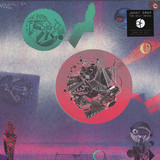
Listening to Linja’s debut LP makes one think of Polish director Yuri Norstein’s gloomy melancholic (yet playful) movies, or perhaps just of a rainy day, or Chopin.
Velvet Noise is a collection of 7 experimental pieces made by Linja sometime around 2016-2017, using drum ma- chines and a lot of modular synthesisers. The album is woven with Simple melodies that crack through the squeaks and the bleeps, eery pads that fill the voids all sorts of FX. The atmosphere becomes filled with tension when it is playing in the room, as if something is clearly about to happen. Linja’s album is not so easy to describe, and yet due to its coherence and storytelling it has a certain feel and per- sonality of a good book rather than just a record. “It transcends its existence as a record”.
Cerca:play n fill
Caiphus Semenya, AKA Mr Letta Mbulu, is a South African legend, and Listen To The Wind, his iconic debut album, is simply a superb modern-soul/boogie album. It’s also incredibly rare, especially in good condition, so Be With is delighted to present this reissue.
Now a revered composer, musician, and arranger, Caiphus left apartheid South Africa in the 60s for self-imposed exile in Southern California together with his wife, Letta Mbulu. Settling in Los Angeles he started working with the likes of Hugh Masekela and Miriam Makeba and other exiled and semi-exiled South african artists, as well as, of course, his wife Letta.
Caiphus also found himself working with and composing for a broad range of jazz and pop artists, including Lou Rawls, Nina Simone and Cannonball Adderley. His facility with both jazz and African forms served him well. His LA stay was also the beginning of an ongoing collaboration with Quincy Jones, the fruits of which can be tasted in Caiphus’s African compositions for the scores to Roots and Spielberg’s adaptation of The Color Purple.
Given his decades of work behind the scenes, it’s no surprise that it took until 1982 for Caiphus to get around to putting out the first album of his own. But all that experience shows. Listen To The Wind is a deeply impressive synthesis of early 80s US production and instrumentation together with his traditional South African musical roots.
It’s stylistically diverse but the ingredients are never diluted. There are elements of boogie, soul, funk and jazz, all shot through with pan-African flavour, and moving effortlessly from uptempo floor fillers to more meditative, slower soulful tracks. Produced by Caiphus himself, he makes full use of a stellar line up of session musicians including Nathan East, Michael Stanton, Sonny Burke and Paulinho DaCosta. And of course, there are Letta’s show-stopping vocals. To our ears, Listen To The Wind is just one big party, and lord knows we need that more than ever right now.
Opener “Angelina” is one of Caiphus’s most beloved tracks at Be With HQ. It’s a breezy, feel-good SA boogie-funk classic. Harmonic and horn heavy, it sounds as fresh today as it would’ve done in the early 80s. If this one doesn’t make you move, you may need your pulse taking. The drum breakdown alone, a little over halfway through, is sensational.
It’s followed by the gentle reggae lilt of “Play With Fire”. A real melodic slo-mo delight, carried by the tropical vibes and, above all else, by the extraordinary performance of Caiphus himself and his backing singers.
Closing out side one, the spectacular “Umoya” is driven by triumphant horns and slick bass. With its proto-Graceland vibes, we reckon Paul Simon must’ve been listening. Hard. Caiphus trades verses with the unmistakable tones of Letta, and it sounds divine. Yes, it’s as good as anything on Letta’s canonical In The Music… The Village Never Ends. A wide-eyed wonder, made for unity and togetherness, it’s all infectious, smiling faces for nearly nine minutes. But never mind nine, we could party to this for ninety minutes and “Umoya” would leave us re-energised for ninety more.
Elegantly firing up side two is perhaps the album’s best known track. “Without You” is a heavenly slice of modern soul, an end-of-nighter to end them all. Smooth strutting, disco-fied funk with that unmistakably South African sound, it’s just sublime, with those lyrics that keep coming back to smiling faces and community, “without You the sun won’t shine”. Big with the likes of Rush Hour’s Antal, this is aural perfection.
“Ziph’inkomo” is a soul-soothing, swooning epic. Gently building throughout, its final few minutes are genuinely stirring as the backing vocals and instrumentation swell. Jaw-dropping. The irresistible groove of frantic, percussive workout “Gumba Boogie” closes out what must surely be one of the greatest artistic statements of the 1980s. If his friend Quincy wasn’t feverishly taking notes for Thriller, then you could’ve fooled us.
With Simon Francis handling the mastering of this Be With edition, you know it sounds as fantastic as ever. The cover art, as breezy as the music, has been faithfully restored. All that’s missing is you.
Black Truffle is pleased to announce Ashioto, the first international solo release from Japanese drummer-percussionist-composer Tatsuhisa Yamamoto. Active for over a decade, Yamamoto has performed and recorded extensively with artists such as Jim O’Rourke, Eiko Ishibashi and Akira Sakata, as well as participating in innumerable improvised and ad hoc groups.
Ashioto presents two wide-ranging pieces that combine Yamamoto’s percussion work with piano, field recordings, electronics, and contributions from guest musicians Daisuke Fujiwara and Eiko Ishibashi.
Beginning with a passage of chiming metal percussion, the first side slowly builds into a rolling, open groove reminiscent of Yamamoto’s work on Eiko Ishibashi’s acclaimed Drag City LP The Dreams My Bones Dream. Spacious piano and synth notes, along with Ishibashi’s spare melodic figures on processed flute, hover above this propulsive rhythmic foundation, the whole effect adding up to a more abstract take on the area explored on Rainer Brüninghaus’s ECM classic Freigeweht. The LP’s second side opens up a cavernous space filled with ominous electronics and shimmering metallic percussion, which organically transitions into a passage of rumbling piano chords and mysterious concrète sound. Later in the piece, Daisuke Fujiawara’s saxophone enters, playing melancholic melodic fragments that are looped and layered, creating a seasick swaying effect familiar to listeners of James Tenney’s works with tape delay systems. Beginning as delicate bass drum pulses, Yamamoto’s accompanying percussion eventually builds the piece into a raging torrent of free-improv splatter, processed sax and fizzing electronics.
Though grounded in instrumental performance, Ashioto is very much a studio construction, making inventive use of electro-acoustic principles in its editing and mixing. Together with its sister Ashiato – a different take on the same ‘script’ released simultaneously on Japanese label Newhere – Ashioto demonstrates to an international audience for the first time the true breadth and ambition of Yamamoto’s work.
Mastered by Jim O’Rourke. Cover photos by Kuniyoshi Taikou. Design by Lasse Marhaug.
Life is full of wonder and excitement. Now it is also filled with the 14th release on Fasaan Recordings, produced by one of its founding fathers: part-time fruit picker Prins Emanuel. Gli Ornamenti comes in three different versions, which is nice. The U20 Mix is all about that sweet Roland U20 and offers us many of its decorative sounds. The Maximal Minimal Mix is the one to go to when you don’t want a lot of different stuff, but what you want you really want a lot of. The Ambient Mix is perfect to play while inspecting the grass growing under your apple tree. This is a good 12-inch single for the industrial balearic summers ahead.
Linda “Babe” Majika’s insanely brilliant Don’t Treat Me So Bad is a tight six tracks of blistering electro-flavoured bubblegum and synth-drizzled solar-powered machine-funk. It has become increasingly hard to find, with copies currently moving for over £200. But this is definitely a case of eye-watering price equalling heart-thumping quality.
Once of the Hot Soul Singers, Don’t Treat Me So Bad was Linda’s debut LP as a solo artist. It was produced by Ace Mbuyisa of boogie-funk maestros Freeway and was originally released on Umkhonto Records in South Africa in 1988.
The enormous “Let’s Make A Deal” is probably the best known track here, and it’s definitely the best one if you ask us. Linda’s vocals drip with attitude over warm, breezy synths and an urgent, edgy electro beat to create a timeless club-ready bomb that sounds as fresh as ever. But the rest of the album is far from filler.
Opening track “Kunzima (Tabalaza Mjita)” instantly brings the sunshine vibes, strutting out the gate with that unmistakable South African steppers groove. It’s a deceptively simple song, with multiple instrumental elements arriving and taking leave with admirable restraint.
“It’s Our Home” is a powerful showcase for Linda’s vocals, enhanced by some life-affirming call and response backing vocals throughout. In fact they’re a joyous presence on the whole album. The insistent pipes and swirling, bubbling synths of title track “Don’t Treat Me So Bad” follow. A spacious proto-piano house banger that closes out the first side in phenomenal fashion.
Arriving as track two on the second side, “Unga B’Omthemba Umuntu” has the unenviable task of following the huge “Let’s Make A Deal”. It does the job with class, bringing the tempo down to a mid-paced tropical bounce with lilting harmonies and welcome traces of hi-life guitar. Wonderful stuff. “Playboy” is is another unbeatable head-nod groover rounds out the set wonderfully. That bassline high in the mix is to die for, and the chorus will make any dancefloor smile.
As ever, Simon Francis on mastering duties elevates this release, adding heft and elegance in all the right places with his customary deft touch. The memorable cover art, in which Linda appears straight out of the 1950s with her polka dot skirt and butter-wouldn't-melt pose, has been faithfully restored. But don’t let the innocent styling fool you - Don’t Treat Me So Bad is the work of one badass woman who can hold her own, and then some.
Five years ago, Cute Heels brought his unique blend to Schrödinger’s Box with Nepotism. The Colombian now returns to the Glasgow label, this time with a mini-LP packed to the rim with stone cold quality.
Steady kicks give way to juddering bass and epic strings in the dynamic changeling that is “Beyond The War.” Shadows are cast by the EBM stained “Er Ist Nitch Du” and the smoky “Present Images” under the alias of Syndikat Komando Klub 98. Yet, despite these darker shades, the 12” is filled with brighter tones also. As Victor M Lenis R, “Breath of Freedom” beams with synth-disco laden lines. “Strange Forces” takes a similar path, chords shimmering against aquatic pads that bask in warmth. An italo streak enters with the playful melody and sun- soaked keys of “The Awake (Mexico City Mix), radiant notes countered by strong pulsing percussion.
Beyond The War is a record as diverse as its creator. Traversing a spread of styles, Cute Heels has created a 12” that blurs perceived genres whilst maintaining the energy and zeal of the club.
Fusing dexterous hand-percussion, hypnotic guitar riffs & soaring melodies, Waaju rise from London’s rich cultural palette with their latest album ‘Grown’, proving UK Jazz doesn’t have to sound the way we expect it to. Led by drummer and percussionist Ben Brown (Alfa Mist, Dizraeli, Ashley Henry), the band comprises percussionist Ernesto Marichales (Jordan Rakei, Sigala), guitarist Tal Janes (Nubiyan Twist, Bahla), Sam Rapley (Fabled, Maria Chiara Argiro) and Joe Downard (China Moses, Judi Jackson), each with their own strong presence on the UK’s extensive music scene. Waaju’s refined and divergent sound connects the dots between the likes of Ali Farka Touré, Alain Peters, Los Muñequitos de Matanzas, Oscar D’Leon and Beth Carvalho. Waaju formed as a means of exploring music’s hidden connections, from trance-inducing Moroccan Gnawa to Caribbean carnival music, and embracing them to reflect different shades of London’s own musical culture. It was the band’s love for Mali’s folk music – and Ali Farka Touré’s stylistic prowess in particular – that first set the project in motion. London’s Jazz Cafe invited Waaju to reinterpret classic tracks from Farka Touré’s catalogue to sold-out audiences in 2018 and 2019. According to Brown: “Ali’s one of the best. He has such a unique sound. His playing is so gnarly. His spirit and attitude are things I always think of when making music.” Waaju (meaning ‘to urge, inspire or influence to take action’ in Malian language Bambara) blends pulsing Latin polyrhythms, psychedelic Malian blues licks and cinematic textures. Following the group’s 2018 self-titled debut record, Grown presents a group more unified and distinctive-sounding than ever with six fresh, bold compositions. The record begins with Moleman, a potent reminder of the intricacy and energy Waaju’s become known for. Gritty, clattering metal defines the landscape for sizzling builds, hinting at rave culture styles like Bashment and Jungle. Listening Glasses follows and it’s clear why this is the album’s lead single – its Afrobeat-like energy and joyful interplay between guitar and tenor sax lies somewhere between Tony Allen’s grooves, Chimurenga guitar and Headhunters’ funk. On late night jam Rollando, Joe Downard’s skulking bass frequencies rule and wonkiness reaches new heights as heavy dub grooves almost tear themselves apart. Time’s Got a Hold was co-written by Waaju and Jordan Rakei for a show together in November 2018. Kicking off side B, this version features special guest vocalist Will Heard over bouncing triplets evocative of 1970’s Sega from La Reunion. A kind of looseness found only at night, the quiet drive of Wassoulou is sparse yet purposeful. Pulling back the tempo and dimming the lights, cavernous percussion fills each corner of the room, springing back as spectral reverbs. The title and final track shows the many dynamic sides of the outfit’s far-reaching sound, with its expansive harmonies and explosive psychedelia, spanning Yoruba Andabo to Hendrix, signing off an exciting and energetic second LP from Waaju at their most scintillating.
For their sophomore album, Chemical Reaction, Galaxians have stripped back the music and pumped up the vocals. Emma Mason's unstoppable voice elevates the group to a fully-formed musical act. This new LP is all about her voice.
Mason's powerhouse vocal on the West End Records-inspired Chemical Reaction beckons you onto the dancefloor. Jed Skinner's bright and breezy synth melodies allow the song to really breathe, whilst Sam Bell's front-and-centre conga groove (straight out of Double Exposure's My Love Is Free) and Matt Woodward's intricate rolls ramp up the track's energy and momentum. The shorter Mama Ghetto Vogue Edit is brought to life by Darren Pritchard, vogue dancer and mother of Manchester's House of Ghetto, who meets a neon wonderland in the electrifying video.
Elsewhere on the album, Heartbreaker champions female empowerment and personal freedom over a pounding boogie groove. It's a tight arrangement which drops into a delay-drenched Levanesque drum break before crescendoing back into a final chorus via one of Skinner's trademark JX-3P synth solos.
On the proto-house funk of Fight For Love, where Emma flexes her vocal chords to jaw-dropping effect, a failing relationship is thrust into the spotlight over a punchy Linn Drum groove. On the silky shuffle of after-hours jam Work It Out, which brings to mind the classic Sly & Robbie Compass Point productions, Emma croons about a lover, her voice cast in a softer, more subdued glow. Heat of the City sizzles with the essence of an urban summer, and is peppered with heart-stopping hand claps.
Third single Horizon sees the band in more reflective low-key mode, and could be their minor hit of the summer. There's some neat drum programming here, intertwined with Woodward's intricate fills and hi-hat playing.
On Not The Money, Mason's vocal shifts to a lower register in the mid-section, bringing to mind Grace Jones at her most commanding.
All in all it's a life-affirming experience, one born out of a sense of community and collaboration. Seven years on from their early explorations Chemical Reaction sees Galaxians retain sight of the principles that make their output, and dance music as a whole, so vital - commonality of experience, singular moments shared by a crowd, and rhythm as the best medicine.
A focal point for the unique punk-funk that was coming together in Bristol as the bridge from the 70s to the 80s arrived, Maximum Joy was formed by Glaxo Babies multi-instrumentalist Tony Wrafter and 18 year old vocalist Janine Rainforth. Soon they drafted in additional Glaxo Babies in the form of drummer Charlie Llewellin and bassist Dan Catsis, along with guitarist John Waddington, fresh from The Pop Group. The group set about making a one-of-a-kind mix of funk, punk, pop, jazz, dub, soul, afrobeat and reggae; creating a brilliant burst of danceable tunes wrapped around elastic basslines and complex percussion, punctuated by melodic horns and stabs of guitar, all of it highlighting Rainforth’s naturally enthusiastic vocal style. They immediately took their place on the rosters of influential labels like Y and 99 with iconic debut single Stretch, as the band had clearly captured something special.
Entering 1982, Kevin Evans had replaced Catsis as Maximum Joy set out to make what would be their only full length LP. Recording at Berry Street and The Lodge with producers Adrian Sherwood (On-U-Sound legend), Dave Hunt (Flying Lizards, Pigbag, This Heat) and Pete Wooliscroft (Kate Bush, Talk Talk, Peter Gabriel, OMD, This Heat) the band would mix practiced grooves with imaginative improvisation. The results were absolutely jaw-dropping.
Station M.X.J.Y. kicks things off with Dancing On My Boomerangand promptly sets forth the blueprint for bands like !!! and The Rapture to capitalize on nearly twenty years later. In fact, those bands can only dream of the mix of driving percussion and spectral shards of guitar that Maximum Joy has clearly already mastered. Do It Todayannounces itself immediately with Rainforth delivering a looping and infectious vocal melody that the others dance around playfully, as handclaps keep the stomping groove intact, leaving a dancehall hit for outer space circling your turntable.
If you ever wondered what it would sound like if ESG and The Slits combined forces, Let It Take You There has the answer for you. Llewellin periodically delivers a cascade of marching band percussion while Waddington’s classic R&B riffs are transformed into a slithering snake trying to keep pace with Evans locked in groove as Rainforth’s singsong vocals are reduced to whispered echoes. They close out side one with the delicious slab of pop that is Searching For A Feeling. Clearly pronouncing the band’s intention to find the positives in a dire time for England, they look to rally those around them to focus on making real change in the face of opposing voices via one of Rainforth’s most delightful deliveries.
Side two sees Wrafter stretching out on Where’s Deke?, showcasing what had already been obvious, as he is the band’s secret weapon, often coloring each tune with his horns, sometimes in several styles just seconds apart. He underlines that feeling with the raucous and bouncy Temple Bomb Twist, before they hit a straight groove in Mouse An’ Me, like a dub infected Train In Vain. Well, if The Clash had ever allowed themselves to properly lose their minds on the dancefloor.
A funky afrobeat flute and guitar battle breaks out (way cooler than it sounds) before Rainforth rallies the troops to not only fill up the disco, but also the surrounding streets in political resistance to Thatcherism via All Wrapped Up. It is entirely genuine and their activism has none of the menace of the others in their scene, but rather a feeling of sharp optimism amongst this danceable masterpiece. It is that optimism that always set Maximum Joy apart, and makes their grooves all the more irresistible today.
Sadly, the upward trajectory of the band was cut short as Rainforth left the group, and soon afterwards seemed to stop making music altogether. The reasoning seemed destined to remain a mystery, until earlier this year when she gave a brave interview to The Guardian where she revealed that an assault by someone in the industry caused her to retreat entirely from music for nearly three decades. Luckily, Janine has embraced music once again, and she refuses to let the magic that was Station M.X.J.Y. be lost as well.
For the second instalment of Subaltern’s 2020 program, we welcome one of the scene’s best-kept secrets – Imajika. The three hard-hitting tracks take listeners on a sonic journey through tribal rhythms, punchy drums and immaculate sound design. Calling upon ancient forces, Imajika makes a powerful statement with the Stagger EP.
Stagger
Ethereal glass chimes sing in the distance underneath an airy pulse to create an eerie intro until the groove enters to break the tension. We are offered a moment to breathe before being submerged by staggering drums driven by powerfully persistent bass-waves. Playful dubby FXs, gritty wobbles and naughty drum fills keep the head nodding throughout this stomper. After offering one last breath, the second drop hits with a relentless grunt that leaves us gobsmacked and then proceeds to devastate any sub to cross its path.
Unti Pundi
Mystical textures set a ghostly tone, overlaid by the meditative ‘Unti Pundi’. We are whisked through the caverns of time - space is created through reverbs and echoes of snares and droplets. A sinister pitch-oscillating synth takes your hand and as Imajika takes you deeper down the rabbit hole. Evolving basslines and masterfully placed drum fills add new depth to this monstrous beat before a shattering second drop wreaks havoc - Imajika shows no mercy.
Inside the Sycamore Root
Foreboding voices whisper in a secret language, seemingly summoning ancient spirits in a circular tree-based ritual. A cataclysmic drop fused with a tribal rhythm and propels us deep Inside the Sycamore Root. The spirits have been awoken. A gnarly bass pulsates as calls of the wild and menacing laser-synth stabs respond to the ancestral voices. The summoning continues and takes us even deeper into the wilderness as rumbling bass and tribal percussion take over - the descent into the great unknown continues.
Rising Manchester star FINN takes the helm for the next release on Ruf Kutz with two hyper-real contemporary raw bangers crafted for maximum emotional impact backed with remixes from RK big guns RUF DUG & GLOWING PALMS.
Even though he's a comparative youngun, this is by no means Finn's first time at the rodeo - he's a label boss, an NTS pioneer, a Boiler Room veteran, a Defected Records Old Boy and also holds down the coldest twitter account on the information superhighway. It's a big deal to us that we managed to snare him for a release on his ascent to whatever accelerated dimension he is headed for.
Purposely conceived as raw club tracks after a heavy Paul Johnson listening session, TRICK TRICK and BELLE THEME contain many of his beloved hallmarks while also showcasing new creative pathways - the title of the EP surely alluding to what Finn is about to pull from up his sleeve...
Opener TRICK TRICK is many things all at once - a raw turbo-jacker, a hugely emotive bassline roller, a super-fresh club banger that has few elements, yet uses them with such efficiency it's impossible not to be drawn up into its vapour trail.
BELLE THEME winds the pace & harmonic tension up with manic abandon as we find ourselves in Finn's familiar 130-plus territory but while the tempo is slamming he somehow manages to drape everything in a lacy coating, as if we were playing a bonus level from a lost Studio Ghibli PS1 beat-em-up.
Back in the real world we flip the record for 2 textbook Ruf Kutz remixes. First up label boss RUF DUG guts Trick Trick and serves up the fillet on an unashamedly tech-house bed, purpose-built for DC10 circa 2009 - meanwhile Ruffy's partner in crime GLOWING PALMS dips into his secret stash of double doves and takes Belle Theme for an unforgettable night out in a Burnley warehouse.
Of the release Ruf Dug says "It's been a big thrill to follow Finn"s development over the years since we first met. I've been hoping to collaborate with him for quite a while so for it to be finally happening especially at this stage in his career is a genuine mega buzz!"
Finn says: "Been a keen Ruf Kutz fan since Rachel's Team in 2016! So happy to contribute to the label with two rough (ruf) and ready club tracks - late night/early morning hymns"
When some hardcore funk 45 collectors told us that Starfoxx's dance floor filler "Oh Linda" was a new discovery to them we were pleasantly surprised to say the least! Not only because of their opinion but also because we love that tune too we decided that it needed a re-release on 45. "Oh Linda" is on both sides so you can play one side to death while the flip remains clean and fresh!
As we travel further along the murky 2020 time-continuum we are pleased to deliver the next release for Pure Space Recordings. This time from one of Melbourne’s most acclaimed producers, Rings Around Saturn.
Rings Around Saturn delivers us with two club focussed tracks that skilfully toe the line between electro and bass music.
On the A-sde you will find ‘Grip’, a heavy hitter that’s weight comes from the deep sub-rhythms and hefty drum programming. The melodic, acid-infused arpeggios that fill the tracks body seemingly pull you further and further off the ground until finally the suspension is released through a glistening breakdown.
On the flip you will find ‘Subterranean Electro’, a track titled aptly to describe its heady electroism. Here deep bass is met with skittering pads, and tension fuelled melodies whilst a constant rhythm that feeds the tracks subterranean ecosystem. The gritty melody is fast and jittery keeping you on your toes whilst you complete your journey.
A1 was first played at Inner Varnika Festival 2019. B1 was included in Andy Garvey’s RA Podcast.
- A1: Harold Berty - Django
- A2: Ti L'afrique - Pop Soul Sega
- A3: Claudio - Qui Fine Arrive
- A4: Paul Labonne - Ti Malgache Ti Madras
- A5: Georges Gabriel - Pop Sega
- A6: The Features Of Life - Soul Sabattah
- B1: Roland Fatime - Silvie
- B2: Jean-Claude - Machin Sex
- B3: Joss Henri - Apollo Pop 76
- B4: Coulouce - Beau Pere
- B5: John Kenneth Nelson - Change To Maniere
- B6: Lelou Menwar - Capito
- B7: Daniel Delord - Maria
Killer 13-track compilation of 70's music from Mauritius that evolved from the original sega genre - the music of the slaves as well as their descendants, sung to protest against injustices in Mauritian society.
Created at the crossroads of Afro-Malagasy, the 70s strain fused Western and Indian cultures, pop, soul and funk arrangements, syncopated polyrhythms, saturated guitars, psychedelic organs and Creole vocals. Although the exact origins of sega remain unknown, it contains vocal and percussive practices that originated from Madagascar, Mozambique and East Africa. A social escape and a space for improvisation, satire and verbal jousting, it transcended everyday life and made room for the expression of conflicts and the transgression of taboos.
The main instrument of sega is the ravanne, a large tambourine-like drum made of a large wooden frame and goat skin. It is accompanied by the maravanne, a rectangular rattle filled with seeds, and other homemade forms of percussion. Eric Nelson a solo guitarist and arranger, set up the band Features Of Life which, in the mid 70’s, gave birth to a new sound. Fuzzy distorted guitars and funky beats invite each other to play over the unbridled beats created by fabulous drummer Raoul Lacariate.
The band accompanied a new wave of singers, including the atypical Joseph Roland Fatime aka Ti L’Afrique, a hyperbolic and hyperactive character, a fan of blues and James Brown who launched an explosive raw, and funky style of sega.
While it’s undeniable that Eric B & Rakim crafted and concocted classic after classic back in the Golden Era of the late 80’s and early 90’s, very few of their records could ever be classified as ‘dancefloor fillers’. But that’s exactly what ‘I Know You Got Soul’ was.
The duo’s third single was released at a time when their debut LP, 1987’s ‘Paid in Full’ was already being hailed as a gamechanger. Rakim’s smooth but sombre flow had introduced new phrases to the hip-hop lexicon, while the barrage of James Brown samples had declared open season on the Godfather of Soul’s back catalogue.
There were already stirrings of a backlash from the more frequently sampled artists at the time this came out, and the fact that it took not just its main hook but also its title from Bobby Byrd’s James Brown-produced 1971 single was almost like rubbing salt in the wound. The hip-hop fans and the dancefloor didn’t care – this played all summer long in 1987, elevating the group to a Soul Train performance.
Only months after this dropped, the UK collective M|A|R|R|S turned Rakim’s “Pump up the volume” line into the basis of their own hit. Pop will eat itself.
The original 7” was released in a no-frills generic sleeve – this re-release comes with a brand new cover utilising some of Dan Lish’s trademark artwork.
The Devonns dust off the golden age of 70's Chicago Soul with their self-titled debut album on Record Kicks. Straight from the streets of Chicago, Illinois, The Devonns (pronounced "De vaughns") are the brand new soul outfit and the latest addition of the Record Kicks' family, whose self-titled debut album that drops April 03, is an assortment of influences taking us back to the heyday of soul.
Drawing influences from bands such as The Dramatics, The Isley Brothers and Leroy Hutson, yet bringing in their own unique modern twist, influenced by artists such as Jamie Lidell and Raphael Saadiq; singer Mat Ajjarapu explains how unintentionally, the rich heritage of Chicago's history with soul music influenced him.
"The city was at the epicentre of a lot of good music back in the 50's all the way to the 80's, a lot of the labels specialising in soul were based in the Chicago and we even had our own sound known as "Chicago soul". Through several years of crate digging it surprised me how many songs I loved were recorded in this city, for example one of my favourites is this great little song by The Natural Four, produced by Leroy Hutson 'Can This Be Real', and released via Curtom Records."
The band started in 2016 after multi-instrumentalist and songwriter Mathew Ajjarapu dropped out of med school and found himself unemployed and drifting. Listening to music constantly at the time, he found inspired to put a band together and create his own music. Pairing up with some of the best musicians Chicago has to offer, he founded The Devonns: the rhythm duty is entrusted to Khalyle Hagood (bass), Ari Lindo (guitar) and Khori Wilson (drums).
Originally he wanted to focus on 50s style doo-wop, similar to The Flamingos; rich in reverb and vocal harmonies, but in the first initial practise they had it was evident the band clicked on their love of soul music from the 70s, so their music took a natural turn towards that sound, with tracks such as the Wilson Pickett-esque single 'Tell Me'.
The release took almost two years to complete as Mat explains "I am a perfectionist, I had a very specific vision in my head about how it should sound and I wasn't going to rest until I achieved it."
"This is a definitely a throwback soul record, as well as being drawn to lush and intricate arrangements of Motown, I was also inspired by the more lo-fi works of smaller labels such as Chess and Capsoul, and I wanted to capture the magic they had in those recordings in our record, as everything feels too precise nowadays" clarifies Mat.
It was thanks to his engineer Mike Hagler, who introduced him to Paul Von Mertons (Mavis Staples, Paul McCartney, Elton John) who arranges and conducts for Brian Wilson's live touring show and after a 45 minute phone conversation about what Mat wasn't keen on, on the album, he realised Paul totally understood where he was coming from.
After a few months wait for Paul to get back from touring they entered the studio with "Paul's players" and as soon as they hit record, Mat explains "I was getting chills up my neck, it was one of the happiest days of my life, and finally we had nailed it!"
Tracks such as 'Come Back; which Mat wrote in ten minutes on a $300 Daneelectro Singlecut guitar initially, came to life, with Paul's rich string arrangements and features guitarist and percussionist Ken Stringfellow (R.E.M.).
It still took a few months to get the recording process finished but finally after a torturous nineteen months they album was finally finished.
The result is an album filled with lavish arrangements and catchy melodies which take us on a nostalgic musical journey inspired by chic 70s soul, yet the band don't hesitate to add their own unique and elegant contemporary stamp to the record.
Noraj Cue returns home to Happy Camper Records to introduce his latest musical adventure ‘Inner Glitch’, a fantastic full length album series. It comes as an emblematic sampler on vinyl followed by a trilogy of digital releases.
This Dutch artist likes organic sounds filled with real world dust and compelling grooves. He explores every corner of the house realm and always makes musical stories that keep you locked. Constantly tinkering with drum and synth, Noraj Cue has applied his unique talent for experimentation to one studio and one album.
And in a career that spans 15 years, his creative touch has impacted the EP's of Tale and Tone, Katermukke and Connaisseur Recordings.
Noraj Cue offers up a musical thesis with Inner Glitch. He explores what he posits is the three aspects that comprise the being of human beings. He suggests that in life we are either presenting our outer self (polished, camouflaged, rehearsed), our inner self (vulnerable, protective, emotional) or our core self (connected to life itself and fundamental to the fulfillment of our self-expression).
His music explores the amorphous space of each self and the indistinct places they meet. "Your feelings and perceptions, is that you? Or are these them?” The exploration of which has taken this courageous artist on a musical epic. And now, simply by closing your eyes after hitting play, so can you. Things kick off with the lush deep house synth-scapes of 'This Won't Last' and take in wonky melodic grooves.
WRWTFWW Records is too happy to announce the much anticipated official reissue of Japanese duo Inoyamaland’s quintessential ambient/environmental/electronic album Danzindan-Pojidon, produced by Haruomi Hosono and originally released in 1983 on his Yen Records label. Available outside of Japan for the first time, the new age classic comes as a limited LP with liner notes by band member Makoto Inoue.
With Danzindan-Pojidon, Yasushi Yamashita and Makoto Inoue created what they describe as "a special place where the kingdom of summer vacation never ended". Playful and magical, it’s a sonic landscape defined by tinkling synths, floating minimalist melodies, pastoral excursions, and mythical overtones. The 10-track adventure takes the listener on a joyful audio exploration of unknown but friendly territories, like childhood memories of an imaginary island where everything is vibrantly alive and peaceful.
The original recording sessions for the album took place in an apartment filled with Inoyamaland’s "favorite things and friends" and the wonders that came out of them were handed to master Harry Hosono who added his undeniable genius touch. And thus Danzindan-Pojidon was born, an absolute must-have, sitting in the pantheon of all-time 80s Japanese ambient greats alongside Midori Takada’s Through The Looking Glass, Hiroshi Yoshimura’s Green, and Satoshi Ashikawa’s Still Way - and holding that mysterious power of "music that makes life a little easier and happier".
- A1: Ouverture
- A2: Les Règles
- A3: Sirine
- A4: Concerto Pour Batterie Et Cour De Récréation
- B1: Savana, Céline, Aya (Pt 1)
- B2: Savana, Céline, Aya (Pt 2)
- B3: Your Hands
- B4: Koh & Sam
- B5: Mikado Walking
- B6: Poltergeist
- B7: Esatabemakuru
- B8: Tetris Synths
- B9: Tetris Crystal
- C1: I Think The Game (Pt 1)
- C2: I Think The Game (Pt 2)
- C3: I Think The Game (Pt 3)
- C4: I Think The Game (Pt 4)
- C5: Dribbles & Beats
- C6: Camarades
- C7: Rollercoaster (Pt 1)
- C8: Rollercoaster (Pt 2)
- D1: On Top
- D2: I Love Vertigo
- D3: Game Rule
- D8: Générique (Benjamin)
- D4: Le Jeu De La Phrase
- D5: Wolf Music
- D6: Les Anneaux De Saturne
- D7: Wolf Music (Finale)
Christophe Chassol is reshuffling the deck. After making his name worldwide with three magnificent ultrascore compositions (Nola Che?rie in 2011, Indiamore in 2013 and Big Sun in 2015), working with Solange and Frank Ocean, and playing the most prestigious halls, he's taking his quest to arrange reality even further with Ludi, his new project that includes an album, film and show. It's play - an all-important word in music - that underscores this impressive, masterful construction freely inspired by Hermann Hesse's The Glass Bead Game. Everything is part of the melody: a playground or basketball players in the suburbs, an arcade in Tokyo, a roller coaster, singer Crystal Kay and rapper Kohh. Solo musicians were filmed in rehearsal, like flautist Jocelyn Mienniel and the composer's partner, drummer Mathieu Edward, who managed to reprise on stage
Chassol drew from the great German author's utopic book, where music, mathematics, aesthetics and spirituality intermingle, to create a passionate work produced by Bertrand Burgalat's label Tricatel that once again justifies his special place in the musical landscape.
With Ludi, Chassol directs his own round of Hermann Hesse's game, taking on the title of Magister Ludi, master of The Glass Bead Game. With this double album, Chassol realises his ambition: to compose unprecedented music that fills us with joy and prompts reflection.
After contributing with a remix in 2018, made of concrete invite Johannes Volk for a full-length artist release. A scene veteran, Volk is known for his releases on Jeff Mills’ Axis Records, Patrice Scott’s Sistrum or Steffi’s Dolly imprint or for his live appearances in staple clubs Berghain, Tresor, Panorama Bar, Golden Pudel, or Corsica Studios to name a few.
Opener 'Soldered Minds' introduces a dense, energy-filled dynamic that’s both impactful and intriguing. Label chiefs Rebar give the track a 'Hum' remix treatment, adding layers of sizzle and flow that transform it into an afterhours-ready alternative. Undulating basslines stand at 'Magma In Slo-mo’s base, a track that offers a solid anchor and great tool for the dancefloor. The haunting, glitch-laden 'Asphalt Flowers' brings unpredictability with its jittery, uneasy atmosphere that, if played at the right time, is the perfect trigger for a descent into dance delirium.
- 1: The Faltering Sky
- 2: Intrinsic
- 3: Room
- 4: Exit Ghost
- 5: Valse I
- 6: August 2-22
- 7: Shuiyeh
- 8: Berlin 6-11
- 9: White Sun
- 10: Undertow
- 11: Mayerling
- 12: Ferndell
- 13: Alcina
Part II[16,18 €]
Die Cut Sleeve with download. It’s a strange betweenworld, bookended by sleep and the jolt of being wide awake in a place where you wonder how you got there. You know the feeling… It seems familiar but the colours are, well, unreal. In a high-ceilinged room, a grand piano plays lush melodies as, meanwhile, somewhere, an Alice In Wonderland clock ticks, cellos are bowed, a swarm of something vibrates and the hallucinatory crowd around Rosemary’s Baby babble. An echoey electronic hum builds and falls like a 50s refrigerator passed through and effects board, things run backwards, staccato strings are plucked… and that’s not the half of it. “I’ve never been happy staying in one particular school of musical thought. The fun has been turning things on their heads, to try something you were not supposed to do.” We’re on an immersive and adventurous travelogue with the former member of the legendary Tangerine Dream, Paul Haslinger - this is a man who knows how to build tension, hold moods, illustrate contempt, lies, passion and pleasure; He can create fear, loathing and love - he’s been unlocking the nuances of such emotions in a hugely successful career as a TV and film soundtrack composer (Halt And Catch Fire, Underworld and the Golden Globe-nominated Sleeper Cell). ‘Exit Ghost’ is his long thought out opus, a moment caught in time, flicking through reference points, taking an ethereal excursion that permeates musical genres as it becomes awash with intricate sounds and cross-pollinating rhythms. Built originally from the warmth of his grand piano ‘Exit Ghost’ resonates with purity and power, from an eerie and evocative betweenworld, that’s at once expansive and rolling, then intoxicating and suffocating in equal measures; modern composition at its most uplifting; cerebral, celebratory, intense and beautiful. “The soul searching in connection with this record was extensive. Finding places of resonance, giving a colour to your memories. It was more challenging because it’s not somebody else’s narrative. Finding the core of your own story can be the most difficult task of all.” Created over the span of eight years and filled with literal and personal references, the album itself is a testament to the search - a quest filled with hints, particles and suggestions.
- A1: The Explosions - Hip Drop
- A2: Aaron Neville - Hercules
- A3: Bo Dollis & The Wild Magnolia Mardi Gras Indian Band - Handa Wanda
- A4: The Meters - Handclapping Song
- B1: Eddie Bo - Check Your Bucket
- B2: Professor Longhair - Big Chief
- B3: Cyril Nevilille - Tell Me What's On Your Mind
- B4: Lee Dorsey And Betty Harris - Love Lots Of Lovin
- C1: Mary Jane Hooper - I've Got Reasons
- C2: Lee Dorsey - Who's Gonna Help Brother Get Further
- C3: Huey Piano Smith & His Clowns - Free Single And Disengaged
- C4: Eddie Bo - Hook'n'sling (Pt Ii)
- D1: The Gaturs - Gator Bait
- D2: Danny White - Natural Soul Brother
- D3: Ernie K Doe - Here Come The Girls
- D4: Dr John - Mama Roux
- E1: Allen Toussaint - Get Out Of My Life Woman
- E2: The Explosions - Garden Of Four Trees
- E3: Robert Parker - Hip-Huggin
- E4: Chuck Carbo - Can I Be Your Squeeze
- F1: Gentleman June Gardner - It's Gonna Rain
- F2: Marilyn Barbarin - Reborn
- F3: The Meters - Just Kissed My Baby
- F4: Sonny Jones - Sissy Walk (Pt Ii)
Album features Ernie K Doe’s ‘Here Come The Girls’, The Meters, Eddie Bo, Professor Longhair, Lee Dorsey, Wild Magnolias and more.
This is the definitive collection of New Orleans Funk featuring acknowledged masters next to some of the earlier artists who shaped the meaning of funk. The album is also filled with many rare, sought after and undiscovered funk tracks. It covers the period from the emergence of New Orleans Funk in the early 1960's through to the mid-seventies.
The record is an essential part of anyone in any way interested in Funk's record collection. It has some vital ingredients in it that you can't find elsewhere. With the sound of the New Orleans Funeral March Bands, Mardi Gras Indian Tribes and Saturday Night Fish Fries all as inspiration New Orleans Funk developed into a unique sound.
New Orleans is a port town. Originally owned by the French, this was where many slaves were brought from the West Indies. Many of these slaves came from Haiti and brought with them the religion of Voodoo and its drums and music. It became one of the first parts of America to develop a strong African-American culture leading to the invention of Jazz in the early 1900's.
A main feature of Jazz in New Orleans were the Jazz Funeral Marching bands. Solemn Brass bands accompanying a coffin would, on burial, be joined by a second line of drummers and dancers which would turn the event into a celebration of the spirit cutting free from earth. This African tradition is strong in New Orleans and still goes on to this day. The backline drums play a syncopated style that is neither on the beat nor the off-beat. It is these rhythms that are the basis of New Orleans Funk.
The album comes with a booklet presenting a historical explanation to how and why this music came about, and with lots of information about the people involved.
Reviews: "A Perfect Primer For Funk Fans" Q (Top 5 albums of the year). "Probably the finest compilation that Soul Jazz has released. Essential" Time Out.
- A1: Graham Dee - Another Night Alone
- A2: Graham Dee - Sampaguita
- A3: Maxine - A Love I Believe In (Horn Version)
- A4: Mike Berry - Soul Ride (Ascete Mix)
- A5: Graham Dee - Carrie
- A6: Graham Dee - Cheatin' On Love
- B1: Graham Dee - As Long As I'm Close To You
- B2: Lenny White - Can't Stop Thinking About Girls
- B3: Mick’s Bunch - I Just Wanna Be Your Friend
- B4: Tony Rivers - Tomorrow's Children
- B5: Razor - It's A Hard Way But It's My Way
- B6: Graham Dee - Somethin' Else
This album is Acid Jazz’s tribute to an eccentric, a charmer, an unsung Sixties hero who still has soul. The character that is Graham Dee has lived one heck of a life, from surviving the blitzing of East London during WW2 to playing with Pink Floyd and Jimmy Page - Graham has done it all and this compilation hopes to look back at the story of his life through music.
Dee was the A&R at Atlantic Records, signing artists and producing their songs plus playing on sessions that included pre-Led Zeppelin Jimmy Page and John Paul Jones. One of his tracks, ‘A Love I Believe In’, narrowly missed being a Number 1 after Tony Blackburn proclaimed the single as his Record Of The Week, only for Blackburn to be playing the flip side, ‘The Bitter With The Sweet’.
Around this period Graham was working with the likes of Georgie Fame, Elkie Brooks and Mike Berry to name just a few and even filled in for the absent Syd Barrett on some Pink Floyd shows.
He eventually parted company with Atlantic after he damaged studio equipment whilst practising pistol fast draws and purchasing a hunting bow and accidentally firing it, flooding the office and terrifying the staff.
A lot of the tracks signal specific moments in Graham’s life that involve a lot of these stories. The stories provide the context for the tracks and this spreads a certain spirit throughout the compilation. Now in his seventies, Graham Dee is still writing, recording, performing and releasing solo records.
From the cosmic creative musical mind of Swiss/Catalan studio whizz, Zeleste Nightclub engineer, video nasty film composer, occasional Jaume Sisa (Muìsica Dispersa) collaborator and future electronic music therapy pioneer J. M. Pagaìn comes the synth-ridden, vocoder-loaded 1984 sci-funk soundtrack to Barcelona’s daytime TV response to the universal E.T. phenomena. Get ready to meet your new alieniìgena amic and the unidentified flying object of thousands of Catalonian kids’ affections through the 1980's as Finders Keepers present Pagaìn’s lost lunar modular synth score to ‘Kiu I Els Seus Amics’ (Kiu And Friends aka Kiu Is Your Friend).
From the same intergalactic phenomenon that brought such delights as Turkey’s exploito cash-in ‘Badi’ or South Africa’s lo-rent homage ‘Nukie’ to our unregulated small screens and the same craze which filled international airwaves with the likes of Extra T’S electro smash single ‘E.T. Boogie’ or the million selling Columbian ‘Cumbia De E.T. El Extraterrestre’ smash hit... not to mention a wide range of unofficial theme-tune cover versions from Holland, Austria, France and Germany (lest we forget an inspired late period Lee Scratch Perry Album).
In 1982 the diaspora from Steven Spielberg’s small fictional mid-American neighbourhood that played host to everyone’s favourite torch fingered, three toed, Skittle-scoffing space goblin touched virtually every family home in every major city resulting in one of the biggest cinematic merchandise phenomenas of the 21 st Century, resulting in an unexpected high-demand / short-supply play-off in which bootleggers, copyists and counterfeiters rose to the challenge like never before.
When Spielberg regrettably told interviewers that he had no intention of making a sequel to ‘E.T. The Extra Terrestria’ it instantly became open-season for the imitators... but way before somebody squeezed-out ‘Mac & Me’, ‘ALF’ and ‘The Purple People Eater’, a team of kid’s TV executives in Catalunya were ready to fill the widening gap in the market without haste. Created in 1983 by Luna Films and Televisioì de Catalunya (TV3) and screened exclusively in Catalunya, ‘Kiu I Els Seus Amics’ was one of the first E.T. ‘tributes’ to make it out of the gate and with a crew of five individual directors and writers to ensure that the five episode, one-off series hit the wave of phone-home-fever, Kiu has since remained a short but sweet micro- memory in the hearts of an entire generation of Catalonian cosmonauts.
This special Finders Keepers edition comes complete with all of Pagaìn’s cosmic synthesiser soundscapes fully intact (barring striking comparisons with the likes of Tangerine Dream, John Carpenter, Vangelis and the soundtrack music of Suzanne Ciani), as well as some rare, unreleased, incidental TV edits. The bulk of this LP is made up of tracks taken from the rare full-length album, which was released after the TV programme had already been aired and coincided with sales of jigsaws and rubberised play figures in an attempt to catch-up with the unexpected mega-success of the show, needless to say, with a short promotional window, the LP (and cassette edition) did not benefit a re-press and with most copies sold to children, few vinyl pressings have escaped repeat needle scratches and decorated sleeves.
WRWTFWW Records is beyond thrilled to announce the first ever vinyl maxi-single release for "Raum", Grauzone's best-kept secret and underground mega-gem from 1980. The four-track affair includes the full title track sourced from the original reels, as well as a club-ready rework by Naum Gabo (Jonnie Wilkes of Optimo and James Savage) with help from Dennis Young of Liquid Liquid, and an extended edit by legendary Frankfurt DJ Ata (Robert-Johnson club, Playhouse/Klang/Ongaku labels). The 12 inch vinyl is cut at 45rpm and comes with a never-seen cover art by band member Stephan Eicher and a handmade Xerox hype sticker.
Initally released almost 40 years ago on the beloved compilation Swiss Wave - The Album (Off Course Records) alongside the band's massive hit "Eisbär", "Raum" is the biggest Grauzone track people have yet to discover. An über-infectious New York style bassline played by Christian "GT" Trüssel and frantic drumming by Marco Repetto blend with Martin Eicher's hauntingly hopeless lyrics and Claudine Chirac's saxophone escapades to personify post-punk heaven and all its wonderful anomalies. It's disco with an edge, pop filled with fear, it's The Cure infused with proto-techno and Swiss art chic. Or maybe, it's simply one hell of a song that will make you dance and shout. It's good!
- A1: Leftfield - Not Forgotten (Dub Mix)
- A2: One Tribe - Is This All (Instinctstrumental)
- B1: Lennie De Ice - We Are Ie (Original Mix)
- B2: Zero B - Lock Up (2012 Re Master)
- C1: Wots My Code - Dubplate
- C2: Foul Play - Being With You
- D1: Noise Factory - The Future
- D2: Fallout - The Morning After (Sunrise Mix)
Fabio & Grooverider have been at the forefront of UK dance music for over 3 decades. This is the roots of their story told through music.
The 2 London DJ's are part of the DNA of the global Jungle / D&B movement and they have remained relevant, cutting edge, authoritative and essential to this truly underground art-form since it's inception. RAGE could arguably be the ground zero of Jungle. The party was started at London's cavernous Heaven club by Fabio & Grooverider in 1988, at the height of Acid House fever that was making it's way up and down the motorways, slip-roads, fields and warehouses of the M25 and further beyond every weekend, troubling the nation, the police, your parents and the press as it went. RAGE was a different beast, it certainly channelled some of that Acid energy but pitted it against the new and exciting sounds emanating from Belgium, Amsterdam, Detroit, Sheffield, Essex and Hackney and in turn created a new style, a new sonic attitude and energy in the process. Rumbling bass-lines, narcotic synth rushes and roughly chopped and sped-up breakbeats all merged into a style that we now know as Jungle. Nothing like this had been heard before, this was a brand new style and it was coming out of London's West End and Fabio & Grooverider were the people firmly behind it.
RAGE is approaching it's 30th anniversary. It's sonic and cultural legacy is still being felt today, Fabio & Groove are still shutting down raves and festivals every weekend all over the world with their superior DJ sets and musical knowledge guided by their pioneering spirit. This musical selection you hold in your hands, the first of 4 parts, sees them delve into their prodigious memories and record boxes to select a true musical representation of the very beginning of one of the UK's most unique and influential musical movements of the last 50 years. Across 4 x 2 x 12"s compilations we are taken on the journey through the sounds of RAGE, accompanied with track by track notes from Fabio & Groove themselves. This is the sound of the underground, from the inside out.
This is a masterclass in the old-school. The roots. There is no filler here, it's simply ALL killer. Lovingly selected and programmed by the masters - 'The Living Shock' & 'The Ladies Choice'. Produced in conjunction with Above Board distribution and Fabio & Grooverider. All tracks mastered from original sources and fully licensed. Mastering by Optimum, Bristol. Artwork and design by Atelier Superplus. 2019
Skyf Connection (pronounced skAyf) was a short lived project by long time friends Anthony Mthembu and Enoch Nondala. At the time they were working for Annic Music, an independent label run by married couple Anne and Nic Blignaut. Although the label was known mostly for Zulu, Sotho, Tsonga and other traditional styles, they had a few Disco releases on the label including groups like Keith Hutchinson’s Focus and Enoch’s discovery Lena, who went on to have huge success under the name Ebony a few years later.
In 1984, when an artist didn’t show up for a booked session they decided to make use of the studio time and began working on a demo. At the time Anthony and Enoch had been playing for a year at a new club called Gamsho, located on a farm on the outskirts of Kliptown Soweto. Along with Blackie Sibisi, Sepate Mokoena and Elijah “chippa” Khumalo they made up the resident house band. Due to cultural boycotts and American artists refusing to perform in the country, locals took it upon themselves to fill the market with the American sound the crowds demanded. The demo they recorded at Blue Tree Studios was going to be their product they could use to promote their brand of the American sound. They then took the demo to Universal Studios where their friend and trusted engineer Jan “fast fingers” Smit was working. It would be here that they would polish their demo into something they could take to their bosses and have pressed. Equipped with a DX 7, Linn Drum and some Juno synthesizers they were on their way. Jan lived up to his name and programmed the drums, it is rumoured he could program in almost real time, a skill that translated to the local arcade where he held high scores on many machines. Enoch would be singing and playing guitar while Anthony would do all the Bass and Keyboards. The result was 4 funky party anthems with synth work like no other recording at the time. Their take on what they believed the crowd would want to hear at the beloved club they called home.
From start to finish the 4 tracks portray what would have been a standard night at the Gamshu. Although the club would open earlier and the standard hours of most clubs was 6 to 6 , the band would start playing at 10pm. With their standard set time and Anthony and Enoch unique view on what a Disco should be, they chose the motto Ten to Ten as the album title because those were the hours when they were the stars and Disco ruled the dance floor. To get to the club was a bit difficult, you needed to drive along an empty road where thieves waited for any patrons trying their luck walking after dark. Since there was no transport during the night, the safest way to get home was to wait till the next morning to walk home. Even though in the summer months of Johannesburg light begins to peek in just after 4am, crowds refused to leave and stayed enjoying good music and company until 10am. The lead off track “Let’s Freak Together” has powerful lyrics encouraging people to let go of their worries, put aside any differences and let the music bring everyone to freak and dance together. The whole album is about the joy we can all feel when we share the same moments and how music can bring people together in a unique way, a philosophy shared with the original nightclubs of 70s New York. This approach to music is where the name Skyf Connection comes from, translating from slang to mean the connection we create through sharing, in this case Music and good times.
Skyf Connection would go on to play at Gamsho till the club’s closure in 1986. In those years their popularity lead to being booked for private events like weddings and birthday parties, as well as gigs in some other venues like Mofolo Hall. They would share the stage with many artists through the years learning artist’s songs and providing support as a backing band. After the club closed Anthony would go on to join the house band at The Pelican, another famous club located in Orlando East, as well as dabbling with songwriting for artists like Phumi Maduna and helping Enoch on many projects through the years. Enoch would ditch live music altogether and immerse himself in studio work, starting full time as a house producer and A&R for the recently formed Ream Music. He would go on to produce hit albums for pop artists like Percy Kay and Makwerhu but made his mark discovering countless artists that would become stars in the traditional market. They would remain friends until Anthony’s passing in 2016 and although Anthony is no longer with us his spirit lives in the grooves he left on this one of a kind record. His wife Vinolia will be accepting his portion of the profits on his behalf.
Infinite Tape Loops Vol.1" immediately brings to mind the emotional and gorgeous series of Albums "The Disintegration Loops" by William Basinski.
The records revolve around a very short melodic loop of approximately N/A seconds, that plays through the whole pieces from the beginning to the end. Around them, strings and pad harmonization fill the gaps with a gentle tapestry of long diluted sounds becoming the primary element of the compositions.
Timbric variations are the push that gets these compositions to flow, amplitude automations and gradual filtering develop a certain movement and introduce changes in the background-figure relationship of the two main sound actors. This floating, a heavy sound is lightly elevating, into light sounds that become grounded in appearance and disappearances, underlining a static, eternal landscape that will never change its behavior.
Following the Stardancer EP and his remix for All I Need To Get High by Damian Lazarus & The Ancient Moons, Ae:ther unveils his most accomplished and daring work yet on the highly anticipated debut album Me released on Crosstown Rebels. Blazing a trail with his natural aptitude for crafting emotive, captivating compositions that have landed him releases on Crosstown Rebels Afterlife and Fabric, Ae:ther presents his debut LP. The album is a painstakingly produced collection of haunting melodies and narcotic rhythms that display his love and inspiration for ambient electronica, deep underground music and introspective atmospheres, culminating in dreamlike soundscapes programmed with taut percussion. The album begins on Stardancer, setting the tone with gentle keys and space influenced licks that portray a cosmonaut ascending into the stratosphere. This moves into the glistening, atmospheric Finferli, where synths depict aliens conversing in a distant, just-discovered world. Sub-aquatic ambient fills We’ll be Together, boosts of energy and intricate melodies weave in and out of the vocal, locked to the dubby groove. Ice cold subtlety and the otherworldly electronics of Costes drip slowly like water down a pane of glass. A mood of relaxation and weightlessness continues on Tina, a tender beat combined with pattering echoed chimes. N.62, a special ethereal piece, features warm chords and reduced percussion, gradually developing like the morning sun rising. Mysterious, playful charm unfurls on Elf, progressive harmony teases towards a crescendo before dropping back into the hypnotic beat. Clark is light and airy, funky melody constructing an interplanetary anthem. Stimulating a brooding mood, fuzzy clicks and glitches dance on the deep bass of Spektre II, conveying dust spraying off the surface of a moon landing. The shimmering ripples of electronica on title track Me fuse with delicate human vocals creating a heart-warming, personal account of Ae:ther’s relationship with his instruments. Trademark bleeps and blips wash over natural broken beats in one last final call to his utopia in the album outro.
TXLAX is Dave Aju’s first album in five years, and we couldn’t be more pleased to present it.
As always there is plenty of fresh genre-defying ideas in the music, but this time wrapped in a much more relaxed and focussed aesthetic - a fitting personal soundtrack for the homecom-ing theme of his move back to Los Angeles from Berlin, as the combined airport letters in the title suggest.
There is a sonic stylistic bridge of sorts between the sister cities on display as well, all im-bued with that inimitable combination of raw playfulness and warm refined soul as only Dave Aju does.
From the soaring West Coast future funk opener “Bird’s Eye”, the nautical disco-not-disco of tomorrow in “Out To C” and the bugged-out broken beat flavor of “Silverfish” to the slick me-lodic electro vibes of the title track, and gorgeous shuffling deep house closer “Yulia”, TXLAX is a masterwork filled with beauty, character, and detail that will reward many repeat listens. We hope you enjoy it as much as we do!
Emotional Rescue again delves in the world of private pressings, with a reissue of British electronic pop meets proto-House duo 4AM. With copies of their self titled album now highly sought after, this timely reissue presents two of their songs as a stand alone 7".
Consisting of multi-instrumentalist Steve Kirby - piano, guitar, bass, programming - and vocalist Kevin Finch, 4AM came together after youths filled with a love of music. Following a string of band attempts, Steve dived in to the world of midi, allowing him to build a studio set up and play solo. A meeting with new work colleague Kevin quickly developed to joining forces to expand on his early demos.
Their melodic, dance-influenced pop draws on a love of Japan, OMD and The The, but also ECM jazz and a touch of "white boy soul". The TR-808 drum and hi-hats, string stabs and random acid squelches - although no TR-303 was used - highlights the influence the nascent House sounds emanating from the "second summer of love" of 1988 / 89 had in their music melting pot.
Over this, personal lyrics flow, full of honest emotions and a touch of youthful naivety thrown in - of relationships, love, sex and passions. Intended as a personal artifact, the original album was released in 1990 with no promotion or live shows and has taken until now, some 30 years, to find a cult audience. I want you with a Passion.
Sometimes in soul music history it has seemed that record producers couldn't get enough of a certain backing track, churning out singles after another, chasing for a hit that never came. The latter doesn't really apply to Pratt & Moody's "Lost Lost Lost", which just recently broke 1 million Youtube plays. While stacking up fame in the lowrider soul scene, this beat ballad also caught the ear of the West Coast record collector and dj Mike Noriega, who decided to write fresh lyrics to accompany its instrumental.
"Wondering" that came as a result was brought to life by the singer and industry insider Gerald McCauley, who turned his soul inside out for the performance. In the past McCauley has worked as a musician, A&R man for example in a project involving George Benson and Al Jarreau and even produced a book and documentary on the history of the Fender Rhodes electric piano. Here he slips comfortably into the Cold Diamond & Mink groove, squeezing every drop of heartache on tape.
This version continues the story of "Lost Lost Lost" so gracefully that one can only wonder, if there are more to come. Who will be the next poor soul to sink into this deceivingly blissful bed of roses, filled with piano, drums and slide guitar?
Hailing from Modena, the Northern Italian motor city, Strata-Gemma produce a music of beautiful symmetry, intense craft and surprising angles. Born as a club night, the trio grew out of jam sessions where musicians would play over the records DJ/producer Billy Bogus spun. Their name came about due to the core members finding shared inspiration in records they considered "hidden gems" (gemma means gem in Italian) while paying homage to the Detroit Jazz label Strata Records. Thus from a love of jazz and soul, soundtracks and library music, Strata-Gemma were born.
Where Strata-Gemma's 2018 debut album had a lush, late-night ambience about it, Autunno 1 is more intense and agitated, a reaction to extreme political and weather conditions. As with all things Italian, Autunno 1 is both beautifully sculptured and filled with wild passion while serving as an intense soundtrack to our fractured world.
Strata-Gemma are Billy Bogus (beats), Andrea Moretti (double bass, strings) and Luca Cacciatore (brass, wind). For Autunno 1 they are joined by heavy friends on drums, synth and Hammond.
Wewantsounds continues its collaboration with Bob Shad's grandchildren, Mia and Judd Apatow, to present a 2LP selection of 13 turntable-friendly Mainstream Records tracks recorded between 1970 and 1973 and showcasing the label's superb blend of Funk, Soul and Jazz. All tracks remastered from the original tapes, most of them released for the first time since their original release with a few highly sought-after ones. Liner notes by UK journalist Paul Bowler. The Mainstream sound is unmistakable: earthy, rich and funky, it's the signature sound of producer Bob Shad. After working with such geniuses as Charlie Parker, The Platters, Billie Holiday and Janis Joplin over three decades, Shad decided to go back to producing Great Black Music in the early 70s through his label Mainstream Records and started releasing a formidable series of jazz albums known as the 300 series. Released between 1971 and 1974, these albums are the main source of this set. Coincidentally, it opens with one of the two tracks on the tracklist not produced by Shad himself. Saundra Phillips' "Miss Fatback" is nonetheless fascinating as it's one of cult disco producer Greg Carmichael's earliest productions from 1975 (before he went on to produce Inner Life, Bumblebee Unlimited, Universal Robot Band with fellow producer Patrick Adams). The other track not issued by the Shad sound factory is Almeta Lattimore's 7" single "These Memories," a truly great soulful track from 1975 and now a sought-after classic on the international Soul scene. Shad's forte was Jazz, and the sessions usually used the best musicians you could think of, including Bernard Purdie, Billy Hart, Stanley Clarke, Dom Um Romao, Joe Sample, Freddie Robinson, Gordon Edwards, Larry Willis, Wilbur Bascomb to name just a few. Filled with gorgeous Fender Rhodes chords and heavy basslines, they define the unmistakable Mainstream sound which had one foot in the great jazz and bop tradition and the other in the sonic jazz explorations of the early 70s. Oscillating between jazzed-up covers of soul hits like Jay Berliner’s "Papa Was A Rolling Stone" or Afrique’s "Kissing My Love" and more introspective originals such as Hal Galper's "This Moment" or Dave Hubbard's "T.B.'s Delight", They all have this perfect balance between groove and depth. One perfect example is Pete Yellin's "Bird and The Ouija Board," a superb 12 min opus starting off with a deep abstract improvisation before switching to an up-tempo funk beat fueled by drummer Billy Hart and bass player Stanley Clarke.
- A1: Rainbow Deux (6 57)
- A2: Let Love In (6 14)
- A3: Sigh (4 08)
- B1: The Darkest Night (7 32)
- B2: Surrender Now (6 08)
- B3: Summer Is Her Name (4 37)
- C1: Are You Ready (3 18)
- C2: Streets (Keep Me Runnin’) (7 00)
- C3: Samba Dreams (3 20)
- D1: Let’s Go Deep (5 27)
- D2: We Should Be Laughin’ (3 45)
- D3: Wishful Thinking (4 00)
TThe melodically adventurous soul of Leon Ware continues its expression in his final opus Rainbow Deux, released on double vinyl on September 13th. The album features new songs recorded and performed by Leon before his health turned, leading to his transition on February 23rd 2017. Co-produced by Taylor Graves, it has stellar musical contributions from the likes of Kamasi Washington, Thundercat, Ronald Bruner Jr, Rob Bacon and Wayne Linsey.
Taylor Graves came into Leon’s musical family in 2002 when he, his brother Cameron and the Bruner brothers Ronald Jr and Stephen (Thundercat) were playing along with their schoolmate Kamasi at an L.A. jazz club. Taylor, Cameron, Ronald and Stephen became Leon’s band for his debut shows in Japan in 2002 and Taylor continued to work with Leon as his mentor and collaborator over the next 15 years.
“Leon was ALWAYS writing something or developing his musical palette” his wife Carol Ware tells us, so it’s impossible to pinpoint any single moment of Rainbow Deux’s genesis. Six of the songs go back to 2012/2013 and were released in 2014 as part of Sigh, a Japan-only CD collection heavy with Rob Bacon’s tasteful licks and Wayne Linsey’s piano vibes. The rest of the material comes from Leon’s sessions with Taylor.
Describing Leon’s and his process, here’s Taylor: “We’d start by having some great homemade food! Then a glass of wine ‘to slow down time’. After we’d have our fill and smoked our joints we’d go into his studio room to listen and create.”
The album was finished-up around August of 2016 in a back-and-forth between Leon and his go-to mastering engineer Toni Economides in the UK.
Leon worked on Rainbow Deux with life’s greatest challenge looming over him, yet it is one of his most focused and cohesive solo offerings since the 1980s. The entire record is a vibe: mellow, deep and smooth as silk. The lyrical themes are eternal, and the music is elegant, soulful and sensual.
The album opens with the hypnotic throb of “For The Rainbow”, coming on like a percussive, slow-mo house shuffle. Gilles Peterson is a fan. The exotic “Let Love In” follows, with its gradual-build Island Funk, intricate guitar picks and sassy female vocals. It explodes when it hits its stride. “Sigh” is the stylish slow jam close-out to side A. Serene guitars and polished drums create neck snapping funk, with a swaggering finger-snap strut.
Side B opens with the easy-burning broken-beaty “The Darkest Night”, the centrepiece of the album. Kamasi Washington’s lurking sax, restrained and beautiful, unfurls into the dank, sticky atmosphere of Thundercat’s signature creeping bass laid over his brother’s in-the-pocket drums. Leon’s vocals are perfect, a masterclass in seductive sax-soul.
“Surrender Now” conjures waves of vocals to swell and wash over the glossy piano, subtly bumping hip-hop drums and bubbling synth-bass stabs. It’s got the trademark Leon layers. “Summer Is Her Name” has Kamasi’s effortless, melancholic sunshine sax give way to rising tempos and propulsive rhythms.
“Are You Ready” is a total highlight (and we’ve been playing it out for ages). It’s a nimble groove of piano and synth rolling around Theo Croker’s sensual trumpet playing. Digi-soul at its finest. With lush G-Funk sensibilities “Streets (Keep Me Runnin’)” sounds like a lost Dam-Funk produced gem. All tough kicks and snares and street sounds. Leon’s hood pass will be forever intact.
“Samba Dreams” is the first of two tracks that bring a little Rio magic to Rainbow Deux. Leon created a whole body of work in partnership with Brazilian legend Marcos Valle that includes “Rockin’ You Eternally” - a hit for Leon - and “Estrelar” – a hit for Marcos. Leon channels his obvious love of Brazilian music here through more of Croker’s sumptuous trumpet, played over loose percussion. “Let’s Go Deep” is next up. A dreamy between-the-sheets quiet storm anthem and a real showcase for Leon’s vocals.
The dripping, honeyed harp-funk of “We Should Be Laughin’” marks the star turn of the brilliant Kimbra. Leon first met her on-stage to do an impromptu duet of “Inside My Love” during an open-air celebration of Minnie Riperton in July of 2014. Kimbra was working with Taylor on her music and he brought her to Leon’s house to do some writing. This was the result.
Warm synths radiate shuffling samba soul on “Wishful Thinking” as those Brazilian rhythms return to bring Rainbow Deux to a close.
During an apartment move Leon and Carol rediscovered some watercolours Leon had done years ago. One of these paintings had been dubbed “Deux Hearts” and Leon decided it should be on the cover of Rainbow Deux, getting as far as approving a draft concept for the artwork.
Carol has overseen developing that draft into the final gatefold sleeve. It brings together quotes, photographs and tributes in what is a reflection on the music, relationships and philosophy of the sensual minister.
Gerry “the gov” Brown, Leon’s long-time sound engineer, was by his side throughout the project, recording and mixing. The album was mastered by Toni Economides and Simon Francis’ additional sensitive work makes sure this double LP sounds like it should on vinyl.
Be With’s first ever release was Leon’s eponymous LP. Re-issuing that album planted the seed of a relationship that has grown to grant us the privilege of presenting his crowning achievement. We know that Leon’s fans all over the Earth will love Rainbow Deux. But we also hope that this album, the final entry in a phenomenal body of work, will reach new fans and find fresh conduits for the spirit of this oft-unsung hero of Soul.
Leon always said “they will get it when I'm gone.”
He also said that “the spirit never dies”…
- A1: Jacques Thollot - Cécile
- A2: Philippe Besombes - La Plage
- A3: Igor Wakhévitch - Materia-Prima
- A4: Mahjun - Les Enfants Sauvages
- B1: Lard Free - Warinobaril
- B2: Etron Fou Leloublan - Le Désastreux Voyage Du Piteux Python
- B3: Jean Cohen-Solal - Captain Tarthopom
- C1: Z. N. R. - Solo Un Dia
- C2: Red Noise - Sarcelles C’est L’avenir
- D1: Pierre Henry - Générique (Thème De Myriam)
- D2: Horrific Child - Freyeur
- D3: Dashiell Hedayat - Fille De L’ombre
- D4: Jean Guérin - Triptik 2
After years of mythology, misinterpretation and procrastination Nurse With Wound’s Steven Stapleton finally chooses Finders Keepers Records as the ideal collaborators to release “the right tracks” from his uber-legendary psych/prog/punk peculiarity shopping list known as The Nurse With Wound List, commencing with a French specific Volume One of this authentically titled Strain Crack Break series. Featuring some Finders Keepers’ regulars amongst galactic Gallic rarities (previously presumed to be imaginary red herrings) this deluxe double vinyl dossier demystifies some of the essential French feee jazz and Parisian prog inclusions from the alphabetical “dedication” inventory as printed the anti-bands 1979 industrial milestone debut.
When Steven Stapleton, Heman Pathak and John Fothergill’s anti-band Nurse With Wound decided to include an alphabetical dedication to all their favourite bands on the back of their inaugural LP the notion of creating a future record dealers’ trophy list couldn’t have been further from their minds. By adding a list of untravelled European mythical musicians and noise makers to their own debut release of unchartered industrial art rock they were merely providing a suggestive support system of existing potential likeminded bands, establishing safety in numbers should anyone require sonic subtitles for Nurse With Wound’s own mutant musical language. Luckily for them, the record landed in record shops in the midst of 1979’s memorable summer of abject apathy and its sound became a hit amongst disillusioned agit-pop pickers and artsy post-punks, thus playing a key role in the bourgeoning “Industrial” genre that ensued. On the most part, however, the list , like most instruction manuals, remained unreadable, syntactic and suspiciously sarcastic... As potential “real musicians” Nurse WIth Wound became an Industrial music fan’s household name, but in contrast many of the names on The Nurse With Wound List were considered to be imaginary musicians, made-up bands or booby traps for hacks and smart-arses. It took a while for the rest of the record collecting community to catch on or finally catch u
Since then, many of the rare, obscure and unpronounceable genre-free records on The Nurse With Wound List have slowly found their own feet and stumbled in to the homes of open-minded outernational vinyl junkies, D’s and sample hungry producers, self-propelled and judged on their own merit, mostly without consultation of the enigmatic NWW map. But, to the inspective competitive collector’s chagrin, one resounding fact recurs, NWW got there first! Via vinyl vacations, on cheap flights and Interrail tickets, buying bargain bin LPs on a shoestring while oblivious to the pending pension worthy price tags after their 40 year vintage, Stapleton and Fothergill, even if you’ve never heard of them, were at the bottom of the pit before “digging” became paydirt. And NOW at huge international record fairs that occur in massive exhibition halls (or within the confines of your one-touch palm pilot) amongst jive talk acronyms such as SS, PP, BIN, DNAP and BCWHES the coded letters NWW have begun to appear on stickers in the corner of original copies of the same premium progressive records accompanied by a customary 50% price hike to titillate/coerce the initiated as dealers extort the taught. Like “psych” “PINA” or “Krautrock” did before, “NWW” has become a buzzword and in the passed decades since its first publication The List has been mythologised, misunderstood and misconstrued. It’s also been overlooked, overestimated and under-appreciated in equal measures, but with a growing interest it has also come to represent a maligned genre in itself, something that all members of the original line-up would have deemed sacrilegious. Bolstered by the subtitle “Categories strain, crack and sometimes break, under their burden,” all bands on the inventory (many chosen on the strength of just one track alone) were chosen for their genre-defying qualities... A check-list for the unchart
Forty years after Nurse With Wound’s first record, Finders Keepers Records, in close collaboration with Steve Stapleton remind fans of THIS kind of “lost” music, that there once existed a feint path which was worn away decades before major label pop property developers built over this psychedelic underground. As long-running fans and liberators of some of the same records, arriving at the same axis from different-but-the-same planets, Finders Keepers and Nurse WIth Wound finally sing from the same hymn sheet resulting in a collaborative attempt to officially, authentically and legally compile the best tracks from the list, succeeding where many overzealous nerds have deferred (or simply, got the wrong end of the stick). Naturally our lavish metallic gatefold double vinyl compendium would only scratch the surface of this DIY dossier of elongated punk-prog peculiarities hence out decision to release volume one in a series which, in accordance with Steve’s wishes, focusses exclusively on individual tracks of French origin, the country that unsurprisingly hosted the highest content of bands on the list. Comprising of musique concrète, free jazz, Rock In Opposition, Zeuhl School space rock, macabre ballet music, lo-fi sci-fi, and classic horror literature inspired prog, this first volume of the series entitled Strain Crack And Break throws us in at the deep end, where the Seine meets the in-sane, introducing the space cadets that found Mars in Marseilles.
Like the Swedish flat-pack record shelves that attempt to house the vast amounts of vintage vinyl that goes into a multi-volume compilation like this, its time to prepare your own musical penchants and preconceived ideas about DIY music and hear them slowly strain, crack and b
Wah Wah 45s are very proud to announce the release of Kalba, the first album from Ghanaian xylophone master Isaac Birituro and Leeds-based producer and singer- songwriter Sonny Johns AKA The Rail Abandon. The boundary crossing duo were introduced to the world via the first two singles released in early 2019, Yesu Yan Yan and Für Svenja, and the reactions to the project have been overwhelmingly warm.
There are many differences between Isaac and Sonny, but a powerful similarity -- which gives Kalba its element of relatability -- is that desire to hear the usual done unusually and play with the shared influence of the music from afar. Named after the town in North Ghana where Isaac resides, the album is a combination of differences; a magnifying glass over the Venn diagram of our lives, the unfathomable meeting of parallel lines.
“It was clear to me that, though he played a traditional instrument in a traditional way, Isaac was influenced by the Western tinged music that filled the streets of Accra - in fact his father, Edmund, introduced him with “He plays the modern way!” Partly dismissive, mostly proud,” said Sonny. “And as this Viking sat before him played the guitar, it sounded too much like the stringed instruments of Mali for it to be just a coincidence.”
There are so many stories behind each track on this album, but the common denominators are clearly the importance of community, of preserving and presenting local cultures, the ardent desire to contribute to changing the world around us, and, of course, the love and power of music created from a genuine place.
- A1: Catherine Brénot – Et Tout Est Yin Et Tout Est Yang (Club Mix)
- A2: 1 Plus 1 – Coming Up For Air (Instrumental)
- A3: Fragile - We've Got Tonight, Boy
- B1: Jarmaz – Night City Life (Disco Remix)
- B2: Friend Of Mine – Just Your Pride
- B3: Mac & Monica – You’re So Good To Me
- B4: Sala & H – Feel The Love
- C1: Alexandra – Fantasia (Fantasy)
- C2: Gioia – No Secrets (Instrumental)
- C3: Janelle – Don’t Be Shy (Dub)
- D1: Alessandro Scellino – Dinner In The Jungle (Erotic Mix)
- D2: Brian Tatcher – Hot Love (Instrumental Dub Version)
- D3: Preludio – Mysterious Nights
Should you find yourself taking a Thames-side stroll in the shadow of the City of London, keep an eye out for the headphone-clad figure of Ilan Pdahtzur. While be-suited bankers and frustrated office workers scurry home to their families, Ilan can frequently be found casting admiring glances towards the blinking lights of towering skyscrapers while filling his ears with the synthesizer-driven sounds of lesser-known 1980s dance music.
Ilan, an avid but little-known record collector best known for sharing the artwork of obscure and under-appreciated early-to-mid ’80s club cuts on his popular Instagram feed, has been digging for vibrant, kaleidoscopic records since his teens. Now, thanks to Spacetalk, he’s been given a chance to offer a glimpse into his neon-lit nocturnal musical world.
The result is Night City Life, a killer collection of 1980s synthesizer songs inspired by Ilan’s admiration for the glow of London’s late night skyline. Over the course of 13 essential tunes, Ilan escorts us on a vibrant sprint through rare Italo-disco, steamy South African synth-boogie, fizzing American freestyle, oddball Austrian electrofunk and so much more.
There are naturally a fair few sought-after cuts present, but also a fine selection of under-appreciated gems that for one reason or other have been all but ignored since they were released three and a half decades ago. In fact, some selections are so obscure that barely any information exists about them online.
Check for example Preludio’s “Mysterious Nights”, an evocative fusion of slow electronic grooves, dreamy chords and twinkling piano motifs previously buried on a lesser-known album of unremarkable German synth-pop, or the dollar-bin brilliance of Fragile’s sweet synth-pop gem “We’ve Got Tonight, Boy”, a cut that Ilan says is capable of “wrapping itself like tendrils around your soul”. He’s not wrong.
At the other end of the scale you’ll find the ultra-rare Italo-disco breeziness of Friend of Mine’s incredible “Just Your Pride” and Mac & Monica’s soulful 1986 South African synth-boogie cut “You’re So Good To Me”, copies of which regularly change hands for hundreds of pounds online. Ilan originally reached out to the men behind the record last year to tell them how one of their other forgotten gems had been played on a Boiler Room session; naturally, they were thrilled.
There’s plenty to admire elsewhere on the compilation, too, from the waves of analogue synths, bubbly melodies and bobbing beats of the instrumental dub version of Brian Tatcher’s “Hot Love” – a cold-war era cut inspired by the idea of love blossoming in the midst of a nuclear meltdown – to the Bobby Orlando-esque freestyle bustle of Janelle’s “Don’t Be Shy (Dub)” and the sparkling post-boogie brilliance of Jarmaz’s “Night City Life (Disco Remix)”, a track Ilan has listened to countless times while admiring the midnight skyline of his home city.
Primarily based in Leeds, The Lewis Express is comprised of many of the musicians that have graced previous ATA releases: George Cooper, Piano (Abstract Orchestra) Neil Innes, Bass (The Sorcerers, The Magnificent Tape Band, Tony Burkill), Sam Hobbs, Drums (Dread Supreme, Tony Burkill, Matthew Bourne) and Pete Williams, Percussion (The Sorcerers, The Magnificent Tape Band, Tony Burkill).Recorded over an intense two-day session, 'Clap Your Hands' is heavily influenced by the classic soul jazz recordings of The Young Holt Trio / Young Holt Unlimited, and Ramsey Lewis, from who this group take their name. As with many of the classic Ramsey Lewis cuts this album was recorded live, capturing the rich inter-relationship between the players and leaving in some of that chunky room noise.
Claps your hands/Stomp Your feet was recorded during the sessions for the upcoming Album 'Clap Your Hands'. building on the template set by their eponymous debut album these tracks further explore the 60's soul-jazz of Ramsey lewis and Young-Holt and the latin boogaloo of Eddie Cano and Pete terrace. A-side 'Clap your Hands' opens with cowbell, handclaps and bass before drums and electric piano enter to carry the track onto the dancefloor. This is one for the Djs and it'll do the business in the clubs for sure, but, also perfect for a late night, sweaty house party - shoes off and beer in the sink. B-side 'Stomp Your Feet' is much more in the classic mod-jazz frame with a faster pace and funkier drums, but still with handclaps and electric piano to the foreground. Drummer Hobbs opens up 'Stomp Your Feet' in fine style, and The Lewis Express start to swing with a Ramsey-esque groover that's just made-to-measure for dancers. Everything comes together here, with a mid-60s Cadet record feel throughout. Both tracks were recorded live to tape and were recorded and mastered for a tougher sound perfectly suited for djs to fill a dancefloor.
Following the reissue of ZiadRahbani's "Abu Ali" album, Wewantsounds is pursue its exploration of great Lebanese music with the reissue of "Wahdon," released in 1978 by legendary Middle Eastern diva Fairuz and recorded during the Abu Ali sessions and including the Lebanese dancefloor cult classic “Al Bostah“. 1978 is a turning point for the Lebanese Diva. The 70s had seen her rise as an international star, playing sold out concerts in the US and in Europe, and appearing on national TV in France. She had had a long-lasting artistic collaboration with her husband AssiRahbani and his brother Elias (aka The Rahbani Brothers) who, together, had penned most of the singer's classics. In 1978, Assi who had suffered a brain haemorrhage in 1972 got weaker and the collaboration finally ended (together with their personal relationship). Their 22 year old son Ziad took over Fairuz's musical reins and set to work on their first album together, "Wahdon" ("Alone"), serving as her mother's producer, composer and musicaldirector. Wahdon typifies this key moment in Fairuz's career when she switched from traditional to more modern arrangements. The first side of the album encapsulates the more traditional side of the singer with such mesmerising songs as "Habaitak Ta Neseet Al Naoum" ("I loved you so much i forgot to sleep") or "Ana Indi Haneen" ("I'm Nostalgic"), filled with gorgeous arabic strings and percussion. The Second side though is a whole different affair. Recorded in Athens at the EMI Greece studio at the same time as the Abu Ali sessions, the two long tracksbrings a hipper, contemporary funk and disco feel that has made the album such a collector's item with DJs and diggers around the world. Clocking at almost nine minutes "Al Bostah" ("The Bus") tells the story a woman in love remembering a bus journey with her lover under a scorching heat, enhanced by an hypnotic uptempofunkified disco beat, while "Wahdon" brings a slower and jazzier underlay to Fairuz's superb singing. These tracks shocked some of the diva's fans at the time but they've since passed the test of time and have become highly sought after. Whadon has since become both aclassic Fairuz album and a cult ZiadRahbani production that Wewantsounds isdelighted to bring to a wider audience for the first time.
Doktor Normal, the latest addition to Estonia's small yet buzzing funk scene backs its nerd hop/novelty rap with MPC beats and synths. The first compositions date back to 2008, original inspiration lies in the TV series Garth Marenghi's Darkplace. Without any prior knowledge of producing hip-hop, the starting point was humor. After a 10-year hiatus, Doktor Normal got around the record an album.
"World of Ham" is Doktor Normal's début LP released on vinyl (250 copies) and digitally. The 10-track album serves as a fine example of contemporary retro-hop and electro funk with an unusual additude. Child-like creativity, pure and unfiltered flow is further exemplified by the LP cover image, and texts filled purposely with grammatic errors. The essential mantra of Doktor Normal is: make your own rules!
A very warm welcome aboard to the splendid AMERICAN STANDARD label !!
Critical & hedonistic acclaim have already been lavished on this Charleston based sonic excavator of considerable note, so we won't bore you with an exhaustive biog, mainly because there isn't one.
The music is most definitely left to do the talking as this one man 'Folly Beach Psychemagik' fills the record boxes of the world's most discerning diggers with treasure beyond measure.
So, for this latest 3 piece for American Standard we're firmly in the FM synthesis musical district of early 80's planet earth.
70's session players still strung out from the previous decades' debauchery tried their hand at piloting these electricity powered units to wildly varying degrees of success.
Luckily for you, Jaz has been kind enough to find and reload three of the finest, more esoteric, obscure but eminently playable moments from this fertile era for some primo 'back to the future' frugging...
- A1: Cecilia - Si Me Olvidas
- A2: Electropic - Cine Cha Cha Cha
- A3: Laurent Stopnicki - Amour Fonctionnel
- A4: Zig Zag - Ca S\'Arrange Pas
- B1: Bisou - Marre D\'Aimer
- B2: Milpattes - Je Vais Danser
- B3: Janou - Demodee
- C1: Martin Circus - Bains-Douches
- C2: Sonia - J\'Sais Plus Ou J\'En Suis
- C3: Fabienne Stoko - Poupee
- C4: Anne Lorric - Delivrez-Moi
- D1: Yogo - Reve De Star (I:cube Dreamy Edit)
- D2: Arielle Angelfred - Cauch\'Mar Bizarre
- D3: Ronan Girre - Je N\'Sais Pas Avec Qui
- D4: Reserve - Une Fille En Transe
Any historians keen on the subject of "French youth in the 1980s" are holding a treasure in their hands. As a true archaeologist of this decade dedicated to disposable culture, digger-in-chief Vidal Benjamin with his newest compilation, 'Pop Sympathie', offers them a unique journey in the heart of the cyclone of emotions that struck all teenagers during the first seven years of François Mitterrand's mandate. Fifteen musical nuggets, exhumed from the dungeons of history, each and every one of them teaching us about what really obsessed the youngsters at that exact moment, i.e. what happens when the city lights come on at dusk, when irrepressible urges that stir them to get lost even more appear until the end of the night.
The artists gathered here did not have the honour of breaking into the local charts, but they all individually reached for the sky. Each song of 'Pop Sympathie' tells more or less the same story: that of a girl who throws herself into the night like one immerses one's self into the void, who rushes into a one-night adventure to become a star. And too bad if in the early morning she finds herself back at square one. In all these miniature odysseys there is neon lights, lasers, smoke machines, broken glass on checkered tiles, strangers on leather benches, celebrities in the bathrooms, stolen kisses, alcohol, drugs and cigarettes, Polaroids, venetian blinds and radioactive tubes.
If the first opus of Vidal Benjamin, 'Disco Sympathie', focused on the funky mood of songs that could have been played at Le Palace, then 'Pop Sympathie' develops itself as the imaginary soundtrack of another nightclub, Les Bains-Douches, the capital’s epicenter of nocturnal drifts. So what do we listen to, blasé, at Bains-Douches? Mainly synthesizers. The child of punk and post punk, French New Wave celebrates the matrimony of machines and lolitas under the auspices of a retro trend that revisits the atomic age. Trying to surf on that wave and hit the charts, a bunch of producers (Stéphane Berlow, Laurent Stopnicki, Bernard "Black Devil" Fèvre, Johny Rech, Jean-Yves Joanny ...) will spot their talents amongst friends, in a travel agency or at the local bar. These virtual stars are called Cecilia, Laurent, Sonia, Janou, Fabienne, Anne, Arielle or Ronan, not even 20 years old, and often leaving just an overexposed photo and their first name on a single as the only memories of their swift passage in this particular musical story. It took all the love and sweet madness of Vidal Benjamin to bring them back in the light of day.
Clovis Goux
Aggelos Baltas is a veteran of the global electronic music scene, responsible for a handful of celebrated EBM 12”s as Dream Weapons, and a particularly heady and open-ended brand of krautrock as Fantastikoi Hxoi. His newest project, Anatolian Weapons, was conceived as a way to bring together these two seemingly mismatched concepts, with the polyrhythmic percussion and wailing tones of Greek folk music serving as their unlikely bonding agent. His output garners praise particularly around the Golden Pudel scene, such as Vladimir Ivkovic, and Phuong Dan. Lena Willikens, from the same circle, included Baltas’ track “Disillusioned” on her Dekmantel Selectors compilation in 2018.
But where much of what Baltas has released as Anatolian Weapons is instantly recognizable as dance music, To The Mother Of Gods—Baltas’ debut album for Beats In Space—is something else entirely. Created in tandem with Greek folk musician Seirios Savvaidis, it is a work of simultaneous collaboration and subtraction whose meticulous construction becomes more apparent with every listen. An album-length exploration of what happens when the principles of dance music are applied to pre-digital musical modalities. It is a record of psychedelic folk music that has more in common with Kikagaku Moyo, Minami Deutsch, and the Habibi Funk label than it does with anything else Baltas has produced under any alias. It’s difficult to imagine this music in any kind of club setting.
And yet, it’s very much the work of a DJ. Baltas initially heard Savvaidis’ music through a friend, and was absolutely amazed. “It was his very esoteric, pagan [music and] beautiful lyrics that grabbed me,” he writes. Seirios is a composer and performer of traditional Greek folk music with a growing discography of regional psych-rock gems. Baltas reached out to collaborate and the seeds of To The Mother Of Gods were sown.
Savvidis contributed stems of ten songs, which Baltas deconstructs and rearranges with appreciation of the ancestry of their lineage and of the deceptively ancient eerie, droning qualities inherent in the style. Occasionally augmenting Savvaidis’ recordings with his own, Baltas treats these elements as if raw materials for an architectural process.
To The Mother Of Gods showcases Baltas’ arrangement skills. He treats Savvaidis’ songs as landscapes, filling them with slanted, droning light and setting the singer’s vocals in dead center. His years behind the decks have given him an intuitive understanding of dynamics—drums crest and recede like tides, snippets of bassline repeat and swirl. He knows how to entrance, and when to push the music from the head to the body. Opener “Taratchi Katarratchi” (“Stormy Cataract”) is sung as a spell to ward off the fear of death, but Baltas’ orchestration demonstrates that dancing is an equally effective way of dispelling the darkness. The beat he assembles from Savvaidis’ playing recalls the late-night ecstasies of Primal Scream circa Screamadelica.
To The Mother Of Gods is a reminder that folk music and dance music are both powered by their audience as much as the musicians themselves. Savvaidis’ lyrics echo pagan Greek themes, touching on what Baltas calls “the magic of nature.” At times, as on “Kalesma” (“Invitation”), this can feel incantatory. Savvaidis chisels his vocal melodies into hard, clipped syllables, their cadence recalling Gregorian chant, and yet Baltas cloaks these details in washes of distortion. “Ston Stavraito” (“In Stavraithos”) is delivered with a lamentive tenderness that Baltas swells into a prideful stomp, immersing Savvaidis in marching drums and distant vocals that form a resilient protest-song. To The Mother Of Gods is a testament to the ongoing and innate truth that music can take us beyond ourselves. That repetition and drone can shepherd us to a liminal space beyond thought and rationality, where the wall between perception and reality does not exist. Call it spirit, if you want, and watch as it courses its way through modern-day dance music, mid-century psych, and the ancient sounds of the anatol.
Anatolian Weapons’ To The Mother Of Gods will be available from Beats In Space on June 14, 2019 in limited vinyl and unlimited digital forms.
Artist Highlights
• Aggelos Baltas is an Athenian music producer creating and Djing under the monikers of Anatolian Weapons, Fantastikoi Hxoi, and Dream Weapons.
• The Anatolian Weapons moniker is an outlet for Baltas to explore global music—from African to Anatolian and Middle Eastern, while also incorporating sounds from his home country of Greece.
As a visual artist and ambient composer, Tor Lundvall's work often recontextualizes the familiarity of everyday life through abstraction and space. Starting with the snapshot of a moment, Lundvall extracts its underlying complexity of the seemingly mundane and gives sleeping suggestion a presence and purpose. Mainly working sans vocals, Lundvall returned to voice exploration for 2018's A Dark Place, a somber, dark synth album that merged his mastery of textural ambience with traditional pop structures.
Rescued from old DAT tapes A Strangeness In Motion: Early Pop Recordings 1989-1999 are some of Lundvall's earliest completed synth pop works which have remained unreleased until now.
Though Lundvall's work throughout the collection has the recognizable ambient bones and sensibilities he has refined throughout his career, many of the tracks call back to the synth-driven pop of Orchestral Manoeuvres In The Dark, The Human League and New Order, with the common thread being the sparse density and mood created by reservation and the lonely impulse to twist convention, not to rip it up and repurpose it. Rather than 10 disparate ideas, Lundvall's curation of A Strangeness In Motion: Early Pop Recordings 1989-1999 feels like excerpts from a broader work, allowing the listener to fill in the holes and ladder up to his larger themes and concepts, perhaps coloring his prior works in new hues and tones.
'For years I dismissed these songs as naive and youthful relics, but I've grown much fonder of them in recent years along with the memories they evoke,' he says of the decade spanning collection of tracks, many of which were sketched out in his duo with Drew Sullivan, After The Outing. 'Original One', 'Procession Day', 'The Clearing', and 'The Melting Hour' are present here as solo reworkings, originally culled from his sessions with Sullivan. The remaining songs were ideas originally considered for Passing Through Alone (1997) and its proposed follow up, provisionally and playfully titled Femalamania.
'The title was summing up my girl problems at the time and also a silly word spin on Robyn Hitchcock's Fegmania!' he says. 'Sadly, the project was abandoned—a rare decision for me and perhaps the only time I've scrapped an album entirely.'
Idiosyncratic producer DMX Krew offers up four playful acid-tinged tracks for the Malekko Phase Mod EP, released through eclectic Spanish label/club night/promotion agency, Fanzine Records. The vinyl-only release is the first output of 2019 for the Coruna based imprint currently celebrating their 10th anniversary and is the follow up to C44's bizarro-techno Res Publica Populi Romani EP, and Dijuma's dubby and atmospheric Cold Tracks EP.
For DMX Krew's first Fanzine release the eccentric producer adopts a much lighter and brighter sound, in line with his recent records on Hypercolour and his classic output on Aphex Twin's Rephlex Records. The EP also comes hot on the heels of the prolific producer's latest album, Glad To Be Sad - twelve wavey cuts of vigorous electronic funk released in March through Hypercolour.
Kicking off the A-side with "Maleko Phase Mod", DMX Krew immediately conjures an effortlessly enjoyable mood. From the opening bars, a bouncing synth line is met with a classic acid house beat - prominently featuring the requisite skipping snares, rustic rimshots and phasing percussion that gives this track its distinctly Chicago feel. Meanwhile, shimmering chords fill the track with sunny warmth and enthusiastic energy.
Next up, "Smoke Stack" matches a groovy acid bassline with vintage drums, clusters of claps and a mischievous marimba-esque lead. Don't let the whimsy fool you, however, DMX Krew is a master craftsman at sequencing intricate synth lines and programming complex drum patterns.
On the flip, "Low Star" imbues DMX Krew's familiar elements bubbling bass, sparkling synths, and a pumping groove with a twisted 80s lo-fi essence. Crunchy claps, distorted hats, and tumbling toms keep the track bouncing at a frenetic pace, while a glossy lead contrasts with solemn pads to create a mood at once exuberant and earnest.
Closing track "Suspicion Ruff Mix" once again finds the producer riding a classic jacking 80s house beat, filling any gaps in the groove with crashing cymbals, rolling snares, and cascading claps. With his squelchy bass, vibrant lead, and oddball melody, DMX Krew concludes the Malekko Phase Mod EP with a sense of effervescent joy undeniably his own.
Infuse welcomes Pierre Codarin with an excellent three track release, ‘Pork Chop Express’, featuring a great KOKO remix to boot!
Pierre has been bubbling on the underground surface for few years now, releasing material on respected labels such as Adult Only, LAATE, Tervisio and his self-titled label was launched at the beginning of 2016 and has seen heady plays from the industries peers with each release granting praise from the media, DJ’s and collectors. Pierre brings a very raw and rich sound in both his productions and Performance with a very in-depth knowledge of record selection leaning towards a nostalgic U.S. and U.K. influence.
The title track ‘Pork Chop Express’ is a driving, rib-rattling, pad-infused, triumph of a track causing quite a stir on the floor. On the flip and ‘Lo Pan’ jacks the tempo and gets rough as Pierre drops a smorgasbord of key fills and stabs to keep this beast a grooving! Finally, following on from their brilliant ‘Generation K’ EP on Infuse early this year, KOKO deliver a blistering dance-floor led remix of ‘Pork Chop Express’, perfectly rounding off this great package.
Heist is first and foremost a label dedicated to quality house music with an eccentric angle. Promoting great music from the Netherlands comes as a close second. After presenting a lot of notable artists from our country, it’s great to showcase another young Dutch talent with our latest release: Perdu.
You might know him from his solo debut on Let’s Play House or the follow up on Optimo Music last year. Perdu’s music gets played by the big ones in the game like Hunee, Optimo and Palms Trax to name a few; and obviously, by us. We’re proud to introduce you to his “Skye EP”. His new release includes 3 varied originals and a rave anthem made by none other than our fun loving Ozzie friend DJ Boring.
The A side kicks off with “Jane’s World” and is the track that made us fall in love with this EP when we heard the demo. It’s a worldly tinged house monster, filled with harmonized drum rolls, a counting Frenchman and a funky arpeggio for good measure.
“Sacramento” takes a more introverted approach, leaning on a broken beat and atmospheric pads. The consistency of the kalimba with the vocal gives it a certain swing that got our ears longing for more.
The B-side starts with “Morbid”, a life-affirming electronic anthem, where Perdu shows his mastery of creating a proper build up. Over the whole course of the track, there’s a lead that slowly but surely opens its filter. There’s bells, harps, hand percussion and rides that all build up towards a lovely climax towards the end, while the track never feels like it’s forcing itself upon you.
Where the 3 originals are all, to some extent, quite introverted and modest, DJ Boring’s remix is anything but that. His version of “Jane’s World” is all about ravey leads, powerful percussion and huge breakdowns, which will do wonders at any festival or club closing set.
We hope to pleasantly surprise some of you, and as always, make a musical impact on your moment in the club, at home, or wherever it is you enjoy the music of our new Heist release.
Yours Sincerely,
Maarten & Lars.
Next on Berlin's Renate Schallplatten is Longhair, a project formed by Marko Pelaic and Benedikt Bogenberger, two residents of Berlin's Wilde Renate. Mangostine, a four-tracker, follows last year's 12' on Dutch label Bordello A Parigi and a track contribution on House Is OK. It lands with an Axel Boman remix. The EP opens with the title track, its name drawn from the exotic fruit. Over a brooding bassline we hear light, fluttering melodies and uplifting keys, creating a peak-time roller that'll put smiles on faces across the dancefloor. 'Pans & Pots,' the A2, starts as a darker affair with trippy vocal samples and fluttering drum patterns, before warm keys and intricate instrumentation lift the mood to make for a fun-filled jam peak-hours feel-good jam. On the flip, Studio Barnhus head Axel Boman reworks the title track into a more subtle, deeper cut; the melodies remain but in the background, replaced at the forefront by tribal drums and abstract vocals. Closer 'Aquamen,' meanwhile, opens as a straight-edged techno cut with a heavy bassline and fluttering snares, before playful keys and intermittent sci-fi samples add some texture. It's another late-night jam that'll lift the energy without ever being too forceful. The release is Renate Schallplatten's first since 2017's various artist compilations. Earlier EPs have landed from Moscoman, Sebastian Voigt, Wareika, and more.
Following their hotly tipped 2018 debut album 'On' - Altin Gün returns with an exhilarating second album. 'Gece' firmly establishes the band as essential interpreters of the Anatolian rock and folk legacy and as a leading voice in the emergent global psych-rock scene. Explosive, funky and transcendent.
Some words from the label:
The world is rarely what it seems. A quick glance doesn't always reveal the full truth. To find that, you need to burrow deeper. Listen to Altin Gün, for example: they sound utterly Turkish, but only one of the Netherlands based band's six members was actually born there. And while their new album, Gece, is absolutely electric, filled with funk-like grooves and explosive psychedelic textures, what they play - by their own estimation - is folk music.
'It really is,' insists band founder and bass player Jasper Verhulst. 'The songs come out of a long tradition. This is music that tries to be a voice for a lot of other people.'
While most of the material here has been a familiar part of Turkish life for many years - some of it associated with the late national icon Neset Ertas - it's definitely never been heard like this before. This music is electric Turkish history, shot through with a heady buzz of 21st century intensity.
Pumping, flowing, a new and leading voice in the emergent global psych scene.
'We do have a weak spot for the music of the late '60s and '70s,' Verhulst admits. 'With all the instruments and effects that arrived then, it was an exciting time. Everything was new, and it still feels fresh. We're not trying to copy it, but these are the sounds we like and we're trying to make them our own.'
And what they create really is theirs. Altin Gün radically reimagine an entire tradition. The electric saz (a three-string Turkish lute) and voice of Erdinç Ecevit (who has Turkish roots) is urgent and immediately distinctive, while keyboards, guitar, bass, drums, and percussion power the surging rhythms and Merve Dasdemir (born and raised in Istanbul) sings with the mesmerizing power of a young Grace Slick. This isn't music that seduces the listener: it demands attention.
Altin Gün - the name translates as 'golden day' - are focused, relentless and absolutely assured in what they do. What is remarkable is the band has only existed for two years and didn't play in public until November 2017; now they have almost 200 shows under their belt. It all grew from Verhulst's obsession with Turkish music. He'd been aware of it for some time but a trip to Istanbul while playing in another band gave him the chance to discover so much more. But Verhulst wasn't content to just listen, he had a vision for what the music could be. And Altin Gün was born.
'For me, finding out about this music is crate digging,' he admits. 'None of it is widely available in the Netherlands. Of course, since our singers are Turkish, they know many of these pieces. All this is part of the country's musical past, their heritage, like 'House of The Rising Sun' is in America.'
As Verhulst delves deeper and deeper into old Turkish music, he's constantly seeking out things that grab his ear.
'I'm listening for something we can change and make into our own. You have to understand that most of these songs have had hundreds of different interpretations over the years. We need something that will make people stop and listen, as if it's the first time they've heard it.'
It's a testament to Altin Gün's work and vision that everything on Gece sounds so cohesive. They bring together music from many different Anatolian sources (the only original is the improvised piece 'Soför Bey') so that it bristles with the power and tightness of a rock band; echoing new textures and radiating a spectrum of vibrant color (ironic, as gece means 'night' in Turkish). It's the sound of a band both committed to its sources and excitedly transforming them. It's the sound of Altin Gün. Incandescent and sweltering.
Creating the band's sound is very much a collaborative process, Verhulst explains.
'Sometimes me or the singer will come in with a demo of our ideas. Sometimes an idea will just come up and we'll work on it together at rehearsals. However we start, it's always finished by the whole band. We can feel very quickly if it's going to work, if this is really our song.'
Just how Altin Gün can collectively spark and burn is evident in the YouTube concert video they made for the legendary Seattle radio station KEXP. In just under 20 minutes they set out their irresistible manifesto for an electrified, contemporary Turkish folk rock. It's utterly compelling. And with around 800,000 views, it has helped make them known around the world.
'It certainly got us a lot of attention,' Verhulst agrees. 'I think a lot of that interest originally came from Turkey, plenty of people there shared it.'
That might be how it began, but it's not the whole tale. The waves have spread far beyond the Bosphorus. What started out as a deep passion for Turkish folk and psychedelia has taken on a resonance that now travels widely. The band has played all over Europe, has ventured to Turkey and Australia and will soon bring their music to North America for the first time.
'Not a lot of other bands are doing what we do,' he says, 'playing songs in that style and seeing folk music in the same way.'
A very rare remix package of STL's original material from Sebastian Mullaert on very limited edition 12" vinyl.
When I get a request to do a remix, I take that as an invitation… an invitation to express.
The sounds from the original composition become doors / gates… stepping stones for me to travel into this very moment and investigate how it is always changing (that changing being me).
I start working with the sounds… looping, playing, shaping… like a ceramist working with the clay, a painter working with the brush and paint, or the baker working with the dough. This process becomes a mantra; a meditation, and my studio becomes filled with sounds and rhythms… echoes from the original song, filtered by this very moment, temporary passing through "someone" being called Sebastian Mullaert or Wa Wu We.
Expression taking place and there are "NO MORE WORDS". Music becomes being, just Being.
STL is one of my absolute favorite artists, this specific invitation felt very special to me and the journey around the creation of the remix has been very deep.
Now I invite You to take part of it, let your consciousness express this very moment through the experience of the music. Again, being is just Being.
Much love
Sebastian Mullaert & Wa Wu We & …
Laid back and chilled out, Andrew never lets anything or anyone bother him. He has an air of mystique about him which others often envy.
(Andrea Solitario) ANDREW SOUL Andrew from his real name, Soul as the part where his inspiration come from, is a native italian producer born in 1986.
Music has been the first and everlasting love for this guy who soon came into his city's underground scene: he was 15 years old when he walked into a club for the first time. Then everything came by itself: a fusion of house and techno, the passion for the acidized sounds filled his mind and his heart.
But listening wasn't enough: the love for the music was to much for not to create something.
So Andrew started a path made by wicked grooves, dropping acid synths and emotional vibes, huge baseline, soulfoul vocals, roland tr-707 on the drums: these featuring characterize at best Andrew's sound.
The love for the analog sound push him over the years to purchase some vintage drum machine and keyboards, to make his sound as better as he can, and to add to his sound some cool old flavour.
Having DJd for years in his native Italy, Andrew turned his hand to production a few years back and promptly set about making some of the most emotive and engaging analogue house and techno around.
Vinyl collector, record lover, for him there's nothing better than watching a wax riding a turntable and listen the music that come from it.
As an eclectic artist, in his sets, Andrew likes to mix from deep to techno, through the house, but people never know what to expect from his large underground music knowledge; old, classic, brand new tunes and own productions makes his set really sophisticated and different each time.
After working on music collaborations for several years, with some friends , early 2011 was time to start sharing solo productions with his first release on Paulatine Records, wellknowed Uner's label. 4 tracks that take attention of many wellknowed djs, like X-Press2 that played the tracks at MOS and on their radioshow, Adam Port who said "Finally something different..." and many others..
Then two vinyl release: first one on the great Barcelona based Kiara Records "Too Much Love Will Kill You", Julien Chaptal on remix, and second one on the New York based imprint Stranjjur Inc, on remix Kris Wadsworth and Baldo; "Close To You" placed 29th on RA Chart.
A great tune with the close friend Frank Naht alongside a remix for Fabio Monesi on friend's label Blackrose Records, and an EP on Espai Music to follow.
End of 2012 was good: EP come out on the Defected's sub label "Tenth Circle"
November 2012 was also time for releasing on Safari Numerique with David Labeji on remix, and the track "No Way" played by Richie Hawtin.
2013 full of work and innovation, with 2 remixes on italian Moan Rec for Meeph, and U.S. based Undulate Recordings for Frank Nath, a really deep EP on his new family Popcorn Records, and jacking mode on for the new release on Safari Numerique.
2014 starts with a vinyl only release on Popcorn Records Ltd, special collaboration with Peter JD and remixes from Amir Alexander and Franco Cinelli.
The path is long and Andrew's research is still long way to end...
Franck Roger is back on his imprint Home Ivasion label for a new season with some dope upcoming
House stuff and a brand new record design aswell MOGOLDINO
We keep it funky here with that disco housey drums and stab samples filled with some dope vocal hooks. The track is all about funkyness and happiness here under the sun wich reminds me some good warehosue partys on the west coast. We are good for a real trip on this Mogoldino track :-)= SAN DIEGOFranck is taking us to a dubby - house trip kinda very trippy at the same time wich reminds us some of the old Idjut Boys in the drums and sound designs mixed with this typical West Coast sound from the 90's. The track is a fully rushed bomb for the floor wich has to be played very lood on a heavy sub system.
Easily one of the greatest roots reggae albums of all time, Soul Rebels resulted from the intensive partnership brokered by the group and maverick producer, Lee 'Scratch' Perry. It was the first Wailers 'concept' album, conceived as a long-player based on a rebellious theme, rather than a collection of isolated singles, and the presence of the Barrett Brothers in the rhythm section pointed the way for greater glories to come. The Wailers first formed as an unruly 5-piece in 1963, with Junior Braithwaite as lead singer and Beverley Kelso an early member, sometimes replaced by Cherry Green. During their long tenure at Studio One, Bob Marley gradually shifted to the lead vocal role and the robust core of Marley, Peter Tosh and Neville Livingston, aka Bunny Wailer, soon emerged as the mainstays of the group. Perry was involved with the Wailers at Studio One, using their talents for backing vocals on some of his solo work, but the partnership that yielded Soul Rebels was in an entirely different league. The title track, Tosh's anguished '400 Years and 'Corner Stone' are legendary for their intense power; 'It's Alright' set the template for the later 'Night Shift,' 'My Cup' was an individual barebones reading of James Brown's 'I Guess I'll Have To Cry Cry Cry,' while the playful 'Try Me' and 'No Water' are suggestive odes. Tosh's dejected 'No Sympathy' and the spirited 'Soul Almighty' are other winners and the 'Cloud 9' revamp 'Rebel's Hop' is another joy. All killer, no filler!
- A1: Hugo Mari - Change Ur Ways (Detroit Swindle Remix)
- A2: Kassian - Bad Habit (Alma Negra Remix)
- B1: Adryiano - Me And You And Her (Pitto's Groove Your Body Remix)
- C1: Pitto - You Treat Me Like A Fool (Kassian Remix)
- C2: Detroit Swindle - Cut U Loose (Adryiano Remix)
- D1: Alma Negra - This Is The Place (Hugo Mari Remix)
Rounding up five years of Heist also means we're releasing our fifth version of the Round Up. Last year's edition was full of highlights with Fouk remixing Nachtbraker's anthem 'Hamdi' and Alma Negra going all tribal on Nebraska's 'Big plate chicken'. This year, we've seen a lot of new faces on the label, which has brought us a fresh set of combinations and a couple of really nice revisions of the tracks that made our year.
First up is Detroit Swindle's take on Heist's latest signing Hugo Mari. They chose to remix 'Change ur ways', beefing up the dreamy original. They focus on a simple but effective grainy groove and added a twist on the bass to give a more 'warehouse' feel to it and play around with the lovely detuned keys and vocal chops of the original to great effect.
Alma Negra show you just how loose their limbs are with a Rhodes filled version of Kassian's Acid surprise 'Bad Habit', while the full B side is dedicated to Pitto's personal take on Adryiano's classic house track 'Me and you and her'. His version takes the track into a new territory that lies somewhere between balearic and dreamhouse. Whatever it is, it's got a lovely vibe where the vocal is complemented by airy pads and a touch of acid.
Kassian on their turn, have done a great job on taking Pitto's 'Treat me like a fool' into 4x4 house territory. They've opted for a sub heavy club track where reverbed hits and the vocal take turns over a solid house groove. Next up on the C-side is Adryiano. He's picked Detroit Swindle's moody-but-heavy album track 'Cut u loose' and does what he does best: a steady and nicely distorted filtered house groove that packs quite a punch. The final track of this compilation really is a great pair of artists: Hugo Mari and Alma Negra. Hugo takes the tropical warmth of 'This is the place' and adds a subtle punch with a smart percussion loop and some added pressure on the low end.
So there you go. Another year, another Roundup. We hope you'll enjoy listening to these re-interpretations as much as we do. Yours
Sincerely,
Maarten & Lars.
2018 played host to a bumper crop of sounds from some of Philly's grittiest, including Great Circles mainstays M//R and Chaperone. To close out the year that was, we are pleased to present Heckadecimal's 'Murder Tape.'
A Minneapolis-based producer and acid auteur, Heckadecimal has been a fixture within the vibrant Midwestern electronic music community for nearly 20 years. Founder of the legendary 'Anti-human' events and co-curator of the ever-prolific Always Human Tapes imprint - alongside Ryan Wurst and Peter Lansky - Heckadecimal's reputation is one of unrelenting creativity and tireless advocacy for sonic experimentation. His work has found its way to light via a slew of pseudonyms and stage monikers, including The Worm, noface and Wonder Sirens.
In short - Heckadecimal lives and breathes the sonic matter that he leaves pouring out of studio monitors, busted bar systems and finely tuned rave stacks, wherever his travels take him.
Live performance lies at the core of Heckadecimal's practice. When he stormed through Inciting HQ in Philly earlier this summer, he took command over an arsenal of hardware that reminded us of how Octave One or Shawn Rudiman might show up. These were machines that he had lived with; touched with custom modifications, hand-drawn stickers and pockmarks incurred in battle, one got the sense that the gear was a personal extension of the artist.
Perhaps it's a bit maudlin, but we feel a certain kinship with this project. Indeed, these tracks at times feel very much of a piece with the gnarled tonalities in which our stable typically traffics; all low-slung riddims that reach at equal lengths towards mutated IDM aesthetics and post-Packard Plant techno extrusions. These are future perfect grooves that glide along under the vast Midwestern sky, providing a fertile communication conduit with the City of Brotherly Love.
Give thanks for acid. Great Circles will see you in the New Year..
Ken Oath slip on their moon shoes for a joint venture with Freda & Jackson, pressing up four cuts that will have you slipping the surly bonds of earth and dancing in the skies. Loaded with basslines heavier than a neutron star and well-chopped breaks, produced with a dubwise ear for space, this is some of the duo's finest material yet 'Kendama' is the heaviest cut here, a deep psychedelic outing that's swathed in an foggy haze. Abstracted digi-flutes and koto plucks are paired with a skull-boring bassline and exacting breakbeat dissection, adding some levity to the leaden heaviness of the track's bass-weight. 'Cubone' slows but retains the hallucinatory haze that coils around all these trackers. Thudding bass anchors the floating drones and glitches, while percussion snakes through the track, building, like smoke slowly filling a room. The steady build is transportive, to the point where you hear the final echo tail trailing out into silence, and wonder how that all time dissipated Flipping over the record, 'Platform 22' is where you'll find the two of them at their loosest. Submerged vibraphone melodies and swirling voices play over a bassline that sounds like its descending the stairs, boisterous and half-drunk, to culminate in an orgiastic percussion frenzy at the end. Spacious and dubwise, 'Noggin' is a tellingly heady closer. Samples are set adrift across the track as they are dubbed-out and dissolved into smears of sound. There's a buoyancy to the whole piece, a pleasant weightlessness that keeps you floating after the final notes fade out. One time for ya mind.
Jabal is the title of the forthcoming release by Kendojubaki and Dj Ali through Berlin based Label 'Live From Earth'. The release is the second instalment of the labels Live From Earth Klub series.
'Jabal' translates to mountain in Arabic. It is also where the two artists roots trace back to in their home country of Lebanon. The listeners receive a glimpse of the socio-political issues surrounding the jabal areas across Lebanon through unique sampling
KendojubakiKendojubaki is the pseudonym of Adam Rajab, an Australian-Lebanese Sound Designer and producer currently based in Melbourne. As the son of Lebanese refugees he spent parts of his childhood working in his parents Middle Eastern supermarket. In times of recreation he and his relative Ali would pretend to be an Arabic wedding band playing the tabla and the mijwiz to imaginary dabke dancers.Hatched from these activities and through years of back-and-forth between e Middle East and Australia, Adam has captured a unique sound-language which amalgamates traditional sounds of the Levant with modular synthesis, drum machines and industrial elements of unrelenting vim. His thematic music dwells on commonly unfair socio-political issues surrounding the east and the west, displacement and identity.
As a Dj Kendojubaki's sets are filled with long Arabic intros, old school hardcore rave tracks and tempos above 140. In his own productions and live sets, kendo recombines his sound design influence into powerful and cathartic riddims, along with thick echoes un-natural like drums.
Dj Ali Dj Ali is the stage name for Ali Chahine, an Australian-Lebanese live hardware act currently based in Melbourne, Australia. In his productions, Ali fuses sounds from his archive of field and foley recordings along with 90's hardcore rave melodies to create an emotive flow of fast techno music.As the son of Lebanese refugees, Ali also shares stories of conflict and socio-political issues through his music and art. In 2018 Ali joined the collaborative label 'Al Gharib' with relative Adam Rajab who is most commonly known as 'Kendojubaki's'. The two are collaborating on a 12' release named 'Jabal' in December, released through Berlin label Live From Earth.
First ever experimental Tuareg guitar soundtrack. Original soundtrack recording to the film Zerzura, the first ever Saharan acid Western, telling the story of a nomad's search for a magic city of gold. Evoking the desert journey with free form guitar improvisations, the soundtrack is a meditation on the mysteries of the Sahara. Composed by writer and actor Ahmoudou Madassane, the instrumental score takes the familiar Tuareg guitar tradition into new directions, transforming desert blues into ambient soundscapes. Recorded in studio while watching footage from the film, the score was recorded in live and spontaneous takes. Heavily based around the electric guitar, Madassane also plays a handful of other in-studio instrumentation (prepared piano, Moog, Timpani) and is joined by a number of collaborators, including guitarist Marisa Anderson. A prolific and backing artist in a number of groups (Mdou Moctar, Les Filles de Illighadad), Madassane is well versed in Tuareg guitar folk and draws inspiration from this tradition before veering off into uncharted territory. Pieces fluctuate in timing and break free from standard rhythm, moving from melancholic serenity to blurry psychedelic fury. An experimental foray for Tuareg guitar, Zerzura is the first of its kind.
The 'Vista' EP caps off an intensely busy year for Geoff Kirkwood, otherwise known as Man Power. The British DJ/producer has become quite the 'tour de force' in 2018, with releases and remixes for Futureboogie, DFA, Correspondant, Exotic Series, Skint Records, and his very own Me Me Me imprint. So it seems quite fitting to seal a productive 12 months with a release on Richy Ahmed's Four Thirty Two, a label that itself has been firing out big releases this year from EJECA, Jansons & Senzala and Ahmed himself. And joining this big end of year party, enter stage left, Roman Flu¨gel, who delivers an absolutely stellar remix of 'Vista'. Meaty synths and clattering 909 drums are doused in futuristic Italo disco vibes for
'Outrider', whilst a winning combo of breakbeats and acid affected bass provide the backbone of the simply gargantuan 'Vista'. Roman Flu¨gel's interpretation of the title track brings the break to the fore, playfully teasing out the acidic sounds and surging strings for another truly memorable remix that we've come to expect from Mr. Flu¨gel. Closing the EP, 'Poly Pop' delivers a vivid and bright burst of melody over clanking
percussion and sturdy beats, filled with 'end of the night' optimism that's become Man Power's forte.
- A1: Debris
- A2: Pull Up Feat. Takura
- A3: Hold Me Close
- B1: Make It Real Feat. Riya
- B2: No Lights Feat. Mc Fats & T.r.a.c
- B3: Alibi - Destiny
- C1: Alibi - Scuffed
- C2: Said & Done Feat. Drs
- C3: Smash Through The City Feat. Serum, L-Side & T.r.a.c
- D1: Musihertz Feat. Sofi Mari
- D2: Alibi - Recycle
- D3: Grace Feat. Cleveland Watkiss
- D4: You Feat. Lorna King
* 13 tracks featuring the likes of DRS, Serum, Riya, Cleveland Watikiss, Lorna King, L-Side, MC Fats, T.R.A.C and Sofi Mari.and many more.
* Colourful, effervescent, and energetic, the Brazilian drum & bass scene has given us some of the most distinctive production voices in the game. Including São Paulo's Level 2 and DJ Chap or, as they're known collectively, Alibi.
* 'In each of the songs, we expressed our feelings and each song carries a unique message. The album itself talks about life. We all go through times where we fall and get hurt. Then we get up and we recycle. In every single situation: we learn.' - Alibi
* Alibi signed exclusively to V Recordings at the end of 2015, and this LP shares the characteristics held dearly by both the duo and the label. Weaving together threads from the duo's shared funk, soul, reggae, and hip-hop influences with the drum 'n' bass tutelage of shared heroes like S.P.Y., Calibre, D-Bridge and the late Marcus Intalex, this is set to be the most complete statement of their musical vision so far.
* Each track from the album stands as an example of their impeccable production, starting with 'Debris' which is filled with cinematic textures and a sub-low reese typical to their sound. The album plays home to a handful of other lighter atmospheric pieces, including 'Recycle', 'Destiny', and 3 other tracks with Riya, Cleveland Watkiss and Lorna King, all gracing the booth with their vocals. The duo can effortlessly skip between sub-genres, shown by the tracks on the LP that would be more suited in a dark club at 5am, such as 'Smash Through The City' with Serum, L-Side & T.R.A.C., as well as the floor shaking 'Scuffed' - there's a style to cater to everybody.
* With V Recordings celebrating their 25th anniversary, there really is no better time for Alibi to cement themselves as one of the crown jewels of the label and the scene as a whole.
2018 played host to a bumper crop of sounds from some of Philly's grittiest, including Great Circles mainstays M//R and Chaperone. To close out the year that was, we are pleased to present Heckadecimal's 'Murder Tape.'
A Minneapolis-based producer and acid auteur, Heckadecimal has been a fixture within the vibrant Midwestern electronic music community for nearly 20 years. Founder of the legendary 'Anti-human' events and co-curator of the ever-prolific Always Human Tapes imprint - alongside Ryan Wurst and Peter Lansky - Heckadecimal's reputation is one of unrelenting creativity and tireless advocacy for sonic experimentation. His work has found its way to light via a slew of pseudonyms and stage monikers, including The Worm, noface and Wonder Sirens.
In short - Heckadecimal lives and breathes the sonic matter that he leaves pouring out of studio monitors, busted bar systems and finely tuned rave stacks, wherever his travels take him.
Live performance lies at the core of Heckadecimal's practice. When he stormed through Inciting HQ in Philly earlier this summer, he took command over an arsenal of hardware that reminded us of how Octave One or Shawn Rudiman might show up. These were machines that he had lived with; touched with custom modifications, hand-drawn stickers and pockmarks incurred in battle, one got the sense that the gear was a personal extension of the artist.
Perhaps it's a bit maudlin, but we feel a certain kinship with this project. Indeed, these tracks at times feel very much of a piece with the gnarled tonalities in which our stable typically traffics; all low-slung riddims that reach at equal lengths towards mutated IDM aesthetics and post-Packard Plant techno extrusions. These are future perfect grooves that glide along under the vast Midwestern sky, providing a fertile communication conduit with the City of Brotherly Love.
Give thanks for acid. Great Circles will see you in the New Year..
Steve Bicknell returns to his 6dimensions label, adopting his The Evader guise once again with a re- issue release titled 'Awakening The Past 2'. Returning as The Evader for the second instalment of 'Awakening The Past', this will be Steve's fourth appearance on 6dimensions and features four tracks from 1994's 'No Hats Required' EP, which dropped on influential UK label, Cosmic Records - the tracks were originally made by Steve to be played together as a segment in various combinations. This release follows outings from 6dimensions artists Jing, Metro Skim and Heartless - continuing the label's theme of illustrating the 'human mind's natural make-up'. 'No Hats Required - Track 1' displays a locked 4x4 groove, filled with tidy modulations bouncing gracefully off the kicks before 'Track 6' offers a fast-pitched looping beat with floating percussive jitters. 'Track 2' then features twisted stab sequences over a minimal drum loop before a rolling 808 beat joins oscillating bass flutters in 'Track 3'. On the flip, Bicknell presents two new tracks recorded in 2017. 'Power Of Balance' provides cross firing synth shrills layered and tough techno convolutions to generate a rising intensity, until 'Shifting Illusion' concludes the package with minimalist dubbed-out flavours whilst flush melodies harmonise with continuous pulsations.
Re-mastering by: Ray Staff at Air Mastering, Lyndhurst Hall, London
Four-and-a-half decades after the event, saxophonist Charles Lloyd's Love-In, recorded live at San Francisco's Fillmore Auditorium in 1967, the counterculture's West Coast music hub, endures as much as an archaeological artifact as a musical document. From sleeve designer Stanislaw Zagorski's treatment of Rolling Stone photographer Jim Marshall's cover shot, through the album title and some of the track titles ("Tribal Dance," "Temple Bells"), and the inclusion of John Lennon and Paul McCartney's "Here There and Everywhere," Love-In's semiology reeks of the acid-drenched zeitgeist of the mid 1960s, a time when creative music flourished, and rock fans were prepared to embrace jazz, provided the musicians did not come on like their parents: juicers dressed in sharp suits exuding cynicism.
It is likely that more joints were rolled on Love-In's cover than that of any other jazz LP of the era, with the possible exception of saxophonists John Coltrane's A Love Supreme (Impulse!, 1965) and Pharoah Sanders's Tauhid (Impulse!, 1967). Chet Helms, a key mover and shaker in the West Coast counterculture, spoke for many when he hailed the Lloyd quartet as "the first psychedelic jazz group."
It is to Lloyd's credit that, at least in the early stages of his adoption by the counterculture, he resisted dumbing down his music. The adoption stemmed from Lloyd's espoused attitude to society, his media savvy, his sartorial style and his sheer nerve in playing jazz in the temples of rock culture. He took the quartet into the Fillmore West three years before trumpeter Miles Davis took his into the Fillmore East—as documented on Live at the Fillmore East, March 6 1970: It's About That Time (Columbia)—by which time his pianist, Keith Jarrett, and drummer, Jack DeJohnette, were members of Davis' band (although Jarrett didn't appear at the 1970 gig).
In July 2014, Jungle released their self-titled debut album. Featuring the singles 'Platoon', 'Busy Earnin'', 'Time', 'The Heat' and 'Julia', neo-soul classics all, it was the aspirational sound of young London, a soundtrack of escapism, an unmistakable Jungle sound and a unique, vivid, visual Jungle world. The whole thing was dreamed up by Josh 'J' Lloyd-Watson and Tom 'T' McFarland, a production and multi-instrumentalist duo who never expected to leave their bedroom studios, far less become the core of a talent-filled seven-strong collective that morphed into a killer live outfit. Cue online word-of-mouth and IRL buzz, rave reviews, a Mercury Music Prize nomination, songs of the summer (two summers, even), viral videos, Noel Gallagher declaring the album 'fucking amazing', half a million sales, burgeoning DJ careers, a global tour that lasted two solid years. It all just happened.
Today, Jungle announce news of the follow-up to that defining debut record. The album is titled For Ever and will be released on 14th September via XL Recordings. If Jungle's first album was their imaginary soundtrack to the places they had never been, For Ever is inspired by real life experiences of the places they'd dreamed of for so long. Swapping Shepherds Bush for the Hollywood Hills, J and T set up camp in Los Angeles to write and record the album. Over time however, their romanticization of The Californian Dream clashed with the reality of actually living it, the feeling of being adrift on the West Coast compounded by the collapse of long-term relationships. Returning home to London, they teamed up with highly regarded young producer Inflo where they sought to create a "post-apocalyptic radio station playing break up songs', whittling down loads of ideas this concept spawned into the core 13 tracks you have before you. That station and those songs and that journey are the sound of Jungle's second album For Ever. They had to go away to come home. And what J and T lost in love, they gained in music. For Ever is for real, deeper and higher, more intimate and more expansive, feelgood and, just occasionally, feelbad. It is, then, a proper second album.
Moritz Simon Geist, media artist and robotic musician, publishes his first record. It is the world's first techno record played entirely by self-made futuristic robots. This is the 4-track EP to the following full-length album out 16. Nov. 2018. All of the sounds on his records are played by robots: small motors that beat on metal, futuristic 3D-printed robo-kalimbas, salvaged parts from old hard drives that click and cut. It took Geist several years to build, tweak, test and play all his DIY robotic instruments. His 'Sonic Robots' try to push the boundaries of the imaginable. He did so already in 2012 with his well-known oversized 808 robot - an iconic drum machine gotten real, 4 by 2 meter, filled with robotic parts which play the instruments live and in front of the audience. Now, Moritz Simon Geist goes even further to discover the unknown and futuristic world of techno robotics. For this quest he teamed up with the berlinian sound wizards from Mouse On Mars and dug deep in the history of mechanical music and experiments of early electronic music.
On the 4-track EP 'The Material Turn' Moritz Simon Geist turns materials into sounds. The opener 'Entropy' is a bassy club-track, played by futuristic bass-kalimbas, a psychedelic pattern of tonal glasses and pneumatic hi-hat patterns. It is core piece to this EP and is also featured in the main video. Even without a visual part, listening to his music, a sound world opens up which is unheard before: in definition, reference and organic nature. Geist: 'When you listen to robots playing, you realize, that they sound precise, but in contrast to digital sounds they transport an immense organic feeling. No beat is like the other, everything is played with actual acoustic physicality and thus actual error. On the same time, the repetitive nature of the robots make it perfect for playing electronic music. Its industrial and organic at the same time.' The second track 'Under Deconstruction' is a metal-on-metal slammer with a heavy beat played on a big sheets of metal. 'I often try to compose a track around one instrument', explains Geist, 'letting the sounds take a lot of room so they can stand out.' The B-side starts with 'Supercharged' - a heavy drone, reminding of the darked sides of music concrete. Here, tuned air fans, and a metallic percussion robot create the texture. 'Detok' closed the EP with an up-tempo club track, featuring complex rhythmic textures and well defined robotic percussion elements. What Moritz Simon Geist came up with is a stunning record of what is possible today - to explore the sound of mechanics that keep on filling our world. Geist creates a smashing soundtrack for both the precise automation and physical fragility that shapes today's society.
2018. What the fuck is going on Hatred uprising, the resistance growing. Adelphi Music Factory: musical brothers. Javelin: A gospel piano weapon filled with love. Brotherhood. Sisterhood. Freedom. Peace.
DJ Support:
The Black Madonna
“I love the record so much!!! I cannot tell you how many people have asked me about the Javelin tune!!! Thank you for this wonderful record”
Annie Mac
“it’s a BANGER - absolutely love it”
Denis Sulta
"This is a certified BANGER. I’ll be playing it all summer."
Skream
“Loving this! Will support 100%”
Seth Troxler
“I like the dub”
Fourth Kind the self titled mini album on Omniverse Records. It's hard to pinpoint a genre with records like this; produced by Marc Mac of 4hero and similar to some of the 4hero output, it defies genre and fits somewhere in-between many. The production is heavily reliant on synthesisers and vintage drum machines in places but is full of real life and organic movements, this is partly down to the signature drums played by Luke Parkhouse. The only other guest spot is filled by Nu Jazz Funker Pascal Strauss aka Luman Child who plays bass guitar on "Take Me To Your Sky" which along with "Afterglows" are the closest we get to dance tracks, in most parts a 70s fusion feel is present. The short interlude type tracks tie the journey together and I would go as far as to say vital to telling the story. Moogs, Arps and Solina strings weave patterns throughout, all in all, across the 10 tracks the album is a journey of mood and emotions. 180g Pressing. Released 28th September 2018.
A year after his debut outing on the label, Max Essa makes a welcome return to Hell Yeah with the Han zon Roc EP, which is another of his impossibly laidback offerings.Essa is of course the long time UK talent who has become a part of the Balearic mafia thanks to releases on labels like Aficionado, Music for Dreams, and his own Jansen Jardin. This is the second coming together of artist and label and is another timeless excursion far out to sea.
Opener 'Han zon Roc (Midori Coup)' is an epic 12 minute adventure that slowly awakens your spirit with new age guitar plucks and heavenly ambience before organic drums slowly being to drift into earshot. They grow ever larger as synths start to spray about the mix, hand drums pitter patter and big chords bring the soul-shine. It's like the soundtrack to an afternoon boat party all condensed into one brilliant cut. 'How You Showed Me Everything' then gets super chill with lazy drum tumbles, bendy guitar lines and scattered hits. Withering cosmic chords colour the airwaves and its a track that will slow your heartbeat to nothing. Last of all, 'Rain Bird's Alfalfa Jam' is a analogue drum work out with early 90s hip hop influences and diving basslines. It's light and airy, nimble and playful and of course filled with the sort of tropical rays that make all of Essa works so brilliantly escapist.
In the summer of 2017 Australia's premiere swamp/grunge/punk/noise band The Scientists unexpectedly sprang back to life and started playing shows and making new music again. Kim Salmon is back with his Scientists - Boris Sujdovic, Tony Thewlis, and Leanne Cowie (the mid-80s line-up) -- and are delivering their first recording in 30 years. For this occasion Scientists have recorded Braindead, a reworking of song from their 1987 Human Jukebox album, and a brand new track called Survivalskills. If you love the band's original fuzz-filled swamprock you will not be disappointed. The band will be touring the US for the first time ever and plan to release a follow up to this single on In The Red later this year.
This summer, My Favorite Robot Records release another of their excellent and immersive full lengths, this time from German production outfit, Rework.
The trio of Daniel Varga, Michael Kuebler and Sascha Hedgehog AKA Rework, describe their musical aesthetic as "cabaret-independent-house" and combine icy minimal structures with catchy euro-girl vocals, Anglo-French funk antics and a dash of dance floor melancholy. Playhouse, Meant and Items & Things have all released their work, which includes three albums before now. This latest is another musical adventure filled with surprises.
This is an effortlessly diverse album that brings a wide range of influences to the table and ties them all together with Rework's unique sense of style and cool.
ALEX is a dark, haunting and brooding synthwave record that sets the night on fire, taking you from darkness all the way to the shining lights of Broadway. With hints of cyberpunk, outrun and other 80's inspired retrowave influences, ALEX has developed a true signature sound that is funky, groovy and totally rocking. X takes you on a futuristic, electronic music trip that's filled with nostalgia and suspense. Artist bio: In the last few years, Ireland's Bart Graft has been releasing healthy amount of great music. His signature sound of pastel coloured and retro inspired synth music is stellar synthwave from the top of the shelve. Along with bigger names in the genre such as Mitch Murder, Waveshaper, The Midnight, and others, he truly is holding up the genre's current producer flame high. Inspired by the works of Talking Heads, Laurie Anderson, Talk Talk, Brian Eno, Pink Floyd, Tear For Fears, The Ward Brothers, Peter Gabriel, Frank Zappa, INXS, and many more... Nostalgic synth stabs accompanied by pulsating guitar licks, energetic drums roll around yet a bunch of track are plain chill. This album is a trip to the rooftops of 80s and 90s culture. From the fast-paced rock track, to ambient vaporwave, the balance is just right as 'Modern Life' cements Bart Graft as a force to be reckoned with.
The Song Says - Bruno Pronsato´s label restarts after 4 years of hiatus with a Vinyl Version of his seminal "Lovers Do"
It's been fours years since the original release of Lovers Do. For the first time now finally released on vinyl. In the meantime he's kept very busy--primarily with side projects. First there was Others, his experimental house outfit with Daze Maxim. Then came Public Lover, his duo with the French artist Ninca Leece that debuted last year on thesongsays (Bruno's label). He's continued to join forces with Sammy Dee as Half Hawaii, playing live shows around Europe and putting out tracks on Perlon and Diamonds & Pearls. As half of the duo Ndf, he coproduced Since We Last Met, a single that marked his debut on DFA and landed in Pitchfork's top tracks of the year. But while he was juggling all these different projects, one piece of music was slowly taking shape: his third and most immersive album, Lovers Do. Like much of Bruno's work to date, Lovers Do is experimental without being snobby--or to use his own term, accidentally avantgarde'-- but this one takes it further than the others. It has a looseness that's truly rare in techno, scrapping formulaic verses and breaks, it winds along like an abstract sketch, guided by intuition instead of logic. Some songs are fraught with nervous tension, others are soothing and rich with detail, from dappling rhodes to orchestral swells, jazzy drum fills and wet hand claps. Human voices swirl in and out of the mix, serving only to make things more surreal. Many of the tracks stretch well beyond ten minutes, one bows out after less than three. The album overall is delicate and subtle, but it also features Bruno's best club tune in years, the eerie and delirious Feel Right.' Brian Eno once described his own
Jonny Drop's debut, Sub Plot, was the very first album release on the fledgling Albert's Favourites label at the beginning of 2016. The initial offering, a 7" of album favourites Mind Field and This Is The One had quickly been picked up on by the good people at BBC Radio 6 Music as well as some of Drop's personal heroes including Kenny Dope, Mr. Thing and Nightmares On Wax.
But when the infectious rhythms and warm production of the beat tape landed, its impact was greater than anyone at the label could have hoped.
Although Jonny never stopped producing beats in the following years, he was also kept busy as a drummer, playing live for Andrew Ashong, The Bongolian and Connie Constance, whose Boring Connie EP he also laid down beats for.
Then in early 2018 his band The Expansions delivered their celebrated Murmuration LP. All the while, with the support of his label family, Drop had been evolving his solo sound too.
'The Only Sound sees a huge progression in my writing direction, as I collaborated with multiple vocalists and musicians, instead of the usual 'one-man band' approach.
The development of these processes make this LP a steady departure from the beat-tape influence of my past releases, and hopefully, showcase the more original sound I've been working to achieve over the past few years.'
The new album is more atmospheric, emotional and expressive. It is filled with beautiful vocal performances, musical contributions from label partners and close friends Deoke and James O'Keefe, and inspirational London jazz composer, flautist and master saxophonist Tamar Osborn (Collocutor/On The Corner).
Voices here include Shea Soul, Grace Walker, former Myron and E soul man Eric Boss with his Lucid Paradise and Pendletons partner Ishtar, plus First Word Records producer/Golden Rules collaborator Sarah Williams White.
While there are thoughtful, down-tempo moments of electronica in abundance here, Drop brings his favourite elements of disco and soul into the picture too.
And there's no shortage of low end throughout. The Only Sound is a welcome next step from Jonny Drop, the sound of a beat maker not just finding his feet as a composer, but thriving in new territory.
Huey Morgan (BBC Radio 6 Music),
Music Is My Sanctuary premiere for All This Trouble, Bonafide Magazine premiere for Looking Glass
'A really talented musician, absolutely loving that" Lauren Laverne on This Is The One, BBC Radio 6 Music
Off-kilter Broken Beats From A Collection Of Up & Coming Artists From Around Europe And Beyond.
A1. Twelon - Quad
Twelon Heralds The Start Of The Ep With A Builder Track Perfect For Openings And Breakdowns Mid Set. Industrial Creeps And Hisses, Spliced With Intricate Percussion.
A2. Nollern - Sitar Pro
Nollern's Eff_el & Dan Beaven Burst Forth To Bring An Upfront, Yet Minimalistic, Glitch-rife Drum Track - Perfect For The Players Wanting To Layer An Element Of Sparse, Brutal Breaks Into The Mix.
B1. Tlk - In Your Shadow
Tlk Brings Us A Beautiful, Emotion Filled Arp Track. 'one Of My Goals When Making A Track, Is To Only Use One Sound: To Make One Synth Sing.' - Linkwood. This Is The Inspiration That Tlk Used For In Your Shadow.
B2. Xantrax - Xtk
A Trippy, Jazzy Combination Of Atmospheric Synthesis, Acoustic Drums And A Heavy Bass-weight Underlay, Giving The Ep A Raw, Yet Balanced Finish.
Ascetic Limited is shifting gears, focusing on solo EPs dedicated to the artists that form the collective. To kick it off they present an EP from renowned Milanese techno producer Wrong Assessment, who throughout his career in techno has proven himself to be one of the most interesting producers coming out of Italy. From his collaborative works with the late Max_M as Overall Severity to his solo works as Wrong Assessment, his tracks are always unique. Influences ranging from minimal to hard pounding techno bangers, through house grooves and ambient arrangements, he still is able to transmit his sound and vision with his music.
Wrong Assessment's 8th Floor EP is comprised by (A1) Asceta - an ambient downtempo immersion that washes over the listener in preparation for what's to come. (A2) Empire, is a clear example of the great sound that Wrong Assessment has developed throughout the years, winding synth lines and driving techno beats with a great minimalist approach to sound. The title track, (B1) 8th Floor - a bouncy, playful track filled with great ambiance that can fit into any DJ set and will drive the audience to the dance floor. Ending the EP on a heavy note, (B2) Radial brings heavy kicks and strong ambient works mixed with intense techno beats and brooding synth lines that will have the dance floor going insane.
Ascetic Limited presents Wrong Assessment's 8th Floor EP as their 5th release and second EP on the label
Out-ER sub-label Pregnant Void is proud to announce the release of hi.mo's debut album Urtiis. Landing on double vinyl in June 2018, it is a fantastically absorbing showcase of the Italian's weird and wonderful fusion of various strains of sound from jazz to hip hop to classical. "The alteration of conventional musical patterns thrills me," says the artist who is classically trained in piano and uses that knowledge to play with rules, structures and forms. Influenced by IDM, African drums, jazz and the interplay of chords, rhythm and harmony, hi.mo infuses his electro-acoustic productions with found sound samples and analogue and digital tools. This is a spelling-binding and intimate album that is filled with invention, but never at the expense of the overall experience, which is beautiful and beguiling throughout.
'Turquoise', that is Turkuvaz, is a French-origin word inspired by the color of the Mediterranean, located within the borders of Turkey. Meaning; blue is the color that plays the green. At the same time it is relative. Because both colors are in it, if you love blue you will see blue, if you love green you will see it green. It means heaven and earth. The eternity is turquoise... The eternity is infinite. At the same time; the boundary between the earth and the sky. Some will find love in it , some will find serenity, some will remember the loneliness and find sadness, embracing some with zeal and reminiscent of the return to the nest, the power of holding hands tightly with two hands.And according to my opinion, the concept of life, the mortal world, is how we see these lands curtained until the last breath of life that we have been living on for centuries.There are billions of beings in our sky and on Earth that do not attract our attention, We can not see, can not hear, can only feel, there are enough lights to count and never disappear in the stage. This EP that you hold in your hand is a reflection of it.
Music was the easiest way to reach you. In doing so, the motto was 'never disappearing at the stage'. I know, because if nobody hears me, God, the real dominion of light the true owner of all the darkness will hear me.
Each sound I created, I filled it with a light and I added a little more sand to the clock. Sounds I created is to show you your own technique of finding your way to light, to make you understand that you are not alone, and that there is someplace really there for you. Without much effort, resting and reviving.
I believe that every one of us who lives on earth has a specific, holy purpose. The important thing is to find and catch it. Our inner journey is to be able to complete our enlightenment as spiritually as possible. And I still believe that we always need music to do that. Because the sounds; they will never disappear.
Turquoise, which is the work of this enlightenment period, which I have lived and found to be my self, will be a source of light for you and help you find God who lives in you.
"After a deceptively quite 2017, Especial picks up the pace pace by welcoming back the peroxide, youth filled Fairplay (re)version and a 2nd EP of old-skool-meets-the-new-school flavoured House and Breaks to lock, jock and spin.
After the criminally overlooked 'How Do You Like Me Now' EP - how is Classic Version not a...classic...version - Junior gets back on the (lino) floor. The EP starts with a look north to the 'other city of 7 hills' that birthed a Warp'd British retake on House in his bleep-dub ode, End Of Love. The autobiographical title belies a forward approach with his trademark echobox kick'n'hats underpinning uplifting keys and nodding bleep finger solo.
Who to join the party then, than another man of mystery, Roy Of The Ravers. After his debut EP on sister label Emotional Response became a most played from Aphex et al, it is only right bring him to E'Special. His brooding, hoover rush Remix 1 heightens the vibes with a heads down bleeping half-steppa. Righteous!
The flip is given over to Junior's roots, bringing the hip-hopper back with the anthemic The Shazsquatch Goes Back Into The Woods. No shoc(k) horror here, just more upwardly mobile breakbeat meets UK techno licks. You can hear Fairplay at one with man and machine, pushing a sound that looks back but most definitely goes forward with 'Sunrise' on the mind.
To close is the swagger of EP title cut, Faxes From The Future. Hair of the (black) dog fuses a swinging break with proto-dub-meets-Giallo stylings to rework the senses and say, now is (still) the time!
A return to making the noise while keeping tongue planted firmly in cheek. What are u like Top. Buzz."
Raga Yaman
1) Alap
2) Jod
3) Jhala
4) Gat (Composition in Chautal)
Zia Mohiuddin Dagar : rudra veena
Manik Munde : pakhawaj
Gayathri Rajapur & Annie Penta : tanpuras
Recorded by unknown at the University of Washington, HUB Auditorium, Seattle, Washington 15 March 1986 , concert co-sponsored by the UW Ethnomusicology Division and Ragamala.
Original digitally processed audio recording made with Panasonic PV-9000 VCR, Sony PCM-F1, PZM mics. Mastered & Cut by Rashad Becker at Dubplates & Mastering 1117 & 0318.
Liner notes by Renaud Brizard, Stephen O'Malley & Ian Christe.
Front and back cover photos by Niranjan B. Benegal, Seattle Center Folklife Festival 1979. Elizabeth Reeke & Annie Penta on tanpuras.
Inner gatefold photography by Niranjan B. Benegal & Ira Landgarten.
Around ten years ago, deep into a cozy and hazy night following a concert with my sound brothers Daniel O'Sullivan and Kristoffer Rygg in London (as Æthenor), they graciously introduced me to a recording of rudra veena (a kind of noble deeper bass relative to the sitar, in a way) as performed by dhrupad master Zia Mohiuddin Dagar.
Dhrupad, for those who do not know, is a branch of Hindustani classical music said to "show the raga in its clearest and purest form". It's pacing concentrates heavily on the slow, contemplative alap section and works with specific microtonal gestures and deep characteristics of resonance ... in short I was hooked on this new (to me) and ancient form of music from the first listen, and feel that a more or less continual listening & reviewing of Zia Mohiuddin Dagar's recordings in the years that followed have influenced my own approach to music quite heavily (if, albeit, indirectly).
In early 2015 I was able to make contact with Zia Mohiuddin Dagar's son Bahauddin and some of his American students/disciples, primarily Jeff Lewis. Over time we developed a friendly and educational exchange, access a massive archive of recordings and developed these two paired titles for my label. It's been a long path to arrive at actually releasing them but also probably in many ways one of the most significant releases I've worked on. And I'm proud to be able to reveal these to date unreleased archival recordings of one of the masters of dhrupad, Z. M. Dagar, to the public for the first time.
Zia Mohiuddin Dagar was the nineteenth generation in a family tradition known as Dagar gharana, a rich lineage which continued and performed the musical form of dhrupad (Bahauddin Dagar continues the lineage as a master rudra veena dhrupad player of note today). Initially, dhrupad was a rigorous, austere, devotional genre that was sung in Hindu temples. But between the 16th and the 18th centuries, it became the preeminent genre in royal courts in North and Central India, and the Dagar gharana developed and continued publicly following the eventual loss of court patronage for dhrupad in the 19th century. The French ethnomusicologist Renaud Brizard covers the story of Zia Mohiuddin Dagar's life and teaching (a long story also in Seattle, my hometown!), the Dagar family and gharana, the rudra veena and more topics in an extensive set of liner notes in this release.
Raga Yaman was recorded at a public concert in Seattle at the HUB Ballroom at the University of Washington in March 1986 (the week after the accompanying release SOMA028 Ragas Abhogi & Vardhani was recorded) at the end of his last tour of the United States. Yaman was a special raga for Zia Mohiuddin Dagar, one of his signature raags. For centuries, Yaman has been considered as one of the most fundamental ragas in Hindustani music and is one of the first ragas which is taught to students. A deep knowledge of Yaman gives a key for understanding many other ragas. It's filled with tranquility, contemplation, pathos and spiritual yearning. .
-Stephen O'Malley, March 2018, Paris, France
"It was the most beautiful summer of my life."
Memories — places, vacancies, allusions — are fundamental characters in Mary Lattimore's evocative craft. Inside her music, wordless narratives, indenite travelogues, and braided events skew into something enchantingly new. The Los Angeles-based harpist recorded her breakout 2016 album, At The Dam, during stops along a road trip across America, letting the serene landscapes of Joshua Tree and Marfa, Texas color her compositions. In 2017, she presented Collected Pieces, a tape compiling sounds from her past life in Philadelphia: odes to the east coast, burning motels, and beach town convenience stores. In 2018, from a restorative station — a redwood barn, nestled in the hills above San Francisco's Golden Gate Bridge — emanates Hundreds of Days, her second full-length LP with Ghostly International. The record sojourns between silences and speech, between microcosmic daily scenes and macrocosmic universal understandings, between being alien in promising new places and feeling torn from old native havens. It's an expansive new chapter in Lattimore's story, and an expression of mystied gratitude. A study in how ordinary components helix together to create an extraordinary world.
Awarded a residency at the Headlands Center for the Arts, Lattimore spent two summer months living with 15 fellow artists — writers, playwrights, musicians, poets, painters, activists, curators — in a cluster of old Victorian military buildings on the Northern Pacic Coast. Days offered solitude, Lattimore set up in a spacious barn, able to arrange her instruments at will. Nights welcomed new perspectives. "Hanging out with a lot of accomplished artists with poetic ways of looking at the world was really inspiring. My heart was in a bit of a tangle after leaving Philadelphia. I was holding onto things instead of moving forward. My time there was a nostalgia detox, a way to press reset in a healthy way. Also breathing in the freshest air in America, straight off of the ocean, felt good."
Throughout the shifting locales there is one consistent companion Lattimore engages: a 47-string Lyon and Healy harp. The instrument wires directly into her psyche. Pitchfork's Marc Masters posits, "she can practically talk through it at this point, she's created a language." The space and stillness of the Headlands afforded Lattimore freedom to her expand her vocabulary, to stretch out and experiment with layers of keyboard, guitar, theremin, and grand piano. Lattimore's voice sweeps beneath the plucks and washes of opener It Feels Like Floating,' enraptured by the winding current, and reappearing in the second minute of the immense "Never Saw Him Again." The track elevates towards a shimmering apex of static and percussion before organ drone yields to signature halcyon utters. As with much of Lattimore's work, the track titles are telling, "Baltic Birch" is a somber windswept march that sways gracefully out of step, a remembrance of a recent trip to Latvia where she was struck by the abandoned resort towns along the Baltic Sea. Hello From The Edge of The Earth' is an earnest reection of Lattimore's love of the natural world, recognizing the thresholds of varying terrains.
The album's fth track borrows its name from Lattimore's favorite line in Denis Johnson's short story Emergency' from Jesus' Son. A character, lost in a blizzard, reassesses a disjointed universe, a clash between curtains of snow and angels descending out of a brilliant blue summer: it isn't an apocalypse, it is a drive-in movie, with stars hovering above the lot, off the screen, in the throes of the Midwestern storm. This mix-up is disorienting and existentially tragic, Lattimore's darkly strummed piece is a melancholic parallel, mimicking Johnson's elegant suture attaching two remarkably discontinuous spaces.
Micro-revelations, not quite as bright as torn skies but nonetheless enlightening, were everyday occurrences during Lattimore's residency. Living small days with small tasks — feeling little dramas within the arcadian universe of a national park — rendered her the sense that disjointed spaces can be interconnected no matter the enormity that divides them. It's in this elastic scale of perception that something as simultaneously simple and intricate as Hundreds of Days can ourish.
- Second solo album for Ghostly, past releases on Thrill Jockey
- Recently toured w/ Sharon Van Etten, Jarvis Cocker, Kurt Vile, Steve Gunn, Julia Holter, Iceage
- Mary Lattimore has been featured on Pitchfork, NPR, The Wire Magazine, and more
For the second release, we bring you obscure 1985 North Carolina boogie/gospel/electro banger filled with crazy bass synths, piano chords and rhythm machines. Very proud we managed to put out this unique record.
Also supported and played by Peanut Butter Wolf from Stones Throw!
Few words from the man himself:
"I was 32 years old when I did "Come Together", I recorded it in the studio in Charlotte, North Carolina, USA. It was my first studio project. I wrote it to reflect on how we all are God's creation and we all need each other no matter our skin color or background, we should love each other as God tells us to. I always wanted my music to go mainstream and worldwide to reach everyone. Shurfine gospel record company picked up my record and the rest is history..."
Second release from Delusion, presenting a various artists dancefloor orientated four tracker including tracks by Michal Jablonski, Philip Firek and Delusion residents Stefan Tews and Smbr.
Uncompromising techno tools filled with pushing sub basses versus playful acid and epic pads.
Second pressing, 300 copies on blue marbled vinyl
The newest studio material of Steven Wilson's experimental drone project, especially recorded for Substantia Innominata series! Based on ethereal vocal choir material the four parts of "Sisters Oregon" reach transcendental beauty of the highest degree.
Much more than a mere side-project, Bass Communion could be regarded as Steven Wilson's discrete medium for manifesting his most daring, challenging and obscure musical ideas.
After a planning phase of several years, we can finally present the newest studio material of Bass Communion, a wonderful, mysterious experimental drone / ambient work that is mainly based on a recording of a boys choir (recorded at Air Studio in London 2014). Other sound sources or the meaning of the title "Sisters Oregon" were not revealed so much of this music is dependent on the listener's own imagination.
The four parts on this long play 10" are filled with sonorous drone expanses, tiny microsounds, deep bass eruptions and sudden breaks, ranging from an otherwordly subtleness to a most spacious finale, reaching a transcendental beauty of the highest degree.
Second pressing is limited to 300 copies on blue marpled vinyl, with full colour sleeve feat. stunning artwork by Carl Glover, underlining the mystery of this release.
Get in the car, we're goin' to the Cirque Du Freque, starring Normal Ones, Deepchord, and Lost Lake. A journey from the murky depths to the boogie caves, from your pals at Make Mistakes.
On the A side, Deepchord crafts a driving, shifting, wall of noise. Melodic stabs and resonant fuzz coat a pulsing beat and
bass. Hypnotic and divine, Deepchord's take on the original is a potent, psychedelic tool for the late night warehouse dance floor.
The original shines bright, a playful groove with an undercurrent of menace. With that sweet, sweet growling bass, and tip-a-tap percs, skittering all about, Cirque Du Freque brings the dirty heat. Cirque du Freque carries an old school vibe, with modern sensibilities; a memorable jam for sweaty frantic, nights.
Every time the label features Lost Lake, he delivers an original, compelling dance floor jam, while retaining a warm, familial vibe. You'll know it when you hear it, as Lost Lake's pure electro funk works its way through your soul. One of those tracks you drop down into to relieve some pressure in the room, a deep sigh of release in preparation for the next round.
As always, Make Mistakes brings high quality and varied content to the table. Cirque du Freque is another versatile, high quality record, that any DJ can stick in their crate knowing it'll find a way to fill a special moment in any night.
Haiku's Raw Waxes label is delighted to welcome the famously unconventional Stanislav Tolkachev with a new track EP of experimental techno and IDM sounds. Entitled Champions' Breakfast and with brilliant artwork from German Benedikt Rugar, the releases features six cuts, one of which is a previously digital-only track landing here on vinyl for the very first time.
Haiku has long been a fan of Ukrainian Tolkachev having previously collaborated on a remix for the label, while Tolkachev has also released on Haiku's other label Inkblots. This new EP is one that not only shows off the label's willingness to take risks and put out diverse and interesting electronic music, but also one that proves Tolkachev is a truly unique artist with his own musical voice. He has been that way for more than a decade now, and has put out three long players as well as countless EPs that get heavy support from the tastemakers of the day. This latest offering contains his take on the essentialness of groove, enriched by his use of atonality, dissonance and acid-not-acid textures, all in a minimal style.
The deep 'Shady' kicks things off with spangled synth lines and eerie pads off in the distance. It's a lonely and insular piece with kinked rhythms that keep you locked. The excellent 'The Main Thing Is To Survive' is then less constrained, with kicks that rock back and forth as off kilter synth lines warp and wrap around each other in mind melting and tripped out fashion. Switching up the mood with ease, 'Fuck This Guy' is a dark and musty passage of humid ambient techno with static electricity buzzing about over smeared pads that are filled with menace, then the curious 'Hair In My Mouth' is about blurting, busted frequencies, loose and scattered drums and glassy melodies. It's a mangled and mashed up track that sounds like little else. 'Negative Space' is horror soundtrack techno with urgent, driving drums and nervy sound design that keeps you on edge, and closer 'Self Destruction' is built on broken, bristling beats. A rhythm slowly emerges from the haze and it is one that is physical and restless and sure to make a big impact in the club.
This is a varied and vital EP that oozes essential electronic invention.
ALEX is a dark, haunting and brooding synthwave record that sets the night on fire, taking you from darkness all the way to the shining lights of Broadway. With hints of cyberpunk, outrun and other 80's inspired retrowave influences, ALEX has developed a true signature sound that is funky, groovy and totally rocking. X takes you on a futuristic, electronic music trip that's filled with nostalgia and suspense. Artist bio: Originating from Edinburgh Scotland, ALEX is a Scottish born electronic music producer, composer and DJ. After spreading his sound to every channel and label possible, ALEX broke through in the most significant way possible. If you get the attention of Playmaker and NewRetroWave in the Synthwave scene, you're doing something right, and ALEX's unique approach to composition and production led to his debut release with NRW, the 'Blood Club' EP. And things haven't slowed for the young producer, with two more EP's and an album since his debut, each showing another side to the artist. After the release of his Drive inspired EP 'Youth', fans of the powerful vocal tracks 'Rebel of the Night' and 'Youth' can get excited for the pair of major budget music videos ALEX has in store, with filming having taken place in Russia and New York City. ALEX grew up listening to the likes of Daft Punk, Justice, Underworld, Chromatics, Deadmau5, absorbing the sounds of Disco, House, Hip-Hop, and Rock, cherry picking his favourite elements to blend into the new retro haze of his own material. He also cites film composers, such as Disasterpiece, John Carpenter, Vangelis, Johan Johansson, and John Williams.
- A1: Cat People (Putting Out Fire) - David Bowie
- A2: Major Tom (Völlig Losgelöst) - Peter Schilling
- A3: Blue Monday - Health
- A4: C*Cks*Cker - Tyler Bates
- B1: 99 Luftballons - Nena
- B2: Father Figure - George Michael
- B3: Der Kommissar - After The Fire
- B4: Cities In Dust - Siouxsie And The Banshees
- C1: The Politics Of Dancing - Re-Flex
- C2: Stigmata - Marilyn Manson & Tyler Bates
- C3: Demonstration - Tyler Bates
- D1: I Ran (So Far Away) - A Flock Of Seagulls
- D2: 99 Luftballons - Kaleida
- D3: Voices Carry - 'Til Tuesday
- D4: London Calling - The Clash
- D5: Finding The Uhf Device - Tyler Bates
A cool film needs a cool soundtrack, right And none come cooler than ATOMIC BLONDE. A double LP filled to the brim with needledrops of some of the '80s best known cuts, as well as some under the radar gems, and a smattering of brand new tracks recorded especially for the movie.
David Bowie, George Michael, The Clash, Nena, Siouxsie and the Banshees, and A Flock Of Seagulls of course need no introduction, and they all contribute absolutely killer songs here. Rubbing shoulders with these A-listers are lesser known acts such as Re-Flex, whose track 'The Politics of Dancing' was a minor hit in the UK and is a pure '80s synth-pop banger from start to finish. After The Fire went from playing uninspired prog rock to recording the should-have-been classic 'Der Kommissar,' full of funky guitar licks and a chorus so hook-laden it should be illegal. 'Voices Carry' by American new wave band 'Til Tuesday features Aimee Mann on vocals and is an all-timer everyone needs on vinyl.
In a scenario of overwhelming number of instruments, musicians often do not take the time to deepen and explore the creative possibilities of each gear they possess. One Instrument aims at counter-acting this tendency by challenging and limiting each artist in producing a composition by using only one instrument of their choice.
The LP opens with a composition by In Bloom, the new project of Martino Bertola, who drives us directly into a melodic ambience. To follow it is the dense, polyrhythmic experiment by Fabian Kempe's project 'Korridor'. Serena Butler's piece is built around spacey sounds and breezy rhythms.
Yhdessa, the newly born Dutch-Italian duo formed by Grand River (Aimee Portioli) and Enrica Falqui, leans towards ambient atmospherics and ominous sonorities with a refined Northern European touch. Yair Elazar Glotman ventures us across his contrabass player skills giving an acoustic touch to the record.
Swedish producer, Fjader (Ida Matsdotter), handles the flip with a moody techno cut filled with evasive analog acutes.
Claudio PRC delivers an electroacoustic soundscape created with a tiny, graceful drone machine.
The Dutch duo, Wanderwelle, closes the LP with a dreamy and delicate excursion evoking the mysterious sides of nature.
There are some records that manage to sound both of a time and utterly timeless and Bon Voyage Organisation's Jungle Quelle Jungle (a nod to Supertramp's Crisis What Crisis) is one of those albums. Its silken-smooth production, irresistible grooves, funk-tinged guitars, lush soundscapes and general glowing presence could easily lead one to believe that have dug up a lost disco gem from the 1970s. However, behind the disco-pop gleam lies eerie dystopian sci-fi ruminations of a futuristic bent and tones that can often feel as French as they do Asian or African.
This sort of cross-continental exploration is an expansion on BVO's previous two EPs, the man behind the Organisation, Adrien Durand, says. 'I tried to continue the musical expedition between dystopian Science-Fiction Haunted Africa - plus Haitian Vaudou on 'Soleil Dieu' - and futuristic Asia. Addressing, in a double entendre manner, some of the political issues that I am sensitive to.' In fact the jungle in question in the album's title is a metaphorical one and one that creates a vast series of environments for Durand to explore such subjects as world trade, utopian ideals and themes of idols, as well as of time and communication. However, one will need to speak French to decipher such explorations, as well as shake off the natural impulse to move with every glorious beat on its 13 tracks, of which are moved along by Maud Nadal and Agathe Bonitzer's golden vocals.
Durand is a full-time producer based in Paris, working with the likes of Amadou & Mariam, so it makes sense that this record would absolutely sparkle in this department. Durand feeds off the variety of musicians coming and going during recording sessions as well as the rotating members and numbers of people involved with the band but fundamentally he writes all songs on piano first before bringing them to record live. 'We recorded a rhythm section of five - drums, percussion, guitar and myself on bass/synth bass and keyboards - at La Frette which is a studio located in a mansion outside of Paris and fitted with a beautiful 1973 NEVE desk. We only used analogue gear, by taste really, and found it a pretty reliable way of doing things. This simply consists of putting good players together in a room and waiting for the right take to happen.' Two four-day sessions and a 'cooling off' period (to let the recordings settle) soon followed before Durand picked the material back up to give it a final polish.
The resulting album is one loaded with intricacies and idiosyncrasies, something that Durand puts down to his own unique approach. 'I don't consider myself much of a songwriter but I love arranging rhythm sections and I'm pretty proud of the ones on this record.' This applies when it comes to working with such musicians as Inor Sotolongo Zapata, who with Durand used traditional Cuban percussive instruments and explored Haitian rhythms. When Durand expands on some of the ideas and influences that were funnelled into the record, you begin to get a sense of the vastness of the sounds that fill his world, from Trevor Horn's production work on ABC's Lexicon of Love, to the literary work of JG Ballard to the visual flair of the original Blade Runner and even the Tuareg sounds of Tinariwen, due to the fact that his studio neighbours their manager's and he would hear their rhythms bleeding through the walls. You therefore end up with an album that offers tracks such as 'GOMA' that fuses Chinese and African rhythms as well as 'SI D'Adventure' a piece of pop music that is dazzlingly hook-laden.
As a result of this cooking pot of sounds, influences, thoughts and creations, Durand has more of a gumbo approach to making this music than a set-out scientific formula. 'There is no definite recipe for me to like the production of a record,' he says. 'Of course it really sticks out that my work is really influenced by the 1978-1983 period, the golden age and last stand of analogue studios and session musicians.' Whilst Durand adores the traditional and conventional music, he really views this as something bigger and wider. 'I have a taste for the otherworldly vibe from records coming from less sought-after musical scenes, particularly Poland, Haiti, Ethiopia, Somalia, Congo and early Cantonese pop. Languages and the rapport of the people involved in the making of those records really inspires me. I particularly hate the use of the word 'World Music' as a potpourri for everything that doesn't sound quite western enough.'
Artwork by Jennifer Nastanovich
Iron Curtis has felt like a Polytone artist for quite a while now. He recently delivered a breathtaking remix for Matthias Vogt, and shared a split EP with the man himself, Terrence Dixon. He's also played several label nights, but indeed 'Unwind' is his first very own EP on Polytone. The opening track 'Riders' is our floor filler here. A subsonic bass experience of the more intensive kind. It´s a pure groover, with a surprisingly long lasting breakdown that never lacks on intensity. 'Cream' on the A2 is a stellar ambient joint, with rhythmic elements and cosmic pads. On the flip we have the title track, 'Unwind', with an unconventional basic groove, bleepy touches and trademark 707 drum machine sounds. Pure and stunning deepness. The Final track is a remix from Force/Emerge and leads 'Unwind' into techno territory. Polytone stands for diversity, and again demonstrates the labels vision of versatility here.
It's already been two years since Leonardo Martelli's debut with the four-tracker Menti Singole. He has since been following the direction he took with this first release, at a rather slow path, releasing a lone and haunted mini-album, Previsto, in the meantime. With Menti Singole Vol.2, Martelli establishes a picture of his music, an update of his aspirations in the feminine.
.
Sparse, clear-cut and slightly nerve-racking, Micaella opens the record with the precision of a neurosurgeon. The song can be seen in many ways as a good introduction to the music of the Italian musician - past and probably future. Ethereal string machines balance the nagging acid leitmotiv: as often with Martelli's music, there's something going on in the background, some anonymous forces operating off-screen.
We can make the same assessment with Alice, the most obviously desperate tune on the record: the sad synth melody comes in as if it was trying to fill an emotional void, but the supposedly reassuring sentence is not complete, notes are missing. On Laura - just like with Alice - Martelli keeps on playing with the potential of abstraction of rap samples, a process we're familiar with since Previsto.
Sofia gives a particularly striking example of this weird game he likes to play as Biggie Smalls' words get progressively eviscerated from their meaning. Backed by bare percussive samples (a numerical metronome, copyright-free digital ersatz of percussions), Sofia depicts - without any artifice - despair in a post-industrial world, where everything has lost any sense of materiality - while Previsto was still set in a industrial world of steaming factories. Disarmingly simple, Menti Singole Vol.2 offers electronic mourning music at its most elegant.
Blue fabric-covered deluxe replica gatefold with circle cut on the front and white hot stamp, printed paper inner-sleeve and black vinyl. includes CD (inserted in a clear pvc wallet) the new album! vinyl tracklisting : Side A: Sous le sable, Lasso, Fontaine de lait, Seeds, Les loups, Je ne mâche pas mes mots Side B : Twix, Nuit debout, Piscine, Fille à papa, Langue The internationally celebrated artist, award winning singer and composer Camille releases 'OUÏ' her fifth studio album and first for Because Music on June 2nd. Recorded over a year in La Chartreuse, a 14th century monastery-turned-artist's residence in Avignon, France 'OUÏ' is a cornucopia thrumming with folk, hymns, ballads, pop, lullabies and breathtaking a cappella. 'The story of the album is like this, moving from the arcane drums' - percussion is used throughout as the bedrock - 'to the treble and harmonics and light in my voice.' An instrument of exhilarating range and phenomenal power, Camille's voice provides all the vocal parts on 'OUÏ'. 'All the voices are telling a story,' she says, 'and I am all the voices. Co-produced by Camille with two of her longtime collaborators, composer and multi-instrumentalist Clement Ducol and sound and mixing engineer Maxime Leguil, and featuring the versatile Moog analogue synthesiser, 'OUÏ' is a work with a pulse. 'It really resonates,' says Camille, 'On some songs there are no drums, just this sub-bass like a kick drum, which leads the way and gives it a beat.' While she sets out to write politically charged songs inspired by drum-driven French traditional dances, that reflect upon the country's recent, tragic events, she was equally led to something peaceful, vowel-oriented and vibrational in her exploration of sound. The latter explains the album's title, 'Oui' - ooo...eee - a playfulness with sounds and language, a breaking free from its oft imposed restrictions.
Mastered and cut by Rashad Becker at Dubplates & Mastering in Berlin.
Hana's first and self-titled LP was recorded in Autumn 2010 at Facta non Verba and consists out of 5 tracks which are techno oriented with disposal of experimental and abstract elements.
Reviews
OMG Vinyl
Hana s S/T LP is easily the best promo records we ve gotten in months. This Greek duo has somehow, almost entirely below the radar, released one of the most exciting electronic records of 2011. Their wobbly brand of techno sometimes chugs ahead at full-speed, other times easing back into a wider waver, almost resembling some weird, warped IDM. I will be shocked if this record doesn t get wider appreciation very soon. Whether that happens or not, we fully recommend it, track one down.
Cyclic Defrost by Oliver Laing
Granny Records duo Hana come correct with their first album, offering a refreshing take on techno and IDM variants in the vein of Jan Jelinek, Raime, Actress and hints of the mighty Chain Reaction label. Mastered at Berlin s Dubplates and Mastering by none other than Rashad Becker, a name that often appears in the run-out groove of artists who inhabit a curiously funky techno-not-techno netherworld Hana s debut self-titled release grows in stature and listening enjoyment with every spin. With a sense of fun and adventure inhabiting the grooves, Hana (who are also part of label-mates, Good Luck Mr Gorsky), explore experimental timbres and ghostly vocalisations with a lightness of touch that belies their recording credentials.
Starting off with an abstract, Clicks and Cuts style intro, Liv slowly finds the sweet spot between mutant Detroit electro funk, a hint of the indie/dance territory of Matthew Dear and the abstract, yet rhythmic 12 releases on the Beatservice label, by Norwegian duo Information from the mid 90s. Obermaier implies the groove to begin with, until a wrong-footed man-with-two-left-feet rhythm leads into minimal acidic flourishes. Album opener SM heads in a Ricardo Villalobos vs. Nonplace Urban Field direction, as the lopsided rhythm and sepulchral vocals add a haunted edge to proceedings. CR80 uses beautifully syncopated live drums and urgent female vocals, and adds a driving, belligerent synth riff falling somewhere in between DMZ and Gary Numan. Echoic, boingy sounds threaten to derail the beat, but somehow it manages to maintain, reminding me of Shed and A Made Up Sound; more in overall feel than in the specific sounds. For those that enjoy abstract electronics that work just as well on headphones as on the dance floor, Greece s Hana are a duo to watch.
Textura
Hana's self-titled debut album arrives saddled with a (literally) cheeky front cover one would more associate with a 70s band like Wild Cherry than a Greece-based techno outfit formed in Thessaloniki last summer. Recorded in fall 2010 at Facta non Verba, the five-cut release finds Good Luck Mr Gorsky members Thanasis Papadopoulos and Thanos Bantis hunkered down in their chemical lab concocting formulae to go along with their material's stripped-down techno beats. Using analogue synths, samplers, and sequencers, the duo brings a decidely experimental edge to their productions, sprinkling as they do liberal doses of burble and flutter over bass-heavy techno rhythms.
The opening track, Sm, sets the scene with a heavy low-end pulse thudding alongside a steady kick drum and joined by acidy synths and percussive effects that suggest a lighter being repeatedly flicked open. On a slightly more aggressive tip, the B-side's Cr80 adds truncated vocal yelps to its bleepy, elephantine throb. A dubby dimension emerges in the track, too, when echoing waves drift repeatedly across the huge bass that slithers across the track's underbelly. The album's most elaborate track comes last. Liv opens beatlessly with flickering shudders and what could pass for the amplified workings of an ant community but then progressively fills in the dots with an insistent beat pattern, voice fragments, and even the demented meander of accordion playing. Though Hana hardly rewrites the techno guidebook on the release, it's nevertheless a pleasurable listen, in part due to the multi-dimensional experience provided by the vinyl format and the always superb mastering work done by Rashad Becker at Berlin's Dubplates & Mastering.
Henrique Oliveira aka HNQO, is the man responsible for this exciting full album release on DOC Records.
HNQO
is one of the fastest rising young stars in the techno, house and indie dance scene in Brazil.
Causing much attention and hype with his recent EP release on DOC Records (Balinese Death - also featured in MAGNUM VOL 1) and having reach the
#1 spot at Hot Creations Top selling single, it is time to introduce his first album "The Old Door", (influenced by Marlin Stimming and Anders Trentemøller, two of his heroes).
A weird string sound marks the opening of "The OId Door".
By mixing old sounds with new ideas, while recording different instruments, the track shows HNQO's life and it features Urzula Amen in the vocals.
"The Death of the Elephant' is a soundtrack to remind us how destructive human kind has been to the nature. Using sounds of Pizzicato Violin, "40s Cartoon' continues to take us to a journey through the artist's imagination.
The album is filled with the Henrique life moments during the year it took to produce the album.
For an example in "Egyptian Lover" HNQO describes how nice it would have been to have a lover flying overnight.
On this track Russian singer Cotry interprets the lyrics.
"Fallen Angel" is a dramatic piece telling a story still about flying.
"If" is another collaboration with the amazing Urzula Amen.
As we get closer to the end, when its finally time, 'Light a Cigarette' reaches a melancholic state where all melodies were recorded with eyes shut and in complete darkness.
A spiritual moment that became Henrique's favourite track of this project.
The scratch of a match, the flame and then a foggy synth that releases all the feelings in sound waves.
The album cover was inspired on a door.
A door that HNQO was able to enter by playing certain keys on his synths, percussions and strings that allowed him to reach a organic level while making it all a bit more human in terms of groove construction.
A poem from Rai Knight was perfect fit to give the density for the digital bonus track.
To get a better feel of what this album has to say, HNQO invites you to open 'The Old Door"
After collaborations with Merzbow and Daniel Avery, Alessandro Cortini (Modwheelmood, Nine Inch Nails) moves to The Point Of Departure for his third solo full length album. Alessandro Cortini today announces his third solo LP, AVANTI, due for release on 6 October via The Point of Departure Recording Co. Speaking about 'Perdonare', the first single to be taken from AVANTI, Cortini says: Perdonare embodies the often strenuous search for strength to forgive someone for their behaviour, when it becomes apparent that such behaviour is not conscious nor wanted, but merely a by-product of one's upbringing.There are few more potent examples of the power that music holds over our memories than hearing a song and being instantly transported back to a specific time or place. But what if we could change the soundtrack retrospectively If the scenes from our life played out on a big screen, how would we choose to score them It's an idea that Italian multi-instrumentalist Alessandro Cortini found himself preoccupied with on his latest album AVANTI.
Prior to making the record, Cortini rediscovered an archive of home videos made by his grandfather, who passed away a few years previously. Among the cache were several Super 8 films of family gatherings as well as hours of dinner-time conversations recorded on cassette for posterity. It was as if Cortini had unearthed a perfect fossil of his childhood. The films, however, were missing one crucial element - the sound. So Cortini decided he would restore the miss-ing audio in his own way, by composing a musical accompaniment to the footage.
As it turned out, Cortini had a few blanks to fill in himself. The films exposed some inconsistencies in his memories, moments that he romanticised or misremembered. But what surprised him the most was that the recordings appeared to be almost as fallible as his recollections - both showed signs of degradation. I really like that about memory and music, both from an instrumentation and playback point of view, I like imperfection,' he says.
AVANTI is rich in anomalies and irregularities - much like our memories - which Cortini let creep into his compositions by recording live on a single synthesiser, the EMS Synthi AKS, without overdubs. Just like the films, there are errors and mistakes in the music, some of which became the theme and some which are peculiar things that happen once or twice,' he says.
recorded and produced by christina nemec in vienna and horner wald 2016
mastered and cut at dubplates & mastering, berlin 2017
artwork by susi klocker
On her latest release, chra aka Christina Nemec is sketching out a psychogeographical map, that guides you to the border of the internal and external world - 'on a fateful morning' lets you enter a sphere where the imaginary and the subliminal cross. Evoking abstract images that transcend reality, chra installs an autarchic time-and-space-continuum of vague, nocturnal beauty. Pastose bass drones, airy ambient synths and processed audio-samples form a hypnotic stream that lets you enter an altered state of mind. By subtly intertwining musical and non musical sounds chra is weaving an intensely atmospheric, poetic tableau of emptied spaces left to our imagination. It's the pulse of arcane memories that is filling these sonic landscapes, operating deep within our subconscious.
'on a fateful morning' is haunting music to play in the dark - conspirative, uncanny, with a dystopian smack.
Les Disques du Crepuscule presents an expanded edition of classic festive album Ghosts of Christmas Past, featuring favourites from the original 1981 and 1982 editions now joined by newer tracks by Crepuscule artists.
Sometimes witty, sometimes melancholic, the original version of Ghosts of Christmas Past in November 1981 featured exclusive contributions from luminaries such as Tuxedomoon, The Durutti Column, Paul Haig, Michael Nyman, Aztec Camera, Thick Pigeon and The Names. Subsequent editions in 1982 and 1986 added songs by Antena, Mikado, The French Impressionists, Pale Fountains and Winston Tong.
For this new double CD version in 2015 Crepuscule have now added more chantons noel by Blaine L. Reininger, Section 25, The Wake, Marsheaux, Deux Filles, Stanton Miranda, Virna Lindt, B Music and Ultramarine.
'Crepuscule's Christmas cracker is here to rescue the festive season from the fogies and bores"(Melody Maker); "Aztec Camera's Hot Club of Christ is a busy, Django-esque run through a few well-known Christmas ditties, Michael Nyman's Cream or Christians is a silly but loveable fragmented organ collage in a typical English eccentric tradition, Tuxedomoon are in playful Residential mood' (NME)
Cover art by Jean-Francois Octave. The remastered 2xCD is sleeved in a deluxe 6 panel digipack.
Disc 1:
1. Section 25 Jesus Sweetly Sleeps
2. Miranda Dali Happy Xmas (War Is Over)
3. The Wake Jesus From the Block
4. Marsheaux We Met Bernard Sumner at a Christmas Party Last Night
5. Ultramarine Winter Circle
6. Isolation Ward Lamina Christus
7. Thick Pigeon Jingle Bell Rock
8. Aztec Camera Hot Club of Christ
9. Paul Haig Scottish Christmas
10. B Music Rocking Carol
11. Tuxedomoon Weihnachtsrap
12. Virna Lindt Festivo
13. Blaine L. Reininger Jingle Hell
14. Blaine L. Reininger Silent Blight
15. Blaine L. Reininger Xmas Blooz
16. The Durutti Column Snowflakes
17. Monks in the Snow A Theme for This Special Evening
Disc 2:
1. Hillcrest Club Breakfast at Christmas
2. Paul Haig Christiana
3. The Names Tokyo Twilight
4. The Durutti Column One Christmas For Your Thoughts
5. White Birds Possessed By the Stars
6. The Swinging Buildings Praying for a Cheaper Christmas
7. B Music Ode to Joy
8. Antena Noelle a Hawai
9. The Pale Fountains Benoît's Christmas
10. The French Impressionists Santa Baby
11. Simon Topping Peep Show International
12. Thick Pigeon Silhouettes
13. Deux Filles The Snow Falls and the Village Is Overflowing With Children
14. Mikado Message de Noël
15. Winston Tong The Twelve Days of Christmas
16. The Arcadians Write Your Letter
17. Michael Nyman Cream or Christians
18. Magazzini Criminali Honolulu 25 dicembre 1990
In 2017, the musical term electronic' is nearly obsolete given the ubiquity of computerized processes in producing music. Even so, the prevailing assumption is that musicians working under this broad umbrella must be inspired by concepts equally as electrified as their equipment. Kaitlyn Aurelia Smith has demonstrated in her still-blooming discography that this notion couldn't be further from the truth, and that more often than not, rich worlds of synthesized
sound are born from deep reverence of the natural world. Smith (who by no coincidence, cites naturalist David Attenborough as a contemporary muse) has embodied such an appreciation on
The Kid in as direct and sincere a way as possible by sonically charting the phases of life itself.
The album, which punctually follows up her 2016 breakthrough EARS, chronicles four defining cognitive and emotional stages of the human lifespan across four sides of a double LP.
The first side takes us through the confused astonishment of a newborn, unaware of itself, existing in an unwitting nirvana. Smith's music has always woven a youthful thread befitting of the
aforementioned subject. Here she articulates it in signature fashion on the track An Intention,' which serves not only as a soaring spire on The Kid, but on her entire output. There is playfulness here, but it's elevated by an undertone of gravity into something compelling and majestic that is fast becoming Smith's watermark. The emotional focus of side two is the vital but underreported moment in early youth when we cross the threshold into self awareness. The subject is profound enough to fill an entire album, but rarely makes its way into a single track, indicating Smith's ambition to broach subtler and deeper subjects than the average composer. This side offers up another highlight in the form of In The World But Not Of The World' which serves its subject well with epiphanic, climbing strings and decidedly noisy textures over a near-Bollywood low end pulse.
Side three emphasizes a feeling of being confirmed enough in one's own identity to begin giving back to the formative forces of one's upbringing, which is arguably the duty that all great artists
aim to fulfill. This side ends with the exploratory album cut Who I Am & Why I Am Where I Am' recorded in a single take without overdubs on the rare EMS Synthi 100 synthesizer. This humble
piece of sound design serves as a contrast to side four's verdant orchestral moments, all written and arranged for the EU-based Stargaze quartet by Smith herself. This final side represents a
return to pure being, the kind of wisdom and peace that eludes most of us until the autumn of life. On To Feel Your Best' this concept is voiced in the bittersweet refrain one day I'll wake up
and you won't be there' which Smith intended to be a grateful acknowledgement of life rather than a melancholy resentment of loss. The song has both effects depending on the mood of the
listener, and both interpretations are equally moving.
Kaitlyn Aurelia Smith belongs to an ilk of modern musicians who are defined by their commitment to creating experiential albums despite the singles-oriented habits of modern listeners,
and here she represents her kind proudly. The subjects on The Kid are not simple to convey, and yet through both emotional tone and lyrical content, Smith does just that. There is a similar
gravity to both birth and death, and rarely is that correlation as accurately and enthusiastically mapped as it is here.
Alan Watts, another logical inspiration of Smith's, once expounded that people record themselves to confirm their own existence, and as such, echoes and resonance are reminders that we are alive. You're not there unless you're recorded,' Watts muses, if you shout, and it doesn't come back and echo, it didn't happen.' The Kid speaks to this idea directly. As Kaitlyn Aurelia
Smith explores her existence through music, she guides us in gleefully contemplating our own.
Grammy-winning singing sensation Gregory Porter - one of the most successful jazz artists of his generation - is back with a new album, 'Nat King Cole & Me', to be released on Decca/Blue Note on 27th October. It is a deeply personal tribute to Nat King Cole - the legendary crooner who ignited Gregory's love of music. It's only natural that I go to the root of my inspiration and where I come from. And that root would be my mother and gospel music and Nat King Cole,' he says.
Recorded at London's AIR Studios, the 12-track album features some of Gregory's favourite Nat King Cole tunes including 'Smile', 'L-O-V-E' and 'Nature Boy'. There is also a Nat-inspired arrangement of Gregory's own song 'When Love Was King', originally released on his million-selling hit album, 'Liquid Spirit'.
For Gregory Porter, the influence of Nat King Cole on his life and music runs deep, a through-line that reaches back into some of his earliest childhood memories, and culminates in the release of his new album 'Nat King Cole & Me'. Gregory explains, At five or six years old, Nat's music filled a void in me. My father wasn't in my life and wasn't showing interest in me or raising me and Nat's words were the life lessons, words of wisdom and fatherly advice I needed.'
Gregory's love for Nat's music blossomed so much that he wrote a semi-autobiographical musical, also called 'Nat King Cole & Me', which premiered in 2004. After the play, I felt a lighter feeling about my father and a deeper appreciation for both my mother and the great music of Nat King Cole,' says Gregory. He also found his voice through his own songwriting - It wasn't until I wrote the musical that I was fit to call myself a songwriter. Before that, I would write different poems but they had no music.'
'Nat King Cole & Me' is the follow-up to his Grammy-winning albums 'Liquid Spirit' (2013) and 'Take Me to the Alley' (2016). 'Liquid Spirit' took Gregory from being the biggest name on the jazz scene to being one of the most sought-after singers around today, performing sell-out shows across the UK and being invited to perform on high profile TV programmes including The Graham Norton Show, Strictly Come Dancing and the BBC Music Awards. He has become an adopted national treasure in the UK, having sung for the Queen multiple times, as well as major music festivals including Glastonbury, where he performed on the Pyramid Stage alongside the likes of Muse, Adele and Coldplay. Gregory's ability to transcend genres even extends to his surprise dance hit 'Liquid Spirit Claptone Remix' which became one of the most popular tracks in Ibiza.
After winning over audiences with his rich and soulful voice, there can be no better time for Gregory to return to the music which first inspired him to become a singer. On Nat's legacy and influence Gregory affirms, He was one of a kind. He left such great music - such beautiful things to listen to that you can't help but be influenced by that extraordinary timbre, style, and ultimate cool.'
The first time I heard of Mattes Schwarz, someone called him 'Stecken-Mattes'. Stecken was a defining, if almost secret, Cologne dance music venue of the 2000s and early 2010s, a minuscule basement without curfew and seemingly any other restrictions, where the up to twelve hour long DJ-sets felt like a tightly knit circle of friends just playing records to each other: The selectors from the night before and the one after reliably sitting right in front of the just over one meter long stretch of the bar that formed its booth, never missing out on a chance to see their mates play, heads nodding and hands clapping through the smoke-filled air, until someone started to sing along, and eventually everyone got up for a few hours of moves on the 15 square meter dancefloor, on a grey Wednesday or Saturday morning at 7 or just as well 10 am.
Mattes Schwarz started DJing in 1982 at age twelve, inspired by, as many West-German kids, the GI-DJs of the roller skating rinks around US army bases. While he got heavily involved in Cologne's BMX scene of the 90s, he never really stopped, and during the main years of being known as Stecken-Mattes and playing there each Friday night, he coincidently lived in Magazine record's homebase, North- Eastern Cologne's old harbour.
One day after Stecken's closure had sent restructuring ripples through the city - I imagine him getting up in the morning and taking a deep breath - he decided to send Magazine a few tracks.
'I Don't Know' is Mattes Schwarz' first release.
It is summer time in Nang land which means the dials are being set to Balearic. Step forward our all-around good chap, friend and producer buddy Pete Herbert. He has teamed up with Bali based musician and keyboard player Martin Denev to deliver an album of the finest Bali-inspired Balearic House. Hot and balmy evenings here we come.
Recorded on the tropical island of Bali, the album swings from Balearic grooves, to sun-filled terrace house, seaside electronic and swimming-pool funk. We open up with "Batu Karang", summery key stabs, lazy drum machine set the album tone hot, low-slung and swimming in positivity. Things take a more electronic turn with "Time" with its twisting synth-lines and locked on sun-drenched groove.
House music royalty Robert Owens swings by the cabana for a very special guest vocal appearance on "Pass Me By" next. His smooth and powerful soulful vocal compliment the pool terrace house grooves and sneaky thumb piano. As ever, Robert does not disappoint. To close off Side A the title track "Made In The Shade" gives us a slice of Nu Disco summer swing with funky strat and more cowbell of course in for good measure.
The flip side of the album opens up with a hands in the air terrace anthem. House pianos, punchy synth hits and beach disco groove all the way. "Sun Fish" takes things again in an electronic direction. Meandering lead synth lines, walking synth bass giving the perfect back drop to this island hopping anthem. Recent single "Night Boat" is next. Darting firefly arpeggios and lush keyboard layers prevail here. We end on a high with the up-tempo Gamalan inspired "Ruby Star" sending us out on a ocean deep wave..
Welcome to Nang Balearic airlines. Your pilots Pete and Martin hope you enjoy your flight.
- A1: The Cactus Rose Project - Jelly
- A2: Leston Paul - Santa Cruz
- A3: Dancing Fantasy - Voodoo Jammin' (Eros Mix)
- B1: Bandolero - Rêves Noirs (Instrumental)
- B2: Don Carlos - Aqua (Part One)
- B3: Language - Tranquility Bass
- C1: Kamasutra - Sugar Step
- C2: Moodswings - The Jazz Man
- C3: Congarilla - Sacred Tree
- C4: Red Sun - Honey From The Baka
- D1: Coste Apetrea - Hej Där
- D2: Christoph Spendel Group - Forever
- D3: Frank De Wulf - The End
- D4: Cantoma - Gambarra (Unreleased Mix)
Over the years, Phil Mison has become the go-to selector for those looking for Ibiza-themed compilations. None of his previous collections, though, have been quite as personal as Out Of The Blue, a compilation inspired by his first spell behind the decks at the Café Del Mar in 1993 - and the remarkable chain of events leading up to it.
Mison made his first trip to Ibiza in the summer of 1991 and quickly fell in love with the magical music being played by Café Del Mar resident DJ, Jose Padilla. On his return to the UK, Mison began to cultivate his own take on the laidback, open-minded style, recording mix-tapes of Ibiza style chill out' tunes to give to friends.
In November 1992, Mison was hanging out in Tag Records, Soho, when Padilla walked in. He plucked up the courage to speak to the Spaniard because earlier that summer Mison had given one of his friends some tapes to take out to Jose in Ibiza so he wanted to see if he had got them. During the conversation Mison invited him down to his next DJ set at Nicky Holloway's club, the Milk Bar and less than three months later, and clearly impressed by what he'd heard on the tapes, Padilla invited Mison to fill in for him at the Café Del Mar, beginning in April '93.
It's that first trip to DJ in Ibiza - a crazy six-weeks spent dividing his time between spinning records at Café Del Mar, hanging out in Jose Padilla's house in the hills, and meeting some particularly eccentric White Isle residents - that proved the inspiration for Out Of The Blue.
The compilation contains a mixture of records that Mison played in his earliest Ibiza sets, those that remind him of that period, and recent discoveries that boast a similarly warm, loved-up vibe. Mison is at pains to point out that it's not a track-for-track representation of his first sets, but rather a collection inspired by this most momentous of experiences.
As you'd expect from a selector of Phil Mison's standing, Out Of The Blue is an outstanding collection. Some will no doubt hear the influence of his mentor - the man he credits with effectively turning his DJing career around - in the undulating rhythms and new age melodies of Kamasutra's Sugar Step', the meandering synthesizer solos and Spanish language vocals of Congarilla's sublime Sacred Tree', and the lilting flamenco guitars of Gambarra', an unreleased mix from Mison's popular Cantoma project.
Elsewhere, listeners can marvel at the starry ambient bliss of Belgian legend Frank De Wulf's The End', recline to the saucer-eyed fusion jazz of the Christoph Spendel Group, shuffle along to tactile, hard-to-find period deep house from Language, Moodswings and Don Carlos, and marvel at The Cactus Rose Project's ridiculously rare Jelly', a sparkling, disco-era jazz-rock outing partly inspired by the Doobie Brothers' Long Train Running'.
Out Of The Blue may well be a very personal selection of tracks celebrating a moment in time, but it's happily one that we can all enjoy.
August 2016 saw Running Back release a first volume of live tracks from Redshape, but January 2017 sees the much loved artist return to Delsin, his most regard label, for a second offering of the same. This time the EP has one track made in Paris, and one in London, and both are filled with the sort of beautifully bleak and lo-fi sounds that have made this man such a standout artist over the years. Up first is 'London,' a chugging track that builds in pressurised layers of coarse hi hats, gurgling bass and pinging kick drums. It is a hypnotic groove that teases you as elements drop in and out and hisses of static and broken little guitar riffs add some cheeky funk. On the flip-side, 'Paris' is much more playful, with colourful pixelated melodies dancing about the mix, industrial drums working down low and steppy synths fleshing things out. Overall it sounds like a future disco for inebriated robots and is one of Redshape's more party starting tracks.
On the second chapter of the KOOAAD Muzik saga, obscure composer Filippo Diana shakes hand with Cronenberg, Carpenter and Detroit's finest electro pioneers and delivers a masterful soundtrack to the never released sci-fi movie NEMESI.
'A neuro scientist synthesizes a protein that amplifies sensory perceptions. Using himself as test subject, in an attempt to establish the right dosage, he takes too many shots that will quickly and inevitably plunge him into the depths of insanity.'
All tracks are filled with a tension that ranges from fear and mystery to arousal and ecstasy, accompanying a vision that never became cellulose yet entrains our brain like a stroboscopic dream.
Music to play on a monochromatic screen with oscillating brightness at theta frequencies.
Seven tracks mini album selection of the original sound score.
TEE MANGO is the alter ego of Millionhands' founder Tom Mangan
and IMPERFECTIONS VOL. 1 is his debut Long Playing record.
After the success of his Theo Parrish inspired TRIBUTE 12s TEE MANGO returns
with IMPERFECTIONS VOL. 1.
Early support on this coming from: Caribou, Leon Vynehall, Axel Boman,
Tim Sweeney, Moxie, Wolf Music, Laurent Garnier, Kornel Kovacs
and a selection of others.
IMPERFECTIONS VOL. 1. is a celebration of off kilter electronic music.
Featuring vocal contributions from FEMME aka Laura Bettinson of Nigel Godrich's ULTRAISTA, and the Edo Van Breemen of Canadian pysch wizards Brasstronaut.
Full of pleasantly discordant musical mistakes and loose sample-laiden coincidences.
Fill your boots. x
ears ago he started putting together some selections for a friend of his: Luca. The intention was to pick songs to be played during car rides, and like any other kind of ritual, this too would come with strict rules. You'd have to go throw the whole selection of 100 tracks without skipping, because every single one was important. Be it the sounds, the arrangement or its creativity, each track was there for a very specific reasons. It quickly became a monthly event which for several years evolved in a deep musical research without genre boundaries: Disco and psychedelic, soundtracks, library music, exotica, electronic and dance music, italo, new wave, pop or prog. Tracks of each and any historical period and provenance had been featured in this special compilations. But it wasn't always that easy to come up with the right piece and eventually Francesco started producing a few on his own to fill in the gaps. After six tracks, it was quite clear that there was a project developing, one in which he could finally experiment freely, leaving behind the rules that often come with dance tracks. Of course, no name could have been better than the one of his friend that had inspired everything And so L.u.c.a was born. Now, while preserving the same mind set, L.u.c.a is back with an album that embraces a new-hippie vibe, strongly pervaded by a mystical naturalism. This is a whole new universe in the making, where rumbling magmatic atmospheres evolve gradually in a journey through an idealist new world, celestial interludes revealing a full take over of nature, with a pervasive library feel that dates back to the great Italian masters, carrying on Edizioni Mondo's legacy.
The master jammer returns! Opal are so proud to release this set of four beautiful, sun filled pieces of pure electronic music. Ged Gengras' Personable project is the boiled down syrup of many years spent learning his craft within synthesis. Captured directly from live home studio recording, each track lives and breathes in it's own space, 'Gambetti' serves a light structure of rattling snares and resonant bass boops dressed up with gorgeous, almost gothic hanging notes. 'Window' is a funked slice of Ged at his best, referencing grime/garage structure but extended out into am 11+ minute epic that conjures buccolic idyll, like funky sunshine. B-side opener 'Oyster' flips the vibe inward into a more paranoid number, similarly long form and rolling but with all melody turning in on itself and riffs decaying away into thin whispers. To close; the stunning 'Cormorant' forms itself from a bed of padded out bliss. Reminiscent of Oval or Pinkcourtesyphone, the track haunts with a breathy sadness which pulses forwards into squash court squeaks and deep forward facing kick drums. Every time I listen to Personable I'm hearing someone who approaches their instruments as a player, no concepts or grand ideas, just playing a synthesiser and doing it so well.
The warm dim light of the bedside lamp conjures up a kind of shadow theatre, sends the little stars on the ceiling into a spin, and fills the bedroom with a sense of profound peace. A small music box rounds out the evening atmosphere with soft little melodies. Perched at the side of his daughter's little bed, he watches over his little beat princess' slumber and her dreams, all while enjoying with satisfaction the unencumbered lightness of being at night...
The EP Hannah by the Leipzig-based beatmaker Duktus is a musical tribute to his three-year-old daughter and a personal instrumentalization of fatherhood.
A story told from Duktus' point of view in six different pieces, we can become part of little Hannah's world, as she plays in her room and runs around the playground, goes on adventures during the day and dreams at night.
In EP Hannah, Duktus casts his musical gaze backward in two different ways - both in terms of the experience of being a father and the moments, great and small, that this involves, as well as in terms of his musical influences over the past three years. This produces an atmosphere which, however, does not waver from Duktus' musical direction between uptempo broken beats and downbeat house grooves.
The EP Hannah cover was painted by Hannah herself at the age of two. And it is being produced in a complicated silk-screen process, printed in purple - Lila's favorite color! - on uncoated paper, making for a tactile homage to the little beat princess.
It is only a matter of time before Hannah discovers the record for herself as well. She already got her own record player as a present - from her dad, of course - and is a big fan of old fairy tale records. In the eyes and ears of a DJ and beatmaker, this is all a matter of early musical education.
- I dedicate this record to my daughter Hannah'
- Duktus -
You can call them a »supergroup«, but Moderat understands that it's the »group« aspect that makes them interesting.
Gernot Bronsert, Sebastian Szary (aka Modeselektor) and Sascha Ring (aka Apparat) have been working together as a trio almost as long as their two separate projects have existed. We've seen their collaboration grow from »laptop boy-band,« (as Ring playfully puts it) in 2003—with computers synched using software Ring himself had written, because at the time, »there was just no live performance software around.«
Ring confesses that Moderat wasn't »really meant to be a recording act ,« with Bronsert agreeing that, »it was really just about fun.« This maybe explains the six-year break that followed Moderat's first EP before they finally returned in 2009 with their selftitled debut album. Intent on creating something that contrasted with their own projects, the group started the cycle which blossoms on their second album, aptly titled II, culminating now in the trilogy's completion, III. Whereas I was the combination of two separate entities, II brought the members closer together, and in III, the final chapter in the trilogy, Moderat sounds like one band.
Both Szary and Ring will tell you that Moderat moved progressively from making tracks towards a more traditional writing approach of making songs - a process more fully realized on III. That's partly why the vocals have become more prominent. Mostly, you hear Ring singing (there are no guests this time), as he so often does as Apparat, but listen closely to »Ghostmother« to hear Bronsert and Szary backing him up. Stepping out of their comfort zone is the kind of thing that helped create their interplay between pop and electronics; doing it right won them the Resident Advisor Best Live Act honor as early as 2009, and they continue to gain popularity while remaining independent and underground.
Szary describes the idea behind Moderat as, »imagin(ing) yourself sitting in the cinema and watching a movie with an incredible soundtrack.« This is true with Moderat in general, but III in particular pairs an emotional pull with sensual imagery, creating dynamic sound and depth with lyrics such as »the calming scent of lavender fills the air,« or »burning bridges light my way.« You'd have
to ask them whether they're intending to manipulate the listener in the same way that John Williams or Hans Zimmer might with traditional orchestras.
One of the best parts of Moderat is their use of electronics to achieve orchestral diversity. They update the songwriting tradition with an intriguing palette, borne of careful attention and skill, informed by their »experiences with sounds of nearly 25 years of suband club culture.«
Let's not forget that these three were brought together by Berlin's now legendary rave scene. With this as their common foundation as individuals, III signifies Moderat's maturation in modern pop — an achievement shared under their collective belt.
Bronsert explains that, »the new album isn't based on jams. We went into the studio and knew exactly what we needed to do.« This is reflected in the sophisticated themes explored in the music. Take »Ghostmother,« which ponders inner peace, acceptance, fear of the unknown and how facing that fear often reveals something not so scary. Or »Running,« which is about being part of a mass that constantly needs to move to function, but doesn't have the power to decide the direction of motion. Or how about the wisdom of »Reminder,« which recognizes the world for its flaws and our role we've each played in that, but choosing to act differently and light the way to something better.
Given that, it's a bit of an understatement when Bronsert says, »I'd say our music has definitely matured.« Successful in their own endeavors, now they've mastered the »group«. It doesn't mean the end of Moderat, but it does mean they'll have to find something else to excel in.
The multi-talented musician/producer Bing Ji Ling (Tummy Touch Records/Ubiquity Records/Lovemonk Records/Claremont 56) and DJ Alex from Tokyo are very excited to share with you a brand new, collaborative track Not My Day', that encapsulates their experience in New York, as well as their friendship. It's been a few years in the making, but well worth the wait! Alex and Bing moved to New York around the same time, and met in a bar (filled with Loft heads) after one of David Mancuso's Loft parties. Bing recognized Alex's voice from his weekly Shibuya FM radio show in Tokyo, and went up to introduce himself, being a fan. Turns out, they have many friends in common in New York, Tokyo, and beyond. They were instant friends, family. The track came out of several listening sessions from Bing's basement studio in the East Village, where Alex shared some tracks he'd be digging, across a wide range of genres, eras, tempos, etc.. Everything was very easy, very natural...Back in Tokyo Alex and Isao bring their club vibe and remix the funky and groovy Not My Day' into a magnifique electronic deep house anthem!
On the flip is Bing's version of Lil Louis' club classic Lonely People' Alex has been playing non stop, providing along here his own DJ friendly Tokyo Black Star retouch club version. Bing's version was originally recorded for his covers album called Sunshine For Your Mind' that was first released in Japan on the label Rush Production. This album came about, after years of playing solo/acoustic covers with a looping pedal in Japan. Bing has since performed the song live in New York, London, and at Croatia's Garden Festival with rave reviews!
Bing Ji Ling and Alex now live just minutes from each other in New York City as well as the Catskills, and enjoy frequent meals, music and mountains. We hope you enjoy...Happy Spring!
We have released several of Brazilian jazz legend Dom Salvador's records on Mr Bongo. He worked with artists including as Elis Regina, Jorge Ben and Edu Lobo and led Salvador Trio, as well as releasing under his own name. Dom lives in New York and plays a Hotel piano bar daily.'Barumba' is an uptempo funk-jazz monster with heavy drums and piano right from the off. Soaring horns add to the drama.Originally released on his self titled LP on CBS Brazil in 1974.
'Morre o burro, Fica o Homem' is the third Osmar Milito track to feature in our Brazil 45's series. A classic samba-rock track; funk drums fills and punchy horns underpin the MPB vocals, building in tempo slightly over the track. The song was originally written by Jorge Ben.Taken from his expensive and hard to find 'Nem Paletó, Nem Gravata' LP released on ATCO Brazil in 1973.r
Longtime Figure main-player Markus Suckut continues his artistic development with this killer seven track, wide-reaching EP. Based on the concept of providing rich ambient textures for the start of the night or DJ set, and then heavy, minimalist techno tracks to satisfy driving, percussive club needs, Suckut gives us another masterclass in his art. Alongside the dense textures of for start #1-3 and their varying moods - from echoing steam-filled passges to off-world strings reaching for the skies - we are also treated to four heavyweight DJ tools stamped with Markus trademark elegant sound.
Federsen returns to Fifth Interval for another sublime instalment of dance floor friendly dub-techno. Dewpoint is an altogether tighter affair when compared to the label's first release, Point Reyes.
The drums are taut and razor-sharp, propelling the listener effortlessly through a dense fog of ferric clouds, swelling to fill the outer-reaches of the echo chamber. A highly polished metallic production style that can be compared to some of Andy Stott's early and classic works.
Tomas Rubek remixes Dewpoint for the B-side, remaining faithful to the original track's structure but viewing it through a tinted lens. Dewpoint's chords become iridescent, kick drums fall into a straighter pattern and are backed by further dusty percussion, shifting the original into spheres inhabited by the likes of Rod Modell and Fluxion.
12" 180g vinyl with printed sleeve.
Mastered by Lewis at Stardelta.
"Original mix is dope." - Brendon Moeller (Beat Pharmacy)
"Really digging this remix. It's been on repeat this morning." - Silent Season
"Full support, I will play it, love Federsen's work!" - Fingers in the Noise
"Played on BBC Radio" - Steve Barker (The Wire)
Inner City Records returns with their fourth release, continuing with the ethos of providing first class, dance floor-driven house music with groove and attitude.
InnerCity welcomes the return of an artist who has been there from the very first release and one that fits the InnerCity sound perfectly. Leigh D Oliver, hailing from Yorkshire (UK) has firmly established himself as an artist synonymous with top-notch house music. Leigh's passion for 'proper house' coupled with his raw talent has resulted in him gaining numerous chart positions and releases on prestigious labels such as Large Music, Underground Source and Freche Fruchte.
With its heavy kick, rumbling bass, smooth chords and sweet vocal hooks, '(Sic)' kicks off the release in absolute style, highlighting why Leigh is one of our absolute favourite producers here at InnerCity.
For the second track, Leigh returns, this time combining forces with Lost Records owner Andy Lee. With two producers of this caliber, the results were always going to be excellent. Andy, from the North East (UK) has seen releases and remixes on labels such as Love Not Money, Spinnin' Records, Nervous Records and his DJ career has taken him worldwide, playing gigs in Moscow, Switzerland, Ibiza and beyond. 'Moves Ya' is a first class slab of deep & moody house that does exactly what it says on the tin. A track teaming with deep chord hooks, clever vocal samples and low bass, Moves Ya is perfect for the darker, sweatier clubs.
Next up, InnerCity's very own Roland Nights brings us 'Let It Rain', a dance-floor driven slab of straight-up house with jacking percussion, warm chords and soulful vocal cuts. 'Let It Rain' showcases Roland's passion for classic-sounding house music which has seen previous releases on labels such as Lost My Dog, Large Music and Amenti Music.
Last but by no means least, we head over to the Ukraine, gladly welcoming Mystep who lays down an absolute beast of a house track that is filled with energy, classic sounding chords and rolling bass, guaranteed to work on any floor.
DJ Support:
Golf Clap
Miami Ice
Kinky Movement
Ian Straker
Joan Ribas
Jordan O'Regan
Luke Gibson
Jeff Craven
Cahul House Mafia
This Is Why We Dance
Manooz Manuel
Greg Fenton
Raw Culture
Horsey
Marc Cotterell
Pete Gelderblom
Carlo Gambino
Leigh D Oliver
Pulshar return to Desolat with another stunning long player filled with a selection of sumptuous productions that further demonstrate their grasp over intimate and deeply ethereal electronic music. Vinyl version of 'Blood and Mathematics' features the originals and instrumentals via download code, and is perfectly timed for when the days begin to draw to a close. Barcelona based duo Sergio S. Vidal and Pablo Bolivar have cemented the Pulshar name and reputation as proponents of dub-heavy, soulful and at times psychedelic electronic music. Their first Desolat long player 'Inside' received critical acclaim and effortlessly bridged the gap between the dance-floor and the home listening environment. They returned to Desolat in 2013 with a deliciously deep and trippy EP in 'Different Drum', and now continue their relationship with the label with 'Blood and Mathematics'. Pulshar continue their affair with Electro, Instrumental Hip-Hop, Dub and Psychedelia. They have distilled this to create a distinctive and soulful brand of electronic music and the new Long Player represents where the artists are in 2014. All the tracks are written and produced by them, with only Guti as a featuring artist on 'Running Away'. This has resulted in them cultivating a traditional 'album' experience where one track effortlessly segues into the next and takes the listener through a range of emotions across the record. Blood and Mathematics is a contemporary electronic music listening experience that will be revisited again and again.
Alexander Skancke makes his debut on Eskimo Recordings with the beautiful and compelling 'Found My Place', which will also appear on the forthcoming Green Collection. Deep electronic strings lead the almost melancholic yet balearic melody with luscious pads filling the low end and the infectious vocals from HEwrote flowing throughout for an overall emotive feel. No stranger to the label Vinny Villbass delivers two remixes. His first 'Tropical Mix' rolls with intricate percussion, sonic synths and plenty of groove, while his 'House Mix' is a deep house delight and one for the dance floor with a playful loop on the vocal and trippy synths. Local Berliner Oskar Offermann rounds off the release perfectly with his remix, adding a raw bass and sharp kick, with the warm synths and FX running throughout, this is another groovy addition for the dance floor.
New York City, USA, 2014. A community filled with amazing shit and amazingly fucked up shit. This Yin Yang is an ever-present part of life, and it is this contradiction that Isaac Basker seeks to take on with Swishin' & Dishin,' his sophomore release on Play It Say What Records.
On A1, 'Swishin' & Dishin',' Isaac references NYC basketball legend, Walt 'Clyde' Frazier to define the city's Yin. Starting off like a certified banger; a simple 'bleep' blasts the track over a thumping kick and rhythmic percussion, as if attacked by a penetrating crossover dribble. Yet Isaac then drops his trademark melodic chords to turn the track into an authentic deep house groove.
With A2 Plan B Recordings boss DJ Spider provides his latest remix for Isaac, helming 'Swishin' & Dishin' (DJ Spider Mix).' The original is then obliterated into his classic raw, deep sound. Hard kicks, obscure female vocals, hats and snares form the basis of the track as we then get slowed chords to tease us until deeper sounds and syncopated percussion elevate the listeners mood before bringing the track back to the remix's original rawness.
B1, 'Slumlord Billionaires (5Pointz Of Light Mix),' Swishin' & Dishin's most dance floor friendly track, takes on the Yang of the city, using the to be demolished graffiti mecca 5Pointz as a point of reference. Yet, this is an uplifting build up banger of a track emphasizing human resilience in the face of doom. Booming drums start the song off until a single fluttering melodic chord drops. Then syncopated claps, and vocal hits arrive challenging 'the powers that be' to further enhance the song's call for dance floor resistance.
Then there is 'American't.' With B2 Isaac, takes dark analog keys and syncopated techno sensibilities over a simple eerie baseline to further emphasize the Yang. A manipulated vocal later emphasizes this further and another layer of angry, reflective keys drive the operatic finale of this definite New York release.
During the '70s, work days at Umiliani's Sound Workshop Studios were hectic; thousands of sessions were held in order to keep up with a very busy Italian movie industry: Hundreds of soundtracks alongside with music library were recorded and released on vinyl in very limited quantities for TV and film production use only. Those LPs are now proper collectors' items, extremely hard to find.
Filled with hypnotic bass lines, heavy drums and screaming fuzz guitars "Underground", the first LP of the fictitious group known as Braen's Machine, is one of the rarest and the most expensive of them all, always "reaching" sky high prices throughout the second hand vinyl market. A fast-beat jam with hammond scales and a twin lead guitar theme ("Flying") opens the A Side soon followed by "Imphormal", a classicfunk-beat-meetsfender- rhodes-and-psychedelic-guitar number. The music then switch to "thriller territories" with "Murder" which is based on prepared piano swells and a deeply hypnotic walking bass, reminiscent of the best Morricone's soundtracks for Dario Argento's movies. Two highly percussive songs complete the A Side: "Gap" is an improvised song with guitar and keyboards dwelling over an infectious drum rhythm while a marching snare and a vibraslap effect are the special features on "Militar Police".
The mood relaxes slightly on the opening of the B Side with a lazy jazz groove on "New Experience" but the rock influences are soon brought back on the following track "Fall Out". "Obstinacy" is all about keyboards with syncopated rhodes themes and distorted hammond sustained notes whilst the fuzz guitar is back again screaming through the left channel on the last song of the album, "Description". We could happly say that that was the golden age of the Italian music library. But who's behind the name "Braen's Machine" On the original cover the songs are credited to the composers Braen and Gisteri. Braen was a pseudonym often used by Alessandro Alessandroni, an extremely skilled and versatile musician, and one of Umiliani's closestcollaborators. He could write, conduct and arrange, he could sing (ever heard "Mah Na Mah Na"), he could whistle (ever heard Morricone's "For a fistful of dollars") and he could play almost anything: guitar, bass tuba, accordion, sitar and the list grows..... His first album "Alessandro Alessandroni e il suo complesso" (Sermi, 1969), had transformed the Italian library music from orchestral sound beds into the psychedelia we all love; the extremely fuzzy guitars are very "present" on "Underground" too. For a long time Gisteri's real identity was rather mysterious; often wrongly attributed to Umiliani. Gisteri was the pseudonym of Oronzo De Filippi, art name of Rino De Filippi, music supervisor to the Italian public broadcast company (RAI) between the '60s and the '70s. De Filippi composed other notable pieces such as "Riflessi" (Edipan, 1975) and "Nel mondo del lavoro" (Sermi, 1972).
De Filippi passed away few years ago but we were able to contact Alessandroni to talk about this LP. Remembering "Underground" recording session as one of the thousands he took part of, Alessandroni told us that this record was produced very quickly, in two days maximum. This was made possible by a team of wonderfully capable session musicians and the creative genius behind the mixing desk; this incredible combination helped to focus on the mood of each track even more. Unfortunately there are no liner notes but Alessandroni's memories and speculations, based on other music tracked in the same period at Soundworkshop by resident engineer Claudio Batussi, led us to identify this as the most probable lineup: Munari on drums, Majorana on bass, Vannucchi on keyboards and Alessandroni himself on guitar. For this reissue the sound has been restored and the cover art reproduced exactly as it was.
Strictly Limited. Vinyl Only. The team at WHFM are proud to present a new release from Jesse Bru 'Under The Night", with outstanding remix support from both Exercise One and Hreno. After releasing an outstandingly well received release on Canadian label 'Heart to Heart' in 2013, Jesse Bru is back with a fun disco house twister 'Under The Night". The Vocal loop infects the listener instantly and weaves its way playfully throughout, ultimately crescendoing with deep flowing pads that will fill the dance floor with smiles aplenty. Exercise One take the reins and add their signature sound to create a remix destined for the big room blowout. Not to be outdone, Hreno takes a crack at it and uses his time to add subtle nuances and flair that the Canadian expat is well known for. Each version unique while staying true to the originals intrinsic energy. 'Apocalypse Brow' is the secret weapon that just begs to played at that special moment on a big system, icing on the cake! Vital Sales Points: - Limited Vinyl only pressing - Support from The Mole, Dewalta, Mike Shannon, Ernesto Ferreyra
Traversing with an understated technical assuredness, the ambitious shapes of Steely Dan, the popping lounge funk of McDonald era Doobie Brothers, the sweet mourning of the Stylistics and Delfonics, and the exquisite song-craft and flawless harmonising of CSNY, Daniel Collas (The Phenomenal Handclap Band), Bart Davenport and Quinn Luke aka Bing Ji Ling have recorded an absolute darling of an album under the name Incarnations. They are three friends with enough musical guises, side-projects, collaborations and production jobs to fill the annual itinerary of your average musician twice over. When three CVs like these get together on a regular basis, it's only logical they speculate and hypothecate on the possibility of an album together. But, how to make those congested diaries synchronise? Bart lives in Oakland and Quinn and Daniel are in New York, all three of them are on tour for the better part of the year. One sunny day in Madrid, Spain, a plan was hatched and a proposal was made. Lovemonk, a small, eclectic and affable Spanish label, dangled the carrot that clinched the deal; 'find two weeks between gigs/productions/recordings and head down to this little place we know in Tarifa, Southern Spain'. A family-run studio, in a house 5 minutes from a wild beach and a short ferry ride from the coast of Africa; the perfect ambience for the fleeting melody and sultry grooves of the Incarnations debut album, "With All Due Respect". Arriving with bits and bobs of half-songs, grooves and melodies, Daniel, Quinn and Bart, sketched and improvised their way to the most intensely evocative songs you'll hear this year. Punctuated by a day trip across the water to Tangiers, all 9 songs were written and recorded inside a fortnight in October 2009 and laid to rest while our protagonists jetted off to their respective diary appointments. Whether it was the beach, the soft weather, the fact that you can smell Africa from the studio, the home cooked Spanish food or the relaxed environment of the recording room, when the band returned to the songs at a New York studio earlier this year, they found an album as fresh and resonant as the moment it came into being. Quickly mixed down with no over-dubs or re-records, "With All Due Respect" captures the combined gifts of Tarifa and the three very talented friends that paid a visit. Incarnations are: Daniel Collas: DJ, drummer, organist, and one half of production team Embassy Sound Productions, the minds behind The Phenomenal Handclap Band. Plays - drums, percussion, organ and synthesizers. Bart Davenport: Collaborator with Greyboy, General Elektriks and The Phenomenal Handclap Band; Singer-songwriter with The Loved Ones, The Kinetics and Honeycut, and most recently a touring member of the Kings Of Convenience. Plays - guitar, bass and vocals. Quinn Luke a.ka. Bing Ji Ling: Part of The Phenomenal Handclap Band, one half of DFA recording artists Q&A and long time member of Tommy Guerrero's band; Solo artist on labels Ubiquity and Lovemonk among others. Plays - guitars, keyboards, vocals The band are named after Encarnacion "Nini" Sagrista, owner of the recording studio in Tarifa, who housed and fed them during their stay.
clear vinyl pressing!
Soundtravels Recordings proudly presents "Point Of View Part 1". We have compiled six contemporary, electronic bombs from artists all around Europe.
For some we didn't have to travel that far though...
The Hagues Baz Reznik provided us with "Nightdrive To Stuttgart", a moody, sinister track with that typical raw Reznik sound and a melody that will stick in your head for days after you first heard it.
Amsterdam based Arctic Boogie boss Endfest came up with another killer, "Von Heijden En Verre". Almost ten minutes filled with frosty synths and arctic melodies, accompanied by an ever present, very sophisticated 303 which peaks halfway the track, shivers!
Our last, but not least, Dutch contributor is Rotterdam based Louis Guilliaume who you might know from several straight forward techno releases on various quality underground labels. "Promiscues" is a rough edged, energetic track which fits somewhere between Detroit techno and Dutch Westcoast elektronica. At the end of 2013 he will release the "Unknown Forces EP" on Soundtravels.
Okay, now we fly all the way over to Croatia for Le Chocolate Noir with "Futu.e Is B.ight". A short but powerful EBM track with vocals from the man himself. Dark industrial mechanics accompanied by a threathening bassline, but no need to worry... cause Futu.e is B.ight! In 2014 he will release his first EP on Soundtravels.
Next stop... Düsseldorf. After discovering Dircsen's tracks we definitely had to have him on board. The first result of that can be heard on his astonishing "Aspiration EP" (Soundtravels 003). This guy keeps on producing his solid, high quality electronics and shows us his love for the TB 303 machine in a brilliant way. "Exist" is actually a downtempo dubtechno track but off course it has a fierce 303 all over it. Timeless again. Early 2014 his second EP named "Acid Wheel EP" will be a fact.
New to our family is the Russian Neotnas. He makes his first appearance with "Rewind". Typical for his sound is that warm, organic feel all over his house and dubtechno productions. Very often accompanied by female vocals and it's almost like you hear somebody play a live instrument if you listen carefully. At the end of 2013 he will release his "Slow & Steady EP".
Swapping oscillators for guitar strings and synth filters for dusty amps this side project continues exploration of blues music through electronics. Originally started as an experiment in programming styles with a release on Bluecid a few years back, these songs continue the droning tones and a variety of tempos that fill the six tracks. All songs were played live on machines while being captured at the crossroads of crossed wires.
No guitars were harmed, held or harnessed in the creation of this electronic project following up the Bluecid 001 release a few years back.
Back in stock!
Some friends think that Shihab the man owes the balance of his soul to his beautiful Danish wife. They may be right; for Eros is the very essence of what Shihab plays.Yet Eros is a god with many a face. A tale of tender mournings Shihab's flute is telling in MAUVE - a piece that translates its title into delicately changing colors of sound. In UMA FITA DE TRES CORES he has his instrument wooing with the proud self-reliance of Latin grandezza. Calmly, softly, almost blandishly Shihab blows the solo flute in the Jimmy Woode composition MY KINDA WORLD. Serene and somewhat playful his own title ANOTHER SAMBA comes along - a most uncommon composition by the way: lasting for sixty bars as if growing independent out of itself, with solos that appear to be additional spinnings rather than improvised choruses; and yet; a perfect, self sustaining melody no element of which is superfluous. In the last of the pieces for flute, in Klook Clarke's THE WILD MAN, which is based on a flourish of trumpets, Shihab for the first time reminds of the sombre, the demon-like face of God Eros. He contrasts flawlessly intoned passages with challenging phrases, phrases raucously sung into the flute - really, he is a 'wild man' who is playing like that. This raucous challenging sound prevails throughout the four baritone-titles ('Shihab never withholds long to caress', Campi says). Shihab blows the instrument the same way he speaks: without any delay, directly coming to the point. And he treats it like a voice, not aiming at an artificially homogeneous sound in all the registers, but at their different modes of expression. In the high pitches the horn gains a brilliant tenor-like quality - for instance in PETER'S WALTZ, dedicated to Shihab's son Peter, and in Kenny Clarke's simple drum fills comprising theme JAY-JAY. In the deep register Shihab produces snotty sounds filling lady's ears with horrors like Pan - thus in JAY-JAY and in the boppy blues SET UP . Shihab's sense of a scurrilous humor breaks through in SEEDS (which reminds of the West-African heritage of jazz with its multiple rhythms and its renunciation of harmonious development - only the eight bars of the bridge base on a progression of chords): not only does he omit the notorious bombastic chord by the ensemble after his own final cadenza, he even ends with a minor second above the keynote. Seems as if Shihab now unrestrictedly conveys to his music all the experiences and emotions he formerly did not deal with in a musical way. Shihab the man need not be disturbed so that Shihab the musician may improvise passionate choruses. It would be unjust, however, to forget the choruses of the four other musicians for those by the 'born leader'. Francy Boland, taciturn and always introverted: he plays an extrovert, a masculine piano. Even with spare single note lines he produces a piercing and ringing sound that hitherto nobody except him has discovered, a bluesy sound bespeaking the very element of frustration that lies within the title of the trio number WHO'LL BUY MY DREAM. The unfailing feeling for rhythm the musicians of the CBBB praise with the arranger Boland, becomes manifest in the piano solo on SET UP. Francy's improvisation is rhythmically styled in a Monk-like manner, and yet no accent could be set differently. Maybe this is the secret of the Shihab-Combo. 'Rhythm is our business', this credo of Jimmy Lunceford could be the one of the five musicians as well. Sadi hits his vibes as dryly as if wanting to bring its ancestors to memory, the wooden chimes of West Africa's coastal tribes. To reach the fullest poignancy possible, he intentionally calms down even the resonance in MY KINDA WORLD. In UMA FITA DE TRES CORES Jimmy Woode bears out the crispy jazz beat against Sadi's Bongos and Klook's Latin-American percussion all by himself. Moreover - and that, too, is connected with the school of the Duke who was the first in the history of jazz to discover the instrument's potential as a melody instrument - Woode rips a marvelous counterpoint to the inventions of the other melody instruments, take for example PETER'S WALTZ. And then there is Kenny Clarke. Klook. On the entire record he only uses his brushes. Means by which different drummers only know to bring forward impressionistically blending noises: He drums a vigorous beat with them, fanciful fills, a solo, melodious and at once skillfully playing with cross rhythms in JAY-JAY. The 'born leader', the 'outstanding baritone saxophonist of modern jazz' (Joachim-Ernst Berendt), he could not wish himself different sidemen for this record overdue since some years.
Markus Fix has been one of the early companions of Deep Vibes Recordings and we're happy to see him back with this stunning 3 Track solo EP. In fact this record somehow seems to close the circle between his early playful works and today's club sound. ' Wanna Let You Go' is a beautiful warm house track with a sweet piano line. What might seem like a perfect sundowner has potential to become a secret weapon for early morning hours too. Release your mind and let the body follow! Whilst speaking of that: ' Back On Earth' will make you jack! Pure energy, compressed to a juicy baseline. No more words needed. ' Reagy Dub' makes the round up and fills in somewhere between the two others. Warm up, cool down or open airs sun splash. Check out this diverse as beautiful record! Have a great summer! Yours truly, DVR.
Fresh from the success of the Guilty Pleasures EP by Satin Jackets & Ejeca, next up from the ever growing House of Disco Records is Finnebassen's - 'Baby' EP. Boasting make overs from Monitor 66, Ron Basejam and Debonair along with the original track itself, this is a vinyl with credentials that speak for themselves.
The EP opens with the original track 'Baby' from the Norwegian born producer Finnebassen. With previous releases titled 'Babies' 'Footsteps' and 'Bleedin out' I'm starting to wonder if there's some sort of subliminal message at work. However with the rate at which he's been outputting releases lately there are no signs that he has anything other than more music on the way. 'Baby' is not what we have become accustomed to expecting from Finnebassen, it strays away from his usual deep poignant echoing house tracks. Instead it's a rich funk filled gem of a track that he's shown he is capable of through his 'silly pilly edit' of It's gonna take a long time. With bluesy lead guitar riffs and his trademark bass line it's the perfect soundtrack for a blossoming summer season.
The first remix of the EP comes from Swedish trio Monitor 66 who produce under the ethos of creating ''music for sunsets.' The track certainly embodies that motif as gorgeous saxophone licks and chiming synths over a shifting bassline give it a deep tropical feel. Next up is the remix from James Baron, or as the anagram works and we know him as, Ron Basejam. His remix is more of a straight up boogie house track letting the echoing vocals do a lot of the work whilst being complimented by sprinkles of playful keys. The sliced vocals work a treat and he manages to maintain the tracks strong groove throughout. The final remix of the EP comes from London based artist Debonair who strips down the track into a deep atmospheric affair making it the perfect weapon of choice for an after hour set. Ominous kicks and the spades of tension and atmosphere will make sure that fists are pumping well into the early hours of the morning.
The whole EP is brimming with groove and if you find yourself missing Finnebassens deep echoing trademark sound from the original track then you can find essence of it in the remixes. This release speaks volumes for the trajectory of 'House of Disco Records' as a label that's constantly maturing and sidestepping pigeonholes.
freshly repressed!
Leisure System, the collective, label and famed Berghain club night of four years standing, is back with their third release from co-founder and resident, Sam Barker. Known for its genre-defiant lineups, Leisure System's quarterly residency has consistently brought together artists with varying styles. Flying Lotus, Autechre, Afrika Hitech, Jackmaster, Surgeon, Jimmy Edgar, Blawan, 808 State, Dopplereffekt, Clark, Machinedrum, Surgeon, Venetian Snares, Objekt and Egyptian Lover have all graced the decks, showing off the collective's commitment to the exploration of new and experimental sounds in EDM. The development of the label, and now this release from Barker, is no exception. After discovering computers and raves in the late '90s, Barker began making tracks at age 13, building up a sizable collection of vintage analogue synths, paving the way for his future solo work and collaborations with artists like Tim Exile, Clark, Shitmat, Scotch Egg, The Field, Leafcutter John and Jimmy Edgar. Shortly after his 2007 move to Berlin, Barker began collaborating with fellow Berghain resident nd_baumecker, resulting in their ongoing project Barker & Baumecker. Their first EP 'Candyflip', was released on Ostgut Ton in 2010, followed up by a live show tour throughout Europe. The duo is currently readying their second EP and have a long player due out in August 2012. For this new solo EP, mastered by electronic music legend Pole, Barker presents a creative three-track lesson in diversity and highlights Leisure System's ever-evolving aural curiosity. The opener and title track 'Like An Animal' is a number that builds and builds, quickly changing course and mutating into a percussive and texturized melting pot of sounds. Up next the hypnotic 'I Feel', which is filled with moody pads and syncopated breakbeat rhythms, paving the way for the mechanical, yet smooth half-step rhythm of 'Hot Lover'. Siimilar to the collective, this offering pushes boundaries and mirrors the progressive ideals of the collective. Just like Leisure System's first two 12's from Pixelord and Eprom in 2011, Barker's 'Like An Animal' EP is a clear statement of the label's simple and distinct commitment : to be a platform for timeless, thrilling and soulful dance music in the fields of house, techno and electronica, disregarding media hype and genre borders. In keeping with this clear sonic manifesto, Leisure System's design aesthetic is equally individual, with all vinyl releases housed in deluxe die-cut jackets.
Omar S treats us to a second release in the space of a week, with a much deserved reissue of some 1996 Roy Davis Jnr rawness across the A Side. The Stevie Wonder classic "All I Do" gets chopped up, laid over a killer Chi town beat filled with instantly gratifying raw drum edits and augmented by some evil bass thumps. Relentlessly brilliant and sounds just as fresh some 14 years on. Echoing a current trend this side plays outwards from the inside groove. On the flip Omar S teams up with DJ B Len D for the bongo heavy deep groove of "Da Teys" a track that's characterised by melodic keys which increase with curveball drama as the track progresses.